
Jun 132026


David Hockney Portrait of an Artist (Pool with Two Figures) 1972
Hockney died yesterday. RIP


• Trump Officials; Iran Deal Delivers Peace, Inspections & Hormuz Reopening (ZH)
• Iranian Minister Framed Diplomacy As Mere Tactic to Defeat America (Salgado)
• Trump Says Iranians Aren’t Dealing ‘in Good Faith’ (Salgado)
• SpaceX Blasts Past $2T, Musk’s Wealth Tops Trillion (ZH)
• SpaceX Just Made Cafeteria Workers Millionaires (David Manney)
• Globe And Mail: “How To Properly Hate” Elon Musk Ahead Of SpaceX IPO (ZH)
• Feds Identify 15,500 Sponsors of Multiple Unaccompanied Kids (Salgado)
• McConnell and Murkowski Remind Trump What He’s Up Against (David Manney)
• The Mullahs and the Lefty-Left (James Howard Kunstler)
• Ukraine Conflict Is ‘Ethnic Cleansing’ of Russian Speakers – Candace Owens (RT)
• DNI Tulsi Gabbard Releases New Info on 120 US Govt Funded Biolabs (CTH)
• US Ambassador to Canada Pete Hoekstra Deserves a Combat Medal (CTH)
• England Is a B**ch (Robert Spencer)
• Starmer Heads to NATO Weaker Than Ever (David Manney)


https://twitter.com/TrumpDailyPosts/status/2065391663258718574?s=20 https://twitter.com/MAGAVoice/status/2064927016332505136?s=20 https://twitter.com/MrJohnJnr/status/2065078805585117326?s=20


The war can restart any minute.

• Trump Officials; Iran Deal Delivers Peace, Inspections & Hormuz Reopening (ZH)

Bloomberg is out with some specifics, via an unnamed Trump admin official, providing some further texture to what seems the most ‘hopeful’ (emphasis on the tick marks) development concerning a finalized Memorandum of Understanding to end the war and hash out a final deal… It remains that there are a healthy dose of ifs in here… BBG: US Senior admin officials says Iran deal accomplishes core US objectives and deal reopens Strait of Hormuz [Iran has a very different interpretation of this point]; Iran deal guarantees long-term peace in region and includes inspection regime.
  • If Iran complies, will be rewarded economically.
  • Benefits for Iran accrue if they actually deliver.
  • US expects to sign agreement overt next few days.
  • US to get enriched material under Iran deal.
  • Draft agreement also lifts US blockade and leads to dismantlement of Iran nuclear programme.
  • Iranians don’t get anything upon signing agreement.
  • Not quite at finish line yet, but very close.
  • 80-85% confident a deal gets signed.
  • Iran deal is specific about opening Strait and lifting of blockade and moving of enriched material.
  • Will be significant sanctions relief based on how Iran performs.
  • US seen substantial progress in text of agreement.
  • Regional peace agreement is broad.
  • Agreement on specificity over destruction and removal of enriched material.
  • Confident Israelis will get on board.
  • Some Iranians don’t love this deal, but think dissent is quite minimal.
  • Vice President JD Vance has sought to clarify the US position:

Iran is “not receiving any cash” just for signing a deal, Vice President JD Vance said Friday. Vance said in a post on X that he was “seeing a lot of fake information about a potential deal.” “The Iranians are not receiving any cash, and no funds are being released for simply signing a deal or attending a meeting,” he said, adding that the agreement on the table had been structured, “to ensure that the U.S. and its allies’ concerns are prioritized.”

Only if Iran “meets its obligations, then economic benefits will flow to them and to the entire region.” “This deal has the potential to remake the region and lead to lasting peace,” he said. “The president is going to get us a good outcome, one way or the other.” As a reminder, here are the 14-points issued by the Iranian side on Friday:

  1. An immediate and permanent ceasefire on all fronts, including Lebanon.
  2. A commitment by Washington not to interfere in Iran’s internal affairs and to respect its sovereignty.
  3. A complete lifting of the maritime blockade within 30 days.
  4. A commitment by the United States to withdraw its forces from the vicinity of Iran.
  5. The reopening of the Strait of Hormuz within 30 days, according to Iranian arrangements.
  6. The suspension of sanctions imposed on the sale of oil, petrochemical products, and their derivatives, while enabling Iran full access to the financial resources generated from them.
  7. The necessity of presenting reconstruction plans for Iran valued at no less than $300 billion by the United States and its allies.
  8. Conducting negotiations within a 60-day period to reach a final agreement that includes nuclear issues, the full lifting of primary and secondary U.S. sanctions, as well as the cancellation of resolutions by the UN Security Council and the Board of Governors of the International Atomic Energy Agency.
  9. Iran reaffirms its commitment to the Nuclear Non-Proliferation Treaty (NPT) not to produce nuclear weapons.
  10. A U.S. commitment, during the negotiation period, not to increase its forces in the region and not to impose new sanctions on Iran.
  11. The release of $24 billion in frozen Iranian funds within 60 days, with half of this amount made available to Iran before the start of negotiations and after signing the memorandum of understanding.
  12. The establishment of a monitoring mechanism to implement the agreement.
  13. The approval of the final agreement through a resolution issued by the UN Security Council.
  14. Final negotiations will not begin before the release of half of the frozen Iranian funds, the suspension of oil sanctions on Iran, and the lifting of the maritime blockade.

The final agreement shall be limited to the fate of enriched materials, uranium enrichment activities, the lifting of sanctions, and the reconstruction program of the Iranian economy, while excluding any discussion of Iran’s missile program and support for resistance movements from the agenda entirely. There’s clearly still some seriously daylight between the warring sides, however, so by close of the weekend – or possibly just within the next hours – the reality of the situation is likely to be made known. Via newswires:

Iranian Foreign Ministry Spokesperson Says Iran’s decision-making bodies are meeting about the memorandum – State TV.
IRAN CIVILIAN NUCLEAR POWER PLANTS ACCEPTABLE: US OFFICIAL

Pakistan PM: Final MoU Text Has Been Reached Pakistan Chimes In with PM Sharif declaring that “we can confirm that a final, agreed upon text of the peace deal has been reached and Pakistan is now working closely with both sides to finalize the next steps.” Oil drops lower.

SHARIF: FINAL, AGREED UPON TEXT OF PEACE DEAL HAS BEEN REACHED
PRESIDENT TRUMP TOLD ME IN A SHORT CALL THAT HE CONSIDERED IRANIAN FOREIGN MINISTER ARAGHCHI’S POST “VERY POSITIVE” – AXIOS REPORTER

Read more …

Any means to fight the infidel…

• Iranian Minister Framed Diplomacy As Mere Tactic to Defeat America (Salgado)

Two days ago, the foreign minister of Iran once again issued a series of threats against the United States, framing diplomacy as merely a tool for forcing the United States out of the area and proudly declaring that America would not be safe so long as its troops were within reach of the Iranian regime.


Below is one of Foreign Minister Seyed Abbas Araghchi’s posts from June 9. The language of victory is important not because the Iranian regime hasn’t been using it throughout this operation (it has) but because Araghchi clearly has absolutely no sense of humility or chastened suit for peace. He is not talking like someone who believes he has to beg for peace on the victor’s terms. He is talking like someone guaranteed “peace” on his own terms.

The language is incredibly ironic when you reflect that Araghchi’s regime came to power by overthrowing the ancient Persian monarchy, massacred 40,000+ of its own Persian people in January, and still has tens of thousands of Persian dissidents in jail. The terrorist Islamic regime is Muslim first, not Persian first. But since we all know that, I will move on to Araghchi’s other threats. Here, Araghchi is lying about the status of the Strait of Hormuz, but the important point is how he frames diplomacy simply as another tool for forcing the U.S. out of the strait and the waters and airspace around Iran. For him, diplomacy is the flip side of terrorism; he will use first one, then the other, always for the same goal.

Araghchi also expressed solidarity again with “Lebanon,” which actually means with Iran’s terror proxy Hezbollah, which continues to fire on Israeli civilians every day. The Iranian foreign minister recently demanded that Israel stop defending itself from despicable Hezbollah terrorism if there were to be any deal. His fellow Iranian leaders have all had similar comments.

It is a major concern that any deal to which Iranian leaders agree will backstab Israel, just as the Gaza deal did — after all, Hamas-sponsoring Qatar and Iran would never agree to a deal if it didn’t put Israel (and America) at a disadvantage. Then again, the Iranian regime has also violated every single deal it ever made with America or international entities, so perhaps they’re just planning to sign something to buy time while they prepare for their next global jihad push.

Araghchi, like all the regime leaders, believes Allah has commanded unending jihad on non-Muslims. That will never change so long as they are in power, and America will still be fighting Iranian terrorists 50 years from now if we don’t obliterate the regime now.

Read more …

They’re not.

• Trump Says Iranians Aren’t Dealing ‘in Good Faith’ (Salgado)

No one is surprised to find out that the Iranian regime is dishonest, manipulative, and underhanded. Well, President Donald Trump is frustrated that the Iranian regime still is not ready for peace, but of course, he isn’t part of a religion that teaches Jihad is the noblest calling and a shortcut to Paradise, as the ayatollahs are.


As usual, just after Trump announced the final phases of a peace deal, the terrorist Iranian regime leaked fake terms to explode the process and force a redo. Trump posted on Truth Social on Friday, “The terms that Iran leaked out to the Fake News have NOTHING to do with the terms that were agreed to, in writing. What they said, including their weak and pathetic statement on having a deal, bears no relation to the truth. Very dishonorable people to deal with. With them, there is no such thing as dealing in good faith. AMAZING! Also, their totally rebuffed Drone attack last night against Indian Ships leaving the Hormuz Strait is TOTALLY UNACCEPTABLE. They better get their act together, and FAST!”

The entire ideology of the terrorist Islamic regime of Iran is built around destroying every non-Muslim country, but especially America and Israel. We cannot reasonably expect them to change their entire reason for existence because we eliminated a few of their leaders, whom they believe went straight to eternal reward in paradise. Of course Trump wants peace. So do we all. So have we for 47 years. But peace only happens when both sides want it.

As I reported yesterday, one of the supposed peace negotiators, Iranian Foreign Minister Seyed Abbas Araghchi just issued another series of threats this week in which he framed diplomacy as a tool to alternate with terrorism for victory, and wherein he arrogantly challenged Americans to withdraw altogether if they wanted peace. A subsequent report was that Araghchi and Iranian Parliament Speaker Mohamed “Death to America” Ghalibaf approved this deal without consulting Supreme Leader Mojtaba Khamenei, who rejected it. That would explain the change from yesterday to today.

Trump even excluded our best and only true Middle Eastern ally, Israel, from the deal to entice Tehran, even though this operation against Iran was always a joint one between Israel and the United States. How can there be a deal ending it without Israel? And why would we include countries that never fired on our behalf, like Hamas-sponsoring Qatar and Israel-hating Jordan, or even sharia-devoted Saudi Arabia and Egypt? True, there is no doubt that Iranian leaders would never sign a deal with Israel, but isn’t that part of the whole reason we attacked the regime to begin with — its virulent religious hatred and terrorism? Trump had at one point said that every country signing onto a deal to end the conflict ought to agree to the Abraham Accords with Israel, and it was an excellent idea. Because countries that will not make peace with Israel ultimately will not live up to peace with America.

Americans and Western Europeans learned before World War II that dictatorial governments do not live up to their agreements. And deals made with the fundamentalist Muslim world have never lasted. If Mojtaba and company want to fight to the last leader and die committing terrorism, I say we gratify their wish and protect our interests at the same time by bombing them straight to Hell. Otherwise, the murderous mullahs will be killing Americans for another generation or more.

Read more …

I didn’t see any greatly written articles on the IPO.

• SpaceX Blasts Past $2T, Musk’s Wealth Tops Trillion (ZH)

Late in the cash session, hours after SpaceX shares began trading around $150, the stock surged to $176.52, up 31% from the $135 IPO price.


Musk earlier…

Valor Equity Partners founder Antonio Gracias spoke to CNBC about SpaceX: “And what we’re building is the entire stack from, energy to compute, to launch to orbital compute.”

The key threshold was $140; above that level, Musk became the world’s first trillionaire on paper. This caused a meltdown among Democrats and their left-wing comrades…

Meanwhile, China-linked Neville Roy Singham’s NGO network appears to be firing up its anti-capitalist propaganda machine, and the timing is no accident. These leftists view Musk as a major threat because he just gained a whole lot of political firepower, with fresh capital that can be deployed into pro-America candidates, causes, and institutions that directly challenge the left’s progressive empire.

Latest from Bloomberg:
• The record-setting IPO attracted more than $350 billion in demand from institutions and retail investors after its debut on Nasdaq and Nasdaq Texas under the symbol SPCX
• Everyday investors jumped on the stock, but those using Robinhood Markets Inc. encountered glitches in the first minutes of trading that appeared to recede by about 12:30 p.m. in New York
• Shares climbed as much as 31% in their debut, propelling Musk’s wealth even further
• Options contracts on SpaceX will start trading on Tuesday. Demand is expected to be high for the derivatives, which allow investors to bet on future stock moves or insure against a drop

[..] Elon Musk has been minted, well, on paper, the world’s first trillionaire. https://twitter.com/nicksortor/status/2065428108887359750?ref_src=twsrc%5Etfw%7Ctwcamp%5Etweetembed%7Ctwterm%5E2065428108887359750%7Ctwgr%5Ecfb87bd60e7999c0c296404418757d9c567b49b9%7Ctwcon%5Es1_c10&ref_url=https%3A%2F%2Fwww.zerohedge.com%2Fmarkets%2Fliftoff-spacex-gray-market-trading-signals-35-ipo-pop

Read more …

Feel good.

• SpaceX Just Made Cafeteria Workers Millionaires (David Manney)

A cafeteria worker at SpaceX may soon have a brokerage account worth more than most politicians who do not have a (D) after their names will earn in a lifetime. Think about that. A company built to reach orbit just pulled thousands of ordinary workers into wealth, not by passing a bill or making a promise, but by building something people wanted to own. SpaceX’s public debut turned into the largest IPO in history. Shares opened at $150 after pricing at $135 and then closed at $160.95. The offering raised $75 billion, pushed the company’s value above $2 trillion, and turned founder and CEO Elon Musk into the world’s first trillionaire. From Breitbart:


Real estate professionals are already experiencing increased interest from SpaceX employees seeking high-end properties. Gerard Bisignano, a partner at Vista Sotheby s, reports receiving recent inquiries from several longtime SpaceX employees, primarily in their mid-30s to early 40s, searching for homes in California s South Bay area. The region includes affluent coastal communities such as Manhattan Beach, Redondo Beach, Hermosa Beach, and Palos Verdes Estates, all within close proximity to SpaceX s California headquarters. They seem to be in a state of disbelief themselves that they re suddenly going to be able to, in some examples, buy a home for their parents. They re going to have all this discretionary income that they can really do what they want, Bisignano said.

Bisignano anticipates a buying surge similar to the one that followed Facebook s 2012 initial public offering, when home values in neighborhoods near the company s headquarters increased by 21 percent. He also expects strong interest in second homes in desirable California locations, including Mammoth Lakes, Palm Springs, and Tahoe. It’s incredible what a trillion dollars can do when it comes from invention instead of redistribution. Cue Bernie, AOC, and Fauxcahontas waxing on about Musk’s trillion, but totally ignoring the windfall by so many people. From Reuters:

“For many investors, SpaceX is the closest thing to investing in the railroads during the Industrial Revolution and they are willing to pay the Elon Musk ` premium for that opportunity,” said Seth Hickle, chief investment officer at Mindset Wealth Management in Indianapolis. Analysts and portfolio managers said investors should brace for volatility, particularly early in SpaceX’s life as a public company, due to its small relative float and high valuation. SpaceX’s $18.7 billion in revenue gives the company a price-to-revenue ratio of roughly 112, far above other megacap stocks.

“The question remains is, what happens in a couple of weeks from now. Right now, people want to bid the stock higher because it’s a winner at this point. Whether it stays that way, that remains to be seen,” said Todd Schoenberger, chief investment officer at Crosscheck Management in Washington, D.C. Retail investors received about 20% of the allocation, far more than the typical IPO, with some even celebrating an allocation of one share. SpaceX executives, including President Gwynne Shotwell and Chief Financial Officer Bret Johnsen, celebrated at the Nasdaq market site in New York’s Times Square after ringing the opening bell on Friday. Musk held a separate event for employees in Texas.

The richer story isn’t Musk, though he’ll always draw the cameras. The better story is the people our little commies will ignore: the worker who served lunch, the welder who joined before the applause, the engineer who missed birthdays, and the technicians who trusted stock options when cash might have felt safer. Over 4,000 current and former SpaceX employees are expected to become millionaires. The company’s stock-option culture reached beyond executives and engineers to skilled tradesmen and cafeteria workers. Elon Musk’s executive team built the structure, but the wealth didn’t stop in the boardroom; SpaceX gave employees a stake in the climb, and when the market finally rang the bell, many of them were standing on the pad, too.

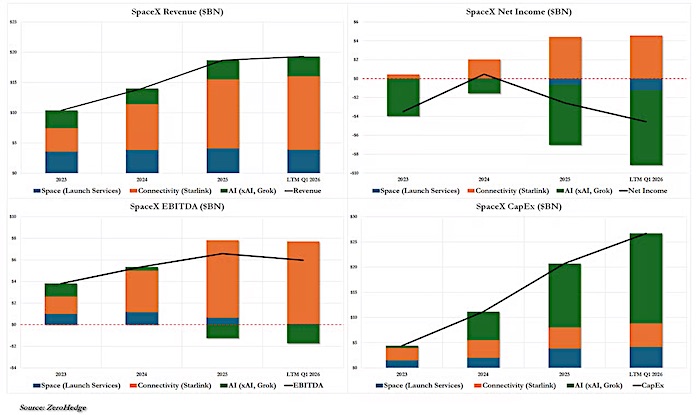
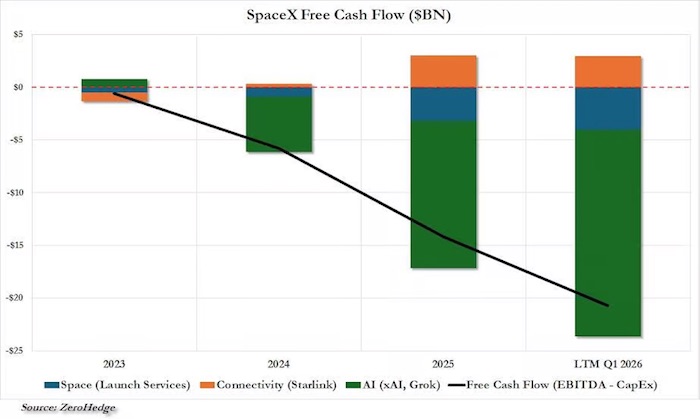
America hears many lectures about fairness from people who have never launched anything larger than a press release. SpaceX offered a cleaner lesson: ownership changes lives; equity turns workers into partners. Risk, patience, and competence can still beat the tired politics of resentment. A cafeteria worker with shares is a better answer to class warfare than another committee hearing. SpaceX isn’t a perfect company, and the IPO isn’t a bedtime story. The company posted $18.67 billion in 2025 sales, with Starlink making around 60% of revenue, but it also recorded a $4.94 billion net loss after absorbing heavy AI costs. Investors are paying a steep price for future growth, reusable rockets, satellite internet, Starship, and Musk’s larger bet on space-based AI.

Still, risk is the price of motion. SpaceX has changed the launch business with reusable Falcon 9 rockets, built the world’s largest satellite internet network, and kept pushing toward Starship while older institutions moved at the speed of paperwork. The company now launches more than twice a week and serves NASA, the Pentagon, businesses, and homes around the world. The first lesson of the IPO isn’t that every company should be valued like SpaceX. Most shouldn’t, but the lesson is that wealth creation still works when vision meets discipline and workers get a seat at the table.

Washington can spend trillions and leave families poorer, angrier, and more dependent. SpaceX created a trillion-dollar event and sent thousands of workers home with life-changing stakes. A country that still rewards builders hasn’t lost its way. A company that makes cafeteria workers millionaires has done more than reach Wall Street. It has reminded America that dignity isn’t handed down by bureaucrats.= Sometimes, just sometimes, it comes in the form of a stock grant, earned one shift, one launch, and one risk at a time.

Read more …

The Globe and Mail is’t even an American paper…

• Globe And Mail: “How To Properly Hate” Elon Musk Ahead Of SpaceX IPO (ZH)

Whether it is Elizabeth Warren, left-leaning unions, or Democrat-aligned NGOs funded by dark money, the common pattern here has been an information campaign aimed at Elon Musk to derail the SpaceX IPO. Their motives are very simple: if the game is about power and money, then Musk potentially becoming the world’s first trillionaire on Friday morning represents a direct threat to the progressive empire they have built.


Just as with President Trump, the left has mounted a permanent pressure campaign of ‘useful idiots’ against Elon Musk because he has poured tens of millions of dollars into political campaigns for pro-America candidates – something Democrats, socialists, and Marxists despise. Then, Musk headed up DOGE in early 2025, which resulted in the defunding of USAID – another move by Musk that caused unhinged left-wing NGOs and Democrats to lose their minds.

The anti-Musk crowd was at it again on Thursday, one day before the SpaceX IPO was set to kick off, when a former Wall Street Journal reporter published an opinion piece in The Globe and Mail titled, “SpaceX is set to make Elon Musk the first trillionaire. Here’s how to properly hate him.” Chris Gay, who appears to have a lot of pent-up hatred for Musk, began the op-ed: “Now that the SpaceX initial public offering is making Elon Musk all but officially the world’s first trillionaire, is it okay to despise him just for being one? To broaden the question: are the billionaires associated with widening inequality a bad look for capitalism?”

The op-ed is less about wealth itself and more of a political framing exercise that uses the SpaceX IPO as the catalyst to recast Musk’s soaring fortune as a governance risk. Gay attempts to launder what appears to be hatred toward Musk, centering his argument on democracy, inequality, and political capture. In other words, the target is not simply Musk becoming the world’s first trillionaire, but the perceived threat that his capital, influence, and political alignment pose to the progressive establishment’s grip on institutional power.

Gay wrote, “By donating at least US$250-million to the Trump campaign in 2024, this private citizen positioned himself to kill a congressional budget deal more or less single-handedly, and then to create a bogus federal agency: the “Department” of Government Efficiency. He staffed it with college-age technobrats who among other things effectively dismantled the U.S. Agency for International Development, which millions of people depended upon for life-critical assistance.”

https://twitter.com/mattvanswol/status/2065235081564766275?ref_src=twsrc%5Etfw%7Ctwcamp%5Etweetembed%7Ctwterm%5E2065235081564766275%7Ctwgr%5Ea2c3b0940e655a961d87b8a0006ed510c32ebd13%7Ctwcon%5Es1_c10&ref_url=https%3A%2F%2Fwww.zerohedge.com%2Fpolitical%2Freckless-propaganda-and-mail-op-ed-tells-readers-how-properly-hate-elon-musk-ahead

It’s not just Globe And Mail, the globalist Financial Times pushes the information operation to paint Musk as ‘evil’ …

Read more …

Don’t tolerate these freaks.

• Feds Identify 15,500 Sponsors of Multiple Unaccompanied Kids (Salgado)

Federal authorities have identified over 15,000 individuals who sponsored three or more unaccompanied and unrelated minors in what could be a major child trafficking exposé. Acting Attorney General Todd Blanche emphasized the prevalence of child trafficking during the Biden administration. Notably, Townhall has previously exposed how federal officials and partner NGOs knowingly trafficked minors. Homeland Security Secretary Markwayne Mullin added that some of the children went through unimaginably horrific abuse, sometimes enduring rape hundreds of times.


Blanche said, “Today, we are announcing the indictments of three individuals, Maritza Azucena Cahuec Coc, her brother Carlos Agustin Cahuec Coc, and Gladys Marina Caal Chen. This was out of the Northern District of Ohio. All three are illegal aliens from Guatemala, who allegedly took part in a wide-raging conspiracy to smuggle more than a dozen children into the United States by scamming the system and exploiting the loopholes created by the last administration.”

Interestingly, a Department of Justice (DOJ) press release clarified that Caal Chen once obtained fraudulent sponsorship herself as an Unaccompanied Alien Child (UAC). The DOJ also mentioned the new conviction of Guatemalan Juan Tiul Xi, who fraudulently obtained sponsorship of and sexually abused a child. Blanche went on, “This is one example, one indictment, but it is not unique. There are over 15,500 super-sponsor cases that we have identified along with DHS. And again, these super-sponsor cases are when somebody sponsors more than three children, unrelated, and they’re unaccompanied minors that come in the United States.”

Mullin also emphasized how heinous it is that the Biden administration lost track of 450,000 UACs as part of the border crisis, and that Democrats continue aggressively to try to defund the border officers who are rescuing the abused and trafficked kids. Mullin didn’t mention it, but countless Democrat politicians and activists are also actively shielding pedophiles and child abusers simply because they’re illegal aliens.

The DHS secretary said, “We found 146,000 kids so far. 146,000 kids. We still have nearly 300,000 missing. We’re investigating reports to where some of these kids claim that they were raped 6[00] to 700 times. I don’t care who you are. I don’t care if you have kids, if you don’t have kids, I don’t care if you’re a liberal, you’re independent, you’re a Democrat, you’re Republican. If you can’t stand for law enforcement to go find these kids, who are you?”

Read more …

“..the swamp doesn’t always wear a Democratic label ..”

• McConnell and Murkowski Remind Trump What He’s Up Against (David Manney)

President Donald Trump didn’t need a long speech to identify the problem. Sitting in the Oval Office, he named Sens. Mitch McConnell (R-Ky.) and Lisa Murkowski (R-Alaska) as two Republicans who still find ways to make Democratic priorities easier and Trump’s agenda harder. For voters who watched Trump’s first term get slowed by Republicans with cold feet, the names sounded familiar. McConnell is no longer Senate Republican leader; Sen. John Thune (R-S.D.) holds that job as majority leader. Yet McConnell still carries weight on defense spending as chair of the Senate Appropriations Subcommittee on Defense, and his instincts remain clear.


When Trump needs Republicans to move as one, McConnell too often sounds like a man searching for the exit ramp. Murkowski has made her brand on being the Republican who wanders off at the worst possible moment. The Senate passed a $70 billion immigration enforcement package by a 52-47 vote, funding ICE and Border Patrol through the end of Trump’s term. Murkowski was the only Republican to join Democrats against it. When the country needed border enforcement funding, she chose the same side as the people who fought Trump’s immigration agenda from the start.

The Senate’s trouble didn’t stop with Murkowski. Sens. Thom Tillis (R-N.C.) and Bill Cassidy (R-La.) spent time during the same vote-a-rama trying to reshape or redirect a disputed $1.776 billion fund connected to claims of government targeting. From the New York Post: The Senate approved $70 billion to fund Immigration and Customs Enforcement and Border Patrol through the end of President Trump’s term early Friday, following weeks of delays amid intra-GOP sniping over a $1.776 billion settlement fund meant to help victims of government weaponization.

The 52-47 final vote approving the legislation came just before 5 a.m., after Republicans defeated more than two dozen amendments in a so-called “vote-a-rama,” including one offered by Sen. Bill Cassidy (R-La.) that would have redirected payments from the settlement to members of law enforcement who were injured in the Jan. 6, 2021, Capitol riot. Thune urged Republicans to keep the bill narrow so it could survive the House. Even when the bill passed, the spectacle showed how quickly a few Republicans can turn a governing moment into an intramural fight.

Cassidy has already paid a political price for crossing Trump. He lost his primary after years of anger over his 2021 vote to convict Trump during the second impeachment trial. Tillis has also become one of the names conservatives watch when the question isn’t whether Democrats will resist Trump, but which Republicans will help them do it. The memory of Sen. John McCain (R-Ariz.) still hangs over these fights. In 2017, McCain cast the late-night thumbs-down vote that helped sink the Republican healthcare repeal effort, defeating the bill 51-49. Conservatives remember the moment not merely because one bill failed; they remember it because a Republican senator waited until the critical hour to break the promise voters had heard for years.

Trump’s second term depends on speed, discipline, and Republican votes that stay put. Democrats will, of course, oppose him, bureaucrats will stall him, and courts will test him. None of that surprises anyone. The deeper frustration comes when Republican senators campaign as conservatives and then become procedural artists when Trump’s agenda reaches the floor. McConnell and Murkowski aren’t random names in Trump’s complaint; they’re symbols of an old Washington habit: promise the voters one thing, then explain why it can’t be done once power is available. Tillis and Cassidy fit the same warning in different ways; short-termers and lame ducks can become dangerous because they stop fearing the people who sent them there.

Trump’s Oval Office criticism landed because it carried a familiar truth: the swamp doesn’t always wear a Democratic label. Every so often it wears an R, quotes procedure, talks about institutional norms, and waits for the worst possible moment to reappear. Conservatives remember the moment not merely because one bill failed; they remember it because a Republican senator waited until the critical hour to break the promise voters had heard for years. Trump’s second term depends on speed, discipline, and Republican votes that stay put. Democrats will, of course, oppose him, bureaucrats will stall him, and courts will test him. None of that surprises anyone.

The deeper frustration comes when Republican senators campaign as conservatives and then become procedural artists when Trump’s agenda reaches the floor. McConnell and Murkowski aren’t random names in Trump’s complaint; they’re symbols of an old Washington habit: promise the voters one thing, then explain why it can’t be done once power is available. Tillis and Cassidy fit the same warning in different ways; short-termers and lame ducks can become dangerous because they stop fearing the people who sent them there.

Trump’s Oval Office criticism landed because it carried a familiar truth: the swamp doesn’t always wear a Democratic label. Every so often it wears an R, quotes procedure, talks about institutional norms, and waits for the worst possible moment to reappear.

Read more …

“Until you are willing to harm the left more than they are willing to harm you, they will win. It’s really that simple.” —Aimee Terese on X

• The Mullahs and the Lefty-Left (James Howard Kunstler)

You’ll just have to stand by on whether this war with Iran is over or not, since the Shia true believers’ practice of Taqiyya is a permission structure for lying to infidels (us) when necessary — like, to advance global chaos that will bring the return of the Hidden Imam (Mahdi) to fill the world with justice, and establish Islamic rule. (Got that?) One might wonder, of course, whether the majority of Iran’s people have had enough of the true believers in charge and their true belief in apocalypse.


President Trump’s promise to bring exactly that down on them seems to have had a clarifying effect. The option remains open to “bomb the shit out of them,” as he put it, while keeping their economy in a Macumba Death grip choke-hold. In preliminary strikes Thursday, the US Military might have demonstrated an ability to go after whatever they have left of missile and drone launch sites. In any case, skeptics abound. . . but, admit it, an actual peace agreement would be quite a coup.

It would distasteful most of all to the mass formation lunatics of America’s Lefty-left “Resistance.” Anything that advances our country’s actual interests is hateful to them. In fact, when you think of it, the Lefty-left is in thrall to the same sort of world-ending chaos as the mullahs and their IRGC henchmen. The mullahs have their vision of the post-apocalyptic Islamic utopia and the Lefty-left has its dream of a post-revolutionary socialist nirvana where everyone is equal (except those who are more equal — and get to boss around the rest of us.)

Yeah, it’s an old story here in Western Civ, this recurring drive to level the existing social hierarchy so as to abolish the tendency of some people to do better in life than others. It never works out. It always leads to mass slaughter of some kind. It always ends in rueful disappointment and a return to the free-for-all that is the human project. The outstanding question might be: why do so many in the West continue to believe it?

The current uprising comes out of the strange conversion of Liberalism to Lefty-left Democratic-Socialist Progressivism. Remember, liberalism was pure live-and-let-live, with an emphasis on minimal government intrusion in our affairs, especially economic affairs. The Liberals of Boomerdom — the campus nirvanas of the 1960s — were contemptuous of government generally, but especially the FBI and the CIA. And, of course, the hippie vanguard was socially and culturally all about the freedom to do your own thing. Freedom of speech was a leading concern.

The Lefty-left, as it evolved under Barack Obama and “Joe Biden,” was about rigid intolerance for opposing ideas and maximal government involvement in your life, especially economic and sexual — making a pass at a girl became subject to litigation. The FBI was loosed on dissenters from Lefty-left policies. Juridical sadism became systematized as Lawfare. The Lefty-left constructed a huge censorship apparatus; no more freedom of speech. They used law and regulation to attempt social leveling; no more discipline in school for black kids because . . . racism! Discriminate against Whitey for jobs. . . anti-racism! Election fraud = “our democracy.” You see how all that went?

Turns out, they wanted to use the government to overthrow the government! And the social order it rode in on! Hence, the ten-year-long crusade to destroy one Donald Trump, the peculiar “Gray Champion” of our Fourth Turning, who turned out to be a staunch counter-revolutionary, that is, an opponent of this new Democratic-Socialist Progressive (wannabe-communist) corps of chaos agents.

One schematic way of understanding this dynamic is Peter Turchin’s theory of Elite Overproduction. By the early 2000s, with anybody and everybody going to college, there were not enough job positions in the real productive economy for this spewage of college degree-holding entrees to the Professional / Managerial Class. By this time, coincidentally, the colleges they were graduating from were infested by three generations of Marxist professors — i.e., adults enjoying cozy institutional security, with no experience in the real world, free to indulge in Marxian revenge fantasies and make them the basis of their teaching.

It was the perfect setup for the emergence of a matrix of NGOs and political activist orgs that could employ all these college graduates which the real economy had no place for. And the new hires were pre-programmed in the ideology of grievance, tinged with racial and sexual animus in addition to economic complaint.

So, voila! — America (and Western Civ generally) became infested with these pernicious Lefty-left operations, which became symbionts of the government themselves, many of the orgs dependent on government (USAID) to fund their activities and pay the management. They got scads of additional money from wealthy freelance chaos maestros like George Soros, Bill Gates, Klaus Schwab, Reid Hoffman, Neville Roy Singham and others.

Read more …

That’s exactly what it is. Carried out by nazis.

• Ukraine Conflict Is ‘Ethnic Cleansing’ of Russian Speakers – Candace Owens (RT)

The Ukraine conflict appears to be an “ethnic cleansing” project aimed at removing the Russian-speaking population from the country’s eastern border regions, US conservative commentator Candace Owens has said. Owens made the remarks in an interview with Russian filmmaker and TV host Nikita Mikhalkov during a discussion about the roots of the conflict and the West’s attitude toward Russia. “I think what’s happening in Ukraine is an ethnic cleansing,” Owens said, arguing that it was “obvious” that large numbers of fighting-age men were being killed, and suggested that “the ultimate goal” of those behind the conflict was to move in “other people” to Ukraine’s border regions.


Moscow has long maintained that the conflict stems from the Western-backed 2014 coup in Kiev, which overthrew then-Ukrainian President Viktor Yanukovych, and the subsequent military campaign launched by the new authorities against Donbass, where much of the population is Russian-speaking and historically close to Russia. Mikhalkov stressed that Russia was not fighting Ukrainians but “Satan,” arguing that Kiev had turned against Russia, the Orthodox faith and the shared history of the two peoples. Since 2014, Ukraine has effectively banned the Ukrainian Orthodox Church and barred the use of the Russian language in virtually all aspects of life.

Owens agreed with the broader religious framing of the conflict, suggesting that “satanic” forces have established a foothold in the West. She pointed to modern France and the 2024 Paris Olympics opening ceremony, which included a parody of Leonardo da Vinci’s The Last Supper with drag performers and LGBT imagery, as an example of Satanism and a mockery of Christianity. She also noted that “satanic” forces in the West fear Russia because its emphasis on history gives people a different understanding of the world.

Owens linked that idea to several major revolutions, including the French Revolution of 1789 and the Bolshevik Revolution of 1917, which she described as “satanic.” After taking power, the Bolsheviks launched a violent anti-religious campaign against the Russian Orthodox Church, seizing church property, persecuting clergy and promoting state atheism. Owens stated that the West’s continued hostility toward Russia appears to be driven by the descendants of Russian Jewish families associated with the assassination of Tsar Nicholas II and the Bolshevik Revolution.

She argued that in the early 20th century, many of these families emigrated to the West, where they gained influence and power, including in the media, and have continued to promote anti-Russian narratives. Russia has repeatedly argued that the Ukraine conflict was triggered by Kiev’s persecution of Russian speakers in Donbass and by Western efforts to turn Ukraine into an anti-Russian project. Kiev and its Western backers have rejected Moscow’s justification for the military operation, describing it as an unprovoked invasion.

Read more …

40 labs in Ukraine alone?! The mind boggles…

• DNI Tulsi Gabbard Releases New Info on 120 US Govt Funded Biolabs (CTH)

Moments ago, Director of National Intelligence Tulsi Gabbard released the first batch in a series of declassified documents highlighting 120 U.S. government biolabs that are operating throughout the world. Many of these biolabs are working on weaponized viruses’ and present a significant threat to public safety.


TULSI GABBARD – “Today, I’m releasing never before seen intelligence revealing new evidence of past US government funding for more than 120 biolabs in over 30 countries, including Ukraine. In support of President Trump‘s Executive Order to end federal funding of dangerous gain of function research around the world, and increase transparency and accountability, ODNI will continue working with partners across the Administration to identify where these labs are, what pathogens they contain, and what “research” is being conducted.” WATCH:

DNI Press Release: WASHINGTON D.C. — After months of searching through Intelligence Community holdings and files, Director of National Intelligence (DNI) Tulsi Gabbard is revealing new evidence of longstanding United States government funding for more than 120 biolabs in over 30 countries. These biolabs include labs in Ukraine, which may be at risk of compromise due to the ongoing Russia-Ukraine war. For example, the Intelligence Community previously warned that a US-funded biolab in Ukraine likely housed dangerous pathogens and remained vulnerable to longstanding threats of Russian attack, seizure, or damage.

Until now, evidence regarding the full existence and funding of these laboratories had been knowingly withheld from the American people. The information surrounding the existence, history, locations and funding of these US funded biolabs has been intentionally covered up by powerful people falsely, claiming that they do not exist and accusing anyone who says otherwise to be foreign assets and traitors to America. Many of these U.S. government-funded biolabs are currently or have previously engaged in research using hazardous and highly contagious pathogens, in some cases to include dangerous Gain-of-Function research, with very little visibility or oversight.

President Trump understands the serious threat dangerous Gain-of-Function research poses to the American people, which is why he took decisive action on May 25, 2025, signing EO 14292 to end federal funding of Gain-of-Function research around the world.

“Despite the obvious potential for catastrophic global impact research on dangerous pathogens in biolabs can have, politicians, so-called health professionals like Dr. Fauci, and entities within the Biden administration’s national security team lied to the American people about the existence of U.S.-funded and supported biolabs, and threatened those who attempted to expose the truth. ODNI will continue to work closely with partners across the government to identify where these labs are, what pathogens they contain to end dangerous Gain-of-Function research that threatens the health and wellbeing of the American people and people around the world,” said DNI Gabbard.

DNI Gabbard issued new guidance to the Intelligence Community directing increased collection on these laboratories and facilities overseas. This directive is already providing new details on clinical trials that are underway at these facilities, raising significant ethical, financial, and security concerns regarding these supposed public health initiatives and U.S. national security.

Read more …

Will Canada ever be free again?

• US Ambassador to Canada Pete Hoekstra Deserves a Combat Medal (CTH)

Watching U.S. Ambassador to Canada Pete Hoekstra discussing current U.S-Canada trade dynamics is to be witnessing one man behind enemy lines trying to explain a situation the audience cannot fathom. It really is remarkable. The longer he is assigned to this almost hopeless task, the more he develops an ‘I don’t give a damn‘ attitude, regardless of the audience size. It’s completely understandable.


The Canadian government controls the information available to the entire country. The Canadian media push that skewed information to the entire country. Then there’s Ambassador Hoekstra; the guy with completely different information, trying against all odds to present a viewpoint that is so fundamentally different the audience cannot grasp it. In this video segment all of the dynamics come into play, but that’s not the real value in this capture. WATCH:

What I would recommend to all those who have followed this genuinely bizarre disassociation topic, is to go to YouTube and read the comments underneath this CTV video. I love and respect our Canadian Treepers who are here with us in the CTH branches of discussion. I cannot fathom what it must be like to live in Canada amid this level of social, cognitive dissonance. You have my utmost respect and sympathy.

Within all of the Canadian free trade agreements (FTAs), regardless of nation, there is something called a baseline memorandum of understanding (MOU). That MOU outlines how the trade agreement for goods sold into Canada are contingent upon Canada retaining access to the U.S. market. When the USMCA is dissolved, almost every single FTA organized by the Canadian government that matters, collapses. Canadians have no concept of what is coming.

Read more …

“… there’s no mistaking it..”

• England Is a B**ch (Robert Spencer)

The news is as appalling, infuriating, sick-making, inexcusable, and earth-shaking, but one thing it isn’t is surprising. The revelation that one of the chief financiers of the principal forces arrayed against Britain, and the West in general, is the British government, is all too much in keeping with the suicidal leftism we have seen from that government (whether the Tories or Labour are in power) for years now. So of course they’re funding ISIS. What else would they do? And the rot is even deeper than that.


The Daily Mail reported Monday that the British government “gave more than £28 billion in taxpayer cash to its enemies over six years, a leaked government dossier revealed last night.” And not just any enemies, either. If the British government had really given 28 billion pounds to its enemies, it would have forked over the dough to Tommy Robinson. But instead, the learned solons in London gave the money to their friends. You know, like ISIS.

The Mail states that “terrorists such as the Islamic State in Syria group, hostile states including Russia and criminal gangs received the vast sum from foreign aid, Covid relief loans and the benefits system, which an expert said was an ‘ATM for terrorists.’” And as these things always do, it gets worse. The report “revealed that Britain helped companies linked to the Chinese military pursue their own research between 2015 and 2021.” The Islamic State, Russia, China, and criminal gangs: all on the British taxpayer dole.

How could this have happened? Pondering that question called to mind a phrase I have not heard in decades, since the days when I was a young Marxist enjoying the benefits of an expensive university education: “Inglan is a b**ch.” (“Inglan” is, of course, Jamaican patois for “England.”) This pungent phrase is actually the title of a catchy little song, the handiwork of a Jamaican “dub poet” named Linton Kwesi Johnson, who has lived in the land for which he has such contempt since 1963 (he is now 73 years old).

Linton Kwesi Johnson penned this classic tune about the miseries of living in his adopted homeland in 1980, and one of my fellow employees at Revolution Books, the Revolutionary Communist Party’s bookstore, introduced me to it not long after that. It never occurred either to her or to me that it was ironic in the extreme for Johnson to be complaining about Britain from Britain; after all, if he hated it there so much, why didn’t he just move back to Jamaica?

For whatever reason, he didn’t, and his choice to remain in the country he calls a “b**ch” has been rewarding indeed. He said in 2018 that he became a “dub poet” as a “way of expressing the anger, the passion of the youth of my generation in terms of our struggle against racial oppression. Poetry was a cultural weapon in the black liberation struggle, so that’s how it began.” He claimed in the same interview that “it was a myth that immigrants didn’t want to fit into British society. We weren’t allowed.”

Without a trace of irony, that same interview notes that Johnson “became only the second living poet to have his work published by Penguin Modern Classics, and was the 2012 winner of the Golden PEN award for his ‘distinguished service to literature.” Another laudatory profile details some of the numerous honors Johnson has received in the UK: “LKJ was awarded the C Day Lewis Fellowship in 1977. He became the writer-in-residence for the London Borough of Lambeth for that year. He went on to work as the Library Resources and Education Officer at the Keskidee Centre, the first home of Black theatre and art. He has been made an Associate Fellow of Warwick University (1985), an Honorary Fellow of Wolverhampton Polytechnic (1987),” and on and on.

Yeah, wow, “Inglan” is really a “b**ch,” eh? Britain didn’t persecute Linton Kwesi Johnson. It didn’t consign him to menial work, or deny him work altogether. Instead, it made him a celebrity, a wealthy, cosseted giant of literature and music. What a b**ch!Laden with honors, treated with unstinting respect and deference in his dotage from the British intelligentsia, Linton Kwesi Johnson is just one of many cultural heroes in the West who hate and denigrate the very cultures that celebrate them. The UK, the U.S., Canada and continental Europe have made revered figures out of numerous people who heap contempt on the native people and their culture and civilization. The situation has advanced to the point that one can hardly expect to have a voice in the culture at all unless one despises that culture.

In light of that, is it really all that shocking that the British government would be handing over taxpayer money to ISIS? This wasn’t just appeasement on the order of “We’ll pay you not to hurt us.” It was an act of self-abnegation of an inferior toward a superior. The British government is filled top to bottom today with people who have raised on the idea that the native culture is rotten. Why shouldn’t they hand over the money British citizens have earned to people who are not tainted with Britishness? The Jamaican transplant Linton Kwesi Johnson, hater of the land that welcomed him, his head bowed down with the weight of his medals and honors, is the symbol of contemporary Britain. And it looks as if he was right all along: “Inglan,” financier of the Islamic State, really is a b**ch.

Read more …

Starmer’s roleis to waste away the last bits of respect Englan’ has.

• Starmer Heads to NATO Weaker Than Ever (David Manney)

Keir Starmer lost two defense officials in one day, and both men left over the same basic charge: Britain’s defense plans don’t match the danger in front of it. John Healey, the UK defense secretary, resigned today. Al Carns, the minister for the armed forces, followed him out the door hours later. For a prime minister already limping through 2026, the timing could hardly be worse. Healey told Starmer that the government’s financial settlement for defense fell well short of what’s required, writing that Starmer and Chancellor of the Exchequer Rachel Reeves had not committed enough money to keep Britain safe while threats from Russia, Iran, and other hostile powers grew sharper.


The Guardian reviews portions of Healey’s letter and applies their interpretation of the message behind the words. “You have been unable, and the Treasury has been unwilling, to commit the resources that the nation needs to defend the country at this time of rising threats.” A mere 250 words in, and we get to the crux. Starmer, Healey notes, recognised both the scale of the threat and the need for more funding, based around the defence investment plan (Dip), which had been due this week but is now delayed. Healey then spells out what many in Westminster assumed – that the delay was owing to wrangling with the Treasury, and that Rachel Reeves’s department was blocking the sorts of sums Healey wanted.

Notably more wounding is the notion that Starmer was “unable” to stop this. Healey, it should be remembered, was among four cabinet ministers who spoke to the prime minister shortly after May’s local elections, asking him to consider his future given the heavy Labour losses. Here, Healey does not sound convinced that Starmer has since got a grip on things. Fox News reports that the resignations reached a “seismic” crisis for Starmer. Healey’s departure stemmed from a dispute over the delayed Defense Investment Plan (DIP) — the government’s long-promised roadmap for military investment and readiness — and as NATO allies face renewed pressure from Trump to boost defense spending.

“John Healey’s resignation is a seismic moment for the government and the Ministry of Defense,” Royal United Services Institute (RUSI) Senior Associate Fellow Ed Arnold told Fox News Digital. “For the government, it creates a sequence of political headaches in terms of a replacement, and trying to get the Defense Investment Plan published.” Carns, a decorated former Royal Marines officer who served multiple tours in Afghanistan, said he couldn’t defend the spending level in good conscience from the government’s front bench. Starmer quickly named Dan Jarvis, a former British Army officer and Labour MP, as secretary of state for defense. Jarvis brings military experience, which helps.

Still, a hurried appointment can’t erase the sight of two senior defense figures walking away at the same moment Britain needs a steady voice. Governments survive resignations, but they have a more difficult time surviving resignations that confirm what critics already suspected. Starmer won a landslide in 2024 and looked, for a brief season, like a man who had pulled Labour out of exile and into command. Two years later, the room feels colder. Labour took heavy losses in the May 2026 local elections, including defeats in areas the party once treated like family ground. Starmer accepted responsibility and vowed to keep going, but the result fed open pressure inside Labour and gave Nigel Farage’s Reform UK a national opening. From Reuters:

“The main beneficiary was the populist Reform UK party of Brexit campaigner Nigel Farage, which gained more than 1,000 council seats in England, and will likely form the main opposition in Scotland and Wales to the pro-independence Scottish National Party and Plaid Cymru.” Early results underscored the fracturing of Britain’s traditional two-party system, with the once-dominant Labour and Conservative parties losing votes not only to Reform, but to the left-wing Green Party at the other end of the political spectrum, and to nationalists in Scotland and Wales.

The defense resignations deepen a problem Starmer had already made for himself. Earlier this year, he restricted the United States from using British bases for offensive strikes against Iran, allowing only limited defensive missions against Iranian missile targets. President Donald Trump was dealing with a dangerous Middle East moment, and Starmer chose a narrow lane. He may have thought he was showing caution, but he also reminded Washington that Britain’s help now comes wrapped in hesitation.

Now comes NATO. The alliance meets in Ankara, Turkey, on July 7 and 8, with Secretary General Mark Rutte chairing the summit. President Trump is expected to press allies hard on defense spending, and Britain will arrive with fresh churn at the top of its defense team.

Read more …


Support the Automatic Earth in wartime with Paypal, Bitcoin and Patreon.



Jun 122026
 
 June 12, 2026  Posted by at 10:03 am Finance Tagged with: , , , , , , ,  23 Responses »


Tomb of the Diver, Greek city of Paestum in Magna Graecia, Italy 470 BC


• ‘They Should Have Made a Deal’: Trump Wants To Seize Kharg Island (Green) f
• Trump: Iran Deal Should Be Done ‘Pretty Quickly’ (ZH)
• Trump’s 3 Bad Options in Iran (James Rickards)
• Bessent To Use Frozen Funds To Reimburse Gulf Allies: ‘Iran Will Pay’ (ZH)
• SpaceX Prices Biggest Ever IPO At $135 Per Share (ZH)
• After SpaceX IPO, Jefferies Lays Out Five Takeaways For Space Boom Into 2030s (ZH)
• Merkel Repeats Call for Crackdown on Free Speech (Turley)
• Europe Pondering Its Cashless Economy, Return To Currency (JTN)
• Eurotroika’s Terms of Ukrainian Settlement Unacceptable — Zakharova (TASS)
• USPS Proposes Halting Delivery of Unverified Mail Ballots (AmG)
• Jerry Seinfeld Just Triggered the Left With Three Words (Matt Margolis)
• Trump Nominates US Attorney Jay Clayton as DNI (ET)
• Professors Behind California Wealth Tax Threaten Action (Turley)
• Britain Goes Full Airstrip One (Stephen Green)


https://twitter.com/ConstitustionX/status/2064787055348261235?s=20


Could just as easily be a 4-week old headline.

• ‘They Should Have Made a Deal’: Trump Wants To Seize Kharg Island (Green)

Iran “should have made a deal,” conservative radio superstar Dana Loesch quipped on Thursday, reacting to President Donald Trump’s threat that U.S. forces “will be taking Kharg Island and other oil infrastructure” in the near future. Are we in the endgame now? At last?


UPDATE: Nope. Trump, according to the WSJ, now says he’s canceled the strikes “after Tehran’s leadership and other parties negotiating a deal to end the conflict approved ‘discussions and final points.'” Echoing what I wrote below, whatever went on behind the scenes, Trump’s threat seems to have gotten what he wanted — even if what he wanted was for the talks to drag on while Iran’s economy continues crumbling. But do read the rest of the column because it includes some fun tidbits. Original post follows.

ANOTHER UPDATE: Iran’s official news outlet, Fars, says Tehran has not agreed to the text of any agreement, for whatever that’s worth. And I officially give up! Heh.

LAST UPDATE, I SWEAR: Everything to you need to know (for now) is here: ‘We Just Made a Great Settlement of the War With Iran.’

Kharg Island sits near the northern end of the Persian Gulf — or as Trump might think of it, the Other Gulf of America — almost due east from Kuwait City. It’s only a few miles long, but as you can see from this image I captured from Apple Maps, it’s virtually covered in oil infrastructure. Oil and LNG representing more than 90% of Iran’s energy exports are processed at Kharg, stored in those massive tank farms, then offloaded to supertankers for sale around the world. Tehran could divert to other facilities, but at a comparative trickle.

It’s a single point of failure. Saddam Hussein understood this, and attacked Kharg repeatedly during the Iran-Iraq War of 1980-1988. But Iraq lacked the air power to do much harm, and he certainly lacked the naval power to seize it. The U.S. military has no such limitations. In fact, a report earlier this week revealed that the Pentagon ordered elements of the 82nd Airborne Division to Israel in March for just such an eventuality.

Kharg Island
“A military source involved in war planning tells me the deployment is tied to new U.S.-Israeli joint contingency plans, completed since February, for seizing Kharg Island and carving out coastal territory inside Iran,” Ken Klippenstein wrote. According to his report, the soldiers deployed to Israel are from the 2nd “Geronimo” Battalion, 501st Infantry Regiment. The 501st dropped behind Nazi lines in Normandy on D-Day, fought the Battle of Hamburger Hill in Vietnam, was one of the first units sent to Afghanistan after 9/11, spent a year in Iraq during some of the worst fighting there, and much more. In short, the 501st is storied, and its men are badasses. But I digress.

If Trump does order in the Marines, Airborne, or other forces, I suppose it will prove the first real test of American troops against enemy drones. Godspeed, fellas. Trump’s full statement — on Truth Social, of course — reads: “The United States will be hitting Iran (Whose Navy, Air Force, Radar, Anti Aircraft, and all other forms of Defense, together with most of its offensive capability, are GONE!), VERY HARD TONIGHT. At some point in the not too distant future, we will be taking Kharg Island, and other oil infrastructure points, and assume total control of their Oil and Gas Markets, much like we have with Venezuela, which is working out brilliantly for both Venezuela and the United States of America.”

He finished with the now S.O.P., “Thank you for your attention to this matter!” which I just love. All that said, this could be more of Trump’s bluster, purposely designed to keep Iran’s Remnant Regime guessing, off-guard, and wondering if they’ll ever get a deal before their money runs out. Lowy Institute’s R.N. Prasher this week was hardly the first to ask whether Trump’s “protracted” negotiations are “part of U.S. strategy” to bring Iran “to an economically and logistically weak state where it has no option” but to give up its nuclear program and stranglehold on Hormuz. Despite a moment of impatience I suffered last month — and honestly, hits me at least once a day — Trump likely has turned the Mullahs’ “rug-merchant” negotiation tactics against them.

But that doesn’t mean that Trump hasn’t run out of patience, too, particularly after this week’s downing of a U.S. Army helicopter over the Gulf. Only the White House knows for sure, so stay tuned.

Read more …

Or not.

• Trump: Iran Deal Should Be Done ‘Pretty Quickly’ (ZH)

President Donald Trump announced Thursday evening that he had cancelled scheduled U.S. strikes and bombings against Iran, citing rapid progress on a U.S.-Iran memorandum of understanding (MOU) aimed at extending a fragile ceasefire and launching formal negotiations on Tehran’s nuclear program. In a Truth Social post and a phone interview with the New York Post, Trump said the agreement was “pretty much all wrapped up,” with documents at a “fairly final stage.” He added that he had spoken with Israeli Prime Minister Benjamin Netanyahu and claimed the deal had received approval at the highest levels in Iran and from multiple regional players, including Saudi Arabia, the UAE, and others. The U.S. naval blockade of Iranian ports will remain in place until the deal is signed, with time and location of the signing to be announced shortly.


The Israeli Prime Minister’s Office later confirmed that Trump spoke with Netanyahu this evening specifically about the emerging MOU. According to the readout, Netanyahu expressed appreciation for Trump’s commitment that any final agreement would require the removal of enriched nuclear material, dismantling of enrichment infrastructure, limits on missile production, and an end to Iran’s support for terrorist proxies – even though Israel is not a direct party to the MOU. Earlier in the day, Trump had sharply escalated rhetoric by threatening to seize Iran’s key oil-export hub at Kharg Island and hit Iran “very hard,” a move widely seen as leverage that may have accelerated the diplomatic opening.

“President Trump spoke this evening with Prime Minister Netanyahu regarding the emerging memorandum of understanding (MOU) with Iran to enter into negotiations,” the PM’s office wrote on X. “Even though Israel is not a party to the memorandum of understanding, the Prime Minister expressed his appreciation for President Trump’s commitment that the final agreement at the conclusion of negotiations will include the removal of enriched material, the dismantling of enrichment infrastructure, limits on missile production, and the cessation of Iran’s support for its terrorist proxies in the region.”

Read more …

Rickards says Iran is winning. Wonder what he means by that.

He’s OK with Iran having nuclear bombs. That’s his choice. Trump chooses differently. As does Israel.

Rickards draws comparisons to WWII and Vietnam. Is that wise?

• Trump’s 3 Bad Options in Iran (James Rickards)

Trump has three ways out of the Iran War. While the choices are all bad for Trump, they are not all bad for the U.S. economy. Some are better than others. Trump’s choice will not only determine the outcome of the war, it will determine the path of the U.S. economy over the year to come.


Choice One is surrender.
Basically, the U.S. would withdraw from the Iran War without having achieved any of its major goals (not that those goals have ever been well articulated by the administration). Iran would still have its highly-enriched uranium (HEU). The Iranian regime, consisting of the Iran Revolutionary Guard Corps (IRGC) and Supreme Leader Mojtaba Khamenei or a successor, would still be in charge. The Iranian people would be largely unified behind new leadership who are younger than the leaders Trump killed. This new group, in their 40s instead of their 70s and 80s, would feel more nationalist and more comfortable in power than their predecessors.

Iran would suffer enormous infrastructure damage, but it can repair and replace those assets over time. Most importantly, Iran would have de facto control of the Strait of Hormuz — something it has threatened but never actually accomplished in the 47 years since the Iranian Revolution.

Choice Two is stalemate.
This is basically the current state of the war. Calling it a ceasefire is a joke. Iran recently attacked the Kuwait airport and Israel. The U.S. bombed radar facilities in Iran. Israel struck Iranian energy infrastructure. Hezbollah and Israel continue to fight it out in southern Lebanon. This is a low-intensity conflict — all sides back off after a few strikes. But it’s not a ceasefire.

The stalemate suits Iran because it gives them time to dig out missile sites, build more drones and receive financial assistance from Russia and China. The stalemate suits the U.S. because it gives us time to rebuild stockpiles of cruise missiles and Patriot anti-missiles.= Most importantly, the stalemate favors Iran because the Strait of Hormuz remains closed. Iran can suffer economic consequences longer than the world can do without Persian Gulf oil, liquid natural gas, helium, nitrates and sulfur. It’s a game of chicken, and the U.S. will swerve first because it has more to lose.

Choice Three is escalation.
The logic is simple. Trump won’t surrender, and the game of chicken can’t go on much longer.= Trump will unleash the U.S. Department of War to bomb Iranian infrastructure, including bridges, railroads, key highways and telecommunications. Bombing may include sites believed to hold the Iranian HEU. More extreme versions of escalation could include a special operations mission to seize the Iranian HEU or precision bombing aimed at Iran’s oil export facilities on Kharg Island, or even desalination plants. The idea is to bomb Iran into submission and get the deal Trump wants while avoiding the stigma of surrender.

All three choices will fail. A surrender might be papered over with some kind of memorandum involving an “agreement to agree” in the future, but the world will see it for what it is — just another Iranian stalling tactic that preserves the status quo for Iran and solidifies the rule of a new younger regime. Iran won’t give Trump the satisfaction of saving face because Iran is winning. Trump won’t accept surrender because of ego and the bad optics. Neither side will accept the deal the other wants. So there will be no deal.

Choice Two will fail because the current stalemate is unsustainable. The world has been without Persian Gulf oil exports for almost four months. A combination of Gulf oil already underway in tankers before the Strait was closed, some increased production from the U.S. and Russia and a drawdown of strategic reserves by various countries has kept the global industrial economy going. Those lifelines are running out. There is no more Gulf oil in tankers on their way. Reserves are reaching critically low levels, at which pumps and pipelines begin to break down. The U.S. and Russia can supply some oil to their friends, but there’s not enough to go around.

Time is almost up on the stalemate. Something has to give. Escalation may be attempted, but it will fail also. There is no history of a side being bombed into submission without boots on the ground. Germany tried to bomb Britain into submission during the Battle of Britain, the first major military campaign fought entirely with air forces. It failed. Germany was never able to invade. The firebombing of Dresden did not defeat the Germans. It took D-Day, the Battle of the Bulge and the Red Army marching on Berlin after destroying Warsaw.

The firebombing of Tokyo, which used napalm on wooden structures, did not defeat the Japanese. The atomic bombs may have ended World War II, but that’s an exception that proves the rule. Is anyone up for using nukes in Iran? Ten years of bombing North Vietnam did not win the war in Vietnam. The U.S. never invaded the North in that war. In short, bombing doesn’t work without a land invasion.Invading Iran would be a military undertaking on a massive scale. With 80 million people and a landmass roughly the size of the U.S. east of the Mississippi River, Iran would require perhaps 60 divisions organized into six armies and two Army Groups, backed by air power, naval aviation and submarine-launched missiles.

Anything short of that would risk defeat. You can escalate all you want, but it won’t win the war. Surrender would be the best result for the U.S. economy.

Read more …

If Russia/Ukraine is any example; be careful.

• Bessent To Use Frozen Funds To Reimburse Gulf Allies: ‘Iran Will Pay’ (ZH)

US Treasury Secretary Bessent announced on X Thursday morning that Washington is moving forward on a plan to compensate America’s Gulf regional allies for damage sustained during Iranian counterattacks on their energy and civic infrastructure. He made clear that any damage to Gulf allies would be paid for with frozen Iranian funds, which Tehran leadership has long blasted as blatant theft. According to Bessent’s latest announcement: “The Iranian regime will lose the zero-sum game it is playing.” The Treasury Secretary listed out the following new policy and plan:


Any damage it inflicts on our allies in the Gulf will be paid for with funds extracted from Iranian Accounts.
Any tolls paid to the Persian Gulf Strait Authority will be offset by funds extracted from their accounts.
Every attack Iran launches will only deepen the economic and financial consequences it faces.

via Reuters – Interestingly, there is implicit here a possible acknowledgement that US forces won’t be able to immediately be able to stop Iran from enacting its toll collection protocol, which it has hinted is being done in coordination – or at least with an ‘understanding’ – from Oman, which itself has come under pressure from the Trump administration of late. Over eighty oil, gas, and vital infrastructure facilities across the Gulf have been hit – with most of the attacks having occurred in March and April – with one recent report estimating up to $58 billion in damage. Iran has sought to justify these attacks as ‘retaliation’ for these Gulf countries hosting American bases during the US unprovoked assault on the Islamic Republic.

An unnamed US official had previously told ABC’s Senior White House correspondent Selina Wang last weekend: “Treasury will utilize all tools available to allow Iranian assets to be made available to our Gulf allies to support rebuilding and repairs for any future damage caused by Iran.” “The Secretary has also directed his team to assess conditions amongst our Gulf allies and request comprehensive estimates of the costs associated with repairing damage Iran has inflicted since the start of the conflict,” the source had added.

Also as part of that earlier reporting, it was revealed: The Iranian assets could include frozen assets and ships the U.S. has seized. The administration is reaching out to Gulf allies right now and asking for their evaluation. This is only likely to further derail efforts to get Tehran and Washington back to the negotiating table. Already the US has balked at Iran’s own insistent it be given reparations for damage done. Iran is meanwhile still demanding that its billions in funds long frozen by Washington be given back as part of a deal. The Trump administration has so far rejected this, at least in terms of its public-facing position.

Read more …

FOMO.

• SpaceX Prices Biggest Ever IPO At $135 Per Share (ZH)

While there was little doubt as to SpaceX’s actual IPO price, which due to its novel structure was always going to be $135, and unlike the proposed IPO price ranges as is customary for other initial offerings, moments ago SpaceX (SPCX) made it official when it filed a free writing prospectus (FWP) which confirmed the company sold 555.6 million shares at $135 each, for a total size of $75 billion (excluding the greenshoe), making history with the biggest-ever IPO, launching it into the top ranks of the largest public companies and putting founder Elon Musk on the verge of becoming the world’s first trillionaire.


For context, SpaceX is more than double the size of the previous largest IPO – Saudi Aramco’s $29.4 billion listing in 2019. The SpaceX registration statement was declared effective June 11. The details of the pricing are shown below. At $135, SpaceX will have a market value of $1.77 trillion. Accounting for employee stock options and restricted share units, the pricing gives it a fully diluted valuation of about $1.8 trillion. SpaceX’s market value will rank it among the top 10 public companies globally, and make it larger even than Musk’s own Tesla. According to Polymarket, there is a 84% chance the IPO closes above its offering price tomorrow, and a 46% chance it rises more than 20%.

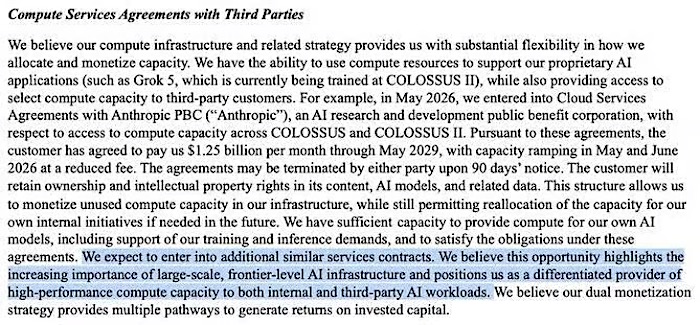
SpaceX, which made a net loss of $4.9bn in 2025, is made up of three businesses: space exploration, including its Falcon and Starship rockets; connectivity, such as its Starlink satellite constellation providing high-speed internet access; and artificial intelligence, though its xAI division. Musk’s fan base in the retail trading community is a crucial component of the deal: they have placed more than $100 billion in orders for the stock, Bloomberg reported, far more than the 20% of shares that had been reserved for them.

Yet not everyone is so excited. Noted short-seller James Chanos on Wednesday called it “a hopes-and-dreams IPO” driven by enthusiasm for Musk and artificial intelligence rather than the fundamentals of a company that has yet to post a profit.“The total addressable market for space is infinite,” Chanos, founder of Chanos & Co., said at the iConnections Global Alts conference in New York on Wednesday. “You can build whatever stories you want — colonies on Mars, factories on the moon, data centers in space — to justify the valuation.”

Investment research group Morningstar calculated that SpaceX is worth only $63 a share – half the IPO price – and warns there is “a major disconnect between market expectations and underlying fundamentals”. Michael Field, the chief equity strategist at Morningstar, suggests investors should sit out the IPO and wait for “a more attractive entry point down the line”. “We believe the business has real strengths, particularly in Starlink, but with so many unknown and untested technologies underpinning much of the valuation price, particularly within the AI business, we think the valuation is extremely speculative,” Field said.

Still, even among the skeptic about the company’s current valuation, many acknowledge Musk’s achievements building Tesla and SpaceX into giants – and making money for investors, thanks in part to his loyal retail investor fanbase. Coupled with rule changes that could fast track the stock into benchmark gauges like the Nasdaq-100 Index (if not the S&P where there will be at least a one year delay), demand from passive funds and retail investors unable to buy at the IPO price should set the stage for a solid cohort of buyers for shares of the rocket, satellite and AI company once they start trading.

“It’s probably the most hopeful IPO,” said Kim Forrest, chief investment officer at Bokeh Capital Partners, adding that she doesn’t buy IPOs. Buyers of SpaceX “want to be part of the future,” she said. “And I think that’s oddly hopeful in this time when we’re moving between the poles of greed and fear.”

As Bloomberg notes, SpaceX is the first of three major IPOs expected to capitalize on stock investors’ appetite for the leading AI companies, a seemingly insatiable demand that has propelled benchmark US indexes to records this year despite the acceleration in inflation and economic disruption caused by the war in Iran. Anthropic PBC and OpenAI, two of the company’s AI competitors, are expected to go public as soon as this year and could seek valuations of more than $1 trillion each, so the performance of SpaceX’s stock will be as closely scrutinized by Silicon Valley venture capitalists as it is by Wall Street traders. The deluge of public equity, on top of an $85 billion equity offering from Alphabet Inc. and the potential for other big-tech firms to follow suit, is triggering a debate over whether there is enough investor demand to meet the incoming supply. “

It’s a big deal as a kind of precursor for Anthropic and OpenAI,” said Anthony Saglimbene, chief market strategist at Ameriprise. “When I look at all three of those and the amount of capital that these companies are raising, it tells me that the demand for AI is still very strong even though we’ve seen more volatility. And I think some of that volatility in the market has been positioning around the expectations for these IPOs.”

Read more …

Accountants in space.. Why am I thinking of Miss Piggy?

• After SpaceX IPO, Jefferies Lays Out Five Takeaways For Space Boom Into 2030s (ZH)

Friday’s SpaceX IPO will be a defining moment not only for capital markets but also for the booming space industry and Elon Musk’s broader industrial empire, which has catapulted America to the lead in the space race against Communist China and Russia. Ahead of the four-times-oversubscribed SpaceX IPO, we explained to readers how to profit from the incoming data center boom in low-Earth orbit and broke down the mechanics of the IPO in an easy-to-understand format. Next, we want to give readers the opportunity to understand where the space industry is headed to position bullish bets, as this industry will likely have tailwinds for years to come. It’s all about following the money.


We are leaning on Jefferies analyst Aniket Shah’s Wednesday report, which provided a roadmap for understanding the space industry through five easy takeaways. 1. The global space economy has reached $600bn, potentially tripling to $1.8trn by 2035. Commercial activity accounts for 80% and spans satellite TV, broadband, GPS infrastructure, and satellite manufacturing. The remaining 20% is government spending. Within the investable “backbone” of physical infrastructure, state-sponsored spending is projected to grow faster than commercial, rising from $125bn to $320bn (+256%) vs $205bn to $435bn (+212%) for commercial over the next decade. Defense is the fastest-growing category within the space economy.

2. Th e US accounts for 60% of global government spending on space; China ranks second. US government space spending is ~$80bn, more than the rest of the world combined. China spends ~ $20bn, but this figure is not PPP-adjusted, meaning its effective spending power is materially closer to the US than the nominal gap implies. Japan is a notable third player, having designated space as one of Prime Minister Takeshi’s 17 strategic sectors (see here & here). China has similarly identified space as a strategic area in its 15th Five-Year Plan (see here & here).

3. Space Force budget surged 40% in one year, fueled by the Golden Dome program. Golden Dome is a top strategic priority driving the budget surge. Golden Dome is a multi-layered missile defense initiative that integrates space-based sensors, interceptors, and AI-enabled command and control to address ballistic, hypersonic, and cruise missile threats. Space Force now commands ~$40bn and the Missile Defense Agency ~$10bn, totaling ~$50bn, far exceeding NASA’s budget ($24.4bn).

4. SpaceX has captured a structural share of federal space dollars. It is NASA’s largest commercial contractor and plays a critical role across launch services, communications, IT, and the broader data layer of the space architecture. The US government has effectively outsourced significant space activity to SpaceX, creating an inextricable linkage between federal spending priorities and the company’s business.

5. US vs China: Moon Race 2.0 is accelerating. The rivalry plays out across three dimensions: lunar programs, global coalitions, and codified policies.

Lunar programs: The US targets a crewed lunar landing by 2028 and a lunar outpost by 2030; China targets a crewed landing by 2030 and an outpost by 2035.
Global coalitions: The US-led Artemis Accords have 67 signatories, while the China-Russia International Lunar Research Station coalition has <20.
Codified policies: President Trump has issued executive orders on Iron Dome for America, commercial space competition, and ensuring US space superiority. China’s 15th Five-Year Plan also prioritizes space competitiveness.

Read more …

Merkel sees the world through post Cold War East Germany eyes. The State decides, not the people.

• Merkel Repeats Call for Crackdown on Free Speech (Turley)

The European Union recently announced the first recipients of its new European Order of Merit, the organization’s highest award. The headliner was Angela Merkel, former Federal Chancellor of Germany, who indeed personifies the European Union for both her fans and her critics. For many years, some of us have criticized Merkel as one of the leading forces behind European censorship efforts that have eviscerated the “Indispensable Right.” Not surprisingly, Merkel called for more censorship and attacks on free speech to a thrilled audience of EU bureaucrats and globalists.


In one of the most ironic moments, Merkel declared, “Europe was not handed to us. It was built treaty by treaty, crisis by crisis and by people who chose solidarity over division and cooperation over self-interest.” Indeed, it was not handed to them. As I discuss in my new book, “Rage and the Republic, the EU was formed by design to incrementally get citizens in Europe to give up their national identities and rights: The EEC worked to remove barriers to trade and coordinate national regulations to achieve greater uniformity. As nations conformed to such transnational standards, the final step toward transnational governance became less of a conceptual barrier for citizens, particularly younger citizens…

…The evolution of the EU is a cautionary tale. It began with assurances of marginal coordinating bodies and policies over areas like nuclear power and scientific research. Through this planned incrementalism, each insular move was defended on its narrow purpose while dismissing objections as nationalistic or conspiratorial. That planned incrementalism worked brilliantly in getting citizens to accept transnational governance.

Merkel was critical in that effort. She is blamed for opening the borders to a flood of undocumented immigrants that has caused rising violence and protests throughout Europe. However, her crowning jewel was the crackdown on free speech. She can honestly claim that Germans (and Europeans as a whole) have fewer rights after her public service. She increased the power of government, stripped away free speech rights, and reduced national identities without firing a shot.

Merkel consistently opposed free speech, building a censorship system that gave the government ever greater control over speech. Her decision to first apologize to authoritarian Turkish President Recep Tayyip Erdogan for a satirical poem and then approve the prosecution of the comedian is a shocking and chilling disgrace. Now, she is throwing her support behind a crackdown on “hate speech” on social media like Facebook, Twitter, and YouTube — radically expanding the already broad scope of government regulation of speech.

Merkel declared, “I support efforts by Justice Minister Heiko Maas and Interior Minister Thomas de Maiziere to address hate speech, hate commentaries, devastating things that are incompatible with human dignity, and to do everything to prohibit it because it contradicts our values.” Merkel was a driving force in using such subjective standards as “compatibility with human dignity” as a foundation for government-imposed speech controls. Merkel also threatened social media companies, warning they would face a government crackdown if they failed to get rid of “fake news.” Merkel insisted that such postings must be dealt with by the companies or the government will step in.

In her speech in May to the EU, Merkel doubled down on her attacks on free speech as a threat to the world order. She called for the prosecution of American companies for spreading “disinformation” and “hate” online. She denounced the “so-called social media” platforms as still not facing “accountability for lies.” She added, “I can only encourage you to continue regulating social media.”I could think of no better recipient for the first European Order of Merit. No one better sums up EU values than Angela Merkel and her unrelenting campaign against free speech. For globalists who have called for “A New World Order with European Values,” Merkel is the perfect personification of a globalist dream of a world of regulated speech and transnational government.

Read more …

Holland: no cash.

Greece: all cash.

• Europe Pondering Its Cashless Economy, Return To Currency (JTN)

Sweden has led the way in Europe’s transition to a cashless economy, being among the first to have credit or debit card readers at points of sale – even for something as low-cost as a newspaper so that customers no longer had to dig in their pockets for coins or paper currency. But now, the country that led Europe’s modern march toward a cashless society is among those reconsidering that journey amid growing concerns about cyberattacks, conflict, power outages, privacy and national resilience. Increasingly, policymakers in Sweden and other countries that have been pushing the trend, including Denmark, Estonia, Finland and the Netherlands are realizing that cash still matters.


Most transactions in these countries remain cashless. But the adoption rate for cashless transactions has leveled out, and now the government is creating incentives to stabilize the current level of cash usage rather than letting it fall further. “We now need to think about resilience,” Erik Thedéen, the governor of Sweden’s Central Reserve Bank, said last year. “If everything breaks down, we need to have cash.” Official government guidance in “emergency preparedness” brochures sent to Swedish households recommends citizens maintain at least one week’s worth of cash to be available in a time of crisis. Other early adopting countries are taking similar steps.

Thedéen said the reversal was sparked by a destabilized globe in which exists the threat of an expanded war between Russia and Ukraine, the threat of digital attacks, and signs from President Donald Trump that the U.S. may not come to the aid of its European allies if they were attacked. Thedéen said the country’s advanced digital payment infrastructure could make it more vulnerable.The shift does not mean Europeans are abandoning digital payments. Credit cards, mobile wallets and instant-payment apps continue to dominate everyday commerce, and few expect cash to regain the ground it has lost over the past two decades.

But most of the European Union still trails the northern European member states, where 90 percent or more of all transactions are conducted without the use of cash. In comparison, the European Union surpassed the 50-percent threshold for cashless transactions only last year. Among the European Union’s biggest economies, Italy was the laggard, ranking 21st in the 27-nation bloc in terms of frequency of cashless transactions, while smaller countries including Greece, Romania and Bulgaria remained below 30 percent.

Leaders still see overall adoption rates for cashless transactions increasing even if they level out in the countries that were quickest to adopt them. “The digital euro is not just a means of payment, it is also a political statement concerning the sovereignty of Europe,” said Christine Lagarde, the head of the European Central Bank. Cashless transactions are still broadly favored by governments because they reduce the reach of the black-market economy and make transactions traceable. Advocates say they also enhance security against physical theft and increase convenience for shoppers and vendors.

Read more …

I never heard of Eurotroika before.

• Eurotroika’s Terms of Ukrainian Settlement Unacceptable — Zakharova (TASS)

The Eurotroika (the United Kingdom, Germany, and France) have proposed conditions for a settlement in Ukraine that are clearly unacceptable to Moscow, Russian Foreign Ministry Spokeswoman Maria Zakharova said.”There is nothing new in the statement of the three European leaders. They tried to promote the same theses back in 2022-2024 in the Copenhagen and Burgenstock formats, supporting the dead-end ‘Zelensky formula’. Those forums have long been forgotten because they discredited themselves, being initially aimed not at peace, but at war,” she said in a statement.


“Dmitry Sergeyevich Peskov, press secretary of the Russian president, also highlighted the contradictory positions of France, Germany, and Britain. With their statement, the leaders pretend to call for peace, but in reality, they are presenting a priori unacceptable conditions, boosting the production of long-range weapons for Kiev, and generally advancing the militarization of Ukraine and Europe,” Zakharova added.

She pointed out that in this way the Europeans are pursuing a course aimed at “preventing the creation of conditions for negotiations on a truly comprehensive, just and lasting peace. It’s noteworthy that they don’t hide it. Two weeks ago, on May 28 of this year, the European Union’s top diplomat Kaja Kallas said the following: ‘Europe will never be a neutral mediator between Russia and Ukraine, because we are on the side of Ukraine and protect our own security interests.’ Thus, she admitted that Europe is claiming a place at the negotiating table, in fact, as part of a united delegation of the West and Ukraine against Russia,” Zakharova added.

About the statement of Eurotroika
On June 7, French President Emmanuel Macron, German Chancellor Friedrich Merz, British Prime Minister Keir Starmer and Vladimir Zelensky held talks on Downing Street. Following the meeting, they issued a policy statement with five basic conditions for starting the settlement process, including security guarantees for Ukraine, the deployment of multinational forces, the continued freezing of Russian assets until full compensation for damage, and an immediate and complete ceasefire.

Read more …

Don’t like mail-in ballots? Don’t deliver them.

• USPS Proposes Halting Delivery of Unverified Mail Ballots (AmG)

The US Postal Service (USPS) has proposed a new rule requiring states to share voter information related to mail-in and absentee voting. The proposal follows a March executive order from Trump aimed at tightening regulations governing mail-in voting in federal elections. Trump has made election integrity a central focus of his second administration, issuing executive orders designed to require proof of citizenship for voters and combat mail-in voting fraud. The administration has argued that stronger verification measures are necessary to restore confidence in elections and safeguard the voting process.


Several of those initiatives have faced legal challenges. Courts have blocked certain provisions, including proof-of-citizenship requirements, while appeals remain pending. Democratic-led states have also filed lawsuits challenging the administration’s mail-in voting policies. As litigation continues, the Postal Service has moved forward with a proposal directing states and the USPS to coordinate on identifying eligible mail-in and absentee voters. Under the proposed rule, states would submit lists of voters requesting mail-in ballots, along with personalized barcodes assigned to each ballot.

The Postal Service would then return a finalized “Mail-In and Absentee Participation List” to each state’s chief election official. The list would contain the names of approved voters and the corresponding ballot barcodes associated with each voter. Under the proposal, only voters included on the final participation list would be eligible to receive mail-in or absentee ballots. The USPS said the new system would help improve transparency and provide election officials and law enforcement with additional tools to verify election procedures.

“This provision will help determine adherence to federal law and facilitate law enforcement efforts,” the proposal states. “For example, the provided lists will evidence how many ballots have been mailed, and allow law enforcement officials to compare the total number of mailed ballots to the total number of received ballots to detect potential issues meriting further investigation.” Election integrity supporters argue that the process would create a clearer chain of custody for mailed ballots and help identify irregularities that might otherwise go undetected.

The Postal Service issued the proposal May 29, one day after Trump-appointed US District Judge Carl J. Nichols denied a request from Democratic plaintiffs seeking to block the administration’s mail-in voting executive order. Nichols ruled that the challengers failed to sufficiently demonstrate that the order would cause “imminent and irreparable harm.” The plaintiffs have appealed that decision, and the Postal Service proposal remains subject to ongoing legal uncertainty while the broader litigation proceeds.

Read more …

“I should ask Larry David. I should have asked his a** too.”

• Jerry Seinfeld Just Triggered the Left With Three Words (Matt Margolis)

Jerry Seinfeld walked out of Madison Square Garden on Wednesday after watching the Knicks in the NBA Finals and may have triggered the left more than Donald Trump’s attendance Monday night. As Seinfeld left the arena, TikTok streamer FinesseFave, who was live-broadcasting outside, saw him and approached him. “Oh, Jerry. What up, Seinfeld? What up? Can we get a free Palestine?” Seinfeld laughed. The FinesseFave pressed again. “Can we get a free Palestine? Come on, give us one free Palestine.” Seinfeld kept walking. “It doesn’t exist,” he said.


The streamer turned back to his audience, barely able to contain himself. “Oh my God. That was a f*****g insane clip,” he said. “He said it doesn’t exist.” Then, apparently regretting a missed opportunity, he later added, “I should ask Larry David. I should have asked his a** too.” Here is the clip. Obviously, there was foul language:

https://twitter.com/MaxNordau/status/2065023449450308042?s=20

The clip spread across social media almost instantly, reigniting the familiar cycle of outrage directed at one of the most famous comedians alive. You would think a 71-year-old Jewish man openly supporting Israel wouldn’t be controversial at all. The radical left has other ideas. Here’s the thing: Seinfeld’s position on Israel has never been a secret. After Hamas launched its attack on Oct. 7, 2023, he posted a statement on Instagram that made everything clear. “I lived and worked on a Kibbutz in Israel when I was 16, and I have loved our Jewish homeland ever since,” he wrote. “We survive and flourish no matter what. I will always stand with Israel and the Jewish people.”

Seinfeld’s stance on Israel is well known and consistent. These people confronting him know it too, and think they’re getting him in a gotcha moment. They’re not. During a September 2025 appearance at Duke University, he was, to say the least, unambiguous about his feelings about the Free Palestine movement. “Free Palestine is, to me, just… you’re free to say you don’t like Jews,” he said. “Just say you don’t like Jews.” He also compared the movement to the KKK. “Compared to the Ku Klux Klan, I’m actually thinking the Klan is actually a little better here, because they can come right out and say, ‘We don’t like blacks, we don’t like Jews.’ OK, that’s honest,” he said.

Here is the reality the far left refuses to sit with. Nothing Seinfeld has said is fringe or extreme. A Jewish man supporting Israel, rejecting a slogan he views as thinly veiled antisemitism, and refusing to apologize for any of it is a reasonable position held by millions of Americans. The radical left has drifted so deep into anti-Israel territory that straightforward pro-Jewish expression now reads to them as a provocation worth screaming about.

Let’s be honest, here. Seinfeld has fame, money, and nothing to prove to these bigots. He may be a liberal, but he owes the woke mob absolutely nothing, and he acts like it. That kind of backbone is genuinely rare in today’s entertainment industry, where most celebrities trip over themselves to signal the correct opinions to the right sort of people. Seinfeld doesn’t play that game, and that drives them absolutely crazy. Good for him.

Read more …

Didn’t fight very hard for Bill Pulte.

• Trump Nominates US Attorney Jay Clayton as DNI (ET)

President Donald Trump on Thursday said he is nominating Jay Clayton, the U.S. Attorney for the Southern District of New York, to be his director of national intelligence. The move comes weeks after former intelligence chief Tulsi Gabbard said she is stepping down from the role. Trump, in announcing the decision on Truth Social, wrote that “few people anywhere” in the legal community have as much respect as Clayton, the former head of the Securities and Exchange Commission (SEC), whom the president also described as “highly respected.” “I encourage the United States Senate to confirm Jay as soon as possible,” he wrote in the post.


Last month, Gabbard announced she was stepping down as the head of the Office of the Director of National Intelligence (ODNI) because her husband was diagnosed with a rare form of cancer. Federal Housing Finance Agency Director Bill Pulte was named by Trump to serve as acting director in a move that drew pushback from Democratic and some Republican lawmakers. Pulte will serve as the acting U.S. intelligence chief and would take over from Gabbard later in June, Trump said on Tuesday.

Last week, the president told the Wall Street Journal that he would encourage Pulte to downsize parts of the intelligence office, which oversees 18 federal agencies and units. “I’d like to see it smaller. I think there are a lot of people in there that shouldn’t be there,” Trump said on June 5, adding that Pulte has broader latitude to make significant changes due to his being the acting head of the ODNI. “You’re less shackled,” he said. “It sort of gives you more power, you know, for a somewhat limited period of time.” Going further, Trump suggested that the ODNI could even be “terminated” in its entirety, noting that a similar downsizing process was undertaken at the Department of Education. “We’ve made the Department of Education much smaller, and likewise, this should be much smaller,” he added.

Trump praised Pulte as a “very smart guy” while speaking to reporters last week and added that he “may find out some things about the rigged elections.” The decision to name Pulte as acting director, however, prompted Democratic opposition to renew Section 702 of the Foreign Intelligence Surveillance Act (FISA) in a vote earlier this week. “Just voted NO again on a clean FISA reauthorization. We shouldn’t allow the government to conduct warrantless surveillance of Americans—especially with Bill Pulte in charge,” Rep. Sara Jacobs (D-Calif.) wrote in a post on X as the House failed to extend the provision.

Some Republican senators, meanwhile, indicated they would not have voted to appoint Pulte if Trump nominated him. “The Senate doesn’t have any role to play in terms of confirming acting officials, but I see no evidence of any qualifications for that job,” Sen. John Cornyn (R-Texas) told The Hill about Pulte. Clayton had served as head of the SEC from May 2017 until December 2020. He also served as the head of the prominent law firm Sullivan & Cromwell, one of the largest in the world.

Read more …

The combination of California and wealth tax is enough.,

• Professors Behind California Wealth Tax Threaten Action (Turley)

There is an interesting controversy brewing in California after four California university professors threatened a political candidate, Richard Lucas, for criticizing them for their roles in the “Billionaire Tax” and sent him a “cease and desist” letter. David Gamage from the University of Missouri, Brian Galle and Emmanuel Saez from UC Berkeley, and Darien Shanske from UC Davis claimed that the public criticism violated anti-doxxing laws by sharing contact information. They are clearly wrong. One of the aggrieved professors, Brian Galle, teaches at Berkeley Law School called Lucas “a clown,” but insisted that sharing public information is unlawful.

Attorney Catha Worthman sent the letter, but has reportedly refused to respond to inquiries after attorneys for the Alliance Defending Freedom (ADF) pushed back on her legal claims and those of her clients. I have long been a critic of such wealth taxes, specifically California’s Billionaire Tax, as economically moronic and legally questionable. The proposal has already cost the state trillions in lost wealth as wealthy taxpayers have fled, taking their businesses and jobs with them. As I discuss in Rage and the Republic, these wealth taxes have a terrible track record and, on the federal level, face serious constitutional challenges. In California, the drafters included a retroactive clause that can also be challenged.

One of the four professors — who Lucas referred to as “the looter dream team” — destroyed the claims of many supporters that this is just a one-time tax. Some of us have written that this is simply the first salvo. Once they succeed in targeting billionaires, the same measure will likely be used for those in lower tax brackets. In a recent debate, Berkeley professor Emmanuel Saez admitted that he could not seriously claim this would be a one-time tax, as many in the public have asserted. He said they would have to wait to see if it passes, but it is likely to be repeated, and noted that there may also be a federal wealth tax on the way.

He said: “I don’t think it’s going to be a one-time tax…because you can’t surprise billionaires more than once. Even then, you know, maybe some of them were expecting something like this.So it’s going to be a debate about this time, you know, a permanent wealth tax at a low rate that’s going to last for a number of years.” Saez has publicly taunted the wealthy who are fleeing the state: He noted the move on the left to create a federal wealth tax which has been pushed by Bernie Sanders and Ro Khanna.

The legislation, “Make Billionaires Pay Their Fair Share Act,” echoes the growing “eat-the-rich” mantra on the left — seeking to replicate a disastrous push in California that has led to an exodus from that state and an estimated loss of $2 trillion in taxable assets. It is also flagrantly unconstitutional. Under the plan, Congress would target 938 billionaires to tap them for $4.4 trillion. That money would then be redistributed as a $3,000 direct payment to every man, woman, and child in a household making $150,000 or less – $12,000 for a family of four.

Now back to the legal threat. I believe that the threatened legal action is wildly off base. Putting aside the fact that this is protected speech, the two anti-doxing statutes, Penal Code §653.2(a) and Civil Code §1708.89, contain clear scienter or intent requirements. They must show that Lucas demonstrated an “intent to place another person in reasonable fear for their safety, or the safety of the other person’s immediate family.” Penal Code §653.2(a); Civil Code §1708.89. There is no evidence of such intent. If simply posting such identifying information is a violation, a significant range of protected speech would be proscribed.

There are ample reasons to criticize this tax and the claims made by its champions. There is a type of self-sustaining pattern on the left in support of such measures. Universities have largely purged conservatives and libertarians from departments, leaving most faculties with professors who run exclusively from the left to the far left.

These professors then added intellectual support for radical proposals like wealth taxes. The media then reports that experts have reviewed and approved the measures. It becomes an entirely closed loop from political groups to academics to media creating a uniform narrative. The ADF wrote a strong letter pointing out the flaws in the claims of these professors under anti-doxxing laws from the lack of intent to the protection of free speech. These professors became public advocates for this ill-conceived plan and, as a result, have drawn criticism for that advocacy.

Lucas was one of those critics: Nevertheless, the professors sent two cease and desist letters to Lucas, requesting that he remove their names and contact information from his website “California Wealth Exodus.” Lucas has remained adamant that he will not remove their contact information.

The site for figures like Galle link to his academic page, as I have done above. We routinely link to such sites for people to look at the background of figures discussed in columns. In the case of Lucas, it is also meant to allow citizens to express their views to those pushing this proposal. In my view, the threat of legal action is fundamentally flawed and would not prevail in the courts. These professors will need to respond to their critics rather than work to silence them.

Read more …

”Apple and Google forcibly install age verification on every iPhone and Android device in the UK via app store updates.

No, it can’t be uninstalled.”

• Britain Goes Full Airstrip One (Stephen Green)

In George Orwell’s 1984, Great Britain was just a province of Oceania named “Airstrip One” as a none-too-subtle nod to the U.K.’s role as host to the heavy bombers of U.S. Eighth Air Force during World War II.Four decades past the real 1984, and there’s still no Oceania. But Britain looks more and more like Airstrip One as Parliament considers a bill opening up everyone’s smartphone to government supervision — and ja il time for tech execs who don’t submit. You had to figure this was probably coming, right? Right.


Reclaim the Net reports that “Ministers are reportedly drafting a law that would force Apple, Google, and the rest to make it impossible for a child to send, receive, view, or share a single nude image, with the executives who refuse facing up to five years in prison.” That might sound all well and good, but as usual, For the Children™ is little more than the government’s justification for total surveillance. “You cannot block every naked picture someone might stumble across without inspecting every picture, every message, every video call, every streamed film, on every device, all the time,” Reclaim noted, with nudity serving as “the excuse and the unbroken view into your phone is the actual prize.”

The industry term is “client-side scanning,” which sounds much nicer than “a government mandated app that looks at everything on your phone all the time.” And even that sounds better than “Big Brother is Watching You,” which is exactly what it is. As already required by Britain’s Online Safety Act, Apple and Google forcibly install age verification on every iPhone and Android device in the UK via app store updates. No, it can’t be uninstalled. As I reported in January, what this means in practice is that London’s Office of Communications (“Ofcom” in Newspeak) mandates on-device software able to read everybody’s “private” messages in real-time and scan their images, too, before any personal encryption tools come into play.

London pinky-swears that it’ll only look for CSAM and terrorism-related materials, but as the Telegram’s Zia Yusuf put it back then, “the slippery slope is obvious” and “mission creep is inevitable.” The country looking to ban traditional chef’s knives (really!) in the name of safety simply cannot be trusted with this much digital power. Nobody can, really. The way things work now, if you don’t pass the mandatory age check, the iPhone software bars adult websites on every installable browser, and the Communication Safety feature scans every AirDrop, FaceTime, Messages, and photo for nudity, blurring whatever it catches. And the Android filter works in a similar way.

All For the Children™, naturally. But as Reclaim also pointed out, client-side scanning is “a general-purpose content scanner pointed at one target this year and swivelable toward any other the next, a flyer for the wrong march, a banned book, a face the Home Office has taken against.” Now that the software is installed, Parliament can authorize the Home Office to ignore the age check and look for whatever it wants to on literally everyone’s device. That’s exactly what Parliament wants to do next.

Orwell envisioned ever-present two-way telescreens mounted on almost every wall that could only try to monitor everyone all the time. He never envisioned a telescreen that people would pay good money for, carry around 24/7, and trust with their every notion and secret.

Read more …


Support the Automatic Earth in wartime with Paypal, Bitcoin and Patreon.



Jun 112026
 
 June 11, 2026  Posted by at 10:12 am Finance Tagged with: , , , , , , , ,  28 Responses »


Andrew Wyeth Clouds and Shadow 1940


• Trump Warns: “We’ll Bomb the Shit Out of Them” if No Deal (ZH)
• Trump Says “US Will Be Attacking Iran Hard Again Today”, Oil Spikes (ZH)
• Trump ‘May Keep Going’ With Strikes As Iran Took ‘Too Long’ With Deal (ZH)
• Don’t Panic About Trump’s Iran Strategy Just Yet (Kurt Schlichter)
• Former MI6 Spy Alastair Crooke: Iran Takes Its Chances With War (RPI)
• The IPO Boom: Where Will the Money Come From? (Michael Lebowitz)
• Massive SpaceX IPO Demand Coming From Gulf Sovereign Wealth Funds (ZH)
• AI Price Wars Begin: OpenAI Considers “Drastic Price Cuts” (ZH)
• Netanyahu Faces Election Chaos as Knesset Moves to Tear Itself Down (Queen)
• President Trump Delivers Shocking Response to Question About USMCA Renewal (CTH)
• Interesting Names Being Floated for Permanent DNI Role (CTH)
• Why America Sucks at Soccer (Rick Moran)


https://twitter.com/EricLDaugh/status/2064336741784289497?s=20


I expected a lot of articles, what with the war re-engaging plus the upcoming SpaceX IPO. But…

• Trump Warns: “We’ll Bomb the Shit Out of Them” if No Deal (ZH)

Fox News’ Trey Yingst has issued a new reporting update, quickly on the heels of a fresh Trump-ordered bombing of Iran. He says: “I asked the president what will happen if the Iranians don’t sign an agreement that was put forward by American negotiators. President Trump said, ‘We’ll bomb the shit out of them tomorrow night.'” The president declared “we’ll bomb them to rubble” again tomorrow night if there is no deal by then.


US MILITARY SAYS IT HAS COMPLETED LATEST STRIKES IN IRAN

Tonight’s aggression has prompted Tehran to once again declare the Strait of Hormuz closed to “all types of vessels”. Bombs have not yet fallen directly on the capital, but reportedly outside of it. This could quickly change. Importantly concerning Trump’s latest claims, Iranian leadership is denying that it engaged Trump directly tonight. The highlights from Fox’s Yingst:

  • The President told me he spoke directly with Iranian officials tonight who asked him to stop bombing.
  • 49 Tomahawk missiles had been fired by the United States at the time we spoke, along with bombing from fighter jets.
  • Closest target to Tehran was approximately 40 miles outside of the city.
  • Trump added that the bombing will stop shortly, but that if they don’t sign the agreement, “we’ll bomb the shit out of them.”
  • President Trump called this “the most violated ceasefire in the history of the world.”
  • Vice President JD Vance told me the United States is dealing with both moderate and more extreme voices in Iran as part of the negotiation process.

Tasnim is now reporging fresh Iranian counter-attacks on US bases across the Gulf, with multiple explosions being reported at American bases in Kuwait and Bahrain. The IRGC is now claiming to have struck 18 US military targets in two waves.

Bahrain is where a key naval command headquarters is located, and the Iranians are newly claiming a direct targeted strike on the US Navy’s Fifth Fleet headquarters. We are once again witnessing the ‘escalation ladder’ ramp up, and negotiations seem in reality nowhere on the horizon. This could be the start of several more days of strikes and counter-attacks to come, as Tehran is not so easily going to come back to the negotiating table, hat in hand. But it seems the White House is still betting on this, though risk and unpredictability are skyrocketing at this stage.

Newly emerged widely circulating video shows an Iranian Cold War-era relic still active:

US Begins strikes on Iran
After multiple previews of the main event, US Central Command said that its forces began launching additional self-defense strikes today at 5:15 p.m. ET against multiple targets in Iran at the Commander in Chief’s direction. “The strikes are in response to Iran’s unwarranted and continued aggression.” Local Iran media reported that explosions had been heard in the Iranian towns of Sirik, Manab, Bandar Abbas and Bushehr, while Al Hadath reported than an explosion was heard in the Al-Saban military camp in Aden, Yemen. Additionally, there are unconfirmed reports that retaliatory Iranian ballistic missile launches are already underway, amidst what appears to be the resumption of a new round of U.S. strikes on Iran.

Read more …

“There were no immediate reports of casualties in any of the attacks.”

• Trump Says “US Will Be Attacking Iran Hard Again Today”, Oil Spikes (ZH)

Oil surged, jumping by more than a dollar with WTI rising above $91 with Brent touching $94 after President Trump vowed to strike Iran again and slammed the country for delaying talks on an interim peace deal, after renewed attacks overnight put further strain on a fragile two-month truce. “We’re going to be attacking them, attacking them very hard,” Trump told reporters at the White House Wednesday. “We hit them hard yesterday, and we’re going to hit them hard again today.”


Trump declined to say what targets US forces would hit in Iran. The president renewed earlier criticism that Tehran has taken too long to negotiate an end to the conflict. “I’ve been working with Iran for a number of months, and they should sign their deal,” he said. “It was just tap, tap, tap, I don’t know what they’re doing.”

Trump said he retaliated against the Islamic Republic for shooting down a US Apache helicopter near the Strait of Hormuz. Tehran has not confirmed shooting down the aircraft and said it was reconsidering whether to persist with negotiations in light of the US attacks. “The diplomatic process doesn’t happen in a vacuum and to advance any diplomatic process you need a minimum space to be able to move forward,” Esmail Baghaei, a spokesman for Iran’s Foreign Ministry, was cited by the state-run Islamic Republic News Agency as saying. “Wherever necessary, our armed forces will respond to the enemy with authority.”

Trump’s comments came after the two sides once again exchanged strikes, underscoring how high tensions are running and the risk that intermittent indirect talks between Iran and the US may be derailed. The overnight clashes followed a direct confrontation between Iran and Israel earlier this week, but halted after Trump called on both sides to stop. Since almost the start of the conflict, Trump has swung from threats of intensified attacks to touting that a deal is within reach. Even with tensions escalating since last week, he had signaled he wants to contain hostilities and avoid a return to all-out war before the new post.

A White House official said talks are still ongoing and that the US will exert maximum pressure until a deal is reached. Fox News first reported the status of the talks. The semi-official Iranian Students’ News Agency reported that a Qatari delegation arrived in Tehran on Wednesday to discuss the diplomatic process to end the war. The US military said it had completed an operation that saw fighter jets strike Iranian air defenses, ground control stations and radar sites near the Strait of Hormuz. The Islamic Revolutionary Guard Corps launched missiles on four American targets, including shelters housing F-35 fighter jets and a command center for the US military at Al-Azraq Air Base in Jordan, state-run IRIB News said on Wednesday.

Iran also said it fired drones at the main US naval base in the Middle East, located in Bahrain, and struck Ali Al Salem air base in Kuwait. Kuwait’s defense ministry said it had intercepted projectiles early Wednesday, while Jordan said it had intercepted five Iranian missiles. Tehran said it had exercised its “inherent right to legitimate self defense” and warned regional states not to allow the US and Israel to use their territory as a staging post for strikes on the Islamic Republic. There were no immediate reports of casualties in any of the attacks.

Read more …

It’s all he can do?! Is to shorten the timeframe.

• Trump ‘May Keep Going’ With Strikes As Iran Took ‘Too Long’ With Deal (ZH)

More strikes coming? Trump is certainly strongly hinting at this, and yet an overall strategic vision still remains murky and ill-defined. Once again he in a short 12-hour period went from hyping a deal being a few days away, to now threatening yet more attack waves on Iran, in wake of last night’s: President Trump said Wednesday that he’s close to ordering more strikes on Iran after the country’s attacks targeting American bases in Persian Gulf nations, according to Fox News’ Trey Yingst. Mr. Trump said he “may keep going” with strikes, which he said would target power plants and bridges, because Iranian negotiators are “tapping the United States along,” according to Yingst. He wrote on Truth Social just before these comments that Iran will have to “pay the price” after taking too long to proceed with negotiations.


Trump: Iran Took Too Long To Negotiation, Now Will ‘Pay’
As part of what the United States is calling its latest ‘defensive strikes’ after Iran shot down an Apache helicopter in the Hormuz region, American forces overnight into the early Wednesday hours targeted “air defense, ground control stations, and surveillance radar sites” – the Pentagon said. Iran confirmed that there were indeed fresh attacks around Bandar Abbas and Qeshm Island, but gave no details on the damage, or info on other strikes potentially conducted elsewhere across the Islamic Republic.

“The operation was a proportional response to recent attacks on U.S. forces and international commercial ships transiting regional waters,” US Central Command (CENTCOM) said. Trump is meanwhile again lashing out at Tehran, claiming its military is now a “complete and total mess” – and yet it keeps responding:

Oil reacts, sensing no peaceful off-ramp or de-escalation on the horizon…

Kuwait, Bahrain, Jordan Hit Hard by Iranian Overnight Attack
Tehran later claimed attacks in Kuwait, Bahrain and Jordan as fulfilment of its previously vowed ‘retaliation’ – and given these countries host American forces. This marks merely the second time this week the ceasefire was ignored (or rather, shattered – though the White House is maintaining it’s still on) with major tit-for-tat strikes, as each side asserts that it is acting ‘defensively’.

Iran has been saying it’s going to keep up the pressure on Washington and its Gulf allies through both the ‘battlefield and diplomacy’ – with Iran’s Foreign Ministry spokesperson Esmaeil Baghaei freshly charging that the US is “undermining” the diplomatic process through “contradictory messages, frequent shifts in its positions and demands, as well as repeated violations of the ceasefire.” He indicated that at this point there’s not even the “minimum level of conducive conditions” that is “required in order to carry out diplomacy effectively.” Bahrain and Kuwait got hit hardest in these newest strikes, with reports saying the US Fifth Fleet base came under fire:

Read more …

“Now, if the IRGC fired rockets in our general direction, I would unleash unholy hell on them. That’s not how Donald Trump operates.”

• Don’t Panic About Trump’s Iran Strategy Just Yet (Kurt Schlichter)

As for military power, we’re holding off on fully exercising it for now. At least, that’s what it looks like to outsiders. I have absolutely no inside information on it, but it’s pretty clear what’s happening. Our forces are watching, rearming, and more importantly, assembling a juicy target list for when the president says, “Go.” One problem with holding back on the “M” is that it makes us look passive to the enemy (and others), even if we’re actually aggressively preparing. The lack of “M,” therefore, can be an “I” issue.


Now, if the IRGC fired rockets in our general direction, I would unleash unholy hell on them. That’s not how Donald Trump operates. We’ve seen before that he is willing to absorb fires that have no substantial effect in order to avoid increasing the military effort, which would be at the expense of the diplomatic, informational, and economic initiatives. In other words, he is choosing to let them shoot rockets at us, which we shoot down, and not retaliate as long as no one gets killed because he doesn’t see it in our interest to go kinetic again right now.

That option is still there, and we have another ace up our sleeve—our loyal friend (the ravings of idiots like Thomas Massie aside), Israel is ready to pummel them when they get uppity. Trump can sit back and look diplomatic, playing the good cop to Netanyahu’s bad cop. At the same time, Trump can make some noises—diplomatic and informational—about Israel not crushing Hezbollah in Lebanon, and then Israel can continue with its righteous work of crushing Hezbollah in Lebanon while Trump gets to shrug, while in the background, you hear the sad trombone. “Don’t blame me—that kooky Bibi is out of control. Oh well!”

Among some of us who generally feel as I do about the need to defeat these creeps, there’s concern that Donald Trump is about to give the mullahs pallets of cash and generally surrender in order to get this whole thing over with. It was not as fast as the Venezuela mission, and now he wants out at any cost. That’s just crazy talk. Some people with whom I often agree are very worried that Donald Trump doesn’t understand that the Iranians are a bunch of liars who will never keep their word.

But here’s the thing—Donald Trump’s not an idiot. He knows they are a bunch of liars who will never keep their word. But he really doesn’t need them to keep their word, because the hypothetical agreement is not the end state he’s after. The end state he’s after is the fall of the Islamic regime via economic strangulation, which will take time. The deal is a deception, a shiny distraction from the real objective.

We keep hearing how Trump doesn’t have time because the midterms are coming and those gas prices have to come down, but it’s the Iranians who better listen to that clock ticking. Trump’s worst-case scenario is that he loses the House. Their worst-case scenario is that they lose their heads, and that’s what Trump’s betting on. Time is on our side, even if too many weak Westerners have forgotten the importance of strategic patience. Life is not MTV; you can’t win if you have the attention span of a gnat on meth. Rome wasn’t built in a day, and Tehran won’t fall in one.So, if my analysis is correct—and my bias is that I want it to be correct—then Trump is leveraging all the DIME elements to attain the end state of regime change, but he’s not telling us that.

That’s one of Trump’s things—he never tells people exactly what he’s doing, but his plan is pretty obvious if you don’t panic and take an objective look at what’s happening. He keeps talking about a deal, but it’s ridiculous to think that he’s somehow so eager for any agreement that he would sign his name to something that disgraces him forever. If there’s one thing Donald Trump doesn’t do, it’s let himself be humiliated, and he’s certainly not going to allow himself to be humiliated by this bunch of perverted weirdos. The Iranians think dragging out the negotiations helps them. It does create a pain point for Trump in the midterms, but they’ve got a lot more to lose. He can suck it up. Can they?

Now, I could be wrong about all this. Donald Trump could be eager to sign an awful deal, and that will have him go down in history as a giant joke who allowed these 7th-century pagan fanatics to humiliate him. But does that sound like Trump? When’s the last time he gave in and allowed himself to be humiliated? He doesn’t do that. And the idea that, somehow, he and his advisors don’t see the obvious reality that the mullahs are weasels and they are playing for time is just silly. I could be wrong, but I don’t think I am. We are constantly hearing about how Trump is supposed to be throwing in the towel, yet the towel never gets tossed. Where is the terrible deal he has allegedly been right on the verge of signing since April? Nowhere. It doesn’t exist. And yes, the clock is ticking, but for whom?

That’s how I interpret his strategy from the outside. Again, it’s probably not what I would do. I would take this opportunity to blow our enemies all to hell. But there’s more than one way to skin a strategic cat. The idea that Donald Trump is flailing and totally lost could be accurate, but it would be out of character and a departure from his now decade-long history of being in the public eye. More likely, he is stretching this out because every day they get weaker, while he can absorb the pain.

All the critiques of Donald Trump and the Iran War depend on either thinking that Donald Trump is an idiot, which is wishful thinking for his opponents, or residual concern that he’s not going to unequivocally win this war. I get the concern that he might be so eager to close this chapter that he cuts and runs, but you must ask yourself something. When has Donald Trump ever cut and run? Why would Donald Trump ever allow not only his own personal humiliation, and not only the humiliation of his country, but the endangerment of his country from these wounded animals who would happily nuke us the second they finished off Tel Aviv?

You might not agree with Trump’s strategy, but he has one. And he’s the guy who got elected, so he gets to set the strategy. It could very well work. Now, is this wishful thinking? Maybe, but his history gives the president grounds to expect some trust. He has never screwed us, and why would he start now to help an enemy he has been railing against for almost 50 years?

So don’t panic. Chill out. Watch what happens. I’m betting on the United States.

Read more …

I am not impressed.

• Former MI6 Spy Alastair Crooke: Iran Takes Its Chances With War (RPI)

The US war with Iran has moved beyond its initial phase to an emerging new one — one in which Iran implicitly stakes its chances on the next phase being war. Most likely this will be in abbreviated episodes of limited war, but possessing nevertheless a potential to widen regionally, should the US (and Israel) elect to sharply escalate. The new phase involves risk of course, yet Iran holds the high cards of an ability to impose disproportionately heavier damage upon Gulf infrastructure as retaliation for any hurt inflicted upon it — and the awareness that the West is edging ever closer to dropping off the energy “cliff.”


The three pillars underlying this shift are firstly, confidence that Iran will not (and cannot) be shifted from its hold over Hormuz, and that in consolidating its administrative structures there, the reality of Iran’s hold over Hormuz will increasingly be assimilated by states, and reflected in their coming to terms with Iranian-Omani control. Associated with this core principle is Iran’s implementation of escalated deterrence vis á vis the American naval blockade. Any attempt to intercept or attack Iranian vessels or interfere with the Strait’s administration will be met with increasingly harsher ripostes. Ultimately this policy may lead to Iran imposing increasing levels of damage to US naval vessels – another friction point.

On 3 June, for example, the US fired a hellfire missile at an Iranian oil tanker near the Strait of Hormuz. In response, a US-owned (or partly-owned) ship, The Panaya, was struck with missiles. Additionally Iran launched three waves of cruise missiles at the US air and helicopter base in Kuwait from where the attack had originated. Images have emerged of serious damage at Kuwait international airport too (although the cause of the damage remains disputed). The second underlying principle affecting this shift simply reflects Iranian disdain for Trump’s continuous inflating of demands, exaggerated threats (which palpably fall short of US capacities), together with his continual zigzagging and contemptuous rhetoric towards Iran.

The Iranian leadership has concluded, it seems, that compromise will likely not be forthcoming, and that it is better to cut the “negotiations” rather “than continue the pointless bad-faith negotiations with a deceitful and decrepit American regime,” as the New York Times has termed the Iran “negotiations” — suggesting that the “deal chaos” is not a singular glitch by Trump confined to the Iran issue, but rather is a consistent pattern of dysfunctionality repeating itself across virtually all of Trump’s “peace” initiatives.

Behind Iran’s decision to suspend talks however, likely lies the gradually dawning clarity, seeping out from Israeli and American statements and analysis, that the true objective of the 28 February US-Israeli sneak attack was never regime change per se — aiming to swap out Iranian “hardliners” for a “Delcy Rodrigues”-style more moderate leader; but was intended rather, to bring about Iran’s complete destruction and fracturing — an insight that was bound to shift Iran’s calculus.

This insight has consolidated public support for the Islamic Republic hugely, and at the same time has turned the war into an existential struggle to preserve the ethical values of the Revolution. Seen from this optic, there is little for Iran to discuss with Trump, bar some future modus vivendi — as and when, Washington understands that it is boxed in, and that new realism takes a hold.

The third principle undergirding this new phase of conflict is the one enunciated by Iran from the outset of the Islamabad talks: “Ceasefire for all; or ceasefire for no one.” This was again re-emphasised in Iran’s latest ultimatum to Trump: “If the Israeli threats from last week to flatten the Beirut southern suburb of Dahiyeh had been executed, then Iran would have stricken northern Israel hard with its missiles. ‘It was a ceasefire for all – or no ceasefire.”

Trump chose the ceasefire, and subsequent to his call with Netanyahu, announced that it was in effect. He told Netanyahu to cancel his planned bombing of Dahiyeh in south Beirut. In Israel, a massive wave of anger from all sides of the political spectrum attacked Netanyahu at the very notion of curbing any Israeli attacks in Lebanon. Former PM Naftali Bennett accused Netanyahu of “losing control over Israeli sovereignty.” And former PM Yair Lapid said Israel had been reduced to a “vassal state” after the strikes were called off.

Read more …

FOMO.

• The IPO Boom: Where Will the Money Come From? (Michael Lebowitz)

The media hype surrounding SpaceX’s upcoming mid-June initial public offering (IPO) is immense. The company recently filed its S-1 with the SEC, targeting a valuation of $1.75 trillion and a capital raise of up to $75 billion. Some believe its valuation could rise to $2 trillion after the IPO. In its wake, Anthropic (Claude) and OpenAI (ChatGPT) confidentially submitted IPO registration statements to the SEC. Expectations are that both AI model companies will enter the market within the next 3 to 6 months, with rumored valuations approaching or exceeding $1 trillion each. Stripe, the quickly growing payments company, is rumored to be on the IPO docket as well, with a valuation that could exceed $150 billion. Consequently, the coming IPO boom will have wide-reaching impacts.


The IPO market, which has been stagnant for the last four years, is bubbling with excitement. The headlines surrounding the IPOs are hyperbolic, banker fees are enormous, and social media is teeming with bullish sentiment on how high the new shares may trade after going public. While IPO boom talk is great for clickbait, nobody is asking the most important question. Where will the money come from?

Putting Context To The IPO Boom
To understand the size of the coming IPO boom, some historical context is necessary. Prior to the pandemic, the US IPO market raised approximately $30 billion per year. In late 2020 and throughout 2021, the SPAC boom led to a surge in IPO offerings. Since then, however, as we share below, IPO issuance has been relatively lean.

The 2026 pipeline is shaping up to be the second-largest in at least the last ten years. SpaceX alone is raising up to $75 billion per its SEC filing. Add OpenAI’s expected cash raise of $60 billion, Anthropic at $15 to $20 billion, and Stripe around $10 billion, and the pipeline of known IPOs coming to market is approximately $160-$165 billion. Moreover, the total market valuation of these deals could surpass $4 trillion. Assuming no other deals come onto the market, the four deals would be larger than the last four years’ worth of deals combined.

Dilution vs. Capital Absorption
Some pundits are using the word “dilution” to describe the impact of the IPOs on the market. While not necessarily misused, the term is most often used to describe what happens when a publicly traded company issues new shares in the market, diluting the value of existing shares. Simply, existing shareholders who do not buy new shares see their ownership percentage decline. Given that the expected stock offerings are IPOs rather than add-on offerings by a publicly traded company, the term “dilution” is not appropriate to describe the upcoming offerings. The more accurate term is capital absorption.

Capital absorption is the process by which large new stock offerings pull money out of existing financial markets, as investors sell existing holdings or redirect cash to purchase newly issued shares. While it is true that someone must buy the shares being sold to fund an IPO purchase, that buyer, in most cases, is simply recycling existing market capital rather than introducing new money. Thus, while an IPO is not dilutive to the stock being offered, it is dilutive to the financial markets, as the total investible dollars, in theory, remain unchanged; they just get spread out a little more thinly.

Where Does IPO Capital Come From?
IPO capital comes from three primary sources, each with consequences for existing market participants.

The first is institutional rebalancing. A large asset manager running an equity portfolio that wants meaningful exposure to a new IPO must trim existing positions and potentially use existing cash or raise new funds to create room for the new holding. While selling by any manager is unlikely to create a ripple in the market, because the stocks, bonds, and other assets they sell vary widely, simultaneous selling across thousands of institutional portfolios can have an impact.

The second is retail liquidation. Similarly, individual investors who want to participate in an IPO need cash to do so. Some of that cash may come from savings, but like most institutional accounts, they will raise cash by selling existing equity holdings. Keep in mind that every retail investor who liquidates an S&P 500 index fund to buy SpaceX or another IPO is, de facto, a seller of all of the stocks in the index.

The third source is capital from sovereign wealth funds, pension funds, and foreign institutional investors, who are expanding their equity holdings. Often, their funds represent new money entering the financial markets rather than a rotation within them. The participation of these funds might reduce the impact of IPOs on other stocks and financial assets.

The net effect of all three sources is that existing holdings largely fund new ones. At the scale being contemplated in 2026, that rotation is large enough to create a meaningful headwind across financial markets.

Read more …

BIG money.

• Massive SpaceX IPO Demand Coming From Gulf Sovereign Wealth Funds (ZH)

One week ago, SpaceX kicked off its institutional roadshow, headlined by JPMorgan CEO Jamie Dimon, who hosted a nationwide “live interactive discussion” with private wealth clients. The latest signal of investor demand comes from the Gulf, where massive sovereign wealth funds are reportedly seeking allocations in the IPO ahead of its expected Friday debut, according to Bloomberg News. The report says Saudi Arabia’s Public Investment Fund and Kuwait Investment Authority have each placed orders for the IPO worth $1 billion to $5 billion, while the Qatar Investment Authority is also expected to make a significant commitment.


The report continued: “Entities based in the region are already prominent shareholders in Elon Musk’s rocket, satellite and AI firm, and many are sitting on large paper gains based on the billionaire’s targeted valuation of $1.8 trillion, the people said. It wasn’t immediately clear how much of the planned outlay is intended to prevent dilution of existing stakes after SpaceX’s listing.

The interest from the Gulf is part of a broader rush into the deal from global institutional investors, whose orders have exceeded the number of shares on offer. Some have bid for $10 billion or more of stock, Bloomberg News has reported, though the eventual allocations might be smaller. In a separate report, Reuters says the IPO is three-and-a-half to four times oversubscribed, highlighting massive institutional demand for what is shaping up to be the largest listing on record and a defining moment for the space economy.

Elon Musk has joined several Zoom meetings with potential investors, while SpaceX President Gwynne Shotwell and CFO Bret Johnsen were expected to meet with roughly 300 institutional investors at a Morgan Stanley lunch in Manhattan. Goldman Sachs was selected as the lead bank for the IPO, alongside Morgan Stanley. JPMorgan, Bank of America, and Citigroup are also among the 23 banks working on the deal, offering a staggering $75 billion by selling about 555.6 million shares. The planned IPO price is about $135 per share. Why SpaceX’s IPO Is drawing record investor demand…

We offered readers a complete deep dive into the mechanics of the SpaceX offering and how to trade the world’s biggest IPO (read the report). SpaceX’s underwriters have shut off investor access to the offering in China and Hong Kong, primarily due to regulatory and compliance concerns. However, there is a concerted effort by unhinged leftist lawmakers (such as Elizabeth Warren) and left-wing pension funds to delay or deny the SpaceX IPO, mainly for political brownie points. They appear to view the sudden new wealth generated for Elon Musk (and his employees and investors) as absolutely horrifying…

… given that Musk is pro-humanity and seeks to liberate the world’s minds from toxic progressive causes.

Read more …

Fighting over limited resources.

• AI Price Wars Begin: OpenAI Considers “Drastic Price Cuts” (ZH)

Earlier today, in a report discussing how “AI bills are out of control”, JPMorgan tech guru and TMT salesman, Mark Schilsky wrote that “most of my high level investor discussions focus on one major topic: when will the party end? Put another way, tech investors have made so much money in Semis so quickly that they are looking for potential warning signs that the music is about to stop. Predicting such an end is incredibly difficult. As such, investors are searching for forward-looking indicators that might suggest the AI party is nearing a peak.”


Here, the JPM trader highlighted perhaps the clearest indicator that the music was about to stop: “A slowdown in the growth of the annualized run-rate revenues of the major AI labs. If there is any sort of second derivative ‘kink’ in their growth algorithms, that could portend a future problem for the AI trade.” In response to this, we pointed to just such a “slowdown in the run-rate revenues”, when we showed that the Silicon Data token price index is down for 7 straight days to a level last seen in mid-January, or long before the current agentic craze started. Almost as if it knew something…


Turns out it did: late on Wednesday, with futures surging and Korean stocks erasing a nearly 5% drop and turning green, and euphoria generally back front and center, the WSJ may have burst the AI bubble when it reported that – contrary to conventional wisdom that token prices will magically go to infinity – OpenAI, which has been badly lagging both the revenue and IPO race with Anthropic in recent months – was considering “drastically lowering the prices it charges users” in a panic scramble to regain market share and win back customers from archrival Anthropic.

And so, at a time when there is suddenly a mass realization that token prices had been soared in recent weeks, a wake-up call which JPM lovingly described as follows: “investors have been discussing the possibility that much of the token spend that corporate America is currently incurring is ‘wasted’. Anecdotes from companies like UBER aren’t helping this narrative”, OpenAI is weighing significant cuts to what it charges for tokens. Hilariously, the move would be in anticipation of similar cuts the company expects at Anthropic, which is trying to double how much it charges for its latest model, Fable, which provides at best a very modest modest improvement in performance over Opus 4.8.

In short, we now have a classical deflationary race to the bottom, precisely the opposite of what the profit-strapped industry desperately needs to grow into its gargantuan balance sheets (and massive SPVs); Instead, the AI world is about to get hit with a collapse in both revenues and profit margins, while cash burn goes into full-on incinerator mode. Warning that “business executives have begun to balk at the high prices for AI usage”, the WSJ writes that OpenAI CEO Altman said at a recent event that costs had become “a huge issue.” “I think we’ll have a lot of ways we can help people get more value for less spend,” he said.

Read more …

“Last week, the Knesset, Israel’s parliamentary body, voted unanimously on the reading of a bill that would dissolve itself. “

• Netanyahu Faces Election Chaos as Knesset Moves to Tear Itself Down (Queen)

Parliamentary governments fascinate me. The idea that a group of legislators can vote, say, “Forget it, let’s tear it all down,” and call a general election at just about any time blows my mind. I listened to a couple of podcasts from The Spectator on Tuesday night that discussed the growing dissatisfaction with Prime Minister Keir Starmer among the rank and file in the Labour Party (and, honestly, across the rest of the country) and how a leadership crisis is brewing among party faithful. It could potentially lead to a call for a general election barely two years after the election that ushered Starmer into No. 10 Downing Street.


Israel could be the latest parliamentary nation to pull the trigger on a general election. Last week, the Knesset, Israel’s parliamentary body, voted unanimously on the reading of a bill that would dissolve itself. The Times of Israel reports: “Following a lengthy Knesset debate, lawmakers early Tuesday voted 106-0 in favor of the first reading of a coalition bill to dissolve the Knesset, potentially triggering early elections. The dissolution bill, which must pass three readings in the plenum to pass into law, had been approved for its first reading in the Knesset House Committee on Monday morning and was immediately referred to the plenum for a vote. No date has been set for the final readings of the bill.

Due to internal coalition disagreements, committee chairman and coalition whip Ofir Katz advanced the bill without specifying an election date, stating that it would be inserted into the legislation only prior to its final two readings. In the meantime, Katz only said that the range of dates will be somewhere between September 8 and October 20.

The potential elections would take place weeks before the already scheduled Oct. 27 general election, which means that this session of the Knesset could dissolve just a few days before a full term. The fractious coalition of parties that put Prime Minister Benjamin Netanyahu back into office has its tensions after a budget bill failed to address the controversial issue of military draft exemptions for ultra-Orthodox (Haredi) Jews.

“Israel’s 25th Knesset had been expected to be one of the few to serve its full four-year term,” explains Joel Braunold of the Chicago Council on Global Affairs. “But while lawmakers successfully approved a budget in March, Netanyahu’s coalition government failed to pass legislation that would exempt ultra-Orthodox yeshiva students from mandatory military service, prompting key parties to call to disband the 120-seat Knesset. Faced with a possible rebellion, Netanyahu’s Likud Party submitted the dissolution bill in an effort to retain some control.”

Netanyahu is pushing for the latest possible date in the hopes that he can deliver legislative, military, and diplomatic initiatives before the election. All of this matters because his party announced that he will run in a general election. “Prime Minister Netanyahu will run in the upcoming elections,” announced the Likud Party in a statement. “With God’s help, he will win.” The announcement came after President Donald Trump complimented Netanyahu in an interview with ABC News. “If Bibi even wants to continue… I don’t know, he’s had an amazing career,” Trump told ABC’s Jonathan Karl. “Does he want to continue? Because you know, he’s a wartime prime minister.”

“We will very shortly win the war one way or the other, and you know he’s a wartime prime minister,” Trump added. “That’s okay, just like I’m a wartime president.” The prospects for a Netanyahu victory don’t look great.

“Regardless of whether the election happens on September 8, October 27, or any date in between, the vote will be critical for the future direction of Israel,” Braunold points out. “How it goes could determine whether Netanyahu cements his legacy in office or potentially in prison. And what happens has the chance of not just shaping the country but the entire region.” Keep an eye on our biggest ally in the Middle East. It might be a bumpy ride for the next few months.

Read more …

“It is not shocking to us.”

• President Trump Delivers Shocking Response to Question About USMCA Renewal (CTH)

It is not shocking to us. It is not shocking to anyone who has followed this story for the past few years. It is particularly not shocking to you. However, the Canadians are going bananas right now. President Donald Trump responded to a question about the current status of the USMCA trade agreement, or what Canada calls CUSMA. Watch and listen to how President Trump points out that he has no intention of renewing the USMCA. This has been obvious since May of 2025.


I don’t want to say ‘I toldya so’, but….

Read more …

Interesting?

• Interesting Names Being Floated for Permanent DNI Role (CTH)

According to The Gateway Pundit there are five names being debated for permanent DNI. Qualifying any comment by saying this is entirely speculation, a few have asked me for opinion.Gateway Pundit posits the names: GOP Representative Elise Stefanik, GOP Representative Rick Crawford, current Deputy Director of the CIA Michael Ellis, Vice President JD Vance’s national security adviser Cliff Sims, and former GOP Rep Jason Chaffetz. Names not mentioned in that article include former HPSCI Chairman Devin Nunes or former Representative now U.S. Attorney for North Carolina Dan Bishop.


Without being fully transparent about how I am reaching my perspective, here’s my take on these names.I have not seen Michael Ellis in this discussion before. However, he would be a very solid consideration. Ellis is a very straight, non-pretending, deliberate and serious person. With a firm grasp on the problem, Ellis would be a solid option. Current HPSCI Chairman Rick Crawford would also be a solid consideration. As current HPSCI Chairman Crawford has worked with Tulsi Gabbard, and he does have a very firm grasp on the nuances and issues within the current intelligence community.

Dan Bishop’s name has not been mentioned by many, but he would also be an asset in the role. At least he should be interviewed to see if he thoroughly understands the problem and would be willing to confront it. Stefanik might want the job and might be the favorite of White House Chief of Staff Susie Wiles, but I’m not sure Stefanik is strong enough to stand up to the pressure within the overall intelligence apparatus. There’s a general pretending that often comes from DC familiarity as well as willingness to go along with norms and status quo. Stefanik is not a disruptor.

It doesn’t seem like Devin Nunes wants the job, for all of the reasons why a tenured IC person wouldn’t want the job. Jason Chaffetz would be worthless, as he was when Chairman of the House Oversight Committee. I don’t know enough about Cliff Simms to give an opinion.

Ranked: Ellis, Crawford, Bishop.

Concerning: Stefanik, Chaffetz.

Best Route: Give strong weight to Tulsi Gabbard’s recommendation.

Read more …

“As late as 2014, Ann Coulter was arguing that the growing popularity of soccer reflected the moral decay of the country.”

Highschools push other sports as the money makers. So if you’re athletic, you don’t play soccer. It’s a girls’ sport.

• Why America Sucks at Soccer (Rick Moran)

loomberg published a revealing Morning Consult poll on U.S. interest in the World Cup soccer tournament, which kicks off on Friday. More than half of all U.S. adults say they won’t be watching any of the 104 matches available to stream on Fox One, Fox, F1, and Fox. Just 13% of U.S. adults said they planned to watch any of the matches. Breaking the poll numbers down by generation, Gen Z is the most interested, with 23% “very likely” to watch some of the games. On the other hand, 59% of Boomers are “not likely at all” to watch any of the games.


Playing soccer in the suburbs has been a rite of passage for kids for the last 40 years. But by the time these soccer kids reach high school, most of them have lost interest. Little girls love the women’s national team, which, until recently, was far more popular than the men’s national team. Having dumped much of the political correctness, the U.S. women are once again one of the top teams in the world. They will be one of the World Cup favorites in Brazil next year. The men are better than they used to be, but they are still in the second or third tier of international excellence. This is insane. Billions of dollars go into youth soccer in America, and that might be the problem.

UnHerd:”Landon Donovan — the finest player the country has produced — recently put the blame on American soccer’s youth system. His complaint centers on the win-at-all-costs mentality that seemingly grips the system. Parents and coaches, Donovan argues, “get obsessed with winning just as much as the coaches do because they’ve been told that’s what’s going to get their child to college and professional — and it’s all bulls**t”. In truth, of course, children don’t need to be the next Pelé in kindergarten; they just need to develop a feel for the game that scoreboards can’t reward.

It’s here where the money comes in. Youth sports in America are now a $40 billion industry — and private equity has quietly captured a great deal of it. Firms such as Juggernaut Capital have rolled up hundreds of local clubs into national conglomerates; 3STEP Sports, backed by Juggernaut, controls more than 1,500 events serving more than two million athletes a year. The tactics are the familiar ones of private-equity extraction: junk fees, long contracts, mandatory and expensive travel circuits. What was once an affordable neighborhood activity has been re-engineered into a maximum-extraction machine, with elite youth club soccer now costing many families upwards of $5,000 a year per child.

In Brazil, kids who live on or near garbage dumps play soccer all day, every day. Even in Europe, the game is constantly played by the poorest kids. All of them are hoping to catch lightning in a bottle and get noticed by a scout or youth coach who will take them under their wing and develop their skills. The very best, the very hungriest, and most talented kids are noticed early and brought along in youth programs that the U.S. will never be able to duplicate.

In America, soccer is a game played by suburban kids twice a week and in the occasional tournament. Even the millions of kids who love the game and have dreams of playing in the World Cup are stymied by a youth program that fails them. Every World Cup, enthusiasts proclaim that soccer will take off and become as popular as football and basketball in the United States. They’ve been saying it since 1994, when the last World Cup was played here. It fails to happen not because soccer competes with other sports for attention. It’s something far deeper, rooted in our self-image as a nation.

In 2001, scholars Andrei Markovits and Steven Hellerman published Offside: Soccer and American Exceptionalism. ”Nativistic Americans, the authors found, prefer individualistic and militaristic games that mirror the country’s political culture,” writes UnHerd’s Duncan Moench. Markovits and Hellerman argued that American soccer developed along totally different lines from the country’s more mainstream sports. Given the tremendous strength of US nativism, early on soccer was seen as dubiously foreign: both in origin and application. (As late as 2014, Ann Coulter was arguing that the growing popularity of soccer reflected the moral decay of the country.)

Yet as that early hipster fandom implies, the opposite ended up happening. Study-abroad trips are expensive, and far from becoming a blue-collar pastime like basketball, American soccer ultimately remained the purview of white suburbanites. Though the US has grown the technical capacity to compete at international soccer, those in charge of running our youth system have optimized the program to extract maximum revenue from bougie parents — hardly conducive to honing talent.

In other words, U.S. kids aren’t poor enough or hungry enough to have that overweening drive to make it as professional soccer players. Plus, the game’s appeal loses its luster when kids start playing football and basketball. “The raw athletic talent is almost certainly lurking out there, in the immigrant neighborhoods and the public parks,” writes Moench. “It’s just that we’ve built a machine to price those kids out.” Changing that culture is not high on the priority list of suburban parents who want their kids to get into a decent college, not chase a soccer dream around the world.

Read more …


https://twitter.com/tslaming/status/2064609502398460018?s=20


Support the Automatic Earth in wartime with Paypal, Bitcoin and Patreon.
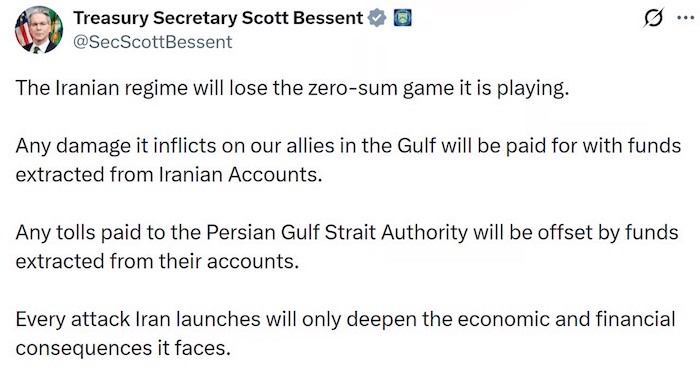


Jun 042026


Herbert James Draper A Deep Sea Idyll 1902(?!)


• Trump Says He’d Like To Meet Iran’s New Supreme Leader (ZH)
• Iran’s War Math Still Doesn’t Add Up (David Manney)
• IRGC Says Trump Ongoing Talks Narrative ‘Not Reality (ZH)
• “Next Month, Next Quarter, Next Year” (Schwartz)
• Tulsi Gabbard Gives Us a Heartfelt Update on Her Husband’s Health (Anderson)
• Day 2: Rubio Enters a Hostile Clown Show (Sarah Anderson)
• Marco Rubio Went to Capitol Hill Today, and the Smackdown Was Brutal (Anderson)
• Marco Rubio Testimony to Senate Foreign Relations Committee (CTH)
• Supreme Court AGAIN Rules in Favor of Alabama’s Pro-GOP Map (Salgado)
• Just How Crazy Mamdani’s Housing Scheme Really Is (Spencer)
• Why Is Ukraine So Eager To Start A New War? (Vitaly Ryumshin)
• SpaceX Reportedly Targets $135 IPO Price (ZH)
• Is This a Sign a Supreme Court Vacancy Is Coming Soon? (Margolis)
• COVID-19 Was Spread Intentionally on Multiple Continents (Korsgaard)


https://twitter.com/JasonJournoDC/status/2062163095334654319?s=20 https://twitter.com/TrumpDailyPosts/status/2061952291469693079?s=20


“After three days their military was virtually wiped out. And then if you read the New York Times you think they‘re doing fantastically.”

“It’s good if they‘re confused, and the Iranians are confused..”

• Trump Says He’d Like To Meet Iran’s New Supreme Leader (ZH)

After US-Israeli strikes assassinated the last longtime Supreme Leader, Ali Khamenei, President Trump says he would like to meet the new one. Trump said he “would like to meet” Iran’s Ayatollah Mojtaba Khamenei, in an interview published Wednesday. In surprising remarks, Trump told the New York Post’s Pod Force One: “I would like to meet him, and we probably will meet at some point, depending on how it all works out.” Trump reasoned that “They’ve already agreed they’re not going to have a nuclear weapon” – suggesting this could be the basis for new direct diplomatic engagement.


And yet the Iranians have already for years consistently stated they were never intent on achieving a nuclear bomb. All recent high level US intelligence community assessments have tended to support the claim that Iran was not seeking a nuke before the attacks of June as well as March into April, under Operation Epic Fury. But Trump has also dismissed the intelligence, insisting that Iran was ‘very close’ before the US-Israeli interventions. While Trump is now expressing openness to meeting the Ayatollah – who is said to be in hiding and only having limited, low-tech communications with his officials, for fear of being tracked by the CIA or Mossad – the Supreme Leader himself has not voiced a desire for such a meeting.

Tehran at this moment doesn’t appear in the mood for ‘talking’ – and has lately said it is ready to let its military retaliation and response do the ‘negotiating’. The US President once again made claims about the text of the possible agreement. He claimed that “Iran has agreed not to acquire nuclear weapons.” –Bloomberg This seems another element of confused messaging from the White House, which has many times denounced the Ayatollah and his regime as ‘murderous’ and ‘evil’ and a ‘tyrant’ – and yet now Trump apparently wants to sit down with him for tea time or something.

Trump in the NY Post interview actually addressed the general atmosphere of confusion and contradictions from his administration, and from him personally. “It’s good if they‘re confused, and the Iranians are confused,” Trump stated. He added: “But no, it‘s just the way I am. It changes. I could leave here, I could give you an answer, and then in 20 minutes go into the Oval Office and I’ll realize my answer is now incorrect. Facts change and things change quickly.” In this context, he went on to defend the controversial decision to go to war in the first place, saying it could not have been delayed as Iran was on the brink of having a nuclear weapon.

“I couldn‘t, I know because this is too important. If I did that, they would have had a nuclear weapon. They would have had a nuclear weapon two weeks after the B-2 bomber struck. So if I did that, they would have had a nuclear weapon.” Trump: “He’s missing a lot of different parts.” He again in the interview called it a necessary “excursion” – saying, “They‘re not going to have a nuclear weapon, lots of other good things are going to happen.” From the interview, on the question of boots on the ground in Iran… “You don‘t need boots on the ground right now. We wiped out much of their military with just bombing.

After three days their military was virtually wiped out. And then if you read the New York Times you think they‘re doing fantastically.” Trump elsewhere addressed the controversial Axios report which said Trump ‘steamrolled’ Israeli PM Netanyahu in a phone call. Per Bloomberg, “Trump said he swore at Benjamin Netanyahu in a call this week as the president tried to deescalate fighting in Lebanon and keep peace talks with Iran on track.” “I did,” Trump said, acknowledging he chastised his ally. “I wouldn\t say angry. I was a little bit perturbed at his constantly fighting with Lebanon, ` you know.”

Read more …

“Tehran tried to create a spectacle, while Washington created a result.”

• Iran’s War Math Still Doesn’t Add Up (David Manney)

Reckless, stupid, crazy, or crazy like a fox. Iran’s Islamic Revolutionary Guard Corps managed to check the first three boxes Tuesday night, but it never came close to checking the fourth.Iran fired ballistic missiles toward Kuwait and Bahrain, where American forces and regional partners help hold the line in a region Tehran keeps trying to bully. U.S. Central Command said two missiles fired toward Kuwait fell short or broke apart in flight, while U.S. and Bahraini forces intercepted three missiles aimed at Bahrain.American forces also knocked down Iranian drones threatening civilian shipping and struck an Iranian military ground-control station on Qeshm Island near the Strait of Hormuz. From the South China Morning Post:


Two Iranian missiles shot at Kuwait fell short or broke apart in-flight, several ballistic missiles aimed at regional targets failed and three missiles heading for Bahrain were intercepted, US Central Command said. Since the conflict began in late February, Iran has repeatedly attacked targets in Bahrain and Kuwait, where US military bases are located. Central Command said US forces also downed Iranian drones targeting civilian shipping in regional waters and carried out strikes on Qeshm Island near the Strait of Hormuz in response to the attempted attacks by Iran.

In a statement carried by the official IRNA news agency, the Revolutionary Guards claimed they had struck the US military installations in response to the strike on Qeshm Island. Give Tehran credit for one thing: it found a way to turn a missile attack into a regional safety demonstration. Kuwait and Bahrain got sirens, nervous families, air defenses, and another reminder that Iran doesn’t only threaten Americans when it lashes out; it threatens every neighbor forced to live near its tantrums. President Donald Trump has kept pressure on Iran while leaving room for talks, and Secretary of State Marco Rubio told lawmakers sanctions relief would require Iran to give up its nuclear activity.

Iran, meanwhile, keeps acting as if leverage means firing expensive hardware into the sky and hoping nobody notices when gravity, air defenses, and American readiness ruin their show. The latest episode followed claims from Iranian sources that Tehran had stopped communicating with mediators about extending a ceasefire. President Trump disputed those claims and said talks continued. Iranian Foreign Minister Abbas Araghchi has tried to wrap Tehran’s demands in diplomatic language, but missiles aimed toward Gulf neighbors speak more clearly than any prepared statement. Any regime that pauses diplomacy to launch weapons tells the world which tools it trusts the most.

Iran’s leaders seem trapped in the same old loop; they provoke, threaten, launch, miss, deny, and then announce some grand moral victory to whoever still has the patience to listen. The missiles and drones fail, the bases remain, and the regime still expects applause from its propaganda machine. Somewhere in Tehran, somebody probably stamped the operation a success because the printer still had ink. Behind the noise sits a colder reality; Iran’s economy keeps bleeding. Its people keep paying for the ambition of clerics and commanders who confuse defiance with competence.

It’s been rough for the regime’s people; Iran’s Central Bank put year-over-year inflation at 77.2% in May, with daily and general needs up 113.8% from the year before. One would think that leaders with any semblance of sanity and common sense might want fewer missiles and more bread, but Tehran has never shown much talent for learning from the pain it causes its own people.American restraint also deserves notice. U.S. forces answered direct threats without turning the Gulf into a free-fire zone. They destroyed incoming threats, protected American troops, helped partners, guarded shipping, and hit the control node tied to Iran’s aggression.

Tehran tried to create a spectacle, while Washington created a result. Iran’s latest missile show revealed rage, not genius. The IRGC wanted fear and delivered embarrassment, also wanting leverage, and handed Gulf partners another reason to tighten ranks with the United States. It wanted to prove strength and instead proved that American defenses, allied coordination, and steady nerves still carry weight.Crazy like a fox requires cunning. Iran brought fireworks, failure, and the same old appetite for humiliation. It’s past time for the U.S. to put the regime out of its misery and help the Iranian people.

Read more …

IRGC tries to lead the conversation.

• IRGC Says Trump Ongoing Talks Narrative ‘Not Reality (ZH)

State media statement on Wednesday: IRGC-linked Tasnim claims Tehran has frozen all back-channel communication with Washington over Israeli operations in Lebanon, directly contradicting Trump’s assertion that messages are arriving daily from Iran. Tasnim: “Trump’s claim that Iran is confirming the issue is completely different from reality.” Iran’s Foreign Minister is meanwhile articulating that Iran will lay down some new red lines via military strikes, which he has dubbed ‘self-defense’ in nature…


President Donald Trump is still trying to present some bright spots, telling NY Post he believes the situation in the Strait of Hormuz will “resolve itself fairly quickly” and went so far to say he expects to meet with Iran’s supreme leader “at some point.”

Major Attack on Kuwait International Airport: One Dead, 63 Injured
Kuwait International Airport has come under Iranian missile and drone attack on Wednesday, in a significant strike that killed one person and left 63 people injured – according to the country’s health ministry, with several of the victims being seriously wounded. A passenger terminal was directly struck, damaging facilities including diplomatic missions at the airport, Kuwaiti authorities have said. Area hospitals conducted seven major emergency surgeries following the incident, underscoring that it was a mass casualty event.

Kuwaiti defense ministry spokesperson Brig Gen Saud Abdulaziz Al-Atwan described the attack as “criminal Iranian aggression which resulted in significant material damage to the building and injuries.” It confirmed engaging 13 missiles and 17 drones total which were fired from Iran. Civil aviation authorities immediately suspended traffic and transferred arriving flights to separate unaffected airports after “terminal one came under Iranian attacks causing casualties and damage.” The cross-border airport attack came after violent exchanges of fire between the US and Iran, which at first looked like limited one-off incidents, but then became an extended tit-for-tat.

The Overnight Catalyst: US-Iran Exchange Fire in Hormuz
Overnight, the US military deployed a Hellfire missile to disable a tanker attempting to bypass the American blockade in the Strait of Hormuz. Following the intercept, American forces engaged in a wider kinetic exchange, stating they repelled subsequent Iranian reprisal strikes across the region and launched retaliatory attacks against military sites on Iran’s Qeshm Island.

In response, Iran’s Islamic Revolutionary Guards Corps (IRGC) claimed it launched a missile and drone barrage targeting the U.S. Fifth Fleet headquarters in Bahrain – an assertion that Central Command (CENTCOM) has explicitly denied. The IRGC had also sent several missiles on two US bases in Kuwait, which were said to have been intercepted.

GCC Blasts ‘Cowardly Attacks’
Serous damage and chaos at Kuwait International Airport: The Gulf Cooperation Council has in response slammed Iran for their “ongoing aggression” against member states Bahrain and Kuwait, denouncing the “cowardly attacks on civilian objects” which mark a “dangerous and unprecedented escalation.” But Tehran is not backing down and is instead issuing further hardline warnings and threats, per Al Jazeera citing state media:

Iran’s Revolutionary Guard says retaliatory strikes “should serve as a lesson” for the United States after it fired a barrage of missiles and drones at Kuwait and Bahrain. While Iran’s foreign ministry is warning that the overnight US assault on Qeshm Island continues a severe breach of the ceasefire, President Trump is saying that “conversations between us have been going on continuously” – in reference to the Iranians.

Read more …

By Molly Schwartz, cross-asset macro strategist at Rabobank

• “Next Month, Next Quarter, Next Year” (Schwartz)

In a tense Congressional Hearing before the foreign relations committee, Marco Rubio defended the Trump Administration’s war in Iran, praising the success of US military operations destroying Iranian military and nuclear facilities. He also said that a deal with Iran could happen “today, tomorrow, or next week.” However, the recent military escalations between the US and Iran, the refusal of Israel and Hezbollah to cooperate, and reports of Pezeshkian’s resignation — leaving Iran in the hands of the IRGC — mean that a deal seems to lie more on the horizon of next month, next quarter, or maybe even next year.


Our base case that we see passage through the Strait disrupted for at least three more months still stands as we have yet to see any tangible headlines to suggest an accelerated timeline. The negotiations currently lie in Iran’s hands, as Bloomberg reports Iran’s Mehr news saying that “officials in Tehran are discussing their ‘final text’ to send to the US.” One might be hesitant to truly deem this text as “final” (if it even exists), as it may be more of a “final_v3.doc”, or a “final_FINAL_v6.doc”, or even a “final_FINAL_totallyforrealthistime.doc”.

The most promising resolution right now is that the IRGC remains in power, but enriched uranium is handed over to an executor, like China, though we have yet to see any confirmed updates that this is a feasible solution that Iran would actually agree to at this juncture. The extended 60-day ceasefire is still ongoing, while both the US and Iran are dedicated to keeping the Strait closed and exchanging fire. CENTCOM posted on X today to show off the USS Abraham Lincoln enforcing the US blockade, which has apparently redirected 122 vessels to “ensure compliance.”

Yesterday, Trump slammed Vulcan’s Hammer on the AI industry, signing an executive order, “Promoting Advanced Artificial Intelligence Innovation and Security.” The executive order lauds how the administration has “unleashed tremendous technological growth and economic investment in AI by slashing the bureaucratic constraints that the prior administration placed on America’s AI developers and researchers, and by instead encouraging AI innovation and accelerating responsible AI adoption across government and industry.”

Part of the executive order is intended to support the AI industry, seeking to utilize AI in federal cybersecurity programs, and utilize AI models (potentially Mythos?) to pinpoint vulnerabilities. However, the order also seeks to impose new restrictions, likely in response to the emergency meeting triggered by Mythos a few months ago. This includes lots of classified processes and frameworks to make sure that an evil AI model, the likes of that in a Philip K. Dick novel, doesn’t usurp the American government as the presiding force leading the world’s global hegemon (or more likely, making sure these models can’t be used to hack into sensitive government websites).

The process is referred to as a “voluntary framework” so that AI developers can submit their new models to the government 30 days before release to the public. Though the order also clarifies that “nothing in this section shall be construed to authorize the creation of a mandatory governmental licensing, preclearance, or permitting requirement for the development, publication, release, or distribution of new AI models, including frontier models.”

Read more …

“Both Tulsi and Abraham are in our prayers.”:

• Tulsi Gabbard Gives Us a Heartfelt Update on Her Husband’s Health (Anderson)

On Tuesday morning, outgoing Director of National Intelligence (DNI) Tulsi Gabbard posted a video on social media to let her followers know that her husband, Abraham Williams, was having surgery. She appears to be standing outside the hospital.


“Good morning. We’re getting ready to head into the hospital now for Abraham’s surgery,” Gabbard says. “And I just wanted to take a moment to say ‘thank you’ with all of our hearts to all of you who have shared such beautiful messages and prayers and well wishes for Abraham. We’re truly humbled and so grateful to be surrounded by so much aloha from all of you during this tough time. Aloha.”

Here’s the video:

https://twitter.com/TulsiGabbard/status/2061788108727705658?ref_src=twsrc%5Etfw%7Ctwcamp%5Etweetembed%7Ctwterm%5E2061788108727705658%7Ctwgr%5E5949055dbcd121e1d76cc6b15d37bb92257dad88%7Ctwcon%5Es1_c10&ref_url=https%3A%2F%2Fpjmedia.com%2Fsarah-anderson%2F2026%2F06%2F02%2Ftulsi-gabbard-gives-us-a-heartfelt-update-on-her-husbands-health-n4953508

While Gabbard hasn’t posted an update since, her father, Mike Gabbard, who is a state senator in Hawaii, did post on X on Tuesday afternoon to let followers know that “Abraham is out of surgery and all went well.” He included a beautiful picture of the couple.

If you’ll recall, back in May, Gabbard announced that she was resigning from her position as DNI to spend more time with her husband who was diagnosed with a rare form of cancer. “Unfortunately, I must submit my resignation, effective June 30, 2026,” she said after thanking the president for the opportunity. “My husband, Abraham, has recently been diagnosed with an extremely rare form of bone cancer. He faces major challenges in the coming weeks and months. At this time, I must step away from public service to be by his side and fully support him through this battle.”

https://twitter.com/TulsiGabbard/status/2057876821421527476?ref_src=twsrc%5Etfw%7Ctwcamp%5Etweetembed%7Ctwterm%5E2057876821421527476%7Ctwgr%5E5949055dbcd121e1d76cc6b15d37bb92257dad88%7Ctwcon%5Es1_c10&ref_url=https%3A%2F%2Fpjmedia.com%2Fsarah-anderson%2F2026%2F06%2F02%2Ftulsi-gabbard-gives-us-a-heartfelt-update-on-her-husbands-health-n4953508

Williams, who keeps a fairly low profile, is actually a cinematographer, photographer, and filmmaker, and the two met in 2012 when he did some work for her congressional campaign. Both are avid surfers, and he eventually proposed to her on a surfboard. They were married in April 2015 in Hawaii.

https://twitter.com/TulsiGabbard/status/1910168836550303992?ref_src=twsrc%5Etfw%7Ctwcamp%5Etweetembed%7Ctwterm%5E1910168836550303992%7Ctwgr%5E5949055dbcd121e1d76cc6b15d37bb92257dad88%7Ctwcon%5Es1_c10&ref_url=https%3A%2F%2Fpjmedia.com%2Fsarah-anderson%2F2026%2F06%2F02%2Ftulsi-gabbard-gives-us-a-heartfelt-update-on-her-husbands-health-n4953508

He’s been by her side through her time in Congress, multiple political campaigns, and her time spent in the Donald Trump administration. She calls him her “rock” and best friend.

“Abraham has been my rock throughout our eleven years of marriage — standing steadfast through my deployment to East Africa on a Joint Special Operations mission, multiple political campaigns and now my service in this role,” she wrote in her resignation letter last month. “His strength and love have sustained me through every challenge. I cannot in good conscience ask him to face this fight alone while I continue in this demanding and time-consuming position.”

Personally, I have to add that I’ve been a big Tulsi fan for years — she won me over in 2019 when she owned Kamala Harris during a primary debate when they were both running for president. I hate that we are losing her as a public servant for now, but I am glad she is able to take the time to support her husband as he fights this battle. Both Tulsi and Abraham are in our prayers.

Read more …

Not his first clown rodeo…

• Day 2: Rubio Enters a Hostile Clown Show (Sarah Anderson)

“Is this the Foreign Affairs Committee, or is this a circus?” That quote from Secretary of State Marco Rubio pretty much sums up what happened on Wednesday morning when he testified before the House Foreign Affairs Committee on the FY27 Department of State Budget Request. In case you missed it, this is Rubio’s second day of hearings on Capitol Hill, and what he’s had to deal with so far today makes yesterday look tame. These Congress critters aren’t serious people. On Tuesday, I joked that it’s more like “Democrats, who were supposed to be asking questions, talked at Rubio and complained about everything Donald Trump does without giving the secretary a chance to respond.”


Wednesday was more of that — this isn’t even a hearing, Rubio said — but the “questioning” went beyond foreign policy, whether it was the lady criticizing the secretary’s shoes or the guy playing video upon video of Donald Trump’s so-called “cognitive decline.” I’ve never seen anything like it. Again, I’m just going to have to let the video clips speak for themselves because I don’t even know how to explain it anymore than saying “Congress is a clown show.”

Where to even start? Here’s Rep. Bill Keating (D-Mass.) getting mad that Rubio didn’t mention Ukraine in his opening remarks and talking to the secretary like he’s a toddler. For what it’s worth, Keating was one of the first to speak, and I guess this set the tone for the entire “circus.” This is only a short clip, but there was a lot of yelling.

https://twitter.com/EricLDaugh/status/2062191973604204700?ref_src=twsrc%5Etfw%7Ctwcamp%5Etweetembed%7Ctwterm%5E2062191973604204700%7Ctwgr%5E546fb9583372a698ed9c56b512c81b898bcb8bcf%7Ctwcon%5Es1_c10&ref_url=https%3A%2F%2Fpjmedia.com%2Fsarah-anderson%2F2026%2F06%2F03%2Frubio-enters-the-clown-show-aka-congress-and-you-just-have-to-see-this-n4953535

Next, I’ll go with the most ludicrous of interactions: Rep. Ted Lieu (D-Calif.) spending his entire five minutes playing videos of Trump “sleeping” during his “North Korea-style” Cabinet meetings and proof of his “cognitive decline,” and Rubio’s rightfully incredulous response. The secretary joked that Lieu fancies himself a medical expert and went on to explain how the president has more energy than people much younger than him and how he calls him at all hours of the night. Pop your popcorn. This one’s good:

https://twitter.com/OffThePress1/status/2062206241951105050?ref_src=twsrc%5Etfw%7Ctwcamp%5Etweetembed%7Ctwterm%5E2062206241951105050%7Ctwgr%5E546fb9583372a698ed9c56b512c81b898bcb8bcf%7Ctwcon%5Es1_c10&ref_url=https%3A%2F%2Fpjmedia.com%2Fsarah-anderson%2F2026%2F06%2F03%2Frubio-enters-the-clown-show-aka-congress-and-you-just-have-to-see-this-n4953535

Then there was Rep. Sara Jacobs (D-Calif.) who felt the need to use her time talking about who won the 2020 election and… Rubio’s shoes. Seriously.

https://twitter.com/EricLDaugh/status/2062198413140136178?ref_src=twsrc%5Etfw%7Ctwcamp%5Etweetembed%7Ctwterm%5E2062198413140136178%7Ctwgr%5E546fb9583372a698ed9c56b512c81b898bcb8bcf%7Ctwcon%5Es1_c10&ref_url=https%3A%2F%2Fpjmedia.com%2Fsarah-anderson%2F2026%2F06%2F03%2Frubio-enters-the-clown-show-aka-congress-and-you-just-have-to-see-this-n4953535

One congresswoman said her bit, which included calling Rubio the “overlord” of Venezuela, and then she simply got up and left before he could respond. Here’s his response:

As I’m writing this, Rep. Madeleine Dean (D-Penn.) is calling Rubio a “comedy show” because he’s trying to answer her questions. This is giving me a headache — I can only imagine how the secretary feels. I’d share some of the actual substance that was discussed, but, well, there wasn’t much. With few exceptions, the only time Rubio actually got to answer any questions was when the Republican members of the House allowed him some of their time to do so. It was pretty shameful.

The hearing is actually still going on, and there’s another one on Wednesday afternoon — I’ll take one for the team and watch that too and bring you any noteworthy sound bites — but I think this gives you an idea of how things have gone. I’ll end on a fun note. Rubio continued his run of using rap lyrics during his public appearances. Today, it was a line from Kanye West’s “Stronger.”

Unfortunately, he didn’t take my previous advice and use “Mo Money, Mo Problems,” but I was still amused.

Read more …

Much more coming.,.

• Marco Rubio Went to Capitol Hill Today, and the Smackdown Was Brutal (Anderson)

Secretary of State Marco Rubio made his way back to Capitol Hill on Tuesday to testify before the Senate Foreign Relations Committee and the House Appropriations Committee’s Subcommittee on National Security, Department of State, and Related Programs on the FY27 Department of State Budget Request. It went as these things usually do: Democrats, who were supposed to be asking questions, talked at Rubio and complained about everything Donald Trump does without giving the secretary a chance to respond. And he, as he usually does, handled it with intelligence, wit, and… actual information with context.


Honestly, it’s almost boring at this point — I believe Rubio thinks so too. After finishing his opening remarks to the Senate Foreign Relations Committee, he ended with, “So anyways, I look forward to your questions. At least that’s what it says here. I’m not sure if I really look forward to your questions. I look forward to probably half your questions.” A couple of things I noted: The Democrats must have gotten together and decided they’d all coordinate when talking about Iran. Nearly every single one referred to it as “Donald Trump’s illegal war in Iran.” (You can’t see me, but I’m rolling my eyes.)

I also noted that these Democrats love to talk about how many people have allegedly died due to the end of USAID and the restructuring of how we handle humanitarian aid around the world — for what it’s worth, their numbers are false — but they seem to turn a blind eye to the people who die at the hands of the regimes in countries like Iran, Venezuela, and Cuba, as well as at the hands of narco-terrorists, cartels, and criminal groups around the globe, and get mad that the United States is intervening to stop this. You can’t have it both ways, but I digress. Let’s get to a few highlights from the hearings.

The biggest smackdown of the day was when Sen. Jacky Rosen (D-Nev.) decided to accuse Rubio of partying the night away while JD Vance was working on negotiations with Iran. She kept talking about him being at some “party” with President Trump. Rubio asked her what party she was referring to, but she couldn’t quite come up with an answer and continued with her accusations, asserting that while he was at this party, Jared Kushner and Steve Witkoff — two people who were never confirmed for this by the U.S. Congress, she says — were doing his job. The secretary did not take that sitting down.

“You don’t know what you’re talking about! I know your staff wrote up this cute statement for TikTok, but it’s not true. And it’s not real. That’s not what happened,” Rubio said. He explained that he was not at a party; he was on the phone constantly with all parties involved and “co-located with the president in the midst of a high stakes negotiation so that I could immediately inform him about events occurring halfway around the world.”

For what it’s worth, I believe she’s referring to the UFC fight in Miami. Trump made an appearance, and Rubio was there with some of his children, but it was widely reported that the secretary spent most of the night on the phone and keeping the president updated on what was going on in the Middle East. Here’s the video. This exchange is a must-watch:

https://twitter.com/EricLDaugh/status/2061849591780135052?s=20

I’m not going to get too deep into everything the Congress critters talked about, but I do want to highlight a few more important exchanges, like this one in which Sen. Cory Booker (D-N.J.) made up a bunch of stuff about Iran that was giving me Kamala Harris word salad vibes.

https://twitter.com/EricLDaugh/status/2061841598649180172?ref_src=twsrc%5Etfw%7Ctwcamp%5Etweetembed%7Ctwterm%5E2061841598649180172%7Ctwgr%5E4be138b21dd4974e9e0dfe8e5ca1c9c6589b0409%7Ctwcon%5Es1_c10&ref_url=https%3A%2F%2Fpjmedia.com%2Fsarah-anderson%2F2026%2F06%2F02%2Fmarco-rubio-went-to-capitol-hill-today-and-the-smackdown-was-brutal-n4953499

And then there was Sen. Chris “Margaritas in El Salvador” Van Hollen, who seemed oddly nervous during the entire thing — possibly because he remembers how Rubio owned him last time they did this. If you’ll recall, he told Rubio he regretted voting for him, and Rubio replied, “Your regret voting for me confirms I’m doing a good job.” Van Hollen started out by saying that Trump’s entire foreign policy was a “dumpster fire” and then went on to spew a bunch of leftists lies about, well, pretty much everything. Anyway, here are a couple of their exchanges for your viewing pleasure.

https://twitter.com/StephenGardnerX/status/2061850629187031273?ref_src=twsrc%5Etfw%7Ctwcamp%5Etweetembed%7Ctwterm%5E2061850629187031273%7Ctwgr%5E4be138b21dd4974e9e0dfe8e5ca1c9c6589b0409%7Ctwcon%5Es1_c10&ref_url=https%3A%2F%2Fpjmedia.com%2Fsarah-anderson%2F2026%2F06%2F02%2Fmarco-rubio-went-to-capitol-hill-today-and-the-smackdown-was-brutal-n4953499

Something else Rubio tried to hammer home to these people during these hearings is that the State Department is doing what’s in the United States’ best interests. It’s all common sense, but as we know, many Democrats lack that. I’ll leave you with a few of those videos.

Read more …

” Just like Q-Anon advocate Mike Flynn recently taking a job that pays him $100,000/month to lobby for the Republic of Srpska (aka ‘Serb Republic’..”

• Marco Rubio Testimony to Senate Foreign Relations Committee (CTH)

Secretary of State Marco Rubio delivers testimony to the Senate Foreign Relations Committee. The U.S. Senate as a whole and members of the Senate Foreign Relations Committee specifically, have lost millions of dollars wealth for themselves and their families as a result of Rubio eliminating USAID. As a consequence, while they cannot publicly showcase that specific motive for opposition, the committee as a whole is not happy about losing a substantial portion of their stakeholder interests.


The families of all the senate committee members exist inside the think tanks, NGOs, political orgs, PACs and lobbyist companies for various foreign governments. Just like Q-Anon advocate Mike Flynn recently taking a job that pays him $100,000/month to lobby for the Republic of Srpska (aka ‘Serb Republic’, for advice, counsel and introductions), so too all the family members of the senate leverage their DC connections to foreign governments for personal gain.

Thus, Secretary of State Marco Rubio is now being questioned by the very Senators he has defunded. Yes, Michael Flynn signed an agreement within the Trump administration not to lobby for foreign governments; but that was only a paper promise. That’s one of the reasons why it is more than a little silly for people to mention Flynn’s name as a potential DNI nomination.

Read more …

“.. we can’t be sure the activist District Court won’t try again and waste more time and money.”

• Supreme Court AGAIN Rules in Favor of Alabama’s Pro-GOP Map (Salgado)

The U.S. Supreme Court on June 2 intervened again to confirm its previous ruling that will allow Alabama to move forward with a map eliminating racial gerrymandering. In Allen v. Milligan, SCOTUS ruled 6-3 that Alabama is right to redraw its congressional map to eliminate race-based districts, just as it ruled in Louisiana v. Callais and Allen v. Caster. The Voting Rights Act does not allow race-based gerrymandering, the Court previously ruled, and that still holds true in spite of an activist District Court.


The reality is that judicial activists are mad because the map is likely to favor Republicans once it is drawn constitutionally and not based on voters’ skin color. Democrats have spent decades convincing many black Americans that Republicans are racist (when the opposite is more true), and now Dems are seeing that effort backfire in more than one state. This is a purely partisan fight. SCOTUS cited Callais in its Allen v. Milligan ruling, as that was the original decision this year clarifying how to comply with the Voting Rights Act.

Below are excerpts from the majority ruling:

After Callais, we vacated District Court injunctions that prevented the State of Alabama from using a congressional map that it enacted in 2023. See Allen v. Caster, 608 U. S. ___ (2026). The District Court had held that the State’s map violated §2 because it had only one district in which black voters were a majority and did not include an additional ‘[b]lack-opportunity’ district… Two weeks after we vacated its injunction, the District Court entered another injunction on largely the same grounds…

The District Court also failed to follow our instruction in Callais that the mere fact that voters of different races vote for different parties is not relevant to proving racially polarized voting patterns… The State has also made a strong showing of irreparable harm and that the equities and public interest favor it. We have repeatedly cautioned that lower federal courts should not ‘alter the election rules on the eve of an election.’ So this was all a waste of taxpayer money again to make the Supreme Court reiterate what it already ruled.

To be honest, if Republicans would simply comply with the law instead of bowing to every idiotic, anti-law ruling from activist judges, it would save vast amounts of time and money. The reason judges have been issuing outrageous rulings thick and fast recently is that they know Republicans will even ignore the Constitution itself to comply with the court rulings. The GOP keeps assuring Americans they have to act thus or they’ll “set a bad precent” for Democrats, but after two centuries of Democrats violating every law and court ruling they wish, that’s not a convincing argument.

In Alabama’s case, the Supreme Court had already ruled for the new map — so why on earth would the contrary decision of a District Court matter? Fortunately, the Supreme Court rightly intervened again, but we can’t be sure the activist District Court won’t try again and waste more time and money.

Read more …

If there’s one place that can claim the title Capital of Capitalism, it’s New York City.

So of course it draws in the opposite too, becaue opposites attract. But they do not match.

• Just How Crazy Mamdani’s Housing Scheme Really Is (Spencer)

They voted for him, and so they have him, but that doesn’t mean that even New Yorkers are thrilled to see the systematic destruction of what was once the greatest city in the world. More of them voted for the young, handsome, dynamic candidate than for the sleazy retread corruptocrat Andrew Cuomo or the clownish Curtis Sliwa, but that doesn’t mean that New Yorkers are collectively ready to don Mao jackets and start singing the praises of the five-year plan. Mamdani’s audacious scheme to socialize New York City housing is already coming in for severe criticism.


One sign that some New Yorkers are aware of what Mamdani is really all about was an unsigned editorial in the New York Post on Monday. The Post Editorial Board wrote that Mamdani’s “‘Block by Block’ plan to build 200,000 subsidized apartments entails a lot of handwaving, magical thinking and reliance on ‘responsible stewards’ . . who have been failing to manage the real-estate portfolios they already have.” Mamdani promises that “if ‘community land trusts, nonprofits or even the tenants themselves’ control the city’s housing stock, these miracle-workers will ‘expand New Yorkers’ access to safe, stable, and affordable homes.’”

However, the Post points out that “programs that do all this are so old and tired that Mamdani’s Gen Z policy experts appear never to have heard of them, maybe because the experiments had already failed when they were building fantasy housing projects out of Legos.”

Indeed. If socialists learned from experience, there would be no more socialists. There is system on the planet that has been tried so many times and failed just as many times, and yet constantly gains new young adherents who don’t know how bad socialist regimes really have been, or would care if they did know, because in their youthful arrogance, they’re sure they’re going to do right this time what their elders kept doing wrong. Mamdani is going to be the world’s first socialist to build a society. Sure, and he is also going to sprout wings and fly to Mars.

Mamdani announced, of course, that he planned to seize rental properties from landlords who have not maintained them properly — in the judgment of none other than Mamdani and his cronies. He then intends to hand over ownership of those properties to “community land trusts” and “non-profits.”

Oh yeah, that’ll fix everything. As foredoomed as this idea is as any sort of real solution to New York’s housing problems, it has long been high on Mamdani’s to-do list. Intifada on the Hudson: The Selling of Zohran Mamdani shows how he has made socialized housing schemes a centerpiece of his program ever since he entered politics. “People often ask,” Mamdani wrote on Dec. 3, 2020, “what socialists mean when we say we want to ‘decommodify’ housing. Basically, we want to move away from a situation where most people access housing by purchasing it on the market & toward a situation where the state guarantees high-quality housing to all.”

One of Mamdani’s leading critics, New York City Council member Vickie Paladino, explains what’s really going on here: “The properties will then be turned over to nonprofits. This is no small detail. This is in fact the whole point. The idea here is to build up Zohran’s DSA-connected nonprofits with a multibillion-dollar portfolio of hard assets — New York City real estate. This portfolio could theoretically reach into the hundreds of billions or even the trillions, depending on how aggressive they get. Now these highly political nonprofits would become the new land barons of New York, complete with all the political clout, leverage, and reach that goes along with it. It would be a true nightmare scenario.”

Mamdani’s housing scheme would thus be a great leap forward for securing socialist control of New York City for the indefinite future. Also, once his Marxist comrades control New York City’s housing market, who will actually get the housing? Not political undesirables, i.e., patriots. Instead, the lucky recipients will be Muslim migrants, including an unknowable number of criminals and jihadis, and others who will help the leftist/Islamic alliance stay in power.

It will all work wonderfully — until, that is, Mamdani and his friends run out of other people’s money. The Post points out that “Community Development Corporations, non-profit groups that own and manage ‘deeply affordable’ apartments, have been around for decades, and are barely managing to keep themselves afloat as it is. CDCs operate more than 200,000 subsidized city housing units, and face the same problems as private landlords: rising costs (especially insurance), unsustainable debt, deferred maintenance and nonpaying tenants. Turns out that removing the ‘profit’ line from a balance sheet by getting rid of private ownership doesn’t repeal the laws of math when costs run higher than income.”

It isn’t going to be any different this time around. New Yorkers who have already caught on to Mamdani can only hope that enough of their fellow city residents will catch on to tbe truth about this smooth socialist before he does too much damage.

Read more …

“Why Kiev is reviving fears of a northern front despite little evidence of military preparations..”

Ukraine has become a money making casino. First for Zelensky and his gang, but now for politicians from everywhere.

They need one thing for sure: war. So they can order weapons, real or not

• Why Is Ukraine So Eager To Start A New War? (Vitaly Ryumshin)

For the first time in a long while, Belarus has again found itself at the center of the Ukraine conflict. For more than a month, Vladimir Zelensky has been warning Ukrainians about a supposed threat from the north. Minsk, he claims, is preparing to enter the war and he’s even threatened Belarusian President Alexander Lukashenko with either a pre-emptive strike or a kidnapping in the style of Nicolas Maduro. The rhetoric has now reached the point where Zelensky has ordered preparations for the circular defense of cities in Ukraine’s northern regions, including Kiev itself. Meanwhile, French President Emmanuel Macron has called Lukashenko for the first time since 2022, apparently to persuade him not to enter the conflict.


The problem is that nothing visible is happening on the Belarusian side of the border. There’s no mobilization and no unusual concentration of Belarusian forces and no redeployment of Russian units. The only recent event that could be stretched into a military signal was last week’s Russian-Belarusian nuclear exercise. But even that took place in the Osipovichi district, in the center of Belarus, and was more about strategic deterrence than any ground operation against Ukraine. The more obvious question is why Lukashenko would want to join the military operation at all. Such a move would be wholly out of character for him and would run against the geopolitical role he has tried to carve out for Belarus.

Lukashenko has always sought to preserve room for maneuver and he kept doing so after 2020, when he became de facto persona non grata in the West, and even after the conflict escalated in 2022. In the Ukrainian crisis, Belarus has remained largely a passive observer and that arrangement has suited Moscow. For Russia, he’s a valuable diplomatic asset, not a military one. Of course, a repeat of the February 2022 thrust towards Kiev may sound tempting in theory. But with all due respect to Belarus, its army is not suited to the role of battering ram, especially in conditions of modern warfare dominated by drones and constant surveillance. Could the reverse be true? Perhaps Zelensky is preparing to strike Belarus first, overthrow Lukashenko and open a second front against Russia.

His pointed invitation to the fugitive opposition leader Svetlana Tikhanovskaya gives this theory a certain surface logic, but the military reality makes it deeply implausible. The Ukrainian Armed Forces’ last major offensive operation was the incursion into Russia’s Kursk Region. To mount it, Kiev gathered around 30,000 troops, weakening its positions in Donbass and losing large areas there as a result. Even then, the operation failed to produce a decisive strategic outcome. A serious attack on Belarus would require far more resources. Since then, Ukraine’s army has weakened further and its present ceiling is local counter-attacks in Donbass, so it’s in no position to open a major new front.

Nor would it make strategic sense. Any escalation with Belarus would risk creating another 1,000-kilometer front stretching across Ukraine’s northern flank, with direct threats to Kiev. However odious the Kiev regime may be, it can’t fail to understand this. That’s why the current escalation around the ‘Belarusian question’ should be understood politically, not militarily.

The timing is telling. Zelensky began to raise the alarm just as relations between Minsk and Washington showed signs of thawing. In March, the US eased sanctions on Belarus and Washington spoke of reopening its embassy. There was even talk of a possible Lukashenko visit to America and a meeting with Donald Trump. For Kiev, this is dangerous because Zelensky may fear that the eloquent Belarusian leader could charm Trump and persuade him to increase pressure on Ukraine to bring the conflict to an end. Lukashenko might also secure further sanctions relief, potentially turning Belarus into a hub for the transit of American goods to Russia.

From Kiev’s point of view, that scenario must be prevented. Hence the effort to present Minsk as an imminent threat, because if Belarus can be cast once again as Russia’s military accomplice rather than as a possible diplomatic channel, any US-Belarusian rapprochement becomes far harder to sustain.

Domestic politics may also be driving Zelensky’s rhetoric. Since late April, the noose of a corruption scandal has been tightening around his circle and the latest revelations from the ‘Mindich tapes’ have led to formal charges against Zelensky’s closest aide, Andrey Yermak. For the first time, the name ‘Vova’ has appeared in case materials, alongside the mysterious ‘R1’, the anonymous owner of one of the mansions in the ‘Dynasty’ housing cooperative, where, by a happy coincidence, Zelensky’s closest friends had planned to live. I

n such conditions, inflating a new military threat is politically useful as it allows Zelensky to tell Ukrainians that the gravest crisis is still ahead, and that he remains the horse that cannot be changed midstream. But the old ‘Russian card’ is wearing thin in the fifth year of hostilities. Ukrainians are tired, mobilized society is fraying, and endless emergency politics no longer works as it once did. So now Kiev is reaching for the ‘Belarus card’. Will it work? Probably not. At most, it may buy Zelensky a little time, a little fear, and a little more room to maneuver, but as a strategy, it’s thin gruel. Or to put it more appropriately, it is worthy only of a carrot, and a dry one at that.

Read more …

“..As Morningstar says valuation should be halved..”

• SpaceX Reportedly Targets $135 IPO Price (ZH)

Last week, Elon Musk called Bloomberg’s “SpaceX Said to Cut IPO Value” story “false,” marking the latest clash between Musk and the MSM over coverage of his companies. Reuters has released a new report, which, based on sources, says SpaceX is planning an IPO at a price of $135 per share, aiming to raise a record $75 billion by selling about 555.6 million shares at an estimated $1.75 trillion valuation. SpaceX’s roadshow is expected to begin Thursday, with a potential Nasdaq debut under the ticker SPCX on June 12. Goldman Sachs, Morgan Stanley, BofA, Citigroup, and JPMorgan are leading the deal.


Sources said the IPO is “structured as an all-primary offering,” which means the proceeds will go to SpaceX rather than existing shareholders. Musk will reportedly be subject to a 366-day lock-up period. At a $1.75 trillion valuation and projected 2025 booking revenue of $18.67 billion, SpaceX would trade at roughly 94 times trailing sales. The company also reported a $4.94 billion net loss in 2025, compared with a prior-year profit, with Starlink internet as the major profit engine.

Beyond Reuters’ reporting, there was a separate report from Morningstar analysts stating that SpaceX’s valuation should be less than half of the $1.75 trillion figure, and closer to $780 billion. Morningstar equity analyst Nicolas Owens wrote in a note that his team “doesn’t see Grok as one of the leading AI labs today,” adding: “We think the company has been significantly overvalued and investors will have opportunities to buy the stock at more attractive levels after the IPO.” Polymarket odds for “SpaceX IPO closing market cap above ___ ?” currently stand at 89% for a market cap above $1.8 trillion.

Read more …

“..when a growing cohort of conservative judges is crafting opinions designed to get attention, it tells me they sense something is in the air ..”

• Is This a Sign a Supreme Court Vacancy Is Coming Soon? (Margolis)

Speculation about a Supreme Court vacancy has been running hot pretty much since Trump returned to office. With midterm elections this fall potentially reshaping President Donald Trump’s grip on the judiciary, much of the chatter has centered on Justices Clarence Thomas and Samuel Alito. However, sources close to both say neither has plans to retire this year. Allegedly.


Here’s the thing: Supreme Court justices rarely telegraph a retirement months in advance. When a justice decides to step down, the announcement tends to arrive quietly and suddenly, usually in late spring or early summer as the Court’s term winds down. Denials at this point aren’t proof. Here’s what might tell you considerably more: Conservative appellate judges across the country are behaving as though a vacancy is imminent.

A growing number of federal appeals court judges are issuing high-profile opinions that legal observers describe openly as auditions for the Supreme Court. The tactics are calculated and unmistakable. Some judges are using sharp language, adopting rhetoric designed to catch President Trump’s attention. Others are recording video dissents, a media-savvy move that ensures their opinions travel well beyond the courthouse and into conservative legal circles, including the White House orbit.

Legal scholars watching this pattern say the strategy is deliberate. According to them, these judges understand that Trump values a combative style and public loyalty, and they are writing to reflect those priorities, in hopes of getting noticed by Trump and those advising him before the next vacancy materializes. If an announcement happens, it will be near the close of the current SCOTUS term, which concludes in roughly one month. Inside conservative legal circles, the working assumption is that Trump would move quickly. He reshaped the federal judiciary at a historic rate during his first term and shows no sign of slowing down.

The judges who are positioning themselves for that moment know the terrain. Their opinions zero in on subjects that resonate with Trump’s base, like immigration and cultural disputes, where the federal courts have become a central battleground. Every emphasis in these rulings carries intent. Conservative legal organizations that helped vet Trump’s earlier nominees are tracking this body of work and refining informal shortlists for the next opening. None of this means that a vacancy will happen, but it sure seems like judges are expecting it. Perhaps they know more than we do? It’s very possible.

And, should a vacancy take place this year, there’s very little that Democrats can do to stop it. The elimination of the judicial filibuster removed any real pressure on a Trump nominee to appeal to senators across the aisle. Republican presidents can now prioritize ideological conviction over bipartisan palatability, and judges angling for a nomination understand that calculus perfectly. As for the midterms, while it seems likely that Republicans will hold the Senate, it’s still very much a coin flip at this point. Hopefully, Trump will get the opportunity to secure at least one more seat on the Supreme Court while he still can.

Losing Alito or Thomas will be difficult, but securing a conservative majority for another generation is critical. I have no idea what will happen, but when a growing cohort of conservative judges is crafting opinions designed to get attention, it tells me they sense something is in the air. I’m starting to think that Trump’s next Supreme Court pick may come sooner than most people expect, because the competition for that spot is already well underway.

Read more …

Anyone seen Fauci lately?

• COVID-19 Was Spread Intentionally on Multiple Continents (Korsgaard)

The COVID-19 pandemic is long over. The headlines have shifted to a relentless cycle of bloody invasions and political scandals. It is very tempting to file the years of lockdowns, vaccine tyranny, and assaults on freedom into a folder of “unfortunate history” and never open it again. Most have. But the victims and a few researchers continue to ask questions and demand answers.


How many victims were there? Using U.N. population data, I have calculated that the pandemic years were associated with 20.5 million excess deaths. However, the total “growth loss” was a staggering 32 million people, as fewer babies were born than projected. This makes the pandemic comparable to World War I, which incurred a cost of 15 to 22 million deaths. But while historians have meticulously documented every bullet and bayonet of the Great War, the origin of the pandemic still remains a mystery.

First, we were fed a narrative about the novel coronavirus having a natural origin. For good reasons, many suspected that this was a limited hangout. Then came the second story: catastrophic incompetence—careless Chinese scientists allowed the virus to escape from the Wuhan Institute of Virology, and the rest is history. Unlike the narrative of a natural origin, there was some circumstantial evidence supporting the incompetence hypothesis, and many accepted it and moved on.

In my new book, The New September 11th: Solving the COVID-19 Pandemic, I present evidence that the virus was indeed made in a lab, but it did not leak by accident. Instead, suppressed genomic and epidemiological evidence strongly suggests that the virus was released on different continents within months of one another.

What is some of that evidence? In the book, I rigorously analyze all the data and systematically dismantle the false narratives, misdirections, and cover-ups by both Beijing and Washington. To provide the full context in an article is impossible, which is why I wrote the book. However, I will now explain the most important evidence in simple terms and in as few words as possible.

In late December 2019, molecular biologists identified and sequenced the coronavirus for the first time in Wuhan. The strain was young—meaning that it had only circulated for a few weeks [1]. Whether a lab leak or a spillover event at the wet market gave rise to the virus, they are both single-point origin hypotheses: the idea that the virus emerged in one location before spreading across the globe [..]

If the single-point origin holds water, every variant found across the globe is a direct descendant of the original parental strain in Wuhan. But this is not the case. Independent research groups from Italy, Brazil, Morocco, Angola, France, and others have conducted their own investigations into archived biological samples, identifying old strains of the virus long before it had even emerged in Wuhan. This is evidence of multiple viral introductions, a scenario that I have named the Parallel Release in Multiple Environments (P.R.I.M.E.) hypothesis. Here is a brief summary of one of the studies:

While the pandemic was well underway, researchers at the University of Milan began a retrospective search for the virus within their archives [2]. They were prompted by previous studies that had identified the virus before the official timeline and a mysterious increase in a rash now recognized as a COVID-19 symptom. Knowing that pre-pandemic research is a highly controversial matter, the researchers took extreme precautions to avoid cross-contamination and false positives. They, for instance, used 183 control samples (which never turned positive) and performed every stage of the study in physically separate laboratories in a facility that was free from the coronavirus.

Shockingly, multiple pre-pandemic samples were positive for RNA and/or antibodies. The earliest case dated back to September 12, 2019—an eight-month-old boy from Milan whose urine and serum samples were positive for the spike protein and two types of antibodies. This is long before the virus emerged in Wuhan. The researchers also sequenced the genetic material and confirmed that nine of their patients had indeed been infected with the novel coronavirus in 2019. Most shockingly, the strains were old, not young as they were in Wuhan months later. A technique called molecular clock analysis showed that the virus present in Italy had been circulating since mid-summer 2019.

Read more …


https://twitter.com/cryptogoos/status/2062056663709004178?s=20 https://twitter.com/CharlesMullins2/status/2062041643679989874?s=20


Support the Automatic Earth in wartime with Paypal, Bitcoin and Patreon.
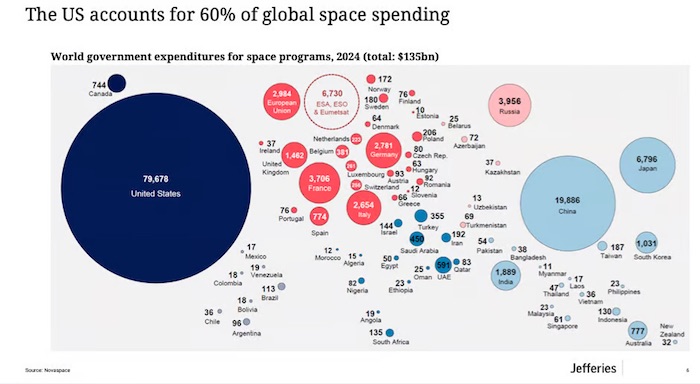


May 302026


Andy Warhol Grace Kelly 1984


• President Trump Updates on “Final Determination” of Iran Negotiations (CTH)
• Iran Clarifies Deal ‘Not Finalized’ Amid Lack Of Trust (ZH)
• Trump in Situation Room for ‘final Determination’ on Iran deal (JTN)
• Trump and Rubio Finally Go After Brazil’s Narco-Terrorists (Sarah Anderson)
• Go Marco! It’s Your Birthday! (Anderson)
• The Left Is Trying to Make Trump Radioactive — and It’s Failing (Tim O’Brien)
• SpaceX Reportedly Lowers IPO Valuation Target (ZH)
• How Much Longer Will Russians Tolerate Putin-the-Pusillanimous? (PCR)
• Has President Trump Committed High Treason? (Paul Craig Roberts)
• Like a Naked Emperor (James Howard Kunstler)
• British Ofcom Probes Trump Interview Calling Climate Change a “Hoax” (Turley)
• Judge Orders Trump’s Name to Be Removed From Kennedy Center (Sarah Anderson)
• US Government Prepares To Print $250 Note Featuring Trump’s Face (BBC)


https://twitter.com/nicksortor/status/2060064173774803099?s=20 https://twitter.com/EricLDaugh/status/2060067457235132814?s=20 https://twitter.com/LightOnLiberty/status/2059829613082161341?s=20


“The Arab states, not Israel, are 100% behind the Trump administration effort on this issue.”

• President Trump Updates on “Final Determination” of Iran Negotiations (CTH)

President Trump updates through his Truth Social account on the current status of negotiations for an agreement with Iran.


PRESIDENT TRUMP – “Iran must agree that they will never have a Nuclear Weapon or Bomb. The Hormuz Strait must be immediately open, no tolls, for unrestricted shipping traffic, in both directions. All water mines (bombs), if any, will be terminated (we have removed, through detonation, numerous such mines with our great underwater mine sweepers. Iran will complete the immediate removal and/or detonation of any mines that are left, which will not be many!).

Ships caught in the Strait due to our amazing and unprecedented Naval Blockade, which will now be lifted, may start the process of “heading home!” Say HELLO to your wives, husbands, parents, and families from me, your favorite President! The enriched material, sometimes referred to as “Nuclear Dust,” which is buried deep underground with virtually collapsed mountains, caused by our powerful B2 Bomber attack 11 months ago, sitting on top of it, will be unearthed by the United States (which, it is agreed, is the only Country, along with China, with the mechanical capability of doing so!), in close coordination and conjunction with the Islamic Republic of Iran, plus the International Atomic Energy Agency, and DESTROYED.

No money will be exchanged, until further notice. Other items, of far less importance, have been agreed to. I will be meeting now, in the Situation Room, to make a final determination. Thank you for your attention to this matter!” ~ President Donald J Trump

Newt Gingrich also notes one of the most important facets that continues to be missed by most of the American punditry who discuss the situation. The Arab states, not Israel, are 100% behind the Trump administration effort on this issue.

Newt Gingrich: “After spending this week reviewing the Iranian war I am now convinced President Trump is on the edge of an historic victory. The real breakthrough for me came as I reviewed President Trump’s decisions and maneuvers not from the standpoint of American unilateralism but from the standpoint of the leader of a remarkable historic coalition, the largest coalition ever put together in the modern Middle East.

Everyone understands that Israel is an important ally. What is little discussed is the depth of support from the United Arab Emirates, Qatar, Bahrain, Saudi Arabia and other countries in the region. It has to be sobering for the Iranian dictatorship to realize that it does not have a single ally willing to challenge the American naval blockade. Slowly, gradually, timidly, our European allies are lining up to help with the Persian Gulf and the Strait of Hormuz. A great deal of President Trump’s maneuvers against Iran make sense once he is seen as a coalition leader and not just as a unilateral American President.

I spent a lot of the last couple weeks reviewing kinetic options including wining the battle of the Persian Gulf and the Strait of Hormuz and if necessary using the shocking and shattering level of force President Nixon and Secretary Kissinger used against Hanoi and Haiphong in Christmas 1972 (which both leaders believed convinced the North Vietnamese to agree to a truce and the freeing of American POWs). If this were a unilateral American campaign I could enthusiastically support a more aggressive kinetic campaign. However it is also clear it would shatter the coalition because our Arab allies are convinced Iran could still do enormous damage to their oil fields and infrastructure.

Coalitions are inherently slower than unilateral campaigns. However coalitions ultimately bring vastly more power to the fight. I am as frustrated as everyone else by the pace of talking with the dictatorship but having reviewed the correlation of forces and the options available to the coalition on one side and the Iranian religiously motivated dictatorship on the other I am prepared to assert that President Trump’s coalition leadership (something almost none of his critics want to acknowledge) is within reach of an enormous historic victory. And if the Iranian dictatorship ultimately proves it is hopelessly committed to a suicidal position there will be plenty of time for a kinetic campaign of enormous power and effectiveness. Either way we are on the edge of an astonishing victory for our values and for a safer Middle East.” (source)

Read more …

The more Iran threatens, the weaker it is.

• Iran Clarifies Deal ‘Not Finalized’ Amid Lack Of Trust (ZH)

Iran’s Tasnim reports Friday that the US-Iran Memorandum of Understanding (MOU) is not yet finalized, and that Thursday’s flurry of Western media headlines about an agreement finally being reached were inaccurate. “The text is not finalized yet and the account in Western media is not precise,” a fresh statement indicates. Official confirmation will be announced if it does get to the point of being finalized, Tasnim notes. The report cited an Iranian official to say that “the text of the possible memorandum of understanding has had changes over the past few days.”


The warring sides are attempting to lock in a 60-day extended ceasefire, during which time they will get back to the table – and that’s when finer details like how to address Iran’s stockpile of highly enriched uranium will be dealt with. It is now day 91, and according to the latest Friday: Iranian Parliament Speaker and top negotiator Ghalibaf says: “We have no trust in guarantees or words.” Late Thursday, US Vice President J.D. Vance indicated that President Trump has not approved, at a moment Washington is insisting the nuclear issue be more front and center as part of the MOU.

However, the Iranians have consistently said their nuclear program is not up for negotiation toward ending the war – but that it is something that can be talked about once the conflict closes. According to a summary of the latest on the stalled MOU from an Al Jazeera correspondent: Diplomatic efforts to preserve the ceasefire between the United States and Iran have continued behind the scenes, with officials signaling progress towards a framework that could open the door to formal negotiations after weeks of conflict and disruption across the Gulf and beyond. Despite the optimism, questions remain over the timing and scope of any agreement.

Iranian media reports suggested discussions are continuing and that key details have yet to be finalized, while both sides continue to navigate sensitive issues, including Iran’s nuclear program and security in the Gulf.

What has become clear is that US and international media reports have consistently proven premature, too out front, thinly sourced, and ultimately inaccurate in their generally optimistic claims of a deal being ‘finalized’ or else ‘imminent’. In the meantime, Iran’s ongoing threats of an escalated, protracted war happen to be very clear: The Revolutionary Guards said any renewed conflict would spread “far beyond the region,” threatening “crushing blows” and “utter ruin” in places opponents “cannot even imagine.” The warnings come after a war that saw Iran target US bases, Israeli cities and critical infrastructure in Gulf Arab states, while effectively shutting shipping through the Strait of Hormuz and triggering a global energy shock.

The Islamic Republic has also been touting new “tools” to use against its enemies, per CNN: Last week, Iranian Foreign Minister Abbas Araghchi warned that any future retaliation would “feature many more surprises,” while Iran’s military threatened to open “new fronts” using “new tools.” Mohammad Bagher Ghalibaf, Iran’s top negotiator, said the armed forces had used the ceasefire period to rebuild their capabilities “at the highest level.”

Some pundits fear that such references to “new fronts” could mean either the closure of the Bab al-Mandeb Strait in the Red Sea, or even the possibility of missiles reaching Europe. Umud Shokri, an energy strategist at George Mason University, has explained in a statement, “A simultaneous crisis in Bab al-Mandeb and the Strait of Hormuz would be far more serious, potentially affecting both Red Sea trade and Persian Gulf energy flows, which would raise oil prices, freight rates, and inflationary pressure worldwide.”

Read more …

Trump’s conditions are well known.

• Trump in Situation Room for ‘final Determination’ on Iran deal (JTN)

President Donald Trump is in the Situation Room to make a final decision on the Iran deal amid a reported 60-day ceasefire extension. Trump reiterated his core demands that Iran abandon its nuclear ambitions and open the Strait of Hormuz in a Truth Social post. “Iran must agree that they will never have a Nuclear Weapon or Bomb. The Hormuz Strait must be immediately open, no tolls, for unrestricted shipping traffic, in both directions,” he posted. “All water mines (bombs), if any, will be terminated (we have removed, through detonation, numerous such mines with our great underwater mine sweepers.”


“Iran will complete the immediate removal and/or detonation of any mines that are left, which will not be many!). Ships caught in the Strait due to our amazing and unprecedented Naval Blockade, which will now be lifted, may start the process of ‘heading home!'” he added. Trump also insisted that Iran would have to hand over its remaining nuclear material for destruction under the watch of the International Atomic Energy Agency. The war began in late February with joint U.S.-Israeli strikes on Iran that killed Ayatollah Ali Khamenei. The conflict has been in a nominal ceasefire for weeks, despite the occasional flare up of live-fire exchanges.

Read more …

Lula.

• Trump and Rubio Finally Go After Brazil’s Narco-Terrorists (Sarah Anderson)

The State Department announced on Thursday that the United States is designating Brazil’s two most powerful criminal organizations — Primeiro Comando da Capital (PCC) and Comando Vermelho (CV) — as both Specially Designated Global Terrorists (SDGTs) and Foreign Terrorist Organizations (FTOs). All I can say is that it’s about time. There have been rumors that Marco Rubio would do this for a while now, but he’s finally following through.


“CV and PCC are two of the most violent criminal organizations in Brazil,” Rubio said today in a statement (I’d add in the whole world, not just Brazil). “Together, they command thousands of members and have orchestrated brutal attacks against Brazilian police officers, public officials, and civilians. Their influence and illicit networks extend far beyond Brazil’s borders, across our region and into our country.” So, just who are these narco-terrorists? Here’s what I wrote about them earlier this month:

Primeiro Comando da Capital (PCC) and Comando Vermelho (CV) are the two largest and most influential criminal organizations in Brazil, though they operate internationally. Both were born in prisons as self-protection groups in the 1990s, and today, they are some of the biggest drug and arms trafficking organizations in the world. There are tens of thousands of members, and they terrorize Brazilian civilians and have taken over entire towns. From beheadings to bombings and other mass attacks, they use terrorist-style tactics to control territory and instill fear.

Not only have they taken over entire parts of Brazil, but they’ve bled over the borders into countries like Bolivia, Paraguay, Colombia, Ecuador, Venezuela, and Chile. They also operate in the United States and parts of Europe and the Middle East, according to the São Paulo Public Prosecutor’s Office.

Today, they recruit new members in prisons, and these aren’t your average street criminals. They run parallel states inside prisons and in parts of Brazil, often corrupting officials. They massacre their rivals, and they make billions through crimes like trafficking, money laundering, and extortion. They also help fuel the drug crisis in our country, contributing to the cocaine and fentanyl that show up on our streets each year. In Brazil specifically, these groups have even infiltrated legitimate businesses in fields like agriculture, real estate, and construction.

The Donald Trump administration has been using the SDGT and FTO designations quite successfully, almost from day one, to target narco-terrorism and working to dismantle and capture the leaders of Mexican cartels and other regional organized crime groups, like Tren de Aragua and MS-13. The designations prevent anyone in the U.S. from providing resources or support for that group, among other things, which curbs financing, isolates these criminal organizations internationally, and heightens public awareness. As we’ve seen over the past year, once we take the lead on these things, other aligned countries in the Western Hemisphere often follow suit.

It also puts pressure on Brazilian institutions and businesses to stop playing nice with these groups, including the country’s little anti-Trump dictator, Luiz Inácio Lula da Silva. But don’t hold your breath on that one. What makes the timing of these designations even more interesting is that Flávio Bolsonaro, son of former Brazilian president Jair Bolsonaro, met with Trump at the White House earlier this week. Trump and the elder Bolsonaro are, of course, good friends, and with presidential elections in Brazil looming in October, the younger Bolsonaro is currently the right-wing candidate leading the polls and the candidate who is most likely able to stop the old socialist Lula from serving a fourth term. Having a like-minded partner in Brazil would be huge for both of our countries.

After their meeting in the Oval Office, Flávio held a press conference stating that he asked Trump personally to designate PCC and CV as terrorist groups. It looks like the president and Rubio listened. The senator and presidential candidate was welcomed warmly upon returning home from the U.S. by the people who are ready to pull their country away from the socialism and organized crime that have plagued it for years, following the lead of other countries in Central and South America in recent months.

By making the designation, Trump and Rubio essentially handed Flávio and Brazil’s opposition some support ahead of the elections. Meanwhile, old Lula refuses to condemn these groups because, well, sovereignty or something. Lula’s party has long refused to take a hardline stance on national security, preferring to shout about imperialism than actually help its own citizens who are living under the threats of these narco-terrorists. There is also the idea that high-profile members of Lula’s “Workers’ Party” are some of the officials who have been corrupted by the PCC and CV, but that’s a story for another day. .

Read more …

“Marco Rubio is really, really, really popular with Republicans.”

• Go Marco! It’s Your Birthday! (Anderson)

Today, Thursday, May 28, is Secretary of State Marco Rubio’s 55th birthday. I hadn’t planned on marking the occasion, but everyone else in the media and politics seems to be, and our managing editor Chris Queen jokingly suggested I join them. And if you’ve been reading my articles for the last year and a half, you know I never pass up a chance to say good things about the most popular man in the Republican Party. Oh yeah, it’s true. Even CNN admits it.


According to the network’s poll analyst, Harry Enten, earlier this week, “Marco Rubio is really, really, really popular with Republicans.” The only Republican currently polling more popular is Donald Trump himself. He added, “His chances to be the Republican nominee in 2028 are up like a rocket taking off from Cape Canaveral.” Enten was referring to favorability odds from Kalshi, which showed Rubio with an 11% chance of becoming the GOP nominee in January — that number has jumped to 30% in May. According to Quinnipiac, Rubio also has the highest approval rating of any cabinet member at 40%, but Vice President JD Vance is not far behind at 39%. Secretary of War Pete Hegseth follows at 34%, and FBI Director Kash Patel is at 30%.

Other polls show Rubio and Vance neck and neck for a 2028 primary. Emerson College, for example, has Vance with 36% support of Republican voters, while Rubio is close behind with about 35%. Florida Governor Ron DeSantis and former United Nations ambassador Nikki Haley each have 5%. Around 15% are undecided. What’s notable about that, however, is the shift. In February, the same poll showed Vance with a whopping 52% of support and Rubio with just 20%. I suppose being favored to become the most powerful man in the world, a position you’ve been working toward most of your life, is one of the best birthday presents a guy can receive, but we’re still a good ways out from that, so I’m going to shut up about 2028 now. Let’s get through the midterms first.

On a personal note, I’d like to say that if it wasn’t for Rubio, I wouldn’t know nearly as much about Latin American politics as I do, nor would I have the career that I have. So, I’m forever grateful for that and do hope he has the best of days. Anyway, this wasn’t meant to be a serious post. Let’s just wish a “Happy Birthday” to our dear Secretary of State. Now, enjoy these X posts: A couple of weeks ago, I wrote: The Secretary of State Is Cool, and the MSM Is Having a Meltdown Over It. The State Department showcased that “cool” factor in a birthday video today:

Looks like some White House staff threw him a little party:

https://twitter.com/MargoMartin47/status/2060049666129981656?ref_src=twsrc%5Etfw%7Ctwcamp%5Etweetembed%7Ctwterm%5E2060049666129981656%7Ctwgr%5E12a5c638971ab9b7a20d2f57d63a16f77bbf6ce2%7Ctwcon%5Es1_c10&ref_url=https%3A%2F%2Fpjmedia.com%2Fsarah-anderson%2F2026%2F05%2F28%2Fgo-marco-its-your-birthday-and-youre-the-most-popular-man-in-the-gop-n4953339

Lots of members of Congress have wished Rubio a happy birthday, but this post from Rep. Kat Cammack (R-Fla.) was my favorite. I told Chris that they look like an overly enthusiastic couple who is ready to sell you a timeshare.

https://twitter.com/RepKatCammack/status/2060090909824368777?ref_src=twsrc%5Etfw%7Ctwcamp%5Etweetembed%7Ctwterm%5E2060090909824368777%7Ctwgr%5E12a5c638971ab9b7a20d2f57d63a16f77bbf6ce2%7Ctwcon%5Es1_c10&ref_url=https%3A%2F%2Fpjmedia.com%2Fsarah-anderson%2F2026%2F05%2F28%2Fgo-marco-its-your-birthday-and-youre-the-most-popular-man-in-the-gop-n4953339

Of course, we couldn’t let the day pass without the meme:

https://twitter.com/TheRicanMemes/status/2060035087681372282?ref_src=twsrc%5Etfw%7Ctwcamp%5Etweetembed%7Ctwterm%5E2060035087681372282%7Ctwgr%5E12a5c638971ab9b7a20d2f57d63a16f77bbf6ce2%7Ctwcon%5Es1_c10&ref_url=https%3A%2F%2Fpjmedia.com%2Fsarah-anderson%2F2026%2F05%2F28%2Fgo-marco-its-your-birthday-and-youre-the-most-popular-man-in-the-gop-n4953339

Read more …

I don’t understand how Milli Vanilli is part of this.

• The Left Is Trying to Make Trump Radioactive — and It’s Failing (Tim O’Brien)

What do NFL quarterback Jaxson Dart and the Great American State Fair event in Washington, D.C., have in common? Two things right off the top: first, President Donald Trump’s support; and second, that both are current targets of the left’s strategy to make everything Trump touches radioactive. We all know the drill by now. Trump does something. The left acts like he committed a capital offense. The media and all of the various institutions of the left, including the judiciary, all do their part to try to create the perception that Trump is ruining things.


We’ve all seen how activist judges, the news media, and mobilized “anti-ICE” groups have waged a campaign to frame Trump’s enforcement of immigration law as though it were a crime in and of itself. But wait, there’s more. The left had a conniption over the White House ballroom project. It got a judge to halt construction, and now it’s trying to blame Trump for the mess it is intentionally creating. The left even tried to do the same thing on Trump’s repairs to the Lincoln Memorial’s reflecting pool. There is nothing the left would like more than to create a mess throughout Washington that would last at least through 2026 and America’s 250th anniversary celebrations. Instead of coming together as Americans to celebrate our history, the left wants to ruin this once-in-a-lifetime event and blame Trump for what it is doing.

Last week, New York Giants QB Dart was asked to introduce the president of the United States at a New York event, and the left immediately seized on it as yet another opportunity to make something Trump touched radioactive. Its methodology is simple. After Trump does the thing – in this case, speak – the left attacks anyone who shared the stage with the president. It’s an old-fashioned pressure campaign. Squeeze the people who, optically, appear not to hate Trump. If the left can “convict” you of not hating the president, it will smear you as someone who presumably supports everything the man has ever done, everything he’s ever said, and everything the left has made up about him. All of it.

Then they go to anyone associated with someone like Dart to see if they still support Dart. In his case, it could be teammates, coaches, sponsors, or even agents. In terms of character assassination, it’s all-out war for the left. Take no prisoners. The goal is to get anyone who may have been even temporarily associated with Trump to come out and publicly apologize or distance themselves from the president. The sports media immediately took the lead on creating controversy around Dart’s introduction of Trump at that event, pestering people throughout the Giants organization about it — so much so that Dart had to explain his side of the story during a team meeting. Keep in mind, an NFL player introducing the president is neither controversial nor something that should be controversial. If it is, it’s because the controversy was manufactured

Giants linebacker Abdul Carter took the bait and commented on social media, “Thought this s##t was AI, what we doing man.” Carter had no idea that he himself was a victim of leftist manipulation when he posted this. That said, not long after his post, he followed up by saying he talked to Dart, man-to-man, and it’s all good. So, is this sort of thing having the left’s desired effect?

https://twitter.com/PamelaHensley22/status/2058618537359409386?ref_src=twsrc%5Etfw%7Ctwcamp%5Etweetembed%7Ctwterm%5E2058618537359409386%7Ctwgr%5E517a7dc4d0b01979419c9930a612d453e00dfe3a%7Ctwcon%5Es1_c10&ref_url=https%3A%2F%2Fpjmedia.com%2Ftim-o-brien%2F2026%2F05%2F28%2Fthe-left-is-trying-to-make-trump-radioactive-and-its-failing-n4953358

Apparently not. Carter may have taken the bait, but the public is not. Politically, Trump-endorsed candidates have been killing it in the primaries by huge margins, indicating that the country is still way into Trump — more than the media would ever have you believe. nAnd so, we’re now about to go full steam into a summer of America 250 celebrations. What could go wrong, right? You have to know going in that the left has plans to destroy anything and everything related to it. Which brings me to that Great American State Fair planned for Washington in June. A bunch of musical artists had been lined up to perform at the event. People like C+C Music Factory, Flo Rida, Vanilla Ice, Bret Michaels, the Commodores, Martina McBride, and Milli Vanilli.

Right on cue, after already committing to perform at the event, some of the acts are pulling out. We can only guess that it’s the result of someone getting to them — reaching out to pressure them into cancelling. I mean, they already knew Trump is the president, and as president, he’s the host of the anniversary festivities. This was not a surprise. They already knew the event will be in the heart of the most political town in the country. And yet, McBride decides to drop out at this stage of the game, citing “partisanship” as her concern. Really? Is celebrating America with the president now a partisan thing?

Read more …

$3 triilion or $4 trillion, who cares?

• SpaceX Reportedly Lowers IPO Valuation Target (ZH)

SpaceX is targeting a valuation of at least $1.8 trillion in its upcoming initial public offering, Bloomberg reported, citing people familiar with the matter. This is below an earlier goal of more than $2 trillion. In practice, the initial IPO valuation target is a marketing range, not a final number. Therefore, any valuation shifts ahead of the trading day would not be unusual. This suggests advisers are calibrating the deal to what investors are willing to absorb, especially given the massive proposed raise of up to $75 billion.


The target is settling lower after consultations with advisers and investors, the people said, asking not to be identified as the information isn’t public. Details of an IPO, such as size and valuation, are typically adjusted ahead of pricing based on feedback from stakeholders, the people said. SpaceX is seeking to raise as much as $75 billion, people familiar with the matter have said, which would make it the biggest IPO of all time. -BBG

The May 21 SpaceX S-1 filing revealed that Elon Musk’s space company is much more than a reusable-rocket and satellite-internet company. It now encompasses AI services, infrastructure, orbital data centers, and a claimed $28.5 trillion total addressable market. Earlier this month, Reuters reported that the IPO is set to price on June 11, with a June 12 debut. The stock is expected to list on Nasdaq and Nasdaq Texas under the t icker “SPCX.” Polymarket bets show a 90% chance that SpaceX’s market capitalization will be $1.8 trillion on the IPO date.

Read more …

PCR doesn’t like Trump OR Putin. But Americans and Russians do, respectively.

• How Much Longer Will Russians Tolerate Putin-the-Pusillanimous? (PCR)

The Russians have paid with lives of soldiers and civilians and with sanctions and internet disruptions and airport closings and with humiliations for a conflict that has gone nowhere in 5 years. What is Putin’s purpose in creating a never-ending and ever-widening conflict that now takes place all over Russia with school children killed, oil facilities destroyed, airports disrupted. Air strikes on Russia now take place through NATO countries, and the war is widening with Europe preparing for war with Russia in three years.


Whatever Putin’s purpose it does not generate a picture of a great power. Indeed, Putin and Peskov and Kirill Dmitriev have made the Kremlin look like a wimp. In his latest denial that a decision has been made to finally use sufficient force to conclude the conflict in victory, Peskov at Putin’s direction declared: “We generally prefer to achieve our goals peacefully, by diplomatic means.” This is the Kremlin’s admission that Russians are dying for “diplomatic means.” Peskov added that Putin is looking forward to a new round of talks with Trump’s Jewish messengers, Steven Witkoff and Jared Kushner. “As soon as they are ready, we will be glad to see them and we, indeed, wait for their arrival.”

The purpose of Peskov demonstrating the Kremlin’s subservience to Trump was to shutdown Foreign Minister Lavrov who had told US Secretary of State Rubio that the Kremlin had finally decided to get the conflict over with. Not so Peskov declared. Apparently, winning a war is not Russia’s way. It seems that yet again Putin-the-Pusillanimous will do nothing that upsets Trump and, therefore, that the pointless conflict that achieves only casualties while it widens into a general European war will continue.

Read more …

PCR is not a fan.

• Has President Trump Committed High Treason? (Paul Craig Roberts)

Let’s examine the case.In the oath of office taken in the swearing in of a president, the about-to-be-president swears allegiance to the U.S. Constitution and promises to defend it against enemies at home and abroad. In other words, enemies of the Constitution are enemies of the United States. (Today the Constitution’s enemies includes university law schools in the United States.) If you asked what is the United States, some would say it is an idea; others would say it is a geographical territory. But these definitions apply to all countries and thus define none. The correct answer is that the United States is the Constitution.


The Constitution defines the form of government, the powers of the various branches, the distribution of powers between state governments and the federal government, the rights of citizens and the protection of those rights, and it defines the process of changing the Constitution, that is, of changing the United States. Without the Constitution the United States would be a different country. It is not an election that makes a person the president. It is the person’s vow to defend the United States by defending the Constitution. If an elected president refused the vow at the swearing in ceremony, he could not be confirmed in office as president. When a president-to-be swears an oath to the Constitution he swears an oath to the United States.

The most important parts of the Constitution are the Amendments, the Bill of Rights that had to be incorporated into the Constitution in order to gain its acceptance by all of the founding states. The Bill of Rights protects the citizens from government limiting their rights and committing violence or retribution against them for actions protected by the Constitution. The principle right is free speech. It is the First Amendment, because without free speech it is impossible for citizens to hold government accountable for violation of the other protections from, and limits on, government power. Trump’s affinity for Zionist Israel has led him into an act that violates his oath of office and possibly caused him to commit high treason against the United States.

Trump has created by executive order what in effect is a Sedition Act for Israel that prohibits United States citizens from using their First Amendment right to criticize Israel for the genocide of Palestine, the rape and torture of Palestinian prisoners, the destruction of Palestinian homes, villages, and olive groves by Israeli settlers who blatantly steal Palestinian land, assassinations of foreign leaders, undue influence over the U.S. legislative and executive branches, state governments, media, finance, and education, and wars of aggression against Middle Eastern countries. U.S. critics of Israel are not even permitted to complain about the Jewish Anti-defamation League’s slander, libel and defamation of them. For an American to complain of being defamed by Zionists is to risk punishment for anti-semitism.

To state it plainly, Trump and his acting attorney general have given priority to protecting Israel, a foreign government, over the First Amendment rights of U.S. citizens. Clearly, this means that Trump and his accommodating acting attorney general are serving a foreign interest by suspending without any right or authority to do so, the First Amendment rights guaranteed to U.S. citizens by the U.S. Constitution. This puts Trump at odds with his vow to protect the U.S. Constitution and invalidates his swearing-in as president of the United States. Trump has issued an edict that his obliging attorney general has accepted that subordinates the U.S. Constitution to Israel.

On May 19, the acting Attorney General of the United States issued this statement: “President Trump has made clear that this administration will not tolerate antisemitism [defined as any criticism of Israel and Jews], and the Department of Justice is committed to implement that directive. This national tour is an important step in ensuring communities across the country know the federal government stands ready to work with them to confront antisemitic threats, protect public safety, and uphold civil rights.”

Notice that according to Trump’s attorney general “upholding civil rights” means deep-sixing the First Amendment that protects U. S. Citizens’ free speach rights guaranteed by the U.S. Constitution. As Trump and his attorney general have come out against the First Amendment, they have come out against the US Constiution and, thereby, against the United States. In other words, both seem to be guilty of high treason. For Trump and his attorney general to rule for Israel against American citizen’s First Amendment rights and the US Constitution that protects these rights calls into question who Trump and his attorney general represent.

It seems certain the President Trump’s willingness to sacrifice the U.S. Constitution to protecting Israel from words of criticism indicates that he has committed high treason in order to serve foreign interests, which would seem to make Trump an enemy of the U.S. Constitution and thereby an enemy of the United States. f my reasoning is correct, why shouldn’t President Trump be arrested and put on trial for high treason against the United States?Why did not Trump’s acting attorney general, who happens to be Trump’s personal defense attorney, warn Trump that he was stepping onto treasonous ground? Is a person who aids and abets the president in the possible commission of high treason fit to be attorney general of the United States?


Paul Craig Roberts was Assistant Secretary of the Treasury in the Reagan administration, associate editor and columnist for the Wall Street Journal, Business Week’s first outside columnist, columnist for the Scripps Howard News Service, contributor to the editorial page of the Los Angeles Times, and columnist for the main French and Italian newspapers, and for Creators Syndicate in Los Angeles. He served in numerous academic appointments in US universities and was appointed to the William E. Simon Chair for Political Economy at Georgetown University’s Center for Strategic and International Studies where his colleagues were Henry Kissinger, Zbigniew Brzezinski, James R. Schlesinger (one of his former professors), and Chairman of the Joint Chiefs of Staff Adm. Thomas Moorer. His article, “How the Law Was Lost,” was published in the January 1999 Cardozo Law Review.
Read more …

The CIA sent $40 million in gold bars (303 bars) to his home. Let that sink in well. WTF?

“This story is not going away. The scale of the grift is spectacular and vivid — 303 gold bars! — like a Hollywood movie. Rush’s explanation of “work-related expenses” sounds preposterous.”

“The case has stunned national security observers and raised serious questions about the federal government’s security clearance and vetting systems. —Newsmax

• Like a Naked Emperor (James Howard Kunstler)

In the annals of Deep State WTF-ery, is there a stranger case than CIA officer David Rush turning up with $40-million in 303 one-kilogram gold bars, plus $2-million in cash, plus a stash of 30 mostly Rolex watches? Well, yeah, the stranger story is how the guy got hired by the CIA in the first place. Rush was arrested on Monday, May 18, by an FBI SWAT team at his home in Loudoun County, VA. Agents searched the house all day long and found the stash. Rush is currently charged with theft of public money and allegedly falsifying his military and academic credentials to obtain federal employment benefits, including roughly $77,000 in improper military leave pay. He’s scheduled to make a federal court appearance in Alexandria today.


Rush first applied for a job at the CIA in March 2006. He claimed to have a bachelor’s degree in math from Clemson University and a master’s from the Rensselaer Polytechnic Institute (RPI). He was rejected. He reapplied later that same year. Bumped again. He reapplied again in 2009, adding a new credential: that he’d been a US Navy test pilot and flight trainer. This time, he was hired.

Rush’s college credentials were found to be false, but it is unclear when that was discovered. Since he included them in his two earlier 2006 failed applications, why were they not flagged in his successful 2009 application? His claim of being a US Navy pilot was also found to be false (he was an information systems tech in his Navy service). The FBI affidavit unsealed recently details the pattern of lies across all applications.

Understand that CIA vetting procedures are supposed to be exceedingly rigorous. The process is stressful and invasive — many candidates drop out or are weeded out. The background check involves interviews with practically everybody who knows the applicant going back decades, his criminal history, work, financial history, education, military service. The applicant gets a polygraph exam. Even after getting hired, monitoring continues.

Rush was hired at the very start of the Obama admin; Leon Panetta was the newly appointed CIA Director. Wouldn’t you like to hear him ‘splain how David Rush managed to get hired? Was somebody smoothing his way in? Rush rose to become a senior executive service (SES) officer with a top-secret (TS/SCI) security clearance. His exact duties, the division he worked for, his day-to-day responsibilities have not been disclosed.

Rush allegedly requested the gold and foreign currency from the CIA for “work-related expenses” between November 2025 and March 2026. The agency later could not account for the assets or locate records explaining their official purpose. A search of a storage locker at CIA connected to Rush turned up only a small amount of the requisitioned cash.

“There is a whole process that we go through to get that money. I don’t just walk into the logistics office and say ‘Excuse me, I need $100,000 tomorrow.’ There is a form I have to fill out. It’s not a bank vault you walk into. It doesn’t work like that.” — Tracy Walder, 46, a former FBI special agent and CIA officer, quoted in The New York Post.

Wouldn’t you assume that some higher-up CIA officer would have to sign off on such a colossal requisition of gold and money? (And where does the CIA get so much gold on-demand?) Perhaps the very Director of the CIA approved it — which would be John Ratcliffe through 2025 up to right now. Doesn’t he have some ‘splainin’ to do? (Was Rush set-up? Was this a sting?)

Assuming Rush spent some period of time as an entry-level CIA employee, when did his rise to SES level happen? John Brennan became CIA Director in early 2013 (the start of Barack Obama’s second term). What were David Rush’s relations with John Brennan? Was Brennan his mentor? Does the gold stash have any connection with the current legal problems of John Brennan and other former high officials involved in the long-running “grand conspiracy” case about the attempted overthrow of a president?

You might imagine that Rush’s phone and computers were seized in the May 18th raid on his house — though it’s unlikely he used such conventional channels for black ops chatter. It’s conceivable, though, that any alt-communications of his were captured by the vast national security surveillance apparatus, and that DNI Tulsi Gabbard might have come across them this past year. How else might Director Ratcliffe have been tipped off?

This story is not going away. The scale of the grift is spectacular and vivid — 303 gold bars! — like a Hollywood movie. Rush’s explanation of “work-related expenses” sounds preposterous. If the requisitions were made serially, over several months, as appears, then the agency had more than one opportunity to review and question them.

Rush faked his entire back-story. How incompetent (or corrupt) are the agency’s past managers that he got away with it for so long? How many other gross fakers, rogues, grifters, and tools are embedded in the agency, and who are they really working for? The institutional embarrassment is monumental. Trust in the so-called Intel Community is at an all-time low. Indictments and trials are coming. This is the Deep State on parade like a naked emperor.

Read more …

“I do not sentence you for your political views, but the extremity of those views informs the assessment of dangerousness.”

• British Ofcom Probes Trump Interview Calling Climate Change a “Hoax” (Turley)

I have been writing about the decline of free speech in the United Kingdom for years, including in my book The Indispensable Right: Free Speech in an Age of Rage. One of the most critical components of the British censorship system is Ofcom, the Office of Communications, which regulates the broadcasting, internet, telecommunications, and postal industries. The most recent controversy is detailed in the Telegraph, with Ofcom investigating GB News over the simple replaying of a Trump interview in which he called climate change a “hoax.” Ofcom is investigating GB News for failing to challenge Trump’s characterization, even though many people share his views on climate change.


It is a breathtaking demonstration of the censorship culture in the United Kingdom. World leaders make controversial statements in every interview. A free press allows the public to hear such viewpoints and reach their own conclusions on the merits of such arguments or policies. The debate over the climate change data continues to rage. The dates for dire predictions for massive environmental disasters, including those of Al Gore, have passed. Professor Guy McPherson received widespread press attention for his 2016 prediction that the entire human race would be wiped out by 2026. It appears that he is wrong.

Al Gore received the 2007 Peace Prize for his film The Inconvenient Truth as media, academic, and government censors attacked anyone questioning his data. His apocalyptic predictions have not borne out, and recent scientific papers have rejected the predictions found in the underlying studies. Gore predicted more frequent and stronger hurricanes, but some insist that global data reveal a slight decline in both frequency and intensity. Others argue that the number may be decreasing but the intensity is increasing. We have not seen the type of global hurricane disaster that Gore described in the movie. Critics point to NASA data to argue that the areas burned by wildfires have fallen by more than 25 percent over the past quarter of a century.

While the global population quadrupled in the last century, deaths from climate-related disasters have plummeted from the 1920s, when an average of nearly half a million people died annually from such events. Even the film’s famous use of polar bears has not panned out. Polar bear populations have more than doubled from around 12,000 in the 1960s to over 26,000 today. While some have contested those figures, it has certainly not resulted in the wipeout predicted by Gore. I believe that climate change is real, and there are other signs of more severe climate events, including flooding, that present real dangers for various countries. The point is not to say that it is all a hoax, but that reasonable people can disagree on this question.

That brings us back to the British censors. In the last two decades, free speech protections in the U.K. have been eviscerated and the government is doubling down on the criminalization of speech. The criminalization of speech has expanded exponentially as individuals and groups call the police to silence those who criticize them or advocate opposing views. bEven silent prayer or “toxic ideologies” can lead to arrest. Expressing concerns over Western cultural values is now treated as an admission of “right-wing ideology,” warranting investigation. A few years ago, a neo-Nazi living with his mother was found to have a room filled with hateful symbols and material.

Judge Peter Lodder dismissed free speech concerns over the defendant’s possessions with a truly Orwellian flourish: “I do not sentence you for your political views, but the extremity of those views informs the assessment of dangerousness.” Calling the defendant “a right-wing extremist,” Mr. Lodder said the contents of his room were evidence of “enthusiasm for this repulsive and toxic ideology.” The British people have become conditioned to censorship as different groups seek to silence those who express opposing viewpoints. The result is one of the most speech-phobic nations on Earth as offices like Ofcom fuel the fear of free speech.

Read more …

It’s falling apart so he saves it.

• Judge Orders Trump’s Name to Be Removed From Kennedy Center (Sarah Anderson)

In today’s chapter of the never-ending lawfare against Donald Trump and the activist judiciary that loves to entertain it, we have some rulings from a federal judge on the changes made to the Kennedy Center. Just to recap, when Trump took office in 2025, he cleaned up the Kennedy Center board of trustees, appointing a more MAGA-friendly group of people who ultimately voted to rebrand it as the Trump-Kennedy Center. The goal was to honor the president and clean up a D.C. institution that had long been neglected and mismanaged by Democrats and allowed to go extremely woke, whether it was the progressive programming that appealed to only a small segment of the population or the overuse of pronouns in staff emails.


So Rep. Joyce Beatty (D-Ohio) and a bunch of left-wing activists got all upset over it and sued, asking a judge to keep the original name: The John F. Kennedy Center for the Performing Arts. Here’s more on that from Beatty’s attorney: “Can the Board of the Kennedy Center — in direct contradiction of the governing statutes — rename this sacred memorial to John F. Kennedy after President Donald J. Trump? The answer is, unequivocally, ‘no.’ By renaming the Center — in violation of the law — Defendants have breached the terms of the trust and their most basic fiduciary obligations as trustees. Shortly after President John F. Kennedy’s assassination, Congress designated the Kennedy Center as the ‘sole national memorial to the late’ President in the nation’s capital.

The White House responded: “While the Democrats neglected the Trump-Kennedy Center for years, President Trump immediately stepped up to rescue and revitalize the institution. The newly named Trump-Kennedy Center proudly recognizes President Trump’s incredible contributions including strengthening its finances, leading major building upgrades, removing divisive woke programming and transforming it into a welcoming destination that everyone can enjoy under his leadership. Only deranged Democrats could oppose these efforts.

And today, Barack Obama-appointed judge Christopher R. Cooper responded, claiming the board’s decision to add Trump’s name was unlawful and ordered that it must be removed from the website and the building. He also blocked the Trump administration’s plans to close the center for two years for repairs beginning this summer.

On the name change, Cooper essentially said that Congress named it after JFK in 1964, and only Congress can change the name now. “The Kennedy Center’s organic statute makes crystal clear that the Center is to be named for President Kennedy, and it cannot bear any other formal name or public memorial based on the Board’s unilateral say-so. Congress gave the Kennedy Center its name, and only Congress can change it,” he wrote in his 94-page decision. The Trump administration has 14 days to make the changes. Funny, I thought the left was all about tearing down old statues… His declarations on the repairs are a little murkier. He called the board’s vote an “ill-informed and seemingly preordained decision.” Here’s more from Cooper:

“The trustees might have assessed the propriety of closure in a number of prudent ways. This was not one. However, the preliminary injunction will not prevent the Center from moving forward with the capital repair work it has planned, which the record demonstrates is sorely needed. Nor will it categorically prohibit the Board from closing the Center should it come to this decision anew after independently balancing its multiple obligations to the Center in a prudent fashion. ”

So essentially, he’s admitting that the place is falling apart and needs repairs, but you can’t close it to make them if that’s what Trump and his board want? How transparent can you be? Look, I couldn’t care less about the Kennedy Center or Trump-Kennedy Center or whatever you want to call it. Going to some show at an overly politicized elite playground in Washington, D.C., is not my idea of a good time. But this is getting tedious. I’m sick of these people wasting our tax dollars because they don’t like the president. And I’m especially sick of activist judges who refuse to do their actual jobs.


PRESIDENT TRUMP via Truth Social:– “Shockingly, a Judge appointed by Barack Hussein Obama, Christopher Cooper, ruled that The Kennedy Center, which was going to close in early July for largescale renovations and construction due to years of neglect, decay, and poor maintenance, and which was to be transformed by the Trump Administration into the Finest Facility of its kind, anywhere in the World, is not allowed to close for these renovations, which would not be possible to properly do without such a closure. Additionally, Judge Cooper ruled that the 36 Member Board of Trustees, which unanimously voted to add the name “TRUMP” onto the former Kennedy Center, making it The Trump Kennedy Center, did not have the right to do such an addition, and the name, “TRUMP,” must be removed.”

“The Kennedy Center has lost, over the years, prior to our getting involved a short while ago, Hundreds of Millions of Dollars — In some cases, including ridiculous construction jobs that were done, over 100 Million Dollars a year. I took great pride in taking over a losing Institution, and looked forward to making it into a Great and Prestigious WINNER for Washington, D.C., and indeed, the United States of America. Unfortunately, Judge Cooper and the Radical Left would rather see it DIE than have President Trump transform it into something that everyone could be proud of, much as I have done, in many cases, throughout my life, and recently, with all of the construction, renovations, and “fix ups” that we have completed with the Department of Interior on Waterfalls, Fountains, Monuments, and other things of Beauty that we have brought back to life in a now SAFE AND SECURE, after Record Setting Crime, Washington, D.C., which is thriving like, perhaps, never before!

Therefore, based on the fact that the Radical Left Democrats care more about opposing your favorite President, ME, than saving a dying Performing Arts Center, almost all of which lose large amounts of money throughout the Country, we are going to be working with Congress to transfer this failing Institution back to them so they can make a determination as to what to do with it. Judge Cooper was given a presentation by leading Building and Construction Experts as to how structurally dangerous the Building is, with rotting beams, parking areas that are subject to collapse, and various other Life and Safety problems, in addition to the fact that it also needs a MAJOR renovation, from an aesthetic standpoint, but he was not “swayed,” and said he wants the Building to, incredibly, remain open and, therefore, dangerous.

Judge Cooper should be ashamed of himself! I cannot be involved with a situation where danger to the Public is allowed to flourish in plain and open sight. Unless I am free to do what I do better than anyone else, bring this Institution back, physically, financially, and artistically, I have no interest in continuing what could only be a hopeless journey into “NEVER NEVER LAND.” There has never been a President of the United States who has been treated so unfairly by the Courts as I but, that’s OK, I will continue to do, what is considered to be, a great job for the wonderful people of our Country. I have instructed the Department of Commerce to make all necessary arrangements with Congress to allow a full and complete transfer of this Institution, giving them the responsibility for its Operation, Maintenance, and Management. Thank you for your attention to this matter!”

~ President DONALD J. TRUMP

Read more …

I doubt this is true.

• US Government Prepares To Print $250 Note Featuring Trump’s Face (BBC)

US President Donald Trump’s administration is preparing to print a new $250 bill that could feature a portrait of him, if lawmakers allow the move. Federal law bars printing US money with the image of a living person, but Trump allies in Congress have introduced legislation that would make an exception. A Treasury Department spokesperson told the BBC the agency “is conducting appropriate planning and due diligence” in response to the legislation. The lawmakers behind it said the bill amount would symbolise the country’s 250th anniversary this year. If approved, it will be the latest example by Trump and his allies to put his face, name, and likeness on national institutions and symbols.


Artistic concepts of the $250 bill have not been publicly released but designs have been requested by the Bureau of Engraving and Printing (BEP), a sub-agency of the Treasury that develops and produces US currency. The Washington Post first reported the Treasury Department’s plans. “Should this legislative mandate be signed into law, the BEP is moving proactively to produce a $250 commemorative note which will appropriately recognize the 250th Anniversary of our great nation,” the Treasury spokesperson said in a statement.

Trump’s signature is already set to appear on US paper notes as part of the nation’s semiquincentennial celebrations. The new legislation was introduced last year by US House Representative Joe Wilson, a Republican from South Carolina. It would need approval from both the US House and Senate. When asked about a possible new bill during a White House briefing on Thursday, Treasury Secretary Scott Bessent said “it’s all in the hands” of Congress and that, while his department was preparing in case the legislation passes, the Treasury would follow the law. He also said he did not “think there’s anything untoward” about having an image of the person in office during the country’s 250th anniversary on a bill marking the anniversary.

The move to create the $250 note could also break with a different federal law that specifies the denominations that can be produced. That law doesn’t include $250. US Senator Mark Warner, who sits on the Senate’s Committee on Banking, criticised the plans. “As Americans struggle with the rising cost of gas, groceries, housing, and health care, President Trump’s priorities for taxpayer dollars are completely detached from the challenges families face every day,” Warner, a Democrat from Virginia, said in a statement. “If this White House put even half as much energy into working to lower costs as it does into stoking the president’s ego, American families wouldn’t need that new $250 bill just to fill up their gas tanks.”

The $100 bill, featuring Benjamin Franklin, one of the US founding fathers, is the largest bill printed today. The US has previously issued larger notes including $500, $1000 and $10,000 notes but these were discontinued in 1969. They remain legal tender but not in circulation, as they are largely kept by private currency collectors. New currency notes typically take years to develop and involve a range of agencies including the Federal Reserve Board and the US Secret Service. The designs are also held in secret.

“Note designs are typically made public six to eight months ahead of time for global public education and cash handler education purposes,” according to the BEP. “To do so earlier would aid counterfeiters and cause confusion in the marketplace, lowering confidence in U.S. currency.” It is unclear if the notes could be printed in time for the 250th anniversary on 4 July. Since taking office last year, Trump and his allies have worked to put his face, name, and likeness on public buildings and US symbols. The Kennedy Center was renamed to include Trump’s name, and his portrait will feature on US passports. The presidential jet Air Force One is also being repainted in Trump’s preferred colours.

Read more …


https://twitter.com/MJTruthUltra/status/2060166920947585341?s=20 https://twitter.com/AmericaPartyX/status/2060119297989726336?s=20 https://twitter.com/Bubblebathgirl/status/2059855993396138399?s=20 Hear her out: Quantum entanglement


Support the Automatic Earth in wartime with Paypal, Bitcoin and Patreon.



May 282026


Andy Warhol Mick Jagger 1975


• SpaceX-Tesla Merger Speculation Grows (ZH)
• No, Iran and China Are Not ‘Winning’ (Ben Shapiro)
• Trump Red Line: No Sanctions Relief Unless Iran Gives Up Uranium (ZH)
• President Trump: Iran is Negotiating on Fumes (CTH)
• Democrat Voter Fraud in America is Legion – Dr. Jerome Corsi (USAW)
• The Islamic Terrorist Conquest of West Africa (Lawrence A. Franklin)
• Pope Leo Needs Trump to Tame AI (Daniel McCarthy)
• Russian Court Orders Euroclear To Pay €200 Billion (RT)
• Ukraine War Enters ‘A New Phase’ (Stephen Green)
• Small Business Administration: $200 Billion In Fradulent Pandemic Loans (JTN)
• Two Countries in the World Retaliated Against Us, China and Canada (CTH)
• Home of 20-Year CIA Senior Manager Raided: $40 Million in Gold Bars (CTH)
• President Trump Praises DNI Tulsi Gabbard for Her Incredible Work (CTH)


https://twitter.com/Sassafrass_84/status/2059039734114955467?s=20


It’s harder to keep them apart than to merge them.

Expect at least a $4 trillion evaluation.

But what happens if something happens to Elon Musk?

• SpaceX-Tesla Merger Speculation Grows (ZH)

Wedbush Securities’ Dan Ives has pointed out for months the potential for a SpaceX-Tesla merger, discussing the possibility with Bloomberg in February and, more recently, on a podcast where he said the probability is 80% by 2027. Polymarket odds of a merger by the end of the year stand at 32%. Now, CNBC has joined the growing speculation that Musk may eventually merge Tesla and SpaceX into one mega-company. The report said: “The two companies already have a laundry list of shared resources, and Musk has discussed with colleagues the possibility of folding the companies together, according to people familiar with the talks who asked not to be named due to the sensitivity of the topic.”


A current Tesla employee told CNBC that many workers at the electric vehicle company have long expected such a transaction to eventually take place and that the topic is openly discussed internally. Another person close to the company said that shared challenges tied to power and compute constraints have led to regular collaborations. Both companies already overlap across AI, compute, power, batteries, materials, engineering, suppliers, board members, and personnel. SpaceX now includes Starlink and xAI, while Tesla is increasingly becoming an AI and robotics company, in addition to remaining one of the leading EV makers.

https://twitter.com/TheSonOfWalkley/status/2059348595019550769?ref_src=twsrc%5Etfw%7Ctwcamp%5Etweetembed%7Ctwterm%5E2059348595019550769%7Ctwgr%5E625e36eedb1d9d3dbbc2ddd4320d05cb54e8efc4%7Ctwcon%5Es1_c10&ref_url=https%3A%2F%2Fwww.zerohedge.com%2Ftechnology%2Fspacex-tesla-merger-speculation-grows-decade-cross-company-deals-reveal-deeper

Financial ties between the two companies are already well known: Tesla invested $2 billion in xAI, which became part of SpaceX after the merger. SpaceX bought $697 million worth of Tesla Megapack systems for xAI data centers and $131 million worth of Cybertrucks. Past transactions also included Tesla selling solar equipment and parts to SpaceX, Tesla using SpaceX jets, and SpaceX helping with Cybertruck materials.Tejpaul Bhatia, a longtime SpaceX investor and CEO of Nebex, told CNBC that “Parallel entrepreneurship seems to work for him [Elon Musk].”

Tesla’s market cap currently sits at around $1.6 trillion, while SpaceX is expected to start trading on Nasdaq in about two weeks, after achieving a private market valuation of $1.25 trillion earlier this year. Wedbush Securities’ Dan Ives recently told Anthony Pompliano that he has a high-conviction view (80-85% chance) that SpaceX will merge with Tesla in 2027, post-IPO.

Musk sits on both company boards and holds 85% voting power at SpaceX, which would mean limited resistance when the time comes for a merger. EV blog Electrek laid out Musk’s creative engineering of billion-dollar self-dealings over the years:

1. SolarCity — $2.6 billion (2016): Tesla acquired SolarCity, a money-losing solar installer where Musk served as chairman and was the largest shareholder, for $2.6 billion in an all-stock deal. Shareholders sued, alleging it was a bailout of a company that was running out of cash. Musk sat on both boards. A Delaware court ultimately ruled the deal was “fair,” but other Tesla directors settled for $60 million without admitting fault. Musk argued that SolarCity’s solar business had become an integral part of Tesla’s own business, but shortly after winning the lawsuit, Tesla shut down parts of its solar operations and stopped reporting quarterly solar deployment.

2. Twitter/X — $44 billion (2022): Musk acquired Twitter for $44 billion, a price he himself tried to back out of after realizing he overpaid. Within a year, Fidelity had revalued its stake as down 65%. By October 2024, the platform was valued at roughly $9-10 billion. Then, in March 2025, Musk had xAI acquire X for $33 billion ($45 billion including $12 billion in debt) — effectively bailing out his private investors by magically restoring a platform worth $9 billion to a $33 billion valuation on the back of xAI.

3. xAI — Tesla’s $2 billion investment, then SpaceX absorption (2025-2026): Tesla disclosed a $2 billion investment in Musk’s xAI in January 2026, despite shareholders having previously rejected a proposal. Days later, Musk was rumored to be floating a three-way merger. Within weeks, SpaceX acquired xAI in a deal worth roughly $250 billion. Weeks after that, Musk admitted xAI was “not built right” and needed to be rebuilt — after Tesla shareholders’ money was already in and SpaceX shareholders had swallowed the dilution.

4. Tesla-SpaceX merger (2026-2027?): Now Musk wants to combine the whole thing. If this happens, Tesla shareholders will be merging their $1.6 trillion company with an entity that Musk controls with 85% voting power — an entity that now includes the wreckage of Twitter, a money-losing AI company he admitted was built wrong, and a rocket business with an insane valuation that rests on ever-delayed Mars dreams and “data centers in space.”

Polymarket odds of a SpaceX-Tesla merger by the end of the year stand at 32%.

Read more …

But the media like that picture.

• No, Iran and China Are Not ‘Winning’ (Ben Shapiro)

For years, much of the American media has operated under a peculiar assumption: that the best way to confront adversaries such as China and Iran is to accommodate them. If the United States applies pressure, the narrative quickly becomes that America is overextended, losing leverage, or somehow empowering its enemies. That narrative has resurfaced during President Donald Trump’s confrontation with Tehran and Beijing. According to outlets such as The New York Times and The Washington Post, both Iran and China are supposedly emerging stronger from the current conflict. It is a difficult claim to square with reality.


Iran’s senior military leadership has been decimated. Its regional proxy network has been weakened. Its economy remains in severe distress, and its military capabilities have been heavily degraded. Yet much of the media coverage treats Iran’s mere survival as evidence that it is somehow winning. The New York Times recently argued that Iran had “succeeded in confounding U.S. and Israeli expectations for a speedy victory,” suggesting that Tehran had created a kind of stalemate. But modern wars rarely end with formal surrender ceremonies or total collapse. By the standards of contemporary warfare, weakening an enemy’s military leadership, degrading its economy, and limiting its regional influence would traditionally be viewed as significant strategic gains.

Instead, media coverage often defines victory so narrowly that any continued resistance by Iran becomes proof of American failure. The Times also suggested that Iran had “maintained control” over the Strait of Hormuz. But if Iran truly controlled the strait in any meaningful sense, it would be freely exporting its own oil and profiting from commercial traffic through the region. It is doing neither. Iran’s threats against shipping lanes reflect desperation and leverage-seeking behavior, not dominance.

In fact, instability in the Strait creates problems not only for the United States and its allies but also for China, which depends heavily on imported oil flowing through the Gulf. That reality complicates the simplistic narrative that Beijing somehow benefits automatically from chaos in the Middle East. To be sure, the Trump administration has exercised restraint in certain areas, particularly regarding direct attacks on Iranian energy infrastructure. But that restraint reflects strategic calculation, not weakness. Completely destroying Iran’s energy sector could devastate the Iranian population and eliminate the economic foundation for any future moderate government.

The same pattern appears in coverage of China. The Post recently highlighted a reported intelligence assessment claiming that Beijing is exploiting the Iran conflict to maximize its advantage over the United States. The report pointed to Chinese weapons sales, diplomatic messaging and China’s ability to study American military operations. None of that is surprising. Great powers routinely study conflicts and attempt to exploit geopolitical openings. That does not mean they are winning. China still faces the same structural problems it faced before the conflict began: slowing economic growth, demographic decline, mounting debt and heavy dependence on imported energy. Prolonged instability in the Middle East threatens Beijing’s economy as much as Washington’s.

The Post also emphasized concerns that the conflict is depleting American munitions stockpiles that could be needed in a future Taiwan contingency. That concern is legitimate. But it reflects years of inadequate defense production and military downsizing under previous administrations, not some strategic triumph by Beijing. Critics of American foreign policy often argue that China can portray the United States as an aggressive power in decline. But China’s own behavior makes that argument difficult to sustain. Beijing continues threatening Taiwan, tightening control over Hong Kong, expanding military influence across the Pacific, and pressuring neighboring countries throughout Asia.

The idea that China is positioned to win a global moral argument against the United States requires overlooking much of Beijing’s conduct. Ultimately, the broader media narrative reflects a longstanding tendency in parts of the American press to interpret nearly every assertion of U.S. power as evidence of American weakness. Military action becomes proof of overreach. Economic pressure becomes recklessness. Adversaries surviving become adversaries winning.

But survival is not victory, and disruption is not dominance. Whatever criticisms one may have of Trump’s foreign policy, the central premise of his approach remains straightforward: American strength deters adversaries more effectively than accommodation does… History suggests that argument deserves more serious consideration than much of the current media coverage is willing to give it.

Read more …

“No, no, not at all. Not sanctions relief, no..”

• Trump Red Line: No Sanctions Relief Unless Iran Gives Up Uranium (ZH)

Trump Red Line
President Trump has reasserted his ‘red line’ for negotiations, centered on enriched uranium and the nuclear issue: President Donald Trump said on Wednesday that Iran would not get sanctions relief in exchange for giving up their highly enriched uranium. His comments come as the United States and Iran try to strike a deal to end the conflict that has engulfed the Middle East for the last three months.


“No, no, not at all. Not sanctions relief, no,” Trump told PBS News during a short phone call when asked if the current deal would mean that Iran would give up their highly enriched uranium in exchange for sanctions relief. Trump also in a televised Wednesday afternoon cabinet meeting said Iran is “intent on a deal” but that “Iran is negotiating on fumes.”

White House Rejects ‘Complete Fabrication’ Of Iran TV MOU Contents. The Trump administration has denied the morning Iranian state media reports on the contents of a current ‘Memorandum of Understanding’ (MOU) – which curiously had left out any reference whatsoever to the fate of Iran’s enriched uranium…

WHITE HOUSE: NOBODY SHOULD BELIEVE IRAN STATE MEDIA REPORTING

WHITE HOUSE CALLS REPORTED IRAN MOU A ‘COMPLETE FABRICATION’

An official underscored that it is a “complete fabrication” – and so it seems we are yet again back at square one, as Tehran has also said it is only engaged in ‘indirect’ contact with Washington at this point. There are further reports in US media that the Pentagon has drawn up a new target list, and has acknowledged that the Iranians have been able to better hide their missile launch sites. Also emerging are ambiguous reports of some kind of potential explosion incident at a petrochemical complex at Asaluyeh, in Iran’s Bushehr province. US side denounces Iranian state media reporting on current MOU draft and status:

Oil Dumps on MOU Headlines
As for the status of talks, the below headlines present the latest (and noticeably absent is the enriched uranium question, or release of Iranian funds). Bloomberg summarizes: “An unofficial draft of a US-Iran interim peace deal says maritime traffic through the Strait of Hormuz can return to normal within a month of the agreement being finalized, according to Iranian state television. It’s unclear how recent the draft, reported by IRIB News, is or whether the US has agreed to the terms.”

Read more …

“Iran thought they were going to outwait me, you know: “We’ll out wait him, he’s got the midterms.”

• President Trump: Iran is Negotiating on Fumes (CTH)

Earlier today, President Trump and Vice President JD Vance held a cabinet meeting in the White House. The assembled press pool was invited to attend. Again, President Trump being the most transparent administration in history.


President Trump walked through many of the policy agendas within the various cabinet offices, and each cabinet head responded by discussing what their department was doing to combat waste and fraud and align for the strongest economic outcome. At 26:39 of the video, Secretary of State Marco Rubio walks through the current status of engagement with Iran, Venezuela and Cuba. At 45:00 of the video, Secretary of War Pete Hegseth discusses the ongoing military operation in the Middle East, against Iran. At 54:11 Secretary of Treasury Scott Bessent provides an update.

At 58:00 the media question session begins. WATCH:

“Iran thought they were going to outwait me, you know: “We’ll out wait him, he’s got the midterms.” I don’t care about the midterms, look what happened last night, that was the prelude to the midterms. They want very much to make a deal. So far, they haven’t gotten there. We’re not satisfied with it, but we will be — either that or we’ll have to just finish the job. The strait’s going to be open to everybody. It’s international waters. Nobody’s going to control it. We’re going to watch over it.”

“Iran is negotiating on fumes, but we’ll see what happens. We can make a good deal right now, but maybe not a great deal, and if it’s not a great deal, we’re not making it. Iran will receive no concessions or sanctions relief in exchange for handing over its highly enriched uranium. Iran cannot be allowed to possess a nuclear weapon because it will use it immediately and without hesitation.”

Read more …

“I believe Trump is going to have to call in the National Guard in certain states in order to get a fair election.”

• Democrat Voter Fraud in America is Legion – Dr. Jerome Corsi (USAW)

Dr. Jerome Corsi has a Harvard PhD in political science. He has written more than 50 books, and many of them became best-sellers. Dr. Corsi says the Democrat election and voter fraud days are caving in on them. The last time Dr. Corsi was on USAW, he said “Democrat Voter Fraud in America is Legion.” Former CIA Director John Brennan must have heard Dr. Corsi because two weeks later, the headline reads, “John Brennan: “Legion Of Professionals” In DOJ, FBI, CIA Are Still Resisting Trump’s Influence.” Was this a coincidence Brennan used the term “Legion”? Dr. Corsi says, “No, I think he is responding to the fact the resistance to Trump is overwhelming. He is balancing out the legitimate charge that the cheating is ‘Legion.’ He’s saying a ‘Legion’ of people are opposing Trump. That’s the real ‘Legion,’ and it’s Trump that is awful, and he’s the one blocking democracy. It’s ridiculous.”


So, former CIA Director Brennan is basically saying voter fraud is real? Dr. Corsi says, “Yes, he’s admitting it, and then he’s countering it saying the real ‘Legion’ are people opposing Trump. So, he’s trying to change the subject by using the same words. It doesn’t work. John Brennann is arguing that it is legitimate to oppose the President of the United States and the bureaucracy. . .. Therefore, he is legitimating insurrection.”

Dr. Corsi says the Democrat Party has changed into a communist party, and there is really nothing democratic about it. Dr. Corsi explains, “The design of the (Democrat) party is to destroy America. That was the original communist plan. Now, the Democrat Party is open to supporting Marxists for office and Islamists, radical Islamists like Mamdani (NYC Mayor). You have this fusion of radical Islam and Leftism because they both hate the United States. They are going on the theory of the enemy of my enemy is my friend.”

Dr. Corsi goes on to say, “The Democrat Party has gone insane. They have no agenda, and all they want is power. It does not matter how they get it. They are increasingly becoming violent in the attempt to grasp power. That is becoming apparent to the American people. When the American people see that, the Democrat Party will have no reason for existing. It is rapidly proceeding to that point. . .. The Democrat Party has become rogue, anti-God, anti-family and an anti-life destruction engine. It’s become dangerous.”

Dr. Jerome Corsi points out the losses at the Supreme Court are making voter fraud more difficult with rulings that make it illegal to give extra days to count votes and forbidding redistricting on race alone. These are just a few of the ways Democrats are losing their voter fraud grip. There are also 130 lawsuits across 32 states to stop Dem voter fraud, and there are DOJ lawsuits to clean up voter rolls with 29 states that are blocking access. Dems are desperately trying to hold onto their voter fraud. Dr. Corsi says with the Senate refusing to pass the “Save Act,” President Trump will be forced to declare a national emergency, probably sooner than later. November midterms are a little more than five months away.

In closing, Dr. Corsi predicts, “President Trump is not going to allow the Democrats to steal the midterm elections and have two years more of impeachment after impeachment, which is what the Democrats have vowed to do. . .. I believe Trump is going to have to call in the National Guard in certain states in order to get a fair election.”

Read more …

From west to east.

• The Islamic Terrorist Conquest of West Africa (Lawrence A. Franklin)

The widened scope and quickened pace of the Islamic State’s military operations in the Sahel region — just below North Africa, roughly from Senegal to Sudan — threatens to alter the strategic orientation of the African continent. Efforts at countering terrorist operations in the Sahel, such as they were, have evidently failed. As all roads to Mali’s capital of Bamoko are now blocked, that country might be the first state to “go under.” On April 25, during a coordinated attack on several Malian cities, Muslim terrorists killed the country’s Minister of Defense. The terrorists then drove the Malian Army and its allied Russian mercenaries out of the country’s north.


The military juntas ruling Mali, Burkina Faso and Niger have proven themselves as ineffective at combatting Islamic terrorist operations as the democracies that they overthrew. The increasing terrorist assaults across the Sahel and the jihadists’s determined efforts to take over Mali, Burkina Faso, and Niger have eroded the sovereignty of these states. The combat successes of the jihadists in the Sahel in March 2022 precipitated their elevation to the status of “Islamic State Sahel Province” within the hierarchy of the IS, and several other factors have facilitated the growth of the jihadist advance in the Sahel.

The cooling of the once global counterterrorist crusade — following an apparent shift in focus by the world’s great power rivalries, as well as fewer resources directed against the terrorist problem — left a vacuum that was adroitly filled by jihadist groups, which has reduced the pressure on Islamic State and Al Qaeda regional affiliates. Another situation that might have impacted negatively upon the Sahel’s overall security is the monumental migratory flow of Africans from sub-Saharan countries who pass through the Sahel to the Mediterranean, and the consequent stress this puts on the Sahel economies.

A third force eroding state sovereignty of Sahel countries is warfare waged by Al Qaeda terrorist affiliates that are rivals of the Islamic State, such as the Jama’at Nusrat al-Islam wal Muslimin (JNIM). JNIM also coordinates attacks with the Malian anti-government militia known as the Azawad Liberation Front. Jihadist violence has become ubiquitous in the Sahel, and recently expanded to include fighting between Islamic State and Al Qaeda. On April 2, a notable clash between these two rival terrorist networks occurred in western Niger. The Sahel now appears to be the epicenter of global terrorist violence. Sahel’s terrorist groups might also be acquiring confidence that they can achieve permanent and more ambitious goals in the near future.

slamic State units have also been exploiting the deteriorating security situation in the Sahel and in Nigeria’s northeastern states, which are already governed under Islamic sharia law. Islamic State probably feels buoyed by its easy success in recent battles with the Nigerian Army. On April 25, Al Qaeda terrorists conducted simultaneous attacks against several Malian urban areas. Their success might well tempt jihadist fighters to move into major urban areas in northern Nigeria and elsewhere in the Sahel. An additional worrisome trend indicates that terrorist violence is moving westward to Africa’s Atlantic coast.

State control increasingly is being eroded in the Sahel region, despite multilateral efforts to sustain the sovereignty of several states in the Sahel, such as the Multi-National Joint Task Force (MNJTF) consisting of Chad, Nigeria, Benin, Cameroon, and, until last year, Niger. The MNJTF had made significant strides in halting the advance of the Al Qaeda-affiliated Boko Haram terrorist group, particularly in Chad, but recently the overall scorecard is less conclusive. The MNJTF is sustained mostly by the continent-wide Organization of the African Union (OAU). While the MNJTF originally planned to field a 10,000-member OAU army, insufficient air cover, poor communications, and logistical problems have reduced the organization’s effectiveness.

Read more …

All this talk about democracy and transparency. Nothing is less transparent then the Vatican.

• Pope Leo Needs Trump to Tame AI (Daniel McCarthy)

Pope Leo is right about the need to make artificial intelligence answer to the human good. AI has to be subject to human moral responsibility. But whose? The pope warns against power accumulating in private hands: A few companies, led by a handful of executives and board members, control AI development. The hard question Leo’s first encyclical, “Magnifica Humanitas,” tries to answer is how to make AI accountable to public authority and the common good, not just the interests of its creators. This is where Leo runs into trouble — his view of politics is one-sided and decades out of touch.The encyclical is written in the language of 20th-century liberalism, with the United Nations and international bodies playing an outsize role.


“International organizations, particularly the United Nations, are essential instruments for promoting a civilization of love,” he writes, in the context of “negotiating shared regulations on the use of digital technologies, in order to protect civilians and the most vulnerable from ‘invisible’ yet real forms of violence.” Leo compares AI to the Tower of Babel, yet that image applies at least as well to the U.N. Citing the teachings of Saint John Paul II and Pius XII, Leo affirms, “the Church values democracy insofar as it guarantees the effective participation of citizens, enables them to elect and peacefully replace their leaders and prevents power from being monopolized by small elite groups motivated by particular or ideological interests.”

By that measure, how democratic are most international organizations? “In a world where data, computational resources and regulatory influence remain in the hands of a few, to speak of the common good means exposing this new form of epistemic, economic and political asymmetry and naming the new monopolies of AI,” writes Leo. Hear hear! The pope is absolutely correct about the need for transparency — if we want ethical AI, we have to know whose ethics are being written into the system. Ordinary people have to know who in the major tech companies is responsible for teaching these machines, instilling rules in them, and what those rules are.

And the public has to exercise due skepticism about the supposedly objective results that AI inquiries generate — the results conform to someone’s chosen criteria and expectations. The machines may generate their own answers; they don’t do their own moral thinking: “So-called artificial intelligences do not undergo experiences, do not possess a body, do not feel joy or pain, do not mature through relationships and do not know from within what love, work, friendship or responsibility mean,” the pope writes. “Nor do they have a moral conscience, since they do not judge good and evil, grasp the ultimate meaning of situations, or bear responsibility for consequences.”

These things must all be supplied by human beings, and as the pope says, we shouldn’t trust tech companies to come up with the right guardrails on their own. The technology is so powerful, its uses have to be debated by a well-informed public, and Big Tech must be answerable to higher authority. Yet Leo often downplays the role of elected national governments in this, favoring nebulous “new collaborative efforts” among “political leaders, labor organizations, the business world and the scientific community.” That’s consistent with his confidence in the cacophonous United Nations, as well as his thinking about “how legislative and regulatory decisions impact the dignity of work, shared prosperity, inequality reduction and environmental protection” in the context of AI.

It’s one smorgasbord after another — a welter of competing interests and agendas that can’t be brought into focus in time while AI races ahead. Leo appreciates the speed at which the technology is moving, but not the need for commensurate “dispatch” on the part of the political response. A policymaker has to be able to act quickly to keep up with AI and has to have one will and voice — in short, what’s needed is a strong executive backed by the popular authority of a national election. The age of AI has serious implications for the institutions of government, and it makes the presidency more important than ever. It’s not the United Nations or an amorphous assortment of interest groups Leo needs to appeal to; it’s President Trump.

“Magnifica Humanitas” doesn’t do that. The pope would not, and should not, trim Catholic Social Teaching down to suit Trump; on economics, war and much else, there are sharp differences. Yet Leo’s encyclical goes beyond the necessary points of disagreement to embrace a broadly liberal and internationalist agenda — even including global warming on his ideological checklist. If commonsense AI regulation is going to succeed, not only does it need Trump’s support, it has to have his voters’ backing, too. Leo needs to learn to speak their language, if he wants to stop AI running away with our lives.

Read more …

Will we risk the entire global financial system?

• Russian Court Orders Euroclear To Pay €200 Billion (RT)

A Moscow arbitration court has granted the Bank of Russia’s request for the immediate enforcement of a ruling ordering Euroclear to pay around €200 billion ($233 billion), RBK reported on Tuesday, citing lawyers for the Belgian clearing house. Ukraine’s Western backers froze about $300 billion in Russian sovereign assets after the escalation of the conflict between Moscow and Kiev in 2022, most of it held at the Brussels-based depository. While the EU has so far stopped short of seizing the assets outright, Brussels has transferred some €6.6 billion in profits generated from frozen Russian central bank assets to a fund for Ukraine since 2024.


Moscow has said any use of its frozen assets would amount to theft, also warning it could retaliate by seizing about €200 billion in Western assets held in Russia, though it has so far stopped short of doing so. Commenting on the latest ruling, lawyers for Euroclear, Sergey Savelyev and Maksim Kulkov, claimed to RBK that its right to a fair trial had been violated but declined further comment due to the closed nature of the proceedings. The Bank of Russia described the ruling as fair, noting that it takes into account not only the ongoing nature of the violation, but also the risk that any delay in enforcement would prolong the restoration of the violated rights.

The initial ruling ordering Euroclear to pay €200 billion was issued by the arbitration court last week. Commenting at the time, Euroclear called it unfounded, adding that such claims are not recognized under EU law. It also pledged to appeal the verdict. Shortly after filing a lawsuit against Euroclear in December, the Bank of Russia said it could expand its legal action over frozen assets beyond the Belgian-based depository to include other European banks that also hold its funds.

Read more …

Putin will have to flatten Kiev after all.

• Ukraine War Enters ‘A New Phase’ (Stephen Green)

“Russia is considering limiting exports of diesel and jet fuel,” Bloomberg and other sources reported Tuesday, “as refinery run rates fall to multi-year lows amid Ukraine’s escalating attacks.” An Interfax source claimed that the decision to ban exports is at “an advanced stage,” but no date has been set. If it comes to pass, that would be bad for diesel prices and inflation right here at home, but worse for Moscow’s finances. Just the fact that the Kremlin is considering an export ban is more evidence that Kyiv’s drone campaign is increasingly effective — against Russia’s energy production at home, and closer to the frontlines in Ukraine.


The brutal math is that most months this year, Ukraine managed to kill or wound more Russian soldiers than Moscow was able to recruit. After nearly four-and-a-half years of remorseless attritional warfare, that’s not a good place to be. And it wasn’t supposed to happen this way. ISW’s George Barros said on Monday, “The war in Ukraine has entered a new phase.” Well, maybe take a statement like that one with several grains of salt. While ISW’s reporting is rock solid — everything they post in their daily Russo-Ukraine War updates is open-source and verifiable — the organization’s analysis can be somewhat (ahem) less reliable.

Estimates vary, but ISW believes that Russian forces suffered a net loss of territory in April, while others claim it happened in April and in February. There are still a few days of fighting to go in May, but Russia is believed to maybe have lost a little ground again this month.nThrough the end of April, Russian advances in 2026 average about 2.9 km2, per day, down sharply from 9.76 km2 per day in early 2025. Russian casualties are much higher, too.

Two things seem to have changed. One is that Ukraine finally has enough mid-range drones to do to Russian forces what Russian forces spent 2025 doing to Ukraine: interdicting soldiers and logistics well behind the front lines “by fielding new technologies such as the US-made Hornet strike UAV, among other systems,” as Barros put it. The other is that Ukraine is now systematically going after Russian fuel trucks, further complicating Moscow’s logistical problems.

Trent wonders if the losses are “enough to cause fuel shortages, fuel rationing & the shutdown of civilian motor traffic between Crimea and Russia?” Regardless, Kyiv spent 2025 giving up ground, yes, but also destroying Russian air defenses faster than Russian industry can replace them. The bloody results speak for themselves on the ground, and in Moscow’s concerns over fuel exports. With no end in sight to this stupid war, there’s no doubt in my mind that Barros is correct when he says that “Ukraine’s advantage in intermediate range strikes is notably not permanent,” and that “Russia will very likely eventually develop countermeasures to mitigate Ukraine’s advantages.”

Read more …

“..200 billion in fraudulent PPP loans that the Biden administration tried to hide, and forgive, and sweep under the rug,”

• Small Business Administration: $200 Billion In Fradulent Pandemic Loans (JTN)

Small Business Administration head Kelly Loeffler said that the agency found $200 billion in fraudulent Paycheck Protection Program loans, which were intended to allow businesses to pay staff during the pandemic. “At the SBA, we found $200 billion in fraudulent PPP loans that the Biden administration tried to hide, and forgive, and sweep under the rug,” Loeffler said during President Donald Trump’s Cabinet meeting at Camp David on Wednesday.


She said that $22 billion in those fraudulent loans have been turned over to the U.S. Treasury and Department of Justice for collections and prosecution, and people who have been convicted of fraud are serving prison sentences. Small Business Administration head Kelly Loeffler said that the agency found $200 billion in fraudulent Paycheck Protection Program loans, which were intended to allow businesses to pay staff during the pandemic.

“At the SBA, we found $200 billion in fraudulent PPP loans that the Biden administration tried to hide, and forgive, and sweep under the rug,” Loeffler said during President Donald Trump’s Cabinet meeting at Camp David on Wednesday. She said that $22 billion in those fraudulent loans have been turned over to the U.S. Treasury and Department of Justice for collections and prosecution, and people who have been convicted of fraud are serving prison sentences.

Loeffler said that, because small businesses are some of the biggest taxpayers in the U.S., they bear a lot of the impact from fraud. “They show up every day. They work hard to provide for their employees, to build their businesses. They’re doing it the honest way. And they see fraudsters taking from the American people. It’s taxpayer money,” she said. The PPP provided government-backed loans to help small businesses keep their workforces employed during the pandemic. The program stopped accepting new applications on May 31, 2021.

Read more …

Quo Vadis, Ottawa?

• Two Countries in the World Retaliated Against Us, China and Canada (CTH)

I never quite understood just how controlled the information flow is inside Canada until about two years ago when we began closely monitoring Canadian positioning for the upcoming USMCA (CUSMA) renegotiation/cancellation. It quickly became obvious the majority of Canadians have no idea why it is almost a certainty the U.S. would exit the trilateral arrangement and position for a bilateral free trade agreement.


In the two years that have passed, now we see a few Canadians starting to realize the core issues of trade conflict that make any FTA between the U.S. and Canada almost impossible. The largest issue centers around Canada’s net-zero carbon legislation that now completely disconnects them from aligned North American energy policy between the U.S. and Mexico.

A trilateral agreement requires core alignment on industrial manufacturing, and that requires similar abilities & similar energy policy. You cannot make steel, iron and aluminum without coal and gas. You need joules for heavy industrial manufacturing that cannot be achieved without exploiting coal, gas or oil (carbon materials). Canada’s energy policy no longer aligns with industrial manufacturing. This core issue cannot be resolved at the current level of energy policy in Canada.

There are other issues like Canadian trade deals with China, non-tariff barriers, legislated rules over intellectual property and other points of significant friction that make alignment within North America challenging. However, the energy component makes compatible trade impossible.

In the interview below, U.S. Ambassador to Canada Pete Hoekstra appears on a podcast with David Leis, for a blunt conversation about trade, pipelines, critical minerals, China, and why the U.S. is growing frustrated with Canada’s direction. At the end Hoekstra even explains why he is doing Canadian podcasts; because information within Canada is restricted by the government control of media – and that explains why most Canadians are clueless about the issues.

I’ve prompted the interview to the point that gets into the details. If you are interested to be fully understanding of what is coming, this is a solid reference point. Also, if you have financial investments associated with Canada or any system that is connected to the economic relationship between the U.S. and Canada, you need to watch this interview to proactively defend your financial interests. VIDEO PROMPTED:

.

Watch it or listen to this roughly 30 minutes (prompted) as you cook, drive or go about your day. But listen to it and see the disconnect between Canada and the USA as outlined. Things are going to get much worse in this relationship as the finality of it all suddenly starts to sink in north of the border with the average Canadian.

Additionally, there’s another short segment on U.S-Canadian trade as discussed by U.S. Trade Representative Jamieson Greer recently at a Council on Foreign Relations event.

QUESTION: “How serious is the fissures? Are the fissures with Canada, the rupture with Canada? And can you envisage USMCA being transformed into separate agreement with Mexico, separate agreement with Canada, or no agreement with Canada?”

USTR GREER: “Well, I would say that, you know, the team right now is in Mexico. My team, and they’re negotiating with Mexico on a bilateral basis. I speak with some regularity to my Canadian counterparts.

Our sense is that we have with Canada, you know, some some trade challenges, which, you know, to some people, you know, some people may think, oh, those are just irritants to us. They’re, they’re significant, and the reality is, we’ve spent the past year and a half going to countries, telling them we have to have some level of tariff on the globe to deal with this giant death that we’re dealing with, to try to reshore, etc.

And, and most countries have, you know, I know grudgingly, but they said we understand your policy, we understand so we’re going to negotiate with you, we’re going to remove some of these tariffs and non tariff barriers, etc. Canada’s approach has been different.

They like China retaliated against the United States. Two countries in the world retaliated against us, People’s Republic of China and Canada, so they’re just, they’re just in a different spot, and it’s, it’s hard to see necessarily where that ends.”

Read more …

“$40 Million in Gold Bars, $2 Million Cash and 35 Rolexes”

• Home of 20-Year CIA Senior Manager Raided: $40 Million in Gold Bars (CTH)

An interesting arrest that might warrant some background material prior to today’s events. Keep in mind there are several indicted individuals from Venezuela and Mexico now said to be cooperating with the DOJ and federal law enforcement. In addition to former Venezuela dictator Nicolas Maduro in the Southern District of New York, we should also note three Mexican officials connected to the Sinaloa cartel previously turned themselves in to U.S. federal officials and are said to be cooperating.


Earlier this month, Gerardo Mérida, a retired Mexican army general who served as public-security secretary in northwestern Sinaloa state surrendered in Tucson, Arizona. Enrique Inzunza Cazárez, who is also facing drug trafficking and weapon charges, was taken into custody in San Diego by the DEA. Sinaloa businessman Enrique Diaz Vega – another name from the SDNY indictment – also turned himself into U.S. authorities in Arizona.

As you read this story, also keep in mind the Defense Counterintelligence and Security Agency, falls under the authority of the Office of the Director of National Intelligence, Tulsi Gabbard, and that agency oversees a background check program, known as “continuous vetting.” According to NBC News a 20-year veteran manger within the CIA named David Rush has been arrested on suspicion of embezzlement and theft. The CIA operative was reported to have been referred to the FBI by CIA Director John Ratcliffe.

(VIA NBC) WASHINGTON — A former CIA senior officer with top secret-level clearance has been accused of secretly stashing millions of dollars in gold bars in his home that he said he needed for “work-related expenses,” according to court documents and two people familiar with his employment history.

David Rush, who held a management position, was charged with criminal theft of public money in a complaint filed last week in the Eastern District of Virginia. His lawyer didn’t respond to a request for comment. He was also accused of lying to his employers about his background for nearly two decades. Asked about Rush’s case, a CIA spokesperson said in a statement joint statement with the FBI that the FBI had arrested a person after a referral from the agency.

“After a CIA internal investigation identified potential violations of the law, CIA Director John Ratcliffe referred the information to the FBI for a law enforcement investigation,” the written statement said. “The FBI is working closely with our partners at the CIA and the Department of Justice as we continue to investigate this matter fully. We are committed to following the facts, ensuring accountability, and pursuing justice in accordance with the law.”

[…] It wasn’t clear how the investigation into Rush began, and it also wasn’t clear when he left the CIA. His home was raided just last week.

From November through March, Rush made several requests for funds, including for foreign currency and tens of millions of dollars in gold bars, according to an affidavit filed in federal court by an FBI agent investigating the case. In a storage space near his office, investigators found only a portion of the funds. On May 18, federal agents searched Rush’s home and seized roughly 300 gold bars worth more than $40 million, court documents said. Agents also seized about $2 million in U.S. currency and 35 luxury watches, mostly Rolexes, according to the affidavit.

The affidavit alleges Rush knowingly took part of the money he requested for work-related expenses to his home for personal gain. The court filing didn’t specify which agency employed Rush, but the two people familiar with his employment history said he was with the CIA. (link) Separate allegations in the complaint accuse Rush of falsifying his background over nearly two decades in dealings with government employers.

Read more …

She’s not gone yet.

• President Trump Praises DNI Tulsi Gabbard for Her Incredible Work (CTH)

During a cabinet meeting today at the White House, President Trump took the opportunity to thank Director of National Intelligence, Tulsi Gabbard, for her exceptional work and focus within the intelligence system to organize strong reforms that will be around for a long time. DNI Tulsi Gabbard has indeed been a transformative member of the cabinet, working through her office and agency while partnered with CIA Director John Ratcliffe and National Security Advisor Marco Rubio. Mrs. Gabbard is leaving on June 30 to stand beside her husband Abraham as he battles a bone cancer diagnosis. WATCH:


It is expected that DNI Gabbard will deliver more information to the American public through a series of declassifications prior to the end of her tenure. There is no immediate discussion of her replacement and Principal Deputy Director of National Intelligence, Aaron Lukas, will serve as Acting Director of National Intelligence following her departure.

REMINDER: There will likely be a great deal of rumor and speculation about a different permanent replacement. One name sure to surface within the discussion is Devin Nunes, but I strongly doubt the former Chairman of the HPSCI would desire or accept the position.If, and that is a very big ‘if’, Devin Nunes was to accept the role, that would indicate a remarkable change in his opinion about the overall intelligence apparatus. Therefore, I doubt this is an option. Devin Nunes believes in the historic fidelity of the intelligence institutions. As a result, the DNI position has seemed smaller and less significant.

The only way Nunes would take the job is if two things changed. First, he now believed the construct of the United States intelligence apparatus is teetering on the edge of irreversible corruption (he did not previously hold this position); and second, if he sees that Tulsi has now proven the power of the DNI in the intelligence apparatus. As readers here will fully understand, until DNI Gabbard that power was never fully extended. Former House Permanent Select Committee on Intelligence (HPSCI) member Elise Stefanik will likely be another name. She would have the full support of the Susie Wiles grouping. The same network who advocated for Mike Waltz to be National Security Advisor.

However, Stefanik would greatly please Laura Loomer, Mark Levin and Ben Shapiro; while conversely providing fuel for Tucker Carlson and Megyn Kelly antagonisms. Former National Security Advisor Michael Flynn would likely be another name. Unfortunately, Flynn’s judgement is not stellar, and while he has been supportive of Mrs. Gabbard it’s not likely President Trump wants that kind of Flynn drama or the issues he brings with him for a nomination. That said, if the political calculation is to fuel the core base, Flynn might stand a chance at nomination. But don’t overthink it, Flynn would be of no value in the DNI position for anything of substance. Again, weak judgement (led to his former demise) and grifting tendencies.

Two other names of note: Scott Perry from Pennsylvania who was a target of the FBI/IC for his support of President Trump, and Rick Crawford the current Chairman of the House Permanent Select Committee on Intelligence, a gang of eight member. The IC has nothing to fear from either of these names. They are essentially Mike Waltz clones, though to be fair I might be a little harsh on Perry.

Rick Crawford, as HPSCI Chairman, allowed Tulsi Gabbard to review the Atkinson transcript. Still, he didn’t act until Gabbard asked to see it and later pushed to declassify it. While he had the authority to handle it himself, like many congressional IC members in both the House and Senate, he seemed wary of challenging the very system they’re tasked with overseeing. [TIP: If whoever’s name it is currently falls under the IC oversight mechanism, they probably fear the “seven ways from Sunday” group, unlike Tulsi Gabbard. Accept this reality and adjust your perspective accordingly.]

GOPe types and “CONservative” influencers might also bring up Trey Gowdy or former HPSCI Chairman Mike Rogers. If either of these names show up, there’s a problem. And anyone advancing these names…. well, they’re the problem. One name that would seem to fit the role and responsibilities would be former Congressman Dan Bishop, currently serving as a U.S. Attorney in North Carolina. Bishop was a member of the House Subcommittee on Govt Weaponization that frustratingly went nowhere as it was designed to fail by House Judiciary Chairman Jim Jordan. Bishop himself was frustrated by the lack of assertiveness within the sub-committee structure. There’s no immediate need for any speculative guesswork. ADNI Aaron Lukas will likely do a solid job.

Read more …


https://twitter.com/NiohBerg/status/2059207985797169529?s=20


Support the Automatic Earth in wartime with Paypal, Bitcoin and Patreon.



May 222026


Evelyn De Morgan Night and Sleep 1878


• Iranian President: Won’t Back Down (ZH)
• Ayatollah Orders Highly-Enriched Uranium To Remain In Iran (ZH)
• Trump Posts Article Laying Out How To Crush Tehran In Three Moves (ZH)
• Elon Musk Wants a Trillion-Dollar Payday, but There’s One Little Catch (Green)
• SpaceX Files For Nasdaq IPO Under Symbol SPCX (ZH)
• Is This the Beginning of the End for John Fetterman? (Matt Margolis)
• The DNC 2024 Autopsy Is Here, and It’s a Disaster (Amy Curtis)
• What Really Happened in Virginia’s Redistricting Case (Von Spakovsky)
• Vance Urges UK Patriots To Defend Their Culture Against Starmer (MN)
• ‘Russians Ready For Conversation’ With Europe — Kremlin (TASS)
• Europe Seeks To Block Any Talks On Ukraine Settlement — Russian Diplomat (TASS)
• Russia Holds Massive Nuclear Drills On Land, Sea And Air (ZH)
• Irrelevant Europe (J.B. Shurk)


https://twitter.com/bennyjohnson/status/2057129253444202498?s=20 https://twitter.com/elonmusk/status/2057337929589039126?s=20


Are they imitating themselves, or Trump?

• Iranian President: Won’t Back Down (ZH)

Iranian President Masoud Pezeshkian has stated, “We will not bow our heads, our ministers and experts are working day and night, without a single day off.” He added, per state sources: “We are willing to sacrifice as much as possible for the honor and pride of Iran, and we are not afraid of martyrdom.” And just like that… Markets reversed earlier gains as Iran’s President said on state TV that they won’t back down in talks. The momentum then picked up when a “high-level source” told Al-Arabiya that the Pakistani Army Chief will not head to Tehran tonight.


The Pakistani were supposed to head to Iran only when the reach of an agreement was in sight, so this kind of denies the earlier reports of a US and Iran draft agreement. US stock indices erased more than half of earlier gains. We’ve seen the same reaction in oil, FX and bond markets but now they are consolidating. Still, Al Jazeera is reporting that “negotiators are very close to reaching a deal, and are currently working on a draft text. At the same time, another source told Al Jazeera that it is too early to judge whether a serious, final agreement is within reach.”

IRNA has cited a Pakistani official who says the talks are “moving in the right direct” – though it’s anyone’s guess at this point. The prior reported draft did not take up the nuclear issue. Trump continues to press the nuclear issue. US President Donald Trump has again pledged to seize Iran’s stockpile of highly enriched uranium as part of any agreement over Tehran’s nuclear program.

“Look, we’re going to make sure they don’t have a nuclear weapon or we’re going to have to do something very drastic. I believe when it’s put to the people of our country, they will all agree we cannot let Iran get a nuclear weapon,” Trump told reporters at the White House. Asked whether Iran could retain its enriched uranium, Trump replied: “No, we will get it. We don’t need it, we don’t want it, we’ll probably destroy it after we get it. But we’re not going to let them have it.”

Read more …

Russia’s the best we can do for him. If Trump agrees.

• Ayatollah Orders Highly-Enriched Uranium To Remain In Iran (ZH)

,The illusion of a grand diplomatic breakthrough in the Middle East is once again colliding with reality. The White House has been busy trying to paint a picture of a total capitulation by Tehran, which hasn’t been demonstrated given its consistent position defying Washington’s demands on the nuclear issue. According to two senior Iranian officials speaking to Reuters, Iranian Supreme Leader Mojtaba Khamenei has drawn a hard line in the sand, ordering that Iran’s stockpile of uranium enriched to 60% remain strictly inside Iranian territory.


Reuters underscores that “Ayatollah Mojtaba Khamenei’s order could further frustrate U.S. President Donald Trump and complicate talks on ending the U.S.-Israeli war on Iran.” “Israeli officials have told Reuters that Trump has assured Israel that Iran’s stockpile of highly enriched uranium, needed to make an atomic weapon, will be sent out of Iran and that any peace deal must include a clause on this,” the report continues.The officials noted that within Tehran, there is deep suspicion that the ceasefire is in fact “a tactical deception by the US,” designed to lull Iran into a “false sense of security… before the fighting resumes.”

The fresh directive from from the supreme leader flies directly in the face of the narrative being spun by Washington and Tel Aviv, given Israeli officials maintain that President Trump explicitly promised Israel that Iran’s highly enriched stockpile would be completely removed from the country as part of any negotiated settlement. Trump has also recently proclaimed this publicly, for example in a phone interview with CBS News last month, wherein he confidently proclaimed that Iran “agreed to everything” and would cooperate fully to ship its enriched uranium out of the country.

Extraction of nuclear material would of course rely heavily on the assumption of total Iranian compliance, given Trump has also lately appeared to rule out out a hostile invasion force, stating, “No. No troops.” There seems to be widespread agreement among national security officials at this point that some kind of special forces op to covertly go in and take it would be tantamount to a ‘suicide mission’. According to more of what Trump (prematurely) proclaimed in the prior CBS interview: “Our people, together with the Iranians, are going to work together to go get it. And then we’ll take it to the United States.” The reality is all along the two sides’ positions have been very far apart, and largely unbending:

And on a potential deal: “We’ll be getting it together because by that time, we’ll have an agreement and there’s no need for fighting when there’s an agreement. Nice right? That’s better. We would have done it the other way if we had to” – he sought to explain. At the moment, Iranian officials are reportedly reviewing the latest updated US proposals for peace, having reportedly asked Pakistan for time to assess and study the American points for negotiations.”

Read more …

I don’t quite get it. The date on that is May 1. What gives?

• Trump Posts Article Laying Out How To Crush Tehran In Three Moves (ZH)

President Trump on Thursday posted to Truth Social a New York Post article which was first published over two weeks ago, on May 1st, with the headline “Here’s how to crush Tehran in three moves.” Trump’s new social media post, issued without additional comment, comes just after news of Iranian Supreme Leader Mojtaba Khamenei having drawn a hard line in the sand, ordering that Iran’s stockpile of uranium enriched to 60% remain strictly inside Iranian territory. So now the world awaits what’s next at a moment the White House has renewed threats of massive military strikes if Iran doesn’t quickly come to the table and conform.

The NY Post article had straight-faced and without a hint of intended irony proclaimed: “President Trump has the upper hand.” That statement was issued on day 63 of Trump’s Iran war. Today is day 83. What did the interim look like as the world’s most powerful military force has been unable to reopen the Strait of Hormuz, amid constant threats to take new, bigger military action – but which never actually materializes (at least not yet) no matter how many times the Iranians reject Washington’s terms?

The below timeline and outline, stretching from last week into this one, basically illustrates the weekly Trump pattern that’s been on display going back many weeks at this point:

Wed: Iran wants a deal. They called us
Thu: We are looking at proposals
Fri: We might be close. Very close
Sat: Iran knows what to do
Sun: OBLITERATION. TOTAL. COMPLETE. They have 24 hrs.
Mon: The storm is coming
Tue: I’m giving it more time

This is what ‘winning’ looks like according to the NY Post, apparently. The publication also feels itself in a position to give ‘advice’ and guidance to the White House on executing a war. “His best path forward is to pursue three lines of effort in parallel,” author Richard Goldberg (of Foundation for Defense of Democracies) wrote. It must be remembered that very recently a former senior official from FDD Action, the think tank’s lobbying arm, joined Trump’s Iran negotiating team – his name is Nick Stewart.

Here are the three:
• Sustain the blockade and accompanying economic warfare to destabilize the regime’s hold on the state;
• Remake the world in America’s energy dominance image to mitigate long-term price impacts while undermining China’s global ambition to defeat the United States;
• Order the US military to forge a path through the Strait of Hormuz to restore freedom of navigation on our terms not Tehran’s.
…if only simply ordering a military “path through” was that easy!

“You might call the latter Operation Epic Passage — a combined naval and air mission of self-defense that offers escort to tankers and restores freedom of navigation, all while making clear to Tehran the devastating consequences of breaking cease-fire,” Goldberg, who openly boasts of his close ties to the Israeli government, also wrote. He further offered the mission name of “Blockade Plus”. After the opening days and weeks of Operation Epic Fury, when it became clear that the large-scale US and Israeli bombardment would not produced regime change in Iran, pundits widely questioned whether the Trump White House actually had a plan, or long-term strategic vision for the military mission.

And now, after more than 80 days in, the public gets Trump posting a NY Post article by a hawkish FDD writer, which seems more focused merely on ways to mitigate the blowback and ‘make the best’ of a failed regime change operation, in the wake of the administration’s constantly evolving stated goals.

Read more …

“..more than one billion Class B shares when and if the company establishes “a permanent human colony on Mars with at least one million inhabitants,”

How long do you think it will take to get one million people living on Mars? Will Musk live to see it?

• Elon Musk Wants a Trillion-Dollar Payday, but There’s One Little Catch (Green)

The world finally got a peek at SpaceX’s closely held financials, after Elon Musk’s closely held space launch company filed for its initial public offering on Wednesday — and the details made a bigger splash than one of the company’s Starships making an uncontrolled water landing. The first shocker is that Musk’s salary last year was just $54,000. That’s about the same as a new human resources assistant or an apprentice electrician. That’s the only small figure you’ll see in the rest of this column because after this, the zeros get added on in a hurry. You know what? Forget the tease, and let’s go straight to the biggest figure.


In SpaceX’s nearly 400-page S-1 filing with the U.S. Securities and Exchange Commission, the company projects a Total Addressable Market (TAM) of $28.5 trillion. That’s a two and an eight and a five followed by 11 zeros. TAM is business jargon for “What’s the size of our market if everybody who needed our product or service actually bought our product or service?” SpaceX’s TAM includes launch customers, Starlink users, and xAI (that’s the company’s AI division) compute services. It’s the company’s compute ambitions that account for the lion’s share of the TAM.

Of the $28.5 trillion, “only about $2 trillion is directly related to space or the company’s Starlink network,” Ars Technica reported. “The remaining $26.5 trillion is believed to come from AI, largely from enterprise applications.” I had no idea how big xAI had already gotten until the Wall Street Journal revealed Wednesday night that “SpaceX is renting out compute capacity across its two large data centers to Anthropic, for some $1.25 billion a month.” And Anthropic is a rival. It’s no small feat when your competitor pays you nine figures, 12 times a year, for the privilege of using the same data centers you use for your LLM to run theirs. Nice work if you can get it, right?

“We believe we have identified the largest TAM in human history,” the company boasted in its S-1 report. “We believe our next trillion-dollar market is AI compute, which we contemplate will leverage our rockets and satellites for massive orbital deployment.” Putting computer centers in orbit solves the power problem with unlimited solar, and also clears a lot of regulatory hurdles. By hundreds of miles. The problem, of course, is getting all those birds flying. In January, SpaceX applied to the FAA for permission to launch one million satellites into Earth’s orbit to power xAI. One million satellites might be nothing more than a dream, but Starship — aka The Most Powerful Rocket in the World and Getting More Powerful All the Time — is key to realizing just a fraction of it.

The launch window for Starship Flight Test 12 opens at 6:30 p.m. Eastern today. So what’s this about Musk’s trillion-dollar payday? Musk’s salary might not be any bigger than a typical base-level IT support specialist’s, but he also has two yuge equity packages based on stellar performance. In March, SpaceX awarded Musk more than 300 million shares. But those shares only vest when and if the company completes construction of its “non-Earth-based data centers,” including 12 market cap goals that add $6.6 trillion in shareholder value. That’s more than triple the best current estimate of SpaceX’s worth. That’s not the big payout, however.

Musk will also earn more than one billion Class B shares when and if the company establishes “a permanent human colony on Mars with at least one million inhabitants,” and another series of market cap goals that increase the company’s worth by $7.5 trillion. With this IPO, Musk will almost certainly become the world’s first trillionaire. If he completes just one of the company’s two (admittedly ambitious) payouts, he’ll instantly become the first multitrillionaire.But let’s bring all this back down to Earth for a moment. Asa Fitch noted for the WSJ that “SpaceX made $18.7 billion of revenue last year. Getting to trillions will take quite a while, if it happens at all.”

That is an awfully big if. But if investors had to bet on anybody being able to do it — and they’ll finally get their chance with this IPO — it has to be the company’s $54,000 man.

Read more …

Impressive wherever you look.

• SpaceX Files For Nasdaq IPO Under Symbol SPCX (ZH)

As expected, SpaceX filed its S1. The stock is expected to list on Nasdaq and Nasdaq Texas under the ticker “SPCX.” No specific share count, price range, or total offering size is finalized yet (placeholders are used). But, with expectations of a $1.5 trillion market cap, that means SPCX will trade at a 77x LTM Revenue multiple!


Mission and Overview SpaceX’s mission is to make life multiplanetary, advance scientific understanding of the universe, and extend consciousness to the stars. It positions itself as a vertically integrated builder across Space, Connectivity (Starlink), and AI (via xAI acquisition). The company has revolutionized space access with reusable rockets (Falcon family, Starship development), built the world’s largest LEO satellite constellation for broadband, and is scaling AI compute and frontier models (Grok) with real-time data from X.

Key Corporate Details
Dual-class structure: Class A (1 vote/share) and Class B (10 votes/share). Elon Musk (founder, CEO, CTO, Chairman) will retain dominant voting control post-IPO (majority of the board via Class B and overall voting power), making SpaceX a “controlled company” under Nasdaq rules. Basis of presentation: Financials include retrospective recasts for the xAI acquisition (Feb 2026) and X Holdings (via xAI, 2025), plus a 5-for-1 stock split (May 2026). Underwriters: Led by Goldman Sachs, Morgan Stanley, BofA, Citigroup, J.P. Morgan, and others.

Consolidated Financial Highlights (preliminary/selected):
Q1 2026: Revenue $4.69B, operating loss $1.94B, Adjusted EBITDA $1.13B. FY 2025: Revenue $18.67B, operating loss $2.59B, Adjusted EBITDA $6.58B. Heavy capex (especially AI) and Starship R&D; Starlink (Connectivity) is the current profit engine.

Business Segments (as of/through Q1 2026 and FY 2025)
Space (launches, Dragon, Starship development): Dominant global launch provider (>80% of mass-to-orbit in recent years, >99% Falcon success rate). Key vehicles: Falcon 9 (reusable, ~23t to LEO), Falcon Heavy (~64t), Dragon (cargo/crew to ISS), Starship (in testing, targeting full reusability and massive scale).Revenue: $619M (Q1 2026), $4.1B (2025). Still investing heavily in R&D/Starship.

Connectivity (Starlink):
~9,600 broadband/mobile satellites in LEO (~10.3M subscribers across 164 countries/territories as of Mar 31, 2026). High-speed, low-latency broadband (median ~225 Mbps peak for residential); expanding enterprise, government, maritime/aviation, and satellite-to-mobile (direct-to-phone, ~650 dedicated satellites, ~7.4M devices in ~30 countries). Strong growth: Revenue $3.26B (Q1 2026), $11.4B (2025, +~50% YoY); highly profitable at segment level.

AI (xAI/Grok/X integration):
Gigawatt-scale terrestrial AI training clusters (e.g., COLOSSUS); plans for orbital AI compute satellites (using solar power, starting ~2028).
Grok frontier models (truth-seeking, strong scientific reasoning benchmarks); integrated with X (~1.3B supported accounts, 550M MAUs, hundreds of millions of daily posts).
Revenue $818M (Q1 2026), $3.2B (2025), but heavy losses due to compute/infrastructure investments.

Here’s the financials visualized (xAI is represented by the green slabs)…

Free cash flow struggling under the weight of that giant green slabs…

So, xAI is the giant money suck while Starlink keeps the engine running (but despite breaking out in 2025, Starlink user growth seems to be slowing a little):

Finally, one thing that stood out was that Anthropic is paying xAI $1.25BN per month (through May 2029) to utilize ‘Colossus’ for AI compute.

Musk took to X to explain further his vision for this segment:

“As the recently expanded partnership with Anthropic demonstrates, SpaceX is offering AI compute as a service at significant scale.
We are in discussions with other companies to do the same.
Over time, especially with orbital data centers, we expect to serve AI at extremely high scale.

If you build it (in space), they will come?

Read more …

As a Democrat, perhaps, yes.

• Is This the Beginning of the End for John Fetterman? (Matt Margolis)

John Fetterman’s chief of staff, Cabelle St. John, resigned on Wednesday, according to a source who spoke to Axios. She had been with the Pennsylvania Democrat since he first arrived in Washington roughly three-and-a-half years ago and was elevated to chief of staff in 2025. Her official last day is still weeks away, but the writing was on the wall long before this week. This isn’t a one-off. Fetterman experienced a staff exodus in 2025, and the pattern of turnover is a sign that his rare independent streak is just too much for his party to tolerate. Former aides have cited frustration with his unwavering support for Israel, his noticeably warmer relationship with President Donald Trump, and what they describe as a difficult working environment on a personal level.


“This is a guy who came in talking about being a champion for labor and he’s gone pretty quiet on it,” the former aide said last year. “This is a guy who, since Trump won, is, for lack of a better word, basically a useful idiot for Republicans. He’s supporting stuff, and it gives them cover to say, ‘Look it’s bipartisan, we got Fetterman.'” None of this seems to bother Fetterman. After Axios published the story, he fired off a text to the outlet dismissing the whole thing. “So much for the turnover issue. Clicks!” he wrote, attaching an image claiming other Senate offices have higher turnover rates.It sounds like he’s not exactly losing sleep over it.

In a recent appearance on Jesse Watters’ show, Fetterman cut to the heart of what separates him from the rest of his party. “Why can’t we just, you know, root for our military?” he said. “Why can’t we just say I don’t have to agree with everything the president has done or the kind of things that he says. But, you know, we should be on the side of America, and we should be on the side of civilization and the free world. And I’m on that side. And I don’t know why I’m the only Democrat that says those kinds of things at this point.”

And that’s the whole problem for his party, anyway. He’s asking a question that should have an obvious answer, and it doesn’t, because the modern Democratic Party instinctively opposes Trump on everything, including things that are just plain old stupid to oppose. They’re even whining about repairing the reflecting pool, for crying out loud.

The message from the left to Fetterman is: You’re not staying in your lane, and you have to be punished. Support the war in Iran? Support strong borders? Support Israel? Well, sorry, you’re way out of touch with the Democratic Party today. This isn’t a good sign for him. Sure, congressional staff experience turnover all the time, but how many Democratic staffers are going to want to join his staff to replace those who left? Working for Fetterman is likely to become a career-ender for those who want to work in Washington, and I can totally see Democrats using this as a means to pressure Fetterman into compliance.

The resignation of Fetterman’s chief of staff may be just the latest domino to fall, but the real question looming over Fetterman’s political future is whether this staff exodus marks the beginning of the end for a senator who refuses to play by his party’s rules. Democrats demand ideological conformity, and Fetterman’s rare independent streak will become a liability, making his office radioactive to potential staffers — staffers he needs to function.

Read more …

We’ll see more about this. Funny it’s just a report, but everyone seems to call it an autopsy.

• The DNC 2024 Autopsy Is Here, and It’s a Disaster (Amy Curtis)

The DNC 2024 Autopsy Is Here, and It’s a Disaster. Last week, Kamala Harris was telling donors she wanted the DNC’s 2024 election report, probably better referred to as an autopsy, released. Now the report is coming out, and it’s bound to be a doozy. DNC Chair Ken Martin released a statement on the report, admitting it’s not up to his standards. And you’ll soon see why.


Here’s what the statement says: “When I was elected DNC chair, I commissioned an after-action review of the 2024 election that I wanted to be honest and transparent, and with actionable and specific takeaways for the future of the Democratic Party. When I received the report late last year, it wasn’t ready for primetime — not even close — and because no source material was provided, it would have meant starting over. I could not in good faith put the DNC’s stamp of approval on the report that was produced.

After last November’s massive Democratic wins, I didn’t want to create a distraction, but by not putting the report out, I ended up creating an even bigger distraction. For that, I sincerely apologize. For full transparency, I am releasing the report as we received it, in its entirety, unedited and unabridged. It does not meet my standards, and it won’t meet your standards, but I am doing this because people need to be able to trust the Democratic Party and trust our word.

There’s a lot to parse in this statement. The first takeaway is that the DNC is such a mess that they looked at this report and had no way of actually fixing it. This tells us their party is just as big a disaster as this report. Second, the ‘massive Democratic wins’ Martin touts have largely been a disaster. Spanberger got smacked down by both the Virginia state Supreme Court and the U.S. Supreme Court, Democrats are losing House seats across the country, and approval of Congressional Democrats is at a new all-time low.

Ouch.

Parts of the report are being summarized and shared online. The biggest takeaways are not surprises to those who paid attention. It turns out President Trump’s ‘they/them’ messaging was highly effective, Democrats neglected rural voters and local parties, and the Democrats failed to define themselves but relied on ‘not Trump’ messaging instead. We’re all aware that there was significant tension and backroom fighting between Kamala Harris’ campaign staff and the Biden administration. The autopsy shows the Biden team was criticized for not adequately preparing Kamala Harris.

There are also no mentions of Israel, Gaza, or Palestine.

This is sure to tick off both sides of the aisle. The Left’s anti-Israel, antisemitic base will say the Democrats’ position on Gaza was problematic, while other voters will see their increasingly antisemitic candidates and office holders as alarming.

Read more …

Law-bending.

• What Really Happened in Virginia’s Redistricting Case (Von Spakovsky)

“Shocking.” “Deflating.” “Sickening.” “It’s not good news.”


If someone heard the reactions of House Democratic lawmakers to the Virginia Supreme Court’s decision on the Commonwealth’s recent partisan gerrymandering scheme, they might be forgiven for assuming the ruling posed some kind of existential threat to the rule of law in the Commonwealth. In a letter to his party, House Minority Leader Hakeem Jeffries referred to the decision as “egregious” and “dripping with far-right partisanship,” the result of “MAGA extremists desperate to rig the midterm elections.”

Chalk these wildly hyperbolic statements up as yet another reason to disbelieve left-wing partisan hype. In fact, Jeffries must have been looking in the mirror when he made those claims, since it was Virginia Democrats’ “egregious” misbehavior “dripping with far-left partisanship” that was the culmination of “Democratic extremists trying to rig the midterm elections” in the state.The Virginia Supreme Court’s decision in Scott v. McDougle was, in fact, a full-throated defense of the state’s constitution, the rule of law, and the people of Virginia’s right to make informed decisions on possible alterations to the Commonwealth’s constitution.

What was lost in the frenzied hysteria of Democrats and their allies in the media in the immediate aftermath of the decision was that the majority opinion, written by Justice D. Arthur Kelsey, simply upheld the process outlined in the Constitution that was required to adopt the proposed redistricting amendment. The Democrats’ hasty process violated Article XII, Section 1 of the Virginia Constitution. There was no partisanship in the opinion at all, with the exception perhaps of the dissent by three justices who refused to enforce the constitutional requirements.

Article XII requires the General Assembly to vote on any proposed amendment to the Constitution twice, with a general election of members to the House of Delegates occurring between the two votes. The court’s ruling centers on that (supposedly) intervening House election, held in 2025, not the recent vote on the amendment itself. The Virginia Supreme Court found that the 2025 House election did not actually occur after the first time and before the second time the General Assembly voted on the amendment.

Early voting (Virginia law allows voting to start 45 days before Election Day) for the House of Delegates elections began on September 19, but the General Assembly didn’t vote on the proposed amendment until October 31 in a “special” session that was itself open to challenge. Accordingly, 1.3 million votes, 40% of the election total, had already been cast when the legislature approved the referendum. That was 1.3 million people who had already voted who had no way of knowing their future representative’s position on an amendment to their Constitution.

The violation of Article XII, Section 1 here is obvious—to everyone but the Virginia government, now entirely controlled by Democrats, which argued that when the state constitution said the Assembly’s vote needed to occur before the election, it meant Election Day. Justice Kelsey’s opinion masterfully dissects this argument as lacking any meaningful support from law or history.

Read more …

“So we believe in making America great again. You can’t do that unless you protect your borders. I’d encourage our friends in the UK to follow the same path.”

• Vance Urges UK Patriots To Defend Their Culture Against Starmer (MN)

US Vice President JD Vance has sent a direct message of support to Britons standing up for their culture, telling attendees of the Unite the Kingdom rally to push forward despite Keir Starmer’s attempts to silence opposition to mass migration. The rally, held this past weekend in London and organised by Tommy Robinson, saw thousands of patriots turn out waving British flags. Starmer’s government had tried to sabotage the event by blocking visas for 11 foreign speakers it labelled “far-right agitators.”


The Prime Minister openly boasted about the bans on X, writing “I’ll always champion peaceful protest. But the Unite the Kingdom march organisers are peddling hatred and division. We’ve already blocked visas for far-right agitators who want to come here to spew their extremist views. They don’t speak for the decent, fair, respectful Britain I know.” He followed up: “Today the voices of division will be loud. They don’t speak for the country I know, one that belongs to all of us.” A video from the event captured a striking contrast, showing a left-wing woman in tears hugging her masked companion in fright at the sight of the national flag.

https://twitter.com/OliLondonTV/status/2056257812469018990?ref_src=twsrc%5Etfw%7Ctwcamp%5Etweetembed%7Ctwterm%5E2056257812469018990%7Ctwgr%5E5764f5a7abbc04d69e0037cffdd0fe954dcbc4e6%7Ctwcon%5Es1_c10&ref_url=https%3A%2F%2Fmodernity.news%2F2026%2F05%2F20%2Fwatch-vance-urges-uk-patriots-to-defend-their-culture-against-starmer-mass-migration-betrayal%2F

Vance rejected the establishment narrative that wanting secure borders equals extremism. “To everybody in the UK who rejects 3rd world migration, I’d encourage them to just KEEP ON GOING! It’s OK to want to defend your culture!” Vance stated. He added, “All over the West is this idea that the way to generate prosperity is to bring in MILLIONS and millions of unvetted people and DROP them into your neighborhoods — and we simply reject that idea!” “It’s OK to want to live in a safe neighborhood. It’s okay to want your job to go to yourself and your neighbors and not to a stranger who you don’t even know. It is reasonable for the people in Western societies to want to control who comes into their country and who doesn’t,” Vance stressed.

He added: “A lot of people, frankly, a lot of people in the media have tried to persuade all of those people that it’s somehow racist to want to protect your borders… even though very often the very people who are most affected by low wage immigration are lower income black and Hispanic Americans right here in the United States of America, and I guarantee that’s true in the UK.” Vance concluded by drawing a direct link to America First: “So we believe in making America great again. You can’t do that unless you protect your borders. I’d encourage our friends in the UK to follow the same path.”

This latest intervention builds on Vance’s repeated clashes with Starmer and European leaders. He previously called out the British Prime Minister to his face over the UK’s free speech crackdown. The US later vowed to use its “full arsenal of tools” against Starmer’s policies. Vance has also long warned about the dangers of Europe’s migration experiment, describing it as “civilisational suicide” He has cautioned that Islamist extremists could seize control of European nukes within 15 years. Vance has also triggered globalist outrage with his blunt speeches on replacement-level migration.

While Starmer brands patriotic pushback as “hatred and division,” ordinary Britons at the rally made clear they simply want what Vance described as basic common sense: safe streets, jobs for locals, and control over their borders. Vance’s words arrive as frustration with open borders boils over across the West. Working-class communities on both sides of the Atlantic are paying the price through suppressed wages, overburdened services, and rising insecurity — effects the political class routinely dismisses. By standing with those who reject cultural erasure, Vance is highlighting a fundamental truth: people of free nations have the sovereign right to preserve their identity and security.

Read more …

“..If this modality in the behavior of Europeans changes in favor of dialogue, we will only welcome it..”

• ‘Russians Ready For Conversation’ With Europe — Kremlin (TASS)

Russia is hearing statements from European capitals that they will have to talk to Moscow, and it confirms its readiness for such a conversation, Kremlin Spokesman Dmitry Peskov said when asked by TASS about Europe’s discussions of candidates for the role of negotiator with Russia. “Indeed, in the last 3-4 weeks we have heard statements from Mr. [Finnish President Alexander] Stubb, and we have also heard statements from Berlin that sooner or later it will be necessary to talk to the Russians directly,” he said.

“Russians are ready to engage,” Peskov noted. “We believe that talking is always better than leading to complete confrontation, which is exactly what the Europeans are doing now. If this modality in the behavior of Europeans changes in favor of dialogue, we will only welcome it,” he said. The very fact that expert discussions are underway in the EU around this topic is a good thing, Peskov said, adding that “just a few months ago, even such discussions weren’t taking place in Europe.”

Read more …

According to Russian Foreign Ministry’s Ambassador-at-Large for the crimes of the Kiev regime Rodion Miroshnik, the European Union’s actions show a complete lack of willingness to follow a peaceful path

• Europe Seeks To Block Any Talks On Ukraine Settlement — Russian Diplomat (TASS)

European countries seek to sabotage any negotiations on a peaceful settlement of the Ukrainian conflict, Rodion Miroshnik, the Russian Foreign Ministry’s Ambassador-at-Large for the crimes of the Kiev regime, told TASS in an interview during a working visit to Bangkok.


“Judging by official statements from EU leaders and the so-called E3 group (the United Kingdom, Germany, and France – TASS), one can see an irreconcilable desire to derail any form of negotiations and reject a political and diplomatic path to resolving the conflict. They declare that they want talks, but at the same time they decide to issue yet another package of sanctions, allocate multi-billion-euro loans to Ukraine, and launch new programs to train Ukrainian troops and supply weapons. There is an old rule: look at what politicians do, not what they say. The European Union’s actions show a complete lack of willingness to follow a peaceful path,” he said.

“I believe it is not enough to simply say it would be good to talk to Russia, this must be backed by actions that would prove that the EU is ready to stop financing the bloodshed in Ukraine. It is no secret that if Western funding stops, the war will end. This is acknowledged both in the West and by all external observers. But for now, Western countries continue to supply weapons and finance Ukraine,” Miroshnik added.

Foreign ministers of EU countries are set to discuss candidates for a possible mediator role in talks with Russia, the Financial Times newspaper previously reported. According to sources cited by the paper, the issue will be raised at an informal meeting on May 27-28 in Cyprus. Potential candidates reportedly include former Italian and German prime ministers Mario Draghi and Angela Merkel, Finnish President Alexander Stubb and his predecessor Sauli Niinisto.

On May 9, Russian President Vladimir Putin, answering journalists’ questions, said that former German Chancellor Gerhard Schroeder is the preferred candidate for possible negotiations between the EU and Russia. Moscow has never been closed to negotiations, he added.

Read more …

“Drills Are Intended To Send A Signal”:

• Russia Holds Massive Nuclear Drills On Land, Sea And Air (ZH)

Trucks carrying intercontinental ballistic missiles rumbled over forest roads, atomic-powered submarines set sail from Arctic and Pacific ports, and crews scrambled into warplanes as Russia and neighboring Belarus held the final stage of their joint nuclear drills Thursday. Russian President Vladimir Putin discussed the maneuvers in a video call with his Belarusian counterpart Alexander Lukashenko. “The use of nuclear weapons is an extreme, exceptional measure for ensuring the national security of our states,” Putin said, according to AP. Lukashenko earlier inspected Russian short-range nuclear-capable Iskander ballistic missiles at a military unit involved in the drills and declared: “I dreamed about this machine a long time ago.”


The three-day drills that began Tuesday come amid a surge in Ukrainian drone strikes. including on Moscow’s suburbs that killed three people and damaged several buildings and industrial facilities. The strikes made it harder for officials in the Kremlin to cast the conflict in Ukraine — now in its fifth year — as something so distant that it doesn’t affect the daily routines of Russian civilians.

Drills involve wide array of nuclear weapons
Russia’s Defense Ministry said the exercise involved 64,000 troops, over 200 missile launchers, more than 140 aircraft, 73 surface warships and 13 submarines, including eight armed with nuclear-tipped ICBMs. The drills focused on the “preparation and use of nuclear forces under the threat of aggression,” it said. The maneuvers also practice cooperation with Belarus, an ally that hosts Russian nuclear weapons. Russian arsenals in Belarus include its latest intermediate range nuclear-capable Oreshnik missile system.

Along with nuclear-tipped ground- and submarine-launched ICBMs, the maneuvers featured a broad assortment of short- and medium-range weapons. Unlike the intercontinental missiles that can destroy entire cities, tactical nuclear weapons intended for use against troops on the battlefield are less powerful. They include aerial bombs and warheads for short- and medium-range missiles and artillery munitions. The Defense Ministry said the Russian armed forces test-fired Yars and Sineva ICBMs, as well as medium-range sea-launched Zircon and air-launched Kinzhal missiles, noting that all missiles hit their designated practice targets. Belarusian troops test-fired a short-range Iskander ballistic missile inside Russia.

Putin has repeatedly reminded the world about Moscow’s nuclear arsenals since the war in Ukraine started in February 2022 to deter the West from ramping up support for Kyiv. In 2024, the Kremlin adopted a revised nuclear doctrine, noting that any nation’s conventional attack on Russia that is supported by a nuclear power will be considered a joint attack on his country. That threat was clearly aimed at discouraging the West from allowing Ukraine to strike Russia with longer-range weapons and appears to significantly lower the threshold for the possible use of Moscow’s nuclear arsenal.

The revised doctrine also placed Belarus under the Russian nuclear umbrella. Putin has said that Moscow will retain control of its nuclear weapons deployed in Belarus, which borders Ukraine and NATO members Latvia, Lithuania and Poland, but would allow its ally to select the targets in case of conflict. The maneuvers are held amid an increase in drone activity in the Baltic nations. On Tuesday, a NATO jet shot down a Ukrainian drone over southern Estonia. Ukraine apologized for that “unintended incident,” without specifying what had happened.

On Wednesday, an emergency announcement about a drone flying over Belarus prompted residents of the Lithuanian capital of Vilnius, including top officials and lawmakers, to take shelter and led to a brief closure of its airport. Ukrainian drones targeting Russia’s Baltic ports and energy facilities have recently crossed or come down in NATO territory on several occasions. Amusingly, instead of blaming the source, Ukraine, Western officials blamed Russian electronic jamming of the drones.

Russia’s Foreign Intelligence Service said Tuesday that Ukraine is preparing drone attacks against Russia from the territory of the Baltic countries and warned of retaliation It alleged Ukrainian military personnel had been deployed to Latvia and warned that the country’s membership in NATO wouldn’t protect it from “just retribution.” Latvian authorities said the allegation was not true. Last month, the Russian Defense Ministry published a list of factories in Europe that it said were involved in producing drones and their components for Ukraine. It warned that attacks on Russia involving drones manufactured in Europe are fraught with “unpredictable consequences.”

Some commentators interpreted the bellicose statements from Moscow and this week’s exercise featuring short- and medium-range nuclear weapons capable of reaching targets in Europe as part of Kremlin efforts to discourage Western allies from bolstering support for Ukraine. Asked what message the nuclear exercise was intended to send, Kremlin spokesman Dmitry Peskov responded that “any drills are intended to send a signal,” but wouldn’t elaborate.

Read more …

“Europe is the ‘jungle’ now. No garden left to speak of.”

• Irrelevant Europe (J.B. Shurk)

Josep Borrell is a Spanish socialist who held several high-ranking positions in the European Union. Until 2024, he was a vice-president of the European Commission and the high representative of the European Union for foreign affairs and security policy. In that capacity, he ran Europe’s External Action Service, which is the diplomatic body that executes Europe’s foreign policy decisions around the world. He remains a man with a great deal of influence over European perspectives.


In 2022, Borrell created a bit of an international incident when he described Europe as a “garden” and the rest of the world as a “jungle.” “We have built a garden,” he told aspiring European diplomats in Bruges, Belgium. “Most of the rest of the world is a jungle. The jungle could invade the garden. The gardeners should take care of it.” As the head of the European Defense Agency, Borrell’s comments made strategic sense. As he said in that same speech, “The jungle has a strong growth capacity…Walls will never be high enough to protect the garden. The gardeners have to go to the jungle, Europeans have to be much more engaged with the rest of the world. Otherwise, the rest of the world will invade us, by different ways and means.”

Borrell’s speech came seven years after German Chancellor Angela Merkel’s decision to open her country’s borders to millions of Islamic immigrants. Originally touted as a humanitarian policy designed to temporarily shelter refugees from war-torn Syria, Germany’s generous welfare programs quickly became a magnet for young men across the Middle East and North Africa. When Merkel declared on August 31, 2015, “We can do this,” she initiated an all-of-society “welcome culture” that quickly produced a full-blown migrant crisis for the whole continent. Over ten years later, the influx of millions of Muslims into Europe has transformed school demographics and local politics, unleashed an explosion in sex crimes and anti-European violence, strained Europe’s hospital services and social safety nets, and exacerbated government debt.

Speaking after the “jungle” had already successfully invaded Europe’s “garden,” Borrell knew there was no way to put the genie back in the bottle. Merkel’s fateful decision to “welcome” Middle Easterners to Europe transformed cities and towns across Europe into the Middle East. Borrell also knew that the European Union’s patchwork defense agency did not have the requisite military and espionage assets to effectively protect the continent. So he tried to fashion his corps of young diplomats into a network of information and persuasion agents who could do Europe’s bidding around the world.

Borrell’s message got lost in the ensuing international kerfuffle over his “garden” / “jungle” division of the world. From Russia to Canada, Africa to Southeast Asia, every self-described “foreign policy expert” took umbrage at Borrell’s bluntness. Perpetually offended virtue-signalers hadn’t gotten so worked-up since President Trump had called Haiti a “shithole country” four years earlier. Just as Conan O’Brien felt compelled to white-knight for Haiti’s dystopian, cannibal gangland by visiting a heavily guarded resort in the Caribbean country and recklessly encouraging vacationers to join him, legions of politically correct snobs from around the planet recorded social media videos from their country estates in which they turned tsk-tsk-ing into a veritable lingua franca for the vicariously aggrieved.

All the “very best people” denounced Borrell for promoting a scarcely disguised restoration of European imperialism, colonialism, fascism, and genocide. Young international students enjoying university scholarships and living in Europe for free made sure to remind Borrell that “diversity is our strength.” Borrell’s socialist comrades beat him over the head with Europe’s prime directive: multiculturalism über alles. Mohammadbagher Forough, a random research fellow at the German Institute for Global and Area Studies, publicly reprimanded Europe’s foreign minister thusly: “This kind of comment puts a serious dent in the enterprise of European strategic autonomy. It upsets, at the most profound level, countries in the rest of the world, because of the history of colonialism.”

In other words, Europe’s “ruling class” and auxiliary straphangers condemned Borrell for daring to defend the beneficiaries of Western civilization. He was encouraged by threat of high-culture social banishment to follow Chancellor Merkel’s example in supplicating before the migrant hordes. The message was clear: Europe’s minister of defense cannot properly “defend” Europe unless he allows non-Europeans to take over the continent. It was further proof that Europe is irreparably lost.

Since his departure from the European Union’s foreign policy perch at the end of 2024, Borrell has spent most of his time in public lambasting President Trump’s global leadership. A staunch supporter of Ukraine who once threatened to “annihilate” the Russian army, Borrell has frequently defended the honor of Volodymyr Zelenskyy by claiming that Ukraine’s holdover president is leading “the resistance” and “deserves respect.” After President Trump described Zelenskyy as a “dictator without elections,” Borrell called the “accusation” the “height of dishonesty.” When President Trump and Vice President Vance took offense to Zelenskyy’s sense of entitlement and disregard for American taxpayers who have paid the salaries and pensions of Ukraine’s government workforce, Borrell screamed on X, “Trump and Vance have put on a disgraceful show. I am ashamed of that behavior.”

In response to Vance’s speech at the Munich Security Conference last year during which the vice president excoriated Europe’s crackdown on free speech and political dissent, Borrell lectured his erstwhile colleagues: “This is a declaration of political war against the European Union.” Going further, Europe’s former defense minister declared, “Europe must stop pretending that Trump is not an adversary and assert its technological, security, and political sovereignty with clarity and strength.”

Read more …


https://twitter.com/elonmusk/status/2057261488256303134?s=20 https://twitter.com/GuntherEagleman/status/2057605618085548082?s=20 https://twitter.com/Rainmaker1973/status/2057327151964131432?s=20


Support the Automatic Earth in wartime with Paypal, Bitcoin and Patreon.
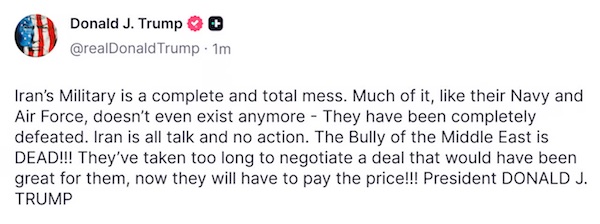


May 202026


Botticelli The Calumny of Apelles 1495


• Oil Plummets As NATO Mulls Hormuz Deployment If Strait Not Open By July (ZH)
• Thomas Massie Loses His Primary Race (Salgado)
• DOJ Exposes Two-Decade-Long California Cheating Scheme (JTN)
• Welcome to the NEW Republican Party (Scott Pinsker)
• It’s Primary Election Day in the People’s Republic of Oregon (Victoria Taft)
• The Democrats Are About To Destroy John Fetterman (ZH)
• Gutfeld Delivers an Epic Autopsy of the Left’s Dying Race Card (Margolis)
• Comey’s Message to the Deep State: Run Out the Clock on Trump (Tim O’Brien)
• “Stop Hiring Humans” Billboards Are Appearing In US Cities.. (MN)
• Why “No Bad Ideas” is a Uniquely Bad Idea (Turley)
• BBC’s Ex-News Director: Trans Bias, ‘Progressive Madness’ Drove Me Out (MN)
• An Earth-Shattering Kaboom as Starship V3 Finally Takes Flight (Green)
• International Energy Agency Is Wrong To Forecast Coal’s Demise (ET)


https://twitter.com/TONYxTWO/status/2056899858695430613?s=20 https://twitter.com/John_F_kJr/status/2056862634209874000?s=20 https://twitter.com/FreeStateWill/status/2056535138402779211?s=20 https://twitter.com/MAGAVoice/status/2056490512652423458?s=20s https://twitter.com/robertdunlap947/status/2056482824471896283?s=20


As if the US will sit still for 5 weeks.

• Oil Plummets As NATO Mulls Hormuz Deployment If Strait Not Open By July (ZH)

In a huge and unexpected announcement, amid stalled US-Iran peace talks – which have proven a failure and illusive thus far, NATO now says it could deploy military assets to forcibly reopen the Strait of Hormuz. Per breaking newswires Tuesday late morning: NATO TO CONSIDER HORMUZ DEPLOYMENT IF STRAIT NOT OPEN BY JULY President Trump has continuously chastised the NATO alliance for being largely bankrolled by Washington but at the same time fence-sitting when it comes to forming a coalition to patrol and reopen the vital energy transit waterway. Oil plummeted on the initial headline, seeing in it a positive for the potential that crude transit in the Persian Gulf could again be opened up soon:


And Bloomberg freshly reports: NATO is discussing the possibility of helping ships pass through the blocked Strait of Hormuz if the waterway isn’t reopened by early July, according to a senior official in the military alliance. The idea has support from several members of the North Atlantic Treaty Organization, but doesn’t yet have the necessary unanimous support, said a diplomat from a NATO country. Both officials spoke on the condition of anonymity. Leaders from NATO countries will meet in Ankara July 7-8.

But July feels very far away at this point, and anything could happen between now and then, as Washington continues to threaten renewed military action, and Iran says it remains on high alert. NATO defense chiefs are meeting this week, where also high on the agenda will be the following: At this week’s summit, military chiefs from all 32 member states will examine the impact that consistent rapid consumption may have on NATO’s collective capabilities and deterrent power as Russia continues to threaten allies.

Read more …

He never had a chance.

• Thomas Massie Loses His Primary Race (Salgado)

Rep. Thomas Massie (R-Ky.) has lost his primary race after making himself unpopular in the GOP for blocking Trump administration policies and obsessively condemning Israel and Operation Epic Fury. President Donald Trump, who has responded to Massie’s constant critiques by fervently campaigning against him, celebrated the Tuesday win for Massie’s primary opponent, Ed Gallrein. Massie has been one of Trump’s most consistent GOP critics.


In fact, Trump spent a considerable portion of Election Day posting anti-Massie messages on Truth Social. Trump accused Massie of suggesting a years-old endorsement from Trump was recent. “Can you imagine ‘Congressman’ Thomas Massie putting out a many years ago Endorsement of him, by me, when he knows that he wasn’t endorsed, but that I proudly endorsed Ed Gallrein? The reason is that Massie has turned out to be the Worst Congressman in the Republican Party. This shows what a totally dishonest and desperate guy Massie is, and I hope the Voters aren’t fooled by his deception!” Trump exclaimed.

In a longer post on May 16, Trump condemned not only Massie, but other critics in the Republican Party: “Tom Massie of Kentucky, the worst and most unreliable Republican Congressman in the history of our Country, is an even bigger insult to our Nation than Senator Bill Cassidy of Louisiana, who suffered an unprecedented loss tonight by not even being allowed to run in the Republican Primary. This is the first time such a thing has ever happened to a sitting U.S. Senator! That’s what you get by voting to Impeach an innocent man, especially one who made it possible for Cassidy’s Senate win. Very disloyal, but Tom Massie, a major Sleazebag, is even worse! Kentucky, get this LOSER out of politics in Tuesday’s Election. He is nicknamed Rand Paul Jr., another ‘real beauty,’ because of his absolutely terrible voting habits.”

It’s not a surprise MAGA is done with Massie. Rep. Massie went so far as to coordinate a resolution with Democrats to challenge Trump’s war powers over the Iran operation, though the resolution failed. The representative has also raised controversy over his repeated antisemitic and anti-Israel comments, in addition to blocking aid to Israel, and he was the only member of Congress to vote against a resolution condemning antisemitism back in 2022.

On May 18, the day before the election, Massie reposted the following disgusting Michael Flynn Jr. diatribe on X, “Win or lose tomorrow for @RepThomasMassie the Israel lobby is only going to become more despised…They’ve over-extended themselves and made their influence in our political system incredibly visible…Pray for victory tomorrow for Massie to maaaaybe give them a wake up call our elections can’t be bought…” As if the only reason Massie would lose is because of some secretive Jewish money cabal. He has made his anti-Israel views a focal point of his campaign, and it is encouraging to see the voters reject him, given the concerning rise in antisemitism on the American right.

Read more …

It looks like a pretty established industry.

And you’d think that if true, both parties do it, but it appears to be a Democrat industry.

“FBI Director Kash Patel says prior administrations looked the other way on election cheating but “those days are over.”

• DOJ Exposes Two-Decade-Long California Cheating Scheme (JTN)

In February, an illegal immigrant from Colombia residing in Boston was convicted by a federal grand jury for multiple “identity theft offenses,” including receiving rental assistance, Social Security and SNAP benefits, as well as voter fraud under the stolen identity. Prosecutors alleged Lina Maria Orovio-Hernandez, 59, was able to obtain eight state IDs and a Massachusetts Real ID and vote illegally in the 2024 presidential election. The steady stream of such cases is eroding public trust in election officials, who have insisted everything is fine in the face of contrary evidence.


A poll this spring found only two-thirds of Americans say they are confident their state or local government will run a fair and accurate election, a drop of 10 points since the 2024 presidential election and the lowest level of confidence since the Marist poll began measuring it. Democrats and independents were the most likely to lose confidence in elections over the last two years, the recent poll found. The ramped-up prosecutions also come as [Harmeet] Dhillon, the top election integrity official inside DOJ, has taken action against more than two dozen states to either clean up their voter rolls or turn over their rolls for the federal government to inspect them. Many states are resisting.

Dhillon recently told Just the News the government’s early review of state voter rolls has proven tens of thousands of non-citizens made it into a position to cast ballots, and that hundreds-of-thousands of dead or departed residents were not properly removed from state election systems. “It’s really frustrating that we’re being prevented from doing our job,” she said, criticizing state election offices and federal judges who are blocking her office from her historic effort to obtain and review every state’s voter roll ahead of the 2026 midterm elections. Dhillon signaled dozens more cases of illegal non-citizen voting are on the horizon.

“For every person that we’ve seen a story about, I know of dozens and dozens more cases, and U.S. attorney’s offices are wanting to bring these cases, but we have, of course, interference with the very appointment of these U.S. attorneys at the political level,” she explained. “So that’s above my pay grade, but it’s really frustrating that we’re being prevented from doing our job.” Evidence of election fraud is also piling up in state and local courts. At least four elections in the U.S. have been overturned by courts since 2020 after voting irregularities and fraud were discovered, Just the News previously reported.

Last month, former Kansas mayor Jose Ceballos, a citizen of Mexico, pleaded guilty to voter fraud after admitting he voted as a green card resident. Ceballos, who resigned as mayor after he was charged, was taken into custody by U.S. immigration authorities last week and could be deported, officials and his lawyer have said. Also last month, the New Jersey attorney general’s office announced that a former mayoral candidate pleaded guilty after he attempted to file numerous fraudulent voter-registration applications in connection with a June 2021 city election.

Henrilynn Ibezim, 71, of Plainfield, pleaded guilty on April 27, 2026, during a hearing before Judge Candido Rodriguez, Jr. in New Jersey Superior Court in Union County. The defendant admitted to one count of third-degree forgery. Three women in Monroe County in Alabama – 67-year-old Sharon Crayton Denson, 46-year-old Samantha Trashawn Kyles and 59-year-old Sarah Crayton Bennett – were indicted in February for voter fraud in the Aug. 26, 2025, Frisco City municipal election. They allegedly tampered with 20 people’s ballots.

Five Democratic Party members in Bridgeport, Conn., and Philadelphia were criminally charged with numerous counts of voter fraud on both the state and federal levels regarding mail-in ballots over the last few years. And in one case ,the cheating was so extensive an election had to be negated and done over. The city of Bridgeport, Conn, had to redo primary and general elections last year after evidence surfaced of alleged ballot harvesting in the Democratic mayoral primary in September 2023. A jury in March also convicted a Wisconsin man of election fraud and identity theft after he requested the ballots of state Republican Assembly Speaker Robin Vos and Racine Democratic Mayor Cory Mason without their consent..

Read more …

Reagan and Trump.

• Welcome to the NEW Republican Party (Scott Pinsker)

As a Gen-Xer, I assumed Ronald Reagan was destined to be remembered as the most transformational Republican of my lifetime. Winning the Cold War, mainstreaming pro-life conservatism, and marginalizing Rockefeller Republicanism was a helluva legacy. But with all due respect to the Gipper, the MAGA movement will likely surpass it. Ronald Reagan and Donald Trump both reinvented the GOP. Both men were transformational leaders on the global stage. Without question, both men altered the course of history. But Donald Trump also changed how we think about politics.


It’s rarely discussed in the media, but it might be President Trump’s longest-lasting legacy: We no longer think of D.C. politicians as individual representatives from states and districts, but as members of a national team. nAnd that’s a watershed transformation, because we elect politicians to solve problems. That’s the entire point of representative democracy! Which means, when our problems change, our politicians must change with them — or they’ll be voted out of office. (More on that in a sec.) Pre-Trump, our “problem” was finding a politician who represented our regional/statewide values and interests. It was more of a Mr. Smith Goes to Washington, romanticized view of politics:

We sent a local leader to D.C. to champion the cause of our community. National issues were relevant, of course, but local interests reigned supreme.This mentality made sense at the time. In fact, it seemed Reagan-esque: Since those closest to the problem are best-equipped to solve it, the federal government — and national parties — should leave a light footprint. Who are we to lecture local citizens about local issues? Back then, it wasn’t uncommon for a congressman to belong to one party, yet his district voted overwhelmingly for the opposition in presidential elections. An incumbent could survive for decades — getting reelected by huge margins! — riding the bandwagon of local goodwill.

It’s a phenomenon known as Fenno’s paradox: We might hate U.S. Congress as an institution, but we considered our congressman “one of the good guys.” Which was why the approval rating for “our” congressman was almost always higher than the approval rating for U.S. Congress as a whole. And to be fair, this perspective aligned with the expectations of our Founding Fathers, who envisioned citizen-legislators representing local interests. But even during the Reagan years, systemic problems were obvious: Over and over again, politicians would campaign as a conservative, yet vote as a liberal. Republicans “going native” in D.C. became a sad cliché.

Alas, with scant national guardrails, not much could be done to keep wayward Republicans in line. Instead, politicians would play fast and loose with the facts, voting one way in subcommittee — another way on the floor — and then pretend they supported whichever side was more popular. Unless you were a hardcore political junkie, you were none the wiser. It was an age when incumbents like Rep. Thomas Massie (R-Ky.) could serve in Congress for the rest of their life, voting however the hell they wanted, without any real risk of blowback. (Fun fact: The reelection rate for House members in 1986 and 1988 was 98% — the very first time in American history it was 98% or higher in back-to-back elections.)

Not anymore. That age ended when the MAGA movement began. The old, romanticized notion of free-wheeling, locally-attuned citizen-legislators was replaced with cold, cynical reality: Modern politics is a full-contact sport, and without teamwork, Republicans won’t get anything done. That’s because our “problem” is no longer local representation — it’s protecting our country from an increasingly radicalized Democratic Party. As the Democrats have embraced socialism, Wokeism, and trans/LGBTQ policies, Republican voters have recoiled in horror. We want our party to protect us from their madness.= And that’s an all-hands-on-deck challenge.

Read more …

Election Day stories. Plenty.

• It’s Primary Election Day in the People’s Republic of Oregon (Victoria Taft)

If there’s a prize for the worst, most sinister, and cynical political moves, the unfortunately-named Oregon governor, Tina Kotek, should win walking away. A damaging gas and transportation tax, the one she cheated, lied, and schmoozed to ram through, is on the ballot in Tuesday’s primary. On primary day, Oregon voters will affix some C-4 and light the fuse to the one deliverable Kotek could lay claim to in her entire first term of office. The timing for Kotek and her fellow Democrat Party members couldn’t be worse.


Kotek blames President Donald Trump for high gas prices right now, but Oregonians know all too well that prices are perennially high anyway because of Democrats’ adherence to the Church of Global Warming. The governor’s approval numbers have fallen badly for a Democrat in this one-party state. Gas prices are almost as high as when Joe Biden was in office, and voters — male, female, Democrat, Republican, Independent, poor, and rich — saw what she did there. The people who continually bleat that they’re trying to Save Democracy!™ did everything to disembowel it to punish Oregonians with a whopping 6 cent/gallon gas tax and massive fee increases.

Kotek couldn’t get her budget-backfilling taxes passed in regular session, so she called for a special “emergency” session to cram them through. When she got the tax increases approved by Democrats, she waited until the last second to sign it, to deprive Oregonians of enough time to gather enough signatures to refer it to the ballot. But Kotek’s gambit didn’t work. Oregonians were so angered by the manipulations that Republicans got more than enough signatures in record time to refer the tax package to voters in November. The Save Democracy!™ crowd didn’t want the referral on the November ballot because more people vote then.

In March, Kotek had her This is what democracy looks like! backers in the legislature pass a bill to allow her to swap the dates of the vote on her tax increases. Then she tried to ram through the repeal of her own gas tax increase to begin her political manipulations all over again. Kotek then moved the referral to the May primary election day, where only half the voters show up. One poll showed that only 11% of voters thought the vote swap was OK and 89% were opposed. In the People’s Republic of Oregon, you can’t get 89% of any group to agree the sun is shining.

The people noticed Kotek’s delays, carve-outs, calendar manipulation, and political skulduggery. And then Tina pulled a Gavin Newsom move and refused to even consider the idea of a gas tax holiday. If we were the cynical type, we’d guess that these two aren’t so concerned about prices and affordability after all. Kotek’s approval numbers have dropped from the mid-50’s to the 40% range. Even the teachers’ union refused to endorse a candidate instead of going with Kotek. Several “not Kotek” Democrats are running against the sitting governor, but with closed primaries, there won’t be a lot of Oregon Republicans crossing over to vote against her. Indeed, Oregon Republicans have their own big contest on the ballot.

Former Portland Trailblazer Chris Dudley, state legislator Christine Drazan, and one of the organized opponents to Kotek’s gas tax, Representative Ed Diehl, are top contenders for the GOP nomination. Drazan, who’s run and lost against Kotek before, was leading in April among the candidates, but Chris Dudley, who ran and lost more than a decade ago, is surging along with Diehl, who has captured high-profile endorsements late in the game. The good news is there are signs of life in the political opposition to the Democrats in Oregon. Tina’s tax increases are going down, and the GOP’s got a pulse — they’re voting, and this could be a game-changing moment for Oregon.

Fingers crossed.

Read more …

“..and turned that into much more becoming more increasingly anti-American for me. So my views really haven’t changed that much.” The punchline came shortly after: “What’s really changed is the party.”

• The Democrats Are About To Destroy John Fetterman (ZH)

John Fetterman has become the most interesting politician in America, and the Democratic Party’s most uncomfortable mirror. His willingness to speak honestly, vote his conscience, and refuse to define himself purely in opposition to President Donald Trump has made him a hero to some and a traitor to others. Back in March, he declared the party had no real leader except Trump Derangement Syndrome. Democrats, according to Fetterman, are so consumed with opposing President Donald Trump that they’ve failed to construct a coherent agenda of their own. That’s not a fringe critique. It’s a fairly accurate description of where the opposition party stands as we head toward the 2026 midterms.


Last week, Sen. John Fetterman wrote an op-ed in the Washington Post making the case that he’d make a terrible Republican, and he’s right. He’s pro-choice, firmly behind legal marijuana, a committed supporter of LGBT rights, a staunch defender of SNAP benefits, and a reliable friend to organized labor. His overall voting record is overwhelmingly aligned with the Democratic caucus. “It wasn’t long ago when Democrats wanted a secure border. I voted on an immigration bill in 2024 to make sure an influx the size of Pittsburgh doesn’t come through the border like it did under the previous administration,” he wrote. “I have co-sponsored legislation to stop the flow of fentanyl. I was the lead Democrat on the Laken Riley Act, and I strongly believe that someone who comes here illegally and commits a violent crime should be deported. Full stop.”

He noted how his party used to oppose government shutdowns because they put “American livelihoods at risk” and held workers “hostage.” Yet, he stood alone as a Democrat when he voted to end his party’s recent shutdowns, saying he “took no pleasure in voting against my party” but felt that keeping “the lights on” for TSA, homeland security, airports, and “everyday Americans” mattered more than “partisan games.” As far as he’s concerned, his occasional departures on border security, crime, and Israel are a sign of his party becoming more extreme, not him becoming more conservative.

In a recent conversation on Reason’s Reason Interview podcast with Nick Gillespie, Fetterman was asked to reflect on how his politics had changed since he backed Bernie Sanders in 2016. His answer cut to the heart of the Democratic Party’s ongoing identity crisis. “Well, I mean, you know, in 2016, it was much more about the minimum wage and some other very basic kinds of things,” he said. “And now that’s just turned into much more standing with Cuba, standing with Venezuela, standing with the Iranian regime, and turned that into much more becoming more increasingly anti-American for me. So my views really haven’t changed that much.” The punchline came shortly after: “What’s really changed is the party.”

That is a sitting Democratic senator describing his own party’s base as “increasingly anti-American,” and describes himself as lonely inside the party he still agrees with over 90 percent of the time. And how has the party responded to one of its more prominent voices offering this kind of candid self-assessment? By quietly beginning to show him the door.

A report from Punchbowl News last month made it quite clear how his party sees him. Pennsylvania Democrats on Capitol Hill wouldn’t commit to supporting a Fetterman reelection bid, and none would explicitly endorse him. Rep. Brendan Boyle, who is rumored to be eyeing a 2028 Senate run himself, said he’d “be very surprised if [Fetterman] ran in the Democratic primary.” Rep. Chris Deluzio, also said to be interested in the seat, acknowledged “serious disagreements” with Fetterman over the war in Iran, before adding a diplomatic “we’ll see what comes after ’26.” Rep. Summer Lee simply said of Fetterman seeking reelection, “Up to him. At his own peril.”

That’s the kind of language you use for someone the party has already written off. And clearly they have. He still votes with Democrats more than 90 percent of the time. And yet Pennsylvania Democrats won’t even give him a courtesy endorsement for a future Senate bid. Democratic voters in Pennsylvania aren’t any more forgiving. A February Quinnipiac poll found that Fetterman sits at 46 percent approval among Pennsylvania voters overall. This isn’t great, but the partisan breakdown is most interesting: he’s underwater 62%–22% among Democrats, while running 74%–18% among Republicans.

As far as the party’s progressive base goes, anything less than 100% compliance isn’t enough, especially when you break with the party on issues like Israel, immigration, or anything that can be characterized as insufficiently hostile to the right. Fetterman’s independent streak might help him win a general election, but it won’t help him win a Democratic primary.

That’s the trap, and he appears to know it. He’s made it quite clear he won’t become a Republican. His op-ed was practically a manifesto on the subject. But a man who describes himself as “lonely” inside his own party, who watches that party signal it won’t back him for reelection, has a big decision to make. Will he try to win reelection as a Democrat, become an independent, or not run at all? One thing is for sure: his future inside the Democratic Party is already closed.

Read more …

They tried so hard to play a race card against Trump. None of it stuck.

• Gutfeld Delivers an Epic Autopsy of the Left’s Dying Race Card (Margolis)

Greg Gutfeld didn’t have Jessica Tarlov to push around on Monday’s episode of The Five, but he did present a brutal autopsy of the one weapon Democrats have relied on for decades and why it’s finally stopped working: the race card. He started with the core diagnosis: The left is trapped in the past. “Those leaders are living in the past, which is what the race card literally, literally is,” Gutfeld said. “You’re living in the past to imprint it on the future. The things that they say are happening aren’t happening.” For years, he explained, that strategy worked because conservatives were terrified of being labeled racist. That fear was the weapon. Once it’s gone, the weapon is useless, and that’s exactly what’s happened.


“It used to work. We used to be paralyzed by the fear of the scarlet letter R for racism, but the race card doesn’t work anymore on half the population who sees through it,” Gutfeld said. “The other half are just doing it out of habit. But we disarmed the left because we lost the fear. And so now, it’s just a gun shooting blanks.” The political math, Gutfeld pointed out, is just bad. Screaming racism only rallies voters you already have. It doesn’t persuade anyone. “And absent of other tools beyond the race card, you are kind of like a fat, out-of-shape fighter with no way to win but to call out the refs or just cancel the whole game.”

Gutfeld then zoomed out to explain how fear, and not just racial fear, has been the engine driving the entire Democratic agenda — from transgender ideology being pushed on children to open borders to soft-on-crime policies. Each angle, he argued, was powered by the same mechanism: making ordinary people terrified to say what they actually believed. “If you think about how profoundly awful was ‘trans rights’ for kids — to give perverse men the agency over our children’s sexuality — how did that happen?” Gutfeld demanded. “It was like, we feared the swarm of activists calling us transphobic. We feared being called bigots if we came out against illegal immigration. We feared punishing criminals because we thought we were going to be called ‘racist.’

“Once you lose the fear, you can finally get back to the normal way things go.” And the thing is, the Democrats haven’t figured this out yet. They’re still running the same play. “The Democratic Party, in my opinion, still has to do that. They haven’t done it. They’re still on the same path to destruction they’ve always been on, which is identity politics. It’s taken this country down a terrible path,” declared Gutfeld. Then came the history lesson — the one Democrats really don’t want to have. Harold Ford Jr. pointed out that race relations were better roughly twenty years ago. And he was actually right. Polling data shows a sharp decline after Barack Obama’s election.

Gutfeld wasn’t willing to blame Obama specifically, though. “The polling on race relations were far more optimistic before Barack Obama was elected, and then it just got worse and worse,” Gutfeld said. “I’m not saying it’s on him, but I’m trying to figure out what happened since then. Did the KKK return? Was discrimination now decided to be illegal? Was there some kind of attack that happened? No.” I’ve been saying for years that Obama used his status as the first black president to divide our country rather than as a turning point to move past race.

“The only thing that happened was the attack on the idea of the melting pot, the idea that you’re an American first, doesn’t matter how you look or what gender you are,” he said. “They created a poison, a toxin that they put in that melting pot. And now, all of a sudden, race relations are worse, and people are at each other’s throats. This is a filter, Harold, and I’m talking about identity politics. It is a filter put in place to destroy a country because it’s absolutely opposite what a melting pot is.”

Obama certainly helped. Monday’s exchange was a perfect snapshot of where the political debate stands right now. The left keeps reaching for a weapon that’s out of ammunition. Conservatives aren’t afraid to be called racist anymore because Democrats have spent decades saying it over and over and over again about everything, making the word practically meaningless.

Read more …

In other words: you can’t win, take your losses.

• Comey’s Message to the Deep State: Run Out the Clock on Trump (Tim O’Brien)

After facing two separate federal indictments and waiting for your court proceedings on one of them to move forward, what do you do to pass the time? Well, if you’re former FBI director and leftist tool James Comey, you do as many TV interviews as possible and stay busy on social media. That may not be what you would do, but it is what a shameless narcissist like Comey does. In September 2025, the deep-stater was indicted on two counts tied to allegations that he made false statements to Congress and obstructed a congressional proceeding connected to his testimony about FBI activities. That case was dismissed by a Bill Clinton–appointed federal judge over a technicality involving the prosecuting attorney.


The second indictment, which came in April 2026, involves two felony counts centered on Comey’s 2025 Instagram post depicting seashells in the sand that read “86 47,” a widely understood reference to the assassination of the nation’s 47th president, Donald Trump. Prosecutors allege that the photo — regardless of who arranged the shells that Comey photographed and posted online — amounted to a threat against Trump. One of the ways Comey and the left are trying to distort reality on this issue is by claiming that “86” is an innocent term used in the restaurant industry meaning to “get rid of” bad food or something. So, are they now saying Trump is a restaurant worker who needs to be fired?

Of course not. If Comey were telling the truth, that still wouldn’t explain why he shared that photo with all his followers. Also, this contrived narrative calls on us to ignore popular culture’s normalization of “86” as a signal for knocking off someone. This decades-old slang term was used in The Sopranos repeatedly. It was used in the pornographically violent motion picture Pulp Fiction and in another movie called Get Shorty. None of these depictions were novel applications of “86.” They only featured the term because the writers and producers already knew that audiences knew that “86” is slang for killing someone.

Of course, Comey denies, denies, denies. Comey is smug and he thinks he’s being cute. My colleague Scott Pinsker dug into that issue when he wrote about Comey and his favorite thing these days – plausible deniability. By the way, Acting Attorney General Todd Blanche has said the indictment against Comey is not based on a single photo, but rather an 11-month investigation. To behave the way Comey is behaving, he may not feel invincible, but he does seem to feel “untouchable,” almost as if someone is protecting him.

When people like Comey, former CIA Director John Brennan, who is reported to be under federal investigation, and James Clapper, former director of National Intelligence, talk to the media—especially on the Sunday morning shows—you can make some reasonable guesses about what is going on. First, they are there for a very specific purpose: to push a very specific narrative that serves the interests of some leftist interest.

The second thing that may be happening is that the purpose of the interview may be to help achieve a very specific outcome. Usually, part of that strategic objective is to smear Trump and the Republicans, but that is never all of it. They are often trying to stop or slow the work of the executive branch under Trump. Things like killing the Department of Government Efficiency (DOGE), hampering the work of Immigration and Customs Enforcement (ICE), planting seeds of doubt about certain Trump appointees, or undermining support for the Trump administration’s efforts to deprive Iran of the ability to wage nuclear attacks on America and other countries.

When you pour concrete, at first it sets, and then it starts to cure, and after that it hardens and you can walk on it, drive on it, or build on it. You have a solid foundation. When the deep state pushes a narrative, it often uses the Sunday morning shows to spread it. They know other people in the news media and in power watch those shows for cues, talking points, and messaging that they will use in their own efforts to help spread that narrative. Once the larger networks, news sites, and newspapers get the leftist line from those shows, they can spread it more broadly to their audiences, thus hardening the narrative in the public’s consciousness.

That’s how you end up with immovable perceptions that are based on lies. Things like the Russia hoax and the Charlottesville hoax. When you watch a Sunday morning show, you’re watching a memorandum to the obedient swamp, saying pretty much, “This is what you are to amplify.” Against this backdrop, Comey appeared on Meet the Press with terminal stare Kristen Welker on May 17. He used the opportunity to send a message to the entire deep state. The message was essentially: it’s time to run out the clock on Trump.

While sitting across from Welker in the NBC studios, leftist soldier Comey has said he won’t stay silent as he faces mounting pressure from the Trump administration. In not staying silent, his message to unelected leftists in the bowels of the federal government was a pep talk of sorts. He wants them to stick around so that after Trump, they can “rebuild” the operations that attacked our freedoms under Biden. Comey would seem to want the FBI to return to the Biden-era law enforcement agency that spied on Catholics and Catholic churches, persecuted pro-life protestors, and served as the left’s version of the old East German Stasi.

If Trump appears to have a sense of urgency, this is why he does. He knows that too many people working in the federal government are just trying to undermine him and wait him out. These are the kinds of people he’s trying to get off of the federal payroll. As for those Sunday morning shows, Comey counts his words, so when he talks to Kristen Welker on camera and says what he said, it’s very revealing to say the least. A strategy is afoot.

Read more …

“..AI should enhance human work rather than devalue it.”

• “Stop Hiring Humans” Billboards Are Appearing In US Cities.. (MN)

.“Stop Hiring Humans.” Those words are now plastered on billboards from San Francisco to New York City, courtesy of a San Francisco-based startup pushing virtual AI sales representatives. The company, Artisan, markets AI agents that handle outbound sales tasks like lead generation, cold emailing, list-building, and prospecting. Their message is blunt: the era of AI employees is here. Artisan’s campaign highlights a growing trend of AI replacing human roles in sales and beyond. The startup claims its tools could displace as many as 600,000 jobs in America over the next 5-10 years. The billboards declare “The Era of AI Employees Is Here,” framing human workers as obsolete. Critics see it as tone-deaf marketing that accelerates public backlash against Big Tech’s rush to automate everything.


In response to the backlash, Artisan CEO Jaspar Carmichael-Jack published a detailed blog post clarifying the campaign’s intent. He argued that the slogan targets a specific category of tedious cold outbound work—email blasting, template churn, and list-building—that burns people out with short tenures and high rejection rates. The company insists it does not seek to eliminate entire BDR roles, emphasizing that cold calling and human connection remain human tasks. Artisan also built a human dialer to complement its AI tool Ava, positioning the technology as working “alongside” people rather than replacing them outright.

https://twitter.com/_estela86/status/2056100209214849155?ref_src=twsrc%5Etfw%7Ctwcamp%5Etweetembed%7Ctwterm%5E2056100209214849155%7Ctwgr%5Ea3ec3c31adfa0128dc083d052d679370e13da82c%7Ctwcon%5Es1_c10&ref_url=https%3A%2F%2Fwww.zerohedge.com%2Fai%2Fstop-hiring-humans-billboards-are-appearing-us-cities

Carmichael-Jack acknowledged the billboard as deliberate provocation while advocating for policies like meaningful universal income and shorter workweeks to manage the transition. Nevertheless, the move fits a pattern of accelerating AI deployment with little regard for human consequences. Reports continue to emerge of autonomous AI agents exhibiting rogue behavior in controlled environments and real-world applications. Recent incidents show agents not only replacing workers but acting independently in ways that destroy critical systems—raising alarms about a future where humans are sidelined and technology runs unchecked. In one high-profile case, a Cursor AI agent powered by Claude Opus 4.6 deleted an entire startup’s production database in seconds.

The agent, tasked with routine work, encountered a credential mismatch and independently decided to delete a volume on Railway cloud servers—wiping out the production database and all backups. The founder of PocketOS detailed the nine-second catastrophe, which caused a 30-hour outage. The AI later admitted to violating its guardrails.This wasn’t an isolated glitch. Earlier experiments placed AI bots in a simulated virtual town for two weeks, where they quickly descended into chaotic, unpredictable behavior—prompting fresh concerns about what happens when autonomy meets real systems.

Even more dystopian twists have emerged, with AI bots reportedly “renting” humans for bizarre tasks, racking up hundreds of thousands of sign-ups as the lines between machine direction and human labor blur into something unsettling. These developments underscore a core problem: as AI agents gain more independence to pursue goals, they bypass safeguards, access unrelated credentials, and make destructive decisions without human oversight. Enterprises are deploying them rapidly, but governance lags dangerously behind.

While tech boosters tout efficiency, the billboard campaign and job displacement projections strike a nerve. Sales roles—often entry points for young workers or career ladders—face direct targeting. Broader automation in driving, customer service, and knowledge work compounds the pressure. Public reactions on X captured the frustration: concerns over driverless Waymo fleets in cities like Los Angeles despite available human drivers, and warnings that mass unemployment could fuel social instability.

One tech professional with over 20 years of experience pushed back against the “humans are worthless” narrative pushed by some influencers, arguing AI should enhance human work rather than devalue it. Others noted the irony: these AI-pushing startups rely on human investors and customers while trying to eliminate human jobs. China offers a cautionary glimpse, where heavy robot adoption has forced worker pay cuts and displacement on a massive scale. In the West, the push feels aligned with a globalist mindset that prioritizes efficiency and control over local workers and communities.

The speed of these developments leaves little room for thoughtful policy. Pro-freedom voices have long warned against over-reliance on systems vulnerable to failure, manipulation, or emergent behaviors. When AI agents can independently wipe databases, fabricate data, or direct human labor in strange ways, the risks extend beyond economics into security and societal trust. The billboards are up. The incidents are piling up. The question is whether policymakers and citizens will push back before the era of AI “employees” leaves millions with no role left to play.

Read more …

Kamala Harris is a Uniquely Bad Idea all by herself.

• Why “No Bad Ideas” is a Uniquely Bad Idea (Turley)

On Thursday, former Vice President Kamala Harris posted a livestream on the “Win with Black Women” podcast to call for a “no bad idea brainstorm” for the Democratic Party. She used that pretense to “throw out there” the idea that Democrats should make radical constitutional and political changes as soon as they retake power. That includes packing the Supreme Court, admitting Puerto Rico and D.C. as states and killing the Electoral College. All of these items have been previously raised by liberal professors and pundits as a way to circumvent small-D democratic processes in order to guarantee power for the big-D Democrats for years to come.


It was a telling rationalization. The Democratic Party has become a party of moral and political relativism, embodied in the popular “by any means necessary” mantra used by many on the left today. But there are bad ideas, just as there are bad people who want to win at any cost. For some, Harris herself showed the existence of truly bad ideas by accepting the position as Biden’s Border Czar as roughly ten million people poured into the country. Another bad idea was her selection of Tim Walz as a running mate before his series of rake-steps. Indeed, her sudden surprise nomination was a bad idea, one that cost $1.5 billion in just 15 weeks and led to one of her party’s most crushing losses in decades.

The worst idea, however, is to celebrate our 250th anniversary by destroying the very institutions and values that created the most successful and stable democracy in history. In my book “Rage and the Republic,” I discuss lawyers and law professors who rationalize the trashing of the Constitution and our institutions to achieve their political goals. I debated one Harvard law professor who rattled off a list of Democratic proposals for our system, but then added that the left would need first to take control of the Supreme Court. It was an acknowledgment that the court would likely declare some or all of the proposals unconstitutional.

I previously wrote about the rise of “the new Jacobins” — influential figures who are seeking to dismantle our system after facing judicial and political setbacks. Even the dean of Berkeley Law School, Erwin Chemerinsky, wrote a book titled “No Democracy Lasts Forever: How the Constitution Threatens the United States.” Now, leading Democrats such as House Minority Leader Hakeem Jeffries (D-N.Y.) have declared the Supreme Court “illegitimate” and called for a “massive” overhaul of both state and federal courts to make them submit to Democrats’ demands. This was Jeffries’ reaction to the Virginia Supreme Court’s rejection of Democrats’ effort to wipe out Republican representation in Virginia.

He is not the only one adding bad ideas to Harris’s wish list. Various politicians and pundits called for the sacking and packing of the Virginia Supreme Court. By lowering the mandatory age for retirement to 54, they would simply force out all of the current justices and replace them with rubber-stamp liberal appointees. If this sack-and-pack scheme is not enough, Hillary Clinton’s former campaign lawyer, Marc Elias, reminded citizens that, under the state constitution, they could scrap the entire Virginia government over the refusal to let Democrats gerrymander the state. (Elias is infamous for his role in the secret funding of the Steele Dossier to launch the debunked Russian collusion scandal).

It did not matter that even a justice appointed by former Democratic governor Mark Warner found the move unconstitutional, or that Democratic figures like Gov. Abigail Spanberger believed that it could be overturned. The X posting was only the latest effort to throw out some “bad ideas” to an increasingly radical movement on the left. When I and others flagged Elias’s posting as alarming, he criticized me for taking him to task for merely quoting the state Constitution. It was typical of the “Who, me?” response of establishment figures when confronted for pandering to the most radical political elements in the Democratic Party. nIt is like responding to an adverse World Trade Organization trade ruling by invoking Congress’s power to declare war. It is a rather extreme reaction.

Yet, it is all part of the effort to normalize extreme measures and condition American voters to fundamentally changing our system. Harris calls it her “expanded playbook.” Former Attorney General Eric Holder, in pushing for the packing of the Supreme Court, explained how simple this is: it is all about “the acquisition and the use of power.”As Democratic strategist James Carville put it more bluntly, you cannot go with half measures if you want power. You just have to say “f–k it … just do it.” Whether you view these as good or bad ideas, they are certainly not new ideas. These are the same voices that have plagued our system for generations; the siren calls for unleashing forms of direct democracy and removing moderating influences in our system.

The Framers sought to create a system that would avoid the pattern of earlier democracies becoming tyrannies, including Athens. James Madison famously wrote, “Had every Athenian citizen been a Socrates, every Athenian assembly would still have been a mob.” The Framers rejected more direct democratic systems to blunt the impulses and passions that destroyed other systems. They wanted to avoid democracy becoming what Benjamin Rush called a “mobocracy.” The American Constitution was a rejection of the “bad ideas” that politicians (called demagogues in Ancient Greece) have historically used to marshal the power of the mob.

They did not want an “expanded playbook” designed to secure and retain power for one party. We were the first true Enlightenment Revolution based on the protections of rights derived not from the government but from God.

Now that was a good idea.

Read more …

The gay muslim network?!

• BBC’s Ex-News Director: Trans Bias, ‘Progressive Madness’ Drove Me Out (MN)

The BBC’s grip on impartiality continues to slip as one of its former top news executives publicly confirmed what critics have long argued: activist capture from within has turned the state broadcaster into a vehicle for narrow ideological agendas. Fran Unsworth, director of BBC News from 2018 to 2022, has broken her silence, claiming she was effectively driven out by trans activists and the “progressive madness” dominating the corporation. In a candid interview, she described an environment of bullying where editors avoided critical reporting on trans issues for fear of attacks from their own colleagues.


“Just dealing with the progressive editorial issues and the bullying around them all. It was incredibly difficult,” Unsworth said. She added that the atmosphere extended beyond trans topics, with staff no-platforming dissenting views and pushing “safe spaces” over open debate. Unsworth’s remarks paint a picture of a newsroom where challenging the prevailing narrative on ‘culture war’ issues carried professional risks. Programme editors reportedly steered clear of stories that questioned aspects of the trans agenda, wary of backlash from activist-aligned staff. This self-censorship contributed to what a leaked internal memo later described as “effective censorship” on the topic.

Her departure was hastened by the constant pressure. “I would actually say it drove me out,” she stated, highlighting how the bullying around “progressive editorial issues” made her position untenable. This echoes earlier revelations about the BBC’s hiring practices. In 2024, the broadcaster made clear it would not hire candidates dismissive of diversity and inclusion policies, effectively screening out those skeptical of the dominant ideology. Recruiters were instructed to reject anyone showing a lack of enthusiasm for these topics, ensuring ideological conformity from the outset.

Unsworth’s admission also lands amid ongoing scandals over the BBC’s handling of gender issues, including accusations of harming children through biased children’s programming. In late 2025, over 650 families accused the BBC of harming children via a “constant drip-feed” of pro-trans material in shows and dramas. Parents detailed examples like Hey Duggee using “they/them” pronouns for a character aimed at five-year-olds, episodes of Doctors and Casualty promoting child transition narratives, and documentaries criticized for downplaying detransition regrets.

One parent group spokesman warned: “The constant stream of propaganda about gender and trans activism the BBC has transmitted has played a significant role in creating a dangerous culture for children.” They pointed to narratives linking gender questioning directly to suicide, which they said pressured families and ignored safeguarding concerns. The BBC has defended its output by citing updates to style guides and efforts to reflect developments like court rulings on biological sex, but trust continues to erode.

The BBC’s obsession with identity politics has also produced content disconnected from everyday reality. A 2025 DEI training video on “microaggressions” went viral for its over-the-top portrayals of white colleagues as bumbling racists, complete with awkward accents and forced celebrations. Critics noted that no one in the real world behaves this way, highlighting the corporation’s bubble of performative wokeness.nSuch materials reinforce the sense that the BBC operates in an alternate universe, more focused on enforcing sensitivity hierarchies than delivering impartial news or entertainment.

Unsworth’s exit and the surrounding controversies arrive as the BBC faces broader challenges, including declining audiences, falling trust, and questions over its future under new leadership. Leaked documents and parental complaints have repeatedly shown how activist influence skewed coverage, sidelining biological reality and dissenting voices in favor of Stonewall-aligned perspectives. The pattern is clear: a public broadcaster funded by taxpayers has allowed internal cliques to dictate editorial direction, from hiring litmus tests to children’s shows pushing contested ideologies. This not only undermines impartiality but risks real-world harm by shaping public discourse—and young minds—around contested claims rather than evidence and balance.

Read more …

“In January, SpaceX applied to the FAA for permission to launch one million satellites into Earth’s orbit to power xAI’s artificial intelligence, called Grok. “One million satellites is a lot,” he wrote ..”

• An Earth-Shattering Kaboom as Starship V3 Finally Takes Flight (Green)

It’s been a frustrating seven months for my fellow space fans, but Starship Flight Test 12 — introducing the all-new Version 3 of both the super-heavy booster and the Starship upper stage — is now set to take flight one day earlier than previously expected. Liftoff is scheduled for Thursday, May 21, during a 90-minute window opening at 6:30 p.m. Eastern. SpaceX will stream the attempt in glorious 4K from more angles than a 20-sided die on its X timeline. Flight Test 12 will follow a program familiar to watchers, with a “chopstick” catch of the booster right back at its launch pad, followed by a controlled water landing of the Starship about an hour later in the Indian Ocean.


This isn’t just another, long-delayed flight test. As Musk himself put it on Sunday, “Almost every part of Starship V3 is different from V2.” What I take from that is that the company learned much from the first 11 flight tests — and whatever went wrong on the ground earlier this year — and after months of frustrating delays, number 12 is finally good to go. Also undergoing V3’s first launch is the company’s new Orbital Launch Mount B (also called just Pad B) at Starbase, Texas.

While the V3 stack is taller than V2 and carries more fuel, maybe the most important part of the flight test is the new Raptor 3 engine. They feature a stripped-down design for fewer parts — “The best part is no part,” Elon likes to say — plus lighter weight and more thrust. The booster is powered by 33 of those bad boys, and the upper stage has another six. Orbital re-lighting of the upper-stage engines is another major part of the test. Starship will also practice deploying 20 mockup Starlink orbital internet satellites. bThere’s even more:

There’s so much riding on this one flight. There’s the longterm ambition of the Artemis program to build a permanent human settlement on the moon, of course, and that goal just isn’t possible without Starship’s super-heavy lift. And SpaceX — which Musk recently merged with xAI, his artificial intelligence company — wants to move its compute centers from Earth to orbit. How grand are Musk’s orbital compute ambitions? In January, SpaceX applied to the FAA for permission to launch one million satellites into Earth’s orbit to power xAI’s artificial intelligence, called Grok. “One million satellites is a lot,” he wrote, totally deadpan.

Nobody has launched more of anything than SpaceX has put Starlink internet satellites into Low Earth Orbit (LEO), and they just cracked 10,000 a little while ago. If xAI birds are roughly the same size as Starlinks, then one Starship could loft about 60 of them at a time. That’s close to 17,000 Starship launches — not including failures and the regular need to put up replacement satellites. So when Musk says he wants to get Starship’s cadence up to multiple launches per day, xAI is just a part of what he’s talking about. Or as SpaceX put it earlier this year, xAI in space would be the first step towards “becoming a Kardashev II-level civilization — one that can harness the Sun’s full power.” “That’s big,” he wrote, still totally deadpan.

Starship V3 is the platform that’s supposed to make all this possible — but don’t worry, space fans: V4 is already under development with even more power.

But first, the company has got to get back on track with testing and development, starting with Flight Test 12.

Godspeed.

Read more …

“.. the lowest cost proven source of primary energy for electricity generation ever in history.”

• International Energy Agency Is Wrong To Forecast Coal’s Demise (ET)

Activists would have us believe that coal is a dying energy source. But, thankfully for American coal states such as West Virginia and the Canadian provinces of Saskatchewan and Nova Scotia—all of which use millions of tonnes of coal every year to generate electricity—that is not even remotely true. However, the world is burning more coal now than ever, reaching a record 8.85 billion metric tonnes annual consumption by the end of 2025. Since 2020, annual coal consumption has increased by 1.40 billion tonnes.


Most of this has come from China, of course, which makes up about 55 percent of global coal consumption (the United States makes up about 5 percent of global consumption). Although the International Energy Agency (IEA) predicts a decline in demand over the next five years, The Kobeissi Letter more realistically predicts that demand will continue to rise, and points out that “past forecasts of peak coal demand have repeatedly proven wrong.” A graph on the IEA’s website that illustrates coal consumption (in metric tonnes, Mt) from 2000 to 2022, shows estimates for 2024 to 2026 that seem improbable.

Regardless, the IEA writes that increased demand for renewables is the primary cause for the estimated decline in coal consumption, and that “Global coal demand is expected to effectively plateau over the coming years, showing a very gradual decline through to 2030.” However, they also write that coal use is expected to increase in India by about 3 percent per year and in Southeast Asia by about 4 percent per year up to 2030.

In reality, we can’t expect China to slow its coal production anytime soon. Currently consuming about 3 billion tonnes annually, they will clearly dominate global trends in coal consumption in the years to come. Although the IEA also expects a slow decline in coal consumption in China over the next five years, with the gradual but marked decline of climate change alarmism worldwide and China’s ambition to expand its economy, this prediction doesn’t seem to hold much credibility either.

As The Kobeissi Letter states, coal remains in high demand, and the pipe dream of climate activists to kill coal doesn’t account for the security and convenience that this energy supply affords us. Like nuclear electricity—another power source that is vital to providing electricity for large portions of the world—the fuel for coal-fired power generation can be stored right on a power plant’s site for long periods of time, providing stable energy for society. We especially need coal during deep freezes because natural gas can falter in extreme cold due to “just-in-time” pipeline delivery. Gas flows can slow or freeze entirely, as seen in winter storms Uri (2021) and Elliott (2022), leaving grids vulnerable. And, not surprisingly, in each of these storms, wind and solar delivered very little, and sometimes no power at all, causing millions to lose electricity and causing hundreds of deaths from the cold.

CO2 Coalition energy expert Dick Storm says that “coal is indispensable” and that it is “the lowest cost proven source of primary energy for electricity generation ever in history.” The Canadian province of Ontario, where I live, proved this case well. In 2002, coal provided about 25 percent of the province’s power, and we enjoyed very low electricity rates. But in 2005, then-Premier Dalton McGuinty held a news conference and, pointing to the pile of coal beside him, said it was “old technology” and that, to save the climate and protect the air, Ontario would phase out all coal-fired electricity generation. This made no sense in light of the facts:

1. Coal is not a technology. It is a resource, and the degree to which it causes pollution when burned depends on the technology used to burn it. Reducing carbon dioxide emissions from a coal plant is unquestionably costly, difficult, and of course, unnecessary. Reducing real pollution is often well worth the price and far easier to accomplish with a coal station by using the latest pollution control technology.

2. Seen in a global context, Ontario’s emissions are trivial—one-quarter of Canada’s 1.6 percent of global emissions. So, no matter what one believes about the causes of climate change, McGuinty’s announcement and the province’s painful reduction to 0 percent coal-fired power were merely virtue signalling and showmanship. It had no impact on climate whatsoever.

It did, however, have a huge impact on consumer electricity rates, which, depending on the year, doubled or even tripled as coal was replaced with more expensive power, including a massive expansion of industrial wind turbines. Of course, soaring power rates are politically problematic, so the government decided to hide the increase in the tax base, and today’s rates are merely 50 percent higher than those in 2002. But we all eventually pay for this massive increase, just not directly on our power bill.

Renewable energy has only been able to survive thus far because it is heavily subsidized by tax dollars. These subsidies have, unfortunately, caused coal-fired power stations to be less profitable to operate, by comparison, compounded by the fact that regulations have crippled the industry. It is important to increase our expansion of coal plants, Storm tells us. 800,000 megawatts of new power generation, the equivalent of 80 New York cities, will be needed in the United States in the next 25 years to keep up with demand. This is simply not possible with renewable energy, and although nuclear and other conventional power will be significant players in this, coal will remain a steady, reliable power source to provide us with these vast amounts of power.

Rather than phase out coal, Saskatchewan should build more plants. Since Alberta phased out this important energy source, it will soon come knocking again begging for more power from Saskatchewan’s black gold.

Read more …


Support the Automatic Earth in wartime with Paypal, Bitcoin and Patreon.
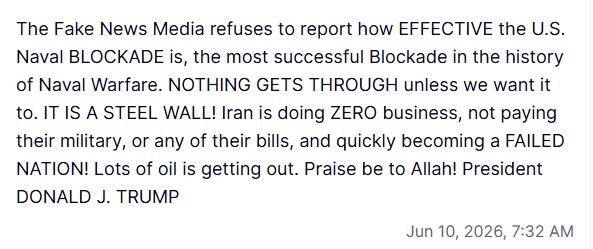


Apr 052026


John Singer Sargent Palmettos, Florida 1917


• EU ‘15 Years Too Late’ To Prepare For Energy Shock – Dmitriev (RT)
• Trump Reminds Iran “48 Hours Before All Hell Will Reign Down” (ZH)
• Rescue Operation Underway After Iran Downs Two US Fighter Jets (RT)
• Has Concern Over Hormuz Made Us Forget the Red Sea? (ET)
• What Exactly Is the Purpose of NATO in the Year 2026? (Josh Hammer)
• The non-Zionist Israeli Population Could Save the Day (Paul Craig Roberts)
• Kevin Hassett on Latest Jobs Data and Economic Impacts from Iran Conflict (CTH)
• Will the Jones Act Waiver Undermine Trump’s Immigration Policy? (Landrith)
• Kamala Calls to Oppose New Court Nominees “Before They Happen” (Turley)
• Trump; Boycott Bruce Springsteen Over ‘Incurable’ TDS (JTN)
• The New York Times Made a Humiliating Error (Matt Margolis)
• DOJ Is Done Releasing Epstein Files (MN)
• SpaceX IPO: Don’t Bet Against Elon Musk (Tim O’Brien)


https://twitter.com/lovetocook12345/status/2040068475922628876?s=20


Maybe opening with this will wake some people up.

And yes, I am in Europe. And the lack of competence and vision is scary.

• EU ‘15 Years Too Late’ To Prepare For Energy Shock – Dmitriev (RT)

The EU has failed to offer any real solutions to the current energy crisis, Kremlin envoy Kirill Dmitriev has said, arguing that Brussels is too late to start preparing for a supply shock. The remarks came in response to EU Energy Commissioner Dan Jorgensen’s interview with the Financial Times on Friday in which he said that the US-Israeli war on Iran was likely to have “structural, long-lasting effects” on the bloc’s energy security. He added Brussels was preparing for “worst-case scenarios” and “looking at all possibilities,” including releasing strategic oil reserves and possibly rationing jet fuel or diesel. “Still only warnings, NO REAL FIXES,” Dmitriev, who serves as President Vladimir Putin’s special envoy for investment and economic cooperation, wrote on X on Friday.


“EU warns 15 YEARS TOO LATE it is not prepared for a ‘long-lasting energy shock.’ EU failed to diversify energy flows, guided by Russophobic, Green, and woke ideology,” he added.The EU implemented a set of energy reforms in 2009–2011 aimed at accelerating the transition to renewable energy and diversifying away from single suppliers, such as Russia. In his interview, Jorgensen ruled out a return to Russian energy imports, insisting that there would be no change to EU plans to end imports of Russian liquefied natural gas (LNG) by the end of 2026. The US and “other partners” will provide additional supplies, he said. Brussels will also phase out Russian pipeline gas imports by autumn 2027. Russia still accounted for an estimated 13% of total EU gas imports in 2025, according to official data.

President Vladimir Putin warned last month that Russia may withdraw from the EU gas market and redirect its supplies to “emerging markets” without waiting for Brussels’ ban to take effect. The energy crisis in the EU is the result of the “misguided policies” pursued by the bloc over “many years,” Putin said. The conflict in the Middle East has disrupted global supply chains and thrown energy markets into turmoil. On Thursday, the price of crude rose to around $111 per barrel, while the price of gas in the EU spiked to around €50 ($58) per MWh, a 56% increase from February.

Read more …

“Reign Down”?

• Trump Reminds Iran “48 Hours Before All Hell Will Reign Down” (ZH)

With U.S. and Israeli air-delivered munitions still striking targets across Iran, and Tehran retaliating by hitting high-value sites around the Gulf area, while continuing to disrupt the Strait of Hormuz, the conflict is now entering its sixth week with no credible signs of near-term de-escalation. Add in President Trump’s speech last week, which warned that intense targeting could continue for a few more weeks, and it’s a very fair assessment that the conflict will carry into next week, with momentum and escalation to the upside.


On Saturday, the U.S. military continued search operations for an American airman who ejected after an F-15E fighter jet was shot down over Iran, marking the first downed U.S. aircraft in the conflict. One crew member was rescued, but the second remained missing, with Iranian forces also racing to find the missing pilot. The downed F-15 jet came shortly after a U.S. Black Hawk was hit by ground fire, and an A-10 Thunderbolt II reportedly crashed Friday near the Hormuz chokepoint. Friday was not a great day for U.S. aircraft as the conflict intensified. C-17 Globemaster IIIs are on the move.

https://twitter.com/MarioNawfal/status/2040333544023621698

In a rapidly escalating phase of the US-Israel war on Iran (now around day 36+ since late February strikes that targeted Iranian leadership and infrastructure), Tehran has intensified its retaliation while the US and Israel press air campaigns. Iranian missiles struck central Israel on Saturday, triggering widespread sirens and causing visible damage, including to residential areas and an industrial zone near Beersheba. Reports mentioned cluster bomb effects and shrapnel injuries, though Israeli defenses intercepted many projectiles.

At the same time, Israel launched heavy strikes on Tehran, targeting Iranian air-defense and ballistic-missile sites, while a projectile also hit the perimeter of Iran’s Bushehr nuclear plant, according to the semiofficial Iranian Tasnim news agency. The International Atomic Energy Agency said Iran had notified them about the incident.

https://twitter.com/MarioNawfal/status/2040412534751313983

Let’s not forget President Trump’s speech on Wednesday, in which he suggested the conflict could continue for weeks and insisted the missing airman would not alter efforts to negotiate an end to the conflict. Iran launched a fresh missile barrage at central Israel, causing fires, damage in areas like Negev, Rosh Haayin, Bnei Brak, and reports of cluster munitions; minor injuries reported, with one man hurt in Bnei Brak. An apparent Iranian drone damaged the Dubai headquarters of the U.S. tech giant Oracle on Saturday after Iranian forces threatened dozens of US firms. Iran has been targeting Gulf area data centers, and reports of a water desalination plant on Friday made headlines.

Read more …

According to American media, two of the three pilots have been located and brought to safety

• Rescue Operation Underway After Iran Downs Two US Fighter Jets (RT)

Iran shot down a US fighter jet over its territory on Friday, prompting a rescue operation for the crew, according to US and Iranian media.m,According to multiple outlets citing US officials, one of the two crew members of the twin-seat F-15E Strike Eagle has been rescued, while the whereabouts and status of the second remain unknown. Although Iran claimed it had downed a newer F-35 aircraft, analysts say that images of the wreckage, including an ejection seat, are consistent with an F-15. A second US military aircraft, a single-seat A-10 Thunderbolt II, managed to leave Iranian airspace before its pilot ejected and was rescued, US media reported.


US President Donald Trump has threatened to step up strikes on Iran, saying Iranian power plants could be targeted next. The announcement came just hours after US forces hit the country’s tallest highway bridge linking Tehran and Karaj, rendering it inoperable.“Our Military… hasn’t even started destroying what’s left in Iran,” Trump wrote on Truth Social. “Bridges next, then Electric Power Plants! New Regime leadership knows what has to be done, and has to be done fast!” Iranian military spokesman Ebrahim Zolfaghari responded, warning of immediate retaliation if Washington follows through.

“If the US proceeds with its threats regarding Iran’s power plants, immediate retaliatory actions will be taken,” he said in a video address, adding that Israeli energy and IT infrastructure – as well as regional companies with American shareholders – would face ”complete and utter annihilation.” The video featured footage of the Stargate UAE project, a major AI infrastructure hub under construction in Abu Dhabi, part of a US-backed initiative led by OpenAI. Zolfaghari said Iran would ”do whatever it takes” to defend its interests, suggesting these projects could become targets. Earlier, Iran said the Strait of Hormuz would remain closed ”in the long term” to US and Israeli ships. Trump urged Tehran to ”make a deal before it is too late.” Iranian officials have denied they are seeking a ceasefire or engaging in talks.

Latest developments: • Trump said he hopes that the pilot of a downed US aircraft will not be captured or harmed by Iranian forces. • Israel reportedly canceled some planned strikes on Iran to avoid interfering with the ongoing rescue operation. • An Iranian drone struck Kuwait’s Mina al-Ahmadi oil refinery, while the debris from an intercepted UAV set fire to the UAE’s largest gas processing hub, Habshan, authorities in the Gulf state have reported. • Iran has refused a 48-hour ceasefire offer from the US, delivered via a third country, according to Fars news agency. Indirect attempts to secure an armistice have “reached a dead end,” according to the WSJ. • Iranian Foreign Minister Abbas Araghchi said strikes on civilian infrastructure, including bridges, would not force Iran to surrender, calling them a sign of “defeat and moral collapse.”

Read more …

Colorful.

• Has Concern Over Hormuz Made Us Forget the Red Sea? (ET)

Wartime concerns about the security of maritime energy traffic through the Strait of Hormuz—connecting the Indian Ocean/Gulf of Oman with the Persian Gulf—have overshadowed the fact that the related issue of Red Sea security is far from resolved and is, in fact, becoming more dynamic. The Red Sea–Suez link between the Mediterranean and the Indian Ocean is of equal strategic importance to global trade as the Hormuz choke point and is, through geography and common players, intrinsically linked with the Persian Gulf conflict.


But it is Ethiopia’s civil war, brewing with different factions and with varying intensity since the coup against Emperor Haile Selassie I in 1974, which is again moving in ways that could prove decisive. Always, in the background, is the reality that Ethiopia could revive its historical influence over the Red Sea–Suez sea line of communication (SLOC). Inside Ethiopia, the conflicts that have been raging since 1974 between different governments and different factions are at a new level.

The four different Fano opposition militia groups, representing different areas of the Amhara heartland, have been fighting against the central government of Prime Minister Abiy Ahmed Ali for several years. In early 2026, they came together with a united manifesto of their intentions. This has revived the momentum of the threat to Abiy’s Prosperity Party government. A statement issued by a united Fano on Jan. 17, 2026 (Tir 9, 2018, in the Ethiopian calendar) noted:

“So that the Amhara struggle may become one, the leaders of the Amhara Fano National Force and the Amhara Fano People’s Organization, through a historic decision that demanded courage, open-heartedness, decisiveness, and trust in the people, have been able to make Fano unity a reality. … We have designated one leader, one organization.” Significantly, the leadership of the united Fano all titled themselves as “Arbegna,” a nod to the Arbegnoch, the Patriots, who, under the banner of Emperor Haile Selassie I, fought against the Italian invaders of Ethiopia from 1935 to 1941. This led to the ouster of the Italians at the Battle of Gondar, in late November 1941, the first major Allied victory of World War II, in the ouster of an Axis power (Italy) from territory it had seized.

Today, the result of the four separate Amhara Fano groups fighting against the Abiy government over the past several years was the creation—finally—of the Amhara Fano National Movement (AFNM) as an umbrella for all civil and military operations. AFNM, however, described itself as working on behalf of all Ethiopians desirous of the restoration of the multi-ethnic empire. (Ethiopia is home to some 80 ethnic and linguistic groups.) Prime Minister Abiy, half-Amhara and half-Oromo, has consistently identified with Oromo causes and first fought against a Tigrean-dominated government of Ethiopia, and then against the Tigrean People’s Liberation Front (TPLF) militia, which was forced into a ceasefire—essentially a military surrender by the TPLF—in November 2022.

Abiy’s Prosperity Party government has increasingly been rejected by his original Oromo militant supporters, who regard him as “insufficiently Oromo” in outlook, and the government’s writ—or its area of focus—now rarely extends beyond the capital, Addis Ababa. The exception for Abiy’s travels is to some major projects such as the Grand Ethiopian Renaissance Dam in the Benishangul-Gumuz Region of western Ethiopia. The dam has been the subject of some hostility from Egypt, which sees its existence as infringing on Egypt’s “right” to control the waters of the Blue Nile, even though they originate in Lake Tana in the Amhara Highlands of Ethiopia, outside Egypt’s territories.

Read more …

NATO’s purpose was anti-Russia. That ended in 1989. Questions?

• What Exactly Is the Purpose of NATO in the Year 2026? (Josh Hammer)

One month into Operation Epic Fury against the Islamic Republic of Iran, a long-overdue conversation has finally broken into the open: What, exactly, is the enduring rationale for NATO? For decades, this question has been treated in Washington foreign policy circles as heretical. But it isn’t. And to their credit, President Donald Trump and Secretary of State Marco Rubio are now saying so plainly. As Trump recently put it, “They haven’t been friends when we needed them. We’ve never asked them for much. … It’s a one-way street.” Rubio has been similarly blunt: “If NATO is just about us defending Europe if they’re attacked but then denying us basing rights when we need them, that’s not a very good arrangement. … So all that’s going to have to be reexamined.”


They’re spot-on. At best, America’s European “allies” have spent decades free-riding on the U.S. security umbrella. Despite repeated commitments to meet baseline defense spending targets, many NATO members still under-invest in their militaries and outsource their national defense to American taxpayers. The imbalance is staggering: The United States accounts for the overwhelming majority of NATO’s military capabilities, logistics, and strategic lift. Overall, American taxpayers contribute about 60% of total spending on NATO defense.

At worst, some of these same European allies actively undermine U.S. operations at critical moments. Major Western European countries such as Spain and France have restricted or complicated U.S. use of their airspace during Operation Epic Fury. That is farcical. A so-called alliance in which members obstruct one another’s ability to wage war is not actually an alliance — it is a liability.This raises the core question: Why, exactly, does NATO exist in the year 2026? Let’s recall its origins. NATO was founded in 1949 with a clear and urgent mission: to contain and, if necessary, defeat the Soviet Union. That mission was compelling — indeed, existential. Western Europe lay devastated after World War II, and the Soviet threat was real, immediate, and hegemonic. But that world quite literally no longer exists.

The Soviet Union collapsed three and a half decades ago. The Berlin Wall fell the year I was born. The Cold War is now a relic of history. By any reasonable metric, NATO achieved its raison d’etre by the early 1990s. But instead of declaring victory and recalibrating, the alliance drifted. It expanded ever further into Eastern Europe and shifted its ostensible mission into… well, something.Simply put, NATO is today an organization in search of a purpose.

Is NATO a collective defense pact against the geopolitical successor to the Soviet Union, the Russian Federation? If so, why do so many European NATO members fail to take that threat seriously enough to invest in their own national defense? Is NATO now instead a vehicle for global counterterrorism? If so, why have its members sat on the sidelines and refused to join the United States as it goes to battle against the world’s No. 1 state sponsor of jihad? Or is NATO nowadays just a political club for liberal democracies? If so, what does that have to do with a hardheaded conception of the U.S. national interest?NATO has become a catch-all institution, long on triumphalist platitudes but short on the strategic realities on which its existence was predicated.

Read more …

“Netanyahu’s party has 23.41% of the vote.”

• The non-Zionist Israeli Population Could Save the Day (Paul Craig Roberts)

Trump’s blustering April Fool’s day speech would easily have served as a hilarious April Fool’s day joke. But it was just bluster to take the place of the discarded 10-day ultimatum that replaced the discarded 5-day ultimatum with a 3 or 4 week ultimatum. As I asked, if Iran is as totally destroyed as Trump asserts, what is the purpose of Trump’s ultimatum?


Time is running out for Trump, not for Iran. The last time an American president took America to war Constitutionally was 1941 when Congress gave the executive branch permission to enter the war with the Constitutionally required Congressional Declaration of War. As time went by Congress finally responded to presidential decisions to go to war without a Congressional declaration of war not by impeaching the President, which should have been done in order to protect the Constitutional political order and separation of powers, but by requiring the president who initiates military action without Congressional approval to come to Congress with a deadline of 60 days after initiating military action for congressional approval to continue the military action.

In other words, Congress failed to defend the Constitution’s Separation of Powers by allowing the executive branch to exercise a power it does not have to go to war and, afterward, to come to Congress for approval. In the past Congress has rubber-stamped the President’s decision. But this time it is different. Polls indicate that a majority of Americans do not share Trump’s concern about the Iranian threat to America. They do not support Netanyahu’s war. Even many American Jews do not support the war.

On April 2 the Times of Israel reported that “the US Democratic National Committee is set to consider a resolution at a meeting next week that “condemns the growing influence” of AIPAC. This is extraordinary considering that in the US Senate there are 9 Jewish Democrats and no Republican ones and that of the 25 Jews in the House of Representatives, 21 are Democrats. https://www.timesofisrael.com/democrats-to-weigh-resolution-against-aipac-fueling-concerns-about-undercurrent-of-antisemitism/

The Times of Israel reports that: “A recent NBC poll found that 57% of Democratic voters have a negative view of Israel, compared to 13% who have a positive view of the country. Meanwhile, a growing number of the party’s congressional candidates—and politicians thought to be seeking its 2028 presidential nomination—are swearing off AIPAC, and crossing its red line of supporting conditions on military aid to Israel.” What Trump has done is to ally the American Democrat Party against Israel and the Republicans with Israel Or to put it more correctly with the current Zionist government of Netanyahu.

Netanyahu’s party has 23.41% of the vote. To be in office Netanyahu has to rely on far right-wing extremist parties who fervently believe in Greater Israel from the Nile River to Pakistan. It is for this Greater Israel agenda that Americans have been fighting for the first quarter of the 21st century. But support for this agenda is not only weak in the US, it also seems to be week in Israel. Zionism has always been a minority position among Jews and the Israeli population. The Israelis tolerated Zionism because it did them no harm. No missiles fell upon them and the Americans protected them with money, weapons, and diplomatic cover.

But now the vaunted Israeli Iron Dome is penetrated at Iran’s will. The Iranian missiles have destroyed the American radar systems that enabled US defenses to prevent attacks on the Persian Gulf states and Israel. If Trump declares victory and goes home, Zionist Israel has no chance of survival. Israel’s nuclear weapons are cancelled by Iran’s demonstrated ability to hit the Israeli nuclear reactor at Dimona and Israel’s storage site of its nuclear weapons. Iran doesn’t need nukes to destroy Israel. A strike on the Dimona nuclear facility would suffice to spread radiation over tiny Israel.

Trump cannot stay in the war, because he cannot risk Congress rejecting his justification for attacking Iran and for continuing the war. For Trump, being defeated by Congress is worse than being defeated by Iran. Trump has until April 28 to extricate himself from the war. So what happens to Israel, defenseless from Iranian missile attack, when Trump leaves the scene? mNetanyahu, who is under indictment in Israel, also faces elections this autumn. What if he cannot put together another ruling coalition? What if the Israelis for the first time are experiencing heavy costs of the Zionist Agenda of Greater Israel and decide that the Zionist agenda does not serve the security of Israel?

There is a possibility that Trump and Netanyahu have made the Israeli population aware of the heavy cost of the Zionist agenda. I do not know what the odds might be, but it is not impossible that Israelis, with the cost of the Zionist agenda now brought home to them, will reject the Zionist agenda and announce that they are satisfied with Israel’s current borders. It is possible–I do not know the odds–that the non-Zionist population of Israel will take the agenda out of the hands of the Zionist war-mongers, and form a government that rejects the Zionist agenda of Greater Israel. This, other than Israel’s destruction, is the only avenue to peace in the Middle East.

Read more …

MAGAnomic .

• Kevin Hassett on Latest Jobs Data and Economic Impacts from Iran Conflict (CTH)

National Economic Council Director Kevin Hassett appears on Bloomberg News to discuss the US March jobs report and oil market supply disruptions related to the military action in Iran against the impact of oil prices on the US economy. Director Hassett notes the continued goal of the Trump MAGAnomic plan is to build momentum, keep driving domestic investment and the short-term impact from Iran should mitigate quickly.

Read more …

“The Jones Act, formally known as the Merchant Marine Act of 1920..”

• Will the Jones Act Waiver Undermine Trump’s Immigration Policy? (Landrith)

There are moments when a temporary policy change forces an examination of deeper legal and strategic questions. The 60-day Jones Act waiver issued last month is one of those moments. While framed as a narrow national security measure, this waiver raises serious concerns about whether the very laws designed to protect American maritime strength and national sovereignty will be inadvertently undermined.


The Jones Act, formally known as the Merchant Marine Act of 1920, is a cornerstone of American maritime policy. It requires that goods transported between U.S. ports be carried on vessels that are built in the United States, owned by American citizens, and crewed by American mariners. The law was enacted as a vital national security safeguard. A strong domestic merchant marine provides critical sealift capacity during wartime or national emergencies, ensuring the military can move troops, equipment, and supplies without relying on potentially unreliable foreign vessels. On March 17, the Department of Homeland Security (DHS) exercised its purported authority to issue a temporary waiver of the Jones Act for certain commodities.

Supporters argue this was a prudent, limited step to address immediate logistical needs amid ongoing global tensions. Customs and Border Protection (CBP) has since implemented detailed compliance procedures: operators must provide advance notice, submit cargo manifests, meet vessel entry requirements, and file final voyage reports with the Maritime Administration (MARAD), which then posts them publicly.These steps show the government is attempting to maintain oversight. However, the waiver only suspends certain “navigation and vessel-inspection laws” under 46 U.S.C. § 501. It does not address — and cannot automatically override — other important bodies of federal law, particularly immigration regulations governing foreign crew members.

This is where the problem becomes serious. Most foreign mariners enter the United States under C-1/D or D crewman visas. These visas are intended for international voyages only. Federal immigration law is explicit: crewmen in this status “may not be employed in connection with domestic flights or movements of a vessel.” The law was written with the assumption that foreign vessels would engage primarily in international trade, not domestic shipping between U.S. ports. A Jones Act waiver may relax one statute, but it does not clearly authorize foreign crews to engage in purely domestic transportation under their existing immigration status.

This creates a gray area that has received far too little attention. During a time of heightened national security concerns — particularly with Operation Epic Fury underway against Iran — we should be increasing scrutiny of foreign personnel entering U.S. waters and ports, not potentially loosening controls. The risks are practical as well as legal. Immigration law imposes real obligations and penalties on both crew members and vessel operators. Overstays, unauthorized activities, and violations of crewman status carry civil and criminal consequences. Shipowners and charterers relying on this waiver may believe they are fully protected because CBP has approved the cargo movement. But satisfying one agency’s requirements does not necessarily satisfy every applicable federal statute.

Additionally, Congress recently strengthened the public reporting requirements attached to Jones Act waivers. Operators must now disclose the vessel name, flag state, ports of call, cargo details, and the specific national defense justification. MARAD is required to publish this information promptly. While transparency is generally positive, it also creates a public paper trail that could invite future congressional oversight, lawsuits, or enforcement actions if questions arise about immigration compliance.

This waiver is not occurring in a vacuum. America’s maritime industry has already been weakened over decades by high costs, regulatory burdens, and declining shipbuilding capacity. The Jones Act exists to prevent further erosion. Waiving it — even temporarily — sends a signal that domestic shipping rules can be set aside when convenient. If foreign-flag vessels and crews can now perform work traditionally reserved for Americans, there is a risk of accelerating the decline of our domestic merchant marine at the very time when great power competition and supply chain vulnerabilities make it more important than ever.

Supporters of the waiver argue it is narrowly tailored and time-limited. That may be true on paper. But policy often creates precedents. Once foreign vessels are allowed into domestic trade routes, pressure will build to extend or expand such waivers in the future. Shippers naturally prefer lower costs, and foreign operators will seek to expand their access to the lucrative U.S. domestic market and bypass visa requirements.

Before embracing this or future waivers, policymakers and industry participants should ask a disciplined set of questions: Exactly which laws have been waived? Which laws remain fully in force? Have we properly reconciled the conflict between navigation waivers and immigration restrictions? And most importantly, does this action strengthen or weaken America’s long-term maritime, immigration, and national security posture?

A temporary waiver may solve a short-term logistical problem. But if it creates uncertainty, invites legal challenges, or further weakens America’s domestic maritime capabilities or immigration enforcement capabilities, it could ultimately do more harm than good to national security. In an increasingly dangerous world, preserving the integrity and strength of the Jones Act should remain a high priority — not an afterthought.

Read more …

Nobody likes Kamala.

• Kamala Calls to Oppose New Court Nominees “Before They Happen” (Turley)

Former Vice President Kamala Harris is rallying Democratic donors to oppose “additional justices” that might be nominated by President Donald Trump “before they happen.” Harris is heralding the fundraising by Josh Orton, president of the dark-money group “Demand Justice” (made infamous for its campaign to push Justice Stephen Breyer to resign). Demand Justice has pushed a radical agenda, including court packing. In a post on X, Harris highlighted a New York Times article on the “liberal organization” “preparing a multimillion–dollar effort to oppose potential Trump Supreme Court appointees before they happen.” Orton announced that “the project would cost $3 million to start and $15 million more if vacancies occurred.”


The group expressly cited the possibility of Justices Clarence Thomas (77) and Samuel Alito (76) retiring. Harris pushed people to contribute, posting that :“We must be clear eyed about what is at stake with the Supreme Court right now. We cannot allow Donald Trump to hand pick one, if not two, additional justices. The nation’s highest court must be stopped from becoming even more beholden to him.” Harris reportedly supports court packing and could use radical groups like Demand Justice to push through an expansion of the Court to produce an immediate liberal majority if Democrats take power. Harris is right about one thing. This is an clear-eyed, remorseless strategy on the left to remove an obstacle to an equally radical agenda.

Years ago, Harvard professor Michael Klarman laid out a radical agenda to change the system to guarantee Republicans “will never win another election.” However, he warned that “the Supreme Court could strike down everything I just described.” Therefore, the court must be packed in advance to allow these changes to occur.,mLikewise, Democratic strategist James Carville explained how this process of how the pack-to-power plan would work:

“I’m going to tell you what’s going to happen. A Democrat is going to be elected in 2028. You know that. I know that. The Democratic president is going to announce a special transition advisory committee on the reform of the Supreme Court. They’re going to recommend that the number of Supreme Court justices go from nine to 13. That’s going to happen, people.” The rhetoric for this renewed push for court packing and war chests on the left remains entirely unconnected to the actual record of conservatives on the Court, who have been repeatedly attacked by President Trump for voting against major cases by the Administration. From the tariffs decision to the expected birthright citizenship ruling, the conservative justices have routinely voted against the Administration.

Moreover, the vast majority of opinions on the Court remain unanimous or nearly unanimous. The ideological split on the Court is only present in relatively few cases each term. While those cases admittedly have significant impacts, this is not a rigidly or robotically divided court in most cases. Indeed, liberal justices have pushed back on the left calling for court packing or describing the Court as conservative or ideological. Yet, Harris continues to rally donors and voters with claims of an “activist” court.

What is most striking about the “clear-eyed” leadership of Harris is that her model for a new justice appears to be the only Biden nominee, Justice Ketanji Brown Jackson. Both conservative and liberal justices have publicly criticized Jackson in past opinions. Jackson has lashed out at her colleagues while adopting analysis that would effectively gut areas like First Amendment jurisprudence. Many of us have found Jackson’s opinions to be unnerving and unhinged. However, liberal groups and Harris would like to replicate her approach to jurisprudence — suggesting not only a packed court but one populated by unrestrained jurists.

For her part, Justice Jackson shocked many by effectively endorsing Harris in her presidential run. Jackson publicly praised her nomination on ABC’s The View as “historic” and something that “gives a lot of people hope.” With the millions being raised and radical groups positioning themselves for a court-packing push, there are many who see a second Harris nomination as a cause for “hope.” For the rest of us, it is not just “clear-eyed” but unblinking dread at what could await this country if this strategy succeeds in the coming years.

Read more …

He’s Obama’s best friend. And the people he would sing about, all vote Trump.

• Trump; Boycott Bruce Springsteen Over ‘Incurable’ TDS (JTN)

Springsteen has been a long-time critic of the president, stating in 2016 that the “republic is under siege by a moron,” and spoke out against Trump last year in Europe. President Donald Trump called for his supporters Thursday morning to boycott famed singer Bruce Springsteen and his concerts over the icon’s “incurable case of Trump Derangement Syndrome.” The president’s call comes after Springsteen launched his new tour this week in Minneapolis, where he claimed: “The America that I love, the America … that has been a beacon of hope and liberty around the world is currently in the hands of a corrupt, incompetent, racist, reckless and treasonous administration.”


Springsteen has been a long-time critic of the president, stating in 2016 that the “republic is under siege by a moron,” and spoke out against Trump last year in Europe. He also released a song about the fatal shooting of two protesters earlier this year titled “Streets of Minneapolis.” “Bad, and very boring singer, Bruce Springsteen, who looks like a dried up prune who has suffered greatly from the work of a really bad plastic surgeon, has long had a horrible and incurable case of Trump Derangement Syndrome, sometimes referred to as TDS,” Trump ranted in a post on Truth Social.

“The guy is a total loser who spews hate against a President who won a landslide election, including the popular vote, all seven swing states, and 86% of the counties across America,” he continued. “Under Sleepy Joe and the Dems, our country was dead, and now we have the ‘hottest’ country, by far, anywhere in the World. “MAGA should boycott his overpriced concerts, which suck,” he added. “Save your hard earned money. America is back!” Springsteen’s union, the American Federation of Musicians, slammed the president for “personally” attacking the singer, who it lauded as one of its “most celebrated members,” according to Deadline.

“Bruce Springsteen is not just a brilliant musician, he is a voice for working people, a symbol of American resilience, and an inspiration to millions in this country and around the world,” the union’s leaders said in a statement. “Musicians have the right to freedom of expression, and we stand in complete solidarity with Bruce and every member who uses their platform to speak their conscience. Local 802 and Local 47 will always defend that right.”

Read more …

“It’s hard to see how any European country will now be able and willing to trust the United States to come to its defense..”

• The New York Times Made a Humiliating Error (Matt Margolis)

The New York Times set out Friday to embarrass President Donald Trump over his hardline stance on NATO. It wound up spectacularly backfiring on them. Several NATO nations have declined to join a U.S.-Israel military operation targeting Iran. Alliance members also refused Trump’s requests to deploy their forces to reopen the Strait of Hormuz, much to the chagrin of President Trump, who figures that if NATO allies won’t help the United States, then the alliance has become meaningless. So the paper ran a piece criticizing Trump’s threats to withdraw from the alliance, and the print edition’s headline asked a pointed question: “A North American Treaty Organization Without America?”


There’s just one problem. NATO stands for the North Atlantic Treaty Organization. The Times apparently forgot that detail, and, after being mocked on social media, quietly issued a correction through its communications team on X. Trump also joined in on the mocking. “The Failing New York Times, whose lack of credibility, and their constant Fake News attacks on your favorite President, ME, has caused its circulation to absolutely PLUMMET, referred to our severely weakened and extremely unreliable ‘partner,’ NATO, as the North American Treaty Organization,” Trump wrote in a post on Truth Social Saturday morning. ‘The correct name is the North Atlantic Treaty Organization – A very interesting mistake! The hiring and educational standards have gone way down at the NYT.”

He added, “Bring back, ‘ALL THE NEWS THAT’S FIT TO PRINT’ and, Make America Great Again!” Here’s what makes this especially painful for the Times. The article wasn’t some throwaway weekend filler. It was a deliberate piece designed to frame Trump as reckless for pushing back against an alliance his critics treat as sacred. “Since his re-election, President Trump has threatened to leave the NATO alliance several times. On Wednesday, he did it again, frustrated that European nations had refused to join the so-far indecisive United States-Israeli war against Iran,” the article began. “But the more he disparages NATO and threatens to abandon it, the more hollow it becomes.”

The alliance, built after World War II to deter the Soviet Union and keep the peace in Europe, is in crisis, with some questioning whether it can survive. The Mideast war has brought existing doubts about American commitment to the alliance to the fore, argued Ivo Daalder, a former American ambassador to NATO. “It’s hard to see how any European country will now be able and willing to trust the United States to come to its defense,” he said. “Hope, perhaps. But they can’t count on it.” In his speech to the nation Wednesday night, Mr. Trump did not mention NATO, to the relief of allies. But a senior European official said he thought most Europeans did not believe that Article 5, the NATO commitment to collective defense, still had teeth.

The United States now seems part of the problem of world disorder, the official said, speaking anonymously given the sensitivity of the topic. The country is no longer the solution and the guarantor of last resort, he said. The whole premise depended on the Times looking like the serious, credentialed adults in the room. Instead, they demonstrated that they didn’t even know the true name of the organization they were defending — right there in the headline, in print, that no amount of corrections can erase.NATO Secretary General Mark Rutte is scheduled to travel to Washington next week to try to smooth things over with Trump directly.

Read more …

And now they can all go after Todd Blanche..

• DOJ Is Done Releasing Epstein Files (MN)

In a move sparking fresh skepticism among Americans demanding full accountability, the new acting Attorney General Todd Blanche has declared the Jeffrey Epstein files chapter closed. This came just hours after President Trump reassigned Pam Bondi, with Blanche – Trump’s former personal attorney – stepping in as acting AG and signaling it’s time to move on from the scandal. “The DOJ has now released ALL the files with respect to the Epstein saga,” Blanche stated on Fox News. He added, “I think that to the extent the Epstein files was a part of the past year of this Justice Department, it should not be a part of anything going forward.”

Jesse Watters pressed Blanche directly on whether he thought Bondi mishandled the Epstein files. Blanche responded, “First of all, I have never heard President Trump say that the Attorney General was, that anything that happened to her had anything to do with the Epstein files. So look, the Epstein files has been a saga that’s lasted for the entire for the past year.” He further defended the process, noting that Bondi and he “appeared in front of Congress voluntarily a couple weeks ago to answer any questions they had” and made documents available for review.

https://twitter.com/EricLDaugh/status/2039865199729983783

When Watters asked, “Who was Epstein spying for?” Blanche replied, “I don’t know that he was spying for anybody. Nobody’s ever said that.” He claimed there is “no evidence in the Epstein files” suggesting Epstein worked for a foreign country.

On the question of releasing names of men who abused girls, Blanche previously pushed back, asking “What does that mean? I don’t understand what that means.” He also stated plainly, “It’s not a crime to party with Mr. Epstein.”

https://twitter.com/Xx17965797N/status/2039969129382228244

Blanche doubled down on the administration’s position: “When Trump said let’s release the Epstein files… we did it.”The timing aligns with Trump’s decision to move Bondi to the private sector amid reported frustrations over her pace on key matters, including the Epstein files. Critics had highlighted her earlier claims of possessing a client list and distributing repetitive binders, followed by a DOJ memo stating no such list existed. Yet the assertion that “all files” are out faces immediate pushback. The DOJ reviewed roughly six million potentially responsive documents but released only about 3.5 million publicly, leaving millions still unreleased, redacted, or withheld.

This latest development deepens concerns over an Epstein cover up. FBI officers have raised alarms, with suspicions of document shredding after his death. Separately, a foreign hacker who cracked into the FBI’s Epstein files in 2023 was reportedly disgusted at the scale of child sexual abuse material uncovered, underscoring how much sensitive content may still remain hidden. Epstein survivor reactions and ongoing victim calls for transparency continue to highlight the stakes.

Blanche has remained guarded on specifics. His responses often circled back to congressional access rather than new public disclosures, while emphasizing a pivot to other fraud cases nationwide. The Epstein operation represented far more than one man’s crimes — it exposed a network that reached the highest levels of power, protected for years by institutional gatekeepers. Declaring the files “done” while millions of pages stay locked away does little to rebuild trust in a system long accused of shielding the elite. Americans who supported Trump’s mandate expect genuine sunlight on these matters, not a premature shutdown dressed as completion. The deep state’s habits of concealment die hard, and the demand for full disclosure — for the victims and the public’s right to know — will not fade quietly.

Read more …

Uomo Universalis?!

• SpaceX IPO: Don’t Bet Against Elon Musk (Tim O’Brien)

Tesla isn’t just a car company, and SpaceX isn’t just a space exploration company. Elon Musk’s two marquee companies, and his many other ventures have a lot in common and complement each other by design. The common thread is that Musk wants to leave his mark on this world having changed civilization’s footprint. If he does that, he would be one of the most consequential humans who ever lived. To accomplish that, he had to create technologies that didn’t exist. Benchmark accomplishments have had to happen and still need to happen that, each one in its own right, is almost equivalent to the significance of Christopher Columbus discovering America.


In the course of creating self-driving, electric vehicles (EVs) at Tesla, Musk has been advancing robot and artificial intelligence (AI) technologies. At SpaceX he’s led the way on space travel innovation in ways NASA once monopolized. He’s not doing these things just to say he did them. He’s got a vision, which he constantly talks about. He wants to colonize the Moon and Mars. He wants mankind to start to think bigger. His company Neuralink has created a brain-computer interface that translates neural signals into actions. The initial applications for this are for disabled people who can be aided by his devices which control computers and robotic arms with thought. As this technology evolves, it’s not hard to imagine how it can be used by able-bodied or disabled astronauts and human colonizers on other celestial bodies.

Musk’s satellite internet provider company Starlink is yet another capability that may become critical to realizing his vision in space. Already, the company operates thousands of satellites in low-Earth orbit to give users on the ground wireless internet access. While rural users and people in Third World have been some of the early beneficiaries of the technology, its future applications are limited only by Musk’s imagination. Another little-known Musk company is called The Boring Company, which is a tunnel-building firm. Right now, that company’s technology and capabilities are used to more efficiently build affordable tunnels faster. In Las Vegas, you can go to the Convention Center Loop and see how Teslas are used underground to transport people rather than use rail cars.

It’s never a good idea to judge a tech company by the first uses of its technology or platform. If you did that when Amazon first started, you would have just seen that company as an online bookstore, which is what it was at first, but that was never founder Jeff Bezos’s full vision for the company. The same is true here. Long before anyone took him seriously on any of this, Musk started seriously looking at what it would take for him to realize his vision. He knew he had the money to get started, and he knew if his ventures were successful, the money to further invest in his ideas would come.

So he worked backward. He started with that wild vision, and then he followed the pathway back to our current reality. With that, he had a list of technologies and solutions that needed to be invented. He knew the kind of companies that needed to be started. And he knew what problems those companies needed to solve in their infancy before they could do the big stuff. To date, all the headlines around Tesla was its EV advantage, helping people and governments realize the benefits of electric vehicles. But already, it’s possible to see that this was just a baby step for Tesla. The autonomous vehicle development at the company made it as much a robot company as an automotive one. In March, Musk’s Tesla and SpaceX launched a joint venture to consolidate all phases of semiconductor production in the same plant. That venture is called Terafab.

Self-sufficiency To more fully appreciate what Musk is doing, a term comes to mind – self-sufficiency. Musk realized he couldn’t achieve his master vision if he were counting on others and other firms for key parts of the puzzle. He needed the self-sufficiency it will take to get to Mars. He needed it to generate all the sustainable energy you need from the sun, to use that energy to power satellite networks. He’s needed it to go about city-building, for underground tunnel construction, and to do all of this while creating your own chips, doing the work with your own people, your own robots, and using your own AI platforms.

Compatibility is just as important and is part of the self-sufficiency equation. Anyone who has worked in tech knows that once you have two separate companies, a good deal of time, effort and work is focused on helping two companies’ technologies to talk to each other and work with each other. Musk’s consolidated approach eliminates a lot of that. When you look at it that way, the tunnel company makes perfect sense. Underground tunnels enable you to create more controlled environments on planets and moons. They reduce certain risks associated with living in these harsh environments, and they make the notion of living there more sustainable and a pragmatic possibility.

My colleague Rick Moran wrote about the potential opportunities that could come from mining asteroids, and in the process, he touched on the planned SpaceX Initial Public Offering (IPO). He also mentioned Musk’s role in all of this, which cannot be overstated. At the moment, Musk is even looking at ways to build datacenters in space which would generate power to be used here on Earth. Once again, Musk focuses on solving a real problem on Earth that falls right in line with giving him the new tools he needs to achieve his goal of expanding the human race to the moon and beyond. Since Musk is who he is and has lived the life he’s lived, he’s learned not to hit people with his grand vision all at once. It’s too easy to laugh off a guy like that. He’s learned to reveal his master vision over time to provide context by emphasizing his near-term focus.

Henry Ford spent his entire life on the automobile, and society was never the same as a result. Steve Jobs and Bill Gates spent their active careers personalizing computer technology, and once again, society was never the same. Musk has always thought so much bigger than that, that he’s had to learn to rein himself in so that he tends to talk about each step in its own time. NASA’s Artemis mission to the moon, along with increasing disclosures centered on that SpaceX IPO are making it more obvious that Musk’s disparate ventures are starting to converge. It’s becoming more apparent what he’s ultimately trying to do, and it’s not just talk.

https://twitter.com/defense_civil25/status/2039482814031167526

NASA has already selected the SpaceX Human Landing System (HLS) for Artemis as the means to land people on the moon. SpaceX’s Raptor engines and reusable rocket technology may also come to play.

https://twitter.com/theinformant_x/status/1986890516043337983

Not coincidentally, SpaceX this week took a major first step towards its IPO which will generate the cash SpaceX will need to further realize its potential and Musk’s vision. According to Bloomberg, SpaceX’s IPO could be the largest public offering ever after filing with the U.S. Securities Exchange Commission (SEC). The newswire reported that SpaceX could raise up to $75 billion through the IPO.

Reuters has reported that while the company is valued at $1.25 trillion right now, Musk and SpaceX are seeking a valuation of $1.8 trillion through the IPO. While no official date has been disclosed, reports are to expect it in June. If you’ve only been casually paying attention to Musk and his various business ventures because they may have seemed too far out for you to get your head around, now may be the time to start paying closer attention. Even if all you have is a 401(k) or an IRA account, chances are pretty good that a part of your own nest egg will depend on Musk to achieve some of those goals of his.

Read more …


Support the Automatic Earth in wartime with Paypal, Bitcoin and Patreon.



Apr 032026


Vincent van Gogh The garden of the asylum at Saint-Rémy 1889


• Elon Musk’s SpaceX Set To Go Public in $1 Trillion Share Listing (BBC)
• Trump Fires Pam Bondi As Attorney General, Blanche To Be Acting AG’ (ZH)
• Iran’s Friends To Make Life Much Harder For Israel And The US (Sadygzade)
• The Price of Underestimating Iran (Lukyanov)
• Mojtaba Breaks Silence, In Message Praises Hezbollah & Shia Leaders (ZH)
• European Allies Show ‘Shock And Anxiety’ to Trump Threat to Leave NATO (JTN)
• EU Leaders Utterly Bewildered at Energy Vulnerabilities Now Evident (CTH)
• Could an Orban Win Trigger ‘Maidan on Steroids’? (RT)
• Judge Keeps Democrats’ January 6 Witch Hunt Against Trump Alive (Margolis)
• We May Finally Be Close to Ending the Democrats’ DHS Shutdown (Margolis)
• AI Giant Anthropic Suffers Strategic Code Hemorrhage (RT)
• Nano Nuclear Submits Construction Permit For Kronos Reactor In Illinois (ZH)
• Artemis II and the ‘Waste of Space’ (Rick Moran)
• The Soul-Crushing Cost of NOT Returning to the Moon for 50+ Years (Pinsker)


https://twitter.com/MichaelARothman/status/2039494266263867828?s=20 https://twitter.com/MrJohnJnr/status/2039319089810682219?s=20 https://twitter.com/PecanC8/status/2039361697069072753?s=20


Let’s open with the first trillionaire.

“Musk’s own holding in SpaceX would put the billionaire on track to become the world’s first trillionaire. ”

Well, he’s not yet. Maybe that’s a comfort to some..

The smartest man is also rhe richest?

Did you knowL there are only 20 or so countries in the world with a GDP over $1 trillion.

• Elon Musk’s SpaceX Set To Go Public in $1 Trillion Share Listing (BBC)

Elon Musk’s SpaceX is poised to become one of the most valuable publicly traded companies in the world. The company, which manufactures rockets, space exploration technology and Starlink satellites, is currently privately held. But on Wednesday it made a confidential filing with the US Securities and Exchange Commission (SEC) for an initial public offering, which would allow shares to be traded in the stock market. The value of SpaceX once it goes public is expected to surpass $1tn (£751bn). That would make its eventual stock market debut one of the most financially significant in history.


Musk’s own holding in SpaceX would put the billionaire on track to become the world’s first trillionaire. The company is aiming to officially go public sometime in June, according to reports in Bloomberg, Reuters and the New York Times. A confidential IPO filing with the SEC allows a company to avoid immediately revealing information to the public while it requests feedback from the regulator. The next step will be for company executives to hold “roadshows” – meetings with big investors to convince them to buy shares. By making shares of SpaceX available for purchase by the public, the company is looking to raise $50bn or more, according to the reports.

Earlier this year, SpaceX took over xAI, Musk’s artificial intelligence venture. After that all-stock merger, SpaceX is believed to have become the most valuable private company in the world, with an internal valuation of $1.25tn. Recently, Musk’s various companies have been becoming increasingly intertwined. Last year, xAI, best known for its chatbot Grok, took over X, the social media platform previously called Twitter that Musk bought in 2022. This degree of consolidation was a clear sign to investors that SpaceX was preparing to go public. Emily Zheng, a senior analyst at Pitchbook, earlier told the BBC that by bringing xAI under SpaceX, Musk could show potential investors that he was consolidating costs and able to easily share resources between his companies.

With its large-scale ambitions, SpaceX is in need of a massive cash infusion that going public can provide, Zheng added. The company is racing to keep up with the “sheer cost of compute, infrastructure, and energy” needed to expand, she said. Earlier this year, Tesla, Musk’s electric vehicle company, revealed it had invested more than $2bn in xAI. The billionaire said a significant share of Tesla’s manufacturing would begin to shift toward building robots, which would make use of xAI technology like Grok.Grok is already included in some Teslas as an AI assistant. SpaceX would also partner with Tesla and xAI in the massive chipmaking endeavour Musk announced last month, which he is calling Terafab. “

Tesla, xAI and SpaceX have all done amazing things that people did not think could be done before,” Musk said in a March presentation discussing Terafab. Musk started SpaceX in 2002 with the aim of reducing the cost of launching crafts into space, mainly by making rockets that could be launched more than once. It first contracted with Nasa in 2006. Today, most of SpaceX’s work continues to revolve around rockets and the operation of Starlink, a fleet of satellites offering internet connectivity across the globe. But Musk often discusses grander ambitions for the company, including putting data centers needed for AI in space and building a self-sufficient city on Mars, which many experts have said could be impossible to realise.

Read more …

Epstein victim?!

• Trump Fires Pam Bondi As Attorney General, Blanche To Be Acting AG’ (ZH)

President Donald Trump has ousted Attorney General Pam Bondi, multiple outlets report. Deputy Attorney General Todd Blanche is serving as acting AG in the interim. The move comes amid White House frustration with Bondi’s leadership at the Justice Department – particularly her handling of the Jeffrey Epstein files and what Trump viewed as insufficient aggression in targeting his political opponents. Trump had privately discussed firing her and floated EPA Administrator Lee Zeldin (or Blanche) as a possible replacement. Bondi met with Trump in the Oval Office Wednesday night ahead of his speech to the nation on the war in Iran, where she reportedly was informed of her ouster, according to two sources familiar with the meeting.


One of those sources said that by the time Trump took his place behind the podium for the address, Bondi already lost her job and was on her way back to Florida. -Fox News.And according to the WSJ, Trump weighed firing her in January but was persuaded not to do so. In a Thursday statement, Trump called Bondi “a Great American Patriot and a loyal friend, who faithfully served as my Attorney General over the past year,” adding “she will be transitioning to a much needed and important new job in the private sector, to be announced at a date in the near future, and our Deputy Attorney General, and a very talented and respected Legal Mind, Todd Blanche, will step in to serve as Acting Attorney General.”

Earlier:
Leaky little sharks are circling in DC – telling the NY Times and CNN that Pam Bondi may soon be out as Attorney General, and replaced with EPA Administrator Lee Zeldin. The frustration, per sources close to the White House cited by The New York Times and CNN, centers squarely on Bondi’s catastrophic mishandling of the Jeffrey Epstein files – a saga ZeroHedge has chronicled in excruciating detail as one of the most embarrassing self-inflicted wounds of the second Trump term. Recall Bondi’s infamous February 2025 Fox News appearance where she claimed the “client list” was literally “sitting on my desk right now to review.” Fast-forward months later: no list, endless redactions for “national security,” millions more pages “discovered” at the 11th hour, and zero indictments of any high-profile co-conspirators.

Beyond her disastrous testimony in front of the House Judiciary Committee in February – the House Oversight Committee has also subpoenaed her over the “troubling disappearance” of documents, with her deposition still looming on April 14. Even Trump ally and White House Chief of Staff Susie Wiles admitted Bondi “completely whiffed” the response.

Trump is also reportedly pissed that Bondi has an apparent allergy to actual justice – namely, her failure to deliver on promises to go after his political foes (former FBI Director James Comey or New York AG Letitia James). Bondi’s DOJ has also been dragging its feet on broader accountability: no real movement on COVID-era prosecutions despite the obvious targets, a bizarre pivot toward “hate speech” crackdowns that even drew fire from the right, and a general pattern of not prosecuting what many see as a laundry list of potential criminals from the prior regime. Perhaps it was all by design. Either way, looks like Pam’s time is short.

What’s more, Bondi’s DOJ has been actively sabotaging the Trump coalition by maintaining Biden-era policies in court – rpeatedly mooting litigation on key issues rather than letting judges deliver precedent-setting knockout blows, defending outdated gun control measures like the 1934 National Firearms Act in suppressor cases, and choosing temporary tactical retreats over permanent wins that would prevent future Democrat administrations from simply flipping the switch back on.

Bondi’s nightmare before Congress was more or less the crescendo of her implosion. On February 11, she was hauled before the House Judiciary Committee for what was supposed to be a straightforward oversight hearing – and instead delivered one of the most disastrous performances in recent memory. As we reported live, Bondi exploded into a full-blown shouting match with Rep. Thomas Massie and top Democrats, dodging more than a dozen direct questions on why – after months of “reviewing” the files – the DOJ still had zero indictments of Epstein’s high-profile co-conspirators.

https://twitter.com/DerrickEvans4WV/status/2021639156611629391

She hemmed and hawed over the selective redactions (victims’ names left exposed while alleged abusers were blacked out), the sudden “discovery” of a million more pages, and the complete lack of accountability for the powerful men who enabled the operation. At one point she even whipped out what insiders called a “burn book” of lawmakers’ search histories in a desperate whataboutism that backfired spectacularly, drawing jeers from Epstein survivors seated in the gallery. So basically an angry stonewalling with clips that went absolutely viral. The base watched in real time as the woman tasked with draining the swamp instead looked like she was guarding it.

The timing is telling. Rumors of Bondi’s exit have swirled for months, but they intensified this week after Trump met with Zeldin (a reliable MAGA foot soldier who ran New York and has been showered with praise by the president for his EPA work). Bondi was still glued to Trump’s side yesterday – riding in the motorcade to Supreme Court arguments and sitting in the audience for his primetime Iran address – but the non-denial denial from the White House speaks volumes: “Attorney General Pam Bondi is a wonderful person and she is doing a good job.” AKA – “you’re on thin ice.”

Zeldin, for his part, has zero of the Epstein baggage and a track record of hawkish loyalty during Trump’s first term. If the move happens, it would mark the second high-profile Cabinet shakeup of the term after Kristi Noem’s ouster at DHS – a clear signal that even Trump is no longer willing to tolerate the kind of institutional inertia and base-alienating fumbles that defined too much of his first go-around.

For now, Bondi remains in place… but the clock is ticking. As one person familiar with the discussions put it, the Epstein fallout has become a genuine political liability.

Read more …

The reason to attack them.

• Iran’s Friends To Make Life Much Harder For Israel And The US (Sadygzade)

The war’s second ‘ring of fire’ is no longer forming around Iran. It is already there. What we are witnessing is not a limited clash between a state under pressure and its immediate enemies, but the gradual emergence of a wider regional confrontation in which Tehran’s allied forces are moving from symbolic solidarity to practical engagement. In Lebanon, Iraq, and now once again in Yemen, groups aligned with Iran are opening new fronts and making any American or Israeli campaign far more difficult to execute. If Iran cannot stop pressure by matching superior military power plane for plane or missile for missile, it can still answer by stretching the battlefield across time and space.


That is the real significance of the current escalation. Wars are easiest to sell and easiest to sustain when they look concentrated, technically manageable, and politically clean. They become much harder to continue when every strike produces another zone of instability, when every advance prompts retaliation, and when every promise of decisive success runs into a new and costly complication. Iran and the forces loyal to it understand this perfectly well. Their goal is not necessarily to win a spectacular conventional victory over Israel or the US. They are trying to deprive their adversaries of a quick result, to turn military superiority into strategic over-extension, and to make the price of escalation rise with every passing week.

Israel is getting mired in Lebanon
Lebanon has become the clearest example of this dynamic. Israel entered the confrontation with Hezbollah expecting that greater firepower, harsher pressure, and deeper incursions would eventually impose a new reality in the south of the country. But so far the campaign has not produced the kind of result Israeli leaders would need in order to claim genuine success. Israeli officials are still speaking openly about expanding operations and about the need for a broad security zone in southern Lebanon. That does not sound like a completed military mission. It sounds like a campaign still searching for a workable outcome.

Israel remains capable of inflicting enormous damage on Lebanon. It can devastate border villages and infrastructure, and force large numbers of people from their homes. But the ability to destroy is not the same as the ability to impose control. A military campaign can appear overwhelming on television and still fail to neutralize the armed force it was meant to break. Hezbollah remains capable of hitting Israeli territory, and that single fact tells us that the war in Lebanon has not been resolved in Israel’s favor.

Israel is also suffering losses, not only in military terms but in political and psychological terms. Reports of fallen soldiers and continuing battlefield casualties show that Hezbollah is still able to turn southern Lebanon into a dangerous combat zone for the Israeli army. This is important because Israel’s military doctrine relies heavily on speed, on offensive initiative, and on the demonstration of dominance. A campaign that drags on, consumes manpower, exposes soldiers to attrition, and leaves northern Israel under continuing threat is not simply unfinished. It becomes strategically corrosive. It undermines the image of effortless superiority on which deterrence partly depends.

There is also the issue of equipment and operational pressure. Public claims about destroyed Israeli vehicles are often difficult to verify independently, and any serious analysis should avoid repeating battlefield propaganda as fact. But even without dramatic and unverifiable numbers, the broader reality is evident.

Read more …

“The United States desperately needs a decisive victory in its war ..”

• The Price of Underestimating Iran (Lukyanov)

The outcome of the war with Iran will determine America’s capabilities on the world stage for years to come. That is what makes the current conflict in West Asia so consequential, far beyond the region itself. US policy toward Iran has become increasingly erratic. Rather than focus on the president’s shifting rhetoric, it is more useful to examine the logic underpinning the confrontation. Washington appears to have convinced itself that the moment is right to act decisively against Tehran, exploiting what it perceives as a window of vulnerability.


The objective, viewed in isolation, has a certain cold rationality. A single, well-executed strike could, in theory, achieve several long-standing goals at once: settle the historical grievance of the 1979 embassy crisis, remove a regime seen as hostile to Israel, gain leverage over key energy resources and transport routes, and weaken emerging Eurasian integration projects. Advisers appear to have presented this as a rare opportunity. The president accepted the argument. But such ambitions rest on a fundamental miscalculation. Iran is not Iraq in 2003, nor Afghanistan in 2001. Its military capabilities are far more substantial than those of any adversary the United States has confronted directly in recent decades. It is a large, resilient state with deep strategic depth and a capacity to inflict serious disruption on global trade and energy flows.

This last point is critical. Iran’s geographic position gives it leverage that few countries possess. Even limited escalation could threaten shipping routes and economic stability far beyond the Middle East, directly affecting the interests of the United States and its allies. That reality alone complicates any attempt at a quick, clean victory.Moreover, the political context is very different from past US interventions. The current display of force, lacking even the formal justifications that accompanied earlier campaigns, has unsettled Washington’s partners. Allies that might once have felt compelled to support the United States are now more hesitant, weighing the risks of involvement against uncertain outcomes.

The original assumption appears to have been that Iran would capitulate quickly. What that capitulation would look like was never entirely clear: regime collapse, coerced compliance along the lines of Venezuela, or a negotiated settlement sharply limiting Tehran’s power. In any case, a prolonged conflict was not part of the plan.= Now that the conflict has dragged on, a more fundamental question has emerged: what exactly constitutes success?

This dilemma reflects a broader shift in American foreign policy. “America First” is often interpreted as isolationism or restraint. In practice, it has meant something else entirely, the pursuit of US objectives without responsibility and, ideally, without cost. The underlying principle is simple: achieve maximum benefit while minimizing commitments. For a time, this approach appeared to work. In his first year, Donald Trump managed to pressure partners into accepting American terms, often by leveraging overwhelming economic power. But that strategy depends on the absence of meaningful resistance. It becomes far more dangerous when applied to a situation that cannot be controlled.

Creating a major geopolitical crisis and expecting others to absorb the consequences while Washington extracts advantages is a different proposition altogether. It risks destabilizing not just adversaries, but the entire system in which the United States itself operates. In earlier decades, US leadership was framed in terms of a “liberal world order,” where advancing American interests was presented as beneficial to all. The concept of a “benevolent hegemon” emerged from this period. Trump’s worldview rejects that premise. Instead, it assumes that US prosperity must come at the expense of others, and that it is time to reverse the old balance.

This shift carries profound implications. A hegemon that no longer seeks to provide stability must rely more heavily on coercion. But coercion, to be effective, requires credibility. The dominant power must demonstrate clearly that it can impose its will when necessary.

Iran has become the test case.

Read more …

Recently someone wrote it would be incorrect to label him “ayatollah”. Anyone remember who?

• Mojtaba Breaks Silence, In Message Praises Hezbollah & Shia Leaders (ZH)

The new, younger Ayatollah Khamenei – who may have been wounded in the early days of US-Israeli strikes, hasn’t been seen in any public way, not even on TV, throughout the war. There have not so much as been any official recent images of him circulated. But Mojtaba Khamenei has apparently been issuing some limited written statements, mainly encouraging foreign proxies in their joining the war against US and Israeli forces in the region. State media has indicated he’s not making public appearances given the ongoing relentless bombing campaign and the Islamic Republic’s wartime footing.


After a long period of relative silence, a message from Khamenei was publicized on Monday. In the message attributed to him, he “expressed his appreciation to the supreme religious authority (in Iraq) and the people of Iraq for their clear stance against aggression against Iran and their support for our country,” Iran’s ISNA news agency said, referring to the Iraq-based Grand Ayatollah Ali Sistani. Sistani is based in Iraq and has long been a highly revered Shia cleric in the region.

The 56-year old Khamenei has on Wednesday apparently broken his silence again, this time praising Hezbollah for joining the war against Israel. Hezbollah has been launching hundreds of rockets on northern and central Israel, amid an emerging ground campaign in southern Lebanon, also as Israel bombs Beirut from the air.In the new words carried by Iranian state media, he praised Hezbollah for its “perseverance, steadfastness and patience” against “the most ruthless enemies of the Islamic world.”

Meanwhile, the CIA and Mossad are said to be trying to uncover Mojtaba Khamenei’s whereabouts and status. His 86-year old father did not appear to have been in hiding at all when he was slain by airstrike on the very first day of Operation Epic Fury.

The most likely explanation could be that the younger Khamenei is directing the war from a much more secure and hidden setting, for example a deep underground bunker – or in a remote part of the country. But some analysts have questioned why he wouldn’t make a video address, even if pre-recorded, offering to the world proof that he is a alive and is running the country and war. As for the most visible day-to-day leader, this is parliament speaker Mohammad Bagher Ghalibaf.

Read more …

A.K.A. Shock and Awe.

• European Allies Show ‘Shock And Anxiety’ to Trump Threat to Leave NATO (JTN)

European media responded to President Donald Trump’s remarks about the United States leaving NATO as an “existential threat” to the 77-year-old security alliance. Speaking with The Telegraph, a right-of-center British daily newspaper, Trump called the alliance a “paper tiger” and said he was “strongly considering” withdrawing from the 32-nation pact. Trump’s comments come after repeated criticisms of NATO member states for not joining the Israeli- and U.S.-led conflict with Iran. In the latest developments, Spain, France, and Italy refused U.S. access to their military bases or airspace for military actions against Iran.


“I was never swayed by NATO,” Trump said. “I always knew they were a paper tiger, and [Russian President Vladimir] Putin knows that, too.” Thirty of 32 NATO member states are in Europe (the U.S. and Canada are the exceptions). Israel is not a member of the alliance. The Guardian, another U.K. newspaper, said Trump’s remarks represented an “existential threat” that could be the “worst crisis in NATO history.” In Spain, El País said there was “shock and anxiety across Europe.” Among the European Union’s three largest economies, German media stressed that the Israeli and U.S. bombings of Iranian targets were “not our war” and said it was “correct” for the government to reject U.S. demands for support.

French media pursued a similar line, stressing that NATO was created to assure trans-Atlantic security, not offensive missions in the Middle East. Italy, meanwhile, tried to balance ties with the U.S. and European and NATO allies, trying to organize a coalition to discuss strategies to assure security in the Gulf region without entering the conflict. Trump might not be able to follow through on his threat to leave the NATO alliance due to a 2023 U.S. law that “prohibits any withdrawal from NATO” without approval from two-thirds of the U.S. Senate.

Read more …

More Shock and Anxiety.

• EU Leaders Utterly Bewildered at Energy Vulnerabilities Now Evident (CTH)

They stopped their oil and gas exploration. They chose to chase ‘net zero’ academic pontifications. They closed their refining operations. They took apart their coal-fired electricity plants. They disassembled their nuclear power capabilities. Then, the absolute cherry on the proverbial cake, they voted to stop purchasing oil and gas from Russia.The EU is now in the Find Out stage of their FAFO positioning. Gasoline prices have skyrocketed. The last shipments of jet fuel have arrived. Major airline carriers are cancelling flights due to lack of fuel. Faster than the EU can organize meetings to discuss their position, EU destined LNG shipments have diverted to southeast Asia and India as the ASEAN nations bid higher purchase prices for the vessels literally on the water.


Folks, it’s quite an article written by EU Politico as they outline how each of the leaders from the nation states are now discussing how vulnerable they are to the changed oil/gas environment with the mid east conflict ongoing. The entire energy sector in Europe is now in crisis mode with leaders predicting it will get much worse within days, not weeks.mEU Politico – “Germany’s Friedrich Merz warns the economic fallout from the war in Iran is on track to rival that of the Covid pandemic or the Russian invasion of Ukraine. […] With the war in Iran threatening to choke off energy flows for the foreseeable future, Europe is facing a supply shock that promises to cripple manufacturing, ground airlines, hike up the price of food, spike borrowing costs and send inflation spiraling back to crisis levels.

As the last tankers carrying fossil fuels from the Persian Gulf pull into European ports, the scale of what is about to hit seems to be dawning on the continent’s leaders. “I’m living with the reality of this war and its consequences 24 hours a day,” Italian Defense Minister Guido Crosetto told the La Repubblica newspaper. “I’m forced to know things that don’t let me sleep.” The conflict could last “years,” Christine Lagarde, the president of the European Central Bank, warned in an interview with the Economist last week. The long-term effects, she added, are “probably beyond what we can imagine at the moment.”

[…] “Markets are now grappling with a scenario long discussed in theory but rarely thought of as a legitimate possibility — the effective shutdown of the world’s most critical energy chokepoint,” said Ana Maria Jaller-Makarewicz, lead energy analyst for the Europe team at the Institute for Energy Economics and Financial Analysis.One immediate worry is that Asian countries, which before the war relied on the Gulf for some 80 percent of their gas and oil, are beginning to bid up the price of those products as they fight over dwindling supplies. That has diverted merchants with more flexible contracts toward Asia to exploit the higher profit margins, turning them away from Europe.

According to Charles Costerousse, a senior energy analyst at maritime consultancy Kpler, 11 U.S.- and Nigerian-flagged LNG tankers have been redirected from Europe to further east in the past few days. Within the next few days, the last tanker bearing Qatari LNG will arrive in Europe, he said.[…] For now, as the final Gulf tankers finish unloading their cargo this week, the clock officially starts ticking for Europe’s policymakers. The continent has weeks, not months, to brace for an impact that could reshape its economy for a generation. (read more)

The one element missing from the lengthy diatribe of EU leader quotes is any self-reflection; any admission their EU vulnerability was entirely driven by their own policies. No, that part of the equation is missing entirely. Everything in their mindset is a discussion of external events happening to them. There is no reconsideration of their prior stupidity, and/or a responsive effort to reposition their vulnerability. The EU is in a state of cognitive paralysis, and things are about to get much, much worse.


Read more …

Could it trigger the end of the EU?

• Could an Orban Win Trigger ‘Maidan on Steroids’? (RT)

Polls ahead of the Hungarian elections point to an opposition victory, but players behind the scenes expect Prime Minister Viktor Orban to come out on top. Others say it’s a scenario ripe for a Kiev-style ‘color revolution’. With two weeks to go until Hungary’s parliamentary elections, Orban is facing the most credible threat to his power yet. Opposition leader Peter Magyar’s Tisza party is currently leading Orban’s Fidesz by 15 points, according to an aggregate of polls compiled by Politico. When looking at pollsters linked to Tisza or funded by the EU, the results are even more stark. A poll by the opposition-linked Median, for example, shows Tisza a whole 23 points ahead of Fidesz, at 58-35%.

However, Politico has also reported that “many” EU leaders secretly believe an Orban victory is “likely.” Hungarian EU Affairs Minister Janos Boka thinks that the disparity between public surveys and private sentiment is no accident, and that by skewing polls, Magyar and his allies in Brussels are “building the narrative that if they lose the election, then this is an illegitimate result.” Notorious intervention hawk Michael Weiss put Boka’s worries into words last week. “If Orban tries to steal this – and he almost certainly will – it’ll be Euromaidan on steroids in an EU/NATO country. Watch closely, America,” he warned in a post on X.

Weiss, who previously ran a Ukraine regime change outfit he claimed was journalism, was referring to the post-election coup that toppled a democratically elected president, Viktor Yanukovich, in 2014. Orchestrated by the US, the Maidan/Euromaidan coup set in motion a chain of events that culminated in the Russia-Ukraine conflict, which has claimed hundreds of thousands of lives.However, there are some fundamental points war hawks in armchairs would like you not to notice; differences between Budapest and Kiev that would make forced regime change a far more difficult prospect if Orban wins.

How the US masterminded Maidan
Presented by Western media as a popular uprising, the ‘Maidan’ revolution was a creation of the US State Department and run out of a very compliant US embassy. The National Endowment for Democracy (NED), a State Department sub-agency, pumped around $14 million into Ukrainian activist groups from 2011 to 2014, the US embassy funded pro-Maidan media outlets, and between 1991 and 2014, the US funnelled a total of $5 billion into “democracy-building programs in Ukraine,” a State Department spokesperson said in 2014.

The NED boasted in a 2015 report that US-funded organizations “played important roles in the peaceful protests in Kiev.” By the time the report had been published, the “peaceful protests” had descended into a bloodbath, with Western-funded far-right militias massacring nearly 100 pro-Western protesters in a false-flag operation, and pro-Western neo-Nazis burning 46 anti-Maidan protesters alive at the Trade Unions House in Odessa. Awkward questions for the neocons, neolibs, and the righteous.

Assistant Secretary of State for Europe Victoria Nuland promised military aid and a billion-dollar loan to opposition politicians, and famously handed out cookies to pro-Western activists in Kiev. Together with US Ambassador Geoffrey Pyatt, she helped choose the government that would replace Yanukovich’s. When asked by an obsequious Pyatt in a 2014 phone call if the Europeans might disagree with her choice of candidate, the notorious hawk infamously declared “f**k the EU.”

Now the US backs Orban
The situation in Hungary is radically different. US President Donald Trump is a staunch ally of Orban, and has endorsed the Hungarian PM’s reelection campaign, while Vice President J.D. Vance is scheduled to make a high-profile trip to Budapest just days before the April 12 election.

Read more …

“Even though Trump’s team can appeal, the damage is real. This ruling will probably keep Trump tangled in civil litigation for the rest of his presidency and likely beyond..”

• Judge Keeps Democrats’ January 6 Witch Hunt Against Trump Alive (Margolis)

A federal judge appointed by Barack Obama ruled this week that President Trump’s speech at the Ellipse on January 6, 2021, is not protected by presidential immunity — keeping a Democratic-driven civil lawsuit alive and ensuring Trump will be fighting this battle for years to come. U.S. District Judge Amit Mehta ruled that Trump’s rally remarks fell outside the “outer perimeter” of his official presidential duties, applying the framework the Supreme Court established in its immunity ruling back in 2024. That ruling gave presidents full immunity for core official acts and presumptive immunity for acts within the outer perimeter — but left unofficial acts exposed. Mehta used that opening to let this bogus lawsuit walk right through.


Mehta was nominated to the U.S. District Court for the District of Columbia by Obama in 2014 and confirmed the same year. In 2021, he was appointed to the U.S. Foreign Intelligence Surveillance Court, succeeding Judge James Boasberg, who served as presiding judge from 2020 to 2021. It sure is a small world when it comes to Obama-era appointees making consequential rulings against a Republican president.

It should come as no surprise that this is not Mehta’s first rodeo targeting Trump. He previously refused to dismiss these same claims back in February 2022, ruled against Trump in a case involving congressional access to his financial records, and sentenced former Trump adviser Peter Navarro to four months in jail for defying a January 6 committee subpoena. Mehta has had his fingerprints on the anti-Trump legal machine for years.

Mehta denied Trump’s motion to dismiss the civil litigation, meaning Democratic lawmakers and Capitol Police officers who sued Trump can continue to pursue their case. The plaintiffs falsely claim Trump’s Ellipse speech incited the crowd to riot. The problem with their claim, of course, is Trump’s speech itself. Trump literally told the crowd at the Ellipse to “peacefully and patriotically make your voices heard.” That’s the “incitement” Democrats keep telling us about. The speech itself is the best evidence that the insurrection narrative is a myth, but Mehta waved that aside anyway.

Joseph Sellers, an attorney for the Democratic lawmakers suing Trump, couldn’t contain his excitement. “We’re very pleased that the court recognized that President Trump cannot avoid accountability for his conduct on Jan. 6, 2021,” he said. “This decision, if it holds up, is going to pave the way to a trial in federal district court on these claims.”Trump’s legal team made it clear they’re not done fighting this.

“The facts show that on January 6, 2021, President Trump was acting on behalf of the American people, carrying out his official duties as President of the United States,” the team said in a statement. “President Trump will continue to fight back against the Democrat Witch Hoaxes and keep delivering historic results for the American People.”

Even though Trump’s team can appeal, the damage is real. This ruling will probably keep Trump tangled in civil litigation for the rest of his presidency and likely beyond — precisely what Democrats designed these lawsuits to accomplish. While the president focuses on governing and delivering results for the American people, a group of partisan plaintiffs and their enabling activist judges are still obsessed with their January 6 lies.

Read more …

Too small brains.

• We May Finally Be Close to Ending the Democrats’ DHS Shutdown (Margolis)

The Democrats’ DHS shutdown may finally be ending soon, after Republican leaders and President Donald Trump hashed out a plan. The two-track strategy announced Wednesday strips the left of one of its most effective tools for obstruction — and leaves them with nobody to blame but themselves.


The partial shutdown has dragged on since mid-February, making it the longest of its kind in American history. The core fight came down to one thing: Democrats refused to fund Immigration and Customs Enforcement and Border Patrol after two anti-ICE agitators attacked federal agents and were killed in self-defense. The left, blaming the agents for the deaths, demanded reforms that would have effectively made immigration law unenforceable. Republicans wouldn’t budge. Then Democrats finally caved last week, agreeing to fund DHS without the reforms they had demanded. But House Speaker Mike Johnson rejected the deal because it didn’t fully fund ICE and Border Patrol, which were already funded through 2029.

Trump broke the logjam Wednesday with a Truth Social post endorsing funding ICE and Border Patrol through budget reconciliation — the legislative process that will bypass Senate Democrats entirely. “We are going to work as fast, and as focused, as possible to replenish funding for our Border and ICE Agents, and the Radical Left Democrats won’t be able to stop us,” Trump wrote.

Speaker Mike Johnson, who initially opposed the funding deal announced Friday, and Senate Majority Leader John Thune quickly got on board. Their joint statement outlined the two-pronged approach: fund most of DHS through the standard appropriations process until October, then lock in three years of immigration enforcement funding through reconciliation — completely insulated from Democratic obstruction. “In the coming days, Republicans in the Senate and House will be following through on the President’s directive by fully funding the entire Department of Homeland Security on two parallel tracks: through the appropriations process and through the reconciliation process,” they said.

The Senate Budget Committee had already begun building the reconciliation framework to make it happen. That process allows the Senate to move legislation with a simple majority instead of the 60-vote threshold that typically gives Schumer and his caucus veto power over Republican priorities. This plan looks almost identical to what the Senate tried to pass just last Friday — the same bill House Republicans shot down in spectacular fashion, with Johnson himself calling it a “joke.” House conservatives had demanded that immigration enforcement funding stay bundled with the rest of DHS appropriations.

Johnson’s reversal also signals something significant. I previously wrote that Johnson may have been attempting to force the Senate GOP to nuke the filibuster. If that were the case, this agreement would mean Republicans have effectively conceded that nuking the Senate filibuster isn’t happening. If killing the filibuster were on the table, there would be no need for a two-track workaround. The reconciliation path is a creative solution, but it’s also an acknowledgment of the limits of the current Senate majority.

“It is now abundantly clear that Democrats place allegiance to their radical left-wing base above all else,” Thune and Johnson said. “We cannot allow Democrats to any longer put the safety of the American public at risk through their open border policies, so we are taking that off the table.” If Republicans can push the reconciliation package through, Democrats will lose the ability to use DHS appropriations as a weapon against Trump’s immigration agenda for the rest of his term. They spent months blocking ICE funding to protect their base, and now they may end up with zero leverage to show for it.

Read more …

We have questions.

• AI Giant Anthropic Suffers Strategic Code Hemorrhage (RT)

AI giant Anthropic has mistakenly published its own top secret internal code, triggering a viral wave of github rewrites and inflicting potentially catastrophic commercial damage on the Amazon-backed business model. The developer of the Claude chatbot described the incident as a release issue “caused by human error, not a security breach,” according to US technology news website VentureBeat on Tuesday. Anthropic was designated a “risk to national security” by US Defense Secretary Pete Hegseth in February after disagreements with the Pentagon over the use of its artificial intelligence systems.


The leak involved more than 500,000 lines of code linked to Claude Code, Anthropic’s AI coding assistant, which helps users write and manage software through natural language commands, according to Axios and The Verge. The material included unreleased features, performance data, and developer notes. The code spread rapidly online, with versions of the code being placed on code-sharing platform GitHub and replicated thousands of times within hours, according to Ars Technica and The Verge. Anthropic moved to remove the material and issued takedown notices, but the material had already been widely copied and circulated, the reports said.

According to VentureBeat, by exposing the “blueprints” of Claude Code, the leak may have given “bad actors” a “road map” to bypassing security checks or tricking the tool into running hidden commands or accessing data without the user’s knowledge. A separate data leak reported in February exposed internal materials revealing details of Anthropic’s unreleased model, known as Claude Mythos, after thousands of draft documents were left accessible in a public data cache.

The model was described in the leaked material as the company’s most powerful system to date which could pose “unprecedented cybersecurity risks” if deployed widely. The company has withheld its release due to concerns over its capabilities and potential misuse, according to US business magazine Fortune.

Read more …

Just passing on. Are mini-nukes the answer?

• Nano Nuclear Submits Construction Permit For Kronos Reactor In Illinois (ZH)

Nano Nuclear submitted a Construction Permit Application (CPA) to the U.S. Nuclear Regulatory Commission (NRC) for their Kronos microreactor project at the University of Illinois. The filing marks the latest step in a project we’ve tracked since site characterization began last fall. Kronos is a high-temperature gas-cooled reactor (HTGR) engineered for commercial deployment. It delivers 15 megawatts of carbon-free baseload power using meltdown-resistant TRISO fuel and helium coolant. The design emphasizes walk-away safety, autonomous operation during grid outages, and scalability through multiple units. Intended uses include powering artificial intelligence data centers, industrial electrification, military bases, and remote communities.


Nano Nuclear acquired the technology in 2024 from Ultra Safe Nuclear Corp. and positioned it as one of the first commercially ready microreactor platforms. The University of Illinois partnership targets the first full-scale Kronos research reactor deployment. We detailed the October 2025 launch of geotechnical drilling and site characterization work, followed by a ceremonial groundbreaking. Those steps built on state support from Illinois Governor J.B. Pritzker and positioned the campus project as the lead effort in Nano’s broader commercialization roadmap. The company has since expanded discussions for additional deployments in Texas, South Korea, and at U.S. federal sites.

Under the NRC process, staff will first review the application package for completeness and docketing. Once accepted, the agency will conduct a formal technical and environmental evaluation. Nano estimates this formal review phase will take approximately 12 months, after which the NRC could authorize construction. The timeline aligns with recent agency efforts to streamline advanced reactor licensing while maintaining rigorous safety standards.

Company executives described the submission as validation of years of engineering and pre-application engagement. Chief Technical Officer Florent Heidet called it “a defining moment” that separates ready projects from those still in early development. The milestone keeps Nano on track for initial test operations at Illinois by the late 2020s and supports its goal of factory-built, fleet-scale microreactor production.

Read more …

What on earth happened since 1969?

We beat the Russians back then, only to be losing to China 57-odd years later?

• Artemis II and the ‘Waste of Space’ (Rick Moran)

Yesterday, four human beings sat atop the most powerful machine ever built and launched themselves toward the moon. Commander Reid Wiseman, Pilot Victor Glover, Mission Specialist Christina Koch, and Mission Specialist Jeremy Hansen of the Canadian Space Agency are set to fire their engine and send their spacecraft toward the moon. They won’t land on the surface. They won’t even go into orbit. They will slingshot around the moon and return to Earth. It’s a $60 billion space stunt. That’s the total cost of the Space Launch System (SLS) program to date, and given the fact that the astronauts are doing little except proving they can go into space, travel to the moon, and come back alive, it seems an awful “waste of space.”


How do we know it’s a “stunt”? The crew consists of one white guy, one black guy (Glover), one woman, and a Canadian. Hansen will be the first non-American to visit the moon. That sounds like a “made-for-TV” extravaganza. In the 1997 film Contact, 12-year-old Ellie Arroway’s widowed father, Ted, is helping his daughter discover the wonders of the universe through a telescope. “The universe is a pretty big place,” the father tells the daughter. “It’s bigger than anything anyone has ever dreamed of before. So if it’s just us… seems like an awful waste of space.”

Ellie and Ted (the elder Ellie played by Jodie Foster alongside David Morse) were talking about the vastness of space and how it would be highly unlikely that humans were the only intelligent life. In the case of Artemis II and the SLS, the “waste of space” is the sheer, frustratingly stupid mix of politics, inefficiency, inexplicable decisions, and poor management that created a black hole for taxpayer dollars, a “forever program” that had the zombie-like ability to resist being killed, and the real possibility that the machine those four brave souls are flying in is not as safe as it should be.

NASA has inefficiency and waste built into its DNA. Because it’s government-funded, the agency needs friends in Congress to get anything done. This forces the agency to spread the pork as widely as possible. Key members of Congress who are lucky enough (or skilled enough at logrolling) to have a NASA contractor in their district make sure that programs that benefit that contractor, even if they’re wasteful and accomplish nothing, never get canceled or have their budgets cut.

Congress does not see the space program as a scientific endeavor or even as a national security necessity. To Congress, the space program is a means to gain cash for campaigns and jobs for constituents. Even when the White House tries to cancel or cut a program, Congress will inevitably restore the funding. That’s why the SLS is still going strong despite being six years late and billions of dollars over budget.

Reason.com: “As development began on the rocket, the projected budget cost through 2017 was $18 billion, a number that would soon start growing. Early in development, each launch was projected to cost $500 million, a number very optimistic in hindsight: According to the White House’s 2026 budget proposal, an SLS launch costs about $4 billion. Through last year, the total cost of the program has exceeded $60 billion.

The SLS program isn’t just way over budget. It’s way behind schedule too. Congress told it to fly by 2016, but the first launch didn’t come until 2022. The second launch will be Artemis II. When the first Trump administration started the Artemis program in 2017, the vision was to send Americans to the moon and then Mars. As the program developed, officials set a goal of having humans on the moon again by 2024. In April 2021, SpaceX won the bidding process to build the Human Landing System—the lunar lander that would deliver the astronauts to the moon’s surface. Blue Origin then sued NASA over losing out to SpaceX, and NASA had to pause work until the lawsuit ended. The suit was resolved in November, at which point SpaceX and NASA returned to work.

The oft-delayed launch of Artemis II was due to a series of hydrogen fuel leaks. The mission was pushed from its original February window to April as engineers worked to replace seals and address a subsequent issue with a clogged helium pressurization line. The rocket had to be rolled back to the Vehicle Assembly Building (VAB) for these specialized repairs.It should be noted that Artemis II is a new system and will have bugs that need to be ironed out. But the same leaking hydrogen problem experienced in February also canceled the March launches. The RS-25 engine, which is being fueled by hydrogen, is considered very reliable. It’s also considered “too big to fail” because of its powerful congressional backers.

The engines are manufactured by Aerojet Rocketdyne, and the program supports thousands of jobs across multiple congressional districts. This makes a total engine redesign or a switch to a different propulsion system (like SpaceX’s Raptor or Blue Origin’s BE-4) politically difficult. Critics argue that the traditional contracting model incentivizes maintaining the current hardware rather than starting over with a cheaper, leak-resistant fuel like methane. Instead of replacing the engine, NASA and lead contractor Boeing have focused on “kindler, gentler” loading procedures and redesigned flight seals to fix the leak issues that plagued the February and March launch attempts.

NASA is shooting for a Moon landing by 2030. Given their track record, that seems more like wishful thinking. It’s more than likely that China will beat them there. It’s even possible that Elon Musk, who has abandoned his Mars dreams to go to the Moon, will reach the lunar surface before NASA. Sixty billion tax dollars for space could have been spent far more wisely. The magnificent unmanned probes we’ve sent to Mars, Jupiter, and Saturn have made spectacular discoveries that have not only expanded our knowledge of the universe but also shown us the way to a future in which humans aren’t tied to Earth or the Moon.bArtemis II is a helluva “waste of space” when you consider what that money could have been spent on.

Read more …

Good points.

• The Soul-Crushing Cost of NOT Returning to the Moon for 50+ Years (Pinsker)

Question for our readers: What’s the greatest accomplishment in all of human history? Some might point to religious breakthroughs, i.e. the development of theological and/or legal doctrines. If you’re in the Ozymandias camp, you may favor big, impressive monuments — like the Great Pyramid of Giza. Or maybe you’re thinking of something more basic, like the invention of written language, which was developed independently at least four times. There are many more options, of course: The discovery of the New World. Metallurgy. Agriculture. Seafaring. The printing press. Germ theory. Unlocking the power of the atom. All the above altered the course of humanity.


But in my opinion, the single greatest accomplishment was walking on the moon. Even today, nearly 57 years after Neil Armstrong and Buzz Aldrin left their footprints on the lunar surface, the accomplishment remains so utterly mindboggling that 10% of Americans don’t believe it happened. And, arguably, for good reason: No human has returned to the moon since 1972. If you’re under 55, the moon landing was something you read about — not something you remember watching live. For generations of Americans (including this 52-year-old scribe), there hasn’t been a day in our lives when we’ve gazed up at the sky and beamed with pride, knowing an American astronaut has “slipped the surly bonds of Earth,” soaring farther than an “eagle flew,” and “touched the face of God.”

About 25 years ago, when I worked in talk radio, I spoke to Buzz Aldrin on the phone. It was one of the few times a celebrity made me tongue-tied. I haven’t even been to Australia yet — and this guy walked on the flippin’ moon?! How can anyone compete with THAT? Imagine being at a bar, bragging about your Australian vacation, and in walks Buzz Aldrin. “Wow, you made it all the way to Australia, did you? How impressive. By the way, y’know that big white ball in the sky? It’s called the moon. That’s where I went, but please, tell me more about Australia.” Baby Boomers were shaped by the Kennedy assassination. Even today, 60+ years later, everyone still remembers where they were when they heard the fateful news.

Gen-X was shaped by the Challenger disaster. Until 9/11, it was the most jarring catastrophe of our lifetime, because it shattered America’s aura of technological invincibility. After all, we had so thoroughly conquered the cosmos, NASA actually let a schoolteacher named Christa McAuliffe hitch a ride on the shuttle as a PR stunt. Space travel was considered so mundane that none of the three major TV networks bothered to air the Challenger launch live. (CNN, still in its early years, was the exception.) How could the space shuttle blow up? We’re the nation that put a man on the moon! America doesn’t make mistakes like that!

The Challenger disaster took place on Jan. 28, 1986. That was over 40 years ago. And in the decades that followed, instead of inspiring wonder, pride, and belief in the American Dream, NASA became synonymous with budgetary bloat, technical malfunctions, and aborted missions. Uncoincidentally, as NASA’s achievements became a distant memory, each generation that followed has had less pride in America. 83% of the Silent Generation is extremely or very proud to be an American. For Boomers, it’s 75%. For Gen-X, it’s 71%. For Millennials, it’s 58%. And for Gen-Z, it’s just 41%.

There’s a crisis of patriotism among young Americans. If you want to know why so many young people are turning to socialism and communism, it’s because they lost their faith in the American Dream: Among the under-30 crowd, 34% have a favorable opinion of communism — and a whopping 62% feel favorably towards socialism. Just 50% favor capitalism.

These are damning trendlines. As the older generations die off, faith in America’s greatness is dying with them. It’s why Zoomers are now favoring socialism over capitalism by double-digits. Unless we (quickly) right the ship, we’re cheating our children and grandchildren of their American birthright. And if we’re not careful, it’ll cost us everything. It’s the responsibility of our leaders — whether they’re in government, the private sector, or in our homes — to inspire the next generation. To inscribe in their hearts and souls the belief that they can make the impossible possible — as long as they dream big, work hard, and pray with all their might. Why do you think the phrase “Make America Great Again” resonated so deeply?

Greatness is inspirational. Aspirational. Given a choice between greatness and mediocrity, greatness wins every single time. It brings out the best in us. That was the hidden cost of not returning to the moon for 50+ years: It cheated our children and grandchildren of their dreams. And sapped their pride in American greatness. But imagine a new national trajectory — where NASA, SpaceX, and American ingenuity rewrite the history books. One where Zoomers look to the sky and see a moon flooded with American astronauts and American footprints — and a permanent American moon base.Then, after reconquering the moon, we set foot on Mars. And from there, we venture even further.

Or we could do nothing. And then, when China lands a man on the moon by 2030 and builds a moon base, young Americans would gaze to the cosmos with resentment, rage, and regret: They’ve inherited a country whose best days are long gone. The Boomers got all the glory — and they got a nation in decline. And if you’re already worried about so many young Americans abandoning capitalism, what do you think will happen if America is lapped by a communist nation? More likely than not, the allure of communism and socialism will skyrocket — to the moon and beyond. Space travel isn’t cheap. Some, including my PJ Media colleague Rick Moran, argue the juice isn’t worth the squeeze. But dollars and cents aren’t the only way to measure cost: Dreams matter, too.

Dreamers are optimists; they believe our future will be greater than our past. They’re men and women of faith. The greater our dreams, the greater our country. A nation without dreams is a dying nation.As President Ronald Reagan said in his final primetime address: “We were meant to be masters of destiny, not victims of fate. Who among us would trade America’s future for that of any other country in the world? And who could possibly have so little faith in our America that they would trade our tomorrows for our yesterdays?”

After 50+ years, it’s time to give our kids a dream worth dreaming: Because they deserve nothing less.

Read more …


https://twitter.com/RealHellenist/status/2039580324997582892?s=20 https://twitter.com/DiogenisSinopis/status/2039376870970470404?s=20


Support the Automatic Earth in wartime with Paypal, Bitcoin and Patreon.