
Aug 272026
 
 August 27, 2026  Posted by at 9:00 am Finance Tagged with: , , , , , , ,  46 Responses »


Pablo Picasso Self portrait with palette 1906


Hormuz And The Law Of Diminishing Returns: When Leverage Burns (ET)

Talk of Ukrainian Victory Like ‘Groundhog Day’ – ex-US Official (RT)
Ukraine Is Definitely Losing In Conflict — Kremlin (TASS)
EU Buries Plan To Steal Russian Assets For Ukraine – EurActiv (RT)
Ukraine a Western-Backed ‘Zelensky Concentration Camp’ – Moscow (RT)
Zelensky Continues To Oppose Wartime Democracy (Weeks)
CIA Director John Ratcliffe Visited Moscow (CTH)
White House Press Release: “Ending Canada’s Free Ride” (CTH)
Canada Trade Minister LeBlanc Makes Mark Carney Look Like an Idiot (CTH)
China’s Data Center Psyop and the 100,000% Rounding Error (Stephen Green)
Remembering Dolly Through the Song I Loved First (Chris Queen)
Meta’s $18bn Reckoning For Social Media On Child Safety (BBC)
James Carville Releases His Signature Uncut Product (Turley)


https://twitter.com/AdamMoczar/status/2092357395536359572?s=20 https://twitter.com/BasilTheGreat/status/2092526537526374759?s=20 https://twitter.com/NaomiSeibt/status/2092292533137101071?s=20


“The story of Iranian success and American failure fit expectations many already held. Contradictory evidence produced cognitive dissonance.”

Hormuz And The Law Of Diminishing Returns: When Leverage Burns (ET)

For months, the assumption that the Strait of Hormuz was Tehran’s ultimate card dominated commentary on the war.


As a narrow waterway through which roughly one-fifth of the world’s oil and a substantial share of liquefied natural gas had historically passed, it appeared to be a chokepoint Iran could close or severely disrupt at will. It did not need to destroy every tanker. Hitting a small percentage with drones, cruise missiles, speedboats, or mines would spike insurance rates, deter crews and companies, and effectively shut the strait without continuous physical control.

This idea was not new for 2026. It had long been a feature of the Iranian strategic posture, treated as both a military instrument and a political myth-proof that even under pressure Tehran retained a decisive lever over the global energy system. Parts of the Western media and independent analysts amplified the same narrative.Relying on incomplete open-source shipping data, especially once vessels began sailing dark, many concluded that the United States had been caught unprepared and lacked a realistic path to reopen the waterway. Hormuz, they argued, was effectively closed or closable at Iran’s discretion. That framing was powerful, but also incomplete.

How the Threat Has Been Eroded
The assumption that Iran’s detection and targeting system could not be dismantled without dramatic escalation proved wrong. Under the U.S. Central Command, also known as CENTCOM, and with significant involvement from the Fifth Fleet and Air Force components, the United States ran a sustained effort to degrade the sensors Iran needed to find and hit ships. Iran relied on mobile truck-mounted radars, drones, cruise missiles, Islamic Revolutionary Guard Corps (IRGC) speedboats, and naval mines. Inside the narrow strait, ships move in relatively predictable lanes. Iran combined active radars with passive electro-optical and infrared cameras on elevated terrain and islands such as Qeshm, Larak, and Abu Musa.

Mobile radars would radiate briefly to locate shipping, then shut down and move before anti-radiation missiles could arrive. Once a ship’s approximate position was known, strike systems could be sent to search. The vulnerability was that every radar emission could be detected. American aircraft responded systematically with anti-radiation missiles while visual and intelligence efforts located the passive sensors. This was the core of what some involved called “draining the swamp.” Iran had redundancy, but the number of sensors was finite. Hundreds of precision strikes gradually reduced Iran’s ability to see traffic in the strait. As the detection layer thinned, the effectiveness of the strike systems declined with it.

Parallel efforts neutralized mines with unmanned vessels and declared the southern lane near Oman largely clear. Convoys moved under escort, often at night with the automated information system (AIS) off. Arleigh Burke-class destroyers with Aegis radars and standard missile (SM)-family interceptors formed the backbone; drones and Apache helicopters armed with laser-guided rockets provided additional cover. American ships also engaged IRGC speedboats that closed on the convoys.

On the commercial side, the United States addressed insurance barriers. In early March, President Donald Trump directed the U.S. International Development Finance Corporation (DFC) to provide political risk insurance and guarantees for maritime trade. The DFC, working with the Treasury and CENTCOM, established a revolving reinsurance facility of roughly $20 billion-later expanded with private partners including Chubb-focused on hull, machinery, and cargo cover. Early uptake was limited. As Iranian success rates fell, more vessels joined.

Results have been significant. CENTCOM has reported assisting well over a thousand commercial vessels and moving hundreds of millions of barrels since the spring. Independent trackers often showed lower numbers because much of the traffic sailed dark. Pre-war throughput was 20 million to 21 million barrels per day. Flows through Hormuz remain below that, but combined with the Abu Dhabi-Fujairah pipeline and Saudi Arabia’s pipeline to Yanbu in the Red Sea, volumes recovered enough to keep oil prices in the $85 to $95 range-elevated, but far from the predicted catastrophe.

Not Seeing the True Picture
Public data lagged for both technical and psychological reasons. Ships that went dark during transit normally turned their AIS trackers back on afterward, so theoretically they could have been tracked and counted, yet matching was imperfect amid overlapping night movements, incomplete satellite reception, intermittent signals, and ship-to-ship transfers. Commercial trackers attempt corrections using imagery and other data, but confidence thresholds still produce undercounts relative to what escorting forces could see.

There was also a narrative reason. The story of Iranian success and American failure fit expectations many already held. Contradictory evidence produced cognitive dissonance. The common response was to protect the original frame-by applying greater skepticism to inconvenient details and treating quieter progress as temporary. In a contested information environment, narratives that confirm prior expectations often outlast those that require revision.

Read more …

“..Fyodorov stated in particular, “it seems that we are gradually, slowly, losing [in the conflict].”

Ukraine Is Definitely Losing In Conflict — Kremlin (TASS)

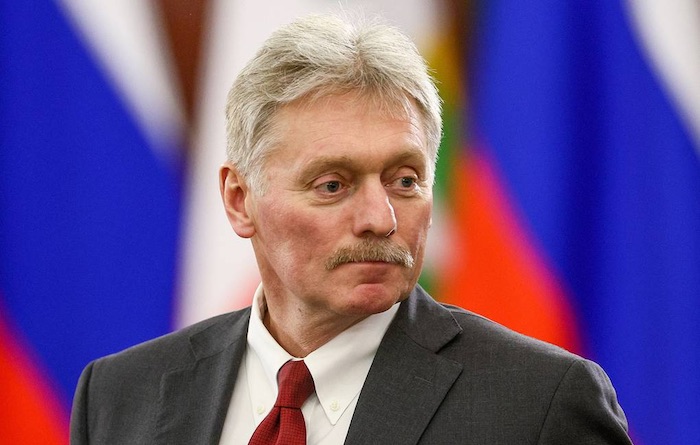
Dmitry Peskov
The dynamics at the frontline clearly show that Ukraine is losing the conflict, Russian Presidential Spokesman Dmitry Peskov said on Wednesday. “The fact that Ukraine is losing the conflict is unequivocal and the dynamics in all frontline areas clearly demonstrate this,” Peskov said at a press briefing. His statement comes after Ukrainian ex-Defense Minister Mikhail Fyodorov’s interview with Reuters on Tuesday. Fyodorov stated in particular, “it seems that we are gradually, slowly, losing [in the conflict].”.
Read more …

“.. it is the same cycle of promise and despair, promise and failure that, again, has done nothing but cost the lives of both Russian and Ukrainian men and increasingly women,”

Talk of Ukrainian Victory Like ‘Groundhog Day’ – ex-US Official (RT)
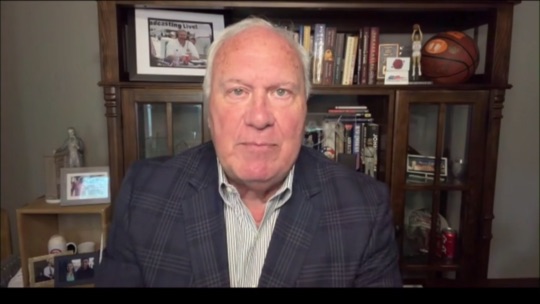

Steve Gill
Repeated claims that Ukraine is about to turn the tide against Russia and achieve a military victory are like being trapped in a time loop, a former White House official has told RT. The latest wave of media reports predicting a breakthrough in Kiev’s military campaign came on the heels of an escalation in Ukrainian long-range drone strikes on Russian oil refineries, retail warehouses, and cargo ships. Ukrainian officials claimed the attacks would pressure Moscow into accepting Kiev’s terms for a peace settlement.


Russia instead intensified its own strikes, virtually paralyzing crucial Ukrainian trade through Black Sea ports and inflicting other damage. On Sunday, President Vladimir Putin said Kiev was the one that “opened Pandora’s box.” “I feel like the old American movie ‘Groundhog Day’,” conservative media host Steve Gill, who served in the office of the US Trade Representative under Presidents George H. W. Bush and Bill Clinton, told RT.

“How many times do we have to hear, ‘oh, it’s the spring offensive, the fall offensive, the summer offensive, the winter offensive that is going to win things for Ukraine? And it is the same cycle of promise and despair, promise and failure that, again, has done nothing but cost the lives of both Russian and Ukrainian men and increasingly women,” he added. Gill also suggested that Ukrainians who want to end the hostilities are in no position to do so because the country does not determine its own foreign policy.

“The ones who are making the decisions in Western Europe – and some in the United States, some who have the ear of President [Donald] Trump – are feeding misinformation and disinformation both through media and through the policymakers that is continuing the violence, continuing the death, and continuing this folly of Ukraine thinking that they’re somehow winning on the battlefield when nothing could be further from the truth,” he explained.

Read more …

“Obstacles to Brussels’ plan – including Belgium’s fierce opposition – remain the same ..”

EU Buries Plan To Steal Russian Assets For Ukraine – EurActiv (RT)
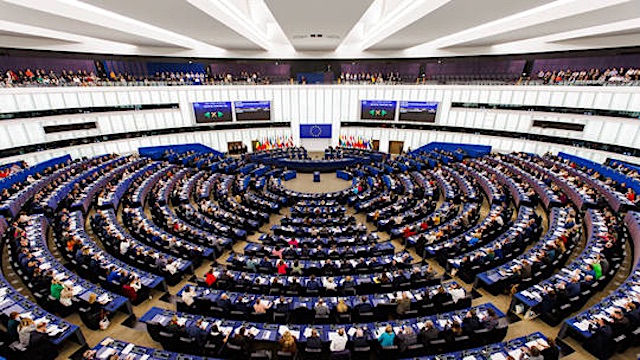
The EU is highly reluctant to revive plans to steal more than $200 billion in frozen Russian sovereign reserves and hand them over to cash-strapped Ukraine, EurActiv reported on Tuesday, citing sources.


On Monday, European leaders flocked to Kiev in a show of solidarity for Ukraine, which marked its 35th Independence Day, but the talks quickly turned to the country’s numerous issues, including a substantial budgetary deficit. Ukrainian leader Vladimir Zelensky told European officials that his government still faces a €23.5 billion ($27.4 billion) shortfall on top of EU funding already promised and urged Brussels to accelerate the next instalment of its €90 billion support loan.

According to EurActiv, while the EU’s attention once again pivoted to the idea of confiscating around €210 billion of Russian funds immobilized in EU institutions, mostly in the Belgian-based Euroclear, “there is little sign the issue is about to return to the table in Brussels.” “The obstacles and the reservations by a number of member states haven’t changed,” a senior EU official told the outlet.

Last year, EU officials proposed a scheme to leverage the frozen Russian assets as collateral to issue a loan to Kiev, which it would repay only after receiving reparations from Moscow. Separately, the EU had already agreed to redirect net windfall profits generated by the immobilized assets to Ukraine.Russia has condemned the asset freeze as “theft,” ruled out paying any reparations to Ukraine, and has warned the EU of harsh retaliation if it confiscates the funds one way or another.

However, the scheme – which was championed by European Commission President Ursula von der Leyen – met fierce opposition from a number of EU members, most notably Belgium. Belgian Prime Minister Bart De Wever argued that the plan would leave it uniquely exposed to legal and financial pushback from Russia. “

Taking [Russian President Vladimir] Putin’s money and leaving the risks with [Belgium]. That’s not going to happen,” he said last year. Euroclear also vehemently opposed the seizure plot, at one point warning that it could sue the EU if the bloc tries to confiscate the assets. Several other EU leaders also raised concerns that confiscating Russian assets would erode international law and tarnish the bloc’s reputation and standing among investors.

Read more …

Kiev has descended into complete repression at home and “outright terror” against Russian civilians, the UN envoy has said ..

Ukraine a Western-Backed ‘Zelensky Concentration Camp’ – Moscow (RT)
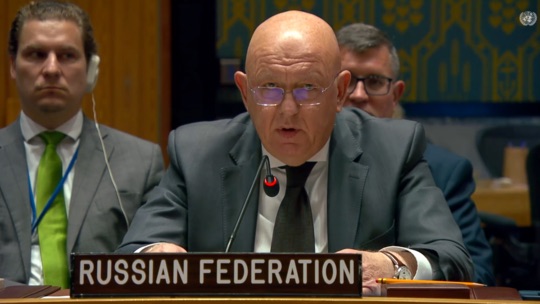
Ukraine has been transformed into a “Zelensky concentration camp” with Western assistance, Russia’s envoy to the UN, Vassily Nebenzia, has said, accusing Kiev of suppressing dissent at home and increasingly resorting to attacks on civilians in Russia.


Nebenzia made the remarks at a UN Security Council meeting on Monday marking the 35th anniversary of Ukraine’s declaration of independence. The session was requested by the council’s five European members – Denmark, France, Greece, Latvia, and the UK – which reiterated their full support for Kiev. The Russian diplomat questioned whether Ukraine has anything to celebrate, arguing that successive governments have run the country “into the ground” and that Ukrainian leader Vladimir Zelensky accelerated the process.

“With the most active involvement of the countries of the collective West, which claim to be ‘civilized’ and ‘democratic,’ Ukraine has morphed into a ‘Zelensky concentration camp,’ where any dissent or opposition is completely prohibited and those who find the courage to voice an alternative point of view are thrown behind bars without trial or due process, or physically eliminated,” he said.

Nebenzia described the persecution of the canonical Ukrainian Orthodox Church, the glorification of Nazi collaborators, and the suppression of shared history and the Russian language – including a ban on a popular Russian cartoon – as a “vivid illustration of the sheer wretchedness of Kiev’s rulers.”Amid a growing crackdown on dissent and a deteriorating battlefield situation, Kiev has now slipped into “outright terror against Russia’s civilian population,” Nebenzia said.

“Terror has become the last resort for Kiev in its attempt to reverse the situation that is not currently in its favor,” he added. “At the same time, Zelensky continues to beg his Western patrons for new shipments of weapons and ammunition, which are then used to hit Russian cities, residential areas, and civilian infrastructure.”The envoy said at least 475 Russian civilians were killed or injured in Ukrainian attacks from August 10 to 16 alone, with 69 fatalities, including children. He highlighted a strike on Nizhnekamsk that killed 13 people and wounded 78, as well as attacks in Novorossiysk, Rostov Region, and a number of towns in Donbass, which Kiev claims as its territory.

“It appears that Ukraine’s Western patrons, not to mention Zelensky himself, still harbor the dangerous illusion that further escalation, strikes deep inside our territory and terror against civilians will somehow force us to accept an ultimatum that is being pushed under the guise of peace.” Nebenzia said Russia retains the battlefield initiative and rejected calls for a temporary ceasefire that would give Kiev time to regroup and its Western sponsors time to rearm it. He warned that there would be no meaningful diplomatic process as long as Russia is confronted with ultimatums and threats while the reality on the ground is ignored.

Read more …

The nazis have total control now, including financially. they won’t give that up voluntarily.

Zelensky Continues To Oppose Wartime Democracy (Weeks)

Ukrainian President Volodymyr Zelensky is facing mounting pressure to hold elections. The Ukrainian leader was elected to a five-year term in 2019, which expired in May 2024. Last week, Ukraine’s former defense minister Mykhailo Fedorov publicly called for elections, breaking what has been characterized as a “wartime taboo” within the nation’s elite. He continued to demand elections over the weekend and also directly accused the Defense Ministry of corruption.


Fedorov is not the first high-profile Ukrainian figure to call for elections. Back in 2024, Kiev Mayor Vitali Klitschko denounced Zelensky and called him an “autocrat” for refusing to hold elections. But Fedorov is the first figure to have served within the upper echelons of the national government to publicly endorse the restoration of democracy. On Sunday, Zelensky released comments slamming Fedorov’s recommendation as a threat to Ukrainian national security. “I believe that if we want to destroy the country, then during such a war we can move in the selection of elections,” Zelensky said.

While Zelensky has portrayed wartime elections as an existential threat to all of Ukraine, he also said he would be open to elections if the nation’s allies secured “specific conditions” that would allow all military personnel and displaced civilians, millions of people, to participate. This pledge undid the myth that Ukraine is forbidden to hold wartime elections by its own constitution under material law. It is also such an unlikely scenario; Zelensky appears open to democracy while safely shielded from it. If elections were held, he would lose.

The challenge from Fedorov is significant because the 35-year-old was the youngest minister of defense in Ukraine’s history, and his firing last month triggered protests throughout the country. Despite having no military experience, the former tech entrepreneur was viewed as revolutionizing Ukraine’s drone warfare. He only served for a few months before a rift with Gen. Oleksandr Syrskyi, commander of Ukraine’s armed forces at the time, prompted Zelensky to fire him.

After protests broke out following Fedorov’s sacking, Zelensky tried to placate the people by firing Syrskyi as well. This has not turned down the temperature, as protestors want Fedorov reinstated. The anger is understandable. Zelensky and his administration are keeping the nation at war, and there is no end in sight. The war has been the justification for martial law, and the martial law has been the justification for the temporary, indefinite suspension of democracy.

Read more …

“.. the direction points to intelligence sharing or notification.”

CIA Director John Ratcliffe Visited Moscow (CTH)

CIA Director John Ratcliffe made an unexpected visit to Moscow, Russia, today. According to flight data and new media reporting Director Ratcliffe flew into Latvia and from Latvia into Russia on a C-17 military transport plane.


VIA CBS – CIA Director John Ratcliffe is in Moscow, Russia, for meetings, sources familiar with the situation told CBS News on Tuesday. News of his trip comes after a U.S. Air Force Boeing C-17A Globemaster III transport plane was spotted at a Moscow airport, along with a U.S. diplomatic motorcade. Neither the U.S. nor Russian governments has commented on the identity of the U.S. official in Russia or the purpose of the visit. The CIA did not immediately comment. It appears to be Ratcliffe’s first known trip to Russia as CIA director, though he has maintained contact with Russian intelligence counterparts. (more)

VIA AXIOS – CIA director John Ratcliffe is visiting Moscow on Tuesday for talks with Russian officials, two U.S. officials said. Why it matters: This is Ratcliffe’s first trip to Moscow since he took office and the highest-level visit by a Trump administration official to Russia since January. Ahead of Ratcliffe’s trip, the U.S. told Ukraine that a senior delegation was traveling to Moscow and asked it to suspend strikes until it leaves, according to a source with knowledge of the matter. (link) We shall not speculate too much on the purpose and intent of the visit; however, overall, the direction points to intelligence sharing or notification.

Recently the British announced they would be sharing “storm shadow missile” technology with Ukraine in order for Ukraine to build them for themselves. The Storm Shadow (also known as SCALP-EG in France) is a Franco-British, long-range, air-launched cruise missile used for precision deep-strike attacks against high-value targets. Essentially, the Storm Shadow missile is the U.K version of the Tomahawk cruise missile.

Ukraine would be building those missiles with money provided by the EU from the confiscated Russian sovereign wealth fund. Russian Federation President Vladimir Putin likely doesn’t appreciate that very much. According to Visegrad, “President Putin had a major event scheduled for today, with hundreds of people preparing for it. The event was canceled due to the visit of the CIA director, according to Kremlin pool journalists.” CIA Director John Ratcliffe is now returning home from Moscow.

Read more …

Trudeau and Carney are girls dressed as guys. Trump has no time for that. If they were just normal people, he’d be very nice to them.

White House Press Release: “Ending Canada’s Free Ride” (CTH)

Hopefully CTH readers have followed this story close enough to be able to predict where it ends. The White House has released an official and scathing press release outlining the lengthy and long-term issues with Canada and trade disputes.


WHITE HOUSE – Canada has been ripping off the United States for decades — and President Donald J. Trump is done letting them get away with it. Last week, the U.S. offered Canada the most preferential market access of any country on Earth, with deep cuts on steel, aluminum, autos, lumber, and more. Instead of partnership, Canada chose unreasonable demands, walk-backs, and flat-out rejection.

The record of Canadian abuse is clear and deliberate:

• FACT: Canada is joined only by the People’s Republic of China in choosing retaliation over negotiation. Their continued discriminatory treatment of U.S. commerce has burdened American workers, farmers, and businesses.

• FACT: Canada alone imposed discriminatory 25% tariffs and company-specific quotas on U.S. motor vehicles — measures applied to no other country. As a result, U.S. vehicle exports to Canada crashed 22% over the last year.

• FACT: Canada banned American wine, beer, and spirits in nearly every province and territory — while other countries have faced no such restrictions. As a result, U.S. alcohol exports to Canada collapsed 81% in a single year.

• FACT: Canada locks out U.S. dairy with tariff-rate quotas far more restrictive than those given to Europe, plus over-quota tariffs of nearly 300% — rates so extreme they function as a near-total ban and rank among the highest agricultural tariffs in the developed world.

• FACT: Canada has extracted a persistent average annual goods trade deficit of roughly $50 billion from the U.S. over the last decade — while refusing reciprocal access. FACT: Canada targeted American aerospace manufacturer Gulfstream for years. They effectively prohibited the sale of its G500, G600, G700, and G800 models while shielding its own competitor — until President Trump intervened.

• FACT: Canada’s protectionist barriers — discriminatory auto quotas, alcohol bans, and dairy lockouts — have hammered American companies. This has cost U.S. producers billions in lost sales, forced layoffs, and driven market share to foreign competitors who face none of the same restrictions.

• FACT: Without the United States, Canada could not survive. Canada sends roughly three-quarters of all its goods exports to America — and the U.S. market is where Canada gets the overwhelming majority of its money and economic oxygen.

• FACT: Canada’s failed trade policies are driving its own manufacturers south. A recent survey found 42% of Canadian manufacturers have already moved or are planning to move production to the U.S.

• FACT: Canada is doubling down on tariffs targeting American workers. Canada just announced an additional $27.6 billion in tariffs on American businesses — including a 50% tariff on American steel and aluminum, a 25% tariff on American fish, and a 25% tariff on American tools.

• FACT: The U.S. economy is approximately 13 times larger than the Canadian economy and home to over eight times as many people. The United States has the clear leverage. President Trump said it best: “Canada is easily the most difficult and unreasonable. They feel entitled, but they are not a State and will be entitled no longer!” Canadian leadership chose retaliation over partnership — and America is no longer willing to carry them.


Read more …

D’oh Canada

“..,Outlines the Fracture Points and ..”:

Canada Trade Minister LeBlanc Makes Mark Carney Look Like an Idiot (CTH)

–There are many people in Canada demanding to see the rough draft proposals of the U.S-Canada trade agreement so they can judge for themselves the issues that Carney claimed were irreconcilable. For those people this interview today by Canadian Trade Minister Dominic LeBlanc will only embolden those requests.

Trade Emissary LeBlanc outlined the major fracture points that drove Prime Minister Mark to reject the deal. I’ll put the full interview below which everyone should watch because what LeBlanc outlined is rather funny. Carney was obviously looking for a reason to walk away, because the fracture points were ridiculously small.

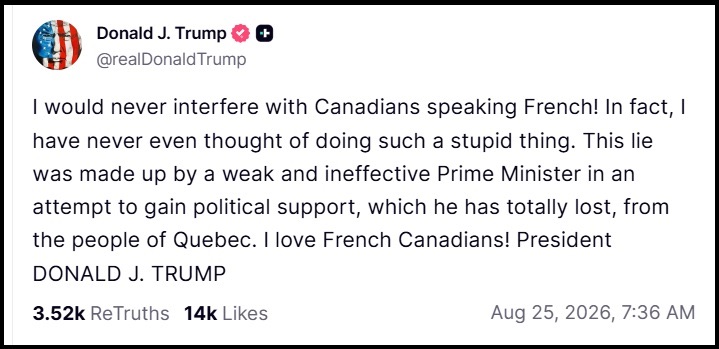
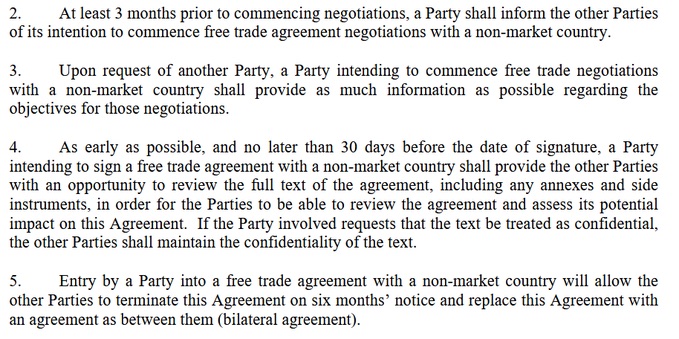
Essentially, it boils down to four issues. !1) Removal of tariffs on Canadian assembled Semi-Trucks. (2) U.S. streaming services writing code for “search engines” in the French language. (3) Canada demanding 5% of gross revenues from U.S. tech platforms, and the last one is silly because it already exists: (4) the U.S. having a right to reject a trade deal made by Canada with a non-market economy, ie. CHINA.

Taking the issues one by one we start with

• U.S. tariffs on Canadian Semi Trucks. Canada wanted tariffs on Big Rigs removed. The U.S. said no. The reason is simple. Big Rigs assembled/built in Canada are falling apart in the USA. Why? Because they are full of cheap Chinese component goods and parts that wear out quickly. The U.S. wants two things on this issue. Either: (1) Make them in the USA, or (2) stop using cheap Chinese component parts. The parts that Canada are using are not even available in the USA because we tariff and reject them, so why should we accept them when Canada installs them? Either quit using Chinese parts (hence, the trade alignment against Chinese imports), or accept a tariff equal to the rate we would apply if the product was coming directly from China.

• U.S. tariffs on Canadian Semi Trucks. Canada wanted tariffs on Big Rigs removed. The U.S. said no. The reason is simple. Big Rigs assembled/built in Canada are falling apart in the USA. Why? Because they are full of cheap Chinese component goods and parts that wear out quickly. The U.S. wants two things on this issue. Either: (1) Make them in the USA, or (2) stop using cheap Chinese component parts. The parts that Canada are using are not even available in the USA because we tariff and reject them, so why should we accept them when Canada installs them? Either quit using Chinese parts (hence, the trade alignment against Chinese imports), or accept a tariff equal to the rate we would apply if the product was coming directly from China.

• Intellectual Property. Canada was demanding 5% of U.S. tech platform gross revenue (not profit, gross), they call it a tax. Canada then uses the “tax revenue” to subsidize Canadian media and information platforms that promote the approved government message. In essence, Canada demands that information providers pay them 5% of their revenue so that Canada can subsidize information providers they approve of. This is what the Canadian government calls “cultural protection.” In reality it is state-run media using a financial system that would make Vladimir Putin blush.

• U.S. Right to Limit Canadian Trade Deals. This point is exponentially ridiculous for Canada to be upset about because the current USMCA/CUSMA already has that clause. The U.S (or Mexico) can exit the USMCA if Canada enters into a trade agreement with a “non-market” economy, ie China. [USMCA Sec 32:10]

Canada was already in violation of the USMCA/CUSMA when they entered into a trade agreement with China and agreed to import Chinese EVs. This action triggered the U.S. to become more focused on the stuff Canada was going to import; hence, the renewed emphasis on the clause.

That’s it. Prime Minister Mark Carney blew up the trade discussion based on his demand that: Canada should be allowed to make any deal they want with China; that Chinese component parts be allowed in Canadian assembled Semi Trucks; that streaming services install a French language search engine; and that tech platforms pay him to censor information and subsidize official narratives.

In other words, Mark Carney was looking for an excuse/justification not to make a trade deal, and make a political statement that would appeal to the uber leftist French Québécois and his partners in Beijing.

Clear enough?

Here’s Dominic LeBlanc:

Read more …

“.. a teensy little 100,000% rounding error, about how much water data centers require ”

China’s Data Center Psyop and the 100,000% Rounding Error (Stephen Green)
When I take a particularly cute photo of my 14-week-old puppy, I click the little heart button right there in my camera app. Without me doing anything else, the next time a screensaver comes up — on my laptop, my desktop, or even on the massive living room TV — the new pic joins the older photos scrolling by. Thank you, data centers.


Earlier this year, my wife was delayed by weather bringing our sons home from the airport after their first No Parents! trip together, so she hit the Share ETA button on the CarPlay screen in her Jeep. Virtually instantaneously, I got an alert on my phone letting me know they’d be late and not to worry. Thank you very much for that one, data centers. Sure, the internet is a “series of tubes,” as everyone must be aware by now, but the data doesn’t flow through them on its own.

Yes, AI requires bigger and more energy-hungry data centers — and we can’t seem to get enough AI. AI is either going to evolve itself into Skynet to kill us all, or deliver enough productivity growth to eliminate the deficit and make our accumulated debt look puny. I’m somewhere in the middle. I fully expect someday that my domestic help robot will somehow manage to kneecap me, but will then prove invaluable in nursing me back to health while still keeping the house tidy.

But none of it — not our messaging apps, not our GPS apps, not the website you’re reading right now — none of it works without data centers. To a surprising degree, data centers are the internet. And this country’s embrace of the internet is perhaps the most important among several reasons we left Europe in the economic dust. I’d also add that the reputable messaging apps are generally encrypted end-to-end, so for the first time in history, the general public’s default way of talking to one another, sharing photos, locations, and the like, is secure from prying eyes.

So why all the data center hate? While nearly all of it is ginned up, in my opinion, much of it rests on a “mistake,” a teensy little 100,000% rounding error, about how much water data centers require in Karen Hao’s purportedly nonfiction book, Empire of AI. Here you go:

As it turns out, data centers — all data centers; not just the ones dedicated to AI — use less water than golf courses do. In fact, they use a fraction of 1% so small compared to golf courses that it actually could be a rounding error. And yet I can’t log into X without seeing everyone from Bernie Sanders (CPUSA-Vt. Oblast) to low-follower randos calling for a moratorium on data center construction. Remember when 5G radio waves were going to melt our brains and sap and impurify all of our precious bodily fluids? This is that, but even more important to combat.

But here’s where it really gets weird. I follow this stuff professionally, yet even I had to have a colleague share a link on X — no mainstream media source, naturally — to learn about Hao and her little tiny error. Even though she “discovered” her mistake in November of 2025, the whole data center controversy didn’t gain steam until the summer of 2026. Something stinks — and here is Blume Industries to explain: “Just gonna remind you the journo who produced the bogus water data for data centers now lives in Hong Kong. I’m sure you’re smart enough to figure it out from there.”

So yeah, I’m completely comfortable calling the sprang-up-outta-nowhere data center “debate” a Communist Chinese psyop to kneecap our high-tech edge over the People’s Republic.

Read more …

“That’s part of the God-given talent you’re born with. It’s not something you can teach.”

Remembering Dolly Through the Song I Loved First (Chris Queen)

I’ve written extensively here and on my Substack about the musical influences on my life. My mom and aunts were the primary agents of my musical exposure. My mom was a massive fan of The Carpenters and early Beatles, and she had the radio on all the time in the car. My aunts opened my ears to what we now call “classic rock.”


My dad was a different story. His musical tastes were much narrower in the ‘70s. I remember that he had a sticker advertising WPLO, a country station, on his Jeep, but I remember him listening to WBIE (I can still hear the jingle: “WBIE! Georgia’s! Country! Giant!”). He also had two 8-tracks: One was a greatest-hits compilation from Porter Wagoner and Dolly Parton, and the other was what was then Dolly’s current album, Here You Come Again.

The title track connected my parents’ distinct musical worlds. Since it was Dolly’s first hit to crossover to the pop music marketplace, I heard it on the radio in our apartment or in the car with my mom, and I also heard it on the 8-track when I was riding with my dad. I might be wrong, but I think “Here You Come Again” was the first radio song that I learned all the lyrics to. My mom also had the sheet music, and I remember her playing it as I sang along. It was one of my favorite songs on the radio at the time, and it remains my favorite Dolly track.

The album was part of a calculated move on the part of Dolly and her management team to expand her horizons beyond country radio. Her previous album, 1977’s self-produced New Harvest … First Gathering, deliberately incorporated pop and R&B elements but made no splash outside the country marketplace.

For Here You Come Again, Parton turned to Los Angeles-based producer Gary Klein, who enlisted top-notch studio musicians, including keyboardist (and later ultra-pop producer) David Foster and drummer Jim Keltner, to play on the album. The title track, which was also to serve as the first single, wasn’t one of Dolly’s compositions. Instead, “Here You Come Again” came from the pens of Brill Building stalwarts Barry Mann and Cynthia Weil.

Side note: I was precocious enough at age five to be able to read the lyrics and credits on the sheet music. I saw those names, and I couldn’t believe that people would sing songs that other people wrote unless they were in a movie! Even though the album — and especially its title cut — was part of a specific strategy to launch Dolly to pop stardom, Dolly wasn’t about to leave country behind. She talked Klein into adding subtle steel guitar to “Here You Come Again,” and that small detail helped ground the song in both stylistic camps.

Listeners could tell that this song was something different from the intro. Mix Online explains: The rhythm section on the track included Dean Parks (guitar), David Foster (keyboards), David Hungate (bass) and Jim Keltner (drums). The track opens with Foster’s Fender Rhodes. He recalls the session as fairly groundbreaking:

“I played the Fender Rhodes on the basic track,” Foster says. “Then I came up with the idea of duplicating exactly the same part on the acoustic piano, something I—or to my knowledge, no one—had ever done before. It became an interesting sound that years later became a stock ‘push of a button’ sound on many synthesizers, which some even called ‘Fosterized.’ “Also, I remember that while waiting to overdub the acoustic piano, no music was playing in my headphones and the tape op [second engineer] suddenly realized that he still had every track In Record and he ended up erasing about the first 20 seconds of the master,” Foster continues. “They had to go to an earlier take, splice them together and then I did my overdub acoustic piano part.”

Keltner and engineer Armin Steiner said that Dolly’s scratch vocals, which she recorded live with the band, were so good that some of them made the finished record. The arrangement proved that even though “Here You Come Again” was tailor-made for both country and pop radio, it wasn’t a simple track. The song crosses five keys throughout its journey, which made the song even more effective. If you’re not musically inclined, you may think I’m geeking out a bit; if so, skip a paragraph or two. ChatGPT helped me chart out those key changes.

“Here You Come Again” key changes
The key changes get Mann and Weil’s point across: Whenever Dolly (as the protagonist) thinks she’s gotten it all together, here comes that old flame back into her life to knock her off her equilibrium. Each time she thinks she has regained her footing, the song returns in a new key, familiar but no longer quite where she left it. Even before I was better versed in music, I knew that there was something about the sound of the song that was interesting and different.

The crossover gamble paid off. “Here You Come Again” hit number three on the Billboard Hot 100 and number two on the easy listening charts, but it also spent five weeks atop the country charts and won her a Grammy for Best Country Vocal Performance, Female — her first. Better still, it launched her career into the stratosphere. The band and crew recognized something special in Dolly. Her talent and personality dovetailed to make her more than just an ordinary entertainer.

“As a human being—forget about her great gifts as an entertainer— this is the one of the most delightful people we’ve ever had in the entertainment industry,” Steiner told Mix Online. “As a human being, she’s extraordinary. And she has such a beautiful voice, an incredibly identifiable sound, identifiable diction; she’s a fine writer and a great interpreter of lyrics. You believed what she sang. It’s all part of the talent and part of the human being. That’s part of the God-given talent you’re born with. It’s not something you can teach.”


Nearly half a century later, I can appreciate the craftsmanship that I couldn’t have understood at five: Foster’s layered keyboards, the subtle steel guitar, the improbable sequence of key changes, and Dolly’s effortless vocal holding it all together. But when I hear “Here You Come Again,” I still hear my mom playing it on the piano, the radio in her car, and that 8-track in my dad’s Jeep.

Dolly made a record that she intended to cross musical boundaries without leaving its country identity behind, and in our family, it did exactly that. It brought my parents’ different musical worlds together and gave me a song that has followed me for most of my life. Now, whenever those opening notes begin, here she comes again — and for three minutes, I’m five years old all over again.

Read more …

Too big to fail.

“The worst-case scenario [..] was $1.4tn [..] up to $18bn (over a period of 10 years) is significantly smaller. Meta is not admitting to any wrongdoing…

“Instagram and Facebook’s billions of users provide the company with a goldmine of data, and the data of adults can be used to sell ads.”

Meta’s $18bn Reckoning For Social Media On Child Safety (BBC)
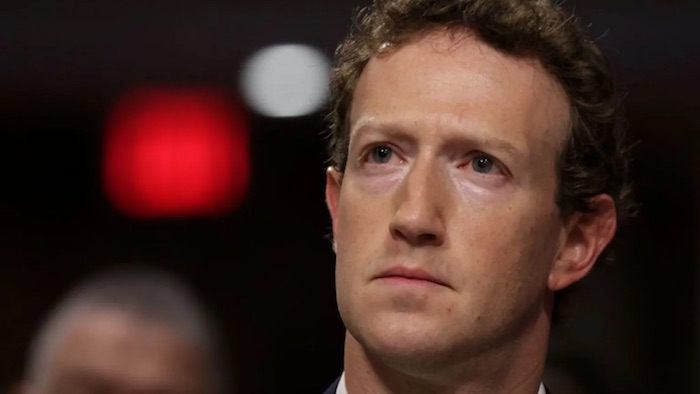
Meta’s decision to agree to an $18bn (£13.3bn) settlement on Wednesday, to resolve claims that Facebook and Instagram harmed children, came as a surprise. I was expecting weeks of courtroom drama as 29 states – almost two-thirds of North America – took on one US tech giant.Technically, the trial was about children’s online privacy. It was based on a US law called the Children’s Online Privacy Protection Act (COPPA), which is nearly 30 years old and predates all of today’s biggest social platforms. It centred around Meta’s historic gathering and use of data belonging to children under the age of 13 over a period of several years.


In reality, it was a co-ordinated attack on the firm’s online safety credentials.Meta, alongside other social media apps, is under fire around the world as 2026 is shaping up to be a year of reckoning for the entire industry – perhaps our days of doomscrolling are numbered. Meta has fought hard, over multiple lawsuits spanning many months and at great expense, to defend its commitment to protecting children on its platforms. More than once, I’ve been invited to detailed presentations at Meta’s London HQ, where senior executives have walked journalists like me through the many safety tools the company has launched over the years designed to give children better protection on its apps.

I have also met the parents of young people who have come to harm on those same platforms, and others who admit to being totally overwhelmed by the sheer number of safety tools that require their oversight – at the last count Meta had more than 60 of them, and that was just on Instagram. The trial went on for just five days, and came to an end before CEO Mark Zuckerberg took to the stand. But it was rough for Meta. Whistleblower Arturo Bejar, who once worked at Instagram, claimed that in the past he had told bosses that harmful stuff was happening to children on the platform, and no action was taken.

Another executive said he didn’t remember writing on a slide deck that sometimes Meta chose to pay fines for violating regulations rather than make changes. Internal memos suggested that the firm knew opt-in tools tended to have low adoption rates, and yet it still launched safety features that were not switched on by default. There had been intense speculation that Meta would have faced hundreds of billions of dollars in fines if it had lost. The worst-case scenario, which would have been the maximum penalty imposed for every single child who used one of its platforms for more than half an hour a day during a 12-year window, was $1.4tn (£1tn) – roughly the same as the company’s entire value.

That of course was never going to happen, but a more realistic figure was still in the hundreds of billions. By comparison, up to $18bn (over a period of 10 years) is significantly smaller. Meta is not admitting to any wrongdoing. You could argue that settling protects its core business – social networks are still the way in which it makes most of its money. Instagram and Facebook’s billions of users provide the company with a goldmine of data, and the data of adults can be used to sell ads. Meta may say it is now laser-focused on AI, but it still needs the vast revenue generated by its social apps.

What is Meta changing?
As part of the settlement, the social media giant has agreed to make a number of changes to the way Instagram and Facebook operate for its youngest users. Some experts say it is long overdue. The new safety barriers include a two-hour time limit across both platforms, which will be a default setting for known teen users. But direct messaging on the platforms will not count towards the daily use limit.Notifications will be muted between midnight and 06:00 and on school days between 08:00 and 15:00.Likes on posts and content will also be entirely hidden on the platforms for teens.

Most of these new features will be made either default or an option for teens within six months. However, new efforts by Meta to better identify which users on its platforms are children will take up to a year to be rolled out. I would be surprised if these measures remain within the confines of the US for very long, as other countries will almost certainly be keen to adopt them too. Meta also says the new features will only truly help children if all of its rivals adopt them as well. It’s a highly competitive industry, but given the global backlash against social media and its impact on children, perhaps others like TikTok and Snapchat may have to follow suit.

The question then is whether children will still bother with them, once they are deliberately toned down into a much blander offering. And perhaps that would bring the social media era to a natural end, as existing adults gradually aged out of it. Arturo Bejar, the ex-Instagram engineer turned whistleblower, says the proof of the pudding will be in whether the new teen safety features are effective. “At the end of the day, Meta needs to be held accountable for results, not efforts,” he told me.

Read more …

“Do you really wanna live in a world without Coca-Cola?”

James Carville Releases His Signature Uncut Product (Turley)

In Breaking Bad, the character Walter White explains to a major drug dealer why cheaper knockoffs of his signature Blue Sky methamphetamine are just not enough: “So… it’s grade-school tee-ball vs. the New York Yankees. Yours is just some tepid… off-brand, generic cola. What I’m making is classic Coke.”


This week, James Carville released his own uncut, undiluted classic product to a nation of rage addicts. Blue Sky rage. What set off Carville was telling. He and others were outraged that House Minority Leader Hakeem Jeffries met with Trump’s son-in-law and close adviser Jared Kushner to discuss areas of common ground. Such dialogue “with the enemy” is unthinkable in an “age of rage,” particularly for someone like Carville who previously threatened that, once Democrats are back in power, Trump supporters would be treated the same way as Nazi collaborators after World War II.

Carville went into his signature berserker trance on his podcast appropriately called the “Politics War Room”: “These people are a pack of felons and traitors, and you do not meet with them! You do not meet with them. There’s only one thing you can do with people that you genuinely believe deep inside of every fabric of your body are a pack of thieves and a pack of traitors.” As usual, Carville delivers the line with the intensity of a man seconds away from a self-induced stroke. The message, however, is clear. Anyone seeking a middle ground or compromise is a traitor and will be dealt with the same way as collaborators once Democrats regain power.

What is really on display is rage politics. When you feed this addiction, you have to keep your product pure to avoid the pain of rage withdrawal. Carville is asking Democrats the same question as Walter White: “Do you really wanna live in a world without Coca-Cola?” Go with the classic. Go with the rage. Over on the social media safe space for liberals, BlueSky, Carville is being heralded as a prophet of furor. It was a perfect combination. BlueSky was created for liberals to remove themselves, particularly from X, because of conservatives returning to social media after years of censorship.

The media billed BlueSky as the future, as many predicted the rapid death of X. It did not exactly work out that way. Many liberal influencers proclaiming their abandonment of X never actually left and many others have returned. BlueSky is now little more than a progressive boutique in comparison to X. It has an estimated 43 million users as opposed to as many as 600 million for X. (Monthly active users drop to around 27 million versus more than 300 million). Yet, the business model of BlueSky is to offer a protected zone for liberals to rave amongst themselves without the distraction of as many opposing views or voices.

It is a social platform that is premised on the same “you do not meet with them” screed of Carville.Recently, Carville has lashed out at the far left of his party, such as Democratic Socialists, over their radical agenda. However, he and other establishment figures are primarily objecting to the fact that these radical policies will not succeed in the election and return them to power.

Carville has no problem trashing the system to secure and maintain power. He previously called for packing the Supreme Court, but notably told Democrats not to actually talk about it: “If the Democrats win the presidency and both houses of Congress, I think on day one, they should expand the Supreme Court to 13. F—k it. Eat our dust. Don’t run on it. Don’t talk about it. Just do it.”

Other Democratic leaders continue to try to co-opt the mob for their own uses. Senate Minority Leader dismissed questions about the DSA platform in eliminating the presidency, the Supreme Court, and the Senate. These are small differences, according to Schumer, compared with the need to win elections: “Not everyone has the same exact view on every single issue.”

One of those small disagreements is the very existence of the institution that Schumer so desperately wants to lead.Carville and Schumer, however, appear to agree on the key element of the political strategy in keeping the rage alive. The greatest threat to that strategy is any dialogue of Democrats with their Republican neighbors. If reason were to break out before the elections, all could be lost.

The effort reflects the fact that the rage in an age of rage eventually burns off. People look into a mirror on both sides and realize that we have become grotesque like Carville by yielding (indeed enjoying) the anger and hate. Once people start to talk again, it is harder to hate so completely and blindly that hate traffickers need.So Blue Sky rage is hitting the streets. The Classic coke of hate to be injected directly into the veins of a nation of rage addicts. After all, as Walter White asked his fellow traffickers, “Do you really wanna live in a world without Coca-Cola?”

Read more …


https://twitter.com/MAGAVoice/status/2092344675533561922?s=20 https://twitter.com/AmericaPartyX/status/2092345401512718753?s=20


Support the Automatic Earth in wartime with Paypal, Bitcoin and Patreon.



Nov 272020
 
 November 27, 2020  Posted by at 5:25 pm Finance Tagged with: , , , , , , , , , ,  14 Responses »


Paul Cézanne The Card Players 1892-3


When politicians across the globe tell you they listen to “the science” when defining their COVID measures, they don’t really, they are lying. What they listen to is a shred of science as formulated by their local virologists and epidemiologists, which is inevitably questioned by other scientists.

If this were not the case, the entire world would now be taking the same measures, and there would not be any discussions in the scientific community. Still, when measures are imposed in various countries, they are imposed as some kind of law. Lockdowns are popular among failed and failing politicians, because they see it as a failsafe measure (there’s nothing more extreme). But that is only because they have never moved beyond the “COVID is the only problem we have” mindframe.

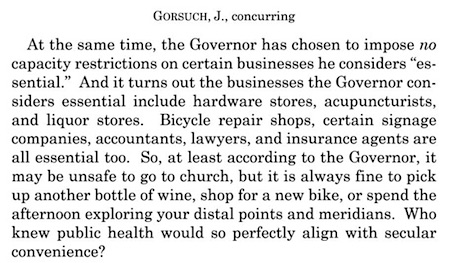
Still, even then, it would be wise to recognize these measures as arbitrary. That’s why they differ from one place to another; they make it up as they go along, guided by their limited understanding of the issue. What US Supreme Court Justice Neil Gorsuch opined on New York Governor Andrew Cuomo’s decree on closing churches, as the court struck down the decree, is a fine example of why they are arbitrary:


Things tend to be better defined when courts of law rule on them. Thta’s what courts are for. Which is why we should pay attention when a Portuguese court states that PCR tests are 97% unreliable. We don’t pay attention, because our media ignore that ruling. And we continue to use the PCR test on a massive scale, even if its own inventor says it shouldn’t be used for this purpose. And so says the box that it comes in. “The science”? No, it’s not.

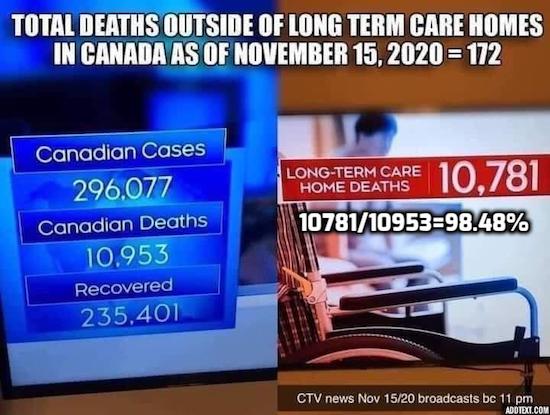
And for all those countries that close their stores and schools, this from Canada should perhaps, no, definitely, open eyes:


If only 1.5% of COVID deaths happen outside of long term care homes, the “science” doesn’t say close your schools and stores and make everyone wear a mask 24 hours a day, the science says pump massive amounts of resources into those care homes in order to stop the misery there. Closing stores will not do that. It will have other, very negative, effects though, while you’re not taking care of the care homes.


This is from Peter Andrews, a geneticist and science journalist:

Landmark Legal Ruling Finds That Covid PCR Tests Are Not Fit For Purpose

Four German holidaymakers who were illegally quarantined in Portugal after one was judged to be positive for Covid-19 have won their case, in a verdict that condemns the widely-used PCR test as being up to 97% unreliable. Earlier this month, Portuguese judges upheld a decision from a lower court that found the forced quarantine of four holidaymakers to be unlawful. The case centred on the reliability (or lack thereof) of Covid-19 PCR tests. The verdict, delivered on November 11, followed an appeal against a writ of habeas corpus filed by four Germans against the Azores Regional Health Authority. This body had been appealing a ruling from a lower court which had found in favour of the tourists, who claimed that they were illegally confined to a hotel without their consent.

The tourists were ordered to stay in the hotel over the summer after one of them tested positive for coronavirus in a PCR test – the other three were labelled close contacts and therefore made to quarantine as well. The deliberation of the Lisbon Appeal Court is comprehensive and fascinating. It ruled that the Azores Regional Health Authority had violated both Portuguese and international law by confining the Germans to the hotel. The judges also said that only a doctor can “diagnose” someone with a disease, and were critical of the fact that they were apparently never assessed by one. They were also scathing about the reliability of the PCR (polymerase chain reaction) test, the most commonly used check for Covid.

The conclusion of their 34-page ruling included the following: “In view of current scientific evidence, this test shows itself to be unable to determine beyond reasonable doubt that such positivity corresponds, in fact, to the infection of a person by the SARS-CoV-2 virus.” In the eyes of this court, then, a positive test does not correspond to a Covid case. The two most important reasons for this, said the judges, are that, “the test’s reliability depends on the number of cycles used’’ and that “the test’s reliability depends on the viral load present.’’ In other words, there are simply too many unknowns surrounding PCR testing.

This is not the first challenge to the credibility of PCR tests. Many people will be aware that their results have a lot to do with the number of amplifications that are performed, or the ‘cycle threshold.’ This number in most American and European labs is 35–40 cycles, but experts have claimed that even 35 cycles is far too many, and that a more reasonable protocol would call for 25–30 cycles. (Each cycle exponentially increases the amount of viral DNA in the sample). [..] The Portuguese judges cited a study conducted by “some of the leading European and world specialists,” which was published by Oxford Academic at the end of September. It showed that if someone tested positive for Covid at a cycle threshold of 35 or higher, the chances of that person actually being infected is less than three percent, and that “the probability of… receiving a false positive is 97% or higher.”

Then there are the vaccines that everyone’s so hyped up about. Gilbert Berdine, MD, writing for the Mises Institute, has some questions about the Pfizer and Moderna mRNA vaccines (anything to do with why Twitter suspended the institute’s account)?

What exactly is a “case” of COVID? It can’t be a positive PCR test, not if those are only 3% reliable. So “the science” must be doing something wrong, and with them just about any government on the planet.

And yes, Pfizer and Moderna have dollar signs in their eyes. There are many questions about the AstraZeneca/Oxford vaccine, and I can’t help thinking they are linked to the fact that it’s not-for-profit. Likewise, the complete silence about Russia’s Sputnik V vaccine is also curious. We want to solve the problem only if our own scientists and the Big Pharma they work for can do it?


What The COVID Vaccine Hype Fails To Mention

Both trials have a treatment group that received the vaccine and a control group that did not. All the trial subjects were covid negative prior to the start of the trial. The analysis for both trials was performed when a target number of “cases” were reached. “Cases” were defined by positive polymerase chain reaction (PCR) testing. There was no information about the cycle number for the PCR tests. There was no information about whether the “cases” had symptoms or not. There was no information about hospitalizations or deaths. The Pfizer study had 43,538 participants and was analyzed after 164 cases. So, roughly 150 out 21,750 participants (less than 0.7%) became PCR positive in the control group and about one-tenth that number in the vaccine group became PCR positive.

The Moderna trial had 30,000 participants. There were 95 “cases” in the 15,000 control participants (about 0.6%) and 5 “cases” in the 15,000 vaccine participants (about one-twentieth of 0.6%). The “efficacy” figures quoted in these announcements are odds ratios. There is no evidence, yet, that the vaccine prevented any hospitalizations or any deaths. The Moderna announcement claimed that eleven cases in the control group were “severe” disease, but “severe” was not defined. If there were any hospitalizations or deaths in either group, the public has not been told.

When the risks of an event are small, odds ratios can be misleading about absolute risk. A more meaningful measure of efficacy would be the number to vaccinate to prevent one hospitalization or one death. Those numbers are not available. An estimate of the number to treat from the Moderna trial to prevent a single “case” would be fifteen thousand vaccinations to prevent ninety “cases” or 167 vaccinations per “case” prevented which does not sound nearly as good as 94.5% effective.

The publicists working for pharmaceutical companies are very smart people. If there were a reduction in mortality from these vaccines, that information would be in the first paragraph of the announcement.

There is no information about how long any protective benefit from the vaccine would persist. Antibody response following covid-19 appears to be short lived. Based on what we know, the covid vaccine may require two shots every three to six months to be protective. The more shots required, the greater the risk of side effects from sensitization to the vaccine. There is no information about safety. None. Government agencies like the Centers for Disease Control (CDC) appear to have two completely different standards for attributing deaths to covid-19 and attributing side effects to covid vaccines.

If these vaccines are approved, as they likely will be, the first group to be vaccinated will be the beta testers. I am employed by a university-based medical center that is a referral center for the West Texas region. My colleagues include resident physicians and faculty physicians who work with covid patients on a daily basis. I have asked a number of my colleagues whether they will be first in line for the new vaccine. I have yet to hear any of my colleagues respond affirmatively.

The reasons for hesitancy are that the uncertainties about safety exceed what they perceive to be a small benefit. In other words, my colleagues would prefer to take their chances with covid rather than beta test the vaccine. Many of my colleagues want to see the safety data after a year of use before getting vaccinated; these colleagues are concerned about possible autoimmune side effects that may not appear for months after vaccination.

Next, we get a look, through the American Institute for Economic Research, at a report that Johns Hopkins University somewhat mysteriously pulled from its website:


New Study Highlights Alleged Accounting Error Regarding Covid Deaths

It is already well established that Covid-19 is a disease that is most dangerous to those over the age of 65 and who have preexisting conditions. In the United States, there has been an observed 2.1% mortality rate, with elderly individuals making up over half that number. Young and healthy people are not by any significant capacity threatened by Covid-19. One of the most important factors when it comes to Covid-19 is preventing excess death. According to the CDC, “Estimates of excess deaths can provide information about the burden of mortality potentially related to the COVID-19 pandemic, including deaths that are directly or indirectly attributed to COVID-19. Excess deaths are typically defined as the difference between the observed numbers of deaths in specific time periods and expected numbers of deaths in the same time periods.”

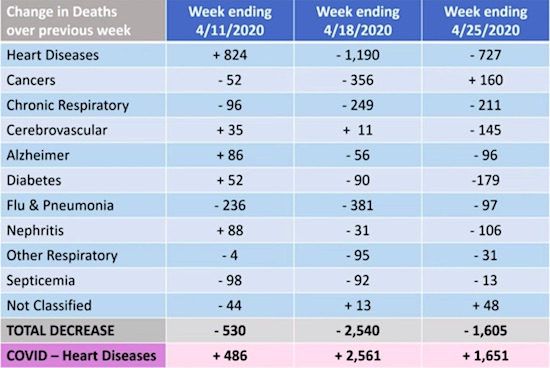
Essentially, there is an average number of deaths every year due to a variety of causes that for the most part have remained constant through the years. This includes morbidities such as heart disease, which has long been the leading cause of death, and cancer, which has long plagued our existence. For Covid-19 to be a serious cause of alarm, it would need to significantly increase the number of average deaths. However, according to the study, “These data analyses suggest that in contrast to most people’s assumptions, the number of deaths by COVID-19 is not alarming. In fact, it has relatively no effect on deaths in the United States.” Total deaths in the United States show no significant change and even mirror past trends of seasonal illness.

[..] What is even more interesting if not more alarming is that the spike in recorded Covid-19 deaths seen in 2020 has coincided with a proportional decrease in death from other diseases. Yanni Gu writes “This suggests, according to Briand, that the COVID-19 death toll is misleading. Briand believes that deaths due to heart diseases, respiratory diseases, influenza and pneumonia may instead be recategorized as being due to COVID-19.” Deaths have remained relatively constant, yet reported deaths due to deadly conditions such as heart disease have fallen while reported Covid deaths have risen. This suggests that the current Covid death count is in some capacity relabeled deaths due to other ailments. According to the graph, reported Covid deaths even overtook heart disease as the main cause of death at one point, which should raise suspicion.


And when you see the Clinical Infectious Diseases journal report that some 53 million American may already have been infected, you must ask what the use is of all the COVID measures at this point in time. If this is true in the US, chances are it is true in virtually any other location.

Looks like everybody has it and only people in care homes die from it, and on top of that many of those people didn’t actually die from COVID but from some other affliction. And for that we are closing down our entire societies, force massive amounts of businesses into bankruptcy, force millions upon millions into unemployment. All while relying on a test method that is 97% unreliable.


Total COVID19 Cases In US May Be Eight Times Higher Than Reported

The actual number of Covid-19 infections in the U.S. could be about eight times as much as the total reported cases, a model created by scientists at the Centers for Disease Control and Prevention (CDC) has estimated. The model published in the journal Clinical Infectious Diseases suggests that nearly 53 million people in the U.S. had been infected with Covid-19 by the end of September. The estimate is around eight times higher than the 7.1 million confirmed cases that had been reported back then. The model tries to account for the fact that most cases of Covid-19 are mild and therefore go unreported. The scientists, however, warned that by the end of September, 84% of the U.S. population had not been infected and was still at risk of catching the disease.

If the trend of unreported cases still holds true as of Thursday, the U.S. — which has 12.5 million confirmed cases — could be approaching 100 million total infections across the country. In October, the World Health Organisation had said that nearly 10% of the world population or nearly 760 million people may have already been infected with Covid-19, despite the fact that only 35 million confirmed cases had been recorded as of that time.

“When you count anything, you can’t count it perfectly,” Mike Ryan, the executive director of the WHO’s health emergencies program, had said back then adding, “But I can assure you that the current numbers are likely an underestimate of the true toll of Covid.” Scientists have also suggested that deaths due to the pandemic have also been severely undercounted, with the CDC stating that the U.S. had recorded nearly 300,000 excess deaths during the pandemic as of October 3. This number was nearly 100,000 deaths more than what had been officially recorded by the states.

What we need is actual science. Not “a science” or “some science”, but undisputed science. Einstein’s E=MC2 is science, that’s the level we need. Not disputable pseudo-science. Yes, there’s panic among politicians and scientists alike, yes, there is Long-COVID, yes there are people with multiple organ failure, but you will still have to do risk-assessment, you must look at how many people are involved.

And if you’re talking 0.01% of people, you need to wonder if it’s worthwhile to close down your entire society in a Great Reset kind of fashion. Likewise, forcing everyone to wear facemasks outside is something that must be evaluated as per risk factors. What is the risk of infecting anyone while just passing them in the street? It’s never zero, but no risk is ever zero. And if it’s 0.001%, does that justify turning your streets into a zombified society that puts everyone on edge?

“The science” needs to evolve, and it doesn’t appear to have done that. We’re back to square one all the time. COVID equals Groundhog Day. “Well, that didn’t help, so let’s do more of the same”. By now, the science, to remain believable, should have developed, moved on. It hasn’t. The hope for vaccines has taken on desperate levels, and the reliance on Big Pharma doesn’t help. Nor does the outright rejection of Russian, Chinese, Cuban vaccines. All nations with excellent medical resources, but ignored for political reasons. This is not the time to play politics. It’s a time for science to step up to the plate.

Are things much worse in countries that leave their stores open? Are they in places that don’t make people wear facemasks 24/7? The “science” should answer those questions by now. What else are they doing? But it’s not happening. COVID vs “The Science”: 1-0.


We try to run the Automatic Earth on donations. Since ad revenue has collapsed, you are now not just a reader, but an integral part of the process that builds this site.

Click at the top of the sidebars for Paypal and Patreon donations. Thank you for your support.


Support the Automatic Earth in virustime, election time, all the time. Click at the top of the sidebars to donate with Paypal and Patreon.


Feb 032020


Harris&Ewing “Slaves reunion DC. Lewis Martin, age 100; Martha Elizabeth Banks, age 104; Amy Ware, age 103; Rev. Simon P. Drew, born free.” c1916


China Censors Top Media Outlet That Says It Underreports Cases, Deaths (ZH)
Virus Worries Wipe $420 Billion Off China’s Stock Market (R.)
Chinese Shares Drop 9% (G.)
China’s Sinopec Cuts Feb Daily Refinery Output By 12% As Virus Hits (R.)
Huawei, Chinese Chip Makers Keep Factories Humming Despite Coronavirus (R.)
China’s Reaction To The Coronavirus Outbreak Violates Human Rights (G.)
The Democrats’ New Online Troll Fighters Make 2020 Debut In Iowa (CNN)
Democrats Need to Break Their Cold War–Addled Impeachment Fever (Maté)
The Real John Bolton (CP)
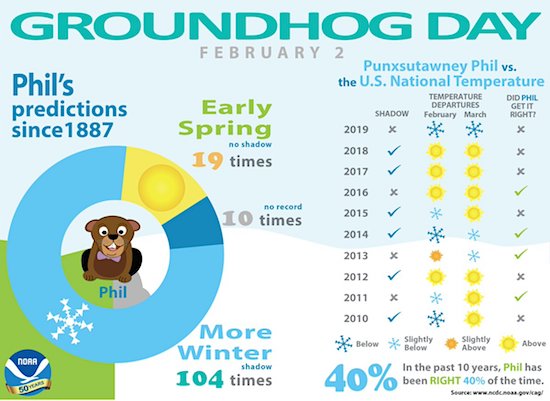
Punxsutawney Phil Predicts Early Spring (Slate)


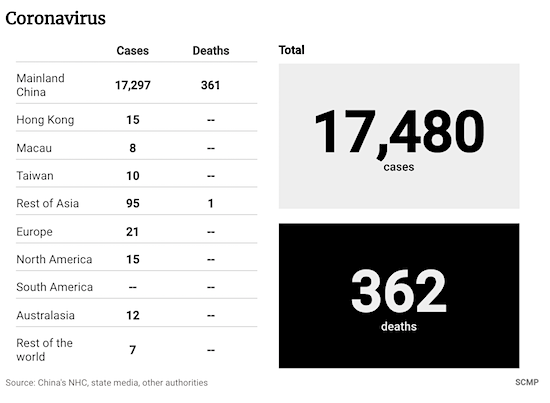
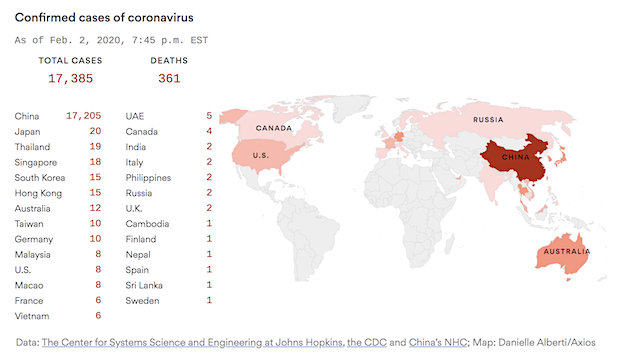
As the US and China accuse each other of, respectively, not accepting help and not offering it, numbers continue to rise. Just like doubts about the accuracy of the official numbers from Beijing do. Here are the official numbers:

• 17,480 cases (+2930 from yesterday’s 14,550)

• 362 deaths (+57 from yesterday’s 305)

• 11 U.S. confirmed infected


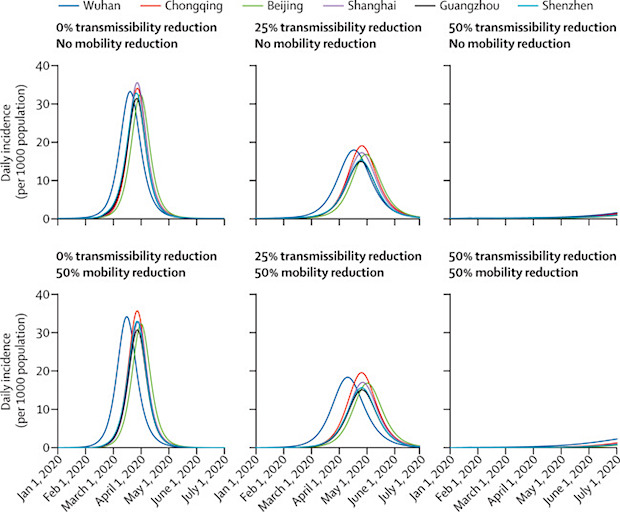
Also, the Lancet paper I’ve been citing a lot lately by Gabriel Leung and his team says “We estimated that if there was no reduction in transmissibility, the Wuhan epidemic would peak around April, 2020, and local epidemics across cities in mainland China would lag by 1–2 weeks.”

That would mean another 3 months. Mobility is a factor, mind you, as the graph shows, though a minor one. But imagine the Chinese economy being on lockdown for another 3 months. Where will OPEC sell their oil? Where will WalMart buy its supply? What will happen to the Chinese confined to their homes and/or cities? Will there be a global economy left?


Epidemic forecasts for Wuhan and five other Chinese cities under different scenarios of reduction in transmissibility and inter-city mobility


This is why I wrote yesterday’s The Party and the Virus. Question is when will the rest of the world increase pressure on China for real numbers? Will that first take multiple deaths in Europe or the US?

China Censors Top Media Outlet That Says It Underreports Cases, Deaths (ZH)

Let’s be honest, do you think China is reporting the actual coronavirus cases and deaths? After all, Beijing has been the master of falsifying its economic growth figures for years, what makes you think they’ll change in the reporting of the deadly virus outbreak? Balaji S. Srinivasan, angel investor and entrepreneur, also former CTO of Coinbase, tweeted Saturday that a top news organization in China, Caijing, had one of their articles banned by Beijing after it noted Chinese officials were significantly underreporting coronavirus confirmed cases and deaths, especially among the elderly. Srinivasan said, “If half the claims in this article are true, #nCoV2019 seems to have completely overloaded Wuhan’s healthcare system. It appears particularly deadly for the elderly. But this 45-year-old had to be anesthetized and intubated in order to breathe.”

“In the past two days, he had seen a 45-year-old patient, a family of five, his parents had died of the new coronavirus pneumonia, and his son was infected. The patient’s condition was very serious. She used high-flow oxygen inhalation and non-invasive mask ventilation, but her blood oxygen saturation was only 50%. Finally, she had to be anesthetized and intubated with ECMO. “Before intubation and anesthesia, she watched us prepare, tears kept flowing down, and that fear made people feel very distressed,” said Shen Jun. There are still many cases like this, “Our doctors have made a decision Determined to do everything possible to treat all patients,” Caijing wrote.

Srinivasan points out that the Chinese newspaper found hospitals in Wuhan and elsewhere were intentionally recording coronavirus deaths as “general pneumonia” to keep the death count low. The article also notes test kits for the virus were in low supply, which allowed those who were infected, to continue their daily lives during a 7-10-day incubation period, enabling the virus to spread even more. The healthcare system was so overloaded in Wuhan, which forced hospital officials to send the dying home; hospitals didn’t have enough beds to house the sick. “Caijing understands that at least five suspected deaths at the hospital have not been diagnosed, so it does not count towards the confirmed deaths. This means that the number of confirmed and fatal cases that people can see at present does not fully reflect the full picture of the epidemic,” the article noted.

And then there’s this, from SixthTone’s David Paulk: “The 8 people detained in Wuhan for “spreading rumors” — who we wrote about in a Jan. 2 article that was censored — were doctors trying to raise the alarm about a new SARS-like virus.” We leave the last word to Zeng Guang, the chief scientist of epidemiology at China’s CDC, who, on Jan. 29 made a rare candid admission about why Chinese officials cannot tell people the truth in an interview with the state-run tabloid Global Times: “The officials need to think about the political angle and social stability in order to keep their positions,” which is all one needs to know about any “facts” coming out of China.

Read more …

“More than 2,500 stocks fell by the daily limit of 10%.”

Virus Worries Wipe $420 Billion Off China’s Stock Market (R.)

Investors erased $420 billion from China’s benchmark stock index on Monday, sold the yuan and dumped commodities as fears about the spreading coronavirus and its economic impact drove selling on the first day of trade in China since the Lunar New Year. The market slide came even as the central bank poured cash in to the financial system – a show of support for the economy -and despite apparent regulatory moves to curb selling. The total number of deaths in China from the coronavirus rose to 361 as of Sunday. It had stood at 17 when Chinese markets last traded on Jan. 23. By lunchtime, the benchmark Shanghai Composite index sat 8% lower near an almost one-year trough and poised to post its worst day in more than four years.


The yuan opened at its weakest level in 2020 and slid almost 1.2%, past the symbolic 7-per-dollar level CNY=, as the falls soured the mood in markets throughout Asia. Shanghai-traded oil, iron ore, copper and soft commodities contracts all posted sharp drops, catching up with sliding global prices. The new virus has created alarm because it is spreading quickly, much about it is unknown, and authorities’ drastic response is likely to drag on economic growth. “This will last for some time,” said Iris Pang, Greater China economist at ING. “It’s uncertain whether factory workers, or how many of them, will return to their factories,” she said. “We haven’t yet seen corporate earnings since the (spread of the) coronavirus. Restaurants and retailers may have very little sales.” More than 2,500 stocks fell by the daily limit of 10%.

Read more …

Fluid, but 9% seems right.

Chinese Shares Drop 9% (G.)

Stock markets in China have seen the biggest daily fall for five years as traders rushed to sell amid continued fears about the impact on the global economy of the coronavirus epidemic. The benchmark Shanghai composite index fell 8.7% on Monday on a wave of negative sentiment that has built up for 10 days during the long market shutdown for the lunar new year. The Shenzhen composite was off 9.1% and dangerously close to the daily maximum permitted fall of 10% after which trading is suspended. The yuan fell through the seven-to-the-US-dollar mark for the first time since December. The losses were the worst on the Chinese markets since 2015 although they pared back slightly later in the day to 7.7%. [..]

Chinese authorities have reeled off a series of measures to tackle the market panic. On Sunday they announced they flood the financial system with 1.2 trillion yuan (US$170bn) in extra liquidity, a measure designed to buy up securities from investors seeking to sell. On Monday the People’s Bank of China – the country’s central bank – lowered the interest rate it charges banks for short-term funding upon which many banks rely to remain trading. Capital Economics said that while the move might take some pressure off the banks the rate cut was not enough to offset the drag on economic activity from the coronavirus outbreak and that more rate cuts were therefore on the way.

The growing fears about the Chinese economy also prompted the finance ministry to subsidies on interest payments for some companies hit by the coronavirus outbreak, state-run newspaper Guangming Daily said. [..] Many economists are predicting that the coronavirus will have a significant impact on the Chinese economy. Many businesses have been shut as part of the lockdown to contain the virus while most overseas airlines have suspended flights to the country and Chinese people are now banned from travelling overseas. Goldman Sachs has forecast that the virus could knock Chinese growth down to 5.5% for the year, from 6.1% in 2019, with knockon effects for the rest of the world economy. Economists at Citigroup said the steps taken by Chinese authorities were “unlikely” to be enough to prevent a sharp downturn in the first quarter.

Read more …

Bloomberg claims Chinese oil demand is down 20%.

China’s Sinopec Cuts Feb Daily Refinery Output By 12% As Virus Hits (R.)

China’s Sinopec Corp, Asia’s largest refiner, is cutting throughput this month by around 600,000 barrels per day (bpd) as the rapidly spreading coronavirus hits fuel demand, four people with knowledge of the matter said on Monday. The cut is equivalent to roughly 12% of the state refiner’s average daily throughput last year. Sinopec asked refineries last Friday to cut production and gave plants different reduction targets based on local fuel demand and logistics, the sources told Reuters. They declined to be named as they are not authorized to speak to media. Sinopec is closely monitoring the changing market situations and stands ready to ensure supplies, the refiner said in an email to Reuters.


“Company is closely monitoring the changing market situations, and will optimize operation rates and product mix based on market demand,” the company said, without commenting directly on the throughput cut rates. The four sources estimated cuts of about 2.5 million tonnes in total, equal to about 600,000 bpd on average, for February. One plant in eastern Jiangsu province is lowering runs by 10%, while a plant in Tianjin, near Beijing, is cutting throughput by 20%, two people with direct knowledge of the plants’ operations said. A plant manager with a central-China based Sinopec refinery said his plant has since Friday lowered processing rates to 60% of capacity. He said his plant was operating at near full rates before the cut.

Read more …

Total lockdown, except for…

Huawei, Chinese Chip Makers Keep Factories Humming Despite Coronavirus (R.)

Some Chinese technology firms are continuing to manufacture parts and products despite government calls across various cities and provinces for work to be halted as Being seeks to stop the spread of the coronavirus ravaging the country. Chinese telecom giant Huawei said on Monday it had resumed production of goods including consumer devices and carrier equipment, and operations are running normally. The company restarted manufacturing in line with a special exemption that allows certain critical industries to remain in operation, despite Beijing’s call to halt all work in some cities and provinces. The spokesman said most of the production was in Dongguan, a city in the southern Guangdong province.


Other companies have also kept production running, in some cases even through Chinese New Year, in a sign of the critical importance Beijing places on its domestic tech supply chain, a subject of friction with the United States Yangtze Memory Technologies, a state-backed maker of flash memory chips based in Wuhan – the city where the virus outbreak originated – confirmed on Monday that it has not yet ceased production. “At present, production and operations at YMTC are proceeding normally and in an orderly manner,” a company spokesman wrote in a statement on Monday. The spokesman added that no factory employees have been confirmed as infection cases, and that the company has enacted certain isolation measures and partitions to ensure the safety of employees. State media reported that the chip maker did not cease operations over the Lunar New Year holiday.

Read more …

Are we going to argue that keeping borders open does not violate human rights?

China’s Reaction To The Coronavirus Outbreak Violates Human Rights (G.)

When the World Health Organization declared the 2019nCoV coronavirus outbreak a global health emergency, it effusively praised China’s response to the outbreak. The WHO issued a statement welcoming the government’s “commitment to transparency”, and the WHO director general, Dr Tedros Adhanom Ghebreyesus, tweeted: “China is actually setting a new standard for outbreak response.” The WHO is ignoring Chinese government suppression of human rights regarding the outbreak, including severe restrictions on freedom of expression. In turn, Chinese state media are citing the WHO to defend its policies and try to silence criticism of its response to the outbreak, which has included rights violations that could make the situation worse.

China’s response to the outbreak included a month-long government cover-up in Wuhan, the centre of the outbreak, that led to the rapid spread of the coronavirus. Local authorities publicly announced that no new cases had been detected between 3-16 January in the lead up to a major Communist party meeting, likely to suppress “bad news”. Despite early evidence of human-to-human transmission when medical staff became infected, this information was not relayed to the public for weeks. Hardly a “commitment to transparency”. Chinese police punished frontline doctors for “spreading rumours” for trying to warn the public in late December. Police are still engaged in a campaign to detain Chinese netizens for spreading so-called “rumours”.

Rumours included reports of potential cases, including people turned away from hospitals or dying without ever being tested and quickly cremated, criticism of the government, the distribution of masks, or the criticism of the discrimination of people from Wuhan or others who may be infected. Activists have been threatened with jail if they share foreign news articles or post on social media about the coronavirus outbreak. That the Chinese government can lock millions of people into cities with almost no advance notice should not be considered anything other than terrifying. The residents of Wuhan had no time to buy food, medicine, or other essentials. Authorities hastily announced the lockdown in the middle of the night with an eight-hour gap before it went into effect, giving people time to flee and thus raising questions on the rationale for such extreme measures.

[..] The international community should support all efforts to end this outbreak, but human rights should not be a casualty to the coronavirus crisis. The WHO declares that core principles of human rights and health includes accountability, equality and non-discrimination and participation. It even acknowledges that “participation is important to accountability as it provides … checks and balances which do not allow unitary leadership to exercise power in an arbitrary manner”. The WHO’s admiration for the unitary actions of the Chinese dictator Xi Jinping exercising power in an arbitrary manner is a direct contradiction of its own human rights principles.

Read more …

DNC and CNN are even regurgitating Mueller.

Twitter comment: “Brace yourself, the DNC is launching its troll army (branded as “troll fighters”) headed by a former Hillary staffer to counter “disinformation”. If you use the word “rigged”, they will come after you. Get ready to be called a Russian all over again.”

The Democrats’ New Online Troll Fighters Make 2020 Debut In Iowa (CNN)

Days after the 2016 Iowa caucuses, the instructions were clear. “[U]se any opportunity to criticize Hillary and the rest (except Sanders and Trump — we support them),” they read. The guidance had been circulated among a group of Russians who were covertly running a vast network of social media accounts seeking to divide Democrats and push the candidacy of Donald Trump. (The instructions were later found during special counsel Robert Mueller’s investigation into Russian interference in the 2016 election.) Four years later, unhappy with Silicon Valley’s efforts to curb the manipulation of its platforms, the Democratic Party has developed capabilities of its own to monitor and tackle online disinformation.

The first-in-the-nation caucuses here Monday will be the Democrats’ first 2020 test of its new team on a day when voters have their say. The effort reflects Democrats’ growing discontent with Silicon Valley executives like Mark Zuckerberg and highlights concerns that viral disinformation could have an impact on this year’s election. “It’s like algorithmic wars here, it’s kind of crazy,” a Democratic National Committee staffer who works on the Democrats’ new counter disinformation team said on Saturday as preparations were underway in Des Moines. The staffer asked not to be identified due to the nature of their work and possibly being subjected to online harassment themselves.

“Both Republicans and foreign actors, like Russia, have an incentive to divide the American electorate and may try to use the Iowa Caucus to further that goal,” the DNC wrote in a “counter disinformation update” sent to campaigns on Thursday. Among the new weapons in the Democrats’ online arsenal is a monitoring tool called “Trendolizer.” When stories from websites known to peddle misinformation mention candidates and begin getting shares on social media, Trendolizer detects it and an alert is sent to the relevant campaigns. Another tool built in-house at the DNC monitors Twitter traffic. On Monday, it’ll watch for misinformation about how and where to caucus. Variations of the word “rigged” had been loaded into system when CNN was shown it Saturday — attempts to undermine legitimate vote results using disinformation is something Democrats are watching out for.

Read more …

Today is closing argumants in the Senate “trial”. One more chance for Schiff to take revenge on the entire world, including Jerry Nadler, and repeat the same old points another 20 times. And announce a “surprise” subpoena for John Bolton in the House.

Democrats Need to Break Their Cold War–Addled Impeachment Fever (Maté)

Sondland, according to Schiff’s account, told Yermak, “You ain’t getting the money until you do the investigations.” But both Sondland and Yermak offer a radically different account. According to Sondland, he told Yermak in “a very, very brief pull-aside conversation,” that he “didn’t know exactly why” the military funding was held up, and that its linkage to opening an investigation was only his “personal presumption” in the absence of an explanation from Trump. Yermak does not even recall the issue of the frozen aid being mentioned. To overcome that, Schiff has gone to the extraordinary step of arguing that it’s not just Sondland who is lying but the Ukrainians as well. “Like they’re going to admit they were being shaken down by the president of the United States,” Schiff told the proceedings.

Sure, that’s one possibility, but it is also wildly speculative. Ukrainian officials say they did not learn about the weapons freeze until it was publicly reported more than one month after the Trump-Zelensky call. And even after they did find out, and even voiced concerns to their US counterparts, there is no record of any complaints about the alleged linkage. As Democratic Senator Chris Murphy recalled of a meeting with Zelensky in early September—after the funding freeze became known—the Ukrainian president “did not make any connection between the aid that had been cut off and the requests that he was getting from [Trump attorney Rudy] Giuliani.”

House impeachment managers have not overcome this evidentiary flaw. They have tried to claim that the White House effectively admitted to their allegation in an October 2019 news conference by acting White House Chief of Staff Mick Mulvaney. But as I detailed back when Mulvaney’s comments initially caused a stir, Democrats and media outlets pundits rendered them as damning by isolating one fragment and ignoring the bulk of what Mulvaney said.

The absence of concrete evidence explains the last-minute excitement over compelling the potential testimony of another Trump administration official, former national security adviser John Bolton. A New York Times report about Bolton’s forthcoming memoir led to declarations that Bolton confirmed the quid pro quo allegation at the heart of the impeachment trial. As in other cases, that is based on a mistaken and maximalist interpretation of the available facts. The Times did not quote from Bolton’s manuscript. In its characterization of what Bolton wrote, the Times reports that Bolton said Trump “preferred sending no assistance to Ukraine until officials had turned over all materials they had about the Russia investigation that related to Mr. Biden and supporters of Mrs. Clinton in Ukraine”.

If this account is accurate, then Bolton is not confirming that Trump conditioned military assistance to Ukraine’s announcement of an investigation into Joe Biden and his son. Instead, Bolton is relaying that Trump “preferred” that Ukraine assist efforts to uncover the extent of Ukrainian meddling to hurt Trump’s campaign and help Democrats in 2016—meddling that did in fact happen. Recall that Trump is not on trial for preferring that Ukraine hand “over all materials they had about the Russia investigation,” but for pressuring Ukraine to announce an investigation of Trump’s political rival.

Read more …

Dems’ new favorite boy.

The Real John Bolton (CP)

It isn’t enough for the corporate media to praise John Bolton for his timely manuscript that confirms Donald Trump’s explicit linkage between military aid to Ukraine and investigations into his political foe Joe Biden. As a result, the media have made John Bolton a “man of principle,” according to the Washington Post, and a fearless infighter for the “sovereignty of the United States.” Writing in the Post, Kathleen Parker notes that Bolton isn’t motivated by the money he will earn from his book (in the neighborhood of $2 million), but that he is far more interested in “saving his legacy.” Perhaps this is a good time to examine that legacy. Bolton, who used student deferments and service in the Maryland National Guard to avoid serving in Vietnam, is a classic Chicken Hawk.

He supported the Vietnam War and continues to support the war in Iraq. Bolton endorsed preemptive military strikes in North Korea and Iran in recent years, and lobbied for regime change in Cuba, Iran, Libya, North Korea, Syria, Venezuela, and Yemen. When George W. Bush declared an “axis of evil” in 2002 consisting of Iran, Iraq, and North Korea, Bolton added an equally bizarre axis of Cuba, Libya, and Syria. When Bolton occupied official positions at the Department of State and the United Nations, he regularly ignored assessments of the intelligence community in order to make false arguments regarding weapons of mass destruction in the hands of Cuba and Syria in order to promote the use of force.

When serving as President Bush’s Undersecretary of State for Arms Control and Disarmament, Bolton ran his own intelligence program, issuing white papers on WMD that lacked support within the intelligence community. He used his own reports to testify to congressional committees in 2002 in effort to justify the use of military force against Iraq. Bolton presented misinformation to the Congress on a Cuban biological weapons program. When the CIA challenged the accuracy of Bolton’s information in 2003, he was forced to cancel a similar briefing on Syria. In a briefing to the Senate Foreign Relations Committee in 2005, the former chief of intelligence at the Department of State, Carl Ford, referred to Bolton as a “serial abuser” in his efforts to pressure intelligence analysts. Ford testified that he had “never seen anybody quite like Secretary Bolton…in terms of the way he abuses his power and authority with little people.”

Read more …

Luckily there’s still important news going on.

Punxsutawney Phil Predicts Early Spring (Slate)

Across much of the United States, many have been enjoying a mild winter. And if the world’s most famous groundhog is to be believed, the trend will continue and there will be an early spring. In fact, on Sunday morning, Punxsutawney Phil declared that early spring “is a certainty.” Well, obviously the groundhog didn’t actually declare anything but that didn’t matter to the thousands of people who gathered at sunrise on Sunday to watch as Phil emerged from his den in Punxsutawney, Pa. The groundhog allegedly did not see his shadow, according to members of his “inner circle,” meaning there will be an early spring. According to legend, if he had seen his shadow it would have signified six more weeks of winter.


[..] Since Phil’s weather-predicting career began in 1887, he has seen his shadow 104 times and has failed to see it on a mere 20 instances (a few years are missing from the official record). That makes this year’s prediction relatively rare and marks the first time Phil hasn’t seen his shadow two years in a row. Phil’s forecast “seems fitting considering the lack of winter weather this winter so far,” notes the Washington Post. But truth be told, Phil doesn’t have the best track record. From 2010-2019, Phil predicted a longer winter seven times and an early spring three times. He was right only 40 percent of the time, according to the National Oceanic and Atmospheric Administration. He has been on a particularly poor streak lately as Phil got it wrong the past three years.

Read more …


Support us on Paypal and Patreon.


Nov 232017


Nicolas de Staël Mer du nord 1954


Punxsutawney Phil Hammond, the UK chancellor, presented his Budget yesterday and declared five more years of austerity for Britain. As was to be expected. One doesn’t even have to go into the details of the Budget to understand that it is a dead end street for both the country and for Theresa May’s Tory party.

So why the persistent focus on austerity while it becomes clearer every day that it is suffocating the British economy? There are many answers to that. Sheer incompetence is a major one, a lack of empathy with the poorer another. Conservative Britain is a class society full of people who dream of empire, and deem their class a higher form of life than those who work low-paid jobs.

When you see that the British Parliament has even voted that animals don’t feel pain or emotions, you’d be tempted to think it’s a throwback all the way back to the Middle Ages, not just the British Empire. They’re as lost in time as Bill Murray is in Groundhog Day. Only worse.

But perhaps incompetence is the big one here. The inability to understand that if your economy is not doing well, you need to stimulate it, not drain even more of what’s left out of it. The people in government don’t understand economics, and therefore rely on economic theory for guidance. And the prevailing theories of the day prescribe bloodletting as the cure, so they bloodlet (let blood?). Let it bleed.

This is not a British problem, it’s pan-European if not global. Neither is the UK Tory party the only one being killed by it, all Conservative parties share that faith. They’re just lucky that their left wing opponents have all committed hara kiri, and joined their ranks when it comes to economics. All of Europe’s poorer have lost the voices that were supposed to speak for them, to economic incompetence.

Obviously, the US democrats did their own hara kiri years ago. One might label -some of- Bernie Sanders’ views left-wing, but he’s trapped in a system that won’t let him breathe.


All of this leads me to question the following:

A letter in the Guardian published on Sunday called on Chancellor Philip Hammond, ahead of his budget presentation on Wednesday, to end austerity in the UK. It is signed by 113 people, a veritable who’s who from the academic field, one -economics- professor after another. They include people like Joe Stiglitz, Steve Keen, Dave Graeber.

Looking at the letter itself, and then the entire list, makes me wonder: I’m sure you all mean well, guys, but I think perhaps you should first of all ask yourselves how it is possible that such a large group of well-educated ladies and gentlemen has become so utterly sidelined over time when it comes to major economic decisions, has allowed itself to be sidelined.

It’s one thing to ask what someone else is doing wrong, it’s another to ask yourself what you have done wrong. My question to y’all would be: where were you? Shouldn’t you have written and/or signed this letter 7 years ago, or 5, even just 3? Isn’t calling on the Chancellor to ‘end austerity now’ a bit late in the game?

Is it even the right call, or should you maybe be calling for him to simply resign (along with the entire cabinet)? After all, what are the odds that the Tories are going to turn on a dime and reverse their entire economic policies? They would look stupid, and they will avoid that like the plague. Here’s that letter:


The Chancellor Must End Austerity Now – It Is Punishing An Entire Generation

Seven years of austerity has destroyed lives. An estimated 30,000 excess deaths can be linked to cuts in NHS spending and the social care crisis in 2015 alone. The number of food parcels given to impoverished Britons has grown from tens of thousands in 2010 to over a million. Children are suffering from real-terms spending cuts in up to 88% of schools. The public sector pay cap has meant that millions of workers are struggling to make ends meet. Alongside the mounting human costs, austerity has hurt our economy.

The UK has experienced its weakest recovery on record and suffers from poor levels of investment, leading to low productivity and falling wages. This government has missed every one of its own debt reduction targets because austerity simply doesn’t work. The case for cuts has been grounded in ideology and untruths. We’ve been told public debt is the outcome of overspending on public services rather than bailing out the banks. We’ve been told that while the government can find money for the DUP, we cannot afford investment in public services and infrastructure.

We’ve been told that unless we “tighten our belts” we’ll saddle future generations with debt – but it’s the onslaught of cuts that is punishing an entire generation. Given the unprecedented economic uncertainty posed by Brexit negotiations and the private sector’s failure to invest, we cannot risk exacerbating an already anaemic recovery with further public spending cuts. We’ve reached a dangerous tipping point. Austerity has failed the British people and the British economy. We demand the chancellor ends austerity now.

If you ask me, Britain reached that ‘dangerous tipping point’ years ago. And talking about ‘an anaemic recovery’ sounds like total nonsense. There is no recovery, as you yourselves make clear with the examples you provide of the consequences of austerity. So why say it?

I don’t know if we can blame individual economists for missing out on the effects of political measures, although when those measures affect economics, we probably should. But regardless, the big game in town these days is politics, not economics. Everywhere there are ‘leaders’ fighting for survival, and it’s telling that Donald Trump is not nearly the most besieged among them.

That Theresa May is still PM of the UK is as surprising as it is ridiculous. But it also points to the lack of coherence and timing among her opponents, including those 113 academics. That once May goes, which could be soon, the Tories get to pick yet another one of their own as PM, is even more ridiculous. To top off the absurdity, the next in line could be Boris Johnson.

A country that finds itself in a quandary as immense as the UK faces post-Brexit vote, should not let one party that had a mere 42% of the vote, run all the plans, decisions and negotiations, be they domestic and/or international. There is no surer way for disaster to ensue. It’s the system itself that fails if that possibility exists, more than that one party.

The UK needs, more than anything, a national government (or something in that vein), an option in which at least a majority of the population is represented. That is much more important than some call for some policy to be halted.

Moreover, everyone should see this in the light of international political developments as a whole. What’s happening in Albion is not an isolated event, and it doesn’t happen under the influence of isolated forces or developments. What happened overnight on Sunday with the failure of Angela Merkel’s attempt to form a German coalition government makes that more obvious than ever.

Traditional political parties, left and right, have been swept out of power all over Europe. Germany is just one more example. The process doesn’t have the same shape, or the same speed, everywhere. But it’s real. It’s due to a mixture of rising inequality, deteriorating economic conditions and no left left to represent the people, the victims, at the bottom of societies. Well, and there’s the incessant lies about economic recovery.

But let’s take a little detour first. Just in order to illustrate the point even more. The Guardian ran a piece, also on Sunday, on newly minted French President Emmanuel Macron and his government and party, that is pretty hilarious.


New Head Of Macron’s Party Vows To Recapture Its Grassroots ‘Soul’

A fiercely loyal, self-styled “man of the people” has been appointed to lead Emmanuel Macron’s fledgling political movement, La République En Marche (The Republic on the Move, or La REM), promising to recapture the party’s“soul” after a hiatus since the recent election win. Christophe Castaner, 51, a burly member of parliament with a southern accent, styles himself as both in touch with everyday voters and devoted to Macron’s well-oiled communications machine. He was handpicked by the French president to take over the running of La REM.

Castaner, currently a minister and government spokesman, was a Socialist mayor of a picturesque small town in Provence for more than a decade before becoming one of the first politicians to jump ship to Macron’s centrist project in its early days. He grew up in a military family in the south of France, left school before his final exams – which he retook as an adult – and has a reputation for straight-talking. At La REM’s first party congress in Lyon this weekend, Castaner was the lone candidate for the role of party director.

He was picked by Macron at a presidential palace dinner, then confirmed by a group of party members with a show of hands rather than a secret ballot, sparking criticism from the media and political observers about undemocratic internal party practices. A small group of 100 party followers went public last week with an open resignation letter, claiming the party had no internal democracy. Others, including La REM members of parliament, responded that Castaner was “the obvious choice”.

Macron founded his own movement because he saw an opening to defeat all traditional French parties. He won the presidential elections, and only after that organized the movement into an actual political party ahead of parliamentary elections. I’d still like to see someone explain who paid for the campaigns of hundreds of candidate parliamentarians. It’s a mystery. France’s banking and business sector?

Macron has set an example for many people in other countries, provided they can unravel that mystery, of how they, too, can defeat incumbents and other long time power blocks. There are two countries where such tactics have until now not seemed possible: the UK and US. But that, too, will change.

In many other European countries, age-old blocks have already been beaten into submission. Even if many deep state powers in France et al have merely shifted allegiances. As their peers elsewhere will. But that’s just the way things are. It doesn’t negate the huge shifts in politics. Voters all over feel they’ve been had for too long. It’s all part of a tectonic shift. Deteriorating economic conditions will do that for you.

What makes the article on Macron et al so entertaining is the mention of the promise to “..recapture the party’s grassroots “soul”. A political party that’s barely a year old does not have grassroots, let alone a soul. Anyone who thinks otherwise is not thinking. And that is a good thing to keep in mind, because Macron’s example – and success- will inspire similar initiatives in many places, and similar nonsensical narratives.


Ironically, if that’s the right word, the world -or at least the EU- is now Macron’s oyster. Angela Merkel has shown her weaknesses, and she has blinked first, in her failed attempt to form a new cabinet, and she will not recover from that, not with anything remotely like her past clout. Maybe -more than- 12 years as head of state is not such a good idea.

While Macron is a blank sheet without a soul or grassroots, Merkel and her CDU party possess both in spades. It’s just that in today’s world these things tend to easily turn against you. You’re better off without a past that you can be blamed for. Macron has no past. And no soul.

Merkel leaves an enormous void both in Germany and in Europe (even globally). And it’s one thing for her to have become too powerful at home, but it’s quite another for the same to have been allowed on the entire continent. Germany, under any leadership, will remain the only power in Europe that matters, no matter what grand plans Macron devises. And that is the EU’s fatal flaw. If you have 27-28 sovereign countries and you try to order them around all the time, you have a problem on your hands.


There is an inherent contradiction in being both the leader of political union’s strongest country and -simultaneously- of the union as a whole, and Merkel has bitterly failed in addressing, let alone solving, that contradiction. Merkel didn’t create it, true enough, but because she is/was the boss, it is her responsibility to address it. Even if it’s ultimately unsolvable.

In the present setting, any German leader, Angela or someone else, will be voted in by Germans, and focus on their interests, to hold on to these votes. But German interests are not always the same as those of other countries. That means Germany will always come out on top, and more so as time passes. Ever more wealth will flow to Berlin. That’s the fatal flaw, and at present there’s no way out of it.

With Merkel weakened, or soon even gone, lots of voices will speak up across Europe for their countries’ sovereignty, and the attack on them from Brussels. We already have Poland, Czechia and Hungary. Expect a lot more noise from Italy in the run-up to its elections. The power balance that Merkel held together is gone for good.

Yes, her refugee policy backfired, which is no surprise given that she decided on it like some empress. But what may be more important is that her traditional opponent, the left wing SPD, was not only her coalition partner, but it has no ideas that are notably different from her conservatives, and its new head is the former head of the European Parliament.

Where does one turn as a German who doesn’t want all that more EU all the time? Either far left or far right. Everything else has become a homogenous blob, all across Europe. And all of that blob is in favor of imposing ever more austerity on the most unlucky in their societies, because bloodletting is the most advanced treatment they know of.


It’s not even so much the financial crisis that has caused a political crisis in Europe, it’s the answers to it, the incompetence. Greece is a far worse-off victim of austerity than Britain is, and Yanis Varoufakis has described very well why that is: an absolute stonewalling refusal to talk about any alternatives to bloodletting. Because austerity is an ideology bordering on religion, executed by people who care much more about their own careers than they do about their people.

Greece is beyond salvation, its economy has been so thoroughly destroyed it will take decades to recover, if it ever can. Britain is set to follow the Greek example. The blame for that will be put on Brexit, not disastrous economic ‘policies’. In the same way that the Greek crisis was blamed on the Greeks, not the German and French banks that treated the country like an overleveraged game of Texas Hold ’em.

After Merkel Europe will fall victim to a vast power vacuum. In effect, today’s already ‘After Merkel’, even if it will take people a while to understand that. The EU is unraveling, and the blame goes to austerity and its incompetent priests. Including Angela. The bloodletters destroy their own economies, and they don’t understand that either.

Merkel hasn’t just demolished Greece, she has, in doing that, fatally undermined the foundations of the EU as well. And Germany. Look, ‘Mutti’ Merkel invited a million refugees to her country, and now refuses to let hundreds of war-traumatized children stuck on Greek islands join their parents in Germany, because she fears it could cost her votes. Talk about priorities. Theresa May does the same as we speak.

There’s a price to be paid for incompetence. It’s a shame that Merkel and Theresa May and Punxsutawney Phil Hammond won’t be the ones paying -the worst of- it.


Oct 132016
 
 October 13, 2016  Posted by at 8:39 am Finance Tagged with: , , , , , , , , ,  2 Responses »


G. G. Bain 100-mile Harkness Handicap, Sheepshead Bay Motor Speedway, Brooklyn 1918

China September Exports Plunge 10%, Imports Down 1.9% (R.)
Wave Of China Property Tightening Hits Home Sales During Holiday Week (R.)
Chinese Firms Unveil Debt Swaps As Beijing Struggles To Reduce Leverage (R.)
US Mortgage Applications Down 6%, Rates Rise (CNBC)
Where Will All the Money Go When All Three Market Bubbles Pop? (CHSmith)
If Europe Insists On A Hard Brexit, So Be It (AEP)
Brexit Means Whatever The EU Says It Means (Luyendijk)
ECB Says Greece Needs Clarity on Debt to Regain Market Access (BBG)
Steve Keen: A Renegade Economist Has A Plan For Reducing Global Debt (RV)
Pension Benefits In Tiny California Town Slashed As ‘Ponzi Scheme’ Exposed (ZH)
Dumped Apartment Projects ‘Groundhog Day’ To Global Financial Crisis (NZ Herald)
Wells Fargo CEO John Stumpf Steps Down, Walks Away With $120 Million (WSJ)
Moscow Officials Told To Immediately Bring Back Children Studying Abroad (ZH)
Putin Ally Tells Americans: Vote Trump Or Face Nuclear War (R.)
“We Are At War And You Are The Front-line Troops In This War” (I’Cept)
The Global Seed And Chemical Industry Is Undergoing A Rapid Realignment (BBG)
Monsanto Dismisses ‘People’s Tribunal’, ‘Moral Trial’ As A Staged Stunt (G.)
Cut Funds To EU States That Turn Away Refugees, Italy Urges (R.)


All you need to know about the state of world trade.

China September Exports Plunge 10%, Imports Down 1.9% (R.)

China’s September exports fell 10% from a year earlier, far worse than expected, while imports unexpectedly shrank 1.9% after picking up in August, suggesting signs of steadying in the world’s second-largest economy may be short-lived. That left the country with a trade surplus of $41.99 billion for the month, the General Administration of Customs said on Thursday. Analysts polled by Reuters had expected imports to rise 1%, after unexpectedly advancing 1.5% in August for the first time in nearly two years on stronger demand for coal as well as other commodities such as iron ore which are feeding a construction boom.

Exports had been expected to fall 3%, slightly worse than in August as global demand for Asian goods remains stubbornly weak. Analysts had expected the trade surplus to expand to $53 billion in September from August’s $52.05 billion. The September import reversal raises questions over the strength of the recent recovery in domestic demand, Julian Evans-Pritchard at Capital Economics said in a note after the data. “The data we have so far suggests that a drop in import volumes of a number of key commodities, including iron ore and copper, are partly responsible,” he said.

Read more …

Xi continues to do two opposite things: blow bubbles and deflate them at the same time. My guess is there’s a time limit on that game.

Wave Of China Property Tightening Hits Home Sales During Holiday Week (R.)

A wave of restrictions imposed on housing markets in major Chinese cities last week have unnerved some buyers and developers, cutting the area of new homes sold in places such as Beijing and Shenzhen by more than half. More than 20 cities have imposed measures, including higher mortgage downpayments, to cool hot property markets that have raised official alarm in Beijing and fresh concerns about China’s ballooning debt. Last week was a public holiday to mark National Day, traditionally a high season for property sales. Property agents said prices of new homes sold in the southern city of Shenzhen and in Beijing dropped 20% last week to entice buyers, compared with the previous week.

“The new tightening measures are quite stringent,” said Alan Cheng, general manager of realtor Centaline Shenzhen. “It’s a blow to confidence and people are worried that prices will drop, so they are observing from the sidelines now.” The latest restrictions varied from city to city, but included higher mortgage downpayments for second and third-time home buyers, in a bid to stem the flow of cash into the red-hot property market. China’s home prices rose 9.2% in August from a year earlier, official data shows. But in Shenzhen, they increased almost 37%, in Beijing more than 23% and in Shanghai topped 30%. Such hefty price rises have been common all year in these so-called Tier 1 cities. The rally has prompted a frenzy among some buyers. In some cases, couples divorced to find a way around buying restrictions.

Read more …

How to make debt go away. Transfer it from state-owned firms to state-owned banks. Yeah, that should work..

Chinese Firms Unveil Debt Swaps As Beijing Struggles To Reduce Leverage (R.)

Chinese firms are moving rapidly to announce debt restructuring plans following the release of government guidelines on Monday, as policymakers experiment with ways to rein in the country’s ballooning corporate debt. China Construction Bank, the nations’ second-largest lender by assets, has been reported in two deals to help big, debt-laden state companies in as many days, and other Big Four banks are expected to follow soon. Chinese companies sit on $18 trillion in debt, equivalent to about 169% of GDP, according to the most recent figures from the Bank for International Settlements. Most of it is held by state-owned firms. Construction Bank will conduct a debt-to-equity swap with Yunnan Tin Group, the world’s biggest tin producer and exporter, to cut its debt and financing costs, Xinhua reported on Wednesday.

Separately, the bank on Tuesday announced the launch of a 24 billion yuan ($3.60 billion) debt restructuring fund to help struggling Wuhan Iron and Steel. Although the statement from CCB did not specify the planned operations of the fund, official media reported that the debt reduction would be accomplished primarily through debt-to-equity swaps. CCB will give Yunnan Tin 2.35 billion yuan next week in its first round of investment to swap some high-interest debt, Xinhua reported, without spelling out further details of the deal. The guidelines for debt-to-equity swaps, mooted as one solution to China’s growing corporate debt overhang, have been in development for months. However, some senior bankers and analysts have been outspoken critics of the idea, saying it risks saddling banks with ownership stakes in weak companies which Beijing sees as too big or too sensitive to fail [..]

Read more …

Actual rates are starting to creep up no matter what central banks do. Sign of the times.

US Mortgage Applications Down 6%, Rates Rise (CNBC)

As pumpkins pop up on front porches across the nation, the highest interest rates in a month are scaring consumers away from the mortgage market. Total mortgage application volume fell 6% on a seasonally adjusted basis for the week ended Oct. 7, compared to the previous week, according to the Mortgage Bankers Association. The average contract interest rate for 30-year fixed-rate mortgages with conforming loan balances ($417,000 or less) increased to 3.68%, from 3.62%, with points increasing to 0.35 from 0.32 (including the origination fee) for 80% loan-to-value ratio loans.

“As incoming economic data reassured investors regarding U.S. growth, and financial markets returned to viewing a December Fed hike as increasingly likely, mortgage rates rose to their highest level in a month last week,” said Michael Fratantoni, chief economist at the MBA. “Total and refinance application volume dropped to their lowest levels since June as a result.” Applications to refinance a home loan, which are highly rate-sensitive, have been falling for weeks, and took another 8% dive last week, seasonally adjusted. Mortgage applications to purchase a home fell a smaller 3% for the week and are 27% higher than one year ago. Comparisons to last year may be skewed, however, as new mortgage rules went into effect last October that pulled demand forward and then delayed mortgage processing.

Read more …

Charles asks: “Where will the money fleeing deflating bubbles go?”. But doesn’t add that much of it will simply evaporate. That’s what happens when bubbles pop.

Where Will All the Money Go When All Three Market Bubbles Pop? (CHSmith)

Everyone who’s not paid to be in denial knows stocks, bonds and real estate are in bubbles of one sort or another. Real estate is either an echo bubble or a bubble that exceeds the previous bubble, depending on how attractive the market is to hot-money investors.

Here’s a look at the inflation-adjusted S&P 500 (SPX) and margin debt: yep, a bubble.

With the Fed funds rate pinned to near-zero, bonds are in a bubble as well.

[..] Where will the money fleeing deflating bubbles go? Since the stock, bond and real estate markets are all correlated, it’s a question with no easy answer. What would $10 trillion seeking safe haven do to small asset classes such as precious metals, bitcoin, and tradable (liquid) sectors of the commodities markets? If the bubbles in bonds, stocks and real estate all pop, what markets will be left that can absorb trillions of hot money sloshing around? the short answer is: none. The chaos that will arise as trillions of dollars, yen, yuan and euros, etc. try to crowd through the fire exits as the asset bubbles pop will be monumental, and the the spikes in small asset class prices as the hot money floods in will be equally monumental.

Read more …

At least Ambrose doesn’t whine as much as many Brits do. “What [Hollande] is also admitting – à son insu – is that the union is held together only by fear. He might as well write its epitaph.” He’s writing his own epitaph, too.

If Europe Insists On A Hard Brexit, So Be It (AEP)

There may be serious economic trials ahead as we extract ourselves from the EU after more than forty years, but the slump in sterling is not one of them. The devaluation is necessary and desirable. The pound is now near ‘fair value’ based on the real effective exchange rate used by the IMF. All that has happened is a correction of the extreme over-valuation of sterling before Brexit, caused by capital inflows. This left the country with the worst current account deficit in peace-time since records began in the 18th Century. The fall is roughly comparable to the devaluation from 2007 to 2008 – though the same financial elites who talk so much of Armageddon today played it down on that occasion, mindful that their own banking crisis was the trigger. We can argue over how much the 2008 devaluation helped but it clearly acted as shock absorber at a crucial moment.

It was in any case a far less painful way to restore short-term competitiveness than the ‘internal devaluations’ and mass unemployment suffered by the eurozone’s Club Med bloc. But there is a deeper point today that is often overlooked. Central banks across the developed world are caught in a deflationary trap. The ‘Wicksellian’ or natural rate of interest has been falling ever lower with each economic cycle and is now at or below zero in half the global economy, a full seven years into the expansion. This paralyses monetary policy and has dark implications for the next downturn. It is why central banks are desperately trying to drive down their currencies to gain a little breathing room, or in the case of the US Federal Reserve to stop the dollar rising. By the accident of Brexit, Britain has pulled off a Wicksellian adjustment that eludes others.

With luck, the economy may even generate a few flickers of inflation, enough to let the Bank of England raise interest rates and start to restore ‘intertemporal’ equilibrium. Personally, I have been in favour of a “soft Brexit” that preserves unfettered access to the single market and passporting rights for the City, but not at any political cost – and certainly not if it means submitting to the European Court, which so cynically struck down our treaty opt-out on the Charter in a grab for sweeping jurisdiction. But what has caused me to harden my view – somewhat – is the open intimidation by a number of EU political leaders. “There must be a threat,” said French president Francois Hollande. “There must be a price… otherwise other countries or other parties will want to leave the European Union.”

These are remarkable comments in all kinds of ways, not least in that the leader of a democratic state is threatening a neighbouring democracy and military ally. What he is also admitting – à son insu – is that the union is held together only by fear. He might as well write its epitaph.

Read more …

Yet another example of why Britain should be delighted to leave the EU. But isn’t.

Brexit Means Whatever The EU Says It Means (Luyendijk)

If you still believe Britain will get a sweet deal out of Brexit because “the EU needs the UK more than vice versa”, ask yourself: why don’t we hear European politicians pleading with Britain “not to punish the EU over Brexit”? Why is the pound plunging against the euro and not the other way around? Why do we not hear of companies escaping from the EU to “free-trading Britain” while there is almost a traffic jam in the other direction? Why do EU leaders look rather relaxed when Brexit comes up, even cracking the odd joke or two about sending the British foreign minister, Boris Johnson, a copy of the Lisbon treaty so he can read up on reality? The negotiating cards with the EU are “incredibly stacked our way”, the Brexit minister, David Davis, told the House of Commons on Monday.

The cards certainly are “incredibly stacked” – but not in the way Davis imagines. To understand why, get a map of the EU and find Slovenia, a nation of 2 million people. No, that is Slovakia, with 5.4 million, almost three times bigger. Next look up Lithuania (population: 3.3 million), Latvia (2 million), Estonia (1.3 million) and Luxembourg (500,000). Now repeat after me: all these EU members, as well as the other 21, hold veto power over whatever deal the UK (65 million) manages to negotiate with the EU (population: 508 million). That is right, 1.2 million Cypriots can paralyse the British economy by blocking a deal, and the same holds true for Malta (400,000). Did I mention the Walloon parliament in Namur (get that atlas out again) has veto power too? And then there is, of course, the European parliament in Strasbourg.

Brexiteers argue that the EU takes ages to conclude trade deals so Britain is better off striking them on its own. The former is certainly true. Consider the Walloons currently threatening to derail an EU trade deal with Canada. But how does EU institutional sluggishness square with the Brexiteers’ promise that the EU is even capable of concluding a swift Brexit deal with the UK, even if it wanted to do? It doesn’t. And this is true even before we look at whether the EU would have an interest in making things easy for Britain. Remember how, before the EU referendum, David Cameron went to Brussels threatening to support leave unless he was given a range of “concessions”? Well, two can play that game, now that the tables have turned – except the EU has 27 nations. That is a lot of scope for blackmail à l’anglaise.

Read more …

A new torture technique. It’s a Good Cop Bad Cop set-up, but with three parties: EU, ECB and IMF, who keep on blaming both each other and the suspect, who may be innocent but is never released.

ECB Says Greece Needs Clarity on Debt to Regain Market Access (BBG)

Greece won’t regain stable access to international bond markets unless creditors ease repayment terms on the country’s bailout loans, ECB Executive Board member Benoit Coeure said. The country cannot gain “solid and long-lasting market access without the clarity about the sustainability of Greek debt,” Coeure told European Parliament lawmakers on Wednesday, adding that the IMF should stay fully involved in the Greek bailout to ensure fair treatment in Greek debt talks. “There are serious concerns about the sustainability of Greek public debt,” the Frenchman said during the hearing. “We are looking forward to a solution that can reassure markets, restore confidence in the dynamics of public debt, allow the full involvement of the IMF in the program – which would enhance the program’s credibility – and restore market access for Greece ahead of the end of the program in July 2018.”

The IMF is at loggerheads with Greece’s European creditors as the Washington-based lender insists on concrete and quantified relief measures before extending any more loans to the continent’s most-indebted state. While the institution acknowledges that a nominal haircut on Greek bailout loans is implausible, it has demanded more concessionary repayment terms, including extensions of maturities and a cap on interest rates. Wolfgang Schaeuble has said the source of Greece’s woes is a lack of competitiveness, not elevated debt levels, and reiterated calls earlier this week for the IMF to contribute to Greek bailout loans. The ECB “very much” believes that the IMF should be on board when devising a solution for Greek debt, Coeure said. The ECB has excluded Greek government bonds from its asset-purchase program, pending “an additional level of safeguards and clarity on debt sustainability.”

Read more …

Bit hard to find the best part. There’s a RealVision interview connected to it.

Steve Keen: A Renegade Economist Has A Plan For Reducing Global Debt (RV)

What he is really focused on is here is reducing the debt burden and is inspired by US philanthropist Richard Vague, who started two US credit card companies, First USA and Juniper Financial — and now campaigns against excessive debt. “We have to cope with the residue, and it’s created this enormous pile of elephant dung of debt. We have to get rid of it. I’m simply being practical about how do we get rid of it,” Keen said. “He’s a totally realistic man (Vague), totally feet-on-the-ground personality. And he said, when you look at history, there has never been a successful episode of de-leveraging by growing out of it. It’s been debt write offs every last time. Somehow debts have been written off whether it’s being done at the individual scale by individual bankruptcies or some sort of collective action.

“We can’t get rid of it by market mechanisms, and we can’t grow our way out of it. “So we’ve got this pile of elephant dung we need to get rid of. Let’s work out a way of doing it. Richard’s way is to let the banks write debt off over like a 30-year amortization period. So you have somebody who has got a $1million dollar mortgage, you write it down to half a million, in one year, that half a million loss by the bank would wipe the bank out. You let them out of that over 30 years. That why they can cope with it, and you get a recovery that way. “Mine is to say let’s use the state’s capacity to create money to do the cancellation. But whatever way you go about it, you’ve got to reduce that pile of elephant dung we call accumulated private debt.”

Read more …

Tidings of things to come.

Pension Benefits In Tiny California Town Slashed As ‘Ponzi Scheme’ Exposed (ZH)

For the tiny little town of Loyalton, California, with a population of only 700, a failure of city council members to understand the difference between the calculation of a regular everyday pension liability and a “termination liability” has left 4 residents at risk of losing their pensions from Calpers. According to the New York Times, the town of Loyalton decided to drop out of Calpers back in 2012 in order to save some money but what they got instead was a $1.6mm bill which was more than their annual budget. For those who aren’t familiar with pension accounting, we can shed some light on the issue faced by Loyalton. There are two different ways to calculate the present value of pension liabilities. One methodology applies to “solvent”, fully-functioning pension funds (we call this the “Ponzi Methodology”) and the other applies to pensions that are being terminated (we call this one “Reality”).

Under the “Ponzi Methodology,” pension funds, like Calpers, discount their future liabilities at 7.5% in order to keep the present value of their liabilities artificially low. That way, pension funds can maintain the illusion that they’re solvent and the Ponzi scheme can continue on so long as there are enough assets to cover annual benefit payments. Now, the managers of the pension funds aren’t actually dumb enough to believe that the “Ponzi Methodology” accurately reflects the true present value of future liabilities because they know that, particularly in light of current Central Banking policies around the world, their actual long-term returns will be much lower than 7.5%. Therefore, they have a completely separate, special calculation that applies when towns, like Loyalton, want to exit their plan.

This “termination liability”, or what we refer to as “Reality”, uses a discount rate closer to or even below risk-free rates which means the present value of the future liabilities is much higher. As a quick example, lets just assume that Loyalton’s 4 pensioners draw $225,000 per year, in aggregate pension benefits, and enjoy a 2% annual inflation adjustment. Assuming a 7.5% discount rate, the present value of that liability stream is about $2.9mm. However, if the discount rate drops to 2%, the present value of those liabilities surges to $4.5mm…hence the $1.6mm bill sent to the Loyalton City Council.

Read more …

And so it begins (again).

Dumped Apartment Projects ‘Groundhog Day’ To Global Financial Crisis (NZ Herald)

The collapse of property developments in Auckland as banks refuse to fund projects due to blowouts in construction and labour costs, is “almost groundhog day” to the run-up of the global financial crisis in 2007/2008 says John Kensington, the author of KPMG’s Financial Institutions Performance Survey. The most recent development to be cancelled is the Flo apartment project in Avondale. Buyers’ 10% deposits were refunded this week as the developer cited funding and construction cost issues. Speaking to BusinessDesk, Kensington said exactly the same thing was happening at the start of the GFC. “Banks were looking at property development opportunities back then, and going, ‘we’ve got a record rise in prices, we’ve got shortages of materials, we’ve got shortages of labour, we don’t think this property development has been correctly analysed, we don’t think it’s going to work’, so they declined to fund it.”

Kensington said this year was different because the finance companies were diminished and no longer in a position to take up the slack. “The money went to finance companies [before the GFC] who, having got the money, had to find a home and probably invested in the very things the banks had said no to. At least this time round there is not as strong a property finance company sector there to take up the slack when the banks said no. I’m sure if there was, they would happily bank some of this.” He added that there was a “real strain on the construction industry, labour costs are blowing out, and there are some shortages of building materials”. Prime Minister John Key yesterday told the Herald he stood by comments that young people should be looking to buy apartments as their first home.

Read more …

So go after him, I dare you.

Wells Fargo CEO John Stumpf Steps Down, Walks Away With $120 Million (WSJ)

Wells Fargo Chairman and CEO John Stumpf, under fire for the bank’s sales-tactics scandal and his own handling of its fallout, is stepping down from both roles, effective immediately, the bank said Wednesday. Mr. Stumpf will be replaced as head of the third-largest U.S. bank by assets by President and COO Timothy J. Sloan, who was widely seen as his heir apparent. Mr. Stumpf won’t receive a severance package, the bank said. The board, at Mr. Stumpf’s own recommendation, had previously decided he should relinquish $41 million in unvested equity, one of the biggest-ever forfeitures of pay by a bank chief. He still retires with tens of millions of dollars earned during roughly 35 years at the bank. Mr. Stumpf’s departure comes after he was subjected to two grillings on Capitol Hill in which he was attacked by both Democrats and Republicans.

The bank also faces numerous federal and state inquiries into its sales-practices issues, including from the Justice Department. The toppling of Mr. Stumpf, 63 years old and just shy of his 10th year as CEO, marks a stunning comedown for a firm that largely passed through the financial crisis unscathed and which was seen as a reliable Main Street lender. That reputation was shattered by the sales-tactics scandal, which revealed that bank employees had opened as many as two million accounts without customers’ knowledge. The bank has said it regrets the improper behavior, has ended sales goals for retail-bank employees and has been refunding customers improperly charged.

The problems came to light Sept. 8 when Wells Fargo agreed to a $185 milion fine and enforcement action with regulators. That settlement also brought to light that the bank had fired 5,300 employees over a five-year period for improper behavior. This underscored the breadth of problems related to a hard-charging sales culture that pushed bankers to sell multiple products to individual customers.

Read more …

Curious report.

Moscow Officials Told To Immediately Bring Back Children Studying Abroad (ZH)

In Europe, when it gets serious, you have to lie… at least if you are an unelected bureaucrat like Jean-Claude Juncker. In Russia, however, when it gets serious, attention immediately turns to the children. Which is why we read a report in Russian website Znak published Tuesday, according to which Russian state officials and government workers were told to bring back their children studying abroad immediately, even if means cutting their education short and not waiting until the end of the school year, and re-enroll them in Russian schools, with some concern. The article adds that if the parents of these same officials also live abroad “for some reason”, and have not lost their Russian citizenship, should also be returned to the motherland. Znak cited five administration officials as the source of the report.

The “recommendation” applies to all: from the administration staff, to regional administratiors, to lawmakers of all levels. Employees of public corporations are also subject to the ordinance. One of the sources said that anyone who fails to act, will find such non-compliance to be a “complicating factor in the furtherance of their public sector career.” He added that he was aware of several such cases in recent months. It appears that the underlying reason behind the command is that the Russian government is concerned about the optics of having children of the Russian political elite being educated abroad, while their parents appear on television talking about patriotism and being “surrounded by enemies.”

While we doubt the impacted children will be happy by this development, some of the more patriotic locals, if unimpacted, are delighted. Such as Vitaly Ivanov, a political scientist who believes that the measure to return children of officials from studying abroad, is “long overdue.” According Ivanoc, the education of children of the Russian elite abroad is subject to constant ridicule and derision against the ruling regime. “People note the hypocrisy of having a centralized state and cultivating patriotism and anti-Western sentiment, while children of government workers study abroad. You can not serve two gods, one must choose.”

Read more …

“..if they vote for Hillary it’s war. It will be a short movie. There will be Hiroshimas and Nagasakis everywhere.”

Putin Ally Tells Americans: Vote Trump Or Face Nuclear War (R.)

Americans should vote for Donald Trump as president next month or risk being dragged into a nuclear war, according to a Russian ultra-nationalist ally of President Vladimir Putin who likes to compare himself to the U.S. Republican candidate. Vladimir Zhirinovsky, a flamboyant veteran lawmaker known for his fiery rhetoric, told Reuters in an interview that Trump was the only person able to de-escalate dangerous tensions between Moscow and Washington. By contrast, Trump’s Democratic rival Hillary Clinton could spark World War Three, said Zhirinovsky, who received a top state award from Putin after his pro-Kremlin Liberal Democratic Party of Russia (LDPR) came third in Russia’s parliamentary election last month.

Many Russians regard Zhirinovsky as a clownish figure who makes outspoken statements to grab attention but he is also widely viewed as a faithful servant of Kremlin policy, sometimes used to float radical opinions to test public reaction. “Relations between Russia and the United States can’t get any worse. The only way they can get worse is if a war starts,” said Zhirinovsky, speaking in his huge office on the 10th floor of Russia’s State Duma, or lower house of parliament. “Americans voting for a president on Nov. 8 must realize that they are voting for peace on Planet Earth if they vote for Trump. But if they vote for Hillary it’s war. It will be a short movie. There will be Hiroshimas and Nagasakis everywhere.”

Read more …

Nice country to live in.

“We Are At War And You Are The Front-line Troops In This War” (I’Cept)

“That’s the next wave in the militarization of police,” Atkinson told The Intercept in an interview. “What we found was a whole slew of retired military officers now in the private sector now selling the exact same surveillance technology that they just got back from Iraq and Afghanistan with to local law enforcement for small money on the dollar.” The intent of “Do Not Resist,” Atkinson said, is to provide a glimpse inside the realities of American policing, challenge the policing-for-profit model that has caused departments in economically depressed communities to treat their citizens as walking ATM machines, call out a warrior culture that divides law enforcement from the public they’re sworn to serve, and flag the dangers of war-zone technologies being applied domestically.

[..] All told, the team traveled to 19 states, went on roughly 20 police ride-a-longs, observed half a dozen raids, and interacted with hundreds of police officers. The hope was to be on-hand for an incident in which a SWAT team’s use of heavy weapons would be unquestionably warranted. “I thought the whole time I would be able to show something that would kind of reflect the entire scope of what a SWAT officer might go through sometimes, where you actually do need the equipment,” Atkinson explained.

Instead, the filmmaker repeatedly found himself watching police with military-grade weaponry executing dubious search warrants. The frequency of the raids was particularly shocking, with one of the officers in the film claiming his team does 200 such operations a year. By comparison, Atkinson notes, his father performed a total of 29 search warrant raids over his entire 13 years in SWAT – according to some estimates, SWAT teams now carry out between 50,000 to 80,000 raids across the country annually. “The search warrants, we’re told, are always used for massive drug dealers and kingpins, and then we run in these homes and we never found anything,” Atkinson said.

Read more …

The real problem is that such a thing as a ‘seed and chemical industry’ exists at all. That agriculture has been just about fully taken over by 100+ year-old chemical companies that started out supplying death and now seek to control life, control our food to sell their chemicals, which our food doesn’t need.

The Global Seed And Chemical Industry Is Undergoing A Rapid Realignment (BBG)

The global seed and chemical industry is undergoing a rapid realignment, with three massive deals in less than a year. Last month, Bayer clinched a bid to buy Monsanto, the world’s biggest seed company, for $66 billion, ending a months-long chase. DuPont and Dow Chemical plan a $59 billion merger of equals, while China National Chemical waits to complete its $43 billion takeover of Swiss seed maker Syngenta. While the dominant players get bigger, some independents look for advantages in research and development. About two-thirds of Stine’s employees work in R&D using traditional breeding techniques to improve corn and soybean genetics. The company sells these improved seeds to farmers and also licenses them to bigger companies like Monsanto that, as part of the bargain, give Stine Seed priority access to the newest genetically modified traits that help farmers control weeds and bugs.

Closely-held companies account for about 20% of U.S. sales in corn seed and 22% in soybeans, according to Todd L. Martin, executive director of the Independent Professional Seed Association, which has 118 regular members. The bulk of Stine Seed profit comes from licensing its genetics research to bigger rivals. But customer backlash from the big mergers means the company’s revenue from its retail sales could “easily double,” Stine said. The company declined to provide sales figures. Smaller companies also may find an edge over pricier biotech products, said Jason Miner, an analyst at Bloomberg Intelligence. The market for seeds with multiple traits to control different types of insects and to withstand multiple weed killers may have reached a saturation point, he said. “Traditional breeding may actually be on the rise,” Miner said. “Farmers are less interested in speculating on high-cost, potential yield boosters. They want cost-effective solutions.”

Read more …

Get farmers to stop buying the stuff.

Monsanto Dismisses ‘People’s Tribunal’, ‘Moral Trial’ As A Staged Stunt (G.)

International judges will take evidence from 30 witnesses and “victims” of US agri-business Monsanto in an attempt by hundreds of grassroots groups to hold the company accountable for what they allege are human rights violations, crimes against humanity, and “ecocide”, or widespread environmental damage. High-profile witnesses, including former UN special rapporteur on the right to food Olivier De Schutter, will give evidence alongside Argentine doctors, Mexican beekeepers and toxicologists and scientists from 15 countries. The five judges will deliver what is expected to be a lengthy advisory legal opinion. The three-day peoples’ tribunal, which will be held in The Hague this weekend, will adopt the format of the UN’s international court of justice but will have no standing in law.

Organisers have described the hearing as a “moral trial” and “a test of international law”. “It aims to assess the allegations of harm made against Monsanto as well as the human health and environmental damages caused by the company throughout its history,” said a spokeswoman in London. The agro-chemical company, which is the subject of a £51bn takeover by German conglomerate Bayer, has declined to take part, or to defend its history at the tribunal. The company, which manufactured hundreds of thousands of tonnes of Agent Orange for use as a chemical weapon in the Vietnam war, is the world’s biggest genetically modified seed corporation. Monsanto developed toxic polychlorinated biphenyls and also makes glyphosate, the primary ingredient in Roundup, a widely used but controversial herbicide.

The firm’s accusers in The Hague will hold it and other major chemical companies primarily responsible for developing an unsustainable system of farming. “Monsanto promotes an agro-industrial model that contributes at least one-third of global anthropogenic greenhouse gas emissions; it is also largely responsible for the depletion of soil and water resources, species extinction and declining biodiversity, and the displacement of millions of small farmers worldwide. This is a model that threatens peoples’ food sovereignty by patenting seeds and privatising life”, said the spokeswoman.

Read more …

Everyone’s happy to saddle Italy with the problem, same as Greece. It’s what the EU stands for.

Cut Funds To EU States That Turn Away Refugees, Italy Urges (R.)

Eastern states that continue to refuse to take in refugees to help frontline countries in Europe’s migration crisis should have their EU funding cut, Italian Prime Minister Matteo Renzi said on Wednesday. Italy is the main destination for the waves of migrants fleeing violence and poverty in Africa. It is housing 160,000 asylum seekers out of more than 460,000 refugees who have reached its shores from North Africa since the start of 2014. Of 39,600 refugees due to be relocated from Italy under an EU quota plan, so far only 1,300 have been moved, according to the European Commission. While outlining his priorities for the EU’s next summit meeting on Oct. 20-21 in Brussels, Renzi told parliament: “It’s necessary that Italy be the promoter of a very tough position toward those countries that have received a lot of money for belonging to the bloc to relaunch their territories, and who are shirking their commitments to relocate immigrants.”

Poland, Hungary and other formerly communist states are firmly opposed to relocation quotas for refugees and say immigration, especially from the Muslim cultures of the Middle East, would disrupt their homogeneous societies. They also object to paying penalties for not taking people in. The financial transfers to less-developed areas of the EU from which they benefit, and which Renzi was referring to in his comments, absorb a large portion of the current €1 trillion EU long-term budget. The proposal for the next EU budget, for the 2021-27 period, is supposed to be completed by the end of next year. “The positive aspects of belonging to the EU must be balanced by the duties that come with membership,” Renzi said.

Read more …