
Sep 242015
 
 September 24, 2015  Posted by at 8:02 am Finance Tagged with: , , , , , , , , ,  9 Responses »


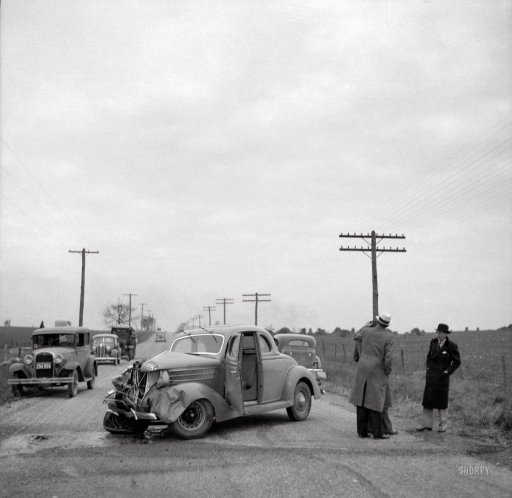
David Myers Theatre on 9th Street. Washington, DC July 1939


• EU Refugee Summit In Disarray, Greatest Refugee Tide ‘Yet To Come’ (Guardian)
• China Consumers Tighten Belts, A Red Flag For The Global Economy (Reuters)
• China Prosecutor To Intensify Financial Markets Crackdown (Reuters)
• China Is Sitting on an Ocean of Diesel Fuel (Bloomberg)
• Bill Gross: “Mainstream America Is Being Slowly Cooked Alive” (Zero Hedge)
• Deflation Supercycle Is Over As World Runs Out Of Workers (AEP)
• Volkswagen Could Pose Bigger Threat To German Economy Than Greek Crisis (Reuters)
• UK, France And Germany Lobbied For Flawed Car Emissions Tests (Guardian)
• Volkswagen Emissions: Automakers’ Tobacco Moment? (CNBC)
• Volkswagen Test Rigging Follows a Long Auto Industry Pattern (NY Times)
• VW Chief Winterkorn Steps Down After Emissions Scandal (Bloomberg)
• Volkswagen CEO Likely to Get $32 Million Pension After Leaving (Bloomberg)
• What Volkswagen’s Crisis Could Mean for Auto Asset-Backed Securities (Alloway)
• VW Recall Letters In April Warned Of An Emissions Glitch (Reuters)
• How Smog Cops Busted Volkswagen and Brought Down Its CEO (Bloomberg)
• West Virginia Engineer Proves To Be A David To VW’s Goliath (Reuters)
• Forget ‘Developing’ Poor Countries, It’s Time To ‘De-Develop’ Rich Countries (Guardian)
• ‘Downsizing Could Free Up 2.5 Million British Homes’ (Guardian)
• Prepare For A Catastrophic NHS Winter Meltdown (Guardian)

Absolutely nothing was achieved. €1 billion goes to UN to feed refugees outside Europe. Hollow vapor.

• EU Refugee Summit In Disarray, Greatest Refugee Tide ‘Yet To Come’ (Guardian)

European heads of government met in Brussels on Wednesday night in an attempt to bury months of mutual mudslinging over the EU’s biggest ever refugee crisis, but failed to come up with common policies amid signs they were unable to contain and manage the migration emergency. The emergency Brussels summit decided little but to throw money at aid agencies and transit countries hosting millions of Syrian refugees and to step up the identification and finger-printing of refugees in Italy and Greece by November. Calls for European forces to take control of Greece’s borders – the main entry point to the EU from the Middle East – fell on deaf ears. The summit’s chairman delivered coded criticism of the German chancellor, Angela Merkel, and of the European Commission while warning that the refugee crisis would get much worse before it might get better.

Turkey, which is the main source of Syrians trying to move to Germany, was recognised as the lynchpin of any strategy for containing the crisis and it emerged that Ankara was demanding a high price for its cooperation. Donald Tusk, the president of the European Council who chaired the summit, warned: “The greatest tide of refugees and migrants is yet to come.” In a barb directed at Merkel and Jean-Claude Juncker, the president of the European Commission, Tusk added: “We need to correct our policy of open doors and windows.” The summit pitted the governments of central Europe against Germany and France after Berlin and Paris on Tuesday forced a new system of imposed refugee quotas on a recalcitrant east.

There was talk of boycotts and threats to take the issue to court from the Czechs and Slovaks. The EU’s most robust anti-immigration hardliner, Viktor Orbán, the prime minister of Hungary, warned Merkel, against any “moral imperialism”. He argued that Greece was incapable of securing its borders with Turkey and that the job should be given to a pan-European force. He admitted he got no support, adding that he was left with two options – retaining the razorwire fences he has built on the borders with Serbia and Croatia or sending any refugees who enter Hungary straight through to Austria. The Austrian chancellor, Werner Faymann, replied that he should send the refugees through and take down the fence. Merkel said: “Setting up fences between members states is not the solution.” “The conditions for a comprehensive solution are not yet in place.”

Read more …

Chinese have lost trust in their government.

• China Consumers Tighten Belts, A Red Flag For The Global Economy (Reuters)

Terry Xu considers himself one of the lucky ones. The 32-year-old father-of-one invested 10% of his savings earlier this year in Chinese stocks. Now, with markets down around 40% since mid-June, he’s selling off his portfolio at a loss. Painful, but not a catastrophe – he says his colleagues lost more, and he earns well above the average wage. But the equity market turmoil, coupled with signs the economy is slowing means Xu, and millions of other middle class Chinese consumers like him, is scaling back his spending in an ominous sign for China’s policymakers and the global economy. “This year’s economy has been uncertain,” he said. “It’s not like before, where we just used to buy everything for our child. Now, we only buy and spend what we need”.

Xu earns 20,000 yuan ($3,140) a month as a product development manager for a Western headphone maker in Shenzhen. A flat he bought in 2012 for 900,000 yuan, which he shares with his 4-year-old daughter, wife and parents-in-law, is now worth 2.5 million. Still, he plans to keep his Apple iPhone 4 rather than upgrade to the latest iPhone 6S, and his next pair of trainers will be from the Chinese brand Anta Sports rather than his preferred Nike. Xu’s worries are typical of middle class families – relatively minor compared with the millions of his compatriots who get by on lower incomes. But his belt-tightening jars with the Chinese government’s hopes that consumers will pick up the slack as exports fall and it tries to rebalance the economy away from a long-running reliance on trade and government spending.

Domestic consumption contributed 60% of China’s economic growth in the first half of 2015, up from 51.2% in the whole of 2014, suggesting Beijing’s desired rebalancing is on track. But forward looking indicators and companies’ experiences in China are more worrying. A China consumer confidence index produced by ANZ Bank and polling company Roy Morgan fell to a record low in August. Car sales in China could drop this year for the first time in two decades, while smartphone sales recorded their first fall in China during the second quarter, consumer research firm Gartner said. If that translates into a slowdown in overall consumer spending, the impact will be felt beyond China.

Read more …

Chasing shadows.

• China Prosecutor To Intensify Financial Markets Crackdown (Reuters)

China’s state prosecutor will intensify its crackdown on criminal activities in its stock and futures markets, following a series of high-profile cases involving one of the country’s market regulators and securities firms. The prosecutor told a news conference in Beijing it would strengthen coordination with market regulators as part of efforts to halt activities such as insider trading and spreading of false information, state radio said on its website on Wednesday. The authorities have stepped up investigations on market participants since June, when wild gyrations sent the equity market down as much as 40%. Amid the crackdown, investors, fund managers and watchdog officials have all been the subject of investigations. The China Securities Regulatory Commission said on Sept. 18 it has recently started investigating 19 cases of suspected illegal share sales and speculative activities.

Meanwhile, executives at the country’s largest broker CITIC Securities, including its general manager, are being investigated by authorities for alleged offences including insider trading and leaking information. The country’s securities watchdog has also been swept up in the crackdown. China’s Communist Party sacked CSRC Assistant Chairman Zhang Yujun, state media reported on Sept. 22, days after it was announced he was the subject of a graft probe. The campaign to identify and punish those deemed responsible for the market sell-off started shortly after June’s turmoil. However, most analysts attribute the summer crash to the bursting of a typical stock market bubble which was earlier spurred by official media and fueled in large part by borrowed money.

Read more …

Perfect timing.

• China Is Sitting on an Ocean of Diesel Fuel (Bloomberg)

Add diesel to the commodities flooding global markets from China. The nation exported a record volume of the fuel last month after already shipping unprecedented amounts of steel and aluminum overseas. The weakest economic growth since 1990 is sapping domestic demand for commodities, while refineries, mills and smelters grapple with excess capacity after years of expansion. “A lot of it has to do with slowing demand at a time when companies had plans for much a better demand environment, so capacities had been increased,” said Ivan Szpakowski at Citigroup in Hong Kong. “As demand slows, that’s led to an overcapacity in the domestic market and producers have sought to export the surplus.”

Exports of Chinese raw materials are exacerbating a global glut that drove prices to the lowest since the 2008 financial crisis and prompted steel and aluminum producers around the world to protest against the deluge. While diesel exports are principally a risk to Asian refiners, the additional shipments threaten to worsen a glut that already extends from Singapore to Europe and the U.S. Refining profits, or cracks, from making diesel in the Asian oil trading hub of Singapore have shrunk about 30% from a year ago as exports from China, India and the Middle East create an oversupply, according to Ehsan Ul-Haq, an analyst at KBC Advanced Technologies in London.

“The world is becoming an ocean of diesel,” said Ul-Haq. “Demand in China is not as high as it was previously expected. Chinese refiners are becoming more export oriented.” China’s August shipments of the fuel, also known as gasoil, surged 77% from a year earlier to a record 722,516 metric tons, or about 175,000 barrels a day, according to data released this week by the General Administration of Customs. They may rise to about 250,000 barrels a day later this year, according to ICIS China and JBC Energy GmbH, industry consultants. “Inevitably, this should prevent gasoil cracks in Asia from going higher than they already are,” said David Wech, managing director of Vienna-based JBC.

Read more …

Talking his book.

• Bill Gross: “Mainstream America Is Being Slowly Cooked Alive” (Zero Hedge)

While hardly as dramatic as Bill Gross’ last letter in which he urged readers to “go to cash” as a result of the “Frankenstein creation” that ZIRP has created, his latest letter “Saved by Zero” takes a calmer stance and urges central banks to “get off zero” as the “developed world is beginning to run on empty because investments discounted at near zero over the intermediate future cannot provide cash flow or necessary capital gains to pay for past promises in an aging society. And don’t think that those poor insurance companies and gargantuan pension funds in the hundreds of billions are the only losers.” His punchline:

“Mainstream America with their 401Ks are in a similar pickle. Expecting 8-10% to pay for education, healthcare, retirement or simply taking an accustomed vacation, they won’t be doing much of it as long as short term yields are at zero. They are not so much in a pickle barrel as they are on a revolving spit, being slowly cooked alive while central bankers focus on their Taylor models and fight non-existent inflation.”

We are not so sure about that non-existant inflation: sure, if one ignores healthcare, food, tuition and expecially rental costs, then sure. But let that slide for the time being. Gross’ conclusion: “get off zero and get off quick. Will 2% Fed Funds harm corporate America that has already termed out its debt? A little. Will stock and bond prices go down? Most certainly. But like Volcker recognized in 1979, the time has come for a new thesis that restores the savings function to developed economies that permit liability based business models to survive – if only on a shoestring – and that ultimately leads to rejuvenated private investment, which is the essence of a healthy economy. Near term pain? Yes. Long term gain? Almost certainly. Get off zero now!” Sure, it makes all the sense in the world… and that’s why the Fed won’t do it precisely because of the “stock prices going down” part.

The Fed clearly confirmed that the stock market mandate is the only one it cares about, and as such it will let Wall Street trample over Main Street any day. Confirming this is the latest Fed Funds projection which has a December rate hike now at just 42% odds, meaning the majority of the market no longer believes the rate hike will come before 2016 (just as Goldman demanded), and is acting accoridngly. The real question, one not addressed by Gross in this letter, is the dramatic shift in the market’s posture, one where a continuation of easy conditions no longer leads to a surge in stocks. It is this that is the biggest threat to the Fed, as the market is now confirming a major easing episode such as QE4 or NIRP may not be what the Econ PhD doctor ordered to get new all time highs. This is why the Fed is not only trapped, but pushing on a string. And the longer it keeps rates at zero the greater the pain in the long-run.

Read more …

“..scarce labour will set off a bidding war for workers, all spiced by a state of latent social warfare between the generations.” “The last time Europe’s serfs suddenly found themselves in huge demand was after the Black Death in the mid-14th century. They say it ended feudalism.”

• Deflation Supercycle Is Over As World Runs Out Of Workers (AEP)

Workers of the world are about to get their revenge. Owners of capital will have to make do with a shrinking slice of the cake. The powerful social forces that have flooded the global economy with abundant labour for the past four decades years are reversing suddenly, spelling the end of the deflationary super-cycle and the era of zero interest rates. “We are at a sharp inflexion point,” says Charles Goodhart, a professor at the London School of Economics and a former top official at the Bank of England. As cheap labour dries up and savings fall, real interest rates will climb from sub-zero levels back to their historic norm of 2.75pc to 3pc, or even higher. The implications are ominous for long-term US Treasuries, Gilts or Bunds. The whole structure of the global bond market is a based on false anthropology.

Prof Goodhart says the coming era of labour scarcity will shift the balance of power from employers to workers, pushing up wages. It will roll back the corrosive inequality that has built up within countries across the globe. If he is right, events will soon discredit the sweeping neo-Marxist claims of Thomas Piketty, the best-selling French economist who vaulted to stardom last year. Mr Piketty’s unlikely bestseller – Capital in the 21st Century – alleged that the return on capital outpaces the growth of the economy over time, leading ineluctably to greater concentrations of wealth in an unfettered market system. “Piketty was wrong,” said Prof Goodhart. What in reality happened is that the twin effects of plummeting birth rates and longer life spans from 1970 onwards led to a demographic “sweet spot”, a one-off episode that temporarily distorted labour economics.

Prof Goodhart and Manoj Pradhan argue in a paper for Morgan Stanley that this was made even sweeter by the collapse of the Soviet Union and China’s spectacular entry into the global trading system. The working age cohort was 685m in the developed world in 1990. China and eastern Europe added a further 820m, more than doubling the work pool of the globalised market in the blink of an eye. “It was the biggest ‘positive labour shock’ the world has ever seen. It is what led to 25 years of wage stagnation,” said Prof Goodhart, speaking at a forum held by Lombard Street Research. We all know what happened. Multinationals seized on the world’s reserve army of cheap leader. Those American companies that did not relocate plant to China itself were able play off Chinese wages against US workers at home, exploiting “labour arbitrage”.

US corporate profits after tax are now 10pc of GDP, twice their historic average and a post-war high. It was much the same story in Europe. Volkswagen openly threatened to shift production to Poland in 2004 unless German workers swallowed a wage freeze and longer hours, tantamount to a pay cut. IG Metall bowed bitterly to the inevitable. Cheap labour held down global costs and prices. China compounded the effect with a factory blitz – on subsidised credit – that pushed investment to a world record 48pc of GDP and flooded markets with cheap goods – first clothes, shoes and furniture, and then steel, ships, chemicals, mobiles and solar panels. Lulled by low consumer price inflation, central banks let rip with loose money – long before the Lehman crisis – leading to even lower real interest rates and asset bubbles. The rich got richer.

Read more …

One in 7 German jobs is related to car industry.

• Volkswagen Could Pose Bigger Threat To German Economy Than Greek Crisis (Reuters)

The Volkswagen emissions scandal has rocked Germany’s business and political establishment and analysts warn the crisis at the car maker could develop into the biggest threat to Europe’s largest economy. Volkswagen is the biggest of Germany’s car makers and one of the country’s largest employers, with more than 270,000 jobs in its home country and even more working for suppliers. Volkswagen Chief Executive Martin Winterkorn paid the price for the scandal over rigged emissions tests when he resigned on Wednesday and economists are now assessing its impact on a previously healthy economy. “All of a sudden, Volkswagen has become a bigger downside risk for the German economy than the Greek debt crisis,” ING chief economist Carsten Brzeski told Reuters.

“If Volkswagen’s sales were to plunge in North America in the coming months, this would not only have an impact on the company, but on the German economy as a whole,” he added. Volkswagen sold nearly 600,000 cars in the United States last year, around 6% of its 9.5 million global sales. The U.S. Environmental Protection Agency said the company could face penalties of up to $18 billion, more than its entire operating profit for last year. Although such a fine would be more than covered by the €21 billion the company now holds in cash, the scandal has raised fears of major job cuts. The broader concern for the German government is that other car makers such as Daimler and BMW could suffer fallout from the Volkswagen disaster. There is no indication of wrongdoing on the part of either company and some analysts said the wider impact would be limited.

The German government said on Wednesday that the auto industry would remain an “important pillar” for the economy despite the deepening crisis surrounding Volkswagen. “It is a highly innovative and very successful industry for Germany, with lots of jobs,” a spokeswoman for the economy ministry said. But analysts warn that it is exactly this dependency on the automobile sector that could become a threat to an economy forecast to grow at 1.8% this year. Germany is already having to face up to the slowdown in the Chinese economy. “Should automobile sales go down, this could also hit suppliers and with them the whole economy,” industry expert Martin Gornig from the Berlin-based DIW think tank told Reuters.

Read more …

“Just four months before the VW emissions scandal broke, the EU’s three biggest nations mounted a push to carry over loopholes from a test devised in 1970..”

• UK, France And Germany Lobbied For Flawed Car Emissions Tests (Guardian)

The UK, France and Germany have been accused of hypocrisy for lobbying behind the scenes to keep outmoded car tests for carbon emissions, but later publicly calling for a European investigation into Volkswagen’s rigging of car air pollution tests. Leaked documents seen by the Guardian show the three countries lobbied the European commission to keep loopholes in car tests that would increase real world carbon dioxide emissions by 14% above those claimed. Just four months before the VW emissions scandal broke, the EU’s three biggest nations mounted a push to carry over loopholes from a test devised in 1970 – known as the NEDC – to the World Light Vehicles Test Procedure (WLTP), which is due to replace it in 2017.

“It is unacceptable that governments which rightly demand an EU inquiry into the VW’s rigging of air pollution tests are simultaneously lobbying behind the scenes to continue the rigging of CO2 emissions tests,” said Greg Archer, clean vehicles manager at the respected green thinktank, Transport and Environment (T&E). “CO2 regulations should not be weakened by the backdoor through test manipulations.” Vehicle emissions are responsible for 12% of Europe’s carbon emissions and by 2021, all new cars must meet an EU emissions limit of 95 grams of CO2 per km, putting accurate measurements of real emissions at a premium. The loopholes would not only raise real world CO2 emissions from new cars to 110g CO2 per km – well above the EU limit – but increase fuel bills for drivers by €140 per year according to T&E.

Huw Irranca-Davies, Labour MP and chair of an influential select committee of MPs, the environmental audit committee, said: “Given that the UK is struggling to bring down carbon emissions and other harmful pollutants from road vehicles it is extremely worrying that the UK government appears to be trying to water down the EU’s proposed new road testing regime. “As well as cutting CO2 emissions, improving the efficiency of vehicles can save lives by reducing the illegal levels of air pollution in UK cities, so the Department for Transport should be making these tests more rigorous not less.” The WLTP test was supposed to remove loopholes that had allowed a gap between real world CO2 emissions and test cycle ones to develop, which EU consultants have estimated at up to 20%.

But the UK lobbied for car makers to be allowed to exploit flexibilities such as externally charging their batteries to full before testing. The Department for Transport also argued that the best available technologies should be shunned in favour of outdated ‘inertia classes’, which involve manually adding 100 kilo weights to the car to see what effect greater weight on the amount of CO2 the car pumps out. Research by the International Council on Clean Transportation has found that car manufacturers often game these tests by optimising test car performances at one pound below the desired inertia class. Germany went further than the UK, calling for the tests to be conducted on sloping downhill tracks, and for allowing manufacturers to declare a final CO2 value 4% lower than the one measured. France supported all the proposed loopholes, bar the 4% lower CO2 value.

Read more …

Can governments keep protecting their carmakers from the law?

• Volkswagen Emissions: Automakers’ Tobacco Moment? (CNBC)

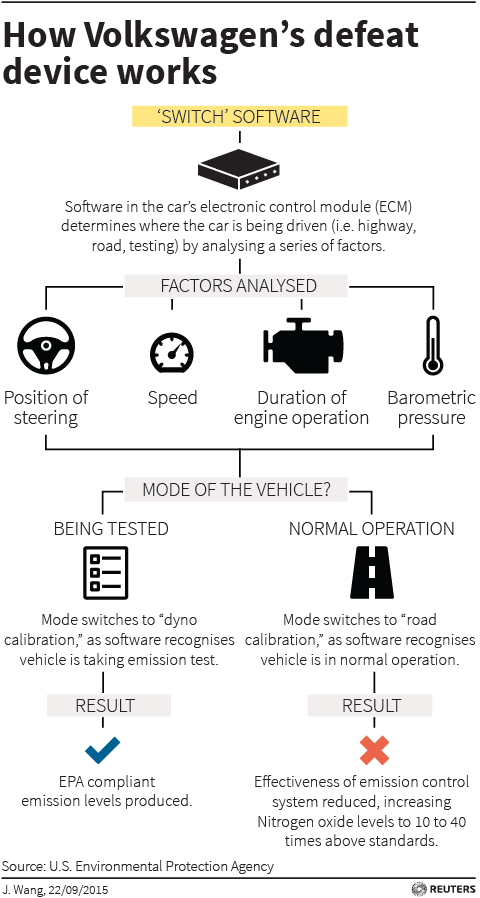
The decimation of share prices across the autos industry this week highlights growing concerns that Volkswagen’s problem could quickly turn into one for the entire carmaking industry. The U.S. Environmental Protection Agency has accused Volkswagen of installing a device in its diesel vehicles to run maximum anti-pollution controls only when emissions tests were taking place. VW has admitted the mistake and apologised, with its U.S. boss, Michael Horn, saying the company had “totally screwed up.” No other car manufacturers have been accused of this kind of behavior. However, the light shone on what Volkswagen was trying to sell as emission-reducing cars, which were in fact pumping more nitrogen dioxide (NOx) into the air than thought, could be uncomfortable for others.

The scandal should be “a massive wake up call to governments and regulators around the world,” Friends of the Earth air pollution campaigner Jenny Bates told CNBC. “More than fifty thousand people die early every year in the UK due to our illegally filthy air. Vehicle pollution is the main problem, with diesel vehicles the biggest culprit. Tough pollution standards are crucial for cleaning up our sub-standard air quality – which is why an urgent investigation is needed to ensure that the motor industry is complying with EU regulations.” Even given the drastic share price falls, investors are likely to stay away from the automobile sector for a while as they wonder which company will be next.

Analysts have been producing gloomy forecasts for both Volkswagen and the sector as a result, with one typical example from Societe Generale, which downgraded the sector from Overweight to Neutral, deeming it “dead money”. Yet the fallout could be even worse than feared, if it emerges that the problem of promoting cars as more environmentally friendly than they are goes beyond Volkswagen. This kind of industry-wide problem is sometimes called a “tobacco moment” after the cigarette industry’s early denials of the links between smoking and lung cancer, which eventually proved futile.

Read more …

Industry + governments.

• Volkswagen Test Rigging Follows a Long Auto Industry Pattern (NY Times)

Long before Volkswagen admitted to cheating on emissions tests for millions of cars worldwide, the automobile industry, Volkswagen included, had a well-known record of sidestepping regulation and even duping regulators. For decades, car companies found ways to rig mileage and emissions testing data. In Europe, some automakers have taped up test cars’ doors and grilles to bolster their aerodynamics. Others have used “superlubricants” to reduce friction in the car’s engine to a degree that would be impossible in real-world driving conditions. Automakers have even been known to make test vehicles lighter by removing the back seats. Cheating in the United States started as soon as governments began regulating automotive emissions in the early 1970s.

In 1972, certification of Ford Motor’s new cars was held up after the EPA found that the company had violated rules by performing constant maintenance of its test cars, which reduced emissions but did not reflect driving conditions in the real world. Ford walked away with a $7 million fine. The next year, the agency fined Volkswagen $120,000 after finding that the company had installed devices intended specifically to shut down a vehicle’s pollution control systems. In 1974, Chrysler had to recall more than 800,000 cars because similar devices were found in the radiators of its cars. Such gadgets became known as “defeat devices,” and they have long been banned by the EPA. But their use continued to proliferate, and they became more sophisticated, as illustrated by Volkswagen’s admission this week that 11 million diesel cars worldwide were equipped with software used to cheat on emissions tests. [..]

In the United States, automakers’ lobbying has ensured that the statute giving powers to the National Highway Traffic Safety Administration “has no specific criminal penalty for selling defective or noncompliant vehicles,” says Joan Claybrook, a former administrator of the agency and a longtime advocate of auto safety. There are no criminal penalties under laws applying to the E.P.A. for violations of motor vehicle clean air rules, though there is a division of the Justice Department devoted to violations of environmental law. “I don’t see them changing this behavior unless criminal penalties are enacted into law that allow the prosecutor to put the executives in jail,” Ms. Claybrook said.

Read more …

Criminal investigation MUST follow.

• VW Chief Winterkorn Steps Down After Emissions Scandal (Bloomberg)

Volkswagen CEO Martin Winterkorn resigned after U.S. officials caught the company cheating on emissions tests, leaving the world’s top-selling automaker to appoint a fresh leader to repair its reputation among customers, dealers and regulators around the globe. Stepping down after almost a decade in charge, Winterkorn said he was accepting the consequences of the mushrooming scandal that has wiped €20 billion off the company’s market value. Possible replacements include Matthias Mueller, head of the Porsche brand who has the support of the family that controls a majority stake of Volswagen, and Herbert Diess, who recently joined from rival BMW, a person familiar with the matter said.

Meantime, the company expects more executives to be targeted in the coming days in its investigation, the executive committee of the supervisory board said in a statement, exonerating Winterkorn of being involved in the manipulations. Volkswagen also asked local German prosecutors to assist and open a criminal probe. “The incident must be cleared up mercilessly, and it must be assured that such things cannot ever happen again,” said Stephan Weil, a member of the board committee and the prime minister of Lower Saxony, a key Volkswagen shareholder. “We are very much aware of the scope of this issue, the economic damage and the implications for VW’s reputation.”

Winterkorn, who was supposed to receive a contract extension on Friday, had a dramatic fall from grace that began last week with the revelation that the Wolfsburg, Germany-based company fitted diesel-powered vehicles with software that circumvented air pollution controls, then lied about it to the U.S. Environmental Protection Agency for nearly a year. The 68-year-old CEO, who had repeatedly apologized for the manipulations, was unable to hang on as the stock price plummeted 35% over two days and pressure grew from the German government for quick action. “He had little choice,” said Erik Gordon at the University of Michigan. “The company’s reputation is in tatters.” Volkswagen shares rose 5.2% to close at €111.50 on Wednesday, clawing back some of the losses earlier this week. “Volkswagen needs a fresh start,” Winterkorn said in a statement. “I am clearing the way for this fresh start with my resignation.”

Read more …

Insanity squared.

• Volkswagen CEO Likely to Get $32 Million Pension After Leaving (Bloomberg)

Martin Winterkorn, engulfed by a diesel-emissions scandal at Volkswagen AG, amassed a $32 million pension before stepping down Wednesday, and may reap millions more in severance depending on how the supervisory board classifies his exit. After Winterkorn disclosed Wednesday that he had asked the board to terminate his role, company spokesman Claus-Peter Tiemann declined to comment on how much money the departing CEO stands to get. Volkswagen’s most recent annual report outlines how Winterkorn, its leader since 2007, could theoretically collect two significant payouts. Winterkorn’s pension had a value of 28.6 million euros ($32 million) at the end of last year, according to the report, which doesn’t describe any conditions that would lead the company to withhold it.

And under certain circumstances, he also can collect severance equal to two years of “remuneration.” He was Germany’s second-highest paid CEO last year, receiving a total of 16.6 million euros in compensation from the company and majority shareholder Porsche SE.
While the severance package kicks in if the supervisory board terminates his contract early, there’s a caveat. If the board ends his employment for a reason for which he is responsible, then severance is forfeited, according to company filings. The supervisory board’s executive committee said in a statement Wednesday that Winterkorn “had no knowledge of the manipulation of emissions data,” and that it respected his offer to resign and request to be terminated. It also thanked him for his “towering contributions” to the company.

Winterkorn, 68, said in his statement Wednesday that he was stunned to learn of the scope of alleged misconduct occurring at the company. U.S. officials said Sept. 18 the carmaker had cheated during tests of diesel-powered vehicles sold since 2009. “As CEO I accept responsibility for the irregularities that have been found in diesel engines and have therefore requested the supervisory board to agree on terminating my function as CEO,” he said. “I am doing this in the interests of the company even though I am not aware of any wrongdoing on my part.” The annual report also mentions another piece of his pension: He can use a company car in the years that benefit is being paid out.

Read more …

Being a VW dealership is a nightmare right now.

• What Volkswagen’s Crisis Could Mean for Auto Asset-Backed Securities (Alloway)

From the Environmental Protection Agency to … securitized bonds? The emissions scandal currently rocking Volkswagen is having ripple effects across markets, potentially moving all the way to sliced-and-diced bonds tied to car loans and leases. Sales of auto asset-backed securities, or ABS, have been booming in recent years as investors seek out higher-yielding products. According to Deutsche Bank estimates, about $5.6 billion worth of VW auto ABS is outstanding, with some $4.39 billion of that figure coming from bonds backed by loans and leases. Volkswagen, now facing potential fines and litigation, could find its ability to attract new business temporarily crimped, forcing down the values of the cars backing such loans. But that will probably have little impact on ABS investors, according to Elen Callahan, Deutsche Bank analyst.

“Given that the vehicles are still ‘safe and legal to drive’ and that the repairs will come at no cost to the owner, we do not expect borrowers to become disincentivized from making their contractual monthly payment on their VW vehicle,” she wrote in a note published on Wednesday. Still the $1.25 billion worth of bonds that Deutsche bank estimates are backed by car dealer inventories of VW cars—known as dealer floorplan ABS—could be a more complicated story. “As is typical for dealer floorplan ABS, the ABS trust benefits from VW financing assistance including but not limited to VW’s pledge to repurchase unsold new vehicles and inventory,” Callahan said. “We believe that despite the financial burdens associated with the recalls, VW will continue to honor this commitment given the importance of its dealer network to its primary business.”

The revelations made public last week by the EPA have reminded some auto bond analysts of recalls that hit Toyota Motor in 2009 and 2010, which affected some 9 million vehicles. Car dealers, told to immediately halt sales of popular 2015 and 2016 models, including Volkswagen’s Jetta and Beetle convertible, “are now saddled with unsalable product, at least for the time being,” Barclays analyst Brian Ford told clients in a Tuesday report. “Dealers now have a number of cars that they cannot sell; so inventory will not turn over as rapidly,” he said in a follow-up interview. “The ABS most affected by VW’s sales stoppage of certain 2015 and 2016 diesel models is the dealer floorplan securitizaiton.”

Read more …

This is not new.

• VW Recall Letters In April Warned Of An Emissions Glitch (Reuters)

In April of 2015, Volkswagen of America, Inc. sent letters to California owners of diesel-powered Audis and Volkswagens informing them of an “emissions service action” affecting the vehicles. Owners were told they would need to take their cars to a dealer for new software to ensure tailpipe emissions were “optimized and operating efficiently.” The company didn’t explain that it was taking the action in hopes of satisfying government regulators, who were growing increasingly skeptical about the reason for discrepancies between laboratory emissions test results and real world pollution from Volkswagen’s diesel cars. Officials at the California Air Resources Board and the EPA agreed in December of 2014 to allow a voluntary recall of the company’s diesel cars to fix what Volkswagen insisted was a technical – and easily solved – glitch.

The recall was rolled out nationally over a period of months. On Wednesday, California Air Resources Board spokesman Dave Clegern confirmed that the letters were part of that recall. “This is one of the fixes they presented to us as a potential solution. It didn’t work,” he said. Volkswagen, which had no obligation at the time it initiated the recall to disclose the discussions that had led to it, declined to comment on the letter. The controversy came to public attention last week after Volkswagen acknowledged it had deliberately deceived officials about how much its diesel cars polluted. The recall letter instructed owners of certain 2010-2014 Volkswagen vehicles with 2-liter diesel engines to contact dealers for a software update in order to fix an issue with the malfunction indicator light illuminating.

“If the [light] illuminates for any reason, your vehicle will not pass an IM emissions inspection in some regions,” the letter warned, noting that California required the update before it would renew vehicle registrations. “The vehicle’s engine management software has been improved to assure your vehicle’s tailpipe emissions are optimized and operating efficiently,” read the letter, which said an earlier software update increased the likelihood of the light illuminating.

Read more …

“We had 10 meetings with VW..” “Time and again they refused to tell us what was going on.”

• How Smog Cops Busted Volkswagen and Brought Down Its CEO (Bloomberg)

The revelation that ended Martin Winterkorn’s career at Volkswagen AG came on Sept. 3 in a meeting at an office park east of Los Angeles. After months of obfuscation, company engineers finally divulged a secret to engineers at the California Environmental Protection Agency’s Air Resources Board: Volkswagen had installed a “defeat device” to cheat on vehicle emissions tests — and then lied about it to the board and the U.S. EPA for more than a year. On Sept. 23, Europe’s largest automaker announced that Winterkorn, its 68-year-old chief executive officer, had resigned. While the company exonerated him of involvement in the manipulations, it said it will conduct an internal investigation and has asked local German prosecutors to assist and open a criminal probe.

The unraveling began in 2013. European regulators, concerned about diesel pollution there, wanted to test emissions on vehicles sold in the U.S. under actual driving conditions. The results were expected to show real-world emissions were closer to lab performance in America than in Europe. But they weren’t. That prompted investigations in California that ultimately involved 25 technicians working almost full time. They discovered the software Volkswagen used to circumvent air-pollution regulations in at least 11 million cars. “This is going to become a very, very serious problem for Volkswagen and any other companies that may have had such practices,” said Donald W. Lyons, who founded the Center for Alternative Fuels, Engines and Emissions at West Virginia University.

The nonprofit International Council on Clean Transportation, with offices in Washington, Berlin and San Francisco, got the emissions-testing contract from European regulators. It then hired researchers at the Morgantown, West Virginia, center in early 2013. The center, which has studied engine emissions and use of alternative fuels since 1989, was going to evaluate three diesel passenger cars, including a Volkswagen Passat and Jetta. m“We never went into it saying,‘we’re going to catch a manufacturer,”’ said Arvind Thiruvengadam, a research assistant professor at the center. “We were totally looking and hoping to see something different.”[..]

Using portable measuring equipment with hoses attached to vehicle exhaust pipes, researchers drove the Jetta and BMW through Los Angeles and took the Passat to Seattle and back. They also worked with the California Air Resources Board’s laboratory in El Monte, which tested the cars on a dynamometer, a device that measures engine performance. When the Volkswagen cars were in the lab, they met the Clean Air Act standards. In the real world, they were belching out oxides of nitrogen at much higher levels than allowed. “There was a lot of texting and e-mailing back and forth,” among the two groups: “‘Whoa, things aren’t looking good here,”’ Carder said. In May 2014, the West Virginia center published the results of its study, prompting the California board to start an investigation.

Read more …

“..his team’s findings were made public nearly a year and a half ago..”

• West Virginia Engineer Proves To Be A David To VW’s Goliath (Reuters)

Daniel Carder, an unassuming 45-year-old engineer with gray hair and blue jeans, appears an unlikely type to take down one of the world’s most powerful companies. But he and his small research team at West Virginia University may have done exactly that, with a $50,000 study which produced early evidence that Volkswagen AG was cheating on U.S. vehicle emissions tests, setting off a scandal that threatens the German automaker’s leadership, reputation and finances. “The testing we did kind of opened the can of worms,” Carder says of his five-member engineering team and the research project that found much higher on-road diesel emission levels for VW vehicles than what U.S. regulators were seeing in tests.

The results of that study, which was paid for by the nonprofit International Council on Clean Transportation (ICCT) in late 2012 and completed in May 2013, were later corroborated by the U.S. Environmental Protection Agency and California Air Resources Board (CARB). Carder’s team – a research professor, two graduate students, a faculty member and himself – performed road tests around Los Angeles and up the West Coast to Seattle that generated results so pronounced that they initially suspected a problem with their own research. “The first thing you do is beat yourself up and say, ‘Did we not do something right?’ You always blame yourself,” he told Reuters in an interview. “(We) saw huge discrepancies. There was one vehicle with 15 to 35 times the emissions levels and another vehicle with 10 to 20 times the emissions levels.”

Despite the discrepancies, a fix shouldn’t involve major changes. “It could be something very small,” said Carder, who’s the interim director of West Virginia University’s Center for Alternative Fuels, Engines and Emissions in Morgantown, about 200 miles (320 km) west of Washington in the Appalachian foothills. “It can simply be a change in the fuel injection strategy. What might be realized is a penalty in fuel economy in order to get these systems more active, to lower the emissions levels.” Carder said he’s surprised to see such a hullabaloo now, because his team’s findings were made public nearly a year and a half ago. “We actually presented this data in a public forum and were actually questioned by Volkswagen,” said Carder.

Read more …

Perpetual growth.

• Forget ‘Developing’ Poor Countries, It’s Time To ‘De-Develop’ Rich Countries (Guardian)

This week, heads of state are gathering in New York to sign the UN’s new sustainable development goals (SDGs). The main objective is to eradicate poverty by 2030. Beyoncé, One Direction and Malala are on board. It’s set to be a monumental international celebration. Given all the fanfare, one might think the SDGs are about to offer a fresh plan for how to save the world, but beneath all the hype, it’s business as usual. The main strategy for eradicating poverty is the same: growth. Growth has been the main object of development for the past 70 years, despite the fact that it’s not working. Since 1980, the global economy has grown by 380%, but the number of people living in poverty on less than $5 (£3.20) a day has increased by more than 1.1 billion. That’s 17 times the population of Britain. So much for the trickle-down effect.

Orthodox economists insist that all we need is yet more growth. More progressive types tell us that we need to shift some of the yields of growth from the richer segments of the population to the poorer ones, evening things out a bit. Neither approach is adequate. Why? Because even at current levels of average global consumption, we’re overshooting our planet’s bio-capacity by more than 50% each year. In other words, growth isn’t an option any more – we’ve already grown too much. Scientists are now telling us that we’re blowing past planetary boundaries at breakneck speed. And the hard truth is that this global crisis is due almost entirely to overconsumption in rich countries.

Scientists tell us our planet only has enough resources for each of us to consume 1.8 “global hectares” annually – a standardised unit that measures resource use and waste. This figure is roughly what the average person in Ghana or Guatemala consumes. By contrast, people in the US and Canada consume about 8 hectares per person, while Europeans consume 4.7 hectares – many times their fair share. What does this mean for our theory of development? Economist Peter Edward argues that instead of pushing poorer countries to “catch up” with rich ones, we should be thinking of ways to get rich countries to “catch down” to more appropriate levels of development.

We should look at societies where people live long and happy lives at relatively low levels of income and consumption not as basket cases that need to be developed towards western models, but as exemplars of efficient living. How much do we really need to live long and happy lives? In the US, life expectancy is 79 years and GDP per capita is $53,000. But many countries have achieved similar life expectancy with a mere fraction of this income. Cuba has a comparable life expectancy to the US and one of the highest literacy rates in the world with GDP per capita of only $6,000 and consumption of only 1.9 hectares – right at the threshold of ecological sustainability. Similar claims can be made of Peru, Ecuador, Honduras, Nicaragua and Tunisia.

Read more …

Move over, darling.

• ‘Downsizing Could Free Up 2.5 Million British Homes’ (Guardian)

More than 2.5m homes could be released on to the property market if older owners were given better incentives and information on downsizing, the Royal Institution of Chartered Surveyors (Rics) has claimed. It said tackling the housing crisis needed to address barriers to supply, rather than simply addressing demand, and that 2.6m homes worth a combined £802bn could be released if homeowners received greater support to move into specialist retirement or smaller properties. The group’s Residential Policy Review also recommended that second homeowners should be charged full council tax to encourage them to sell or let the property, and that new developments should have a statutory percentage of affordable rented accommodation.

The report comes just days after the City regulator was forced to deny its policy was to encourage older homeowners to move, after comments made by a member of staff on its mortgage team sparked controversy. Increased life expectancy means that there around 11.4 million over-65s in the UK, and the figure is projected to rise to around 17.2 million by 2033. Currently, homeownership is concentrated in older age groups, with many owning their properties outright. Rics said communication about alternatives to staying in the family home were poor, meaning that options like retirement rental, housing co-operatives and shared housing were not being fully exploited. It acknowledged “there is a very strong emotional dimension to people’s homes, with considerable effort, both physical and emotional, to moving”.

Jeremy Blackburn, head of policy at Rics said: “Britain’s older homeowners are understandably reluctant to move out of much-loved, but often under-occupied family homes. “Clearly, it’s an emotive issue and one that needs to be treated with sensitivity, but we would like to see central and local government provide older people with the information, practical and financial support they need to downsize if that is their choice.” Blackburn cited the example of Bristol City council, which said it was offering a fund to support moving costs. “Almost a third of over 55s have considered downsizing in the last five years; yet we know that only 7% actually did,” he said.

Read more …

Not the first NHS warning in recent days.

• Prepare For A Catastrophic NHS Winter Meltdown (Guardian)

The NHS is on the brink of a major, messy failure. If nothing is done to address the underlying issues now, the failure will be deep with grave consequences and a long recovery. This winter things are set to go catastrophically wrong. Pressure on health services normally reduces in summer, often producing undue optimism about how they will cope come winter and delaying necessary preparations. Last summer there was virtually no reduction in pressure. Oddly, this failed to dent the optimism. The revised story was that unrelenting pressure had become a year-round phenomenon, so increased numbers and longer waits were now normal and the coming winter wouldn’t be any worse. Unfortunately it was, the worst in 20 years.

Demand for healthcare had simply reached a new (summer) plateau, with new peaks of winter demand inevitable and predictable – but not predicted and not prepared for. Waits and delays soared, even though demand increased modestly, following a well-established trend. The crisis happened because the NHS starved itself of the capacity it needed, in the futile belief that lack of supply would constrain demand and so save money. This led not only to running out of spare capacity, but to shortages and the loss of the elasticity to cope with new peaks in demand. The result was waits and delays multiplied rather than increased, and it contributed to the worst NHS deficit in a decade.

Despite this, the lesson has not been learned that the NHS’s struggles this summer foreshadow a meltdown this winter. Some 90% of trusts are predicting a deficit this year. The deficits add up to £2bn, double last year’s figure. Performance continues to wallow, with little or no recovery from the long delays and extended waiting times of last winter. Crucially, performance this summer was worse than last summer, which prefigured last winter’s crisis. The obvious conclusion is that it prefigures something worse.

Read more …

Sep 232015
 
 September 23, 2015  Posted by at 8:54 am Finance Tagged with: , , , , , , , , , ,  6 Responses »


Arthur Rothstein President Roosevelt tours drought area near Bismarck, ND 1936

• Signs Point To Deepening China Distress (FT)
• Shadow Finance Expansion by Chinese Banks Deepens Credit Mystery (Bloomberg)
• China Flash PMI Falls To Lowest Since May 2009 (CNBC)
• China’s Workers Stumble as Factories Stall (WSJ)
• Xi Jinping Defends China Stock Market Interventions On First US Visit (Guardian)
• China Has A Message Markets Don’t Understand (CNBC)
• VW Scandal Caused Nearly 1 Million Tonnes Of Extra Pollution (Guardian)
• California Tests To Include Larger Diesel Engines From Audi, Porsche (Reuters)
• VW Emissions Fallout Spreads To Asia (FT)
• VW Emissions Investigations To Widen to Entire Auto Industry (WSJ)
• VW Emissions Cheating Affects 11 Million Cars Worldwide (WaPo)
• Europe Stumbles Towards A Migrant Plan (BBC)
• EU’s East-West Rift Exposed In Refugee-Sharing Plan (Reuters)
• Hungary Mobilizes Troops, Prisoners, Jobless To Fence Out Refugees (Reuters)
• Hollande Wrongfooted on Refugee Surge, Fearing Le Pen’s Rise (Bloomberg)
• The Fed Just Made A Gigantic Mess (CNBC)
• Economic Policy Often Seems To Have Little To Do With Economists. Why? (Ind.)
• English Farmland Prices Double In Five Years (Guardian)
• Alaska Fossil Find Points To New ‘Lost World Of Dinosaurs’ (Guardian)

“Suddenly, the debate in China has shifted from a perception of too much money sloshing round and too many reserves earning meagre returns, to a concern about the adequacy of reserves given the extent of debt — much of it hidden.”

• Signs Point To Deepening China Distress

China’s foreign exchange reserves fell alarmingly in August, anywhere from $94bn to as much as $150bn according to various calculations. That was just another in a series of dramatic data points that are leading to an increasing sense both within the Middle Kingdom and without that all is not well. For a long time now many hedge funds have been short Macau, once the main beneficiary of both the Chinese propensity to gamble and the rise of China as a market for luxury goods. Then the anti-corruption campaign put a big chill on the junkets to the former Portuguese enclave, as it did on sales of everything from Rolex watches to shark fin soup and abalone in top restaurants. But now there is another strand to the story.

Macau has long been one of the more porous parts of the wall meant to keep capital flows in and out of China under strict control. For example, those who wanted to get significant amounts of money out of China would purchase a dozen watches, using their renminbi credit cards, only to return the time pieces instantly and receive cash refunds, with a discount for the jeweller’s trouble. The currency would then be converted and go straight into bank accounts and investments abroad. Today, the thesis of hedge fund managers putting on the Macau trade is that regulators will tighten up on such practices, causing further damage to Macau’s wounded economy. Suddenly, the debate in China has shifted from a perception of too much money sloshing round and too many reserves earning meagre returns, to a concern about the adequacy of reserves given the extent of debt — much of it hidden.

After all, the downdraft in the stock market was all about the use of borrowed money, invisible to regulators and almost everyone else. Meanwhile, the capital flows out of China continue. It is difficult to calculate what is prudent diversification and what is capital flight. At the same time, more alarmingly, the signs of distress in the real economy are deepening, with ripple effects far beyond the mainland. Greek shipyards, for example, report that the yards in China are desperately discounting the containers they construct. The Chinese shipbuilders have to discount to compensate for the fact they are competing against builders whose currencies have fallen dramatically against the renminbi.

Read more …

Assessing China without including the shadows is of no use at all.

• Shadow Finance Expansion by Chinese Banks Deepens Credit Mystery (Bloomberg)

China’s riskier banks are investing more customer funds in financing that is kept off their loan books, making it harder for rating companies to gauge their asset quality. There has been a surge in a balance-sheet item known as receivables, which often includes shadow funding such as trusts and wealth products, said Moody’s Investors Service. Fitch Ratings said it is hard to analyze this escalation in activity. Listed banks excluding the Big Four saw short-term investments and other assets – which include receivables – jump 25% in the first half, compared with total asset growth of 12%, data compiled by Bloomberg show. Slower growth in the world’s second-largest economy coupled with “still significant” credit expansion prompted Standard & Poor’s to cut its view of the banking industry’s economic risk to negative from stable this week.

Shadow-finance assets, estimated at 41 trillion yuan ($6.4 trillion) by Moody’s at the end of 2014, have become more attractive as five interest-rate cuts by the central bank since November curbed profits from lending. “Our concern with some of these investment positions is banks are using them as a way to bypass lending restrictions,” said Grace Wu at Fitch in Hong Kong. “Unlike bank loans, they don’t get reported into loan provisions, so it’s more difficult for us to ascertain the asset quality.” The opacity of Chinese banks’ credit exposure helps explain why they are priced as if investors are expecting a nonperforming loan ratio of 10 to 12% next year, which would mark a “sizeable credit crisis” in other countries, according to Wei Hou at Sanford C. Bernstein.

The reported ratio is 1.5%, according to the China Banking Regulatory Commission. The nation’s shadow-banking industry emerged as a way for creditors to circumvent lending restrictions and for savers to attain yields higher than the legally capped deposit rate. It includes trusts, asset-management plans and wealth-management products, which package loans into products for buyers.

Read more …

As long as Xi is in the US, the homefront will keep things smooth and quiet. But this number points to contraction, even as Xi just reiterated growth is at 7%.

• China Flash PMI Falls To Lowest Since May 2009 (CNBC)

The preliminary Caixin China manufacturing purchasing managers’ index (PMI) fell to a six-and-a-half-year low of 47.0 in September, below the 47.5 forecast in a Reuters poll. This compares with a final reading of 47.3 in August, the lowest since March 2009. A print above 50 indicates an expansion in activity while one below points to a contraction. The closely-watched gauge of nationwide manufacturing activity focuses on smaller and medium-sized companies, filling a niche that isn’t covered by the official data. The decline in the flash PMI was mainly led by the new orders and new export orders sub-indexes, suggesting weak domestic and external demand. The new orders sub-index fell 0.6 percentage points to 46.0 in September, while the new export orders sub-index slipped 0.8percentage points to 45.8.

Wednesday’s data weighed on investor sentiment in Asia, with stock indices in Sydney and Seoul widening losses to more than 1% each in the morning trading session. China stocks, however, trimmed losses to 0.9%, from an over 1% decline at the open. “The principle reason for the weakening of manufacturing is tied to previous changes in factors related to external demand and prices,” said He Fan at Caixin Insight Group. “Fiscal expenditures surged in August, pointing to stronger government efforts on the fiscal policy front. Patience may be needed for policies designed to promote stabilization to demonstrate their effectiveness,” he added. A recent run of disappointing data has raised concerns around the health of China’s economy, leading several banks and international institutions to pare growth forecasts for the country.

Read more …

“..roughly 55% of China’s 1.37 billion people now live in cities, compared with just under 18% in 1978…”

• China’s Workers Stumble as Factories Stall (WSJ)

For decades, an army of migrant workers drove China’s boom times, flocking to its cities to sew T-shirts, assemble iPhones, or build apartment blocks and Olympic stadiums. The arrangement helped millions of poor, rural Chinese join a new consumer class, though many also paid a heavy price. Now, many migrant workers struggle to find their footing in a downshifting economy. As factories run out of money and construction projects turn idle across China, there has been a rise in the last thing Beijing wants to see: unrest. In Xiguozhuang, a village among cornfields some 155 miles south of Beijing, it had been rare to see working-age men for much of the year. This year, however, many of the men are at home, sidelined by a fading property boom.

“Times are tough now,” said Wang Hongxing, a 39-year-old father of three who has worked at building sites across China’s northeast since his teens, but who has spent the past two months tending his farmland plot. “There are too many workers and wages are dropping.” But for other migrants, especially those of a younger generation who took jobs in factories along China’s coast, a return to farming isn’t an option. Nor do they necessarily want to join the service sector China sees as a cornerstone in its shift to a new economic model. Wang Chao dropped out of school when he was 15 and left his home in Anhui province. After a series of jobs up and down China’s east coast, he felt he had struck gold with a job in a textile factory near his hometown.

The factory closed in July. Mr. Wang, now 19, and other workers gathered recently outside the factory premises to demand back wages. He says he is owed two months’ pay, or about 2,000 yuan, or $320. The owner of the factory, which produces cheap trousers, told workers he is in deep debt and can’t afford to pay them. He couldn’t be reached to comment. Mr. Wang hopes he can find another factory job. In Shanghai, he worked in a restaurant but doesn’t want to do that again. “Factory work is so much more comfortable in comparison, and better paid,” he said. As a result of a rural-to-urban flow that many scholars say is likely the largest in history, roughly 55% of China’s 1.37 billion people now live in cities, compared with just under 18% in 1978.

The migrant workforce now numbers some 274 million but the pace of its expansion has slowed, and many economists believe China now faces a shortage of unskilled labor in urban areas. A mismatch of workers’ skills and aspirations with actual labor demand has exacerbated the problem. “There’s a broad structural imbalance in China’s labor market—a shortage of low-end labor and surfeit of high-end workers,” said Peng Xizhe, professor of population and development at Fudan University in Shanghai. “In China’s job market today, we see university graduates struggling to find work, while employers are finding it hard to fill traditional blue-collar positions.”

Read more …

“Xi peppered his speech with US cultural references from Sleepless in Seattle and House of Cards to Henry David Thoreau, Walt Whitman, Ernest Hemingway..”

• Xi Jinping Defends China Stock Market Interventions On First US Visit (Guardian)

China’s president, Xi Jinping, has sought to reassure global concern about the world’s second-largest economy, defending his government’s actions in the stock market and saying growth will be maintained. “China’s economy will stay on a steady course with fairly fast growth. It’s still operating in a proper range with a growth rate of 7% … Our economy is under pressure but that is part of the path on the way toward growth,” the Chinese president said in a speech in Seattle on Tuesday, the first day of his state visit to the US. The president defended his government’s intervention into the country’s stock market saying the “recent abnormal ups and downs” in the market had now reached “a phase of self-recovery”.

Xi also reiterated there was no basis for continuing depreciation of the renminbi, saying Beijing was opposed to currency wars and would not devalue yuan to boost exports. World markets experienced more than a month of volatility after China devalued its currency, fuelling concerns about the state of the world’s No 2 economy. Intervention from authorities into the country’s bourses also added to worries Beijing had lost control over the economy. But just minutes after the speech, fresh data showed renewed signs of weakness in the Chinese economy with the Caixin China manufacturing flash PMI coming in at 47, the lowest since March 2009. [..]

Xi peppered his speech with US cultural references from Sleepless in Seattle and House of Cards to Henry David Thoreau, Walt Whitman, Ernest Hemingway – saying he once ordered a Mojito at El Floridita in Havana to better understand Hemingway and Cuba. Dismissing speculation that his sweeping anti-corruption campaign was about factional infighting, Xi said “We have punished tigers and flies. It has nothing to do with power struggles. In this case there is no House of Cards.”

Read more …

Or they understand it all too well.

• China Has A Message Markets Don’t Understand (CNBC)

China may be compounding its own problems by the way its leaders talk about them. With the country’s growth a concern for global markets, investors are trying to fathom the depth of China’s economic issues and understand what authorities are doing. Analysts say it is difficult to discern what’s really going on there and that the economy has always been difficult to measure. Ahead of his U.S. visit that kicked off Tuesday, Chinese President Xi Jinping said in an interview with The Wall Street Journal that recent intervention in capital markets was necessary or normal and that China is still on track to transform its economy. “I think they are mostly nothing new and simply a repeat of what other officials have said,” Ilya Feygin, managing director at WallachBeth Capital, said of Xi’s comments.

Sticking to policy lines casts doubt for many on whether Chinese leaders have a grip on maneuvering the country’s economic transition in a way that doesn’t shock global markets more than it already has. “I think it’s a combination of missteps that add up to a lot of worries, capacity of the Chinese government to manage its economy through a very challenging environment and not making it worse,” said Scott Kennedy of the Center for Strategic and International Studies. “It begins with their intervention to push up their stock market last year.” Rapid-fire policy changes in the last few months have befuddled outsiders on Chinese leaders’ intentions, which raise real concern on whether the world’s second-largest economy can make a timely transition from a manufacturing hub to a consumer-oriented system.

“The point is to recognize there’s a structural transition going on,” said Arthur Kroeber, head of research at Gavekal Dragonomics. “And the problem we have is the data we have on the bad part of the economy is actually pretty developed. The data on services (is) much better but fuzzier.” Most of the economic reports still focus on manufacturing-related aspects of the economy, such as electricity use and the producer price index. Data such as the Caixin nonmanufacturing PMI provide some light on services, which continued to hold above the 50 expansion/contraction line in August. Manufacturing PMI fell below that line.

Growth in the services sector has outpaced that of the manufacturing sector in the last year and a half, according to the latest National Bureau of Statistics of China data compiled by Wind information. Amid the transition, questions also surround the accuracy of China’s reports on headline GDP growth. The official figure is 7%, the slowest in more than two decades In a report Tuesday, the Asian Development Bank lowered its forecast for Chinese growth in 2015 to 6.8% from 7.2% previously. Other analyst estimates range from 2 to 4 percentage points lower.

Read more …

“..roughly the same as the UK’s combined emissions for all power stations, vehicles, industry and agriculture..”

• VW Scandal Caused Nearly 1 Million Tonnes Of Extra Pollution (Guardian)

Volkswagen’s rigging of emissions tests for 11m cars means they may be responsible for nearly 1m tonnes of air pollution every year, roughly the same as the UK’s combined emissions for all power stations, vehicles, industry and agriculture, a Guardian analysis suggests. The potential scale of the scandal puts further pressure on Volkswagen’s board and its chief executive, Martin Winterkorn. The company’s executive committee plans to meet on Wednesday to discuss the affair and to agree the agenda of a full board meeting scheduled for Friday, amid reports that Winterkorn could be replaced. The carmaker has recalled 482,000 VW and Audi brand cars in the US after the Environmental Protection Agency (EPA) found models with Type EA 189 engines had been fitted with a device designed to reduce emissions of nitrous oxides (NOx) under testing conditions.

A Guardian analysis found those US vehicles would have spewed between 10,392 and 41,571 tonnes of toxic gas into the air each year, if they had covered the average annual US mileage. If they had complied with EPA standards, they would have emitted just 1,039 tonnes of NOx each year in total. The company admitted the device may have been fitted to 11m of its vehicles worldwide. If that proves correct, VW’s defective vehicles could be responsible for between 237,161 and 948,691 tonnes of NOx emissions each year, 10 to 40 times the pollution standard for new models in the US. Western Europe’s biggest power station, Drax in the UK, emits 39,000 tonnes of NOx each year. [..] For years, UK air pollution measurements have failed to show improvements in air quality, even as standards have tightened.

“Since 2003 scientists have been saying things are not right. It’s not just the VW story, this is part of something much bigger,” said Dr Gary Fuller of King’s College. “It has a serious public health impact.” Last week, a report from NGO Transport & Environment found that Europe’s testing regime was allowing nine out of every 10 new diesel vehicles to breach EU limits. Testing regimes in the EU are known to fail to pick up “real world” emissions because cars are not driven in the same way in the laboratory as on the road. Some studies suggest the discrepancy may be up to seven times the legal limit. Williams said being able to mask their NOx emissions would also enable carmakers to pass carbon emissions tests more easily as there was a trade-off between NOx and CO2 in diesel engines.

Read more …

Bets are open on this one.

• California Tests To Include Larger Diesel Engines From Audi, Porsche (Reuters)

The California Air Resources Board will broaden its testing of Volkswagen cars with diesel engines to include those with 3.0-liter V6 engines sold by two subsidiaries, a spokesman for the state regulator said on Tuesday. The latest models to be examined are the Porsche Cayenne and the Audi A6, Stanley Young, communications director for the Air Resources Board, told Reuters. Volkswagen said on Tuesday that engine software connected with a scandal over falsified U.S. vehicle emission tests could affect 11 million of its cars worldwide as investigations of its diesel models multiplied. The California Air Resources Board’s testing uncovered software in several Volkswagen models that allowed the company to cheat state and federal emissions requirements by switching performance levels between testing and real-world conditions.

“That investigation looked at two-liter four-cylinder engines,” said Young. “Now we’re going to start looking at six-cylinder, three-liter diesel engines.” Young said VW engineers acknowledged the use of a so-called defeat device – in fact, a software algorithm – to circumvent state and federal emissions standards during a Sept. 3 meeting in the board’s El Monte, California testing headquarters, attended by senior engineering executives of the regulator and the car company. It was the 10th meeting between the two sides, called by CARB to resolve the discrepancy between pollution levels measured on the road and those obtained under controlled testing conditions. “They literally ran out of excuses,” Young said, describing the meeting in which the car manufacturer “admitted there was a defeat device.”

Read more …

It’ll have to be worldwide. Wouldn’t it be funny if test results vary greatly?

• VW Emissions Fallout Spreads To Asia (FT)

South Korea’s environment ministry said it would investigate the emissions compliance of Volkswagen’s diesel cars, as the fallout for the German carmaker after its admission that it rigged US emissions tests spread to Asia. The announcement on Tuesday came a day after Germany called for a probe into the matter, confirming fears Volkswagen’s trouble was unlikely to be confined to the US and that breaches could have occurred in other regions. The US Environmental Protection Agency on Friday ordered the world’s second-biggest carmaker to recall nearly 500,000 cars in the US after it admitted that it had fitted “defeat devices” to bypass environmental standards.

In the first public appearance by a senior executive since the scandal emerged, Michael Horn, VW’s US chief executive, said at an event in New York on Monday that the carmaker had “screwed up”, vowing to fix the vehicles involved and ensure no repetition. Seoul’s environment ministry said it would conduct emissions tests on 4,000-5,000 of VW’s Jetta and Golf models and the Audi A3 sedan that were imported into South Korea since 2014. “We will review if the three car models sold here show the same problems as those in the US, although the carmaker says its cars here have no such problems,” said Park Pan-kyu, the ministry’s deputy director. “We plan to complete the investigation within two months and will come up with punitive measures if any problems are found.

“If South Korean authorities find problems in VW diesel cars, the probe could be expanded to all German diesel cars,” he said. If the cars are found to have breached air pollution standards, the ministry could issue a recall order for vehicles already sold in the country, or order the German carmaker to stop domestic sales of problematic models. It could also impose a maximum Won1bn ($850,000) fine on each model. The ministry said any punitive measures would be levied in consultation with the German government, in keeping with the Korea-EU trade agreement.Volkswagen is one of the best-selling foreign brands in South Korea. VW and Audi accounted for nearly 30% of all foreign cars sold in the country in the first eight months of this year, and more than 90% of the roughly 25,000 vehicles VW sold were diesel models.

Shares in South Korean carmakers Hyundai Motor and affiliate Kia Motors rose more than 3% on Tuesday, on the view that Asian competitors could benefit at VW’s expense. “Volkswagen’s brand value is expected be hit by this issue as its strong diesel engine technology has been the backbone of its brand recognition,” said Yim Eun-young, analyst at Samsung Securities. “This could lead to gains for Hyundai and Kia, which are competing with Volkswagen in the sedan segment.”

Read more …

As I said yesterday, if VW couldn’t even come close to required emissions, what are the odds others could?

• VW Emissions Investigations To Widen to Entire Auto Industry (WSJ)

Investigations into Volkswagen’s alleged manipulation of U.S. emissions tests should widen to include the entire auto industry, German and French officials said Tuesday, as regulators begin to ponder whether such deception is widespread. Calls for a broader probe came as Italy opened an investigation into the issue and a spokesman for the European Union said its regulators would soon meet with national authorities to discuss how to address the Volkswagen crisis. Concerns that the scandal could lead to broader damage for the industry hit the shares of car companies across Europe on Tuesday and those losses accelerated after Volkswagen warned that 11 million vehicles could be affected.

Shares in Volkswagen dived as much as 23% while those of Daimler AG dropped 5.5% and BMW AG slumped 5.4%. In France, Renault SA dropped 6.3% and PSA Peugeot Citroën was down 8.6%. The state of Lower Saxony, a major Volkswagen shareholder with 20% of the car maker’s voting stock, said the emissions allegations raised doubts about tailpipe data published by all car makers. The French government also called for a broader probe, suggesting a European-wide examination of the auto industry. “We need to do it at the European level,” French Finance Minister Michel Sapin said Tuesday.

In Germany, Olaf Lies, Lower Saxony’s economy minister and a member of the Volkswagen’s supervisory board, called for a wider probe and said investigations into the scandal would have consequences for any executives found guilty of deliberate manipulation. “I am convince that everyone is going to become intensely interested in knowing whether the emissions values that have been measured are the real emissions levels,” he said. “This question will not only affect Volkswagen, but the entire public debate and will certainly play a role at other companies.”

Read more …

“The only way to change auto company behavior is to put the responsible executives in jail..”

• VW Emissions Cheating Affects 11 Million Cars Worldwide (WaPo)

The deception perpetrated by Volkswagen in the United States reaches around the globe, with about 11 million cars worldwide equipped with software designed to cheat emissions tests, the company said Tuesday. The automaker said it will set aside $7.3 billion to cover fixes and other efforts to win back the trust of our customers. That amount is likely to fall many times short of the actual costs, including car repairs, lawsuits and government penalties around the world. Exactly what alterations are necessary on all of those cars is unknown, and independent engineers said it could be extremely difficult to repair the emissions systems without harming engine efficiency and performance. None could offer what they deemed a reliable estimate of the cost of a potential repair.

“In my German words, we have totally screwed up”, Volkswagen s U.S. chief, Michael Horn, said at an event in Brooklyn late Monday night. The broad scale of the deception suggests that knowledge of the emissions cheating was widespread, and Justice Department investigators are focusing on the actions of executives, according to two people familiar with the inquiry. German news outlets reported Tuesday that the firing of chief executive Martin Winterkorn is imminent, citing unidentified members of the company s board. Also Tuesday, new details of the cat-and-mouse interactions between suspicious regulators and the German car giant showed how far the company was willing to go to assure the government that, contrary to the best evidence, nothing was amiss in its diesel cars.

Last year, Volkswagen informed regulators that it was initiating a 500,000-car recall in the US that would fix the problem. The recall was either a technical failure or, as some U.S. officials said, a ruse. Whether those involved in the emissions cheating software will face more severe penalties is unknown, but anger among customers, who are stuck with cars that violate pollution standards, and dealers, who are left with unsold inventory, has become increasingly evident. Their appeals have been heard in Washington. “It is an outrage that VW would take advantage of its consumers by purposely deceiving them on their mileage on diesel vehicles …There ought to be some prosecutions, and corporate executives that knew this and have done it ought to be going to jail”, Sen. Bill Nelson (D-Fla.) said in a speech on the Senate floor Tuesday, citing the repeated failures of automakers.

“And I lay this not only on the corporate culture, I lay it at the feet of the U.S. regulatory agencies who ought to be doing their job, ought to be doing it in a forceful way”. Noting that Volkswagen had been accused of similar tactics in the United States in the early 1970s, when the company paid fines of $120,000, Clarence Ditlow, director of the Center for Auto Safety, argued that financial penalties are not enough to keep the company honest. “The only way to change auto company behavior is to put the responsible executives in jail,” he said.

Read more …

In firm denial.

• Europe Stumbles Towards A Migrant Plan (BBC)

There was a sense of grim determination about the crowd of cold and tired refugees and other migrants we met crossing the border one damp and windy night this week from Hungary into Austria. No euphoria. No desperation, such as we’ve seen at so many European borders over the last months, but more a sense of quiet purpose. The young men and families we spoke to were passing through what has become a relatively efficient people’s pipeline established on the ground from southern, into central and onto northern Europe. EU leaders may be in disarray over what to do next but in the meantime – for now – chaos on the ground has given way to an orderly means of transporting migrants from country to country.

One 19-year-old told us it had taken him five days to get from Turkey to Austria, passing through Greece, Macedonia, Serbia, Croatia and Hungary along the way. He still hoped to reach Germany, to join the Syrian community there, which is growing larger by the day. But this is no long-term solution to Europe’s migration conundrum. Europe’s prime ministers and heads of state will discuss that at their emergency meeting in Brussels on Wednesday. A quick or easy fix will be impossible to find and the meeting is likely to be fiery but leaders know they have to stumble towards some sort of plan or risk the unravelling of the EU itself. Look at the anger of Slovakia, Hungary, Romania and the Czech Republic forced on Tuesday at a meeting of European interior ministers to accept their share of 120,000 asylum seekers who will be re-located across the continent. [..]

EU leaders will discuss how to tighten the control of European borders. They’ll also debate a workable EU asylum policy, the more efficient deportation of economic migrants, defining who is a refugee, an asylum seeker or economic migrant, the better integration of refugees and their families already here and sending significant aid abroad to improve living conditions closer to people’s home countries so they shouldn’t be tempted to come to Europe in the first place. Decisions and debates tomorrow and in the months to come will affect all of our lives. Endre Sik is the director of the Centre for Refugee and Migration Studies in Budapest. He told me in 10 years’ time, we will look back and see this as a moment that changed Europe – its general landscape, its politics and its economics. There’s no turning back now from mass migration Europe, he says. This is an unprecedented social phenomenon.

Read more …

“We would have preferred a consensus but we could not reach that, and it is not for want of trying..”

• EU’s East-West Rift Exposed In Refugee-Sharing Plan (Reuters)

The European Union approved a plan on Tuesday to share out 120,000 refugees across its 28 states, overriding vehement opposition from four ex-communist eastern nations. The European Commission, the EU executive, had proposed the scheme with the backing of Germany and other big powers in order to tackle the continent’s worst refugee crisis since World War Two. But the rift it has caused between older and newer members was glaringly evident as the interior ministers of the Czech Republic, Slovakia, Romania and Hungary voted against the plan at a meeting in Brussels, with Finland abstaining. “We would have preferred a consensus but we could not reach that, and it is not for want of trying,” Luxembourg Interior Minister Jean Asselborn, whose country holds the rotating presidency of the EU, told a news conference.

Slovak Prime Minister Robert Fico said pushing through the quota system had “nonsensically” caused a deep rift over a highly sensitive issue and that, “as long as I am prime minister”, Slovakia would not implement a quota. And Czech Interior Minister Milan Chovanec tweeted: “We will soon realize that the emperor has no clothes. Common sense lost today.” This year’s influx of nearly half a million people fleeing war and poverty in the Middle East, Asia and Africa has already sparked unseemly disputes over border controls as well as bitter recriminations over how to share out responsibility. Refugees and migrants arriving in Greece and Italy have been streaming north to reach more affluent nations such as Germany, prompting countries in central and eastern Europe alternately to try to block the flow or shunt it on to their neighbors.

Read more …

How is this Europe? How can Germany and France continue in a Union with Hungary?

• Hungary Mobilizes Troops, Prisoners, Jobless To Fence Out Refugees (Reuters)

Built in a matter of weeks by soldiers, prison laborers and cadres of the unemployed, a vast new wall along Balkan frontiers is a monument to the ruthless efficiency with which Prime Minister Viktor Orban has mobilized Hungary against migrants. Orban describes the arrival of hundreds of thousands of refugees and other migrants in Europe this year from Asia, Africa and the Middle East as an attack on the continent’s Christian welfare model. Until last week, most trekked through Hungary, the main overland entry route into the EU’s border-free Schengen zone from the Balkan peninsula, which they cross after arriving by dinghy in Greece.

While Europe dithered over a collective response, Hungary took matters into its own hands, shutting off the route with a new fence along its entire 175 km (110 mile) border with Serbia, topped with razor wire and guarded by helmeted riot police. It was erected at a cost of 22 billion forints (about $80 million), a rare example of efficiency in a country which built its last underground metro line ten years behind schedule at triple the projected cost. The government says it put the military in charge of the construction so that it could act more quickly. By swiftly mobilizing state resources, the authorities also managed to turn the fence into a national project, immensely popular at home even as it is denounced by European partners.

“It took a while but the government’s campaign to rouse public opinion against the refugees is bearing fruit, and having brought much of the media under control is paying dividends,” said Richard Szentpeteri Nagy, an analysts at Centre for Fair Political Analysis. “By properly filtering the message through public television, what viewers at home see is that this is a mob, throwing stones and attacking police.” In just days since it shut the Serbian frontier, Hungary has already moved even faster to shut the border with Croatia, which is inside the European Union but outside the Schengen zone. A 41-kilometre temporary fence was thrown up within four days. Work is already underway on a permanent barrier, with machines clearing the land, fence posts driven into the ground and razor wire rolled out.

Read more …

Hollande’s a dunce and a coward. Full stop.

• Hollande Wrongfooted on Refugee Surge, Fearing Le Pen’s Rise (Bloomberg)

As Europe searches for a solution to the migrant crisis, French President Francois Hollande is in his customary position: stuck in the middle and pleasing few. The Socialist leader finds himself playing second fiddle to German Chancellor Angela Merkel in the unfolding drama as European Union leaders meet Wednesday to seek a way out of their impasse on how to cope with thousands of migrants knocking on the region’s gates. France’s acceptance of migrants has been overshadowed by greater generosity shown next door by Germany. “The government is fearful of doing anything that would benefit the anti-immigration right,” said Francois Gemenne , researcher at Sciences Po University.

“At the same time, they have intellectuals in the press and much of their base saying that France, the nation of human rights, looks ridiculous next to Germany. The government doesn’t know what foot to dance on. They’ve ended up with a policy that satisfies no one.” That mirrors much of what Hollande has done in his three years in office. On the economy, his socialist base feels he has sold out by recent moves to liberalize labor markers and ease rules for business, while conservative parties pillory him for raising taxes. Hollande’s approval rating fell one point to 24% in September, according to the most recent Ifop poll. Hollande and Merkel on Sept. 4 jointly urged the EU to agree on a redistribution plan for refugees and to speed up processing in countries where they arrive.

Under a formula proposed by the European Commission, France and Germany agreed to take 30,000 and 44,000 refugees respectively, out of the 160,000 who had made their way to Italy, Greece and Hungary. Those pledges have been overtaken by events as thousands of Syrians a day cross to Greek islands from Turkey, and then try to reach northern Europe. The Organisation for Economic Cooperation and Development said Tuesday that 700,000 refugees have sought asylum in Europe so far this year and that it’ll be 1 million by year end, a record. That has led Hollande’s opponents to say he’s doing too much or too little.

Marine Le Pen, leader of the anti-immigration National Front and by some measures the most popular presidential candidate in France, has compared the influx of refugees to the barbarian invasions that destroyed the Roman empire. Former President Nicolas Sarkozy said France should reinstall border controls, has blamed Hollande’s handling of the Syrian crisis for the influx, and has called into question automatic citizenship for children born in France. “There are differences of tone between Le Pen and Sarkozy on this issue, but they are basically on the same page,” said Smain Laacher, a sociology professor at the University of Strasbourg.

Read more …

Damned if you do, doomed if you don’t.

• The Fed Just Made A Gigantic Mess (CNBC)

The Federal Reserve is creating a negative-feedback loop with its mixed messages on interest rates — and it’s messing with the markets. In explaining why the Fed opted to hold rates steady, Fed Chair Janet Yellen said that policy makers remain concerned about slowing economic growth — especially in China — and the impact on global markets and inflation. But then, she added that the Fed could still raise rates in before the year was out — as early as October. What? If slowing global growth and market turbulence was a reason to pause, how likely was it, then, that all of that would be resolved by October? Since Chair Yellen spoke, a number of Fed officials have spoken, reiterating that a rate hike in 2015 remains likely. This is cognitive dissonance at its worst. Investors are now simultaneously worried about incompatible outcomes.

If growth is weak, and inflation continues to fall, the Fed should NOT, and would NOT, raise rates. If this global problem is truly transitory (a word most Fed officials need to look up in the dictionary), then a rate hike should have already occurred. This is a problem of the Fed’s own making. By insisting that interest rate normalization is imminent, the Fed is creating the very problem it is combatting by delaying that very same process. From my vantage point, the Fed more clearly needs to define what it takes to meet its dual mandate — inflation and employment. Clearly, the Fed has reached many of its goals on the employment front, although wage inflation is not accelerating to the point where a rate hike would be justified to cool an overheating economy.

Low inflation, while “transitory,” has persisted for nearly six years and is being pushed even lower by the huge drop in oil prices; the crash in other commodities; slowing growth in China and Japan and Asian emerging markets; recessions in Russia and Brazil and uneven growth in Europe. If the world is not normal, why normalize policy at all? The world affects the U.S. As we have seen in innumerable instances in the past, global instability has altered the course of domestic monetary policy for decades. Factoring that in, does not mean that the Fed has a “third mandate” as some Fed bashers claim. It simply means that the Fed has an obligation to consider how all variables affect its mandate. With an economy only “half-normal,” the normalization of interest rates can wait. But if the Fed continues to convey confusing messages about the timing of normalization, in an abnormal world, it will only serve to exacerbate the very trends it is hoping will abate.

Read more …

Economics is just politics in disguise.

• Economic Policy Often Seems To Have Little To Do With Economists. Why? (Ind.)

With Jeremy Corbyn as leader of the Labour Party we will hear a great deal from his opponents that his economic policies are not “credible”. At the moment we do not have a clear idea of what these policies will be, but it is worth asking beforehand what exactly a credible economic policy is. A natural way to define a credible economic policy is one that accords with what most economists think. If this was true, you might expect it would be difficult to win an election based on a macroeconomic policy that most economists regard as mistaken. Unfortunately, the last General Election provides a clear counter-example. In that election George Osborne proposed eliminating the overall budget deficit within five years. That contradicted what most economists believe is a sensible fiscal policy, for at least two reasons.

First, it precluded any significant increase in public investment, on things like building schools and flood defences. Every economist I know agrees that now is an excellent time to increase infrastructure investment, because labour is cheap and interest rates are low. Second, another round of austerity is very risky when interest rates are so low. Osborne says we must reduce government borrowing quickly to prepare for the next crisis. That makes little economic or business sense. Firms that cut back on investment when borrowing is cheap and the economy is expanding generally fail. The more significant risk is that the world economy takes a turn for the worse in the next year or two because of events in China or elsewhere. If interest rates are already low because they are having to offset the impact of austerity, the Bank of England has little room to counter these global shocks.

So the prudent policy while interest rates are low is to avoid austerity. The fiscal policy platform on which the Conservatives won was not credible to most academic macroeconomists. The problem is that most people in politics and the media do not get their notion of credibility from this source. So where does their idea of economic credibility come from? Discussion of economic policy in the media is dominated by political rather than economic journalists. They routinely provide comment after major economic policy announcements and interview politicians. They spend most of their time talking to politicians, so the Westminster bubble defines what the media sees as a credible economic policy.

Read more …

How to turn farmers into serfs.

• English Farmland Prices Double In Five Years (Guardian)

The price of good quality English farmland has doubled over the past five years, making it the most expensive in the world and offering a better return than prime London property, the FTSE 100 or gold. According to agents Knight Frank demand from wealthy private individuals as well as pension funds, has driven up the average price for an acre of “investment grade” English farmland (large plots with economies of scale) to £12,500, up 100% since 2010. In comparison, the price of luxury London homes has risen 42% over the same period, the FTSE 100 has increased 33%, while gold has dropped 10%. Many recent buyers of prime farmland arelifestyle buyers, often London financiers, for whom farming can be more of a hobby than about making the land pay its way.

Even what Knight Frank describes as some of the best land in the world – the pampa west of Buenos Aires in Argentina – sells for just a third of the average price investors are paying for farmland in England. An acre of investment grade land in Argentina sells for £4,510, while in France it fetches about £4,490. On the vast wheat-producing prairies of Canada, quality land fetches just £800 an acre, only 7% of the price achieved in England. Australian farmland values, blighted by drought, have largely flatlined in recent years.

The inflation in English land values is taking place despite a crisis among farmers struggling with falling global prices, particularly for wheat. After peaking at about £214 a tonne in December 2012, feed wheat values have since fallen by more than 50%. Global demand for wheat was 679m tonnes in 2012/13, but only 657m tonnes was produced, pushing prices up sharply. But the situation has now reversed, with global production forecast to hit about 725m tonnes this year but consumption at about 715m tonnes, sending prices spiralling down on commodity markets. UK farm gate milk prices are down by a third since 2013, prompting a wave of closures among English dairy farmers.

Read more …

And now dinosaurs are literally cool.

• Alaska Fossil Find Points To New ‘Lost World Of Dinosaurs’ (Guardian)

Fossils from a unique plant eating dinosaur found in the high Arctic of Alaska may change how scientists view dinosaur physiology, Alaska and Florida university researchers have said. A paper published on Tuesday concluded that fossilized bones found along Alaska’s Colville river were from a distinct species of hadrosaur, a duck-billed dinosaur not connected to hadrosaurs previously identified in Canada and the Lower 48 states. It’s the fourth species unique to northern Alaska. It supports a theory of Arctic-adapted dinosaurs that lived 69m years ago in temperatures far cooler than the tropical or equatorial temperatures most people associate with dinosaurs, said Gregory Erickson, professor of biological science at Florida State university. “Basically a lost world of dinosaurs that we didn’t realise existed,” he said.

The northern hadrosaurs would have endured months of winter darkness and probably snow. “It was certainly not like the Arctic today up there – probably in the 40s (five to nine degrees ) was the mean annual temperature,” Erickson said. “Probably a good analogy is thinking about British Columbia.” The next step in the research program will be to try to figure out how they survived, he said. Mark Norell, curator of paleontology at the American Museum of Natural History in New York, said by email that it was plausible the animals lived in the high Arctic year-round, just like musk oxen and caribou do now. It’s hard to imagine, he said, that the small, juvenile dinosaurs were physically capable of long-distance seasonal migration. “Furthermore, the climate was much less harsh in the Late Cretaceous than it is today, making sustainability easier,” he said.

Read more …

Sep 222015
 
 September 22, 2015  Posted by at 9:38 am Finance Tagged with: , , , , , , , , , , ,  3 Responses »


Arthur Rothstein Accident on US 40 between Hagerstown and Cumberland, MD 1936

• “We Are On The Precipice Of A Liquidation In Emerging Markets” (FT)
• Currency Market Braces For Renminbi Weakness (FT)
• ‘Made In Germany’ Lies In The ‘Gutter’ After Volkswagen Caught Cheating (AEP)
• Volkswagen Said Focus of U.S. Criminal Probe on Emissions (Bloomberg)
• It Took More Than a Year of EPA Pressure to Get VW to Admit Fault (NY Times)
• VW’s Worst Nightmare Is For The Scandal To Spread To Europe (Bloomberg)
• VW Emissions Scandal Could Snare Other Firms, Whistleblower Claims (Guardian)
• VW Faces More Legal Fallout From Cheating – This Time at Home (Bloomberg)
• Volkswagen: The Curse Of The World’s Biggest Carmaker (Forbes)
• Alexis Tsipras Has Been Set Up To Fail (Yanis Varoufakis)
• Greece’s New Government ‘Doomed To Fail’ Over Flawed Bail-Out (Telegraph)
• Greece’s Tsipras To Demand EU Action On Refugees (Reuters)
• Eastern European Leaders Defy EU Effort To Set Refugee Quotas (Guardian)
• EU Set To Water Down Refugee Relocation Plan (AFP)
• Putin’s Plan: Moscow Handles Syria, US Looks After Iraq (AlArabiya)
• Are Financial Markets Losing Faith In The Fed? (CNBC)
• Fed Cred Dead (Jim Kunstler)
• Catalans Threaten Not To Pay Public Debt If Spain Refuses Secession Deal (SP)
• Joris Luyendijk: ‘Bankers Are The Best Paid Victims’ (Standard)
• Sumatran Rhinos Likely To Become Extinct (Guardian)

“The wrong people got the capital..”

• “We Are On The Precipice Of A Liquidation In Emerging Markets” (FT)

The world economy is locked on a course towards an emerging markets crisis and a renewed slowdown in the US, regardless of the Federal Reserve holding off on a rise in rates last week, according to one of 2015’s most successful hedge fund managers. John Burbank, whose Passport Capital has placed a raft of lucrative bets against commodities and emerging markets this year, forecast that the Fed would eventually be forced into a fourth round of quantitative easing to shore up the economy. In an interview with the Financial Times, Mr Burbank said years of QE had caused a misallocation of capital across the world, while the end of QE last year triggered a dollar rally with consequences that were only now beginning to be realised.

“The wrong people got the capital — emerging markets countries and corporates and a lot of cyclical companies like mining and energy, particularly shale companies — and this is now a major problem for the credit markets,” he said. Passport, based in San Francisco, manages $4.1bn in three main funds. Its $2.1bn Passport Global fund was up 14.6% at the end of August and a smaller, more concentrated “special opportunities” fund was up 30.6%. Both funds are in the top 15 best performers, year to date, according to the industry league table compiled by HSBC. Among Passport’s publicly-declared short positions is Glencore, the commodities trader that has suffered a 55% tumble in its share price this year.

The Fed last week decided against raising US interest rates from their present level of zero. Although one dissident member of its Federal Open Market Committee did vote for a quarter of a point increase, the committee took a cautious stance, warning of “global economic and financial developments” that could restrain US growth.

Read more …

“I don’t think [China] had any idea just how many people there are out there who think their economy is collapsing..”

• Currency Market Braces For Renminbi Weakness (FT)

It is hard to say who was more surprised by China’s devaluation of the renminbi last month — international markets, with no inkling whatsoever it was coming, or Chinese officials, stunned by the resulting reaction overseas. This week, President Xi Jinping’s visit to Washington will at least allow officials from both sides to have it out. The common view outside of the mainland is that China bungled it, rocking asset prices from government bonds to iron ore as well as the currency world with its unexpected promise of a “market-based” regime — a pledge its subsequent heavy intervention implies is dead at least for now. The biggest casualty came last week, however, with the Federal Reserve’s decision to hold, not raise, overnight interest rates following the market turmoil triggered by China’s move to shift exchange rate policy and push the renminbi lower.

For Fed chair Janet Yellen, the move by the People’s Bank of China clearly rankled as she highlighted global concerns, pointedly questioning “the deftness with which [Chinese] policymakers were addressing those concerns”. Hence, what China does next with its currency is critical — to the dollar’s path, market sentiment, the Fed’s rate deliberations and the US economy. Stuart Oakley, managing director, global EM, Nomura, says the renminbi would remain stable for the duration of the state visit. “After that, the chance of another leg of weakness for the [renminbi] rises considerably,” he said. “The PBoC will undoubtedly be very mindful of how its own policy decisions on the [renminbi] will affect the dollar on the broader level. I think they will have no issue with seeing the dollar stronger still from here.”

To China bears, the PBoC’s dramatic 1.9% devaluation of August 11 looked like a desperate attempt to bolster flagging exports by starting a currency war under the figleaf of introducing the sort of market-friendly reform designed to impress the IMF. Another interpretation is that Beijing really was focused on the IMF and winning acceptance for the renminbi as a reserve currency, and misjudged the likely reaction. “I don’t think [China] had any idea just how many people there are out there who think their economy is collapsing,” said Chris Wood at CLSA, the pan-Asia brokerage. He thinks further big moves this year are unlikely as officials continue to focus on moving from an investment-led to a consumer-driven economy. “A big devaluation would be an admission their economic shift had failed,” he added.

Read more …

“The US press is already calling VW the “Lance Armstrong” of the car market..”

• ‘Made In Germany’ Lies In The ‘Gutter’ After Volkswagen Caught Cheating (AEP)

Volkswagen has suffered a shocking loss of credibility after conspiring to violate US pollution laws and dupe customers on a systemic scale. The scandal has once again exposed a culture of corrupt practices at the top of German export industry. “We are facing a blatant abuse of consumer trust and a degradation of the environment,” said Jochen Flasbarth, the German state secretary in charge of pollution enforcement. The scandal is intrinsically worse than the explosion of BP’s Deepwater Horizon drilling rig in the Gulf of Mexico in 2010. While BP and its contractors may have been negligent, VW appears to have engaged in a cynical plan to trick regulators in a wholesale breach of the US Clean Air Act.

“It is profoundly serious. The accusation is that VW deliberately set out to mislead regulators with a cleverly hidden piece of software,” said Max Warburton from AllianceBernstein. It is of an entirely different character from earlier breaches of US law by Hyundai and Ford, which stemmed mostly from errors. The US Justice Department is weighing serious criminal charges. “‘Made in Germany’ in the gutter,” said German newspaper Bundesdeutsche Zeitung. The financial daily Handelsblatt called the deception a “catastrophe for the whole of German industry”, warning that it had completely undermined a joint campaign by Audi, BMW, Mercedes, Bosch and VW to convince Americans that diesel is no longer dirty and is the best way to meet tougher US emission standards.

Germany is the world leader in clean diesel. Its car companies have bet heavily on the technology, hoping to win the strategic prize in the US as new rules come into force imposing fuel efficiency of 54.5 miles per gallon by 2025. “We are worried that the justifiably excellent reputation of the German car industry and in particular that of Volkswagen will suffer,” said Sigmar Gabriel, the country’s vice-chancellor and economy minister. Volkswagen’s own vow to become the “greenest” car producer in the world by 2018 has been exposed as a hollow publicity stunt. Theoretically, the company could face fines of $18bn in the US, based on a standard penalty of $37,500 for each of the 482,000 cars fitted with “defeat devices”, which allowed them to mask exhaust emissions of nitrogen oxide (NOx) in pollution control tests.

The actual release of these toxic particles – blamed for emphysema and respiratory diseases – is in reality 40 times above the acceptable levels imposed by the US Environmental Protection Agency. The cars will be recalled and modified, greatly reducing their fuel efficiency. The US press is already calling VW the “Lance Armstrong” of the car market, an apt allusion to drug cheating in sport, and a deadly epithet in an industry where brand image and goodwill are the lifeblood of sales. VW’s share price crashed 19pc in Frankfurt. The company’s strategic ambition to dominate clean diesel sales in the US lies in ruins. “There is no way to put an optimistic spin on this. The best case for VW is probably still a multi-billion dollar fine, pariah status in the US, and damage to its leading position in diesel,” said Mr Warburton.

Read more …

Don’t hold your breath.

• Volkswagen Said Focus of U.S. Criminal Probe on Emissions (Bloomberg)

The U.S. Justice Department is investigating Volkswagen over its admission that it cheated on federal air pollution tests, according to two U.S. officials familiar with the inquiry. That adds the specter of criminal proceedings to challenges the world’s biggest automaker already faces from regulators, lawmakers and vehicle owners in the three days since it admitted that it had rigged diesel vehicles to pass emissions tests in the lab. The vehicles emitted as much as 40 times the legal limit of pollutants when they were on the road, the Environmental Protection Agency alleges.

The criminal probe, which the officials described on condition of anonymity because it is continuing, will provide an early test of the Justice Department’s newly stated commitment to holding individuals to account for corporate wrongdoing. Earlier this month, the department said companies that want credit for cooperating with investigators must name individuals they allege are responsible for misconduct. The probe is being led by the Justice Department’s Environment and Natural Resources Division, which prosecutes violations of pollution-control laws, according to the officials.

Read more …

Good account.

• It Took More Than a Year of EPA Pressure to Get VW to Admit Fault (NY Times)

Two years ago, the International Council on Clean Transportation, a nonprofit environmental group staffed by a number of former E.P.A. officials, had been testing the real-world performance of so-called clean diesel cars in Europe, and were less than impressed with the emissions results. The group decided it would test diesel-powered cars in the United States, where regulations were much more strict, as a way of almost shaming the European automakers to tighten their compliance. The group fully expected the American cars to do well, and run cleaner than their counterparts across the pond. What they could not have foreseen was that they would stumble onto one of the biggest frauds in recent automotive history.

Further, on the campus of West Virginia University, a group of emissions researchers who mainly dealt with heavy trucks noticed an unusual posting by the transportation council, which was looking for a partner to test diesel-powered cars. “No one had done that before in the U.S.,” said Arvind Thiruvengadam, a professor at the university. “It sounded very interesting, to test light-duty diesel vehicles in real-world conditions. We looked around at each other said, ‘Let’s do it.’ ” The university’s team bid on the project and got the contract. Mr. Thiruvengadam and his colleagues never envisioned where it would lead. “We certainly didn’t have an aim of catching a manufacturer cheating,” he said. “It didn’t even cross our minds.” The study also did not target Volkswagen specifically.

It was something of a fluke, he said, that two out of three diesel vehicles bought for the testing were VWs. It did not take long for suspicions to set in. The West Virginia researchers were well-versed in diesel performance on real roads, and had certain expectations for how the test cars should ebb and flow in their emissions. But the two Volkswagens behaved strangely. “If you’re idling in traffic for three hours in L.A. traffic, we know a car is not in its sweet spot for good emissions results,” Mr. Thiruvengadam said. “But when you’re going at highway speed at 70 miles an hour, everything should really work properly. The emissions should come down. But the Volkswagens didn’t come down.”

Even then, however, it is difficult for most researchers to be sure exactly what is going on. There are so many factors involved in real-world driving — speed, temperature, topography, braking habits. It is not unheard-of for cars to perform much differently in on-the-road tests than one expected. But this time there was a key difference: the California Air Resources Board heard about the groups’ tests and signed on to participate. The regulators tested the same vehicles in their specially equipped lab used to judge cars’ compliance with state emissions standards. That gave the project what most studies lacked: a baseline. “That broke loose everything,” Mr. Thiruvengadam said.

Read more …

But in Europe, Merkel reigns. And she won’t want one of Germany’s largest corporations to go down.

• VW’s Worst Nightmare Is For The Scandal To Spread To Europe (Bloomberg)

Just days after General Motors settled with federal prosecutors for its deadly negligence over faulty ignition switches, Volkswagen has admitted that it cheated for years on U.S. Environmental Protection Agency emissions tests. Having built its brand in the U.S. around diesel technology, VW faces severe damage to its reputation here, along with billions in EPA fines and now a federal criminal investigation. Worse for consumers, there’s no guarantee that the fallout of this scandal will be limited to VW alone. Clearly, shareholders are spooked: No amount of damage to VW’s relatively weak U.S. market position could justify the huge declines in VW’s stock price (near 23% on the day, for a market-value hit of $17.6 billion).

The fear, almost certainly, is that this scandal could end up affecting VW’s European market dominance, which is also highly dependent on diesel sales. Having to bring its entire EU fleet into compliance could cost orders of magnitude more than U.S. market repairs, as well as the firm’s widely-respected chief executive officer, Martin Winterkorn, his job. In the U.S., nearly a half-million vehicles equipped with VW’s 2.0 liter TDI engine have been deemed out of compliance with EPA regulations after the International Council on Clean Transportation, a nonprofit watchdog group, discovered they emitted far more nitrogen oxide in normal driving than in testing environments. Faced with an EPA threat to decertify new diesel models, VW admitted that it had installed a “defeat device” to give artificially low emissions results in Audi A3, VW Jetta, Beetle, Golf and Passat models.

The EPA is raining righteous fury down on Volkswagen, but its record of clamping down on automakers’ malfeasance shows it’s on thin ice here. A 2012 scandal in which Hyundai and Kia goosed the numbers on fuel-efficiency tests provided ample evidence that the agency’s protocol – which allows automakers “broad latitude” to test their own vehicles and involves spot-checks on just 10% to 15% of all models – is an invitation to corner-cutting and outright cheating. Until emissions tests are improved, or a consistent complimentary “real world” testing regime is put into place, regulators will lack the leverage to pressure automakers into admitting who is cheating and who is merely gaming the rules. Nor will the agency know if the common discrepancies between test and real-world results reflect shortcomings in the test procedure itself.

Read more …

Seems inevitable. But political pressure will be severe.

• VW Emissions Scandal Could Snare Other Firms, Whistleblower Claims (Guardian)

The emissions-fixing scandal that has engulfed Volkswagen in the US could extend to other companies and countries, one of the officials involved in uncovering the alleged behaviour has told the Guardian. Billions of pounds have been wiped off the value of global carmakers amid growing concerns that emissions tests may have been rigged across the industry. “We need to ask the question, is this happening in other countries and is this happening at other manufacturers? Some part of our reaction is not even understanding what has happened exactly,” said John German, one of the two co-leads on the US team of the International Council for Clean Transportation (ICCT), the European-based NGO that raised the alarm.

Shares in Volkswagen fell by almost a fifth after the world’s second biggest carmaker issued a public apology in response to US allegations that it used a defeat device to falsify emissions data. South Korea said on Tuesday it would investigate emissions of VW Jetta and Gold models and Audi A3 cars produced in 2014 and 2015. If problems are found, South Korea’s environment ministry said its probe could be expanded to all German diesel imports, which have surged in popularity in recent years in a market long dominated by local producers led by Hyundai. US Congress confirmed it is investigating the scandal on Monday. House energy and commerce committee chairman Fred Upton and oversight and investigations subcommittee chairman Tim Murphy announced that the Oversight and Investigations Subcommittee will hold a hearing.

The US Justice Department is conducting a criminal investigation of Volkswagen admission, according to Bloomberg, which cited two officials familiar with the inquiry. The company could face a fine of up to $18bn, criminal charges for its executives, and legal action from customers and shareholders. The US law firm Hagens Berman has already launched a class-action law suit on behalf of customers who bought the affected cars. VW shares fell by 19% in Frankfurt, wiping almost €15bn off its value. Shares in Renault, Volkswagen’s French rival, also dropped by 4%, while Peugeot was down 2.5%, Nissan 2.5% and BMW 1.5% amid concerns they could be caught up in investigations.

The US Environmental Protection Agency (EPA) said on Friday that VW had installed illegal software to cheat emission tests, allowing its diesel cars to produce up to 40 times more pollution than allowed. The US government ordered VW to recall 482,000 VW and Audi cars produced since 2009. In response, Martin Winterkorn, chief executive of VW, said on Sunday he was “deeply sorry” for breaking the trust of the public and ordered an external investigation. German tipped off regulators at the California Air Resources Board (Carb) and the EPA after conducting tests that showed major discrepancies in the amount of toxic emissions some VW cars were pumping out compared with the legal limits. Max Warburton, an analyst at the financial research group Bernstein, said: “There is no way to put an optimistic spin on this – this is really serious.”

Read more …

The biggest challenge may come from investors, car owners and environmental groups.

• VW Faces More Legal Fallout From Cheating – This Time at Home (Bloomberg)

Volkswagen’s legal problems started in the U.S., but the world’s biggest carmaker is finding the fallout over its cheating on U.S. environmental tests and declining share price is extending to its home market. The German company’s shares lost nearly a quarter of their value Monday in Frankfurt, and financial regulator Bafin is looking at possible violations of German rules. VW also faces legal threats from investors and environmental groups. “Like in comparable cases, with strong share movements we look at the VW stock as to insider trading, market manipulation, and ad-hoc disclosure rules,” Bafin spokeswoman Anja Schuchhardt said in an e-mail. “But this is a matter of routine.”

The Wolfsburg, Germany-based company admitted to fitting its U.S. diesel vehicles with software that turns on full pollution controls only when the car is undergoing official emissions testing, the Environmental Protection Agency said Friday. With 482,000 autos part of the case, the U.S. fine could total more than $18 billion. During normal driving, the cars with the software – known as a “defeat device” – would pollute 10 times to 40 times the legal limits, the EPA estimated. The discrepancy emerged after the International Council on Clean Transportation commissioned real-world emissions tests of diesel vehicles including a Jetta and Passat, then compared them to lab results. VW halted sales of the models involved on Sunday and said it’s cooperating with the probe and ordered its own external investigation.

Chief Executive Officer Martin Winterkorn, who has led the company since 2007, said he was “deeply sorry” for breaking the public’s trust and that VW would do “everything necessary in order to reverse the damage this has caused.” Andreas Tilp, a lawyer representing investors in German court, says VW may have to pay damages to stockholders in Germany if the allegations of U.S. authorities are upheld. Investors may seek to recover losses incurred because of the stock’s decline. “We’re convinced that VW failed to properly inform the markets and is liable to investors who can seek billions,” Tilp said. “Concealing for years the immense risks of the pollution manipulation and the U.S. probes is a violation of capital market rules.”

Environmental group Deutsche Umwelthilfe said it will sue carmakers to have diesel vehicles removed from the streets starting 2016. It will also take legal action to have Germany’s Federal Motor Transport Authority revoke licenses for the vehicles. While rules on emissions are similar in the U.S. and Germany, the Federal Motor Transport Authority isn’t properly controlling its implementation, Juergen Resch, DUH’s director, said in an e-mailed statement. The German agency isn’t controlling pollution, and should use recalls in case of violations of environmental rules, Resch said.

Read more …

It’s lonely at the top.

• Volkswagen: The Curse Of The World’s Biggest Carmaker (Forbes)

GM ruled as the No. 1 seller for decades before the problems that led to its 2009 bankruptcy and federal bailout. But those issues caused GM to lose the title in 2008 to Toyota, which spent that decade on a deliberate expansion plan. Once it got to the top, however, Toyota found itself awash in an existential safety crisis that its chief executive, Akio Toyoda, blamed in part on Toyota’s quest to build a global manufacturing empire. Now comes VW, which has been on its own worldwide march over the past five years. It was not aiming to achieve dominance of the car market before 2018, only to find itself taking the top spot this past year, due to its manufacturing growth, especially in China.

Veteran auto industry executives know not to gloat when a car company runs into difficulty. They understand that any carmaker can have “its turn in the barrel,” as the saying goes. The industry has seen what happens when a Japanese company gets in trouble with American regulators, and what transpires when an American company encounters its own scandal. Now, as with Volkswagen’s reign at the top of the industry, the automobile world will see how it handles its emissions case. The one saving grace for VW is that unlike GM or Toyota, the emissions situation did not result in fiery crashes or devastation for the families of accident victims.

It’s primarily a technology issue, on a specific type of vehicle, and in far smaller numbers than affected GM and Toyota. So, it’s possible that recalls can be handled faster, and VW can get the issue behind it more quickly. Nonetheless, it will likely be a huge challengefor Winterkorn,who could face skepticism that he should continue to lead VW, according to at least one analyst. At a time when his company otherwise could have reveled in its industry dominance, VW should expect scrutiny from Congress, legal problems, a potential multibillion-dollar fine and a batch of uncomfortable headlines. GM and Toyota know what that’s like.

Read more …

Greece as a country has been set up. As I wrote on July 19: Was Greece Set Up To Fail?

• Alexis Tsipras Has Been Set Up To Fail (Yanis Varoufakis)

Alexis Tsipras has snatched resounding victory from the jaws of July’s humiliating surrender to the troika of Greece’s lenders. Defying opposition parties, opinion pollsters and critics within his ranks (including this writer), he held on to government with a reduced, albeit workable, majority. The question is whether he can combine remaining in office with being in power. The greatest losers were smaller parties occupying the extremes of the debate following the referendum. Popular Unity failed stunningly to exploit the grief felt by a majority of “No” voters following Tsipras’s U-turn in favour of a deal that curtailed national sovereignty further and boosted already vicious levels of austerity. Potami, a party positioning itself as the troika’s reformist darling, also failed to rally the smaller “Yes” vote.

With the all-conquering Tsipras now firmly on board with the troika’s programme, new-fangled, pro-troika parties had nothing to offer. The greatest winner is the troika itself. During the past five years, troika-authored bills made it through parliament on ultra-slim majorities, giving their authors sleepless nights. Now, the bills necessary to prop up the third bailout will pass with comfortable majorities, as Syriza is committed to them. Almost every opposition MP (with the exception of the communists of KKE and the Nazis of Golden Dawn) is also on board. Of course, to get to this point Greek democracy has had to be deeply wounded (1.6 million Greeks who voted in the July referendum did not bother to turn up at the polling stations on Sunday) – no great loss to bureaucrats in Brussels, Frankfurt and Washington DC for whom democracy appears, in any case, to be a nuisance.

Tsipras must now implement a fiscal consolidation and reform programme that was designed to fail. Illiquid small businesses, with no access to capital markets, have to now pre-pay next year’s tax on their projected 2016 profits. Households will need to fork out outrageous property taxes on non-performing apartments and shops, which they can’t even sell. VAT rate hikes will boost VAT evasion. Week in week out, the troika will be demanding more recessionary, antisocial policies: pension cuts, lower child benefits, more foreclosures.

Read more …

“Greece would return to economic growth if it complied with economic reforms, the European Commission said…” Only in fairy tales can economies grow in which people are forced to reduce spending.

• Greece’s New Government ‘Doomed To Fail’ Over Flawed Bail-Out (Telegraph)

Investors cheered the return of Alexis Tsipras as Greece’s new prime minister despite concerns that the new government was doomed to fail in its bid to keep the country in the eurozone. Greece’s 10-year bond yields, a key indicator of default risk, dropped to a yearly low of 8.09pc, as markets bet that political continuity would ease the implementation of the country’s draconian third bail-out programme. Economists, however, warned that the left-wing Syriza party – who lost only four seats in Sunday’s general election – would struggle to jump through the hoops of an €86bn bail-out programme. Athens faces a punishing schedule over the next few months, where it will be required to pass 60 “prior action” laws through parliament by the end of the year. These include hiking taxes on food, hotels and baked goods.

Bail-out monitors will carry out their first review of the government’s progress in October. The reforms are unlikely to be blocked in the majority pro-euro parliament, but Mr Tsipras, who was sworn into office on Monday, still faces a sizeable majority of disgruntled MPs in his own party Failure to make satisfactory progress is set to hinder the prime minister’s battle for much-needed debt relief for the ravaged economy. “Mr Tsipras is unlikely to lie down and accept every new measure forced upon Greece by its creditors and the eurozone’s ‘institutions’,” said Jonathan Loynes, at Capital Economics. “The days of extended negotiations at late-night Brussels summits are not necessarily over,” he added. Despite being plunged into recession, Greece would return to economic growth if it complied with economic reforms, the European Commission said.

GDP is set to contract by more than 2pc this year.] “The underlying growth potential is still there,” said EU vice-president Valdis Dombrovskis. “If the reforms agreed in the new ESM programme are properly implemented, Greece can grow again quite quickly.” But cracks were already beginning to emerge between the new government and Brussels. European parliament president Martin Schulz welcomed Mr Tsipras’s reappointment but questioned the premier’s “bizarre” decision to continue his coalition with the anti-bail-out Independent Greeks (Anel). “I called [Tsipras] a second time to ask him why he was continuing a coalition with this strange, far-right party,” Mr Schulz told French radio on Monday. “He pretty much didn’t answer. He is very clever, especially by telephone. He told me things that seemed convincing, but which ultimately in my eyes are a little bizarre.”

Read more …

He’s had 10 months to do that. Why would it work now?

• Greece’s Tsipras To Demand EU Action On Refugees (Reuters)

As an icon for many on Europe’s left, Greece’s newly elected prime minister, Alexis Tsipras, can be expected to rattle the cages of the continent’s elite whenever he can. After Sunday’s solid re-election, he may start with the migrant crisis, which he believes is emblematic of the European Union’s failure to stick with its founding principles of unity. “When the Mediterranean turns into a watery grave, and the Aegean Sea is washing dead children up on its shores, the very concept of a united Europe is in crisis, as is European culture,” he told a campaign rally last week. European unity, Tsipras reckons, was also sorely lacking when the EU began imposing harsh austerity on his country when it needed to be bailed out over debt.

But not unlike in the debt crisis, Tsipras must balance his outrage at what he sees as the European Union’s failure to respond to the migrants with a need for its help in meeting the cost to frontline Greece. And as over debt, the criticism goes both ways. Most of the refugees who make their way to Europe arrive via Greece, which transports them from its islands to the mainland, from where they trek north via the Balkans. Croatia said on Monday it would demand Greece stop moving the migrants on. Athens received €33 million in EU aid earlier this month to help cope with the migrants. But Nicos Christodoulakis, caretaker economy minister during the election campaign, said a lack of preparation meant Greece was missing out on up to €400 million in EU aid for the crisis.

Tsipras’ first international meeting after re-election will be a Wednesday discussion in Brussels with his EU counterparts about the hundreds of thousands of refugees and migrants pouring into Europe, many via Greek islands that border Turkey. Officials from his leftist Syriza party say he will ally again with other EU countries bordering the Mediterranean such as Italy and demand that the bloc shares the burden of dealing with hundreds of thousands of refugees. “Member states (must) take and share the responsibility, that’s where the rupture is,” a senior Syriza official said.

Read more …

Will this be the straw that breaks the Union’s back?

• Eastern European Leaders Defy EU Effort To Set Refugee Quotas (Guardian)

Central and eastern European leaders have defied attempts by Brussels and Berlin to impose refugee quotas ahead of two days of high-stakes summits in Brussels to try to decide on what already looks like a vain attempt to limit the flow of refugees and migrants into Europe. After months of being consistently behind the curve in grappling with the EU’s huge migration crisis, interior ministers will meet on Tuesday to focus on the highly divisive issue of mandatory quotas to share refugees across the union. There will then be an emergency summit of leaders on Wednesday. Jean Asselborn, Luxembourg’s foreign minister, who is chairing Tuesday’s meeting, failed to reach a breakthrough in Prague on Monday with his counterparts from the Czech Republic, Poland, Slovakia, Hungary and Latvia.

The Czech government wrote to Brussels arguing that compulsory quotas were illegal and that it could take the issue to the European court of justice in Luxembourg, while the anti-immigration Hungarian government brought in new laws authorising the army to use non-lethal force against refugees massing on its borders. “There are still a few problems to solve,” said Asselborn. “We still have 20 hours.” “The terrain is still very uncertain,” said a senior source from Luxembourg. “We don’t yet have agreement. It’s going to be very, very difficult.” This week’s fresh attempt to agree on a quota system comes amid the deepest divisions between western and eastern Europe since the former Soviet-bloc countries joined the EU a decade ago.

At issue is the paltry figure of 66,000 refugees being shared across the EU after being moved from Italy and Greece. They have already agreed to share 40,000 and were to redistribute a further 120,000. But 54,000 of those were from Hungary, which passed a law on Monday allowing the army to use non-lethal force on migrants and whose hardline government wants no part of the scheme. Given that up to a million people are expected to enter Germany alone this year and that Frontex, the EU’s border agency, says 500,000 are currently preparing to leave Turkey for the EU, the figures being fought over in Brussels are risible.

But the numbers are not the real issue. The row is about power and sovereignty. In the end it seems that all countries will join in sharing refugees, with the exception of Britain, which has opted out of the scheme. The other two countries with opt-outs – Ireland and Denmark – have agreed to take part, leaving the UK isolated.

Read more …

Oh, wait, there’s always backpaddling…

• EU Set To Water Down Refugee Relocation Plan (AFP)

EU ministers are considering a watered down plan to relocate 120,000 refugees throughout the bloc, which drops binding quotas and leaves Hungary out of the scheme, sources said Monday. The softer stance emerged on the eve of a new emergency meeting in Brussels of the 28 EU interior ministers, who last week failed to agree on a European Commission plan for compulsory quotas for refugees fleeing war in Syria, Afghanistan and elsewhere. “Whether voluntary or mandatory, that is an artificial debate,” a source from Luxembourg, which holds the rotating EU presidency, told reporters, despite Commission officials insisting that they still want compulsory quotas. Another Luxembourg source said the word “mandatory” will not appear in the draft document that will go before the ministers when they meet Tuesday afternoon to discuss how many refugees each country will take.

Hopes of a unanimous deal last week collapsed in the face of opposition from Hungary, the Czech Republic, Slovakia and Romania, officials said. With populist parties exploiting anti-immigrant sentiment, many eastern countries argued that a Europe-wide relocation plan made little sense for refugees who preferred to settle in wealthier northern European nations. The original plan envisaged quotas for the relocation to other EU states of 54,000 asylum seekers from Hungary, 50,400 from Greece and 15,600 from Italy. But Hungarian Prime Minister Viktor Orban has insisted that by being included in the plan, his country would be erroneously confirmed as a frontline state for refugee arrivals. He insists that many of the migrants are coming from Greece and should have been registered there first and kept there under EU rules.

“It is established that Hungary will not appear in the draft as a beneficiary country,” a Luxembourg source told AFP. “However, it will have to join the solidarity” by hosting refugees from Greece and Italy, the source added. The figure of 120,000 to be relocated will remain in the draft, but it is not immediately clear which countries will now benefit from the relocation of the 54,000 asylum seekers that were originally earmarked in Hungary, sources said. One proposal is for Italy and Greece to benefit, while a second is for other countries along the Western Balkans route, such as Croatia and Slovenia, to be given relief. Despite failing to reach a deal on the larger figure, the EU ministers last week formally approved a plan first aired in May to relocate 40,000 refugees from Greece and Italy.

Read more …

Obama’s new headache.

• Putin’s Plan: Moscow Handles Syria, US Looks After Iraq (AlArabiya)

At the end of this month, New York will be see several initiatives, talks, understandings, and deals come together under two main themes: terrorism and immigration. Both issues in the minds of world leaders are closely linked to Syria and other crises in the Arab world. U.S. President Barack Obama called for a world summit on terrorism, with ISIS first and foremost in his mind. And Russian President Vladimir Putin tasked his foreign minister Sergei Lavrov to chair a ministerial session of the U.N. Security Council titled “Maintenance of International Peace and Security: Settlement of Conflicts in the Middle East and North Africa and Countering the Terrorist Threat in the Region.” The common denominator between the U.S. and Russian priorities today is reducing the Syrian issue to a terrorism issue.

President Putin has effectively declared to the world that Russia intends to fight a war directly against ISIS and similar groups in Syria, while keeping the Syrian regime as a key ally in this war. Russia wants the United States to be a military partner – including of the Syrian regime – in this bid. Putin wants to meet with Obama on the sidelines of the 70th session of the General Assembly of the United Nations. Obama is now considering whether the meeting will serve one of the key goals behind the Russian leader’s movements in Syria, namely, diverting attention away from Ukraine. The U.S. president is also considering whether he really wants to be drawn into the Syrian crisis, which he has avoided for years. He might therefore bless Russia’s involvement in the Syrian war against ISIS, as long as Putin does not ask the US to officially bless the alliance with the Assad regime.

It is worth quickly examining what Vitaly Churkin, Russia’s shrewd envoy to the U.N., told the U.S. network CBS about the Russian strategy. He said: “I think this is one thing we share now with the United States, with the U.S. government: They don’t want the Assad government to fall. They don’t want it to fall. They want to fight (ISIS) in a way which is not going to harm the Syrian government.” He added: “On the other hand, they don’t want the Syrian government to take advantage of their campaign against [ISIS]. But they don’t want to harm the Syrian government by their action. This is very complex.” It is not clear whether what Churkin is saying is based on assumptions or whether it is a fact that the U.S. government does not acknowledge publicly. If this is just a Russian interpretation of U.S. policy, then it is part of its strategy to sell its pitch because it assumes that Washington will not demur.

Read more …

Long lost.

• Are Financial Markets Losing Faith In The Fed? (CNBC)

When the U.S. Federal Reserve kept rates on hold on Thursday, the central bank explained it made the decision because of the unstable global outlook. However, some investors have criticized the move, warning that the world could soon lose faith in the Fed. “They (Fed) should not base a rate decision on market volatility, because if you do that, then nobody is going to predict what you’re going to do,” David Kelly, chief global strategist at JPMorgan Funds, told CNBC Monday. “Not only does this now put into doubt when the first rate hike will be, but it means when they begin to raise rates, we don’t know if something could happen in overseas markets and suddenly they stop raising rates.”

In last Thursday’s statement, the central bank pointed to concerns over “global economic and financial developments” as reasons to delay a rate hike, but now investors worry whether this is the right decision and whether this would greatly influence the U.S. economy. St. Louis Fed president, James Bullard, echoed this Monday, telling CNBC it is “inappropriate” for the U.S. central bank to react to financial market turmoil, and focus more on growth and labor markets. Bullard added that to avoid a “1994 scenario”, the Fed should “go early, go gradually”, giving them flexibility to react to future problems that occur. If the U.S. central bank publicizes its concerns over financial markets, markets will in turn become more uncertain over when the Fed will hike, Kelly added.

“Markets hate uncertainty and what the Federal Reserve managed to do is add a huge serving of uncertainty to markets,” Kelly argues, adding that before the Fed had a clear criteria as to what should trigger a first hike and how to maintain, but now talk about China, volatility and commodities adds a whole host of uncertainty for markets. By keeping rates so low, the Federal Reserve is actually helping subdue the U.S. economy, Kelly adds, saying that instead of speeding up economic growth, the central bank is afraid over fears that the economy could be too weak. “If they are going to get derailed by any move in market volatility, then it just makes it more and more cloudy. That is not good for financial markets.”

Read more …

“The Federal Reserve itself is the victim du jour of its own grandiose fatuous fecklessness, in particular the idea that it could play a national economy like a three-button flugelhorn.”

• Fed Cred Dead (Jim Kunstler)

Last week was the watershed for central banking and for the illusion that the current disposition of things has a future. The Federal Reserve blinked on its long-touted Fed funds interest rate hike and chairperson Janet Yellen was left standing naked in the hot glare of her own carbonizing credibility, a pitiful larval creature, still maundering about “the data,” and “the median growth projection,” and other previously-owned figments spun out of the great PhD wonk machine in the Eccles Building. The Federal Reserve itself is the victim du jour of its own grandiose fatuous fecklessness, in particular the idea that it could play a national economy like a three-button flugelhorn.

What seemed like a good idea at the time when Alan Greenspan and then Ben Bernanke stepped into the pilot house now just looks like the fraud of frauds: enabling corporations to borrow ever more money from the future to pretend that their balance sheets are sound. That scam has nowhere left to go, except into the black hole that has been waiting for it. All the Fed really has left is to destroy the value of the dollar (to save it! Just like Vietnam!). This ought to be an interesting week in the financial markets as the players have had a long, anxious weekend to absorb the death of Fed cred. And October, too. Expect dramatic re-pricing. Sometime a few months down the line, financial markets will present a “relief rally.” Don’t get suckered on that one.

Meanwhile, what remains on the other head of this two-headed economy besides driving to-and-from the Walmart? Pornography? The tattoo industry? Meth and narcotics? Prostitution? Professional sports on the flat screen? Kim and Kanye? Grand theft auto? Do you really think Donald Trump can fix this?

Read more …

This may be quite the event this weekend. More Merkel headaches.

• Catalans Threaten Not To Pay Public Debt If Spain Refuses Secession Deal (SP)

The First Minister of Catalonia, Artur Mas, decried the comments made by the Governor of the Bank of Spain, Luis María Linde, earlier in the day as “immoral, irresponsible and indecent” and warned an independent Catalonia might not pay its share of the public debt if Spain refused to do a deal. Mr. Mas, echoing what other Junts Pel Sí candidates had said over the weekend, said the central government was promoting a pre-electoral climate of fear to pressure Catalans before the vote on Sunday: “It won’t work, we won’t swallow it”. “The stakes are high for Spain”, he said, according to a report in El País: “Imagine there is no agreement on Spanish public debt. How would the state face its debt if there is no agreement for Catalonia to assume its part?”

On Monday morning, the governor of the Bank of Spain, Luis María Linde, had said during a breakfast meeting in Madrid that capital controls in a newly independent Catalonia were a possibility, although he said his remarks were made in reference to a “highly unlikely future scenario”, according to a report in Europa Press. He also confirmed what others had said before him—including Angela Merkel, David Cameron and European Commission chief spokesman Margaritis Schinas—about a newly independent Catalonia immediately being left out of the European Union. “There are people who have power and don’t want to lose out”, said Mr. Mas in reference to Mr. Linde: “Today we have another example, the governor of the Bank of Spain. People at the service of the state who don’t want to lose power”.

“It is irresponsible and indecent”, said the First Minister: “to threaten things that no democratic country would dare to insinuate”. On Friday evening, after the close of business, Spain’s leading banks issued a statement via the Spanish Banking Association (AEB) warning of the risks of secession to financial security and the banks’ own continued presence in Catalonia should an attempt at secession be made. The governor of the Bank of Spain said on Monday that the banks’ statement “said very obvious things” and that the secession of Catalonia would create “insecurity, uncertainty and tension”.

Read more …

” If interest rates return to a historical average of 6%, [London] is finished. It will just go boom.”

• Joris Luyendijk: ‘Bankers Are The Best Paid Victims’ (Standard)

When Joris Luyendijk was interviewing bankers, many clearly felt his deepest desire was to be them. “It’s cult-like,” he says of the City. “The macho, master of the universe type has bought into this idea so deeply: ‘I may be working 80 hours a week, I don’t see my family, and my body looks 10 years older than it is, but I am living the life. Everybody wants to be me.’” And as in a cult, insiders were afraid to speak out, fearing expulsion. Whenever he was talking to a financier in a coffee shop and a colleague walked in, they would morph into a “shivering wreck”: “How much of a master of the universe are you if you’re afraid to give your views to a fellow citizen?” Yet many still spoke to him. “I wondered why they would risk their jobs. Some said: ‘I am terrified about what my bank can do to society, and how it is being run’.”

Luyendijk, a 43-year-old investigative journalist, used to cover the Middle East — “interviewing real terrorists not financial terrorists”. But then he started talking to banking employees about the 2008 financial meltdown. The conversations became a Guardian blog and now a book, Swimming With Sharks. It has been so successful in his native Netherlands that he jokingly calls it “Fifty Shades of Joris”. He wants the book to help others see past the obfuscation of the City: “It’s a fundamental misunderstanding that we’re too stupid to understand the problems of finance. A seven-year-old understands perverse incentives. Tell them: ‘Half the class doesn’t do their homework, half does and they all get the same grade; what will happen?’ That’s the bank.”

His view of the future is frightening. “We’ll continue to have ever bigger crashes, until we can no longer save the system. And then we will do what we could do now: rebuild it.” He feels little has changed in banking in the seven years since the crash. “The old mindset is intact: ‘If it’s legal, we’ll do it, and our well-paid lobbyists will ensure it’s legal’. You have these financial empires: too vast, too complex, too toxic to manage. Something happens and they blow up like nuclear reactors.” He has two major predictions. The first is that the next crisis could be caused by terrorists hijacking banking IT systems. “They’re so vulnerable. Because banks were merging and acquiring like crazy, they glued systems together. Imagine if a bank says we can no longer access our data and companies can no longer get their money.”

The second is that the London housing bubble will burst. “It’s a when and not an if. If interest rates return to a historical average of 6%, this city is finished. It will just go boom. Everybody knows this, just as all the [analysts] knew the subprime market in America would explode. It’s just really attractive for George Osborne to reinflate the bubble, so all the home-owning voters are happy.” On the 2008 crisis, Luyendijk argues it wasn’t a failure of capitalism: it showed finance wasn’t really capitalist at all. “I go to the heart of capitalism and I find…” he pauses for effect. “Socialism. Because in most niches, four or five banks control the market, divide it up among themselves and they can’t go bust. Rather than going on about greed, we should make sure there are free market forces in finance again.”

Read more …

Another notch in our belts.

• Sumatran Rhinos Likely To Become Extinct (Guardian)

Earth’s last remaining Sumatran rhinos are edging perilously close to extinction, according to one of the world’s top conservation bodies. There are fewer than 100 of the animals left in the rainforests of the Indonesian island of Sumatra and the Kalimantan province of Borneo. The last Sumatran rhino (Dicerorhinus sumatrensis) in Malaysia was spotted two years ago in the Sabah region of Borneo but experts last month declared the species extinct in that country. That has prompted the International Union for the Conservation of Nature to sound the alarm over the species’ fate, which it said is headed for extinction if urgent action is not taken.

“It takes the rhino down to a single country,” said Simon Stuart, chair of the IUCN’s species survival commission. “With the ongoing poaching crisis, escalating population decline and destruction of suitable habitat, extinction of the Sumatran rhino in the near future is becoming increasingly likely.” The rhino is the smallest of the three Asian rhino species – there are also just 57 Javan rhinos (Rhinoceros sondaicus) and more than 3,000 Indian rhinos (Rhinoceros unicornis). The population of the Sumatran species is believed to have halved in the last decade. The last official assessment in 2008 put their number at about 250 but Stuart said, with hindsight, the true number then had probably been about 200.

Poachers kill the rhinos for their horn, which is even more valuable than that of African rhinos. “For hundreds of years, we’ve been unable to stem the decline of this species. That’s due to poaching. It’s due to the fact they get to such a low density the animals don’t find each other and they don’t breed. It’s due to the fact that if the females don’t breed regularly, they develop these tumours in their reproductive tract that render them infertile,” he said. A large number of females in the wild were likely infertile because they do not breed often enough, he said. The only Sumatran rhino in the western hemisphere, a male called Harapan, is due to be flown from Cincinnati Zoo in the US to a rhino sanctuary in Sumatra this autumn to help the species breed. There are only nine of the animals in captivity worldwide.

Read more …

Sep 212015
 
 September 21, 2015  Posted by at 9:43 am Finance Tagged with: , , , , , , , , , ,  2 Responses »


Arthur Rothstein Interior of migratory fruit worker’s tent, Yakima, Washington Jul 1936

• The Least-Believed Recovery And The Least-Believed Bull Market (Bloomberg)
• Yellen Is Trapped in the Worst Nightmare Ever (Martin Armstrong)
• Yellen Pause Ups Pressure on Draghi as Global Pessimism Mounts (Bloomberg)
• Fed’s Lacker Says Economy Strong Enough For Higher Rates (Reuters)
• Fed’s Williams Still Sees 2015 Rate Hike After ‘Close Call’ (Reuters)
• Volkswagen Plunges 25% After US Emissions Cheat Scandal (Bloomberg)
• Greece’s Year Of Tumult Enters New Chapter As Tsipras Dominates (Bloomberg)
• Debt Relief Tops Tsipras Agenda, Party Official Says (Reuters)
• EU’s Schulz Says Cannot Understand Tsipras’ Greek Coalition Choice (Reuters)
• A Frontline Solution to Europe’s Refugee Crisis: Remember Ellis Island (WSJ)
• Central Europe Gives Up On Holding Refugees Back From Austria (Guardian)
• We Must Act Together, Says Merkel Ahead Of Refugee Summit (Guardian)
• Merkel Coalition at Odds Over Proposal to Cap EU Asylum Places (Bloomberg)
• 15,000 More Refugees To Be Resettled In US Next Year (WaPo)
• UN Meets To Fight Poverty, Europe Puts Up Razor Wire To Keep Poor Out (Guardian)
• Why China Is Turning Back to Confucius (WSJ)
• Was Standard Chartered Flouting US Iranian Sanctions? (FT)
• Nine On Lagarde List Being Probed For Money Laundering (Kath.)
• The Massacre Of The Kurds And The Silence Of Europe (M5S Lower House)
• Safe Assets In A World Gone Mad (Chatham)
• People Have No Idea How Money Is Created (PM.org)

“This is the least-believed economic recovery and the least-believed bull market of our careers..”

• The Least-Believed Recovery And The Least-Believed Bull Market (Bloomberg)

Investors hate stocks – again. Amid a six-year bull market that’s notable mainly for how little conviction there is in it, equity sentiment is plunging at a historic rate, falling by some measures at the fastest pace since Federal Reserve Chairman Paul Volcker had just finished pushing up interest rates in the 1980s. The cost to hedge against stock losses is soaring, valuations are contracting, and bearishness among professional stock handicappers is rising the most in three decades. Fret not. All of this is good news for bulls, if history is any guide. Since 1963, the S&P’s 500 Index has advanced an average 11% in the year after newsletter writers surveyed by Investors Intelligence were as pessimistic as they are now, data compiled by Bloomberg show. That compares with an annualized return of 8.3%.

Skepticism is one thing the rally since 2009 hasn’t lacked – and it may be the best thing stocks have going for them as corporate profits fall, concerns deepen over China’s travails, oil and commodities plunge and the Fed turns more pessimistic on global growth. Some traders even say they see bargains after S&P 500 posted its first 10% retreat in four years. “This is the least-believed economic recovery and the least-believed bull market of our careers,” said Bob Doll, chief equity strategist at Chicago-based Nuveen Asset Management, which oversees $130 billion and bought stocks during the August selloff. “The nervousness means people have stepped to the sidelines. The question is, who is left to sell? Everybody who has cash is a potential buyer.”

Investors have bailed out of stocks at every sign of trouble since 2009, from the euro crisis to ebola, with the latest catalyst coming from China’s devaluation of its currency. The distrust has been a barrier to euphoria, a quality that historically is the bigger threat to bull markets. Fear reigns, spreading faster than any time since 1984 as the S&P 500 tumbled 10% over four days in August. At the start of this month, the bull-to-bear ratio in Investors Intelligence’s survey of newsletter writers fell to a four-year low of 0.9. In April, when bulls dominated the market that was heading for an all-time high, the ratio reached 4.1.

Read more …

“..they MUST raise rates or they will bankrupt countless pension funds and international where emerging markets will go into default..”

• Yellen Is Trapped in the Worst Nightmare Ever (Martin Armstrong)

Yellen has inherited a complete nightmare. Thursday’s decision to delay yet again the long-awaited liftoff from zero interest rates is illustrating that the world economy is totally screwed. There is a lot of speculation about why the Fed seems so reluctant to “normalize monetary policy”. There are of course the typical domestic issues that there is low inflation, weak wage gains in the face of strong job growth, a hike will increase the Federal deficit and then there is the argument that corporations that now have $12.5 trillion in debt. All that is nice, but with corporate debt, our clients are locking in long-term at these levels, not funding anything short-term.

Those clients who have listened are preparing for what is to come unlike government which has been forced to shorten the average duration of their debts blind to what happens when rates rise, which will be set in motion by the markets – not Yellen. Fed is really caught between a rock and a very dark place. Yes, they have the IMF and the world pleading with them not to raise rates for it will hurt other debtors who borrowed excessively using dollars to save money. The Fed is also caught between domestic policy objectives that dictate they MUST raise rates or they will bankrupt countless pension funds and international where emerging markets will go into default because commodities have collapsed and they have no way of paying off this debt that has risen to about 50% of the US national debt.

By avoiding the normalization of interest rates (hikes), the Fed has encouraged government to spend far more than they realize because money is cheap. This will eventually light the fire under the economy helping to fuel the Sovereign Debt Crisis. There appears to be no hope for the Fed and they will be forced to raise rates only when they see asset inflation in equities. Then they will have no choice. This is the worst possible mess and the longer they have waited to normalize interest rates, the worst the total crisis is becoming for they will have zero control over the economy and once that is seen, holy Hell will break lose.

Read more …

“..a structural shift has beset the world economy.”

• Yellen Pause Ups Pressure on Draghi as Global Pessimism Mounts (Bloomberg)

The global economy caused Janet Yellen to pause for thought. It could spur Mario Draghi to act. After the Federal Reserve chair held off from a U.S. interest-rate increase amid concerns that world growth will weaken, her counterpart at the ECB may give clues on the need for further stimulus for the euro area. Draghi and other Governing Council members will make public appearances this week, while data releases will show whether the currency bloc is succumbing to, or shaking off, the gloom. Like the U.S., the euro area is stuck with stubbornly low inflation. Unlike Yellen, Draghi can’t yet rely on domestic demand to lift prices. Whether because the Fed’s delay leads to a stronger euro, or because of the drag of emerging markets, economists see it as increasingly likely that the ECB will be called on its pledge to boost its €1.1 trillion bond-buying program if needed.

“The worry is that, previously, central banks assumed that global growth would be materially stronger in 2016, but that doesn’t look likely now,” said Nick Kounis at ABN Amro in Amsterdam. “If the Fed had hiked rates, it would have given the ECB some breathing space. Now the pressure is on them again.” The ECB’s optimism that a home recovery coupled with stronger external demand would steer inflation back to the goal of just under 2% is now being replaced by concern that a structural shift has beset the world economy. Executive Board member Peter Praet, the institution’s chief economist, said in an interview published over the weekend that policy makers “won’t hesitate to act” if it they reach that conclusion. Draghi’s lieutenants have been reinforcing that message since the Fed’s rate decision last week.

Benoit Coeure, the ECB’s markets chief, said in a speech in Paris on Friday that prospects for growth in the euro area have “clearly weakened,” and aren’t helped by a euro that’s now strengthening against the currencies of its main trading partners. The single currency has gained 3.5% in trade-weighted terms since mid-July and more than 4% against the dollar. European bonds jumped after the Fed’s Sept. 17 decision to keep its benchmark rate at a record low. Both Praet and Coeure speak in public on Monday, followed by Draghi’s appearance at a European Parliament hearing in Brussels on Wednesday. Hours before Draghi addresses lawmakers, purchasing managers’ surveys for September may tell investors whether Europe’s manufacturing and services industries are indeed succumbing to lower external demand, or whether domestic consumers are helping to prop them up.

Read more …

“..public understanding of the Fed’s behavior “an essential foundation for the monetary stability we currently enjoy.”

• Fed’s Lacker Says Economy Strong Enough For Higher Rates (Reuters)

Richmond Federal Reserve President Jeffrey Lacker on Saturday said he dissented at a Fed policy meeting because he thought the economy was now strong enough to warrant higher interest rates. Fed policymakers on Thursday voted to keep the Fed’s target interest rate at between zero and a quarter point. “Such exceptionally low real interest rates are unlikely to be appropriate for an economy with persistently strong consumption growth and tightening labor markets,” Lacker said in a statement. He was the lone dissenter among the 10 Fed officials who voted at the meeting. Lacker said the Fed’s target should rise by a quarter point. Lacker has a history of dissent in Fed policy meetings. In 2012, he voted against eight straight policy decisions by the central bank.

At the time he was urging the Fed to wind down asset purchases that were aimed at stimulating the economy. Regarding Thursday’s decision at the Fed, Lacker said a rebound in consumer spending and “tightening labor markets” meant the economy no longer needed zero interest rates. He said keeping interest rates at their current level deviated from the way the Fed has responded to the economy in the past, which was dangerous because public understanding of the Fed’s behavior was “an essential foundation for the monetary stability we currently enjoy.” “Such departures are risky and raise the likelihood of adverse outcomes,” Lacker said.

Read more …

Extending the narrative.

• Fed’s Williams Still Sees 2015 Rate Hike After ‘Close Call’ (Reuters)

An interest rate hike will likely be appropriate this year given the U.S. Federal Reserve’s decision last week to stand pat was a “close call,” a top Fed policymaker said on Saturday. John Williams, a centrist and president of the San Francisco Fed, said the arguments for and against beginning to tighten U.S. monetary policy are about balanced now that the economy is on solid footing, giving him confidence in continued economic and labor market growth. Williams, the first U.S. policymaker to speak publicly since the Fed’s much-anticipated decision on Thursday, suggested he is almost ready to pull the trigger on a rate hike. He acknowledged the risks from a slowdown in China and global downward pressure on inflation, noting a rate rise in 2015 is not guaranteed.

But he said full U.S. employment should be achieved “in the near future” and inflation, while still too low for comfort, should gradually move back to a 2% goal. “Given the progress we’ve made and continue to make on our goals, I view the next appropriate step as gradually raising interest rates, most likely starting sometime later this year,” he said at a weekend conference on the China-U.S. financial system. The Fed’s decision to leave rates near zero “was a close call in my mind, in part reflecting the conflicting signals we’re getting,” he said. “The U.S. economy continues to strengthen while global developments pose downside risks to fully achieving our goals.”

Read more …

Falling further as the day goes on. “The violations, which affect nearly half a million vehicles, could result in as much as $18 billion in fines.”

• Volkswagen Plunges 25% After US Emissions Cheat Scandal (Bloomberg)

Volkswagen dropped the most in almost seven years after it admitted to cheating on U.S. air pollution tests for years, risking billions in potential fines and a backlash from consumers in the world’s second-biggest car market. The shares declined as much as 17%, or €27.9, to €134.5 in Frankfurt, the most since Nov. 3, 2008. The drop extends the slump for the year to 25%, valuing the Wolfsburg, Germany-based company at €65.3 billion. Volkswagen Chief Executive Officer Martin Winterkorn said on Sunday that the company is cooperating with the probe and ordered its own external investigation into the issue. The CEO said he was “deeply sorry” for breaking the public’s trust. VW has halted sales of the car models involved, which were a cornerstone of Winterkorn’s effort to catch up in the U.S.

The violations, which affect nearly half a million vehicles, could result in as much as $18 billion in fines. Criminal prosecution is also possible. “If this ends up having been structural fraud, the top management in Wolfsburg may have to bear the consequences,” said Sascha Gommel, a Frankfurt-based analyst for Commerzbank AG, whose share rating is under review. The German carmaker admitted to fitting its U.S. diesel vehicles with software that turns on full pollution controls only when the car is undergoing official emissions testing, the Environmental Protection Agency said Friday. The violations, which affect nearly half a million vehicles, could result in as much as $18 billion in fines. Criminal prosecution is also possible.

Analysts at Kepler Cheuvreux downgraded the shares to “hold” from “buy,” cutting their target price 27% to €185. Volkswagen faces not only a short-term drop in sales and hit to its reputation but also the longer-term risk of litigation in the U.S., the analysts wrote in a note on Monday. During normal driving, the cars with the software – known as a “defeat device” – would pollute 10 times to 40 times the legal limits, the EPA estimated. The discrepancy emerged after the International Council on Clean Transportation commissioned real-world emissions tests of diesel vehicles including a Jetta and Passat, then compared them to lab results. Volkswagen had counted on clean, powerful diesel cars to help it build its sales in the U.S., where it has struggled for years. Sales of VW-brand cars in the country dropped 10% last year to 366,970.

Read more …

Lame duck.

• Greece’s Year Of Tumult Enters New Chapter As Tsipras Dominates (Bloomberg)

Greek voters had the choice to reject the man who led their country closer than ever to being forced out of Europe’s single currency. Instead, they embraced him. Alexis Tsipras and his Coalition of the Radical Left, or SYRIZA, emerged from a second election in eight months with a level of support barely diminished from the emphatic victory that catapulted him both into power and a standoff with the euro region. SYRIZA, which took 35.5% of the vote compared with 28.1% for the center-right New Democracy, will enter a coalition with the same small party that helped it rule before. While the victory tightens Tsipras’s hold over Greek politics, it also exposes the paradoxes of a country whose economy is a shadow of its former self and where controls remain on bank withdrawals.

After coming to power pledging to end austerity and restore “dignity,” Tsipras now must implement the further sharp spending cuts and tax increases he ended up agreeing to in exchange for €86 billion of fresh European aid. The electorate has voted to return to power a party that “ditched its promises, switched its policies, and caused the collapse of Greek banks, bringing in an unneeded recession,” said Stathis Kalyvas, a professor of political science at Yale University. On the other hand, “this government will be called to implement a stringent set of fiscal and structural reforms that it vigorously rejected before,” he said.

Read more …

What EU says is non-negotiable.

• Debt Relief Tops Tsipras Agenda, Party Official Says (Reuters)

Negotiations over Greece’s debt will top the agenda for Prime Minister-elect Alexis Tsipras from Monday as he prepares for a return to office following a surprisingly easy national election win, a senior source from his party said. Tsipras and his leftist SYRIZA party clinched a clear victory in Sunday’s poll as voters put aside his dramatic U-turn over Greece’s international bailout to offer him a second chance to steer a battered economy to recovery. SYRIZA said on Sunday it plans to govern in a coalition with the small right wing Independent Greeks party, the same partner Tsipras chose after winning the country’s previous general election in January. But to strengthen his hand in talks with EU partners over how to ease Greece’s debt burden, he will seek a broader consensus among the parties he defeated on Sunday, the party source said.

“We will continue negotiations in the coming period, with the debt issue being the first and most important battle,” the source said. “We will ask all political forces to support our efforts.” Some European governments, particularly Germany, are opposed to cutting Greece’s debt – a so-called haircut – but not averse to stretching out its repayment schedule. Eurozone officials told Reuters last week that governments are ready to cap Greece’s debt-servicing costs at 15% of GDP annually over the long term. That would mean the nominal payment would be lower if the Greek economy struggled, higher if it was more robust, they said.

Tsipras is also planning to form a national council for European policy, including representatives of parties other than the Independent Greeks and which would advise the finance minister, the SYRIZA source said. Centre-left daily newspaper Ethnos tipped Euclid Tsakalotos, the former finance minister who brokered terms of the bailout accord in August, to be re-appointed. JP Morgan analyst Malcolm Barr said he expected some sort of debt restructuring to be in place by early next year. “We continue to think that… the (bailout) programme will make enough progress to allow a restructuring of loans from euro area countries by the end of the first quarter of 2016,” he wrote in a note.

Read more …

Brussels has lost all sense of the limits of interfering in sovereign nations. This is none of Schulz’s business.

• EU’s Schulz Says Cannot Understand Tsipras’ Greek Coalition Choice (Reuters)

The head of the European Parliament, Martin Schulz, lamented on Monday the decision by Greek leftist Alexis Tsipras to renew a coalition with the small right-wing Independent Greeks party. Tsipras stormed back into office with an unexpectedly decisive election victory on Sunday, claiming a clear mandate to steer Greece’s battered economy to recovery. The vote ensured Europe’s most outspoken leftist leader would remain Greece’s dominant political figure, despite having been abandoned by party radicals last month after he caved in to demands for austerity to win a bailout from the eurozone. Speaking to France Inter radio, Schulz said he could not understand Tsipras’ decision to bring the Independent Greeks, who polled less than 4% of the vote, back into government.

“I called him (Tsipras) a second time to ask him why he was continuing a coalition with this strange, far-right party,” Schulz said. “He pretty much didn’t answer. He is very clever, especially by telephone. He told me things that seemed convincing, but which ultimately in my eyes are a little bizarre.” Independent Greeks leader Panos Kammenos says the bailout by the European Union, European Central Bank and International Monetary Fund has reduced Greece to the status of a debt colony.

The party differs from Syriza on many traditionally conservative issues, pledging to crack down on illegal immigration and defend the close links between the Orthodox Church and the state. Schulz said he admired Tsipras for the way he had navigated through the last year to get himself re-elected, but said Kammenos was a loose canon who always needed to be controlled. “It’s politically and strategically something that you have to admire,” he said. “But after … this renewed mandate with this far-right, populist party, that I don’t understand.”

Read more …

The US must be part of the solution too.

• A Frontline Solution to Europe’s Refugee Crisis: Remember Ellis Island (WSJ)

Tabanovce, Macedonia: This quaint Macedonian village provides a useful vantage point for anyone hoping to grasp the scale of the current European refugee crisis. Up to 7,000 refugees have been passing through here daily before crossing the border with Serbia. A generation ago this region escaped communism, then fought bitter ethnic and sectarian wars that lasted until 2001. Now its nations find themselves in the eye of a humanitarian storm. And Europe is no closer to a durable solution. Short of military intervention to stabilize some of the Middle East hotspots the refugees are fleeing, the only long-term response is to develop legal, safe conduits that bring refugees to European Union-funded and operated frontline processing centers, say, on the Greek and Italian isles and Turkey’s western coast.

Asylum-seekers would be offered fair, humane and expedient processing. Those relying on trafficker routes would be routed back to these centers. Accepted refugees would be placed depending on host-country capacity, family and communal ties, and related factors. The U.S. experience on Ellis Island at the turn of the 20th century is instructive. The island processed an astonishing 1.25 million immigrants in 1907, a banner year for U.S. immigration. In the next decade U.S. immigration authorities also mastered immigrant processing—including ultra-efficient medical checks and questioning—aboard ships. The situations aren’t precisely analogous. At Ellis Island’s height as a processing center, America maintained a more or less open-door policy.

But the main lesson for Europe today lies in the American government’s ability at that time to impose order on human chaos on a scale similar to the current refugee crisis. Central to that success was the existence of a singular executive with broad discretion to examine, process, accept and in some cases reject migrants. Compare that achievement with Europe’s mess today. As the crisis mounted, the states on the Balkan corridor—Greece, Macedonia, Serbia and Turkey—provided refugees easy passage toward Hungary. Macedonia and Serbia especially became efficient at getting refugees in and out of their territory as quickly as possible, sometimes within a day. Balkan governments knew that most refugees were headed for Germany, Sweden and the like, and after minimal processing they granted papers allowing refugees to head north.

Read more …

Should have been done from the start.

• Central Europe Gives Up On Holding Refugees Back From Austria (Guardian)

The countries of central Europe suspended their resistance this weekend to Europe’s largest refugee exodus since the second world war, as Hungary, Slovenia and Croatia all shunted tens of thousands of people towards Austria, reversing most recent attempts to block their passage. At least 15,000 refugees mainly from Syria, Afghanistan and Iraq were funnelled from Croatia into Hungary and then onwards to Austria over the weekend, the Austrian news agency APA said, after Hungary temporarily gave up trying to stop refugees from crossing its border. Another 2,500 have crossed from Croatia into Slovenia, despite Slovenia initially trying to block their passage. The moves represent a volte-face from both countries – and in particular from Hungary.

The Budapest government had previously tried to stop the entry of undocumented travellers by building a fence along its southern border with Serbia, and by posting military vehicles on its western border with Croatia. But by Sunday, its resistance was mostly rhetorical. The country admitted thousands of refugees over the weekend from Croatia, whose shared border is not yet blocked by a fence, even as foreign minister Péter Szijjártó promised tougher measures in the future. Szijjártó said: “We are a state that is more than 1,000 years old that throughout its history has had to defend not only itself, but Europe as well many times. That’s the way it’s going to be now.”

Thousands more continued to enter Europe on Saturday and Sunday at the other end of the refugee route in the Greek islands, where coastguards said that 24 people were feared to have drowned on Sunday. An inflatable refugee boat, attempting to reach Lesbos from the Turkish shoreline, capsized before it reached its destination, and only 22 out of 46 passengers were rescued. The number of migrant shipwrecks in the Aegean has increased in recent days, with Sunday’s incident the sixth in a week of accidents that have left around 100 dead.

For many of the survivors, the trauma has not ended with their rescue: it emerged on Sunday that more than 200 Syrians and Iraqis saved by the Turkish coastguard following the sinking of their ship near Kos had allegedly been threatened with deportation back to the war zones they had just fled. One Syrian survivor, who asked not to be named as she is still in detention, said in a voice message: “They are threatening us that Syrians will be deported to Syria, Iraqis to Iraq. If they send us back to Syria we will die.” The Turkish government has denied any Syrians will be deported.

Read more …

No kidding, the headline still said ‘emergency summit’.

• We Must Act Together, Says Merkel Ahead Of Refugee Summit (Guardian)

A divided European leadership will try to seek a credible response to the continent’s worst migration crisis since second world war at an emergency summit on Wednesday. As central European countries abandoned attempts to stop thousands of refugees from crossing their borders towards Austria on Sunday, German chancellor Angela Merkel called on her peers to accept joint responsibility. “Germany is willing to help. But it is not just a German challenge, but one for all of Europe,” Merkel told a gathering of trade unionists. “Europe must act together and take on responsibility. Germany can’t shoulder this task alone.“ Striking a more sceptical tone on migration than in previous weeks, Merkel also warned that Germany could not shelter those who were moving for economic reasons rather than to flee war or persecution.

“We are a big country. We are a strong country. But to make out as if we alone can solve all the social problems of the world would not be realistic,” she told a gathering of the Verdi trade union. The foreign ministers of the Czech Republic, Hungary, Poland, Slovakia, Romania and Latvia will hold talks on Monday with their counterpart from Luxembourg, which currently holds the EU presidency, aimed at addressing divides between neighbouring states. Donald Tusk, president of the European Council, who chairs EU summits, said on Twitter on Sunday following a weekend visit to Jordan and Egypt that the EU needed to help Syrian refugees find a better life closer at home.

That will be one of the topics of discussion for Wednesday’s summit in Brussels as hundreds of thousands of refugees and migrants brave the seas and trek across the Balkan peninsula to reach the affluent countries of northern Europe. The 28-member bloc has struggled to find a unified response to the crisis, which has tested many of its newer members in the east that are unaccustomed to large-scale immigration. On Sunday Hungary erected a steel gate and fence posts at a border crossing with Croatia, the EU’s newest member state. Overwhelmed by an influx of some 25,000 migrants this week, Croatia has been sending them north by bus and train to Hungary, which has waved them on to Austria.

Read more …

Europe remains in bland denial of reality. And that’s dangerous.

• Merkel Coalition at Odds Over Proposal to Cap EU Asylum Places (Bloomberg)

German Vice Chancellor Sigmar Gabriel said he doesn’t “understand” Interior Minister Thomas de Maiziere’s proposal for the European Union to set an upper limit to the number of people it accepts as asylum seekers. “It’s the opposite of what the Chancellor has rightly said, namely that those who arrive in Germany and apply for asylum need a fair procedure,” Gabriel, who’s also chairman of the Social Democratic Party, said Sunday on ARD public television. “It is not a solution to establish quotas for asylum seekers. Incidentally, it is also contrary to the German constitution.” Support for two German opposition parties not represented in parliament rose as criticism of Merkel’s handling of Europe’s refugee crisis mounted.

Backing for the Free Democrats, Merkel’s former coalition partner, and the anti-euro Alternative for Germany party each increased 1%age point to 5% in a weekly poll, Bild am Sonntag reported. “We can’t host all the people from conflict areas and all poverty refugees who want to come to Europe and to Germany,” de Maiziere told Germany’s Spiegel magazine. “The right way would be that we in the EU commit ourselves to fixed, generous quotas for the admission of refugees.” A call by one of his party deputies that de Maiziere, a member of Chancellor Angela Merkel’s Christian Democratic Union, should resign unless he succeeds at accelerating asylum procedures was “nonsense,” Gabriel said.

Labor Minister Andrea Nahles said in an interview with Deutschlandfunk public radio she expects German unemployment figures to rise next year due to “a significant increase” in the number of refugees seeking work as “not every refugee who comes now is already automatically a qualified worker.” All parties represented in the lower house of parliament shed 1%age point in the Emnid poll, with Merkel’s Christian Union bloc dropping to 40%, her Social Democrat coalition partner to 24%, the Greens to 10% and the Left party to 9%.

Read more …

How about 1 million, just to begin with?

• 15,000 More Refugees To Be Resettled In US Next Year (WaPo)

The United States will increase its cap on the number of refugees it admits and resettles to 85,000 in the coming fiscal year and to 100,000 in 2017, Secretary of State John F. Kerry said Sunday. The additional refugees, up from 70,000 in the current fiscal year that ends Sept. 30, will come from countries around the world. But the increase largely reflects the 10,000 Syrian refugees that the White House earlier this month promised to admit. Kerry said the administration is exploring ways to admit even more, but Congress must approve enough money to cover the extra cost of resettlement. “This step is in keeping with America’s best tradition as a land of second chances and a beacon of hope,” Kerry said in announcing the increase during a visit to Berlin to discuss the Syrian refugee crisis with his German counterpart, Frank-Walter Steinmeier.

Even before Syrian refugees began streaming into Europe in recent weeks, the State Department had been considering a modest increase of about 5,000 refugees, including more from Congo, where human rights abuses are rampant. At the end of each fiscal year, the State Department announces the new target number for refugees. Although the administration can unilaterally set a numerical goal for the refugees it wants to accept, it is up to Congress to agree to fund the resettlement. In the current fiscal year, it cost $1.1 billion to bring 70,000 refugees to the United States, put them through an orientation program run by refugee charities and have them dispersed throughout the country. It was not immediately clear how much more it will cost to bring in more Syrians.

One of the reasons it is so expensive is that every refugee must undergo extensive background checks under security measures enacted after the terrorist attacks of Sept. 11, 2001. Those checks have been taking 18 to 24 months for Syrians, according to State Department figures. A senior State Department official said many, many more refugees could be admitted if officials can find ways to streamline the system without jeopardizing security. Refugees admitted for resettlement are selected from lists provided by the United Nations High Commissioner for Refugees. So far, about 1,600 of more than 18,000 Syrians referred by the U.N. refugee agency since the conflict began have arrived in the United States about 1,500 in this fiscal year alone. More than 10,000 are well along in being vetted, and they are expected to arrive in much greater numbers in the coming months.

Read more …

Let’s be honest, that UN meeting willl lead to nothing at all.

• UN Meets To Fight Poverty, Europe Puts Up Razor Wire To Keep Poor Out (Guardian)

The contrast could hardly be sharper. Razor wire fences are being constructed to keep the uprooted poor out of the European Union at the very moment the United Nations meets to agree anti-poverty goals for the next 15 years. No question, the gathering in New York will be a regular jamboree. There will be mutual backslapping about the progress that has been made over the past 15 years, a good deal of it justified. Countries will solemnly pledge to meet the 17 sustainable development goals, with 169 specific targets, by 2030. They will turn a blind eye to what is happening in Serbia, Hungary, Croatia and Austria. The truth, though, is that there is a link between the UN shindig and the most severe refugee crisis in generations: inequality.

It is the obvious disparity between life in a rich country and life in a poor country that makes the long and dangerous journey to the west attractive. It is the gap between rich and poor within developed countries that has helped foster a deep suspicion, not just of unlimited migration, but of free movement of capital and goods as well. And without addressing inequality head on, ensuring that growth benefits the poor by as much as it benefits the rich, there is not the remotest chance that the ambitious goals being embraced in New York this week will be met. Here’s the picture. The SDGs replace the millennium development goals that set the framework for poverty reduction between 2000 and 2015, but are much tougher.

The MDGs sought to make progress in areas such as poverty reduction or infant mortality: the SDGs will commit the international community to more ambitious goals, which include ending poverty and hunger, and ensuring healthy lives and access to quality education for all. There are reasons to be optimistic. Much progress has been made in the past two decades, in large part due to the rapid growth in China. One billion people have been lifted out of poverty and the MDG objective of halving the number living below the global agreed minimum was achieved five years early. This will be seen by world leaders as evidence that even more can be done in the next 15 years.

But achieving the new SDGs would be a gargantuan task in the best of times. And these are not the best of times. China is growing more slowly, with concerns that doctored official figures mask a hard landing. Emerging markets in the rest of the world are being hurt both by weaker Chinese demand for their commodities and by the continued sluggishness of the big western economies. The Great Recession of 2008-09 continues to cast a long shadow.

Read more …

Back to the future. “Mr. Xi is backfilling his vision and seeking a fresh source of legitimacy by reinventing the party as inheritor and savior of a 5,000-year-old civilization.”

• Why China Is Turning Back to Confucius (WSJ)

One Thursday morning in June, 200 senior officials crammed into an auditorium in the Communist Party’s top training academy to study a revolutionary idea at the heart of President Xi Jinping’s vision for China. They didn’t come to brush up on Marx, Lenin or Mao, staple fodder at the Central Party School since the 1950s. Nor were they honing their grasp of the state-guided capitalism that defined the nation for the last 35 years. They came to hear Wang Jie, a professor of ancient Chinese philosophy and a figure in the country’s next ideological wave: a renaissance of the traditional culture the Communist Party once sought to destroy.

For two hours, Prof. Wang says, he reeled off quotes from Confucius and other Chinese sages—whom the party long denounced as feudal relics—and urged his audience to incorporate traditional concepts of filial piety and moral rectitude into their personal and professional lives. “I’m getting hoarse,” Prof. Wang says over a cup of green tea after class. The previous day, he had lectured at the culture ministry and, the day before, at the commerce ministry. Monday would be the insurance regulator. “Xi Jinping’s words,” he says, “have lit a fuse.” Two years after outlining a “China Dream” to re-establish his nation as a great world power, Mr. Xi is backfilling his vision and seeking a fresh source of legitimacy by reinventing the party as inheritor and savior of a 5,000-year-old civilization.

The shift forms the backdrop for Mr. Xi’s visit to the U.S. this week and could shape China for years. Mr. Xi appears to be seeking to inoculate Chinese people against the spread of Western political ideals of individual freedom and democracy, part of what some political insiders say he views as a long-term contest of values and ideology with the U.S. The effort is gaining urgency now, as an economic slowdown and stock-market rout fray the social compact of the last three decades in which citizens traded political freedom for rapid wealth creation. With Communist dogma and Chinese-style capitalism losing appeal, the party needs fresh ideas. “It’s like the prodigal son returning,” says Guo Yingjie, a University of Sydney Chinese-studies professor who wrote a book on Chinese cultural nationalism. “China has had more than a century of anti-traditionalism. Now they’re heading in the opposite direction.”

Read more …

Well, obviously: “You f***ing Americans. Who are you to tell us, the rest of the world, that we’re not going to deal with Iranians?”

• Was Standard Chartered Flouting US Iranian Sanctions? (FT)

The expletive-laden exclamation attributed to a senior Standard Chartered executive in 2006 may well come back to haunt the British bank. “You f***ing Americans. Who are you to tell us, the rest of the world, that we’re not going to deal with Iranians?” For US authorities, who included the quote in a legal filing, the statement came to define StanChart’s “obvious contempt” for American banking regulations, including sanctions designed to cut Iran off from access to the US dollar. Nine years on, after paying nearly $1bn in fines to US regulators and law enforcement agencies for sanction breaches and compliance failures, StanChart seems no closer to ending its legal problems. An FT investigation has identified transactions involving Iran that could put the bank at risk of severe penalties ranging from further fines to suspension or loss of its crucial dollar clearing licence.

Documents seen by the FT suggest that StanChart continued to seek new business from Iranian and Iran-connected companies after it had committed in 2007 to stop working with such clients. These activities include foreign exchange transactions that, people familiar with StanChart operations say, would have involved the US dollar. The documents suggest the bank — a few months after a costly settlement with US authorities in 2012 — was still internally reviewing its client list and was unable to determine in certain cases whether customers were Iranian or not. For Bill Winters, the American former JPMorgan investment banker who took over as StanChart’s chief executive in June, the stakes could hardly be higher. The London-listed lender, that specialises in Asia, the Middle East and Africa, is already grappling with slowing growth in emerging markets and a slide in commodity prices.

While it has relatively small operations in the US, the loss of its dollar clearing licence would deal a crippling blow to StanChart’s ability to finance the trade, energy and cross-border activities that have become its main focus. Suspending the dollar clearing rights for banks accused of breaching sanctions is a rare punishment. But US regulators have cracked down hard on institutions for breaching sanctions on Iran, amid concerns about money flowing to the country’s nuclear programme or to militant Islamist organisations such as Hizbollah in Lebanon or the Palestinian group, Hamas. The US has mostly relied on levying heavy fines against non-US banks for using dollars to do business with Iran — frequently causing controversy in those banks’ home countries. BNP Paribas last year paid $8.9bn in fines and had some dollar clearing rights suspended temporarily for such breaches, prompting angry accusations from French politicians of US over-reach.

Read more …

I’ll believe it when I see it.

• Nine On Lagarde List Being Probed For Money Laundering (Kath.)

Greek judicial authorities are investigating the possibility that up to nine people on the Lagarde list of Greeks with deposits at the Geneva branch of HSBC were involved in a large money-laundering network, Kathimerini understands. Prosecutors from Greece recently questioned Herve Falciani, the former HSBC employee who extracted the data on the list, and he is believed to have given them information that points to the existence of a major money-laundering operation. Prior to speaking to Falciani, Greek authorities had identified three suspects. Kathimerini understands that Greek prosecutors, led by the head of the first instance prosecutor’s office, Ilias Zagoraios, have been in contact with counterparts in France, Spain and Italy regarding the matter. They are expected to make a second trip to Paris to interview Falciani in the coming weeks.

Read more …

More trouble on the way.

• The Massacre Of The Kurds And The Silence Of Europe (M5S Lower House)

“In the last few days, Turkish Military units have entered northern Iraq in an operation against the guerrillas of the Kurdistan Workers’ Party (PKK). The Ankara government has defined it as land-based incursion and a “short-term” measure to finally “eliminate” the “rebels”. We are given to believe that Erdogan took the decision to intervene following the PKK attack in Igdir last Tuesday which killed 13 local police officers. But the truth is that for some months now, the Turkish army has being besieging the only entity that has demonstrated it is really able to stop the advance of ISIS. And Europe stays silent, enclosed in a shell of hypocrisy and opportunism. The “popular resistance” cells have collapsed.

They were formed last March when different member states (including Italy) gave the green light to sending in arms to the Peshmerga. Even the government stays silent. There’s not a word from Minister Gentiloni even while the Turkish air force is continuing an indiscriminate attack on rebels and civilians. This is not simply shameful. It’s showing the double standards used by the West where people are ready to tear their hair out when looking at the dead body of little Aylan, but where they are careful to stay silent when their own interests, or the interests of their allies are at stake. In fact, Turkey is the only member that NATO has in the Middle East.

It is in a strategic position (to the East it has borders with Armenia, Azerbaijan and Iran, to the South East it borders Iraq and to the South, Syria). The USA cannot do without it and the EU feels it has a duty to protect it. It doesn’t matter whether the game play involves the sacrifice of the fundamental rights of a people who for decades have been legitimately claiming their independence and autonomy. This is why the EU remains silent even in relation to Erdogan’s intentions to change the constitution to give himself more powers and even thinking of the city of Cizre that is now on its last legs – after suffering a blackout for more than a week, without new supplies of food and water. And meanwhile ISIS is moving forward, conquering, and threatening our country, but above all threatening the survival of democracy.

Read more …

Reads the Automatic Earth?

• Safe Assets In A World Gone Mad (Chatham)

Gold and silver are good assets to hold to insure the preservation of EXCESS wealth but there are other assets that are even more valuable longterm. Those things that can be used to produce a product are the elements that can be used to leverage your time, resources and talents to produce wealth. The ability to produce excess is the basis of the need for wealth preservation. Physical goods in the form of equipment that can be used to create or produce goods needed by society are the basis of prosperity and wealth in the world. Gold and silver only become necessary when society begins to produce more products than the producer can use. This excess production is then traded for those things that can preserve the value of this excess production until it is needed by individuals.

Machines to build or repair such as saws and hammers, sewing machines, metal fabricating machines such as lathes and mills and machines to convert raw materials to value added products such as steel to I beams or pots and pans, wheat to flour or pasta, lumber to finished furniture and cotton to cloth are the assets that define how prosperous you are as a nation. A nation derives its wealth from having a product to sell. That will never change. It is true for nations as well as for individuals.

Individuals need to have the ability to produce something in excess of their needs to advance to the need to store that excess. This requires tools and equipment in most cases. You do not necessarily need to process your own resources to generate this excess. A miller can provide the equipment to grind grain for the community taking part of the production for his time and effort. This gives rise to the service economy where individual specialization is traded for other services and resources rendered. In most cases this service will require specialized equipment not possessed by the general population. This specialized equipment is an asset more valuable than gold and silver in many cases.

Read more …

Only 4% of Swiss know.

• People Have No Idea How Money Is Created (PM.org)

Interesting news from our sister organisation MoMo in Switzerland: The survey results from a master’s thesis from the Institute of Finance and Banking at Zurich University confirm that Swiss people have no idea about how Swiss Francs are created. Here are the results and the main reactions from the press: A survey has been carried out as part of a master’s thesis at the University of Zurich about the level of knowledge in the general population about the financial system. The results are astonishing:
• Only 13% know that private commercial banks provide the majority of the money in circulation.
• However, 78% of the Swiss population would like money to be produced and distributed solely by a public organisation working for the common good, such as the National Bank.
• Only 4% preferred the system we actually have today – that money is mostly created by private, for-profit companies such as commercial banks.

The survey results reinforce the Vollgeld Initiative, which currently has more than 90,000 signatures of the 100,000 required to force a binding national referendum in Switzerland. The study shows clearly that the Swiss people do not know who actually creates the Swiss Franc: Only 13% of the population are aware that, in the current system, private banks produce the majority of the money through the extension of loans. 73% mistakenly believe money is created by the state or by the Swiss National Bank.

Read more …