Sep 242016
 
 September 24, 2016  Posted by at 8:28 am Finance Tagged with: , , , , , , , ,  Comments Off on Debt Rattle September 24 2016


DPC “Unloading fish at ‘T’ wharf, Boston, Mass.” 1903


Austerity Only Benefits Germany But Destroys Europe, Renzi Says (BBG)
€18 In ECB QE Generated Just €1 In GDP Growth (ZH)
IMF Calls For More Greek Pension Cuts, Greater Debt Relief (Kath.)
Plunging Velocity of Money Closes Fed Window (Roberts)
Russia’s Central Bank Criticizes The Easy Money Policies Of Its Peers (CNBC)
BIS, OECD Warn On Canadian Housing Bubble Debt, See No Exit (WS)
Oil Slumps 4% As No Output Deal Expected For OPEC (R.)
Kingdom Comedown: Falling Oil Prices Shock Saudi Middle Class (WSJ)
Health Warning! “Realism” Virus Afflicting Mainstream Economists (Steve Keen)
Obama Vetoes 9/11 Saudi Bill, Sets Up Showdown With Congress (R.)
EU Refuses To Revise Canada CETA Trade Deal (BBC)
NATO’s Expansion Parade Makes America Less Secure (Forbes)


Renzi should have made these statements years ago. Now they look like cynical ways to get votes.

Austerity Only Benefits Germany But Destroys Europe, Renzi Says (BBG)

Italian Prime Minister Matteo Renzi had some fighting words for German leader Angela Merkel: Your obsession with austerity is strangling Europe and your country is the only one profiting. That view, held by others in the EU, rarely gets aired publicly quite so forcefully. Especially by Renzi, who until recently had deployed priceless ancient Roman art and Ferraris in some of Merkel’s recent visits to Italy. But Brexit, which exposed cracks in the European project, has made the EU more vulnerable to jabs. In New York for the United Nations General Assembly, while Merkel hung back at home to face an angry electorate, Renzi lashed out. “Stressing austerity means destroying Europe,” Renzi told an audience of policy experts at the Council on Foreign Relations.

”Which is the only country which receives an advantage from this strategy? The one which exports the most: Germany.” The 41-year-old premier has staked his political future on a referendum on constitutional reform that polls show he could narrowly lose. Confronted with an economy in trouble, he’s stepped up criticism of the EU’s rigid budget deficit limits and of the nations seen as wielding the most power in the 28-nation bloc: Germany and France. His appeal for more flexibility has grown more strident as pressure mounts for him to pick a date for when Italians will vote on cutting back the Senate with the aim of making governments more stable and simplifying the passage of legislation. The referendum is expected to take place by the end of the year, and Renzi has said he would quit if he loses.

Read more …

“..€80 billion have been wasted almost every month!..”

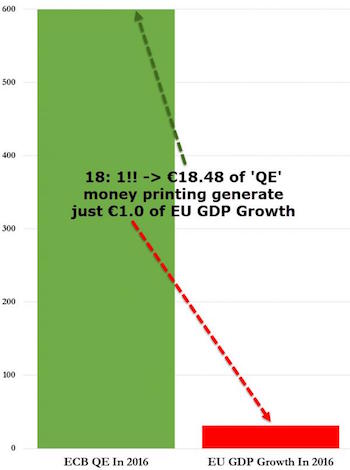
€18 In ECB QE Generated Just €1 In GDP Growth (ZH)

After almost two years of the quantitative easing program in the Euro Area, economic figures have remained very weak. As GEFIRA details, inflation is still fluctuating near zero, while GDP growth in the region has started to slow down instead of accelerating. According to the ECB data, to generate €1.0 of GDP growth, €18.5 had to be printed in the QE, which means that €80 billion have thus been wasted almost every month! This year, the ECB printed nearly €600 billion within the frame of asset purchase programme (QE). At the same time, GDP has increased by… €31 billion; even if up to the end of 2015 the ECB issued €650 billion during its QE program. Needless to say that the Greek debt is “only” €360 billion and there has been no chance of a relief, so far.

The question is where this money from the QE goes and who benefits from it. Clearly it is not the real sector, the so called Main Street of French, Italian or Portuguese cities (Greece is not under the QE program). European stocks are still weak, too, while stock exchanges in the USA are hitting their records. So, is the ECB serving Europeans?

Read more …

More pension cuts is an immoral demand.

IMF Calls For More Greek Pension Cuts, Greater Debt Relief (Kath.)

The International Monetary Fund called for Greece to cut pensions and taxes and for its lenders to provide significant debt relief in order for the country to make a convincing exit from the crisis. In its annual report on the Greek economy, following so-called Article Four consultations in Athens, the Fund described the country’s pension system as “unaffordable” despite recent reforms. It argued that the pension system’s deficit remains too high at 11%, compared to a 2.5% average in the eurozone, and that too much of a burden has been placed on Greeks currently in work, while existing pensioners have largely been protected. The Fund also said that Greece’s tax credit system was too generous, exempting around half of salary earners compared to a euro area average of 8%.

The IMF proposes a reduction in taxes and social security contributions, arguing that recent increases created incentives for undeclared work. “Greece needs less austerity, not more,” said IMF mission chief Delia Velculescu as she presented the report in a teleconference with journalists. The Fund, whose role in Greece’s third bailout program has yet to be clarified, also stressed the need for European lenders to deliver on their debt relief pledge as “growth prospects remain weak and subject to high downside risks.” “Even with full implementation of this demanding policy agenda, Greece requires substantial debt relief calibrated on credible fiscal and growth targets,” the report said.

Read more …

Plunging velocity is the most important deflation indicator.

Plunging Velocity of Money Closes Fed Window (Roberts)

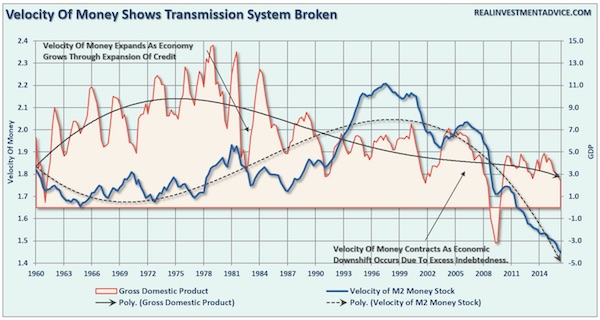
The problem for the Federal Reserve remains the simple fact there is NO evidence that “Quantitative Easing” actually works as intended. The artificial suppression of interest rates was supposed to spur economic activity by encouraging lending activities through the banks. Such an outcome should have been witnessed by an increase in monetary velocity. As the velocity of money accelerates, demand rises and inflationary pressures increase. However, as you can clearly see, the demand for money has been on the decline since the turn of the century.

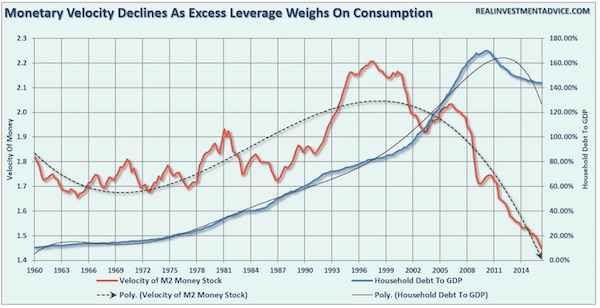
The surge in M2V during the 90’s was largely driven by the surge in household leverage as consumers turned to debt to fill the gap between falling wage growth and rising standards of living. The issue for the Fed is the decline in the “unemployment rate,” caused solely by the shrinking labor force, is obfuscating the difference between a “real” and “statistical” full employment level. While it is expected that millions of individuals will retire in the coming years ahead; the reality is that many of those “potential” retirees will continue to work throughout their retirement years. In turn, this will have an adverse effect by keeping the labor pool inflated and further suppressing future wage growth.

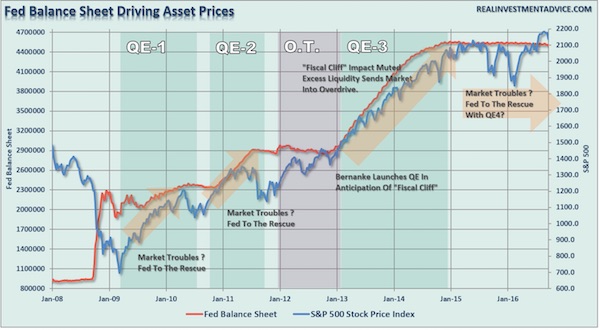
[..] It is quiet evident the financial markets, and by extension, the economy, have become tied to Central Bank interventions. As shown in the chart below, the correlations between Federal Reserve interventions and the markets is quite high. Of course, this was ALWAYS the intention of these monetary interventions. As Ben Bernanke suggested in 2010 as he launched the second round of Quantitative Easing, the goal of the program was to lift asset prices to spur consumer confidence thereby lifting economic growth. The problem was the lifting of asset prices acted as a massive wealth transfer from the middle class to the top-10% providing little catalyst for a broad-based economic recovery. Unwittingly, the Fed has now become co-dependent on the markets. If they move to tighten monetary policy, the market sells off impacting consumer confidence and pushes economic growth rates lower. With economic growth already running below 2%, there is very little leeway for the Fed to make a policy error at this juncture.

Read more …

The smartest kid on the block.

Russia’s Central Bank Criticizes The Easy Money Policies Of Its Peers (CNBC)

Russia’s economy is facing a different range of issues than those facing the U.S., Japan and the euro zone and so the central bank has to take a different approach, Russia’s central bank governor told CNBC, questioning whether other central banks still had the means to influence their economies. “Whether (other) central banks still have in their possession the types of tools to influence this situation (is the subject of a very broad discussion),” Russia Central Bank Governor Elvira Nabiullina told CNBC in Moscow. “Whether they are already finding themselves on the brink of negative interest rates and some are already in negative interest rate territory. These are most certainly not trivial problems. But as far as the Russian economy is concerned, we find ourselves in a totally different situation,” she said.

Nabiullina was critical of the environment of easy monetary policy that other central banks have created in recent years with their quantitative easing (QE) programs. These were aimed at boosting liquidity, investment and economic growth but they have not necessarily translated into investment in the real economy. Rather, there has been increased liquidity in financial markets, prompting concerns of an equity and bond bubble that will burst when QE programs are eventually wound down and monetary policy “normalized.” Nabiullina warned that “because of the continued easing of monetary policy in many countries there is also the possibility that a higher level of financial market volatility will persist.”

Read more …

Tragedy waiting in the wings.

BIS, OECD Warn On Canadian Housing Bubble Debt, See No Exit (WS)

Everyone is fretting about the Canadian house price bubble and the mountain of debt it generates – from the IMF on down to the regular Canadian. Now even the Bank for International Settlement (BIS) and the OECD warn about the risks. Every city has its own housing market, and some aren’t so hot. But in Vancouver and Toronto, all heck has broken loose in recent years. In Vancouver, for example, even as sales volume plunged 45% in August from a year ago – under the impact of the new 15% transfer tax aimed at Chinese non-resident investors – the “benchmark” price of a detached house soared by 35.8%, of an apartment by 26.9%, and of an attached house by 31.1%. Ludicrous price increases!

In Toronto, a similar scenario has been playing out, but not quite as wildly. In both cities, the median detached house now sells for well over C$1 million. Even the Bank of Canada has warned about them, though it has lowered rates last year to inflate the housing market further – instead of raising rate sharply, which would wring some speculative heat out of the system. But no one wants to deflate a housing bubble. During the Financial Crisis, when real estate prices in the US collapsed and returned, if only briefly, to something reflecting the old normal, Canadian home prices barely dipped before re-soaring. And this has been going on for years and years and years.

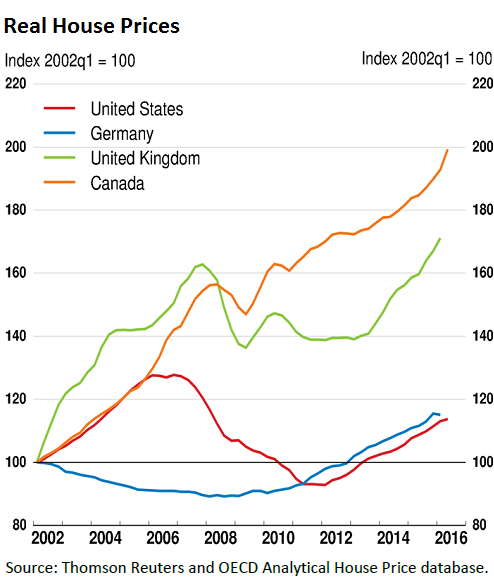
The OECD in its Interim Economic Outlook warned: “Over recent years, real house prices have been growing at a similar or higher pace than prior to the crisis in a number of countries, including Canada, the United Kingdom, and the United States. The rise in real estate prices has pushed up price-to-rent ratios to record highs in several advanced economies.” Canada stands out. Even on an inflation-adjusted basis, Canadian home prices have long ago shot through the roof. The OECD supplied this bone-chilling chart. The top line (orange) represents Canadian house price changes, adjusted for inflation.

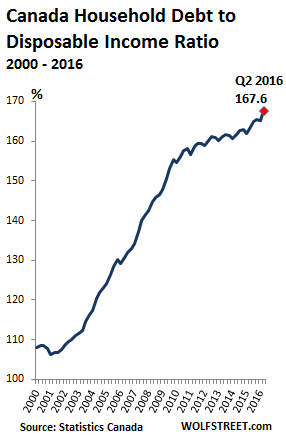
[..] Real estate is highly leveraged. It’s funded with debt. Many folks cite down-payment requirements in rationalizing why the Canadian market cannot implode, and why, if it does implode, it won’t pose a problem for the banks. However, an entire industry has sprung up to help homebuyers get around the down-payment requirements. So household debt has been piling up for years, driven by mortgage debt. Statistics Canada reported two weeks ago that the ratio of household debt to disposable income has jumped to another record in the second quarter, to a breath-taking 167.6%:

Read more …

Even if there were a deal, global output would barely fall.

Oil Slumps 4% As No Output Deal Expected For OPEC (R.)

Oil prices tumbled 4% on Friday on signs Saudi Arabia and arch rival Iran were making little progress in achieving preliminary agreement ahead of talks by major crude exporters next week aimed at freezing production. Also weighing on sentiment was data showing the United States was on track to add the most number of oil rigs in a quarter since the crude price crash began two years ago. Lower equity prices on Wall Street and other world stock markets was another bearish factor. Brent crude futures settled down $1.76, or 3.7%, at $45.89 a barrel. For the week, it rose 0.3%, accounting for gains in the past two sessions. U.S. West Texas Intermediate (WTI) crude futures fell $1.84, or 4%, to settle at $44.48. On the week, WTI gained 3%.

Crude futures slumped after sources said Saudi Arabia did not expect a decision in Algeria where the OPEC and other big oil producers were to convene for Sept 26-28 talks. “The Algeria meeting is not a decision making meeting. It is for consultations,” a source familiar with Saudi oil officials’ thinking told Reuters. Earlier in the day, the market rallied when Reuters reported that Saudi Arabia had offered to reduce production if Iran caps its own output this year. Oil prices are typically volatile before OPEC talks and Friday’s session was tempered with caution despite market sentiment on a high this week after the U.S. government reported on Wednesday a third straight weekly drop in crude stockpiles. “A ‘No Deal’ result in our definition will be one where OPEC not only failed to get an explicit deal out of the meetings, but also failed to develop a forward plan,” Macquarie Capital said, referring to the Algeria talks. “This would be another epic fail by OPEC.”

Read more …

People keep on suggesting that SA has a choice, without acknowledging that any output cut would promptly be filled by some other producer. Cutting output equals losing market share.

Kingdom Comedown: Falling Oil Prices Shock Saudi Middle Class (WSJ)

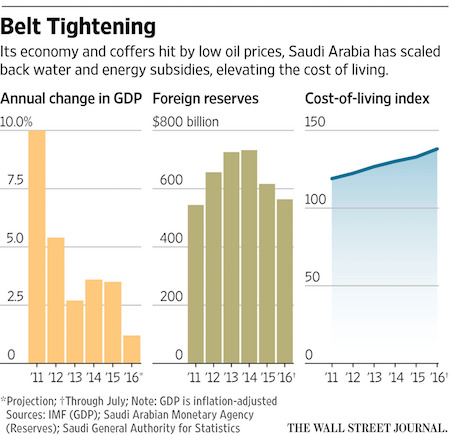
[..] a sharp drop in the price of oil, Saudi Arabia’s main revenue source, has forced the government to withdraw some benefits this year—raising the cost of living in the kingdom and hurting its middle class, a part of society long insulated from such problems. Saudi Arabia heads into next week’s meeting of major oil producers in a tight spot. With a slowing economy and shrinking foreign reserves, the kingdom is coming under pressure to take steps that support the price of oil, as it did this month with an accord it struck with Russia. The sharp price drop is mainly because of a glut in the market, in part caused by Saudi Arabia itself. The world’s top oil producer continues to pump crude at record levels to defend its market share.

One option to lift prices that could work, some analysts say, is to freeze output at a certain level and exempt Iran from such a deal, given that its push to increase production to pre-sanction levels appears to have stalled in recent months. Saudi Arabia has previously refused to sign any deal that exempts arch-rival Iran. As its people start feeling the pain, that could change. The kingdom is grappling with major job losses among its construction workers—many from poorer countries—as some previously state-backed construction companies suffer from drying up government funding. Those spending cuts are now hitting the Saudi working middle class.

Read more …

Funny. What I wonder about is, the criticism of mainstream economics is going mainstream, but the ‘solutions’ are not the same.

Health Warning! “Realism” Virus Afflicting Mainstream Economists (Steve Keen)

Some papers that are remarkably critical of mainstream economics have been published recently, not by the usual suspects like myself, but by prominent mainstream economists: ex-Minneapolis Fed Chairman Narayana Kocherlokata, ex-IMF Chief Economist Olivier Blanchard, and current World Bank Chief Economist Paul Romer. I discuss these papers in a tongue-in-cheek introduction to another key problems of unrealism in economics–the absence of any role for energy in both Post Keynesian and Neoclassical production functions. I also address Olivier Blanchard’s desire for a “widely accepted analytical macroeconomic core”, explain the role of credit in aggregate demand and income, and identify the countries most likely to face a credit crunch in the near future. I gave this talk to staff and students of the EPOG program at the University of Paris 13 on Friday September 23rd.

Read more …

He’s stuck. Allowing it would open up one Pandora’s Box, not allowing it opens yet another.

Obama Vetoes 9/11 Saudi Bill, Sets Up Showdown With Congress (R.)

President Barack Obama on Friday vetoed legislation allowing families of victims of the Sept. 11 attacks to sue Saudi Arabia, which could prompt Congress to overturn his decision with a rare veto override, the first of his presidency. Obama said the Justice Against Sponsors of Terrorism Act would hurt U.S. national security and harm important alliances, while shifting crucial terrorism-related issues from policy officials into the hands of the courts. The bill passed the Senate and House of Representatives in reaction to long-running suspicions, denied by Saudi Arabia, that hijackers of the four U.S. jetliners that attacked the United States in 2001 were backed by the Saudi government. Fifteen of the 19 hijackers were Saudi nationals.

Obama said other countries could use the law, known as JASTA, as an excuse to sue U.S. diplomats, members of the military or companies – even for actions of foreign organizations that had received U.S. aid, equipment or training. “Removing sovereign immunity in U.S. courts from foreign governments that are not designated as state sponsors of terrorism, based solely on allegations that such foreign governments’ actions abroad had a connection to terrorism-related injuries on U.S. soil, threatens to undermine these longstanding principles that protect the United States, our forces, and our personnel,” Obama said in a statement. Senator Chuck Schumer, who co-wrote the legislation and has championed it, immediately made clear how difficult it will be for Obama to sustain the veto. Schumer issued a statement within moments of receiving the veto, promising that it would be “swiftly and soundly overturned.”

Read more …

Sure, why don’t you, against the will of your own people. Should work just fine.

EU Refuses To Revise Canada CETA Trade Deal (BBC)

The European Commission has ruled that a controversial EU-Canada free trade deal – CETA – cannot be renegotiated, despite much opposition in Europe. “CETA is done and we will not reopen it,” said EU Trade Commissioner Cecilia Malmstrom. Ms Malmstrom was speaking as EU trade ministers met in Slovakia to discuss CETA and a similar deal with the US, TTIP, which has also faced criticism. A draft CETA deal has been agreed, but parliaments could still delay it. Thousands of activists protested against CETA and TTIP in Germany on Saturday and thousands more in Brussels – outside the EU’s headquarters – on Tuesday. Activists fear that the deals could water down European standards in the key areas of workers’ rights, public health and the environment.

There is also great anxiety about proposed special courts where investors will be able to sue governments if they feel that legislation hurts their business unfairly. Critics say the mere existence of such courts – an alternative to national courts – will have a “chilling” effect on policymakers, leading to slacker regulation on the environment and welfare. Ms Malmstrom said CETA would dominate Friday’s meeting in Bratislava. The Commission hopes the deal can be signed with Canada at the end of October, so that it can then go to the European Parliament for ratification. But it will also need to be ratified by national parliaments across the EU. “What we are discussing with the Canadians is if we should make some clarifications, a declaration so that we can cover some of those concerns,” Ms Malmstrom said. She acknowledged fears in some countries that politicians might see their “the right to regulate” diluted. “Maybe that [right] needs to be even clearer in a declaration,” she said, admitting that the CETA negotiations were still “difficult”.

Read more …

Surprisingly lucid overview. Not everyone’s turned into a Putin basher yet.

NATO’s Expansion Parade Makes America Less Secure (Forbes)

The transatlantic alliance was created in 1949 to protect war-ravaged Western Europe from the Soviet Union, an opportunistic predator after its victory over Nazi Germany. The threat to America reflected both Moscow’s control over Eastern and Central Europe and the USSR’s role as an ideologically hostile peer competitor. The end of the Cold War changed everything. The Soviet subject nations were freed, a humanitarian bonanza. More important, the successor state of Russia went from hostile superpower to indifferent regional power. NATO lost its essential purpose, since the U.S. no longer needed to shield Western Europe from Moscow. Yet the alliance proved to be as resilient as other government bureaucracies. NATO officials desperately sought new reasons to exist.

Explained Vice President Al Gore: “Everyone realizes that a military alliance, when faced with a fundamental change in the threat for which it was founded, either must define a convincing new rationale or become decrepit.” The latter was viewed as inconceivable, not even worth considering. So the alliance expanded both its mission (to “out-of-area” activities) and membership (inducting former Warsaw Pact members). Washington’s military obligations multiplied even as the most important threat against it dissipated. Objections to this course were summarily rejected. Not a single Senator voted against admitting the three Baltic states. Then no one imagined that the U.S. might be expected to fight on their behalf. The alliance was seen as the international equivalent of a gentleman’s club, to which everyone who is someone belongs.

Those who pointed to possible conflicts with Moscow were dismissed as scaremongers. Expansion was expected to be all gain, no pain. Alas, Russia did not perceive moving the traditional anti-Moscow alliance up to its borders as a friendly act. Despite coming from the KGB, Vladimir Putin originally didn’t seem to bear the U.S. or West much animus. However, NATO compounded expansion with an unprovoked war against Serbia, a traditional Slavic ally of Moscow, and proposals to include Georgia and Ukraine, the latter which long had especially close historical, cultural, economic, and military ties with Russia. Over time Putin, as well as many of his countrymen, came to view the transatlantic alliance as a threat.

Read more …

Apr 172016
 
 April 17, 2016  Posted by at 9:35 am Finance Tagged with: , , , , , , , , , ,  4 Responses »


Underwood&Underwood Chicago framed by Gothic stonework high in the Tribune Tower 1952

South Korea Exports To China Tumble 15.7% In Q1 (Yonhap)
Chinese P2P Shadow Lender’s Woes Expose Its Global Tentacles (WSJ)
Doha Oil Freeze Talks Face Last-Minute Trouble (Reuters)
Iran Central Banker Dismisses Idea Of Oil Output Cut (CNBC)
Greece’s Creditors Weigh Extra Austerity Measures to Break Deadlock (WSJ)
Panama and a New Copernican Revolution (Tett)
Wolfgang Schäuble Warns UK Of Tough Brexit Negotiations (FT)
BlackRock Wields Its Big Stick Like a Wet Noodle (Morgenson)
Foreign Investment Turns New Zealand Stock Market Into A Casino (BBG)
Free Trade Has Won: Adapt Or Die Is The Only Option Left To Us (G.)
Economists Ignore One of Capitalism’s Biggest Problems (Steve Keen)
Saudi Arabia Warns of Economic Fallout if Congress Passes 9/11 Bill (NYT)
Varoufakis Joins French ‘Nuit Debout’ Anti-Labor Reform Protests (AFP)
Pope Flies 12 Syrian Refugees to Vatican in Potent Symbol for EU (BBG)

China’s strongarming all of eastern Asia into submission to its exports. This could get very ugly.

South Korea Exports To China Tumble 15.7% In Q1 (Yonhap)

South Korea suffered a 15.7% fall in exports to China in the first quarter this year, data showed Sunday, deepening its overall trade woes. It marks the biggest drop in seven years in South Korea’s outbound shipments to China, its single biggest market. China accounts for about 25% of South Korea’s total exports. Exports to China stood at $28.5 billion in the year’s first three months, down 15.7% from a year earlier, according to the Korea International Trade Association (KITA). By item, exports of semiconductors, flat panel displays, petrochemical products, car parts and synthetic resins recorded notable declines. Experts cited a structural problem and suggested a shift in trade strategy. “Over 70% of South Korean goods exported to China are intermediate goods. China’s demand for those is diminishing,” said Park Jin-woo, head of KITA’s strategic market research office.

“In particular, China is making massive investments and expanding facilities in such sectors as semiconductors, while reducing imports.” He stressed the need for targeting the consumer goods market instead. South Korea’s exports to the United States also sank 3.3% on-year to $16.8 billion in the January-March period and imports were down 4.9% to $10.1 billion. Trade with Japan remains in trouble as well. Exports fell 13.1% to $5.5 billion, representing a double-digit drop for the sixth consecutive quarter, and imports dwindled 11.2% to $10.6 billion. In contrast, exports to Vietnam, which has emerged as South Korea’s third-largest exports market, maintained an upward trend. Exports grew 7.6% to $7 billion, although growth rates showed signs of slowing.

Read more …

Mom and pop, shadow banking, P2P, Hollywood, Ponzi, it’s all there.

Chinese P2P Shadow Lender’s Woes Expose Its Global Tentacles (WSJ)

A crisis rocking a loosely regulated lending network is underlining the risks of a financing boom that has channeled Chinese household money into Hollywood movies and Wall Street deals Droves of teary-eyed investors from around China have descended on Shanghai Kuailu Investment Group’s swanky offices over the past week to demand their money back after the firm halted redemptions on wealth-management products for the roughly 250,000 clients of the firm and three affiliates. The uncertainty around investments handled by Kuailu could force a re-evaluation of a financing trend that has become widespread, in the latest knock to a financial system damaged by months of stock-market turmoil and a slowing economy.

Kuailu is one of thousands of finance companies in a universe of Chinese “shadow banks” that funnel investors funds to businesses and individuals, often with an assurance of high returns. Moody’s estimated credit extended by nonbank financing companies in China stood at $370 billion in mid-2015. Many Chinese refer to the diverse industry using English: P2P, as in peer-to-peer lending, though that business of matching small lenders and borrowers is just one segment of operations at Kuailu. Kuailu isn’t the first such lender to leave investors hanging amid recent collapses in the sector. What is distinctive is how its problems are exposing an international dimension to the industry, which bankers said is common but little understood.

The Shanghai firm invested in at least 20 feature films, including the coming release of “The Bombing” starring Bruce Willis, according to the company. Client money holds a slice of a $9 billion deal to privatize NYSE-listed Chinese Internet-security company Qihoo 360 Technology, firm marketing documents show. A crisis-management specialist that Kuailu’s founding chairman this month put in charge of sorting through $1.5 billion in liabilities told the WSJ it wasn’t a Ponzi scheme, a fear some investors have raised with the company. “No cash flow. That’s the issue,” said Xu Qi, who estimated assets cover about 90% of what is owed to investors, but that most of it is tied up in investments or projects that can’t be quickly converted to cash.

Companies like Kuailu got their start in peer-to-peer lending, initially a modest effort to supply money to Chinese households and entrepreneurs that was endorsed by top government officials as a way to power new streams of consumer activity. But crowdsourced lending has quickly expanded and now powers financing across China, from wedding loans to land speculation. Like banks, but with less regulation, such lenders compete aggressively for deposits, often via online platforms. Many attract money faster than they can thoroughly research investments, according to analysts.

Read more …

B Movie.

Doha Oil Freeze Talks Face Last-Minute Trouble (Reuters)

A meeting between OPEC and non-OPEC oil producers on an agreement to freeze output ran into last-minute trouble in Qatar on Sunday due to a new request by OPEC’s de facto leader Saudi Arabia, sources told Reuters. Oil ministers were heading into a meeting with the Qatari emir, Sheikh Tamim bin Hamad al-Thani – who was instrumental in promoting output stability in recent months – in an attempt to rescue the deal designed to bolster the flagging price of crude. “There is an issue. Experts are discussing how to find an acceptable solution. I’m confident they will come up with a solution,” one of the sources said. According to another source, Saudi Arabia said it wanted all OPEC members to participate in the talks, despite insisting earlier on excluding Iran because Tehran does not want to freeze production.

Saudi Arabia has taken a tough stance on Iran, the only major OPEC producer to have refused to participate in the freeze. Tehran says it needs to regain market share after the lifting of international sanctions against it in January. Deputy Crown Prince Mohammed bin Salman told Bloomberg that the kingdom would restrain its output only if all other major producers, including Iran, agreed to freeze production. More than a dozen nations inside and outside OPEC have officially confirmed they would attend the meeting in Doha but the role of Iran has been the key issue overhanging the talks. “We have told some OPEC and non-OPEC members like Russia that they should accept the reality of Iran’s return to the oil market,” Iran’s oil minister, Bijan Zanganeh, was quoted as saying by his ministry’s news agency SHANA on Saturday.

Read more …

Iran will go all out.

Iran Central Banker Dismisses Idea Of Oil Output Cut (CNBC)

Iran’s top central banker is adding to growing doubts about an agreement to freeze output at a meeting of oil producers in Doha, Qatar on Sunday. Ahead of a pivotal meeting that may determine the near-term outlook for crude prices, Iran on Saturday announced that it would not participate in the conference. The country, still trying to recover from Western sanctions, is seen trying to preserve market share, and has steadfastly resisted any suggestions that Iran should freeze or curb output in order to prop up prices. On the sidelines of an IMF meeting in Washington, D.C., Valiollah Seif, head of Iran’s central bank told CNBC that asking Iran to freeze output right now is unfair.

“What Iran is doing right now is trying to get back and secure its share of the market,” Seif said, adding that “what Saudi Arabia is asking Iran to do is not a very fair [or] logical request.” On several occasions, the leadership of Saudi Arabia has repeatedly said they would agree to an output freeze as long as Iran did too. Currently, analysts believe the two rivals are unlikely to reach a near-term consensus. Seif told CNBC that Iran, as a member of OPEC, has a quota of 2.4 million barrels per day. Under sanctions for its nuclear program, that quota went unfilled.

At the same other members used their output to fill the gap. “And right now, Iran is trying to just take back the quota it is entitled to get, so we are going to do that and this is the main direction of our economy,” Seif added. He went as far as to say other OPEC members are to blame for the sharp fall in oil prices, which are down more than 37% year to date. “This request is coming from those countries which are responsible for this surplus production in the market, because they have exceeded output beyond their quota, and I think this is not fair,” Seif added. He cautioned that this was his personal viewpoint, and the ultimate decision lies with Iran’s oil minister, Bijan Zangeneh.

Read more …

Predators experimenting on an entire nation.

Greece’s Creditors Weigh Extra Austerity Measures to Break Deadlock (WSJ)

Greece’s creditors are considering seeking extra austerity measures that would be triggered if Athens misses its fiscal targets, in a bid to bridge differences between Europe and the IMF and break a deadlock threatening to unravel the Greek bailout. Under the proposal, say officials involved in the discussions, Greece would have to sign up to so-called contingency measures of up to about €3 billion, on top of the package of about €5 billion in tax increases and spending cuts Greece and its lenders are already negotiating. The country would only have to implement the extra measures if falls short of targeted budget surpluses for coming years that were set out in last year’s bailout agreement, the officials say.

The idea, which has support from the eurozone’s dominant power Germany, hasn’t yet been agreed upon, and officials on the creditors’ side say it would be politically hard for Greece’s embattled government to swallow. Creditors say the contingency-measures idea could finally overcome the monthslong disagreement between European institutions and the IMF about the outlook for Greece’s budget. That disunity has paralyzed talks about what Greece needs to do to secure a new IMF loan program and unlock rescue funding from Europe. Without billions of euros in fresh bailout funds, Greece faces bankruptcy in July, when large debts fall due. Months of talks without agreement have stoked concern in Europe about another Greek debt drama this summer, reviving fears the country could tumble out of the eurozone.

Athens has argued that imposing even-more austerity measures would go beyond what was agreed in the July 2015 bailout deal, according to people familiar with Athens’s thinking. The deadlock among creditors since last fall stems from Germany’s insistence that Greece get no more money from the eurozone’s bailout fund until the IMF agrees to lend more money too. Since Greece’s bailout odyssey began in 2010, German Chancellor Angela Merkel has insisted IMF involvement is essential. But the IMF is unconvinced by the math of the eurozone’s July 2015 bailout plan for Greece. The fund says it can’t resume lending to Greece unless there is a combination of a credible fiscal plan for Greece and debt relief from Europe.

The creditors and Greece agreeing on a fiscal plan would allow for the start of concrete talks on a second thorny issue: debt relief for Greece. Germany is deeply reluctant to offer much debt relief, but tends to agree with the IMF about the weaknesses of Greece’s budget, rather than with the more upbeat assessments of the European Union’s executive arm, the Commission. The Commission believes around €5 billion of austerity measures would be enough for Greece to hit a key target in the bailout plan: a primary budget surplus, meaning before interest payments, of 3.5% of gross domestic product. But the IMF is more pessimistic about Greek growth and finances. It insists about €8 billion of savings are needed to hit the target. The European side’s proposed measures, the IMF thinks, would only get Greece to a primary surplus of 1.5% of GDP.

Read more …

Dream on.

Panama and a New Copernican Revolution (Tett)

The name Nicolaus Copernicus is not usually mentioned in the same breath as corporate tax planning or Mossack Fonseca. This month, however, it probably should be. Six centuries ago, the Polish astronomer formulated a model of the universe that put the sun, rather than the earth, at the centre of the solar system. It was a paradigm shift that led to a transformation in the way that we view the universe. I suspect something similar might be happening with global finance. This month, the International Consortium of Investigative Journalists (ICIJ) published some 11.5 million documents leaked from the Panamanian law firm Mossack Fonseca. Among other things, these gave details about offshore companies the firm created for the elite.

The leak has already provoked a number of political scandals: last week, the Icelandic prime minister resigned after it emerged that he had an offshore company in Panama; and David Cameron, the British prime minister, has faced a steady stream of criticism about an offshore company created by his late father. Meanwhile, revelations about Chinese and Russian billionaires could spark further recriminations. To my mind, it is not just the revelations concerning the rich and famous that make the Panama Papers so fascinating; after all, it is not illegal to create such companies, unless they are used to evade taxes or launder money. Instead, the most interesting issue is whether this leak will create something akin to a Copernican moment.

Think about it. Most of us vaguely know that money flows through offshore centres but the details of this world are very shadowy and opaque. Thus, insofar as any of us have ever tried to visualise the 21st-century “map” of global finance, we assumed that the visible onshore activity was the “sun” that dominated this universe — and offshore finance just a fuzzy little planet, that hovered on the edge. But the Panama Papers have given contours to that fuzzy, offshore world. More specifically, anyone who wants to get a sense of what has been happening in Panama can now go on to the ICIJ website and search those 11.5 million documents with keywords. Try it out at home — it is as simple as a Wikipedia search.

As further details tumble out, it’s not just more names that will be generated but numbers too. Even before the data were readily available, activist groups such as the Tax Justice Network had claimed that some $21tn-$32tn was being stashed in offshore centres, but they had no real way of verifying the figure. With the Panama Papers online, more precise figures could emerge — and with that the ability to compare them with the overall picture of global banking. Could this spark a bigger policy change, such as a crackdown on tax avoidance or money laundering? A cynic might argue not. Remember, powerful vested interests are involved. But if you want to get a sense of what can happen when that mental map flips, think about how attitudes to shadow banking have changed in the past decade.

Read more …

EU does not rhyme with democracy, and never will. We’re going to see a lot of crazy claims and numbers pre-referendum.

Wolfgang Schäuble Warns UK Of Tough Brexit Negotiations (FT)

Wolfgang Schäuble, Germany’s finance minister, has warned British chancellor George Osborne that Berlin would be a tough negotiator if the UK votes to leave the EU. Speaking on the sidelines of the IMF spring meetings on Saturday, Mr Schäuble, one of the strongest forces in European politics, also jested that British football teams in a post-Brexit world should be excluded from the European champions league — something not actually linked to EU membership. His confirmation that Germany would not readily agree to an easy trading relationship with Britain after Brexit undermines the Leave campaign’s argument that the UK would be able to secure preferential EU trade deals without freedom of movement of people or the need for Britain to contribute to the EU budget.

The German finance minister, who is known for his unyielding negotiating positions, told German media that he wanted the UK to remain in the EU and did not want to inflame the British debate. But he added that if Britain were to leave, the process would not be easy. The Treasury confirmed that Mr Schäuble told Mr Osborne just how tough negotiations would be after Brexit during a bilateral meeting this weekend — and made the same joke about European football. In Washington this weekend, finance minsters from around the world have gradually been waking up to the possibility that Britain will seek to leave the EU within a matter of months. The IMF said it would wreak “severe damage” to the British and European economies.

Christine Lagarde, the IMF head, admitted this week that while she hoped Europe would avoid having to deal with Brexit, “the continued relationship with other countries in the EU would be at risk”. The difficulties of post-Brexit negotiations will be amplified by elections in Germany and France in 2017, European finance ministers said privately on the sidelines of the IMF meetings. With populist rightwing Eurosceptic parties threatening mainstream politics in both countries, the domestic incentives would prevent concessions to Britain as politicians would need to show their electorates that leaving the EU comes with a heavy price.

Many European officials and ministers have tried to avoid the subject of how they would negotiate with the UK after Brexit, saying instead that they hoped the British people would vote to remain. But some did speak out. Klaus Regling, head of the European Stability Mechanism, said that the leave campaign’s ambition to secure full access to the single market without accepting free movement of people and budget contributions “has never happened in Europe”. “I’m pretty certain [the negotiations ] would take quite a while — two years is not enough — so there would be several years of high uncertainty, which would have a negative impact on the UK economy,” Mr Regling said.

Read more …

BlackRock and ‘corporate responsibility’.. Yeah, sure.

BlackRock Wields Its Big Stick Like a Wet Noodle (Morgenson)

For several years, Laurence D. Fink, chairman and chief executive of BlackRock, the money management giant, has been on a crusade, exhorting corporations to change their short-term ways. Executives should forgo tricks that reward short-term stock traders, he argues, like share buybacks purchased at high valuations. Instead, corporate managers should focus on creating value for long-term shareholders. It’s an admirable argument that has won Mr. Fink wise-man status on Wall Street and accolades in the press. Hillary Clinton has echoed his ideas on the campaign trail. Certainly, as the head of BlackRock, Mr. Fink wields an outsize stick. With $4.6 trillion in assets and ownership of shares in roughly 15,000 companies, BlackRock is the world’s largest investment manager.

But if Mr. Fink really wants to get the attention of company executives on stock buybacks and other corporate governance issues, why doesn’t BlackRock vote more often against CEO pay packages of companies that play the short-term game? Executive compensation is inextricably linked to the shareholder-unfriendly actions Mr. Fink has identified; voting against pay packages infected by short-termism would help curb the problem. But BlackRock rarely takes such a stance. From July 1, 2014, to last June 30, according to Proxy Insight, a data analysis firm, BlackRock voted to support pay practices at companies 96.2% of the time. On pay issues, anyway, Mr. Fink’s big stick is more like a wet noodle. BlackRock’s “yes” percentage runs far higher than that of other money managers that express concern about corporate responsibility. Domini Funds supported pay practices only 6% of the time during the period, while Calvert Investments did so at 46% of companies.

Read more …

As if Auckland real estate wasn’t bad enough yet.

Foreign Investment Turns New Zealand Stock Market Into A Casino (BBG)

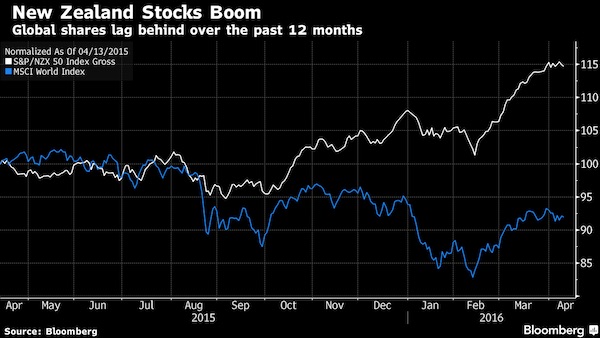
As fund manager Mark Williams deliberated from his London office where next to invest, the world’s most remote stock market was just too good to pass up. That’s worrying locals, 11,000 miles away in New Zealand. The S&P/NZX 50 Index is the world’s best-performing developed stock gauge this year, climbing more than 7% to a record after overseas buying of equities jumped 21% in 2015. That’s driven stock valuations in the South-Pacific nation close to a record high, leaving them more expensive than anywhere else in the region. Funds from Henderson Global Investors to Liontrust Asset Management are buying into New Zealand, lured by dividends almost double the global average, rising earnings and expectations the central bank will cut interest rates to maintain growth.

Yet with a market cap of about $75 billion, smaller than the publicly traded value of Nike, opportunities are becoming more limited, says Matthew Goodson, an Auckland-based investor. “We’ve seen significant offshore inflows into larger-cap stocks and that’s driven their valuations to unusually high levels,” Goodson, who helps oversee about $1 billion at Salt Funds Management, said by phone. “It’s swamped the market and it leaves them very vulnerable. We’re somewhat nervous.” Foreigners now own about one third of New Zealand’s market, about three times the overseas ownership of U.S. equities, according to estimates from brokerage JBWere. Mark Williams, a money manager at Liontrust, is optimistic, given he expects the nation’s central bank will cut its key interest rate from an already record-low 2.25%.

While New Zealand accounts for less than 0.1% of the MSCI All Country World Index, Williams said he has 4.5% of his fund invested in the country. He bought Spark New Zealand and Fletcher Building in March, attracted by dividend yields of more than 5%. Spark, a communications provider, is the largest member by weighting of the S&P/NZX 50 gauge. “We find plenty of opportunities in New Zealand,” Williams, who helps manage $6.7 billion running an Asian equity-income fund at Liontrust, said by phone from London. “Interest rates remain relatively high, so that could lead to further cuts.”

Read more …

This author gets it spectacularly wrong.

Free Trade Has Won: Adapt Or Die Is The Only Option Left To Us (G.)

The Tata Steel sale has revived the battle between protectionists and free traders, a debate that became particularly acute in the run-up to the creation of the World Trade Organisation in 1995, which marked the success of “free traders” all around the world. In the protectionist camp, there is now a wide range of political parties from the extreme left to the extreme right: from Syriza to Ukip, from the Front National to Podemos. The common element for all these parties is that they dream of returning to a time when “we were in control”; when we could easily open or close our borders; when the world was manageable and small and we did not have to compromise. That is why they want national rules rather than international ones; and that is also why ultimately most of them despise the EU, because it is based not on direct control but on compromise.

The problem with that notion is that such a cosy world does not exist any more. The new generations expect to talk, travel and trade with each other all over the world, no matter where they are. My children, for example, know more about startup products released for crowdfunding around the world than about what is sold in shops in our high street; they respond to fashions that are created thousands of miles away; and they expect products to reach them almost instantaneously, no matter where they are made. Fluidity, speed, seamlessness and complexity define the 21st century. Fighting those trends makes sense only if you are of such an age and means that you can afford the luxury of whingeing about the present and dreaming nostalgically about the past, but if you are still trying to make your way in life, you have to embrace change and adapt.

Companies are rightly responding as quickly as possible to those new demands and, as a result, we are witnessing a level of international outsourcing that we could never have imagined. “Made in” labels mean little nowadays: companies based in the west often have their production plants elsewhere and use components sourced from third countries; and are financed by investors in yet other countries. If that were not complex enough, when countries impose trade barriers and erect controls, companies simply move overnight. Regulators and governments often do not stand a chance. That does not mean regulators should let modern trade become the Wild West. But it means they need to have the flexibility and tools to react better and faster.

Read more …

Banks create money out of nothing. They’re not intermediaries.

Economists Ignore One of Capitalism’s Biggest Problems (Steve Keen)

I like Joe Stiglitz, both professionally and personally. His Globalization and its Discontents was virtually the only work by a Nobel Laureate economist that I cited favourably in my Debunking Economics, because he had the courage to challenge the professional orthodoxy on the “Washington Consensus”. Far more than most in the economics mainstream—like Ken Rogoff for example—Joe is capable of thinking outside its box. But Joe’s latest public contribution—“The Great Malaise Continues” on Project Syndicate—simply echoes the mainstream on a crucial point that explains why the US economy is at stall speed, which the mainstream simply doesn’t get. Joe correctly notes that “the world faces a deficiency of aggregate demand”, and attributes this to both “growing inequality and a mindless wave of fiscal austerity”, neither of which I dispute.

But then he adds that part of the problem is that “our banks … are not fit to fulfill their purpose” because “they have failed in their essential function of intermediation”: Between long-term savers (for example, sovereign wealth funds and those saving for retirement) and long-term investment in infrastructure stands our short-sighted and dysfunctional financial sector… Former US Federal Reserve Board Chairman Ben Bernanke once said that the world is suffering from a “savings glut.” That might have been the case had the best use of the world’s savings been investing in shoddy homes in the Nevada desert. But in the real world, there is a shortage of funds; even projects with high social returns often can’t get financing. I’m the last one to defend banks, but here Joe is quite wrong: the banks have very good reasons not to “fulfill their purpose” today, because that purpose is not what Joe thinks it is.

Banks don’t “intermediate loans”, they “originate loans”, and they have every reason not to originate right now. In effect, Joe is complaining that banks aren’t doing what economics textbooks say they should do. But those textbooks are profoundly wrong about the actual functioning of banks, and until the economics profession gets its head around this and why it matters, then the economy will be stuck in the Great Malaise that Joe is hoping to lift us out of. The argument that banks merely intermediate between savers and investors leads the mainstream to a manifestly false conclusion: that the level of private debt today is too low, because too little private debt is being created right now. In reality, the level of private debt is way too high, and that’s why so little lending is occurring.

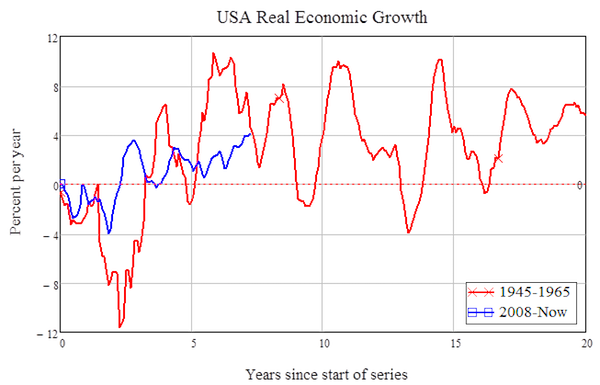
I can make the case empirically for non-economists pretty easily, thanks to an aside that Joe makes in his article. He observes that when WWII ended, many economists feared that there would be a period of stagnation: Others, harking back to the profound pessimism after the end of World War II, fear that the global economy could slip into depression, or at least into prolonged stagnation. In fact, the period from 1945 till 1965 is now regarded as the “Golden Age of Capitalism”. There was a severe slump initially as the economy changed from a war footing to a private one, but within 3 years, that transition was over and the US economy prospered—growing by as much as 10% in real terms in some years. (see Figure 1). The average from 1945 till 1965 was growth at 2.8% a year. In contrast, the average rate of economic growth since 2008 to today is precisely zero.

Read more …

Time for Trump?!

Saudi Arabia Warns of Economic Fallout if Congress Passes 9/11 Bill (NYT)

Saudi Arabia has told the Obama administration and members of Congress that it will sell off hundreds of billions of dollars’ worth of American assets held by the kingdom if Congress passes a bill that would allow the Saudi government to be held responsible in American courts for any role in the Sept. 11, 2001, attacks. The Obama administration has lobbied Congress to block the bill’s passage, according to administration officials and congressional aides from both parties, and the Saudi threats have been the subject of intense discussions in recent weeks between lawmakers and officials from the State Department and the Pentagon. The officials have warned senators of diplomatic and economic fallout from the legislation.

Adel al-Jubeir, the Saudi foreign minister, delivered the kingdom’s message personally last month during a trip to Washington, telling lawmakers that Saudi Arabia would be forced to sell up to $750 billion in treasury securities and other assets in the United States before they could be in danger of being frozen by American courts. Several outside economists are skeptical that the Saudis will follow through, saying that such a sell-off would be difficult to execute and would end up crippling the kingdom’s economy. But the threat is another sign of the escalating tensions between Saudi Arabia and the United States. The administration, which argues that the legislation would put Americans at legal risk overseas, has been lobbying so intently against the bill that some lawmakers and families of Sept. 11 victims are infuriated.

In their view, the Obama administration has consistently sided with the kingdom and has thwarted their efforts to learn what they believe to be the truth about the role some Saudi officials played in the terrorist plot. “It’s stunning to think that our government would back the Saudis over its own citizens,” said Mindy Kleinberg, whose husband died in the World Trade Center on Sept. 11 and who is part of a group of victims’ family members pushing for the legislation. President Obama will arrive in Riyadh on Wednesday for meetings with King Salman and other Saudi officials. It is unclear whether the dispute over the Sept. 11 legislation will be on the agenda for the talks. Saudi officials have long denied that the kingdom had any role in the Sept. 11 plot, and the 9/11 Commission found “no evidence that the Saudi government as an institution or senior Saudi officials individually funded the organization.”

But critics have noted that the commission’s narrow wording left open the possibility that less senior officials or parts of the Saudi government could have played a role. Suspicions have lingered, partly because of the conclusions of a 2002 congressional inquiry into the attacks that cited some evidence that Saudi officials living in the United States at the time had a hand in the plot. Those conclusions, contained in 28 pages of the report, still have not been released publicly. The dispute comes as bipartisan criticism is growing in Congress about Washington’s alliance with Saudi Arabia, for decades a crucial American ally in the Middle East and half of a partnership that once received little scrutiny from lawmakers. Last week, two senators introduced a resolution that would put restrictions on American arms sales to Saudi Arabia, which have expanded during the Obama administration.

Read more …

French protests have been going on for a while. Not sure Yanis should desire a role in this.

Varoufakis Joins French ‘Nuit Debout’ Anti-Labor Reform Protests (AFP)

Former Greek finance minister Yanis Varoufakis on Saturday addressed opponents of the French government’s workplace reforms at a protest in Paris, telling them the planned changes would “devalue labor.” “He (French President Francois Hollande) wants to devalue French labor… it can’t work,” Varoufakis told protesters as he paid a visit to the latest “Nuit Debout” (Up All Night) gathering at the city’s vast Place de la Republique. “Devaluing French labor can only deepen the crisis… I’m bringing to you solidarity from Athens,” he told the crowd. The labor reforms of France’s Socialist government aim to make it easier for struggling companies to fire people.

The government says they will make France’s rigid labor market more flexible but opponents say the reforms are too pro-business and will fail to reduce the 25% jobless rate among the young. Hundreds, at times thousands, of people have been demonstrating every night for the past two weeks at the Place de la Republique in central Paris. The labor reforms are a unifying theme of the gatherings but the so-called “Nuit Debout” movement is broader, embracing a range of anti-establishment grievances. The nightly protests have been marred by sporadic violence. The latest clashes erupted late Friday when, according to police, some 100 protesters set rubbish on fire and threw bottles and stones at officers, who responded with tear gas. Twenty-two people were arrested. The “Nuit Debout” demonstrations have spread to cities across France, becoming a major headache for the government.

Read more …

I still can’t muster much enthousiasm about this. He should have used much harsher words. There are still 3,000 people locked up there, including many children.

Pope Flies 12 Syrian Refugees to Vatican in Potent Symbol for EU (BBG)

Pope Francis made an emotional visit to the Greek island of Lesbos Saturday, plucking 12 Syrian refugees to take back to Rome with him and draw attention to what he called Europe’s most serious humanitarian crisis since the end of World War II. Francis, who has made migration a defining issue of his papacy, visited a refugee center as he appealed to the international community to deal with the migrants crisis as a humanitarian catastrophe. The pope said there was “reason to weep” on his visit to the refugees, and he brushed aside any political reasons for his invitation to have three families from Syria, 12 people including six children, accompany him on the flight home. “It is a purely humanitarian thing,” he told reporters on his chartered plane.

The Vatican will take financial responsibility for the families and an organization of volunteers, Comunità di Sant’Egidio, will initially host the groups, according to a statement. During the five-hour visit to Lesbos, the pontiff visited a refugee center with Ecumenical Patriarch Bartholomeos, the spiritual leader of the Orthodox Church, and was welcomed by Greek Prime Minister Alexis Tsipras. He also criticized the use of walls to keep migrants out. “In reality, barriers create divisions instead of promoting the true progress of peoples, and divisions sooner or later lead to conflicts,” Francis said in a speech at the port of Lesbos.

The visit was made days after migrants to Greece started being sent back to Turkey under a European Union agreement that has been criticized by the Vatican and denounced by human rights groups as impractical and legally suspect. Lesbos has become a repository for migrants seeking a better life in the EU: there were 3,560 refugees on the island as of Wednesday morning with more arriving each day, according to a daily tally issued by the Greek authorities. As he began the journey to Greece, the pope told reporters on his flight that the trip is marked by sadness. “This is important. It is a sad trip,” he said. “Refugees are not numbers, they are people who have faces, names, stories and need to be treated as such,” the pontiff said through his Twitter account.

Read more …

Mar 032015
 
 March 3, 2015  Posted by at 10:53 am Finance Tagged with: , , , , , , , , , , ,  2 Responses »


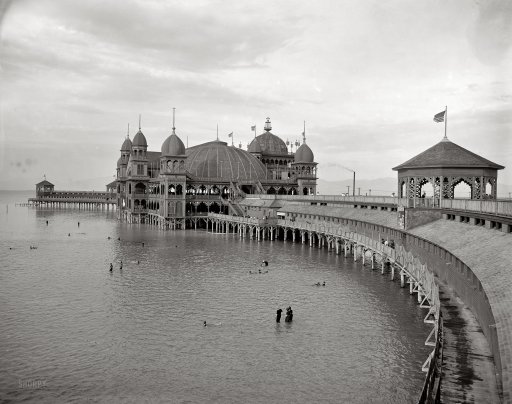
William Henry Jackson Saltair Pavilion, Great Salt Lake 1900


Heta Senior Bonds Plunge as Austria Cuts Off Aid to Bad Bank (Bloomberg)
The Great Global Monetary Easing of 2015 May Be Done by Midyear (Bloomberg)
Fed Ushers In A New Era Of Uncertainty On Rates (Hilsenrath at FT)
To Beat Austerity Greece Must Break Free From The Euro (Costas Lapavitsas)
Greece Eyes Last Central Bank Funds To Avert IMF Default (AEP)
Mixed Messages On Third Greek Bailout Talks (Reuters)
Greeks in the Crisis: ‘We Need To Explain Ourselves’ (Spiegel)
Investor Survey Shows 38% Chance Of Eurozone Break-Up In 12 Months (Reuters)
French Factory Decline Even Worse Than Greece (Telegraph)
Spain To Split? Snap Vote On Catalan Independence (CNBC)
Portugal’s Successful Turnaround? A Fairy Tale (The Globalist)
Tough Talk On Greece Alone Won’t Boost Ireland, Spain At Home (Reuters)
European Union Showing ‘Signs Of Strain’ (BBC)
China Will End Up Like Japan, Says Observer Who Called It In 1990 (Bloomberg)
Gaddafi’s Cousin Warns Of A ‘9/11 In Europe Within Two Years’ (Independent)
US to Deploy Six National Guard Companies to Ukraine This Week (Sputnik)
Heroes and Villains (Jim Kunstler)
Syrian Conflict Is The World’s First ‘Climate Change War’ (Independent)

Timebomb: who’s going to want to buy anything EU anymore? “..the first test of the EU’s Bank Recovery and Resolution Directive, which takes full effect across the bloc next year..”

Heta Senior Bonds Plunge as Austria Cuts Off Aid to Bad Bank (Bloomberg)

Senior bonds of Heta Asset Resolution tumbled to record lows after Austria said it won’t pump more money into the “bad bank,” the first test of European legislation designed to ensure investors pay for bank failures. Austria’s decision to cut funding to the vehicle that’s winding down assets of the failed Hypo Alpe-Adria-Bank International AG is the first test of the EU’s Bank Recovery and Resolution Directive, which takes full effect across the bloc next year. The rules, which Austria implemented earlier than most EU member states, give regulators the power to impose losses on both shareholders and creditors in the event of a bank collapse. The EU enacted the bank-resolution law last year in a bid to end taxpayer bailouts that prevailed in the financial crisis.

The bloc granted €661 billion for recapitalization and asset-relief measures from 2008 to 2013, according to European Commission data. Member states had to transpose the directive into national law by the end of 2014 and have until Jan. 1, 2016 to apply all rules. Heta’s €2 billion of 4.375% notes maturing in January 2017 plunged 19 cents on the euro to 46 cents, according to data compiled by Bloomberg. The company’s €450 million of floating-rate notes due March 6 slumped 37 cents to 46 cents on the euro, the data show. Austria cut support for Heta, which has already cost taxpayers about €5.5 billion in aid, after it notified the government it had a capital shortfall of as much as €7.6 billion, the Austrian Finance Ministry said in a statement on Sunday.

Read more …

No more steam.

The Great Global Monetary Easing of 2015 May Be Done by Midyear (Bloomberg)

The rush began in Tashkent, capital of Uzbekistan, on Jan. 1. The former Soviet state enacted the first interest-rate reduction of 2015. Since then, the cuts have come thick and fast, with the People’s Bank of China on Saturday becoming the 17th central bank of 57 monitored by Bloomberg News to pare its benchmark. By the end of this week, the list will probably include Poland. Some economists also forecast Australia and Canada will act for the second time this year. Norway, Hungary and Thailand will all join the party this month, followed by South Korea in April, according to JPMorgan economists led by Bruce Kasman.

Out of room on rates, the European Central Bank is set to begin its €1.1 trillion bond-buying program. And that may be that. For all the fireworks, the rate cutting may be over by the middle of the year as deflation worries ebb. Oil appears to be finding a bottom around $60 a barrel and global growth is firming. In the developed world, a measure of inflation expectations based on bond yields rose in January and February to 1.28% on Feb. 27, ending an eight-month slump, data compiled by Bank of America show. That backdrop has JPMorgan predicting the Federal Reserve will raise interest rates in June for the first time since 2006 and, in doing so, end the international easing cycle.

On the other hand, Goldman Sachs. and Morgan Stanley predict docile inflation will persuade the Fed to hold off. New-York based JPMorgan sees the average interest rate for the world bottoming at 2.46% this month before rising to 2.59% by the end of the year. The measure for developed economies will more than double to 0.58% from 0.22%, led by the Fed. “A deflationary wave is about to break,” Kasman wrote last week. So, what began in Uzbekistan may end in the U.S.

Read more …

You’ve been warned.

Fed Ushers In A New Era Of Uncertainty On Rates (Hilsenrath at FT)

Investors these days are obsessing over when the Federal Reserve will start raising short-term interest rates. Drawing less scrutiny is where rates will end up in the long run and how they’ll get there. But it’s time to start paying attention. Fed officials have made clear they expect to begin raising short-term interest rates from near-zero this year, though not before midyear. After that, there is great uncertainty at the central bank and in the markets about the future path of interest rates. The long-run outlook for rates has consequences for everyone. For households, it will determine payments on mortgages and car loans; for businesses, on corporate bonds; and for the government, on the $13 trillion in debt held by the public. A disconnect between the Fed and the market over the long-run rate outlook also could be a source of market turbulence in the months ahead.

Central-bank policy makers on average see rates going nearly twice as high as futures markets indicate in coming years, for a variety of reasons. If the Fed is wrong, it might make a mistake on interest rates that jars the economy. If the market is wrong, it might be setting itself up for a tumble if rates go higher than expected. The Fed’s latest forecasts show that nine of 17 policy makers see the central bank’s benchmark interest rate—the federal funds rate—at 1.13% or higher by year-end. The median estimates—meaning half are above and half below—reach 2.5% for the end of 2016 and 3.63% for the end of 2017. On the other hand, in fed funds futures markets, where traders buy and sell contracts based on expected rates, the expected fed funds rate is 0.50% on average in December 2015, 1.35% in December 2016 and 1.84% in December 2017.

One reason for the disparity: Futures prices reflect investors’ calculations that there is some probability rates will return to near-zero after a few increases and stay there. This happened in Sweden after its central bank raised rates in 2010 and in Japan after 2006. In both cases, the central banks had to reverse course and cut rates after economic shocks and deflation pressures crippled their economies. A survey by the New York Fed of Wall Street bond dealers in January showed they attached a 20% probability to U.S. short-term rates returning to zero within two years after liftoff. A return to zero isn’t the Fed’s expected outcome, so it doesn’t show up in its rate forecasts.

Read more …

From a Syriza MP. Good cop bad cop.

To Beat Austerity Greece Must Break Free From The Euro (Costas Lapavitsas)

The agreement signed between Greece and the EU after three weeks of lively negotiations is a compromise reached under economic duress. Its only merit for Greece is that it has kept the Syriza government alive and able to fight another day. That day is not far off. Greece will have to negotiate a long-term financing agreement in June, and has substantial debt repayments to make in July and August. In the coming four months the government will have to get its act together to negotiate those hurdles and implement its radical programme. The European left has a stake in Greek success, if it is to beat back the forces of austerity that are currently strangling the continent. In February the Greek negotiating team fell into a trap of two parts.

The first was the reliance of Greek banks on the European Central Bank for liquidity, without which they would stop functioning. Mario Draghi, president of the European Central Bank, ratcheted up the pressure by tightening the terms of liquidity provision. Worried by developments, depositors withdrew funds; towards the end of negotiations Greek banks were losing a billion euros of liquidity a day. The second was the Greek state’s need for finance to service debts and pay wages. As negotiations proceeded, funds became tighter. The EU, led by Germany, cynically waited until the pressure on Greek banks had reached fever pitch. By the evening of Friday 20 February the Syriza government had to accept a deal or face chaotic financial conditions the following week, for which it was not prepared at all.

The resulting deal has extended the loan agreement, giving Greece four months of guaranteed finance, subject to regular review by the “institutions”, ie the European Commission, the ECB and the IMF. The country was forced to declare that it will meet all obligations to its creditors “fully and timely”. Furthermore, it will aim to achieve “appropriate” primary surpluses; desist from unilateral actions that would “negatively impact fiscal targets”; and undertake “reforms” that run counter to Syriza pledges to lower taxes, raise the minimum wage, reverse privatisations, and relieve the humanitarian crisis.

In short, the Syriza government has paid a high price to remain alive. Things will be made even harder by the parlous state of the Greek economy. Growth in 2014 was a measly 0.7%, while GDP actually contracted during the last quarter. Industrial output fell by a further 3.8% in December, and even retail sales declined by 3.7%, despite Christmas. The most worrying indication, however, is the fall in prices by 2.8% in January. This is an economy in a deflationary spiral with little or no drive left to it. Against this background, insisting on austerity and primary balances is vindictive madness.

Read more …

Bluff and bluster.

Greece Eyes Last Central Bank Funds To Avert IMF Default (AEP)

Greece is preparing to tap its final pension reserves at the country’s central bank if needed to avert a devastating default to the IMF and keep the government going over the next two weeks. The Greeks must pay the IMF €1.5bn in a series of deadlines this month, starting with €300m as soon as Friday. No developed country has ever defaulted to the IMF in the history of the Bretton Woods financial system. Such a move would shatter confidence and reduce Greece to a financial pariah in motley company with Zimbabwe. George Stathakis, the economy minister, said the government still has hidden reserves to keep operations going for a few more weeks, brushing aside warnings that the state could run out of cash within 10 days. “These stories are exaggerated. We have various buffers, including €3bn or €4bn at the Bank of Greece,” he told The Telegraph.

It is understood that the central bank deposits are mostly part of Greece’s social security and pension system. Analysts say it is far from clear whether the government can legitimately tap this money without breaching other fiduciary obligations. “We think the funds are already down to €1.8bn. If they draw on this, how are they going to meet their pension bills next month?” said one banker. A senior Greek official opened the door last week to a possible “delay” in repayments to the IMF, perhaps for a month or two, setting off alarm bells among investors and bank depositors. It was taken as an admission that the country is now desperate as capital flight runs at €800m a day. Yanis Varoufakis, the finance minister, sought to silence such talk over the weekend, telling AP that a default to the IMF was out of the question, even if a halt in payments to the EU institutions remains a serious threat.

“We are not going to be the first country not to meet our obligations to the IMF. We shall squeeze blood out of stone if we need to do this on our own, and we shall do it,” he said. The IMF deadlines are not rock hard. The Fund usually allows some grace period. There is a procedure for arrears if a country genuinely wishes to pay. “The clock starts ticking. It is another matter if they start saying they won’t pay for six months,” said one expert. Syriza officials are aware that the IMF will be their last safeguard if Greece is ultimately blown out of the euro, although it is far from clear what would happen in such circumstances. Greece has already exhausted its IMF borrowing quota in earlier EU-IMF Troika bailouts, and patience is wearing thin among the Asian and Latin American representatives on the IMF board.

Read more …

Futile.

Mixed Messages On Third Greek Bailout Talks (Reuters)

Eurozone countries are discussing a third bailout for Greece worth €30 billion to €50 billion, Spain’s economy minister said on Monday, but EU officials said there were no such talks. Speaking at an event in Pamplona, northern Spain, Economy Minister Luis de Guindos said the new rescue plan would set more flexible conditions for Greece, which had no alternative other than European support. But the spokeswoman for Jeroen Dijsselbloem, who chairs the euro zone finance ministers’ group, said there was no discussion of a third bailout and senior euro zone officials concurred. “Euro zone finance ministers are not discussing a third bailout,” spokeswoman Simone Boitelle said. Greek leftist Prime Minister Alexis Tsipras used a televised address on Friday to deny his country would need another international program.

Greece has acute and immediate funding problems to overcome, despite the four-month extension to its existing bailout it negotiated with the euro zone last month. To win that, Tsipras had to give up on key pledges made during his election campaign. The extension averted a banking meltdown. But Greece still faces a steep decline in revenues and is expected to run out of cash by the end of March, possibly sooner. The new government in Athens sought to assure it can cover its funding needs this month, including repaying a €1.5 billion loan to the IMF. “The Greek government has been exploring solutions … to ensure there won’t be a single problem with repaying the IMF loan, or its funding obligations in March,” government spokesman Gabriel Sakellaridis told Greek radio.

Most of Greece’s options appear to have been shut off, for now at least. A request for €1.9 billion in profits the ECB made on buying Greek bonds will not be granted until Greece has completed promised reforms. Athens has also sought permission to issue more short-term treasury bills, having reached a cap of €15 billion set by its lenders. The euro zone has made clear it does not want to see that limit lifted. Dutch Finance Minister Dijsselbloem offered a potential escape route. He told the Financial Times that Greece’s international creditors could pay part of the €7.2 billion remaining in its bailout pot as early as this month if Athens started enacting necessary reforms. “There are elements that you can start doing today. If you do that, then somewhere in March, maybe there can be a first disbursement. But that would require progress and not just intentions..”

Read more …

“Europe has transformed into a giant bank and its people are divided into lenders or borrowers..”

Greeks in the Crisis: ‘We Need To Explain Ourselves’ (Spiegel)

With tensions between Greece and Berlin having been significant in recent weeks, SPIEGEL decided to invite six prominent Greeks to a roundtable discussion at Katzourbos tavern in Athens’ Pankrati neighborhood. The state minister is the first to arrive, 10 minutes early. Alekos Flambouraris, 72, wears a black suit, no tie and the kind of open-collared shirt made fashionable by the governing Syriza party in recent weeks. Flambouraris is a close confidant of Prime Minister Alexis Tsipras. “We need to keep up our contacts with the Germans. We want to explain ourselves,” he says. Athens’ politically independent mayor, Georgios Kaminis, 60, arrives shortly thereafter on foot — an inconspicuous man wearing a corduroy suitcoat.

The others are: Natassa Bofiliou, 31, a famous Greek pop star who has been threatened by supporters of Golden Dawn because of her vocal opposition to the party; Christos Ikonomou, 44, whose book “Just Wait, Something’s Happening,” is a compilation of short stories about everyday life in Greece during the crisis; entrepreneur Aggeliki Papageorgiou, 50, the owner of a small ice cream spoon factory that is on the verge of shutting down; and journalist Xenia Kounalaki, 44, who writes for the center-right newspaper Kathimerini and has been disappointed thus far by Syriza’s behavior in Europe. The guests conduct their discussion in Greek and the event is moderated by SPIEGEL editors Manfred Ertel and Katrin Kuntz as well as co-moderator Angelos Kovaios, a journalist with the weekly newspaper To Vima. They spent three hours discussing developments in the country over Greek wine and Cretan cuisine.

SPIEGEL: What are we drinking to here – Syriza’s election victory, the compromise reached in Brussels or German-Greek relations?
The Minister: I’m drinking to the welfare of all people in Europe. Our negotiations and the compromise in Brussels also shows that this isn’t just a problem for the Greeks. Democracy is also at stake, with the standard of living declining in many countries. I’m drinking to better days.

SPIEGEL: That sounds rather florid. The debt crisis is about hard figures. It’s our impression that the governments and the finance ministers in the euro zone haven’t yet found a common language.
The Minister: With the compromise, we have established a foundation we can build on – and also common language. Still, the media and government in German also has a duty to properly inform the German people about our country. [..]

SPIEGEL: How bad do you think Greek-German relations really are?
The Entrepreneur: I have the feeling that the Germans view us with distrust, but there’s no reason for it. We work hard and we have a clear conscience.
The Author: We can’t view the Greek-German relationship isolation. I’m worried about developments in Europe. It appears to me that Europe has transformed into a giant bank and its people are divided into lenders or borrowers. The Irish, the Finns and the Belgians say: The Greeks owe us money and it can’t be allowed to disappear. This is a bad development. Germany is the leader of this policy and it has always viewed Europe as the garden behind its own house. I don’t think that is going to change in the future. The agreement in Brussels means that we Greeks can relax a little bit more, but we will be having the same discussion again come June. [..] I am dismayed that Europe is being equated with the euro today. It’s purely about money, debts, bonds and loans. We are viewed as an economic unit, not as people. That’s disappointing and it’s taking away my hope of a European future.

Read more …

Low ballin’.

Investor Survey Shows 38% Chance Of Eurozone Break-Up In 12 Months (Reuters)

Investor expectations of the euro zone breaking apart have risen to their highest level in two years, a survey showed on Tuesday, even after Greece agreed a financial lifeline with its euro zone partners. The sentix Euro Break-up Index (EBI) gave its highest reading since March 2013, with 38% of respondents expecting the bloc to break-up in the next 12 months, up from 24.3% in January. The current poll was conducted between Feb. 26-28, 2015, and surveyed 980 mainly German-based individual and institutional investors. Greece won approval for a four-month extension to its bailout on Feb. 24, after tense negotiations between Athens and its international creditors.

“The new aid program for the country does not seem to be convincing, rather a ‘grexit’ is now bound to be a constant topic among investors for the months to come,» said Sebastian Wanke, a senior analyst at sentix. Expectations of Greece leaving the euro in the next year rose to 37.1% from 22.5%, the survey said. A Reuters poll of economists in mid-February gave a one-in-four chance of Greece leaving the currency area in 2015. The EBI hit a high of 73% in July 2012, and touched its low at 7.6% in July 2014. The last time the reading was this high came after inconclusive elections in Italy and a banking crisis in Cyprus which saw the country become the fourth member state to be bailed out.

Read more …

Next domino.

French Factory Decline Even Worse Than Greece (Telegraph)

The economic divide between Europe’s largest economies widened in February, as a closely-watched survey showed manufacturing output in France contracted at a faster rate than Greece, despite the weakening euro. Output at French factories fell for a ninth consecutive month in February, as new orders dried up and overseas demand fell. This led to a further fall in employment, Markit said, as it described general demand in France as “lacklustre”. By contrast, a stronger rise in new business helped output at German manufacturers expand for the 22nd consecutive month in February. Markit described the latest rise as “broad-based”, but said growth was “weak by historical standards”. Despite an 8pc decline in the euro against the dollar since the start of the year, Markit’s French manufacturing PMI fell to 47.6 in February, from 49.2 in January. This was well below the 50 level that divides growth from contraction, and also worse than economists’ expectations of a decline to 47.7.

This also means output in France contracted at a faster rate than in Greece last month, where the decline steadied to 48.4. Germany’s PMI rose to 51.1 in February, up marginally from January’s reading of 50.9. Jack Kennedy, senior economist at Markit, said French manufacturing was in a “funk”. Chris Williamson, Markit’s chief economist, added: “France, Greece and Austria are the slow lane stragglers [in Europe], with all three seeing their manufacturing economies contract again in February. France is the most worrying, not just because it trails behind all other countries, but it is also the only country seeing a steepening downturn.” Ireland was the eurozone’s bright spot last month, as the country recorded the joint-fastest rate of job creation on record. Output rose to the highest level in 15 years, which helped to keep overall eurozone manufacturing output steady in February. The eurozone manufacturing PMI was unchanged, at 51.

Read more …

“Catalonia would probably be comparable to Denmark. Denmark has more or less the same population, and Austria too.”

Spain To Split? Snap Vote On Catalan Independence (CNBC)

The president of the Spanish region of Catalonia in Spain looks set to strain further relations with the country’s political establishment by calling a snap vote on independence as a general election approaches in September. Artur Mas, the president of Catalonia, told CNBC Monday that a referendum was needed to see if the majority of Catalonians still wanted independence. The region has long pushed for independence from the rest of Spain and, despite being dealt a blow when Scotland chose to remain a part of the U.K. last year, Mas is still confident an independent Catalonia would prosper. “Catalonia would probably be comparable to Denmark. Denmark has more or less the same population, and Austria too.

Both those countries are outstanding from the economic point of view and Catalonia could be at the same level,” Mas told CNBC. “It could have an open economy, a foreign-market oriented economy (and a) cutting edge research and innovation system”, he said, speaking to CNBC on the sidelines of the Mobile World Congress (MWC) in Barcelona, the “capital” of Catalonia. Mas and other separatist movement has tried to negotiate with the Spanish government to allow it to hold a referendum on the matter but has been refused. It has also been blocked by the Constitutional Court to hold “non-binding” consultations on the matter, Mas said, meaning that there was only one way forward: elections.

“So now we have only one way: elections. Snap elections. So that’s what I’m going to do. (I’m going ) to call snap elections in Catalonia in September this year to know the opinion of Catalan people about the independence process.” Holding a referendum in an election year is bound to go down badly with the Spanish government led by Prime Minister Mariano Rajoy, embattled as it already is by the rise of the popular anti-austerity party Podemos. There are concerns that the drive for independence is creating more political uncertainty in Spain ahead of the general election, which in turn could damage the economy , which is only just starting to recover from a housing market and banking collapse during the financial crisis.

Read more …

Rinse and repeat.

Portugal’s Successful Turnaround? A Fairy Tale (The Globalist)

Even a brief glance at the facts suffices. Portugal is no less bankrupt than Greece. The country’s government debt, at 124% of GDP, might be lower than in Greece. However, government debt is just one – even though important – part of the full debt picture. On an aggregate level, Portugal’s overall debt level – at 381% of GDP when also including private households and non-financial corporations — is well above Greece’s total debt level (286% of GDP). So while Greece’s problems mainly manifest themselves via government debt, Portugal suffers from too much debt in all three sectors of the economy. At the same time, debt continues to grow much faster than the Portuguese economy. Between 2008 and 2013, aggregate debt grew by 69 percentage points.

In order to stop the debt growing faster than the country’s economy, the government sector alone would have to improve its fiscal position by 3.6% of GDP. Given the overall status of the Portuguese economy and the debt problems of the private sector, that improvement is an impossible task. Trying to achieve it would push the economy into outright depression. Given all these facts, it is all the more astonishing that the German Bundestag voted unanimously in favor of Portugal’s proposal to pay back loans from the IMF earlier. Bundestag members did so with great pleasure. Why? Amidst the fraught negotiations in Brussels with the new Greek government about the extension of the Greek program, it was a welcome opportunity to claim that the European approach to the crisis with austerity and reform was indeed working.

For Portugal, it was a good deal, because it could replace relatively costly money from the IMF carrying interest around 4% with cheaper loans from the capital market. But Portugal’s refinancing itself in the markets is not really a sign of the success of the policy mix in Europe. Given that the country’s creditors are mainly foreigners, Portugal cannot inflate the debt away. It is also in no position to grow out of its debt problem. Assuming a current account surplus of 0.9% (as achieved in 2013), it would take 128 years just to pay back all foreign debt. Debt aside, Portugal faces other quite extraordinary challenges: It has the lowest birth rate in the Eurozone, has to contend with an exodus of the young people to other countries, the lowest overall level of qualifications of its population in Europe, as well as low productivity levels.

Read more …

All dead in the water.

Tough Talk On Greece Alone Won’t Boost Ireland, Spain At Home (Reuters)

Europe’s tough treatment of Greece’s new government has eased some immediate anti-austerity pressure in Ireland and Spain, but it may take a lot more than that to put Dublin and Madrid’s ruling parties’ re-election prospects back on track. Elected months apart in 2011 as financial crises enveloped their own countries, the two centre-right led governments’ hopes of winning a second term risk being upset by anti-austerity opponents aligned to Greece’s Syriza, among other challenges. They both toed the line with Germany in demanding that Greece stick to its bailout commitments – a blow to Athens, which had hoped for some support from countries that also suffered badly in the debt crisis. That was underlined on Saturday when Greek Prime Minister Alexis Tsipras accused Spain and Portugal of leading a conservative conspiracy to topple his government because they feared the rise of anti-austerity forces in their own countries. Madrid and Lisbon complained about the accusation to the European Commission.

Ireland avoided Alexis Tsipras’ ire, but it has taken one of the hardest lines with Greece. Unlike Portugal, it faces an anti-austerity challenge similar to Syriza in Greece and Spain’s anti-establishment Podemos party. It comes from left-wing Sinn Fein. After the new Greek government was unable to end the EU/IMF bailout it was elected to dismantle and was instead forced into a climbdown, Ireland, fresh from its own bailout, was among the first to exploit the retreat. “In 2016, the people will have a clear choice: between stable and coherent government; or chaos and instability,” Irish Prime Minister Enda Kenny told his Fine Gael party’s annual conference last month, a shot at its closest poll rivals Sinn Fein. Kenny awoke the next day to a Sunday Times editorial that proclaimed ‘Sinn Fein’s Greek tragedy is a win for Fine Gael’.

After wielding painful austerity measures, the Spanish and Irish governments’ election hopes rely largely on voters feeling the benefits of recovering economies. Ireland’s is forecast to be the fastest growing in Europe again this year at almost 4% with Spain’s, six times as big, close by on 2.4%. For now, the Greek parallel has served to underscore early campaign messages by Spanish Prime Minister Mariano Rajoy, who took veiled swipes at Podemos, the anti-establishment movement that has painted itself as Syriza’s sister party. But the tough rhetoric could equally backfire for the two governments, some analysts say. Neither can afford to push Greece over the edge for fear of the economic impact. Setbacks for Syriza – while limiting the risk of emboldening Sinn Fein and Podemos – may also not necessarily translate into a boost for Fine Gael or Rajoy’s People’s Party (PP). Elections are due in Spain around November and, at most, five months later in Ireland.

Both the PP and Fine Gael still face big challenges at home. Nearly one in four Spaniards is out of work while frustration over Ireland’s uneven recovery last year spilled into the first major street protests in years. That has left many voters keen for political renewal, most acutely in Spain, as they blame local leaders for their woes, even if like Greece the two countries took international bailouts, in the case of Spain for its ailing banks. “The anger is more with the two big parties (in Spain) than with Germany,” said Jose Ignacio Torreblanca, senior fellow at the European Council on Foreign relations, referring to the PP and opposition Socialists being overtaken by Podemos in polls. Another new party, centre-right Ciudadanos, is also starting to gain traction, eating into the PP’s own turf.

Meanwhile, a wretched 2014 has left Kenny open to charges that little had changed in Irish politics since the crisis and has propelled independent candidates into first place in most opinion polls. But the status quo shake up may not be as deep in Ireland where the ruling coalition is making a tentative recovery. “There was a lot of anger in 2011 but we got the same old, same old. I don’t think we’ll see a massive change,” said David Farrell, professor of politics at University College Dublin “The conservative Irish voter is just a phenomenon that we have to recognise.”

Read more …

Nice article, but that’s what I’m working on as I saw this. Well, better of course… 😉

European Union Showing ‘Signs Of Strain’ (BBC)

In 1998 Austria held the rotating presidency of the European Union for the first time since becoming a member of the club and I was a fresh-faced reporter for Austrian radio’s English-language service. “Our aim is to bring Europe closer to its people,” announced Wolfgang Schuessel, then Foreign Minister of Austria. And he meant business, using that press conference to wave aloft a pair of limited edition running shoes. They had been commissioned in the national colours to demonstrate the government’s intent to get out and about, addressing all issues pertinent to European voters. The shoes didn’t get very muddy in the end, but they sprang to mind as I sat down to write my first blog post as Europe editor. Over the years, I’ve heard the same promise made over and over again in EU circles. But far from getting closer to people and appearing ever more relevant to them, the European project is showing signs of strain.

Back in 1998 the EU had 15 member states. Now there are 28. The European Parliament is one of the biggest in the world. It represents around half a billion people. But a record number of them chose to vote for populist, eurosceptic politicians in parliamentary elections last year. Many in Europe don’t want the EU to get any closer. They feel EU bureaucracy already invades their personal – and national sovereign – space too much. Those in favour of the EU argue just as vociferously that in our globalised world, acting as a bloc in terms of trade, commerce, security and more is imperative. The debate is a heated one and nowhere more so than in the UK which, depending on general election results this May, looks likely to organise an in/out referendum on EU membership.

Nobody can argue Europe is at a pivotal moment in its history. There are a number of front-page issues blazing concurrently across the continent. Political and economic problems are present in terms of the EU and the eurozone. But there is also a humanitarian crisis and an immigration debate, sparked by record numbers of people desperate enough to flee war and oppression at home, often in the Middle East, to attempt the perilous journey to European shores. Europe’s southern seas, traditionally associated with summer fun in the sun, are increasingly becoming horrific watery graves. The continent faces a stark security threat too, the greatest in more than a decade. As many as 5,000 Europeans have joined fighting in Syria, posing a risk to their homelands. The Charlie Hebdo attacks have left people across Europe wondering whether their city might be next.

Read more …

Typical Bloomberg ‘reporting’, but the gist of it is, I think, very accurate.

China Will End Up Like Japan, Says Observer Who Called It In 1990 (Bloomberg)

Forecasts for China to surpass the U.S. as the world’s main economic power are misplaced. So says an observer who foresaw Japan’s eventual demise a year before its land-price bubble began to burst. “The vulnerabilities in China today are very similar to the vulnerabilities in Japan,” said Roy Smith, 76, who was a Goldman Sachs partner when he wrote a column saying Japan’s rise as a financial hegemon was done. “Nobody agrees with me. But they didn’t agree with me in 1990, so at least I have one right.” Among the risks: bad loans, overpriced stocks and a frothy property market are flashing danger for China’s economy and putting pressure on a fragile financial system – similar to conditions that triggered Japan’s fall, said Smith, a finance professor at New York University’s Stern School of Business.

A further parallel is the burden of an aging population, with mounting pension and health-care costs, he says. While China probably will avoid prolonged Japan-style stagnation, a major crisis could expose weaknesses that aren’t apparent now, according to Smith. “Most people today are talking about China displacing the United States as the great power of the 21st century,” he said in a telephone interview last week. “My view is that it is more likely to end up like Japan — that is, the status of a former would-be superpower that isn’t.” China surpassed Japan as the world’s No. 2 economy by gross domestic product in 2010 after three decades of rapid growth, fueled by the largest urbanization in history. It is tipped by many forecasters eventually to overtake the U.S. in output. By other measures, such as GDP per person, China is further behind the U.S.

On a per-capita basis, China’s GDP in 2013 was still just half of where Japan was in 1960, according to World Bank data. That leaves plenty of scope to catch up to rich-world peers, more optimistic observers say. “The key difference I see between China now and Japan in 1990 is that China is at a much lower stage of development,” said Louis Kuijs at RBS in Hong Kong. Even so, China’s progress has confronted mounting challenges in recent years. In 2014, the economy expanded at the slowest full-year pace in almost a quarter century. The slowdown has thrown a spotlight on a mounting debt pile that includes souring loans to local government financing vehicles, or LGFVs, which funded a boom in construction. Doubts about the creditworthiness of LGFV debt deepened last year. China’s total debt pile, including borrowing by households, banks, governments and companies, ballooned to 282% of national output in mid-2014 from 121% in 2000, according to an estimate by McKinsey.

Read more …

Better take him serious.

Gaddafi’s Cousin Warns Of A ‘9/11 In Europe Within Two Years’ (Independent)

Colonel Gaddafi’s cousin has warned of a “9/11 in Europe within two years”, as fighters from the Islamic State join the tens of thousands of migrants crossing the Mediterranean to European shores. Ahmed Gaddafi al-Dam, one of the late dictator’s most trusted security officers, predicted at least half a million migrants would set sail from Libya to Europe this year as Isis gained a stronger foothold in the country. “There are many terrorists among them, between 10 and 50 in every thousand,” he told MailOnline. “They are going all throughout Europe. Within one year, two years, you will have another September 11.”

While alarmist, his warning will chime inside the chambers of some Western governments. After January’s murder of 21 Coptic Christians by Isis militants in Sirte, there is growing recognition of the threat an unstable Libya is posing the West in the fight against Isis. Militants loyal to the extremist group have made gains in Libya in recent weeks, and are thought to be in control of three towns including Sirte. Mr Gaddaf al-Dam also claims that militias loyal to ISIS in Libya are likely to be in possession of more than 6,000 barrels of uranium that were previously under the guard of the government’s army in the desert outside the south-western town of Sabha.

“The uranium I think they already have it, ISIS, because they control this territory,” he said. “They are not stupid anymore. They know how to make money. They will try and sell it.” The Gaddafi family has kept a low profile since the 2011 uprising in which the leader was killed, ending 42 years of one-man rule. Rival armed groups have since battled for power, pushing the internationally-recognised government from the capital and raising fears of a full-scale civil war.= The former security official was speaking from Cairo where he has since fled.

Read more …

War party parties on.

US to Deploy Six National Guard Companies to Ukraine This Week (Sputnik)

The United States will deploy personnel by the end of this week to train the Ukrainian national guard, US 173rd Airborne Brigade Commander Colonel Michael Foster said at the Center for Strategic and International Studies in Washington, DC on Monday. “Before this week is up, we’ll be deploying a battalion minus… to the Ukraine to train Ukrainian forces for the fight that’s taking place,” Foster stated. “What we’ve got laid out is six United States companies that will be training six Ukrainian companies throughout the summer.” The training will take place at the level of US and Ukrainian national guard companies, Foster explained, adding that “we have nothing above battalion staff level” engaged in the military training. The Ukrainian nationalist Aidar battalion was officially disbanded and reorganized as the 24th Separate Assault Battalion of the Ukrainian Ground Forces.

The current plan is for US forces to stay six months, he said, and noted there have been discussions about how to increase the duration and the scope of the training mission. The current channels for military training set up between Ukraine and the United States would not be used for transferring defensive lethal aid if the United States decided to provide arms to Ukraine, Foster told Sputnik on Monday. “It would go through something separate… We would not funnel the lethal aid or arms through that [training] event, we would use a secondary method for that,” Foster said, adding that a completely separate process is preferable. The United States and NATO have been engaged in military training exercises with Ukraine since the fall of 2014, according to NATO press releases. UK Prime Minister David Cameron announced last week that the UK will also be sending military advisors to Ukraine.

Read more …

Snowden and Putin. And a bunch of empty suits.

Heroes and Villains (Jim Kunstler)

The more interesting hero to me is Snowden. The purity of his name alone kind of says it all. The documentary movie about his brush with history, Citizen Four (by Laura Poitras, also a hero), is now showing on cable TV. It follows Snowden during the days of spring 2013 when he went rogue on the National Security Agency and revealed to the public the extent to which the American government was prying and worming its way into everybody’s electronic life — ignoring the pain-in-the-ass constitutional limits on such mischief, and setting the USA up to be a police state beyond the frontiers of anything George Orwell dreamed about in his darkest nights of the soul. It is more than ironic that Snowden was also Mr. Ed, because if you take his comportment on film at face value, never was there such an exemplary and seemingly normal American young man.

His heroism resided largely in his amazing composure under the strain of events. He spoke English clearly and calmly, and reacted to the weighty events he set in motion with startling equanimity. He appeared to know exactly what he was doing, and with quiet, unshakable moral commitment. And then he disappeared down the gullet of America’s modern times nemesis, Russia, where he continues to taunt with his very existence, the NSA gameboys, lizard-lawyers and puppet-masters who cordially invite him back home to face, ho-ho, our vaunted justice system. Of course any six-year-old understands that they would love to jam Snowden down some federal supermax memory hole as an example to any other waffling NSA code-jockey having second thoughts about reading your grandpa’s phone records.

And then, strangest of all to relate, there is Putin. Our guys are moving heaven and earth to jam him into a red-hot Satan suit but it’s not working. The pitchfork they want him to brandish looks strangely like a sword of justice. Even Americans of modest intelligence, when not locked into the Kardashian trance, can detect something false in all our official handwringing over Ukraine — the made-in-the-USA failed state now eating itself alive on Russia’s border.

Before February 2014, Ukraine was just a struggling, marginal demi-nation still economically dependent on Russia, of which it had effectively been a province for centuries. Mr. Obama and his haircut-in-search-of-a-brain Secretary of State, Mr. Kerry, thought it would be a good idea to make Ukraine our client state instead. They couldn’t have botched the operation more completely. I have to say, Vlad Putin’s composure in the face of this perfidious idiocy is really something to behold, regardless of the roughness of the polity he rules. Our guys, in contrast, look like something less than sheer clueless rogues. They look like empty suits.

Read more …

We have a winner!

Syrian Conflict Is The World’s First ‘Climate Change War’ (Independent)

Climate change was a key driver of the Syrian uprising, according to research which warns that global warming is likely to unleash more wars in the coming decades, with Eastern Mediterranean countries such as Jordan and Lebanon particularly at risk. Experts have long predicted that climate change will be a major source of conflict as drought and rising temperatures hurt agriculture, putting a further strain on resources in already unstable regimes. But the Syria conflict is the first war that scientists have explicitly linked to climate change. Researchers say that global warming intensified the region’s worst-ever drought, pushing the country into civil war by destroying agriculture and forcing an exodus to cities already straining from poverty, an influx of refugees from war-torn Iraq next door and poor government, the report finds.

“Added to all the other stressors, climate change helped kick things over the threshold into open conflict,” said report co-author Richard Seager, of Columbia University in New York. “I think this is scary and it’s only just beginning. It’s going to continue through the current century as part of the general drying of the Eastern Mediterranean – I don’t see how things are going to survive there,” Professor Seager added. Turkey, Lebananon, Israel, Jordan, Iraq and Afghanistan are among those most at risk from drought because of the intensity of the drying and the history of conflict in the region, he says. Israel is much better equipped to withstand climate change than its neighbours because it is wealthy, politically stable and imports much of its food. Drought-ravaged East African countries such as Somalia and Sudan are also vulnerable along with parts of Central America – especially Mexico, which is afflicted by crime, is politically unstable, short of water and reliant on agriculture, Prof Seager said.

Read more …