
Dec 272014
 
 December 27, 2014  Posted by at 12:42 pm Finance Tagged with: , , , , , , ,  2 Responses »


John Vachon Billie Holiday at the Newport Jazz Festival Jul 1954


Natural Gas Drops Below $3 for First Time Since 2012 (Bloomberg)
Oil Caps Fifth Weekly Loss on Global Supply Glut Concern (Bloomberg)
Saudi Arabia Maintains Spending Plans in 2015 Despite Oil Slide (WSJ)
Saudis To Hit ‘Panic Button’ At $40 Oil: Energy CEO (CNBC)
Drilling Cutbacks Mean Service Companies Forced to Scrap Rigs (Oilprice.com)
Gartman: Get Ready For Oil Bankruptcies (CNBC)
China November Industrial Profits Suffer Sharpest Fall In 27 Months (Reuters)
China’s Shadow-Banking Boom Is Over (WSJ)
Game Over Japan: Real Wages Crash, Savings Rate Turns Negative (Zero Hedge)
Brazilian Oil Company Petrobras Sued By US City In Corruption Scandal (BBC)
Nicaragua Canal A Potential Threat To The US And Western Powers (RT)
The Cradle of Democracy Rocks the Autocrats (StealthFlation)
A Capitalist Christmas (Mises Inst.)
60 Prominent Germans Appeal Against Another War In Europe (Zero Hedge)
Gorbachev: Putin Saved Russia From Disintegration (RT)
Putin: It Is Time to Play Your Ace in the Hole (Daily Bell)
Google Further Crapifies Search, Exploiting Both Users and Advertisers (NC)
Apple Spent $56 Billion On Buybacks In 2014 (MarketWatch)
Strange Predictions For The Future From 1930 (BBC)

“We don’t see anything scary in the forecast ..”

Natural Gas Drops Below $3 for First Time Since 2012 (Bloomberg)

Natural gas slumped below $3 per million British thermal units in New York for the first time since 2012 on speculation that record production will overwhelm demand for the heating fuel. Futures settled at the lowest in 27 months and have plunged 26% in December, heading for the biggest one-month drop since July 2008, as mild weather and record production erased a surplus to year-ago levels for the first time in two years. Temperatures will be mostly above average in the eastern half of the U.S. through Dec. 30, according to Commodity Weather Group LLC. “We don’t see anything scary in the forecast,” said Stephen Schork, president of Schork Group Inc., a consulting group in Villanova, Pennsylvania.

“You had this psyche where people were worried about a polar vortex; we had a cold October and a cold early November, and boom, if you were long you are wrong.” Natural gas for January delivery fell 2.3 cents, or 0.8%, to settle at $3.007 per million Btu on the New York Mercantile Exchange. Futures touched $2.973, the lowest intraday price since Sept. 26, 2012. Volume was 54% below the 100-day average for the time of day at 2:32 p.m. Gas dropped 13% this week, a fifth straight weekly decline. Prices broke below several technical support levels, including $3.046 and then $3, and may be headed toward $2.80 or lower, said Schork. “I am playing this market short,” he said. “Anyone who is selling now is trying to trigger a panic selloff.”

Read more …

Why insist on talking about “OPEC’s refusal to cut production”, and not America’s?

Oil Caps Fifth Weekly Loss on Global Supply Glut Concern (Bloomberg)

Oil fell, capping a fifth weekly loss on concern that OPEC’s refusal to cut production will worsen a global supply glut. Brent and West Texas Intermediate extended their annual declines of more than 40%, the biggest since 2008, as the Organization of Petroleum Exporting Countries resisted supply cuts to defend market share while the highest U.S. production in three decades exacerbated a global glut. Trading volume headed for the lowest this year. “The market is still reeling from oversupply,” said Phil Flynn, senior market analyst at the Price Futures Group in Chicago. “It’s really hard to muster a substantial rally until we figure out how we are going to use all this oil.”

Brent for February settlement slipped 79 cents, or 1.3%, to $59.45 a barrel on the London-based ICE Futures Europe exchange, down 3.1% this week. The volume of all futures was 84% below the 100-day average as of 3:10 p.m., with much of Europe on holiday after Christmas. West Texas Intermediate crude for February delivery fell $1.11, or 2%, to $54.73 on the New York Mercantile Exchange with volume 68% below average. Prices were down 3.2% this week. Trading reached 174,562 contracts at 2:49 p.m. The previous lowest volume this year was 244,240 on Aug. 25. Brent traded at a premium of $4.72 to WTI on the ICE.

Read more …

They have zero choice.

Saudi Arabia Maintains Spending Plans in 2015 Despite Oil Slide (WSJ)

The Saudi government unveiled a 2015 budget on Thursday that signaled a continuation of a high level of spending despite pressures from a steep fall in oil prices in recent months. The kingdom, the world’s top oil exporter, depends on oil revenue to fund social spending, helping head off the kind of unrest that has roiled Middle Eastern countries since 2011. A prolonged oil-price slump could threaten such policies here and in other Gulf monarchies. Saudi King Abdullah struck a note of caution in the budget announcement, instructing officials to consider the developments that led to oil’s decline by “rationalizing the expenditure.” Riyadh has chosen not to cut output in an effort to push up prices, despite its dependence on oil exports.

The Saudi oil minister, Ali al-Naimi—secretary-general of OPEC – on Sunday blamed a lack of coordination among non-OPEC producers, along with speculators and misleading information, for the fall in the oil price. In an indication of the government’s confidence that it can weather the market volatility, Mr. al-Naimi described the slump as “a temporary situation.” The kingdom didn’t say on what price of oil it based its 2015 budget. The International Monetary Fund and others estimate a Saudi Arabia’s fiscal break-even price for oil at well above $90 a barrel—it has been trading recently under $60 – underlining the country’s vulnerability to changes in the energy market.

“It is worrying when the expanding government expenditure begins to erode the financial surpluses built over the last few years,” Saudi economist Fadhil Albuainain said. Saudi Arabia said on Thursday that it projects total expenditure in 2015 to reach 860 billion Saudi riyals ($229.3 billion), an increase of nearly 1% from the last budget, a record. It will likely use cash from its reserves to spend ondevelopment projects in sectors such as health care and education. The kingdom expects to run a wider deficit of 145 billion riyals to continue with its spending plans, as projected revenue falls by nearly a third to 715 billion riyals, according to a finance ministry statement.

Read more …

Really?

Saudis To Hit ‘Panic Button’ At $40 Oil: Energy CEO (CNBC)

Saudi Arabia has insisted that OPEC will keep oil production at 30 million barrels per day no matter the cost of crude, but even the world’s biggest oil exporter has a limit, the CEO of Breitling Energy told CNBC on Friday. “I think the panic button is at $40,” Chris Faulkner said in a “Squawk Box” interview. “They can say whatever they want, but at the end of the day, they can’t just bleed out money forever.” With the Saudis’ deficit for 2015 projected to reach $50 billion—the official figure is $39 billion—the country’s leaders will face challenges in maintaining its subsidies, he said. Young people will not stand for planned wage cuts, either, he added.

That said, Faulkner expects oil prices to rebound to the low $70s by the end of 2015, after initially sliding further into the low $50s and possibly recovering in the second quarter. With oil prices at current levels, Venezuela will likely default on its debt payments due in March and October, Faulkner said. Brent crude for February delivery traded below $61 in morning trade on Friday. Faulkner sees natural gas remaining below $5 until 2020, as the supply and demand fundamentals are unlikely to change significantly. Natural gas dipped below $3 on Friday for the first time since Sept. 24, 2012.

Read more …

A bit of hurt for Halliburton is always welcome.

Drilling Cutbacks Mean Service Companies Forced to Scrap Rigs (Oilprice.com)

Offshore oil contractors such as Halliburton or Transocean have seen their share prices tank worse than exploration companies because their revenue comes from being paid to drill, not necessarily from oil production after wells are completed. That means that when drilling slumps, their profits take an immediate hit. Even worse, exploration companies may see rising profits from existing production as oil prices rebound, but drilling service companies don’t benefit if their drilling contracts had been put on hold or cancelled. The problem is compounded by the fact that a slew of new offshore oil rigs are set to come into operation – an estimated 200 over the next six years. As Bloomberg reports, these new rigs will mean there could be a surplus of about 140 rigs, meaning offshore oil contractors will have to scrap that many to bring new ones online.

If oil prices stay where they are now – in the neighborhood of $60 per barrel – a deep contraction in shipping rig supply will be inevitable. In 2015, spending on offshore exploration may be slashed by 15%, which will mean taking a deep knife to companies providing rigs and contracting. Transocean has already announced that it is idling seven deepwater rigs, along with several other drillships. However the shakeout may take some time because offshore contractors can resort to using older rigs in order to bring down the rates they are charging, essential to maintaining market share. In order to entice exploration companies to keep up the drilling frenzy, older ships can keep costs lower. But that may not be a tenable prospect since offshore contractors will feel compelled to put the new and more state-of-the-art rigs into operation. That will force companies with older fleets to start discarding the most dated drilling rigs.

Transocean already took a $2.6 billion impairment charge in the third quarter of this year, due to a “decline in the market valuation of the company’s contract drilling services business.” By scrapping more ships, it expects to write down at least $240 million in the fourth quarter. More may be in the offing – Transocean released an update on the status of its fleet in mid-December, confirming its plans to scrap 11 ships. The statement also added that “additional rigs may be identified as candidates for scrapping.” Perhaps it is Seadrill, another offshore drilling services company, that has taking the worst of the oil price downturn. The company decided to cancel its dividend in November amid falling oil prices, a move that sent its share price tumbling downwards. Seadrill has seen its shares lose almost 75% of their value since July.

Read more …

Lots of ’em if the price doesn’t start rising soon.

Gartman: Get Ready For Oil Bankruptcies (CNBC)

Shale oil firms in the U.S. will suffer in the next two years due to the dramatic fall in the price of the commodity, according to Dennis Gartman, the founder and editor of the Gartman Letter, who expects a further fall in prices in the near term. The commodities investor has turned slightly more bearish on oil since last week, telling CNBC Tuesday that “crude oil prices haven’t seen their lows yet.” “I’m afraid we’re going to see demonstrably lower prices still,” he said. “Demand is weak and that price is going to continue to go down more.” The U.S. has seen a revolution in gas and oil production in the U.S. with new technology unlocking new shale resources.

This oil and gas boom has spurred economic activity and giving industry a competitive edge with less expensive fuel prices. However, the recent drop in prices – with Brent crude and WTI crude both down around 47% since mid-June – is set to impact the blossoming sector over the next two years, Gartman fears. “There will clearly be bankruptcies,” Gartman said, name checking oil production sites like the Permian Basin and the Marcellus Shale. U.S. oil production is a private-sector venture and differs wildly from the state-run companies in the Gulf states and South America.

These countries are able to extract oil from the ground at a cheaper cost than U.S. shale firms and there has been speculation that the two different industries could be playing a “game of chicken” over the price of oil before cutting back to ease the oversupply. A brief rally for oil on Monday was cut short with Saudi Arabian Oil Minister Ali al-Naimi stating that Organization of the Petroleum Exporting Countries would not cut production at any price, according to Reuters. Oil majors in Europe also received a stark warning this week with credit ratings agency Standard & Poor’s (S&P) placing BP, Total and Shell all on a negative watch. The change now means that the three firms are more likely to have their debt rating downgraded in the next three months.

Read more …

The “major unexpected headwinds” keep on coming.

China November Industrial Profits Suffer Sharpest Fall In 27 Months (Reuters)

Chinese industrial profits dropped 4.2% in November to 676.12 billion yuan ($108.85 billion), official data showed on Saturday, the biggest annual decline since August 2012 as the economy hit major unexpected headwinds in the second half. Despite last month’s drop, profits for January-November were 5.3% higher than in the first 11 months of 2013, according to the National Bureau of Statistics (NBS) data. The NBS attributed November’s profit drop to declining sales and a long-running slide in producer pricing power. “Increasing price falls shrank the space for profit,” the agency said. It said the impact of prices for coal, oil and basic materials falling to their lowest levels in years “was extremely clear”. As the NBS analysis suggested, the net slide in industrial profits was driven primarily by weakness in coal mining, and oil and gas industries, where November profits tumbled from a year earlier by 44.4% and 13.2% respectively.

Oil, coking coal and nuclear fuel processing industries saw their profits slide by 34.2%, according to the data. On the upside, Chinese technology industries saw profits grow sharply last month. Telecommunications firms saw a 20.7% increase, electronics and machinery grew 15.1% and automobile manufacturers enjoyed a 16.7% gain. “This suggests that on the one hand, in the context of weak investment demand, stable consumption demand provided a certain degree of support; on the other hand, promoting industry restructuring is having a positive effect on efficiency,” the NBS analysis said. However, the unbalanced nature of the performance highlights a quandary regulators face. They want to restructure the Chinese economy away from credit- and energy-intensive heavy industries toward lightweight technology products and services, yet they must also avoid causing a crisis in the financial system.

Read more …

Dangerous political games.

China’s Shadow-Banking Boom Is Over (WSJ)

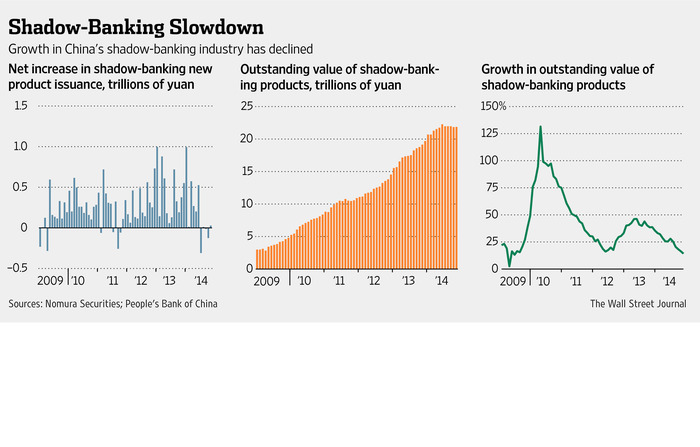
Following years of explosive growth, China’s shadow-banking industry is experiencing a sharp slowdown after Beijing tightened its grip on the sector, which has been a key source of funding for the economy but also has added to rising debt levels and other risks in the financial system. The industry, a mélange of informal lenders such as trust companies and leasing firms, takes in money from investors and lends it to often risky projects for which traditional bank lending is unavailable. Investors have flocked to the so-called wealth-management and trust products sold by shadow lenders in recent years because they typically promise returns ranging from 4% to more than 10%, much higher than a bank account. But the sector has been hit especially hard in the second half of this year. Investors have shifted their cash into the rallying stock market.

The slowdown may become even more pronounced next year, with authorities set to increase efforts to rein in financial risks as the economy slows. “The government has realized that shadow banking has fallen off its radar screen and it carries enormous risks. The days of laissez-faire are over,” said Shen Meng, executive director of Chanson Capital, a boutique investment bank. A decline in interest rates in China and diminishing returns on property and infrastructure projects may also reduce the promised investment gains on the products issued by shadow banks. The outstanding value of shadow-banking products stood at 21.87 trillion yuan ($3.52 trillion) at the end of November, up 14.2% from the level a year earlier, according to estimates by Nomura Securities based on central-bank data. That growth is significantly slower than the 35.5% rise it registered for the whole of last year and the 33.1% gain in 2012.

The growth rate was as high as 75% in 2010, when Beijing encouraged shadow lenders to complement overstretched traditional banks and help extend a lending binge to keep the economy humming following the global financial crisis. The slowdown in the industry this year has primarily been caused by a series of tighter regulations that made it less profitable for shadow lenders to issue new products, or forced them to enhance risk controls. Shadow-lending products are usually sold through traditional banks. In July, China’s banking regulator asked banks to separate their wealth-management-product business from their retail-lending business, a move that incurred extra costs. Banks also were ordered to set up independent departments to oversee wealth-management products, and to better explain in sales documents that these products aren’t deposits and carry risks.

The result was immediate: New issuance of shadow-banking products fell by 309.6 billion yuan in July from a month earlier. That followed a month-on-month increase of 526.2 billion yuan in June and a rise of 993.2 billion yuan in January, according to estimates by Nomura Securities. There was a mild rebound in August, but issuance shrank in September and October before seeing a modest rise of 28.4 billion yuan in November. The slowdown since July coincided with a surge in China’s long-depressed stock market. Compared with the 43% gain of the Shanghai market this year, the yields on trust and wealth-management products, which have declined, no longer look as attractive.
Read more …

How much longer for Abe?

Game Over Japan: Real Wages Crash, Savings Rate Turns Negative (Zero Hedge)

When about a month ago it was revealed that Japan’s shadow economic advisor is none other than Paul Krugman, we said it was only a matter of time before the Japanese economy implodes. Terminally. We didn’t have long to wait and last night the barrage of Japanese economic data pretty much assured Japan’s transition into failed Keynesian state status. In fact, after last night’s abysmal Japanese eco data, we doubt even the most lobotomized Keynesian voodoo priests have anything favorable left to say about Abenomics: not only did core inflation miss expectations and is now clearly in slowdown mode despite Japan openly monetizing all gross Treasury issuance.

Not only did industrial production decline 0.6% missing expectations of an increase and record its first decline in 3 months with durable goods shipments crashing, not only did consumer spending plunge for the 8th straight month dropping 2.5% in November (with real spending on housing in 20% freefall), but – the punchline – both nominal and real wages imploded, when total cash wages and overtime pay declined for the first time in 9 months and 20 months, respectively. And the reason why any poll that shows a recently “re-elected” Abe has even a 1% approval rating has clearly been Diebolded beyond recognition, is that real wages cratered 4.3% compared to a year ago. This was the largest decline since the 4.8% recorded in December 1998. In other words, Abenomics has now resulted in the worst economy, if only for consumers, in the 21st century.

Read more …

The Petrobras scandal is yet to reach its climax. Brazil as a whole will be severely shaken.

Brazilian Oil Company Petrobras Sued By US City In Corruption Scandal (BBC)

The US city of Providence, Rhode Island is suing the Brazilian state-run oil company Petrobras over investor losses due to a corruption scandal. Unlike other class actions, some of the company’s senior executives have also been named as defendants. Providence alleges that Petrobras made false statements to investors that inflated the company’s value. Its lawyers say that when the corruption scandal broke, the city’s investments plummeted. So far, 39 people in Brazil have been indicted on charges that include corruption, money laundering and racketeering. They have been accused of forming a cartel to drive up the prices of major Petrobras infrastructure projects and of channelling money into a kickback scheme at Petrobras to pay politicians. The executives could face sentences of more than 20 years in jail.

The case has shaken the government of President Dilma Rousseff, who served as chair of the Petrobras board for seven years until 2010. She has denied any knowledge of the scheme. According to the Brazilian Federal Police the group under investigation moved more than $3.9bn (£2.5bn) in what police describe as “atypical” financial transactions. Brazilian courts have blocked around $270m in assets belonging to various suspects. Federal agents revealed contracts worth $22bn are regarded as suspicious. Former Petrobras director Paulo Roberto Costa, who worked at the company from 2004 to 2012, has told investigators that politicians received a 3% commission on contracts signed during this period.

Read more …

Crazy plan.

Nicaragua Canal A Potential Threat To The US And Western Powers (RT)

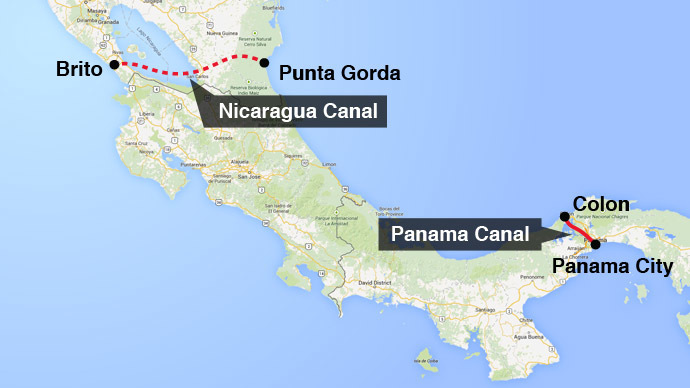
The Nicaragua Canal can become an alternative route through Central America for China and Russia, as well as an alternative route for potential military use right in America’s backyard, international consultant and author Adrian Salbuchi told RT. Nicaragua has begun the most ambitious construction project in Latin America – a waterway connecting the Atlantic and the Pacific oceans that is supposed to become an alternative to the Panama Canal. It is 278 km long, will cost around $50 billion and provide jobs for 50,000 people. The construction is being run by a Hong Kong company and should be completed by 2020. The project is supposed to boost Nicaragua’s GDP. Meanwhile, ecologists fear the giant ship canal will endanger Lake Nicaragua – Central America’s largest lake and Nicaragua’s largest main water source – which the waterway will run through. Locals are concerned their homes and farm lands are under threat. According to some estimates, around 30,000 people may be displaced by the waterway. RT discussed the project and protests it sparked in Nicaragua with international consultant and author Adrian Salbuchi.

RT: The residents are promised compensation. Why are they protesting? Were they misinformed about the project?
Adrian Salbuchi: It’s understandable because we are talking about a mega project that will displace many people; some estimates say as many as 30,000 farmers will be displaced. There will be an ecological impact, no doubt about it. However, I think we have to be very careful to distinguish between what is this spontaneous reaction of many of these farmers which is probably genuine, and what may also be some engineering of social convulsion from foreign powers, not only the US that had been doing that in the so-called Arab Spring and that had been doing that throughout Latin America for many decades. So I wouldn’t be surprised if some of the exaggeration or some of the future problems do come from some American agitators or Western agitators. Don’t forget this is the country which is governed by President Daniel Ortega of the Sandinista Liberation Front, who are enemies of the US for many decades.

RT: Just to push you a bit on this, do you think there may be a foreign state involved?
AS: Absolutely. And we should even take it together with what just happened with Cuba because if America is trying to bring Cuba into the fold, it might try to play a similar card with Nicaragua to try to range them away as in the case of Cuba from Russia, in the case of Nicaragua from China. We have to see not just the trade implications that are huge, and the economic implications that are also huge, as well as social and ecological, but much more so the geopolitical implications. This is a Chinese private company, but we all know that very likely behind the Chinese investment there are geopolitical factors being handled and being driven by the Chinese government quite rightly, who have an increasing interest throughout Latin America.
Read more …

People vs power.

The Cradle of Democracy Should Defy the Autocrats & Kleptocrats (Landevoisin)

On the old continent, this December 29th, a succinct political showdown is scheduled to take place which may well become a defining moment for our entirely unsettled new millenium. What is at stake is none other than the prosperity of the common man pitted against the privilege of concentrated power. Lamentably, this deliberate dogmatic divide has relentlessly defined human civilization for the ages. What is at hand isn’t so much about lofty ideals. It’s not about Socialism. It’s not about Capitalism. It’s not about Communism. It’s not about being a progressive, or a conservative or a liberal. It’s not about left vs right. Forget all those dumbed down dichotomies. It’s much more fundamental than all of that. Quite simply, it’s about People vs. Power, that’s it, nothing more. Those that have and wield institutional power, and those that do not. It’s as elementary and base as that I’m afraid.

Take a good look around, I defy you to point to a single socioeconomic construct in our supposedly enlightened and advanced society of today which is not essentially determined by that crude polarizing characterization. Whether it be our bought and paid for Political Class, our rapacious Banking Sector, our entitled Multinational Corporations, our entrenched Governmental Agencies, our marauding Military Industrial Complex, our fleecing Healthcare Providers, our muzzled Free Press, our hijacked Justice System, or our grossly overpaid CEOs, Athletes, and Entertainers, they all have one thing in common, and I assure you that it’s not the common good that they share. What they seek above all else is to expand the existing institutional dominion and their own privileges within it.

Sad to say, but at the end of the day, perhaps dog eat dog is what we humans are really best at, and the only state of being we’re actually capable of. Maybe all those exalted ideals of enlightened forms of governance are just a load of crap to make us feel better about ourselves. Judging by the overt self seeking avarice that dictates the pace of just about everything these days, it sure seems that way.

Read more …

“Menacing figures arrive at your door uninvited, demand your property, and threaten to perform an unspecified “trick” if you don’t fork over.”

A Capitalist Christmas (Mises Inst.)

Halloween has a socialist tenor. Menacing figures arrive at your door uninvited, demand your property, and threaten to perform an unspecified “trick” if you don’t fork over. That’s the way the government works in a nutshell. Thanksgiving has been reinterpreted as the white man, after burning, raping, and pillaging the noble Indian, trying to make amends with a cheap turkey dinner. New Year’s can be ruined as the beginning of a new tax year, and the knowledge that the next five or six months will be spent working for the government. That’s why I love Christmas. To this day it remains a celebration of liberty and private life, as well as a much-needed break from the incessant politicization of modern life. It’s the most pro-capitalist of all holidays because its temporal joys are based on private property, voluntary exchange, and mutual benefit.

In Christmas shopping, we find persistent reminders of charity programs that work and little sign of those (welfare bureaucracies) that don’t. The Salvation Army, Goodwill dispensers in parking lots, and boxes filled with canned goods and toys are all elements of true charity. This giving is based on volition rather than coercion, which is the key to its success. People complain about “commercialism,” but all the buying and selling is directed toward meeting the needs of others. Even if the recipient doesn’t give gifts in return, the giver still receives satisfaction. Absent entirely is the zero or negative-sum political process that tilts property in favor of one group or another. Santa, unlike Halloween figures, comes to your home to bring gifts and goodwill, and never takes anything except milk and cookies.

You wouldn’t think of hiding your silver from him. Unlike government bureaucrats, Santa and his workers are entirely trustworthy, and even work overtime by creating goods that are desired by millions of people. If the Labor Department or OSHA ever get around to investigating the North Pole, they’ll probably find all sorts of labor violations: safety and health (too cold), unemployment insurance (does he pay it?), minimum wage (is there exploitation here?), overtime (Heaven knows they work long hours), civil rights (any non-elves employed?), and disability (is Santa accommodating these tiny men?). But the point is that everyone is there voluntarily, and no doubt considers it an honor and privilege.

Read more …

What I said yesterday, in different words: “We appeal to the media, to more scrupulously adhere to their obligation to provide unbiased reporting.”

60 Prominent Germans Appeal Against Another War In Europe (Zero Hedge)

Two weeks ago, as the S&P was preparing to surge on the latest round of all time high market-goosing algo trickery by the FOMC, 60 prominent German personalities from the realms of politics, economics, culture and the media were less concerned with blinking red and green stock quotes and were focused on something far more serious to the future of the world: the threat of war with Russia. In a letter published by Germany’s Die Zeit, numerous famous and respected Germans including a former president and former prime minister write “Wieder Krieg in Europa? Nicht in unserem Namen!”, or, roughly translated, “War in Europe Again? Not in Our Names!”

The open letter to the German government, parliament, and media, excerpted here, was signed by more than 60 prominent German personalities and published in the weekly Die Zeit on Dec. 5. The initiators were Horst Teltschik (CDU), advisor to then-Chancellor Helmut Kohl at the time German of reunification; Walther Stützle (SPD), former Secretary of State for the Ministry of Defense; and Antje Vollmer (Greens), former Bundestag Vice President. Teltschik said, in motivating the appeal, “We are giving a political signal that the justified criticism of Russia’s Ukraine policy should not wipe out all the progress that we have made in the past 25 years in relations with Russia.” Below is an excerpted translation (source) of the original letter:

“Nobody wants war. But North America, the European Union, and Russia are inevitably driving towards war if they do not finally halt the disastrous spiral of threats and counter-threats. All Europeans, including Russia, are jointly responsible for peace and security. Only those who do not lose sight of this goal can avoid fatal actions. The Ukraine conflict shows that the quest for power and domination has not been overcome. In 1990, at the end of the Cold War, we all hoped that it would be. But the success of the détente policy and the peaceful revolutions allowed people to become lethargic and careless. In both East and West. The Americans, Europeans, and Russians all lost, as their guiding principle, the idea of permanently banishing war from their relationship.

Otherwise it is impossible to explain either the West’s eastward expansion without simultaneously deepening cooperation with Moscow—a policy which Russia sees as a threat—or Putin’s annexation of Crimea in violation of international law. At this moment of great danger for the continent, Germany has a special responsibility for the maintenance of peace. Without the will for reconciliation of the people of Russia, without the foresight of Mikhail Gorbachov, without the support of our Western allies, and without the prudent action by the then-Federal government, the division of Europe would not have been overcome. To allow German unification to evolve peacefully was a great gesture, shaped by the wisdom of the victorious powers. It was a decision of historic proportions. [..]

We call upon the members of the German Bundestag, delegated by the people as their political representatives, to deal appropriately with the seriousness of the situation. . . . Whoever is constructing a bogeyman, putting the blame on only one side, is exacerbating tensions, when the signals should be for de-escalation. We appeal to the media, to more scrupulously adhere to their obligation to provide unbiased reporting.than they have hitherto done. Editorialists and leading commentators are demonizing entire nations, without fully taking their histories into account. Any journalist experienced in foreign affairs would understand the Russians’ fear, since members of NATO in 2008 invited Georgia and Ukraine to join the Alliance. It is not about Putin. Heads of state come and go. What is at stake is Europe.

Read more …

And so he did. But not everybody likes that.

Gorbachev: Putin Saved Russia From Disintegration (RT)

Russian President Vladimir Putin saved the country from falling apart, former Soviet leader Mikhail Gorbachev said during the presentation of his new book ‘After the Kremlin.’ Gorbachev also commented on the situation in Ukraine and NATO expansion. “I think all of us – Russian citizens – must remember that [Putin] saved Russia from the beginning of a collapse. A lot of the regions did not recognize our constitution. There were over a hundred local constitutional variations from that of the Russian constitution,” RIA Novosti quoted Gorbachev as saying on Friday. He added that saving Russia during that crucial period was a “historical deed.” Gorbachev remarked that he knew the Russian president before Putin took office, describing him as having good judgment and discipline.

Commenting on the situation in Ukraine, the ex-Soviet president said the armed stand-off must be immediately stopped and both sides need to come to the negotiating table. “All of us are concerned by what is happening in Ukraine – politicians and the public. And the fact that our government is supporting the people who are in trouble there, no matter how hard things are at home, it is what always distinguished us,” Gorbachev said, stressing that the conflict cannot be solved through violence. Gorbachev also noted that influential American and European politicians need to speak out against the worsening of international ties, adding that many of his old colleagues are seeing the first signs of a new Cold War and understand how crucial it is to calm things down.

He said he has received comments which include concerns on how not to miss the escalating situation, and stopping it before it “acquires an explosive nature.” In terms of Russia’s worries over NATO’s expansion, Gorbachev agrees that the US is playing a key role in the process. “[NATO] began to establish bases around the world…I think the president is mostly right when drawing the attention to the special responsibility the US has,” Gorbachev said. Meanwhile, when speaking about the domestic situation in the country, the former president of the USSR expressed confidence that Russia will get out of the crisis, adding that the only questions are “when and at what price.” “Now we need to be very careful in politics – what policy is implemented, by who, and who stands to benefit?”

Read more …

Not smart enough for my tastes.

Putin: It Is Time to Play Your Ace in the Hole (Daily Bell)

The entire world is watching Putin play poker with the Western politicians lead by Obama and followed by Washington quislings in London, Brussels and Berlin. America’s goal since the end of the Cold War has been to weaken by financial, economic and, if necessary, military means any real competition to its global financial and resource domination through the petrodollar and dollar world reserve currency status. The current trade and economic sanctions against Russia and Iran follow this time-tested action that is never successful on its own, as we know from the 50-plus-year blockade of Cuba. But this strategy can lead to opposition nations retaliating by military means, often their only alternative to end blockades etc., which are an act of war and allow the US and other democracies to bring their ultimate superior military power to bare against the offending sovereign state.

This worked for Lincoln against the Confederate States of America, by Woodrow Wilson against the Central Powers before World War One, against the Japanese Empire before World War Two, Iraq, Libya – the list is endless. Recently the US has created the oil price collapse, working closely with its client state Saudi Arabia, in order to weaken the economic power of both Iran and Russia, the two main nations opposing US hegemony, foreign policy and petrodollar policy. Yes, this will play havoc with the US shale oil industry as well as London’s North Sea oil industry but oil profits pale in comparison to the importance of maintaining Western power over Russia and China. I hope Putin realizes the US is not playing games here, as this is a financial and strategic game to the death for Washington and it’s Western allies that have foolishly followed the Goldman Sachs/central banking cartel’s deadly sovereign debt recipe and for growth and prosperity.

The time is up; the debts can never be repaid and sooner or later must be repudiated one way or the other. China is waiting in the wings as the new world economic power and while it is too big to challenge, US strategy is to take out its top two allies, Iran and Russia, to buy time for Wall Street and Washington. The strategy might be a competitive economic course of action but the risk of military consequences and even a third world war loom on the horizon and no country has ever defeated Russia in a land attack. This is risky brinkmanship just to protect our banking and Wall Street elites and their profits at the expense of the American people, I might add, but the US has done this before.

Read more …

Nice takedown.

Google Further Crapifies Search, Exploiting Both Users and Advertisers (NC)

Google is a case study of why we need antitrust enforcement. With Google at 97% market share in search, Yahoo and Bing don’t have enough of a foothold for it to be worth the gamble of trying to beat Google at search, even with Google having degraded its service so badly that there are now obvious ways that a challenger could best them. I had assumed that the ongoing crapification of Google was for a commercial purpose, namely to optimize the browser for shopping and the hell with everything else. But as we will discuss in more detail below, my experience in poking around to see about buying a new laptop demonstrates that Google has gotten worse at that too. Lambert, who I enlisted to confirm my experience, was appalled and said, “What have they been doing with all that money?”

But as we’ll see, there is an evil purpose here, just not the evil purpose we’d first assumed. It isn’t as if the degradation of Google is a new phenomenon. I used Google heavily while researching ECONNED, which was written on an insanely tight time schedule. It worked really well then. But even a mere year later, by late 2010, the search algo had been restructured in some mysterious way to make the results much less targeted, and it’s been downhill since then. The most recent appalling change came in the last few months: eliminating the ability to do date range searches. But all of this ruination was so Google could make more money by optimizing for shopping right? Apparently not. I’ve idly and actively looked for stuff on the Internet over the years.

A reliable way to do that was to type in a rough or better yet precise description of the product/product name plus the word “price”. That would usually get you a nice list of vendors selling what you wanted so you could comparison shop, and often you’d get links to sites like Nextag which would provide a list of vendors with all-in prices as well as vendro ratings. Over the last two months, I’ve been looking for an easy-to-install monochrome laser printer (I have NO time to deal with anything more demanding than plug and play, and sadly, dealing with printers on a Mac is not plug and play). I didn’t get any good answers from all my searching and would up buying a used version of my current out-of-production printer. In retrospect, it appears some of my search hassles may have been due to Google, not to having atypical requirements.

Read more …

Biggest company on the planet because they buy their own stock?

Apple Spent $56 Billion On Buybacks In 2014 (MarketWatch)

If Apple’s year had a theme, it was the year the company finally started to chip away at that colossal hoard of cash. After a little nudging by activist investor Carl Icahn, Apple boosted its share-buyback program in April to $90 billion and increased the pace of capital returns. New data from FactSet show that Apple has been the biggest buyback spender of 2014 among the S&P 500, pouring more than $56 billion into the program on a trailing 12-month basis as of the end of the third quarter. That’s nearly three times the outlay of runner-up IBM, which spent $19.2 billion. Apple bought back $17 billion in shares last quarter, a 240% year-over-year increase that marks the second-highest dollar amount spent on buybacks during a quarter by any individual company in the S&P 500 since 2005, when FactSet began tracking the data. It’s second only to Apple’s own record of $18.6 billion set in the first quarter as part of the same buyback program.

Morningstar analyst Brian Colello said that while it’s not all surprising the world’s most valuable company would top a list such as this given its enormous cash cushion, he said the buybacks have undoubtedly been a “big contributor” to the stock’s strong performance in 2014. Adjusted for a 7-for-1 stock split earlier this year, shares of Apple have climbed more than 43% over the last 12 months. Since hitting a 52-week low back on Jan. 30, they have been on the march higher — flirting with all-time highs since September. “It showed that management was confident in its upcoming product launches and helped to put a floor into the company’s valuation during times of skepticism,” said Colello. Apple is the world’s most valuable company, with a $641.7 billion market cap, almost double the market valuations of the next companies on that list, Microsoft and Exxon Mobil, both valued around $377 billion.

Read more …

Curious.

Strange Predictions For The Future From 1930 (BBC)

Shortly before he died in 1930, former cabinet minister and leading lawyer FE Smith, a friend of Winston Churchill and one of the more outspoken British politicians of his age, wrote a book predicting how the world would look in 100 years’ time. They covered science, lifestyles, politics and war. So what did he say?

Health/lifespan Smith, a former Lord Chancellor who became the Earl of Birkenhead a few years before his death, was writing in a period when tuberculosis was a major killer in the UK and around the world. He was optimistic enough to suggest the eradication of this and other epidemic diseases was “fairly certain” by 2030, as was “the discovery of cures for such scourges as cancer”. Death from old age could also be delayed, Smith thought. Scientists would create injections containing an unspecified substance bringing “rejuvenations”, which would be used to prolong the average lifespan to as much as 150 years. Smith acknowledged this would present “grave problems” from an “immense increase in population”. He also foresaw extreme inter-generational inequality, wondering “how will youths of 20 be able to compete in the professions or business against vigorous men still in their prime at 120, with a century of experience on which to draw”?

Work and leisure
Mechanisation would mean a “gradual contraction” of hours worked, Smith believed. By 2030 it was likely the “average week of the factory hand will consist of 16 or perhaps 24 hours”, which no worker could possibly “grudge”. But, with factories largely automated, work would provide little scope for self-fulfilment, becoming “supremely easy and supremely dull”, consisting largely of supervising machines. It didn’t occur to Smith, in an age before widespread use of computers, that the machines might become self-monitoring. The cut in hours hasn’t happened yet. According to figures from the OECD group of industrialised nations, the lowest average weekly hours worked in a main job in 2013 were 30, in the Netherlands. The highest figure was 47.9, in Turkey. In the UK it was 36.5, with the US among the countries for which information was not provided.

Smith believed that, despite the shortening of hours, everyone would earn enough by 2030 to afford to play football, cricket or tennis in their spare time. But one of the big winners in this more leisure-rich world would be fox-hunting, one of his own hobbies. “As wealth increases, we shall all be able to ride to hounds,” he said. Men would free up even more time with changes to sartorial rules. By 2030 they would be expected to own only two outfits, one for leisure and the other for more formal occasions. John Logie-Baird had demonstrated television in the late 1920s and Smith was excited by the idea. He said that by 2030 full “stereoscopic television in full natural colours” would be available in people’s homes, with proper loudspeaker-quality sound. This meant exiled US citizens would be able to watch any baseball match and, in cricket, “the MCC selection committee, in conclave at Lord’s, will be able to follow the fortunes of an English eleven through the days (or weeks) of an Australian Test match”.

Read more …

Dec 222014
 
 December 22, 2014  Posted by at 12:05 pm Finance Tagged with: , , , , , , , ,  5 Responses »


Russell Lee Secondhand store in Council Bluffs, Iowa Dec 1936

Age of Plenty Seen Over for Gulf Arabs as Oil Tumbles (Bloomberg)
Ready for $20 Oil? (A. Gary Shilling)
Houston Suddenly Has A Very Big Problem (Feroli via ZH)
Saudis Insist Oil Supply Cuts Are Not Needed (Independent)
Oil Crash Wipes $11.7 Billion From Buyout Firms’ Holdings (Bloomberg)
North Sea Oil Summit Announced By Aberdeen City Council (BBC)
Southwest’s Oil Swap Trade Waiver Raises CFTC Questions (Reuters)
US Gas Prices Fall To Lowest Since May 2009 (Reuters)
Rosneft Repays $7 Billion and Says Has No Need to Buy Dollars (Bloomberg)
China Offers Russia Help With Currency Swap Suggestion (Bloomberg)
China Investigates Possible Stock-Price Manipulation (WSJ)
China Stock Connect Scheme Scorecard Throws Up Surprises (Reuters)
The Fallacy of Keynesian Macro-Aggregates (Ebeling)
Europe in Wonderland Wants Russia to Bail Out Ukraine (Mish)
Greek Premier Makes Offer In Bid To Avoid Snap Elections (WSJ)
Greece’s Radical Left Could Kill Off Austerity In The EU (Guardian)
Rising Price Of Olive Oil Is A Pressing Matter (FT)
Leaked CIA Docs Teach Operatives How To Infiltrate EU (RT)

Tall building syndrome?!

Age of Plenty Seen Over for Gulf Arabs as Oil Tumbles (Bloomberg)

The boom that adorned Gulf Arab monarchies with glittering towers, swelled their sovereign funds and kept unrest largely at bay may be over after oil prices dropped by almost 50% in the last six months. The sheikhdoms have used the oil wealth to remake their region. Landmarks include man-made islands on reclaimed land, as well as financial centers, airports and ports that turned the Arabian desert into a banking and travel hub. The money was also deployed to ward off social unrest that spread through the Middle East during the Arab Spring. “The region has had 10 years of abundance,” said Simon Williams, HSBC chief economist for central and eastern Europe, the Middle East and North Africa. “But that decade of plenty is done. The drop in oil prices will hurt performance in the near term, even if the Gulf’s buffers are powerful enough to ensure there’s no crisis.”

Brent crude, which has averaged $102 a barrel since the end of 2009, plunged to about $60 by the end of last week. The slump accelerated after the Organization of Petroleum Exporting Countries, whose top producer is Saudi Arabia, decided in November to keep output unchanged. At $65 a barrel, the six nations of the Gulf Cooperation Council, which hold about a third of the world’s crude reserves, would run a combined budget deficit of about 6% of gross domestic product, according to Arqaam Capital, a Dubai-based investment bank. Cheaper oil “will force a reassessment of the ambitious infrastructure investment program” in the region, Qatar National Bank said in a report. One exception is likely to be Qatar, which is spending on infrastructure to host the 2022 soccer World Cup final, QNB said. The oil-price drop has already prompted economists to cut next year’s growth estimates for Saudi Arabia, the United Arab Emirates and Kuwait, according to data compiled by Bloomberg.

Read more …

Complex political games.

Ready for $20 Oil? (A. Gary Shilling)

When the U.S. Federal Reserve ended its quantitative-easing program in October, it also ended the primary driver of U.S. stocks during the past six years. So long as the central bank kept flooding the markets with money, investors had little reason to worry about a broader economy limping along at 2% real growth. Now investors face more volatile markets and securities that no longer move in lock-step. At the same time, investors must cope with slower growth in China, minuscule growth in the euro area and negative growth in Japan. Such widespread sluggish demand – along with ample supplies of oil and most everything else – is the reason commodity prices are falling. They have been since early 2011, but many people failed to notice until recently, when crude oil prices nosedived.

Normally, less demand and a supply glut would lead OPEC, beginning with Saudi Arabia, to cut production. As the de facto cartel leader, the Saudis would often reduce output to prevent supply increases from driving down prices. Of course, this also cost the Saudis market share and encouraged cheating by OPEC members. Saudi leaders must grind their teeth over the last decade’s unchanged demand for OPEC oil, while all the global growth has been among non-OPEC suppliers, principally in North America. That may explain why, while Americans were enjoying their Thanksgiving turkeys, OPEC surprised the world. Pressed by the Saudis and other rich Persian Gulf producers, it refused to cut output despite a 38% drop in the price of Brent crude, the global benchmark, since June.

OPEC, in effect, is challenging other producers to a game of chicken. Sure, the wealthier producers need almost $100 a barrel to finance bloated budgets. But they also have huge cash reserves, which they figure will outlast the cheaters and the U.S. shale-oil producers when prices are low. The Saudis also seized the opportunity to damage their opponents, especially Iran and what they see as Iran-dominated Iraq, in the Syria conflict. They also want to help allies Egypt and Pakistan reduce expensive energy subsidies as prices fall.

Read more …

“.. the four states where oil is more important to the local economy than Texas have a combined GSP that is only 16% of the Texas GSP.”

Houston Suddenly Has A Very Big Problem (Feroli via ZH)

The well-known energy renaissance in the US has occurred in both the oil and natural gas sectors. Some states that are huge natural gas producers have limited oil production: Pennsylvania is the second largest gas producing state but 19th largest oil producer. The converse is also true: North Dakota is the second largest crude producer but 14th largest gas producer. However, most of the economic data as it relates to the energy sector, employment, GDP, etc, often lump together the oil and gas extraction industries. Yet oil prices have collapsed while natural gas prices have held fairly steady. To understand who is vulnerable to the decline in oil prices specifically we turn to the EIA’s state-level crude oil production data.

The first point, mentioned at the outset, is that Texas, already a giant, has become a behemoth crude producer in the past few years, and now accounts for over 40% of US production. However, there are a few states for which oil is a relatively larger sector (as measured by crude production relative to Gross State Product): North Dakota, Alaska, Wyoming, and New Mexico. For two other states, Oklahoma and Montana, crude production is important, though somewhat less so than for Texas. Note, however, that these are all pretty small states: the four states where oil is more important to the local economy than Texas have a combined GSP that is only 16% of the Texas GSP. Finally, there is one large oil producer, California, which is dwarfed by such a huge economy that its oil intensity is actually below the national average, and we would expect it, like the country as a whole, to benefit from lower oil prices.

As discussed above, Texas is unique in the country as a huge economy and a huge oil producer. When thinking about the challenges facing the Texas economy in 2015 it may be useful, as a starting point, to begin with the oil price collapse of 1986. Then, like now, crude oil prices collapsed around 50% in the space of a few short months. As noted in the introduction, the labor market response was severe and swift, with the Texas unemployment rate rising 2.0%-points in the first three months of 1986 alone. Following the hit to the labor market, the real estate market suffered a longer, slower, burn, and by the end of 1988 Texas house prices were down over 14% from their peak in early 1986 (over the same period national house prices were up just over 14%). The last act of this tragedy was a banking crisis, as several hundred Texas banks failed, with peak failures occurring in 1988 and 1989.

Read more …

Chances they’ll do anything shrink by the day.

Saudis Insist Oil Supply Cuts Are Not Needed (Independent)

Gulf states yesterday insisted that oil prices will recover without intervention from the OPEC cartel, arguing that current prices will boost global economic growth. Crude oil prices have plummeted as global demand has eased and new supplies such as US shale oil have come on to the market. The cost of benchmark Brent crude has nearly halved from $115 a barrel in June to below $60 last week. But although oil producers and explorers from Aberdeen to Alberta are struggling to operate at a profit, OPEC has refused to cut supply in order to lift prices. Ali al-Naimi, the Saudi oil minister, yesterday said he was “100% not pleased” with current prices, but insisted: “I am confident the oil market will improve.” He added: “Current prices do not encourage investment, but they stimulate global economic growth, leading ultimately to an increase in global demand and a slowdown in the growth of supplies.”

Saudi Arabia, OPEC (and the world’s) largest oil exporter, has been the “swing supplier” in the past, cutting or increasing production in order to stabilise global oil prices at around $100 a barrel. The Gulf state blames the current price slump on speculators and a lack of co-operation from producers outside OPEC, and Mr Naimi said the kingdom would not act this time. “If they [non-OPEC oil producers] want to cut production they are welcome,” he told reporters on the sidelines of the 10th Arab Energy Conference in the United Arab Emirates. “Certainly Saudi Arabia is not going to cut.” Attempts to get non-OPEC producers such as Russia to sign up to output reductions before last month’s meeting of the oil cartel failed. “I don’t think we [OPEC] need to cut,” Kuwait’s oil minister told Reuters yesterday. “We gave a chance to others, they were not willing to do so.”

Read more …

“It’s been a really volatile period, and frankly that’s how Saudi Arabia wants it,” [..] “This is a battle of endurance.”

Oil Crash Wipes $11.7 Billion From Buyout Firms’ Holdings (Bloomberg)

Oil’s plunge makes energy a great investment for the coming years, according to Blackstone’s Stephen Schwarzman and Carlyle’s David Rubenstein. For private equity firms, it’s also been painful. More than a dozen firms – including Apollo Global , Carlyle, Warburg Pincus and Blackstone – have lost a combined $11.7 billion in 27 publicly traded oil producers since June, when crude prices reached this year’s peak before beginning their six-month slide, according to data compiled by Bloomberg. Stocks of buyout firms with exposure to energy have slumped, and bond prices suggest some closely held oil producers may struggle to pay for their debt. “It’s been a really volatile period, and frankly that’s how Saudi Arabia wants it,” said Francisco Blanch, head of global commodity research at Bank of America. “This is a battle of endurance.”

Brent crude oil slumped 47% to about $61 late last week from its high this year of $115 a barrel, dragging down energy stocks, as the Organization of Petroleum Exporting Countries sought to defend market share amid a U.S. shale expansion that’s adding to a global glut. The group, responsible for 40% of the world’s supply, will refrain from curbing output, U.A.E. Energy Minister Suhail al-Mazrouei said on Dec. 14. Kosmos Energy, Antero Resources, EP Energy, Laredo Petroleum and SandRidge Energy, each of which is backed by a buyout firm as its largest shareholder, fell by an average of 50% in U.S. trading from oil’s peak through Dec. 19 in New York. Warburg Pincus is the top stakeholder in Kosmos, Antero and Laredo; Apollo is the largest investor in EP Energy; and Carlyle, with a partner, owns the biggest piece of SandRidge, according to data compiled by Bloomberg.

Apollo has $5 billion invested in energy debt and equity, including companies that are closely held. Carlyle has directed 10% of its $203 billion in assets into the industry. Blackstone, the second-biggest shareholder in Kosmos, has backed drilling projects off Ghana’s coast and in the Gulf of Mexico. The deals highlight private equity’s role in the debt-fueled shale push, as hydraulic fracturing in search of oil and gas leads to higher production. After investing billions of dollars, the firms are preparing to step in with more cash to fund development when prices stabilize.

Read more …

More consequences.

North Sea Oil Summit Announced By Aberdeen City Council (BBC)

A plan for a summit to look at the challenges facing the North Sea oil industry has been announced by Aberdeen City Council. Council leader Jenny Laing said the UK and Scottish governments, trade unions and industry bodies needed “to get round the table as soon as possible”. The Labour councillor said a “strategic plan” was required to save jobs as the price of oil continued to fall. Labour called on Nicola Sturgeon and David Cameron to attend the summit. It comes after a warning that the UK’s oil industry is in “crisis”. On Thursday, Robin Allan, chairman of the independent explorers’ association Brindex, told the BBC that the industry was “close to collapse”. He claimed almost no new projects in the North Sea were profitable with oil below $60 a barrel. However, Sir Ian Wood, another leading industry figure, said Mr Allan’s warning was “well over-the-top and far too dramatic”. Sir Ian predicted conditions would begin to recover next year.

Ms Laing said Aberdeen was the oil capital of Europe and as such it was her job, as leader of the city council, to work with the governments in Edinburgh and Westminster and the oil industry to ensure jobs in the city were protected and companies remained based there. She said: “I have today instructed Angela Scott, our chief executive, to arrange a summit between senior politicians, government officials, industry representatives, trade unions, and local politicians. “The aim will be to ensure an agreement to develop a strategic plan to ensure job losses are either avoided or kept to a minimum. “It must concern us all that the price of oil has dropped so heavily in such a short space of time and we need to agree a strategy to deal with fluctuations that undermine confidence in the North Sea.” Ms Laing said the council chief executive would write to various politicians within both the UK and Scottish governments, as well as UK Oil and Gas, other industry leaders and trade unions to encourage them to take part in the summit.

Read more …

Dangerous development.

Southwest’s Oil Swap Trade Waiver Raises CFTC Questions (Reuters)

Last month’s move by the U.S. commodities regulator to let Southwest Airlines Co keep its multibillion-dollar oil trades secret for 15 days offered the world’s biggest low-cost carrier a break it has been seeking for three years. However, the decision to grant the airline an exemption from rules calling for greater derivatives transparency raised concerns about its market impact and sparked a debate among regulators, according to people familiar with the approval process. All other swap trades except Southwest’s must be reported “as soon as technologically practicable.” The Dallas-based airline has argued that its deals are so specific that immediate disclosure could cause the market to move against it, adding tens of millions of dollars to its costs. For years, that argument was not enough to sway the Commodity Futures Trading Commission and its former chairman, Gary Gensler. One concern was that granting an exemption to just one company is unusual and could hurt others in a similar position.

Also, the waiver could set a precedent that would encourage others to seek similar special treatment, restoring a veil over bigger parts of derivative markets. The agency is already looking into problems the Mexican government is facing in its vast oil hedging program after news organizations, including Reuters, reported on the country’s trades using publicly available swaps trading data, said one person familiar with the agency’s procedures. A CFTC spokesman said Tim Massad, Gensler’s successor, had issued the waiver to Southwest after his staff had done proper analysis to confirm the company’s claims, and the relief was a lot narrower than what the company had originally requested. But the person familiar with the approval process said the decision caused “a big stink” within the agency.

Read more …

Still happy?

US Gas Prices Fall To Lowest Since May 2009 (Reuters)

The average price of a gallon of gasoline in the United States fell 25 cents in the past two weeks, tumbling to its lowest level in more than five-and-a-half years, according to the Lundberg survey released Sunday. Prices for regular-grade gasoline fell to $2.47 a gallon in the survey dated Dec. 19, down 25 cents since the previous survey on Dec. 5. The recent drop has taken prices down more than $1.25 a gallon since a recent peak in May of this year.

“This is mostly driven by crude oil prices, and absent a sudden spike we very well may see a drop of a few pennies more,” said the survey’s publisher, Trilby Lundberg. “That said, demand is up at these low prices.” U.S. crude futures have been sharply weaker of late, dropping for four straight weeks, as well as in 11 of the past 12 weeks. Crude prices fell 14.2% over the past two weeks, though they rose 5.1% on Friday, settling at $57.13 per barrel. The highest price within the survey area in 48 U.S. states was recorded in Long Island at $2.82 per gallon, with the lowest in Tulsa, at $2.06 per gallon.

Read more …

Wonder if Russia stress tests its companies.

Rosneft Repays $7 Billion and Says Has No Need to Buy Dollars (Bloomberg)

Rosneft repaid $7 billion in debt and said it is generating enough dollars to meet the obligations taken on to buy TNK-BP last year and become the world’s largest traded oil producer. The state-led company, hit by sanctions from the U.S. and EU limiting access to capital markets, said it has settled $24 billion this year in line with credit agreements. Rosneft has sufficient foreign currency to cover debt, Chief Executive Officer Igor Sechin said in a statement. “To service debt the company does not need to enter the currency market, because it generates enough foreign currency earnings,” Sechin said. The latest repayment doesn’t mean the end of financial pressure on Rosneft however.

The oil producer has to grapple with the slump in oil prices, sanctions that bar it from international capital markets and a Russian economy at risk of sliding into recession. Rosneft is scheduled to repay another bridge loan of $7.1 billion on Feb. 13, the first part of $19 billion in debt repayments scheduled for next year, according to data compiled by Bloomberg. Sechin, who denied speculation last week the company had been selling rubles to buy dollars, said today that the company may get state support from Russia’s state Wellbeing Fund. The money would be used to develop oil projects at home, he said.

Read more …

“For the sake of national interests, China should deepen cooperation with Russia when such cooperation is in need.”

China Offers Russia Help With Currency Swap Suggestion (Bloomberg)

Two Chinese ministers offered support for Russia as President Vladimir Putin seeks to shore up support for the ruble without depleting foreign-exchange reserves. China will provide help if needed and is confident Russia can overcome its economic difficulties, Foreign Minister Wang Yi was cited as saying in Bangkok in a Dec. 20 report by Hong Kong-based Phoenix TV. Commerce Minister Gao Hucheng said expanding a currency swap between the two nations and making increased use of yuan for bilateral trade would have the greatest impact in aiding Russia, according to the broadcaster. The ruble strengthened 4.1% against the dollar today amid the signs of willingness by China, the world’s second-largest economy, to prop up its neighbor.

Russia, the biggest energy exporter, saw its currency tumble as much as 59% this year as crude oil prices slumped and U.S. and European sanctions hurt the economy. President Xi Jinping last month called for China to adopt “big-country diplomacy” as he laid out goals for elevating his nation’s status. “Many Chinese people still view Russia as the big brother, and the two countries are strategically important to each other,” said Jin Canrong, Associate Dean of the School of International Studies at Renmin University in Beijing, referring to the Soviet Union’s backing of Communist China in its first years. “For the sake of national interests, China should deepen cooperation with Russia when such cooperation is in need.”

Read more …

Still corrupt to the bone.

China Investigates Possible Stock-Price Manipulation (WSJ)

China is investigating possible stock-price manipulation amid the recent run-up in the country’s equity market, according to officials with direct knowledge of the matter, a move that serves as a stark reminder of the problems that have long haunted Chinese stocks. The probe launched by the China Securities Regulatory Commission comes as stocks traded in mainland China rallied to their highest level in three years on Monday despite the country’s weakening economic growth. Much of the surge, analysts and officials say, has been triggered by short-term speculators betting on looser monetary conditions as opposed to investors with long-term belief in China’s economy. The securities commission is focusing its investigation on a practice that involves groups of investors pumping up prices of certain targeted stocks. Such practices were common during the early and mid-2000s when China’s stock market boomed along with the country’s breathtaking economic growth.

The market peaked in 2007 and started to plummet a year later as the global financial crisis weighed on China’s growth. The practice, which was common in China’s previous market boom, “is making a comeback,” one of the officials said. The securities agency said on Friday that it had launched investigations into 18 stocks, but didn’t explain the reasons for the probe at the time. Most of the stocks targeted are those of small-cap companies, such as a maker of automobile tires in eastern China’s Shandong province and a government-controlled hydroelectric power company in central China’s Hunan province. Shares in larger companies are harder to manipulate because the volumes are bigger. The probes mainly focus on the “individuals and institutions” who recently bought into the stocks, and the companies themselves aren’t the target, the officials said.

Read more …

“.. early trade volumes in the program launched in mid-November were completely dominated by hedge funds and banks’ proprietary trading desks ..”

China Stock Connect Scheme Scorecard Throws Up Surprises (Reuters)

A month after China opened up its equity markets in a landmark trading link with Hong Kong, demand has been subdued and the bulk of activity has come from short-term speculative investors. The authorities had hoped mutual and pension funds and private banks would form the bedrock of the Shanghai-Hong Kong stock connect. But early trade volumes in the program launched in mid-November were completely dominated by hedge funds and banks’ proprietary trading desks, according to five traders at some of the biggest brokerages participating in the scheme. Regulatory hurdles have kept out a large swathe of the investment community – and the steady business the financial industry and regulators had hoped they would bring – despite a sizzling stock market rally on the mainland.

Market players say it could take months for long-term investors to eventually trickle into the program, as they devise ways to cope with its peculiarities. “We are not participating in the scheme yet because of the operational issues that have yet to be resolved and we prefer to access the mainland markets via exchange traded funds,” Robert Cormie, Asia CEO of BMO Private Bank, told Reuters. Edmund Yun, executive director of investment at the same wealth management firm, agreed, citing a number of prohibitive issues. These include beneficial ownership, tax and trading settlement. Hedge funds use banks’ prime brokerages, which help them more deftly manage those regulatory constraints.

Stock portfolios of hedge funds are often held by the prime brokers themselves to facilitate quick trading decisions so they are unaffected by ownership constraints. For example, under the scheme, funds wanting to sell holdings of Shanghai-listed shares have to deliver the shares to brokers a day before they are to be sold, a peculiarity that exists in no other major stock market. While regulators have looked for ways to encourage long-term funds, including fast-tracking applications for products benchmarked under the stock connect scheme, industry officials say that persuading pension funds to participate could take months.

Read more …

“.. there are no such things as “aggregate demand,” or “aggregate supply,” or output and employment “as a whole.” These are statistical creations constructed by economists and statisticians ..”

The Fallacy of Keynesian Macro-Aggregates (Ebeling)

A specter is haunting the world, the specter of two% inflationism. Whether pronounced by the U.S. Federal Reserve or the European Central Bank, or from the Bank of Japan, many monetary central planners have declared their determination to impose a certain minimum of rising prices on their societies and economies. One of the oldest of economic fallacies continues to dominate and guide the thinking of monetary policy makers: that printing money is the magic elixir for the creating of sustainable prosperity. In the eyes of those with their hands on the handle of the monetary printing press the economic system is like a balloon that, if not “fully inflated” at a desired level of output and employment, should be simply “pumped up” with the hot air of monetary “stimulus.”

The fallacy is the continuing legacy of the British economist, John Maynard Keynes, and his conception of “aggregate demand failures.” Keynes argued that the economy should be looked at in terms of series of macroeconomic aggregates: total demand for all output as a whole, total supply of all resources and goods as a whole, and the average general levels of all prices and wages for goods and services and resources potentially bought and sold on the overall market. If at the prevailing general level of wages, there is not enough “aggregate demand” for output as a whole to profitably employ all those interested and willing to work, then it is the task of the government and its central bank to assure that sufficient money spending is injected into the economy. The idea being that at rising prices for final goods and services relative to the general wage level, it again becomes profitable for businesses employ the unemployed until “full employment” is restored.

Over the decades since Keynes first formulated this idea in his 1936 book, The General Theory of Employment, Interest, and Money, both his supporters and apparent critics have revised and reformulated parts of his argument and assumptions. But the general macro-aggregate framework and worldview used by economists in the context of which problems of less than full employment continue to be analyzed, nonetheless, still tends to focus on and formulate government policy in terms of the levels of and changes in output and employment for the economy as a whole. In fact, however, there are no such things as “aggregate demand,” or “aggregate supply,” or output and employment “as a whole.” These are statistical creations constructed by economists and statisticians, out of what really exists: the demands and supplies of multitudes of individual and distinct goods and services produced, and bought and sold on the various distinct markets that comprise the economic system of society.

Read more …

“.. the EC wants Russia to bail out Ukraine while accusing Russia of invading Ukraine. Icing on the wonderland-cake is the Russian Ruble has plunged nearly 50% this year, but Ukraine needs money from Russia to fight Russia. Is this complete lunacy or what?”

Europe in Wonderland Wants Russia to Bail Out Ukraine (Mish)

Ukraine’s president, speaking a day after the nation’s junk credit rating was cut further, said next year’s budget mustn’t cut corners on military spending and should account for the possibility of an invasion. “The war made us stronger, but has crushed the economy,” Poroshenko said. “There’s one article of spending that we won’t save on and that’s security. Ukraine is finalizing next year’s fiscal plan amid a new cease-fire in the conflict that’s ravaged its industrial heartland near Russia’s border. As its economy shrinks and reserves languish at a more than 10-year low, it’s also racing to secure more international aid to top up a $17 billion rescue.

Standard & Poor’s said Dec. 19 that a default may become inevitable, downgrading Ukraine’s credit score one step to CCC-. With official forecasts putting this year’s contraction at 7%, the government needs $15 billion on top of its bailout to stay afloat, according to the European Union. The European Union and the U.S. are discussing $12 billion to $15 billion in aid to Ukraine and “there needs to be a Russian contribution to the package,” Pierre Moscovici, the 28-nation bloc’s economy commissioner, said at a Bloomberg Government event this week in Washington. A decision is needed in January, he said.

Ukraine president says “War has made us stronger“. That lie is so stupid my dead grandmother knows it from the grave. The evidence is a CCC- debt rating, a step or so above above default, with default imminent. The story gets even stranger. To avoid default, Ukraine needs a “Russian contribution to the package” according to Pierre Moscovici, the economic policy commissioner for the European Commission. Europe and the US have crippling sanctions on Russia for the conflict in Ukraine, yet the EC wants Russia to bail out Ukraine while accusing Russia of invading Ukraine. Icing on the wonderland-cake is the Russian Ruble has plunged nearly 50% this year, but Ukraine needs money from Russia to fight Russia. Is this complete lunacy or what?

Read more …

“Once we are shielded economically and politically, we can find the appropriate schedule for national elections, even by the end of 2015 ..”

Greek Premier Makes Offer In Bid To Avoid Snap Elections (WSJ)

Greek Prime Minister Antonis Samaras reached out to lawmakers Sunday, offering a set of compromises to resolve an impasse over the selection of Greece’s future head of state and to avoid snap elections early next year. Speaking in an unscheduled televised address, the Greek premier called for consensus over the government’s presidential candidate. In return, he offered to hold general elections by the end of 2015 – before the term of the current government expires – but only after Greece concluded negotiations with its international creditors and passed political and constitutional reforms. “Once we are shielded economically and politically, we can find the appropriate schedule for national elections, even by the end of 2015,” Samaras said.

“We cannot enter into a period of uncertainty as soon as we finish another one. The problems of the country cannot stagnate in a permanent election campaign.” Samaras also offered to reshuffle his cabinet to include ministers who would be appointed by other political parties, a move aimed at winning over undecided lawmakers from smaller parties in parliament. Elected to a four-year term in mid-2012, the country’s current coalition government — composed of the conservative New Democracy and the socialist Pasok parties — isn’t due to face elections again until June 2016. But it faces an uphill struggle convincing a supermajority of lawmakers to back its candidate for head of state, a largely ceremonial role.

The opposition Syriza party is blocking the election of the government’s candidate in the hopes of forcing early elections. Under Greece’s constitution, parliament has three tries to elect a president — a first vote took place last week, a second is due on Tuesday and the last tentatively scheduled for Dec. 29. If it fails, parliament would be dissolved and fresh elections called within a month. In the first two rounds, the president must be elected by a two-thirds majority of the 300 lawmakers in parliament, but that threshold falls to 180 votes in the third and final round.

Read more …

” .. It has conjured up the example of a European debt conference to wipe away a portion of the debt, as happened with Germany in 1953.”

Greece’s Radical Left Could Kill Off Austerity In The EU (Guardian)

What misery has been inflicted on Greece. One in four of its people are out of work; poverty has surged from 23% before the crash to 40.5%; and research has demonstrated how key services such as health have been hammered by cuts, even as demand has risen. No wonder the country has experienced a political polarisation that has prompted comparisons with Weimar Germany. The neo-Nazi Golden Dawn – which makes other European rightist movements look like fluffy liberals – at one point attracted up to 15% in the polls; though still a menace, its support has thankfully subsided to half that.

But unlike many other European societies – with the notable exceptions of Spain and Ireland – fury and despair with austerity has been channelled into the ranks of the populist left. After years on the fringes of Greek politics, Syriza only became a fully fledged party in 2012, and yet it won Greece’s elections to the European parliament earlier this year. The latest opinion polls give Syriza a substantial lead over the governing centre-right New Democracy party. A radical leftwing government could well assume power for the first time in the EU’s history. After years of social ruin, Syriza is offering Greeks that precious thing: hope. Although it has shifted from demanding an immediate cancellation of debt, it is demanding a negotiated solution.

It has conjured up the example of a European debt conference to wipe away a portion of the debt, as happened with Germany in 1953. Syriza’s manifesto proposes that repayment of debt could come through economic growth, rather than from budget cuts. It wants a European new deal backed up by an investment bank; an all-out war against the tax avoidance endemic in Greek society; an emergency employment programme; a raised minimum wage; and the restoration of collective bargaining. In alliance with anti-austerity forces such as Spain’s surging Podemos party, Syriza wants the EU to abandon crippling austerity policies in favour of quantitative easing and a growth-led recovery.

Read more …

Getting worse.

Rising Price Of Olive Oil Is A Pressing Matter (FT)

Never mind the shale revolution, or OPEC’s deliberations. Some oil producers are enjoying the highest prices in six years. A severe drought in Spain and a fruitfly infestation in Italy have caused a surge in the price of olive oil. The two countries normally account for just under 70% of output, and the Madrid-based International Olive Oil Council forecasts that production will drop next year by 27%. “Production in Spain is very, very short,” Rafael Pico Lapuente, director-general of Asoliva, the Spanish Olive Oil Exporters Association, said. The shortage has been pushing up wholesale prices for months. Premium-quality extra virgin olive oil rose to $4,282 a tonne last month, the highest since 2008, according to the International Monetary Fund. The civil war in Syria has also hit production there. Most Syrian output is consumed domestically, but some argue that this is providing further psychological support for prices.

Vito Martielli, analyst at Rabobank, said higher costs might further hit consumption in southern Europe, traditionally the largest market. The economic crisis in 2008 hit olive oil demand in Spain, Italy and Greece, and appetite has been waning as shoppers have turned to cheaper substitutes. Favorable weather in most parts of the world this year has meant that harvests of oilseed crops have been plentiful and prices have been falling. The price of soya oil has fallen 20% so far this year; palm oil has declined 17%, and rapeseed oil is down 5%. “We are in a situation where there are cheaper alternatives in Europe,” Mr Martielli said. The IOC expects olive oil consumption in 2015 to fall 7% to 2.8 million tonnes. Italy, the largest consumer of olive oil, is forecast to see a fall of 16% to 520,000 tonnes, Spain is expected to see a 3% decline to 515,000 tonnes, while Greece’s consumption is expected to fall 6% to 160,000 tonnes.

Read more …

That’s what friends are for.

Leaked CIA Docs Teach Operatives How To Infiltrate EU (RT)

Wikileaks has released two classified documents instructing CIA operatives how best to circumvent global security systems in international airports, including those of the EU, while on undercover missions. The first of the documents, dated September 2011, advises undercover operatives how to act during a secondary airport screening. Secondary screenings pose a risk to an agent s cover by focusing significant scrutiny on an operative via thorough searches and detailed questioning. The manual stresses the importance of having a “consistent, well-rehearsed, and plausible cover,” in addition to cultivating a fake online presence to throw interrogators off track. Meanwhile, the second document, dated January 2012, presents a detailed overview of EU Schengen Border Control procedures. The overview outlines the various electronic security measures, including the Schengen Information System (SIS) and the European fingerprint database EURODAC, used by border control and the dangers these measures may pose to agents on clandestine missions.

WikiLeaks’ chief editor Julian Assange explains that these documents show that under the Obama administration the CIA is still intent on infiltrating European Union borders and conducting clandestine operations in EU member states.” The document also demonstrates the CIA s increasing concern over the risks to operatives’ assumed identities posed by biometric databases the very same systems the US pushed for after 9/11. On Friday, WikiLeaks released a CIA report suggesting that though targeted killing programs, including drone strikes, may be effective in some cases, there is also a risk that the programs may backfire. For example, targeted strikes may prompt local populations to sympathize with insurgents or further radicalize remaining militants.

Read more …

Dec 212014
 
 December 21, 2014  Posted by at 1:13 pm Finance Tagged with: , , , , , , ,  2 Responses »


Frances Benjamin Johnston “Courtyard at 1133-1135 Chartres Street, New Orleans” 1937

Saudi Arabia and UAE Blame Non-OPEC Producers For Oil Price Slide (FT)
Calculating The Breakeven Price For The Median Bakken Shale Well (Zero Hedge)
How Oil Price Fall Will Affect Crude Exporters – And The Rest Of Us (Observer)
UAE Urges All World’s Oil Producers Not To Raise Output In 2015 (Reuters)
Goldman Sees Little Systemic Risk For Banks From Oil Price Drop (MarketWatch)
Russian Crisis Kills Big German Gas Deal (CNNMoney)
ECB’s Constancio Sees Negative Inflation Rate In Months Ahead (Reuters)
For Rome, All Roads Seem To Lead Away From A Single Currency (Observer)
Poll Shows Majority Of Brits Want To Quit EU (RT)
Retirement Index Shows Many Still At Risk (MarketWatch)
Despite Job Growth, Native US Employment Still Below 2007 (HA)
Go West, Young Han (Asia Times)
The Fed’s Too Clever By Half (Guy Haselmann, Scotiabank)
Women To Take Brunt Of UK Welfare Cuts (RT)
Derivatives And Mass Financial Destruction (Alasdair Macleod)
How To Get Ahead At Goldman Sachs (Jim Armitage)
David Stockman Interview: The Case For Super Glass-Steagall (Gordon T. Long)
There Is Hope In Understanding A Great Economic Collapse Is Coming (Snyder)

The dog ate my homework?!

Saudi Arabia and UAE Blame Non-OPEC Producers For Oil Price Slide (FT)

The oil ministers of Saudi Arabia and the United Arab Emirates have blamed the oil price rout on producers outside of OPEC and reaffirmed their stance to keep output at current levels. Ali al-Naimi, Saudi Arabia’s oil minister, said a lack of co-operation from countries outside the cartel was a key contributor to the near 50% slide in crude oil prices since the middle of June. “The kingdom of Saudi Arabia and other countries sought to bring back balance to the market, but the lack of co-operation from other producers outside OPEC and the spread of misleading information and speculation led to the continuation of the drop in prices,” he said at an energy conference in Abu Dhabi on Sunday, according to Reuters. “Let the most efficient producers produce,” he added.

Speaking at the same gathering, Suhail bin Mohammed al-Mazroui, the UAE energy minister, said one of the principal reasons for the price falls was “the irresponsible production of some producers from outside OPEC”. The comments from the two Gulf producers underline their commitment to production targets that stand at 30m barrels day, despite calls from some poorer OPEC members to reduce output to bolster prices. OPEC’s production policy and concerns about a supply glut have seen the price of Brent crude — the international oil benchmark — fall below $60 a barrel, hitting its lowest level in more than five years last week. At the conference, Mr Al-Mazrouei echoed a previous statement, saying “OPEC is not a swing producer” and “it’s not fair that we correct the market for everyone else”.

The UAE is thought to have the closest views to Saudi Arabia, a Gulf ally as well as the cartel’s largest producer and de facto leader. Ahead of last month’s OPEC meeting in Vienna, Mr Al-Mazrouei told the Financial Times: “Yes, there is an oversupply but that oversupply is not an OPEC problem.” He also said that non-OPEC countries and high-cost production – such as oil from US shale fields – should play a role in balancing the market. He says lower prices would help cut excess supplies from more expensive oilfields while preserving the share of lower-cost OPEC producers. The “market will fix it”, he said in November.

Read more …

Too optimistic. To do this kind of calculation, you have to look at where financing came from, and how it’s leveraged and hedged.

Calculating The Breakeven Price For The Median Bakken Shale Well (Zero Hedge)

A lot of data has been thrown around recently concerning the Bakken shale wells of North Dakota in an attempt to figure out the necessary oil price required to break even on the investment. In order to get a clearer picture of the financial situation in Bakken, it is necessary to develop a financial model of the median Bakken well. With a discount rate of 15%, the median well has a profitability index of 1.02 (after federal income tax) if $66 per barrel is used. (A profitability index of 1.0 indicates a break even situation at the discount rate that was used in the model). This means that at $66 per barrel, half the wells are uneconomic. If oil prices settle out at this price it can be expected that the number of wells drilled should be reduced by about half. The median Bakken well has the following attributes:

If the current oil price of $55 per barrel is used, the initial production rate has to be increased to 800 BPD in order to break even. According to the J.D. Hughes data, 25% of the wells have an initial production rate of 1000 BPD or more. Accordingly, if oil prices settle out at the current price, the number of wells drilled will be about a quarter of the present number. Some people have stated that this shale industry exists only due to abnormally low interest rates. If we use $100 per barrel and increase the discount rate to 20%, the median well has a profitability index of 1.6, which is profitable. The well is still making over 200 BPD after payout. My conclusion is that the shale development would still be profitable in a normal interest rate environment. The production data used in this model are from only 4 counties, Dunn, McKenzie, Mountrail, and Williams. Very few wells have been economic outside of these 4 counties. Therefore, when these 4 counties become saturated with wells, the Bakken play is over.

Read more …

Not an overly impressive sum-up.

How Oil Price Fall Will Affect Crude Exporters – And The Rest Of Us (Observer)

John Paul Getty’s formula for success was to rise early, work hard and strike oil. But a dependence on the black stuff can create its own problems, especially when the price tumbles as it has over the last few months. The price of a barrel of Brent crude has almost halved from $115 in the summer to stabilise around $60 last week. Most forecasters expect the cost of oil to remain low well into next year. Getty became a billionaire oil magnate after four years of speculative drilling in the Saudi Arabian desert proved to be worth the risk. Now the house of Saud appears willing to wait almost as long for its own victory. The plan, agreed with OPEC, maintains output, ignoring demands for cuts to push the price back up again.

As the dominant OPEC member, and keen to protect its own market share, the Saudis have forced the others to take the long view with a strategy that aims to put out of business all those producers that have flooded the market in the last few years and dragged the price lower. US fracking firms, where production costs are high, should be the first to feel the financial pain. But there will be collateral damage to others too. Iran may find itself running out of cash. And then there is Russia, which is heading for a deep recession next year as gas prices follow oil to lows not seen in 10 years. There will be winners too. The UK, now a net importer of oil, has already benefited by an estimated £3m-a-day reduction in fuel costs. Businesses will gain from cheaper energy, and cheaper petrol in effect puts more cash in consumers’ pockets. Taken in the round, global GDP could rise by 0.2% to 0.5% as the wheels of trade are lubricated a little more.

Read more …

If you yourself can’t hike your ourput, it’s easy to tell others not to do it either.

UAE Urges All World’s Oil Producers Not To Raise Output In 2015 (Reuters)

The United Arab Emirates oil minister urged all of the world’s producers on Sunday not to raise their oil output next year, saying this would quickly stabilize prices. “We invite everyone to do what OPEC did and take a step to balance the market through not offering additional products in 2015, and if everyone abides by (the) OPEC decision, the market will stabilize and it will stabilize quickly,” Suhail Bin Mohammed al-Mazroui said. He was speaking to reporters on the sidelines of a meeting of ministers of the Organisation of Arab Petroleum Exporting Countries (OAPEC) in Abu Dhabi. OPEC’s decision late last month to leave its output ceiling unchanged,rather than cutting it, was followed by a fresh plunge of oil prices. Iranian Oil Minister Bijan Zangeneh said last week that the continuing price slide was a “political conspiracy”; Iran needs a high oil price to ease pressure on its state finances. But Mazroui said on Sunday: “There is no conspiracy, there is no targeting of anyone. This is a market and it goes up and down.”

Read more …

Hey, well, if Goldman says it …

Goldman Sees Little Systemic Risk For Banks From Oil Price Drop (MarketWatch)

A larger share of lending to the energy sector came from high-yield debt rather than through traditional bank loans and as a result there is little scope for systemic risk to the U.S. banking system from a drop in oil prices, according to a research note from Goldman Sachs economist team. Government data puts energy-related loans on commercial banks at a bit more than $200 billion, the team said Friday in a note, a modest share of the sector’s $14.3 trillion in assets. However, regional banks have a disproportionate exposure to energy-related loans could find the recent drop in prices more challenging, the report said.

Fed Chairwoman Janet Yellen said last week that oil’s nearly 50% drop from its summers highs remains a net positive for the economy. She played down risk to the U.S. banking sector. Robert Brusca, chief economist at FAO Economics, said hedge fund players have already taken some big hits since energy was such a prevalent theme in the sector. “If the oil price continues to weaken and stays low for an extended period we could see problems emerge,” Brusca said in a note to clients. He noted a separate study by Goldman’s investment research unit that shows that $1 trillion in oil investment projects planned for the next year globally are no longer profitable with Brent crude below $70 a barrel. The analysis excluded U.S. shale.

Read more …

Germany’s industry will not take much more of this.

Russian Crisis Kills Big German Gas Deal (CNNMoney)

Fallout from the Russian crisis continues to spread with the cancellation of a big gas deal with Germany. BASF said it had dropped plans to hand full control of its gas storage and trading business to Russia’s Gazprom in exchange for stakes in two Siberian gas fields. State-controlled Gazprom is the leading supplier of natural gas to western Europe and has been looking to develop its marketing and distribution activities in the region. The chill in relations between Germany and Russia killed the asset swap deal, which covered BASF businesses with €12 billion ($14.6 billion) in sales. Sanctions imposed on Russia over its behavior in Ukraine place restrictions on new energy projects and equipment, and also prevent Russian companies borrowing in Western financial markets.

The cancellation has forced the German chemicals company to restate its accounts for last year, and to mark down profits in 2014, at a combined cost of €324 million ($395 million). BASF and Gazprom have worked together for more than 20 years, and will continue to operate the gas trading business as a joint venture. Other big energy deals have already fallen victim to the deterioration in relations with the West. President Vladimir Putin announced earlier this month that Gazprom had scrapped plans to build a new $40 billion gas pipeline to southern Europe, bypassing Ukraine. With Russia unable to raise new finance from European and U.S. investors, Gazprom may have struggled to fund construction of the pipeline. Some EU states were also nervous that the project would make them even more dependent on Russian gas at a time when they’re looking to diversify their energy supplies.

Read more …

But no, that’s not deflation … After all, it’s all about semantics.

ECB’s Constancio Sees Negative Inflation Rate In Months Ahead (Reuters)

European Central Bank Vice President Vitor Constancio said in a magazine interview he expected the euro zone inflation rate to turn negative in the coming months but that if this was just a temporary phenomenon, he did not see a risk of deflation. Annual inflation in the euro zone slowed to 0.3% in November as energy prices fell, putting it well below the ECB’s target for inflation close to but just below 2%. In early December the ECB had forecast 0.7% inflation for 2015 but Constancio told Germany’s WirtschaftsWoche oil prices had fallen by an extra 15% since then and that, while this should support growth and so drive up inflation in the longer term, it created a tricky situation in the short-term.

“We now expect a negative inflation rate in the coming months and that is something that every central bank has to look at very closely,” Constancio was quoted as saying in an interview due to be published on Monday. But he said that several months of negative inflation would not translate into deflation: “You’d need negative inflation rates over a longer period for that. If it’s just a temporary phenomenon, I don’t see a danger.” Constancio said the euro zone was not in deflation and there was also not a risk of this for every country in the single currency bloc. He added that rising productivity in countries like Ireland and Spain could, for example, create scope for wage rises, which would counter deflation dangers.

Read more …

“.. while the social democrats think big, Italy’s rightwing parties are declaring the whole thing unaffordable. Not just the Olympics, but the foreign wars, what’s left of the foreign aid budget and, most pressingly, the euro.”

For Rome, All Roads Seem To Lead Away From A Single Currency (Observer)

When Italian prime minister Matteo Renzi confirmed last week that Rome would enter a bid to host the 2024 summer Olympic Games, it was a moment that divided the nation. How could the country afford the £10bn, or even £20bn-plus bill to stage the Olympics when the Italian economy has failed to grow in every quarter since 2011 and the national income is the same as it was in 1997? Renzi dismissed his critics, saying: “Our country too often seems hesitant. It’s unacceptable not to try… or to renounce playing the game.” What he meant was that Italy is a premiership team and should therefore be prepared to compete with the best. Yet while the social democrats think big, Italy’s rightwing parties are declaring the whole thing unaffordable. Not just the Olympics, but the foreign wars, what’s left of the foreign aid budget and, most pressingly, the euro. Silvio Berlusconi’s Forza Italia, Beppe Grillo’s Five Star Movement and the Northern League all agree that Italy cannot hope to compete with northern European rivals inside the same currency zone.

Between them they represent almost 45% of the Italian electorate, rising to almost 50% once Eurosceptic parties are included. These three parties hate each other almost as much as they loathe Renzi’s Democrats. But, still, this discontent with the euro, and the almost intuitive understanding of the single currency’s ability to set Italian workers against German and Austrian rivals with only one obvious loser – Rome – illustrates how the euro project is crumbling. Only a couple of years ago, Italy would have stood aside from all the hand-wringing about the euro. Middle-income Italians were solidly in favour of a project of which they saw themselves as founding members. And more importantly, their vast savings and property values were in euros. Any attempt to withdraw would almost certainly entail a devaluation of 50% or more and the destruction of 50 years of scrimping.

Roberto D’Alimonte, professor of politics at Rome’s Luiss university, says growing discontent with the euro is still an emotional response to domestic austerity cuts and could not be translated into an outright vote against the euro. He says a referendum calling for a withdrawal would be lost. So for the time being, a splintered rightwing opposition and an incoherent response to the euro allow Renzi to forge ahead. But D’Alimonte warns that the resurgence of the Northern League is a sign of growing discontent. An opinion poll earlier this month gave the 41-year-old party leader, Matteo Salvini, a personal popularity of 26% and his party 10%. D’Alimonte says these polls underestimate the powerful surge enjoyed over recent months by the Northern League, which has also reached out to discontented southerners. Salvini calls the euro a “criminal currency” and wants to demolish a Brussels consensus he says is strangling European politics.

The successor to party founder Umberto Bossi, who was brought down by a financial scandal, Salvini is also an admirer of Vladimir Putin and friend of French National Front leader Marine Le Pen. To the shock of many on the left, he has overtaken Grillo as the cheerleader for an Italy that accepts demotion to the second division. “The Europe of today cannot be reformed, in my opinion,” he told the Foreign Press Association in Rome. “There’s nothing to be reformed in Brussels. It’s run by a group of people who hate the Italian people and economy in particular.” When asked whether he worried about spooking the financial markets with his radical plans to withdraw from the euro, impose a single flat tax rate of 15% and deport illegal immigrants, he said: “I don’t want to reassure anyone at all.”

Read more …

Those numbers should be much higher.

Poll Shows Majority Of Brits Want To Quit EU (RT)

Among the six European states participating in the poll questioning EU membership, the British appeared most certain of all that they want to leave the union with only 37% against breaking ties. The French OpinionWay poll showed that 42% of British respondents want to leave the EU, while 37% are for staying in the union and the rest 21% are not sure of the answer, Le Figaro reported on Friday. Britain’s PM Davis Cameron promised last year to hold a vote on Europe in a referendum by the end of 2017 if the Conservatives win the next general election. Cameron has been under domestic pressure from politicians to quit the EU sooner. The second place among the six European states surveyed was taken by the Netherlands with 39% for breaking the relationship with EU and 41% of responders against leaving European partnership. The least eager ones to say goodbye were the Spanish with 67% against the notion and only 17% for EU exit.

Among the 3,500 respondents, the French were 22% for and 55 against, while the Germans were 22% and 64 respectively. Most of Italy’s respondents said they would stay in the union – 58%, only 30 were against. Amid the ongoing Eurozone crisis that started in 2009, the member states have cut government spending to try and reduce their budget deficits. EU member countries pushed by austerity policing Germany have been struggling to come out of the crisis. Last week German Chancellor Angela Merkel criticized France and Italy for taking insufficient reforms to curb spending. “The European Commission has drawn up a calendar according to which France and Italy are due to present additional measures” Merkel said to newspaper Die Welt adding that she agrees with the commission. In November the EU commission approved two countries’ budgets which guaranteed that they would impose more austerity measures in 2015.

Read more …

And many more than MarketWatch lets on.

Retirement Index Shows Many Still At Risk (MarketWatch)

Every three years, with the release of the Federal Reserve’s Survey of Consumer Finances (SCF), we update our National Retirement Risk Index (NRRI). The NRRI shows the share of working-age households who are “at risk” of being unable to maintain their pre-retirement standard of living in retirement. Constructing the NRRI involves three steps: 1) projecting a replacement rate—retirement income as a share of pre-retirement income—for each member of the SCF’s nationally representative sample of U.S. households; 2) constructing a target replacement rate that would allow each household to maintain its pre-retirement standard of living in retirement; and 3) comparing the projected and target replacement rates to find the percentage of households “at risk.” The NRRI was originally created using the 2004 SCF and has been updated with the release of each subsequent survey.

Our expectation was that the NRRI would improve sharply in 2013; it certainly felt like a better year than 2010. The stock market was up, and housing values were beginning to recover. But the ratio of wealth to income had not bounced back from the financial crisis, more households would face a higher Social Security Full Retirement Age, and the government had tightened up on the percentage of housing equity that borrowers could extract through a reverse mortgage. On balance, then, the Index level for 2013 was 52%, only slightly better than the 53% reported for 2010. This result means that more than half of today’s households will not have enough retirement income to maintain their pre-retirement standard of living, even if they work to age 65—which is above the current average retirement age—and annuitize all their financial assets, including the receipts from a reverse mortgage on their homes. The NRRI clearly indicates that many Americans need to save more and/or work longer.

Read more …

Strange use of the word ‘native’.

Despite Job Growth, Native US Employment Still Below 2007 (HA)

Additional findings:
• The BLS reports that 23.1 million adult (16-plus) immigrants (legal and illegal) were working in November 2007 and 25.1 million were working in November of this year — a two million increase. For natives, 124.01 million were working in November 2007 compared to 122.56 million in November 2014 — a 1.46 million decrease.
• Thus BLS data indicates that what employment growth there has been since 2007 has all gone to immigrants, even though natives accounted for 69% of the growth in the +16 population.
• The number of immigrants working returned to pre-recession levels by the middle of 2012, and has continued to climb. But the number of natives working remains almost 1.5 million below the November 2007 level.
• However, even as job growth has increased in the last two years ( November 2012 to November 2014), 45% of employment growth has still gone to immigrants, though they comprise only 17% of the labor force.
• The number of natives officially unemployed (looking for work in the prior four weeks) has declined in recent years. But the number of natives not in the labor force (neither working nor looking for work) continues to grow.
• The number of adult natives 16-plus not in the labor force actually increased by 693,000 over the last year, November 2013 to November of 2014.
• Compared to November 2007, the number of adult natives not in the labor force is 11.1 million larger in November of this year.
• In total, there were 79.1 million adult natives and 13.5 million adult immigrants not in the labor force in November 2014. There were an additional 8.6 million immigrant and native adults officially unemployed.
• The percentage of adult natives in the labor force (the participation rate) did not improve at all in the last year.
• All of the information in BLS Table A-7 indicates there is no labor shortage in the United States, even as many members of Congress and the president continue to support efforts to increase the level of immigration, such as Senate bill S.744 that passed in the Senate last year. This bill would have roughly doubled the number of immigrants allowed into the country from one million annually to two million.
• It will take many years of sustained job growth just to absorb the enormous number of people, primarily native-born, who are currently not working and return the country to the labor force participation rate of 2007. If we continue to allow in new immigration at the current pace or choose to increase the immigration level, it will be even more difficult for the native-born to make back the ground lost in the labor market.

Read more …

Problem is: who’s going to buy all that stuff?

Go West, Young Han (Asia Times)

November 18, 2014: it’s a day that should live forever in history. On that day, in the city of Yiwu in China’s Zhejiang province, 300 kilometers south of Shanghai, the first train carrying 82 containers of export goods weighing more than 1,000 tons left a massive warehouse complex heading for Madrid. It arrived on December 9. Welcome to the new trans-Eurasia choo-choo train. At over 13,000 kilometers, it will regularly traverse the longest freight train route in the world, 40% farther than the legendary Trans-Siberian Railway. Its cargo will cross China from East to West, then Kazakhstan, Russia, Belarus, Poland, Germany, France, and finally Spain. You may not have the faintest idea where Yiwu is, but businessmen plying their trades across Eurasia, especially from the Arab world, are already hooked on the city “where amazing happens!” We’re talking about the largest wholesale center for small-sized consumer goods – from clothes to toys – possibly anywhere on Earth.

The Yiwu-Madrid route across Eurasia represents the beginning of a set of game-changing developments. It will be an efficient logistics channel of incredible length. It will represent geopolitics with a human touch, knitting together small traders and huge markets across a vast landmass. It’s already a graphic example of Eurasian integration on the go. And most of all, it’s the first building block on China’s “New Silk Road”, conceivably the project of the new century and undoubtedly the greatest trade story in the world for the next decade. Go west, young Han. One day, if everything happens according to plan (and according to the dreams of China’s leaders), all this will be yours – via high-speed rail, no less. The trip from China to Europe will be a two-day affair, not the 21 days of the present moment. In fact, as that freight train left Yiwu, the D8602 bullet train was leaving Urumqi in Xinjiang Province, heading for Hami in China’s far west.

That’s the first high-speed railway built in Xinjiang, and more like it will be coming soon across China at what is likely to prove dizzying speed. Today, 90% of the global container trade still travels by ocean, and that’s what Beijing plans to change. Its embryonic, still relatively slow New Silk Road represents its first breakthrough in what is bound to be an overland trans-continental container trade revolution. And with it will go a basket of future “win-win” deals, including lower transportation costs, the expansion of Chinese construction companies ever further into the Central Asian “stans”, as well as into Europe, an easier and faster way to move uranium and rare metals from Central Asia elsewhere, and the opening of myriad new markets harboring hundreds of millions of people. So if Washington is intent on “pivoting to Asia,” China has its own plan in mind. Think of it as a pirouette to Europe across Eurasia.

Read more …

What did it say, exactly?

The Fed’s Too Clever By Half (Guy Haselmann, Scotiabank)

Yesterday I received an email from a well-known hedge fund manager which in its entirety read as follows: “At the end of the day, the Fed is confused and confusing, so if you spend too much time addressing their comments you end up confusing as well”. In this light, I will detail one observation in this note that leaves me to conclude that the post-FOMC market reaction is farcical. Bear with me while I explain. The FOMC meeting was slightly hawkish for two simple reasons.

1) The Fed slightly moved forward its time frame for the first rate hike to the April-June time frame when Yellen stated, “It is unlikely the Federal Open Market Committee will raise rates for at least the next couple of meetings”. This statement is indeed wishy-washy enough as to allow the Fed flexibility around the comment; nonetheless, the center point for ‘lift-off’ was moved forward.

2) Yellen said the drop in the price of oil would have a transitory effect on inflation and was seen as “tax cut” for the consumer and businesses.

These were the only new pieces of information that emerged from the meeting. How would a day-trader have reacted in normal markets? The US dollar would have risen. Oil would have fallen despite the rise in the dollar. The front end of the Treasury market would have dropped (i.e. higher yields). And, equities would have gone down. All of these occurred except for equities which exploded higher in wild grab-fest fashion. Why? The explanation centers around the fact that the Fed left the words “considerable period” in the statement, even though the Fed changed how it used those words. Many headlines read, “Fed kept considerable period”. This is misleading. The FED did NOT say that it “expects to maintain the target range for the federal funds rate for a consider time”. Rather, the Fed kept the original language that it expects to maintain the target…..for a considerable time following the end of its asset purchase program in October. There is a big difference between the two.

Why make it backward looking? Using the statement in this manner is no different than saying, ‘we still believe what we said at the last meeting’. The markets already knew the Fed expected rates to be maintained after the end of QE, but what about its assessment from today forward? They actually even changed how the words “considerable time” were used to make them completely meaningless. They wanted to emphasize the word “patient” (even though the market already knew it would be patient). In order to keep the “considerable time” words, the FOMC said its patience is consistent with that earlier statement of “consider time”. If they did not do this in order to purposefully make sure those exact words were in the statement, then the entire sentence is completely meaningless.

Read more …

Women and children first, Cameron’s favorite victims.

Women To Take Brunt Of UK Welfare Cuts (RT)

New analysis has shown that women will suffer the most from a freeze in tax credits and benefits that the Chancellor, George Osborne, has said will be introduced if the Tories win the general election. Labour commissioned the research from the House of Commons Library after Osborne announced in September that he would save £3 billion a year by freezing working age benefits, which Labour say would hit 10 million households. Labour has consistently said that freezes and cuts to working age benefits hit women the hardest as large numbers of women are in part time work and because of child care they have to rely more on tax credits.

The analysis showed that Osborne’s plan would save up to £3.2 billion by 2018 and that £2.4 billion of these savings will be provided by women compared to just £800 million by men. “These figures show how, once again, women will bear the brunt of David Cameron’s and George Osborne’s choices. This follows four years of budgets, which have taken six times more from women than men – even though women earn less than men,” said the Labour shadow chancellor, Ed Balls. Balls said that 3 million working people will be worse off because of the proposed cut in tax credits; in reality the freeze will cost a one-breadwinner family £500 a year. Labour is pushing hard to convince voters that their way of dealing with the deficit is fairer and less damaging than the Tories.

They have said consistently that the deficit must be tackled but not in a way that hits the working poor. They have also said that the wealthy must do more and have said the 50p higher rate of income tax would be restored if they win the election. Labour’s announcement comes after a report compiled in September that called on the government to produce a “plan F” to tackle the deficit after it found that women were bearing a disproportionate amount of the burden. The Women’s Budget Group (WBG) found that single parents and single pensioners had lost the most from cuts that were being made to benefits and public services.

Read more …

Be an asshole.

How To Get Ahead At Goldman Sachs (Jim Armitage)

The Christmas break approaches but a select handful of Goldman Sachs rainmakers are counting down the clock to New Year’s Day – and a life of prosperity of which they only dared to dream. For these are the Goldmanites who have just been told they have made the grade as partners – a near-Olympian status that they take on from 1 January. There are 78 of them this year – 78 of the brightest, most ambitious and most driven men and women in the financial world. Goldman’s partnership-selection process is the stuff of legend in the City and on Wall Street. Once every two years, a pool of potentials is selected, then the candidates are evaluated by every partner with whom they have worked around the world in a process known as “crossruffing” – named after a cunning cardplayer’s move in bridge. The evaluations are, of course, completely confidential. Partnership selection is one of the secret ingredients that give Goldman its edge – that and paying the biggest bonuses on the block, of course.

As far as I’m aware, details of the testimonials from partners about their candidates have never been seen outside the firm. So it was quite a rarity to unearth an internal note of one the other week. It’s from a few years back – the 2008 partnership selection to be precise – but the process has remained the same for decades. So thrusting young Goldman executives aspiring to make the grade like CEO Lloyd Blankfein did all those years ago, read on. The bank stresses that selections are made according to candidates’ leadership qualities, teamwork, appreciation of “the significance of clients” – the usual stuff. But the testimonial memo makes the core message clear: this guy is great because he has an unnerving ability to make money for Goldman Sachs. Big money. And he makes this cash off the backs of the pension funds of the likes of you and me.

The banker, who is a well-known figure in his niche of the City, joined Goldman in the late 1990s, going on to be promoted to work in various divisions along the way. “Notable transactions”, the testimonial memo says, included making a killing (my words, not theirs) in helping to reorganise the pension-fund investments of WH Smith and Rolls-Royce not long before the global financial crisis hit. In the case of WH Smith, the memo says, he helped switch its pension pot from being invested in “cash equity and bonds” to “almost 100% synthetics” – derivatives contracts mainly of the type known as swaps. The trade was aimed at making the pension fund’s value less prone to being boosted or slashed by the vagaries of the financial markets. At the time, the deal was pretty famous – “innovative” was how pension fund trustees put it. It was certainly an innovation in the amount of money our banker helped Goldman make arranging the trade: “a total P&L [profit] exceeding $70m”, the memo says.

Read more …

The Citi-written legislation passed this week.

Derivatives And Mass Financial Destruction (Alasdair Macleod)

Globally systemically important banks (G-SIBs in the language of the Financial Stability Board) are to be bailed-in if they fail, moving the cost from governments to the depositors, bondholders and shareholders. There are exceptions to this rule, principally, small depositors who are protected by government schemes, and also derivatives, so the bail-in is partial and bail-out in these respects still applies. With oil prices having halved in the last six months, together with the attendant currency destabilisation, there have been significant transfers of value through derivative positions, so large that financial instability may result. Derivatives are important, because their gross nominal value amounted to $691 trillion at the end of last June, about nine times the global GDP. Furthermore, the vast bulk of them have G-SIBs as counterparties.

The concentration of derivative business in the G-SIBs is readily apparent in the US, where the top 25 holding companies (banks and their affiliated businesses) held a notional $305.2 trillion of derivatives, of which just five banks held 95% between them. In the event of just one of these G-SIBs failing, the dominoes of counterparty risk would probably all topple, wiping out the financial system because of this ownership concentration. To prevent this happening two important amendments have been introduced. Firstly ISDA, the body that standardises over-the-counter (OTC) derivative contracts, recently inserted an amendment so that if a counterparty to an OTC derivative contract fails, a time delay of 48 hours is introduced to enable the regulators to intervene with a solution. And secondly, derivatives, along with insured deposits, are to be classified as “excluded liabilities” by the regulators in the event of a bail-in.

This means a government that is responsible for a G-SIB’s banking license has no alternative but to take on the liability through its central bank. If it is only one G-SIB in trouble, for example due to the activities of a rogue trader, one could see the G-SIB being returned to the market in due course, recapitalised but with contractual relationships in the OTC markets intact. If, on the other hand, there is a wider systemic problem, such as instability in a major commodity market like energy, and if this instability is transmitted to other sectors via currency, credit and stock markets, a number of G-SIBs could be threatened with insolvency, both through their lending business and also through derivative exposure. In this case you can forget bail-ins: there would have to be a coordinated approach between central banks in multiple jurisdictions to contain systemic problems. But either way, governments will have to stand as counterparty of last resort.

Read more …

Stockman on that same legislation.

David Stockman Interview: The Case For Super Glass-Steagall (Gordon T. Long)

Read more …

This should resound with many of you.

There Is Hope In Understanding A Great Economic Collapse Is Coming (Snyder)

If you were about to take a final exam, would you have more hope or more fear if you didn’t understand any of the questions and you had not prepared for the test at all? I think that virtually all of us have had dreams where we show up for an exam that we have not studied for. Those dreams can be pretty terrifying. And of course if you were ever in such a situation in real life, you probably did very, very poorly on that test. The reason I have brought up this hypothetical is to make a point. My point is that there is hope in understanding what is ahead of us, and there is hope in getting prepared. Since I started The Economic Collapse Blog back in 2009, there have always been a few people that have accused me of spreading fear.

That frustrates me, because what I am actually doing is the exact opposite of that. When a hurricane is approaching, is it “spreading fear” to tell people to board up their windows? Of course not. In fact, you just might save someone’s life. Or if you were walking down the street one day and you saw someone that wasn’t looking and was about to step out into the road in front of a bus, what would the rational thing to do be? Anyone that has any sense of compassion would yell out and warn that other person to stay back. Yes, that other individual may be startled for a moment, but in the end you will be thanked warmly for saving that person from major injury or worse. Well, as a nation we are about to be slammed by the hardest times that any of us have ever experienced.

If we care about those around us, we should be sounding the alarm. Since 2009, I have published 1,211 articles on the coming economic collapse on my website. Some people assume that I must be filled with worry, bitterness and fear because I am constantly dealing with such deeply disturbing issues. But that is not the case at all. There is nothing that I lose sleep over, and I don’t spend my time worrying about anything. Yes, my analysis of the global financial system has completely convinced me that an absolutely horrific economic collapse is in our future. But understanding what is happening helps me to calmly make plans for the years ahead, and working hard to prepare for what is coming gives me hope that my family and I will be able to weather the storm.

Read more …

Dec 052014
 
 December 5, 2014  Posted by at 12:20 pm Finance Tagged with: , , , , , , , , , ,  1 Response »


William Henry Jackson Hand cart carry, Adirondacks, New York 1902

This Is Oil’s ‘Minsky Moment’: Marc Chandler (CNBC)
Cheap Oil’s Economic Benefits May Be A Big Myth (MarketWatch)
Brent Drops From 4-Year Low as Saudi Discounts Deepen Price War (Bloomberg)
Oil Drop Gives U.S. Drillers Argument to End Export Ban (Bloomberg)
Canada-U.S. LNG Rivalry Draws Focus After Petronas Delay (Bloomberg)
ECB Paralyzed By Split As Irreversible Deflation Trap Draws Closer (AEP)
Greenspan Says He Would Pre-Empt Asset Bubbles Financed by Debt (Bloomberg)
US Economy Still Bigger, But China’s More Crucial (MarketWatch)
Wage Growth Stuck Below Pre-Crisis Levels (CNBC)
British Workers Suffer Biggest Real-Wage Fall Of Major G20 Countries (Guardian)
‘Colossal’ Cuts To Come, Warns UK Institute For Fiscal Studies (BBC)
North Sea Oil Exploration To Be Allocated UK Taxpayers’ Money (Guardian)
Poland More Worried About Europe Than Russia (CNBC)
Eurozone Mulls Longer Greek Bailout, But Athens Refuses (Reuters)
Japan Pension Fund Head Calls for $389 Billion Stock Revamp (Bloomberg)
The Japanese Government Bond Market Is Dead. And the Yen? (Wolfstreet)
Companies Don’t Need Banks for Bank Loans (Bloomberg)
Putin Warns Russians Of Hard Times Ahead (BBC)
Finns Who Can’t Be Fired Show Debt Trap at Work (Bloomberg)
Vatican Finds Hundreds Of Millions Of Euros ‘Tucked Away’ (Reuters)

Marc Chandler says what I have said: it’s not about the energy, it’s about the financing. Which is vanishing from the shale patch. “The big risk now to our shale is not going to be that the price of oil drops so far that it’s not going to be profitable,” he said. “The weakness, the Achilles’ heel, is that they don’t get the cheap funding anymore.”

This Is Oil’s ‘Minsky Moment’: Marc Chandler (CNBC)

Six years ago, the theories of economist Hyman Minsky were used to make sense of the collapse in housing prices, and its attendant effects on the economy. Today, Marc Chandler says the energy sector has just suffered its own Minsky moment. And while he doesn’t expect it to take down the stock market, the slide in oil could have a serious impact on the high-yield bond market. Minsky moment is a term coined by Pimco economist Paul McCulley in 1998, and it refers to a point when a period of rapid growth and risk-taking leads to a sudden turn lower and a crisis. Chandler, global head of markets strategy at Brown Brothers Harriman, says that is precisely what is happening in crude oil. “Many people a couple years ago, a year ago, were saying that oil prices could only go up—’we’re in peak oil’—meaning that we’re running out of the stuff. So a lot of things were leveraged based on oil prices that can only go up. Sort of like house prices—’they can only go up.’ So what happened is, because people held this as a deep conviction, they leveraged up,” Chandler said.”

In fact, the energy sector has borrowed $90 billion in the high-yield market since 2008, Chandler said, making energy producers “a large component of the high-yield market itself.” The problem is that “a lot of the loans, like loans on houses, were made not so much on a person’s ability to repay the loan as on the value of the house. Similarly, the banks and investors bought high-yield bonds or leveraged loans on the energy sector not on the basis of their ability to repay it, but on the value of the oil in the ground.” And so what happens now that crude oil has fallen nearly 40% from its June highs? Chandler foresees both further consolidation (along the lines of Halliburton’s acquisition of Baker Hughes) and failures ahead as the cheap financing dries up. “The big risk now to our shale is not going to be that the price of oil drops so far that it’s not going to be profitable,” he said. “The weakness, the Achilles’ heel, is that they don’t get the cheap funding anymore.” Or, to use a more modern metaphor: “This is sort of when Wile E. Coyote runs off the cliff.”

Read more …

“[When] an individual fills up their automobile, there is not an extra $10 bill that shows up in their wallet, therefore, the incentive to spend really is not recognized and the ‘savings’ get washed within already tight consumer budgets ..”

Cheap Oil’s Economic Benefits May Be A Big Myth (MarketWatch)

Cheap oil is awesome, right? Most economists describe it as a sort of tax cut for Americans at the gas pump. Even Larry Fink, a hot-shot Wall Street money manager, declared oil’s decline “spectacular.” “This is an incredible tax cut for Americans and everywhere else around the world,” Fink told CNBC Wednesday, referring to the startling plunge oil has seen in recent weeks. The cheap oil argument goes like this: consumers and businesses save in heating costs and in fueling their cars and those savings will be spent on discretionary items, fueling consumption. A recent article in the Washington Post indicated that Americans would pocket a $230 billion windfall, if prices stay at their current levels, compared to where they were in June.

However, some financial experts argue that a decline in oil isn’t all that it’s cracked up to be. In fact, it could be a bad omen for the U.S. economy. Lance Roberts, Strategist for STA Wealth Management, said the idea that declining energy prices are good for the economy is wrong. “[When] an individual fills up their automobile, there is not an extra $10 bill that shows up in their wallet, therefore, the incentive to spend really is not recognized and the ‘savings’ get washed within already tight consumer budgets,” Roberts argued. It’s often noted that consumer spending accounts for about two-thirds of gross domestic product. But Roberts pointed out that history does not seem to support the idea that lower gasoline prices, and other cheaper energy costs, lead to higher consumer spending, as the following chart shows:

In fact, as Roberts attempted to illustrate in the chart below, sharp declines in energy prices have actually “been coincident with lower economic growth rates,” as he termed it. In other words, falling oil prices have typically been a harbinger of difficult economic times to come. Think of oil prices as a measure of the global economy’s blood pressure. While there has been a production glut, the strengthening dollar has also contributed to the dramatic drop in oil prices — and that rapidly rising dollar is a function of weakness elsewhere, particularly in Europe and Asia.

Read more …

Everything’s on hold for US job numbers later today, but oil is at multi-year lows and slowly falling further this morning.

Brent Drops From 4-Year Low as Saudi Discounts Deepen Price War (Bloomberg)

Brent extended losses from a four-year low as Saudi Arabia offered customers in Asia record discounts on its crude, bolstering speculation it’s defending market share. West Texas Intermediate dropped in New York. Futures fell as much as 0.8% in London and are headed for a second weekly decline. State-run Saudi Arabian Oil Co. cut its differential for Arab Light sales to Asia next month to $2 a barrel below a regional benchmark, according to a company statement. That’s the lowest in at least 14 years. The kingdom doesn’t want to subsidize Iran, Iraq and Venezuela and is willing to let the market decide prices, said Daniel Yergin, an energy analyst and Pulitzer Prize-winning author.

Crude slumped 18% last month as the Organization of Petroleum Exporting Countries maintained its output quota, letting prices decrease to a level that may slow U.S. production. Saudi Arabia has no price target and will let the market decide at what level oil should trade for now, said a person familiar with its policy. “It seems what the Saudis want, the Saudis are going to get,” Phil Flynn, a senior market analyst at Price Futures Group in Chicago, said by e-mail today. “We’re going to see prices continue to be under pressure. It is still game on.”

Read more …

Great idea to add US oil to an already overloaded global market.

Oil Drop Gives U.S. Drillers Argument to End Export Ban (Bloomberg)

Collapsing crude prices have given oil producers a new argument for ending a 39-year-old U.S. ban on exports. With U.S. output at a 31-year high and imports at the lowest level since 1995, producers seeking the best possible price for crude are straining at having to keep sales at home. Removing the ban could erase an imbalance between U.S. and foreign crude prices by expanding the market for shale oil. A 38% decline in crude prices since June, “will weigh into the debate” and help make the case to lift the export ban, said Senator Lisa Murkowski, the Alaska Republican poised to take over as head of the Energy and Natural Resources Committee next year. Lawmakers in Washington are set to hold a hearing next week on dropping the ban. Murkowski hasn’t decided yet whether she’ll introduce a bill to allow exports.

Republicans, who are slated to take control of both houses of Congress next year, have yet to reach consensus on what to do. The top House and Senate Republicans haven’t yet taken a position on the matter and some rank-and-file members, including Senator Susan Collins of Maine, say they are wary of action because of fears it may lead to higher gasoline and heating-oil prices. President Barack Obama’s former top economic adviser Lawrence Summers called for ending the ban in September after the Brookings Institution, a Washington policy group, released an analysis showing that exports would lower gasoline prices. White House Press Secretary Josh Earnest declined to say yesterday whether lifting the ban was being discussed or considered by the administration.

Read more …

With falling oil prices, these projects loook ever more megalomaniacal. “Backers of LNG projects in British Columbia face higher costs than Gulf Coast proponents such as Sempra Energy because of the pipelines required across two Canadian mountain ranges, the lack of existing infrastructure on the Pacific Coast and negotiations with aboriginals.”

Canada-U.S. LNG Rivalry Draws Focus After Petronas Delay (Bloomberg)

Petroliam Nasional’s deferred decision on a C$36 billion ($32 billion) liquefied natural gas project in British Columbia is bringing to the fore Canada’s struggle to compete with the U.S. on costs. Petronas, as the Malaysian state-owned producer is known, is pushing contractors to bring costs closer in line with U.S. rivals as it tries to keep the first exports to Asia on track to start by 2019, Michael Culbert, chief executive officer of the Pacific NorthWest LNG project, said. “We’ve got real competition that is coming out of the Gulf Coast projects,” Culbert said by phone yesterday, estimating U.S. suppliers can deliver LNG to Asia for $1 to $2 less per million British thermal units than Canadian projects. “With the changing oil prices, contractors may not be as busy as they thought they would be.” While U.S. terminals are already being built, none of the proponents in Canada have decided to proceed. Pacific NorthWest LNG would be the country’s first large project to come online among a handful put forward by Shell to Chevron.

Petronas joined BG Group in pushing back a decision on its plans in Canada as oil trades close to five-year lows. BG cited competition from U.S. supplies when it deferred its decision in October. Backers of LNG projects in British Columbia face higher costs than Gulf Coast proponents such as Sempra Energy because of the pipelines required across two Canadian mountain ranges, the lack of existing infrastructure on the Pacific Coast and negotiations with aboriginals. U.S. projects have caught up to Canadian rivals that received export approvals to start lining up buyers earlier and are now passing them by. Gulf Coast proponents adding export capabilities to existing LNG import terminals need less new equipment and have access to a network of pipelines already linked to vast supplies of gas in shale formations, as well as a larger labor pool.

Read more …

Ambrose is right. All the speculation on ECB QE is more or less pointless, because Germany (re: the Bundesbank) is not likely to change its mind.

ECB Paralyzed By Split As Irreversible Deflation Trap Draws Closer (AEP)

The European Central Bank has dashed hopes for quantitative easing this year and acknowledged for the first time that the institution’s elite board is split on plans for a €1 trillion liquidity blitz. Equity markets fell across southern Europe,with Italy’s MIB off 2.77pc, led by sharp falls in bank stocks. Spain’s IBEX dropped 2.35pc. The euro surged by more than 1pc to $1.2455 against the dollar in early trading as speculators rushed to cover short positions. Expectations for immediate stimulus had been riding high after the ECB’s president, Mario Draghi, pledged action “as fast as possible” last month. The bank slashed its forecasts for economic growth to 1pc next year, and admitted that inflation will remain stuck at just 0.7pc, a combination that traps large parts of southern Europe in deflationary slump and corrodes debt dynamics. BNP Paribas said eurozone inflation is likely to average 0pc in 2015, after turning negative this month.

“The ECB’s measures are woefully behind the curve,” said Ashoka Mody, a former EU-IMF bailout chief now at the Bruegel think-tank in Brussels. “For anyone who wants to see it, a debt-deflation cycle is ongoing in the distressed economies. The authorities have very nearly lost control of a process that will become ever harder to manage as it becomes more entrenched,” he said. Mr Mody said the ECB repeatedly asserts that it will act “if needed” but declines to spell out what that means and why it continues to delay when the inflation level – now 0.3pc – is already so far below target. “Cheap talk is a legitimate policy tool. But talk can also create a cognitive bubble,” he said. Mr Draghi denied that the ECB is complacent about the deflation risk or that is succumbing to paralysis. “Let me be absolutely clear. We won’t tolerate prolonged deviation from price stability,” he said.

Yet he pleaded for more time to study the effects of the oil price crash and gave a strong hint that there would be no further decisions on monetary stimulus until after the next meeting in January. The governing council discussed possible purchases of every major asset “other than gold” but has not yet agreed to go beyond the current mix of covered bonds and asset-backed securities. “The credibility of the ECB lies in tatters. It’s now patently clear that Draghi lacks the crucial German support for launching full-blown QE,” said sovereign bond strategist Nicolas Spiro. Mr Draghi insisted that the bank could in principle ram through the QE decision by majority vote but said he was “still confident” that a package of measures could be designed to keep everybody on board.

Read more …

The oracle leaks lubricant.

Greenspan Says He Would Pre-Empt Asset Bubbles Financed by Debt (Bloomberg)

Former Federal Reserve Chairman Alan Greenspan, who was blamed by some economists for overheating equity and housing prices in the 1990s and 2000s, said that were he in the job today, he would take pre-emptive action to tackle asset bubbles if they were financed by leverage. Greenspan, who argued in office that it was better to clean up after an asset bubble had burst rather than artificially prick it, told delegates at a conference hosted by Citigroup Inc. in London today that he believed that argument is correct when a speculative boom isn’t financed by debt, mentioning the 1987 stock market crash as an example. If the overheating was caused by leverage, however, “then you’re going to have problems,” he said. “Bubbles are aspects of human nature and you can try as hard as you like, you will not alter the path,” Greenspan told the audience at Citigroup’s European Credit Conference via a video link from Washington.

“I still hold to the general view that unless you have debts supporting the bubble, I would just let it alone because certain things about human nature cannot be changed and I’ve come to the conclusion this is one of them.” The former Fed chairman, who warned against “irrational exuberance” in stock markets as early as 1996, was faulted by some economists for not using higher borrowing costs to prevent equity prices from rising before the bursting of the so-called tech bubble in 2000. He cut interest rates afterwards to “mop up” the damage, which some analysts said led to an overheating in the housing market that partly caused the financial crisis. Greenspan remained unapologetic about the tech bubble, saying in a December 2002 speech that central banks had “little experience” in dealing with market bubbles and that “dealing aggressively with the aftermath of a bubble” was “likely to avert long-term damage.”

Read more …

Yeah, that’s a really important topic. Bragging rights in the glue factory.

US Economy Still Bigger, But China’s More Crucial (MarketWatch)

Commentary was ablaze Thursday over new data suggesting China now makes up a larger portion of the world economy than the U.S., or at least when adjusted to reflect purchasing power. The numbers — published by the International Monetary Fund — had folks from Nobel laureate economist Joseph Stiglitz to MarketWatch columnist Brett Arends declaring the end of the U.S. as the top economic power, while others such as Harvard professor and former Clinton Administration advisor Jeffrey Frankel, argued that America was still on top. But while most economic analysis would still put the U.S. comfortably atop the world rankings, HSBC economist Frederic Neumann said that the real lesson of the IMF data was that China, and emerging Asia as a whole, has become more crucial to the global economy.

In a report Friday, Neumann noted that if you adjust this year’s gross domestic product data for purchasing parity (smoothing out foreign-exchange differences by making the price of products the same in each country), not only is China bigger than the U.S., but the emerging economies of Asia would be bigger than those of the U.S. and euro zone combined. “But that’s not necessarily the right measure to look at to gauge a market’s importance to the world,” Neumann wrote. “Here, international purchasing power matters, and that is best captured by looking at GDP in U.S. dollars.” In other words, an economy’s influence must be measured by what it’s worth globally, not just in its own currency. So if you look at nominal dollar-denominated GDP, the U.S. makes up 22% of the world’s total, while the euro zone is 17%, and China is 11%. “But that’s not to dismiss the growing importance of Asia,” the HSBC economist wrote. “For one, emerging Asia’s combined U.S.-dollar GDP will pull equal to that of the U.S. for the first time this year.”

Read more …

We know. That’s why we call BS on ‘growth’.

Wage Growth Stuck Below Pre-Crisis Levels (CNBC)

Stagnant wage growth in developed countries has pulled average global earnings lower and is in danger of dragging economic performance down, according to the International Labour Organization (ILO). In its latest report published Friday, the ILO said that global wage growth in 2013 slowed to 2%, from 2.2% the year before. As such, pay growth has a significant way to go before it reaches its pre-crisis level of around 3%. The average rate was pulled down by stagnant pay in developed countries, the organization said. Annual wage growth in these economies had been around 1% since 2006, but fell to just 0.1% in 2012, and 0.2% in 2013. Wage growth in developed countries was hit hard by the recent economic crisis, which saw employers become reluctant to increase workers’ pay. Over the past few years, as nascent recoveries took hold in major economies including the U.S. and U.K., pay increases have lagged broader economic growth.

It’s an issue that will be in focus on Friday, when the U.S.’s non-farm payrolls numbers are released. The unemployment rate is expected to be unchanged at 5.8%, according to Reuters, but analysts are hoping for a slight increase in wages – a key measure for the Federal Reserve in considering when to raise interest rates. “Wage growth has slowed to almost zero for the developed economies as a group in the last two years, with actual declines in wages in some,” Sandra Polaski, the ILO’s deputy director-genera for policy, said in a release. “This has weighed on overall economic performance, leading to sluggish household demand in most of these economies and the increasing risk of deflation in the euro zone.” By contrast, pay growth in emerging countries has stormed ahead over the last two years, according to the ILO, coming in at 6.7% and 5.9% in 2012 and 2013 respectively.

Read more …

That’s how they get their ‘recovery’.

British Workers Suffer Biggest Real-Wage Fall Of Major G20 Countries (Guardian)

British workers suffered the biggest fall in real wages of all major G20 countries in the three years to 2013, according to the International Labour Organisation (ILO). They fared worse in terms of falling real pay than all of the bailed-out eurozone economies – Portugal, Spain and Ireland – apart from Greece. Wages in Japan and Italy also fell over the period but at a slower rate than in the UK, while real terms pay increased in the US, France, Germany, Canada and Australia. Patrick Belser, senior economist at ILO and author of the report, said: “In the UK in 2008 there was some positive growth of real wages whereas some other countries had stagnant or declining wages – such as Japan. Then what you see subsequently is a continuous fall in wages to 2013. We expect wages to be at best flat this year, and they will most likely decline.”

The biggest fall in UK wages adjusted for inflation came in 2011, when they fell by 3.5%. In Italy, which was one of the countries hit hardest by the eurozone crisis, real pay fell by only 1.9%. Last year real UK pay fell by 0.3% according to the ILO, compared with a 2% increase globally. Real wages in the UK have fallen consistently since 2008, with inflation outpacing pay rises an economic recovery and recent rapid falls in unemployment. In the UK, but also in Greece, Ireland, Italy, Japan and Spain, average real wages in 2013 remained below their 2007 level. Belser said weak productivity was part of the story in the UK. The Bank of England said in its latest quarterly inflation report last month that recent employment growth had been concentrated among young, lower-skilled and lower-paid workers, which was probably dragging down average wage growth. Weaker-than-expected pay growth in Britain has also generated lower than expected tax revenues for the government, which in turn has slowed deficit reduction.

Read more …

“One thing is for sure – if we move in anything like this direction, whilst continuing to protect health and pensions, the role and shape of the state will have changed beyond recognition.”

‘Colossal’ Cuts To Come, Warns UK Institute For Fiscal Studies (BBC)

The plans set out by George Osborne in the Autumn Statement on Wednesday will require government spending cuts “on a colossal scale” after the election, an independent forecaster has warned. The Institute for Fiscal Studies (IFS) said just £35bn of cuts had already happened, with £55bn yet to come. The detail of reductions had not yet been spelled out, IFS director Paul Johnson said. As a result, he said it would be wrong to describe them as “unachievable”. However, voters would be justified in asking whether the chancellor was planning “a fundamental reimagining of the role of the state”, Mr Johnson told a briefing in central London on Thursday.

If reductions in departmental spending were to continue at the same pace after the May 2015 election as they had over the past four years, welfare cuts or tax rises worth about £21bn a year would be needed by 2019-20, at a time when the Conservatives were committed to income tax cuts worth £7bn, according to the IFS. Mr Johnson added: “One thing is for sure – if we move in anything like this direction, whilst continuing to protect health and pensions, the role and shape of the state will have changed beyond recognition.”

Read more …

What a great idea with oil moving towards $50. Does that mean they’ll get more of our money?

North Sea Oil Exploration To Be Allocated UK Taxpayers’ Money (Guardian)

Taxpayers’ money could be channelled directly into North Sea oil exploration under a scheme announced to the industry in Aberdeen on Thursday by Danny Alexander, chief secretary to the Treasury. The promise to give financial support for seismic surveys was one of a number of tax and other benefits proposed by the government in an attempt to halt a collapse in exploration and remedy a fall in production. The moves were welcomed by the offshore industry but criticised by environmentalists as “environmental and economic illiteracy of the highest order”. Alexander said it was right to give targeted support to Scotland’s oil and gas industry building on tax reductions and other moves made in the autumn statement on Wednesday.

“We’re incentivising and working with the industry to develop new investment opportunities and support new areas of exploration. This will help ensure that the industry continues to thrive and contribute to the economy,” he explained. Other North Sea countries including Norway and Holland provide seismic incentives but they are new in the UK. Mike Tholen, economics and commercial director at lobby group Oil & Gas UK, said the allocation was expected to be a few millions of pounds rather than billions and to be matched by companies. It would be targeted at areas that would otherwise not be explored. “It is small beer financially but it is important because it is government putting its money where its mouth is,” he said.

Friends of the Earth said it was extraordinary that the government was trying to squeeze as much oil out of the North Sea as it could while the international community was trying to agree a plan during world climate talks in Lima, Peru to head off the threat of catastrophic climate change. Craig Bennett, the organisation’s policy and campaigns director, said: “This is environmental and economic illiteracy of the highest order. Ministers must end their obsession with dirty fossil fuels and build a clean economy for the future based on energy efficiency and the nation’s huge renewable power resources.”

Read more …

As the western press tries to make the most out of Poland’s fear of Putin, they have other things on their mind.

Poland More Worried About Europe Than Russia (CNBC)

With Russia and Ukraine for neighbors, Poland’s economy is feeling the heat from the geopolitical crisis but government officials said insist the country was a bright spot in a bad neighborhood and that the euro zone was more of a concern than Russia. “Sanctions are felt across the board, exports to Ukraine are down 25% and to Russia they’re down 10%,” Krzysztof Rybinski, the former deputy governor of the Polish Central Bank, told CNBC Friday. “But I don’t think investors will pull the plug on Poland unless Russia does something really unpredictable.” For Poland the euro zone slowdown was more of a worry. “For the Polish economy it’s much more important what happens in the west, if there is no growth, stagnation and recession in the west it will take us down with the situation.

Russia and Ukraine together are only about 7.5% of Polish exports – that’s significant but not as much as (our exports to) Germany.” Sanctions in Russia and the conflict in Ukraine, coupled with sluggish growth in the euro zone have had a “chilling” effect on Central Eastern Europe, with Poland no exception. Despite credit rating agency Moody’s saying that Poland’s economy had shown “resilience in times of stress” the country’s gross domestic product has declined. The economy grew by 2.0% in 2012, but grew 1.6% last year, according to EU statistics service Eurostat. Rybinski said there had been some positive effects of the sanctions on Russia, however. “We have many Ukrainian young people flowing through the border to Polish universities, this is a positive effect of sanctions. Other positive effects are that the zloty (the Polish currency) is not very strong which is helping Polish exporters,” he said.

Read more …

Without that bailout, the markets will attack Greece once again.

Eurozone Mulls Longer Greek Bailout, But Athens Refuses (Reuters)

Euro zone ministers are considering extending Greece’s bailout by six months to mid-2015, according to a document obtained by Reuters, but Athens said it was only willing to consider an extension of a few weeks to the unpopular program. Extending the program beyond a few weeks into the new year would complicate Prime Minister Antonis Samaras’ efforts to secure victory for his preferred candidate in a presidential vote in February. He had depended on exiting the EU/IMF bailout by the end of the year, when funding from the EU is due to end. “Greece has not received any written proposal on an extension,” a government official told Reuters. “In any case, everything that the prime minister and Finance Minister (Gikas) Hardouvelis has said stands – that Greece can discuss only a technical extension, which cannot be longer than a few weeks.”

An extension of the bailout, under which Athens will have received a total of €240 billion ($300 billion) since 2010, is necessary because international lenders and the Greek government are still negotiating what Athens must do to get the remaining €1.8 billion and secure a back-up credit line for after the bailout ends and Greece returns to market financing. Athens needed to wrap up its bailout review by a meeting on Dec. 8 of euro zone ministers to meet the timeline for exiting by the end of the year. But the talks have been held up by a row over a budget shortfall next year, and a senior euro zone official on Wednesday said Greece would have to ask for an extension on its bailout because a credit line to replace the program will not be ready in time. Euro zone officials are now urging the country to reach a deal by Dec. 14, a Greek finance ministry official said.

Read more …

Stop pretending already. There is no cure for Japan.

Japan Pension Fund Head Calls for $389 Billion Stock Revamp (Bloomberg)

Japan’s Government Pension Investment Fund is considering whether to overhaul its $389 billion of stock investments by loosening rules that restrict managers to domestic or international equities. A month after the $1.1 trillion pool unveiled plans to more than double local and foreign share targets so that each makes up 25% of assets, Takahiro Mitani, its president, said separating the world into Japan and everywhere else may not be the best approach. GPIF should consider letting some of its managers invest both at home and abroad, he said. “More funds are investing without discriminating between domestic and foreign, and I think that’s worth considering,” Mitani, 65, said in an interview in Tokyo on Dec. 3. “If choosing between Toyota and Volkswagen, instead of being limited to just Toyota and Nissan, raises investment performance and efficiency, it’s an option we mustn’t rule out.”

The California Public Employees’ Retirement System, the biggest U.S. public pension, makes no distinction between local and foreign holdings. Calpers, which oversees about $295 billion, has a 51% target for public equities, according to its website. GPIF’s stock investments were parceled out to managers in 45 different pieces as of March 31, according to the fund’s annual report. The Topix index rallied 8.4% since GPIF announced the investment strategy changes on Oct. 31. The Bank of Japan unexpectedly expanded its bond buying to 80 trillion yen ($666 billion) a year on the same day, as it targets annual inflation of 2%. The extra purchases helped drive yields on benchmark 10-year notes down by 3.5 basis points to 0.435% yesterday, after touching a more than 1 1/2-year low at the end of November. The Topix rose 0.4% at today’s close to extend a seven-year high. The yen fell 0.3% to 120.01 per dollar.

GPIF would have to revise its systems to allow one manager to invest across Japanese and non-domestic shares, Mitani said. Alternatively, it could create a new global stock class on top of the existing ones, he said. The fund is due to review foreign equity managers in about 18 months, according to Mitani, who said he plans to retire when his five-year term finishes at the end of March.

Read more …

And this is what you get, Mr. Pension fund head: ” .. 37% of Japan’s yen-denominated wealth has gone up in smoke ..” Abenomics equals desperation.

The Japanese Government Bond Market Is Dead. And the Yen? (Wolfstreet)

[The BOJ’s] relentless bid has driven yields to near zero, now increasingly for longer-dated maturities as well. In this process, the Bank of Japandemonium, as I’ve come to call it, has tightened its iron grip on the government bond market to where the market ran out of air and died. Takeshi Fujimaki, an opposition lawmaker, explained the phenomenon this way:

The BOJ used consumer prices as an excuse to add stimulus and continues to hide that it’s monetizing government debt. But the truth is that Japan will default unless the BOJ continues to buy JGBs even after inflation accelerates beyond its intended target.

Alas, to monetize ever larger portions of government debt, the BOJ is selling freshly printed yen into a market it can manipulate but not control: the global currency market. Once big players around the world start dumping the yen, and once scared Japanese folks start dumping their yen too, the yen might do what the ruble is doing now: spiraling down uncontrollably. When Abenomics became a noun in late 2012, it took ¥75 to buy $1. Today it takes ¥120. With the effect that 37% of Japan’s yen-denominated wealth has gone up in smoke. But once the BOJ decides that the yen has fallen enough, it might not be able to stop its fall. It would have to sell its international reserves and buy yen – the opposite of QE.

If it decided to buy yen, instead of printing yen, to prop up the currency, it would thereby surrender control over the government bond market. The relentless bid would disappear even as the flood of new JGBs would continue. There would be no other buyers, not with yields at near zero. Chaos would break out instantly. The BOJ might try for a minute or two, and it might try to talk up the yen, but it can’t actually prop up the yen with yen purchases without causing JGBs to spiral out of control, which it would never allow to happen. It would never allow a debt crisis to throw Japan into chaos. Instead, it will continue to guarantee the nominal value of the debt by buying up every JGB that comes on the market, while keeping yields at near zero. And to heck with the yen. Fujimaki sees ¥200 to the dollar.

Read more …

Good point.

Companies Don’t Need Banks for Bank Loans (Bloomberg)

A while ago U.S. banking regulators announced guidelines to prevent banks from making loans to companies at more than six times Ebitda, because the regulators thought those loans were too risky. More recently those regulators have announced, roughly once a week, that they intend to enforce those rules, but for real this time. Here is a Wall Street Journal story about how private-equity firms – whose buyouts tend to be funded by leveraged loans – are adapting to those rules. Here is one funny way to adapt:

Private-equity firms have used adjustments in their models that contribute to a company’s earnings, thereby decreasing the leverage ratio and lifting a company’s future cash flow, a measure regulators use to calculate a company’s ability to repay debt. Vista Equity Partners adjusted Tibco Software’s Ebitda for the 12 months to Aug. 31 by 58%, to $378 million, from Tibco’s own calculation of $239 million.

This is an admirable strategy: If you want to borrow 8.5 times as much money as you make in a year, then that’s bad. One way to fix that is to borrow less money, but that is no fun. Another way to fix it is to make more money, but that is hard. A third way to fix it is to cross out the number of dollars that you make in a year and write a different number, and, boom, now you are borrowing 5.3 times Ebita. (Yes yes yes Vista “factored in cost savings” that the buyout would generate.) I don’t know how popular that strategy is.

The more interesting adaptation strategy is direct syndication. The thing is, most leveraged loans don’t come from banks. When a company does a leveraged loan, a bank will normally arrange the loan, and lend some of the money, but typically most of the money will come from other investors: hedge funds, mutual funds, collateralized loan obligations, etc.3 In the modern leveraged-loan market — much like in the stock and bond markets — banks are mostly intermediaries, matching companies that want to borrow with investors who want to lend. Those investors can still lend. The banks can’t. (I mean, they can, but the regulators will make sad faces at them.) But statistically the banks weren’t lending that much anyway. They were calling up the investors who were actually lending, but banks don’t have a monopoly on telephones.

Read more …

Everyone seems to be gambling on Russians dumping Putin in hard times, but why should they?

Putin Warns Russians Of Hard Times Ahead (BBC)

President Vladimir Putin has warned Russians of hard times ahead and urged self-reliance, in his annual state-of-the nation address to parliament. Russia has been hit hard by falling oil prices and by Western sanctions imposed in response to its interventions in the crisis in neighbouring Ukraine. The rouble, once a symbol of stability under Mr Putin, suffered its biggest one-day decline since 1998 on Monday. The government has warned that Russia will fall into recession next year. Speaking to both chambers in the Kremlin, Mr Putin also accused Western governments of seeking to raise a new “iron curtain” around Russia. He expressed no regrets for annexing Ukraine’s Crimea peninsula, saying the territory had a “sacred meaning” for Russia.

He insisted the “tragedy” in Ukraine’s south-east had proved that Russian policy had been right but said Russia would respect its neighbour as a brotherly country. Speaking in Basel in Switzerland later, US Secretary of State John Kerry said the West did not seek confrontation with Russia. “No-one gains from this confrontation… It is not our design or desire that we see a Russia isolated through its own actions,” Mr Kerry said. Russia could rebuild trust, he said, by withdrawing support for separatists in eastern Ukraine.

Read more …

This has many European countries worried.

Finns Who Can’t Be Fired Show Debt Trap at Work (Bloomberg)

Finland is a nice place to be if you work in the public sector. But laws that protect municipal workers from the hard reality of a faltering economy are adding to the debt burden in a country that had its credit rating cut just two months ago. In some towns, no public-sector staff can be fired until as late as 2022. Meanwhile, Finnish local government debt has tripled to €16.3 billion ($20 billion) since 2000. It will grow by another €10 billion by 2018, the Finance Ministry estimates. “The government and municipalities have the same problem: the income base has collapsed while expenses have continued to grow,” Anssi Rantala, chief economist at Aktia Bank Oyj, said by phone. As more people retire than join the workforce, Finland’s recession shows no sign of easing.

Prime Minister Alexander Stubb has described the country’s plight as a “lost decade” as manufacturing fails to spur growth for a third consecutive year. Adding to the country’s woes is the economic pain spreading through its eastern neighbor as exports to Russia collapse. In October, Standard & Poor’s cut Finland to AA+ from AAA as the state’s debt exceeds the 60% limit to gross domestic product permitted inside the European Union. As the government struggles to squeeze more competitiveness out of its labor force, existing laws are hampering its efforts. Many municipal employees enjoy a five-year immunity in case their town is merged with another. Among Finland’s 320 towns, the smallest ones may merge several times – giving those workers another five years of job protection each time.

Read more …

Francis has guts. He fired the head of the Swiss guard as well yesterday. But money is a topic that can draw especially harsh responses, certainly when it’s a lot. And the Vatican has an awful lot.

Vatican Finds Hundreds Of Millions Of Euros ‘Tucked Away’ (Reuters)

The Vatican’s economy minister has said hundreds of millions of euros were found “tucked away” in accounts of various Holy See departments without having appeared in the city-state’s balance sheets. In an article for Britain’s Catholic Herald Magazine to be published on Friday, Australian Cardinal George Pell wrote that the discovery meant overall Vatican finances were in better shape than previously believed. “In fact, we have discovered that the situation is much healthier than it seemed, because some hundreds of millions of euros were tucked away in particular sectional accounts and did not appear on the balance sheet,” he wrote. “It is important to point out that the Vatican is not broke … the Holy See is paying its way, while possessing substantial assets and investments,” Pell said, according to an advance text made available on Thursday.

Pell did not suggest any wrongdoing but said Vatican departments had long had “an almost free hand” with their finances and followed “long-established patterns” in managing their affairs. “Very few were tempted to tell the outside world what was happening, except when they needed extra help,” he said, singling out the once-powerful Secretariat of State as one department that had especially jealously guarded its independence. “It was impossible for anyone to know accurately what was going on overall,” said Pell, head of the new Secretariat for the Economy that is independent of the now downgraded Secretariat of State. Pell is an outsider from the English-speaking world transferred by Pope Francis from Sydney to Rome to oversee the Vatican’s often muddled finances after decades of control by Italians.

Pell’s office sent a letter to all Vatican departments last month about changes in economic ethics and accountability. As of Jan. 1, each department will have to enact “sound and efficient financial management policies” and prepare financial information and reports that meet international accounting standards. Each department’s financial statements will be reviewed by a major international auditing firm, the letter said. Since the pope’s election in March, 2013, the Vatican has enacted major reforms to adhere to international financial standards and prevent money laundering. It has closed many suspicious accounts at its scandal-rocked bank. In his article, Pell said the reforms were “well under way and already past the point where the Vatican could return to the ‘bad old days’.”

Read more …

Dec 042014
 
 December 4, 2014  Posted by at 2:28 pm Finance Tagged with: , , , , , , , ,  3 Responses »


DPC Pittsburgh by Night 1907

News reports about developments in the oil markets are coming fast and furious, and none of them indicate any stabilization, let alone rise, in oil prices. Quite the contrary. There are very large amounts of extra barrels flowing into the market, which is just, as one analyst puts it “even more oil flooding the market that nobody needs.” Saudi Arabia looks set to battle for sheer market share, even if it sends strangely contradictory messages.

While the US shale industry aggressively tries to convey an attitude based on confidence and breakeven prices that suddenly are claimed to be much lower than what seemed common knowledge until recently. Bloomberg says today that most shale is profitable even at $25 a barrel, and we might want some independent confirmation and/or analysis of that. Just hearing the industry claim it seems a bit flimsy; they have plenty reasons to paint the picture as rosy as they can get away with.

Last night, the Wall Street Journal reported on a Saudi price cut for the US, and a simultaneous price hike for Asia.

Saudi Price Cut Upends Oil Market

Oil prices tumbled to their lowest point in more than two years after Saudi Arabia unexpectedly cut prices for crude sold to the U.S., likely paving the way for further declines and adding to pressure on American energy producers. The decision by the world’s largest oil exporter sent the Dow industrials into negative territory for the day amid concerns about the pace of global growth. The move heightened worries over the resilience of the U.S. oil industry, which has expanded rapidly in recent years.

But that growth, driven largely by new production technology used to extract oil from shale-rock formations, has never been tested by a prolonged slump in prices. While lower crude prices generally help consumers by reducing the amount they pay for gasoline, analysts said falling energy prices will squeeze profit margins at many U.S. energy companies, particularly smaller firms or those with large debt loads. Meanwhile, Saudi Arabia raised the prices for its oil in other locations, including Asia, where the country had cut its prices for four consecutive months.

Which led Barron’s to speculate on energy ETFs.

Saudi Oil Price Cut Dings Energy ETFs

Saudi Arabia’s unexpected price cut to oil it ships to the U.S. is roiling the market for crude and squeezing a host of exchange-traded funds that hold energy stocks. The United States Oil Fund (USO) sinks 2.2% to $$29.12 in early trading, while iPath S&P GSCI Crude Oil Total Return Index ETN (OIL) falls 2.3%. West Texas Intermediate crude futures dropped to the lowest level in three years, recently down 2.1% to $76.77 a barrel.

Oil futures prices have tumbled by about one-quarter in recent months in a world awash with oil after production increases in the U.S. and, more recently, Libya. For weeks, speculation has swirled that the Saudis might be keen to hold prices low in order to keep a tight grip on market share and choke off competitors. Monday’s move by Saudi Arabia to cut prices for crude exports to U.S. customers, while at the same time a raising the prices it charges to countries in Asia, provides more evidence that the Saudis are bent on quashing competition.

But then just now Reuters says ‘recalled’ an email that detailed the cuts:

Saudi Aramco Recalls Email Showing Steep Oil Price Cuts

Saudi Aramco said it was recalling an email it sent on Thursday which had announced a sharp drop in January official selling oil prices for Asia and the United States. Official Selling Prices (OSPs) for oil from Saudi Arabia, OPEC’s largest producer and exporter, have been eagerly watched by the market in recent months for indications of the kingdom’s oil policies.

Some analysts have said sharp drops in OSPs over the past months are an indication the kingdom is fighting for market share with other producers, but others have said the OSPs only reflect the market and are a backward-looking rather than a forward-looking indicator.

“(The) Saudis making it clear they don’t want to lose market share,” Richard Mallinson, analyst at consultancy Energy Aspects told Reuters Global Oil Forum before Aramco recalled prices. It was not clear whether Aramco was recalling all prices or only some prices, or what changes if any had been made. It was also unclear whether and when a new email might follow.

The email, which was later recalled, showed Aramco had cut its January price for its Arab Light grade for Asian customers by $1.90 a barrel from December to a discount of $2 a barrel to the Oman/Dubai average. The Arab Light OSP to the United States was set at a premium of $0.90 a barrel to the Argus Sour Crude Index for January, down 70 cents from the previous month. The email also said Arab Light OSPs to Northwest Europe were raised by 20 cents for January from the previous month to a discount of $3.15 a barrel to the Brent Weighted Average.

That $24 a barrel breakeven price for shale contrasts somewhat with what Abhishek Deshpande, lead oil analyst at Natixis, says about Saudi oil: “..because of how Saudi Arabia uses its oil well to support its entire economy, the country’s budget calls for $90 a barrel to break even, despite that the cost of production is closer to $30.”

Collapse Of Oil Prices Leads World Economy Into Trouble

OPEC, the largest crude-oil cartel in the world, wanted others to feel its pain as oil prices collapsed. “OPEC wanted … to cut off production … and they wanted other non-OPEC [countries], especially in the US and Canada, to feel the pinch they are feeling,” says Abhishek Deshpande, lead oil analyst at Natixis. But in its rush to influence others, OPEC ended up hurting everyone in the process – including itself. Low oil prices, pushed down further by OPEC’s meeting last week,have impacted world economies, energy stocks, and several currencies. From the fate of the Russian rouble to Venezuelan deficits to American mutual funds full of Exxon or Chevron stock, OPEC’s decision was the shot heard round the world for troubled commodities.

So how low could oil go? Standard Chartered analysts expect a “chaotic” quarter ahead, saying OPEC’s decision to keep the production target unchanged is “extremely negative for oil prices for 2015”. The bank slashed its 2015 average price forecast for Brent crude oil by $16 a barrel to $85. Other forecasts are lower. Citi Research estimated an average 2015 price of $72 for WTI and $80 for ICE Brent. Natixis’s Deshpande said their average 2015 Brent forecast is around $74, with WTI around $69. These prices have real-world effects on world economies. Everyone in the sector is smarting. Deshpande said because of how Saudi Arabia uses its oil well to support its entire economy, the country’s budget calls for $90 a barrel to break even, despite that the cost of production is closer to $30.

Other OPEC members have even higher budgetary breakevens. Saudi Arabia is sitting on a “war chest” of money it stockpiled when prices were high, Deshpande said. Citi analysts said Saudi Arabia has about $800bn in cash reserves. Venezuela, on the other hand, is a prime example of a country squandering its riches. Citi said for every $10 drop in oil prices Venezuela loses about $7.5bn in revenues. “Already weak fiscally, this should call for reducing energy subsidies. But domestic politics including the 2015 election makes this nearly impossible,” they said. OPEC countries as a whole could lose $200bn in revenue if Brent prices stay at $80, which is about $600 per capita annually, Citi said.

And that in turn makes you wonder how the Saudis feel about Bakken shale oil being sold at $49.69 a barrel.

Sub-$50 Oil Surfaces in North Dakota As Regional Discounts Swell

Oil market analysts are debating if oil will fall to $50. In North Dakota, prices are already there. Crude sold at the wellhead in the Bakken shale region in North Dakota fell to $49.69 a barrel on Nov. 28, according to the marketing arm of Plains All American Pipeline LP. That’s down 47% from this year’s peak in June, and 29% less than the $70.15 paid for Brent, the global benchmark. The cheaper price for North Dakota crude underscores how geographic and logistical hurdles can amplify the stress that plunging futures prices have put on drillers in new shale plays that have helped push U.S. oil production to the highest level in 31 years. Other booming areas such as the Niobrara in Colorado and the Permian in Texas have also seen large discounts to Brent and U.S. benchmark West Texas Intermediate.

“You have gathering fees, trucking, terminaling, pipeline and rail fees,” Andy Lipow, president of Lipow Oil Associates LLC in Houston, said Dec. 2. “If you’re selling at the wellhead, you’re getting a very low number relative to WTI.” Discounted prices at the wellhead have been exacerbated by a 39% drop in Brent futures since June 19 to $69.92 a barrel yesterday. Prices have fallen as global demand growth fails to keep pace with surging oil production from the U.S. and Canada. Much of that new output is coming from areas that are facing steep discounts. Bakken crude was posted at $50.44 a barrel Dec. 2. Crude from Colorado’s Niobrara shale was priced at $54.55, according to Plains. Eagle Ford crude cost $63.25, and oil from the Oklahoma panhandle was $58.25.

American consumers probably still feel good about developments like ever lower prices at the pump, but they should be careful what they wish for.

First U.S. Gas Station Drops Below $2 a Gallon

$2 gasoline is back in the U.S. An Oncue Express station in Oklahoma City was selling the motor fuel for $1.99 a gallon today, becoming the first one to drop below $2 in the U.S. since July 30, 2010, Patrick DeHaan, a senior petroleum analyst at GasBuddy Organization Inc., said by e-mail from Chicago. “We knew when we saw crude oil prices drop last week that we’d break the $2 threshold pretty soon, but we didn’t know if it would happen in South Carolina, Texas, Missouri or Oklahoma,” said DeHaan, senior petroleum analyst for GasBuddy. “Today’s national average, $2.74, now makes the current price we pay a whopping 51 cents per gallon less than what we paid a year ago.”

Gasoline is sliding after OPEC decided last week not to cut production amid a global glut of oil that has already dragged international oil prices down by 37% in the past five months. Pump prices have fallen by almost a dollar since reaching this year’s high on April 26. 15% of the nation’s gas stations are selling fuel below $2.50 a gallon, “and it may not be long before others join OnCue Express in that exclusive club that’s below $2,” said Gregg Laskoski, another senior petroleum analyst with GasBuddy. Retail gasoline averaged $2.746 a gallon in the U.S. yesterday, data compiled by AAA show. Stations will cut prices by another 15 to 20 cents a gallon as they catch up to the plunge in oil, AAA’s Michael Green said.

And here’s the reason to be careful with those wishes: job losses.

Norway Seeks to Temper Its Oil Addiction After OPEC Price Shock

After the biggest slump in oil prices since the start of the global financial crisis, the prime minister of Norway says western Europe’s largest crude producer must become less reliant on its fossil fuels. “We need new industries, a new tax system and a better climate for investment in Norway,” Prime Minister Erna Solberg said yesterday in an interview in Oslo. The comments follow threats from SAFE, one of Norway’s three main oil unions, which warned this week it will respond with industrial action unless the government acts to stem job losses. Solberg said that far from triggering government support, plunging oil prices should be used by the industry as an opportunity to improve competitiveness.

A 39% slump in oil prices since June is killing jobs in Norway, which relies on fossil fuels to generate more than one-fifth of its gross domestic product. In the past few months, Norway has lost about 7,000 oil jobs and SAFE said this week it was up to the government to reverse that trend. Solberg says protecting oil jobs will ultimately make it harder for the economy to wean itself off its commodities reliance. “We need to lower our cost of production in the development of new fields,” she said. “Oil production is not going to rise, it will slowly fall in Norway.”

And may I volunteer as an aside that Norway’s intentions to become less reliant on oil are perhaps a little past their best before date? They have this large sovereign oil fund, but never thought of using it to diversify their economy?

Perhaps the numero uno reason that oil prices will keep sinking is production becoming available in the Middle East. And in North Africa, where Libya recently reportedly brought an extra 800,000 barrels/day to the fray. Now it’s Iraq’s turn. Bloomberg put 300,000 barrels in its headline, only to say this in the article: “As much as 300,000 barrels a day of Kirkuk blend will be shipped through the Turkish pipeline under the terms of the deal, according to the KRG. Another 250,000 barrels daily of oil produced in the Kurdish region will be exported through the same route”. I corrected the headline.

There Are 550,000 Iraqi Barrels Signaling Oil Glut Will Deepen

Not only is OPEC refraining from cutting oil output to stem the five-month plunge in prices, it’s adding to the supply glut. Just five days after OPEC decided to maintain production levels, Iraq, the group’s second-biggest member, inked an export deal with the Kurds that may add about 300,000 barrels a day to world supplies. In a global market that neighboring Kuwait estimates is facing a daily oversupply of 1.8 million barrels, the accord stands to deepen crude’s 38% plunge since late June. Or as Carsten Fritsch, analyst at Commerzbank, put it: There’ll be “even more oil flooding the market that nobody needs.”

Benchmark Brent crude slumped immediately after the deal was signed Dec. 2 in Baghdad, dropping 2.8% to $70.54 a barrel. Prices, which slipped 0.9% yesterday to reach the lowest since 2010, were at $70.38 at 1:30 p.m. Singapore time today. Futures are down about 10% since OPEC’s Nov. 27 decision. The agreement seeks to end months of feuding between the Kurds and officials in Iraq over the right to crude proceeds, a dispute that has hindered their joint effort to push back Islamic State militants. The deal allows for as much as 550,000 barrels a day of crude to be shipped by pipeline from northern Iraq to the Mediterranean port of Ceyhan in Turkey, according to the regional government. The Kurds were already exporting about 220,000 barrels daily, according to data compiled by Bloomberg.

The Kurdish Regional Government expanded its control of Iraq’s oil resources in June when it deployed forces to defend Kirkuk, the largest field in the north of the country, from Islamic militants. The Kurds have been shipping crude through Turkey in defiance of the central government, which took legal action to block the sales, leaving some tankers loaded with Kurdish oil stranded at sea. As much as 300,000 barrels a day of Kirkuk blend will be shipped through the Turkish pipeline under the terms of the deal, according to the KRG. Another 250,000 barrels daily of oil produced in the Kurdish region will be exported through the same route, according to the government in Baghdad.

What it will all lead to, and increasingly so as prices fail to recover and instead keep falling, is the disappearance and withdrawal of financing in the oil industry, especially the insanely overleveraged shale patches. The financiers will need a little more time to consolidate, minimize and liquidate their losses, but they will get up and leave. So all the talk of growing the industry sounds just a tad south of fully credible. This is an industry that lost over $100 billion a year for at least three years running, i.e. didn’t produce sufficient revenue even at $100 a barrel, and at $60 they would be fine, without much of their previous external financing?

Energy Junk-Debt Deals Postponed as Falling Oil Saps Demand

Two energy-related companies are postponing financings after a plunge in oil prices made their high-yield, high-risk debt more difficult to sell. New Atlas, a newly formed unit of oil and gas producer Atlas Energy Group, put on hold a $155 million loan it was seeking to refinance debt, according to five people with knowledge of the deal, who asked not be identified because the decision is private. EnTrans International, a manufacturer of equipment used in fracking, delayed selling a $250 million bond, according to three other people with knowledge of that transaction. Investors in bonds of junk-rated energy companies are facing losses of more than $11 billion as oil prices dropped to a five-year-low of $63.72 a barrel this week. This is deepening concern that the riskiest oil explorers won’t be able to meet their obligations, and sending their borrowing costs to the highest since 2010.

More than half of Cleveland, Tennessee-based EnTrans’s revenue comes from equipment sales to the hydraulic fracturing and the energy industry, Moody’s Investors Service said in a Nov. 17 report. The notes, which were being arranged by Credit Suisse, would have been used to refinance debt. Gary Riley, chief executive officer at EnTrans International, said yesterday in an e-mail commenting on the deal status that “the decision to defer or go forward has not been made.” Riley didn’t respond to questions seeking comment today. Deutsche Bank and Citigroup were managing New Atlas’s financing and had scheduled a meeting with lenders for this morning, according to data compiled by Bloomberg.

Perhaps those sub-$50 Bakken prices tell us pretty much where global prices are ahead. And then we’ll take it from there. With 1.8 million barrels “that nobody needs” added to the shale industries growth intentions, where can prices go but down, unless someone starts a big war somewhere? Yesterday’s news that US new oil and gas well permits were off 40% last month may signal where the future of shale is really located.

But oil is a field that knows a lot of inertia, long term contracts, future contracts, so changes come with a time lag. It’s also a field increasingly inhabited by desperate producers and government leaders, who wake up screaming in the middle of the night from dreaming about their heads impaled on stakes along desert roads.

Nov 242014
 
 November 24, 2014  Posted by at 2:33 pm Finance Tagged with: , , , , , , , ,  7 Responses »


NPC Capitol Refining Co. plant, Relee, Alexandria County 1925

This is an article by our good friend Euan Mearns at the University of Aberdeen. It was originally published here .

  • In February 2009 Phil Hart published on The Oil Drum a simple supply demand model that explained then the action in the oil price. In this post I update Phil’s model to July 2014 using monthly oil supply (crude+condensate) and price data from the Energy Information Agency (EIA).
  • This model explains how a drop in demand for oil of only 1 million barrels per day can account for the fall in price from $110 to below $80 per barrel.
  • The future price will be determined by demand, production capacity and OPEC production constraint. A further fall in demand of the order 1 Mbpd may see the price fall below $60. Conversely, at current demand, an OPEC production cut of the order 1 Mbpd may send the oil price back up towards $100. It seems that volatility has returned to the oil market.

Figure 1 An adaptation of Phil Hart’s oil supply demand model. The blue supply line is constrained by data (see Figure 4). The red demand lines are conceptual. Prior to 2004, oil supply was fairly elastic to changes in price, i.e. a small rise in price led to a large rise in production. This is explained by OPEC opening and closing the taps. Post 2004, oil supply became inelastic to price, i.e. a large change in price led to marginal increase in supply. This is explained by the world pumping flat out. Demand tends to be fairly inelastic and inversely correlated with price in that high price suppresses demand a little. Supply and price at any point in time is defined by the intersection of the supply and demand curves. 72 Mbpd and $40 / bbl in 2004 became 76 Mbpd and $120 / bbl in 2008 as demand for oil soared against inelastic supply.

Figure 2

Followers of the oil market will be familiar with the recent evolution of oil supply and price shown in Figure 2.

Figure 3

What is less widely appreciated is that a cross plot of the data shown in Figure 2 results in the well-ordered relationship shown in Figure 3. Oil supply and price are clearly following some well established rules. This relationship led to Phil Hart developing his model shown as Figure 1.

Figure 4

Separating the data into two time periods brings more clarity to the process at work. The data define a fairly well-ordered time series beginning at January 1994 at the bottom left rising slowly to January 2004 and then steeply to the Olympic Peak of July 2008. The financial crash then caused the oil price to give up all of its gains returning to 2004 levels by December 2008.

Figure 5

The second time period from January 2009 to the present shows some different forces at work. Starting in 2009 some new production capacity was built. This was not in OPEC and is concentrated in N America where the light tight oil (LTO) boom took off supplemented by steady expansion of tar sands production. Prior to 2009, the production peaks were of the order 74 Mbpd. Post 2009 peaks of the order 77 Mbpd were achieved. About 3 Mbpd new capacity has been added. In May 2011 there is a significant and curious excursion to lower production not accompanied by a fall in price. This coincides with Libya coming off line for the first time and the loss of 1.6 Mbpd production. It seems possible that this coincided with weak demand and the fortuitous loss of production cancelling weak demand leaving price unchanged.

The EIA are always running a few months behind with their statistics these days, not ideal in a rapidly changing world. Thus we do not yet have the data to see the recent crash in the oil price. But we know the price has fallen below $80 and production is unlikely to be significantly changed. So, how do we explain production of roughly 77 Mbpd and a price below $80?

Figure 6

Figure 6 updates Phil Hart’s model (Figure 1) to take account of the oil supply and price movements of the last 5 years. Capacity expansion is achieved by adding 3 Mbpd to the former, well-defined supply-price curve (blue arrow). There is no a-priori reason that this curve should hold in the new supply-price regime, but for the time being that is all I have to work with. The red lines, as described in the caption to Figure 1, conceptually represent inelastic demand where high price marginally suppresses demand for oil. The recent past has seen oil priced at $110 with supply running at about 77 Mbpd as defined by the right hand red coloured demand curve. Reducing demand by about 1 Mbpd brings the price below $80 / bbl (red arrow).

The Recent Past and the Future

Old hands will know that it is virtually impossible to forecast the oil price. The anomalous recent price stability of $110±10 I believe reflects great skill on the part of Saudi Arabia balancing the market at a price high enough to keep Saudi Arabia solvent and low enough to keep the world economy afloat. The reason Saudi Arabia has not cut production now, when faced with weak global demand for oil, probably comes down to their desire to maintain market share which means hobbling the N American LTO bonanza. Alternatively, they could be conspiring with the USA to wreck the Russian economy? But Saudi Arabia is not the only member of OPEC and the economies of many of the member countries will be suffering badly at these prices and that ultimately leads to elevated risk of civil unrest. It is not possible to predict the actions of the main players but it is easier to predict what the outcome may be of certain actions.

  1. If demand for oil weakens by about a further 1 Mbpd this may send the price down below $60 / bbl.
  2. If OPEC cuts supply by about 1 Mbpd at constant demand this may send the price back up towards $100 / bbl.
  3. Prolonged low price may see LTO production fall in N America and other non-OPEC projects shelved resulting in attrition of non-OPEC capacity. This may take one to two years to work through but with constant demand, this will inevitably send prices higher again.
  4. Prolonged low price may see many specialist LTO producers default on loans, risking a new credit crunch and reduced LTO production. This would likely lead to a major consolidation of operators in the LTO patch where the larger companies (the IOCs) pick up the best assets at knock down prices. That is the way it has always been.
  5. Black Swans and elephants in the room – with conflict escalation in Ukraine and / or Syria-Iraq and a new credit crunch, all bets will be off.

[Ilargi:] And this comment to the article from Euan’s friend and collaborator Roger Andrews certainly warrants attention as well. (check the grey dots!):

Hi Euan:

I put this XY plot of the data together from the data links you supplied. It shows the same trends as your Figures except that I’ve plotted all the points on one graph and segregated them into five periods, with trend lines and arrows showing the overall “direction of travel” for each (arrows in both directions for October 2004-May 2009, which as you noted goes zooming up and then comes right back down again).

I’ve also projected production data for the missing months since May 2014 (shouldn’t be too far off) so that we can at least get an idea of how the latest trend might compare with the old ones. We seem to be in uncharted territory.

Nov 222014
 
 November 22, 2014  Posted by at 12:58 pm Finance Tagged with: , , , , , , , , , ,  1 Response »


NPC Newsstand with Out-of-Town Papers, Washington DC 1925

Cheap Oil May Be A Sign Of Bigger Problems (MarketWatch)
Drilling Slowdown on Sub-$80 Oil Creeps Into Biggest US Fields (Bloomberg)
Russia to Cooperate With Saudis on Oil, Avoiding Output Cuts (Bloomberg)
Sell, Sell, Sell .. The Central Bank Madmen Are Raging (David Stockman)
What Record Stock Buybacks Say About Economic Growth (Zero Hedge)
Is China Building a Mortgage Bomb? (Bloomberg)
‘China’s Economy Is Slowing Faster Than You Think’ (CNBC)
China Cut Pegs Growth Floor At 7%, Says Stephen Roach (CNBC)
Yen Weakens to Seven-Year Low as Japan Will Vote on Abenomics (Bloomberg)
‘We Are Living in an Aberrational World’ (Finanz und Wirtschaft)
European Central Bank Has Begun Buying Asset-Backed Securities (Reuters)
RBS Admits Overstating Financial Strength In Stress Test (Guardian)
Bank Of England Investigates Staff Over Possible Auction Rigging (Reuters)
The Impossible American Mall Business. ‘We Surrender’ (Bloomberg)
Dudley Defends New York Fed Supervision In Heated Senate Hearing (Bloomberg)
Illinois $111 Billion Pension Deficit Fix Struck Down (Bloomberg)
Click Here to See If You’re Under Surveillance (BW)

“If China does decelerate well below 7% in 2015, an oil price target in the $30 to $40 range is completely realistic.”

Cheap Oil May Be A Sign Of Bigger Problems (MarketWatch)

While there is no instant replay in the markets, if commodities raised more red flags over the summer, at this point they are doing the equivalent of the football coach screaming in the referee’s face as he has been completely ignoring the flags being thrown on the field. Looking at oil dispassionately, one has to admit that for all intents and purposes, WTI crude oil has been down for seven straight weeks. The glass-half-full crowd will note that consumers get more money to spend for the holidays, and this is true. The glass-half-empty crowd will say that oil price weakness indicates weak global demand and consumers cannot possibly make up for that. This does not necessarily have to be the case, although it is certainly a possibility with rising probabilities at the moment. Brent crude oil futures (the European benchmark) are much weaker from a trading perspective as they have taken out key support levels with rather persistent selling that indicates weak demand at a time when oil markets have ample supply.

European economic data signifies what is in effect an economic rarity — a triple-dip recession — as the eurozone never really recovered from its sovereign-debt crisis. Shrinking eurozone bank lending over the past two years already told us with a high degree of certainty that this was coming, but now that it is here, we are starting to see repercussions in key commodities. One thing that strikes me about this oil-price decline is how persistent and methodical it has been. Commodities trend much differently than stocks as strong trends sometimes seem almost linear in nature with very shallow countertrend moves. I have used the analogy that the zigs and zags of stocks are typically much better defined than those for key commodities in strong trends. The other asset class that tends to show such “zagless” strong trends at times is currencies. This can easily be seen in the yen’s USD/JPY cross rate upward move. The euro is also showing a weakening trend, where the EUR/USD downward move has been accelerating as deposit rates at the ECB have sunk further into negative territory.

Strong declines in commodity prices signify a supply-demand imbalance. You can’t quickly shut off supply, as there are many already-spent budgets and projects that need to be completed, so weakening demand can carry the oil price much further. I think this oil situation has little to do with the U.S. and much more to do with Europe and China, much the same way in which commodity-price weakness in 1997-1998 was due to the Asian Crisis and not U.S. demand. How low can the oil price go? [..] we know that the cash cost of shale oil is about $60 per barrel, varying among different producers, and that historically, commodity producers have been known to produce their respective commodities at a loss to keep personnel and equipment going, as well a service debts that have financed their recent expansion. In that regard, it would be interesting to note that energy junk bonds comprise 16% of the junk-bond market, and their issuance is up 148% to $211 billion according to Fitch. So, yes, I think the oil price can decline below $60.

Read more …

2015 will be a bloody year for the shale industry. Money looks certain to stop flowing in, and then reality fills the freed up space.

Drilling Slowdown on Sub-$80 Oil Creeps Into Biggest US Fields (Bloomberg)

The slowdown in the U.S. oil-drilling boom spread to two of the nation’s largest fields this week. The Permian Basin of Texas and New Mexico, the country’s biggest oil play, lost four rigs targeting crude, dropping to 558, Baker Hughes aid on its website today. Those in North Dakota’s Williston Basin, the third-largest and home to the Bakken shale formation, slid to the lowest level since August, according to the Houston-based field services company’s website. It was the first time in four weeks that oil rigs dropped in the Williston. Oil prices have tumbled 29% from this year’s peak, pausing a surge in drilling in U.S. shale plays that has propelled domestic crude production to the most in three decades and brought retail gasoline prices below $3 a gallon for the first time since 2010. Drillers from Apache to Hess have announced plans to cut their rig counts in some North American oil fields as crude futures trade under $80 a barrel.

U.S. benchmark West Texas Intermediate crude for January delivery gained 66 cents to settle at $76.51 a barrel on the New York Mercantile Exchange. “We’ll start to see really big drops early next year if oil prices stay the same,” James Williams, president of WTRG Economics in London, Arkansas, said by telephone. Nineteen shale regions in the U.S. are no longer profitable with oil at $75 a barrel, data compiled by Bloomberg New Energy Finance show. Those areas, including parts of the Eaglebine and Eagle Ford in Texas, pumped about 413,000 barrels a day, according to the latest data available from Drillinginfo and company presentations.

Read more …

“If OPEC wants to reduce output, it only makes sense if other oil producers outside of OPEC do the same .. ”

Russia to Cooperate With Saudis on Oil, Avoiding Output Cuts (Bloomberg)

Russia said it’s willing to cooperate with Saudi Arabia on the oil market, while avoiding a commitment to limit output to reverse plunging prices. The two countries also sought to overcome differences on Syria during the first ever talks in Moscow between their foreign ministers, marking a thawing of ties between the world’s two biggest oil exporters. Oil has collapsed into a bear market this year as the U.S. pumps crude at the fastest rate in more than three decades and demand shows signs of weakening. Russia, which depends on oil and gas for about half its revenue, is on the brink of recession amid U.S. and European sanctions targeting its energy and financial industries.

Saudi Arabia and Russia, which together produce 25% of global oil, agreed the market “must be free of attempts to influence it for political and geopolitical reasons,” Russian Foreign Minister Sergei Lavrov said after the talks today. Where supply and demand are “artificially distorted,” oil exporters “have a right to take measures to correct these non-objective factors.” Lavrov and Saudi Arabian Foreign Minister Prince Saud Al-Faisal said in a joint statement that they’ll coordinate on “issues” affecting the energy and oil markets, without giving more detail. [..] “If OPEC wants to reduce output, it only makes sense if other oil producers outside of OPEC do the same,” said Elena Suponina, a Middle East expert and adviser to the director of Moscow’s Institute for Strategic Studies. “Otherwise you just lose market share.”

Read more …

“Japan is going down for the count, China’s house of cards is truly collapsing, Europe is plunging into a triple dip and Wall Street’s spurious claim that 3% “escape velocity” has finally arrived in the US is soon to be discredited for the 5th year running.”

Sell, Sell, Sell .. The Central Bank Madmen Are Raging (David Stockman)

The global financial system has come unglued. Everywhere the real world evidence points to cooling growth, faltering investment, slowing trade, vast excess industrial capacity, peak private debt, public fiscal exhaustion, currency wars, intensified politico-military conflict and an unprecedented disconnect between debt-saturated real economies and irrationally exuberant financial markets. Yet overnight two central banks promised what amounts to more monetary heroin and, presto, the S&P 500 index jerked up to 2070. That is, the robo-traders inflated the PE multiple for S&P’s basket of US-based global companies to a nose bleed 20X their reported LTM earnings. And those earnings surely embody a high water mark in a world where Japan is going down for the count, China’s house of cards is truly collapsing, Europe is plunging into a triple dip and Wall Street’s spurious claim that 3% “escape velocity” has finally arrived in the US is soon to be discredited for the 5th year running.

So it goes without saying that if “price discovery” actually existed in the Wall Street casino, the capitalization rate on these blatantly engineered earnings (i.e. inflated EPS owing to massive buybacks) would be decidedly less exuberant. In truth, nothing has changed about the precarious state of the world since yesterday. Except .. except the Great Bloviator at the ECB made another fatuous and undeliverable promise – this time that he would do whatever he “must to raise inflation and inflation expectations as fast as possible”; and, at nearly the same hour, the desperate comrades in Beijing administered another sharp poke in the eye to China’s savers by lowering the deposit rate to by 25 bps to 2.75%.

Let’s see. Can it possibly be true that European growth is faltering because it does not have enough inflation? Or that China’s fantastic borrowing and building boom is cooling rapidly because the People Bank of China (PBOC) has been too stingy? The answer is not on your life, of course. So why would stocks soar based on two overnight announcements that can not possibly alleviate Europe’s slide into recession or the collapse of China’s out-of-control investment and construction bubble?

Read more …

There is no growth.

What Record Stock Buybacks Say About Economic Growth (Zero Hedge)

For all the obfuscation surrounding the topic of stock buybacks and corporations returning record amounts of cash to their shareholders, the bottom line is as simple as it gets. This is what you are taught in CFO 101 class:

if you see organic growth opportunities for your business, or if you want to maintain the asset quality generating your cash flows, you invest in (either maintenance or growth) capex.
if there are no such opportunities, you return cash to investors (or, maybe spend a little on M&A unless you are Valeant in which case you spend everything and then much more).

That’s it. Well, based on this shocking chart from the FT’s John Authers, does it seem that America’s corporations – who are returning over a record 90% of Net Income to shareholders – are seeing (m)any growth opportunities?

Read more …

The Chinese housing sector is in deep doodoo.

Is China Building a Mortgage Bomb? (Bloomberg)

The first Chinese interest-rate cut in more than two years is a stark recognition that the world’s second-biggest economy is in trouble. After years of piling ever more public debt onto the national balance sheet, it makes sense to have the People’s Bank of China take the lead in propping up gross domestic product. Yet while today’s benchmark rate cut should help stabilize growth, the move also adds to worries about looser credit that could pose risks to the global economy. Case in point: mortgages. Earlier this year, Chinese officials took several stealthy steps aimed at stabilizing the property sector and bolstering GDP growth. The China Banking Regulatory Commission loosened lending policies. Even before cutting the one-year lending rate to 5.6% and the one-year deposit rate to 2.75% today, the central bank had cut payment ratios and mortgage rates, while prodding loan officers to ease up on their reluctance to approve borrowers without local household registrations.

Pilot programs for mortgage-backed securities and real-estate investment trusts got more support. Incentives were rolled out to encourage high-end buyers to upgrade properties. There’s good news and bad in all this. The good: It marks progress for President Xi Jinping’s efforts to recalibrate China’s growth engines. In highly developed economies like the U.S., the quest for homeownership feeds myriad growth ecosystems and offers the masses ways to leverage their equity for other financial pursuits. And China’s debt problems are in the public sphere, not among consumers. The bad: If ramped-up mortgage borrowing isn’t accompanied by bold and steady progress in modernizing the economy, China will merely be creating another giant asset bubble. “Expanding the underdeveloped mortgage market is not bad news,” says Diana Choyleva of Lombard Street Research. “But if China relies on household credit to power the economy and pulls back from much-needed financial reforms, the omens are not good.”

Read more …

As I’ve said a hundred times.

‘China’s Economy Is Slowing Faster Than You Think’ (CNBC)

The Chinese economy is slowing even faster than indicated by the People’s Bank of China’s surprise interest rate cut on Friday, said Peter Baum, a former Asian sourcing executive. China has too much manufacturing capacity for current levels of global demand, which has not adequately recovered from the financial crisis, the COO and CFO of Essex Manufacturing told CNBC’s “Power Lunch” on Friday. “As an example, I was just back. We have plants that we run where they used to have 500, 1,000 workers. They’re down to 200,” Baum said.

Labor costs for factories are rising because working age Chinese have been educated and don’t want to toil in such positions, he said. At the same time, the managers must amortize the fixed costs of the facilities over lower productivity. On top of that, the Chinese renminbi has appreciated 25% since 2004, putting pressure on producers to raise prices, Baum said. Debt levels could be problematic because many Chinese factory owners plan to sell their property to developers if the business fails, but the real estate market is on the rocks, he said. “If real estate is tanking, if there’s no demand for manufacturing, somebody is carrying all the debt, whether it’s banks, whether it’s their shadow banking system,” Baum said.

Read more …

Roach is more of a religious man, or I can’t explain the 7% limit. It’s as if he’s saying China can set its own growth level.

China Cut Pegs Growth Floor At 7%, Says Stephen Roach (CNBC)

After unexpectedly cutting interest rates for the first time in two years, Chinese leaders have revealed their floor for economic growth is around 7%, said Stephen Roach, senior fellow at Yale’s Global Affairs Institute. The move also signals investors can expect further moves if China fears the growth rate will go appreciably below 7%, the former chairman of Morgan Stanley Asia said Friday on CNBC’s “Squawk Box.” In a surprise announcement Friday, the People’s Bank of China said it was cutting one-year benchmark lending rates by 40 basis points to 5.6%. It also lowered one-year benchmark deposit rates by 25 basis points. The changes take effect Saturday. The rate cut is seen as addressing slowing factory growth and a stalled property market, which have dragged down the broader economy.

China is addressing cyclical changes while also fixing big structural issues in its economy, something that no other economy is doing right now, Roach said. “There are headwinds associated with that when you try to shift the mix of economic growth from your hyper-growth sectors of investment—debt-intensive investments and exports—to services and internal private consumption,” he said. “There’s some slowing associated with that, and when that occurs in the context of much weaker external environment, which is obviously the case given what’s going on in the world, China’s got downside pressures to contend with,” Roach added. The hyperbole about China being an ever-ticking debt bomb stacked with excesses and nonperforming loans is based on emotion rather than empirical data, he said.

Read more …

And China needs to keep up with the yen devaluation too.

Yen Weakens to Seven-Year Low as Japan Will Vote on Abenomics (Bloomberg)

The yen slid to its lowest level in seven years versus the dollar after Japan’s Prime Minister Shinzo Abe called early elections seeking to renew his mandate for economic stimulus as the nation entered a recession. The 18-nation euro declined versus most of its 31 major peers as European Central Bank President Mario Draghi said officials “will do what we must” to raise inflation. The Swiss franc tested its cap versus the weakening shared currency as a central bank official vowed to defend it. The yen fell for a sixth week against the euro, the longest streak since December 2013, as the Bank of Japan warned inflation may slip below 1% before a consumer prices report Nov. 27.

“We have uncertainty on the political front and we have weaker domestic data combined with very aggressive policy coming from the central bank, all of which should be driving a weaker yen,” said Camilla Sutton, chief foreign-exchange strategist at Bank of Nova Scotia in Toronto. The yen tumbled 1.3% against the dollar this week in New York, touching 118.98 on Nov. 20, the weakest level since August 2007. The currency lost 0.2% versus the euro, which fell 1.2% to $1.2391 per dollar. The Bloomberg Dollar Spot Index, which tracks the U.S. currency against 10 major counterparts, rose a fifth week, adding 0.2% to close at the highest level since March 2009.

Read more …

“By the end of this year or by the start of next year, without QE, the market is going down”.

‘We Are Living in an Aberrational World’ (Finanz und Wirtschaft)

The editor of the influential investment newsletter ‘The High-Tech Strategist’ warns of trouble in semiconductor stocks and spots bright investment opportunities in gold miners. It’s unchartered territory: For the first time since more than half a decade the global financial markets are supposed to live without the constant liquidity infusions of the Federal Reserve. Fred Hickey, the outspoken editor of the widely-read investing newsletter ‘The High-Tech Strategist’, says this won’t work well for long. “By the end of this year or by the start of next year, without QE, the market is going down”, says the sharply thinking contrarian. In his view, especially the outlook for semiconductor makers like Intel is gloomy. As protection against the upcoming crash he recommends investments in gold and in gold mining stocks.

Mr. Hickey, after the short setback in October the hunt for new records at the stock market is on once again. What’s your take on the current situation?
We are living in an aberrational world. It’s all driven by an orgy of money printing. All the major central banks are engaged in this. From the Federal Reserve in the United States to the ECB, to the Bank of England and the National Bank of Switzerland to the Bank of Japan and the People’s Bank of China. It’s been tried ever since there was money, but in thousands of years of history it has never worked. When the Roman empire was unraveling the Caesars would shave the silver from the coins in order to be able to make a lot more of them. And in Weimar Germany, Reichsbank president Rudolf Havenstein ran the printing presses day and night, seven days a week. And here we are now, repeating the same mistake.

Yet, the markets love cheap money. The S&P 500 just climbed to another record high this Monday.
I lean towards the school of Austrian economists and they tell you that you can’t get out of those things. As a reminder, I keep the following quote from the great Austrian economist Ludwig von Mises pinned to the bulletin board in my office: “The final outcome of credit expansion is general impoverishment”. Von Mises also warned that the boom can only last as long as the credit expansion progresses at an ever-accelerating pace. That’s why the Federal Reserve is unable to get out of this. Shortly after QE1 the stock market sold off 13% and the economy tanked. Then they did QE2 and when that ended the market sunk 16% in just a few weeks. That led to Operation Twist and that led to QE3, the biggest money printing operation of them all. Even before QE3 ended the markets started to take a dive and the Fed had to come to the rescue again. James Bullard of the St. Louis Fed came out and said that maybe they shouldn’t stop QE. That led to what they call the «Bullard Bounce» or «Bullard’s Charge». So they gave the green light to speculate once again. But fact of the matter is that money printing does not work.

Nevertheless, Fed chief Janet Yellen stopped QE3 at the end of October.
That’s why I expect things to fall apart in the market. I don’t know what’s going to happen between now and the year end because this is a seasonally strong period for stocks. Money managers who have been underperforming all year are under pressure to get into the stock market. And we might see what I call a «Run for the Roses» and the market gets to even more extreme levels. I don’t know how much longer this global money printing experiment can continue. But it sure feels to me that we’re nearing the day that it spins out of control. By the end of this year or by the start of next year without QE the market is going down and we will end up in chaos.

Read more …

Another stillborn plan. In his latest speech, Draghi was poiting to the emphasis on confidence. His actions must make people feel confident. I guess that shows he doesn’t believe it himself.

European Central Bank Has Begun Buying Asset-Backed Securities (Reuters)

The European Central Bank has started buying asset-backed securities, it said on Friday, in a move to encourage banks to lend and revive the economy. “Following publication of legal act on the implementation of the ABS purchase programme, the Eurosystem has started the purchases on 21/11/2014,” the ECB said on its Twitter feed. The program is one plank in a strategy which ECB chief Mario Draghi hopes will increase its balance sheet by up to €1 trillion. It already buys covered bonds, a secure form of debt often backed by property.

The ABS and covered bond programs will last for at least two years. The ECB will give a weekly updated on its purchases on its website around 1430 GMT on Mondays, as it is already doing with the covered bond purchases. If it falls short of this overall €1 trillion mark and fails to boost the economy significantly, pressure to print money to buy government bonds, also known as quantitative easing, will reach fever pitch. However, expectations among market experts for the program are muted. To limit its risk, the ECB will buy only the most secure part of such loans in the hope that others pile in behind it to buy riskier credit.

Read more …

Excuse me, but what use is a stress test if banks can throw out false numbers and the test doesn’t detect them?

RBS Admits Overstating Financial Strength In Stress Test (Guardian)

Royal Bank of Scotland has admitted it made a mistake that led to it overstating its financial strength to banking regulators. Shares in RBS tumbled by almost 3% at one point on Friday as investors digested the bank’s announcement that it is less able to withstand an economic crisis than previously thought. The bank, which is 80% owned by the British taxpayer, has still passed the stress test exercise designed by European banking regulators, but among UK banks it has the least margin for error. An RBS spokesperson said the stress tests were a “theoretical” exercise that had no impact on its most recent capital position. One in five European banks failed the stress tests that were published last month by the European Banking Authority. The tests were intended to prevent a rerun of the economic crisis, with banks required to show they had enough capital to withstand a series of economic shocks such as a sudden rise in unemployment, a sharp fall in house prices and decline in economic growth.

The banks were asked to model how a slide into recession imposing £20bn of losses would affect their common equity tier 1 ratio – a key measure of financial strength based on its earnings. Under Friday’s revised results, RBS has found that its capital position in a crisis would be weaker than it previously thought: it would have a common equity tier 1 ratio of 5.7%, scraping above the EBA pass rate of 5.5%, but significantly less comfortable than the 6.7% it reported last month. The revised results mean that RBS beat the threshold by the narrowest margin among UK banks: Lloyds came in at 6.2%, followed by Barclays at 7.1% and HSBC at 9.3%. RBS said that if it was repeating the stress-test exercise based on its latest earnings figures, it would have a stronger financial cushion. The bank said it had improved its CET 1 ratio by 220 basis points to 10.8% by 30 September, compared to 8.6% at the end of last year.

The mistake was discovered by officials at the Bank of England, who spotted an anomaly in RBS’s figures after the pan-European results were published in late October. Officials at Threadneedle Street contacted RBS, which amended the figures and filed the results to the EBA on Friday. No errors were uncovered at any other UK bank, although Deutsche Bank amended one of its figures shortly after the stress test results were published.

Read more …

Investigating yourself. That always works fine.

Bank Of England Investigates Staff Over Possible Auction Rigging (Reuters)

The Bank of England is investigating whether staff knew or even aided possible manipulation of auctions it held at the onset of the financial crisis to pump liquidity into the banking system, the Financial Times has reported. The newspaper said the formal inquiry began during the summer and the central bank asked the British lawyer who looked into the Bank’s role in a foreign exchange scandal to head the new investigation. “If the bank were conducting an investigation or review of any of its activities, as it does from time to time, it would be wholly inappropriate to provide a running commentary via the press,” a spokesman said. “I can tell you that no actions have been taken or are currently being contemplated against any employee of the bank.“ The FT, quoting people familiar with the situation, said the investigation would look into whether Bank of England money market auctions in late 2007 and early 2008 were rigged, and whether officials were party to any manipulation.

About 10 Bank staff have been interviewed as part of the inquiry and have been provided with defence lawyers at the expense of the Bank, the FT said. The report comes little more than a week after an investigation, headed by lawyer Anthony Grabiner and commissioned by the Bank’s oversight committee, found no evidence that any of its official had been involved in improper behaviour in relation to a foreign exchange trading scandal. The FT said Grabiner had been asked to conduct the new investigation. The Bank dismissed its chief foreign exchange dealer last week, saying it found information about serious misconduct but it stressed the case was unrelated to the foreign exchange scandal.

Read more …

A dead model. Good riddance.

The Impossible American Mall Business. ‘We Surrender’ (Bloomberg)

On a crisp Friday evening in late October, Shannon Rich, 33, is standing in a dying American mall. Three customers wander the aisles in a Sears the size of two football fields. The RadioShack is empty. A woman selling smartphone cases watches “Homeland” on a laptop. “It’s the quietest mall I’ve ever been to,” says Rich, who works for an education consulting firm and has been coming to the Steeplegate Mall in Concord, New Hampshire, since she was a kid. “It bums me out.” Built 24 years ago by a former subsidiary of Sears Holdings Corp., Steeplegate is one of about 300 U.S. malls facing a choice between re-invention and oblivion. Most are middle-market shopping centers being squeezed between big-box chains catering to low-income Americans and luxury malls lavishing white-glove service on One%ers.

It’s a time of reckoning for an industry that once expanded pell-mell across the landscape armed with the certainty that if you build it, they will come. Those days are over. Malls like Steeplegate either rethink themselves or disappear. This summer Rouse Properties a real estate investment trust with a long track record of turning around troubled properties, decided Steeplegate wasn’t salvageable and walked away. The mall is now in receivership. As management buys time by renting space to temporary shops selling Christmas stuff, employees fret that if the holiday shopping season goes badly, more stores will close. Should the mall lose one of its anchors – Sears, J.C. Penney and Bon-Ton Stores – the odds of survival lengthen. “Rouse is basically saying ‘We surrender,’” said Rich Moore, an analyst at RBC Capital Markets who has covered mall operators for more than 15 years. “If Rouse couldn’t make it work and that’s their specialty, then that’s a pretty tough sale to keep it as is.”

Read more …

“Either you need to fix it, Mr. Dudley, or we need to get someone who will.”

Dudley Defends New York Fed Supervision In Heated Senate Hearing (Bloomberg)

William C. Dudley came under attack today by U.S. senators, who accused the Federal Reserve Bank of New York president of being too cozy with big Wall Street banks. “I wouldn’t accept the premise that there’s been a long list of failures by the New York Fed since my tenure,” Dudley said in response to an assertion by Elizabeth Warren, a Massachusetts Democrat. “Is there a cultural problem at the New York Fed? I think the evidence suggests that there is,” Warren said. “Either you need to fix it, Mr. Dudley, or we need to get someone who will.” The hearing was prompted by allegations by a former New York Fed bank examiner, Carmen Segarra, who said her colleagues were too deferential to Goldman Sachs Group Inc., the Wall Street bank where Dudley was chief economist for a decade.

Segarra attended today’s hearing and later released a statement via a spokesman expressing disappointment that she was not given a chance to address the panel. “She looks forward to publicly testifying if and when the Senate moves forward with additional hearings,” said her spokesman, Jamie Diaferia, in an e-mail. Senators questioned Dudley, 61, on issues ranging from whether some banks are too big to regulate to the Fed’s role in overseeing their commodities businesses. Some of the criticism was pointed. Warren, a frequent critic of financial regulators, asked Dudley if he was “holding a mirror to your own behavior.”

Read more …

Can this be solved without a default? Hard to see.

Illinois $111 Billion Pension Deficit Fix Struck Down (Bloomberg)

Illinois will have to find a new way to fix the worst pension shortfall in the U.S. after a judge struck down a 2013 law that included raising the retirement age. Yesterday’s ruling that the pension changes would have violated the state’s constitution undoes a signature achievement of outgoing Democratic Governor Pat Quinn and hands responsibility for tackling the state’s $111 billion pension deficit to Republican businessman Bruce Rauner, who defeated him in the Nov. 4 election. State constitutions have been invoked elsewhere to try to prevent cuts to public pensions. In Rhode Island, unions settled with the state over pension cuts before their constitutional challenge could be put to the test. In municipal bankruptcy cases in Detroit and California, judges ruled that federal law overrode state bans on cutting pensions.

Illinois Attorney General Lisa Madigan, a Democrat, said she’ll appeal the ruling by Judge John Belz in Springfield and ask the state Supreme Court to fast-track the review. “Today’s ruling is the first step in a process that should ultimately be decided by the Illinois Supreme Court,” Rauner said yesterday. “It is my hope that the court will take up the case and rule as soon as possible. I look forward to working with the legislature to craft and implement effective, bipartisan pension reform.” Belz concluded that a 1970 constitutional provision barring cuts to public employee retirement benefits trumps the state’s claim that it has the power to trim future cost-of-living adjustments and delay retirement eligibility for some workers. “The court finds there is no police power or reserved sovereign power to diminish pension benefits,” he said, voiding the legislation in its entirety and permanently barring the state from enforcing any part of it.

Read more …

Unfortunately, only for Windows computers.

Click Here to See If You’re Under Surveillance (BW)

For more than two years, researchers and rights activists have tracked the proliferation and abuse of computer spyware that can watch people in their homes and intercept their e-mails. Now they’ve built a tool that can help the targets protect themselves. The free, downloadable software, called Detekt, searches computers for the presence of malicious programs that have been built to evade detection. The spyware ranges from government-grade products used by intelligence and police agencies to hacker staples known as RATs—remote administration tools. Detekt, which was developed by security researcher Claudio Guarnieri, is being released in a partnership with advocacy groups Amnesty International, Digitale Gesellschaft, the Electronic Frontier Foundation, and Privacy International.

Guarnieri says his tool finds hidden spy programs by seeking unique patterns on computers that indicate a specific malware is running. He warns users not to expect his program (which is available only for Windows machines) to find all spyware, and notes that the release of Detekt could spur malware developers to further cloak their code. The use of the programs—which can remotely turn on webcams and track keystrokes—gained attention as researchers increasingly found the spyware being used to target political activists and journalists. In Syria, dissidents have been attacked by malware delivered through fake documents sent via Skype. In Washington and London, Bahraini democracy activists received e-mails laced with what was identified as the German-made FinSpy Trojan.

In Ethiopia, another hacking tool made multiple attempts against employees of an independent media company, according to a probe by Guarnieri and security researchers Morgan Marquis-Boire, Bill Marczak, and John Scott-Railton. The new safeguard comes amid fresh reminders of pervasive electronic snooping around the globe. Just this week, London-based Privacy International published a 96-page report detailing surveillance capabilities of Central Asian republics and the companies that supply them.

Read more …

Nov 042014
 
 November 4, 2014  Posted by at 12:22 pm Finance Tagged with: , , , , , , , , , , ,  12 Responses »


DPC Looking south on Fifth Avenue at East 56th Street, NYC 1905

Dollar Smashes Through Resistance As Mega-Rally Gathers Pace (AEP)
WTI Falls to 3-Year Low on Saudi Price Cut as US Supply Climbs (Bloomberg)
Saudis Cut Crude Prices to US in December Amid Shale Boom (Bloomberg)
Gross Says Deflation a ‘Growing Possibility’ Threatening Wealth (Bloomberg)
Deep Divisions Emerge over ECB Quantitative Easing Plans (Spiegel)
Why The ECB May Not Want To Join The QE Dance (CNBC)
Japan Creates World’s Biggest Bond Bubble (Bloomberg)
Marc Faber: Japan Is Engaged in a Ponzi Scheme (Bloomberg)
BOJ Easing Seen Boosting Chances Abe Will Raise Sales Tax (Bloomberg)
Japan Pension Fund Strategy Shift Adds $187 Billion To Stocks (Bloomberg)
EU Leaders Weigh Plan For Greek Exit From Bailout (FT)
Greek Far-Left PM-in-Waiting Smells Power, Moves To Center (Reuters)
Euro Woes Pressuring Eastern EU States Into More Easing (Bloomberg)
Spain Bondholders Told Catalans Offer Best Chance of Repayment (Bloomberg)
JPMorgan Faces US Criminal Probe Into FX Trading (Bloomberg)
Venezuela, With World’s Largest Reserves, Imports Oil (USA Today)
Lingering Slump In Real UK House Prices Outside London Belies Bubble Fears (AEP)
Scandalously Low Pay Should Not Be The New Normal (Guardian)
Australia Trade Deficit More Than Doubles On Commodity Prices (BBC)
Rich Guys Running for Office Struggle With Voters in Land of Frozen Wages (Bloomberg)

The only safe haven left, as we’ve been saying for a very long time. The inevitable outcome, because: “Corporate debt in dollars across Asia has jumped from $300bn to $2.5 trillion since 2005. More than two-thirds of the total $11 trillion of cross-border bank loans worldwide are denominated in dollars.”

Dollar Smashes Through Resistance As Mega-Rally Gathers Pace (AEP)

The US dollar has surged to a four-year high against a basket of currencies and has punched through key technical resistance, marking a crucial turning point for the global financial system. The so-called dollar index, watched closely by traders, has finally broken above its 30-year downtrend line as the US economy powers ahead and the Federal Reserve prepares to tighten monetary policy. The index – a mix of six major currencies – hit 87.4 on Monday, rising above the key level of 87. This reflects the plunge in the Japanese yen since the Bank of Japan launched a fresh round of quantitative easing last week. Data from the Chicago Mercantile Exchange show that speculative dollar bets on the derivatives markets have reached a record high, with the biggest positions against sterling, the New Zealand dollar, the Canadian dollar, the yen and the Swiss franc, in that order.

David Bloom, currency chief at HSBC, said a “seismic change” is under way and may lead to a 20pc surge in the dollar over a 12-month span. The mega-rally of 1980 to 1985 as the Volcker Fed tightened the screws saw a 90pc rise before the leading powers intervened at the Plaza Accord to cap the rise. “We are only at the early stages of a dollar bull run. The current rally is unlike any we have seen before. The greatest danger for markets and forecasters is that they fail to adjust their behaviour to fully reflect a very different world,” he said. Mr Bloom said the stronger dollar buys time for other countries engaged in currency warfare to “steal inflation”, now a precious rarity that economies are fighting over. The great unknown is how long the US economy itself can withstand the deflationary impact of a stronger dollar. The rule of thumb is that each 10pc rise in the dollar cuts the inflation rate of 0.5pc a year later.

Hans Redeker, from Morgan Stanley, said the dollar rally is almost unstoppable at this stage given the roaring US recovery, and the stark contrast between a hawkish Fed and the prospect of monetary stimulus for years to come in Europe. “We think this will be a 4 to 5-year bull-market in the dollar. The whole exchange system is seeking a new equilibrium,” he said. “We think the euro will reach $1.12 to the dollar by next year and will be even weaker than the yen in the race to the bottom.” Mr Redeker said US pension funds and asset managers have invested huge sums in emerging markets without considering the currency risks. “They may be forced to start hedging their exposure, and that could catapult the dollar even higher in a self-fulfilling effect.” The dollar revival could prove painful for companies in Asia that have borrowed heavily in the US currency during the Fed’s QE phase, betting it would continue to fall.

Data from the Bank for International Settlements show that the dollar “carry-trade” from Hong Kong into China may have reached $1.2 trillion. Corporate debt in dollars across Asia has jumped from $300bn to $2.5 trillion since 2005. More than two-thirds of the total $11 trillion of cross-border bank loans worldwide are denominated in dollars. A chunk is unhedged in currency terms and is therefore vulnerable to a dollar “short squeeze”. The International Monetary Fund said $650bn of capital has flowed into emerging markets as a result of QE that would not otherwise have gone there.

Read more …

Major reset on the way.

WTI Falls to 3-Year Low on Saudi Price Cut as US Supply Climbs (Bloomberg)

West Texas Intermediate dropped to the lowest intraday level in three years as Saudi Arabia cut prices for crude exports to U.S. customers amid speculation that stockpiles increased. Brent extended losses in London. Futures fell as much as 3.7% to $75.84 a barrel, the weakest since Oct. 4, 2011. Saudi Arabian Oil Co. reduced December differentials for all grades it ships to the U.S., while supplies to Asia and Europe were priced higher, according to an e-mailed statement yesterday. U.S. crude inventories climbed by 1.9 million barrels last week to a four-month high, a Bloomberg News survey shows before government data tomorrow. Oil slid in October by the most since May 2012 as leading members of the Organization of Petroleum Exporting Countries resisted calls to cut output.

Global supplies are rising, with the U.S. pumping at the fastest pace in more than three decades. “Saudi Arabia isn’t inspiring the sentiment that they are trying to force customers to take less,” Olivier Jakob, managing director at Petromatrix GmbH in Zug, Switzerland, said by e-mail. “The only solution seen by the market to reduce the oversupplied outlook is an OPEC cut led by Saudi Arabia.”

Read more …

Killing the competition.

Saudis Cut Crude Prices to US in December Amid Shale Boom (Bloomberg)

Saudi Arabian Oil Co. lowered the cost of its crude to the U.S., where production is the highest in three decades, deepening a selloff that sent prices to the lowest in more two years. The state-owned producer, known as Saudi Aramco, lowered the premium for Arab Light relative to U.S. Gulf Coast benchmarks by 45 cents a barrel to the smallest since December. medium and heavy grades were also down 45 cents and extra light oil 50 cents. Aramco increased the cost to Asia and Europe. Swelling supplies from producers outside OPEC drove oil prices into a bear market last month as global demand growth slowed. Middle Eastern producers are increasingly competing with cargoes from Latin America, North Africa and Russia for buyers, as well as with U.S. production that has jumped 54% in the past three years.

“The Saudi move speaks to them wanting to preserve market share in the U.S., where it has slipped recently,” John Kilduff, a partner at Again Capital LLC, a New York-based hedge fund that focuses on energy, said yesterday by phone. “It looks like the Saudis are comfortable with prices and demand.” West Texas Intermediate, the U.S. benchmark, fell 55 cents to $78.23 a barrel in electronic trading on the New York Mercantile Exchange at 7:02 a.m. London time. The contract slid $1.76 to $78.78 yesterday, the lowest settlement since June 28, 2012. Brent, the global benchmark, lost 79 cents to $83.99 a barrel on the ICE Futures Europe exchange. “The market is reacting as though Saudi Arabia is going to flood the Gulf and is going to compete with shale production,” Michael Hiley, head of energy OTC at LPS Partners Inc. in New York, said yesterday by phone.

Read more …

” … governments worldwide are struggling to create inflation and stimulate growth.” They can’t and they won’t. There’s too much debt. And adding more will cause the opposite of what they see they want.

Gross Says Deflation a ‘Growing Possibility’ Threatening Wealth (Bloomberg)

Bill Gross, in his second investment outlook since joining Janus Capital Group, said deflation is a “growing possibility” as governments worldwide are struggling to create inflation and stimulate growth. Central banks around the world have made “a damn fine attempt” at fueling inflation, yet their efforts have pushed up financial assets, rather than prices in the real economy, Gross wrote in his outlook titled “The Trouble with Porosity and Prosperity.” “The real economy needs money printing, yes, but money spending more so, and that must come from the fiscal side – from the dreaded government side – where deficits are anathema and balanced budgets are increasingly in vogue,” he wrote. Until then, the possibility of deflation is a challenge to wealth creation, according to Gross. The 70-year-old Gross, who last month started managing Janus Global Unconstrained Bond Fund, has forecast subdued market returns in what he calls the ‘new normal,’ a view he and Pimco first expressed in 2009 coming out of the financial crisis.

At Pimco, Gross ran the $201.6 billion Total Return fund, the world’s biggest bond mutual fund, which had trailed peers since the beginning of 2013 as he misjudged the timing and impact of the Federal Reserve’s tapering of its stimulus. Gross left the firm he co-founded in 1971 after his deputies threatened to quit and management debated his ouster, according to people familiar with the matter. Gross, whose investment commentaries are known for their colorful anecdotes and comparisons, in today’s outlook called himself a “philosophical nomad” with a foundation formed from sand. The 21st century economy is built on the sand of finance instead of the firmer foundation of investment and innovation, he wrote. “Stopping the printing press sounds like a great solution to the depreciation of our purchasing power but today’s printing is simply something that the global finance based economy cannot live without,” he wrote.

Read more …

Nothing’s changed in a long time when it comes to points of view.

Deep Divisions Emerge over ECB Quantitative Easing Plans (Spiegel)

To prevent dangerous deflation, the ECB is discussing a massive program to purchase government bonds. Monetary watchdogs are divided over the measure, with some alleging that central bankers are being held hostage by politicians. [..] At first glance, there’s little evidence of the sensitive deals being hammered out in the Market Operations department of Germany’s central bank, the Bundesbank. The open-plan office on the fifth floor of its headquarters building, where about a dozen employees are staring at their computer screens, is reminiscent of the simple set for the TV series “The Office”. There are white file cabinets and desks with wooden edges, there is a poster on the wall of football team Bayern Munich, and some prankster has attached a pink rubber pig to the ceiling by its feet. The only hint that these employees are sometimes moving billions of euros with the click of a mouse is the security door that restricts access to the room.

They trade in foreign currencies and bonds, an activity they used to perform primarily for the German government or public pension funds. Now they also often do it for the ECB and its so-called “unconventional measures. Those measures seem to be coming on an almost monthly basis these days. First, there were the ultra low-interest rates, followed by new four-year loans for banks and the ECB’s buying program for bonds and asset backed securities – measures that are intended to make it easier for banks to lend money. As one Bundesbank trader puts it, they now have “a lot more to do.” Ironically, his boss, Bundesbank President Jens Weidmann, is opposed to most of these costly programs. They’re the reason he and ECB President Mario Draghi are now completely at odds.

Even with the latest approved measures not even implemented in full yet, experts at the ECB headquarters a few kilometers away are already devising the next monetary policy experiment: a large-scale bond buying program known among central bankers as quantitative easing. The aim of the program is to push up the rate of inflation, which, at 0.4%, is currently well below the target rate of close to 2%. Central bankers will discuss the problem again this week. It is a fundamental dispute that is becoming increasingly heated. Some view bond purchases as unavoidable, as the euro zone could otherwise slide into dangerous deflation, in which prices steadily decline and both households and businesses cut back their spending. Others warn against a violation of the ECB principle, which prohibits funding government debt by printing money. Is it important that the ECB adhere to tried-and-true principles in the crisis, as Weidmann argues? Or can it resort to unusual measures in an emergency situation, as Draghi is demanding?

Read more …

Germany.

Why The ECB May Not Want To Join The QE Dance (CNBC)

As one major central bank – the U.S. Federal Reserve – closes the quantitative easing door, markets are hoping another – the European Central Bank – will throw it wide open again. Many economists now expect that ECB President Mario Draghi will usher in a quantitative easing (QE) policy, involving buying up countries’ sovereign debt, early in the New Year. Something definitely needs to be done in the euro zone. Unemployment remains stubbornly high at 11.5% and inflation, at 0.4%, doesn’t look that far away from the deflation danger zone. Two of its biggest economies, France and Italy, are going to need extra wriggle room to meet their budgetary targets – and even Germany, the stalwart of recent years, looks less confident than for some time. Yet is QE that something? The most obvious problem with a bond-buying program, particularly when it involves buying up sovereign debt, is the potential political fallout.

How can you make sure that you’re not giving some countries in the single currency bloc an unfair advantage, particularly if they have already been helped out by tens of billions of euros in bailout aid during the financial crisis? No wonder Germany’s anti-European Union party, Alternative für Deutschland, is causing Angela Merkel almost as much trouble as the U.K. Independence Party is for David Cameron. And can QE really be that effective? In the U.K. and U.S., effectively printing money has helped to reduce credit spreads and, therefore, the cost of borrowing. Yet the euro zone already has low credit spreads and borrowing rates, after a series of actions by the ECB. The gap between the cost of short and long-term borrowing for Germany, for example, is already much smaller than it was in the U.S. before QE was introduced there. If funding does not seem to be filtering through to the real economy already, how could the ECB ensure that, by pumping more money into the system, it reached the right places?

Read more …

Bubble, Ponzi, it’s all of the above. It’s setting the world ablaze as we speak.

Japan Creates World’s Biggest Bond Bubble (Bloomberg)

Ten years from now, will Bank of Japan Governor Haruhiko Kuroda be regarded as a genius or a madman? Kuroda’s shock-and-awe stimulus move on Oct. 31 delighted markets and won him plaudits as a monetary virtuoso. Japan, the conventional wisdom tells us, has finally gotten serious about ending deflation, and isn’t it wonderful. But what happens when a central bank buys up an entire bond market? We’re about to find out as Kuroda, like some feverish hedge fund manager, corners Japan’s. Neglected in all the celebrating: To reach a 2% inflation goal that’s both arbitrary and meaningless, the BOJ is destroying Japan’s standing as a market economy. In announcing that it will boost purchases of government bonds to a record annual pace of $709 billion, the central bank has just added further fuel to the most obvious bond bubble in modern history — and helped create a fresh one on stocks. Once the laws of finance, and gravity, reassert themselves, Japan’s debt market could crash in ways that make the 2008 collapse of Lehman Brothers look like a warm-up.

Worse, because Japan’s interest-rate environment is so warped, investors won’t have the usual warning signs of market distress. Even before Friday’s bond-buying move, Japan had lost its last honest tool of price discovery. When a nation that needs 16 digits in yen terms to express its national debt (it reached 1,000,000,000,000,000 yen in August 2013) sees benchmark yields falling, you’ve entered the financial Twilight Zone. Good luck fairly pricing corporate, asset-backed or mortgage-backed securities. Considered in relation to gross domestic product, Kuroda’s purchases make the U.S. Federal Reserve’s quantitative-easing program look quaint. The Fed, of course, is already ending its QE experiment, while Japan is doubling down on one that dates back to 2001. Kuroda’s latest move means Japan’s QE scheme could last forever. The BOJ has willingly become the Ministry of Finance’s ATM; reversing the arrangement will be no small task.

All this liquidity has made for surreal events in Tokyo. Take the news that Japan’s $1.2 trillion Government Pension Investment Fund will dramatically rebalance its portfolio away from bonds. Japan has enormous public debt and a fast-aging population, and now the world’s biggest pension pool is shifting to stocks. Yet somehow, 10-year yields are just 0.43%. The explanation, of course, is that the parts of the market the BOJ doesn’t already own are sedated by its overwhelming liquidity. The BOJ is now on a financial treadmill that’s bound to accelerate, demanding ever more multi-trillion-dollar infusions to keep the market in line.

Read more …

Stating the obvious. But Faber doesn’t know what deflation is: “In some sectors of the economy you can have inflation, and in some sectors, deflation.” No, you cannot.

Marc Faber: Japan Is Engaged in a Ponzi Scheme (Bloomberg)

What do you think about what Bill Gross is saying? Do you think deflation is a real possibility for the United States?

I think the concept of inflation and deflation is frequently misunderstood. In some sectors of the economy you can have inflation, and in some sectors, deflation. But if the investment implication of Bill Gross is that – and he is a friend of mine, i have high regards for him. If the implication is that one should be long US Treasury’s, to some extent i agree. The return on 10-year note’s will be miserable , 2.35% for the next 10 years if you hold them to maturity. However, if you compare that to french government bonds yielding today 1.21% , i think that’s quite a good deal. For japanese bonds, a country that is engaged in a ponzi scheme, bankrupt, they have government bond yields yielding 0.43%. go ahead. I think they are engaged in a Ponzi scheme in the sense that all the government bonds that the treasury issues are being bought by the bank of japan. I think the good news is for Japan, most countries are engaged in a ponzi scheme and it will not end well, but as Carlo Ponzi proved, it can take a long time until the whole system collapses.

Read more …

Yeah, why not finish it off even faster?

BOJ Easing Seen Boosting Chances Abe Will Raise Sales Tax (Bloomberg)

The Bank of Japan’s extra stimulus increases the chances of Prime Minister Shinzo Abe going ahead with a plan to raise the nation’s sales tax, a survey by Bloomberg News shows. Nine of 10 economists responding after the central bank’s surprise move on Oct. 31 expect Abe to increase the levy, which is currently 8% after a 3%age-point bump in April. A decision on whether to lift the tax to 10% in October next year is expected by the end of this year after the government takes account of economic data including gross domestic product figures for the third quarter. The BOJ’s easing may give Abe a firmer footing to pursue measures for longer-term fiscal deficit reduction, including an increase in the sales levy, Moody’s Investors Service said in an e-mailed report.

“Progress on those two policy fronts will ultimately determine the success or failure of Abenomics and its monetary policy strategy,” Moody’s said. The BOJ’s expansion of stimulus puts the spotlight back on Abe’s policies. He’s under pressure to accelerate efforts to strengthen corporate governance, deregulate agriculture, increase female participation in the workforce and secure trade agreements to fuel long-term growth. While deciding on whether Japan can handle another sales-tax hike to help rein in the world’s heaviest debt burden, he is also considering how much to lower company taxes.

Read more …

The casino’s open for business.

Japan Pension Fund Strategy Shift Adds $187 Billion To Stocks (Bloomberg)

Japan’s public retirement savings manager is set to pump $187 billion into stock markets across the globe as the world’s biggest pension fund implements a new investment strategy aimed at enhancing returns. The Government Pension Investment Fund will have to buy 9.8 trillion yen ($86 billion) of Japanese shares and 11.5 trillion yen of foreign equities to meet the asset-allocation targets it set last week, based on holdings in June. GPIF needs to cut 23.4 trillion yen of domestic debt, the data show. The Topix index soared 4.3% Oct. 31 in anticipation of the allocations and on the Bank of Japan’s unexpected stimulus boost, which included tripling purchases of exchange-traded funds. The measure jumped 2.6% today. The domestic bonds GPIF needs to pare could be bought by the BOJ in as little as two months. The fund will end up owning more than 6% of Japan’s equity market once it completes the strategy shift, with that investment enough to buy everything listed in New Zealand, Greece and Morocco combined.

“If you consider the amount of money that’s involved, this will probably have more impact on stocks than the BOJ’s buying of ETFs,” said Takashi Aoki, a Tokyo-based fund manager at Mizuho. “We can expect material support for the market.” Brokerages led gains among the Topix’s 33 industry groups today, soaring 9.4%. The broader gauge posted the highest close in six years, while the Nikkei 225 traded above 17,000 for the first time since 2007 before paring gains. GPIF will put half its assets in equities, equally split between Japanese and foreign markets, according to targets published Oct. 31 after markets closed. That’s up from 12% each under the fund’s previous strategy. The announcement came just hours after the BOJ expanded easing, saying it will buy 8 trillion yen to 12 trillion yen of sovereign debt per month. The pension manager allocated 35% of its holdings to domestic bonds, down from 60%, and boosted foreign debt to 15% from 11%. The new figures don’t include a target for short-term assets, while the previous ones did.

Read more …

With the weaknesses ahead, the dumbest plan yet. Greek yields are already under heavy fire. And now they want to make us believe Greece can stand on its own, and still remain in the eurozone?

EU Leaders Weigh Plan For Greek Exit From Bailout (FT)

Euro zone leaders are weighing a plan to allow Greece to exit its four-year-old bailout at the end of the year by converting nearly €11 billion of unused rescue funds into a backstop for Athens for when it raises cash from the markets on its own. The plan, which will be discussed at a meeting of euro zone finance ministers in Brussels on Thursday,would allow Antonis Samaras, Greek prime minister, to declare an end to the quarterly reviews by the hated “troika” of bailout monitors ahead of parliamentary elections, which could come as early as March. At the same time, backers of the plan believe it would give financial markets the security of knowing Athens could draw on the credit line in an emergency.

The credit line would come from the euro zone’s €500 billion rescue fund, meaning it would still require monitoring from Brussels, albeit less onerous than at present. By tapping €11 billion originally earmarked for shoring up by Greek banks, euro zone officials hope to avoid political resistance from Germany. “In political terms, the money has already been made available to the Greek authorities,” said an EU official involved in the negotiations. Mr Samaras’s hopes of a “clean exit” from Greece’s €172 billion second bailout –which would mean no line of credit or additional outside monitoring – were dashed last month when Greek bonds were sold off in a mini-panic after he announced his intention to finish the bailout at the end of the year without any follow-on program. “A completely clean exit is highly unlikely,” said the EU official. [..]

The biggest remaining stumbling block remains the role of the International Monetary Fund in the plan. Unlike the EU, whose Greek bailout runs out of cash this year, the IMF program is due to run into 2016. The IMF has become a lightning rod for political anger in Greece – Poul Thomsen, the blunt Dane who heads the IMF’s Greek team, has to travel in Athens with a significant security detail – and Greek political leaders are eager to eject the Fund from the program. “It’s not helpful to have them camping in Athens,” said one Greek official, referring to prolonged negotiations over the last bailout review which took nine months to complete. But a group of euro zone countries led by Germany have insisted the IMF remain part of the program, arguing the Fund’s independence and credibility is essential to gaining support for a credit line in the Bundestag.

Read more …

Disappointing development for all Greeks.

Greek Far-Left PM-in-Waiting Smells Power, Moves To Center (Reuters)

Alexis Tsipras, leader of Greece’s far-left Syriza party, recently traveled to Frankfurt and Rome to meet European leaders. He is softening his confrontational tone with Greece’s international lenders. He has a drafted an agenda for the first 100 days of a future government. The 40-year-old former student Communist is acting like a prime minister in waiting. Syriza, once a fringe far-left movement, is now the most popular party in Greece, representing the many voters who feel punished by the country’s EU/IMF bailout. In May, the party easily won European elections and gained the governor’s seat for Greece’s most populous region. Today, it polls higher than any other party, leading by a margin of between 4 and 11 points over Prime Minister Antonis Samaras’s conservatives. One poll shows Tsipras as the most popular political leader in the country. “The big change has begun. The old is on its way out. The new is coming,” Tsipras thundered in a recent speech to parliament. “No one can stop it.”

Key to Syriza’s ascent, party officials say privately, is a calculated effort to moderate the radical leftist rhetoric that prompted German magazine Der Spiegel to name Tsipras among the most dangerous men in Europe in 2012. The party still rails against austerity measures and a bailout-driven “humanitarian crisis”. It wants to reverse minimum wage cuts, freeze state layoffs and halt state asset sales. But Syriza no longer threatens to tear up the bailout agreement or default on debt. Instead, officials say it supports the euro and wants to renegotiate the bailout by using the same pro-growth arguments of partners France and Italy. Syriza’s transformation mirrors the political progression of other anti-establishment fringe parties, such as the Northern League in Italy, that changed tactics after gaining parliamentary power and became more mainstream political forces.

It also reflects how Greece has turned a page on the dark days of the euro zone crisis four years ago, when Athens’ profligate spending risked bringing down the entire euro project. Then, a Tsipras victory at the polls was widely seen as a trigger for a bank run and Greece’s exit from the euro. Recently, however, Tsipras has held talks with European Central Bank chief Mario Draghi in Frankfurt and Austrian President Heinz Fischer. Syriza’s threadbare headquarters, where a portrait of Che Guevara once hung on the wall, is undergoing a makeover to include new desks and an expanded press room. “This is not the Alexis Tsipras of 2010,” said Blanka Kolenikova, European analyst for IHS Global Insight. “Since the last election Syriza’s rhetoric has calmed down. Tsipras is preparing for the fact that he might be leading a government so he needs to prove that he is approachable and flexible.”

Read more …

Still want to join?

Euro Woes Pressuring Eastern EU States Into More Easing (Bloomberg)

Low inflation, flagging growth, and the European Central Bank’s stimulus bias will probably force eastern members of the European Union to cut interest rates to record lows this week. Reduced borrowing costs will be cemented in three monetary policy decisions on consecutive days before the outcome of the ECB’s deliberations on Nov. 6, economists predict. They forecast Romania and Poland will reduce rates today and tomorrow, while Czech officials will maintain their own benchmark close to zero a day later as they ponder their stance on stemming gains in the koruna. Prone to contagion from economic woes in the euro region, their main export market and source of funding, eastern European countries keep a close eye on policy moves in the single currency area.

Now they’re facing border-jumping deflation and ECB loosening that are making the zloty, the leu and their peers stronger and endangering slowing growth. “You have the disinflation trend passing through, you have the ECB policy driving the currency side,” Simon Quijano-Evans, the London-based head of emerging-market research at Commerzbank AG, said by phone yesterday. “If central banks were not to react correspondingly, you’d have downside pressure on growth appearing as well. We don’t really see any major inflation pressure, so there is no real need to keep rates on hold at these sorts of levels.”

Read more …

Referendum in 5 days. Let’s hope it will be a peaceful one.

Spain Bondholders Told Catalans Offer Best Chance of Repayment (Bloomberg)

Spanish bondholders would be well advised to engage with Catalan officials since they may hold the key to getting repaid, according to Oriol Junqueras, leader of the separatist group Esquerra Republicana. Bond investors should recognize that Spain will struggle to contain its public debt when interest rates rise, and that the alternative to dealing with Catalonian separatists may be the anti-establishment Podemos party, said Junqueras. Podemos, which topped a national opinion poll this week, plans to audit Spanish government debt to assess how much is legitimate. “We all suspect interest rates won’t stay low forever,” Junqueras, who heads the most popular group in Catalonia, said in an interview yesterday. “One good way to prepare for that would be to talk to Catalan politicians.”

Junqueras has identified Spain’s public debt of more than €1 trillion ($1.3 trillion) as a weakness for the central government, as his alliance of separatists tries to force Prime Minister Mariano Rajoy to negotiate over Catalan independence. A flashpoint looms on Nov. 9, when Catalans including Junqueras propose holding an informal ballot on secession. They scaled back their plans last month after Rajoy rallied the Constitutional Court to block a non-binding referendum. Even the goal of an informal consultation this weekend may be frustrated. Spain’s highest court is due to meet tomorrow to consider a second challenge to the Catalan plans by the central government. Catalonian President Artur Mas said last week he plans to push ahead with the ballot whatever the court says.

In the event of a split, Catalans might draw on the precedent of the Dayton Accords relating to the former Yugoslavia and offer to take on 9% of Spain’s public debt, or about 90 billion euros, said Junqueras. That equates to Catalonia’s share of Spanish public spending over the past 25 years, he said. “That’s a legitimate criteria,” said Junqueras. “We could propose that.” Alternatively, the liabilities of the Spanish sovereign could be divided up based on Catalonia’s 21% contribution to the state’s tax revenue, he said. That would see the Catalans take on about €210 billion. “It would be good for the markets to talk to Catalan society about this as soon as possible,” he said. “That would be better for everyone.”

Read more …

A few more billions in taxpayer money will be paid in fines.

JPMorgan Faces US Criminal Probe Into FX Trading (Bloomberg)

JPMorgan Chase said it faces a U.S. criminal probe into foreign-exchange dealings and boosted its maximum estimate for “reasonably possible” losses on legal cases to the highest in more than a year. The firm is cooperating with the criminal investigation by the Department of Justice as well as inquiries by regulators in the U.K. and elsewhere, it said yesterday in a quarterly report. The largest U.S. bank said it might need as much as $5.9 billion to cover losses beyond reserves for legal matters, up $1.3 billion from the end of June, and the most since since mid-2013. “In recent months, U.S. government officials have emphasized their willingness to bring criminal actions against financial institutions,” the bank wrote of the general legal environment. “Such actions can have significant collateral consequences for a subject financial institution, including loss of customers and business.”

Chief Executive Officer Jamie Dimon, 58, who led the New York-based firm through $23 billion in settlements last year, is contending with an international probe into whether traders at the biggest banks sought to profit by rigging currency rates. Citigroup and Zurich-based UBS disclosed last week they also face criminal inquiries by the Justice Department into their foreign-exchange dealings. Citigroup cut third-quarter results to include a $600 million legal charge. “These investigations are focused on the firm’s spot FX trading activities as well as controls applicable to those activities,” JPMorgan said its report. While the company is in talks to resolve the cases, “there is no assurance that such discussions will result in settlements,” it said. Banks are facing foreign-exchange probes by authorities on three continents, people with knowledge of the situation have said. Richard Usher, JPMorgan’s chief currency dealer in London, left the company amid efforts to settle a U.K. probe into allegations of foreign-exchange rigging. He hasn’t been accused of any wrongdoing.

Read more …

Makes one wonder what would have happened if ‘we’ had supported Venezuela, instead of hindering it every possible step of the way

Venezuela, With World’s Largest Reserves, Imports Oil (USA Today)

For the first time in its 100-year history of oil production, Venezuela is importing crude – a new embarrassment for the country with the world’s largest oil reserves. The nation’s late president Hugo Chávez often boasted the South American country regained control of its oil industry after he seized joint ventures controlled by such companies as ExxonMobil and Conoco. But 19 months after Chávez’s death, the country can’t pump enough commercially viable oil out of the ground to meet domestic needs — a result of the former leader’s policies. The dilemma — which comes as prices at U.S. pumps fall below $3 per gallon — is the latest facing the government, which has been forced to explain away shortages of basic goods such as toilet paper, food and medicine in the past year.

“The government has destroyed the rest of the economy, so why not the oil industry as well?” says Orlando Rivero, 50, a salesman in Caracas. “How much longer do we have to hear that the government’s economic policies are a success when all we see is one industry after another being affected?” While Venezuela has more than 256 billion barrels of extra-heavy crude, the downside is that grade contains a lot of minerals and sulfur, along with the viscosity of molasses. To make it transportable and ready for traditional refining, the extra-heavy crude needs to have the minerals taken out in so-called upgraders, or have it diluted with lighter blends of oil. The latter tactic is what state oil company Petroleos de Venezuela SA (PDVSA) is using since it doesn’t have the money to build upgraders, which perform a preliminary refining process, and its partners have been unwilling to pony up cash because of the risk of doing business in the country.

Read more …

Ambrose tries to deny the obvious.

Lingering Slump In Real UK House Prices Outside London Belies Bubble Fears (AEP)

British house prices have fallen 35pc in real terms since the peak in 2007 and remain stuck at levels last seen at the start of the century once London is excluded, according to hard data from the Land Registry. “We are not in a bubble or anywhere near it. We’re still climbing out of a trough. The number of mortgages as a share of all homes is the lowest in almost thirty years,” said Michael Saunders from Citigroup. A study by consultants London Central Portfolio said average prices for the country as a whole were £133,538 in September, if London is stripped out. They are down from a peak in £158,494 in 2007. This is a 16pc fall in nominal terms but the full scale of the correction has been disguised by accumulated inflation over these years, deliberately engineered by the Bank of England to avoid a debt-deflation trap. Prices in absolute terms are back to 2004 levels. The drop in real house prices from the peak has been closer to 35pc. This is comparable to the sort of house price shock seen in large parts of the eurozone but the social and economic effects are entirely different.

House prices in central London have decoupled from the British economy and reflect vast concentrations of wealth in the hands of rich foreigners looking for a safe-haven. There are indications that some of the money coming from Asia is leveraged tenfold and falsely designated as cash, but this is chiefly a problem for banks in Hong Kong or China rather than for British regulators. “I do not think it is a policy issue for the Bank of England if foreigners want to overpay for property in London,” said Mr Saunders. Real house prices in Britain are still hovering at levels reached in 2002 during the dotcom bust and the 9/11 attacks in the US, when much of the developed world was in recession. “Fears of a national house price bubble have been wildly premature,” said Naomi Heaton, head of London Central Portfolio. Mrs Heaton said the worry is that the Bank of England will be bounced into interest rate rises too early by a chorus of warnings about eye-watering prices in London, which have distorted perceptions of the broader picture.

While eight million people live in the property zone classified as London, some 56m people live elsewhere. “The furore about a house price bubble over recent months has been totally unhelpful. It is simply not justified outside London,” she said. The parallel between the property cycle in Britain and the Netherlands is illuminating. Both had similar house price and credit surges before the Lehman crisis, and both have seen steep falls in real terms since then. The difference is that Holland has not been able to take countervailing measures to stop a deep slide in nominal prices due to the constraints of EMU membership. The result is that a third of all mortgages are now underwater and household debt ratios are rising. Negative equity in Britain is just 8pc. The picture is far worse in Spain where house prices have dropped 44pc in nominal terms, and where over half of all mortgages are in negative equity by some estimates.

Read more …

The Living Wage debate in the UK. Too late?

Scandalously Low Pay Should Not Be The New Normal (Guardian)

There’s the man who comes into the west London food bank, ashamed he can’t feed his children this week, though he works full-time at the Charing Cross hospital. There’s the trainee childcare worker I met there last Friday, who certainly can’t feed and heat herself on her pay. They leave with basic dry food in carrier bags, but no answer to an economy that ordains lifetimes of pay no family can live on. They are members of a growing army of 5.28 million – the 22% – paid less than a living wage to keep body and soul together. “Predistribution” was Ed Miliband’s much mocked word, by which he meant fair pay from employers, not benefit top-ups from government. Making employers pay the living wage once looked set to become Labour’s signature theme. The simple message that a week’s pay should be enough to keep a family out of poverty resonated with the public. Polls strongly support it. Fair pay, not benefits or subsidies to miserly employers, brought Labour into being – so why is the party in danger of letting this strong emblematic policy slip away?

The voluntary living wage rate has now risen 20p to £7.85 an hour (£9.15 in London) for companies that have signed up. But that improvement contrasts with a crisis of shrinking pay that is draining the Treasury of tax receipts and leaving taxpayers to pick up the benefit top-up bill for mean employers. Not for 140 years has pay fallen so far and for so long. Worse, this looks increasingly like the new normal. The pay gap between women and men is growing again too: women form the bulk of the lowest paid. Another 250,000 fell below the living wage in the last year, but the true state of pay is hidden by official figures, which ignore the 1.7 million self-employed, most not entrepreneurs but minicab drivers. The number of people on the minimum wage has doubled since 1999: it is becoming the norm not the floor.

Read more …

The rising USD makes many victims.

Australia Trade Deficit More Than Doubles On Commodity Prices (BBC)

Australia’s trade deficit more than doubled to A$2.26bn (£1.2b; $1.96bn) in September, data showed. Exports rose just 1% in the month, while imports were up 6% as Australia brought in more fuel. The deficit, a balance of goods and services, widened a lot more than market expectations of A$1.95bn and compared to a revised deficit of A$1.013bn in July. Falling prices of key commodities like iron ore is being blamed for the jump. “The trade deficit for September came in worse than expected with falling commodity prices clearly weighing on export values,” said AMP Capital chief economist Shane Oliver. Export earnings in Australia, home to some of the world’s biggest miners like BHP Billiton and Rio Tinto, have been impacted by the slump in prices.

The price of iron ore is down 40% this year, while thermal coal prices are hovering near five-year lows of A$63 a ton on oversupply in the market and slower demand from China. The two commodities are Australia’s top two exports. Added to the ballooning trade deficit on Tuesday was revised employment data, which showed a weaker labour market. New figures showed that 9,000 jobs were lost in August, compared to previous estimated rise of 32,100. But, the number of jobs lost in September was revised to 23,700, less than an initial estimate of 29,700. The unemployment rate, however, was up to 6.2% in September from a previous estimate of 6.1%. Mr Oliver of AMP said the economic data showed a mixed picture of the economy, which resulted in the Reserve Bank of Australia (RBA) leaving interest rates at a record low of 2.5% in its policy meeting today. “Revised jobs data up to September now shows a slightly weaker jobs market over the last two months than previously reported with unemployment now drifting up,” he said.

Read more …

Y’all sing along now: ‘This is America, can’t you see, little pink houses for you and me.’

Rich Guys Running for Office Struggle With Voters in Land of Frozen Wages (Bloomberg)

Two millionaires vying for governor in Florida are bickering over who’s had the more cushy life. “You grew up with plenty of money, Charlie,” Florida Republican Governor Rick Scott said to Charlie Crist, the Democrat, a line he would repeat five times during a recent hour-long debate. But it’s Scott who flies around in a private jet and is “worth about $100 or $200 million,” countered Crist, arguing that such wealth has made Scott “out of touch” with Florida. Five years into an economic recovery that has sent stocks and corporate profits soaring while weekly wages stagnate, millionaire candidates are fending off attacks on their bank accounts and business records in races from Connecticut to Georgia to Kentucky. “We shouldn’t be too surprised that politicians are coming under fire for their wealth,” said Nicholas Carnes, a public policy professor at Duke University in Durham, North Carolina, who studies the occupations and earnings of elected officials.

“We’re still recovering from the effects of the recession. There are still a lot of people facing hard economic times.” Wealth hasn’t been much of an impediment to U.S. electoral success in the past. Former Presidents Franklin Roosevelt, John F. Kennedy, George W. Bush and his father, George H.W. Bush are among the millionaire office-holders from both parties. In recent years, a strain of economic populism that also has a long history in U.S. politics has seen a revival in the wake of the 18-month recession that ended in June 2009. In part that’s because it accelerated a trend of rising income inequality in the country: Average income for the top 5% of households grew 38% from 1989 to 2013, compared with an increase of less than 10% for all others, according to the Federal Reserve. The median usual pay for Americans employed full-time was $790 per week in the third quarter, about a dollar less per week than just before the start of the recession, Labor Department figures show.

Read more …

Oct 132014
 
 October 13, 2014  Posted by at 9:18 pm Finance Tagged with: , , , ,  7 Responses »


Edwin Rosskam Service station on Connecticut Ave., Washington DC Sep 1940

It’s easily been longer than I care to remember that I first wrote it was only a matter of time before individual OPEC members would throw out the cartel’s agreements on prices and production, and just produce at full force and capacity, and then some. We may have seen that time arrive.

The underlying reason I first talked about it was two-fold. First: the economic crisis, which could lead to one thing only: less global demand. And second: the fast increasing wealth and population numbers in oil-producing nations which, as initially defined by Jeffrey Brown and Sam Foucher in the Export Land Model, has proven to be a much bigger factor in OPEC economies than people realized.

Hardly anyone, still to this day, talks about the Export Land Model, but birth rates in Arab oil producing nations have been sky-high for many years, and the fact that in a country like Saudi Arabia some 50% of the population is younger than 20 years old, has enormous consequences domestically. Certainly with the King and the rest of the reigning class seriously getting on in age.

A generational clash can be avoided only by pampering the young, and that comes with a big surge in domestic demand for oil. And since for many young people there are no jobs, Saudi Arabia has no industries to speak of, there are many who follow the example of Saudi’s like Osama Bin Laden into extremism.

Wait, first let me point to a nice piece of Fed ‘communication’. There’s been an entire parade of Fed heads paraded in the media lately, and one of the major issued addressed is that the global slowdown, which finally looks to have sunk in all over the place, would cause Yellen et al to be careful with, and postpone if needed, its interest rate hikes. Analysts and ‘experts’ also look to be wholly convinced of this. But then comes vice head Stanley Fisher and says a rate hike wouldn’t hurt anyone anyway:

Fed’s Fischer Says Rate Hike Won’t Damage Global Economy

The Federal Reserve’s eventual rate increase, the first since 2006, will not damage the global economy, Federal Reserve Vice Chairman Stanley Fischer said on Saturday. While there could be “trigger further bouts of volatility” in international markets when the Fed first hikes, “the normalization of our policy should prove manageable for the emerging market economies,” Fischer said in a speech at the IMF’s annual meeting.

[..] Since last year, Fischer said, the Fed has “done everything we can, within limits of forecast uncertainty, to prepare market participants for what lies ahead.” The Fed has been as clear as it can be about the future course of its policy course, and markets understand, Fischer said. “We think, looking at market interest rates, that their understanding of what we intend to do is roughly correct … ”

Any emerging market governments paying attention should feel a shiver of cold air when reading that. Fisher provides the Fed with an alibi here: if, make that when, rate hikes start makes victims, Fisher and Yellen can say they had no idea, that their models clearly stated that would not happen. Don’t count on them waiting.

Then back to OPEC. Like the EU, 54-year old OPEC has lived past its best before date. Predictably, individual members’ interests have started to diverge too much for it to remain a coherent entity. And the divergence widens fast these days.

I’ve hinted before at the long-standing cooperation between the US and Saudi Arabia, and there’s little doubt in my mind that the two are up to something. Washington has it in for Putin, first and foremost. The ‘Ukraine project’ has not brought what was intended.

Russia also still stands behind its only Middle East sphere of influence, Syria, something the Saudis like as little as America (but which Moscow won’t give up and and end up with zero say in the region) . And there’s always Venezuela, OPEC member and very vulnerable to power oil prices. Then there are a dozen other possible ‘targets’ among oil producers that the Saudi/US partnership may want to weaken. Who likes Iran, for one thing?

We’ve known for a while that the Saudis were lowering their prices. Which is something other OPEC members will be plenty upset about. But now we find out they’re also increasing production, and trying to catch EUropean and Asian customers before other fellow members can. That adds a whole extra dimension to the story:

Saudis Make Aggressive Oil Push in Europe

Days after slashing prices in Asia, Saudi Arabia is now making an aggressive push in the European oil market, traders say. The kingdom is taking the unusual step of asking buyers to commit to maximum shipments if they want to get its crude. “The Saudi push is not just in Asia. It’s a global phenomenon,” one oil trader said. “They are using very aggressive tactics” in Europe too, the trader added.

This month, state-owned Saudi Aramco stunned the rest of OPEC by slashing its November prices to defend its market share in Asia’s growing market. The move, setting a price war in the oil-production group, was combined with a boost in the kingdom’s output in September.

But Riyadh is also moving to protect its sales to Europe, a declining market where it is facing rivalry from returning Libyan production. After cutting its November prices there, Saudi Aramco is also asking refiners to commit to full, fixed deliveries in talks to renew contracts for next year, the traders say. [..] “They are threatening buyers” to discontinue sales if they don’t agree with the fixed deliveries, another trader said.

What follows from that is that Saudi Arabia more or less unilaterally decides where oil prices are going. Iran and Iraq have already announced price cuts, and the rest has no choice but to follow, no matter how badly they need higher prices. It’s a kind of musical chairs, and quite a few nations will fall be the wayside. Though not necessarily Russia.

Algeria and Kuwait, for whatever reasons, seem to be lined up with the Saud family against the rest of OPEC:

Oil Bear Market Tests OPEC Unity as Venezuela Seeks Meeting

Oil ministers from Kuwait and Algeria dismissed possible production cuts as crude’s slump to a four-year low prompted Venezuela to call for an emergency meeting of OPEC. [..] Bear markets for Brent and U.S. crude are putting pressure on OPEC’s consensus on output ahead of the group’s scheduled Nov. 27 meeting in Vienna …

OPEC supplies 40% of the world’s oil, and its largest Persian Gulf producers, including Saudi Arabia, Iraq and Iran, are offering deeper discounts to buyers in Asia to maintain market share amid a global glut. “If we had a way to preserve the stability of prices or something that would bring it back to previous levels, we would not hesitate in that,” Kuwait’sAl-Omair said in remarks reported by KUNA yesterday. “There is no room for countries to reduce their production,” he said, without giving details.

Ample supply, helped by surging U.S. and Russian output, pushed Brent crude into a bear market last week. The European benchmark slumped more than 20% from its peak for the year on June 19, meeting a common definition of a bear market. Brent fell on Oct. 10 to its lowest since December 2010.

“This is going to increase pressure for Saudi Arabia to cut output to raise prices …” “They are increasingly giving signs they won’t do it on their own. Saudi Arabia doesn’t want to lose market share in Asia … ”.

OPEC is boosting production as its members fight for market share and seek to meet rising domestic demand. [..] Saudi Arabia, Iran and most recently Iraq all widened the discounts they’ll offer on their main grades sold to Asia next month to the most since at least 2009.

Venezuelan President Nicolas Maduro gave instructions to ask for an extraordinary OPEC meeting, the country’s foreign ministry said in a post on its Twitter account on Oct. 10. “The price of oil is important for our country, and we’ll start actions to stop its fall,” the ministry cited former oil minister Rafael Ramirez as saying.

Crude prices have fallen because of several factors, including U.S. shale production, geopolitics and speculation, Algeria’s Yousfi said yesterday at a news conference in the city of Oran. “We follow with great attention the level of oil prices, but we are very tranquil,” he said. Crude probably won’t fall below $76 to $77 a barrel because that price level represents the highest cost of production in the U.S. and Russia, Al-Omair of Kuwait said. Both countries have abundant supply and are outside the group..

‘There is no room for countries to reduce their production’, says Kuwait. In other words, it’s everybody for themselves. Because supply and demand numbers seem to indicate there’s lots of room to cut production. So that can’t be it. Still, production rises in Saudi Arabia, US, Russia and undoubtedly many other producing nations. What else can they do when prices fall, but try and sell higher volumes to the highest bidder, as demand wanes in a shrinking global economy that’s done blowing bubbles? There’s nothing left but to pump all out and hope for the best.

OPEC Members’ Rift Deepens Amid Falling Oil Prices

A rift between OPEC members deepened over the weekend, as producers in the cartel moved in different directions amid falling oil prices. Venezuela, which has been one of the most outspoken proponents of a production cut by the Organization of the Petroleum Exporting Countries, called over the weekend for an emergency meeting of the group to respond to falling prices. But Kuwait said Sunday that OPEC was unlikely to act to rein in output.

Also on Sunday, Iraq’s State Oil Marketing Company cut the price of Basrah Light crude in November for Asian and European buyers by 65 cents to a discount of $3.15 a barrel below the Oman/Dubai benchmark for Asian customers and $5.40 below the Brent benchmark for European customers…

The moves and countermoves are the latest in a time of particular discord in OPEC. The organization was founded to leverage members collective output to help influence global prices. In recent periods of low prices, Saudi Arabia, OPEC’s top producer and de facto leader has managed to cobble together some level of consensus.

But even modest cooperation between many members has broken down, and Saudi Arabia, in particular, has moved to act on its own. While it cut output earlier this summer, other members didn’t go along. Since then, it has dropped its prices.

Each member has a different tolerance for lower prices. Kuwait, the United Arab Emirates and Saudi Arabia generally don’t need prices quite as high as Iran and Venezuela to keep their budgets in the black.

The 3 easy steps to blow up OPEC are easy indeed. The question may be why now, and why the way it happens. But that it’s happening is clear.

  • Step 1: raise output
  • Step 2: lower prices
  • Step 3: watch member nations’ governments go down like cats in a sack, trying to keep control of their societies.
  • Step 3a: yank up the US dollar

This is not a purely economic issue, it’s political. The US has a large voice in it in the director’s role, and the House of Saud plays the part of the protagonist. This is a major development in world politics, it’s not just some financial market-driven move.

World power relations are being hugely changed on the fly as we’re all watching and trying to figure what to make of all this. One thing’s for sure: the world will never be the same.

Why it happens now is a great question, which is impossible to answer. And that’s fine: it’s enough to try and understand exactly what is going on, let alone why.

But I bet you it has to do with the US and Europe realizing they can no longer keep pretending their economies are growing or recovering or doing fine.

We’ve landed in the next phase of what arguably started in 2007, but what you could place back many years before that, an economic system based on the fantasy that is debt driven growth, inflated by a factor of a trillion, give or take a few zeros.

That system is in the process of dying. And the people who have tried to make you believe, and succeeded, that it would all be fine in the end, are now jockeying for position in the aftermath of the demise of a world built on debt.

And they are the same people who built that world, profited from it to an insane degree, and want to use those profits to hang on to power in a world that will be dramatically different from the one they called the shots in. And that doesn’t bode well; it tells us violent clashes will be on the horizon.

Oct 132014
 
 October 13, 2014  Posted by at 10:44 am Finance Tagged with: , , , , , , , , , , ,  5 Responses »


John Vachon Gas station in Minneapolis Dec 1937

Emerging Markets Enter Era Of Slow Growth (FT)
Global Signs of Slowdown Ripple Across Markets, Vex Policy Makers (WSJ)
World Leaders Play War Games As The Next Financial Crisis Looms (Guardian)
Fed’s Fischer Says Rate Hike Won’t Damage Global Economy (MarketWatch)
Saudis Make Aggressive Oil Push in Europe (WSJ)
OPEC Members’ Rift Deepens Amid Falling Oil Prices (WSJ)
Draghi Says Growing ECB Balance Sheet Is Last Stimulus Tool Left (Bloomberg)
Draghi-Weidmann Fight Intensifies as ECB Debates Action (Bloomberg)
Italy on Sale to Chinese Investors as Recession Bites (Bloomberg)
French Ministers Tussle Over Urgency of Benefit-System Revamp (Bloomberg)
China Steel Now As Cheap As Cabbage (MarketWatch)
China Central Bank: No Major Stimulus Needed in ‘Foreseeable Future’ (WSJ)
Air-Pockets, Free-Falls, and Crashes (John Hussman)
Surging British Anti-EU UKIP Party Demands Early ‘Brexit’ Vote (Reuters)
Monkeys, the Queen and Inequality (Russell Brand)
Poverty Ensnares 1-in-7 Australians Even After Decades of Growth (Bloomberg)
Drugs Flushed Into The Environment Linked To Wildlife Decline (Guardian)
10 Reasons To Quit The US For Europe (MarketWatch)
Ebola-Stricken Sierra Leone Double-Whammied by Iron Ore Plunge (Bloomberg)
If “The Protocols Work,” How Did Dallas Nurse Get Ebola?

It’s a new day. The masks come off, along with all the emperors’ clothes.

Emerging Markets Enter Era Of Slow Growth (FT)

Growth in emerging markets is slowing to its lowest ebb since the aftermath of the financial crisis due to a combination of China’s fading dynamism, a sputtering performance in eastern Europe and Latin America’s slowdown. Evidence that emerging economies are entering a new era of slower growth will fuel concerns for the global outlook as western countries continue to struggle, the oil price lurches towards a four-year low and eurozone stalwart Germany suffers from declining growth. Data from 19 large emerging economies collated by research firm Capital Economics show that industrial output in August and consumer spending in the second quarter fell to their lowest levels since 2009. Export growth in August also plunged. These trends are contributing to a sense that slower growth is becoming a permanent fixture among the world’s most dynamic group of economies. “This is the new normal,” said Neil Shearing, chief emerging markets economist at Capital Economics. “For the rest of the decade this is it. This is as good as it gets.”

Speaking at the annual meetings of the International Monetary Fund last week, Olivier Blanchard, the fund’s chief economist, said there had been “a fairly major change in the landscape” for emerging markets in the medium term. Christine Lagarde, the IMF’s managing director, said there was “clearly a major slowdown in countries like Brazil and Russia”, pointing out that the end of quantitative easing would send shockwaves to emerging economies. “We’re going to continue to caution a lot of the emerging market economies … to just prepare themselves for a bit more volatility than we have observed over the last few months,” she said. George Magnus, senior adviser to UBS, said: “It is now clear that the exceptional acceleration in emerging market growth between 2006 and 2012 is over,” he said, noting that the IMF has revised downward its forecasts for EM growth on six occasions since late 2011.

Although official gross domestic product statistics for the third quarter have not yet been published, projections are bleak. China’s GDP annual growth rate in the quarter – due to be announced next week – is set to plunge to 6.8%, down from 7.5% in the second quarter, according to Jasper McMahon of Now-Casting Economics in London. Brazil is on track to report GDP growth of 0.3% this year, down from an official 2.5% in 2013, according to Now-Casting’s model. Capital Economics’ model, which makes projections for overall EM GDP growth based on published official and private data, shows an aggregate growth rate of 4.3% in July, down from 4.5% in June and preliminary numbers for August suggest a further slowdown. “It looks like August is going to be the weakest month in terms of emerging markets’ GDP growth since October 2009,” Mr Shearing said.

Read more …

Debt stimulus is on its last legs.

Global Signs of Slowdown Ripple Across Markets, Vex Policy Makers (WSJ)

Gathering signs of a slowdown across many parts of the world are roiling financial markets and confounding policy makers, who after years of battling anemic economic growth have limited tools left to jump-start a recovery. Slumping exports in Germany are adding fuel to worries about a third recession in the eurozone in six years. China is slowing in the wake of its credit boom, weighing on countries throughout the region. Japan’s economy has recently contracted despite a policy offensive to lift it from years of stagnation. Other onetime powerhouses, from Brazil to South Africa, also are struggling. The pullback is sending tremors through global markets, hammering equities after years of steady gains and knocking down commodity prices. The Dow Jones Industrial Average on Friday turned negative for the year. A recent drop in oil prices—a decline of about 20% in four months—reflects the downward pressure on global growth.

The U.S. remains a relative bright spot in an otherwise gloomy picture, particularly its job market, which is gaining traction after years of fitful growth. But doubts are building over the U.S. economy’s ability to accelerate as some of its biggest trading partners struggle. Top Federal Reserve officials are already voicing concern about sagging growth overseas and its drag on the world’s largest economy. Fed officials in recent days noted they are watching how weakness abroad has boosted the dollar, which could keep inflation below the Fed’s target and hurt U.S. growth by restraining its exports. That could mean a longer wait to start raising interest rates. “If foreign growth is weaker than anticipated, the consequences for the U.S. economy could lead the Fed to [begin increasing rates] more slowly than otherwise,” Fed Vice Chairman Stanley Fischer said during weekend meetings of the International Monetary Fund, which drew urgent pleas for action from top policy makers.

Read more …

“All seemed serene, but only because of an unsustainable build-up in debt. There was a structural shift in power and income share from labour to capital. Rising asset prices compensated for real income growth. Then came the crisis, which was long and costly. ”

World Leaders Play War Games As The Next Financial Crisis Looms (Guardian)

Press the uniform. Check the battle plans. Call up the reservists. Arm the bombers and refuel the tanks. Field Marshal George Osborne is going on manoeuvres. On Monday in Washington, the chancellor of the exchequer will see if Britain is ready for war. A financial war that is. Along with his allies from the United States, he will play out a war game designed to show whether lessons have been learned from the last show, the slump of 2008. Like all commanding officers, Osborne thinks he is ready. He will have general Mark Carney at his side. He has studied the terrain. He has a plan that he insists will work. Let’s hope so. Because the evidence from last week’s meeting of the International Monetary Fund in Washington was that it won’t be long before the real shooting starts. The Fund’s annual meeting was like a gathering of international diplomats at the League of Nations in the 1930s. Those attending were desperate to avoid another war but were unsure how to do so.

They can see dark forces gathering but lack the weapons or the will to tackle them effectively. There is an uneasy, brooding peace as the world waits to see whether lessons really have been learnt or whether the central bankers, the finance ministers and the international bureaucrats are fighting the last war. Here’s the situation. The years leading up to the start of the financial crisis in August 2007 were like the Edwardian summer in advance of the first world war. All seemed serene, but only because of an unsustainable build-up in debt. There was a structural shift in power and income share from labour to capital. Rising asset prices compensated for real income growth. Then came the crisis, which was long and costly. Once it was over, there was a strong urge to return to the world as it was. Countries wanted to return to balanced budgets and normal levels of interest rates, just as they had once hankered after going back on the Gold Standard.

Read more …

Again, part of a carefully planned series of Fed bosses giving their ‘opinions’. This one: a rate hike won’t hurt anyone at all. An absurd statement, but important to make. Now, when the victims start dropping post-hike, Fisher can claim that’s not what his models predicted.

Fed’s Fischer Says Rate Hike Won’t Damage Global Economy (MarketWatch)

The Federal Reserve’s eventual rate increase, the first since 2006, will not damage the global economy, Federal Reserve Vice Chairman Stanley Fischer said on Saturday. While there could be “trigger further bouts of volatility” in international markets when the Fed first hikes, “the normalization of our policy should prove manageable for the emerging market economies,” Fischer said in a speech at the International Monetary Fund’s annual meeting. Fischer also played down concern about the recent fall of the euro, which has fallen more than 8% against the dollar since the beginning of the year. “We were all surprised for how long the euro stayed as high as it did, so to turn around and say that terrible things are likely to happen — I think, what is happening now is reflective of the underlying strengths of the economy,” Fischer said.

There was a sharp selloff of emerging market currencies and assets last year after the Fed first publicly discussed the possibility of ending its bond-buying program, otherwise known as quantitative easing. Some experts, notably Reserve Bank of India Governor Raghuram Rajan, have worried publicly that the Fed could derail the global economy if it doesn’t look outward before it raises domestic interest rates. Since last year, Fischer said, the Fed has “done everything we can, within limits of forecast uncertainty, to prepare market participants for what lies ahead.” The Fed has been as clear as it can be about the future course of its policy course, and markets understand, Fischer said. “We think, looking at market interest rates, that their understanding of what we intend to do is roughly correct,” Fischer said.

Read more …

The Saudis are increasing their exports at a time when prices are plummeting. The end of OPEC?

Saudis Make Aggressive Oil Push in Europe (WSJ)

Days after slashing prices in Asia, Saudi Arabia is now making an aggressive push in the European oil market, traders say. The kingdom is taking the unusual step of asking buyers to commit to maximum shipments if they want to get its crude. “The Saudi push is not just in Asia. It’s a global phenomenon,” one oil trader said. “They are using very aggressive tactics” in Europe too, the trader added. This month, state-owned Saudi Aramco stunned the rest of the Organization of the Petroleum Exporting Countries by slashing its November prices to defend its market share in Asia’s growing market. The move, setting a price war in the oil-production group, was combined with a boost in the kingdom’s output in September.

But Riyadh is also moving to protect its sales to Europe, a declining market where it is facing rivalry from returning Libyan production. After cutting its November prices there, Saudi Aramco is also asking refiners to commit to full, fixed deliveries in talks to renew contracts for next year, the traders say. They say the Saudi oil company had previously offered a formula allowing flexibility of more or less 10% of contracted volumes, the most commonly used in the industry. “They are threatening buyers” to discontinue sales if they don’t agree with the fixed deliveries, another trader said.

Read more …

OPEC continues to exist in name only. Like the EU, it has served its purpose but now members’ interests have become too different from each other.

OPEC Members’ Rift Deepens Amid Falling Oil Prices (WSJ)

A rift between OPEC members deepened over the weekend, as producers in the cartel moved in different directions amid falling oil prices. Venezuela, which has been one of the most outspoken proponents of a production cut by the Organization of the Petroleum Exporting Countries, called over the weekend for an emergency meeting of the group to respond to falling prices. But Kuwait said Sunday that OPEC was unlikely to act to rein in output. Saudi Arabia, meanwhile, appeared to expand on its recent move to defend its market share at the expense of other members by aggressively courting customers in Europe. Traders said Saudi Arabia is now asking for stronger commitments from some of its buyers in Europe, a move that would lock in those customers, including any new ones it would gain with recent price reductions.

Also on Sunday, Iraq’s State Oil Marketing Company cut the price of Basrah Light crude in November for Asian and European buyers by 65 cents to a discount of $3.15 a barrel below the Oman/Dubai benchmark for Asian customers and $5.40 below the Brent benchmark for European customers, according to official selling prices published by the company. The moves and countermoves are the latest in a time of particular discord in OPEC. The organization was founded to leverage members collective output to help influence global prices. In recent periods of low prices, Saudi Arabia OPEC s top producer and de facto leader has managed to cobble together some level of consensus. But even modest cooperation between many members has broken down, and Saudi Arabia, in particular, has moved to act on its own. While it cut output earlier this summer, other members didn’t go along. Since then, it has dropped its prices.

Each member has a different tolerance for lower prices. Kuwait, the United Arab Emirates and Saudi Arabia generally don t need prices quite as high as Iran and Venezuela to keep their budgets in the black. Late Friday, Venezuelan Foreign Minister Rafael Ramirez, who represents Caracas in the group, called for an urgent meeting to tackle falling prices. The group’s next regular meeting is set for late next month. But on Sunday, Ali al-Omair, Kuwait’s oil minister, said there had been no invitation for such a meeting, suggesting the group would need to stomach lower prices. He said there was a natural floor to how low prices could fall at about $76 to $77 per barrel, near what he said was the average production costs per barrel in Russia and the U.S.

Read more …

Well, that’s too bad then, isn’t it?

Draghi Says Growing ECB Balance Sheet Is Last Stimulus Tool Left (Bloomberg)

President Mario Draghi said expanding the European Central Bank’s balance sheet is the last monetary tool left to revive inflation although there is no target for how much it might be increased. “It’s very difficult for me to give you an exact figure at this point in time,” Draghi told reporters in Washington today during the annual meeting of the International Monetary Fund. “I gave you a kind of ballpark figure, say about the size the balance sheet had at the start of 2012.”

The ECB is trying to spur inflation from its lowest in almost five years as its economy risks sliding into its third recession since 2008. The central bank’s balance sheet, which can be boosted by buying assets or accepting collateral in return for loans, now stands at €2.1 trillion ($2.7 trillion) compared with a 2012 peak of €3.1 trillion. Recent interest rate cuts, the offering of cheap loans to banks and the forthcoming purchase of private-sector assets should have a sizable impact on the balance sheet, Draghi said. He denied the ECB is purposefully trying to weaken the euro, saying it has no target for its value and that its recent decline reflects international differences in monetary policy. Draghi also said the ECB sees no serious risk of a bubble in the sovereign debt market.

Read more …

For Merkel and the Bundesbank to give in now would seem to risk political suicide.

Draghi-Weidmann Fight Intensifies as ECB Debates Action (Bloomberg)

Mario Draghi and Jens Weidmann are clashing anew over how much more stimulus the ailing euro-area economy needs from the European Central Bank. As Europe’s woes again proved the chief concern at weekend meetings of the International Monetary Fund in Washington, President Draghi repeated he’s ready to expand the ECB’s balance sheet by as much as €1 trillion ($1.3 trillion) to beat back the threat of deflation. Bundesbank head Weidmann responded by saying that a target value isn’t set in stone. The differences at the heart of policy making risk leaving the ECB hamstrung as the region’s economy stalls and inflation fades further from the central bank’s target of just below 2%. History suggests Draghi will ultimately prevail over his German colleague.

“There’s an enormous conflict within the Governing Council on what the ECB should do,” said Joerg Kraemer, chief economist at Commerzbank AG in Frankfurt. “Clearly, it’s Draghi against Weidmann once again. In the end, Draghi will get his way and we will see quantitative easing next year.” The ECB is swelling its balance sheet as it seeks to revive inflation of 0.3%, the lowest in almost five years. By buying private-sector assets, as it plans to do from this month, or continuing to accept collateral from banks in return for cheap loans, it is pushing liquidity into the economy. Still unresolved is if it will ultimately buy sovereign debt, a taboo subject in Germany where politicians worry it amounts to financing governments and removing pressure on them to act.

Building up assets is the last monetary tool the ECB has left after it cut interest rates to a record low, Draghi said on Oct. 11 in Washington. Action taken so far pushed the euro as low as $1.2501 this month, the least since 2012. The ECB’s balance sheet now stands at €2.05 trillion, below the 2012 peak of €3.1 trillion and €2.7 trillion at the start of that year. “I gave you a kind of ballpark figure, say about the size the balance sheet had at the start of 2012,” Draghi told reporters. Weidmann responded within minutes. “I don’t need to explain to you that there has been communicated a certain target value for the balance sheet,” he said. “How formal this target value is, that’s a different question.”

Read more …

This is what Beppe Grillo is fighting to prevent. Wholesale dumping of national assets. Why should any nation want that?

Italy on Sale to Chinese Investors as Recession Bites (Bloomberg)

Clotilde Narzisi and Luca Soliman have run the Caffe Orefici, 200 feet from Milan’s iconic Duomo Cathedral, for 10 years. Forced to sell their business because of high taxes, they say their only hope now is to leave it in Chinese hands. “They are the only ones who are buying,” said 43-year-old Narzisi during a break after the lunch-time rush of businessmen and shoppers in the heart of Italy’s financial capital. “We want to sell, taxes are too high; we work eight hours a day for the state and one hour for us.” Caffe Orefici is among the 18,000 advertisements from businesses and individuals that have been published since February last year on Vendereaicinesi.it — sell to the Chinese — a website that helps Italians, stricken by the third recession in six years, attract bids for properties, products and services from Chinese suitors. While Italian stores turn to the local Chinese community, the country’s largest companies are seeking investments directly from the Asian giant.

Italy has been China’s biggest target in Europe after the U.K. this year, with cross-border acquisitions for $3.43 billion, according to Bloomberg available data. Prime Minister Matteo Renzi, who’s struggling to cut Europe’s second-biggest debt of more than €2 trillion ($2.53 trillion), urged Chinese investors in June during a Beijing visit to buy stakes in Italian companies, following his counterparts in Greece and Portugal who tapped Chinese money to raise revenue and exit bailout programs.[..] While unemployment near a record of 12.7% and fiscal burden at an all-time high make it difficult for Italians to access credit, the 321,000 Chinese living in the country are better positioned as they can count on family networks rather than banks for financing, said Toppino, who’s from the northwestern town of Alba. Renzi flew to China in June with a delegation of dozens of Italian companies to help broker deals. A few weeks later, Italy’s state lender announced the sale of a stake in energy grids holding company CDP Reti to State Grid of China for €2.1 billion.

Read more …

The technocrats are trying to take over. Hollande starts to look like Tony Blair without the charisma.

French Ministers Tussle Over Urgency of Benefit-System Revamp (Bloomberg)

Two of Francois Hollande’s top ministers sent differing signals on how quickly to revamp the unemployment-benefits system, keeping alive a debate the French president sought to suppress. For Finance Minister Michel Sapin, the matter can wait until the scheduled talks between labor unions and business in mid-2016. Economy Minister Emmanuel Macron indicated more urgency, saying the government can move faster. The issue was raised last week by Prime Minister Manuel Valls, who said the wasteful system needs to be fixed in the “short term.” Hours later, Hollande shot down the suggestion, saying the government “has enough on its plate.” Sapin is siding with the president.

“The year 2015 should be used to think about an improvement of the unemployment insurance mechanism that would increase the incentive to resume work,” Sapin said in an interview with Bloomberg Television in Washington. Asked about the same issue in an interview yesterday in the newspaper Le Journal du Dimanche, Macron was more strident. “There shouldn’t be any taboo or posturing,” he said. “The unemployment insurance system has a €4 billion ($5.1 billion) deficit. What politician can be satisfied with that? There was reform but not enough. We cannot leave it at that.” Macron also said “we have six months to create a new reality in France and Europe.”

Read more …

Bye bye suppliers.

China Steel Now As Cheap As Cabbage (MarketWatch)

As global steel prices face downward pressure from falling demand, the situation in China is making the problem all the more intractable, as overcapacity is prompting Chinese steel enterprises to cut their prices in order to boost exports. Data from the China Iron & Steel Association (CISA) showed Monday that domestic steel prices have been falling for 12 straight weeks, with the Steel Composite Price Index down more than 13% compared since the end of last year, even as the nation’s construction activity and real-estate market are cooling significantly. The average price for the range of steel products on offer has fallen to 3,212 yuan ($520) per metric ton for the first half of the year, down 28% from the average price in 2012, CISA data showed.

And as a People’s Daily report said Monday, the price level means the steel is now almost as cheap by weight as Chinese cabbage. “Sharply slowing steel demand growth in an oversupplied sector is the key reason for China’s currently low steel prices,” CIMB analysts said in a recent note. Standard & Poor’s also cited Chinese oversupply as the largest headache for steel makers in the rest of Asia, and is likely to remain so. A recent survey by CISA said the steel-billet inventory of key enterprises was up 36% in July, compared to a year earlier, steel-product inventory climbed 21.3%. Pressures arising from expanding inventories and sluggish domestic demand have made for cut-throat competition among China’s steel mills, resulting in meager profits. The margin for China’s large and medium-sized steel companies was 0.54% for the first seven months of 2014, CISA said.

Read more …

Not one single digit coming out of China can be trusted. Every bracket, semi-colon and comma has a political agenda behind them. Not saying it’s different in the US. Just that the discrepancy between official numbers and alternative data is growing. Today’s 15.3% YoY export increase report looks very suspicious.

China Central Bank: No Major Stimulus Needed in ‘Foreseeable Future’ (WSJ)

The chief economist at China’s central bank said Saturday that he doesn’t see any reason for large-scale fiscal or monetary stimulus “in the foreseeable future” despite slowing growth in the world’s second-largest economy and disagreements about the depth and timing of economic overhauls. Speaking in Washington at a meeting of the Institute of International Finance, a financial-industry group, Ma Jun said the Chinese job market “looks pretty stable” despite wobbly economic growth. And, he said, leverage in certain sectors – including real estate, certain state-owned enterprises and local-government financing vehicles – was already too high, and that further lending to these areas should be avoided. In Beijing, debate about how to manage the country’s slowdown has been intense.

The People’s Bank of China so far has bolstered the economy using narrow stimulus measures, including targeted lending in sectors like agriculture and public housing. But The Wall Street Journal reported last month that Chinese leaders are considering replacing the central bank’s governor, Zhou Xiaochuan, as part of internal battles over whether larger-scale expansion of credit should be used to spur economic growth. Mr. Ma on Saturday instead emphasized the importance of reforms to prevent slower growth from turning into a broader crisis. The government is working on improving the productivity of state-owned companies and better controlling their spending, he said. Beijing also is endeavoring to allow more companies both public and private to go bankrupt, which is “warranted,” he added.

Read more …

“Market action is narrowing in a classic pattern that reflects the effort of investors to reduce risk around the edges of their portfolios, in what typically proves an ill-founded belief that a falling tide will not lower all ships.”

Air-Pockets, Free-Falls, and Crashes (John Hussman)

In recent weeks, the market has transitioned to the most hostile return/risk profile we identify: the pairing of overvalued, overbought, overbullish conditions with deterioration in market internals and price cointegration – what we call “trend uniformity” – across a wide range of stocks, sectors, and security types (see my September 29, 2014 comment Ingredients of a Market Crash). As in 2007 and 2000, we’re observing characteristic features of that shift. One of those features is that early selling from overvalued bull market peaks tends to be indiscriminate, as deterioration in market internals and the “average stock” often precedes substantial losses in the major indices. As of Friday, only 28% of NYSE stocks are above their respective 200-day moving averages. In the current cycle, both the Russell 2000 small-cap index, and the capitalization-weighted NYSE Composite set their recent highs on July 3, 2014, failing to confirm the later high in the S&P 500 on September 18, 2014.

Through Friday, the NYSE Composite is down -7.3% from its July 3rd peak, and the Russell 2000 is down -12.8%, while the S&P 500 is down only -4.0% over the same period. What’s happening here is that selling is being partitioned in secondary stocks, and more recently high-beta stocks (those with greatest sensitivity to market fluctuations). Market action is narrowing in a classic pattern that reflects the effort of investors to reduce risk around the edges of their portfolios, in what typically proves an ill-founded belief that a falling tide will not lower all ships. Abrupt market losses are typically not responses to obvious “catalysts” but instead reflect a shift in investor preferences toward risk aversion, at a point where risk premiums are quite thin and prone to an upward spike to normalize them. That’s essentially what’s captured by the combination of overvalued, overbought, overbullish coupled with deteriorating internals.

Another characteristic of these shifts is increasing volatility at short intervals – what I described at the 2007 peak and in early-2008 by analogy to “phase transitions” in particle physics. The extreme daily and intra-day market volatility in recent sessions is typical of that dynamic. [..] No doubt – this pile of zero-interest hot potatoes has helped to compress risk premiums across the entire range of risky assets toward zero (and we estimate, in some cases, below zero). But understand that the bulk of the advance in financial assets in recent years has not been a reasonable response to the level of interest rates, but instead reflects a dangerous compression of risk premiums.

Read more …

Farage has 25% of the votes in recent polls. He can allow Cameron to stay in power in exchange for an early referendum on Britain’s EU membership. In one place – region or nation – or another in Europe, people will vote to leave.

Surging British Anti-EU UKIP Party Demands Early ‘Brexit’ Vote (Reuters)

Britain’s anti-EU UK Independence Party said on Sunday it would use its growing success to try to secure an early referendum on leaving the European Union, after its support hit a record high of 25% in an opinion poll. The poll, published days after UKIP won its first elected seat in Britain’s parliament at the expense of Prime Minister David Cameron’s Conservative Party, suggested it could pick up more seats than previously thought in a national election in May. UKIP favours a British exit from the European Union, known as a ‘Brexit’, and tighter immigration controls. It has shaken up the British political landscape, challenging its traditional two-party system and piling pressure on Cameron to tack further to the right.

UKIP leader Nigel Farage said he would demand that Cameron bring forward a planned referendum on EU membership from 2017 to next year if UKIP polled strongly and the prime minister needed its support to stay in office. “I’m not prepared to wait for three years. I want us to have a referendum on this great question next year and if UKIP can maintain its momentum and get enough seats in Westminster we might just be able to achieve that,” Farage told the BBC. UKIP’s rise threatens Cameron’s re-election drive by splitting the right-wing vote, increases the likelihood of another coalition government, and poses a challenge to the left-leaning opposition Labour party in northern England too.

It also adds to pressure on Cameron from within parts of his own party to become more Eurosceptic. Cameron has promised to try to renegotiate Britain’s EU relations if re-elected next year, before offering Britons a membership referendum in 2017. But some of his own lawmakers want him to take a tougher line and to bring forward the vote. UKIP won European elections in Britain in May, has poached two of Cameron’s lawmakers since late August, and will try to win a second seat in parliament in a by-election next month. Before Sunday, most polling experts had forecast it could win only a handful of the 650 seats in parliament in 2015. But based on the result of a Survation poll for The Mail on Sunday, the party could win more than 100 seats in 2015.

Read more …

” … there is exclusivity even around the use of violence. The state can legitimately use force to impose its will and, increasingly, so can the rich. Take away that facility and societies will begin to equalise.”

Monkeys, the Queen and Inequality (Russell Brand)

“The definition of being rich means having more stuff than other people. In order to have more stuff, you need to protect that stuff with surveillance systems, guards, police, court systems and so forth. All of those sombre-looking men in robes who call themselves judges are just sentinels whose job it is to convince you that this very silly system in which we give Paris Hilton as much as she wants while others go hungry is good and natural and right.” This idea is extremely clever and highlights the fact that there is exclusivity even around the use of violence. The state can legitimately use force to impose its will and, increasingly, so can the rich. Take away that facility and societies will begin to equalise. If that hotel in India was stripped of its security, they’d have to address the complex issues that led to them requiring it.

“These systems can be very expensive. America employs more private security guards than high-school teachers. States and countries with high inequality tend to hire proportionally more guard labour. If you’ve ever spent time in a radically unequal city in South Africa, you’ll see that both the rich and the poor live surrounded by private security contractors, barbed wire and electrified fencing. Some people have nice prison cages, and others have not so nice ones.” Matt here, metaphorically, broaches the notion that the rich, too, are impeded by inequality, imprisoned in their own way. Much like with my earlier plea for you to bypass the charge of hypocrisy, I now find myself in the unenviable position of urging you, like some weird, bizarro Jesus, to take pity on the rich. It’s not an easy concept to grasp, and I’m not suggesting it’s a priority. Faced with a choice between empathising with the rich or the homeless, by all means go with the homeless.

Read more …

The consequences of the choices you make, or let others make for you. Australia seems to think this is alright.

Poverty Ensnares 1-in-7 Australians Even After Decades of Growth (Bloomberg)

One in seven Australians live below the poverty line, even after more than two decades of economic growth, an Australian Council of Social Service report showed. The poverty rate in Australia climbed to 14% in 2012, or 2.55 million people, from 13% in 2010, the council said yesterday in a report. This included 603,000 children, or 18% of the total. The poverty line is defined as 50% of median disposable income, a standard measure of financial hardship in wealthy countries, it said. “The child poverty rate should be of deep concern to us all, with over a third of children in sole-parent families” falling into this category, Cassandra Goldie, chief executive officer of Acoss, said in a statement. “This is due to the lower levels of employment among sole-parent households, especially those with very young children, and the low level of social security payments for these families.”

While a mining-investment boom sustained growth and employment in Australia’s economy, which has avoided recession since 1991, increasing numbers of people have missed out and instead seen their finances stretched by high housing costs. People in Sydney, with a population of 4.4 million Australia’s biggest city, are more likely to be in poverty than those in any other state capital, mainly because of high housing costs, the report showed. 15% of Sydneysiders fall into this category. New South Wales is the only state where a higher proportion of city residents than those in non-metropolitan areas live in poverty. “The humiliation, deprivation and depth of despair some people feel is all too often either unknown or forgotten in the public stories and discourse about people living on welfare benefits,” David Thompson, chief executive officer of Jobs Australia, a body for nonprofit organizations that assist the unemployed, said in the statement. “It is not them or us, they are us. And we would all do well to remember that, in a blink of an eye, it could be us.”

Read more …

Not a new issue, but awfully hard to prove. And until we can, it will simply continue. The precautionary principle is always trumped by the dollar.

Drugs Flushed Into The Environment Linked To Wildlife Decline (Guardian)

Potent pharmaceuticals flushed into the environment via human and animal sewage could be a hidden cause of the global wildlife crisis, according to new research. The scientists warn that worldwide use of the drugs, which are designed to be biologically active at low concentrations, is rising rapidly but that too little is currently known about their effect on the natural world. Studies of the effect of pharmaceutical contamination on wildlife are rare but new work published on Monday reveals that an anti-depressant reduces feeding in starlings and that a contraceptive drug slashes fish populations in lakes. “With thousands of pharmaceuticals in use globally, they have the potential to have potent effects on wildlife and ecosystems,” said Kathryn Arnold, at the University of York, who edited a special issue of the journal Philosophical Transactions of the Royal Society B. ”Given the many benefits of pharmaceuticals, there is a need for science to deliver better estimates of the environmental risks they pose.”

She said: “Given that populations of many species living in human-altered landscapes are declining for reasons that cannot be fully explained, we believe that it is time to explore emerging challenges,” such as pharmaceutical pollution. Research published in September revealed half of the planet’s wild animals had been wiped out in the last 40 years. In freshwater habitats, where drug residues are most commonly found, the research found 75% of fish and amphibians had been lost. A few dramatic examples of wildlife harmed by drug contamination have been discovered previously, including male fish being feminised by the synthetic hormones used in birth-control pills and vultures in India being virtually wiped out by an anti-inflammatory drug given to the cattle on whose carcasses they feed. Inter-sex frogs have also recently been found in urban ponds contaminated with wastewater.

Read more …

Not so sure about this, but let’s hear the arguments.

10 Reasons To Quit The US For Europe (MarketWatch)

The European economy may be limping along, but Americans living there say there are other reasons why they call Europe home — or maison, casa or zuhause. More Americans are moving overseas. The Social Security Administration currently sends 613,650 retirement-benefit payments outside the U.S., more than double the 242,128 benefit payments sent abroad in 2002. The number of Americans who actually gave up their citizenship rose to 3,000 in 2013, three times as many as in 2012. Others — like Richard Wise, 54, who moved to London in 2012 — took their passports. Contrary to popular opinion on food in Britain, famous for bangers and mash, Wise says, “the food stopped sucking a long, long time ago.” Some Americans left for a quieter life. Sarah McCullough Canty, 47, moved to the west of Ireland in 2002. “My husband is from Ballydehob, West Cork, so the choice to go to his homeland was easy,” she says. “It’s one of the most beautiful places on earth.”

She doesn’t have to worry about shootings and gun crime. “My children are free to roam the streets of the village with no fear,” she says. “They are not exposed to hard drugs.” (Of course, that’s certainly not the case in larger Irish cities like Limerick and Dublin.) Older people, in particular, seem to fare well in Europe — a potential draw for America’s aging boomers. Norway is the best place to live for over-60s, according to the “Global AgeWatch Index,” released this week by HelpAge International, a London-based nonprofit group. Norway replaced Sweden as the No. 1 place to live, as measured by four key issues: income security, health, personal capability and an enabling environment. Sweden was No. 2, followed by Switzerland, Canada, Germany, The Netherlands and Iceland. The U.S. came in at No. 7. Japan, New Zealand and the U.K. completed the Top 10.

Read more …

“The economy will grow at half last year’s pace, the World Bank forecast, even before the volatility in the global commodity markets threatened more upheaval in a country that’s had to rebuild itself since the end of a twelve-year civil war in 2002.”

Ebola-Stricken Sierra Leone Double-Whammied by Iron Ore Plunge (Bloomberg)

In Sierra Leone, one of the poorest countries in Africa, the hardships of Ebola hit at victims and non-victims alike. Sulaiman Kamara, a handcart pusher in Freetown before the outbreak began in May, used to earn 50,000 Leones ($11) a day, before a shriveling economy took away his job. The 42-year-old father of three now hawks cigarettes and candy on streets with shuttered shops and restaurants, empty hotels and idling taxis. Some days, he’s lucky to make a quarter of his former earnings. Things are about to get worse again. Iron ore, the biggest export earner, is in a major tailspin, leaving Sierra Leone’s two miners on the verge of collapse and jeopardizing 16% of GDP in a country where output per person was just $809 last year. Used in steelmaking, iron ore has slumped 39% this year as the world’s largest miners spend billions of dollars expanding giant pits in Australia and Brazil.

Digging up ore that’s less rich in iron and operating with restrictions imposed to stop the disease’s spread, local producers can’t compete. “The impact of Ebola in terms of iron ore revenue is huge,” said Lansana Fofanah, a senior economist in Sierra Leone’s Ministry of Finance and Economic Development. “Iron ore is responsible for the country’s double digit growth since 2011 until the Ebola outbreak.” Iron ore contributes more in mining royalties than any other mineral to government revenue, which has plunged since the outbreak began, and as the budget deficit worsens, the International Monetary Fund has agreed to step in. The economy will grow at half last year’s pace, the World Bank forecast, even before the volatility in the global commodity markets threatened more upheaval in a country that’s had to rebuild itself since the end of a twelve-year civil war in 2002.

Read more …

Full protective gear works great. Until you have to take it off. And: “We know that Mr. Duncan got dialysis. He also got a breathing tube inserted into his lungs. And those are procedures in which there is a danger of contamination of health care workers. ‘Those high-risk procedures were undertaken “as a desperate measure to try to save [Duncan’s] life,’ Frieden said, adding that he was unaware of any prior Ebola patient receiving either of those treatments.”

If “The Protocols Work,” How Did Dallas Nurse Get Ebola?

When the first U.S. Ebola patient turned up at a Dallas hospital late last month, public health officials were quick to reassure the public that the health care system was prepared to handle it and prevent the deadly disease from spreading. “We are stopping Ebola in its tracks in this country,” Dr. Tom Frieden, director of the Centers for Disease Control and Prevention, said on Sept. 30, after Dallas patient Thomas Eric Duncan’s Ebola test came back positive. “We can do that because of two things: strong infection control that stops the spread of Ebola in health care; and strong core public health functions.” But news that a nurse who treated Duncan became infected in the process has cast doubt on whether those safety precautions were good enough or were properly followed. The nurse at Texas Health Presbyterian Hospital was wearing full protective gear when she treated Duncan, but somehow got infected anyway. Frieden said Sunday that the CDC was conducting an investigation into what went wrong, to try to prevent it from happening again.

“It is deeply concerning that this infection occurred,” Frieden acknowledged. “We don’t know what occurred… but at some point there was a breach in protocol and that breach in protocol resulted in this infection.” The reality is, even when health care workers know the proper steps, small – but potentially deadly – lapses can still happen. “It’s hard to stick to the protocol 100% of the time when you’re responding to emergencies; you get lax,” Dr. Dalilah Restrepo, an infectious diseases specialist at Mount Sinai Roosevelt and Mount Sinai St. Luke’s in New York City, told CBS News in an interview last week. The protocol for dealing with Ebola governs the steps hospitals and health care workers take to isolate an Ebola patient and the protective gear they wear to avoid infection. Personal protective equipment – the head to toe “spacesuit” gear – is impervious to the infectious bodily fluids that can spread Ebola from person to person. But for health care workers, taking off contaminated gear without infecting themselves is tricky and requires training and practice.

“In taking off equipment, we identify this as a major area for risk,” Frieden said. “When you have gone into contaminated gloves, masks or other things, to remove those without risk of contaminated material touching you and being then on your clothes or face or skin and leading to an infection is critically important and not easy to do right.” Restrepo echoed concern about the hazards involved in safely removing protective gear. “We’ve seen in the removal process there’s always a risk for infection,” she said. The best practice, she explained, is to have someone trained in infectious disease control responsible for helping a doctor or nurse remove their protective gear every time they leave a patient’s room. “It’s pretty much from the ground up. Booties come off first,” she said. The priority is to keep contamination away from the eyes, nose and mouth, the primary means of transmission.

Read more …