
Apr 242015
 
 April 24, 2015  Posted by at 9:37 am Finance Tagged with: , , , , , , , , , ,  2 Responses »


John Vachon Window in home of unemployed steelworker, Ambridge, PA 1941


• Steen Jakobsen Sees “Zero Growth, Zero Inflation, & Zero Hope” (Zero Hedge)
• Fed Should Make Bond Buys a Regular Policy Tool, Boston Fed Paper Finds (WSJ)
• Why Wall Street Is Scoffing At ‘Flash Crash’ Bust (CNBC)
• The Flash Crash Patsy and The ‘Mass Manipulation Of High Frequency Nerds’ (ZH)
• Financial Experts Cast Doubt On Case Against ‘Flash Crash Trader’ (Guardian)
• A New Deal for Greece (Yanis Varoufakis)
• Greece Can Still Put Together Deal Before Money Runs Out: Eurozone (Guardian)
• Varoufakis Tells Magazine: Grexit No Bluff If More Austerity Imposed (Reuters)
• Greek Bank Offers Up To €20,000 Relief To Poverty-Stricken Borrowers (Reuters)
• Alexis Tsipras Seeks Interim Deal For Greece In Talks With Merkel (Guardian)
• EU Leaders Show Plan To Thwart Mediterranean Migration Wave (CNBC)
• France Declared “Lost In Stagnation” (Telegraph)
• Oil Slump May Deepen As US Shale Fights OPEC To A Standstill (AEP)
• Chinese Scientists Edit Genes of Human Embryos (NY Times)
• Deutsche Bank Hit By Record $2.5 Billion Libor-Rigging Fine (Guardian)
• The Secret Country Again Wages War On Its Own People (John Pilger)
• The EU-Gazprom War (Pepe Escobar)
• A War Waged From German Soil: US Ramstein Base Key in Drone Attacks (Spiegel)
• Giant New Magma Reservoir Found Beneath Yellowstone (Smithsonian)

“..a Fed hike will act as a margin call on the global economy.”

• Steen Jakobsen Sees “Zero Growth, Zero Inflation, & Zero Hope” (Zero Hedge)

Entrepreneurs around the world are “drowning in this nothingness reality,” and Saxobank CIO Steen Jakobsen sees a crisis correction as the only outcome of a zero environment in his opinion. “We have zero growth, zero inflation and zero hope,” he explains based on his recent global travels meeting business leaders and key investors whose shared negative outlook was striking. The following brief clip concludes ominously, with Jakobsen noting that he “believes a Fed hike will act as a margin call on the global economy.”

Read more …

Because if we just buy everything in sight with Monopoly money, what could possibly go wrong?

• Fed Should Make Bond Buys a Regular Policy Tool, Boston Fed Paper Finds (WSJ)

The Federal Reserve should consider keeping bond buys as a regular tool of monetary policy rather than return to a more conventional policy relying just on setting short-term rates, a newly-released paper from the Federal Reserve Bank of Boston says. In particular, the central bank’s new de-facto third mandate, overseeing financial stability, might benefit from a broader array of available policy measures, argues Michelle Barnes, a senior economist adviser at the Boston Fed. “Largely missing from discussions about the Fed’s ‘exit strategy’ is a consideration that perhaps it should retain, not discard, the balance sheet tools,” Ms. Barnes writes.

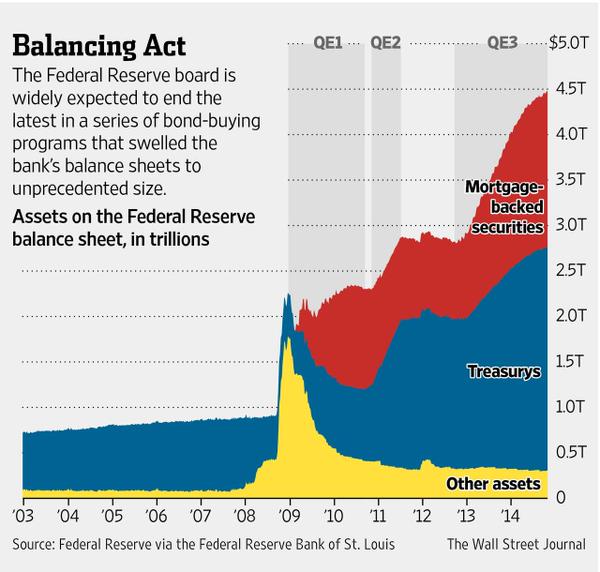
“Since the Dodd-Frank Act has added maintaining financial stability to the Fed’s existing dual mandate to achieve maximum sustainable employment in the context of price stability, it might be beneficial to have several tools to achieve multiple policy objectives.” In response to the financial crisis and its aftermath, the Fed has held short-term interest rates near zero since December 2008. It also has purchased trillions of dollars-worth of Treasury and mortgage-backed securities to hold down long-term rates in hopes of spurring stronger economic growth. It’s portfolio of assets is now about $4.5 trillion, up from less than $1 trillion before the crisis. The Fed has stopped buying assets but is maintaining the size of its balance sheet by reinvesting the payments of principal on the bonds it holds.

Fed Chairwoman Janet Yellen told the Senate Banking Committee in February the central bank had no plans to reduce the portfolio through asset sales. The Fed intends at some point to let the balance sheet shrink gradually by ceasing the reinvestment process, she said. The Fed’s long-run intention is to hold “no more securities than necessary for the efficient and effective implementation of monetary policy,” she added. But Ms. Barnes says the Fed should be open to buying more bonds in the future if necessary to influence interest rates and to maintaining a large balance sheet. “Having more than just one primary policy tool confers greater flexibility and may allow the Fed to better fulfill what are now its three policy goals,” the author writes.
Read more …

What’s worse than stupid?

• Why Wall Street Is Scoffing At ‘Flash Crash’ Bust (CNBC)

In arresting Navinder Sarao this week and charging him with manipulating markets, regulators indicated they’d gotten to the bottom of 2010’s “flash crash.” Many on Wall Street, though, believe the work is only starting. That’s probably a gentle way of stating the Street’s reaction to Sarao’s arrest Tuesday. Many pros openly scoffed at the notion that Sarao was the sole culprit of the spectacular plunge on May 6, 2010. On that day, the Dow industrials rapidly lost about 600 points, taking the average down nearly 1,000 points on the session, only to rebound within a matter of minutes. According to separate indictments, Sarao masterminded a scheme in which he was able to send orders to the market that he had no intention of executing, a practice called “spoofing” that caused a market plunge on which Sarao capitalized.

The practice happened within minutes of the crash and was a direct cause of it, according to regulators. Authorities allege he acted mostly alone rather than as part of a large, sophisticated operation. However, many experts believe the explanation is at least an oversimplification and at most an intent to deflect attention away from more fundamental weaknesses in the financial markets. “The real issue here is that markets have dramatically changed over the past two decades but regulators have not kept up,” Joe Saluzzi and Sal Arnuk, who run Themis Trading and have been ardent supporters of changes to market structure, said in a blog post Thursday. “While technology has increased efficiency and brought down trading costs, it has also changed the way traders access the markets.”

Read more …

” Shockingly, the SEC appeared in front of Congress claiming it has everything under control, when it now admits it never even looked at spoofing.”

• The Flash Crash Patsy and The ‘Mass Manipulation Of High Frequency Nerds’ (ZH)

There are several notable items in Bloomberg’s comprehensive overnight summary of the epic humiliation America’s market regulators are about to undergo, complete with yet another round of theatrical Congressional kangaroo courts, which will lead to a lot of red faces, a wrist slap or two and maybe even the termination of one or two lowly employees and… nothing else. Because what difference does it make? At this point only a bottom-up overhaul can “fix” the fragmented, broken market which by definition can only come after the next market crash, one which will promptly be blamed on HFTs (which leaving the central bankers unscathed). Back to the Bloomberg piece in which we first discover that it wasn’t even the CFTC that, 5 years later, “figured out” the flash crash was one person’s fault:

When Washington regulators did a five-month autopsy in 2010 of the plunge that briefly erased almost $1 trillion from U.S. stock prices, they didn’t even consider whether it was caused by individuals manipulating the market with fake orders. Their analysis was upended Tuesday with the arrest of Navinder Singh Sarao — a U.K.-based trader accused by U.S. authorities of abusive algorithmic trading dating back to 2009. Even that action was spurred not by regulators’ own analysis but by that of a whistle-blower who studied the crash, according to Shayne Stevenson, a Seattle lawyer representing the person who reported the conduct.

Your tax money not at work. But fear not: after today’s Deutsche Bank $2.5 billion “get out of jail” card, the CFTC will be $800 million richer and can finally even afford to hire a former trader who has some understanding of how the market works. [..] Second, the reason why the SEC wrote a 104-page report with “findings explaining the Flash Crash” which it will have no choice but to retract in light of the latest news and developments, is the following:

Spoofing wasn’t even part of the CFTC’s analysis of the crash, said James Moser, a finance professor at American University who was the agency’s acting chief economist in May 2010. The flash-crash review marked the first time that the agency worked through the CME’s massive order book. CFTC officials often needed to call the exchange for help interpreting the data, he said in an interview. “We didn’t look for any sort of spoofing activity,” said Moser, who added that he doubts that Sarao’s activity was the main cause of the crash. “At that point in 2010, that wasn’t high on the radar, at least in our minds.”

So the CME, which is the exchange that trades the E-mini, “concluded within four days of the 2010 flash crash that algorithmic trading on futures exchanges didn’t exacerbate losses in the market,” and a few months later, so did the SEC, which instead pinned the entire crash on Waddell & Reed. And the way it did it was by completely ignoring about 99% of all posted quotes: the layered and rapidly canceled trades or what we dubbed “quote stuffing” one whole month after the Flash Crash, in June. In fact we even explained it to anyone who cared to listen: “How HFT Quote Stuffing Caused The Market Crash Of May 6, And Threatens To Destroy The Entire Market At Any Moment.” Shockingly, the SEC appeared in front of Congress claiming it has everything under control, when it now admits it never even looked at spoofing.

Read more …

“..there’s no way they didn’t know about this; You cannot miss it; it really is that easy.”

• Financial Experts Cast Doubt On Case Against ‘Flash Crash Trader’ (Guardian)

Financial experts have raised questions about how a 36-year-old Londoner could have almost single-handedly caused the 2010 “flash crash” that wiped billions off the value of US stocks in seconds. Navinder Singh Sarao, 36, from Hounslow, west London, appeared in court in the UK on Wednesday charged with crimes the Department of Justice believes helped cause the Dow Jones industrial average to plunge 600 points in five minutes, wreaking havoc on Wall Street. The DoJ and Commodity Futures Trading Commission (CFTC) have accused Sarao of multiple charges of wire fraud, commodities fraud and market manipulation, and are seeking his extradition to the US.

US authorities have offered several explanations for the flash crash, which rattled stock markets worldwide. Sarao’s arrest comes five years after the SEC and CFTC’s official report said the crash was caused in part by an automated sale algorithm at a mutual fund, widely identified as Waddell Reed. There was no mention in the report of Sarao, or an unidentified individual trader that could have been Sarao. Eric Hunsader, chief executive of financial data company Nanex which monitors all market trades, said it was very unlikely that a single trader could have caused the crash – and questioned why it had taken so long for the authorities to discover Sarao’s suspect trades.

“I think he’s a small fish, it’s really disappointing to see the Justice Department laying the blame on a small guy, [it is as if] they are afraid of the big players,” he told the Guardian. “I don’t think they thought this through. If one guy can do this what [could] a well capitalised country or terrorists do? The only thing preventing him from causing total destruction was fear of getting caught. A terrorist wouldn’t have that fear.” Hunsader said trade data also showed that Sarao’s trading algorithm was switched off two minutes before the crash which started at 14:42:44 on 6 May 2010. “The CTFC had audit trail data [at the time of the report], there’s no way they didn’t know about this,” Hunsader said. “You cannot miss it; it really is that easy.”

Read more …

“..working backward to the present. The result of this method, in our government’s opinion, is an “austerity trap.”

• A New Deal for Greece (Yanis Varoufakis)

Three months of negotiations between the Greek government and our European and international partners have brought about much convergence on the steps needed to overcome years of economic crisis and to bring about sustained recovery in Greece. But they have not yet produced a deal. Why? What steps are needed to produce a viable, mutually agreed reform agenda? We and our partners already agree on much. Greece’s tax system needs to be revamped, and the revenue authorities must be freed from political and corporate influence. The pension system is ailing. The economy’s credit circuits are broken. The labor market has been devastated by the crisis and is deeply segmented, with productivity growth stalled.

Public administration is in urgent need of modernization, and public resources must be used more efficiently. Overwhelming obstacles block the formation of new companies. Competition in product markets is far too circumscribed. And inequality has reached outrageous levels, preventing society from uniting behind essential reforms. This consensus aside, agreement on a new development model for Greece requires overcoming two hurdles. First, we must concur on how to approach Greece’s fiscal consolidation. Second, we need a comprehensive, commonly agreed reform agenda that will underpin that consolidation path and inspire the confidence of Greek society. Beginning with fiscal consolidation, the issue at hand concerns the method.

The “troika” institutions have, over the years, relied on a process of backward induction: They set a date (say, the year 2020) and a target for the ratio of nominal debt to national income (say, 120%) that must be achieved before money markets are deemed ready to lend to Greece at reasonable rates. Then, under arbitrary assumptions regarding growth rates, inflation, privatization receipts, and so forth, they compute what primary surpluses are necessary in every year, working backward to the present. The result of this method, in our government’s opinion, is an “austerity trap.” When fiscal consolidation turns on a predetermined debt ratio to be achieved at a predetermined point in the future, the primary surpluses needed to hit those targets are such that the effect on the private sector undermines the assumed growth rates and thus derails the planned fiscal path.

Indeed, this is precisely why previous fiscal-consolidation plans for Greece missed their targets so spectacularly. Our government’s position is that backward induction should be ditched. Instead, we should map out a forward-looking plan based on reasonable assumptions about the primary surpluses consistent with the rates of output growth, net investment, and export expansion that can stabilize Greece’s economy and debt ratio. If this means that the debt-to-GDP ratio will be higher than 120% in 2020, we devise smart ways to rationalize, re-profile, or restructure the debt – keeping in mind the aim of maximizing the effective present value that will be returned to Greece’s creditors.

Read more …

Greece already has. The ‘partners’ just haven’t accepted it.

• Greece Can Still Put Together Deal Before Money Runs Out: Eurozone (Guardian)

There is still time for Greece to stitch together a deal with Brussels before it runs out of money, according to eurozone finance ministers speaking privately at last week’s International Monetary Fund spring conference. And the betting must be that crisis-plagued Athens will eventually find a way to retain its membership of the eurozone with a messy compromise. But the odds are getting slimmer with every passing week. On Friday, finance minister Yanis Varoufakis meets his counterparts in the Latvian capital Riga in what many analysts believe is the penultimate gathering to work out a deal before Athens’s coffers run dry.

With only an outline sketch of an agreement on the table, many of Europe’s most senior policymakers are of the opinion that a crisis point will be reached and Athens’s radical left Syriza government will be forced to either capitulate to Brussels or quit the euro. Tsipras said on Thursday that a deal was close, contradicting an IMF statement that it had only just started to discuss a methodology for talks with the aim of slimming down the number of reforms required from double figures to nearer five. Until this week Varoufakis has worked to a longer timetable than the one set out by the eurogroup of finance ministers. While they want a deal tied down in May, Varoufakis has insisted he has until June.

That’s not just a ruse to buy more time. It is a more fundamental difference over what to discuss and what kind of agreement will stabilise Greek finances and provide the best long term solution for the currency union. As Varoufakis said last week: “Greece wants time … to persuade our partners, especially in northern Europe, that this government does not want to go back to the profligacy of recent years. And they need to persuade us that they do not want to impose a programme … that has failed.”

Read more …

And it’s not, you can count on that.

• Varoufakis Tells Magazine: Grexit No Bluff If More Austerity Imposed (Reuters)

The risk that Greece would have to leave the euro if it has to accept more austerity is no bluff, Greek Finance Minister Yanis Varoufakis told a French magazine, saying that no one could predict what the consequences of such an exit would be. In a conversation with philosopher Jon Elster conducted at the end of March and published in France’s Philosophie Magazine, Varoufakis, a specialist in game theory, said this was not the time to bluff over Greece’s debt talks. “We cannot bluff anymore. When I say that we’ll end up leaving the euro, if we have to accept more unsustainable austerity, this is no bluff,” Varoufakis is quoted as saying.

Greek PM Alexis Tsipras called for a speeding up of work to conclude a reform-for-cash deal with euro zone creditors to keep his country afloat after talks with German Chancellor Angela Merkel on Thursday. The leftist Greek premier met the conservative German leader a day before euro zone finance ministers meet in Riga to review progress – or the lack of it – in slow-moving negotiations between Athens and its international lenders. The Greek government has insisted it will remain a euro zone member, and its currency bloc partners have said they want it to stay.

However, in contrast to the height of the debt crisis in 2012, when Grexit fears spurred panic selling of other weak euro zone sovereigns, investors now seem relaxed about the fate of Greece, which accounts for just 2% of the region’s economy. Asked what would happen if Greece was to leave the euro, Varoufakis mentioned comments made by European policymakers who say any contagion effect could be avoided and added that, on the contrary, he believed the consequences would be unpredictable. “Anyone who pretends they know what would happen the day we’ll be pushed over the cliff is talking nonsense and is working against Europe,” he said.

Read more …

This is what Syriza is all about.

• Greek Bank Offers Up To €20,000 Relief To Poverty-Stricken Borrowers (Reuters)

Piraeus Bank will write off credit cards and retail loans up to €20,000 for Greeks who qualify for help under a law the leftist government passed to provide relief to poverty-stricken borrowers, it said on Thursday. Greece has received two EU/IMF bailouts totalling €240 billion since it was hit by a debt crisis. The austerity programme imposed as a condition of the rescue has left one in four people out of work, and thousands struggling to pay debts. The Syriza party was elected in January on a promise to end the belt-tightening. Its first legislative act was to pass a bill offering free food and electricity to thousands of struggling Greeks. Piraeus said it would also write off interest on mortgages for qualifying borrowers, but did not provide details on how many people might benefit.

Read more …

He knows the answer in advance, but the motions need to be gotten through..

• Alexis Tsipras Seeks Interim Deal For Greece In Talks With Merkel (Guardian)

Greece’s increasingly desperate financial state was highlighted on Thursday when the country’s prime minister Alexis Tsipras urged the German chancellor Angela Merkel to use her influence to speed up deadlocked negotiations over a new aid package. Amid signs that the long-running talks between Athens and its creditors are having a dampening effect on the eurozone economy, Tsipras used a meeting with Merkel in Brussels to seek an interim deal by the end of the month that would provide money in return for a Greek commitment to reform. The conversation between Tsipras and Merkel came on the fifth anniversary of Greece’s first call for a financial bail out, and raised hopes in the financial markets that a deal could be done before the stricken eurozone country ran out of money to pay pensions, salaries and debts to the IMF.

Shares in Athens rose by 2.4% after falling to a three-year low on Wednesday while interest rates (the yield) on two-year Greek bonds fell from 27.6% to 25.5%. A Greek official said the meeting between Tsipras and Merkel took place in a “positive and constructive atmosphere” and expressed confidence that a deal was close. The official gave no details of the discussion but said: “During the meeting, the significant progress made since the Berlin meeting until today was noted. The prime minister asked that the procedures be speeded up so that the 20 Feb decision, which foresees a first interim agreement by the end of April, be implemented.”

An interim deal would give Greece some of the money it needs to meet its €2bn wages and pensions bill on 30 April, and to make two payments to the IMF totalling €970m in early May. But the mood among European Commission officials was less upbeat, with Brussels sources saying that the refusal of Athens to provide information meant little real progress had been made. It had been hoped that a meeting of finance ministers from the 18-strong eurozone would sign off a new package of help for Greece when it meets in Riga on Friday. That, though, has proved impossible, prompting speculation that Greece is moving closer to a debt default that could eventually lead to its departure from the eurozone.

Read more …

It doesn’t get emptier than this: “Europe is declaring war on smugglers..”

• EU Leaders Show Plan To Thwart Mediterranean Migration Wave (CNBC)

European Union leaders Thursday pledged to step up efforts to try to stem a wave of deadly migration across treacherous Mediterranean waters that has claimed hundreds of lives in just the past week. But the plan to thwart the lucrative smuggling trade faces huge political and economic obstacles, as millions of refugees in war-torn and impoverished nations seek better lives in Europe. “There is such a mass of people who are disposed at any cost to leave and come with the prospect of jobs or liberty and a better future,” said Marianna Vintiadis, who heads the Italian office of Kroll Associates, a risk management consultancy. “They’re spending 15 to 20 times the price of a plane ticket to make the most atrocious journey of their lives.”

A draft of the plan obtained by The Associated Press includes a pledge by the 28-nation bloc to double its spending on search and rescue operations to save lives, as well as to seize and destroy vessels used for human smuggling before they leave shore. British Prime Minister David Cameron committed his country’s navy flagship, HMS Bulwark, along with three helicopters and two border patrol ships to the EU effort. Germany reportedly pledged to send a troop supply ship and two frigates to assist in the effort. Belgium and Ireland also offered to deploy navy ships. The stepped-up efforts to halt a lethal wave of northward migration come as search and rescue operations have brought hundreds of bodies ashore in a series of deadly shipwrecks carrying migrants seeking passage to Europe.

The immigrant wave is being driven by strong demand for passage from people fleeing civil unrest, persecution or chronic unemployment in their home countries. “Europe is declaring war on smugglers,” AP quoted the EU’s top migration official, Dimitris Avramopoulos, who was in Malta to attend the funeral of 24 migrants who perished at sea.Italy’s proximity to Africa has made it another favored smuggling route. Italian ships recently rescued some 10,000 migrants in a single week, according to the IOM, bringing the total number of migrants reaching Italian shores to more than 21,000 so far this year. In 2013, more than 26,000 migrants arrived through April 30, the IOM said, citing the Italian Ministry of Interior figures.

Though northern African ports are popular transit points, millions of refugees are making their way from trouble spots across the continent, according to data collected by the United Nations High Commissioner for Refugees. Many more are displaced in their home country, unable to flee or seek asylum abroad.

Read more …

If you’re big, you get a BIG stagnation. And then you die.

• France Declared “Lost In Stagnation” (Telegraph)

The French economy remained a blot on the eurozone’s economic landscape in April, as leading surveys of the private sector showed the country lagging the pack. Closely-followed indicators for France revealed that the country’s private sector growth slowed this month. The all-sector purchasing managers’ index (PMI) slipped from March’s 51.5 to 50.2, according to preliminary estimates compiled by Markit. Any number above 50 would imply that the private side of the economy was growing, a threshold the French index narrowly managed to remain above. While the currency bloc’s other large economies enjoyed stronger scores, analysts at French banks declared that the country was still limp. Frederik Ducrozet, an economist at Crédit Agricole, said that France was “still lost in stagnation”. Ken Wattret, of BNP Paribas, said that the reading “looks very disappointing”.

Both the manufacturing and services components of the French PMI fell in April, to 48.4 and 50.8 respectively, as the country’s industrial sector continues to shrink. Jack Kennedy, an economist at Markit, said: “Output growth stuttered almost to a halt in April, signalling a continuation of the moribund economic environment.” The data came as Benoit Coeure, a European Central Bank (ECB) board member, said that: “The eurozone recovery is clearly there.” The PMI for the entire eurozone came in at 53.5 in April, 0.5 points weaker than March’s reading. The euro stumbled against the dollar, dropping by 0.4pc as the euro’s nascent revival appeared slightly weaker. Mr Coeure said that “growth is coming back” but that at present the recovery has been “insufficient and somewhat unequally spread from country to country”.

Jessica Hinds, an economist at Capital Economics, said that the fall “suggests that fears over Greece might already be starting to dampen growth in the region”. She added: “The PMI for the region as a whole suggests that the region’s economic recovery failed to gain momentum at the start of the second quarter.” Chris Williamson, Markit’s chief economist, said: “The weaker rate of expansion is a big disappointment, given widespread expectations that the European Central Bank’s QE will have boosted the fledgling recovery seen at the start of the year.” However, he cautioned that it was too early to say that euro area growth was faltering again. “The slowdown in April was in fact therefore a symptom of weaker expansions in both Germany and France,” he said.

Read more …

“The freight train of North American tight oil has just kept on coming. This is a classic price discovery exercise..”

• Oil Slump May Deepen As US Shale Fights OPEC To A Standstill (AEP)

The US shale industry has failed to crack as expected. North Sea oil drillers and high-cost producers off the coast of Africa are in dire straits, but America’s “flexi-frackers” remain largely unruffled. One starts to glimpse the extraordinary possibility that the US oil industry could be the last one standing in a long and bitter price war for global market share, or may at least emerge as an energy superpower with greater political staying-power than OPEC. It is 10 months since the global crude market buckled, turning into a full-blown rout in November when Saudi Arabia abandoned its role as the oil world’s “Federal Reserve” and opted instead to drive out competitors. If the purpose was to choke the US “tight oil” industry before it becomes an existential threat – and to choke solar power in the process – it risks going badly awry, though perhaps they had no choice.

“There was a strong expectation that the US system would crash. It hasn’t,” said Atul Arya, from IHS. “The freight train of North American tight oil has just kept on coming. This is a classic price discovery exercise,” said Rex Tillerson, head of Exxon Mobil, the big brother of the Western oil industry. Mr Tillerson said shale producers are more agile than critics expected, which means that the price war will go on. “This is going to last for a while,” he said, warning that any rallies are likely to prove false dawns. The US “rig count” – suddenly the most-watched indicator in global energy – has fallen from 1,608 in October to 747 last week. Yet output has to continued to rise, stabilizing only over the past five weeks.

Mr Tillerson said this is more or less what happened in the sister market for US shale gas. In 2009, some 1,200 rigs produced 5.5bn cubic feet (bcf) of gas per day at a market price near $8. Today the price is just $2.50. Nobody would have believed back then that the industry would continue boosting supply to 7.3 bcf, and be able to do so with just 280 rigs. “Will we see the same phenomenon in five years in tight oil? I don’t know, but this is a very resilient industry. I think people will be surprised,” Mr Tillerson said, speaking at the IHS CERAWeek forum in Houston. “We’ve really only begun to scratch the surface. Shale can keep growing by 500,000 to 700,000 b/d easily,” said Harold Hamm, founder of Continental Resources. His company has cut costs by 20pc to 25pc over the past four months.

Read more …

Man will kill itself while looking for better man.

• Chinese Scientists Edit Genes of Human Embryos (NY Times)

The experiment with human embryos was dreaded, yet widely anticipated. Scientists somewhere, researchers said, were trying to edit genes with a technique that would permanently alter the DNA of every cell so that any changes would be passed on from generation to generation. Those concerns drove leading researchers to issue urgent calls in major scientific journals last month to halt such work on human embryos, at least until it could be proved safe and until society decided if it was ethical. Now, scientists in China report that they tried it. The experiment failed, in precisely the ways that had been feared.

The Chinese researchers did not plan to produce a baby — they used defective human embryos — but did hope to end up with an embryo with a precisely altered gene in every cell but no other inadvertent DNA damage. None of the 85 human embryos they injected fulfilled those criteria. In almost every case, either the embryo died or the gene was not altered. Even the four embryos in which the targeted gene was edited had problems. Some of the embryo cells overrode the editing, resulting in embryos that were genetic mosaics. And speckled over their DNA was a sort of collateral damage – DNA mutations caused by the editing attempt.

“Their study should give pause to any practitioner who thinks the technology is ready for testing to eradicate disease genes during I.V.F.,” said Dr. George Q. Daley, a stem cell researcher at Harvard, referring to in vitro fertilization. “This is an unsafe procedure and should not be practiced at this time, and perhaps never.” David Baltimore, a Nobel laureate molecular biologist and former president of the California Institute of Technology, said, “It shows how immature the science is,” adding, “We have learned a lot from their attempts, mainly about what can go wrong.”

Read more …

Which individual manager paid what though? If they didn’t pay a dime, how are they not going to do the same thing all over again?!

• Deutsche Bank Hit By Record $2.5 Billion Libor-Rigging Fine (Guardian)

Germany’s Deutsche Bank has been fined a record $2.5bn for rigging Libor, ordered to fire seven employees and accused of being obstructive towards regulators in their investigations into the global manipulation of the benchmark rate. The penalties on Germany’s largest bank also involve a guilty plea to the Department of Justice (DoJ) in the US and a deferred prosecution agreement. The regulators released a cache of emails, electronic messages and phone calls showing the attempts to move the rate used to price £3.5tn of financial contracts. “I’m begging u pleassssseeeee I’m on my knees” is among the examples provided by regulators in hundreds of pages of detail accompanying the fine – the eighth related to rigging interest rates.

Another trader, on learning a rate was unchanged, sent a message saying: “Oh bullshit…..strap on a pair and jack up the 3M (month). Hahahahaha.” . Georgina Philippou, the acting director of enforcement and market oversight at the Financial Conduct Authority, said the UK’s portion of the fine – £227m – was a record for Libor because the bank had been misleading the regulator. The manipulation took place to generate profits and was pervasive, the FCA said. “This case stands out for the seriousness and duration of the breaches by Deutsche Bank – something reflected in the size of today’s fine. One division at Deutsche Bank had a culture of generating profits without proper regard to the integrity of the market. This wasn’t limited to a few individuals but, on certain desks, it appeared deeply ingrained,” she said.

“Deutsche Bank’s failings were compounded by them repeatedly misleading us. The bank took far too long to produce vital documents and it moved far too slowly to fix relevant systems and controls,” said Philippou. The German bank had said on Wednesday that it would still remain profitable in the first quarter when it reports results next week before a major restructuring that could involve the bank pulling back from the high street. For the first time in a Libor-rigging settlement, New York state’s Department of Financial Services (NYDFS) was involved and it ordered the bank to sack seven employees – one managing director, four directors and one vice-president, all based in London, together with one Frankfurt-based vice-president. The bank immediately took action to comply with this demand.

Read more …

It somehow seems fitting: “100,000 years of life lost due to premature death”. “First, the government closed the services,” wrote Tammy Solonec of Amnesty International, “It closed the shop, so people could not buy food and essentials. It closed the clinic, so the sick and the elderly had to move, and the school, so families with children had to leave, or face having their children taken away from them. The police station was the last service to close, then eventually the electricity and water were turned off. ”

• The Secret Country Again Wages War On Its Own People (John Pilger)

Australia has again declared war on Indigenous people, reminiscent of the brutality that brought global condemnation on apartheid South Africa. Aboriginal people are to be driven from homelands where their communities have lived for thousands of years. In Western Australia, where mining companies make billion dollar profits exploiting Aboriginal land, the state government says it can no longer afford to “support” the homelands. Vulnerable populations, already denied the basic services most Australians take for granted, are on notice of dispossession without consultation, and eviction at gunpoint. Yet again, Aboriginal leaders have warned of “a new generation of displaced people” and “cultural genocide”.

Genocide is a word Australians hate to hear. Genocide happens in other countries, not the “lucky” society that per capita is the second richest on earth. When “act of genocide” was used in the 1997 landmark report Bringing Them Home, which revealed that thousands of Indigenous children had been stolen from their communities by white institutions and systematically abused, a campaign of denial was launched by a far-right clique around the then prime minister John Howard. It included those who called themselves the Galatians Group, then Quadrant, then the Bennelong Society; the Murdoch press was their voice. The Stolen Generation was exaggerated, they said, if it had happened at all. Colonial Australia was a benign place; there were no massacres.

The First Australians were victims of their own cultural inferiority, or they were noble savages. Suitable euphemisms were deployed. The government of the current prime minister, Tony Abbott, a conservative zealot, has revived this assault on a people who represent Australia’s singular uniqueness. Soon after coming to office, Abbott’s government cut $534 million in indigenous social programmes, including $160 million from the indigenous health budget and $13.4 million from indigenous legal aid. In the 2014 report Overcoming Indigenous Disadvantage Key Indicators, the devastation is clear. The number of Aboriginal people hospitalised for self-harm has leapt, as have suicides among those as young as eleven.

The indicators show a people impoverished, traumatised and abandoned. Read the classic expose of apartheid South Africa, The Discarded People by Cosmas Desmond, who told me he could write a similar account of Australia. Having insulted indigenous Australians by declaring (at a G20 breakfast for David Cameron) that there was “nothing but bush” before the white man, Abbott announced that his government would no longer honour the longstanding commitment to Aboriginal homelands. He sneered, “It’s not the job of the taxpayers to subsidise lifestyle choices.”

Read more …

“One just needs to look at the nations involved in pushing against Gazprom’s supposedly monopolistic practices: Lithuania, Estonia, Bulgaria, Czech Republic, Hungary, Latvia, Slovakia and Poland.”

• The EU-Gazprom War (Pepe Escobar)

The European Commission is slapping anti-trust charges against Russia’s Gazprom under the pretext the energy giant is blocking competition in Central and Eastern Europe. This is yet another graphic example of the extreme politicization involving what should have been Europe’s energy policy. There is no such policy – even after virtually a decade of “discussions” inside that glassy Kafkaesque Brussels nightmare, the Berlaymont. The EC investigation started in September 2012. Why did it take the Berlaymont bureaucrats so long to reach an initial verdict? Simple; it’s always been about politics – not energy. One just needs to look at the nations involved in pushing against Gazprom’s supposedly monopolistic practices: Lithuania, Estonia, Bulgaria, Czech Republic, Hungary, Latvia, Slovakia and Poland.

With the exception of Hungary, all these are, or have been forced to act, anti-Russian. The argument that Gazprom is “dominant” and prevents competition is bogus; there’s no competition because there are no other viable energy sources for the European market. The Europeans should blame the US instead, for keeping a nasty package of sanctions on Iran for so long. But of course EU Competition Commissioner Margrethe Vestager would never do that. If Gazprom is finally ruled guilty, fines may be as steep as 10% of overall sales to Europe – which were the ruble equivalent of €93 billion ($100 billion) in 2013, according to the latest data. Vestager has been busy lately. She already formally charged Google with abusing its also “dominant” position. Yet another case of no European company able to compete with Google.

It will be fascinating to watch the reaction in US business circles. Bets can be made on plenty of outrage in the Google case contrasting with plenty of rejoicing in the Gazprom case. Gazprom supplies roughly a third of the EU’s gas; half of the gas transits Ukraine. As even a low-level IMF clerk knows, Kiev is not exactly keen on paying its gas bills. So Gazprom had to go to great lengths to try to get the fees due – even suspending the gas flow on occasion as Kiev would be rerouting gas meant for the EU for its own internal needs. Anyway failed state Ukraine, for Gazprom, is finished as a transit route. Gazprom CEO Aleksey Miller has already announced that will end by 2019. By then, all the action will be around Turkish Stream.

Read more …

“..the Americans’ secretiveness also comes in handy for Berlin. Not knowing anything officially prevents the government from having to take any action.”

• A War Waged From German Soil: US Ramstein Base Key in Drone Attacks (Spiegel)

Knowledge is power. Ignorance often means impotence. But sometimes ignorance can be comfortable, if it protects from entanglements, conflicts and trouble. This even applies to the German chancellor. In the heart of Germany’s Palatinate region — just a few kilometers from the city of Kaiserslautern — the United States maintains its largest military base on foreign soil. The base is best known as a hub for American troops making their way to the Middle East But another strategic task of the headquarters of the United States Air Force in Europe (USAFE) remained a national secret for years. Even the German government claimed to know nothing when, two years ago, the base became the subject of suspicion.

It was alleged that Ramstein is also an important center in President Barack Obama’s drone war against Islamist terror. A former pilot claimed that the data for all drone deployments is routed through the military base. The report caused quite a stir. Were the deadly precision weapons – which can eliminate al-Qaida terrorists, Taliban fighters or members of the Shabaab militia on the Horn of Africa with apparent clinical precision – guided toward their targets via German soil? No, the German government said at the time, that’s not quite correct. But even today, the government says it still has “no reliable information” about what exactly is going on. The United States has refused to provide it.

But the Americans’ secretiveness also comes in handy for Berlin. Not knowing anything officially prevents the government from having to take any action. Berlin’s comfortable position, though, could soon be a thing of the past. Classified documents that have been viewed by SPIEGEL and The Intercept provide the most detailed blueprint seen to date of the architecture of Obama’s “war on terror.” The documents, which originate from US intelligence sources and are classified as “top secret,” date from July 2012. A diagram shows how the US government structures the deployment of drones. Other documents provide significant insight into how operations in places like Somalia, Afghanistan, Pakistan or Yemen are carried out. And they show that a central – and controversial – element of this warfare is played out in Germany.

Read more …

Blow baby blow! What other way are they ever going to wake up?!

• Giant New Magma Reservoir Found Beneath Yellowstone (Smithsonian)

Enough hot rock sits beneath Yellowstone National Park to fill the Grand Canyon nearly 14 times over, according to our best view yet of the supervolcano that lies below the famous landscape. The first three-dimensional image of the inner workings of the Yellowstone supervolcano has revealed an 11,200-cubic-mile magma reservoir about 28 miles below the surface. A previously known 2,500-cubic-mile magma chamber sits above that, at about 12 miles deep. Both serve as conduits between a hotspot plume that may originate in the Earth’s core and the Yellowstone caldera at the planet’s surface.

“Every additional thing we learn about the Yellowstone volcanic system is one more piece in the puzzle, and that gets us closer to really understanding how the volcanic system works,” says study co-author Fan-Chi Lin of the University of Utah. “If we could better understand the transport properties of magmatic fluids, we could get a better understanding of the timing and, therefore, where we are in the volcanic cycle.” The Yellowstone hotspot plume has been producing eruptions for the last 17 million years.

Due to plate tectonics, Earth’s surface has moved over the hotspot, creating a track of ancient eruptions that stretches from the Oregon-Idaho-Nevada border—the site of the first eruption—to the Yellowstone caldera. Since the hotspot reached Yellowstone some 2 million years ago, the supervolcano has erupted three times, most recently about 640,000 years ago. The hotspot currently feeds the geysers, hot springs and steam vents that are part of the draw of Yellowstone National Park. The chance that the supervolcano will erupt anytime soon is low—only about 1 in 700,000 annually. But should there be another eruption, the supervolcano could spew some 640 cubic miles of debris, covering large swathes of North America in ash and darkening skies for days.

Read more …

Apr 172015
 
 April 17, 2015  Posted by at 12:48 am Finance Tagged with: , , , , , , , ,  4 Responses »


Lewis Wickes Hine Boys working in Phoenix American Cob Pipe Factory 1910

Yes, more Greece, ever more Greece. Well, the focus is still very much there. It’s not the only topic, obviously, China warrants interest too, certainly with things like Tyler Durden quoting Cornerstone Macro as saying China’s true economic growth rate was just 1.6% in Q1 2015, not the official government number of 7%. Never trust anyone, especially a government, that consistently meets or beats its predictions. With housing prices falling the way they have, -6% or thereabouts, and over 70% of Chinese private investment in real estate, it’s hard to see how a 7% GDP growth number could pass scrutiny. Sure, there’s the stock market bubble, but even then.

But for now back to Athens. Or Washington, actually, where Yanis Varoufakis finds himself. From what we can gather on his schedule, Varoufakis has (or has had) meetings with Obama and Lagarde on Thursday, and with Mario Draghi, Jack Lew and Wolfgang Schaeuble on Friday.

Also on Friday, he’s meeting sovereign debt lawyer Lee Buchheit, who’s a partner at New York law firm Cleary Gottlieb [..Steen & Hamilton], and has helped restructure debt for various countries. The Guardian, back in 2013 (how times have changed!), portrayed Buchheit as the ‘fairy godmother to finance ministers in distress’:

This is the man who stands up to the vulture funds – so named because they buy up the debt of desperately poor countries in order to chase them through the courts for repayment. So it is something of a surprise to meet a slight, mild-mannered lawyer, with more than a whiff of academia about him.

He insists he does not make a moral judgement in choosing who he acts for, but rather enjoys working for the debtor nations. “It’s just more fun,” he says. “If you represent the lender, your client is tiresomely saying things to you like, ‘Why don’t they just pay us the money back?’ When you’re on the debtor side, you can say, ‘If you want to get it back, why did you give it to us?’“

In view of that last quote, it may be wise to once again reiterate that only about 8% of the bailout funds Athens is now on the hook for, actually went to Greece; the other 92% was used to save major European and American banks. As I said before, this has been a political decision, not an economic one. In that vein , we can take a look at the following from John Ward at the Slog, dated March 26:

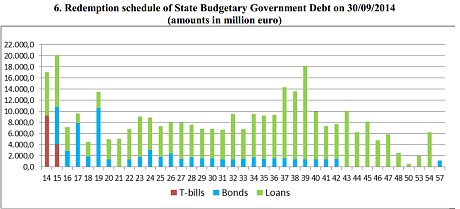
At this link is an official EU release whose sole concern is the subject of ‘contingent liabilities’ entered into by EU member states. [..] the EU release in this instance contains some blockbuster facts….and adds another piece to the eurozone jigsaw of hypocritical mendacity. Contingent liabilities are often referred to as Shadow Debt: if you’re lucky, they won’t become an eventuality. But as the EU table shows, given the parlous nature of the ezone banking sector, every one of the liabilities is a racing certainty.

We’ve all been asking why Germany ignored the EC bailin directive last week and bailed out a small Bavarian Bank. The answer is simple: not to do so would’ve been illegal under BundesRepublik law, because Berlin had promised so to do. On this basis, while at first sight German national debt is a ‘mere’ 70% of GDP, add the promises it has made to its banks, and the number comes in at a horrific 222%. Not far behind comes the Netherlands with a similar ‘official’ national debt at 73% of GDP. But the contingent liabilities are 115%…making a pretty nasty mountain of 188%.

The Number One and Number Two top contingent liability millstones in the EU are – by miles – Germany and the Netherlands. Now let me see…who are the two chaps working hardest to stop the Greeks and their contagious banks from going their own way? Why, none other than German finance minister Wolfgang Schäuble, and Dutch finance minister Jeroen René Victor Anton Dijsselbloem. The third prong of Troika2 is of course the ECB’s Italian Mario Draghi. Without any contingencies at all, Italy’s national debt is 132.6% of GDP. Add its 45.5% of contingents, and this too adds up to 178.1% of GDP.

Before you know it, things are no longer what they seem. If you were Lee Buchheit, you might want to argue that Greece is being thrown to the lions and the wolves because Germany and Holland bailed out their bankrupt banking systems, and vowed to keep doing it.

That would make it very hard to imagine them saving Greece today, since to do that, they would risk their own banks, which they bailed out with trillions of their own taxpayers’ money. It would be political suicide. It’s much easier to tell those taxpayers that it’s Greece that’s at fault, not their own heroic leaders (I say heroic because that’s how Bernanke portrays himself in his ‘Courage to Act’ fictional fluff).

So when, oh when, could the Grexit come? Daniel Roberts at Raas Consulting thinks he might have part of the answer:

Why The Grexit Is Inevitable – and some singing PIGS

One thing in common for almost all of my Pinewood International Schools (TiHi to some) class of ’78 is that we left. Many still live in Greece and in Thessaloniki or have returned, and they are closest to the pain. The real pain of the past decade, that has destroyed wealth and hope. Unemployment is running at levels not see in Europe since after the war, and at levels that encouraged the socialist-fascist civil wars of the 1930s. Those did not end well.

But that does not explain why the Grexit is inevitable, and why it will happen very soon.
1) This is what the Greek people voted for. No, they did not vote to stay in the Euro, they voted for the party that said it would reduce the debt and meet pension obligations. The Greek people and voters are not stupid. They knew this could only happen by either the rest of Europe bailing out Greece again, or by leaving the Euro.
2) The Greek people know perfectly well that Europe is not going to bail them out, because to do so will only set everyone up for the next bailout.
3) The Greek people, and the rest of Europe, know full well that the debt will never be repaid, and that the Troika are now acting as nothing better than the enforcers of loan sharks.
4) Syriza knows that it had six months before the voters would throw them out, and once out, Syriza would never come back.
5) The Greeks needed to show “good faith” in actually attempting to negotiate a resolution with the Troika. This has now been done, and is failing.
6) The demand for reparations from Germany is designed not to actually extract the reparations, but to anger the Germans to the point that they will block any compromise that Syriza would have been required to accept.

The Greek government, elected by a battered and exploited Greek people, has been establishing the conditions that will give them the moral high ground (in the eyes of their voters) needed to actually leave the Euro. Having set the conditions, when will it happen? I’m still guessing May 9th. Why? Greece will leave the Euro, and they will do it sooner than later. They’ve made the April payment, but simply do not have the money for the May or June payments, and they cannot pass the legislation required by Europe and the Germans and stay in power. That gives us a late May or June date. So why earlier?

Capital flight. Imposing currency controls will be a fundamental element of any Grexit. Accounts will be frozen, and any money in accounts will be re-denominated in New Drachmas. Once the bank accounts are unfrozen, the residual, former Euros will now be worth whatever the New Drachma has dropped to, and the drop will be significant, over–correcting to the downside. Once it is accepted that the Grexit is coming and there will be no last minute deal, and with memories of Cyprus too fresh in every Greek’s mind, the money will flow out of the country. Not just corporate money (most of which is probably off-share already) but any remaining personal money in bank accounts. So Greece has to move before the coming Grexit is perceived as inevitable, and the money starts to flow out.

Weekend event. When the Grexit happens, it will be on a weekend. The banks will be closed, parliament will be called into emergency session, and a packet of laws will be passed. As this needs to be on a Saturday to avoid wholesale capital flight the moment that parliament is called into session, were it a weekday. This leaves only a few possible dates. And where there are few possible dates, I’m punting on the earlier date, so earlier in May. And looking at the calendar, that leaves us with May 2nd, 9th or 16th. My own guess is that the 2nd is too soon, and the 16th is too late. That leaves me guessing May 9th.

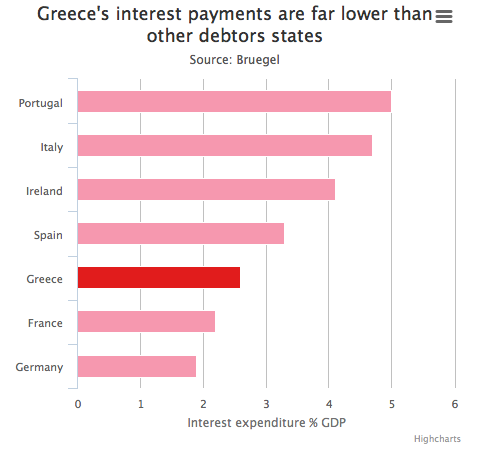
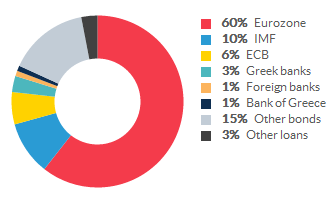
The top graph on the left side of my essay shows all Greek payments due until September. It comes down to about €13 billion in the next 5 months. The country is desperately waiting for a last €7.2 billion bailout tranche the lenders won’t pay out, but it wouldn’t even make that much difference. So when will the drama come to an end? Turning to the second graph, we see specifics. The next payments are:

• April 17 and 20: a combined total of €273.5 million in interest payments to the ECB.

• May 1: €195.1 million to the IMF.

• May 12: €744.9 million to the IMF.

It’s hard to see how Greece can even attempt to make that last payment. Let alone the €1.61 billion due in June (numbers on both graphs don’t add up exactly), or the billions after that.

The big questions concern not just the difference between on the one hand, economic issues and on the other, political ones. Syriza doesn’t have the mandate to take Greece out of the eurozone. That is a huge point. But neither does it have the mandate to give in to the troika’s insistence on pensions cuts. At a certain moment, it may come down to what can be explained to the Greek people, and how well it can be explained. This explanation will almost certainly have to come after the fact, since holding a referendum pre-Grexit would carry far too much potential risk of uncontrolled demolition of the entire Greek economy and banking system.

Tsipras and Varoufakis are not the most enviable people out there at the moment. They have hard choices to make. Still, in the end, running a society, a nation, or a union of nations, cannot be just a matter of balancing your books. That can never be your bottom line. You’re talking about real people, not mere entries in a ledger. Schaeuble and other European politicians keep bragging about the ‘success’ of Greek government policies before Syriza came to power, even as it’s been well documented that many Greek children go hungry and people have no access to health care. How is that a success?

That attitude may be the most valuable argument Syriza has available to it in its upcoming discussions with its voters. Whether these discussions take place before or after a Grexit is hard to say at this point. But Daniel Roberts’ reasoning towards a May 9 event certainly has some logic to it. We may still hope that the troika doesn’t put Syriza into a position of an impossible fork in the road, but right now it doesn’t look good, it looks like they’re getting ready to sacrifice Greece on their pagan altars.

To top off the cynicism involved Bloomberg runs an article today entitled Germany: Has Any Country Ever Had It So Good?. At the same time, a few hundred miles to the south east, children don’t have enough to eat. The European Union sure is a great place to be. What a success story! Pity it’s about to end.

Feb 212015


Russell Lee “Yreka, California. Magazine stand” 1942

• German-Led Bloc Willing to Let Greece Leave Euro: Malta (Bloomberg)
• A Lawyer’s Mindset Where An Economist’s Is Needed? (Steve Keen)
• Greece Should Not Give In to Germany’s Bullying (Legrain – Foreign Policy)
• Tentative Deal For Extension Agreed At Eurogroup (Kathimerini)
• The Euro’s Up In Smoke (Beppe Grillo)
• Eurozone Chiefs Strike Deal To Extend Greek Bailout For Four Months (Guardian)
• Greece Bends To Eurozone Will To Find Short-term Agreement (Open Europe)
• Greece’s Debt Deal Isn’t The End Of Eurozone Drama (MarketWatch)
• ECB’s Draghi Wants To Buy Bonds, But Who Will Sell? (Reuters)
• It’s Up To Germany To End The Game Of Chicken With Greece (Guardian)
• Is Greek PM Alexis Tsipras Going To Be Russia’s ‘Trojan Donkey’? (NewsCorp)
• Has Greece’s ‘Lehman Moment’ Finally Arrived? (CNBC)
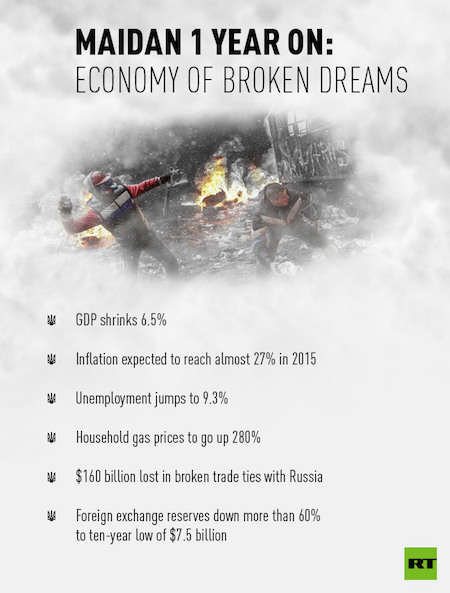
• Expectations And Reality: What Maidan Gave Ukraine’s Economy (RT)
• US Units of Deutsche Bank, Santander Likely to Fail Fed Stress Test (WSJ)
• The US Government’s Stupid Tax War On Expatriates (MarketWatch)
• NYC Could See 6-Foot Sea Rise By 2100 (NewsMaine)

“We are perfectly prepared to refrain from any moves that would jeopardize financial stability or Greek competitiveness..”

• German-Led Bloc Willing to Let Greece Leave Euro: Malta (Bloomberg)

Germany and its allies are ready to let Greece leave the euro unless Prime Minister Alexis Tsipras accepts the conditions required to extend his country’s financial support, according to Malta’s finance minister, Edward Scicluna. Greece’s creditors are cranking up the pressure on Tsipras as he seeks a deal to prevent his country defaulting on its obligations as early as next month. By bowing to German demands, the premier risks a domestic backlash from voters and party members whom he’s promised an end to austerity. “Germany, the Netherlands and others will be hard and they will insist that Greece repays back the solidarity shown by the member states by respecting the conditions,” Scicluna said in an interview. “They’ve now reached a point where they will tell Greece ‘if you really want to leave, leave.’”

Talks between euro-region finance ministers in Brussels Friday aimed at agreeing an extension of Greece’s aid program were pushed back by an hour and a half, the group’s chairman, Dutch Finance Minister Jeroen Dijsselbloem, said on Twitter. The meeting will begin at 4:30 p.m. Brussels time and Dijsselbloem will make a statement at 3 p.m.nIn a formal request on Thursday to extend Greece’s euro-area backed rescue beyond its end-of-February expiry for another six months, Greek Finance Minister Yanis Varoufakis said he would accept the financial and procedural conditions of the Germany’s Finance Ministry almost immediately rebuffed the latest Greek formula, saying the country needs to make a firmer commitment to austerity. A “positive” conversation between Tsipras and German Chancellor Angela Merkel later on Thursday sparked investor optimism for a deal.

“We are perfectly prepared to refrain from any moves that would jeopardize financial stability or Greek competitiveness,” Varoufakis said in an interview Friday with The Telegraph. “But what we cannot accept is that the fiscal adjustment, agreed by the last government, be carried through just because the rules say so.” Investors are pricing in a positive outcome to the Eurogroup meeting with Greek bonds and stocks rising for a third day.

Read more …

“..is there a way to frame the Greek case in a way that a lawyer might understand?”

• A Lawyer’s Mindset Where An Economist’s Is Needed? (Steve Keen)

A Twitter correspondent pointed out a simple fact that makes Schäuble’s inflexibility in negotiations with Varoufakis explicable: though he is a Minister of Finance, his PhD is in law. So is he implicitly approaching these negotiations as a lawyer would? Because from that point of view, what the Greeks are trying to do is to renege on a contract. And for a lawyer, changing the terms of a contract after you have signed it is a no deal. It’s either carry out the contract, or I’ll sue. Varoufakis, of course, is approaching the negotiations as an economist. From his point of view, the terms of the Troika’s package are a set of economic policies that have failed. And if policies have failed, the sensible economist tries different ones.

So did Greece sign a legal document, whose principles have to be adhered to, even if they have consequences the Greeks didn’t foresee when they signed? Or did Greece accept a set of economic policies, whose continuance should depend on whether those policies are achieving their intended objectives? There’s no doubt that the latter is the case. But if Schäuble is treating it as a legal treaty, then the fact that this is actually a set of failed economic policies, and not a legally binding treaty, won’t matter. He will refuse to “renegotiate the terms of the contract”. The negotiations will be such in name only.

So is there a way to frame the Greek case in a way that a lawyer might understand? Any contract involves consideration by each party to the other. In a contract of sale, the object being sold is the consideration from the seller; the money for the sale is the consideration from the buyer. So what is the consideration in this case? It is a combination of two things: the loans that were extended to the Greeks, and the Greeks carrying out an economic program which promised a set of economic outcomes—the key components of which are shown in Figure 1. These included that real economic growth would commence in 2012, and that unemployment would peak at 15.3% in 2012, and fall to 14.6% by 2014. [..]

Schäuble could then find himself repeating the whole process all over again, but this time with an opposite party who will delight in breaking agreements. He clearly hasn’t enjoyed negotiating with a leftwing academic economist who wears a leather jacket and wears his shirt outside his trousers. How, I wonder, will he enjoy negotiating with someone who prefers to wear jackboots?

Read more …

“Greece must be bled dry to service its foreign creditors in the name of European solidarity..”

• Greece Should Not Give In to Germany’s Bullying (Legrain – Foreign Policy)

Ever since the initial bargain in the 1950s between post-Nazi West Germany and its wartime victims, European integration has been built on compromise. So there is huge pressure on Greece’s new Syriza government to be “good Europeans” and compromise on their demands for debt justice from their European partners – also known as creditors. But sometimes compromise is the wrong course of action. Sometimes you need to take a stand. Let’s face it: no advanced economies in living memory have been as catastrophically mismanaged as the eurozone has been in recent years, as I document at length in my book, European Spring.

Seven years into the crisis, the eurozone economy is doing much worse than the United States, worse than Japan during its lost decade in the 1990s and worse even than Europe in the 1930s: GDP is still 2% lower than seven years ago and the unemployment rate is in double digits. The policy stance set by Angela Merkel’s government in Berlin, implemented by the European Commission in Brussels, and sometimes tempered – but more often enforced – by the ECB in Frankfurt, remains disastrous. Continuing with current policies — austerity and wage cuts, forbearance for banks, no debt restructuring or adjustment to Germany’s mercantilism — is leading Europe into the ditch; the launch of quantitative easing is unlikely to change that. So settling for a “compromise” that shifts Merkel’s line by a millimeter would be a mistake; it must be challenged and dismantled.

While Greece alone may not be able to change the entire monetary union, it could act as a catalyst for the growing political backlash against the eurozone’s stagnation policies. For the first time in years, there is hope that the dead hand of Merkelism can be unclasped, not just fear of the consequences and nationalist loathing. More immediately, Greece can save itself. Left in the clutches of its EU creditors, it is not destined for the sunlit uplands of recovery, but for the enduring misery of debt bondage. So the four-point plan put forward by its dashing new finance minister, Yanis Varoufakis, is eminently sensible.

This involves running a smaller primary surplus – that is a budget surplus, excluding interest payments – of 1.5% of GDP a year, instead of 3% this year and 4.5% thereafter. Some of the spare funds would be used to alleviate Greece’s humanitarian emergency. The crushing debts of more than 175% of GDP would be relieved by swapping the loans from eurozone governments for less burdensome obligations with payments tied to Greece’s GDP growth. Last but not least, Syriza wants to genuinely reform the economy, with the help of the Organization for Economic Cooperation and Development (OECD), notably by tackling the corrupt, clientelist political system, cracking down on tax evasion, and breaking the power of the oligarchs who have a stranglehold over the Greek economy.

Had the Varoufakis plan been put forward by an investment banker, it would have been perceived as perfectly reasonable. Yet in the parallel universe inhabited by Germany’s Finance Minister Wolfgang Schäuble, such demands are seen as “irresponsible”: Greece must be bled dry to service its foreign creditors in the name of European solidarity.

Read more …

“Only approval of the conclusion of the review of the extended arrangement by the institutions in turn will allow for any disbursement of the outstanding tranche of the current EFSF program..”

• Tentative Deal For Extension Agreed At Eurogroup (Kathimerini)

Greece and the Eurogroup agreed on Friday a deal to extend the country’s loan agreement for another four months, pending on lenders approving reform proposals due to be submitted by the Greek side on Monday. The terms of the agreement reached after many hours of talks in Brussels Friday means that the country’s lenders – the European Central Bank, the European Commission and the International Monetary Fund – must approve the reforms proposed by Greece on Monday. “The Greek authorities will present a first list of reform measures, based on the current arrangement, by the end of Monday, February 23,” the statement said. “The institutions will provide a first view whether this is sufficiently comprehensive to be a valid starting point for a successful conclusion of the review. This list will be further specified and then agreed with the institutions by the end of April.”

Greece has yet to receive €7.2 billion in bailout installments that the previous government failed to secure. But the country’s creditors will only disburse these funds once the implementation of the measures has taken place by the end of April. “Only approval of the conclusion of the review of the extended arrangement by the institutions in turn will allow for any disbursement of the outstanding tranche of the current EFSF program and the transfer of the 2014 SMP profits,“ said the statement. Greek Finance Minister Yanis Varoufakis stressed the importance of Greece being able to submit its own reforms and vowed to “work night and day between now and Monday” to produce a “fresh list of reforms.”

“The Greek authorities have expressed their strong commitment to a broader and deeper structural reform process aimed at durably improving growth and employment prospects, ensuring stability and resilience of the financial sector and enhancing social fairness,” said the Eurogroup statement. “The authorities commit to implementing long overdue reforms to tackle corruption and tax evasion, and improving the efficiency of the public sector. In this context, the Greek authorities undertake to make best use of the continued provision of technical assistance.” In the meantime, though, some €11 billion left in Greece’s bank recapitalization fund, the HFSF, will return to the European Financial Stability Facility (EFSF) but will be available for use should banks require it.

Read more …

“..to sell and lend to the countries on the periphery of Europe was always Germany’s preferred economic activity..”

• The Euro’s Up In Smoke (Beppe Grillo)

“The Eurozone chess game has entered its third and final stage. Germany wins in three moves – Euro, deflation and purchase of public debt by the ECB (QE) – and in the last few years it has found a way to maximise its profits and reduce to zero its risks as Europe’s creditor.

Germany’s risks Let’s try analysing the problems of the Eurozone as they really are: problems of conflicting interests of creditors and debtors regulated by demand and supply. If you agree to make a loan to your neighbour, you open yourself up to three risks:
• that he’ll pay you back in a different currency that has perhaps been devalued unless you had a prior agreement about the repayment currency (currency risk);
• that with the amount you get back, you can buy fewer goods or property (inflation risk);
• that you don’t even have either of the first two problems because your neighbour simply goes bust and thus you lose everything (capital risk).

How Germany gains Germany is the Eurozone’s only big creditor with about €600 billion loaned to various countries, most of which are on the periphery of the Eurozone, including Italy. The Euro has given it this enviable status. If you produce lots and you consume and invest very little and you keep domestic wages and prices low, then you’ll always have cheap unconsumed goods to sell to your neighbours. And you might also be able to make money by providing credit that they will probably ask you for so that they can buy your goods that are so cheap and so good. This is Germany’s situation. It has always had this approach to the market economy in European affairs ever since 1870 with its roots in Calvinism. Thus to sell and lend to the countries on the periphery of Europe was always Germany’s preferred economic activity when everything was going well, before the crisis in 2008. Since then its only objective has been to get that credit returned and to protect its purchasing power.

Read more …

“We are going to write our own script on the reforms that need to be enacted..”

• Eurozone Chiefs Strike Deal To Extend Greek Bailout For Four Months (Guardian)

Greece has stepped back from the prospect of a disorderly eurozone exit after reaching a last-ditch deal to resolve the impasse over its €240bn bailout. The outline agreement between Athens and its creditors in the single currency bloc to extend Greece’s rescue loans should help ease concerns that it was heading for the exit door from the euro. In return, the country’s leftwing government has pledged not to roll back austerity measures attached to the rescue, and must submit, before the end of Monday, a list of reforms that it plans to make. The chairman of the eurozone finance chiefs’ group, Jeroen Dijsselbloem, said Athens had given its “unequivocal commitment to honour their financial obligations” to creditors.

He said that the agreement was a “first step in this process of rebuilding trust” between Greece and its eurozone partners which would provide a strategy to get the country back on track. A senior Greek government official welcomed the agreement, saying it gave Athens time to negotiate a new deal. “Greece has turned a page,” the official added. Greece’s finance minister, Yanis Varoufakis, claimed victory, insisting there was “no substantive difference” between the deal and a Greek compromise text that had been dismissed by Germany’s finance ministry as a Trojan horse for Athens to throw off austerity. “We are going to write our own script on the reforms that need to be enacted,” he said

But the Greek prime minister, Alexis Tsipras, will almost certainly face fierce reaction over the deal, both from hardliners in his radical left Syriza party and from the populist right-wing Anel – his junior partner in the governing coalition – for agreeing to continue with austerity measures as part of the deal, given that he was elected on an anti-austerity programme. “Very heavy concessions have been made, politically poisonous concessions for the government,” Pavlos Tzimas, the veteran political commentator, told SKAI news.

Read more …

“The Greek authorities commit to refrain from any rollback of measures and unilateral changes to the policies and structural reforms that would negatively impact fiscal targets, economic recovery or financial stability, as assessed by the institutions.”

• Greece Bends To Eurozone Will To Find Short-term Agreement (Open Europe)

Immediately after SYRIZA’s election victory in Greece, we predicted that:” While a compromise could still be possible, it will be quite painful to reach and will imply someone taking big steps back from their previous stance.” Tonight that looks to have been proven true – at least in the short term.

What does this agreement do and why? Tonight’s deal extends the current Master Financial Assistance Facility Agreement (MFAFA) by four months in order to allow Greece to fund itself in the short term and to allow time for negotiations over what happens afterwards.+ The purpose of the extension is the successful completion of the review on the basis of the conditions in the current arrangement, making best use of the given flexibility which will be considered jointly with the Greek authorities and the institutions (European Commission, ECB and IMF – formerly known as ‘the Troika’).+ Tonight’s agreement seems to essentially extend the existing agreement and the tied-in conditionality of the current Memorandum of Understanding.

What points has Greece capitulated on? Completion of the current review – Greece has basically agreed to conclude the current bailout. Any funding is conditional on such a process: “Only approval of the conclusion of the review of the extended arrangement by the institutions in turn will allow for any disbursement of the outstanding tranche of the current EFSF programme and the transfer of the 2014 SMP profits. Both are again subject to approval by the Eurogroup.” This is a clear capitulation for Greek Prime Minister Alexis Tsipras, who said the previous bailout was “dead” and the EU/IMF/ECB Troika is “over”.

Remaining bank recapitalisation funds – Greece wanted this money to be held by the Hellenic Financial Stabilisation Fund (HFSF) over the extension period, and possibly be open for use outside the banking sector. However, this has been denied and the bonds will return to the EFSF, although they will remain available for any bank recapitalisation needs. Role of the IMF – The Eurogroup statement says, “We also agreed that the IMF would continue to play its role”. Again, Greece has given in on this point and the Troika continues to exist and be strongly involved in all but name.

No unilateral action – According to the statement, “The Greek authorities commit to refrain from any rollback of measures and unilateral changes to the policies and structural reforms that would negatively impact fiscal targets, economic recovery or financial stability, as assessed by the institutions.” In light of this, a large number of promises that SYRIZA made in its election campaign will now be hard to fulfil. In the press conference given by Eurogroup Chairman Jeroen Dijsselbloem and EU Economics Commissioner Pierre Moscovici, it was suggested that this pledge also applied to the measures which were announced by Tsipras in his speech to the Greek parliament earlier this week – when he announced plans to roll back some labour market reforms passed by the previous Greek government.

Read more …

“You’ll get to go through it again in four months..”

• Greece’s Debt Deal Isn’t The End Of Eurozone Drama (MarketWatch)

Rejoicing over the tentative resolution of the latest round of eurozone debt drama? Good for you. You’ll get to go through it again in four months. That is assuming Greece’s weekend exercise in picking its own austerity poison somehow proves mortifying enough to appease the “institutions” (don’t call them the troika anymore) overseeing the country’s bailouts while not enraging Greek voters who elected the new government on the promise it would stop Berlin and Brussels from imposing unrelenting austerity. That could prove to be a tall order. Failure on the latter front could mean new elections. Greek voters in January supported Greek Prime Minister Alexis Tsipras and his Syriza party on the idea that Greece didn’t want to leave the euro, but could no longer abide harsh austerity measures dictated by the dreaded troika..

Greek Finance Minister Yannis Varoufakis says Greece won a victory in that it will now be a “co-author” of its reforms, rather than having measures imposed by fiat by its creditors. Meanwhile, German Finance Minister Wolfgang Schaeuble was attempting to soothe German taxpayers. He emphasized to reporters that Athens won’t see any aid until it completes a satisfactory proposal, Reuters reported. And perhaps just to rub it in a little, he offered that the Greeks “certainly will have a difficult time to explain the deal to their voters, “ the report said. If Greek voters feel they got a raw deal, another election could be in the offing. If so, it would likely turn not on the question of austerity, but on a so-called Grexit.

So now Greece must submit a list of reforms to the institutions by the end of the day Monday. The institutions will review pore over it. There is scope for the process to break down between now and then. Varoufakis said Athens will craft its proposals in consultation with its partners, albeit at “arms length.” But even if everything goes smoothly, the question of what happens next for Greece, which will likely require a third bailout, will need to be answered in four months time.

Read more …

“If we were to sell bonds, we would make huge capital gains, but we will then have to reinvest that money at a yield of 0.5%, set against liabilities at 3.50-3.75 (percent),”

• ECB’s Draghi Wants To Buy Bonds, But Who Will Sell? (Reuters)

At the height of the euro zone debt crisis in 2012, ECB President Mario Draghi’s problem was how to convince investors to hold on to European bonds. Now he faces a struggle to make them sell. Weeks before the European Central Bank begins a program to buy about 1 trillion euros of euro zone government bonds, banks, pension funds and insurers across the continent are hoarding them for regulatory or accounting reasons. That may complicate implementation of the quantitative easing program, aimed at reviving growth and inflation in the euro zone. The ECB might have to pay way above market prices, or take additional measures to encourage investors to sell. “We prefer to hold on to them,” said Antoine Lissowski at French insurer CNP Assurances. “The ECB’s policy … is reaching its limits now.”

Banks, which buy mainly short-term bonds, use government debt as a liquidity buffer. Selling would force them to invest in other assets, for which – unlike government bonds – regulators ask banks to set cash aside as a precaution. Alternatively, they can deposit money with the ECB, at a discouraging interest rate of minus 0.20%. Insurers and pension funds typically buy long-term debt. They could make hefty profits selling to the ECB. But the money would have to be re-invested in other bonds whose yields would be much lower than their long-term commitments to clients – a regulatory no-no. In 2012, many euro zone bonds offered double-digit yields. Today, Greece aside, the bloc’s highest yielding debt is a 30-year Portuguese bond offering 3.30%.

Between a quarter and a third of the market carries negative yields, meaning investors pay governments to park their money in debt. In Belgium, a country whose rates are taken as indicative of the euro zone average, benchmark 10-year bonds BE10YT=TWEB yield 0.7%, just above record lows around 0.5%. “If we were to sell bonds, we would make huge capital gains, but we will then have to reinvest that money at a yield of 0.5%, set against liabilities at 3.50-3.75 (percent),” said Bart de Smet, the CEO of Belgian insurer Ageas. Dutch banks ING and Rabobank, Spain’s Bankinter and rescued lender Bankia and France’s BNP Paribas said they were unlikely to sell when the ECB comes knocking. “The volume of sovereign bonds we own at the moment is not linked to monetary policy,” BNP Paribas deputy CEO Philippe Bordenave said. “It’s linked to the regulation.”

Read more …

“It is hard to imagine how Ireland, Portugal, Spain or even Italy could have stayed in the euro area in 2011-2012 had there been a worked-out exit route.”

• It’s Up To Germany To End The Game Of Chicken With Greece (Guardian)

At the heart of the rift that runs through Europe at the moment lies a technocratic debate drowned in emotion. Germany has rejected Greece’s bailout request on the basis of the semantic difference between a programme extension (acceptable) and a loan extension (unacceptable). True, words are substance. But when the German finance minister, Wolfgang Schäuble, or his allies take the floor to explain their critical stance, the underlying reasons become evident: they quickly shift to moral and emotional grounds, invoking trust, values and cultural differences. The Greek side of the debate is not better. Opening the negotiations with a ridiculous request for war reparations, tolerating for several days caricatures of Schäuble as a Nazi in government-friendly newspapers, and comparing Eurogroup methods with waterboarding, the new Greek government went for a strategy of emotional alienation, rather than trust-building.

In a game of chicken, stubbornness leads to catastrophe. And stubbornness based on pride and prejudice is hard to abandon. This is why I have started to get seriously worried about where these negotiations are heading. We urgently need to bring back in some simple economic and political considerations to show that a compromise is not only a good solution; it’s the only solution. First, we need to make it absolutely clear that Grexit would be devastating for Greece, for Europe and for Germany. For Greece, because it would cause the banking system to collapse, import prices to skyrocket and growth prospects to disappear for several years, with horrifying prospects for the Greek population. For Europe because the euro area would be turned from an “irrevocable” currency union into some kind of fixed-exchange rate regime where countries can leave as soon as they come under market pressure.

It is hard to imagine how Ireland, Portugal, Spain or even Italy could have stayed in the euro area in 2011-2012 had there been a worked-out exit route. Finally, it would be devastating for Germany, not only because it would lose billions of euros from a Greek devaluation but even more so because it would put at risk Germany’s recent prosperity: a currency union is to the benefit of the largest export nation in Europe. Secondly, we need to remember that some of the Greek requests are economically reasonable. The country urgently needs to shift from a contractionary to a more neutral fiscal stance. Structural reforms were necessary but put additional pressure on domestic demand. The bailout money hasn’t benefitted the Greek population, but in its largest parts has gone straight from European bank accounts, through Athens, and back to the ECB or the IMF.

Read more …

“These are uncharted waters and founding fathers never envisaged or made provision for a nation leaving the euro.”

• Is Greek PM Alexis Tsipras Going To Be Russia’s ‘Trojan Donkey’? (NewsCorp)

As newly elected Greek leader Alexis Tsipras earlier this month made a much heralded visit to mainland Europe to shore up support to end austerity measures in his country, he made a largely unreported transit stop in Cyprus. The stopover lasted only a few hours but in that time he received first-hand briefings of not only the dire financial precipice upon which the island also stood but equally the potentially huge oil and gas reserves waiting to be explored off its turquoise coastline. Symbolically the Leftist prime minister met not only with Greek Cyprus counterparts but also leading members of the Turkish Cypriot community, to declare his desire for reunification of the island, split in two between Greece and Turkey for more than 40 years but now largely divided over rights to those offshore hydrocarbon reserves.

Turk Cypriots applauded the significant move. It was the first time a Greek leader had visited the island and met them but for eurozone leaders the trip bore two other less obvious outcomes — Greece was prepared to break from tradition in a bid to find friends in the face of its financial crisis and more crucially was perhaps seeking those friendships to forge new ties with others like Russia. And there lies the issue at hand this week. Greece’s almost inevitable exit from the EU has less to do with its own economic predicament and the effect its collapse or exit or both would have on the broader 19 nation euro-using money markets, but its where and to whom it would then turn in a post Europe landscape.

There are other issues too including if Greece did finally leave the bloc, where would it leave the likes of Spain, Ireland and Portugal that all have upcoming national elections with governments wading through their respective austerity quagmires against huge domestic oppositions. It is conceivable they too may like or be forced to abandon their multi-billion dollar loans. Greece had a $270 billion bailout in 2010 and 2012 that it has sought to renegotiate to remove pegging the payback to austerity measures. The current bailout expires on February 28 hence the urgency to find a solution now. These are uncharted waters and founding fathers never envisaged or made provision for a nation leaving the euro.

Read more …

Nobody has a clue. They’re just pretending.

• Has Greece’s ‘Lehman Moment’ Finally Arrived? (CNBC)

A key week for Greece’s economic future drew to a close on Friday with the country facing the very real threat that it’s running out of money and key analysts warming to the idea that it could be on its way out of the euro zone. Euro zone finance ministers are set to meet Friday to discuss Greece’s latest proposals to extend its loan agreement. But with Germany already rejecting the plan, there is very little hope that an agreement will be announced. Another meeting in Brussels for next week was already being touted before Friday’s meeting even began. The main problem for the fiscally disciplined countries like Germany is that, despite the ground Greece has given up in the last week, it is still asking for the bailout loan without all of the strict austerity conditions that come with the money.

Greek economist Elena Panaritis, former member of the Greek Parliament and the World Bank, drew comparisons with the collapse of the Lehman Brothers in 2008. As with the fall of the big U.S. bank, market-watchers feel euro zone policymakers want to show the world they will only be pushed so far — with the result being Greece would be allowed to exit the euro zone. Panaritis thought there was a “political statement as well as economic statement” being made during the negotiations. Randy Kroszner, a former U.S. Federal Reserve governor and the professor of economics at the University of Chicago Booth School of Business, agreed that there were comparisons between the two events.

“I think there a parallel, but the tools exist if the European Union wants to keep Greece in and if Greece is willing to stay in,” he told CNBC Friday. “Even though it may be quite ugly, the likelihood of complete chaos is much lower. So that gives policymakers more willingness to say ‘Hey, we’ll take that risk’.”

Read more …

Damning.

• Expectations And Reality: What Maidan Gave Ukraine’s Economy (RT)

The major expectation of the Maidan protest a year ago was replacing the burden of corruption and mismanagement of the economy with the benefits of EU integration. The reality brought collapse and a debt trap. The protests that ousted President Viktor Yanukovich in February 2014 started after his government postponed the signing of a key EU integration treaty. The EU Association Agreement opens the Ukrainian market to European goods and required that its industries adopt European standards. Both would take a heavy toll on the already ailing economy due to the cost of modernization and the loss of Russian markets. Moscow also warned it would protect its home market from European goods by revoking the tax-free trade deal with Ukraine.

Critics of Yanukovich, most notably Arseny Yatsenyuk, then-leader of a major opposition party, dismissed such concerns. Speaking on political talk shows and from the Maidan stage, Yatsenyuk gave vivid descriptions of how Prime Minister Nikolay Azarov was hurting Ukraine with his policies and how he would do a better job. He promised visa-free travel to Europe for Ukrainian tourists and guest workers, rising wages and social benefits, reining in national debt, lowering utility prices, bringing in billions of dollars of foreign investments, and many other things. Azarov went with Yanukovich and was replaced with Yatsenyuk, but the reality under the new cabinet is nothing like the picture presented a year ago. The Ukrainian economy experienced a deep plunge in 2014.

Its GDP dropped 6.5% last year, according to IMF figures, the only two countries worse were South Sudan and Libya. The unemployment rate reached 9.3% in the third quarter of 2014, as compared to 7.7% in 2013. The figure is expected to rise sharply in 2015. Ukrainian job search websites report a 30 to 50% drop in the number of employment offers over a year. “The country is at war that they cannot afford to fight. There is no economy any longer. When you look at where the industrial base of Ukraine is and the conflict going on in the east there is absolutely no doubt as to why it is happening,” Gerald Celente told RT. “That $160 billion loss of trade with Russia has destroyed the economy when it was already in a severe recession. It went from very bad to worse than depression levels.”

Read more …

“Both Deutsche Bank and Santander passed ECB stress tests in October.”

• US Units of Deutsche Bank, Santander Likely to Fail Fed Stress Test (WSJ)

Large European banks including Deutsche Bank and Banco Santander are likely to fail the U.S. Federal Reserve’s stress test over shortcomings in how they measure and predict potential losses and risks, according to people familiar with the matter. The expected rebuke would mark the second year large foreign banks, which were drawn into the Fed’s stress test regime in 2014, failed to meet the U.S. regulator’s expectations for risk management. As banks have bulked up their capital cushions to ensure they can withstand losses in periods of turmoil, the Fed has increasingly focused on more “qualitative” issues in its stress tests, including whether banks accurately measure potential losses in credit portfolios, collect risk exposure data accurately and have strong internal controls.

Failing the stress tests would likely subject the U.S. units of Deutsche Bank and Banco Santander to restrictions on paying dividends to their European parent companies or other shareholders. Santander is already under such a restriction after failing its first stress test run last year. Deutsche Bank is undergoing the U.S. stress test process for the first time this year. Both Deutsche Bank and Santander passed ECB stress tests in October. Those tests focused on whether the banks had enough capital to withstand a two-year recession but didn’t assess such things as governance, risk management, and other more subjective factors like the Fed’s test.

The Fed’s Board of Governors in Washington will disclose partial results of the test on March 5 and full results on March 11, including any capital restrictions. Last year, the board met just ahead of releasing the results to vote on whether banks should fail the tests for “qualitative” reasons. It ultimately rejected Citigroup Inc. as well as U.S. units of Santander, HSBC and RBS on such grounds. It cited the foreign banks for “significant deficiencies” in their capital planning process. It hasn’t disclosed such a board meeting yet this year. The Fed declined to comment on specific banks.

Read more …

Who wants a US passport these days?

• The US Government’s Stupid Tax War On Expatriates (MarketWatch)

The U.S. government’s stupid, hateful and dishonest war on Americans living abroad claimed its latest scalp this week. London Mayor Boris Johnson, a dual British and American national, says he will join the growing lines of Americans overseas who are now being driven to renounce their U.S. citizenship by the federal government for no good reason. Johnson, a possible future British prime minister, was born to British parents in New York. His case is not important individually, but it is illustrative. A record number of Americans abroad renounced their citizenship last year, and the numbers are escalating fast. That’s in response to a growing set of U.S. financial laws that make it nearly impossible for them to keep two passports. Most people don’t understand the government’s war on U.S. expats and dual nationals, so they buy the official spin that it is just “cracking down” on “rich tax cheats.”

It is doing no such thing, and it knows that it is doing no such thing. Indeed some of its most onerous financial rules, while “cracking down” on overseas grandmas with a $30,000 retirement account, specifically and deliberately exempt billionaires with money in hedge funds and private-equity funds. Even National Taxpayer Advocate Nina Olson has pointed out in her official reports to Congress that the war on expats often punishes ordinary middle-class and even poor Americans abroad far more severely than it does the rich. Olson is appointed to her role by the Congress, but she says that when she called up the Treasury to discuss some of the problems, they didn’t bother to respond. Talk to the hand, honey. Oh, and doesn’t it say a bundle that while the U.S. Treasury was “cracking down” on Grandma Moses, it was waiving all penalties on U.S. Treasury Secretary Tim Geithner for failing to pay tens of thousands of dollars in taxes?

What is going on? To put a complicated issue in a nutshell, the federal government is currently ramping up a wide set of bizarre and impossible regulations on all Americans living abroad — and threatening them with the financial equivalent of the death penalty if they don’t comply. As an American expat, you can be arrested, thrown in jail and bankrupted by Uncle Sam for failing to disclose a $15,000 checking account on which you have paid all the taxes owed. You are liable to double taxation, required to spend thousands of dollars a year on professional advice simply to survive — oh yes, and you are effectively barred from investing in either U.S. or non-U.S. based mutual funds. Ha ha! You lose!

Read more …

That’s a whole extra full size guy…

• NYC Could See 6-Foot Sea Rise By 2100 (NewsMaine)

A new study, published by the New York Panel on Climate Change, has revealed that many regions of New York could be under water by 2100 if the sea level continues to rise due to global warming. The researchers have predicted that the city could experience sea level rise as much as 6 feet in the future. They said that in the next 40 years, the sea level could reach 11 to 12 inches and have demonstrated that New York City’s Central Park’s mean annual precipitation has increased at a rate of approximately 0.8 inches in every 10 years over 1900 to 2013. This has raised the mean annual precipitation to 8 inches over this past decade. During this time period, Central Park has shown an increase in mean annual temperature at a rate of 0.3°F per decade. The researchers have said that this trend has varied ‘considerably’ over shorter periods of time.

The data has suggested that both the precipitation and the New York City’s temperature have shown an increase. It has further disclosed that NYC will face heat waves at a rate 3 times as much as the city does now by the 2080s, decreasing the’ extreme cold events’.The study has called the sea level rise in New York City as a significant hazard and the main risk will be on the ‘coastal communities, infrastructure, and ecosystems’. The new climate change report given by New York City Panel on Climate Change (NPCC) has revealed that New York City might be looking at high sea level rise in the future. According to NBC, the 2015 report has found that the flood damage in the future might exceed that of Hurricane Sandy. In a press release, NYC Mayor Bill de Blasio said, “NPCC’s findings underscore the urgency of not only mitigating our contributions to climate change, but adapting our city to its risks”.

Read more …

Feb 042015
 
 February 4, 2015  Posted by at 8:24 pm Finance Tagged with: , , , , , ,  7 Responses »


DPC Jai alai hall, Havana, Cuba 1904

What, Greece again? Sorry!! But I see a lot of things flash by that make me want to say something. Today it’s the alleged 180 that Syriza made on debt reduction, before that it was their alleged kow-towing to Brussels on Russia sanctions, and tomorrow it’ll be something else again. It’s all media formatted bite-size and pre-chewed chunks, but the Greece-Troika stand-off is anything but.

I have a ton and a half of respect for David Stockman, who earlier this week wrote: ‘Greek Finance Minister Yanis Varoufakis has the weight of history on his shoulders’, but I’m sorry, I can’t agree with that, Dave. Yanis, who I only know through the occasional recent email exchange, if he has any weight on his shoulders, it’s that of the Greek people. And it’s the weight of their future, not their history.

Stockman also hints that Greece should leave the euro, and perhaps that is true, I would certainly tend to agree, but that doesn’t mean, even if Syriza agrees too, that today is the day they should go public with it. A Grexit may even be their endgame, but focusing on it now could well backfire. After all, a Grexit could come in many different shapes.

I have confidence that Varoufakis and his people have thought this through, and thoroughly, and that they have a – longer term – strategy that not many people will be able to comprehend. A quality all good strategies have. And the other side has no such strategy: they have never entertained the idea that they could lose, so why strategize? Goliath never figured he needed one either.

There are many good willing and smart people who tend to see Syriza as the executioner of what they themselves have long felt needs to be done, and there’s nothing wrong with that. But that doesn’t make it real. Syriza’s first priority is to drag their own, Greek, people, out of their misery. And that is easier said – and written – than done.

So heaping more pressure on them beyond their first goal of alleviating the poverty of the Greek people is perhaps not very wise, not if you want them to succeed. I already said a while ago that this is not Syriza vs Europe, it’s Syriza against Wall Street. That’s a big fight. And who else is actually fighting it, other than in words? Not many. Don’t underestimate the extent to which Syriza’s success – for their own people – also depends on support from outside Greece.

So my take is tone it down a tad on your opinions – after 10 days – of what Yanis and Alexis should or should not do. See, I don’t see Yanis Varoufakis as someone who would come unprepared. I think for one thing the fact that he doesn’t come all dressed up to the nines for meetings with Osborne et al says he did prepare. You can just feel the likes of Osborne go: how come HE doesn’t have to wear the stiff stuff?

Varoufakis shows that he’s not a politician, but an academic. Which is good. Because EU politicians have all sold out their people, and the Greek people in particular, and they can’t be trusted to come up with the solution, any solution. They’ll just continue to ignore the problem, and eventually the bodies in the street, as long as they can. Re: Eurogroup chair Dijsselbloem and his ‘much progress has been made’. They have no ideas, they just have religion. And very little conscience.

And I think the Syriza crew has been preparing for this day for a long time. For most people it may look like they were born yesterday, but they were not. Still, after a little over a week, everyone has an opinion based on what has been achieved. Whereas, when you think about it, it should be clear that this thing was always going to take a long time.

And for long-term battles, strategy is pivotal. I see Syriza sowing confusion through seemingly contradictory statements (debt reduction vs no debt reduction, Russia sanctions vs none), I see good cop bad cop (in those same statements), and most of all I see game theory, Prisoners Dilemma and Colonel Blotto. These things are valid. And they’re not surprising given Varoufakis’ game theory background.

And Yanis is of course right when he says that they made no U-turn on the debt, there are simply more ways than one to get what you want. In politics, when push comes to shove, it all comes down to semantics: ‘Can I sell this to my voters’?

The ‘other side’ went into this convinced they would be able to dictate all the terms all the way. They’re less certain now, though still bustling with brute force hubris, so confusing them is a great tactic. Temporary till they figure it out, but good every time you do it again. Never let ’em know where you are or what you think. Texas hold ’em on the big stage.

This is especially important because the battle will be long, with many protracted skirmishes. And Syriza knows that. One of the first things they said when elected is that they wouldn’t talk to the Troika inspectors. Instead, they want to talk to EU, the CB and the IMF separately. Today they suggested bringing in the OECD as well.

Varoufakis and Tsipras are on separate tours of Europe, talking to leaders and finance ministers in Italy, France, Britain, soon Berlin, and probably other nations. And Varoufakis visited Draghi in Frankfurt today. Justin Fox:

In Colonel Blotto, adversaries allocate troops across multiple fronts. Whoever has the most troops on a particular front wins that battle, and whoever wins the most battles wins the war. If each side goes to war with the same number of troops, Colonel Blotto is a frustrating game that no one can reliably win. If one side has more resources than the other, though, things get interesting. It turns out the weaker side has a clear interest in increasing the number of fronts.

To illustrate, consider a Colonel Blotto game where one side has 50 soldiers and the other 33. If there is only one front, the outcome is certain – 50 is more than 33. If fighting expands to three fronts, the stronger side can still achieve certain victory by allocating 17 soldiers to the first front, 17 to the second and 16 to the third. The weaker side can win one front, but then wouldn’t have enough troops left to win either of the other two.

Spread things out over five fronts, though, and this certainty vanishes. If the stronger side simply puts 10 soldiers on each front, the weaker one can win by allocating 11 troops to three fronts and none to the other two. Every other possible allocation by the stronger side can be beaten as well. Most of the time it won’t be – it’s still better to have 50 soldiers than 33 – but for the weaker side a hopeless effort has been transformed into one that can succeed.

I’d say, have a little faith. There’s not much else you can do for now anyway, since you’re not in their shoes. From where I’m sitting, Syriza ain’t doing half bad. They got more media attention over the past week and change than the Kardashians (well, not in Texas or West Virginia), which is necessarily a crucial element of their campaign. They need the European people’s good will, The Germans, Italians, everyone. They already have the US president’s.

Go Blotto!

Feb 022015
 
 February 2, 2015  Posted by at 10:24 am Finance Tagged with: , , , , , , , , , ,  6 Responses »


DPC Fifth Avenue after a snow storm 1905

• EU’s Juncker Wants To Scrap Troika’s Mission To Greece (Reuters)
• Croatia Just Canceled The Debts Of Its Poorest Citizens (WaPo)
• Greece’s Problems Result From Eurozone Having No Fiscal Policy (Guardian)
• Greece Asks ECB to Keep Banks Afloat as Debt Deal Sought (Bloomberg)
• Greece Wants Special ECB Help While Going ‘Cold Turkey’ on Aid (Bloomberg)
• My Friend Yanis, The Greek Minister Of Finance (Steve Keen)
• Obama Expresses Sympathy for New Greek Government (WSJ)
• France Open to Easing Greek Debt Burden (Bloomberg)
• Eurozone Alarm Grows Over Greek Bailout Brinkmanship (FT)
• Syriza’s Cleaners Show Why Economics Needs A New Broom (Guardian)
• Americans Are Failing To Pump Gas-Price Savings Back Into The Economy (WSJ)
• Oil Workers in US on First Large-Scale Strike Since 1980 (Bloomberg)
• Falling Prices Spread Pain Far Across The Oil Patch (WSJ)
• Oil Companies Draw on Creative Financing to Stay Afloat (Bloomberg)
• BP To Follow Shell In Cutting Spending (Guardian)
• China’s Feeling the Pressure to Join Global Easing (Bloomberg)
• ECB Bond-Buying Plan Has Investors Questioning How It All Works (Bloomberg)
• Automakers Can’t Make Air Bags Work (Bloomberg)
• Currency War Claims Another Casualty: Denmark (Bloomberg)
• Is Reserve Bank of Australia The Next Central Bank To Ease? (CNBC)
• US Companies Face Billions In Venezuela Currency Losses (Reuters)
• Fleeing Capital Clips Wings On US Yields (CNBC)
• Obama Targets Foreign Profits With Tax Proposal (Reuters)

Note that one down for Syriza. It’s the IMF that has the most detrimental impact, getting them out is a very good development.

• EU’s Juncker Wants To Scrap Troika’s Mission To Greece (Reuters)

European Commission President Jean-Claude Juncker wants to scrap the troika mission from international lenders that governs Greece’s €320 billion bailout, German daily Handelsblatt reported, quoting unnamed Commission sources. “We have to find an alternative quickly,” it quoted the sources as saying, in an extract from an article released ahead of publication on Monday. Berlin was also prepared to reform arrangements between the European Commission, ECB and IMF and Athens, seen by its new government as ‘insulting’ to Greek sovereignty, and establish more general economic targets, the paper quoted unnamed German government sources as saying.

However, this would only be possible if Greece accepted the need to stick to previously agreed reform and savings targets, the business newspaper said. The new left-wing government of Greek Prime Minister Alexis Tsipras has said it wants to end the bailout deal and will not cooperate with troika inspectors in Athens. It says it wants to negotiate directly with European authorities and the IMF over a new accord that will allow a reduction in its debt, which is equivalent to more than 175% of its gross domestic product. Juncker, who is due to meet Tsipras in Brussels on Wednesday, has said he was not prepared to accept any direct write-off of Greece’s public debt.

Read more …

More countriess should consider this. Restructuring, jubilee, call it what you want, it as old as society.

• Croatia Just Canceled The Debts Of Its Poorest Citizens (WaPo)

Starting Monday, thousands of Croatia’s poorest citizens will benefit from an unusual gift: They will have their debts wiped out. Named “fresh start,” the government scheme aims to help some of the 317,000 Croatians whose bank accounts have been blocked due to their debts. Given that Croatia is a relatively small Mediterranean country of only 4.4 million inhabitants, the number of indebted citizens is significant and has become a major economic burden for the country. After six years of recession, growth predictions for Croatia’s economy remain low for this year. “We assess that this measure will be applicable to some 60,000 citizens,” Deputy Prime Minister Milanka Opacic was quoted as saying by Reuters. “Thus they will be given a chance for a new start without a burden of debt,” Opacic said earlier this month.

To be eligible, Croats need to fulfill certain criteria: Their debt must be lower than 35,000 kuna ($5,100), and their monthly income should not be higher than 1,250 kuna ($138). Those applying for the scheme are not allowed to own any property or have any savings. Among economists, the scheme is regarded as unprecedented and exceptional. “I can’t think of anything comparable,” Dean Baker at Center for Economic and Policy Research said. Although the program is expected to cost between 210 million and 2.1 billion Croatian kuna ($31 million and $300 million), according to conflicting reports by Austrian press agency APA and Reuters, the Croatian government expects economic long-term benefits that will outweigh the short-term investment.

Prime Minister Zoran Milanovic has convinced multiple cities, public and private companies, the country’s major telecommunications providers, as well as nine banks to clear some of their citizens of their debt. The government will not refund the companies for their losses. Overall, the debt of all Croats amounts to $4.11 billion – and the debt that is about to be wiped out accounts for about 1 to 7% of that. However, for those who are eligible the agreement will make a significant difference by enabling them to gain access to their bank accounts. By reducing debt by less than 10%, Croatia frees nearly 20% of the country’s debtors from their obligations.

Read more …

“Isn’t it the case that using Greece as a laboratory mouse for an austerity experiment has been a failure?”

• Greece’s Problems Result From Eurozone Having No Fiscal Policy (Guardian)

Greece and Germany are on a collision course. Alexis Tsipras’s new Syriza-led government in Athens wants a big chunk of its debt written off. Angela Merkel is saying “nein” to that. If this were a western, Tsipras and Merkel would be the two gunslingers who have decided in time-honoured fashion that “this town ain’t big enough for the both of us”. But this isn’t Hollywood. There is no guarantee that this shootout will have a happy ending. Things look like getting nasty and messy. The five-year crisis in the eurozone has entered a dangerous new phase. How can this be? Isn’t Greece a small country, which accounts for less than 2% of the output of the European Union? Wouldn’t it be relatively easy and not particularly expensive for its creditors to write off its debts, mostly owned by governments or international bodies?

Isn’t it the case that using Greece as a laboratory mouse for an austerity experiment has been a failure? The answer to all three questions is yes. Greece is a small country. Writing off part of its debts or easing the repayment terms would be simple and painless. The obsession with deficit reduction has depressed growth not just in Greece, but in the whole of the eurozone. What’s more, the lesson from the last five years is that those countries that use the euro are paying a heavy price for the lack of a common system for transferring resources from one part of the single-currency area to another. There is one currency and one interest rate, but there is no fiscal union to stand alongside monetary union. So, unlike in the US or the UK, there is no large-scale method for recycling the taxes raised in those parts of the eurozone that are doing well into higher spending for those parts of the eurozone that are doing badly.

Mark Carney pointed out this weakness in a lecture in Dublin last week when he said: “It is difficult to avoid the conclusion that, if the euro were a country, fiscal policy would be substantially more supportive.” The governor of the Bank of England added that a “more constructive fiscal policy” would help mitigate the negative impact that structural reforms have on demand and would be consistent with the longer-term aim of closer integration. All this is music to the ears of Tsipras and his finance minister, Yanis Varoufakis, who will be in London for talks with George Osborne on Monday. Varoufakis, judging by his comments on Newsnight last week, thinks Germany should soften its approach not just because the current policy is not working but also as an act of European solidarity.

Read more …

This will not be denied.

• Greece Asks ECB to Keep Banks Afloat as Debt Deal Sought (Bloomberg)

Greek Prime Minister Alexis Tsipras began the hunt for allies against German demands for austerity as his week-old government appealed to the European Central Bank not to shut off the money tap. Finance Minister Yanis Varoufakis said his country won’t take any more aid under its existing bailout agreement and wants a new deal with its official creditors by the end of May. While Greece tries to wring concessions on its debt and spending plans, it needs the ECB’s help to keep its banks afloat, Varoufakis said at a briefing in Paris late Sunday. “We’re not going to ask for any more loans,” Varoufakis said after meeting his French counterpart, Michel Sapin. “During this period, it is perfectly possible in conjunction with the ECB to establish the liquidity provisions that are necessary.”

Tsipras, who issued a statement Saturday promising to stick by Greece’s financial obligations, is seeking to repair damage after a rocky first week. Bond yields spiraled and banks stocks plummeted after German Chancellor Angela Merkel stonewalled his plans to ramp up spending and write down debt. The Greek leader visits Cyprus on Monday before trips to Rome, Paris and Brussels. He’s not scheduled to see Merkel, the biggest contributor to Greece’s financial rescue, until a EU summit on Feb. 12. Merkel wants to avoid getting drawn into a direct confrontation with Tsipras and is unlikely to agree to a face-to-face meeting with him at next week’s gathering of leaders, according to a German government official who asked not to be named because the discussions are private.

The chancellor’s goal is to show Tsipras that he is isolated, the official said. What’s more, she sees little margin for maneuver on the conditions of any further support for Greece and is skeptical about Tsipras’s claims that he can raise revenue by cutting corruption and increasing taxes on the rich, the official added. “Europe will continue to show solidarity with Greece, as well as other countries particularly affected by the crisis, if these countries undertake their own reforms and savings efforts,” Merkel said in an interview with Hamburger Abendblatt published Saturday.

Read more …

“During this period, it is perfectly possible in conjunction with the ECB to establish the liquidity provisions that are necessary.”

• Greece Wants Special ECB Help While Going ‘Cold Turkey’ on Aid (Bloomberg)

Greece is counting on the European Central Bank to maintain a financial lifeline while the week-old government in Athens negotiates new terms on its international bailout package, Finance Minister Yanis Varoufakis said. While the country is “desperate” for funds, it will forgo further disbursements of emergency aid until negotiating a “new social contract” with its creditors, he said. He set an end-May deadline for reaching a deal on a revamped rescue with the euro area and the IMF. “For that period, we’re not going to ask for any more loans,” Varoufakis told reporters today in Paris after meeting French Finance Minister Michel Sapin. “During this period, it is perfectly possible in conjunction with the ECB to establish the liquidity provisions that are necessary.”

The danger for Prime Minister Alexis Tsipras, who won power on Jan. 25 following pledges to undo more than four years of austerity tied to emergency aid, is that both the country’s banks and the government could be left without funding as soon as next month. Greece has until end-February to qualify for an aid payment of as much as €7 billion and hasn’t indicated any willingness to seek an extension. Letting the review lapse under Greece’s €240 billion aid program could result in its banks effectively being excluded from ECB liquidity operations while the government is still shut out of international bond markets. At the moment, Greece has a special dispensation from the ECB because the country is considered to be complying with the bailout pact. That means its debt can be used in central-bank refinancing operations even though it is rated junk.

“There will be no surprises if we find out that a country is below that rating and there’s no longer a program that that waiver disappears,” ECB Vice President Vitor Constancio said at an event in Cambridge, England, on Saturday. Varoufakis, whose Paris visit was the first of a series of trips to European cities to press his case, said he intends travel to Frankfurt to seek support for Greek banks from the ECB while a political accord on an aid overhaul is negotiated with the euro area and the IMF. He’s scheduled to see British Chancellor of the Exchequer George Osborne in London tomorrow. A revamped rescue for Greece, where unemployment is more than 25%, would address a “humanitarian crisis,” the need for investment and the country’s debt mountain of about 180% of gross domestic product, he said. “What this government is all about is ending the addiction” to funds that are tied to demands for austerity, Varoufakis said. The government is willing to “go cold turkey for a while, while we’re deliberating,” he said.

Read more …

Steve paints a nice protrait.

• My Friend Yanis, The Greek Minister Of Finance (Steve Keen)

I first met Yanis Varoufakis when he was a senior lecturer (the 3rd step in the 5-tiered Australian system, equivalent to a Professor in the USA) at Sydney University in the late 1980s, and I was a tutor (the 1st step) at the University of New South Wales. We’ve been friends ever since, and now he has become globally prominent as the Finance Minister of the most troubled and high profile economy on the planet, Greece. Yanis the man as well as Yanis the economist will come under intense scrutiny and pressure from the media and other politicians now. Much of this will have the intention of either cutting him down, or turning the dilemmas he faces in his serious role into a source of media entertainment. I want to describe the man and economist I know with neither objective in mind.

I’ll start with the man—since without doubt the first attacks on him will focus on his character rather than his intellect. Very few people make so strong an impression on you at first meeting that, decades later, you can still vividly remember the meeting itself. Yanis had such an impact. I went to attend a seminar at Sydney University where Yanis was the presenter. Most academic seminars are dull affairs; despite the fact that being an academic involves effectively being on stage, very few academics actually have stage presence. They will mumble, look around evasively, wander about talking as if in a madman’s monologue, or talk to their slides rather than the audience in what has rightly been called “Death By Powerpoint”. Yanis, in contrast, filled the stage as soon as he began to speak, engaged the audience with direct eye contact, and spoke like an orator rather than a mere academic.

His face also had a perennial wry smile to it, and his presentation included plenty as ironic humour as he pulled apart the conventional wisdom in his own field. That humour – and the penchant for oratorical expression – proved to be intimate aspects of his persona, as well as a general warmth and generosity of spirit towards humanity. Backing that generosity up is substantial strength – physical as well as intellectual and emotional. He can be angered by misanthropic individuals, as I can, but in confrontation with them he will attack their intellectual pretensions rather than the individuals themselves. This is reading like a hagiography, but only because Yanis is a genuinely good man. This was manifested in how he has reacted to the toughest experience in his life: having his daughter taken to Sydney against his will in 2005 by his Australian partner, after his return to Greece in 2000.

Read more …

Angela will not be amused.

• Obama Expresses Sympathy for New Greek Government (WSJ)

President Barack Obama expressed sympathy for the new Greek government as it seeks to rollback its strict bailout regime, saying there are limits to how far its European creditors can press Athens to repay its debts while restructuring the economy. “You cannot keep on squeezing countries that are in the midst of depression. At some point there has to be a growth strategy in order for them to pay off their debts to eliminate some of their deficits,” Mr. Obama said in an interview with CNN’s Fareed Zakaria aired Sunday. He said Athens needs to restructure its economy to boost its competitiveness, “but it’s very hard to initiate those changes if people’s standards of livings are dropping by 25%. Over time, eventually the political system, the society can’t sustain it.” Mr. Obama expressed hope that an agreement would be reached so Greece can stay in the eurozone, saying, “I think that will require compromise on all sides.”

The comments come as Athens’s new antiausterity government begins a push this month to convince eurozone countries to ease the terms under which it received large international financial rescues in recent years. Options include reducing Greece’s budget constraints and debt-service burdens. Relations between Greece and the rest of the eurozone have been rocky since the left-wing Syriza party won Greek elections on Jan. 25. “More broadly, I’m concerned about growth in Europe, ” he added. He said fiscal prudence and structural changes are important in many eurozone countries, but “what we’ve learned in the U.S. experience…is that the best way to reduce deficits and to restore fiscal soundness is to grow. And when you have an economy that is in a free-fall there has to be a growth strategy and not simply the effort to squeeze more and more from a population that is hurting worse and worse.”

Read more …

Big opening.

• France Open to Easing Greek Debt Burden (Bloomberg)

France is ready to offer Greece concessions on its debt to help the country’s new government revive its economy, Finance Minister Michel Sapin said. The French government is willing to discuss ways to ease Greece’s financial burden including extending the maturity of its debt, Sapin said Sunday in an interview with Canal Plus television before meeting with his Greek counterpart Yanis Varoufakis. He ruled out a full write-off and said the French government’s total exposure to Greece is €42 billion. “They say we cancel it, we just cancel it – no,” Sapin said. “We can discuss, we can postpone, we can alleviate. But we won’t cancel it.” The comments may offer encouragement to Greek Prime Minister Alexis Tsipras who begins a tour of European capitals tomorrow as he seeks support for a plan to ease the country’s debt burden to help him pay for a program of public spending to boost gross domestic product.

Tsipras said Saturday that Greece would repay its debts to the European Central Bank and the International Monetary Fund, leaving the focus of any debt reduction on the other euro-area governments. Varoufakis appointed Lazard as adviser on issues related to public debt and fiscal management on Saturday. “There is a range of possible solutions: extending the maturities, lowering interests rates, and the much more radical solution, the haircut,” Matthieu Pigasse, the head of Lazard’s Paris office who has advised Greece in the past, said in a Jan. 30 interview on BFM Business television. “If we could cut the debt by 50%” he said, “it would allow Greece to return to a reasonable debt to GDP ratio.” He said Greece’s debt to public creditors was about €200 billion. “That people in Greece say ‘we need a bit of air’ I can understand that,” Sapin said. “It’s legitimate for them to say we want to discuss how we can lower the weight of this debt.”

Read more …

The FT, on the side of the banks, tries to spread the fear, but “The finance chief said Athens would make proposals within a month for a “new contract” with the euro zone, which would be in place by the end of May.”

• Eurozone Alarm Grows Over Greek Bailout Brinkmanship (FT)

Eurozone officials are increasingly worried that Greece’s brinkmanship over its bailout will plunge the country into financial chaos after its finance minister said on Sunday that it would take up to four months to agree a “new contract” with creditors. Yanis Varoufakis, Greece’s newly appointed finance minister, said Athens would reject any further loans under its international rescue plan, despite Greece’s €172bn bailout expiring at the end of the month. He also said he expected the ECB to prop up the country’s weakened banking system until a longer-term settlement could be reached. Mr Varoufakis said Greece had been living for the next loan tranche for the past five years. “We have resembled drug addicts craving the next dose. What this government is all about is ending the addiction,” he said, noting it was time to go “cold turkey”.

His comments on Sunday underscored the fears of euro zone officials that the Greek government was unaware of the precariousness of its financial situation. “Everybody [in the euro zone] wants a deal,” said one senior euro zone official. “But through their actions and their rhetoric, the new government is making a lot of people upset. They are putting themselves in an impossible situation.” Mr Varoufakis was speaking in Paris on the first leg of a European tour intended to garner support for a renegotiation of its debt burden. Greece’s anti-austerity government roiled markets during a tumultuous first week in power with 40% being wiped off the value of Greek banks following announcements to reverse spending cuts and privatizations.

Despite a more emollient tone from Alexis Tsipras, Greece’s radical left-wing prime minister, over the weekend, EU officials have been dismayed by Athens’ repeated rejection of a bailout extension — and refusal to co-operate with the troika of international creditors. German officials were also irritated at its refusal to engage with Berlin, although Mr Varoufakis said he had now been invited to the German capital. The finance chief said Athens would make proposals within a month for a “new contract” with the euro zone, which would be in place by the end of May. “We are not going to ask for any loans during this period. It is perfectly possible to establish liquidity provisions with the ECB.”

Read more …

The role of women.

• Syriza’s Cleaners Show Why Economics Needs A New Broom (Guardian)

Among the most uplifting images from Syriza’s victory in Greece last week were the elated faces of a small group of fiercely determined women: the public sector cleaners who were laid off during the country’s brutal budget cuts and had been told they would be swiftly re-hired by the new government. The fate of a few low-paid mop operatives is a world away from the cut and thrust of international negotiations on debt relief for Greece. Yet it has so often been the fate of working-class women – standing in the bread queues, scrabbling to feed their families, laid off in their droves in the public sector job cuts mandated by the country’s troika of creditors – that has best illustrated the despair to which many in the recession-ravaged country have been driven.

Syriza had promised that “hope is coming”, injecting the language of emotion into dry debates about deficits and debt repayments. It remains to be seen how successful they will be in the high-stakes negotiation they must now enter with their eurozone partners, under the minute-by-minute scrutiny of the financial markets. But the party’s triumph – and the cleaning women’s plight – underlines the fact that economics is about not just the state of the public finances (improving, in Greece’s case) or GDP (on the up), but raw human experience in homes and families. One lesson from the crises that have roiled the eurozone over the past five-plus years is that anyone who tells you the only response to a public debt crisis is to slash spending and embark on “structural reform” is either masochistic or downright mad.

But we could take a more profound lesson away too, which so far most economists have failed to learn from the Great Recession and its long-drawn-out aftermath: the individualistic, neoliberal perspective on the world that bleaches out humanity in favour of equations needs to be junked too. Margaret Thatcher’s promise in 1979, “where there is despair, let us bring hope”, may have prefigured Syriza’s language, but her arrival in No 10 marked the start of an era in which we have increasingly come to see ourselves as “aspirational”, atomised individuals, scrabbling to make our way in a world without the support of the society Thatcher notoriously dismissed.

This approach was underpinned and apparently vindicated by the proliferation of economic models that conceived of people as cool, rational, drastically simplified robots who beetle around trying to maximise their utility. The market became seen as the ultimate expression of this calculating rationality, and its values – competition, self-interest, even greed – as the fundamental driving forces of life. Behavioural economists have spiced up this dull world with concepts such as irrational exuberance, helping to explain why even financial markets – supposedly the embodiment of hardnosed rationality – can experience moments of madness. And others show why the qualifier ceteris paribus – “all things being equal” – that always applies to these elegant mathematical constructions is a nonsense, because all things are never, ever equal.

Read more …

Economists are incapable of getting their head around the possibility that people may simply not have anything to spend.

• Americans Are Failing To Pump Gas-Price Savings Back Into The Economy (WSJ)

Americans are taking the money they are saving at the gas pump and socking it away, a sign of consumers’ persistent caution even when presented with an unexpected windfall. This newfound commitment to frugality was illustrated this past week when the nation’s biggest payment-card companies said they aren’t seeing evidence consumers are putting their gasoline savings toward discretionary items like travel, home renovations and electronics. Instead, people are more often putting the money aside for a rainy day or using it to pay down debt. That more Americans are saving their bounty at the pump comes as a surprise, because the personal savings rate, after rising during and after the recession, has declined steadily over the past two years. “We haven’t seen the extra savings from lower gas prices translate into additional discretionary consumer spending,” said MasterCard CEO Ajay Banga on a conference call Friday.

The new data are perhaps the best indication to date that the pain of the recession remains fresh in the minds of many Americans, even as the economy picks up steam. The Commerce Department said Friday that the U.S. economy grew at a 2.6% annual rate in the fourth quarter. Personal consumption expenditures rose 4.3% at a seasonally adjusted annual rate in the last three months of 2014, representing the biggest increase since the first quarter of 2006. Also on Friday, the University of Michigan said consumer sentiment in January reached its highest level in 11 years. The closely watched index has increased in each of the past six months, rising 20% since July. But that positive outlook doesn’t mean consumers feel emboldened to splurge with their savings at the pump, and card-company executives said spending growth would have been higher if consumers had put their gas savings toward more big-ticket items rather than savings.

Read more …

“They continue to value production and profit over health and safety, workers and the community.”

• Oil Workers in US on First Large-Scale Strike Since 1980 (Bloomberg)

The United Steelworkers union, which represents employees at more than 200 U.S. oil refineries, terminals, pipelines and chemical plants, began a strike at nine sites on Sunday, the biggest walkout called since 1980. The USW started the work stoppage after failing to reach agreement on a labor contract that expired Sunday, saying in a statement that it “had no choice.” The union rejected five contract offers made by Royal Dutch Shell Plc on behalf of oil companies including Exxon Mobil and Chevron since negotiations began on Jan. 21. The steelworkers’ union hasn’t called a strike nationally since 1980, when a stoppage lasted three months. A full walkout of USW workers would threaten to disrupt as much as 64% of U.S. fuel production. Shell and union representatives began negotiations amid the biggest collapse in U.S. oil prices since 2008.

“The problem is that oil companies are too greedy to make a positive change in the workplace,” USW International Vice President Tom Conway said in the statement. “They continue to value production and profit over health and safety, workers and the community.” Ray Fisher, a spokesman for Shell, said by e-mail on Saturday that the company remained “committed to resolving our differences with USW at the negotiating table and hope to resume negotiations as early as possible.” The USW asked employers for “substantial” pay increases, stronger rules to prevent fatigue and measures to keep union workers rather than contract employees on the job, Gary Beevers, the USW international vice president who manages the union’s oil sector, said in an interview in Pittsburgh in October.

The refineries called on to strike span the U.S., from Tesoro’s plants in Martinez, California; Carson, California; and Anacortes, Washington, to Marathon’s Catlettsburg complex in Kentucky to three sites in Texas, according to the USW’s statement. The sites in Texas are Shell’s Deer Park complex, Marathon’s Galveston Bay plant and LyondellBasell’s Houston facility, according to union. The walkout also includes Marathon’s Houston Green cogeneration plant in Texas and Shell’s Deer Park chemical plant. The refineries on strike can produce 1.82 million barrels of fuel a day, about 10% of total U.S. capacity, data compiled by Bloomberg show. “There will be a knee-jerk reaction in gasoline and diesel prices because we don’t know how long this is going to be or how extended it might be,” Carl Larry, director of oil and gas at Frost & Sullivan, said. “It’ll be bearish for crude, but we’ve already accounted for a lot of the fact that refineries are maintenance.”

Read more …

“Cutbacks aren’t yet reflected in broad data on employment, home sales or tax collections. For example, the federal Bureau of Labor Statistics says that employment in oil and gas extraction rose in December to 216,100, the highest level since 1986.”

• Falling Prices Spread Pain Far Across The Oil Patch (WSJ)

Rumor became reality here last week when dozens of workers lost their jobs at Laredo. The Oklahoma-based energy outfit said it closed its regional office to cope with plunging oil prices. The layoffs were “kind of like a death in the family,” says Robert Silver, age 62, a geophysicist who had helped Laredo decide where to drill in the Permian Basin in West Texas. Trouble has been looming over the oil patch since crude prices began falling last summer, from over $100 a barrel to under $50 today. But only now are the long-feared effects of a bust starting to ripple through the complex energy ecosystem, affecting Houston executives, California landowners and oil old-timers in Oklahoma. Many big energy companies have said they plan to slash billions of dollars in spending along with thousands of jobs; energy giant ConocoPhillips told employees Thursday to expect a salary freeze and layoffs.

Indicators like drilling permits in Texas have fallen sharply. Cutbacks aren’t yet reflected in broad data on employment, home sales or tax collections. For example, the federal Bureau of Labor Statistics says that employment in oil and gas extraction rose in December to 216,100, the highest level since 1986. But fallout is beginning to affect people, starting with the legions working as suppliers to the energy industry. Eric Herschap is COO at Exclusive Energy a private company in Orange Grove, Texas, that offers services, including equipment rentals, to exploration companies. His customers are demanding price cuts of 15% to 25%, and Exclusive offers additional discounts beyond that, he says. So the company laid off 10 of its 45 employees and is cutting bonuses for those who remain. Mr. Herschap says his brightest engineers are now fielding phone calls from customers with technical questions.

Read more …

Casino.

• Oil Companies Draw on Creative Financing to Stay Afloat (Bloomberg)

North America’s small and mid-sized energy companies are searching for creative ways to stay afloat as investors smell blood in the water from the almost 60 percent fall in the price of oil since June. Oil and natural gas companies are straining for solutions before cuts in credit lines and increases in lending rates hit home in April, when banks re-price the collateral used to secure revolving credit lines. Some are turning to more creative forms of financing as familiar sources of money dry up. That financing is coming from hedge funds, private equity shops and mega-wealthy investors like billionaire Carl Icahn who have the cash to weather a prolonged downturn and are on the hunt for deals among the wounded, bankers and analysts say. Oil operators, meanwhile, are laying off staff, freezing salaries and deferring investments to conserve cash.

“Companies have lived in a state of outspending cash flow, and the markets have facilitated that,” said Gregory Sommer at Deutsche Bank “But if prices persist at this level, you’re going to see some companies pulling back significantly” more than they already have. Eclipse turned to private equity investors in December after the cost to issue unsecured debt to fund capital spending became prohibitively expensive, according to Matthew DeNezza, the company’s chief financial officer. “Traditional, high-yield debt markets were not available” at reasonable prices, DeNezza said in a telephone interview. “The debt markets were closed to us.” Shares of the driller have fallen by 77% since it raised $818 million in its initial public offering on June 20, when U.S. oil prices were $107 a barrel.

In a deal announced three days before the new year, Eclipse sold $325 million in additional equity to its largest investor, EnCap Investments, and brought in extra money from private-equity firm KKR & Co. to help fund drilling operations in 2015, DeNezza said. Private equity investors, he said, can look past the market turmoil and “take a longer term view of what these assets are really worth.” The firms have already raised $15 billion for general energy investing in recent years. Carlyle Group LP, Apollo Global Management LLC, Blackstone Group LP and KKR are raising billions more for new funds created in the past few months to invest in distressed oil producers.

Read more …

As staff gets fired, “Bob Dudley, BP’s chief executive, is expected to further sweeten the pill for investors by making no changes to the dividend..”

• BP To Follow Shell In Cutting Spending (Guardian)

BP will on Tuesday unveil plans to slash billions of pounds off its capital spending programme in a bid to counter the impact of plunging oil prices and a 40% fall in its fourth quarter profits. The company, which has already cut hundreds of jobs in Aberdeen and thousands around the world, is expected to announce spending reductions of over 10% bringing the official target below $22bn for 2015. Bob Dudley, BP’s chief executive, is expected to further sweeten the pill for investors by making no changes to the dividend while not making any further specific redundancies. BP said in December that it was taking a $1bn charge to pay for restructuring – almost all for job cuts – and has since made local announcements about new staffing levels in Houston, Trinidad and Azerbaijan. The latest cost-reductions come as BP is expected to report profits of around $1.5bn for the last three months of its financial year.

Peers such as Shell will reduce expenditure by $15bn over the next three years, Chevron is to cut 13% of spending to $35bn after reporting a 30% plunge in final quarter earnings, while ConocoPhillips slashed its capital expenditure by 33% to $11.5bn. ExxonMobil, the world’s largest quoted oil company, will also unveil its strategy for dealing with a Brent blend oil prices which has fallen to around $50 a barrel from $115 in June last year. BP’s previous target was to spend between $24bn and $25bn in 2014 although the final outturn for the year was expected to have already fallen to $23bn and the company is now expected to try to ensure the official target in 2015 is even lower. The company is particularly vulnerable to lower commodity prices because it is still suffering financially from ongoing fallout from the Deepwater Horizon accident of 2010 in the Gulf of Mexico and from its risky investments in Russia.

Read more …

As if it hasn’t yet?!

• China’s Feeling the Pressure to Join Global Easing (Bloomberg)

The case for China to join the latest wave of global monetary easing has increased, with a manufacturing gauge signaling the first contraction in more than two years. The government’s Purchasing Managers’ Index fell to 49.8 last month from 50.1 in December, missing the median estimate of 50.2 in a Bloomberg survey of analysts and below the 50 level separating expansion and contraction. The slide follows the biggest weekly stock market drop in a year and fiscal data that showed the weakest revenue growth since 1991. Central banks from the euro zone to Canada and Singapore last month added monetary stimulus as slumping oil prices damp the outlook for inflation and global momentum outside the U.S. moderates.

China’s central bank, which cut interest rates in November for the first time in two years, has since added liquidity in targeted measures rather than with follow-up rate reductions or cuts to banks’ required reserve ratios. “We expect such data will weaken further and push the government to take further easing actions,” said Zhang Zhiwei, chief China economist at Deutsche Bank in Hong Kong. Zhang and Lu Ting of Bank of America have been among economists who said the People’s Bank of China would delay lowering banks’ RRRs for risk of stoking an equities bubble. The benchmark Shanghai Composite Index fell for a fifth day and was 2% lower at 10:17 local time. The yuan weakened.

Seasonal reasons, falling commodity prices, and weak domestic and international demand caused the decline in manufacturing PMI, Zhao Qinghe, senior statistician at NBS, said in a statement on the bureau’s website. Most sub-indexes fell, including new orders and new export orders. The sub-index of raw material purchasing prices decreased to 41.9, the lowest in at least a year, on the decline in commodity prices “China’s manufacturing sector is still facing de-leveraging pressure,” said Liu Li-Gang, head of Greater China economics at Australia & New Zealand Bank in Hong Kong. “Deflation in the manufacturing sector continues and the destocking process has not yet completed.”

Read more …

In the end, it’s all just words. ‘Whatever it takes’ worked wonders too, after all.

• ECB Bond-Buying Plan Has Investors Questioning How It All Works (Bloomberg)

Mario Draghi’s trillion-euro puzzle is missing some key pieces. When the European Central Bank president announced a program on Jan. 22 to buy €60 billion of assets a month for at least 19 months to avert deflation, he surprised investors with the size of the stimulus. He also provided more details than anticipated. Yet analysts poring over the ECB’s statements are finding that several critical points remain unclear. “The ECB had to present a lot of details right from the beginning as they wouldn’t have been credible without them,” said Johannes Gareis at Natixis. “What is missing somewhat is the fine print, which might have quite an impact on the implementation.” Here’s what the ECB has and hasn’t revealed about Europe-style quantitative easing.

What will the asset mix be? The ECB’s monthly spending will include its existing programs to buy covered bonds and asset-backed securities. Of the added purchases, Draghi said 12% will be debt issued by European Union institutions and agencies, and the rest will be government bonds. The question is: how much does the ECB envisage spending on each type of asset? Draghi also said officials will buy bonds with maturities from 2 years to 30 years, without specifying an average target that could affect yield curves and borrowing costs. And while the central bank said eligible debt includes inflation-linked bonds, floating-rate notes and securities with a negative yield, it hasn’t given any indication of what the breakdown of purchases might be.

How transparent will the purchasing be? The ECB hasn’t said much about the mechanics of QE. When it bought sovereign debt from 2010 to 2012 under its now-halted, and far smaller, Securities Markets Program, it dipped into the market without prior announcement. ABS and covered-bond purchases are carried out by external asset managers. Those strategies contrast with the Federal Reserve, which issued a calendar for when it would make purchases under its QE programs and what type of securities it would buy. A public calendar would “ensure greater transparency and minimize market distortion,” said Riccardo Barbieri Hermitte at Mizuho in London.

Read more …

More recalls than sales.

• Automakers Can’t Make Air Bags Work (Bloomberg)

U.S. regulators’ push for a second recall of 2.1 million cars and trucks whose air bags could go off while driving delivered more cautionary tales about a complex life-saving technology that’s had a very bad year. The National Highway Transportation Safety Administration held an unusual Saturday press briefing to warn the public that an earlier recall of nine models from Fiat Chrysler, Honda and Toyota didn’t work entirely. The agency is asking vehicle owners who haven’t completed the first repair to do so now. That may mean a second trip to the dealership for consumers, assuming replacement parts for the new fix are available, which they may not be until year-end.

Added to the mix: Some of the cars being recalled for a second time were part of last year’s massive 10-automaker recall of Takata air bags for a different defect: inflators that could explode with deadly results. “If you own an affected vehicle, this means driving around with the knowledge your air bag might still randomly deploy,” said Karl Brauer, a senior analyst at Kelley Blue Book. “And just to keep it interesting, some of these vehicles are equipped with Takata air bags, meaning the random deployment could include metal shrapnel. What a mess.” It’s the biggest challenge to the technology since the mid-1990s, when NHTSA began investigating reports that first-generation air bags deployed with such force that children and small adults riding in front seats were being killed and, in some cases, decapitated.

“TRW is supporting its customers in these recalls fully, and will cooperate with NHTSA and provide information to the agency if requested,” John Wilkerson, a spokesman for TRW, said in an e-mailed statement. About 1 million of the Honda and Toyota vehicles listed on Saturday were previously recalled for defective Takata air bags, the agency said. “This is unfortunately a complicated issue for consumers, who may have to return to their dealer more than once,” said NHTSA Administrator Mark Rosekind. “But this is an urgent safety issue, and all consumers with vehicles covered by the previous recalls should have that remedy installed.” General Motors recalled at least 7 million vehicles in North America last year to fix faulty ignition switches that could cut power and disable air bags.

Read more …

“At some point, Denmark may well decide the fight isn’t worth it.”

• Currency War Claims Another Casualty: Denmark (Bloomberg)

After half a decade of growing ever sleepier, the currency market has started the year with its most volatile period since 2011. As the victims of the Swiss franc detonation lick their wounds, Denmark is battling to avoid its krone becoming the next victim of the global currency wars, wielding a combination of negative interest rates plus market interventions to sell its own currency plus scrapping government bond sales as it defends its peg to the euro. I’ve seen this movie before; it never ends well. Denmark sprang a rate-cut surprise last week; the central bank will now charge you 0.5% for the privilege of having kroner on deposit. The bank’s third easing in less than two weeks came after it spent as much as 100 billion kroner ($15 billion) this month trying to weaken its currency, according to estimates by Scandinavian lender Svenska Handelsbanken. Taking on traders is an expensive business.

The Swiss National Bank reminded us a fortnight ago that nothing is ever truly sacred in financial markets, abandoning its cap to the euro just days after declaring the policy sacrosanct. Since then, keeping the Danish krone close to a central rate against the euro of 7.46 – the official wiggle room is a 2.25% corridor around that level, the actual room for maneuver has been more like 1% – has kept the central bank’s trading desk busy. The central bank shocks have certainly come thick and fast this year, from the European Central Bank finally getting religion on quantitative easing, to the Federal Reserve adding “international developments” to its list of metrics to watch, to the deployment of negative official interest rates as a deterrent to speculators. No wonder overall volatility in foreign exchange has spiked higher.

The genesis of the present currency war is the desire of every country for a weaker currency to boost exports and growth. That, of course, can’t happen, any more than you can mix heavy-metal music by making everything louder than everything else. So far, Denmark is a casualty of these wars, wounded but still in the fight. Economists are betting, though, that it will need to drive interest rates even further into negative territory to prevent speculators from bidding up the currency, which effectively punishes the nation’s savers. At some point, Denmark may well decide the fight isn’t worth it.

Read more …

Yes.

• Is Reserve Bank of Australia The Next Central Bank To Ease? (CNBC)

Speculation is high that the Reserve Bank of Australia (RBA) will be the next central bank to ease monetary policy at its meeting this week following a month of surprise policy changes across the globe. January saw unexpected loosening measures from a handful of central banks including Denmark, India and Singapore against a backdrop of increasing deflationary pressures as crude oil prices continue their descent. “Judging by price action in the market, there is a real belief the RBA are going to join New Zealand, Europe, Denmark, Switzerland and Canada in easing policy,” said Chris Weston, chief market analyst at IG in a note last week, adding that swaps markets are now pricing a 65% chance of a rate cut.

The RBA has held rates at 2.5% since August 2013. Many analysts expect the RBA to announce a 25 basis-point interest rate cut at Tuesday’s policy meeting to tackle 6% unemployment and sliding iron ore prices, one of the country’s biggest exports. Comments by Australian journalist Terry McCrann last week that a rate cut is “almost certain” heightened expectations, sending the Australian dollar to fresh five-and-a-half year lows at 77.22 U.S. cents on Friday. McCrann, a long-time RBA watcher, reasoned that the RBA will forecast inflation to be lower than the mid-point of its 2-3% target range, opening the way for further easing.

Read more …

“The official rate is at 6.3 bolivars to the dollar… The black market rate, though, was at about 190 bolivars to the dollar on Sunday..”

• US Companies Face Billions In Venezuela Currency Losses (Reuters)

At least 40 major U.S. companies have substantial exposure to Venezuela’s deepening economic crisis, and could collectively be forced to take billions of dollars of write downs, a Reuters analysis shows. The companies, all members of the S&P 500, and including some of the biggest names in Corporate America such as autos giant General Motors and drug maker Merck, together carry at least $11 billion of monetary assets in the Venezuelan currency, the bolivar, on their books. The official rate is at 6.3 bolivars to the dollar and there are two other rates in the government system – known as SICAD 1 and SICAD 2 – at about 12 and 50. The black market rate, though, was at about 190 bolivars to the dollar on Sunday, according to the website dolartoday.com.

The problem is that the dollar value of the assets as disclosed in many of the companies’ accounts is based on either the rates at 6.3 or 12 and only a limited number of transactions are allowed at those rates. The assets would be worth a lot fewer dollars at the 50 rate in the government system and the dollar value would almost be wiped out at the black market rate. The currency system is also about to be shaken up following an announcement by Venezuela President Nicolas Maduro on Jan. 21, leading to fears of a further devaluation. American companies will also have additional exposure to the bolivar that isn’t disclosed because they don’t see the size of that exposure as material to their results. The Reuters analysis also doesn’t look at the thousands of publicly traded and private American companies that aren’t in the S&P 500 and will in some cases have bolivar assets.

Read more …

Bring home the buck.

• Fleeing Capital Clips Wings On US Yields (CNBC)

The relentless fall in longer term U.S. Treasury yields doesn’t signal declining U.S. inflation expectations, but instead is a side effect of funds fleeing low yields elsewhere, say analysts. “Yields of U.S. Treasury’s have actually become increasingly appealing relative to those of government bonds in other developed countries,” Capital Economics Chief Markets Economist John Higgins said in a note published last week. “Increased appetite from overseas investors” have contributed – along with the now-phased out asset purchases by the Federal Reserve and extra demand from banks in response to the launch of Basel 3 – to the downward pressure on U.S. Treasury yields, he said. At the longer end, 10-year Treasury yields broke below the key 1.7% level and closed at 1.6329%.

The 10-year Treasury’s are just a tad off levels seen in early March 2013, before the Fed first broached the idea that it would begin tapering its purchases of Treasury’s, a process it completed in October of last year. The 30-year was seen at 2.2229%, close to a record low. In comparison, massive central bank bond purchase operations in Japan and Europe have sent yields tumbling, especially in Germany and Japan, where they are still hovering around record lows: the 10-year German bund yields just 0.304% and the 10-year Japanese Government Bonds (JGB) are at 0.290%. At the 30-year end, German yields are at 0.887% and its Japanese equivalent at 1.280%. Another central bank joined in two weeks ago – yields on Swiss government bonds sunk into the negative after a surprise rate cut and scrapping of its currency peg to the euro.

Read more …

“Given Washington’s current political division, much of what will be laid out on Monday is unlikely to become law.”

• Obama Targets Foreign Profits With Tax Proposal (Reuters)

President Barack Obama’s fiscal 2016 budget will seek new taxes on trillions of dollars in profits accumulated overseas by U.S. companies, and a new approach to taxing foreign profits in the future, but Republicans were skeptical of the plan on Sunday. Reviving a long-running debate about corporate tax avoidance, Obama will target a loophole that lets companies pay no tax on earnings held abroad, the White House said. But his proposal was certain to encounter stiff resistance from Republicans. In his budget plan to be unveiled on Monday, Obama will call for a one-time, 14% tax on an estimated $2.1 trillion in profits piled up abroad over the years by multinationals such as General Electric, Microsoft, Pfizer and Apple.

He will also seek to impose a 19% tax on U.S. companies’ future foreign earnings, the White House said. At present, those earnings are supposed to be taxed at a 35-percent rate, but many companies avoid that through the loophole that defers taxation on active income that is not brought into the United States, or repatriated. The $238 billion raised from the one-time tax would fund repairs and improvements to roads, bridges, transit systems and freight networks that would replenish the Highway Trust Fund as part of a $478 billion package, the White House said. The annual budget proposal is as much a political document as a fiscal roadmap, requiring approval from Congress. Given Washington’s current political division, much of what will be laid out on Monday is unlikely to become law.

Read more …

Jan 312015
 
 January 31, 2015  Posted by at 11:47 pm Finance Tagged with: , , , ,  13 Responses »


DPC Grand Central Station and Hotel Manhattan, NY 1903

On the one hand, I’ve written so much about Greece lately I fear I’m reaching overkill. On the other hand, there’s so much going on with Greece, and so fast, that I wouldn’t know here to begin. Moreover, I’m thinking and trying to figure what is what and what is actually happening so much it’s hard to stay focused for more than a short while before something else happens again and it all starts all over. And I’m thinking it must feel that way for the Syriza guys as well.

One thing I do increasingly ponder is that it gets ever harder to see the eurozone survive. In its present shape and form, that is. Damned if you do, doomed if you don’t, is an expression I’ve used before. It’s like this big experiment that a bunch of power hungry Europeans really get off on, that now all of a sudden is confronted with the democracy they all only thought existed in books of history anymore.

But if you take your blind hunger far enough to kill people, or ‘only’ condemn them to lives of misery, they will eventually try to speak up, even if not nearly soon enough. It’s like a law of physics, or like Icarus in, yes, Greek mythology: try to reach too high, and you’ll find you can’t.

What is Brussels supposed to do now? Throw Athens off a cliff? Not respect the voice of the Greek people? That doesn’t really rhyme with the ideals of the union, does it? If they want to keep the euro going, they’re going to have to give in to a probably substantial part of what Syriza is looking for. Or Greece will leave the eurozone, and bust it wide open, exposing its failures, its lack of coherence, and especially its lack of democratic and moral values.

The problem with giving in, though, is that there are large protest demonstrations in Spain and Italy too. Give anything at all to Greece, and the EU won’t be able to avoid giving it to others as well. And by then you’re talking real money.

They called it upon themselves. They got too greedy. They thought those starving Greek grannies would not be noticed enough to derail their big schemes. That claiming “much progress has been made”, as Eurogroup head Dijsselbloem did again this week, would be considered more important than the fact that an entire eurozone member nation has been thrown into despair.

That’s a big oversight no matter how you put it. The leadership can be plush and comfy in Berlin, Paris, Helsinki, but that doesn’t excuse them sporting blinders. And now they know. Or, let’s say, are beginning to know, because they still think they can ‘win this battle’, ostensibly with the aim of deepening the Greek misery even further, while continuing to proclaim that “much progress has been made”.

Not very smart. At least that much is obvious. But what else is? Greek Finance Minister Varoufakis declares in front of a camera that Greece ever paying back its full debt is akin to the Santa Claus story. Less than 24 hours later, PM Tsipras says of course Greece will pay back its debt. Varoufakis lashed out about Syriza not being consulted on EU sanctions against Russia, but shortly after their own Foreign Minister was reported to have said he reached a satisfactory compromise on the sanctions with his EU peers.

Discontent, confusion, or something worse, in the ranks? Hard to tell. What we can tell, however, is that the obvious discomfort with Dijsselbloem, Draghi, and the entire apparatus in Brussels – and Frankfurt – is a fake move. Either that or it’s only foreplay. If Yanis and Alexis want to get anywhere, they’ll need to take on Wall Street and its international, American, French, German, TBTF banks, primary dealers. And if there’s one thing those guys don’t like, it’s democracy.

Syriza is not really up against the EU or ECB, or the Troika, that’s a sideshow. They’re taking the battle to the IMF, a sort of silent partner in the Troika, and the organization that rules the world for the rich and the banks they own. And that, if they had paid a bit more attention and a bit less hubris, could have gone on the way they have, small squeeze after small squeeze, without hardly anyone noticing, until the end of – this – civilization. But no. It had to be more.

It’s going to be a bloody battle. And it hasn’t even started yet. But kudos to all Greeks for starting it. It has to be done. And I don’t see how the euro could possibly survive it.

Jan 312015
 
 January 31, 2015  Posted by at 11:15 am Finance Tagged with: , , , , , , , , , ,  5 Responses »


DPC The Manhattan landmark Flatiron Building under construction 1902

• Crude Settles Up 8% At $48.24, Best Day Since June 2012 (Reuters)
• OPEC Oil Output Rises In January (Reuters)
• The Oil Collapse Isn’t Stopping America’s Investment in Energy (Bloomberg)
• BEA Estimates 4th Quarter 2014 US GDP Growth To Be 2.64% (CMI)
• Fed’s Bullard Warns of Asset Bubble Risk If Rates Are Kept Too Low (Bloomberg)
• Investors Wrong Not to Expect Mid-Year Rate Rise: Bullard (Bloomberg)
• Varoufakis, Keynes and the ‘Global Surplus Recycling Mechanism’ (Guardian)
• No ‘Grexit’ From Euro, EU’s Moscovici Vows (BBC)
• Eurozone Breakup Threat Reaches All-time High (Telegraph)
• Greek Finance Minister Vows To Shun Officials From Troika (Guardian)
• Germany Warns Greece Against Isolation as Tsipras Shunned (Bloomberg)
• Greek Cleaners Show Dichotomy of Tsipras as Markets Tumble (Bloomberg)
• Greece: Will Syriza Or Its Creditors Blink First?
• German Anti-Euro Party: ‘Pigs Might Fly; Greece Might Pay Its Debt To EU’ (RT)
• Greece Should Ice The Troika! (StealthFlation)
• The Middle-Class Voters Who Can’t Resist Karl Marx (BBC)
• Italy Vote: Why Keep It Simple When You Can Complicate It (Bloomberg)
• Brazil’s Economy Is On The Verge Of Total Collapse (Zero Hedge)
• Ukraine Chief Of Staff Admits No Russian Troops Involved in Donbass Battle (RT)
• DuPont Employees Pay Price for Monsanto’s Growth in Seed Sales (Bloomberg)
• China’s Rules Smother GMOs, Researcher Says (WSJ)
• Scientific Consensus On GMO Safety Stronger Than For Global Warming (GLP)

Grown men in shorts.

• Crude Settles Up 8% At $48.24, Best Day Since June 2012 (Reuters)

Crude oil settled up 8%, or $3.71, at $48.24 on Friday, its best day since June 2012, after data showed U.S. drillers were slamming the brakes on the shale drilling boom. The commodity still ended the month lower, for a seven-month decline. Oil spiked $3 heading into the close on Friday as products were set to expire on the last day of the month and after oil companies made further cuts to capital expenditures and took more rigs offline. Traders told CNBC they were acting on buy signals that technicals were showing heading into the weekend. The number of U.S. rigs in operation fell by another 94 in the past week through Friday, while Canadian producers took 11 rigs offline, oilfield services firm Baker Hughes reported on Friday. Rig counts have been steadily falling as the price of crude collapses. The rig count drop was the most since 1987. With drillers having idled about 24% of their oil drilling rigs since the summer, some traders may be betting that an anticipated slowdown in U.S. oil production is nearer than expected.

Two weeks of relatively stable oil prices have helped shift sentiment after months of decline, setting the stage for the violent rebound on Friday afternoon. Short traders raced to cover their positions on fears that the rout was nearing its end. “The rig count number sparked the rally late,” said Phil Flynn, analyst at Price Futures Group in Chicago. Some traders were not convinced that the selloff in oil, which has taken Brent down from a June high above $115 a barrel, was over. “There was a lot of short-covering before the month end from people wanting to take profit from the $40-odd lows, so it’s not surprising that we rallied, said Tariq Zahir at Tyche Capital Advisors. ”But this doesn’t change the fundamental outlook in oil. We are still about 2 million barrels oversupplied.”

Read more …

“Supply from OPEC has averaged 30.37 million barrels per day (bpd) in January, up from a revised 30.24 million bpd in December,”

• OPEC Oil Output Rises In January (Reuters)

OPEC’s oil supply has risen this month due to more Angolan exports and steady to higher output in Saudi Arabia and other Gulf producers, a Reuters survey showed, a sign key members are standing firm in refusing to prop up prices. OPEC at a November meeting decided to focus on market share rather than cutting output, despite concerns from members such as Iran and Venezuela about falling oil revenue. Supply from OPEC has averaged 30.37 million barrels per day (bpd) in January, up from a revised 30.24 million bpd in December, according to the survey based on shipping data and information from sources at oil companies, OPEC and consultants. At the Nov. 27 meeting, OPEC retained its output target of 30 million bpd, sending oil prices to a four-year low close to $71 a barrel. Crude since fell to a near six-year low of $45.19 on Jan. 13 and was trading above $49 on Friday.

OPEC Secretary General Abdulla al-Badri, speaking in London on Monday, defended the no-cut strategy and said prices may have reached a floor, despite oversupply. Other OPEC delegates have since echoed this message. “Prices are stabilising,” said a delegate from a Gulf producer. “But the world economy is not very strong and stocks are too high.” The largest boost this month has come from Angola, which pumped 1.80 million bpd and exported about 57 cargoes, up 160,000 bpd from December. Output would have been higher without some cargo delays, including of new crude Sangos. OPEC’s other West African producer, Nigeria, also managed to boost exports, the survey showed, although the increase was restrained by outages of the Forcados and Nembe Creek pipelines. Smaller increases have come from Kuwait, Qatar, and the United Arab Emirates.

Read more …

“So if the epic slump in crude isn’t enough to stop American oil companies, what might?”

• The Oil Collapse Isn’t Stopping America’s Investment in Energy (Bloomberg)

After an epic collapse in crude prices, U.S. oil companies still aren’t blinking. Investment in drilling rigs and wells actually improved in the closing months of 2014. Outlays for rigs and wells climbed at an 8.9% pace in the fourth quarter after an 8.3% increase from July through September, today’s Commerce Department report on gross domestic product showed. Those figures are a slight slowdown from numbers in the first half of 2014, but are definitely no halt. That increase is even more impressive when you look at what happened to equipment spending across all businesses in the world’s largest economy.

That fell by the most since the recession, taking some of the luster off the consumer-driven economy. Spending on oilfield machinery is more difficult to decipher. That’s because the figures are included in the “other equipment” category in the government’s breakdown of non-residential investment. The Commerce Department lumps together equipment such as drill pipes and bits with agriculture, construction and service-industry machinery. Purchases of “other equipment” fell at a 0.1% rate in fourth quarter after a decline of 4.1% in the previous three months – not exactly a big hit to GDP. So if the epic slump in crude isn’t enough to stop American oil companies, what might?

Prices could slide even further, or fail to rebound the way the industry’s executives are surely hoping. Crude has already dropped another 14% since the end of last year. “Business investment is the trickiest” component of GDP to predict right now, said Aneta Markowska, Societe Generale’s chief economist. “Obviously the low oil prices are likely to depress investment among energy producers,” she said. “This is at least partly offset by a better outlook for investment from those non-energy producing companies,” she said. In the end, “I wouldn’t completely throw in the towel on business investment on the back of this energy story – it’s very mixed.”

Read more …

5% was just a blip.

• BEA Estimates 4th Quarter 2014 US GDP Growth To Be 2.64% (CMI)

In their first estimate of the US GDP for the fourth quarter of 2014, the Bureau of Economic Analysis (BEA) reported that the economy was growing at a +2.64% annualized rate, down -2.32% from the much celebrated +4.96% growth rate reported for the prior quarter. The growth was nearly halved by substantial changes in a number of its components: imports took -1.55% from the quarter’s growth rate, exports pulled another -0.24% from the number, contracting governmental spending took another -1.20% off the top, and plunging fixed investment removed yet another -0.84% from the headline. Inventories and consumer spending were the only bright spots. Inventory growth added +0.85% to the headline. Increased spending on goods added +0.14% to the headline number, while spending on household services added 0.52% to the headline. The increased consumer spending came from both improved disposable income and reduced savings.

Households had an additional $279 in real annualized per capita disposable income (now reported to be $37,775 per annum). This is still down $94 per year from the 4th quarter of 2012. The household savings rate dropped another -0.1% for the quarter to 4.6%. As mentioned last quarter, plunging energy prices are likely playing havoc with many of the numbers in this report. US “at the pump” gasoline prices fell 33% quarter-to-quarter – pushing all consumer oriented inflation indexes firmly into negative territory. During the fourth quarter (i.e., from October through December) the seasonally adjusted CPI-U index published by the Bureau of Labor Statistics was solidly dis-inflationary at a -2.47% (annualized) rate, and the price index reported by the Billion Prices Project (BPP – which arguably more fully reflected the “at the pump” impact on American households) was significantly more dis-inflationary, dropping a full -2.14% quarter-to-quarter (an astounding -8.30% annualized rate during the quarter).

Yet for this report the BEA still assumed a very mildly dis-inflationary annualized deflator of only -0.09%. The disparity between the BEA’s and the BLS’s “deflators” raises some serious consistency issues. Over reported inflation (or under reported dis-inflation) will result in a more pessimistic growth data, and if the BEA’s “nominal” numbers were corrected for inflation using the line-item appropriate BLS CPI-U and PPI indexes, the economy would be reported to be growing at an implausibly high 7.17% annualized rate. Clearly the BEA’s deflator is troubling, but using the more reasonable deflators from the BLS generates nonsensical growth rates when applied to the BEA’s nominal data – suggesting that the BEA’s initial nominal data may be more overstated (or guesstimated) than reasonable deflators can handle.

Read more …

“I don’t think there’s anything on the scale of the housing bubble or the Internet bubble right now. The only candidate is bonds, government debt and other kinds of debt,” he said. “I’m not counting that, I guess, because that’s us..”

• Fed’s Bullard Warns of Asset Bubble Risk If Rates Are Kept Too Low (Bloomberg)

U.S. central bankers risk inflating another asset-price bubble if they keep interest rates too low as unemployment falls, said St. Louis Fed President James Bullard. Bullard said the “die is already cast” for the jobless rate to drop below the Federal Open Market Committee’s estimate for full employment of 5.2% to 5.5% regardless whether the Fed raises rates. “You are already talking about a policy that is going to be slow moving over the next couple of years, against an economy that is going to run hot,” Bullard said in an interview Friday in New York. William Dudley, president of the New York Fed, last year said the economy may need to run “a little hot” to lift inflation back toward the Fed’s 2% goal. Bullard, despite his wariness, said didn’t see any evidence of an obvious bubble at the moment.

“I don’t think there’s anything on the scale of the housing bubble or the Internet bubble right now. The only candidate is bonds, government debt and other kinds of debt,” he said. “I’m not counting that, I guess, because that’s us,” he said, referring to the Fed’s own-bond buying campaign that more than quadrupled its balance sheet to $4.5 trillion. The Fed ended purchases in October. The last two times unemployment dove below economists’ estimates of full employment was in the late 1990s and in the mid-2000s. The first occasion became associated with very high valuations in technology stocks, and the second coincided with strongly rising home prices.

Both episodes ended with the bubbles bursting and the U.S. economy in recession, Bullard noted, with the real-estate bust spiraling into a global financial crisis. “The wisdom of going forward here and really pushing hard on this, given the recent history is, I think, one of the elephants in the room about American monetary policy,” he said. The unemployment rate fell to 3.8% in April 2000 and to 4.4% in May 2007. It was 5.6% in December of last year, and economists forecast a report next week will show it slid to 5.5% in January. Bullard argued for the central bank to raise interest rates from near zero as lower oil prices provide a strong boost to the economy this year.

Read more …

“Markets should take it at face value”

• Investors Wrong Not to Expect Mid-Year Rate Rise: Bullard (Bloomberg)

Federal Reserve Bank of St. Louis President James Bullard said investors are wrong to expect the Fed to postpone an interest-rate increase beyond midyear, with the U.S. economy leading global growth and unemployment dropping. “The market has a more dovish view of what the Fed is going to do than the Fed itself,” Bullard said in an interview Friday in New York. “Markets should take it at face value” from the Fed’s rate projections, and it’s “reasonable” to expect an increase in June or July. Unemployment could fall below 5% by the third quarter, he said, adding that both policy makers and private economists have been overly pessimistic in their forecasts for joblessness. The jobless rate was last below 5% in February 2008, when it fell to 4.9%.

The Federal Open Market Committee said two days ago it would be “patient” in its plans to raise rates, which Chair Janet Yellen said in December meant no tightening “for at least the next couple of meetings.” The central bank described the expansion as “solid,” while cautioning that inflation could decline further “in the near term.” The “patient” language could be removed at one of the next two meetings, setting up a discussion on rate increases by midyear, said Bullard, who isn’t a voting member of the FOMC this year. “Zero is not the right number for this economy,” Bullard said in a reference to the benchmark federal funds rate, which has been kept near that level since December 2008. “It is hard to rationalize a zero policy rate” because the economy has “a lot of momentum.”

Investors see only a 15% chance that the Fed will raise its benchmark federal funds rate in June, down from 30% a month ago, according to fed funds futures. The odds that the Fed will have raised rates by December are 55%, down from 58% a month ago. Fed officials expect the benchmark funds rate rise to 1.125% by the end of 2015, according to the median estimate of their quarterly forecasts in December. These will be updated at the FOMC meeting on March 17-18. Bullard said low oil prices and low interest rates are “two important tailwinds” for the U.S. economy. He said the European Central Bank’s decision on Jan. 22 to embark on a €1.1 trillion bond purchase program is also a plus, because it helps to keep borrowing costs low in the U.S. “It’s lower rates that are just coming over to us for free,” he said of the impact of ECB policies on the U.S.

Read more …

“The purpose of studying economics is to learn how not to be deceived by economists.”

• Varoufakis, Keynes and the ‘Global Surplus Recycling Mechanism’ (Guardian)

Since Syriza’s victory in the Greek elections on Sunday, it is the new Essex-educated finance minister Yanis Varoufakis who has been grabbing most of the headlines. Much of his appeal lies in his iconoclasm: in his 1998 book Foundations of Economics, a kind of bible for the growing alternative economics movement, he cites the British Keynesian Joan Robinson: “The purpose of studying economics is to learn how not to be deceived by economists.” But what can we expect from this reluctant economist and reluctant politician intellectually? Announcing his decision to run for a parliamentary seat on Syriza’s ticket on his personal blog, Varoufakis stressed that he never wanted to run for office, preferring to channel his policy ideas across the political spectrum. But he grew tired of seeing his policies ignored. Above all he wants to draw attention to an idea that was first conceived by one of his major intellectual influences: John Maynard Keynes.

It’s an idea that even ardent Keynsians often neglect; an idea that Keynes dramatically announced to a group of sceptical listeners at the 1944 Bretton Woods conference; an idea that runs diametrically counter to the current policies of Germany’s government. That idea is a global surplus recycling mechanism. In his recent book The Global Minotaur, Varoufakis claims that the notion of a surplus recycling mechanism is simple in theory and revolutionary in its implications. It was first devised by Keynes while working as an unpaid policy adviser to the British Treasury during the early 1940s. The proposal was an outgrowth of Keynes’s frustration with the limits of the gold standard during the 1920s. At that time there was an outflow of gold from Britain to the US to pay for Britain’s trade deficit. Logically the inflow of gold should have expanded the money supply in the US, increasing the competitiveness of UK exports. But the US adopted policies to offset inflationary pressures.

As the economist Marie Christine Duggan has suggested, the harsh lesson for Keynes was that the gold standard was ineffective at forcing creditor nations to increase domestic prices or reinvest their surpluses. Creditor nations were free to hoard as they liked, placing the burden of action on debtor nations who had very little choice but to act in ways that tended to depress their domestic economies. Keynes’s proposal for curbing the problem was to create global rules that would place equal pressure on both creditor and debtor nations to adjust their respective trade imbalances, helping to ease the burden shouldered by debtor nations. He suggested that any nation that failed to ensure its trade surplus did not exceed a particular%age of its trade volume would be charged interest, compelling its currency to appreciate. These interest payments would help to finance the second arm of Keynes’s proposal: the creation of an International Clearing Union. The ICU would act as a sort of automatic “global surplus recycling mechanism,” to use Varoufakis’s term.

Read more …

“..a committee built on rotten foundations..”

• No ‘Grexit’ From Euro, EU’s Moscovici Vows (BBC)

Greece belongs in the eurozone and the single currency depends on there being no “Grexit”, the EU economic and financial affairs commissioner says. Pierre Moscovici told the BBC’s Hardtalk “we will do everything” to prevent Greece leaving the eurozone. But he said the Greek government had to respect previous commitments. The new finance minister has meanwhile said he will not negotiate bailout terms with the “troika” – the global institutions overseeing Greek debt. The left-wing Syriza party won last weekend’s election on an anti-austerity platform, promising to have half of Greece’s debt written off, and to roll back on deep cuts to jobs, pay and pensions. “We believe that the place of Greece is in the eurozone, the euro needs Greece and that Greece needs and wants to be in the eurozone,” Mr Moscovici, a former French finance minster, said.

He added: “We feel that it’s very important for the stability of the eurozone and for the credibility of the euro that there is no ‘Grexit’. This is why we will do everything that is needed to avoid it.” But the commissioner said that while Europe had to respect the will of the Greek people, following last Sunday’s election that swept Syriza to power, the commitments made by the previous Greek government also had to be taken into account. “We must address these issues in a quiet, peaceful and serene way. This [new] government has to say exactly what it intends to do,” Mr Moscovici said. After meeting with the head of eurozone group of finance ministers, the new Greek finance minister said he would not work with the troika – the European Commission, European Central Bank and International Monetary Fund – calling them “a committee built on rotten foundations”.

Read more …

Yeah, why not bring in the bookies?

• Eurozone Breakup Threat Reaches All-time High (Telegraph)

The formation of a new left wing Greek government has elevated the risks of a eurozone breakup to levels “significantly higher than at any point in 2012”, according to Barclays. 2012 is widely viewed as the height of the eurozone crisis. A cocktail of political populism across the continent and the prospect of a deflationary spiral has now elevated the risks of a breakup even higher in 2015. “The risks have also risen as the periphery, especially Spain, is aligning itself with the views of several countries in the core of granting few concessions to Greece on a new programme,” Francois Cabau of Barclays said. Syriza leaders view the burden of debt imposed on Greek shoulders as far too heavy to pay, and have sought some form of relief. They will clash with the so-called “troika” – the EU, IMF, and ECB – on the matter. Jan von Gerich, a strategist at Nordea, has described the coming confrontation as an “unstoppable force meeting an immovable object”.

The new government has implemented new policies in a matter of days that run contrary to the structural reforms they have been required to implement. Measures have included an increase of the minimum wage and the cancellation of privatisation plans for a power company and ports. “Greece has very tough negotiations ahead,” Mr Von Gerich said. “If Syriza is seen to be able to change the terms of Greece’s adjustment programmes, the spill-over effects could be sizeable in many other countries, which would add to euro area political risks.” If neither party is willing to blink, then a ‘Grexit’ may result, which economists fear could add momentum to populist parties in other eurozone states. Bookmaker Paddy Power offers 6/4 odds on a Greek exit by the end of 2016.

“The fear is that [left wing] Podemos, polling first in Spain, would get a boost if Syriza is able to negotiate easier policy conditionality for Greece,” Mr Cabau continued. He said that a hypothetical exit is “likely to imply increased volatility in peripheral risk assets”. Greek stocks have suffered a torrid week in the aftermath of Syriza’s stunning victory on Sunday. Banking sector shares were some of the most exposed, as political uncertainty knocked €8bn (£6bn) off their value in three days. There was some respite for the sector on Thursday, as bank stocks rebounded by 12.9pc after comments from Daniele Nouy, a European Central Bank official. She attempted to downplay concerns that banks would be unable to survive the current turbulence in financial markets. “They will go through this crisis like they went through the previous ones,” she said.

Read more …

“..the logic of austerity had been repudiated by voters when the far-left Syriza party stormed to victory..”

• Greek Finance Minister Vows To Shun Officials From Troika (Guardian)

The battle lines between Greece and its creditors were drawn in Athens as the Greek finance minister announced that the new government would refuse to engage with representatives of the country’s hated troika of lenders. Standing his ground after talks in the capital with Jeroen Dijsselbloem, head of the eurogroup of EU finance ministers, Yanis Varoufakis said Greece would not pursue further negotiations with the body of technocrats that has regularly descended on the country to monitor its economy. Nor would it be rowing back on election-winning pledges by asking for an extension to its €240bn (£180bn) bailout programme. “This platform enabled us to win the confidence of the Greek people,” Varoufakis said, insisting that the logic of austerity had been repudiated by voters when the far-left Syriza party stormed to victory in Sunday’s election. Greece has lost more than a quarter of its GDP, the worst slump in modern times, as a result of consecutive waves of budget cuts and tax rises enforced at the behest of creditors.

Varoufakis and the new Greek prime minister, Alexis Tsipras, who also met Dijsselbloem on Friday, are adamant that the government will deal only with individual institutions and on a minister-to-minister basis within the EU. They have vowed to shun auditors appointed by the troika of the EU, the European Central Bank and the International Monetary Fund. “Our first action as a government will not be to reject the rationale of questioning this programme through a request to extend it,” quipped Varoufakis. “We respect institutions but we don’t plan to cooperate with that committee,” he said, referring to auditors who run the rule over Greece’s books on behalf of the three lenders. An internationally renowned economist, Varoufakis has been an outspoken critic of the austerity measures demanded in exchange for the aid that has bolstered Greece since its economic meltdown.

But on Friday the eurogroup president also held his ground. Visibly tense, Dijsselbloem – the Dutch finance minister – said it was imperative that Athens did not lose the headway that had been achieved. He reiterated that the creditor group expected Greece to honour the terms of its existing bailout accords. “I realise the Greek people have gone through a lot. However, a lot of progress has been made and it is important not to lose that progress,” he said. [..] “It is of utmost importance that Greece remains on the path of economic recovery. Taking unilateral steps or ignoring previous agreements is not the way forward.” Dijsselbloem ruled out an international conference being held to discuss ways of reducting Greece’s €320bn euro debt pile, saying the Eurogroup of euro area finance ministers “is that conference”.

Read more …

“Varoufakis plans to visit London, Paris and Rome next week for talks, according to a ministry statement that didn’t list Berlin on his itinerary.”

• Germany Warns Greece Against Isolation as Tsipras Shunned (Bloomberg)

Greece’s government risks isolation in the European Union by threatening to break ranks on sanctions against Russia and ditch its bailout deal, German Chancellor Angela Merkel’s minister for European affairs said. “Greece is firmly anchored in the mainstream of the European Union,” Michael Roth, who’s also deputy foreign minister, said in an interview. “I can only hope that this is where it wants to stay.” Prime Minister Alexis Tsipras’s government, sworn in Tuesday, is putting Greece’s financial lifeline at risk, the German Finance Ministry said. Greece’s bailout terms mean his government needs to undertake further reforms by the end of February. Extending the deadline would only make sense if Tsipras showed willingness to implement agreed reforms, and “the announcements from Athens go in the opposite direction,” ministry spokesman Martin Jaeger said Friday.

The warnings reflect Merkel’s tactic of waiting Tsipras out as he mounts a full-court challenge to German-led austerity in his first week in office. It also shows her refusal to engage in a public shouting match over his demands as he portrays her as the main source of Greece’s woes. Insisting that Tsipras has to deliver on reforms unites Merkel’s Christian Democrats and Roth’s Social Democrats, her junior coalition partner. Merkel told a closed meeting of her bloc’s lawmakers in Berlin on Tuesday that it’s up to Tsipras to make the first move, according to a party official. She said his government has to make clear it’s committed to the terms of the aid program, the official said. Merkel has no immediate plans to meet Tsipras one-on-one, German government spokeswoman Christiane Wirtz said Friday.

“We have to wait and see which offers of dialogue we get from the Greek government, what their ideas are,” she told reporters in Berlin. “You have to ask Mr. Tsipras why he isn’t approaching us for an invitation to Berlin.” Greece isn’t negotiating with Germany but with the EU as a whole, and the German Finance Ministry’s views “are known,” government spokesman Gabriel Sakellaridis said in Athens. Greeks voted on Sunday “to exit the dead end of toxic austerity,” he said. “The Greek government will continue negotiations to find a common, beneficial solution.” Greek Finance Minister Yanis Varoufakis plans to visit London, Paris and Rome next week for talks, according to a ministry statement that didn’t list Berlin on his itinerary.

Read more …

They fired external financial advisors to hire back their cleaners. Kudos.

• Greek Cleaners Show Dichotomy of Tsipras as Markets Tumble (Bloomberg)

On a sunny Wednesday morning in Athens, two days after Alexis Tsipras became Greek prime minister, workmen dismantled the barricades that had protected the Parliament and its ceremonial guards for three years from angry protesters. The riot bus stationed by the side of the building in Syntagma Square was gone. Cleaners camped outside the Finance Ministry to protest the loss of their jobs embraced and cried after hearing they had been reinstated. “Not even 30-year-olds can get jobs nowadays, much less a 58-year-old grandmother like me,” said Evangelia Alexaki, who picketed the ministry for months to get back her job cleaning tax offices on the island of Corfu.

As financial markets took the opposite view of a government promising to end austerity and restore the country’s dignity, Greeks at least were certain of one thing: They had a 40-year-old leader who had won a decisive mandate to pursue something different, from tossing out the old political order to taking on the euro region and its bailout agreements. By midday on Wednesday, as Finance Minister Gikas Hardouvelis handed over the reins to his successor, Yanis Varoufakis, dark clouds hovered over the Parliament. Some said it was a bad omen for Tsipras who had promised in his victory speech to raise the sun above Greece again. Others disagreed. “When you’ve been through snow and heat, a little rain isn’t going to hurt you,” Alexaki said.

In the five years since the government of George Papandreou revealed deficit figures four times those allowed for countries using the euro, Greece’s economy has shrunk by a quarter, more than a million people joined the search for employment, and pensions, wages and jobs were cut so the country could receive a €240 billion bailout. That all paved the way for Syriza, Tsipras’s party, to come to power on Jan. 25 on a promise to seek get rid of more of Greece’s debt, currently about €320 billion. The day after the election, Tsipras confounded skeptics by forming a government by midday, teaming with what appeared to be his party’s alter-ego, the conservative Independent Greeks. Then his newly minted ministers made statements. The Athens General Index sank to its lowest level since 2012, the year that Greece’s status as a euro member was last in question, before recouping some of the loss later this week. The yield on three-year bonds surged to more than 17% and was at 16.82% on Friday.

Read more …

“The cash flow of Greek pension funds fell from €2.155 billion in November 2013 to just €435 million in November 2014..”

• Greece: Will Syriza Or Its Creditors Blink First?

The first financial tests of Syriza’s audacious new policies for Greece loom – as it is still unclear who will concede ground on its debt pile first. Alexis Tsipras, the new Greek Prime Minister, may end up banging his head off a wall of opposition from Germany, the biggest single contributor to Greece’s bailout, who is staunchly against any debt relief for the struggling country. On Friday, Reuters cited a source saying that Greece planned to refuse to allow a planned visit from its bailout supervisors in the European Union and the International Monetary Fund. The country’s finance minister announced during the day that Greece would not be seeking to extend its bailout program. The biggest bones of contention will be whether Greece can secure a nominal debt haircut, or even some further aid, and the halting of its privatization program, imposed by the troika of international bodies which oversee its bailout, agreed upon a few years ago.

The halting of the privatization program was seen as an early signal of intent by Tsipras, and caused shares of Greek banks to plummet this week. On Friday, the country’s new energy minister, Panagiotis Lafazanis, told Reuters that the government would cancel plans to sell a state-owned natural gas utility. This came after the sale of the lucrative Port of Piraeus, as well as shares in Greece’s biggest refinery, Hellenic Petroleum, were scrapped. “These announcements (on privatization) will satisfy the unions but scare away new investors,” Miranda Xafa, CIGI senior scholar and chief executive of E.F. Consulting, warned CNBC. If a deal is not reached soon, the consequences for ordinary Greeks could be severe. Giorgos Romanias, an economist from Syriza’s right-wing coalition partner Independent Greeks, who is Greece’s new secretary for social security, said on television Thursday that pension payments could be “a little tight” in March.

Demographics are not in Greece’s favor. As a result of the country’s poor economic situation, pensioners have often supported unemployed children and grandchildren, as well as themselves – so any threats to their payments will have a wide-ranging impact. More Greeks were either unemployed or drawing a pension than in employment in 2012 and 2013, according to government statistics. And as the crisis has deepened, the birth rate has fallen, meaning that there will be even fewer young tax-paying workers to support an aging population over the next few decades. The cash flow of Greek pension funds fell from €2.155 billion in November 2013 to just €435 million in November 2014, according to figures from the Greek government, flagged by ekathimerini.com.

Read more …

“The only position they have – to renegotiate.”

• German Anti-Euro Party: ‘Pigs Might Fly; Greece Might Pay Its Debt To EU’ (RT)

Greece will inevitably get a debt haircut as it’s not able to cope with the €240 billion bailout loan given by the EU, said Hugh Bronson from the Alternative for Germany party. No national structure is able to cope with that amount of debt, he added. Greece refused to back the EU’s statement on Ukraine on Tuesday. Following the move, Athens was accused by the EU of diverting from the block’s official stance on that issue. European Parliament President Martin Schulz said that he “was appalled to see Greece abandon the joint position of the EU.” On Thursday, EU foreign ministers voted to extend the anti-Russian sanctions over the situation in Ukraine till September.

RT: Greece wants a chunk of its debt cancelled, but would that be fair given that billions of taxpayers’ money has been sent there, particularly from your country?
Hugh Bronson: I believe [German Finance Minister] Wolfgang Schauble and the Troika, and everyone else involved have no chance but to negotiate a new deal with Mr. [Alexis] Tsipras. There will be a haircut, there is no question about it, and the only question is when. If you look at Greece and just the figures, you have a country of 11.5 million people, who managed a GDP of €208 billion in 2013. They are burdened with a national debt of 175%. That country was given a bailout loan totaling €240 billion. No national structure is able to cope with that amount of debt. This money is a write-off. Pigs might fly; we can say good-bye to this loan, there’s no question about this.

RT: Greece with a new government doesn’t want to follow EU policy on sanctions anymore. Where do you stand with that fact?
HB: I believe Greece right now has much more serious problems than joining in on sanctions, which are very questionable. They are looking at rebuilding their economy. They want to regain their competitive advantage in the global market. That is the number one priority. Also the main party [which is] in power right now, Syriza, certainly will look twice before it agrees on sanctions against Russia. First of all, they have to deal with their own national problems before they join in any big mashes on an international level.

RT: You are talking about a haircut and the fact that they can’t pay off this money because they simply don’t have it. However, EC President Jean-Claude Juncker has ruled out forgiving Greece’s debt. What do you make of that?
HB: Of course he is going to say that. What else is he going to say? But on the other hand, there are other serious people, serious experts. Take Philippe Legrain, the former economic adviser to the president of the European Commission who quite clearly said [that] Greece needs a haircut. Greece’s debts are unsustainably large. What is the Troika, what is the eurozone is going to do? If Mr. Tsipras and the government simply refuse to continue with the austerity measures, if they, what they’ve started already, if they are rehiring fired public sector workers, and simply ignore the demands from the eurozone.The only position they have – to renegotiate.

Read more …

But they already have?!

• Greece Should Ice The Troika! (StealthFlation)

Dear Yanis, As an ardent admirer, with the utmost respect for what you have put forward and accomplished to date, I humbly offer my thoughts for your consideration. In my measured estimation, requesting substantive forbearance from the TROIKA on a purely rational and fair minded basis, as you have suggested, in the anticipation of a desirable outcome, is likely a proposition which will disappoint. There obviously exist significant and powerful vested financial interests adamantly opposed to you on the other side of the table, not to mention the even more considerable, and now intensifying, European periphery precedent concerns which are clearly raising the ante.

Your adversaries obtuse position continues to remain implacable for the most determined of self-seeking reasons, and the collateral damage that is Greece, obviously matters far less to them then the well defined and established course they have set for themselves. Remember, they have not done the right thing previously, they don t do the right thing presently, and thus, will likely not do the right thing in the future given the opportunity. Don’t kid yourself, these adversaries are just that, lethal opponents. Considering they were able to stomach the desolation Greece has so desperately endured throughout this period, there should be little to no expectation that they will now suddenly magnanimously change their stripes, simply because it’s been determined by newly elected, more reasoned and humane men, that it’s the right and sound thing to do.

Read more …

Misleading headline.

• The Middle-Class Voters Who Can’t Resist Karl Marx (BBC)

To give you an idea of how fractured and confused politics is in Greece right now, let me recount a conversation I had with a Greek journalist before the election who was explaining to me why he wasn’t planning to vote Syriza. The reforms imposed upon Greece by the IMF and the EU – while painful – were a necessary step, he said, to shake the country out of a state of moribund corruption. “You probably think I’m really right wing,” he added, apologetically. “I’m not, honestly, I’m very centrist. I love Marx.” In that context, can it be surprising that Syriza has chosen as its coalition partner not the communists – who you’d think might be their natural bedfellows – but a group called Independent Greeks? They’re a centre-right anti-immigration party whose only common ground with Syriza is their shared opposition to the policies of austerity.

On pretty much everything else they disagree. But Syriza needs to move fast, and a fractious coalition is going to be the least of their worries. Greece is about to start negotiations with its creditors. Neither side knows what the rules are anymore. But in essence, here’s the deal – a coalition of radical left groups that believes capitalism is a bad thing now runs a country that owes around €280 billion to institutions that are wedded to the economics of the free market and whose credo is austerity. For each side to come out of this confrontation intact, both will have to compromise. Failing that, one of the two will break. And the EU could be the one to crack. In other European capitals, that thought fills many with dread. But not all.

Athens has become a beacon for thousands of leftists, who are flocking to Greece to be part of what they hope is the beginning of a revolution. On the square – as Polly, Yanis and their fellow Greek voters waited for the new prime minister – a group of 200 Italians unfurled a bright red banner. “L’altra Europa con Tsipras,” it read – “An alternative Europe with Tsipras.” Mingling among them were dozens of young men and women in purple T-shirts emblazoned with the Podemos logo. Podemos is Spain’s answer to Syriza, and they believe their country could be next when they hold general elections later this year. British Marxists, French socialists, they all joined in the celebrations, as Patti Smith’s anthem People Have the Power blared over the loudspeakers.

Read more …

“The election of the president of the Republic, just like that of the pope, is totally unpredictable, but unlike a conclave, it’s not even assisted by the Holy Spirit..”

• Italy Vote: Why Keep It Simple When You Can Complicate It (Bloomberg)

As Italian lawmakers huddle to elect the country’s next president, observers can’t help but wonder why the process needs to be so complicated. In an exercise that could drag on for days, more than 1,000 lawmakers and regional delegates have gathered in Rome for a special session of parliament reminiscent of a papal conclave, the method by which the Roman Catholic pope is chosen. The voting is by secret ballot and will involve multiple rounds to pick a successor to 89-year-old Giorgio Napolitano. The first three votes need a two-thirds majority, while from the fourth an absolute majority of 505 electors will suffice. The second round of voting is under way in Rome.

“The election of the president of the Republic, just like that of the pope, is totally unpredictable, but unlike a conclave, it’s not even assisted by the Holy Spirit,” Luigi La Spina, editorialist for daily La Stampa, wrote in a tongue-in-cheek commentary earlier this month. Reflecting the contorted nature of some of the steps in the process, Italian Prime Minister Matteo Renzi said his party will put in blank ballots for the first three rounds and will only vote for its chosen candidate, Constitutional Court Judge Sergio Mattarella, from round four on Saturday morning. The first of the votes started Thursday. Renzi’s move is dictated by both practical and strategic reasons. He doesn’t have the votes to get his choice through in the first three rounds. He also wants to give the opposition time to decide whether or not to back him. While some presidents, like Francesco Cossiga in 1985, were chosen in a day, the election of Giovanni Leone in 1971 took 23 rounds of voting.

The longest election in post-war history was Giuseppe Saragat’s in 1964, which went on for a record 12 days, took 21 rounds, and included a vote on Christmas day. The voting process itself is elaborate. There are generally only two votes held each day. Each of the 1,009 electors walks down to the floor of the parliament and disappears into one of several wooden voting booths with red curtains set up for the occasion, and mockingly called “catafalques,” in a reference to the supports used to hold coffins up in state funerals. After emerging from the booths, electors put their ballot inside a large wicker urn lined with light green satin known as “the salad bowl. Once the voting is over, the president of the Chamber of Deputies reads out the names on the ballots one by one. At the end, the numbers are tallied and results announced. The secrecy is often an opportunity for parties to test the strength of alliances, and for party leaders like Renzi to see how many loyal supporters he really has among his own.

Read more …

Dire straits.

• Brazil’s Economy Is On The Verge Of Total Collapse (Zero Hedge)

Back when the BRICs were the source of marginal global growth, the punditry couldn’t stop praising them. However, in the past year, now that China’s housing bubble has burst and its shadow banking system has imploded, those who remember what BRIC actually stood for are about as rare as those who recall what it means for the Fed to hike rates. Which is precisely why nobody in the mainstream financial media has commented on the absolutely abysmal economic update reported earlier today out Brazil. We are happy to do so because today’s data follows up quite well to our article from a month ago “Brazil’s Economy Just Imploded” and as the earlier article on the crashing Brazilian Real hinted, things for the Brazilian economy how gone from imploding to, well, worse because not only did the twin fiscal and current account deficits rise even more, hitting a whopping 11% of GDP – the worst since August 1999, but its government debt soared to 63.4% in 2014, up from 56.7% a year ago, and the highest since at least 2006.

In short – the entire economy is now on the verge of total collapse. This is what happened in a few bullet points:
• The fiscal picture has deteriorated very sharply since 2011 at both the flow (fiscal deficit) and stock (gross public debt) levels. The primary and overall nominal fiscal surpluses at year-end 2014 were at levels last seen in the late 1990s.
• The steady decline of the public sector savings rate is leading to a wider current account deficit despite weaker growth and low investment. In fact, the twin fiscal and current account deficits are now tracking at a combined, very troublesome 10.9% of GDP, the worst picture in 15 years (since August 1999). Repairing the severely unbalanced macro picture would require a deep, structural and permanent fiscal and quasi-fiscal adjustment and a significantly weaker BRL.
• The new economic team faces, among other things, the very significant challenge of repairing the severely deteriorated fiscal picture.
• The steady erosion of the fiscal stance pushed net and gross public debt up. Furthermore, fiscal and quasi-fiscal activism undermined the effectiveness of monetary policy, contributed to keep inflation very high and drove the current account deficit to a very high level despite weak growth.

Read more …

“..his statement is a legal fact, which thwarts numerous accusations made by NATO and Western states..”

• Ukraine Chief Of Staff Admits No Russian Troops Involved in Donbass Battle (RT)

The Ukraine army’s chief of staff has admitted that Kiev troops are not engaged in combat with Russian units, thereby thwarting all Western allegations of Moscow’s “military invasion,” said Russian Defense Ministry spokesman Igor Konashenkov. “Yesterday afternoon the Chief of the General Staff – Chief of the Armed Forces of Ukraine – Viktor Muzhenko officially acknowledged during a briefing for foreign military attachées that Russian troops are not involved in the fighting in the country’s southeast,” Konashenkov said on Friday. Given the fact that Muzhenko directly supervises military operations in the southeast, “his statement is a legal fact, which thwarts numerous accusations made by NATO and Western states” concerning Russia’s alleged “military invasion” in Ukraine, the spokesman added.

The Russian Defense Ministry, however, was puzzled by a statement from Muzhenko’s subordinate, Sergey Galushko, made several hours later. According to Galushko – an employee of the Department of Information Technology – Russian troops are located in the so-called “second echelon.” On Thursday, Muzhenko said “the Ukrainian army is not engaged in combat operations against Russian units.” He added, however, that he had information about Russian individuals fighting in the country’s east. He also said the Ukrainian army has everything it needs to drive off armed units in Donbass. His speech was aired by Ukraine’s Channel 5 television, owned by President Petro Poroshenko. Commenting on Muzhenko’s statement, Galushko said that reporters were only allowed at the open part of the meeting. He said that later, during the closed part, the chief of general staff said that Russian units are “in the second tier.”

Read more …

The devil has competition.

• DuPont Employees Pay Price for Monsanto’s Growth in Seed Sales (Bloomberg)

DuPont’s Pioneer seed unit took it on the chin from Monsanto this year, and now salaried employees are taking a hit in the wallet. DuPont is cutting 2014 bonuses and delaying 2015 salary increases until July 1, according to an internal memo distributed Tuesday, a copy of which was obtained by Bloomberg News. The company saved $175 million from reduced bonuses, with half the reduction coming at the expense of agriculture unit employees, DuPont said in a presentation this week. “We set our targets and objectives, and our compensation is tied to the achievement of those targets,” Chairman and Chief Executive Officer Ellen Kullman said in the memo. “It is important to recognize that in 2014, we did not meet all of our targets.”

Operating profit in agriculture, DuPont’s biggest business, fell 5.3% last year as the Pioneer unit lost market share to Monsanto, which increased operating income 14%. Agriculture along with the nutrition unit would be the focus of a smaller DuPont under a plan by activist investor Trian Fund Management to split the company in two. Most of DuPont’s recent success in agriculture has come from selling pesticides, rather than genetically modified seeds, Jeffrey Zekauskas at JPMorgan said in a Jan. 28 note. DuPont trails in developing second- and third-generation seeds engineered to fight insects and tolerate weed killers, helping Monsanto gain share in North America corn and soybeans and Brazil corn, he said.

Read more …

We can’t have a precautionary principle, can we?

• China’s Rules Smother GMOs, Researcher Says (WSJ)

China’s government has too many rules restricting the adoption of genetically modified food, and that’s ultimately hurting its long-term competitiveness in the sector, according to a leading Chinese researcher on the topic. While Beijing keeps most foreign GMOs out, it is keen to develop its own genetically modified products. However, Huang Dafang, the former director of the country’s Biotechnology Research Institute – and a strong GMO advocate — says that the government is going about it the wrong way. “The approval process for GMOs is too lengthy, there are too many steps,” Mr. Huang, also a professor at the state-backed Chinese Academy of Agricultural Sciences, said Wednesday at an industry conference.

Beijing does not allow the commercial production of GMO food, apart from papayas. While the government permits a handful of GMO crops to be imported for animal consumption and, in the case of soybeans, to be processed into edible oil, even that extent of permission has stirred public controversy. So far, agriculture officials have not given any indication on when they might give the green light on GMOs for human consumption in China. Some analysts have suggested that the government is keen to make sure that the China is prepared to master the technology to such an extent that the market won’t be swamped by foreign competition from biotechnology giants like Monsanto and DuPont once Beijing permits domestic commercial production of GMO food.

They say the situation is similar to Beijing’s filtering of the Internet, with the government wanting to ensure its companies can develop in the absence of other competition. The agriculture ministry requires three years of further tests from the time a food item receives biosafety certification. But Mr. Huang pointed out that the government has exceeded even its own time frame on this front. The ministry gave out its first biosafety certifications for a handful of GMO rice and corn strains in 2009, but only renewed the certification late last year after they briefly lapsed.

Read more …

At the very least, GMO food hasn’t been around long enough to conclude it’s safe. That ends the discussion. Calling it safe is turning all of mankind into guinea pigs.

• Scientific Consensus On GMO Safety Stronger Than For Global Warming (GLP)

A Pew Research Center study on science literacy, undertaken in cooperation with the American Association for the Advancement of Science (AAAS), and released on January 29, contains a blockbuster: In sharp contrast to public skepticism about GMOs, 89% of scientists believe genetically modified foods are safe. That overwhelming consensus exceeds the%age of scientists, 88%, who believe global warming is the result of human activity. However, the public appears far more suspicious of scientific claims about GMO safety than they do about the consensus on climate change.

Some 57% of Americans say GM foods are unsafe and a startling 67% do not trust scientists, believing they don’t understand the science behind GMOs. Scientists blame poor reporting by mainstream scientists for the trust and literacy gaps. The survey also contrasts sharply with a statement published earlier this week in a marginal pay-for-play European journal by a group of anti-GMO scientists and activists, including Michael Hansen of the Center for Food Safety, and philosopher Vandana Shiva, claiming, “no scientific consensus on GMO safety.”

Read more …

Jan 292015
 
 January 29, 2015  Posted by at 6:49 pm Finance Tagged with: , , , , , , ,  8 Responses »


Edwin Rosskam Shoeshine, 47th Street, Chicago’s main Negro business street 1941

First off, no, I don’t think Syriza is a problem, I just couldn’t resist the Sound of Music link once it popped into my head, as in ‘headlines you can sing’. I think Syriza may well be a solution, if it plays its cards right. But that still leaves politicians and investors denominating Tsipras et al as a problem, if not a menace. Now, investors may not need to possess any moral values – though things would probably have been much better if that were a requirement -, but you can’t say the same for politicians. Politics is supposed to BE about moral values.

And supporting Samaras and his technocrat oligarchy, as has been the EU/Troika policy, doesn’t exactly show a high moral standard. Not just because trying to influence an election is an no-go aberration (though it’s so common in the EU you’d almost forget that), but certainly also because of what Samaras and the EU have done to the Greek people over the past few years. And neither does it show in what happens now, where the Greeks, steeped in Troika-induced misery as they are, are labeled greedy bastard cheats.

Since the EU lies as much about Greece as it does about Russia, it’s only fitting that the former should speak out for the latter. And it’s deliciously easy: the EU wants to step up sanctions against Russia (because the Ukraine shelled Mariupol?!), but EU sanctions decisions require unanimity. Since Greek-Russian relations have historically been close, Syriza resisting ever tighter sanctions should be no surprise.

At the end of the day, European taxpayers shouldn’t be angry at Greece, no matter how much their media try to stoke that anger, but at their own banks, governments and central banks. Things pertaining to Greece and its debt are not at all what they seem. Most of it is just another narrative originating in Brussels, Frankfurt and the financial media cabal. Not much is left of this narrative if we dig a little deeper. This from Mehreen Khan for the Telegraph today may be a little ambivalent in what it points to, but it certainly puts the Greek debt in a different light from the ‘official’ one:

Three Myths About Greece’s Enormous Debt Mountain

€317bn. Over 175% of national output. That’s the enormous debt mountain that faces the new Greek government. It is the issue over which the country is set to clash with other countries in the eurozone. As it stands, Greece’s debt-to-GDP ratio is the highest in the currency bloc. It has been steadily rising as the country has undergone painful austerity and experienced a severe contraction in economic output. The new far-left/right-wing coalition is now demanding a write-off of up to 50% of its liabilities. The government argues that this is the only way Greece can remain in the single currency and prosper.

According to the newly appointed finance minister, who first coined the term “fiscal waterboarding” to describe Greece’s plight, the EU has loaded “the largest loan in human history on the weakest of shoulders – the Greek taxpayer”. So far, the rest of the eurozone is adamant that it will not meet demands for debt forgiveness. And yet, the value of Greece’s debt mountain has been called a meaningless “accounting fiction” by Nobel laureate Paul Krugman. So what does Greece’s €317bn debt really mean for the country and its creditors? And can it ever be paid back?

Myth 1: They can never pay it back. Ever. Never say never. On the issue of repaying back its liabilities, it’s more a question of time, rather than money. Greece has already been the beneficiary of a number of debt extensions, and in 2012, underwent the biggest private sector debt restructuring in history. The average maturity on Greek government debt currently stands at 16.5 years. The sustainability, or otherwise, of the country’s burden relies more on the timetable for repayment rather than the overall stock of the debt, argue many economists. The chart below shows the repayment schedule on the country’s €245bn rescue package and extends all the way out to 2054.


Source: Hellenic Republic Public Debt Bulletin

Although the question of cancelling any portion of the principal owed to Greece’s creditors seems to be a firm no-go area, the idea of further debt extensions could be an option. But as noted by Ben Wright, allowing Greece more time to payback its loans is still a fiscal transfer in all but name.

Myth 2: Greece is paying punitive interest rates. Not really. Greece has managed to negotiate favourable terms on which it can service the cost of its loans and the interest paid by the country is far below that of Spain, Ireland, and Portugal (see chart below). Think-tank Bruegel calculates that Greece paid a sum equal to around 2.6% of its GDP (rather than the widely quoted figure of around 4%) to service its loans last year. This is because Greece will actually receive back the interest it pays to the ECB should it continue to meet its bail-out conditions.

Even without a further renegotiation on interest payments, the costs could be even lower this year. In the words of economist Zolst Darvas from Bruegel:

Given that interest rates have fallen significantly from 2014, actual interest expenditures of Greece will be likely below 2% of GDP in 2015, if Greece will meet the conditions of the bail-out programme.

It is this combination of such long maturities and rock-bottom interest rates, that has led at least one former ECB governing board member to argue that Greece’s debt burden is far more sustainable than many of its southern neighbours.


Who owns Greek debt? (Source: Open Europe)

Myth 3: Greece won’t recover without debt forgiveness. Wrong again. For all the fixation on the outstanding stock of Greek debt, kickstarting growth in the country is more likely to happen through a relaxation of budget rules rather than a debt cancellation. With the coffers looking sparse, the Syriza-led government is also asking for a renegotiation of the surplus rules imposed on the country. Greece is currently required to run a primary surplus of 4.5% of its GDP. Before taking account of its debt interest payments, it is likely to achieve a primary budget surplus of around 3% of its national output this year. This severely limits the new government’s room for fiscal manoeuvre. It also makes it almost impossible for Syriza to fulfil its pre-election promises to raise the minimum wage and create public sector jobs.

According to calculations from Paul Krugman:

Dropping the requirement that Greece run a primary surplus of 4.5% of GDP would allow spending to rise by 9% of GDP, and that this would raise GDP by 12% relative to what it would have been otherwise. Unemployment would fall by around 10% relative to no relief.

None of this is to deny that Greece would hugely benefit from a significant debt cancellation. But the politics of the eurozone means that this is virtually impossible. However, there do seem to be other ways that Greece could start tackling its enormous debt mountain.

And if that is not enough to change your mind about what the reality is in the Greek debt situation, David Weidner at MarketWatch has more, from an entirely different angle, that nevertheless hammers the official narrative just as much, if not more. Weidner refers to work by French economist Eric Dor, as cited by Mish Shedlock last week. What Dor contends is that a very substantial part of Greece’s debt to EU taxpayers was nothing but Wall Street wagers gone awry.

Not exactly something one can blame the Greeks in the street for, just perhaps the elite and oligarchy. Instead of restructuring their banks, the richer nations of Europe, like the US, decided to transfer their gambling losses to the people’s coffers. And though there are all kinds of reasons provided, which even Weidner suggests may be ‘genuine’, not to restructure a banking system, in the end it is a political choice made by those who owe their power to those same banks.

The result has been that Greece was saddled with so much debt, they had to borrow even more, and the Troika could come in and unleash a modern day chapter of the Shock Doctrine. How convenient.

How Wall Street Squeezed Greece – And Germany

Europe’s political leaders and bankers would have you believe that the conflict between Greece and the European Union is a tug of war between a deadbeat nation and its richer ones who have come to the debtor’s aid time and time again. Instead, what most of these leaders miss is that it’s a bank bailout in plain view.

What’s really happened is that since Greece ran into serious trouble repaying its debts four years ago, Germany, France and the EU have instituted what can only be described as a massive bailout of its own financial system – shifting the burden from banks to taxpayers. Last week, Mike Shedlock republished research by Eric Dor, a French business school director, and it shows the magnitude of the shift. To put it simply, German taxpayers are on the hook for roughly $40 billion in Greek debt. German banks? Just $181 million, though they do hold $5.9 billion in exposure to Greek banks. Those numbers are a flip-flop from where things stood less than five years ago.

German banks were heavily exposed to Greek debt when the crisis began, but they’ve been bailed out and now German taxpayers are on the hook. French banks were similarly bailed out by the European Union.

This massive shift from private gains to public losses was done through the European Financial Stability Facility. Created in 2010, this was the European Union’s answer to the U.S. Troubled Asset Relief Program, the Treasury Department’s 2008 bailout program. There are some differences. The EFSF issues bonds, for instance, but the principle is the same. Governments buy bad bank debt and hold it on the public’s books.

The terms set by the EFSF are basically what’s at issue when we hear about Greece’s new government being opposed to austerity in their nation. The Syriza victory, which was a sharp rebuke to the massive cost-cutting in government spending, including pensions and social welfare costs, drew warnings from leaders across Europe. “Mr. Tsipras must pay, those are the rules of the game, there is no room for unilateral behavior in Europe, that doesn’t rule out a rescheduling of the debt,” ECB’s Benoît Coeuré said.

“If he doesn’t pay, it’s a default and it’s a violation of the European rules.” British Prime Minister David Cameron’s Twitter account said, the Greek election results “will increase economic uncertainty across Europe.” And Jens Weidmann, president of the German central bank, warned the new ruling party that it “should not make promises that the country cannot afford.” Those sound like very threatening words. And one wonders if these same officials made the same tough statements to Deutsche Bank, Commerzbank, Credit Agricole or SocGen when they were faced with potentially billions in losses when the banks were holding Greek debt.

European leaders such as Angela Merkel in Germany, Francois Hollande in France and Finnish Prime Minister Alexander Stubb have been eager to beat down Greece and stir broader support at home by making it an us-against-them game. Not to deny that Greece’s financial troubles do threaten the European Union, but today’s crisis pitting nation against nation was created by these leaders in an effort to minimize losses at their biggest lending institutions. Perhaps the move to shift Greek liabilities to state-owned banks (Germany’s export/import bank holds $17 billion in Greek debt) was necessary, but that doesn’t make it fair, or the right thing to do. Europe, like the United States, seems to be at the beck and call of its financial industry.

Michael Hudson recognized this early on. In 2011 he wrote that in Europe there is a belief “governments should run their economies on behalf of banks and bondholders. “They should bail out at least the senior creditors of banks that fail (that is, the big institutional investors and gamblers) and pay these debts and public debts by selling off enterprises, shifting the tax burden onto labor. To balance their budgets they are to cut back spending programs, lower public employment and wages, and charge more for public services, from medical care to education.”

Yes, Greece overspent. But to do so, someone had to overlend. German and French banks did so because of an implicit guarantee by the EU that all nations would stick together. Well, the bankers and politicians have stuck together. Everyone else seems to be on their own. Merkel and the austerity hawks of Europe who won’t share the responsibility for a system’s failure are doing the bidding of banks. At least in Greece, the lawmakers are put into power by the people.

And that still leaves unaddressed that Greece as a whole may have overspent and -borrowed, but it was the elite that was responsible for this, egged on by the likes of Goldman Sachs, whose involvement in the creative accounting that got Greece accepted into the EU, as well as the derivatives that are weighing down the nation as we speak, is notorious.

The world’s major banks got rich off the back of the Greek population at large, and when their wagers got so absurd they collapsed, the banks saw to it that their losses were transferred to European -and American – taxpayers. And those taxpayers are now told to vent their anger at those cheating, lazy Greeks, who are actually notoriously hard workers, who have doctors prostituting themselves, and many of whom have no access to the health care those same doctors should be providing, and whose young people have no future to speak of in their own magnificently beautiful nation.

The Troika, the EU, the IMF, and the banks whose sock puppets they have chosen to be, are a predatory force that has come a long way towards wiping Greece off the map. And we, whether we’re European or American, are complicit in that. It’s Merkel and Cameron etc., who have allowed for their banks to transfer their casino losses to the – empty – pockets of the Greeks, and of all of us. That is the problem here.

And that’s what Syriza has set out to remediate. And for that, they deserve, and probably will need, our unmitigated support. It’s not the Greek grandmas (they’re dying because they have no access to a doctor) who made out like bandits here. It’s the usual suspects, bankers and politicians. And you and I, too, are eerily close to being the usual suspects. We should do better. Or else we are dead certain of being next in line.

Jan 042015
 
 January 4, 2015  Posted by at 10:51 pm Finance Tagged with: , , , , , ,  7 Responses »


G.G. Bain Bazaar and Greek pageant at Manhattan Trade School for Girls 1909

On January 22, the ECB has another meeting, and investors – as well as EU governments – are still thinking Draghi will announce full-blown QE. With the Germans resisting the way they consistently have for years now, I wouldn’t count on it. It’ll be extremely hard to push through the German court system. But Merkel’s government still ‘leaked’ to Der Spiegel yesterday that a Grexit would have limited consequences. That’s just bluff, they’re scared sh*tless. They have no way of overseeing anything at all, no more than you or me.

But three days after the ECB meeting, on January 25, there are general elections in Greece, because PM Samaras wasn’t paying attention last month. And everyone’s very nervous about a Syriza victory, since that party is supposed to be extremely marxist, communist, Leninist, you name it. They will be called a lot worse names over the next three weeks, and if g-d forbid they win, much worse still. Syriza is calling the EU-ECB-IMF troika’s bluff. And they don’t like that one bit. And lest you forget, they’ve forcibly installed technocrat governments before. We can’t have the people speak.

Germany Believes Eurozone Could Cope With Greece Exit

The German government believes that the euro zone would now be able to cope with a Greece exit if that proved to be necessary, Der Spiegel news magazine reported on Saturday. Both Chancellor Angela Merkel and Finance Minister Wolfgang Schaeuble believe the eurozone has implemented enough reforms since the height of the regional crisis in 2012 to make a potential Greece exit manageable.”The danger of contagion is limited because Portugal and Ireland are considered rehabilitated,” the magazine quoted one government source saying.

In addition, the European Stability Mechanism (ESM), the eurozone’s bailout fund, is an “effective” rescue mechanism and was now available, another source added. Major banks would be protected by the banking union. It is still unclear how a eurozone member country could leave the euro and still remain in the European Union, but Der Spiegel quoted a “high-ranking currency expert” as saying that “resourceful lawyers” would be able to clarify”. According to the report, the German government considers a Greece exit almost unavoidable if the leftwing Syriza opposition party led by Alexis Tsipras wins an election set for Jan. 25.

But that’s by no means a generally accepted opinion.

Greek Euro Exit Would Be ‘Lehman Brothers Squared’

A decision by a new Greek government to leave the eurozone would set off devastating turmoil in financial markets even worse than the collapse of Lehman Brothers in 2008, a leading international economist warned Saturday. A Greek exit would likely spark runs on Greek banks and the country’s stock market and end with the imposition of severe capital controls, said Barry Eichengreen, an economic historian at Berkeley. [..] The exit would also spill into other countries as investors speculate about which might be next to leave the currency union, he said. “In the short run, it would be Lehman Brothers squared,” Eichengreen warned.

He predicted that European politicians would “swallow hard once again” and make the compromises necessary to keep Greece in the currency union. “While holding the eurozone together will be costly and difficult and painful for the politicians, breaking it up will be even more costly and more difficult,” he said. [..] Jeffrey Frankel, an economics professor at Harvard, said that global investors “have piled back into” European markets over the last years as the crisis ebbed. Now, there will likely be a repeat of the periods of market turmoil in the region and spreads between sovereign European bonds could widen sharply.

Kenneth Rogoff, former chief economist at the IMF and a Harvard professor, said the euro “is a historic disaster.” “It doesn’t mean it is easy to break up,” he said. Martin Feldstein, a longtime critic of the euro project, said all the attempts to return Europe to healthy growth have failed. “I think there may be no way to end to euro crisis,” Feldstein said. The options being discussed to stem the crisis, including launch of full scale quantitative easing by the European Central Bank, “are in my judgment not likely to be any more successful,” Feldstein said. The best way to ensure the euro’s survival would be for each individual eurozone member state to enact its own tax policies to spur demand, including cutting the value-added tax for the next five years …

Sure, let’s bankrupt the governments, their deficits ain’t high enough yet. The overall idea is clear though: there’s no way of knowing how high the tensions will rise, which countries will also want out, to what extent bond markets will target (more) eurozone nations. That German confidence is hollow. I fully agree with Rogoff on this, the euro is a disaster that needs to be halted as soon as possible, before the damage it’s done gets out of control. Yes, a break-up is hard, but continuing on the existing broken path is a lot worse.

Syriza leader Alexis Tsipras has an interesting take on the situation:

Tsipras Says ECB Cannot Shut Greece Out Of Stimulus

Greek leftwing opposition leader Alexis Tsipras said the ECB could not exclude Greece if it decides to move to a full quantitative easing programme to stimulate the euro zone’s faltering economy. [..] Tsipras also said his Syriza party would ensure much of Greece’s debt was written off as part of a renegotiation of its international bailout deal.

Tsipras said he hoped ECB President Mario Draghi would decide to go ahead with the programme and said Greece could not be shut out, as some economists and politicians from countries including Germany have suggested. “Quantitative easing by the ECB with direct purchases of government bonds must include Greece,” Tsipras said. The comments underline the pressures facing Draghi ahead of the decision, with many in Germany opposed to full-scale QE which they fear will create asset bubbles and remove incentives for reform-shy governments to act. Syriza has moderated its tone in recent months, pledging to keep Greece in the euro and not to unilaterally repudiate the bailout deal.

But the prospect of a Syriza-led government has set financial markets on edge and caused alarm in Germany, where a succession of politicians and economists have argued the euro zone could cope with Greece’s exit. In a speech laced with barbs against German Chancellor Angela Merkel and finance minister Wolfgang Schaeuble, Tsipras said his party would roll back many of the austerity policies imposed by the bailout «troika». “Austerity is both irrational and destructive”.

To pay back debt, a bold restructuring is needed, he said. Repeating many policy pledges first laid out last year, he promised to do away with a real estate tax, freeze house foreclosures, raise the minimum wage and reinstate a €12,000 ($14,400) tax-free threshold to help low earners. He said he would abandon the goal of achieving primary budget surpluses, aimed at cutting Greece’s debt burden equivalent to more than 175% of gross domestic product. But he pledged to protect bank deposits and ensure public finances remain on a sound footing.

That sounds almost a bit too Keynesian, and Merkel certainly won’t like any of it, if only because she could never get debt forgiveness passed at home, let alone buying Greek bonds with German money in the year of the Lord 2015.

In yet another curious twist, Deputy PM Venizelos talks today in Greek paper Kathimerini about a September 2011 meeting (he was Finance Minister at the time) with Schaeuble in a Polish hotel basement bar, where the latter proposed a friendly Grexit, with financial support and all. Venizelos claims he convinced Schaeuble it would be too risky.

That seems weird. I have the idea Venizelos doesn’t tell the whole truth here (I know, get in line). I’m sure the meeting took place, you don’t make that up. But Schaeuble could not have made the proposal without Merkel’s full advance consent, and that means they talked it over, a lot. They would have covered a lot of angles on the risks in those talks. So Venizelos couldn’t have told Schaeuble all sorts of things the entire German government overlooked, in a meeting in a dark hotel bar.

Moreover, the proposal would have come at a time when everyone was saying, as they officially still are, that no country would be able or permitted to leave the eurozone.

I’m also curious as to why Venizelos tells the story the moment he does, 3 weeks before the election. To picture himself as the savior of the nation? To put more pressure on Germany? Venizelos has plenty issues on his plate. He heads PASOK, Papandreou’s former party, but it’s only third in the polls, well behind Syriza and PM Samaras’ New Democracy. And then Papandreou announced this weekend that he will cause more trouble:

Papandreou Launches Party, Aims For Post-election Role

Former Prime Minister George Papandreou launched his new party on Saturday, as current Deputy Prime Minister and PASOK leader Evangelos Venizelos insisted that his party would play a pivotal role in political developments after the January 25 elections. Papandreou said his party would be called the Movement of Democratic Socialists. If the former PASOK leader’s new grouping is able to gain more than 3% in the polls in three weeks’ time, he might gain enough seats in Parliament to have a say in the formation of the next government.

Ahead of the party’s launch at the Benaki Museum, Deputy Prime Minister Evangelos Venizelos said he was deeply saddened by Papandreou’s move and accused him of “trying to break up” PASOK. He said his party was “saddened but determined” to do well in the upcoming elections. Venizelos suggested that PASOK is likely to have a vital role to play after Greeks go to the polls. “Many people believe that the main issue at stake in these elections is whether they will be won by New Democracy or SYRIZA. Clearly, that is crucial but not as crucial as the issue of how the country will be governed,” Venizelos told Kathimerini, pointing out that if neither party has a parliamentary majority, a coalition will have to be formed.

The deputy prime minister argued that Greece could not afford to go to second elections a month later, as it did in the summer of 2012. “If the first elections are a mistake, the second ones would be a crime against the economy and the country’s prospects. There cannot be a lack of governance.”

It crystal clear: we’ve got a very entertaining three weeks of news coming up from Brussels and Athens. It won’t be pretty, but it’ll be amusing. To top it off, the euro just fell to its lowest level in almost 9 years.

Oh, and just in case you thought only Greece has poor young people, how about this?

Endangered Species: Young US Entrepreneurs (WSJ)

The share of people under age 30 who own private businesses has reached a 24-year-low, according to new data, underscoring financial challenges and a low tolerance for risk among young Americans. Roughly 3.6% of households headed by adults younger than 30 owned stakes in private companies,[..] That compares with 10.6% in 1989 and 6.1% in 2010. [..] The decline in young entrepreneurs is part of a broader drop in private business ownership over the past 25 years. [..] The average net worth of households under 30 has fallen 48% since 2007 to $44,354.

Not terribly lovely either, is it? I think we can call this the Anglo model. The UK does it too, talk about how great the recovery is going, and completely ‘forgetting’ to mention that its young people, and women, and children, are being squeezed dry just to be able to paint that recovery picture. If a number like that one above falls by half in just 7 years, something’s really going off a cliff.

I’ll leave you with Anthony Quinn dancing the sirtaki in what must have been better days: