
Apr 122026
 
 April 12, 2026  Posted by at 9:21 am Finance Tagged with: , , , , , , , , , , ,  9 Responses »


Thomas Cole The Course of Empire – The Savage State 1834


Vance Says Iranian Regime Won’t Make a Deal (Salgado)
VP Vance Departs Pakistan After Failing To Read Deal With Iran (ZH)
Trump ‘Preparing’ US Military If Talks Fail (ZH)
Several US Warships Reportedly Transit Strait of Hormuz (ZH)
For Entertainment Only – The Firehose of Crazy (CTH)
Since the Iran War Began, Trump’s Popularity With Boomers Has Climbed (Pinsker)
Who’s Afraid of Emmanuel Macron? (J.B. Shurk)
The US Separation From Europe And NATO Is Long Overdue (Alt-M)
“Create a Crisis”: Sponsor an Anti-ICE Campaign (Turley)
How the Russiagate Blueprint Has Been Unleashed Against Orban (RT)
Women Step Forward to Outline Swalwell’s Sexual Assault History (CTH)
Eric Swalwell’s Political Future is Collapsing Fast (Matt Margolis)
Tesla Gets FSD Supervised Approved in the Netherlands (Electrek)


We didn’t expect a deal in 24 hours. It must look difficult. The US needs to hand Iran the words that say whoever’s in charge there didn’t really lose. They must save face.

Vance Says Iranian Regime Won’t Make a Deal (Salgado)

In the least surprising international news this week, Vice President JD Vance provided an update Saturday night on his negotiations with the Iranian regime that included confirmation of that regime‘s refusal to make any reasonable deal. “The bad news is we have not reached an agreement,” he told the press.


“We just could not get to a situation where the Iranians were willing to accept our terms. I think that we were quite flexible. We were quite accommodating,” the vice president stated. But unfortunately, when you deal with genocidal terrorists, flexibility is not likely to end with peace. There is only one language jihadis understand. And now the whole world can see how absolutely determined the Iranian regime is to have war and how totally opposed they are to peace. Vance said that the failure to strike a deal will be much worse for the Iranian regime than for us.

Within two hours of the ceasefire announcement, the Iranian regime was already bombing multiple countries in the Middle East, especially Israel. It also refused to track down and disable the mines it scattered in the Strait of Hormuz, while simultaneously demanding massive tolls from countries that send ships through the strait. Throughout every step of the process this week, the Iranian regime has been arrogant, demanding, defiant, and irrational.

Vance, who went to Pakistan with Steve Witkoff and Donald Trump’s son-in-law Jared Kushner to talk with the representatives of the murderous mullahs, said April 11 U.S. time, “We leave here with a very simple proposal, a method of understanding that is our final and best offer. I won’t go into all the details, because I don’t want to negotiate in public after we negotiated for 21 hours in private, but the simple fact is that we need to see an affirmative commitment that they will not seek a nuclear weapon, and they will not seek the tools that would enable them to quickly achieve a nuclear weapon.”

He emphasized, “That is the core goal of the President of the United States, and that’s what we’ve tried to achieve through these negotiations.” The Iranian regime has spent almost half a century not only enforcing domestic tyranny but building up a global terrorist network. They are fanatical fundamentalist Muslims, who believe Allah has given them a mission to destroy Judeo-Christian civilization. As tragic as it is, the Iranian regime will never want peace with America and Israel. Of course that is what we want, but we have been waiting for 47 years for the Iranian regime to aim for it as well, and they never have.

The vice president confirmed that he will be returning to the United States after the failed negotiations. “We’ve made very clear what our red lines are, what things we’re willing to accommodate them on and what things we’re not willing to accommodate them on. And we’ve made clear as we possibly could. And they have chosen not to accept our terms,” he stated. President Trump told the press previously, “Let’s see what happens — maybe they make a deal, maybe they don’t. It doesn’t matter. From the standpoint of America, we win.” It is not clear what the Trump administration plans to do next, however.

Read more …

“.. they are LOSING, and LOSING BIG! Their Navy is gone, their Air Force is gone, their Anti Aircraft apparatus is nonexistent, Radar is dead, their Missile and Drone Factories have been largely obliterated along with the Missiles and Drones themselves and, most importantly, their longtime “Leaders” are no longer with us..”

VP Vance Departs Pakistan After Failing To Read Deal With Iran (ZH)

Iranian media are striking a cautiously optimistic tone on the progress of the talks. They say there was progress on implementation of the ceasefire in Lebanon, technical negotiations that went beyond generalities and now an exchange of texts that would put any progress in writing. To be sure, the US side has been much quieter, and sticking points may come into focus once they’re in black and white. Teams of experts joined the main negotiators after about an hour, Iran’s semi-official Tasnim news agency reported. Those technical discussions in Islamabad focused on the Strait of Hormuz, a potential ceasefire extension and phased sanctions relief. Iran’s semi-official Tasnim news agency says, citing its reporter at the venue.


“The issue of the Strait of Hormuz is one of the points facing serious disagreement”, adding that the US delegation “hindered progress” during the text-exchange stage with “its usual excessive demands” Talks have reportedly mostly avoided the core issues that the Trump administration said drove it to war, according to a US official and a Pakistani official familiar with the matter. Those issues include Iran’s support for armed proxies, and the nuclear and missile programs that were at the heart of Trump’s stated reasons for attacking Iran beginning Feb. 28. “We have goodwill, but we do not have trust,” Ghalibaf told reporters after arriving in Islamabad, according to Iran’s semi-official Fars news agency.

“In the upcoming negotiations, if the American side is prepared for a genuine agreement and to grant the rights of the Iranian nation, they will see readiness for an agreement from us as well.” Tasnim said that Tehran’s 71-member delegation also included the Islamic Republic’s central bank governor Abdolnaser Hemmati. Also on the agenda will be the fate of Iran’s uranium stockpile and missile production, as well as US sanctions against the Islamic Republic and broader military presence in the Middle East. Many of those issues were the same ones the two sides failed to resolve in February negotiations before the war began.

Iran’s deputy Foreign Minister Kazem Gharibabadi says Tehran has entered negotiations from a position of strength, arguing that the war on Iran had failed to deliver decisive strategic gains for the US. Trump – as we detailed below – made it clear he sees Iran ‘holding no cards’.

US Starts Clearing Mines In Strait of Hormuz
Seemingly confirming President Trump’s earlier comments on “clearing out the Strait”, U.S. Central Command (CENTCOM) confirmed that two U.S. missile destroyers started clearing mines in the Strait of Hormuz on April 11 as peace talks kicked off between Washington and the Iranian regime “Today, we began the process of establishing a new passage and we will share this safe pathway with the maritime industry soon to encourage the free flow of commerce,” CENTCOM Commander Adm. Brad Cooper said in a statement Saturday. The American ships included the USS Frank E. Peterson (DDG 121) and USS Michael Murphy (DDG 112).

CENTCOM revealed that the mission on Saturday is part of a broader goal to make the crucial waterway, located on the southwest coast of Iran, clear of sea mines laid by Iran’s Islamic Revolutionary Guard Corps. Saturday’s confirmation about the mine clearing came hours after a United States government vessel was spotted entering the Strait of Hormuz, according to the ship-tracking intelligence platform Marinetraffic.com. It’s not clear if this was related to CENTCOM’s mine-clearing mission.

Trump Announces Start Of “Clearing Out” The Strait As A “Favor” To RoW
Earlier reports appears to have been confirmed as three US officials have stated to The Wall Street Journal that two U.S. Navy guided-missile destroyers passed through the Strait of Hormuz on Saturday, marking the first transit of American warships through the waterway since the war began six weeks ago. President Trump took to social media to explain what was going on. But first, he clarified a few things to the ‘fake news media’…

“The Fake News Media has lost total credibility, not that they had any to begin with. Because of their massive Trump Derangement Syndrome (Sometimes referred to as TDS!), they love saying that Iran is “winning” when, in fact, everyone knows that they are LOSING, and LOSING BIG! Their Navy is gone, their Air Force is gone, their Anti Aircraft apparatus is nonexistent, Radar is dead, their Missile and Drone Factories have been largely obliterated along with the Missiles and Drones themselves and, most importantly, their longtime “Leaders” are no longer with us, praise be to Allah!

The only thing they have going is the threat that a ship may “bunk” into one of their sea mines which, by the way, all 28 of their mine dropper boats are also lying at the bottom of the sea. Having got all that off his chest, he then confirmed the operation to open the Strait:We’re now starting the process of clearing out the Strait of Hormuz as a favor to Countries all over the World, including China, Japan, South Korea, France, Germany, and many others. Incredibly, they don’t have the Courage or Will to do this work themselves. Very interestingly, however, empty Oil carrying ships from many Nations are all heading to the United States of America to LOAD UP with Oil. Thank you for your attention to this matter! President DONALD J. TRUMP

But he wasn’t done with that. A few minutes later he followed with a shorter pithier version of the same narrative: The Fake News Media is CRAZY, or just plain CORRUPT! The United States has completely destroyed Iran’s Military, including their entire Navy and Air Force, and everything else. Their Leadership is DEAD. The Strait of Hormuz will soon be open, and the empty ships are rushing to the United States to “load up.” But, if you listen to the Fake News, we’re losing! Iran explicitly informed the Pakistani mediator during talks that if the vessel continued its movement it would be targeted within 30 minutes and the Iran-US negotiations would be damaged.

Read more …

Trump “Proclaims Iran Has ‘No Cards’ As Delegates Arrive In Islamabad”

Trump ‘Preparing’ US Military If Talks Fail (ZH)

A delegation of top Iranian officials has arrived in Islamabad ahead of ceasefire talks with the United States in the Pakistani capital, Iranian state television reported on Friday. The delegation was led by Iran parliamentary speaker Mohammad Bagher Ghalibaf, along with Foreign Minister Abbas Araghchi and other security and economic officials, state broadcaster IRIB said on its website. It reiterated Iran’s position, however, that talks would only begin if Washington accepts Iran’s preconditions.


Vice President Vance left Friday for Pakistan and the biggest challenge of his career: negotiating a deal with Iran to solve the nuclear dispute and end the war.”This is a big deal for JD. He is going to the Super Bowl,” one U.S. official told Axios. Mr Vance will lead the American delegation in Pakistan on Saturday, alongside special envoy Steve Witkoff and Jared Kushner, Donald Trump’s son-in-law.They will attempt to solidify a temporary ceasefire agreed this week. Before boarding Air Force Two to fly to Islamabad, Mr Vance said Mr Trump would not be at the talks but had set “pretty clear guidelines” for his team. He said: “As the president of the United States said, if the Iranians are willing to negotiate in good faith, we’re certainly willing to extend an open hand. If they’re going to try to play us, then they’re going to find that the negotiating team is not that receptive.”

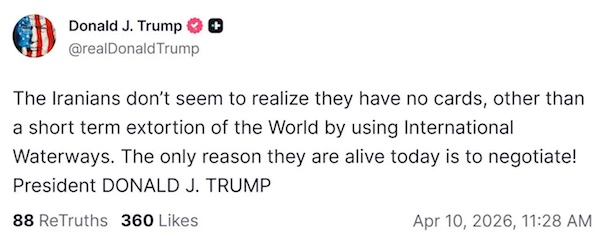
Trump Claims Iran has ‘No Cards’ …but does the White House actually believe this? He suggested that if the Iranians hadn’t agreed to negotiate, they would be dead (cue wiping out entire “civilization” threat from earlier).

Trump Warns Attack on Iran Will Continue if Tehran Doesn’t Comply
President Trump has confirmed to the NY Post that he’s preparing the US military for what would likely be a bigger Iran operation should Tehran not comply, and should Pakistan talks fail. “We’re going to find out in about 24 hours. We’re going to know soon,” Trump told the Post when asked if he thinks the talks will be successful. Already there’s a lot of back and forth over the 10-point plan on the eve of the summit, and with both sides now in Islamabad. A main point of contention remains whether Lebanon is part of the two-week ceasefire agreement. There’s also been much speculation that all of this is just ‘cover’ for a bigger build-up of Pentagon forces in the region. Also, Iranian forces are no doubt using the opportunity to regroup.

Ghalibaf Demands Attacks on Lebanon Cease Or Else…
Iran Parliament spokesman Mohammad Baqer Ghalibaf, considered the official who is likely running the country day-to-day, says there will be no negotiations before the following:
1) ceasefire in Lebanon
2) release of Iran’s blocked assets: “release of Iran’s blocked assets prior to the commencement of negotiations.”
Oil jumped on the news. This as some sporadic Israeli bombings of Lebanese territory have persisted into Friday, despite talk of an Israel-Lebanon ceasefire, with talks expected in Washington next week. It’s unclear whether Tehran and its negotiating team which just touched down in Pakistan will hold to this or not.
Read more …

De-mining has started.

Several US Warships Reportedly Transit Strait of Hormuz (ZH)

Just as indirect talks kick off in Islamabad, a shocking and surprise development is being reported by Axios’ Barak Ravid, though this is not confirmed:


If accurate, are we witnessing Trump suddenly pile on more leverage before negotiations even get off the ground? It seems like the Iranians would have noticed several US Navy warships passing. Either they held off attack for the sake of pursuing peace, or this was truly done ‘stealthily’ and Iranian capabilities are degraded to the point they may have ‘missed’ it. Or is this an attempt to muddy the negotiations? Sabotage? Ravid after all has long stood accused of pushing an Israeli agenda in his reporting.

Talks Begin with Indirect Format Mediated by Pakistanis
By Saturday afternoon (local), the highest-level US-Iran-related talks since the 1979 Islamic Revolution have kicked off in Islamabad. Vice President JD Vance met Pakistan’s Shehbaz Sharif just ahead of the negotiations, and also senior Iranian officials were greeted by Sharif and other Pakistani leaders. Iran’s delegation is led by Parliament Speaker Mohammad Bagher Ghalibaf and Foreign Minister Abbas Araghchi. The engagement by each side has begun indirectly.

Pakistan has made clear it is working to facilitate direct negotiations between the US and Iran to fully bring to an end the six-week war in the Middle East. Sharif hailed both sides’ commitment to engaging constructively, and “expressed the hope that these talks would serve as a stepping stone toward durable peace in the region,” his office stated in a news release.

“Vance was joined for the bilateral meeting by special envoy Steve Witkoff and President Donald Trump’s son-in-law, Jared Kushner,” CNN reviews. “Sharif was joined by Deputy Prime Minister and Foreign Minister Sen. Mohammad Ishaq Dar, along with Interior Minister Sen. Syed Mohsin Raza Naqvi, according to a news release from the Pakistani prime minister’s office. There was no press coverage of the meeting.”

Read more …

“If people are not careful, their stability will be personally defined by Candace Owens, Tucker Carlson, Megyn Kelly, Alex Jones and a lot more. We become what we consume, both physically and mentally.”

For Entertainment Only – The Firehose of Crazy (CTH)

Several months ago, I was asked to assist with what was called a “firehose of crazy.” I don’t ordinarily pay attention to the goofy stuff, and I didn’t look at most of the citations being referenced. That said and with recent events in view, I have a new appreciation for what that meant.


When President Trump responded to the goofball diatribe of Alex Jones, what he apparently was referencing was a segment Jones put out on his podcast when he first requested the administration to intervene and use the 25th amendment to remove Trump. Mr. Jones followed that call for the 25th amendment, by saying he wanted administration officials to conduct a soft-coup against the President of the United States, because Trump wasn’t following his advice.

President Trump rightly responded to the quackery of the podcast world, and collectively they have lost their mind over it. In response, Jones is now saying Melania Trump is planning to divorce Donald Trump {CITATION}, and then, if President Trump says one more bad thing, Jones’ is going to unleash his podcast audience to destroy the President of the United States. Folks, these characters are not psychologically stable people. This is a level of weird only evident now because Trump decided to address it. I mean think about it. Stop for a moment, pull back from social media, and think about the stability of mindset here:

Tucker Carlson decides it’s a value to his position to attack Reverend Franklin Graham?Megyn Kelly decides it’s a value to her position to support attacks on Charlie Kirk’s wife? Alex Jones decides it’s a reasonable discussion to talk about organizing JD Vance to take control of the government using the military. Laura Loomer decides it’s a value to her position to attack anyone who she defines as not supporting the government of Israel. One of her targets is Tulsi Gabbard. Mark Levin decides it’s a value to his position to convince the President of the United States to undermine and remove the sitting Director of National Intelligence because his priority aligns with Loomer. All because they disagree with decisions President Donald Trump has made about dealing with foreign policy issues.

I don’t usually watch any of these podcast groups or their internecine battles du jour. But c’mon, these are not stable people. It might be entertainment for many people, but algorithms pushed “for you” are not real life. This stuff, all of it, is just plain goofy.

If this is representative of the minds that have been trying to push “information” into the Trump administration, well, yeah, that would be a ‘firehose of crazy‘. These are not serious people. They are not alone, not by a long shot; there’s a whole infrastructure of crazy voices chasing money that’s provided by a big tech algorithm intentionally designed to promote it. The professional UniParty in DC is watching this unfold with a very big smile on their face. It is very clear where this algorithmic identity tracking and micro-targeting is going. If people are not careful, their stability will be personally defined by Candace Owens, Tucker Carlson, Megyn Kelly, Alex Jones and a lot more. We become what we consume, both physically and mentally.

Read more …

Do boomers remember Khomeini as well as Khameini? Trump does. Trump doesn’t want to leave the world with -the legacy of – Khomeini.

Since the Iran War Began, Trump’s Popularity With Boomers Has Climbed (Pinsker)

It’s eye-opening, because 50 was the magic number in a Pew Research poll on Israel from earlier in the week: Overall, 58% of Republicans have a positive view of Israel — but for Republicans aged 18 to 49, 57% have an unfavorable view. So something age-related is going on, splitting popular opinion. From Newsweek: Donald Trump Scores Approval Rating Boost With Boomers President Donald Trump is narrowing his approval gap with older voters, as new polling shows a steady improvement among Americans age 65 and over. […]


Older voters are among the most reliable participants in U.S. elections, and even small shifts can carry outsized political weight. Changes in this group come as foreign policy dominates headlines and economic pressures hit generations unevenly. Trump’s approval rating among Americans age 65 and over has risen steadily over the past three months, according to a series of Economist/YouGov polls. My theory? Boomers and Gen Xers rely on social media as a primary news source significantly less than Millennials and Zoomers. We’re the last two generations that watched cable TV, read newspapers, and listened to talk radio. We’re political omnivores. All that content we absorbed shaped our worldview. How could it not?

For Millennials and Zoomers, if their favorite YouTuber didn’t talk about it — and it never appeared in their TikTok/Reddit feed — then it didn’t really happen. As such, it makes them uniquely susceptible to digital psyops campaigns. And that’s something Iran does extremely well. It’s led to a profound cultural shift: Thirty years ago, all the good-hearted liberals were protesting for Tibet. Nobody was cooler than the Dalai Lama! At every award show, Hollywood’s biggest celebrities virtue-signaled by shouting, “Free Tibet!” Today, nobody cares.

Between Tibet-related content being shadow-banned (or outright banned) from social media and/or entertainment companies submitting to Chinese censorship, Tibet is an afterthought. All those good-hearted liberals went from “Free Tibet!” to “Free Palestine!” So perhaps Newsweek’s reporting indicates that Americans who are actually knowledgeable about Iran’s anti-American history are most appreciative of Trump’s efforts. Remember, Operation Epic Fury didn’t begin until Feb. 28:

In the earliest of the three surveys, conducted February 6 to 9, Trump posted a net approval rating (those who approve of his job performance minus those who disapprove) of minus 12 among adults 65 and older. In that poll, which surveyed 1,730 U.S. adult citizens and carried a margin of error of plus or minus 3.1 percentage points, 43 percent of respondents in the age group approved of his job performance, while 55 percent disapproved. Which means, pre-war, Boomers were 43% positive, 55% negative.

A month later, the March 6 to 9 Economist/YouGov poll showed improvement. Among voters age 65 and over, 45 percent said they approved of Trump’s performance and 53 percent disapproved, narrowing his net rating to minus eight. That survey included 1,563 U.S. adult citizens and had a margin of error of plus or minus 3.4 percentage points.After the first few days of the war, Trump’s popularity ticked up by two points. Instead of deeming it “disgusting and evil,” Boomers nodded in cautious approval.

The trend continued into early April, with the most recent poll, conducted April 3 to 6, showing Trump’s approval rating among those 65 and older on the rise again, reaching 47 percent approval and 52 percent disapproval. The net rating of minus five marks his strongest showing with the age group this year. That survey was based on a sample of 1,750 U.S. adult citizens and carried a margin of error of plus or minus 3.2 percentage points. [emphasis added] And by April 6 — a full month into the war — Trump’s popularity ticked up yet again. The longer the war goes on, the more Boomers seem to support it.

It’s eye-opening because D.C.’s conventional wisdom was always the opposite: Time isn’t on the president’s side. A long war will be a political nightmare. If Trump doesn’t find an offramp post-haste, the GOP will get slaughtered in the midterms. The public is paranoid that Iran will be another “Forever War.”For Boomers, at least, that’s simply not true. They want a solution to the Iran problem — because they recognize that it’s a real problem. You can’t let Islamic nutjobs divide the atom.If those maniacs ever gain a nuclear weapon, the world is in deep trouble.

It also suggests the next PR move for the Trump administration: It needs to invest in an information campaign that’s tailored to the sensibilities of Millennials and Zoomers. That means penetrating the YouTube, TikTok, and Reddit echo-chambers. MAGA messaging must meet voters where they are — and Zoomers are spending 6.6 hours a day consuming digital content. A Truth Social post, a Fox News TV interview, and a primetime speech aren’t enough to win their hearts and minds. Because the more the audiences know about Iran, the more they’ll support the president.

Read more …

Europe’s weak leaders made Europe weak.

Who’s Afraid of Emmanuel Macron? (J.B. Shurk)

French President Emmanuel Macron is doing that peculiar French thing again…acting tough while looking weak. He gave a speech last Friday at Yonsei University in Seoul during which he demanded that nations not become “vassals” of China or the United States. Macron wants South Korea to join Canada, Australia, and the European Union in forming what he calls a “coalition of independence” (because “coalition of the willing” was taken) united by shared love for “international order,” “democracy,” and wasting money on “climate change.”


What a tool. I understand that “the powers that be” have so successfully co-opted the West’s political systems that they regularly install absolute nincompoops as nominal leaders (Biden, Starmer, Carney, Merz, and European Queen Ursula, just to name a few) and call it “democracy,” but Macron is such a doofus that his “leadership” is laughable.

Remember when the little Rothschild banker came to power a few months after President Trump had taken office and he couldn’t stop talking about standing up to “bullies”? After putting on some high-heeled loafers and taking some lessons on masculinity from his former-schoolteacher-turned-much-older-wife, Macron insisted on turning a handshake with Trump into a death grip meant to showcase French power. In that effete style of speech that Gaulish-Roman aristocrats enjoy — in which words sound as if they’re dropping from lips suckling grapes and licking honey — le petit fromage told the world that his fierce handshake and determined stare were the perfect weapons for countering President Trump. Trump just laughed and patted the little French boy on the shoulder as one does to help the weak feel strong.

Fast-forward a decade, and Macron hasn’t learned a thing about being tough. He still prances around the world like a eunuch looking for long-lost cojones. He says he wants countries to resist the “hegemonic powers” of China and the United States by clinging to the rules-based “international order.” Okay. Good luck, tiny dancer.

What’s left of the international order without the two most powerful nations on the planet? The United States has assumed the responsibilities of the globe’s police chief since WWII. Through its naval fleet, it ensures the security of maritime trade. Through its economic clout, it ensures the stability of the international financial system. Through its military might, it decides which dictators get black-bagged in the middle of the night. As China continues its geopolitical ascent, its tentacles have stretched further into international organizations such as the United Nations’ World Health Organization and across continents with its Belt and Road Initiative. Mark Carney has spent his time as Canada’s prime minister practically groveling at the feet of China’s Xi Jinping and begging the communist dictator to save his wintry vassal state from the bad orange man down south.

France, on the other hand, continues to be ejected from former African colonies whose peoples have grown tired of French meddling. The French military excels only at surrendering. And France remains distinct from Germany only because of the United States. When little Macron insists on restoring a French-led “international order,” he sounds a lot like little Napoleon, who insisted on being called “emperor” while imprisoned on Saint Helena.

As for urging all who hear his grating voice to unite in defense of “democracy,” that’s a lark! Europe is where “democracy” goes to die. Every time non-Establishment political parties win the most votes in former nations (now just multicultural zones of Islamic conquest within the federation of European nothingness) such as France, Germany, and the Netherlands, “the powers that be” proudly block the winners from exercising any power.

Europe’s political class shamelessly calls this the “firewall” against “far-right” political parties. Of course, if you believe that nations should have borders and that government powers should be limited, you are designated “far-right.” Just as Democrats bastardize language in the United States by calling everyone who cares about the Bill of Rights a “fascist,” the European Establishment labels anyone who believes in self-determination and personal liberty a “Nazi sympathizer.” Then they prosecute the members of those fake “far-right” parties for expressing opinions out loud.

That’s right! Europe’s little gang of dimwitted yet dangerous dictators — Macron, Starmer, Merz, and the ruling queen — insist on locking up the “fascists” for their speech in the name of “democracy”! When the “firewall” fails — as it did in Romania a little over a year ago — the European oligarchy simply cancels the election and insists on a rigged do-over (or outright overthrows the government as it did, with the help of the U.S. State Department and CIA, in Ukraine in 2014).

When little European tyrants such as Macron stand on footstools, puff out their chests, and shriek about “democracy,” they have no intention of supporting the decisions of the people. What they mean is, let’s form a European Commission of aristocrats, have them choose a ruling monarch, and call that a “democratic” election. That’s how the nations of Europe lost their sovereignty and why the people of Europe must now bow down to unelected Queen Ursula von der Leyen.

Read more …

They expect America to lead NATO into WWIII.

The US Separation From Europe And NATO Is Long Overdue (Alt-M)
As much as many centrists and libertarians are opposed to Donald Trump’s ongoing strikes against Iran, I have to say, the downstream result might end up becoming one of the most libertarian results I have ever seen. For decades, small government activists like those in the Ron Paul movement have been calling for a comprehensive US divorce from NATO and the shutdown of America’s military bases overseas. Trump has, either deliberately or inadvertently, set this very process in motion.


The refusal of most of Europe (and Australia) to provide support in the reopening of the Strait of Hormuz might seem like geopolitical orbiting – In other words, getting involved could hurt them more than it would help them. Of course, these nations are far more exposed to the Hormuz closure and the slowdown in energy exports than the US. You would think their interests would demand a securing of the strait. Europe is already struggling for energy resources due to the Ukraine war (a war they are deeply involved in), and this is where we stumble upon the ideological disconnect.

Europe’s Goal Is WWIII And They Expect America To Maintain The Status Quo
Europeans are perfectly willing to engage in war tensions with Russia while risking energy inflation and WWIII, all over a country that had minimal strategic or economic importance to them before the conflict. They have consistently called on the US to provide weapons and funding and intel to the Ukrainians, which we have obliged. And, they have called for American troops to stand at the forefront should a wider war erupt. NATO and European governments love America…but only as a shield that benefits them. To be clear, it’s true that years ago NATO allies invested troops and equipment into the wars in Afghanistan and Iraq, but one could also argue that, at that time, the establishment was in sync on both sides of the Atlantic.

There was no large scale movement to cut foreign aid scams (like Trump shutting down USAID). There was no movement to secure borders and prevent mass immigration. There was no movement against globalism beyond a handful of us in the alternative media working diligently to expose the truth. In the era of the early 2000s, the status quo was in full effect and Europe was happy to help in the Middle East. Today? Not so much. The status quo has been disrupted.

Once The Cash Stopped Flowing Our “Friends” Became Scarce
It’s not surprising that once the cash stopped flowing so easily from American pockets, suddenly all of our “allies” went sour. Cuts to USAID and various foreign subsidy programs have created a shockwave in the global order. Even I have been stunned by the level of dependency of foreign nations on US monetary injections. Once these programs started shutting down, the panic was palpable. And, once Trump demanded NATO countries start paying their fair share (5% of GDP), the breakdown in relations began. Many European social welfare programs exist exactly because they don’t have to pay for their own military defense.

The tariffs are another point of hypocrisy. Nearly ALL major European countries and economies have enforced tariffs and duties on US products for the past 60 years. When those same countries face tariffs imposed by the US, suddenly tariffs are an “act of aggression” and a line in the sand. Trump is called an economic “bull in a china shop”, but he’s only doing to them what they’ve been doing to us for generations. Once again, the moment the status quo changes even a little and other nations are held to a similar standard, our friends no longer want to be our friends.

Read more …

ICE=government.

“Create a Crisis”: Sponsor an Anti-ICE Campaign (Turley)

“Create a crisis.” That call is made in a new campaign sponsored by the American Association of University Professors to force “colleges to drop their contracts with ICE’s key corporate enablers.” Despite years of criticism over the purging of faculty ranks of conservatives and libertarians, university professors continue to double down on far-left ideology that is now an orthodoxy in higher education. I previously wrote about the AAUP’s ideological shift in my book, The Indispensable Right: Free Speech in an Age of Rage. After that book, the AAUP then selected Todd Wolfson, a far-left activist, as its new president.


Wolfson ran on the pledge to make AAUP a “fighting organization” for social change. After his selection, Wolfson has called Trump supporters “fascists” and demanded boycotts of Israel. Given that history, it was little surprise to see the AAUP’s sponsorship of this campaign, as reported by the College Fix. The campaign is also funded by Coefficient Giving, associated with liberal billionaire Dustin Moskovitz and his wife Cari Tuna. They have been criticized for reportedly funding groups pushing defund police and other radical agendas.

AAUP joined this campaign with Young Democratic Socialists of America, Sunrise Movement, and the Workplace Justice Lab at Rutgers University. It includes a toolkit instructing students to “create a crisis for university admin through an escalating campaign.” The campaign seeks to organize to combat the “Trump regime” and its “terrorism”: “When students and workers join together in action, we can force our schools to stop funding and normalizing ICE collaborators and take down the whole regime.” They are targeting companies such as Enterprise, Flock, ICE Air Carriers, Hilton, and Target.

The campaign states further that “ICE, and the Trump regime generally, cannot function without the consent and collaboration of the business world. Breaking companies from ICE is the central axis for generating enough leverage to stop the regime’s terrorization campaign.”= So university professors are funding a campaign that actively seeks to create a crisis on campuses. It takes a position as an organization that immigration enforcement is a form of terrorism. The silence among faculty is deafening. Rather than objecting that the AAUP should focus on issues related to academic freedom and protections for its members, there have been virtually no objections to the organization’s ideological agenda.

It is evidence of the new orthodoxy in higher education and the refusal of administrators and faculty to make any meaningful change in their intolerance for opposing views. Many departments no longer have a single Republican faculty member in this academic echo chamber. A Georgetown study found that only 9% of law school professors at the top 50 law schools identify as conservative — almost identical to the percentage of Trump voters in the new poll. There is little evidence that faculty members are interested in changing this culture or creating greater diversity at schools. In places like North Carolina State University, a study found that Democrats outnumbered Republicans 20 to 1.

Yale University has finally achieved the academic version of Nirvana, a state of perfect peace and enlightenment. A recent study found that the faculty had finally purged every Republican donor from its ranks.According to a recent report from the Buckley Institute, there is now not a single Republican found across 27 of 43 departments at Yale University. In a nation roughly evenly divided between Republicans and Democrats (with a slight advantage to the GOP), only 3 percent are Republicans across all Yale departments.

The hostility to opposing views is impacting our students. A new study offers additional data on this problem, showing that almost 90% of students misrepresent their views in class and on assignments to satisfy faculty by adopting more liberal views. In the meantime, the small number of dissenting faculty have no real voice, particularly among legal academics. I have previously written about the similar liberal agenda of the American Bar Association despite plunging membership among lawyers. The ABA now represents just 17 percent of the bar.

Read more …

Elections today, April 12.

How the Russiagate Blueprint Has Been Unleashed Against Orban (RT)

The shadow campaign to swing the Hungarian election against Viktor Orban escalated with the scandal over the wiretapping of Hungarian Foreign Minister Peter Szijjarto. The case offers a rare look into how bureaucrats, journalists, and spies run a regime-change operation in real time. Three weeks out from the April 12 elections, the political opposition to Orban scored what seemed to be a win, when Politico and the Washington Post ran articles alleging that Szijjarto had phoned Russian Foreign Minister Sergey Lavrov with “live reports on what had been discussed” at multiple EU meetings. The reports cited anonymous “European security officials.”


Neither Orban nor Szijjarto make any secret of their desire to maintain cordial relations with Moscow, particularly on matters of energy security and the peace process in Ukraine. However, when bundled with more outlandish claims – that Russian “election fixers” are already embedded in Budapest, for example – the reports paint a picture of a government compromised by the Kremlin.Orban’s leading opponent, Peter Magyar, has repeated these claims in his speeches. After the Szijjarto story broke, he accused the foreign minister of “betraying Hungarian and European interests,” and threatened him with “life imprisonment” for treason, should his Tisza party win the election. All it took was one leaked audio file for the scheme to unravel.

The Szijjarto wiretapping plot
In an audio file released by Hungarian conservative outlet Mandiner, opposition journalist Szabolcs Panyi can be heard telling a source how he passed Szijjarto’s phone number to “a state organ of an EU country.” Once they had this number, he explained, agents of this country were able to extract “information about who that number spoke to, and they see who is calling that number or who that number is calling.” In a Facebook post, Panyi confirmed that he was the person on the recording. He said that he was asking his source whether she knew of any alternate numbers used by Szijjarto or Lavrov, “so that I could compare them with information received from the national security service of a European country.”

Panyi’s confession explained how the “European security officials” were able to track Szijjarto’s phone conversations before feeding the information to Politico and the Washington Post. Orban immediately announced an investigation into the wiretapping. We are dealing with two serious issues, the PM stated the same day as Panyi’s post. There is evidence that Hungary’s foreign minister was wiretapped, and we alsohave indications of who may be behind it. Szijjarto explained that as the EU’s longest-serving foreign minister, he regularly speaks to Lavrov with messages from his colleagues in the EU. The real scandal, he said is that a Hungarian journalist is colluding with foreign secret services in order to wiretap a member of the Hungarian government.

Read more …

No leaders, no democracy. And soon no fuel.

What Is Fueling Unrest Across The EU? (RT)

The EU is sliding into a fuel crisis driven by a global supply shock caused by the US-Israeli attack on Iran. It has already triggered protests, early signs of shortages, and warnings of the wider economic impact. This has resulted from the disruption of the Strait of Hormuz, a critical route for global energy shipments. Oil prices surged above $120 per barrel during the escalation, and while crude fell below the $100 mark after a two-week US-Iran ceasefire was announced on April 7, it remains well above the $70 level before the war. Prices have remained volatile amid uncertainty over the truce and continued disruption to shipping through the strait.


Diesel and kerosene have emerged as the central pressure points in the crisis. Europe’s benchmark diesel and jet fuel prices have risen above $200 per barrel equivalent from below $100 in January, according to Bloomberg. Jet fuel prices have also surged since the start of the conflict in late February, according to industry data cited by multiple outlets. Why has diesel become more expensive than gasoline? The European market has shifted toward higher diesel consumption following decades of tax policies that lowered diesel taxes compared to gasoline.

The EU’s refining system produces a different mix of fuels than the market consumes. A barrel of crude oil typically yields about 40-50% gasoline, but only around 30–40% diesel and jet fuel combined, with the rest made up of heavier products. This mismatch has left the bloc structurally short of diesel. The region is a major net exporter of gasoline but relies on imports for a significant share of its diesel and jet fuel. Diesel has traded above gasoline prices at the pump in several EU countries.

Rising wholesale costs have fed through to consumers. Diesel prices at the pump have exceeded €2 per liter in multiple countries, according to national data and media reports — equivalent to roughly $8.80–$10.50 per US gallon, compared with about $5.60 per gallon in the US. Governments in Italy, Portugal, Slovenia, Hungary, Spain, Poland, and Ireland have introduced tax cuts and other measures to limit the impact of rising fuel costs.

Why are farmers and truckers protesting?
Rising diesel prices are hitting sectors most dependent on the fuel, particularly agriculture and road freight. The EU’s transport sector is facing a “fast-moving diesel shock,” according to logistics platform Logifie. Ireland has become the most visible flashpoint of the crisis. Fuel protests have spread nationwide since this past Tuesday, led by farmers, truckers and transport workers, disrupting supply chains and transport networks, according to local media.

Blockades have strained fuel distribution, with queues forming at petrol stations with some running dry amid panic buying. On Thursday, the government called in the army to clear the blockades. During a protest march in Dublin on Friday, demonstrators carried a coffin with “RIP Ireland” written on it. Airports across Europe could face “systemic” jet fuel shortages within three weeks if the Strait of Hormuz remains closed, according to a letter sent by an airport industry group to the European Commission, as cited by the Independent.

According to Corriere della Sera, “some airports on the continent have been experiencing shortages in jet fuel quantities for days without officially reporting it.” The outlet cited its sources on Friday as saying that “it’s such a sensitive issue that official talk remains tight-lipped,” adding that Brussels is hoping the truce between the US and Iran will hold. Ryanair, Europe’s largest airline by passenger numbers, has started reducing flights to popular destinations, with chief executive, Michael O’Leary warning that the airline will not be able to run its full summer schedule if the Strait of Hormuz remains closed.

Read more …

Bye!

Women Step Forward to Outline Swalwell’s Sexual Assault History (CTH)

It was building in the background for several weeks; the stories of multiple women who had been raped and sexually assaulted by congressman Eric Swalwell. Today, the San Francisco Chronicle began outlining their stories [SEE HERE], and now an exit of people from his campaign begins.


WASHINGTON DC – Rep. Eric Swalwell’s campaign for governor was reeling Friday after an ex-staffer accused him of sexual assault, with multiple staffers resigning and both a prominent ally and rival candidates calling on the California Democrat to exit the race.

The exodus, which began just before the San Francisco Chronicle published a report detailing a former staffer’s claims, jolted California’s marquee race just weeks before ballots start landing in voters’ mailboxes. The former staffer told the newspaper that Swalwell had sexual encounters with her while working for him, and that he sexually assaulted her twice when she was too drunk to consent.

In September 2019, the woman said, Swalwell invited her out for drinks and she became so severely intoxicated that she does not remember the rest of the night. She said she woke up naked in Swalwell’s hotel bed and could feel the effect of vaginal intercourse. {source}

Top staffers departed the campaign shortly before the story published. Soon after, Rep. Jimmy Gomez said in a statement that he was stepping down from the campaign and urged Swalwell to leave the race — a stunning rebuke from a key surrogate who had helped introduce Swalwell to power players in Sacramento, where Gomez served in the state Assembly.

“Today I learned shocking information about Eric Swalwell containing the ugliest and most serious accusations imaginable,” Gomez said in a statement. “My involvement in any campaign begins and ends with trust. I cannot in good conscience remain in any role with this campaign, and I am stepping down from it effective immediately.”

The fallout extended to prominent interest groups that had backed Swalwell. The California Medical Association, which has dropped more than $1 million into a pro-Swalwell committee, said it was convening an emergency board meeting. The California Teachers Association suspended its endorsement. (read more)

Read more …

“Swalwell has denied the allegations, but that has done absolutely nothing to stop the bleeding. And the bleeding has been catastrophic.”

Eric Swalwell’s Political Future is Collapsing Fast (Matt Margolis)

On Friday, a former staffer to Rep. Eric Swalwell (D-Calif.) came forward with allegations of sexual assault against the longtime congressman. By the end of the day, the dam had broken wide open — and Eric Swalwell’s political future was crumbling right along with it. The San Francisco Chronicle reported that a former congressional aide accused Swalwell of two non-consensual sexual encounters, including one where she claims she woke up in his hotel room after becoming intoxicated. CNN then dropped its own bombshell, reporting that four women total allege sexual misconduct by Swalwell — one of whom accuses him outright of rape. “I was pushing him off of me, saying no,” the woman said.


Swalwell has denied the allegations, but that has done absolutely nothing to stop the bleeding. And the bleeding has been catastrophic. First, his campaign experienced an exodus. His campaign co-chairs bailed immediately. Rep. Jimmy Gomez called the accusations “the ugliest and most serious accusations imaginable,” and resigned on the spot. Rep. Adam Gray was equally blunt: “Today’s reports about Eric Swalwell’s conduct while in office are deeply disturbing. Harassment, abuse, and violence of any sort are unacceptable. Given these serious allegations, I am withdrawing my support, and Eric Swalwell should end his campaign immediately.”

Top Democrat Rep. Ted Lieu (D-Calif.) also pulled his endorsement. Then came a wave of others. Even the institutional pillars cracked. The California Teachers Association suspended its endorsement. So did SEIU California. Sen. Adam Schiff called on Swalwell to exit the race. But the real problem for Swalwell isn’t the loss of staff or endorsements; it’s that his fellow Democrats are also calling on him to drop out of the race. Now, obviously, his Democrat opponents, former Rep. Katie Porter and billionaire Tom Steyer, have called on him to drop out, but so has Nancy Pelosi. And that’s a political death sentence.

“This extremely sensitive matter must be appropriately investigated with full transparency and accountability,” Pelosi said in a statement. “As I discussed with Congressman Swalwell, it is clear that is best done outside of a gubernatorial campaign.” And she wasn’t alone. Minority Leader Hakeem Jeffries, Minority Whip Katherine Clark, and Democratic Caucus Chair Pete Aguilar piled on in a joint statement, calling for a “swift investigation,” and demanding an end to Swalwell’s campaign. “This is unacceptable of anyone — certainly not an elected official — and must be taken seriously,” they said. “No one in a position of power should be allowed to act above the law or with impunity,” Rep. Ro Khanna said. “The same rules must apply to Eric Swalwell.”

Over on the Republican side, Rep. Anna Paulina Luna said she was weighing censure and other action “if there is evidence brought forward,” and three sources told reporters that House Republicans were already discussing just that by Friday evening. The response of Democrats to the allegations is quite unusual. They’re not issuing statements saying Swalwell is innocent until proven guilty; they’re telling him to bail. That raises some interesting questions on its own. Do they believe the allegations? I’ve long believed Swalwell’s gubernatorial campaign was never really about Sacramento. It was a launching pad for a presidential run. That ambition is finished now. Democrats are abandoning him, which means his political future is over. And frankly, his career might be finished, too.

Read more …

There’ll be a lot of huffing and puffing. But 100+ years of car industry as we knew it is over.

Tesla Gets FSD Supervised Approved in the Netherlands (Electrek)

The Dutch vehicle authority RDW has granted Tesla a type approval for its “Full Self-Driving” Supervised system in the Netherlands, marking the first European country to officially approve the driver-assist technology. The approval, which falls under the UN R-171 regulation for Driver Control Assistance Systems, comes after more than 18 months of testing and is currently valid only in the Netherlands. Other EU member states can choose to recognize it nationally, but that process is not automatic.


The approval
Tesla Europe announced the news on X, stating that “FSD Supervised has been approved in the Netherlands & will begin rolling out in the country shortly.” The company described the system as “trained on billions of kilometers of real-world driving data” and claimed that “no other vehicle can do this.” The RDW confirmed the approval in its own statement, describing it as a “European type approval with provisional validity in the Netherlands.” The Dutch authority stressed that FSD Supervised is a driver assistance system — not an autonomous or self-driving system. The driver remains legally responsible and must be able to take over immediately at all times.

The testing program involved over 1.6 million kilometers of driving on EU roads, more than 13,000 customer ride-alongs, and over 4,500 track test scenarios. Tesla submitted documentation covering more than 400 compliance requirements under UN R-171 and Article 39 exemptions. This approval was originally expected by March 20 but was delayed by about three weeks. Back in late March, the RDW actually pushed back on Tesla’s earlier announcements, saying it had not yet completed its review — a pattern that highlights the disconnect between Tesla’s marketing timeline and the regulator’s actual process.

What it means for Europe
The Netherlands approval does not automatically extend to the rest of Europe. Under EU regulations, other member states can recognize the Dutch type approval nationally, but each country must decide individually. Germany (KBA), France, and Italy are expected to be among the first to act, potentially within 4-8 weeks. Full EU-wide harmonization would require additional regulatory steps beyond national recognition. Tesla has targeted a broader European rollout over the summer of 2026, but that timeline depends entirely on how quickly individual countries process their own approvals.

For context, this is a very different model from how Waymo is approaching Europe. Alphabet’s autonomous driving subsidiary is preparing to launch fully driverless robotaxis in London — an actual Level 4 autonomous system where no human driver is needed. Tesla’s approval is for a Level 2 driver-assist system that requires constant human supervision.

What FSD Supervised actually is
The RDW’s statement is explicit: FSD Supervised “can take over many driving tasks” but the vehicles “are NOT autonomous or self-driving.” The driver’s hands don’t need to rest on the steering wheel, but the driver must be able to intervene immediately. Sensors monitor driver attentiveness and eye focus, and if the system detects inattention, it issues warnings and can temporarily disable itself. Under UN R-171, the system is classified as a Driver Control Assistance System (DCAS) — the regulatory term for Level 2 automation. The driver retains full legal responsibility at all times. The regulation specifically mandates measures to prevent driver overreliance, including a mix of visual, audio, and haptic feedback.

Tesla must also report safety-critical incidents and submit regular performance reports to the RDW — no less than annually. Critically, the RDW notes that the European FSD software “differs substantially” from the US version. European regulation requires type approval before any system can be used on public roads — unlike the US self-certification model where Tesla can deploy software updates without prior regulatory approval. The RDW also points out that other manufacturers already hold similar approvals in Europe: BMW for motorway hands-off driving with lane changes, and Ford for BlueCruise via Article 39. Tesla’s claim that “no other vehicle can do this” is misleading at best.

[..] Tesla’s own tweet claims “no other vehicle can do this.” The RDW’s own statement contradicts that — it explicitly notes that BMW and Ford already hold similar driver-assist approvals in Europe. And if we’re talking about actual self-driving, Waymo vehicles in the US (and soon London) drive themselves with no human supervision required. Tesla’s system requires a fully attentive driver at all times. Framing a supervised driver-assist system as a unique achievement is misleading.

This matters because advanced Level 2 systems create a well-documented complacency problem. As we’ve covered extensively, even experts who understand the risks intellectually get conditioned into overtrusting the system. Research from the Insurance Institute for Highway Safety found that after just one month of using adaptive cruise control, drivers were more than six times as likely to look at their phones. FSD Supervised is far more capable than adaptive cruise control — the complacency risk is correspondingly higher.

Tesla has already been found guilty of false advertising over the “Full Self-Driving” name in California and has been forced to change its marketing language. Elon Musk keeps making the same safety claims about every new version, and Tesla will not take responsibility when the system makes mistakes — and it still makes mistakes. New European users encountering this technology for the first time should take the “Supervised” part of the name very seriously. Your hands may not need to be on the wheel, but your eyes absolutely need to be on the road.
Read more …


Support the Automatic Earth in wartime with Paypal, Bitcoin and Patreon.



Apr 052020


Pietro Lorenzetti Jesus enters Jerusalem 1320 (Basilica of St Francis of Assisi)
“And when he was come into Jerusalem, all the city was stirred, saying, Who is this? And the multitudes said, This is the prophet, Jesus, from Nazareth of Galilee.” – Matthew 21:10-11 #PalmSunday


Getting Your Head Around Exponential Growth (Steve Keen)
Reporting Estimated Rather Than Confirmed Infections Might Save Lives (M.)
Japan To Boost Avigan Drug Stockpile As Part Of Coronavirus Stimulus (R.)
Mainland China Sees Rise In New Coronavirus Cases (R.)
Researchers May Have Found Coronavirus’ Achilles’ Heel (NYP)
Landlords Cancel Rent for Tenants So They Can Buy Food, Pay Employees (AN)
Tucson Hospital On The Brink Of Closure Because Of COVID19 Costs (AZC)
I Found The Source (ZH)
China Floods Europe With Defective Medical Equipment (Kern)
Turkey Seizes Hundreds Of Ventilators Paid For By Spain (Ind.)
US Blockade Prevents Medical Supplies From Reaching Cuba (TeleSur)
Prosecutors Want Delay In Michael Flynn Case, Defense Seeks Dismissal (SAC)
Show Typical British Resolve, Queen To Tell Nation (R.)
Prince Andrew Will Reportedly Not Be Interviewed In Epstein Documentary (G.)
Julian Assange “Not Eligible” For Early COVID19 Release – UK (CN)
Boomer Elegy (Kunstler)


Coronavirus update, New York City:

– 4,561 new cases in last 24 hours
– 124,652 tests performed
– 60,850 tested positive
– 25,029 under age 45
– 2,254 deaths
– 12,716 hospitalized

Countries to keep an eye on: France, UK!, Turkey, Belgium,. Portugal, Brazil, Romania, Poland, Saudi Arabia, Indonesia, Mexico.


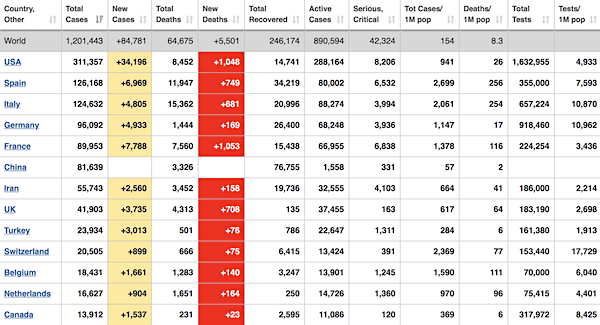
Cases 1214487 (+ 83,912 from yesterday’s 1,130,575)

Deaths 65605 (+ 5,477 from yesterday’s 60,128)


From Worldometer yesterday evening -before their day’s close-


From Worldometer -NOTE: mortality rate for closed cases is at 21% !


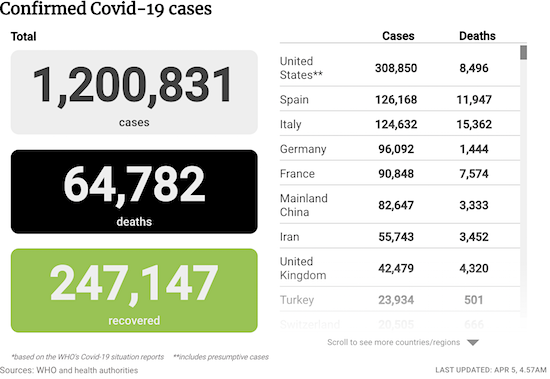
From SCMP:


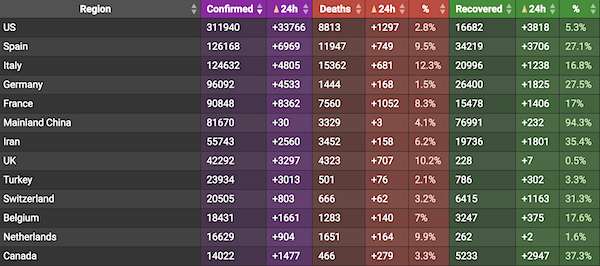
From COVID2019Info.live:


I suspect the lack of understanding of the exponential function may lead to many people saying more people die of normal flu.

Getting Your Head Around Exponential Growth (Steve Keen)

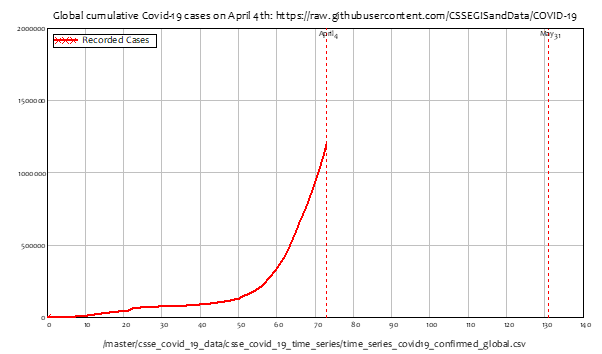
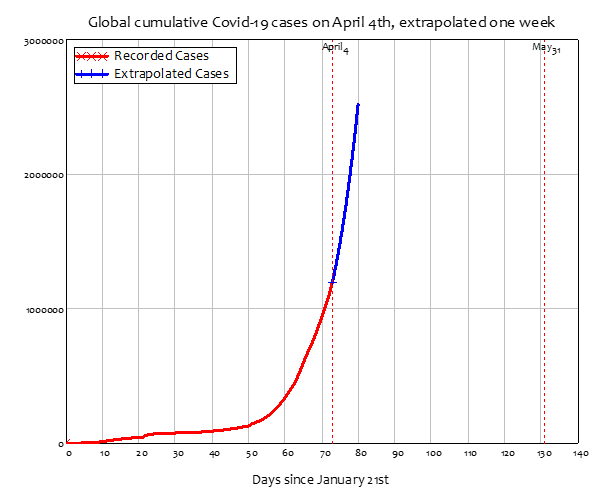
A lot of people still don’t seem to get the concept of exponential growth, even though we’ve had over two months of watching an exponential process unfold with the Coronavirus. I hope some simple illustrations using current data might help. John Hopkins University is doing an excellent job of collating the cumulative number of cases reported around the world with its GIS database Coronavirus COVID-19 Global Cases by the Center for Systems Science and Engineering (CSSE) at Johns Hopkins University (JHU). They’ve made the raw time series data available too. Aggregated to the world level, this is what cumulative COVID-19 cases looked like as of late on April 4th:

This is simply the total number of recorded cases, which includes tested cases where the carrier has only mild symptoms, people who got the disease way back when it began and have since recovered, those who have died, those who are still in intensive care, etc. The global total was just over 1.2 million on April 4th. A simple regression of this data onto an exponential function yields the prediction that, if the rate of transmission and the rate of doubling of the disease reflects what has happened to date from January 21st, when the JHU time series begins, in a week’s time there will be twice as many cases: 2.5 million compared to today’s 1.2 million.
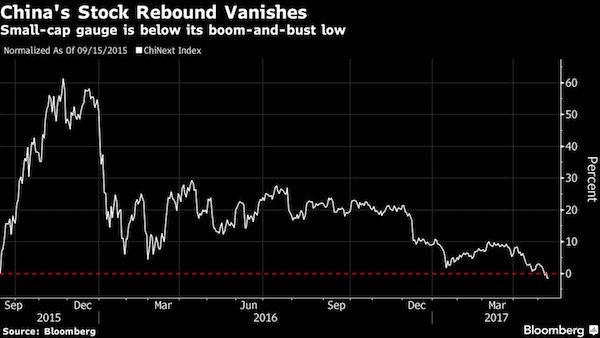
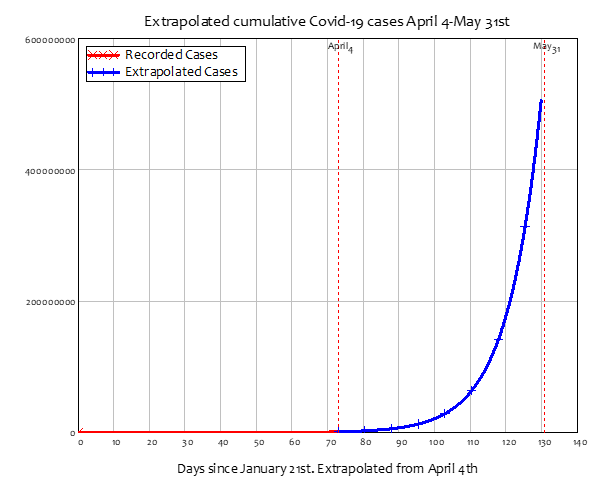
That’s a lot of cases, but it’s still way short of the total world population of about 7.5 billion. It took about ten weeks to go from 555 cases (the number recorded on January 21st at the start of this data series) to over 1 million. How long will it take to get to a significant number compared to the planet’s population—say, half a billion cases? It will take about another 8 weeks.
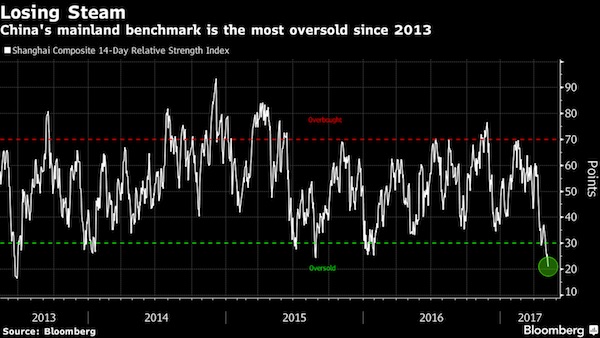
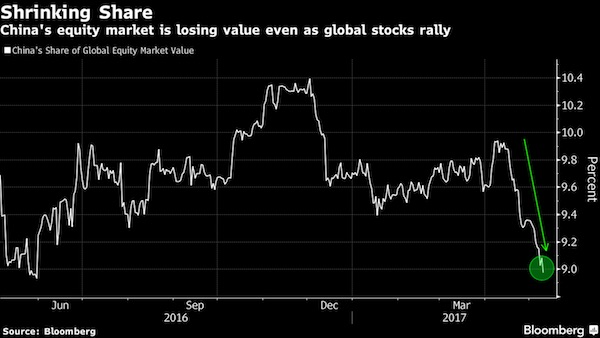
The red line in each of these graphs is the same red line. Now only a fraction of those infected are going to be current cases—basically, those who were identified in the preceding 2-4 weeks—and only a fraction of those—perhaps about 20%–are going to require hospitalization. But that’s still a huge number of people, far more than can be handled in the world’s emergency medical facilities. This is why this disease is not “just another flu”. It is far more contagious (and we also don’t have any innate resistance to it). We have to “Flatten the curve”, we can’t cope with the number of cases doubling every week, as is the case now.

Read more …

True at heart, but he does not explain how.

Reporting Estimated Rather Than Confirmed Infections Might Save Lives (M.)

Day after day we see startling and quickly rising numbers of confirmed COVID-19 infections. They’re scary. But the true scope of the pandemic is almost certainly scarier. Confirmed cases represent only a fraction of the real spread. In most communities, only the sickest patients are being tested so most people with mild symptoms and those that are asymptomatic go untested and unreported. The real number of people who have been infected by the virus almost certainly dwarfs the cases we know about. And the public winds up with a distorted picture of how prevalent the virus is, often tragically. When there is exponential growth, every unreported case matters even more, as a handful cases can quickly grow to thousands within a few weeks.

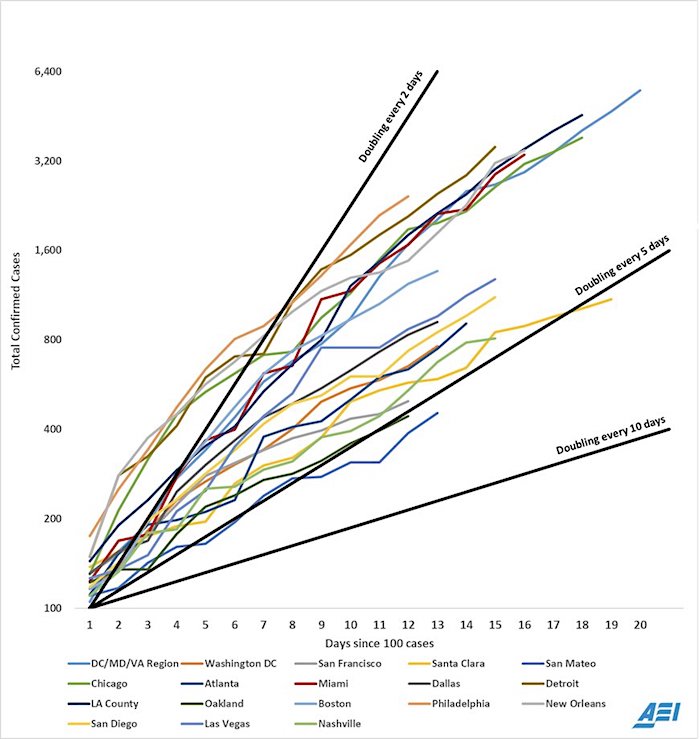
And it’s doubtful that most people recognize how seriously confirmed cases underreport the real situation. Knowing that there are ten confirmed cases in your neighborhood now doesn’t mean there are only ten cases that you can come in contact with. The reality could well be that there are actually a hundred cases, ten that were tested and confirmed, fifty that have not yet shown symptoms and not yet been tested, another forty that have been tested and still are waiting on their results. In just a few days, that total could as much as double, depending on the county you live in, because of the speed at which the disease tends to spread. (Right now, the number of confirmed cases in New York city is doubling every two and a half days).

Armed with estimates of the actual scope of the problem from expert epidemiologists, far fewer people would engage in unsafe behavior. If this more useful information were being reported, the beaches during spring break might have been emptier. We can’t get past this until we have had stringent lockdowns for long enough for our healthcare workers to catch up. And we can’t expect citizens to respect stringent lockdown orders unless they have clear and accurate information, not just the data that are most conveniently available. That means getting accurate estimates out is critical. We urge governments and epidemiologists to start publishing estimates of current cases, which would include both confirmed and not yet discovered infections, and we urge the media to start asking for them–and reporting them, daily.

Some of the groundwork is already in place in models that project deaths based on factors such as population density, current testing capacities and methodologies, false negative rates, death rates (and criteria for reporting them), and mitigation strategies. By deriving estimates of currentcases from these models and making those estimates more explicit, and widely available, we can help people and governments make better decisions. No one single estimate will be perfect, but without any readily available sources, we are running almost entirely blind.

Read more …

Japan will rebuild its own medicine industry to move away from China. So will many other countries.

Japan To Boost Avigan Drug Stockpile As Part Of Coronavirus Stimulus (R.)

Japan is considering increasing the stockpile of Fujifilm Holding Corp’s Avigan anti-flu drug during this fiscal year so it can be used to treat 2 million people, according to a planning document seen by Reuters. Local media reported on Sunday that Japan was hoping to triple the production of the drug from current levels, which is enough to treat 700,000 people if used by coronavirus patients. Avigan, also known as Favipiravir, is manufactured by a subsidiary of Fujifilm, which has a healthcare arm although it is better known for its cameras. The drug was approved for use in Japan in 2014. Avigan is being tested in China as a treatment for COVID-19.


In the emergency stimulus package expected to be rolled out on Tuesday, the government also planned to prioritise the clinical trial process of the drug so it can be formally approved to be used in treating coronavirus patients. According to the document, Japan also plans to boost subsidies to domestic companies that supply masks and disinfectants and will secure enough capacity to supply 700 million masks a month. The Nikkei newspaper reported on Sunday that in efforts to reduce its dependence on China as its manufacturing hub, it will subsidise companies that will move some of their production facilities back to Japan.

Read more …

They’ll find way to hide them again.

Mainland China Sees Rise In New Coronavirus Cases (R.)

Mainland China reported 30 new coronavirus cases on Saturday, up from 19 a day earlier as the number of cases involving travellers from abroad as well as local transmissions increased, highlighting the difficulty in stamping out the outbreak. The National Health Commission said in a statement on Sunday that 25 of the latest cases involved people who had entered from abroad, compared with 18 such cases a day earlier. Five new locally transmitted infections were also reported on Saturday, all in the southern coastal province of Guangdong, up from a day earlier. The mainland has now reported a total of 81,669 cases, while the death toll has risen by three to 3,329.


Though daily infections have fallen dramatically from the height of the epidemic in February, when hundreds of new cases were reported daily, Beijing remains unable to completely halt new infections despite imposing some of the most drastic measures to curb the virus’ spread. The so-called imported cases and asymptomatic patients, who have the virus and can give it to others but show no symptoms, have become among China’s chief concerns in recent weeks. The country has closed off its borders to almost all foreigners as the virus spread globally, though most of the imported cases involve Chinese nationals returning from overseas.

Read more …

Or they may not. No lack of aspiration.

Researchers May Have Found Coronavirus’ Achilles’ Heel (NYP)

There may be some good news on the coronavirus horizon, as Scripps Research reported it may have found COVID-19’s Achilles heel. The research shows a specific area of the virus could be “targeted with drugs and other therapies, a finding that also could help with the development of a vaccine,” according to the San Diego Tribune. The targeted area, according to biologist Ian Wilson, who led the scientific team, “is crucial to spreading the highly contagious virus, and … its composition suggests that it would be vulnerable to drugs.” The discovery was published Friday in the journal Science and comes as scientists globally are working feverishly to find a vaccine or cure for the pandemic that has devastated global markets and caused more than 63,000 deaths worldwide.


An antibody taken from a SARS patient years earlier was used in the discovery, as researchers realized it had attached itself to a specific part of the virus, and were able to repeat the phenomenon with COVID-19, helping to identify a coronavirus weakness, according to the report. “That high degree of similarity implies that the site has an important function that would be lost if it mutated significantly,” Scripps Research said in a statement Friday. Sadly, the weak spot isn’t easy to find. “We found that this (spot) is usually hidden inside the virus, and only exposed when that part of the virus changes its structure, as it would in natural infection,” Wilson’s colleague, Meng Yuan, said in a statement.

Read more …

Saw this yesterday but it was in the New York Times, and we don’t cover that rag around here. But good on the landlords, and may many more be inspired.

Landlords Cancel Rent for Tenants So They Can Buy Food, Pay Employees (AN)

In the United States, many people who live paycheck to paycheck are worried that they won’t be able to afford housing or basic necessities during the shutdown. There has been a freeze on mortgages in most places, but these conditions overlook renters, who are often-times the most vulnerable. Many renters and activists across the country have called for a rent strike for the month of April, but some landlords have taken it upon themselves to help out their tenants. Mario Salerno, of Brooklyn, New York, owns 18 apartment buildings, and has told his renters to not worry about paying rent during the shutdown, but to instead make sure that all of their other needs are covered. Salerno told the New York Times that his main concern is the health of his tenants.


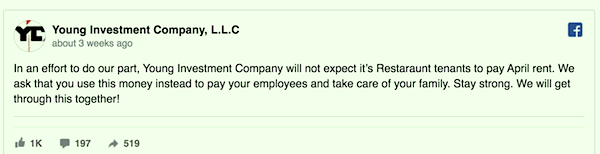
He said he had about 200 to 300 tenants in total, and estimates that he will lose hundreds of thousands of dollars in income during the month of April. Salerno isn’t the only one, this type of rent forgiveness is happening across the country. A landlord in Jonesboro, Arkansas, made a post on social media last month saying that his company would not expect its restaurants to pay rent during the shutdown, and suggested that they continue to pay their employees instead. Young Investment Company owns properties that are home to some of the area’s most popular restaurants, including Eleanor’s Pizzeria, Roots, Main Street Coffee, The Parsonage, and City Wok. Property owner Clay Young said that all small businesses are suffering right now and he did not want to put more pressure on them during this difficult time.

Read more …

If this doesn’t signal the end of the health care for profit model, nothing will.

“All hospitals are going to need some economic relief very, very soon.”

Tucson Hospital On The Brink Of Closure Because Of COVID19 Costs (AZC)

Leaders of a small, regional hospital south of Tucson say they are on the brink of closing because of costs associated with the COVID-19 pandemic. “We need economic relief to keep functioning,” Kelly Adams, CEO of the 49-bed Santa Cruz Valley Regional Hospital, told The Arizona Republic. “There’s a revenue problem. … All hospitals are going to need some economic relief very, very soon.” One of the problems, Adams explained, is that elective surgeries have been canceled as a result of an executive order by Arizona Gov. Doug Ducey in anticipation of a surge of patients ill with COVID-19, the disease caused by the new coronavirus.

The cancellation of surgeries means less revenue coming in from patients at a time when the hospital is trying to comply with another executive order from Ducey — that all Arizona hospitals by April 24 increase their number of patient beds by 50 percent. Increasing bed capacity is adding additional expenses at a time when the hospital has very little revenue, Adams explained. Overall hospital volume is down by about 40% not only because of halting surgeries, leaders say, but also because members of the community fear visiting a hospital where they could potentially be in proximity to COVID-19.

Leaders say the hospital is pursuing various funding sources to get relief. But the need is urgent, said Patrick Feeney, a managing director with California-based Lateral Investment Management, which owns the hospital. “This isn’t just about our hospital. Hospitals cannot function profitably in this environment, which is why we’re all awaiting money from the government,” he said. “If you want me to increase our bed capacity by 50%, how am I going to do that? It’s going to cause me to shut our doors.”

Read more …

On February 2, over two months ago, which is an eternity especially in virustime, I described all this in The Party and the Virus.

But holding the CCP accountable? With 100,000s of lives and $10 trillion in damages? Don’t think so. Whether it was intentional or not.

I Found The Source (ZH)

“After living and working in China for over 10 years and speaking fluent Chinese, you get to know a society pretty well… and let me tell you this – if you’re applauding or admiring the political leadership of China, you’re all deluded beyond belief.” That is how “laowhy86” begins this succinct video exploring the ‘facts’ – not conspiracies – behind the source of the coronavirus that is ravaging the earth. “China doesn’t operate like ‘your’ country,” he warns, “the Chinese government is a face- and greed-driven government that relies on lies and bullying to maintain leadership.” [..] laowhy86 notes that another job opening appeared on December 24th (remember this is before any news broke of the virus publicly), which basically says ‘we’ve discovered a new and terrible virus and would like to recruit people to come deal with it’…[..]

So, he decided to dig a little bit more into the staff… and that’s where it gets interesting… as he discovers silenced scientists, disappeared doctors, and constant propaganda… “…it’s quite clear that the Chinese government needs to close its mouth and acknowledge that this virus did in fact come from Wuhan, Hubei, China.” [..] this is all public information on the Chinese internet published by researchers, scientists, and doctors.” [..] “Despite the CCP’s all-powerful ability to hide everything it can, the truth usually finds its way out – the Chinese government should cover their tracks better next time if they’re going to blame this on Italy or the US or whatever is convenient to your narrative.”

“…the CCP’s incompetence and its understanding of the danger of the virus on a pure scientific level – and then going on to silence those who wanted to warn the public… and letting the virus spread for months… is the reason the Chinese government must be held accountable!”

Read more …

Oh well, as I said yesterday: dependence on China is no longer acceptable.

China Floods Europe With Defective Medical Equipment (Kern)

[..] In Spain, the Ministry of Health revealed that 640,000 coronavirus tests that it had purchased from a Chinese supplier were defective. In addition, a further million coronavirus tests delivered to Spain on March 30 by another Chinese manufacturer were also defective. The Czech news site iRozhlas reported that 300,000 coronavirus test kits delivered by China had an error rate of 80%. The Czech Ministry of Interior had paid $2.1 million for the kits. A spokesperson for a hospital in Dutch city of Eindhoven said that Chinese suppliers were selling “a lot of junk… at high prices.” “No. 10 [the residence of the British prime minister] believes China is seeking to build its economic power during the pandemic with ‘predatory offers of help’ to countries around the world.” — The Daily Mail, March 28, 2020.

“The brutal truth is that China seems to flout the normal rules of behavior in every area of life — from healthcare to trade and from currency manipulation to internal repression. For too long, nations have lamely kowtowed to China in the desperate hope of winning trade deals. But once we get clear of this terrible pandemic, it is imperative that we all rethink that relationship and put it on a much more balanced and honest basis.” — Former UK Conservative Party leader Iain Duncan Smith.

[..] On March 28, the Netherlands was forced to recall 1.3 million face masks produced in China because they did not meet the minimum safety standards for medical personnel. The so-called KN95 masks are a less expensive Chinese alternative to the American-standard N95 mask, which currently is in short supply around the world. The KN95 does not fit on the face as tightly as the N95, thus potentially exposing medical personnel to the coronavirus. More than 500,000 of the KN95 masks had already been distributed to Dutch hospitals before the recall was enacted. “When the masks were delivered to our hospital, I immediately rejected them,” a hospital worker told the Dutch public broadcaster NOS. “If those masks do not seal properly, the virus particles can simply pass through. We cannot use them. They are unsafe for our people.”

In a written statement, the Dutch Ministry of Health explained: “A first shipment from a Chinese manufacturer was partly delivered last Saturday. These are masks with a KN95 quality certificate. During an inspection this shipment was found not to meet our quality standard. Part of this shipment had already been delivered to healthcare providers; the rest of the cargo was immediately withheld and not further distributed. “A second test also showed that the masks did not meet our quality standard. It has now been decided that this entire shipment will not be used. New shipments will undergo additional tests.”

Read more …

Everybody’s anxious to make friends.

Turkey Seizes Hundreds Of Ventilators Paid For By Spain (Ind.)

Turkey was accused of seizing hundreds of ventilators and sanitary equipment destined for Spain amid the escalating coronavirus pandemic. Spanish officials said Ankara was holding the ventilators for “the treatment of their own patients”, despite local governments in Spain having already paid millions for them. In a press conference on Friday, Spain’s foreign affairs minister, Arancha Gonzalez Laya, appeared to admit defeat in her attempts to convince her Turkish counterpart to release the ventilators in the coming days. “Turkey has imposed restrictions on the export of medical devices, motivated by the need for medical supplies,” she said, according to Spanish national media. Late on Saturday, however, Ms Laya announced Turkey would allow the shipment to make its way to Spain.


Thanking Turkey’s foreign minister, Mevlut Cavusoglu, Ms Laya tweeted: “We appreciate the gesture of a friendly and allied country.” Spanish newspaper El Mundo on Friday reported the ventilators were manufactured in Turkey on behalf of a Spanish firm that bought the components from China. Three Spanish regions, Castilla-La Mancha, Navarre and Catalonia, had bought the ventilators, the newspaper reported, while the shipment also featured sanitary materials paid for by the country’s health ministry. But before the equipment could be flown out, Turkish customs intervened. Emiliano Garcia-Page, Castilla-La Mancha’s president, said Turkey has “unilaterally decided to requisition” 150 ventilators it had already paid €3m for. He added he expected the national government to issue a diplomatic complaint about the issue, which he said was “bordering on criminality”.

Read more …

Cuba has sent doctors to 14 different countries in the corona fight. The problem with the blockades and sanctions at this point, whether it’s Iran, Venezuela or Cuba, is that people won’t forget.

US Blockade Prevents Medical Supplies From Reaching Cuba (TeleSur)

Cuba was unable to receive a plane with medical supplies and aid from China on March 31 because of the U.S. blockade. The resources were sent by the Chinese entrepreneur and philanthropist Jack Ma. According to the official Twitter profile of the Cuban President, Cuba announced that the donation of medical supplies from the Alibaba Foundation to the Island-Nation to combat the COVID19 has not been able to arrive due to the regulations of the criminal blockade of the United States government against our people. The President of Cuba, Miguel Díaz-Canel Bermúdez, also said this fact is an aggression against the human rights of the Cuban people. Jack Ma, a Chinese entrepreneur and founder of Alibaba, allocated a donation of masks, rapid diagnostic kits, and ventilators.

This aid was intended for the patients affected by COVID-19 and the medical staff on the island. On March 22, the businessman announced this shipment, which was to arrive at its destination on the 30th. “One world, one fight! We will donate emergency supplies – 2 million masks, 400K test kits, 104 ventilators – to 24 Latin American countries including Argentina, Brazil, Chile, Cuba, Ecuador, Dominican Republic, and Peru. We will ship long-distance, and we will hurry! WE ARE ONE!” Ma also announced extra supplies in the donative, like ventilators, disposable gloves, and medical gowns. However, due to Helms-Burton Law, the airship with the donatives was unable to arrive in Cuba under the argument that “the regulations of the economic, commercial and financial blockade imposed against the country of destination.

[..] Cuba is facing the COVID-19 threat on its territory, with 186 confirmed positive cases and 2,837 suspected patients. Besides, the Caribbean island provides medical assistance to more than 14 countries.

Read more …

“The FBI and DOJ made up this ‘case,’ threatened to indict his son the next day if he did not plead guilty, hid–and are still hiding–the evidence that shows he is innocent, and they knew that all along..”

Prosecutors Want Delay In Michael Flynn Case, Defense Seeks Dismissal (SAC)

Justice Department prosecutors in the case against former National Security Advisor Michael Flynn are asking the court for an additional three weeks continuance on the case, citing the review of “voluminous” documents submitted by Flynn’s former legal team that represented him for a span [of]30 months. The status report was filed by prosecutors Friday in anticipation of a scheduled hearing on April 3. Justice Department prosecutors stated in the status report that the documents provided by Flynn’s former legal counsel with Covington and Burling “are voluminous, span numerous topics that arose during Covington’s 30-month representation of Mr. Flynn, and include many pages of sometimes difficult-to-decipher handwritten notes.”

[..] In February, Attorney General William Barr ordered a re-examination of several high-profile cases, including Flynns. The re-examination of Flynn’s case will be headed by U.S. Attorney Jeffrey Jensen of St. Louis. According to sources familiar with the matter, Jensen will be working with Brandon Van Grack, who is the former prosecutor that pursued the case against Flynn during Robert Mueller’s Special Counsel investigation. In March, President Donald Trump tweeted he was ‘strongly considering’ a pardon Flynn. He said “after destroying his life & that of his wonderful family (and many others also) the FBI, working in conjunction with the Department of Justice has lost” his records.

Flynn’s defense attorney Sidney Powell told this reporter that Flynn “would wear a pardon like a badge of honor.” She cautioned, however, that the DOJ should intervene before a pardon is even necessary. Powell filed a supplemental motion to withdraw his guilty plea in January. In it, she cited the failure of his previous counsel, Covington and Burling, to timely, fully and correctly advise him of the firm’s ‘conflict of interest in his case’ regarding the Foreign Agents Registration Act form it filed on his behalf. Moreover, she argues that the conflict was so severe the firm was required to withdraw from the matter. He could not consent.

In fact, in Powell’s supplemental motion filed in January, she argued that Flynn’s former counsel “betrayed” him. Powell filed the motion to withdraw his plea just days after Flynn’s prosecutors made a major reversal asking the court to put Flynn in jail for up to six months. Shortly after, prosecutors reversed the jail time recommendation. [..] Powell told SaraACarter.com Friday that “as the government seeks an additional three weeks to work with Covington and Burling LLP against General Flynn, we are reminded again of this egregious injustice against an American hero.”

“The FBI and DOJ made up this ‘case,’ threatened to indict his son the next day if he did not plead guilty, hid–and are still hiding–the evidence that shows he is innocent, and they knew that all along,” she added. “Clapper and Brennan and others knew that Flynn intended to audit and clean out the corrupt intelligence agencies. They and the FBI targeted him to destroy with this false prosecution. Every day the government delays in dismissing this persecution is a disgrace for anything called “Justice” and an enormous waste of taxpayer dollars.”

Read more …

She means the resolve to keep both Prince Andrew and Julian Assange from facing justice. From a symbol to a useless old woman. Who’s doing terribly damage to her entire family in the process. You can no longer take yourself serious AND support these inbreeds anymore. She’s a accomplice to her son’s crimes; she’s denying his victims even just their day in court.

Show Typical British Resolve, Queen To Tell Nation (R.)

Queen Elizabeth will call on Britons to show the same resolve as their forebears and take on the challenge and disruption caused by the coronavirus outbreak with good-humoured resolve when she makes an extremely rare address to rally the nation on Sunday. In what will only be her fifth special televised message to the country during her 68 years on the throne, the queen will also thank healthcare workers on the front line and recognise the pain already suffered by some families. “I hope in the years to come everyone will be able to take pride in how they responded to this challenge. And those who come after us will say that the Britons of this generation were as strong as any,” the 93-year-old monarch will say, according to extracts released by Buckingham Palace.


“That the attributes of self-discipline, of quiet good-humoured resolve and of fellow-feeling still characterise this country.” On Saturday, the government said the death toll of those who had tested positive for the virus rose by 708 in 24 hours to 4,313, with a 5-year-old among the dead, along with at least 40 who had no known previous health conditions. Health officials have cautioned that high fatalities were expected for at least another week or two even if people complied with strict isolation measures.

Read more …

It’s not about the documentary, it’s about the Law. In the days of #MeToo, the Queen of England decides to hide a sexual predator in her home. Signaling that the law does not apply to her family.

Prince Andrew Will Reportedly Not Be Interviewed In Epstein Documentary (G.)

Prince Andrew will reportedly not agree to be interviewed for a forthcoming documentary about the financier and sex offender Jeffrey Epstein. The Duke of York has been repeatedly criticized for associating with Epstein, who died in custody in New York following his July 2019 arrest on sex trafficking charges. According to the Daily Mirror, Andrew was “formally asked” to appear in Surviving Jeffrey Epstein, a four-hour Lifetime production slated for release this summer to follow the channel’s similarly titled films about the singer R Kelly. The British paper quoted an unidentified Los Angeles-based source as saying: “Andrew has been asked to appear to discuss his friendship, but there has been no formal response.”

The reports come some four months after Andrew’s own disastrous BBC Newsnight interview, which was followed by his withdrawal from public duties and patronages. An Epstein accuser, Virginia Roberts Giuffre, alleges that Epstein directed her to have sex with Andrew when she was 17. Andrew has categorically denied all claims of wrongdoing and maintains that he has “no recollection” of meeting Roberts Giuffre, although he was photographed with his arm around her. [..] The Mirror quoted its source as saying Andrew’s “legal team have told him to conduct no more interviews after he spoke to the BBC”. “There is a concern anything he says on tape or camera becomes potential legal material for the many civil cases facing Epstein, and FBI questions regarding Andrew. Essentially all allegations that mention Andrew within the context of Epstein will be dealt with by his lawyers.”

[..] In November, Andrew said he was “willing to help any appropriate law enforcement agency with their investigations if required”. But he has been accused of refusing to cooperate with US authorities investigating Epstein, who in 2008 pleaded guilty to soliciting a minor for prostitution. “Contrary to Prince Andrew’s very public offer to cooperate with our investigation into Epstein’s co-conspirators, an offer that was conveyed via press release, Prince Andrew has now completely shut the door on voluntary cooperation and our office is considering its options,” Manhattan US attorney Geoffrey Berman told reporters in March, revisiting a claim made in January. Buckingham Palace said then it would not comment and said “the issue is being dealt with by the Duke of York’s legal team”.

Read more …

The land of utter stinking weasels has found another loophole: “Julian Assange is not eligible for an early Covid-19 release because he is not serving a criminal sentence.”

Julian Assange “Not Eligible” For Early COVID19 Release – UK (CN)

Imprisoned WikiLeaks publisher Julian Assange is not eligible for an early Covid-19 release from prison with other inmates because he is not serving a criminal sentence, the Australian Associated Press has reported. British Justice Secretary Robert Buckland said Saturday that some low-risk inmates, weeks from release, will be let go with monitoring devices to help avoid a further outbreak of Covid-19 in the nations’ prisons. So far 88 prisoners and 15 staff have tested positive for the virus in British prisons. More than 25 percent of the nations’ prison staff are quarantining themselves. “This government is committed to ensuring that justice is served to those who break the law,” Buckland said in a statement.


“But this is an unprecedented situation because if coronavirus takes hold in our prisons, the NHS could be overwhelmed and more lives put at risk.” The Ministry of Justice told the AAP that Assange won’t be among those released because he isn’t serving a custodial sentence. In other words, because he has not been convicted of a crime, and is instead only being held on remand pending the outcome of the U.S. extradition request, he must remain in Belmarsh prison with high-risk inmates–the most serious and hardened criminals. The Daily Maverick reported this week that there is one other prisoner on remand in Belmarsh, who would presumably also be left to rot in the jail as the virus spreads throughout the British prison system.

Read more …

The days that are over.

Boomer Elegy (Kunstler)

My stepfather, the man who raised me, was an interesting specimen of that gen. Fresh out of college in Boston, he joined the army, became a lieutenant, and by-and-by found himself trapped in the German offensive through the Ardennes Forest, known as the Battle of the Bulge. Unlike some WW2 vets, he was willing to talk about his experiences. His most vivid memory was the difference between the sound of American and German machine guns. Ours went rat-a-tat-tat, theirs went zzzzzzzap, he said, like you couldn’t even detect the interval between the bullets coming at you. It scared the piss out of his men, not a few of whom were cut to pieces. My stepfather merely caught several chunks of shrapnel in his arm and thigh, and was still on the scene when Germany finally surrendered in May, 1945.

He was awarded a silver star for valor, but never bragged on it. (My mother barely participated in my upbringing, but that’s another story.) He went straight to New York City when it was over. His gen’s victory dance was to get straight to work in the economic bonanza just revving up — because the war had happened elsewhere and all our stuff was intact, ready to re-start, to make and sell anything under the sun to the shattered rest-of-the-world, and lend them money to buy it — quite an opportunity for young men highly disciplined and regimented from their recent travails of war.

My stepfather became a classic Mad Man, as in the TV series, working in media, publishing, and PR, a hard-drinking cohort of mostly military vets who would knock down three martinis over lunch with clients (a nearly inconceivable feat, actually, when you think about it), but that showed what the war had done to the soldiers who survived. He died from it at barely sixty, and from smoking two packs of Camel straights a day, another habit of battle. We Boomer boys had his war as movies and comic books: Sergeant Rock and John Wayne on the beach at Iwo! We had all the fruits of that postwar bonanza. We had Disneyland, the 1964 World’s Fair, the Carousel-of-Progress, and Rock Around the Clock. We eventually had a war of our own, Vietnam, but it was optional for college kids. I declined to go get my ass shot off, of course.

Read more …


It must be possible to run the Automatic Earth on people’s kind donations. These are no longer the times when ads pay for all you read, your donations have become an integral part of it. It has become a two-way street; and isn’t that liberating, when you think about it?

Thanks everyone for your wonderfully generous donations over the past days.


26% of the population of Milwaukee is black:


The EU and its hardest stricken member countries:


Support us in virustime. Help the Automatic Earth survive. It’s good for you.


Nov 292019
 
 November 29, 2019  Posted by at 9:53 am Finance Tagged with: , , , , , , , ,  13 Responses »


Dorothea Lange Negro woman who has never been out of Mississippi July 1936


The Limits of Lagarde (Varoufakis)
Millennials Have a Right To Be Pissed at Boomers (Vice)
What’s Behind the Subprime Consumer Loan Implosion? (WS)
DOJ Watchdog Expected To Downgrade ‘Spying’ On Trump Campaign (ZH)
Papua New Guinea Faces Cash Crunch As China Repayment Schedule Ramps Up (R.)
Britain’s Chief Rabbi Mirvis Is Helping to Stoke Antisemitism (Cook)
Boris Johnson Replaced By Melting Ice Block In TV Debate (R.)
Greeks Are Last In Welfare Chart (K.)
‘There Is Only One Of Us Telling The Truth’ – Virginia Giuffre (Ind.)
Prince Andrew’s Ex Mulling Bombshell Tell-All Book (NYP)
How Prince Andrew Forced Me To Recognise The Hollowness Of The Crown (G.)


In my view this is far too close to “I was only following orders”. Draghi, Lagarde, Bernanke et al are responsible for their own actions.

The Limits of Lagarde (Varoufakis)

Shortly after the Eurogroup meeting of Eurozone finance ministers on June 27, 2015, I bumped into a worried-looking Mario Draghi, the president of the European Central Bank. “What on earth is Jeroen doing?” he asked me, referring to Jeroen Dijsselbloem, the Eurogroup’s then-president. “Damaging Europe, Mario. Damaging Europe,” I replied. He nodded, looking concerned. We took the elevator to the ground floor and parted silently. Journalists find it natural to assume that Draghi and I had a hostile relationship during the 2015 standoff between Greece, which I represented, and the ECB. But the impasse at which we had become stuck was not caused by a clash of characters, and it involved no mutual recrimination. Rather, it reflected an institutional failure for which I never held Draghi personally responsible. Hostility between us, being unnecessary, was absent.

My fleeting exchange with him came to mind as he recently vacated the electric chair amid much speculation about the ECB’s future direction under his successor, Christine Lagarde. It reminded me of the unacknowledged powerlessness of the ECB president, who leads a mighty institution that is far less independent in practice than it is in theory. Lagarde will now have to reckon with that powerlessness as she steers the ECB in a sea of deflationary hazards. During 2015, Draghi sometimes made decisions detrimental both to the Greek people and to Europe’s common interest. One came on February 4. On that morning, following a meeting I had in London the previous day with financiers to whom I presented my plans for a moderate debt restructuring, the Athens stock exchange index shot up by 13%, led by a gain of more than 20% for Greek bank shares.

With that wind in my sails, I flew to Frankfurt to meet Draghi for the first time. One might think that a freshly appointed eurozone finance minister who had just managed to boost his country’s financial assets significantly would be helped by his central banker. Instead, the ECB’s governing board decided the same day to sever Greek banks’ access to euro liquidity. Unsurprisingly, Greek corporate and banking shares crashed, wiping out the previous day’s gains. In any other country, the position of the central banker would be untenable. The remit of a central bank is to aid the government’s efforts to stabilize finance and support the economy. In the eurozone, however, political constraints force the central bank to inflict the kind of damage Draghi’s ECB visited upon our stock exchange that February afternoon.

Read more …

And they will have a lot more right soon.

Millennials Have a Right To Be Pissed at Boomers (Vice)

Just how badly are millennials being screwed out of wealth? Let’s take a look at the data. The Federal Reserve regularly publishes data on the generational gaps in wealth. The boomers have plenty of it, and millennials don’t. That’s no surprise — the boomers are older. But what recent data also clearly shows is that when the boomers were millennials’ age, they had significantly more than millennials do today. Back in 1989, when boomers were between 25 and 43, they already owned 20.9% of the country’s wealth, according to data from the Federal Reserve updated earlier this month. In 2019, millennials are between 23 and 38, and they currently own a whopping 3.2% of wealth. That means boomers had more than six times as much wealth in 1989 as millennials do now.


“I definitely think millennials have a bunch to be uniquely annoyed about,” said Josh Bivens, research director at the Economic Policy Institute. “Lots of them graduated into a horrible labor market, and they’ve probably been very stunted in their ability to get on the treadmill of earning enough to actually save anything.” Looking at wealth over time, any given generation would start out with nothing. (Children don’t own stuff.) As time passes, they’d accumulate wealth, and, eventually, people die and tend to pass their wealth on as inheritance.

Read more …

“Back in 2016, the credit-card delinquency rate at these banks was in the 3% range. It has more than doubled in two years.”

What’s Behind the Subprime Consumer Loan Implosion? (WS)

OK, we’ve got a situation in subprime consumer loans. The delinquency rate on credit-card loan balances at the nearly 5,000 smaller commercial banks in the United States – this means all banks except the largest 100 – is blowing out, according to Federal Reserve data. In the third quarter, the delinquency rate at these banks rose to 6.25%. That’s higher even than during the peak of the Financial Crisis. Back in 2016, the credit-card delinquency rate at these banks was in the 3% range. It has more than doubled in two years. Credit card balances are considered delinquent when they’re 30 days or more past due. This delinquency rate means that out of the banks total credit card balances, 6.25% are 30 days or more past due. This is a disturbingly large rate.


But delinquencies are a flow. Balances are removed from the delinquency basket either when the customer cures the delinquency, such as catching up with past-due payments, or when the bank “charges off” the delinquent balance against its loan loss reserves. But as these delinquent balances were taken out of the delinquency basket, even more new delinquencies fell into the basket, and the delinquency rate rose. Subprime auto loans have also been blowing out. In the third quarter, the serious delinquency rate of the $1.3 trillion in auto loans has risen to 4.71%, the highest since the worst months of the Financial Crisis, when the auto industry collapsed, and when the US was facing the worst unemployment crisis since the Great Depression. In the third quarter, about 21% of all subprime auto loans were seriously delinquent – meaning 90 days past due.

Read more …

The DOJ/Deep State protects its own?

DOJ Watchdog Expected To Downgrade ‘Spying’ On Trump Campaign (ZH)

In late September, RealClearInvestigations’ Paul Sperry suggested that Inspector General Michael Horowitz – tasked with investigating and exposing wrongdoing at the highest levels – was feared to be pulling punches in order to protect establishment darlings in his upcoming report on the Russia investigation. Now we learn that Horowitz, who volunteered on several Democratic political campaigns while in college and is married to a former liberal political activist, Obama donor and CNN employee, is expected to conclude that the FBI didn’t spy on the Trump campaign. Instead, when longtime FBI / CIA asset Stephan Halper and his undercover FBI ‘assistant’ named “Azra Turk” befriended George Papadopoulos, it was nothing more than “typical law enforcement activities,” according the New York Times.

“Mr. Horowitz found no evidence that Mr. Halper tried to infiltrate the Trump campaign itself, the people familiar with the draft report said, such as by seeking inside campaign information or a role in the organization. The F.B.I. also never directed him to do so, former officials said. Instead, Mr. Halper focused on eliciting information from Mr. Page and Mr. Papadopoulos about their ties to Russia. [..] Mr. Trump and his allies have pointed to some of the investigative steps the F.B.I. took as evidence of spying, though they were typical law enforcement activities. -NYT. Recall that the Obama administration had paid Halper over $1 million over a several years, with nearly half of it surrounding the 2016 election.

The report is also expected to conclude that Maltese professor Joseph Mifsud – who fed Papadopoulos the rumor that Russia had dirt on Hillary Clinton – is not an FBI informant. Mifsud, a self-described member of the Clinton Foundation, has been painted by Western media as a Russian asset. Except, nobody claimed Mifsud was an FBI informant. As The Conservative Treehouse notes, “The concern has always been Mifsud was a western intelligence asset, perhaps CIA.” Moreover, Horowitz will conclude that while the FBI was ‘careless and unprofessional’ in pursuing a wiretap on Trump campaign adviser Carter Page, and that a ‘front-line lawyer’ Kevin Clinesmith, 37, fabricated evidence to support a FISA spy warrant renewal against Page, that the underlying justification to go after Page remained intact.

Read more …

Belt and Road.

Papua New Guinea Faces Cash Crunch As China Repayment Schedule Ramps Up (R.)

Papua New Guinea’s annual debt repayments to China are forecast to increase 25% by 2023, new budget figures show, at the same time as the Pacific nation falls to its largest ever deficit. The resource-rich archipelago, which is at the center of a diplomatic tussle between China and the United States, has blamed extravagant spending by the previous administration for its souring finances, which will require the government to borrow even more to pay the bills. Balancing its books has been made more difficult by recalculations to the country’s outstanding debt. It has soared 10 percentage points since the last annual budget to 42% of GDP, above the legal limit of 35%.


“You have some of those loans clicking in; the repayments are going to be a problem,” said Paul Barker, executive director of Port Moresby-based think tank the Institute of National Affairs. Formerly administered by U.S. ally Australia, PNG has in recent years turned increasingly to China for financing as Beijing becomes a bigger player in the region. The U.S. has repeatedly warned that China was using “predatory economics” to destabilize the Indo-Pacific; a charge strongly denied by Beijing.

Read more …

Yup.

Britain’s Chief Rabbi Is Helping to Stoke Antisemitism (Cook)

Chief rabbi Ephraim Mirvis has not only misrepresented the known facts about Labour and its supposed antisemitism crisis. He has not only interfered in an overtly, politically partisan manner in the December 12 election campaign by suggesting that Jeremy Corbyn – against all evidence – is an antisemite. By speaking out as the voice of British Jews – a false claim he has allowed the UK media to promote – his unprecedented meddling in the election of Britain’s next leader has actually made the wider Jewish community in the UK much less safe. Mirvis is contributing to the very antisemitism he says he wants to eradicate. Mirvis’ intervention in the election campaign makes sense only if he believes in one of two highly improbable scenarios.

The first requires several demonstrably untrue things to be true. It needs for Corbyn to be a proven antisemite – and not just of the variety that occasionally or accidentally lets slip an antisemitic trope or is susceptible to the unthinking prejudice most of us occasionally display, including (as we shall see) Rabbi Mirvis. No, for Mirvis to have interfered in the election campaign he would need to believe that Corbyn intends actively as prime minister to inflame a wider antisemitism in British society or implement policies designed to harm the Jewish community. And in addition, the chief rabbi would have to believe that Corbyn presides over a Labour party that will willingly indulge race-hate speeches or stand by impassively as Corbyn carries out racist policies.

If Mirvis really believes any of that, I have a bridge to sell him. Corbyn has spent his entire political career as an anti-racism campaigner, and his anti-racism activism as a backbencher was especially prominent inside a party that itself has traditionally taken the political lead in tackling racism. The second possibility is that Mirvis doesn’t really believe that Corbyn is a Goebbels in the making. But if that is so, then his decision to intercede in the election campaign to influence British voters must be based on an equally fanciful notion: that there is no significant threat posed by antisemitism from the right or the rapidly emerging far right. Because if antisemitism is not an issue on the right – the same nationalistic right that has persecuted Jews throughout modern history, culminating in the Nazi atrocities – then Mirvis may feel he can risk playing politics in the name of the Jewish community without serious consequence.

Read more …

I thought it was funny. But Boris threatens to take Channel 4’s licence away.

Boris Johnson Replaced By Melting Ice Block In TV Debate (R.)

British broadcaster Channel 4 represented Prime Minister Boris Johnson with a block of melting ice in a prime-time election debate on the environment on Thursday, prompting his Conservative Party to complain this broke impartiality rules. The commercially funded public-service broadcaster invited leaders of all Britain’s main political parties to take part in the debate before Dec. 12’s election, but both Johnson and the leader of the Brexit Party, Nigel Farage, declined to attend. The Conservative Party offered former environment minister Michael Gove as a substitute, but the broadcaster said the debate was only intended for party leaders, and that the other political parties would not agree to change the terms.


“This effectively seeks to deprive the Conservative Party of any representation and attendance,” the Conservatives wrote in a letter of complaint to broadcast regulator Ofcom. British television broadcasters are required to be politically impartial, and face extra balance requirements during election periods. Ofcom can fine broadcasters that do not comply, and as a last resort can cancel a broadcaster’s license. The Conservatives said Thursday’s disagreement was “part of a wider pattern of bias by Channel 4 in recent months”. The broadcaster’s head of news and current affairs, Dorothy Byrne, described Johnson as “a known liar” in a major industry speech in August.

Read more …

“Six out of 10 Greeks have delayed paying at least one utility bill over the last 12 months..”

Greeks Are Last In Welfare Chart (K.)

Six out of 10 Greeks have delayed paying at least one utility bill over the last 12 months, and in seven out of 10 of those cases it’s not just a one-off incident but a regular occurrence. Some of those who eventually do pay their bills do so with borrowed money, mainly from friends, according to the findings of the European Consumer Payment Report 2019. The survey of 24,000 consumers in 24 European countries by Swedish company Intrum has brought to light a number of worrying trends on the European level, such as a return to excessive consumer borrowing, something that is spurred considerably by easy access to credit cards and loans obtained via the internet or the telephone, for example.


The report showed that 61 percent of Greeks had failed to pay at least one bill in the previous 12 months, which is the highest rate among the 24 countries surveyed and almost twice the European average of 33 percent. Worse, 68 percent of those who failed to pay on time said they did so regularly, also the highest rate in Europe, against an average rate of 47 percent. Furthermore, Greeks also had the highest rate (40 percent) of people who had borrowed money or maxed out their credit cards. The European average stands at just 24 percent, based on data from the 24 countries surveyed by Intrum.

Read more …

Three articles on Proice Andrew, just to indicate how much the pressure increases. Will The Firm give him up to save itself?

‘There Is Only One Of Us Telling The Truth’ – Virginia Giuffre (Ind.)

The woman who claims she was forced into sex with Prince Andrew as a teenager said in her first UK interview: “He knows what happened, I know what happened and there’s only one of us telling the truth.” Virginia Giuffre, previously known as Virginia Roberts, said being caught up with the Duke of York and Jeffrey Epstein was “a really scary time in my life”. The BBC‘s Panorama programme released a trailer on Twitter of its upcoming episode, which features an interview with Ms Giuffre, who claims she was made to sleep with Andrew when she was 17. The hour-long episode, titled The Prince and the Epstein Scandal, will be screened on BBC One on Monday.

Ms Giuffre alleges the duke had sex with her on three separate occasions. He denies the allegations and has insisted he has “no recollection of ever meeting this lady”. Ms Giuffre has also criticised the Metropolitan Police for failing to investigate her allegations. In a statement on Thursday, the Met said it stood by its decision not to investigate claims by the duke’s accuser, and added that officers had spoken to other law enforcement agencies but have “not received a formal request asking for assistance”. The Met said it reviewed its previous decision that it was “not the appropriate authority to conduct inquiries in these circumstances” following Epstein’s death in August, and that its position remained unchanged.

Epstein took his own life in a New York prison while he was being held on sex trafficking charges. William Barr, the US attorney general, has slapped down conspiracy theories claiming the trafficker was murdered, saying that he died in a “perfect storm of screw-ups”.

Read more …

Publishers can’t not look at this, it’s too lucrative.

Prince Andrew’s Ex Mulling Bombshell Tell-All Book (NYP)

Prince Andrew’s socialite ex is considering penning an explosive tell-all book — including details of a dinner party with Jeffrey Epstein attended by both Bill Clinton and Donald Trump, it was claimed Thursday. Lady Victoria Hervey, 43, has already been doing interviews discussing her brief fling with the Duke of York and how it threw her into the heart of Epstein’s depraved world. She says she was introduced to the pedophile by his accused madam Ghislaine Maxwell — who she likened to a James Bond character — and feels she only escaped Epstein’s clutches because she was “too old.” But Hervey kept back many of the juiciest details, which she now could put in an explosive book that could further embarrass the disgraced duke, according to The Sun.


“There is a lot that she has never revealed about the Royal family, members of high society and big-named stars,” a source close to her told the paper. “She’s done many interviews but has always kept many things under her belt. “She feels like now is the right time to get some things off her chest — including about Prince Andrew, Jeffrey Epstein and Ghislaine Maxwell. “She’d been a part of that social scene for many years.” Hervey’s “really explosive life” also includes “debauched drug-fueled parties, threesomes with celebrities — all sorts,” the source told The Sun of her book plans. “She has had a lucrative offer to write a book and she’s definitely considering it,” the source said.

Read more …

G-d only knows why anyone would want to watch this sort of thing, but now the royal family is forever linked to pedophilia.

How Prince Andrew Forced Me To Recognise The Hollowness Of The Crown (G.)

Before the advent of The Crown – the Netflix show, not the institution – Princess Margaret was widely regarded as a snobbish, spiteful creature. That image has been refurbished: to fans of the show, she is firmly established as poor Margaret, the dazzling, tragic second fiddle to the Queen, who only wanted a meaningful role. After two seasons, I had been thinking of Margaret this way myself, while gussying up uncharacteristically warm feelings for the royals. The Queen does a good job, I thought. So what if she’s a little dull, isn’t that the bedrock of service – dependability? It’s not often one has one’s delusions dismantled in real time, but so it has been, this past fortnight, witnessing Prince Andrew’s flagrant awfulness in tandem with The Crown’s terrible third season. The experience has been like a sudden, dramatic return to reason.

There was never a subversive element to The Crown, and nor was there need for one. As we know from the small amount of documentary footage that exists of the Queen in her off-hours, the most outlandish drama one can eke from the royals lies in the depiction of them doing “ordinary” things: watching TV, smiling. This drama only works if one is willing to be charmed, a feat that the early seasons achieved. They also adhered to the narrative put forward by the House of Windsor itself: however misguided its application, the animating principle of all royals – with the exception of Edward VIII – was duty, honour, loyalty. If the royals have a fault, the show suggests, it is that they take these principles too seriously, particularly when they come into conflict with more human considerations.

In Prince Andrew’s catastrophic TV interview, the precise, delusional nature of his language – his now infamous line, “my judgment was probably coloured by my tendency to be too honourable” – mirrored so exactly the ethos of the show, it could have served as its tag line. One can only imagine how the script, in its current form, would treat Andrew’s predicament: as the story of a prince crushed by the weight of his own nobility; the tragedy of a man whose saucy impulses had nowhere to go.

Read more …


Please support the Automatic Earth on Paypal and Patreon so we can continue to publish.

Top of the page, left and right sidebars. Thank you.


Mar 042018


James McNeill Whistler Nocturne: Blue and Silver – Chelsea 1871


Global Bond Markets Have Become Grotesquely Distorted – Jim Grant (ZH)
From Currency War To Trade War To Shooting War (Rickards)
Central Banks Are The Agents Of Baby Boomers (G.)
Osborne’s Austerity Has Left UK Social Fabric In Tatters (Pettifor)
How America’s Clean Coal Dream Unravelled (G.)
Putin’s Megyn Kelly Interview (ZH)
Germany’s SPD Votes For Coalition Handing Merkel Fourth Term (G.)
Europe’s Band-Aid Ensures Greece’s Debt Bondage (Varoufakis)
Modern Food Farming Puts UK Wildlife Species At Risk Of Extinction (Ind.)
Three Billboards In Hollywood, California (TAM)


It’s all just one giant distortion.

Global Bond Markets Have Become Grotesquely Distorted – Jim Grant (ZH)

Jim Grant, the world’s most famous interest rate observer, ventured on CNBC this week to expose and explain the utterly farcical world of financial markets (and in particular, risk assets) and how grotesquely distorted global bond markets have become. He began with an example… “As an example of where the world is mispricing interest rates… look to Italy, which is having a big [potentially disruptive] election on Sunday… …there is a speculative grade Italian security, Telecom Italia, the 5 1/4’s of 2022 are trading at 0.61 percent, that is a junk bond with a zero handle.” This bond traded with almost a 6 handle just 5 years ago… Thank you Mr Draghi. But it doesn’t stop there, Grant warns…

“…and since interest rates are critical in the pricing of financial instruments, these distortions preceded the uplift in all asset values.. and the manifestation of this manipulation is in many ways responsible for what we are now seeing in the markets.” These distortions and the chaotic aftermath of their withdrawal are exactly what current Fed Chair Powell warned of in 2013… “[W]hen it is time for us to sell, or even to stop buying, the response could be quite strong; there is every reason to expect a strong response. So there are a couple of ways to look at it. It is about $1.2 trillion in sales; you take 60 months, you get about $20 billion a month. That is a very doable thing, it sounds like, in a market where the norm by the middle of next year is $80 billion a month. Another way to look at it, though, is that it’s not so much the sale, the duration; it’s also unloading our short volatility position.

“I think we are actually at a point of encouraging risk-taking, and that should give us pause. Investors really do understand now that we will be there to prevent serious losses. It is not that it is easy for them to make money but that they have every incentive to take more risk, and they are doing so. Meanwhile, we look like we are blowing a fixed-income duration bubble right across the credit spectrum that will result in big losses when rates come up down the road. You can almost say that that is our strategy.”

Read more …

But history merely rhymes.

From Currency War To Trade War To Shooting War (Rickards)

Currency wars do not exist all the time; they arise under certain conditions and persist until there is either systemic reform or systemic collapse. The conditions that give rise to currency wars are too much debt and too little growth. In those circumstances, countries try to steal growth from trading partners by cheapening their currencies to promote exports and create export-related jobs. The problem with currency wars is that they are zero-sum or negative-sum games. It is true that countries can obtain short-term relief by cheapening their currencies, but sooner than later, their trading partners also cheapen their currencies to regain the export advantage. This process of tit-for-tat devaluations feeds on itself with the pendulum of short-term trade advantage swinging back and forth and no one getting any further ahead.

After a few years, the futility of currency wars becomes apparent, and countries resort to trade wars. This consists of punitive tariffs, export subsidies and nontariff barriers to trade. The dynamic is the same as in a currency war. The first country to impose tariffs gets a short-term advantage, but retaliation is not long in coming and the initial advantage is eliminated as trading partners impose tariffs in response. Despite the illusion of short-term advantage, in the long-run everyone is worse off. The original condition of too much debt and too little growth never goes away. Finally, tensions rise, rival blocs are formed and a shooting war begins. The shooting wars often have a not-so-hidden economic grievance or rationale behind them.

The sequence in the early 20th century began with a currency war that started in Weimar Germany with a hyperinflation (1921–23) and then extended through a French devaluation (1925), a U.K. devaluation (1931), a U.S. devaluation (1933) and another French/U.K. devaluation (1936). Meanwhile, a global trade war emerged after the Smoot-Hawley tariffs (1930) and comparable tariffs of trading partners of the U.S. Finally, a shooting war progressed with the Japanese invasion of Manchuria (1931), the Japanese invasion of Beijing and China (1937), the German invasion of Poland (1939) and the Japanese attack on Pearl Harbor (1941). Eventually, the world was engulfed in the flames of World War II, and the international monetary system came to a complete collapse until the Bretton Woods Conference in 1944.

Read more …

We’re going to be watching this unfold until it’s too late.

Central Banks Are The Agents Of Baby Boomers (G.)

The greatest threat to our economy comes from its ageing population. With the baby-boomer generation making up a large proportion of society, we find ourselves in a situation where public policy is mostly geared towards shoring up the gains made by boomers over the past 40 years, and industrial disputes are driven by an ageing union membership most worried about its pension entitlements. It is a problem that Britain shares with its continental cousins, the US and Japan, now that all are struggling with a situation where a fifth of their populations is aged over 65 and the proportion is rising fast. Ageing populations have many effects on an economy, not least the desire among those nearing retirement age to save excessively.

Each country’s baby boomers pursue the holy grail of wealth slightly differently, but in the main, property and pensions are the twin pillars supporting decades of retirement. When wealth is your goal, there is one evil monster that needs slaying, and that is inflation. This is one of the main reasons that since the 1990s the Bank of England is under instruction to keep inflation anchored around 2%. A recent blog by economists at the Bank has caused a stir by arguing that far from the baby-boomer savings glut being a passing phase – or at least a situation that will fade as the boomers die off – it will be with us for decades to come.

They argue that boomers have shown that they want to keep saving even as they move into their 80s and 90s, to fund possible extra health and care costs, and to pass on the maximum amount of wealth they can to their heirs. Some academics have argued that boomers will be forced to spend more than they save in later life to pay for health and long-term care, but that doesn’t appear to be happening. The $100 trillion of savings sloshing round the global financial system just keeps growing. This is not just because people in young nations such as Indonesia and India are starting to build up savings, but because older Brits, Germans and Swedes are doing the same when there had been an expectation that they would switch to spending.

[..] The Bank of England blog argues that the persistent glut of savings in stocks, bonds and property will maintain the trend of the past 30 years – of an excess of money chasing too few investment opportunities. And if older savers resist spending some of their pension, demand for goods is lower than expected, and inflation stays low. Central banks, in seeking to maintain a 2% inflation target, are the agents of baby boomers. It is their savings and wealth that are protected, not those of the young, who have much less, if any.

Read more …

This is not typical for Osborne or the UK. ‘Saving’ the economy by making the poor, poorer, is widely accepted.

Osborne’s Austerity Has Left UK Social Fabric In Tatters (Pettifor)

There is growing consensus among economists that Osborne’s post-crisis austerity programme deepened and lengthened Britain’s post-crisis recession, causing public and private investment to fall further and real wages to decline. Making large reductions to government spending is itself a major reason why the economy has been so slow in recovering. (Consider the multiplier effect where an injection of public money helps generate income and tax revenues.) In his first budget (June 2010) Osborne told parliament: “We are on track to have debt falling and a balanced structural current budget by the end of this parliament” (ie March 2015).

He slashed welfare as promised, but the economy slowed further. While employment revived, jobs have been recast as part-time, temporary and insecure. As a result, productivity stalled. These declines will cause permanent damage to the British economy. Convinced that a chancellor should “never let a crisis go to waste”, Osborne used the opportunity to shrink the state, as cuts to government spending tore into welfare provision and public services. Real spend per head of population fell, and the real spend per head was particularly felt by the vulnerable citizen, as the population grew older and more fragile. Under his watch, total managed expenditure was cut in real terms by £14bn (2016-17 prices).

These cuts were made worse by a 3-4% rise in population, and by the increasing needs of an ageing population. Public sector net investment was allowed to fall from £60bn in 2010 to £35bn in 2016. It caused intense suffering to small and large firms and suppliers, many of which went and are going bust, laying off staff. The insistence on balancing the current budget also hurt millions of individuals innocent of the causes of the crisis.

Read more …

Oxymoron self-immolation.

How America’s Clean Coal Dream Unravelled (G.)

High above the red dirt and evergreen trees of Kemper County, Mississippi, gleams a 15-story monolith of pipes surrounded by a town-sized array of steel towers and white buildings. The hi-tech industrial site juts out of the surrounding forest, its sharp silhouette out of place amid the gray crumbling roads, catfish stands and trailer homes of nearby De Kalb, population: 1,164. The $7.5bn Kemper power plant once drew officials from as far as Saudi Arabia, Japan and Norway to marvel at a 21st-century power project so technologically complex its builder compared it to the moonshot of the 1960s. It’s promise? Energy from “clean coal”. “I’m impressed,” said Jukka Uosukainen, UN director for the Climate Technology Centre and Network, after a 2014 tour: “maybe using coal in the future is possible”.

Kemper, its managers claimed, would harness dirt-cheap lignite coal – the world’s least efficient and most abundant form of coal – to power homes and businesses in America’s lowest-income state while causing the least climate-changing pollution of any fossil fuel. It was a promise they wouldn’t keep. Last summer the plant’s owner, Southern Company, America’s second-largest utility company, announced it was abandoning construction after years of blown-out budgets and missed construction deadlines. “It hit us hard,” said Craig Hitt, executive director of the Kemper County Economic Development Authority. Some 75 miners, roughly half living inside Kemper County, have already been affected in a region where unemployment is 7.1% compared to a national average of just 4.1%. “It was going to be the biggest project in the history of the county, possibly in the state of Mississippi,” Hitt said.

Instead, this year, Kemper County was home to one of the first large coalmining layoffs of the Trump era. It’s failure is also likely to have a profound impact on the future of “clean coal”. “This was the flagship project that was going to lead the way for a whole new generation of coal power plants,” said Richard Heinberg, senior fellow at the Post Carbon Institute. “If the initial project doesn’t work then who’s going to invest in any more like it?” [..] a review by the Guardian of more than 5,000 pages of confidential company documents, internal emails, white papers, and other materials provided anonymously by several former Southern Co insiders, plus on- and off-record interviews with other former Kemper engineers and managers, found evidence that top executives covered up construction problems and fundamental design flaws at the plant and knew, years before they admitted it publicly, that their plans had gone awry.

Read more …

“If you were to speak about an arms race, then an arms race began exactly at the time and moment the U.S. opted out of the Anti-Ballistic Missile Treaty..”

Putin’s Megyn Kelly Interview (ZH)

NBC’s Megyn Kelly has tried to establish herself as the US media’s preeminent “Putin whisperer” since confronting the Russian president last year over allegations he sanctioned interference by hacking groups in the 2016 US presidential election. In a formal interview with the Russian president, Kelly asked the Russian leader about the latest development in the ongoing controversy, Mueller’s indictment of 13 Russians and 3 Russian entities for election meddling. Ignoring that the indictment stated that the alleged activities of the trolls at the Internet Research Agency had no impact on the outcome of the election, Kelly insisted on pressing the Russian president about why Russia hadn’t acted to prosecute the men – including Yevgeniy Prigozhin, a wealthy Russian businessman.

Putin pointed out that no formal requests had been made by the US government, and no effort to share the incriminating information had been made. “I have to see first what they’ve done. Give us a document, give us an official request” Putin said in the NBC interview adding that “We can not respond to that if they do not violate Russian laws.” Kelly responded by listing some of the allegations, before Putin insisted that they shouldn’t be presented to him personally – but to Russia’s general prosecutor. “This has to go through official channels, not through the press, or yelling and hollering in the United States Congress,” Putin said. The broadcast aired a day after Putin grabbed headlines in Western media by revealing that Russia had recently finished testing a range of nuclear weapons that were capable of evading US anti-ballistic missile batteries, showing animated footage and digital representations of the missiles’ capabilities striking Florida which prompted an uproar at the US State Department.

Meanwhile, even though Russia has repeatedly criticized the US and NATO for installing anti-ballistic missile shields in Eastern Europe that Russia says more closely resemble offensive missile batteries, Putin pushed back against questions about whether the US and Russia were entering a new Cold War. The Russian leader said anybody spreading these accusations are more concerned with propaganda than accurate representations of the relationships between the two countries. “My point of view is that the individuals that have said that a new Cold War has started are not analysts. They do propaganda.” Repeating a claim that has been made by many Russian officials, Putin said the arms race between the US and Russia began when George W Bush withdrew from the anti-ballistic missile treaty in 2002. “If you were to speak about an arms race, then an arms race began exactly at the time and moment the U.S. opted out of the Anti-Ballistic Missile Treaty,” he said.

Read more …

Never a good idea for a party that losses big in elections to be in government; what are elections for? The SPD is so divided now it could turn its back on Merkel at literally any moment over the nexy 4-5 years.

Germany’s SPD Votes For Coalition Handing Merkel Fourth Term (G.)

Germany’s Social Democratic party has agreed to form another “grand coalition” government with the conservative CDU, ending months of political uncertainty in Europe and guaranteeing Chancellor Angela Merkel a fourth term in office. Sunday’s announcement by the party’s leadership ends almost six months of uncertainty in German politics, the longest the country has been without a government in its postwar history. A majority of 66.02% members of 463,723 eligible SPD members voted in favour of renewing the constellation that has governed Germany for the last four years, its treasurer, Dietmar Nietan, confirmed at the party’s headquarters in Berlin.

“We now have some clarity”, said the Social Democrats’ caretaker leader, Olaf Scholz, a contender for the role of finance minister, speaking at the Willy Brandt House. “The SPD will enter into government”. The leadership of the SPD had initially ruled out joining Merkel in government in the wake of historically disappointing results at federal elections in September last year. But the collapse of talks to form an unorthodox “Jamaica” coalition between Merkel’s conservatives, the pro-business Free Democrats and the Green party forced the German centre-left back to the negotiating table, where it managed to secure a surprising victory in getting the chancellor to cede control of the influential finance ministry.

Read more …

“..to borrow that €3 billion on behalf of its creditors, the Greek state added €816 million in interest payments to its debt repayments for 2025. Germany’s cost for rolling over the same sum, on the same day, was a mere €63 million…”

Europe’s Band-Aid Ensures Greece’s Debt Bondage (Varoufakis)

The big moment, it is said, will come in August, when Greece will be pronounced a “normal” European country again. Recently, in preparation for the government’s return to the money markets – from which it has been effectively excluded since 2010 – Greece’s public-debt authority has been testing the waters with a long-term bond issue. Unfortunately, all the happy talk about impending “debt relief” and a “clean exit” from Greece’s third “bailout” obscures an uglier truth: the country’s debt bondage is being extended to 2060. And, by ossifying Greece’s insolvency, while pretending to have overcome it, Europe’s establishment is demonstrating its dogged refusal to address the eurozone’s underlying fault lines. This augurs ill for ALL Europeans.

For an EU country to be considered “normal,” it should be subject to the scrutiny facing countries that were never bailed out. That means the standard twice-yearly checks of compliance with the EU’s Stability and Growth Pact, as performed by the European Commission under the so-called European Semester procedure. Nevertheless, for countries like Ireland or Portugal, a tougher “post-program surveillance” procedure was designed following their bailouts: quarterly checks conducted not only by the European Commission but also by the European Central Bank.

It is plain to see why Greece’s road will be much bumpier than Ireland’s or Portugal’s. The ECB had already begun purchasing Irish and Portuguese debt in the secondary markets well before these countries’ bailout exit, as part of its “quantitative easing” program. This enabled the Irish and Portuguese governments to issue large quantities of new debt at low interest rates. Greece was never included the ECB’s quantitative easing program, for two reasons: its debt burden was too large to service in the long term, even with the help of ECB-sponsored low interest rates, and the ECB was under pressure, mainly from Germany, to wind down the program. Moreover, the post-program surveillance procedure does not give the “troika” of official creditors the leverage over Greece that they desire.

In celebrating Greece’s “clean exit,” while retaining its iron grip on the Greek government and withholding debt restructuring, Europe’s establishment is once again displaying its skill at inventing neologisms. Until 75% of Greece’s public debt is repaid – in 2060, at the earliest – the country, we are told, will be subject to “enhanced surveillance” (a term with unfortunate echoes of “enhanced interrogation”). In practice, this means 42 years of quarterly reviews, during which the European Commission and the ECB “in collaboration with the IMF” may impose new “measures” on Greece (such as austerity, fire sales of public property, and restrictions on organized labor). In short, the next two generations of Greeks will grow up with the troika and its “process” (perhaps under a different name) as a permanent fixture of life.

The celebration of Greece’s return to normality began a few weeks ago with the government’s oversubscribed €3 billion issue of its first seven-year bond in years. What the revelers failed to note, however, was that, to borrow that €3 billion on behalf of its creditors, the Greek state added €816 million in interest payments to its debt repayments for 2025. Germany’s cost for rolling over the same sum, on the same day, was a mere €63 million. Will Greece’s income rise by a similar amount between now and 2025 to make this sustainable?

Read more …

“The agricultural feed companies, the chemical companies, the pharmaceutical companies that provide the antibiotics fed en masse to factory-farmed animals, the equipment manufacturers that sell cages and tractors – they all benefit.”

Modern Food Farming Puts UK Wildlife Species At Risk Of Extinction (Ind.)

Some of Britain’s favourite wildlife is at risk of becoming extinct unless there is a new, 21st-century agricultural revolution, experts are warning. Species from hedgehogs to skylarks and birds of prey are being wiped out – in part by companies with vested interests in “destructive” factory farming, it was claimed on World Wildlife Day, which takes place today. The “alarming” declines in wildlife will threaten not just the richness of the planet but also our ability to grow food, according to the RSPB. After scientists warned last year that the world is facing a sixth mass extinction, turtle doves are on the brink of being wiped out, the latest survey figures show. Numbers of grey partridges, corn buntings and tree sparrows have dropped by at least 90 per cent in 40 years, leaving them all at risk of vanishing from Britain.

Earlier this month, a new report revealed that the number of hedgehogs in the countryside had more than halved since 2000. Nearly two-thirds of Britain’s skylarks and lapwings have disappeared, the European bird census showed, while Birdlife International says 95 per cent of turtle doves have vanished in 20 years. Just days after Environment Secretary Michael Gove unveiled plans to reward farmers who care for the environment, ornithologist Philip Lymbery warned of a culture among government policymakers and scientists of blaming biodiversity declines on climate change – instead of tackling those with “vested interests” in “disastrous” modern farming practices – because it was easier to avoid blaming anyone.

Mr Lymbery, head of charity Compassion in World Farming (CiWF), said changes in farming in the past half-century to drastically and artificially push up quantities of food produced were destroying species from nightingales to butterflies and peregrines. “I’m worried that policymakers and some scientists duck the issue by blaming all the things damaging nature on climate change,” he told The Independent. [..] “The agricultural feed companies, the chemical companies, the pharmaceutical companies that provide the antibiotics fed en masse to factory-farmed animals, the equipment manufacturers that sell cages and tractors – they all benefit. “It’s not the average farmer who benefits from industrial agriculture. And it needs to change.”

Read more …

Hollywood mirrors international charities like Oxfam. Pedophilia rules both.

Three Billboards In Hollywood, California (TAM)

Just days before the first Academy Awards ceremony since Hollywood was hit with allegations of rampant sexual harassment, assault, and pedophilia, a Los Angeles street artist made a bold statement just a few miles from the Dolby Theater where the Oscars will be held. Sabo, a conservative-leaning artist who has previously tagged the city with art referencing former President Obama’s drones, purchased three billboards, echoing the sentiment of a Academy Award-nominated film, Three Billboards Outside Ebbing, Missouri, which tells the story of a mother who seeks accountability for her daughter’s rape and murder, which police in her small town have failed to solve. In the film, the mother purchases three billboards that read:

“RAPED WHILE DYING”

“AND STILL NO ARRESTS?”

“HOW COME CHIEF WILLOUGHBY?”

In Sabo’s version, the billboards plastered in Hollywood read:

“AND THE OSCAR FOR BIGGEST PEDOPHILE GOES TO…”

“WE ALL KNEW AND STILL NO ARRESTS”

“NAME NAMES ON STAGE OR SHUT THE HELL UP!”

Kevin Spacey’s career went down in flames last year amid the fallout of widespread allegations of abuse by now-scorned producer Harvey Weinstein. Anthony Rapp accused the actor of making advances on him in 1986, when Rapp was only 14. Other accusations against Spacey followed, including some others that alleged Spacey attempted to take advantage of the victims when they were under the age of 18. Further, Corey Feldman, who has long warned of predatory, pedophilic behavior in Hollywood, revealed several of his accused abusers last year, citing John Grissom, former talent manager Marty Weiss, and Alphy Hoffman, who was the son of a high-power producer and ran the trendy Soda Pop Club, where Feldman claims widespread harassment took place in the 1980s.

Feldman claimed there were six abusers total, saying one is an A-list actor who might kill him. He has previously said his fellow child star, Corey Haim, now deceased, received worse abuse than he did. In a 2011 appearance on Nightline, Feldman said: “[T]he No. 1 problem in Hollywood was and is and always will be pedophilia…that’s the biggest problem for children in this industry… It’s the big secret.”

Read more …

Feb 152018


Grete Stern Sueño No. 1: Artículos eléctricos para el hogar 1949


Global Debt Crisis II Cometh (Goldcore)
The % Puzzle Coming Together (Northman)
Trump Surprises Democrats, Supports 25 Cent Federal Gas Tax Hike (ZH)
Household Debt Is China’s Latest Time Bomb (BBG)
China’s Currency Policy May Be Facing a New Chapter (BBG)
Angela Merkel Pays a Steep Price to Stay in Power (BBG)
Meth, the Forgotten Killer, Is Back in America. And It’s Everywhere. (NYT)
German Cities To Trial Free Public Transport To Cut Pollution (G.)
Who Keeps Britain’s Trains Running? Europe (NYT)
Europe’s Poverty Time Bomb (PS)
Erdogan’s Chief Advisor: US Has Plan To Make Greece Attack Turkey (K.)
Greece Looks at USA to Calm Down Turkey (GR)


There is no escape. No matter what anyone says about recovery etc., the piper will come calling.

Global Debt Crisis II Cometh (Goldcore)

• Global debt ‘area of weakness’ and could ‘induce financial panic’ – King warns
• Global debt to GDP now 40 per cent higher than it was a decade ago – BIS warns
• Global non-financial corporate debt grew by 15% to 96% of GDP in the past six years
• US mortgage rates hit highest level since May 2014
• US student loans near $1.4 trillion, 40% expected to default in next 5 years
• UK consumer debt hit £200b, highest level in 30 years, 25% of households behind on repayments

The ducks are beginning to line up for yet another global debt crisis. US mortgage rates are hinting at another crash, student debt crises loom in both the US and UK, consumer and corporate debt is at record levels and global debt to GDP ratio is higher than it was during the financial crisis. When you look at the figures you realise there is an air of inevitability of what is around the corner. If the last week has taught us anything, it is that markets are unprepared for the fallout that is destined to come after a decade of easy monetary policies. Global debt is more than three times the size of the global economy, the highest it has ever been. This is primarily made up of three groups: non financial corporates, governments and households. Each similarly indebted as one another.

Debt is something that has sadly run the world for a very long time, often without problems. But when that debt becomes excessive it is unmanageable. The terms change and repayments can no longer be met. This sends financial markets into a spiral. The house of cards is collapsing and suddenly it is revealed that life isn’t so hunky-day after all. Rates are set to rise and as they do they will spark more financial shocks, as we have seen this week. Mervyn King, former Governor of the Bank of England, gave warning about global debt levels earlier this week: “The areas of weakness in the current system are really focused on the amount of debt that exists, not just in the U.S. and U.K. but across the world,” he said on Bloomberg Radio last Wednesday. “Debt in the private sector relative to GDP is higher now than it was in 2007, and of course public debt is even higher still.”

Read more …

When you see US debt is out of hand, don’t stop there. All global debt is.

The % Puzzle Coming Together (Northman)

The US is drowning in debt and as long as rates are low it’s all fun and giggles, but there is a point where it cramps on growth and the simple question is when and where. In recent weeks we have had a nasty correction coinciding with technical overbought readings and both bonds and stocks testing 30 year old trend lines. In the meantime we continue to get data that keeps sending the same message: It’s a debt bonanza that keeps expanding and is unsustainable. Janet Yellen a few months ago said the debt to GDP ratio keeps her awake at night. Yesterday the Director of National Intelligence came out and described the national debt on an unsustainable path and a national security threat. This is literally where we are as a nation.

What’s Congress’s and the White House’s response? Spend more and blow up the deficit into the trillion+ range heading toward 2-3 trillion. What is there to say but stand in awe at the utter hubris that is being wrought. Last night the Fed came out with the latest household debt figures and it’s equally as damning, record debt and ever more required to keep consumer spending afloat:

The non-mortgage piece is particularly disturbing:

Higher interest rates will ultimately trigger the next recession as the entire debt construct will be weighted down by the burdens of cost of carry. And today’s inflation and correlated weakening retail sales data suggested that there’s price sensitivity already at these, historically speaking, still very low rates. The Fed may find itself horribly behind the curve and this will have consequences.

Read more …

Makes a lot of sense. Therefore not going to happen.

Trump Surprises Democrats, Supports 25 Cent Federal Gas Tax Hike (ZH)

President Trump surprised a group of lawmakers during a Wednesday meeting at the White House by repeatedly mentioning a 25-cent-per-gallon increase on federal gasoline and diesel tax in order to help pay for upgrading America’s crumbling infrastructure by addressing a serious shortfall in the Highway Trust Fund, which will become insolvent by 2021. The tax increase was first pitched by the U.S. Chamber of Commerce in January, while the White House had originally been lukewarm towards the idea. The federal gasoline and diesel tax has been at 18.4 and 24.4-cents-per-gallon respectively since 1993, with no adjustments for inflation. It currently generates approximately $35 billion per year, while the federal government spends around $50 billion annually on transportation projects.

Senator Tom Carper (D-DE), the top Democrat on the Senate Environment and Public Works Committee, seemed pleasantly surprised at Trump’s repeated mention of the tax as a solution to pay for upgrading American roads, bridges and other public works. “While there are a number of issues on which President Trump and I disagree, today, we agreed that things worth having are worth paying for,” Carper said in a statement. “The president even offered to help provide the leadership necessary so that we could do something that has proven difficult in the past.” Rep. Peter DeFazio (D-OR) – the top Democrat on the House Transportation and Infrastructure Committee was also present at the meeting, in which he says President Trump told lawmakers he would be willing to increase federal spending beyond the White House’s $200 billion, 10-year proposal. “The president made a living building things, and he realizes that to build things takes money, takes investment,” DeFazio said.

[..] Republican leaders have already rejected the idea, however, along with various other entities tied to billionaire industrialists Charles and David Koch. [..] Republican Senator Chuck Grassley (R-IA) doesn’t think the gas tax has any chance of even coming up for a vote in the Senate. “He’ll never get it by McConnell,” said Grassley, referring to Senate Majority Leader Mitch McConnell.

Read more …

Bloomberg always has graphs for everything. But now that I would like to see how fast personal debt has grown in China, nada. Still, this is a whole new thing: Chinese never used to borrow, and now it’s the new national pastime.

Household Debt Is China’s Latest Time Bomb (BBG)

For years, economists and policymakers have hailed the propensity of Chinese to save. Among other things, they’ve pointed to low household debt as reason not to fear a financial crash in the world’s second-biggest economy. Now, though, one of China’s greatest economic strengths is becoming a crucial weakness. Over the past two weeks, as they’ve held their annual work meetings, China’s various financial regulatory bodies have raised fears that Chinese households may be overleveraged. Banking regulators sound especially concerned, and understandably so: Data released Monday showed that Chinese households borrowed 910 billion renminbi ($143 billion) in January – nearly a third of all RMB-denominated bank loans extended that month.

While too much can be made of the headline number – lending is always disproportionately large in January, and bank loans are rising as regulators crack down on more shadowy forms of financing – the pace of growth for household debt is worrying. Between January and October last year, according to recent data from Southwestern University of Finance and Economics, Chinese household leverage rose more than eight percentage points, from 44.8% to 53.2% of GDP – a record increase. By contrast, between 2009 and 2015, households had added an average of just three percentage points to their debt-to-GDP ratio each year, and that includes a large jump of 5.5 percentage points in 2009 as banks ramped up lending in response to the global financial crisis. Before 2009, household debt levels had hovered around 18% of GDP for five years.

In other words, the debt burden for Chinese consumers has nearly tripled in the past decade. Part of that rapid debt expansion has been deliberate. China’s government has encouraged increased borrowing and spending on items like cars and houses, to boost both consumption and investment. At the G-20 summit in February 2016, China’s sober central bank chief Zhou Xiaochuan remarked that rising household leverage had “a certain logic to it.” Most worryingly, though, skyrocketing home prices seem to be driving much of the increase in household debt. Higher mortgage rates – and, especially, government policy – have compounded the problem. In order to slow rising prices, officials have raised down-payment requirements, pushed banks to slow mortgage lending and placed administrative restraints on purchases. That’s led buyers to borrow from different, often more expensive, channels.

Read more …

Beijing’s dilemma: allowing capital outflows (a no-no) would bring down the yuan (a yes please). Ergo: they can achieve what they want by allowing what they can’t afford to let happen.

China’s Currency Policy May Be Facing a New Chapter (BBG)

In the fraught history of Chinese currency policy, a new chapter could be looming this year as authorities consider the consequences of a yuan that’s testing its strongest levels since mid-2015. After successfully shutting off potentially destabilizing capital outflows and putting a floor under the yuan, policy makers may now have the luxury of looking at relaxing some of the strictures on domestic money. But China watchers warn that any moves are likely to be gradual and calibrated, given the turmoil of 2015 – when a sliding yuan spooked global markets. “Big changes in the capital account are less likely, but some slight easing can be expected,” said Xia Le at Banco Bilbao Vizcaya Argentaria in Hong Kong. Policy makers have put a priority on deleveraging, “which is likely to cause instability,” he said – all the more reason to go cautiously on cross-border flows.

The yuan has strengthened 2.6% this year, after posting its first annual gain in four years in 2017. While no officials have clearly signaled an intent to relax controls, recent comments and moves hint at the potential for modification of the one-way capital account opening that China has been pursuing since 2016 – in which it has encouraged inflows but not outflows. The State Administration of Foreign Exchange, which oversees foreign-exchange reserves, said last week it sees more balanced capital flows. Pan Gongsheng, the director of SAFE, said last week that there will be a “neutral” policy in managing cross-border transactions. In a free trade zone in Shenzhen, near Hong Kong, officials have revived a program allowing for overseas investment that was suspended in 2015. Authorities in January removed a “counter-cyclical” factor from the daily fixing of the yuan, a move seen to let the market take more of a role.

Any return to the sustained appreciation the yuan saw over the decade to 2015 could hurt Chinese exporters’ profits – just as big companies face challenges from the leadership’s drive to reduce excess credit and cut back polluting industries. Yet the disorderly moves that followed 2015 efforts to promote international use of the yuan serve as a warning against any sudden lifting of barriers to capital outflows. “A degree of undershooting” in the dollar against the yuan “is probably necessary to provide reformists in China’s policy circle a window of opportunity to lobby for more capital account liberalization,” analysts led by David Bloom, global head of currency strategy at HSBC in London, wrote in a recent report.

Read more …

Merkel should have stepped down. This can only end in chaos.

Angela Merkel Pays a Steep Price to Stay in Power (BBG)

Angela Merkel once claimed she had bested Vladimir Putin during their first meeting in the Kremlin, employing what she said was an old KGB technique: staring at the Russian leader in silence for several long minutes. As the sun rose over a frigid Berlin on Feb. 7, the German chancellor’s rivals from the Social Democratic Party used the same tactic. This time, Merkel blinked. Merkel and her team had spent the previous day and night at the headquarters of her Christian Democratic Union locked in tense negotiations with the SPD leadership. The SPD had issued an ultimatum that broke with long-standing protocol of German coalition-building: Off the bat, they demanded three key posts, including the finance and foreign ministries, power centers from which the SPD planned to set the government’s agenda, especially on Europe.

An earlier attempt at an alliance with the Greens and the Free Democrats had failed. A second collapse in talks, more than four months after the September election, threatened to sweep out the governing elite, including the chancellor who has dominated German politics for 12 years. As delegates were summoned back to the CDU building, they could barely believe what Merkel and her party’s Bavarian sister group, the Christian Social Union, had negotiated. With so much at stake, she surrendered the portfolios for finance, foreign affairs, and labor to the Social Democrats (though the deal still needs to be approved by the SPD’s 464,000 members). CDU lawmaker Olav Gutting captured the mood with gallows humor. “Puuuh! At least we kept the Chancellery!” he tweeted Wednesday. On Sunday, Merkel took to the airwaves to explain her position. “It was a painful decision,” she told the ZDF television network. “But what was the alternative?”

Read more …

The New York Times making the case for Trump’s border wall?

Meth, the Forgotten Killer, Is Back in America. And It’s Everywhere. (NYT)

The scourge of crystal meth, with its exploding labs and ruinous effect on teeth and skin, has been all but forgotten amid national concern over the opioid crisis. But 12 years after Congress took aggressive action to curtail it, meth has returned with a vengeance. Here in Oregon, meth-related deaths vastly outnumber those from heroin. At the United States border, agents are seizing 10 to 20 times the amounts they did a decade ago. Methamphetamine, experts say, has never been purer, cheaper or more lethal. Oregon took a hard line against meth in 2006, when it began requiring a doctor’s prescription to buy the nasal decongestant used to make it. “It was like someone turned off a switch,” said J.R. Ujifusa, a senior prosecutor in Multnomah County, which includes Portland. “But where there is a void,” he added, “someone fills it.”

The decades-long effort to fight methamphetamine is a tale with two takeaways. One: The number of domestic meth labs has declined precipitously, and along with it the number of children harmed and police officers sickened by exposure to dangerous chemicals. But also, two: There is more meth on the streets today, more people are using it, and more of them are dying. [..] In the early 2000s, meth made from pseudoephedrine, the decongestant in drugstore products like Sudafed, poured out of domestic labs like those in the early seasons of the hit television show “Breaking Bad.” Narcotics squads became glorified hazmat teams, spending entire shifts on cleanup. In 2004, the Portland police responded to 114 meth houses. “We rolled from meth lab to meth lab,” said Sgt. Jan M. Kubic of the county sheriff’s office. “Patrol would roll up on a domestic violence call, and there’d be a lab in the kitchen. Everything would come to a screeching halt.”

[..] But meth, it turns out, was only on hiatus. When the ingredients became difficult to come by in the United States, Mexican drug cartels stepped in. Now fighting meth often means seizing large quantities of ready-made product in highway stops. The cartels have inundated the market with so much pure, low-cost meth that dealers have more of it than they know what to do with. Under pressure from traffickers to unload large quantities, law enforcement officials say, dealers are even offering meth to customers on credit. In Portland, the drug has made inroads in black neighborhoods, something experienced narcotics investigators say was unheard-of five years ago.

Read more …

Will they sponsor this in Greek cities too?

German Cities To Trial Free Public Transport To Cut Pollution (G.)

“Car nation” Germany has surprised neighbours with a radical proposal to reduce road traffic by making public transport free, as Berlin scrambles to meet EU air pollution targets and avoid big fines. The move comes just over two years after Volkswagen’s devastating “dieselgate” emissions cheating scandal unleashed a wave of anger at the auto industry, a keystone of German prosperity. “We are considering public transport free of charge in order to reduce the number of private cars,” three ministers including the environment minister, Barbara Hendricks, wrote to EU environment commissioner Karmenu Vella in the letter seen by AFP Tuesday. “Effectively fighting air pollution without any further unnecessary delays is of the highest priority for Germany,” the ministers added.

The proposal will be tested by “the end of this year at the latest” in five cities across western Germany, including former capital Bonn and industrial cities Essen and Mannheim. The move is a radical one for the normally staid world of German politics – especially as Chancellor Angela Merkel is presently only governing in a caretaker capacity, as Berlin waits for the centre-left Social Democratic party (SPD) to confirm a hard-fought coalition deal. On top of ticketless travel, other steps proposed Tuesday include further restrictions on emissions from vehicle fleets like buses and taxis, low-emissions zones or support for car-sharing schemes. Action is needed soon, as Germany and eight fellow EU members including Spain, France and Italy sailed past a 30 January deadline to meet EU limits on nitrogen dioxide and fine particles.

Read more …

Never sell your basic needs to foreigners.

Who Keeps Britain’s Trains Running? Europe (NYT)

The privatization of public services “was one of the central means of reversing the corrosive and corrupting effects of socialism,” Margaret Thatcher wrote in her memoirs. “Just as nationalisation was at the heart of the collectivist programme by which Labour governments sought to remodel British society, so privatisation is at the centre of any programme of reclaiming territory for freedom.” Those sentiments fueled a sell-off that put nearly every state-owned service or property in Britain on the auction block in the final decade of the 20th century, eventually including the country’s expansive public transportation infrastructure. Enshrined by parliamentary acts under Mrs. Thatcher and implemented by her two immediate successors, John Major, a Conservative, and Tony Blair of New Labour, the gospel of privatization was embraced by leaders around the world, notably including Mrs. Thatcher’s closest overseas ally, President Ronald Reagan.

In the realm of transportation, that gospel was soon betrayed by its own chief disciples. Put simply, there were few private-sector buyers with the expertise and deep pockets necessary to maintain control of a transit system that serves approximately seven billion passengers per year. With minimal transparency, operational ownership of the network of train and bus lines that crisscross the 607-square-mile sprawl of Greater London, linking it to the far-flung corners of Britain, was peddled in bits and pieces by the British state or acquired in corporate takeovers. But the new bosses were not private, business-savvy British firms. By 2000, the masters of British public transit — thanks to a scheme that was intended to replace state waste and sloth with soundly capitalist business principles — were foreign governments, most of them members of the European Union.

In short, the privatization devolved into a de facto re-nationalization — but under the direction of foreign states — that somehow went largely unnoticed. It now poses a startling and unprecedented dilemma thanks to Brexit, which will soon divorce Britain from the state bureaucracies beyond the English Channel that literally keep its economy in motion. The largest single stakeholder and operator in British transit is the Federal Republic of Germany [..] Germany is followed closely in the ranks of British transit bosses by France, proprietor of the London United bus system, among many other holdings. Its iconic red double-deckers openly announce themselves as the property of the RATP Group (Régie Autonome des Transports Parisiens), the state-owned Paris transport company, and are emblazoned with its logo of a zigzagging River Seine flowing through an abstract representation of the French capital.

Read more …

As EU growth is at 10-year highs, boomers keep it all to themselves.

Europe’s Poverty Time Bomb (PS)

The poor don’t often decide elections in the advanced world, and yet they are being wooed heavily in Italy’s current electoral campaign. Former Prime Minister Silvio Berlusconi, the leader of Forza Italia, has proposed a “dignity income,” while Beppe Grillo, the comedian and shadow leader of the Five Star Movement, has likewise called for a “citizenship income.” Both of these proposals – which would entail generous monthly payments to the disadvantaged – are questionable in terms of their design. But they do at least shed light on the rapidly worsening problem of widespread poverty across Europe. Poverty represents an extreme form of income polarization, but it is not the same thing as inequality. Even in a deeply unequal society, those who have less do not necessarily lack the means to live a decent and fulfilling life.

But those who live in poverty do, because they suffer from complete social exclusion, if not outright homelessness. Even in advanced economies, the poor often lack access to the financial system, struggle to pay for food or utilities, and die prematurely. Of course, not all of the poor live so miserably. But many do, and in Italy their electoral weight has become undeniable. Almost five million Italians, or roughly 8% of the population, struggle to afford basic goods and services. And in just a decade, this cohort has almost tripled in size, becoming particularly concentrated in the country’s south. At the same time, another 6% live in relative poverty, meaning they do not have enough disposable income to benefit from the country’s average standard of living.

The situation is equally worrisome at a continental level. In the EU in 2016, 117.5 million people, or roughly one-fourth of the population, were at risk of falling into poverty or a state of social exclusion. Since 2008, Italy, Spain, and Greece have added almost six million people to that total, while in France and Germany the proportion of the population that is poor has remained stable, at around 20%. In the aftermath of the 2008 financial crisis, the probability of falling into poverty increased overall, but particularly for the young, owing to cuts in non-pension social benefits and a tendency in European labor markets to preserve insiders’ jobs. From 2007 to 2015, the proportion of Europeans aged 18-29 at risk of falling into poverty increased from 19% to 24%; for those 65 and older, it fell from 19% to 14%.

Read more …

“..Greece is no match for Turkey’s might. It would be like a “fly picking a fight with a giant..” What will the world do when the fighting starts? It could at any moment now.

Erdogan’s Chief Advisor: US Has Plan To Make Greece Attack Turkey (K.)

The chief advisor to Turkish President Recep Tayyip Erdogan has told Turkey’s TRT channel that he is “in no doubt” that the US has a plan to make Greece attack Turkey while its military is engaged in Syria. Turkey’s response, Yigit Bulut said, will be tough, adding that Greece is no match for Turkey’s might. It would be like a “fly picking a fight with a giant,” he said and warned that terrible consequences would follow for Greece. Bulut made similar comments earlier in the month referring to Imia over which Greece and Turkey came close to war in 1996. “We will break the arms and legs of any officers, of the prime minister or of any minister who dares to step onto Imia in the Aegean,” Bulut said.

Read more …

It may take Putin to halt Erdogan. But he will expect a reward for that.

Greece Looks at USA to Calm Down Turkey (GR)

Greece is expecting the US administration to intervene and de-escalate the crisis with Turkey over the Imia islets, according to diplomatic sources in Athens. The Greek government is hoping that US Secretary of State Rex Tillerson, who is currently in Ankara for an official visit, will persuade the Turkish leadership to tone down its actions in the Aegean. The US Ambassador to Greece Geoffrey R. Pyatt will also be in Ankara and will brief Tillerson about recent developments. On Monday night, a Turkish patrol boat rammed into a Greek coast guard vessel near Imia, in the most serious incident between the two NATO allies in recent years. The two countries went almost to war in 1996 over sovereignty of Imia islets (Kardak in Turkish).

A confrontation was avoided then largely due to the intervention of Washington. The Department of State issued a statement on Tuesday stressing that Greece and Turkey should take measures to reduce the tension in the region. On Wednesday, Greek defense minister Panos Kammenos briefed Greece’s NATO allies on the incident at Imia and presented audiovisual material that prove Turkey’s provocation. “The Imia islets are Greek, the Greek Coast Guard and Navy are there and we will not back down on issues of national sovereignty for any reason. We ask our allies in the EU and NATO to adopt a clear stance,” he told AMNA. He also said that it was inconceivable that Turkey, a NATO ally, behaved like this toward another ally, in this case Greece.

Read more …

Nov 282017
 
 November 28, 2017  Posted by at 9:33 am Finance Tagged with: , , , , , , , ,  16 Responses »


Stanley Kubrick High Wire Act 1948


Millennials Will Have Similar Pensions To Baby Boomers – Thinktank (G.)
The Perfect Storm – Of The Coming Market Crisis (Roberts)
Markets Get Wake-Up Call From China’s Post-Congress Deleveraging Moves (R.)
Chance Of US Stock Market Correction Now At 70% – Vanguard (CNBC0
Exit Sign (Jim Kunstler)
Bitcoin Bubble Makes Dot-Com Look Rational (BBG)
London Homes Are Now Less Affordable Than Ever Before (BBG)
£300 Million A Week: The Output Cost Of The Brexit Vote (VoxEU)
The Irish Question May Yet Save Britain From Brexit (G.)
The Fat Cats Have Got Their Claws Into Britain’s Universities (G.)
Prince Harry Can Bring His Foreign Spouse To UK – 1/3 Of Britons Can’t (Ind.)
Wells Fargo Bankers Overcharged Clients For Higher Bonuses (CNBC)
Sao Paulo’s Homeless Seize The City (G.)


Think tanks will say anything if you pay them enough. But still this is quite the ‘report’. And it’s about Britain of all places!

Millenials will get NO pensions. They may get a UBI when the time comes, but people will have to wake up for that to happen.

Millennials Will Have Similar Pensions To Baby Boomers – Thinktank (G.)

Young adults will have retirement incomes similar to today’s pensioners, according to analysis which rejects widespread pessimism about the financial prospects for millennials. Men in their 40s will suffer a fall in their retirement incomes compared with today’s pensioners, but the generation behind them will see their incomes recover, analysis by the Resolution Foundation found. It said the average pension for a man will be about £310 a week in 2020, taking into account state and private pensions. This will fall to about £285 in the mid 2040s in real terms “before building again to about £300 a week by the end of the 2050s”.

For women, there will be no dip in pension income but a small improvement over time. The thinktank forecasts that average pensions incomes for women, typically lower than those of men because of lower pay and career breaks, will be about £225 a week in 2020, then rising to about £235 by the mid-2030s and staying at that level going forward. The analysis defies the popular view that today’s pensioners are a “golden generation” who benefited from final-salary pensions. It said that while pensioner incomes have risen sharply this century to match or even surpass those of working people, these levels can be broadly maintained in the future. The upbeat assessment is in sharp contrast to other a stream of reports which paint Britain’s pensions as among the worst in the developed world, with young workers facing penury in retirement.

Resolution said “auto enrolment”, the government scheme in which workers are automatically defaulted into paying into a private pension scheme, will be the chief driver behind a recovery in pension income. But the thinktank acknowledged that today’s younger generation are unlikely to build up the housing wealth acquired by baby boomers – people born between the early 1940s and mid-1960s – from the huge increase in house prices, and will not be entitled to a state pension until they are older than the current generation of retirees.

Read more …

Margin calls. Coming soon to a theater near you.

The Perfect Storm – Of The Coming Market Crisis (Roberts)

Of course, as investors begin to get battered by the “volatility and junk bond storms,” the subsequent decline in equity valuations begins to trigger “margin calls.” As the markets decline, there will be a slow realization “this decline” is something more than a “buy the dip” opportunity. As losses mount, the anxiety of those “losses” mounts until individuals seek to “avert further loss” by selling. There are two problems forming. The first is leverage. While investors have been chasing returns in the “can’t lose” market, they have also been piling on leverage in order to increase their return. It is often stated that margin debt is “nothing to worry about” as they are simply a function of market activity and have no bearing on the outcome of the market.

That is a very short-sighted view. By itself, margin debt is inert. Investors can leverage their existing portfolios and increase buying power to participate in rising markets. While “this time could certainly be different,” the reality is that leverage of this magnitude is “gasoline waiting on a match.” When an “event” eventually occurs, it creates a rush to liquidate holdings. The subsequent decline in prices eventually reaches a point which triggers an initial round of margin calls. Since margin debt is a function of the value of the underlying “collateral,” the forced sale of assets will reduce the value of the collateral further triggering further margin calls. Those margin calls will trigger more selling forcing more margin calls, so forth and so on.

Read more …

Imposing a 70% loss on creditors sounds like a confidence breaker to me.

Markets Get Wake-Up Call From China’s Post-Congress Deleveraging Moves (R.)

The pace at which Beijing is announcing deleveraging reforms following last month’s Communist Party Congress is a wake-up call for investors in Chinese markets: risk just got real. Sweeping new rules for the asset management industry, a crackdown on micro loans and losses imposed on the creditors of the state-owned Chongqing Iron & Steel are not yet a “Big Bang” of reforms. Some of the measures were well flagged and will only kick in 2019. But they are sending a signal to markets that policymakers are serious about deleveraging, something that has been urged by the INF and ratings agencies for years and flagged as a top priority by President Xi Jinping at the party congress.

Debt markets reacted first, with benchmark 10-year borrowing costs hitting three-year highs above 4% and yield spreads between government and corporate debt widening as policymakers appear more tolerant of defaults. Last week, the debt sell-off spilled over into equities, which saw their worst day in 19 months, and markets have since weakened further. [..] Two weeks ago, the central bank and the top regulators for banking, insurance, securities and foreign exchange announced unified rules covering asset management. The aim was to close loopholes that allow regulatory arbitrage, reduce leverage levels, eliminate the implicit guarantees some financial institutions offer against investment losses and rein in shadow banking.

Last week, a top-level Chinese government body issued an urgent notice to provincial governments urging them to suspend regulatory approval for new internet micro-lenders in a bid to curb household debt, which is currently low but rising rapidly. In the meantime, creditors of Chongqing Iron & Steel took a 70% loss in a debt-to-equity swap restructuring of nearly 40 billion yuan ($6 billion) of debt. [..] Debt-to-equity swaps are complex operations that are harder to undo than a missed bond payment and analysts say the move signals a clear path for tackling high corporate debt levels, which the BIS estimates at 1.6 times the size of the economy. “If you own the wrong stuff you’re in trouble because they are not going to bail you out any more,” said Joshua Crabb at Old Mutual Global Investors.

Read more …

Round it off to an even 100%, why don’t you.

Chance Of US Stock Market Correction Now At 70% – Vanguard (CNBC)

Don’t panic, but there is now a 70% chance of a U.S. stock market correction, according to research conducted by fund giant Vanguard Group. There is always the risk of a correction in stocks, but the Vanguard research shows that the current probability is 30% higher than what has been typical over the past six decades. Vanguard, which manages roughly $5 trillion in assets and is a proponent of long-term investing, isn’t sounding the alarm bells to scare investors out of the market. But according to Vanguard’s chief economist Joe Davis, investors do need to be prepared for a significant downturn.

“It’s about having reasonable expectations,” Davis said. “Having a 10% negative return in the U.S. market in a calendar year has happened 40% of the time since 1960. That goes with the territory of being a stock investor.” He added, “It’s unreasonable to expect rates of returns, which exceeded our own bullish forecast from 2010, to continue.” In its annual economic and investing outlook published last week, Vanguard told investors to expect no better than 4% to 6% returns from stocks in the next five years, its least bullish outlook since the post-financial crisis recovery began. Contributing to that outlook are market indicators that suggest “a little froth” in the market, according to the Vanguard chief economist.

“The risk premium, whether corporate bond spreads or the shape of yield curve, or earnings yields for stocks, have continued to compress,” Davis said. “We’re starting to see, for first time … some measures of expected risk premiums compressed below areas where we think it can be associated with fair value.” Many market participants have worried in recent months about the flattening in the yield curve — the spread between 2-year note yields and 10-year yields — at the lowest level since before the financial crisis. Meanwhile, the spread between junk bond yields and Treasurys recently has moved closer to the level before the financial crash than the long-term historical average.

Read more …

Bitcoin at the water cooler.

Exit Sign (Jim Kunstler)

I’m not so sanguine about Bitcoin’s supposed impregnability, nor about many of its other appealing claims. The Mt. Gox affair of 2014 must be forgotten now, but back then some sharpie hacked 850,000 Bitcoins (valued over $450,000,000) out of the exchange, which was processing almost two-thirds of all the Bitcoin trades in the world. Mt. Gox went out of business. Bitcoin tanked and then traded sideways for three years until (coincidentally?) the Golden Golem of Greatness was elected Leader of the Free World. Hmmmm….. Not many readers understand the first thing about block-chain math, your correspondent among them. But I am aware that the supposed safety of Bitcoin lies in its feature of being an algorithm distributed among a network of computers world-wide, so that it kind of exists everywhere-and-nowhere at the same time, a highly-valued ghost in the techno-industrial meta-machine.

However, the electric energy required for “mining” each Bitcoin — that is, the computations required for updating the block-chain network — is enough to boil almost 2000 liters of water. This is happening world-wide, and a lot of the Bitcoin “mining” is powered by coal-burning electric plants, making it the first Steampunk currency. If Bitcoin were to keep rising to $1,000,000 per unit, as many investors hope and pray, there wouldn’t be enough electric power in the world to keep it going. Pardon me if I seem skeptical about the whole scheme. Even without Bitcoin bringing extra demand onto the scene, America’s electrical grid is already an aging rig of rags and tatters. There are a lot of ways that the service could be interrupted, perhaps for a long time in the case of an electric magnetic pulse (EMP). I’m not convinced that crypto-currencies are beyond the clutches of government, either.

Around the world, in their campaign to digitize all money, there must be a deep interest in either hijiking existing block-chains, or creating official government Bit-monies to seal the deal of total control over financial transactions they seek. Anyway, there are already over 1300 private cryptos and, apparently, a theoretically endless ability to create ever new ones — though the electricity required does seem to be a limiting factor. Maybe governments will shut them down for being energy-hogs. My personal take on the phenomenon is that it represents the high point of techno-narcissism — the idea that technology is now so magical that it over-rides the laws of physics. That, for me, would be the loudest “sell” signal. I’d just hate to be in that rush to the exits. And who knows what kind of rush to other exits it could inspire.

Read more …

No problem is you think bitcoin is not a bubble.

Bitcoin Bubble Makes Dot-Com Look Rational (BBG)

Even compared with some extreme bubbles, bitcoins, which continued its climb toward $10,000 Monday afternoon, look bloated. Take dot-com stocks, which were the biggest bubble of the past few decades, and likely the largest in stock market history. At the height of the dot-com stock bubble, the technology-heavy Nasdaq stock index had a price-to-earnings ratio of 175. In the past year, bitcoins have generated transaction fees of nearly $219 million. And at $9,600 a piece, the total value of all bitcoins – their market cap – now tops $155 billion. That gives bitcoins the equivalent of a trailing P/E ratio of 708. That means based on valuation, bitcoins are four times more expensive than dot-com stocks were at the height of their bubble.

Valuation, though, is not what pops bubbles. Supply does. The dot-com bubble, like all bubbles, was driven by the fact that there were relatively few publicly traded internet stocks in the mid-1990s, just as investors were getting excited about them. So prices of the stocks that were public soared. Companies not actually in the internet business added “.com” to their names, or announced a web strategy, and those stocks rose as well. But from 1997 to 2000, there were $44 billion in initial public offerings of new dot-com stocks. Eventually the supply of dot-com companies became large and dubious enough that the bubble burst and the hot air holding up all the stocks rushed out.

The same will happen with bitcoin. The question is when. The combined market value of all digital currencies is just $300 billion. As my colleague David Fickling pointed out, that relatively tiny market cap of bitcoin compared with other asset classes means that a small amount of money coming out of say U.S. stocks, which have a market cap of more than $20 trillion, could send the price of bitcoin soaring. Just a 5 percentage point shift away from gold and into bitcoin could drive the price of the digital currency up by another 33%. But it’s not clear that the people who want the protection of owning gold would be comfortable with bitcoin instead. The percentage of stock investors interested or able to invest their 401(k) in bitcoin is likely small as well, though surely, as in all bubbles, growing.

Read more …

Britain is a class society. Might as well have castes.

London Homes Are Now Less Affordable Than Ever Before (BBG)

London homes are less affordable than ever before, despite slowing price growth and government attempts to cut the cost of housing for first-time buyers. It now costs the average Londoner 14.5 times their annual salary to purchase a home, the highest level on record, according to a report Tuesday by researcher Hometrack. Cambridge, Oxford and the English seaside town of Bournemouth also have price-to-earnings ratios in the double digits, the report shows. “Unaffordability in London has reached a record high, despite a material slowdown in the rate of house-price growth over the last year,” Richard Donnell, research director at Hometrack, said in an interview. “The gap between average earnings and house prices in the capital has never been wider.”

Even with the recent slowdown, the average cost of a first home in the U.K. capital is still up 66% since 2012 as supply fails to meet the demand from domestic buyers and overseas investors. Spiraling values have caused the number of younger buyers in the capital to fall, something that Chancellor of the Exchequer Philip Hammond sought to address last week when he abolished stamp duty for first-time buyers of homes worth up to 300,000 pounds ($400,290). London house prices rose an average 3% in the year ending October to 496,000 pounds, less than half the 7.7% growth rate of a year earlier, Hometrack said. The researcher defined London as the 46 boroughs in and around the U.K. capital.

Read more …

Not sure a comprehensive study is even possible.

£300 Million A Week: The Output Cost Of The Brexit Vote (VoxEU)

There is huge variation in the estimated cost of Brexit. Most studies forecast that a reduction in trade or a fall in foreign direct investment (FDI) – or both – will reduce output. For instance, HM Treasury (2016) uses a gravity model to assess the economic impact in several scenarios, and concludes that losses could be up to 6% of GDP in the long term. Yet the future relationship between the UK and the EU is highly uncertain (Baldwin 2016). As a result, estimating the cost of Brexit is difficult. Different assumptions about the deal that the UK will lead to different cost estimates.

That’s why we take a different approach in a recent paper (Born et al. 2017). Rather than making set of assumptions which are bound to be controversial, and using them to forecast the economic costs of Brexit, we measure the actual output loss from the UK’s decision to leave the EU. Our approach does not depend on having the right model for the British, the European, or even the global economy. We do not assume a particular Brexit deal, or construct specific scenarios for the outcome of the negotiations. Instead we create a transparent, unbiased, and entirely-data driven ‘Brexit cost tracker’ that relies on synthetic control methods (Abadie and Gardeazabal 2003).

[..] We then use the doppelganger of the pre-Brexit UK economy to quantify the cost of the Brexit vote. As the doppelganger is not treated with the Brexit vote, it will continue to evolve in a similar way to how the pre-Brexit economy would have evolved if the referendum had never happened. It shows, in other words, the counterfactual performance of the UK economy, and the divergent output paths between the UK economy and its doppelganger capture the effect of the referendum. This ‘synthetic control method’ has been successfully applied to study similar one-off events, such as German reunification and the introduction of tobacco laws in the US (Abadie et al. 2010, 2015).

Figure 2 zooms into the post-Brexit period. We find that the economic costs of the Brexit vote are already visible. By the third quarter of 2017, the economic costs of the Brexit vote are about 1.3% of GDP. The cumulative output loss is £19.3 billion. As 66 weeks have passed between the referendum and the end of the Q3 2017 (our last GDP data point), the average output cost is almost £300 million on a per-week basis.

Read more …

The Tories are not going to win this.

The Irish Question May Yet Save Britain From Brexit (G.)

It was always there for all to see, the great Celtic stone cross barring the way to Brexit. Finally, as crunch day nears, the government and its Brextremists have to confront what was always a roadblock to their fantasies. They pretended it was nothing. Reviving that deep-dyed, centuries-old contempt for the Irish, they have dismissed it with an imperial fly-whisk as a minor irritation. No longer. On 14 December, the time comes when the EU decides whether the UK has made “sufficient progress” on cash, citizens’ rights … and the Irish border. This roadmap was long ago agreed, and yet as the day approaches there is no plan for that 310-mile stretch with its 300 road crossings. The Irish government, which never wanted the UK to leave, demands, as it always did, that no hard border disrupts trade and breaks the Good Friday agreement.

Why would they expect anything else, when Theresa May herself made that one of her “red lines”? But she made three incompatible pledges: no single market, no customs union and no hard border, an impossible conundrum no nearer resolution than the day she uttered it. Labour’s Keir Starmer keeps pointing to the needless trap she jumped into: why not, like Labour, keep those options on the table? The Brexiteers turn abusive: the Irish are holding Britain to “ransom” and “blackmail” by conducting an “ambush”. The Sun leader told the taoiseach, Leo Varadkar, to “shut your gob and grow up”, and to stop “disrespecting 17.4 million voters of a country whose billions stopped Ireland going bust as recently as 2010”.

Brexit fanatic Labour MP Kate Hoey yesterday adopted a Trump-style demand that Ireland builds a wall and pays for it – for a border they never wanted. The Ukip MEP Gerald Batten tweeted: “UK threatened by Ireland. A tiny country that relies on UK for its existence …” and: “Ireland is like the weakest kid in the playground sucking up to the EU bullies.” Brexiteers, thrashing around, accuse the Irish of using the border crisis as a devious plot to further a united Ireland. But Varadkar rightly says he is not using a veto. There is complete unity among the EU 27: no hard border, loud and clear. He is right not to let this slip to the next stage without a written-in-blood pledge.

Read more …

Class society.

The Fat Cats Have Got Their Claws Into Britain’s Universities (G.)

Scandals aren’t meant to happen in British universities. Parliament, tabloid newsrooms, the City … those we expect to spew out sleaze. Not the gown-wearing, exam-sitting, quiet-in-the-library surrounds of higher education. Yet we should all be scandalised by what is happening in academia. It is a tale of vast greed and of vandalism – and it is being committed right at the top, by the very people who are meant to be custodians of these institutions. If it continues, it will wreck one of the few world-beating industries Britain has left. Big claims, I know, but easily supportable. Let me start with greed. You may have heard of Professor Dame Glynis Breakwell. As vice-chancellor of Bath University, her salary went up this year by £17,500 – which is to say, she got more in just one pay rise than some of her staff earn in a year.

Her annual salary and benefits now total over £468,000, not including an interest-free car loan of £31,000. Then there’s the £20,000 in expenses she claimed last year, with almost £5,000 for the gas bill – and £2 for biscuits. I knew there had to be a reason they call them rich tea. Breakwell is now the lightning rod for Westminster’s fury over vice-chancellor pay. As the best paid in Britain, she’s the vice-chancellor that Tony Blair’s former education minister, Andrew Adonis, tweets angrily about. She’s the focus of a regulator’s report that slams both her and the university. She’s already had to apologise to staff and students for a lack of transparency in the university’s pay processes – and may even be forced out this week.

But she’s not the only one. The sector is peppered with other vice-chancellors on the make. At Bangor University, John Hughes gets £245,000 a year – and lives in a grace-and-favour country house that cost his university almost £750,000, including £700-worth of Laura Ashley cushions. Two years ago, the University of Bolton gave its head, George Holmes, a £960,000 loan to buy a mansion close by. The owner of both a yacht and a Bentley, Holmes enjoys asking such questions as: “Do you want to be successful or a failure?” Yet as the Times Higher Education observed recently, he counts as a failure, having overseen a drop last year in student numbers, even while being awarded an 11.5% pay rise.

Read more …

The marriage meant to make you forget Brexit.

Prince Harry Can Bring His Foreign Spouse To UK – 1/3 Of Britons Can’t (Ind.)

Prince Harry is in a privileged position as he celebrates his engagement to US-born Meghan Markle, not only because he is royalty, but because he is part of a percentage of the population who can afford to marry a spouse from outside of the European Economic Area (EEA). Immigration rules introduced in 2012 under then-Home Secretary Theresa May set a minimum earnings threshold of £18,600 for UK citizens to bring a non-EEA spouse or partner to live here with them. The Migration Observatory in Oxford estimates that 40 per cent of Brits in full or part-time employment don’t earn enough to meet this threshold, narrowing the marriage choices of a significant proportion of the population.

The income requirement doesn’t just disadvantage minimum wage earners, but also the young, women and those with caring responsibilities, who are less likely to meet the threshold. Where you live matters too; Londoners earn higher salaries than those living outside the south-east of the country. But even within London, there are disparities – around 41 per cent of non-white UK citizens working in London earn below the income threshold compared to 21 per cent of those who identify as white. Consider that before hailing the dawn of a new post-racial era in the UK with Meghan Markle, who is mixed race, marrying into the Royal family. The £18,600 figure was calculated as the minimum income amount necessary to avoid a migrant becoming a “burden on the state”.

This makes sense in theory, but economics cannot be the only metric in a system that deals with people’s lives. The committee tasked with setting the amount was not asked to take into account other metrics, such as the wellbeing of UK citizens, permanent residents and their families. The question we need to ask ourselves is, should love have a price tag? Is it right or fair that Prince Harry and those who earn above the minimum wage are a select percentage of the population who can marry whoever they choose? The price of bringing your spouse to the UK rises with every child you include on your application, giving rise to “Skype families” who cannot afford or are otherwise unable to reunite and have to stay in touch over Skype. In 2015, the Children’s Commissioner reported that up to 15,000 children are affected by this rule, most of whom are British citizens. Families are put under immense stress and anxiety.

Read more …

This is what you call organized crime. There are laws covering that.

Wells Fargo Bankers Overcharged Clients For Higher Bonuses (CNBC)

Evidence that embattled bank Wells Fargo had swindled some of its clients emerged in a June conference call led by its managers, according to two employees who were present during the call, The Wall Street Journal reported Monday.The revelation, based on an internal assessment, reportedly came following years of rumors within the bank. Of the approximately 300 fee agreements for foreign exchange trades reviewed internally by Wells Fargo, only about 35 firms were billed the price they had been quoted, the employees told the Journal.

Wells Fargo charged one of the highest trading fees — at least two to eight times higher than industry standards, according to the bank’s employees and others in the sector, the Journal reported. The latest case shares important similarities to Wells Fargo’s ongoing sales scandal: Under a highly unusual policy, employees’ bonuses were tied to how much revenue they brought in, the report said. The practice reportedly led retail employees to open as many as 3.5 million fake accounts, in a controversy first brought to light last year.

Read more …

I kid you not: this article is ‘supported by the Rockefeller Foundation”.

Sao Paulo’s Homeless Seize The City (G.)

On the wall of an abandoned and occupied hotel in central Sao Paulo is a mural of a fiercely feral creature – part cat, part rat, part alien – that bears a red revolutionary banner with a single word: Resistencia! The surrounding courtyard is daubed with slogans of defiance – “10 years of struggle!”, “Whoever doesn’t struggle is dead” – and the initials MMLJ (the Movement of Residents Fighting for Justice). Young boys kick a ball against a wall decorated with a giant photograph of masked, armed protesters. In the surrounding blocks, 237 low-income families talk, cook, clean, watch TV, shop, practice capoeira, study literacy, sleep and go about their daily lives in Brazil’s most famous illegal squat.

This is the Maua Occupation, a trailblazer for an increasingly organised fair-housing movement that has reignited debate about whether urban development should aim at gentrification or helping the growing ranks of people forced to live on the street and in the periphery. When the Santos Dumont hotel was first taken over on the 25 March 2007, there were very few organised squats in South America’s biggest city. But recession, inequality and increasing political polarisation have turned the occupation movement into one of the most dynamic forces in the country. There are now about 80 organised squats in the city centre and its environs, including high-rise communities and centres of radical art.

The periphery is home to many more, such as the giant “Povos Sem Medo” (People Without Fear) cluster of 8,000 tents in the Sao Bernardo do Campo district. The burst of energy and activism has been compared to the key transitional periods for other major cities in the 1970s, 80s and 90s. “We are now seeing a boom of squatting in Sao Paulo that is like those once seen in New York, Berlin and Barcelona,” said Raquel Rolnik, a former UN Special Rapporteur and architect who has worked in the housing sector for more than three decades. “What is happening here is not unique but it is happening on a very wide scale.”

Read more …

Jul 092017
 
 July 9, 2017  Posted by at 8:57 am Finance Tagged with: , , , , , , , , , ,  Comments Off on Debt Rattle July 9 2017


Hieronymus Bosch St. John on Patmos 1489


The Trump Effect Turns Every Paper Into A Tabloid (G.)
G20 Launches Plan To Fight Poverty In Africa (AFP)
The Russian Economy If You Aren’t Wearing NATO Night-Fighting Goggles (Helmer)
Britain Isn’t Greece, Prime Minister (BBG Ed.)
Baby Boomers Not Financially Prepared For Retirement (MW)
UK Homebuyers Desperate To Know Who Really Owns Their Freehold (G.)
Wall Street Cash Pumps Up Shale Oil Production Even as Prices Sag (WSJ)
Polluted Indian River Reported Dead Despite ‘Living Entity’ Status (G.)


An inevitable story. And a too-easy trap: the Guardian presumes that it itself escapes this. It doesn’t. Blaming Trump for that is false: he doesn’t write the stories. Every news outlet is responsible for its own journalistic standards. “Trump made me do it” lacks all credibility. And besides, the Guardian, like so many US media, has been trying to put Trump down for a long time. Just like it hammered Jeremy Corbyn as ‘unfit’ and much worse until it did an embarrassing 180. Is Trump right in reacting as agressively as he has and does? Perhaps not, probably not. But is he justified? Perhaps he is. In the end for the media this is about the beam in thine own eye.

The Trump Effect Turns Every Paper Into A Tabloid (G.)

You can find exactly the same fractured dialogue in Britain, too. What did the surprise of the Brexit vote show? Here’s another tidal wave of articles talking about the non-metropolitan forgotten masses. That, briefly, seemed a national call for understanding and change, one inchoately confirmed in the June election. But see how deafness and disdain soon set in. Let’s blame something – Boris, Rupert Murdoch, Paul Dacre, the BBC – for Brexit. Let’s contemplate the rise of Jeremy Corbyn and press a panic button. The Mail talks about “fake news, the fascist left and the REAL purveyors of hate”. Guardian columnists denounce the “open sewer” of Dacre coverage. Terms like “Tory scum” float from protesters’ posters into the new mass media. Jon Snow, amongst others, gets pasted for his supposed views about modern Conservatism. Irate Leave MPs stomp on the BBC welcome mat.

And every new day seems to bring fresh ingredients. Kensington council seeks to shut journalists out of its crucial meeting. Andrea Leadsom extols a “patriotic” press. There’s a raw edge to the debate now, sharpened after Grenfell Tower by outbreaks of pure and, sometimes, simulated rage. But: “Sit up, though, and look around. You may notice that, amid almost no public outrage whatsoever, we are quite a lot closer than once we were” to losing press freedom, says Hugo Rifkind in the Times. This is politics, and journalism, from the trenches as trust in the media plummets both here and in the US: American trust in the media down to just 38% in the latest Reuters Institute findings, the UK seven points down to 43%. Blame “deep-rooted political polarisation and perceived mainstream media bias”, says Reuters. In short, blame the frenzied state we’re in.

[..] observe how the new nihilism of scum and sewers brings its own narrow benefits. Richard Cohen in the Washington Post arrives clear-eyed. “Circulation is up. Eyeballs are popping. Trump is political pornography – gripping, exciting, lewd, fascinating. He devours adjectives so that, soon, we run out of them. The bizarre becomes ordinary. But he has done his damage. He has normalised contempt for the news media, framing it as a daily tussle between him, the tribune of the people, and us, vile overeducated snobs.”

And Jeet Heer of the New Republic pushes the argument on a notch as he charts the advantage of Trump’s alignment with the likes of the National Enquirer: “The tabloids offer a sordid vision of society, where the mainstream image of celebrities elides their secretly miserable lives (whether because of addiction, ageing, infidelity, or bankruptcy). In this nihilistic world, everyone is corrupt and every public statement is a lie. And if everyone is equally bad and untrustworthy, there’s no reason to hold Trump to any higher standard. This, ultimately, is why Trump and the tabloids were made for each other: They’re both committed to defining deviancy down.”

Read more …

And while we’re at it, Guardian, let’s denounce this kind of thing for what it is. The G20 countries are responsible for poverty in Africa, and they’re not now going to solve it too. Just like the Paris agreement is complete nonsense: schemes to get rich.

G20 Launches Plan To Fight Poverty In Africa (AFP)

G20 nations launched an unprecedented initiative Saturday at the group’s summit in Germany to fight poverty in Africa, but critics called the plan half-hearted. Under German Chancellor Angela Merkel’s “Investment Compacts”, an initial seven African countries would pledge reforms and receive technical support in order to attract new private investment. More than half of Africans are under 25 years old and the population is set to double by mid-century, making economic growth and jobs essential for the young to stop them from leaving, Merkel has said. Germany’s partner nations are Ghana, Ivory Coast and Tunisia, while Ethiopia, Morocco, Rwanda and Senegal are also taking part. Far poorer nations such as Niger or Somalia are so far not on the list.

“We are ready to help interested African countries and call on other partners to join the initiative,” said the G20 in their final communique. The plan, as well as multinational initiatives on helping girls, rural youths and promoting renewable energy, would help “to address poverty and inequality as root causes of migration”. Some 100,000 people, most of them sub-Saharan Africans, have made the dangerous journey to Europe across the Mediterranean in rickety boats this year as the migration crisis shows no sign of abating. Anti-poverty group ONE said that the investment compacts “promised much, but too many G20 partners missed the memo and failed to contribute. “The flimsy foundations must now be firmed up, follow through and improved, especially for Africa’s more fragile states.”

Read more …

“..it is the most self-sufficient and diversified economy in the world.” Which is funny when you hear Putin argue against protectionism.

The Russian Economy If You Aren’t Wearing NATO Night-Fighting Goggles (Helmer)

If your enemy is waging economic war on you, it’s prudent to camouflage how well your farms and factories are doing. Better the attacker thinks you’re on your last legs, and are too exhausted to fight back. A new report on the Russian economy, published by Jon Hellevig, reveals the folly in the enemy’s calculation. Who is the audience for this message? US and NATO warfighters against Russia can summon up more will if they think Russia is in retreat than if they must calculate the cost in their own blood and treasure if the Russians strike back. That’s Russian policy on the Syrian front, where professional soldiers are in charge. On the home front, where the civilians call the shots, Hellevig’s message looks like an encouragement for fight-back – the economic policymaker’s equivalent of a no-fly zone for the US and European Union. It’s also a challenge to the Kremlin policy of appeasement.

Hellevig, a Finnish lawyer and investment analyst, has been directing businesses in Russia since 1992. His Moscow-based consultancy Awara has published its assessment of Russian economic performance since 2014 with the title, “What Does Not Kill You Makes You Stronger.” The maxim was first coined by the `19th century German philosopher Friedrich Nietzsche. He said it in a pep talk for himself. Subsequent readers think of the maxim as an irony. Knowing now what Nietzsche knew about his own prognosis but kept secret at the time, he did too. The headline findings aren’t news to the Kremlin. It has been regularly making the claims at President Vladimir Putin’s semi-annual national talk shows; at businessmen’s conventions like the St. Petersburg International Economic Forum (SPIEF); and in Kremlin-funded propaganda – lowbrow outlets like Russia Today and Sputnik News, and the highbrow Valdai Club.

A charter for a brand-new outlet for the claims, the Russian National Convention Bureau, was agreed at the St. Petersburg forum last month. Government promotion of reciprocal trade and inward investment isn’t exceptional for Russia; it is normal practice throughout the world. The argument of the Hellevig report is that the US and NATO campaign against Russia has failed to do the damage it was aimed to do, and that their propaganda outlets, media and think-tanks are lying to conceal the failure. Small percentage numbers for the decline in Russian GDP and related measures are summed up by Hellevig as “belt-tightening, not much more”. Logically and arithmetically, similarly small numbers in the measurement of the Russian recovery this year ought to mean “belt expanding, not much more.” But like Nietzsche, Hellevig is more optimistic.

Here’s what he concludes:
• “Industrial Production was down merely 0.6%. A handsome recovery is already on its way with an expected growth of 3 to 4% in 2017. In May the industrial production already soared by a promising 5.3%.”
• “Unemployment remained stable all through 2014 – 2016, the hoped-for effect of sanctions causing mass unemployment and social chaos failed to materialize.”
• “GDP was down 2.3% in 2014-2016, expected to more than make up for that in 2017 with 2-3% predicted growth.”
• “The really devastating news for ‘our Western partners’ (as Putin likes to refer to them) must be – which we are the first to report – the extraordinary decrease in the share of oil & gas revenue in Russia’s GDP.”
• “In the years of sanctions, Russia has grown to become an agricultural superpower with the world’s largest wheat exports. Already in the time of the Czars Russia was a big grain exporter, but that was often accompanied with domestic famine. Stalin financed Russia’s industrialization to a large extent by grain exports, but hereby also creating domestic shortages and famine. It is then the first time in Russia’s history when it is under Putin a major grain exporter while ensuring domestic abundance. Russia has made an overall remarkable turnaround in food production and is now virtually self-sufficient.”
• “Russia has the lowest level of imports (as a share of the GDP) of all major countries… Russia’s very low levels of imports in the global comparison obviously signifies that Russia produces domestically a much higher share of all that it consumes (and invests), this in turn means that the economy is superbly diversified contrary to the claims of the failed experts and policymakers. In fact, it is the most self-sufficient and diversified economy in the world.

Read more …

Bloomberg argues that austerity is bad for Britain but good for Greece. Blind bats.

Britain Isn’t Greece, Prime Minister (BBG Ed.)

Britain’s government isn’t due to announce a new budget until the autumn, but debate is already raging over public-sector pay. With Brexit bearing down, the embattled prime minister, Theresa May, will have to choose between making another embarrassing U-turn and defending a policy that is both unpopular and unnecessary. Sadly for May, the U-turn makes better sense. For years it was an article of faith among Britain’s Conservatives that the budget deficit had to be eliminated — by 2020, if not yesterday. Some Tories are now ready to abandon that line of thinking; others still hold the principle, if not the timetable, sacrosanct. Speaking in Parliament on Wednesday, May came down firmly on the side of austerity: Greece shows you where fiscal indiscipline leads, she argued.

Labour leader Jeremy Corbyn was unmoved. He decried the “low-wage epidemic” and argued that the 1 percent cap on increases in public-sector wages should be removed. Corbyn has a point. Britain’s workers are getting squeezed, especially in the public sector, thanks to rising inflation caused in part by the Brexit-induced fall in sterling. But he’s wrong to look at wages in isolation. Public-sector pay is only one of many claims on the government’s budget. The National Health Service, for instance, is in a state of permanent crisis; spending on care for the elderly and other needs is woefully inadequate. The list of other worthy expenditures is endless. Trying to meet all such claims would indeed be a formula for fiscal collapse. The government has to prioritize.

Where higher wages are needed to recruit and retain workers for essential services, raise them. Where additional public spending is needed to provide vital infrastructure, spur productivity, and support growth, make the investment. In such cases, higher taxes and/or higher public borrowing can be justified. If caps and ceilings are used in a way that makes this necessary flexibility impossible – not as emergency measures, moreover, but as a system of long-term control – they’ll do more harm than good. May’s embrace of blanket austerity, by the way, is bad politics as well as bad economics. Most British voters have forgotten, or never experienced, the ruinous consequences of profligate public spending.

That’s why Corbyn’s expansive promises are more popular than you might expect – and why there’ll be greater support for fiscal control if it’s seen to be smart and discriminating, rather than an act of blind ideological faith. To be sure, the timing for a change of fiscal strategy is hardly propitious. Brexit has alarmed investors, giving the government less room for maneuver. Even so, the government shouldn’t be paralyzed – and shouldn’t argue that cautious flexibility would make the country another Greece. That line won’t fly. Targeted spending to improve vital services and drive future growth is good policy, and Britain’s best buffer against the perils ahead.

Read more …

What a surprise. Maybe it’s time to inject some reality.

Baby Boomers Not Financially Prepared For Retirement (MW)

Retirement is right around the corner for baby boomers – if they haven’t already entered it – yet so many are financially unprepared. Baby boomers, or those born between 1946 and 1964, expect they’ll need $658,000 in their defined contribution plans by the time they retire, but the average in those employer-sponsored plans is $263,000, according to a survey of 900 investors by financial services firm Legg Mason. Older boomers, who are 65 to 74, have an average of $300,000. Their asset allocation for all of their investments are also conservative, according to QS Investors, an investment management firm Legg Mason acquired in 2014, with 30% in cash, 24% in equities, 22% in fixed income, 4% in non-traditional assets, 8% in investment real estate, 2% in gold and other precious metals and 8% in other investments.

“They have less than half the assets they hope to have in retirement,” said James Norman, president of QS Investors. “That’s a pretty big miss.” Americans across the country, and all age groups, are drastically under-saved for retirement. Only a third of Americans who have access to a 401(k) plan contribute to it, and previous research suggests the typical middle-aged American couple only has $5,000 saved for the future. Meanwhile, millennials may not be able to picture themselves in retirement at all, though are urged by financial professionals to make a habit of saving, if even only as little as $5. There are a multitude of reasons people may not have enough for retirement, such as having to leave the workforce in between their prime years to care for loved ones, not working long enough to qualify for certain government benefits. or choosing to pay for their childrens’ college tuition instead of saving for their own retirement.

Still, not saving enough was the biggest regret among older Americans, according to a survey of 1,000 participants by personal finance site Bankrate.com. Generation X, or those born between 1965 and 1981, aren’t doing all that much better, though they have the benefit of more time to reach their financial goals. More of them have a defined contribution plan, according to the Legg Mason survey, with an average of $199,000 stashed away for a goal of $541,000 by retirement. They are also investing conservatively, with 25% in cash, 21% in equities, 17% in fixed income, 11% in non-traditional assets, 16% in investment real estate, 7% in gold and other precious metals and 4% in other investments. Conversely, QS Investors suggest their Gen-X aged clients have 80% in equities, which faces more risks from the stock market but could also realize higher returns.

Retirement isn’t the picture-perfect image of lounging on a beach with the idea of a 9-to-5 job long gone. Benefits aren’t the same, either – for example, in 1985, retirees could expect Social Security to cover most of their income and employers typically covered most health-care costs. Retirees 30 years ago also probably didn’t expect to live for decades after resigning at 65, whereas now people are being told to plan to live well into their 80s.

Read more …

A medieval society.

UK Homebuyers Desperate To Know Who Really Owns Their Freehold (G.)

Buyers who purchased new properties direct from some of the UK’s biggest builders have been left in the dark as investment companies play pass-the-parcel with the land their homes stand on. Take Joanne Darbyshire, 46, and her husband Mark, 47. They bought a five-bedroom house in Bolton from Taylor Wimpey in 2010, and are among thousands of unfortunate leaseholders put on “doubling” ground rent contracts that in extreme cases have left their properties almost worthless, with mortgage lenders refusing loans to future buyers. The only way to escape the escalating payments is to buy the freehold. But in Darbyshire’s case, Taylor Wimpey sold it to Adriatic Land 2 (GR2) in 2012. In January 2017 that company transferred it to Adriatic Land 1 (GR3), while some of Darbyshire’s neighbours have seen their freeholds transferred from Adriatic Land 2 (GR2) to Abacus Land Ltd.

“You have no idea who owns the land under your feet,” says Darbyshire. “Your dream house is traded from one offshore company to another for tax reasons, or who knows what else?” Paul Griffin (not his real name) bought a property from Morris Homes in Winsford, Cheshire, in November 2014. By last year, when he decided to add a conservatory, his freehold was in the hands of Adriatic Land 3 and managed by its fee-collecting agents HomeGround. Young was horrified to discover he had to pay £108 just to look at his file. Although the conservatory didn’t need local authority planning permission and was not subject to building regulations, HomeGround then demanded £1,200 for a “licence” for the work to go ahead. This was broken down into solicitors fees (£480), surveyors (£360), and its own fee of £360.

On top of this it demanded numerous official documents at Young’s expense totalling about £400. Helen Burke (not her real name) in Ellesmere Port, meanwhile, was shocked to discover that after Bellway sold her freehold to Adriatic, the cost of seeking consent for a small single-storey extension rocketed. Initially, she had applied to Bellway – the freeholder at the time – and it wanted £300. But after putting off the work for a few months she discovered that Bellway had sold the freehold to Adriatic Land 4 (GR1) Ltd. HomeGround then demanded £2,440 for consent. That is not planning permission, which householders must obtain separately from the local authority. It is simply a fee charged without any material services provided.

“It’s daylight robbery,” says Burke. “The most disgusting thing is the developers like Bellway think they are doing nothing wrong selling the freeholds on and state that our T&Cs don’t change. Yes, the lease terms don’t change, but for a permission fee to increase from £300 to £2,440 in a matter of months is disgraceful and it should absolutely be pointed out to new homeowners, up front, that this might happen if they don’t buy the freeholds.” Burke said she was quoted £3,750 to buy the freehold off Bellway, but once it was sold to Adriatic the price quadrupled to £13,000. After a long legal battle she has acquired it for £7,680.

Read more …

“..$57 billion Wall Street has injected into the sector over the last 18 months.”

Wall Street Cash Pumps Up Shale Oil Production Even as Prices Sag (WSJ)

Easy Wall Street cash is leading U.S. shale companies to expand drilling, even as most lose money on every barrel of oil they bring to the surface. Despite a 17% plunge in prices since April, drillers are on pace to break the all-time U.S. oil production record, topping 10 million barrels a day by early next year if not sooner, according to government officials and analysts. U.S. crude fell again on Friday, dropping 2.8% to $44.23 a barrel on the New York Mercantile Exchange. Yet the U.S. oil rig count rose Friday to the highest level in more than two years. Operators have now put more than 100 rigs back to work from Oklahoma to North Dakota in the past three months. Companies have more capital to keep drilling thanks to $57 billion Wall Street has injected into the sector over the last 18 months.

Money has come from investors in new stock sales and high-yield debt, as well as from private equity funds, which have helped provide lifelines to stronger operators. Flush with cash, virtually all of them launched campaigns to boost drilling at the start of 2017 in the hope that oil prices would rebound. The new wave of crude has again glutted the market. The shale companies are edged even further from profitability, and a few voices have begun to question the wisdom of Wall Street financing the industry’s addiction to growth. “The biggest problem our industry faces today is you guys,” Al Walker, chief executive of Anadarko, told investors at a conference last month.

Wall Street has become an enabler that pushes companies to grow production at any cost, while punishing those that try to live within their means, Mr. Walker said, adding: “It’s kind of like going to AA. You know, we need a partner. We really need the investment community to show discipline.” Even if companies cut back on drilling now, it wouldn’t be enough to stop a new wave of oil from hitting the market in the second half of the year: U.S. shale output typically lags behind new drilling by four to six months, analysts say. “There’s been insufficient discrimination on the part of sources of capital,” said Bill Herbert, an energy analyst with Piper Jaffray’s Simmons. Big shale companies “are able to get what they want and invest what they want.”

Read more …

Well, that status was declared dead too. So there. People are next.

Polluted Indian River Reported Dead Despite ‘Living Entity’ Status (G.)

One morning in late March, Brij Khandelwal called the Agra police to report an attempted murder. Days before, the high court in India’s Uttarakhand state had issued a landmark judgment declaring the Yamuna river – and another of India’s holiest waterways, the Ganges – “living entities”. Khandelwal, an activist, followed the logic. “Scientifically speaking, the Yamuna is ecologically dead,” he says. His police report named a series of government officials he wanted charged with attempted poisoning. “If the river is dead, someone has to be responsible for killing it.” In the 16th century, Babur, the first Mughal emperor, described the waters of the Yamuna as “better than nectar”. One of his successors built India’s most famous monument, the Taj Mahal, on its banks.

For the first 250 miles (400km) of its life, starting in the lower Himalayas, the river glistens blue and teems with life. And then it reaches Delhi. In India’s crowded capital, the entire Yamuna is siphoned off for human and industrial use, and replenished with toxic chemicals and sewage from more than 20 drains. Those who enter the water emerge caked in dark, glutinous sludge. For vast stretches only the most resilient bacteria survive. The waterway that has sustained civilisation in Delhi for at least 3,000 years – and the sole source of water for more than 60 million Indians today – has in the past decades become one of the dirtiest rivers on the planet.

“We have water records which show that, until the 1960s, the river was much better quality,” says Himanshu Thakkar, an engineer who coordinates the South Asia Network on Dams, Rivers and People, a network of rights groups. “There was much greater biodiversity. Fish were still being caught.” What happened next mirrors a larger Indian story, particularly since the country’s markets were unshackled in the early 1990s: one of runaway economic growth fuelled by vast, unchecked migration into cities; and the metastasising of polluting industries that have soiled many of India’s waterways and made its air the most toxic in the world.

Read more …

May 122017


Robert Doisneau Le Baiser Blotto, Paris 1953


Human Beings Are Not Efficiency Seeking Machines (Radford)
Stockman: Trump’s Tax Plan Never Had a Chance (DR)
Is China Really Deleveraging? (Balding)
China Stocks Are Tumbling Again. Unlike 2015, World Doesn’t Care (BBG)
China Has the World’s Biggest Productivity Problem (BBG)
No Evidence of Russian Intrusion in US Political System (Ron Paul)
Canada’s Home Capital Seeks New Funding Sources, Uncertain Of Future (BBG)
Open Letter to Theresa May: Annul The Phoney Negotiations! (Varoufakis)
Pound Stumbles As Bank Of England Releases Gloomy Economic Report (Pol.)
Macron Spells the End to the Global Baby-Boomer Rule (BBG)
European Monotony (K.)
Anxiety Mounts As Italy Moves To Get More Migrants Out (AFP)
G7 Finance Chiefs Can’t Agree On Trade, So They Talk About Greece (BBG)
Greek Economy to Grow Over 2% in 2017 – Economy and Development Minister (BBG)
European Commission Slashes Greece’s Economic Forecasts (GR)
Schaeuble Says Greece Needs Reforms, Defends 2015 ‘Timeout’ Idea (K.)
One In Six Greek Businesses Are Late Payers – Central Bank Chief (Amna)
Somebody’s Going To Suffer: Greece’s New Austerity Measures (Michael Hudson)


Wonderful: “..if your goal is to understand real economies replete with real humans, modern economics is a waste of time.”

Human Beings Are Not Efficiency Seeking Machines (Radford)

I don’t understand why people get upset when I say that economics is a waste of time. I suppose it’s because I don’t make a clear enough difference between economics as a general topic and economics as a formal, mainstream, body of knowledge. It’s the latter that is a waste of time. The former is wonderfully interesting. At its heart economics is a study of human behavior, where that behavior is specific to certain activities. It is thus deeply rooted in psychology, so it is more closely associated with biology than physics. This is not a new idea: some of the greatest economists of the past have argued as much. Trying to transfer in ideas from physics, even metaphorically, therefore tends to lead to dead ends.

Like the notion of efficiency. That’s something of great interest to engineers, but has little to do with economics. You can have an efficient physical system. You cannot have an efficient social system. There’s just too much we don’t know and can never know. Still economists all over the world are obsessed with efficiency. So what do they do? They start to abstract and simplify. They model and fine tune. They test and re-test. And still their ideas run afoul of reality: human beings are not efficiency seeking machines, and so any system filled with humans is likely to be darned near impossible to steer towards efficient outcomes. Nothing daunted economists press on. If humans are unlikely to be efficient the logical next step is to construct a theory to exclude actual humans.

That’s what’s happened in economics: the faulty decision to root economics in a physics-like setting rather than in a biology like-setting forced subsequent generations of economists to “refine” their thinking and, eventually, to force real people out of their theoretical world. Voila! Modern economics ends up as a wonderful edifice with extravagant claims as to its ability to understand human behavior precisely by eliminating all contact with humanity. Weird. Ergo, if your goal is to understand real economies replete with real humans, modern economics is a waste of time.

Go study something else. You can learn a great deal about real economies by reading psychology literature. Behavioral economics — which despite all the press it gets has had only a marginal impact on the mainstream and on textbook economics — is an attempt to do that. The behavioral economics project is in its infancy. Go get involved. By the way: anything that refers to strategic behavior is also useful. Real humans are constantly trying to outwit each other. That’s when they’re not cooperating, which is another human characteristic economics determinedly overlooks. Humans are complicated. Too complicated for an economics built on an exclusive belief in relentless rationality.

Read more …

“This rosy scenario, which is the current ten-year baseline, assumes 30% more nominal GDP and wage growth per year than we’ve actually had in the past ten years.”

Stockman: Trump’s Tax Plan Never Had a Chance (DR)

David Stockman joined Fox Business and Maria Bartiromo on Mornings with Maria to discuss President Trump’s tax plan efforts and what he viewed as a massive calamity unfolding in Washington. The Fox Business host began the conversation by asking what he thought on the Trump tax plan proposal. Stockman pressed, “I think it is a one page, $7.5 trillion wish list that has no chance of being enacted and is pretty irresponsible this late in the game.” The host then fired back by asking how the former Reagan budget director placed a price tag on the plan without a score from the Congressional Budget Office. The author fired back, “The corporate is at 15%, the pass through rate on all unincorporated business is at 15% and that will cost roughly $4 trillion. Doubling the standard deduction will cost over $1 trillion. Getting rid of the alternative minimum will cost nearly $1 trillion.”

Then when referencing the Committee for a Responsible Federal Budget (which Stockman is a Board Member of) the author highlighted, “The gross cost is $7.5 trillion and that perhaps the government could earn back $2 trillion through loophole closing and base broadening. My argument is, after ruling out charitable contributions, home mortgages and a Congress that says they won’t touch a health care exclusion… when you go through the math there is no $2 trillion that this Congress and Republican party will even remotely be able to put together.” When asked about the assumption from Treasury Secretary Mnuchin and Senior Economic Advisor Cohn that new economic growth would pay for the budget Stockman pressed on the facts as he saw them:

“Growth always helps, but what they’re failing to realize, and what I learned in the 1980’s is that there is more growth built into the baseline forecast from the CBO than you’re ever going to achieve in the real world.” “This rosy scenario, which is the current ten-year baseline, assumes 30% more nominal GDP and wage growth per year than we’ve actually had in the past ten years.” When asked about the conditions in Congress and how else the government could raise revenue he directed, “We have to look at the numbers. There’s $10 trillion of new deficits built in over the next ten years, within the current policy, with rosy scenario economics. If you are going to try to push $2-$6 billion in tax cuts on top of that with $1 trillion of defense increases, $1 trillion for infrastructure in addition to Veteran spending and more – we’re headed for a fiscal calamity.

Read more …

Christopher Balding and crazy numbers.

Is China Really Deleveraging? (Balding)

There’s growing evidence that China is finally scaling back its epic borrowing binge. That’s important for a lot of reasons, not least for reducing risk and avoiding a financial crisis. The question is whether the government can sustain the pain. Regulators in Beijing are well aware of the risks that excessive leverage poses, and have tried many times over the years to crack down. Yet they routinely fail to rein in local government officials who get promoted by boosting economic growth, regardless of what systemic risks they may be incurring by binging on debt. To adapt a Chinese proverb: Growth is high and the banking regulator is far away. Evidence is mounting that this time is different. Lending to banks from the People’s Bank of China, which surged by 243% from December 2015 to January 2017, has declined by 12% in the past two months.

Loans to non-financial corporations are up a relatively moderate 7.3% from March 2016, which is a slower rate than nominal growth in gross domestic product. Although this clampdown followed an enormous surge of credit in the first half of last year, it does suggest real progress. Another good sign is that the government is starting to rein in shadow banking. Issuance of risky wealth-management products declined by 18% in April from March, as banks and insurance companies have been pressured to rely on them less. Because the sector is so enormous – with more than $4 trillion outstanding – getting it under control is a crucial prerequisite for any serious deleveraging. Predictably, though, these reforms have pushed down asset prices. Stocks, bonds, commodities and real estate have all turned strongly negative.

Interest rates have been inching up, inflicting losses on bond investors. Allocations of stocks and commodities in wealth-management products are at their lowest levels in almost a year, depressing prices further. This will probably get worse. Industrial capacity is widely up while demand growth is flat. Steel rebar prices have dropped by only 8% from their highs this year, and remain up by an amazing 91% since December 2015. Yet even this small dip has had a major effect. In March, when prices peaked, 85% of Hebei steel makers reported being profitable. Now that figure stands at 66%. If an 8% drop in prices results in a 19 percentage-point decline in the number of profitable steel mills, more serious price drops could well push the industry to the brink.

For a sector in which listed firms have suffered operational losses of 5.1 billion yuan since 2010 – during one of the largest building booms the world has ever seen – a sustained deleveraging effort may well spell disaster. The property market could also be in for a rough ride. Chinese consumers take the ability to buy an apartment as a birthright, and prices have risen in response to demand. Mortgage lending has grown by 31% since March 2016. But as cities place more restrictions on purchases and banking regulators get tougher about slowing mortgage growth, the resulting pressure on prices could be an unpleasant surprise for homeowners and indebted developers.

Read more …

Don’t worry, the world will care yet.

China Stocks Are Tumbling Again. Unlike 2015, World Doesn’t Care (BBG)

Global investors are still shaking off a rout that’s erased more than $560 billion from the value of Chinese equities, making them the world’s worst performers since mid-April. Below are four charts showing just how deep the pain has spread in China’s mainland. Outside of the nation’s borders, investors are indifferent to the weakness in the second-largest equity market after the U.S. The MSCI All-Country World Index is near a record and the VIX Index, the so-called fear gauge for U.S. stocks, is close to its lowest level since 1993. The ChiNext small-cap gauge, seen as a barometer for Chinese stock-market sentiment, has taken quite the hit this year, down 9.7% and close to its lowest level since February 2015. The selloff erased all that was left of a rebound from a low later that year, after a bubble in China’s markets burst.

A technical indicator suggests the Shanghai Composite Index has fallen too far, too fast. The gauge’s relative strength index dipped further below the 30 level that signals to some traders an asset is oversold, and is close to levels not seen since 2013. Chart watchers are still waiting for that rebound. The benchmark for yuan-denominated shares has lost 6.9% in the past month, while global stocks are up 2.8%. That divergence means the Shanghai measure is trailing the rest of the world by the most since 2014.

Chinese stocks now make up less than 9% of the world’s equity market, the smallest slice since June last year. The value of global equities is near a record $73 trillion reached earlier this month.

Read more …

Quite shocking: “..each employed worker in China generated only 19% of the amount of GDP an American worker did.” Workers in India generate just 13%.

China Has the World’s Biggest Productivity Problem (BBG)

Just about everybody assumes that China will overtake the U.S. as the world’s indispensable economy. One factor, however, could slow its seemingly relentless march and cast doubt on China’s prospects for becoming an advanced economy: faltering productivity. Sure, China is advancing daily in wealth, technology and expertise. But nothing is inevitable in economics. As costs rise and the labor force shrinks due to Beijing’s decades-long “one-child” policy, China will need to squeeze a lot more out of each remaining worker to keep incomes growing. If not, China could succumb to a sluggish trajectory that threatens both its future and that of the entire global economy. Despite China’s reputation as a paragon of authoritarian efficiency, the country isn’t immune to the global trend of dwindling productivity gains.

The Conference Board, using adjusted economic growth estimates, figures that Chinese labor productivity rose 3.7% in 2015, a precipitous plunge from an average of 8.1% annually between 2007 and 2013. (Official Chinese statistics also show productivity growth falling off, although settling at higher rates.) Of course, even that reduced clip looks drool-worthy to policymakers elsewhere. Labor productivity inched upwards by a mere 0.7% in the U.S. and 0.6% in the euro zone in 2015. But the smaller increases in China are a big problem, because it has so much catching up to do. Chinese workers are miserably unproductive compared to their U.S. counterparts. The Conference Board calculates that in 2015 each employed worker in China generated only 19% of the amount of GDP an American worker did.

That’s not a whole lot better than Indian workers, who created 13%. China, like other economies in Asia, is facing the consequences of its past success. The region’s economies achieved eye-popping growth rates by tossing their poor and primarily agrarian workers into industry and global supply chains. That unleashed a torrent of productivity gains, as peasant farmers started making everything from teddy bears to iPhones. In other words, China propelled its rapid development by shifting underutilized labor and capital into a modern capitalist economy. (That’s why Paul Krugman once argued that there was nothing particularly miraculous about the Asian “miracle.”) Inevitably, though, such low-hanging, productivity-enhancing fruit gets picked as the economy advances. Then the bang you get for every buck of new inputs starts to taper off.

Read more …

It’s time for proof on all aleegations concerning Russia. Either that or a full stop. I was just talking to someone who said he ‘believes’ the Russians downed MH17. But belief doesn’t cut it, we need facts and proof.

No Evidence of Russian Intrusion in US Political System (Ron Paul)

RT: Sergey Lavrov says President Trump wants productive relations with Moscow after the previous administration soured them. Can they be improved considering the storm over the alleged ties between the Trump team and Russia?

Ron Paul: Absolutely. And I think that has been. What is going on right now is an improvement. I think what is going on in Syria with these de-escalation zones; I think that is good. They are talking to each other. I just don’t understand why sometimes there is an impression that we shouldn’t be having diplomatic conversations … All the tough rhetoric doesn’t do any good. Trump’s statement to me sounded pretty good. I think the whole thing about the elections, putting that aside would be a wise thing because the evidence is not there for any intrusion in our election by the Russians. I think this is good progress, and there will be plenty individuals in this country who complain about it because it just seems like they are very content to keep the aggravation going. Right now, the relationship from my viewpoint has greatly improved. I think that is good.

RT: During the media conference, some journalists again raised the question of possible Russian involvement in US politics. How is it possible for such a great nation to think this way?

RP: If it is a fact, we should hear about it, but we haven’t. And those individuals who are trying to stir up trouble like that, they haven’t come up with any facts. Nobody wants anybody’s elections interfered with. But the facts aren’t there, so why dwell on that? Why use that as an excuse to prevent something that we think is positive and that is better relations with Russia. I think what is happening with this conversation is very beneficial.

RT: According to Lavrov, Trump also expressed his support for creating safe zones in Syria. Will this pave the way for co-operation between the two coalitions?

RP: With Assad and Russia working together and getting more security for the country, at the same time the US is now talking with Russia. I think this is good. But just the acceptance of the idea that we should be talking and practicing diplomacy rather than threats and intimidation. There are obviously a lot of problems that we have to work out, but I think in the last week and the last couple of days very positive things have been happening.

RT: The meeting came after the firing of the FBI director James Comey. What do you make of the timing?

RP: I don’t think that firing had anything to do with the so-called investigation. I think it has to do with the credibility of Comey as such, where he was involved too politically in the issues. First, it looked like he was supporting Hillary, then the next time he was supporting Trump, and he should not have been out in front on either one of those issues; that should have been done more privately on these charges made that were unconfirmed. I think this represents poor judgment on Comey’s part and certainly, the president had the authority to fire him. It will be politicized now, and the question will be whether there will be a special prosecutor, but if there are no problems, then a special prosecutor in my estimation is unnecessary.

Read more …

Stick a fork in it and turn it over.

Canada’s Home Capital Seeks New Funding Sources, Uncertain Of Future (BBG)

Home Capital said it’s seeking new sources of funding after a run on deposits sparked by a regulatory investigation raised concerns about the Canadian mortgage lender’s ability to stay in business. “Material uncertainty exists regarding the company’s future funding capabilities as a result of reputational concerns that may cast significant doubt” about continued operations, Home Capital said in a statement late Thursday. “Management’s focus is on finding more sources of funding in the near term so we can be more active serving our customers, and on seeking longer-term solutions that put the business back on track.” Home Capital’s troubles are being closely watched by investors concerned about possible contagion to other lenders and to the red-hot real estate markets in Toronto and Vancouver.

The Canadian dollar has slumped, and is the worst performing currency among Group of 10 nations this year. Moody’s Investors Service late Wednesday cut the credit ratings on six Canadian banks, citing rising household debt and soaring real estate prices that make the banks more vulnerable to losses. Home Capital, accused by regulators last month of misleading investors over fraudulent mortgage loan applications, has lost almost C$1.8 billion ($1.2 billion) in high-interest deposits in five weeks, draining the Toronto-based company of funds used to finance mortgages. The company said it’s facing liquidity issues because of reputational concerns raised by the Ontario Securities Commission allegations, as well as a class action lawsuit announced earlier this year. The lack of a chief executive officer and chief financial officer is also hurting, the company said.

High-interest savings plummeted to C$134 million as of May 9 from $1.9 billion at March 31, the company said. Home Capital also lost C$344 million in cashable GICs, or guaranteed investment certificates. Tightening lending criteria and broker incentive programs will lead to a decline in originations and renewals going forward, the company said. The lender’s liquid assets are about C$1.01 billion as of May 10, it said in a separate statement Thursday. It had drawn C$1.4 billion of a C$2 billion rescue loan from an Ontario pension fund that carries an effective interest rate of 22.5%, the firm disclosed. The company also sold a C$154 million portfolio of preferred shares to raise cash.

Read more …

Brussels is a cesspit obsessed with power politics, not with representing Europeans.

Open Letter to Theresa May: Annul The Phoney Negotiations! (Varoufakis)

Dear Mrs May [..] While the clock is ticking away, and your country is caught up in pre-election fever, there are two potential mistakes I wish to warn against: First, the belief that a strong mandate on June 8 will enhance your ability to negotiate. Second, that meaningful negotiations are possible within the less than two years left after the triggering of Article 50. Your mandate will, I believe, enrage Brussels in proportion to its magnitude and steel their preordained determination to frustrate the negotiations in order to procure a mutually disadvantageous outcome. Why would they pursue mutual disadvantage? Because faced with a choice between an agreement that is to the advantage of the peoples of Europe and one that bolsters their own power within the EU institutions at the expense of Europe’s social economies, the Brussels establishment, and the powerful politicians behind them, will choose the latter every time.

In 2015 the proposals I was tabling, of a moderate Greek public debt restructure, lower tax rates and deep reforms, would have allowed the EU to reclaim more of European taxpayers’ loans to Greece. Except that getting back their taxpayers’ money was lower on their list of priorities than signalling to the Spaniards, the Irish, the Italians etc. that if they dared to elect a government promising to challenge the EU’s authority, they would be crushed. Thankfully, Britain is too rich to crush. Alas, Britain is not too big to be pushed into a disadvantageous form of Brexit as a deterrent to other Europeans voting against the edicts of the Brussels apparatchiks. The political utility to the Brussels establishment of leading the UK-EU negotiations to impasse is greater than any disutility they might experience from watching European people and businesses lose out.

If I am right, negotiations will be an exercise in futility and frustration. Barnier’s two-phase negotiation announcement amounts to a rejection of the principle of … negotiation. He is, effectively, saying to you: First you give me everything I am asking for unconditionally (Phase 1) and only then will I hear what you want (Phase 2). This is nothing short of a declaration of hostilities and, moreover, of his lack of a mandate to negotiate with you in good faith. Moreover, if you try to bypass Brussels, in order to communicate directly with, say, Angela Merkel, you will be given the EU runaround (i.e. Merkel refers you to Juncker, who refers you to Barnier who suggests you go back to Merkel, and so on ad infinitum). Meanwhile, the leaks about your ministers’ “lack of preparedness” will be flooding out of the meeting rooms as part of a propaganda war of attrition.

Read more …

As long as the UK is as splintered as it is now, its economy will be in danger.

Pound Stumbles As Bank Of England Releases Gloomy Economic Report (Pol.)

Less than a month ahead of the U.K. general election, the Bank of England published a gloomy report indicating British families’ finances are being squeezed that sent sterling tumbling. The BoE’s latest quarterly inflation report, published Thursday, points to a stronger-than-expected squeeze in real incomes which would translate into decreased household spending. The report also shows inflation continuing to climb above the central bank’s 2% target, and is expected to hit close to 3% by December, as the fall in the value of sterling has raised import prices and started to feed through to the real economy. Economic growth in the first quarter of this year was also weaker than expected, the BoE said.

Sterling fell sharply against the dollar after the report was released, losing half a cent to $1.288. In a warning to the British government, the central bank said, “The outlook for U.K. growth will continue to be influenced by the response of households, companies and financial market participants to the prospect of the United Kingdom’s departure from the EU including their assumptions about the nature and timing of post-Brexit trading arrangements. The Bank of England also Thursday decided to leave interest rates and the levels of monetary stimulus untouched. Its monetary policy committee voted seven to one to maintain the BoE’s benchmark rate at 0.25%, while unanimously backing the level of U.K. government bond purchases at £435 billion, and corporate bond buying at up to £10 billion.

Read more …

Fun with numbers.

Macron Spells the End to the Global Baby-Boomer Rule (BBG)

President-elect Emmanuel Macron will still be seven months short of his 40th birthday when he takes power on Sunday, putting him within a year of France’s median age. While voters often pick experience over youth, France chose a political rookie to chart a new course after successive baby-boomers from the establishment parties oversaw a decade of stagnation. The country’s youngest head of state since Napoleon Bonaparte is also the only leader from the old Group of Eight nations who can claim to be the same age as his people – 70-year-old Donald Trump has the biggest gap at 32 years older than the median American. Macron will get to compare notes with his G-7 peers later this month in Italy.

Read more …

Yes, Le Pen was right. Merkel rules France.

European Monotony (K.)

When Alexis Tsipras became prime minister in 2015 he raised the hopes of the radical left across Europe. But after six months, the turnaround of the SYRIZA-Independent Greeks coalition government was complete, as it adapted to the European order of things. The conclusion is that guerrilla talk is good for coffee shops and that politics and policy are formed and enforced elsewhere. One might say that this sort of situation is confined to decadent and incoherent Greece, or that it occurred because of leftist adventurism. But possibly not. Because we all saw what happened in France. It was basic restraint that saved all those who were not enthralled by the rise of the extreme right.

At the end of the day, the only thing that Marine Le Pen achieved was to secure a little more than a third of the support of French voters, doubling the percentage received by her father Jean-Marie Le Pen in 2002, and to lift the National Front from the fringe and turn it into a political force. But we have better things to preoccupy ourselves with. During the election campaign, Emmanuel Macron projected himself as someone who will save France from the specter of the far right, but also as someone who aimed to change the profile of Europe. And immediately after his election, he proposed a way out of Europe’s dead end, but that was immediately rejected by Germany.

Manfred Weber from Bavaria, who pummeled Tsipras in the European Parliament, said that Macron can talk about reforming Europe only when he has proved himself capable of implementing reforms in France. More condescendingly, German Finance Minister Wolfgang Schaeuble said Macron’s proposals were impossible to implement. Given this, there is a danger that Le Pen will be vindicated in her prediction that if she was not elected president, then France would be run by another woman, Angela Merkel. The most likely outcome is that Macron will realize that talk of changing Europe is alright for the legendary La Rotonde brasserie in Paris’s 6th arrondissement, where he celebrated his victory in the first round of the elections. Something similar happened to Tsipras on the other side of the political spectrum. Because, at the moment, Europe is Germany and everyone else.

Read more …

High time for safe zones in Syria, Libya and beyond. But that would hurt arms sales.

Anxiety Mounts As Italy Moves To Get More Migrants Out (AFP)

Behind the high fences of the repatriation centre at Ponte Galeria, just down the road from Rome’s Fiumicino airport, dozens of women sit outside, waiting for word on whether they will have to leave Italy. But as the government steps up its efforts to send more migrants home, many who pinned their hopes on asylum appeals are growing increasingly worried. This week an official decree paved the way for the creation of 11 more repatriation centres capable of housing 1,600 people pending deportation, on top of the four currently in operation. At Ponte Galeria, in courtyards easily mistaken for cages, Khadigia Shabbi, 47, can barely hold back her tears. “Here we are dying,” the former Libyan university lecturer says. Arrested in Palermo at the end of 2015 and convicted of inciting terrorism, Shabbi protests her innocence and has requested asylum.

She is not alone. Half of the 63 women at Ponte Galeria, which AFP was able to visit, have made similar requests. Several are from Nigeria, having crossed Libya to reach Italy. But there are also Ukrainians and Chinese. The country is sheltering more than 176,000 asylum-seekers, with about 45,000 migrants arriving since January 1 – a 40% rise on the same period last year – and officials are bracing for another summer of record arrivals. To cope with the influx – and to deter others from coming – Interior Minister Marco Minniti pushed through parliament last month a plan to increase migrant housing and provide new resources for expelling those who have come only to seek work. The plan includes creating fast-track asylum appeal courts for the roughly 60% of migrants who have their initial requests denied, in order to reach a binding decision that gets them out of the country sooner.

Between January and April, Italy expelled 6,242 people who did not have the right to stay, an increase of 24% on the same period last year. But the figures include more than just people rescued from the overcrowded boats coming daily from Libya who have failed in their asylum requests. Many were sent home directly because of repatriation agreements, such as those with Tunisia, Egypt or Morocco, while others were expelled after overstaying their student or tourism visas. But despite Italy’s new efforts to deter migrant arrivals, many say they won’t give up trying. “If they expel me, I’ll come back afterwards. I say this honestly — there is nothing for me back there,” said one woman at Ponte Galeria.

Read more …

US pressure may be the only way out for Greece.

G7 Finance Chiefs Can’t Agree On Trade, So They Talk About Greece (BBG)

Group of Seven finance chiefs don’t see eye-to-eye on trade, so they’re reverting to a default issue in economic diplomacy: Greece. Officials arriving on Thursday for talks in the Southern Italian port of Bari – a crossroads of commerce for more than two millenia – downplayed any focus on their festering disagreement after two abortive Group of 20 discussions this year suggested the Trump administration won’t sign up to the long-existing global consensus on free trade. That leaves sideline talks on Greece as the most fruitful arena for talks for now. On Wednesday, a senior U.S. Treasury official said they are looking for Europe to take the lead in solving the country’s debt problem. Informal talks on Greece were held on Thursday night, according to German Finance Minister Wolfgang Schaeuble.

His nation, together with Italy, France, the IMF and the ECB make up the so-called Washington Group. “Trade is explicitly off the table – they’re not going to clinch anything at all,” said Isabelle Mateos y Lago at BlackRock. But on Greece, “this is the right grouping within which to reach an agreement on some of the more political aspects.” Talks on easing Greece’s debt load have been picking up steam amid hopes of striking a deal later this month, with officials targeting the May 22 meeting in euro-area finance ministers in Brussels. Among the preferred options is the use of leftovers from the country’s latest euro-area-backed bailout to repay about €12.4 billion of IMF loans to Greece outstanding, according to EU officials. “We’ll carry on working on this debt relief package,” IMF Managing Director Christine Lagarde said on Friday. “We certainly hope that the Europeans will be far more specific in terms of debt relief which is also an imperative.”

Read more …

That so-called ‘Growth’ is achieved because Greece raises taxes and cuts pensions for its poorest, and sells its assets for pennies on the drachma. But that is not growth. That is scorched earth.

Greek Economy to Grow Over 2% in 2017 – Economy and Development Minister (BBG)

Greece is confident that the country’s economic output will exceed 2% in 2017 boosted by investments, privatizations and exports, Economy and Development Minister Dimitri Papadimitriou said. This year will be “the year of real growth in Greece,” Papadimitriou said in a May 10 interview in Nicosia, Cyprus, at the annual meeting of the European Bank for Reconstruction and Development. With the exception of 2014, Greece’s economy shrank every year since 2008. The IMF in April cut its forecast for 2017 Greek economic growth to 2.2% from 2.8%. The European Commission revised earlier today its estimate for the Greek growth rate to 2.1% from 2.7%. Papadimitriou cited committed investments for 2017 of €300 million by Philip Morris International and €500 million by Hellenic Telecommunication as well as applications to make investments worth €1.9 billion following the introduction of new legislation that provides incentives to investors. He also highlighted higher industrial production, increased exports and a rise in employment.

Greece will also complete in 2017 an “ambitious” privatization program worth over €2 billion that mainly comprises regional airports, the country’s second-largest port of Thessaloniki, the national railroad operator Trainose and units of state-controlled Public Power Corp., the largest electricity supplier, Papadimitriou said. With almost one-quarter of Greeks without work in the fourth quarter of 2016, or 23.6%, the highest in the EU, Greece is targeting a fall in the unemployment rate by 2020/21 to the euro-area average of 12% through targeted programs for job creation, Papadimitriou said. The final conclusion of the review of Greece’s bailout program with the country’s international creditors will see the nation’s sovereign bonds included in the ECB’s asset purchase program that will mean Greece will be like “a normal country and every other member of the euro zone,” Papadimitriou said.

Read more …

Growth, you said? Both sides are making up numbers that suit their book. And in the end, Greece loses.

European Commission Slashes Greece’s Economic Forecasts (GR)

The European Commission forecast for Greece’s economic figures is not as optimistic as the one presented by Athens. Specifically, the European Commission sees growth of 2.1% of GDP in 2017 and 2.5% in 2018 (compared with 2.7% and 3.1% respectively as the Greek government projected). The government deficit is projected to fall to 1.2% of GDP in 2017 and to a surplus of 0.6% in 2018. In the Commission’s winter forecast, the deficit was slightly lower for 2017 (1.1%) and the surplus slightly higher for 2018 (0.7%). Regarding the sovereign debt, the forecasts for the decline of the state debt are also more conservative than the Commission’s winter forecasts.

It is estimated to drop from 179% of GDP in 2016 to 178.8% in 2017 (177.2% in winter forecasts) and 174.6% of GDP in 2018 (170.6% in winter forecasts). At the same time, unemployment numbers differ, as it is estimated that from 23.6% in 2016 it will fall to 22.8% in 2017 (compared with 22% in the winter forecasts) and 21.6% in 2018 (compared to 20.3% in winter forecasts). Inflation is expected to be 1.2% in 2017 and 1.1% in 2018. Finally, estimates of investment growth are also mitigated by lower growth. Specifically, investment growth is projected to increase by 6.3% in 2017 (compared with 12% in the winter forecasts) and 10.8% in 2018 (compared with 14.2% in winter forecasts).

Read more …

Schaeuble blames Greece for not exiting the Eurozone in 2015. Like the EU would have let them. The world on its head.

Schaeuble Says Greece Needs Reforms, Defends 2015 ‘Timeout’ Idea (K.)

Structural reforms are key to membership of the euro area, German Finance Minister Wolfgang Schaeuble has said while defending his 2015 offer of a Greek euro “timeout.” “If a country does not want to leave [the euro], then it has to make structural reforms – like Greece has,” Schaeuble said in an interview with Italian newspaper La Repubblica published Thursday. “With the euro, the time is over when some countries could increase their competitiveness through currency devaluation. This is a political short-cut,” he said. Asked about his proposal for a temporary Greek exit from the eurozone, put forward in the dramatic summer of 2015, the German finance minister defended his idea. “You know what [Italian Economy Minister] Pier Carlo Padoan said in public: an overwhelming majority of finance ministers were convinced that it would be better if Greece were temporarily out of the euro,” Schaeuble said. “It was Greece that decided otherwise. We are now making an effort to make sure that the third aid package is a success,” he said.

Read more …

Remember 40% of Greek businesses don’t expect to survive 2017.

One In Six Greek Businesses Are Late Payers – Central Bank Chief (Amna)

About one in six businesses in Greece has the characteristics of a late payer, Bank of Greece Governor Yannis Stournaras said on Thursday, addressing an audience at the Federation of Industries of Northern Greece (FING) in Thessaloniki. Stournaras said it is urgent to address the problem of non-performing loans (NPLs), saying it should be a priority among the reforms discussed between Greece and its lenders, as it is a very significant obstacle to economic recovery. “This is the biggest challenge facing today, not just the banking system but the Greek economy,” he said, adding that according to a conservative estimate based on a sample of 13,000 businesses with loans over one million euros, an average of one in six has the characteristics of a bad payer.

He said there are indications that the analogy is significantly higher for smaller businesses and households. “But this will change in the immediate future with a series of initiatives that have already underway to address the aforementioned causes and which have hindered banks’ efforts to resolve the problem for years,” he said. Stournaras also expressed confidence that the approval of the prior actions by the parliament agreed during the second program review will open the way for the disbursement of the next loan tranche from the Eurogroup on May 22. “The financial markets are already expecting this result,” he said.

Read more …

“Somebody’s going to suffer. Should it the wealthy billionaires and the bankers, or should it be the Greek workers? Well, the Greek workers are not the IMF’s constituency.”

Somebody’s Going To Suffer: Greece’s New Austerity Measures (Michael Hudson)

Michael Hudson: I wouldn’t call it a negotiation. Greece is simply being dictated to. There is no negotiation at all. It’s been told that its economy has shrunk so far by 20%, but has to shrink another 5% making it even worse than the depression. Its wages have fallen and must be cut by another 10%. Its pensions have to be cut back. Probably 5 to 10% of its population of working age will have to immigrate. The intention is to cut the domestic tax revenues (not raise them), because labor won’t be paying taxes and businesses are going out of business. So we have to assume that the deliberate intention is to lower the government’s revenues by so much that Greece will have to sell off even more of its public domain to foreign creditors. Basically it’s a smash and grab exercise, and the role of Tsipras is not to represent the Greeks because the Troika have said, “The election doesn’t matter. It doesn’t matter what the people vote for. Either you do what we say or we will smash your banking system.” Tsipras’s job is to say, “Yes I will do whatever you want. I want to stay in power rather than falling in election.”

Sharmini Peries: Right. Michael you dedicated almost three chapters in your book “Killing the Host” to how the IMF jjunkeconeconomists actually knew that Greece will not be able to pay back its foreign debt, but yet it went ahead and made these huge loans to Greece. It’s starting to sound like the mortgage fraud scandal where banks were lending people money to buy houses when they knew they couldn’t pay it back. Is it similar?

Michael Hudson: The basic principle is indeed the same. If a creditor makes a loan to a country or a home buyer knowing that there’s no way in which the person can pay, who should bear the responsibility for this? Should the bad lender or irresponsible bondholder have to pay, or should the Greek people have to pay? IMF economists said that Greece can’t pay, and under the IMF rules it is not allowed to make loans to countries that have no chance of repaying in the foreseeable future. The then-head of the IMF, Dominique Strauss-Kahn, introduced a new rule – the “systemic problem” rule.

It said that if Greece doesn’t repay, this will cause problems for the economic system – defined as the international bankers, bondholder’s and European Union budget – then the IMF can make the loan. This poses a question on international law. If the problem is systemic, not Greek, and if it’s the system that’s being rescued, why should Greek workers have to dismantle their economy? Why should Greece, a sovereign nation, have to dismantle its economy in order to rescue a banking system that is guaranteed to continue to cause more and more austerity, guaranteed to turn the Eurozone into a dead zone? Why should Greece be blamed for the bad malstructured European rules? That’s the moral principle that’s at stake in all this.

[..] Yanis Varoufakis, the finance minister under Syriza, said that every time he talked to the IMF’s Christine Lagarde and others two years ago, they were sympathetic. They said, “I am terribly sorry we have to destroy your economy. I feel your pain, but we are indeed going to destroy your economy. There is nothing we can do about it. We are only following orders.” The orders were coming from Wall Street, from the Eurozone and from investors who bought or guaranteed Greek bonds. Being sympathetic, feeling their pain doesn’t really mean anything if the IMF says, “Oh, we know it is a disaster. We are going to screw you anyway, because that’s our job. We are the IMF, after all. Our job is to impose austerity. Our job is to shrink economies, not help them grow. Our constituency is the bondholders and banks.” Somebody’s going to suffer. Should it the wealthy billionaires and the bankers, or should it be the Greek workers? Well, the Greek workers are not the IMF’s constituency. It says: “We feel your pain, but we’d rather you suffer than our constituency.”

Read more …

Apr 162017
 
 April 16, 2017  Posted by at 8:54 am Finance Tagged with: , , , , , , , , ,  5 Responses »


Fred Stein Snow White 1946


Who Will Buy Baby Boomers’ Homes? (CityLab)
Canada Completely Lost Its Mind Over Real Estate (McL)
The Bank of Canada Should ‘Cease and Desist’ (Mises)
Will Trump Accept Responsibility When This Shitshow Implodes? (Quinn)
Can We Avoid Another Financial Crisis? (ET)
China Finally Halts Outflows. Now What? (Balding)
Russia Could Soon Take Over A Chunk Of US Oil Infrastructure (Vice)
Britain Set To Lose EU ‘Crown Jewels’ Of Banking And Medicine Agencies (G.)
The Dream Is Officially Over For Iron Ore (SMH)
Brazil’s Odebrecht Paid $3.3 Billion In Bribes Over A Decade (R.)
Zimbabwe Cash Crisis: ‘Coins May Also Disappear’ (AllA)
Marine Le Pen Faces Wipe Out In French Election After Computer Blunder (E.)
The Refugee King of Greece (NYT)
EU ‘Leaving Migrants To Drown’ Say Rescuers (Ind.)


These people are so stuck in their narrow field and views. Build more! is not an answer to any of this. Homes are grossly overpriced, and they will be ‘re-priced’.

Who Will Buy Baby Boomers’ Homes? (CityLab)

Frequent sales put pressure on the market to produce homes catering to changing tastes among buyers. Nelson notes that the home building industry is now producing less than half the number of new houses it did in the mid-2000s. Though demand now outpaces supply, homeowners are hanging on to properties significantly longer—nine to ten years—because they owe more on their houses than they can get for them, their houses are worth less than before the recession, or they can’t find a home that meets their needs due to insufficient supply. “It’s not that Boomers are going to ‘age in place,’” says Nelson. “They’re going to be stuck in place, and they’re going to make the best of it.” Those who can afford it will remodel. Regardless of when it occurs, the great senior sell-off won’t affect every Boomer equally.

A large chunk of Millennials—Nelson posits around two-thirds—will want to buy suburban homes because they like the lifestyle, or because they will be priced out of cities like Washington, D.C. or Los Angeles, where housing costs are exorbitant. Most of the other third, he says, will want to live in central cities and the oldest, closest suburbs—though not necessarily downtown. The small percentage who prefer downtown living but cannot afford certain cities may move to more affordable ones, such as Philadelphia or Minneapolis. Nelson predicts that the fringe areas surrounding cities will bring the biggest headaches for Boomers looking to unload their houses. Because Millennials will be looking for small homes when they finally start to buy in larger numbers, the sprawling McMansions of the exurbs won’t be desirable to many of them.

“The Boomers in the exurbs are going to be in a real pickle,” says Nelson. “Even in a dynamic market like Washington, D.C. or other booming cities, the market for those homes is going to be soft.” Though Jennifer Molinsky, a senior research associate at Harvard’s Joint Center for Housing Studies, agrees that exurbs and rural areas will likely be vulnerable to the Boomer/Millennial housing mismatch, she’s not as pessimistic about the sell-off as a whole. “The Baby Boomers are a large generation,” she says. “Nothing they do is going to happen en masse.” She also believes that the Boomers who don’t age in place will demand an increasing array of housing options that will help spread out sales over time, decreasing the likelihood of a sudden glut of housing.

But many analysts do agree on one thing: More housing will need to be built for Millennials—and it needs to be scaled to their desires, not their parents’s. “Millennials are likely to prioritize different features in their homes, such as greener materials or in-law suites,” says Molinsky. And according to the Harvard Joint Center’s projections, nearly 90% of those looking for homes in 2035 will be under 35 or 70 and over—and both groups tend to buy less square footage. The challenge for local governments and developers, says Nelson, “is to anticipate these future needs and build different and smaller homes now—before getting trapped with too many larger homes later.”

Read more …

“In British Columbia, real estate and related fields such as construction and finance make up an astounding 40% of GDP..”

Canada Completely Lost Its Mind Over Real Estate (McL)

The average selling price for all homes in the Greater Toronto Area, including houses and condos, surged to $916,567 in March, a 33% rise from the year before, according to the Toronto Real Estate Board. Since January alone, prices are up 19%. A lowly semi-detached house in the city is now worth more than $1 million. Prices are growing even faster in the surrounding suburbs. More first-time homebuyers and investors are looking to Barrie, Ont., a city about 100 km north of Toronto, where the average selling price jumped 33% compared to the year before.

[..] Canada is a country deeply reliant on real estate. The industry accounts for roughly 12% of its GDP. In British Columbia, real estate and related fields such as construction and finance make up an astounding 40% of GDP. Vancouver is seeing prices rise again after numerous efforts to cool the market. And in Alberta, not even a recession and a 9% unemployment rate did much damage to house prices in Calgary and Edmonton. “It’s surprising how well it has held up, given the severity of two years of contraction,” says Todd Hirsch, chief economist at ATB Financial.

[..] “Tight supply starts to become a justification for all outcomes,” says Beata Caranci, chief economist at TD Bank Group. If buyers are convinced supply is low, then the big price increases will seem logical, exacerbating their fear of missing out and pushing them to act irrationally. Toronto’s price surge did indeed coincide with a significant drop in listings, but that could be a result of psychology on the seller’s part. Some homeowners could be holding on to their properties in anticipation of prices rising even further. Families that would otherwise sell their homes to upsize could also be staying put simply because prices are so high, and competition is so fierce, that the hassle isn’t worth it. An influx of deep-pocketed foreign investors could also be taking properties off the market, especially since Vancouver implemented a 15% tax last year for foreign nationals. “I do believe that at least some investors went directly from Vancouver to Toronto,” Porter says. “That has played a role in launching Toronto, and some surrounding cities, into the stratosphere.”

Read more …

Way too late: “…the Bank of Canada needs to pay more attention to the housing issue because it is a huge threat to the entire economy.”

The Bank of Canada Should ‘Cease and Desist’ (Mises)


“Beneath the symbol
We’ll all assemble
Oh how we’ll fly
Oh how we’ll tremble”

– Captain Beefheart, “Ice Cream for Crow”

If interest rates are the symbol beneath which we all assemble, then there are some bad times ahead. But Canada’s “leading economists,” say interest rates are “too blunt a tool” to cool the housing market.This week, Governor Stephen Poloz as expected did not raise rates, but continues to face tough questions about the connection between low rates and the “hot” housing market. Of course, he deserves every hard question thrown at him. And it’s nice that journalists are actually starting to question the obvious connection between low-interest rates and the housing bubble. With Canadians across the country locked out of their local housing markets, and with foreign buyers using Canadian property to protect their wealth from destructive communist dictatorships, frustration needs an outlet and it looks as if Poloz and the BoC are, finally, in the crosshairs.

But that doesn’t mean Poloz will listen. After all, the central bank is supposed to remain “independent” from democratic government and popular opinion. Poloz is making his decisions based on his misunderstanding of the economy, not the will of the mob. As Avery Shenfeld, CIBC Capital Markets’ chief economist, told BNN in an email, “The Bank of Canada will likely stick to its view that house prices are best dealt with through macro-prudential policies particular to that market, with the interest rate setting used to steer the economy overall.” Meaning, let the banks and federal government deal with the issue. The BoC will do what it can, but it will not include raising rates. Raising interest rates will certainly “cool” the housing market, but it will also lead to some unintended consequences that would “hurt” the overall economy.

Remember, the BoC is stacked with Keynesians, who regard the “hangover theory” as implausible as the irrefutable Say’s Law. So if the Bank can’t or won’t raise rates, and leaving the price of interest to the free market isn’t even on the table, then what about a rate cut? Doug Porter, chief economist at BMO Capital Markets, also told BNN, “The BoC should cease and desist with talk of possible further rate cuts, which simply fuel the sense that rates are never going higher, and instead start warning that rates will someday rise.” That would be smart, we’ll have to see what tomorrow brings. So far, Bank of Canada governor Stephen Poloz has left real estate to the experts, meaning, not him. Capital Economics Senior Canada Economist David Madani told BNN that the “Bank of Canada needs to pay more attention to the housing issue because it is a huge threat to the entire economy.” But Poloz, like his predecessor before him, prefers “moral suasion.” Madani thinks the Bank should be using “much stronger language.”

Oh, how we’ll fly, oh how we’ll tremble.

Read more …

“67% of the US economy is dependent upon Americans spending money they don’t have on shit they don’t need.”

Will Trump Accept Responsibility When This Shitshow Implodes? (Quinn)

Donald J. Trump has taken credit for making America’s economy great again. He’s been crowing about all the jobs being created, the soaring consumer confidence and record highs in the stock market. It’s all because the Donald has inspired Americans about our glorious future. But, a funny thing has been happening in the real world. The economy has gone into the shitter and GDP will be lucky to reach 1% in the first quarter of his presidency.

The bullshit consumer confidence surveys mean absolutely nothing. Feelings don’t mean shit.

What consumers do is what matters.


67% of the US economy is dependent upon Americans spending money they don’t have on shit they don’t need.

And they’ve dramatically reduced that spending. If consumers are so confident, why are a record number of major retailers going bankrupt and closing 3,500 stores in 2017? Mom and pop retailers have been shuttering for years.

If the narrative about a dramatically improving housing market was true, why would furniture store sales and building material store sales be falling?

Read more …

That’s a NO. Steve’s new book is out and available on Amazon. Valentin Schmid feels the need to insert his own opinion and veers way out of his depth by questioning Minsky’s instability theory.

Can We Avoid Another Financial Crisis? (ET)

Keen answers the $1 trillion dollar question with a resounding “no.” This is because too many countries rode a wave of private debt explosion during the last boom, and are now in the equivalent of economic purgatory. Keen identifies China as the biggest threat. “They face the junkie’s dilemma, a choice between going ‘Cold Turkey’ now, or continue to shoot up (on credit) and experience a bigger bust later. China is undoubtedly the biggest country facing the debt junkie’s dilemma now. But it doesn’t lack for company,” he writes. Other countries with a high level of private debt and a reliance on debt to fuel economic demand -Keen calls them “debt zombies”- are Australia, Belgium, Canada, South Korea, Norway, and Sweden.

In total, the influence of China and these smaller economies is simply too great for the world to avoid a financial crisis. According to Keen, the solution within this layer of economic theory is more government regulation of the banking system and government deficits to counter a fall in private demand – which is essentially the policy response to the 2008 financial crisis. More aggressive options are quantitative easing in the form of ‘helicopter money’, where the central bank monetizes government debt, and the government then writes a check to households to either pay down debt or spend it in case there isn’t any debt to pay down. There could also be a more official debt jubilee where debt is simply forgiven.

“On its own, a Modern Debt Jubilee would not be enough: all it would do is reset the clock to allow another speculative debt bubble to take off. Currently, private money creation is a by product of the activities of a casino (Keynes, 1936, p. 159), rather than what it primarily should be: the consequence of the funding of corporate investment and entrepreneurial activity,” writes Keen. The ultimate objective would be for the government to counter excessive private debt bonanzas. Being an agnostic thinker, Keen also entertains concepts of government issued money and cryptocurrencies, although he doesn’t think they can eventually replace the banking system, partly because of scale, partly because of political resistance. “As long as that model holds sway over politicians and the general public, sensible reforms will face an uphill battle—even without the resistance of the finance sector to the proposals, which of course will be enormous.”

Read more …

China strangles itself to save its economy.

China Finally Halts Outflows. Now What? (Balding)

Is China finally making headway in its battle against currency outflows? On the surface, yes: People’s Bank of China foreign exchange reserves are effectively unchanged since December at $3 trillion, and data for February released by the State Administration of Foreign Exchange showed a significant narrowing of net outflows of capital based on international bank settlements and sales. That’s a major accomplishment, given that yuan had been leaving the country at an average rate of almost $60 billion per month in the middle of last year. But how this turnaround was achieved raises some serious long-term questions for China. For one thing, it wasn’t driven by economic strength. Officially recorded payments and receipts are both down significantly across all categories.

Total foreign bank inflows are flat, while payments abroad were down by 15% through the first two months of the year. With total outflow payments from banks of $3.1 trillion in 2016, a 15% drop represents a large decline in absolute terms. In other words, balance wasn’t achieved by increasing exports or investment into China, but rather by preventing Chinese from buying from and investing in the rest of the world. Some of the government’s restrictions on currency-exchange transactions – such as cracking down on fake trade data and overpayments for imports – were justified and sensible. But others were more dubious and have led to significant distortions. Most banks, for instance, now can only pay for international transactions if they’ve balanced their books with a corresponding level of inflows.

Beijing-based banks are under particular pressure, required to bring in 100 yuan for every 80 they use to pay for overseas transactions. Unsurprisingly, given these regulations, official bank payments and receipts are now almost perfectly balanced. But accomplishing this has required major declines in foreign investment as well as triple-checking what used to be routine transactions of virtually any size. Foreign firms don’t have it much easier. Although China still officially permits foreign companies to move capital for standard operating transactions, such as dividend payments, more than a few firms have complained about not getting permission to do even that.

The risk is that foreign investment in China, which has declined, will fall even further if investors worry about not being able to bring profits back home. Similarly, stepped-up capital controls on Chinese looking to move cash abroad has increased the attractiveness of gray-market money changers in Hong Kong, who have little difficulty finding firms in China hoping to move large sums. Although their volumes have dropped somewhat, the money changers still do a thriving business selling U.S. dollars at a typical discount of 2% to 5% from the official rate.

Read more …

Where’s John McCain when you need him?

Russia Could Soon Take Over A Chunk Of US Oil Infrastructure (Vice)

Russia may soon take control of American oil and gasoline infrastructure in a deal U.S. lawmakers warn represents a threat to energy security. Rosneft, Russia’s state-controlled oil company, could end up with a majority stake in Texas-based Citgo after the entity that owns Citgo, Venezuela’s state-owned oil and natural gas company PDVSA, used almost half of Citgo’s shares as collateral for a loan from Rosneft. In the midst of Venezuela’s ongoing economic crisis, PDVSA is reportedly in danger of defaulting on that loan. That means Rosneft, a company specifically named in U.S. sanctions levied against Russia after its 2014 annexation of Crimea, is poised to become one of the biggest foreign owners of American oil refining capacity. Rosneft is headed by Igor Sechin, a powerful crony of Russian President Vladimir Putin, and is often seen as a proxy for the Kremlin’s energy policies.

PDVSA put up as collateral about 49.9% of Citgo shares in exchange for a $1.5 billion loan from Rosneft in December. It had used the other half of Citgo as collateral for a bond deal two months before that. Should PDVSA default on its Russian loan, the Russians could relatively easily end up with a majority stake in Citgo by acquiring more PDVSA bonds on the open market. While the exact details and time-frame of the Rosneft loan remain murky, PDVSA successfully made $2.2 billion in payments on notes that matured April 12, sending ripples of relief through financial markets. Still, the possibility of default has set off alarm bells in Congress, where Republican and Democratic members of the House and Senate told Treasury Secretary Steven Mnuchin they see Russia’s potential acquisition of Citgo as a threat to the country.

“We are extremely concerned that Rosneft’s control of a major U.S. energy supplier could pose a grave threat to American energy security, impact the flow and price of gasoline for American consumers, and expose critical U.S. infrastructure to security threats,” six senators wrote in a letter to Mnuchin dated April 10. Those senators include Democrat Robert Menendez of New Jersey and Republicans Marco Rubio of Florida and Ted Cruz of Texas. [..] Citgo owns three large U.S. oil refineries in Louisiana, Illinois, and Texas with a combined capacity of almost 749,000 barrels a day, or a bit more than 4% of the total U.S. refining capacity of 18.6 million barrels a day. Citgo-branded fuel is available at more than 5,000 locally owned retail gas stations in 29 states. The company also controls pipeline networks and 48 oil product terminals.

Read more …

What Britain need is an election.

Britain Set To Lose EU ‘Crown Jewels’ Of Banking And Medicine Agencies (G.)

The EU is set to inflict a double humiliation on Theresa May, stripping Britain of its European agencies within weeks, while formally rejecting the prime minister’s calls for early trade talks. The Observer has learned that EU diplomats agreed their uncompromising position at a crunch meeting on Tuesday, held to set out the union’s strategy in the talks due to start next month. A beauty contest between member states who want the European banking and medicine agencies, currently located in London, will begin within two weeks, with selection criteria to be unveiled by the president of the European council, Donald Tusk. The European Banking Authority and the European Medicines Agency employ about 1,000 people, many of them British, and provide a hub for businesses in the UK.

It is understood that the EU’s chief negotiator hopes the agencies will know their new locations by June, although the process may take longer. Cities such as Frankfurt, Milan, Amsterdam and Paris are competing to take the agencies, which are regarded as among the EU’s crown jewels. Meanwhile, it has emerged that Britain failed to secure the backing of any of the 27 countries for its case that trade talks should start early in the two years of negotiations allowed by article 50 of the Lisbon treaty. The position will be announced at a Brussels summit on 29 April. Despite a recent whistlestop tour of EU capitals by the Brexit secretary, David Davis, diplomats concluded unanimously that the European commission was right to block any talks about a future comprehensive trade deal until the UK agrees to settle its divorce bill – which some estimate could be as high as €60bn – and comes to a settlement on the rights of EU citizens.

[..] The European commission said earlier this month that talks about a potential trade deal would occur only once “sufficient progress” had been made on Britain’s €60bn divorce bill and the position of EU citizens in the UK and British citizens on the continent. It is understood diplomats representing the EU27 did discuss a definition of “sufficient progress”, but ultimately left it to the leaders to decide. An EU source said it was hoped that “scoping” talks on a deal, and a transitional arrangement on access to the single market, could start in the autumn. The EU’s negotiating position detailed in the European council’s so-called draft guidelines will also be redrafted to include mention of the European parliament’s role, in a sign that MEPs are angling to play a greater part in shaping the talks. Tusk’s team will “fine-tune” the guidelines ahead of a final meeting of diplomats on 24 April, an EU source said. A one-day summit of leaders will take place on 29 April in Brussels to sign off on the document.

Read more …

Not to worry though. Australia already has a new bubble going to replace it.

The Dream Is Officially Over For Iron Ore (SMH)

Nev Power, the man who runs Andrew Forrest’s third force in iron ore, Fortescue, is something of an optimist. As the company’s share price was in freefall on Thursday he fronted up to media and investors putting a relatively positive spin on the outlook for prices of the commodity most pivotal to the health of the Australian economy. In previous periods Power has underestimated price falls and price gains and he now thinks it will settle at about $US60 ($79) to $US65 per tonne. Having ridden price rises in iron ore for more than a year, the big producers like Fortescue now need to reassure investors they are match fit to cope with the wild downward gyration in price. For the sake of the broader economy – and Fortescue shareholders – let’s hope he is right and we don’t reach the $US45 that the previous federal treasurer, Joe Hockey, predicted less than two years ago.

The trouble is that the myriad professional analysts and forecasters that follow this market have a significantly less rosy view of where the price will bottom out – more like $US50 a tonne. As prices have spiralled down over the past few weeks and the decline momentum has moved into full swing this week, the I-told-you-so cries have been louder than ever. As the price of iron ore irrationally moved up to more than US$94 in February – it was these bearish experts that were red faced. Today their predictions have been, at least in part, vindicated. It is now below $US70 and falling – a whopping 28% drop in a matter of weeks. To be fair the big producers including BHP Billiton and Rio Tinto have not been in denial about the iron ore price bubble – warning investors for more than a month that the recent prices have been something of a mirage.

Read more …

Is there anyone left in government who is not on the take?

Brazil’s Odebrecht Paid $3.3 Billion In Bribes Over A Decade (R.)

Odebrecht, the Brazilian engineering company at the center of a historic corruption scandal, paid out a total of about $3.3 billion in bribes in the nine years through 2014, according to testimony cited by local media on Saturday. Through a department specifically established to pay politicians and other recipients for public works contracts, Odebrecht paid as much as $730 million annually in both 2012 and 2013, the years when bribe payments peaked, according to a spreadsheet that a former executive reportedly gave investigators as part of a plea deal. The $3.3 billion figure, and related annual tallies as laid out in the spreadsheet, were reported on Saturday by the G1 news site of the Globo media group and the Estado de S. Paulo, a leading newspaper.

A trove of plea deal testimony unsealed this week by a Supreme Court justice is shedding light on the extent and manner in which Odebrecht, once Latin America’s most successful engineering firm, routinely paid officials in Brazil and other countries in exchange for winning contracts. The testimony was unsealed as the justice, Edson Fachin, authorized investigations of eight government ministers, 12 governors and dozens of federal lawmakers implicated in the scandal, uncovered three years ago because of a kickback investigation at the state-run oil company Petrobras. Odebrecht, whose former chief executive has been jailed since 2015 because of the probe, negotiated a far-reaching plea agreement with Brazilian investigators last year, leading to testimony by about 80 company executives and employees.

Along with an affiliate, Odebrecht also agreed last year to pay at least $3.5 billion to U.S. and Swiss investigators for international charges related to the scandal. Earlier on Saturday, Estado de S. Paulo also reported that Brazilian authorities were investigating if any of the foreign kickbacks the company has already admitted to violated Brazilian law. The company made those payments in countries including Mexico, Ecuador, Peru and Angola.

Read more …

A whole new form of cashless society…

Zimbabwe Cash Crisis: ‘Coins May Also Disappear’ (AllA)

Coins used to be for the piggy banks used by kids to save money given by their parents for break-time snacks at school. The adults normally kept a few of them when they got them from the grocery store as change. One normally didn’t have to keep lots of these because they broke pockets in the case of men, or made the handbag heavy for women. When the piggy bank became full, a way was always sought to turn the coins into “real cash” – crispy bank notes the parents would use to buy items of choice for the saving kids. Banks did not normally accept large amounts of coins, and these coins were often changed for notes in grocery shops or other retailers who had use for them for change.

In crisis-torn Zimbabwe, things have changed; coins are no longer for children’s piggy banks, they are now treasure items for adults who are failing to get cash from banks due to a worsening liquidity crunch in the economy. Banks are now dispensing large amounts of coins to depositors because they have run out of notes to honour their obligations to the banking public. At a bank in the capital last week, depositors waited in long queues to withdraw US$50 apiece in coins. “I’m at least relieved,” one depositor said, holding a plastic full of coins after a long wait in a bank queue. Bank notes have become a scarce commodity and coins have taken their place as a medium of exchange in the country. The $0,25 and $0,50 bond coins, which were introduced to ease a change problem that had been brought by use of hard currencies in 2009, have become choice monetary instruments in a liquidity-challenged economy.

[..] Economist, Christopher Mugaga, who is also the chief executive officer of the Zimbabwe National Chamber of Commerce, said the situation in the country was increasingly getting desperate. He warned that even the coins could soon become scarce on the market. He blamed the crisis on an erosion of confidence in the banking sector, which has resulted in people avoiding depositing their money with banks because of failure to withdraw it on demand. “When the bond notes were introduced, pressure was on the notes. People are also not banking hence for a every dollar, only $0,05 goes back into the banking system. So when you go back to the bank, you will not find the notes,” Mugaga said. “If the problem persists, coins may also disappear,” he warned.

Read more …

A very convenient blunder.

Marine Le Pen Faces Wipe Out In French Election After Computer Blunder (E.)

A monumental computer blunder could cost Marine Le Pen the French general election as 500,000 citizens living outside of France have the chance to vote twice. Half a million people received duplicate polling cards in the post, which would allow them to cast two votes at the first round of the election, held on April 23. French authorities confirmed they would not be investigating the potential electoral fraud until AFTER the election, when retrospective prosecution may take place. This could crush Ms Le Pen’s dreams of surging to power, as most French nationals living outside of their country are not right wing – demonstrated by the fact many feel they depend on the EU to guarantee their stay in foreign countries.

Voting twice is a crime, but police will only find out if they run a check on the individual through their computer systems. The punishment can be up to two years in prison and a fine of about £13,500. France’s Interior Ministry has said it will not be invalidating the election because of the duplicate voting glitch, but with Bloomberg’s latest poll currently showing Mr Macron and Ms Le Pen polling at 22.8%, and far left Mr Melenchon at 18.3%, it is possible an extra 500,000 votes either way could swing the balance of power.

Read more …

The New York Times is way late and doesn’t even care to ask where all the money went.

The Refugee King of Greece (NYT)

According to aid experts, more has been spent on the humanitarian response in Greece than on any refugee crisis in history. “Every year, Greece hosts 25 million tourists,” a frustrated aid worker told me, “and to date we have been given 800 million euros in funding for this crisis — but we can’t find proper accommodation for 50,000 people?” The crisis is, instead, the result of deliberate political choices. According to Louise Roland-Gosselin, the advocacy manager of Doctors Without Borders, “Europe has said: ‘We have had enough of this. It’s no longer our problem.’ There are too many elections in too many countries. Politicians are pandering to the right and saving their skins at the price of the refugees.”

As part of the deal with Turkey, the European Union agreed to relocate the refugees who were already stuck in Greece. But only 10% have been settled elsewhere, and member states are trying to weasel out of taking more. A family reunification program is supposed to be more effective, but the number of people being resettled under that program is shrinking, too. [..] The family, like thousands of others, arrived traumatized by war. Now they are being traumatized again, this time by European politics. Europe is doing this on purpose. It wants to dissuade other refugees from making the journey. But desperate people will keep coming, and will simply take greater risks than ever before. [..] By refusing to resettle refugees, Europe is whittling away at its commitment to human rights.

But Europe promised to protect those rights in the 1948 Universal Declaration of Human Rights, as well as in other treaties, charters and national laws. “These states are undermining their obligations — and these are the same states that created the human rights laws and ratified conventions,” says Sari Nissi, who heads up the International Committee of the Red Cross mission in Greece.

Read more …

The EU has lost its legitimacy. “Efforts by the European Union and its border agency FRONTEX to prevent loss of life at sea [..] have only resulted in more people drowning..”

EU ‘Leaving Migrants To Drown’ Say Rescuers (Ind.)

More than 2,000 migrants trying to reach Europe were rescued from the Mediterranean on Friday, while at least one person was found dead, the Italian coastguard confirmed. A spokesperson for the service said 19 rescue operations by coastguards or non-governmental organisations had saved a total of 2,074 migrants on 16 rubber dinghies and three small wooden boats. The coastguard also confirmed that one person had died when the boats sank, but gave no details. The rescues come just days after a boat sank off the coast of Libya on Thursday. Ninety-seven refugees are missing, presumed drowned. According to the International Organisation for Migration (IOM), nearly 32,000 migrants have arrived in Europe by sea so far this year. More than 650 have died or are missing.

The number of migrants increased to a high of 5,079 for 2016, according the the IOM – despite a huge decline in numbers of migrant arrivals since 2014. Médecins Sans Frontières (MSF), a medical charity which has carried out hundreds of rescue operations in the Mediterranean since the beginning of the migrant crisis, has criticised Frontex, the European Border and Coast Guard agency, who operate official EU patrols on migration routes. MSF said in a series of tweets that NGOs were being forced to fill gaps in service provision left by the EU coastguard. “Frontex Director says it’s a paradox that a third of rescues are done by NGOs. We agree. Where are Frontex boats in a day like this?” MSF tweeted. “Many more people could have died in a day like this if we arrived a few hours later. We are where we’re needed, what’s the EU doing meanwhile?”

Friday’s rescue operations were performed entirely by NGOs. Mary Jo Frawley, a nurse who was involved in MSF’s patrols this week, said: “Efforts by the European Union and its border agency FRONTEX to prevent loss of life at sea through strengthened border control, increasing militarisation and a focus on disrupting smuggling networks has only resulted in more people drowning not fewer and has had little impact on the flows of arrivals. “This, combined with the lack of adequate EU search and rescue operations has meant that MSF and other humanitarian organisations have – in an unprecedented move – been forced to step in to avoid further loss of life.

Read more …

Mar 122017
 
 March 12, 2017  Posted by at 9:59 am Finance Tagged with: , , , , , , , , ,  2 Responses »


NPC Newsstand with Out-of-Town Papers, Washington DC 1925


Individual Investors Wade In as Stocks Soar (WSJ)
Stock Market Valuations Are Totally Unprecedented (Felder)
US Subprime Auto Loan Losses At Highest Level Since Financial Crisis (BBG)
US Government Revenues Suffer Biggest Drop Since The Financial Crisis (ZH)
Trump Fires US Attorney Preet Bharara After He Refuses To Quit (ZH)
A Generation of Sociopaths: How the Boomers Betrayed America (MW)
Netherlands Bars Turkish Ministers As Rally Dispute Escalates (R.)
Flynn Attended Intel Briefings While Taking Money To Lobby for Turkey (NBC)
Turkish Diaspora In Germany Divided On Powers For Erdogan (G.)
Greek Activists Target Sales Of Homes Seized Over Bad Debts (G.)


Mom and pop get squeezed again.

Individual Investors Wade In as Stocks Soar (WSJ)

The stock-market rally presents a difficult choice for some individual investors: Miss out or risk getting in at the top. The scars of the financial crisis have left many wary, even as the second-longest bull run in S&P 500 history has added more than $14 trillion in value to the index since it bottomed in March 2009, according to S&P Dow Jones Indices. Yet there are signs that caution is dissipating. Investors have poured money into stocks through mutual funds and exchange-traded funds in 2017, with global equity funds posting record net inflows in the week ended March 1 based on data going back to 2000, according to fund tracker EPFR Global. Inflows continued the following week, even as the rally slowed. The S&P 500 shed 0.4% in the week ended Friday.

The investors’ positioning suggests burgeoning optimism, with TD Ameritrade clients increasing their net exposure to stocks in February, buying bank shares and popular stocks such as Amazon.com and sending the retail brokerage’s Investor Movement Index to a fresh high in data going back to 2010. The index tracks investors’ exposure to stocks and bonds to gauge their sentiment. “People went toe in the water, knee in the water and now many are probably above the waist for the first time,” said JJ Kinahan at TD Ameritrade. That brings individual investors increasingly in line with Wall Street professionals. A February survey of fund managers by Bank of America Merrill Lynch found optimism about the global economy improving while investors were holding above-average levels of cash, leaving room for them to drive stocks still higher.

Bullishness among Wall Street newsletter writers reached 63.1%—the highest level since 1987—a week ago in a survey by Investors Intelligence, before falling to 57.7% this past week. Overall investor sentiment is strong right now for the U.S. stock market, said Ann Gugle, principal at Alpha Financial Advisors. She pointed to a typical growth-and-income portfolio with 70% in stocks and 30% in bonds and alternatives. The 70% allocation to stocks, she said, would ordinarily be evenly split between U.S. and international stocks, but for the past three years it has shifted about 40% to U.S. stocks and 30% international.

Read more …

“The Most Broadly Overvalued Moment in Market History”.

Stock Market Valuations Are Totally Unprecedented (Felder)

Last week I updated the Warren Buffett yardstick, market cap-to-GNP. The only time it was ever higher than it is today was for a few months at the top of the dotcom mania.

However, when you look under the surface of the market-cap-weighted indexes at median valuations they are currently far more extreme than they were back then. As my friend John Hussman puts it, this is now “the most broadly overvalued moment in market history.”

Another way to look at stock prices is in relation to monetary velocity and here, too, we see something totally unprecedented.

Read more …

Time for public transport investments, Donald.

US Subprime Auto Loan Losses At Highest Level Since The Financial Crisis (BBG)

U.S. subprime auto lenders are losing money on car loans at the highest rate since the aftermath of the 2008 financial crisis as more borrowers fall behind on payments, according to S&P Global Ratings. Losses for the loans, annualized, were 9.1% in January from 8.5% in December and 7.9% in the first month of last year, S&P data released on Thursday show, based on car loans bundled into bonds. The rate is the worst since January 2010 and is largely driven by worsening recoveries after borrowers default, S&P said. Those losses are rising in part because when lenders repossess cars from defaulted borrowers and sell them, they are getting back less money. A flood of used cars has hit the market after manufacturers offered generous lease terms.

Recoveries on subprime loans fell to 34.8% in January, the worst since early 2010, S&P data show. With losses increasing, investors in bonds backed by car loans are demanding higher returns, as reflected by yields, on their securities. That increases borrowing costs for finance companies, with those that depend on asset-backed securities the most getting hit hardest. American Credit Acceptance, one of nearly two dozen subprime lenders to securitize their loans in recent years, had one of the highest cost of funds last year with yields on its securitizations as high as 4.6%, even as the two-year swap rate benchmark hovered around 1%, according to a report from Wells Fargo. The company relies heavily on asset-backed securities for funding.

Read more …

2nd article in a row that ends with “Since The Financial Crisis”.

US Government Revenues Suffer Biggest Drop Since The Financial Crisis (ZH)

[..] something more concerning emerges when looking at the annual change in the rolling 12 month total. It is here that we find that, like last month, in the LTM period ended Feb 28, total federal revenues, tracked as government receipts on the Treasury’s statement, were $3.275 trillion. This amount was 1.1% lower than the $3.31 trillion reported one year ago, and is the third consecutive month of annual receipt declines. This was the biggest drop since the summer of 2008. At the same time, government spending rose 3.8%. Why is this important? Because as the chart below shows, every time since at least 1970 when government receipts have turned negative on an annual basis, the US was on the cusp of, or already in, a recession. Indicatively, the last time government receipts turned negative was in July of 2008.

One potential mitigating factor this time is that much of the collapse in receipts is due to a double digit % plunge in corporate income tax, which begs the question what are real corporate earnings? While we hear that EPS are rising, at least for IRS purposes, corporate America is in a recession. How about that far more important indicator of overall US economic health, and biggest contributor to government revenue, individual income taxes? As of February, the YTD number was $611bn fractionally higher than the same period a year ago, and declining. Finally should Trump proceed to cut tax rates without offsetting sources of government revenue, a recession – at least based on this indicator – is assured.

Read more …

Why did he refuse?

Trump Fires US Attorney Preet Bharara After He Refuses To Quit (ZH)

The speculation over whether Trump would or would not fire the US attorney for the Southern District of New York, Preet Bharara, who earlier reportedly said he would not resign on his own, came to a close a 2:29pm ET when Preet Bharara, tweeting from his private Twitter account, announced he had been fired. “I did not resign. Moments ago I was fired. Being the US Attorney in SDNY will forever be the greatest honor of my professional life.” Bharara’s dismissal ended an “extraordinary” showdown in which a political appointee who was named by Mr. Trump’s predecessor, President Barack Obama, declined an order to submit a resignation. “I did not resign. Moments ago I was fired. Being the US Attorney in SDNY will forever be the greatest honor of my professional life,” Mr. Bharara wrote on his personal Twitter feed, which he set up in the last two weeks.

Bharara was among 46 holdover Obama appointees who were called by the acting deputy attorney general on Friday and told to immediately submit resignations and plan to clear out of their offices. But Bharara, who was called to Trump Tower for a meeting with the incoming president in late November 2016, declined to do so. As reported previously, Bharara said he was asked by Trump to remain in his current post at the meeting. Bharara met with Trump at Trump Tower, and then addressed reporters afterward. Before the firing, one of New York’s top elected Republicans voiced support for Bharara on Saturday.

The Southern District of New York, which Bharara has overseen since 2009, encompasses Manhattan, Trump’s home before he was elected president, as well as the Bronx, Westchester, and other counties north of New York City. Last weekend, Trump accused Barack Obama of wiretapping Trump Tower in Manhattan, an allegation which various Congressmen have said they will launch a probe into. And now the speculation will begin in earnest why just three months after Bharara, who at the time was conducting a corruption investigation into NYC Mayor Bill de Blasio as well as into aides of NY Gov. Andrew Cuomo, told the press that Trump had asked him to “stay on” he is being fired and whether this may indicate that the NYSD has perhaps opened a probe into Trump himself as some have speculated.

Read more …

Don’t look at me, I didn’t write the book.

A Generation of Sociopaths: How the Boomers Betrayed America (MW)

Millennials have a reputation for being entitled, self-absorbed and lazy, but a new book argues that their parents are actually a bigger danger to society. In “A Generation of Sociopaths: How the Boomers Betrayed America,” Bruce Cannon Gibney traces many of our nation’s most pressing issues, including climate change and the rising cost of education, back to baby boomers’ idiosyncrasies and enormous political power. Raised in an era of seemingly unending economic prosperity with relatively permissive parents, and the first generation to grow up with a television, baby boomers developed an appetite for consumption and a lack of empathy for future generations that has resulted in unfortunate policy decisions, argues Gibney, who is in his early 40s. (That makes him Generation X.) “These things conditioned the boomers into some pretty unhelpful behaviors and the behaviors as a whole seem sociopathic,” he said.

The book comes as Americans of all ages are sorting through a new political reality, which Gibney argues that boomers delivered to us through years of grooming candidates to focus on their political priorities such as, preferential tax treatment and entitlement programs, and then voting for them in overwhelming numbers. Though these circumstances are new, making the argument that a generation – particularly boomers – are to blame for society’s ills is part of a storied tradition, said Jennifer Deal, the senior research scientist at the Center for Creative Leadership. “There are a lot of people who like to blame the baby boomers for stuff and this has been going on for as far as I can tell since the late 60s,” Deal said. Indeed, a 1969 article in Fortune magazine warned that the group of then-20-somethings taking over the workplace were prone to job-hopping and having their egos bruised.

If that sounds familiar, it’s probably because it is. There’s no shortage of articles describing millennials similarly. Both are indicative of a natural human tendency to want to explain the world and other people through the lens of group mentalities, said Deal. “Everybody can think of someone older or someone younger who has done something annoying,” she said. “Everybody likes a good scapegoat.” Still, Gibney, a venture capitalist, argues there is something inherently different about the boomers from the generations that preceded them and those that followed: a sense of entitlement that comes from growing up in a time of economic prosperity.

Read more …

Rotterdam was absolutely flattened by Nazi bombers.

Netherlands Bars Turkish Ministers As Rally Dispute Escalates (R.)

Turkey told the Netherlands on Sunday that it would retaliate in the “harshest ways” after Turkish ministers were barred from speaking in Rotterdam in a row over Ankara’s political campaigning among Turkish emigres. President Tayyip Erdogan had branded its fellow NATO member a “Nazi remnant” and the dispute escalated into a diplomatic incident on Saturday evening, when Turkey’s family minister was prevented by police from entering the Turkish consulate in Rotterdam. Hundreds of protesters waving Turkish flags gathered outside, demanding to see the minister. Dutch police used dogs and water cannon early on Sunday to disperse the crowd, which threw bottles and stones. Several demonstrators were beaten by police with batons, a Reuters witness said. They carried out charges on horseback, while officers advanced on foot with shields and armored vans.

Less than a day after Dutch authorities prevented Foreign Minister Mevlut Cavusoglu from flying to Rotterdam, Turkey’s family minister, Fatma Betul Sayan Kaya, said on Twitter she was being escorted back to Germany. “The world must take a stance in the name of democracy against this fascist act! This behavior against a female minister can never be accepted,” she said. The Rotterdam mayor confirmed she was being escorted by police to the German border. Kaya later boarded a private plane from the German town of Cologne to return to Istanbul, mass-circulating newspaper Hurriyet said on Sunday. The Dutch government, which stands to lose heavily to the anti-Islam party of Geert Wilders in elections next week, said it considered the visits undesirable and “the Netherlands could not cooperate in the public political campaigning of Turkish ministers in the Netherlands.”

The government said it saw the potential to import divisions into its own Turkish minority, which has both pro- and anti-Erdogan camps. Dutch politicians across the spectrum said they supported Prime Minister Mark Rutte’s decision to ban the visits. In a statement issued early on Sunday, Prime Minister Binali Yildirim said Turkey had told Dutch authorities it would retaliate in the “harshest ways” and “respond in kind to this unacceptable behavior”. Turkey’s foreign ministry said it did not want the Dutch ambassador to Ankara to return from leave “for some time”. Turkish authorities sealed off the Dutch embassy in Ankara and consulate in Istanbul in apparent retaliation and hundreds gathered there for protests at the Dutch action.

Read more …

The curious story of Mr. Flynn.

Flynn Attended Intel Briefings While Taking Money To Lobby for Turkey (NBC)

Former National Security Advisor Michael Flynn was attending secret intelligence briefings with then-candidate Donald Trump while he was being paid more than half a million dollars to lobby on behalf of the Turkish government, federal records show. Flynn stopped lobbying after he became national security advisor, but he then played a role in formulating policy toward Turkey, working for a president who has promised to curb the role of lobbyists in Washington. White House spokesman Sean Spicer on Friday defended the Trump administration’s handling of the matter, even as he acknowledged to reporters that the White House was aware of the potential that Flynn might need to register as a foreign agent.

When his firm was hired by a Turkish businessman last year, Flynn did not register as a foreign lobbyist, and only did so a few days ago under pressure from the Justice Department, the businessman told The Associated Press this week. [..] Flynn was fired last month after it was determined he misled Vice President Mike Pence about Flynn’s conversations with the Russian ambassador to the United States. His security clearance was suspended. When NBC News spoke to Alptekin in November, he said he had no affiliation with the Turkish government and that his hiring of Flynn’s company, the Flynn Intel Group, had nothing to do with the Turkish government. But documents filed this week by Flynn with the Department of Justice paint a different picture. The documents say Alptekin “introduced officials of the Republic of Turkey to Flynn Intel Group officials at a meeting on September 19, 2016, in New York.”

In the documents, the Flynn Intel Group asserts that it changed its filings to register as a foreign lobbyist “to eliminate any potential doubt.” “Although the Flynn Intel Group was engaged by a private firm, Inovo BV, and not by a foreign government, because of the subject matter of the engagement, Flynn Intel Group’s work for Inovo could be construed to have principally benefited the Republic of Turkey,” the filing said. The firm was paid a total of $530,000 as part of a $600,000 contract that ended the day after the election, when Flynn stepped away from his private work, the documents say. During the summer and fall, Flynn, the former director of the Defense Intelligence Agency, was sitting in on classified intelligence briefings given to Trump.

Read more …

Funniest movie review in a while.

Turkish Diaspora In Germany Divided On Powers For Erdogan (G.)

Only 38 people turned up at screen 7 of Berlin s Alhambra cinema on Thursday night to watch a powerful Turkish president make a pitch for why he deserves even more power. But those who came were impressed. Reis (the Turkish word for chief), a biopic in which Recep Tayyip Erdogan is played by soap opera star Reha Beyoglu, premiered in Istanbul last month. It is now touring cinemas among Europe s Turkish diaspora communities in the run-up to the constitutional referendum on 16 April, a vote that could boost Erdogan’s powers and allow him to remain president until 2029. The film shows the co-founder of Turkey s ruling Justice and Development party (AKP) growing up in Istanbul’s working class Kasimpasa neighbourhood to become a man of prodigal talent and saintly self-denial, scoring the last-minute winner in a five-a-side football match with an overhead kick and getting up in the middle of the night to rescue a puppy that has fallen down a well.

His supporters are willing to use blunter means to defend their chief against Turkey s cosmopolitan elite. In the film s final scene, showing one of Erdogan’s guards punching an assailant in the face, the Berlin audience watching the film with German subtitles broke into spontaneous applause. The dialogue was widely understood to be a reference to last July s averted coup: Who are you? asks the assailant. The people, the guard replies. Smoking cigarettes on the pavement outside the cinema, a group of four Turkish-Germans in their late teens said Reis had only affirmed their decision to vote yes in the referendum. A strong Erdogan is good for a strong Turkey, said Ahmet, 19.

Tensions between the German and Turkish governments, triggered by the arrest of Die Welt s correspondent Deniz Yucel and culminating in Erdogan accusing Germany of Nazi practices over banned rallies in German cities, had merely strengthened his allegiance, said 20-year-old Mehmet. To be honest, when America, Germany and France tell me to vote no in the referendum, then I am going to vote yes. Both said no German party represented their interests: We are just foreigners to them. The heightened fervour of support for Erdogan even among younger members of Germany s population with Turkish roots, a community of about 3 million, of which roughly half are entitled to vote in April has scandalised the country’s public and media.

German politicians allege that the AKP is trying to influence the diaspora vote not just through public rallies but by covertly pressurising and threatening its opponents in Germany via religious and business networks. In January, Turkish-German footballer Hakan Calhanoglu was publicly criticised by his club Bayer Leverkusen for posting a video on social media in which he declared his allegiance with the evet (yes) camp. You are part of our country, Angela Merkel, the chancellor, appealed to the Turkish-speaking community on Thursday. We want to do everything to make sure that domestic Turkish conflicts aren’t brought into our coexistence. This is a matter of the heart for us.

Read more …

“They will have to evict people from their homes and that won’t be easy. The people will react in unforeseeable ways.”

Greek Activists Target Sales Of Homes Seized Over Bad Debts (G.)

The cavernous halls of Athens’ central civil court are usually silent and sombre. But every Wednesday, between 4pm and 5pm, they are anything but. For it is then that activists converge on the building, bent on stopping the auctions of properties seized by banks to settle bad debts. They do this with rowdy conviction, chanting “not a single home in the hands of a banker,” unfurling banners deploring “vulture crows”, and often physically preventing notaries and other court officials from sitting at the judge’s presiding bench. “Poor people can’t afford lawyers, rich people can,” says Ilias Papadopoulos, a 33-year-old tax accountant who feels so strongly that he has been turning up at the court to orchestrate the protests with his eye surgeon brother, Leonidas, for the past three years.

“We are here to protect the little man who has been hit by unemployment, hit by poverty and cannot keep up with mortgage payments. Banks have already been recapitalised. Now they want to suck the blood of the people.” The tall, bearded brothers were founding members of Den Plirono, an activist group that emerged in the early years of Greece’s economic crisis in opposition over road tolls. The organisation, which sees itself as a people’s movement, then moved into the power business – restoring the disconnected electricity supplies of more than 5,000 Greeks who could not afford to pay their bills. Auctions are their latest cause. “Solidarity is the only answer,” Papadopoulos insists. “Rich people have political influence. They can negotiate their loans and are never in danger of actually losing the roof over their heads.”

The protests have been highly effective. In law courts across Greece, similar scenes have ensured that auctions have been thwarted. Activists estimate that only a fraction of auctions of 800 homes and small business enterprises due to go under the hammer since January have actually taken place. Under pressure to strengthen the country’s fragile banking system, Athens’ leftist-led government has agreed to move ahead with around 25,000 auctions this year and next. In recent weeks they have more than doubled, testimony, activists say, to the relaxation of laws protecting defaulters. “There is not a Greek who does not owe to the banks, social security funds or tax office,” says Evangelia Haralambus, a lawyer representing several debtors.

“Do you know what it is like to wake up every morning knowing that you can’t make ends meet, that you might lose your home? It makes you sick.” [..] “We see our country as a country under occupation. It is inadmissible what has happened to Greece,” she splutters. “These vulture crows, homing in on the properties of the poor, are all part of the larger plan to control us.” [..] Fears are mounting that if the banks fail to recover losses, a Cypriot-style bail-in could follow and the government has announced that it will pushed ahead with electronic auctions. But the prospect of mass auctions at a click of a button has only incensed critics further. “It will create huge tensions and destabilise Greek society,” said Papadopoulos, claiming that laws protecting the poor had been increasingly whittled down. “They will have to evict people from their homes and that won’t be easy. The people will react in unforeseeable ways.”

Read more …