
Mar 152017
 
 March 15, 2017  Posted by at 9:46 am Finance Tagged with: , , , , , , , , ,  Comments Off on Debt Rattle Ides of March 2017


Russell Lee Proprietor of small store in market square, Waco, Texas 1939

 

MSNBC’s Non-Story: Trump Made $150 Million, Paid 25% Tax Rate (ZH)
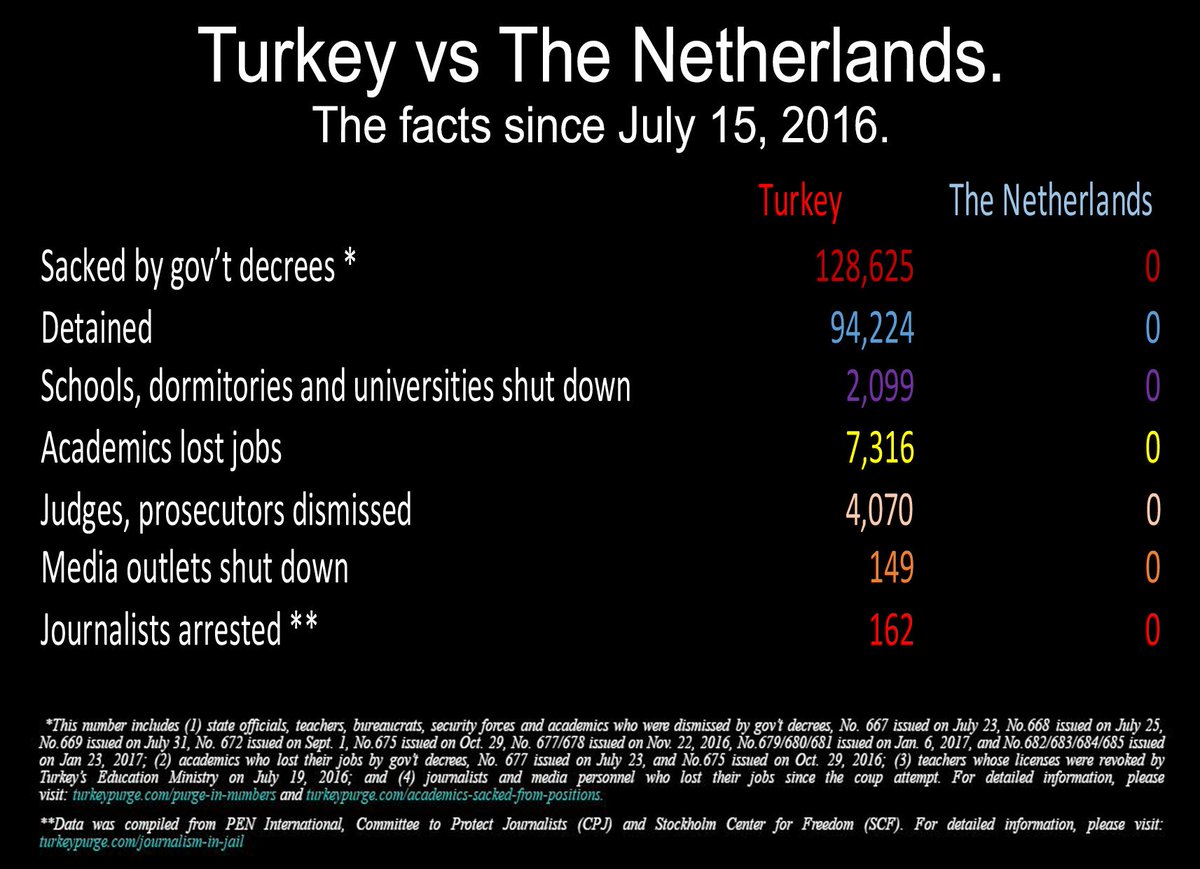
The Most Important Chart To See Before The Dutch Election (Ed Harrison)
Fragmentation Is the Solution, Not the Problem (CHS)
Economists Are Political Actors (Sapir)
One Chart That Captures the Debate Over Quantitative Easing (BBG)
Fed Expected To Raise Rates As US Economy Flexes Muscle (R.)
Britain Is Politically Dead From The Neck Down (Monbiot)
Turkish Paradoxes (K.)
World’s Spiders Eat More “Meat” Than All Of Mankind (G.)
Monsanto Accused of Ghostwriting Papers on Roundup Cancer Risk (BBG)
Monsanto Colluded With EPA, Could Not Prove Roundup Doesn’t Cause Cancer (ZH)
Greece: A Year of Suffering for Asylum Seekers (HRW)
As Greek Crisis Grinds On, Children Pay Price (K.)


Boomerang.

MSNBC’s Non-Story: Trump Made $150 Million, Paid 25% Tax Rate (ZH)

While Rachel Maddow drones on with the coherence of Janet Yellen, losing thousands of viewers by the minute, the MSNBC anchor was promptly scooped not only by the White House which revealed her “secret” one hour in advance, but also by the Daily Beast which reported that its contributor David Cay Johnston had obtained the first two pages of Trump’s 2005 federal income tax return, allegedly receiving them in the mail, and posted his “analysts” on his website, DCReport.org. According to the documents, Trump and his wife Melania paid $38 million in total income tax, consisting of $5.3 million in regular federal income tax, and an additional $31 million of “alternative minimum tax,” or AMT.

The White House statement confirmed the finding: “Before being elected President, Mr. Trump was one of the most successful businessmen in the world with a responsibility to his company, his family and his employees to pay no more tax than legally required,” the White House said in a statement. “That being said, Mr. Trump paid $38 million dollars even after taking into account large scale depreciation for construction, on an income of more than $150 million dollars, as well as paying tens of millions of dollars in other taxes such as sales and excise taxes and employment taxes and this illegally published return proves just that.” As the Beast notes, 2005 was the year that Trump, then a newly minted reality star, made his last big score as a real-life real estate developer, when he sold two properties, one on Manhattan’s west side and one in San Francisco, to Hong Kong investors, accounting for the lion’s share of his income that year.

“It is totally illegal to steal and publish tax returns,” the White House statement concluded. “The dishonest media can continue to make this part of their agenda, while the President will focus on his, which includes tax reform that will benefit all Americans.” But the real story here is that there is no story: what MSNBC confirmed is that Trump made more money than some of his critics said he made in the period in question, and more importantly, that he paid a generous effective income tax rate, well above the 14.1% rate paid by Mitt Romney, and even higher than the 13.5% federal tax rate paid by Bernie Sanders in 2014.
Read more …

Three articles in a row that deal with decentralization, each from their own angle. Most important chart I don’t know, but a good indicator of the entire west moving away from traditional parties. The majority of votes may go to new parties, not established ones.

The Most Important Chart To See Before The Dutch Election (Ed Harrison)

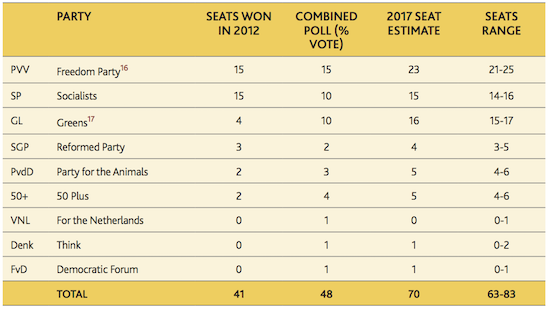
The present Prime Minister of the Netherlands, Mark Rutte, is the first Prime Minister from a party other than the two traditional centrist parties, the PvdA and the CDA, and their predecessor parties since the Dutch constitution and voting system was fundamentally changed in 1917. Clearly, we are seeing a change in voting patterns. But what is even more remarkable is that right now poling for parties that have always been in opposition is almost half of the vote for this election. Why it matters: We are in the midst of an economic upswing in Europe and globally as well. By all macro accounts, the Dutch economy is performing well. Yet, between them, previous ruling coalition parties —the VVD, PvdA, CDA, D66 and CU — are projected to only get 52% of the vote.

Source: Legatum Institute

They could even get fewer votes than the parties that have never been in government during the 100 years of the modern Dutch electoral system. People talk about voters turning to populists. But what happens to electoral patterns in a recession — or another sovereign debt crisis? And how would more populist platforms or parties in Europe deal with the existing economic orthodoxy, dominated by the stability and growth pact’s 3 and 60% deficit-debt hurdles? The next coalition in the Netherlands could be unstable, as it is likely to be cobbled together to exclude the PVV. Overall, the political risks in Europe may be high right now, but depending on how the economy does, the risks can rise further still.

Read more …

As I’ve addressed many times. Centralization is in the past.

Fragmentation Is the Solution, Not the Problem (CHS)

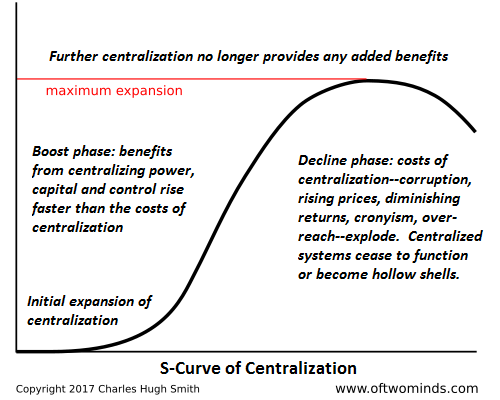
The fragmentation of political consensus (i.e. the consent of the citizenry) is presented by the Powers That Be and their media servants as being a disaster. The implicit fear is real enough: how can we rule the entire nation-empire if it fragments?\ As I noted the other day, fragmentation terrifies the Establishment of racketeers and insiders, for when the centrally-enforced rentier skims and scams collapse, those who own and control the rentier skims, scams and rackets will lose the source of their wealth and power. To understand why fragmentation is the solution rather than the problem, we have to look at how power is leveraged in centralized government. Let’s take the recent increase in a common pinworm treatment from $3 to $600: Pinworm prescription jumps from $3 to up to $600 a pill (via J.F.).

In a top-down, centralized hierarchy of political power (i.e. the central state), the pharmaceutical company only needs to lobby a few authorities in the central state to impose its rentier skim/scam on the entire nation. Lobbying/bribing a relative handful of federal officials and elected representatives is remarkably inexpensive: a financier or corporation only needs to focus on these few key players, and smoothing the PR pathway via a highly concentrated corporate media. A mere $5 million spent in the right places guarantees $100 million in future profits– profits earned not from open competition in a transparent market, but profits plundered as rentier skims: the product didn’t get any better or effective when the price leaped from $3 to $600, and competition was squelched by regulatory capture and high barriers to entry.

Now imagine if the pharmaceutical company had to lobby/bribe officials in each of America’s 3,142 counties to impose its rapacious rentier skim on the populace of each county. The lobbying/bribing effort will be orders of magnitude more costly and complex, and the national corporate media is less effective at the local level, where community groups and local media have some influence. If we look at the source of the 2008 Global Financial Meltdown, we find that the centralization of capital and power were the primary enablers of the meltdown. If the financial system were composed of 1,200 local banks, each of which had to comply with local and state regulations instead of five behemoth banks that had the capital and klout to buy Washington D.C.’s approval of their leverage and shady dealings, some hundreds of the smaller banks might have failed–but the system would have survived.
Read more …

Sapir is interesting. But economics is still not a science. Also addresses decentralization.

Economists Are Political Actors – Sapir (AHT)

[..] economists have appropriated a power that is not theirs. They have indeed penetrated the inner workings of the ruling apparatus. This is true at the State level, as to that of major international organizations, whether it is in the European Union, the OECD or the WTO. They are thus increasingly inclined to intervene on all social and political problems. But when they occur, it is by mixing an experts position and a position of political actors. This poses an immediate problem. For, if the expert is legitimate to speak on behalf of an acquaintance, the political actor must comply with the rule of democratic debate. By having it both ways, economists are exonerated from the problem of verification. The problem, therefore, is to know in which space one speaks, in that of pure competence or in that of political choices. If it is in the latter, it is no longer possible to accept that the “expertise” alone can decide the debate, expertise which can no longer be verified because any judgment would combine elements of competence and political values.

If one is in the political space, then the question of legitimacy arises. Now, this question immediately refers to the higher-level issue of sovereignty. In the space of politics, one asks first who is legitimate, and who is sovereign. But there is a problem that is deeper. The scientific credibility they claim to be is far from being indisputable, or undisputed. There are very serious reasons for this, which I explained in a book dating back to the early 2000s [1]. The very way in which the majority of the profession, the economists of the mainstream, understands the object of its work, is today debated and strongly criticized [2]. The methods used by these economists, the models on which they are based, are openly contested. [..] In fact, economists do politics, what nobody ever thinks to reproach them for, but they do politics by pretending not to do so, and by delegitimizing in advance any critical discourse. This is, of course, a serious attack on democracy.

[..] It is wrong here to speak of “Europe” as if it were an institution or a federation. The only reality of Europe is a historical reality, diverse, and above all a cultural reality. If you go to Vladivostok in Russia, you are in a European city. What is now a problem for democracy is the existence of the European Union, which is an institution and of which we can follow the evolution from the origin, that is to say the Maastricht Treaty. Indeed, the evolution of the European Union since 2007-2009 is a real problem. There, yes, unquestionably, we are in the presence of a structure that tends to develop itself without control or responsibility. The statements of Jean-Claude Juncker in the Greek election of January 2015 testify it [37].

The behavior of the EU and the institutions of the Euro zone call for an overall reaction because these institutions contest this freedom that is sovereignty [38]. Let us remind here the quotation from Mr. Jean-Claude Juncker, the successor of the ineffable Barroso at the head of the European Commission: “There can be no democratic choice against European treaties”. This revealing statement dates from the Greek election of January 25, 2015, which precisely saw the victory of SYRIZA. In a few words, everything is said. It is the quiet and satisfied affirmation of the superiority of non-elected institutions over the voting of voters, of the superiority of the technocratic principle over the democratic principle.

Read more …

The mother of all asset bubbles.

One Chart That Captures the Debate Over Quantitative Easing

Not all price increases are created equal. Goldman Sachs raises questions about the success of the efforts by the Federal Reserve and its peers to spark inflation in the wider economy with a chart showing what’s happened with prices in the largest developed economies since the start of 2009. A replication of their analysis shows a big spread in gains. While wages would never show swings on par with the likes of high-yield bonds, the chart does illustrate how well financial markets recovered from the 2007 to 2009 meltdowns. By contrast, consumer price inflation, incomes and other such gauges of the “real” economy have put in muted performances. For politicians, the chart sums up the frustrations that have helped propel the populism that Brexiteers and Donald Trump rode to victory.
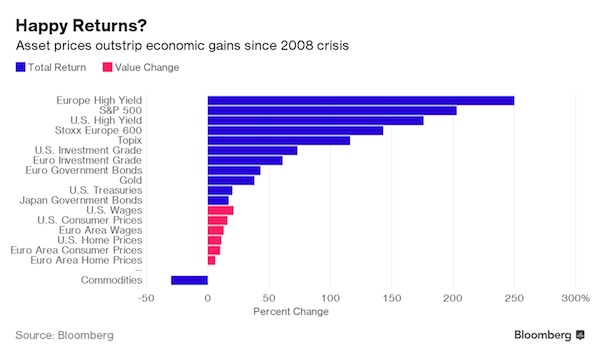
Few would question that the real economy would have been in much worse shape without the Fed, ECB and Bank of Japan’s determination to avert a financial-industry meltdown last decade, an effort that saw their balance sheets balloon by trillions of dollars. [..] Economic growth and wage increases have disappointed in recent years, depressed by poor productivity gains and historically low labor-force participation – dynamics that lie outside the purview of central banks. Now that monetary policy makers are leaving the onus on governments to address growth, and contemplating the easing off of stimulus, the big question for investors is how resilient markets will be. For now, optimism prevails – everything from corporate-bond premiums to emerging-market bonds are flashing confidence. It’s perhaps no wonder: though the Fed has ended its QE, continuing programs at the ECB and BOJ are driving almost $200 billion of purchases a month, according to Deutsche Bank estimates.

Read more …

Yawn…

Fed Expected To Raise Rates As US Economy Flexes Muscle (R.)

The Federal Reserve is expected to raise interest rates for the second time in three months on Wednesday, encouraged by strong monthly job gains and confidence that inflation is finally rising to its target. A rate hike at the conclusion of the Fed’s latest two-day policy meeting is already baked into bond yields and financial markets overall, with investors putting the likelihood of such a move at 95%, according to CME Group’s FedWatch program. Attention is turning instead to whether the U.S. central bank will signal an even faster pace of monetary tightening this year than the current three rate hikes that it projected at the December policy meeting.

“Expectations have some catching up to do regarding the Fed’s need to ‘lean into the wind’ of rising inflation, strong growth, robust sentiment, easy financial conditions, and the likelihood of fiscal stimulus in 2018,” analysts from Goldman Sachs wrote ahead of the meeting. They said they regarded a fourth rate increase this year as a “close call.” A rate increase on Wednesday would push the Fed’s target overnight lending rate to a range of between 0.75% and 1.00%, still low but approaching the range that the central bank has typically operated within. The Fed is scheduled to release its latest policy statement along with updated economic forecasts at 2 p.m. EDT. Fed Chair Janet Yellen is due to hold a press conference half an hour later.

Read more …

“Will my family and I truly be better off by going it alone? Will we really be more safe and secure?”

Britain Is Politically Dead From The Neck Down (Monbiot)

Here is the question the people of Scotland will face in the next independence referendum: when England falls out of the boat like a block of concrete, do you want your foot tied to it? It would be foolish to deny that there are risks in leaving the United Kingdom. Scotland’s economy is weak, not least because it has failed to wean itself off North Sea oil. There are major questions, not yet resolved, about the currency it would use; its trading relationship with the rump of the UK; and its association with the European Union, which it’s likely to try to rejoin. But the risks of staying are as great or greater. Ministers are already trying to reconcile us to the possibility of falling out of the EU without a deal.

If this happens, Britain would be the only one of the G20 nations without special access to EU trade – “a very destructive outcome leading to mutually assured damage for the EU and the UK”, according to the Commons foreign affairs committee. As the government has a weak hand, an obsession with past glories and an apparent yearning for a heroic gesture of self-destruction, this is not an unlikely result. On the eve of the first independence referendum, in September 2014, David Cameron exhorted the people of Scotland to ask themselves: “Will my family and I truly be better off by going it alone? Will we really be more safe and secure?” Thanks to his machinations, the probable answer is now: yes.

In admonishing Scotland for seeking to protect itself from this chaos, the government applies a simple rule: whatever you say about Britain’s relationship with Europe, say the opposite about Scotland’s relationship with Britain. In her speech to the Scottish Conservatives’ spring conference, Theresa May observed that “one of the driving forces behind the union’s creation was the remorseless logic that greater economic strength and security come from being united”. She was talking about the UK, but the same remorseless logic applies to the EU. In this case, however, she believes that our strength and security will be enhanced by leaving. “Politics is not a game, and government is not a platform from which to pursue constitutional obsessions,” she stormed – to which you can only assent.

Read more …

“And the last of the paradoxes is that Turkish electoral law prohibits pre-election rallies abroad..”

Turkish Paradoxes (K.)

What Turkish President Recep Tayyip Erdogan is trying to accomplish is perfectly clear: He wants to win the April 16 referendum on constitutional reform and thus gain the enhanced powers his ambitious nature so covets, some of which he already enjoys after turning last summer’s failed coup into an opportunity. His strategy is also clear: criminalizing any opposition, be it in actions or mere words, mainly at the expense of journalists and the Kurds, as well as condemning in summary fashion anyone perceived as being pro-Gulen. The second part of his strategy involves exporting his edginess and bullying rhetoric, first and foremost to the Aegean at the expense of Greece, and then to the European Union in a bid to win favor among Gray Wolves voters.

The Turkish president is also trying to strong-arm Western Europe into recognizing his prerogative (and that of his subordinates, though only those who vote his way next month) to a right that he himself openly scorns and denies his opponents. History is full of such paradoxes. Another is that while Erdogan accuses the West of Islamophobia, he is doing everything in his power to strengthen this sentiment because it will benefit him at the polls, as for years he has been cultivating the myth that he is the leader of all of Islam, both in the East and the West. In contrast to Erdogan, what the EU is trying to achieve vis-a-vis Ankara is not so clear, neither in terms of strategy nor even in tactics. Overall, it’s hard to know what it’s thinking about Turkey’s “European prospects” and, more specifically right now, about the pre-election speeches of Turkish pro-Erdogan officials in EU member-states.

Pre-election anxiety strengthened by the rising popularity of anti-systemic, anti-migrant, far-right forces, has been instrumental in Europe as well, especially in the Netherlands and Germany. It has resulted in bans against Turkish officials that demonstrate fear rather than faith in the strength of democracy, even when it is exposed to the test of regimes which are hardly democratic, such as Turkey. Meanwhile, fears that the European Union’s refugee deal with Turkey may collapse have prevented the German and Dutch leaderships from openly condemning the human rights violations in Turkey, resulting in them basically swallowing profound insults from Erdogan and some of his ministers referring to fascists and Nazis. Here’s another paradox: Turkey, which didn’t exactly shine in the war against Nazism, condemning the Netherlands, a victim of Nazism.

And the last of the paradoxes is that Turkish electoral law prohibits pre-election rallies abroad.

Read more …

I’d be interested to see a study like this done for bats. They eat a lot of insects. And there are lots of them: 1/3 of all mammals is a bat I recall reading.

World’s Spiders Eat More “Meat” Than All Of Mankind (G.)

The world’s spiders eat 400-800m tonnes of insects every year – as much meat and fish as humans consume over the same period, a study said Tuesday. In the first analysis of its kind, researchers used data from 65 previous studies to estimate that a total of 25m metric tonnes of spiders exist on Earth. Taking into account how much food spiders need to survive, the team then calculated the eight-legged creatures’ annual haul of insects and other invertebrates. “Our estimates … suggest that the annual prey kill of the global spider community is in the range of 400-800m metric tons,” they wrote in the journal The Science of Nature. This showed just how big a role spiders play in keeping pests and disease-carriers at bay – especially in forests and grasslands where most of them live.

“We hope that these estimates and their significant magnitude raise public awareness and increase the level of appreciation for the important global role of spiders,” the study authors wrote. For context, the study points out that humans consume about 400m tonnes of meat and fish every year, while whales feed on 280-500 tonnes and seabirds about 70m tonnes of seafood. There are about 45,000 known spider species, all of them meat-eating. And the critters can travel far to feed, swinging from place to place on silken threads that allow them to cover up to 30km (19 miles) in a day. Spiders are found everywhere from the Arctic to the most arid of deserts, in caves, on ocean shores, sand dunes and flood plains, the study authors said.

Read more …

Unbelievable.

Monsanto Accused of Ghostwriting Papers on Roundup Cancer Risk (BBG)

Monsanto was accused in court documents of ghostwriting scientific literature that led a U.S. regulator to conclude a key chemical in its Roundup weed killer shouldn’t be classified as carcinogenic. Lawyers suing the company on behalf of farmers and others, who claim exposure to glyphosate caused their non-Hodgkin’s lymphoma, alleged in a court filing which was partially blacked out until Tuesday that the Environmental Protection Agency “may be unaware of Monsanto’s deceptive authorship practice.” The filing was made public by a federal judge in San Francisco handling the litigation. The judge said last month he’s inclined to require a retired EPA official to submit to questioning by plaintiffs’ lawyers who contend he had a “highly suspicious” relationship with Monsanto.

The former official oversaw a committee that found insufficient evidence to conclude glyphosate causes cancer and left his job last year after his report was leaked to the press. The plaintiff lawyers said in the filing that Monsanto’s toxicology manager and his boss were ghost writers for two of the reports, including one from 2000, that the EPA committee relied on to reach its conclusion. Among the documents unsealed Tuesday was a February 2015 internal e-mail exchange at the company about how to contain costs for a research paper. The plaintiff lawyers cited it to support their claim that the EPA report is unreliable, unlike a report by an international agency that classified glyphosate as a probable carcinogen.

“A less expensive/more palatable approach” is to rely on experts only for some areas of contention, while “we ghost-write the Exposure Tox & Genetox sections,” one Monsanto employee wrote to another. The names of outside scientists could be listed on the publication, “but we would be keeping the cost down by us doing the writing and they would just edit & sign their names so to speak,” according to the e-mail, which goes to on say that’s how Monsanto handled the 2000 study.

Read more …

And this is even more unbelievable. After 25 years of Roundup being on the market, not one cancer study has been done.

Monsanto Colluded With EPA, Could Not Prove Roundup Doesn’t Cause Cancer (ZH)

newly unsealed court documents released earlier today seemingly reveal a startling effort on the part of both Monsanto and the EPA to work in concert to kill and/or discredit independent, albeit inconvenient, cancer research conducted by the World Health Organization’s International Agency for Research on Cancer (IARC)….more on this later. But, before we get into the competing studies, here is a brief look at the ‘extensive’ work that Monsanto and the EPA did prior to originally declaring Roundup safe for use (hint: not much). As the excerpt below reveals, the EPA effectively declared Roundup safe for use without even conducting tests on the actual formulation, but instead relying on industry research on just one of the product’s active ingredients.

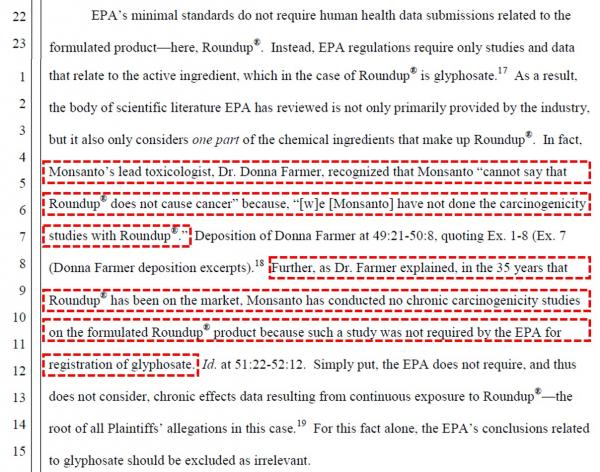
“EPA’s minimal standards do not require human health data submissions related to the formulated product – here, Roundup. Instead, EPA regulations require only studies and data that relate to the active ingredient, which in the case of Roundup is glyphosate. As a result, the body of scientific literature EPA has reviewed is not only primarily provided by the industry, but it also only considers one part of the chemical ingredients that make up Roundup.” Meanwhile, if that’s not enough for you, Donna Farmer, Monsanto’s lead toxicologist, even admitted in her deposition that she “cannot say that Roundup does not cause cancer” because “[w]e [Monsanto] have not done the carcinogenicity studies with Roundup.”
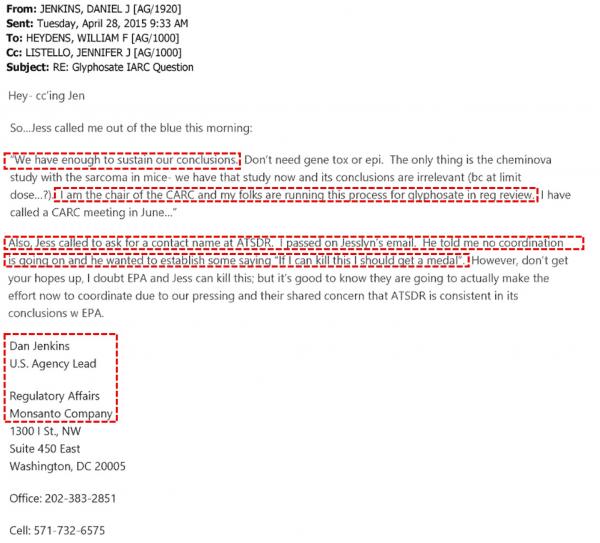
[..] In early 2015, once it became clear that the World Health Organization’s IARC was working on their own independent study of Roundup, Monsanto immediately launched their own efforts to preemptively discredit any results that might be deemed ‘inconvenient’. That said, Monsanto, the $60 billion behemoth, couldn’t possibly afford the $250,000 bill that would come with conducting a legitimate scientific study led by accredited scientists. Instead, they decided to “ghost-write” key sections of their report themselves and plotted to then have the independent scientists just “sign their names so to speak.”

Finally, when all else fails, you call in those “special favors” in Washington D.C. that you’ve paid handsomely for over the years. And that’s where Jess Rowland, the EPA’s Deputy Division Director for the Office of Chemical Safety and Pollution Prevention and chair of the Agency’s Cancer Assessment Review Committee, comes in to assure you that he’s fully exploiting his role as the “chair of the CARC” to kill any potentially damaging research…”if I can kill this I should get a medal.”
Read more …

Even HRW has moved to using the politically correct ‘asylum seekers’. for refugees.

Greece: A Year of Suffering for Asylum Seekers (HRW)

The EU-Turkey deal has trapped thousands of people in abysmal conditions on the Greek islands for the past year, while denying most access to asylum procedures and refugee protection, Human Rights Watch said today. This assessment of conditions is released ahead of the first anniversary of the agreement, signed on March 18, 2016. To carry out the deal, the Greek government has adopted a containment policy, keeping asylum seekers confined to the islands, including in the so-called refugee hotspots and other reception facilities, to facilitate speedy processing and return to Turkey. But continued arrivals, the mismanagement of aid funding, and the slow pace of decision-making, as well as the positive decisions of Greek appeals committees rejecting summary returns to Turkey as unsafe, have led to overcrowded and abysmal conditions on the Greek islands.

These factors, combined with the Greek authorities’ failure to properly identify vulnerable asylum seekers for transfer to the mainland, have resulted in deteriorating security conditions, unnecessary suffering, and despair. “The EU-Turkey deal has been an unmitigated disaster for the very people it is supposed to protect – the asylum seekers trapped in appalling conditions on Greek islands,” said Eva Cossé, Greece researcher at Human Rights Watch. “Greek authorities should ensure that people landing on Greece’s shores have meaningful access to asylum and put an end to the containment policy for asylum seekers. The deal’s flawed assumption that Turkey is a safe country for asylum seekers would allow Greece to transfer them back to Turkey without considering the merits of their asylum claims.

But in the months after the deal was completed, Greek asylum appeals committees have rightly ruled in many instances that Turkey does not provide effective protection for refugees and that asylum applications should be admitted for regular examination on their merits in Greece. Following EU pressure, however, Athens changed the composition of the appeals committees in June, and the restructured committees have ruled in at least 20 cases that Turkey was a safe country, even though it excludes non-Europeans from its refugee protection. That finding was challenged by two Syrian asylum seekers at Greece’s highest court, the Council of State, which heard their case on March 10. No one has yet been forcibly returned to Turkey on the grounds that their asylum application was inadmissible because they could obtain effective protection in Turkey. But if the Council of State turns down the appeal, it could pave the way for mass returns of asylum seekers to Turkey.

Read more …

Boy, the sadness…

As Greek Crisis Grinds On, Children Pay Price (K.)

In Greece’s grinding economic crisis, a home for abused children is now taking in those whose parents are struggling to feed them. It is perhaps the darkest sign of economic devastation in Greece, where traditionally strong family ties are starting to crumble after years of depression. A quarter of Greece’s workforce is unemployed and a quarter of its children live in poverty, according to United Nations figures, forcing parents to depend on grandparents for handouts. But pensions too have been cut a dozen times. In Athens, the Model National Nursery, set up a century ago for orphans of war, can hardly keep up with the number of parents turning to it for help. Unable to cover their basic needs, parents leave their children in the home all week.

Iro Zervaki, its head, says at least 40 children are on the waiting list, four times as many as a couple of years ago. The home sleeps 25 in a bare room with rows of beds draped in blue blankets, and lacks the staff and funds to increase capacity, she said. Most places are for abused children. Dozens of other children, all aged two to five, come in daily, but the days away from their parents are long. “We had incidents where children even attempted to leave, to run away, to go to their mother,” Zervaki said. In the buzzing playground, a little girl tugged the social worker’s blouse and yelled: “Miss! When will I go to my mum?” “They can’t tell the days apart so every day they ask: ‘Is it Friday?’” Anthoula Zarmakoupi, the social worker, said. “They know mum will pick them up at the weekend.”
Read more …

Mar 132017
 
 March 13, 2017  Posted by at 5:41 pm Finance Tagged with: , , , , , , , , ,  2 Responses »


Vincenzo Camuccini La Morte Di Cesare 1804


I don’t think Holland realized they planned their election on the Ides of March, don’t remember the date or event ever being mentioned when I lived there as a child. That Washington knew what it was doing when back in 2013 it set the end of the latest debt ceiling compromise to March 15 is not likely either. Nor is Janet Yellen deliberately setting the Fed’s ‘next’ rate hike on the date. They may all, in hindsight, wish they had possessed a little more historical knowledge.

When Shakespeare (and Plutarch before him) wrote ‘Beware the Ides of March’, he was talking about the murder of Julius Ceasar in 44 BC, by a group of senators, which included Brutus. But the incident can also be more broadly seen as the separation line between the Roman Republic and the Roman Empire. And now we’re getting somewhere interesting when looking at present day events. Democracy under threat of absolutism.

Leafing through the Dutch press, opinions differ on which politicians will profit most from the sudden row with Turkey that flared up over the weekend. Is it far right Wilders, who can now claim that he always foresaw things like this? Or is it “just a little less right” PM Rutte, who gets to look like a statesman and a decision maker? None of the other parties, there are 31 in total, look positioned to reap any gains from the bewildering developments.

The Netherlands is the ‘capital of fascism’, said Turkish foreign minister Cavusoglu on Sunday in France, where he ended up after being refused landing rights on Saturday. I know I’m biased, but no matter how you twist and turn it, that’s quite a statement about the country of Anne Frank, which lost most of its extensive Jewish population, and it was only a follow-up to Turkish president Erdogan earlier calling the Dutch ‘nazi’s and ‘remnants of fascists’.

Erdogan later managed ‘banana republic’. And declared that no-one can treat ‘his citizens’ the way a photograph taken Saturday night seemed to depict, in which a Turkish protester was attacked by a police dog. Apart from the question whether dogs should ever be used in quelling protests, this raises another issue crucial to the whole story. That is, Turkey insists that people who’ve lived in other countries for decades are nevertheless ‘its citizens’ (and not of their adopted countries).

As an aside, that story and photo of the dog – a German shepherd- reminds me of ‘When We Were Kings’, the movie about the Rumble in the Jungle fight in Kinshasa between Muhammad Ali and George Foreman, in which the latter emerges, upon arrival, from his plane with a huge German shepherd and thereby loses the sympthy of the local people, and some say the whole fight, people had very bad memories about such dogs.


So what happened in Holland? About 10 days ago, someone announced there would be a meeting (a rally) on Saturday March 11 in a ‘party hall’ in Rotterdam, that would be attended by Turkish foreign minister Cavusoglu. This set off an alert inside the Dutch government, because in Germany similar meetings had been cancelled in the preceding days. The reason for the cancellations is that these are political rallies to gain support from Turks living abroad for an April 16 referendum designed to give Erdogan very far-reaching powers.

Turkey claims the right to freedom of speech and political gathering. And they would perhaps have been granted this, if not for the July 15 2016 coup in the country, and especially its aftermath. Both Germany and Holland have been aware of Erdogan and his people putting pressure on their ‘citizens’ living abroad to for instance report ‘hidden’ Gülen supporters to embassies and consulates and mosques. In other words, to create divisions between one group of (Dutch or German) Turks and another.

Needless to say, neither Berlin not The Hague wants anything to do with that. But they want to reach some sort of compromise. No matter how they may feel about the country post-coup, Turkey is a NATO partner and the EU has an all-important deal with Ankara to keep refugees away from Europe. Even though it was obvious from the start that this was the dumbest deal with the devil anyone since Faust has ever signed, elections trump common sense and principles.

Over the next days, the Dutch tell Ankara they consider foreign minister Cavusoglu’s planned rally ‘undesirable’. Rotterdam mayor Aboutaleb, a Dutch-Morrocan muslim, bans the planned meeting. But the Turks respond that Cavusoglu will come no matter what, and for Holland to arrange an alternative venue. The Dutch don’t like this at all, but try to compromise with a meeting with a small group of invitees. On Friday, Turkey suggests the Rotterdam residence of the Turkish consul. Aboutaleb is not amused: the location of the home ‘invites’ the gathering of a large number of people outside.

Saturday morning comes with a lot of discussion. The consulate is suggested as a venue. Then, Turkey sends a message to a large group of Dutch Turks to come to the consulate. And while talks are ongoing, Cavusoglu tells CNNTürk TV that if Holland revokes his plane’s landing rights, something that has been mentioned in negotiations only as a last resort, there will be ‘economic and political sanctions’.


Rutte and his crew see no other choice than to do just that: revoke the landing rights. To which the response is to drive the -female- Turkish Minister of Family Affairs, Kaya, who’s in Germany, to Rotterdam. There were allegedly even multiple convoys, with decoys and all, so Holland wouldn’t know what car she was in. Meanwhile, the allegations of nazism and fascism had started to be unloaded on The Hague.

As someone remarked: all Erdogan wanted was a photo-op, a picture with 10,000 Turks waving their flags in the streets of Holland. Things turned out different. Minister Kaya made it to Rotterdam, but was refused entry into the consulate, declared an undesirable alien and told she must return to Germany. It took many hours, but finally she was put into a different car than the one she came in and driven back across the border.

From where she took a private plane to Istanbul. Turkey apparently was not clear on the difference between someone having a diplomatic passport and having diplomatic immunity. These things are regulated in the Vienna Convention, and Turkey wants Holland to be found in violation of it. But it doesn’t look like they are. And there are a few other things as well:


What I don’t get: where in the world does it say that you are free to hold political campaign events in any country you choose? Can you see Guatemalan rallies in the streets of LA? With the risk of clashes between rival groups? And what would Turkey say if an anti-Erdogan protest were held in Berlin tomorrow? You think political rallies by foreigners are allowed in Turkey?

And then the rioting started late Saturday night in Rotterdam. What struck me in the pictures of the riots, and in other footage, is how many times they contain men making hand-signs of either the Muslim Brotherhood or the Grey Wolves, an ultra right wing Turkish group. I don’t get how that fits in the streets of countries like Germany and Holland, and I don’t get how it fits in with the man who’s seen as a demi-god in Turkey, founder in 1923 of the secular country of Turhey, Kemal Atatürk.

It looks like Erdogan is trying to idolize Atatürk, as any Turkish leader would have to do to get votes, and at the same time make the country an islamic state, something Atatürk definitely did not want, but which could Erdogan hand a majority for the referendum next month. Why else does he accuse western Europe of being Islamophobic?

Oh, and how does Michael Flynn fit into this picture? Trump’s former security adviser worked for Erdogan -indirectly- while sitting in on security meetings, and pushed the US to extradite Erdogan’s no. 1 enemy, Fethullah Gülen. If Washington had had proof that Gülen was behind the coup last year, one would think he’d already have been extradited. Flynn’s role gets curiouser by the day. Is this why he was cast out of the Trump team? For being a foreign agent?


Also curious is the fact that Erdogan on Friday, the day before the Holland situation played out, was visiting Russia to meet with Putin. He arrived back home to say something about an anti-missile defense system they could build together, and suggested that Putin agreed with him on the danger of the Kurdish fighters in Syria and beyond. Only, Putin never acknowledged such a thing, and Putin has never forgiven Erdogan for downing a Russian jet in November 2015. He just waits for the right payback time. But Turkey is a NATO country.

The EU should never have kept the Union membership carrot dangling in front of Erdogan’s face, knowing full well Turkey would never be accepted as a member, zero chance. It should not have signed the refugee deal either; that could only ever have blown up into its face. The first and major victim of that will once again be Greece. Another country that Erdogan has been trying to bully.

Turkish jets violating Greek airspace are so common people tend to ignore them. Recently, army ships have been sailing into Greek waters too. The idea seems to be some sort of preparation for contesting the 1923 Lausanne Treaty , which settled ownership disputes post-Ottoman Empire. There are so many islands and islets and rocks, anyone who wants to can always find something to fight over. And then of course there’s still Cyprus; negotiations are ongoing, but so are efforts to frustrate them.

And it’s not that the Turkish economy is doing so well, the lira lost 30% in 2016 and another 10% so far this year. But unlike Greece, Turkey still has its own currency, and therefore the ability to devaluate it and absorb financial shocks. Still, 40% in 15 months is a lot. Imports are getting very expensive. Maybe that’s what Erdogan is trying to drown out with his fighting words.


This afternoon, Turkey’s Parliament Speaker compared Dutch PM Rutte to Hitler, Franco AND Mussolini. Pol Pot must have slipped his mind for a moment. Denmark, France, Angela Merkel and Brussels have all told Turkey to tone down. But at the same time, German TV network ZDF reports there are 30 more Erdogan rallies and meetings planned in the country in the next month.

Erdogan is trying to let his people see him as a strongman, not afraid of anyone. He only has to paint this picture for another month, through his state owned TV channels, and he’ll get his near absolute powers. Meanwhile, the US and all of the EU are too busy trying to manage their own election issues. But that may not be such a wise choice. On April 17, they may be faced with a near dictator as member of NATO, and with a pro-Islam and anti-EU agenda.

Erdogan is done winning in Europe, and it was even only ever for his home audience to begin with. His biggest gains in votes -and he looks to be 48%-52% behind right now- will have to come from the war theater, where he pretends to fight ISIS only to send his army to kill the Kurds. It would be a good thing if besides Putin there were a few other powers to tell him that’s a no-go. Donald?! Turkey will never beat the Kurds, it’s just an endless bloody battle. Time to make Kurdistan a nation, one way or the other.

It all sort of fits in with the whole political picture these days, doesn’t it? And with Ceasar and the Ides of March.


Mar 092017
 
 March 9, 2017  Posted by at 9:43 am Finance Tagged with: , , , , , , , , , ,  4 Responses »


Marjory Collins “Crowds at Pennsylvania Station, New York” 1942


WikiLeaks Says Just 1% Of #Vault7 Covert Documents Released So Far (RT)
US Private Sector Adds 298,000 Jobs In February – ADP (R.)
Trump Begins to Map Out $1 Trillion Infrastructure Plan (WSJ)
US Oil Price Plunges Toward $50 As A Perfect Storm Brews (CNBC)
Professor Steve Keen On The Problem With Europe (DR)
Varoufakis Back In Brussels In Push For ECB Transparency (EUO)
Germans Really, Really Love the Euro (BBG)
The Meltdown in Politics (Martin Armstrong)
Macron Faces A Really Big Problem If He Becomes French President (Con.)
French Insurgents Thrust Establishment Aside in Crucial Election (BBG)
Iceland First Country In The World To Make Firms Prove Equal Pay (Ind.)
Fukushima Clean-Up Falters 6 Years After Tsunami (G.)
Eurostat: Greece Is The Only EU Country Still In Recession (NE)
Greek Farmers Clash With Riot Police In Athens Over Austerity (G.)
It Takes 10 Workers In Greece To Pay One Pension (K.)


How is this going to affect Apple and Microsoft sales in China?

WikiLeaks Says Just 1% Of #Vault7 Covert Documents Released So Far (RT)

WikiLeaks’ data dump on Tuesday accounted for less than 1% of ‘Vault 7’, a collection of leaked CIA documents which revealed the extent of its hacking capabilities, the whistleblowing organization has claimed on Twitter. ‘Year Zero’, comprising 8,761 documents and files, was released unexpectedly by WikiLeaks. The organization had initially announced that it was part of a larger series, known as ‘Vault 7.’ However, it did not give further information on when more leaks would occur or on how many series would comprise ‘Vault 7’. The leaks have revealed the CIA’s covert hacking targets, with smart TVs infiltrated for the purpose of collecting audio, even when the device is powered off. The Google Android Operating System, used in 85% of the world’s smartphones, was also exposed as having severe vulnerabilities, allowing the CIA to “weaponize” the devices.

The CIA would not confirm the authenticity of the leak. “We do not comment on the authenticity or content of purported intelligence documents.” Jonathan Liu, a spokesman for the CIA, is cited as saying in The Washington Post. WikiLeaks claims the leak originated from within the CIA before being “lost” and circulated amongst “former U.S. government hackers and contractors.” From there the classified information was passed to WikiLeaks. End-to-end encryption used by applications such as WhatsApp was revealed to be futile against the CIA’s hacking techniques, dubbed ‘zero days’, which were capable of accessing messages before encryption was applied. The leak also revealed the CIA’s ability to hide its own hacking fingerprint and attribute it to others, including Russia. An archive of fingerprints – digital traces which give a clue about the hacker’s identity – was collected by the CIA and left behind to make others appear responsible.

Read more …

The Trump bull is alive for now.

US Private Sector Adds 298,000 Jobs In February – ADP (R.)

U.S. private employers added 298,000 jobs in February, well above economists’ expectations, a report by a payrolls processor showed on Wednesday. Economists surveyed by Reuters had forecast the ADP National Employment Report would show a gain of 190,000 jobs, with estimates ranging from 150,000 to 247,000. Private payroll gains in the month earlier were revised up to 261,000 from an originally reported 246,000 increase. The ADP figures come ahead of the U.S. Labor Department’s more comprehensive non-farm payrolls report on Friday, which includes both public and private-sector employment. Economists polled by Reuters are looking for U.S. private payroll employment to have grown by 193,000 jobs in February, down from 237,000 the month before. Total non-farm employment is expected to have changed by 190,000. The unemployment rate is forecast to tick down to 4.7% from the 4.8% recorded a month earlier.

Read more …

How much of it will be put to good use, and how much merely siphoned off?

Trump Begins to Map Out $1 Trillion Infrastructure Plan (WSJ)

President Donald Trump pushed his White House team on Wednesday to craft a plan for $1 trillion in infrastructure spending that would pressure states to streamline local permitting, favor renovation of existing roads and highways over new construction and prioritize projects that can quickly begin construction. “We’re not going to give the money to states unless they can prove that they can be ready, willing and able to start the project,” Mr. Trump said at a private meeting with aides and executives that The WSJ was invited to. “We don’t want to give them money if they’re all tied up for seven years with state bureaucracy.” Mr. Trump said he would was inclined to give states 90 days to start projects, and asked Scott Pruitt, the new head of the EPA, to provide a recommendation.

He expressed interest in building new high-speed railroads, inquired about the possibility of auctioning the broadcast spectrum to wireless carriers, and asked for more details about the Hyperloop, a project envisioned by Tesla founder Elon Musk that would rapidly transport passengers in pods through low-pressure tubes. “America has always been a nation of great promise, because we dream big,” Mr. Trump said. “We’re going to really dream big now.” The president called for a $1 trillion infrastructure plan last month in his address to a joint session of Congress and added that the projects would be financed through public and private capital. The White House was considering a repatriation tax holiday to generate about $200 billion in funding, but other sources also were being considered, a senior administration aide said.

In the meeting, the president said he aimed to win approval for an infrastructure plan once Congress finishes deliberations on health care and a reform of tax laws. Mr. Trump suggested that an infrastructure plan may be part of the tax-reform debate. “We’ll see what happens,” he said. Vice President Mike Pence, who sat across from the president during the meeting, said that Congress is “committed to the president’s vision.” “There’s a great of interest in Congress in doing this,” Mr. Pence said. “But there’s also just as much interest in listening to leaders in the private sector to identify the capital and identify the needs to be able to finance this in a way that really captures the energy of the American economy.”

Read more …

Time to acknowledge demand isn’t coming back?

US Oil Price Plunges Toward $50 As A Perfect Storm Brews (CNBC)

Oil is on track to break through the key psychological level of $50 a barrel after a ninth straight rise in U.S. crude stockpiles came at exactly the wrong moment, analysts said Wednesday. The amount of crude oil in U.S. storage rose to another record high on Wednesday, jumping 8.2 million barrels from the previous week, the Energy Information Administration reported. The increase was more than four times what analysts expected. Weekly figures also showed U.S. oil production continuing to tick up toward 9.1 million barrels a day, the highest level in more than a year. That provided further evidence that rising American output is confounding efforts by OPEC, Russia and 10 other exporters to reduce global oil inventories by curbing their own output. The data sent U.S. benchmark West Texas Intermediate crude prices plunging more than 5% to a nearly three-month low.

The plunge through a number of lows on Wednesday puts oil on a path to test the December low of $49.95 a barrel, said John Kilduff at energy hedge fund Again Capital. “From there you could accelerate,” he told CNBC, adding that $50 “was the fail-safe.” Kilduff’s downside target, once oil breaks below $50 a barrel, is $42. For the last three months, oil has traded in a range between $49.61 and $55.24. According to Kilduff, all the elements are in place for oil to break below its three-month range: lack of cohesion among OPEC members, bearish statements from oil ministers at CERAWeek conference by IHS Markit and subdued refinery activity as operators perform seasonal maintenance in the United States. On Tuesday, Saudi Oil Minister Khalid al-Falih warned at CERAWeek that the kingdom would only support OPEC’s intervention in markets for a “restricted period of time” and would not “underwrite the investments of others at our own expense and long-term interests.”

Read more …

Snippets from an interview. The euro was doomed from the start because of conditions put on it.

Professor Steve Keen On The Problem With Europe (DR)

But the trouble is, you see, they didn’t have to have a single currency combined with the 60% limit on government debt and the 3% limit on government deficits. If they simply had a currency and made no rules whatsoever about that, then it would have been feasible, potentially, to say okay, well it’s not working as well as we would like it to, but not imposing austerity on economies in a downturn, which is what they ended up doing courtesy of those rules. Maybe we need a treasury to make it work better, but it wasn’t just the fact that it was only the central bank, it was also the rules on government spending.

[..] another part of it, which is quite intriguing, I heard in Berlin just recently, is that also, one of the other rules they agreed to, or one of the other objectives they agreed to, not a rule, was to target a 2% rate of inflation. Now what you actually had happen was that Germany hit about 1%, France actually hit about 2%, Italy hit about 3%, the three major trading partners of course on the block. Well, that means, as a result, over every year, German manufacturers were gaining a 2% cost advantage over Italian manufacturers. Which ultimately means of course that people don’t buy Lamborghinis and Fiats anymore, they buy Mercedes, because for the same features they’re cheaper.

It’s not about labour productivity alone, it’s about the rate of inflation, which comes down to the rate of wage change, because the Germans suppressed the rate of wage change, the rate of inflation was lower, and that was 1% below the level they agreed to. Now, if they’d agreed to 2%, and France did 2%, and Italy maybe suppressed its wage change and they hit 2%, you wouldn’t have these imbalances. But they’ve built up over 15 – going on close to 20 years now – and those level of imbalances mean that, fundamentally, Italian industry can’t compete with German industry, not because of productivity differences so much but wage costs combined with that.

[..] That’s why Trump’s complaining about Germany having an undervalued currency, and he’s bloody right on that front. If you can run a 9% of GDP trade surplus, which is the level Germany’s now hit, a lot of that is with the rest of the world, the EU itself overall is balanced, so there’s a huge imbalance – Germany’s got a huge trade surplus with the rest of Europe, but it’s also got it with the rest of the world, and on that scale I think Germany’s trade balance now is the same scale as China’s. Now that’s ludicrous.

Read more …

Perhaps the biggest problem with Europe is that transparency and the EU don’t mix. In this case it’s clear why: the ECB was used as a -very blunt- tool for political pressure. Their defense is basically: if we become transparent, we’re no longer independent. And people buy that?!

Varoufakis Back In Brussels In Push For ECB Transparency (EUO)

Former Greek finance minister Yanis Varoufakis has joined forces with the German left-wing MEP Fabio De Masi in a bid to clarify whether the ECB had a legal right to limit the liquidity of Greece’s banks in 2015. The duo told journalists in Brussels on Wednesday (8 March) that they were collecting signatures for a petition to ECB president Mario Draghi, asking him to disclose two legal opinions commissioned by the bank. The first study was ordered in February, before the ECB decided to limit the access of Greek banks to ECB funding and opted instead to open access to the emergency liquidity assistance (ELA) – a fund with more restrictive access conditions. The decision was taken a few days after the radical left-wing Syriza party came to power, with Varoufakis as finance minister.

The second study, in June 2015, was about the ECB’s decision to freeze the amount of money available through the ELA after the Greek government’s decision to hold a referendum on the bailout conditions required by the country’s creditors. The measure was taken over concerns that Greek banks would become insolvent because of the deadlock in bailout talks. It also put more pressure on the Greek government to accept the lenders’ conditions. To avoid a bank run, where large numbers of people withdraw money from their deposit accounts at the same time, the government introduced capital controls. This meant that Greek people were only able to withdraw a maximum of €60 per day. The measure prevented a capital run, but also put pressure on Athens to agree to creditors’ terms for a third bailout.

Varoufakis, who was finance minister at the time, said this was a breach of the independence of the bank. “The ECB has the capacity to close down all the banks of a member state. At the same time, it has a charter which grants it – supposedly – complete independence from politics. And yet, there is no central bank, at least in the West, which has less independence of the political process,” Varoufakis said. He said Draghi was “completely reliant” on the decisions of an “informal group of finance ministers”, referring to the fact that the Eurogroup, which gathers the finance ministers of the 19 eurozone countries, isn’t enshrined in EU treaties. “It is apparent that Draghi didn’t feel that the was on solid legal ground when proceeding with the closing of Greek banks,” Varoufakis said.

[..] In September 2015, Fabio De Masi already asked Draghi for the opinions. But the ECB chief, in a letter made public by the MEP, said the bank does not plan to publish the legal opinions because this would “undermine the ECB’s ability to obtain uncensored, objective and comprehensive legal advice, which is essential for well-informed and comprehensive deliberations of its decision-making bodies”. “Legal opinions provided by external lawyers and related legal advice are protected by legal professional privilege (the so-called ‘attorney-client privilege’) in accordance with European Union case law,” Draghi said. “Those opinions were drafted in full independence, on the understanding that they can only be disclosed by the addressee and only shared with people who need to know in order to take reasoned decisions on the issues at stake,” he added.

Read more …

No cashless society there.

Germans Really, Really Love the Euro (BBG)

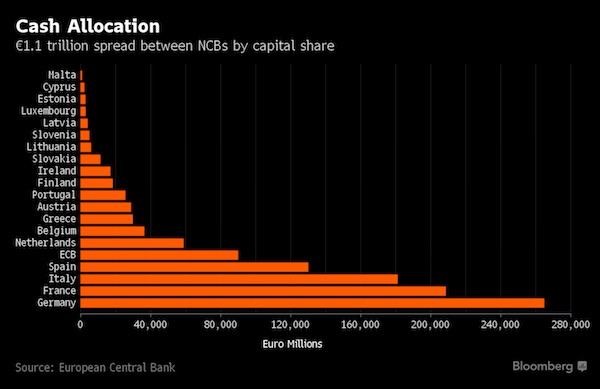
As worries over the future of the euro zone heat up, the union’s biggest member is doubling down on the single currency in an underappreciated way. Germany’s central bank is by far the biggest issuer of cash in the bloc, with the Bundesbank the source of more euro banknotes in circulation than all of its peers combined. The size of the imbalance is underscored by new data from the ECB, showing nations’ contributions towards the Eurosystem’s consolidated financial statement. Each national central bank, or NCB, has a notional banknote allocation that’s tied to its share of Eurosystem capital. At the end of last year, there were €1.1 trillion euros ($1.25 trillion) in circulation, breaking down like this:

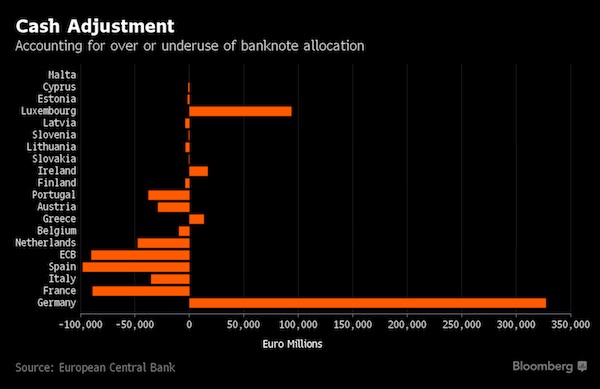
That accounts for how euro cash would be distributed in theory. In order to find out how much cash is actually issued you have to make adjustments that take into account variations in demand, which push the number higher in some countries and lower in others. The adjustments look like this:

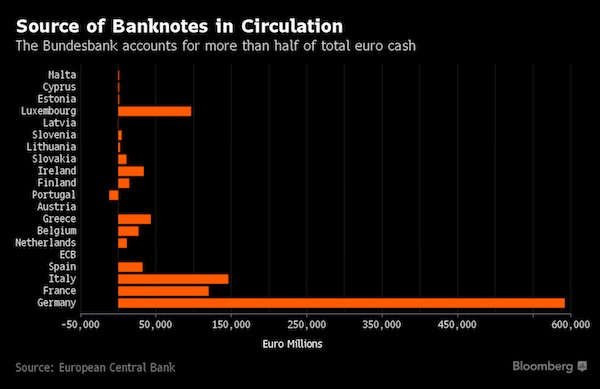
The Bundesbank has, since the introduction of the euro in 2002, put a net €327 billion into circulation above its on-paper allocation. By combining the figures in the two charts, we arrive at a true picture of the origin of banknotes in the European economy:

Read more …

“The mainstream media are not honorable independent people. They are big business not much different from the banks.”

The Meltdown in Politics (Martin Armstrong)

The bias of the press is getting so bad, they are undermining everything they were supposed to stand for. This is a critical aspect in the decline and fall of an empire, nation, or city state. Once the news is compromised, confidence not just in the press, but in everything crumbles. The mainstream media are not honorable independent people. They are big business not much different from the banks. They lobby for their special deals and the support the status quo. The New York Times at least admitted their coverage of the election was biased. They apologized, but nothing has really changed. “As we reflect on the momentous result, and the months of reporting and polling that preceded it, we aim to rededicate ourselves to the fundamental mission of Times journalism. That is to report America and the world honestly, without fear or favor, striving always to understand and reflect all political perspectives and life experiences in the stories that we bring to you. It is also to hold power to account, impartially and unflinchingly.”

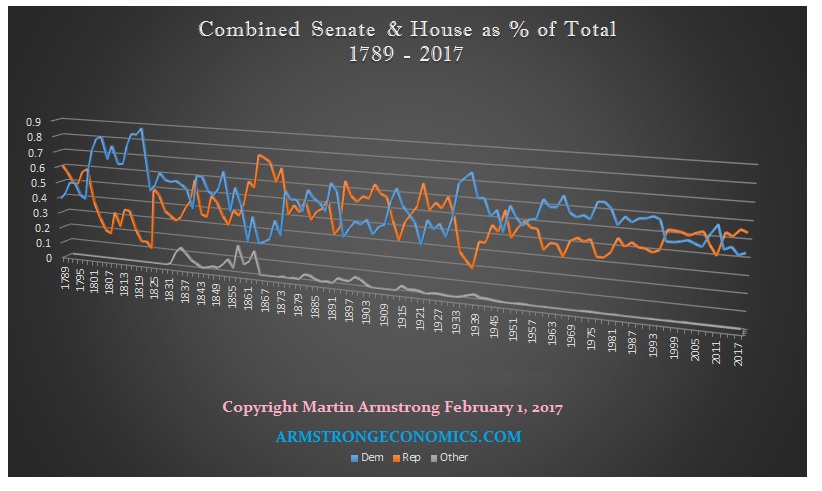
Even if Trump met with Putin, exactly what does that infer? Did it alter the election? No. Even Obama admitted that no hack altered the vote count. So what is the issue? The press aids the Democrats in trying to blame Putin for Hillary’s loss. But there is not a single shred of evidence that ANY of the leaked emails from the Democrats was ever altered or was fake. The Democrats simply got caught with their hand in the cookie jar and blame Putin. So what is all this Russia thing about? It seems to be just a diversion to discredit Trump and stop the agenda of any reform. A simple technical analysis of Democrat v Republican shows that the former is in a major decline and their agenda has been dying. In fact, look out for 2018-2019. Sheer chaos is coming.

In Europe, political forces are also in a state of denial. The EU is collapsing and the politicians refuse to surrender their goals. Instead, they lash out at what they are calling “populism” as with the election of Trump, BREXIT, and the developments in France. The will of the people is not worth anything when it goes against their dreams. So in both cases, we are witnessing the demise of the West. All of this political fighting is setting the stage for the shift from the West to the East of financial power. The wheel of fortune spins. We lost. What is accomplished by overthrowing Trump? What is accomplished by forcing Europe to remain in the EU with unelected people controlling everything from Brussels? If the press succeeds in overturning Trump, what is accomplished? Do they really think everything can go back to the way it was before?

[..] the media in the USA has degenerated to fake news, but in Europe the very same trend has emerged. This is a serious nail in our coffin and mainstream media has indeed become the sword of our own destruction. Can we prevent this outcome? No. All we can do is hopefully learn from our mistakes and this time try to create a system that prevents such an oligarchy from rising. All Republics historically collapse into oligarchies. As we head into 2018, this is going to get really bad. This is going to be a turning point of great importance in the political world.

Read more …

A president without a party. Or a program. Doesn’t seem to add up.

Macron Faces A Really Big Problem If He Becomes French President (Con.)

Currently riding high in the polls, Emmanuel Macron, the self-styled “beyond left and right” candidate for the French election, has been tipped to become the next president in May. But if he does, will he actually run the country? This question might sound odd but the nuances of the French political system put Macron in a spot of bother. The president derives their power from the support of a majority in the lower house of parliament, the National Assembly. Macron was a minister for the Socialist Party government but quit in 2016 to form his own political movement. Now he doesn’t even have a party, let alone a majority. Although the constitution of the French Fifth Republic, created by Charles De Gaulle in 1958, extended presidential powers, it did not enable the president to run the country.

There are only a few presidential powers that do not need the prime minister’s authorisation. The president can appoint a prime minister, dissolve the National Assembly, authorise a referendum and become a “temporary dictator” in exceptional circumstances imperilling the nation. They can also appoint three judges to the Constitutional Council and refer any law to this body. While all important tasks, this does not, by any stretch of the imagination, amount to running a country. The president can’t suggest laws, pass them through parliament and then implement them without the prime minister. The role of a president is best defined as a “referee”. Presidential powers give the ability to oversee operations and act when the smooth running of institutions is impeded.

So a president is able to step in if a grave situation arises or to unlock a standoff between the prime minister and parliament, such as by announcing a referendum on a disputed issue or by dismissing the National Assembly. So, why does everyone see the president as the key figure? In a nutshell, it’s because the constitution has never been truly applied. There lies the devilish beauty of French politics. A country known since the 1789 revolution for its inability to foster strong majorities in parliament has succeeded, from 1962, in providing solid majorities.

Read more …

This is what happens everywhere, in varying ways. In France, both establishment blocks look to be cast aside.

French Insurgents Thrust Establishment Aside in Crucial Election (BBG)

The old order is fading in France. Every election since Charles de Gaulle founded the Fifth Republic more than half a century ago has seen at least one of the major parties in the presidential runoff and most have featured both. With Republicans and Socialists consumed by infighting and voters thoroughly fed up, polls suggest that neither will make it this year. For the past month, survey after survey has projected a decider between Emmanuel Macron, a 39-year-old rookie who doesn’t even have a party behind him, and Marine Le Pen, who’s been ostracized throughout her career because of her party’s history of racism. “We’ve gone as far as we can go with a certain way of doing politics,” said Brice Teinturier, head of the Ipsos polling company and author of a book on voters’ disillusionment. “Everyone feels the system is blocked.”

Claude Bartolone, the Socialist president of the National Assembly, said in an interview with Le Monde Tuesday he may back Macron because he doesn’t “identify” with the more extreme platform put forward by his party’s candidate Benoit Hamon. De Gaulle’s latest standard-bearer Francois Fillon has spent the past week facing down rebellions in his party triggered by a criminal probe of his finances. Former Prime Minister Manuel Valls hasn’t campaigned for Hamon since losing to him in the primary and Socialist President Francois Hollande hasn’t even endorsed his party’s candidate either. Instead, senior figures from the Socialist camp are endorsing Macron, with former Paris Mayor Bertrand Delanoe the latest to offer his backing on Wednesday. “There’s a breakdown of parties in France,” Francois Bayrou, a two-time centrist candidate who is now backing Macron, said Tuesday on RMC Radio. “There are hostile battles between factions within each party, which has ruined the parties and ruined the image of politics.”

Read more …

Crazy that such differences still persist.

Iceland First Country In The World To Make Firms Prove Equal Pay (Ind.)

On International Women’s Day, Iceland became the first country in the world to force companies to prove they pay all employees the same regardless of gender, ethnicity, sexuality or nationality, The country’s government announced a new law that will require every company with 25 or more staff to gain a certificate demonstrating pay equality. Iceland is not the first country to introduce a scheme like this – Switzerland has one, as does the US state of Minnesota – but Iceland is thought to be the first to make it a mandatory requirement. Equality and Social Affairs Minister Thorsteinn Viglundsson said that “the time is right to do something radical about this issue.” “Equal rights are human rights. We need to make sure that men and women enjoy equal opportunity in the workplace. It is our responsibility to take every measure to achieve that,” he said.

The move comes as part of a drive by the Nordic nation to eradicate the gender pay gap by 2022. In October, thousands of female employees across Iceland walked out of workplaces at 2.38pm to protest against earning less than men. After this time in a typical eight-hour day, women are essentially working without pay, according to unions and women’s organisations. Iceland has been at the forefront of establishing pay equality, having already introduced a minimum 40% quota for women on boards of companies with more than 50 employees. The country has been ranked the best in the world for gender equality by the World Economic Forum for eight years running, but despite this, Icelandic women still earn 14 to 18% less than men, on average.

Read more …

“Cleaning up the plant [..] is expected to take 30 to 40 years, at a cost Japan’s trade and industry ministry recently estimated at 21.5tr yen ($189bn).” Uh, no, it will cost far more than $189 billion, and it’s to NOT clean up the plant. They have no idea how to do it. It’s all just fantasy.

Fukushima Clean-Up Falters 6 Years After Tsunami (G.)

Barely a fifth of the way into their mission, the engineers monitoring the Scorpion’s progress conceded defeat. With a remote-controlled snip of its cable, the latest robot sent into the bowels of one of Fukushima Daiichi’s damaged reactors was cut loose, its progress stalled by lumps of fuel that overheated when the nuclear plant suffered a triple meltdown six years ago this week. As the 60cm-long Toshiba robot, equipped with a pair of cameras and sensors to gauge radiation levels was left to its fate last month, the plant’s operator, Tokyo Electric Power (Tepco), attempted to play down the failure of yet another reconnaissance mission to determine the exact location and condition of the melted fuel. Even though its mission had been aborted, the utility said, “valuable information was obtained which will help us determine the methods to eventually remove fuel debris”.

The Scorpion mishap, two hours into an exploration that was supposed to last 10 hours, underlined the scale and difficulty of decommissioning Fukushima Daiichi – an unprecedented undertaking one expert has described as “almost beyond comprehension”. Cleaning up the plant, scene of the world’s worst nuclear disaster since Chernobyl after it was struck by a magnitude-9 earthquake and tsunami on the afternoon of 11 March 2011, is expected to take 30 to 40 years, at a cost Japan’s trade and industry ministry recently estimated at 21.5tr yen ($189bn). The figure, which includes compensating tens of thousands of evacuees, is nearly double an estimate released three years ago. The tsunami killed almost 19,000 people, most of them in areas north of Fukushima, and forced 160,000 people living near the plant to flee their homes. Six years on, only a small number have returned to areas deemed safe by the authorities.

[..] Shaun Burnie, a senior nuclear specialist at Greenpeace Germany who is based in Japan, describes the challenge confronting the utility as “unprecedented and almost beyond comprehension”, adding that the decommissioning schedule was “never realistic or credible”. The latest aborted exploration of reactor No 2 “only reinforces that reality”, Burnie says. “Without a technical solution for dealing with unit one or three, unit two was seen as less challenging. So much of what is communicated to the public and media is speculation and wishful thinking on the part of industry and government. “The current schedule for the removal of hundreds of tons of molten nuclear fuel, the location and condition of which they still have no real understanding, was based on the timetable of prime minister [Shinzo] Abe in Tokyo and the nuclear industry – not the reality on the ground and based on sound engineering and science.”

Read more …

And it will remain in recession for a long time.

Eurostat: Greece Is The Only EU Country Still In Recession (NE)

Household consumption and a rebound in investment drove economic growth in the euro zone in the last three months of last year, the latest data from EU statistics office Eurostat shows. Eurostat confirmed its earlier estimate that the economy of the 19 countries sharing the euro grew 0.4% quarter-on-quarter and 1.7% year-on-year. It said household consumption added 0.2 % points to the final quarterly growth number and capital investment added another 0.1 points, rebounding from a 0.1 point negative contribution in the third quarter. Growing inventories added another 0.1 points and government spending another 0.1 points while net trade subtracted 0.1 points.

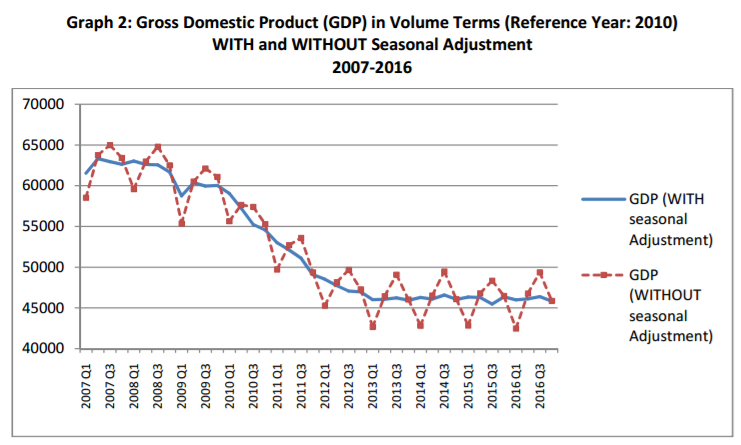
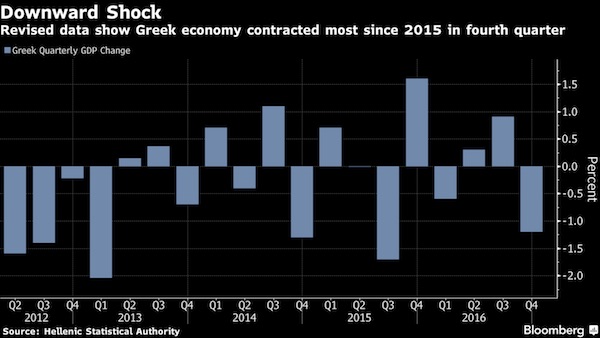
Greece was the only country that was in negative territory, with GDP declining by 1.1% compared with the last quarter of 2015 and by 1.2% compared to the third quarter of 2016. Combined, the eurozone continued steady recovery, with the economy growing by 1.7% year on year and 0.4% on a quarterly basis. Messages were positive in the eurozone core. Germany grew by 1.8% and France by 1.2%, while the third largest economy of the euro, Italy, increasing by 1%. Impressive was the growth of Spain as it reached 3%. Social protection spending in Greece represented 20.5 % of the country’s GDP in 2015.

This is slightly higher than both the Eurozone average ratio (20.1% of GDP) and the EU28 average ratio (19.2% of GDP). Social protection expenditure in EU member-states ranged from 9.6% of GDP in Ireland to 25.6% of GDP in Finland in that year. Eight member-states (Finland, France, Denmark, Austria, Italy, Sweden, Greece and Belgium) spent more than 20% of GDP on social protection while Ireland, the Baltic states, Romania, Cyprus, Malta and the Czech Republic spend less than 13%.

Read more …

“Tax rates are expected to reach 26%, while pensions are being cut by as much as 22% by 2022.”

Greek Farmers Clash With Riot Police In Athens Over Austerity (G.)

Farmers who travelled to Athens from Crete have clashed with riot police in the latest unrest on the streets of the Greek capital, prompted by the government’s austerity policies. The confrontation occurred outside the agriculture ministry, where farmers wielding staffs engaged with police firing teargas to prevent them from entering the building. More than 1,100 stockbreeders and farmers arrived on overnight ferries in the early hours of Wednesday, to protest against increases in tax and social security contributions demanded by the creditors keeping Greece afloat. Footage showed the farmers, many wearing black bandanas, smashing the windows of riot vans with shepherds’ staffs, setting fire to rubbish bins and hurling rocks and stones.

When the agriculture minister, Evangelos Apostolou, initially refused to meet a 45-member delegation representing protesters, anger peaked. “Dialogue is one thing, thuggery quite another,” the minister said, before attempts at further talks also foundered. Greek farmers, long perceived to be the privileged recipients of generous EU funds, have historically been exempt from taxation. However, the barrage of cuts and increases in the price of everything from fuel to fertilisers will hit them hard. Tax rates are expected to reach 26%, while pensions are being cut by as much as 22% by 2022. Prof George Pagoulatos, who teaches European politics and economy at the University of Athens, said: “Farmers, in many ways, are a classic example of one of Greece’s protected groups. “In certain rural constituencies, like Crete, they are also electorally very influential.”

Read more …

Wages have become too low to pay for pensions. 23% unemployment. Almost half of Greeks depend on pensions to stay alive. More cuts are inevitable. The only way is down.

It Takes 10 Workers In Greece To Pay One Pension (K.)

The constant decline in salaries and the rise of flexible forms of employment are undermining the sustainability of the country’s social security system despite the numerous interventions in terms of pensions. According to social security experts, the slide in the average salary means that it now takes the contributions of 10 workers to pay one pension; before the crisis it required the contributions of four workers. The deterioration of that ratio highlights the system’s viability problem. The main feature of that problem is that the contributions of today’s workers go in their entirety toward covering the pensions of today’s pensioners.

According to data from the new Single Social Security Entity (EFKA), the analysis of employers’ declarations from May 2016 showed that the average salary of 1.4 million workers with full employment amounted to €1,176 per month. The average monthly gross earnings of the 588,000 part-time workers amounted to just €394; their number increased by about 11% from a year earlier. The same data show that bigger enterprises pay higher salaries: Businesses with fewer than 10 employees have an average full-employment salary that amounts to just 58.9% of that paid to employees of companies with more than 10 workers.

Read more …

Mar 082017


Dorothea Lange A Family Of Mexican Migrants, On The Road In California 1936


Wikileaks ‘Vault 7’, Largest Ever Publication Of Confidential CIA Docs (ZH)
Snowden: What The Wikileaks Revelations Show Is “Reckless Beyond Words” (ZH)
WikiLeaks Releases Trove of Alleged CIA Hacking Documents (NYT)
Wikileaks: CIA Capable Of Cyber “False Flag” Attack To Blame Russia (TAM)
CIA Contractor on #VAULT7 Leak: ‘There is Heavy Shit Coming Down’ (RF)
US Trade Deficit Jumps To Five-Year High On Imports (R.)
China Posts Rare Trade Deficit As February Imports Surge in Yuan Terms (R.)
Why Are Europe’s Small Central Banks Stocking Up Foreign Money? (WSJ)
Dispel The Economic Myths That Hold Women Back (Ann Pettifor)
Austerity Is A Feminist Issue (G.)
The Women’s Protest That Sparked The Russian Revolution (G.)
Vacant Homes Are A Global Epidemic (BD)
There’s No Housing Bubble in Australia, Heads of Big Banks Say (BBG)
Australian Lenders Are Handing Out Mortgages Like Confetti (LF)
Greece’s Still-Falling GDP Dispels Creditors’ “Recovery” Myth (Prime)
Tax Weary Greek Employers Pay In Kind As Creditor Demands Rise (BBG)
America’s Forgotten History of Illegal Deportations (Atlantic)


It’s obvious there is only one story today, which ironically(?!) blows the whole Trump-Russia accusation narrative to bits, even though of course Russia gets the blame for this too in all sorts of corners. But the files are reported to have been ‘out there’ for a while, in the hands of hackers and possible foreign agencies. The CIA spent a huge wad of taxpayer money on this, and then lost it all. It’s early days to say what this will mean for the agency’s abilities, and the nation’s safety, as well as that of American citizens, but it’s not good. Question is: who’s going to investigate how this could have happened? (Snowden and Kim Dotcom could)… And who’s going to repair the damage done? Anyone could be spying on your phone and your TV by now, not just the CIA -as if that wouldn’t be bad enough.

And this is just the first part. Wikileaks has announced more from where this came from.

Wikileaks ‘Vault 7’, Largest Ever Publication Of Confidential CIA Docs (ZH)

A total of 8,761 documents have been published as part of ‘Year Zero’, the first in a series of leaks the whistleblower organization has dubbed ‘Vault 7.’ WikiLeaks said that ‘Year Zero’ revealed details of the CIA’s “global covert hacking program,” including “weaponized exploits” used against company products including “Apple’s iPhone, Google’s Android and Microsoft’s Windows and even Samsung TVs, which are turned into covert microphones.”

WikiLeaks tweeted the leak, which it claims came from a network inside the CIA’s Center for Cyber Intelligence in Langley, Virginia.

Among the more notable disclosures which, if confirmed, “would rock the technology world“, the CIA had managed to bypass encryption on popular phone and messaging services such as Signal, WhatsApp and Telegram. According to the statement from WikiLeaks, government hackers can penetrate Android phones and collect “audio and message traffic before encryption is applied.”

Another profound revelation is that the CIA can engage in “false flag” cyberattacks which portray Russia as the assailant. Discussing the CIA’s Remote Devices Branch’s UMBRAGE group, Wikileaks’ source notes that it “collects and maintains a substantial library of attack techniques ‘stolen’ from malware produced in other states including the Russian Federation.

“With UMBRAGE and related projects the CIA cannot only increase its total number of attack types but also misdirect attribution by leaving behind the “fingerprints” of the groups that the attack techniques were stolen from. UMBRAGE components cover keyloggers, password collection, webcam capture, data destruction, persistence, privilege escalation, stealth, anti-virus (PSP) avoidance and survey techniques.”

As Kim Dotcom summarizes this finding, “CIA uses techniques to make cyber attacks look like they originated from enemy state. It turns DNC/Russia hack allegation by CIA into a JOKE

But perhaps what is most notable is the purported emergence of another Snowden-type whistleblower: the source of the information told WikiLeaks in a statement that they wish to initiate a public debate about the “security, creation, use, proliferation and democratic control of cyberweapons.”  Policy questions that should be debated in public include “whether the CIA’s hacking capabilities exceed its mandated powers and the problem of public oversight of the agency,” WikiLeaks claims the source said.

The FAQ section of the release, shown below, provides further details on the extent of the leak, which was “obtained recently and covers through 2016”. The time period covered in the latest leak is between the years 2013 and 2016, according to the CIA timestamps on the documents themselves. Secondly, WikiLeaks has asserted that it has not mined the entire leak and has only verified it, asking that journalists and activists do the leg work.

Among the various techniques profiled by WikiLeaks is “Weeping Angel”, developed by the CIA’s Embedded Devices Branch (EDB), which infests smart TVs, transforming them into covert microphones. After infestation, Weeping Angel places the target TV in a ‘Fake-Off’ mode, so that the owner falsely believes the TV is off when it is on. In ‘Fake-Off’ mode the TV operates as a bug, recording conversations in the room and sending them over the Internet to a covert CIA server.

As Kim Dotcom chimed in on Twitter, “CIA turns Smart TVs, iPhones, gaming consoles and many other consumer gadgets into open microphones” and added ” CIA turned every Microsoft Windows PC in the world into spyware. Can activate backdoors on demand, including via Windows update”

Dotcom also added that “Obama accused Russia of cyberattacks while his CIA turned all internet enabled consumer electronics in Russia into listening devices. Wow!”

Julian Assange, WikiLeaks editor stated that “There is an extreme proliferation risk in the development of cyber ‘weapons’. Comparisons can be drawn between the uncontrolled proliferation of such ‘weapons’, which results from the inability to contain them combined with their high market value, and the global arms trade. But the significance of “Year Zero” goes well beyond the choice between cyberwar and cyberpeace. The disclosure is also exceptional from a political, legal and forensic perspective.”

Read more …

“…first public evidence US [Government] secretly paying to keep US software unsafe”

Snowden: What The Wikileaks Revelations Show Is “Reckless Beyond Words” (ZH)

While it has been superficially covered by much of the press – and one can make the argument that what Julian Assange has revealed is more relevant to the US population, than constant and so far unconfirmed speculation that Trump is a puppet of Putin – the fallout from the Wikileaks’ “Vault 7” release this morning of thousands of documents demonstrating the extent to which the CIA uses backdoors to hack smartphones, computer operating systems, messenger applications and internet-connected televisions, will be profound. As evidence of this, the WSJ cites an intelligence source who said that “the revelations were far more significant than the leaks of Edward Snowden.”

Mr. Snowden’s leaks revealed names of programs, companies that assist the NSA in surveillance and in some cases the targets of American spying. But the recent leak purports to contain highly technical details about how surveillance is carried out. That would make them far more revealing and useful to an adversary, this person said. In one sense, Mr. Snowden provided a briefing book on U.S. surveillance, but the CIA leaks could provide the blueprints. Speaking of Snowden, the former NSA contractor-turned-whistleblower, who now appears to have a “parallel whisteblower” deep inside the “Deep State”, i.e., the source of the Wikileaks data – also had some thoughts on today’s CIA dump.

In a series of tweets, Snowden notes that “what @Wikileaks has here is genuinely a big deal”, and makes the following key observations “If you’re writing about the CIA/@Wikileaks story, here’s the big deal: first public evidence USG secretly paying to keep US software unsafe” and adds that “the CIA reports show the USG developing vulnerabilities in US products, then intentionally keeping the holes open. Reckless beyond words.” He then asks rhetorically “Why is this dangerous?” and explains “Because until closed, any hacker can use the security hole the CIA left open to break into any iPhone in the world.” His conclusion, one which many of the so-called conspiratorial bent would say was well-known long ago: “Evidence mounts showing CIA & FBI knew about catastrophic weaknesses in the most-used smartphones in America, but kept them open – to spy.”

Read more …

“..WikiLeaks, which has sometimes been accused of recklessly leaking information that could do harm, said it had redacted names and other identifying information from the collection. It said it was not releasing the computer code for actual, usable weapons “until a consensus emerges on the technical and political nature of the C.I.A.’s program and how such ‘weapons’ should be analyzed, disarmed and published.”

WikiLeaks Releases Trove of Alleged CIA Hacking Documents (NYT)

In what appears to be the largest leak of C.I.A documents in history, WikiLeaks released on Tuesday thousands of pages describing sophisticated software tools and techniques used by the agency to break into smartphones, computers and even Internet-connected televisions. The documents amount to a detailed, highly technical catalog of tools. They include instructions for compromising a wide range of common computer tools for use in spying: the online calling service Skype; Wi-Fi networks; documents in PDF format; and even commercial antivirus programs of the kind used by millions of people to protect their computers. A program called Wrecking Crew explains how to crash a targeted computer, and another tells how to steal passwords using the autocomplete function on Internet Explorer. Other programs were called CrunchyLimeSkies, ElderPiggy, AngerQuake and McNugget.

The document dump was the latest coup for the antisecrecy organization and a serious blow to the C.I.A., which uses its hacking abilities to carry out espionage against foreign targets. The initial release, which WikiLeaks said was only the first installment in a larger collection of secret C.I.A. material, included 7,818 web pages with 943 attachments, many of them partly redacted by WikiLeaks editors to avoid disclosing the actual code for cyberweapons. The entire archive of C.I.A. material consists of several hundred million lines of computer code, the group claimed. In one revelation that may especially trouble the tech world if confirmed, WikiLeaks said that the C.I.A. and allied intelligence services have managed to compromise both Apple and Android smartphones, allowing their officers to bypass the encryption on popular services such as Signal, WhatsApp and Telegram. According to WikiLeaks, government hackers can penetrate smartphones and collect “audio and message traffic before encryption is applied.”

Unlike the National Security Agency documents Edward J. Snowden gave to journalists in 2013, they do not include examples of how the tools have been used against actual foreign targets. That could limit the damage of the leak to national security. But the breach was highly embarrassing for an agency that depends on secrecy. Robert M. Chesney, a specialist in national security law at the University of Texas at Austin, likened the C.I.A. trove to National Security Agency hacking tools disclosed last year by a group calling itself the Shadow Brokers. “If this is true, it says that N.S.A. isn’t the only one with an advanced, persistent problem with operational security for these tools,” Mr. Chesney said. “We’re getting bit time and again.”

Read more …

No ‘evidence’ (and remember none was provided to date) of Russian spying is the least bit credible anymore after today.

Wikileaks: CIA Capable Of Cyber “False Flag” Attack To Blame Russia (TAM)

According to a Wikileaks press release, the 8,761 newly published files came from the CIA’s Center for Cyber Intelligence (CCI) in Langley, Virginia. The release says that the UMBRAGE group, a subdivision of the center’s Remote Development Branch (RDB), has been collecting and maintaining a “substantial library of attack techniques ‘stolen’ from malware produced in other states, including the Russian Federation.” As Wikileaks notes, the UMBRAGE group and its related projects allow the CIA to misdirect the attribution of cyber attacks by “leaving behind the ‘fingerprints’ of the very groups that the attack techniques were stolen from.”

In other words, the CIA’s sophisticated hacking tools all have a “signature” marking them as originating from the agency. In order to avoid arousing suspicion as to the true extent of its covert cyber operations, the CIA has employed UMBRAGE’s techniques in order to create signatures that allow multiple attacks to be attributed to various entities – instead of the real point of origin at the CIA – while also increasing its total number of attack types. Other parts of the release similarly focus on avoiding the attribution of cyberattacks or malware infestations to the CIA during forensic reviews of such attacks. In a document titled “Development Tradecraft DOs and DON’Ts,” hackers and code writers are warned “DO NOT leave data in a binary file that demonstrates CIA, U.S. [government] or its witting partner companies’ involvement in the creation or use of the binary/tool.” It then states that “attribution of binary/tool/etc. by an adversary can cause irreversible impacts to past, present and future U.S. [government] operations and equities.”

While a major motivating factor in the CIA’s use of UMBRAGE is to cover it tracks, events over the past few months suggest that UMBRAGE may have been used for other, more nefarious purposes. After the outcome of the 2016 U.S. presidential election shocked many within the U.S. political establishment and corporate-owned media, the CIA emerged claiming that Russia mounted a “covert intelligence operation” to help Donald Trump edge out his rival Hillary Clinton.[..] the U.S. intelligence community’s assertions that Russia used cyber-attacks to interfere with the election overshadowed reports that the U.S. government had actually been responsible for several hacking attempts that targeted state election systems.

For instance, the state of Georgia reported numerous hacking attempts on its election agencies’ networks, nearly all of which were traced back to the U.S. Department of Homeland Security. Now that the CIA has been shown to not only have the capability but also the express intention of replacing the “fingerprint” of cyber-attacks it conducts with those of another state actor, the CIA’s alleged evidence that Russia hacked the U.S. election – or anything else for that matter – is immediately suspect. There is no longer any way to determine if the CIA’s proof of Russian hacks on U.S. infrastructure is legitimate, as it could very well be a “false flag” attack.

Read more …

“..we come to find out the same people who told us the Russians were our enemy, revealing corruption and depravity on a monumental scale via the Podesta emails, they were, in fact, the ones spying on us all along – both lying and mocking us like Lords in a fiefdom.”

CIA Contractor on #VAULT7 Leak: ‘There is Heavy Shit Coming Down’ (RF)

Everything that Wikileaks has revealed over the past year has hurt both the integrity and honor of the United States. The question you have to grapple with, is it well deserved? After all, living inside of a vast and powerful empire has its benefits. As the empire expands, so does the wealth of its citizens. But it hasn’t worked out that way, has it? The CIA deep staters have turned their guns on the people they serve – using third world banana republic tactics to silence opposition, take down regimes not beholden to their world view, using advanced technology to both spy and monitor on American citizens – infringing on our civil rights like nothing we’ve ever seen before. The reason for the populist uprising and the lack of equanimity amongst those traditionally supportive of the CIA lies in the improper distribution of the spoils of war. There aren’t any.

All the average American has received from $10 trillion in Obama inspired deficit spending is American casualties of war, jobs lost to cheaper labor overseas, expensive oil prices, expensive healthcare, and run away education costs – along with a sundry of social disturbances that have people fed up. While the elite flaunt hedonistic lifestyles, eschewing basic decency for the perverse, normies get more of the same old bullshit. After electing a true agent of change in Donald Trump, the people are laughed at and impugned by the elitist media. Their President is set upon by ‘permanent government’ officials in the intelligence agencies – whose only goal is to derail and destroy his term before it even begins.

Then we come to find out the same people who told us the Russians were our enemy, revealing corruption and depravity on a monumental scale via the Podesta emails, they were, in fact, the ones spying on us all along – both lying and mocking us like Lords in a fiefdom. Here’s Fox News reporting on the latest scandal to hit the wires, #VAULT7 Fox New sources inside the CIA said the agency was running around like headless chickens, saying ‘there is heavy shit coming down.’

Read more …

US exports are plunging. 10.7% to Germany, 13.4% to China.

US Trade Deficit Jumps To Five-Year High On Imports (R.)

The U.S. trade deficit jumped to a near five-year high in January as cell phones and rising oil prices helped to push up the import bill, suggesting trade would again weigh on economic growth in the first quarter. The Commerce Department said on Tuesday the trade gap increased 9.6% to $48.5 billion, the highest level since March 2012. The deficit was in line with economists forecasts. December’s trade shortfall was unrevised at $44.3 billion. When adjusted for inflation, the trade deficit rose to $65.3 billion from $62.0 billion in December. Both the inflation-adjusted exports and imports were the highest on record in January.

The wider trade gap added to weak data such as housing starts, consumer and construction spending in suggesting the economy struggled to regain momentum early in the first quarter after growth slowed to a 1.9% annualized rate in the final three months of 2016. The economy grew at a 3.5% pace in the third quarter. Trade cut 1.7 percentage points from GDP in the fourth quarter. The Atlanta Fed is forecasting GDP rising at a 1.8% rate in the first quarter. The dollar was trading marginally higher, while prices for U.S. government bonds were little changed. U.S. stock index futures were slightly lower. The Trump administration is eyeing trade as it seeks 4% annual GDP growth. President Donald Trump has vowed sweeping changes to U.S. trade policy, starting with pulling out of the 12-nation TPP.

[..] The bulk of the increase in the trade-weighted value of the greenback occurred in the final months of 2016 and will probably take a while to reflect in the trade data. Exports to Germany tumbled 10.7%. A Trump trade adviser has accused Germany of unfairly benefiting from a weak euro. Shipments of goods to China, also singled out by the Trump administration, dropped 13.4%. The politically sensitive U.S.-China trade deficit increased 12.8% to $31.3 billion in January, while the trade gap with Germany fell 8.0% to $4.9 billion. The United States also saw its trade deficit with Mexico shrink 10.1% to its lowest level since July 2015.

Read more …

We need to see: 1) dollar terms and 2) Lunar New Year distortions.

China Posts Rare Trade Deficit As February Imports Surge in Yuan Terms (R.)

China unexpectedly posted a rare trade deficit in February as imports surged far more than expected to feed a months-long construction boom, driven by commodities from iron ore and copper to crude oil and coal. Imports in yuan-denominated terms surged 44.7 percent from a year earlier, while exports rose 4.2 percent, official data showed on Wednesday. That left the country with a trade deficit of 60.63 billion yuan ($8.79 billion) for the month, the General Administration of Customs said. Customs has not yet published dollar-denominated trade figures, on which most economists and investors base their forecasts and analysis. Apart from currency fluctuations, higher commodity prices and the timing of the long Lunar New year holidays early in the year also may have distorted the data.

Most of China’s commodity imports grew strongly in volume terms from a year earlier, but dipped from January. Still, economists say the upbeat readings reinforced a growing view that economic activity in China and globally picked up in the first two months of the year. That could give China’s policymakers more confidence to press ahead with oft-delayed and painful structural reforms such as tackling a mountain of debt. Containing the risks from years of debt-fueled stimulus and heavy spending has been a major focus at the annual meeting of China’s parliament which began on Sunday.

Read more …

They know something?!

Why Are Europe’s Small Central Banks Stocking Up Foreign Money? (WSJ)

Europe’s smaller central banks are loading up on foreign currencies at rates usually associated with periods of intense global stress, highlighting the fragile underpinnings of the global economic recovery despite the recent upbeat mood in financial markets. Switzerland’s holdings of foreign assets jumped last month at their fastest pace in over two years as its central bank fought the strong franc, which weakens exports and inflation. The Czech central bank intervened in January on a massive scale to maintain its currency target against the euro. Denmark has also stepped up its foreign-currency purchases to keep the krone from strengthening too much. These central banks are showing crisis-like behavior to protect their currencies even in the absence of obvious trouble. This exposes them to losses if their currencies fail to weaken on their own.

It also raises doubts as to how long they can keep this up in an era when economic and political uncertainties appear to be a lasting feature of the world economy. “There is a little bit of survivor behavior,” said Peter Rosenstreich, head of market strategy at Swissquote Bank. “They’ve been protecting their currencies so long and it’s hard to give up that defensive position.” The Swiss National Bank said Tuesday its foreign exchange reserves swelled nearly 25 billion Swiss francs ($24.63 billion) last month to 668 billion francs, the biggest rise since December 2014, the month before the Swiss abandoned a cap on the franc’s value. The pile of foreign reserves is greater than Switzerland’s entire gross domestic product. “It’s quite bizarre. You’d think at some time you’d run out of surprises,” said Stefan Gerlach, chief economist at BSI Bank in Zurich and a former deputy governor at Ireland’s central bank.

[..] Central banks accumulate foreign reserves when they purchase assets denominated in other currencies, using freshly created money. They do this to weaken their currencies, protecting exports and giving a boost to inflation. Foreign reserves can waver slightly due to changes in currency values, but big increases like Switzerland’s signal aggressive intervention. This tool has gained traction in recent years as official rates have turned negative in Denmark and Switzerland and are near zero in the Czech Republic.

Read more …

A few good articles for International Women’s Day. Pettifor’s insistence that households are not like governments is important.

Dispel The Economic Myths That Hold Women Back (Ann Pettifor)

There are two economic myths that fail the interests of women. The first is the fallacy that government budgets conform to “the household analogy”: that, as with family budgets, a state’s outgoings cannot exceed its income. The second is that “there is no money” for the services women use and need. On the first, the public are told that cuts in spending and in some benefits, combined with rises in income from taxes will – just as with a household – balance the budget. Even though a single household’s budget is a) minuscule compared to that of a government; b) does not, like the government’s, impact on the wider economy; c) does not benefit from tax revenues (now, or in the foreseeable future); and d) is not backed by a powerful central bank. Despite all these obvious differences, government budgets are deemed analogous (by economists and politicians) to a household budget.

To understand why the government/household analogy is false it is important to understand that the balance of the government budget, unlike that of a household, is entirely a function of the wider economy. If the economy slumps (as in 2008-9) and the private sector weakens, then like a see-saw the public sector deficit, and then the debt, rises. When private economic activity revives (thanks to increased investment, employment, sales etc) tax revenues rise, unemployment benefits fall, and the government deficit and debt follow the same downward trajectory. So, to balance the government’s budget, efforts must be made to revive Britain’s economy, including the indebted private sector.

Because government spending (unlike a household’s spending) has a big impact on the economy, governments can use loan-financed investment to expand tax-generating employment – both public (for example, nurses and teachers) and private sector employment (construction workers). Both nurses and construction workers will return a large part of their incomes into the economy through spending, benefitting the private sector. Thanks to the multiplier effect, that spending will generate VAT and corporation tax revenues – for repaying government debt. George Osborne believed that government spending cuts would be offset by a rise in private sector confidence, inspired by a government “getting its house in order”. But that did not happen.

As many of us predicted, government spending cuts contracted the economy further. Economic activity (investment, sales, employment) was weaker than expected. Even when employment revived, lower wages and insecure, part-time work meant that income and corporate taxes were lower than expected. So government borrowing did not fall. As a result, public debt as a share of GDP was higher than expected. In the meantime, massive harm had been done to public sector services and those employed in the sector – while the economy endured the slowest post-crisis recovery in history. And it was women who largely paid the price.

One woman can be said to have given the phrase “there is no money” much credibility. In her 1983 speech to the Conservative party conference, Margaret Thatcher declared that: “The state has no source of money, other than the money people earn themselves. If the state wishes to spend more it can only do so by borrowing your savings, or by taxing you more … There is no such thing as public money. There is only taxpayers’ money.” Today this framing of the debate is at odds with reality. After the financial crisis, the Bank of England injected £1,000bn into the private finance sector to prevent systemic economic failure. And after the shock of the Brexit vote, the Bank unveiled the “Term Funding Scheme” as part of a £170bn “stimulus package” aimed at the private finance sector. The money was “public money” offered at a historically low interest rate – to bankers. It was not raised by cutting spending, and it was not raised from “your taxes”, even while its issue was backed by Britain’s taxpayers.

Read more …

Good points.

Austerity Is A Feminist Issue (G.)

Women are massively more affected by budget cuts than men, says the Labour peer. They are more likely to be single parents, earn less and work part time than their male counterparts. She argues the government must replace ‘gender-neutral’ budgeting with economic policies that put women first.

Read more …

100 years ago.

The Women’s Protest That Sparked The Russian Revolution (G.)

The first day of the Russian revolution – 8 March (23 February in the old Russian calendar) – was International Women’s Day, an important day in the socialist calendar. By midday of that day in 1917 there were tens of thousands of mainly women congregating on the Nevsky Propsekt, the principal avenue in the centre of the Russian capital, Petrograd, and banners started to appear. The slogans on the banners were patriotic but also made forceful demands for change: “Feed the children of the defenders of the motherland”, read one; another said: “Supplement the ration of soldiers’ families, defenders of freedom and the people’s peace”. The crowds of demonstrators were varied. The city’s governor, AP Balk, said they consisted of “ladies from society, lots more peasant women, student girls and, compared with earlier demonstrations, not many workers”. The revolution was begun by women, not male workers.

In the afternoon the mood began to change as female textile workers from the Vyborg side of the city came out on strike in protest against shortages of bread. Joined by their menfolk, they swelled the crowds on the Nevsky, where there were calls for “Bread!” and “Down with the tsar!” By the end of the afternoon, 100,000 workers had come out on strike, and there were clashes with police as the workers tried to cross the Liteiny bridge, connecting the Vyborg side with the city centre. Most were dispersed by the police but several thousand crossed the ice-packed river Neva (a risky thing to do at -5C) and some, angered by the fighting, began to loot the shops on their way to the Nevsky. Balk’s Cossacks struggled to clear the crowds on the Nevsky. They would ride up the demonstrators, only to stop short and retreat. Later it emerged that they were mostly young reservists who had no experience of dealing with crowds.

Read more …

How to kill a city part 829.

Vacant Homes Are A Global Epidemic (BD)

Runaway real estate speculation has been filling global capitals with vacant homes, creating artificial shortages in the world’s most sought after cities. The “shortage” has made local home owners wealthy overnight, but it comes at the cost of turning lively cities into empty shells. The city of Paris has decided it’s had enough, and implemented a tax in 2015. They didn’t quite get the results they wanted, so they’re now tripling the tax to 60%. Paris has been trying to deal with vacant property owners for some time. Despite warnings that the city will have to take action, the number of vacant homes is growing. There’s now 107,000 vacant homes, representing 7.5% of all residential dwellings in the city according to France’s INSEE. Deputy Mayor Ian Brossat told Le Monde that 40,000 of those vacant homes aren’t even connected to the electrical grid.

Local developers have argued that more new construction is the solution. However Brossat argues “In a city as dense as Paris, where it is very difficult to build, controlling the occupancy of housing is strategic.” It appears the city believes they have 107,000 reasons more construction is not the solution. Paris implemented a tax recently, but it didn’t quite produce the desired outcome. Starting in 2015 the city elected to tax vacant homes the equivalent of 20% of the fair market value of rent. On January 30 this year, they decided to triple that amount to 60%. The idea isn’t to punish those fortunate enough to own a second (or twelfth) home. They’re trying to discourage speculation and promote a healthy rental market.

Paris’ 107,000 empty homes might seem like a lot, but it’s becoming strangely normal around the world. New York City had a whopping 318,831 vacant units in 2015. It’s a hot topic in Sydney, where 118,499 vacant units were counted in 2013. Heck, London considers it a critical issue, and they “only” have 22,000 empty homes. There’s a massive numbers of vacant homes across the globe, but only Paris has decided to take aggressive action to tackle it. Growing populations have barely put a dent in the vacant homes in global real estate capitals. The amount of speculation has been scaling with demand, which is a curious paradox. This signifies an issue that’s more complex than just a basic supply and demand problem.

Read more …

And you can’t call it perjury. But look at the article below this one.

There’s No Housing Bubble in Australia, Heads of Big Banks Say (BBG)

Soaring home prices in Australia’s biggest cities don’t necessarily mean the country is in the grip of a housing bubble, according to the heads of the nation’s biggest banks. Testifying before a parliamentary committee, the chief executives of National Australia, Westpac and Commonwealth Bank of Australia all said that while they are worried about elements of the housing market, prices aren’t over-inflated. “I would draw the distinction between a speculative bubble in prices and prices beyond what fundamentals would justify,” Westpac’s Brian Hartzer told the committee in Canberra Wednesday. A bubble isn’t occurring in Sydney or Melbourne, where house prices have risen the most, he said.

“There are increasing risks, but I still believe the answer is no,” National Australia Bank’s Andrew Thorburn said when asked if houses in Sydney and Melbourne are overpriced. Commonwealth Bank, the nation’s largest mortgage lender, is “lending at levels we are comfortable with” across Australia, CEO Ian Narev told the committee when he testified Tuesday. The bank chiefs were appearing in front of the committee, which was set up by the government to ward off calls for a more far-reaching inquiry into the financial industry, for the second time within six months. The banks have been under pressure from opposition parties after a series of scandals in their insurance and wealth divisions and concern they failed to pass on the full benefits of central bank interest-rate cuts to borrowers.

Read more …

“Boosting leveraged demand to make housing affordable makes no sense.”

Australian Lenders Are Handing Out Mortgages Like Confetti (LF)

In the thrall of irrational exuberance, Australia is experiencing a debt-financed housing bubble. In our two major cities of Sydney and Melbourne, the housing markets are out of control due to the rapid acceleration of debt enabled by lenders issuing remarkable amounts of mortgages. Household debt to income ratios for the states of NSW and VIC suggest this to be the case. Australian lenders are handing out mortgages like confetti – why? It demonstrates banks and non-bank lenders are quite willing to issue risky mortgages to applicants who will not have the long-term financial capability to repay. Lenders are indeed taking on these excessive risks. Throwing everything but the kitchen sink is today the common approach governments take to ensure housing prices continually rise given their fear of the political and economic damage caused by falling prices.

Governments engaged in co-buying and co-owning housing with FHBs stimulates debt accumulation and hence prices. The VIC government, for instance, is attempting to provide a large gift to current residential land owners and lenders at the cost of FHBs acquiring mortgages they cannot afford to service over the long-run. This is done through the proposed shared equity model whereby the government acquires 25% of the home price. To make matters worse, the VIC government is also cutting stamp duty for FHBs and doubling the FHOB (for new properties in regional areas); both in theory have the effect of boosting housing prices. The VIC government cannot allow housing prices in Melbourne and the rest of Victoria decline significantly because it will suffer the same adverse impact that Dublin and Ireland experienced last decade.

The problems are the same and the end result will be the same. Unfortunately, just like the federal government, the VIC government is stuck. Implementing policies on the demand and supply sides to reduce land prices will cause a great deal of pain to all stakeholders: governments, lenders, homeowners, investors, including employees – many may lose their jobs if debt growth craters and removes a considerable portion of demand from the economy. Government has dug itself into a hole but instead of assessing a way out, it simply continues to dig, hoping to kick the can down the road long enough for the next party in power to deal with the problems. Both the LNP and ALP at the federal and state levels have refused to deal with the issues at hand, and prefer to enslave a generation of Aussies to the most profitable and high-risk banking system in the western world.

Read more …

As I’ve been saying forever. Recovery is unpossible in Greece.

Greece’s Still-Falling GDP Dispels Creditors’ “Recovery” Myth (Prime)

The latest GDP figures for Greece, relating to Q4 of 2016, are disastrous. For Greece first and foremost, but also for the credibility of the EU and IMF’s failed harsh austerity (but on the EU side no-debt-cancellation) policy. Far from evidencing the long-promised recovery, they show a new decline in GDP – both on the previous quarter (after seasonal adjustment) and year on year. In fact, the economy has been broadly stagnant at a low level since 2013. In constant volume terms, GDP fell by over 27% from (peak) Q2 2007 to Q4 2013, and in Q4 2016 it was 0.3% smaller than in Q4 2013. In Q4 it was only marginally higher than the post-crisis record low to date, Q3 2015. This chart from Elstat (the Greek Statistical Office) shows the development of GDP over the last decade:

What is more extraordinary is that current price (i.e. nominal) GDP has fallen even further than real GDP over the decade – by 28.5% From 2008 to 2016, GDP fell quarter-on-quarter in no fewer than 27 out of 36 quarters, of which two in 2016. [..] there has been some modest improvement, with unemployment in November 2016 about 66,000 lower than a year before, and employment up by about 50,000. But employment is still 200,000 below its 2011 level. The unemployment rate remains a disastrous 23%, which reminds one of chronic European levels in the 1920s and 1930s:

The Financial Times’ Mehreen Khan yesterday (6 March) described the current state of negotiations towards the absurd requirement of a contractionary 3.5% of GDP budget surplus (i.e. after interest): “Progress on the country’s €86bn rescue deal has stuttered this year following a standoff between the EU and IMF over the level of austerity, reforms and debt relief baked into Greece’s three-year programme. Bailout monitors however returned to Athens last week to ensure the left-wing Greek government was making steps towards legislating for around €2bn in tax and pension measures that will help the country meet a surplus target of 3.5 per cent of GDP from 2018. Approval of the second review would unlock around €6bn in rescue cash for the economy.”

And ah yes, as Jeroen Dijsselbloem, Chair of the Eurogroup finance ministers, put it on 20th February, in an interview with CNBC (h/t Professor Helen Thompson ): “…anyone who wants to talk about crisis can talk to someone else because the Greek economy is gradually recovering and what we need to do is to strengthen that and give that more opportunity and that is what I’m trying to do.” Alas, Mr Dijsselbloem comes from the Dutch Labour Party, not the conservatives, and here symbolizes all that is so profoundly wrong with the Eurozone’s economic policy and ideology. It’s high time he looked again at that table of unemployment in the 1930s – and the terrible ordeal imposed on the Dutch working class.

Read more …

The creditors force Greek companies into contortionist tricks just to survive. There is such a thing as too much tax.

Tax Weary Greek Employers Pay In Kind As Creditor Demands Rise (BBG)

When Maria’s employer, a large communications company in Athens, gave her additional tasks at one of its new units, it told her she wouldn’t be paid for the work in euros. “I was informed that this extra payment of 150 euros per month would be in coupons that I can use in supermarkets,” said the 45-year-old, declining to provide her last name for fear of losing her job. Payments in kind are among practices companies are using in Greece as they seek to cap payroll costs, undermining efforts to balance the books of the country’s cash-strapped social security system. As creditors push the government to boost its budget surplus, companies avoiding payroll charges and effectively expanding the shadow economy are making the task harder. By some estimates, the so-called black market already accounts for as much as a quarter of Greece’s economy.

“Such practices help companies to avoid social contributions, but the burden for the economy is huge,” said Panos Tsakloglou, a professor at the Athens University of Economics and Business. “Less contributions for pensions means more budget transfers to them which then leads to more austerity measures to meet fiscal targets, measures that will probably hit pensioners.” Greek officials have been meeting in Athens with representatives of the euro area and IMF to set out the policies the country must undertake to unlock more bailout loans. The government foresees an accord in March or early April, but the scale of pending issues raises concerns they may be politically hard to sell at home. Greece has agreed to target for a budget surplus before interest payments equal to 3.5% of GDP for 2018, which could mean more belt-tightening.

Prime Minister Alexis Tsipras’s government finds itself between a rock and a hard place as it tries to appease creditors while avoiding mass protests. After an anemic recovery, the Greek economy shrank again in the fourth quarter, raising the specter of growing tensions at home even as European creditors and the IMF push for more austerity. With an economy that has shrunk by more than a quarter in the last seven years, Greece has an unemployment rate of 23%, close to a historic high. Creditors, meanwhile, are demanding greater labor-market flexibility that would make it easier for companies to hire and fire people. They want the threshold of collective dismissals to be doubled to 10% and demand that Athens not revoke any of the measures legislated during the crisis.

[..] For overtaxed Greek companies, dodging social security contributions through payments in kind has become a way to make ends meet. According to the latest available data from the Organisation for Economic Co-operation and Development, the average single worker in Greece faced a tax wedge of 39.3% compared with an average of 35.9% among developed economies. About half of the burden falls upon employers. “We do not have the exact picture,” said Nasos Iliopoulos, an official in Greece’s Labor Ministry. “But it is clear that it is not legal to replace payments with coupons. It is only permitted to give coupons as an extra bonus. Companies are seeking to gain from lower social contributions and also from not paying for extra working hours.”

Read more …

There’s nothing new.

America’s Forgotten History of Illegal Deportations (Atlantic)

It was a time of economic struggle, racial resentment and increasing xenophobia. Installed in the White House was a president who had never before held elected office. A moderately successful businessman, he promised American jobs for Americans—and made good on that promise by slashing immigration by nearly 90 percent. He wore his hair parted down the middle, rather than elaborately piled on top, and his name was Herbert Hoover, not Donald Trump. But in the late 1920s and early 1930s, under the president’s watch, a wave of illegal and unconstitutional raids and deportations would alter the lives of as many as 1.8 million men, women and children—a threat that would seem to loom just as large in 2017 as it did back in 1929.

What became colloquially known as the “Mexican repatriation” efforts of 1929 to 1936 are a shameful and profoundly illustrative chapter in American history, yet they remain largely unknown—despite their broad and devastating impact. So much so that today, a different president is edging towards similar solutions, with none of the hesitation or concern that basic consciousness would seem to require. [..] Back in Hoover’s era, as America hung on the precipice of economic calamity—the Great Depression—the president was under enormous pressure to offer a solution for increasing unemployment, and to devise an emergency plan for the strained social safety net. Though he understood the pressing need to aid a crashing economy, Hoover resisted federal intervention, instead preferring a patchwork of piecemeal solutions, including the targeting of outsiders.

According to former California State Senator Joseph Dunn, who in 2004 began an investigation into the Hoover-era deportations, “the Republicans decided the way they were going to create jobs was by getting rid of anyone with a Mexican-sounding name.” “Getting rid of” America’s Mexican population was a random, brutal effort. “For participating cities and counties, they would go through public employee rolls and look for Mexican-sounding names and then go and arrest and deport those people,” said Dunn. “And then there was a job opening!” “We weren’t rounding up people who were Canadian,” he added. “It was an absolutely racially-motivated program to create jobs by getting rid of people.”

[..] The so-called repatriation effort was, in large part, a misnomer, given the fact that as many as sixty percent of those sent to “home” Mexico were U.S. citizens: American-born children of Mexican-descent who had never before traveled south of the border. (Dunn noted, “I don’t know how you can repatriate someone to a country they’ve not been born or raised in.”) “Individuals who left at 5, 6 and 7 years old found themselves in Mexico dealing with process of socialization, of learning the language, but they maintained an American identity,” said Balderrama. “And still had the dream to come back to ‘my country.’”

Read more …

Mar 072017
 
 March 7, 2017  Posted by at 9:32 am Finance Tagged with: , , , , , , , ,  1 Response »


Edward Steichen Marlene Dietrich 1932


The World Economy Can’t Handle Even One US Rate Hike (CNBC)
Wall Street Investors Make $3 Trillion Since Trump Election Victory (Ind.)
China Banking System Overtakes Eurozone To Become Biggest In The World (Ind.)
The Finance Curse (Renegade)
Money and the Government – Ann Pettifor (Vogue)
Great Expectations -Not- (Jim Kunstler)
Manufacturing Consent: The Movie – Journalism Cannot Be A Check On Power (RS)
66 Of Government’s 100 Largest Contractors Violated Federal Labor Laws (Ibt)
UK Housing Benefit Cuts ‘Put Young People At Risk Of Homelessness’ (G.)
Trump’s New Travel Ban Is Much Narrower – And Possibly Courtproofed (Vox)
America Has Locked Up So Many Black People It Warps Our Sense Of Reality (WaPo)
Greek Economy Performed Even Worse Than Expected At The End Of 2016 (BI)
US Ambassador Pyatt Concerned About “Accident” Between Greece And Turkey (KTG)
War-Scarred Syrian Children May Be ‘Lost To Trauma’ (AFP)


What comes after the bubble. Overblown?

The World Economy Can’t Handle Even One US Rate Hike (CNBC)

Even one small interest rate increase by the Fed could have a sweeping impact on U.S. and world economies, Komal Sri-Kumar told CNBC on Monday. “I think they are going to hike” on March 15, Sri-Kumar said on “Squawk Box,” echoing a theory shared by many analysts. “But that is going to prompt capital outflows from the euro zone, especially with the political risk. It is going to increase the capital outflow from China, and the U.S. economy will feel the impact.” These moves would strengthen the dollar against other currencies, putting downward pressure on the euro, said Sri-Kumar, president of Sri-Kumar Global Strategies. He acknowledged that some of that pressure “is probably good for the European economy from a trade perspective” because European exports would become cheaper to foreign partners.

“The problem is in terms of capital outflows,” he said, cautioning that divestment in Europe could raise risk in overseas markets. “These economies, despite some positive numbers, … they are not in strong enough shape to take an increase in interest rates on the part of the United States.” The reason for this weakness in global markets stems from a long period of liquidity, or market price stability, according to Sri-Kumar. “We have had too long a period of excessive liquidity,” he said. “The markets have been distorted. The bond yields are very, very low, much lower than they would have been in the absence of quantitative easing and zero interest rate policy.” As a result, small changes in the U.S. economy reverberate worldwide, Sri-Kumar said, adding that had the Fed started hiking rates as the country emerged from the 2008 financial crisis, the United States may have been better off.

Read more …

That’s going to hurt. Who’s going to be bailed out?

Wall Street Investors Make $3 Trillion Since Trump Election Victory (Ind.)

Wall Street investors have cashed in big on US President Donald Trump’s election victory. Stocks have added nearly $3 trillion to their paper value since Mr Trump’s election as measured by the Wilshire 5000 Total Market Index. The index, made up of more than 3,000 stocks, including an assortment of big companies, mid-sized businesses and small ones, has gained about 12% since the election. This means the overall increase in market capitalisation of all the US companies in the index jumped $3 trillion between 8 November through 3 March. Mr Trump’s unexpected victory has prompted the steepest rally from election day to inauguration for a first-term president since John F. Kennedy won the White House in 1960.

Last week, the Dow pierced the 21,000 mark for the first time ever after Mr Trump’s measured tone in his first speech to Congress lifted optimism and reassured some investors who had been disconcerted by his aggressive tone and divisive policies. It was just over one month ago that the index surpassed the 20,000 milestone for the first time in its history. The three main stock indexes surged more than 1.3% after the 1 March speech to close at record highs, according to Reuters data. Bank stocks have enjoyed particularly dramatic gains, but other sectors have rallied hard too, spurred by hopes of major tax cuts, regulatory roll-backs and bumper infrastructure spending. Neil Wilson, a market analyst at ETX Capital, last week said that this is the fastest time ever in which the Dow index has risen 1,000 points after a Presidential election.

Read more …

As measured in ‘assets’.

China Banking System Overtakes Eurozone To Become Biggest In The World (Ind.)

China’s banking system is now the biggest in the world, new analysis has shown. The country’s banks have more assets than those of the eurozone for the first time, the Financial Times found. China’s GDP surpassed that of the EU’s economic bloc in 2011 but its banks have taken more time to catch up, helped by a huge explosion in lending since the 2008 global financial crisis. Beijing launched a vast programme of fiscal stimulus in order to combat the effects of economic slowdown, but this has caused concern among some economists that a dangerous debt bubble has formed.

“The massive size of China’s banking system is less a cause for celebration than a sign of an economy overly dependent on bank-financed investment, beset by inefficient resource allocation, and subject to enormous credit risks,” Eswar Prasad, economist at Cornell University and former China head of the IMF, told the FT. Some analysts have said the stimulus has led to wasteful investments, overcapacity in certain industries and unsustainable debt levels. Chinese local governments have financed large infrastructure projects, mostly through debt. Three of the world’s four largest banks by assets are now Chinese. The total assets of the country’s banking system were $33 trillion at the end of 2016; more than the eurozone’s $31 trillion for the eurozone and more than double the US’ $16 trillion. The value of China’s banking system is more than 3.1 times the size of the country’s annual economic output, compared with 2.8 times for the eurozone and its banks, the FT said.

Read more …

Excellent Richard Werner, especially the 2nd part, from 16:00 min on. How do banks create money? And how do you solve the problems that rise from that?

“The City of London is not part of the UK. The Queen can’t enter withour permission.”

The Finance Curse (Renegade)

For many years, we’ve been told that finance is good and more finance is better. But it doesn’t seem everyone in the UK is sharing the benefits. On this program, we ask a very simple question – can a country suffer from a finance curse? Host Ross Ashcroft is joined by City veteran David Buik and the man who coined the term Quantitative Easing, International Banking and Finance Professor Richard Werner.

Read more …

“A well-managed economy has the means to fund any priority it holds dear.”

Money and the Government – Ann Pettifor (Vogue)

Let’s start with the obvious question: What is money?As the economist Joseph Schumpeter said, money is nothing more than a promise, a promise to pay. It’s a social construct. Coins, checks, the credit card you hand over at the till—they’re representative of those promises. We’re trained to think of money as a commodity, something there’s a limited supply of, that you can either spend or save, but in fact we’re creating money all the time, by making these promises. When you use a credit card, you’re not handing over your card to the shopkeeper or the waiter to keep, you’re just showing them a piece of plastic that says, “this person can be trusted.” We make myriad uses of these arrangements every day. And there’s far more of those promises in circulation at any given time than there is hard money sitting in vaults, or in people’s wallets, or wherever.

And what does understanding money-as-promise have to do with feminism? Most orthodox economists would have you think of money as finite, like a commodity. Which makes it very easy for politicians to say, when you come asking for paid maternity leave, or government-subsidized childcare, Sorry, ma’am, there’s no money in the budget for that. But you’ll note that they don’t reach for that excuse when they have other priorities—when they want $54 billion for military spending, for instance, or a trillion dollars to bail out the banks, suddenly the money is magically available. A well-managed economy has the means to fund any priority it holds dear.

But surely the government runs a budget, and the government we elect sets priorities for how to spend the money that it has. And some governments prioritize military spending, and others prioritize childcare . . . I’ll give you an example of what I mean. When the Federal Reserve decided to bail out AIG in 2008, a lot of journalists were asking Ben Bernanke: Hey, are you spending taxpayer money on this? And his answer was, no, we’ve just entered this $85 billion into their account. In exchange, AIG had to put up collateral, as you do when you take out a mortgage, but fundamentally, all the Fed was doing was typing some numbers into a computer that said: This belongs to AIG. Where taxpayers come into this is the Fed’s ability to make sure that $85 billion loan is backed by the money people pay to the U.S. government in taxes. Not what the government has on hand now, but what it anticipates taking in next year, five years, 100 years from now.

And there you have two issues: The issue of a well-managed economy, and the issue of how a government is different from an individual or a family where budgets are concerned. Politicians who advocate for austerity measures—cutting spending—like to say that the government ought to run its budget the way women manage our households, but unlike us, the government issues currency and sets interest rates and so on, and the government collects taxes. And if the government is managing the economy well, it ought to be expanding the numbers of people who are employed and therefore paying income tax and tax on purchases—purchases that turn a profit for businesses which then hire more employees, and on and on it goes. That’s called the multiplier effect, and for 100 years or so, it’s been well understood. And it’s why governments should invest not in tax breaks for wealthy people, but in initiatives like building infrastructure.

Read more …

“..around June sometime the country won’t be able to pay invoices, issue salaries, send out entitlement checks, or do anything, really. It means pure government paralysis.”

Great Expectations -Not- (Jim Kunstler)

Halloween’s coming super-early this year and it will be a shocking surprise to those currently busy looking for Russians behind every potted plant in Washington DC. First, accept the premise that your country has lost its mind. This is what happens when societies (and individuals) can’t face the true quandaries of a particular moment in their history. All of their attention gets channeled into fantasy: spooks, sexual freakery, conspiracies, persecution narratives, savior fairy tales. It’s been quite a cavalcade of unreality for the past six months, with great entertainment value for connoisseurs of the bizarre — until you’re reminded that the fate of the nation is at stake. The questions Americans might more profitably ask ourselves: can we continue living the way we do? And by what means?

These matters of home economics have been sequestered in some forgotten storage unit of the collective mind for at least a year while a clock ticks in the time-bomb that sits on the national welcome mat. That bomb is made of financial plutonium and it’s getting ready to blow. When it does, all the distracting spookery and freakery will vaporize and the shell-shocked citizens will have a clear view of the bleak, toxic, devastated landscape they actually inhabit. March 15 is when the temporary suspension of the national debt ceiling — engineered in a 2015 deal between Barack Obama and then House Speaker John Boehner — finally expires, meaning the government loses its authority to continue borrowing money. The chance that congress can pass a bill raising the debt ceiling to enable further borrowing is about the same as the chance that Xi Jinping will send every American household a dim sum breakfast next Sunday morning by FedEx.

The US treasury will then be left with around $200 billion in walking-around money, at a burn rate of about $90 billion a month — meaning that that around June sometime the country won’t be able to pay invoices, issue salaries, send out entitlement checks, or do anything, really. It means pure government paralysis. It means no infrastructure spending jamboree, no “great” wall, no military shopping spree, none of the Great Expectations sewn into the golden fleece of Trumptopia. Meanwhile, over the next few weeks, Janet Yellen and her crew of economic astrologasters at the Federal Reserve will have to put up or shut up vis-à-vis raising the interest rate on the basic overnight lending rate. The Las Vegas odds of it being raised currently stand at around 95%.

So, they will be running that play around the time that the debt ceiling issue materializes into a live-action event. Of course, the Fed could welsh on its carefully-scripted previous hints and utterances and do nothing. But that option would probably extinguish the last remaining shreds of the Fed’s credibility, since they’ve been jive-talking about raising rates since they began “tapering” the QE bond-buying spree in the spring of 2013, i.e., a long time ago. The Fed’s credibility is synonymous with the dollar’s credibility. Look out below.

Read more …

“Democracy is staged with the help of media that work as propaganda machines.”

Manufacturing Consent: The Movie – Journalism Cannot Be A Check On Power (RS)

Nearly 30 years before President Trump’s press gaggle last Friday, Noam Chomsky and Edward Herman authored ‘”Manufacturing Consent“, a book that radically redefined mass media’s relationship with the state. Now, in the age of fake news and alt facts, Democracy Now! co-founder Amy Goodman and animator Pierangelo Pirak have teamed up to give new life to the world renowned linguist and media analyst’s famed work. “Propaganda,” Goodman begins in her narration of the cartoon. “Many use the word when talking about countries like North Korea, Kazakhstan, Iran, Countries viewed as authoritarian through the lens of the western media. ‘Press freedom’. ‘Freedom of thought’. People use those terms when talking about countries like the United States, France, Australia. ‘Democracies’.”

In 1988, “Manufacturing Consent” “blasted apart the notion that media acts as a check on political power,” Goodman explains as a myriad of mouthy orange villains murmur ominously in a machine-like universe. “That media inform the public, serve the public so that we can better engage in the political process,” Goodman continues. “In fact, media manufacture our consent. They tell us what those in power need them to tell us … so we can fall in line. Democracy is staged with the help of media that work as propaganda machines.”

Read more …

This happened in 8 years of Obama. Calling on Trump now seems a bit strange in that light. First ask yourself: why did Obama fail so badly?

66 Of Government’s 100 Largest Contractors Violated Federal Labor Laws (Ibt)

Federal contractors, who employ about 20% of all American workers and receive $500 billion in taxpayer funds annually, have been stealing wages and endangering workers despite Obama administration policies designed to protect workers, Sen. Elizabeth Warren said in releasing a report Monday. The report comes as the Trump administration prepares to slash regulations, and the Senate is scheduled to vote Monday on repealing the Fair Pay and Safe Workplaces executive order issued by former President Barack Obama, which would make it easier for federal contractors to hide labor law violations and make it harder for companies following the rules to do business with the government, Warren said. “All Americans deserve a safe workplace and fair pay for a day’s work,” Warren, D-Mass., said. “But too often, federal contractors break labor laws while continuing to suck down millions in taxpayer dollars.

Instead of making it easier for companies to cheat their employees or threaten workers’ health and safety, President Trump and Republicans in Congress should join Democrats in standing up for the hardworking Americans who do important jobs for our country.” The report indicates 66 of the largest 100 federal contractors have violated federal wage and hour laws, and a third of the largest penalties levied since 2015 were imposed by the Occupational Safety and Health Administration. Some violations have been fatal, including four in a single year at Goodyear. [..] The employer with the most wage and hour violations nationwide was AT&T with nearly 30,000, the report said. Another major violator was private prisons operator Corrections Corporation of America, now known as CoreCivic, with more than 21,000 violations. When it came to federal contracts specifically, Manpower Group racked up the most violations with 19,838, followed by USProtect Corp. with 7,263 and Management & Training Corp. with 5,519.

Read more …

The UK as a caring society does not exist anymore. The sick, the old, the young, all the most vulnerable groups are targeted.

UK Housing Benefit Cuts ‘Put Young People At Risk Of Homelessness’ (G.)

The government’s move to exclude young people from receiving housing benefit could bar most of them from the private rental market, a landlords’ association has warned, as charities said the decision could leave thousands at risk of homelessness. Amid widespread anger among charities at the decision to strip housing benefit entitlement from single people aged 18 to 21, the National Landlords Association (NLA) said one effect would be to put off most of its members from housing young tenants on benefits. “The message that will go out from these changes is that 18- to 21-year-olds don’t have automatic entitlement to housing benefit,” said Richard Lambert, the NLA’s chief executive. “Yes, there are all these exceptions in the actual policy, but the nuances won’t cut through. I wouldn’t go as far to say young people will be totally excluded, but they’re going to find it very, very difficult.”

The change, first mooted under David Cameron in 2012 and outlined in the 2015 Conservative party manifesto, was pushed through without fanfare in a ministerial directive to parliament late on Friday. It means that from 1 April, new single claimants aged 18 to 21 will not be entitled to the housing element of universal credit unless they fall into certain categories. The exceptions include people with children, or those where to continue living with their parents would bring a “serious risk to the renter’s physical or mental health” or would otherwise cause “significant harm”. While such categories are broad, homelessness charities warned that to prove such potential harm would be so difficult that many young people would instead opt to sleep rough or sleep on friends’ sofas instead.

“As we’ve seen before, the bureaucracy of the welfare state is not good at capturing people in delicate situations,” said Kate Webb, head of policy for Shelter. “This is particularly so if we’re talking about 18- or 19-year-olds who have suffered really unpleasant, very personal things at home, and don’t want to disclose that to someone.” Webb said that even those who wished to claim the exception would struggle to find a landlord willing to take them on. “If you’re a landlord now, every 18- to 21-year-old is a risk,” she said. “You have no reason to believe that someone will be eligible for an exemption. The idea this is going to work in practice is fanciful. “It’s a real worry – there is no way this isn’t going to lead to an increase in rough sleeping.”

Read more …

Good and detailed overview. It’s going to be a legal fight every step of the way.

Trump’s New Travel Ban Is Much Narrower – And Possibly Courtproofed (Vox)

The first version of President Donald Trump’s refugee and visa ban — the one he signed on January 27, in place for only a week before federal courts put it on hold — was an ambitious disaster. It attempted, literally overnight, to prevent people who had already bought plane tickets from entering America. It posed a substantial problem for people currently living in the US who might want to travel abroad. And it turned preference for “persecuted religious minorities” into a cornerstone of US refugee policy. The latest version of the executive order, signed by Trump Monday, does none of those things. It all but admits that the administration overreached the first time, provoking a legal and political backlash that could have been avoided.

What it offers, instead, is a much more narrowly tailored and thoughtfully considered version of the ban — one that’s much more likely to stand up in court. The administration has done basically all it can to judgeproof the new executive order. It was a foregone conclusion that immigration advocates and Democratic prosecutors would sue to stop the 2.0 executive order just as they stopped the first one, but it’s a lot less clear that they’ll succeed this time around. The first version of President Donald Trump’s refugee and visa ban — the one he signed on January 27, in place for only a week before federal courts put it on hold — was an ambitious disaster. It attempted, literally overnight, to prevent people who had already bought plane tickets from entering America. It posed a substantial problem for people currently living in the US who might want to travel abroad.

And it turned preference for “persecuted religious minorities” into a cornerstone of US refugee policy. The latest version of the executive order, signed by Trump Monday, does none of those things. It all but admits that the administration overreached the first time, provoking a legal and political backlash that could have been avoided. What it offers, instead, is a much more narrowly tailored and thoughtfully considered version of the ban — one that’s much more likely to stand up in court. The administration has done basically all it can to judgeproof the new executive order. It was a foregone conclusion that immigration advocates and Democratic prosecutors would sue to stop the 2.0 executive order just as they stopped the first one, but it’s a lot less clear that they’ll succeed this time around.

If Trump officials could only make everyone forget that the first version of the executive order existed at all, they’d be golden. Unfortunately for them, they can’t. Between the chaos of the first executive order and the internal tussles over the drafting of the second, “travel ban 2.0” is already associated in the public mind with its more aggressive predecessor. And federal judges may be similarly disinclined either to forgive or forget.

Read more …

Obama had 8 years to do something about this. What happened?

“America has locked up so many people it needs to rethink how it measures the economy…”

“Black Americans are twice as likely as whites to be out of work and looking for a job — the same ratio as in 1954..”

America Has Locked Up So Many Black People It Warps Our Sense Of Reality (WaPo)

For as long as the government has kept track, the economic statistics have shown a troubling racial gap. Black people are twice as likely as white people to be out of work and looking for a job. This fact was as true in 1954 as it is today. The most recent report puts the white unemployment rate at around 4.5%. The black unemployment rate? About 8.8%. But the economic picture for black Americans is far worse than those statistics indicate. The unemployment rate only measures people who are both living at home and actively looking for a job. The hitch: A lot of black men aren’t living at home and can’t look for jobs — because they’re behind bars. Though there are nearly 1.6 million Americans in state or federal prison, their absence is not accounted for in the figures that politicians and policymakers use to make decisions. As a result, we operate under a distorted picture of the nation’s economic health.

There’s no simple way to estimate the impact of mass incarceration on the jobs market. But here’s a simple thought experiment. Imagine how the white and black unemployment rates would change if all the people in prison were added to the unemployment rolls. According to a Wonkblog analysis of government statistics, about 1.6% of prime-age white men (25 to 54 years old) are institutionalized. If all those 590,000 people were recognized as unemployed, the unemployment rate for prime-age white men would increase from about 5% to 6.4%. For prime-age black men, though, the unemployment rate would jump from 11% to 19%. That’s because a far higher fraction of black men — 7.7%, or 580,000 people — are institutionalized. Now, the racial gap starts to look like a racial chasm. (When you take into account local jails, which are not included in these statistics, the situation could be even worse.)

“Imprisonment makes the disadvantaged literally invisible,” writes Harvard sociologist Bruce Western in his book, “Punishment and Inequality in America.” Western was among the first scholars to argue that America has locked up so many people it needs to rethink how it measures the economy. Over the past 40 years, the prison population has quintupled. As a consequence of disparities in arrests and sentencing, this eruption has disproportionately affected black communities. Black men are imprisoned at six times the rate of white men. In 2003, the Bureau of Justice Statistics estimated that black men have a 1 in 3 chance of going to federal or state prison in their lifetimes. For some high-risk groups, the economic consequences have been staggering. According to Census data from 2014, there are more young black high school dropouts in prison than have jobs.

Read more …

A Greek recovery is not possible. All this is theater. Tsipras said Greece was back to growth, about half an hour before this report came out.

Greek Economy Performed Even Worse Than Expected At The End Of 2016 (BI)

Greece’s economy performed much worse than forecast in the final quarter of 2016, according to the latest data from the country’s statistical service Elstat. GDP shrank 1.2% in Q4 of 2016 — marking the worst quarterly performance for the stricken southern European economy since the heart of its debt crisis in the summer of 2015. A previous first estimate of GDP in the quarter suggested that the economy shrunk just 0.4%, but the final figure is significantly worse. The data comes just days after the country’s central bank governor Yannis Stournaras said that international lenders should lower the country’s fiscal targets from 2021 onwards to help boost its growth potential.

“The easing of the primary surplus targets, together with the implementation of the agreed structural reforms, would put the necessary conditions in place for a gradual lowering of tax rates, with positive multiplier effects on economic growth,” Stournaras said at an event over the weekend. Greece is in the middle of a major tug of war between its creditors over how its current bailout packages are handled. A second review of its bailout has dragged on for months, mainly due to differences between the EU and the International Monetary Fund over Greece’s fiscal targets in 2017, when its current bailout programme expires. The IMF favours a softer approach to fiscal conditions, saying in a report in February that additional austerity measures and spending cuts would not improve Greece’s financial prospects in the longer term.

Read more …

Never trust Pyatt.

US Ambassador Pyatt Concerned About “Accident” Between Greece And Turkey (KTG)

US Ambassador to Greece Geoffrey Pyatt expressed concern about the possibility of an “accident” between Greece and Turkey due to the increased activity in the Aegean Sea in recent weeks. At the same time, Pyatt praised the Greek government’s responsible attitude at a time of heightened tension and for the financial contributions of the indebted state to the NATO. Pyatt made these remarks speaking to a journalist at the side of the Delphi Economic Forum over the weekend. Regarding on the Cyprus issue, meanwhile, he said the new U.S. administration will continue its efforts for a solution. Turning to economic affairs and the role of the IMF, the ambassador said that he had not observed any change in the attitude of the new U.S. leadership, expressing U.S. support for growth in Greece.

Pyatt also referred to the importance of transatlantic relations, with emphasis on NATO and bilateral ties. “I want to see Greece play an even greater role as a pillar of regional stability,” he added. “Economic stability and prosperity are important elements of any effort to broaden Greece’s role in this region and in Europe. And, therefore, my number one priority is to sustain the U.S. effort to spur growth and support economic recovery in Greece,” the ambassador said, “As Greece demonstrates its commitment to reform and builds additional trust with its creditors, I am convinced that new investments, both by foreign investors and domestic ones, will buoy the economy and create new jobs,” he added. Pyatt said that the U.S. government was eager to see U.S. companies expand existing investments and invest in new ventures in Greece.

Read more …

“Children wish they were dead and that they would go to heaven to be warm and eat and play..”

War-Scarred Syrian Children May Be ‘Lost To Trauma’ (AFP)

Syrian children terrified by shelling and airstrikes are showing signs of severe emotional distress and could grow up to be a generation “lost to trauma,” Save the Children warned Monday. Interviews with more than 450 children and adults showed a high level of psychological stress among children, with many suffering from frequent bedwetting or developing speech impediments. At least three million children are estimated to be living in Syria’s war zones, facing ongoing bombing and shelling as the conflict heads into its seventh year. Two-thirds of those interviewed by the aid organization have lost a loved one or had their house bombed or shelled, or suffered war-related injuries themselves.

“After six years of war, we are at a tipping point,” said the report entitled “Invisible Wounds” on the war’s impact on children’s mental health. “The risk of a broken generation, lost to trauma and extreme stress, has never been greater,” it said. A staggering 84% listed bombing and shelling as the number one cause of stress in children’s daily lives. About 48% of adults reported that children had lost the ability to speak or developed speech impediments since the start of the war. Some 81% of children have become more aggressive while 71% suffer from frequent bedwetting, according to the research. Half of those interviewed said domestic abuse was on the rise and one in four children said they don’t have a place to go or someone to talk to when they are scared, sad or upset.

Sonia Khush, Save the Children’s Syria director, cited instances of attempted suicide and self-harm. In the besieged town of Madaya, six teenagers – the youngest a 12-year-old girl – have attempted suicide in recent months, said Khush. The report quoted a teacher in Madaya who said children there were “psychologically crushed and tired.” “They draw images of children being butchered in the war, or tanks, or the siege and the lack of food.” “Children wish they were dead and that they would go to heaven to be warm and eat and play,” said Hala, another teacher in Madaya.

Read more …

Mar 032017
 
 March 3, 2017  Posted by at 8:48 am Finance Tagged with: , , , , , , , , , ,  1 Response »


DPC North approach, Pedro Miguel Lock, Panama Canal 1915


EU Votes To Suspend Visa-Free Travel To Europe For Americans (Tel.)
Snap IPO “The Ultimate Example Of Bubble Trouble” (CNBC)
Snap IPO: A Shareholding Monarchy (G.)
What If The 1980-Secular Bull Is Still Running? (Roberts)
Global Banks Have Paid $321 Billion In Fines Since Financial Crisis (BBG)
Home Ownership In England At A 30-Year Low (G.)
More Than Half Of New-Build Homes In England ‘Have Major Faults’ (G.)
China’s Parliament Is Chock Full Of Billionaires (CNBC)
The Tyranny Of A Cashless Society (Simpson)
A Goat Would Beat Le Pen In France’s Presidential Election (CNBC)
Elephants Are The Shortest Sleeping Mammal (BBC)
Dishwasher Becomes Co-Owner Of World-Famous Restaurant (G.)
Lake Once Worshipped As Birthplace Of The Sun Now A Deadly Garbage Dump (AP)
Greece Requests Loan From World Bank (K.)
Greece’s ‘Desperate Households’ (K.)
EU Threatens Members With Legal Action Over Refugees (K.)
Calais Mayor Bans Distribution Of Food To Refugees (G.)


Sure, make life harder for your own citizens.

EU Votes To Suspend Visa-Free Travel To Europe For Americans (Tel.)

Americans should be forced to apply for visas to travel to Europe, the European Parliament has said, in response to Washington refusing to allow all Europeans to travel to the States visa-free. The vote by show of hands is the latest in the ongoing “visa war” between Brussels and the US capital, which now looks set to come to a head after MEPs today agreed that US nationals crossing the Atlantic should require additional travel documents as long as citizens from five EU countries (Bulgaria, Croatia, Cyprus, Poland and Romania) are kept from entering America without a visa. A European Parliament source told Telegraph Travel this was a “serious negative step in the EU-USA visa war”.

The EU Commission now has two months to reintroduce visas for Americans wishing to travel to Europe, after MEPs agreed the EU is now “legally obliged” to suspend the Visa Waiver Programme (VWP) with the US for a year after the US administration failed to meet a deadline to respond something called visa reciprocity. Parliament and the European Council will have the chance to object to anything put forward by the Commission. The need to apply for a visa to travel to a country is widely seen as a turn-off to potential visitors, given the extra cost and time an application requires. A country looking to boost its tourism industry will often look at loosening any existing visa requirements. The resolution was passed despite warnings from the European Travel Commission (ETC) of the damage a visa war with the US might have on the continent’s tourism industry.

“We fully understand and respect the visa waiver reciprocity mechanism embedded in European legislation to ensure that all nationals of Member States part of Schengen can benefit on equal terms from exemption of visa requirement,” said Eduardo Santander, executive director of the ETC, in a joint letter with Michael de Blust, secretariat of the Network for the European Private Sector in Tourism, to MEPs. “However, we are very concerned about the economic and political impact of a suspension of visa waiver for US nationals. “Making it more difficult for US citizens to travel to Europe would certainly deprive the European travel and tourism sector of essential revenue, and put thousands of European jobs at stake in one of the few sectors which experiences a strong growth in employment.”

Read more …

“Morgan Stanley and Goldman should hang their heads in shame here.”

Snap IPO “The Ultimate Example Of Bubble Trouble” (CNBC)

Top investment banks behind the Snap Inc public listing are being slammed for the lack of voting rights that investors in the stock will receive. Snap Inc priced its initial public offering above its target range at $17 per share on Wednesday, valuing the company at $24 billion when staff stock and deal bonuses are included. The holding company, which owns social media phenomenon Snapchat, will debut on the New York Stock Exchange Thursday but investors have bought shares with no voting power. Stephen Isaacs, chairman of the investment committee at Alvine Capital, says the major investment banks behind Snap’s public debut are pushing through an unusual move that takes liberties with investors’ rights. “Morgan Stanley and Goldman should hang their heads in shame here. I mean not about the valuation but non-voting shares?

“Isn’t that the ultimate example of bubble trouble? So I say we are in a bubble, there is no value and investors should take a lot of risk off the table,” he said Thursday.Isaacs says the Snap Inc IPO could come to symbolize something bigger than just the deal itself as markets continue to bloat ever higher. “There are two views; the Warren Buffett view is that he market isn’t that expensive, the American economy is doing well and the long-term investor should always be engaged. And in the end he’s done a pretty good job of managing other people’s money. “The other view which I’m afraid I agree with is that we are in a cycle, we are at the top of the cycle, valuations show absolutely no value and then Snap comes along,” Isaacs said. “Sometimes a deal at the top of the market can be something that crystallizes the insanity”, he added.

Read more …

“They could retire to an ashram in India or spend the rest of their lives writing haikus. No matter, they will still make every major decision for Snap..”

Snap IPO: A Shareholding Monarchy (G.)

It is a paradox that a country that sought freedom from a king, the United States, is today happy to crown monarchs in commerce. Snap, which calls itself a camera company but is in fact a Silicon Valley firm behind a mobile messaging app, floated on the US stock exchange making billionaires of its two under-30 founders. True, 158 million people open the Snapchat app an average 18 times a day. But money and influence are not the only issues here. It’s also about unaccountable power. Snap’s initial public offering marks a turning point in US capitalism: it is the first time that the only shares on offer are those with no voting rights.

This form of techno-aristocratic capitalism means that the founders, 26-year-old Evan Spiegel and 28-year-old Bobby Murphy, will alone make the big decisions about Snap and maintain control over the social media phenomenon even if their employment is terminated. They could retire to an ashram in India or spend the rest of their lives writing haikus. No matter, they will still make every major decision for Snap, from appointing board members to a possible future sale. Only death will release the company from their control. Or if both sell more than 70% of their stock. It’s bizarre that in a country founded on a repudiation of old-world aristocracy, investors are pouring money into creating a nouveau US version of an ancien regime European aristocracy in business, replicating its extravagant and unaccountable wealth.

Snap is the worst example of this trend. Silicon Valley is now dominated by companies with weak or passive public shareholders. Many investors have been silly enough to hand over cash for little say in the running of tech titans such as Google, Facebook and Alibaba. Given how quickly today’s heroes are tomorrow’s zeros in technology, it seems foolhardy to cede control to listed companies that sometimes never make a profit or where incumbent managers cannot be fired to make way for new blood. Are investors so gullible that they believe the guff about new gods who see further than anyone else from Olympian-high pedestals – and are happy to get no dividends from their stock?

Read more …

Multiple trends coverging.

What If The 1980-Secular Bull Is Still Running? (Roberts)

[..] I have created the following thought experiment of examining the psychological cycle overlaid on each of the three full-cycle periods in the market.

The first full-market cycle lasted 63-years from 1871 through 1934. This period ended with the crash of 1929 and the beginning of the “Great Depression.” 

The second full-market cycle lasted 45-years from 1935-1980. This cycle ended with the demise of the “Nifty-Fifty” stocks and the “Black Bear Market” of 1974. While not as economically devastating to the overall economy as the 1929-crash, it did greatly impair the investment psychology of those in the market.

The current full-market cycle is only 37-years in the making. Given the 2nd highest valuation levels in history, corporate, consumer and margin debt near historical highs, and average economic growth rates running at historical lows, it is worth questioning whether the current full-market cycle has been completed or not.

The idea the “bull market” which begin in 1980 is still intact is not a new one. As shown below a chart of the market from 1980 to present, suggests the same.

The long-term bullish trend line remains and the cycle-oscillator is only half-way through a long-term cycle. Furthermore, on a Fibonacci-retracement basis, a 61.8% retracement would current intersect with the long-term bullish trend-line around 1000 suggesting the next downturn could indeed be a nasty one. But again, this is only based on the assumption the long-term full market cycle has not been completed as of yet.I am NOT suggesting this is the case. This is just a thought-experiment about the potential outcome from the collision of weak economics, high levels of debt, and valuations and “irrational exuberance.”

Yes, this time could entirely be different.

It just never has been before.

Read more …

The amount of fraud some people can engage in without doing time or losing a dime is stunning.

Global Banks Have Paid $321 Billion In Fines Since Financial Crisis (BBG)

Banks globally have paid $321bn in fines since 2008 for an abundance of regulatory failings from money laundering to market manipulation and terrorist financing, according to data from Boston Consulting Group. That tally is set to increase in the coming years as European and Asian regulators catch up with their more aggressive US peers, who have levied the majority of charges to date, BCG said in its seventh annual study of the industry published on Thursday. Banks paid $42bn in fines in 2016 alone, a 68 per cent rise on the previous year, the data showed. “As conduct-based regulations evolve, fines and penalties, along with related legal and litigation expenses, will remain a cost of doing business,” analysts led by Gerold Grasshoff wrote. “Managing those costs will continue to be a major task for banks.”

The era of ever-increasing regulatory requirements is here to stay, BCG said, despite President Donald Trump’s pledge to roll back the 2010 Dodd-Frank Act that reshaped US banking in the aftermath of the collapse of Lehman Brothers. The number of rule changes that banks must track on a daily basis has tripled since 2011, to an average of 200 revisions a day, according to the report. “Regulation must be considered a permanent rise in sea level – not just a flowing tide that will ebb or even a cresting tsunami that will recede,” the authors wrote. “We expect this theme to hold despite recent political developments in the US.” Almost 10 years after the onset of the financial crisis, the banking industry still hasn’t completely recovered from the losses it suffered by one measure, BCG said.

While finance firms created so-called economic profit of €159bn in 2015, a fifth annual increase, the industry remains €9bn in the red on a cumulative basis for the years 2009 to 2015, the data show. BCG calculated economic profit by taking a bank’s operating results and incorporating its cost of capital.

Read more …

Boy, what a mess. They’re going to have to reboot the entire country. Seriously.

Home Ownership In England At A 30-Year Low (G.)

Home ownership in England has fallen to its lowest level for 30 years, while the number of people privately renting is now higher than in the early 1960s, according to official figures. Government data reveals that the private rented sector has doubled in size since 2004, with almost half of all people in England aged 25 to 34 paying a private landlord for their accommodation. Ministers recently admitted England’s housing market was “broken”, with home ownership a distant dream for millions. Labour claimed the figures showed that the government was “out of ideas” and had no long-term plan to fix the housing crisis. The Generation Rent campaign group said runaway house price inflation and the difficulty of saving a deposit had trapped millions in private rented housing, “even more [people] than in the days of slum landlords like Rachman”.

The latest English Housing Survey, produced by the Department for Communities and Local Government (DCLG), found that of the estimated 22.8m households in England, 14.3m – or 62.9% – were owner-occupiers in 2015-16. It stated that owner-occupation rates “remain unchanged for the third year in a row” – but Labour and others were quick to seize on an accompanying table, which showed that the rate had slipped from 63.6% the previous year. This is down from a peak of 70.9% in 2003 and is the lowest figure since 1985, when it was 62.4%. By contrast, the private rented sector has ballooned in size and now accounted for just over 4.5m households – double the 2.3m in 2004. The new figure represents 20% of the total, whereas in 2002 it was 10%.

Read more …

No surprise whatsoever.

More Than Half Of New-Build Homes In England ‘Have Major Faults’ (G.)

More than half of the buyers of new homes have experienced major problems with their properties, according to research, which comes after Bovis Homes agreed to pay £7m compensation to customers for poorly built houses. A YouGov survey for the housing charity Shelter found that 51% of homeowners of recent new builds in England said they had experienced major problems including issues with construction, unfinished fittings and faults with utilities. The survey, which polled 4,341 UK adults online, was published alongside a Shelter report that concluded that the housebuilding sector is rigged in favour of big developers and land traders rather than families looking for homes.

The current speculative system of housebuilding is failing families by producing expensive, yet poor-quality homes, according to the report, published after the government branded the housing market “broken” in its recent housing white paper. Eight in 10 working families who are renting privately cannot afford to buy a newly built home – even if they use the government’s Help to Buy scheme, Shelter said. The West Midlands ranked as the worst region, with 93% of families unable to purchase an average-priced new home. In the report, titled New Civic Housebuilding, the charity calls for a return to building good-quality, affordable homes like the model villages for Cadbury workers at Bournville, the red brick developments of the Peabody and Guinness estates, the Victorian and Georgian terraces in Edinburgh and Bath, and the garden cities of Letchworth and Welwyn.

The YouGov poll showed 41% of homeowners disagreed with the statement “I would prefer to live in a new home rather than an older one”; 29% agreed, and 26% neither agreed nor disagreed. And 45% disagreed with the statement “New homes are built to a higher standard than older homes”; 22% agreed and 23% were neutral.

Read more …

Communist Party.

China’s Parliament Is Chock Full Of Billionaires (CNBC)

Want to rub elbows with the rich? Go to China, where the country’s parliament could pass for an elite club of the world’s richest, where about 100 delegates are U.S. dollar billionaires. They made their fortune in everything from property to energy, according to data from the Hurun Report, which publishes the China Rich List. A bunch of tech entrepreneurs sit at the top of the list, including Pony Ma of Tencent, Robin Li of Baidu and Lei Jun of Xiaomi. The names are among delegates gathering for their annual meeting in Beijing starting on Friday, a roughly weeklong affair that’s big on posturing, but small on legislating. Delegates always vote to approve proposals from the ruling Communist Party. Here’s another fun fact: The richest 209 parliament delegates are each worth more than 2 billion yuan ($300 million) – their combined wealth is equivalent to the annual GDPs of Belgium and Sweden, using World Bank figures on GDP for those countries.

By comparison, the U.S. doesn’t have a single billionaire in Congress. The wealthiest member, California Republican Darrell Issa, is worth around $440 million, according to the Center for Responsive Politics. President Donald Trump claims he is a billionaire, though he has refused to release his income taxes to prove it – breaking with a practice followed by U.S. leaders since Richard Nixon. Still, China’s parliament – made up of the National People’s Congress and the Chinese People’s Political Consultative Conference – includes delegates from a wide variety of backgrounds, including those who benefited handsomely as China’s economy has grown into the world’s second largest. But there’s another reason to show up – these sessions of China’s “rubber stamp” parliament are a chance to see and be seen. In a country where business and commerce are tightly restricted, a chance to rub elbows with top Communist Party brass could mean the difference between boom and bust.

Read more …

“If the minds behind a cashless society are allowed to have their way, America would become little more than a monumental ant farm..”

The Tyranny Of A Cashless Society (Simpson)

Like many people, I am a careful person when it comes to digital commerce, yet nonetheless I had two of my credit cards hacked (twice in the last four years) — one time by a supposedly reliable online retail company, another time when I rented a trailer. And both times, it required an incredible amount of time, police reports, phone calls, etc., just to get back to square one and get my money back. But my experience was not unusual. Nearly 18 million Americans suffered from some form of identity theft in 2014 alone. Digital commerce and credit cards are very problematic and are not the panacea that companies and the government want the public to believe.

Looking to a future in which governments abolish cash in useful denominations, it follows that they will then focus on eliminating personal and commercial commerce through the use of compact high-value commodities such as gold and silver, a natural progression if $100 bills are taken out of circulation in the United States. People today who are living in the legacy of the Barack Obama economy already need a fistful of $20 bills just to buy a week’s supply of groceries. And it’s easy to spend $400 a week on fresh groceries for two people, especially if you buy premium products and organic. If we consider the increasing trend where banks, institutions and big retailers are regularly hacked, combined with identity theft, digital commerce and credit cards aren’t all they’re cracked up to be, and in reality are posing an ever-increasing level of liability on all levels through their use.

The relatively few people who may ultimately control all of the digital wealth of Americans will virtually have control of all the people in a cashless society. This results in a definite loss of freedom and liberty. There are many, many other ways for law enforcement to hammer criminals and curtail their enterprises, if that is truly the goal. But any method that inhibits or erodes the freedoms of Americans in any way, including limiting or infringing upon person-to-person commerce and personal privacy in any manner, is to be shunned and runs counter to the intents and spirit of our beloved U.S. Constitution. Digital currency transactions in lieu of cash would allow virtually 100% tracking of all Americans, including law-abiding citizens and all that we do.

We have already learned over the past eight years of the Obama-led government that governments don’t necessarily work for or even represent the will of the people. So how can anyone justify giving the government this much power over Americans? There is no such justification. The vast majority of Americans are not criminals, and therefore any action by government that affects or targets the vast majority of people in order to deal with a small factional percentage of criminals in the population is manifestly unfair. Politicians simply need to do the jobs they are being paid to do, and come up with anti-criminal tactics that strictly focus upon the bad actors, not the majority of law-abiding Americans.

If the minds behind a cashless society are allowed to have their way, America would become little more than a monumental ant farm, where the elitist class studies Americans to a much greater extent than ever before — how we move around and what we do, use, eat, watch and listen to — and then uses this deeply insightful personal information, potentially to plot how to control everyone. Things like if we’re allowed to be born (abortions already control this to some extent), how long we get to live, and what we are allowed to do in between. Orwellian, yes, but possible nonetheless.

Read more …

“I want to be perfectly clear for foreigners and for investors in particular, a goat, literally a goat, at the second round against Marine Le Pen, the goat is elected.”

A Goat Would Beat Le Pen In France’s Presidential Election (CNBC)

Those concerned that far-right leader Marine Le Pen will become France’s next president might be worrying too much, according to one political analyst. Thomas Guénolé from the Paris-based institute Sciences Po told CNBC Thursday: “I want to be perfectly clear for foreigners and for investors in particular, a goat, literally a goat, at the second round against Marine Le Pen, the goat is elected.” Guénolé added that there are many French voters who are “allergic” to the far right and would unite in the second round of the election to prevent Le Pen from winning. Le Pen is currently ahead in projections for the first round scheduled for April 23. But she is seen losing the second round to the centrist candidate Emmanuel Macron. “Basically the ideology of Mr Macron is opportunism,” Guénolé said. “He waited as long as possible before telling us what his platform is.”

Macron is due to outline his manifesto Thursday morning. This comes after French authorities decided to formally investigate the conservative candidate Francois Fillon for misusing public funds. Fillon who, until the scandal emerged, was well-placed to become the next president, announced Wednesday he is not stepping out of the race, despite previously saying he would if formal investigations were pursued. According to Guénolé, Macron has more to win from Fillon’s downfall than Le Pen. “I don’t think Marine Le Pen will benefit from this because in fact those who are right-wing voters and think Marine Le Pen is better already want to vote for Marine Le Pen. So I don’t think she’s going to win extra voters, but Emmanuel Macron can be an alternative for those who are right-wing voters and do not want to become far-right voters,” he said.

[..] Laura Slimani, spokesperson for the socialist candidate Benoit Hamon, told CNBC on Thursday that Fillon’s scandal “puts a lot of discredit on politics.” The socialist spokesperson said that all candidates to the presidential seat should disclose who’s funding their campaigns, as sentiment surrounding corruption seems to grow. “Who is today financing the campaign of Emmanuel Macron?,” Slimani said. “We know he is supported by big names in finance, in the business industry, so we want to know who is financing his campaign because this will have an impact on what kind of policies he will lead afterwards, at least it will have an impact on whether he will be a free president, if elected,” she added.

Read more …

Elephants have strong memories. But they sleep just two hours a night. Given how important we think (REM) sleep is for memory, that poses some major questions.

Elephants Are The Shortest Sleeping Mammal (BBC)

Wild African elephants sleep for the shortest time of any mammal, according to a study. Scientists tracked two elephants in Botswana to find out more about the animals’ natural sleep patterns. Elephants in zoos sleep for four to six hours a day, but in their natural surroundings the elephants rested for only two hours, mainly at night. The elephants, both matriarchs of the herd, sometimes stayed awake for several days. During this time, they travelled long distances, perhaps to escape lions or poachers. They only went into rapid eye movement (REM, or dreaming sleep, at least in humans) every three or four days, when they slept lying down rather than on their feet. Prof Paul Manger of the University of the Witwatersrand, South Africa, said this makes elephant sleep unique. “Elephants are the shortest sleeping mammal – that seems to be related to their large body size,” he told BBC News.

“It seems like elephants only dream every three to four days. Given the well-known memory of the elephant this calls into question theories associating REM sleep with memory consolidation.” Elephants living in captivity have been widely studied. To find out more about their sleeping habits in the wild, Prof Manger and his research team fitted the scientific equivalent of a fitness tracker under the skin of the animals’ trunks. The device was used to record when the elephants were sleeping, based on their trunk staying still for five minutes or more. The two elephants were also fitted with a gyroscope to assess their sleeping position. Both elephants were followed for five weeks, giving new insights into their natural sleep patterns. “We had the idea that elephants should be the shortest sleeping mammal because they’re the largest,” said Prof Manger. “Why this occurs, we’re not really sure. Sleep is one of those really unusual mysteries of biology, that along with eating and reproduction, it’s one of the biological imperatives. We must sleep to survive.”

Read more …

Forgot this yesterday. Feel good news for today then.

Dishwasher Becomes Co-Owner Of World-Famous Restaurant (G.)

A dishwasher described as the “heart and soul” of the world-class Danish restaurant Noma has been made a co-owner of the establishment he has worked in for 14 years. The decision to promote Ali Sonko, who has toiled in the Noma kitchen since it first opened in 2003, was announced at a party in Copenhagen to mark the restaurant’s last day at its waterfront location in Christianshavn. The restaurant, named the world’s best four times by Restaurant magazine and three times in the San Pellegrino World’s 50 Best, is due to move to a new location and reopen as an urban farm in December. In a Facebook post, René Redzepi, the chef who runs Noma, said it was “one of the happiest moments of my time at Noma” to announce that Ali was to become one of his new business partners, saying it was in recognition of his hard work and enduring smile.

“I don’t think people appreciate what it means to have someone like Ali in the house,” Redzepi told friends gathered for a party to mark Noma’s move. “He is all smiles, no matter how his 12 children are faring.” Sonko, 62, who moved to Denmark 34 years ago after emigrating from his native Gambia, where he worked as a farmer, described his job as “the best ever”. “I cannot describe how happy I am to work here,” he told the Danish website BT. “There are the best people to work with and I am good friends with everyone. They show enormous respect towards me and no matter what I say or ask them, they are there for me.” Redzepi, whose restaurant also has two Michelin stars, said he planned to surprise other staff “with a piece of the walls they have chosen to work so hard within”.

Alongside Sonko, Lau Richter, Noma’s service director, and James Spreadbury, an Australian who has managed the restaurant since 2009, are also to be made partners in the business. Redzepi said his father, also called Ali, had worked as a dishwasher when he arrived in Denmark as an immigrant from Macedonia.

Read more …

The Automatic Earth banner shows Lake Titicaca.

Lake Once Worshipped As Birthplace Of The Sun Now A Deadly Garbage Dump (AP)

Tucked between snow-capped mountains, Lake Titicaca was once worshipped by the Incas, who proclaimed its deep blue waters the birthplace of the sun. These days the shores of South America’s largest lake are littered with dead frogs, discarded paint buckets and bags of soggy trash. Less visible threats lurk in the water itself: toxic levels of lead and mercury. The steady deterioration of the prized tourist destination has caused a rash of health problems among the 1.3 million people in Peru and Bolivia living near Lake Titicaca’s polluted banks. Untreated sewage water drains from two dozen nearby cities and illegal gold mines high in the Andes dump up to 15 tons of mercury a year into a river leading to the lake. “If the frogs could talk they would say, ‘This is killing me,'” said Maruja Inquilla, a local environmental activist who recently showed up at the Puno governor’s house carrying plastic bags filled with hundreds of dead frogs in protest.

Increasing concern about pollution has prompted a series of scientific studies and promises of official action. The governments of Peru and Bolivia signed a pact in January 2016 to spend more than $500 million to attack the problem, though the details were vague. A year later, Peru’s new president, Pedro Pablo Kuczynski, pledged to construct 10 treatment plants around the lake, putting the cost at $437 million, “so that the most beautiful lake in the world is the cleanest lake in the world.” But details of how the plants would be funded remain unclear and promises by politicians dating back two decades have so far gone unfulfilled. Many of the more than 400,000 tourists who visit Lake Titicaca from Peru each year stop first in Juliaca, a town that produces 200 tons of trash daily, much of it winding up in a river that has turned into a conveyor belt of waste heading into the lake. Hypodermic needles, tires, old shoes and used diapers are scattered among the potato fields that line the giant lake’s shores.

Read more …

“Greece’s current creditors “are not too happy about” the fresh request for funds..”

Greece Requests Loan From World Bank (K.)

Greece has requested an unknown amount of “financial assistance” from the World Bank even as bailout talks continue amid government officials and representatives of the country’s international creditors, according to a report in Politico. “The government of Greece has asked the World Bank to provide technical and financial assistance to address pressing challenges including: long-term unemployment, economic competitiveness and growth and social protection,” Politico cited a spokesperson from the World Bank as saying in a statement. “In accordance with World Bank procedures, any final decision on providing loans would be subject to approval by the bank’s board of executive directors,” it said.

The World Bank declined to specify how much money Greece is purported to have requested, Politico reported. Greece’s current creditors “are not too happy about” the fresh request for funds, an EU official was quoted as saying. The report also cited an unnamed government source as saying that negotiations were under way but not confirming the alleged request for a loan. “Preliminary talks have taken place indeed with [the World Bank] but we cannot confirm official application,” the source was quoted as saying.

Read more …

The endless litany of bad numbers continues unabated. This is from the ECB itself.

Greece’s ‘Desperate Households’ (K.)

Greek households generally own their home and have a car; they often have a house in the village their family hails from too. However, their bank accounts are shrinking, their loans are not being serviced as promptly as they used to be and their liquidity is close to zero. Unemployment is now changing the structure of households, resulting in young and old being forced to stay under the same roof. These are the main features of Greek households during the economic crisis as recorded by the European Central Bank’s Household Finance and Consumption Survey, which covers the 2010-14 period and was presented in Greece on Thursday in the weekly bulletin of the Hellenic Federation of Enterprises (SEV).

Under the title “Desperate Households,” the bulletin highlighted that families continue to provide a safety net; however, it showed that their stamina is also running low, as is that of the friend network. The rate of Greek households that said they could seek financial support from relatives and friends dropped to 36.5% in 2014 from 59.4% in 2009. The situation is certain to have deteriorated further in the last couple of years. Few Greeks have the luxury of being able to save money: Just 13.5% of households said they added to savings on a regular basis, down from 21.9% five years earlier. This is by far the lowest rate in the European Union.

The index of liquidity as a ratio of disposable income was at just 2.8% in Greece, down from 4.9% five years earlier, and against a eurozone average of 16.7%. There was a notable decline in the rate of heads of households who are self-employed (from 18.9% to 14.4% within five years) and those who are salary workers (from 39.7% to 36.5%). In contrast, the rate of heads of households who were retired increased from 34.7% to 39.3%, and those who were out of work from 6.6 to 9.8%. Another study by the Cologne Institute for Economic Research showed on Thursday that Greece is top among European countries in terms of poverty growth, as the number of Greeks below the poverty line grew 40% from 2008 to 2015.

Read more …

Worked great so far….

EU Threatens Members With Legal Action Over Refugees (K.)

The European Commission is piling the pressure on European Union member-states that are refusing to take in asylum seekers from Greece and Italy, as they had promised in September 2015, threatening, for the first time, to take legal action if they continue to do so. Although relocations increased in February, they are a far cry from the original targets set by the Commission in 2015 when EU countries had agreed to share some 160,000 migrants and refugees who had reached Greek and Italian shores in the previous two years. Of this number, only 13,546 have since been relocated – 9,610 from Greece and 3,936 from Italy. The 2015 agreement between EU countries stipulated that there would be 3,000 relocations from Greece and 1,500 from Italy each month. In total, the agreement provided for the relocation of 63,000 from Greece by September this year.

But at the current rate achieving this target appears highly unlikely, even though Migration Commissioner Dimitris Avramopoulos said Thursday that the September target is still within reach. “There are no more excuses for the member-states not to deliver,” he said, insisting that “it is possible and feasible to relocate all those who are eligible from Italy and Greece by September.” Avramopoulos warned that if there are no tangible results by September, then the noncompliant countries will face legal action as the Commission “will not hesitate to make use of its power.” Only three EU states (Luxembourg, Malta and Finland) are close to fully meeting their obligations under the 2015 agreement. However, Hungary, Austria and Poland remain opposed to the agreement, while other countries, including the Czech Republic, Bulgaria, Croatia and Slovakia, say they are on board but will only take a limited number of asylum seekers.

With regard to the relocation of migrants and refugees from Turkey, EU countries have so far taken in 14,442 people, of whom 3,565 were Syrians. Meanwhile, the deal signed in March 2016 between Turkey and the EU to stem the flow of migrants into Europe is, so far, bearing results as the rate of daily arrivals on Greek islands has dropped significantly to about 43 per day, compared to as many as 10,000 on one day at the height of the influx in October 2015.

Read more …

Refusing to feed children, including thousands who try to reach family in Britain. Words fail.

Calais Mayor Bans Distribution Of Food To Refugees (G.)

The mayor of Calais has banned the distribution of food to migrants as part of a campaign to prevent the establishment of a new refugee camp as hundreds of people return to the port three months after the original one was demolished. Natacha Bouchart, from the centre-right Les Républicains party, said she would implement policies “to prevent the distribution of meals to migrants”, and legal documents setting out the restrictions were put up in the vicinity of the camp on Thursday. Officials have already obstructed attempts by local charities to open showers for teenage migrants in the town. Food distribution volunteers said they had been forced to do so in secret because of a heightened police presence. Refugee charities said they would ignore the ban but were taking legal advice.

The mayoral decree, dated 2 March, said the “regular, persistent and large presence of individuals distributing meals to migrants” in the area around the site of the former camp posed a threat to the peace and security of the area. It banned any “repeated, prolonged gatherings” in the area, in effect making food distribution an offence. Sarah Arrom, who has been helping to distribute food with the charity Utopia56 for the last four months, said police had fired teargas to prevent volunteers from giving breakfast to about 30 teenagers in a field near the motorway outside the city on Thursday. “They wanted to stop the distribution and they wanted to stop people from sleeping in the area,” she said. “There has never been teargas before when we’ve been trying to hand out food.”

[..] Christian Salomé, the president of the Auberge des Migrants charity, said a ban would be catastrophic for refugee children. “Adults will always find a way to buy food in the shops, but for minors it will be a real problem – they have no money at all.” He said no one had precise figures for the number of refugees around Calais. “People are arriving all the time and not many are getting through [to the UK].” Renke Meuwese, who works with Refugee Community Kitchen and Help Refugees, said the kitchens were making about 400 meals a day, up from about 50 last month. He said police seemed to be particularly concerned about reducing the visibility of refugees. “They are trying to make the refugees invisible, so they make it harder to distribute in town than the countryside. We can’t distribute at day so we have to do it at night. They are trying to push them out of sight.”

Read more …

Mar 022017
 
 March 2, 2017  Posted by at 10:13 am Finance Tagged with: , , , , , , , ,  2 Responses »


DPC League Island Navy Yard, Philadelphia. USS Brooklyn spar deck 1898


Trump Will Create a Debt Crisis Like Never Before – David Stockman (Fox)
The End Of A 100 Year Global Debt Super Cycle Is Way Overdue (EC)
US Personal Income Climbs 0.4% In January, More Than Expected (RTT)
US Real Personal Spending Crashes Most Since 2009 (ZH)
Will Trump Build A Wall Protecting US Banks From Global Rules? (Davies)
Once Again, Trump Succeeded Where He Was Supposed To Fail (WaPo)
Greece’s Latest Drama Imperils Banks’ Baby Steps Toward Recovery (BBG)
Juncker: Greek Prime Minister Loves Me Deeply, And So Do Greeks (KTG)
Jean-Claude Juncker Sets Five Paths For EU’s Future (BBC)
They Really Knew How to Do Populist Revolts in 1672 (BBG)
World’s Oldest Fossils -4 Billion Years- Found In Canada (G.)
Overfishing Wipes Out 90% Of Caribbean Predatory Fish (DM)


I think Trump should start inviting Dave over to the White House. You know, just listen. Reagan’s budget director knows how things work.

Trump Will Create a Debt Crisis Like Never Before – David Stockman (Fox)

While President Trump is expected to tout his administration’s accomplishments one month into his term during a speech before a joint session of Congress Tuesday night, former Reagan Budget Director David Stockman said he doesn’t see much progress being made. “I’ve thrown in the towel because he’s not paying attention and he’s not learning anything and he’s making ridiculous statements,” Stockman told the FOX Business Network’s Neil Cavuto. During the address, Trump is expected to talk about the new budget blueprint, which Stockman said doesn’t add up. “We don’t need a $54 billion increase in defense when the budget already is ten times bigger than that of Russia. We don’t need $6 trillion of defense spending over the next decade because China is going nowhere except trying to keep their Ponzi scheme together.”

President Trump will also talk about the GOP replacement for Obamacare. Stockman said he wasn’t sold on Speaker Ryan’s plan. “If you look at the Ryan draft that came out over the weekend, it’s basically Obamacare-like. It’s not really repealing anything,” he said. “It’s basically reneging and turning the Medicaid expansion into a block grant, turning the exchanges into tax credits [and] it’s still going to cost trillions of dollars.” Last week, Trump’s Treasury Secretary Steven Mnuchin, told FOX Business the administration is “focused on an aggressive timeline” to produce a tax reform plan by August, but in Stockman’s opinion, tax reform won’t happen this year. He also warned that the administration’s run up against the debt ceiling this summer could lead to a debt crisis. “I don’t think we will see the tax cuts this year at all,” he said. “There is going to be a debt ceiling crisis like never before this summer and that’s what people don’t realize. They’ve burned up all the cash that Obama left on the balance sheet for whatever reason.”

Read more …

“..the question is not what could go wrong since it is guaranteed that all these liabilities will implode at some point. And when they do, it will bring misery to the world of a magnitude that no one could ever imagine.”

The End Of A 100 Year Global Debt Super Cycle Is Way Overdue (EC)

Central banks are designed to create debt, and since 1913 the U.S. national debt has gotten more than 6800 times larger. But of course it is not just the United States that is in this sort of predicament. At this point more than 99% of the population of the entire planet lives in a nation that has a debt-creating central bank, and as a result the whole world is drowning in debt. When people tell me that things are going to “get better” in 2017 and beyond, I find it difficult not to roll my eyes. The truth is that the only way we can even continue to maintain our current ridiculously high debt-fueled standard of living is to grow debt at a much faster pace than the economy is growing. We may be able to do that for a brief period of time, but giant financial bubbles like this always end and we will not be any exception.

Barack Obama and his team understood what was happening, and they were able to keep us out of a horrifying economic depression by stealing more than nine trillion dollars from future generations of Americans and pumping that money into the U.S. economy. As a result, the federal government is now $20 trillion in debt, and that means that the eventual crash is going to be far, far worse than it would have been if we would have lived within our means all this time. Corporations and households have been going into absolutely enormous amounts of debt as well. Corporate debt has approximately doubled since the last financial crisis, and U.S. consumers are now more than $12 trillion in debt. When you add all forms of debt together, America’s debt to GDP ratio is now about 352%. I think that the following illustration does a pretty good job of showing how absolutely insane that is…

If your brother earns $100,000 in annual income and borrowed $10,000 on his credit card, he could consume $110,000 worth of stuff. In this example, his debt to his personal GDP is just 10%. But what if he could get more credit year after year and reached a point where his total debt reached $352,000 but his income remained the same. His personal debt-to-GDP ratio would now be 352% If he could borrow at super low interest rates, maybe he could sustain the monthly loan payments. Maybe? But how much more could he possibly borrow? What lender would lend him more? And what if those low rates began to rise? How much debt can his $100,000 income cover? Essentially, he has reached the end of his own debt cycle.

The United States is certainly not alone in this regard. When you look all over the industrialized world, you see similar triple digit debt to GDP figures. When this current debt super cycle ultimately ends, it is going to create economic pain on a scale that will be unlike anything that we have ever seen before. The following comes from King World News…

“That is the inevitable consequence of 100 years of credit expansion from virtually nothing to $250 trillion, plus global unfunded liabilities of roughly $500 trillion, plus derivatives of $1.5 quadrillion. This is a staggering total of $2.25 quadrillion. Therefore, the question is not what could go wrong since it is guaranteed that all these liabilities will implode at some point. And when they do, it will bring misery to the world of a magnitude that no one could ever imagine. It is of course very difficult to forecast the end of a major cycle. As this is unlikely to be a mere 100-year cycle but possibly a 2000-year cycle. It is also impossible to forecast how long the decline will take. Will it be gradual like the Dark Ages, which took 500 years after the fall of the Roman Empire? Or will the fall be much faster this time due to the implosion of the biggest credit bubble in world history? The latter is more likely, especially since the bubble will become a lot bigger before it implodes.”

Read more …

The next two items struck me as a combination: income goes up (take that with a truckload of salt), but spending goes down. Confidence indicator?!

US Personal Income Climbs 0.4% In January, More Than Expected (RTT)

While the Commerce Department released a report on Wednesday showing a slightly bigger than expected increase in U.S. personal income in the month of January, the report also showed that personal spending rose by less than expected. The report said personal income climbed by 0.4% in January after rising by 0.3% in December. Economists had been expecting another 0.3% increase. Disposable personal income, or personal income less personal current taxes, rose by 0.3% for the second straight month. Real spending, which is adjusted to remove price changes, actually fell by 0.3% in January after rising by 0.3% in December. With income rising faster than spending, personal saving as a percentage of disposable personal income ticked up to 5.5% in January from 5.4% in December. A reading on inflation said to be preferred by the Federal Reserve showed that core consumer prices were up 1.7% year-over-year in January, unchanged from the previous month.

Read more …

What made Americans stop spending? I thought Trump made them feel so good?

US Real Personal Spending Crashes Most Since 2009 (ZH)

While the key number analysts were looking for in today’s Personal Spending data was the PCE Price Index, both headline and core, which rose by 1.9% and 1.7% respectively, the latter coming in as expected, just shy of the Fed’s 2.0% inflation target, the internals on US incomes and spending were just as notable. Here, the silver lining of a rise in incomes (+0.4% MoM vs +0.3% exp) was dashed by a disappointingly slow growth in spending (+0.2% vs +0.5% prev). With incomes rising more than spending, the savings rate predictably ticked up from multi year lows, rising from 5.4% to 5.5% in January.

On the income side, the increase in personal income was almost entirely from service-producing industries wages, which increased by $22.5BN, while Goods-producing was higher by just $4 billion. Additionally, Social Security transfer benefits added another $9 billion. However, for the ‘average joe’, facing a rising cost of goods, real personal spending plunged 0.3% in January: the biggest drop since September 2009.

Finally, as a result of surging inflation, and disposable incomes suddenly unable to keep up, the real annual growth in disposable income per capita fell to just 1.5%, the weakest in over 3 years and a red flag for those calling for another renaissance for US consumers.

Read more …

It’s about the Fed.

Will Trump Build A Wall Protecting US Banks From Global Rules? (Davies)

As President Trump struggles to staff his administration with sympathisers who will help transpose tweets into policy, the exodus of Obama appointees from the federal government and other agencies continues. For the financial world, one of the most significant departures was that of Daniel Tarullo, the Federal Reserve governor who has led its work on financial regulation for the last seven years. It would be a stretch to say that Tarullo has been universally popular in the banking community. He led the charge in arguing for much higher capital ratios, in the US and elsewhere. He was a tough negotiator, with a well-tuned instinct for spotting special pleading by financial firms. But crocodile tears will be shed in Europe to mark his resignation.

European banks, and even their regulators, were concerned by his enthusiastic advocacy of even tougher standards in Basel 3.5 (or Basel 4, as bankers like to call it), which would, if implemented in the form favoured by the US, require further substantial capital increases for Europe’s banks in particular. In his absence, these proposals’ fate is uncertain. But Tarullo has also been an enthusiastic promoter of international regulatory cooperation, with the frequent flyer miles to prove it. For some years, he has chaired the Financial Stability Board’s little-known but important Standing Committee on Supervisory and Regulatory Cooperation. His commitment to working with colleagues in international bodies such as the FSB and the Basel Committee on Banking Supervision, to reach global regulatory agreements enabling banks to compete on a level playing field, has never been in doubt.

Already, some of those who criticised him most vocally in the past are anxious about his departure. Who will succeed him? The 2010 Dodd-Frank Act created a vice-chair position on the Federal Reserve Board – which has never been filled – to lead the Fed’s work on regulation. Will that appointee, whom Trump now needs to select, be as committed as Tarullo to an international approach? Or will his principal task be to build a regulatory wall, protecting US banks from global rules? We do not yet know the answers to these questions, but Fed watchers were alarmed by a 31 January letter to Fed chair Janet Yellen from Representative Patrick McHenry, the vice-chairman of the House committee on financial services. McHenry did not pull his punches. “Despite the clear message delivered by President Donald Trump in prioritising America’s interest in international negotiations,” McHenry wrote, “it appears that the Federal Reserve continues negotiating international regulatory standards for financial institutions among global bureaucrats in foreign lands without transparency, accountability, or the authority to do so. This is unacceptable.”

In her reply of 10 February, Yellen firmly rebutted McHenry’s arguments. She pointed out that the Fed does indeed have the authority it needs, that the Basel agreements are not binding, and that, in any event, “strong regulatory standards enhance the stability of the US financial system” and promote the competitiveness of financial firms. But that will not be the end of the story. The battle lines are now drawn, and McHenry’s letter shows the arguments that will be deployed in Congress by some Republicans close to the president. There has always been a strand of thinking in Washington that dislikes foreign entanglements, in this and other areas. While Yellen’s arguments are correct, the Fed’s entitlement to participate in international negotiations does not oblige it to do so, and a new appointee might argue that it should not.

Read more …

Nice piece. What you see when you take a step back. And this is from WaPo.

Once Again, Trump Succeeded Where He Was Supposed To Fail (WaPo)

There’s a confusion at the heart of every presidential address to Congress. It’s supposed to be a grave occasion of solidarity around the principles of our shared republic, but it has the cheesy and disingenuous air of a campaign event. The address combines the solemnity of ceremony with mindless hyperpartisan hoopla — the shouting and booing, the symbolic gimmickry and, above all, the absurd tradition of signifying one’s agreement or displeasure by either standing to applaud or remaining seated after every phrase of the speech. The address is designed for a traditional Democratic or Republican president. He’s meant to embolden his party and browbeat the opposition, with a few light gestures at unity and consensus. His allies are supposed to look gleeful and applaud his every gesture; his opponents are supposed to sit glumly on their hands and show the nation that they, at least, aren’t engaging in this misguided hysteria.

The address is designed, in other words, for a more or less ideologically coherent speech. But Donald Trump, as everybody knows, doesn’t care about ideological coherence. His ideas don’t fall along recognizable philosophical lines, with the result that his audience of lawmakers, ready to boo or cheer in the usual ways, often seemed unsure how to respond. Once again, then, Trump succeeded in a setting where nearly everybody — including me — thought he would fail. The Democrats looked especially awkward. So much of their detestation of Trump arises not from policy differences but from horror at his gaucherie and bizarre rhetorical excesses. But none of that is relevant in a State of the Union-style address. Subtract the issues of Obamacare repeal, immigration and the president’s hard-line policies on domestic security — the latter two of which don’t lend themselves to clear ideological allegiances — and much of what Trump had to say could have been said by any Democratic president.

Even on the topic of health care, Trump offered several proposals that, taken on their own, most Democrats probably wouldn’t object to, hence making it rather difficult for them to do what they would have preferred to do, namely glower at the president’s let-them-eat-cake obstructionism. What were Democrats supposed to do when, for instance, Trump vowed “to make child care accessible and affordable, to help ensure new parents have paid family leave, to invest in women’s health, and to promote clean air and clear water, and to rebuild our military and our infrastructure”? I guess … we’ll applaud? Clap, clap? Republicans, meanwhile, found themselves applauding for something not very unlike President Obama’s stimulus plan of 2009. “To launch our national rebuilding,” Trump said, “I will be asking the Congress to approve legislation that produces a $1 trillion investment in the infrastructure of the United States — financed through both public and private capital — creating millions of new jobs.”

I’m not sure what “financed through both public and private capital” means, but Trump’s jobs plan sounded to my ear like some socialist Five-Year Plan from the 1970s — making it all the more entertaining to watch congressional Republicans cheering like football fans who misheard the penalty call. I wonder if Tuesday night’s address was a kind of adumbration of Trump’s presidency — his adversaries deprived of half their reasons for hating him, his allies stupidly wondering what happened to their principles, the nation’s commentators once again explaining why the president succeeded when he was supposed to fail, and voters reluctantly appreciating this hyperactive agitator who — for all his problems — at least keeps things interesting.

Read more …

Give Greece full access to all European finance tools while it’s in the eurozone, or at some point it won’t be.

Greece’s Latest Drama Imperils Banks’ Baby Steps Toward Recovery (BBG)

Since the last eruption of Greece’s long-running crisis in 2015, banks in Europe’s most troubled economy have shored up capital, staunched losses and set up a plan to reduce their mountains of bad debt. Now, fresh tensions over the country’s bailout are putting that progress at risk. About 1.3% of deposits were pulled from the banks in January, while bad loans crept higher, an increase Bank of Greece Governor Yannis Stournaras blamed on borrowers using the deadlock with creditors as an excuse to avoid making their payments. Greek officials are meeting in Athens this week with representatives of the euro area and IMF to set out the policies Greece must undertake to unlock more loans. The government foresees an accord in March or early April, but the scale of pending issues raises concerns they may be politically hard to sell at home.

“The longer it takes for the impasse to be concluded, the more damaging it will be for the banks,” said Federico Santi, an analyst with Eurasia Group. The biggest lenders – Piraeus Bank, National Bank of Greece, Eurobank and Alpha Bank – made headway since 2015, when 26% of total deposits fled on concern Greece might abandon the single currency. That run was only halted when the banks were shut for three weeks, controls were placed on withdrawals and the movement of money abroad and Greece agreed to an €86 billion bailout, its third since 2010. A €14.4 billion recapitalization in November 2015 by the government-owned Hellenic Financial Stability Fund and private investors strengthened the banks’ balance sheets. The HFSF – funded through euro-area loans – remains the largest investor in all but one of the banks.

For the first time since 2010, three of the four are expected to report an annual profit when they announce results starting next week. Crucially, the banks are embarking on a three-year plan, overseen by regulators, to shrink their bad loans. [..] Until the banks begin offloading this bad debt, there’s scant chance they’ll be able to provide businesses with the credit they need to grow. “These NPLs are clogging the wheels of the entire economy,” said Paris Mantzarvas, an analyst at Athens-based Pantelakis Securities.

Read more …

“I’m the most popular European politician in Greece.”

Juncker: Greek Prime Minister Loves Me Deeply, And So Do Greeks (KTG)

European Commission President Jean-Claude Juncker said on Wednesday he is the most popular European politician in Greece during a joint press conference with European Parliament President Antonio Tajani in Brussels, following the presentation of the Commission’s “White Paper” on the future of the EU. Asked by a journalist why he does not comment on France’s domestic politics where presidential hopeful Marine Le Pen has announced a referendum for an exit from the EU if elected, when he had intervened dynamically against the position of Greek Premier Alexis Tsipras when he announced a referendum in 2015, Juncker replied:

“You’re the only person in Europe who believes I was among those who criticized the Greek prime minister. The Greek prime minister loves me deeply, and so do Greeks. I’m the most popular European politician in Greece. You should have known that, if you have seen by relationship with the Greek prime minister, who I greatly value. Just as I have deep sympathy or even love for the Greek people.” He then pointed at Commission spokesman Margaritis Schinas and said he is briefed by him on daily developments in Greece. Concerning Le Pen, Juncker said he doesn’t want to become part of her propaganda.

[..] Outlining the five options of Europe’s future, Juncker acknowledged the existential struggle the EU is facing due to crises over Brexit, migration and the eurozone. He said it was not a “definitive view” from the Commission but a way to “make clear what Europe can and cannot do.” Among others, Juncker said: “The future of Europe should not become hostage to elections, party political or short term views of success.” “However painful Brexit may be, it will not stop the EU as it moves forward into the future.” “Summit after summit we promise we will bring down the unemployment figures, particular youth unemployment … but the EU budget provides only 0.3% of European social budgets: 99.7% is with the national governments.” “We must make clear what Europe can and cannot do.” “Permanent Brussels-bashing makes no sense because there is no basis for it.”

Read more …

It’s falling apart in his hands.

Jean-Claude Juncker Sets Five Paths For EU’s Future (BBC)

European Commission President Jean-Claude Juncker has revealed his five future “pathways” for the European Union after Brexit. His white paper looks at various options, from becoming no more than a single market to forging even closer political, social and economic ties. The 27 leaders of EU countries will discuss the plans, without Britain, at a summit in Rome later this month. The meeting will mark the EU’s 60th anniversary. Germany’s foreign minister, Sigmar Gabriel, has already responded to dismiss the idea of the EU purely being a single market.

Path one: ‘Carrying on’ – The remaining 27 members stick on the current course, continuing to focus on reforms, jobs, growth and investment. There is only “incremental progress” on strengthening the single currency. Citizens’ rights derived from EU law are upheld.

Path two: ‘Nothing but the single market’ – The single market becomes the EU’s focus. Plans to work more on migration, security or defence are shelved. The report says this could lead to more checks of people at national borders.Regulation would be reduced but this could create a “race to the bottom” as standards slip, it says. It becomes difficult to agree new common rules on the mobility of workers, so free movement of workers and services is not fully guaranteed.

Path three: ‘Those who want to do more’ – If member countries want to work more with others, they can. Willing groups of states can form coalitions on key areas, such as defence, internal security, taxation and justice. Relations with outside countries, including trade negotiations, remain managed at EU level on behalf of all member states.

Path four: ‘Doing less, more effectively’ – The EU focuses on a reduced agenda where it can deliver clear benefits: technological innovation, trade, security, immigration, borders and defence. It leaves other areas – regional development, health, employment, social policy – to member states’ own governments.EU agencies tackle counter-terrorism work, asylum claims and border control. Joint defence capacities are established. The report says all this would make a simplified, less ambitious EU.

Path five: ‘Doing much more together’ – Feeling unable to meet the today’s challenges alone or as part of the existing group, EU members agree to expand the union’s role. Members agree “to share more power, resources and decision-making across the board”. The single currency is made central to the project, and EU law has a much larger role.

Read more …

Great piece of history from my place of birth. Well, bit bloody…

They Really Knew How to Do Populist Revolts in 1672 (BBG)

Johan de Witt, the boy wonder who effectively ran the Republic of the Seven United Netherlands from 1653 to 1672, was an early believer in inbox zero. In his office in the westernmost corner of the Binnenhof, the complex of buildings in The Hague that is still the nerve center of the Dutch government, Johan worked until his desk was empty: the official letters that he had read aloud during the meeting, the envelopes from relatives, friends and other contacts, his list of decisions taken and his notes from the last meeting. He didn’t go home until everything had been dealt with. As soon as a note was finished, he scattered sand over the lines to dry the ink, and he hung it on a wall-mounted wire – many of Johan’s surviving letters have holes in them. This hanging stack, called a lias, also had the advantage that everything was arranged nicely together and finished work wasn’t in the way.

When Johan was finished, the clerks could go to work copying everything according to his strict instructions. That’s my translation of a passage from Dutch journalist-turned-historian Luc Panhuysen’s 2005 double biography of De Witt and his older brother and right-hand-man, Cornelis. The book is titled “De ware vrijheid,” which means “the true freedom,” Johan de Witt’s term for the two decades during which he managed his country on behalf of its merchant class, and the noble House of Orange had no say. The brilliant, hard-working, hyper-organized Johan used that freedom to build what in modern parlance we might call a meritocratic technocracy, bent on globalization and economic growth. For a while, it was spectacularly successful. It didn’t end well, though! The brothers were killed not far from the Binnenhof in August 1672 and cut to pieces by an angry mob, with body parts finding their way to buyers as far away as England.

In these days of populist revolts against globalizing technocratic elites, the De Witts’ story seemed like it might be worth revisiting. That, and it provided a great excuse to walk around The Hague on Tuesday with the erudite and engaging Panhuysen, who has gone on to write books about the “disaster year” of 1672 and the long-running conflict, beginning the same year, between Dutch prince (and eventual English king) William III and French King Louis XIV. “What Johan and Cornelis de Witt had to deal with was that they were regular civilian boys who at the same time had to govern and exude authority,” Panhuysen said. Political opponents could say: “God sent us the House of Orange to break us free from the Spanish. Who are these De Witt brothers?”

The De Witt boys weren’t self-made men – their father was a successful wood merchant who bought his way into government – but Johan in particular did rise to the top largely on merit. He was a brilliant mathematician, a translator and elaborator of the geometry of Rene Descartes. A government report that he wrote on annuity pricing is now seen as one of the founding documents of both actuarial science and financial economics. In 1650, at age 25, Johan was chosen as raadpensionaris – a sort of city manager – of his hometown of Dordrecht, the oldest city in Holland, which was by far the richest and most powerful of the seven Dutch provinces. In 1653, representatives of Holland’s other cities asked him to become the province’s raadpensionaris, sometimes translated as grand pensionary. After taking 10 days to think it over, he accepted.

Read more …

The secret of life will never cease to fascinate.

World’s Oldest Fossils -4 Billion Years- Found In Canada (G.)

Scientists say they have found the world’s oldest fossils, thought to have formed between 3.77bn and 4.28bn years ago. Comprised of tiny tubes and filaments made of an iron oxide known as haematite, the microfossils are believed to be the remains of bacteria that once thrived underwater around hydrothermal vents, relying on chemical reactions involving iron for their energy. If correct, these fossils offer the oldest direct evidence for life on the planet. And that, the study’s authors say, offers insights into the origins of life on Earth. “If these rocks do indeed turn out to be 4.28 [bn years old] then we are talking about the origins of life developing very soon after the oceans formed 4.4bn years ago,” said Matthew Dodd, the first author of the research from University College, London.

With iron-oxidising bacteria present even today, the findings, if correct, also highlight the success of such organisms. “They have been around for 3.8bn years at least,” said the lead author Dominic Papineau, also from UCL. The team says the new discovery supports the idea that life emerged and diversified rapidly on Earth, complementing research reported last year that claimed to find evidence of microbe-produced structures, known as stromatolites, in Greenland rocks, which formed 3.7bn years ago. However, like the oldest microfossils previously reported – samples from western Australia dating to about 3.46bn years ago – the new discovery is set to be the subject of hot debate.

The discovery of the structures, the authors add, highlights intriguing avenues for research to discover whether life existed elsewhere in the solar system, including Jupiter’s moon, Europa, and Mars, which once boasted oceans. “If we look at similarly old rocks [from Mars] and we can’t find evidence of life, then this certainly may point to the fact that Earth may be a very special exception and life might just have arisen on Earth,” said Dodd. Published in the journal Nature by an international team of researchers, the new study focuses on rocks of the Nuvvuagittuq supracrustal belt in Quebec, Canada.

Read more …

When I read things like this: ‘A live shark is worth over a million dollars in tourism revenue over its lifespan’, I lose all hope. It’s valuing nature in dollars that dooms it. And then you get this from the guys trying to save it.

Overfishing Wipes Out 90% Of Caribbean Predatory Fish (DM)

While predatory fish are key to the Caribbean’s ecosystem and coastal economy, researchers have worryingly found that 90% have been wiped out by over-fishing. But experts say there is hope for Caribbean reefs yet, as they have identified large reefs, known as ‘supersites’, which can support huge numbers of predatory fishes. If the dwindling fish species are reintroduced, they could help repair the damage inflicted by over-fishing. ‘A live shark is worth over a million dollars in tourism revenue over its lifespan because sharks live for decades and thousands of people will travel and dive just to see them up close,’ said study coauthor and marine biologist Dr Abel Valdivia. ‘There is a massive economic incentive to restore and protect sharks and other top predators on coral reefs.’

The University of North Carolina team’s work suggests that supersites – reefs with many nooks and crannies on their surface that act as hiding places for prey – should be prioritised for protection. Other features that make a supersite are the amount of available food, size of the reef and proximity to mangroves. ‘On land, a supersite would be a national park like Yellowstone, which naturally supports an abundance of varied wildlife and has been protected by the federal government,’ said coauthor and marine biologist Professor John Bruno. The team surveyed 39 reefs across the Bahamas, Cuba, Florida, Mexico and Belize to determine how many fish had been lost.

They compared fish biomass on pristine sites to fish biomass on a typical reef. They then estimated the biomass in each location and found that 90% of predatory fish were gone due to over-fishing. What they didn’t expect to find was a ray of hope – a small number of reef locations that, if protected, could help the predatory fish populations recover. ‘Some features have a surprisingly large effect on how many predators a reef can support,’ said study coauthor Dr Courtney Ellen Cox. For example, researchers believe that the Columbia Reef within the fisheries closures of Cozumel, Mexico, could support an average of 10 times the current level of predatory fish if protected.

Read more …

Feb 272017
 
 February 27, 2017  Posted by at 9:39 am Finance Tagged with: , , , , , , , ,  3 Responses »


Wyland Stanley Indian guides and Nash auto at Covelo stables., Mendocino County CA 1925


The World’s Most Radical Experiment in Monetary Policy Isn’t Working (WSJ)
Giant Fiscal Bloodbath Coming Soon – David Stockman (USAW)
Marc Faber Warns Investors An ‘Avalanche’ Could Be Coming (CNBC)
What Does Steve Bannon Want? (NYT)
Where Did Steve Bannon Get His Worldview? From My Book.. (Howe)
Of Bread And Circuses (Admiral Ben Moreell, January 1, 1956)
Dijsselbloem Comes Out Fighting as Wilders Holds Dutch Poll Lead (BBG)
EU Lawmakers Call For ‘Federal Union’ Of European States (RT)
EU Lawmakers, In Unusual Move, Pull The Plug On Racist Talk (AP)
No Debt Relief For Greece, Germany’s Deputy Finance Minister Says (R.)
Germany Announces The Final Pillage Of Greece (RI)


Policies that achieve the opposite of what’s intended. Scaring people does that. Lower consumer spending = lower money velocity = Deflation.

The World’s Most Radical Experiment in Monetary Policy Isn’t Working (WSJ)

Keita Kameyama, a 30-year-old civil servant in Kagawa, a rural province, has been saving around 25% of his $40,000 salary each year to eventually marry his longtime girlfriend. He lives at home with his mother, drives an old Honda and rarely shops. The central bank’s stimulus measures had no effect on Mr. Kameyama’s spending. He still salts away his money in plain-vanilla bank accounts. He fears Japan’s long stagnation will wipe out his pension, and worries he won’t have enough money to care for his mother—a growing concern in a country with twice as many people over 60 than between 20 and 34. He sees bank accounts, which offer minuscule interest rates on deposits despite negative short-term rates, as the only way to save. Hyakujushi Bank, Ltd. the biggest in Kagawa, pays only 0.05% on deposits and has paid less than 1% since 1995.

“People in Kagawa love to save,” says Mr. Kameyama. “I have heard [the Bank of Japan] is trying very hard to get people to spend their money, but I don’t think I will be opening my wallet.” Many young Japanese economize because they simply don’t have enough money. More are working low-paying and temporary jobs with no benefits. “Companies aren’t growing, and they have aging workforces that they can’t fire,” says Takuji Okubo at the Japan Macro Advisors research group. “So there’s no room to hire young people.” Automobile, beer and cosmetics firms have slashed young-adult advertising and market to retirees instead, says Yohei Harada at Tokyo ad agency Hakuhodo. “The role of parents and children is getting reversed, where the parents from the bubble generation still act like children and want to buy the fancy car, while their children in the post-bubble generation worry about their parents’ spending,” he says.

Read more …

“There will not be Obama Care repeal and replace. There will be no tax cut. There will be no infrastructure stimulus. There will be just one giant fiscal bloodbath over a debt ceiling that has to be increased and no one wants to vote for.”

Giant Fiscal Bloodbath Coming Soon – David Stockman (USAW)

Former Reagan Administration White House Budget Director David Stockman says financial pain is a mathematical certainty. Stockman explains, “I think we are likely to have more of a fiscal bloodbath rather than fiscal stimulus. Unfortunately for Donald Trump, not only did the public vote the establishment out, they left on his doorstep the inheritance of 30 years of debt build-up and a fiscal policy that’s been really reckless in the extreme. People would like to think he’s the second coming of Ronald Reagan and we are going to have morning in America. Unfortunately, I don’t think it looks that promising because Trump is inheriting a mess that pales into insignificance what we had to deal with in January of 1981 when I joined the Reagan White House as Budget Director.”

So, can the Trump bump in the stock market keep going? Stockman, who wrote a book titled “Trumped” predicting a Trump victory in 2016, says, “I don’t think there is a snowball’s chance in the hot place that’s going to happen. This is delusional. This is the greatest suckers’ rally of all time. It is based on pure hopium and not any analysis at all as what it will take to push through a big tax cut. Donald Trump is in a trap. Today the debt is $20 trillion. It’s 106% of GDP. . . Trump is inheriting a built-in deficit of $10 trillion over the next decade under current policies that are built in. Yet, he wants more defense spending, not less. He wants drastic sweeping tax cuts for corporations and individuals. He wants to spend more money on border security and law enforcement. He’s going to do more for the veterans. He wants this big trillion dollar infrastructure program. You put all that together and it’s madness. It doesn’t even begin to add up, and it won’t happen when you are struggling with the $10 trillion of debt that’s coming down the pike and the $20 trillion that’s already on the books.”

Then, Stockman drops this bomb and says, “I think what people are missing is this date, March 15th 2017. That’s the day that this debt ceiling holiday that Obama and Boehner put together right before the last election in October of 2015. That holiday expires. The debt ceiling will freeze in at $20 trillion. It will then be law. It will be a hard stop. The Treasury will have roughly $200 billion in cash. We are burning cash at a $75 billion a month rate. By summer, they will be out of cash. Then we will be in the mother of all debt ceiling crises. Everything will grind to a halt. I think we will have a government shutdown. There will not be Obama Care repeal and replace. There will be no tax cut. There will be no infrastructure stimulus. There will be just one giant fiscal bloodbath over a debt ceiling that has to be increased and no one wants to vote for.”

Read more …

“Very simply, the market starts to go down. As it goes down, it will start triggering selling, and then it will be like an avalanche..”

Marc Faber Warns Investors An ‘Avalanche’ Could Be Coming (CNBC)

The man often hailed as the original ‘Dr. Doom’ is warning investors that the U.S. stock market is vulnerable to a seismic sell-off—one that could start any time in a very unassuming way. Marc Faber, the editor of “The Gloom, Boom & Doom Report,” predicted the rally’s disruption won’t be caused by any single catalyst. His argument: Stocks are very overbought and sentiment is way too bullish for the so-called Trump rally to continue. “Very simply, the market starts to go down. As it goes down, it will start triggering selling, and then it will be like an avalanche,” said Faber recently on “Futures Now.” “I would underweight U.S. stocks.” Faber, a supporter of President Donald Trump, isn’t blaming the new administration for his bearish forecast. “One man alone, he cannot make ‘America great again.’ That you have to realize,” he said.

“Trump, unlike Mr. Reagan, is facing huge, huge headwinds — including a debt to GDP that is gigantic, as it is in other countries.” Faber lists interest rates going up, as well as earnings and margins at record levels, as additional risks to the historic rally. The Dow Jones Industrial Average registered its eleventh record close in a row on Friday. And, if you take a look at just the S&P 500 in February, it’s on track to see the fewest declines in any month since May 1990. [..] There are areas overseas which are in much better shape than the United States, according to the notoriously bearish investor. “China looks quite attractive,” said Faber. “For the next three months, money can flow into China. The economy, surprisingly, has begun to do quite well. We see that in retail in Hong Kong. We see that in the hotel industry, and we see that in the demand for commodities.”

According to Faber, resource commodities such as copper and gold could also give investors solid profits this year. “When you look at Trump and his administration, and the way the budget is, I think further money printing down the line is inevitable,” he said — a policy which would could lift commodities even higher.

Read more …

Two Bannon articles today. Not because I’m a fan, as some people undoubtedly like to think. Just better to know something.

What Does Steve Bannon Want? (NYT)

[..] some of the roots of Mr. Bannon’s ideology, like the roots of Mr. Trump’s popularity, are to be found in the disappointed hopes of the global economy. But Mr. Bannon, unlike Mr. Trump, has a detailed idea, an explanation, of how American sovereignty was lost, and of what to do about it. It is the same idea that Tea Party activists have: A class of regulators in the government has robbed Americans of their democratic prerogatives. That class now constitutes an “administrative state” that operates to empower itself and enrich its crony-capitalist allies. When Mr. Bannon spoke on Thursday of “deconstructing the administrative state,” it may have sounded like gobbledygook outside the hall, but it was an electrifying profession of faith for the attendees. It is through Mr. Bannon that Trumpism can be converted from a set of nostalgic laments and complaints into a program for overhauling the government.

Mr. Bannon adds something personal and idiosyncratic to this Tea Party mix. He has a theory of historical cycles that can be considered elegantly simple or dangerously simplistic. It is a model laid out by William Strauss and Neil Howe in two books from the 1990s. Their argument assumes an 80- to 100-year cycle divided into roughly 20-year “highs,” “awakenings,” “unravelings” and “crises.” The American Revolution, the Civil War, the New Deal, World War II — Mr. Bannon has said for years that we’re due for another crisis about now. His documentary about the 2008 financial collapse, “Generation Zero,” released in 2010, uses the Strauss-Howe model to explain what happened, and concludes with Mr. Howe himself saying, “History is seasonal, and winter is coming.”

Read more …

What’s striking is that both Bannon articles are mild. Even if they’re from NYT and WaPo.

Where Did Steve Bannon Get His Worldview? From My Book.. (Howe)

The headlines this month have been alarming. “Steve Bannon’s obsession with a dark theory of history should be worrisome” (Business Insider). “Steve Bannon Believes The Apocalypse Is Coming And War Is Inevitable” (the Huffington Post). “Steve Bannon Wants To Start World War III” (the Nation). A common thread in these media reports is that President Trump’s chief strategist is an avid reader and that the book that most inspires his worldview is “The Fourth Turning: An American Prophecy.” I wrote that book with William Strauss back in 1997. It is true that Bannon is enthralled by it. In 2010, he released a documentary, “Generation Zero,” that is structured around our theory that history in America (and by extension, most other modern societies) unfolds in a recurring cycle of four-generation-long eras.

While this cycle does include a time of civic and political crisis — a Fourth Turning, in our parlance — the reporting on the book has been absurdly apocalyptic. I don’t know Bannon well. I have worked with him on several film projects, including “Generation Zero,” over the years. I’ve been impressed by his cultural savvy. His politics, while unusual, never struck me as offensive. I was surprised when he took over the leadership of Breitbart and promoted the views espoused on that site. Like many people, I first learned about the alt-right (a far-right movement with links to Breitbart and a loosely defined white-nationalist agenda) from the mainstream media. Strauss, who died in 2007, and I never told Bannon what to say or think. But we did perhaps provide him with an insight — that populism, nationalism and state-run authoritarianism would soon be on the rise, not just in America but around the world. Because we never attempted to write a political manifesto, we were surprised by the book’s popularity among certain crusaders on both the left and the right.

[..] The cycle begins with the First Turning, a “High” which comes after a crisis era. In a High, institutions are strong and individualism is weak. Society is confident about where it wants to go collectively, even if many feel stifled by the prevailing conformity. Many Americans alive today can recall the post-World War II American High (historian William O’Neill’s term), coinciding with the Truman, Eisenhower and Kennedy presidencies. Earlier examples are the post-Civil War Victorian High of industrial growth and stable families, and the post-Constitution High of Democratic Republicanism and Era of Good Feelings.

The Second Turning is an “Awakening,” when institutions are attacked in the name of higher principles and deeper values. Just when society is hitting its high tide of public progress, people suddenly tire of all the social discipline and want to recapture a sense of personal authenticity. Salvation by faith, not works, is the youth rallying cry. One such era was the Consciousness Revolution of the late 1960s and 1970s. Some historians call this America’s Fourth or Fifth Great Awakening, depending on whether they start the count in the 17th century with John Winthrop or the 18th century with Jonathan Edwards.

The Third Turning is an “Unraveling,” in many ways the opposite of the High. Institutions are weak and distrusted, while individualism is strong and flourishing. Third Turning decades such as the 1990s, the 1920s and the 1850s are notorious for their cynicism, bad manners and weak civic authority. Government typically shrinks, and speculative manias, when they occur, are delirious.

Finally, the Fourth Turning is a “Crisis” period. This is when our institutional life is reconstructed from the ground up, always in response to a perceived threat to the nation’s very survival. If history does not produce such an urgent threat, Fourth Turning leaders will invariably find one — and may even fabricate one — to mobilize collective action. Civic authority revives, and people and groups begin to pitch in as participants in a larger community. As these Promethean bursts of civic effort reach their resolution, Fourth Turnings refresh and redefine our national identity. The years 1945, 1865 and 1794 all capped eras constituting new “founding moments” in American history.

Read more …

Admiral Ben Moreell (1892 – 1978) was the chief of the U.S. Navy’s Bureau of Yards and Docks and of the Civil Engineer Corps. Best known to the American public as the Father of the Navy’s Seabees, Moreell’s life spanned eight decades, two world wars, a great depression and the evolution of the United States as a superpower. He was a distinguished Naval Officer, a brilliant engineer, an industrial giant and articulate national spokesman.

Of Bread And Circuses (Admiral Ben Moreell, January 1, 1956)

A twentieth-century repetition of the mistakes of ancient Rome would be inexcusable.Rome was eight and a half centuries old when the poet, Juvenal, penned his famous tirade against his degenerate countrymen. About 100 A.D. he wrote: “Now that no one buys our votes, the public has long since cast off its cares; the people that once bestowed commands, consulships, legions and all else, now meddles no more and longs eagerly for just two things, bread and circuses.” (Carcopino, Daily Life in Roman Times [New Haven, Yale University Press, 1940], p. 202.) Forty years later, the Roman historian, Fronto, echoed the charge in more prosaic language: “The Roman people is absorbed by two things above all others, its food supplies and its shows.” (Ibid.)

Here was a once-proud people, whose government had been their servant, who had finally succumbed to the blandishments of clever political adventurers. They had gradually relinquished their sovereignty to government administrators to whom they had granted absolute powers, in return for food and entertainment. And the surprising thing about this insidious progression is that, at the time, few realized that they were witnessing the slow destruction of a people by a corruption that would eventually transmute a nation of self-reliant, courageous, sovereign individuals into a mob, dependent upon their government for the means of sustaining life.

There are no precise records that describe the feelings of those for whom the poet, Juvenal, felt such scorn. But using the clues we have, and judging by our own experience, we can make a good guess as to what the prevailing sentiments of the Roman populace were. If we were able to take a poll of public opinion of first and second century Rome, the overwhelming response would probably have been—“We never had it so good.” Those who lived on “public assistance” and in subsidized rent-free or low-rent dwellings would certainly have assured us that now, at last, they had “security.”

Those in the rapidly expanding bureaucracy—one of the most efficient civil services the world has ever seen—would have told us that now government had a “conscience” and was using its vast resources to guarantee the “welfare” of all of its citizens; that the civil service gave them job security and retirement benefits; and that the best job was a government job! Progressive members of the business community would have said that business had never been so good, that the government was their largest customer, which assured them a dependable market, and that the government was inflating currency at about 2 per cent a year, which instilled confidence and gave everyone a sense of well-being and prosperity.

Read more …

These ‘people’ are actually proud of themselves. An opposition politician in Holland seriously suggested to let Dijjsselbloem stay on as FinMin and Eurogroup head even if he loses the March 15 election, ‘because he’s such a success’. His party stands to lose 2/3 of its votes…

Dijsselbloem Comes Out Fighting as Wilders Holds Dutch Poll Lead (BBG)

Dutch Finance Minister Jeroen Dijsselbloem said his Labor Party is fighting for every seat as populist Geert Wilders maintained a poll lead less than three weeks before general elections. Dijsselbloem, who has served as finance minister in a coalition government with Prime Minister Mark Rutte’s Liberal Party since 2012, is campaigning for his political future in the March 15 elections. Dijsselbloem also leads the group of euro-area finance ministers, and a poor showing that cost Labor its coalition slot could put his post in doubt. “I am optimistic, we have had highs and lows, we will just need to keep on fighting,” Dijsselbloem, who is third on the Labor Party’s list of candidates, said at an event in Amsterdam on Sunday. “At home and relaxed, I get somber, but as long as I remain busy I get the feeling we are getting an extra seat.”

Wilders’s anti-Islam Freedom Party would place first with 29 out of the 150 seats in parliament compared to 25 seats for Rutte’s Liberal Party, according to a poll published by Peil.nl on Sunday. While that’s the same four-seat lead as last week’s Peil.nl survey, an Ipsos poll published Friday showed the Liberals overtaking the Freedom Party, with 28 seats to 26 seats. The Labor Party under Deputy Prime Minister Lodewijk Asscher’s leadership would take 12 seats in Sunday’s poll. Labor, which currently holds 38 seats, lost support after it formed a coalition with the Liberals. Though the parties differ in their ideology, they managed to agree on a broad range of reform measures.

Starting in the middle of the economic crisis, the coalition passed a €22 billion austerity package that included cost cuts in elderly care and healthcare, an increase in the pension age and a reform of the housing market. Rutte’s second cabinet will be the first government to complete a full term since Prime Minister Wim Kok’s first ended in 1998. “It has been a journey through the desert, but we are now the most competitive economy of Europe and also one of the fastest growing, with the largest drop in unemployment in 10 years,” Rutte said in an interview in Het Financieele Dagblad on Saturday. “So that’s quite an achievement.”

Read more …

Please let them try to do more things that people don’t want.

EU Lawmakers Call For ‘Federal Union’ Of European States (RT)

The leaders of the lower chambers of parliament of Germany, Italy, France, and Luxembourg have called for a European “Federal Union” in an open letter published in Italian newspaper La Stampa on Sunday. In the letter, four representatives of EU governments – Claude Bartolone of the French National Assembly, Laura Boldrini of the Italian Chamber of Deputies, Norbert Lammert of the German Bundestag, and Mars Di Bartolomeo of the Luxembourg Chamber of Deputies – say that closer cooperation is essential for dealing with problems that no one EU state can tackle on its own, such as immigration, terrorism, and climate change. “Now is the moment to move towards closer political integration — the Federal Union of States with broad powers. We know that the prospect stirs up strong resistance, but the inaction of some cannot be the paralysis of all. Those who believe in European ideals, should be able to give them a new life instead of helplessly observing its slow sunset,” the letter read.

The letter’s authors also warn that the European integration project is currently more at risk than ever before, with high unemployment and immigration problems driving populist and nationalist movements. The EU must also come to grips with the fact that, last June, the United Kingdom decided to leave the union after holding a national referendum, aka Brexit, becoming the first member nation to opt out of the bloc. On Sunday, a number of EU states, including Germany, France and Italy, called for the UK to pay a hefty price as a “divorce settlement.” The letter was published in the run-up to a meeting of parliamentary leaders in Rome on March 17 to mark the 60th anniversary of the Treaty of Rome, which established the European Economic Community (EEC). The treaty’s signing by six countries– Belgium, France, Italy, Luxembourg, West Germany and the Netherlands – in 1957 eventually paved the way for the Maastricht Treaty and the European Union in 1991.

In September of 2015, Lammert, Bartolone, Boldrini and di Bartolomeo also signed a declaration calling for deeper and faster European integration. However, greater European integration is being increasingly challenged by a number of Eurosceptic parties around the continent, including the Alternative for Germany, the National Front in France, and the Party for Freedom in the Netherlands. Upcoming elections could bring these parties closer to power. According to the European Parliament’s chief Brexit negotiator, Guy Verhofstadt, the EU must reform, or it risks disappearing under a barrage of internal and external attacks. Late last year Noam Chomsky also warned that the surge in right-wing and anti-establishment sentiment stemming from Europe’s failed neo-liberal policies is likely to lead to the EU’s collapse, adding that “it would be a tragic development” if the bloc fell apart.

Read more …

Silent censorship. What’s not to like?

EU Lawmakers, In Unusual Move, Pull The Plug On Racist Talk (AP)

At the European Parliament, where elections are due in 2019, many say the need for action against hate speech, and strong sanctions for offenders, is long overdue. The assembly— with its two seats; one in the Belgian capital of Brussels, and the other in Strasbourg in northeast France – is often the stage for political and sometimes nationalist theater. Beyond routine shouting matches, members occasionally wear T-shirts splashed with slogans or unfurl banners. Flags adorn some lawmakers’ desks. Yet more and more in recent years, lawmakers have gone too far. “There have been a growing number of cases of politicians saying things that are beyond the pale of normal parliamentary discussion and debate,” said British EU parliamentarian Richard Corbett, who chaperoned the new rule through the assembly.

“What if this became not isolated incidents, but specific, where people could say: ‘Hey, this is a fantastic platform. It’s broad, it’s live-streamed. It can be recorded and repeated. Let’s use it for something more vociferous, more spectacular,'” he told The Associated Press. In a nutshell, rule 165 of the parliament’s rules of procedure allows the chair of debates to halt the live broadcast “in the case of defamatory, racist or xenophobic language or behavior by a member.” The maximum fine for offenders would be around 9,000 euros ($9,500). Under the rule, not made public by the assembly but first reported by Spain’s La Vanguardia newspaper, offending material could be “deleted from the audiovisual record of proceedings,” meaning citizens would never know it happened unless reporters were in the room. Weingaertner said the IPA was never consulted on that.

A technical note seen by the AP outlines a procedure for manually cutting off the video feed, stopping transmission on in-house TV monitors and breaking the satellite link to halt broadcast to the outside world. A videotape in four languages would be kept running to serve as a legal record during the blackout. A more effective and permanent system was being sought. It is also technically possible to introduce a safe-guard time delay so broadcasts appear a few seconds later. This means they could be interrupted before offending material is aired. But the system is unwieldy. Lawmakers have the right to speak in any of the European Union’s 24 official languages. An offending act could well be over before the assembly’s President Antonio Tajani even has a chance to hit the kill switch. Misunderstandings and even abuses could crop up.

During a debate in December, Gerolf Annemans, from Belgium’s Flemish independence party Vlaams Belang, expressed concern that the rule “can be abused by those who have hysterical reactions to things that they qualify as racist, xenophobic, when people are just expressing politically incorrect views.”

Read more …

What a decade of fake news can achieve.

No Debt Relief For Greece, Germany’s Deputy Finance Minister Says (R.)

Greece must not be granted a “bail in” that would involve creditors taking a loss on their loans, Germany’s deputy finance minister said in an interview broadcast on Sunday, reiterating the German government’s opposition to debt relief for Athens. “There must not be a bail-in,” Jens Spahn told German broadcaster Deutschlandfunk, according to a written transcript of the interview. “We think it is very, very likely that we will come to an agreement with the IMF that does not require a haircut,” he said, referring to losses that Greece’s creditors would have to take if debt was written off. The IMF has called for Greece to be granted substantial debt relief, but this is opposed by Germany, which makes the largest contribution to the budget of the European Stability Mechanism (ESM), the euro zone’s bailout fund.

Greece and its creditors agreed on Monday to further reforms by Athens to ease a logjam in talks with creditors that has held up additional funding for the troubled euro zone country. Inspectors from the European Commission, the ESM, the IMF and the European Central Bank are due to return to Athens this week. Spahn, a senior member of Chancellor Angela Merkel’s conservatives, said Greece’s problem was a lack of growth rather than debt and giving Athens debt relief would upset other euro zone countries such as Spain that had to deliver tough reforms. “Our Spanish friends, for example, say: ‘Hang on – that wouldn’t be fair: we carry out reforms and get no haircut and now you’re talking about giving Greece one?!'” Spahn said Germany was campaigning hard to keep the IMF on board in Greece’s bailout because of its expertise in helping countries that need to deliver reforms in return for aid.

Manfred Weber, who leads the conservative bloc in the European Parliament, said this month that if the IMF insisted on debt relief for Greece, it should no longer participate in the bailout, breaking ranks with Berlin’s official line that the program would end if the IMF pulled out.

Read more …

Much more in the article. On how all public assets are forcibly sold at firesale prices etc.

Germany Announces The Final Pillage Of Greece (RI)

It’s official: The Germans will not allow debt relief for Greece. Instead, Berlin wants to send in the repo man. The untold story of the Greek “bailouts” is that it wasn’t a “bailout” — it was an auction of Greek assets. Real, tangible things with real, tangible value were seized in exchange for pieces of paper that guarantee Athens will be chained to Berlin and Brussels for the foreseeable future. It’s your basic extortion racket. As one rather gloomy (but intriguing) analysis puts it:

The debt problem continues to erode the European Union from within – it is already impossible to hide, and Greek tragedy, for example, is growing. Against this background, Germany seems to have a consensus about how to get rid of Greece with its debts and inefficient economy. The scheme of this careless schoolboy by the ear from the class, it seems, differs only in details: either to expel or allow suffering – to provoke the Maidan in Athens, and then to expel in any case.

Bavaria’s 50-year-old finance minister and CSU politician Markus Soeder became the declarant of this ‘plan B’, who stated about the necessity of ‘a plan B’. “New billions should only flow when Athens implemented all the reforms. Even then, however, aid should only be given against a pledge “in the form of cash, gold or real estate”,” Soeder stated.

In his own way, he’s right – all conditions have been created for Maidan in Athens. Previously, the EU and the ECB assessed all the Greece’s public property at 50 billion euro that does not even cover the necessary new loans on debt payments of this country (80-90 billion euro). Therefore, the collateral should be gathered from private funds through the expropriation of gold and real estate. Implementation of reforms will lead to the final death of the Greek small and medium businesses after bringing the taxation to “European standards”, and namely such steps of the Ukrainian government have led to the Maidan in Kiev in 2013 with the collapse of the ruling regime in February 2014.

A bit too melodramatic? We forgot — we are supposed to use the friendly neoliberal term for this policy of national enslavement and communal suicide: “voluntary privatization.” Yes, we know. The poor, altruist Germans had to save irresponsible Greece. They did a fine job of it too.

Read more …

Feb 252017
 
 February 25, 2017  Posted by at 9:31 am Finance Tagged with: , , , , , , , , ,  4 Responses »


Dorothea Lange Saturday afternoon, Pittsboro, North Carolina 1939


Trump An ‘Idiot’ On China, ‘No Clue What Currency Manipulation Means’ (CNBC)
The Fiscal Horror Show Playing Soon in Washington (Stockman)
Homeland Security Report Disputes Threat From 7 Banned Nations (AP)
Multiple News Outlets Denied Access To White House Press Briefing (G.)
Tsipras Says The Era Of Austerity In Greece Is Over (AP)
Transcript Of IMF Press Briefing Thursday, February 23, 2017 (IMF)
Toronto Housing Market May Need Vancouver-Style Cooling (BBG)
Just As Neoliberalism Is Finally On Its Knees, So Too Is The Left (G.)
Documents Indicate Germany Spied on Foreign Journalists (Spiegel)
Surgeons Should Not Look Like Surgeons (NN Taleb)


From one of Reagan’s main economic advisers.

Trump An ‘Idiot’ On China, ‘No Clue What Currency Manipulation Means’ (CNBC)

President Donald Trump may think the Chinese are the “grand champions” of currency manipulation, but he’s wrong, expert John Rutledge told CNBC on Friday. “Trump is an idiot on this. He has no clue what currency manipulation means,” the chief investment officer of global investment firm Safanad said in an interview with “Closing Bell.” During the campaign, Trump accused China of keeping its yuan currency artificially low against the U.S. dollar to make Chinese exports cheaper, “stealing” American manufacturing jobs. On Thursday, the president told Reuters he has not “held back” in his assessment, despite not acting on a pledge to declare the country a currency manipulator on his first day in office. “Well they, I think they’re grand champions at manipulation of currency. So I haven’t held back,” Trump said. “We’ll see what happens.”

However, earlier Thursday Treasury Secretary Steve Mnuchin told CNBC he wasn’t ready to pass judgment on China’s currency practices. “We have a process within Treasury where we go through and look at currency manipulation across the board. We’ll go through that process. We’ll do that as we have in the past. We’re not making any judgments until we continue that process,” he told “Squawk Box.” Rutledge, who was one of the principal architects of President Ronald Reagan’s economic plan, said China is actually trying to support its currency. “Chinese authorities have actually sold a trillion dollars’ worth of foreign reserves in the last year to support their currency that’s trying to fall because Chinese nationals are trying to get their money out of China,” he said. That is anti-manipulation.”

Read more …

It’s all about the debt ceiling.

The Fiscal Horror Show Playing Soon in Washington (Stockman)

The Deep State’s coup against Donald Trump is palpable. So count it as another element of reality to which Wall Street and its raging robo-machines and day traders are blind as bats. After all, they are essentially “pricing-in” the most successful presidency in modern times on the economic front. The Trump Stimulus was even supposed to be “in like Flynn” in time to boost corporate earnings materially in 2017. But it has already transpired that the Flynn in question was named Mike, not Errol; and the conquest was not that of a swashbuckling outsider who quickly had his way with the Imperial City, but the doings of resident swamp creatures bent on turning back the Donald’s unwelcome challenge.

So in a matter of weeks or months at most, Trump will be struggling to survive, while the giant fiscal stimulus that has Wall Street all bulled-up will amount to a heap of ruins scattered about a debilitating political war zone on Capitol Hill. I never thought the vaunted Trump tax cut and infrastructure boom would see the light of day in their own right, of course, because the Donald is caught in an inherited debt trap that he does not yet even dimly appreciate. Yet with each passing day, the magnitude of the trap materially enlarges. As of the Daily Treasury Statement for February 17, for example, the public debt was $19.895 trillion compared to $18.99 trillion on the same date a year ago. When you factor in a slight gain in the Treasury’s cash balance to $262 billion, the math speaks for itself.

During the past year Uncle Sam’s “cash burn rate” was nearly $75 billion per month. That means Washington actually consumed $885 billion of cash during the last 365 days — or far more than implied by the official budget deficit of $587 billion for the fiscal year just ended (FY 2016). It also means that once the tax collection season ends in April, it will be Katie-bar-the-door time on the debt ceiling front. When the latter becomes frozen into place on March 15 after the insidious Boehner-Obama debt ceiling “holiday” expires, there will not be enough cash to last the summer — even if the Treasury resorts to the usual gimmicks, such as temporarily divesting the trust funds. So let this part be crystal clear. What is coming down the track is the mother of all debt ceiling showdowns and the virtual certainty of government shutdowns and deferred payments to states, contractors and even some transfer payment beneficiaries.

Read more …

Funny, but not new. They can always deflect criticism be saying it was an Obama list.

Homeland Security Report Disputes Threat From 7 Banned Nations (AP)

Analysts at the Homeland Security Department’s intelligence arm found insufficient evidence that citizens of seven Muslim-majority countries included in President Donald Trump’s travel ban pose a terror threat to the United States. A draft document obtained by The Associated Press concludes that citizenship is an “unlikely indicator” of terrorism threats to the United States and that few people from the countries Trump listed in his travel ban have carried out attacks or been involved in terrorism-related activities in the U.S. since Syria’s civil war started in 2011. Trump cited terrorism concerns as the primary reason he signed the sweeping temporary travel ban in late January, which also halted the U.S. refugee program. A federal judge in Washington state blocked the government from carrying out the order earlier this month.

Trump said Friday a new edict would be announced soon. The administration has been working on a new version that could withstand legal challenges. Homeland Security spokeswoman Gillian Christensen on Friday did not dispute the report’s authenticity, but said it was not a final comprehensive review of the government’s intelligence. “While DHS was asked to draft a comprehensive report on this issue, the document you’re referencing was commentary from a single intelligence source versus an official, robust document with thorough interagency sourcing,” Christensen said. “The … report does not include data from other intelligence community sources. It is incomplete.”

The Homeland Security report is based on unclassified information from Justice Department press releases on terrorism-related convictions and attackers killed in the act, State Department visa statistics, the 2016 Worldwide Threat Assessment from the U.S. intelligence community and the State Department Country Reports on Terrorism 2015. The three-page report challenges Trump’s core claims. It said that of 82 people the government determined were inspired by a foreign terrorist group to carry out or try to carry out an attack in the United States, just over half were U.S. citizens born in the United States. The others were from 26 countries, led by Pakistan, Somalia, Bangladesh, Cuba, Ethiopia, Iraq and Uzbekistan. Of these, only Somalia and Iraq were among the seven nations included in the ban.

Read more …

It’s one way to change the conversation. C’mon, guys, you’ll be let back in soon.

Multiple News Outlets Denied Access To White House Press Briefing (G.)

The White House barred several news organizations from an off-camera press briefing on Friday, handpicking a select group of reporters that included a number of conservative outlets friendly toward Donald Trump. The “gaggle” with Sean Spicer, the White House press secretary, took place in lieu of his daily briefing and was originally scheduled as an on-camera event. But the White House press office announced later in the day that the Q&A session would take place off camera before only an “expanded pool” of journalists, and in Spicer’s West Wing office as opposed to the James S Brady press briefing room where it is typically held. Outlets seeking to gain entry whose requests were denied included the Guardian, the New York Times, Politico, CNN, BuzzFeed, the BBC, the Daily Mail and others.

Conservative publications such as Breitbart News, the One America News Network and the Washington Times were allowed into the meeting, as well as TV networks CBS, NBC, Fox and ABC. The Associated Press and Time were invited but boycotted the briefing. The decision to limit access to Spicer, hours after Trump once again declared that much of the media was “the enemy of the American people” while speaking at the annual Conservative Political Action Conference, marked a dramatic shift. While prior administrations have occasionally held background briefings with smaller groups of reporters, it is highly unusual for the White House to cherry-pick which media outlets can participate in what would have otherwise been the press secretary’s televised daily briefing.

The briefing has become indispensable viewing for journalists trying to interpret the often contradictory statements coming out of the Trump administration, and Spicer’s aggressive handling of the press and delivery of false or misleading statements have already been memorably mocked on NBC’s Saturday Night Live. “Gaggles” – more informal briefings – with the press secretary are traditionally only limited to the pool when they conflict with the president’s travel, in which case they often take place aboard Air Force One. At times, impromptu gaggles form with reporters who spend their days in the White House, but denying outlets wishing to participate is extremely uncommon.

Read more …

Don’t believe it for a second.

Tsipras Says The Era Of Austerity In Greece Is Over (AP)

Greek Prime Minister Alexis Tsipras says the era of austerity is over for his country, painting a positive picture Friday of reforms the country has agreed to take after its latest bailout program ends in 2018. Speaking in parliament, Tsipras described the deal reached Monday as an “exceptional success” and said it showed the country’s creditors accepted Greeces insistence that it could no longer bear any further budget austerity. “I am fully convinced we achieved an honorable compromise,” Tsipras said, adding that all sides at the eurozone finance ministers’ meeting in Brussels had agreed for the “first time after seven years … to leave the path of continued austerity behind us.”

On Monday, Greece agreed to legislate new reforms to come into effect in 2019, but said these will be fiscally neutral: for every euros worth of new burdens on the Greek taxpayer, an equal amount of relief will be granted. In return, Greeces creditors agreed to send their bailout inspectors back to Athens next week for further talks to complete a long overdue review of progress made in Greeces bailout. Tsipras said both creditor-requested new measures and government-proposed relief measures will be legislated at the same time, and that therefore there was no conditionality for the relief measures. The prime minister’s left-led coalition government, trailing in polls, has presented the deal as a decisive, positive step forward for austerity-weary Greeks hammered by seven years of a financial crisis that plunged the country into an economic depression.

Read more …

I found this very interesting. Looks like the IMF has never truly looked at whether being part of the euro is best for Greece. Why not? It’s not as if they only do what countries want. Whose interests is the IMF really defending here?

Part of transcript of a press briefing with Gerry Rice, IMF Director of Communications, and reporters.

Transcript Of IMF Press Briefing Thursday, February 23, 2017 (IMF)

QUESTIONER: Gerry, help me to understand how the IMF weighs a member country’s interests, economic interests when it is in a monetary union, when the interests may be that it be out of a monetary union. I haven’t seen any analysis by the IMF about the pros and cons, economic pros and cons of Greece exiting the euro. And it seems to me that Madame Lagarde has expressed herself as a pro euro and a pro EU advocate. So help me to understand, one, why we haven’t seen any economic analysis to defend the IMF’s position to not counsel Greece for exiting the euro or – and two, how it weighs this decision when obviously other member countries who are not in a program want Greece to stay in the euro. Do you understand where I’m getting at? I just haven’t seen any analysis from the IMF to defend or argue either case.

MR. RICE: You know, the amount of economic analysis that we’ve undertaken on Greece over the last seven years, you probably know as well as anyone, is voluminous. So, you know, I think there’s plenty out there to analyze and digest. [..] So, you know, on the question of Greece being a member of the eurozone and the monetary union, you know, it’s been Greece’s explicit objective to retain its membership of the eurozone. It’s been one of its priority objectives since the very beginning. It’s been also a priority objective of the other eurozone members. So, you know, in terms of how we weigh our service and support to a member country, you know, these are obviously important factors that we take into account, and we have taken those into account and are trying to support and service the member as best we can in that context.

QUESTIONER: But, if I may follow up, Gerry. There are cases in which a member country is explicitly – to use your language – has an explicit objective to do for economic policies that the IMF believes to not be in that member country’s economic interests or in the global economic interest. And it speaks truth to power, and yet there has been no analysis to argue why Greece should remain part of the euro or why it shouldn’t. And to me that’s a fundamental economic argument, since you’re talking about internal devaluation versus a nominal exchange rate devaluation. I mean, that’s at the heart of the problem. So can you tell me why the IMF hasn’t at least published its analysis or any analysis on why Greece should remain in the euro or should exit as a part of its truth-telling economic advice to a member country?

MR. RICE: Well, you know, again I think there’s been plenty of analysis of Greece’s economic situation and how the IMF assesses what is in Greece’s best interests. And, you know, I just think there’s voluminous information on that. And –

QUESTIONER: If you can point me to the – and respectfully, I appreciate your patience and me interrupting you – but if you can point me to the voluminous analysis of Greece – which I admit is voluminous, it will probably fill several volumes in fact, several history books, but I have seen in none of it that I am aware of any analysis of the pros and cons of Greece staying or exiting the eurozone.

MR. RICE: [..] I’ll come back to you, but I do believe there is actually a lot of analysis where you can clearly distill what the IMF’s view is as being in Greece’s best economic interest. I would include in that the many staff reports and, in particular, these ex post evaluation studies that we have done that, again, I can point you to some of this material afterwards. But I do think there’s plenty of material.

QUESTIONER: I just want to follow up on Ian’s question and maybe have another question if you don’t mind. Maybe you can clarify do you think – does the IMF think that it’s in Greece’s best interest to retain its membership in the eurozone? And the second question has to do with the timeline entry, because you mentioned the fact that the discussion on the debt will take place following the discussion on reforms. So should we assume that this discussion on the debt relief won’t start before the second review is completed?

MR. RICE: Yes, I don’t have the timing on the completion of the second review. Again, I want to revert to my formulation. Before we would be able – we, the IMF – would be able to, you know, make a commitment on our participation in the program, we would need to have the discussion of both policies and debt relief, and beyond the discussion, credible commitments in which we have confidence. So that’s the way I would like to formulate that.

Read more …

Been saying that forever. But as we saw last week, Toronto’s entire budget is based on high and rising house prices.

Toronto Housing Market May Need Vancouver-Style Cooling (BBG)

Toronto may require measures to cool its red-hot housing market similar to moves taken in Vancouver if interest rates don’t increase, said Royal Bank of Canada Chief Executive Officer David McKay. The head of Canada’s largest lender said Toronto housing is “running hot” and is fueled by a “concerning mix of drivers” that include lack of supply, continued low rates, rising foreign money and speculative activity. Similar circumstances in Vancouver prompted British Columbia’s government last year to impose a 15% tax on foreign buyers. “In the absence of being able to use higher rates to reduce that, I do think we’re going to at some point have to consider similar measures to slow down the housing price growth,” McKay said Friday in a telephone interview.

The comments from the bank CEO come as frustration grows over the unaffordability of properties in Canada’s biggest city. The average home price in Toronto jumped 22% in January from the previous year, the fifth straight month of gains topping 20%. Listings have dropped off, down by half from last year, squeezing prices further. The CEOs of Canada’s other big banks last year called on the government to increase housing regulation amid skyrocketing prices in Vancouver and Toronto. National Bank of Canada CEO Louis Vachon said that minimum downpayments should return to 10% from 5%, while Bank of Nova Scotia head Brian Porter suggested his company was pulling back on mortgage lending due to concern about high home prices in those two cities.

Vancouver, once Canada’s fastest-paced home market and now supplanted by Toronto, has seen slowing sales after several regulatory moves. In August, British Columbia added a 15% tax to home purchases by non-Canadians after they were found to have bought more than C$1 billion ($760 million) in property in a five-week period. The city of Vancouver in January began taxing empty homes and plans to further regulate short-term rentals. Since the tax was imposed in Vancouver, monthly transactions in the metro region fell on average by 36% compared to a year earlier, according to data from the Real Estate Board of Greater Vancouver. Prices for prized single-family detached homes had been rising in double digits last year. In the past six months, they’ve fallen 6.6% to an average C$1.47 million, according to board figures released earlier this month.

Read more …

The left largely has itself become part of neoliberalism. Ergo: there is no left, left, other than in name.

Just As Neoliberalism Is Finally On Its Knees, So Too Is The Left (G.)

The 10th anniversary of the global financial crisis looms this year, which means it’s almost a decade since neoliberal economics began to fall apart. The crisis spawned a global recession, the near collapse of global finance and the subsequent eurozone crisis as governments incurred huge debts amid efforts to rescue the hapless banking industry. The then Australian prime minister, Kevin Rudd, observed in the immediate aftermath: The current crisis is the culmination of a 30-year domination of economic policy by a free-market ideology that has been variously called neoliberalism, economic liberalism, economic fundamentalism, Thatcherism or the Washington consensus. The central thrust of this ideology has been that government activity should be constrained, and ultimately replaced, by market forces.

The global recession that followed was the worst in 70 years and its effects continue to be felt in many developed countries. Australia was one of the fortunate few to avoid a recession, thanks to enormous government-funded stimulus packages and the continuation of an unprecedented mining boom. Nevertheless, economic activity has been sluggish ever since, job growth has stalled, wage growth has collapsed and inequality is on the rise. And yet in 2017, just as neoliberalism is on its knees, so too is the left. It matters not whether we are describing social democrats, socialists, the hard left or the moderate left. A swath of populist extreme rightwing forces is sweeping through many developed countries. Europe now resembles a graveyard for social democracy. How did it come to this?

First and foremost, there is incompetence. Neoliberal economics, a creation of the right and embraced to varying degrees by social democrats, has dominated western politics for nigh on four decades. Its mantras of deregulation, privatisation and cutting tax for the wealthy and corporations have been exhausted, if not discredited. There are only so many assets that can be privatised and, as the head of the Australian Competition and Consumer Commission, Rod Sims, has noted, replacing a public-sector monopoly with a private-sector monopoly has simply driven up prices. The fetish for deregulation and tax cutting has caused immense harm – for consumers, for workers and for governments seeking to provide services demanded of them but hampered by inadequate revenue.

It is not just Pope Francis who has called for major reform of the economic system. The World Economic Forum, which met in January, advocated “fundamental reforms to market capitalism to tackle inequality”. In doing so, it echoed statements of the IMF and World Bank, formerly strong advocates of the neoliberal agenda.

Read more …

Legal schmegal. If they can do it, they will. All of them. Question: is this worse than banning them?

Documents Indicate Germany Spied on Foreign Journalists (Spiegel)

According to documents seen by SPIEGEL, the BND conducted surveillance on at least 50 additional telephone numbers, fax numbers and email addresses belonging to journalists or newsrooms around the world in the years following 1999. Included among them were more than a dozen connections belonging to the BBC, often to the offices of the international World Service. The documents indicate that the German intelligence agency didn’t just tap into the phones of BBC correspondents in Afghanistan, but also targeted telephone and fax numbers at BBC headquarters in London. A phone number belonging to the New York Times in Afghanistan was also on the BND list, as were several mobile and satellite numbers belonging to the news agency Reuters in Afghanistan, Pakistan and Nigeria.

The German spies also conducted surveillance on the independent Zimbabwean newspaper Daily News before dictator Robert Mugabe banned it for seven years in 2003. Other numbers on the list belonged to news agencies from Kuwait, Lebanon and India in addition to journalist associations in Nepal and Indonesia. Journalists in Germany enjoy far-reaching protection against state meddling. They enjoy similar legal protection to lawyers, doctors and priests: occupations that require secrecy. Journalists have the right to refuse to testify in court in order to protect their sources. German law forbids the country’s domestic intelligence agency from conducting surveillance on persons who have that right.

The German chapter of Reporters without Borders says that the BND’s systematic surveillance of journalists is an “egregious attack on press freedoms” and “a new dimension of constitutional violation.” Christian Mihr, head of the German chapter of Reporters without Borders, says that press freedom “is not a right granted by the graciousness of the German government, it is an inviolable human right that also applies to foreign journalists.” The allegations come as the German parliamentary investigative committee focusing on U.S. spying in Germany is completing its inquiry. Chancellor Angela Merkel, who appeared before the committee last Thursday, was the last witness called and now the committee members are working on their closing report. But even as the committee also addressed extensive BND spying, the surveillance of journalists was only a fringe issue.

Read more …

Things are not what they seem.

Surgeons Should Not Look Like Surgeons (NN Taleb)

Say you had the choice between two surgeons of similar rank in the same department in some hospital. The first is highly refined in appearance; he wears silver-rimmed glasses, has a thin built, delicate hands, a measured speech, and elegant gestures. His hair is silver and well combed. He is the person you would put in a movie if you needed to impersonate a surgeon. His office prominently boasts an Ivy League diploma, both for his undergraduate and medical schools. The second one looks like a butcher; he is overweight, with large hands, uncouth speech and an unkempt appearance. His shirt is dangling from the back. No known tailor in the East Coast of the U.S. is capable of making his shirt button at the neck. He speaks unapologetically with a strong New Yawk accent, as if he wasn’t aware of it. He even has a gold tooth showing when he opens his mouth.

The absence of diploma on the wall hints at the lack of pride in his education: he perhaps went to some local college. In a movie, you would expect him to impersonate a retired bodyguard for a junior congressman, or a third-generation cook in a New Jersey cafeteria. Now if I had to pick, I would overcome my suckerproneness and take the butcher any minute. Even more: I would seek the butcher as a third option if my choice was between two doctors who looked like doctors. Why? Simply the one who doesn’t look the part, conditional of having made a (sort of) successful career in his profession, had to have much to overcome in terms of perception. And if we are lucky enough to have people who do not look the part, it is thanks to the presence of some skin in the game, the contact with reality that filters out incompetence, as reality is blind to looks.

When the results come from dealing directly with reality rather than through the agency of commentators, image matters less, even if it correlates to skills. But image matters quite a bit when there is hierarchy and standardized “job evaluation”. Consider the chief executive officers of corporations: they not just look the part, but they even look the same. And, worse, when you listen to them talk, they will sound the same, down to the same vocabulary and metaphors. But that’s their jobs: as I keep reminding the reader, counter to the common belief, executives are different from entrepreneurs and are supposed to look like actors.

Now there may be some correlation between looks and skills; but conditional on having had some success in spite of not looking the part is potent, even crucial, information. So it becomes no wonder that the job of chief executive of the country, that is, the president, was once filled by a former actor, Ronald Reagan. Actually, the best actor is the one nobody realizes is an actor: a closer look at the record and the activity shows that Barack Obama was even more of an actor: a fancy Ivy-League education combined with a liberal reputation is compelling as an image builder. (In fact much as President Trump has going for him is that he doesn’t act as a president).

Read more …

Feb 222017
 
 February 22, 2017  Posted by at 9:45 am Finance Tagged with: , , , , , , , ,  4 Responses »


DPC Launch of battleship Georgia, Bath, Maine, Oct 1904


Finance as Warfare: IMF Lent to Greece Knowing It Could Never Pay Back (CP)
Will EU and IMF Finally Offer Light At The End Of The Greek Debt Tunnel? (G.)
France Exiting The Euro Would Be Largest Sovereign Default In History (CNBC)
EU Tax Chief Admits Le Pen Win Would Be The End Of The European Project (CNBC)
Marine Le Pen’s Party’s Headquarters Raided Over ‘Fake Jobs’ Scandal (AFP)
Revised Trump Travel Ban Will Face Legal Hurdles, Too (BBG)
The Cognitive Bias President Trump Understands Better Than You (Wired)
US Car Loans, Delinquencies Hit Record Levels (Q.)
‘Trapped Wealth’ Drives Toronto’s Speculative Real Estate Dilemma
China’s Central Bank To Shine Regulatory Light On Shadow Banking (SCMP)
Tech CEOs Back Call For Basic Income (CNBC)
Monsanto and Bayer’s Chemical Romance: Heroin, Nerve Gas and Agent Orange (AN)
Canada Will Not Halt Illegal Border Crossing Despite Opposition – Trudeau (R.)
Canada To Welcome 1,200 Yezidi Refugees From Iraq (AFP)
Europe Wrote The Book On Demonising Refugees, Long Before Trump Read It (G.)
Bodies Of At Least 74 Migrants Wash Ashore In Western Libya (G.)


Michael Hudson speaking. “..when Greece fails, that’s a success for the foreign investors that want to buy the Greek railroads. They want to take over the ports. They want to take over the land. They want the tourist sites.”

Finance as Warfare: IMF Lent to Greece Knowing It Could Never Pay Back (CP)

I take issue with one thing that you said. You said the lenders expect Greece to grow. That is not so. There is no way in which the lenders expected Greece to grow. In fact, the IMF was the main lender. It said that Greece cannot grow, under the circumstances that it has now. What do you do in a case where you make a loan to a country, and the entire staff says that there is no way this country can repay the loan? That is what the IMF staff said in 2015. It made the loan anyway – not to Greece, but to pay French banks, German banks and a few other bondholders – not a penny actually went to Greece. The junk economics they used claimed to have a program to make sure the IMF would help manage the Greek economy to enable it to repay. Unfortunately, their secret ingredient was austerity.

Sharmini, for the last 50 years, every austerity program that the IMF has made has shrunk the victim economy. No austerity program has ever helped an economy grow. No budget surplus has ever helped an economy grow, because a budget surplus sucks money out of the economy. As for the conditionalities, the so-called reforms, they are an Orwellian term for anti-reform, for cutting back pensions and rolling back the progress that the labor movement has made in the last half century. So, the lenders knew very well that Greece would not grow, and that it would shrink. So, the question is, why does this junk economics continue, decade after decade? The reason is that the loans are made to Greece precisely because Greece couldn’t pay.

When a country can’t pay, the rules at the IMF and EU and the German bankers behind it say, don’t worry, we will simply insist that you sell off your public domain. Sell off your land, your transportation, your ports, your electric utilities. This is by now a program that has gone on and on, decade after decade. Now, surprisingly enough, America’s ambassador to the EU, Ted Malloch, has gone on Bloomberg and also on Greek TV telling the Greeks to leave the euro and go it alone. You have Trump’s nominee for the ambassador to the EU saying that the EU zone is dead zone. It’s going to shrink. If Greece continues to repay the loan, if it does not withdraw from the euro, then it is going to be in a permanent depression, as far as the eye can see. Greece is suffering the result of these bad loans. It is already in a longer depression today, a deeper depression, than it was in the 1930s.

[..] when Greece fails, that’s a success for the foreign investors that want to buy the Greek railroads. They want to take over the ports. They want to take over the land. They want the tourist sites. But most of all, they want to set an example of Greece, to show that France, the Netherlands or other countries that may think of withdrawing from the euro – withdraw and decide they would rather grow than be impoverished – that the IMF and EU will do to them just what they’re doing to Greece. So they’re making an example of Greece. They’re going to show that finance rules, and in fact that is why both Trump and Ted Malloch have come up in support of the separatist movement in France. They’re supporting Marine Le Pen, just as Putin is supporting Marine Le Pen. There’s a perception throughout the world that finance really is a mode of warfare.

Read more …

Suggestion: lock them up until they have an agreement. Then let Greeks vote on that.

Will EU and IMF Finally Offer Light At The End Of The Greek Debt Tunnel? (G.)

Simon Tilford, deputy director of the Centre for European Reform, a thinktank, said he believed the IMF and eurozone would find a compromise, whereby the fund signed up to the 3.5% target for a limited period of time, as the price of stabilising the eurozone in an election year. “My feeling is they will largely settle for a fig leaf. It will be made to look as if the pace of austerity has been eased, ie that the eurozone will agree that the size of the primary budget surplus will be reassessed at some specified point in the future.” “All we are going to see us another round of extend and pretend.” He added that this would not do anything “significant to alleviate the pressure we see on Greece”. He pointed out that even a primary budget surplus of 1.5% (favoured by the IMF) “would still mean ongoing austerity in Greece”. The IMF’s reforms may also prove politically difficult to sell to a population reeling from nearly eight years in the EU’s bailout regime.
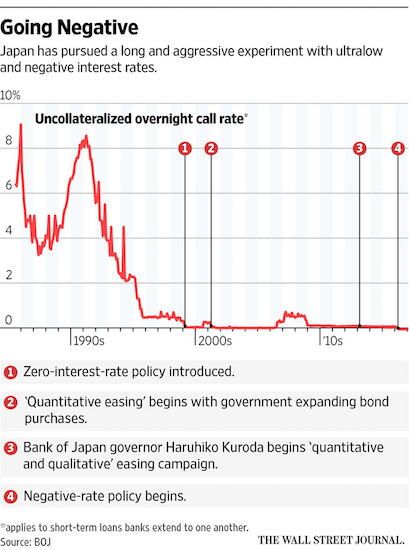
One of the IMF’s key demands is an overhaul of the Greek tax system to ensure more middle-class professionals pay their dues. More than 50% of Greek wage earners do not pay income tax, compared with 8% in the rest of the eurozone. But the low tax take partly reflects the economic collapse that has pushed down wages and squeezed people out of regular work. Reforming pensions, another IMF priority, may also run into trouble. The fund wants to rein in “extremely generous” Greek pensions that absorb 11% of national income. But Greek pensions have already been slashed since 2010, with 43% of pensioners living on €660 a month, compared with an average annual income of €20,000 for over-65s in other eurozone countries, according to government figures. Many Greek pensioners are also supporting unemployed children and grandchildren, as other benefits have been cut. With these politically tough reforms ahead, the light at the end of tunnel looks dim and distant. “Greeks are facing ongoing austerity into the foreseeable future,” Tilford says.

Read more …

Sorry, but fearmongering no longer works.

France Exiting The Euro Would Be Largest Sovereign Default In History (CNBC)

A few days ago, David Rachline of the far-right National Front party in France said that “the debt of France is about €2 trillion, about €1.7 trillion are issued under French law, which means that it can be re-denominated.” The economic program of the National Front specifically calls for the exit of the euro and the creation of a new currency, the French franc, which would be “closely” linked to the euro while allowing the government to undertake “competitive devaluations” making the transition in an “orderly way”. There is only one problem. It does not work. There is no “orderly exit” from the euro. It is an oxymoron. This would be the largest credit event in history and would create a massive contagion effect throughout the euro zone. The euro, obviously, would suffer from the break-up risk, so the fallacy of the “closely linked” second currency is simply a joke.

Both would collapse in tandem. The risk is already evident. The French-German yield spread has reached the highest level since 2012 despite the ECB’s massive quantitative easing. The ECB has bought more than €255 billion of French bonds. This mirage of an “orderly exit” ignores that the French financial system, which carries assets more than three times the size of France´s GDP, would be severely damaged from the impact of the credit event. A financial system that already suffers from weak net income margins and more than 160 billion euros in non-performing loans, would collapse as these bad loans escalate and the losses in the banks’ bond portfolios eat away their core capital. This would inevitably lead to Greek-style capital controls and bank runs as the entities would lose liquidity support from the ECB.

Read more …

“I think the rise of Le Pen is a result of the disappointment in other candidates..” Eh, no, it’s disappointment in the EU.
EU Tax Chief Admits Le Pen Win Would Be The End Of The European Project (CNBC)

A win for far-right presidential candidate Marine Le Pen would spell the end of the EU – but the French are not crazy enough to let that happen, insists European Commissioner Pierre Moscovici. “I’m confident. I know my citizens and my compatriots well and know they are not going to elect a candidate who is proposing France exiting (Europe). That would be the end of the European project,” Moscovici, who is European Commissioner for Economic and Financial Affairs, told CNBC Monday. In a clear nod to the rising populist movements in Europe, the election of U.S. President Donald Trump and the U.K.’s EU referendum, Moscovici, said he believes common sense will prevail as France goes to the polls in the two-round election this year. “I cannot imagine 50% of the French are crazy enough to vote for her,” he said.
“I’m quite convinced that she cannot win … she never even ever won a regional election in France – never ever.” Moscovici appealed, however, to the other presidential candidates, who include Independent Emmanuel Macron and Republican Francois Fillon, to prove themselves to the electorate and, ultimately, make a stronger case for remaining in the EU. “The other candidates need to have a stronger campaign and show that they are credible to propose a future that is likeable for the French. “I think the rise of Le Pen is a result of the disappointment in other candidates, so I urge them to make a strong proposal for France, and as well for Europe, and for France in Europe.”

Read more …

It’s amazing that they haven’t tried more of these tactics to make her look bad (they will, though). “For the second time, a raid took place at the same offices, over the same allegations, which confirms that the first raid amounted to nothing..”

Marine Le Pen’s Party’s Headquarters Raided Over ‘Fake Jobs’ Scandal (AFP)

French investigators probing an alleged fake jobs scam by the far-right National Front (FN) raided the group’s headquarters outside Paris on Monday, the party said. The raid is the second in a year by investigators trying to determine whether the FN used European Parliament funds to pay for 20 assistants presented as parliamentary aides while continuing to work for the party elsewhere. “For the second time, a raid took place at the same offices, over the same allegations, which confirms that the first raid amounted to nothing,” the party said in a statement. The group accused investigators acting for the Paris prosecutor’s office of a “media operation” designed to disrupt the presidential campaign of FN leader Marine Le Pen. Le Pen, who has led the anti-EU party since 2011, is a member of the European Parliament which accuses her of defrauding it of nearly €340,000.

She is riding high in polls ahead of the two-stage presidential election on April 23 and May 7 election, and has denied the claims, describing the investigation as a vendetta against her. According to a report by the EU’s anti-fraud office OLAF, leaked last week, the parliament paid out 41,554 euros towards a contract for Le Pen’s bodyguard Thierry Legier who was falsely presented as a parliamentary assistant. The allegations against Le Pen have been drowned out by a fake jobs scandal engulfing her conservative rival Francois Fillon. Fillon’s campaign has been adrift since it emerged that his wife netted at least 680,000 euros for a suspected fake job as a parliamentary assistant over a period spanning 15 years. He has denied the allegations. Polls currently show Le Pen winning the first round of the election, but failing to garner the more than 50% of voters needed for victory in the second round.

Read more …

I still think it’s a good thing the US is having this conversation. But the upcoming ugliness is terrible. You need to always take care of individual people first.

Revised Trump Travel Ban Will Face Legal Hurdles, Too (BBG)

President Donald Trump is poised to announce a redrafted executive order on immigration from seven majority-Muslim countries. Will it pass legal muster? Or will the courts once again thwart the president’s will? Early reports suggest that the new order will be drafted to avoid many of the legal problems that were posed by the earlier version, and to make judicial review harder to obtain. But the crucial question is whether the courts will consider the political context in which the order was drafted to conclude that it is still a Muslim ban under another name. Whether the court should do so turns out to be a close legal question. But Supreme Court precedent suggests that it should – in which case the new order could well be blocked like the original. The expected fixes in the new order would improve the administration’s legal position.

For one thing, the new order is expected to exclude legal permanent residents with green cards, who were included in the original order according to the administration’s early guidance, then excluded by a later interpretation. In its decision upholding a temporary restraining order by a federal judge in Seattle against enforcement of the first travel ban, the U.S. Court of Appeals for the Ninth Circuit treated the executive order as covering green card holders. That mattered because, as the court said, green card holders have a stronger constitutional claim to be covered by the due-process clause of the Constitution than do other visa holders. By excluding green card holders, the new order would force plaintiffs to identify different people who are harmed by the order.

Another smart revision would be to omit the provision that said religious minorities in the seven countries – which is to say, almost certainly Christians – would be given preferential treatment when refugees are once again let into the U.S. That provision was the only part of the text that could be used to suggest that the order unconstitutionally favored one religion, Christianity, over another, Islam. The Trump administration would also be smart to phase in the new order to avoid trapping visa holders who are in transit, which creates sympathetic plaintiffs detained at the airports. But that’s not the end of the game, constitutionally speaking. Even if due process is omitted from the case entirely, plaintiffs could still allege once more that the order discriminates on the basis of religion in violation of the free-exercise and establishment clauses of the First Amendment.

Read more …

Paint a strong picture of something that’s not the norm.

The Cognitive Bias President Trump Understands Better Than You (Wired)

Americans born in the United States are more murderous than undocumented immigrants. Fighting words, I know. But why? After all, that’s just what the numbers say. Still, be honest: you wouldn’t linger over a story with that headline. It’s “dog bites man.” It’s the norm. And norms aren’t news. Instead, you’ll see two dozen reporters flock to a single burning trash can during an Inauguration protest. The aberrant occurrence is the story you’ll read and the picture you’ll see. It’s news because it’s new. The problem here is not just that this singling out creates a distorted, fish-eye lens version of what’s really happening. It’s that the human psyche is predisposed to take an aberration—what linguist George Lakoff has called the “salient exemplar”—and conflate it with the norm.

This cognitive bias itself isn’t new. But in a media environment driven by clicks, where politicians can bypass journalistic filters entirely to deliver themselves straight to citizens, it’s newly exploitable. You know who else isn’t as likely to commit murders in the US as native-born citizens? Refugees. Or immigrants from the seven countries singled out in President Trump’s shot-down travel ban. Or for that matter, immigrants at all. According to numerous studies, increased immigration correlates with lower violent crime rates in a community. Yet next week, Trump is promising a revised travel ban in the name of safety. In the past, the president has also promised to publish a weekly list of crimes committed by undocumented immigrants. What he hasn’t promised to publish is a list of crimes committed by Americans. That’s not news.

But his list is likely to create the false impression that undocumented immigrants are especially prone to commit violent crimes—an impression in which the human brain is complicit. Lakoff, a University of California, Berkeley linguist and well-known Democratic activist, cites Ronald Reagan’s “welfare queen” as the signature “salient exemplar.” Reagan’s straw woman—a minority mother who uses her government money on fancy bling rather than on food for her family—became an effective rhetorical bludgeon to curb public assistance programs even though the vast majority of recipients didn’t abuse the system in that way. The image became iconic, even though it was the exception rather than the rule. Psychologists call this bias the “availability heuristic,” an effect Trump has sought to exploit since the launch of his presidential campaign, when he referred to undocumented Mexican immigrants as rapists.

Read more …

Slaves.

US Car Loans, Delinquencies Hit Record Levels (Q.)

Last year, Americans bought more new cars than ever before. Given that auto sales make up around a fifth of all retail spending, 2016’s banner year is being hailed as a sign of burgeoning consumer confidence across the country. But something else is revving up, too: auto loans. The US closed out 2016 with just shy of $1.2 trillion in outstanding auto loan debt, a rise of 9% from the previous year and 13% above the pre-crisis peak in 2005, in inflation-adjusted terms. The number of cars and trucks on the road, meanwhile, rose by only 1.5% last year, and 9% since 2005, according to US transportation department data.

Total household debt levels are now a hair under their 2008 peak, with some of the fastest growth in recent years down to auto loans. If America’s car-buying bonanza is being fueled by cheap credit, is consumer sentiment really as robust as it might seem? And is it sustainable? There are reasons to wonder. While car purchases and financing have leapt since 2009, wages have picked up only slightly over the same period. Meanwhile, the average loan taken out to buy a new car has risen steadily.

Read more …

TO learned nothing from Vancouver.

‘Trapped Wealth’ Drives Toronto’s Speculative Real Estate Dilemma

Toronto’s housing boom is unrelenting. Prices in Canada’s largest city surged more than 20% over the past year, the fastest pace in three decades, data released last week show. Some of the city’s neighboring towns are posting even bigger gains. It’s become a matter of considerable alarm. Stability is one concern: if the market tumbles, so will Canada’s economy. Pricier real estate also drives away less-affluent, younger people and boosts the cost of doing business, eroding competitiveness. “I don’t think anybody is cheering,” said Doug Porter, the Toronto-based chief economist of Bank of Montreal, who used the dreaded “bubble” word last week to describe the market. “I don’t see who benefits other than real estate agents. It’s trapped wealth.”

So, what’s driving the boom? The housing industry – builders and brokers – claim lack of supply is the main culprit. Others, Porter included, see demand as the problem. Lately, evidence is mounting that speculation is behind the jump. Builders say they are being held back by everything from regulations to prohibitive taxes and land restrictions. Ontario’s greenbelt region around Toronto is one example. This is no doubt true for one segment of the market: single-detached homes. Just over one-quarter of the 176,000 homes built in Toronto over the past five years were single-detached. That’s well down from the 1990s, when they accounted for almost half of all construction. Supply constraints don’t explain the price gains for condominiums, which have seen a flood of new completions. The average sale price of a condo is up 15% year-over-year. That’s after builders completed more than 54,000 apartment units over the past two years, easily a record supply for Toronto.

Canada’s recent census results, released this month, also provide some evidence against the shortage argument. Occupied private dwellings have risen by 7.2% in Toronto over the past five years, faster than population growth. The census, however, doesn’t say what type of homes are being built. Plus, there is also the recent puzzle of disappearing listings. New listings in Toronto fell 17% in January from a month earlier, the biggest one-month decline since 2002. Sales as a share of new listings rose above 90%, smashing the record. Is this a sign of a bubble? Are sellers holding off putting their homes on the market to see where prices settle? Has supply become so tight that potential sellers are pulling out of the market altogether since they have nowhere to move to? “The market is thinning out basically, you know what that means,” said David Madani, an economist at Capital Economics in Toronto, said in a telephone interview.

Read more …

They keep on announcing this. And the shadow system keeps growing, rapidly.

China’s Central Bank To Shine Regulatory Light On Shadow Banking (SCMP)

China’s financial watchdogs are considering casting a huge new regulatory net over the country’s vast shadow banking sector. The central bank has spearheaded the drafting of new regulations to tame China’s 60 trillion yuan “asset management” industry. According to people who have seen the draft regulations, the rules would bring the various kinds of asset management products and investment schemes offered by all kinds of financial institutions under the one regulatory umbrella. Oversight for the flourishing sector is now split between the securities, banking and insurance regulators. China Minsheng Banking chief analyst Wen Bin said regulatory standards differed between watchdogs and a unified system would help regulators cut systemic risks and financial leverage.

“China’s financial innovation has grown quickly in the past few years and the blending of financial operations through asset management products has challenged the fragmented regulatory system,” Wen said. Mainland financial institutions, including banks, mutual fund firms, brokerages and insurance companies, have rushed to set up asset management schemes, raising funds from clients and then investing in a range of markets and projects. These schemes are usually beyond the watch of regulators and harbour growing risks for the country’s financial stability, something the leadership is determined to eliminate ahead of a big power reshuffle due late this year. If rolled out, the rules would ban financial institutions from promising clients a minimum or fixed return from their products. Institutions would have to contribute 10% of their management fees to a risk reserve fund, and funds in one “asset management product” could not be used in another, except in authorised cases.

Read more …

These people really think they will rule the world. But what happens when the economy collapses? When the S&P falls 50%+? Are robots going to grow your food?

Tech CEOs Back Call For Basic Income (CNBC)

It’s 2067 and robots have wiped out millions of jobs, AI is rampant, and unemployment is on the rise. Technology companies and CEOs have become public enemy number one. This portrayal of the future is one tech executives are keen to avoid and has driven a growing chorus to support the idea of a universal basic income (UBI). “There is going to be backlash when it comes to jobs,” Sayantan Ghosal, an economics professor at the University of Glasgow who has written about UBI, told CNBC by phone. U.S. technology firms have been investing heavily in research and development of AI. Tesla with driverless cars, Amazon with workerless shops, and the likes of Google developing smarter-than-human software. Even Sergey Brin, the co-founder of Google, recently stated that he was “surprised” by the pace of AI developments.

Over the past few months, major technology executives have come out in support of a UBI. In an interview with CNBC in November, Tesla Chief Executive Elon Musk backed the idea. “There is a pretty good chance we end up with a universal basic income, or something like that, due to automation,” Musk said. He reiterated his thoughts last week at the World Government Summit in Dubai, in which he said a UBI would be “necessary”. Marc Benioff, chief executive of Salesforce, warned of AI creating “digital refugees”. At the World Economic Forum (WEF) in Davos in January, Benioff said there was “no clear path forward” on how to deal with the job displacement that will occur. Other tech executives talked up the industry’s responsibility. “We should do our very best to train people for the jobs of the future,” Microsoft CEO Satya Nadella said at Davos.

Read more …

The dark side of the man.

Monsanto and Bayer’s Chemical Romance: Heroin, Nerve Gas and Agent Orange (AN)

Fifty years ago, the Monsanto and Bayer corporations were forced to separate in order to avoid violating basic antitrust regulations. U.S. courts declared that the two chemical giants, when operating together under the name Mobay, stymied market competition and comprised a monopoly that could not stand. But that was then. Today, under a much different regulatory climate that all but rubberstamps such corporate monopolies, the Germany-based Bayer’s $66 billion offer to purchase Monsanto is being fast-tracked by U.S. regulators. The proposed mega-merger, or re-marriage, will result in nearly 30% of all worldwide pesticide and seed sales being controlled by the new partnership. The merger faces federal antitrust scrutiny before it can be finalized, a process currently underway.

It already passed its first test in January when it got the blessings of President-elect Donald Trump, who held an exclusive meeting with the CEOs of both corporations and emerged—not surprisingly—with his thumbs up. Trump’s exclusive meeting with these corporate titans came well before he had even bothered to name his selection to lead the U.S. Department of Agriculture, a not-so-subtle acknowledgement of where the true power lies when it comes to the politics of food. In addition to market control, Bayer’s proposed purchase is aimed at steadying a reeling Monsanto, which is mired in turmoil from a long list of objectionable activities involving toxic pesticides and its increasingly unpopular genetically-modified organisms.

Ironically, given its own sullied past that includes Nazi sympathizing and marketing heroin-laced cough syrup for children, Bayer is being portrayed as the one riding to the rescue of Monsanto’s poor public image. If anything, it’s a sign of just how low the Monsanto brand and reputation has plummeted, forcing it to try and improve its image by sidling up to Bayer, a participant in some of the cruelest crimes in human history. While these types of mergers are nothing new to the agribusiness sector, where consolidation has been king for decades, last year’s proposed mega-mergers shattered the record for such deals. There were $125 billion worth of proposed agri-chemical mergers in 2016, nearly doubling the previous record of $65 billion in 2010. In addition to the proposed Bayer/Monsanto deal, there are also pending mergers between Dow and DuPont as well as Syngenta and the Chinese National Chemical Corporation.

Read more …

Canada continues to set the standard. But protests begin.

Canada Will Not Halt Illegal Border Crossing Despite Opposition – Trudeau (R.)

Canada will continue to accept asylum seekers crossing illegally from the United States but will ensure security measures are taken to keep Canadians safe, Canadian Prime Minister Justin Trudeau said on Tuesday. The number of would-be refugees crossing into Canada at isolated and unguarded border crossings has increased in recent weeks amid fears that U.S. President Donald Trump will crack down on illegal immigrants, and photos of smiling Canadian police greeting the migrants have gone viral. Opposition Conservatives want Trudeau’s center-left Liberal government to stem the flow of asylum seekers from the United States because of security fears and a lack of resources to deal with them.

“One of the reasons why Canada remains an open country is Canadians trust our immigration system and the integrity of our borders and the help we provide people who are looking for safety,” Trudeau told parliament. “We will continue to strike that balance between a rigorous system and accepting people who need help.” Immigration Minister Ahmed Hussen also said Canada would continue to honor the Canada-U.S. Safe Third Country Agreement, which requires it to turn back refugees if they make asylum claims at Canadian border crossings with the United States. Refugee advocates have argued this drives asylum seekers to cross illegally at isolated locations, risking their lives in frigid weather. Amnesty International and other groups are pressuring the Canadian government to abandon the agreement, arguing the United States is not safe for refugees.

Read more …

Very smart move. They will contribute a lot to the country. Stong, hardened, intelligent and grateful.

Canada To Welcome 1,200 Yezidi Refugees From Iraq (AFP)

Canada will resettle 1,200 Yezidi refugees who faced persecution by the Islamic State group, the immigration minister said Tuesday. Some 400 have already been airlifted to this country. “Our operation is under way and individual survivors of Daesh have been arriving in Canada for resettlement in the last number of months and this began on October 25, 2016,” Immigration Minister Ahmed Hussen, using an Arabic name for the Islamic State. “Our government will resettle approximately 1,200 highly vulnerable survivors of Daesh and their family members in Canada,” he added. The initiative follows Parliament’s resolution last fall to take in Yezidis facing “genocide” in Iraq at the hands of the Islamic extremist IS group.

The original aim was to bring over women and girls at risk, but Hussen told a news conference that Ottawa had learned that “Daesh has also deliberately targeted boys and as such we are helping to resettle all child survivors of Daesh.” Hussen said the migrants are arriving on commercial flights at a “controlled pace” to avoid overwhelming Canada’s refugee system. The operation is expected to cost Can$28 million (US$21 million). Since coming to power in late 2015, Prime Minister Justin Trudeau’s government has resettled 40,000 Syrian refugees. The Yezidis taken in have been subjected to comprehensive security checks and medical examinations, Hussen said. Yezidis are a Kurdish-speaking minority with a pre-Islamic religion thought partly to have its origin in the Zoroastrianism of ancient Persia. They are neither Arab nor Muslim and IS considers them polytheistic heretics.

Read more …

And don’t you forget it.

Europe Wrote The Book On Demonising Refugees, Long Before Trump Read It (G.)

It has become an article of faith among liberals that Donald Trump is the world’s biggest enemy to refugees and Muslims, while the EU somehow offers them a safe harbour. After all, with the words “We can do it” Angela Merkel invited a million Syrian refugees into Germany, while Trump’s travel ban has slammed shut America’s door to some of the world’s most vulnerable displaced people. In today’s liberal mindset, it is Brexit that has stirred up hostility against migrants, while the EU is a bulwark of civilised values, protecting refugees from the threat of a resurgent far right. If you were a migrant in a leaking boat approaching Lesbos, however, the treatment you would receive from Frontex, the EU’s border patrol, would be no less hostile than anything Trump could inflict.

In Tunis last week a video showed Tunisian border police whipping cowering migrants from elsewhere in north Africa. This brutality was EU-sponsored. Like Libya, Morocco, Turkey and Egypt, Tunisia receives funding and training from Brussels through the European neighbourhood policy (ENP). Under a broader framework of “development” and “reforms”, these ENP countries serve as a buffer zone, making sure that refugees are intercepted and turned back – or, in Libya, locked up and tortured in refugees’ prisons – before these desperate people can reach the EU’s shores. The idea that the Europe of Merkel and Theresa May is more welcoming to refugees than Trump’s America simply isn’t borne out by the facts. The EU’s deal with Turkey, condemned by humanitarian agencies, ensures that refugees arriving in Greece – regardless of their point of departure – will be sent to Turkey.

Turkey now has the largest refugee population in the world, at about 3 million people. This month Britain reneged on its promise to admit 3,000 unaccompanied child refugees. Concerned that the Balkan route is a weak link into Europe, Austria has mobilised aspiring EU members including Macedonia, Serbia and Kosovo into a Balkan frontier defence project to fortify the refugee entry points of the “Balkan corridor”. Last year Macedonian police used tear gas, grenades and stun guns against Iraqis and Syrians attempting to get through a razor-wire fence and into the country.

Read more …

“..traffickers came and removed the engine from the boat and left the craft adrift..”

Bodies Of At Least 74 Migrants Wash Ashore In Western Libya (G.)

The bodies of at least 74 people, believed to be migrants, have washed ashore on the Libyan coast in the latest tragedy at sea for people fleeing to Europe to escape war and poverty. The Libyan Red Crescent said on Tuesday the bodies had been found the previous morning on the coast of the city of Zawiya, and aid workers had spent six hours recovering them, with more dead believed to be in the vicinity. A spokesman for the organisation, Mohammed al-Misrati, told the Associated Press that a torn rubber boat was found nearby and it was likely that more migrants had drowned in the incident, as such vessels usually carry about 120 people.

The Zawiya coastguard later posted a video that showed the migrants’ boat with no engine. Joel Millman, a spokesman for the International Organization for Migration (IOM), told Reuters a local staff member had reported that “traffickers came and removed the engine from the boat and left the craft adrift”. “This is not a only horrible number of deaths in one incident but it strikes us as something that we haven’t really seen much of, which is either deliberate punishment or murder of migrants,” Millman said.

Read more …