Oct 212014
 
 October 21, 2014  Posted by at 11:22 am Finance Tagged with: , , , , , , , , , , ,  Comments Off on Debt Rattle October 21 2014


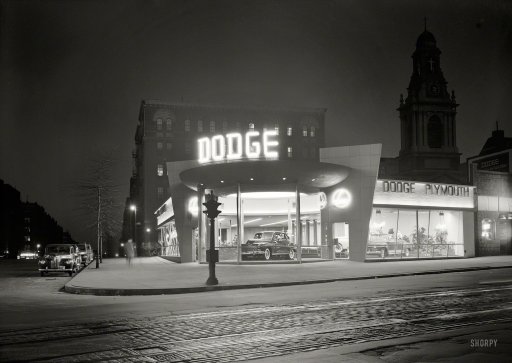
Gottscho-Schleisner L Motors at 175th Street and Broadway, NYC Mar 24 1948


• Oil Prices Won’t Recover Above $100 – Russian Finance Ministry (RT)
• Oil Collapse Raises Risk Of ‘Profit Recession’ (MarketWatch)
• How Cheap Oil Could Become a Real Problem for Airlines (BW)
• Bond Market Brightest Turn Oil Analysts as Gyrations Mystify (Bloomberg)
• “Ending QE Will Plunge US Into Severe Recession” (Zero Hedge)
• They Studied Keynes and They’re Doing This. Why Can’t the Fed See It? (Bloomberg)
• China GDP Growth Slowest Since Global Crisis (FT)
• China Growth Seen Slowing Sharply Over Next Decade (WSJ)
• Why Deflation Is So Scary (Yahoo)
• Islamic State Earns $800 Million a Year From Oil Sales (Bloomberg)
• A Little Volatility Can Be Good for You (Bloomberg)
• Forex-Rigging Fines Could Hit $41 Billion Globally (Bloomberg)
• How Goldman’s Libya Case Could Disrupt Derivatives (CNBC)
• Bank Of England Payment System Crashes Leaving Homebuyers In Limbo (Guardian)
• Fed’s Dudley Warns Banks Must Improve Culture or Be Broken Up (Bloomberg)
• IBM Is in Even Worse Shape Than It Seemed (BW)
• ‘Forward Guidance’ Marches Global Economy Backwards (Satyajit Das)
• Ukraine And Russia Agree On $385 Gas Price For Winter (RT)
• “Anti-Petrodollar” CEO Of French Giant Total Dies In Moscow Plane Crash (ZH)
• The Tragedy Of NATO: “Beware Foreign Entanglements” (Mises Canada)
• Hobbit Find Rewrites Human History (BBC)

This contradicts a whole lot of western ‘experts’.

• Oil Prices Won’t Recover Above $100 – Russian Finance Ministry (RT)

Decreasing oil prices are “inevitable” and the chance they will exceed $100 per barrel is “unlikely” the Russia’s Finance Ministry said. However, the Russian budget can withstand lower prices. “The market is biased in favor of excess supplies. That is why price reduction is inevitable; it will have a structural character. We are unlikely to see prices higher than $100 per barrel in the near future,” Maksim Oreshkin, the head of the Russian Finance Ministry’s strategic planning department told RBC TV in an interview. “In general, the current downward price movement is structural. Investments in oil production have increased dramatically in the past ten years,” Oreshkin said. Russian officials have stressed there will be no sharp rise in Russia’s budget deficit, but the country’s largest bank, Sberbank, says an oil price of $104 is required to balance the 2015 budget. A drop of prices to $80 per barrel could cost Russia 2% of GDP.

The weak ruble will be a buffer to lower oil prices, since costs are in rubles, but revenue in dollars. “The ruble is down which allows Russia to maneuver a bit by making some extra cash from oil sales, since those are done in dollars,” RT correspondent Egor Piskunov reported from Moscow. The Russian state budget is based on oil prices of $96 per barrel, which both Brent and WTI crude fell below in previous days. Last week prices hit a 4-year low, with Brent futures reaching a critical point of $84 per barrel. Just months ago, at the height of the Iraq turmoil, Brent was trading at $116 per barrel. WTI crude, the main North American blend, hit a four-year low dropping below $80 Thursday. Both blends have been falling for the last four months.

Read more …

Glad someone brings it up …

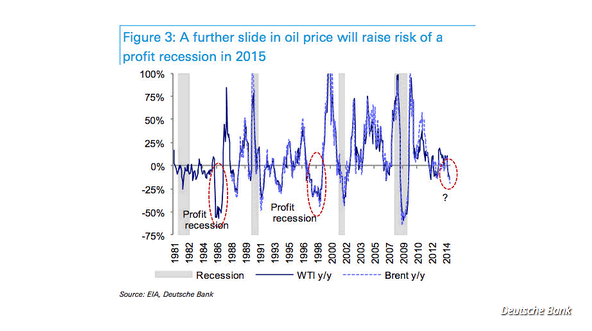
• Oil Collapse Raises Risk Of ‘Profit Recession’ (MarketWatch)

American drivers are almost giddy over gasoline prices that are now below $3 a gallon in some areas. Investors, however, might want to check themselves, says David Bianco, Deutsche Bank’s top equity strategist. Light, sweet crude traded on the New York Mercantile Exchange has plunged from around $107 a barrel in June to test two-year lows near $80 a barrel. The collapse has prompted Bianco and his team to cut their forecast for S&P 500 fourth-quarter earnings per share by 50 cents to $30.50 and to drop their forecast for full-year 2015 earnings by $3 to $123 a share. That still points to 2015 earnings per share growth of around 4% on expectations global growth will remain underpinned by U.S. growth, which will be enhanced, in part, by stronger consumption aided by cheaper oil. But lower oil prices (Deutsche Bank is now penciling in a 2015 average price of $85 a barrel), will weigh heavily on the energy sector, Bianco said in a note.

Deutsche Bank slashed its forecast for fourth quarter energy earnings by nearly 10% — accounting for almost all of the cut in the bank’s estimate of fourth quarter S&P 500 EPS. Deutsche now sees energy earnings falling 10% in 2015 as well, versus an earlier forecast for a fall of 2%. While it’s no surprise that the energy sector will bear the brunt, plunging oil is also bad news for the industrials and materials sectors. They’ll suffer as energy firms reduce capital spending in the U.S. and worldwide, Bianco says, noting that a third of S&P 500 capital spending comes from the energy sector. Meanwhile, the boost to consumer sector earnings from the lower oil price is small, Bianco says. So is the S&P 500 in danger of suffering a “profit recession?” Probably not, but much depends on the oil price, Bianco writes. He notes that since 1960 there have been only 10 instances when there was a fall in trailing fourth-quarter earnings per share.
Read more …

They add flights when oil is cheaper …

• How Cheap Oil Could Become a Real Problem for Airlines (BW)

Oil futures have been on a torrid plunge in recent weeks, touching lows below $80 per barrel. Great news for airlines, right? Maybe not. For roughly the past 35 years, inexpensive jet fuel has routinely served as a siren call to airline executives. Cheap fuel spurs more flights and wild grabs for whatever business looks attainable in the travel market. Marginal routes become profitable with lower fuel prices, which, in turn, bolsters the argument that new flights can boost revenues with little cost. Cheap fuel also lets an airline experiment more radically with flight schedules in the bid to swipe market share from rivals. “If it keeps trending lower, it totally changes the economics of the industry again,” says Seth Kaplan, managing partner of Airline Weekly, an industry journal. With oil cheaper, Kaplan predicts that many airlines will probably fly their planes in off-peak periods because of the low costs associated with those extra flights. A few additional flights on the weak travel days of Tuesday and Saturday could return to some schedules.

This possibility has some Wall Street analysts in a tizzy, concerned that if oil stays cheap enough for long enough, lower prices will cause airlines to backslide on their new-found religion against deploying too much capacity. “We feel like this industry needs an oil spike now more than ever,” Wolfe Research analyst Hunter Keay wrote last week in a client note. “[C]apacity discipline of late (from some) seems theoretical at best.” Brent crude, the energy index most airline executives monitor for its correlation to jet fuel, has declined 22% this year; settling Friday at $86; a day earlier, the Brent Index scored a four-year-low, under $83. This constitutes a sharp reversal from recent years: After oil spiked to nearly $150 per barrel in July 2008, U.S. airlines radically restructured to try to cope with oil at whatever price it may be. That effort has left high or low oil prices much less important—quick swings either way are now the enemy—while turning expensive oil into somewhat of a barrier for new flying.

Read more …

If those guys are the brightest …

• Bond Market Brightest Turn Oil Analysts as Gyrations Mystify (Bloomberg)

Following the most turbulent period for U.S. bonds in more than three years, the top strategists are looking less at jobs and manufacturing and more at the price of oil for clues as to what lies ahead. Treasuries gyrated last week, with yields on benchmark 10-year notes at one point falling below 2% for the first time since June 2013, as a tumble in crude sparked concern that the global economy was on the verge of entering a deflationary spiral. Bond traders who wagered that the trillions of dollars in cash pumped into the financial system by major central banks would cause runaway inflation were forced to reverse those bets.

The moves were the latest shock in a year of surprises in the bond market. The consensus estimate among the more than 60 strategists surveyed by Bloomberg in January was for yields to rise in 2014. Instead, they fell. One of the few to get it right was FTN Financial, and its analysts say even after the rally yields are not far from fair value because cheaper energy prices will help curb gains in consumer prices. “There’s a fundamental series of questions about where we go from here,” Jim Vogel, head of interest-rate strategy at Memphis-based FTN, said in an Oct. 16 telephone interview. Vogel, who added that the 21% drop in oil prices since June “took people by surprise,” sent a note to clients last week recommending they “watch for stability in oil positions,” and noting the “strong ties” between the cost of the commodity and the government’s consumer price index.

Read more …

Schiff gets a lot more wrong than right, but this is that exception.

• “Ending QE Will Plunge US Into Severe Recession” (Zero Hedge)

“Markets are slowly coming to grips with reality is not going to be as easy as everybody thought,” Peter Schiff tells CNBC’s Rick Santelli, noting the pick up in volatility across asset classes recently. What The Fed clearly does not understand, Schiff blasts, is that “you cannot end quantitative easing without plunging the US into a severe recession.” Because of the Fed’s extreme monetary policy and the mal-investment that flows from it, Schiff says, “The US economy is more screwed up now than it’s ever been in history.” Most prophetically, we suspect, Santelli agrees that “a messy exit is a given,” and Schiff believes they know that and that is why QE4 is coming simply “because it hasn’t worked and they can’t admit it’s been a dismal failure.”

Read more …

Not sure why Bloomberg picked this title (3rd different one in a row for the same article), but the topic is relevant.

• They Studied Keynes and They’re Doing This. Why Can’t the Fed See It? (Bloomberg)

Federal Reserve policy makers are missing a key element as they assess the health of the labor market: data that includes whether those who are employed are overqualified for their job or would like to work more hours. As a result, the “significant underutilization of labor resources” that Fed officials highlighted last month as they renewed a pledge to keep interest rates low for a “considerable period” is probably even more severe than currently estimated. And the information gap means policy makers may have more difficulty gauging the right moment to raise rates off zero. “We have more slack than the official statistics suggest,” said Michelle Meyer, a senior U.S. economist at Bank of America in New York. “Because it’s difficult to measure underutilization, there’s still a lot of uncertainty as to how much slack remains, which means there’s uncertainty as to the appropriate stance of monetary policy.”

The Labor Department can put its finger on how many people are working part-time because full-time jobs aren’t available, or how many are so discouraged that they’re not even looking for employment. Other forms of underemployment — for example the graduate with an English degree who’s working as a barista –are harder to pinpoint though just as important in trying to measure whether the labor market has improved. The data shortfall sparked a discussion at a Peterson Institute for International Economics conference last month in Washington. Erica Groshen, commissioner of the Bureau of Labor Statistics, asked what additional data would be needed to help quantify labor-market slack. Betsey Stevenson, a member of President Barack Obama’s Council of Economic Advisers, pointed out that while it was possible with current data to determine whether people working less than 35 hours a week are underutilized, those putting in a longer workweek fall off the radar.

The BLS considers anyone working at least 35 hours a week to be full-time. The Census Bureau, which surveys households to get the information needed for the Labor Department to crunch the monthly jobs data, doesn’t ask full-timers whether they’d prefer a different job or additional hours. As far as anyone knows, those workers are fully employed and content.

Read more …

China’s numbers come straight out of its political agenda.

• China GDP Growth Slowest Since Global Crisis (FT)

China’s economy grew last quarter at its slowest pace since the depths of the global financial crisis, raising concerns over global growth prospects and increasing the likelihood Beijing will introduce broader stimulus measures. Gross domestic product in the world’s second-largest economy expanded 7.3% in the third quarter from the same period a year earlier, its weakest performance since the first quarter of 2009, when growth was just 6.6%. But unlike then, when the economy was in freefall as a result of the global financial crisis originating in the US, China’s growth problems this time are largely homegrown. The latest quarterly reading means China’s economy this year is almost certain to register its slowest annual pace since 1990, when the country faced international sanctions in the wake of the 1989 Tiananmen Square massacre.

A correction in China’s property sector, the most important driver of the economy for much of the past decade, is the biggest drag on growth and most analysts expect things to get worse, given huge oversupply across the country. Investment in real estate in the first nine months continued to expand but at a slower pace, rising 12.5% over the same period last year, compared with an increase of 13.2% in the first eight months. Housing sales fell in the first nine months of this year by 10.8% compared with the same period in 2013, suggesting that the property investment slowdown has further to go. Other monthly data released on Tuesday, including industrial production and consumer retail sales, showed a mild rebound in September compared with the previous two months but most analysts expect the slowdown to continue. By the end of September, Chinese factory gate prices had been in deflationary territory for 32 consecutive months, the longest period of producer price inflation in the country in the modern era.

Read more …

This looks a whole lot more realistic than official numbers, although projections 10 years into the future don’t look terribly useful in the current economic climate.

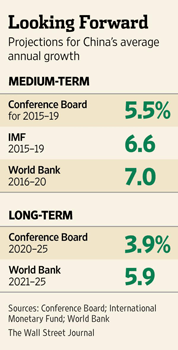
• China Growth Seen Slowing Sharply Over Next Decade (WSJ)

China’s growth will slow sharply during the coming decade to 3.9% as its productivity nose dives and the country’s leaders fail to push through tough measures to remake the economy, according to a report expected to come out Monday. Such an outcome could batter an already fragile global recovery. But the report by the business-research group the Conference Board also finds that multinational companies in China would benefit. Lean times would give foreign firms more local talent to choose from. Foreign companies and investors could also expect “more hospitable” treatment from Communist Party and government officials and a wider selection of Chinese firms they could acquire, according to the report, which was shared with The Wall Street Journal. Foreign companies should realize that China is in “a long, slow fall in economic growth,” the report said. “The competitive game has changed from one of investment-driven expansion to one of fighting for market share.”

Officials representing China’s State Council, or cabinet, referred questions to its National Bureau of Statistics, which didn’t respond. Senior officials of the Communist Party are gathering in Beijing for a major policy meeting that opens Monday and is expected to discuss the slowdown. The Conference Board forecasts that China’s annual growth will slow to an average of 5.5% between 2015 and 2019, compared with last year’s 7.7%. It will downshift further to an average of 3.9% between 2020 and 2025, according to the report. The outlook for the world’s second-largest economy is one of the most important factors affecting the global economy. For the 30 years through 2011, China grew at an average annual rate of 10.2%, a record unmatched by any major nation since at least World War II. That growth lifted hundreds of millions of Chinese out of poverty and turned the country into a major market for commodity producers in Asia, Latin America and the Middle East, and consumer and capital-goods makers from the U.S., Europe and Japan.
Read more …

“Debt gets more expensive over time, because consumer spending power declines. When prices and corporate revenue fall for a sustained period of time, wages inevitably go down, too. That makes fixed-rate debt more expensive, because you have less money instead of more to make the same regular payments.”

• Why Deflation Is So Scary (Yahoo)

If the price of a car or an iPhone drops, that’s usually good news for consumers. So it might be puzzling that investors and economists suddenly seem freaked out about the possibility of deflation, or a sustained drop in the level of all prices, on average. Deflation was a concern back in 2010 and it’s a fresh worry now as oil prices plunge, the stock market wavers and consumers put spending plans on hold.  The paradox of deflation is that falling prices on a few items can generally be good for consumers, leaving more money in their pockets for other things. But falling prices on too many things can have ruinous effects on the economy that are hard to reverse. Japan suffered nearly two decades of deflation starting in the early 1990s, and deflation helped prolong the Great Depression in the 1930s. When all prices fall, consumers have a strong incentive to put off purchases – after all, everything will probably be cheaper tomorrow.

Some purchases are hard to delay – food, medical care, gasoline to get to work. But a lot of the things we buy can wait, which is why sales of cars, clothing, and appliances drop sharply when times get tough. In an economy like ours – in which consumer spending accounts for about 70% of total GDP – a powerful incentive to postpone purchases can be disastrous. When spending drops, so does corporate revenue, raising pressure to cut costs, which leads to layoffs and other personnel cutbacks. Companies are likely to freeze salaries or even cut pay for those workers remaining. Dwindling income makes consumers even more leery about spending money, worsening the whole cycle. The other mechanism for deflationary ruin is debt. One big reason lending helps the economy grow is inflation—most loans become easier to pay back over time, because the principal doesn’t grow but income used to pay it down does.

We typically think of inflation as a rise in prices, but it’s usually accompanied by an increase in workers’ wages as well, and as long as wage increases exceed price hikes, ordinary people get ahead. Home buyers, for instance, often “grow into” a mortgage that might seem onerous at first, because their income climbs as they progress through their careers. The mortgage payments on a fixed-rate loan, by contrast, remain constant. So in a typical economic environment, you gradually earn more income to make the same payment every month.

Deflation creates the opposite phenomenon: Debt gets more expensive over time, because consumer spending power declines. When prices and corporate revenue fall for a sustained period of time, wages inevitably go down, too. That makes fixed-rate debt more expensive, because you have less money instead of more to make the same regular payments. The mismatch affects companies and even governments the same way it does consumers, causing cash-flow shortages, liquidity problems and bankruptcy. Each of these ugly outcomes reinforces the others, making a deflationary spiral very hard to pull out of.

Read more …

Lower oil prices don’t look very effective vs IS.

• Islamic State Earns $800 Million a Year From Oil Sales (Bloomberg)

The Islamic State is earning about $2 million a day, or $800 million a year, selling oil on the black market, IHS Inc. estimated. The terrorist group is producing 50,000 to 60,000 barrels a day, according to an e-mailed release today from the Englewood, Colorado-based information company. It controls as much as 350,000 barrels a day of capacity in Iraq and Syria. Extremist groups typically reply on foreign donations that can be squeezed by sanctions, diplomacy and law enforcement. By tapping the region’s oil wealth, Islamic State, the group that beheaded American journalist James Foley, resembles the Taliban with oil wells. “This is financing and fueling a lot of their activities, military and otherwise,” Bhushan Bahree, a co-author of the report, said today in an interview. “For argument’s sake, let’s say their capacity were cut by half. They’ll still have $400 million coming in. This is many times more than any other source of funding we know of.”

Islamic State consumes about half its production and sells the rest for $25 to $60 a barrel, according to the report. That estimate is in line with those of U.S intelligence officials and anti-terrorism finance experts. Bombing oil-field pump stations may be the best way to cut off the flow of oil since they are stationary and difficult to replace, Bahree said. U.S.-led air strikes haven’t eliminated truck-mounted refineries that Islamic State uses to produce fuel for its war machines and to supply civilians within the territory it controls. Trafficking has encouraged middlemen to buy crude and smuggle it into Turkey, Jordan or Iraq, where it is blended with other oil and sold to unsuspecting buyers, according to the report. “It is very hard to intercept,” Bahree said. “There has probably been smuggling of all sorts of things in this place for thousands of years.” When Iraq’s regional Kurdish government tried to police long-established smuggling routes along a 1,000-kilometer (621-mile) border with what is now Islamic State territory, traffickers found new ones, he said.

Read more …

“They blame the shift on new regulations such as higher capital requirements and the Volcker rule”.

• A Little Volatility Can Be Good for You (Bloomberg)

Gyrations in financial markets are giving rise to a plaintive cry from investors: Prices are getting more volatile because new regulations are making big banks less willing to buy when others want to sell. Actually, if that’s what’s happening, it would be no bad thing. Following last week’s selloff, investors are complaining about a lack of liquidity, the ability to buy and sell assets (particularly bonds) without moving prices too much. The problem, they say, is that big U.S. banks are pulling back from market making — the buying and selling of assets to meet clients’ needs. They blame the shift on new regulations such as higher capital requirements and the Volcker rule, which aims to limit speculative trading at banks.

Investors are right that something has changed. The big banks are holding much smaller inventories of corporate bonds than they did before the 2008 crisis. In fact, dealers were net sellers of junk bonds in recent weeks, suggesting that they weren’t, in the aggregate, helping clients to unload. From the point of view of an overextended investor needing to sell, this reduction in liquidity can be scary. That said, it’s unclear that regulation is the primary cause. Banks were cutting their inventories long before Congress passed the Dodd-Frank financial reform law in 2010. And liquidity always disappears in bad times, no matter how abundant it seems in good times. Market makers are no more willing to buy than anybody else when prices appear to be in free fall. Last week’s volatility hit some securities, such as U.S. Treasury bonds, to which the Volcker rule doesn’t even apply.

Read more …

Not nearly enough.

• Forex-Rigging Fines Could Hit $41 Billion Globally (Bloomberg)

The cost for banks to settle probes into allegations traders rigged foreign-exchange benchmarks could hit as much as $41 billion, Citigroup analysts said. Deutsche Bank is seen as probably the “most impacted” with a fine of as much as 5.1 billion euros ($6.5 billion), Citigroup analysts led by Kinner Lakhani said yesterday, estimating the Frankfurt-based bank’s settlements could reach 10% of its tangible book value, or its assets’ worth. Using similar calculations, Barclays could face as much as 3 billion pounds ($4.8 billion) in fines and UBS penalties of 4.3 billion Swiss francs ($4.6 billion), they wrote in a note first sent to clients on Oct. 3. Authorities around the world are scrutinizing allegations that dealers traded ahead of their clients and colluded to rig currency benchmarks. Regulators in the U.K. and U.S. could reach settlements with some banks as soon as next month, and prosecutors at the U.S. Department of Justice plan to charge one by the end of the year, people with knowledge of the matter have said.

The Citigroup analysts made their calculations using a Sept. 26 Reuters report that the U.K. Financial Conduct Authority settlements could include fines totaling about 1.8 billion pounds. They derived their estimates for how high fines could go in other investigations from that baseline, using banks’ settlements in the London interbank offered rate manipulation cases as a guide. “Extrapolating European and, more importantly, U.S. penalties from a previous global settlement suggests to us a total potential global settlement on this key issue,” they said in the note. U.K. authorities will probably account about $6.7 billion of fines across all banks, according to the Citigroup analysts. Other European investigations will account for $6.5 billion. Penalties in the U.S. cases could be about four times greater, hitting $28.2 billion.

Read more …

Interesting case. If it forces details out into the open.

• How Goldman’s Libya Case Could Disrupt Derivatives (CNBC)

A costly legal battle between Goldman Sachs and the Libyan sovereign wealth fund could have more permanent repercussions for the global banking industry, experts have told CNBC. The Libyan Investment Authority has accused Goldman of misleading it and taking advantage of its lack of financial knowledge to make “substantial” profits on a series of derivative trades back in 2008. The bank denies the allegations and a full hearing has been touted to begin in early 2016 after a preliminary hearing was completed earlier in the month. The LIA claims the disputed derivative trades in early 2008 cost $1 billion, and carried a high degree of risk, but lost a substantial amount of value by the end of the year and expired “worthless” in 2011. Court documents allege that Goldman made profits of $350 million were made and a witness statement from a lawyer working for the LIA claims that the usual disclaimers – called non-reliance agreements – were sent after the trades were made and were never signed.

Satyajit Das, an expert on financial derivatives and risk management, told CNBC via telephone that the case has the potential to get “extremely ugly”. “This could be messy for Goldman Sachs and for a whole range of other banks,” he said, adding that this would bring up the issue of opaqueness with these sorts of trades. “It could lead to an investigation into the selling practices at banks and the types of financial products they offer.” Beyond the prospect of an investigation, industry experts are also forecasting further regulation of the complex derivatives market. Anat Admati, a professor of finance and economics at Stanford Graduate School of Business welcomed any new regulation in this space. Without commenting on this particular case, she said that investments in derivatives can be easily misunderstood by untrained investors.

Read more …

Egg meet face.

• Bank Of England Payment System Crashes Leaving Homebuyers In Limbo (Guardian)

The Bank of England apologised last night after a crucial payments system collapsed, forcing Mark Carney to launch an urgent investigation following the delay of hundreds of thousands of payments, including for homebuyers waiting for money to be transferred to pay for their new homes. The Bank of England governor promised a “thorough, independent review” after MPs demanded answers into how the system which processes payments worth an average £277bn a day had failed for nearly 10 hours. An 88-year-old woman in Sheffield was among those caught up in the collapse of the behind-the-scenes payment mechanism, which failed to open at 6am and remained shut until 3.30pm – usually the cut-off point for money to be transferred for house sales.

The Bank of England did not admit the shutdown had taken place for more than five hours after the system had been due to open, and was later forced to extend opening hours by four hours to 8pm to clear the backlog of 143,000 payments. More than 10 hours after first admitting to the problem with the clearing house automated payment system (Chaps) the Bank of England eventually apologised “for any problems caused by the delays to the settlement system”. While Chaps was down, there were fears that homebuyers and sellers around the country would be left unable to complete purchases on time and that big businesses, which also use the system, would fail to make payments. Only weeks ago the Bank said it had a new contingency plan for the collapse of the payments system. The Bank of England will subject the system to additional monitoring when it reopens at 6am on Tuesday.

Read more …

Emptier words were never heard.

• Fed’s Dudley Warns Banks Must Improve Culture or Be Broken Up (Bloomberg)

Banks must change the way employees are compensated and take other steps to fix a corporate culture that encourages misdeeds or face being broken up, said William C. Dudley, president of the Federal Reserve Bank of New York. If bad behavior persists, “the inevitable conclusion will be reached that your firms are too big and complex to manage effectively,” Dudley told industry leaders in a speech yesterday at the New York Fed. “In that case, financial stability concerns would dictate that your firms need to be dramatically downsized and simplified so they can be managed effectively.” Dudley’s comments, which follow bank scandals involving Libor and foreign exchange trading, were made at a closed-doors workshop attended by senior bankers at the New York Fed on reforming Wall Street culture and behavior.

Large U.S. banks were widely blamed for taking too much risk leading up to the 2008 financial crisis, which triggered the worst economic downturn since the Great Depression. Lawmakers have since enacted a major overhaul of the rules designed to prevent banks becoming “too big to fail.” Dudley said it was fair to question if the “sheer size, complexity and global scope of large financial firms today have left them ‘too big to manage.’” Barclays Plc Chairman David Walker, who also addressed the gathering, separately said banks should be allowed to overhaul their own culture, rather than have regulators do it for them. Dudley, who has had to defend the New York Fed recently against allegations it was too soft on big Wall Street firms, suggested a number of ways to better align bank employee incentives with the interests of the general public. These include deferred compensation plans that switch emphasis to debt, rather than equity, and a centralized, industry-wide registry for tracking individual offenses.

Read more …

Chasing the dodo.

• IBM Is in Even Worse Shape Than It Seemed (BW)

Like a driver obeying the commands of a GPS system even as passengers shout that the car is clearly headed toward a ditch, IBM’s chief executive officer, Ginni Rometty, has followed the profit “roadmap” laid out by her predecessor. The company was going to reach $20 in adjusted earnings per share by 2015, damn it, even as nine straight quarters of sinking revenue made that an increasingly untenable feat of financial engineering. IBM laid off workers, fiddled with its tax rate, took on debt, and bought back a staggering number of its own shares to make the math work, even as all that left the company less able to compete with the likes of Amazon.com and Google in cloud computing.

Today Rometty finally abandoned “Roadmap 2015,” announcing that IBM cannot hit the target after all. IBM also said it will pay a chipmaker called GlobalFoundries $1.5 billion to take its chip division off its hands, while also taking a $4.7 billion charge. And IBM reported its third-quarter results—a 10th consecutive period of falling sales, marked by weaker performance in growth markets. “We are disappointed in our performance,” Rometty said in a statement. “We saw a marked slowdown in September in client buying behavior, and our results also point to the unprecedented pace of change in our industry.” In response, shares of IBM were down more than 7% on Monday morning, Oct. 20.

Read more …

Does it matter whether there’s forward guidance or not? Isn’t it just plain stupidity anyway? A much bigger problem seems to be the economic and hence political power handed over to central banks.

• ‘Forward Guidance’ Marches Global Economy Backwards (Satyajit Das)

A paucity of policy options has increased central banks’ reliance on so-called forward guidance, where policy makers telegraph likely future actions. There are two components to forward guidance. First, it communicates clear policies to which the central bank is committed. Second, the commitment is over a medium- to long time horizon. But forward guidance suffers from a number of weaknesses. A fresh batch of eurozone data out next week is likely to confirm that the economy is slowing, with both consumer confidence and flash PMIs forecast to have slumped in October. In the U.K., third-quarter GDP figures and minutes from the Bank of England’s latest policy meeting will give more clues on the health of the country’s economy.

First, a focus on any single or a narrowly based set of indicators is problematic. The Federal Reserve’s commitment to accommodative monetary policy, for example, was based on a target unemployment rate. A single indicator such as unemployment is not meaningful. It can be affected by participation rates or the definition of employment. Levels can be affected by unexpected disruptions including a government shutdown, strikes or natural catastrophes. What is relevant is the nature of employment, such as part- or full-time, and the type of job or income levels. The composition of unemployment, temporary or long-term, age and skill levels of the unemployed, also may be pertinent.

In Japan, meanwhile, the Bank of Japan’s policy targets 2% inflation. It is not entirely clear which inflation indicator is the most relevant. Core inflation ignores the effect of volatile food and energy prices, which are very relevant to Japan. Inflation in domestic goods or imported inflation, such as the result of currency movements, may have different policy implications. Forward guidance relies on the accuracy of forecasts. It implies an automatic rule-based central banking response, which could lead to a sudden and sharp change in interest rate or monetary policy. In reality, guidance is highly conditional. Environmental changes can negate any earlier policy commitment. The Fed, for instance, was forced to clarify that its unemployment target was merely a non-binding indicator. The most damning problem, as Citibank Chief Economist Willem Buiter has argued, is that central bankers have “no skin in the game.” Central banks do not stand to make or lose money from their forward commitments. Central bankers’ tenure or remuneration is also not linked to outcomes.

Read more …

Complicated talks.

• Ukraine And Russia Agree On $385 Gas Price For Winter (RT)

Moscow and Kiev have confirmed the price of Russian gas to Ukraine until the end of March at $385 per 1,000 cubic meters, according to both Ukrainian President Petro Poroshenko and Russian Foreign Minister Sergey Lavrov. “We have agreed on a price for the next 5 months, and Ukraine will be able to buy as much gas as it needs, and Gazprom is ready to be flexible on the terms,” Lavrov said Monday at a public lecture. Russia’s foreign minister dispelled rumors of two separate prices, one for winter and one for summer. “At the Europe-Asia summit in Milan, there was no talk of summer or winter gas prices, but just about the next 5 months,” the foreign minister said. Included in the $385 price is a $100 discount by Russia. Ukraine is still insisting on a further discount, asking for $325 for ‘summer prices’ after the 5-month winter period.

“We talked about how there should be two prices, like how the European spot market has two prices, a winter price when demand is high, and summer when demand is low. Our joint proposal with the EU was the following: $325 per thousand cubic meters in the summer and $385 per thousand cubic meters in the winter,“ Poroshenko said in an interview on Ukrainian television Saturday. President Poroshenko and Russian President Vladimir Putin reached a preliminary agreement in Milan on Friday for the winter period, but Russia won’t deliver any gas to its neighbor without prepayment.

Gas talks are expected to continue Tuesday in Berlin between the energy ministers of Russia, Ukraine, and the EU. On September 26, the three energy ministers agreed to provide 5 billion cubic meters to Ukraine on a “take-or-pay” contract, to help the country survive the winter months. The so-called winter plan is contingent on Ukraine starting to repay at least $3.1 billion worth of debt to Gazprom. Ukraine is still looking for funding to pay for the gas supplies as well as its $4.5 billion arrears to Russia’s state-owned gas company. Moscow reduced the debt from $5.5 billion to $4.5 billion, calculating in the discount of gas, Putin said on Friday.

Read more …

Very bright man, and talking to Russia about grand projects at a time of sanctions. On the other hand, accidents do happen.

• “Anti-Petrodollar” CEO Of French Giant Total Dies In Moscow Plane Crash (ZH)

Three months ago, the CEO of Total, Christophe de Margerie, dared utter the phrase heard around the petrodollar world, “There is no reason to pay for oil in dollars”. Today, RT reports the dreadful news that he was killed in a business jet crash at Vnukovo Airport in Moscow after the aircraft hit a snow-plough on take-off. The airport issued a statement confirming “a criminal investigation has been opened into the violation of safety regulations,” adding that along with 3 crewmembers on the plane, the snow-plough driver was also killed.

Read more …

I don’t know about the assertion that “NATO has succumbed to the socialist phenomenon”. I think it’s blunt power politics all the way, a protection racket.

• The Tragedy Of NATO: “Beware Foreign Entanglements” (Mises Canada)

Mises explained that socialism discourages production while it increases demand. Why produce only to be forced to share with others when one can demand to share in the production of others without regard to having previously produced something of value to those same others? Eventually all altruism vanishes in a sea of cynicism and nothing is produced for anyone to share. The result is a tragedy of the commons fed by moral hazard and socialism. Today we see the above destructive economic forces at work in NATO expansion. When the Soviet Union disintegrated in 1990, the reason for NATO’s existence vanished.

But rather than declare NATO to have been a success in deterring war in Europe, possibly disbanding the alliance and building a new Concert of Europe that would include Russia, NATO bureaucrats set about to expand the alliance to the east. Whereas the Concert of Europe after the Napoleonic Wars had quickly embraced France as an important member, NATO expanded to isolate Russia by absorbing its former satellite nations. The last NATO expansion prior to the disintegration of the Soviet Union had occurred in 1982 when Spain joined the alliance. At that point in time NATO was composed of sixteen nations. Starting in 1999 twelve countries have joined NATO, ten of them former members of the Warsaw Pact.

The other two, Slovenia and Croatia, were previously part of Yugoslavia, officially a non-aligned nation, but a communist dictatorship all the same. With the possible exception of Poland, none of these new members contribute much to the alliance’s military capability, meaning that the older members are shouldering their security burden. Naturally expanding NATO to the east has resulted in isolating and antagonizing Russia, who feels its security threatened. So, NATO has succumbed to the socialist phenomenon by adding new members who demand security without much of an obligation and to the moral hazard phenomenon by adding new members whose territories could be used to house American nuclear weapons, a situation that may yet provoke a major world crisis with Russia, which is precisely what NATO was formed to avoid.

Read more …

Interesting angles. 10 years since ‘Hobbit’ was found.

• Hobbit Find Rewrites Human History (BBC)

The discovery of a tiny species of human 10 years ago has transformed theories of human evolution. The claim is made by Prof Richard Roberts who was among those to have published details of the “Hobbit”. The early human was thought to have lived as recently as 20,000 years ago and so walked the Earth at the same time as our species. The Hobbit’s discovery confirmed the view that the Earth was once populated by many species of human. It’s a far cry from the old view of a linear progression from knuckle-dragging ape-like creatures to upright modern people. Prof Roberts says the discovery of a completely different species of human on the Indonesian Island of Flores that lived until relatively recently, “put paid to this cosy status quo in one fell swoop”. “It surpassed anything else I’d been involved with because it just kept running. People kept on talking about it and it became part of popular culture and a sign of a new view of anthropology. The days of the old linear models of anthropology were gone.

Dr Henry Gee, the manuscript editor who decided to publish the paper in the journal Nature, said that it gradually dawned on him just how important the discovery was. “It is the biggest paper I have been involved with,” he told BBC News.The publication of the discovery on the Indonesian Island of Flores in October 2004, caused a sensation. The news that another species of human walked among us until relatively recently stunned the world. There were even questions about whether the Hobbit, named Homo floresiensis, still existed somewhere on the island. Perhaps there were other species of humans in other very remote parts of the world yet to be discovered?There are many puzzles that remain about the Hobbit. The female skeleton was 1m (3ft) high and was a very primitive form of human. Her brain was about the size of a chimpanzee, yet there is evidence that she used stone tools.
Read more …

Oct 172014
 
 October 17, 2014  Posted by at 11:15 am Finance Tagged with: , , , , , , , , , ,  3 Responses »


Marjory Collins 3rd shift defense workers, midnight, Baltimore April 1943

• Greek Bond Rout Drags Down Markets From Ireland to France (Bloomberg)
• World Braces As Deflation Tremors Hit Eurozone Bond Markets (AEP)
• Greek Drama: Bond Yields Near 9% Threshold (CNBC)
• Eurozone Crisis, 5 Years On: No Happy Ending For Greek Odyssey (Guardian)
• European Bonds: It’s Every Country For Itself Now (CNBC)
• Euro Economy’s Managers Aren’t Blinking in Market Rout (Bloomberg)
• Volckerized Wall Street Dumping Bonds With Rest of Herd (Bloomberg)
• Pimco To Blackstone Preparing To Feast On Junk Bonds (Bloomberg)
• High-Speed Traders Put a Bit Too Much Gravy on Their Meat (Bloomberg)
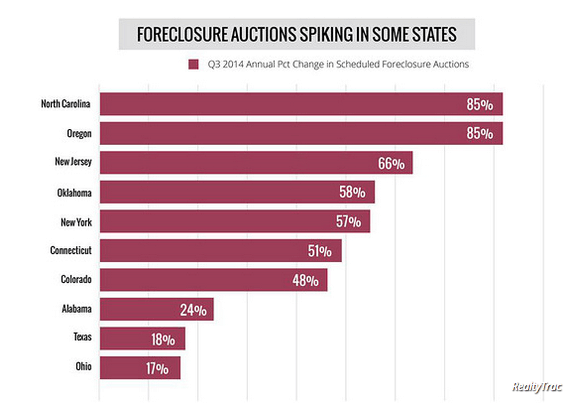
• 10 States Where Foreclosures Are Soaring (MarketWatch)
• ‘Stunning’ Fed Move Put Bottom Under Stocks (CNBC)
• Russia Takes EU To Court Over Ukraine Sanctions (FT)
• The Big Perk Of Oil’s Wild Slide (CNBC)
• Gloves Off Over Oil: Saudi Arabia Versus Shale (CNBC)
• The New Defensives: High Yield And The Dollar (CNBC)
• Is The ‘Lucky Country’ Headed For Gloomy Times? (CNBC)
• Don’t Hold Your Breath Waiting For QE4 (CNBC)
• Bank of England Chief Economist ‘Gloomier’ About UK Prospects (Guardian)
• Is Asia Ready for Another Wild Ride? (Bloomberg)
• Japan No.1 Pension Fund Would Be ‘Stupid’ to Give Asset Goals First (Bloomberg)
• ‘Ebola Epidemic May Not End Without Developing Vaccine’ (Guardian)
• WHO Response To Ebola Outbreak Foundered On Bureaucracy (Bloomberg)

Greek bond yields have slid back into danger territory. They were at 9% last night, far higher than the 7% ‘barrier’ generally assumed to separate acceptable from unsustainable. Someone better do something quick. Left wing Syriza party chief Tsipras is waiting to take over.

• Greek Bond Rout Drags Down Markets From Ireland to France (Bloomberg)

Greece’s government debt is back in the spotlight and investors are looking for the exit. As the four-day rout in Greek bonds sent yields to the highest since January, the selloff started to infect nations from Ireland to Portugal and even larger countries such as France. In Spain, a debt auction fell short of the government’s maximum target, and European stocks extended their longest losing streak since 2003. German 10-year bunds fell for the first time in three days, pushing the yield on the euro region’s benchmark securities up from a record low. “We are in a typical flight-to-quality environment with substantial losses in stock markets and wider spreads,” said Patrick Jacq, a fixed-income strategist at BNP Paribas SA in Paris. “The Spanish auction suffered from the environment, not from domestic reasons. It’s the market environment which is not favorable.”

[..] It’s five years since a change in government in Greece set in motion the debt crisis by unveiling a budget deficit that was larger than previously reported by its predecessor. The country was eventually granted a €240 billion lifeline that has kept it afloat since 2010. Markets slid this week after euro-area finance ministers clashed with the nation’s leaders over their plan to leave their safety net, sparking concern that Greece won’t be able to finance itself at sustainable rates without the support of its regional partners. The lack of supervision may lead to the country backtracking on reforms agreed with the EU and the IMF. “Whether that’s a bellwether for more problems to come or not, I’m doubtful of, but we certainly saw the periphery sell off,” Andrew Wilson at Goldman Sachs said in an interview with Bloomberg TV, referring to the slump in Greek bonds yesterday. “It was a flight to quality, it was a bit of a scary story for a while there and I think that’s all it’s reflecting.” Greek bonds have lost 17% in the past month, cutting their return this year through yesterday to 9.9%.

Read more …

“The yields are not just discounting a protracted slump, they are also starting to price default risk yet again, or even EMU break-up risk.”

• World Braces As Deflation Tremors Hit Eurozone Bond Markets (AEP)

Eurozone fears have returned with a vengeance as deepening deflation across Southern Europe and fresh turmoil in Greece set off wild moves on the European bond markets. Yields on 10-year German Bund plummeted to an all-time low on 0.72pc on flight to safety, touching levels never seen before in any major European country in recorded history. “This is not going to stop until the European Central Bank steps up to the plate. If it does not act in the next few days, this could snowball,” said Andrew Roberts, credit chief at RBS. Austria’s ECB governor, Ewald Nowotny, played down prospects for quantitative easing, warning that the markets had “exaggerated ideas about purchase volumes” and that no asset-backed securities (ABS) would be bought before December. Calls for action came as James Bullard, the once hawkish head of St Louis Federal Reserve, said the Fed may have to back-track on bond tapering in the US, hinting at yet further QE to fight deflationary pressures and shore up defences against a eurozone relapse.

“The forces of monetary deflation are gathering,” said CrossBorderCapital. “Global liquidity is declining and central banks are not doing enough, either in the West or the East to offset the decline. This may not be a repeat of 2007/2008, but it is starting to look more and more like another 1997/1998 episode.” This is a reference to the East Asia crisis and Russian default triggered by withdrawal of dollar liquidity. Ominously, French, Italian, Spanish, Irish, and Portuguese yields diverged sharply from German yields in early trading today, spiking suddenly in a sign that investors are again questioning the solidity of monetary union. The risk spread between Bunds and Italian 10-year yields briefly jumped 38 basis points. This was the biggest one-day move since the last spasm of the debt crisis in 2012. This sort of price action suggests that the markets fear deflation is becoming serious enough to threaten the debt dynamics of weaker EMU states. The yields are not just discounting a protracted slump, they are also starting to price default risk yet again, or even EMU break-up risk.

Read more …

” … well beyond the 7%-threshold which many analysts believe is unsustainable”.

• Greek Drama: Bond Yields Near 9% Threshold (CNBC)

Greek government bond yields spiked beyond 8% on Thursday, in a sign of growing concern about the country’s economic stability given the possibility of snap elections and plans to exit its bailout early. The 10-year note yielded 8.9% on Thursday at Europe market close, well beyond the 7%-threshold which many analysts believe is unsustainable. It is the first time yields have passed this point since January. On Wednesday evening, the sovereign note yielded 7.863%. The volatility comes amid growing concerns about Athens’ plans to exit its bailout ahead of schedule. On Saturday, Prime Minister Antonis Samaras won a confidence vote in parliament, forcing lawmakers to back his plans to exit its international aid program early – a prospect that is looking increasingly unlikely. Samaras’ government has also been plagued by the prospect of snap elections early next year if the prime minister fails to gain the support of opposition lawmakers for his candidate for president. A promise to exit the painful program early was key in securing that backing.

The concerns have led to a turbulent few days for Greek markets, with the Athens’ benchmark index tanking up to 9% on Wednesday. On Thursday, the ASE closed down around 2.2% lower and is now down around 25% this year. It also proved to be the spark that turned markets south on Thursday morning after equities bounced back slightly at the session open. “This smacks of the ‘risk off’ move of old,” Richard McGuire, a senior rate strategist at Rabobank told CNBC via email. “The peripherals are under pressure across the board which is potentially an alarming sign that fundamental risk is returning.” In a bid to free up some more money for the country’s banks, the European Central Bank cut the haircut it applies on bonds submitted by Greece’s banks as collateral to raise money. The new discount meant an extra 12 billion euros of liquidity could be tapped by Greek banks, the country’s central bank governor Yannis Stournaras told reporters.

Read more …

There we go again.

• Eurozone Crisis, 5 Years On: No Happy Ending For Greek Odyssey (Guardian)

Greece loves its epic tales and the greatest of them is the story of Odysseus, the hero who took 10 years to find his way back to Ithaca at the end of the Trojan War. A modern version of the Odyssey began in Greece five years ago this weekend when the government in Athens admitted that it had cooked the books to make its budget deficit look much smaller than it actually was. Few thought then that the scandal would have serious ramifications or that the journey through the stormy seas of crisis would have taken so long. Back in October 2009, the mood in the eurozone was one of cautious optimism.

The year had started with Europe caught up in the global economic crash that followed the collapse of Lehman Brothers, but co-ordinated action by the G20 during the winter of 2008-09 had created the conditions for a recovery in growth that appeared to be gaining strength as the year wore on. The admission by George Papandreou’s new socialist government of a black hole in Greece’s public finances was unwelcome but not viewed as something to be unduly worried about. But the policy makers in Brussels and Frankfurt were wrong. Greece did matter. What has become clear subsequently is that the eurozone crisis is similar to Scylla, the monster that devoured many of Odysseus’s men: a many-headed beast.

The first sign of the crisis to come was the deterioration in government finances, not just in Greece but in other eurozone countries. In truth, though, rising deficits were symptoms of three bigger problems. The first was that many countries in the eurozone had a competitiveness problem. Monetary union had given all the members of the single currency a common interest rate and no freedom to adjust their exchange rates. This meant that if a country had a higher inflation rate than its neighbour, its goods for export would gradually become more expensive. This is what had happened regularly to Italy during the post-war period, when its inflation rate was invariably higher than that in Germany. This time, however, Italy could not devalue.

Read more …

Samaras’ game is up.

• European Bonds: It’s Every Country For Itself Now (CNBC)

The honeymoon for European bond rates appears to be over for the Continent’s most-troubled economies. After more than a year of interest rates across the Continent moving lower in lockstep—regardless of the country—the last 24 hours show a breakdown in the relationship. Investors are still pouring into German bunds, much as they are still moving into U.S. Treasurys. But they are selling Italian, Spanish, Portuguese and especially Greek debt. Doug Rediker, CEO of International Capital Strategies, told CNBC that the differentiation represents “a more rational recognition of both credit risks and economic performance within the euro zone.” Investors are once again differentiating between countries based on the ability of their economies to grow—and for their governments to eventually pay back their debts.

Peter Boockvar, chief market analyst at The Lindsey Group, said that the end of easy money from quantitative easing and the “impotence” of the European Central Bank have alerted investors to a region that is not growing and where “debt-to-GDP ratios continue to rise.” Regarding Europe’s biggest economy, Rediker noted that “the German economy is underperforming, but overall its domestic economic performance is considered strong. Countries like Italy and France have far less to shout about in terms of economic performance and reform efforts.” The rise in Greek bond yields is particularly sharp. The country’s 10-year yield stood at nearly 9% on Thursday, after being below 6% just last month. The current Greek government, led by Antonis Samaras, is trying to make an early exit from a bailout program it got from the European Union and International Monetary Fund, but investors are nervous about the country’s ability to live without a financial backstop that would provide them cheap money in the event of a shortfall.

Read more …

“They’ll be hoping this turmoil will pass on its own.”

• Euro Economy’s Managers Aren’t Blinking in Market Rout (Bloomberg)

German Chancellor Angela Merkel and European Central Bank President Mario Draghi aren’t blinking yet. The longest losing streak in European stocks in 11 years and the weakest inflation since 2009 has intensified pressure on the managers of the euro area’s already ailing economy to deliver fresh stimulus programs. Battle-hardened by the debt crisis that almost broke the euro two years ago, policy makers are refusing to panic as they argue enough help is in the pipeline. The lesson of that last turmoil is nevertheless that investors may ultimately force action with taboo-busting quantitative easing from the ECB likely drawing closer as deflation fears intensify. “The main story really is that the recovery is very weak, very fragile, and something has to happen,” said Martin Van Vliet, an economist at ING Groep NV in Amsterdam. “Markets are increasingly expecting they’ll have to do sovereign QE.”

The euro area is again at the epicenter of a global rout in financial markets as investors increasingly fret its toxic mix of weak growth and sliding inflation may become the norm elsewhere as central banks run out of ways to provide support. With Europe straining amid tit-for-tat sanctions on Russia, Germany this week showing fresh signs that it is no longer immune to the slowdown in its neighbors. Confirmation yesterday that inflation slowed to just 0.3% in September helped drive down the Stoxx Europe 600 Index for an eighth day. Germany’s 10-year bond yield hit a record low. For the moment, policy makers are holding to their view that the region needs time rather than new stimulus even with prices already shrinking in Italy, Spain, Greece, Slovakia and Slovenia. “I think they’re surprised by the market correction,” Michael Schubert, an economist at Commerzbank AG in Frankfurt, said in a telephone interview. “They’ll be hoping this turmoil will pass on its own.”

Read more …

Risk off.

• Volckerized Wall Street Dumping Bonds With Rest of Herd (Bloomberg)

Corporate bond values are swinging the most in more than a year and here’s one reason why: Wall Street’s biggest banks are following the crowd and selling, too. Take junk bonds, which have lost 2% in the past month. Dealers, which traditionally used their own money to take bonds off clients desperate to sell during sinking markets, sold about $2 billion of the securities during the period, according to data compiled by Trace, the bond-price reporting system of the Financial Industry Regulatory Authority. Banks have cut debt holdings in the face of higher capital requirements and curbs of proprietary trading under the U.S. Dodd-Frank Act’s Volcker Rule. Their lack of desire to take risks has had the unintended consequence of exacerbating price swings amid the rout now, said Jon Breuer, a credit trader at Peridiem Global Investors LLC in Los Angeles, California.

“There just isn’t the appetite and ability to warehouse the risk anymore,” he wrote in an e-mail. “Everyone is afraid to catch the falling knife.” High-yield bonds have lost 1.1% this month, following a 2.1% decline in September. That was the worst monthly performance since June 2013 for the $1.3 trillion market that’s ballooned 82% since 2007, according to the Bank of America Merrill Lynch U.S. high-yield index. Debt of speculative-grade energy companies has been particularly hard hit along with oil prices, tumbling 3.4% this month with relatively few buyers willing to step in to mitigate the drop. For example, notes of oil and gas producer Samson Investment Co. have lost 25% since the end of August. The market’s indigestion was brought on by many reasons: signs of a global economic slowdown, Ebola spreading and concern that U.S. energy companies will struggle to meet their debt obligations after financing their expansion by issuing bonds.

Read more …

But obviously there’s money to be made in a rout like this.

• Pimco To Blackstone Preparing To Feast On Junk Bonds (Bloomberg)

In a junk-bond market that has been anything but high-yield for almost two years, the world’s biggest debt-fund managers have been stockpiling cash for a selloff. After the worst one in three years, they’re getting ready to pounce. Firms from Pacific Investment Management Co. to Blackstone Group LP say they are poised to scoop up speculative-grade corporate bonds after yields rose to the highest levels in more than a year. They’re looking for bargains after building up the highest levels of cash in almost three years. “Credit is a buy here, specifically high yield” bonds and loans, Mark Kiesel, one of three managers who oversee Pimco’s $202 billion Total Return Fund, said yesterday in a Bloomberg Television interview. At Blackstone, Chief Executive Officer Stephen Schwarzman told investors yesterday that the firm’s $70.2 billion credit unit is ready to “feast” on lower-rated, long-term debt, particularly in Europe, after “waiting patiently for something bad to happen.”

Taxable corporate-bond mutual funds tracked by the Investment Company Institute increased the proportion of cash and cash-like instruments they set aside to 8.5% of their $1.96 trillion of assets in August. That’s up from a three-year low of 4.9% in April 2013 and the most since November 2011, ICI data show. By amassing cash or parking money in easy-to-sell debt such as Treasuries, fund managers have been maintaining flexibility to swoop in and buy securities at discounts. Average yields on speculative-grade bonds sold by companies from the U.S. to Japan climbed to 6.67% yesterday, jumping more than 1 percentage point from a record-low 5.64% in June, according to Bank of America Merrill Lynch index data. The debt is now paying 5.3 percentage points more than government bonds, the widest spread since July 2013 and up from 3.6percentage points in June. The market hasn’t moved that much since the European debt crisis in 2011, the index data show.

Read more …

“The SEC caught Athena ‘placing a large number of aggressive, rapid-fire trades in the final two seconds of almost every trading day during a six-month period to manipulate the closing prices of thousands of Nasdaq-listed stocks.’ ”

• High-Speed Traders Put a Bit Too Much Gravy on Their Meat (Bloomberg)

One good general rule is that it’s harder than you think it is to figure out what’s market manipulation and what isn’t. Trading a lot, cancelling a lot of orders, putting in orders or doing trades on both sides of the market, trading a lot right before a close or fixing — all of those things could be signs of nefarious manipulation, or just normal risk management. No single event or pattern proves manipulation. You often need to look for subtle clues to figure out whether a trade is actually manipulative One subtle clue is, if you name your algorithms “Meat” and “Gravy,” there is probably something wrong with you! And your trading, I mean. But also your aesthetic sensibilities. Here is a Securities and Exchange case against Athena Capital Research, which the SEC touts as “the first high frequency trading manipulation case.”

The SEC caught Athena “placing a large number of aggressive, rapid-fire trades in the final two seconds of almost every trading day during a six-month period to manipulate the closing prices of thousands of Nasdaq-listed stocks.” That period was in late 2009, by the way. Athena settled for $1 million, and while it did so “without admitting or denying the findings,” the SEC’s order has the usual litany of dumb, so you can tell that Athena was fairly caught. In fact, the SEC is kind enough to put the dumb quotes in boldface, so they’re easy to find,1 though somehow this didn’t make it into bold: Athena referred to its accumulation immediately after the first Imbalance Message as “Meat,” and to its last second trading strategies as “Gravy.

Heehee that’s dumb. What is going on here? It starts with the fact that Nasdaq basically does two sorts of trading in the late afternoon. One is just its regular continuous order book trading, the kind it does all day. There are bids, there are offers, and there are lots of little trades that are constantly updating the price of every stock. Someone trades 100 shares at $20.01, 100 shares at $20.02, 200 shares at $20.03, 100 more at $20.02 again, etc., all within a fraction of a second. There is also the closing auction, which is more or less a separate institution. This is an auction that occurs at a single point in time, just after the 4:00 p.m. close. People put in buy orders and sell orders throughout the day, and then they all trade with each other simultaneously just after 4 p.m. at the clearing price of the auction.

Read more …

This ain’t over by a long shot. Wait till prices start dropping.

• 10 States Where Foreclosures Are Soaring (MarketWatch)

The property market is improving and foreclosures are falling — except in these 10 markets. Some 317,171 U.S. properties had foreclosure filings in the third quarter, down 16% on the same period last year, according to real-estate website RealtyTrac. However, default notices in the third quarter increased from a year ago in certain states, including Indiana (up 59%), Oklahoma (up 49%), Massachusetts (up 38%), New Jersey (up 19%), Iowa (up 12%) and New York (up 2%). States with the five highest foreclosure rates in the third quarter were among those hit hardest by the 2008 property crash: Florida, Maryland, New Jersey, Nevada, and Illinois. Some 58,589 Florida properties had a foreclosure filing in the third quarter of 2014.

That was down 4% from the previous quarter and down 17% from a year ago, but it still meant that in every 153 housing units had a foreclosure filing. Orlando, Fla., Atlantic City, N.J., and Macon, Ga., had the top metro foreclosure rates in the third quarter. With one in every 117 housing units with a foreclosure filing, Orlando had the highest foreclosure rate among metropolitan areas with a population of 200,000 or more. A total of 8,052 Orlando-area properties had a foreclosure filing, down 1% on the quarter but up 16% from a year ago.

While the Ohio property markets have seen a decline in the number of available foreclosures on the market over the last year, “We have equally noticed an increase in activity of lender servicers acquiring properties at sheriff sales and deed-in-lieu workouts,” says Michael Mahon, who covers the Cincinnati, Columbus and Dayton markets as executive vice president at HER Realtors. One explanation: Many Americans are choosing foreclosure over short sales. A couple of years ago, 18 out of 20 clients underwater who couldn’t afford to keep their home chose a short sale, says Frank Duran, a broker in Denver, but now only 2 out of 20 opt for a short sale. One explanation: In a short sale, canceled debt — or the difference between the value and sale price of the house — is often treated as taxable income.

Read more …

Why anyone would trust even one word from the Fed anymore is beyond me.

• ‘Stunning’ Fed Move Put Bottom Under Stocks (CNBC)

After a swift and serious selloff, stocks have managed to rise on Thursday’s session with help from the soothing words of St. Louis Federal Reserve President James Bullard. And after dropping just shy of 10% from high to low, the S&P 500 looks to have finally bottomed out, some traders say. “Whether the complete correction is over I’m not positive yet, but there looks to be some relative calm,” said Jim Iuorio of TJM Institutional Services. “I think the next leg is going to be higher.” Iuorio is focusing on the comments Bullard made Thursday morning on Bloomberg TV, where he discussed the quantitative easing program, which the Fed is currently winding down.

He said, “We have to make sure that inflation expectations remain near our target. And for that reason, I think a reasonable response by the Fed in this situation would be to … pause on the taper at this juncture, and wait until we see how the data shakes out in December.” Bullard’s comments come two days after those of San Francisco Fed President John Williams (who, like Bullard, is a non-voting member of the Fed Open Market Committee). Williams told Reuters “If we get a sustained, disinflationary forecast… then I think moving back to additional asset purchases in a situation like that should be something we seriously consider.”

Read more …

The proper theater for these matters. Courts require proof.

• Russia Takes EU To Court Over Ukraine Sanctions (FT)

Russia is taking the EU to court over sanctions imposed on some of its biggest companies. The move is a sign of the pain that the companies’ exclusion from global capital markets is inflicting on the Russian economy. Rosneft, the state oil company, and Arkady Rotenberg, a long-time friend and former judo sparring partner of President Vladimir Putin, have both launched legal challenges to the sanctions, imposed over Russia’s actions in Ukraine. The EU bans, with similar measures adopted by the U.S., have all but frozen Russian companies and banks out of western capital markets, at a time when they have to refinance more than $130 billion of foreign debt due for redemption by the end of 2015. Rosneft filed a case against the EU’s European Council in the general court under the European Court of Justice on October 9, requesting an annulment of the council’s July 31 decision that largely barred it and other Russian energy companies and state banks from raising funds on European capital markets.

Mr Rotenberg, who was hit with an EU visa ban and asset freeze in July, filed a legal case in the same court on October 10 challenging the move. The challenges follow verdicts that have gone against the council in relation to similar measures imposed on Iran and Syria. In particular, the court has ruled that in implementing sanctions, European states have been too reliant on confidential sources, which impair the targets’ ability to mount an effective defense. A Russian lawyer who advises one company on legal strategies over sanctions said the challenges by Rosneft and Mr Rotenberg might help sway some EU member states when the bloc begins to discuss whether to renew its sanctions against Russia next spring.

Read more …

Oh, yeah, big-screen TVs for everyone!

• The Big Perk Of Oil’s Wild Slide (CNBC)

Crude oil is plummeting – down some $25 bucks a barrel from the yearly high set just a few months ago. And those lower prices mean lower gasoline prices for people like you and me, which should result in a few extra dollars in your pocket. This is big news, guys, because the biggest and most celebrated holiday of the year is coming up for many of you — Black Friday! (Oh, you thought I was going to say something like Thanksgiving or Christmas. Please! Those holidays are just a goofy excuse to miss work.) I digress. But if the current trend remains intact, we’re going to hear about record breaking sales on Black Friday, which is awesome for retailers and the economy. I say spend, spend, spend those pennies you’re saving while gassing up the F-150. And, according to Moody’s, you should have a lot of dough to play with.

A 10-cent decrease in gas prices translates to an extra $93.25 in gasoline and diesel expenditures per year for the average American household, which equates to $11 billion in consumer spending. Over the past month, gasoline prices have declined 6%, or 20 cents per gallon. That, Mr. math wizard, is $22 billion in available cash. And, knowing many Americans prefer to spend than save, I would be thinking about opening a big-screen TV store if I were you. If you prefer happy endings and would rather stay away from reality, I would suggest stop reading; because this is where I tell you lower gas prices will likely have a dramatic and terrifying impact on violence around the globe.

Read more …

These guys sure don’t understand the Saudis. or shale, for that matter.

• Gloves Off Over Oil: Saudi Arabia Versus Shale (CNBC)

Oil prices might have halted their earlier slide below $80 a barrel this week but analysts believe the dog fight between major oil producers over reducing the supply of oil could lead to lower prices yet. Oil markets have seen prices fall sharply over the last four months, as faltering global growth in major economies has cut demand at a time of over-supply. On Thursday, WTI crude fell below $80 a barrel for the first time since June 2012 before recovering to 82.88 on Friday. The global oil benchmark Brent crude climbed by almost a dollar to near $86 a barrel on Friday morning – up from a near four-year low at below $83 on Thursday – after more positive economic data from the U.S. Prices have fallen over 20% since June, however, when turmoil in Iraq lifted prices to $116 a barrel.

“The bearishness in the global oil market is all being driven by the U.S. shale revolution,” Seth Kleinman, head of Global Energy Strategy at Citi, told CNBC. “It’s being driven by this massive infrastructure build out that we’ve seen over the last few years and it’s taken the market a lot more time to catch up and act more rationally.” The U.S. shale gas industry has boomed over the last decade with shale gas and oil producers proliferating and production surging in the country, becoming a competitor for major oil-exporting countries such as Saudi Arabia.

The drop in oil prices has led to expectations that OPEC could cut output in an attempt to shore up prices, but OPEC members Saudi Arabia and Kuwait played down such a move at the start of the week. That could pile pressure on the U.S. shale industry and its producers to cut supply themselves if and when prices decline further. “Everyone was assuming that the Saudis were going to pull back and defend prices,” Kleinman told CNBC Europe’s “Squawk Box” on Friday. “They probably could have defended $100 but they sent the message loudly, clearly and by every venue possible of ‘we’re not going to defend prices here.’ In fact, they started slashing prices to Asia.”

Read more …

Stay with the dollar.

• The New Defensives: High Yield And The Dollar (CNBC)

As world markets tumble and the euro zone crisis seemingly reared its head once more, investors have scrambled to find somewhere safe to house their cash. Equities on both sides of the Atlantic have been hammered as volatility has peaked to 2011 levels amid worries over global growth and the spread Ebola. A flight to traditional safe haven U.S. Treasurys pushed yields down around 1.8% on Thursday, levels not seen since 2013 – making it an expensive option for investors as prices move inverse to yields. “Sometimes, when markets fall, you get to a ‘no-brainer’ moment, when you can afford to ignore short-term concerns and take advantage of sudden decline in prices. This is not such a moment for equities,” chief investment officer at Cazenove Capital Management, Richard Jeffrey said. “Markets are not cheap, and could fall further. Indeed, although we might expect it to remain so, the U.S. market looks quite expensive,” he said.

Cash levels jumped and bearish sentiment reached levels not seen for two years according to Bank of America’s monthly fund manager survey, but managers have also taken another look at high yield bonds as stocks have been hit. “The current environment presents the opportunity to take another look at asset classes that had sold off and now look more attractive,” BlackRock’s global chief investment strategist Russ Koesterich said. One such asset class is high yield bonds as the yield difference between high yield bonds and higher-quality, lower-yielding U.S. Treasurys has widened out to the highest level in a year, he said. “This indicates high yield bonds offer better value. Given that corporate America remains strong and default rates low, high yield now looks likely to provide a reasonable level of income relative to the rest of the fixed income market,” he said.

Read more …

Australia will get badly hurt by China’s rising tariffs and falling economic reality.

• Is The ‘Lucky Country’ Headed For Gloomy Times? (CNBC)

Sentiment in the so-called ‘lucky country’ has deteriorated sharply, analysts told CNBC. Australia’s stock market has fallen 8% since the start of September, weighed by concerns over global economic growth, steep declines in commodity prices and the state of Australia’s property market. “Investor sentiment has certainly collapsed across a range of measures,” Shane Oliver, head of investment strategy at AMP Capital, told CNBC. Investors are much more concerned about the prospect of a market downturn and the state of Australia’s housing market than they were in the second quarter of this year, a survey of fixed income investors by Fitch Ratings showed on Wednesday. 79% of respondents flagged a downturn as a high or moderate risk, up from 43% in Fitch’s second quarter survey.

The frothy housing market was high on respondents’ worry list; 53% expect house prices to rise by 2 to 10% in 2015. “The concerns demonstrated in the Fitch Ratings survey are very clearly the case,” said Evan Lucas, market strategist at IG. “Housing is a major part of Australia confidence, [so] any issues around housing and wages are going to see sentiment fall.” Australian dwelling values rose 9.3% over the 12 months to September, spurred by a record 15-month run of historically low interest rates. Values in Sydney and Melbourne rose 14.3% and 8.1%, respectively, over that period, RP Data figures show. And in recent months, the Reserve Bank of Australia warned of regulatory steps to rein in loans to investors.

Read more …

Indeed. Not going to happen.

• Don’t Hold Your Breath Waiting For QE4 (CNBC)

Suggestions quantitative easing (QE) might go on a reunion tour in the U.S. helped to staunch market losses Thursday, but don’t hold your breath waiting for the Federal Reserve to whip out the checkbook, analysts said. “It’s part of a strategy to calm markets down, to remind them that ‘we still have your back and we’re on top of this’ from a central bank point of view,” Mikio Kumada, global strategist at LGT Capital Partners, told CNBC. “Whether they will actually do it, I’m not so sure. At least as far as the U.S. is concerned, the economic conditions are decent enough.”

Stocks bounced back Thursday after a rough opening, with the S&P 500 ending the day less than a point higher, after St. Louis Federal Reserve President James Bullard Thursday morning suggested to Bloomberg TV, that the Fed should consider pausing its taper of the quantitative easing program. “We have to make sure that inflation expectations remain near our target. And for that reason, I think a reasonable response by the Fed in this situation would be to… pause on the taper at this juncture, and wait until we see how the data shakes out in December,” Bullard said. The Federal Reserve had expected to complete the taper later this month. Those comments come two days after those of San Francisco Fed President John Williams (who, like Bullard, is a non-voting member of the Fed Open Market Committee).

Williams told Reuters: “If we get a sustained, disinflationary forecast… then I think moving back to additional asset purchases in a situation like that should be something we seriously consider.” Some are extremely skeptical of a QE encore performance. “The only thing that could justify QE4 is a high probability of a downturn in the real economy and/or falling core inflation,” said Eric Chaney, chief economist at AXA Group, in a note. “The probability of a U.S. recession is close to zero,” he said. “Overall, there is not one single indicator flashing red, as far as the risk of recession is concerned,” he added, citing indicators such as the consumer debt-to-income ratio back at end-2002 levels, high corporate profitability and even the declining federal deficit.

Read more …

That’s what you get for telling fairy tales all teh time.

• Bank of England Chief Economist ‘Gloomier’ About UK Prospects (Guardian)

The chances of an early rise in UK interest rates have fallen, says the Bank of England’s chief economist, Andrew Haldane, who admits he is “gloomier” about the prospects for the economy than he was a few months ago. In a speech on Friday morning, which will reinforce market views that rates are unlikely to rise from their record low of 0.5% until the middle of next year, Haldane said: “That reflects the mark-down in global growth, heightened geo-political and financial risks and the weak pipeline of inflationary pressures from wages internally and commodity prices externally. “Taken together, this implies interest rates could remain lower for longer, certainly than I had expected three months ago, without endangering the inflation target,” said Haldane, a member of the Bank’s nine-member interest rate setting committee. The prospect that interest rates will stay lower for longer sent sterling tumbling on the foreign exchanges, with the pound losing half a cent against the dollar.

Haldane also warned that Britain was vulnerable to another explosion in the eurozone crisis. He told ITV News: “It’s a concern. It [the eurozone] is our biggest trading partner by far. We know we’ve seen recently that any event on the continent laps back to the UK very quickly through our trade links, but also through our financial links and, indeed, increasingly just because of confidence. If confidence is ebbing on the continent, it appears to leak across here pretty quickly.” In June, Haldane had put even weight on moving interest rates sooner and moving them later. He used the cricketing terms “being on the front foot” and being on the “back foot”. On Friday, he said: “While still a close-run thing, the statistics now appear to favour the back foot. Recent evidence, in the UK and globally, has shifted my probability distribution towards the lower tail. Put in rather plainer English, I am gloomier.”

Read more …

No, but it will come anyway.

• Is Asia Ready for Another Wild Ride? (Bloomberg)

From Ebola to debt to deflation, fear once again stalks the global economy. With bewildering speed, concerns about of credit defaults, slowing demand and political instability have eclipsed exuberance over America’s falling jobless rate and Alibaba’s record-breaking IPO. The most-asked question isn’t where to make profits, but where to find a safe haven from the coming storm. Could it be Asia again? Sadly, unlike during the most recent global recession, even this region finds itself in an increasingly dangerous position this time around. That’s not to say Asia doesn’t have enviable fundamentals. Even given China’s worsening data, the stalling of “Abenomics” in Japan and structural headwinds that challenge officials almost everywhere, Asia may yet ride out renewed turbulence better than the West — just as it did in 2008. If one thinks of investment destinations as beauty contestants, Asia is still hands-down the least ugly candidate.

But the region’s growth over the last six years has been driven more by asset bubbles than genuinely sustainable economic demand. Already, we are seeing structural slowdowns from Seoul to Jakarta. These strains will become even more pronounced as Europe’s debt troubles re-emerge and the Federal Reserve’s record stimulus loses potency. Asian policymakers also have less latitude going forward to support growth. “A full recovery of demand in the West, sufficient to pull Asia out of its malaise, remains a distant prospect,” says Qu Hongbin, Hong Kong-based co-head of Asian economic research at HSBC Holdings. “Rather, reviving growth in Asia, whether in China, Japan, India or anywhere in between, requires deep structural reforms: pruning subsidies, spending more on quality infrastructure, boosting education, opening further to foreign direct investment, and, perhaps most important of all, introducing greater competition in local markets. These are politically tough choices to make. But they will grow only more difficult, the longer they are put off.”

Read more …

GPIF moving away from Japan sovereign bonds is Abe’s riskiest move yet. And it will end where all his policies lead: into misery.

• Japan No.1 Pension Fund Would Be ‘Stupid’ to Give Asset Goals First (Bloomberg)

Japan’s $1.2 trillion retirement fund would be “stupid” to announce its new investment strategy before adjusting asset allocations, said Takatoshi Ito, a top government adviser on overhauling public pensions. Publishing target weightings in advance would move markets, forcing the Government Pension Investment Fund to buy at highs and sell at lows, Ito said in an interview in Tokyo on Oct. 14. GPIF should shift holdings as much as possible now, he said, while noting that the fund doesn’t seem to be doing so. Deciding the new asset split is taking time partly due to a debate on whether to make it public before or after changing the portfolio, Ito said.

Investors are waiting for the bond-heavy fund to confirm it will cut Japanese debt to buy local stocks and overseas assets, after a government-picked panel led by Ito advised GPIF to sell bonds in a report last year. Yasuhiro Yonezawa, the chairman of GPIF’s investment committee, said in July that while it would be ideal to adjust the fund’s assets before the announcement, it must also avoid disrupting markets. “Saying ‘we’re going to purchase as much as whatever%’ before buying anything is a stupid idea,” Ito said. “It’s tantamount to not fulfilling their fiduciary responsibilities and not appropriately investing the money entrusted to them. It’s wrong, and I’m against it.”

Read more …

“Something that is easy to control got completely out of hand …”

• ‘Ebola Epidemic May Not End Without Developing Vaccine’ (Guardian)

The Ebola epidemic, which is out of control in three countries and directly threatening 15 others, may not end until the world has a vaccine against the disease, according to one of the scientists who discovered the virus. Professor Peter Piot, director of the London School of Hygiene and Tropical Medicine, said it would not have been difficult to contain the outbreak if those on the ground and the UN had acted promptly earlier this year. “Something that is easy to control got completely out of hand,” said Piot, who was part of a team that identified the causes of the first outbreak of Ebola in Zaire, now the Democratic Republic of Congo, in 1976 and helped bring it to an end. The scale of the epidemic in Sierra Leone, Liberia and Guinea means that isolation, care and tracing and monitoring contacts, which have worked before, will not halt the spread. “It may be that we have to wait for a vaccine to stop the epidemic,” he said.

On Thursday night, a Downing Street spokesman said a meeting of the government’s emergency response committee, Cobra, was told the chief medical officer still believed the risk to the UK remained low. “There was a discussion over the need for the international community to do much more to support the fight against the disease in the region,” the spokesman said. “This included greater coordination of the international effort, an increase in the amount of spending and more support for international workers who were, or who were considering, working in the region. The prime minister set out that he wanted to make progress on these issues at the European council next week.” Dr Tom Frieden, director of the Centers for Disease Control (CDC), in evidence to Congress, said he was confident the outbreak would be checked in the US, but stressed the need to halt the raging west African epidemic. “There are no shortcuts in the control of Ebola and it is not easy to control it. To protect the United States we need to stop it at its source,” he said.

Read more …

How we blunder our way into disaster. Time and again.

• WHO Response To Ebola Outbreak Foundered On Bureaucracy (Bloomberg)

Poor communication, a lack of leadership and underfunding plagued the World Health Organization’s initial response to the Ebola outbreak, allowing the disease to spiral out of control. The agency’s reaction was hobbled by a paucity of notes from experts in the field; $500,000 in support for the response that was delayed by bureaucratic hurdles; medics who weren’t deployed because they weren’t issued visas; and contact-tracers who refused to work on concern they wouldn’t get paid. Director-General Margaret Chan described by telephone how she was “very unhappy” when in late June, three months after the outbreak was detected, she saw the scope of the health crisis in a memo outlining her local team’s deficiencies. The account of the WHO’s missteps, based on interviews with five people familiar with the agency who asked not to be identified, lifts the veil on the workings of an agency designed as the world’s health warden yet burdened by politics and bureaucracy.

“It needs to be a wakeup call,” said Lawrence Gostin, a professor of global health law at Georgetown University in Washington. The WHO is suffering from “a culture of stagnation, failure to think boldly about problems, and looking at itself as a technical agency rather than a global leader.” Two days after receiving the memo about her team’s shortcomings, Chan took personal command of the agency’s Ebola plan. She moved to replace the heads of offices in Guinea, Liberia and Sierra Leone, and upgraded the emergency to the top of a three-tier level, said the five people, who declined to be identified because the information isn’t public. Chan agreed to respond to their accounts in an interview. “I was not fully informed of the evolution of the outbreak,” she said today. “We responded, but our response may not have matched the scale of the outbreak and the complexity of the outbreak.”

Read more …

Oct 162014
 
 October 16, 2014  Posted by at 5:51 pm Finance Tagged with: , , , , , ,  5 Responses »


Jack Allison Street scene, New York City Summer 1938

“When it becomes serious, you have to lie,” said brand-new EC head Jean-Claude Juncker back in May 2011. I’m thinking the last few days have been serious enough to warrant some real whoppers from Brussels. And beyond.

Yesterday, one hour after the S&P reached its low point, not only was it deemed necessary to bring out the Plunge Protection Team, Fed grey head Janet Yellen was trotted out as well to soothe the dark mood with rosy tales about the US economy.

A multi-day series of downturns got a temporary crescendo, with many of the richest stock European exchanges at 10-11% losses from recent highs. Many lost 3-3.5% for the day alone, with Greece down 6.25% (Athens is off some -25% in all), and having its bonds dumped while Germany et al see ‘investors’ fleeing into theirs. A new attack on Athens certainly looks possible. And where Greece goes, so go Italy and Spain, albeit a few mph slower.

Is this the end or the beginning? Well, as should have been clear for a very long time now, you cannot buy growth. And in ‘our’ efforts to buy growth instead of working for it, a lot of damage has been done. Which won’t all show up at once, but it will at some point. There will be many, and mighty, voices clamoring for more of the same, in more than one sense, as people seek to hold on to what looks familiar with additional debt injections in the by now 7 year-old tradition spirit of ‘stimulus’.

It’s become a new normal to claim the Germans must be insane not to follow the teachings of the Great Lord Keynes, with the huge success stories of the US and UK as ‘proof’ of just how wise he was. Then how come this kind of plunge is so predictable?

US stocks see their heaviest trading volume in 3 years. That takes liquidity. Dollars. But they are getting scarce. The ‘insanest’ amounts of free money, from China and America, are shrinking (Japan has become a story all of its own) and right away, panic ensues. Add the threat of higher rates and you get a sell-off. I see plenty ‘experts’ saying both Beijing and Washington will see the folly of their ways in time, but can they really do more of the same? And what would be the benefit vs the cost?

I remain solidly convinced that Yellen et al will suffocate QE, hike interest rates, and raise the dollar. Because that’s the triple that benefits big banks the most. And that’s also why she, yesterday, held that speech in which she ‘voiced confidence in the durability of the U.S. economic expansion’.

Yellen Voices Confidence in U.S. Economic Expansion

Federal Reserve Chair Janet Yellen voiced confidence in the durability of the U.S. economic expansion in the face of slowing global growth and turbulent financial markets at a closed-door meeting in Washington last weekend [..] Yellen told the Group of 30 that the economy looked to be on track to achieve growth of around 3%. She also saw inflation eventually rising back to the Fed’s 2% target as unemployment falls further… [..] Yellen’s reported remarks were roughly in line with the forecasts presented by Fed policy makers at their last meeting in September.

Not only did she, with the PPT, save the day on Wall Street, she also provided the reason why rates will rise, even if world markets have a high fever. In an aside, an Air France plane has been quarantined at Madrid airport just now with a Nigerian man with high fever and 182 other passengers. We can’t seem to get this right, can we?

Back to da mullah. Here’s a few interesting lines from Bloomberg yesterday afternoon:

U.S. Stocks Drop as Weakening Economic Data Fuel Selloff

The Chicago Board Options Exchange Volatility Index, the benchmark gauge of options prices known as the VIX, jumped 15% to 26.25, the highest level since 2012, amid demand for protection against losses in equities.

Almost 12 billion shares changed hands in the U.S., the most since October 2011. Stocks pared losses after the S&P 500 fell to its low of the day of 1,820.66 shortly before 1:30 p.m. in New York. About an hour later, Bloomberg News reported that Federal Reserve Chair Janet Yellen voiced confidence in the durability of the U.S. economic expansion in the face of slowing global growth and turbulent financial markets at a closed-door meeting in Washington last weekend.

Retail sales in the U.S. dropped more than forecast in September, decreasing 0.3% after a 0.6% gain in August that was the biggest in four months, Commerce Department figures showed. Another report today showed manufacturing in the Federal Reserve Bank of New York’s region slowed more than projected in October. The bank’s so-called Empire State index dropped to 6.2 this month from an almost five-year high of 27.5 in September.

That ‘demand for protection against losses in equities’ is a curious line. Can’t they let the PPT act in secret anymore? What else is its use? You can’t very well make it the Public Plunge Protection Team, nudge nudge…

But the big one is the drop in US retail sales. No harsh winter, no hurricanes, not even heavy rains. And the Empire State Index falling of a cliff. I know that today US industrial output came out looking like a harvest queen, and initial claims were down a bit, but I find the timing odd, and I can’t rhyme it with the heavy drop in that NY Fed index. Is it winter in Manhattan already? Or is it Juncker time?

It gets truly hilarious when you see things like this from Bloomberg. Pay special attention to Deutsche’s Joseph LaVorgna:

The $11 Trillion Advantage That Shields U.S. From Turmoil

Call it America’s $11 trillion advantage: Consumer spending is likely to steer the U.S. economy safely through the shoals of deteriorating global growth and turbulent financial markets. The combination of more jobs, falling gasoline prices and low borrowing costs will help lift household purchases. Such tailwinds probably matter more than Europe’s struggles or the slackening in emerging markets that caused the Dow Jones Industrial Average last week to erase its gains for the year.

“We’ve got a lot of things working in favor of the consumer right now,” said Nariman Behravesh, chief economist at IHS. “To have that kind of strength is the biggest asset for the U.S. It’s a pretty rock solid footing.” Household purchases make up almost 70% of the $16.8 trillion U.S. economy and have climbed an average 2% in the recovery that’s now in its sixth year. Spending growth will accelerate to 2.7% next year after 2.3% in 2014, according to the latest Bloomberg survey of economists.

The poll, taken from Oct. 3 to Oct. 8 in the midst of the meltdown in equities, showed little change in the median projections from the prior month. The economy is forecast to expand 3% in 2015 after 2.2% growth this year, according to the survey. “We’ve got the proverbial 800-pound gorilla – the consumer,” said Joseph LaVorgna, chief U.S. economist at Deutsche Bank Securities Inc. in New York. “Households are more fixated on the good news here, and a big part of that is the labor market. The U.S. is going to be pretty immune to the rest of the world.”

“The U.S. is going to be pretty immune to the rest of the world.” No, Joe, it’s not. The US is less vulnerable than most to lower oil prices and higher and scarcer dollars, true enough. But the US also still has a population in which labor participation is at a historic low, in which those who have jobs are paid less and get far fewer benefits, and which has huge levels of personal debt.

Ergo, the only way the US consumer can consume is by delving deeper into debt. They have to borrow before they can spend. Just like much of the rest of the world. Only, in the US consumer spending accounts for 70% of GDP (and it’s down); in other countries, it’s substantially lower.

A nice example of where the US stands at this point in time is here: German states ask Merkel for more infrastructure spending, which she refuses, while the US can’t even afford it own infrastructure anymore, because all the trillions the US spent (by expanding its central bank balance sheet), – and Germany did not -, went to Wall Street. And then you get this:

German States Join Ranks Pressing Merkel to Spur Spending

Germany’s state governments stepped up calls for infrastructure spending, adding another source of pressure on Chancellor Angela Merkel to boost investment as economic growth falters. Much like Merkel’s national government, the states are caught between a deteriorating growth outlook and the balanced-budget drive that Germany started in response to the euro area’s debt crisis.[..] A day after the German government lowered its growth outlook, proposals to spend more on projects such as highways in Europe’s biggest economy are on the table at a retreat of state premiers that Merkel plans to attend.

Merkel will let some projects be executed, but she won’t let her country sink into debt to do it. For America, that’s not even a choice anymore. It needs Chinese funny money now or bridges will crumble. A country with such a rich history of citizens chipping in to build bridges, roads and other infrastructure, what a remarkable turn-around this is. Only 100 years ago, a town that couldn’t afford to build its own bridges would have been ridiculed. And look now:

Crumbling US Fix Seen With Global Trillions of Dollars

[..] Former Indiana Governor Mitch Daniels said: “America needs the upgrade and modernization of our infrastructure, and I don’t think you’ll get there if you keep excluding, or at least discouraging, private capital.” President Barack Obama’s administration, which had resisted private financing of public works, is starting a new center to serve as a one-stop shop for bringing capital into government projects.

U.S. Treasury Secretary Jacob J. Lew said while direct federal spending is indispensable in such cases, tight budgets demand creative ways for unlocking private money.His cabinet colleague, Transportation Secretary Anthony Foxx, put it more bluntly when he announced the Build America Investment Initiative in July. “There will always be a substantial role for public investment,” Foxx said. “But the reality is we have trillions of dollars internationally on the sidelines that are not being put to work.”

Now, America must pay hefty interest rates to strangers on its own bridges. Or they won’t get built. That should hurt. No, it really should.

You can focus on the hosannah news that comes out about the US economy every single day, and on Janet Yellen’s confidence booster yesterday, or you can look at how car sales are deteriorating, after they were upbeat for a while only on subprime loans.
The biggest number for me, amid the global storm in stocks and bonds, and the renewed – very real – threat of financial markets targeting southern Europe, is that drop in US retail sales.

So industrial output was up 1%. So what? That’s not the 70% of your economy. Retail sales are though. And they are down. Because Americans borrowed less, for whatever reason. And what they can’t borrow, they can’t spend. Because they’re dead broke.

So how are you going to make them less broke? Those 92 million Americans who are no longer counted in the work force, how are you going to get them to increase their spending patterns? Or the millions more who are still ‘counted’ in the work force, but have no jobs? Or the fast rising number who have jobs that pay close to or below a living wage?

I say let them stocks plummet, and let’s get a glimpse of where the real economy is at. We’ve seen the fantasy one for 7 years now, and it gets old and bitter.

I see deflation flirting with America. Retail sales equals consumer spending equals velocity of money. And unless the money supply is rising, hardly likely in the taper, less spending is deflation by definition. Forget about PMI and all that kind of data, it’s much simpler than that. Central banks can do all kinds of stuff, but they can’t make us spend our money on things we don’t want or need. Let alone make us borrow to do so. And if we don’t, deflation is an inevitable fact. That doesn’t mean prices for some items won’t go up, but that’s not what counts. It’s about how fast we either spend the money we have – if we have any left – or how much we borrow. And if time is money, then borrowed money is borrowed time. So we really shouldn’t.

Oct 162014
 
 October 16, 2014  Posted by at 11:14 am Finance Tagged with: , , , , , , , , , , ,  6 Responses »


Arthur Rothstein First settler on Douglas County farmsteads, Nebraska May 1936

• World Economy So Damaged It May Need Permanent QE (AEP)
• Liquidity Nightmare Blamed For Crazy Market Moves (CNBC)
• This Is Just The Beginning Of The Bear Market: Gartman (CNBC)
• World Economy Gives Investors Growth Scare as They Look to US (Bloomberg)
• Tumbling Oil Prices: Recession In Russia, Revolt In Venezuela? (Guardian)
• Citigroup Sees $1.1 Trillion Stimulus From Oil Plunge (Bloomberg)
• Oil Drop Makes US Drillers Own Worst Enemy (Bloomberg)
• Yellen Voices Confidence in U.S. Economic Expansion (Bloomberg)
• U.S. Stocks Drop as Weakening Economic Data Fuel Selloff (Bloomberg)
• Draghi Letdown Sends European Equities Down 11% (Bloomberg)
• ECB Stress Test Dead On Arrival As Deflation Hits (Telegraph)
• German States Join Ranks Pressing Merkel to Spur Spending (Bloomberg)
• Why Putin and Merkel Don’t Put Growth First (Bloomberg)
• Biggest Pain Trade Gives 37% Loss to Bond Bears Getting It Wrong (Bloomberg)
• Hedge Funds Face Their Worst Year Since 2011 (FT)
• US Warns Europe On Deflation, ECB Policies (Reuters)
• U.S. Says China Shows Some ‘Willingness’ to Let Yuan Rise (Bloomberg)
• How Both Dating And Finance Have Been Screwed By The Internet (Slate)
• US Health Official Allowed New Ebola Patient On Plane With Fever (Reuters)

But we can’t have permnent QE. Ambrose claims China and the Fed will yet see the light and start pumping again, but what have they left?

• World Economy So Damaged It May Need Permanent QE (AEP)

Combined tightening by the United States and China has done its worst. Global liquidity is evaporating. What looked liked a gentle tap on the brakes by the two monetary superpowers has proved too much for a fragile world economy, still locked in “secular stagnation”. The latest investor survey by Bank of America shows that fund managers no longer believe the European Central Bank will step into the breach with quantitative easing of its own, at least on a worthwhile scale. Markets are suddenly prey to the disturbing thought that the five-and-a-half year expansion since the Lehman crisis may already be over, before Europe has regained its prior level of output. That is the chief reason why the price of Brent crude has crashed by 25pc since June. It is why yields on 10-year US Treasuries have fallen to 1.96pc, and why German Bunds are pricing in perma-slump at historic lows of 0.81pc this week. We will find out soon whether or not this a replay of 1937 when the authorities drained stimulus too early, and set off the second leg of the Great Depression.

If this growth scare presages the end of the cycle, the consequences will be hideous for France, Italy, Spain, Holland, Portugal, Greece, Bulgaria, and others already in deflation, or close to it. The higher their debt ratios, the worse the damage. Forward-looking credit swaps already suggest that the US Federal Reserve will not be able to raise interest rates next year, or the year after, or ever, one might say. It is starting to look as if the withdrawal of $85bn of bond purchases each month is already tantamount to a normal cycle of rate rises, enough in itself to trigger a downturn. Put another way, it is possible that the world economy is so damaged that it needs permanent QE just to keep the show on the road. Traders are taking bets on capitulation by the Fed as it tries to find new excuses to delay rate rises, this time by talking down the dollar. “Talk of ‘QE4’ and renewed bond buying is doing the rounds,” said Kit Juckes from Societe Generale.

Gentle declines in the price of oil are typically benign, a shot in the arm for companies and consumers alike. The rule of thumb is that each $10 drop in the price adds 0.3pc to GDP growth over the next year. Crashes are another story. They signal global stress, doubly dangerous today because the whole industrial world is one shock away from a deflation trap, a psychological threshold where we batten down the hatches and wait for cheaper prices. That is the Ninth Circle of Hell in economics. Lasciate ogni speranza. The world is also more stretched. Morgan Stanley calculates that gross global leverage has risen from $105 trillion to $150 trillion since 2007. Debt has risen to 275pc of GDP in the rich world, and to 175pc in emerging markets. Both are up 20 percentage points since 2007, and both are historic records.

Read more …

Without excess stimulus, nothing moves anymore.

• Liquidity Nightmare Blamed For Crazy Market Moves (CNBC)

Investors are blaming an unprecedented lack of liquidity for Wednesday’s gut-wrenching stock market open, which saw the S&P 500 fall as much as 2.2% from Tuesday’s close, sent the VIX screaming to 28 and led to outsized moves in major stocks like Disney. According to Eric Hunsader of Nanex, there were 179 “mini flash crashes” during the first 15 minutes of trading, which is the most since the Knight Capital Group fiasco in August 2012. Additionally, Hunsader reports that there were 68 trades in the S&P e-mini that moved that key futures contract 3 or more ticks. And Treasury futures, too, moved sharply as a result of low liquidity. The definition that Nanex uses for a mini flash crash is that a stock sees 10 or more down ticks, for a price change exceeding 0.8%, within 1.5 seconds. “There was no liquidity at all, so it doesn’t take a whole lot of size to really move the price,” Hunsader told CNBC. But “some people come in, and they’re used to buying or selling X-amount, and they’re not paying attention. And X-amount now causes significant movements in price.”

When this lack of liquidity collided with a great number of traders willing to get out at any price, markets got ugly. “This was a pukage. People were putting in market order to sell on the open—’Just get me out’—without thinking,” said Brian Stutland of Equity Armor Investments. The issue, Hunsader said, is that high-frequency trading creates the appearance of liquidity. He gives the example of a trader who wants to buy 10,000 shares of a stock. That order might get routed to two exchanges, but instead of the order getting completed with 5,000 shares traded on each exchange, the first trade of 5,000 shares will cause the other 5,000 share offered on the other exchange to dry up. When these are market-order trades to buy or sell at the available price, the effect of this is a ricochet effect that leads to an outsized move. This explains why not all of Wednesday morning’s moves were to the downside.

Read more …

Heed Dennis.

• This Is Just The Beginning Of The Bear Market: Gartman (CNBC)

The selloff in global markets is set to continue as a bear market takes hold “for a long period of time,” according to widely followed investor Dennis Gartman, who warned investors not to go long on stocks. “This is the start of a bear market,” Gartman, the founder of the closely watched Gartman Letter, told CNBC Europe’s “Squawk Box” on Thursday. “You stay in cash and you stay in short term bonds and you don’t move out, this is a very difficult period of time and I’m afraid – and I don’t like to think about it – but this might be the very beginnings of a bear market that could last some period of time,” he warned. Gartman’s comments come amid global market turmoil, particularly in the U.S. this week on the back of weaker economic data and fears of an economic slowdown in previous growth engines China, the U.S. and Germany. [..]

Gartman warned that there was going to be “more than a mere 7% to 10% correction” in markets which had enjoyed a bull run since the U.S. Federal Reserve announced an unprecedented bond-buying program designed to stimulate growth in the world’s largest economy. “I don’t like to be that way- you have to remember that in the business of trading…in the business of trading bears don’t eat. Only bulls in the market enjoy the upside, only bulls actually get paid over time. I don’t like to be bearish but this is a time to be at least neutral and perhaps at worst bearish.” Earlier this week, Gartman told CNBC he has “north of 80% in cash and short-term bond funds.” He said Wednesday’s flight to Treasurys was “real panic buying in the bond market probably by those that have been short, because so many people have been bearish of the bond market.”

Read more …

The US will sink right along with the rest.

• World Economy Gives Investors Growth Scare as They Look to US (Bloomberg)

The global economy faces its biggest test of confidence since the European sovereign debt crisis as investors fear it’s running out of engines. Japan and the euro area are throwing up fresh signs of weakness by the day and emerging markets such as China are dragging instead of driving growth. The sense of tumult is being exacerbated by war in the Middle East, the standoff in Ukraine, street protests in Hong Kong and the spread of Ebola to Dallas. The worry is that five years since the world limped out of recession, central banks have virtually exhausted their stimulus arsenals if activity keeps fading. That leaves the hopes of financial markets riding on the U.S. to resume its historical role as a locomotive robust enough to pull up demand elsewhere. “The global economy and the markets have a history of traumatic economic events,” said Paul Mortimer-Lee, chief economist for North America at BNP Paribas SA in New York.

“Psychologically and physically they have not recovered fully and are anxious about a relapse.” The doubts were evident across financial markets yesterday as a bear market in oil deepened, the Standard & Poor’s 500 Index came close to surrendering its gains for the year and bonds from Germany to the U.S. rallied. The Chicago Board Options Exchange Volatility Index (VIX), a measure of investor nerves known as the VIX, is at its highest since June 2012. U.S. stocks pared losses after Bloomberg News reported that Fed Chair Janet Yellen voiced confidence in the durability of the American expansion at a closed-door meeting in Washington last weekend. The S&P 500 closed 0.8% lower after dropping as much as 3%.

Read more …

If it’s up to the Saudi-US combo, bring it on!

• Tumbling Oil Prices: Recession In Russia, Revolt In Venezuela? (Guardian)

The sudden slump in oil prices, which have fallen 15% in the past three months, has sent tremors through the capitals of the world’s great oil powers, many of whom could face testing budget crunches if the tendency persists. Higher output coupled with weaker demand from China and Europe has driven the price of crude down to $85 – its lowest for four years. The US also now produces 65% more oil than it did five years ago following the boom in shale production. The rise has contributed to the global glut of crude and allowed the US to import 3.1 million fewer barrels of oil a day compared with its peak in 2005. Prices are now well below the level on which many oil exporters have based their budgets.

If prices remain weak – and many forecasters suggest they will – then from Moscow to Caracas and from Lagos to Tehran governments will start to feel the impact on macroeconomic policy. Brent has averaged $103 since 2010 – trading mostly between $100 and $120 – so a continued period of $80 oil, or less, would have an impact across the world, and from multiple angles. The lower price isn’t bad news for everyone. For example, India would not suffer much – commodities account for 52% of India’s imports but only 9% of its exports (paywall), and unlike Brazil, Russia or South Africa, India would reap immediate advantages from a fall in commodity prices.

Read more …

Sure. Things do look spectacularly different when you live in just one dimension.

• Citigroup Sees $1.1 Trillion Stimulus From Oil Plunge (Bloomberg)

The lowest oil price in four years will provide stimulus of as much as $1.1 trillion to global economies by lowering the cost of fuels and other commodities, according to Citigroup Inc. Brent, the world’s most active crude contract, closed at $83.78 a barrel in London yesterday. That’s more than 20% below its average for the past three years, amounting to savings of about $1.8 billion a day based on current output, Citigroup estimates. Savings will climb to $1.1 trillion annually as the slide cuts costs of other commodities, leaving consumers and companies with extra cash to spend and bolstering growth, according to Ed Morse, the bank’s head of global commodities research in New York.

Crude prices are plunging amid signs that OPEC, supplier of 40% of the world’s oil, won’t act to eliminate a surplus as global growth slows. Combined supplies from the U.S. and Canada rose last year to the highest since at least 1965 as producers tapped stores locked in shale-rock formations and oil sands. The global economy will rebound next year, with growth quickening to 2.98%, the fastest since 2010, according to analyst forecasts compiled by Bloomberg. “A reduction in oil prices also results in a reduction in prices across commodities, starting with natural gas, but also including copper, steel, and agriculture,” Morse said yesterday in an e-mailed response to questions. “All commodities are energy intensive to one degree or another.”

Read more …

Let’s have the margin calls come in, see what’s left behind.

• Oil Drop Makes US Drillers Own Worst Enemy (Bloomberg)

U.S. oil producers that saw profits soar on the North American shale boom are feeling the downside of success: falling prices and shrinking cash are threatening to slow development. At the same time, as crude prices approach four-year lows, natural gas companies are experiencing a reversal of fortune after having been shunned by many investors when a supply glut drove the fuel to a decade-low. Gas producers are now viewed as a safer haven than oil companies. Whiting Petroleum hit an all-time high in August after striking a deal to become the biggest oil producer in North Dakota, the state with the second-largest output. It has since lost more than $4 billion in value as its shares plunged 38%. Meanwhile, Southwestern Energy, an independent producer whose output is 99% gas, has fallen just 13%. “Natural gas is becalmed through this,” Donald Coxe, who manages about $200 million at Coxe Advisorsin Chicago, said in an interview. “It is Walden Pond compared to a hurricane in Florida.”

Whiting is one of 26 companies on the S&P Oil & Gas Exploration and Production Select Industry Index that have declined more than 30% in the past month. Shale producers had shifted their focus to more profitable oil as gas prices fell. Now a growing glut of crude has deflated the price of the U.S. benchmark by 18% in the past three months, as gas futures dropped 7.2%. “We’re running into a wall,” said Scott Hanold, an Austin, Texas-based analyst for RBC Capital Markets. “We’re producing more light, sweet crude than we need.” West Texas Intermediate touched $80.01 a barrel, the lowest since June 2012, on the New York Mercantile Exchange today. Brent prices, an international benchmark, fell to the lowest price since November 2010. Exploration and production companies “just drill and produce and all at once say, ‘My God, we’ve oversupplied the market,’” T. Boone Pickens said in an Oct. 9 interview. If crude prices stay below $80 a barrel for three months, they “are going to sober up.”

Read more …

Well, well. Talking her book.

• Yellen Voices Confidence in U.S. Economic Expansion (Bloomberg)

Federal Reserve Chair Janet Yellen voiced confidence in the durability of the U.S. economic expansion in the face of slowing global growth and turbulent financial markets at a closed-door meeting in Washington last weekend, according to two people familiar with her comments. The people, who asked not to be named because the meeting was private, said Yellen told the Group of 30 that the economy looked to be on track to achieve growth of around 3%. She also saw inflation eventually rising back to the Fed’s 2% target as unemployment falls further, according to the people. The G-30 describes itself as a “nonprofit, international body composed of very senior representatives of the private and public sectors and academia.” Former European Central Bank President Jean-Claude Trichet is chairman, and former Fed Chairman Paul Volcker is chairman emeritus. G-30 Executive Director Stuart Mackintosh was unavailable for immediate comment.

Stocks pared losses after Yellen’s comments were reported, and Treasury yields rose. The S&P 500 was down 0.8% to 1,862.49 at the 4 p.m. close of trading in New York after falling as much as 3%. The yield on the two-year Treasury note was down 5 basis points, or 0.05 %age point, to 0.32% after dropping as much as 13 basis points. “She expressed some confidence” in the outlook, said Thomas Roth, senior Treasury trader in New York at Mitsubishi UFJ Securities USA Inc. Yellen’s reported remarks were roughly in line with the forecasts presented by Fed policy makers at their last meeting in September. They saw the economy growing by 2.6 to 3% next year and inflation rising to 1.7 to 2% in 2016, according to their central tendency forecasts, which excludes the three highest and three lowest projections.

Read more …

” … a cathartic, cataclysmic crescendo of capitulation”.

• U.S. Stocks Drop as Weakening Economic Data Fuel Selloff (Bloomberg)

An afternoon rebound helped the Standard & Poor’s 500 Index pare its biggest intraday plunge since 2011 amid speculation the selloff was overdone. The S&P 500 lost 0.8% to 1,862.49 at 4 p.m. in New York, trimming an earlier plunge of as much as 3%. The index pared its gain for the year to less than 0.8% and has tumbled 7.4% since a record on Sept. 18. The Dow Jones Industrial Average fell 173.45 points, or 1.1%, to 16,141.74 after dropping as much as 460 points. The Russell 2000 Index of smaller companies jumped 1%. “Investor sentiment has clearly been pummeled of late as some signs of surrender are forming,” Tobias Levkovich, Citigroup Inc.’s chief U.S. equity strategist in New York, wrote in a note today. “While no one ever rings a bell at the bottom and there is not generally a cathartic, cataclysmic crescendo of capitulation, fear is emerging which intimates that a floor may be within reach.”

The Chicago Board Options Exchange Volatility Index, the benchmark gauge of options prices known as the VIX, jumped 15% to 26.25, the highest level since 2012, amid demand for protection against losses in equities. Almost 12 billion shares changed hands in the U.S., the most since October 2011. Stocks pared losses after the S&P 500 fell to its low of the day of 1,820.66 shortly before 1:30 p.m. in New York. About an hour later, Bloomberg News reported that Federal Reserve Chair Janet Yellen voiced confidence in the durability of the U.S. economic expansion in the face of slowing global growth and turbulent financial markets at a closed-door meeting in Washington last weekend. Retail sales in the U.S. dropped more than forecast in September, decreasing 0.3% after a 0.6% gain in August that was the biggest in four months, Commerce Department figures showed. Another report today showed manufacturing in the Federal Reserve Bank of New York’s region slowed more than projected in October. The bank’s so-called Empire State index dropped to 6.2 this month from an almost five-year high of 27.5 in September. Readings greater than zero signal growth.

Read more …

It’s the bubble as much as it is Draghi. All he could do would be temporary and grossly expensive.

• Draghi Letdown Sends European Equities Down 11% (Bloomberg)

Just last month, Europe’s stocks were trading near their highest levels in six years, with optimism spreading that central-bank stimulus would ignite the economy. Much has changed. The Stoxx Europe 600 Index plunged the most in almost three years yesterday, closing down 11% from its June high to meet the definition of a correction. At one point, Greece’s ASE Index was down 10% from the previous day’s close, finishing with a loss of 6.3%. Italy’s FTSE MIB Index fell 4.4% and Portugal’s PSI 20 Index hit a two-year low. Europe is leading a rout that has wiped almost $5 trillion from the value of equities worldwide. While data on everything from industrial production in Germany to manufacturing in the U.K. has contributed to the gloom, sentiment began souring on Oct. 2, when European Central Bank President Mario Draghi stopped short of spelling out how many assets the ECB might buy to head off deflation.

“The shock to markets has been so big in the past days, I have doubt that equities will recover from this very quickly,” Francois Savary, chief investment officer of management firm Reyl & Cie., said in a phone interview from Geneva. “Draghi’s latest communication to the market was a nightmare.” Equities in the Stoxx 600 have lost more than 6% since Draghi spoke this month as investors came to grips with prospects that policy makers might lack tools to keep Europe out of its second recession in a year. It was Draghi’s promise to leave no option off the table in saving the euro that ended the region’s last crisis. “It’s the realization that there’s a real limit to his ‘whatever it takes’ promise,” said Savary. “Any signs that U.S. growth won’t do as well as expected throws markets into a panic because it’s still carrying the global economic recovery on its shoulders.”

Read more …

It’s all just politics.

• ECB Stress Test Dead On Arrival As Deflation Hits (Telegraph)

It’s the banking fix which is meant to set Europe on the path to economic recovery. Regrettably, it’s all too likely to be just another damp squib. Too little, too late, and too backward looking, it may already have become largely irrelevant for a continent that seems fast to be slipping into deflation. For much of the past year, the European Union’s 130 largest banks, together accounting for 85pc of European banking assets, have been conducting an exhaustive process of “stress testing” their balance sheets against a series of supposedly worst-case economic calamities. One bank, I’m told, has devoted 20pc of its staff to the tests, leaving everything else to go to hell in a handcart. The purpose of the exercise is to identify which banks do not have sufficient capital to meet the imagined shocks, and then require them to recapitalise accordingly, thus restoring confidence in a banking system that nobody trusts as things stands.

The results are due to be published on 26 October, triggering further capital raising which according to some City estimates could amount to €50bn or more. This is in addition to the €70bn already raised so far this year in anticipation. Once complete, then credit growth can begin anew, and economic recovery will follow seamlessly in its wake. That at least is the hope; as ever with Europe, it seems to be built largely on sand. There have been two previous attempts to stress test Europe’s banks. The first was so deficient that it famously found the Irish banking system to be perfectly solvent. Since then, a sum roughly equivalent to half a year’s national GDP has been spent on Irish bailouts. The second one wasn’t much better, so there is a lot riding on the third attempt, particularly as it marks the ECB’s official appointment as overarching supervisor for the eurozone banking system.

The birth of a “single supervisory mechanism” for Europe is, by the way, in itself proving a mind numbingly complicated process, involving multiple layers of duplication, instruction and general regulatory grief. If there is still a banking sector left at all by the time the bureaucrats have had their fill, it will be a minor miracle. There will be 69 individual “supervisors” looking after Deutsche Bank alone, with the lead regulator a French national to avoid any suspicion of national favouritism. Likewise, the lead supervisor for BNP Paribas will be Spanish. It would be amusing to think the Greek banking system will be assigned a German, but that might be thought an insensitivity too far.

Read more …

At least they still have the cash.

• German States Join Ranks Pressing Merkel to Spur Spending (Bloomberg)

Germany’s state governments stepped up calls for infrastructure spending, adding another source of pressure on Chancellor Angela Merkel to boost investment as economic growth falters. Much like Merkel’s national government, the states are caught between a deteriorating growth outlook and the balanced-budget drive that Germany started in response to the euro area’s debt crisis. It’s making the 16 regions set aside political differences to challenge the status quo, from rich Bavaria to rural Mecklenburg-Western Pomerania in the east, home to Merkel’s electoral district. A day after the German government lowered its growth outlook, proposals to spend more on projects such as highways in Europe’s biggest economy are on the table at a retreat of state premiers starting today that Merkel plans to attend.

“To unleash growth impulses, additional investment is needed in infrastructure and other future-oriented sectors,” according to a summary of the states’ negotiating position in fiscal talks with the federal government that was prepared for the meeting in Potsdam. The states want a “lasting” funding boost, saying a lack of spending is holding back economic development nationwide. The struggle in Germany parallels the international conflict pitting Merkel and Finance Minister Wolfgang Schaeuble against the International Monetary Fund and countries such as France and Italy that advocate spending to stimulate growth. Germany cut its forecast as investor confidence fell to the lowest level in two years, the latest in a series of data fueling speculation the country may be facing recession.

Merkel didn’t flinch, telling lawmakers yesterday that Germany won’t raise public spending and reaffirming her goal of balancing the budget next year, according to a party official who asked not to be named because the session was private. While Merkel said last week her government is looking at measures that don’t threaten her budget goal, such as spurring investment in digital technology and renewable energy, she and Schaeuble say fiscal leeway is tight. “We are agreed in the German federal government that we must stay the course even in difficult times,” Schaeuble said after a meeting of European Union finance ministers yesterday.

Read more …

Bloomberg uber-douche Bernidsky gets something halfway right.

• Why Putin and Merkel Don’t Put Growth First (Bloomberg)

The notion requires something of an-apples-and-oranges leap, but President Vladimir Putin of Russia and Chancellor Angela Merkel of Germany may have more in common than their experience in the former East Germany and the ability to speak each other’s language. Both defy their critics by continuing to pursue policies that are bad for economic growth. From their perspective, however, it may make sense to resist placing growth above other considerations. Conventional wisdom holds that if gross domestic product is growing, a government must be doing something right, or at least nothing too wrong. If GDP drops 0.2%, as it did in Germany in the second quarter of this year, and especially if it goes down for two consecutive quarters – the formal definition of a recession – the government is supposed to do something about it.

Merkel is under pressure to borrow and spend more to address the slowdown. For Putin, who is faced with a potential recession, the course would be comply with Western demands on Ukraine and earn the lifting of economic sanctions. The GDP, however, is a deeply flawed reflection of a nation’s welfare. Simon Kuznets, who laid the groundwork for the modern methods of GDP calculation, asked in a report to the U.S. Congress in 1934, “If the GDP is up, why is America down?” He continued: “Distinctions must be kept in mind between quantity and quality of growth, between costs and returns, and between the short and long run. Goals for more growth should specify more growth of what and for what.” Both Merkel and Putin are trying to mind those distinctions.

In Germany, the low growth and threat of recession don’t necessarily mean living standards will deteriorate. Economics Minister Sigmar Gabriel forecast that the number of working Germans would increase by 325,000 this year, and by half as many more in 2015. At the same time, he said, the number of unemployed would stay at 2.9 million, or about 4.9%. Net wages per employee will increase by 2.6% this year and by 2.7% next year. With such numbers in hand, German officials must be asking themselves what would be achieved if they gave in to the growing demands from both home and abroad to resort to deficit spending.

Read more …

Panic is as panic does.

• Biggest Pain Trade Gives 37% Loss to Bond Bears Getting It Wrong (Bloomberg)

What a dismal time for bond traders who were optimistic about growth. Investors who poured more than $1 billion this year into a $3.8 billion leveraged exchange-traded fund that bets against long-dated U.S. Treasuries are suffering a 10.7% loss this month alone, Bloomberg data show. The fund is down 36.5% this year, a small window into the magnitude of pain in a market where many traders have been wagering debt prices would fall. Treasuries have defied predictions across Wall Street for higher yields all year, and yesterday’s move is sending bond bears into a tailspin. Yields on 10-year Treasuries fell the most since March 2009, trading below 2% for the first time since June 2013 as a decline in retail sales prompted traders to reduce wagers the Federal Reserve will start raising interest rates next year. The move is in part driven by traders covering their short bets, according to Jack Flaherty, an investment manager at GAM USA in New York. “There’s been weakness, weakness, weakness and today it’s just ‘Get me out’,” Flaherty said yesterday.

Primary dealers had the biggest short position on benchmark government notes at the beginning of the month since June 2013. They had a net $20.7 billion wager against notes maturing in the seven-to-eleven year range in the week ended Oct. 1, Fed data show. It seems, though, that almost everything in the world is going against these bears right now. The global economy is slowing down, the Ebola epidemic in Western Africa is spreading, and conflicts in Iraq and Syria are escalating. All of that is translating into a surge in demand for the safety of Treasuries. “We keep thinking we’re getting capitulation trades, but clearly there’s a lot more skeletons in the closet than we thought,” Ira Jersey, an interest-rate strategist at Credit Suisse in New York, wrote in an e-mail. “We’re also seeing more flight to quality buyers out of global asset classes that are considered ‘riskier.’” Adding to the bout of general anxiety overwhelming the market was the data yesterday showing that U.S. retail sales dropped more than forecast in September on a broad pullback in spending.

Read more …

Not a lot of money there lately. They should all disband and find something useful to do with their lives. These are not stupid people, but they do make stupid choices like chasing money 24/7. Go be useful to society, I’d say.

• Hedge Funds Face Their Worst Year Since 2011 (FT)

Hedge funds are on course for their worst year since 2011, as several of their biggest and most popular trades turned sour and some managers were forced to cut their losses. Wednesday’s new and sudden fall in US Treasury yields wrongfooted numerous funds that had positioned themselves for rising interest rates and an improving macroeconomy. Hedge fund bets on tax-driven mergers and on US housing finance giants Fannie Mae and Freddie Mac have also unraveled this month. October is shaping up to be a worse month for some hedge funds even than September, when the industry lost 0.75%. Big name managers including so-called “Tiger cubs” Rob Citrone, Philippe Laffont and Chase Coleman, who used to work under veteran hedge fund manager Julian Robertson at Tiger Management, have all fallen into the red as technology stocks have been hard hit.

Claren Road, the hedge fund controlled by Carlyle Group, has suffered an 11% fall in its credit opportunities fund since the start of October. Some funds have pulled back their positions as financial market volatility has jumped in recent weeks, and more appeared to capitulate on Wednesday amid a flash crash in US Treasury yields. The unexpected drop in the price of oil has created cascading losses through popular hedge fund trades, said Mino Capossela, head of liquid alternative investments for Credit Suisse Asset Management. The price of Brent crude has fallen by almost a quarter since mid-June. As well as using oil as a bet on improving economic growth, funds have also bought energy stocks and bonds. Oil companies have been among the biggest recent issuers of high-yield bonds, meaning that credit funds have also been affected.

Read more …

And I warn the US.

• US Warns Europe On Deflation, ECB Policies (Reuters)

The United States on Wednesday renewed a warning that Europe risks falling into a downward spiral of falling wages and prices, saying recent actions by the European Central Bank may not be enough to ward off deflation. In a semiannual report to Congress, the U.S. Treasury Department said Berlin could do more to help Europe, namely by boosting the German economy. “Europe faces the risk of a prolonged period of substantially below-target inflation or outright deflation,” the Treasury said.

Read more …

Moot.

• U.S. Says China Shows Some ‘Willingness’ to Let Yuan Rise (Bloomberg)

The U.S. said China has shown “some renewed willingness” to let the yuan strengthen while reiterating the currency “remains significantly undervalued.” In a twice-yearly report to Congress on foreign exchange, the Treasury Department said changes to China’s currency policy remain incomplete and the world’s second-largest economy should allow the market to play a greater role in setting the yuan’s value. The report covering the first half of this year concluded that no country was designated a currency manipulator. The Treasury reiterated its call for more balanced global growth as the U.S. economy gathers strength, the euro area and Japan struggle, and emerging markets such as China face slowdowns. Countries including Germany, where domestic demand has been “persistently weak,” need to do more to support domestic growth and help the world economy, the report said.

“The report tries to strike a fine balance between encouraging economies that have weak growth and current-account surpluses to boost domestic demand, but to do so using fiscal policy and other responses,” said Eswar Prasad, a professor of trade policy at Cornell University in Ithaca, New York, and a senior fellow at the Washington-based Brookings Institution. China should build on “the apparent recent reduction in foreign-exchange intervention and durably curb its activities in the foreign-exchange market,” the department said in yesterday’s report. The Treasury also pushed for changes in South Korea, saying the won “should be allowed to appreciate further.” Treasury Secretary Jacob J. Lew, in a meeting with South Korea’s finance minister last month, emphasized the importance of avoiding currency intervention.

The Treasury said Japanese authorities need to “carefully calibrate the pace of overall fiscal consolidation” to help escape deflation, according to the report. “Monetary policy cannot offset excessive fiscal consolidation nor can it substitute for necessary structural reforms that raise trend growth and domestic demand.” To boost growth, Japan could raise household income through greater labor-force participation and higher earnings to “durably increase” consumers’ buying appetite, the Treasury said. The yen has depreciated 23% from October 2012 to August 2014 on a real trade-weighted basis, according to the report.

Read more …

Nice approach.

• How Both Dating And Finance Have Been Screwed By The Internet (Slate)

Your parents dated the way Warren Buffett picks a stock: a close review of the prospectus over dinner, careful analysis of long-term growth potential, detailed real asset evaluation. Sure, the old economy dating market in which they participated had the occasional speculative frenzy: Woodstock, V-E day, whatever went on at Studio 54. My parents met during spring break. In Florida. But love and its compounding interests were usually pursued with appropriate due diligence. Then came the Internet. The “innovation” that has driven the financial industry over the last two decades has also transformed the dating market, with similar effects on romance as on the economy. The traditional focus on long-term security—marriage and retirement—has been replaced by a relentless pursuit of instant gratification and immediate returns. These days, the Wolf is as much on Tinder as on Wall Street.

Just look at what online dating has done to the meet market. The speed and frequency of transactions has gone up. Volatility has spiked as relationship investment strategy has changed from building long-term value to quarterly—or nightly—profits. New investors have entered the market with greater ease, although all too often only to be taken advantage of by more sophisticated players. New avenues for fraud have opened up: Manti Te’o meet Bernie Madoff on Ashley Madison. Even inequality has risen. Some investors are rolling in it; others have just lost their shirts. How did the bedroom end up looking so much like the boardroom? In successive waves, innovation pioneered in the financial markets has been adopted to dating. Online dating’s initial trading platforms—Match created in 1995, JDate in 1997, etc.—were the relationship equivalent to the online trading sites that first allowed investors to directly manage their own portfolios. Think “Talk to Chuck,” except if he can message you first (hopefully not about the size of his portfolio).

Read more …

Unbelievable. What else is there to say? She cared for a patient who died, and who already infected one other nurse. She should have been in isolation.

• US Health Official Allowed New Ebola Patient On Plane With Fever (Reuters)

A second Texas nurse who has contracted Ebola told a U.S. health official she had a slight fever and was allowed to board a plane from Ohio to Texas, a federal source said on Wednesday, intensifying concerns about the U.S. response to the deadly virus. The nurse, Amber Vinson, 29, flew from Cleveland to Dallas on Monday, the day before she was diagnosed with Ebola, the U.S. Centers for Disease Control and Prevention (CDC) said. Vinson told the CDC her temperature was 99.5 Fahrenheit (37.5 Celsius). Since that was below the CDC’s temperature threshold of 100.4F (38C) “she was not told not to fly,” the source said. The news was first reported by CNN.

Chances that other passengers were infected were very low because Vinson did not vomit on the flight and was not bleeding, but she should not have been aboard, CDC Director Dr. Thomas Frieden told reporters. Congress will hold a hearing on Thursday on the U.S. response to Ebola, with Frieden and other officials scheduled to testify. Vinson was isolated immediately after reporting a fever on Tuesday, Texas Department of State Health Services officials said. She had treated Liberian patient Thomas Eric Duncan, who died of Ebola on Oct. 8 and was the first patient diagnosed with the virus in the United States. Vinson was transferred to Emory University Hospital in Atlanta by air ambulance and will be treated in a special isolation unit. Three other people have been treated there and two have been discharged, the hospital said in a statement.

Read more …

Jan 172014
 
 January 17, 2014  Posted by at 4:40 pm Finance Tagged with: , ,  16 Responses »


National Photo Co. Federal Clothing Store, Washington, D.C 1925

The time has come. The Automatic Earth has been talking about the inevitability of deflation for years, but the concept only now goes mainstream. Which is a shame, because a lot could have been done to try and mitigate the damage it’s going to do.

Although it’s as inevitable as the laws of thermodynamics, the notion that record debts will always lead to record debt deflation is hardly discussed; you have Steve Keen, Mike Shedlock, and Nicole and yours truly here at The Automatic Earth, and that’s about it (I’m sure I miss one or two, apologies, but I can’t think of any). And although put together we have a reasonable readers base, blogs and websites are still no more than fringe sources compared to the main media where everyone lacks either the intelligence or the courage or both to even think about the notion, no matter how close its certainty may be to that of thermodynamics. They won’t have their world view disturbed by reality.

Well, reality is here. And we can have our 15 minutes of fun watching them try to explain away their expert blinders. Sure, Japan was recognized as being in deflation, but that’s far away, and moreover, no sooner does PM Abe play double or nothing all on red with another huge chuck of public debt, or everyone’s ready to claim he beat the deflation beast. Yeah, we’ll see about that. The next region the pundit choir, all in unison in case they need to claim everyone else was wrong too, declares to be “under the threat” is Europe. Nary a word yet about the US.

And moreover, the only way they think they can now see deflation is in consumer prices, which are nothing but a consequence of what deflation really is: a drop in the combination of money and credit supply, multiplied by the velocity of money. Or, if you will, you can broaden this to include GDP, and thereby arrive at the quantity theory of money: Inflation x Real GDP = Money x Velocity.

For money supply in the US, it’s best to look at John Williams’ Shadowstats, because as we know M3, the “really broad” money supply, is no longer published by the Fed. Here’s John’s latest update:


And since there is no reason to assume M3 velocity is shockingly higher than M2 velocity, it seems pretty safe to use a FRED graph for the latter:


What we see if we take the period since the start of Williams’ data, 2003, is that both M2 and M3 money supply have actually fallen a little, while M2 velocity has plunged by 25% or so. Yes, that means, admittedly painted in broad strokes, that the average American spends 25% less than they did in the late 90’s! If you insert that knowledge into the quantity theory of money, Inflation x Real GDP = Money x Velocity, it becomes clear that either GDP or inflation, and probably both, must have gone down quite a bit.

By the way, looking at Europe, it’s clear they, unlike the US, certainly tried to boost one side of the equation, as the other one crumbled. It’s almost funny.


And from a slightly different and more recent angle:


Whether we talk about Europe or the US or Japan (where wages have been falling even faster than prices – the true sting of deflation -, for many years): when people buy less stuff, there is less need for workers to produce it and sales(wo)men to sell it to them. So they will be out of work and have less money to buy stuff, which creates even less need for workers and sales(wo)men, and so on. Deflation really is, sorry but there is no better word, a bitch. And as Japan can tell you, one that’s very hard to get rid off. Deflation is a bitch that really makes herself at home. And Japan has had the luck until 5 years ago that they were suffering deflation in a world where there was still demand for their products. Europe and the US obviously won’t be so lucky.

But if people have less money to spend, they can borrow, right? After all, isn’t that what we’ve all done all the time? And hey, to be fair, it’s not for lack of trying by the head honchos. Over the past 5 years, governments, certainly in the US and UK, have tried very hard to get people to buy homes again (with debt). But that doesn’t fight deflationary forces, since it doesn’t really raise the velocity of money, it may even bring it down: In essence, it puts more debt on people’s shoulders (which will instead conveniently be labeled ‘assets’ as long as prices keep rising), and more debt means less spending elsewhere. Cristmas sales were, overall, gloomy again. And that when people can still buy with plastic.

Another example: QE doesn’t enter in to the real economy, so it doesn’t increase the velocity of money. A large part of QE creates reserves that banks hold at the Fed, with the emphasis on hold, while, as Professor Steve Keen recently suggested in private – dinner – conversation, the part that reaches the shadow banking system is pumped into the stock markets, because shadow banks don’t have accounts with the Fed and they need to put it somewhere. Still, that has little effect on the velocity of money, though one might argue resulting – temporary – higher valuations tempt more people to buy stocks.

But it’s not about stocks, either, the velocity of money is something that takes place in the street, it’s not something that is controlled by 300 Wall Street bankers, but by 300 million Americans, the ones that make up 70% of GDP. Even if those bankers spend 100 times more on food and clothing than Joe No Blow, the effect will be negligible. It’s not about banks or bankers, it’s about what those 90 million Americans who are no longer part of the labor force spend on a daily basis on food and clothing and heat, and the 40-odd million on foodstamps, and the fast growing segment of the population that depends on incomes at the level of burger flippers and WalMart greeters. The lives all these people find themselves in, and let’s not forget the record low labor participation rate, drag down the velocity of money ever more.

It’s perhaps this complete lack of control the financial system has over the velocity of money that had former Fed Governor Laurence Meyer make the following utterly incredible remarks last July at CNBC. You really should hear this specimen. I guess it’s accepted “policy” that anything you don’t have control over, you just pretend doesn’t exist. As per Meyer: “The word ‘velocity’ doesn’t appear in my vocabulary; the issue is the amount of lending by banks”.

He also asserts that velocity is not a useful concept because it is “too variable”. What on earth is that supposed to mean? That we’re only supposed to take note of things that are constant? For some reason this reminds me of Homer Simpson’s stern declaration that “In this house, we obey the laws of thermodynamics”. Equally convincing at first bite, equally absurd two seconds on. It also reminds me of Steve Keen’s debate with Paul Krugman, in which the latter sought to entirely deny the role of banks in money creation. Sure, just pretend it doesn’t exist, that’s all you need.

Former Fed Governor Meyer: Velocity of Money Means Nothing

Former Federal Reserve Gov. Laurence Meyer told CNBC Tuesday [July 9, 2013] that velocity of money – the rate at which capital is transacted in an economy – shouldn’t concern markets, and he dismissed the metric as a guide in setting central bank policy. The concept is not very useful, Meyer said. “Monetary policy is about affecting rates, which affect financial conditions and affect aggregate demand.”

Velocity of money refers to the rate at which money in circulation is spent on goods and services, and economists use it to determine the expected rate of inflation. An economy with a higher velocity of money can expect a higher rate of inflation.

But Meyer, who now works with Macroeconomic Advisors, said that velocity is “just a definition” that doesn’t help predict much of anything. “Monetary policy is determined by basically a strategy that is embedded in policy rules. I can’t tell you what the money supply is or how fast it’s growing – I don’t care.” he said. “The word ‘money’ is never said in our office [and] probably not by the staff at the Fed,” he added. “Money doesn’t appear in any modern macro model. We have got to get over that, OK? We’re beyond that now.”

It’s not all that easy to silence me, but Larry Meyer managed to do it there for a minute or two. If this is how economic policy in America is decided, it’s no wonder there are 42 million people on foodstamps in what was once the richest nation on earth. Play that 6 minute video! Ben Bernanke is/was a little less absurd in this regard, but only a little, because as scared as he said he was of deflation, he’s always maintained he had it all under control. Sadly, there are debt levels at which debt deflation becomes like thermodynamics, events that can’t be stopped.

And pumping money into banks through QE does nothing to raise the money supply, only the monetary base (something I suspect Ben knows very well, which would mean he’s lied throughout his tenure about stimulating the economy), and Ben and Timothy and Jack Lew’s refusal to restructure bank debt hasn’t exactly helped either, to put it mildly. Bernanke’s claim, when seen in this light, that he had the deflation threat under control, is like saying he had the power to stop the waves from hitting the shore. And I think he’s known that, too, all along. The Buddha of banking my a**. I find it hard to believe he gets to leave as some sort of hero. The man should be under investigation.

But yeah, the press has en masse started to talk about deflation in the EU these days (good luck trying to spot a European politician who agrees, though). Try “deflation” as a search term in Google news, and you’re inundated with articles that include the term. Most still with pundits claiming “they” won’t let it happen, but it has certainly become a very popular word, almost overnight.

I don’t want to bother you with a long string of such pieces, but let me lift out some that I think are interesting. This morning, Royal Dutch Shell issued a strong profit warning, and cited “weaker refining conditions caused by industry overcapacity and weak demand”. The introduction of a new CEO is of course the ideal moment to announce bad news: he can’t be held responsible, he’s cleaning the slate. But I still smell deflation in this. Overcapacity, weak demand, money’s not rolling.

Shell issues shock profit warning as results plummet

Royal Dutch Shell’s new boss Ben van Beurden has admitted the oil firm’s performance was not what he expected from the group in 2013 as he issued a shock profit warning just two weeks after taking over at the helm. Van Beurden – who succeeded Peter Voser as chief executive on 1 January – said the firm’s fourth-quarter figures were expected to be “significantly lower than recent levels of profitability”.

Its fourth quarter underlying earnings are now expected to almost halve to around $2.9 billion. This is set to leave full-year results 23% lower at $19.5 billion. Shell blamed lower oil and gas prices and “weak industry conditions” in downstream oil, as well as higher exploration expenses and lower upstream volumes. Its recent third-quarter figures were badly hit by a 49% drop in downstream profits as a result of weaker refining conditions caused by industry overcapacity and weak demand.

On Wednesday, the incomparable Ambrose Evans-Pritchard took it upon his genius mind to link oil to deflation as well, in his own equally incomparable style (when he starts venting his opinion, you know it’s time to go walk the dog. Ambrose makes a lot of sense here:

Coming ‘oil glut’ may push global economy into deflation

One piece of the jigsaw puzzle is missing to complete the deflation landscape across the West: a slide in oil prices. This is becoming more likely each month. Turmoil across the Middle East and parts of Africa has choked supply over the past two years, keeping Brent crude near $110 a barrel despite a broader commodity slump. Cotton and corn prices have halved, as has the UBS index of industrial metals. Such anomalies rarely last. “We estimate that crude oil is now the mostly richly priced commodity in the world,” says Deutsche Bank in a fresh report.

Michael Lewis, the bank’s commodity strategist, said markets face an “new oil supply glut” as three forces combine. US shale will add 1 million barrels a day (b/d) to global supply for the third year running; Libya will crank up shipments after a near collapse in 2013; and Iran will come out of hibernation. “This will push OPEC spare capacity to levels last seen in the depths of the financial crisis in 2009,” he said.

America is on track to overtake Saudi Arabia as the top global producer of oil by 2016. It will account for more than half of non-OPEC world supply this year. The US Energy Department says US oil imports will drop to 5.5 million b/d by next year, half the level a decade ago. This turns the world’s 89 million b/d market upside-down.

Deutsche Bank said Saudi Arabia may have to slash its output by a quarter to 7.5 million b/d this year to stop the bottom falling out of the market. The Saudis no longer have such money to spare. They are propping up an elephantine welfare nexus to keep a lid on explosive tensions in the Eastern Province, home to Saudi oil and its aggrieved Shia minority. A cut of this size would push the budget into deep deficit.

This comes as Iran makes its peace with the West. Its 30-year vendetta with the US – Iran’s natural ally in many ways – no longer makes sense. President Hassan Rohani is no doubt pushing his luck by describing the nuclear deal as a “surrender” to Iran by the great powers, but let him have his flourish to save face. “It does not matter what they say, it matters what they do,” retorted the White House. [..]

Meanwhile, Libya is picking itself up from the floor after separatist militia forces reduced the country to anarchy last year, blockading key export terminals. The oil minister said this week that crude output has tripled since the summer to more than 600,000 b/d as the El Sharara field comes back on stream. Libya may add 1 million b/d to global supply this year.

Bank of America says a simultaneous return of Iran and Libya could add up to 3 million b/d. Just a third of this “positive supply shock” could shave $20 off the world oil price, unless OPEC’s fractious cartel can slash output quickly enough to offset it. We should expect hot words at OPEC summits, and plenty of cheating. [..]


Oil bulls says global economic recovery is strong enough to soak up any rise in supply. Perhaps, but Simon Ward at Henderson Global Investors says the world money supply rolled over in November and is now flashing amber warnings.

His key gauge – real six-month M1 – for the G7 rich states and E7 emerging market economies has slowed to 2.3% from 3.7% last May. It acts as an early warning indicator, six months ahead. This suggest that global growth may soon fade. “Global risks are rising. The cycle already looks mature by historical standards,” he said. The growth of broad M3 money in the US has slowed to 4.6% even before Fed tapering cuts off stimulus. In the eurozone it is has been near zero for the past six months.

The latest data from China are very weak, with M2 growth falling to 13.6% in December from 14.2% in November as the authorities tighten. It is the change in pace that matters. China looks eerily like the US in 2007 when broad money buckled. The sheer scale of money creation in China has worldwide implications. Zhang Monan from the China Foundation says the money supply is 200% of GDP, and 1.5 times larger than the US money supply in absolute terms. She said debt deflation is now setting in as the central bank tries to rein in credit.

As readers know, my view is that China is riding a $24 trillion credit tiger that it cannot control. Fresh data show that fixed investment surged to $5 trillion last year, more than in the US and Europe combined. This implies yet more excess capacity, transmitting a deflationary impulse worldwide.

A sudden slide in oil prices against this background may not be entirely benign. [..] The risk is that it will “unhinge” inflation expectations as the headline rate keeps dropping. Half of Europe already has one foot in deflation, with prices falling over the past five months once austerity taxes are stripped out. Any shock at this point could start to frighten the horses. [..]

To avoid confusion, let me be clear that the dangers of dwindling oil supplies in the long-run have not gone away. Easy reserves of crude are being depleted. New fields are more costly. Peak oil may have the last laugh. Yet this should not be confused with the short-term risks of deflationary shock.

I recently attended a Transatlantic Dialogue on Energy Security with senior military officers in London and Washington. The message was that shale will come and go – with US tight gas peaking by 2017 – creating a false sense of security as the deeper strategic threat continues to build. That is broadly my view as well. Much drama can intrude along the way.

Sorry for the long quote (the original is quite a bit longer still), but I think Ambrose had something in just about every word I quoted. He even made sure to include that shale oil is no more than a short-term fad, albeit with the potential (and this is because of speculation) to disrupt an entire industry (re: Shell’s losses announced today and its $2.1 billion write-down of shale “assets” last year).

And it’s good for people to ponder the notion that lower gas prices are not – only – a good thing. With the potential to drag down even CPI (consumer inflation) numbers below zero, they can create panic, a huge loss of trust in both political and economic systems, and a severe slide in markets. Shell accounts for close to 19% of the Amsterdam Stock Exchange (AEX), to name an example. In general, seeing deflation as beneficiary is not a very smart thing to do.

Albert Edwards had a noteworthy take on deflation as well, as quoted by Business Insider.

We’re On The Cliff Of Deflation And Markets Don’t Seem To Care

Societe Generale’s Albert Edwards has warned for some time that we are on the precipice of deflation. But in his new note to clients, he seems utterly bemused. Markets just don’t seem to care. “Markets remain stoic about the risks of outright deflation in the US and eurozone for one very simple reason,” he writes.

“They simply do not believe a recession that would trigger outright deflation is on the horizon. Quite the reverse – they believe with all their heart that we are at the start of a self-sustained recovery. That is despite the fact that the US recovery is already noticeably longer than average, and that the classic signs of old age, such as rapidly slowing productivity growth and stagnant corporate profits, can clearly be seen.”

Market expectations of inflation — via the 10-year bond market — have “remained entrenched” above 2% for more than a year, Edwards writes. “A chasm is growing between reality, both on a core and headline basis, and expectations,” he says. “If investors begin to doubt the economy recovery then they will no longer be able to ignore the lurking deflationary threat. Rapid market moves would ensue.”

There’s only one reason for stocks to be as high as they are at present, and it’s obviously not to be found in the real economy it allegedly reflects, but in stimulus from governments and central banks (Greek stocks were up 19% in Q4?!). Take away QE et al and all stock prices will be reflecting is unemployment numbers and foodstamps. I’m quite amused by people who say that since QE has had little effect on the real economy, tapering can’t possibly do much damage. You think? I say: take it away, Janet!

In the end, central banks are powerless when it comes to fighting deflation. Certainly when they have become so politicized and bought up by industry, as the Fed has, that they refuse to restructure debt. When that’s accepted policy, it’s merely a matter of time before the debt drags everything down that’s not bolted fast. The only sensible thing to do when there’s too much debt is to restructure it. But yes, I know, that would sink a too big bank or two, and a bunch of properties in Connecticut and St. Barth’s. And if you got the power to sink an entire nation instead and save your friends, hey …

Of course the reason the Fed does no restructuring and defaulting is to provide more time for private debt to be transferred to the public. If one thing defines Ben Bernanke’s tenure, it’s that. And when that process is deemed to be no longer sufficiently beneficial, we all better make sure we found ourselves adequate shelter from the storm.

I’ll close with a piece Zero Hedge posted from Phoenix Capital Research, where they don’t belive in mincing their words:

Three Points That Refute All Talk of Recovery

For well over five years now we’ve been told that the US was in recovery and that as most the biggest risk was a potential double dip or worse a slow down to the recovery. The reality however was that the US never experienced a real recovery (unless you work at one of the “chosen” firms on Wall Street). Housing has re-entered a bubble driven by liquidity, not first time homebuyers entering the market.

The key relationship for housing is home prices relative to income, NOT nominal prices. Stocks are valued relative to earnings. Homes have to be priced relative to incomes. Today, the median US income is $51K. The median home price is $328K. So homes are priced at 6.4X incomes. To put this into perspective, in 2007, the housing bubble was only marginally higher than this with homes priced at 6.8X incomes. So housing, which is alleged to be in a recovery, is not much more affordable today than it was in 2007… at a time when home prices were more overpriced than at any point in the last 100 YEARs.

Speaking of incomes, they remain WELL below their 2007 peaks… which were in fact below the 2000 peaks. In fact, the median income in the US today is effectively the same as back in 1987.


Again, NO recovery to be seen here. Indeed, the number of people of working age who actually HAVE jobs is back to levels not seen since the 70s. Gotta love that recovery… when the percentage of people working is the same as it was back when the US was in a recession four decades ago!


At the end of the day, the entire economic landscape is very simple to understand. The economy grows when people make more money and spend that money on things including homes. Lower incomes= lower spending= lower economic activity. Sure, you can reflate a credit bubble in which spending rises briefly due to people having easy access to credit… But at the end of the day, all this does is set the stage for another economic collapse when people once again default on their credit card payments/ mortgage payments.

That day of reckoning is coming… It’s just a matter of time.

Amen. Deflation is here to stay, and it’s going to hurt you much more than you care to think.


This article addresses just one of the many issues discussed in Nicole Foss’ new video presentation, Facing the Future, co-presented with Laurence Boomert and available from the Automatic Earth Store. Get your copy now, be much better prepared for 2014, and support The Automatic Earth in the process!

Jan 112014
 
 January 11, 2014  Posted by at 4:32 pm Finance Tagged with: , ,  3 Responses »

alt
Detroit Publishing Co. Smallest News & Post Card Stand In New Orleans 1906

I thought it would be a good idea to occasionally do a re-run of an article from the vast Automatic Earth archives over the weekends. We have gained a lot of new readers, after all. Since this one was published exactly 3 years ago, on 1-11-’11, it seems fitting for that reason alone. But also because the topic is as relevant today as it was then, and probably will be forever: the human mind will not change. Which, as Nicole explains below, doesn’t necessarily bode well as we move from expansion into contraction. The human mind was never built to deal with the latter; there’s no ‘reverse’ in the design of our gearbox. Still, yeah, we are adaptable, even if mostly on an individual rather than a mass level.

And obviously Nicole and I know that most people today are in a recovery mood. That, too, is the human mind: accentuate the positive, eliminate the negative. But I’m thinking these people live in a different world from me. When I look at debt levels, and at the pace they’re increasing at, I can only conclude that we’re purchasing not even a recovery, but just the idea of a recovery. And with debt. Not with money in the sense of something we worked for, but with something we borrowed. There’s a big difference. And just because we don’t understand who we’re borrowing it from, it somehow seems OK. Or so we tell ourselves. But really, we can’t purchase an economic recovery with credit.

Believing in hope, and in the positive, is one thing. Being fooled into believing it is another. And being addicted to believing in it is quite another yet. Here’s Nicole:


Nicole Foss: As our readers know, we do not provide investment advice. We do not exist to help people make money in the markets, but to help them avoid losing what they have in a deflationary crisis, at a time when almost everyone will lose a great deal. Our position is that being in cash on the sidelines is by far the safest option at this point, and where most people would be better off by far. Those who are still in the markets are playing a very dangerous game. Many of them know this perfectly well, but they can’t walk away from the casino. The upside is limited, possibly very limited, and the risks are steadily increasing.

Stock market bubbles (and housing bubbles etc) are ponzi schemes. As with all ponzi schemes, only a few manage to cash out, and the majority are those who do so early. Those who do not cash out become the designated empty bag holders, but that empty bag can look awfully attractive at a market top. Trying to catch the top tick, and wring every last ounce of profit out of a collapsing system, is foolish. Most investors who play that game are likely to lose badly.

They may be convinced that they are clever and quick enough to get out before the rest, but the odds are not good. Also, the rules of the game are likely to be changed along the way, so that one would have to be both right and lucky in order to profit. For instance, shorting is likely to be banned at some point, and speculators demonized. There will be opportunities to make a killing, but many more ‘opportunities’ to lose your shirt.

Capital preservation is essential in a deflation, and the best way to preserve capital at this point is to be liquid. Cash constitutes uncommitted choices, and in a world of uncertainty, one needs to be flexible. There will be plenty of opportunities over the next few years (both to improve circumstances and avoid disaster) that will only be available to the few who still have the options cash provides. It isn’t necessary to have a fortune. Even a small amount of cash can go a long way as deflation causes prices to fall.

Those without any cash, or the means to earn some (in what will be a very difficult earning environment), will be at the mercy of whatever the world has to throw at them. Most of us are accustomed to far more choice and self-determination than most people have had in human history, and there would be nothing harder to lose. Nothing is as addictive as freedom.

The best way to approach a major threat with attendant uncertainty is to minimize the consequences of being wrong. If people follow our suggestions then they will have reduced or eliminated debt, will have cash on hand and will have perhaps some control over the essentials of their own existence. In short they will be far more resilient in a world where many families are brittle, with little ability to weather even minor turbulence.

These measures are actually prudent under most circumstances. If one takes such steps and things do not go as badly wrong as we think they will, what is the downside? There may be some opportunity cost, but the result will not be catastrophic. Alternatively, if one does nothing to prepare, on the assumption that the situation is under control when it is not, then being wrong could easily be an unrecoverable disaster.

The herd is always fully invested at tops and fully liquid at bottoms, meaning that they are never in a position to take advantage of opportunities. They typically buy high and sell low. Naturally insiders do the opposite, behaving as any predator would. They are currently selling vastly more than they are buying, and this should be a very large red flag to anyone who is paying attention. They know the bag they are selling to the public is empty. Financial markets are a very effective mechanism for exploiting the masses and separating greater fools from their money.

People are always asking us about timing. It’s no surprise that people should want as clear a picture as possible, especially since we are talking about a very major change in most people’s circumstances. As a society we are collectively not used to risk and uncertainty and it is very unsettling. We offer our informed opinion as to when we are likely to see the events we predict unfold, but we do not have a crystal ball and cannot offer an infallible view of the future. Nor can anyone else, so if that is what you expect, any analyst will disappoint you.

Market timing is by its very nature probabilistic. There are always many interpretations of the market’s fractal movements, but one can identify more and less probable options by assessing each in comparison with the guidelines for fractal behaviour. The tops of rallies are difficult to call, as corrective patterns are very complex, and can extend into multiple patterns. When a pattern completes, the correction could be over, so it is appropriate to identify a relatively high risk juncture. There are limits to how far rallies can extend, in terms of multiple patterns and extent of retracement.

This rally has extended as a complex multiple pattern, but is nowhere near a retracement limit for a counter-trend move (limits grounded in fibonacci mathematics). In fact the retracement is quite standard. For vastly more detail than we discuss here, I suggest to anyone who may be interested to read through the Elliottwave primer material on Bob Prechter’s site. Essentially, what Elliottwave analysis does is to allow people to identify high risk junctures, and margins for error of one interpretation over another.

The rally we are living through has done nothing whatsoever to change the nature of our times. We have lived through the largest credit expansion in human history. Credit expansions create excess claims to underlying real wealth through ponzi finance. When the debt created can no longer be serviced, the bubble will implode and the excess claims will be messily extinguished. This is deflation, and it is inevitable once a bubble has developed. The aftermath of a bubble implosion is generally proportionate to the scale of the excesses that preceded it, hence we can expect the impact to be extremely severe.

Being grounded in positive feedback, deflation builds momentum relatively slowly at first, but later at an increasing pace. When credit contraction reaches a ‘critical mass’ it can unfold with terrifying speed, and for this reason extreme caution is warranted. It is well possible for the global banking system to seize up in a matter of hours, as it came very close to doing in September 2008. Given the scale of the threat, and how long it can take to extract oneself from an over-leveraged and highly vulnerable position, it is entirely appropriate to convey a sense of urgency. In fact it would be irresponsible of us not to do so.

People ask us when deflation will begin, but it has already begun. It has been underway since at least 2007, when the markets topped and the credit crunch made its first made significant appearance. At this point I published The Resurgence of Risk (the version linked to here is the October 2008 reprint, since the old TOD:Canada archives no longer exist).

I had been warning of a coming credit crunch since October 2005, just about at the point where the housing bubble in the US was topping. These were timely warnings for anyone who was paying attention, although they were treated as the ravings of the lunatic fringe at the time, as is always the case for contrarian views. Unfortunately, timely warnings are never credible at the point when heeding them would do the most good, because they contradict the received wisdom of the bubble years.

We are now seeing a firmly established received wisdom that recovery is underway and that the Fed has saved the day with quantitative easing. Bullishness is at an extreme. The psychology of the market is the opposite of what it was at the March 2009 bottom.This represents a large red flag, as sentiment extremes are major indicators of approaching trend changes. It takes time for a position to be widely accepted and internalized, and the greater the extent to which that has happened, the closer one is to a reversal. I think we are close to one, but it really doesn’t matter whether the top is this week, next month, or even next year. It is coming soon enough that evasive action is thoroughly warranted now.

In fact several years ago, when we first began warning people, would have been a better time to act. Those who did are now sitting comfortably liquid on the sidelines with little or (preferably) no leverage. They didn’t suffer huge loses in the first phase of the credit crunch, which other less lucky people have been using this rally to recover from (and if the less lucky hang on too long they will see even larger losses once the decline resumes). The prudent early movers can sleep at night because they will not be wiped out in a bubble implosion. They may have forgone a certain amount of profit in the meantime, but they have also avoided an enormous amount of risk.

Those who are addicted to the leverage game are often looking only at the fortunes of Wall Street in their blind enthusiasm for recovery. They are ignoring the on-going trainwreck happening on Main Street. Ordinary people are suffering staggeringly high unemployment and underemployment, and are losing homes and pensions. Mortgage interest resets will continue until 2012, helping to drive sky-high inventory levels that will depress housing prices drastically for years, and have knock-on consequences for individuals and for the banking system (as we have repeatedly pointed out).

Approximately one in seven Americans is on food stamps already. The number one cause of personal bankruptcy in the US, even among people who have health insurance, is healthcare emergencies, as the co-pays are so high. More and more people are falling off the edge all the time. Their plight is ignored higher up the financial food chain, but it cannot be ignored forever. The middle class is dying, and the already poor are being driven into destitution. Eventually the ruined will reach a critical mass, and people who have nothing left to lose, lose it. This is a recipe for a degree of social unrest that will threaten the fabric of society.

There are many actions one can take to lessen the impact of deflation for family, friends and community. The challenge is reaching enough people who are aware to be able to work together with a group rather than in isolation. The effort is absolutely worth it, as those who prepare will be very much better off in a few years time than those who do not. It can be difficult to convince others, however. It certainly strains relationships when people have widely differing views of the future, hence we work to disseminate the information people need to make informed decisions that will allow them to retain their freedom of action. The future belongs to the adaptable.

There will definitely be hard choices to be made, as we have collectively invested so much in a way of life that cannot continue, and extracting oneself from the resulting structural dependencies can be both difficult and time consuming. Trying to live with a foot in two different worlds during the transition to a more resilient life can initially mean all the work of both, without the many of the benefits of either. This is not an easy path to walk. We wish all our readers the very best of luck in walking it, and we intend to remain your traveling companions.


This article addresses just one of the many issues discussed in Nicole Foss’ new video presentation, Facing the Future, co-presented with Laurence Boomert and available from the Automatic Earth Store. Get your copy now, be much better prepared for 2014, and support The Automatic Earth in the process!