
Nov 202014
 
 November 20, 2014  Posted by at 12:26 pm Finance Tagged with: , , , , , , , , , , ,  13 Responses »


Jack Delano Truck service station on US 1, NY Avenue, Washington DC Jun 1940


• Growth Isn’t God in Indonesia (Bloomberg)
• Federal Reserve In Easy Decision To End Stimulus (BBC)
• Fed Debate Shifts to Tightening Pace After First Rate Increase (Bloomberg)
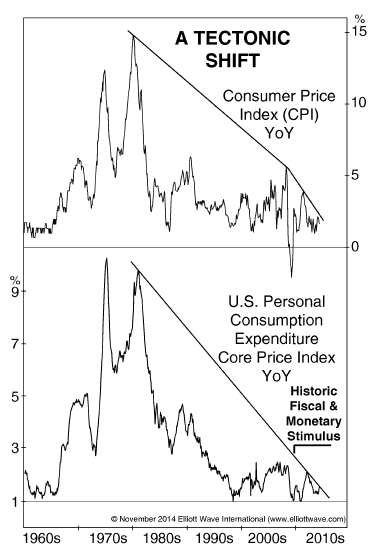
• The Only Thing More Bullish Than Inflation Is …. Deflation (Zero Hedge)
• Cheap-Oil Era Tilts Geopolitical Power to US (Bloomberg)
• Oil Industry Risks Trillions Of ‘Stranded Assets’ On US-China Climate Deal (AEP)
• Iron Ore’s Massive Expansion Era Is Finished: BHP Billiton (Bloomberg)
• China’s Factory Activity Stalls In November (CNBC)
• Distressed Debt in China? You Ain’t Seen Nothing Yet (Bloomberg)
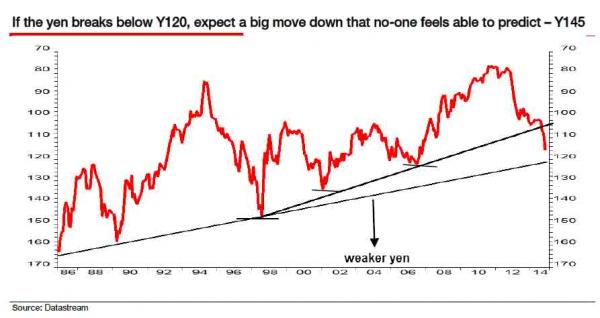
• The Yen Looks Like It’s Ready To Get Crushed (CNBC)
• BOJ Warns Abe Over “Fiscal Responsibility” While Monetizing All Debt (ZH)
• Why UK Needs ‘Radical’ Change As Exports Fall (CNBC)
• Michael Pettis: Spain Needs to Debate Leaving the Euro (Mish)
• Eurozone PMI Falls To 16-Month Low In November (MarketWatch)
• French Manufacturing Slump Deepens as Economic Weakness Persists (Bloomberg)
• Pressure Mounts for EU Crackdown on Tax Havens (Spiegel)
• Senator Slaps Plan For Low-Down-Payment Loans At Fannie, Freddie (MarketWatch)
• Junk-Bond Banking Boom Peaks as Firms Drop off Deal List (Bloomberg)
• Goldman Fires Staff For Alleged NY Fed Breach (FT)
• Banking Industry Culture Promotes Dishonesty, Research Finds (Guardian)
• New International Gang Of Thieves Make Somali Pirates Look Like Amateurs (Black)

Is there still hope and sanity in the world?

• Growth Isn’t God in Indonesia (Bloomberg)

Joko Widodo’s rise from nowhere to Jakarta governor and then the presidential palace showed the wonders of Indonesia’s democracy. Now, he wants to democratize the economy as well, focusing as much on the quality of growth as the quantity. Sixteen years ago, Indonesia was cascading toward failed statehood. In 1998, as riots forced dictator Suharto from office, many wrote off the world’s fourth-most populous nation. Today, Indonesia is a stable economy growing modestly at 5%, with quite realistic hopes of more. There’s plenty for Widodo, known by his nickname “Jokowi,” to worry about, of course. Indonesia still ranks behind Egypt in corruption and near Ethiopia in ease-of-doing-business surveys. More than 40% of the nation’s 250 million people lives on less than $2 a day.

A dearth of decent roads makes it more cost-effective to ship goods to China than across the archipelago. Retrograde attitudes abound: to this day, female police recruits are subjected to humiliating virginity tests. But this week, Jokowi reminded us why Indonesia is a good-news story — one from which Asian peers could learn. His move to cut fuel subsidies, saving a cash-strapped nation more than $11 billion in its 2015 budget, showed gumption and cheered investors. Even more encouraging is a bold agenda focusing not just on faster growth, but better growth that’s felt among more than Jakarta elites. This might seem like an obvious focus in a region that’s home to a critical mass of the world’s extreme poor (those living on $1 or $2 a day).

But grand rhetoric about “inclusive growth” hasn’t even come close to meeting the reality on the ground. In India, for example, newish Prime Minister Narendra Modi boasts that he will return gross domestic product to the glory days of double-digit growth rates, as if the metric mattered more than what his government plans to do with the windfall. The “Cult of GDP,” the dated idea that booming growth lifts all boats, has long been decried by development economists like William Easterly. The closer growth gets to 10%, the more likely governments are to declare victory and grow complacent. In many cases rapid GDP growth masks serious economic cracks. In her recent book, “GDP: A Brief but Affectionate History,” Diane Coyle called the figure a “familiar piece of jargon that doesn’t actually mean much to most people.”

Read more …

Janet Yellen lives in virtual reality.

• Federal Reserve In Easy Decision To End Stimulus (BBC)

Although the US Federal Reserve was worried about turmoil in emerging markets, the central bank reached an easy consensus to end its stimulus programme, its latest minutes reveal. Minutes from the central bank’s October meeting show officials were concerned about stock market fluctuations and weakness abroad. However, they worried that saying so could send the wrong message. Overall, officials were confident the US economy was on a strong footing. That is why they decided to end their stimulus programme – known as quantitative easing (QE) – in which the Fed bought bonds in order to keep long-term interest rates low and thus boost spending. “In their discussion of the asset purchase programme, members generally agreed … there was sufficient underlying strength in the broader economy to support ongoing progress toward maximum employment,” read the minutes, referring to the decision to end QE. US markets reacted in a muted way to the news, with the Dow Jones briefly rising before falling once more into the red for the day.

However, to reassure markets that the Fed would not deviate from its set course, the central bank decided to keep its “considerable time” language in reference to when the Fed would raise its short term interest rate. That interest rate – known as the federal funds rate – has been at 0% since late 2008, when the Fed slashed rates in the wake of the financial crisis. Most observers expect that the bank will begin raising that rate in the middle of 2015, mostly in an effort to keep inflation in check as the US recovery gathers steam. However, US Fed chair Janet Yellen has sought to reassure market participants that the bank will not act in haste and remains willing to change its timeline should economic conditions deteriorate in the US. The minutes also show that the Fed is still concerned about possibly lower-than-expected inflation, particularly as oil prices continue to decline and wage growth remains sluggish.

Read more …

They’re going to do it. Screw the real economy, it’s dead anyway.

• Fed Debate Shifts to Tightening Pace After First Rate Increase (Bloomberg)

U.S. central bankers are weighing whether they should communicate more of their views about the probable pace of interest-rate increases after they lift off zero next year. “A number of participants thought that it could soon be helpful to clarify the committee’s likely approach” to the pace of increases, according to minutes of the Oct. 28-29 Federal Open Market Committee meeting released today in Washington. The discussion last month underscored how much officials will rely on forward guidance on the pace of tightening in the future. After bond purchases ended last month, guidance may be the most practical option left to assure investors that policy won’t become overly restrictive if officials decide to take a stand against inflation seen as too low. The pace of rate increases is “going to be slow until they are really convinced that inflation’s sustainably at target and the labor market’s in really, really good shape,” said Guy Berger, a U.S. economist at RBS Securities. “They are going to take their sweet time.”

The minutes showed that many FOMC participants last month felt the committee should stay on the lookout for signs that inflation expectations were declining. Declining expectations could herald an actual fall in prices. Such deflation does economic damage by encouraging consumers to delay spending in anticipation of lower prices in the future. The potency of the first rate increase could be diminished or increased, depending on what the FOMC says about how it views its subsequent moves, said Laura Rosner, U.S. economist at BNP Paribas SA in New York. “It isn’t just the timing of liftoff the Fed cares about, but the whole path of federal funds rate,” said Rosner, a former New York Fed staff member. “I think they do probably want to limit the extent of tightening that people expect, at least at the beginning.” While telegraphing the future rate path may be attractive to some officials, it may also be unpopular with those, such as Chair Janet Yellen, who recall the Fed’s experience in 2004 with language saying the pace of increases would be “measured.”

Read more …

“Positioning for a deflationary boom is a binary event.”

• The Only Thing More Bullish Than Inflation Is …. Deflation (Zero Hedge)

Deflation. And not just deflation, but a deflationary bust! At least, such is the goalseeked logic of Cornerstone Marco, which has released a bullish (no really) note titled the Coming Deflationary Boom in the U.S. In it the authors throw in the towel on the most conventional concept in modern economics, namely that for growth one needs stable inflation which in turn causes earnings growth and is low enough not to pressure multiples too high. Well, according to the BLS’ hedonic adjustments and courtesy of Japan’s epic exporting of deflation, inflation is nowhere to be seen (except if one eats pork or beef, or drinks milks), so it is time to give ye olde paragidm shift a try. The paradigm that the only thing more bullish for stocks than inflation, is deflation. To wit:

The concept of a deflationary boom is a controversial one in economics. Truth be told it will not work in every economy. Indeed, a prerequisite for this to unfold is an economy driven by consumers. In that sense, it does not get more consumer-centric than the US. The second, and necessary, condition calls for a major decline in commodity prices ideally compounded by a strong currency to provide the fuel for growth. In essence, a decline in commodity and import prices creates disposable income the same way the Fed Funds rate cuts used to a decade ago.

Positioning for a deflationary boom is a binary event. After all, “deflationary” implies that stocks levered to lower inflation will have a powerful tailwind, these are what we like to call early cyclicals such as consumer, transports and other similar segments. Meanwhile, the “boom” part of the story implies that segments levered to growth, US growth in this case, also find a tailwinds. This should help the beleaguered financials to a better year in 2015 and also provides support for sectors like technology and some of the industrials. As we see it, “deflation” is going to become the operative word on the street … that and PE expansion since they typically go hand in hand. As always, we shall see.

Indeed we shall. Then again the only thing we will see is how every time there is deflation somewhere in the world, one after another central bank somewhere will admit its only mandate is to keep stocks at record highs and inject a few trillion in risk-purchasing power into what was once called a market.

Read more …

Wait till shale implodes, then we can talk again.

• Cheap-Oil Era Tilts Geopolitical Power to US (Bloomberg)

A new age of abundant and cheap energy supplies is redrawing the world’s geopolitical landscape, weakening and potentially threatening the legitimacy of some governments while enhancing the power of others. Some changes already are evident. Surging U.S. oil production enabled America and its allies to impose tough sanctions on Iran without having to worry much about the loss of imports from the Middle Eastern nation. Russia, meanwhile, faces what President Vladimir Putin called a possibly “catastrophic” slump in prices for its oil as its economy is battered by U.S. and European sanctions over its role in Ukraine. “A new era of lower prices is being ushered in” by the U.S. shale oil and gas revolution, Ed Morse, global head of commodities research for Citigroup, said in an e-mail.

“Undoubtedly some of the geopolitical changes will be momentous.” They certainly were a quarter of a century ago. Plunging oil prices in the latter half of the 1980s helped pave the way for the breakup of the Soviet Union by robbing it of revenue it needed to survive. The depressed market also may have influenced Iraqi leader Saddam Hussein’s decision to invade fellow producer Kuwait in 1990, triggering the first Gulf War. Russia again looks likely to suffer from the fallout in oil markets, along with Iran and Venezuela, while the U.S. and China come out ahead. Oil is “the most geopolitically important commodity,” said Reva Bhalla, vice president of global analysis at Stratfor.

“It drives economies around the world” and is located in some “usually very volatile places.” Benchmark oil prices in New York have dropped more than 30% during the last five months to around $75 a barrel as U.S. crude production reached the highest in more than three decades, driven by shale fields in North Dakota and Texas. Output was 9.06 million barrels a day in the first week of November, the most since at least January 1983, when the weekly data series from the Energy Information Administration began.

Read more …

Petrobras was aiming to be the world’s first trillion-dollar company. Now it’s the most indebted company in the world.

• Oil Industry Risks Trillions Of ‘Stranded Assets’ On US-China Climate Deal (AEP)

Brazil’s Petrobras is the most indebted company in the world, a perfect barometer of the crisis enveloping the global oil and fossil nexus on multiple fronts at once. PwC has refused to sign off on the books of this state-controlled behemoth, now under sweeping police probes for alleged graft, and rapidly crashing from hero to zero in the Brazilian press. The state oil company says funding from the capital markets has dried up, at least until auditors send a “comfort letter”. The stock price has dropped 87pc from the peak. Hopes of becoming the world’s first trillion dollar company have deflated brutally. What it still has is the debt. Moody’s has cut its credit rating to Baa1. This is still above junk but not by much. Debt has jumped by $25bn in less than a year to $170bn, reaching 5.3 times earnings (EBITDA). Roughly $52bn of this has been raised on the global bond markets over the last five years from the likes of Fidelity, Pimco, and BlackRock.

Part of the debt is a gamble on ultra-deepwater projects so far out into the Atlantic that helicopters supplying the rigs must be refuelled in flight. The wells drill seven thousand feet through layers of salt, blind to seismic imaging. The Carbon Tracker Initiative says the break-even price for these fields is likely to be $120 a barrel. It is much the same story – for different reasons – in the Arctic ‘High North’, off-shore West Africa, and the Alberta tar sands. The major oil companies are committing $1.1 trillion to projects that require prices of at least $95 to make a profit. The International Energy Agency (IEA) says fossil fuel companies have spent $7.6 trillion on exploration and production since 2005, yet output from conventional oil fields has nevertheless fallen. No big project has come on stream over the last three years with a break-even cost below $80 a barrel.

“The oil majors could not even generate free cash flow when oil prices were averaging $100 ,” said Mark Lewis from Kepler Cheuvreux. They have picked the low-hanging fruit. New fields are ever less hospitable. Upstream costs have tripled since 2000. “They have been able to disguise this by drawing down legacy barrels, but they won’t be able to get away with this over the next five years. We think the break-even price for the whole industry is now over $100,” he said. A study by the US Energy Department found that the world’s leading oil and gas companies were sinking into a debt-trap even before the latest crash in oil prices. They increased net debt by $106bn in the year to March – and sold off a net $73bn of assets – to cover surging production costs. The annual shortfall between cash earnings and spending has widened from $18bn to $110bn over the last three years. Yet these companies are still paying normal dividends, raiding the family silver to save face.

Read more …

They’ve all invested for continuing huge growth numbers. And now growth is gone.

• Iron Ore’s Massive Expansion Era Is Finished: BHP Billiton (Bloomberg)

Iron ore’s golden spending era is history. That’s the verdict of BHP Billiton, the world’s biggest mining company. BHP and rivals Rio Tinto and Vale are flooding the global iron ore market after a $120 billion spending spree to boost the capacity of their mines from Australia to Brazil. Now prices have slumped to the lowest in more than five years as surging supply coincides with a slowdown in China, the world’s biggest consumer. “Our company has been very clear that the time for massive expansions of iron ore are over,” BHP CEO Andrew Mackenzie told reporters today after a shareholder meeting in Adelaide, South Australia. While BHP is still increasing production, the company last approved spending on an iron ore expansion in 2011.

It’s shifting investment into copper and petroleum, he said Global seaborne output will exceed demand by 100 million metric tons this year from 16 million tons in 2013, HSBC said last month. Prices, which are trading around $70 a ton in China, may drop to below $60 a ton next year, according to Citigroup forecasts. “At these prices, we still have a very decent business,” Mackenzie said. “We’ve been fairly clear that prices at about these levels were what we were expecting for the longer term.” Investments in copper may help BHP seize on rising demand for energy in emerging economies. Demand from China, the biggest metals consumer, will be supported by electricity grid expansion and greater adoption of renewable energy sources, all of which require more copper wiring, according to Citigroup.

The prospects for an expansion of BHP’s Olympic Dam copper, gold and uranium mine in Australia are looking more promising after testing of new processing technology shows early signs of success, Mackenzie said. Olympic Dam in South Australia is the world’s largest uranium deposit and fourth-biggest copper deposit. BHP is pilot testing a heap leaching extraction process used in its copper mines in Chile. If the tests “are successful, and they are showing considerable promise, we will use this technology and phased expansions of the underground mine to further increase Olympic Dam’s output,” Mackeznie told the meeting. In 2012, BHP halted a proposed expansion of Olympic Dam, estimated by Deutsche Bank AG to cost $33 billion. Mackenzie was addressing the first annual meeting held in the state since the decision.

Read more …

Flash PMI at zero growth.

• China’s Factory Activity Stalls In November (CNBC)

China’s factory activity stalled in November as output shrank for the first time in six months, a private survey showed on Thursday. The HSBC flash Purchasing Managers’ Index (PMI) for November clocked in at the breakeven level of 50.0 that separates expansion from contraction, compared with a Reuters estimate for 50.3 and following the 50.4 final reading in October. Overall, new orders picked up slightly but new export orders slowed markedly, dragging on activity. The factory output sub-index fell to 49.5, the first contraction since May.

The Australian dollar eased against the greenback on the news, trading at $0.8607. But shares in China and Hong Kong appear unaffected by the data. The reading is the latest evidence that the world’s second biggest economy continues to lose traction. Recent data on housing prices and foreign direct investments also missed forecasts. “China is slowing and we think it will continue to slow. A lot of it is structural, and in our view, growth will slow to about 4.5% over the next 10 years. We see some sectors that are very challenged; clearly real estate is one,” Robin Bew, MD of Economist Intelligence Unit, told CNBC.

Read more …

“They keep reporting such a low number for so many years, there’s only one way it can go – up …”

• Distressed Debt in China? You Ain’t Seen Nothing Yet (Bloomberg)

Bad debts in China are well underestimated because authorities persist in propping up weak companies and bailing out local investors, according to DAC Management. The Chicago-based asset management and advisory firm, which focuses on distressed credit and special situations in China, says the worst is yet to come, and that means lots of opportunities for the world’s biggest distressed debt traders. Nonperforming loans at Chinese banks jumped by the most since 2005 in the third quarter to 766.9 billion yuan ($125.3 billion), official statistics released earlier this month showed. The People’s Bank of China has injected 769.5 billion yuan into its banking system over the past two months to support an economy growing at the slowest pace in more than a decade.

“They keep reporting such a low number for so many years, there’s only one way it can go – up,” DAC co-founder Philip Groves said in an interview. “We’ve yet to see it because if you look at corporate defaults, they keep getting covered by the government. At some point, they can’t cover every single one.” DAC manages about $400 million of its own and clients’ money onshore in China. It first bought Chinese bad loans in December 2001 from China Orient Asset Management, one of four asset management companies created by the government to buy, repackage and onsell soured debt, Groves said.

While China’s bad loan ratio is relatively small versus other countries in Asia – soured loans are equivalent to 1.16% of total advances compared with 3.88% in Vietnam and 0.86% in South Korea – their total is still in an order of magnitude greater than the funds raised by distressed investors, Groves said. There hasn’t been enough capital to soak up the nonperforming debt and much ends up being reabsorbed by the government, he said. That’s why distressed activity in China has been “sporadic” over the past 10 years and why some large investors aren’t participating. “It never became a market where you could put a billion dollars to work in a year,” Groves said. “But if the wave of bad debt comes, and there are things to buy, the money will follow.”

Read more …

I’ve said it before, Japan is not going to be a nice place to be.

• The Yen Looks Like It’s Ready To Get Crushed (CNBC)

Japan has slipped back into recession, with the economy shrinking 1.6% in the third quarter, surprising economists who forecast it would grow 2%. The takeaway? Double down on the dollar versus the yen. How weak can the yen get? Forecasters are lowering their already bearish targets after the new disappointing economic data. “I’d expect another 20% drop next year, which would take us north of 140,” said Peter Boockvar of the Lindsey Group about the dollar-yen rate. The team at Capital Economics raised their forecast for dollar-yen to finish next year at 140 as well, up from 120 previously.

Those are bold calls, because it’s unusual for any currency to move more than 5% to 10% per year. Also, the yen has already tumbled 14% in the past 12 months and 19% the previous year, making it the worst-performing major currency against the dollar both years. But when it comes to the yen right now, it seems, no forecast is too bearish. “When I started in the business, dollar-yen was 230,” recalled David Rosenberg, chief economist and strategist at Gluskin Sheff. “For those that think this move is over, this is probably going to be a round trip, meaning that the dollar’s run-up against the yen has a lot further to go.”

Read more …

Japan is a state of panic.

• BOJ Warns Abe Over “Fiscal Responsibility” While Monetizing All Debt (ZH)

If one were to look up the definition of hypocrisy, the image of BoJ head Kuroda should be front-and-center. Having tripled-down on his money-printing and ETF-buying largesse just last week, he came out swinging last night at the government’s fiscal irresponsibility blasting Abe’s policies by saying Japan’s fiscal health “is the responsibility of parliament and the government, not an issue for the central bank to be held responsible for.” Aside from the fact that he is directly monetizing all JGB issuance – thus enabling Abe’s arrogant fiscal stimulus plan (by issuing 30Y and 40Y debt), Bloomberg notes that “Kuroda is making it crystal clear the government has to tackle the debt problem and if fiscal trust is lost that’s not going to be on the BOJ.” The world has truly gone mad. Seemingly paying the same lip-service as Bernanke and Yellen in the US and Draghi in Europe, BoJ’s Haruhiko Kuroda is carefully positioning the blame for lack of growth and economic chaos on the government’s lack of growth-oriented policies… and not the central bank’s enabling experiments… (via Bloomberg):

Bank of Japan chief Haruhiko Kuroda emphasized the onus is on the government to strengthen its finances after PM Shinzo Abe postponed a sales-tax hike and outlined plans to boost fiscal stimulus. “It’s the responsibility of parliament and the government, not an issue for the central bank,” Kuroda said when asked about risks to Japan’s fiscal health. The BOJ’s job is to achieve its inflation target, he said at a press conference in Tokyo. Kuroda’s repeated comments at a press conference today on the importance of fiscal discipline indicate the governor is unhappy and may signal a change in strategy, said Credit Suisse economist Hiromichi Shirakawa. “Kuroda is making it crystal clear the government has to tackle the debt problem and if fiscal trust is lost that’s not going to be on the BOJ,” said Shirakawa, a former BOJ official. “This is true, but he used to highlight that the BOJ and the government were working together. Abe might have created an enemy by postponing the sales-tax hike.”

Read more …

This is how you expose the madness in all those nonsensical plans and targets.

• Why UK Needs ‘Radical’ Change As Exports Fall (CNBC)

The U.K. government needs to make radical changes to halt the slide in export growth, the head of British Chambers of Commerce told CNBC. “Exports are tailing off, the rate of growth is tailing off — it’s the one part of the economy we are failing on,” BCC’s Director- General John Longworth told CNBC Europe’s “Squawk Box” on Thursday. “They always say that the definition of madness is carrying on doing the same thing as before and expecting a different result. We need to do something radically different as a country.” His comments come as the BCC published its third-quarter Trade Confidence Index on Thursday. The survey, carried out with delivery company DHL Express, measures U.K. exporting activity and business confidence of more than 2,300 exporting firms.

It found that in the latest quarter, fewer exporters reported increased sales: 29% of exporters stated that sales had increased in the third quarter of 2014, a sharp drop from 47% in the second quarter. Of those exporters no longer seeing an increase in export sales, most said that sales have remained consistent. “There has a slowdown in the U.K.’s export potential because of the slowdown global economic circumstances,” Longworth said, or government export targets would be missed. The U.K. Prime Minister David Cameron said in his 2012 budget that he wanted the U.K. to double exports to £1 trillion ($1.5 trillion) by 2020. In order to achieve that, however, Longworth said the U.K. would have to see export growth of nearly 11% year-on-year growth every year. “So far since the beginning of the recovery in 2010, the total growth in those years has been 14%. So we’ve got a real issue and unless we do something different we’re not going to hit those targets.”

Read more …

And so must Italy, Greece, and many others. Let the people debate it, and give them alll the information, not just choice bits.

• Michael Pettis: Spain Needs to Debate Leaving the Euro (Mish)

Michael Pettis has a very interesting article on the Spanish news site ABC regarding a possible default of Spain and the eventual breakup of the eurozone. [..] What follows is my heavily modified translation of key portions of Pettis’ article after reading both of the above translations.

In the Panic of 1837, two-thirds of the US, including several of the richest states, suspended payment of external debt. The United States survived. If the European Union is to survive, it will have to find a solution to the European debt. The more hope instead of action, the more likely there’s a permanent breakdown of the euro and the European Union. In a gesture more of faith than economic or historical data, Madrid assures us that with the right reforms, it will eventually be able to get out of debt. Other countries in debt crises have made the same promise, but the promise is rarely fulfilled. Excessive debt itself impedes growth. Even without the straitjacket of the euro, Spain probably cannot afford its debt. Even those who are against debt cancellation recognize that the only thing that shielded Germany from a Spanish default was the European Central Bank.

Despite their obnoxious policies, far-right parties across Europe flourish more than ever because the ECB protects the euro and European banks at enormous costs for the working and middle classes. These extremists exploit the refusal of European leaders to acknowledge their errors. The longer the economic crisis, greater their chances of winning, and then comes an end to Europe. The only thing that prevented a suspension of payments by Spain and other countries was the promise of the European Central Bank in 2012 to do “whatever it takes” to protect the euro. But debt continues to grow faster than GDP in Europe, and the ECB load increases inexorably month after month. There will come a time when rising debt and a weakening of the German economy will jeopardize the credibility of the guarantee of the ECB (which will be useless), little by little at first, and then suddenly later. In a matter of months Spain will suspend payments.

For now, with debt settlement postponed, German banks strengthen capital to protect themselves from bankruptcy that many predict. Berlin is playing the same game as Washington during the crisis in Latin America in the 1980s. Then US banks actively strengthened their capital, mainly at the covert expense of ordinary Americans, while insisting that Latin American countries needed further reforms and no debt forgiveness. However, multiple reforms led to extremely high rates of unemployment and enormous social upheaval throughout Latin America. From 1987 to 1988, when US banks finally had enough capital, Washington officially recognized that full payment of the debt in 1990 was impossible and forgave the debt of Mexico. In the years following, US banks forgave almost the entire debt of other Latin American countries.

Read more …

It’s getting painful. Stop the experiment, it’s failed beyond repair.

• Eurozone PMI Falls To 16-Month Low In November (MarketWatch)

Activity in the eurozone’s private sector slowed in November, according to surveys of purchasing managers, an indication the currency area’s economy will continue to grow weakly, if at all, in the final quarter of the year. The surveys also found that businesses again cut their prices in the face of weak demand, a development that will concern the European Central Bank, which is struggling to raise the currency area’s inflation rate from the very low level it has settled at for more than a year. Data firm Markit on Thursday said its composite purchasing managers index – a measure of activity in the manufacturing and services sectors in the currency bloc – fell to 51.4 from 52.1 in October, reaching a 16-month low. A reading below 50.0 indicates activity is declining, while a reading above that level indicates it is increasing.

Preliminary results from Markit’s survey of 5,000 manufacturers and service providers also showed that a significant pickup in activity is unlikely in the coming months, with new orders falling for the first time since July 2013, while employment was unchanged. The surveys also found that businesses continued to cut their prices, although at a slightly less aggressive pace. “The deteriorating trend in the surveys will add to pressure for the ECB to do more to boost the economy without waiting to gauge the effectiveness of previously announced initiatives,” said Chris Williamson, chief economist at Markit.

Read more …

France toast.

• French Manufacturing Slump Deepens as Economic Weakness Persists (Bloomberg)

French manufacturing shrank more than analysts forecast in November and demand fell, signaling that an economic rebound seen in the third quarter might be short lived. A Purchasing Managers Index fell to 47.6, the lowest in three months, from 48.5 in October, London-based Markit Economics said today. That’s below the 50-point mark that divides expansion from contraction and compares with the median forecast of 48.8 in a Bloomberg News survey. A separate index showed services also contracted, while new business across both industries fell the most in 17 months. The euro area’s second-largest economy has barely grown in three years and recent data suggests that 2014 will be little different. With unemployment near a record and the budget deficit widening, President Francois Hollande is under pressure to deliver on his promises of business-friendly reforms.

“The continued softness in private-sector activity signaled by the PMIs suggests an ongoing drag on growth during the fourth quarter,” said Jack Kennedy, senior economist at Markit. “Another round of job shedding by companies during November meanwhile provides little hope of bringing down the high unemployment rate.” An index of services activity rose to 48.8 this month from 48.3 in October, while a composite gauge for the whole economy increased to 48.4 from 48.2, according to today’s report. Employment across both manufacturing and services fell for 13th month, though the rate of decline slowed compared with the previous month. The French economy grew 0.3% in the three months through September as a jump in public spending offset a fourth quarterly decline in investment. The unemployment rate stood at 10.5% in September, more than double than Germany’s 5%, according to Eurostat. Hollande, whose popularity is among the lowest ever registered for a French president, has said he won’t run for a second term if he is unable to bring down joblessness.

Read more …

Please, let’s have some violent infighting in Brussels.

• Pressure Mounts for EU Crackdown on Tax Havens (Spiegel)

In Luxembourg, corporate income taxes are as low as 1% for some companies. An average worker in Germany with a salary of €40,000 ($50,000) who doesn’t joint file with a spouse has to pay about €8,940 in taxes each year. At the Luxembourg rate, the worker would only have to pay €400. But some companies have even managed to finagle a tax rate of 0.1%, which would amount to a paltry €40 for the average German worker. As delightful as those figures may sound, normal workers will never have access to those kinds of tax discounts. That’s why it came across as obscene to many when Juncker defended Luxembourg’s tax arrangements on Wednesday as “legal”. They may be legal, but they are anything but fair. It also strengthens an impression that gained currency during the financial crisis – that capitalism favors banks and companies, not normal people, and that these institutions profit even more than previously known from tax loopholes.

But the Juncker case also sheds light on the two faces of European politics. Top Brussels politicians are recruited from the individual EU member states and, as such, have long representated their countries’ national interests. Then they move to Brussels, where they are expected to advocate for the European Union. At times like this, though, when dealings in Brussels are becoming increasingly politicized, the idea that these politicians are promoting the EU’s interests as a bloc loses credibility. And Juncker, the very man who had a hand in stripping Luxembourg’s neighbors of tax money, is supposed to be the main face representing the EU. It’s also very problematic that he, as the man who led a country that was one of the worst perpetrators of these tax practices, is now supposed to see to it that these schemes are investigated and curbed in the future.

Read more …

Kudos Crapo. Let’s cut the crap, not reintroduce it.

• Senator Slaps Plan For Low-Down-Payment Loans At Fannie, Freddie (MarketWatch)

A controversial housing-finance proposal quickly came under fire during a Wednesday Capitol Hill hearing, with a top committee Republican questioning whether it’s a good idea to allow federally controlled mortgage-finance giants Fannie Mae and Freddie Mac to back mortgages with very low down payments. “I’m troubled,” said Idaho Sen. Mike Crapo, the leading Republican member of the Senate Banking, Housing and Urban Affairs Committee, by a plan from the Federal Housing Finance Agency to enable Fannie and Freddie to buy mortgages with down payments as low as 3%. “After the problems we’ve seen” it could be risky for Fannie and Freddie to buy loans when borrowers have little equity, Crapo said.

In response, Mel Watt, who became FHFA’s director in January and was the sole witness at the agency-oversight hearing, told senators that mortgages with low down payments will require insurance, and that borrowers will be required to have relatively strong credit profiles otherwise. He added that FHFA will provide more details in December about the types of borrowers who would be eligible for such mortgages. “We are not making credit available to people that we cannot reasonably predict, with a high degree of certainty,” will make their mortgage payments, Watt said. Decisions over who can qualify for loans bought by Fannie and Freddie can have a large impact on the housing market. Together Fannie and Freddie back about half of new U.S. mortgages. The FHFA must carefully craft rules that support the housing market’s somewhat erratic recovery without creating too much risk.

Read more …

This could make plenty waves, it’s a high stakes game.

• Junk-Bond Banking Boom Peaks as Firms Drop off Deal List (Bloomberg)

The explosion of brokers plowing into the lucrative junk-bond underwriting business may be fading. The number of firms managing U.S. high-yield bond sales isn’t growing for the first year since 2008, according to data compiled by Bloomberg. The ranks will likely thin in upcoming years as yields rise, making it more expensive for speculative-grade companies to borrow, according to Charles Peabody, a banking analyst at research firm Portales Partnersin New York. “You’re going to see fewer and fewer deals,” he said in a telephone interview. “Underwriting volumes are probably going to decline from here and you’re going to see more of a consolidation or exodus.” So far, the decline has been small, with 87 firms managing high-yield bond sales this year, down from the record 92 in the same period in 2013, Bloomberg data show.

The number of underwriters is still about twice as many as in 2009, when a slew of bankers founded their own firms to grab business from Wall Street firms that were shrinking as the credit crisis caused trillions of dollars of losses and writedowns. The new firms sought to win assignments managing smaller deals that bigger banks didn’t have the appetite for anymore. Five years later, the scene is changing. The least-creditworthy companies have borrowed record amounts of debt, spurred by central-bank stimulus that pushed borrowing costs to all-time lows. Now, the Federal Reserve is preparing to raise rates and junk-bond buyers are getting jittery.

The notes have declined 1.7% since the end of August as oil prices plunged, eroding the value of debt sold by speculative-grade energy companies, Bank of America Merrill Lynch index data show. While junk-bond sales are still on track for a new record this year, issuance has been choppy, with deals being canceled one week and then a flood of sales going through the next. For the past few years, high-yield underwriting has been a bright spot for banks, especially compared with flagging trading revenues. Speculative-grade companies have sold $1.2 trillion of dollar-denominated debt since the end of 2010 to lock in historically low borrowing costs. That’s also meant there have been a swelling number of firms elbowing each other out of the way for a chance to manage those deals, vying for fees that have been almost three times as much as those on higher-rated deals.

Read more …

Pot and kettle.

• Goldman Fires Staff For Alleged NY Fed Breach (FT)

Goldman Sachs has fired an investment banker who allegedly accessed confidential information from the Federal Reserve Bank of New York, his former employer. Goldman said it had fired Rohit Bansal, a junior employee, in September and then fired his supervisor Joe Jiampietro, a better-known senior banker in the financial institutions group, which advises other banks. Mr Jiampietro was himself a former government official – a top adviser to Sheila Bair when she was chairman of the Federal Deposit Insurance Corporation. The New York Fed said: “As soon as we learned that Goldman Sachs suspected one of its employees may have inappropriately obtained confidential supervisory information, we alerted law enforcement authorities.”

The news, first reported by the New York Times, comes ahead of a congressional hearing on Friday that is examining whether there is too “cosy” a relationship between regulators and banks. Goldman has been nicknamed “Government Sachs” as the epitome of the “revolving door” between government and banking. Several of its employees formerly worked at government agencies, including the Fed and US Treasury. Hank Paulson, Goldman’s former chief executive, left the bank to become US Treasury secretary under President George W. Bush. On Friday, the Senate banking committee is due to examine allegations from a former New York Fed examiner, who says that she was fired because her bosses wanted her to water down criticism of Goldman. Bill Dudley, president of the New York Fed and himself a former Goldman employee, is due to testify.

Read more …

A little skimpy perhaps, but who would doubt the premise?

• Banking Industry Culture Promotes Dishonesty, Research Finds (Guardian)

How do you tell if a group of bankers is dishonest? Simply by getting them all to toss a coin. That may not seem like in-depth research, but it is the basis of an academic paper published in Nature magazine this week, which investigates whether the financial sector’s culture encourages dishonesty – and concludes that it does. The academics from the University of Zurich used a sample of 128 employees of a large bank, and split them into two groups. The first set of bankers were primed to start thinking about their job, with questions such as “what is your function at this bank?”. They were then asked to toss a coin 10 times, in private, knowing which outcome would earn them $20 a flip. They then had to report their results online to claim any winnings. Unsurprisingly perhaps, there was cheating – with the percentage of winning tosses coming in at an incredibly fortunate 58.2% (although the research omitted to say how many bankers also trousered the coin).

Meanwhile, the second group completed a survey about their wellbeing and everyday life, that did not include questions relating to their professional life. They then performed the coin-flipping task, which threw up a quite astonishing finding: these bankers proved honest. Identical exercises in other industries did not produce the same skewing in results when participants were primed to start thinking about their work. The research does not reveal which institution took part in the survey, presumably to avoid it suing the authors for unearthing some decent behaviour among the cheating. “The effect induced by the treatment could be attributable to several causes,” the authors muse, “including the competitiveness expected from bank employees, the exposure to competitive bonus schemes, the beliefs about what other employees would do in the same situation or the salience of money in the questionnaire.”

Read more …

Anti-tax rant. Simon Black knows quite a bit about moving abroad.

• New International Gang Of Thieves Make Somali Pirates Look Like Amateurs (Black)

This past month, a real-life guild of thieves was formed. With 51 governments pledging their support to each other for the protection of their ignoble craft of theft. And another 30 pledging to join by 2018. From day one, governments have been pilfering their citizens’ assets through taxation, claiming a monopoly on thievery. From the largest institution to the pettiest pickpocket, anyone else who tries to engage in theft is severely punished, as governments work to protect their exclusive right to steal. Frighteningly, they do this all out in the open, believing that they actually have a moral right to commit theft. You can see this delusion in the US government’s claims that last year they “lost out” on $337 billion from people avoiding taxes. As if they have some moral claim to the money they’d failed to pilfer. Nonetheless, they use this claim to justify actively hunting down and penalizing anyone who takes action to avoid being stolen from.

The ones that are doing this are the bankrupt countries, and the deeper they slide into debt, the more desperate they become. Which is why these broke governments are now joining forces, pledging to to collect and share information amongst themselves about citizens’ bank accounts, taxes, assets and income outside local tax jurisdictions. Basically – I’ll help you steal from your citizens if you help me steal from mine. Both the punishment and the likelihood of getting caught for tax evasion are growing. Don’t even bother trying. However that doesn’t mean that you have no choice but to sit there and let your self be stolen from. While there are still ways of legally reducing your tax burden from within a country, your best option is to move and diversify. Diversification is key, because if you have all your eggs in one bankrupt basket, you are really taking on extraordinary risk. Moving some assets abroad can legitimately reduce some of this risk. And an even greater strategy is considering moving yourself.

Read more …

Nov 182014
 
 November 18, 2014  Posted by at 8:30 am Finance Tagged with: , , , , , , , ,  6 Responses »


Dorothea Lange Miserable poverty, Hooverville, Elm Grove, Oklahoma County, OK Aug 1936

What is it with us? Don’t we WANT to understand? Japan announced on Monday that its economy is in hopeless trouble and back in recession (as if it was ever out). And what do we see? ‘Experts’ and reporters clamoring for more stimulus. But if Japan has shown us anything over the past years, and you’re free to pick any number between 2 and 20 years, it’s that the QE-based kind of stimulus doesn’t work. Not for the real economy, that is.

The land of the setting sun has during that time thrown so much stimulus into its financial system that Krugman-esque calls for even more of the same look even more ludicrous today than they did all along. Abenomics is a depressing failure, just as we knew it would be since it started almost two years ago. It’s not complicated, and it never was.

Japan’s stimulus has achieved the following: banks get to pretend they’re healthy and stocks rise to heights that are fundamentally disconnected from underlying real values. On the flipside of that, citizens are being increasingly squeezed and ‘decide’ not to spend (not much of a decision if you have nothing to spend). Since Japan’s ‘consumer’ spending makes up about 60% of GDP, things can only possibly get worse as time passes. If ‘consumers’ don’t spend, deflation is the inevitable result – and that has nothing to do with the much discussed sales tax, it’s been going on for decades -.

Therefore, the sole thing QE stimulus has achieved is a wealth transfer from poorer to rich. And that’s not only the case in Japan. Mario Draghi yesterday hinted – again – at all the stuff he could start buying next year, including sovereign bonds, even though that would violate EU law. And whether or not Germany will let him in the end, the fact that he keeps the option alive even if only in theory, tells us plenty about the mindset at the ECB.

That is, it’s the same as in Japan. And doing the same can only lead to the same results. A poorer population, a richer toplayer and an economy that continues to shrink, which will and must lead to the same deflationary trend. The idea that an economy can be rescued by pushing public funds into its finance system and stock markets has been forever thrown out by Japan’s experiences.

Draghi said yesterday that ‘monetary policy has done a lot’, and while that may be correct, it says nothing about WHAT it has done. From where I’m sitting, Germany’s recent drift into negative territory and the ongoing record unemployment rates around the Mediterranean certainly tell us a lot about what it has NOT done. QE, no matter how big and how crazy, doesn’t heal real economies, it makes them sicker.

If consumer spending makes up 60% of GDP, as in Japan, or even 70%, as in the US, then you need to boost that spending. And you don’t do that by handing over what financial wiggle room you have left, to banks so they can pile it on to the reserves they hold at central banks.

It is accepted as gospel that it’s a good thing to give banks free money, but it would be the devil’s work to give it to consumers. Instead, the latter must be squeezed from all sides, through austerity, the loss of services, benefits, wages and jobs, in order to prop up the financial system. How and where is it not clear what that will result in? There’s only one possible outcome.

The reason why all governments and central banks keep following the failed QE stimulus path regardless lies in the relative political powers that different parts of a society have. In today’s world, saving the banks, which equals saving the rich, is not only the priority, it’s the only deliberation.

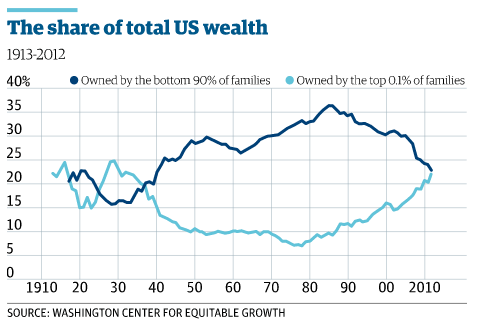
And if you might be under the impression that what is true in Japan and Europe does not hold in the US, why not start with this graph from Doug Short, and take it from there.

If and when an economy is as deep in the doldrums as all major economies today are, you can’t rescue it by taking from the poor to save the rich. It’s fundamentally impossible. You need the bottom 90%’s spending in order to generate enough GDP to stay out of deflation. Money must move through an economy for it to stay sufficiently ‘lubricated’. And the only people who can keep that money moving are the bottom 90%. It’s Catch-22.

Any stimulus must be directed at the bottom, or it must of necessity fail. Nothing commie or socialist about it, but simply the way economies work. And it’s not just some difference of ideal or insight or something, it’s very simply that an economy cannot function without its poorer 90% of citizens spending.

Anything else is simply Grand Theft Auto. Both Japan and Europe are preparing for more of it.

Nov 142014
 
 November 14, 2014  Posted by at 12:13 pm Finance Tagged with: , , , , , , , , , ,  1 Response »


DPC St. Catherine Street, Montréal, Québec 1916

• Most US Cities Unaffordable For Average Americans To Live In (MarketWatch)
• US Wealth Inequality: Top 0.1% Worth As Much As The Bottom 90% (Guardian)
• US Foreclosure Filings Climb 15% In October (MarketWatch)
• Sub-$2-a-Gallon Gasoline Futures Hand US Motorists Gift (Bloomberg)
• Albert Edwards: USDJPY 145, “Tidal Wave Of Deflation Westward” (Zero Hedge)
• Oil, Other Commodities Will Be In The Dumps For Another Decade (MarketWatch)
• Oil Price Rout To Deepen Amid Supply Glut, Warns IEA (Telegraph)
• Keystone Left Behind as Canadian Oil Pours Into US (Bloomberg)
• Putin Stockpiles Gold As Russia Prepares For Economic War (Telegraph)
• It May Be Too Late for Japan PM to Fix World’s Third Largest Economy (TIME)
• Europe’s Debt Fight May Undermine Push for Growth Deal (Bloomberg)
• Cold Comfort As France, Germany Eke Out Tiny Q3 Growth (Reuters)
• Italy’s Slump Enters Fourth Year, Complicating Renzi’s Plans (Bloomberg)
• World Outlook Darkening as 89% in Poll See Europe Deflation Risk (Bloomberg)
• China Busts Underground Banks Linked to $23 Billion Transactions (Bloomberg)
• Stock Market Fear, Stress And Tensions Climbing (MarketWatch)
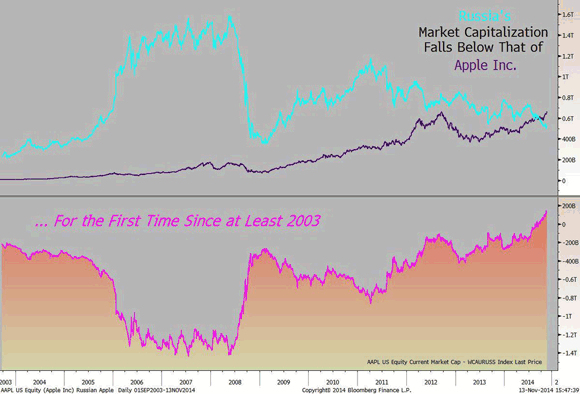
• Apple Could Swallow Whole Russian Stock Market (Bloomberg)
• Fracking Boom Spurs Demand for Sand and Clouds of Dust (Bloomberg)
• Massive OW Bunker Bankruptcy: Questions Of Governance And Oversight (SeaTrade)
• Aboriginals Decry G-20 Host Australia as Leaders Gather (Bloomberg)

This is what we’ve come to, and it’s hardly surprising. Where are the raised voices, though?

• Most US Cities Unaffordable For Average Americans To Live In (MarketWatch)

Most big American cities are no longer affordable for the average worker. Home buyers earning a median income can only afford a median-priced home in 10 of the 25 largest metropolitan areas in the U.S., according to a survey by personal finance site Interest.com. That’s still a slight improvement on last year when only 8 of those metropolitan areas were affordable, but still lower than 2012 when 14 of those 25 areas were affordable for people on a median income in those regions. Being priced out of buying a home in the country’s major cities means more multi-family buildings in big cities and more people moving into second-tier cities and rural areas, says Stuart Gabriel, director of UCLA’s Richard S. Ziman Center for Real Estate.

“The consequences are large,” he says, “and they’re not just about affordability. It affects economic growth and economic viability of our major metropolitan areas.” While some people will find ways to work from home, for instance, spiraling housing costs also hurt people who need to work in cities. “Teachers, firefighters and police, these are people who are absolutely essential to the functioning of our urban areas, are priced out of those areas and have to commute long distances to get to work,” Gabriel says. “It’s certainly true here in L.A.” Sacramento had the biggest drop in home affordability over the past 12 months, falling to No. 18 this year from No. 12 in 2013. But it’s still more affordable than the other three California metro areas on the list: Los Angeles (No. 22), San Diego (No. 24) and San Francisco (No. 25) where the median income is 46% less than what is required to buy a median-priced home here. New York is No. 23 on the list.

The cheapest areas are Minneapolis, Atlanta, St. Louis and Detroit. “Low mortgage rates are helping home affordability to some extent, but the key ingredient — which has been missing to this point — is substantial income growth,” says Mike Sante, managing editor of Interest.com. “Millennials, in particular, are struggling to overcome their student loans and save enough money for a down payment.” The Interest.com survey reflects a broader trend: 52% of Americans have made at least one major sacrifice to cover their rent or mortgage over the last three years, according to research commissioned by the nonprofit John D. and Catherine T. MacArthur Foundation released earlier this year. These sacrifices include getting a second job, deferring saving for retirement and cutting back on health care.

Read more …

Here’s why Americans can’t afford their own cities anymore.

• US Wealth Inequality: Top 0.1% Worth As Much As The Bottom 90% (Guardian)

Wealth inequality in the US is at near record levels according to a new study by academics. Over the past three decades, the share of household wealth owned by the top 0.1% has increased from 7% to 22%. For the bottom 90% of families, a combination of rising debt, the collapse of the value of their assets during the financial crisis, and stagnant real wages have led to the erosion of wealth. The research by Emmanuel Saez and Gabriel Zucman [pdf] illustrates the evolution of wealth inequality over the last century. The chart shows how the top 0.1% of families now own roughly the same share of wealth as the bottom 90%. The picture actually improved in the aftermath of the 1930s Great Depression, with wealth inequality falling through to the late 1970s. It then started to rise again, with the share of total household wealth owned by the top 0.1% rising to 22% in 2012 from 7% in the late 1970s. The top 0.1% includes 160,000 families with total net assets of more than $20m (£13m) in 2012.

In contrast, the share of total US wealth owned by the bottom 90% of families fell from a peak of 36% in the mid-1980s, to 23% in 2012 – just one percentage point above the top 0.1%. The growing indebtedness of most Americans is the main reason behind the erosion of the wealth share of the bottom 90%, according to the report’s authors. Many middle-class families own their homes and have pensions, but too many have higher mortgage repayments, higher credit card bills, and higher student loans to service. The average wealth of bottom 90% jumped during the stock market boom of the late 1990s and the housing bubble of the early 2000s. But it then collapsed during and after the most recent financial crisis. Since then, there has been no recovery in the wealth of the middle class and the poor, the authors say. The average wealth of the bottom 90% of families is equal to $80,000 in 2012— the same level as in 1986. In contrast, the average wealth for the top 1% more than tripled between 1980 and 2012.

Read more …

No surprise here either.

• US Foreclosure Filings Climb 15% In October (MarketWatch)

The pace of new foreclosures picked up last month as more troubled properties were pushed through the system, according to data released Thursday. In October, there were default notices and other foreclosure filings reported on more than 123,000 U.S. homes, up 15% from September — the largest monthly growth since foreclosure activity peaked in early 2010, online foreclosure marketplace RealtyTrac reported. Last month’s pop was driven by seasonal factors — banks were trying to “get ahead of the usual holiday foreclosure moratoriums,” said Daren Blomquist, vice president at RealtyTrac.

October’s spike narrowed the year-over-year contraction in foreclosure filings to 8%, the slowest annual drop since May 2012. “Distressed properties that have been in a holding pattern for years are finally being cleared for landing at the foreclosure auction,” Blomquist said. Despite October’s increase in filings, the pace of the foreclosure-related notices is trending closer to levels seen before the U.S. housing bubble burst. In 2006, as home prices were near their peak, there were average monthly foreclosure filings on 105,000 properties. October’s 123,000 foreclosure filings were down about 66% from a peak of 367,000 hit in 2010.

Read more …

Not going to boost holiday sales.

• Sub-$2-a-Gallon Gasoline Futures Hand US Motorists Gift (Bloomberg)

U.S. drivers will have some extra money in their pockets this holiday season as gasoline futures tumbling below $2 a gallon mean lower prices at the pump. “The drop in futures is eventually going to translate into further declines at the pump,” Tim Evans, an energy analyst at Citi Futures Perspective in New York, said by phone yesterday. “There will be a little extra discretionary spending that consumers can use somewhere else this holiday season.” The nation’s largest motoring club says retail prices “have a very good chance” of being the lowest for the Nov. 28 Thanksgiving holiday in five years. Motorists are already paying the least since 2010 after crude oil tumbled more than 20% in the past four months. Gasoline futures added 0.7 cent, or 0.3%, to $2.0085 a gallon in electronic trading at 12:12 p.m. Singapore time.

Yesterday the contract closed at the lowest since September 2010. The average retail price for regular gasoline fell 0.6 cent to $2.917 a gallon on Nov. 12, the least since December 2010, according to Heathrow, Florida-based AAA. Based on the drop in the futures market, pump prices could fall to $2.70 or thereabouts, Michael Green, a Washington-based spokesman for AAA, said by telephone yesterday. “At this point, the market refuses to stabilize, the price of crude oil continues to fall and refiners are making more gasoline. There’s no end in sight.” Almost one-fourth of filling stations in the U.S. are selling gasoline for less than $2.75 a gallon, Green said. Less than 1% are under $2.50, he said. “We’re still a long way from getting down to $2,” Green said. “But I didn’t think it was going below $3, and here we are.”

Read more …

Edwards is one scary guy. Because he’s mostly right.

• Albert Edwards: USDJPY 145, “Tidal Wave Of Deflation Westward” (Zero Hedge)

Less than two months ago, Albert Edwards presented “The Most Important Chart For Investors” in which he predicted, correctly, that the real action will come not in the Euro but the Japanese Yen, and at a time when the USDJPY was trading around 108, Edwards forecast a sharp move to 120. A month later, Abe’s just as shocking “all in” bet on boosting QE to a level where it matches the Fed’s peak monthly POMO despite an economy that is a third the size of the US, proved Edwards correct and has since sent the USDJPY some 800 pips higher and just 400 pips shy of Edwards’ 120 forecast. At this rate, the 120 target may be taken out within weeks not months. So what happens next? Here, straight from the horse’s mouth that got the first part of the rapid Yen devaluation so right, is the answer.

As Edwards updates with a note from this morning, “the yen is set to follow the US dollar DXY trade-weighted index by crashing through multi-decade resistance – around ¥120. It seems entirely plausible to me that once we break ¥120, we could see a very quick ¥25 move to ¥145, forcing commensurate devaluations across the whole Asian region and sending a tidal wave of deflation westwards.” Edwards, never one to beat around the bush, slams strategists who are at best willing to get the direction of a given move, if not the magnitude. So he will be the outlier:

… in the foreign exchange (FX) world, extreme volatility is often readily apparent but seldom ever predicted. We explained recently that investors were overly focusing on the euro/US$ when a further round of Japanese QE would make the yen the dominant currency story. I expect the key ¥120/$ support level to be broken soon and the lows of June 2007 (¥124) and Feb 2002 (¥135) to be rapidly taken out. If you want a target to reflect historic volatility, think about the Y145 low of August 1998 (see chart). That is my Q1 forecast.

Read more …

I see little value in predicting anything 10 years out today. The US dollar looks strongest, stocks definitely do not, they’re way too overvalued. in 2024, who says there’ll be much of any financial markets remaining? But hey, someone has to lose all that money going forward. Might as well this guy.

• Oil, Other Commodities Will Be In The Dumps For Another Decade (MarketWatch)

Remember the commodities supercycle, that seemingly endless 2000s commodities boom? It drove oil, gold, copper and other commodities to record levels. The supercycle was driven by exploding demand from China and other emerging countries, supply bottlenecks caused by years of not developing wells and mines, and rock-bottom interest rates that inflated demand for hard assets all around the world. But now gold, oil and other commodities are well off their peaks, so far off, in fact, and for so long that they can only be described as in a supercycle in reverse, or a secular bear market. If that’s true – and I’m pretty sure it is – investors who piled in to commodities are in for a bruising decade ahead unless they take profits or cut their losses.

Meanwhile, stocks, which run counter to commodities, may well go much higher, along with the U.S. dollar. “We believe that we are in the initial years of a secular down cycle in commodities,” wrote Shawn Driscoll, manager of the natural resource-focused T. Rowe Price New Era Fund in the fund’s most recent semiannual report. “Commodity cycles are very long on the way up and the way down,” he told me in a phone interview. They last around 13 to 15 years, because it takes that long for fundamentals of supply and demand to go to extremes. When the most recent supercycle began in 1998, Driscoll said, commodities prices had plummeted, so producers shuttered old mines and wells and hadn’t opened new ones in a while. But when demand revived, it took years for producers to catch up. Ultimately, companies built too much capacity just in time for the next peak.

Read more …

“With this key level out of the way a move towards $75 now looks likely as the hunt for a real floor in oil prices goes on.” WTI at $74 this morning, Brent at $78.

• Oil Price Rout To Deepen Amid Supply Glut, Warns IEA (Telegraph)

The rout which has sent oil prices to a four-year low is expected to deepen, the International Energy Agency warned in its latest monthly market report. The Paris-based watchdog said Friday: “While there has been some speculation that the high cost of unconventional oil production might set a new equilibrium for Brent prices in the $80 to $90 range, supply/demand balances suggest that the price rout has yet to run its course.” Against a backdrop of weakening demand, oil supply in October increased adding further downward pressure on prices, the IEA said in its monthly market report. According to the watchdog, global oil supply inched up by 350,000 barrels per day (bpd) in October to 94.2m bpd.

However, in London Brent crude bounced at the open up almost 1pc at around $78 per barrel after heavy losses overnight in the US saw West Texas Intermediate blend crude fall to $74 per barrel. “Crude prices are enduring another hefty move lower, with Brent shifting below $80 for the first time since late 2010,” said Chris Beauchamp, Market Analyst, IG. “With this key level out of the way a move towards $75 now looks likely as the hunt for a real floor in oil prices goes on.” The supply glut will add to pressure on the Organisation of Petroleum Exporting Countries to sharply cut back on production at their meeting on November 27. However, the group’s major producers may be reluctant to do so due to the risk of losing more market share to shale oil drillers in the US.

The IEA’s warning on prices follows the US Energy Department, which this week pared back its forecasts for prices in 2015. The US Energy Information Administration (EIA) – part of the Department of Energy – has slashed its price forecasts for 2015. The EIA now expects US crude blends to average $77.75 per barrel next year, down from a previous forecast of $97.72, and Brent to average $83.42 in 2015, down from its old estimate of $101.67. The EIA has also revised down its global demand forecast by 200,000 barrels per day (bpd) to average 92.5m bpd in 2015, based on weaker global economic growth prospects for next year.

Read more …

The US doesn’t produce enough domestically yet, or so I guess.

• Keystone Left Behind as Canadian Oil Pours Into US (Bloomberg)

Delays of the Keystone XL pipeline are providing little obstacle to Western Canadian oil producers getting their crude to the U.S. Gulf Coast, with shipments set to more than double next year. The volume of Canadian crude processed at Gulf Coast refineries could climb to more than 400,000 barrels a day in 2015 from 208,000 in August, according to Jackie Forrest, vice president of Calgary-based ARC Financial. The increase comes as Enbridge’s Flanagan South and an expanded Seaway pipeline raise their capacity to ship oil by as much as 450,000 barrels a day. Canadian exports to the Gulf rose 83% in the past four years.

The expansion shows Canadians are finding alternative entry points into the U.S. while the Keystone saga drags on. In the latest chapter, a Democratic senator and a Republican representative are seeking votes in their chambers to set the project in motion. The two are squaring off in a runoff election for a Senate seat from Louisiana, a state where support for the project is strong. “Keystone is kind of old news,” Sandy Fielden, director of energy analytics at Austin, Texas-based consulting company RBN Energy, said Nov. 12 in an e-mail. “Producers have moved on and are looking for new capacity from other pipelines.” TransCanada’s Keystone XL, which would transport Alberta’s heavy oil sands crude to refineries on the Gulf, has been held up for six years, awaiting Obama administration approval.

Read more …

Over the top headline and commentary. Russia buys gold because sanctions make access to dollar markets harder.

• Putin Stockpiles Gold As Russia Prepares For Economic War (Telegraph)

Russia has taken advantage of lower gold prices to pack the vaults of its central bank with bullion as it prepares for the possibility of a long, drawn-out economic war with the West. The latest research from the World Gold Council reveals that the Kremlin snapped up 55 tonnes of the precious metal – far more than any other nation – in the three months to the end of September as prices began to weaken. Vladimir Putin’s government is understood to be hoarding vast quantities of gold, having tripled stocks to around 1,150 tonnes in the last decade. These reserves could provide the Kremlin with vital firepower to try and offset the sharp declines in the rouble. Russia’s currency has come under intense pressure since US and European sanctions and falling oil prices started to hurt the economy.

Revenues from the sale of oil and gas account for about 45pc of the Russian government’s budget receipts. The biggest buyers of gold after Russia are other countries from the Commonwealth of Independent States, led by Kazakhstan and Azerbaijan. In total, central banks around the world bought 93 tonnes of the precious metal in the third quarter, marking it the 15th consecutive quarter of net purchases. In its report, the World Gold Council said this was down to a combination of geopolitical tensions and attempts by countries to diversify their reserves away from the US dollar. By the end of the year, central banks will have acquired up to 500 tonnes of gold during the latest buying spell, according to Alistair Hewitt, head of market intelligence at the World Gold Council.

“Central banks have been consistently adding to their gold holdings since 2009,” Mr Hewitt told the Telegraph. In the case of Russia, Mr Hewitt said that the recent increases in its gold holdings could be a sign of greater geopolitical risk that has arisen since it seized Crimea sparking a dispute with Ukraine and the West. Overall, the World Gold Council said that global demand for gold was down 2pc year-on-year to 929 tonnes in the third quarter amid signs that buying in China, one of the main markets, had tailed off. Jewellery demand in the quarter ending in September was down 39pc to 147 tonnes, signalling weaker consumer sentiment in the world’s second-largest economy.

Read more …

After 2.5 years, and countless comments at TAE about Abe’s inevitable failure, mainstream America is catching on. Even a jibe at Krugman here.

• It May Be Too Late for Japan PM to Fix World’s Third Largest Economy (TIME)

Tokyo is abuzz with speculation that Prime Minister Shinzo Abe is about to dissolve the Diet, as the country’s legislature is known, and call a snap election. He by no means has to take such action. It has only been two years since his Liberal Democratic Party, or LDP, swept to power in a massive landslide, and the opposition is in such disarray that there is little doubt Abe would be returned to office in a new election. Nevertheless, Abe apparently feels the need for another vote of confidence from the public, likely in part to bolster support for his radical program to revive Japan’s economy, nicknamed Abenomics. The problem is that it could already be too late. Abenomics is a failure, and Abe isn’t likely to fix it, no matter how many seats his party holds in parliament.

When Abe first introduced Abenomics, many economists – most notably, Nobel laureate Paul Krugman – believed the unconventional program would finally end the economy’s two-decade slump. The plan: the Bank of Japan (BOJ), the country’s central bank, would churn out yen on a biblical scale to smash through the economy’s endemic and destructive cycle of deflation, while Abe’s government would pump up fiscal spending and implement long-overdue reforms to the structure of the economy. Advocates argued that Abenomics was just the sort of bold action to jump-start growth and fix a broken Japan, and we all had reason to hope that it would work. Japan is still the world’s third largest economy, and a revival there would add another much-needed pillar to hold up sagging global economic growth.

However, I had my concerns from the very beginning. In my view, Japan’s economy doesn’t grow because there is a lack of demand. Pumping more cash into the economy, therefore, will not restart growth. Only deep reform to raise the potential of the economy can do that — by improving productivity and unleashing new economic energies. Unless Abe changed the way Japan’s economy works — and I doubted he would — all of the largesse from the BOJ would at best come to nothing. In a worst-case scenario, Abe’s program could turn Japan into an even bigger economic mess than it already is.

Read more …

The G20 is the most useless gathering on the planet. They see one thing only, growth, whether it’s there or not.

• Europe’s Debt Fight May Undermine Push for Growth Deal (Bloomberg)

Europe’s infighting over debt rules may be the biggest challenge to its ambitions for a new commitment to growth at the Group of 20 summit in Australia. World leaders have already expressed their frustration with the European Union’s German-mandated obsession with budget deficits. When they sit down in Brisbane this weekend to consider the 28-nation bloc’s call for a “comprehensive” growth strategy that seeks to boost private investment and rein in fiscal excess, the G-20 group will include France and Italy, the euro nations that have most publicly fought the EU view. Germany and its allies say the debt rules are essential for the EU’s credibility yet the euro area’s six-year slump has already weakened the bloc’s reputation for economic management, regardless of whether the 18 euro members can eventually wrestle their budget deficits under control.

As global growth wanes, the rest of the world’s capacity to keep indulging Europe’s budget focus is narrowing too. “Europe has, from a global perspective, been too tight for years,” said Jacob Funk Kirkegaard, senior fellow at the Peterson Institute for International Economics in Washington. Even if the euro area relaxes its stance somewhat, “the global economy is growing slower now, so any undershoot matters more.” Behind the united facade European leaders will present in Brisbane, France and Italy are straining at the budget limits they’ve been set, spurred on by calls from European Central Bank President Mario Draghi for nations to supplement his “whatever it takes” monetary policy stance.

Read more …

A big relief, was the announcement. So why are EU stocks falling?

• Cold Comfort As France, Germany Eke Out Tiny Q3 Growth (Reuters)

European stocks were flat on Friday after gross domestic product numbers showed both France and Germany grew marginally in the third quarter, while the dollar rose further against the yen on expectations of a snap election in Japan. The European data confirmed that the outlook for much of the world economy still looks much shakier than for the United States, although France beat expectations. Asian stocks fell following the latest signs that growth in China is slowing. Energy stocks were depressed as crude oil hovered near a four-year low in an oversupplied market and the Russian ruble, hammered in recent weeks as world oil prices fell, was again testing record lows around 48 rubles per dollar. Germany’s economy eked out growth of 0.1% on the quarter, while France – generally seen as in deeper trouble than its neighbor – grew by 0.3%. Overall euro zone data was due later. “The German number is slightly positive in line with expectations but it’s still soft,” said Patrick Jacq, a rate strategist at BNP Paribas in Paris.

“The (French) growth in Q3 is only driven by inventories. It’s just a one-off positive figure in a very weak environment and therefore this is not something which could lead the market to think that the economic situation is improving in France.” A Reuters poll showed Japanese companies overwhelmingly want Prime Minister Shinzo Abe to delay or scrap a planned tax increase, a move expected to come along with a decision, expected by many, to call a new election. The yen, down more than 3% against a stronger dollar this month, fell another half% to a seven-year low of 116.385 yen per dollar. “The argument is that delaying the sales tax hike means the impulse to CPI inflation will start to drop,” said Alvin Tan, a currency strategist at French bank Societe Generale in London. “If there’s no additional sales tax hike, the impulse to higher inflation starts to fade away quite rapidly. So in order to push inflation higher, which is what everybody wants, you need the currency to weaken a lot more.”

Read more …

All those years lost for growth that will never come. Renzi is not a smart guy.

• Italy’s Slump Enters Fourth Year, Complicating Renzi’s Plans (Bloomberg)

Italy’s economy shrank in the third quarter pushing the nation into a fourth year of a slump that has complicated Prime Minister Matteo Renzi’s efforts to revive growth and keep public finances in check. Gross domestic product fell 0.1% from the previous three months, when it declined 0.2%, the national statistics institute Istat said in a preliminary report in Rome today. That matched the median forecast in a Bloomberg survey of 22 economists. Output was down by 0.4% from a year earlier. GDP in the euro region’s third-biggest economy has fallen in all but two of the last 13 quarters as the jobless rate rose to the highest on record.

Renzi is relying on estimated 0.6-percent growth next year to rein in a public debt of more than €2 trillion ($2.50 trillion) and preserve a tax rebate to low-paid employees aimed at reviving consumer demand. The Bank of Italy said yesterday in a report that the country needs to avoid a “recessionary demand spiral” due to the “persistence of economic difficulties, which have been exceptional in terms of duration and depth.” Italians rallied in Rome last month to protest an overhaul of labor market rules tha Renzi proposed to make it easier for businesses to hire and fire workers. The premier has repeatedly said the plan is a way to attract investments and that its framework will get parliamentary approval by year’s end before being fully implemented in 2015.

Read more …

Finally a Bloomberg poll that gets something right?

• World Outlook Darkening as 89% in Poll See Europe Deflation Risk (Bloomberg)

The world economy is in its worst shape in two years, with the euro area and emerging markets deteriorating and the danger of deflation rising, according to a Bloomberg Global Poll of international investors. A plurality of 38% of those surveyed this week described the global economy as worsening, more than double the number who said that in the last poll in July and the most since September 2012, when Europe was mired in a recession. Much of the concern is again focused on the euro area: Almost two-thirds of those polled said its economy was weakening while 89% saw disinflation or deflation as a greater threat there than inflation over the next year. Respondents said the European Central Bank and the region’s governments are making the situation worse by pursuing too-tight policies, and fewer expressed confidence in ECB President Mario Draghi and German Chancellor Angela Merkel.

“The euro-zone economy has deteriorated and will get worse if there are no fiscal policy actions from core European countries, mainly Germany,” poll participant Sanwook Lee, a senior portfolio manager at Shinhan Bank in Seoul, said in an e-mail. Europe isn’t the only source of concern in the global economy, according to the quarterly poll of 510 investors, traders and analysts who are Bloomberg subscribers. More than half of those contacted said conditions in the BRIC economies – Brazil, Russia, India and China – are getting worse, compared with 36% who said so in July.

Read more …

China is filled to its credit boom with this kind of shady deals.

• China Busts Underground Banks Linked to $23 Billion Transactions (Bloomberg)

Beijing police raided and shut down more than 10 underground banks that were involved in 140 billion yuan ($23 billion) of transactions over the past few years. The banks were raided on Sept. 18, with 59 people arrested and 264 bank accounts frozen, Beijing Municipal Public Security Bureau said in a statement today. The investigation started in February when Beijing police found that a man with surname Yao had transferred more than $5 million abroad in a year, according to the statement. Yao, who had a number of bank accounts, frequently bought $50,000 of foreign exchange, the police said. That’s the most overseas currency that a Chinese citizen can buy annually. The underground banks, most of which are family-run and operating out of homes, use online and mobile payment devices to buy or sell foreign exchange and illegally transfer funds abroad, according to the statement. Beijing police said they would continue to crackdown on crimes that threaten China’s economic and financial security.

Read more …

Investors are clueless and befuddled. Ideal patsies.

• Stock Market Fear, Stress And Tensions Climbing (MarketWatch)

What happens if we get another melt-up, maybe to 18,000 on the Dow Jones Industrial Average before we see 17,000 again? I’m in a less aggressive mode for now, but feet to fire, if this bubble-blowing bull market is to keep on blowing, why not a total melt-up into and above 18,000 before year-end? Stranger things have happened. I often ask, who’s more scared right now, the bulls or the bears because when there’s an overwhelming consensus in the answer to that question, it’s often time for the markets to put on a big contrarian move opposite that sentiment. Are you a bull or one of the few bears remaining? Are you scared right now? Do you think most bulls are scared right now?

Fear, stress and tensions have been climbing along with the markets, which isn’t what you’d expect, is it? I’ve noticed throughout this week that tensions have been very high on Latest Scuttles and that’s a reflection of the stress felt by most traders and investors right now. There’s likely a lot of money managers who missed this last leg higher from the Ebola lows and now find themselves drastically behind their market benchmarks with just 45 days to go into year-end. That kind of technical setup into year-end could be a catalyst for the winners to keep their momentum heading higher. I personally am not trying and wouldn’t suggest trying to game the next market move, but it’s something to think about.

And what if you’ve missed this bull run over the last five years and still aren’t in the markets or even if you just find yourself like the aforementioned money managers and feel underinvested here? Like I said, I don’t think the continuing bubble-blowing bull market that I’ve predicted would play out like this is over yet. I wouldn’t be aggressive, but if you don’t think you own enough stocks (or any for that matter) then I do suggest scaling into some of the best stocks you can find, including some of the very best, most revolutionary growth stocks you can find.

Read more …

The take-away: Apple is an 800-pound bubble.

• Apple Could Swallow Whole Russian Stock Market (Bloomberg)

If you owned Apple Inc., and sold it, you could purchase the entire stock market of Russia, and still have enough change to buy every Russian an iPhone 6 Plus. The CHART OF THE DAY shows the total market capitalization of all public companies in the world’s largest country slipped below that of the world’s most-valued company for the first time on record. The gap, at $121 billion on Nov. 12, is about the price of 143 million contract-free 64-gigabyte iPhones, based on Apple Store prices. The value of Russian equities has slumped $234 billion to $531 billion this year, while Apple gained $147 billion to $652 billion, according to data compiled by Bloomberg.

The technology company’s innovation and brand value attract investors, while Russia’s political conflicts, sanctions and the threat of economic stagnation next year make them nervous, according to Vadim Bit-Avragim, a portfolio manager who helps oversee about $4 billion at Kapital Asset Management LLC in Moscow. “Apple works with shareholders to maximize returns and is based where property is protected by law,” Bit-Avragim said. “In Russia, the legislative protection for property is not as good, most state-run companies have poor corporate governance, resources are concentrated in state hands and borrowing costs are shooting up. After all this, when you get involved in conflicts with your neighbors, it becomes very hard to persuade investors from all over the world to invest here.”

Read more …

Destruction is our middle name.

• Fracking Boom Spurs Demand for Sand and Clouds of Dust (Bloomberg)

A little sand mine down the road didn’t seem like a big deal 17 years ago, when Alphonse Dotson picked the site for a vineyard in the Texas Hill Country. Today he’s surrounded by four mines blasting sand from the earth, filling the air with a fine dust that drifts across acres of sensitive grape vines. A fifth will open soon, and he says he’s worried. “I don’t want us to be smothered to death,” he said. Add sand mining to the list of industries transformed by the U.S. oil boom. The tiny grains of silica are what keep frackers fracking, propping open cracks punched into rock so oil and natural gas can flow. As drilling surged, so has demand for sand. Sand production has more than doubled in the U.S. over the past seven years. By the end of 2016, oil companies in North America will be pumping 145 billion pounds (66 billion kilograms) of it down wells annually. That’s enough to fill railcars stretching from San Francisco to New York – and back.

That’s triggering complaints from local communities, according to a Grant Smith, senior energy policy adviser at the Civil Society Institute. Dust from sand can penetrate deep into lungs and the bloodstream; mines consume massive amounts of water; sand-laden trucks are damaging roads; and property values can be affected. The surge in mining is a “little-understood danger of the fracking boom,” Smith said in a September call with reporters. Energy companies are paying 6% more for sand this year at a time when oil prices are plunging. While low prices may slow down drilling, that won’t make up for a supply bottleneck, said Samir Nangia, a principal at the Houston-based research company PacWest Consulting Partners. Fracking companies are struggling to get enough sand because there aren’t enough trucks and railcars to deliver it. Higher transportation costs are eating into profits at oil-services companies like Schlumberger, Halliburton and Baker Hughes.

Read more …

A company that had revenues of $17 billion in 2013 just topples over, and no-one pays attention, because it happened to be in Denmark and SIngapore.

• Massive OW Bunker Bankruptcy: Questions Of Governance And Oversight (SeaTrade)

The rapid collapse into bankruptcy of OW Bunker just 48 hours after it revealed a $125m fraud at Singapore subsidiary Dynamic Oil Trading, as well as $150m in risk management losses announced at the same time, leaves an awful lot of unanswered questions. OW Bunker was not a two-bit marine fuel supplier, it had revenues of $17bn in 2013 and claimed a 7% share of the global marine fuel supply market. In March this year its IPO on Copenhagen’s NASDAQ exchange valued the company at DKK5.33bn ($900m), making it one of Denmark’s largest IPOs in recent years. In May this year OW Bunker made Forbes list of top 2,000 list of the world’s biggest public companies. As it stands just seven months on the from the IPO some 20,000 investors will have lost everything they put into the company, based on the statement when it filed for in-court restructuring of its main operating subsidiaries that it “must be assumed that the group’s equity is lost”.

Suppliers and sub-contractors will find themselves with large unpaid bills, something which P&I insurers Skuld have warned shipowners about. And more than 600 employees of the group worldwide face a very uncertain future. Trading is a risky business, and anyone investing in it needs to understand this, but this is also why corporate governance and oversight are so important. It is worth noting that according to reports in the Danish media the company did not actually uncover the fraud at Dynamic itself; one of its senior executives flew to Denmark and tearfully confessed to it. How long it would have gone on if this had not happened we can only speculate. Two employees have since been reported to the Danish police as OW Bunker filed for bankruptcy. What fraud was actually committed we do not know, although we do know it was over a six month period, so its open to question whether it was actual embezzlement or the hiding of losses as the market turned against the executives involved.

Certainly the recent sharp falls in the oil and bunker price point to the latter as a possibility. The case bears certain parallels to then Singapore-based, British national, rogue trader Nick Leeson who caused the collapse of Barings Bank in 1995 having run up losses on speculative trades that eventually totaled in the region of $1.4bn. Indeed the BBC is reporting the fraud at Dynamic could be one of Singapore’s largest financial scandals in the last 10 years, joining what is already a huge scandal in Denmark. The fraud revelations came on top of the $150m in risk management losses that resulted in the firing of OW Bunker head of risk management and evp Jane Dahl Christensen. The full extent of the fallout of OW Bunker’s sudden bankruptcy will most likely take years to unravel. However, lessons do need to be learned on corporate governance and oversight for the benefit of all going forward.

Read more …

That Tony Abbott is one dumb f*ck: “Sydney before British settlement was “nothing but bush.”

• Aboriginals Decry G-20 Host Australia as Leaders Gather (Bloomberg)

Across the Brisbane River from where some of the world’s biggest leaders will soon gather, a group of 200 indigenous Australians is seeking to present another side to the country’s image as host and regional power. “We want to talk to the people of the world,” said twenty-seven-year-old Meriki Onus, who joined the Aboriginal people protesting in a city park after a two-day, 1,100-mile bus ride to the Queensland state capital. “The police system here is racist, the government systems here are racist and we’ve used the G-20 as an opportunity to tell the world that it’s not OK.” Australia’s first inhabitants – who lived on the continent at least 40,000 years prior to British settlement in 1788 and now make up about 3% of the population – are among groups using the draw of leaders like U.S. President Barack Obama at the Group of 20 meetings to highlight their causes.

The indigenous people gathered in the subtropical city, where police outnumber the 7,000 delegates and media, say the system of government has entrenched poverty. “This country is occupied by force, like what happened in Poland and France during War War II, but for us this has been going on for more than two centuries,” Wayne Wharton, spokesman for the Brisbane Aboriginal Sovereign Embassy, said today at the park protest. “Our people want our rightful place in the world, and that means economic benefits, social benefits, responsibility and services.” Speaking at a business breakfast today in Sydney with U.K. Prime Minister David Cameron, Australia’s leader Tony Abbott, a self-declared prime minister for Aborigines and host of this weekend’s G-20 summit, said Sydney before British settlement was “nothing but bush.”

“As we look around this glorious city, as we see the extraordinary development, it’s hard to think that back in 1788 it was nothing but bush and that the marines and the convicts and the sailors that straggled off those 12 ships just a few hundred yards from where we are now must have thought they’d come almost to the moon,” Abbott said. Daubed with “mourning paint” across his face and torso to highlight indigenous deaths in police custody, Wharton said the G-20 won’t help his people or other Aboriginal races throughout the world because it’s designed to make rich nations wealthier at the expense of the poor. “It all comes back to having the ability to accumulate and then distribute wealth – my people have never had that,” he said.

Read more …

Nov 132014
 
 November 13, 2014  Posted by at 9:26 pm Finance Tagged with: , , , , , , ,  14 Responses »


Dorothea Lange Negro woman who has never been out of Mississippi July 1936

Looks I have to return to the deflation topic. I’m a bit hesitant about it, because the discussion always gets distorted by varying definitions and a whole bunch of semi-religious issues. The Automatic Earth has for many years said that an immense bout of deflation is inevitable because of global debt levels, and it’s all only gotten a lot worse since we first said that. Our governments and central banks have ‘fought’ deflation with more debt, and that was always the stupidest idea in human history. Or at least, most of us were stupid for believing it would work, or was even intended to.

Just so we don’t get into yet more confusion, i probably need to explain that the debt deflation we’re talking about here is not some subdivision like consumer inflation or price inflation or cookie inflation, those are just hollow and meaningless terms. Debt deflation is deflation caused by too much debt, and the deleveraging it must and will lead to. Deflation does not equal falling prices, those are merely an effect of it.

The reason this matters is that when you equate inflation and deflation with rising or falling prices, you’re not going to be able to know when you actually have deflation. Because prices can rise for all sorts of reasons. Inflation/deflation is the money/credit supply in an economy multiplied by the speed at which money is spent in that economy, the velocity of money.

It should be obvious that prices for some items can still rise, certainly initially, when deflation sets in. Producers that see less sales can try to raise prices for their remaining buyers. Basic necessities will always be needed. Governments can raise taxes. Rising/falling prices tell us only part of the story, and with a considerable time delay.

Ergo: rising/falling prices are a lagging factor, and if you look at them only, you will have missed the point where deflation has set in. What follows, obviously, is that you can’t measure deflation by looking at consumer prices (CPI) or production prices (PPI) numbers. You’d be way behind the curve. CPI and PPI tell you something, but they don’t tell what causes falling or rising prices. And that is a valuable thing to know.

I see even John Mauldin in this week’s The Last Argument of Central Banks talk about ‘good deflation’, but that doesn’t exist any more than cookie inflation, sorry, John. Prices for some items may fall due to innovation etc. while an economy booms, but if you call that deflation, you’ll miss what’s really deflation when it arrives.

Deflation is always bad. It either occurs when money/credit is so short that people can not get their hands on it no matter how hard and productive they work, and how much demand there is for their products, or it occurs when people are too poor, too much in debt or too reluctant to part with what they have.

In a deflation, people spend only what they absolutely must, provided even that they can afford to, which leads to large swaths of an economy being liquidated. Falling prices lead to falling wages lead to ever further falling prices lead to factory closings lead to more people who can’t afford to spend which leads to closings which leads to less spending which leads to faling prices etc. This continues until the debt has been deleveraged. Governments will lose tax revenue and raise taxes, but soon enough they will in quick succession disband and be replaced, rinse and repeat until even essential services can no longer be provided.

Until recently, a shrinking money/credit supply was very clearly not in the cards. Central banks have gone absolutely nuts in their stimulus plans, and this has artificially kept price levels up somewhat, though far less than they, and scores of ‘experts’ had hoped and expected. Now that game, too, is up. Japan went crazier than ever the other day out of fear that falling oil prices would sink consumer spending even more, but the US Fed has cut QE. That is an admission it has failed to do what it officially was supposed to, not the sign of triumph it’s made out to be, as in ‘the economy is doing so well, it doesn’t need our support anymore’.

Central banks have spent like maniacs, and consumer spending only keeps falling. Just ask Japan. And while you’re at it, ask them how entrenched deflation can become even in an economy that still has the benefit of growing world market to sell its products in. We won’t have any such benefit. The world has stopped growing, and there’s no massaging of numbers left strong enough to hide it. Not that it won’t be tried. As I said earlier this week, we now live in a world built on debt and propaganda.

Since QE and other ‘plans’ never reached the real economy, most nations’ money supplies have also either fallen or at best remained stagnant. We have the perfect set-up for deflation, and we therefore have deflation. It hasn’t reached the US yet, though we should be careful with that because the numbers being reported are notoriously flaky. But it has reached Europe and Asia. Which means the US is only a matter of time. And people, reluctantly, start taking notice. Steve Hochberg and Pete Kendall penned the following for Bob Prechter’s Elliott Wave:

Deflation Rearing its Ugly Head in Subtle and Not-So-Subtle Ways Around the Globe

According to the latest figures, deflation is now perched on China’s doorstep. In September, China’s consumer price index was up 1.6%, but its producer price index fell 1.8%. The CPI increase was its lowest since 2010. [..] in September, demand for electric power, a “bellwether for China economic activity,” fell 8.4% from the prior month, the second straight monthly decline.

“Deflation is the real risk in China,” stated the chief economist at a Hong Kong bank. In Europe, deflation is no longer a possible risk; it’s reality. In September, eleven of fifteen European Union members experienced lower goods prices, and the latest quarter-over-quarter Eurozone growth in real GDP is zero.

With Alice-in-Wonderland naiveté, U.S. financial media place the United States outside the risk of global deflation. Headlines talk of “Mild Inflation” and insist that the U.S. will gain “From Good Deflation.” On October 14, Bloomberg reported that consumer spending is strong enough “to steer the U.S. economy safely through the shoals of deteriorating global growth and the turbulent financial markets.” In early September, we stated that it was only a matter of time before economic weakness and deflation (which will be anything but good) jump the Atlantic and Pacific oceans and arrive in the U.S.

According to the U.S. Labor Department, real wages for full-time employees averaged $790 a week in the third quarter, about $1 less than in the third quarter of 2007. “There’s been no net gain for workers since 1999.” In recent months, spending has been uneven. Retail sales fell 0.3% in September. Most economists are baffled: “one of the great mysteries is why the U.S. has lacked inflation despite all the money being pumped into the economy.” A study by the St. Louis Fed finds that the answer is “a dramatic increase in the private sector’s willingness to hoard money instead of spend it.”

Note: the ‘hoarding meme’ is habitually used by economists, re: Bernanke and his Chinese savings glut, to point out situations which are more often than not characterized by people being too poor to spend, not sitting on anything at all. For economists, if people don’t spend, it must be because they save, never because they’re poor. I kid you not.

For years now, the Fed along with most economists have anticipated the imminent return of inflation, but it continues stubbornly subdued. This long-term chart above of the CPI shows a succession of lower highs since the early 1980s, as inflation turned into disinflation, which is on the cusp of leading to outright deflation. Some argue that the CPI is rigged to show milder levels of inflation, but the bottom graph shows the same steady move toward the zero line in the Personal Consumption Expenditures Index, an alternate inflation measure favored by the U.S. Fed.

When outright deflation hits, recognition of it will play an important role. Once its presence becomes widely observed, investors and the debt markets will belatedly take defensive action. Eventually, notes Conquer the Crash, “default and fear of default exacerbate the trend as it causes creditors to reduce lending. A downward ‘spiral’ begins feeding on pessimism just as the previous boom fed on optimism.”

Moving from theory to practice, we end up with our old friend Ambrose. Though he confuses inflation and consumer prices, and thinks they’re one and the same thing, he does have useful numbers:

Spreading Deflation Across East Asia Threatens Fresh Debt Crisis

Deflation is becoming lodged in all the economic strongholds of East Asia. It is happening faster and going deeper than almost anybody expected just months ago, and is likely to find its way to Europe through currency warfare in short order. Factory gate prices are falling in China, Korea, Thailand, the Philippines, Taiwan and Singapore. Some 82% of the items in the producer price basket are deflating in China. The figures is 90% in Thailand, and 97% in Singapore.

These include machinery, telecommunications, and electrical equipment, as well as commodities. Chetan Ahya from Morgan Stanley says deflationary forces are “getting entrenched” across much of Asia. This risks a “rapid worsening of the debt dynamic” for a string of countries that allowed their debt ratios to reach record highs during the era of Fed largesse. Debt levels for the region as a whole (ex-Japan) have jumped from 147% to 207% of GDP in six years.

These countries face a Sisyphean Task. They are trying to deleverage, but the slowdown in nominal GDP caused by falling inflation is always one step ahead of them. “Debt to GDP has risen despite these efforts,” he said. If this sounds familiar, it should be. It is exactly what is happening in Italy, France, the Netherlands, and much of the eurozone. Data from Nomura show that the composite PPI index for the whole of emerging Asia – including India – turned negative in September.

China itself is now one shock away from a deflation trap. Chinese PPI has been negative for 32 months as the economy grapples with overcapacity in everything from steel, cement, glass, chemicals, and shipbuilding, to solar panels. It dropped to minus 2.2% in October. The sheer scale of over-investment is epic.

The country funnelled $5 trillion into new plant and fixed capital last year – as much as Europe and the US combined – even after the Communist Party vowed to clear away excess capacity in its Third Plenum reforms. Old habits die hard. Consumer prices are starting to track factory prices with a long delay. Headline inflation dropped to 1.6% in October. This is so far below the 3.5% target of the People’s Bank of China that it looks increasingly like a policy mistake. Core inflation is down to 1.4%.

China has flirted with deflation before: during its banking crisis in the late 1990s, and again during the West’s dotcom recession from 2001-2002. Both episodes proved manageable. This time the level of debt is greater by orders of magnitude, with a large chunk in trusts, wealth products, and other parts of the shadow banking nexus, and a further $1.2 trillion in “carry trade” loans from Hong Kong.

Standard Chartered thinks total debt has reached 250% of GDP. This is roughly $26 trillion, the same size as the US and Japanese commercial banking systems put together, and therefore a headache for us all. Larry Brainard from Trusted Sources says China is sliding towards a European debt-compound trap. “It’s arithmetic.Deflation will kill you if you’re leveraged. It is just a question of how quickly. We don’t know how big the problem is because China is playing a game of three-card Monte and moving the debt to different buckets,” he said.

Asia is not yet in a full-blown currency war, but no country can stand idly by as neighbours dump toxic deflationary waste on their front lawn. Korea has threatened to force down the won, pari passu with the yen. The central bank of Taiwan has been intervening. These skirmishes are happening in a region of festering grievances and territorial disputes, with no Nato-style security structure – or for that matter EU-style soft governance – to damp down fires.

[Chinese] purchases of foreign bonds have dropped to zero, down from $35bn a month at the start of the year. The yuan has appreciated 22% against the yen since June, and 50% since mid-2012. It is up 12% against the euro since the early summer. China is in effect strapped to the rocketing dollar through its quasi-peg, increasingly a torture machine.

George Magnus from UBS says this cannot continue. “What is happening in the property market is the tip of the iceberg for the whole economy. China will have to resort to monetary reflation over the winter, and I think this will include a lower yuan. We are heading into a currency war,” he said.

We have the debt. And we recognize it. Still, the line politics and media feed us is that more debt can be a good thing, that we need more debt in order to attain what they like to call ‘escape velocity’ from the financial crisis caused by that same debt. Oil on fire.

We have the propaganda. We don’t always recognize it for what it is, but the, that’s the idea, isn’t it? It’s to make people think that things are not really what they really are. That we need to spend more public funds on saving banks, not saving people, or else armageddon. There’s hardly a news story left today that is not to an extent phrased by propaganda.

And now we have deflation. Which is not the falling prices, though they are a – delayed – symptom. Still, other symptoms are as valid, as nobody is spending. Mass unemployment in southern Europe is a symptom. West Texas oil at $74 dollars today is one. The Chinese economy, allegedly still growing at $7.5%, but at 250% debt-to-GDP, is another. Throw in 207% debt-to-GDP debt levels across southeast Asia.

With deflation becoming a daily topic in our propagandistic media, despite the fact that governments and central banks are vehemently allergic to it (for good reasons), rest assured that we are entering a next phase of the crisis. Just not one that they would like you to think we are. When debt starts being deleveraged for real, deflation cannot be avoided. And debt must be deleveraged, we can’t sit on it till Kingdom Come and keep adding more while we’re at it. That was never in the cards. And we’ve accumulated too much of it to ever outgrow it. We simply can’t sell or make enough iPhones to accomplish that. Or eat enough burgers, hard as we try.

Our world, our life, has been built on debt and propaganda for many years. They have kept us from noticing how poorly we are doing. But now a third element has entered the foundation of our societies, and it’s set to eat away at everything that has – barely – kept the entire edifice from crumbling apart. Deflation.

It’s time to check where your basic needs will come from when it becomes first harder and them impossible to obtain them from the sources you have been used to. And please, get out of debt. Debt during deflation is a cruel and unforgiving mistress. Think of deflation as a biblical plague.

Nov 132014
 
 November 13, 2014  Posted by at 11:57 am Finance Tagged with: , , , , , , , , ,  2 Responses »


John Collier Trucks on highway en route to Utica, New York Oct 1941

• With Regret And Sadness We Announce The Death Of Money On Nov 16 2014 (Rapier)
• Spreading Deflation Across East Asia Threatens Fresh Debt Crisis (AEP)
• Gold Demand in China Slumps 37% Amid Drive to Root Out Graft (Bloomberg)
• Carney-Yellen Neck-and-Neck on Being First to Raise Rates (Bloomberg)
• Fed’s Dudley: Expectations For Mid-2015 Rate Lift-Off Reasonable (Reuters)
• Abe Poised to Gamble Political Future on Snap Election (Bloomberg)
• US Companies Now Stashing $2 Trillion Overseas (CNBC)
• Barclays May Face Massive New Penalty Over Currency Rigging (Guardian)
• Rig A Market, Go To Jail (Bloomberg ed.)
• Fines Don’t Deter Bad Banks. So Ban Them From Trading (Guardian)
• G-20 Stimulus Plans May Boost Growth by Extra 2.1%, OECD Says (Bloomberg)
• China Slowdown Deepens as Leaders Said to Mull Cutting Growth Target (Bloomberg)
• China’s Central Bank Resists Calls For Stimulus (FT)
• Stockman: Central Banks Setting Up World for Bad Time (Bloomberg)
• Cash-Burning Bets on Oil Rebound Surge in U.S. ETF Market (Bloomberg)
• Saudi Oil Minister: There Is No ‘Price War’ (CNBC)
• Oil Tankers Stream Toward China as Price Drop Sparks Boom (Bloomberg)
• Russia-China Gas Accord to Pressure LNG in Canada, Australia (Bloomberg)
• ‘What’s Happening in Britain at the Moment Is Really Ugly’ (Spiegel)
• Twilight of the Oligarchs (Dmitry Orlov)

Do take note.

• With Regret And Sadness We Announce The Death Of Money On Nov 16 2014 (Rapier)

It is with regret and sadness we announce the death of money on November 16th 2014 in Brisbane, Australia.

In the musical Cabaret, Sally Bowles and the Emcee sing about money from the perspective of those witnessing its collapse in value in real terms in the great German hyperinflation of 1923. Less than a decade later, and a continent away, a young lawyer from Youngstown, Ohio noted on July 25th 1932 how money’s value could also fall in nominal terms:

“A considerable traffic has grown up in Youngstown in purchase and sale at a discount of Pass-Books on the Dollar Bank, City Trust and Home Savings Banks. Prices vary from 60% to 70% cash. All of these banks are now open but are not paying out funds.”
– The Great Depression – A Diary: Benjamin Roth (1932, first published 2009)

In Youngstown the bank deposit, an asset previously referred to as “money”, had fallen by up to 40% relative to the value of cash. The G20 announcement in Brisbane on November 16th will formalize a “bail in” for large-scale depositors raising the spectre that their deposits are, as many were in 1932, worth less than banknotes. It will be very clear that the value of bank deposits can fall in nominal terms. On Sunday in Brisbane the G20 will announce that bank deposits are just part of commercial banks’ capital structure, and also that they are far from the most senior portion of that structure. With deposits then subjected to a decline in nominal value following a bank failure, it is self-evident that a bank deposit is no longer money in the way a banknote is. If a banknote cannot be subjected to a decline in nominal value, we need to ask whether banknotes can act as a superior store of value than bank deposits? If that is the case, will some investors prefer banknotes to bank deposits as a form of savings? Such a change in preference is known as a “bank run.”

[UK] deposits larger than £85,000 will rank ahead of the bond holders of banks, but they will rank above little else. Importantly, both borrowings of the banks of less than 7 days maturity from other financial institutions and sums owed by banks in their role as counterparties to OTC derivatives will rank above large deposits. Large deposits at banks are no longer money, as this legislation will formally push them down through the capital structure to a position of material capital risk in any “failing” institution. In our last financial crisis, deposits were de facto guaranteed by the state, but from November 16th holders of large-scale deposits will be, both de facto and de jure, just another creditor squabbling over their share of the assets of a failed bank.

If we have another Lehman Brothers collapse, large-scale depositors could find themselves in the courts for years before final adjudication on the scale of their losses could be established. During this period would this illiquid asset, formerly called a deposit and now subject to an unknown capital loss, be considered money? Clearly it would not, as its illiquidity and likely decline in nominal value would make it unacceptable as a medium of exchange. From November 16th 2014 the large-scale deposit at a commercial bank is, at best, a lesser form of money, and to many it will cease to be money at all as its nominal value can fall and it could cease to be accepted as a medium of exchange.

Read more …

“Some 82pc of the items in the producer price basket are deflating in China. The figure is 90pc in Thailand, and 97pc in Singapore. These include machinery, telecommunications, and electrical equipment, as well as commodities.”

• Spreading Deflation Across East Asia Threatens Fresh Debt Crisis (AEP)

Deflation is becoming lodged in all the economic strongholds of East Asia. It is happening faster and going deeper than almost anybody expected just months ago, and is likely to find its way to Europe through currency warfare in short order. Factory gate prices are falling in China, Korea, Thailand, the Philippines, Taiwan and Singapore. Some 82pc of the items in the producer price basket are deflating in China. The figure is 90pc in Thailand, and 97pc in Singapore. These include machinery, telecommunications, and electrical equipment, as well as commodities. Chetan Ahya from Morgan Stanley says deflationary forces are “getting entrenched” across much of Asia. This risks a “rapid worsening of the debt dynamic” for a string of countries that allowed their debt ratios to reach record highs during the era of Fed largesse. Debt levels for the region as a whole (ex-Japan) have jumped from 147pc to 207pc of GDP in six years.

These countries face a Sisyphean Task. They are trying to deleverage, but the slowdown in nominal GDP caused by falling inflation is always one step ahead of them. “Debt to GDP has risen despite these efforts,” he said. If this sounds familiar, it should be. It is exactly what is happening in Italy, France, the Netherlands, and much of the eurozone. Data from Nomura show that the composite PPI index for the whole of emerging Asia – including India – turned negative in September. This was before the Bank of Japan sent a further deflationary impulse through the region by driving down the yen, and before the latest downward lurch in Brent crude prices. The Japanese know what it is like to be on the receiving end. A recent study by Naohisa Hirakata and Yuto Iwasaki from the Bank of Japan suggests that China’s weak-yuan policy – a polite way of saying currency manipulation to gain export share – was the chief cause of Japan’s deflation crisis over its two Lost Decades.

The tables are now turned. China itself is now one shock away from a deflation trap. Chinese PPI has been negative for 32 months as the economy grapples with overcapacity in everything from steel, cement, glass, chemicals, and shipbuilding, to solar panels. It dropped to minus 2.2pc in October. The sheer scale of over-investment is epic. The country funnelled $5 trillion into new plant and fixed capital last year – as much as Europe and the US combined – even after the Communist Party vowed to clear away excess capacity in its Third Plenum reforms. Old habits die hard. Consumer prices are starting to track factory prices with a long delay. Headline inflation dropped to 1.6pc in October. This is so far below the 3.5pc target of the People’s Bank of China that it looks increasingly like a policy mistake. Core inflation is down to 1.4pc.

Read more …

So how does deflation link with gold? Ugly numbers, and certainly not all manipulation.

• Gold Demand in China Slumps 37% Amid Drive to Root Out Graft (Bloomberg)

Gold demand in China shrank for a third quarter as slumping prices failed to boost the purchases of bars, coins and jewelry in the world’s biggest user and officials pressed on with a nationwide anti-graft campaign. Buying by Asia’s largest economy tumbled 37% to 182.7 metric tons in the three months to September from the same period in 2013 as last year’s price-driven surge in demand wasn’t repeated, the World Gold Council said in a report today. India was the only Asian economy tracked by the producer-funded group that bought more bullion than China as usage across the biggest consuming region contracted 15% to 473.4 tons. An anti-graft drive in China this year hurt demand for luxury goods including bullion, while volatility that sank to a four-year low damped interest in the metal as an alternative investment.

Banks including Goldman Sachs expect prices to extend losses, in part as the buying frenzy that accompanied gold’s drop into a bear market in April 2013 hasn’t been sustained. China surpassed India as the world’s largest gold user last year as prices retreated 28%. “The scale of 2013’s exceptional buying continued to overshadow the market,” the London-based council said in the quarterly report that surveys global demand patterns. “The quiet environment provided China’s notoriously price-savvy investors with a further reason to stay out of the market.” Jewelry consumption in China fell 39% to 147.1 tons in the quarter, while demand for bars and coins slid 30% to 35.6 tons, the council said. Usage in the nine months to September was 638.4 tons, according to Bloomberg calculations based on figures in quarterly WGC reports in May, August and today. Last year, mainland demand was a record 1,275.1 tons, according to the council at a briefing in Shanghai today.

“China’s jewelry market continued to normalize following last year’s rapid expansion,” the council said. “Chinese investment demand this year has paused to catch its breath. Fourth-quarter bar and coin demand is shaping up to be much the same – steady, but unremarkable.” Buying in Indonesia, Southeast Asia’s largest economy, plunged 45% in the period as the Presidential election in July created a degree of political instability, according to the council. Japan’s bullion purchases fell 45% as a new sales tax damped demand, while consumption in Thailand fell 42% amid the unstable political climate, it said.

Read more …

A lot of these ‘experts’ are going to get duped, and their clients hammered.

• Carney-Yellen Neck-and-Neck on Being First to Raise Rates (Bloomberg)

Federal Reserve Chair Janet Yellen may just beat Bank of England Governor Mark Carney to the first interest-rate increase since the financial crisis. Investors extended bets yesterday on how long the BOE will keep its benchmark at a record-low 0.5% after officials cut their growth and inflation forecasts. Markets are now pricing in a quarter-point increase by November next year, Sonia forwards show. As recently as August, wagers were for around February. In the U.S., the Fed is seen acting by September. “This is almost going to be like a horse race to the finish line on who’s going to go first now, whereas only three or four months ago that wouldn’t have even been close,” said Andrew Goldberg, a global market strategist at JP Morgan Asset Management in London. “The key in both countries is going to be to see what happens in wages and because of that the U.S. is now in the lead.”

Presenting the BOE’s quarterly Inflation Report, Carney cited the “specter of economic stagnation” in the euro area, the biggest market for British exports, and said U.K. inflation could slow to below 1% within months. [..] “Whereas in the middle of the year the BOE was happy to go ahead of the Fed, now we’re in a world where the BOE will likely follow the Fed,” said Mike Amey, a fund manager at Pimco in London. Investors are betting the first rate increase from the Fed will come in 10 months, Morgan Stanley index data show. Policy makers have kept their benchmark target for overnight lending between banks in a range of zero to 0.25% since December 2008. “We are behind the Fed in terms of timing,” said Ian Winship, head of sterling bond portfolios at BlackRock the world’s biggest money manager with more than $4 trillion of assets. In the UK, “we’re looking at September or October for a full hike,” he said. “The impact of the disappointment we’ve had globally is having an impact on U.K. monetary policy.”

Read more …

Better do it when nobody expects it.

• Fed’s Dudley: Expectations For Mid-2015 Rate Lift-Off Reasonable (Reuters)

Market expectations that U.S. interest rates will start to lift off sometime in mid-2015 are reasonable, New York Federal Reserve President William Dudley said on Thursday. Dudley, answering questions at a luncheon hosted by the United Arab Emirates central bank in Abu Dhabi, also said recent U.S. non-farm payrolls data had been very consistent with previous releases, and had not changed his policy outlook in any meaningful way. “What I can tell you is that we are making progress toward our objectives but there is considerable further progress still to go,” he said. “I think the market expectations that expect us to lift off sometime around the middle or somewhat later next year are reasonable expectations.”

Dudley said, however, that he could not give the likely timing for when the Fed would start raising interest rates, as it would depend on how the U.S. economy was evolving and how financial markets were reacting. “No, I cannot give you more specifics and the long answer is: because I do not know. It really depends on how the economy evolves and how we progress toward our objectives of maximum sustainable employment in the context of price stability.”

Read more …

I wouldn’t discount the option that Abe WANTS to lose an election, and save at least some face while the Japanese economy plummets further. If he’s not PM when the whip really comes down, he can claim innocence. Only, the opposition in Japan is so weakened it seems unlikely he can lose even if he tried. Either way, Japan is not a good place to be for the foreseeable future. A deepening deflationary recession, nationalist rhetoric and gun-slingering, the restart of nuclear plants in a shaky quaky setting, it doesn’t add up to a nice living environment.

• Abe Poised to Gamble Political Future on Snap Election (Bloomberg)

Japanese Prime Minister Shinzo Abe is poised to gamble his political future on a plan to call a snap election next month, halfway into his current term. “It’s always risky to dissolve the house when you’re the prime minister,” said Robert Dujarric, director of the Institute of Contemporary Asian Studies at Temple University in Tokyo. “Unless you win a crushing victory, you have nowhere to go but down.” Abe is likely to go to the people on Dec. 14 after postponing an unpopular sales-tax increase slated for October 2015, according to people with knowledge of his plan, who asked not to be identified because they aren’t authorized to speak. Abe is less than two years into his four-year term and elections aren’t due until 2016.

For Abe, postponing the tax would buy him goodwill with voters, increasing his chances of winning a broader mandate to push through unpopular security legislation next year. The risk is that Abe’s strategy backfires and rather than increasing his majority in the lower house, his ruling Liberal Democratic Party loses seats. That would leave him vulnerable to a leadership challenge from within his own ranks. “It’s far from certain,” he will pick up support, said Koichi Nakano, professor of political science at Sophia University in Tokyo. “His government may end up with fewer seats, and he may even face calls to step down as prime minister as a result.” Chief Cabinet Secretary Yoshihide Suga yesterday denied reports that Abe told party leaders he planned to dissolve the Diet and delay the tax increase.

Read more …

” .. during the 2004 tax holiday “most of that cash was used to fund dividend payouts and share buybacks rather than to boost investment.” A Democratic congressional report indicated that the biggest companies receiving the benefits of $360 billion in repatriated funds actually cut a net 20,000 jobs”.

• US Companies Now Stashing $2 Trillion Overseas (CNBC)

U.S. companies are for the first time holding more than $2 trillion overseas, according to an analysis that paints a bleak picture of whether that money will make its way home and the limited economic impact it would have even if it does. Corporate cash has hit $2.1 trillion, a sixfold increase over the past 12 years, Capital Economics said, citing its own database as well as that of Audit Analytics and other sources. There is no official total, but the firm also used regulatory filings that included “indefinitely reinvested foreign earnings” to glean the total sitting outside U.S. borders. “The latest signs suggest that, as business confidence improves in light of the continued economic recovery, U.S. firms are starting to hold less cash domestically,” Capital economists Paul Dales and Andrew Hunter said in a report for clients. “However, the foreign cash piles of the largest firms have almost certainly continued to grow.”

That total, while daunting in its own right, is now greater than the amount held on U.S. shores, which totals just under $1.9 trillion, according to the latest Federal Reserve flow of funds tally. Such numbers are bound to get attention in Washington, which for years has been debating so-called repatriation measures that would allow companies to bring their cash back home at drastically reduced tax rates. The new Republican-controlled Congress is expected to take up the issue quickly when it convenes in January. But the Capital analysis provides little optimism in that regard. Dales and Hunter pointed out that during the 2004 tax holiday “most of that cash was used to fund dividend payouts and share buybacks rather than to boost investment.” A Democratic congressional report indicated that the biggest companies receiving the benefits of $360 billion in repatriated funds actually cut a net 20,000 jobs, and that the holiday cost Treasury coffers $3.3 billion.

Read more …

“I don’t know if corruption is a strong enough word for it”.

• Barclays May Face Massive New Penalty Over Currency Rigging (Guardian)

Barclays could face a huge new penalty for rigging currency markets after pulling out at the 11th hour from the settlement talks that led to £2.6bn of fines being slapped on six other big players in the currency markets. Barclays will not be eligible for the 30% discount on the fines handed to its rivals in exchange for settling early after its surprise move not to participate in the settlement with US and UK regulators. The bank, which was the first to be fined for rigging Libor in 2012, is reported not to have agreed to the settlement with the UK’s Financial Conduct Authority and the US commodity futures trading commission because of continuing talks with another US regulator. It was the only one of the banks involved in talks over the ground-breaking settlement that is also regulated by the New York State department of financial services (DFS), run by Benjamin Lawsky, the American attorney who has in the past taken a tough stance over wrongdoing at banks.

Barclays said it had considered a settlement with the FCA and the CFTC on terms similar to the other banks – Royal Bank of Scotland, HSBC, UBS, JP Morgan and Citigroup. “However, after discussions with other regulators and authorities, we have concluded that it is in the interests of the company to seek a more general coordinated settlement,” the bank said. [..] In Britain, UBS was handed the biggest fine, at £233m, followed by £225m for Citibank, JP Morgan at £222m, RBS at £217m and £216m for HSBC. In the US, the regulator fined Citibank and JP Morgan $310m (£196m) each, $290m (£184m) each for RBS and UBS, and $275m (£174m) for HSBC. The Swiss regulator – which also found issues with UBS’s metal trading – also punished the Swiss bank for having failed to investigate warnings of currency market manipulation. Another US regulator, the Office of the Comptroller of the Currency, also imposed fines on JP Morgan, Citi and Bank of America, taking the day’s tally to £2.6bn.

The banks face further fines from regulators whose investigations are continuing. The FCA and the CFTC published hundreds of pages of documents alongside their findings against five banks. Chatroom talk between traders showed them discussing information about their clients’ orders with names such as “3 musketeers” and the “A-team”. The City minister, Andrea Leadsom, said those who had done wrong “will not be back in a dealing room on a big salary”. She told BBC Radio 4’s Today programme: “It’s completely disgusting. I think taxpayers will be horrified … I don’t know if corruption is a strong enough word for it.”

Read more …

Well, there’s a plan.

• Rig A Market, Go To Jail (Bloomberg ed.)

Regulators in the U.K., the U.S. and Switzerland have moved with impressive speed to extract about $4.3 billion from some of the world’s largest banks for their role in rigging global currency markets. Now comes the hard part: identifying and punishing the people who actually did the manipulating. The settlements with six banks – UBS, Citigroup, JPMorgan Chase, Bank of America, Royal Bank of Scotland and HSBC – paint a picture that has become depressingly familiar from previous market-manipulation scandals, ranging from commodities to interest rates. Foreign-exchange traders profited at their clients’ expense by abusing information about orders, and they conspired to influence London-based financial benchmarks that affected trillions of dollars in transactions and investments worldwide. The relevant transgressions went on from 2008 through late 2013, persisting even as some of the same banks were reaching settlements over the rigging of the London interbank offered rate, or Libor.

At least one more bank, Barclays, is still working on a deal with authorities. Details presented by regulators illustrate just how commonplace the manipulation of global benchmarks had become. Traders formed groups – with names such as “the players,” “the 3 musketeers” and “the A-team” – that focused on specific currencies. Using private chat rooms, they routinely shared information about their clients’ orders with the aim of pushing the WM/Reuters benchmark exchange rates, set at 4 p.m. London time, in the desired direction. “Hooray nice team work,” one trader wrote after an apparently successful attempt to “whack” the British pound. Misbehavior on such a scale could not have happened without the participation – or at least the willful blindness – of numerous actual people, most likely including senior managers. So it’s encouraging that the U.K. Serious Fraud Office and the U.S. Department of Justice are conducting criminal investigations, which the latter expects to result in charges sometime next year.

Unfortunately, the prosecutors won’t be able to build cases as strong as they could have been. They came late to the game, starting their investigations only after Bloomberg News published its first reports on the manipulation in 2013. Beyond that, London’s foreign-exchange markets have existed in a legal gray area, where no laws expressly prohibit manipulation.

Read more …

Ban them from trading and break them up. What are we waiting for?

• Fines Don’t Deter Bad Banks. So Ban Them From Trading (Guardian)

The rigging of foreign exchange markets is a bigger scandal than Libor. It lacks the element of surprise since it is no longer news that some traders will lie and cheat when inadequately supervised. But that’s what makes it bigger. Forex-rigging continued to happen after the Libor scandal broke. Note the end-date of the investigations overseen by the UK’s Financial Conduct Authority (FCA) and the US’s commodities futures and trading commission: 15 October 2013. The deterrent impact of Libor seems to have been zero. What were these banks’ managements doing to honour their worthy words about cleansing the rotten culture in trading rooms? As FCA chief executive Martin Wheatley noted wearily, monitoring employees’ chat rooms “is not a complex thing to do”. Quite. The existence of potential conflicts of interest between a bank and its clients is obvious in currency markets. So too is the scope for collusion.

You do not have to be Sherlock Holmes to suspect that chat-room exchanges such as these might indicate dodgy practices: “how can I make free money with no fcking heads up”; “just about to slam some stops”; “lets double team em”. Yet this garbage was bandied about for years. Did managements really not know, or even suspect, something was wrong? Did they just turn a blind eye? Or did they take comfort in the false notion that the forex market is so big and so liquid that it would be impossible to rig? All possible explanations are alarming. In a rational world, the customers would move their business to firms with higher standards. That is not going to happen because investment banking is almost a closed shop. The five firms involved in today’s settlement plus Barclays, which is yet to settle, are six of the biggest banks in the world. But if fines (paid by shareholders anyway) don’t improve behaviour, and if bank managements can’t, or won’t, police their trading floors competently, what’s left?

Criminal convictions for fraudulent behaviour are one great hope – rightly so because the threat of time in jail is the surest way to concentrate minds on trading floors. We wait to see what the Serious Fraud Office delivers. But regulators must also look beyond endless fines. The FCA, we are told, considered imposing suspensions on the banks from trading forex on behalf of clients but decided against. Some of the offending acts were considered too ancient and there was a fear of disrupting a critical financial market. OK, but a three-month temporary ban on trading forex would improve behaviour faster than any fine. Managements would fear being sacked. Shareholders might wake up and demand proof of root-and-branch reform. Or big banks might break themselves up into easier-to-manage units. Heavy-handed? You bet, but six years after the financial crash, some of the world’s biggest banks are still out of control. In other fields, firms with shoddy practices fear the loss of their licence to operate. Big banks don’t, but should.

Read more …

The prediction nonsense takes on grotesque forms.

• G-20 Stimulus Plans May Boost Growth by Extra 2.1%, OECD Says (Bloomberg)

Group of 20 economies will surpass their 2% additional growth target if stimulus plans are fully implemented, according to the OECD. Global GDP could expand by an additional 2.1% by 2018, OECD Secretary-General Angel Gurria said today in Brisbane, where the G-20 summit takes place this weekend. “The big ‘if’ is full implementation, and that’s not always something that one can assume,” he said in an interview. G-20 members have submitted plans to achieve the target of lifting the group’s collective GDP by an additional 2%, or more, over five years. Australian Treasurer Joe Hockey said at a meeting of finance ministers in September that measures proposed at that time by member economies had brought the G-20 about 90% of the way to achieving the target. “There is a heavy burden on the shoulders of leaders and finance ministers to deliver on the plan to grow economic growth right across the world, and therefore create jobs for millions and millions of people,” Hockey told reporters in Brisbane today.

Read more …

Beijing feeds its people the misery one bite at a time.

• China Slowdown Deepens as Leaders Said to Mull Cutting Growth Target (Bloomberg)

China’s slowdown deepened in October as policy makers refrained from economy-wide stimulus, with industrial output and investment trailing estimates. Factory production rose 7.7% from a year earlier, the second weakest pace since 2009, a government report showed today. Investment in fixed assets such as machinery expanded the least since 2001 from January through October, and retail sales gains also missed economists’ forecasts last month. The government has kept to targeted steps to shore up the economy this year, rather than a broader response such as nationwide interest-rate cuts, to avert a repeat of a buildup in debt from the record 2008-2009 credit surge. With the focus instead on structural changes, leaders have discussed lowering their economic growth target for 2015.

“The data highlights downward pressure,” said Dariusz Kowalczyk, senior economist at Credit Agricole SA in Hong Kong. “It will encourage further monetary easing.” After the figures, reports spread of a fresh initiative by the central bank to target liquidity injections. The People’s Bank of China is gauging city commercial banks’ demand for funds to support lending to small enterprises, according to an official with knowledge of the matter. The PBOC didn’t immediately respond to requests for comment. Financial institutions in some provinces, including Jiangsu and Zhejiang, are submitting applications for collateralized central bank loans, according to the official. The PBOC will later decide the total size of the injections, which could run into tens of billions of yuan, the official said.

Read more …

After all, what good would it do?

• China’s Central Bank Resists Calls For Stimulus (FT)

Even as Japan and the EU embark on fresh rounds of quantitative easing to ward off deflation, the People’s Bank of China (PBoC) is holding the line against major stimulus. China’s central bank is resisting a rising chorus appealing for more aggressive easing to arrest a slowdown in the economy. Instead it is taking a gritted-teeth approach that accepts short-term pain as the price of structural reform that will support sustainable long-term growth. At first glance calls for easing in China appear justified. Consumer price inflation remained mired near a five-year low in October, while the government’s purchasing managers’ index hit a five-month low. That followed growth in economic output in the third quarter that was the slowest since the financial crisis.

Yet a year after the Communist party revealed a landmark economic reform blueprint, the PBoC wants to avoid steps that would be viewed as undermining the effort to reduce the economy’s reliance on debt and investment to fuel growth. “The central bank has become wary of using its traditional monetary tools like cuts in the required reserve ratio and benchmark interest rates. They’ve basically shelved them,” says Wang Yingfeng, investment director at Shanghai Yaozhi Asset Management, which runs a bond fund. The shifting approach is in part a matter of style over substance. Even as it held off on a reserve ratio cut, in September and October the PBoC injected Rmb770 billion ($125 billion) into the banking system via a new monetary policy tool called the Medium-term Lending Facility.

That is more money than would have entered the system through a 0.5 percentage-point RRR cut, traditionally the central bank’s main tool for managing the money supply. But the low-key nature of these fund injections – which went unannounced at the time – allows the central bank to avoid sending a strong easing signal. “The PBoC can lower actual market rates by injecting liquidity without cutting bank benchmark rates,” Lu Ting, chief China economist at Bank of America-Merrill Lynch, wrote in a note last week. “Cutting rates is perceived as anti-reform and kind of politically incorrect.”

Read more …

” .. what does Bill Dudley and the rest of the Fed have wrong? They have wrong the idea that 2% inflation is going to accomplish anything. There is no historical or scholastic basis.”

• Stockman: Central Banks Setting Up World for Bad Time (Bloomberg)

It has gotten worse. Much worse. The Bank Of Japan trumps all with massive accommodation. They try to reverse deflation and spur growth. That brings us to my chart of the year. This is from the team’s strategic. This is back to the Draghi speech of 2012. All you need to know is one of the banks, it is not like the others. The austerity of the ECB and everybody else has a punch bowl seal – filled to the brim. This is the method. None of this is in the textbook. This is monetary madness off the deep end. They started with 50%. They will be adding 80 trillion to the balance sheet. What is the purpose? To trash the yen. They have a process started that is going to up end – what does Bill Dudley and the rest of the Fed have wrong? They have wrong the idea that 2% inflation is going to accomplish anything. There is no historical or scholastic basis.

Read more …

All the world is no longer a stage as it was in Shakespeare’s day, it’s a casino.

• Cash-Burning Bets on Oil Rebound Surge in U.S. ETF Market (Bloomberg)

While calling a bottom in oil is proving a tricky, and costly, exercise for contrarian investors, they are undeterred. After pouring the most money into funds that track oil prices in two years last month, investors are ramping up the bet even further this month, moving cash in at twice the October pace. The four biggest U.S. exchange-traded products tied to oil had 70.5 million shares outstanding yesterday, the most since May 2013, according to exchange data compiled by Bloomberg. More than 1 million shares in the ETFs are being created on average each day this month, the result of soaring demand.

The trade has gone terribly since investors first started adding to oil ETF positions at the start of October. West Texas Intermediate, the U.S. crude benchmark, has tumbled 15% over that time, swelling its selloff since a June peak to 28% as soaring U.S. output and a slowdown in global demand growth created a supply glut. “Price momentum is still negative, and yet someone is buying,” said Stoyan Bojinov, a Chicago-based analyst at ETF Database. “Either they are wrong and they are hoping for the reversal, or they are establishing a position while everybody else is still selling.” The inflows have almost been non-stop since Oct. 1, with more shares being added to the four biggest oil ETFs than redeemed on all but four days.

Read more …

It’s just business.

• Saudi Oil Minister: There Is No ‘Price War’ (CNBC)

Saudi Arabia’s oil minister publicly knocked talk of an OPEC “price war” but did little in the way of clarifying what the cartel will do about falling prices.Ali al-Naimi, speaking in Mexico, said Saudi oil policy is not changing and has been stable for decades. He said the market, not Saudi Arabia, sets prices, and that the kingdom is doing what it can with other producers to ensure stability, according to Reuters.The oil market has become laser focused on the Nov. 27 OPEC meeting, and there is speculation its much-divided members will have to agree to cut production if they want to see the roughly 30% decline in prices start to reverse.Oil prices continued to grind lower Wednesday, with Brent crude futures falling further after Naimi spoke, breaking $80 per barrel for the first time since September, 2010. Brent ended the day at $80.38, down 1.6%, and U.S. West Texas Intermediate was also lower, falling more than 1% to $77.18 per barrel.

Read more …

Given its slowing economy, one should wonder if China now does with oil what it did with copper. With that economy set to keep slowing, that would mean much less Chinese demand for oil going forward, further pressuring prices..

• Oil Tankers Stream Toward China as Price Drop Sparks Boom (Bloomberg)

Add oil shippers to the list of winners from this year’s collapse in crude. The price plunge has spurred China, the world’s second-biggest importer after the U.S., to accelerate bookings of oil cargoes. It will also shave almost $20 billion a year in fuel costs across the maritime industry if prices that dropped 18 percent since last November hold around current levels, according to data compiled by Bloomberg. While the oil slide is hurting nations from Saudi Arabia to Iran that depend on energy for revenues, companies including airlines and cement makers are benefiting as their fuel costs decline. Ship owners serving the industry’s benchmark Middle East-to-Asia trade routes are reaping the best returns from charters in years as the slump drives down the industry’s single biggest expense.

“We’ve seen the Chinese buying a lot from the Middle East and that’s really let rates cook,” Erik Stavseth, an analyst at Arctic Securities in Oslo whose recommendations on shippers returned 15 percent in the past year, said by phone Nov. 11. “With oil prices low going into winter, that’s likely to continue.” The number of supertankers sailing toward China’s ports matched a record on Oct. 17 and is still close to that level now. The increase reflects China taking advantage of falling prices to fill its Strategic Petroleum Reserve, according to Richard Mallinson, a London-based analyst at Energy Aspects Ltd.

Read more …

LNG is not a great business to be in. Upfront investment has been huge, and look now.

• Russia-China Gas Accord to Pressure LNG in Canada, Australia (Bloomberg)

Russia’s move to broaden its energy ties to China is clouding the outlook for natural gas export projects on the drawing board in the U.S., Canada and Australia. Companies looking to approve liquefied natural gas plants in the next couple of years and start shipments at the end of the decade will probably experience delays, according to energy consultants Tri-Zen International Inc. Gas-supply agreements between Russia, the world’s largest energy exporter, and China, the biggest consumer, are adding to pressure on projects that are already facing increasing competition, rising costs and the prospect of lower prices.

“It’s just bad news generally” for LNG around the world, said Peter Howard, president of the Canadian Energy Research Institute. “It’s going to get really crowded.” China and Russia signed an initial gas accord two days ago, after a $400 billion deal earlier this year. The tie-up means that only one-in-20 proposed LNG projects targeting the 2020 market will be needed, while one-in-five seeking 2025 sales will be required, according to a Macquarie Group Ltd. report. “It’s not good news for projects hoping to get to a final investment decision in the next year or two,” Tony Regan, a consultant at Singapore-based Tri-Zen, said today. “Those developers will need to think about the post 2020 market.”

Read more …

Historical fiction writer Hilary Mantel (“The Assassination of Margaret Thatcher”) doesn’t like what she sees.

• ‘What’s Happening in Britain at the Moment Is Really Ugly’ (Spiegel)

SPIEGEL: How is the Britain of today different from the country you grew up in?

Mantel: I was born into a working class family in a village near Manchester. My grandmother worked as a weaver in a mill when she was 12, my mother at 14. That was what you did: As soon as you left school, you had to work in the mill. By the time I was a child, the mills were closing and I was lucky to get a government grant for university. In the years after the war, both big parties, Labour and the Conservatives, were becoming ever-more centrist, drawing together on a social democratic path — a period known as the postwar consensus. Maybe it couldn’t have lasted, but we perceive Ms. Thatcher as the person who knocked it down. Going to university is a seriously expensive business now.

SPIEGEL: It seems as though Britain today wants to retreat from the world, as though it has become war-weary, disinterested in global affairs and obsessed with immigration. Where does this come from?

Mantel: It’s a retreat into insularity, into a mood of harshness. When people feel they’re being mistreated, they lash out against people who are weaker than themselves, immigrants for example. What’s happening here at the moment is really ugly. The government portrays poor and unfortunate people as being morally defective. This is a return to the thinking of the Victorians. Even in the 16th century, Thomas Cromwell was trying to tell people that a thriving economy has casualties and that something must be done by the state for people out of work. Even back then, you saw the tide turning against this idea that poverty was a moral weakness. Who could have predicted that it would come back into style? It’s myth making on a grand scale, and it’s poisonous.

Read more …

Dmitry looks at the future.

• Twilight of the Oligarchs (Dmitry Orlov)

Last week I published a brave prediction: “I see the political elites and their oligarch puppet-masters becoming endangered species in the United States before too long as the populace, including their own bodyguards, turns against them.” As usual, I made no attempt to specify what I mean by “before too long” because making predictions as to timing is a fool’s game. And, as usual, I got a flurry of emails expressing a wide range of rationalizations but all adding up to the same sentiment: “not any time soon.” Some people thought that the populace, consisting as it does of zombified overfed clowns addicted to Facebook and internet porn is unlikely to stage the revolution.

Others thought that the oligarchy will manage to manipulate financial markets, destroy one country after another in order to drain all remaining wealth out of the world and consume it, and by so doing manage to placate the populace with bread and circuses, well into the future. The bodyguards are unlikely to rebel, some said, because they are so well paid. Getting back to basics, it is a fairly obvious and increasingly well-recognized fact that the American empire, the empire of military bases, the Federal Reserve, the IMF and the World Bank, is on its way out. And it is a well-known fact about empires that when they fail those who held positions of power and privilege within them are quickly recycled into punching bags and pincushions. Oddly, nobody mentioned any of the mechanisms by which this transformation tends to take place, so I thought I’d mention them briefly.

First, when empires start falling apart, this is manifested in a few ways. One is loss of control over the periphery, as a shrinking pool of resources is used to shore up the center. Another is loss of control over the use of violence, as a wide variety of violent entrepreneurs enter the scene and the center is forced to play them against each other and make deals with them. And as the unraveling progresses, the violent entrepreneurs develop agendas of their own, which, inevitably, involve having the cooperation flow the other way: instead of cooperating with those formerly in charge, they demand that those formerly in charge start cooperating with them. And it is here that the scene turns bloody.

Read more …

Nov 052014
 
 November 5, 2014  Posted by at 2:34 pm Finance Tagged with: , , , , , , , , , , ,  5 Responses »


Mathew Brady Units of XX Army Corps, Army of Georgia on Pennsylvania Avenue, Washington DC May 24 1865

• Ayn Rand vs Adam Smith: The Only Midterm Election That Counts (Paul B. Farrell)
• Singer’s Elliott: U.S. Growth Optimism Unwarranted as Data ‘Cooked’ (Bloomberg)
• This Stock Market Rally Is For Suckers (MarketWatch)
• BOJ’s Kuroda Vows To Hit Price Goal, Stands Ready To Do More (Reuters)
• US Will Benefit Most From Japan’s Pension Fund Reform (CNBC)
• Draghi To Face Challenge On ECB Leadership Style (Reuters)
• EU Cuts Growth Outlook as Inflation Seen Below ECB Forecast (Bloomberg)
• Euro Area Limping Toward Deflation Fuels QE Calls as ECB Meets (Bloomberg)
• ECB Needs Japanese Lessons (Bloomberg)
• Look Out Below! Oil Is Not Done Falling (CNBC)
• Oil Continues To Slide, With Brent At Lowest In Over Four Years (MarketWatch)
• T. Boone Pickens: The Real Problem With Oil (CNBC)
• Russia-Ukraine Crisis Shields EU Gas From Oil Price Rout (Bloomberg)
• New Junk-Bond Derivatives Are Hot as Traders Get Creative (Bloomberg)
• IMF Gave Richer Countries Wrong Austerity Advice: Internal Auditor (Reuters)
• China Home Buyers Rushing Online to Finance Downpayments (Bloomberg)
• 25 Years Since The Wall Fell, Germany’s Best Days Are Behind It (MarketWatch)
• A Crazy Idea About Italy (Jim O’Neill)
• Signs, Wonders and QE Heroics (James Howard Kunstler)

To the extent there’s any actual choices to be made in these kinds of elections. Why waste your time?

• Ayn Rand vs Adam Smith: The Only Midterm Election That Counts (Paul B. Farrell)

Forget who controls the Senate. There is one and only one election that matters, an election that will decide the global balance of power this century. Specific candidates on any other ballot are irrelevant. The one race will be decided by the only two real candidates that count. All other candidates, regardless of political party, are merely pawns, surrogates, proxies for the two real candidates in this grand battle. And the winner not only wins for their party,but also gets to promote their brand of capitalism. They win the future. Get it? The winner between these two key candidates gets more than domination of the American political system. These two candidates are in a battle to dominate the world, gain control of the world’s natural resources in a totally unrestricted free market—to drill with Russia in the Arctic Ocean, drill for oil on America’s public lands and national forests, to export domestic oil, to build pipelines, haul oil in rail tankers across state lines, to frack for oil under public rivers, risk fresh water supplies, and so much more.

Yes, the only two candidates in the only election that counts today and in every other election this century are: Adam Smith, a moral philosopher and father of American capitalism thanks to the publication of his classics on economics, “The Wealth of Nations,” and its companion “The Theory of Moral Sentiments.” Adam Smith’s opponent on the ballot is his archrival, Ayn Rand, author of several 20th century works on capitalism, including “Atlas Shrugged” and “The Fountainhead.” But remember: all other candidates, on every ballot, are just proxy votes for these two candidates who will decide the balance of power in the world and the survival of the planet. Yes, it’s that simple. These two icons face off in a brutal battle for the soul of capitalism and control of the collective conscience of America.

Read more …

Not a fan of the man, but he’s dead on here.

• Singer’s Elliott: U.S. Growth Optimism Unwarranted as Data ‘Cooked’ (Bloomberg)

Paul Singer’s Elliott Management Corp. said optimism on U.S. growth is misguided as economic data understate inflation and overstate growth, and central bank policies of the past six years aren’t sustainable. The market turmoil in the first half of October may be a “coming attractions” for the next real crash that could turn into a “deep financial crisis” if investors lose confidence in the effectiveness of monetary stimulus, Elliott wrote in a third-quarter letter to investors, a copy of which was obtained by Bloomberg News. “Nobody can predict how long governments can get away with fake growth, fake money, fake jobs, fake financial stability, fake inflation numbers and fake income growth,” New York-based Elliott wrote. “When confidence is lost, that loss can be severe, sudden and simultaneous across a number of markets and sectors.” Six years of near-zero interest rates and three rounds of asset purchases by the Federal Reserve have fueled economic growth and helped U.S. stocks more than triple from their 2009 low when including dividends.

The stock market has rebounded 8.3% through yesterday from a six-month low on Oct. 15, fueled by better-than-forecast economic data and improving earnings reports. The 70-year-old Singer, one of the biggest backers of Republican politicians, reiterated criticism that monetary policies won’t create lasting growth. While the U.S. is doing better than the rest of the world, the acceleration in the second quarter only reversed a “terrible” first quarter and has yet to be sustained in the remainder of the year, Elliott wrote. “We do not think this optimism is warranted, and we think a lot of the data is cooked or misleading,” Elliott, which manages $25.4 billion and was founded by Singer in 1977, wrote. “A good deal of the economic and jobs growth since the crisis has been fake growth, with very little chance of being self-reinforcing and sustainable.” Elliott said that the reported growth numbers are too high because the official inflation number is understating actual inflation by as much as 1% a year.

That’s because economists focus on measures such as core inflation or make “hedonic adjustments” for improvements in the quality of consumer goods. Inflation is also distorted “by the increasing gap between the spending basket of the well-off and that of the middle class,” the firm said. “The inflation that has infected asset prices is not to be ignored just because the middle-class spending bucket is not rising in price at the same rates as high-end real estate, stocks, bonds, art and other things that benefit from” quantitative easing, Elliott wrote. The unemployment rate, at 5.9% in September, doesn’t reflect that the workforce participation rate is at a 35-year low, according to Elliott, and that full-time jobs have been replaced by part-time jobs, and high-paying jobs by relatively low-paying jobs. Real wages, the firm said, have been stagnant since the financial crisis.

Read more …

And it’s a very well executed set-up too.

• This Stock Market Rally Is For Suckers (MarketWatch)

After last week’s remarkable U.S. stock market rally, a lot of investors are cheering. After all, the Dow made an all-time high, won back the lost 1,000 points, and ignored the 8% pullback. I hate to be a party-pooper, but this is not a time to celebrate, but rather to be cautious. What could go wrong? Let’s begin by analyzing last week’s hollow Halloween rally:

1. On Friday, Oct. 31, five stocks were primarily responsible for Dow’s advance. The previous day, Visa had accounted for around 123 points of the 221-point rally. Take away Visa and the rally was a lot less impressive.

2. Friday’s surge was prompted by the Bank of Japan, which promised more stimuli (I’m guessing they are on QE 35, but who’s counting?) Since March 2000, the Nikkei 225 has tumbled from 20,000 to 16,000, so maybe more stimuli from the BOJ is needed (just kidding).

3. On Friday, there were no plus-1000 ticks on the NYSE Tick, which tells you that the rally was another head-fake without institutional involvement. Typically, you will see at least four or five plus-1000 ticks on bullish days.

4. In addition, volume was low, especially for the last day of the month.

5. Moreover, the S&P 500 that day did not rise above its overnight high, which is generally a sign of domestic weakness. During the day, it did not take out the previous all-time high. If this were a true bull market, breadth, volume, and institutional presence would have been a lot stronger.

6. Only five out of 20 stocks led the transports. If this were a broad-based rally, more of the transports would have participated.

Read more …

You would expect falling oil prices to provide the Japanese, like Americans, with some very welcome, even necessary, financial breathing room. But PM Abe and BoJ’s Kuroda will have none of it. And no matter how you look at it, there’s something at best curious about a central bank that decides to throw ‘free money’ at an economy BECAUSE it sees falling resource prices, which would supposedly make money available already.

• BOJ’s Kuroda Vows To Hit Price Goal, Stands Ready To Do More (Reuters)

Bank of Japan Governor Haruhiko Kuroda, who last week stunned global financial markets by expanding a massive monetary stimulus program, said the central bank is ready to do more to hit its 2% price goal and recharge a tottering economy. Kuroda stressed the BOJ is determined to do whatever it takes to hit the inflation target in two years and vanquish nearly two decades of grinding deflation. “There’s no change to our policy of trying to achieve 2% inflation at the earliest date possible, with a roughly two-year time horizon in mind,” the central bank chief said in a speech at a seminar on Wednesday. “There are no limits to our policy tools, including purchases of Japanese government bonds,” he said in response to a question from a private analyst after the speech. The BOJ shocked global financial markets last week by expanding its massive stimulus spending in a stark admission that economic growth and inflation have not picked up as much as expected after a sales tax hike in April.

Kuroda said while inflation expectations have been rising as a trend, the BOJ decided to ease to pre-empt risks that slumping oil prices will slow consumer inflation and delay progress in shaking off the public’s deflationary mind-set. “In order to completely overcome the chronic disease of deflation, you need to take all your medicine. Half-baked medical treatment will only worsen the symptoms,” he said. Kuroda repeated the BOJ’s projection that Japan will likely hit the bank’s price target sometime in the next fiscal year beginning in April 2015, supported by the expanded quantitative and qualitative easing (QQE) program. While he stressed that Japan’s economy continued to recover moderately, Kuroda said falling commodity prices could be risks to the outlook if they reflected weakness in global growth.

Read more …

See The Revenge Of A Government On Its People

• US Will Benefit Most From Japan’s Pension Fund Reform (CNBC)

U.S. assets will be the biggest benefactor of the Japanese Government Investment Pension Fund’s (GPIF) decision to more than double its target allocation of foreign stocks to 25%, analysts say. The changes to the $1.1 trillion pension fund coincided with the Bank of Japan’s shocking decision to ramp up stimulus on Friday, which sent global equity markets soaring. “The shift for international equities going to 25% of pension fund holdings is fairly big news,” said Tobias Levkovich, chief equities strategist at Citigroup in a note published on Friday. “It establishes a new incremental buyer of shares and the U.S. should be a significant beneficiary,” he said. The overall contribution to non-Japanese stocks could approach $60 billion of new purchases, half of which could go to the U.S. by the end of 2015, said Citigroup’s Levkovich, noting that stocks on Wall Street should start to feel the benefit this year.

“Foreign investors typically buy large cap stocks which have greater index impact,” he said. “Thus, one cannot ignore the possibility that stock prices jump above our year-end 2014 S&P 500 target on this news.” Other analysts agree. “It’s pretty realistic [that the U.S. will receive most of the benefit] if you look at where the Japanese feel comfortable investing their money,” Uwe Parpart, managing director and head of research at Reorient Financial Markets told CNBC. “This is a pension fund making the investment they are not going to punt into small caps or anything of that sort they need large, liquid stocks that over decades have had a reliable return,” he said. But Parpart is not convinced the inflows would make a huge difference to stock market performance. “$30 billion sounds like a lot of money, but stretched over a period of time it’s not going to move markets,” he said. “But obviously it’s a nice shot in the arm.”

Furthermore, an increase in the pension fund’s international bond allocation to 15% from 11% should boost demand for Treasurys, driving further inflows into the U.S., analysts at HSBC said in a note published Tuesday. Meanwhile, the GPIF will reduce is domestic bond allocation to 35% from 60%. “The BoJ’s increase in asset purchases should be more than enough to cover the aggressive reduction in Japanese Government Bond (JGB) holdings planned by the GPIF, allowing JGB yields to stay pinned down,” said Andre de Silva, head of global emerging market rates research at HSBC. “Ultra-low JGB yields imply that the relative valuations for other core rates ie. U.S. Treasuries and other bond substitutes have been further enhanced,” he said. “Demand for yield-grabbing would intensify amongst Japanese investors, boosting overseas investments.”

Read more …

“… the Italian ECB chief has acted increasingly on his own or with just a handful of trusted aides, sidelining even key heads of department.” Hey, you wanted a Goldman guy, now sit on it!

• Draghi To Face Challenge On ECB Leadership Style (Reuters)

National central bankers in the euro area plan to challenge European Central Bank chief Mario Draghi on Wednesday over what they see as his secretive management style and erratic communication and will urge him to act more collegially, ECB sources said. The bankers are particularly angered that Draghi effectively set a target for increasing the ECB’s balance sheet immediately after the policy-making governing council explicitly agreed not to make any figure public, the sources said. “This created exactly the expectations we wanted to avoid,” an ECB insider said. “Now everything we do is measured against the aim of increasing the balance sheet by a trillion (euros)… He created a rod for our own backs.” Irritation among national governors who hold a majority on the 24-member council could limit Draghi’s space for bolder policy action in the coming months as the bank faces crucial choices about whether to buy sovereign bonds to combat falling inflation and economic stagnation.

Some members intend to raise their concerns with Draghi at the governors’ traditional informal working dinner on Wednesday before their formal monthly rate-setting meeting on Thursday, the sources interviewed by Reuters said. Many people at the central bank, which manages a single currency for 18 European Union member states, welcomed Draghi’s greater informality when he took over from Jean-Claude Trichet of France in 2011. His efforts to keep meetings short, delegate and brainstorm more, were received as a breath of fresh air. However, as decisions to loosen monetary policy and resort to further unconventional measures have become more contentious, insiders say the Italian ECB chief has acted increasingly on his own or with just a handful of trusted aides, sidelining even key heads of department. “Mario is more secretive… and less collegial. The national governors sometimes feel kept in the dark, out of the loop,” said one veteran ECB insider. “Jean-Claude used to consult and communicate more,” another ECB source said. “He worked a lot to build consensus.”

Read more …

So what? Every forecast everywhere gets revised downwards all the time. It’s simply the way things work.

• EU Cuts Growth Outlook as Inflation Seen Below ECB Forecast (Bloomberg)

The European Commission cut its growth forecasts for the euro area as the bloc’s largest economies struggle to put the ravages of the debt crisis behind them after two recessions in six years. Gross domestic product in the 18-nation region will rise by 0.8% this year and 1.1% in 2015, down from projections for 1.2 and 1.7% in May, the Brussels-based commission said today. It lowered its projections for Germany, Europe’s largest economy, and said inflation in the euro area will be even weaker than the European Central Bank predicts. “The legacy of the global financial and economic crisis lingers on,” said Marco Buti, the head of the commission’s economics department. “Slack in the EU economy remains large and is weighing on inflation, which is also being dragged down by tumbling energy and food prices.”

The bleaker outlook highlights the fledgling nature of the euro area’s recovery and the deflation threat that has compelled the ECB to take unprecedented stimulus measures. While unemployment is beginning to decline from a record high, core economies such as Germany and France are facing some of the growth challenges that afflicted the periphery at the start of the debt crisis. Today’s report forecasts inflation at 0.8% in 2015, less than half the ECB goal of just under 2%. That’s more pessimistic than the central bank’s own projection of 1.1%. The commission sees inflation quickening to 1.5% in 2016, compared with the ECB outlook for 1.4%.

European stocks declined for a second day and German, French and Italian bonds rose. The yield on the German 10-year bund fell 4 basis points to 0.81% at 11:17 a.m. London time. The Italian yield dropped 5 basis points to 2.37%. The Stoxx Europe 600 Index slipped 0.1%. The grim assessment for the euro region comes just days before the ECB Governing Council led by President Mario Draghi gathers in Frankfurt for its monthly policy meeting. The ECB has cut its benchmark rate to a record-low 0.05% and began buying covered bonds to boost inflation and rekindle growth. “Country-specific factors are contributing to the weaknesses of economic activity in the EU and the euro area in particular,” Jyrki Katainen, commission vice president for competitiveness, told reporters in Brussels. These include “deep-seated structural problems” and “public and private debt overhang,” he said.

Read more …

The never ending Bloomberg promo.

• Euro Area Limping Toward Deflation Fuels QE Calls as ECB Meets (Bloomberg)

The euro area is edging closer to the moment that deflation risks become reality. Companies cut selling prices by the most since 2010 as they attempted to boost sales in the face of a flagging economy and slowing new orders, Markit Economics said today. This in turn is squeezing profit margins and reducing resources for hiring and investing, damping chances of an economic rebound, the London-based company said. The European Central Bank is pumping money into the banking system to fuel inflation that hasn’t met policy makers’ goal since early last year.

With a gauge of manufacturing and services activity pointing to sluggish growth at best, it is under pressure to add to long-term loans and already announced asset-purchase plans to prevent a spiral of price declines in the 18-nation currency bloc. “This month’s data make for grim reading, painting a picture of an economy that is limping along and more likely to take a turn for the worse than spring back into life,” said Chris Williamson, Markit’s chief economist. “The combined threat of economic stagnation and growing deflationary risks will add to pressure on the ECB to do more to stimulate demand in the euro area, strengthening calls for full-scale quantitative easing.”[..] While Markit said the data are in line with gross domestic product expanding 0.2% in the fourth quarter, new orders slowed to the weakest level in 15 months and employment declined for the first time in almost a year. That “suggests that the pace of growth may deteriorate in coming months,” said Williamson.

Read more …

Sometimes I wonder what the job requirements are for Bloomberg staff. Like now. Europe should do what Japan does? That highly successful role model?

• ECB Needs Japanese Lessons (Bloomberg)

Economists like to warn about Japanification, the risk that a country will follow the desultory experience of Japan, which slumped into deflation in 1999 and for all intents never climbed out. As Europe slides closer to deflation, the European Central Bank should heed the historical experience and the current efforts by the Bank of Japan to resuscitate growth. The euro area is perilously close to deflation. The ECB target – consumer price inflation of just under 2% – grows more distant. The European Commission said yesterday it sees euro-area inflation running at just 0.8% in 2015, as it cut its prediction for the region’s growth this year to 0.8% from the 1.2% it anticipated in May. And yet, the ECB’s balance sheet has been shrinking as the BoJ’s has swollen.

The Bank of Japan announced last week that it’s boosting purchases of Japanese government bonds to a record annual amount of 80 trillion yen, or more than $700 billion. My colleague William Pesek points out that the Japanese central bank has now effectively cornered the domestic market in government debt, creating a bubble in the bond market. He’d prefer more economic reforms than increased quantitative easing. Europe would also benefit from more labor-market changes and fiscal stimulus. But neither the ECB nor the Bank of Japan has a mandate to overhaul fiscal policy or employment practices. In the absence of government action, central banks can only fill the void. The shock-and-awe that BoJ Governor Haruhiko Kuroda sprang on investors isn’t likely to be repeated at tomorrow’s ECB meeting, even though there is scant prospect that the central bank’s inflation target will be met anytime soon.

Two weeks into the covered-bond purchase program designed to flood cash into the economy, the ECB has purchased just 4.8 billion euros ($6 billion) so far. Draghi said earlier this week that the scope for buying asset-backed securities is “rather large,” yet I can’t find a single market participant who expects the plan to succeed in swelling the ECB balance sheet by enough to do the job – unless it repeats the government bond purchases it made between 2010 and 2012, and on a much grander scale:

Read more …

Huh? “What the Saudis are doing is business as usual. They change the price formula each month. The problem is there’s an implication that it’s business as usual in terms of production. The problem is if they continue to produce what they’ve been producing in the last two months, the market is headed for trouble”

• Look Out Below! Oil Is Not Done Falling (CNBC)

Oil prices could have a hard time finding a floor after Saudi Arabia trimmed prices in the face of growing North American oil production. The market took the price cut this week as another sign the kingdom is willing to use pricing as a lever to preserve its market share, rather than cut production in what is now an oversupplied market. Even if it was not the intention, some traders took the Saudi move as a sign the kingdom would like falling prices to slow U.S. shale production. U.S. West Texas Intermediate fell sharply on Tuesday, dipping close to the psychologically key $75-a-barrel level, before closing at a three-year low of $77.19, off $1.59 per barrel. Brent fell along with it to $82.82 a barrel, the lowest settle since October 2010, after Saudi Arabia set a new price in the U.S. 45 cents lower than November’s level. “The managed money longs still outnumber shorts 3.5-to-1. If this isn’t a heavy exodus of the money manager longs, we could still have a significant drop, especially if all these factors that are driving us lower continue to weigh on the markets,” he said.

“The dollar strength and also fears of slowing economic conditions in Europe and China are still continuing to play a role.” There was initially a muted reaction to the Saudi announcement Tuesday as the market focused on dollar strength and other factors. “I don’t think the probability is we’re looking at a meltdown or collapse. If there was a global price war, it could go between $30 and $50 a barrel but more realistically, we’re within 10% of the bottom,” said Tom Kloza, senior oil analyst at Gasbuddy.com. “What the Saudis are doing is business as usual. They change the price formula each month. The problem is there’s an implication that it’s business as usual in terms of production. The problem is if they continue to produce what they’ve been producing in the last two months, the market is headed for trouble, and downward pressure will be more significant than upward pressure,” said Kloza.

Read more …

Nobody loves you when you’re down and out.

• Oil Continues To Slide, With Brent At Lowest In Over Four Years (MarketWatch)

Crude-oil futures extended losses in Asian trade Wednesday, with the U.S. oil benchmark at its lowest in more than three years and Brent at its lowest in over four years. On the New York Mercantile Exchange, light, sweet crude futures for delivery in December traded at $76.81 a barrel, down $0.38 in the Globex electronic session. December Brent crude on London’s ICE Futures exchange fell $0.60 to $82.22 a barrel. Crude oil finished at a 3-year low on Tuesday. A steady stream of weak economic data from Europe is weighing on Brent crude oil prices, pushing it lower along with the drop in U.S. oil prices, analyst Tim Evans at Citi Futures said.

“The downward revision in the eurozone macroeconomic outlook and the further decline in prices were both more of a confirmation that a bearish trend remains than any stunning new development,” he said. Mr. Evans said a psychological limit of $80 a barrel may help limit the drop in Brent crude prices. Financial markets are looking to Thursday’s European Central Bank meeting for a boost. Meanwhile, oil markets are still pressured by a strong U.S. dollar, weak demand projections and oversupply concerns. “Yesterday’s support levels were shattered likely due to markets anticipating further cuts from other OPEC countries,” analyst Daniel Ang at Phillip Futures said. He pegged support for Brent crude at $82 a barrel and that for WTI at $75.84 a barrel.

Read more …

“Domestic oil companies need to stop drilling for oil … ” Why not tell the Saudis that? How about we discuss: The Real Problem With T. Boone Pickens instead?

• T. Boone Pickens: The Real Problem With Oil (CNBC)

Many energy investors think there’s a powerful force working against them in the market. Investor T. Boone Pickens thinks they’re right, but the problem isn’t what they think. Pickens says that the big issue in the energy market isn’t OPEC or the strong dollar; he says it’s supply and he also says domestic drillers are to blame. “Domestic oil companies need to stop drilling for oil,” Pickens insisted on CNBC’s “Street Signs.” “We’ve overdrilled oil (in the U.S). Now we’ve gotten ourselves in a spot. We need to slow down.” In other words, the abundance of oil that’s now accessible in North America because of improved technology has generated a supply imbalance. However, Pickens does not expect that dynamic to last; ultimately he expects markets to balance out, with drillers reducing supply.

“Of course nobody wants to be the first to blink,” Pickens added. “But, when the domestic drillers start feeling real pain (from low prices), they will blink.” In fact, Pickens thinks the dynamics are shifting, already. Not only does he anticipate a reduction in domestic supply but he said markets are moving into a bullish time of year. “November and December are good months,” he said. Therefore, Pickens believes supply will decrease, at a time when demand increases. Given the potential catalysts, Pickens isn’t looking for oil to sit at historic lows for long. “I can see this lasting through year end. But in the first quarter of next year I think we hit the low and then I expect prices to recover.”

Read more …

‘Shields’? Curious choice of words.

• Russia-Ukraine Crisis Shields EU Gas From Oil Price Rout (Bloomberg)

The risk of disruptions to Russian natural gas flows through Ukraine this winter is protecting European prices from the rout that sent oil to a four-year low. U.K. gas for next quarter fell 13% since mid-June, less than half the 29% plunge in Brent crude over that time. While Brent is typically the benchmark used to set the price on almost half the gas supply in Europe, the Russia-Ukraine conflict and demand fundamentals in the market are having a bigger impact on prices than the decline in oil. First-quarter supply interruptions are still possible as Ukraine may struggle to pay Russia the full $3.1 billion by year-end under an agreement brokered by the European Union last week for gas already consumed, according to Societe Generale SA.

Gazprom said it received the first tranche of payments today. The EU, which gets 15% of its fuel from Russia via Ukraine, sought to avoid repeats of 2006 and 2009, when supplies to the bloc were disrupted amid freezing weather. “Right now, gas prices in Europe are really linked to the Russian-Ukrainian crisis, so I don’t think the impact from oil is as big as it could be,” Edouard Neviaski, chief executive officer of GDF Suez Trading, a unit of France’s biggest utility, said in an interview in London. “Gas prices have gone down a little bit, but nothing of the same magnitude.”

Read more …

Whenever the financial world gets ‘creative’, things blow up and we pay.

• New Junk-Bond Derivatives Are Hot as Traders Get Creative (Bloomberg)

When it gets tough to maneuver in the junk-bond market, traders can either give up or get creative. Many of them are opting for creativity these days. There’s been a surge in demand for a relatively new index of derivatives that aims to replicate the risk and return of high-yield bonds. As volatility soars to the most in more than a year, trading in a total-return swaps index reached a record $4 billion in September from almost nothing in May, according to data compiled by Morgan Stanley. The demand is in part coming from fund managers who are looking for ways to be agile as individual investors become more fickle, pulling money out and then putting it back in, said Sivan Mahadevan, a credit strategist at Morgan Stanley. For example, investors have yanked $24 billion from high-yield bond mutual funds this year, with sentiment turning particularly sour in the three months ended Sept. 30, data compiled by Wells Fargo show. Yet they poured $2.5 billion into the funds in the week ended Oct. 29.

Investors also face a harder environment to maneuver in. The volume of dollar-denominated junk bonds outstanding has swelled 81% since 2008, but the market’s structure hasn’t evolved much. It still consists of thousands of individual bonds governed by unique documents, traded much the way they were a decade ago. “Market fragmentation and liquidity constraints in a large part of the bond market make managing fund-flow volatility particularly challenging,” Mahadevan wrote in a report. The concern is that after six years of near-zero interest rates from the Federal Reserve and a largely one-way trade into bonds, a reversal of that demand will cause debt values to plunge as there won’t be many willing and available buyers on the other side. So it’s no wonder investors are turning to derivatives to quickly adjust their holdings in a market that policy makers have said looks like a bubble.

Read more …

Sure, Lagarde, why not simply make your own auditing office look like a bunch of inept fools?

• IMF Gave Richer Countries Wrong Austerity Advice: Internal Auditor (Reuters)

The International Monetary Fund ignored its own research and pushed too early for richer countries to trim budgets after the global financial crisis, the IMF’s internal auditor said on Tuesday. The Washington-based multilateral lender, concerned about high debt levels and large fiscal deficits, urged countries like Germany, the United States and Japan to pursue austerity in 2010-11 before their economies had fully recovered from the crisis. At the same time, the IMF advocated loose monetary policies to sustain growth and boost demand in advanced economies, initially ignoring the possible spillover risks of such policies for emerging market countries, the Independent Evaluation Office, or IEO, said in a report that analyzed the IMF’s crisis response. “This policy mix was less than fully effective in promoting recovery and exacerbated adverse spillovers,” the IEO wrote. The IMF advises its 188 member countries on economic policy, and provides emergency financial assistance to its members on the condition they get their economies back on track.

The internal auditor said the IMF should have known that the combination of tight fiscal policy and expansionary monetary policy would be less effective in boosting growth after a crisis. Evidence showed that the private sector’s focus on reducing debt made it less susceptible to monetary stimulus. In 2012, the IMF finally admitted that it had underestimated how much budget cuts could hurt growth and recommended a slower pace for austerity policies. But its auditor said the IMF’s own research showed this relationship even before the crisis. IMF Managing Director Christine Lagarde said the IMF’s advice was reasonable, given the information and economic growth forecasts it had in 2010. “I strongly believe that advising economies with rapidly rising debt burdens to move toward measured consolidation was the right call to make,” Lagarde said in a statement.

Read more …

So much for the Chinese having no housing debt.

• China Home Buyers Rushing Online to Finance Downpayments (Bloomberg)

Qian Kaishen and his wife almost gave up in August on buying a bigger home. As apartments at Shanghai Villa, a project they liked near the city’s Hongqiao Airport, started selling, the money they had saved for the deposit was tied up in a 5%-return investment. Then property agency E-House China Holdings Ltd. offered the couple a 280,000 yuan ($45,546) one-year bridge loan at zero interest. The loan came from online investors through E-House’s Internet finance website. It covered about half the down payment and was just enough to make up the shortfall. “Now we’re good both on our investment and home purchase plan,” Qian, 31, who works for a local logistics company, said by phone from Shanghai.

“We would’ve given up if it weren’t for the loan. I don’t like borrowing from my parents or relatives, especially because we have the money.” E-House is joining peer-to-peer lenders to finance down payments for buyers struggling to scrape together a deposit after home prices had tripled since 2000. Mortgage lending remains tight, even after the central bank eased its policy in September, as banks anticipate an extended property market decline because of a high supply of housing, according to Standard Chartered.Home prices in China are now equivalent to 40 years’ average income for a 100-square-meter (1,076-square-foot) apartment. That compares with 26 years’ median income in New York for an apartment of the same size. The average price of a typical 900-square-foot home in Singapore is 11 times the median household income, while that for a 50-square-meter flat in Hong Kong is 14 times, according to local official data.

In China, homebuyers need to pay a minimum down payment of 30% of the purchase price for a first home, and at least 60% for a second before they can take out a mortgage. The limits are the result of a four-year campaign to stem property speculation. Those restrictions have helped drive demand for the down payment loans. “The phenomenon emerged in the past year or two largely because of mortgage restrictions and high down-payment requirements,” said Zhang Haiqing, a Shanghai-based research director at Centaline Group, China’s biggest property agency. The central bank on Sept. 30 eased some mortgage rules to make it easier to purchase second properties in a bid to revive the market. “We can’t exclude the possibility that as the market recovers, more people will want to buy and some of them will still have to use this channel because they don’t have the money,” Zhang said.

Read more …

Every nation’s best days are behind it. That is, if you focus on economic growth. As they all do.

• 25 Years Since The Wall Fell, Germany’s Best Days Are Behind It (MarketWatch)

On Sunday, Nov. 9, it will be a quarter of a century since the Berlin Wall came down. The reunification that followed was a triumph for the German nation. The scars of World War Two were finally healed, and Germany became one of the richest and most successful countries in the world. Certainly compared to much of its history, there was never a better time to be a German. And yet, as that anniversary is rightly celebrated, it is possible that the next quarter century will not be nearly as good. In fact, Germany faces a series of daunting problems. Its population is about to shrink sharply, threatening its prosperity. Its export-driven economic model look increasingly dated, based on huge trade surpluses, and driving down real wages. Education is poor, there is little investment, and no signs that it can compete in new technologies the way it did in industries such as automobile and chemicals.

Worse, it is threatened by a belligerent Russia on one side, and a resentful, impoverished, resentful eurozone periphery on the other, which is likely to increasingly blame Germany for its economic troubles. The European Union, the linchpin of its security and foreign policy, is under huge pressure as a result of the eurozone crisis, which the German elite has terribly mismanaged. The chances are that the next quarter of a century will not be nearly as good for Germany as the last 25 years were. When David Hasselhoff — of Knight Rider fame, and for some mysterious reason a huge star in Germany — performed at the Berlin Wall on New Year’s Eve in 1989, he was presiding over a moment when two halves of a divided nation came together. There were plenty of doubts at the time, both about whether West Germany could cope with a bankrupt East, and about whether the rest of Europe could cope with a reunited Germany.

Read more …

Interesting views from ‘former’ Goldmanite O’Neill. Have Italy impose punitive taxes on the Germans.

• A Crazy Idea About Italy (Jim O’Neill)

I’ve spent a good deal of my 35 years as an economic and financial analyst puzzling over Italy. Studying its economy was my first assignment in this business – as a matter of fact, Italy was the first foreign country I ever flew to. I’m just back from a vacation in Puglia and Basilicata. Over the decades, the question has never really changed: How can such a wonderful country find it such a perpetual struggle to succeed? All the while, Italy has pitted weak government against a remarkably adaptable private sector and a particular prowess in small-scale manufacturing. An optimist by nature, I’ve generally believed these strengths would prevail and Italy would prosper regardless. In the days before Europe’s economic and monetary union, though, it had one kind of flexibility it now lacks: a currency, which it could occasionally devalue. These periodic injections of stronger competitiveness were a great help to Fiat and other big exporters, and to smaller companies too. The rest of Europe had mixed feelings about this readiness to restore competitiveness through devaluation – meaning at their expense.

When discussions began about locking Europe’s exchange rates and moving to a single currency, opinions divided among the other partners, notably Germany and France, on what would be in their own best interests. Many German conservatives, including some at the Bundesbank, doubted Italy’s commitment to low inflation, which they wanted to enshrine as Europe’s chief monetary goal. On the other hand, leaving Italy outside the euro would leave their own competitiveness vulnerable to occasional lira devaluations. In the end, of course, the decision was made to bring Italy in. The fiscal rules that were adopted at the same time – including the promise to keep the budget deficit below 3 percent of gross domestic product — can be seen as an effort to force Italy to behave itself. Now and then I wondered if some saw them as a way to make it impossible for Italy to join at all. In any event, Italy found itself doubly hemmed in, with no currency to adjust and severely limited fiscal room for maneuver.

The results haven’t been good. It’s ironic that between 2007 and 2014 Italy has done better than most in keeping its cyclically adjusted deficit under control – yet its debt-to-GDP ratio has risen sharply. The reason is persistent lack of growth in nominal GDP, itself partly due to an overvalued currency and tight budgetary restraint. Italy is the euro area’s third-largest economy and its third-most populous country. Given this, the scale of its debts and everything we’ve learned about Europe’s priorities during the creation of the euro and since, I’ve always presumed that, in the end, Germany would do whatever was necessary to protect Italy from the kind of financial blow-up that hit Greece in 2010. Now I am starting to wonder.

Read more …

” .. the Potemkin stock market, a fragile, one-dimensional edifice concealing the post-industrial slum that the on-the-ground economy has become behind it.”

• Signs, Wonders and QE Heroics (James Howard Kunstler)

“Holy smokes,” Janet Yellen must have barked last week when Japan stepped up to plug the liquidity hole left by the US Federal Reserve’s final taper trot to the zero finish line of Quantitative Easing 3. The gallant samurai Haruhiko Kuroda of Japan’s central bank announced that his grateful nation had accepted the gift of inflation from the generous American people, which will allow the island nation to fall on its wakizashi and exit the dream-world of industrial modernity it has struggled through for a scant 200 years.

Money-printing turns out to be the grift that keeps on giving. The US stock markets retraced all their October jitter lines, and bonds plumped up nicely in anticipation of hot so-called “money” wending its digital way from other lands to American banks. Euroland, too, accepted some gift inflation as its currency weakened. The world seems to have forgotten for a long moment that all this was rather the opposite of what America’s central bank has been purported to seek lo these several years of QE heroics — namely, a little domestic inflation of its own to simulate if not stimulate the holy grail of economic growth. Of course all that has gotten is the Potemkin stock market, a fragile, one-dimensional edifice concealing the post-industrial slum that the on-the-ground economy has become behind it.

Then, as if cued by some Satanic invocation, who marched onstage but the old Maestro himself, Alan Greenspan, Fed chief from 1987 to 2007, who had seen many a sign and wonder himself during that hectic tenure, and he just flat-out called QE a flop. He stuck a cherry on top by adding that the current Fed couldn’t possibly end its ZIRP policy, either. All of which rather left America’s central bank in a black box wrapped in an enigma, shrouded by a conundrum, off-gassing hydrogen sulfide like a roadkill ‘possum. Incidentally, Greenspan told everybody to go out and buy gold — which naturally sent the price of gold spiraling down through its previous bottom into the uncharted territory of worthlessness. Gold is now the most unloved substance in the history of trade, made even uglier by the overtures of Mr. Greenspan.

Read more …

Nov 042014
 
 November 4, 2014  Posted by at 12:22 pm Finance Tagged with: , , , , , , , , , , ,  12 Responses »


DPC Looking south on Fifth Avenue at East 56th Street, NYC 1905

• Dollar Smashes Through Resistance As Mega-Rally Gathers Pace (AEP)
• WTI Falls to 3-Year Low on Saudi Price Cut as US Supply Climbs (Bloomberg)
• Saudis Cut Crude Prices to US in December Amid Shale Boom (Bloomberg)
• Gross Says Deflation a ‘Growing Possibility’ Threatening Wealth (Bloomberg)
• Deep Divisions Emerge over ECB Quantitative Easing Plans (Spiegel)
• Why The ECB May Not Want To Join The QE Dance (CNBC)
• Japan Creates World’s Biggest Bond Bubble (Bloomberg)
• Marc Faber: Japan Is Engaged in a Ponzi Scheme (Bloomberg)
• BOJ Easing Seen Boosting Chances Abe Will Raise Sales Tax (Bloomberg)
• Japan Pension Fund Strategy Shift Adds $187 Billion To Stocks (Bloomberg)
• EU Leaders Weigh Plan For Greek Exit From Bailout (FT)
• Greek Far-Left PM-in-Waiting Smells Power, Moves To Center (Reuters)
• Euro Woes Pressuring Eastern EU States Into More Easing (Bloomberg)
• Spain Bondholders Told Catalans Offer Best Chance of Repayment (Bloomberg)
• JPMorgan Faces US Criminal Probe Into FX Trading (Bloomberg)
• Venezuela, With World’s Largest Reserves, Imports Oil (USA Today)
• Lingering Slump In Real UK House Prices Outside London Belies Bubble Fears (AEP)
• Scandalously Low Pay Should Not Be The New Normal (Guardian)
• Australia Trade Deficit More Than Doubles On Commodity Prices (BBC)
• Rich Guys Running for Office Struggle With Voters in Land of Frozen Wages (Bloomberg)

The only safe haven left, as we’ve been saying for a very long time. The inevitable outcome, because: “Corporate debt in dollars across Asia has jumped from $300bn to $2.5 trillion since 2005. More than two-thirds of the total $11 trillion of cross-border bank loans worldwide are denominated in dollars.”

• Dollar Smashes Through Resistance As Mega-Rally Gathers Pace (AEP)

The US dollar has surged to a four-year high against a basket of currencies and has punched through key technical resistance, marking a crucial turning point for the global financial system. The so-called dollar index, watched closely by traders, has finally broken above its 30-year downtrend line as the US economy powers ahead and the Federal Reserve prepares to tighten monetary policy. The index – a mix of six major currencies – hit 87.4 on Monday, rising above the key level of 87. This reflects the plunge in the Japanese yen since the Bank of Japan launched a fresh round of quantitative easing last week. Data from the Chicago Mercantile Exchange show that speculative dollar bets on the derivatives markets have reached a record high, with the biggest positions against sterling, the New Zealand dollar, the Canadian dollar, the yen and the Swiss franc, in that order.

David Bloom, currency chief at HSBC, said a “seismic change” is under way and may lead to a 20pc surge in the dollar over a 12-month span. The mega-rally of 1980 to 1985 as the Volcker Fed tightened the screws saw a 90pc rise before the leading powers intervened at the Plaza Accord to cap the rise. “We are only at the early stages of a dollar bull run. The current rally is unlike any we have seen before. The greatest danger for markets and forecasters is that they fail to adjust their behaviour to fully reflect a very different world,” he said. Mr Bloom said the stronger dollar buys time for other countries engaged in currency warfare to “steal inflation”, now a precious rarity that economies are fighting over. The great unknown is how long the US economy itself can withstand the deflationary impact of a stronger dollar. The rule of thumb is that each 10pc rise in the dollar cuts the inflation rate of 0.5pc a year later.

Hans Redeker, from Morgan Stanley, said the dollar rally is almost unstoppable at this stage given the roaring US recovery, and the stark contrast between a hawkish Fed and the prospect of monetary stimulus for years to come in Europe. “We think this will be a 4 to 5-year bull-market in the dollar. The whole exchange system is seeking a new equilibrium,” he said. “We think the euro will reach $1.12 to the dollar by next year and will be even weaker than the yen in the race to the bottom.” Mr Redeker said US pension funds and asset managers have invested huge sums in emerging markets without considering the currency risks. “They may be forced to start hedging their exposure, and that could catapult the dollar even higher in a self-fulfilling effect.” The dollar revival could prove painful for companies in Asia that have borrowed heavily in the US currency during the Fed’s QE phase, betting it would continue to fall.

Data from the Bank for International Settlements show that the dollar “carry-trade” from Hong Kong into China may have reached $1.2 trillion. Corporate debt in dollars across Asia has jumped from $300bn to $2.5 trillion since 2005. More than two-thirds of the total $11 trillion of cross-border bank loans worldwide are denominated in dollars. A chunk is unhedged in currency terms and is therefore vulnerable to a dollar “short squeeze”. The International Monetary Fund said $650bn of capital has flowed into emerging markets as a result of QE that would not otherwise have gone there.

Read more …

Major reset on the way.

• WTI Falls to 3-Year Low on Saudi Price Cut as US Supply Climbs (Bloomberg)

West Texas Intermediate dropped to the lowest intraday level in three years as Saudi Arabia cut prices for crude exports to U.S. customers amid speculation that stockpiles increased. Brent extended losses in London. Futures fell as much as 3.7% to $75.84 a barrel, the weakest since Oct. 4, 2011. Saudi Arabian Oil Co. reduced December differentials for all grades it ships to the U.S., while supplies to Asia and Europe were priced higher, according to an e-mailed statement yesterday. U.S. crude inventories climbed by 1.9 million barrels last week to a four-month high, a Bloomberg News survey shows before government data tomorrow. Oil slid in October by the most since May 2012 as leading members of the Organization of Petroleum Exporting Countries resisted calls to cut output.

Global supplies are rising, with the U.S. pumping at the fastest pace in more than three decades. “Saudi Arabia isn’t inspiring the sentiment that they are trying to force customers to take less,” Olivier Jakob, managing director at Petromatrix GmbH in Zug, Switzerland, said by e-mail. “The only solution seen by the market to reduce the oversupplied outlook is an OPEC cut led by Saudi Arabia.”

Read more …

Killing the competition.

• Saudis Cut Crude Prices to US in December Amid Shale Boom (Bloomberg)

Saudi Arabian Oil Co. lowered the cost of its crude to the U.S., where production is the highest in three decades, deepening a selloff that sent prices to the lowest in more two years. The state-owned producer, known as Saudi Aramco, lowered the premium for Arab Light relative to U.S. Gulf Coast benchmarks by 45 cents a barrel to the smallest since December. medium and heavy grades were also down 45 cents and extra light oil 50 cents. Aramco increased the cost to Asia and Europe. Swelling supplies from producers outside OPEC drove oil prices into a bear market last month as global demand growth slowed. Middle Eastern producers are increasingly competing with cargoes from Latin America, North Africa and Russia for buyers, as well as with U.S. production that has jumped 54% in the past three years.

“The Saudi move speaks to them wanting to preserve market share in the U.S., where it has slipped recently,” John Kilduff, a partner at Again Capital LLC, a New York-based hedge fund that focuses on energy, said yesterday by phone. “It looks like the Saudis are comfortable with prices and demand.” West Texas Intermediate, the U.S. benchmark, fell 55 cents to $78.23 a barrel in electronic trading on the New York Mercantile Exchange at 7:02 a.m. London time. The contract slid $1.76 to $78.78 yesterday, the lowest settlement since June 28, 2012. Brent, the global benchmark, lost 79 cents to $83.99 a barrel on the ICE Futures Europe exchange. “The market is reacting as though Saudi Arabia is going to flood the Gulf and is going to compete with shale production,” Michael Hiley, head of energy OTC at LPS Partners Inc. in New York, said yesterday by phone.

Read more …

” … governments worldwide are struggling to create inflation and stimulate growth.” They can’t and they won’t. There’s too much debt. And adding more will cause the opposite of what they see they want.

• Gross Says Deflation a ‘Growing Possibility’ Threatening Wealth (Bloomberg)

Bill Gross, in his second investment outlook since joining Janus Capital Group, said deflation is a “growing possibility” as governments worldwide are struggling to create inflation and stimulate growth. Central banks around the world have made “a damn fine attempt” at fueling inflation, yet their efforts have pushed up financial assets, rather than prices in the real economy, Gross wrote in his outlook titled “The Trouble with Porosity and Prosperity.” “The real economy needs money printing, yes, but money spending more so, and that must come from the fiscal side – from the dreaded government side – where deficits are anathema and balanced budgets are increasingly in vogue,” he wrote. Until then, the possibility of deflation is a challenge to wealth creation, according to Gross. The 70-year-old Gross, who last month started managing Janus Global Unconstrained Bond Fund, has forecast subdued market returns in what he calls the ‘new normal,’ a view he and Pimco first expressed in 2009 coming out of the financial crisis.

At Pimco, Gross ran the $201.6 billion Total Return fund, the world’s biggest bond mutual fund, which had trailed peers since the beginning of 2013 as he misjudged the timing and impact of the Federal Reserve’s tapering of its stimulus. Gross left the firm he co-founded in 1971 after his deputies threatened to quit and management debated his ouster, according to people familiar with the matter. Gross, whose investment commentaries are known for their colorful anecdotes and comparisons, in today’s outlook called himself a “philosophical nomad” with a foundation formed from sand. The 21st century economy is built on the sand of finance instead of the firmer foundation of investment and innovation, he wrote. “Stopping the printing press sounds like a great solution to the depreciation of our purchasing power but today’s printing is simply something that the global finance based economy cannot live without,” he wrote.

Read more …

Nothing’s changed in a long time when it comes to points of view.

• Deep Divisions Emerge over ECB Quantitative Easing Plans (Spiegel)

To prevent dangerous deflation, the ECB is discussing a massive program to purchase government bonds. Monetary watchdogs are divided over the measure, with some alleging that central bankers are being held hostage by politicians. [..] At first glance, there’s little evidence of the sensitive deals being hammered out in the Market Operations department of Germany’s central bank, the Bundesbank. The open-plan office on the fifth floor of its headquarters building, where about a dozen employees are staring at their computer screens, is reminiscent of the simple set for the TV series “The Office”. There are white file cabinets and desks with wooden edges, there is a poster on the wall of football team Bayern Munich, and some prankster has attached a pink rubber pig to the ceiling by its feet. The only hint that these employees are sometimes moving billions of euros with the click of a mouse is the security door that restricts access to the room.

They trade in foreign currencies and bonds, an activity they used to perform primarily for the German government or public pension funds. Now they also often do it for the ECB and its so-called “unconventional measures. Those measures seem to be coming on an almost monthly basis these days. First, there were the ultra low-interest rates, followed by new four-year loans for banks and the ECB’s buying program for bonds and asset backed securities – measures that are intended to make it easier for banks to lend money. As one Bundesbank trader puts it, they now have “a lot more to do.” Ironically, his boss, Bundesbank President Jens Weidmann, is opposed to most of these costly programs. They’re the reason he and ECB President Mario Draghi are now completely at odds.

Even with the latest approved measures not even implemented in full yet, experts at the ECB headquarters a few kilometers away are already devising the next monetary policy experiment: a large-scale bond buying program known among central bankers as quantitative easing. The aim of the program is to push up the rate of inflation, which, at 0.4%, is currently well below the target rate of close to 2%. Central bankers will discuss the problem again this week. It is a fundamental dispute that is becoming increasingly heated. Some view bond purchases as unavoidable, as the euro zone could otherwise slide into dangerous deflation, in which prices steadily decline and both households and businesses cut back their spending. Others warn against a violation of the ECB principle, which prohibits funding government debt by printing money. Is it important that the ECB adhere to tried-and-true principles in the crisis, as Weidmann argues? Or can it resort to unusual measures in an emergency situation, as Draghi is demanding?

Read more …

Germany.

• Why The ECB May Not Want To Join The QE Dance (CNBC)

As one major central bank – the U.S. Federal Reserve – closes the quantitative easing door, markets are hoping another – the European Central Bank – will throw it wide open again. Many economists now expect that ECB President Mario Draghi will usher in a quantitative easing (QE) policy, involving buying up countries’ sovereign debt, early in the New Year. Something definitely needs to be done in the euro zone. Unemployment remains stubbornly high at 11.5% and inflation, at 0.4%, doesn’t look that far away from the deflation danger zone. Two of its biggest economies, France and Italy, are going to need extra wriggle room to meet their budgetary targets – and even Germany, the stalwart of recent years, looks less confident than for some time. Yet is QE that something? The most obvious problem with a bond-buying program, particularly when it involves buying up sovereign debt, is the potential political fallout.

How can you make sure that you’re not giving some countries in the single currency bloc an unfair advantage, particularly if they have already been helped out by tens of billions of euros in bailout aid during the financial crisis? No wonder Germany’s anti-European Union party, Alternative für Deutschland, is causing Angela Merkel almost as much trouble as the U.K. Independence Party is for David Cameron. And can QE really be that effective? In the U.K. and U.S., effectively printing money has helped to reduce credit spreads and, therefore, the cost of borrowing. Yet the euro zone already has low credit spreads and borrowing rates, after a series of actions by the ECB. The gap between the cost of short and long-term borrowing for Germany, for example, is already much smaller than it was in the U.S. before QE was introduced there. If funding does not seem to be filtering through to the real economy already, how could the ECB ensure that, by pumping more money into the system, it reached the right places?

Read more …

Bubble, Ponzi, it’s all of the above. It’s setting the world ablaze as we speak.

• Japan Creates World’s Biggest Bond Bubble (Bloomberg)

Ten years from now, will Bank of Japan Governor Haruhiko Kuroda be regarded as a genius or a madman? Kuroda’s shock-and-awe stimulus move on Oct. 31 delighted markets and won him plaudits as a monetary virtuoso. Japan, the conventional wisdom tells us, has finally gotten serious about ending deflation, and isn’t it wonderful. But what happens when a central bank buys up an entire bond market? We’re about to find out as Kuroda, like some feverish hedge fund manager, corners Japan’s. Neglected in all the celebrating: To reach a 2% inflation goal that’s both arbitrary and meaningless, the BOJ is destroying Japan’s standing as a market economy. In announcing that it will boost purchases of government bonds to a record annual pace of $709 billion, the central bank has just added further fuel to the most obvious bond bubble in modern history — and helped create a fresh one on stocks. Once the laws of finance, and gravity, reassert themselves, Japan’s debt market could crash in ways that make the 2008 collapse of Lehman Brothers look like a warm-up.

Worse, because Japan’s interest-rate environment is so warped, investors won’t have the usual warning signs of market distress. Even before Friday’s bond-buying move, Japan had lost its last honest tool of price discovery. When a nation that needs 16 digits in yen terms to express its national debt (it reached 1,000,000,000,000,000 yen in August 2013) sees benchmark yields falling, you’ve entered the financial Twilight Zone. Good luck fairly pricing corporate, asset-backed or mortgage-backed securities. Considered in relation to gross domestic product, Kuroda’s purchases make the U.S. Federal Reserve’s quantitative-easing program look quaint. The Fed, of course, is already ending its QE experiment, while Japan is doubling down on one that dates back to 2001. Kuroda’s latest move means Japan’s QE scheme could last forever. The BOJ has willingly become the Ministry of Finance’s ATM; reversing the arrangement will be no small task.

All this liquidity has made for surreal events in Tokyo. Take the news that Japan’s $1.2 trillion Government Pension Investment Fund will dramatically rebalance its portfolio away from bonds. Japan has enormous public debt and a fast-aging population, and now the world’s biggest pension pool is shifting to stocks. Yet somehow, 10-year yields are just 0.43%. The explanation, of course, is that the parts of the market the BOJ doesn’t already own are sedated by its overwhelming liquidity. The BOJ is now on a financial treadmill that’s bound to accelerate, demanding ever more multi-trillion-dollar infusions to keep the market in line.

Read more …

Stating the obvious. But Faber doesn’t know what deflation is: “In some sectors of the economy you can have inflation, and in some sectors, deflation.” No, you cannot.

• Marc Faber: Japan Is Engaged in a Ponzi Scheme (Bloomberg)

What do you think about what Bill Gross is saying? Do you think deflation is a real possibility for the United States?

I think the concept of inflation and deflation is frequently misunderstood. In some sectors of the economy you can have inflation, and in some sectors, deflation. But if the investment implication of Bill Gross is that – and he is a friend of mine, i have high regards for him. If the implication is that one should be long US Treasury’s, to some extent i agree. The return on 10-year note’s will be miserable , 2.35% for the next 10 years if you hold them to maturity. However, if you compare that to french government bonds yielding today 1.21% , i think that’s quite a good deal. For japanese bonds, a country that is engaged in a ponzi scheme, bankrupt, they have government bond yields yielding 0.43%. go ahead. I think they are engaged in a Ponzi scheme in the sense that all the government bonds that the treasury issues are being bought by the bank of japan. I think the good news is for Japan, most countries are engaged in a ponzi scheme and it will not end well, but as Carlo Ponzi proved, it can take a long time until the whole system collapses.

Read more …

Yeah, why not finish it off even faster?

• BOJ Easing Seen Boosting Chances Abe Will Raise Sales Tax (Bloomberg)

The Bank of Japan’s extra stimulus increases the chances of Prime Minister Shinzo Abe going ahead with a plan to raise the nation’s sales tax, a survey by Bloomberg News shows. Nine of 10 economists responding after the central bank’s surprise move on Oct. 31 expect Abe to increase the levy, which is currently 8% after a 3%age-point bump in April. A decision on whether to lift the tax to 10% in October next year is expected by the end of this year after the government takes account of economic data including gross domestic product figures for the third quarter. The BOJ’s easing may give Abe a firmer footing to pursue measures for longer-term fiscal deficit reduction, including an increase in the sales levy, Moody’s Investors Service said in an e-mailed report.

“Progress on those two policy fronts will ultimately determine the success or failure of Abenomics and its monetary policy strategy,” Moody’s said. The BOJ’s expansion of stimulus puts the spotlight back on Abe’s policies. He’s under pressure to accelerate efforts to strengthen corporate governance, deregulate agriculture, increase female participation in the workforce and secure trade agreements to fuel long-term growth. While deciding on whether Japan can handle another sales-tax hike to help rein in the world’s heaviest debt burden, he is also considering how much to lower company taxes.

Read more …

The casino’s open for business.

• Japan Pension Fund Strategy Shift Adds $187 Billion To Stocks (Bloomberg)

Japan’s public retirement savings manager is set to pump $187 billion into stock markets across the globe as the world’s biggest pension fund implements a new investment strategy aimed at enhancing returns. The Government Pension Investment Fund will have to buy 9.8 trillion yen ($86 billion) of Japanese shares and 11.5 trillion yen of foreign equities to meet the asset-allocation targets it set last week, based on holdings in June. GPIF needs to cut 23.4 trillion yen of domestic debt, the data show. The Topix index soared 4.3% Oct. 31 in anticipation of the allocations and on the Bank of Japan’s unexpected stimulus boost, which included tripling purchases of exchange-traded funds. The measure jumped 2.6% today. The domestic bonds GPIF needs to pare could be bought by the BOJ in as little as two months. The fund will end up owning more than 6% of Japan’s equity market once it completes the strategy shift, with that investment enough to buy everything listed in New Zealand, Greece and Morocco combined.

“If you consider the amount of money that’s involved, this will probably have more impact on stocks than the BOJ’s buying of ETFs,” said Takashi Aoki, a Tokyo-based fund manager at Mizuho. “We can expect material support for the market.” Brokerages led gains among the Topix’s 33 industry groups today, soaring 9.4%. The broader gauge posted the highest close in six years, while the Nikkei 225 traded above 17,000 for the first time since 2007 before paring gains. GPIF will put half its assets in equities, equally split between Japanese and foreign markets, according to targets published Oct. 31 after markets closed. That’s up from 12% each under the fund’s previous strategy. The announcement came just hours after the BOJ expanded easing, saying it will buy 8 trillion yen to 12 trillion yen of sovereign debt per month. The pension manager allocated 35% of its holdings to domestic bonds, down from 60%, and boosted foreign debt to 15% from 11%. The new figures don’t include a target for short-term assets, while the previous ones did.

Read more …

With the weaknesses ahead, the dumbest plan yet. Greek yields are already under heavy fire. And now they want to make us believe Greece can stand on its own, and still remain in the eurozone?

• EU Leaders Weigh Plan For Greek Exit From Bailout (FT)

Euro zone leaders are weighing a plan to allow Greece to exit its four-year-old bailout at the end of the year by converting nearly €11 billion of unused rescue funds into a backstop for Athens for when it raises cash from the markets on its own. The plan, which will be discussed at a meeting of euro zone finance ministers in Brussels on Thursday,would allow Antonis Samaras, Greek prime minister, to declare an end to the quarterly reviews by the hated “troika” of bailout monitors ahead of parliamentary elections, which could come as early as March. At the same time, backers of the plan believe it would give financial markets the security of knowing Athens could draw on the credit line in an emergency.

The credit line would come from the euro zone’s €500 billion rescue fund, meaning it would still require monitoring from Brussels, albeit less onerous than at present. By tapping €11 billion originally earmarked for shoring up by Greek banks, euro zone officials hope to avoid political resistance from Germany. “In political terms, the money has already been made available to the Greek authorities,” said an EU official involved in the negotiations. Mr Samaras’s hopes of a “clean exit” from Greece’s €172 billion second bailout –which would mean no line of credit or additional outside monitoring – were dashed last month when Greek bonds were sold off in a mini-panic after he announced his intention to finish the bailout at the end of the year without any follow-on program. “A completely clean exit is highly unlikely,” said the EU official. [..]

The biggest remaining stumbling block remains the role of the International Monetary Fund in the plan. Unlike the EU, whose Greek bailout runs out of cash this year, the IMF program is due to run into 2016. The IMF has become a lightning rod for political anger in Greece – Poul Thomsen, the blunt Dane who heads the IMF’s Greek team, has to travel in Athens with a significant security detail – and Greek political leaders are eager to eject the Fund from the program. “It’s not helpful to have them camping in Athens,” said one Greek official, referring to prolonged negotiations over the last bailout review which took nine months to complete. But a group of euro zone countries led by Germany have insisted the IMF remain part of the program, arguing the Fund’s independence and credibility is essential to gaining support for a credit line in the Bundestag.

Read more …

Disappointing development for all Greeks.

• Greek Far-Left PM-in-Waiting Smells Power, Moves To Center (Reuters)

Alexis Tsipras, leader of Greece’s far-left Syriza party, recently traveled to Frankfurt and Rome to meet European leaders. He is softening his confrontational tone with Greece’s international lenders. He has a drafted an agenda for the first 100 days of a future government. The 40-year-old former student Communist is acting like a prime minister in waiting. Syriza, once a fringe far-left movement, is now the most popular party in Greece, representing the many voters who feel punished by the country’s EU/IMF bailout. In May, the party easily won European elections and gained the governor’s seat for Greece’s most populous region. Today, it polls higher than any other party, leading by a margin of between 4 and 11 points over Prime Minister Antonis Samaras’s conservatives. One poll shows Tsipras as the most popular political leader in the country. “The big change has begun. The old is on its way out. The new is coming,” Tsipras thundered in a recent speech to parliament. “No one can stop it.”

Key to Syriza’s ascent, party officials say privately, is a calculated effort to moderate the radical leftist rhetoric that prompted German magazine Der Spiegel to name Tsipras among the most dangerous men in Europe in 2012. The party still rails against austerity measures and a bailout-driven “humanitarian crisis”. It wants to reverse minimum wage cuts, freeze state layoffs and halt state asset sales. But Syriza no longer threatens to tear up the bailout agreement or default on debt. Instead, officials say it supports the euro and wants to renegotiate the bailout by using the same pro-growth arguments of partners France and Italy. Syriza’s transformation mirrors the political progression of other anti-establishment fringe parties, such as the Northern League in Italy, that changed tactics after gaining parliamentary power and became more mainstream political forces.

It also reflects how Greece has turned a page on the dark days of the euro zone crisis four years ago, when Athens’ profligate spending risked bringing down the entire euro project. Then, a Tsipras victory at the polls was widely seen as a trigger for a bank run and Greece’s exit from the euro. Recently, however, Tsipras has held talks with European Central Bank chief Mario Draghi in Frankfurt and Austrian President Heinz Fischer. Syriza’s threadbare headquarters, where a portrait of Che Guevara once hung on the wall, is undergoing a makeover to include new desks and an expanded press room. “This is not the Alexis Tsipras of 2010,” said Blanka Kolenikova, European analyst for IHS Global Insight. “Since the last election Syriza’s rhetoric has calmed down. Tsipras is preparing for the fact that he might be leading a government so he needs to prove that he is approachable and flexible.”

Read more …

Still want to join?

• Euro Woes Pressuring Eastern EU States Into More Easing (Bloomberg)

Low inflation, flagging growth, and the European Central Bank’s stimulus bias will probably force eastern members of the European Union to cut interest rates to record lows this week. Reduced borrowing costs will be cemented in three monetary policy decisions on consecutive days before the outcome of the ECB’s deliberations on Nov. 6, economists predict. They forecast Romania and Poland will reduce rates today and tomorrow, while Czech officials will maintain their own benchmark close to zero a day later as they ponder their stance on stemming gains in the koruna. Prone to contagion from economic woes in the euro region, their main export market and source of funding, eastern European countries keep a close eye on policy moves in the single currency area.

Now they’re facing border-jumping deflation and ECB loosening that are making the zloty, the leu and their peers stronger and endangering slowing growth. “You have the disinflation trend passing through, you have the ECB policy driving the currency side,” Simon Quijano-Evans, the London-based head of emerging-market research at Commerzbank AG, said by phone yesterday. “If central banks were not to react correspondingly, you’d have downside pressure on growth appearing as well. We don’t really see any major inflation pressure, so there is no real need to keep rates on hold at these sorts of levels.”

Read more …

Referendum in 5 days. Let’s hope it will be a peaceful one.

• Spain Bondholders Told Catalans Offer Best Chance of Repayment (Bloomberg)

Spanish bondholders would be well advised to engage with Catalan officials since they may hold the key to getting repaid, according to Oriol Junqueras, leader of the separatist group Esquerra Republicana. Bond investors should recognize that Spain will struggle to contain its public debt when interest rates rise, and that the alternative to dealing with Catalonian separatists may be the anti-establishment Podemos party, said Junqueras. Podemos, which topped a national opinion poll this week, plans to audit Spanish government debt to assess how much is legitimate. “We all suspect interest rates won’t stay low forever,” Junqueras, who heads the most popular group in Catalonia, said in an interview yesterday. “One good way to prepare for that would be to talk to Catalan politicians.”

Junqueras has identified Spain’s public debt of more than €1 trillion ($1.3 trillion) as a weakness for the central government, as his alliance of separatists tries to force Prime Minister Mariano Rajoy to negotiate over Catalan independence. A flashpoint looms on Nov. 9, when Catalans including Junqueras propose holding an informal ballot on secession. They scaled back their plans last month after Rajoy rallied the Constitutional Court to block a non-binding referendum. Even the goal of an informal consultation this weekend may be frustrated. Spain’s highest court is due to meet tomorrow to consider a second challenge to the Catalan plans by the central government. Catalonian President Artur Mas said last week he plans to push ahead with the ballot whatever the court says.

In the event of a split, Catalans might draw on the precedent of the Dayton Accords relating to the former Yugoslavia and offer to take on 9% of Spain’s public debt, or about 90 billion euros, said Junqueras. That equates to Catalonia’s share of Spanish public spending over the past 25 years, he said. “That’s a legitimate criteria,” said Junqueras. “We could propose that.” Alternatively, the liabilities of the Spanish sovereign could be divided up based on Catalonia’s 21% contribution to the state’s tax revenue, he said. That would see the Catalans take on about €210 billion. “It would be good for the markets to talk to Catalan society about this as soon as possible,” he said. “That would be better for everyone.”

Read more …

A few more billions in taxpayer money will be paid in fines.

• JPMorgan Faces US Criminal Probe Into FX Trading (Bloomberg)

JPMorgan Chase said it faces a U.S. criminal probe into foreign-exchange dealings and boosted its maximum estimate for “reasonably possible” losses on legal cases to the highest in more than a year. The firm is cooperating with the criminal investigation by the Department of Justice as well as inquiries by regulators in the U.K. and elsewhere, it said yesterday in a quarterly report. The largest U.S. bank said it might need as much as $5.9 billion to cover losses beyond reserves for legal matters, up $1.3 billion from the end of June, and the most since since mid-2013. “In recent months, U.S. government officials have emphasized their willingness to bring criminal actions against financial institutions,” the bank wrote of the general legal environment. “Such actions can have significant collateral consequences for a subject financial institution, including loss of customers and business.”

Chief Executive Officer Jamie Dimon, 58, who led the New York-based firm through $23 billion in settlements last year, is contending with an international probe into whether traders at the biggest banks sought to profit by rigging currency rates. Citigroup and Zurich-based UBS disclosed last week they also face criminal inquiries by the Justice Department into their foreign-exchange dealings. Citigroup cut third-quarter results to include a $600 million legal charge. “These investigations are focused on the firm’s spot FX trading activities as well as controls applicable to those activities,” JPMorgan said its report. While the company is in talks to resolve the cases, “there is no assurance that such discussions will result in settlements,” it said. Banks are facing foreign-exchange probes by authorities on three continents, people with knowledge of the situation have said. Richard Usher, JPMorgan’s chief currency dealer in London, left the company amid efforts to settle a U.K. probe into allegations of foreign-exchange rigging. He hasn’t been accused of any wrongdoing.

Read more …

Makes one wonder what would have happened if ‘we’ had supported Venezuela, instead of hindering it every possible step of the way

• Venezuela, With World’s Largest Reserves, Imports Oil (USA Today)

For the first time in its 100-year history of oil production, Venezuela is importing crude – a new embarrassment for the country with the world’s largest oil reserves. The nation’s late president Hugo Chávez often boasted the South American country regained control of its oil industry after he seized joint ventures controlled by such companies as ExxonMobil and Conoco. But 19 months after Chávez’s death, the country can’t pump enough commercially viable oil out of the ground to meet domestic needs — a result of the former leader’s policies. The dilemma — which comes as prices at U.S. pumps fall below $3 per gallon — is the latest facing the government, which has been forced to explain away shortages of basic goods such as toilet paper, food and medicine in the past year.

“The government has destroyed the rest of the economy, so why not the oil industry as well?” says Orlando Rivero, 50, a salesman in Caracas. “How much longer do we have to hear that the government’s economic policies are a success when all we see is one industry after another being affected?” While Venezuela has more than 256 billion barrels of extra-heavy crude, the downside is that grade contains a lot of minerals and sulfur, along with the viscosity of molasses. To make it transportable and ready for traditional refining, the extra-heavy crude needs to have the minerals taken out in so-called upgraders, or have it diluted with lighter blends of oil. The latter tactic is what state oil company Petroleos de Venezuela SA (PDVSA) is using since it doesn’t have the money to build upgraders, which perform a preliminary refining process, and its partners have been unwilling to pony up cash because of the risk of doing business in the country.

Read more …

Ambrose tries to deny the obvious.

• Lingering Slump In Real UK House Prices Outside London Belies Bubble Fears (AEP)

British house prices have fallen 35pc in real terms since the peak in 2007 and remain stuck at levels last seen at the start of the century once London is excluded, according to hard data from the Land Registry. “We are not in a bubble or anywhere near it. We’re still climbing out of a trough. The number of mortgages as a share of all homes is the lowest in almost thirty years,” said Michael Saunders from Citigroup. A study by consultants London Central Portfolio said average prices for the country as a whole were £133,538 in September, if London is stripped out. They are down from a peak in £158,494 in 2007. This is a 16pc fall in nominal terms but the full scale of the correction has been disguised by accumulated inflation over these years, deliberately engineered by the Bank of England to avoid a debt-deflation trap. Prices in absolute terms are back to 2004 levels. The drop in real house prices from the peak has been closer to 35pc. This is comparable to the sort of house price shock seen in large parts of the eurozone but the social and economic effects are entirely different.

House prices in central London have decoupled from the British economy and reflect vast concentrations of wealth in the hands of rich foreigners looking for a safe-haven. There are indications that some of the money coming from Asia is leveraged tenfold and falsely designated as cash, but this is chiefly a problem for banks in Hong Kong or China rather than for British regulators. “I do not think it is a policy issue for the Bank of England if foreigners want to overpay for property in London,” said Mr Saunders. Real house prices in Britain are still hovering at levels reached in 2002 during the dotcom bust and the 9/11 attacks in the US, when much of the developed world was in recession. “Fears of a national house price bubble have been wildly premature,” said Naomi Heaton, head of London Central Portfolio. Mrs Heaton said the worry is that the Bank of England will be bounced into interest rate rises too early by a chorus of warnings about eye-watering prices in London, which have distorted perceptions of the broader picture.

While eight million people live in the property zone classified as London, some 56m people live elsewhere. “The furore about a house price bubble over recent months has been totally unhelpful. It is simply not justified outside London,” she said. The parallel between the property cycle in Britain and the Netherlands is illuminating. Both had similar house price and credit surges before the Lehman crisis, and both have seen steep falls in real terms since then. The difference is that Holland has not been able to take countervailing measures to stop a deep slide in nominal prices due to the constraints of EMU membership. The result is that a third of all mortgages are now underwater and household debt ratios are rising. Negative equity in Britain is just 8pc. The picture is far worse in Spain where house prices have dropped 44pc in nominal terms, and where over half of all mortgages are in negative equity by some estimates.

Read more …

The Living Wage debate in the UK. Too late?

• Scandalously Low Pay Should Not Be The New Normal (Guardian)

There’s the man who comes into the west London food bank, ashamed he can’t feed his children this week, though he works full-time at the Charing Cross hospital. There’s the trainee childcare worker I met there last Friday, who certainly can’t feed and heat herself on her pay. They leave with basic dry food in carrier bags, but no answer to an economy that ordains lifetimes of pay no family can live on. They are members of a growing army of 5.28 million – the 22% – paid less than a living wage to keep body and soul together. “Predistribution” was Ed Miliband’s much mocked word, by which he meant fair pay from employers, not benefit top-ups from government. Making employers pay the living wage once looked set to become Labour’s signature theme. The simple message that a week’s pay should be enough to keep a family out of poverty resonated with the public. Polls strongly support it. Fair pay, not benefits or subsidies to miserly employers, brought Labour into being – so why is the party in danger of letting this strong emblematic policy slip away?

The voluntary living wage rate has now risen 20p to £7.85 an hour (£9.15 in London) for companies that have signed up. But that improvement contrasts with a crisis of shrinking pay that is draining the Treasury of tax receipts and leaving taxpayers to pick up the benefit top-up bill for mean employers. Not for 140 years has pay fallen so far and for so long. Worse, this looks increasingly like the new normal. The pay gap between women and men is growing again too: women form the bulk of the lowest paid. Another 250,000 fell below the living wage in the last year, but the true state of pay is hidden by official figures, which ignore the 1.7 million self-employed, most not entrepreneurs but minicab drivers. The number of people on the minimum wage has doubled since 1999: it is becoming the norm not the floor.

Read more …

The rising USD makes many victims.

• Australia Trade Deficit More Than Doubles On Commodity Prices (BBC)

Australia’s trade deficit more than doubled to A$2.26bn (£1.2b; $1.96bn) in September, data showed. Exports rose just 1% in the month, while imports were up 6% as Australia brought in more fuel. The deficit, a balance of goods and services, widened a lot more than market expectations of A$1.95bn and compared to a revised deficit of A$1.013bn in July. Falling prices of key commodities like iron ore is being blamed for the jump. “The trade deficit for September came in worse than expected with falling commodity prices clearly weighing on export values,” said AMP Capital chief economist Shane Oliver. Export earnings in Australia, home to some of the world’s biggest miners like BHP Billiton and Rio Tinto, have been impacted by the slump in prices.

The price of iron ore is down 40% this year, while thermal coal prices are hovering near five-year lows of A$63 a ton on oversupply in the market and slower demand from China. The two commodities are Australia’s top two exports. Added to the ballooning trade deficit on Tuesday was revised employment data, which showed a weaker labour market. New figures showed that 9,000 jobs were lost in August, compared to previous estimated rise of 32,100. But, the number of jobs lost in September was revised to 23,700, less than an initial estimate of 29,700. The unemployment rate, however, was up to 6.2% in September from a previous estimate of 6.1%. Mr Oliver of AMP said the economic data showed a mixed picture of the economy, which resulted in the Reserve Bank of Australia (RBA) leaving interest rates at a record low of 2.5% in its policy meeting today. “Revised jobs data up to September now shows a slightly weaker jobs market over the last two months than previously reported with unemployment now drifting up,” he said.

Read more …

Y’all sing along now: ‘This is America, can’t you see, little pink houses for you and me.’

• Rich Guys Running for Office Struggle With Voters in Land of Frozen Wages (Bloomberg)

Two millionaires vying for governor in Florida are bickering over who’s had the more cushy life. “You grew up with plenty of money, Charlie,” Florida Republican Governor Rick Scott said to Charlie Crist, the Democrat, a line he would repeat five times during a recent hour-long debate. But it’s Scott who flies around in a private jet and is “worth about $100 or $200 million,” countered Crist, arguing that such wealth has made Scott “out of touch” with Florida. Five years into an economic recovery that has sent stocks and corporate profits soaring while weekly wages stagnate, millionaire candidates are fending off attacks on their bank accounts and business records in races from Connecticut to Georgia to Kentucky. “We shouldn’t be too surprised that politicians are coming under fire for their wealth,” said Nicholas Carnes, a public policy professor at Duke University in Durham, North Carolina, who studies the occupations and earnings of elected officials.

“We’re still recovering from the effects of the recession. There are still a lot of people facing hard economic times.” Wealth hasn’t been much of an impediment to U.S. electoral success in the past. Former Presidents Franklin Roosevelt, John F. Kennedy, George W. Bush and his father, George H.W. Bush are among the millionaire office-holders from both parties. In recent years, a strain of economic populism that also has a long history in U.S. politics has seen a revival in the wake of the 18-month recession that ended in June 2009. In part that’s because it accelerated a trend of rising income inequality in the country: Average income for the top 5% of households grew 38% from 1989 to 2013, compared with an increase of less than 10% for all others, according to the Federal Reserve. The median usual pay for Americans employed full-time was $790 per week in the third quarter, about a dollar less per week than just before the start of the recession, Labor Department figures show.

Read more …

Oct 312014
 
 October 31, 2014  Posted by at 12:03 pm Finance Tagged with: , , , , , , , , , , , ,  3 Responses »


Russell Lee Saloon, Craigville, Minnesota Aug 1937

• Kuroda Jolts Markets With Assault on Deflation Mindset (Bloomberg)
• Kuroda Surprises Again With Stimulus Boost as Japan Struggles (Bloomberg)
• Japan Stocks Soar To 7-Year High On BOJ, Pension Fund Boost (Bloomberg)
• US And China Tighten In Unison, And Damn The Torpedoes (AEP)
• Shadow Banking Grows to $75 Trillion Industry (Bloomberg)
• The $75 Trillion Shadow Hanging Over The World (Telegraph)
• QE Central Bankers Deserve A Medal For Saving Society (AEP)
• Falling Bank Deposits Add to China Economy Warning Sign (Bloomberg)
• China Snares 180 Fugitives Abroad in Global Anti-Graft Sweep (Bloomberg)
• Time To Take A Zero-Tolerance Approach To The Banks (Guardian)
• New Junk Bond Risk: It Matters Who Owns What (CNBC)
• Putin To Western Elites: Play-Time Is Over (Dmitry Orlov)
• Russia Agrees to Terms With Ukraine Over Gas Supply (Bloomberg)
• Oil Rout Seen Diluting Price Appeal of US LNG Exports (Bloomberg)
• Oil Price Declines Have Small-Cap Shale Investors Scrambling (Reuters)
• Iran A ‘Time Bomb’ For Oil Prices (CNBC)
• Drones Spotted Over Seven French Nuclear Sites (AFP)
• US Fracking Advocates Urged to Win Ugly by Discrediting Foes (Bloomberg)

PM Abe and the BOJ are panicking big time. Japan debt is already well over 400% of GDP, and nothing they have done has had any positive effect other than those they’ve made up. It’s a matter of when, not if. Expect ugly.

• Kuroda Jolts Markets With Assault on Deflation Mindset (Bloomberg)

Today’s decision to expand Japan’s monetary stimulus may be regarded as shock treatment in the central bank’s effort to affect confidence levels. Bank of Japan Governor Haruhiko Kuroda’s remedy to reflate the world’s third-largest economy through influencing expectations saw the yen sliding and stocks climbing. Kuroda led a divided board in Tokyo in a surprise decision to expand unprecedented monetary stimulus. Bank officials hadn’t provided any hints in recent weeks that additional easing was on the cards to help reach the BOJ’s inflation goal. Kuroda, 70, repeatedly indicated confidence this month that Japan was on a path to reaching his 2% target in the coming fiscal year. Just three of 32 economists surveyed by Bloomberg News predicted extra easing. “We have to admit that this is sort of a second shock – after we had the first shock in April last year,” said Masaaki Kanno, chief Japan economist at JPMorgan Chase, referring to the first round of stimulus rolled out by Kuroda in 2013.

Kanno, who used to work at the BOJ, said “this is very effective,” especially because it comes the same day as the government pension fund said it will buy more of the nation’s stocks. The BOJ chief, a former Finance Ministry bureaucrat who at one time was in charge of currency affairs, had repeatedly said that the central bank wouldn’t hesitate to expand asset buying if necessary. At the same time, his public confidence in Japan being on a path to reach the inflation target left the idea that no stimulus was coming today, Kanno said. “Kuroda loves a surprise – Kuroda doesn’t care about common sense, all he cares about is meeting the price target,” said Naomi Muguruma, a Tokyo-based economist at Mitsubishi UFJ Morgan Stanley Securities Co., who correctly forecast more stimulus today. “Kuroda knows that when he moves it must be big and surprising.” The BOJ is aiming to pre-empt any risk of a delay in ending Japan’s “deflationary mindset,” it said in today’s policy statement. Kuroda later told reporters that surprising the markets wasn’t his intention.

Read more …

And the Japanese are still not spending, so inflation can’t and won’t rise. The Nikkei may have gained 5%, but the people in the street only got even more scared and prudent.

• Kuroda Surprises Again With Stimulus Boost as Japan Struggles (Bloomberg)

Bank of Japan Governor Haruhiko Kuroda led a divided board to expand what was already an unprecedentedly large monetary-stimulus program, boosting stocks and sending the yen tumbling. Kuroda, 70, and four of his eight fellow board members voted to raise the BOJ’s annual target for enlarging the monetary base to 80 trillion yen ($724 billion), up from 60 to 70 trillion yen, the central bank said in Tokyo. An increase was foreseen by just three of 32 analysts surveyed by Bloomberg News. The BOJ also cut its forecasts for consumer prices. Facing projections for failure to reach the BOJ’s 2% inflation target in about two years, and with the economy under pressure from a higher sales tax, enlarging the stimulus at some point had been anticipated by analysts for months. Kuroda opted not to telegraph his intentions in recent weeks, leaving today’s move a surprise – sending the Nikkei 225 Stock Average to the highest level since 2007.

“It was great timing for Kuroda,” said Takeshi Minami, Tokyo-based chief economist at Norinchukin Research Institute, one of two who correctly forecast today’s easing. Minami noted that it follows the Federal Reserve’s ending of quantitative easing, helping highlight the differing paths for the U.S. and Japan. Today’s decision comes almost 19 months after Kuroda unleashed his initial asset-purchase plan, with the intention of doubling the monetary base. That move similarly drove up stocks and undercut the yen. Since then, a more competitive exchange rate has triggered higher corporate earnings, and asset-price gains have expanded Japanese households’ net worth. The bank will purchase exchange-traded funds so their amounts outstanding increase by about 3 trillion yen a year, it said. Japanese real estate investment trusts will be purchased with a view to raising their amounts outstanding by about 90 billion yen annually, according to the bank.

Read more …

Down 5% again on Monday?

• Japan Stocks Soar To 7-Year High On BOJ, Pension Fund Boost (Bloomberg)

Japanese stocks soared, with the Nikkei 225 Stock Average closing at a seven-year high, as the Bank of Japan unexpectedly boosted easing and the nation’s pension fund prepared to unveil new asset allocations. The Nikkei 225 jumped 4.8% to 16,413.76 at the close in Tokyo, the highest since Nov. 2, 2007. The Topix index surged 4.3% to 1,333.64, bringing its gain for the week to 7.4%, the most since April 2013. The measure erased its losses for the year and is now up 2.4%. Volume on both gauges was more than 75% higher than their 30-day averages. The yen tumbled 1.5% to 110.83 per dollar.

Shares rose in the morning session after a Nikkei newspaper report that the $1.2 trillion Government Pension Investment Fund would announce new portfolio targets today, more than doubling its goal for domestic shares to 25% of assets. They surged in the afternoon after BOJ policy makers voted 5-4 to target an 80 trillion yen ($726 billion) annual expansion in the central bank’s monetary base. “Today you’re getting a double boost with talk of the GPIF increasing its shares allocation and the BOJ pumping more cash in at a faster rate,” Shane Oliver, head of investment strategy at AMP Capital Investors, which manages about $125 billion, said by phone. “It had become increasingly apparent that what the BOJ was doing wasn’t enough and they needed to do more, and it’s always been a question of when they would do that. It’s an excellent outcome.”

Read more …

” … the “Euroglut”, the largest surplus in the history of financial markets.”

• US And China Tighten In Unison, And Damn The Torpedoes (AEP)

Mind the monetary gap as the world’s two superpowers turn off the liquidity spigot at the same time. The US Federal Reserve and the People’s Bank of China have both withdrawn from the global bond markets, each for their own entirely different reasons. The combined effect is a shock of sorts for the international financial system. The Fed’s message on Wednesday night was hawkish. It did not invoke the excuse of a stronger dollar or global market jitters to extened bond purchases. It no longer sees “significant” constraints to the labour market. Instead it spoke of “solid job gains” and a “gradual diminishing” of under-employment. This a tightening shift, and seen as such by the markets. The euro dropped 1.5 cents against a resurgent dollar within minutes of the release, falling back below $1.26. Rate rises are on track for mid-2015 after all. The Fed is no longer printing any more money to buy Treasuries, and therefore is not injecting further dollars into an interlinked global system that has racked up $7 trillion of cross-border bank debt in dollars and a further $2 trillion in emerging market bonds.

The stock of QE remains the same. The flow has changed. Flow matters. The Fed has ended QE3 more gently than QE1 or QE2. This helps but it may also have given people a false sense of security. The hard fact is that the Fed has tapered net stimulus from $85bn a month to zero since the start of the year. The FOMC tried to soften the blow in its statement with pledges to keep interest rates low for a very long time. This assurance has value only if you think QE works by holding down interest rates, as the Yellen Fed professes to believe. It cuts no ice if you are a classical monetarist and think that QE works its magic through the quantity of money effect, most potently by boosting broad M3/M4 money through purchases of assets outside the banking system. Pessimists argue that the world economy is so weak that it needs a minimum of $85bn a month of Fed money creation (not to be confused with zero interest rates) just to avoid stalling again.

Or put another way, there is nagging worry that tapering itself may amount to an entire tightening cycle, equivalent to a series of rate rises in the old days. If they are right, rates may never in fact rise above zero in the US or the G10 states before the global economy slides into the next downturn. It is no great mystery why the world is caught in this “liquidity trap”, or “secular stagnation” if you prefer. Fixed capital investment in China is still running at $5 trillion a year, and still overloading the world with excess capacity in everything from solar panels to steel and ships, even after Xi Jinping’s Third Plenum reforms. Europe has been starving the world of demand by tightening fiscal policy into a depression, running a $400bn current account surplus that is now big enough to distort the global system as a whole. George Saravelos, at Deutsche Bank, dubs it the “Euroglut”, the largest surplus in the history of financial markets.

Read more …

Scary situation.

• Shadow Banking Grows to $75 Trillion Industry (Bloomberg)

The shadow banking industry grew by $5 trillion to about $75 trillion worldwide last year, driven by lenders seeking to skirt regulations and investors searching for yield amid record low interest rates. The size of the shadow banking system, which includes hedge funds, real estate investment trusts and off-balance sheet investment vehicles, is about 120% of global gross domestic product, or a quarter of total financial assets, according to a report published by the Financial Stability Board today. Shadow banking “tends to take off when strict banking regulations are in place, when real interest rates and yield spreads are low and investors search for higher returns, and when there is a large institutional demand for assets,” according to the report. “The current environment in advanced economies seems conducive to further growth of shadow banking.”

While watchdogs have reined in excessive risk-taking by banks in the wake of the collapse of Lehman Brothers Holdings Inc. in 2008, they are concerned that lenders might use shadow banking to evade the clampdown and cause risks to build up out of sight of regulators. The FSB published guidelines for supervisors last year to keep track of the industry. “Risks can migrate outside of the core and as a result, the FSB’s shadow banking monitoring exercise is of the utmost importance,” Agustin Carstens, who heads up the FSB’s risk assessment committee, said in the statement. The FSB, a global financial policy group comprised of regulators and central bankers, found that shadow banking increased most rapidly in Argentina, which saw a 50% jump, and China, where growth was more than 30%. The global share of activity based in the U.S. declined to 33% last year from 41% in 2007, according to the report, while the proportion of shadow banking based in China rose to 4% from 1%.

Read more …

Same, with graphs.

• The $75 Trillion Shadow Hanging Over The World (Telegraph)

Global shadow banking assets rose to a record $75 trillion (£46.5 trillion) last year, new analysis shows. The value of risky investment products, mortgage-backed securities and other non-bank entities increased by $5 trillion to $75 trillion in 2013, according to the Financial Stability Board (FSB). Shadow banking, which is not constrained by bank regulation, now represents about 25pc of total financial assets – or roughly half of the global banking system. It is also equivalent to 120pc of global gross domestic product (GDP). The FSB, which monitors and makes recommendations on financial stability issues, said that while non-bank lending complemented traditional channels by expanding access to credit, data inconsistencies together with the size of the system meant closer monitoring was warranted.

“Intermediating credit through non-bank channels can have important advantages and contributes to the financing of the real economy; but such channels can also become a source of systemic risk, especially when they are structured to perform bank-like functions and when their interconnectedness with the regular banking system is strong,” the FSB said in its annual shadow banking report. While regulators have highlighted that the size of the shadow banking system does not pose a systemic risk on its own, many non-bank lenders obtain short-term funds to invest in longer-term assets, which can trigger fire sales if nervous investors decide to withdraw their money at once.

During the financial crisis, the rapid sell-off reduced asset values and spread the stress to traditional banks, some of which controlled shadow lenders. “The system-wide monitoring of shadow banking is a core element of the FSB’s work to strengthen the oversight and regulation of shadow banking in order to transform it into a transparent, resilient, sustainable source of market-based financing for real economies,” said Mark Carney, chairman of the FSB and Governor of the Bank of England.

Read more …

Yes, it’s Ambrose.

• QE Central Bankers Deserve A Medal For Saving Society (AEP)

The final word on quantitative easing will have to wait for historians. As the US Federal Reserve winds down QE3 we can at least conclude that the experiment was a huge success for those countries that acted quickly and with decisive force. Yet that is not the ultimate test. The sophisticated critique – to be distinguished from hyperinflation warnings and “hard money” bluster – is that QE contaminated the rest of the world in complicated ways and may have stored up a greater crisis for the future. What we can conclude is that extreme QE enabled the US to weather the most drastic fiscal tightening since demobilisation after the Korean War, without falling back into recession. Much the same was true for Britain. The Fed’s $3.7 trillion of bond purchases did not drive up debt ratios, as often claimed. It reduced them.

Flow of Funds data show that total non-financial debt has dropped from a peak near 260pc of GDP in 2009 and since stabilised at 237pc of GDP. Public debt did jump, matched by falls in household and corporate debt ratios. On cue, federal debt is now falling as well. The deficit is down to 2.8pc of GDP, low enough to erode the debt ratio in a growing economy through the magic of the denominator effect. This is not a “pure” economic experiment, of course. There are other variables: the shale boom and the manufacturing renaissance in chemicals and plastics that it has spawned; quick action by the US authorities to clean up the banking system. Yet it is indicative. By contrast, the eurozone carried out its fiscal austerity without monetary stimulus to cushion the shock, lurching from crisis to crisis as a result. The region has yet to reclaim it former levels of output, a worse outcome than during the Great Depression by a wide margin. Not even the 1840s were this bad. You have to go back to the Thirty Years War in the 17th century to trump the economic devastation of EMU.

Read more …

“Beijing-based ICBC reported its biggest jump in soured credit since at least 2006 in the third quarter. Smaller rival Bank of China more than doubled its provisions for bad loans”.

• Falling Bank Deposits Add to China Economy Warning Sign (Bloomberg)

Chinese bank deposits dropped following a crackdown on lenders manipulating their numbers and “illicit” means of attracting money, threatening to weigh on credit growth and hinder efforts to reignite the economy. Four of the five biggest banks, led by Industrial & Commercial Bank of China, posted a drop in deposits as they reported third-quarter earnings this week. Central bank data showed it was the first quarterly decline for the nation’s banking industry since at least 1999. The lower deposit levels are likely to curtail credit as banks are prohibited from lending more than 75% of their quarter-end holdings, while a sustained drop could hamper government efforts to rejuvenate an economy forecast to expand this year at the weakest pace since 1990. The lenders may also come under pressure to tap more expensive financing.

“With banks now less able to window-dress their deposit figures, some will be forced to scale back lending to meet loan-to-deposit requirements,” Julian Evans-Pritchard, China economist for Capital Economics said. “Regulatory controls are getting harder for banks and that’s weighing on credit growth.” ICBC, the world’s largest lender by assets, posted the biggest decline in funds during the third quarter, with its deposits dropping by 388 billion yuan ($63 billion) from June to 15.3 trillion yuan. Bank of China, Agricultural Bank of China and Bank of Communications also reported declines. Only China Construction Bank, the nation’s second-largest, had an increase. As a housing-market slump drags on the nation’s growth, bad loans are piling up. Beijing-based ICBC reported its biggest jump in soured credit since at least 2006 in the third quarter. Smaller rival Bank of China more than doubled its provisions for bad loans, while the combined profit growth of the five biggest banks slowed to 6% from 10% a year earlier.

Read more …

Reminds me of the IRS, for some reason. Australia in joint operation with China …

• China Snares 180 Fugitives Abroad in Global Anti-Graft Sweep (Bloomberg)

China said it has now captured 180 economic fugitives from 40 countries as part of a campaign started in July to recover billions of dollars of illicit gains. The suspects were apprehended under Operation Fox Hunt 2014, the official Xinhua News Agency reported yesterday. Authorities arrested 104 suspects and the rest turned themselves in, Xinhua said. The number of those apprehended is up from 128 announced earlier this month. The Communist Party under President Xi Jinping has mounted a crackdown on corruption that has netted thousands of cadres in the country and is targeting Chinese abroad. Between 2002 and 2011, $1.08 trillion of illicit funds were spirited out of China, estimates Washington-based Global Financial Integrity.

China has sent 20 teams of investigators to Thailand, the Philippines, Malaysia, Cambodia and other neighboring countries, Xinhua reported. The government estimates the number of corrupt officials who have moved abroad at anywhere from 4,000 to 18,000 people, according to China’s chief prosecutor Cao Jianming. The two top destinations for economic fugitives are the U.S. and Canada, in part because China doesn’t have extradition treaties with them, the official China Daily reported last month. The Australian Federal Police will take part in a joint operation with Chinese counterparts to seize assets of fugitive officials, the Sydney Morning Herald reported Oct. 20.

Read more …

Right. That time goes back decades.

• Time To Take A Zero-Tolerance Approach To The Banks (Guardian)

It’s been a wretched week for Britain’s banks. On Tuesday, Lloyds Banking Group announced it was setting aside an additional £900m for the mis-selling of payment protection insurance. On Thursday, Barclays made a £500m provision for the fine it can expect for rigging the foreign exchange market. The banking list of shame will no doubt be added to when Royal Bank of Scotland reports on Friday. Patience with the banks is wearing thin. As Minouche Shafik, the deputy governor of the Bank of England, said in a speech earlier this week, it is no longer credible to put the wrongdoing down to a few bad apples. The language used by Shafik was instructive. She talked of “appalling cases of misconduct”, and of a long tail of “outrageous conduct cases”. Unless banks have a tin ear, they must surely have got the message: Threadneedle Street has had enough.

What was a bit strange about Shafik’s speech was her comment that she found some of the behaviour in the City “truly shocking”. There is no longer anything remotely shocking in the unearthing of financial malfeasance. It is only shocking in the way that the gambling going on in Rick’s night club in Casablanca was shocking to Captain Renault. There are many explanations for why the rigging of markets and the rooking of customers happened. In the end, though, the simplest explanation is the best. It happened because the banks thought they could get away with it. The culture was one in which self-enrichment was seen as serving the greater good; regulation was so light-touch as to be non-existent; and the chances of being punished were slim. It’s not just the banks, of course. Why did newspapers hack phones? Because they could get away with it. Why do multinational companies pay so little tax on their UK activities? Because they can. Public trust in business generally, not just the banks, has rarely been lower and it’s not hard to see why.

Read more …

PIMCO owns dangerously large amounts of certain companies’ bonds.

• New Junk Bond Risk: It Matters Who Owns What (CNBC)

Add a new concern to the stable of high-yield bond risks: ownership of some companies’ issuance has become concentrated in the hands of just a few fund managers. “A reduced number of asset managers hold a significant amount of the debt of large corporate issuers across advanced and emerging market economies,” the IMF said in a report issued earlier this month, noting the top-five fund families hold at least 50% of reported bond ownership filings by many large non-resource companies in the JPMorgan Corporate Emerging Markets Bond Index. Some managers hold large chunks of a company’s debt, with the report highlighting that Pimco holds more than 20% of Ally Financial’s total bonds outstanding and around 15% of Navient’s, while in emerging markets, the top-five hold around 30% of Digicel’s bond issuance and more than 20% of Melco’s.

Pimco didn’t immediately return an emailed request for comment But while the IMF is concerned about how dependence on just a few funds may affect issuers’ access to markets in “times of stress,” others believe the risk may be to the fund manager. “If you own 20% of a company’s debt – and that’s something we would never do, because we don’t think that’s prudent – you’re almost duty bound to support the company in its next financing,” said Tim Jagger, portfolio manager at Aviva Investors, which has around $371 billion under management. “It’s going be very difficult if you’re not involved, to think other investors will get involved.” Jagger also noted that the concentration of ownership highlights what may be one of the biggest risks in the fixed income market generally: liquidity may suffer as changes in regulations since the Global Financial Crisis mean banks can’t warehouse an inventory of bonds like they used to.

Read more …

Must read.

• Putin To Western Elites: Play-Time Is Over (Dmitry Orlov)

Most people in the English-speaking parts of the world missed Putin’s speech at the Valdai conference in Sochi a few days ago, and, chances are, those of you who have heard of the speech didn’t get a chance to read it, and missed its importance. (For your convenience, I am pasting in the full transcript of his speech below.) Western media did their best to ignore it or to twist its meaning. Regardless of what you think or don’t think of Putin (like the sun and the moon, he does not exist for you to cultivate an opinion) this is probably the most important political speech since Churchill’s “Iron Curtain” speech of March 5, 1946.

In this speech, Putin abruptly changed the rules of the game. Previously, the game of international politics was played as follows: politicians made public pronouncements, for the sake of maintaining a pleasant fiction of national sovereignty, but they were strictly for show and had nothing to do with the substance of international politics; in the meantime, they engaged in secret back-room negotiations, in which the actual deals were hammered out. Previously, Putin tried to play this game, expecting only that Russia be treated as an equal. But these hopes have been dashed, and at this conference he declared the game to be over, explicitly violating Western taboo by speaking directly to the people over the heads of elite clans and political leaders. The Russian blogger chipstone summarized the most salient points from Putin speech as follows:

1. Russia will no longer play games and engage in back-room negotiations over trifles. But Russia is prepared for serious conversations and agreements, if these are conducive to collective security, are based on fairness and take into account the interests of each side.

2. All systems of global collective security now lie in ruins. There are no longer any international security guarantees at all. And the entity that destroyed them has a name: The United States of America.

3. The builders of the New World Order have failed, having built a sand castle. Whether or not a new world order of any sort is to be built is not just Russia’s decision, but it is a decision that will not be made without Russia.

4. Russia favors a conservative approach to introducing innovations into the social order, but is not opposed to investigating and discussing such innovations, to see if introducing any of them might be justified.

5. Russia has no intention of going fishing in the murky waters created by America’s ever-expanding “empire of chaos,” and has no interest in building a new empire of her own (this is unnecessary; Russia’s challenges lie in developing her already vast territory). Neither is Russia willing to act as a savior of the world, as she had in the past.

6. Russia will not attempt to reformat the world in her own image, but neither will she allow anyone to reformat her in their image. Russia will not close herself off from the world, but anyone who tries to close her off from the world will be sure to reap a whirlwind.

7. Russia does not wish for the chaos to spread, does not want war, and has no intention of starting one. However, today Russia sees the outbreak of global war as almost inevitable, is prepared for it, and is continuing to prepare for it. Russia does not war—nor does she fear it.

8. Russia does not intend to take an active role in thwarting those who are still attempting to construct their New World Order—until their efforts start to impinge on Russia’s key interests. Russia would prefer to stand by and watch them give themselves as many lumps as their poor heads can take. But those who manage to drag Russia into this process, through disregard for her interests, will be taught the true meaning of pain.

9. In her external, and, even more so, internal politics, Russia’s power will rely not on the elites and their back-room dealing, but on the will of the people.

To these nine points I would like to add a tenth:

10. There is still a chance to construct a new world order that will avoid a world war. This new world order must of necessity include the United States—but can only do so on the same terms as everyone else: subject to international law and international agreements; refraining from all unilateral action; in full respect of the sovereignty of other nations.

Read more …

On off on off.

• Russia Agrees to Terms With Ukraine Over Gas Supply (Bloomberg)

Russia agreed to terms for restoring natural-gas exports to Ukraine, laying the groundwork to prevent residents going without heat as temperatures drop. The gas negotiations, brokered by the European Union, came as pro-Russian rebels stepped up attacks on Kiev government forces. They violated the wobbly truce 45 times in the past 24 hours, the Defense Ministry said on Facebook today. One civilian was killed by shelling, the Donetsk city council said on its website. European leaders said they hoped the agreement would help mend ties between the two countries. “This breakthrough will not only make sure that Ukraine will have sufficient heating in the dead of the winter,” European Energy Commissioner Guenther Oettinger told a news conference in Brussels last night. “It is also a contribution to the de-escalation between Russia and Ukraine.”

The 28-nation EU sought to avoid a repeat of 2006 and 2009, when disputes between the former Soviet republics over gas debts and prices led to fuel transit disruptions and shortages across Europe amid freezing temperatures. Tensions remained even as the sides made progress on fuel supplies. The EU yesterday rebuked Russia for an announcement by Foreign Minister Sergei Lavrov that the country would recognize separatist elections planned for Nov. 2 in Ukraine’s rebel-held territories. The conflict in east Ukraine has killed at least 3,700 people, the United Nations estimates. [..] Under yesterday’s agreement, Russia said it would resume sending natural-gas to Ukraine – halted since June – after receiving the first tranche of debt repayment and upfront payments for future deliveries. Ukraine agreed to pay $3.1 billion to Russia by the end of this year to partially cover what Russia estimates is $5.3 billion owed by Naftogaz Ukrainy to Gazprom. The first tranche, $1.45 billion, will be paid “in the coming days,” Russian Energy Minister Alexander Novak said.

Read more …

Large scale (would-be) LNG exporters, US, Australia, Qatar, risk a lot.

• Oil Rout Seen Diluting Price Appeal of US LNG Exports (Bloomberg)

Oil’s collapse is eroding the appeal of potential U.S. LNG exports to Asia as it cuts the cost of competing supplies linked to the price of crude. Brent’s 22% drop this year outpaced the 8.9% decline in natural gas at Henry Hub, the benchmark for U.S. liquefied natural gas shipments that are scheduled to begin in 2015. When the cost of processing and shipping American supplies to Asia is taken into account, the price advantage over oil-linked cargoes from producers such as Qatar has more than halved, according to data compiled by Bloomberg. While the U.S. shale boom prompts the world’s biggest natural gas producer to plan exports of the fuel, it’s also boosting the country’s crude output to the most in 30 years, helping drive down global oil prices.

“The U.S. will not sell cheap gas,” Umar Jehangir, the deputy secretary of development and joint ventures at Pakistan’s Petroleum and Natural Resources Ministry, said in Singapore on Oct. 29, adding that the opinion was his own. “U.S. LNG will be exactly the same price as gas coming out of Qatar to Asia.” Cheniere Energy Inc., which is set to become the first natural gas exporter from the U.S. shale boom when its Sabine Pass terminal in Cameron Parish, Louisiana, starts next year, says the economics still make sense. Even after crude’s slump, there’s a 15% gap between Henry Hub-indexed prices and oil-linked supplies, Jean Abiteboul, the president of Cheniere Supply & Marketing, said in London on Oct. 29.

Read more …

” … a victim of its own success”?!

• Oil Price Declines Have Small-Cap Shale Investors Scrambling (Reuters)

Plummeting oil prices are pushing some of the small-cap companies which flourished as part of the U.S. shale energy boom close to their breaking point, while also prompting some well-known fund managers to aggressively buy energy stocks. Concerns about slowing growth in Europe and a stronger dollar have helped push the price of light crude oil down about 25% since June to about $82 a barrel, creeping closer to the average marginal cost of crude production of about $73 a barrel for U.S. onshore work, according to a research note from Baird Equity Research. Those declines have sent the SIG Oil Exploration and Production index down 21.2% over the last three months. “The market is selling all of these companies, even if it’s clear that $75 a barrel oil is not going to affect every company the same,” said Mike Breard, an analyst who works on the Hodges Small-Cap fund, part of Hodges Capital.

It’s a sudden turnabout for an industry that appears to be a victim of its own success. The high price of oil over the last decade was largely behind the push to mine shale oil through fracking, a controversial technique that uses high pressure to capture gas and oil trapped in deep rock. Fracking has helped the U.S. become among the world’s largest oil producers and led to concern that there is now an oversupply of crude. Production in the U.S. is on pace to add a record 1.1 million barrels a day in 2014, and another 963,000 in 2015, according to the U.S. Energy Information Administration. Already, the share price of small-cap shale oil companies such as Forest Oil has fallen below $1 as a result of high debt levels. Analysts now say that with the price of oil now close to the point where it’s no longer profitable to drill, small-cap energy stocks laden with high costs and little cash on their balance sheets could prove vulnerable to further price declines and may become acquisition targets if oil stays below $75 a barrel for six months or more.

Read more …

“If Iran walks away from the negotiation table over the proliferation of nuclear weapons technology in the country, markets could easily be spooked over the region’s stability”.

• Iran A ‘Time Bomb’ For Oil Prices (CNBC)

Markets should look for “a significant additional political risk premium on the price of Brent” if nuclear arms talks between Iran and major world powers break down, Nomura has warned. If Iran walks away from the negotiation table over the proliferation of nuclear weapons technology in the country, markets could easily be spooked over the region’s stability and that could affect the price of Brent, which has tumbled since June, Nomura’s senior political analyst Alastair Newton said in a note Thursday. “Iran could bring politics very much to the fore again in determining the price of Brent crude before year-end,” Newton warned.

Brent crude for December delivery fell below $86 a barrel on Friday to $85.41 as a stronger dollar and over-supply combined to put pressure on the benchmark. The price has slipped more than 9% so far in October, its biggest monthly drop since May 2012, and a quarter since June. The deadline for the completion of negotiations between Tehran and the so-called P5+1 group which comprises the five permanent members of the UN Security Council (China, Russia, France, the U.K. and the U.S.) plus Germany is on November 24. “In the event of no agreement by the 24th, I think that the U.S. Congress would impose fresh sanctions anyway,” Newton said. He added there were grounds for caution that the likelihood of agreement was less than 50%.

Read more …

Curious. Mysterious.

• Drones Spotted Over Seven French Nuclear Sites (AFP)

France’s state-run power firm Électricité de France (EDF) on Wednesday said unidentified drones had flown over seven nuclear plants this month, leading it to file a complaint with the police. The unmanned aircraft did not harm “the safety or the operation” of the power plants, EDF said, adding that the first drone was spotted on 5 October above a plant in deconstruction in eastern Creys-Malville. More drone activity followed at other nuclear power sites across the country between 13 October and 20 October, usually at night or early in the morning, EDF said, adding that it had notified the police each time. Greenpeace, whose activists have in the past staged protests at nuclear plants in France, denied any involvement in the mysterious pilotless flight activity.

But the environmental group expressed concern at the apparent evidence of “a large-scale operation”, noting that drone activity was detected at four sites on the same day in 19 October – at Bugey in the east, Gravelines and Chooz in the north and Nogent-sur-Seine in north-central France. Neither EDF nor the security forces had given any explanation about the overflights, the group said, urging the authorities to investigate. “We are very worried about the occurrence and the repetition of these suspicious overflights,” said Yannick Rousselet, head of Greenpeace’s anti-nuclear campaign, in a statement.

Read more …

“These are people who want to live in a dream world.”

• US Fracking Advocates Urged to Win Ugly by Discrediting Foes (Bloomberg)

As he took the floor at the tony Broadmoor resort in Colorado Springs, the veteran Washington public relations guru had an uncompromising message for oil and gas drillers facing an anti-fracking backlash. “You can either win ugly or lose pretty. You figure out where you want to be,” Rick Berman told the Western Energy Alliance, according to a recording. “Hardball is something that I’m a big fan of, applied appropriately.” Berman has gained prominence, including a “60 Minutes” profile, for playing hardball with animal activists, labor unions and even Mothers Against Drunk Driving. In Colorado, he was offering to take on environmentalists pushing restrictions on hydraulic fracturing, or fracking. The fight over fracking in the state has been viewed as a bellwether for similar debates brewing from New York to Sacramento. Energy companies are lobbying against a slew of regulations, including ones setting safety rules for fracking on public lands and another capping carbon emissions from power plants.

That partly explains why energy and resources companies, including Koch Industries, Exxon Mobil and Murray Energy are spending lavishly on political campaigns this year. The Center for Responsive Politics data shows the industry will contribute an amount second only to its record $143 million leading up to the 2012 election. So far they have given $95.5 million to candidates and political committees. Industry supporters say they have no choice. They face a well-funded environmental campaign from groups such as the Sierra Club that threaten to endanger the boom in production and domestic manufacturing that followed the shale revolution. “There is an anti-fossil fuel movement, and a very well-funded lobbying campaign is behind it,” said Michael Krancer, Pennsylvania’s former top natural-gas regulator and an energy attorney at Blank Rome LLP in Philadelphia. “These are people who want to live in a dream world.”

Read more …

Oct 282014
 
 October 28, 2014  Posted by at 11:21 am Finance Tagged with: , , , , , , , , , ,  4 Responses »


Arthur Siegel Zoot suit, business district, Detroit, Michigan Feb 1942

• Fears Grow Over QE’s Toxic Legacy (FT)
• Draghi QE May Help Europe’s Rich Get Richer (Bloomberg)
• Quantitative Easing Is Like “Treating Cancer With Aspirin” (Tim Price)
• ECB Stress Tests Vastly Understate Risk Of Deflation And Leverage (AEP)
• Under Full Capital Rules, 36 EU Banks Would Have Failed Test (Reuters)
• 3 Reasons Why You Should Expect A 30% Market Meltdown (MarketWatch)
• US Banks See Worst Outflow of Money in ETF Since 2009 (Bloomberg)
• The Great Recession Put Us in a Hole. Are We Out Yet? (Bloomberg)
• China Fake Invoice Evidence Serve To Inflate Trade Data (Bloomberg)
• Riksbank Cuts Key Rate to Zero as Deflation Fight Deepens (Bloomberg)
• IMF Warns Gulf Countries Of Spending Squeeze (CNBC)
• Shell Seeks 5 More Years for Arctic Oil Drilling Drive (Bloomberg)
• Wind Farms Can ‘Never’ Be Relied Upon To Deliver UK Energy Security (Telegraph)
• Equal Footing For Women At Work? Not Till 2095 (CNBC)
• Lloyds Bank Confirms 9,000 Job Losses And Branch Closures As Profit Rises (BBC)
• IRS Seizes 100s Of Perfectly Legal Bank Accounts, Refuses To Return Money (RT)
• Bulk Of Americans Abroad Want To Give Up Citizenship (CNBC)
• Tapering, Exiting, or Just Punting? (Jim Kunstler)
• MH17 Might Have Been Shot Down From Air – Chief Dutch Investigator (RT)
• MH17 Chief Investigator: No Actionable Evidence Yet In Probe (Spiegel)
• Having Babies New Sex Ed Goal as Danes Face Infertility Epidemic (Bloomberg)
• Medical Journal To Governors: You’re Wrong About Ebola Quarantine (NPR)

QE blows up the financial system instead of saving it. But some people and corporations will be much richer after.

• Fears Grow Over QE’s Toxic Legacy (Tracy Alloway/FT)

“Bankruptcy? Repossession? Charge-offs? Buy the car YOU deserve,” says the banner at the top of the Washington Auto Credit website. A stock photo of a woman with a beaming smile is overlaid with the promise of “100% guaranteed credit approval”. On Wall Street they are smiling too, salivating over the prospect of borrowers taking Washington AutoCredit up on its enticing offer of auto financing. Every car loan advanced to a high-risk, subprime borrower can be bundled into bonds that are then sold on to yield-hungry investors. These subprime auto “asset-backed securities”, or ABS, have, like a host of other risky assets, been beneficiaries of six years of quantitative easing by the US Federal Reserve, which is due to come to an end this week. When the Fed began asset purchases in late 2008 the premise was simple: unleash a tidal wave of liquidity to force nervous investors to move out of safe investments and into riskier assets.

It is hard to argue that the tactic did not work; half a decade of low interest rates and QE appears to have sparked an intense scrum for riskier securities as investors struggle to make their return targets. Wall Street’s securitization machine has kicked back into gear to churn out bonds that package together corporate loans, commercial mortgages and, of course, subprime auto loans. At $359 billion sold last year, according to Dealogic data, issuance of junk-rated corporate bonds is at a record as companies take advantage of low rates to refinance debt and investors clamor to buy it. The question now is whether the rebound in sales of risky assets will prove to be a toxic legacy of QE in a similar way that the popularity of subprime mortgage-backed securities was partly spurred by years of low interest rates before the financial crisis. “QE has flooded the system with cash and you’re really competing with an entity with an unlimited balance sheet,” says Manish Kapoor of West Wheelock Capital. “This has enhanced the search for yield and caused risk appetites to increase.”

Read more …

That’s the goal.

• Draghi QE May Help Europe’s Rich Get Richer (Bloomberg)

European Central Bank President Mario Draghi, fighting a deflation threat in the euro region, may need to confront a concern more familiar to Americans: income inequality. With interest rates almost at zero, Draghi is moving into asset purchases to lift inflation to the ECB’s target. The more he nears the kind of tools deployed by the Federal Reserve, the Bank of England and the Bank of Japan, the more he risks making the rich richer, said economists including Nobel laureate Joseph Stiglitz. In the U.S., the gap is rising between the incomes of the wealthy, whose financial holdings become more valuable via central bank purchases, and the poor. While monetary authorities’ foray into bond-buying is intended to stabilize economic conditions and underpin a real recovery, policy makers and economists are increasingly asking whether one cost may be wider income gaps – in Europe as well as the U.S.

“The more you use these unusual, even unprecedented monetary tools, the greater is the possibility of unintended consequences, of which contributing to inequality is one,” said William White, former head of the Bank for International Settlements’ monetary and economic department. “If you have all these underlying problems of too much debt and a broken banking system, to say that we can use monetary policy to deal with underlying real structural problems is a dangerous illusion.” The divide between rich and poor became part of a widespread public debate following the publication in English this year of Thomas Piketty’s “Capital in the Twenty-First Century.” He posited that capitalism may permit the wealthy to pull ahead of the rest of society at ever-faster rates.

Read more …

“As James Grant recently observed, it’s quite remarkable how, thus far, savers in particular have largely suffered in silence.”

• Quantitative Easing Is Like “Treating Cancer With Aspirin” (Tim Price)

Shortly before leaving the Fed this year, Ben Bernanke rather pompously declared that Quantitative Easing “works in practice, but it doesn’t work in theory.” There is, of course, no counter-factual. We’ll never know what might have happened if the world’s central banks had not thrown trillions of dollars at the banking system, and instead let the free market work its magic on an overleveraged financial system. But to suggest credibly that QE has worked, we first have to agree on a definition of what “work” means, and on what problem QE was meant to solve. If the objective of QE was to drive down longer term interest rates, given that short term rates were already at zero, then we would have to concede that in this somewhat narrow context, QE has “worked”. But we doubt whether that objective was front and centre for those people – we could variously call them “savers”, “investors”, or “honest workers”. As James Grant recently observed, it’s quite remarkable how, thus far, savers in particular have largely suffered in silence.

So while QE has “succeeded” in driving down interest rates, the problem isn’t that interest rates were / are too high. Quite the reverse: interest rates are clearly too low – at least for savers. All the way out to 3-year maturities, investors in German government bonds, for example, are now faced with negative interest rates. And still they’re buying. This isn’t monetary policy success; this is madness. We think the QE debate should be reframed: has QE done anything to reform an economic and monetary system urgently in need of restructuring? We think the answer, self-evidently, is “No”. The answer is also “No” to the question: “Can you solve a crisis of too much indebtedness by increasing debt and suppressing interest rates?” The toxic combination of more credit creation and global financial repression will merely make the ultimate endgame that much more spectacular.

Read more …

Good summary of – part of – the reasons the tests are such a joke. “… the 39 largest European banks would alone need up to €450bn in fresh capital”. That’s so close to the Swiss estimates I quoted on Sunday, it sounds quite credible. And so different from the €9.5 billion cited by the test results, it’s ridiculous. Off by a factor of 50…

• ECB Stress Tests Vastly Understate Risk Of Deflation And Leverage (AEP)

The eurozone’s long-awaited stress test for banks has been overtaken by powerful deflationary forces and greatly understates the risk of high debt leverage in a crisis, a chorus of financial experts has warned. George Magnus, senior advisor to UBS, said it was a “huge omission” for the European Central Bank to ignore the risk of deflation, given the profoundly corrosive effects that it can have on bank solvency. “Most of the eurozone periphery is already in deflation. They can’t just leave this out of their health check. It is a matter of basic due diligence,” he said. The ECB’s most extreme “adverse scenario” included a drop in inflation to 1pc this year, but the rate has already fallen far below this to 0.3pc, or almost zero once tax effects are stripped out. Prices have fallen over the past six months in roughly half of the currency bloc, and the proportion of goods in the EMU price basket in deflation has jumped to 31pc. “The scenario of deflation is not there, because indeed we don’t consider that deflation is going to happen,” said the ECB’s vice-president, Vitor Constancio.

The ECB had vowed to be tough in its first real test as Europe’s new super-regulator, promising to restore credibility after the fiasco of earlier efforts by the European Banking Authority in 2010 and 2011. The aim is to clean up the financial system once and for all, hoping that this will create more traction for the ECB’s mix of stimulus measures. Yet the bank has to walk a fine line since tough love would risk a further contraction of lending, and possibly a fresh crisis. The results released over the weekend suggest the ECB has opted for safety. Just 13 banks must raise fresh capital, mostly minor lenders in Italy and peripheral countries. They have nine months to find €9.5bn, a trivial sum set against the €22 trillion balance sheet of the lending system. Europe’s banks will have set aside an extra €48bn in provisions. Non-performing loans have jumped by €136bn.

Independent experts say the ECB has greatly under-played the threat of a serious shock. A study by Sachsa Steffen, from the European School of Management (ESMT) in Berlin, and Viral Acharya, at the Stern School of Business in New York, calculated that the 39 largest European banks would alone need up to €450bn in fresh capital. “The major flaw in the ECB test is that they don’t allow for systemic risk where there are forced sales and feedback effects, which is what happened in the Lehman crisis,” said Professor Steffen. Their study looked at levels of leverage rather than risk-weighted assets, which are subject to the discretion of national regulators and can easily be fudged. Most Club Med banks can defer tax assets, for example.

Read more …

That’s just Basel, you could add a whole lot more criteria.

• Under Full Capital Rules, 36 EU Banks Would Have Failed Test (Reuters)

Europe’s banking health check has shown countries and lenders are implementing global capital rules at vastly different speeds, and 36 companies would have failed if new capital rules were fully applied. The euro zone is lagging behind countries outside the bloc in implementing the Basel III capital rules that are due to come into full force in 2019, potentially adding another challenge for the European Central Bank when it takes over supervision of euro zone lenders next month. “On a fully loaded basis, many banks have only passed the stress test by very thin margins or could be challenged in meeting the requirements, so they will be expected to do more,” said Carola Schuler, managing director for banking at ratings agency Moody’s. Some 25 European banks failed a health check of whether they could withstand a recession, and another 11 would have failed if the full Basel III rules had been applied, according to data from the European Banking Authority released on Sunday.

Europe had gained credibility, said Karen Petrou, co-founder of Federal Financial Analytics in Washington. But a similar exercise by the U.S. Federal Reserve was still tougher, among others because it requires banks to fully load Basel. “It’s still an easier and different one than the Fed stress test in many, many respects,” she said. “The Fed’s test is very qualitative. You can get all the numbers right and still fail.” The wider capital gap with fully implemented Basel rules could put pressure on more banks to improve the amount and quality of their capital, potentially impacting their profitability, growth plans and dividend payouts. Banks failed if they had common equity of 5.5% or less under a 2014/16 recession scenario. The EBA’s “stress test” was based on transitional capital rules, which vary by country, depending on how quickly they are phasing in rules. But for the first time, so-called ‘fully loaded’ Basel III ratios – applying all the new global rules – were released across Europe’s top 130 banks for analysts and investors to compare their capital strength.

Read more …

30% seems low.

• 3 Reasons Why You Should Expect A 30% Market Meltdown (MarketWatch)

In a commentary for MarketWatch just over two months ago, I predicted that the U.S. stock faced at least a 20% correction. The signals now point to a 30% downturn. This recent market volatility is just the beginning. The declines that corrected prices more than 10% in both the Russell 2000 Index and the Nasdaq Composite Index encompassed the majority of the market, and these stocks have begun their descent. Meanwhile, both the Dow Jones Industrial Average, containing 30 stocks, and the S&P 500 have yet to correct 10%, but historically they are the last to fall. My proprietary indicator called the CCT gave an ominous sell signal in the summer. Since then, the sell signal has increased in intensity and entered a 30% correction zone. The CCT measures several internal market components. It is a leading indicator that actually can be quantified.

The strongest component is the duration of buying versus the duration of selling. A healthy bull market sees mostly buying, indicated by the NYSE tick. The longer the buying persists with NYSE Tick readings in the plus column, the stronger the share price advances. But what happens when prices increase and the duration of the plus-column NYSE tick is less than the duration of the minus tick? This is a divergence, indicating lessening volume dedicated to the buying of a wide array of stock sectors. This duration buying has been lessening since July. Every rally shows less broad participation in all sectors of NYSE stocks. This is what happens in bear markets. A second component of the CCT focuses on the NYSE “big block” buying and selling in isolated segments of time. This is different than the duration component, as it measures isolated situations of what fund managers are doing.

A strong bullish market has numerous big blocks of buying. A print on the NYSE tick in excess of +1000 signifies fund buying by numerous entities, which accompanies a healthy bull market. But what happens when prices are climbing but no +1000 NYSE ticks are printed? This is a divergence indicating lack of interest by fund managers to commit large amounts of cash. Prices are getting ahead of buying interest, and that divergence cannot persist. We saw this phenomenon frequently in September as the S&P 500 recorded all-time highs. This also occurs in bear markets. A third and final component is the cumulative number of the NYSE tick. Each day I record the amount of total plus tick, less the amount of minus tick, on the NYSE. A bull market has a tight correlation of a up day for stock prices corresponding to a plus day in the cumulative NYSE tick.

Read more …

Why interest rates must and will rise.

• US Banks See Worst Outflow of Money in ETF Since 2009 (Bloomberg)

The Financial Select Sector SPDR (XLF), an exchange-traded fund targeting banks and investment firms, had the biggest withdrawal last week since 2009 amid concern that low interest rates and market swings will hurt profits. Investors pulled $913.4 million from the $17.5 billion ETF, whose top holdings include Berkshire Hathaway, Wells Fargo and JPMorgan Chase, a shift that turned its flow of funds negative for the year. About 143 million shares of the ETF have been borrowed and sold to speculate on declines, the most since June 2012, according to exchange data compiled by Bloomberg. Banks have waited for years for higher rates and more robust trading to boost revenue from lending and market-making.

Weaker-than-expected global growth could prompt the U.S. central bank to slow the pace of eventual interest-rate increases, Federal Reserve Vice Chairman Stanley Fischer said Oct. 11. The severity of market swings this month also boosts the risk that banks will incur losses while facilitating client bets, and it may slow mergers and acquisitions. “Investors should have less exposure to financials than the broader market because we don’t think the prospects are that strong,” said Todd Rosenbluth, director of mutual-fund and ETF research at S&P Capital IQ in New York, referring to interest rates. If the Fed keeps rates low, “the upside in these financials is taken away,” said Charles Peabody, an analyst at Portales Partners LLC in New York.

Read more …

Is that even a question?

• The Great Recession Put Us in a Hole. Are We Out Yet? (Bloomberg)

In October 2007, U.S. stocks were hitting an all-time high, jobs were plentiful and homes were expensive. Two months later, the Great Recession began to eviscerate the economy, ultimately sucking $10 trillion out of U.S. stocks, collapsing a housing bubble and pushing the unemployment rate to 10%. A lot of talk of financial irresponsibility – people living beyond their means – followed. Seven years later, most Americans have put their finances in order, reducing all kinds of consumer debt. So it’s no small insult, after the injury of the recession, that many aren’t being rewarded for smarter spending. Americans are making a lot less money and own fewer assets, the Federal Reserve said last month, even as stocks reach new highs. Housing prices recovered, though they’re still 13% below 2007 levels. Fewer Americans own houses they can’t afford – sending rents up 16%, to an average of $1,100 per apartment in metro areas.

On the bright side, housing’s collapse taught consumers about the dangers of debt. Americans have shed $1.5 trillion in mortgage debt and $139.4 billion in credit card and other revolving debt over the last six years. They were pushed by tighter credit rules and enticed by the chance to refinance at lower rates. But they also saved more diligently. The U.S. savings rate has doubled since 2007, to 5.4% in September. Educational loans are up, by $2,500 for the median family paying off student loans. But that’s prompted by tuition increases and a surge of people going back to school. Post-secondary enrollment jumped 15%, or 2.8 million, from 2007 to 2010, according to the U.S. Department of Education. Jobs may be coming back, but good jobs are still scarce. More than 7 million people are working part-time jobs when they’d prefer a full-time gig, 57% more than in 2007. And more than 3% of adults have left the workforce entirely since 2007, according to the U.S. labor force participation rate.

Read more …

What else are they faking?

• China Fake Invoice Evidence Serve To Inflate Trade Data (Bloomberg)

The gap between China’s reported exports to Hong Kong and the territory’s imports from the mainland widened in September to the most this year, suggesting fake export-invoicing is again skewing China’s trade data. China recorded $1.56 of exports to Hong Kong last month for every $1 in imports Hong Kong registered, leading to a $13.5 billion difference, according to government data compiled by Bloomberg. Hong Kong’s imports from China climbed 5.5% from a year earlier to $24.1 billion, figures showed yesterday; China’s exports to Hong Kong surged 34% to $37.6 billion, according to mainland data on Oct. 13.

While China’s government has strict rules on importing capital, those seeking to exploit yuan appreciation can evade the limit by disguising money inflows as payment for goods exported to foreign countries or territories, especially Hong Kong. The latest trade mismatch coincided with renewed appreciation of China’s currency, leading analysts at banks and brokerages including Everbright Securities Co. and Australia & New Zealand Banking Group Ltd. to question the export surge. “This is definitely another important piece of evidence of over-invoicing exports to Hong Kong to facilitate money inflow into China,” said Shen Jianguang, chief Asia economist at Mizuho Securities. in Hong Kong. “So we shouldn’t be too optimistic about recent export data from China.” Doubts over the data raise broader concerns, as a surge in exports was believed to have underpinned economic growth in the third quarter. Shen said the economic outlook is “challenging” and more easing is “necessary.”

Read more …

Krugman wins again.

• Riksbank Cuts Key Rate to Zero as Deflation Fight Deepens (Bloomberg)

Sweden’s central bank ventured into uncharted territory as it cut its main interest rate to a record low and delayed tightening plans into 2016 in a bid to jolt the largest Nordic economy out of a deflationary spiral. “The Swedish economy is relatively strong and economic activity is continuing to improve,” the Stockholm-based bank said in a statement. “But inflation is too low.” The benchmark repo rate was lowered to zero from 0.25%, the third reduction in less than a year. The bank was seen cutting to 0.1% in a Bloomberg survey of 17 economists. Only two economists had predicted a cut to zero. The Riksbank said it won’t raise rates until mid-2016 compared with a September forecast for the end of 2015. The “assessment is that the repo rate needs to remain at this level until inflation clearly picks up,” the Riksbank said in a statement. “It is assessed as appropriate to slowly begin raising the repo rate in the middle of 2016.” The move follows calls from former board members, politicians and economists to do more to prevent deflation from taking hold.

Consumer prices have dropped in seven of the past nine months and inflation has stayed below the bank’s 2% target for almost three years. Governor Stefan Ingves, who’s also chairman of the Basel Committee on Banking Supervision, has been reluctant to lower rates out of fear of stoking a build-up in consumer debt. Ingves raised the benchmark rate quickly after the financial crisis showed signs of easing in 2010. His reluctance since then to cut rates prompted Nobel Laureate Paul Krugman in April to accuse the Riksbank of a “sadomonetarist” approach to policy he said risked creating a Japan-like deflation trap. Now, Ingves is shaping Swedish policy to reflect moves elsewhere and bringing rates in line with those at the European Central Bank, whose benchmark is 0.05 percent, and the U.S. Federal Reserve, which has held its key rate close to zero since 2008. The ECB and Fed have also expanded their balance sheets through asset purchases to further stimulate growth.

Read more …

Don’t think they need the IMF to tell them they need to keep their young people satisfied or else.

• IMF Warns Gulf Countries Of Spending Squeeze (CNBC)

Oil exporters in the crude-rich Gulf need to rationalize spending amid a deteriorating global economic outlook, the International Monetary Fund has warned. “In the GCC (Gulf Co-operation Council), years of fast growth since the global financial crisis, rising asset prices, rapid credit growth in some countries, and accommodative global monetary conditions call for a return to fiscal consolidation,” the IMF said in its biannual economic outlook for the Middle East and Central Asia. But the fund also cautioned against immediate policy responses, especially given that GCC exporters were were well-placed to handle the current volatility in global energy markets. “It is not likely to have an effect on economic activity this year or the next. We don’t think that it would make sense to have a knee-jerk reaction,” Masood Ahmed, Director, Middle East and Central Asia Department at the IMF, told CNBC. “It’s important to gradually moderate the base of fiscal spending”. The fund expected the GCC oil exporters’ economies to grow by 4.4% in 2014, accelerating to 4.5% in 2015.

A sharp decline in oil prices over the past month has prompted fierce debate about potential policy responses from Gulf governments. Over the weekend, Kuwaiti Finance Minister Anas Al-Saleh Gulf Arab joined those calling for cuts in spending to cover the shortfall in income. Global prices fell to four-year lows earlier this month, putting at risk abundant fiscal surpluses and savings generated in recent years. OPEC members are due to meet on November 27 in Vienna. According to Mohamed Lahouel, Chief Economist at the Department of Economic Development in Dubai, current or lower oil prices for a period of around four months would elicit spark fiscal decisions on the part of regional government as they scramble to safeguard capital gains. Not all industry experts agree that low oil prices are here to stay. Mohamed Al-Mady, CEO of Saudi Basic Industries (SABIC), one of the world’s largest petrochemical companies, told reporters on Sunday in Riyadh the recent declines would prove to be temporary, and that demand growth was firmly underpinned.

Read more …

Make sure to make them pay a sh*tload of money for the extension, see if they still want it.

• Shell Seeks 5 More Years for Arctic Oil Drilling Drive (Bloomberg)

Royal Dutch Shell is asking the Obama administration for five more years to explore for oil off Alaska’s coast, saying set backs and legal delays may push the start of drilling past the 2017 expiration of some leases. Shell, which has spent eight years and $6 billion to search for oil in the Arctic’s Beaufort and Chukchi seas, said in letter to the Interior Department that “prudent” exploration before leases expire is now “severely challenged.” “Despite Shell’s best efforts and demonstrated diligence, circumstances beyond Shell’s control have prevented, and are continuing to prevent, Shell from completing even the first exploration well in either area,” Peter Slaiby, vice president of Shell Alaska, wrote to the regional office of the Bureau of Safety and Environmental Enforcement. Shell’s plans to produce oil in the Arctic were set back in late 2012 by mishaps involving a drilling rig and spill containment system, and the company has been sued by environmental groups seeking to block the Arctic exploration.

The Hague-based company halted operations in 2012 to repair equipment and hasn’t resumed its maritime operations off Alaska’s northern coast. The July 10 letter from the company, released yesterday by the environmental group Oceana that got it after a public records request, seeks to pause Shell’s leases for five years. That would, in effect, extend the deadline to drill on its Beaufort and Chukchi leases. Leases issued by the government for the right to drill for oil in the Arctic expire in 10 years unless the holder can show significant progress toward development. Shell has left open the possibility of returning to Arctic drilling as soon as next year. Spokesman Curtis Smith said that timeline remains on the table. “We’re taking a methodical approach to a potential 2015 program,” Smith said in an e-mail. The U.S. has ordered that any drilling in the Arctic end each year before Oct. 1, when ice starts forming.

Read more …

Not in centralized grid systems.

• Wind Farms Can ‘Never’ Be Relied Upon To Deliver UK Energy Security (Telegraph)

Wind farms can never be relied upon to keep the lights on in Britain because there are long periods each winter in which they produce barely any power, according to a new report by the Adam Smith Institute. The huge variation in wind farms’ power output means they cannot be counted on to produce energy when needed, and an equivalent amount of generation from traditional fossil fuel plants will be needed as back-up, the study finds. Wind farm proponents often claim that the intermittent technology can be relied upon because the wind is always blowing somewhere in the UK. But the report finds that a 10GW fleet of wind farms across the UK could “guarantee” to provide less than two per cent of its maximum output, because “long gaps in significant wind production occur in all seasons”. Modelling the likely output from the 10GW fleet found that for 20 weeks in a typical year the wind farms would generate less than a fifth (2GW) of their maximum power, and for nine weeks it would be less than a tenth (1GW).

Output would exceed 9GW, or 90% of the potential, for just 17 hours. Britain currently has more than 4,500 onshore wind turbines with a maximum power-generating capacity of 7.5GW, and is expected to easily surpass 10 GW by 2020 as part of Government efforts to tackle climate change. It is widely recognised that variable wind speeds result in actual power output significantly below the maximum level – on average between 25 and 30 per cent, according to Government data. However, the report from the Adam Smith Institute found that such average figures were “extremely misleading about the amount of power wind farms can be relied up to provide”, because their output was actually “extremely volatile”. “Each winter has periods where wind generation is negligible for several days,” the report’s author, Capell Aris, said. Periods of calm in winter would require either significant energy storage to be developed – an option not readily available – or an equivalent amount of conventional fossil fuel plants to be built.

Read more …

No, really, the World Economic Forum pays people generous salaries to look into their crystal ball and tell us what the world will look like in 80 years time.

• Equal Footing For Women At Work? Not Till 2095 (CNBC)

Women may not achieve equal footing in the workplace until 2095, according to the World Economic Forum’s (WEF) new ‘Global Gender Gap’ report. The economic participation and opportunity gap between the sexes stands at 60% worldwide, an improvement of only 4 percentage points since WEF measurements began in 2006. The economic sub-index reflects three measurements: the difference between genders in labor force participation rates; wage equality; and the female-to-male ratio across a range of professions. The organization estimates it will take 81 years for the world to close this gap completely.

Two sub-Saharan African nations took top spots on the economic sub index: Burundi and Malawi ranked first and third respectively. Burundi is one of the few countries in the world to adopt a gender quota for its legislature – an attempt to promote the participation of women in politics. “Much of the progress on gender equality over the last ten years has come from more women entering politics and the workforce. In the case of politics, globally, there are now 26% more female parliamentarians and 50% more female ministers than nine years ago,” said Saadia Zahidi, head of the gender parity program at the World Economic Forum and lead author of the report.

Read more …

Recovery.

• Lloyds Bank Confirms 9,000 Job Losses And Branch Closures As Profit Rises (BBC)

Lloyds Banking Group has confirmed 9,000 job losses and the closure of 150 branches over the next three years. The group, which operates the Lloyds Bank, Halifax and Bank of Scotland brands, reported pre-tax profits of £1.61bn for the nine months to 30 September. The group is setting aside another £900m to cover possible payouts for the PPI mis-selling scandal. The scandal has cost Lloyds, in total, about £11bn. Fines for the Libor rate-rigging scandal have topped £200m. The government still holds a 25% stake in the bank, but has reduced its holding from about 39% through two separate share sales since September last year.

Earlier this year, Lloyds spun off the TSB bank as a separate business to appease European Union competition authorities. The group also said it would invest £1bn in digital technology as more customers switch to mobile banking. But the banking group has returned to profitability under chief executive Antonio Horta-Osorio. On Monday, shares in Lloyds Banking Group fell 1.8% after the European Banking Authority’s results revealed that the bank only narrowly passed the test.

Read more …

Not what the Founding Fathers had in mind for the land of the free.

• IRS Seizes 100s Of Perfectly Legal Bank Accounts, Refuses To Return Money (RT)

The Internal Revenue Service has been seizing bank accounts belonging to small businesses and individuals who regularly made deposits of less than $10,000, but broke no laws. And the government is refusing to return all the money taken. The practice, called civil asset forfeiture, allows IRS agents to seize property they suspect of being tied to a crime, even if no charges are filed, and their agency is allowed to keep a share of whatever is forfeited, the New York Times reported. It’s designed to catch drug traffickers, racketeers and terrorists by tracking cash deposits under $10,000, which is the threshold for when banks are federally required to report activity to the IRS under the Bank Secrecy Act. It is not illegal to deposit less than $10,000 in cash, unless it is specifically done to avoid triggering the federal reporting requirement, known as structuring.

Thus, banks are required to report any suspicious transactions to authorities, including patterns of deposits below that threshold.“Of course, these patterns are also exhibited by small businesses like bodegas and family restaurants whose cash-on-hand is only insured up to $10,000, and whose owners are wary of what would be lost in the case of a robbery or a fire,” the Examiner noted. Carole Hinders, a victim of civil asset forfeiture, owns a cash-only Mexican restaurant in Iowa. Last year, the IRS seized her checking account and the nearly $33,000 in it. She told the Times she did not know of the federal reporting requirement for suspicious transactions, and that she thought she was doing everyone a favor by reducing their paperwork.

“My mom had told me if you keep your deposits under $10,000, the bank avoids paperwork,” she said.“I didn’t actually think it had anything to do with the I.R.S.” And her bank wasn’t allowed to tell her that her habits could be reported to the government. If customers ask about structuring their deposits, banks are allowed to give them a federal pamphlet.“We’re not allowed to tell them anything,” JoLynn Van Steenwyk, the fraud and security manager for Hinders’ bank, told the Times. Last year, banks filed more than 700,000 suspicious activity reports, according to the Times. The median amount seized by the IRS. was $34,000, according to an analysis by the Institute for Justice, while legal costs can easily mount to $20,000 or more, meaning most account owners can’t afford to fight the government for their money.

Read more …

Is it any wonder? This may be the only way to get rid of the IRS.

• Bulk Of Americans Abroad Want To Give Up Citizenship (CNBC)

A staggering number of Americans residing abroad are tempted to give up their U.S. passports in the wake of tougher asset-disclosure rules under the Foreign Account Tax Compliance Act (FATCA), according to a new survey. The survey by financial consultancy deVere Group asked expatriate Americans around the world “Would you consider voluntarily relinquishing your U.S. citizenship due to the impact of FATCA?” 73% of respondents answered that they had “actively considered it”, “are thinking about it” or “have explored the options of it.” On the other hand, 16% said they would not consider relinquishing their U.S. citizenship, and 11% did not know. The survey carried out in September 2014 polled almost 420 Americans living in Hong Kong, China, Indonesia, Thailand, Philippines, Japan, India, UK, UAE and South Africa. FATCA, which came into effect on July 1, requires foreign banks, investment funds and insurers to hand over information to the IRS about accounts with more than $50,000 held by Americans.

The controversial tax law is intended to detect tax evasion by U.S. citizens via assets and accounts held offshore. “For long-term retired U.S. expats, of which I am one, who are paying significant U.S. taxes, the value of U.S. citizenship often comes to mind,” a U.S. citizen residing in Bangkok told CNBC. “What do we get in return for our U.S. passport? Only three things in my opinion,” said the 69-year-old, who requested to remain anonymous. “First of all, a passport that is extremely convenient for worldwide travel, second we can vote in U.S state and national elections and third we can pay taxes on both our U.S. and foreign income. That’s it. When you add the new FATCA policies, it obviously adds more thought to the question: Is it worth keeping?” It’s alarming that nearly three quarters of Americans abroad said that they are going to or have thought about giving up their U.S. citizenship, said Nigel Green, founder and chief executive of deVere Group.

Read more …

” … what happens now to the regularly issued treasury bonds and bills? Do they just sit in an accordian file on Jack Lew’s desk next to his Barack Obama bobblehead?”

• Tapering, Exiting, or Just Punting? (Jim Kunstler)

Oh, that sound you hear this morning is the distant roar of European equity markets puking after the latest round of phony bank “stress tests” — another exercise in pretend by financial authorities who understand, at least, the bottomless credulity of the news media and the complete mystification of the general public in monetary matters. I rather expect that roar to grow Niagara-like as US markets catch the urge to upchuck violently. Problem is, unlike Ebola victims, they can’t be quarantined. The end of the “taper” is upon us like the night of the hunter, conveniently just a week before the US election. If the Federal Reserve is politicized, the indoctrination must have been conducted by the Three Stooges. America’s central bank never did explain the difference between tapering and exiting their purchases of US treasury paper. I guess that’s because it has other interventionary tricks up its sleeves.

Three-card Monte with reverse repos… ventures into direct stock purchases… the setting up of new Maiden Lane type companies for scarfing up securities with that piquant dead carp aroma. Who knows what’s next? It’s amazing what you can do with money in a desperate polity with a few dozen lawyers. Of course, there is the solemn matter as to what happens now to the regularly issued treasury bonds and bills? Do they just sit in an accordian file on Jack Lew’s desk next to his Barack Obama bobblehead? The Russians don’t want them. The Chinese are already stuck with trillions they would like to unload for more gold. Frightened European one-percenters may want to park some cash in American paper to avoid bail-ins and other confiscations already rehearsed over there — but could that amount to more than a paltry few billion a month at the most?

What do the stock markets do without up to $85 billion a month (peak QE) sloshing around looking for dark pools to settle in? Can US companies keep the markets levitated by buying back their own shares like snakes eating their tails? Isn’t that basically over and done? And exactly how do interest rates stay suppressed when only a few French tax refugees want to buy American debt? I don’t think anybody knows the answer to these questions and the scenarios are too abstruse for the people who get paid for supposedly writing learned commentary in the sclerotic remnants of the press.

Read more …

The chief investogator can’t get his hands on the evidence?!

• MH17 Might Have Been Shot Down From Air – Chief Dutch Investigator (RT)

The chief Dutch prosecutor investigating the MH17 downing in eastern Ukraine does not exclude the possibility that the aircraft might have been shot down from air, Der Spiegel reported. Intelligence to support this was presented by Moscow in July. The chief investigator with the Dutch National Prosecutors’ Office Fred Westerbeke said in an interview with the German magazine Der Spiegel published on Monday that his team is open to the theory that another plane shot down the Malaysian airliner. Following the downing of the Malaysian Airlines MH17 flight in July that killed almost 300 people, Russia’s Defense Ministry released military monitoring data, which showed a Kiev military jet tracking the MH17 plane shortly before the crash. No explanation was given by Kiev as to why the military plane was flying so close to a passenger aircraft. Neither Ukraine, nor Western states have officially accepted such a possibility.

Westerbeke said that the Dutch investigators are preparing an official request for Moscow’s assistance since Russia is not part of the international investigation team. Westerbeke added that the investigators will specifically ask for the radar data suggesting that a Kiev military jet was flying near the passenger plane right before the catastrophe. “Going by the intelligence available, it is my opinion that a shooting down by a surface to air missile remains the most likely scenario. But we are not closing our eyes to the possibility that things might have happened differently,” he elaborated. In his interview to the German media, Westerbeke also called on the US to release proof that supports its claims.

“We remain in contact with the United States in order to receive satellite photos,” he said. German’s foreign intelligence agency reportedly also believes that local militia shot down Malaysia Airlines flight MH17, according to Der Spiegel. The media report claimed the Bundesnachrichtendienst (BND) president Gerhard Schindler provided “ample evidence to back up his case, including satellite images and diverse photo evidence,” to the Bundestag in early October. However, the Dutch prosecutor stated that he is “not aware of the specific images in question”. “The problem is that there are many different satellite images. Some can be found on the Internet, whereas others originate from foreign intelligence services.”

Read more …

• MH17 Chief Investigator: No Actionable Evidence Yet In Probe (Spiegel)

SPIEGEL: Germany’s foreign intelligence agency, the Bundesnachrichtendienst (BND), believes that pro-Russian separatists shot down the aircraft with surface-to-air missiles. A short time ago, several members of the German parliament were presented with relevant satellite images. Are you familiar with these photos?

Westerbeke: Unfortunately we are not aware of the specific images in question. The problem is that there are many different satellite images. Some can be found on the Internet, whereas others originate from foreign intelligence services.

SPIEGEL: High-resolution images – those from US spy satellites, for example – could play a decisive role in the investigation. Have the Americans provided you with those images?

Westerbeke: We are not certain whether we already have everything or if there are more — information that is possibly even more specific. In any case, what we do have is insufficient for drawing any conclusions. We remain in contact with the United States in order to receive satellite photos.

SPIEGEL: So you’re saying there hasn’t been any watertight evidence so far?

Westerbeke: No. If you read the newspapers, though, they suggest it has always been obvious what happened to the airplane and who is responsible. But if we in fact do want to try the perpetrators in court, then we will need evidence and more than a recorded phone call from the Internet or photos from the crash site. That’s why we are considering several scenarios and not just one.

SPIEGEL: Moscow has been spreading its own version for some time now, namely that the passenger jet was shot down by a Ukrainian fighter jet. Do you believe such a scenario is possible?

Westerbeke: Going by the intelligence available, it is my opinion that a shooting down by a surface to air missile remains the most likely scenario. But we are not closing our eyes to the possibility that things might have happened differently.

Read more …

It gets serious: “20% of men and 12% of women who want to have children cannot”.

• Having Babies New Sex Ed Goal as Danes Face Infertility Epidemic (Bloomberg)

Sex education in Denmark is about to shift focus after fertility rates dropped to the lowest in almost three decades. After years of teaching kids how to use contraceptives, Sex and Society, the Nordic country’s biggest provider of sex education materials for schools, has changed its curriculum to encourage having babies under the rubric: “This is how you have children!” Infertility is considered “an epidemic” in Denmark, said Bjarne Christensen, secretary general of the Copenhagen-based organization. “We see more and more couples needing to get assisted fertility treatment. We see a lot of people who don’t succeed in having children.” Denmark’s fertility rate is at its lowest in more than a quarter of a century, with one in 10 children conceived only after treatment. Health professionals are urging the government to do more to address the declining birth rate and prevent it becoming a bigger demographic problem. Declining fertility is affecting demographics across Europe, where the birthrate has hardly grown for two decades.

The trend has profound effects not only on individuals but also on the economy and the outlook for standards of life, with fewer young people supporting older, retired populations. The European Commission says it considers the growing gap between the number of young and old citizens one of the region’s biggest challenges. According to Christensen at Sex and Society, the issue needs to be addressed at the school level if there is to be change. “We hope to raise a discussion in society about how to advise young people,” said Christensen, whose group helps organize an annual Sex Week to focus schools’ attention on the subject. “It’s a problem that fertility in Denmark is reduced.” Sex and Society’s new focus, unveiled on Sunday, includes information for school children explaining what fertility is, when the best times to have children may be, and what the effects of aging are. [..] 20% of men and 12% of women who want to have children cannot, according to Dansk Fertilitetsselskab, a professional organization for health providers and researchers.

Read more …

Stunning. You’d think there are contingency plans, but they seem to make it all up one step at a time.

• Medical Journal To Governors: You’re Wrong About Ebola Quarantine (NPR)

The usually staid New England Journal of Medicine is blasting the decision of some states to quarantine returning Ebola health care workers. In an editorial the NEJM describes the quarantines as unfair, unwise and “more destructive than beneficial.” In their words, “We think the governors have it wrong.” The editors say the policy could undermine efforts to contain the international outbreak by discouraging American medical professionals from volunteering in West Africa. “The way we are going to control this epidemic is with source control and that’s going to happen in West Africa, we hope. In order to do that we need people on the ground in West Africa,” says Dr. Jeffrey Drazen, editor-in-chief of the journal. Speaking to Goats and Soda, he says it doesn’t make any sense to “imprison” healthcare workers for three weeks after they’ve been treating Ebola patients. The editorial explains his rationale, arguing that healthcare workers who monitor their own temperatures daily would be able to detect the onset of Ebola before they become contagious and thus before they pose any public health threat to their home communities:

“The sensitive blood polymerase-chain-reaction (PCR) test for Ebola is often negative on the day when fever or other symptoms begin and only becomes reliably positive 2 to 3 days after symptom onset. This point is supported by the fact that of the nurses caring for Thomas Eric Duncan, the man who died from Ebola virus disease in Texas in October, only those who cared for him at the end of his life, when the number of virions he was shedding was likely to be very high, became infected. Notably, Duncan’s family members who were living in the same household for days as he was at the start of his illness did not become infected.”

Read more …

Oct 242014
 
 October 24, 2014  Posted by at 7:42 pm Finance Tagged with: , , , , , , ,  2 Responses »


Russell Lee Sharecropper mother teaching children in home, Transylvania, LA. Jan 1939

Europe is fast turning into a freak comedy show. Very fast. Or maybe we should say it’s always been one, and it’s just that the Larry, Curly and Moe moves are only now coming out in droves. Or maybe, what do I know, we’re just starting to understand how much talent for farce and slapstick the boys from Brussels have always had.

Just Wednesday, I wrote in 40% of Eurozone Banks Are In Bad Shape about a Reuters report based on Spanish source Efe, that claimed 12 banks would fail the ongoing stress tests, results of which are due this Sunday at 12pm CET (their daylight savings time will be over by then). I noted how the indignation expressed over the leaked data by Brussels seemed odd, since in 2014 everything leaks.

Then, I cited Pimco’s global banking specialist, Philippe Bodereau, saying he thought 18 banks would fail, and moreover, almost a third would narrowly pass. Something that according to several sources was important than who actually failed. Because all banks have had many many months to shore up their capital positions, and if they’re now still below or just above the dividing line today, that’s suspect at best.

130 banks were supposed to have been tested, and ‘almost a third’ of that is some number north of 40. Add the 12 to 18 sure failures, and you’re north of 40%.

But today Bloomberg reports on a new draft they have obtained, which raises the numbers even further.

ECB Set to Fail 25 Banks in Review, Draft Document Shows

25 lenders in the European Central Bank’s euro-area bank health check are set to fail the regulator’s Comprehensive Assessment, according to a draft communique of the final results, seen by Bloomberg News. 105 banks are shown passing the review, according to the draft statement. Of the lenders that failed, about 10 will still face capital shortfalls they need to plug, according to a person with knowledge of the matter, who asked not to be identified…

If 25 fail, and ‘almost a third’, i.e. at least 40, narrowly make it, 50% or more of Europe’s banks are in trouble. And that’s after they’ve been given ample time to borrow, sell assets, do whatever it takes to pass. More than half of all banks. And sure, Europe has scores of ‘systemic’ or Too Big To Fail banks, and they’ll never be put in the corner with the dunce hat on. But that’s not as great as it may seem, it just means we’re not allowed to know what shape they’re really in, and if they threaten to topple over, taxpayers will need to pay up.

And that’s still not all. Catherine Boyle explains a few things at CNBC about the stress tests:

What’s Missing From The EU Bank Stress Tests

The EBA stress tests involve running banks’ books through shocks like a 14% drop in house prices from current predictions. However, they do not involve deflation, or a sustained period with higher or lower prices for commodities such as oil – both of which the euro zone is potentially facing.

If ‘shocks’ like these are the worst case scenario of the tests, and half of the banks fail that, you might want to speak of a systemic problem. Many housing markets are still very expensive, let’s see interest rates go up to any historic average of your choosing and then see what happens to home prices. No review of what havoc deflationary pressures or oil and gas prices might do to banks sounds hardly serious either.

There is also disagreement over how certain assets may be classed. In weaker economies like Portugal, Greece, Spain and Italy, the governments have passed laws allowing banks to convert deferred tax assets (DTAs), which are tax payment deferrals generally awarded during times of weaker profitability, into more capital-enhancing deferred tax credits (DTCs).

Translation: local accounting tricks are still alive and well. Deferred tax credits are just one example, obviously.

Oliver Burrows, senior analyst at Rabobank, told CNBC: “European banks have actually done quite a lot in terms of balance sheet repair and capital raising. To give it additional credibility, you need to have some victims, and those are going to be quite predictable. Another fear is that if there is a rush of these weaker “victims” to raise more capital, there may not be much demand for it – and that could weaken the sector further. “Who would want to support or buy new equity in these banks?” Burrows asked.

That’s it right there: they’ve done a lot, and still fail. So where are they going to get the rest of the investments they need?

And then the EU comes this morning with a new stunt worthy of Larry, Curly and Moe. They’ve sent new calculations about members’ economic data, and the contributions they need to send to Brussels based on those data, around, and it’s a shame all the news is about how Britain is told to pay a billion and a half or so extra. Holland must fork over much more per capita, for one thing.

But what makes it even better is that Greece has been told to pay more, and that can go straight to Germany, which is set to receive a billion. Explain that. Italy has to pay extra, France receives.

The problem is of course, Brussels feels it doesn’t have to explain anything it does. They put the data on some webpage before even informing the member nations, as per the Dutch finance minister. Who, like Cameron, had no idea where the numbers came from. Brussels thinks: you don’t have the guts to break up the EU, anyway. So what are you going to do about it? Well, Cameron feels Nigel Farage breathing down his neck, that’s what.

The best part is that everyone’s falling over one another to assure us that the new accounting methods, which include drugs and prostitution, have nothing to do with this madness. But isn’t it just great to ponder that Britain has to fork over an additional billion only because the French have cheaper hookers?

Someone finish off that inane union before it starts to do real serious harm. Because it will.