
Jan 212015
 
 January 21, 2015  Posted by at 11:28 am Finance Tagged with: , , , , , , , , ,  3 Responses »


DPC Cab stand at Madison Square, NY 1900


• All Empires Die By Deflation – Not Inflation (Martin Armstrong)
• Global Dollar Economy Hits ‘Deflationary Vortex’ (Zero Hedge)
• Albert Edwards: ‘Markets Will Riot’ On Deflation (Huebscher)
• QE Warfare Pushing World Financial System Out Of Control (AEP)
• Fed Officials on Track to Raise Short-Term Rates Later in the Year (WSJ)
• Central Bankers Lurch From ‘Whatever It Takes’ To ‘Whatever Next’ (Reuters)
• Storm Clouds Gather Over US Economy: Can The Miracle Last? (CNBC)
• Davos Is About More Control And Banksterism, Not Solutions: Lew Rockwell (RT)
• Brokers Reveal Details Of Damage From Swiss Chaos (Independent)
• Iran Oil Minister Sees ‘No Threat’ From $25 Oil (MarketWatch)
• BHP Billiton Cuts US Shale Oil Rigs By 40% Amid Sliding Price (AFP)
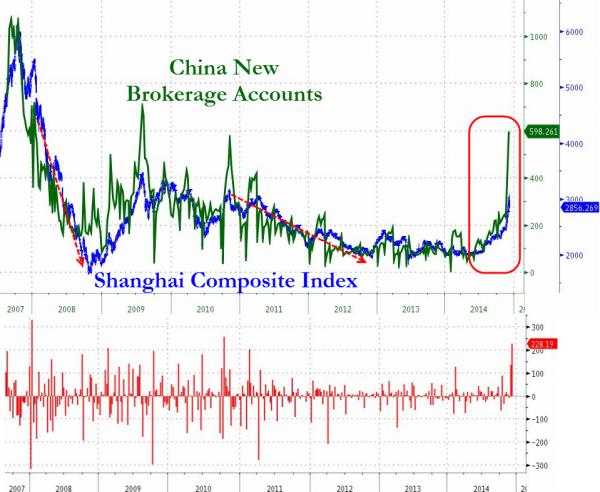
• Chinese Stocks’ Booms and Busts Getting Bigger on Margin Debt (Bloomberg)
• The Era Of 7% Growth Is Over For China (CNBC)
• Defiant Obama Pushes ‘Middle-Class Economics’ (Reuters)
• Credit Rater S&P to Be Banned for Year From Commercial-Bond Market (Bloomberg)
• If Money Speaks Louder Than Words, Is It Speech? (Reuters)
• No Clear Majority Yet In EU For TTIP Trade Deal (Reuters)
• Ukraine Crisis ‘Turning Point’ Close: Russian Deputy PM (CNBC)
• If Christine Lagarde And Her EU Pals Are Our Friends, Who Needs Enemies? (IM)
• Pope Francis: Failing to Care for Environment Is a Betrayal of God (Slate)

“This is the death-spiral of empires. They consume all wealth until none is left.”

• All Empires Die By Deflation – Not Inflation (Martin Armstrong)

A lot of people have asked what to do because property taxes keep rising and they can see they are unable to retire under such circumstances. The politicians are wiping out the elderly diminishing their savings and exploiting them in every way. There are no exceptions for taxation when you sell your home as there are in Britain. You pay no tax on the profits from a primary residence there. In the USA, you are taxed until you die. and then they want what is left. Property taxes are the worst of all taxes for they prevent you from really owning your home. Can’t pay the tax – they take it and sell it for pennies on the dollar. You have to pay taxes as if you were still working so all you can do is sell and move south and then pay taxes on your gains. New Jersey even put in an exit tax on the people it has been forcing to leave.

California has been hunting former residents who moved demanding taxes on pensions claiming they earned it when living in that state. It is a wonder why we do not yet have a sea of grey hair people with guns and pitchforks storming Washington yet. This is how empires die. Taxes in Rome kept rising. Its population peaked about 180AD and as corruption began to rise, people began to leave. The higher the taxes, the more people left town. Eventually, people could not afford the taxes and were forced to just abandon their homes. This is the death-spiral of empires. They consume all wealth until none is left. Indeed, Ben Franklin got it right – our fate is always doomed by death and taxes. By the Middle Ages, the Roman Forum, was the grazing grounds for animals. Edward Gibbon wrote the best epitaph:

“Her primeval state, such as she -might–appear in a remote age, when Evander entertained the stranger of Troy, has been delineated by the fancy of Virgil. This Tarpeian rock was then a savage and solitary thicket; in the time of the poet, it was crowned with the golden roofs of a temple, the temple is overthrown, the gold has been pillaged, the wheel of Fortune has accomplished her revolution, and the sacred ground is again disfigured with thorns and brambles. The hill of the Capitol, on which we sit, was formerly the head of the Roman Empire, the citadel of the earth, the terror of kings; illustrated by the footsteps of so many triumphs, enriched with the spoils and tributes of so many nations. This spectacle of the world, how is it fallen! how changed! how defaced!

The path of victory is obliterated by vines, and the benches of the senators are concealed by a dunghill. Cast your eyes on the Palatine hill, and seek among the shapeless and enormous fragments the marble theatre, the obelisks, the colossal statues, the porticos of Nero’s palace: survey the other hills of the city, the vacant space is interrupted only by ruins and gardens. The forum of the Roman people where they assembled to enact their laws and elect their magistrates, is now enclosed for the cultivation of pot-herbs, or thrown open for the reception of swine and buffaloes. The public and private edifices that were founded for eternity lie prostrate, naked, and broken, like the limbs of a mighty giant, and the ruin is the more visible from the stupendous relics that have survived the injuries of time and fortune.”

Read more …

“..if the trade weighted dollar is appreciating, then this exerts downward pressure on the dollar economy on a near one-to-one basis.”

• Global Dollar Economy Hits ‘Deflationary Vortex’ (Zero Hedge)

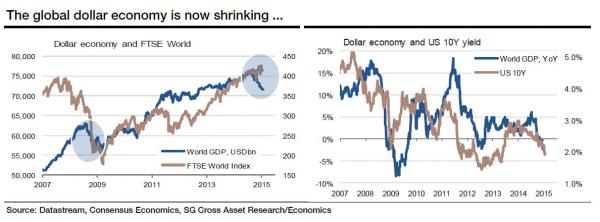
One of the macroeconomic observations that has gotten absolutely no mention in recent months is the curious fact that while global economic growth has not imploded in recent quarters, it is because GDP has been represented, as is customary, in local currency terms. Of course, this comes as a time when local currencies (at least those which are not the USD) have been plunging against the greenback on the back of the expectations that the Fed will hike rates some time in the summer or later in 2015. Which also means that in “dollar economy” terms, i.e., converted in USD, things are not nearly as good.

In fact, as the chart below shows, the global dollar economy is not only shrinking fast, but it is doing so at the fastest pace since the Lehman collapse, having shrunk by $4 trillion, or a whopping 5%, in just the last 6 months! By way of comparison the dollar economy lost $7 trillion, or a 10% contraction, during the Lehman crisis. Should the USD continue to appreciate, the global dollar economy collapse may surpass the plunge observed just as the great financial crisis struck. SocGen calls it “a deflationary vortex”; CNBC would call it a “global recovery.” Here is SocGen on this largely undiscussed topic with “The deflationary vortex of a shrinking dollar economy”:

As the ECB prepares to race faster in a bid to export deflation, the risk is that the dollar economy (world GDP measured in US dollars) will shrink further. The dollar economy is down by just over 5% since July, marking a loss of just over $4tn in nominal terms. The last sharp contraction of the dollar economy took place in 2008. Back then the economy shrank by just over $7tn, marking a loss in excess of 10%. The foreign trade mix of the US fairly closely mirrors the composition of world GDP. As such, if the trade weighted dollar is appreciating, then this exerts downward pressure on the dollar economy on a near one-to-one basis.

Any offset then comes from nominal GDP growth in local currency terms. Since July, the trade weighted dollar has gained just over 10%. Viewing the global economy from the vantage point of the dollar economy, it is hardly surprising that when the trade weighted dollar appreciates, commodity demand is eroded as economies with depreciating currencies lose purchasing power. To the extent that central banks actively seek currency depreciation, this could see further shrinkage of the dollar economy and add further downward pressure to commodity prices.
Read more …

“This is the year the markets really panic about deflation. You haven’t had that panic yet.”

• Albert Edwards: ‘Markets Will Riot’ On Deflation (Huebscher)

Albert Edwards admits that his “uber bear” reputation is well deserved, at least with respect to equities, an asset class he has dismissed for the last 10 years. His bearishness has not abated, and for the coming year, he fears that “deflation will overwhelm the west.” Markets, he said, will riot. Edwards is the chief global strategist for Societe Generale and he spoke at that firm’s annual global strategy conference in London on January 13. Global markets face three risks, according to Edwards: bearishness in the U.S. government bond market, a flawed confidence that the U.S. is in a self-sustaining recovery and undue faith in the relationship between quantitative easing (QE) and the equity markets. Deflation is the main threat, though, according to Edwards. “This is the year the markets really panic about deflation. You haven’t had that panic yet.”

Edwards said that U.S. equities are “stuck in a secular-valuation bear market” and have been inflated by QE. Though he did not predict a recession, he said stocks would react very negatively if one were to happen. “The market embraces a recession by going to a new lower low on valuations,” he said. He offset that pessimism with a bullish view on the U.S. bond market. He said the 10-year yield could go below 1% and “converge on what is happening in Japan.” “Markets move on extreme surprises,” Edwards said, “and when expectations are so firmly held and they are shown not to be the case, you get these extreme moves.”

Read more …

“QE is not going to help at all. Europe has far greater reliance than the US on small and medium-sized companies and they get their money from banks, not from the bond market..”

• QE Warfare Pushing World Financial System Out Of Control (AEP)

The economic prophet who foresaw the Lehman crisis with uncanny accuracy is even more worried about the world’s financial system going into 2015. Beggar-thy-neighbour devaluations are spreading to every region. All the major central banks are stoking asset bubbles deliberately to put off the day of reckoning. This time emerging markets have been drawn into the quagmire as well, corrupted by the leakage from quantitative easing (QE) in the West. “We are in a world that is dangerously unanchored,” said William White, the Swiss-based chairman of the OECD’s Review Committee. “We’re seeing true currency wars and everybody is doing it, and I have no idea where this is going to end.” Mr White is a former chief economist to the Bank for International Settlements – the bank of central banks – and currently an advisor to German Chancellor Angela Merkel. He said the global elastic has been stretched even further than it was in 2008 on the eve of the Great Recession.

The excesses have reached almost every corner of the globe, and combined public/private debt is 20% of GDP higher today. “We are holding a tiger by the tail,” he said. He warned that QE in Europe is doomed to failure at this late stage and may instead draw the region into deeper difficulties. “Sovereign bond yields haven’t been so low since the ‘Black Plague’: how much more bang can you get for your buck?” he told The Telegraph before the World Economic Forum in Davos. “QE is not going to help at all. Europe has far greater reliance than the US on small and medium-sized companies (SMEs) and they get their money from banks, not from the bond market,” he said. “Even after the stress tests the banks are still in ‘hunkering down mode’. They are not lending to small firms for a variety of reasons. The interest rate differential is still going up,” he said.

The warnings come just as the ECBprepares a blitz of bond purchases at a crucial meeting on Thursday. Most ECB-watchers expect QE of around €500bn now that the eurozone is already in deflation. Even the Bundesbank is struggling to come with fresh reasons to oppose it. The psychological potency of this largesse will depend on whether the ECB opts for shock-and-awe concentration or trickles out the stimulus slowly. It also depends on the exact mechanism used to conduct QE, a loose term at best. ECB president Mario Draghi hopes that bond purchases will push money out into the broader economy through a “wealth effect”, but critics fear this will be worse than useless if it leads to an asset bubble without gaining traction on the real economy. Classic moneratists say the ECB may end up spinning its wheels should it merely try to expand the money base. Mr White said QE is a disguised form of competitive devaluation. “The Japanese are now doing it as well but nobody can complain because the US started it,” he said.

Read more …

Jon Hilsenrath is the unofficial Fed bullhorn. So pay attention.

• Fed Officials on Track to Raise Short-Term Rates Later in the Year (WSJ)

Federal Reserve officials are staying on track to start raising short-term interest rates later this year, even though long-term rates are going in the other direction amid new investor worries about weak global growth, falling oil prices and slowing consumer price inflation. The Fed’s stance, as it prepares for a policy meeting later this month, is striking because European Central Bank officials are poised to take the opposite approach later this week. The ECB is nearing a decision on whether to launch a controversial stimulus program known as quantitative easing on Thursday. It is widely expected to announce it will buy hundreds of billions or more of euro-denominated government bonds in an effort to beat back Japan-style deflation.

The world hasn’t seen an economic divergence like this since the mid-1990s, when growth in the U.S., Japan and Europe went in different directions. Back then, Japan was mired in a post-real-estate bubble downturn, Europe was grappling with the consequences of the collapse of the Soviet Union and the U.S. was enjoying a burgeoning technology boom. The looming moves have important implications for markets and growth. Investors have already been driving up the value of the U.S. dollar in anticipation of the moves and driving down long-term interest rates across the globe. “I think it is important to get started and to start normalizing policy,” St. Louis Fed President James Bullard said in an interview with The Wall Street Journal on Monday. “Even once we start to normalize, interest rates would be extraordinarily low.” [..]

“The level of inflation is not so low that it can alone justify a policy rate of zero,” Mr. Bullard said in a speech Friday. He wants the Fed to start raising rates by March, earlier than most other officials. San Francisco Fed President John Williams said in a speech Friday the middle of the year may still be the best time for the U.S. central bank to increase rates. Given the health of the broader economy, “what I’m really watching for is underlying inflation—wage growth, prices [..] My forecast is once we get through this slow path in inflation it will start moving back,” he said, adding, “I’m not expecting inflation to be 2% when we raise interest rates.I don’t need to be at the goal when we raise the rates.”

Read more …

“Monetary methadone..”

• Central Bankers Lurch From ‘Whatever It Takes’ To ‘Whatever Next’ (Reuters)

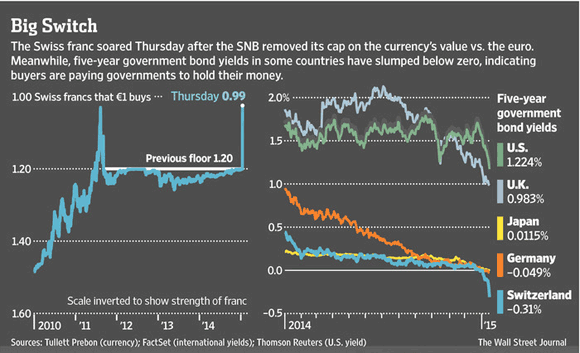
The Swiss currency shock has raised an awkward question many investors have been fearful of asking – what if central banks become as unpredictable and fallible as they are powerful? The Swiss National Bank’s sudden decision to abandon its three-year-old cap on the franc – the “cornerstone” of its monetary policy just three days before – led to the biggest one-day move in major exchange rates in the post-1973 floating rates era. To some it was a warning sign of other U-turns, mishaps and possible failures by central banks still ahead, outcomes not fully appreciated by long-becalmed markets. For decades the power of currency printing presses has held markets in thrall. “Don’t fight the Fed” and all its international variations has been a devout belief among financial traders.

Even after the failure of Alan Greenspan’s Federal Reserve to spot and headoff one of the biggest credit booms and busts in history, the ability of the Fed, Bank of England, Bank of Japan, European Central Bank and others to flood their money supply to ease the fallout helped anaesthetise fractious markets. The subsequent waves of cheap credit, currency fixes and “quantitative easing” drove down borrowing rates and erased volatility. The demonstrations of central bank might culminated in ECB chief Mario Draghi’s declaration in 2012 that he would do “whatever it takes” to save the euro. In the face of the power of the money printing press, speculation became pointless. So much so that one of the biggest conundrums of recent years became the persistently low implied volatility in markets even in the face of outsized economic, political and policy risks.

Not everyone was pleased by the complacency. “Monetary methadone was the best of no choice but we have become addicted to cheap money everywhere and, somehow, that central bankers are prophetic,” Nigel Wilson, chief executive of UK insurer Legal & General told Reuters. The first cracks appeared last summer, when it became clear the Fed was turning off the printing presses even as counterparts in Europe and Japan were still cranking up theirs. The idea the world’s largest economy was about to suck dollars back out of the world just as others were pumping in euros and yen sent once-steady exchange rates lurching. The power of the central banks was as daunting as ever, but no longer such a reassuring and calming influence.

Read more …

No.

• Storm Clouds Gather Over US Economy: Can The Miracle Last? (CNBC)

The world just got a bit scarier for risk assets. On Thursday morning, the Swiss National Bank shocked the world by removing its cap on the Swiss franc against the euro, causing its currency to soar and the euro to plunge—and creating fears about more sudden central bank moves. Meanwhile, global growth concerns continue to drive industrial commodities like copper and crude oil to multi-year lows. With the U.S. serving as one of the world’s few bastions of security and growth, the dollar continues to soar and Treasury yields are plummeting in a bid for safe havens. The question now: How long can America continue to shine in an increasingly uncertain and slow-growing world? A key clue could come in the week ahead, as a slate of major companies report their fourth-quarter results and release forward guidance.

Most closely watched will be energy companies like Halliburton and Baker Hughes, consumer discretionary names like Starbucks and McDonald’s, and industrial giants like GE. The overarching questions will be whether the soaring dollar and plunging energy prices are helping or hurting—and just how much the weakening global environment is a concern for corporate managers. “What I’m going to be watching for is some clarity from the companies in terms of the decline in the price of oil, and the decline of interest rates and the rise of the dollar,” said John Conlon, chief investment officer at People’s United Bank. “I’m going to see if there’s some consensus developing in terms of the price of oil and interest rates.”

Thus far, the “blended” estimate for fourth quarter earnings growth (which combines reported earnings with analyst estimates for yet-to-be-reported earnings) stands at a meager 0.6%, according to FactSet. That’s down from 1.7% on December 31st, mostly due to misses from Citigroup, Bank of America and JPMorgan. It’s worth noting that since more companies beat than miss, actual earnings growth tends to be prettier than the estimates. But if the growth rate does stand at 0.6% after the dust has settled, that would mark the slowest earnings growth since the third quarter of 2012, when S&P 500 companies reported an earnings decline of 1%.

Read more …

“..what they actually are doing is plotting even more wars, interventions, more economic controls, more ‘banksterism’, more benefits to the power elite versus the people”

• Davos Is About More Control And Banksterism, Not Solutions: Lew Rockwell (RT)

The Davos meeting is not looking for world crisis solutions but plotting more controls, ‘banksterism’ and power elite benefits, says economic journalist Lew Rockwell. They are going to tax and rip off their own people to even greater extent, he added.

RT: The main theme of the Davos forum in the past has largely been finding solutions for world economic problems. How about today? Is it still about that?

Lew Rockwell: No, it is actually about control. I think it has always been about control for the US Empire, for the oligarchs associated with it. They may talk about wanting to solve problems, or make people’s lives better, [but] what they actually are doing is plotting even more wars, interventions, more economic controls, more ‘banksterism’, more benefits to the power elite versus the people. We don’t know what is going on there. I’d like to put chest cams on all of them so we can see what they are doing, what they are talking about. It is not good for the cause of freedom, for the cause of prosperity, not good for the cause of human rights what goes on in Davos.

RT: Let’s talk about numbers. For example, this year companies have to pay $20,000 per executive for a ticket. A simple dinner in an average restaurant was $40 last year. A night in a mid-range hotel has gone from roughly $600 to $700. Do the Forum’s participants need all these special arrangements to make an effective decision?

LR: It is a meeting of the very rich and it’s a meeting of the politicians that they own. They all live very well; they are not staying in the middle range hotels and are not eating at the regular restaurants. They are having the times of their lives; they lived the life of riley at the expense of everybody else. I don’t think we need to worry about cost to them. They are happy to spend the money. It is not theirs after all; they are taking it from the rest of us.

Read more …

“The aftermath is like a black hole that can suck massive amounts of credit from currency trading as we have known it.”

• Brokers Reveal Details Of Damage From Swiss Chaos (Independent)

The UK’s biggest spread-betting firm, IG Group, said yesterday that it would “learn lessons” from last week’s stunning reversal by the Swiss National Bank (SNB), which cost it £30m. IG is nursing £18m in client losses from the SNB’s shock scrapping of the franc’s cap against the euro, as well as £12m in market exposure. IG honoured the loss limits of clients but was unable to close its hedging positions on bets because of the extreme volatility, which saw the euro tumble 30% against the “Swissie” at one stage. The company intends to maintain the dividend at last year’s level. “Although this was because of an unprecedented and unforeseeable degree of movement in a major global currency, and only a few hundred clients were affected, we will seek to learn lessons from this incident which we can incorporate into our risk-management approach,” the company said.

The Swiss blow took the gloss off strong results from the company, which has seen 1,700 clients sign up to a new stockbroking account. IG generated its highest monthly revenue in October, when global markets sank on growth fears, helping half-year profits up 2.8% to £101.4m. Another victim of the SNB’s currency earthquake, the US broker FXCM, also revealed the punishing terms of a $300m (£198m) rescue loan from investment firm Leucadia National, owner of a wide range of companies that includes broker Jefferies. FXCM will pay an eye-watering 10% annual interest on the loan, with the rate increasing by 1.5% a quarter up to a maximum of 17%, to encourage a sale of the business within three years. Leucadia will get half the proceeds on a sale of FXCM after the loan is repaid, although it will claim an even bigger share on a sale above $500m.

Danish investment bank and broker Saxo said it would incur losses from the SNB move but that its capital position was not in peril. The firm gave its clients less leverage to bet on the currency last year, reducing its exposure. Analysts said that the full impact of the scrapping of the Swiss franc-euro ceiling by the Swiss central bank won’t be known for months. “[It is] closer to a nuclear explosion than a 1,000-kilogram conventional bomb” said Javier Paz, senior analyst in wealth management at Aite Group. “The aftermath is like a black hole that can suck massive amounts of credit from currency trading as we have known it.”

Read more …

“If the oil prices drop to $25 a barrel, there will yet again be no threat posed to Iran’s oil industry..”

• Iran Oil Minister Sees ‘No Threat’ From $25 Oil (MarketWatch)

Do I hear $25-a-barrel oil? Iran’s oil Minister Bijan Namdar Zanganeh hinted at even lower prices for crude as he declared his well positioned for plunging crude oil prices. “If the oil prices drop to $25 a barrel, there will yet again be no threat posed to Iran’s oil industry,” said Zanganeh at a conference in Tehran on Monday. That means the country should be sitting pretty as the OPEC sticks to its guns on production cuts. But Zanganeh also predicted that OPEC and non-OPEC countries will eventually “cooperate to restore balance to the oil market.” Wishful thinking perhaps in a situation where the market only reads: too much supply, not enough demand. On Sunday, his Iraq counterpart, Adel Abdul-Mehdi, said his country pumped out a record four million barrels per day of oil in December

Recently, billionaire Saudi businessman Prince Alwaleed bin Talal, said the market can kiss $100-a-barrel oil goodbye forever. “I said a year ago [that] the price of oil above $100 is artificial,” Alwaleed said. “It’s not correct.” Over at Project Syndicate last week, Anatole Kaletsky, a former Times of London columnist said $50 oil should really be the ceiling for a much lower price range, which could drop all the way down to $20 a barrel. “As it happens, estimates of shale-oil production costs are mostly around $50, while marginal conventional oilfields generally break even at around $20. Thus, the trading range in the brave new world of competitive oil should be roughly $20 to $50,” said Kaletsky, chief economist and co-chairman of Gavekal Dragonomics.

Read more …

“The announcement that BHP will reduce the number of US onshore oil rigs it operates by the end of this financial year is a pointer to the industry-wide supply response yet to come..”

• BHP Billiton Cuts US Shale Oil Rigs By 40% Amid Sliding Price (AFP)

The world’s biggest miner BHP Billiton is cutting back its operating US shale oil rigs by 40% amid slumping prices. BHP said on Wednesday it would reduce the number of rigs from 26 to 16 by the end of the June in response to weaker oil prices. However, shale volumes were still forecast to grow by approximately 50% during the period. “In petroleum, we have moved quickly in response to lower prices and will reduce the number of rigs we operate in our onshore US business by approximately 40% by the end of this financial year,” chief executive Andrew Mackenzie said. “The revised drilling programme will benefit from significant improvements in drilling and completions efficiency.” Mackenzie said while the firm’s drilling operations would focus on its Black Hawk field in Texas, “we will keep this activity under review and make further changes if we believe deferring development will create more value than near-term production”.

Oil prices slid again Tuesday after the International Monetary Fund slashed its forecast for world economic growth and revived concerns about the strength of crude demand. US benchmark West Texas Intermediate for February sank US$2.30, or 4.7%, to US$46.39 a barrel, not far from its lowest level since March 2009. “The announcement that BHP will reduce the number of US onshore oil rigs it operates by the end of this financial year is a pointer to the industry-wide supply response on lower oil prices that is yet to come,” CMC Markets’ chief market analyst Ric Spooner said in a note. BHP added that its iron ore output had risen by 16% for the three months to December compared to a year earlier, hitting 56.4m tonnes. Prices in iron ore, one of BHP’s core commodities, slumped 47% in 2014 amid a global supply glut and softening demand from China.

Read more …

“When the tide turns, it’s going to be very ugly, because you will have a forced exit from the market.”

• Chinese Stocks’ Booms and Busts Getting Bigger on Margin Debt (Bloomberg)

The one thing China’s bulls and bears can agree on is that swings in the world’s most-volatile major stock market are only going to get bigger after equity traders took on record amounts of debt. Both Bank of America strategist David Cui, who predicts Chinese shares will fall, and JPMorgans Adrian Mowat, who has an overweight rating, say the surge in margin lending to all-time highs is amplifying price fluctuations in the $4.9 trillion market. Volatility in the benchmark Shanghai Composite Index reached the highest level since 2009 this week after rising more than fourfold since July. While the flood of borrowed money into Chinese stocks added fuel to a 59% rally in the Shanghai Composite during the past 12 months through yesterday, the gauge’s 7.7% tumble on Monday illustrates how leverage can also accelerate declines.

Margin traders unloaded shares at the fastest pace in 19 months during the rout, which was sparked by regulatory efforts to cool the growth of margin debt in a market where individuals drive 80% of equity volumes. “Margin trading will add more up-and-down to the market and increase volatility,” Xie Weiyu at Shenyin & Wanguo in Shanghai, said. “If a correction starts, the magnitude will be bigger than the past few years.” In a margin trade, investors use their own money for just a portion of their stock purchase, borrowing the rest from a brokerage. The loans are backed by the investors’ equity holdings, meaning they may be forced to sell when prices fall to repay their debt.

The Shanghai Composite sank the most in six years on Monday after the China Securities Regulatory Commission suspended the nation’s two biggest brokerages from lending money to new equity-trading clients and said securities firms shouldn’t lend to investors with assets below 500,000 yuan ($80,467). Outstanding margin loans on both the Shanghai and Shenzhen exchanges surged more than tenfold in the past two years to a record 1.1 trillion yuan as of Jan. 16, or about 3.5% of the nation’s market value. On the New York Stock Exchange, margin debt amounts to about 2.1% of market cap on the NYSE Composite Index. Margin lending is a “new phenomenon in China,” said Cui, who anticipates the Shanghai Composite will fall about 5% by year-end. “When the tide turns, it’s going to be very ugly, because you will have a forced exit from the market.”

Read more …

Again: China is doing far worse than it pretends.

• The Era Of 7% Growth Is Over For China (CNBC)

Brace for growth numbers starting with “6” from China this year, economists say, after data showed the world’s second largest economy expanded at its slowest pace in over two decades in 2014. China’s GDP release on Tuesday showed the economy grew 7.3% in the fourth quarter from the year-ago period, bringing growth in the full year to 7.4% – the weakest performance since 1990. “The challenges facing China’s economy remain as large or even larger compared to a year prior,” Brian Jackson, chief economist at IHS Global Insight wrote in a note, citing the cooling property sector, industrial overcapacity and high debt levels as persistent headwinds for the economy.

IHS predicts growth will moderate to 6.5% in 2015, far short of a 7% official target the government is expected to announce in March, as the government prioritizes economic reform over stimulus While December monthly indicators, including industrial production and retail sales also released Tuesday, pointed to some upward momentum in the economy, economists say this will proved short-lived. “Brief spells of accelerating Chinese growth are taking place within a larger narrative of China’s secular slowdown, a trend which bouts of mini-stimulus and lower commodity prices cannot fully reverse,” Jackson said.

For example, the pickup in industrial output growth to 7.9% on year in December, from 7.2% in November, is a result of the re-opening of factories following a temporary shutdown during the time of the Asia-Pacific Economic Cooperation (APEC) conference, according to Nomura. Of all the headwinds facing the economy, analysts expect the property sector will be the top drag for the economy in the first half of 2015. Real estate is an important pillar of the economy, accounting for approximately 15% of GDP and directly affecting dozens of other sectors from steel to construction. “Chinese growth will continue to face downward pressure because of the slowdown in property investment,” said Tommy Xie, economist at OCBC Bank, who sees growth dipping below 7% in the first-half.

Read more …

Empty.

• Defiant Obama Pushes ‘Middle-Class Economics’ (Reuters)

President Barack Obama struck a defiant tone for his dealings with the new Republican-led Congress on Tuesday, calling on his opponents to raise taxes on the rich and threatening to veto legislation that would challenge his key decisions. Dogged by an ailing economy since the start of his presidency six years ago, Obama appeared before a joint session of Congress for his State of the Union speech in a confident mood, buoyed by an economic revival that has trimmed the jobless rate to 5.6% and eager to use this as a mandate. It is now time, he told lawmakers and millions watching on television, to “turn the page” from recession and war and work together to boost those middle-class Americans who have been left behind.

But by calling for higher taxes that Republicans are unlikely to approve and chiding those who suggest climate change is not real, Obama set a confrontational tone for his final two years in office. He vowed to veto any Republican effort to roll back his signature healthcare law and his unilateral loosening of immigration policy. Any attempt to increase sanctions on Iran while negotiations with Tehran over its nuclear program are still under way would also be rejected, he said. In sum, Obama appeared liberated: no longer having to face American voters again after his election victories in 2008 and 2012, a point that he reminded Republicans about. “I have no more campaigns to run,” Obama said. When a smattering of applause rose from Republicans at that prospect, he added with a tight smile: “I know because I won both of them.”

Read more …

Costly.

• Credit Rater S&P to Be Banned for Year From Commercial-Bond Market (Bloomberg)

Standard & Poor’s will be suspended for a year from rating bonds in one of its most lucrative businesses in a $60 million settlement with the U.S. Securities and Exchange Commission, according to a person with knowledge of the matter. The deal, which the person said may be announced as soon as tomorrow, is the agency’s toughest action yet in an industry blamed for fueling the 2008 financial crisis by assigning inflated grades to risky mortgage debt. Instead of securities created during that period, though, the SEC’s investigation has looked at whether S&P bent its criteria to win business on commercial-mortgage bonds issued in 2011.

The suspension will ban S&P from rating debt in the biggest portion of that market, those that bundle multiple loans tied to anything from shopping malls to skyscrapers, into securities that are sold to bond investors, according to the person, who asked not to be identified because the discussions are private. In addition to the SEC fine, the unit of McGraw Hill is also facing a penalty to settle probes of the same ratings by Attorneys General in New York and Massachusetts, said the person and a second with knowledge of the talks. The CMBS probe is separate from a lawsuit by the Justice Department tied to subprime home loans that S&P rated before the credit crisis. S&P is expected to settle that matter as soon as this quarter for about $1 billion in penalties, people familiar with the matter said this month.

Read more …

” One has a right, for example, to procreative liberty — yet no right to buy a baby. Money would help some people exercise these rights, too. But we don’t treat laws restricting baby selling as if they were restricting procreative liberty.”

• If Money Speaks Louder Than Words, Is It Speech? (Reuters)

Citizens United may have been just what the United States needed — a decision by the U.S. Supreme Court so dramatically wrongheaded that people across the country paid attention to it and said, “Hold on, something is wrong here.” Though the actual ruling simply extended the flawed approach to campaign-finance laws that the court had been following for decades, Citizens United shined a light on the justices’ reasoning and demonstrated its shortcomings by taking that rationale to its logical — if absurd — conclusion. The Supreme Court treats restrictions on both giving and spending money on elections as restrictions on “speech” under the First Amendment. While the case law has been dotted with victories for both advocates and opponents of campaign-finance restrictions over the past 40 years, it is vital to step back and look at the bigger picture.

In the seminal 1976 campaign-finance case, Buckley v. Valeo, the court laid out the line of reasoning relied on ever since. Buckley said that restrictions on giving and spending money in politics should be treated as if they are restrictions on speech. This approach was not obvious or uncontroversial. Campaign-finance laws do not “prohibit” speech — using the word in its ordinary way. Rather, they restrict giving and spending money used on political speech. The decision to treat campaign-finance laws as restrictions on speech was based on the argument that money facilitates speech. “[V]irtually every means of communicating ideas in today’s society requires the expenditure of money,” the court argued. Though that may be somewhat less true today — given the Internet — it is still largely correct.

What this rationale misses is that money facilitates speech not because there is any special connection between the two, but because money is useful stuff. It facilitates the exercise of many other constitutionally protected rights, as well as the fulfillment of many goals and interests. Yet, and here’s the important part, no one — and especially not this Supreme Court — is likely to conclude that restrictions on spending money in connection with the exercise of all other rights would violate these rights. One has a right, for example, to procreative liberty — yet no right to buy a baby. Money would help some people exercise these rights, too. But we don’t treat laws restricting baby selling as if they were restricting procreative liberty.

Read more …

Here’s how you spell democracy in Europe today: “The EU has said the final wording would, however, remain confidential until an agreement was reached..”

• No Clear Majority Yet In EU For TTIP Trade Deal (Reuters)

No clear majority has so far emerged among EU states for a free-trade agreement between the European Union and the United States and both sides need to explain the benefits of such a deal, the EU’s health chief said. Chancellor Angela Merkel has urged the 28-nation EU to speed up negotiations with the United States on what would be the world’s biggest trade deal. But there is public opposition in Europe based on fears of weaker food and environmental standards. “We have to take people’s concerns seriously,” Vytenis Andriukaitis, European commissioner for health and food safety, told German daily Tagesspiegel, adding that the trade agreement ultimately needed to be ratified by all national parliaments.

“At the moment, I don’t see a safe majority for this yet,” he said in an interview published on Monday, adding the EU Commission had published some negotiating papers to improve transparency. The EU has said the final wording would, however, remain confidential until an agreement was reached on the Transatlantic Trade and Investment Partnership (TTIP). Negotiations for the TTIP were launched in July 2013 and officials are seeking a deal that goes well beyond trade to remove barriers to businesses. There is concern in Europe that U.S. multinationals would use a proposed investment protection clause to bypass national laws in EU countries. In Berlin, more than 25,000 people joined a rally against the TTIP and genetically modified food over the weekend.

Read more …

Went to Diplomat School: “Russia is interested in stabilizing the situation globally and in Ukraine in particular..”

• Ukraine Crisis ‘Turning Point’ Close: Russian Deputy PM (CNBC)

The conflict over Ukraine’s borders with Russia, which has soured Moscow’s relationship with the West and stirred up new concerns about global unrest, may be close to a “turning point”, according to Arkady Dvorkovich, Russia’s deputy Prime Minister. “Russia is interested in stabilizing the situation globally and in Ukraine in particular,” Dvorkovich told CNBC at the World Economic Forum in Davos, where he is one of Russia’s most senior representatives after both President Vladimir Putin and Prime Minister Dmitry Medvedev declined to make the trip. He extended the possibility of reducing the price of gas to Ukraine, after Russia hiked it earlier in the conflict. This week, military activity in Donetsk and Luhansk, the disputed parts of eastern Ukraine where Russian-backed militants are battling the Ukrainian army, had escalated after falling back over Christmas and New Year.

Petro Poroshenko, the Ukrainian President, who came to power last year, has acknowledged this week that a military solution to the fighting, which has claimed nearly 5,000 lives so far, does not exist. Economic sanctions enacted by Western countries against Russia, following the outbreak of conflict, combined with the falling price of oil and gas, its biggest export, and a tumbling ruble, have helped send the country into economic turmoil. Nonetheless, Dvorkovich argued that thanks to the country’s currency reserves “we have the resources to keep the economy in a relatively normal stance.” “We have resources, we have an anti-crisis plan.” There has also been a lack of external investment in Russia, as Western companies are concerned that they may fall foul of current or future sanctions. But Dvorkovich dismissed this, arguing “CEOs of foreign companies are all saying that they will continue investments in Russia, with the ruble at this low level.”

Read more …

“Christine Lagarde must be smiling to herself and thinking we are thick Paddies alright.”

• If Christine Lagarde And Her EU Pals Are Our Friends, Who Needs Enemies? (IM)

There is nothing worse than a posh bird arriving into town and insulting the intelligence of the natives. That’s exactly what IMF chief Christine Lagarde did yesterday. She and her friends in Europe robbed around €10,000 a year out of the pocket of every Irish citizen to save the rich on the continent and to ensure no French or German bank would collapse for lending to the bankrupt Irish banks. And then she has the cheek to tell us we are the real heroes of the recovery. What’s even worse, our Taoiseach Enda Kenny stood there applauding her as she praised the victims of brutal austerity. If Lagarde and her cohorts from Europe can be classed as friends, who needs enemies? This country is sick to death of being the best boys and girls in the class in the EU. Let’s tell the truth Brussels couldn’t give a damn about us and never will. They will protect the euro at any cost and we as a nation paid a horrendous price. We have been landed with debt that will take generations to clear, if ever.

The whole crisis set this country back 20 years. Not one treacherous banker has gone to jail. Not one politician or civil servant has been held to account for horrendous decisions taken on the night of the bank guarantee. Europe has been a failure for the Republic of Ireland, they hung this country out to dry. So lets start having the debate about it. There is also no recovery here yet – very few people have any spare cash. The country is taxed to the hilt and the working man and woman is surviving by the skin of the teeth. That’s why the water charge was a tax too far and the people took to the streets. Our politicians are still living in a Leinster House bubble. They may mean well but the majority of them haven’t a clue what’s going on in the real world. They have no vision where Ireland is going it is all a game of retaining power. Christine Lagarde must be smiling to herself and thinking we are thick Paddies alright.

Read more …

“Respect for the environment means more than simply using cleaner products or recycling what we use.”

• Pope Francis: Failing to Care for Environment Is a Betrayal of God (Slate)

Pope Francis has been wading into environmental issues during his week-long Asian tour, but he issued the strongest words on Sunday, when he said that man was betraying God’s calling by destroying nature. Or at least that’s what he was supposed to say at a rally with young people at a university in Manila. But the pope ended up being moved by the story of an abandoned girl so he improvised a speech. Still, the Vatican has said that when the pope decides to improvise, the prepared text is official, notes Reuters. “As stewards of God’s creation, we are called to make the earth a beautiful garden for the human family,” the pope said in the prepared text. “When we destroy our forests, ravage our soil and pollute our seas, we betray that noble calling.” The pope also pointed out that youth in the Philippines should feel a special obligation to care for the environment.

“This is not only because this country, more than many others, is likely to be seriously affected by climate change,” he said in the prepared text. “You are called to care for creation not only as responsible citizens, but also as followers of Christ!” He also appeared to chastise those who think that simply by buying environmentally friendly products and recycling they are doing enough for the cause. “Respect for the environment means more than simply using cleaner products or recycling what we use. These are important aspects, but not enough,” he said. God “created the world as a beautiful garden and asked us to care for it,” Francis said. “Through sin, man has disfigured that natural beauty. Through sin, man has also destroyed the unity and beauty of our human family, creating social structures that perpetuate poverty, ignorance and corruption.”

Read more …

Jan 162015
 
 January 16, 2015  Posted by at 11:36 am Finance Tagged with: , , , , , , , , ,  6 Responses »


Earl Theisen Walt Disney oiling scale model locomotive at home in LA Sep 1951

• Swiss Mess Could Make Oil Plunge Seem Like Minor Hiccup (MarketWatch)
• World Deflationary Forces Have Swept Away Switzerland’s Defences (AEP)
• Switzerland Shows The Era Of Central Bank Omnipotence Is Over (Krasting)
• Swiss Franc Move Cripples, Wipes Out Currency Brokers (WSJ)
• Wall Street Is Bracing For Shock Waves From Swiss Franc Move (MarketWatch)
• Franc’s Surge Ranks Among Largest Ever in Foreign Exchange (Bloomberg)
• Swiss Bankers Are Accelerating the Euro’s Slide (Bloomberg)
• In Praise Of Price Discovery – The Market Is Off Its Lithium (David Stockman)
• Iran Lowers Oil Price for Budget to $40 After Collapse (Bloomberg)
• BP Sees $50 Oil For Three Years (BBC)
• $50 Oil Is The Ceiling For A Much Lower Trading Range (Anatole Kaletsky)
• Big Oil Gets Serious With Cost Cuts on Worst Slump Since 1986 (Bloomberg)
• Schlumberger Cuts 9,000 Jobs as Oil Slump Portends Uncertainty (Bloomberg)
• Aberdeen, The Energy-Rich Town Counting The Cost Of The New Oil Shock (Guardian)
• Greek Systemic Banks Request Emergency Liquidity Assistance (Kathimerini)
• No Risk Of ‘Deflation Spiral’ In Europe: German Minister (CNBC)
• UK Retailers ‘Throttled’ By Black Friday (Daily Mail)
• Warning: China May Trigger Fresh Rout In Commodities (CNBC)
• China Shadow Banking Surge Chills Stimulus Hopes (CNBC)
• New Russian/Chinese Credit Rating Agencies To ‘Balance Big Three’ (RT)
• Ukraine President Poroshenko Signs Decree To Mobilize Up To 100,000 (TASS)
• ‘Corporate Wolves’ Will Exploit TTIP Trade Deal, MPs Warned (Guardian)
• Pope Francis Says Freedom Of Speech Has Limits (BBC)

Anything could blow now.

• Swiss Mess Could Make Oil Plunge Seem Like Minor Hiccup (MarketWatch)

One day, it’s gold. The next, it’s equities. Most days, it’s crude. On Wednesday, it was copper. On Thursday it was the Swiss franc and Swiss stocks. And the move in those two makes those others look like minor-league hiccups. While you were sleeping, all hell broke loose in Switzerland, as the central bank ditched its currency cap against the euro after four years and slashed interest rates to negative 0.75%. The Swiss franc is rallying wildly, while the Swiss stock market is cratering and U.S. stock futures are mostly on the losing side as investors figure out this latest shock to the markets Meanwhile, collapsing oil is claiming its next batch of victims. Apache just became the first, and certainly not the last, big-name oil producer to cut a notable number of jobs. And Calgary is suffering through it’s worst decline in home prices in almost two years. Airlines stocks aren’t even benefiting anymore.

So where’s that cheap oil upside? Perhaps, it’s in the opportunity created in solar stocks. The best thing that can be said about oil at this point is that, hey, at least it’s not bitcoin. Or the ruble. More fallout to come if $50 does, indeed, turn out to be a ceiling and if, as Goldman Sachs says, prices fall below the bank’s $39 target.

Read more …

Ambrose gets it right: deflation.

• World Deflationary Forces Have Swept Away Switzerland’s Defences (AEP)

The Swiss National Bank has lost control. It is the latest in a list of venerable central banks to be overwhelmed by deflationary forces and global economic disorder. The country is already in deflation. The Swiss franc ended Thursday 13% higher after the SNB abandoned its three-year efforts to defend a currency floor of 1.20 to the euro. “We have a free exchange rate once again,” said the SNB’s president, Thomas Jordan. Indeed, but nobody is fooled by the SNB’s attempt to spin this as benign. “This is a huge hit to their credibility,” said Deutsche Bank. The official statement claimed that the exchange floor is no longer needed and that “overvaluation has decreased as a whole since the introduction of the minimum exchange rate”. This is eyewash. “They have had to throw in the towel. They couldn’t hold the line anymore,” said David Owen, from Jefferies Fixed Income.

“This is going to cause extreme pain for parts of the Swiss economy but SNB are trapped.” The franc has been level over the past year on a trade-weighted basis. Even before Thursday morning’s events, the exchange rate was 25% above its decade-long average. It is now 40% higher. Just one month ago the SNB argued in its quarterly report that currency floor was imperative to stop Switzerland relapsing back into deflation. “In view of heightened deflation risks, the minimum exchange rate remains the key instrument for ensuring appropriate monetary conditions. A further appreciation of the Swiss franc would have a major impact on salary and price structures. Companies in Switzerland would be forced to cut costs drastically again to remain competitive.” The statement was true then. The threat is much greater now, made all too clear by the howls of protest this morning from the Swiss export sector.

Nick Hayek, head of Swatch Group, said the collapse of the floor would cause havoc. “Words fail me. Today’s SNB action is a tsunami; for the export industry and for tourism, and for the entire country,” he said. The Swiss economy has been muddling through over the past year but the output gap is still -1% of GDP, inflation is negative and the KOF index of business sentiment has been slipping lower for two years. On top of this, the country now has to grapple with the likely hangover from its own domestic credit bubble. The SNB’s Mr Jordan said the end of an exchange floor inevitably requires subterfuge. “You can only end a policy like this by surprise. It is not something you can debate for weeks,” he said. That may be true. Less justifiable is the failure to come clean after the event and explain exactly why the SNB now judges the damage of eternal currency intervention to be even more dangerous than the threat of a systemic deflationary shock. We are left guessing.

Read more …

It was always but an illusion, though.

• Switzerland Shows The Era Of Central Bank Omnipotence Is Over (Krasting)

I wrote about the Swiss National Bank being forced to abandon its currency peg to the Euro on 12/3/14, 12/8/14 and 1/11/15. That said, I’m blown away that this has happened today. Thomas Jordan, the head of the SNB has repeatedly said that the Franc peg would last forever, and that he would be willing to intervene in “Unlimited Amounts” in support of the peg. Jordan has folded on his promise like a cheap suit in the rain. When push came to shove, Jordan failed to deliver. The Swiss economy will rapidly fall into recession as a result of the SNB move. The Swiss stock market has been blasted, the currency is now nearly 20% higher than it was a day before. Someone will have to fall on the sword, the arrows are pointing at Jordan.

The dust has not settled on this development as of this morning. I will stick my neck out and say that the failure to hold the minimum rate will result in a one time loss for the SNB of close to $100B. That’s a huge amount of money. It comes to 20% of the Swiss GDP! If this type of loss were incurred by the US Fed it would result in a loss in excess of $2 Trillion! In the coming days and weeks there will be more fallout from the SNB disaster. There will be reports of big losses and gains from today’s events. But that is a side show to the real story. We have just witnesses the collapse of a promise by a major central bank. The Fed, Bank of Japan, ECB, SNB and other Central Banks have repeatedly made the same promises over the past half decade:

Don’t worry! We are here. We will do anything it takes to achieve the stability we desire. We are stronger than the markets. We can overwhelm all forces. We will never let go – just trust us!

I never believed in these promises, but the vast majority of those who are active in financial markets did. The entire world has signed onto the notion that Central Banks are all powerful. We now have evidence that they are not. Anyone who continues to believes in the All Powerful CB after today is a fool. Those who believed in Jordan’s promises now have red ink on their hands – lots of it! The next central bank that will come into the market’s cross hairs is the ECB. Mario Draghi has made promises that he would “Do anything – in any amount”. Like I said, you would be a fool to continue to believe in that promise as of this morning. We’ve just taken a huge leap into chaos. The linchpin of the capital markets has been the trust in the CBs. The market’s anchors have now been tossed overboard.

Read more …

“Where a client cannot cover this loss, it is passed on to us. This has forced Alpari (UK) Limited to confirm…that it has entered into insolvency ..”

• Swiss Franc Move Cripples, Wipes Out Currency Brokers (WSJ)

A major U.S. currency broker warned its equity was wiped out, a U.K. retail broker entered insolvency and a global foreign-exchange trading house failed after suffering big losses sparked by the Swiss central bank’s move to free up its currency. On Friday, regulators in Japan, Hong Kong, Singapore and New Zealand sought information from brokers about what happened. In Japan, the Finance Ministry was checking on trading firms after industry sources said the country’s army of mom-and-pop foreign exchange traders suffered big losses. The losses were caused when liquidity dried up and volatility spiked in the debt-driven foreign exchange market, making it impossible for brokers to execute trades as losses spiraled. Many of these brokers offer 100-to-1 leverage, meaning a 1% loss can wipe a client out.

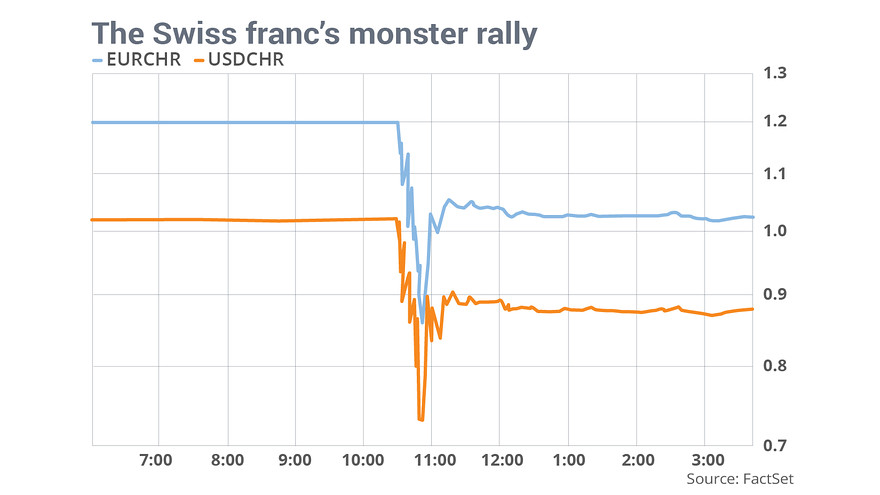
The Swiss franc jumped 30% against the euro in minutes on Thursday, after the Swiss National Bank stopped capping the rise their nation’s currency against the euro. The surprise move sent the Swiss franc soaring and caused big losses for traders who had bet against the currency. FXCM, the biggest retail foreign-exchange broker in the U.S. and Asia, said in a statement that because of unprecedented volatility in the euro against the Swiss franc, its losses left it with a negative equity balance of about $225 million and that it was trying to shore up its capital. FXCM was operating normally in Hong Kong on Friday with employees trying to sort out trading positions and answer questions from clients about their trading losses. “As a result of these debit balances, the company may be in breach of some regulatory capital requirements.

We are actively discussing alternatives to return our capital to levels prior to today’s events and discussing the matter with our regulators,” the company, which has a market capitalization of about $701.3 million, said in a statement. Shares of the company fell 15% in U.S. trading and tumbled another 12% after hours. In the U.K., retail broker Alpari entered insolvency after racking up losses amid the currency turmoil following the SNB’s decision. Alpari said in a statement on its website that a majority of its clients sustained losses exceeding the equity in their accounts. “Where a client cannot cover this loss, it is passed on to us. This has forced Alpari (UK) Limited to confirm…that it has entered into insolvency,” the firm said.

Read more …

““We expect that few risk-management algorithms in G-20 currencies were prepared for greater than 20% moves in a currency pair ..”

• Wall Street Is Bracing For Shock Waves From Swiss Franc Move (MarketWatch)

Don’t be too quick to look past the turmoil that swept global financial markets after Switzerland’s central bank unexpectedly scrapped a cap on the value of its currency versus the euro. While European and U.S. equities largely regained their footing after a panicky round of selling in the wake of the decision, dangers may still lurk in some corners of the market. Here are the potential shock waves to look out for:

Needless to say, the Swiss franc, which had long been held down by the Swiss National Bank’s controversial cap, exploded to the upside. The euro is down 15% and the U.S. dollar remains down nearly 14% versus the so-called Swissie after having plunged even further in the immediate aftermath of the move. See: Swiss stunner sends euro to 11-year low against buck. Since the Swiss National Bank had given no indication it was set to move — indeed, it had previously said it would defend the euro/Swiss franc currency floor with the “utmost determination” — investors were holding large dollar/Swiss franc and euro/Swiss franc long positions, noted George Saravelos, currency strategist at Deutsche Bank, in a note. As a result, the moves Thursday likely resulted in some big losses on investor portfolios holding those positions, he said.

“This effectively serves as a large VaR [value-at-risk] shock to the market, at a time when investors were already sensitive to poor [profit-and-loss] performance for the year,” Saravelos wrote. The Wall Street Journal reported that Goldman Sachs on Thursday closed what had previously been one of its top trade recommendations for 2015: shorting the Swiss franc versus the Swedish krona after the franc jumped as much as 14% on the day versus its Swedish counterpart. Douglas Borthwick, managing director at Chapdelaine Foreign Exchange, said forex participants are bracing for aftershocks. “We expect that few risk-management algorithms in G-20 currencies were prepared for greater than 20% moves in a currency pair, for this reason the chance of a binary outcome is significant,” he said, in a note. “Either participants gained or lost considerable amounts.”

Read more …

“It’s normal for ruble to do this kind of thing, but we’re talking about Swiss franc ..”

• Franc’s Surge Ranks Among Largest Ever in Foreign Exchange (Bloomberg)

The Swiss franc’s 41% surge after the central bank unexpectedly lifted its cap against the euro is one of the biggest moves among major currencies since the collapse of the Bretton Woods system in 1971. Unlike previous foreign-exchange upheavals, today’s action occurred to one of the most-traded currencies that is considered a haven in tumultuous times, and few saw the move coming. “It’s normal for ruble to do this kind of thing, but we’re talking about Swiss franc,” Axel Merk, president and founder of Merk Investments, who has 20 years of experience in the currency market. “That’s quite extraordinary and unheard of.” A history of some of the biggest moves in the now $5.3 trillion a day market:

• Mexico Tequila Crisis, December 1994: U.S. interest-rate increases helped spark a peso devaluation and fueled capital flight across Latin America. The peso lost 53% in three months. The recession the following year, when the economy contracted 6.2%, was among the worst since the 1930s.

• Thai baht, July 1997: The currency fell 48% over the second half of the year after the central bank devalued its the baht in an attempt to revive its slumping economy, marking one of the biggest shifts in Asian currency policy since the country last devalued its currency in 1984.

• Japanese yen, October 1998: During the Asian Financial Crisis, the Japanese currency rallied as much as 7.2% in a day as hedge funds rushed to unwind carry trades by repaying the yen that they borrowed to invest in higher-yielding currencies such as the Thai baht and Russia’s ruble. The yen surged 16% that week.

• Turkish lira, 2001: A spat between then-President Ahmet Necdet Sezer and Prime Minister Bulent Ecevit led to an exodus of foreign capital, pushed up government debt and throwing more than 20 banks into bankruptcy. The currency lost 54% in value that year and inflation jumped to 69% by December.

• Argentine peso, June 2002: Argentina started struggling to finance its debt in 1999 as the one-to-one peg to a rising dollar squeezed exporters and Brazil, the country’s largest trading partner, devalued the real. Interim President Adolfo Rodriguez Saa announced to default on $95 billion debts in December 2001. Within weeks, the central bank abandoned the peg, allowing the peso to fall 74% by June 2002.

• Russian Ruble, December 2014: The currency plummeted 34% in three weeks through mid-December as plunging oil prices and international sanctions pushed Russia toward a recession. The central bank has spent $95 billion of foreign reserves over the past year to shore up the ruble and boosted interest rate five times. While the efforts helped quell volatility, the ruble remains within 5% of the record low set on Dec. 16.

Read more …

Not too crazy so far.

• Swiss Bankers Are Accelerating the Euro’s Slide (Bloomberg)

The euro is shaping up as the biggest casualty of Switzerland’s decision to scrap its currency cap. Soon after the Swiss National Bank unexpectedly decided yesterday to end its three-year policy of keeping the franc from appreciating beyond 1.20 per euro, bearish bets on Europe’s common currency soared. While setting a record low versus the franc, the euro also plunged 3.5% against a basket of 10 developed-nation peers, the most since its 1999 debut. The SNB’s decision removes a key pillar of support for the euro, boosting the odds that its recent slide will accelerate. Companies from Goldman Sachs to Pimco have in recent days talked about the increasing chance the euro falls to parity with the dollar, which would represent a 14% decline from its current level.

“It adds fuel to the fire,” Atul Lele, the chief investment officer of Deltec International Group, who manages $1.9 billion, said by phone from Nassau, Bahamas. “This move out of Switzerland certainly exacerbates the trade-weighted euro weakness that we expect to see.” The difference in the cost of options to sell Europe’s common currency against the dollar, over those allowing for purchases, jumped by the most in almost two years yesterday. The euro dropped 1.3% to $1.1633 yesterday. In defending its cap on the franc, the SNB almost doubled its holdings of the 19-nation currency to 174.3 billion euros ($203 billion) since September 2011.

Speculation the European Central Bank is only days away from announcing a government-bond purchase program, or quantitative easing, at its Jan. 22 meeting had already weakened the euro against its major peers. The euro also sank below parity with the franc yesterday to an all-time low of 85.17 centimes, before recovering to 1.0096 per euro today. Deltec’s Lele said he sees it falling an additional 5% to 10%. “The euro can’t find a friend for love nor money,” said London-based Kit Juckes, a strategist at Societe Generale SA, which predicts a decline to $1.14 by year-end. When one of the biggest buyers of euros “leaves the building,” losses are inevitable, he said.

Read more …

Stockman addresses the same issue, the return of price discovery, that I did yesterday in The End Of Fed QE Didn’t Start Market Madness, It Ended It.

• In Praise Of Price Discovery – The Market Is Off Its Lithium (David Stockman)

This morning’s market is more erratic than Claire Danes off her lithium. Gold is soaring, the euro’s plunging, US treasury yields are in free fall, junk bonds are faltering, copper is bouncing, oil has rolled over, the Russell 2000 momos are getting mauled, the swissie has shot the moon, the Dow is knee-jerking down, correlations are failing……and the robo traders are flat-out lost. All praise the god of price discovery! For six years financial markets have been drugged into zombiedom by maniacal central bankers who have violated every known rule of sound money and financial market honesty. In expanding their collective balance sheets from $5 trillion to $16 trillion over the past decade, for instance, they have midwifed a planet-wide fiscal fraud.

Politicians have been enabled to spend and borrow like never before because central banks have swapped trillions of public debt for electronic cash confected from nothing. Likewise, never have carry traders and gamblers been so egregiously pleasured by the state. After 73 straight months of ZIRP they are still pinching themselves, wondering if such stupendous largesse is real. They have bought anything with a yield and everything with prospect of gain, financed it for nothing and collected the arb – while being swaddled in the Fed’s guarantee that it would never surprise them or perturb their trades with unannounced money market rate changes. And so they wallowed in their windfalls, proclaiming their own genius.

Does a pompous dandy like Bill Ackman end up purchasing an absurdly priced $90 million Manhattan condo just “for fun” because markets operate on the level? Do his petulant brawls with other grand “activist” speculators like Carl Icahn mark investment genius or the machinery of honest capitalism at work? No they don’t. There is absolutely nothing honest, productive or fair about the central bank dominated casinos which have morphed out of what used to be legitimate money and capital markets. Indeed, all the requisites of stability, efficiency and honest price discovery have been destroyed by the monetary central planners. The short sellers have been eradicated. Downside insurance against a broad market swoon has become dirt cheap. Momo traders have thereby been enabled to earn unconscionable returns because their carry costs have been negligible and their hedging expenses nearly nothing.

Read more …

“Saudi Arabia, the biggest producer, is probably assuming $80 ..”

• Iran Lowers Oil Price for Budget to $40 After Collapse (Bloomberg)

Iran, its oil exports curbed by sanctions, is lowering the crude price for this year’s budget to $40 a barrel as the energy slump affects governments and industry. The government is revising its draft budget to assume a base price of $40, from $72, the state-run Fars News Agency reported Finance and Economy Minister Ali Tayebnia as saying Jan. 15. The minister said some projects will have to be halted, according to Fars. Iran’s calendar year begins March 21. Prices of Brent, a benchmark for more than half the world’s oil, have dropped about 50% in the past year, forcing governments to reduce subsidies on diesel, natural gas and utilities and companies to cut billions from capital budgets. Qatar Petroleum and Shell called off plans to build a $6.5 billion petrochemical plant.

“Most Gulf countries are pricing $50 oil for 2015,” said Naeem Aslam, chief market analyst at Dublin-based Avatrade Ltd. in a phone interview from Dubai. “Creditors want to be sure they recoup their money so there could be hesitation to starting up new projects.” Iran President Hassan Rouhani presented a budget to lawmakers on Dec. 7 based on $72 oil. Since then, Brent crude has dropped about 30%. It budgeted $100 oil last year. [..] Iraq, the second-biggest member of OPEC, is using $60 in its budget. Saudi Arabia, the biggest producer, is probably assuming $80, according to John Sfakianakis, a former Saudi government economic adviser. Kuwait has propsed basing its 2015-16 budget on oil at $45.

Read more …

Makes you wonder how BP itself will survive.

• BP Sees $50 Oil For Three Years (BBC)

BP’s job announcement later today, including a few hundred job losses in Aberdeen, is being made because it does not expect the oil price to bounce any time soon. The oil price has dropped around 60% since June, to $48 a barrel, and I understand that BP expects that it will stay in the range of $50 to $60 for two to three years. Although no oil company has a crystal ball, this matters – especially since it has a big impact on its investment and staffing ambitions. So plans that it had already initiated to reduce costs have taken on a new element, namely postponement of investments in new capacity that have not been started, and shelving of plans to extend the life of older fields where residual oil is more expensive to extract.

Aberdeen is an important centre for BP, and it employs around 4000 there. And it is in no sense withdrawing – it is continuing to invest in the Greater Clair and Quad 204 offshore properties. But the reduction of several hundred in the numbers it will henceforth employ in the Aberdeen area is symbolic of a city and industry that faces a severe recession. Hardest hit will be North Sea companies with stakes in older fields, where production costs are on a rising trend – and whose profitable life will be significantly shortened if the oil price does not recover soon. The reason BP expects the oil price to stay in the range of $50 to $60 for some years is for reasons you have read about here – it is persuaded that the Saudis, Emiratis and Kuwaitis are determined to recapture market share from US shale gas.

This means keeping the volume of oil production high enough such that the oil price remains low enough to wipe out the so-called froth from the shale industry – to bankrupt those high-cost frackers who have borrowed colossal sums to finance their investment. This does not simply require some US frackers to be bankrupted and put out of business, but also that enough banks and creditors are burned such that the supply of finance to the shale industry dries up. Only in that way could Saudi could be confident of reinvigorating its market power.

Read more …

The end of major parts of the industry.

• $50 Oil Is The Ceiling For A Much Lower Trading Range (Anatole Kaletsky)

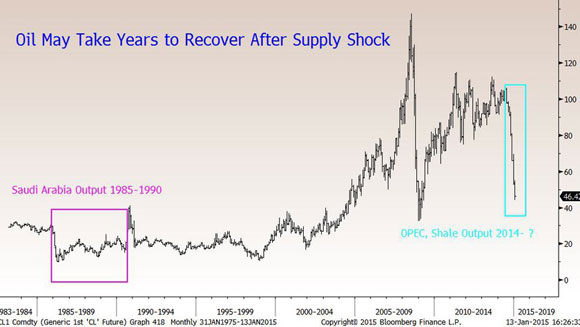
If one number determines the fate of the world economy, it is the price of a barrel of oil. Every global recession since 1970 has been preceded by at least a doubling of the oil price, and every time the oil price has fallen by half and stayed down for six months or so, a major acceleration of global growth has followed. Having fallen from $100 to $50, the oil price is now hovering at exactly this critical level. So should we expect $50 to be the floor or the ceiling of the new trading range for oil? Most analysts still see $50 as a floor – or even a springboard, because positioning in the futures market suggests expectations of a fairly quick rebound to $70 or $80. But economics and history suggest that today’s price should be viewed as a probable ceiling for a much lower trading range, which may stretch all the way down toward $20.

To see why, first consider the ideological irony at the heart of today’s energy economics. The oil market has always been marked by a struggle between monopoly and competition. But what most western commentators refuse to acknowledge is that the champion of competition nowadays is Saudi Arabia, while the freedom-loving oilmen of Texas are praying for OPEC to reassert its monopoly power. Now let’s turn to history – specifically, the history of inflation-adjusted oil prices since 1974, when OPEC first emerged. That history reveals two distinct pricing regimes. From 1974 to 1985, the US benchmark oil price fluctuated between $50 and $120 in today’s money. From 1986 to 2004, it ranged from $20 to $50 (apart from two brief aberrations after the 1990 invasion of Kuwait and the 1998 Russian devaluation).

Finally, from 2005 until 2014, oil again traded in the 1974-1985 range of roughly $50 to $120, apart from two very brief spikes during the 2008-09 financial crisis. In other words, the trading range of the past 10 years was similar to that of OPEC’s first decade, whereas the 19 years from 1986 to 2004 represented a totally different regime. It seems plausible that the difference between these two regimes can be explained by the breakdown of OPEC power in 1985, owing to North Sea and Alaskan oil development, causing a shift from monopolistic to competitive pricing. This period ended in 2005, when surging Chinese demand temporarily created a global oil shortage, allowing OPEC’s price “discipline” to be restored.

Read more …

Just the start.

• Big Oil Gets Serious With Cost Cuts on Worst Slump Since 1986 (Bloomberg)

Major oil companies are awaking from their slumber and facing up to the magnitude of the crash in crude prices. From Shell canceling a $6.5 billion project in Qatar to Schlumberger firing about 9,000 people and Statoil giving up exploration in Greenland, the oil industry this week concluded that the slump is no blip. Top producers follow U.S. shale developers such as Continental in unraveling a boom that produced more oil and natural gas than the world is ready to buy. And there’s certainly more unwinding to come. For most of this month, crude oil has traded below $50 a barrel, a level few predicted even two months ago when OPEC signaled it wouldn’t cut production to defend prices.

If the market stays this depressed, global spending on exploration and production could fall more than 30%, the biggest drop since 1986, according to forecasts from Cowen. “Not too many people expected these levels of oil prices, not even the companies themselves,” said Dragan Trajkov, an analyst at Oriel in London. “Now they have to deal with this new situation and the first impact will be on new investments.” Shell, BP, Chevron and other top producers are preparing to present 2014 earnings to investors at the end of this month or early February and will signal plans for this year. Their chief executive officers are faced with the challenge of assuring shareholders they can see through the depression without cutting dividend payments. The direction of the oil market shows companies probably need to prepare for the worst.

Bank of America, noting the speed global oil inventories are building, forecast Thursday that Brent futures are set to fall to as low as $31 a barrel by the end of the first quarter from about $48 now. That’s even lower than the $36.30 seen during the depths of 2008’s financial crisis. Oil traded above $100 a barrel in July and analysts forecast prices would stay there for years to come. The scale and speed of the price drop has forced companies to start making significant decisions. Shell, Europe’s largest oil company, took the axe this week to a $6.5 billion petrochemicals plant it planned to build in Qatar in partnership with the state oil producer. The company, based in The Hague, said the project wasn’t economically feasible in the current price environment.

Read more …

“Energy companies are expected to cut spending in the U.S. by as much as 35% this year ..”

• Schlumberger Cuts 9,000 Jobs as Oil Slump Portends Uncertainty (Bloomberg)

Schlumberger, the world’s biggest oilfield-services company, tackled the “uncertain environment” of plummeting crude prices head-on by cutting 9,000 jobs and lowering costs at a vessels unit. The 7.1% workforce cutback, along with the reduction and reassessment of its WesternGeco fleet, were among steps leading to a $1.77 billion fourth-quarter charge in anticipation of lower spending by customers in 2015, the Houston- and Paris-based company said in an earnings report Thursday. Energy companies, coping with oil worth less than half its price six months ago, are expected to cut spending in the U.S. by as much as 35% this year, according to Cowen. The number of onshore U.S. rigs could fall by as much as 750 this year, Wells Fargo said. That would be a 43% decline from the 1,744 in operation at the start of the year, according to Baker Hughes. The coming year “is looking like it’s gonna be pretty rough,” Rob Desai, an analyst at Edward Jones in St. Louis, said.

“With the potential for this to last some time, it’s in the best interest of the company to attack it aggressively.” Schlumberger, which had doubled its workforce in the past 10 years, said the one-time charges for the quarter also resulted from the devaluation of Venezuela’s currency and a lower value for production assets it owns in Texas. Net income dropped to $302 million, from $1.66 billion a year earlier. “In this uncertain environment, we continue to focus on what we can control,” Schlumberger Chief Executive Officer Paal Kibsgaard said in the earnings report. “We have already taken a number of actions to restructure and resize our organization.” Shares in oilfield-services companies, which help customers find and produce oil and natural gas, were the first to fall as crude prices declined. Service companies in the Standard & Poor’s Index dropped 20% in the quarter, more than the 18% decline for producers.

Read more …

Hit hard.

• Aberdeen, The Energy-Rich Town Counting The Cost Of The New Oil Shock (Guardian)

Billy Campbell’s three-year-old is spinning around in a Peppa Pig plastic rocket in the middle of Aberdeen’s Union Square shopping mall. It is not hard to believe that the wider Aberdonian population is in a similar spin given the crisis that has struck the Granite City’s key industry: oil and gas. Ed Davey, the energy secretary, and Nicola Sturgeon, Scotland’s first minister, have both rushed to Britain’s oil capital in the last 48 hours to reassure the city that they are aware of looming problems – problems that, the Bank of England governor warned on Wednesday, will deliver a “negative shock” to Scotland’s economy. Some experts think the oil price fall will wipe £6bn off the country’s GDP and Sturgeon is setting up a task force to try to preserve energy jobs.

[..] This is a very affluent city where unemployment is only a little over 2% and incomes are well above the Scottish average. In Aberdeenshire some 38% of households have an income of more than £30,000, compared to 28% across Scotland and just 19% in Glasgow. The Union Square car park is crammed with upmarket models and four-wheel drives – a survey last year by accountants UHY Hacker Young showed that Aberdeenshire has the highest sales of 4x4s in the UK. The car park is just yards away from the massive offshore support vessels that are waiting to load in the harbour beyond. But, away from the downtown bustle of the city centre, not everyone is quite so laid back.

Certainly not those at the sprawling business park at Dyce, close to the airport, where oil firms and the industry’s service companies are congregated. It was here that BP staff were just told that 300 jobs are to be lost from the North Sea business. These are just the latest staff cuts at major oil employers in the region. Shell has taken similar steps, as has Chevron. Companies such as the Wood Group and Petrofac that provide drilling and other support services to the big oil companies have also been cutting costs. Last year Wood slashed 10% off the rates it pays to its contractors, saying operating costs in the North Sea were unsustainable. And that was before the price of oil crashed over the last six months by 60% to its lowest level in six years.

Read more …

Preparing for a bank run.

• Greek Systemic Banks Request Emergency Liquidity Assistance (Kathimerini)

Two Greek systemic banks submitted the first requests to the Bank of Greece for cash via the emergency liquidity assistance (ELA) system on Thursday, sources told Kathimerini. It is thought that requests from the remaining Greek banks will follow in the next few days. The move came in response to the pressing liquidity conditions resulting from the growing outflow of deposits as well as the acquisition of treasury bills forced onto them by the state. Banks usually resort to ELA when they face a cash crunch and do not have adequate collateral to draw liquidity from the European Central Bank, their main funding tool. ELA is particularly costly as it carries an interest rate of 1.55%, against just 0.05% for ECB funding.

The requests by the two lenders will be discussed by the ECB next Wednesday. Bank officials commented that lenders are resorting to ELA earlier than expected, which reflects the deteriorating liquidity conditions in the credit sector. Besides the decline in deposits, banks were dealt another blow on Thursday with the scrapping of the euro cap on the Swiss franc. Bank estimates put the impact of the euro’s drop on the local system’s cash flow at between €1.5 and €2 billion. Deposits recorded a decline of €3 billion in December – a month when they traditionally expand – while in the first couple of weeks of January the outflow continued, although banks say it is under control.

A major blow to the system’s liquidity has come from the repeated issue of T-bills: In November the state drew €2.75 billion in this way, in December it secured €3.25 billion, and it has already tapped another €2.7 billion in January. Of the above amounts, a significant share – amounting to €3 billion according to bank estimates – was in the hands of foreign investors who are not renewing their stakes, so Greek banks have to step in to buy them. Local lenders had also resorted to ELA in 2011 to cope with the outflow of deposits and consecutive credit rating downgrades of the state (and the banks) that made Greek paper insufficient for the supply of liquidity by the Eurosystem. In June 2012, due to the uncertainty of the twin elections at the time, the ELA being drawn by local banks to handle the unprecedented outflow of deposits reached a high of €135 billion. By May 2014, Greek banks had reduced their ELA financing to zero.

Read more …

If politicians – like this guy – don’t understand what deflation is, and most have no clue, that can obviously cause trouble.

• No Risk Of ‘Deflation Spiral’ In Europe: German Minister (CNBC)

Despite data showing that the euro zone has slid into deflation, Germany’s deputy finance minister brushed off concerns that the region could enter a downward spiral of falling prices and lack of demand. “This is not what economists and textbooks describe as a deflation spiral, this is a modest price development,” Steffen Kampeter told CNBC Thursday. Data released last week showed that the 19-country single currency region had entered deflation territory in December. Prices in the euro zone fell 0.2% year-on-year in December, marking the first time since 2009 that prices have dipped into negative territory. The decline in prices has been largely attributed in the cost of oil, which has slipped over 60% since June 2014. However, core inflation, which strips out volatile factors like fuel and unprocessed food prices, was stable at 0.7% in December.

“I see the facts,” Kampeter said. “And the fact is that the core inflation is rising and we have a very moderate and negative price development, especially in energy and raw material.” Deflation concerns analysts because a decline in the price of goods can cause consumers to delay purchases in the hope of further price falls, putting pressure on the broader economy. The figures prompted widespread market speculation that the European Central Bank (ECB) could announce a full-scale quantitative easing program when it meets on January 22. The deputy finance minister wouldn’t comment on any forthcoming ECB action, however. As a German policymaker, Kampeter said he was tasked with looking at structural reforms in Germany and Europe as a whole, and was aiming to ensure that investment in Europe continued in order to keep the region competitive. The Germany economy – which is the largest in the euro zone – has staged something of a turnaround of late, after veering dangerously close to recession in 2014.

Read more …

Today’s episode of The Dog Ate My Homework.

• UK Retailers ‘Throttled’ By Black Friday (Daily Mail)

It’s the American import that has played havoc with Christmas retail sales. Black Friday, where US shops slash their prices on the day after Thanksgiving, has joined the school prom as a stars-and-stripes tradition that has invaded our islands. For UK retailers, it has proved an unwelcome arrival. Far from boosting net sales it has proved a festive nightmare, denting Christmas trading, causing websites to crash, and sparking delivery chaos. Shoppers spent an estimated £810m on Black Friday on November 28 – making it the biggest ever day for UK online sales. But consumers more than made up for their spree by tightening their belts later on, in the run-up to Christmas.

Retailers suffered their slowest December growth in six years as Black Friday disrupted the timing and rhythm of festive sales. Several chains have lined up to blame the event for their lacklustre performance, with Argos owner Home Retail Group claiming to be the latest victim. The company, which fell short of City forecasts, accused Black Friday of fostering ‘a discount mentality’ in the run-up to Christmas, a time of year when shoppers are usually prepared to pay full price for gifts. Marks & Spencer said that it had caused systems at its Castle Donington warehouse to collapse, and Game Digital blamed it for Monday’s profit warning. Home Retail Group’s new chief executive John Walden said: ‘This year’s adoption of ‘Black Friday’ promotional events generally by the UK market significantly impacted the shape of Argos sales over its peak trading period.’

Read more …

But China can make the numbers up as it goes along.

• Warning: China May Trigger Fresh Rout In Commodities (CNBC)

Commodities just can’t catch a break – and China’s GDP release on January 20 could throw another punch at the beleaguered asset class should it underperform expectations, warn analysts. “We are days from the release of China’s Q4 GDP and copper is the best barometer of growth. The rout gives me reason to believe China’s growth is not only moderating but is slowing faster than estimated,” Evan Lucas, market strategist at IG wrote in a note. “If China disappoints next Tuesday, brace for a real rout in commodities,” he said. Copper, regarded as an important indicator of economic health, joined the selloff in commodities Wednesday after the World Bank downgraded its growth outlook for the global economy. The global economy is forecast to expand by 3% this year,the Washington-based lender said in its Global Economic Prospects report released on Tuesday, a notch lower than its previous forecast of 3.4% made in June, but up from an estimated 2.6% in 2014.

The red metal suffered its biggest one-day slide in more than three years on Wednesday, with three-month copper on the London Metal Exchange falling more than 8% at one point to $5,353 a tonne before settling around $5,655 on Thursday. The World Bank expects China’s gradual pace of deceleration to continue,forecasting growth in the world’s second largest economy to slow to 7.1% this year from an estimated 7.4% last year. China plays a dominant role in the commodities market because it’s the world’s largest consumer of energy and metals, including copper. “In our view, the significant pressure on copper price lately indicates either a noticeable slow-down in demand [out of China] or troubles in the shadow banking sector, or both,” said David Cui, strategist at Bank of America Merrill Lynch.

Read more …

“.. shadow bank credit exceeded new yuan-denominated loans for the first time in 2014.”

• China Shadow Banking Surge Chills Stimulus Hopes (CNBC)

Two months ago calls for broad-based stimulus in China were all the rage, but a sudden spike in shadow banking has led analysts to revise their expectations for looser monetary policy. Aggregate social financing, a measure of credit that covers bank lending and shadow banking activity, hit one-year high of 1.69 trillion yuan ($273 billion) in December, up from 1.15 trillion yuan the previous month, official data showed on Thursday. “A surge in shadow bank credit – entrusted loans, trust loans, banker’s acceptances, corporate bonds and non-financial enterprises’ domestic equity – was responsible for December’s considerably larger than expected increase in aggregate financing,” said Tim Condon, head of Asia research at ING in a note on Friday, noting that shadow bank credit exceeded new yuan-denominated loans for the first time in 2014.

China’s central bank surprised markets by cutting interest rates for the first time in two years in November, sparking expectations for further policy easing via interest rate or reserve ratio requirements (RRR) cuts. Tight funding conditions also fuelled hopes for RRR cuts late last year. The seven-day repo rate, a closely-watched measure of interbank lending costs, spiked suddenly to an over one-year high in mid-December, prompting speculation for central bank action to boost liquidity. But Thursday’s data reduce the likelihood that the People’s Bank of China will cut the RRR for lenders, Condon said: “We are reviewing our forecast of 100 basis-points of RRR cuts in the first half of the year for downward revision.” Shadow banking was fairly stable last year after Beijing introduced regulatory measures to clampdown on the sector, such as stricter financing rules for trust companies.

During the July-September period, the shadow banking sector of China’s total social financing contracted for the first time on quarter since the global financial crisis. However, those tightening measures may be the very reason for December’s surge, according to Barclays. “We suspect that borrowers including local government financing vehicles (LGFVs) could have accelerated their financing activities through shadow banking channels, since they might experience difficulties in accessing bond market for new issuance as a result of tightening regulations/declining support from provincial government on new debt,” analysts said in a note on Friday. The sudden spike in shadow banking credit leaves the central bank in a catch-22 situation, Gavin Parry at Parry International Trading said. “Here is the issue for the PBoC; it is facing rampant speculation bubbling in the economy like the stock market, while also facing weaker loan demand, local government funding needs and deflationary forces,” he said.

Read more …

Logical step.

• New Russian/Chinese Credit Rating Agencies To ‘Balance Big Three’ (RT)

The creation of a joint Russian-Chinese credit rating agency will balance the global outlook and give the world an alternative view on how credit ratings should be done, Chinese international relations expert Victor Gao told RT. “Traditionally credit rating is mostly done by Western credit rating agencies. They sometimes may not fully understand the dynamics of the economics of any particular company or the sovereign borrower,” he said, adding that the agency won’t pursue a goal of replacing traditional Western credit rating agencies like S&P and Moody’s. “It will give the whole world another perspective of how risks are analyzed and how credit rating should be done,” he said. Gao believes Western rating agencies claim to be independent and professional, but in fact they turn out to be biased when it comes to issues of geopolitical importance.

“During the global financial crisis the Western rating agencies did not react as quickly as possible,” he said. “In terms of the rating of the sovereign debt of the US for example, or even for Japan, they’ve actually displayed much more flexibility in rating these countries compared with many other countries.” The announcement of a rating could actually make a situation even worse rather than help stabilize it, he added. Credit rating agencies are very much at the top of the international financial system and they’re not only active domestically in one particular country but in many cases they are active across national boundaries.

Gao said that China has its own credit rating agency Dagong which is actively operating in the country and abroad, increasingly estimating other countries’ and companies’ credit rating. The analyst believes the global economy is changing and going through an important transformation as the emerging markets are growing and their portion in the global economy is increasing despite a significant turmoil in the international financial, economic and energy sectors. Creating a joint credit rating agency of Russia and China is significant but it’s high time the world’s most important developing economies united and came up with their own credit rating agency, as in case of establishing the BRICS Development Bank, he said.

Read more …

Up to 60 years old, women up to 50.

• Ukraine President Poroshenko Signs Decree To Mobilize Up To 100,000 (TASS)

Ukrainian President Petro Poroshenko has signed a decree on another mobilization. He put his signature to the document at a meeting with the heads of regional authorities. “I have handed it over to parliament, because it requires approval by the national legislature,” Poroshenko said. Under a decision by the National Security and Defense Council of December 20, 2014, a fourth mobilization wave is beginning on January 20, and two more will be held in April and June.

Some categories of reservists will be exempt from mobilization: men with poor health, university and post-graduate students, clerics, parents having three or more children, and those resident in the territories uncontrolled by the Ukrainian authorities. On January 8, Defense Minister Stepan Poltorak said that in 2015 about 104,000 men may be mobilized, if need be. Ukrainian General Staff spokesman Volodymyr Talalai said that women aged 25 through 50 might be drafted into the army, if necessary.

Read more …

There needs to be far more protest against TTIP, or it’ll be pushed through.

• ‘Corporate Wolves’ Will Exploit TTIP Trade Deal, MPs Warned (Guardian)

The controversial TTIP trade deal between Europe and the US could depress workers’ wages by £3,000 a year and allow “corporate wolves” to sue the government for loss of profit, MPs have heard. The claims were made in a highly-charged House of Commons debate, with many Conservative MPs defending the proposed Transatlantic Trade and Investment Partnership free trade deal and opposition MPs warning that it risks giving too much power to big US corporations. Anti-TTIP campaigners claim one million people have signed a petition against the deal, mainly because of worries that it could open the door to US health companies running parts of the NHS. This has been firmly denied by the UK government and the European commission, who have said public services are explicitly excluded. However, Labour is still worried that the proposals not do enough to protect the public interest.

Many MPs have particular concerns about the investor-state dispute settlement clauses, which would give private companies the right to sue the government in international tribunals for loss of profit arising from policy decisions. Labour MP Geraint Davies, who called the debate, urged negotiators to drop controversial clauses, insisting the judicial system in each country was sufficient protection in mature democracies. His motion called for the UK parliament to play a role in scrutinising any eventual deal, instead of it being passed exclusively by Brussels. “The harsh reality is this deal is being stitched up behind closed doors by negotiators with the influence of big corporations and the dark arts of corporate lawyers – stitching up laws that will be quite outside contract law and common law, outside the shining light of democracy, to in fact give powers to multinationals to sue governments over laws designed to protect their citizens.”

“My view is we should pull the teeth of the corporate wolves scratching at the door of TTIP by scrapping the investor-state dispute settlement rules altogether and so we can get on with the trade agreement without this threat over our shoulder.” Caroline Lucas, the former Green party leader and MP for Brighton Pavilion, said she believed TTIP amounted to a corporate takeover and cited independent research from Tuft University suggesting workers’ wages could suffer by £3,000 a year. “Countries like the Czech Republic, Slovakia and Poland who are in trade agreements which include this kind of investor-state relationship have been sued 127 times and lost the equivalent money that could have employed 300,000 nurses for a year,” she said. “The idea this isn’t a problem is patently wrong; this is about a corporate takeover and that is why it is right to oppose this particular mechanism.”

Read more …

Good man.

• Pope Francis Says Freedom Of Speech Has Limits (BBC)

Pope Francis has defended freedom of expression following last week’s attack on French satirical magazine Charlie Hebdo – but also stressed its limits. The pontiff said religions had to be treated with respect, so that people’s faiths were not insulted or ridiculed. To illustrate his point, he told journalists that his assistant could expect a punch if he cursed his mother. [..] Speaking to journalists flying with him to the Philippines, Pope Francis said last week’s attacks were an “aberration”, and such horrific violence in God’s name could not be justified. He staunchly defended freedom of expression, but then he said there were limits, especially when people mocked religion. “If my good friend Doctor Gasparri [who organises the Pope’s trips] speaks badly of my mother, he can expect to get punched,” he said, throwing a pretend punch at the doctor, who was standing beside him. “You cannot provoke. You cannot insult the faith of others. You cannot make fun of the faith of others. There is a limit.”

Read more …

Jan 142015
 
 January 14, 2015  Posted by at 11:18 am Finance Tagged with: , , , , , , , ,  4 Responses »


Frances Benjamin Johnston Edgar Allan Poe’s mother’s house, Richmond, VA 1930

• Commodities Tumble to 12-Year Low as US Futures Slide (Bloomberg)
• Oil at $40, and Below, Gaining Traction on Wall Street (Bloomberg)
• Oil Fall Could Lead To US Capex Collapse: Jeff Gundlach (Reuters)
• The Stock Market Is Overvalued Any Way You Look At It (MarketWatch)
• Slide in Oil Means Tighter Budgets and Fewer Perks for Gulf Arabs (Bloomberg)
• OPEC’s Squeeze On US Oil Independence Could Succeed (Satyajit Das)
• Low Prices Spark Biggest Surge In Chinese Crude Imports Ever (Zero Hedge)
• EU Top Court Finds ECB’s Bond Buying Plan ‘May Be Legal’ (Zero Hedge)
• Court Decision Could Narrow ECB’s Quantitative Easing Options (FT)
• QE In Europe Will Be Even More Inefficient Than It Was In The US (CNBC)
• Tsipras Says ’Fiscal Waterboarding’ Holding Greece Back (BW)
• Cheap Gas Makes US Only Place Where Export Makes Sense (Bloomberg)
• Oil Collapse of 1986 Shows Rebound Could Be Years Away (Bloomberg)
• As Oil Slips Below $50, Canada Digs In for Long Haul (WSJ)
• Arctic Explorers Retreat From Hostile Waters With Oil Prices Low (Bloomberg)
• Prepare For The Largest Wealth Transfer In History (MarketWatch)
• Germany Balances Budget For First Time Since 1969 (Guardian)
• Half The World Covets The UK’s Precious Inflation (AEP)
• Plunging Oil Prices, Rising Debt Leaves Asia Staring at Deflation (Bloomberg)
• For China, Even Good Numbers Don’t Add Up (Bloomberg)
• China’s $300 Billion Errors May Mask Illicit Outflows (Bloomberg)
• Standard Chartered Loses $4.4 Billion On Commodities, Must Raise Cash (Reuters)
• Middle Eastern Governments Are on Shopping Spree for Former Congressmen (Vice)
• EU-US TTIP Trade Talks Hit Investor Protection Snag (BBC)
• EU Changes Rules On GMO Crop Cultivation (BBC)
• Melting Glaciers Imperil Kathmandu, Perched High Above Rising Seas (Bloomberg)

Getting ugly. Just getting started.

• Commodities Tumble to 12-Year Low as US Futures Slide (Bloomberg)

Commodities (BCOM) tumbled to a 12-year low, led by copper’s biggest decline in almost six years, as slowing global growth curbs demand. Stocks fell around the world, while the yen rose with Treasuries. The Bloomberg Commodities Index slid 1% by 8:24 a.m. in London as copper tumbled 6%. Nickel fell to an 11-month low as crude oil declined. The MSCI All Country World Index fell 0.4% as benchmark gauges in Europe and Asia declined and Standard & Poor’s 500 Index futures lost 0.6%. The yield on 10-year Treasuries matched a 20-month low and German and U.K. bonds rallied. The yen rose a fourth day.

Commodity prices are tumbling as a supply glut collides with waning demand, reducing earnings prospects for producers and increasing the appeal of government bonds as inflation slows. The World Bank cut its global growth outlook, citing weak expansions in Europe and China, the world’s biggest consumer of raw materials. Data today is projected to show a gain in U.S. oil inventories. “Oversupply and falling demand are dragging down commodities beyond oil,” said Ayako Sera, market strategist at Sumitomo Mitsui Trust Bank Ltd. in Tokyo, which oversees $325 billion. “There are a lot of uncertainties and it’s hard to see a reversal in sentiment for the time being. As an investor it’s hard to proactively take on risk at the moment.” [..] “The news everywhere is doom and gloom,” said David Lennox, a resource analyst at Fat Prophets in Sydney. “Prices are going to keep sinking.”

Read more …

Now they tell us 😉

• Oil at $40, and Below, Gaining Traction on Wall Street (Bloomberg)

Brace for $40-a-barrel oil. The U.S. benchmark crude price, down more than $60 since June to below $45 yesterday, is on the way to this next threshold, said Societe Generale and Bank of America. And Goldman Sachs says that West Texas Intermediate needs to remain near $40 during the first half to deter investment in new supplies that would add to the glut. “The markets are continuing to price in huge oversupply in the first half of 2015,” Mike Wittner, head of research at SocGen, said. “We’re going to go below $40.” Oil is seeking a “new equilibrium” as OPEC abandons its role of keeping supply and demand aligned, according to Goldman. Prices are poised to drop further, testing the ability of U.S. shale drillers to keep pumping.

WTI has dropped 14% this month, extending a 46% plunge last year that was the worst since the 2008 financial crisis. OPEC is trying to maintain its share of the global oil market against the rise of U.S. output. United Arab Emirates Energy Minister Suhail Al Mazrouei reiterated yesterday that shale producers will capitulate before OPEC to lower prices, the latest in more than a dozen comments from Gulf members aimed at hastening oil’s slide and lowering non-OPEC supply. The rout may continue to $35 a barrel in the “near term” because both oil supply and demand will have a delayed reaction to falling prices, Francisco Blanch at Bank of America said in a report on Jan. 6.

The U.S. is pumping oil at the fastest pace in more than three decades, helped by a drilling boom that’s unlocked supplies from shale formations including the Eagle Ford in Texas and the Bakken in North Dakota. U.S. output expanded to 9.14 million barrels a day in the week ended Dec. 12, the most since at least 1983, according to the U.S. Energy Information Administration. With Saudi Arabia and other OPEC nations no longer fine-tuning supply, reductions in investment in new production will be the instrument for removing excess output, Jeffrey Currie at Goldman said. This means the collapse will be deeper and the recovery slower than in previous slumps, he said.

Read more …

“.. there is a possibility of a “true collapse” in U.S. capital expenditures and hiring if the price of oil stays at its current level.”

• Oil Fall Could Lead To US Capex Collapse: Jeff Gundlach (Reuters)

DoubleLine Capital’s Jeffrey Gundlach said on Tuesday there is a possibility of a “true collapse” in U.S. capital expenditures and hiring if the price of oil stays at its current level. Gundlach, who correctly predicted government bond yields would plunge in 2014, said on his annual outlook webcast that 35% of Standard & Poor’s capital expenditures comes from the energy sector and if oil remains around the $45-plus level or drops further, growth in capital expenditures could likely “fall to zero.” Gundlach, the co-founder of Los Angeles-based DoubleLine, which oversees $64 billion in assets, noted that “all of the job growth in the (economic) recovery can be attributed to the shale renaissance.” He added that if low oil prices remain, the U.S. could see a wave of bankruptcies from some leveraged energy companies.

Brent has fallen as low as just above $45 a barrel, near a six-year low, having averaged $110 between 2011 and 2013. Gundlach said oil prices have to stop going down so “don’t be bottom-fishing in oil” stocks and bonds. “There is no hurry here.” Energy bonds, for example, have been beaten up and appear attractive on a risk-reward basis, but investors need to hedge them by purchasing “a lot, lot of long-term Treasuries. I’m in no hurry to do it.” High-yield junk bonds have also been under severe selling pressure. Gundlach said his firm bought some junk in November but warned that investors need to “go slow” and pointed out “we are still underweight.”

Read more …

Everything is overvalued.

• The Stock Market Is Overvalued Any Way You Look At It (MarketWatch)

No matter how you slice it, the stock market is overvalued. In fact, based on six well-known and time-tested indicators, equities are more overvalued today than they’ve been between 69% and 89% of the past century’s bull-market tops. To be sure, overvaluation doesn’t immediately doom a market. A year ago, the stock market was almost as overvalued as it is now, and it nevertheless turned in a decent year. But valuation indicators’ inability to forecast the market’s short-term direction doesn’t justify ignoring them altogether. Their longer-term forecasting record is impressive, which means that — sooner or later — the market will succumb to their gravitational force. Consider six widely used valuation indicators. To put their current readings into context, I compared them to where they stood at all bull-market tops since 1900 (using the definition employed by Ned Davis Research). Five of the six indicators show today’s market to be more overvalued than at between 82% and 89% of those previous peaks.

• The price/book ratio, which stands at an estimated 2.6 to 1. The book value dataset I was able to obtain extends only back to the 1920s rather than to the beginning of the century, but at 23 of the 28 major market tops since then, the price/book ratio was lower than it is today.
• The price/sales ratio, which stands at an estimated 1.1 to 1. I was able to put my hands on per-share sales data back to the mid 1950s; at 16 of the 18 market tops since, the price/sales ratio was lower than where it stands now.
• The dividend yield, which currently is 2.0% for the S&P 500. At 30 of the 35 bull-market peaks since 1900, the dividend yield was higher.
• The cyclically adjusted price/earnings ratio, which currently stands at 26.8. This is the ratio championed by Yale University’s Robert Shiller. It was lower than where it is today at 30 of the 35 bull-market highs since 1900.
• The so-called “q” ratio. Based on research conducted by the late James Tobin, the 1981 Nobel laureate in economics, the ratio is calculated by dividing market value by the replacement cost of assets. According to data compiled by Stephen Wright, an economics professor at the University of London, and Andrew Smithers, founder of the U.K.-based economics-consulting firm Smithers & Co., the market currently is more overvalued than it was at 31 of the 35 bull-market tops since 1900.
• The sixth valuation indicator is the one that is least bearish: The traditional price/earnings ratio. According to data on as-reported earnings compiled by Yale’s Shiller, and based on S&P estimates for the fourth quarter, this ratio currently stands at 18.7 to 1. It is higher than it was at 69% of past bull-market peaks.

Read more …

Timebombs.

• Slide in Oil Means Tighter Budgets and Fewer Perks for Gulf Arabs (Bloomberg)

Gulf Arabs are gradually losing perks from free water to cheap fuel as governments hit by the slump in crude prices seek to trim their budgets. Kuwait, Oman and Abu Dhabi reduced subsidies on diesel, natural gas and utilities this month. The plunge on oil markets has added to pressure on the region’s rulers to implement spending cuts that were under discussion before the drop. Countries in the six-member Gulf Cooperation Council have used subsidies to mollify citizens and keep unrest at bay. The subsidies will be gradually removed “as long as there is no major blowback from citizens,” said Jim Krane at Rice University’s Baker Institute for Public Policy in Houston. “Governments have genuine fiscal pressure that adds punch to their call for everyone to tighten their belts.” Spending on subsidies in the GCC surged in the past four decades to reach as much as 10% of economic output in Saudi Arabia, the world’s biggest oil exporter, according to the World Bank.

Gasoline sells at 45 cents a gallon (12 cents a liter) in the kingdom, the cheapest after Venezuela among 61 countries tracked by Bloomberg. Cheap energy has led to a surge in consumption, which risks reducing the oil available for export. State-run Saudi Arabian Oil Co. warned in May that it will have “unacceptably low levels” of oil to sell in the next two decades if domestic power use keeps rising at 8% a year. “With energy demand in the GCC doubling every seven years, these countries can no longer afford to keep subsidizing domestic consumption of their chief export,” Krane said. The Middle East and North Africa accounted for about 50% of global energy subsidies in 2011, according to the IMF, a year when Brent crude averaged $111 a barrel. It was trading at below $47 yesterday. Even if oil recovers to average $65 a barrel this year, the GCC nations will post a combined budget deficit of 6% of gross domestic product, according to Arqaam Capital, a Dubai-based investment bank.

Read more …

“OPEC, the industry cartel through which Saudi Arabia traditionally exerts its influence, is in decline. OPEC’s market share has fallen from more than 50% in 1974 to around 40% currently. ”

• OPEC’s Squeeze On US Oil Independence Could Succeed (Satyajit Das)

The price of crude oil, adjusted for inflation, is at 1979 levels, having fallen by more than 50% since June 2014. Weak demand contributes perhaps 30%-40% of the fall. In 2014, oil demand grew by around 500,000 barrels per day, below the 1.3 million barrels of growth projected earlier, reflecting slack economic activity in Europe, Japan, and emerging markets, especially China. Increased supply accounts for 60%-70% of the decline. High prices and strong demand encouraged new sources of oil to be brought on stream. The U.S. alone has added 3 million barrels a day of new supply in just the past three years, the equivalent of adding another Kuwait to the world oil market. The increased supply has been exacerbated by the refusal of OPEC, led by Saudi Arabia, to cut output for strategic and geopolitical reasons.

OPEC, the industry cartel through which Saudi Arabia traditionally exerts its influence, is in decline. OPEC’s market share has fallen from more than 50% in 1974 to around 40% currently. Compounding OPEC’s problems are efforts to diminish the role of oil as a transport fuel. The poor financial condition of some OPEC members makes it hard for them to reduce production, exacerbating the decline of the cartel’s power and its ability to dictate prices. From the Saudi perspective, the primary benefit of high oil prices has accrued to non-OPEC members. A cut in Saudi or OPEC production to support prices would only further benefit these oil producers. The Saudis are mindful of history. In the mid-1980s, Saudi Arabia cut its output by close to 75% to support weak prices. The Saudis suffered a loss of both revenues and market share.

Other OPEC members and non-OPEC producers benefitted from higher prices. In recent years, Saudi Arabia has regained market share, benefitting from the disruption to suppliers such as Iran, Iraq and Libya. The Saudis are reluctant to cut production, preferring to maintain market share rather than prices. The strategy is to allow oil prices to fall to levels below production costs of high-cost producers and non-traditional oil sources. The average breakeven cost currently is probably between $60 and $70 per barrel. Importantly, U.S. shale oil may not be economically viable below those levels. Perhaps as much as 80% of shale reserves are uneconomic at prices below $80 per barrel, at least based on current technology. In the short run, producers may continue to produce and sell at below breakeven prices. If oil prices stay low for a sustained period, then producers will cut production, with marginal- or higher-cost firms forced to close or declare bankruptcy.

Read more …

China has actually kept oil prices up.

• Low Prices Spark Biggest Surge In Chinese Crude Imports Ever (Zero Hedge)

Despite the collapse of several key industries (cough Steel & Construction cough), Chinese crude oil imports surged by almost 5 million barrels in December – the most on record. This 19.5% surge MoM (and 13.4% YoY) indicates significant efforts to fill the nation’s strategic reserve but – absent this ‘artificial’ demand – spells problems for an already over-supplied global oil market (and its near record contango). A record surge in crude imports in December…

Read more …

Back to the German courts.

• EU Top Court Finds ECB’s Bond Buying Plan ‘May Be Legal’ (Zero Hedge)

Almost a year ago, the German top court found that ECB’s OMT is “illegal”, then promptly washed its hands of the final decision, kicking the ball in the court of the European Court of Justice. Moments ago, the Advocate General Pedro Cruz Villalon of the EU Court of Justice in Luxembourg delivered the non-binding opinion on issue of Mario Draghi’s “unconditional” OMT. Here are the details from Reuters and Bloomberg:

• EU COURT ADVISER SAYS OMT PROGRAMME IN LINE WITH EU LAW SO LONG AS CERTAIN CONDITIONS MET

The conditions:

• EU COURT ADVISER SAYS OMT LEGITIMATE SO LONG AS THERE IS NO DIRECT INVOLVEMENT IN FINANCIAL ASSISTANCE PROGRAMME THAT APPLIES TO STATE IN QUESTION
• EU COURT ADVISER SAYS ECB MUST OUTLINE REASONS FOR ADOPTING UNCONVENTIONAL MEASURES SUCH AS OMT PROGRAMME

[..] Basically, the court has allowed the ECB to drive down borrowing costs using the OMT but it can’t fund bailouts. How the two will be “separated” in a world of fungible money is unclear and will likely be the basis for another court appeal. Bottom line: Draghi’s “unconditional” bazooka just became conditional, but it is still a bazooka, albeit one that will never actually be used since well over two years after it was revealed following Draghi’s famous “whatever it takes” speech, it still has no legal termsheet or basis, and no definition on its pari passu or burden-sharing status. And it never will: after all it was merely meant as a precautionary device designed to scare away the bond vigilantes, and never to be actually implemented.

Read more …

“..the burden for part of the losses could fall on national central banks. That would land quantitative easing in the same murky waters as its emergency liquidity assistance for crisis-riddled banks — a policy that lies far beyond the realms of standard monetary policy.”

• Court Decision Could Narrow ECB’s Quantitative Easing Options (FT)

Splits on the European Central Bank’s governing council had already left Mario Draghi facing tough choices on how to design a quantitative easing package for the eurozone. The European Court of Justice may impose more limits on the ECB president’s options on Wednesday. One of the ECJ’s advocates-general, Pedro Cruz Villalón, will issue an interim ruling on whether an earlier promise to save the region from economic ruin by buying government bonds in potentially unlimited quantities overstepped the ECB’s mandate. Any suggestion that elements of the Outright Monetary Transactions programme, unveiled at the height of the region’s crisis in the summer of 2012, contravene EU law may raise the risk that the ECB’s forthcoming QE package will underwhelm markets.

The chasm between the pro- and anti-QE camps, as well as resistance towards more monetary easing in Germany, are clearly weighing on Mr Draghi’s thinking. He has championed quantitative easing as a way to prevent the eurozone from falling into a damaging spell of deflation. But of the governing council’s 24 members, six last month voted against a decision to increase the ECB’s balance sheet by €1,000bn — a key step to prepare the bank for bond buying. Half the opposition came from the ECB’s internal executive board. The council’s two Germans, Bundesbank president Jens Weidmann and board member Sabine Lautenschläger, remain opposed to the policy.

For the ECB to embark on a policy as controversial as government bond buying, it could not tolerate such a high level of dissent. The issue is all the more charged because of Greece, and the growing fears that its bonds may ultimately be subjected to some form of restructuring, implying losses for whoever ends up holding them. The ECB is already considering breaking one of the most sacrosanct principles of monetary union to appease the hawks. Its chief economist, Peter Praet, has raised the prospect that the burden for part of the losses could fall on national central banks. That would land quantitative easing in the same murky waters as its emergency liquidity assistance for crisis-riddled banks — a policy that lies far beyond the realms of standard monetary policy.

Read more …

All that matters: “.. there is no demand in Europe”

• QE In Europe Will Be Even More Inefficient Than It Was In The US (CNBC)

The market is expecting confirmation of a quantitative easing (QE) plan from European Central Bank (ECB) president Mario Draghi very soon. Indeed, CNBC learned yesterday that the ECB will more than likely base its highly-anticipated sovereign bond buying on the size of contributions made by national central banks. But whatever form it takes, it will almost certainly be the most inefficient bout of QE seen by global markets since the onset of the financial crisis. We already know that yields in Europe are extraordinarily low, and that these have not yet fed through to the broader economy. Further, whether based on gross domestic product (GDP), bond market size, central bank contribution, or sovereign rating, bond buying will be focused towards the core of Germany, Italy and France.

This will likely have little incremental effect in spurring consumers and firms to borrow. We won’t know if U.S. QE worked for at least another few years. If – and I stress if – it did, it will have been because it Fed through to companies due to a well-developed bond market, and because the U.S.’s consumption-led economy has strong multiplier effects. It is unlikely that the ECB’s bond-buying program will be so lucky. Why does the average investor or business borrow money? It is either to increase capital spending to expand, or for financial engineering in order to purchase an existing cash flow (where its value is higher than the cost of debt required to own it). The former increases capital stock, the latter just transfers its ownership.

There is no doubt that U.S. QE has led to both taking place – arguably far more financial engineering than capital generation. The same will be true in Europe, but the balance will be even further towards the financial engineering side. The process by which QE (may have) worked in the U.S. saw banks sell bonds in exchange for “cash” held at the Fed paying minimal interest rates. Essentially, their net interest income (NII) was diluted in return for more profitable core lending. But which euro zone bank, most of which are already struggling for any level of meaningful profitability, is going to sacrifice NII for a negative deposit rate at the ECB when they won’t be able to lend the released capital as there is no demand in Europe?

Read more …

Great metaphor.

• Tsipras Says ’Fiscal Waterboarding’ Holding Greece Back (BW)

Anti-austerity leader Alexis Tsipras said Greece can’t repay its debt as long as its creditors enforce “fiscal waterboarding” and signaled he’ll boost government spending if his Syriza alliance wins power. In an op-ed article in Germany’s Handelsblatt newspaper today, Tsipras said the notion that Greece’s economy has stabilized is an “arbitrary distortion of the facts.” He said that while the economy grew 0.7% in the third quarter, the recession isn’t over because inflation was a negative 1.8%. “We’re facing a shameful embellishment of the statistics to justify the effectiveness of troika policies,” said Tsipras, whose alliance leads Prime Minister Antonis Samaras’s party in polls for parliamentary elections on Jan. 25. Tsipras’s comments addressed audiences in Germany, where Chancellor Angela Merkel has led Europe’s austerity-first response to the debt crisis that spread from Greece in 2010.

The German Finance Ministry declined to comment yesterday on the possibility of a Greek debt cut, one of Tsipras’s demands. “German taxpayers have nothing to fear from a Syriza government,” Tsipras said. “Our goal is not to seek confrontation with our partners, more credits or a blank check for new deficits.” Instead, Syriza would seek a “new deal within the framework of the euro zone” that allows the Greek government to finance growth and restore the nation’s debt sustainability,’’ Tsipras said. Greece’s election hinges on whether voters are willing to accept an extension of the conditions attached to the country’s international bailouts. Greek bond yields declined yesterday by the most since October as concern eased that a Syriza election victory would result in Greece leaving the euro. “The truth is that Greece’s debt cannot be repaid as long as our economy is subjected to constant fiscal waterboarding,” Tsipras said in Handelsblatt.

Read more …

Bad news for Oz.

• Cheap Gas Makes US Only Place Where Export Makes Sense (Bloomberg)

While plunging prices tied to oil have derailed natural gas export projects from Australia to Africa, U.S. plans to build new terminals are getting a boost from a pricing system that charges a set fee to liquefy and ship the gas. The U.S. model is based on how much gas is bought, not on the price of Brent, the global crude oil benchmark. Linking the price of liquefied gas, or LNG, made sense when Brent was above $100 a barrel. Now, it’s priced at less than $50 after losing more than half its value in six months. That means new LNG facilities whose output remains tied to crude prices will struggle to make money even as more capacity comes online.

U.S. suppliers, meanwhile, can be expected to deliver deliver some profits even as energy markets slump, said Chris McDougall at Westlake Securities in Austin, Texas. “Oil prices have dropped but U.S. LNG still looks good,” McDougall said in a telephone interview. “There are enough buyers that are willing to commit to paying some fee for the ability to access U.S. gas pricing.” The deals that link crude and LNG prices are widely used in Asia, at a cost of about 14% of the value of a barrel of Brent for every million British thermal units of gas. Falling oil prices mean cheaper LNG, making the fuel from the region more competitive with U.S. exports and more attractive to buyers. For sellers, sliding prices threaten profit for LNG terminals.

Projects in Australia, for example, would get less than $7 per million Btu of LNG; they need at least $14 to make a profit, according to a study from Harvard University’s Belfer Center for Science & International Affairs. Those figures put U.S.-based suppliers in a winning position, said Leonardo Maugeri at the Belfer Center. At the same time, the U.S. has lower labor and capital costs than Australia, where LNG construction has strained a limited workforce and sent salaries soaring. LNG plants in the U.S. “have the best economics,” said Mauger, a former executive at Italian oil producer Eni SpA, in a telephone interview. “Projects still on paper in Australia for sure will be postponed or will die, and that’s it.”

Read more …

Not sure such comparisons are overly useful.

• Oil Collapse of 1986 Shows Rebound Could Be Years Away (Bloomberg)

The last time excess supply caused a plunge in oil, it took almost five years for prices to recover. The CHART OF THE DAY shows how West Texas Intermediate, the U.S. oil benchmark, tumbled 69% from $31.82 a barrel in November 1985 to $9.75 in April 1986 when Saudi Arabia, tiring of cutting output to support prices, flooded the market. Prices didn’t claw back the losses until 1990. Oil has dropped 57% since June and OPEC members say they’re willing to let prices sink further. Surging prices in the 1970s led to the development of the North Sea and Alaska oil fields. OPEC members also increased capacity, leaving the Saudis to trim output when demand softened. In the 1980s, Saudi Arabia “was tired of the other members cheating and just opened the spigots,” Walter Zimmerman at United-ICAP who predicted last year’s drop, said.

After the plunge in prices “the Saudis lost their nerve and they resumed the role of swing producer. If they hadn’t lost their nerve, we wouldn’t be seeing the shale oil boom today and North Sea production would be substantially lower because investment would have been less,” he said. Investment in new production surged as futures averaged $95.77 a barrel in 2011 through 2013. The combination of horizontal drilling and hydraulic fracturing has unlocked supplies from shale formations, sending U.S. oil output to the highest level in three decades. Russian oil production rose to a post-Soviet record last month and Iraq exported the most oil since the 1980s in December. “If they had allowed prices to stay lower they would have saved themselves many problems in the long run,” Zimmerman said. “Many reserves we take for granted would have never been developed.”

Read more …

Who do they think they’re fooling?

• As Oil Slips Below $50, Canada Digs In for Long Haul (WSJ)

In the escalating war of attrition among top oil-producing nations, Canada’s biggest oil-sands mines have a message for the market: Don’t look to us to cut production. Long the unloved stepchild of so-called unconventional crude production, the oil sands have lured some of the world’s top energy producers to a remote corner of Northern Alberta where the heavy oil deposits are richest. There, they have plowed billions of dollars into building up a sprawling industrial complex amid the surrounding forests. And even as oil prices settled below $50 a barrel Monday for the first time in nearly six years, those companies are unlikely to shut off the tap anytime soon thanks to those huge upfront costs, combined with long-term break-even points and lengthy production lives.

Unlike shale oil, which requires constant drilling of new wells to maintain output levels, once an oil-sands site is developed it will produce tens or hundreds of thousands of barrels a day, steadily, for up to three decades. On Monday, major producer Canadian Natural became the latest to underscore the resilience of oil-sands growth. The company said lower oil prices will force it to trim investment on new projects and curtail its growth forecast—but it still expects overall output to grow about 7% over 2014 levels, and it vowed to keep spending on expanding output at its biggest oil-sands mine over the next two years. Oil prices tumbled to fresh lows Monday as two major banks slashed their price forecasts for crude amid a global supply glut. U.S. oil for February delivery fell 4.7% to $46.07 a barrel.

Brent, the global benchmark, dropped 5.3% to $47.43 a barrel on ICE Futures Europe. Both are at their lowest point in almost six years. Canadian Natural will continue expanding production because it expects higher volume will cut operating expenses at its mainstay Horizon mine, currently at 37.13 Canadian dollars a barrel, by at least another CAN$10 dollars a barrel. “A lot of the costs are fixed in nature,” Chief Financial Officer Corey Bieber said in an interview Monday. “You don’t necessarily increase your workforce in a corresponding ratio [with production]. If you can increase your denominator and manage your numerator effectively, you wind up with a lower cost per barrel.”

Canadian crude exports to the U.S. exceeded 3 million barrels a day in 2014, according to the U.S. Energy Information Administration, a record volume that helped displace other imports, and producers here are looking to tap European and Asian markets. Moves such as those by Canadian Natural ensure the oil sands will continue adding to the global oil glut for a long time to come, regardless of the price of crude. That has implications for spot prices, other major oil producers around the world and the future of key infrastructure plays like the Keystone XL pipeline.

Read more …

Dead in the water.

• Arctic Explorers Retreat From Hostile Waters With Oil Prices Low (Bloomberg)

When Statoil acquired the last of three licenses off Greenland’s west coast in January 2012, oil at more than $110 a barrel made exploring the iceberg-ridden waters an attractive proposition. Less than two years later, the price of oil had been cut by almost half and Norway’s Statoil, the world’s most active offshore Arctic explorer in 2014, relinquished its interest in all three licenses in December without drilling a single well, Knut Rostad, a spokesman, said. Statoil’s decision shows how the plunge in oil, with Brent crude trading at about $45 a barrel, has dealt another blow to companies and governments hoping to tap the largely unexplored Arctic. That threatens to demote the importance of a region already challenged by high costs, environmental concerns, technological obstacles and, in the case of Russia, international sanctions.

“At $50, it just doesn’t make sense,” James Henderson at the Oxford Institute for Energy Studies, said. “Arctic exploration has almost certainly been significantly undermined for the rest of this decade.” The Arctic – spanning Russia, Norway, Greenland, the U.S. and Canada – accounts for more than 20% of the world’s undiscovered oil and gas resources, including an estimated 134 billion barrels of crude and other liquids and 1,669 trillion cubic feet of natural gas, according to the U.S. Geological Survey. That’s almost as much oil as Iraq’s proved reserves at the end of 2013 and 50% more gas than Russia had booked, BP’s Statistical Review of World Energy shows. Yet, explorers seeking a piece of the Arctic prize have been tripped up for years.

After spending $6 billion searching for oil off Alaska over the past eight years, Royal Dutch Shell in October asked for an extension of licenses as setbacks including a stranded oil rig and lawsuits risk delaying drilling further. Cairn Energy spent $1 billion exploring Greenland’s west coast in 2010 and 2011 without making commercial discoveries, and Gazprom has shelved its Shtokman gas field in the Barents Sea indefinitely on cost challenges. Environmental group Greenpeace has occupied oil rigs from Norway to Russia, arguing a spill would cause irreparable damage to ecosystems that sustain animals from polar bears to birds and fish. The possibility that economically marginal fields such as Arctic deposits might be stranded as governments adopt stricter climate policies has also shaken some investors.

Read more …

“The expectation has been that every generation will do better than the last, but this may not be the case with those who bought homes during the economic boom.”

• Prepare For The Largest Wealth Transfer In History (MarketWatch)

While most of us are struggling to regain our net worth after the Great Recession, the richest Americans are preparing to transfer $6 trillion in assets over the next three decades. According to a new report by global wealth consultancy Wealth-X, $16 trillion of global wealth will be transferred over that time — mostly to family members — and 40% of that, or $6 trillion, will be transferred within the U.S. Of that $16 trillion, $6 trillion will be liquid assets and philanthropic bequests comprise $300 billion of this upcoming wealth transfer, Wealth-X found. Ultra-high net worth individuals who are 80 years old or above are on average five times wealthier than those under 40. “This will be the largest wealth transfer in history from one generation to the next,” says Wealth-X President David Friedman.

And many of those passing on their wealth are self-made individuals. Only 25% of those on the Forbes list of the 400 richest Americans were self-made billionaires in 1984, compared with 43% last year. The wealth of the Forbes 400 has soared 1,832% since 1984, from $125 billion to $2.29 trillion last year. Upper-income Americans have also fared well over the last three decades. The wealth gap between America’s upper-income and middle-income families has reached its highest level on record, according to the Pew Research Center. In 2013, the median wealth of the nation’s upper-income families ($639,400) was nearly 7 times the median wealth of middle-income families ($96,500), the widest wealth gap seen in 30 years.

Middle-class Americans won’t be so fortunate when it comes to transferring wealth, however. The expectation has been that every generation will do better than the last, but this may not be the case with those who bought homes during the economic boom. All American households since the recovery have started to reduce their ownership of key assets, such as homes, stocks and business equity, according to a recent survey by the Pew Research Center. From 2007 to 2010, the median net worth of American families decreased by 40%, from $135,700 to $82,300. Rapidly plunging house prices and a stock market crash were the immediate contributors to this shellacking. “Such a large transfer of wealth [among the ultra-wealthy] will exacerbate wealth inequality,” says Signe-Mary McKernan at the Urban Institute. “African-American and Hispanic families are about five times less likely than white families to inherit money and when they do inherit money they inherit less than white families.”

Read more …

“The underlying lack of confidence in the eurozone remained “and that really doesn’t depend very much on whether Germany digs a few more holes and fills them in afterwards again”

• Germany Balances Budget For First Time Since 1969 (Guardian)

Germany has balanced the federal budget for the first time in more than 40 years, helped by strong tax revenues and rock-bottom interest rates, but the extra leeway is unlikely to translate into spending that could boost weak eurozone growth. Berlin had been aiming to achieve a schwarze Null – a balanced budget or one in the black – this year but the finance ministry announced on Tuesday it had got there in 2014, a year ahead of schedule. It is the first time since 1969 that Germany has achieved the feat and is a domestic and European political fillip for Chancellor Angela Merkel’s government, which wrote the goal into a coalition agreement in late 2013 and has preached budget discipline to Greece and other indebted eurozone countries.

Peter Tauber, general secretary of Merkel’s Christian Democratic Union party (CDU), said the budget was a historic success and sent a clear signal to the rest of Europe that Berlin was leading by example and only spending money in its coffers. “This marks a turning point in financial policy: We’ve finally put an end to living beyond our means on credit,” he said. But while Europe’s biggest economy is under pressure from European partners to spend more, some Germans have harboured deep-seated fears of inflation since the hyperinflation of the 1920s that wiped out an entire generation’s savings and many have an aversion to debt.

Christian Schulz, economist at Berenberg Bank, said the government had staked a lot of credibility on balancing the budget and would reap a political dividend from voters “who are very keen on the German government not borrowing more”. But although more spending could boost domestic demand in Germany and imports from the rest of Europe, Schulz said it was unlikely to be at levels that could significantly affect euro zone growth. The underlying lack of confidence in the eurozone remained “and that really doesn’t depend very much on whether Germany digs a few more holes and fills them in afterwards again”, he said.

Read more …

According to Ambrose, all Brits are geniuses. I doubt that.

• Half The World Covets The UK’s Precious Inflation (AEP)

Inflation is now the most precious commodity in the developed world. The great economic powers are almost all trying to steal a little from each other by currency warfare. Perfidious Albion got there first. We are good at the game. Britain still has an emergency reserve, thanks to the good judgement of the Bank of England. The Monetary Policy Committee ignored the howling commentariat and the hard money populists when headline inflation spiked above 5pc. “The MPC should not be obsessive about bringing inflation back to target as rapidly as possible,” was how they nonchalantly put it in the minutes from January 2008. The Bank of England ploughed on with full-blown quantitative easing even through the inflation scare of 2011. That showed courage. Historians will judge this to have been a masterful decision.

The effect was to erode the real debt stock, slash the ratio of household debt to disposable income from 170pc to 147pc, and broadly stabilize the overall debt trajectory. It ensured that the recovery reached “escape velocity” despite the headwinds of fiscal tightening. The UK revived the successful reflation formula of the mid-1930s. It eschewed the failed deflationary formula of the 1920s, which merely pushed debt ratios even higher. The shock fall in CPI inflation to 0.5pc does not yet put Britain at risk. Inflation expectations remain at safe levels. They are not close to becoming “unhinged” – with all kinds of nasty self-fulfilling consequences – though the experience of Japan and now the eurozone tells us how suddenly if can happen if you let your guard down.

The beauty of having a safety buffer is that you can enjoy the benefits of an oil-price crash – a “positive supply shock” in the jargon – without sliding into a debt-deflation trap. It acts as a tax cut. Enjoy it. It is no great mystery why the world is edging from “lowflation” to deflation. It lies in the structure of globalisation over the last quarter century. Above all it lies in China. Chinese factory gate prices are falling at a rate of 3.3pc. There is massive spare capacity. The country’s fixed investment was $8 trillion last year, more than in Europe and North America combined. The country is exporting deflation worldwide. And so is Japan. As I wrote in last week’s column, there is an excess of global capital. The world’s savings rate keeps rising and has hit a record 26pc of GDP. One culprit is the $12 trillion accumulation of foreign reserves by central banks, money that is pulled out of consumption and instead floods the bond market. Large parts of Pacific Rim and central Europe have reached a demographic tipping point. Call it worldwide “secular stagnation” if you want.

Read more …

“Debt to GDP ratio in the region excluding Japan rose to 203% in 2013 from 147% in 2007, with most of the increase coming from companies ..”

• Plunging Oil Prices, Rising Debt Leaves Asia Staring at Deflation (Bloomberg)

Asia’s rapid accumulation of debt in recent years is holding back central banks from easing monetary policy to fight the risk of deflation, endangering private investment needed to boost faltering growth, according to Morgan Stanley. Debt to GDP ratio in the region excluding Japan rose to 203% in 2013 from 147% in 2007, with most of the increase coming from companies, analysts led by Chetan Ahya wrote in a report yesterday. The ratio is close to or has exceeded 200% in seven of 10 nations including China and South Korea, they said. Deflation risk is spreading from Europe to Asia as oil prices plunge, raising the specter of companies and consumers postponing spending and threatening a recovery in the global economy.

Asia could take its cue from the U.S. where a policy of keeping real rates low after the 2008-2009 global financial crisis encouraged private-sector investment and boosted productive growth, the analysts said. “When real rates are high, only the public sector or government-linked companies will take on leverage,” the Morgan Stanley economists wrote in the report. The key concern with an approach of keeping real rates at elevated levels is that the private sector will remain hesitant to take up new investment, which is critical for reviving productivity, the report said. Asia’s policy makers are balancing the need to support domestic demand and curbing debt and asset bubbles. While China cut its one-year lending rate in November, officials have held off on broader easing measures as they sought to avoid exacerbating a build-up in nonperforming loans.

Read more …

“We’ve got the biggest debt bubble that the world has ever seen and credit is continuing to grow twice as fast” as output ..”

• For China, Even Good Numbers Don’t Add Up (Bloomberg)

The improving U.S. economy has brought some welcome cheer to officials in Beijing, which reported an unexpectedly high 9.7% jump in December exports on Tuesday. If those numbers continued in months ahead, they’d also be good news for a global economy that’s running short on viable growth engines. Not all analysts are convinced they will; many predict that China will have to loosen monetary policy soon in order to ensure that GDP growth stays above last year’s target of 7.5% (it’s currently around 7.3%). That’s worrisome because of a different number entirely: 251. That, in percentage terms, is Standard Chartered’s working estimate for China’s debt-to-GDP ratio. Already worryingly high compared to where Japan was 25 years ago when its own bubble burst, the number will only rise further with additional stimulus.

The more China gins up growth in 2015, the more irresponsible lending it will have to service in the decade ahead. The math simply doesn’t work out. Even if China could somehow return to the heady days of 10%-plus GDP growth, its debt mountain would by then be nearly unmanageable. “We’ve got the biggest debt bubble that the world has ever seen and credit is continuing to grow twice as fast” as output, Charlene Chu, a former Fitch Ratings analyst, said. Those who believe China can somehow grow its way out of this problem are fooling themselves. “Mathematically, that’s impossible when something is twice as big as something else and growing twice as fast,” as Chu noted. From Japan to Argentina to Greece, recent decades offer many examples of governments thinking 1+1=3.

It took Japan more than a decade after its bubble burst in 1990 to create the Resolution and Collection Corporation, modeled after America’s Resolution Trust Corporation, to dispose of bad loans. China can’t afford to wait that long to head off a full-blown crisis. It’s one thing for a $24 billion economy like Argentina to blow up; it would be quite another if the world’s second-biggest plunged into turmoil. Yet for all the official talk about curbing borrowing and adjusting to a “new normal” of lower growth, Xi’s government still hasn’t shown the stomach necessary to bring China’s debt problems out into the open and deal with them. Even one of the first defaults on an offshore bond by a Chinese developer last week ended happily. Kaisa Group missed a $23 million interest payment, but quickly received a waiver from HSBC. Since all property companies won’t get last-minute reprieves, these kind of maneuvers just delay a reckoning.

Read more …

Much of this is Communist Party members and their families.

• China’s $300 Billion Errors May Mask Illicit Outflows (Bloomberg)

China’s balance of payments figures are suggesting a pickup in covert fund outflows, which may spur the central bank to keep the yuan stable, according to Goldman Sachs. Errors and omissions, an accounting practice used by nations to balance numbers when official records of cross-border flows don’t match, were equivalent to net outflows of more than $300 billion since 2010, Goldman Sachs economists MK Tang and Maggie Wei wrote. That included a record $63 billion in the third quarter of 2014, a year in which yuan sentiment soured and President Xi Jinping’s anti-corruption drive widened. “Such outflows probably have an illicit nature, occurring through opaque channels and falling outside of effective regulatory oversight,’” Tang and Wei wrote.

“Illicit flows are probably harder to control and hence could represent a more worrying source of risk to financial stability.” President Xi’s campaign to rein in corruption has ensnared more than 480 officials spanning all of China’s provinces and largest cities. Cash outflows may tighten funding conditions at a time when the government is attempting to lower borrowing costs to boost an economy estimated to have grown at the slowest pace since 1990 last year. One-year interest-rate swaps, the fixed payment to receive the floating seven-day repurchase rate, have risen 18 basis points to 3.32% since the People’s Bank of China cut interest rates in November for the first time since 2012. The yield on the five-year government bond has risen four basis points, or 0.04 percentage point, to 3.52%.

As falling confidence in the yuan will exacerbate any hidden outflows, the PBOC may aim to maintain a stable exchange rate, according to the Goldman Sachs economists. The U.S. lender expects the authority to weaken its daily fixing for the yuan only slightly to 6.16 a dollar in three months and to 6.20 in a year, compared with 6.1195 today. It is not in the authority’s interest to allow the yuan to decline because that could lead to capital outflows and increase financial risk, Australia & New Zealand Banking economists Liu Li-Gang and Zhou Hao said. The currency is unlikely to drop sharply in 2015, they wrote.

Read more …

Carnage awaits. Everything is overvalued thanks to QE.

• Standard Chartered Loses $4.4 Billion On Commodities, Must Raise Cash (Reuters)

Asia-focused bank Standard Chartered could need $4.4 billion of extra provisions to cover losses from commodities loans, potentially forcing it to raise billions of dollars from investors, analysts said on Monday. Credit Suisse analysts said the losses could force Standard Chartered to raise $6.9 billion to improve its core capital ratio to 11% by the end of the year. “We think the needed provisioning could be large enough to require further capital measures, such as further equity raisin, and/or dividend reductions,” analyst Carla Antunes-Silva said in a note. A jump in Standard Chartered’s bad debts in the third quarter has prompted concern that it could face heavy losses from commodities loans after the fall in the price of oil and commodities.

Credit Suisse’s estimate was based on an “adverse” scenario that would see the bank need $4.4 billion to maintain its capital ratio, based on a potential $2.6 billion of pretax provisioning for commodities loans that sour and a higher risk-weighting on the loans. It said the bank could announce a rights issue or cut the dividend at its 2014 results, due on March 4. “We believe the last two years of de-rating have been driven largely by weaker revenue and that the asset quality deterioration leg is now setting in,” said Credit Suisse, maintaining its “underperform” rating on the stock.

Analysts at JPMorgan and Jefferies also cut their target prices on the stock on Monday, saying that credit quality could deteriorate. Standard Chartered CEO Peter Sands is under pressure after a troubled two years in which profits have fallen, halting a decade of record earnings. Some investors have said that Sands should go or the bank should set out succession plans. Sands last week announced plans to close the bulk of the bank’s equities business and axe 4,000 jobs in retail banking as part of a turnaround plan to cut costs and sharpen its focus.

Read more …

Here’s your democracy, America.

• Middle Eastern Governments Are on Shopping Spree for Former Congressmen (Vice)

For ex-congressman and GOP strategist Vin Weber, Christmas came a few days early and from an unlikely source: the Qatari government. In December, three days before the holiday, the former Minnesota lawmaker and his lobbying firm, Mercury, signed a lucrative lobbying contract with the Gulf State,receiving a $465,000 advance for the first few months of work. Weber isn’t alone. Over the past year and a half, regimes throughout the Middle East, from Turkey to the United Arab Emirates, have gone on what appears to be a shopping spree for former members of Congress. Compared to the rest of the world, Middle East governments have accounted for more than 50% of the latest revolving door hires for former lawmakers during this time period, according to a review of disclosures by VICE. It’s not out of the ordinary for special interest groups to enlist retired lawmakers-turned-lobbyists to peddle influence in the U.S. Capitol.

What’s unique here is that most special interests aren’t countries home to investors accused of providing support to anti-American militants in Syria or engaged in multi-billion dollar arms deals that require American military approval, as is the case with Qatar and some of its regional neighbors. What’s also striking about the latest surge in foreign lobbying is that many of these former lawmakers maintain influence that extends well beyond the halls of Congress. Former Michigan Representative Pete Hoekstra, who used to chair the House Intelligence Committee, appears regularly in the media to demand that the US increase its arms assistance to the Kurds in northern Iraq. Writing for the conservative news outlet National Review, Hoekstra argued that, “the United States needs to immediately provide [the Peshmerga] with more than light arms and artillery to tip the scales in their favor and overcome the firepower of the Islamists.”

In that instance and in others, Hoekstra has often not disclosed that since August 12th, he has worked as a paid representative of the Kurdistan Regional Government, which relies on the beleaguered Peshmerga militia for safety against ISIS. The same goes for former US Senator Norm Coleman, a lobbyist who serves on the board of the influential Republican Jewish Coalition, and whose Super PAC, American Action Network, spent over $12.3 million to help elect Republicans last year. Since July, Coleman has been a registered lobbyist for the Kingdom of Saudi Arabia, hired in part to work on sanctions against Iran, a key priority of Saudi Arabia’s ruling family. Shortly after signing up as a lobbyist for the Saudis, Coleman, introduced only as a former Senator, gave a speech on Capitol Hill imploring his congressional allies to realize that Israel and Saudi Arabia have many shared policy priorities, and that the United States “should be hand in glove with our allies in the region.”.

Read more …

Throw it out already!

• EU-US TTIP Trade Talks Hit Investor Protection Snag (BBC)

EU-US talks aimed at clinching a comprehensive free trade deal have run up against “huge scepticism” in Europe, the European Commission says. The Commission has published the results of a public consultation on investor protection – one of the most contentious areas under discussion. There were many objections to the idea of using independent tribunals with power to overrule national policies. A lot of work is needed on future investment rules, the Commission says. The talks on a Transatlantic Trade and Investment Partnership Agreement (TTIP) are continuing, but the important area of investor protection has been suspended for now. There are widespread fears in Europe that EU standards might be weakened in some areas, in a trade-off to satisfy powerful business lobbies and revive Europe’s struggling economies.

A Commission study estimates that a TTIP deal could boost the size of the EU economy by €120bn (£94bn; $152bn) – equal to 0.5% of the 28-member bloc’s total GDP – and the US economy by €95bn (0.4% of GDP). But the Commission acknowledges public concern about court cases in which powerful companies have sued governments over public policy. Swedish energy giant Vattenfall brought a claim against the German government over its move to decommission nuclear power plants. And US tobacco giant Philip Morris sued the Australian government over the introduction of plain packaging for cigarettes. In the UK concern has focused on the National Health Service and the possible involvement of US firms in healthcare services. Of the total responses in the consultation 35% came from the UK – the largest share – and Austria was second.

Read more …

“Under the new law, the grounds for a ban on any GM variety will be expanded. National governments will in future be able to cite factors such as protection of a particular ecosystem or the high cost of GM contamination for conventional farmers.”

• EU Changes Rules On GMO Crop Cultivation (BBC)

The EU has given governments more power to decide whether to plant genetically modified (GM) crops, which are highly restricted in Europe. The European Parliament has passed a new law giving states more flexibility by a big majority. A type of maize – MON 810 – is the only GM crop grown commercially in the EU. Although Euro MPs and ministers have agreed to give states more flexibility, EU scientists will still play a key role in authorisations. GM crops are used widely in the US and Asia, but many Europeans are wary of their impact on health and wildlife. It is one of the toughest issues at the EU-US talks on a free trade deal, as farming patterns in Europe – including GM use – differ greatly from North America. The new law only applies to crops and does not cover GM used in animal feed, which can still enter the human food chain indirectly.

Last July the new EU Commission President, Jean-Claude Juncker, said the legal changes were necessary because under current rules “the Commission is legally obliged to authorise the import and processing of new GMOs [genetically modified organisms], even in cases where a clear majority of member states are opposed to their use”. Spain is by far the biggest grower of MON 810 in Europe, with 137,000 hectares (338,000 acres), the European Commission says. Yet the EU total for MON 810 is just 1.56% of the EU’s total maize-growing area. MON 810 is marketed by US biotech giant Monsanto and is modified to be resistant to the European corn borer, a damaging insect pest. The maize variety is banned in Austria, Bulgaria, France, Germany, Greece, Hungary and Luxembourg. Under the new law, the grounds for a ban on any GM variety will be expanded. National governments will in future be able to cite factors such as protection of a particular ecosystem or the high cost of GM contamination for conventional farmers.

Read more …

“Diesel vehicles that would have been phased out in Europe years ago choke its narrow lanes, making cloth face masks indispensable.”

• Melting Glaciers Imperil Kathmandu, Perched High Above Rising Seas (Bloomberg)

A month’s walk from the nearest sea, Kathmandu – elevation almost a mile – is as vulnerable to climate change as the world’s coastal megacities. The capital of the poorest Asian country after Afghanistan already is feeling the effect: Rising temperatures are crimping power and food supplies as rural migrants stream to a city of 1 million that’s among the world’s most crowded. “Kathmandu is the country’s production and consumption center,” said Mahfuzuddin Ahmed, an adviser in the Manila-based Asian Development Bank’s regional and sustainable development department. “Any climate-related hazards that spill into the national economy will be amplified there.” The mountainous Himalayan nation may have crossed a tipping point of irreversible damage. Its glaciers have lost about a third of their ice reserves since 1977.

Just like giant icebergs in the ocean, those glaciers play a critical role in the high-altitude jet streams that can delay monsoons, prolong droughts or spawn storms. “It’s affecting daily life,” says Ram Sharan Mahat, Nepal’s finance minister. He calculates the economy will grow half a percentage point slower this fiscal year because of an erratic monsoon that hit crops, the mainstay of the economy. “I’m sure that’s largely attributable to climate change.” Ahmed led a June study projecting Nepal could lose 10% of its annual gross domestic product by 2100 because of climate change. That makes it the second-most vulnerable in the region after the Maldives. There’s something a mountain city like Kathmandu – some 600 miles (966 kilometers) from the Indian Ocean – shares with an atoll threatened with extinction from rising seas: a spectacular incapacity to do much about it.

An acrid brown smog shrouds the metropolis, obscuring the snow-capped Himalayan peaks in the distance that beckon trekkers worldwide. Diesel vehicles that would have been phased out in Europe years ago choke its narrow lanes, making cloth face masks indispensable. Residents shop for vegetables and spices by candlelight amid blackouts lasting most of the day in the winter, when hydropower plants sputter as snow-fed rivers dry up. Garbage has turned the city’s sacred Bagmati River into a sewer, too filthy for fish to survive, though Hindu worshipers still bathe in its waters.Economists and environmental experts warn that climate change will hurt those who have the least because they don’t have the resources or capacity to minimize the threats.

Read more …

Dec 102014
 
 December 10, 2014  Posted by at 12:36 pm Finance Tagged with: , , , , , , , , , , ,  4 Responses »


Marjory Collins “Crowds at Pennsylvania Station, New York” Aug 1942

• China Inflation Eases To Five-Year Low (BBC)
• Popping The Chinese Stock Market Mania (Zero Hedge)
• Easy Credit Feeds Risky Margin Trades In Chinese Stocks (Reuters)
• Why Beijing’s Troubles Could Get a Lot Worse (Barron’s)
• OPEC Says 2015 Demand for Its Crude Will Be Weakest in 12 Years (Bloomberg)
• Don’t Look For Oil Glut To End Any Time Soon (CNBC)
• Oil Resumes Drop as Iran Sees $40 If There’s OPEC Discord (Bloomberg)
• “Yes, it Was a Brutal Week for the Oil & Gas Loan Sector” (WolfStreet)
• US Shale Contractors To See Net Income Cut By 25% In 2015 (Bloomberg)
• This Time Is The Same: The Fed Ignores The Shale Bubble (David Stockman)
• Thanksgiving Weekend Box Office Plunges 20% vs 2013 To 16-Year Low (Alhambra)
• Greece Lurches Back Into Crisis Mode (Bloomberg)
• Japan Threatened With Credit Rating Downgrade (CNBC)
• Citigroup Sets Aside $2.7 Billion For Legal Costs (BBC)
• This Is What 6 Years Of Central Bank Liquidity Injections Look Like (Zero Hedge)
• Big US Banks Face Capital Requirement of 4.5% on Top of Global Minimum (BBG)
• Stop Believing The Lies: America Tortured More Than ‘Some Folks’ (Guardian)
• Defeat is Victory (Dmitry Orlov)
• Rising Inequality ‘Significantly’ Curbs Growth (CNBC)
• TTIP Divides A Continent As EU Negotiators Cross The Atlantic (Guardian)
• Ebola Virus Still ‘Running Ahead Of Us’, Says WHO (BBC)

The economy allgedly grows at 7%, and official inflation is 1.4%?

• China Inflation Eases To Five-Year Low (BBC)

Inflation in China eased to a five-year low in November, suggesting continued weakness in the Asian economic giant. The inflation rate fell to 1.4% in November from 1.6% in October, which is the lowest since November 2009. The reading was also below market expectations of a 1.6% rise. Producer prices, which have been entrenched in deflation, also fell more than forecast, down 2.7% from a year ago – marking a 33rd consecutive monthly decline. Economists had predicted a fall of 2.4% after drop of 2.2% in the previous month as a cooling property market led to slowing demand for industrial goods. The figures are the latest in a string of government data that showed a deeper-than-expected slowdown in the Chinese economy.

Dariusz Kowalczyk, an economist at Credit Agricole, said the data partly reflected low commodity and food prices but also confirmed softness in domestic demand. “It will likely convince policymakers to ease their policy stance further and we continue to expect a RRR (bank reserve requirement ratio) cut in the near term, most likely this month,” he told Reuters. Last month, the country’s central bank unexpectedly cut interest rates for the first time in more than two years to spur activity. In reaction to the data, Chinese shares continued their downward trend after the Shanghai Composite fell more than 5% on Tuesday.

Read more …

“On both prior occasions of such a maniacal surge in speculative accounts, the Shanghai Composite made a significant top and fell dramatically in the ensuing months.”

• Popping The Chinese Stock Market Mania (Zero Hedge)

If you are wondering what triggered the PBOC to pull the punchbowl of leveraged collateral away from the ‘wealth-creating’ stock market exuberance in China… wonder no more. The last 2 weeks saw the biggest surge in new Chinese brokerage accounts ever, with this week alone the highest since October 2010 and January 2008 with a stunning 228,000 new accounts opened. On both prior occasions of such a maniacal surge in speculative accounts, the Shanghai Composite made a significant top and fell dramatically in the ensuing months.

How oddly dis-similar the PBOC is to the Fed!! Instead of encouraging open leveraged speculation, the central bank of China appears more risk averse, recognizing the potential medium-term disastrous consequences from such boom-bust moves (and likely has no cheer-leading CNBC channel to take care of).

Read more …

Oh boy: “Some might already be regretting taking those risks [..] Especially those who might have pledged their property to get in on the rally and offset the slide in house prices.”

• Easy Credit Feeds Risky Margin Trades In Chinese Stocks (Reuters)

“High leverage, low thresholds!” the website says. “(China’s) A shares are heating up; if you don’t allocate capital now, then when?” Many, it appears, are choosing now, gorging on cheap credit to ride a wild stock market rally. The website, Jinfuzi.com, will let investors borrow up to 10 times their principal with only 2,000 yuan ($323) down in order to buy stocks and futures. The peer-to-peer lender has an easy sell; Chinese benchmark indexes have posted record-smashing trading volumes in recent weeks, with average share values up over 30% in just 12 trading days. Ordinary investors, who conduct 60-80% of China’s stock trades, charged into the market after a surprise interest rate cut by Beijing on Nov. 21, and brokerages and shadow bankers have rushed in to help them trade on margin – essentially borrowed money.

“Margin trading has clearly played a big role in the recent rally, and government is worried,” wrote Oliver Barron of NSBO in a research note on Tuesday, estimating that gross margin trading purchases accounted for 164 billion yuan ($26.5 billion) on Monday, the equivalent of 17% of total turnover on Chinese bourses. There has been a steady relaxation of restrictions on margin trading in the last two years, and while in good times it allows investors to make a lot of money with only a small amount of their own cash, it also carries big risks when the market falls.

Some might already be regretting taking those risks after the Shanghai Composite Index lost over 5% on Tuesday, its largest single-day drop in five years. Especially those who might have pledged their property to get in on the rally and offset the slide in house prices. “We provide our customers with service to borrow money with their property as collateral,” said Mr. Yu, president of Qianteng Asset Management Company in Hangzhou. “We have plenty of funds on hand, which makes it easy for our customers to get money ASAP once they sign the contract.”

Read more …

“In China, the Heisenberg uncertainty principle of physics holds sway, whereby the mere observation of economic numbers changes their behavior.”

• Why Beijing’s Troubles Could Get a Lot Worse (Barron’s)

Few foreigners know China as intimately as Anne Stevenson-Yang does. She has spent the bulk of her professional life there since first arriving in 1985, working as a journalist, magazine publisher, and software executive, with stints in between heading up the U.S. Information Technology office and the China operations of the U.S.-China Business Council. She’s now research director of J Capital, an outfit that works for foreign investors in China doing fundamental research on local companies and tracking macroeconomic developments.

Barron’s: Investors seem far more concerned about Europe’s sinking into economic despond than slowing growth in China. Are they whistling past the graveyard?

Stevenson-Yang: I think so. China, for all its talk about economic reform, is in big trouble. The old model of relying on export growth and heavy investment to power the economy isn’t working anymore. Sure, the nation has been hugely successful over recent decades in providing its people with literacy, a decent life, basic health care, shelter, and safe cities. But starting in 2008, China sought to counter global recession with huge amounts of ill-advised investment in redundant industrial capacity and vanity infrastructure projects—you know, airports with no commercial flights, highways to nowhere, and stadiums with no teams. The country is now submerged by the tsunami of bad debt that begets further unhealthy credit growth to service this debt. The recent lowering of benchmark deposit rates by the People’s Bank of China won’t accomplish much because it won’t offer more income to households. It also gave China’s biggest banks the discretion to raise their deposit rates back up to old levels, which would give them a competitive advantage

Barron’s: How bad can the situation be when the Chinese economy grew by 7.3% in the latest quarter?

Stevenson-Yang: People are crazy if they believe any government statistics, which, of course, are largely fabricated. In China, the Heisenberg uncertainty principle of physics holds sway, whereby the mere observation of economic numbers changes their behavior. For a time we started to look at numbers like electric-power production and freight traffic to get a line on actual economic growth because no one believed the gross- domestic-product figures. It didn’t take long for Beijing to figure this out and start doctoring those numbers, too. I put much stock in estimates by various economists, including some at the Conference Board, that actual Chinese GDP is probably a third lower than is officially reported. And as for the recent International Monetary Fund report calling China the world’s biggest economy on a purchasing-power-parity basis, how silly was that? China is a cheap place to live if one is willing to eat rice, cabbage, and pork, but it’s expensive as all get out once you factor in the cost of decent housing, a car, and health care.

I’d be shocked if China is currently growing at a rate above, say, 4%, and any growth at all is coming from financial services, which ultimately depend on sustained growth in the rest of the economy. Think about it: Property sales are in decline, steel production is falling, commercial long-and short-haul vehicle sales are continuing to implode, and much of the growth in GDP is coming from huge rises in inventories across the economy. We track the 400 Chinese consumer companies listed on the Shanghai and Shenzhen stock markets, and in the third quarter, their gross revenues fell 4% from a year ago. This is hardly a vibrant economy.

Read more …

Demand is way down.

• OPEC Says 2015 Demand for Its Crude Will Be Weakest in 12 Years (Bloomberg)

OPEC cut the forecast for how much crude oil it will need to provide in 2015 to the lowest in 12 years amid surging U.S. shale supplies and reduced estimates for global consumption. The Organization of Petroleum Exporting Countries lowered its projection for 2015 by about 300,000 barrels a day, to 28.9 million a day. That’s about 1.15 million a day less than the group’s 12 members pumped last month, and the 30-million barrel target they reaffirmed at a meeting in Vienna on Nov. 27. The impact of this year’s 40% price collapse on supply and demand remains unclear, OPEC said. “The downward revision reflects the upward adjustment of non-OPEC supply as well as the downward revision in global demand,” the group’s Vienna-based research department said in its monthly oil market report.

Brent crude futures collapsed to a five-year low of $65.29 a barrel in London yesterday amid speculation that OPEC’s decision to maintain output levels despite swelling North American supplies will intensify the glut in global oil markets. Demand for OPEC’s crude will slump to 28.92 million barrels a day next year, according to the report. That’s below the 28.93 million required in 2009, and the lowest since the 27.05 million a day level needed in 2003, the group’s data show. Output from the 12 members declined by 390,000 barrels a day in November to 30.05 million a day amid lower production in Libya, according to data from analysts and media organizations referred to in the report as ‘‘secondary sources.” Libyan output dropped last month by 248,300 barrels a day to 638,000 a day. Pumping at the Sharara oil field, the country’s biggest-producing asset, and the neighboring El Feel site, was halted after Sharara was seized by gunmen, according to the International Energy Agency.

Read more …

But OPEC will fight for market share, or rather its separate mebers will.

• Don’t Look For Oil Glut To End Any Time Soon (CNBC)

The global oil glut is expected to get much bigger before it’s over, keeping pressure on oil prices well into next year. Companies like ConocoPhillips and Chevron are reducing spending on new projects, but the impact of already planned increases in U.S. production into the first half of the year is likely to keep the world well supplied before the flow of new supply starts to slow in the second half of the year. Besides shale production, U.S. Gulf of Mexico production is also expected to increase with new projects coming on line. Within a year, the projects will take U.S. Gulf production from 1.3 million barrels to roughly 1.6 million barrels a day. “It’s not like the supply reaction is instantaneous. It takes time to wind these things down,” said John Kilduff of Again Capital. “I wouldn’t expect a decrease in the rate of (production) growth until next year at the earliest.”

The U.S. Energy Information Administration on Tuesday cut its forecast for daily U.S. production by another 100,000 barrels, to 9.3 million. That follows a reduction in its forecast of 100,000 barrels per day last month. The U.S. produced 9.08 million barrels a day in the week of Nov. 28 and has been producing over 9 million barrels a day for the past month. The government’s forecast for 2015 is now below some private analysts’ assumptions that oil production can continue to grow at a higher rate of anywhere from 500,000 to more than 1 million barrels per day next year, depending on oil prices. The EIA on Monday issued a new report on U.S. oil production showing the increase in production in the three main shale plays—Bakken, Permian and Eagle Ford—is growing by more than 100,000 barrels a day in December over November, and is expected to increase at about the same rate in January.

Read more …

Discord is all that’s left at OPEC. Nobody can risk the initial losses of an output cut. And nobody trusts the others.

• Oil Resumes Drop as Iran Sees $40 If There’s OPEC Discord (Bloomberg)

Brent resumed its decline as an Iranian official predicted a further slump in prices if solidarity among OPEC members falters. West Texas Intermediate in New York also erased yesterday’s gains. Futures slid as much as 1.6% in London after snapping a five-day losing streak. Crude could fall to as low as $40 a barrel amid a price war or if divisions emerge in OPEC, said an official at Iran’s oil ministry. The 12-member group, which supplies 40% of the world’s oil, may need to call an extraordinary meeting in the first quarter if the drop continues, according to Energy Aspects Ltd. Brent has collapsed 40% this year as OPEC agreed at a Nov. 27 gathering not to cut output to force a slowdown in U.S. production, which has risen to the highest level in three decades. Saudi Arabia and Iraq this month widened discounts on crude exports to their customers in Asia, bolstering speculation that group members are fighting for market share.

“With OPEC looking like a dysfunctional family, no pullback in U.S. production and a lack of geopolitical concerns, it’s all adding up to lower prices,” Michael McCarthy, a chief strategist at CMC Markets in Sydney, said by phone today. Brent for January settlement decreased as much as $1.06 to $65.78 a barrel on the London-based ICE Futures Europe exchange and was at $66.25 at 3:12 p.m. Singapore time. The contract climbed 65 cents to $66.84 yesterday. The European benchmark crude traded at a premium of $3.12 to WTI. WTI for January delivery fell as much as $1, or 1.6%, to $62.82 a barrel in electronic trading on the New York Mercantile Exchange. It increased 77 cents to $63.82 yesterday. The volume of all futures traded was about 2% below the 100-day average.

Oil’s collapse has left the market below equilibrium, according to Mohammad Sadegh Memarian, the head of petroleum market analysis at the oil ministry in Tehran. Iran, hobbled by economic sanctions over its nuclear program, wants to raise production to 4.8 million barrels a day once the curbs are removed, he said at a conference in Dubai yesterday. OPEC pumped 30.56 million barrels a day in November, exceeding its collective target of 30 million for a sixth straight month, a Bloomberg survey of companies, producers and analysts showed. Financially strapped members such as Iran, Iraq and Venezuela may press for discussions before the group’s next scheduled meeting on June 5, predicted Amrita Sen, the chief oil market analyst at Energy Aspects.

Read more …

And more’s to come.

• “Yes, it Was a Brutal Week for the Oil & Gas Loan Sector” (WolfStreet)

Yesterday, I discussed how the plunging price of oil is wreaking havoc on leveraged loans in the energy sector. These loans are issued by junk-rated corporations already burdened by a large amount of debt. Banks that originate these loans can retain them on their balance sheets or sell them in various creative ways, including by repackaging them into synthetic structured securities, called Collateralized Loan Obligations. Earlier today, I discussed how the current generation of leveraged loans in general compares to the leveraged loans issued at the cusp of the Financial Crisis. Spoiler alert: by almost every metric, they’re bigger and crappier now than they were in 2007.

So here’s a chart of S&P Capital IQ’s energy-sector leveraged-loan index for the latest week, and it was such a doozie that it caused leveraged-loan focused LCD News, a unit of S&P Capital IQ, to tweet: “Yes, it Was a Brutal Week for the Oil & Gas Loan Sector.” The average bid price of first-lien oil & gas Index loans fell to 90.35 cents on the dollar for the week, from 94.90 at the November 28 close and down from 96.77 at the end of October, S&P Capital IQ’s LeveragedLoan.com reported. And yields soared: the spread to maturity implied by the average bid jumped from Libor plus 500 basis points in August to Libor plus 600 basis points at the end of November, to Libor plus 731 basis points at the end of the latest week. The US dollar Libor rate is about 0.1%, so yields jumped from 5.1% in August to 7.4% in the latest week. An exponential increase:

Note how offshore drillers (blue line) got hammered the most, though they had the lowest yields of the bunch for most of the year. Their spreads nearly doubled from 400 basis points over Libor in March to nearly 800 basis points over Libor last week. That’s a move from about 4% in March to nearly 8% now, and a big part of it within a single month. It’s really brutal out there. In the oil and gas sector, revenues are already plunging. Earnings will get hit. Earnings estimates are crashing at a rate not seen since crisis year 2009. Liquidity is drying up. And stocks got eviscerated. It’s tough out there.

Read more …

And that’s just for the four biggest ones.

• US Shale Contractors To See Net Income Cut By 25% In 2015 (Bloomberg)

Oilfield contractors hired to drill wells and fracture rock to raise crude and natural gas to the surface will have to lower prices by as much as 20% to help keep their cash-strapped customers working. Ultimately, that could carve out more than $3 billion from the 2015 earnings outlined by analysts for the world’s four biggest oil-service companies – Schlumberger, Halliburton, Baker Hughes and Weatherford International. The potential losses loom just as the service providers were looking ahead to higher rates after a glut in pressure-pumping gear dragged prices down in past years. Now, crude oil prices that have fallen more than 40% since June are squeezing them once again. As they look for ways to cut costs, oil producers will be pushing for discounts wherever they can find them.

“They’re already going to confront significant cash-flow pressures with the decline in oil prices,” Bill Herbert, an analyst at Simmons in Houston, said in a phone interview. “They’re going to need all the help they can get.” The price cuts may begin to take shape as early as this month, Herbert said. Hydraulic fracturing, in which high-pressure streams of water, sand and chemicals are used to crack rock underground to allow oil and gas to flow, may see the biggest chunk of pricing discounts because it’s the largest part of the cost of drilling a new well. Earnings estimates for service companies that have been cut since last week will continue to be revised lower as analysts don’t usually reduce their forecasts in one go when the outlook for an industry worsens, James Wicklund, an analyst at Credit Suisse in Dallas, said by phone. “We’ve just gotten started.”

Lower prices and lost business will probably reduce about $14.5 billion of net income estimated for the big four service companies in 2015 by as much as 25%, or about $3.6 billion, Wicklund said. Jeff Tillery, an analyst at Tudor Pickering Holt & Co. predicts roughly the same. After two years of declining service prices, providers were finally able to stop the slide this year and start pushing rates back up to help compensate for their own rising costs for fracking materials such as sand. Dave Lesar, chief executive officer of Halliburton, the top provider of fracking work, declared less than two months ago that better days were ahead. “This quarter things are clearly accelerating out of that turn and we do not see momentum slowing any time soon,” Lesar told analysts and investors Oct. 20 on a conference call.

Read more …

The Fed has helped blow the bubble.

• This Time Is The Same: The Fed Ignores The Shale Bubble (David Stockman)

We are now far advanced into the third central bank generated bubble of the last two decades, but our monetary politburo has taken no notice whatsoever of its self-evident leading wave. Namely, the massive malinvestments and debt mania in the shale patch. Call them monetary bourbons. It is no exaggeration to say that inhabitants of the Eccles Building deserve every single word of Talleyrand’s famous epithet: “They learned nothing and forgot nothing.” To wit, during the last cycle they claimed to be fostering the Great Moderation and permanent full employment prosperity. It didn’t work. When the housing and credit bubble blew-up, it washed out all the phony gains from the Greenspan/Bernanke printing spree. By the time the liquidation was finished in early 2010, there were 2 million fewer payroll jobs than there had been at the turn of the century.

Never mind. The Fed simply doubled-down. Instead of expanding its balance sheet by 50%, as happened during the eight years between 2000 and 2008, it went into monetary warp drive, ballooning its made-from-thin-air liabilities by 5X in only six years. Yet even after Friday’s ballyhooed jobs report there were three million fewer full-time breadwinner jobs in November 2014 than there were in the early 2000s. That’s right. Two cycles of lunatic monetary expansion and what they have to show for it is two short-lived bursts of part-time job creation that vanish when the underlying financial bubble bursts. So, yes, our monetary central planners forget nothing. It doesn’t matter what the actual results have been.

Like the original Bourbons, the small posse of unelected academics and policy apparatchiks which control the nation’s all-powerful central bank most surely believe they have a divine right to run the printing presses as they see fit—even if it accomplishes nothing for the 99% of Americans who don’t have family offices or tickets to the hedge fund casino. Still, you would think that the purported “labor economist” who is now chair person of the joint would be at least troubled by the chart below. Even liberals like Yellen usually do acknowledge that that the chief virtue of the state is that it purportedly generates “public goods” that contribute to societal welfare—-not that it is a fount of productivity and new wealth generation. For that you need private enterprise and business driven efficiency.

Read more …

20% is a big number.

• Thanksgiving Weekend Box Office Plunges 20% vs 2013 To 16-Year Low (Alhambra)

The recession-like “stimulus” of recent vintage doesn’t seem to have affected the movie business. The Thanksgiving weekend is typically devoid of tremendous or blockbuster new titles for obvious reasons. However, just like people failed to show up at the mall they also skipped the theater. As I have noted before, this is not because movies are mostly narrowly-tailored junk, as they are, but that 2014 has seen a conspicuous drop in theater revenue despite offering largely the same junk as last year. The weekend following Thanksgiving 2014 was 20% below 2013. But we also have an almost direct comparison of “blockbuster” activity as the second installment of the Hunger Games is nearly 25% behind the first in the same number of days. Having taken in about $257 million (which is still quite good) in 17 days, the first version grabbed $335 million in the same timeframe.

Revenue over the summer was already 15% below 2013 despite having about the same number of “can’t miss” titles. Every single one underperformed every expectation. The “mystery” persists as the only plausible explanation offered is that people are staying home and watching Netflix or Amazon Prime. I think that is a big part of it, but, just as online shopping takes the bite out of holiday spending in-store, that isn’t enough for me to explain the size of these declines. Both movie revenue and bricks and mortar shopping are so far far below all expectations, as especially online spending has failed tremendously to fill the gap this year.

Read more …

Where else could it have gone?

• Greece Lurches Back Into Crisis Mode (Bloomberg)

Greek stocks fell more than at any point during Europe’s debt crisis today after Prime Minister Antonis Samaras gambled his political future on bringing forward a parliamentary vote on a new head of state. Greek stocks tumbled the most since 1987 and three-year yields surged in response to the prime minister’s move. Unless he can persuade 25 opposition lawmakers to support his choice, Samaras will be forced to call a parliamentary election that anti-austerity party Syriza would be favorite to win. “Investors have taken a second look at Syriza and understood that at this point in time it’s more radical than the traditional left in Greece,” said Nicholas Veron, a fellow at the Bruegel research institute in Brussels. “If Syriza takes over it won’t be a smooth ride.”

Less than a month before Samaras had hoped to lead Greece out of the bailout program that has ravaged the country for the past four years, the resistance to his policies is fueling doubts about whether he can stay the course. While Syriza has pledged to stick with the euro, its plans to roll-back Samaras’s budget cuts evoke memories of the financial chaos that threatened to bust apart the currency union in 2012. Greece’s benchmark stock index dropped 13% and the bond market signaled investors are concerned about short-term disruptions, as the yield on 3-year debt jumped 176 basis points to 8.23%, surpassing 10-year rates. “It’s possibly a good decision, but in the end it’s in the hands of the decision makers in parliament and the population,” German Finance Minister Wolfgang Schaeuble told reporters in Brussels.

Greece’s reform program is “not yet over the hill,” he added. Samaras nominated Stavros Dimas, a 73-year-old former European Union commissioner, for the largely ceremonial post of president. Voting will begin next week, on Dec. 17, with two further rounds possible. Under Greece’s constitution, a supermajority of at least 180 lawmakers in the 300-seat chamber is needed to elect a successor to the incumbent, President Karolos Papoulias. The government has the support of just 155 lawmakers. Failure to install a candidate after three attempts would force Samaras to dissolve parliament.

Read more …

Tha Japan elections are a big story this week.

• Japan Threatened With Credit Rating Downgrade (CNBC)

Japan’s “A-plus” credit rating is under threat, after Fitch Ratings placed the country’s debt on negative watch on Tuesday. The ratings agency said it could cut Japan’s rating in the first half of next year, following the government’s decision to delay a consumption tax hike to April 2017 from October 2015. “The delay implies it will be almost impossible to achieve the government’s previously-stated objective of reducing the primary budget deficit to 3.3% of GDP by the fiscal year April 2015-March 2016,” said Fitch in a report on Tuesday. Fitch estimates the proportion of Japan’s debt to the size of its gross domestic product would reach 241% by the end of this year, up from 184% at end-2008. The 57 percentage point rise in the ratio would be the second-highest over the period in the A or double-A category after Ireland, the agency noted.

Read more …

If you can say a bank belongs to its shareholders, it’s teh latter who pay for the criminal activities of the traders and managers. And nowhere in there does the Justice department see a taks?

• Citigroup Sets Aside $2.7 Billion For Legal Costs (BBC)

Michael Corbat, the chief executive of US bank Citigroup, has said the firm is setting aside $2.7bn (£1.7bn) for legal costs in the fourth-quarter. Costs have risen due to US investigations into Citigroup’s behaviour in currency markets, setting the Libor rate, as well as an anti-money-laundering probe. In October, the bank was forced to restate its third-quarter results. It wrote off $600m due to the “rapidly evolving regulatory inquiries”. Mr Corbat made the remarks during a presentation at an investor conference, in which he also said that bank would write down $800m in expenses related to real estate and employee headcount. He said he expects the bank to remain “marginally profitable” during the period. Shares in Citigroup fell 2.5% after his remarks.

Read more …

Lovely. And that’s without counting China.

• This Is What 6 Years Of Central Bank Liquidity Injections Look Like (Zero Hedge)

Curious how over the past 6 years we got to a point where the market is now so irreparably broken, even the BIS couldn’t take it anymore and threw up all over the the world’s central bankers? Then look no further than the following chart summarizing 6 years of global central bank liquidity injections that have made it imperative to use quotation marks every time one writes the word “market”

Read more …

They’re still TBTF, so what does it matter?

• Big US Banks Face Capital Requirement of 4.5% on Top of Global Minimum (BBG)

Big U.S. banks face capital surcharges of as much as 4.5% as the Federal Reserve readies new capital rules that single out firms reliant on short-term market funding as posing the greatest systemic risk. The Fed today proposed two methods to calculate what capital surcharges eight big U.S. firms will face on top of those already levied on the world’s largest banks by international regulators. While the central bank stopped short of listing the surcharges for each firm, it said they probably will range from 1% to 4.5% based on 2013 data – exceeding the maximum of 2.5% set under global rules. The aggregate amount the eight banks need to meet the surcharges from current levels is $21 billion, Federal Reserve officials said.

While stiffer rules can lower returns for shareholders of companies that hold onto profits to build capital, the Fed said “almost all” of the firms already meet the new requirements, and all are on their way to meeting them by the end of a phase-in period that runs from 2016 to 2019. The new U.S. regulations will focus in part on how much the banks borrow from institutional investors in short-term contracts, a form of funding deemed as riskier during a crisis. “Reliance on short-term wholesale funding is among the more important determinants of the potential impact of the distress or failure of a systemically important financial firm on the broader financial system,” Fed Governor Daniel Tarullo said. “Unfortunately, the surcharge formula developed by the Basel Committee does not directly take into account reliance on short-term wholesale funding.”

In the wave of rules meant to prevent a repeat of the 2008 financial crisis, the Fed has made global agreements tougher when applying them to U.S. lenders. The eight U.S. firms covered by today’s proposal are JPMorgan, Citigroup, Bank of America, Goldman Sachs, Morgan Stanley, Wells Fargo, Bank of New York Mellon and State Street. “The U.S. once again chooses to go its own way and exceed international minimums,” Karen Shaw Petrou, managing partner of Washington-based research firm Federal Financial Analytics Inc., said before today’s announcement. “If they squeeze the big banks too much, they’ll force some out of some businesses.”

Read more …

America will pay a dear price for these crimes.

• Stop Believing The Lies: America Tortured More Than ‘Some Folks’ (Guardian)

The torture defenders from the CIA and the Bush administration probably won’t even make a serious attempt to say they didn’t torture anyone – just that it was effective, that there were “serious mistakes”, but that “countless lives have been saved and our Homeland is more secure” – with a capital H. This highlights the mistake of the Senate committee, in a way. Instead of focusing on the illegal nature of the torture, Senator Dianne Feinstein’s investigators worked to document torture’s ineffectiveness. The debate, now, is whether torture worked. It clearly didn’t. But the debate should be: Why the hell aren’t these torturous liars in jail?

Worse still, the CIA has still largely succeeded in stripping the landmark report of anything that could lead to accountability. The agents who were not only protected from discipline for their actions but were promoted now have their names completely redacted. So, too, are the names of the dozens of countries that helped the CIA carry out its torture regime. That includes many of the world’s worst dictators – the very men America now claims to hate, including Egypt’s Hosni Mubarak, Syria’s Bashar al-Assad, and Libya’s Muammar Gaddafi.

But make no mistake: there’s still an extraordinary amount to take away from this report. If there is one tragic story, out of the many, that is emblematic of the CIA program, as its supporters defend it in the days, it’s that of Gul Ruhman. It may be two stories – it’s hard to know, so much has been redacted and the atrocities are so countless – but at least one Gul Ruhman we know was tortured at the notorious CIA black site known as the Salt Pit, chained to the floor and frozen to death. The CIA’s inspector general referred this person’s case to CIA leadership for discipline, but was overruled. Four months after the incident, the officer who gave the order that led to Rahman’s death was recommended for a $2,500 “cash reward” for his “consistently superior work”.

Footnote 32 explains why a dead prisoner ended up in CIA custody in the first place: “Gul Ruhman, another case of mistaken identity.”

Read more …

“Ignorance is not just strength – it is the most awesome force in the universe. Consider this: knowledge is always limited and specific, but ignorance is infinite and completely general ..”

• Defeat is Victory (Dmitry Orlov)

America is the world’s indispensable nation, world’s (second) greatest economic power (but rising fast), and American leadership is respected throughout the world. When President Obama said so in a recent speech he gave in China, the audience did not at all laugh out loud right in his face, roll their eyes, make faces or move their heads side to side slowly while frowning.

How can you avoid recognizing the importance of such things, and the fact that they spell DEFEAT? Easy! Ignorance to the rescue! Ignorance is not just strength – it is the most awesome force in the universe. Consider this: knowledge is always limited and specific, but ignorance is infinite and completely general; knowledge is hard to convey, and travels no faster than the speed of light, but ignorance is instantaneous at all points in the known and unknown universe, including alternate universes and dimensions of whose existence we are entirely ignorant. In short, there is a limit to how much you can know, but there is no limit at all to how much you don’t know but think you do!

Here is something that you probably think you know. The American empire is an “empire of chaos.” Yes, it sort of fails somehow to achieve peace, prosperity, democracy, stability, avert humanitarian crises, or stop lots of horrible crimes. But it does achieve chaos. What’s more, it achieves a wunnerful new type of chaos just invented, called “controlled chaos.” It’s much better than the old kind; sort of like “clean coal” – which you can rub all over yourself, go ahead, try it! Yes, there are naysayers out there that say things like “You reap what you sow, and if you sow chaos, you shall reap chaos.” I guess they just don’t like chaos. To each his own. Whatever.

Read more …

They have to do research to figure that out?!

• Rising Inequality ‘Significantly’ Curbs Growth (CNBC)

The chasm between the richest and poorest is at a 30-year high in developed countries, dragging down world economic growth, according to a new international report. Worsening income inequality is estimated by the Organisation for Economic Co-operation and Development (OECD) to have knocked nearly 9 percentage points off growth in the U.K. between 1990 and 2010, and between 6 and 7 percentage points off growth in the U.S. “This long-term trend increase in income inequality has curbed economic growth significantly,” said the OECD, which is made up of 34 major economies, in a report out Tuesday.

Looking ahead, the organization forecast that over a 25 year period, inequality would reduce growth by an average of 0.35% points per year in OECD countries. “The biggest factor for the impact of inequality on growth is the gap between lower income households and the rest of the population,” said the OECD. “These findings imply that policy must not (just) be about tackling poverty, it also needs to be about addressing lower incomes more generally.” Worst hit between 1990 and 2010 were Mexico and New Zealand, where the OECD estimated that rising inequality had knocked more than 10 percentage points off growth. “On the other hand, greater equality prior to the crisis helped increase GDP per capita in Spain, France and Ireland,” said the OECD.

Read more …

We should never let this through. Once signed, it’ll be very hard to get rid off, and it benefits the wrong people.

• TTIP Divides A Continent As EU Negotiators Cross The Atlantic (Guardian)

Rarely has a trade agreement invited such hyperbole and paranoia. The Transatlantic Trade and Investment Partnership (TTIP) – or proposed free trade pact between the US and the European Union – has triggered apocalyptic prophecies: the death of French culture; an invasion of transatlantic toxic chickens into Germany; and Britain’s cherished NHS will become a stripped-down Medicare clone. From the point of view of free-trade cheerleaders, EU carmakers will more than double their sales, Europe will be seized by a jobs and growth bonanza and city halls from Chicago to Seattle will beg European firms to build their roads and schools. The world’s biggest trading nations will have no choice but to play by the west’s rules in the new world created by TTIP. Such are some of the claims made for TTIP which is now stoking a propaganda war on a scale never seen before in the arcane world of tariffs and non-tariff trade negotiations.

“It’s the most contested acronym in Europe,” said Cecilia Malmström of Sweden, the EU trade commissioner about to take charge of the European side of the negotiations. She stepped into the fray on Sunday, her first trip to Washington since taking up her post in November. TTIP dominates her intray. Eighteen months after the launch and seven rounds of talks, everything remains up in the air. The Americans are worried. Those in Brussels running the negotiations sound crestfallen. The opposition in Europe to a transatlantic free trade area believes it has the momentum, buoyed by scare stories regularly amplified by the European media. A petition against the trade pact surpassed the 1m mark this week. It will be handed to Jean-Claude Juncker, the European commission chief, in Brussels on Tuesday, as a present on his 60th birthday. “There is mistrust,” Matthew Barzun, the US ambassador in London, told the Guardian. A key EU official put it another way: “[TTIP is] more sensitive politically in Europe than in the US.”

Read more …

“The risk to the world “is always there” while the outbreak continues ..”

• Ebola Virus Still ‘Running Ahead Of Us’, Says WHO (BBC)

The Ebola virus that has killed thousands in West Africa is still “running ahead” of efforts to contain it, the head of the World Health Organization has said. Director general Margaret Chan said the situation had improved in some parts of the worst-affected countries, but she warned against complacency. The risk to the world “is always there” while the outbreak continues, she said. She said the WHO and the international community failed to act quickly enough. The death toll in Guinea, Liberia and Sierra Leone stands at 6,331. More than 17,800 people have been infected, according to the WHO. “In Liberia we are beginning to see some good progress, especially in Lofa county [close to where the outbreak first started] and the capital,” said Dr Chan.

Cases in Guinea and Sierra Leone were “less severe” than a couple of months ago, but she said “we are still seeing large numbers of cases”. Dr Chan said: “It’s not as bad as it was in September. But going forward we are now hunting the virus, chasing after the virus. Hopefully we can bring [the number of cases] down to zero.” The official figures do not show the entire picture of the outbreak. In August, the WHO said the numbers were “vastly under-estimated”, due to people not reporting illnesses and deaths from Ebola. Dr Chan said the quality of data had improved since then, but there was still further work to be done.

She said a key part of bringing the outbreak under control was ensuring communities understood Ebola. She said teams going into some areas were still being attacked by frightened communities. “When they see people in space suits coming into their village to take away their loved ones, they were very fearful. They hide their sick relatives at home, they hide dead bodies. “[This is] extremely dangerous in terms of spreading disease. So we must bring the community on our side to fight the Ebola outbreak. Community participation is a critical success factor for Ebola control. “In all the outbreaks that WHO were able to manage successfully – that was a success element and this [is] not happening in this current situation.”

Read more …

Dec 042014
 
 December 4, 2014  Posted by at 11:11 am Finance Tagged with: , , , , , , ,  Comments Off on Debt Rattle December 4 2014


Arthur Rothstein Migratory fruit pickers’ camp in Yakima, Washington Jul 1936

• Five Reasons Why Markets Are Heading For A Crash (Telegraph)
• ‘The Minsky Moment Is The Crash’ (Zero Hedge)
• Global Company Bond Sales Nearing $4 Trillion Set Annual Record (Bloomberg)
• Collapse Of Oil Prices Leads World Economy Into Trouble (Guardian)
• Sub-$50 Oil Surfaces in North Dakota As Regional Discounts Swell (Bloomberg)
• First U.S. Gas Station Drops Below $2 a Gallon (Bloomberg)
• There Are 550,000 Iraqi Barrels Signaling Oil Glut Will Deepen (Bloomberg)
• Crushing The “Lower Gas Price = More Spending” Fiction (Zero Hedge)
• Energy Junk-Debt Deals Postponed as Falling Oil Saps Demand (Bloomberg)
• Canada Gas Project Delay Highlights Oil Plunge’s Wider Risk (Bloomberg)
• Norway Seeks to Temper Its Oil Addiction After OPEC Price Shock (Bloomberg)
• China Shadow Bank Collapse Exposes Grey-Market Lending Risk (FT)
• BlackRock China ETF’s Derivatives Strategy Faltering (Bloomberg)
• What The Dollar May Be Saying About Europe (CNBC)
• UK Moves To Cut Spending To 1930s Levels (Guardian)
• Australia’s Dreadful GDP Figures – Six Things You Need To Know (Guardian)
• Putin Accuses West Of ‘Pure Cynicism’ Over Ukraine (CNBC)
• One Million Europeans Sign Petition Against EU-US TTIP Talks (BBC)
• Xi’s Cultural Revolution Is Doomed to Fail (Bloomberg)
• The 8th, And Final, Deadly Sin: Exploiting The Earth (Paul B. Farrell)

“The first reason to worry is the curiously juxtaposed state of asset prices, with generally buoyant equities but falling sovereign bond yields and commodity prices. They cannot both be right. High equity prices are – or at least, should be – indicative of investor confidence and optimism. Low bond yields and falling commodity prices point to the very reverse.”

• Five Reasons Why Markets Are Heading For A Crash (Telegraph)

Many stock markets are close to their all-time highs, the oil price is plummeting, delivering a significant boost to Western and Asian economies, the European Central Bank is getting ready for full-scale sovereign QE – or so everyone seems to believe – the American recovery is gaining momentum, Britain is experiencing the highest rate of growth in the G7, God is in his heaven and all’s right with the world. All good, then? No, not good at all. I don’t want to put a dampener on the festive cheer, but here are five reasons to think things are not quite the unadulterated picture of harmony and advancement many stock market pundits would have you believe.

The first reason to worry is the curiously juxtaposed state of asset prices, with generally buoyant equities but falling sovereign bond yields and commodity prices. They cannot both be right. High equity prices are – or at least, should be – indicative of investor confidence and optimism. Low bond yields and falling commodity prices point to the very reverse; they are basically a sign of emerging deflationary pressures and a slowing economy. If demand was really about to roar away, both would be rising along with equities, not falling. The markets have become a kind of push-me-pull-you construct. They look both ways at the same time.

Yet this is no mere anomaly. There is a good reason for these divergent asset prices – pumped up by central bank money printing, abundant cash is desperate for fast vanishing yield, and is chasing it accordingly. Spanish sovereign debt might have looked a good buy a couple of years back, when the yield still factored in the possibility of default. But today, the yield on 10-year Spanish bonds is less than 2pc. In Germany, it’s just 0.7pc, not much more than Japan, which has had 20 years of stagnation and deflation to warp the traditional laws of investment. If it is yield you are after, sovereign debt markets are again exceptionally poor value, barely offering a real rate of return at all. Commodities were the next port of call, but that game too seems to be up.

Read more …

“We all are in a Ponzi world right now. Hoping to be bailed out by the next person.”

• ‘The Minsky Moment Is The Crash’ (Zero Hedge)

BCG senior partner Daniel Stetler was recently interviewed by Portugal’s Janela na web magazine, his insights are significant and worrisome… Some key excerpts: “You have to think about a huge tower of debt on shaky foundations where central banks pump concrete in the foundations in an emergency effort to avoid the building from collapsing and at the same time builders are adding additional floors on top” [..] “Today central banks give money to institutions, which are not solvent, against doubtful collateral for zero interest. This is not capitalism.” [..] “It is the explicit goal of central banks to avoid the tower of debt to crash. Therefore they do everything to make money cheap and allow more speculation and even higher asset values. It is consistent with their thinking of the past 30 years. Unfortunately the debt levels are too high now and their instruments do not work anymore as good. They might bring up financial assets but they cannot revive the real economy.” [..]

“In my view [Piketty] overlook the fact that only growing debt levels make it possible to have such a growth in measured wealth. Summing up, Piketty looks at symptoms – wealth – and not on causes – debt.” “We need to limit credit growth and make it tax-attractive to invest in the real economy not in financial speculation. This will happen automatically if we return to normal interest rates. The key point is, that we as societies should reduce consumption which includes social welfare and rather invest more in the future.” [..] “”We all are in a Ponzi world right now. Hoping to be bailed out by the next person. The problem is that demographics alone have to tell us, that there are fewer people entering the scheme then leaving. More people get out than in. Which means, by definition, that the scheme is at an end. The Minsky moment is the crash. Like all crashes it is easier to explain it afterwards than to time it before. But I think it is obvious that the endgame is near.”

Read more …

How ultra-low rates lets companies pretend they’re actually economically viable.

• Global Company Bond Sales Nearing $4 Trillion Set Annual Record (Bloomberg)

Global corporate bond sales set an annual record as companies lock in borrowing costs that forecasters say are bound to rise. SoftBank, Amazon.com and Medtronic were among borrowers that helped push issuance to $3.975 trillion, past the previous peak of $3.973 trillion in 2012, according to data compiled by Bloomberg. Sales in the U.S. have already reached an unprecedented $1.5 trillion. Issuance defied predictions of a slowdown made by underwriters from Bank of America Corp. to Barclays Plc as a decline in benchmark costs that no one foresaw pushed yields to record lows. While central banks in Europe and Japan have stepped up their own stimulus efforts, the likelihood the Federal Reserve will boost interest rates has fueled company borrowings worldwide.

“We’ve seen so much issuance just because everybody’s thinking that next year’s going to be the year when rates start rising,” Nathan Barnard, a fixed-income analyst at Portland, Oregon-based Leader Capital Corp., said today in a telephone interview. “It’s cheap financing still so why not do that.” Investors are poised to earn 7.01% on an annualized basis this year on debt from the most creditworthy to the riskiest borrowers worldwide, according to the Bank of America Merrill Lynch Global Corporate and High Yield Index. Those would be the largest gains since a 12.05% return in 2012, the index data show.

Read more …

” ..because of how Saudi Arabia uses its oil well to support its entire economy, the country’s budget calls for $90 a barrel to break even, despite that the cost of production is closer to $30.”

• Collapse Of Oil Prices Leads World Economy Into Trouble (Guardian)

OPEC, the largest crude-oil cartel in the world, wanted others to feel its pain as oil prices collapsed. “OPEC wanted … to cut off production … and they wanted other non-OPEC [countries], especially in the US and Canada, to feel the pinch they are feeling,” says Abhishek Deshpande, lead oil analyst at Natixis. But in its rush to influence others, OPEC ended up hurting everyone in the process – including itself. Low oil prices, pushed down further by OPEC’s meeting last week,have impacted world economies, energy stocks, and several currencies. From the fate of the Russian rouble to Venezuelan deficits to American mutual funds full of Exxon or Chevron stock, OPEC’s decision was the shot heard round the world for troubled commodities.

So how low could oil go? Standard Chartered analysts expect a “chaotic” quarter ahead, saying OPEC’s decision to keep the production target unchanged is “extremely negative for oil prices for 2015”. The bank slashed its 2015 average price forecast for Brent crude oil by $16 a barrel to $85. Other forecasts are lower. Citi Research estimated an average 2015 price of $72 for WTI and $80 for ICE Brent. Natixis’s Deshpande said their average 2015 Brent forecast is around $74, with WTI around $69. These prices have real-world effects on world economies. Everyone in the sector is smarting. Deshpande said because of how Saudi Arabia uses its oil well to support its entire economy, the country’s budget calls for $90 a barrel to break even, despite that the cost of production is closer to $30.

Other OPEC members have even higher budgetary breakevens. Saudi Arabia is sitting on a “war chest” of money it stockpiled when prices were high, Deshpande said. Citi analysts said Saudi Arabia has about $800bn in cash reserves. Venezuela, on the other hand, is a prime example of a country squandering its riches. Citi said for every $10 drop in oil prices Venezuela loses about $7.5bn in revenues. “Already weak fiscally, this should call for reducing energy subsidies. But domestic politics including the 2015 election makes this nearly impossible,” they said. OPEC countries as a whole could lose $200bn in revenue if Brent prices stay at $80, which is about $600 per capita annually, Citi said.

Read more …

“If you’re selling at the wellhead, you’re getting a very low number relative to WTI.”

• Sub-$50 Oil Surfaces in North Dakota As Regional Discounts Swell (Bloomberg)

Oil market analysts are debating if oil will fall to $50. In North Dakota, prices are already there. Crude sold at the wellhead in the Bakken shale region in North Dakota fell to $49.69 a barrel on Nov. 28, according to the marketing arm of Plains All American Pipeline LP. That’s down 47% from this year’s peak in June, and 29% less than the $70.15 paid for Brent, the global benchmark. The cheaper price for North Dakota crude underscores how geographic and logistical hurdles can amplify the stress that plunging futures prices have put on drillers in new shale plays that have helped push U.S. oil production to the highest level in 31 years. Other booming areas such as the Niobrara in Colorado and the Permian in Texas have also seen large discounts to Brent and U.S. benchmark West Texas Intermediate.

“You have gathering fees, trucking, terminaling, pipeline and rail fees,” Andy Lipow, president of Lipow Oil Associates LLC in Houston, said Dec. 2. “If you’re selling at the wellhead, you’re getting a very low number relative to WTI.” Discounted prices at the wellhead have been exacerbated by a 39% drop in Brent futures since June 19 to $69.92 a barrel yesterday. Prices have fallen as global demand growth fails to keep pace with surging oil production from the U.S. and Canada. Much of that new output is coming from areas that are facing steep discounts. Bakken crude was posted at $50.44 a barrel Dec. 2. Crude from Colorado’s Niobrara shale was priced at $54.55, according to Plains. Eagle Ford crude cost $63.25, and oil from the Oklahoma panhandle was $58.25.

Read more …

Look for more of this too.

• First U.S. Gas Station Drops Below $2 a Gallon (Bloomberg)

$2 gasoline is back in the U.S. An Oncue Express station in Oklahoma City was selling the motor fuel for $1.99 a gallon today, becoming the first one to drop below $2 in the U.S. since July 30, 2010, Patrick DeHaan, a senior petroleum analyst at GasBuddy Organization Inc., said by e-mail from Chicago. “We knew when we saw crude oil prices drop last week that we’d break the $2 threshold pretty soon, but we didn’t know if it would happen in South Carolina, Texas, Missouri or Oklahoma,” said DeHaan, senior petroleum analyst for GasBuddy. “Today’s national average, $2.74, now makes the current price we pay a whopping 51 cents per gallon less than what we paid a year ago.”

Gasoline is sliding after OPEC decided last week not to cut production amid a global glut of oil that has already dragged international oil prices down by 37% in the past five months. Pump prices have fallen by almost a dollar since reaching this year’s high on April 26. 15% of the nation’s gas stations are selling fuel below $2.50 a gallon, “and it may not be long before others join OnCue Express in that exclusive club that’s below $2,” said Gregg Laskoski, another senior petroleum analyst with GasBuddy. Retail gasoline averaged $2.746 a gallon in the U.S. yesterday, data compiled by Florida-based motoring club AAA show. Stations will cut prices by another 15 to 20 cents a gallon as they catch up to the plunge in oil, Michael Green, a Washington-based spokesman for AAA, said by e-mail today.

Read more …

“In a global market that neighboring Kuwait estimates is facing a daily oversupply of 1.8 million barrels, the accord stands to deepen crude’s 38% plunge since late June .. ”

• There Are 550,000 Iraqi Barrels Signaling Oil Glut Will Deepen (Bloomberg)

Not only is OPEC refraining from cutting oil output to stem the five-month plunge in prices, it’s adding to the supply glut. Just five days after OPEC decided to maintain production levels, Iraq, the group’s second-biggest member, inked an export deal with the Kurds that may add about 300,000 barrels a day to world supplies. In a global market that neighboring Kuwait estimates is facing a daily oversupply of 1.8 million barrels, the accord stands to deepen crude’s 38% plunge since late June. Or as Carsten Fritsch, a Frankfurt-based analyst at Commerzbank AG, put it: There’ll be “even more oil flooding the market that nobody needs.”

Benchmark Brent crude slumped immediately after the deal was signed Dec. 2 in Baghdad, dropping 2.8% to $70.54 a barrel. Prices, which slipped 0.9% yesterday to reach the lowest since 2010, were at $70.38 at 1:30 p.m. Singapore time today. Futures are down about 10% since OPEC’s Nov. 27 decision. The agreement seeks to end months of feuding between the Kurds and officials in Iraq over the right to crude proceeds, a dispute that has hindered their joint effort to push back Islamic State militants. The deal allows for as much as 550,000 barrels a day of crude to be shipped by pipeline from northern Iraq to the Mediterranean port of Ceyhan in Turkey, according to the regional government. The Kurds were already exporting about 220,000 barrels daily, according to data compiled by Bloomberg.

The Kurdish Regional Government expanded its control of Iraq’s oil resources in June when it deployed forces to defend Kirkuk, the largest field in the north of the country, from Islamic militants. The Kurds have been shipping crude through Turkey in defiance of the central government, which took legal action to block the sales, leaving some tankers loaded with Kurdish oil stranded at sea. As much as 300,000 barrels a day of Kirkuk blend will be shipped through the Turkish pipeline under the terms of the deal, according to the KRG. Another 250,000 barrels daily of oil produced in the Kurdish region will be exported through the same route, according to the government in Baghdad.

Read more …

“.. if the consumer is struggling to go out and spend on goods and services, or if Americans are simply hesitant to ramp up spending, it could be a very un-merry holiday season for retailers. ..”

• Crushing The “Lower Gas Price = More Spending” Fiction (Zero Hedge)

With uncertainty lingering and patience wearing thin after five+ years of still lackluster wage growth, consumers are increasing saving for the future, hedging against a continuation of “more of the same.” Thus, for many, extra savings at the pump as a result of lower gas prices are simply being stored away to help supplement spending needs in the future, ramping up savings, not spending. As of September, consumers increased savings from 5.4% to a 5.6% pace, up from a recent low of 4.3% in November of last year. [..]

Against the backdrop of three consecutive months of aggressive energy price reprieve, retail sales have fallen short. With more than a $0.50 drop in the average cost of a gallon of gasoline, anything less than a minimal 0.5% increase in monthly retail sales highlights just how fragile the U.S. economy remains, particularly the consumer sector. While the weakness in October was dominated by a few categories, there was insufficient demand elsewhere to compensate. Consumers continue to spend, but at a modest level with no sign of further momentum in sight with income growth stubbornly limited, and consumers opting to use savings from lower gas prices to offset rising healthcare and utilities costs.

We are, after all, a consumer based economy, and if the consumer is struggling to go out and spend on goods and services, or if Americans are simply hesitant to ramp up spending, it could be a very un-merry holiday season for retailers. From the Fed’s perspective, if consumer spending continues to disappoint, headline activity is likely to significantly underperform monetary policy officials’ optimistic forecast of +2% in 2014 and circa 3% in 2015.

Read more …

Expect a lot of this.

• Energy Junk-Debt Deals Postponed as Falling Oil Saps Demand (Bloomberg)

Two energy-related companies are postponing financings after a plunge in oil prices made their high-yield, high-risk debt more difficult to sell. New Atlas, a newly formed unit of oil and gas producer Atlas Energy Group, put on hold a $155 million loan it was seeking to refinance debt, according to five people with knowledge of the deal, who asked not be identified because the decision is private. EnTrans International, a manufacturer of equipment used in fracking, delayed selling a $250 million bond, according to three other people with knowledge of that transaction. Investors in bonds of junk-rated energy companies are facing losses of more than $11 billion as oil prices dropped to a five-year-low of $63.72 a barrel this week. This is deepening concern that the riskiest oil explorers won’t be able to meet their obligations, and sending their borrowing costs to the highest since 2010.

More than half of Cleveland, Tennessee-based EnTrans’s revenue comes from equipment sales to the hydraulic fracturing and the energy industry, Moody’s Investors Service said in a Nov. 17 report. The notes, which were being arranged by Credit Suisse, would have been used to refinance debt. Gary Riley, chief executive officer at EnTrans International, said yesterday in an e-mail commenting on the deal status that “the decision to defer or go forward has not been made.” Riley didn’t respond to questions seeking comment today. Deutsche Bank and Citigroup were managing New Atlas’s financing and had scheduled a meeting with lenders for this morning, according to data compiled by Bloomberg.

Read more …

Blowing LNG out of the water.

• Canada Gas Project Delay Highlights Oil Plunge’s Wider Risk (Bloomberg)

Petroliam Nasional’s decision to postpone its C$36 billion ($32 billion) liquefied natural gas project in Canada highlights the risks for energy developments around the world from oil’s plunge. Woodside Petroleum’s Browse gas project in Australia and an oil project planned by Santos in Indonesia are among others seen as facing delays with oil trading at the lowest in more than four years. “Unless there is compelling reason to move ahead with approvals, we do expect significant deferrals of capex across the board,” Nik Burns, an analyst at UBS AG, said by phone from Melbourne. “Most investors are looking for greater financial discipline with commodity prices falling.” Oil’s slump threatens to hurt LNG contracts tied to crude prices for suppliers already coping with rising costs and competition from Russian gas commitments to China.

Costs at the Canadian project need to be cut before a decision is made, the Malaysian state-owned company known as Petronas said yesterday. Petronas announced the delay less than a week after Chief Executive Officer Shamsul Azhar Abbas told reporters there were a few “loose ends” to sort out before a final investment decision would be made. Oil fell almost 8% in the days between Shamsul’s comments in Kuala Lumpur and yesterday’s announcement. With BG Group saying in November that it would slow its proposed $16 billion LNG project in Prince Rupert, British Columbia, on concern about competing sources of supply from proposed projects in the U.S., the prospects for the 18 LNG developments on the drawing board in Canada are dimming.

Read more …

Lower prices are killing jobs in producer nations. Next up: US.

• Norway Seeks to Temper Its Oil Addiction After OPEC Price Shock (Bloomberg)

After the biggest slump in oil prices since the start of the global financial crisis, the prime minister of Norway says western Europe’s largest crude producer must become less reliant on its fossil fuels. “We need new industries, a new tax system and a better climate for investment in Norway,” Prime Minister Erna Solberg said yesterday in an interview in Oslo. The comments follow threats from SAFE, one of Norway’s three main oil unions, which warned this week it will respond with industrial action unless the government acts to stem job losses. Solberg said that far from triggering government support, plunging oil prices should be used by the industry as an opportunity to improve competitiveness.

A 39% slump in oil prices since June is killing jobs in Norway, which relies on fossil fuels to generate more than one-fifth of its gross domestic product. In the past few months, Norway has lost about 7,000 oil jobs and SAFE said this week it was up to the government to reverse that trend. Solberg says protecting oil jobs will ultimately make it harder for the economy to wean itself off its commodities reliance. “We need to lower our cost of production in the development of new fields,” she said. “Oil production is not going to rise, it will slowly fall in Norway.”

Read more …

I don’t think people understand the size of the China shadow banks, nor the scale of the risk linked to them, or the prominent position they have in the country.

• China Shadow Bank Collapse Exposes Grey-Market Lending Risk (FT)

A sign in parchment above the locked door of Shanxi Platinum Assemblage Investment, written in calligraphy, reads “Honesty is fundamental”. Until recently a police notice below it directed investors to report to the local station to submit evidence against the company. In Taiyuan, capital of the central Chinese province of Shanxi, investors have rushed to branches of Platinum Assemblage in recent days as word spread that the company was unable to meet payouts on maturing investment products that had offered annual interest rates of 14-18%. Meanwhile, rumors swirled that executives had fled and branches in some cities had shut their doors. The incident highlights financial risks lurking in the outer margins of China’s shadow banking system, where high-yielding wealth management products blur into grey-market lending. A financial system in which the government refuses to tolerate defaults has also encouraged moral hazard among investors by creating an expectation that even risky credit carries an implicit guarantee.

“I have no idea where they put the money. I’m not really clear on the guarantee businesses. But they had a business licence on the wall,” said an elderly man surnamed Wang wearing a mechanic’s jacket and knit cap outside the company’s locked doors. State media estimates that more than Rmb100 million ($16 million) may be at risk in the collapse of Platinum Assemblage, a relatively tiny sum. But a series of similar incidents this year suggests China’s slowing economy has created fertile ground for hucksters, as companies become increasingly desperate for funds amid a pullback in lending from banks as well as more mainstream non-bank lenders such as trust companies. In March, depositors in Yancheng city, Jiangsu province, rushed to withdraw funds from rural co-operatives and were told that the institutions — which operate like banks but whose legal status exempt them from liquidity regulations – had lent out all the money. Analysts said many co-ops, which were created to lend to farmers, had in fact been investing in real estate.

It is not known how Platinum Assemblage invested clients’ funds, but a large share of shadow banking funding flows into real estate, one of the few industries that, until recently at least, could deliver rates of return high enough to service loans at interest rates often exceeding 20%. Local media reported that wealth management clients of another guarantee company, Henan Swiftly Soaring Investment, blocked a road in Xinxiang city, Henan province, on Sunday to protest against the lack of payout on similarly structured wealth management products. China Business News, a national newspaper, reported that much of that money was also used for property purchases. Late last year eight government agencies including the banking regulator, the central bank and the commerce ministry released a notice warning of rampant irregularities among non-financial guarantee companies.

Read more …

More funds that don’t deliver.

• BlackRock China ETF’s Derivatives Strategy Faltering (Bloomberg)

BlackRock’s pioneering China exchange-traded fund is at risk of losing its market-leading status as returns trail its benchmark index and competitors take advantage of reduced government curbs on foreign investors. The $10.1 billion iShares FTSE A50 China Index ETF, the first to track mainland shares when they were inaccessible to most foreigners in 2004, has underperformed its target by 4.6 percentage points this year. The Hong Kong-listed fund is lagging behind as its decade-long strategy of using derivatives proves more expensive for investors than buying shares directly. The fund’s diminished appeal reflects how China’s efforts to remove barriers on its $4.6 trillion stock market are changing the way international investors gain exposure to the world’s second-largest economy. Derivative products are getting replaced by funds that access the Chinese market through the nation’s quota system for foreign institutions and the Shanghai-Hong Kong exchange link that started last month.

“The playing field is changing,” Brendan Ahern, managing director at Krane Fund Advisors in New York, which oversees four Chinese ETFs, said by phone. “The market is gravitating to direct products. Managers have to think about how to adapt to the changes.” Investors are weighing the most efficient ways to access China’s stock market as it rallies from the cheapest levels on record versus global peers. The Shanghai Composite Index has advanced 31% in 2014 and reached a three-year high yesterday amid speculation the nation’s central bank will increase monetary stimulus. The BlackRock fund’s net asset value has climbed 26% this year, versus a 30% gain in the gauge it’s designed to mimic. Shareholder returns have been just 18%, reflecting both the cost of using derivatives and investors’ unwillingness to keep valuing the ETF at a premium to its underlying securities.

Read more …

Draghi won’t move.

• What The Dollar May Be Saying About Europe (CNBC)

The dollar has been riding high and is looking for another boost Thursday from a dovish European Central Bank. The greenback made new multiyear highs against the yen and euro Wednesday, ahead of the ECB meeting. The dollar has been rising as U.S. monetary policy diverges from that of Japan and the eurozone. The U.S. economy is also stronger, and that is expected to show up in another 200,000 plus jobs report Friday. While the ECB is not expected to take any new steps at its rate meeting Thursday, traders have been anticipating a dovish ECB President Mario Draghi, who holds a briefing after the meeting. “The gist of it is I think Draghi will leave the door wide open for sovereign QE in the first quarter,” said Alan Ruskin, head of G-10 foreign exchange strategy at Deutsche Bank. “I think you’ve heard a number of comments from ECB officials suggesting December is too early, and they want to let some of their past decisions work their way through.”

The ECB has embarked on asset purchases as the Fed ended its quantitative easing bond buying, or QE, in October. The ECB is now expected to expand its asset buying with a program to buy sovereign debt. The dollar index, at 89.005 was at the highest level since March, 2009 and the dollar was at a seven-year high against the yen. “There’s this kind of fear that the dollar’s traded very, very well going into this meeting, and that maybe there’s some expectation he will deliver more than he actually will,” said Ruskin. He said even though Draghi is expected to be dovish, if nothing more is announced there’s a chance the dollar could selloff.

Read more …

” .. could require cuts in non-protected departments such as police, local government and justice ..”

• UK Moves To Cut Spending To 1930s Levels (Guardian)

The chancellor, George Osborne, set out dramatic plans to move Britain from the red into the black that will see public spending as a percentage of GDP fall to its lowest level since the 1930s and could require cuts in non-protected departments such as police, local government and justice amounting to a further £60bn by 2019-20. The plans, according to the Treasury spending watchdog, the Office for Budget Responsibility, also presume the loss of a further one million public sector jobs by 2020, a renewed public sector pay squeeze and a further freeze on tax credits. The scale of the implied spending cuts required to drive the country into a surplus of £23bn by 2019-20 in part prompted the Liberal Democrat business secretary, Vince Cable, to write two weeks ago to ask the OBR to distinguish in its forecasts between the spending plans agreed by the coalition up to 2015-16 and any spending projections after that date which could only be an assumption about tax and spending policy.

Cable described the Osborne plans to bring public spending down to 35 % of GDP as “wholly unrealistic”. Among the measures in a politically-dominated autumn statement was a surprise shakeup of stamp duty, with an increase in rates levied on the most expensive properties designed to trump Labour’s plans for a mansion tax six months before the general election. Osborne claimed 98% of home-buyers would pay less stamp duty as a result of the changes, which, from midnight on Wednesday night, axed the big jumps in tax currently triggered when the cost of a home moves into a higher band. Under the new system, based on income tax bands, home buyers will pay no stamp duty on the first £125,000 of a purchase, then 2% up to £250,000, 5% up to £925,000, 10% up to £1.5m and 12% on everything above £1.5m. Anyone buying an “averagely priced” home worth £275,000 would pay £4,500 less in tax.

Read more …

“Real growth is weak; nominal growth is pathetic .. ”

• Australia’s Dreadful GDP Figures – Six Things You Need To Know (Guardian)

Well, what a dreadful set of numbers. The September quarter GDP figures released on Wednesday unfortunately confirmed other economic data that shows Australia’s economy is growing at barely walking pace. Let’s break down the figures and to see if there is any sunshine amid the gloom.

1. Real growth is weak; nominal growth is pathetic – In seasonally adjusted terms, the economy grew by just 0.3% in the September quarter, and by 2.7% in the past year. Given average annual growth is around 3.1%, the 0.3% growth is particularly dreadful given that it would annualise to just 1.2%. As you would expect, the news was even more depressing for GDP per capita growth. In trend terms, it didn’t grow at all in the September quarter and, in seasonally adjusted terms, it actually fell 0.13%. Thus any growth we achieved this last quarter came about through population increase. For the budget numbers, the focus always goes onto nominal growth. Measured in current dollars, it gives a better link to taxation revenue than real GDP.

The May budget forecast nominal GDP in 2014-15 to grow by 3%. In the past 12 months it has grown by 2.7%, but most of that growth came in the December 2013 quarter and thus will not be counted from the next quarter onwards. Nominal GDP in the past quarter grew by just 0.2% in trend terms and actually fell by 0.1% in seasonally adjusted terms. All in all this suggests a fairly big hit to the budget bottom line. So yeah, all gloom.

Read more …

I’d say that’s putting it mildly.

• Putin Accuses West Of ‘Pure Cynicism’ Over Ukraine (CNBC)

Russian President Vladimir Putin accused Western powers of “pure cynicism” over the situation in Ukraine, in a key speech to his country as its economic prospects worsens. The ruble looked set for another record low against the dollar as his speech unfolded on Thursday. With a plummeting ruble and oil price, spiraling inflation, and the prospect of more stringent sanctions from Western powers, Russia’s short-term economic prospects are falling faster than the temperature during a Siberian winter. Putin previously served as Russia’s Prime Minister, and this term coincided with relative economic prosperity for the country, as rising oil and gas prices helped boost Russia’s biggest exports. In 2015, however, the average Russian household’s disposable income will shrink by 2.8%, according to official Russian figures – the first fall since Putin came to power.

As President, his recent focus on defence and nationalism seems to have boosted his approval ratings, but it’s far from clear that this can continue if all Russians – from street-cleaners to oligarchs – feel worse off. “The market will be looking for the new ideas which are going to pull Russia out of the economic stagnation and looming decline which was already evident prior to the crisis in Ukraine and the more recent drop in oil prices,” Timothy Ash, head of emerging markets research at Standard Bank, wrote in a research note. “The pressure is now on Putin to offer a rival vision for a successful economic model for Russia.”

Read more …

But who’s going to listen? Think these fold care about a million signatures? Once signed, we won’t get rid of these Frankensteins anymore.

• One Million Europeans Sign Petition Against EU-US TTIP Talks (BBC)

A campaign group website says over a million people in the European Union have signed a petition against trade negotiations with the United States. The petition calls on the EU and its member states to stop the talks on the Transatlantic Trade and Investment Partnership or TTIP. It also says they should not ratify a similar deal that has already been done between the EU and Canada. It says some aspects pose a threat to democracy and the rule of law. One of the concerns mentioned in the petition is the idea of tribunals that foreign investors would be able to use in some circumstances to sue governments.

There is a great deal of controversy over exactly what this system, known as Investor State Dispute Settlement, would enable companies to do, but campaigners see it as an opportunity for international business to get compensation for government policy changes that adversely affect them. This kind of provision exists in many bilateral trade and investment agreements. Friends of the Earth have published new research on the impact they have had on EU countries. Information about these cases is not always made public, but the group says that going back to 1994, foreign investors have sought compensation of almost €30bn (£24bn) from 20 states. Where the results are known (a small minority of the total), the tribunals have awarded total compensation of €3.5bn (about £2.8bn).

In Britain, the possible implications of this provision for the National Health Service have been especially controversial. Campaigners believe that the investor tribunals would make it harder to reverse any decisions to contract services out to international healthcare firms. John Hilary of War on Want said: TTIP “will make it impossible for any future government to repeal the Health & Social Care Act and bring the NHS back into public hands”. The petition lists a number of other areas where its signatories believes European standards would suffer if the TTIP negotiations are completed and the Canada deal is ratified: employment, social, environmental, privacy and consumer protection.

Read more …

Feels like Mao never left.

• Xi’s Cultural Revolution Is Doomed to Fail (Bloomberg)

As Japan and South Korea have shown, the best way for governments to encourage pop culture with global appeal is probably to stay out of the way. China’s President Xi Jinping disagrees. Take Monday’s announcement by China’s top media watchdog. Effective immediately, the government has reserved the right to send film and television actors, directors, writers and producers on all-expenses-paid, involuntary, 30-day sabbaticals to rural mining sites, border areas, and other remote locations. The purpose, according to the directive, is to help Chinese artists “form a correct view of art and create more masterpieces.” The measure is extreme – reminiscent of “sending down” students to the countryside for reeducation during China’s mad Cultural Revolution. But it’s by no means an isolated case. Over the last few months, Xi’s government has issued several directives designed to control the country’s entertainment industries.

They include new restrictions on the streaming of foreign programs, bans on specific types of plots (adulterous affairs, for example, can no longer be portrayed in dramas), shutdowns of independent sites that subtitle foreign programs for Chinese viewers, and even a prohibition on punning. These directives sit awkwardly with Xi’s very public ambition to expand China’s “soft power” – a term that embodies everything from movies to bugle-playing – beyond its borders. The Chinese president is a child of Communist royalty; his formative years were during the Cultural Revolution, when entertainment was viewed as an ideological pursuit whose role was to propagandize. In Xi’s worldview, artists who don’t produce “correct” movies are doing a disservice to the nation and need to be reminded of their duty — say, by spending more time with the hardworking peasants they’re supposed to be championing in their works.

Read more …

Farrell again looks beyond the narrow world of investors.

• The 8th, And Final, Deadly Sin: Exploiting The Earth (Paul B. Farrell)

“When I look at America,” said Pope Francis during a recent address at a university in Southern Italy, also looking at his “own homeland in South America, so many forests, all cut, have become land … can no longer give life.” “This is our sin, exploiting the Earth and not allowing her to her give us what she has within her. This is one of the greatest challenges of our time: to convert ourselves to a type of development that knows how to respect creation,” the pope told an audience of “students, struggling farmers and laid-off workers.” Challenge? Much worse. The relentless “destruction of nature is a modern sin.” says Pope Francis. Destruction of the planet’s great rain forests is the new sin of today’s humans.

Capitalism has already converted half the world’s original rain forests and natural habitats into urban developments. Another quarter will be rapidly converted by 2050. But for Pope Francis, the real sin is consumerism. In a recent ThinkProgress summary of Pope Francis’s annual letter to the G-20 leaders meeting in Australia, Katie Valentine put it this way: “Pope Francis to World Leaders: Consumerism Represents a ‘Constant Assault’ on the Environment.” The pope relied on several studies, including a Worldwatch report commented on in National Geographic by Gary Gardner: “Most of the environmental issues we see today can be linked to consumption,” warning us that for “humanity to thrive long into the future we’ll need to transform our cultures intentionally and proactively away from consumerism towards sustainability.”

Failure to do so means that “unbridled consumerism will have serious consequences for the world economy.” Pope Francis has called consumerism a “poison.” Earlier this year he warned that “Christians should safeguard Creation,” for if humanity destroys the planet, humans themselves will ultimately be destroyed. He added” ‘Creation is not a property, which we can rule over at will; or, even less, is the property of only a few” capitalists. “Creation is a gift, a wonderful gift that God has given us, so that we care for it and we use it for the benefit of all, with great respect and gratitude.” For exploiting the Earth by destroying forests, especially Amazonian rain forests, is a sin.”

Read more …

Nov 302014
 
 November 30, 2014  Posted by at 11:56 am Finance Tagged with: , , , , , , , , ,  1 Response »


DPC Harlem River Speedway and Washington Bridge, New York 1905

• Fresh Signs Of Global Slump Pose Challenge To US (WSJ)
• Swiss Go to Polls on SNB’s Gold, Immigration in Economic U-Turn (Bloomberg)
• Swiss To Vote On Massive Gold-Buying Plan (AP)
• Can QE Prop Up Asset Prices Forever? (Acting Man)
• Shale And Cheap Oil Make America The New Lucky Country (Telegraph)
• Black Friday Online Sales Jump 22% as Jobs Spur Shopping (Bloomberg)
• Capping Brazil’s Corruption Gusher (Bloomberg)
• ECB Likely To Hold Off On Sovereign Bond Purchases (WSJ)
• ECB Board Member Dampens Quantitative Easing Hopes (Reuters)
• France Might As Well Be Communist, Blasts US Tyre Tycoon (Telegraph)
• When Will the US National Debt Exceed $18 Trillion? (MyGovCost.org)
• That Hot US-EU Trade Deal Destroys 600,000 EU Jobs (Don Quijones)
• Economics’ Failure To Tackle Real-World Issues Drives Women Away (Observer)
• Australia: Haven for Bank Control Frauds? (Macrobusiness)
• Do We Own Our Stuff, or Does Our Stuff Own Us? (CH Smith)
• Global Importance Of Urban Agriculture ‘Underestimated’ (BBC)
• Geo-Engineering: Climate Fixes ‘Could Harm Billions’ (BBC)
• Does Anybody Ever ‘Think The Unthinkable’? (John Gray)

“The low-growth outlook is raising questions over whether weak demand could wash onto U.S. shores in the coming months .. ”

• Fresh Signs Of Global Slump Pose Challenge To US (WSJ)

Economic prospects are flagging across Europe, Japan and big emerging markets such as India, a turn that presents fresh challenges to the relatively robust U.S. economy at a time when the world needs a dependable growth engine. Multiple strands Friday pointed to slackening economic vitality across the globe. In Europe, consumer prices rose in November at their slowest annual pace in five years, deepening fears the continent may be tipping toward deflation. In Japan, the core consumer-price index in October rose at its slowest pace this year. In both places the fall in energy prices has clouded a concerted push by central banks to boost the inflation rate and stoke consumer and business confidence. The picture in emerging markets isn’t much brighter.

Economic growth in India decelerated in the third quarter, according to government data released on Friday. Figures in Brazil showed Latin America’s biggest economy had edged out of recession in the third quarter, helped by government spending, but economists warned of potentially prolonged stagnation. The low-growth outlook is raising questions over whether weak demand could wash onto U.S. shores in the coming months, even as American businesses and consumers benefit from falling gasoline prices heading into the holiday shopping season. America’s economy has grown steadily this year after a first-quarter contraction, and employers have added more than 200,000 jobs a month for nine straight months through October. But consumer spending and business investment in the U.S. was muted in October, suggesting the U.S. might provide insufficient demand to help buoy other economies.

Cheaper energy stands to boost both the U.S. economy and those of other oil importers, including China, by offering what amounts to a tax cut to businesses and consumers. But in Europe, “problems go well beyond oil,” said Joel Naroff, president of Naroff Economic Advisors, an economic forecasting firm in Holland, Pa. “But the better off the U.S. is, the better off Europe is going to be. So would we rather see oil at $70 a barrel instead of $100? The answer is absolutely yes, and so would Europe.” Economists at Oxford Economics estimated in a report Friday that oil prices at around $60 a barrel over the next two years would offer “a significant strengthening” of economic growth “for most of the major advanced and emerging economies.”

Read more …

A Yes vote would put the Swiss central bank in an unenviable position. It has spent tens of billions buying euros to keep the Swiss franc down. If it has to sell those to buy gold instead, it will be at a great loss, and it would push the euro down, which is what Switzerland tried to prevent in the first place.

• Swiss Go to Polls on SNB’s Gold, Immigration in Economic U-Turn (Bloomberg)

Switzerland holds three referendums today that have the potential to have an effect on everything from the economy to the central bank and even the country’s international relations. Up for a vote is a requirement for the Swiss National Bank to hold at least 20% of its assets in gold, a clampdown on immigration and the abolishment of tax privileges for foreign millionaires. While polls by gfs.bern indicate all three proposals could get rejected, there remains a sizable cohort of undecided voters. Plebiscites are a key feature of Switzerland’s system of direct democracy, and are held nationally and at a municipal level several times a year. Campaigns in the run-up to the latest votes have seen factions throwing out accusations of xenophobia, while there have been warnings that the economy’s potential could be weakened and the SNB’s power neutered. “Independent of the fact of a ‘yes’ or a ‘no’ on the votes, the message that is being sent abroad is that the Swiss model is not as predictable as we thought it would be,” said Stephane Garelli at the IMD business school.

While most votes are cast by mail before today, polling stations will close by 12:00 p.m. Zurich time and the first projections are due after 12:30 p.m. A final tally will be announced later in the day and the government will hold a press conference. There has been a sharp increase in the number of initiatives in recent years, including a ban on construction of minarets, curbs on executive compensation and a minimum wage. Some in Switzerland argue direct democratic privileges are being abused. “The constitution is becoming the toy of political exhibitionism,” Richard Saegesser, member of government in the town of Uster, near Zurich, said in a Nov. 23 speech. The “Save Our Swiss Gold” initiative would require the SNB to build up its bullion holdings, currently about 8% of assets, over the next five years and forbid it from ever selling any. That would make it harder to defend its cap on the franc of 1.20 per euro and fulfill its price stability mandate. The central bank would have to buy about 70 billion francs ($73 billion) of gold, policy makers estimate.

Read more …

Swiss bankers and politicians must feverishly hope this is voted down.

• Swiss To Vote On Massive Gold-Buying Plan (AP)

In Switzerland, a campaign is on to protect the country’s wealth by investing in gold – a lot of gold. In a test of their sense of financial security, the Swiss are being asked to vote on a proposal to make the central bank hold a fifth of its reserves in gold within five years. That would mean buying about 1,500 metric tons, or 1,650 short tons, of gold worth more than US$60 billion. If the initiative wins the backing of a majority of voters today, the Swiss National Bank would also be prohibited from spending any of the treasure, which would have to be locked away in vaults entirely on Swiss soil. The prospect risks causing a spike in gold prices globally. The nationalist Swiss People’s Party, the country’s largest, has brought the “Save our Swiss Gold” initiative, arguing it will restore trust in the central bank and its paper money. The proposal is opposed by the Government and financial leaders but aims to capitalise on a growing sense of caution among the Swiss about the perceived dangers and increasing volatility of financial markets.

Though the country is among the world’s most prosperous, the initiative argues that owning physical gold in vaults would protect the country’s wealth from trouble in markets beyond the control of this small Alpine nation. The experience of the 2008 global financial crisis, triggered in part by complex investments that brought down multiple banks and bankrupted states, is fresh in people’s memories. Jacques Mayor, a Geneva accountant, said he was wary of the idea of Switzerland buying or selling gold in large amounts in international markets. “The last time they sold gold, we had an enormous loss,” Mayor said, referring to the central bank going US$10 billion in the red in 2013, when the value of its gold holdings slumped. Despite the perception that gold’s value is protected by the fact it is a physical good, its market price can in fact be quite volatile. The metal is used often by speculators as a safe haven.

Read more …

” .. genuine economic growth comes from two things: the number of workers in the labor force and the productivity of those workers. That’s a problem for the US.”

• Can QE Prop Up Asset Prices Forever? (Acting Man)

It’s not just voters who buy into popular myths. Many investors do too. Few have wider appeal than the myth that central banks can create economic growth via the printing press. What central bankers and their supporters seem to forget is that growth comes from living, breathing human beings. It often sounds a lot more complicated than it really is. But genuine economic growth comes from two things: the number of workers in the labor force and the productivity of those workers. That’s a problem for the US. Because according to a recent report in The Economist, its potential labor force is set to grow at less than one-third the 0.9% rate we saw between 2003 and 2013.

Making things worse, many of America’s boomers – the first of whom qualified for Social Security in 2008 – are opting out of the labor force. Instead of looking for jobs, they are choosing to live on benefits. This helps explain why the%age of working-age adults looking for jobs in the US has fallen to below 63% from about 66% when the global financial crisis struck. And it’s not just Americans who are getting older on average. From The Economist:

“[T]he ratio of workers to retirees is now plunging in most developed countries and soon will in many emerging markets. Japan is already liquidating the foreign assets its people acquired during their high-saving years; China and South Korea are starting to do so and Germany will soon.”

Fewer workers in the labor force. More retirees to support for those with jobs. Foreign retirees cashing out of their US stocks and bonds. Janet Yellen et al. better hope investors are gullible enough to believe the magic of QE can continue to levitate financial assets forever. Otherwise, stock and bond investors will start to reconsider the prices they’re willing to pay to own their pieces of paper.

Read more …

The positive at all costs message here at the Telegraph makes so little sense it hurts.

• Shale And Cheap Oil Make America The New Lucky Country (Telegraph)

We normally think of Australia as the “lucky country” but that label is surely better applied to the US today. You could hardly envisage a more benign backdrop for its economy and stock market than the current environment of tumbling energy prices, low inflation, narrowing deficits, competitive industry, a popular currency and consequently lower-for-longer interest rates. The frantic shuttle diplomacy in the run up to last week’s Opec summit in Vienna illustrated the pain being felt by the world’s less favoured nations – those like Venezuela and Russia which simply can’t balance the books at a $75 oil price. The meeting showed how difficult it can be to persuade individual countries, even members of a supposedly co-operative cartel like Opec, to work together if doing so runs counter to their own self-interest.

It may be beneficial to Opec as a whole to curb production in the face of surging US shale oil output and flagging global energy demand, but individual countries may quite rationally decide it is better to keep the oil flowing to protect their market share. If you have built up enough foreign currency reserves in the good years (as Saudi Arabia has) and you want to make life tough for your new rivals in the marginal oilfields of North Dakota, you might feel a couple of years of cheap crude is a price worth paying. The excess supply created by America’s shale revolution has been disguised in recent years by capacity reductions in war-torn countries such as Libya.

But the producers’ luck has run out this year as supply has picked up around the world even as China’s slowdown and stagnation in Europe and Japan has reduced demand. The jockeying for position by Saudi Arabia and others might sound like a game, but it really matters. With world oil exports amounting to around 40m barrels a day, the $40 drop in the oil price since June represents a transfer from oil exporters to oil consumers of more than $400bn a year. US consumers have an extra $70bn in their pockets, money they used to spend on fuel and can direct towards eating out, buying electronic gizmos or going on holiday. Even with the usual lag before consumers see the benefit of falling petrol prices, we are starting to feel the impact. Last week’s revision to third quarter US GDP, from 3.5pc to 3.9pc, was in part a reflection of more confident consumers with higher disposable incomes.

Read more …

And Bloomberg does the Telegraph one better.

• Black Friday Online Sales Jump 22% as Jobs Spur Shopping (Bloomberg)

Sales online the day after Thanksgiving surged 22% from a year earlier as U.S. consumers, buoyed by higher employment and lower gasoline prices, flocked to computers and smartphones to hunt bargains. The gain outpaced online shopping on Thanksgiving as heavy Black Friday promotions attracted consumers, researcher ChannelAdvisor Corp. said today in an online statement. Sales at EBay rose 27% on Black Friday over last year, and Amazon saw a 24% increase. The online gains give a strong start to a holiday shopping season that the National Retail Federation predicts will be the best in three years.

Consumer spending in the last quarter grew at a 2.2% annualized rate, exceeding estimates for a 1.8% improvement. Black Friday online shopping was done less on mobile devices this year than on Thanksgiving, slipping to 46% from 49%, the company said. The rates of actual purchases also declined from Thursday, perhaps because consumers were more selective or finding hot items out of stock, ChannelAdvisor said. IBM Benchmark said Black Friday online sales rose 9.5%, and mobile sales jumped 25%. For Thanksgiving, mobile sales on smartphones and tablets accounted for 52% of online traffic.

Read more …

Note: all this does not yet include the 40% oil price plunge. Petrobras can indeed drag the whole country down.

• Capping Brazil’s Corruption Gusher (Bloomberg)

Petrobras, Brazil’s state-run oil giant, is now engulfed in a scandal befitting its size – a multibillion-dollar miasma of bribery, larceny and political chicanery. How newly re-elected President Dilma Rousseff responds may decide not only her fate but also, to exaggerate only slightly, that of Brazil itself. It’s hard to overestimate the role of Petrobras in Brazilian society. Once a symbol of national pride, just four years ago it had the largest stock offering. Now police say it is at the heart of the case in which some of Brazil’s biggest builders formed a cartel to win $23 billion in public contracts. One Petrobras refinery was budgeted at $2.5 billion but will end up costing at least $18.5 billion. Kickbacks from overpriced contracts were allegedly used to bribe politicians to support the ruling Workers’ Party.

Rousseff, who was Petrobras chairwoman from 2003 to 2010, has said the case “will forever change the relationship between Brazilian society, the Brazilian government and private companies.” It’s already threatening the financial health of Brazilian builders and the prospects for a revival in economic growth. Corruption in Brazil eats up as much as 2.3% of gross domestic product a year. To Rousseff’s credit, she has done more than just talk about the need to fight corruption. During her first term, several ground-breaking laws were passed, including a “clean companies act” that could fine companies as much as 20% of their revenue and bar them from state financing or state contracts, and a freedom of information law guaranteeing access to public documents. Yet Brazil is notorious for “laws that don’t take.” Many states and cities have yet to implement the 2011 freedom of information law, for instance; in one audit of those that have, two of every five requests for information received no response at all.

In the 14 years since Brazil joined the Anti-Bribery Convention of the OECD, only one case has been prosecuted, and no sanctions have ever been levied. That’s a pretty thin docket for the world’s seventh-biggest economy. The “clean companies” law that Brazil passed last year could change that. Unfortunately, Rousseff has yet to issue the regulations for implementing the law. She should. Rousseff also needs to follow through on her pledge to reform Brazil’s campaign finance laws. Under their current terms, companies can donate up to 2% of their gross annual revenue. In fact, they supply more than 95% of the money for Brazilian elections, which have become wildly expensive. And campaigns need only disclose the identity and contribution amounts of donors in a final consolidated report issued after the election is over.

Read more …

The Germans have been consistent all along in their message.

• ECB Likely To Hold Off On Sovereign Bond Purchases (WSJ)

Economists expect the European Central Bank to hold off on sovereign bond purchases next week, despite further dangers of deflation haunting the eurozone. The bank’s governing council meeting Thursday – the final one of 2014 – is likely to convey a more dovish message and lower inflation expectations, analysts say, but no new measures are expected until next year. The central bank has set in motion schemes to purchase covered bonds and asset-backed securities, but weaker prices put pressure on its President Mario Draghi to start buying sovereign bonds as well, a policy known as quantitative easing.

In a speech this week, ECB Vice-President Vitor Constancio opened the door to such purchases in 2015. “We must wait to see if ECB President Mario Draghi will repeat his readiness to start buying government bonds if the inflation outlook deteriorates further,” said Zach Witton, economist at Moody’s Analytics, in a research note Friday. Purchasing managers’ index figures for the manufacturing and services sectors are expected to show economic activity in the core eurozone countries – Germany, France and Italy – remained broadly flat in November.

Read more …

But one wonders what will happen to the euro after Thursday meeting.

• ECB Board Member Dampens Quantitative Easing Hopes (Reuters)

ECB Executive Board member Sabine Lautenschlaeger said on Saturday she saw little room for further easing of monetary policy despite a further fall in euro zone inflation. “According to the current situation, the threshold as I see it for taking further action is very high, particularly for large-scale purchasing programmes,” she said in Berlin, speaking five days ahead of the ECB’s next Monetary Policy Committee meeting. Innovation in monetary policy was not a taboo, but must also not be an “end in itself”, she added. The ECB has cut interest rates to practically zero and is readying more buying programmes that could include government bonds – known as quantitative easing – to ward off the threat of deflation in the euro zone. Vice President Vitor Constancio said this week the ECB could make a decision on government bond-buying in the first quarter if the economy did not improve. The purchase of government bonds would be viewed extremely critically in Germany.

Read more …

France suffers from a dangerous dose of entitlement.

• France Might As Well Be Communist, Blasts US Tyre Tycoon (Telegraph)

A US tyre tycoon has ridiculed French laws and trade unions that he said had prevented him from rescuing a stricken factory, saying France should become “communist”. Maurice Taylor, chief executive of Titan International, had initially expressed interest in taking over the loss-making Goodyear tyre plant in Amiens. But he pulled out of the deal and explained why to France Info radio. “You can’t buy Goodyear. Under your law, we have to take a minimum of 662 or 672 employees. You can’t do that. The most you could take is 333 … there’s no business for that plant now,” said Mr Taylor. “I tried to tell them all that before but you guys have got to wake up over there and tell the unions, ‘Hey if they’re so smart, they should buy the factory’. “It’s stupid. It’s the dumbest thing in the world. France should just become communist and then when it goes all bad like Russia did, then maybe you’d have a chance,” added Mr Taylor.

Goodyear announced in January last year that it was closing the factory, which employs 1,173 people, after years of negotiations with unions failed to come up with a solution to save jobs. Unions launched a series of legal proceedings against the company, but to no avail. Mr Taylor, known as “The Grizz” for his tough talk, has made waves before for his comments on France. In 2013, he wrote a letter to the French industrial renewal minister calling the country’s workers lazy and overpaid after years of negotiations by Titan to take over the plant had failed. “They get one hour for breaks and lunch, talk for three and work for three. I told this to the French union workers to their faces. They told me that’s the French way,” wrote Mr Taylor. The minister at the time, Arnaud Montebourg, hit back, telling Mr Taylor: “Your extremist insults display a perfect ignorance of what our country is about. Be assured that you can count on me to inspect your tyre imports with a redoubled zeal.”

Read more …

“… can you point to what you personally got in return for that $42,291 worth of additional debt per household that the federal government accumulated during the last six years?”

• When Will the US National Debt Exceed $18 Trillion? (MyGovCost.org)

Sometime in the next two to three weeks, the total public debt outstanding for the U.S. government will exceed 18 trillion dollars. If you were to ask us to pin down a precise date, we would say sometime around December 9, 2014, given the rate at which the national debt has been increasing during the federal government’s current fiscal year. Since the start of the U.S. federal government’s 2015 fiscal year on October 1, 2014, the national debt has grown at an average rate of $2.08 billion per day. If it helps put these very large numbers into a more human scale, when the U.S. national debt reaches $18 trillion, that will work out to be about $124,275 per U.S. household, which is up from $81,984 per U.S. household at the end of the 2008 fiscal year.

And the new figure would be on top of your mortgage, car loans, student loans, credit cards, et cetera that you might also have. But unlike those tangible things, where you can at least point to your house, your car, your education, or even the Christmas presents you might be buying this upcoming Black Friday, can you point to what you personally got in return for that $42,291 worth of additional debt per household that the federal government accumulated during the last six years? If you cannot, is it really worth it?

Read more …

The TTIP is more deadly than ebola.

• That Hot US-EU Trade Deal Destroys 600,000 EU Jobs (Don Quijones)

In a 1994 interview with Charlie Rose, the British billionaire financier James Goldsmith delivered a stark, eerily prescient warning of the state the world would be in today if it succumbed to the freer borders and more centralized, corporate-owned governance envisaged by trade regimes such as NAFTA and GATT (the predecessor to the World Trade Organization). Goldsmith was spot on about just about everything, from the threats posed by derivatives – then in their infancy – to the risks of industrializing agriculture throughout the developing world. Yet his warnings went unheeded, as laments the U.S. economist and former Assistant Treasury Secretary Paul Craig Roberts:

Sir James called it correct, as did Roger Milliken. They predicted that the working and middle classes in the US and Europe would be ruined by the greed of Wall Street and corporations, who would boost corporate earnings by replacing their domestic work forces with foreign labor, which could be paid a fraction of labor’s productivity as a result of the foreign country’s low living standard and large excess supply of labor.

Now, 20 years on from the signing of NAFTA and GATT, our governments’ enthusiasm for bilateral and multilateral trade agreements is undimmed, despite the social upheaval and economic destruction they have left in their wake. Indeed, our governments now seek to take “free” trade to a whole new level, far beyond what was originally envisaged for NAFTA and GATT. If signed, the new generation of trade deals would sound the final death knell of what remains of nation-state sovereignty, while doing next to nothing to improve economic conditions on the ground. Of particular concern is the Transatlantic Trade and Investment Partnership (TTIP), which seeks to bind together the world’s two largest markets, the U.S. and the EU, under a homogenized regulatory and legal superstructure designed for the exclusive benefit of transatlantic corporations and banks. Unsurprisingly, most of the official (i.e. European Commission-commissioned) assessments of TTIP predict gains, albeit negligible ones, in trade and GDP for both the EU and US.

Some even predict gains for non-TTIP countries, suggesting that the agreement would be a win-win for just everyone. However, according to a new study by Tufts University Professor Jeronim Capaldo, these rose-tinted forecasts rely on methods virtually unchanged from the models used to promote the liberalization of markets in the 1980s and 1990s. As then, they assume that the “competitive” sectors of the economy would benefit from the enhanced trade conditions while the losses racked up in the other sectors would be offset by falling salaries and rising employment.This assumption is provably false. As recent experience in Southern Europe has shown, lower salaries do not necessarily translate into the creation of new jobs. In fact, according to Capaldo’s findings – based on the UN’s much more up-to-date Global Policy Model – not only would the TTIP not create new jobs in Europe, it would destroy in the space of ten years a net total of roughly 600,000 jobs.

Read more …

“In the UK, women make up just 27% of economics students, despite accounting for 57% of the undergraduate population .. ”

• Economics’ Failure To Tackle Real-World Issues Drives Women Away (Observer)

On the first Thursday of every month, nine men and women meet within the marble halls of the Bank of England to decide whether the nation’s mortgages will get more expensive and to answer the £375bn question: is it time to reverse the Bank’s electronic printing presses, which pumped money into the economy during the financial crisis. More specifically, seven men and two women make those vital decisions. As recently as six months ago it was nine men. It was only the arrival of Nemat (Minouche) Shafik, a former World Bank official, and Kristin Forbes, a US academic, at the monetary policy committee that ended an all-male run that had lasted for four years. Around the same time Charlotte Hogg was poached from Santander to become the Bank’s chief operating officer, as part of governor Mark Carney’s attempt to get more women into the 320-year-old institution. And early next year in the US, Janet Yellen will mark the anniversary of her becoming the first woman to run the Federal Reserve.

But despite these appointments, researchers warn that progress in getting women into such influential jobs will remain slow because not enough women are studying economics. In the UK, women make up just 27% of economics students, despite accounting for 57% of the undergraduate population, according to a study from the University of Southampton last month. This gap has remained unchanged for almost 20 years, even though female undergraduates now outnumber men in law and medicine, while almost equal numbers study business. Fewer girls than boys take A-level maths, a common prerequisite for an economics degree, but according to the Southampton researchers, those girls who did were more likely to get top grades, but then less likely to go on to economics at university. Mirco Tonin, lead author of the study, thinks deeper cultural factors put women off the “dismal science”. “Maybe when people think about economics what comes to mind is a male role model,” he says.

Kate Barker, who served on the MPC for nine years, was at times the only woman and says it was an odd experience. “It is not because I felt crushed or got at… There is just something odd about being the only woman on a panel of nine. It was much better when [former members] Marion Bell and Rachel Lomax were on. When there were three women it felt much more normal.” She was invited to help recruit her successors when her fixed term came to an end, but says: “We weren’t always able to attract as many applications from women as we would like. On the first two occasions we appointed men and we felt uneasy about perpetuating an all-male panel…but equally you have to appoint people of the right calibre.”

Read more …

Subprime down under.

• Australia: Haven for Bank Control Frauds? (Macrobusiness)

Identifying whether a similar form of subprime fraud is widespread in Australia’s banking system and housing market deserves close scrutiny. Deregulation and privatisation of the financial sector since the 1980s has increased competitive pressures and the potential for fraud, as commercial lenders are provided with an incentive to maintain robust profitability via strong credit growth. Substantial evidence of subprime fraud has been provided by Denise Brailey, a criminologist and president of the Banking & Finance Consumers Support Association (BFCSA). It is a public-interest organisation dedicated to protecting investors and the pursuit of compensation for victims of predatory finance. Brailey is responsible for eleven inquiries investigating the predations of the FIRE sector and compliant regulators between 1997 and 2010.

Having worked in this field since the 1980s, Brailey has witnessed first-hand the financial and social destruction wrought by a multitude of scams and predatory lending, including the ‘finance brokers scandal’ in Western and South Australia, and the ‘mortgage solicitor scams’ stretching down the east coast from Queensland to Tasmania. Brailey alleges that since 1996, commercial lenders have engaged in widespread subprime fraud through over-lending to owner-occupiers and property investors, far beyond their ability to finance the debt. At the centre of the alleged fraud are loan application forms (LAFs), with borrower metrics altered by lenders without the knowledge, authority or consent of borrowers. The value of borrowers’ assets and incomes are radically inflated, justifying the approval of large loan sums, to the benefit of lenders and the broker channel.

As defaults typically show several years after loan origination, subprime borrowers struggle for an extended period before eventually succumbing, to the great benefit of the lenders in the form of higher interest payments, including penalties. Lenders then realise borrowers’ entire equity through foreclosure and sale. Similar to the US, Australian mortgage fraud is more closely linked with low-doc and no-doc mortgages than conventional (prime) mortgages. The process of alleged fraud begins with a potential borrower completing a three page LAF detailing their current assets and incomes. In the back office, the broker inputs the borrower’s details into a password-protected online ‘service calculator’, an application determining the amount of credit the lender, associated with the broker, is willing to provide.

The service calculator amounts to a black box, as brokers are not provided with any information as to how this application functions; it simply provides a ‘calculated’ futuristic income based upon the basic provided income details entered and then uses accounting add-ons and add-backs providing tax incentive ‘advantages’, to produce greater incomes. This in turn enables the banks to significantly increase the volume of lending.

Read more …

The answer is obvious. Just look around you.

• Do We Own Our Stuff, or Does Our Stuff Own Us? (CH Smith)

The frenzied acquisition of more stuff is supposed to be an unalloyed good: good for “growth,” good for the consumer who presumably benefits from more stuff and good for governments collecting taxes on the purchase of all the stuff. But the frenzy to acquire more stuff raises a question: do we own our stuff, or does our stuff own us? I think the answer is clear: our stuff owns us, not the other way around. Everything we own demands its pound of flesh in one way or another: space must be found for it amid the clutter of stuff we already own, it must be programmed, recharged, maintained, dusted, moved, etc. The only way to lighten the burden of ownership is to get rid of stuff rather than buy more stuff. The only way to stop being owned is to is get rid of the stuff that owns us.

I propose a new holiday event, Gold Sunday: this is the day everyone hauls all the stuff they “own” that is a burden to a central location and dumps it in a free-for-all. Whatever is left after the freeters have picked through the pile is carted to the recycling yard and whatever’s left after that culling is taken to the dump. Frankly, I wouldn’t accept a new big-screen TV, vehicle, tablet computer, etc. etc. etc. at any price because I am tired of stuff owning me. I don’t want any more entertainment or computational devices, musical instruments, vehicles, clothing, kitchen appliances, or anything else for that matter, except what can be consumed with some modest enjoyment and no ill effects. We live in a small flat and I have no room for more stuff, and I have no time for more devices or entertainment. I have too much of everything but money and time. I don’t want to pay more auto insurance, maintenance costs, etc., nor do I want more devices to fiddle with. I am enslaved to the few I already own.

Read more …

“The most interesting factor when we look at India is that we could map the whole country as urban or peri-urban because there are so many towns and cities.”

• Global Importance Of Urban Agriculture ‘Underestimated’ (BBC)

Urban agriculture is playing an increasingly important role in global food security, a study has suggested. Researchers, using satellite data, found that agricultural activities within 20km of urban areas occupy an area equivalent to the 28-nation EU. The international team of scientists says the results should challenge the focus on rural areas of agricultural research and development work. The findings appear in the journal Environmental Research Letters. “This is the first study to document the global scale of food production in and around urban settings,” explained co-author Pay Drechsel, a researcher for the International Water Management Institute (IWMI). “There were people talking about urban agriculture but we never knew details. How did it compare with other farming systems? This assessment showed us that it was much larger than we expected.”

The team acknowledged that the study could actually be conservative, as it focused on urban areas with populations of 50,000 or greater.Dr Drechsel said that when urban farming was compared with other (ie rural) farming systems, the results were surprising. For example, the total area of rice farming in South Asia was smaller than what was being cultivated in urban areas around the globe. Likewise, total maize production in sub-Saharan Africa was not as large as the area under cultivation in urban areas around the world. UN data shows that more than 50% of the world’s population now lives in urban areas, which could explain the changing landscape of global agriculture. “We could say that the table is moving closer to the farm,” observed Dr Drechsel. “The most interesting factor when we look at India is that we could map the whole country as urban or peri-urban because there are so many towns and cities.”

Read more …

What’s that line again about human stupidity?

• Geo-Engineering: Climate Fixes ‘Could Harm Billions’ (BBC)

Schemes to tackle climate change could prove disastrous for billions of people, but might be required for the good of the planet, scientists say. That is the conclusion of a new set of studies into what’s become known as geo-engineering. This is the so far unproven science of intervening in the climate to bring down temperatures. These projects work by, for example, shading the Earth from the Sun or soaking up carbon dioxide. Ideas include aircraft spraying out sulphur particles at high altitude to mimic the cooling effect of volcanoes or using artificial “trees” to absorb CO2. Long regarded as the most bizarre of all solutions for global warming, ideas for geo-engineering have come in for more scrutiny in recent years as international efforts to limit carbon emissions have failed. Now three combined research projects, led by teams from the universities of Leeds, Bristol and Oxford, have explored the implications in more detail.

The central conclusion, according to Dr Matt Watson of Bristol University, is that the issues surrounding geo-engineering – how it might work, the effects it might have and the potential downsides – are “really really complicated”. “We don’t like the idea but we’re more convinced than ever that we have to research it,” he said. “Personally I find this stuff terrifying but we have to compare it to doing nothing, to business-as-usual leading us to a world with a 4C rise.” The studies used computer models to simulate the possible implications of different technologies – with a major focus on ideas for making the deserts, seas and clouds more reflective so that incoming solar radiation does not reach the surface. One simulation imagined sea-going vessels spraying dense plumes of particles into the air to try to alter the clouds. But the model found that this would be far less effective than once thought.

Another explored the option of injecting sulphate aerosols into the air above the Arctic in an effort to reverse the decline of sea-ice. A key finding was that none of the simulations managed to keep the world’s temperature at the level experienced between 1986-2005 – suggesting that any effort would have to be maintained for years. More alarming for the researchers were the potential implications for rainfall patterns. Although all the simulations showed that blocking the Sun’s rays – or solar radiation management, as it is called – did reduce the global temperature, the models revealed profound changes to precipitation including disrupting the Indian Monsoon. Prof Piers Forster of Leeds University said: “We have found that between 1.2 and 4.1 billion people could be adversely affected by changes in rainfall patterns. “The most striking example of a downside would be the complete drying-out of the Sahel region of Africa – that would be very difficult to adapt to for those substantial populations – and that happens across all the scenarios.”

Read more …

“Capitalism has lurched into a crisis from which it still has not recovered. Yet the worn-out ideology of free markets sets the framework within which our current generation of leaders continues to think and act. Today nothing is safe from the juggernaut of market forces.”

• Does Anybody Ever ‘Think The Unthinkable’? (John Gray)

I have a vivid memory of the moment when I realised it wouldn’t be long before Margaret Thatcher’s radical experiment hit the buffers. It must have been sometime in the late 1980s. The venue was one of the free market think tanks that were so prominent in those far-off years. The topic of discussion was how we should be ready to transgress the boundaries of what was considered politically possible. Nearly all of those present were at one on the need to challenge existing assumptions. What we needed to do, they insisted, was “think the unthinkable” and extend the reach of market forces into public services and throughout society. For me this earnest consensus was not without an element of comedy. Free market ideas had been in power in Britain since Thatcher became prime minister in 1979. They were the ruling ideas of the age, and from my point of view already becoming rather stale.

In the early 70s, when I first became interested in Hayek and other free market thinkers, challenging the post-war political consensus may have required a certain contrariness. By the late 70s, when Britain had come close to bankruptcy and been bailed out by the IMF, there were many signs that the country was heading for a shift of regime in which it would be transformed irreversibly. But an abrupt change of this kind seems unimaginable to most people until it actually happens, and in much of politics, the media and academia Thatcher’s policies came as a bolt from the blue. By the late 80s, what had been heresy had been enthroned as orthodoxy. In these circumstances, the suggestion that one could become a fearless free-thinker by repeating, in louder and more extreme tones, what those in power were constantly saying was entertainingly farcical. At the same time it illuminated how political ideas actually work in practice.

As a general rule, “thinking the unthinkable” means accentuating and exaggerating, preferably to the point of absurdity, beliefs that are currently fashionable. Over the past three decades, this has meant, to my mind, applying the ruling free market ideology with little regard for history, circumstances or common sense. One may agree or disagree with Thatcher’s policies, but throughout most of her time in power she was more pragmatic than is often imagined, and rarely did anything just because it was required by an idea or theory. It was only when the ideologues in the free market think tanks persuaded her of the virtues of the poll tax that she allowed doctrinaire thinking to guide her, and that was the beginning of her downfall. The irony is that the ideas that ended her career in government nearly a quarter of a century ago have shaped politics ever since.

Capitalism has lurched into a crisis from which it still has not recovered. Yet the worn-out ideology of free markets sets the framework within which our current generation of leaders continues to think and act. Today nothing is safe from the juggernaut of market forces. If British Telecom could be successfully privatised, why not the prison service, national forensic service and probation service? Why not hand over the provision of blood plasma, or the search and rescue operations that have long been provided by the RAF and the Royal Navy, to private companies? No sell-off has been so obviously ill-conceived that it couldn’t be implemented. All of these privatisations have in fact occurred, under a variety of governments, or are currently in the works.

Read more …

Oct 102014
 
 October 10, 2014  Posted by at 12:17 pm Finance Tagged with: , , , , , , ,  Comments Off on Debt Rattle October 10 2014


NPC Berberich shoe store window, Seventh Street, Washington, DC June 1920

• Buckle-Up: Global Stocks In For Long Roller Coaster Ride (CNBC)
• Fed Aim Off Target as Inflation Descends Near Danger Zone (Bloomberg)
• Why The Strong Dollar May Sink Junk Bonds (CNBC)
• Iran Matches Saudi Oil Discounts in Bear Market for Crude (Bloomberg)
• OPEC: Milder Winter To Pressure Oil Price Further (CNBC)
• US Shale Drillers Hugely Overestimate Reserves Before Investors (Bloomberg)
• US Firms Could Make Billions From UK Via Secret TTIP Tribunals (Independent)
• Draghi Clashes With Germany’s Schaeuble Over Steps for Europe (Bloomberg)
• Is China’s Bubble the Next Financial Crisis? (Bloomberg)
• Health Of Global Economy Is Worrying: Stiglitz (CNBC)
• Bad Loans At Italy Banks Up 20% In August To Record High (Reuters)
• Barcelona Stirs as Spain Warns of Separatist Tinderbox (Bloomberg)
• UKIP: From ‘Clowns’ To Contenders (CNBC)
• Dark Money Groups Set Record in 2014 US Midterm Elections (Bloomberg)
• MH-17 Report False Flag Exposed (Zero Hedge)
• The Amish Farmers Reinventing Organic Agriculture (Atlantic)
• The Ominous Math Of The Ebola Epidemic (WaPo)
• Ebola Is ‘Entrenched And Accelerating’ In West Africa (BBC)

“Overnight the mindlessly bullish JBTD (Just Buy the Dip) crowd felt the cold steel of Edward Scissorhands.”

• Buckle-Up: Global Stocks In For Long Roller Coaster Ride (CNBC)

Whipsawing global markets scream fears about global growth conditions and unless data from the world’s major economies improve, a deeper correction is on the cards, say strategists. Asian markets tumbled on Friday, extending the sharp selloff in U.S. and European equities overnight as intensifying concerns over the health of the euro zone economy hit risk appetite. Australia’s benchmark S&P/ASX 200 index led losses, falling 1.8% in the morning session, while Japan’s Nikkei 225 and South Korea’s KOSPI were both off 1.2%. “There are a lot of questions at the moment and not a lot of answers in regards to Europe’s economy, the stability of China’s housing market and the timing of the Fed’s first rate hike,” Chris Weston, chief market strategist at IG told CNBC.

“The hallmarks are in place for a stock market correction – Brent crude prices are falling, long-end U.S. bonds are telling the story that markets are starting to look at low growth and low inflation for a long period of time,” he said. In order to arrest the volatile downtrend in stocks, there needs to be a good run of economic data out the world’s leading economies, Weston said. Nicholas Ferres, investment director, global asset allocation, Eastspring Investments say the bearish price action suggests a market correction is already underway. “Overnight the mindlessly bullish JBTD (Just Buy the Dip) crowd felt the cold steel of Edward Scissorhands. Failure of the market to extend the rebound from the prior day probably suggests that a deeper correction is likely underway,” he said. “From my perch, this reflects a genuine growth scare, evident in the macro news flow from Europe, China and Japan, rather than a direct fear of U.S. policy normalization,” he said.

Read more …

People are not spending. They’re broke. How can you raise inflation in those conditions?

• Fed Aim Off Target as Inflation Descends Near Danger Zone (Bloomberg)

Federal Reserve officials are hunting for new tactics to raise price increases to their target as slowing global growth, cheaper commodities and flat wages sound warnings that inflation is descending toward the danger zone. The Fed needs a clear strategy for getting the inflation rate higher after falling short of its 2% target for 28 consecutive months. Now, as longer-run inflation expectations erode in financial markets, the Federal Open Market Committee is shifting its focus toward prices after putting its main emphasis on jobs for months. Several officials worried that “inflation might persist below” the committee’s target for “quite some time,” minutes from the Sept. 16-17 meeting said. Too-low inflation “is getting to be a real issue again,” said former Fed Governor Laurence Meyer. With inflation at 1.5% according to the Fed’s preferred index, Meyer said FOMC policy makers aren’t likely to raise interest rates, even if the economy approaches full employment, defined as a jobless rate of 5.2% to 5.5%.

Unemployment was 5.9% last month. “The timing of the first rate hike is all about inflation,” said Meyer, now a senior managing director at Macroeconomic Advisers LLC in Washington. Policy makers including regional Fed Presidents William Dudley of New York, Charles Evans of Chicago and Narayana Kocherlakota of Minneapolis have in recent days all mentioned below-target inflation as a risk that weighs against raising interest rates too soon. An inflation rate approaching zero is bad for the economy because of its impact on behavior by businesses and consumers. Companies’ inability to raise prices hurts profits, and they rarely compensate by cutting wages, so they fire workers instead. Consumers anticipating falling prices may postpone discretionary purchases. This can combine to create a vicious circle of less spending and further downward pressure on prices.

Read more …

Not just junk bonds.

• Why The Strong Dollar May Sink Junk Bonds (CNBC)

A simmering mix of a strong U.S. dollar and weak commodity prices may be brewing up trouble for junk bond exchange-traded funds (ETFs) with a hefty weighting in materials companies. “If the U.S. dollar stays strong, that will exacerbate the impact of the weaker commodity prices” on miners’ cash flow and the ability to meet debt payments, said May Zhong, a credit analyst at Standard & Poor’s. Coal companies, especially U.S.-based ones competing in the export market, are a particular concern, she said. Faced with oversupply, thermal coal prices have fallen to near five-year lows, while the U.S. dollar index has risen as much as 8.3% so far this year. But Australian miners may also take a hit, she said. “The Australian dollar hasn’t fallen to the same extent as major commodity prices. It’s still relatively strong compared to the U.S. dollar,” she said.

“You do need a weak local currency to help those [B-rated] miners or shield them from weaker commodity prices,” Zhong said. That may have a knock-on effect on the high-yield bond ETFs, which in turn may weigh the entire junk-bond segment. Around 14.7% of the holdings of the iShares iBoxx high-yield ETF, which tracks the Markit iBoxx index, are in the oil and gas industries, while another 6.5% are in basic materials. The ETF has around $13.3 billion in net assets. While that’s a drop in the bucket compared with a total bond market estimated at around $38 trillion, some analysts consider bond ETFs a market risk as they are more susceptible to hot money flows, potentially affecting the trading liquidity of underlying bonds. Around 37% of U.S. corporate credit is held by households and funds, according to RBS data from August.

Read more …

Everything must go.

• Iran Matches Saudi Oil Discounts in Bear Market for Crude (Bloomberg)

Iran will sell its oil to Asia in November at the biggest discount in almost six years, matching cuts by Saudi Arabia as global crude benchmarks slide deeper into a bear market. State-run National Iranian Oil Co. cut official selling prices of its crude to buyers in Asia for November, two people with knowledge of the pricing decision said yesterday. The decrease came a week after Saudi Arabia, the world’s largest oil exporter, reduced the price of Arab Light crude for Asia to the lowest since December 2008. Brent crude, the international benchmark, fell to the lowest in almost four years today. “The timing of Iran’s price cuts makes the price war more and more probable,” Eugen Weinberg, head of commodities research at Commerzbank AG in Frankfurt, said by phone yesterday. “Iran is fully aware of the direction of and the mood in the market. Given that we’ve seen consecutive cuts, this would seem to be some kind of action and reaction.”

Middle Eastern oil producers are facing greater competition in Asia, their largest market. Cargoes from the U.S., Russia and Latin America are finding buyers there amid a surplus on international markets. The pace of demand growth is lower in the region as the economy slows in China, the world’s second-largest oil consumer. Futures for Brent and West Texas Intermediate, the U.S. benchmark, have both fallen more than 20% from their June peaks, meeting the common definition of a bear market. Front-month Brent traded as low as $88.11 a barrel today on the ICE Futures Europe exchange in London, the lowest since December 1, 2010. WTI dropped as low as $83.33 a barrel on the New York Mercantile Exchange, the lowest since July 3, 2012.

Read more …

WTI is looking at $80 today. $84 now.

• OPEC: Milder Winter To Pressure Oil Price Further (CNBC)

The oil price could face further downward pressure as a warmer winter is expected to hit demand further, the supplier of about 40% of the world’s oil warned. Official forecasts expect heating degree days in the U.S. to be 12% lower than last winter, implying lower demand, the Organization of Petroleum Exporting Countries (OPEC) said in its monthly oil market report as Brent traded close to a four-year low. At the same time, OPEC said the weather has been less of a factor determining U.S. fuel consumption, as heating oil now contributes below 20% of the demand for “middle distillates” or medium weight refined oil products in the country.

Brent crude fell below $90 on Friday, as supply rises and markets digested more grim economic news, with analysts now slashing their oil price forecasts. The free fall in the oil price has increased pressure on OPEC members to take action to cut supply, which analysts said is unlikely before its meeting at the end of November. But Saudi Arabia has shown reluctance to cut production at the risk of losing market share to other countries.

Read more …

This is just too crazy. This is what business in America has come to.

• US Shale Drillers Hugely Overestimate Reserves Before Investors (Bloomberg)

Lee Tillman, chief executive officer of Marathon Oil Corp., told investors last month that the company was potentially sitting on the equivalent of 4.3 billion barrels in its U.S. shale acreage. That number was 5.5 times higher than the proved reserves Marathon reported to federal regulators. Such discrepancies are rife in the U.S. shale industry. Drillers use bigger forecasts to sell the hydraulic fracturing boom to investors and to persuade lawmakers to lift the 39-year-old ban on crude exports. Sixty-two of 73 U.S. shale drillers reported one estimate in mandatory filings with the Securities and Exchange Commission while citing higher potential figures to the public, according to data compiled by Bloomberg. Pioneer’s estimate was 13 times higher. Goodrich’s was 19 times. For Rice Energy, it was almost 27-fold. “They’re running a great risk of litigation when they don’t end up producing anything like that,” said John Lee, a University of Houston petroleum engineering professor who helped write the SEC rules and has taught reserves evaluation to a generation of engineers.

“If I were an ambulance-chasing lawyer, I’d get into this.” Experienced investors know the difference between the two numbers, Scott Sheffield, chairman and CEO of Irving, Texas-based Pioneer, said in an interview. “Shareholders understand,” Sheffield said. “We’re owned 95% by institutions. Now the American public is going into the mutual funds, so they’re trusting what those institutions are doing in their homework.” Investors poured $16.3 billion in the first seven months of the year into mutual funds and exchange-traded funds focused on energy companies, including drillers that create fractures in rocks by injecting fluid into cracks to enable more oil and gas to flow out of the formation. That’s almost twice as much as in the same period last year, bringing total assets to $128.2 billion, according to New York-based Strategic Insight.

Read more …

The TTIP is a malignant tumor growing secretly underneath our skins.

• US Firms Could Make Billions From UK Via Secret TTIP Tribunals (Independent)

Britain faces a real risk of being ordered to pay vast sums to US multinationals under the controversial TTIP trade deal being negotiated between Washington and the EU, an analysis of similar agreements has revealed. The Government has repeatedly played down concerns that secret tribunals established by TTIP will lead to large numbers of American corporations suing the UK in trade disputes. But United Nations figures uncovered by The Independent show that US companies have made billions of dollars by suing other governments nearly 130 times in the past 15 years under similar free-trade agreements. In one case alone the US oil company Occidental Petroleum successfully sued the government of Ecuador for $1.8bn. A separate case claiming $6bn has also be filed. The tribunals are used to rule on disputes between nation states and aggrieved companies.

Details of these cases are often kept secret, but notorious precedents include the tobacco giant Philip Morris suing Australia and Uruguay for restricting advertising and putting health warnings on packets. TTIP has provoked storms of protest from European campaign groups and largely left-leaning politicians. On Saturday, protesters will stage a “day of action” against the proposed deal in hundreds of cities across the UK and Europe. Critics say the tribunals, held under the so-called Investor-State Dispute Settlement (ISDS) system, subvert democratic justice, giving power over foreign citizens to big companies. Hearings are held in private, in international courts at the World Bank in Washington DC, bypassing the legal system of the country being sued, meaning details are often impossible to uncover. In some cases the very existence of the case is not made public.

Read more …

Draghi, Larry Summers, everyone has a go at Germany. Which is really bad timing gicen recent economic data coming from Berlin.

• Draghi Clashes With Germany’s Schaeuble Over Steps for Europe (Bloomberg)

European Central Bank President Mario Draghi and German Finance Minister Wolfgang Schaeuble differed over what further steps to take if the euro-area economy keeps weakening as the region came under renewed foreign pressure to revive growth. As the International Monetary Fund’s annual meeting in Washington began, Draghi pledged anew to loosen monetary policy more if needed and called on those governments with the room to ease fiscal policy to do so. By contrast, Schaeuble warned against U.S.-style quantitative easing and urged continued budgetary discipline. The differences demonstrate the lack of a common front in euro-area policy making as its economy continues to deteriorate and the IMF estimates there is as much as a 40% risk of a third recession since 2008. Finance ministers and central bankers from the Group of 20 economies meet today, and Europe’s economic performance will be among the issues discussed, officials said.

“There is a concern about a deflationary spiral, we aren’t predicting it, but we want to preclude it,” Canadian Finance Minister Joe Oliver told reporters. “No one is saying it’s a piece of cake, far from it.” The euro-area has re-emerged as the main concern of officials worldwide after its economy stalled in the second quarter and inflation slowed to the weakest in almost five years. The IMF this week cut its euro-area growth forecasts to 0.8% for 2014 and 1.3% next year and said the ECB should consider buying government debt. “More, we hope, will be done,” IMF Managing Director Christine Lagarde told reporters. Speaking in Washington yesterday, Draghi reiterated his call on governments to overhaul their economies now and repeated the ECB is “ready to alter the size and/or the composition of our unconventional interventions, and therefore of our balance sheet, as required.”

Read more …

China is a danger first and foremost to itself, internal strife will rule the day. Its impact on the world will come after.

• Is China’s Bubble the Next Financial Crisis? (Bloomberg)

Will China be the source of the next global financial disaster? The evidence increasingly offers reason for concern, though the nature of any calamity could be very different from what the world endured in 2008. At a time when consumers and governments in the U.S. and Europe have been trying – with limited success – to pare down or at least stabilize their debt burdens, China has been doing the opposite. Over the past five years, it has pumped more than $13 trillion of credit into its economy, in an effort to keep its growth rate up amid a weak global recovery. The Chinese credit boom has rapidly turned the country into one of the developing world’s most indebted, according to a new report from London’s Centre for Economic Policy Research. As of 2013, total private and government debt, excluding that of financial institutions, stood at 217% of gross domestic product, up from only 147% in 2008.

That’s more than in any major developing nation other than Hungary, though still significantly less than in advanced nations such as the U.S. or Japan. Such credit-fueled growth can’t be sustained for long without causing major distortions and setting the country up for a fall. The stimulus is already running into diminishing returns. Over the five years through 2013, government and private debt grew by about 3 yuan for each added yuan of economic activity, a level of credit intensity that the U.S. exceeded only in the years leading up to the 2008 crisis. As in the U.S., much of the money is going to borrowers with questionable ability to pay, fueling overbuilding and excess capacity.

Read more …

Nobel=clueless.

• Health Of Global Economy Is Worrying: Stiglitz (CNBC)

The euro zone is “very much” at risk of a recession and U.S. continues to struggle with a mediocre recovery, said Nobel Prize-winning economist Joseph Stiglitz, sounding the alarm on the deteriorating global economy. If Europe were to enter a recession it would likely be “relatively minor,” but persistent stagnation puts the single-currency bloc “on target for a lost decade,” he said. “To me, the problem is not whether [euro zone countries] are growing a little positive or negative, the real point is they are not back to where they should be,” Stiglitz, a professor of economics at Columbia University, told CNBC on Friday. Austerity is the wrong prescription for repairing the euro zone economy and underlies economic stagnation, he said.

“European leaders have consistently overestimated where the economy was going. Unfortunately, the leaders of Europe, in particular Germany, don’t seem to recognize that austerity is one of the reasons Europe is doing so poorly,” Stiglitz said. There is a lot of slack in the U.S. economy, Stiglitz said. “The U.S. has been moving along in this very mediocre way. What’s remarkable is how low the growth is in spite of the fact that… we have some very strong positives,” he said, referring to the country’s huge discoveries of natural gas and thriving high-tech sector. Furthermore, a stronger U.S. dollar may prove to be a bane for the economy, putting the country’s exporters at a competitive disadvantage, he said. Asked whether the world’s largest economy will be strong enough to justify an interest rate hike by mid-2015, he said “almost surely no.”

Read more …

Get out of the EU, amici.

• Bad Loans At Italy Banks Up 20% In August To Record High (Reuters)

The Bank of Italy said on Thursday bad loans in the country rose 20% year-on-year in August reaching a new record high as the third-largest economy in the euro zone struggles to recover from recession. The loans that are least likely to be repaid were worth €173.9 billion ($222 billion) in August, the highest level since the start of the current statistical series in 1998, central bank data showed. In July, non-performing loans rose 20.5% to €172.4 billion. At the same time, lending to companies and families continued to contract, with loans to households down 0.8% in August after falling 0.7% a month earlier. Credit to non-financial companies fell 3.8% after a contraction of 3.9% in July.

Read more …

There’d better be no blood flowing in Catalunya, or the world’s Hemingways may once again descend on Spain.

• Barcelona Stirs as Spain Warns of Separatist Tinderbox (Bloomberg)

Tensions are rising in Barcelona. As Catalan President Artur Mas goads the Spanish courts, threatening to defy their suspension of a Nov. 9 vote on independence, Prime Minister Mariano Rajoy is preparing measures to ensure he can retain control of the police in Catalonia. Politicians and civic leaders in the region who want to remain part of Spain say they have been threatened by separatists. “There’s been a cat let out of the bag,” said James Amelang, a professor of Spanish history at the Autonomous University of Madrid. “I really think the politicians might have lost their capacity to put it back.” Mas’s independence drive has been propelled by a surge of support on the streets, with hundreds of thousands attending peaceful rallies in Barcelona last month. As the date of the proposed vote approaches, officials in Madrid are preparing for when the force of Catalan separatism crashes into the immovable object of the Spanish constitution.

Spanish Foreign Minister Jose Manuel Garcia-Margallo warned last week that events in Catalonia could be moving too fast for the regional leader to control. Mas “may see the political process shift away from the institutions, and particularly the regional government, and move onto the streets, which is extremely dangerous,’ Garcia-Margallo told state radio broadcaster RTVE. ‘‘When institutions lose control, we head down an unknown path.’’ Spain’s national police force put more officers on the streets of the Catalan capital this month to beef up security at government buildings, a government press officer said on Oct. 1. Europa Press reported reinforcements total about 300 policemen. The central government has also drafted a law that would give officers from the regional police, the Mossos d’Esquadra controlled by Mas’s government, the chance to transfer to the national police force commanded by Madrid.

Read more …

Ho much longer will Britain stay in the EU?

• UKIP: From ‘Clowns’ To Contenders (CNBC)

Just last year, Conservative Party grandee Kenneth Clarke described them as a “collection of clowns” – yet now they represent the greatest electoral challenge to the three main U.K. political parties for decades. The U.K. Independence Party (UKIP) – the closest the U.K. has to the U.S. tea party – has emerged from the fringes to the limelight, winning its first seat in the U.K. parliament in a by-election on Thursday. UKIP candidate Douglas Carswell won a by-election in Clacton, south east England by a majority of 12,404 to become the party’s first member of parliament. The election was triggered by incumbent member of Parliament (MP) Douglas Carswell’s defection from the Conservative Party to UKIP. The party briefly had one MP in 2008, when then-Conservative MP Bob Spink defected. Clacton – with its working class, elderly, white and economically left-behind population – was already identified as one of the constituencies most likely to vote UKIP in May’s general election by Matthew Goodwin and Rob Ford, authors of “Revolt on the Right” and experts on the party.

A by-election further north may actually be more concerning for the main political parties. In Heywood and Middleton, a safe Labour seat to date, the death of the local MP has triggered a vote. Labour candidate Liz McInnes won the vote by a margin of 617 — a far cry from a 5,971 majority at the 2010 general election. The results suggest that UKIP has made significant inroads there and gone beyond attracting only right-wing Conservatives, but also left-wing voters, who feel threatened by cheap labor from immigrants. “UKIP supporters are very pessimistic on the economy,” John Curtice, professor of politics at the University of Strathclyde, told CNBC. “The improvement in the economy hasn’t trickled down to the older working-class, and that’s UKIP’s constituency.”

Read more …

The new way to spell democracy.

• Dark Money Groups Set Record in 2014 US Midterm Elections (Bloomberg)

The Internal Revenue Service calls them “social welfare” groups – they don’t disclose their donors and so far this cycle they’ve spent $100 million trying to influence elections. Never before have these types of organizations spent so much, so soon in Congressional races, according to a new analysis by the Center for Responsive Politics. If the past is precedent, that means roughly $200 million in dark money will go toward influencing the 2014 elections, CRP estimates. The trend means it’s harder than ever to know who the big spenders are or which interest is taking which side in an election. The social welfare groups, organized under section 501(c)(4) of the tax code, raise and spend unlimited amounts of money. Their cousins, super PACs, also raise and spend unlimited cash, but must disclose contributors. Some of the election cycle’s mega-groups toggle between using dark money groups and super-PACs depending on need and donor preference.

The David and Charles Koch-backed political network stopped using their dark money group for TV ads in the final 60 days of the cycle, and are now funding election spots with their new super PAC. Generally, the nonprofits spend in multiple races — but there are a few examples this year of 501(c)(4)s dedicated to one candidate. The highest profile is the Kentucky Opportunity Coalition, a nonprofit that started running commercials this summer to support Senate Minority Leader Mitch McConnell. One hint as to who’s behind the group: The treasurer is listed as Caleb Crosby. He’s also the treasurer for Karl Rove’s American Crossroads – which just started running ads in Kentucky against McConnell’s Democratic opponent, Alison Lundergan Grimes. Democrats don’t tend to use dark money groups as much. They favor super PACs, and so far this year their super PACs are better funded than the Republicans’.

Read more …

It’s being reported as an unfortunate incident, but it says much more. The report by the Russian Union of Engineers has been totally silenced in the west.

• MH-17 Report False Flag Exposed (Zero Hedge)

When exactly a month ago the supposedly objective, impartial Netherlands released its official, 34-page preliminary report of the MH-17 crash over Ukraine, presumably based on black box data, air traffic control records, and other “authentic, verified” information, there were precisely zero mentions of “oxygen”, “mask” or “oxygen mask.” Which is odd, because in what should become the biggest Freudian slip scandal in false-flag history, certainly since the Gulf of Tonkin, yesterday Dutch Foreign Minister Frans Timmermans accidentally revealed for the very first time ever, that one of the Australian passengers aboard the doomed airplane “appears to have donned an oxygen mask before the fatal crash, suggesting some on board might have been aware of their impending deaths, a Dutch official disclosed.”

Clearly a crucial aspect of the crash, as it points at the severity of the alleged explosion, yet one which was not noted until yesterday and which completely skipped the purvey of the official crash report for reasons unknown. Needless to say, this makes a complete mockery of the story that the plane had exploded upon impact with the “Russian” missile, and is why there was supposedly no trace of any impact on the flight’s black box recorder. Whether or not it also means that the alternative theory that a Ukraine jet had purposefully downed the Malaysian aircraft to serve as a pretext to implicate Russia, is unclear. But it also means that yet another conspiracy theory becomes fact: namely that whoever were the western powers who doctored and manipulated the “official” crash report of MH-17 to implicate Putin, not only lied but fabricated evidence.

Read more …

What happens when you don’t throw out in 1 generation the knowledge acquired in 1000.

• The Amish Farmers Reinventing Organic Agriculture (Atlantic)

“In the Second World War,” Samuel Zook began, “my ancestors were conscientious objectors because we don’t believe in combat.” The Amish farmer paused a moment to inspect a mottled leaf on one of his tomato plants before continuing. “If you really stop and think about it, though, when we go out spraying our crops with pesticides, that’s really what we’re doing. It’s chemical warfare, bottom line.” Eight years ago, it was a war that Zook appeared to be losing. The crops on his 66-acre farm were riddled with funguses and pests that chemical treatments did little to reduce. The now-39-year-old talked haltingly about the despair he felt at the prospect of losing a homestead passed down through five generations of his family. Disillusioned by standard agriculture methods, Zook searched fervently for an alternative. He found what he was looking for in the writings of an 18-year-old Amish farmer from Ohio, a man named John Kempf. Kempf is the unlikely founder of Advancing Eco Agriculture, a consulting firm established in 2006 to promote science-intensive organic agriculture.

The entrepreneur’s story is almost identical to Zook’s. A series of crop failures on his own farm drove the 8th grade-educated Kempf to school himself in the sciences. For two years, he pored over research in biology, chemistry, and agronomy in pursuit of a way to save his fields. The breakthrough came from the study of plant immune systems which, in healthy plants, produce an array of compounds that are toxic to intruders. “The immune response in plants is dependent on well-balanced nutrition,” Kempf concluded, “in much the same way as our own immune system.” Modern agriculture uses fertilizer specifically to increase yields, he added, with little awareness of the nutritional needs of other organic functions. Through plant sap analysis, Kempf has been able to discover deficiencies in important trace minerals which he can then introduce into the soil. With plants able to defend themselves, pesticides can be avoided, allowing the natural predators of pests to flourish.

Read more …

Yes, the numbers keep getting worse.

• The Ominous Math Of The Ebola Epidemic (WaPo)

When the experts describe the Ebola disaster, they do so with numbers. The statistics include not just the obvious ones, such as caseloads, deaths and the rate of infection, but also the ones that describe the speed of the global response. Right now, the math still favors the virus. Global health officials are looking closely at the “reproduction number,” which estimates how many people, on average, will catch the virus from each person stricken with Ebola. The epidemic will begin to decline when that number falls below one. A recent analysis estimated the number at 1.5 to 2. The number of Ebola cases in West Africa has been doubling about every three weeks. There is little evidence so far that the epidemic is losing momentum. “The speed at which things are moving on the ground, it’s hard for people to get their minds around. People don’t understand the concept of exponential growth,” said Tom Frieden, director of the U.S. Centers for Disease Control and Prevention.

“Exponential growth in the context of three weeks means: ‘If I know that X needs to be done, and I work my butt off and get it done in three weeks, it’s now half as good as it needs to be?’ Frieden warned Thursday that without immediate, concerted, bold action, the Ebola virus could become a global calamity on the scale of HIV. He spoke at a gathering of global health officials and government leaders at the World Bank headquarters in Washington. The president of Guinea was at the table, and the presidents of Liberia and Sierra Leone joined by video link. Amid much bureaucratic talk and table-thumping was an emerging theme: The virus is still outpacing the efforts to contain it. “The situation is worse than it was 12 days ago. It’s entrenched in the capitals. Seventy% of the people [who become infected] are definitely dying from this disease, and it is accelerating in almost all settings,” Bruce Aylward, assistant director general of the World Health Organization, told the group.

Aylward had come from West Africa only hours earlier. He offered three numbers: 70, 70 and 60. To bring the epidemic under control, officials should ensure that at least 70% of Ebola-victim burials are conducted safely, and that at least 70 percent of infected people are in treatment, within 60 days, he said. More numbers came from Ernest Bai Koroma, president of Sierra Leone: The country desperately needs 750 doctors, 3,000 nurses, 1,500 hygienists, counselors and nutritionists. The numbers in this crisis are notoriously squishy, however. Epidemiological data is sketchy at best. No one really knows exactly how big the epidemic is, in part because there are areas in Liberia, Sierra Leone and Guinea where disease detectives cannot venture because of safety concerns. The current assumption is that for every four known Ebola cases, about six more go unreported.

Read more …

There is very little out there that doesn’t signal a gross incompetence, lack of urgency and lack of understanding.

• Ebola Is ‘Entrenched And Accelerating’ In West Africa (BBC)

The World Health Organization (WHO) has warned that Ebola is now entrenched in the capital cities of all three worst-affected countries and is accelerating in almost all settings. WHO deputy head Bruce Aylward warned that the world’s response was not keeping up with the disease in Guinea, Liberia and Sierra Leone. The three countries have appealed for more aid to help fight the disease. The outbreak has killed more than 3,860 people, mainly in West Africa. More than 200 health workers are among the victims. Speaking on Thursday, Mr Aylward said the situation was worse than it was 12 days ago. “The disease is entrenched in the capitals, 70% of the people affected are definitely dying from this disease, and it is accelerating in almost all of the settings,” he said. Meanwhile in Spain, seven more people are being monitored in hospital for Ebola. They include two hairdressers who came into contact with Teresa Romero, a Madrid nurse looked after an Ebola patient who had been repatriated from West Africa. She is now very ill and reported to be at serious risk of dying.

Elsewhere: The UK is investigating reports a Briton suspected of having the disease has died in Macedonia, though Macedonia’s health ministry says there are “high chances” this is not a case of the disease Britain is to begin enhanced screening for Ebola in people travelling from affected countries, the government announces. The US is introducing new security measures to screen passengers arriving from Ebola-affected countries in West Africa at five major US airports. In Texas, a county sheriff deputy was quarantined after visiting the home of the first person diagnosed with Ebola on US soil, who later died from the virus. The medical charity Medecins Sans Frontieres reported a sharp increase of Ebola cases in the Guinean capital, Conakry, dashing hopes that the disease was being stabilised there.

Read more …