
Feb 112017
 
 February 11, 2017  Posted by at 10:26 am Finance Tagged with: , , , , , , , , , , ,  Comments Off on Debt Rattle February 11 2017


Dorothea Lange Play street for children. Sixth Street and Avenue C, NYC 1936

 

Trump ‘May’ Not Appeal Travel Ban Ruling To Supreme Court (ZH)
What’s Really Behind Trump’s Bungling Of The Immigration-Ban Order? (MW)
White House: Cohn-Led Tax Plan Is Real and It’s Phenomenal
Daniel Tarullo, Federal Reserve Regulatory Point Man, to Resign (WSJ)
Foreigners Dump Debt, Offering Up a Test for Rates (WSJ)
Russia’s Exile From World Markets May Soon Be Over (BBG)
EU Foreign Policy Chief Tells Trump Not To Interfere In Europe’s Politics (G.)
EU In Disintegration Mode (Martin Armstrong)
Eurozone, IMF Agree On A Common Stance On Greece (R.)
Greek Bailout Talks Set to Drag Past February Amid Standoff (BBG)
Universal Basic Income ‘Useless’, Says Finland’s Biggest Union (Ind.)
Snowden Claims Report Russia May ‘Gift’ Him To Trump Proves He’s No Spy (G.)
‘We Are Silently Dying’: Refugees In Greek Camp Slip Into Despair (MEE)


Keep ’em guessing.

Trump ‘May’ Not Appeal Travel Ban Ruling To Supreme Court (ZH)

Update: In the latest moment of confusion for the new administration, chief of staff Reince Priebus said the administration was still considering an appeal to the Supreme Court after a lower court soundly rejected its request to reinstate the order. Priebus’s statement came one hour after a White House official said it was not planning to challenge the Ninth Circuit Court of Appeals ruling upholding a temporary restraining order (TRO) blocking the ban, while Trump himself has said a new order on security could come next week. Priebus told The Washington Post that “every single court option is on the table, including an appeal of the Ninth Circuit decision on the TRO to the Supreme Court. In short, the situation remains fluid.

What a difference a day makes. Less than 24 hours after an angry Trump tweeted “SEE YOU IN COURT, THE SECURITY OF OUR NATION IS AT STAKE!” in the aftermath of yesterday’s adverse Appeals Court ruling… … the President has changed his mind and has decided not to see anyone in court – if only for the time being – because according to Reuters, his administration is not currently planning to appeal the temporary hold on his travel ban to the Supreme Court, a White House official said Friday according to multiple media sources. The official noted, however, that the White House said it will forge ahead on the broader battle against a lawsuit challenging the executive order, if out of court. Which means, that as per the steps we laid out last night, the administration will now prepare a brand new immigration order.

Trump hinted as much earlier in the day when during his press conference with Abe, he said: “We’ll be doing something very rapidly having to do with additional security for our country; you’ll be seeing that sometime next week,” Trump said with Abe by his side. He offered no specifics. He then added “we are going to keep our country safe,” he said on Friday. “We are going to do whatever’s necessary to keep our country safe.” He added he would continue to fight for the travel ban in courts, and that “ultimately, I have no doubt we will win that particular case.” Trump later told reporters aboard Air Force One that he would likely wait until next week to respond with legal action. “Perhaps Monday or Tuesday,” he said.

Trump earlier Friday hinted a new order could be in the works, but he declined to detail what it would look like. And so, while his travel ban is held up in court, Trump said he is considering ordering his staff to draft a new executive order that will have an easier time clearing legal hurdles. “We also have a lot of other options, including just filing a brand new order,” he told reporters on the presidential aircraft.

Read more …

“The justices were very unlikely to second-guess a president’s national security intelligence. They don’t consider that to be their job, they don’t want to do it, and they know how dangerous that could be – for the country and, indeed, for the standing of the courts. Legal precedent strongly suggests that they’d support the president so long as he could reassure them he had a rational basis for his action. But that’s not what Trump’s lawyer did.”

What’s Really Behind Trump’s Bungling Of The Immigration-Ban Order? (MW)

What on Earth is wrong with Donald Trump? Did he actually set out to lose his immigration ban in the appeals court deliberately, so that he could whip up his base into ever more fury at the “elites”? Contrary to what you may hear, the U.S. Court of Appeals for the 9th Circuit on Thursday did not — repeat: did not — repudiate Trump’s legal right to suspend selective immigration. It just repudiated the bungling incompetence with which his administration made the case. Yes, the three justices ruled: “Courts owe substantial deference to the immigration and national security policy determinations” of the president and Congress. That is “an uncontroversial principle that is well-grounded in our jurisprudence.” Indeed, as I pointed out earlier this week, it is well established that the president has very broad discretion to suspend immigration where he deems it necessary.

But that was not what the Trump administration claimed. Instead, they argued that they were actually above the law, the Constitution or legal review. “The Government has taken the position that the President’s decisions about immigration policy, particularly when motivated by national security concerns, are unreviewable, even if those actions potentially contravene constitutional rights and protections,” the justices wrote with disbelief. They added: “There is no precedent to support this claimed unreviewability, which runs contrary to the fundamental structure of our constitutional democracy.” You couldn’t make this up. Trump is now raging at the judges. But the blame for this fiasco lies entirely with him, and no one else. All the administration had to tell the appeals court was that it had rational reasons for suspending immigration from the seven specific countries.

Even with national security details “redacted,” the president’s lawyer could have laid out a simple case. Call it Iraq War II. “Intelligence sources say .. intelligence sources warn .. We have received intelligence ..” And so on. He could have kept it vague and menacing. He could have made it up. So long as he offered something. All the courts needed was an excuse. Cue our old friend “Curveball.” The justices were very unlikely to second-guess a president’s national security intelligence. They don’t consider that to be their job, they don’t want to do it, and they know how dangerous that could be – for the country and, indeed, for the standing of the courts. Legal precedent strongly suggests that they’d support the president so long as he could reassure them he had a rational basis for his action. But that’s not what Trump’s lawyer did.

Read more …

Having Goldman do your tax policies can backfire in seconds.

White House: Cohn-Led Tax Plan Is Real and It’s Phenomenal

Former Goldman Sachs president Gary Cohn is leading the effort to craft President Donald Trump’s plan to overhaul taxes that will be released within weeks, a White House official said. Unnamed congressional leaders have been consulted on the blueprint, the official said. It’s separate from Trump’s proposed budget, the official said, requesting anonymity because the plan is still under development. During a meeting at the White House with U.S. airline executives Thursday, Trump said he had a “phenomenal” plan to revamp business taxes that would be revealed within the next two or three weeks, without offering details. White House Press Secretary Sean Spicer told reporters later that day that specifics would emerge only in the coming weeks.

Still, he said the White House is at work on an outline of the most comprehensive business and individual tax overhaul since 1986. Cohn, 56, stepped down as Goldman’s president and COO in December after agreeing to lead Trump’s National Economic Council, an influential panel that helps coordinate and develop the president’s economic program. He was long seen as the heir apparent to the bank’s CEO Lloyd Blankfein. During a news conference Friday with Japanese Prime Minister Shinzo Abe, Trump said he was working with House Speaker Paul Ryan and Senate Majority Leader Mitch McConnell on the tax measure, which would be guided by an “incentive-based policy” and released “over the next short period of time.”

Read more …

3 seats now, Yellen’s in a year. Politicians deciding where a by law independent central bank will turn.

Daniel Tarullo, Federal Reserve Regulatory Point Man, to Resign (WSJ)

The Federal Reserve’s lead architect of postcrisis financial regulations plans to resign this spring, giving President Donald Trump more freedom to remake the central bank and to accelerate a deregulatory agenda by putting his own appointees in charge of overseeing Wall Street. Daniel Tarullo, a 64-year-old Fed governor and the government’s most influential overseer of the American banking system, wrote to Mr. Trump on Friday saying he would resign “on or about” April 5. The move had been expected, and will remove from the policy-making debate one of the strongest voices for imposing safeguards on big banks and nonbanks to protect against another meltdown. Mr. Trump and many of his advisers have criticized those rules as hampering economic growth, and have suggested they will fill vacancies with officials who will handle banking policy with a lighter touch.

Stock prices for megabanks jumped on the news of Mr. Tarullo’s imminent departure, with shares in Bank of America and Citigroup rising almost 1% in the half-hour following the announcement. Mr. Tarullo’s resignation will also give the Trump administration broad discretion to put its own stamp on the central bank at a time when critics—including top Republicans in Congress—have accused the institution of lacking transparency and accountability. The departure could leave vacant three of the seven slots on the Fed’s board of governors. In addition, Janet Yellen’s term as chairwoman expires early next year. Filling those vacancies would also give the new president the chance to redirect the course of monetary policy, though it is unclear whether he would seek officials who would alter Ms. Yellen’s current course of cautious rate increases.

Mr. Tarullo’s announcement came exactly a week after Mr. Trump signed an executive order instructing regulators to review the rules implemented since the 2010 Dodd-Frank financial overhaul, and as Republican lawmakers intensify their plans to rewrite that landmark law. But partisan gridlock on Capitol Hill makes it unlikely Congress can make big changes, leaving it to the regulators Mr. Trump nominates to change the way rules are written, implemented and enforced.

Read more …

I’m going with Tim Duy’s tweet on this one: “I would say “Foreigners back away from US Treasury, proving they aren’t necessary to finance deficits.”

Foreigners Dump Debt, Offering Up a Test for Rates (WSJ)

Foreign buyers, led by China, are taking a smaller slice of the debt issued by the U.S. and other major economies, a change that may test the long-held belief that overseas money has kept interest rates low in the developed world. For much of this century, the world’s money increasingly sought the harbors of the bond markets of big, Western nations, principally the U.S. but also Germany and Britain. During that period those countries, and their citizens and companies, borrowed money at remarkably low interest rates. The receding foreign tide comes amid other momentous changes for the global economy and interest rates, including a turn in many political corners away from the free-trading ethos that has defined modern capitalism and glimmers of inflation that are encouraging major central banks to pare back their unprecedented economic stimulus measures.

Foreigners are steadily pulling back: As of November, for the first time since 2009, less than 30% of the $20 trillion market for U.S. government debt was held overseas, according to the latest official data, released in January, from the Treasury Department and Federal Reserve. In the U.K., it is now 27%, compared with a record of 36% in 2008. In Germany, it is 49%, down from a peak of 57% in 2014. The consequences from this shift are uncertain. Strong demand helps push up prices, and lower yields, of government bonds, at least in the short term. And buyers such as the Chinese state have been ravenous sources of demand.
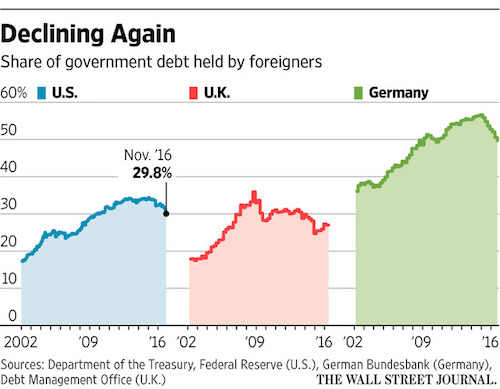
Between 2000 and 2014, Chinese authorities built up a $4 trillion currency reserve, mainly through buying Treasurys to keep the yuan weak and help the country’s exporters. In January, its reserves fell below $3 trillion, the lowest level in almost six years. China is now trying to boost its currency, and its Treasury holdings fell by about $200 billion between May and November. “You create an environment where yields are manipulated lower by captive investors,” said Paul Donovan, chief economist at UBS Wealth Management. “There is now a shift going on here, which is most significant for the U.S.”

Read more …

Russia did so well under the sanctions, perhaps it’s better for them to keep doing what they were.

Russia’s Exile From World Markets May Soon Be Over (BBG)

As Donald Trump edges the U.S. closer to a thaw in relations with Vladimir Putin’s Russia, commodity investors are already jumping in. A plan by United Co. Rusal, the biggest Russian aluminum maker, for a London sale of shares valued at about $1.7 billion is the latest sign that Russia’s exile from world markets is over for the nation’s metal and mining giants. It’s a turnaround from years in which slumping raw-materials prices, a weak economy and sanctions imposed by then-U.S. President Barack Obama over the annexation of Crimea punished valuations and drove away foreign investors. Share sales by Russian mining companies have been rare since 2010. Until two months ago, PhosAgro’s offering in April 2013 was the last major sale by a non-state Russian mining company.

The fertilizer miner and processor is among those that have returned since December. Offerings from Novolipetsk Steel and TMK bring the total raised by mining and metals producers since then to about $575 million. Others weighing offers include En+ Group and Polyus. Magnitogorsk Iron & Steel, also known as MMK, is also considering selling a small stake to the market, people familiar said on Friday. Billionaire Mikhail Prokhorov’s Onexim may offer up to 5% of Rusal to investors soon, people said late Thursday. It’s not just plain equities. In a sign of investor appetite, steelmaker Severstal sold $250 million of convertible bonds on Thursday paying a zero coupon. “Investors see less risk in Russian companies now as the geopolitical situation has eased,” Rusal Deputy Chief Executive Officer Oleg Mukhamedshin said in an interview in Moscow last week following a company sale of eurobonds. “That affects demand for both bonds and equities.”

Read more …

Brussels trembles ahead of multiple national elections. But faking your great achievements and position of strength doesn’t actually make you look strong.

EU Foreign Policy Chief Tells Trump Not To Interfere In Europe’s Politics (G.)

The EU foreign policy chief, Federica Mogherini, has warned the Trump administration not to interfere in European politics, advising it to “deal with America first”. Speaking during a two-day visit to Washington, Mogherini did not make specific accusations but said that she sometimes heard voices in the new administration “saying the European Union is not necessarily a good idea. Inviting us to dismantle what we have managed to build and which has brought us not only peace, but also economic strength.” “It’s not for me or another European to speak about domestic political choices or decisions in the US. The same goes with Europe – no interference,” Mogherini said, speaking at the Atlantic Council thinktank. “Maybe America first means also that you have to deal with America first.”

Mogherini’s tone echoed the increasing alarm in Brussels over the new administration’s attitudes. Donald Tusk, the head of the European Council, has listed the new US administration and its “worrying declarations” as one of the leading global threats to the EU. Trump has not missed a chance to deride the EU, going out of his way to praise Brexit, and in an interview just before taking office, he depicted the continent as being dominated by Germany and on the brink of collapse. “President Trump believes that dealing bilaterally with different European countries is in US interests, that we could have a stronger relationship with the countries individually,” said Ted Malloch, the man tipped to be Donald Trump’s nominee as ambassador to the EU. He also accused Europe of “blatant anti-Americanism”.

She also took the opportunity to remind the administration, which hosted the UK prime minister, Theresa May, as the president’s first foreign guest, and promised her a favourable trade deal, that Britain did not have the right to negotiate independently until it was outside the EU, which was two years away at least. “The strength of the EU and the unity of the EU I believe is more evident today than it was a few months ago. This has to be clearly understood here,” Mogherini said. “This also means respect for the EU not simply as an institution. It is a union of 28 member states.”

Read more …

“..the Trump Administration [..] fail to grasp that talking the dollar down will just not work if the political structure of the EU is breaking up.”

EU In Disintegration Mode (Martin Armstrong)

The EU leadership is really trying to make Great Britain pay dearly for voting to exit the Community. Like the socialists in America, it’s our way or no way. The left may call the right the “deplorables” but the left are the “intolerables” who refuse to ever consider they might be wrong. The EU thinks that if they can make it so bad for Britain, nobody else will leave. They refuse to examine why there is rising discontent within Europe. They refuse to let go of this dream of a federalized Europe to eradicate national identities along with sovereign rights. [..] Britain is not willing to surrender all domestic law to that of the EU. Indeed, EU law is no longer to be applied in Britain. Here we have the EU demanding Ireland retroactively charge Apple taxes simply because their tax rate is less that the highest EU member.

That is surrendering everything sovereign to Brussels. Laws are only to be decided by the British parliament – not Brussels. Jurisprudence is a matter for the British courts not the European Court. Britain is to leave the EU internal market and the EU Customs Union and seeks a free trade agreement to be concluded between the EU and Great Britain. The EU seeks to punish Britain for rejecting its dream. The EU forgets that Trump is now in and a trade deal with Britain will no longer be at the back of the queue as was the case under Obama. Free movement of people, together with the free movement of goods, free movement of services and the free movement of capital, are the four fundamental freedoms which are regarded as the foundation of the EU. The free movement of persons justifies the right of all EU citizens to settle in the Union and to accept work. However, this has not worked as smoothly as presumed.

The cost of living is significantly different throughout the EU. Eastern Europeans, mainly from Poland, have infiltrated Britain working for less money creating competition for domestic workers while foreign companies use cheaper labor in the East to undercut domestic companies on their home-turf. As the economy turns down and deflation prevails, the threat of foreign jobs is being addressed throughout Europe. Add to this the refugee crisis and you have a powder keg throughout Europe waiting to go off. In view of the high unemployment in almost all countries, domestic citizens have ALWAYS turned against foreign workers as the easy scapegoats for the economic decline. This only merges with the high taxes reducing disposable income.

The EU leaders [..] have no clear statement to challenge what is going on. The regulatory nightmare and outright rage that is rising among the people is simply ignored by Brussels. The legal uncertainty with the British exit on the banking system is something nobody even wants to speculate about. How do bail-ins work in Europe if abandoned in Britain? So while the EU thinks by punishing Britain they will discourage others from leaving, they are seriously mistaken. The dream of the EU is dead. It should have remained just a trade union – that was it. What the Trump Administration is clueless about is the ability of the EU to hold it together, they fail to grasp that talking the dollar down will just not work if the political structure of the EU is breaking up.

Read more …

All that’s left is emptiness.

Eurozone, IMF Agree On A Common Stance On Greece (R.)

Euro zone lenders and the International Monetary Fund have reached agreed between themselves to present a common stance to Greece later on Friday in talks on reforms and the fiscal path Athens must take, euro zone officials said. Such a united stance would be a breakthrough because the two groups have differed for months on the size of the primary surplus Greece should reach in 2018 and maintain for years later as well as the issue of debt relief. Those differences have hindered efforts to unlock further funding for Greece under its latest euro zone bailout program. “There is agreement to present a united front to the Greeks,” a senior euro zone official said, adding that the outcome of Friday’s meeting with the Greeks was still unclear and it was unclear if Athens would accept the proposals. “What comes out of it, we will see,” the official said. Financial markets took heart from the news, however.

Greece’s two-year bond yield fell almost 50 basis points to 9.55%. It hit the 10% mark on Thursday as worries about the bailout drove away buyers. The chairman of euro zone finance ministers, Jeroen Dijsselbloem, said in The Hague that Friday’s meeting, in which Greek Finance Minister Euclid Tsakalotos will take part, was to discuss the size of Greece’s primary surplus. The euro zone wants Greece to reach a primary surplus – which excludes interest repayments on debt – of 3.5% of GDP and keep it there for many years. But the IMF believes that with reforms in place now Greece will reach only 1.5% next year and in the following years and has therefore been pushing for Athens to legislate new measures that would safeguard the agreed euro zone targets. Officials said the lenders would ask Greece to take €1.8 billion worth of new measures until 2018 and another €1.8 billion after 2018, focused on broadening the tax base and on pension cutbacks.

Read more …

What a surprise.

Greek Bailout Talks Set to Drag Past February Amid Standoff (BBG)

Greece probably won’t complete its bailout review by the time the euro area’s finance ministers next meet, on Feb. 20, setting the stage for potentially thorny negotiations in the midst of next month’s bitter electoral campaign in the Netherlands. “We will take stock of the further progress of the second review during the next Eurogroup,” Dutch Finance Minister Jeroen Dijsselbloem said in a statement after a meeting with his Greek counterpart, Euclid Tsakalotos, in Brussels on Friday. “There is a clear understanding that a timely finalization of the second review is in everybody’s interest,” Dijsselbloem said after the meeting, in which representatives of creditor institutions also participated.

Greece is locked in talks with the European Commission, the ECB, the European Stability Mechanism and the IMF over the conditions attached to its latest bailout. During Friday’s meeting, bailout auditors asked the government to legislate additional fiscal cuts equal to about 2% of GDP if the country fails to meet certain budget targets, a person familiar with the matter said after the talks. These contingent measures are the basis for further discussions, the person said, asking not to be named as the matter is sensitive. While progress was made in the meeting, unreasonable demands from the IMF make a resumption of staff-level talks difficult, a Greek government official said in a text message, asking not to be named in line with policy.

The Greek government has been resisting calls to preemptively legislate contingent belt-tightening for 2018 and beyond, arguing that measures already in place should suffice to meet an agreed goal for a budget surplus – before interest payments – equal to 3.5% of GDP. Among the measures the IMF is demanding is pension cuts and a lowering of the threshold at which income tax is paid. Both are red lines the government says it’s not willing to cross. “Although we expect that the Greek government will implement the required measures, the risk of early elections is increasing given the rising political cost to the government and its slim majority in the parliament,” Moody’s analyst Kathrin Muehlbronner said. “Early elections might bring a new and more reform-minded conservative government, but Greece’s economy would be hit again by prolonged uncertainty, after having just started to record positive growth.”

Read more …

This must be the dumbest thing I’ve heard in a long time. And that’s saying something these days. The UBI trial started just weeks ago, and they already know it will fail?

Universal Basic Income ‘Useless’, Says Finland’s Biggest Union (Ind.)

Finland’s basic income experiment is unworkable, uneconomical and ultimately useless. Plus, it will only encourage some people to work less. That’s not the view of a hard core Thatcherite, but of the country’s biggest trade union. The labour group says the results of the two-year pilot program will fail to sway its opposition to a welfare-policy idea that’s gaining traction among those looking for an alternative in the post-industrial age. “We think it takes social policy in the wrong direction,” said Ilkka Kaukoranta, chief economist of the Central Organisation of Finnish Trade Unions (SAK), which has nearly 1 million members. Since January, a group of unemployed Finns aged between 25 and 58 have been receiving a stipend of €560 per month. The amount isn’t means-tested and is paid regardless of whether the recipient finds a job, starts a business or returns to school.

Popular in the 1960s, the idea of a guaranteed minimum income for everyone is gaining more proponents again amid resurgent populism. French Socialist candidate Benoit Hamon has made it a policy platform in his presidential campaign. A universal — or unconditional — basic income (UBI), which would replace means-tested welfare payments, has its share of supporters on both the left and the right of the political spectrum. Advocates say it eliminates poverty traps and redistributes income while empowering the individual and reducing paperwork. In Finland, which like other Nordic nations is seen as a trendsetter when it comes to the welfare state, the idea is being explored by a center-right government headed by a former businessman and self-made millionaire.

While limited in scope (it’s conditional on the beneficiary having received some form of unemployment support in November 2016) and size (it’s based on a randomly-selected sample of 2,000 jobless people), the Finnish trial may help answer questions like: “Does it work”? “Is it worth it”? And the most fundamental of all: “Does it incite laboriousness or laziness?”

Read more …

“Speak not because it is safe, but because it is right.”

Snowden Claims Report Russia May ‘Gift’ Him To Trump Proves He’s No Spy (G.)

Whistleblower Edward Snowden has seized on a report that Russia is considering sending him back to the US as a “gift” to Donald Trump, saying that the story vindicates him of charges that he is a spy. “Finally: irrefutable evidence that I never cooperated with Russian intel,” he said on Twitter. “No country trades away spies, as the rest would fear they’re next.” Snowden was responding to a report by NBC which stated that US intelligence had collected information that Russia wanted to hand Snowden over in order to “curry favor” with Trump, who has said that the former NSA contractor is a “traitor” and a “spy” who deserves to be executed. The report – based on two sources in the intelligence community – said the intelligence had been gathered since Trump’s inauguration.

Snowden’s ACLU lawyer, Ben Wizner, told NBC News he was unaware of any plan to return his client to the US. “Team Snowden has received no such signals and has no new reason for concern,” Wizner said. Russia granted Snowden asylum in 2013 and a three-year residency in 2014. Snowden has been living in exile in Moscow, facing charges in the US including violations of the US Espionage Act for leaking documents about secret mass surveillance programs. Speaking at a GOP candidate debate in March 2016, Trump said of Snowden: “I said he was a spy and we should get him back. And if Russia respected our country, they would have sent him back immediately, but he was a spy. It didn’t take me a long time to figure that one out.” The Kremlin publicly dismissed these claims.

Snowden offered a longer explanation of his feelings of vindication when he was interviewed by Katie Couric in December 2016, when rumours of a Russian handover first started circulating. He described the suggestion as vindication that he was“independent”. He added: “The fact that I’ve always worked on behalf of the United States and the fact that Russia doesn’t own me. In fact the Russian government may see me as a sort of liability.” Snowden suggested that a reason why Russia might want to return him was his recent criticism of the Kremlin’s human rights record and his suggestions that its officials had hacked US security networks. Previously Snowden has said that Moscow had “gone very far, in ways that are completely unnecessary, costly and corrosive to individual and collective rights” in monitoring citizens online.

When Couric asked if Snowden would mind being extradited, he replied: “That would obviously be something that would be a threat to my liberty and to my life. “But what I’m saying here is you can’t have it both ways. You can’t say this guy’s a bad guy – a Russian tool or something like that – at the same time you say he’s going to be traded away.” After reiterating his sense of vindication on Friday, Snowden posted again to Twitter: “Speak not because it is safe, but because it is right.”

Read more …

Incredible.

‘We Are Silently Dying’: Refugees In Greek Camp Slip Into Despair (MEE)

Poor living conditions, a sudden spate of deaths and a “complete loss of hope” are exacerbating mental health issues and leading to suicide attempts and self-harm in the Moria refugee camp on the Greek island of Lesvos, NGOs and refugees have warned. “More and more what we are seeing is people with severe depression linked to the conditions in which they are in and to the complete loss of hope,” said Louise Roland-Gosselin, an advocacy manager for the medical NGO, Doctors Without Borders (MSF). “[Refugees] in Moria are absolutely crushed and we hear more and more about how people are self-mutilating, how they want to commit suicide and we are aware of cases of suicide and attempted suicide, not only on Lesbos but also on other islands,” she added.

[..] For many of the camp’s residents the long and backlogged process of applying for asylum and the lack of activities in the camp has heightened their despair. “It’s still quite a depressing sight,” explained Roland-Gosselin. “You still have hundreds of people who are sleeping in tents, there is little access to water, hygiene conditions are not acceptable, there’s still hundreds of people without heating and they have absolutely no activity, they have nothing to do all day. So it’s an incredibly depressing place.” Some are turning to self-harm as a result of the situation. Cutting is common in the camp according to refugees MEE spoke to. “People here die inside, so when they die inside they either hurt someone else or they hurt themselves, that’s why they do it, to get the pain out. So they cut themselves. I’ve seen it happen to my friend. He’d cut himself, we’d bandage his arm and then he’d do it again the second day,” explained al-Anny.

Read more …

Feb 082017
 
 February 8, 2017  Posted by at 9:21 am Finance Tagged with: , , , , , , , , , ,  5 Responses »


Dorothea Lange Rear window tenement dwelling, 133 Avenue D, NYC 1936

This Is How Out-Of-Whack US Trade Relationships Really Are (WS)
John Kelly, Homeland Security Chief, Says Travel Ban Rolled Out Too Quickly (WSJ)
Trump Travel Ban: Judges Skeptical About Arguments On Executive Order (G.)
‘Trump Makes Sense To A Grocery Store Owner’ – Taleb (Hindu)
Do Not Let Elliott Abrams Anywhere Near The State Department (Rand Paul)
EU Faces Crisis As IMF Warns Greek Debts Are On ‘Explosive’ Path (Tel.)
Greece’s Debt Costs Rise Sharply As Worries Grow Over IMF Role (G.)
Don’t Sell the Euro Short. It’s Here to Stay. (Eichengreen)
Money Is Pouring Out Of China, And The Government Can’t Stop It (R.)
China’s Reserves Approach Breaking Point As Another Devaluation Looms (BBG)
Russia Shows Why China Should Just Stop Burning Up Its Reserves (BBG)
Cracks Are Appearing In Australia’s Trillion-Dollar Property Debt Pile (BBG)
Putin Orders Russian Air Force To Prepare For ‘Time Of War’ (Ind.)
Controversial Dakota Pipeline To Go Ahead After Army Approval (R.)
Why Should A Libertarian Take Universal Basic Income Seriously? (Dolan)


“It never was a big deal because growing imports were portrayed as healthy demand in the US. The world loved it.”

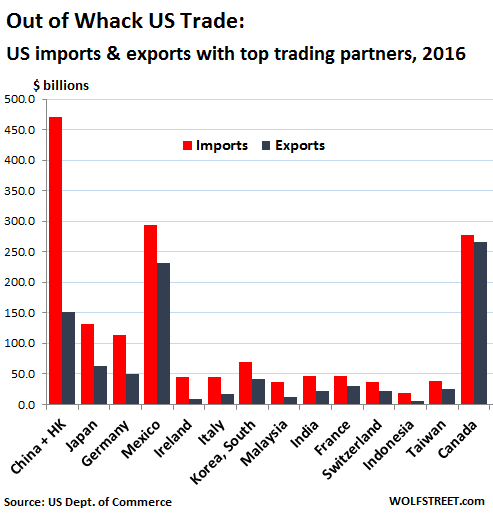
This Is How Out-Of-Whack US Trade Relationships Really Are (WS)

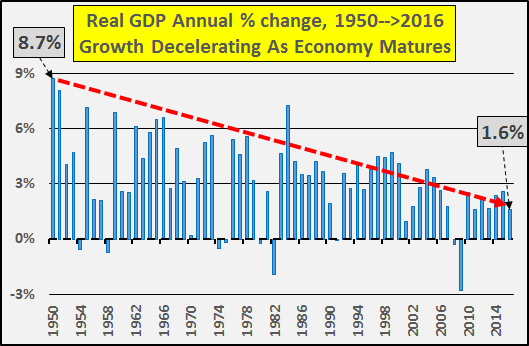
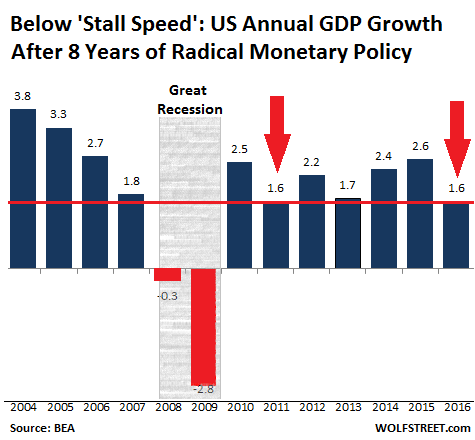
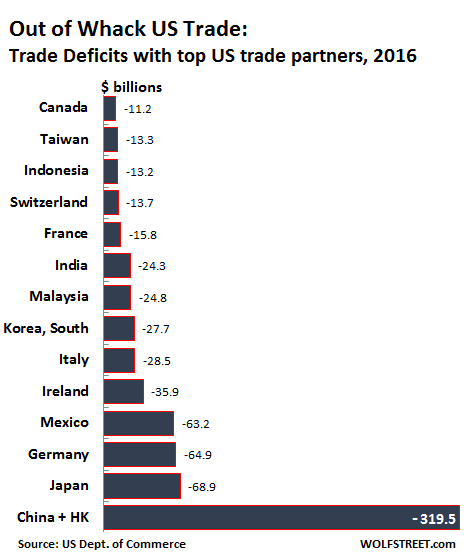
2016 marked another banner year for US trade, a banner year largely for other countries that at the initiative of Corporate America, whose supply chains weave all over the world, managed to load the US up with their merchandise. According to the Commerce Department’s report today, the US trade deficit in goods and services rose to $502.3 billion in 2016, the highest in four years. Exports of goods and services fell $52 billion in 2016 year-over-year to $2.21 trillion, and imports fell $50 billion to $2.71 trillion. That both exports and imports fell is a sign of weakening world trade, lackluster demand globally, and lousy economic growth in the US, where GDP in 2016 inched up by a miserable 1.6%, matching the growth rate of 2011, both having been the lowest growth rates since 2009.

Exports add to the economy and to GDP; imports subtract from GDP. And it’s a big number: the trade deficit in 2016 amounted to 2.7% of GDP. In overly simplified, scribbled-on-a-napkin-after-the-third-beer math: had trade been balanced, with imports about equal to exports, GDP growth would have been 2.7 percentage points higher in 2016. So 4.3%! OK, we’re dreaming. But that’s how a massive trade deficit whacks the economy. The overall trade balance is composed of trade in goods and services. It used to be years ago when the trade deficit in goods began to balloon that it was no big deal because America was exporting innovative services, such as complex financial services, and they would make up for the deficit in old-fashioned goods.

They did lessen the pain for a little while, and then they didn’t. And soon, even the overall US trade deficit ballooned, but it was no big deal because soaring imports showed that the US economy was healthy and brimming with consumer demand. Year after year, we heard this from economists and politicians. Beyond that, apathy was palpable. No one cared. It’s just the way it is. Dreaming of balanced trade was like so 1980s or whatever. Meanwhile, Corporate America was fine-tuning its game of offshoring production and importing from cheaper countries. The entire business model of Wal-Mart depends on it. US supply chains wind all over the globe, in search of the lowest production costs, whether it’s consumer gadgets or automotive components. It never was a big deal because growing imports were portrayed as healthy demand in the US. The world loved it.

Read more …

Kelly’s a straight shooter. Wonder how long he can last.

John Kelly, Homeland Security Chief, Says Travel Ban Rolled Out Too Quickly (WSJ)

Homeland Security Secretary John Kelly told Congress the Trump administration should have taken more time to inform Congress before implementing its controversial executive order temporarily blocking entry of people from seven nations. “The thinking was to get it out quick so potentially people coming here to harm us would not take advantage” of a delay, Mr. Kelly told the House Homeland Security Committee on Tuesday. In his first congressional appearance as a cabinet member, Mr. Kelly offered a forceful defense of the order, saying it wasn’t a ban on Muslims as critics have charged, but a “temporary pause” on immigrants and visitors from countries about whose residents the U.S. can’t access solid information. He sought to take responsibility for the chaotic rollout, saying the confusion was “all on me.”

“Going forward, I would have certainly taken some time to inform the Congress and certainly that’s something I’ll do in the future,” he said. The Wall Street Journal and others have reported that Mr. Kelly had little input in the order or its rollout, which was directed by the White House. The order, issued on the afternoon of Friday, Jan. 27, resulted in initial confusion and confrontation at airports around the country, as some travelers were detained for hours or sent away and protesters gathered at terminals to denounce the new rules. A federal court in Seattle temporarily put the order on hold on Friday, citing potential legal concerns. That action prompted President Donald Trump to question the judge’s credentials and say he could be to blame in the event of a terrorist attack. Mr. Kelly waded into that debate on Tuesday, likening judges to academics removed from on-the-ground realities.

“I have nothing but respect for judges, but in their world it’s a very academic, very almost in-a-vacuum discussion, and of course, in their courtrooms, they are protected by people like me, so they can have those discussions,” he said. “They live in a different world than I do. I’m paid to worst-case it, he’s paid to, in a very academic environment, make a call.” [..] Committee chairman Rep. Michael McCaul (R., Texas) said he backed the executive order, which a court order has put on hold. But he said it was poorly implemented. He said some U.S. permanent residents who are citizens of the targeted countries were initially not allowed to return to the country, while foreigners who aided the U.S. military and students attending American schools were “trapped overseas.”

“I applaud you for quickly correcting what I consider errors,” Mr. McCaul said. The congressman said he had suggested the approach President Donald Trump took when Mr. Trump was a candidate. His goal, Mr. McCaul said, was to help reframe the proposal from what Mr. Trump initially described as a Muslim ban, an approach he thought would have been unconstitutional.

Read more …

It’s great to have the courts discuss this. That’s where it belongs. If Trump can win, we will know just how broad US presidents’ power had become, before Trump. And we can judge whether we like things that way. He either has the authority, or he doesn’t. That should be clear from the law, not a matter of taste or preference.

Trump Travel Ban: Judges Skeptical About Arguments On Executive Order (G.)

A lawyer seeking to reinstate Donald Trump’s travel ban was grilled by a panel of three judges on Tuesday, facing questions over the president’s inflammatory campaign promise to close America’s borders to Muslims. August Flentje, of the Department of Justice, was put on the spot over why seven Muslim-majority countries had been targeted in Trump’s executive order, as well as past statements made by the president and his ally Rudy Giuliani. The hour-long hearing before the San Francisco-based ninth circuit court of appeals was the most significant legal battle yet over the ban. The judges said they would try to deliver a ruling as soon as possible but gave no indication of when. Flentje, reportedly called up for the hearing at short notice, asked the judges for a stay on the temporary restraining order placed on Trump’s travel ban by district court judge James Robart last week.

[..] During a hearing conducted by telephone between various locations, Flentje described the ban as putting a “temporary pause” on travelers from countries that “pose special risk”. He said the seven countries targeted had “significant terrorist presence” or were “safe havens for terrorism”. Trump’s actions were “plainly constitutional”, Flentje argued, as the president sought to strike a balance between welcoming visitors and securing the nation of the risk of terrorism. “The president has struck that balance,” he said. “The district court order upset that balance.” Flentje argued that the district court restraining order was too broad, giving rights to people “who have never been to the United States” and “really needs to be narrowed”. Judge Michelle Friedland asked: “Are you arguing then that the president’s decision in the regard is unreviewable?”

Flentje replied: “Yes, there are obviously constitutional limitations.” But Judge William Canby pointed out that people from the seven countries already could not come into the country without a visa and were subject to “the usual investigations”. How many of these people had committed terrorist attacks in the US, he wondered, before pointing out it was none. Flentje pointed to Congress’s determination that they were countries of concern, an argument that Judge Richard Clifton dismissed as “pretty abstract”. Trying to regain ground, the lawyer said: “Well, I was just about to at least mention a few examples. There have been a number of people from Somalia connected to al-Shabaab [an Islamist militant group] who have been convicted in the United States.” Friedland, who was appointed by Barack Obama, interjected: “Is that in the record? Can you point us to what, where in the record you are referring?” Flentje admitted: “It is not in the record.”

Read more …

“..if you went to the local souk [bazaar] in Aleppo and brought one of the retail shop owners, he would do the same thing Trump is doing. Like making a call to Boeing and asking why are we paying so much..”

‘Trump Makes Sense To A Grocery Store Owner’ – Taleb (Hindu)

In Skin in the Game, you seem to build on theories from The Black Swan that give a sense of foreboding about the world economy. Do you see another crisis coming? Oh, absolutely! The last crisis [2008] hasn’t ended yet because they just delayed it. [Barack] Obama is an actor. He looks good, he raises good children, he is respectable. But he didn’t fix the economic system, he put novocaine [local anaesthetic] in the system. He delayed the problem by working with the bankers whom he should have prosecuted. And now we have double the deficit, adjusted for GDP, to create six million jobs, with a massive debt and the system isn’t cured. We retained zero interest rates, and that hasn’t helped. Basically we shifted the problem from the private corporates to the government in the U.S. So, the system remains very fragile.

You say Obama put novocaine in the system. How will the Trump administration be able to address this? Of course. The whole mandate he got was because he understood the economic problems. People don’t realise that Obama created inequalities when he distorted the system. You can only get rich if you have assets. What Trump is doing is put some kind of business sense in the system. You don’t have to be a genius to see what’s wrong. Instead of Trump being elected, if you went to the local souk [bazaar] in Aleppo and brought one of the retail shop owners, he would do the same thing Trump is doing. Like making a call to Boeing and asking why are we paying so much.

You’re seen as something of an oracle, given that you saw the 2008 economic crash coming, you predicted the Brexit vote, the outcome of the Syrian crisis. You said the Islamic State would benefit if Bashar al-Assad was pushed out and you predicted Trump’s win. How do you explain it? Not the Islamic State, but al-Qaeda at the time, and I said the U.S. administration was helping fund them. See, you have to have courage to say things others don’t. I was lucky financially in life, that I didn’t need to work for a living and can spend all my time thinking. When Trump was running for election, I said what he says makes sense to a grocery store owner. Because the grocery guy can say Trump is wrong because he can see where he is wrong. But with Obama, he can’t understand what he’s saying, so the grocery man doesn’t know where he is wrong.

Is it a choice between dumbing down versus over-intellectualisation, then? Exactly. Trump never ran for archbishop, so you never saw anything in his behaviour that was saintly, and that was fine. Whereas Obama behaved like the Archbishop of Canterbury, and was going to do good but people didn’t feel their lives were better. As I said, if it was a shopkeeper from Aleppo, or a grocery store owner in Mumbai, people would have liked them as much as Trump. What he says makes common sense, asking why are we paying so much for this rubbish or why do we need these complex taxes, or why do we want lobbyists. You can call Trump’s plain-speaking what you like. But the way intellectuals treat people who don’t agree with them isn’t good either. I remember I had an academic friend who supported Brexit, and he said he knew what it meant to be a leper in the U.K. It was the same with supporting Trump in the U.S.

Read more …

Amen to that.

Do Not Let Elliott Abrams Anywhere Near The State Department (Rand Paul)

I hope against hope that the rumors are wrong and that President Donald Trump will not open the State Department door to the neocons. Crack the door to admit Elliott Abrams and the neocons will scurry in by the hundreds. Neoconservative interventionists have had us at perpetual war for 25 years. While President Trump has repeatedly stated his belief that the Iraq War was a mistake, the neocons (all of them Never-Trumpers) continue to maintain that the Iraq and Libyan Wars were brilliant ideas. These are the same people who think we must blow up half the Middle East, then rebuild it and police it for decades. They’re wrong and they should not be given a voice in this administration.

One of the things I like most about President Trump is his acknowledgement that nation building does not work and actually works against the nation building we need to do here at home. With a $20 trillion debt, we don’t have the money to do both. I urge him to keep that in mind this week when he meets with Elliott Abrams, the rumored pick for second in command to the Secretary of State. Abrams would be a terrible appointment for countless reasons. He doesn’t agree with the president in so many areas of foreign policy and he has said so repeatedly; he is a loud voice for nation building and when asked about the president’s opposition to nation building, Abrams said that Trump was absolutely wrong; and during the election he was unequivocal in his opposition to Donald Trump, going so far as to say, “the chair in which Washington and Lincoln sat, he is not fit to sit.”

Why then would the president trust him with the second most powerful position in the State Department? Abrams was equally dismissive throughout Trump’s entire candidacy. As a Never-Trumper, he repeatedly said he would neither vote for Clinton nor Trump. He likened the choice to the one the nation faced of McGovern vs. Nixon. I voted for Rex Tillerson for secretary of state because I believe him to have a balanced approach to foreign policy. My hope is that he will put forward a realist approach. I don’t see Abrams as part of any type of foreign policy realism. Elliott Abrams is a neoconservative too long in the tooth to change his spots, and the president should have no reason to trust that he would carry out a Trump agenda rather than a neocon agenda. But just as importantly, Congress has good reason not to trust him – he was convicted of lying to Congress in his previous job.

Read more …

It’s not only a broken record, it’s a really bad song too.

EU Faces Crisis As IMF Warns Greek Debts Are On ‘Explosive’ Path (Tel.)

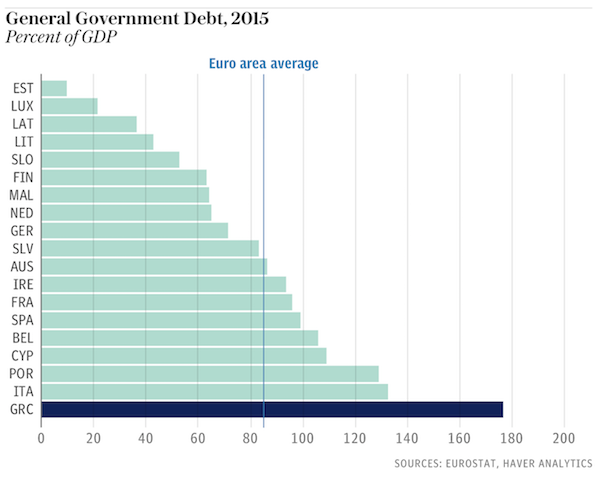
The EU faces a looming crisis which could threaten the sustainability of the eurozone as the IMF has warned Greece’s debts are on an “explosive” path despite years of attempted austerity and economic reforms. Global financiers at the IMF are increasingly unwilling to fund endless bailouts for the eurozone’s most troubled country, passing more of the burden onto the EU – at a time when Germany does not want to keep sending cash to Athens. The assessment opens up a fresh split with Europe over how to handle Greece’s massive public debts, as the IMF called on Europe to provide “significant debt relief” to Greece – despite Greece’s EU creditors ruling out any further relief before the current rescue programme expires in 2018. Jeroen Dijsselbloem, the Eurogroup President repeated that position last night, saying there would be no Greek debt forgiveness and dismissing the IMF assessment of Greece’s growth prospects as overly pessimistic.

“It’s surprising because Greece is already doing better than that report describes,” said Mr Dijsselbloem, who chairs meetings of eurozone finance ministers, adding that Greece was on track for a “pretty good recovery at the moment”. The renewed divisions over how to handle the Greek debt crisis has raised fresh questions over whether the IMF will be a full participant in the next phase of the Greek rescue – a key condition for backing from the German and Dutch parliaments. As Angela Merkel, the German chancellor, fights a tough reelection battle, Germany is particularly reluctant to send funds directly to Greece, with populist parties in Germany arguing that the payments amount to an unfair bailout from hard-working Germans to less deserving Greeks.

The IMF split came as Mrs May last night comfortably defeated a Brexit rebellion in the Commons as MPs rejected Labour plans to give Parliament a “meaningful” vote on the terms of a final deal. Despite suggestions that up to 30 Tory MPs could defy their party whip and back the Labour amendment just seven chose to do so. Mrs May stemmed the rebellion after the Government pledged to hold a vote in Parliament on the deal before it is sent to the European Parliament. However ministers said that MPs would have to “take or leave it”, meaning that Mrs May is prepared to walk away from Europe without a deal if Parliament rejects it. A fresh crisis over Greek debt could be triggered as soon as in July when Greece is due to repay some €7bn to its creditors – money the country cannot pay without a fresh injection of bailout cash.

Read more …

As they do the same thing again and again, things only get worse. And then they have to do it again.

Greece’s Debt Costs Rise Sharply As Worries Grow Over IMF Role (G.)

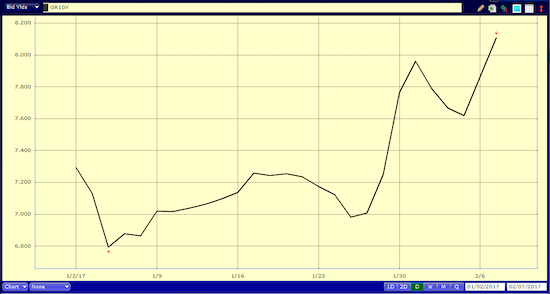
Fresh worries over Greece’s debts have pushed the country’s borrowing costs sharply higher amid renewed insistence from Athens it will not swallow further austerity demands from international lenders. The yields on two-year government bonds jumped to their highest level since last June and went above 10% to reflect growing anxiety on financial markets over Greece’s ability to keep up to date with debt repayments. Yields on 10-year government bonds were also higher at above 7.8%, the highest close since November. The renewed focus on Greece’s debts came as the International Monetary Fund revealed its board was split over how far spending cuts in the country should go, raising fresh doubts over its participation in rescue plans for the struggling Greek economy.

The fund has made repeated warnings that Greece’s debt burden of about €330bn is unsustainable despite the government pushing through spending cuts and tax increases that have badly hit popularity ratings for the government of prime minister Alexis Tsipras. The IMF declined to join other international lenders – the ECB and the EU – in funding the country’s third bailout, agreed in August 2015, and it is currently deciding whether to take part in a new chunk of rescue funds needed by mid-2018. Germany has warned the IMF’s involvement is crucial if support for Greece is to continue. News of a split on the IMF board raised new questions over whether Germany will see its wish granted for the fund joining the next rescue. In its latest annual review of the Greek economy, the IMF revealed that its board members were in disagreement over whether Athens should enforce even more austerity to satisfy its lenders.

Read more …

Barry Eichengreen basically says the euro will stay because of fear (of the consequences of leaving). That doesn’t seem a very stable foundation.

Don’t Sell the Euro Short. It’s Here to Stay. (Eichengreen)

Two forms of glue hold the euro together. First, the economic costs of break-up would be great. The minute investors heard that Greece was seriously contemplating reintroducing the drachma with the purpose of depreciating it against the euro, or against a “new Deutsche mark,” they would wire all their money to Frankfurt. Greece would experience the mother of all banking crises. The “new Deutsche mark” would then shoot through the roof, destroying Germany’s export industry. More generally, those predicting, or advocating, the euro’s demise tend to underestimate the technical difficulties of reintroducing national currencies. They suggest briefly imposing capital controls to prevent holders of euros from fleeing while the new money, electronic or other, is quickly put in place.

This ignores the complexity of actually removing controls once they are adopted. Recall the experiences of Iceland and Cyprus, which required years, not days, to completely remove their “temporary” controls. The proponents advocate quickly restructuring the debts of banks, firms and households with euro-denominated liabilities, without realizing that one person’s debt is another’s asset. Moreover, because borrowing and lending occurs across borders, agreement on debt restructuring will require lengthy negotiation between countries if the country abandoning the euro is to avoid harsh retaliatory measures. This process would make the U.K.’s Brexit negotiations look like a stroll in the park.

For southern European countries, there is an additional complication. They would have a massive bill to the ECB, and by implication to the other member states that are shareholders in the ECB, in settlement of their so-called Target2 balances, liabilities incurred as a result of cross-border payments in central bank money. ECB President Mario Draghi recently made clear that countries abandoning the euro would be presented with this bill. For Italy, to pick a case not entirely at random, those balances currently stand at €360 billion ($383 billion), or approximately €6,000 for every man, woman and child. That’s about 10 times on a per capita basis what the U.K. likely owes the EU as alimony for its divorce. And if a country like Italy chooses to default on its Target2 obligations, it will be unceremoniously kicked out of the EU.

This brings us to the second form of glue: namely that European countries, Britain aside, still attach very considerable value to EU membership. That membership matters even more now that that President Trump has cast NATO into doubt and the United States is no longer seen as a reliable ally. The example of U.K. Prime Minister Theresa May, reduced to cozying up to Mr. Trump and Turkish Prime Minister Recep Tayyip Erdogan, is not one that many other European politicians care to follow. In a 2007 article, I too made a bet — namely that the euro, while flawed, wasn’t going away. I argued that it is the roach motel of currencies. Like the Hotel California of the song: you can check in, but you can’t check out. For 10 years I’ve been right. To be sure, past performance is no guarantee of future returns, as any prudent investor knows. Even so, unlike ambassador-in-waiting Malloch, I continue to think that shorting the euro is bad advice.

Read more …

And this is before Trump.

Money Is Pouring Out Of China, And The Government Can’t Stop It (R.)

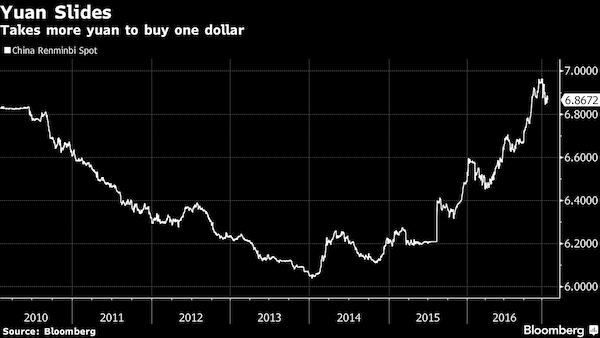
China’s foreign exchange reserves unexpectedly fell below the closely watched $3 trillion level in January for the first time in nearly six years, even as authorities tried to curb outflows by tightening capital controls. Reserves fell by $12.3 billion in January to $2.998 trillion, compared with a drop of $41 billion drop in December. Economists polled by Reuters had forecast forex reserves would fall by about $10.5 billion to $3 trillion. While the $3 trillion mark is not seen as a firm “line in the sand” for Beijing, concerns are swirling in global financial markets over the speed at which the country is depleting its ammunition to defend the currency and staunch capital outflows.

Some analysts fear a heavy and sustained drain on reserves could prompt Beijing to devalue the currency. The yuan fell 6.6% against the rising dollar in 2016, its biggest annual drop since 1994. For 2016 as a whole, China burned through nearly $320 billion of reserves, on top of a record drop of $513 billion in 2015. The yuan has found some respite in recent weeks as the dollar retreated, helped also by recent steps to curb capital outflows. But analysts expect downward pressure on the yuan to resume, especially if the U.S. continues to raise interest rates, which would likely trigger fresh capital outflows from emerging economies such as China and test its enhanced capital controls.

Read more …

“What was presented as a gradual depreciation of the yuan last year was in reality a significant 6% weakening of the currency versus the dollar as China’s domestic woes mounted. A collapse of the crawling peg could lead to yuan depreciation that is three times as large.”

China’s Reserves Approach Breaking Point As Another Devaluation Looms (BBG)

In his first few weeks in office, President Donald Trump has ordered the U.S. to withdraw from the Trans-Pacific Partnership and confirmed his intention to renegotiate the North American Free Trade Agreement. The consensus is that it won’t be long before he turns his focus to China, which he calls a currency manipulator. China can weather such criticism, for now. But if Trump’s threats of trade sanctions and 45% tariffs become real, the economic impact for the world’s second-biggest economy would be meaningful and could upend financial markets, potentially leading to a global recession. With economic growth already slowing and capital fleeing the nation, China’s $11 trillion economy is operating from a position of weakness.

Here’s how it plays out: As the world’s dominant reserve currency, the dollar has no peer. IMF data show that the greenback accounts for 63.3% of global foreign-exchange reserves, with the euro next at 20.3%, followed by the British pound and Japanese yen, both at 4.5%. That means that in times of crisis, the dollar benefits from global investors seeking a haven, even if the strife and the the uncertainty emanates from the U.S. It’s possible that a trade war would drive flows into the dollar, putting upward pressure on the currency at the expense of other exchange rates. That would be on top of the natural demand for the greenback created by the anticipation of significant fiscal stimulus floated by the Trump administration and a faster pace of interest-rate increases by the Federal Reserve.

In terms of China, it’s important to remember that the yuan’s external value is managed by authorities in a way that isn’t compatible with a sharp appreciation pressure of the dollar vis-à-vis all other currencies. The currency is managed to achieve a stable, effective, trade-weighted exchange rate and to foster a gently crawling peg relative to the dollar. That peg would be threatened if a trade war weakened China’s economy at a faster rate than forecast. What was presented as a gradual depreciation of the yuan last year was in reality a significant 6% weakening of the currency versus the dollar as China’s domestic woes mounted. A collapse of the crawling peg could lead to yuan depreciation that is three times as large.

Read more …

The ruble lost 50% vs the USD. A similar path for the yuan would be catastrophic.

Russia Shows Why China Should Just Stop Burning Up Its Reserves (BBG)

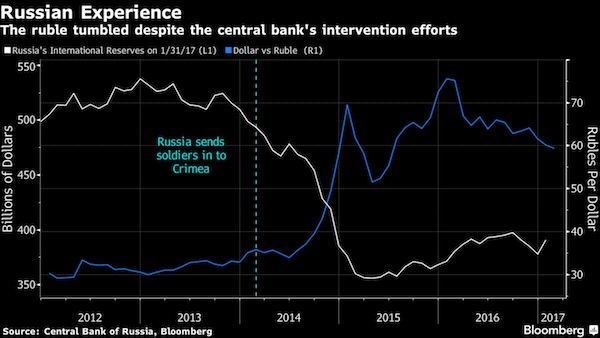
China has wiped out about a quarter of the world’s heftiest foreign-currency stockpile over the past 18 months in its quest to keep the yuan stable. According to Commerzbank, such intervention is futile. Data Tuesday showed China’s foreign reserves slipped below $3 trillion in January, the first time they’ve breached that psychologically potent level in almost six years. Yet the experiences of some fellow BRICs show that drawing down the stockpile will probably have little effect on the currency’s long-term fate, Hao Zhou, Commerzbank’s Singapore-based senior emerging-markets economist, wrote in a research note late Tuesday.

While efforts by Russia and Brazil in recent years might have cushioned the blow of currency declines, they couldn’t change the market’s dynamics. In Russia’s case, a collapse in oil prices and the imposition of economic sanctions over the Crimea crisis proved more powerful drivers than the sale of a third of the country’s foreign-currency hoard between April 2013 and March 2015. The ruble fell more than 50% versus the dollar in the period.

Read more …

Get out while you can.

Cracks Are Appearing In Australia’s Trillion-Dollar Property Debt Pile (BBG)

The Reserve Bank of Australia frequently seeks feedback on the health of the economy. It might want to call the debt counsellors soon. Homeowners, consumers and property investors around Australia are making more calls to financial helplines as three warning signs back up the spike in demand: mortgage arrears are creeping up, lenders’ bad debt provisions have increased and personal insolvencies are near an all-time high. “It’s steadily out of control – I don’t know of too many financial counselling services where demand doesn’t exceed supply,” said Fiona Guthrie, chief executive officer of Financial Counselling Australia, who says the biggest increase in calls is from people suffering mortgage stress. “There are more people who have got mortgages that they can’t afford to pay.”

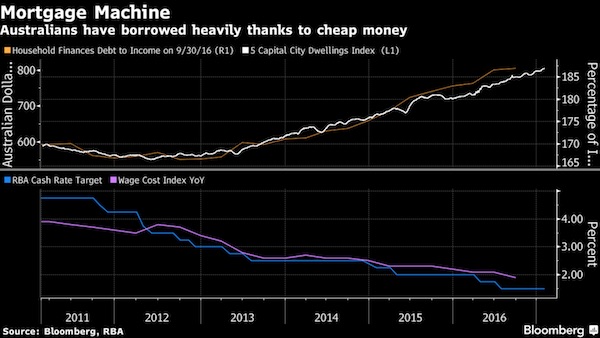
Australia’s households are among the world’s most-indebted after bingeing on more than $1 trillion of mortgages amid a housing boom that’s fizzled out in parts of the country, but still roaring in Sydney and Melbourne. While most are capably servicing their debts, a worsening of credit metrics has seen executives and analysts take a more cautious tone. It’s also a key factor in the central bank’s rate decisions this year, as RBA governor Philip Lowe places financial stability at the forefront of monetary policy. The concerns are understandable. Australians’ private debt has soared to 187% of their income, from about 70% in the early 1990s, encouraged by low interest rates. In a November speech, Lowe said that while most households are managing these levels of debt, many feel they are closer to their borrowing capacity than they once were.

Read more …

Odd that this reaches the press.

Putin Orders Russian Air Force To Prepare For ‘Time Of War’ (Ind.)

Russia’s air force has been ordered to prepare for a “time of war”. President Vladimir Putin has ordered a “snap check” of the country’s armed forces, accoording to defense minister Sergey Shoigu. As well as checking whether agencies and troops are ready for battle, the same order will ensure that systems are ready to fight, according to state news agency TASS. Those preparations have already begun, according to Russian ministers. “In accordance with the decision by the Armed Forces Supreme Commander, a snap check of the Aerospace Forces began to evaluate readiness of the control agencies and troops to carry out combat training tasks,” he said, according to TASS.

“Special attention should be paid to combat alert, deployment of air defense systems for a time of war and air groupings’ readiness to repel the aggression,” Shoigu added. The preparations come amid increasing concern about tensions between Russia and many of the world’s largest superpowers. Donald Trump has both condemned Russia’s military campaigns and been criticised for being too close to the country’s leaders, and Russia itself is standing in an increasingly tense relationship with some Nato countries. The country has been increasing movement of its military including the launch of the biggest Arctic military push since the fall of the Soviet Union, last month. It has also revealed plans to expand its military over 2017, including a huge boost in the number of tanks, armoured vehicles and aircraft controlled by the company.
Read more …

Really? Trump is willing to strongarm veterans and Native Americans? Bad PR.

Controversial Dakota Pipeline To Go Ahead After Army Approval (R.)

The U.S. Army will grant the final permit for the controversial Dakota Access oil pipeline after an order from President Donald Trump to expedite the project despite opposition from Native American tribes and climate activists. In a court filing on Tuesday, the Army said that it would allow the final section of the line to tunnel under North Dakota’s Lake Oahe, part of the Missouri River system. This could enable the $3.8 billion pipeline to begin operation as soon as June. Energy Transfer Partners is building the 1,170-mile (1,885 km) line to help move crude from the shale oilfields of North Dakota to Illinois en route to the Gulf of Mexico, where many U.S. refineries are located. Protests against the project last year drew drew thousands of people to the North Dakota plains including Native American tribes and environmental activists, and protest camps sprung up.

The movement attracted high-profile political and celebrity supporters. The permit was the last bureaucratic hurdle to the pipeline’s completion, and Tuesday’s decision drew praise from supporters of the project and outrage from activists, including promises of a legal challenge from the Standing Rock Sioux tribe. “It’s great to see this new administration following through on their promises and letting projects go forward to the benefit of American consumers and workers,” said John Stoody, spokesman for the Association of Oil Pipe Lines. The Standing Rock Sioux, which contends the pipeline would desecrate sacred sites and potentially pollute its water source, vowed to shut pipeline operations down if construction is completed, without elaborating how it would do so.

The tribe called on its supporters to protest in Washington on March 10 rather than return to North Dakota. “As Native peoples, we have been knocked down again, but we will get back up,” the tribe said in the statement. “We will rise above the greed and corruption that has plagued our peoples since first contact. We call on the Native Nations of the United States to stand together, unite and fight back.” Less than two weeks after Trump ordered a review of the permit request, the Army said in a filing in District Court in Washington D.C. it would cancel that study. The final permit, known as an easement, could come in as little as a day, according to the filing. There was no need for the environmental study as there was already enough information on the potential impact of the pipeline to grant the permit, Robert Speer, acting secretary of the U.S. Army, said in a statement.

Read more …

The case is not that hard to make. You just need to erase the ideological resistance.

Why Should A Libertarian Take Universal Basic Income Seriously? (Dolan)

In a recent post on EconLog, Bryan Caplan writes, “I’m baffled that anyone with libertarian sympathies takes the UBI [universal basic income] seriously.” I love a challenge. Let me try to un-baffle you, Bryan, and the many others who might be as puzzled as you are. Here are three kinds of libertarians who might take a UBI very seriously indeed. Philosophical issues aside, what galls many libertarians most about government is the failure of many policies to produce their intended results. Poverty policy is Exhibit A. By some calculations, the government already spends enough on poverty programs to raise all low-income families to the official poverty level, even though the poverty rate barely budges from year to year. Wouldn’t it be better to spend that money in a way that helps poor people more effectively?

A UBI would help by ending the way benefit reductions and “welfare cliffs” in current programs undermine work incentives. When you add together the effects of SNAP, TANF, CHIP, EITC and the rest of the alphabet soup, and account for work-related expenses like transportation and child care, a worker from a poor household can end up taking home nothing, even from a full-time job. A UBI has no benefit reductions. You get it whether you work or not, so you keep every added dollar you earn (income and payroll taxes excepted, and these are low for the poor). But, wait, you might say. Why would I work at all if you gave me a UBI? That might be a problem if you got your UBI on top of existing programs, but if it replaced those programs, work incentives would be strengthened, not weakened.

In which situation would you be more likely to take a job: one where you get $800 a month as a UBI plus a chance to earn another $800 from a job, all of which you can keep, or one where your get $800 a month in food stamps and housing vouchers, and anything extra you earn is taken away in benefit reductions? Or, you might say, a UBI might be fine for the poor, but wouldn’t it be unaffordable to give it to the middle class and the rich as well? Yes, if you added it on top of all the middle-class welfare and tax loopholes for the rich that we have now. No, if the UBI replaced existing tax preferences and other programs that we now lavish on middle- and upper-income households. Done properly, a UBI would streamline the entire system of federal taxes and transfers without any aggregate impact on the federal budget.

Read more …

Feb 072017
 
 February 7, 2017  Posted by at 11:08 am Finance Tagged with: , , , , , , , , ,  1 Response »


Russell Lee Sharecropper mother teaching children in home, Transylvania, LA. 1939

Trump To Be Barred From UK Parliament Over ‘Racism and Sexism’ (BBG)
Trump’s Wall Street Deregulation ‘The Last Thing We Need’ – Draghi (Ind.)
Meet The Men Who Could Topple Donald Trump (G.)
California Is Not ‘Out Of Control,’ Leaders Tell Trump (R.)
Our Part In The Darkness (Alameddine)
The New York Times Just Doesn’t Understand This Economics Stuff (Worstall)
The Fed’s Mortage-Bond Whale (BBG)
When The Money Supply Dries Up (IM)
Army Corps Of Engineers May Decide On DAPL By Week’s End (BBG)
New Bill Would Block EPA From Regulating Greenhouse Gases
Too Late For Couples Therapy? (DiEM25)
Varoufakis: Tsipras Should Prepare To Break Deal With Greece’s Creditors (FR)
Rare Split On IMF Board Puts Greek Bailout At Risk (MW)
Greece Won’t Meet Fiscal Surplus Targets Set By Europe, IMF Says (BBG)
Third Quake Over 5-Richter Magnitude Rattles Lesbos (K.)


Really dumb stuff. If only because Trump loves it.

Trump To Be Barred From UK Parliament Over ‘Racism and Sexism’ (BBG)

U.S. President Donald Trump must not be allowed to address the U.K. Parliament during a state visit to Britain, House of Commons Speaker John Bercow said. Prime Minister Theresa May invited Trump to visit the U.K., but there have been calls by lawmakers not to give the president the honor of addressing both houses of Parliament after he introduced a ban on people from some majority-Muslim countries traveling to the U.S. “Before the imposition of the migrant ban I would myself have been strongly opposed to an address by President Trump in Westminster Hall; after the imposition of the migrant ban by President Trump I’m even more strongly opposed,” Bercow told lawmakers on Monday.

He added, “I feel very strongly our opposition to racism and to sexism and our support for equality before the law and an independent judiciary are hugely important considerations in the House of Commons.” Trump’s predecessor, Barack Obama, and world leaders including Nelson Mandela, Angela Merkel and Pope Benedict XVI have all been invited to speak to members of the House of Commons and the House of Lords. [..] The announcement was greeted with cheers and – a rare event in the House of Commons – applause from the opposition benches. A motion arguing that Trump shouldn’t be invited to speak has been signed by 163 out of Parliament’s 650 members.

Bercow said he has a veto over a speech in Westminster Hall, the oldest part of the Houses of Parliament, and would block one. It would also be a breach with tradition if Trump spoke in the Royal Gallery behind the Lords without his name on the invitation, he said. “An address by a foreign leader to both houses of Parliament is not an automatic right, it is an earned honor,” Bercow said. “There are many precedents for state visits to take place to our country that do not include an address to both houses of Parliament.”

Read more …

Meet Mario the kettle.

Trump’s Wall Street Deregulation ‘The Last Thing We Need’ – Draghi (Ind.)

Donald Trump’s roll-back of Wall Street regulation is “very worrisome” and “the last thing we need” the President of the ECB, Mario Draghi, has warned. Giving evidence to the European Parliament’s Committee on Economic and Monetary Affairs on Monday, Mr Draghi was asked about the American President’s assault on the US post-crisis Dodd-Frank legislation, which had curbed the risk-taking of US banks, raised their capital requirements and introduced more safeguards for consumers. “The last thing we need is a relaxation of regulation,” Mr Draghi said. “The fact that we are not seeing….significant financial stability risk is the reward of the action of supervisors…. Nowadays financial intermediaries are strong. The idea of repeating the conditions of before the crisis is very worrisome.”

Mr Draghi added: “If we were to look at historical experience and ask what are the main reasons for the financial crisis starting in 2007 onwards, well, one can disagree [over] whether it was too expansive monetary policy or the dismantling of financial regulation in previous years – but surely we can agree it was a combination”. Last week President Trump signed an executive order to relax Dodd-Frank, prompting warnings that he is preparing the ground for another financial crisis. Phil Angelides, who served as chair of the Financial Crisis Inquiry Commission, branded President Trump’s decision “insane”. “In the wake of the financial crisis, millions of families lost their homes. Millions of people lost their jobs. The economy was wrecked and communities across the country were devastated. Big Wall Street banks admitted wrongdoing and paid tens of billions of dollars in fines. And now, with bankers at his side, President Trump begins to rip apart protections put in place to protect America’s families and our economy,” he said.

Read more …

As I said a few dats ago: “More interesting right now is how strongly this is dividing the White House team. Kelly refused to enact some of Bannon’s demands. Tillerson and Mattis are not sitting comfortable either.”

Meet The Men Who Could Topple Donald Trump (G.)

When Trump began putting together his cabinet, liberals and some in the media expressed concern over the number of retired generals he was appointing to top positions. “Trump hires third general, raising concerns about heavy military influence,” blared a headline in the Washington Post during the presidential transition. “I am concerned that so many of the president-elect’s nominees thus far come from the ranks of recently retired military officers,” the Democratic representative Steny Hoyer told the Washington Examiner in December. The fretting over Trump’s generals was always misplaced, not least because the number of retired generals Trump has appointed to top positions in his administration is hardly unprecedented.

Trump nominated the retired Marine generals James Mattis and John Kelly to lead the Department of Defense and Homeland Security, respectively, and tapped the retired army general Mike Flynn to be his national security adviser. When entering office after winning the 2008 presidential election, Barack Obama also appointed three retired generals to top positions and few batted an eyelid. But those concerned about Trump’s presidency should be thankful that the generals are there, particularly Mattis and Kelly. By all accounts, they are men of great honor and courage with strong backbones. Kelly led men into battle and lost a son fighting in Afghanistan. Mattis may be the most distinguished and respected Marine officer of his generation, revered for his dedication to his troops and his intellect. I had the honor of spending an hour with him one-on-one last May when he was a fellow at the Hoover Institution. Our conversation was off the record, but make no mistake, this is not a man to be trifled with.

Trump may have actually boxed himself in by picking highly respected generals such as Kelly and Mattis to helm top posts in his administration. Even conservatives who publicly stand by the president latch on to the appointments of Mattis and Kelly as their best evidence that Trump’s presidency will not be as problematic as his temperament and actions sometimes suggest, or some of his more troubling White House advisers portend. But if Mattis or Kelly were to resign in protest, that might change everything. There have already been reports that Mattis and Kelly are less than happy with some of what has gone on in the White House. During the transition, Mattis reportedly clashed with the Trump transition team over key appointments to the defense department. Tensions boiled over when Mattis and Kelly weren’t given sufficient consultation over the recent immigration executive order.

The Democratic representative Seth Moulton, a retired Marine who served under Mattis during the Iraq war, says insiders have informed him that after the executive order fiasco, some top appointments like Mattis began thinking about what would make them leave the administration. “What I’ve heard from behind the scenes,’’ Moulton told the Boston Globe: “What will make you resign? What’s your red line?”

Read more …

This is the kind of confrontation the country badly needs. Where everyone has to argue and define their viewpoints.

California Is Not ‘Out Of Control,’ Leaders Tell Trump (R.)

California leaders pushed back on Monday against President Donald Trump’s claim that the state is “out of control,” pointing to its balanced budget and high jobs numbers in the latest dustup between the populist Republican and the progressive state. The state’s top Democrats called Trump cruel and his proposals unconstitutional after the businessman-turned-politician threatened to withhold federal funding from the most populous U.S. state if lawmakers passed a so-called sanctuary bill aimed at protecting undocumented immigrants. “President Trump’s threat to weaponize federal funding is not only unconstitutional but emblematic of the cruelty he seeks to impose on our most vulnerable communities,” state Senate Pro Tem Kevin de Leon, a Democrat from Los Angeles, said in a statement on Monday.

State Assembly Speaker Anthony Rendon, an L.A.-area Democrat, said the state has the most manufacturing jobs in the nation, and produces a quarter of the country’s food. “If this is what Donald Trump thinks is ‘out of control,’ I’d suggest other states should be more like us,” Rendon said. The latest war of words between Trump and Democratic leaders in California, where voters chose his opponent, Hillary Clinton, two-to-one in November’s election, began Sunday, in an interview between Trump and Fox News host Bill O’Reilly. During the interview, O’Reilly asked Trump about a bill in the state legislature, authored by de Leon, to ban law enforcement agencies in the state from cooperating with immigration officials in most circumstances. Cities who have enacted similar bans are known as sanctuary cities, and de Leon’s bill, if passed and signed into law by Democratic Governor Jerry Brown, would effectively extend such rules to the entire state.

Trump disparaged the bill as ridiculous, saying that sanctuary cities “breed crime.” “We’ll have to, well, de-fund,” Trump said. “We give tremendous amounts of money to California.” Trump went on to say he viewed funding as a weapon. “California in many ways is out of control,” Trump said to O’Reilly. “Obviously the voters agree or otherwise they wouldn’t have voted for me.” Last week, Trump threatened to withhold federal funding from the University of California at Berkeley, where violent protests led to the cancellation of a speech by an editor for the right-wing Breitbart News. But experts said it would be difficult for the President to withhold funds from either the university or the state. Court rulings have limited the power of the president to punish states by withholding funds, and most appropriations come from the Congress and not the executive branch.

Read more …

Really excellent. Don’t miss.

Our Part In The Darkness (Alameddine)

Right after the election, my Twitter feed exploded with shock and moans. It seemed that everyone’s favorite phrase was “We are better than this.” I considered the statement so obviously wrong. I understood the convoluted logic of it, the jolt and hurt that would lead someone to type this, but it was not true. We are not better than this. We are this. The man was elected President. Ipso facto, America is this, we are this. I say this not to suggest that we must be blamed, or that someone who did not vote for Donald Trump is just as culpable as one who did. What I keep trying to point out, to friends, to anyone who will listen, is that too few of us are willing to acknowledge responsibility—not necessarily to accept blame, but to stand up and say, “This thing of darkness, I acknowledge mine.”

I remember when the photographs of torture at Abu Ghraib came to light. The response was similar. This is not us. Those soldiers were rotten. It began at the top, with George W. Bush, and it filtered down. But we would never do such a thing. Of course, we did do those things, and we kept on doing them over and over, and doing worse. Some objected, but most of us simply moved on, chose to forget. “No snowflake in an avalanche ever feels responsible,” the Polish poet Stanislaw Jerzy Lec once wrote. Trump bans Muslims and we claim that this is un-American, that we are not this. I don’t have to talk up “ancient” history to show that we are. I won’t bring up settler colonialism, genocide, and land theft, or harp on slavery, or internment camps for Japanese-Americans.

I won’t refer to the Page Act banning those deemed “undesirable,” the Chinese Exclusion Act, the Asiatic Barred Zone Act, or the Emergency Quota Act. I don’t have to mention the hundreds of thousands of Mexicans deported in the nineteen-thirties, or the thousands of Jews escaping Nazi violence who were turned away. It was F.D.R., not Trump, who claimed that Jewish immigrants could threaten national security. I won’t mention any of this, because this happened so long ago. We can always delude ourselves by saying that America was this but now we are better. Let me just say that in 2010 and 2011, state legislatures passed a hundred and sixty-four anti-immigration laws.

Many were upset when Trump campaigned on a Muslim registry, but I was surprised to find out how few knew that we’d already had one: the National Security Entry-Exit Registration System, or nseers, implemented on September 11, 2002. From the Atlantic: “It consisted of two ‘special registration’ programs: one that required foreign nationals from certain countries to check in with the government before entering and leaving the country, and another that obliged some foreigners living in the United States to report regularly to immigration officials.” Obama did not suspend the program until 2011. He dismantled it right before he left office.

[..] I was in Lesbos a year ago, helping Syrian refugees. At Moria, the biggest camp on the island, thousands of refugees were being processed every day. The crisis had been ongoing for more than six months. I’d heard that every big N.G.O. had taken a turn at leading the camp, but each one failed because of mismanagement, backstabbing, interagency bickering, governmental interference, what have you. But, as horrid as the situation was in the camp, I thought that it was being well managed, as well as it could be with so many people in and out. I met this unassuming man, a retired Mormon from Utah, who had been volunteering at the camp since the first boats arrived. He spoke no Arabic or Farsi, had no medical training of any kind, none of the identifiable skills, yet both volunteers and refugees sought him out with every conceivable question about what to do. It seems that he had arrived to offer whatever help he could. He slowly began to fill in wherever he was needed. As the N.G.O.s began to wash their hands of the camp, he was needed more and more. When I was there, he was running the damn place. We are this. We can be better.

Read more …

“That is just a howling error, to talk about the number of jobs and wages as if they are different things.”

The New York Times Just Doesn’t Understand This Economics Stuff (Worstall)

The Editorial Board of the New York Times tells us all that repealing parts of or all of Dodd Frank will damage the economic recovery. It’s possible to see the glimmerings of a point there, no one does think that if half the banks fall over again then all will be toodle dandy. However, they do manage to betray a terrible ignorance of the basics of economics and wages in the same editorial. Really, this is such a basic point that even Karl Marx was able to understand it: Mr. Trump may believe that ending Dodd-Frank will lead to more jobs by making it easier for businesses to get loans. But even if looser credit would help hiring — a very big if — the main problem in the job market today is not too few jobs, but wages that have been too low for too long. A rollback of Dodd Frank will not help that, and will hurt by forfeiting the stability that has helped the economy come this far.

That is just a howling error, to talk about the number of jobs and wages as if they are different things. They are the same thing–it is full employment which lifts the workers’ wages, nothing more and nothing less. As I say this is such a fundamental concept that even Karl Marx was able to get it right. If we have unemployment, that reserve army of the unemployed, then a capitalist can increase his labour force just by hiring some more of those unemployed. He doesn’t have to tempt anyone in with higher wages, he doesn’t need to pay his own workforce more as profits rise. For anyone gets bolshie he can just hire more of those unemployed people. However, the moment that reserve army is exhausted, the moment that there are no unemployed to hire it all changes. Suddenly, to gain access to more labour temptation must be employed.

It is necessary to tempt labour away from the jobs they are already doing. The capitalists, therefore, are in competition with each other for the profits that can be made by employment. At which point of course wages have to rise. To tempt labour into factory B away from factory A then B must pay more than A (in some form, could be shorter hours, better scheduling, more pay, whatever).And factory B had better raise its own wages for the extant workforce to stop A tempting it away. This is how wages rise over time. The capitalists compete for the profits that can be made by employing labour. And in the absence of unemployment they can only do this by raising wages as productivity rises. This process has been going on some 200 years by now, ever since productivity rises became a general feature of the economy.

And there’s no reason to think that it has stopped nor that it will. That is, contrary to the editorial board f the New York Times, it’s not that wages and jobs are different issues. It’s that wages haven’t risen because there haven’t been enough jobs. And seriously, if your understanding of capitalist and market economics is behind even that of Karl Marx are we sure that you should be writing newspaper articles on the subject of economics?

Read more …

If you create an artificial recovery, there will be a price to be eventually.

The Fed’s Mortage-Bond Whale (BBG)

Almost a decade after it all began, the Federal Reserve is finally talking about unwinding its grand experiment in monetary policy. And when it happens, the knock-on effects in the bond market could pose a threat to the U.S. housing recovery. Just how big is hard to quantify. But over the past month, a number of Fed officials have openly discussed the need for the central bank to reduce its bond holdings, which it amassed as part of its unprecedented quantitative easing during and after the financial crisis. The talk has prompted some on Wall Street to suggest the Fed will start its drawdown as soon as this year, which has refocused attention on its $1.75 trillion stash of mortgage-backed securities.

While the Fed also owns Treasuries as part of its $4.45 trillion of assets, its MBS holdings have long been a contentious issue, with some lawmakers criticizing the investments as beyond what’s needed to achieve the central bank’s mandate. Yet because the Fed is now the biggest source of demand for U.S. government-backed mortgage debt and owns a third of the market, any move is likely to boost costs for home buyers. In the past year alone, the Fed bought $387 billion of mortgage bonds just to maintain its holdings. Getting out of the bond-buying business as the economy strengthens could help lift 30-year mortgage rates past 6% within three years, according to Moody’s. Unwinding QE “will be a massive and long-lasting hit” for the mortgage market, said Michael Cloherty at RBC Capital Markets. He expects the Fed to start paring its investments in the fourth quarter and ultimately dispose of all its MBS holdings.

Unlike Treasuries, the Fed rarely owned mortgage-backed securities before the financial crisis. Over the years, its purchases have been key in getting the housing market back on its feet. Along with near-zero interest rates, the demand from the Fed reduced the cost of mortgage debt relative to Treasuries and encouraged banks to extend more loans to consumers. In a roughly two-year span that ended in 2014, the Fed increased its MBS holdings by about $1 trillion, which it has maintained by reinvesting its maturing debt. Since then, 30-year bonds composed of Fannie Mae-backed mortgages have only been about a percentage point higher than the average yield for five- and 10-year Treasuries, data compiled by Bloomberg show. That’s less than the spread during housing boom in 2005 and 2006.

Read more …

Don’t know if it’s money supply drying up or debts becoming overwhelming. Not the same thing. But the last paragraphs of the piece are interesting:

When The Money Supply Dries Up (IM)

Whenever the ability to enforce draconian legislation goes into decline, the people of a nation suddenly realise that they’ve been living in fear of a paper tiger. It doesn’t take long before some people choose to defy the system. When they’re seen to succeed, others follow in droves. So, what does this say of the US and its power? Well, as Doug Casey has been known to say, “Countries fall from grace with remarkable speed.” Quite so. On an international level, this means that international leaders will be watching the economic decline of the US closely. Countries such as China and Russia have been loading up on precious metals in preparation for a collapse in fiat currency. In addition, they’ve created their own version of the World Bank, the Asian Infrastructure Investment Bank, and have been hard at work inking deals with other nations for international settlement in currencies other than the dollar.

Most people in the world today cannot remember a time before Bretton Woods, yet they may soon witness the Bretton Woods agreement becoming a dead duck. But, if we extend this premise, we also should be questioning the other constructs of the postwar period that have become dinosaurs. What of the United Nations? This organisation was once meant to be a body for arbitration and world planning, but has in latter decades become a quagmire of bickering and gainsaying—with its decisions rarely being adopted by the nations in question. And yet the US alone pays some $8 billion annually to keep the UN afloat. Surely, when the world at large ceases its willingness to carry further US debt, the US government will jettison the expense for the UN before it cuts either its military spending or its entitlement programmes.

Similarly, NATO, which requires $2.8 billion annually (with only five of its 28 members currently meeting the recommended payments) would experience a similar fate. With the above entities heading south, the Wolfowitz Doctrine, which has since 1992 been the basis of US aggression policy, would become unachievable. In addition to the decline or cessation of the above international adventurism, enforcement of revenue pursuit in the guise of FATCA and OECD schemes would equally suffer from a loss of funding. It would not be a question of whether the empire still wished to squeeze the lemon more than ever before—it would. But once the funds to do so dried up, the US and EU would find themselves in the situation that we currently observe in Venezuela: The money to pay for the enforcement is simply not there anymore.

The decline would begin with bounced cheques, followed by massive layoffs in the enforcement departments, followed by a decline in receipts, necessitating further layoffs, and continuing in a downward spiral. At present, countless people live in fear of the present empires and their ever-increasing efforts at usurpation. However, as history shows, once debt has reached its nadir and begins its rapid fall, so does the empire’s ability to enforce draconian confiscations.

Read more …

Army vs veterans?!

Army Corps Of Engineers May Decide On DAPL By Week’s End (BBG)

The U.S. Army may decide by week’s end whether to approve construction of the Dakota Access Pipeline across North Dakota’s Lake Oahe and lands claimed sacred by Sioux Indian tribes. Justice Department lawyer Matthew Marinelli outlined the planned timeline for the Army’s decision to a federal judge in Washington hearing a three-way dispute over the planned path of the Energy Transfer Partners LP-led project. Marinelli didn’t say which way the decision might go. President Donald Trump last month issued a memorandum urging the Army Corps of Engineers to expedite its review of the conduit’s path after the federal agency put the brakes on ETP’s nearly complete $3.8 billion, 1,172-mile conduit for shunting crude from northwestern North Dakota to a Patoka, Illinois, distribution center last year amid protests raised by environmental groups and the Sioux.

[..] While U.S. District Judge James Boasberg, and then a federal appeals court, declined to grant the tribes’ request for an order halting the project, the corps stopped construction anyway, stating it was reconsidering whether to issue easements required for tunneling under the lake bed. Jan Hasselman, lead lawyer for the suing Sioux tribes, told the judge that because the Army Corps had already committed to an environmental impact review of the lake crossing, any easement granted before that analysis is complete “would be unlawful.” The Corps turned the decision to the U.S. Army. The tribes will likely file a second bid to halt the project, citing environmental impact concerns, if the pipeline project gets a U.S. government go-ahead, Hasselman said.

Read more …

Now use that to get a deal that actually achieves something.

New Bill Would Block EPA From Regulating Greenhouse Gases (EW)

Republican lawmakers have proposed a bill to curtail the U.S. Environmental Protection Agency’s (EPA) ability to address climate change. The “Stopping EPA Overreach Act of 2017” (HR637) would amend the Clean Air Act so that: “The term ‘air pollutant’ does not include carbon dioxide, water vapor, methane, nitrous oxide, hydrofluorocarbons, perfluorocarbons, or sulfur hexafluoride.” The bill was introduced by Rep. Gary Palmer (R-Ala.) and has already racked up 114 Republican co-sponsors. Palmer is a climate denier who once said that temperature data used to measure global climate change have been “falsified” and manipulated.

Palmer’s latest proposal would nullify the EPA’s regulation of carbon pollution, stating that “no federal agency has the authority to regulate greenhouse gases under current law” and “no attempt to regulate greenhouse gases should be undertaken without further Congressional action.” Liz Perera, climate policy director at the Sierra Club, told Huffington Post that the resolution would make it nearly impossible for the federal government to fight climate change. “This is the legislative equivalent of trying to ban fire trucks while your house is burning,” she said, adding its sponsors “should be embarrassed for so blatantly ignoring reality and ashamed of themselves for so recklessly endangering our communities.”

[..] Fortunately, the bill does not seem to have any legs. David Doniger, a senior attorney for Natural Resources Defense Council’s climate and clean air program told The Guardian that HR637 does not have much of a chance breaking through a Senate filibuster as Democrats would have near-universal opposition to it and even some moderate Republican Senators would vote against it as well.

Read more …

Yes. Annul the wedding. Before someone gets hurt.

Too Late For Couples Therapy? (DiEM25)

For the past seven years, Greece has been stuck in an abusive marriage with its European partners. Of course, she has not been the perfect partner, but who has? No one deserves violence. No one deserves abuse. Everyone deserves hope, and not the delusional “you will be done by 2060, if you can maintain the hilariously unsustainable 3.5% primary budget surplus” kind of hope offered by Mr Schäuble. The hypocrisy and pseudo-morality of European lenders and the IMF is painful. Germany’s “no debt-reduction” stance is particularly exasperating, when that very same country has experienced both the economic, social and political disaster that vindictive, self-righteous hardheadedness can lead to after the Treaty of Versailles in 1919, as well as the miraculous quality of debt-reduction when its own debt was cut by half (!) at the London Debt Agreement of 1953.

The more years pass, the closer Greece and the rest of Europe edge from a post-modern 1919 to a post-modern 1933. And now, with news of Greece’s three-week window to resolve its next instalment before economically imploding – a piece of news which some media outlets appeared surprised about, bless them – many of us cannot help but wonder: when will we get serious about resolving this? The obvious answer is: when there is political will for a resolution. The only place where this seems to be the case is the nation-patient itself. Two summers ago, under remarkable socio-economic pressure, amid capital-controls and an overwhelmingly pro-EU media landscape, 62% of Greeks came out and refused the terms of a third bailout. Anyone with half-an-understanding of economics and finance seems to agree that the current approach to Greek debt is unsustainable economically, socially and politically: all in all, a disaster.

Even the master chef of the entire travesty, the IMF, has come out and admitted that neo-liberalism and austerity simply do not work. So what are we waiting for? Why are millions of Europeans still suffering under utterly misguided political and economic dogmas? Quite simply because to admit defeat at this point would mark the end of a number of powerful careers. Having poisoned European voters against the lazy PIIGS, it would be nothing short of political suicide to turn around and give in to Greek demands. When would be the next electoral victory in Europe for austerity’s architects if it was revealed that the years of financial and social suffering was a pointless self-inflicted wound with only negative economic results?

So it is becoming increasingly obvious that Greece has to work its own way out of this mess. At this stage, that means an immediate halt of repayments to lenders; a stance that will either force its partners to a vital debt-reduction, or will lead the country to an exit from the Euro. With Germany (in clear breach of EU rules) stubbornly maintaining its 9% budget surplus and refusing to increase imports, Europe is at an impasse, and no one is hurt more by this than Greece. Although the former outcome would be preferred – avoiding to rock the European boat at a time of major global instability is a major plus – the latter is still preferable to the status quo.

Read more …

Translation of Greek article by Varoufakis I posted about earlier.

Varoufakis: Tsipras Should Prepare To Break Deal With Greece’s Creditors (FR)

Through a recent article at the Efimerida ton Syntakton (Newspaper of Editors), the former Minister of Finance of Greece, Yanis Varoufakis, referred to Tsipras retreat against Greece’s creditors and called him to prepare seriously this time, to break the destructive continuous agreements. As Varoufakis wrote among other things: The night of the Greek referendum, I tried hard to explain to the Greek PM that the submission of Greece to the third memorandum was Schäuble’s real plan (not Grexit). In reality, there was no hope that the 3rd toxic “program” for Greece would be rationalized progressively through the support of the European Commission to Athens. Meaning, there was no hope that IMF’s austerity and anti-social measures could be softened.

The fact that Moscovici, Juncker, Sapin and others made such promises, is no excuse because the Greek government knew since May 2015 that these people know how to tell lies, or, they are unable to keep their promises when they don’t lie. Suddenly, the Schäuble-IMF-ECB attacked on Greece, demanding exhausting measures, while Merkel-Hollande-Commission didn’t do anything. Tsipras then retreated for one more time in order to “save” Greece. This was Schäuble’s plan. With his stance, Tsipras sank Podemos, made an approach with the collapsing (ethically and politically) Social Democracy, disappointed the progressive Europeans. And all these happened at the same time where nationalism triumphs everywhere.

Tsipras promises, one more time, that he will not retreat (this time!) by legislating new austerity even after 2018. If he means it, I remind him what we had agreed that is necessary and which – even today – is the only thing that may prevent the worst things to come. Prepare for unilateral restructuring of Greek bonds held by the ECB, which must be repaid in July (and after). Prepare the electronic system of transactions through Taxisnet which I had designed, I had started building it and even announced it to the new Minister of Finance, Euclid Tsakalotos, when I delivered the Ministry. Therefore, if indeed the Greek PM means it this time that he will not retreat, he should prepare for breaking the deal with the creditors, so that to prevent it. The design of a parallel system for payments is ready since 2014, as he knows.

Read more …

Make it stop!

Rare Split On IMF Board Puts Greek Bailout At Risk (MW)

Some members of the IMF are growing concerned with the terms of Greece’s bailout program, fueling fears the fund might pull out of the much-needed rescue plan for the country. The IMF’s annual review of the Greek economy published on Tuesday revealed a rare split among its board members, showing they are in disagreement over the austerity measures imposed on Athens and over the country’s huge debt burden. The report said that “most” of the 24 IMF executive directors agreed Greece is on track to reach a fiscal surplus of 1.5% of GDP. It said Athens does “not require further fiscal consolidation at this time, given the impressive adjustment to date.” However, some of the board members argued that Greece still needs to bring the surplus up to 3.5%, as agreed in the last bailout in 2015.

“Most Executive Directors agreed with the thrust of the staff appraisal, while some Directors had different views on the fiscal path and debt sustainability,” the IMF said in the assessment. The IMF usually keeps its deliberations confidential, so any differences on the board are rarely exposed to the public. The yield on 10-year Greek government debt surged 26 basis points after the report on Tuesday to 7.925%, according to electronic trading platform Tradeweb. Economists consider borrowing costs above 7% unsustainable in the long term.

Read more …

This is getting sadistic.

Greece Won’t Meet Fiscal Surplus Targets Set By Europe, IMF Says (BBG)

Greece is on track to fall short of budget-surplus targets set under a bailout by the nation’s euro-zone creditors, the IMF said. Greece’s primary budget surplus will rise to 1.5% over the long run from about 1% last year, amid a modest recovery, the IMF said Monday after executive directors met to discuss the fund’s annual assessment of the nation’s economy. Still, the projected surplus falls short of the 3.1% forecast by the country’s European creditors. The fund reiterated its view that Greece’s debt is unsustainable. Most of the executive directors don’t believe the economy needs more fiscal consolidation, the IMF said. The IMF has said it would consider giving Greece a new loan to supplement the 86 billion euros ($92 billion) it’s receiving from euro-area countries, but only if the nation’s debt-reduction plans are credible.

Greece’s European creditors also want the IMF to sign off before disbursing the next tranche of the euro-zone bailout. Greece’s government debt will reach 275% of its gross domestic product by 2060, when its financing needs will represent 62% of GDP, the IMF said in a draft staff report obtained by Bloomberg last month. Public debt will reach 181% of GDP this year, the IMF projected Monday. Greece’s economy is expected to grow 2.7% this year, up from 0.4% in 2016, the fund said. However, long-run growth is expected to slip to about 1%, the IMF predicts. The IMF’s assumptions aren’t based in reality and don’t take into account the reform of Greece’s public finances, according to a European Union official who spoke on condition of anonymity because the discussions are sensitive.

Read more …

Yeah, sure, add some more crap. For some reason this makes me think of George Clinton: “Do Fries Come With That Shake?”

Third Quake Over 5-Richter Magnitude Rattles Lesbos (K.)

Seismologists in Greece are keeping a close eye on activity in the eastern Aegean, as a third quake in 24 hours measuring above 5 Richter rattled the area in the early hours of Tuesday. The tremor hit at 4.24 a.m. and measured 5.3 on the Richter scale, according to the Geodynamic Institute in Athens, with the epicenter located 15 kilometers north of Lesvos. With a depth of just 10 kilometers, the quake was felt quite strongly on the Greek islands of Lesvos and Chios. Seismologist Efthimios Lekkas on Monday said two tremors – with a magnitude of 5.1 and 5.3 respectively – were not linked to the North Anatolian Fault Line, the source of powerful quakes in the past.

Read more …

Feb 062017
 
 February 6, 2017  Posted by at 10:04 am Finance Tagged with: , , , , , , , ,  6 Responses »


Steve Schapiro Robert Kennedy US Presidential Campaign 1968


Trump Travel Ban- What Happens Now (BBC)
Trump Faces Uphill Battle To Overcome Court’s Hold On Travel Ban (R.)
President Trump’s Major Asian Breakthrough (CNBC)
Believe It Or Not, Deluded Republicans Have Got It Right On Tax Reform (Chu)
Is America in a Bubble & Will America Ever Return to “Normal” (CH)
Trump Is No Fascist. He Is A Champion For The Forgotten Millions (G.)
India Weighs Up The Return On Basic Income For The Poorest (G.)
Scotland Needs Publicly Funded Bank, Says Thinktank (G.)
Greek Debt Crisis: An Existentialist Drama With No Good End In Sight (G.)
Testing Europe’s Values (NYT)
EU Leaders Back Libyans To Curb New Migrant Wave (R.)
Hunger Strikers At Greek Refugee Camp Keep Minister, Police Out (K.)


It’ll be hard for any court to claim the ban is legal. The fact that is was obviously hastily slapped together doesn’t help Trump’s case. And there are a variety of additional cases pending.

Trump Travel Ban- What Happens Now (BBC)

The next step is for briefs to be filed by both sides for a formal review of Judge Robart’s suspension on Monday. The Justice Department could have appealed directly to the Supreme Court on an emergency basis, but it chose not to since the appeal court is moving fairly quickly. If the appeals court decides the stay is valid – perhaps as early as next week – then a Supreme Court appeal is almost certain. In the meantime, everything is on hold. US immigration processes continue as they did before Mr Trump issued his executive order. If it looks like this is bogging down, the president might eventually decide to modify the order rather than try to defend its legality. That’s probably the most prudent course, but he’s a stubborn man.

Read more …

“I think the court’s going to feel every reason to stay on the sidelines as long as possible..” If there is no swift decision, and it doesn’t look that way, the order will have to be significantly changed, perhaps so much it largely becomes moot.

Trump Faces Uphill Battle To Overcome Court’s Hold On Travel Ban (R.)

U.S. President Donald Trump faces an uphill battle to overcome a federal judge’s temporary hold on his travel ban on seven mainly Muslim countries, but the outcome of a ruling on the executive order’s ultimate legality is less certain. Any appeals of decisions by U.S. District Court Judge James Robart in Seattle face a regional court dominated by liberal-leaning judges who might not be sympathetic to Trump’s rationale for the ban, and a currently shorthanded Supreme Court split 4-4 between liberals and conservatives. The temporary restraining order Robart issued on Friday in Seattle, which applies nationwide, gives him time to consider the case in more detail, but also sends a signal that he is likely to impose a more permanent injunction.

The Trump administration has appealed that order. The San Francisco-based 9th U.S. Circuit Court of Appeals said late on Saturday that it would not decide whether to lift the judge’s ruling, as requested by the U.S. government, until it receives briefs from both sides, with the administration’s filing due on Monday. Appeals courts are generally leery of upending the status quo, which in this case – for now – is the suspension of the ban. The upheaval prompted by the new Republican administration’s initial announcement of the ban on Jan. 27, with travelers detained at airports upon entering the country, would potentially be kickstarted again if Robart’s stay was lifted. The appeals court might also take into account the fact that there are several other cases around the country challenging the ban.

If it were to overturn the district court’s decision, another judge somewhere else in the United States could impose a new order, setting off a new cascade of court filings. If the appeals court upholds the order, the administration could immediately ask the U.S. Supreme Court to intervene. But the high court is generally reluctant to get involved in cases at a preliminary stage, legal experts said. The high court is short one justice, as it has been for a year, leaving it split between liberals and conservatives. Any emergency request by the administration would need five votes to be granted, meaning at least one of the liberals would have to vote in favor. “I think the court’s going to feel every reason to stay on the sidelines as long as possible,” said Steve Vladeck, a professor at the University of Texas School of Law.

Read more …

Interesting take on power politics.

President Trump’s Major Asian Breakthrough (CNBC)

On a visit to Tokyo and Seoul last week, the U.S. Defense Secretary James Mattis (a) reaffirmed security guarantees to Japan and South Korea, (b) set the stage for an integrated American, Japanese and South Korean political, economic and military alliance, (c) opened the way for President Trump to knock heads together in Tokyo and Seoul to set aside their divisive historical grievances if they wanted Washington’s umbrella and (d) told Pyongyang that our nuke operators knew the return address for a swift and devastating response if they ever saw a wrong move on their X-band radar. That is a major breakthrough because no previous administration succeeded in binding these three countries in such a strong and integrated alliance. Japan was repeatedly blamed for scuttling these efforts by its allegedly defiant attitude toward Korean grievances.

Japan also wanted to make money in China while leveraging American protection in its territorial disputes with Beijing. As recently as 2014, a quarter of Japan’s exports and a third of its foreign direct investments were going to the Middle Kingdom. But Tokyo would run for cover in Washington whenever the Chinese navy and air force would challenge Japan’s presence on the Senkaku/Diaoyu islands in the East China Sea. At the same time, Japan was enjoying annual trade surpluses with the U.S. of $67-$70 billion. And just a week ago, the Japanese were telling Washington that they could not buy American cars because the steering wheel was on the wrong side. [..] That has to stop. And it, apparently, will stop. Japan’s Prime Minister Shinzo Abe is coming to Washington next Friday (Feb. 10) with trade and investment initiatives.

But, true to form, whatever that is will probably fall far short of a trade deal Washington needs to address its excessive and structural trade imbalances with Japan. We have an even worse trade record with South Korea. Since the free-trade agreement became effective in early 2012, our trade deficit with Seoul has nearly doubled to an estimated $30 billion in 2016. Maybe we have to take a look at that, too. Building on last week’s accords, Washington has an opportunity to conclude an appropriate trade arrangement with Japan and South Korea. That would cover nearly 25% of the global economy and would represent by far the world’s largest free-trade area. Such an agreement would attract other Asia-Pacific countries to permanently anchor a decisive American political, economic and security presence in that part of the world. Washington’s bargaining power with China would be greatly strengthened by these events in a negotiating process that is apparently already under way.

Read more …

“..the great advantage of this reform is that it would eliminate the incentive for multinational firms to dodge their US corporate taxes through accounting tricks..”

Believe It Or Not, Deluded Republicans Have Got It Right On Tax Reform (Chu)

[..] we find ourselves in the paradoxical situation where a reform being presented by deluded right-wing American politicians as a way of sticking it to cheating foreigners actually represents the world’s best chance for lancing the boil of rampant tax evasion by multinational companies. It is the right thing being pushed for the wrong reasons. To understand why, we need to look at the plan in more detail. The Republican plan would replace the US corporation tax, an annual levy on a firm’s reported profits, with a new levy on a company’s domestic cash flow. It means taxing a company’s domestic sales at a certain rate, probably 20%, after it has subtracted its domestic costs such as workers’ wages and the amount the firm has spent on investment in new factories and equipment.

The objective would be to tax a company’s economic activity in America, which means that it would be able to reduce its tax bill by the value of its exports, while imports would be part of its taxable liability via a “border adjustment tax”. That probably sounds mind-numbingly complicated, but the principle is actually quite simple: it means taxing the firm’s value-adding and substantive economic activity in the country where that activity actually takes place. This is most people’s idea of what a tax on corporate income is supposed to do. Many have objected that US firms that import heavily will be placed at a major tax disadvantage. Yet this impact would be entirely offset by a rise in value of the US dollar, which would follow the implementation of the reform, and which would increase the purchasing power of importers proportionately.

And for all Brady’s rhetoric and the protectionist-sounding border tax, the effect of the reform would actually be neutral on America’s terms of trade with the rest of the world. But the great advantage of this reform is that it would eliminate the incentive for multinational firms to dodge their US corporate taxes through accounting tricks, such as registering profits at subsidiaries abroad and relocating their corporate headquarters to tax havens. No matter where they based their headquarters, multinationals would be liable for a hefty US tax bill if they sold plenty of products and services in America. And if America, the world’s largest economy, were to institute this reform, there would be a powerful incentive for other countries – including Britain – to implement a similar reform.

Read more …

Bubbles everywhere.

Is America in a Bubble & Will America Ever Return to “Normal” (CH)

Analysts and talking heads have an awful lot of opinions. Are we in a bubble or aren’t we? Rather than offer another opinion, I’ll offer the relationship of US economic activity (GDP) against the Wilshire 5000 (representing US equities) and the Federal Reserves gauge of American wealth, Z1 Household Net Worth series. These are the preferred establishment gauges, so take a look and then you decide. GDP is a monetary measure of the market value of all final goods and services produced annually in the US. The chart below shows the annual real GDP growth decelerating since 1950.

GDP vs. US Household Net Worth Given the sharp rise in asset values, I thought it worthwhile to view the total increase, as shown by the Fed’s US Household Net Worth data, versus the growth in GDP. The chart below shows US household net worth (all inclusive with real estate, equities, and all asset classes) is fast approaching $92 trillion against US GDP of $18.6 trillion. A simple division of GDP as a % of HHNW (maroon line in the chart below) shows household net worth (asset values) is growing significantly faster than economic activity supporting those valuations.

[..] from 1950–>2000, the average GDP to HHNW ratio was somewhat consistent around 28%…if the HHNW and GDP ratio are to come back to their 50 year norm (before they were warped by long periods of near Zero Interest Rate Policy and actual ZIRP)…there are two basic options: Either, GDP rapidly rises $7 trillion (a 38% increase)… Or, the other option is a 28% decline in HHNW, or a contraction of $25 trillion. A $25 trillion decline in HHNW would equate to an average $200,000 decline in net worth for every household in America.

Read more …

Provocative headline for a useful reminder.

Trump Is No Fascist. He Is A Champion For The Forgotten Millions (G.)

For many Americans, Hillary Clinton personified the corruption and self-dealing of the elites. But Trump’s election wasn’t just a rejection of Clinton, it was a rejection of politics as usual. If the media and political establishment see Trump’s first couple of weeks in office as a whirlwind of chaos and incompetence, his supporters see an outsider taking on a sclerotic system that needs to be dismantled. That’s precisely what many Americans thought they were doing eight years ago, when they put a freshman senator from Illinois in the White House. Obama promised a new way of governing – he would be a “post-partisan” president, he would “fundamentally transform” the country, he would look out for the middle class. In the throes of the great recession, that resonated.

Something was clearly wrong with our political system and the American people wanted someone to fix it. After all, the Tea Party didn’t begin as a reaction against Obama’s presidency but that of George W Bush. As far as most Americans were concerned, the financial crisis was brought on by the excesses of Wall Street bankers and the incompetency of our political leaders. Before the Tea Party coalesced into a political movement, the protesters weren’t just traditional conservatives who cared about limited government and the constitution. They were, for the most part, ordinary Americans who felt the system was rigged against them and they wanted change.

But change didn’t come. What they got was more of the same. Obama offered a series of massive government programmes, from an $830bn financial stimulus, to the Affordable Care Act, to Dodd-Frank, none of which did much to assuage the economic anxieties of the middle class. Americans watched as the federal government bailed out the banks, then the auto industry and then passed healthcare reform that transferred billions of taxpayer dollars to major health insurance companies. Meanwhile, premiums went up, economic recovery remained sluggish and millions dropped out of the workforce and turned to food stamps and welfare programmes just to get by. Americans asked themselves: “Where’s my bailout?”

At the same time, they saw the world becoming more unstable. Part of Obama’s appeal was that he promised to end the unpopular wars in Iraq and Afghanistan, restore America’s standing in the international community and pursue multilateral agreements that would bring stability. Instead, Americans watched Isis step into the vacuum created by the US withdrawal from Iraq in 2011. They watched the Syrian civil war trigger a migrant crisis in Europe that many Americans now view as a cautionary tale. At home, Isis-inspired terrorist attacks took their toll, as they did in Europe. And all the while Obama’s White House insisted that everything was going well.

Read more …

A basic income where dozens of millions have no access to bank accounts. Curious.

India Weighs Up The Return On Basic Income For The Poorest (G.)

[..] the transformative potential championed by UBI advocates has particular appeal in a country such as India, where one in five people lives below the $1.90 (£1.51) poverty line, 1 million join the workforce each month, and a clunky, corrupt bureaucracy oversees nearly 1,000 separate welfare schemes. There have already been Indian trials. Three years ago, in nine villages in Madhya Pradesh state, 6,000 people were each given a monthly payment of up to 300 rupees an adult, and half that much for every child, over a period of 18 months. Every six months, the impact of the payments was assessed against 12 villages that received no income, just the usual government welfare. “What we saw were huge improvements in nutrition, health, schooling and sanitation,” said Guy Standing, a British economist who helped run the trials.

Results published afterwards showed the consumption of lentils, chickpeas and other pulses increased tenfold. Villagers ate six times more meat and the uptake of fresh vegetables grew 888%. That meant residents of the village were healthier, worked harder and attended school more often. Equity between more socially dominant members of the community – traditionally the gatekeepers to resources – and the less powerful also improved, Standing said. “Women benefited more than men, the disabled benefited more, and scheduled [lowest] castes benefited more than others.” India’s government is clearly enamoured by the idea. Subramanian suggested even Gandhi would approve. He praised the basic income’s potential to reduce poverty “in one fell swoop”, to relieve the grinding stress of hunger, and empower Indians to make their own life choices.

Criticisms – such as the idea people would fritter the money on alcohol or drugs, or drop out of the workforce – he dismissed based on past research. On paper, the sums also add up. Subramanian calculates that the annual income required to enable all but the very poorest Indians to escape penury is about 7,620 rupees (£90) a year. If that sum were given to 75% of India’s billion-plus population, it would cost about 5% of GDP. India’s vast welfare schemes and subsidies for food, petrol and fertilisers are notoriously wasteful and poorly targeted. Cutting them entirely would save about 2% of GDP. Reducing “middle class” subsidies on things such as railway tickets and gold would save another 1%. The rest of the savings might be found in scrapping other government schemes, which altogether cost 3.7% of GDP.

It would be even cheaper if the basic income were targeted at women, for example, or if the wealthy – those who own cars or air conditioners – were excluded, or asked to opt out. Giving Indian women a minimal basic income would cost just over 1% of GDP, but have “large multiplier effects” on the entire society, Subramanian said.

Read more …

Good topic to discuss. Get big banks out of your lives. It’s a Wonderful Life.

Scotland Needs Publicly Funded Bank, Says Thinktank (G.)

The Scottish government is under growing pressure to replace its private finance programme with a publicly funded bank to build new schools, roads and hospitals. The Common Weal, a pro-independence thinktank, said it should also replace the Scottish Futures Trust (SFT), the government agency that champions private financing projects such as a new Aberdeen bypass contract, which is worth £1.5bn to the private consortium building it. Common Weal said there was an urgent requirement to set up a Scottish national investment bank that would use £1.35bn in public funding for construction projects and another £2bn from investors to replace more expensive private financing.

The SFT would be replaced by a new publicly owned investment company and the two bodies would fund national infrastructure projects, new low-carbon energy schemes and local council programmes, as well as offering low-cost loans to small businesses, it said. The thinktank’s campaign to push for the changes has the backing of the Unison and Unite unions, the thinktank New Economics Foundation and the London-based campaign Debt Resistance UK. It has won support from Labour MSPs as well as Jeremy Corbyn. The Labour leader told an audience in Glasgow last month that his party would set up a national investment bank at UK level and regional banks for Scotland, Wales and Northern Ireland. They would focus on “fast tracking infrastructure spending to building essential transport and digital links to realise our potential”, he said.

Common Weal’s call for a Scottish national investment bank is to be debated at the SNP’s spring conference in March, an indication of growing unease within the the party about the private finance model being used by Nicola Sturgeon’s government. The motion from an SNP branch in Angus near Dundee says leaving economic growth and environmental protection “solely in the hands of our private banking and financial sector will be detrimental to present and future living standards of our citizens”.

Read more …

“The euro’s recent weakness has nothing to do with a deliberate attempt by the Germans to reduce its value..” Wrong. All Germany has to do to keep the euro low is to strangle southern Europe.

Greek Debt Crisis: An Existentialist Drama With No Good End In Sight (G.)

Put three people in a room who can’t get on with each other. Condemn them to stay there for all eternity while they torture each other. Sit and watch as the gruesome story plays out. And what do you have? One answer is the 1944 existentialist play by Jean-Paul Sartre, Huis Clos. Another is the story of the neverending Greek debt crisis in which the three main characters are Alexis Tsipras, Wolfgang Schäuble and Christine Lagarde. [..] Tsipras plays one of the three lead parts in the play. Elected as a leftwing firebrand two years ago, Tsipras has had a rapid fall from grace. He caved in when pressure was put on him by the Europeans in the summer of 2015 and having run for office on an anti-austerity programme eventually agreed to even more draconian bailout terms than the previous centrist governments.

For an increasing number of Greeks, Tsipras is no longer an iconoclast; he is just another man in a suit. With public support waning, Tsipras is once again hanging tough. He aroused the ire of the Europeans by giving a Christmas bonus to pensioners and free school meals to poverty-stricken families. Europe responded by suspending the limited debt relief it has previously granted. Tsipras says Greece has already done enough and will suffer no more. Europe is played by Schäuble, the German finance minister. He too is facing political pressures. The German public thinks enough aid has already been given to Greece, a country it considers is not doing enough to help itself. Opposition to further debt relief is strong and a general election is looming. The third cast member is Lagarde, a former French finance minister and now managing director of the IMF. Under its own rules, the IMF is forbidden from putting money into a bailout if it thinks debt is unsustainable.

There have been reports coming out of Washington that the Fund believes Greece’s debt will rise to 275% of national income by 2060, which would undoubtedly put it into the “unsustainable” category. The latest act in this play takes place in Washington this week when the IMF’s governing executive board discusses Greece. One factor complicating the issue is that time is running out to get matters sorted before the first in a series of European elections kicks off in in the Netherlands in March. A second is that the drama has a new character in the form of Donald Trump. There is little evidence that the US president gives a fig about whether Greece gets debt relief but he may have more than a walk-on role because the US is the biggest shareholder at the Fund and has the power to veto any decision it doesn’t like.

Trump has expressed strong – and not exactly positive – views about the European Union in general and Germany in particular. Causing consternation in Brussels, the new American president has said the EU has become a vehicle for German interests. His trade adviser Peter Navarro has accused Germany of being a currency manipulator, using a ”grossly undervalued” euro to run up a massive current account surplus. Navarro’s specific criticism about currency manipulation is wide of the mark. Germany is part of the eurozone and doesn’t always agree with the monetary policy decisions taken by the ECB. The euro’s recent weakness has nothing to do with a deliberate attempt by the Germans to reduce its value and everything to do with the fact that Europe has been loosening monetary policy at a time when the US has started to raise interest rates.

Read more …

Europe has long lost whatever -humanitarian- values it had.

Testing Europe’s Values (NYT)

When the European Union and Turkey reached a deal last year to lessen the flow of refugees into Greece, the priority was on defending borders, not the humanitarian crisis. Sadly, that remains Europe’s priority as it turns its attention to halting the flow of people from Libya to Italy. More than 180,000 people crossed the Mediterranean to arrive in Italy last year, and more than 5,000 died on the journey. The European Council met in Malta on Friday with the urgent task of preventing large numbers of people from setting out from Libya for Italy as soon as the weather improves this spring. The problem is twofold: Thousands risk drowning in rickety smugglers’ boats and another wave of migrants risks putting even more pressure on Italy and other European Union members where anti-immigrant populism is on the rise.

While the European Union is assisting in rescuing migrants at sea and in training the Libyan Coast Guard, its priority remains to “ensure effective control of our external border and stem illegal flows into the E.U.” That effectively means leaving people stranded in Libya, where migrants are subject to rape, beatings and torture in overcrowded camps. Europe hopes to enlist the International Organization for Migration and the United Nations’ refugee agency to ensure that migrants in Libya are detained in humane conditions. But these organizations in a joint statement warned that, given the situation in Libya, “it is not appropriate to consider Libya a safe third country, nor to establish extraterritorial processing of asylum seekers in North Africa.” Europe is also investing in improving conditions in Africa that compel people to flee, but that is a long-term solution that does little to address the immediate crisis.

On Wednesday, Libya’s United Nations-backed prime minister, Fayez Serraj, offered to allow NATO or European Union ships to pursue smugglers in Libyan waters. Putting smugglers out of business is important. But if NATO or the European Union sends migrants back to Libya, it “would violate the law, not to mention basic decency, and betray the values on which the E.U. and its member states were built,” said Judith Sunderland, the associate Europe and Central Asia director at Human Rights Watch.

Ahead of the Malta meeting, the European Council president, Donald Tusk, and Malta’s prime minister, Joseph Muscat, warned that, with populism on the rise, the “E.U.’s key values are in danger, if we don’t act now.” But counting on Libya to keep migrants from leaving for Europe also puts those values in danger. The obvious immediate answer to the plight of African migrants is to open more legal channels for people to reach Europe, and to ensure that every member country assumes its fair share of new arrivals so that Italy is not overwhelmed.

Read more …

Completely lost.

EU Leaders Back Libyans To Curb New Migrant Wave (R.)

European Union leaders placed a bet on Libya’s fragile government to help them prevent a new wave of African migrants this spring, offering Tripoli more money and other assistance to beef up its frontier controls. Meeting in Malta – in the sea lane to Italy where more than 4,500 people drowned last year – the leaders addressed legal and moral concerns about having Libyan coastguards force people ashore by pledging to improve conditions in migrant camps there. “If the situation stays as is now, in a few weeks we will have a humanitarian crisis and people will start pointing fingers, saying Europe has done nothing,” said Joseph Muscat, the prime minister of Malta, which currently holds the presidency of the bloc. “With this agreement… there is one first decent shot in trying to get a proper management of migration flows across the central Mediterranean.”

Aid groups, however, accused the EU, of abandoning humanitarian values and misrepresenting conditions in Libya, where the U.N.-backed government of Fayez al-Seraj has only a shaky and partial hold on the sprawling desert nation. Medecins Sans Frontieres, which works on the ground, said the summit proved EU leaders were “delusional” about Libya. “Today was not about saving lives; it’s clear that the EU is ready to sacrifice thousands of vulnerable men, women and children in order to stop them reaching European shores.” The chaos in Libya has thwarted any hope of a quick fix in the way that a controversial EU deal with Turkey a year ago led to a virtual halt to a migrant route to Germany via Greece along which more than a million asylum-seekers traveled in 2015.

Read more …

How much further must this sink before we call it enough?

Hunger Strikers At Greek Refugee Camp Keep Minister, Police Out (K.)

Migration Minister Yiannis Mouzalas on Monday visited the state-run reception facility for migrants at Elliniko, south of Athens, amid reports that some of the residents have started a hunger strike against substandard conditions but was prevented from entering the site by protests. Dozens of protesting migrants formed a human chain at the entrance to the site, keeping out police and the minister, as child refugees sat on top of a barbed wire fence, shouting at the officers. The minister, who initially arrived at the site alone, was subsequently allowed to enter by migrants keen to discuss their demands. Migrants launched their hunger strike on Monday morning, calling for improved conditions at the site which authorities have pledged to clear soon to allow for a planned real estate project.

Read more …

Feb 032017
 
 February 3, 2017  Posted by at 11:06 am Finance Tagged with: , , , , , , , , , ,  2 Responses »


Pierre-Auguste Renoir The Return of the Boating Party 1862

Trump’s Economic Policy Makes Perfect Sense: Albert Edwards (CNBC)
Big Clash Looming (Kath.)
The IMF Should Get Out of Greece (Ashoka Mody)
Italians Are Outright Economic Losers in the Era of the Euro (BBG)
China Net 2016 Outflows At Record $725 Billion (R.)
Reality Vs. The “Recovery” Narrative (Mises)
Markets Are Experiencing Cognitive Dissonance (Rickards)
Scots to Vote on Tuesday on May’s Draft Law to Trigger Brexit (BBG)
America’s Student Loans Problem Is Much Bigger Than Anybody Realized (TAM)
Originalism: Neil Gorsuch’s Constitutional Philosophy (G.)
Angela Merkel Lectures Turkish President Erdogan On Upholding Freedoms (SMH)
Turkey Refugee Deal With EU at Risk, Erdogan Adviser Warns (BBG)
Small Steps Taken To Improve Conditions At Lesvos Migrant Camp (K.)


“The only things where the US excels are the ability of companies to get credit and resolving insolvency. So US companies excel at leveraging up and going bust – great!”

Trump’s Economic Policy Makes Perfect Sense: Albert Edwards (CNBC)

As the early days of the Donald Trump administration draw global opprobrium, Societe Generale’s famously bearish strategist Albert Edwards is offering unlikely support. “A lot of what he says on the economic front makes perfect sense to me.” Edwards claimed in his latest note published Thursday. Edwards said the new administration might be a “neo-liberal nightmare” but when the controversial topic of immigration was removed, there was clarity in Trump’s thinking. “We have long written on these pages that Germany is one of the biggest currency manipulators in the world. Germany aggressively refutes any criticism, let alone does anything about it (unlike China),” penned Edwards.

Trump’s team has attacked Germany for using the “grossly undervalued” euro to gain unfair trade advantages with the U.S. as well as trading partners within the European Union. The comments, published Tuesday, sent the euro to an eight-week high against the dollar. Edwards wrote that unless Germany changes its current position it “will have huge implications for both financial markets and the sustainability of the euro zone.” He said while the U.S. Treasury and the European Commission appeared unwilling to take on Berlin, it looked like the Trump administration would act assertively. Edwards, a self-described socialist, also said Trump’s plan to strip back regulation affecting U.S. corporates “rings true”.

“US corporate competitiveness is poor and deteriorating. The World Bank, for example, ranks the US a derisory 51st on how easy it is to start a business,” he wrote. “The only things where the US excels are the ability of companies to get credit and resolving insolvency. So US companies excel at leveraging up and going bust – great!” Edwards described America as a low tax and spend nation that has strangled its corporate sector. He said small business, traditionally the growth engine for jobs, is particularly burdened by regulation and concluded “There is much work indeed for The Donald.”

Read more …

Can Greece break from the EU and rebuild its “traditional alliances with the US and the UK”?

Big Clash Looming (Kath.)

The United States and Germany are gearing up for a serious clash. Washington’s aim this time is not Germany’s military defeat, as was the case twice last century, but curbing its economic hegemony. Before being sworn in as US president, Donald Trump said that he believed Berlin was using the European Union as a vehicle for its further economic expansion, and the tycoon was right on the money. Speaking to the BBC a few days ago, the man tipped as America’s new ambassador to the European Union, Ted Malloch, expressed his belief that the euro could collapse within the next 18 months. It was a risky prediction, but suggestive of the views prevailing in Washington right now.

The third worrying statement came from the head of the US president’s National Trade Council, Peter Navarro, who told the Financial Times that the euro is a German currency in disguise – an apt observation – that is “grossly undervalued” so that Germany can retain a competitive edge over the United States. His comment is nothing short of a direct challenge and a sign of a more serious confrontation waiting to happen. What is extremely interesting is that Wolfgang Schaeuble, the most fervent of champions of monetary stability and the euro, has so far avoided making a response. Maybe he is aware that when it comes to the US, his firepower is somewhat limited, so he contains his barbs to judgmental comments against Greece and terrorizing Europe’s south.

German Chancellor Angela Merkel muttered something about the European Central Bank’s independence and European Council President Donald Tusk said Trump is a threat to the EU – this is Europe; these are its political leaders, people waiting in fear for America to unfold its policy. This would all be a matter of academic interest were it not for the fact that the looming clash between a US-British alliance and the European establishment poses a major threat to regional stability, and of course to Greece. Bad luck and political imprudence have resulted in Greece being cut off from its own traditional alliances with the US and the UK, now especially so. Given the recent tension with Turkey and the fact that in previous difficult periods Europe stood by as conflict was avoided only thanks to the US’s intervention, it is evident that there are more important issues than the pending bailout review that Athens should be focusing on.

Read more …

Germany should get out of Greece too. And Brussels. Take a hike and get paid back in drachma. Or better yet, pay back your own gambling banks instead of letting Greeks do it.

The IMF Should Get Out of Greece (Ashoka Mody)

The IMF’s involvement in Greece has been an unmitigated disaster: Time and again, its failure to heed crucial lessons has visited suffering upon the Greek people. When the fund’s directors meet on Monday, they should agree to forgive the country’s debts and get out. The IMF should never have gotten into Greece in the first place. As late as March 2010, with concerns about the Greek government’s ability to pay its debts roiling markets, Europe’s leaders wanted the IMF to stay away. Europeans feared that the fund’s financial assistance to one of their own would signal broader weakness in the currency union. As Jean-Claude Juncker famously put it: “If California had a refinancing problem, the United States wouldn’t go to the IMF.”

Nonetheless, German Chancellor Angela Merkel decided that the IMF’s presence was the signal needed to persuade German citizens that Greece needed urgent financial support and that strict discipline in the use of those funds would be enforced. Merkel’s political priorities coincided with the interests of Managing Director Dominique Strauss Kahn, who was desperate to pull the IMF out of irrelevance. From that moment on, the IMF became Europe’s – mainly Germany’s – instrument in Greece. Then came the cardinal error: At the IMF’s Board, over the fierce opposition of several executive directors, the Europeans and Americans pushed through a bailout program that, contrary to the fund’s rules, did not impose losses on Greece’s private creditors. The decision was based on a spurious claim that “restructuring” private debt would trigger a global financial meltdown.

Thus, European governments and the IMF lent Greece a vast sum to repay its existing creditors. Greece’s debt burden remained unchanged and onerous, and the most vulnerable Greeks were forced to accept crippling austerity to repay the country’s new official creditors. The economy quickly and predictably went into a tailspin. Even when the IMF recognized the error of its ways, it didn’t change course. An internal “strictly confidential” report, later made public, acknowledged that the program was riddled with “notable failures,” including the lack of private debt restructuring and excessive austerity. But the IMF never took responsibility. Instead, it demanded even more austerity throughout 2014.

In December, the public rebelled and brought the opposition Syriza party to power, which only made the IMF’s demands more insistent. At this point, the evidence that the strategy was pushing Greece to economic and financial collapse was overwhelming. It was like requiring a trauma patient to run around the block before being admitted to intensive care. Yet as usual, the inevitable suffering was blamed on Greece’s unwillingness to cooperate.

Read more …

“[Italy] GDP per capita in real terms shrank 0.4% in the last 18 years..” “In Germany, the euro region’s largest economy, per-capita output rose by 26.1% since 1998.”

Italians Are Outright Economic Losers in the Era of the Euro (BBG)

Almost two decades after the creation of the euro single currency, Italians are proving to be the big losers among the 19 member countries. GDP per capita in real terms shrank 0.4% in the last 18 years, according to Bloomberg calculations based on data from the European Union statistics office up to 2015 and estimates for 2016. While Italy’s economy expanded 6.2% since 1998, its population increased by 6.6% over the period – thus accounting for the per-head drop. “The comparison with other countries clearly shows that the Italian economy has expanded at too-slow a pace over the period,” said Loredana Federico, an economist at UniCredit Bank AG in Milan. “It will be very difficult for Italy to close, in the years to come, the gap with other economies that already returned to the pre-crisis level or even surpassed it.”

Eleven members of the EU introduced the euro as an accounting currency in January 1999; they were later joined by Greece. The actual notes and coins were introduced in January 2002, and expansion of the zone has since continued, with Lithuania becoming the 19th member in 2015. Italy’s per-capita GDP has fared even worse than Greece, which was severely hit by the financial crisis. The value of all goods and services produced in that country rose in the last 18 years by 4% on an individual basis, Bloomberg calculations show. In Germany, the euro region’s largest economy, per-capita output rose by 26.1% since 1998. That makes the citizens of Chancellor Angela Merkel’s nation the winners among all of the bloc’s main economies.

Read more …

“If U.S.-based multinational corporates start to repatriate their profits from China, outflows could worsen further in 2017..”

China Net 2016 Outflows At Record $725 Billion (R.)

Capital outflows from China surged last year to a record $725 billion and could pick up further if U.S. firms face political pressure to repatriate profits, the Institute of International Finance said on Thursday. The Washington DC-based group, one of the most authoritative trackers of capital movements in and out of the developing world, estimates net Chinese outflows last year were $50 billion higher than in 2015, dwarfing the inflows other emerging economies received. Net outflows in 2014 had been just $160 billion from China, which has seen capital flight pick up in the past couple of years from local businesses and households, partly on expectations that the yuan would weaken against the dollar.

The outflows, which caused a $320 billion decline last year in Chinese foreign exchange reserves, have prompted authorities to strengthen capital curbs. The yuan fell 6.5% against the dollar last year, the biggest ever yearly fall. The IIF estimated China outflows at a heavy $95 billion in December and noted that a rise in protectionism, especially in the United States after the election of President Donald Trump, could exacerbate the situation. Trump and his top trade adviser this week criticised Germany, Japan and China, saying the three key U.S. trading partners were devaluing their currencies to the detriment of U.S. companies and consumers. “If U.S.-based multinational corporates start to repatriate their profits from China, outflows could worsen further in 2017,” the IIF said, referring to pledges of tax breaks to U.S. firms that bring overseas profits back to the country.

But excluding China, the picture for emerging markets appeared brighter, the IIF said, noting net capital inflows last year had amounted to $192 billion, versus $123 billion in 2015. In January, inflows into the stocks and bonds of a group of big emerging economies stood at a five-month high of $12.3 billion, the group added. “January was a much better month for emerging markets but it is too early to tell if this reflects hope for a better outlook – or this is just the eye of the storm,” the IIF note added. The capital exodus from China, however, dominates the picture – the IIF last November forecast the developing world would suffer net capital outflows of $206 billion in 2017, with the vast majority accounted for by China.

Read more …

“Needless to say, Yellen’s credibility, to use a word of the mainstream, should be absolutely shattered.”

Reality Vs. The “Recovery” Narrative (Mises)

As Jeffrey Lacker leads the pack on the Fed’s “concern of overheating” front, last Friday’s 2016 fourth quarter GDP numbers completely contradict the narrative. Coming in at a paltry 1.85% growth rate, the Fed was handed yet another excuse to push off the so-called “normalization of interest rates” further into the future. The Fed’s FOMC again confirmed as much at its February meeting. The Fed has stated for years – since 2008 – that it needed to keep interest rates low in order to support a sustainable recovery. The Fed was allegedly paying close attention to it’s Congressionally-sourced dual mandate to determine when it could start allowing rates to rise. But now it is 2017 and the Fed’s bureaucratic statistics relating to unemployment and price inflation say things are just dandy.

But the GDP numbers, which purport to measure growth, scream the opposite. This is the Fed’s predicament. They’ve held that the dual mandate was their only guide, but it’s becoming quickly evident how irrelevant those numbers are. As it turns out, the third quarter’s 3.5% GDP number was not a sign of coming paradise, but was rather a mocking anomaly. In the past six quarters, only once (third quarter 2016) did the GDP growth rate come in above 2%. Moreover, things are getting worse, not better. 2016’s average growth rate was worse than both 2014 and 2015. Needless to say, Yellen’s credibility, to use a word of the mainstream, should be absolutely shattered. Stimulus and quantitative solutions have been an epic failure.

In light of this, the Fed’s decision to raise the target Federal Funds rate over the coming months is especially painful. Should they choose to do so, they do it in the face of a growth rate that is barely treading water. But if they choose to prolong these target rate hikes, they do so as their own dual mandate components tell them they should be normalizing monetary policy by now.

Read more …

“The problem with a financial panic is that panicked investors don’t care if the president is a Democrat or a Republican; they just want their money back.”

Markets Are Experiencing Cognitive Dissonance (Rickards)

Despite Trump’s best efforts and positive policies, a collapse could happen any day unless radical steps are taken to prevent it — such as breaking up big banks and banning derivatives. I’ve been warning about this for a while, but now mainstream economists see the danger too. Nobel Prize winner Robert Shiller, for example, sees a stock market crash coming that could be worse than 1929 or 2000. I hope he’s wrong. The problem with a financial panic is that panicked investors don’t care if the president is a Democrat or a Republican; they just want their money back. The same dynamic applies to natural disasters like tsunamis and earthquakes. Once the disaster starts, the dynamics have a life of their own and don’t care if the victims are liberals or conservatives.

Everyone gets hurt just the same. I’m not hoping for it, but this is a lesson Trump may learn the hard way. Above I said collapse means a violent stock market correction, a falling dollar and major rallies in bonds and gold. I expect the latter. The long-term trends favor gold if U.S. growth continues disappoint. The strong dollar story can’t last, so it won’t. The Trump administration has clearly signaled that the day of the strong dollar is over. When you see a coordinated attack on the dollar from the White House, the Treasury and the Fed, you can bet the dollar will weaken. That means a higher dollar price for gold. The dollar may get one last boost from a Fed rate hike in March, but after that, even the Fed will acknowledge that they got it wrong again and start another easing cycle with happy talk and forward guidance.

Read more …

Starting to look like a run-up to a Mexican stand-off.

Scots to Vote on Tuesday on May’s Draft Law to Trigger Brexit (BBG)

The Scottish Parliament will vote Tuesday on U.K. Prime Minister Theresa May’s draft law to formally trigger Brexit, a signal that the Scots want their views to be considered as the premier prepares to embark on two years of talks to leave the EU. May’s bill, which would allow her to invoke Article 50 of the EU’s Lisbon Treaty, the formal trigger for exit discussions, passed its first vote in Parliament in London on Wednesday. The draft law will now undergo three days of line-by-line debate in a so-called Committee Stage starting on Monday. Members of Parliament have so far filled a 128-page document with scores of proposed amendments to the 137-word bill, which will then be put to its final vote in the lower chamber, the House of Commons, before being sent up to the House of Lords.

“It is now essential that the Scottish Parliament’s views are heard prior to the end of the committee stage of the Article 50 bill in the House of Commons, so we will lodge a motion to allow Parliament to express its view,” Scottish Minister for U.K. Negotiations on Scotland’s Place in Europe Michael Russell said on Thursday in an e-mailed statement. “I believe that Parliament will send a resounding message that Scotland’s future is in Europe.” The plan by Russell’s Scottish National Party amounts to a political warning to May to heed its concerns as she prepares to negotiate a so-called “hard” Brexit, pulling Britain out of the EU’s single market and customs union, which allow free trade within the bloc. The Scottish vote has no power to affect whether May triggers Brexit because the Supreme Court ruled last month that the semi-autonomous legislature doesn’t get to vote on the process.

The SNP produced a detailed plan for Brexit before Christmas that seeks to force May to negotiate to keep Scotland in the single market, even if the rest of the country pulls out. SNP leaders have repeatedly said that Brexit may lead to another independence referendum in Scotland, which voted overwhelmingly to remain in the EU. May had aimed to trigger Brexit by the end of March without consulting with the central Parliament in London, but was forced to do so after losing a court ruling and subsequent appeal to the Supreme Court. She still aims to stick to her timetable, and is fast-tracking the Article 50 bill through Parliament, aiming to complete its passage through the Lords in early March.

Read more …

Institutionalization: The idea that success comes exclusively through attending a university has created a stigma against some of the most valuable occupations.

America’s Student Loans Problem Is Much Bigger Than Anybody Realized (TAM)

The Department of Education recently released a memo admitting that repayment rates on student loans have been grossly exaggerated. Data from 99.8% of schools across the country has been manipulated to cover up growing problems with the $1.3 trillion in outstanding student loans. New calculations show that more than half of all borrowers from 1,000 different institutions have defaulted on or not paid back a single dollar of their loans over the last seven years. This comes in stark contrast to previous claims and should call into question any statistics provided by government agencies. The American people haven’t fully grasped the long-term implications of loaning a trillion dollars to young people who have no credit or assets.

Increases in tuition seen over the past two decades have become a point of controversy and angst for those who don’t fully understand the contributing factors. Between 1995 and 2015, the average cost of a public, four-year university skyrocketed by well over 200%. Although federal student aid programs are often championed as a necessity, they have been instrumental in making higher education unaffordable. The opportunity to pay for college by working a part-time job evaporated as soon as huge sums of money were handed out to anyone with a pulse. Since students no longer pay their tuition upfront, colleges are able to raise prices in perpetuity, knowing the government will step in and make credit easier and easier to obtain. As an added bonus, outstanding student loans account for 45% of the government’s financial assets.

Subsidizing the lives of an entire generation has turned personal growth and advancement into a choice instead of a necessity. After all, why take risks or work your way up from the bottom when with just a signature, the life you’ve always wanted could be laid at your feet? It’s not hard to figure out why so many people are tempted to take advantage of the instant gratification that comes from student loans, but like everything else in life, they have a price. The same safety net that delays the anxiety of the future also ensures that monthly payments will be owed for decades to come. Procrastinating when faced with pivotal life decisions is an instinct that used to be overcome as a teenager, but today it is worn like a badge of honor well into adulthood.

The policies of intervention haven’t stopped at federal aid, and loan forgiveness is now being offered to those willing to work in the public sector or at a non-profit for ten years. This perverse incentive only serves to drive those desperately in debt further towards government dependence. Productive jobs are created when the needs of others are met in the free market, not by joining the ranks of the state for self-preservation. The idea that success comes exclusively through attending a university has created a stigma against some of the most valuable occupations. The lack of real skill sets has lead to a shortage of welders, electricians, carpenters, and other trade workers. Instead of learning through experience with apprenticeships, many students have embraced four years of sleeping in, drinking heavily, and getting an increasingly useless degree.

Read more …

Makes law look like religion.

Originalism: Neil Gorsuch’s Constitutional Philosophy (G.)

At his unveiling on Tuesday night as Donald Trump’s choice to fill the US supreme court vacancy, Neil Gorsuch paid homage not to the man standing beside him, who had just nominated him to one of the most powerful judicial positions in the country, but to a document written 230 years ago. Gorsuch, a federal appellate judge based in Denver, promised that should he get through the confirmation process he would act as a “faithful servant” to what he called “the greatest charter of human liberty the world has ever known”. He was referring to the US constitution, the supreme law of the land drafted in 1787. He was not being rhetorical. Gorsuch describes himself as an “originalist”, indicating that he places overwhelming importance on the original meaning of the constitution as it was understood by “we the people” at the time it was written.

That puts him in a very select group of judges – maybe no more than 30 – who identify themselves as “originalists”. What unites them is that they put as much emphasis on the original understanding of the US constitution as Christian fundamentalists say they put on the original wording of the Bible. Until his death last year, one of the most prominent members of the group was Antonin Scalia, the supreme court justice whom Gorsuch is now lined up to replace. Scalia helped spread the word of originalism among conservative judges in the 1980s as a way of pushing back on what he considered to be the increasingly outlandish opinions of his progressive peers. Judges were there, Scalia argued, not to make up their own laws or politically motivated judgments, but to cleave faithfully to the meaning of the framers’ writings as they were understood back in the 18th century by the American people.

“Originalists ask what the constitution meant at the time it was written, and then argue that the meaning is fixed – it doesn’t change because the world has changed and we now have new problems to deal with,” said Lawrence Solum, a professor at Georgetown Law who is a leading theorist of constitutional originalism. David Feder, a Los Angeles-based lawyer, had first-hand experience of what that meant to Gorsuch in practice when he worked as his law clerk on the federal 10th circuit court of appeals. “Whenever a constitutional issue came up in our cases, [Gorsuch] sent one of his clerks on a deep dive through the historical sources. ‘We need to get this right,’ was the motto – and right meant ‘as originally understood’,” Feder recalled recently in the Yale Journal of Regulation.

Read more …

Yeah, Erdogan really strikes me as a guy who would take kindly to being lectured by a woman.

And if the US are actually going to extradite Gulen, they will lose a lot of support in the region.

Angela Merkel Lectures Turkish President Erdogan On Upholding Freedoms (SMH)

German Chancellor Angela Merkel stressed the importance of freedom of opinion in talks with Turkish President Recep Tayyip Erdogan, during a visit meant to help improve frayed ties between the two NATO allies. In her first trip to Ankara since a failed military coup in Turkey last year, Dr Merkel said she had agreed with Mr Erdogan on the need for closer cooperation in the fight against terrorism, including against the Kurdistan Workers’ Party (PKK). Germany and Turkey have been at odds over Ankara’s crackdown on dissidents since the abortive July 15 coup, as well as its allegations – rejected by Berlin – that Germany is harbouring Kurdish and far-left militants.

“With the [attempted] putsch, we saw how the Turkish people stood up for democracy and for the rules of democracy,” Dr Merkel told a news conference on Thursday, when asked about concern over proposed constitutional changes that would strengthen Mr Erdogan’s powers. “In such a time of profound political upheaval, everything must be done to continue to protect the separation of powers and above all freedom of opinion and the diversity of society,” she said, adding she had also raised the issue of press freedom. “Opposition is part of democracy,” Dr Merkel said.

[..] Turkish Deputy Prime Minister Veysi Kaynak said on Wednesday that Berlin was sheltering members of what Ankara calls the “Gulenist Terrorist Organisation” (FETO), referring to the network of US-based Muslim cleric Fethullah Gulen, whom Turkey blames for the coup bid. “If the Gulenists involved in the coup are fleeing to Germany, the Justice Ministry may send information and documents,” Mr Erdogan said, adding that the United States should take quicker action on an extradition request for Mr Gulen. US President Donald Trump’s National Security Adviser,Michael Flynn, has in recent months suggested that Mr Gulen might be extradited as a show of Washington’s support for its Middle Eastern NATO ally. Turkey’s defence minister has urged Berlin to reject the asylum applications and warned that a failure to do so could damage relations. Berlin has said the applications will be considered on a case-by-case basis.

Read more …

Nothing good will come on continuing Europe’s current ‘policy’ with regards to Turkey. It will take Trump or Putin to tell Erdogan to shut up.

Turkey Refugee Deal With EU at Risk, Erdogan Adviser Warns (BBG)

An accord meant to stem the flow of refugees into Europe could collapse if Greece and Germany don’t extradite fugitive Turkish military officers involved in the botched July coup, a chief adviser to Turkish President Recep Tayyip Erdogan said. Erdogan has repeatedly threatened to throw open Turkey’s borders, accusing the European Union of failing to keep its side of the deal, which has run into turbulence following the Turkish government’s crackdown over the coup. Under the agreement, Turkey agreed to block the flow of refugees across its border into Europe in exchange for cash assistance and eased visa requirements for Turkish citizens.

“If Greece and Germany continue their negative attitude toward Turkey, then Turkey has no other option but to relax its hold on migrants,” Erdogan aide Ilnur Cevik said in an interview shortly before Germany’s Chancellor Angela Merkel sat down with Erdogan in Ankara, in part to discuss the accord. “Turkey has nothing to lose because Turkey has not gained anything” from the agreement, Cevik said. Greece has refused to extradite eight fugitive Turkish officers while about 40 others Turkey accuses of involvement in July’s failed coup sought asylum in Germany. “Merkel is coming to explain the unexplainable,” Cevik said. “We see that Germany continues to harbor those who have staged a coup in Turkey, he said.

Read more …

There are 57(!) NGOs ‘active’ on Lesbos.

Small Steps Taken To Improve Conditions At Lesvos Migrant Camp (K.)

Following the deaths of three migrants in less than a week and criticism from humanitarian groups, the government has started making progress in improving conditions at the Moria processing center on the eastern Aegean island of Lesvos. Steps have included moving 300 people, mostly families, to another facility at Kara Tepe and providing winter tents to 700 camp residents who were staying in shelters designed for summer despite the cold weather. Plans are also under way to develop a plot right beside the Moria center that has been leased by the Danish Red Cross but left unutilized because of reactions by locals against any initiatives to expand the camp. Meanwhile, Doctors Without Borders has accused the government of failing to provide migrants and refugees with basic necessities. The Moria camp is a “death camp for refugees and migrants,” the NGO said in an announcement on Thursday.

Read more …

Jan 302017
 
 January 30, 2017  Posted by at 10:15 am Finance Tagged with: , , , , , , , , ,  7 Responses »


Edvard Munch Vampire 1893

Canadian PM Says Québec Mosque Shooting A ‘Terrorist Attack On Muslims’ (R.)
Canada To Offer Temporary Residency To Travelers Stranded By US (R.)
Trump Immigration Order Restricted By More US Judges (R.)
Priebus Says Trump’s Immigration Ban Doesn’t Include Green Card Holders (BBG)
Theresa May Confirms UK Exempt From Trump’s ‘Muslim Ban’ (Ind.)
A Clarifying Moment in American History (Eliot A. Cohen)
US Became A Dumping Ground For The World. No More (CNBC)
The Persuasion Filter and Immigration (Adams)
Theresa May To Warn Devolved Nations: You Have No Veto On Brexit (G.)
UK and EU Heading For Economic Cold War – Italian Foreign Minister (G.)
Eurozone ‘Destruction’ Necessary For Countries To Thrive Again – Stark (Tel.)
The Dollar Will Die With a Whimper, Not a Bang (Rickards)
Dow Companies Report Worst Revenues since 2010, Dow Rises to 20,000 (WS)
Eurozone Bailout Fund Says Greek Public Debt Is ‘Manageable’ (R.)
Turkish Gunboat With Army Chief Sails Into Greek Waters; High Alert (K.)
Greek Fishermen Who Brave The Seas To Rescue Refugees Now Need Saving (NBC)
NASA – 30 Years Of Before And After Images Around The World (F.)


Be wary of false flags. And ponder how much Canada is ahead of anybody else on immigration.

Canadian PM Says Québec Mosque Shooting A ‘Terrorist Attack On Muslims’ (R.)

Six people were killed and eight wounded when gunmen opened fire at a Quebec City mosque during Sunday night prayers, in what Canadian Prime Minister Justin Trudeau called a “terrorist attack on Muslims”. Police said two suspects had been arrested, but gave no details about them or what prompted the attack. Initially, the mosque president said five people were killed and a witness said up to three gunmen had fired on about 40 people inside the Quebec City Islamic Cultural Centre. Police said only two people were involved in the attack. “Six people are confirmed dead – they range in age from 35 to about 70,” Quebec provincial police spokeswoman Christine Coulombe told reporters, adding eight people were wounded and 39 were unharmed.

The mosque’s president, Mohamed Yangui, who was not inside when the shooting occurred, said he got frantic calls from people at evening prayers. “Why is this happening here? This is barbaric,” he said. Prime Minister Justin Trudeau said in a statement: “We condemn this terrorist attack on Muslims in a center of worship and refuge”. “Muslim-Canadians are an important part of our national fabric, and these senseless acts have no place in our communities, cities and country.” The shooting came on the weekend that Trudeau said Canada would welcome refugees, after U.S. President Donald Trump suspended the U.S. refugee program and temporarily barred citizens from seven Muslim-majority countries from entering the United States on national security grounds.

A Canadian federal Liberal legislator, Greg Fergus, tweeted: “This is an act of terrorism – the result of years of sermonizing Muslims. Words matter and hateful speeches have consequences!” The premier of Quebec province, Philippe Couillard, said security would be increased at mosques in Quebec City and Montreal. “We are with you. You are home,” Couillard said, directing his comments at the province’s Muslim community. “You are welcome in your home. We are all Quebecers. We must continue together to build an open welcoming and peaceful society”.

Read more …

Immigration Minister Ahmed Hussen was born in Somalia.

Canada To Offer Temporary Residency To Travelers Stranded By US (R.)

Canada will offer temporary residency to any travelers stranded by U.S. President Donald Trump’s orders temporarily barring people from seven Muslim-majority countries, a senior official said on Sunday. Immigration Minister Ahmed Hussen told a news conference he did not know how many people might be eligible but said only a handful of passengers headed to the United States from Canada had been denied boarding. Trump’s decision on Friday, which also affects refugees, left many people uncertain of whether they could enter the United States. “Let me assure those who may be stranded in Canada that I will use my authority as minister to provide them with temporary residency if they need it,” Hussen said.

Liberal Prime Minister Justin Trudeau’s government has refrained from criticizing the United States, which takes 75% of Canadian exports, preferring instead to stress Canada is open to refugees. “Every country has the right to determine their policies,” said Hussen. The Canadian Council for Refugees and the Canadian Civil Liberties Association, or CCLA, called on Ottawa to withdraw from a Safe Third Country agreement with the United States, under which Canada returns asylum seekers crossing the border. “There’s a danger that the U.S. is doing blanket detentions and deportations … and not honoring asylum claims,” said CCLA Executive Director Sukanya Pillay. Such a move would be diplomatically insulting and Hussen said the pact would remain unchanged for now.

Read more …

Many many lawsuits in the pipeline. Attorneys general are getting together to challenge this. Sharp edges are already being blunted.

Trump Immigration Order Restricted By More US Judges (R.)

U.S. judges in at least four states blocked federal authorities from enforcing President Donald Trump’s executive order restricting immigration from seven Muslim-majority countries. Judges in Massachusetts, Virginia and Washington state, each home to major international airports, issued their rulings late Saturday or early Sunday, following an order on Saturday night by U.S. District Judge Ann Donnelly in New York’s Brooklyn borough. Donnelly had ruled in a lawsuit by two men from Iraq being held at John F. Kennedy International Airport. While none of the rulings struck down the executive order, the growing number of orders could complicate the administration’s effort to enforce it. Trump’s order on Friday halted immigration from Iran, Iraq, Libya, Somalia, Sudan, Syria and Yemen for 90 days, and stopped the resettlement of refugees for 120 days.

The new Republican president said these actions were needed “to protect the American people from terrorist attacks by foreign nationals admitted to the United States.” Condemnation of the order was swift and broad-based. Democratic politicians and civil rights groups weighed in, as well as U.S. allies who view the actions as discriminatory and divisive. Democratic attorneys general from California, New York and other states, meanwhile, were discussing whether to pursue their own legal challenges. The U.S. Department of Homeland Security on Sunday said it “will comply with judicial orders,” while enforcing Trump’s executive order in a manner that ensures those entering the United States “do not pose a threat to our country or the American people.”

Across the United States, lawyers worked overnight to help confused international travelers at airports. Activists and lawyers tracking the arrivals said some Border Patrol agents appeared to be disregarding the various court orders. “There is really no method to this madness,” Becca Heller, director of the New York-based International Refugee Assistance Project organization, told reporters on a conference call.

Read more …

Homeland Security Secretary John Kelly has confirmed this.

Priebus Says Trump’s Immigration Ban Doesn’t Include Green Card Holders (BBG)

The White House defended President Donald Trump’s executive order halting entry to the U.S. from seven predominantly Muslim Middle East countries after judges blocked parts of the plan. Republican lawmakers suggested the president’s action was too broad and potentially damaging to the U.S. Trump’s chief of staff said the immigration order doesn’t include holders of green cards, although those people could be subject to additional steps when they travel overseas. A federal judge in Boston became the latest to curb Trump’s immigration order, directing customs officials at the city’s Logan International Airport on Sunday to let passengers from the seven countries with valid visas disembark and go on their way. Trump told his almost 23 million Twitter followers on Sunday morning: “Our country needs strong borders and extreme vetting, NOW. Look what is happening all over Europe and, indeed, the world – a horrible mess!”

[..] The judges’ moves came at the end of a day when a number of students, refugees and dual citizens were stuck overseas or detained, and some businesses, including Google, warned employees from those countries not to risk leaving the U.S. Spontaneous protests erupted at a number of airports around the nation, and world leaders including London’s mayor and Canada’s prime minister joined U.S. lawmakers in crying foul. Although some U.S. visa and green-card holders were blocked from boarding flights to the U.S. on Saturday after the order was issued, “the executive order doesn’t affect green-card holders moving forward,” Reince Priebus, the White House chief of staff, said Sunday on NBC’s “Meet the Press” in what seemed to be an adjustment to the administration’s policy.

He added that green-card holders – legal permanent residents – may be subject to additional screening if they travel to one of the seven countries targeted by the order. Even U.S. citizens may be affected: “I would suspect that if you’re American citizen traveling back and forth to Libya you’re likely to be subjected to further questioning when you come into an airport.,” Priebus said.

Read more …

As is Canada.

Theresa May Confirms UK Exempt From Trump’s ‘Muslim Ban’ (Ind.)

Theresa May has confirmed most UK citizens will not be affected by Donald Trump’s “Muslim ban” in a frantic bid to prevent a broad backlash against the policy from damaging her government. Foreign Secretary Boris Johnson sought the clarification in anxious calls to senior figures in Mr Trump’s team, highlighting the political problems the ban was causing Ms May’s administration. The Prime Minister had finally told Mr Johnson and Home Secretary Amber Rudd to “make representations” to their US counterparts, after she initially refused to condemn the ban sparking an angry backlash from her own MPs and others. Her early reluctance to criticise it came after she was the first foreign leader to visit Mr Trump at the White House, where the pair were pictured holding hands and the President delighted Ms May by expressing a desire to sign a quick post-Brexit trade deal with the UK.

The clarification to Mr Trump’s plan to temporarily ban travellers coming into the US from a group of predominantly Muslim countries – Iraq, Iran, Libya, Somalia, Sudan, Syria and Yemen – confirms that the only people affected will be dual citizens of the UK and a listed country, going directly to the US from the listed country. But it is unclear if the move by ministers will be enough to quell anger over the ban, much of which was targeted at its discriminatory nature rather than the effect on Britons alone. As events unfolded on Sunday, Conservatives demanded Mr Trump be forbidden from addressing Parliament on his state visit, Labour and the Lib Dems called for the President to be banned from the country and champion athlete Sir Mo Farah launched an outspoken attack on the ban.

Read more …

“..as Lincoln put it, a perpetual story of “a rebirth of freedom”..”

A Clarifying Moment in American History (Eliot A. Cohen)

In an epic week beginning with a dark and divisive inaugural speech, extraordinary attacks on a free press, a visit to the CIA that dishonored a monument to anonymous heroes who paid the ultimate price, and now an attempt to ban selected groups of Muslims (including interpreters who served with our forces in Iraq and those with green cards, though not those from countries with Trump hotels, or from really indispensable states like Saudi Arabia), he has lived down to expectations. Precisely because the problem is one of temperament and character, it will not get better. It will get worse, as power intoxicates Trump and those around him. It will probably end in calamity—substantial domestic protest and violence, a breakdown of international economic relationships, the collapse of major alliances, or perhaps one or more new wars (even with China) on top of the ones we already have.

It will not be surprising in the slightest if his term ends not in four or in eight years, but sooner, with impeachment or removal under the 25th Amendment. The sooner Americans get used to these likelihoods, the better. The question is, what should Americans do about it? To friends still thinking of serving as political appointees in this administration, beware: When you sell your soul to the Devil, he prefers to collect his purchase on the installment plan. Trump’s disregard for either Secretary of Defense Mattis or Secretary-designate Tillerson in his disastrous policy salvos this week, in favor of his White House advisers, tells you all you need to know about who is really in charge. To be associated with these people is going to be, for all but the strongest characters, an exercise in moral self-destruction.

For the community of conservative thinkers and experts, and more importantly, conservative politicians, this is a testing time. Either you stand up for your principles and for what you know is decent behavior, or you go down, if not now, then years from now, as a coward or opportunist. Your reputation will never recover, nor should it. Rifts are opening up among friends that will not be healed. The conservative movement of Ronald Reagan and Jack Kemp, of William F. Buckley and Irving Kristol, was always heterogeneous, but it more or less hung together. No more. New currents of thought, new alliances, new political configurations will emerge. The biggest split will be between those who draw a line and the power-sick—whose longing to have access to power, or influence it, or indeed to wield it themselves—causes them to fatally compromise their values.

For many more it will be a split between those obsessed with anxiety, hatred, and resentment, and those who can hear Lincoln’s call to the better angels of our nature, whose America is not replete with carnage, but a city on a hill. This is one of those clarifying moments in American history, and like most such, it came upon us unawares, although historians in later years will be able to trace the deep and the contingent causes that brought us to this day. There is nothing to fear in this fact; rather, patriots should embrace it. The story of the United States is, as Lincoln put it, a perpetual story of “a rebirth of freedom” and not just its inheritance from the founding generation.

Read more …

Isn’t it simply the result of having the reserve currency, though?

US Became A Dumping Ground For The World. No More (CNBC)

America’s shift toward bilateral trade deals shows a total loss of faith in the ability of multilateral forums (G7 … G20) and U.N. agencies (IMF, etc.) to rebalance the world economy through effective international policy coordination. That was long time coming – a sad coda to the global economic (political) and financial order created at the Bretton Woods Conference in July 1944. It is at that time that the economic policy coordination was enshrined as one of the fundamental principles in the IMF’s Articles of Agreement, enjoining both surplus and deficit countries to balance out their external trade positions. What followed – to this day – has been an unending comedy of errors, recriminations and hypocrisy as policy coordination and rules of a sustainable free trade were shunned in pursuit of self-serving national interests.

Predictably, surplus countries refused to adjust (i.e., to reduce their surpluses by running stronger domestic demand to boost imports), extolled their “economic virtue” and continued to live off their trade partners. But deficit countries had no choice; they had to adjust (i.e., to reduce their deficits by shrinking their domestic demand and cutting down their imports) because they ran out of money and had to submit to foreign lenders demanding strict conditions with respect to the timing and magnitude of their trade adjustment. And here is the world we ended up with. Germany is currently running the world’s largest trade surplus of $300 billion. China is not very far behind with a $264 billion surplus. Japan’s $200 billion surplus is rapidly catching up with its large Asian neighbor, and a group of smaller export-driven East Asian countries is showing a steadily rising surplus of $300 billion.

These countries account for 40% of world GDP, but their combined trade surpluses of $1 trillion represent about 80% of the world’s total. In other words, nearly half of the world economy is a drag on the rest of the global demand, output and employment. Do you still wonder why the world economy is stuck in a hopelessly slow lane? With its systematic half-a-trillion dollars of quasi structural trade deficits, the U.S. accounts for 40% of the world’s total (trade deficits) and bears the brunt of what some would call beggar-thy-neighbor trade policies. In a more polished diplomatic “G something” language, you could also call that a “collateral damage” of uncoordinated global economic policies. Damage it is. Over the last two years, these trade deficits have taken an entire percentage point out of America’s sluggish economic growth.

Think also of the huge downward pressure on output and employment these deficits exerted, and continue to exert, in our import-competing industries. And think of this, too. While the surplus countries keep accumulating reserves and net foreign assets by recycling the money we pay for our imports, our trade deficits got us to a huge net foreign debt of $7.8 trillion during the first three quarters of last year – a $1 trillion increase from the same period in 2015. People carping about imaginary trade wars say that this is nothing to worry about. They believe that China, Japan and the rest of “dynamic Asia” will keep lending us the money we pay for their imports, and that they will be happy to hold $2.7 trillion of our IOUs – 46% of the total held by foreign investors – as they did at the end of last November. These, of course, are fairy tales. America’s trade problems are urgent and vitally important policy issues.

Read more …

I know people hate him, but he’s interesting.

The Persuasion Filter and Immigration (Adams)

[..] my starting point is the understanding that human brains did not evolve to show us reality. We aren’t that smart. Instead, our brains create little movies in our heads, and yours can be completely different from mine. We see that situation now. Half the country thinks President Trump is well on his way to becoming a Hitler-like dictator. But many other Americans think Trump is an effective business person with good intentions. They can’t both be right. I use the word “filter” to describe an optional way of looking at the world. A good filter is one that makes you happy and does a good job of predicting what happens next. Let’s use that standard to compare the Hitler Filter to what I call the Persuasion Filter. The Hitler filter clearly isn’t making people happy. The people watching that movie are protesting in the streets.

Meanwhile, the people who see Trump as a good negotiator looking out for the country are quite happy with the job he has done so far. The Persuasion Filter says Trump opens with a big first offer and negotiates back to something reasonable. If you don’t recognize the method, it looks crazy, random, and racist. But what about predictions? The Persuasion Filter predicting Trump would become president when the Hitler Filter thought he had no chance. Now we have another chance to test the predictive power of the Persuasion Filter. If Trump is a Master Persuader, as I have been telling you for over a year, he just solved his biggest problem with immigration and you didn’t notice. The biggest problem is that his supporters on the right want more immigration control than he can (or should) deliver while his many critics on the left want far less.

Normally when you negotiate there is only one party on the other side. But in this case, Trump is negotiating two extremes in two different directions. It’s the toughest possible situation. Best case scenario is that 40% of the country want you dead when it’s all over. Not good. So what does a President Trump do when he is in an impossible situation? According to the Hitler Filter, he does more Hitler stuff, such as being more extreme than anyone expected with his recent immigration declarations. That filter accurately predicted that he would be “worse” once elected. Sure enough, his temporary immigration ban is more extreme than most people expected. If things never get worse from this point on, we would have to question the Hitler Filter. But if things get worse still, the Hitler Filter is looking good.

Compare to the Persuasion Filter. This filter says Trump always opens with an extreme first offer so he has room to negotiate to the middle. The temporary ban fits that model perfectly. On the immigration topic alone, both the Hitler Filter and the Persuasion Filter predict that we get to exactly the point we are at today. Let’s call that a tie in terms of predictive power. The hard part is predicting what happens next. The Persuasion Filter says Trump is negotiating with his critics on the extreme right at the same time as he is negotiating with his critics on the left. He needed one “opening offer” that would set up both sides for the next level of persuasion. And he found it. You just saw it.

Read more …

Devolved: Scotland, Wales and Northern Ireland. What a mess this is going to be.

Theresa May To Warn Devolved Nations: You Have No Veto On Brexit (G.)

Theresa May is set for a bracing final round of Brexit talks with the leaders of the devolved nations before the likely triggering of article 50, with the prime minister warning her counterparts from Scotland, Wales and Northern Ireland that they can have no veto over the process. May is to see the other leaders in Cardiff on Monday at a meeting of the joint ministerial committee (JMC), the forum for soliciting views from around the UK on the process of leaving the UK. While the first ministers of Scotland and Wales, Nicola Sturgeon and Carwyn Jones, have stressed they cannot accept a hard Brexit without membership of or full access to the EU’s single market, May is set to tell them this will not be possible.

“We will not agree on everything, but that doesn’t mean we will shy away from the necessary conversations and I hope we will have further constructive discussions,” May said in comments released ahead of the meeting. Last week’s supreme court judgment on the need for MPs to vote on triggering article 50 “made clear beyond doubt that relations with the EU are a matter for the UK government and UK parliament”, May said. While the main element of the ruling was to oblige May to put the article 50 process, which will trigger departure from the EU, as a bill to parliament – a subsidiary element of the judge’s decision was that the devolved governments could not veto the process.

Read more …

Line of the day: “..We don’t need these kinds of tensions at this time of a geopolitical Jurassic Park..”

UK and EU Heading For Economic Cold War – Italian Foreign Minister (G.)

A senior Italian official has warned that the UK and the European Union are heading into an “economic cold war” over Brexit that could wreak havoc on the west and weaken the continent. Mario Giro, Italy’s deputy foreign minister, said that while many countries in the EU had said the UK’s vote to leave the EU represented a loss to the union, there were more hardliners in the EU against the UK than it appeared. “When we are among the 27 [countries within the EU, not including the UK], the hardliners are more numerous than it appears. I cannot quote a country in particular at the moment. We will see it at the beginning of the negotiation,” Giro said in an interview with the Guardian.

He added: “We are hearing more and more that there are people – economic interests – who are thinking they can inherit some economic position, thinking that they can take away from the UK some of the position of the City of London. Not Italy, of course, because we are not in that position. And this will be an economic war. Let’s say an economic cold war, and we are not in favour of it.” The statement followed remarks this month by the British prime minister, Theresa May, in which she said the UK was prepared for a “hard Brexit” if she could not negotiate a reasonable agreement with the EU over Britain’s departure. She said attempts by other EU countries to wreak vengeance on the UK would be an “act of calamitous self-harm” because the UK in turn would be prepared to radically cut taxes to attract businesses.

Italian officials have always said their top priority in Brexit negotiations would be to guarantee the rights of hundreds of thousands of Italians who lived in the UK. Giro suggested that a coming “battle of interests” – which he described as a competition between economic interests, not necessarily individual states – could have terrible consequences. “This will be a disgrace. To enter into a new era of hard competition on big money questions involving companies, this is very bad for the western world. We don’t need these kinds of tensions at this time of a geopolitical Jurassic Park,” he said, meaning that it was a world where every interest was out for itself.

Read more …

Creative destruction.

Eurozone ‘Destruction’ Necessary For Countries To Thrive Again – Stark (Tel.)

The eurozone must break up if its members are to thrive again, according to a former ECB official. Jürgen Stark, who served on the ECB’s executive board during the financial crisis, said it was time to “think the unthinkable” and work towards a “reset” of Europe that pulled power away from Brussels. The former vice-president of Germany’s Bundesbank said the creation of a two-speed eurozone, with France and Germany at its core, would help to ensure the smaller bloc’s survival. “We have to think the unthinkable. And it is already unthinkable to think about the restart of Europe, which means we have to be creative. But in order to be creative, you have to destruct [sic] something.” Mr Stark said countries such as Italy, which has seen its economy stagnate since the crisis, would be better off outside the single currency area.

“Italy was accustomed to this ongoing devaluation of the lira from the mid-Seventies until the late Nineties. Maybe they need devaluation and their own currency in order to become more competitive again,” he said. Speaking at an event organised by ETF Securities, Mr Stark said current accommodative ECB policy meant countries were likely to “muddle through” in the coming years and move closer “by coincidence”. However, he said the eurozone’s problems would resurface, regardless of the political landscape. “In the long run, in the context of a European reset, one has to discuss the issue of whether it is still appropriate to keep these countries with different economic structures and different economic performances together. There is no convergence anymore. “We have had divergence rather than convergence… from the very beginning.”

Mr Stark said Belgium, France, Luxembourg, the Netherlands and Germany “plus Austria and Finland” could form the core of a system with “staggered integration” for other countries such as Italy and Greece. While he described Marine Le Pen’s victory in French elections this year as “unlikely” due to the country’s voting system, Mr Stark said the Front National leader’s victory would also be the catalyst of a eurozone split. Mr Stark, who resigned from the ECB in 2011, said he “blamed” the central bank for allowing countries to drag their heels on reforms. “As long as the ECB gives a signal in its operations to governments that ‘we are the backstop’ and ‘we will prevent country ‘a’ or country ‘b’ from becoming insolvent’ – there will be no structural reforms,” he said.

Read more …

A correlation vs causation problem. Where the US was very strong, China is not.

The Dollar Will Die With a Whimper, Not a Bang (Rickards)

[..] the dollar and sterling seesawed over the 20 years following the First World War, with one taking the lead from the other as the leading reserve currency and in turn giving back the lead. In fact, the period from 1919–1939 was really one in which the world had two major reserve currencies — dollars and sterling — operating side by side. Finally, in 1939, England suspended gold shipments in order to fight the Second World War and the role of sterling as a reliable store of value was greatly diminished apart from the U.K.’s special trading zone of Australia, Canada and other Commonwealth nations. The 1944 Bretton Woods conference was merely recognition of a process of dollar reserve dominance that had started in 1914. The significance of the process by which the dollar replaced sterling over a 30-year period has huge implications for you today.

Slippage in the dollar’s role as the leading global reserve currency is not necessarily something that would happen overnight, but is more likely to be a slow, steady process. Signs of this are already visible. In 2000, dollar assets were about 70% of global reserves. Today, the comparable figure is about 62%. If this trend continues, one could easily see the dollar fall below 50% in the not-too-distant future. It is equally obvious that a major creditor nation is emerging to challenge the U.S. today just as the U.S. emerged to challenge the U.K. in 1914. That power is China. The U.S. had massive gold inflows from 1914-1944. Although China’s gold purchases may have fallen off recently, it has been experiencing massive gold inflows. Gold reserves at the People’s Bank of China increased to 1,842 tonnes at the end of 2016, according to the China Gold Association. That’s up 11% from the 1,658 tonnes it held in June, 2015.

But China has acquired thousands of metric tonnes since without reporting these acquisitions to the IMF or World Gold Council. Based on available data on imports and the output of Chinese mines, actual Chinese government and private gold holdings are likely much higher. It’s hard to pinpoint because China operates through secret channels and does not officially report its gold holdings except at rare intervals. China’s gold acquisition is not the result of a formal gold standard, but is happening by stealth acquisitions on the market. They’re using intelligence and military assets, covert operations and market manipulation. But the result is the same. Gold’s been flowing to China in recent years, just as gold flowed to the U.S. before Bretton Woods.

Read more …

Get your shades out. The future’s so bright.

Dow Companies Report Worst Revenues since 2010, Dow Rises to 20,000 (WS)

The Dow-20,000 hats have come out of the drawer after an agonizingly long wait that had commenced in early December with the Dow Jones Industrial Average tantalizingly close to the sacred number before the selling started all over again. What a ride it has been. From the beginning of 2011 through January 27, 2017, so a little more than six years, the DJIA has soared 73%, from 11,577 to 20,094. Glorious!! But when it comes to revenues of the 30 Dow component companies – a reality that is harder to doctor than ex-bad-items adjusted earnings-per-share hyped by Wall Street – the picture turns morose. The 30 Dow component companies represent the leaders of their industries. They’re among the largest, most valuable, most iconic American companies. And they’re periodically booted out to accommodate a changed world.

[..] Ah-ha, you say. It’s all the oil bust’s fault. Without the oil companies that have been ravaged by the oil bust, revenues are fine. OK, maybe not fine. Revenues without the oil bust companies are up 13% since 2011. That’s an average annual growth rate of 2.5%, barely above the rate of inflation! But the DJIA hit 20,000 with the oil majors in the average. So in looking at the relationship between aggregate revenues and stock price movements, we need to leave them in the mix. And reality looks even worse. Apple, whose revenues have skyrocketed by over 1,000% since 2006, from $19.3 billion to $216 billion, became a Dow component in 2015, replacing AT&T. And its revenues weren’t part of the 30 Dow components until 2015. So here’s what the aggregate revenues of the Dow components look like without Apple (blue columns) and without Apple but with AT&T (brown columns). A pure stagnation fest:

In both scenarios, revenues in 2016 were lower than they had been in 2008. Only 2009 and 2010 were lower. So in terms of revenues, 2016 was for the Dow components ex-Apple the worst year since 2010! And this despite the five-year binge in acquisitions! So how have the last two years been? Don’t even ask. Of the 30 companies in the Dow, 16 sported declining revenues in 2016. And 17 sported declining revenues over the two-year span since 2014! Only two of them are oil companies! This table shows that inglorious list in all its beauty:

Read more …

Deliberate torture in a sort of good cop bad cop routine.

Eurozone Bailout Fund Says Greek Public Debt Is ‘Manageable’ (R.)

Greece’s public debt can be manageable, the eurozone bailout fund said on Sunday, responding to a leaked report by the IMF that the country’s debt will explode to 275% of GDP by 2060. A spokesman for the bailout fund, the European Stability Mechanism (ESM), said the path for Greek public finances agreed between Athens and the eurozone was credible and backed by contingency measures in case of unforeseen events. “We believe that Greece’s debt burden can be manageable, if the agreed reforms are fully implemented, thanks to the ESM’s exceptionally favorable loan conditions over the long term and the recently adopted short-term debt relief measures,” the ESM said. In the document, seen by the Financial Times, the IMF calculated that Greece’s debt load would reach 170% of gross domestic product by 2020 and 164% by 2022.

But it would become explosive thereafter and grow to 275% of GDP by 2060, the paper quoted the report as saying. The spokesman said, however, that the eurozone had promised to offer Greece additional debt relief if Athens delivers on all its reform promises. “As a result, we see no reason for an alarmistic assessment of Greece’s debt situation”. The IMF has long been calling for substantial eurozone debt relief for Athens, but Germany, which faces elections this year, has been strongly opposed to such a move until after 2018, when Greece is to finish all its promised reforms. The IMF assessment of Greek debt developments may make it impossible for the Fund to join the current bailout for Greece, now shouldered only by eurozone governments, because the fund’s policy is to enter programs which in the end allow a country to cope on its own. Eurozone governments want the IMF on board, but do not seem to be ready to provide the debt relief to Greece that is necessary for the Fund to join.

Read more …

Incursions into Greek air space have become ‘normal’. Now this. Brussels better act. Or Greece will, at some point. It puts Theresa May’s fast trip to Ankara to sell more weaponry in a bleak light.

Turkish Gunboat With Army Chief Sails Into Greek Waters; High Alert (K.)

The Greek military was on high alert on Sunday after a Turkish gunboat carrying Chief of General Staff Hulusi Akar sailed into Greek waters and around the Imia islets at around 10.30 a.m. The Turkish gunboat was escorted by several assault craft carrying commandos, which also circled the islets that brought Greece and Turkey to the brink of war 21 years ago, almost to the day. Greek authorities responded to what is being viewed as Turkish provocation with warnings and dispatched the Hellenic Navy’s Krataios gunboat, which escorted the Turkish flotilla out of Greece’s territorial waters. Diplomatic officials believe the incident to be a response to a Greek Supreme Court ruling last week rejecting a request from Ankara for the extradition of eight Turkish servicemen accused of taking part in failed coup last summer. Turkish military authorities released photographs showing Akar on the gunboat, with Imia in the background.

Read more …

Bless their souls.

Greek Fishermen Who Brave The Seas To Rescue Refugees Now Need Saving (NBC)

At the height of the refugee crisis in Sept. 2015, the 63-year-old Marmarinos and the rest of the village’s fishermen gave up working to spend months saving families from the rough, cold waters. Many of them were seeking safety from the bombs falling on Syria. “Mothers, pregnant women, children,” Marmarinos recalled. “So many children, all in the waters, wet, in a horrible situation.” Pideris, 40, says the fishermen risked their own lives “because it was the humane thing to do.” He said refugees and migrants “would fall overboard, they didn’t know how to navigate, boats were left adrift, they’d lose their engines, they’d break apart and the sea would fill with people.” But today, it’s Pideris and Marmarinos who need help after a winter storm on January 9 dropped nearly two feet of snow in their village. The boat canopies couldn’t take the weight and capsized while tied up in the harbor.

The boats are the pair’s sole sources of income. Pideris said he was in shock. “I’ve been in danger at sea, fishing and helping refugees, and my boat sinks in the safety of the harbor,” he said. “My brain stopped. My heart stopped. I was the living dead.” Both vessels sat in the corrosive sea water for three days, until the roads cleared enough to bring in a crane. The electronics and engines on both vessels were destroyed and require thousands of dollars in repairs. The mayor of Lesbos says money from a humanitarian award — the Olof Palme prize, which given to the islanders for embracing migrants – will go toward the cost of repairs. Marmarinos says he’s proud “because I offered help and I see it’s coming back to me … Even if no one helped I’d still be proud and if it happens again, I’d do the same.” Marmarinos and Pideris hope to be fishing again by early next month.

Read more …

I think that’s the clearest picture of what has happened to Arctic sea ice that I’ve seen.

NASA – 30 Years Of Before And After Images Around The World (F.)

The Arctic’s sea ice has been in decline for decades as pictured above comparing September 1984 to September 2016. The total area of persistent (4 years or older) ice has declined from 718,000 square miles to 42,000 square miles in the time period above. In the above images blue/grey ice is younger whereas white ice is older.

Read more …

Jan 292017
 
 January 29, 2017  Posted by at 11:10 am Finance Tagged with: , , , , , , , , , ,  2 Responses »


Michael Andrews A Shadow 1974

Donald Trump’s Cruel Ban On Refugees Sets A Chilling Precedent (Robert Fisk)
Judges Block Parts of Trump’s Order on Muslim Nation Immigration (BBG)
Malevolence Tempered by Incompetence (Wittes)
Trump’s Muslim Ban Triggers Chaos, Heartbreak, And Resistance (IC)
Science Can Decode the Laws of History and Predict US Political Violence (PT)
UK Agrees £100m Fighter Jet Deal With Turkey Despite Human Rights Abuse (Ind.)
Canada’s Justin Trudeau Takes A Stand On US Refugee Ban (BBC)
Centralization and the Decline of Europe (IL)
Muslims Make A Pitch For Populist Vote As Dutch Politics Turns Sharp Right (G.)
How Great the Fall Can Be (Greer)
This Could Be Greece’s Last Chance To Save Itself (CNBC)
Greece’s Best-Selling Daily To Cease Publication Due To Debts (AFP)
Second Man Dies At Lesbos Refugee Camp Within Days (Kath.)


Strong from Fisk: “It’s OK to use pilotless planes to assault men and women in other countries. It’s OK if your allies steal land from others for their own people, if you support Arab dictatorships that emasculate and execute and rape their prisoners, as long as they are “allies” of the USA.”

But do note: none of these things have occurred under Trump. So where were you when Obama became the Drone King? When Hillary said We Came We Saw He Died? Do you feel those things are less important or less cruel than what happened yesterday in US airports? Now is the time to speak.

Donald Trump’s Cruel Ban On Refugees Sets A Chilling Precedent (Robert Fisk)

So Donald Trump is going to f**k them all. No excuses for such filthy words today. I’m only quoting the man whose Pentagon offices he just used to disgrace himself – and America. For it was Secretary of Defence James ‘Mad Dog’ Mattis who told Iraqis in 2003 that he came “in peace’ – he even urged his Marines to be compassionate – but said of those who might dare to resist America’s illegal invasion of their country: “If you f**k with me, I’ll kill you all.” There’s no getting round it. Call it Nazi, Fascist, racist, vicious, illiberal, immoral, cruel. More dangerously, what Trump has done is a wicked precedent. If you can stop them coming, you can chuck them out. If you can demand “extreme vetting” of Muslims from seven countries, you can also demand a “values test” for those Muslims who have already made it to the USA.

Those on visas. Those with residency only. Those – if they are American citizens – with dual citizenship. Or full US citizens of Muslim origin. Or just Americans who are Muslims. Or Hispanics. Or Jews? Refugees one day. Citizens the next. Then refugees again. No, of course, Trump would never visit such obscene tests on Jewish immigrants – for they would be obscene, would they not? – and nor will he stop Christians from Muslim countries. America has always condemned sectarian states, but now Trump declares that he approves of sectarianism. Minorities will be welcome – the Alawites of Syria, to whom Bashar al-Assad belongs, will presumably not count, and I guess we can expect all US embassies to have three queues for visa applicants. One for Muslims, one for Christians, and a third marked ‘Other’. That’s where most of us will be standing in line. And by doing so, we will automatically give approval to this iniquitous system – and to Trump.

There’s no point in wasting time over the obvious: that America has bombed, directly or indirectly, five of the seven nations on Trump’s banned list. Sudan just escapes, but the US blew a packed Iranian passenger airliner out of the sky in 1988 and has raised no objections to Israel’s bombing of Iranian personnel in Syria. So that makes six. There’s nothing to be gained by reiterating that the four countries whose citizens participated in the international crimes against humanity of 9/11 – Saudi Arabia, Egypt, the Emirates and Lebanon – do not feature on the list. For the Saudis must be loved, cosseted, fawned over, approved, even when they chop off heads and when their citizens funnel cash to the murderers of Isis. Egypt is ruled by Trump’s “fantastic guy” anti-‘terrorist’ president al-Sisi. The glisteningly wealthy Emirates won’t be touched. Nor will Lebanon, although its tens of thousands of dual-national Syrians may have a tough time in the future.

But no, this vile piece of legislation is not aimed at nations. It’s targeting refugees, the poor, the huddled masses yearning to breathe free. The Muslim ones, that is, not the Christians. How can they ever withstand a “values test”? And what are America’s “values” anyway? It’s OK to attack sovereign states. It’s OK to use pilotless planes to assault men and women in other countries. It’s OK if your allies steal land from others for their own people, if you support Arab dictatorships that emasculate and execute and rape their prisoners, as long as they are “allies” of the USA. It’s OK to fast-track Saudi visas – as the Brits have been doing for years – even if they are members of the most inspirational Wahhabi cult in the world: membership includes the Taliban, al-Qaeda, Isis, you name it.

There’s even no value in touting our own participation in this charade. Having just patted the killer governments of the Gulf on the head – and heading off to do the same to Turkey’s autocrat-in-chief – our poodlet prime minister, fresh out of Washington, hasn’t uttered a word about Trump’s wickedness. Wasn’t it Britain – and America, for heaven’s sake – that was weeping copious tears, buckets of the stuff, for the 250,000 (or 90,000) Muslim refugees of eastern Aleppo a couple of months ago? And now, so much do we care for them, that they are being well and truly f****d.

Read more …

More of this please.

Judges Block Parts of Trump’s Order on Muslim Nation Immigration (BBG)

Two judges temporarily blocked President Donald Trump’s administration from enforcing parts of his order to halt immigration from seven Middle Eastern countries, after a day in which students, refugees and dual citizens were stuck overseas or detained and some businesses warned employees from those countries not to risk leaving the U.S. A nationwide ruling in Brooklyn, New York, barring refugees and visa holders already legally in the U.S. from being turned back came hours after the American Civil Liberties Union and other groups sued to halt the Jan 27 order. A separate order in Alexandria, Virginia, forbid the government from removing about 60 legal permanent residents of the U.S. who were being detained at Dulles International Airport.

Neither ruling strikes down the executive order, which will now be subject to court hearings. White House officials didn’t immediately respond to a request for comment late Saturday night. There were wrenching scenes – and angry protests – at major airports across the country before the court orders were issued. At Los Angeles International Airport, a lawyer reported that an 80-year-old insulin-dependent visitor was being held by officials and had no contact with her worried family. Shane Moss, a 38-year-old from Missouri, was returning from Thailand with his girlfriend, a dietician and joint Canadian-Iranian citizen with a valid work visa, when they were forced to separate. Hours later, he had not heard from her. “They won’t tell me anything,” Moss said. “I’m worn out. I’ve been up for 20-something hours and we’ve still got to get home to Kansas City.”

[..] The executive order, issued on Friday, bars citizens of Iran, Iraq, Libya, Somalia, Sudan, Syria and Yemen, from entering the U.S. for the next three months in an effort to stop terrorists and gain hold of the immigration system. White House officials told reporters, before the court orders were issued, that green card holders from those countries who found themselves abroad and trying to come back would be evaluated case by case. Last year there were nearly 32,000 immigrant visas issued in the U.S. to the seven affected countries. The order also halts refugee resettlement to the U.S. for 120 days, and orders that refugee admissions for 2017 be cut to 50,000 from the planned limit of 110,000.

Read more …

This is from what I would call a decidedly right wing lawyer (though he also says he’s ‘pro-refugees’). “I believe in strong counterterrorism powers. I defend non-criminal detention. I’ve got no problem with drone strikes. I’m positively enthusiastic about American surveillance policies. I was much less offended than others were by the CIA’s interrogations in the years after September 11.” But who says: “It will cause hardship and misery for tens or hundreds of thousands of people because that is precisely what it is intended to do.”

Malevolence Tempered by Incompetence (Wittes)

Put simply, I don’t believe that the stated purpose is the real purpose. This is the first policy the United States has adopted in the post-9/11 era about which I have ever said this. It’s a grave charge, I know, and I’m not making it lightly. But in the rational pursuit of security objectives, you don’t marginalize your expert security agencies and fail to vet your ideas through a normal interagency process. You don’t target the wrong people in nutty ways when you’re rationally pursuing real security objectives. When do you do these things? You do these things when you’re elevating the symbolic politics of bashing Islam over any actual security interest. You do them when you’ve made a deliberate decision to burden human lives to make a public point. In other words, this is not a document that will cause hardship and misery because of regrettable incidental impacts on people injured in the pursuit of a public good. It will cause hardship and misery for tens or hundreds of thousands of people because that is precisely what it is intended to do.

[..] I think we can, without drawing any kind of equivalence between this order and Jim Crow, make a similar point here: Is this document a reasonable security measure? There are many areas in which security policy affects innocent lives but within which we do not presumptively say that the fact that some group of people faces disproportionate burdens renders that policy illegitimate. But if an entire religious grouping finds itself irrationally excluded from the country for no discernible security benefit following a lengthy campaign that overtly promised precisely such discrimination and exactly this sort of exclusion, if the relevant security agencies are excluded from the policy process, and if the question is then solemnly propounded whether the reasonable pursuit of security is the purpose, I think we ought to exercise one of the sovereign prerogatives of philosophers—that of laughter.

So yes, the order is malevolent. But here’s the thing: Many of these malevolent objectives were certainly achievable within the president’s lawful authority. The president’s power over refugee admissions is vast. His power to restrict visa issuances and entry of aliens to the United States is almost as wide. If the National Security Council had run a process of minimal competence, it could certainly have done a lot of stuff that folks like me, who care about refugees, would have gnashed our teeth over but which would have been solidly within the President’s authority. It could have all been implemented in a fashion that didn’t create endless litigation opportunities and didn’t cause enormous diplomatic friction. How incompetent is this order? An immigration lawyer who works for the federal government wrote me today describing the quality of the work as “look[ing] like what an intern came up with over a lunch hour. . . . My take is that it is so poorly written that it’s hard to tell the impact.”

I would wax triumphant about the mitigating effect of incompetence on this document, but alas, I can’t do it. The president’s powers in this area are vast, as I say, and while the incompetence is likely to buy the administration a world of hurt in court and in diplomacy in the short term, this order is still going take more than a few pounds of flesh out of a lot of innocent people. Moreover, it’s a very dangerous thing to have a White House that can’t with the remotest pretense of competence and governance put together a major policy document on a crucial set of national security issues without inducing an avalanche of litigation and wide diplomatic fallout. If the incompetence mitigates the malevolence in this case, that’ll be a blessing. But given the nature of the federal immigration powers, the mitigation may be small and the blessing short-lived; the implications of having an executive this inept are not small and won’t be short-lived.

Read more …

It started at least a week ago.

Trump’s Muslim Ban Triggers Chaos, Heartbreak, And Resistance (IC)

Following an executive order signed late Friday, President Donald Trump on Saturday launched a sweeping attack on the travel rights of individuals from more than a half dozen Muslim majority countries, turning away travelers at multiple U.S. airports and leaving others stranded without answers — and without hope — across the world. Trump’s order triggered waves of outrage and condemnation at home and abroad, prompting thousands of protesters to flood several American airports and ultimately culminating in a stay issued by a federal district judge in New York City on the deportation of people who were being detained by immigration officials. Similar stays were issued by judges in Washington, Massachusetts, and Virginia.

The administration’s assault on civil liberties explicitly targeted the world’s most vulnerable populations – refugees and asylum seekers fleeing devastating wars – as well as young people with student visas pursuing an education in the United States, green card holders with deep roots in the country, and a number of citizens of countries not included in the ban. It also impacted American children traveling with, or waiting to meet, their non-citizen parents. With an estimated 500,000 people in the crosshairs, Trump’s order was carried out swiftly and sowed confusion among the nation’s immigration and homeland security agencies – which were excluded from the drafting process and were scrambling to understand how to implement it, according to media reports and two government officials who spoke to The Intercept.

Days before the executive order was signed, reports began to emerge that valid visa holders were suddenly being prevented from reentering the country after taking trips abroad. A senior U.S. immigration official, who asked not to be identified for fear of retaliation, confirmed to The Intercept that the rash of unusual student visa revocations began roughly a week before the official order was signed. Many of the stories the official heard about were anecdotal. Others, however, the official was able to review via internal Department of Homeland Security monitoring systems. While visas are revoked every day with little explanation afforded to those affected, the backgrounds of the individuals in these cases raised no red flags, the official said.

On the contrary, the impacted individuals whose files the official reviewed included a young mother of a U.S. citizen child, and students at some of the nation’s top universities publicly recognized for their outstanding achievement. These students had already undergone rigorous U.S. government vetting before being admitted to the country, and had only traveled abroad briefly over their winter break. The Intercept has independently verified two of these stories by speaking to those denied entry, who asked that their names not be used because they are attempting to appeal the decisions.

Read more …

Interesting notion: “elite overproduction”.

Science Can Decode the Laws of History and Predict US Political Violence (PT)

Consider the “structural-demographic theory” that was first proposed by the sociologist Jack Goldstone and subsequently developed and tested with data by others, including myself. The theory explains major outbreaks of political violence, such as the French Revolution or American Civil War, by focusing on several interrelated processes. One is the falling or stagnating living standards of the general population. But contrary to the widely held view, popular discontent by itself is not a sufficient cause of a civil war or a revolution. A more important factor is what has been called “elite overproduction” – that is, the appearance of too many elite candidates vying for a limited supply of power positions within the government and the economy. As written about in my book War and Peace and War, elite overproduction results in intense intra-elite competition, polarisation, and conflict that ultimately takes violent forms.

[..] The structural-demographic theory has been tested by several investigators on many historical societies. The theory predicts very long-term cycles in which periods when societies are internally at peace are succeeded by waves of unrest. Both of these “integrative” and “disintegrative” phases are about a century long. The theory focuses entirely on the dynamics of political instability within states as external wars have a logic of their own (in fact, it is typically societies which are in their integrative phases that prosecute successful wars of external conquest). Our empirical investigations of a variety of historical societies confirm that they go through structural-demographic cycles. But on top of the long cycles are often superimposed shorter oscillations with periods of roughly 50 years.

It appears that people eventually tire of incessant fighting, so during the disintegrative phases human generations experiencing a lot of fighting tend to alternate with relatively peaceful ones. Recently the Journal of Peace Research published my article in which I tested the predictions of the theory on American data. Constructing and analysing a database on US political violence (between 1780 and 2010), I found that the dynamics of violent incidences were just as predicted by the theory: a long structural-demographic cycle with a 50-year cycle superimposed on it:

Read more …

This is really the worst news of all. Money, and the military-industrial complex, still rule supreme. Nothing at all will improve until we root it out.

UK Agrees £100m Fighter Jet Deal With Turkey Despite Human Rights Abuse (Ind.)

The UK has signed a £100m deal to design new fighter jets for Turkey, despite the country’s President undertaking a severe crackdown on his regime’s opponents. Theresa May said it could open the way to billions of pounds worth of business, as she became the first foreign leader to visit Turkey since Recep Tayyip Erdogan ordered a wave of arrests and sackings in the wake of last summer’s coup. Questioned over human rights concerns, Downing Street officials said the deal to design the TF-X jets was sealed in light of Turkey’s status as a Nato ally and claimed Ms May could approach human rights as a “separate” issue. The PM did warn the President it was “important” for him to uphold human rights, as the stony faced Turkish leader looked on.

The UK is already mired in controversy regarding some £3bn worth of licences granted to export arms to Saudi Arabia as the Kingdom embarked on a deadly bombing campaign in Yemen. The announcement in Ankara yesterday means BAE Systems and Turkish Aerospace Industries have signed a “heads of agreement”, establishing a partnership for the development of the Turkish Fighter Programme or TF-X. Downing Street sources said the £100m contract has the potential to facilitate multibillion pound contracts between the UK and Turkish firms over the project’s 20-year lifetime. Ms May added: “It marks the start of a new and deeper trading relationship with Turkey and will potentially secure British and Turkish jobs and prosperity for decades to come.”

Read more …

How will Justin avoid a major battle with Washington? Build a wall?

Canada’s Justin Trudeau Takes A Stand On US Refugee Ban (BBC)

Canadian Prime Minister Justin Trudeau has taken a stand on social media against the temporary US ban on refugees and immigration from seven Muslim-majority countries Mr Trudeau underscored his government’s commitment to bringing in “those fleeing persecution, terror & war”. The US Department of Homeland Security said the entry ban would also apply to dual nationals of the seven countries. However, Mr Trudeau’s office says Canadian dual nationals are exempt. “We have been assured that Canadian citizens travelling on Canadian passports will be dealt with in the usual process,” a spokeswoman for Mr Trudeau said in an emailed statement.

US President Donald Trump’s National Security Adviser Mike Flynn “confirmed that holders of Canadian passports, including dual citizens, will not be affected by the ban,” the statement said. Canada’s Immigration Minister Ahmed Hussen is a dual national who arrived as a Somali refugee. Within hours, Mr Trudeau’s tweets had been shared more than 150,000 times. “Welcome to Canada” also became a trending term in the country. Mr Trudeau, who gained global attention for granting entry to nearly 40,000 Syrian refugees to Canada over the past 13 months, also sent a pointed tweet that showed him greeting a young refugee at a Canadian airport in 2015.

Read more …

Growth, centralization and decline. I’ve made the connection many times.

Centralization and the Decline of Europe (IL)

The famous French diplomat Charles Maurice de Talleyrand supposedly said that a weakness of the Bourbon monarchs was that they learned nothing and forgot nothing. If so, the genetic descendants of the Bourbons are now in charge of Europe. But before explaining why, let’s first establish that Europe is in trouble [..] because of statism and demographic change. What’s far more noteworthy, though, is that even the Europeans are waking up to the fact that the continent faces a very grim future. For instance, the bureaucrats in Brussels are pessimistic, as reported by the EU Observer. “…the report warns of a longer term risk for the EU economy. “As expectations of low growth ahead affect investment today, there is potential for a vicious circle,” the commission’s director general for economic and financial affairs writes in the report’s foreword. “In short, the projected pace of GDP growth may not be sufficient to prevent the cyclical impact of the crisis from becoming permanent (hysteresis), ” Marco Buti writes.”

The people of Europe share that grim assessment. Pew has some very sobering data on angst across the continent. Support for European economic integration – the 1957 raison d’etre for creating the European Economic Community, the EU’s predecessor – is down over last year in five of the eight EU countries surveyed by the Pew Research Center in 2013. Positive views of the European Union are at or near their low point in most EU nations, even among the young, the hope for the EU’s future. The favorability of the EU has fallen from a median of 60% in 2012 to 45% in 2013.

Establishment-oriented voices in the United States also agree that the outlook is rather dismal. Writing in the Washington Post, Sebastian Mallaby offers a grim assessment of Europe’s future. “…since 2008…, the 28 countries in the European Union managed combined growth of just 4%. And in the subset consisting of the eurozone minus Germany, output actually fell. …most of the Mediterranean periphery has suffered a lost decade. …The unemployment rate in the euro area stands at 9.8%, more than double the U.S. rate. Unemployment among Europe’s youth is even more appalling: In Greece, Spain, France, Croatia, Italy, Cyprus and Portugal, more than 1 in 4 workers under 25 are jobless.” The bottom line is that there’s widespread consensus that Europe is a mess and that things will probably get worse unless there are big changes.

But the key question, as always, is whether the changes are positive or negative. And this is why I started with a reference to the Bourbon kings. European leaders today also are infamous for learning nothing and forgetting nothing. [..] As Nassim Nicholas Taleb has sagely observed, it is centralization and harmonization that creates systemic risk. And all this talk about “common resources” and “public risk sharing” is simply the governmental version of co-signing a loan for the deadbeat family alcoholic. Yet Europe’s ideologues can’t resist their lemming-like march in the wrong direction. What makes this especially odd is that there is so much evidence that Europe originally became rich for the opposite reason.

Read more …

Elections in (7?) weeks and everyone turns right. Pragmatism, politicians call it.

Muslims Make A Pitch For Populist Vote As Dutch Politics Turns Sharp Right (G.)

Nourdin el Ouali has grown used to far-right attacks on Dutch Muslims, and to dog-whistle politics. But when the country’s prime minister wrote an open letter last week, in effect demanding that minorities integrate or “go away”, he was still shocked. Mark Rutte’s letter comes less than two months before a national election, and after months of watching populist Geert Wilders rising into the top position in national polls. If the election were held tomorrow his far-right party would probably be the largest in parliament. The letter did not directly mention Muslims, and began instead by attacking people who drop litter or spit on buses. However, in his warning of “something wrong” in Dutch society, the message was clear.

Rutte’s naked bid to woo far-right voters for the 15 March election prompted scathing criticism across mainstream society, and worry among Dutch Muslims, who have already endured a sharp rise in hate crime and say they face regular discrimination in daily life. “It concerns me a lot, because it’s the prime minister who wrote the letter,” says Ouali, a Rotterdam native, founder and city councillor for the progressive Nida party. “You would expect a different role from someone in this position, to rise above it all, bring people together – not writing this kind of letter where he really in a sneaky way talks about Dutch identity, implying there are groups [of Dutch citizens] that are a threat to the Dutch way of life.”

Read more …

“..those of my readers who have worked themselves up to the screaming point about the comparatively mild events we’ve seen so far may want to save some of their breath for the times ahead when it’s going to get much, much worse.

How Great the Fall Can Be (Greer)

What kinds of meltdowns are we going to get when internet service or modern health care get priced out of reach, or become unavailable at any price? How are they going to cope if the accelerating crisis of legitimacy in this country causes the federal government to implode, the way the government of the Soviet Union did, and suddenly they’re living under cobbled-together regional governments that don’t have the money to pay for basic services? What sort of reaction are we going to see if the US blunders into a sustained domestic insurgency—suicide bombs going off in public places, firefights between insurgent forces and government troops, death squads from both sides rounding up potential opponents and leaving them in unmarked mass graves—or, heaven help us, all-out civil war?

This is what the decline and fall of a civilization looks like. It’s not about sitting in a cozy earth-sheltered home under a roof loaded with solar panels, living some close approximation of a modern industrial lifestyle, while the rest of the world slides meekly down the chute toward history’s compost bin, leaving you and yours untouched. It’s about political chaos—meaning that you won’t get the leaders you want, and you may not be able to count on the rule of law or even the most basic civil liberties. It’s about economic implosion—meaning that your salary will probably go away, your savings almost certainly won’t keep its value, and if you have gold bars hidden in your home, you’d better hope to Hannah that nobody ever finds out, or it’ll be a race between the local government and the local bandits to see which one gets to tie your family up and torture them to death, starting with the children, until somebody breaks and tells them where your stash is located.

It’s about environmental chaos—meaning that you and the people you care about may have many hungry days ahead as crazy weather messes with the harvests, and it’s by no means certain you won’t die early from some tropical microbe that’s been jarred loose from its native habitat to find a new and tasty home in you. It’s about rapid demographic contraction—meaning that you get to have the experience a lot of people in the Rust Belt have already, of walking past one abandoned house after another and remembering the people who used to live there, until they didn’t any more. More than anything else, it’s about loss. Things that you value—things you think of as important, meaningful, even necessary—are going to go away forever in the years immediately ahead of us, and there will be nothing you can do about it.

It really is as simple as that. People who live in an age of decline and fall can’t afford to cultivate a sense of entitlement. Unfortunately, [..] the notion that the universe is somehow obliged to give people what they think they deserve is very deeply engrained in American popular culture these days. That’s a very unwise notion to believe right now, and as we slide further down the slope, it could very readily become fatal—and no, by the way, I don’t mean that last adjective in a metaphorical sense. History recalls how great the fall can be, Roger Hodgson sang. In our case, it’s shaping up to be one for the record books—and those of my readers who have worked themselves up to the screaming point about the comparatively mild events we’ve seen so far may want to save some of their breath for the times ahead when it’s going to get much, much worse.

Read more …

Greece can not save itself by agreeing to more cuts; it can only doom itself.

This Could Be Greece’s Last Chance To Save Itself (CNBC)

Despite decisive action proposed by the IMF to ease Greece’s financial burden, more turbulence lies ahead for the debt-ridden European nation, reveals the latest IMF report, which was delivered to the Fund’s board members for consultation. CNBC has received the report through a close source to the IMF. According to IMF deputy spokesman William Murray, the report will be discussed at the IMF’s board meeting on Feb.6. Among the reforms they are pressing are further cuts to pension programs and an increase in income taxes. Without a substantial pace of reforms, Greece will be unable to narrow the gap in its real per-capita income relative to the euro zone and remain prosperous and competitive. This has prompted the euro zone’s finance ministers to demand that Greece proceed with these necessary reforms until Feb. 20 or risk the IMF dissolving support of the Greek financial program.

In the latest report, the IMF claims the Greek banks have a weak capital structure and are exposed to the risk of nonperforming loans. The Greek banks’ current strategies require a reduction in the aggregate nonperforming loans ratio to 48, 42 and 34% by 2017, 2018 and 2019, respectively, but these backloaded NPL reductions “do not appear consistent with the Greek authorities’ ambitious investment and growth assumptions.” Among the measures included in the IMF report is the push to rebalance the policy mix toward growth-friendly and equitable policies and to lower the threshold of tax-free income. “Greece’s revenue yields lag behind peers as high marginal tax rates applied on narrow bases encourage tax evasion, discourage labour participation in the formal economy and provide incentives for firms to relocate to low tax neighbouring countries,” the IMF report said.

In addition, the IMF supports a further reduction to Greece’s pensions, which in recent years have fallen by 40%. The report stresses that “while recent pension reforms have helped address expected long-run pressures from population aging, pensions for current retirees remain unaffordably high.” At this point, the IMF is very critical, claiming that “the Greek authorities did not see a need to reduce pension spending or the income tax credit.” The IMF is hardening its stance not only against Greece but also across the euro zone countries seeking greater debt relief for Greece. Yet even with with full implementation of policies agreed to under the ESM program, a debt sustainability analysis included in the report reveals that Greece’s public debt is “highly unsustainable.” It further emphasizes that Greece’s public debt and financing needs will become “explosive” in the long run if Greece is unable to replace highly subsided official sector financing with market financing at rates consistent with sustainability.

The IMF projects Greek debt will reach 170% of GDP by 2020 and 164% of GDP by 2022 but will rise thereafter, reaching around 275% of GDP by 2060. (This is based on the cost of debt rising over time as market financing replaces highly subsidized official sector financing. It should more than offset the debt-reducing effects of growth and the primary balance surplus. ) The country’s gross financing needs (defined as the sum of budget deficits and funds required to roll over debt that matures in the course of the year) will be higher: a 15% of GDP threshold by 2024 and a 20% of GDP threshold by 2031, reaching around 33% by 2040 and about 62% of GDP by 2060.

Read more …

It all falls apart.

Greece’s Best-Selling Daily To Cease Publication Due To Debts (AFP)

Two historic Greek newspapers, including the country’s best-selling daily, will cease publication, the debt-ridden Lambrakis Press Group announced on Saturday. “‘To Vima’ weekly and ‘Ta Nea’ daily are forced to cease their publication within days due to financial reasons,” the company said in a statement. Lambrakis Press Group (DOL) “is lacking any available resources and as a result it can’t support the printing of its newspapers and, of course, can’t ensure the unhampered operation of the other media outlets it owns,” it added. Besides the two newspapers DOL owns numerous magazines, news sites and the Vima FM radio. DOL failed to pay its €99 million ($106-million) debt obligations in December, Antonis Karakoussis, director of the Vima newspaper and Vima FM radio said on January 11.

He added that this situation was the result of the economic crisis Greece has faced since 2010 which has already led to the closure of many media outlets. In Saturday’s statement DOL accused the creditor banks of putting the press group in a special management regime without providing for the continuation of its publications. DOL says the creditor banks are withholding all its earnings “whether these come from newspaper sales or from advertisements”. Lambrakis Press Group, one of the shareholders of the Mega Channel TV station that is also heavily indebted, has also faced legal turmoil over the past months, with its president, Stavros Psycharis, being prosecuted for tax evasion and money laundering. With its particularly critical stance against Greece’s leftist Prime Minister, Alexis Tsipras since his election in 2015, DOL has been, along with other Greek media moguls, the target of the government’s effort to “reestablish transparency” in what it calls a sector “of oligarchs”.

Read more …

Yes, it’s come to this. Lesbos resident Eric Kempson has more in the video.

Second Man Dies At Lesbos Refugee Camp Within Days (Kath.)

A 46-year-old Syrian man was found dead in his tent in the Moria refugee camp on Lesvos on Saturday morning. He was the second person to die at the facility last week, after the death of a 22-year-old Egyptian man a few days earlier. The deaths have highlighted the poor conditions that refugees face at camps on the Greek islands, especially during the current cold weather. The government is making efforts to create new facilities and move some migrants to the mainland but the United Nations High Commissioner for Refugees accused Athens last week of failing to respond to its proposals about improving conditions at the existing camps.

Read more …

Jan 282017
 
 January 28, 2017  Posted by at 10:23 am Finance Tagged with: , , , , , , , , , ,  6 Responses »


Wassily Kandinsky Autumn Landscape with Boats 1908

US Economy Back Below “Stall Speed” (WS)
Dow Hits 20,000 As US National Debt Reaches $20 Trillion (Snyder)
US Auto Industry In Crisis Amid “Inventory Bubble” (ZH)
Trump’s Crusade on Drug Pricing Puts Both Parties on the Spot (BBG)
Trump Bars Door To Refugees, Visitors From Seven Nations (R.)
EU Lacks Leadership to Tackle Global Crises – Czech Minister (BBG)
‘It Looks as if the World Is Preparing for War’ – Gorbachev (Time)
Congresswoman Returns From Syria With ‘Proof’ Obama Funded ISIS (YNW)
UN Agency Cuts Food Aid To 1.4 Million Displaced Iraqis (AlJ)
The Media Is Now The Political Opposition (Paul Craig Roberts)
Lifting of Sanctions Could Be Costly To Russia (Paul Craig Roberts)
Want To Know How Society’s Doing? Forget GDP – Try These Alternatives (G.)
Canada May Contribute To Dutch-Led International Abortion Fund (AFP)
IMF Says Greece Debt ‘Explosive’ In Long Term (AFP)
Greece: The Game Is On Again (Coppola)


Nothing is real. And nothing to get hung about. Strawberry Fields forever.

US Economy Back Below “Stall Speed” (WS)

The consensus forecast by economists predicted that the US economy would grow at an rate of 2.2% in the fourth quarter, as measured by inflation-adjusted GDP. The forecasts ranged from 1.5% to 2.8%. The New York Fed’s “Nowcast” pegged it at 2.1%, and the Atlanta Fed’s “GDPNow” at 2.9%. And today, the Bureau of Economic Analysis reported that growth in the fourth quarter was a measly 1.9%. That was down from 3.5% in the third quarter, a spurt that had once again given rise to the now gutted hopes that the US economy would finally emerge from its stall speed. But instead it has slowed down. For the year 2016, the growth rate dropped to 1.6%. It was worse even than 2013, when GDP growth tottered along at 1.7%. And it matched the growth rate in 2011. Both 2016 and 2011 were the worst since 2009 when the US was in the middle of the Great Recession:

In fact, over the past 50 years, anytime the economy grew less than 2% in a year, it was either already in a recession for part of the year, or there’d be a recession the following year. Hence “stall speed” – a speed that is too slow to keep the economy from stalling altogether. [..] So stall speed for the year. But this time it’s different. This is the third year since the Great Recession when GDP growth dropped below 2%. The Fed’s policies of eight years of cheap credit have entailed soaring debt levels among companies, governments, and consumers – money borrowed from tomorrow that was spent today. Borrowing for productive investment is one thing. Borrowing for consumption is another: it boosts GDP but creates a debt overhang with no productive assets that generate income to service that debt in the future; that debt service for prior consumption then acts as a burden on future consumption.

Read more …

You can’t buy growth. You can just fake it for a while.

Dow Hits 20,000 As US National Debt Reaches $20 Trillion (Snyder)

The Dow Jones Industrial Average provides us with some pretty strong evidence that our “stock market boom” has been fueled by debt.  On Wednesday, the Dow crossed the 20,000 mark for the first time ever, and this comes at a time when the U.S. national debt is right on the verge of hitting 20 trillion dollars


Is this just a coincidence?  As you will see, there has been a very close correlation between the national debt and the Dow Jones Industrial Average for a very long time.


For example, when Ronald Reagan took office in 1991, the U.S. national debt had just hit 994 billion dollars and the Dow was sitting at 951.  And as you can see from this chart by Matterhorn.gold via David Stockman, roughly that same ratio has held true throughout subsequent presidential administrations…

During the Clinton years the Dow raced out ahead of the national debt, but an “adjustment” during the Bush years brought things back into line. The cold hard truth is that we have been living way above our means for decades.  Our “prosperity” has been fueled by the greatest debt binge in the history of the world, and we are greatly fooling ourselves if we think otherwise.We would never have gotten to 20,000 on the Dow if Barack Obama and Congress had not gotten us into an extra 9.3 trillion dollars of debt over the past eight years. Unfortunately, most people do not understand this, and the mainstream media is treating “Dow 20,000″ as if it is some sort of great historical achievement

“The average began tracking the most powerful corporate stocks in 1896, and has served as a broad measure of the market’s health through 22 presidents, 22 recessions, a Great Depression, at least two crashes and innumerable rallies, corrections, bull and bear markets. The blue chip reading finally cracked the 20,000 benchmark for the first time early Wednesday. During the current bull market, the second longest in history, the Dow has more than tripled since March 2009.”

Since Donald Trump’s surprise election victory, the Dow has now climbed by approximately 2150 points. And it took just 64 calendar days for the Dow to go from 19,000 to 20,000.  That is an astounding pace, and financial markets around the rest of the planet are doing very well right now too. In fact, global stocks rose to a 19 month high on Wednesday. So where do we go from here? Well, if Donald Trump wants to see Dow 30,000 during his presidency, then history tells us that he needs to take us to 30 trillion dollars in debt.

Read more …

“The last thing the auto industry needs is more capacity.”

US Auto Industry In Crisis Amid “Inventory Bubble” (ZH)

Despite record U.S. auto sales last year, the number of vehicles on car-dealer lots remains near record highs, and, as J.D.Power analyst Thomas King warned this week, 2016 ended with an inventory “bubble” that will require less production or more incentives to clear. With near record high inventories of 3.9 million vehicles… U.S. auto inventory finished 2016 at about 66 days supply, up from 60 days a year earlier. Inventory would last 2.23 months at the November sales pace, according to the latest available data from the Census Bureau. The stock-to-sales ratio in 2016 is extremely elevated compared to historical norms…

More problematically, King warns, about one-third of inventory were older model-year vehicles, rather than more typical level of less than a quarter. Of course this massive stockpile hits just as President Trump pressures the auto-industry to onshore more jobs and more production… But as the industry automates, factories don’t create jobs like they used to, said Marina Whitman, a professor of business administration and public policy at the University of Michigan. “The American auto industry last year produced more cars than it ever had before, but they did it with somewhere between one-third and one-half the number of workers that they had decades ago,” said Whitman, who was an adviser to President Richard Nixon and GM’s chief economist from 1978 to 1992. “The last thing the auto industry needs is more capacity,” she said.

Read more …

Hilarious to see how much money all these people get from the industry. And insane.

Trump’s Crusade on Drug Pricing Puts Both Parties on the Spot (BBG)

Donald Trump has a chance to rally his core supporters as well as left-wing Democrats, wrapping himself in the populist flag to take on the politically powerful drug industry. He is vowing to keep a campaign pledge to push legislation allowing Medicare to negotiate prescription drug prices, a practice currently prohibited by law. Proponents say this would reduce drug prices and Medicare costs for the federal government. Medicare pays for about 29% of prescription drugs in the U.S. and would have considerable leverage. Trump would be taking on the leaders of his own party, starting with House Speaker Paul Ryan. Most Republicans have long argued that giving Medicare such power is tantamount to government price-setting, which ideologically they oppose and which they say would stifle innovation and research in the drug industry.

Many of them receive huge campaign contributions from the industry’s sizable political war chest. There are arguments over the merits and effects, but the politics are clear cut. In a Kaiser Foundation poll last autumn, the public, by 82% to 17%, favored allowing the federal government to negotiate lower drug prices. Huge majorities say costly drug prices – in recent years they have risen about four times the rate of inflation – are a major concern. These costs are felt by some of Trump’s strongest supporters, non-college educated whites. And liberals, led by politicians like Bernie Sanders, champion a robust government role to keep drug prices down.

[..] There was an instructive vote in the Senate this month on a closely related issue, allowing the importation of cheaper drugs from Canada. It failed 52 to 46. But it garnered the support of 10 Republicans, including deficit hawks like Rand Paul of Kentucky and Utah’s Mike Lee. However, 13 Democrats, most of them beneficiaries of industry political contributions, voted against the measure. Subsequently, they have gotten a lot of flak from liberal groups, which especially have targeted Cory Booker of New Jersey. He received $49,830 from the industry in the last election. If Trump goes all out on this issue, it will be near impossible for most of these Democrats to side with the industry over a Republican president whom they accuse of representing the interests of the rich. And, knowledgeable Congress watchers say, a number of Republicans, in the face of White House pressure and public opinion, would cave, too.

Read more …

This is a bump the entire west must go through.

Trump Bars Door To Refugees, Visitors From Seven Nations (R.)

President Donald Trump on Friday put a four-month hold on allowing refugees into the United States and temporarily barred travelers from Syria and six other Muslim-majority countries, saying the moves would help protect Americans from terrorist attacks. In the most sweeping use of his presidential powers since taking office a week ago, Trump paused the entry of travelers from Syria and the six other nations for at least 90 days, saying his administration needed time to develop more stringent screening processes for refugees, immigrants and visitors. “I’m establishing new vetting measures to keep radical Islamic terrorists out of the United States of America. Don’t want them here,” Trump said earlier on Friday at the Pentagon. “We only want to admit those into our country who will support our country and love deeply our people,” he said.

The order seeks to prioritize refugees fleeing religious persecution, a move Trump separately said was aimed at helping Christians in Syria. That led some legal experts to question whether the order was constitutional. One group said it would announce a court challenge on Monday. The Council on American-Islamic Relations said the order targets Muslims because of their faith, contravening the U.S. Constitutional right to freedom of religion. “President Trump has cloaked what is a discriminatory ban against nationals of Muslim countries under the banner of national security,” said Greg Chen of the American Immigration Lawyers Association. The bans, though temporary, took effect immediately, causing havoc and confusion for would-be travelers with passports from Iran, Iraq, Libya, Somalia, Sudan, Syria and Yemen.

Trump has long pledged to take this kind of action, making it a prominent feature of his campaign for the Nov. 8 election, but people who work with Muslim immigrants and refugees were scrambling on Friday night to determine the scope of the order. [..] Trump’s order also suspends the Syrian refugee program until further notice, and will eventually give priority to minority religious groups fleeing persecution. Trump said in an interview with the Christian Broadcasting Network that the exception would help Syrian Christians fleeing the civil war there. Legal experts were divided on whether this order would be constitutional. “If they are thinking about an exception for Christians, in almost any other legal context discriminating in favor of one religion and against another religion could violate the constitution,” said Stephen Legomsky, a former chief counsel at U.S. Citizenship and Immigration Services in the Obama administration.

Read more …

But apparently he thinks this can change. Shame he doesn’t say how.

EU Lacks Leadership to Tackle Global Crises – Czech Minister (BBG)

The EU is unable to work with global superpowers in addressing conflicts and crises because it lacks leadership, Czech Finance Minister Andrej Babis said. “Europe is very slow, very bureaucratic,” Babis said. “The problem is who will sit together at the table” with leaders of the U.S., U.K., Russia “to solve the problem in the Middle East, North Africa, the migration. Europe is always waiting for elections” in countries including Germany and France, he said. The Czech billionaire, whose party leads polls ahead of the fall general elections, has been critical of the bloc his country joined in 2004 and the way it tackled a series of issues, including the migration crisis. He rejected a call from his fellow Czech interior minister to lead separate talks with the U.K. on Brexit, saying the EU needs to stay united in the negotiations. Babis said he was surprised by the announced “hard Brexit,” and urged Britain to activate Article 50 of the EU’s Lisbon Treaty quickly to speed up the negotiations.

Read more …

He’s been here before.

‘It Looks as if the World Is Preparing for War’ (Gorbachev)

The world today is overwhelmed with problems. Policymakers seem to be confused and at a loss. But no problem is more urgent today than the militarization of politics and the new arms race. Stopping and reversing this ruinous race must be our top priority. The current situation is too dangerous. More troops, tanks and armored personnel carriers are being brought to Europe. NATO and Russian forces and weapons that used to be deployed at a distance are now placed closer to each other, as if to shoot point-blank. While state budgets are struggling to fund people’s essential social needs, military spending is growing. Money is easily found for sophisticated weapons whose destructive power is comparable to that of the weapons of mass destruction; for submarines whose single salvo is capable of devastating half a continent; for missile defense systems that undermine strategic stability.

Politicians and military leaders sound increasingly belligerent and defense doctrines more dangerous. Commentators and TV personalities are joining the bellicose chorus. It all looks as if the world is preparing for war. In the second half of the 1980s, together with the U.S., we launched a process of reducing nuclear weapons and lowering the nuclear threat. By now, as Russia and the U.S. reported to the Non-proliferation Treaty Review Conference, 80% of the nuclear weapons accumulated during the years of the Cold War have been decommissioned and destroyed. No one’s security has been diminished, and the danger of nuclear war starting as a result of technical failure or accident has been reduced. This was made possible, above all, by the awareness of the leaders of major nuclear powers that nuclear war is unacceptable.

I urge the members of the U.N. Security Council — the body that bears primary responsibility for international peace and security — to take the first step. Specifically, I propose that a Security Council meeting at the level of heads of state adopt a resolution stating that nuclear war is unacceptable and must never be fought. I think the initiative to adopt such a resolution should come from Donald Trump and Vladimir Putin — the Presidents of two nations that hold over 90% of the world’s nuclear arsenals and therefore bear a special responsibility.

Read more …

Tulsi Gabbard is a Democrat. Can we now please finally have a serious conversation about what the US has done to the Middle East/Northern Africa region? How are we ever going to atone for this if we don’t? Or would we rather continue in denial?

Congresswoman Returns From Syria With ‘Proof’ Obama Funded ISIS (YNW)

Congresswoman Tulsi Gabbard told CNN that she has proof the Obama administration was funding ISIS and Al-Qaeda.Hawaii Rep. Gabbard went to Syria on a secret fact-finding mission to wade through the lies and propaganda and find out what is really happening on the ground. Immediately on her return CNN booked her for an “exclusive” interview – and Gabbard told them exactly what they didn’t want to hear: she has proof the Obama administration was funding ISIS and Al-Qaeda. Explaining to Jake Tapper that she met people from all walks of life in Aleppo and Damascus, Gabbard said that Syrians “expressed happiness and joy at seeing an American walking their streets.” But they also wanted to know “why is it that the United States, its allies and other countries, are providing support, are providing arms, to terrorist groups like Al-Nusra, Al-Qaeda, ISIS, who are on the ground there, raping, kidnapping, torturing, and killing the Syrian people?

“They asked me why is the United States supporting these terrorist groups who are destroying Syria – when it was Al-Qaeda who attacked the United States on 9/11, not Syria. “I didn’t have an answer for that.“ That was more than Jake Tapper, who was hostile from the beginning of the interview, could handle. His face screwed up, he lashed out, saying, “Obviously the United States government denies providing any sort of help to the terrorist groups you are talking about, they say they provide help for the rebel groups.“ If that was supposed to Tapper’s knockout blow, Gabbard saw it coming a mile away. Without missing a beat, she calmly deconstructed his ideological, and savagely wrong, talking points.

“The reality is, Jake – and I’m glad you bought up that point – every place that I went, every person I spoke to, I asked this question to them. And without hesitation, they said ‘there are no moderate rebels, who are these moderate rebels that people keep speaking of?’ “Regardless of the name of these groups, the strongest fighting force on the ground in Syria is Al-Nusra or Al-Qaeda and ISIS. That is a fact. There are a number of different other groups, all of them are fighting alongside, with or under the command of the strongest group on the ground that is trying to overthrow Assad.”

Read more …

We have so much to answer for.

UN Agency Cuts Food Aid To 1.4 Million Displaced Iraqis (AlJ)

The World Food Programme (WFP) has slashed food rations distributed to 1.4 million displaced Iraqis by 50% because of delays in payments from donor states. The sharp cutbacks come at a time when a growing number of Iraqis flee the Islamic State of Iraq and the Levant (ISIL, also known as ISIS) group. At least 160,000 people have been displaced since October when the Iraqi military, backed by Kurdish forces and Shia militias. launched a military campaign to recapture Mosul from the armed group. WFP spokeswoman Inger Marie Vennize said the UN agency was talking to the United States – its biggest donor, Germany, Japan and others to secure funds to restore full rations.

“We have had to reduce [the rations] as of this month,” she was quoted by the Reuters news agency as saying. “The 50% cuts in monthly rations affect over 1.4 million people across Iraq,” she added. The effect is already being felt in camps east of Mosul, ISIL’s last major bastion in northern Iraq. “They are giving an entire family the food supply of one person … we want to go back home,” said Omar Shukri Mahmoud at the Hassan Sham camp. Safa Shaker, who fled with her extended family, said: “We are a big family and this ration is not going to be enough. “We escaped from [ISIL] in order to have a chance to live and now they have cut the aid. How are we supposed to live?” she added.

Read more …

I wouldn’t shoot from the hip as much as PCR does, but in essence he’s right. Old media, CNN, WaPo, NYT, have wasted so much of their credibility. And they’re not taking any step back from that. it’s till all just echo-chambering.

The Media Is Now The Political Opposition (Paul Craig Roberts)

Stephen Bannon is correct that the US media—indeed, the entire Western print and TV media—is nothing but a propaganda machine for the ruling elite. The presstitutes are devoid of integrity, moral conscience, and respect for truth. Who else but the despicable Western media justified the enormous war crimes committed against millions of peoples by the Clinton, Bush, and Obama regimes in nine countries—Afghanistan, Iraq, Libya, Pakistan, Yemen, Syria, Somalia, Palestine, and the Russian areas of Ukraine? Who else but the despicable Western media justified the domestic police states that have been erected in the Western world in the name of the “war on terror”? Along with the war criminals that comprised the Clinton, Bush, and Obama regimes, the Western media should be tried for their complicity in the massive crimes against humanity.

The Western media’s effort to sustain the high level of tension between the West and Russia is a danger to all mankind, a direct threat to life on earth. Gorbachev’s warnings are correct. Yet presstitutes declare that if Trump lifts the sanctions it proves that Trump is a Russian agent. It is paradoxical that the Democrats and the liberal-progressive-left are mobilizing the anti-war movement to oppose Trump’s anti-war policy! By refusing to acknowledge and to apologize for its lies, euphemistically called “fake news,” the Western media has failed humanity in a number of other ways. For example, by consciously telling lies, the media has legitimized the suborning of perjury and false testimony used to convict innocent defendants in America’s “justice” system, which has about the same relation to justice as genocide has to mercy.

If the media can lie about world events, police and prosecutors can lie about crimes. By taking the role of the political opposition to Trump, the media has discredited itself as an honest critic on topics where Trump needs criticism, such as the environment and his tolerance of oppressive methods used by police. The presstitutes have ended all chance of improving Trump’s performance with reports and criticism. Trump needs moderating on the environment, on the police, and on the war on terror. Trump needs to understand that “the Muslim threat” is a hoax created by the neoconservatives and the military/security complex with the complicity of the presstitutes to serve the hegemony agenda and the budget and power of the CIA, Pentagon, and military industries.

If the US stops bombing and slaughtering Muslims and training and equiping forces to overthrow non-compliant Muslim governments such as Syria, Iraq, and Libya, “the Muslim threat” will disappear. Maybe Trump will add to his agenda breaking into hundreds of pieces the six mega-media companies that own 90% of the US media and selling the pieces to seperate independent owners who have no connection to the ruling elites. Then America would again have a media that can constrain the government with truth rather than use lies to act for or against the government.

Read more …

Russia knows.

Lifting of Sanctions Could Be Costly To Russia (Paul Craig Roberts)

Tweets on social media say Trump is about to lift the sanctions placed on Russia by the Obama regime. Being a showman, Trump would want to make this announcement himself, not have it made for him by someone outside his administration. Nevertheless, the social media tweets are a good guess. Reports are that Trump and Putin will speak tomorrow. The conversation cannot avoid the issue of sanctions. Trump during his first week has moved rapidly with his agenda. He is unlikely to delay lifting the sanctions. Moreover, there is no cost to Trump of lifting them. The sanctions have no support in the US and Western business communities. The only constituency for the sanctions were the neoconservatives who are not included in the Trump administration.

Victoria Nuland, Susan Rice, Samantha Power are gone along with much of the State Department. So there is nothing in Trump’s way. President Putin is correct that the sanctions helped Russia by pushing Russia to be more economically independent and by pushing Russia toward developing economic relationships with Asia. Lifting the sanctions could actually hurt Russia by integrating Russia into the West. The Russian government should take note that the only sovereign country in the West is the United States. All the rest are US vassals. Could Russia escape the same fate? Anyone integrated into the West is subject to Washington’s pressure. The problem with the sanctions is that they are an insult to Russia. The sanctions are based on lies that the Obama regime told.

The real purpose of the sanctions was not economic. The purpose was to embarrass Russia as an outlaw state and to isolate the outlaw. Trump cannot normalize relations with Russia if he lets this insult stand. Therefore, the social media tweets are likely to be correct that Trump is about to lift the sanctions. This will be good for US-Russian relations, but perhaps not so good for the Russian economy and Russian sovereignty. The Western capitalists would love to get Russia deep in debt and to buy up Russia’s industries and raw materials. The sanctions were a partial protection against foreign influence over the Russian economy, and so the removal of the sanctions is like removing a shield as well as removing an insult.

Read more …

I like measuring well-being through grain prices, but at the same time I don’t think basic needs should be subject to the same ‘market forces’ as cellphones etc. As growth and globalism vanish, we should all produce out own basics.

Want To Know How Society’s Doing? Forget GDP – Try These Alternatives (G.)

Here are the week’s leading indicators. The Dow Jones industrial average topped 20,000 points for the first time. British GDP grew 0.6% in the final quarter of 2016. The FTSE 100 and Germany’s DAX 30 persisted close to record highs, while US GDP softened slightly. Bored yet? I am. As a former financial journalist, I’m well acquainted with the merry-go-round of indicators that blip in and out of our lives like digital dopamine, telling us how well we’re doing. As a human being, I’m increasingly alarmed that these are just irrelevant numbers that have little or no bearing on how well we are really doing. [..] I’d rather suggest a series of other metrics that give a clearer indication of where humanity is at. Perhaps these are the key performance indicators we should hardwire into our reporting calendar:

Inequality ratios One of the lessons of the 20th century was that inequality breeds revolt and revolutions never end well. One of the lessons of the 21st century is that people seem to be determined not to learn the lessons of the 20th century. The Gini coefficient is a crude measure of how unequal societies are becoming. Some economists have been toying with another measure, the Palma ratio, which is better at discerning how much richer the richest cohort are getting, compared with the poorest. Both tell us much about our direction of travel.

Grain prices If we must focus on financial instruments, edible commodities are surely more interesting than stock and bond prices. You can’t eat a three-month Treasury bill, after all. In 2007/08, a wave of riots swept the developing world as the cost of basic foodstuffs soared. Governments fell. A dotted line joined that manifestation of unrest with the Arab spring four years later. Food matters. We routinely write that as many as a billion people on the planet are hungry, malnourished. That’s far more than the number with Dow Jones tracker funds.

Carbon dioxide, parts per million, in the atmosphere The most scary dataset of all. It goes up every year. And so do global temperatures. If this carries on for another couple of decades, people won’t be inspecting their portfolios – they’ll be foraging in the woods. Has anyone read The Road?

Antidepressant prescriptions A veritable bellwether for so much – from the wretched state we’re in psychologically to the inadequacies of our healthcare systems. Prescriptions have doubled in England in the past decade. An interest to declare: I take them, and believe they work for me. But I also firmly believe they are prescribed far too readily, by overstretched GPs who have only six minutes to speak to patients and little recourse to anything other than pills. Personally, I’d be willing to shave a couple of points off GDP in return for a more comprehensive programme to address this 21st-century epidemic.

Homelessness Not just in the UK, where it’s risen for six years in a row, but in California, Paris, Moscow. Surely, one of the first questions a newly arrived alien might ask upon landing in Britain would be “why do so many of you earthlings live outside?”, and not “how are my BT shares doing?”

Dependency ratio Admittedly, this is not a thrilling one to monitor as it doesn’t move much. But it is moving – and in the wrong direction for lots of developed countries. The dependency ratio is the number of working-age people compared with the number of children and those over retirement age. According to the Resolution foundation, there are currently seven dependants for every 10 working-age Britons, but this will increase to eight in the 2020s and nine by 2050.

Read more …

It’s not an abortion fund, it’s much wider than that: “sexual reproductive rights, including abortion”.

Canada May Contribute To Dutch-Led International Abortion Fund (AFP)

Canada is considering contributing to a Dutch-led international fund to support abortion services in developing countries, set up in response to Donald Trump’s order to halt financing of NGOs that support the practice. A spokesman for Canada’s international development minister, Marie-Claude Bibeau, told AFP the minister had spoken with her Dutch counterpart about the fund, and was considering donating an unspecified sum to it or a similar measure that would support “sexual reproductive rights, including abortion” abroad. “Sexual health and reproductive rights will be at the heart of Canada’s new international assistance policy,” spokesman Louis Belanger said in an email.

“We will continue to explore opportunities to work together to advance women’s empowerment by expanding access to sexual and reproductive health services including abortion,” he said. Canada is set to unveil its new foreign aid strategy in the coming weeks. A decision on the fund would either be included or follow soon after that announcement. Trump on Monday signed a decree barring US government funding for foreign NGOs that support abortion. The restrictions prohibit them from also providing abortion information, counseling or referrals, or engaging in advocacy to promote abortion. Lilianne Ploumen, the Dutch minister for foreign trade and development cooperation, said when she announced the new fund that the Netherlands must do everything in its power to offset the US ban so that “women can remain in control of their own bodies”.

Read more …

Broken record.

IMF Says Greece Debt ‘Explosive’ In Long Term (AFP)

Greece’s government debt remains “highly unsustainable,” and will be “explosive” in the longer run, requiring a more credible debt relief plan from Europe, the International Monetary Fund said in a report obtained by AFP. Addressing the debt burden of the beleaguered nation will require “significant debt relief” from European institutions, including dramatically extending the grace periods and maturities of the loans, the IMF said in it’s annual report on the Greek economy, which includes a debt sustainability analysis. The IMF board is due to discuss the report February 6. Even with full implementation of the economic reforms the country has agreed to, “Greece’s debt is highly unsustainable” and “will become explosive in the long run,” as the government will have to replace highly-subsidized official financing with market financing at much higher rates, the IMF said.

The pessimistic report, though in keeping with the fund’s repeated statements on the topic, makes it more unlikely the IMF stays on the sidelines of any new European loan deal for Greece. Months of bickering have delayed progress of Greece’s 86-billion-euro ($92.4 billion) bailout program agreed in 2015 and officials increasingly are worried that elections this year in the Netherlands, France and Germany could further poison any progress. The IMF report says that in order to “provide more credibility to the debt strategy for Greece, further specificity will be needed regarding the type and scope of debt relief to be expected” from Europe. This must include “ambitious extensions of grace and maturity periods, a full deferral of interest on European loans, as well as a locking in of the interest rate on a significant amount of European loans … to put debt on a sustained downward path.”

The IMF calls for extending the grace period until 2040, during which time no debt payments would be required, and extending the maturity of the loans to 30 years in some cases to 2070, dramatically longer than what Europe agreed to in 2012. At the heart of the dispute over the new loan program is a demand by the eurozone that Greece deliver a primary balance, or surplus on public spending before debt repayments, of 3.5% of GDP, far in excess of the 1.5% the IMF says is feasible. The target is very high – and most countries do not even come close – but Germany and other eurozone hardliners are insistent that Greece reach it for several years after its current program concludes in 2018. Eurogroup head Jeroen Dijsselbloem insisted on Thursday that the IMF remained committed to the Greek bailout program, despite repeated calls by the IMF for more realistic targets and more debt relief.

Read more …

1) The IMF is to a large extent playing a double role, and is comfortable in that role.

2) Yes, ‘pensions-to-GDP’ is very high in Greece, but that is only because other benefits simply don’t exist. Pensions can only be cut further if an unemployment benefits program is initiated. Everyone involved knows this, it’s just that some (IMF) prefer to act as if they don’t. Because such a program would cost money.

3) The demise of Greece as a nation is as much the shame of the IMF as that of Germany and the EU. The consequences of the demise will be too.

Greece: The Game Is On Again (Coppola)

In 2015, Yanis Varoufakis tried to renegotiate the terms of the Greek bailout. He expected his peers in the Eurogroup to treat him as an equal. But they were expecting a repentant supplicant. Greece had sinned, it was receiving just punishment for its sins, and who did Varoufakis think he was, coming along and telling them that the treatment Greece was receiving was unjust and counterproductive? This misunderstanding made a bad situation far worse. It led eventually to Greece’s near-expulsion from the Euro and the breaking of Alexis Tsipras. And, of course, to Varoufakis’s resignation. Now it is the IMF’s turn to misread the psychological framing. This is not a four-handed poker game, it is a duel to the death. And it is not really about Greece. The surface conflict is between Greece and its creditors, but the underlying power struggle is between the German-led creditor bloc and the European Commission.

The eventual outcome will determine the shape of the Eurozone, and indeed the whole EU, in the future. Neither the Greek government nor the European Commission want the IMF involved. The only reason the IMF is still involved is that the creditors want it to be. And the reason the creditors want the IMF involved is that they do not trust the Commission to deliver the harsh penance they have prescribed for Greece. The IMF has been cast in the role of creditors’ second. Unfortunately, this is not how the IMF sees itself. It is still trying to act as a neutral broker, crafting a deal acceptable to both sides. It has repeatedly called for substantial debt relief, and has also demanded deep reforms to the Greek economy. But because it is no longer perceived as neutral, its call for debt relief is ignored while its reform initiative is inevitably seen as a disguised demand for more austerity.

[..] Greece’s pension expenditure as a proportion of GDP is the highest in the EU, even though payments are only about 70% of the EU average. That’s the problem with quoting fixed payments like pensions (and debt service) in relation to GDP: as GDP falls, the cost rises. The Greek economy is now about 27% smaller than it was in 2008, and still shrinking. The IMF’s case is that pension cost as a proportion of GDP is now unsustainable, and further, that the creditors are not going to agree to debt relief while pension cost remains so high. It is probably right on both counts. But once again, what really matters is the psychological framing.

[..] the IMF’s position is untenable. Since it can no longer credibly claim to be neutral, it must explicitly back one side or the other. If it backs neither, it will de facto be seen as supporting the creditors – and that is not consistent with its international mandate, since it effectively means giving up its quest for substantial debt relief (since the creditors have no desire to agree to this). But coming out in support of Greece probably means abandoning its long-standing commitment to ensuring fiscal sustainability through pension and tax reforms. It appears an impossible choice. If the IMF can concede neither of these, then it must do what it should have done long ago. Walk.

Read more …

Jan 272017
 
 January 27, 2017  Posted by at 10:11 am Finance Tagged with: , , , , , , , , , , ,  13 Responses »


Kathimerini Trump and Evolution Jan 25 2017

Theresa May: US and UK Will No Longer Invade Foreign Countries (Ind.)
Donald Trump’s Plan For China Relations Is To Be Unpredictable (G.)
Wave Of US State Department Personnel Resign, Are Fired (ZH)
How America Could Collapse (Nation)
Outrage Dilution (Adams)
How America Lost Its Identity – Megalomania & Small-Mindedness (Spiegel)
Obama Bequeaths A More Dangerous World (Parry)
China’s Shadow Banking Crusade Risks Bond Market Crash (R.)
China’s Army of Global Homebuyers Is Suddenly Short on Cash (BBG)
Lurching Towards the New Paradigm (Art+M)
Greece Creditors Demand Legislation Of Reforms For 2018-19 (Kath.)
Greek Supreme Court Rules Against Extraditing Eight Turkish Soldiers (WSJ)
EU Looks To Camps In Africa To Cut Immigration (R.)
Europe’s Crackdown On African Immigration Is Hitting Vulnerable Refugees (G.)
EU’s Mishandled Millions Not Reaching Refugees (DW)


If it could only be true. Between this from Theresa May, and the disappearance of Victoria Nuland, not such a bad day. But I find it hard to go through all the ‘serious’ press who report on things like the US spelling Theresa without the ‘h’. Is that worth paying a journalist for? That’s the best you got? Then again, I did like the person on twitter pointing out that Teresa May is the name of a pornstar, and wondering who Trump thought he was going to meet.

Theresa May: US and UK Will No Longer Invade Foreign Countries (Ind.)

Britain and the US will never again invade sovereign foreign countries “in an attempt to make the world in their own image,” Theresa May told Republican policymakers in Philadelphia. The Prime Minister vowed never to repeat the “failed policies of the past” in reference to Western military intervention in Iraq and Afghanistan, breaking from the “liberal intervention” principle established by Tony Blair. Referencing the “special relationship” between the UK and US, Ms May also stressed the importance of cooperation between the two countries to meet their “obligations of leadership” and “stand up for our interests”. “It is in our interests – those of Britain and America together – to stand strong together to defend our values, our interests and the very ideas in which we believe,” she said.

“This cannot mean a return to the failed policies of the past. The days of Britain and America intervening in sovereign countries in an attempt to remake the world in our own image are over.” However she called for “strong, smart and hard-headed” actions to stand up for Western principles, adding: “Nor can we afford to stand idly by when the threat is real and when it is in our own interests to intervene.” She also pledged support to Mr Trump in the continued fight against the “new enemies of the west and our values”. Ms May said it was a “priority” to push back on “Iran’s aggressive efforts” to increase its “arc of influence from Tehran through to the Mediterranean”. However, she defended the nuclear deal brokered by Barack Obama despite threats from Mr Trump that he would rip up the agreement, saying it had been successful in neutralising a potential threat. [..] “With President Putin, my advice is to engage but beware.”

Read more …

What’s that worth if you announce it, though?

Donald Trump’s Plan For China Relations Is To Be Unpredictable (G.)

Donald Trump’s game plan for relations with China is to use unpredictability as a means of wrong-footing the country’s Communist party leaders and extracting economic concessions, a prominent adviser has said. Since his election, Trump and his team have repeatedly discombobulated the Chinese government with a series of interventions on sensitive issues such as the South China Sea, US relations with Taiwan and China’s alleged manipulation of its currency, the yuan. Those moves have unsettled and angered Beijing, which had expected Trump to tone down his anti-China rhetoric after his victory. In an interview with China’s state-run broadcaster, Michael Pillsbury, a former Pentagon official and longtime China scholar, suggested Trump’s decision to repeatedly tweak Beijing’s nose was part of a calculated strategy.

The US president believed the Chinese were “the best negotiators in the whole world, so to get an advantage he wants to be unpredictable in the eyes of the Chinese government,” Pillsbury told CGTN, an international mouthpiece for the Chinese government that was formerly called CCTV. “I think he has succeeded in this, don’t you?” Pillsbury, a fluent Mandarin speaker who is known for his contacts within China’s People’s Liberation Army and has been advising Trump’s team, said the president had outlined this strategy in his most recent book, Great Again: How To Fix Our Crippled America. In it Trump writes: “The element of surprise wins battles. So I don’t tell the other side what I’m doing, I don’t warn them, and I don’t let them fit me comfortably into a predictable pattern … I like being unpredictable. It keeps them off balance.”

In a chapter on foreign policy, Trump accuses his predecessors of “rolling over” for Beijing and hints it will be one of the main targets of his strategy. “There are people who wish I wouldn’t refer to China as our enemy. But that’s exactly what they are,” Trump writes. China specialists on both sides of the Pacific fear relations between Beijing and Washington could deteriorate rapidly under Trump, increasing the risks of a potentially calamitous great power conflict. However, Pillsbury, who has written a book about a supposed Chinese plot to become the world’s preeminent military, political and economic power by 2049, claimed ties could warm. “I say the road to making America great again runs through Beijing,” he told CGTN, calling for greater Chinese investment in the US.

“It can be win-win. I think it will be win-win,” Pillsbury said, using one of the favourite phrases of Chinese diplomats. Another China scholar who is understood to have offered advice to Trump’s team also said this week that he believed an improved relationship was on the cards. “I don’t quite understand why people seem to be operating under the assumption that the relationship with China was good and now all of a sudden it is going to change to be less good,” Daniel Blumenthal, the director of Asian Studies at the American Enterprise Institute told the Guardian.

Read more …

Bit confusing who left of their own accord and who got a pink slip. Been a thorough clean-up. Getting rid of Victoria Nuland is worth just about any price.

Wave Of US State Department Personnel Resign, Are Fired (ZH)

Update: according to a CNN report – so as always take with lots of salt – the story has shifted materially, because according to two senior administration officials, it wasn’t a resignation by the State Department officials, but more of a termination: “the Trump administration told four top State Department management officials that their services were no longer needed as part of an effort to “clean house” at Foggy Bottom.”

Patrick Kennedy, who served for nine years as the undersecretary for management, Assistant Secretaries for Administration and Consular Affairs Michele Bond and Joyce Anne Barr, and Ambassador Gentry Smith, director of the Office for Foreign Missions, were sent letters by the White House that their service was no longer required, the sources told CNN. All four, career officers serving in positions appointed by the President, submitted letters of resignation per tradition at the beginning of a new administration. The letters from the White House said that their resignations were accepted and they were thanked for their service.

The White House usually asks career officials in such positions to stay on for a few months until their successors are confirmed. “Any implication that that these four people quit is wrong,” one senior State Department official said. “These people are loyal to the secretary, the President and to the State Department. There is just not any attempt here to dis the President. People are not quitting and running away in disgust. This is the White House cleaning house.” Mark Toner, the State Department’s acting spokesman, said in a statement that “These positions are political appointments, and require the President to nominate and the Senate to confirm them in these roles. They are not career appointments but of limited term.”

A second official echoed that the move appeared to be an effort by the new administration to “clean house” among the State Department’s top leadership. “The department will not collapse,” the second official said. “Everyone has good deputies. It’s a huge institutional loss, but the department has excellent subordinates and the career people will step up. They will take up the responsibility.” Victoria Nuland, the State Department’s assistant secretary for Europe, was also not asked to stay on. The following org charts breaks out the unfilled appointee positions, in blue, while the red crosses show the resignations.

Read more …

America has killed its resilience and redundancy, its back-up system. All western nations have. Best argument for protectionism: produce your own essentials.

How America Could Collapse (Nation)

A few months ago, a friend in the entertainment industry told me of a new business model in Hollywood: hoarding videotapes. Apparently, the earthquake in Japan knocked offline a Sony factory that makes certain types of tape. That factory was also in the tsunami zone, so now there’s a serious tape shortage threatening the television industry. The NBA scrambled to get enough tape to broadcast the NBA finals; one executive told the Hollywood Reporter, “It’s like a bank run.” In the last few years, economists have spent a lot of time and energy thinking about bank runs. A bank run happens when depositors think a bank is weak and scramble to get their money out before it collapses. “Tight coupling” of financial institutions, like when banks are overly dependent on each other, can create a cascading series of problems for the system itself.

We saw this with Lehman Brothers when it went bankrupt. Its AAA-rated debt instruments lost value unexpectedly; that caused money market funds that held those presumably safe bonds to suddenly lose value. A shadow bank run was the result, as investors rushed to withdraw from the money market funds. Worryingly, there’s been very little consideration of how systemic collapses can happen in another, perhaps more dangerous realm—the industrial supply system that keeps us in everything from medicine to food to cars to, yes, videotape. In 2004, for instance, England closed one single factory, which caused the United States to lose half of its flu vaccine supply. Barry Lynn of the New America Foundation has been studying industrial supply shocks since 1999, when he noticed that global computer chip production was concentrated in Taiwan.

After a severe earthquake in that country, the global computer industry nearly shut down, crashing the stocks of large computer makers. This level of concentration of the production of key components in a globalized economy is a new phenomenon. Lynn’s work points to the highly dangerous side of globalization, the flip side of a hyper-efficient global supply chain. When one link in that chain is broken, there is no fallback. Lynn has continued to study industrial supply shocks and says, “What I have found most interesting recently is the apparent role supply chain shocks played in triggering a synchronized slowdown of industrial economies in April—production down (in USA, China, Europe, Southeast Asia), jobs down, demand down, GDP numbers down—due almost entirely to the loss of a single factory that makes microcontroller chips for cars.”

[..] There’s a good amount of grumbling about the state of American infrastructure—collapsing bridges, high-speed rail, etc. But American infrastructure is not just about public goods, it’s about how the corporations that enforce, inform and organize economic activity are themselves organized. Are they doing productive research? Are they spreading knowledge and know-how to people who will use it responsibly? Are they creating prosperity or extracting wealth using raw power? And most importantly, are they contributing to the robustness of our society, such that we can survive and thrive in the normal course of emergencies? The answer to all of these questions right now is “no.” And while this may not be hitting the elite segments of the economy right now, there will be no escape from a flu pandemic or significant food shortage. The re-engineering of our global supply chain needs to happen—and it will happen, either through good leadership or through collapse.

Read more …

As much as people may dislike Scott Adams, he has a story to tell that many do not understand but should.

Outrage Dilution (Adams)

I’m having a fun time watching President Trump flood the news cycle with so many stories and outrages that no one can keep up. Here’s how the math of persuasion works in this situation: 1 outrage out of 3 headlines in a week: Bad Persuasion. 25 outrages out of 25 headlines in a week: Excellent Persuasion. At the moment there are so many outrages, executive orders, protests, and controversies that none of them can get enough oxygen in our brains. I can’t obsess about problem X because the rest of the alphabet is coming at me at the same time. When you encounter a situation that is working great except for one identifiable problem, you can focus on the problem and try to fix it. But if you have a dozen complaints at the same time, none of them looks special. The whole situation just looks confusing, and you don’t know where to start. So you wait and see what happens.

Humans need contrast in order to make solid decisions that turn into action. Trump removed all of your contrast by providing multiple outrages of similar energy. You’re probably seeing the best persuasion you will ever see from a new president. Instead of dribbling out one headline at a time, so the vultures and critics can focus their fire, Trump has flooded the playing field. You don’t know where to aim your outrage. He’s creating so many opportunities for disagreement that it’s mentally exhausting. Literally. He’s wearing down the critics, replacing their specific complaints with entire encyclopedias of complaints. And when Trump has created a hundred reasons to complain, do you know what impression will be left with the public? He sure got a lot done. Even if you don’t like it. In only a few days, Trump has made us question what-the-hell every other president was doing during their first weeks in office. Were they even trying?

For a fun party trick, ask your most liberal friends if they think the Federal government should have a say in whether a woman gets an abortion or not. When they say the Federal government should stay out of that decision, inform them that President Trump shares their opinion. He doesn’t want the Federal government to be in the business of making health care choices for women. He prefers leaving that decision to the woman, her doctor, and state laws.

Read more …

Not bad at all from Der Spiegel.

How America Lost Its Identity – Megalomania & Small-Mindedness (Spiegel)

On a frigid January evening one year ago, I was standing in a line of around 1,000 people in Burlington, Vermont, to see Donald Trump. I reported my very first story on the United States in 1991 and had been living in the country since 2013. I thought I knew the country well. But on that evening in January, I realized that I had been mistaken. Burlington lay under a blanket of snow and next to me in line stood Mary and Tim Loyer, both wrapped in dark-blue parkas. Mary was unemployed and her son Tim had a job at a bar. Both told me they were Bernie Sanders supporters. Tim said he was particularly bothered by the power held by large companies, that the division of wealth was unfair and that people like him no longer had opportunities to improve their lives. It was the anthem of the working class.

When asked what he found attractive about Trump, Tim said: “Bernie and Trump are the only politicians who say what they’re thinking and do what they say,” as his mother Mary nodded along. Hillary Clinton, by contrast, is corrupt, he said. In an election pitting Trump against Clinton, Tim said he would not vote for Clinton. Again, Mary nodded. At the entrance, security personnel patted us down and asked if we were planning on voting for Trump. Only those who said yes were allowed to proceed. When Trump began speaking, a demonstrator stood up and yelled that Trump was a racist. The candidate paused, shook his fist and demanded that security throw the protester out. “Keep his coat. Confiscate his coat,” Trump said from the stage. It was 21 degrees Fahrenheit (-6 degrees Celsius) outside.

Trump snarled as his fans jumped to their feet hooting and jeering. One was reminded of a lynch mob. I learned three things on that evening in Burlington: In the fatherland of capitalism, anger with the elite is so vast that even leftists would rather vote for a narcissist billionaire than a veteran of the political establishment. In a country that values freedom of opinion higher than almost any other country in the world, there were now attitude tests prior to admission to political rallies. And many Americans, who are otherwise so polite, lose all restraint when confronted by those who think differently. Everything that I associated with America seemed no longer to apply on that evening in Burlington. What had happened to this once-proud country?

I found answers to this question on a journey through American society – to places like Vermont, Maryland, Rhode Island and Virginia. Those are just a few of the places I have visited in the last four years – places where those symptoms could be seen that together add up to the huge crisis that has gripped America. This self-confident country that has spent decades exporting its values with imperialist hubris has lost its identity. Democratic capitalism no longer works well enough to keep together a country of 325 million people and to guarantee domestic peace. The United States is not alone in having been struck by this identity crisis: It has also hit the United Kingdom, France, Germany and other countries. But America, where capitalism flourishes to a greater degree than anywhere else, has been hit the hardest of all.

Read more …

Not Robert Parry’s strongest effort, he seems to want to stick to two contradictory stories at the same time: is Obama a closet neocon or is he a coward?

Obama Bequeaths A More Dangerous World (Parry)

[..] perhaps Obama’s most dangerous legacy is the New Cold War with Russia, which began in earnest when Washington’s neocons struck back against Moscow for its cooperation with Obama in getting Syria to surrender its chemical weapons (which short-circuited neocon hopes to bomb the Syrian military) and in persuading Iran to accept tight limits on its nuclear program (another obstacle to a neocon bombing plan). In both cases, the neocons were bent on “regime change,” or at least a destructive bombing operation in line with Israeli and Saudi hostility toward Syria and Iran. But the biggest challenge to these schemes was the positive relationship that had developed between Obama and Russian President Vladimir Putin. So, that relationship had to be shattered and the wedge that the neocons found handy was Ukraine.

By September 2013, Carl Gershman, the neocon president of the U.S.-government-funded National Endowment for Democracy, had identified Ukraine as “the biggest prize” and a steppingstone toward the ultimate goal of ousting Putin. By late fall 2013 and winter 2014, neocons inside the U.S. government, including Sen. John McCain and Assistant Secretary of State for European Affairs Victoria Nuland, were actively agitating for a “regime change” in Ukraine, a putsch against elected President Viktor Yanukovych that was carried out on Feb. 22, 2014. This operation on Russia’s border provoked an immediate reaction from the Kremlin, which then supported ethnic-Russian Ukrainians who had voted heavily for Yanukovych and who objected to the coup regime in Kiev. The neocon-dominated U.S. mainstream media, of course, portrayed the Ukrainian conflict as a simple case of “Russian aggression,” and Obama fell in line with this propaganda narrative.

After his relationship with Putin had deteriorated over the ensuring two-plus years, Obama chose to escalate the New Cold War in his final weeks in office by having U.S. intelligence agencies leak unsubstantiated claims that Putin interfered in the U.S. presidential election by hacking and publicizing Democratic emails that helped Trump and hurt Hillary Clinton. The CIA also put in play salacious rumors about the Kremlin blackmailing Trump over a supposed video of him cavorting with prostitutes in a Moscow hotel. And, according to The Wall Street Journal, U.S. counterintelligence agents investigated communications between retired Gen. Michael Flynn, Trump’s national security advisor, and Russian officials. In the New McCarthyism that now surrounds the New Cold War, any conversation with Russians apparently puts an American under suspicion for treason.

The anti-Russian frenzy also pulled in The New York Times, The Washington Post and virtually the entire mainstream media, which now treat any dissent from the official U.S. narratives condemning Moscow as prima facie evidence that you are part of a Russian propaganda apparatus. Even some “progressive” publications have joined this stampede because they so despise Trump that they will tout any accusation to damage his presidency.

Read more …

Scary insane: “..WMPs jumped 42% year-on-year to 26 trillion yuan ($3.8 trillion) at the end of June, doubling in just two years.”

China’s Shadow Banking Crusade Risks Bond Market Crash (R.)

China’s campaign to cut high debt levels in its economy is aiming this year to shrink the $3 trillion shadow banking sector, which could drain a critical source of income for the country’s banks and of funding for its fragile bond market. Shadow banking, a term for financial agents that perform bank-like activity but are not regulated as banks, has boomed in China, the world’s second-largest economy, as a way of circumventing government’s tight controls on lending. It has been a key driver of the breakneck growth in debt in the economy, which UBS says rose to 277% of GDP from 254% in 2016, and is now a target as Beijing tries to reduce that figure before it destabilizes the economy.

But with banks’ shadow banking business accounting for about a fifth of total outstanding loans, analysts fear that the unintended consequences of government efforts could trigger the fate it seeks to avoid. “We see a policy-induced drastic deleveraging in shadow banking as a policy miscalculation that could trigger unexpected tail risks for the banking sector,” said Liao Qiang, credit analyst at S&P Global Ratings. Investors’ concerns stem from new rules this month that put lenders’ wealth management products (WMPs), the biggest component of shadow banking, under the scrutiny of the People’s Bank of China (PBOC) for the first time and into its calculations on prudence, capital adequacy and loan growth guidelines.

According to the latest official data, WMPs jumped 42% year-on-year to 26 trillion yuan ($3.8 trillion) at the end of June, doubling in just two years. WMPs are typically kept off banks’ balance sheets, making it difficult for regulators to assess the stability of a banking sector reliant upon them for growth. And just as in the global financial crisis of 2008, banks’ interconnectedness amplifies the risks. Banks are increasingly buying into each other’s WMPs, such that interbank WMPs hit 4 trillion yuan in June, a doubling from two years ago.

Read more …

Wonder how this connects to the shadow banks.

China’s Army of Global Homebuyers Is Suddenly Short on Cash (BBG)

China’s escalating crackdown on capital outflows is sending shudders through property markets around the world. In London, Chinese citizens who clamored to purchase flats at the city’s tallest apartment tower three months ago are now struggling to transfer their down payments. In Silicon Valley, Keller Williams Realty says inquiries from China have slumped since the start of the year. And in Sydney, developers are facing “big problems” as Chinese buyers pull back, according to consultancy firm Basis Point. “Everything changed’’ as it became more difficult to send money offshore, said Coco Tan, a broker associate at Keller Williams in Cupertino, California. Less than a month after China announced fresh curbs on overseas payments, anecdotal reports from realtors, homeowners and developers suggest the restrictions are already weighing on the world’s biggest real estate buying spree.

While no one expects Chinese demand to disappear anytime soon, the clampdown is deterring first-time buyers who lack offshore assets and the expertise to skirt tighter capital controls. “If it’s too difficult, I’m out,’’ said Mr. Zheng, 66, a retired civil servant in Shanghai who declined to give his first name to avoid attracting regulatory scrutiny. He may abandon a 2.4 million yuan ($348,903) home purchase in western Melbourne, even after shelling out a 300,000 yuan deposit last August. He’s due to make another big payment next month. The change spooking Zheng and his compatriots came in a statement from the State Administration of Foreign Exchange on Dec. 31, hours before the reset of Chinese citizens’ annual foreign currency quotas.

Among other requirements, SAFE said all buyers of foreign exchange must now sign a pledge that they won’t use their $50,000 quotas for offshore property investment. Violators will be added to a government watch list, denied access to foreign currency for three years and subjected to money-laundering investigations, SAFE said. “A lot of clients are worried and have started hesitating,’’ said Wang Ning, vice president of the international department at Fang Holdings, China’s most popular property website.

Read more …

A pity this ends in a political rant, the first part is interesting.

Lurching Towards the New Paradigm (Art+M)

The world heaved under the sudden weight of its own nervous system. Lit up and lashed to the planet in only a few decades, we lost our bearings in the paradox of connectivity: minute detail of every moment yet removed from any tangible presence, our animal bandwidth compressed to sound and vision, crowded and alone. We got connected and it’s terrifying. Direct confrontation with The Other. Massive social relativism. A fractal collage of affinity networks and sub genres and Things That Seem Really Different. Nature red in tooth and claw, in full glorious monstrosity. And now it’s like “oh shit you mean we’re responsible for all of this??” The Web is a planetary architecture that compresses and distributes information. There’s only so much bandwidth and the Web is just one modality of acting in the world.

The network compresses physical experience from 5 senses to mostly one. The lo-fidelity of text invites us to project our fears and insecurities on vagaries stripped of all the social cues we use to interrogate communication. No tone of voice, no body language, no skin flush or eye contact or simple touch. We get complete vision at the expense of physical connection. We casually act like monsters when online, say terrible things, things we would never say to someone’s face. We’d see their hurt, feel their anger. Yet, such is the new asymmetry of power that dateless trolls can destroy lives from the safety of their parents’ basement. It turns out social media is pretty sociopathic. But this couch is pretty comfortable and many of us in the developed world enjoy tremendous security, all things being equal.

Our relentless sapien modeling no longer frets about saber toothed beasts rumbling in the brush to devour us, but abstracts those same spirits, those hopes and fears, into the characters and dramatic occurrences that enchant our fickle minds. So we sat on the couch and projected ourselves into the astral theater of television. The Gods we looked to for hope and guidance, for rules and consequences, those gods became priests, then politicians, and then celebrities. The Stars of the Silver Screen. Then we broke open the screen, tore apart the TV and unbundled its business entanglements and made it so we could all walk onto the soundstage and stand beneath those glowing lights, big smile, ready to share ourselves with the masses. On the way to Godhead we are tempted by Stardom.

Read more …

The longer this takes, and there’s no end in sight, the more I’ll be thinking of the Treaty of Versailles. It won’t lead to a new Hitler, but the risk of destabilizing the entire region is very real. Destroying a country is always a bad idea, destroying a member of your own union is much worse. And entirelu unnecessary too.

Greece Creditors Demand Legislation Of Reforms For 2018-19 (Kath.)

Eurozone finance ministers turned the heat up on Athens on Thursday, demanding that it legislates measures now for the period after 2018, when the country’s bailout ends, dashing the government’s hopes of a swift conclusion to the second review of its third bailout. The Eurogroup in Brussels, which the government hoped would pave the way for the return to Athens of the representatives of the country’s quartet of creditors to continue talks, was held just two days after the emphatic refusal by Prime Minister Alexis Tsipras to enact any further measures now. Finance Minister Euclid Tsakalotos said the demands by the IMF went “well beyond the European framework of democracy.”

“It’s not correct to ask a country in a program to legislate two to three years beforehand what it will do in 2019,” he said after the Eurogroup. Moreover, what is worrisome for the leftist-led government is that Greece appears to have lost the support of the European Commission, which aligned itself with the demands made by the IMF and German Finance Minister Wolfgang Schaeuble for Athens to legislate measures now for the period after 2018. However, Eurogroup chief Jeroen Dijsselbloem said that completing the review is “in everybody’s interest,” adding that Greece’s creditors remain committed to continuing talks, and that eurozone finance ministers want to expedite procedures that will allow creditor representatives to return to Athens “as quick as possible.” The good news, he said, was that the Greek economy is recovering fiscally, and that state revenues were higher than expected.

Read more …

The only possible decision. Time for the EU to stand up for Greece. Yeah, right.

Greek Supreme Court Rules Against Extraditing Eight Turkish Soldiers (WSJ)

Greece’s Supreme Court rejected an extradition request for eight Turkish military officers who fled to Greece after a failed coup, a decision that Turkey warned would hurt the countries’ relations. The court ruled that the servicemen wouldn’t get a fair trial in Turkey and that their extradition could put their lives at risk while exposing them to torture or degrading treatment. The decision is final and cannot be appealed. “We protest this judgment which prevents these individuals who actively participated in the coup attempt which targeted the democratic order in Turkey, killed 248 members of our security forces and civilians, wounded 2193 of our citizens and attempted against the life of our President, to be brought before the independent Turkish judiciary,” Turkey’s foreign ministry said in a written statement in English.

The Turkish statement accused Greece of sheltering “putschists” and said it that in light of a decision “taken for political motives,” Turkey will evaluate bilateral ties, including cooperation against terrorism. The eight officers, with ranks up to the level of major, flew by helicopter to the northern Greek city of Alexandroupolis the day after the July 15 coup attempt in Turkey. The Turkish government requested the rapid extradition of the men, whom it has described as “traitors,” to face charges of trying to overthrow the democratic constitution. The eight men deny the charges. They say they were unaware of the coup attempt until it was under way and fled to Greece to escape violent reprisals against soldiers after the coup failed. Greek intellectuals and activists, including prominent author Apostolos Doxiadis, campaigned forcefully against the men’s extradition in recent weeks, turning the men’s plight into a high-profile political issue.

Read more …

Like Trump’s ‘safe places’. In other words, rebuild what you destroyed. Not going to happen. They’ll just throw billions at it and hope it disappears. It won’t. But then they can say they tried the best they could.

EU Looks To Camps In Africa To Cut Immigration (R.)

EU interior ministers will consider plans on Thursday to finance camps in Africa where the UN refugee agency and aid groups would process migrants to prevent them trying to cross the Mediterranean to Europe. The sea crossing from Libya to Italy, operated by people smugglers, is now the main route for migrants seeking better lives in wealthy Europe, but the EU wants to shut it down and admit only refugees. More than 4,500 people are known to have drowned last year alone trying to make the crossing. The European Union has deployed a naval mission in the Mediterranean and is training the Libyan coastguard to cut the numbers attempting the journey. Now it also wants to return migrants plucked from the sea to where they came from. “The idea is to send them to a safe place, without bringing them into Europe,” German Interior Minister Thomas de Maiziere told reporters as he arrived for the talks in the Maltese capital Valletta.

“The people taken up by the smugglers need to be saved and brought to a safe place, but then from this safe place outside Europe we would bring into Europe only those who require protection,” he said. The camps in Libya or its neighbors would be run by the UN refugee agency UNHCR or the International Organization for Migration (IOM), which would screen the migrants and help return those not eligible for asylum to their home countries. Most of those taking the Libya-Italy route are regarded as economic migrants with no chance of winning asylum in the EU. Since the influx of more than a million people in 2015, many of them fleeing the Syrian conflict, the EU has tightened border controls, making it increasingly hard for migrants and asylum seekers alike to enter the 28-nation bloc.

It is also offering money and assistance to countries along the migration routes in the hope that fewer people will seek to leave their homes or will be stopped on the way before they embark for Europe. The idea of financing camps in Africa enjoys wide political backing in the EU, but poses legal and security challenges. Libya sank into chaos following the 2011 overthrow of veteran ruler Muammar Gaddafi, and the new UN-backed government in Tripoli exercises no control over its territory. Such lawlessness means returning people to Libya would likely violate international law, which prohibits sending people back to a place where their lives could be in danger. That is why the EU needs the UNHCR and IOM to create sites there that could be deemed as meeting international humanitarian standards. It is an effort to replicate parts of existing agreements the EU has with Turkey, Jordan and Lebanon, which host several million Syrian refugees in camps on their soil.

Read more …

“The German magazine Der Spiegel revealed a warning from the European commission that “under no circumstances” should the public learn what was said during talks held in March last year.”

Europe’s Crackdown On African Immigration Is Hitting Vulnerable Refugees (G.)

Documents cited in the Guardian on Monday showing that the UK government downplayed the risk of human rights abuses in Eritrea in an attempt to reduce asylum-seeker numbers are the latest indication of Britain’s determination to reduce African immigration. But this is a Europe-wide initiative, co-ordinated in Brussels. With French, German, Dutch and Italian elections later this year, there is intense pressure across the European Union to cut the flows of refugees and migrants across the Mediterranean. European plans to deal with the question have been veiled in secrecy, since they involve close cooperation with some of Africa’s most notorious dictatorships.

The German magazine Der Spiegel revealed a warning from the European commission that “under no circumstances” should the public learn what was said during talks held in March last year. A member of staff working for Federica Mogherini, the EU high representative for foreign affairs, warned of the risk to Europe’s reputation. Plans are being formulated under arrangements agreed between the EU and African leaders in Malta in November 2015. These called for close cooperation between European security services and those of African states. Among those around the table at Valletta were representatives of repressive regimes in Sudan (whose president, Omar al-Bashir, is wanted by the International Criminal Court for war crimes) and Eritrea, which has been accused of crimes against humanity.

Read more …

Everybody accuses the other. Meanwhile, it’s going to be very cold again in Greece this weekend.

EU’s Mishandled Millions Not Reaching Refugees (DW)

On January 18, Dimitris Avramopoulos, European Commissioner for Migration, arrived on the Greek island of Lesbos. The reason for his visit was simple, if disheartening: a wave of bitterly cold weather had blanketed much of Greece in snow, and with it the country’s refugee camps. In the world’s richest continent, images emerged of refugees – many of them children, elderly or disabled -battling sub-zero temperatures with little more protection than tents and blankets. A few days earlier Ioannis Mouzalas, the country’s Minister for Migration, had stated, “No refugee or migrant is in the cold.” Avramopoulos called on authorities and NGOs to do more. Pointedly he noted that Greece was the single biggest recipient of EU Home Affairs funding, with €1 billion ($1.1 billion) made available over two years in financial support.

So where has the money gone? And why has the country proven unable to provide rudimentary living conditions for many of the roughly 50,000 refugees? The fact is that the €1 billion figure touted by Avramopoulos conflates a number of funds many of which have not yet been spent. Nevertheless the funds that have already been awarded to the government or NGOs remain substantial. Since the start of 2015, the Greek government, according to data from the European Commission and the Greek Ministry of Development, has absorbed 179 million euros of emergency funds from the Directorate General of Home Affairs (DG HOME). This is in addition to €60 million from the €509 million of long-term funding allocated to Greece for the period 2014-2020.

Meanwhile the UNHCR, the European Asylum Support Office (EASO) and the International Organization for Migration (IOM) have received €175 million from DG HOME’s emergency funds. An additional €186 million of emergency funding has also been contracted to a number of major NGO’s for humanitarian assistance in Greece from the Directorate General for European Civil Protection and Humanitarian Aid Operations (DG ECHO) for projects starting in 2016. An additional €500 million has been earmarked for this fund until 2018.

Read more …

Jan 262017
 
 January 26, 2017  Posted by at 10:32 am Finance Tagged with: , , , , , , , , , ,  14 Responses »


Arthur Siegel Zoot suit, business district, Detroit, Michigan 1942

Trump Loves Debt, But It Won’t Love Him Back (BBG)
US Tax Reforms Could ‘Transform’ Global Oil Market (R.)
Trump Prepares Orders Aiming at Global Funding and Treaties, UN (NYT)
Trump Starts A ‘Sanctuary City’ War With Liberal America (BBC)
Kyle Bass Calls Trump ‘Gasoline’ on Smoldering Fire in China (BBG)
China Keeps 3% Budget Deficit Goal For 2017 As Debt Risks Grow (R.)
China Is Becoming ‘Increasingly Risky’ Because Of Its Economy (CNBC)
Dutch Respond To Trump’s ‘Gag Rule’ With International Safe Abortion Fund (G.)
Why the Corrupt, Worker-Hating New Democrats Must Be Purged (Bill Black)
Pippa Malmgren: The Social Contract In The West Is Broken (SLD)
Seymour Hersh Blasts Media For Promoting Russian Hacking Story (IC)
Austerity Economics Has Just Been Smashed. By The IMF. (GDB)
The Super Rich Are Preparing For The End Of The World (CNBC)
Rome Mayor Raggi Says She Received Summons From Prosecutors (BBG)
Deal On Greek Bailout’s Second Review Possible At February Eurogroup (R.)
“INAUGURATION DAY” (Bad Lip Reading)


Catch 20-something.

Trump Loves Debt, But It Won’t Love Him Back (BBG)

President Donald Trump, the self-proclaimed king of debt, may end up with a revolt on his hands.He wants to spend billions of dollars to rebuild American highways and bridges to double economic growth to about 4% a year. He wants to preserve medical benefits for the poor and elderly. And he’s selected someone to oversee the national budget who’s fundamentally opposed to huge piles of debt and pledges to reduce the nation’s deficit.This recipe doesn’t add up, either in theory or practice. Even if Trump finances his promised infrastructure plans entirely by cutting other government services, the nation’s debt load is forecast to surge by trillions of dollars over the next decade.

Trump faces two big problems when grappling with the U.S. debt load: an aging population that’s becoming sicker and inauspicious bond math. If Trump succeeds in fostering substantially higher growth rates, as he’s promised, then interest rates will most likely rise much more than forecast. That’ll make it materially more expensive for the nation to service its debt.Even without much more growth, the U.S. deficit will likely increase as interest rates rise. That’s according to the Congressional Budget Office, a nonpartisan group that analyzes the U.S. economy, which just released its forecast for the nation’s deficit and debt load over the next decade.

Its baseline scenario calls for gradually rising benchmark borrowing costs, with 10-year Treasury yields leveling out at about 3.6% by 2022 from about 2.5% today. Even with that relatively modest projection, CBO analysts wrote that “the government’s interest payments on that debt rise sharply over the next 10 years — nearly tripling in nominal terms and almost doubling relative to GDP.”Interest expense will rise to $768 billion in 2027 from $270 billion in 2017 under the CBO’s base-case scenario.But let’s say Trump succeeds in his attempt to foster more economic growth. That’ll mean that inflation will rise, prompting investors to demand higher U.S. Treasury yields to offset steadily rising consumer prices. Jeffrey Gundlach, the bond guru who runs DoubleLine Capital, said after the election that U.S. 10-year government bond yields could reach 6% in five years. In that case, the interest expense would balloon much more than expected, substantially eating into the nation’s budget.

Read more …

“We expect WTI could move to a $10 per barrel premium to Brent from a $3 discount – a $13 (+25%) relative move immediately.”

US Tax Reforms Could ‘Transform’ Global Oil Market (R.)

The push by Republicans in the U.S. House of Representatives for a shift to border-adjusted corporate tax (BTA) could push U.S. crude prices higher than the global benchmark Brent, triggering large-scale domestic production, according to analysts at Goldman Sachs on Tuesday. The measure, known as border adjustment, intends to boost U.S. manufacturing by taxing imports while exempting U.S. business export revenues from corporate taxation. Goldman said it anticipates a 25% jump in the prices of U.S. crude futures, also known as West Texas Intermediate (WTI), and refined products in comparison to the global prices if the switch is implemented.

The investment bank, however, said that uncertainty on whether such a policy will go ahead is high due to concerns about WTO-non compliance and transition issues and oil futures currently only imply a 9% probability for such a shift. “If implemented, the impacts on the oil market would be significant,” Goldman said. “We expect WTI could move to a $10 per barrel premium to Brent from a $3 discount – a $13 (+25%) relative move immediately.” Brent crude futures were trading on Tuesday at a $2.40 per barrel premium to WTI. The appreciation in prices could be an incentive for producers to sharply increase activity, the bank said warning, that the ramp up in U.S. production in a market only starting to rebalance would create a renewed large oil surplus in 2018, which could lead to an immediate sharp decline in global oil prices.

Read more …

The UN is dysfunctional, but this risks cutting the few parts that do actually work.

Trump Prepares Orders Aiming at Global Funding and Treaties, UN (NYT)

The Trump administration is preparing executive orders that would clear the way to drastically reduce the United States’ role in the United Nations and other international organizations, as well as begin a process to review and potentially abrogate certain forms of multilateral treaties. The first of the two draft orders, titled “Auditing and Reducing U.S. Funding of International Organizations” and obtained by The New York Times, calls for terminating funding for any United Nations agency or other international body that meets any one of several criteria. Those criteria include organizations that give full membership to the Palestinian Authority or Palestine Liberation Organization, or support programs that fund abortion or any activity that circumvents sanctions against Iran or North Korea.

The draft order also calls for terminating funding for any organization that “is controlled or substantially influenced by any state that sponsors terrorism” or is blamed for the persecution of marginalized groups or any other systematic violation of human rights. The order calls for then enacting “at least a 40% overall decrease” in remaining United States funding toward international organizations. The order establishes a committee to recommend where those funding cuts should be made. It asks the committee to look specifically at United States funding for peacekeeping operations; the International Criminal Court; development aid to countries that “oppose important United States policies”; and the United Nations Population Fund, which oversees maternal and reproductive health programs.

Read more …

Interesting power fight. But there are laws.

Trump Starts A ‘Sanctuary City’ War With Liberal America (BBC)

Mr Trump’s border wall announcement will make most of the headlines today, given that it was a central focus of his presidential campaign and has increased diplomatic tension with the Mexican government. His plan to target US “sanctuary cities”, however, likely sets the stage for a much tougher, uglier domestic political fight. More than 400 jurisdictions across the country, including New York, Los Angeles, Boston and Seattle – major cities in left-leaning states that did not vote for Mr Trump – have enacted policies protecting undocumented immigrants within their boundaries. Officials in these designated areas, including local law enforcement, are not allowed to enquire as to an individual’s immigration status in the course of their duties.

Candidate Trump pledged to end this practice, and on Wednesday he put some teeth into his promise – authorising the federal government to withhold funds from cities that do not co-operate with immigration officials or comply with federal law. His executive order frames the issue as one of national security. “Sanctuary jurisdictions across the United States wilfully violate Federal law in an attempt to shield aliens from removal from the United States,” it reads. “These jurisdictions have caused immeasurable harm to the American people and to the very fabric of our republic.”

Read more …

Speeding up decline. Or exposing it, rather.

Kyle Bass Calls Trump ‘Gasoline’ on Smoldering Fire in China (BBG)

Hedge fund manager Kyle Bass likened President Donald Trump’s trade and tax policies to gasoline — hastening an economic restructuring in China while stimulating capital investment and growth in the U.S. China has “recklessly built a system that’s going to need to restructure and that just so happens to be metastasizing right when Trump becomes elected,” Bass told Bloomberg TV. “This is a fire that’s been smoldering and it’s now starting to burn, and Trump is just more gasoline.” Imposing tariffs on Chinese imports could have “profound consequences” for the nation’s economy, where credit over the last 18 months has grown by $6.5 trillion while deposits expanded just $3 trillion, said Bass, founder of Hayman Capital Management.

Early last year, Bass called for a 30% devaluation in the yuan against the dollar, and he’s since opened two Asia-focused funds to wager on the imbalances in the region, which he said could extend to Hong Kong and Taiwan. “The idea that China is now the driving economic power in the world, I think, is illusory or somewhat of a fallacy,” he said. “It’s safe to say that the Asian theater is where we’ve been focused.” In the U.S., Bass said, border tax adjustments will help finance a lower corporate tax rate that Trump has proposed, which in combination with the repatriation of capital offshore will be “extremely stimulative.” He said Trump’s accelerated policies would lead to real capital investment, competitiveness and an improvement in productivity.

The impact will be “positive for the United States and slightly negative for the rest of the world,” he said. “But it’s not the globalist nightmare, in my opinion.” Inflation, set to increase in the U.S., will also spike in Germany, which will prompt a tapering of the ECB’s bond-buying program and possibly an increase in interest rates, he said. The move to do so will be sped up by Trump, he said.

Read more …

“Total fixed-asset investment rose 8.1% in 2016, the slowest pace since 1999, despite an 18.7% increase in investment by state entities..”

China Keeps 3% Budget Deficit Goal For 2017 As Debt Risks Grow (R.)

China’s policymakers plan to keep their budget deficit target for 2017 at the same level as last year to underscore a focus on debt reduction and reform, though they have wiggle room to increase fiscal stimulus if the economy needs support again. A budget deficit target of 3% of GDP, unchanged from 2016, was endorsed by top leaders at the Central Economic Work Conference in December, according to sources with knowledge of the meeting’s outcome. After government investment propped up activity for much of 2016, policymakers are looking for a recovery in private investment through public-private partnership (PPP) infrastructure projects to drive growth this year. “Fiscal policy is clear. It’s necessary to maintain last year’s 3% deficit ratio, although there is room to increase it slightly,” said one of the sources, a policy adviser.

Preliminary finance ministry data this week implied an actual deficit of 3.8% of GDP in 2016. However, China’s budget accounting allows it to use unspent money from previous years and funds from a Central Budget Stabilization Fund so it can report a final deficit in line with the target. The world’s second-largest economy grew 6.7% last year, supported by higher government spending and record bank lending, though it was still the slowest growth in 26 years. Reuters reported last week that sources said the 2017 economic growth target would be around 6.5%, down from last year’s 6.5-7%. “If this year’s growth goal is not that high, there will be less pressure on the strength of policy support,” said a second policy source. [..] Total fixed-asset investment rose 8.1% in 2016, the slowest pace since 1999, despite an 18.7% increase in investment by state entities, as private investment grew just 3.2%, the weakest on record.

Read more …

A risk to the west, that is.

China Is Becoming ‘Increasingly Risky’ Because Of Its Economy (CNBC)

A major risk to U.S. markets is looming, and it’s bigger than headlines and President Donald Trump’s tweets, Goldman Sachs’ Sharmin Mossavar-Rahmani told CNBC on Wednesday. The threat is the Chinese economy, the Goldman Sachs Private Wealth Management chief investment officer told “Squawk on the Street.” “We use the term that China could ‘submerge’ under the burden of its own debt,” Mossavar-Rahmani said. “If you look at any of the debt measures in China, they’re tremendously high.” Mossavar-Rahmani focused on the credit-to-GDP number from the BIS as a key measure of China’s accumulating debt. As of the second quarter of 2016, China’s ratio was 28.8%.

“China is about 30, the U.S. was at 12.4% just before the crisis. And if the U.S. didn’t avoid a financial crisis with all its strength, how can we assume that China will?” the wealth manager asked. China is still awaiting its 19th gathering of the National Congress of the Communist Party in the fall, which Mossavar-Rahmani said would weigh on the country’s economic position in 2018. The meeting will determine 370 of China’s Central Committee members for the next five years. “Then we have to see, in 2018, will they put structural reforms on the front burner or does it stay on the back burner?” Mossavar-Rahmani asked.

Read more …

The US has a large block of religious zealots. The rest of the west, not so much.

Dutch Respond To Trump’s ‘Gag Rule’ With International Safe Abortion Fund (G.)

Up to 20 countries have indicated support for the Netherlands’ plan to set up an international safe abortion fund to plug a $600m funding gap caused by Donald Trump’s reinstatement of the “global gag rule”, the Dutch international development minister, Lilianne Ploumen, said on Wednesday. Ploumen took soundings from a number of her colleagues around the world on Tuesday evening after the Netherlands said it would act to mitigate the impact on hundreds of charities around the world. The “global gag rule”, also known as the Mexico City policy, was reimposed by Trump on Monday, and bans US federal funding for NGOs in foreign countries that provide abortion services or abortion advocacy. ‘We’re in talks with 15 to 20 countries and we’ve also spoken to foundations,” Ploumen told the Guardian.

“As well as contacting a number of European countries that we work with on these issues, we’re also in touch with countries in South America and Africa, as well as the foundations. It’s important to have the broadest possible support for the fund.” Ploumen did not identify which countries had been approached or how much money the Dutch government might commit to the scheme. She said the aim would be to continue support for existing programmes being run by organisations such as the United Nations Population Fund (UNPFA), the International Planned Parenting Federation and Marie Stopes International. “These are successful and effective programmes: direct support, distributing condoms, making sure women are accompanied at the birth, and making sure abortion is safe if they have no other choice,” she said.

Read more …

Damning. DO read.

Why the Corrupt, Worker-Hating New Democrats Must Be Purged (Bill Black)

This article explains three critical reasons why the Democratic Party’s leaders are far more insane than all but a few Democrats understand. It focuses on the leaders of the Democratic National Committee (DNC) and the New Democrats. The DNC leadership is composed of New Democrats. Debbie Wasserman Schultz had to resign in disgrace when the leaks proved that she was putting the DNC’s thumbs on the scale to favor Hillary Clinton (a New Democrat) in the presidential nomination contest against Bernie Sanders. Wasserman Schultz also took large contributions from big finance and, until she faced the prospect of a serious primary challenger, she supported efforts by predatory lenders to use Congress to bar the regulators from stopping their abuses.

Donna Brazile, a New Democrat, now runs the DNC. In this article, I show that Brazile denounced Democrats who refused to cheer President Bush’s invasion of Iraq (and his “Mission Accomplished” declaration) as so disloyal that when their country needed them they went “AWOL.” Not satisfied with that libel, she added the homophobic smear that voters would view Democrats who failed to cheer Bush’s lies and invasion as “effete.” Best of all, she said that Democrats should take as their role models Paul Wolfowitz, Richard Perle, and Frank Gaffney – Bush’s “chicken hawks” that devised the campaign of lies that led to the disastrous invasion of Iraq. Gaffney is now spreading hate of Muslims – and advising President Trump.

The DNC is also in the news because it has just accepted a $20 million “donation” funded by Third Way, a Wall Street front group, to study why the white working class “abandoned” Hillary Clinton. Clinton is a leader of the New Democrats. Wall Street has long been the largest single funder of the New Democrats various institutions. The New Democrats, at the behest of Wall Street, have waged the “long war” against the working class since their formation in 1984. The New Democrats did not simply abandon the working class – they targeted it for scorn and assaulted it with policies that harmed many Americans, but caused the greatest harm to the working class.

Particularly in light of the Trump’s election, the logical reaction of the DNC would have been to refuse to take the Wall Street buyout and announce that the New Democrats would never again do Wall Street’s bidding. They would return to the Democratic Party’s historic role as the party that championed the rights of workers. Brazile, of course, ensured that the DNC eagerly took the $20 million Wall Street buyout. The New Democrats not only continue to be for sale (or rent) by Wall Street – they continue to show that they continue to for sale for chump change. The DNC does not need $20 million to figure out why the white working class “abandoned” the New Democrats. They can check out from their local library Tom Frank’s books warning that this would happen and explaining in detail why the New Democrats’ long war against the working class was making it happen.

Read more …

When growth could not be delivered. “There is always a deal between citizens and their governments. But now governments are defaulting on their citizens because of the debt problem. They can’t deliver retirement at 65.”

Pippa Malmgren: The Social Contract In The West Is Broken (SLD)

Question: The inability of continental Europe to grow has been a clear part of the concern in Britain about Europe. What role has this played?

Malmgren: The British received more Foreign Direct Investment than any other locartion in the EU before Brexit. It was assumed this flow would fall after Brexit. But, I hear from my clients that they are even more interested in the UK now. That’s because money is like water. It flows to wherever it faces the least resistance – the lowest tax rates and least regulatory burden. I would challenge the British to end up with more regulation and higher taxes that the EU after Brexit. Frankly, that would take a huge effort! But the problems on the Continent are deeper than this; The real issue is that the social contract between citizens and governments in the West are being broken. There is always a deal between citizens and their governments. But now governments are defaulting on their citizens because of the debt problem. They can’t deliver retirement at 65. Now everybody has to work longer.

They can’t deliver the healthcare that had been expected. Frankly they can’t deliver police, fire departments or roads without potholes. The social contract in the EU is under even greater stress because growth has been so very poor. The night of the victory of Brexit, the markets attacked Italian banks, not British banks. What did the state in Italy do? They said they’d find 5b Euros to bail out the oldest bank which had lost 98% of its shareholder value. Meanwhile, they can’t find 5 cents for the young who are experiencing over 30% unemployment rates. This breaks the social contract and helps explain the new anti-EU sentiment. The Europeans are also increasingly uneasy about immigration issues. It was not part of the original deal in the European contract to have completely open borders. In my view, the British are not xenophobic, but want more process around immigration. They want a more secure movement of people within Europe.

The media talks all the time about the proposed Wall by Trump in the US with Mexico, but the reality is there a wall-building spree going on in Europe. Look at the new walls being constructed between Hungry and Serbia, between Germany and the Czech Republic, as well as new walls in Estonia, Poland and Lithuania are constructing one around Kaliningrad with watchtowers, etc. Frankly new walls will increasingly be digital. Processing of people will begin well before you get anywhere near what you think the border is. We will pass through borders without realizing we’ve already been assessed. We are in a period of history where the Europeans are fundamentally rethinking what they want Europe to stand for, the European Union to do, and how to generate economic growth again. As everywhere else, the public are questioning the establishment because they have failed to deliver on their promises.

Read more …

“I don’t think the notion of democracy is ever going to be as tested as it’s going to be now.”

The ‘media’ have lost so much credibility, and permamently. That is dangerous.

Seymour Hersh Blasts Media For Promoting Russian Hacking Story (IC)

Pulitzer prize-winning journalist Seymour Hersh said in an interview that he does not believe the U.S. intelligence community proved its case that President Vladimir Putin directed a hacking campaign aimed at securing the election of Donald Trump. He blasted news organizations for lazily broadcasting the assertions of U.S. intelligence officials as established facts. Hersh denounced news organizations as “crazy town” for their uncritical promotion of the pronouncements of the director of national intelligence and the CIA, given their track records of lying and misleading the public. “The way they behaved on the Russia stuff was outrageous,” Hersh said when I sat down with him at his home in Washington, D.C., two days after Trump was inaugurated.

“They were just so willing to believe stuff. And when the heads of intelligence give them that summary of the allegations, instead of attacking the CIA for doing that, which is what I would have done,” they reported it as fact. Hersh said most news organizations missed an important component of the story: “the extent to which the White House was going and permitting the agency to go public with the assessment.” Hersh said many media outlets failed to provide context when reporting on the intelligence assessment made public in the waning days of the Obama administration that was purported to put to rest any doubt that Russian President Vladimir Putin ordered the hacking of the DNC and Clinton campaign manager John Podesta’s emails.

The declassified version of the report, which was released January 7 and dominated the news for days, charged that Putin “ordered an influence campaign in 2016 aimed at the U.S. presidential election” and “aspired to help President-elect Trump’s election chances when possible by discrediting Secretary Clinton and publicly contrasting her unfavorably to him.” According to the report, the NSA was said to have had a lower confidence level than James Clapper and the CIA about the conclusion that Russia intended to influence the election. Hersh characterized the report as full of assertions and thin on evidence.

“It’s high camp stuff,” Hersh told The Intercept. “What does an assessment mean? It’s not a national intelligence estimate. If you had a real estimate, you would have five or six dissents. One time they said 17 agencies all agreed. Oh really? The Coast Guard and the Air Force — they all agreed on it? And it was outrageous and nobody did that story. An assessment is simply an opinion. If they had a fact, they’d give it to you. An assessment is just that. It’s a belief. And they’ve done it many times.”

[..] While expressing fears about Trump’s agenda, Hersh also called Trump a potential “circuit breaker” of the two-party political system in the U.S. “The idea of somebody breaking things away, and raising grave doubts about the viability of the party system, particularly the Democratic Party, is not a bad idea,” Hersh said. “That’s something we could build on in the future. But we have to figure out what to do in the next few years.” He added: “I don’t think the notion of democracy is ever going to be as tested as it’s going to be now.”

Read more …

But it will just continue. Wanna bet?

Austerity Economics Has Just Been Smashed. By The IMF. (GDB)

A powerful new report finally kills off any remaining intellectual veil for a broken economics that is breaking society. Sometimes an ideology is so brilliantly propagated that observers might not even notice it’s an ideology. In the corridors of power and in mainstream discussion, it ceases to be questioned. Then it goes catastrophically wrong. And it begins to seen again for the ideology it is. It becomes questioned again. And, if they are smart, leaders hear this and start to self-correct. This is where we’ve got to with neoliberalism, austerity, and rising inequality. Except for the self-correct part. Right now, instead of self-correction, we’re seeing many mainstream politicians unable to shift away from dead economics, and what seems in too many countries like the start of social breakdown.

Change is well overdue. Who can prompt leaders to drop the old economic nostrums are causing so much harm? Enter the IMF with a sledgehammer. Progressives duck in case in the sledgehammer is meant for them. But then the IMF demolishes the case for neoliberalism and austerity. It sounds extraordinary, and it is. Today the IMF will launch a new report, “Macro-Structural Policies and Income Inequality in Low-Income Developing Countries”, the latest in series that mark the intellectual journey the IMF research department has been travelling in recent years. Packed with detailed quantitative analysis it demonstrates that much of what elites have been advancing as unquestioned economics is demonstrably harmful both to economic growth and to public wellbeing.

Of course what makes this surprising, and what may make some progressives unenthusiastic about welcoming this, is also what makes it so powerful: an institution that has been, for far too long, a defender of the free market story and the Washington Consensus – the idea that liberalizing trade, privatizing everything possible and cutting down public spending was a one-size-fits-all solution to any government in trouble – has now refuted it. This paper is not the first by the IMF to take a stand on inequality, but it is notable because it claims in no uncertain terms that public spending – i.e. the opposite of the budget cuts that it once advocated for – decreases income inequality. They even have a formula – a 1% increase in public spending, they report, leads to a 2.3% decrease in inequality after 5 years. The paper also takes a strong stand against prioritizing indirect taxes, such as VAT, showing that they increase inequality.

Read more …

Bit sensationalist, perhaps?

The Super Rich Are Preparing For The End Of The World (CNBC)

The Dow has hit 20,000 for the first time ever, but rather than celebrating, some of the richest of the rich are building bunkers to prepare for a potential apocalypse. These “preppers” are making other investments too. They’re buying houses in New Zealand, which has become a popular spot in case of calamity. Billionaire Peter Thiel just secured property and citizenship there. And they’re getting elective surgery. Steve Huffman, the 33-year-old co-founder and CEO of the online community Reddit, got Lasik so that he’d be able to be more independent in case of emergency. “If the world ends — and not even if the world ends, but if we have trouble — getting contacts or glasses is going to be a huge pain in the ass,” the San Francisco resident tells Evan Osnos as part of The New Yorker’s chronicle of the elite’s end-of-the-world preparations. “Without them, I’m f—ed.”

In addition to the eye surgery, Huffman has accumulated guns, ammunition and motorcycles so that he won’t get caught in traffic jams during an evacuation. The notion of “doomsday prepping” was popularized in the mainstream by the National Geographic channel’s show by the same name. The show’s website offers a quiz titled “How prepped are you?” so you can test your own likelihood of surviving an apocalypse. Former Facebook product manager Antonio García Martínez bought wooded land in the Pacific Northwest that he has stocked with generators, solar panels and ammo, The New Yorker reports. “You just need so many things to actually ride out the apocalypse,” García Martínez says. “I think people who are particularly attuned to the levers by which society actually works understand that we are skating on really thin cultural ice right now.”

In particular, the political climate has made many coastal elites anxious about the future. “I think, to some degree, we all collectively take it on faith that our country works, that our currency is valuable, the peaceful transfer of power — that all of these things that we hold dear work because we believe they work,” says Huffman. “While I do believe they’re quite resilient, and we’ve been through a lot, certainly we’re going to go through a lot more.”

Read more …

The war on Grillo will intensify.

Rome Mayor Raggi Says She Received Summons From Prosecutors (BBG)

Rome Mayor Virginia Raggi, a member of the anti-establishment Five Star Movement, said she has received a summons from city prosecutors over a staff appointment. Raggi, a lawyer who was elected mayor last year, wrote in a post on Facebook that the summons concerns her nomination of Renato Marra as head of the tourism department, which she has revoked. She said she had informed Five Star co-founder Beppe Grillo and the city council of the summons. “I am very serene; I have full confidence in the judiciary, as ever,” Raggi wrote. “We are ready to give every clarification.” Raggi’s city hall administration has been plagued by resignations. Five Star, which wants a referendum on Italy’s membership in the euro area, has remained neck and neck with the Democratic Party of Prime Minister Paolo Gentiloni and his predecessor Matteo Renzi in national opinion polls.

Five Star has made denunciations of political corruption one of its main themes, often calling for elected officials to resign if they are placed under investigation, long before a case comes to court. But under new rules posted on Grillo’s blog earlier this month, Five Star officials do not have to resign automatically if they are investigated. Italian newswire Ansa said Raggi was under investigation for alleged abuse of office in the personnel matter. [..] Alessandro Di Battista, a senior Five Star lawmaker, told La 7 television that Raggi had a duty to explain why she had made the appointment. “This isn’t about public money, or decisions which affect a right of citizens,” Di Battista said. “This would involve mistaken signatures, a mistaken nomination which was immediately revoked.”

Read more …

If not in February, forget 2017.

Deal On Greek Bailout’s Second Review Possible At February Eurogroup (R.)

Euro zone creditors could approve the completion of the second set of Greek bailout reforms at the next meeting of finance ministers in February, an euro zone official said on Wednesday. The approval of the outstanding reforms, mainly concerning Greek fiscal targets, the labor market and liberalization of the energy sector, would pave the way for further euro zone loans to Athens, which faces large repayments in the third quarter. Finance ministers of the 19 countries of the euro zone will meet on Thursday in Brussels but there hasn’t been sufficient progress in Greek reforms yet for them to sign off on a deal now, the senior official said, confirming what the EU economics commissioner Pierre Moscovici said on Tuesday.

Still, the ministers are likely to produce an agreement to continue talks with a view to concluding them at the next Eurogroup meeting on Feb. 20, according to the official. “There is a good chance” that an agreement will be reached on Thursday to send euro zone negotiators back to Athens so that a deal can be reached in February, the official said. “February is the last month in which there is no politically significant election in relevant member states,” the official said, and this meant “February is not formally but realistically the time when we need to reach a political agreement”. The Netherlands go to the polls in March, and the French will vote in presidential elections in April and likely also in May. Germany, the biggest economy in the euro zone, will hold a general election in September. A comprehensive deal for Greece will also have to involve the IMF, the official said.

Read more …

Pretty brilliant.

“INAUGURATION DAY” (Bad Lip Reading)

Read more …