
Jan 012015
 
 January 1, 2015  Posted by at 12:37 pm Finance Tagged with: , , , , , , , , ,  8 Responses »


DPC Gillender Building, corner of Nassau and Wall Streets, built 1897, wrecked 1910 1900


Third Of Listed UK Oil And Gas Drillers Face Bankruptcy (Telegraph)
Occam’s Oil (Alhambra)
AAA Says Motorists May Save $75 Billion on Gasoline in 2015 (Bloomberg)
Bottom On Oil’s Plunge Unknown (CNBC)
US Eases Oil Export Ban In Shot At OPEC As Crude Price Slumps (Telegraph)
Even $20 Oil Will Struggle To Save Self–Harming Eurozone (Telegraph)
ECB’s Draghi Says Eurozone Must ‘Complete’ Monetary Union (Reuters)
Greek Expulsion From The Euro Would Demolish EMU’s Contagion Firewall (AEP)
Europe’s Shadow Budget Venture Could Lead To Spiralling Debt (Sinn)
Implications for the ECB and Its Preparation for Sovereign QE (Elga Bartsch)
Seven Shocking Events Of 2014 (Ugo Bardi)
For the Wealthiest Political Donors, It Was a Very Good Year (Bloomberg)
Pension Funds Triple Stake In Reinsurance Business to $59 Billion (NY Times)
Inside Obama’s Secret Outreach to Russia (Bloomberg)
Italian President to Resign, Posing Challenge for Renzi (Bloomberg)
Rousseff Begins Second Term as Brazil Economic Malaise Hits Home
Eyes On Saudi Succession After King Hospitalized (CNBC)
Saudi Succession Plan About Continuity (CNBC)
Sony Hackers Threaten US News Media Organization (Intercept)
Next Year’s Ebola Crisis (Bloomberg ed.)

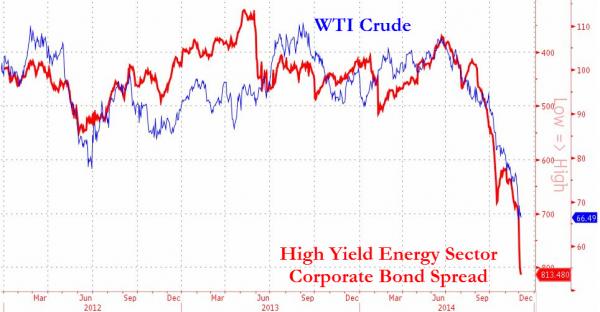
“.. 70% of the UK’s publicly listed oil exploration and production companies are now unprofitable..” We can all see what that means for the global industry.

Third Of Listed UK Oil And Gas Drillers Face Bankruptcy (Telegraph)

A third of Britain’s listed oil and gas companies are in danger of running out of working capital and even going bankrupt amid a slump in the value of crude, according to new research. Financial risk management group Company Watch believes that 70% of the UK’s publicly listed oil exploration and production companies are now unprofitable, racking up significant losses in the region of £1.8bn. Such is the extent of the financial pressure now bearing down on highly leveraged drillers in the UK that Company Watch estimates that a third of the 126 quoted oil and gas companies on AIM and the London Stock Exchange are generating no revenues. The findings are the latest warning to hit the oil and gas industry since a slump in the price of crude accelerated in November when the OPEC decided to keep its output levels unchanged.

The decision has caused carnage in oil markets with a barrel of Brent crude falling 45% since June to around $60 per barrel. The low cost of crude has added to the financial pressure on many UK listed drillers which are operating in offshore areas such as the North Sea where oil is more expensive to produce and discover. Ewan Mitchell, head of analytics at Company Watch, said: “Many of the smaller quoted oil and gas companies were set up specifically to take advantage of historically high and rising commodity prices. The recent large falls in the price of oil and gas could leave the weaker companies in difficulties, especially the ones that need to raise funds to keep exploring.” Losses are expected to be much deeper among privately-owned oil and gas explorers, which traditionally have more debt.

Company Watch has warned that almost 90% in the UK are loss making with accounts that show a £12bn accumulated black hole in their finances. Mr Mitchell said: “Investors in this sector need to focus primarily on the strength and structure of the balance sheet. A critical question is whether the balance sheet is sufficiently robust to keep the company in business until revenues are expected to flow and, crucially are they likely to be able to rely on existing funding lines while they wait? “Our fear is sustained low oil and gas prices will put an intolerable financial burden on the weaker companies, jeopardising many livelihoods.”

The findings of the Company Watch research are the latest downbeat analysis to hit the industry, which is preparing itself for oil prices to fall below current levels of $60 per barrel. Sir Ian Wood, founder of the oil and gas services giant Wood Group, warned earlier this month that the North Sea oil industry could lose 15,000 jobs in Scotland alone and that production could fall by 10% as drillers cut back. According to energy consultancy firm Wood Mackenzie, around £55bn of oil and gas projects in the North Sea and Europe could be shelved should prices fall below their current levels. Ratings agency Standard & Poor’s recently flagged its concern of some of Europe’s biggest oil and gas groups such as Royal Dutch Shell, BP and BG Group. Its primary worry is debt levels which it says have jumped from a combined $162.9bn (£105bn) for the five largest European companies in the sector at the end of 2008 to an estimated $240bn in 2014.

Read more …

It’s about demand, not supply.

Occam’s Oil (Alhambra)

As my colleague Joe Calhoun continually reminds us, everything that happens has happened before. The ongoing “struggle” to define what is driving crude oil prices lower is perhaps another instance of a past “cycle” being reborn. With oil prices now heading much closer to the $40’s than the $60’s, consistent commentary is increasingly swept aside. The move in crude these past six months is now nothing short of astounding. At about $52 current prices (which will probably move in either direction significantly by the time this is posted) the collapse from the recent peak now equals only past, significant global recessions under the oil regime that began in the mid-1980’s.
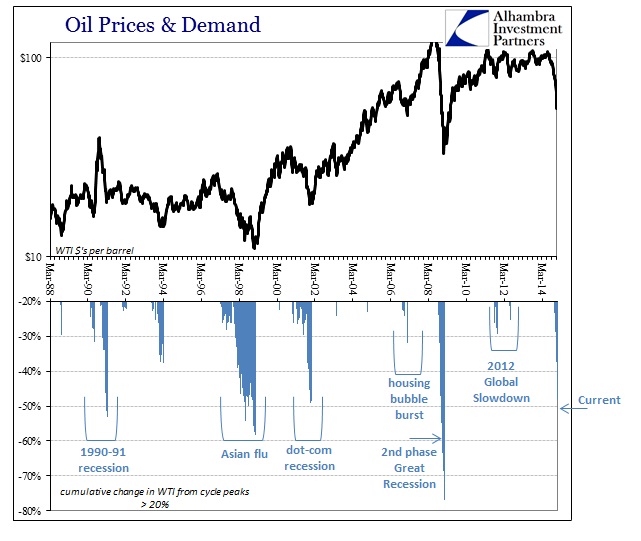
That comparison includes the 1997-98 Asian “flu” episode where the mainstream convention was also totally convinced of only massive oversupply defining price action. This was incorporated even into the International Energy Agency’s (IEA) estimates of oil inventories, as described shortly thereafter by certain incredulous oil observers:

Fourteen months have passed since the International Energy Agency’s oil analysts alerted the world to the mystery of the “missing barrels.” This new term referred to the discrepancy between the “well-documented” imbalance between supply and demand for oil and the lack of any stock build in the industrialized world’s petroleum supply. In April last year [1998], the IEA’s “missing supply” totaled only 170 million barrels. At the time, the IEA described this odd situation an “arithmetic mystery,” but assured us that these missing barrels would soon show up. As months passed by, stock revisions occasionally too place, but often in the wrong direction. Rather than shrink, the amount of “missing barrels” grew by epochal proportions.

By the publication date of the IEA’s April 1999 Oil Market Report, the unaccounted for crude needed to confirm the IEA’s extremely bearish views of massive oversupply of oil throughout 1997 and 1998 ballooned to an astonishing 647 million barrels of oil. Two months later, the IEA’s June report still presumes that 510 million barrels of oil is still “missing”, and the IEA has officially opined that it all resides in the un-traded storage facilities in the developing countries of the world.

As the author of that analysis points out in another piece, those “un-traded storage facilities” being blamed were sometimes ridiculous notions, such as “slow-steaming tankers”, South African coal mines or even Swedish salt domes. In other words, the idea that there was this massive oversupply of oil production driving the almost 60% collapse in global crude prices in 1997 and 1998 was total bunk. Instead, what was driving prices lower was the simple fact of supply and demand balancing to achieve a physical clearing price. That meant, in the broader context far and away from Swedish salt domes, the price of oil was really trading on the collapse in global demand for it. The Asian “flu” was not simply a financial panic among “unimportant”, far-flung isolated economies of tiny nations, but rather a global slowdown across nearly every economy – which sharply lower oil prices simply confirmed.

[..] today, the Saudis are supposedly up to the same tricks, now trying to drive US shale production out of business. The fact that all those increased marginal suppliers more than survived the Asia flu tells you everything you need to know about this wild assertion of “intentional” Saudi action. It is a convoluted rumor that survives solely because it is convenient to those economists and commentators that refuse to accept these more basic connections.

Read more …

“We’re buying more of it from ourselves, which is a great economic multiplier.” Well, until you start losing 1000s of jobs.

AAA Says Motorists May Save $75 Billion on Gasoline in 2015 (Bloomberg)

Drivers in the U.S. may save as much as $75 billion at gasoline pumps in 2015 after a yearlong rout in crude oil sent prices tumbling, AAA said today. Americans already saved $14 billion on the motor fuel this year, according to Heathrow, Florida-based AAA, the country’s largest motoring group. Pump prices have dropped a record 97 consecutive days to a national average $2.26 a gallon today, the lowest since May 12, 2009, AAA said by e-mail. A global glut of crude oil and a standoff between U.S. producers and the Organization of Petroleum Exporting Countries over market share has been a boon for consumers. U.S. production climbed this year to the highest in three decades amid a surge in output from shale deposits.

Oil is heading for its biggest annual decline since the 2008 financial crisis. “Next year promises to provide much bigger savings to consumers as long as crude oil remains relatively cheap,” Avery Ash, an AAA spokesman, said by e-mail today. “It would not be surprising for U.S. consumers to save $50-$75 billion on gasoline in 2015 if prices remain low.” U.S. benchmark West Texas Intermediate crude dropped 46% this year while Brent oil, the international benchmark that contributes to the price of gasoline imports, fell 49%. “It’s getting lower because what happened? We drilled in the United States,” Peyton Feltus, president of Randolph Risk Management in Dallas, said today in a telephone interview.

“We’re buying more of it from ourselves, which is a great economic multiplier.” There is “significant uncertainty” over the cost of crude next year as lower prices may force companies to curb production and may also lead to instability in other oil-producing countries, the motoring group said. Gasoline futures fell 48% this year to close at $1.4353 a gallon today on the New York Mercantile Exchange. The average U.S. household will save about $550 on gasoline costs next year, with spending on track to reach the lowest in 11 years, the Energy Information Administration said Dec. 16. “They’ve got more disposable income and they’re going to have even more in the coming months,” Feltus said. “Gasoline prices are going to go lower than anybody thought they could.”

Read more …

“It’s similar to 2008 when we knew oil at $120, $130 and $140 made no sense, but high prices became the reason for higher prices. It’s the same thing in reverse.”

Bottom On Oil’s Plunge Unknown (CNBC)

Oil’s massive price drop continues to befuddle industry experts. “We’re at the stupid range,” Stephen Schork, editor and founder of The Schork Report, said in an interview with CNBC’s “Squawk Box.” Schork added this situation is similar to oil’s price spike in 2008 in terms of its uncertainty. “We don’t know how much lower oil can go,” Schork said. “It’s similar to 2008 when we knew oil at $120, $130 and $140 made no sense, but high prices became the reason for higher prices. It’s the same thing in reverse.” Schork also said oil’s price plunge is attracting many investors. “Bets for oil below $30 by June traded over 46,000 contracts over the past two weeks,” he said.

Also on “Squawk Box,” Boris Schlossberg, founding partner of B.K. Asset Management, said an entire year of oil selling at $50 per barrel will create problems for Russia. “Russia is in very serious trouble if oil just stays low,” he said. “We had a bounce in the ruble, and it sort of stabilized right now, but if you have oil staying at $54 for a whole year, it’s really going to create problems over there.” Schlossberg added that this could lead to more capital leaving Russia for other currencies, including the Swiss franc. “There’s a lot of money being moved into the Swiss franc as a safety trade,” he said.

Read more …

“The move could signal that a full opening of the export ban, which has existed since the oil shock of the 1970s, is imminent.”

US Eases Oil Export Ban In Shot At OPEC As Crude Price Slumps (Telegraph)

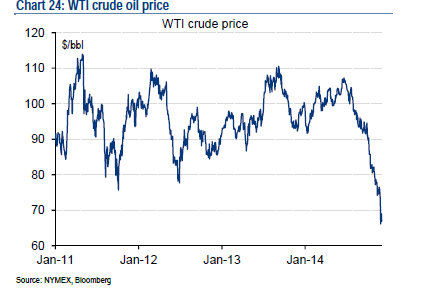
President Barack Obama has fired a shot at the Organisation of Petroleum Exporting Countries (OPEC) in the war to control global oil markets by quietly sanctioning the easing of America’s 40-year ban on exporting crude. The US government has reportedly told oil companies they can begin to export shipments of condensate – a high-grade crude produced as a by-product of gas – without going through the formal approval process. The move could signal that a full opening of the export ban, which has existed since the oil shock of the 1970s, is imminent. Brent crude fell sharply on the news, first reported by Reuters. The global benchmark opened down almost 2% in London at $56.85 per barrel as it closes in on its biggest annual drop since the financial crisis in 2008. Brent has lost 50% of its value since reaching its year-long high in June. The ending of America’s self-imposed embargo on oil exports would mark a serious escalation in the unfolding oil price war with OPEC led by Saudi Arabia.

The kingdom has made it clear that it is willing to watch the price of oil fall lower in order to protect its share of the global market. OPEC share has fallen to about a third of world supply, down from about half 20 years ago as the flood in shale oil drilling in the US and new supplies from Russia and South America have created a global glut. Meanwhile, the sharp fall in the value of oil is placing economies in major producing nations such as Venezuela and Russia under extreme strain. Venezuela – also a member of OPEC – has fallen into recession after its economy contracted for the first three quarters of the year, while inflation topped 63% in the 12 months to November. The South American oil giant’s economy shrank 2.3% in the third quarter, after contracting 4.8% in the first quarter and 4.9% in the second, the central bank has said.

Recession also looms in Russia, where the economy has fallen into decline for the first time in five years, according to official figures, which show that GDP contracted by 0.5% in the year to November. Falling oil prices are helping the US to exert pressure on the Kremlin over President Vladimir Putin’s support for separatists in Ukraine. Oil also came under pressure on the final day of the year after new data showed that China may miss its growth target for 2014. China manufacturing PMI fell to 49.6, down from final 50.0 in November. This is the first time in the second half of the year that China’s factory sector has contracted and has increased the possibility that 2014 GDP will miss the official 7.5% target. “Weak Chinese manufacturing data also damaged demand sentiment around oil as Brent breached the $57 handle,” said Peter Rosenstreich, head of market strategy at Swissquote.

Read more …

“When the future arrives, prices will still be low, confounding those who have bought forward.”

Even $20 Oil Will Struggle To Save Self–Harming Eurozone (Telegraph)

Revisiting the past year’s predictions is, for most columnists – yours truly included – a frequently humbling experience. The howlers tend to far outweigh the successes. Yet, for a change, I can genuinely claim to have got my main call for markets – that oil would sink to $80 a barrel or less – spot on, and for the right reasons, too. Just in case you think I’m making it up, this is what I said 12 months ago: “My big prediction is for $80 oil, from which much of the rest of my outlook for the coming year flows. It’s hard to overstate the significance of a much lower oil price – Brent at, say, $80 a barrel, or perhaps lower still – yet this is a surprisingly likely prospect, the implications of which have been largely missed by mainstream economic forecasters.” If on to a good thing, you might as well stick with it; so for the coming year, I’m doubling up on this forecast.

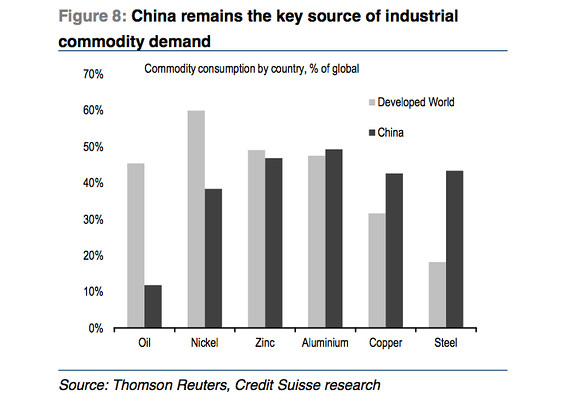
Far from bouncing back to the post crisis “normal” of something over $100 a barrel, as many oil traders seem to expect, my view is that the oil price will remain low for a long time, sinking to perhaps as little as $20 a barrel over the coming year before recovering a little. I’ve used the word “normal” to describe $100 oil, but in fact such prices are in historic terms something of an aberration. The long term, 20–year average is, in today’s money (adjusting for inflation), more like $60. It wasn’t that long ago that OPEC was targeting $25 oil, which back then seemed a comparatively high price. Be that as it may, for 15 years prior to the turn of the century Brent traded at around the $20 mark in nominal terms. Oil at $20 is a much more “normal” price than $100. The assumption of much higher prices is in truth a very modern phenomenon, born of explosive emerging market demand. For the time being, this seems to be over. Chinese growth is slowing and becoming less energy intensive.

By the by, however, the relatively high prices of the past 10 years have incentivised both a giant leap in supply – in the shape of American shale and other once marginal sources – and continued paring back of existing demand, as consumers, under additional pressure from environmental objectives, seek greater efficiency. Lots of new technologies have been developed to further these aims. Personally, I wouldn’t read much into the present deep “contango” in markets – an unusual alignment whereby futures prices are a lot higher than present spot prices. Some cite this as evidence that the price will shortly rebound. I’d say it’s just a leftover from the old “peak oil” mindset of permanently high prices. When the future arrives, prices will still be low, confounding those who have bought forward. In any case, for now we are faced with an oil glut, and there is no reason to believe that this mismatch between supply and demand is going to close any time soon.

Read more …

Draghi must leave.

ECB’s Draghi Says Eurozone Must ‘Complete’ Monetary Union (Reuters)

Euro zone countries must “complete” their monetary union by integrating economic policies further and working towards a capital markets union, European Central Bank President Mario Draghi said. In an article for Italian daily Il Sole 24 Ore on Wednesday, Draghi said structural reforms were needed to “ensure that each country is better off permanently belonging to the euro area”. He said the lack of reforms “raises the threat of an exit (from the euro) whose consequences would ultimately hit all members”, adding the ECB’s monetary policy, whose goal is price stability, could not react to shocks in individual countries.

He said an economic union would make markets more confident about future growth prospects – essential for reducing high debt levels – and so less likely to react negatively to setbacks such as a temporary increase in budget deficits. “This means governing together, going from co-ordination to a common decisional process, from rules to institutions.” Unifying capital markets to follow this year’s banking union would also make the bloc more resilient. “How risks are shared is connected to the depth of capital markets, in particular stock markets. As a consequence, we must proceed swiftly towards a capital markets union,” Draghi wrote.

Read more …

“An army of critics retort that the underlying picture is turning blacker by the day. Europe’s rescue apparatus is not what it seems. The banking union belies its name. It is merely a supervision union.”

Greek Expulsion From The Euro Would Demolish EMU’s Contagion Firewall (AEP)

We know from memoirs and a torrent of leaks that Europe’s creditor bloc came frighteningly close to ejecting Greece from the euro in early 2012, and would have done so with relish. Former US Treasury Secretary Tim Geithner has described the mood at a G7 conclave in Canada in February of that year all too vividly. “The Europeans came into that meeting basically saying: ‘We’re going to teach the Greeks a lesson. They are really terrible. They lied to us, and we’re going to crush them,’” he said. “I just made very clear right then: if you want to be tough on them, that’s fine, but you have to make sure that you’re not going to allow the crisis to spread beyond Greece.” German chancellor Angela Merkel did later retreat but only once it was clear from stress in the bond markets that Italy and Spain would be swept away in the ensuing panic, setting off an EMU-wide systemic crisis.

The prevailing view in Berlin and even Brussels is that no such risk exists today: Europe has since created a ring of firewalls; debtor states have been knocked into shape by their EMU drill sergeants. The democratic drama unfolding in Greece this month is therefore a local matter. If Syriza rebels win power on January 25 and carry out threats to repudiate the EU-IMF Troika Memorandum from their “first day in office”, Greece alone will suffer the consequences. “I believe that monetary union can today handle a Greek exit,” said Michael Hüther, head of Germany’s IW institute. “The knock-on effects would be limited. There has been institutional progress such as the banking union. Europe is far less easily blackmailed than it was three years ago.” This loosely is the “German view”, summed up pithily by Berenberg’s Holger Schmieding: “We’re looking at a Greece problem, the euro crisis is over. I do not expect markets to seriously contest the contagion defences of Europe.”

It sounds plausible. Bond yields in Italy, Spain and Portugal touched a record low this week. Yet it rests on the overarching assumption that the Merkel plan of austerity and “internal devaluation” has succeeded. An army of critics retort that the underlying picture is turning blacker by the day. Europe’s rescue apparatus is not what it seems. The banking union belies its name. It is merely a supervision union. Each EMU state bears the burden for rescuing its own lenders. Europe’s leaders never delivered on their promise to “break the vicious circle between banks and sovereigns”. The political facts on the ground are that the anti-euro Front National is leading in France, the neo-Marxist Podemos movement is leading in Spain, and all three opposition parties in Italy are now hostile to monetary union.

Read more …

Creative accounting intended to fool the German court system(s). Good luck with that.

Europe’s Shadow Budget Venture Could Lead To Spiralling Debt (Sinn)

More details about the European commission’s €315bn (£247bn) investment plan for 2015-17 have finally come to light. The programme, announced in November by the commission’s president, Jean-Claude Juncker,amounts to a huge shadow budget – twice as large as the EU’s annual official budget – that will finance public investment projects and ultimately help governments circumvent debt limits established in the stability and growth pact. The borrowing will be arranged through the new European fund for strategic investment, operating under the umbrella of the European Investment Bank. The EFSI will be equipped with €5bn in start-up capital, produced through the revaluation of existing EIB assets, and will be backed by €16bn in guarantees from the European commission. The fund is expected to leverage this to acquire roughly €63bn in loans, with private investors subsequently contributing around €5 for every €1 lent – bringing total investment to the €315bn target.

Though EU countries will not contribute any actual funds, they will provide implicit and explicit guarantees for the private investors, in an arrangement that looks suspiciously like the joint liability embodied by Eurobonds. Faced with Angela Merkel’s categorical rejection of Eurobonds, the EU engaged a horde of financial specialists to find a creative way to circumvent it. They came up with the EFSI. Though the fund will not be operational until mid-2015, EU member countries have already proposed projects for the European commission’s consideration. By early December, all 28 EU governments had submitted applications – and they are still coming. An assessment of the application documents conducted by the Ifo Institute for Economic Research found that the nearly 2,000 potential projects would cost a total of €1.3tr, with about €500bn spent before the end of 2017. Some 53% of those costs correspond to public projects; 15% to public-private partnerships (PPPs); 21% to private projects; and just over 10% to projects that could not be classified.

The public projects will presumably involve EFSI financing, with governments assuming the interest payments and amortisation. The PPPs will entail mixed financing, with private entities taking on a share of the risk and the return. The private projects will include the provision of infrastructure, the cost of which is to be repaid through tolls or user fees collected by a private operator. Unlike some other critics, I do not expect the programme to fail to bolster demand in the European economy. After all, the €315bn that is expected to be distributed over three years amounts to 2.3% of the EU’s annual GDP. Such a sizeable level of investment is bound to have an impact. But the programme remains legally dubious, as it creates a large shadow budget financed by borrowing that will operate parallel to the EU and national budgets, thereby placing a substantial risk-sharing burden on taxpayers.

Read more …

A note from Morgan Stanley h/t Durden.

Implications for the ECB and Its Preparation for Sovereign QE (Elga Bartsch)

Even though my colleagues, Daniele Antonucci and Paolo Batori, do not expect the ECB and the National Central Banks (NCBs) to be subject to haircuts in the event of a Syriza-led debt restructuring, this is unlikely to be clear-cut for some time to come. As a result, the Greek political turmoil complicates matters for the ECB and its preparation of a sovereign QE programme. In my view, a sovereign default in the eurozone and the prospect of the ECB potentially incurring severe financial losses is likely to intensify the debate on the Governing Council, where purchases of government bonds remain highly controversial. This could make a detailed announcement and the start of a buying programme already at the January 22 meeting look even more ambitious than it seemed. The spectre of default does not only make the issue of sovereign QE less certain again than the market believes, it also could create new limitations in its implementation.

One of the decisions that the Governing Council will need to take is whether to include the two programme countries (Greece and Cyprus), the only ones that are not investment grade at the moment, in its sovereign QE. In our view, it is unlikely that the ECB will deviate from the conditions imposed in the context of the ABSPP and CBPP3, i.e. the countries need to have under a troika programme (and the programme needs to be broadly on track). This would mean though that for some eurozone countries, sovereign QE would become conditional – just as OMT was. If governments across the eurozone and the financial constructs they are backing with off-balance sheet guarantees are being haircut and the resulting losses start to show up in national budgets, the political opposition to sovereign QE might increase materially.

In fact, elected politicians in creditor countries might have a preference for the ECB taking a hit as well given that the Bank has considerable risk provisioning that could absorb these losses which national budgets don’t have. This debate could also materially influence how a sovereign QE programme by the ECB is structured, notably on whether the risks associated with such a programme should be shared by all NCBs. Even ahead of the latest developments in Greece, the Bundesbank was already pushing for there not being risk-sharing in a sovereign QE programme. This position is unlikely to only relate to Greece though, I think. It is much more likely to relate to the concerns voiced by the German Constitutional Court regarding the implicit fiscal transfers between countries in the event of purchases of government bonds. In the view of Court, this could amount to establishing a fiscal transfer mechanism that is outside the ECB’s mandate.

Read more …

Ugo!

Seven Shocking Events Of 2014 (Ugo Bardi)

Being involved with peak oil studies should make one somewhat prepared for the future. Indeed, for years, we have been claiming that the arrival of peak oil would bring turmoil and big changes in the world and we are seeing them, this year. However, the way in which these changes manifest themselves turns out to be shocking and unexpected. This 2014 has been an especially shocking year; so many things have happened. Let me list my personal shocks in no particular order

1. The collapse of oil prices. Price oscillations were expected to occur near the oil production peak, but I expected a repetition of the events of 2008, when the price crash was preceded by a financial crash. But in 2014 the price collapse came out of the blue, all by itself. Likely, a major financial crisis is in the making, but that we will see that next year.

2. The ungreening of Europe. My trip to Brussels for a hearing of the European parliament was a shocking experience for me. The Europe I knew was peaceful and dedicated to sustainability and harmonic development. What I found was that the European Parliament had become a den of warmongers hell bent on fighting Russia and on drilling for oil and gas in Europe. Not my Europe any more. Whose Europe is this?

3. The year propaganda came of age. I take this expression from Ilargi on “The Automatic Earth”. Propaganda is actually much older than 2014, but surely in this year it became much more shrill and invasive than it had usually been. It is shocking to see how fast and how easily propaganda plunged us into a new cold war against Russia. Also shocking it was to see how propaganda could convince so many people (including European MPs) that drilling more and “fracking” was the solution for all our problems.

4. The Ukraine disaster. It was a shock to see how easy it was for a European country to plunge from relative normalcy into a civil war of militias fighting each other and where citizens were routinely shelled and forced to take refuge in basements. It shows how really fragile are those entities we call “states”. For whom is the Ukraine bell tolling?

5. The economic collapse of Italy. What is most shocking, even frightening, is how it is taking place in absolute quiet and silence. It is like a slow motion nightmare. The government seems to be unable to act in any other way than inventing ever more creative ways to raise taxes to squeeze out as much as possible from already exhausted and impoverished citizens. People seem to be unable to react, even to understand what is going on – at most they engage in a little blame game, faulting politicians, immigrants, communists, gypsies, the Euro, and the great world conspiracy for everything that is befalling on them. A similar situation exists in other Southern European countries. How long the quiet can last is all to be seen.

6. The loss of hope of stopping climate change. 2014 was the year in which the publication of the IPCC 5th assessment report was completed. It left absolutely no ripple in the debate. People seem to think that the best weapon we have against climate change is to declare that it doesn’t exist. They repeat over and over the comforting mantra that “temperatures have not increased during the past 15 years”, and that despite 2014 turning out to be the hottest year on record.

7. The killing of a bear, in Italy, was a small manifestation of wanton cruelty in a year that has seen much worse. But it was a paradigmatic event that shows how difficult – even impossible – it is for humans to live in peace with what surrounds them – be it human or beast.

Read more …

“Our democracy just isn’t going to survive in this type of atmosphere ..”

For the Wealthiest Political Donors, It Was a Very Good Year (Bloomberg)

Here’s a bit of perspective on the ever-rising cost of elections, and the big-money donors who finance them: Three of the country’s wealthiest political contributors each saw their net worth grow in 2014 by more than $3.7 billion, the entire cost of the midterm elections. And as the 2016 presidential election approaches, almost all of those donors have even more cash to burn. The only top political donor who lost money in 2014, Sheldon Adelson, still has a fortune greater than the annual gross domestic product of Zambia, so playing in U.S. politics remains well within his financial range. The Bloomberg Billionaires Index tracks the daily gains and losses in the net worth of the financial elite, and with the final hours of trading for this year ticking away, we’ve reviewed the bottom line for 2014 for the politically active super-wealthy. In total, 11 of the donors that Bloomberg tracks added a combined $33 billion to their wealth in a single year. (The index does not include Michael Bloomberg, founder and majority owner of Bloomberg LP.)

The tab for the House and Senate elections came to $3.7 billion, according to the nonpartisan Center for Responsive Politics in Washington. Warren Buffett, Larry Ellison, and Laurene Powell Jobs each could have covered all of that with the wealth they accumulated in the past 12 months. James Simons and George Soros would have come pretty close. Some of that wealth, combined with loosening campaign-finance restrictions and a political class growing ever more comfortable with the new world of virtually unlimited donations, could start flowing to campaigns in the next few months as candidates prepare for the 2016 presidential race. Wealthy donors will have even more giving options after Congress voted to raise the limits on how much individuals can give to political parties, creating a political landscape that horrifies some good-government groups.

They point to a reality: A wealthy donor can now almost singlehandedly bankroll a candidate, as Adelson did for former House Speaker Newt Gingrich in 2012, raising questions about whether these financial commitments ultimately will influence future policy. “Our democracy just isn’t going to survive in this type of atmosphere,” said Craig Holman, a lobbyist for Public Citizen, a group that advocates for stricter campaign-finance limits. “The United States, throughout history, has worked on a very delicate balance between capitalism in the economic sphere and democracy in the political sphere. We no longer have that balance. The economic sphere is going to smother and overwhelm the political sphere.”

David Keating, president of the Center for Competitive Politics, a group that argues the limits on political spending are arbitrary, sees it differently. “Big money in politics can actually make the electorate better informed,” he said. Besides, he added, there are enough billionaires to go around. For example, “you’ve got billionaires funding gun control and billionaires paying for groups that oppose gun control. It’s all pretty much a wash.” The sheer amount of money some donors made on paper in 2014 rewrites the context of “big” money in politics. For a political race, a $1 million cash infusion could change the outcome. For America’s big-money clique, it’s a fraction of what some billionaires can make or lose in a single day.

Read more …

That’s your money.

Pension Funds Triple Stake In Reinsurance Business to $59 Billion (NY Times)

Billions of dollars from pension funds and other nontraditional players have been moving into the reinsurance business in recent years, according to a report released on Wednesday by the Treasury Department. The report did not identify individual pension funds or other providers of what it called “alternative capital” for reinsurance. But it found that such newcomers had put about $59 billion into the $570 billion global reinsurance market as of June 30. That was more than three times their stake in 2007. The report also said that more than half the capital standing behind reinsurance innovations now comes from “pension funds, endowments and sovereign wealth funds, generally through specialized insurance-linked investment funds.” By contrast, hedge funds and private equity firms now provide about one-fourth of the money for such investments.

The report said that alternative reinsurance arrangements were increasingly being pitched to investors as “mainstream products” and said that “exposure to such risks could be problematic for unsophisticated investors.” The purpose of the Treasury report was not to assess risks or spotlight potential problems but to describe the overall state of the reinsurance industry, which is familiar to experts but almost unknown to everyone else. In fact, the report stressed that reinsurance brings many benefits and that some reinsurance programs are operated by the states, like Florida’s Hurricane Catastrophe Fund and California’s Earthquake Authority. The report was issued by the Federal Insurance Office, an arm of the Treasury established in the wake of the 2008 financial crisis.

Normally the states regulate insurance, but the Federal Insurance Office has been looking at parts of the industry that extend beyond state regulators’ reach. Reinsurance frequently transfers risks offshore, for example, to jurisdictions where the states’ capital and other requirements do not apply. Increasingly, some states have been creating alternative regulatory frameworks to attract some of the offshore reinsurance business back to the United States. That can bring investment and jobs to those states, but it has also raised concerns that a poorly understood and risky “shadow insurance” sector is taking shape. “Regulatory concerns about this widespread practice continue to receive attention within the national and international insurance supervisory community,” the report said.

Read more …

Whatever anybody says, the Russians feel deeply betrayed by the west. That’s what drives their actions.

Inside Obama’s Secret Outreach to Russia (Bloomberg)

President Barack Obama’s administration has been working behind the scenes for months to forge a new working relationship with Russia, despite the fact that Russian President Vladimir Putin has shown little interest in repairing relations with Washington or halting his aggression in neighboring Ukraine. This month, Obama’s National Security Council finished an extensive and comprehensive review of U.S policy toward Russia that included dozens of meetings and input from the State Department, Defense Department and several other agencies, according to three senior administration officials. At the end of the sometimes-contentious process, Obama made a decision to continue to look for ways to work with Russia on a host of bilateral and international issues while also offering Putin a way out of the stalemate over the crisis in Ukraine.

“I don’t think that anybody at this point is under the impression that a wholesale reset of our relationship is possible at this time, but we might as well test out what they are actually willing to do,” a senior administration official told me. “Our theory of this all along has been, let’s see what’s there. Regardless of the likelihood of success.” Leading the charge has been Secretary of State John Kerry. This fall, Kerry even proposed going to Moscow and meeting with Putin directly. The negotiations over Kerry’s trip got to the point of scheduling, but ultimately were scuttled because there was little prospect of demonstrable progress.

In a separate attempt at outreach, the White House turned to an old friend of Putin’s for help. The White House called on former Secretary of State Henry Kissinger to discuss having him call Putin directly, according to two officials. It’s unclear whether Kissinger actually made the call. The White House and Kissinger both refused to comment for this column. Kerry has been the point man on dealing with Russia because his close relationship with Russian Foreign Minister Sergei Lavrov represents the last remaining functional diplomatic channel between Washington and Moscow. They meet often, often without any staff members present, and talk on the phone regularly. Obama and Putin, on the other hand, are known to have an intense dislike for each other and very rarely speak.

Read more …

Draghi for president!

Italian President to Resign, Posing Challenge for Renzi (Bloomberg)

Italian President Giorgio Napolitano said he’ll resign “soon,” setting up a challenge for Premier Matteo Renzi, who will now need to form alliances among lawmakers to push through his own candidate for the job. “It’s my duty not to underestimate the signs of fatigue,” Napolitano, 89, said in his traditional Dec. 31 end-of-year speech, giving his age among the reasons for his resignation. He also cited the need to “return to constitutional normalcy” putting an end to his prolonged term. He gave no exact date for his resignation in the televised address. Napolitano, who took office in 2006, reluctantly accepted a second term in April 2013 after inconclusive elections led to a hung parliament which failed to strike a deal on his successor for days. The president had signaled from the start that he wouldn’t serve a full seven-year term.

Now Renzi, 39, will have to find a name appealing enough to at least half of an over 1000-member electoral college in order to push through a candidate of his liking. While Italy’s head of state is largely a ceremonial figure, the role and powers are enhanced at times of political crisis as the president has the power to dissolve parliament and designate prime minister candidates. Napolitano picked Renzi to lead a new government in February and his efforts to guarantee political stability have supported the prime minister’s reform package aimed at lifting Italy out of recession. After Napolitano steps down, Senate Speaker Pietro Grasso will act as caretaker head of state until his successor is elected.

National lawmakers and 58 regional delegates make up the electoral college of more than 1,000 members that will vote for the new president. The procedure can take several days as just two rounds of voting are held each day by secret ballot. To win in any of the first three rounds, a candidate must secure two-thirds of the vote, whereas from the fourth round a simple majority suffices. [..] Names circulated for the post so far in the Italian press include European Central Bank President Mario Draghi, former Italian Prime Minister Romano Prodi, Finance Minister Pier Carlo Padoan, and Bank of Italy Governor Ignazio Visco. Napolitano, a former communist, known for once praising the Soviet Union’s crushing of the 1956 reformist movement in Hungary, is credited with helping restore market confidence in Italy during Europe’s 2011 debt crisis.

Read more …

Can she save her ass from the Petrobras scandal? She headed the company for years, for Pete’s sake.

Rousseff Begins Second Term as Brazil Economic Malaise Hits Home

Dilma Rousseff will be sworn in today for her second term as Brazil’s president as a corruption scandal involving the country’s biggest company, above-target inflation and the slowest economic expansion in five years undermine her support. Since Rousseff took over from her mentor Luiz Inacio Lula da Silva four years ago, the budget deficit has more than doubled to 5.8% of gross domestic product and economic growth has come to a standstill from 7.5% growth in 2010. Inflation has remained above the center of the target range throughout her first term. Rousseff, who won an Oct. 26 runoff election by the narrowest margin of any president since at least 1945, has appointed a new economic team and announced spending cuts.

The central bank increased the key lending rate twice since the election to contain consumer price increases. While such measures are a first step to prevent a credit rating downgrade, the question is whether Rousseff will have the political support to hold the course, said Rafael Cortez, political analyst at Tendencias, a Sao Paulo-based consulting firm. “The economic malaise will spread to consumers and the corruption scandal will impose a negative legislative agenda,” Cortez said in a phone interview. “In a best-case scenario, she’ll manage to recover some investor credibility and pave the wave for moderate growth; the worst case is that we’ll have a lame duck president in a year or two.”

Rousseff is scheduled to be sworn in today and address Congress in Brasilia this afternoon. Designated Finance Minister Joaquim Levy pledges to pursue a budget surplus before interest payments of 1.2% of gross domestic product this year and at least 2% of GDP in 2016 and 2017, after Brazil’s credit rating in 2014 suffered a downgrade for the first time in more than a decade. The primary budget balance turned to a deficit of 0.18% of GDP in the 12 months through November, the first such annual shortfall on record. On Dec. 29 the government announced cuts to pension and unemployment benefits that will save an estimated 18 billion reais ($6.8 billion). Authorities also have increased the long-term lending rate for loans granted by the state development bank BNDES to 5.5% from 5%.

Read more …

A 79-year old crown prince. And millions of unemployed 16 to 24-year old testosterone bombs. Nice contrast.

Eyes On Saudi Succession After King Hospitalized (CNBC)

The Saudi stock market fell after King Abdullah bin Abdulaziz Al Saud was hospitalized Wednesday, but any succession for the throne would likely be smooth for the country. The Saudi royal family announced in March that 79-year-old Crown Prince Salman would succeed the king, and experts said those plans have eased most concerns about an impending transition. In fact, Saudi watchers told CNBC that the country’s oil, domestic and geopolitical policies should remain virtually unchanged when Salman takes over. “This is very predictable,” Bilal Saab, senior fellow for Middle East security at the Atlantic Council, said of the transition. Still, he reflected, “the markets just react in unpredictable ways.” Although King Abdullah has been perceived as a champion of domestic reform, his departure would not signal the reversal of any of his (relatively) progressive policies, Saab said.

Salman, who has assumed many state duties while currently serving as deputy prime minister and minister of defense, is relatively well-liked by regional neighbors and in Washington, according to Karen Elliott House, author of “On Saudi Arabia: Its People, Past, Religion, Fault Lines—and Future.” Given that the transition of duties has partially begun, experts said that there would likely be little political drama when Salman takes the throne. Still, the issue of his successor could prove a contentious moment for the perpetually stable kingdom. The royal family officially announced in March that Prince Muqrin bin Abdulaziz, the youngest surviving half brother of the king and Salman, would be given the role of deputy crown prince – in effect naming him the successor to Salman.

House said that could provide a moment of tension for the royal family: A successor has traditionally been picked by an ascending king, and some family members were reportedly less than pleased about Muqrin’s appointment. Still, those concerns pale in comparison to the current succession worries in Oman, Saab said. That country’s sultan, Qaboos bin Said Al Said, has no formal successor plan, and political chaos after his death could be problematic for the region, he said. “This is someone who has a much more influential role, not just in his country, but in the region with the Iranians,” Saab said. “The concerns over succession are much more pronounced in Oman than in Saudi Arabia”

Read more …

A bit of infighting among the family’s scores of princes would be funny. Whatever happens in the family, the House of Saud faces domestic turmoil.

Saudi Succession Plan About Continuity (CNBC)

Oil investors are closely watching the health of Saudi Arabia’s king, who was hospitalized Wednesday. However, while some wonder about how an eventual change in leadership might impact the global oil markets, two Middle East experts told CNBC they don’t expect much difference in how a new monarch would govern. “They’ll pursue the same security arrangements with the United States. They’ll maintain Saudi Arabia’s commitment to fight the Islamic State. They’ll also be pumping oil because there are broader strategic interests the kingdom is pursuing,” David Phillips, former senior advisor to the State Department and a CNBC contributor, said in an interview with “Street Signs.”

King Abdullah bin Abdulaziz Al Saud, thought to be 91, was admitted to the hospital on Wednesday for medical tests, according to state media, citing a royal court statement. A source told Reuters he had been suffering from breathing difficulties, but was feeling better and in stable condition. The news sent the Saudi stock exchange down as much as 5%, before it recovered slightly to close almost 3% lower. The king has “been in bad health for the past several years,” and the government has been anticipating his passing for some time, said Phillips, now the director of the Peace-building and Human Rights Program at Columbia University. “There are policies and personalities in place in order to maintain continuity,” he added.

Read more …

From Glenn Greenwald’s people.

Sony Hackers Threaten US News Media Organization (Intercept)

The hackers who infiltrated Sony Pictures Entertainment’s computer servers have threatened to attack an American news media organization, according to an FBI bulletin obtained by The Intercept. The threat against the unnamed news organization by the Guardians of Peace, the hacker group that has claimed credit for the Sony attack, “may extend to other such organizations in the near future,” according to a Joint Intelligence Bulletin of the FBI and the Department of Homeland Security obtained by The Intercept. Referring to Sony only as “USPER1”and the news organization as “USPER2,” the Joint Intelligence Bulletin, dated Dec. 24 and marked For Official Use Only, states that its purpose is “to provide information on the late-November 2014 cyber intrusion targeting USPER1 and related threats concerning the planned release of the movie, ‘The Interview.’ Additionally, these threats have extended to USPER2 —a news media organization—and may extend to other such organizations in the near future.”

In the bulletin, titled “November 2014 Cyber Intrusion on USPER1 and Related Threats,” The Guardians of Peace threatened to attack other targets on the day after the FBI announcement. “On 20 December,” the bulletin reads, “the [Guardians of Peace] GOP posted Pastebin messages that specifically taunted the FBI and USPER2 for the ‘quality’ of their investigations and implied an additional threat. No specific consequence was mentioned in the posting.” Pastebin is a Web tool that enables users to upload text anonymously for anyone to read. It is commonly used to share source code and sometimes used by hackers to post stolen information. The Dec. 20 Pastebin message from Guardians of Peace links to a YouTube video featuring dancing cartoon figures repeatedly saying, “you’re an idiot.”

No mention of a specific news outlet could be found by The Intercept in any of the GOP postings from that date still available online or quoted in news reports. “While it’s hard to tell how legitimate the threat is, if a news organization is attacked in the same manner Sony was, it could put countless sensitive sources in danger of being exposed—or worse,” Trevor Timm, executive director of the Freedom of the Press Foundation, told The Intercept. Timm points out, however, that media are already commonly targeted by state-sponsored hackers.“This FBI bulletin is just the latest example that digital security is now a critical press freedom issue, and why news organizations need to make ubiquitous encryption a high priority,” he said.

Read more …

“Consider, first, how a competent response to Ebola might have played out ..”

Next Year’s Ebola Crisis (Bloomberg ed.)

One of the many ways the world failed to distinguish itself in 2014 was with its response to the Ebola crisis. It cannot afford to be so late, slow and fatally inadequate next year — with Ebola, which continues to kill people in West Africa, or with the next global pandemic. Consider, first, how a competent response to Ebola might have played out: A year ago, the health workers in Guinea who saw the first cases would have had the training to recognize it and the equipment to treat it without infecting themselves and others. They didn’t, and the disease spread quickly to Liberia and Sierra Leone. Ideally, then, doctors there would have diagnosed Ebola, and traced and quarantined everyone who had contact with the victims. Crucially, they would have alerted the World Health Organization. As it happened, the WHO wasn’t told of the outbreak until March.

At that point, in a best-case scenario, with local health-care systems overwhelmed, the WHO would have intervened with a team of well-equipped doctors and nurses. Such a team didn’t exist, and it took the WHO until August even to declare a public-health emergency, and several weeks beyond that to come up with a response plan. And so the total number of infections is now more than 12,000, with some 7,700 dead. This might-have-been story reveals how countries and the WHO need to change before the next outbreak – of Ebola, SARS, bird flu or whatever it turns out to be. Every country needs hospitals and laboratories capable of diagnosing, safely treating and monitoring disease. The WHO needs improved surveillance and reporting systems, as well as the capacity to send medical teams when needed. The World Health Assembly, the international body that sets policy for the WHO, cannot waste any time seeing that these changes are made.

What’s frustrating is that world leaders have long recognized the need to be ready for outbreaks of infectious disease. In 1969, they signed a pact known as the International Health Regulations, meant to make sure preparations would be in place. The most recent update to this accord – in 2005, after the SARS epidemic – called for all 196 countries to have the laboratories, hospitals and medical expertise to detect, treat and monitor epidemics. One glaring weakness in this framework, however, is that countries have been allowed to monitor their own readiness. An outside body – either the WHO or an independent organization – must be appointed to keep track of their progress toward building sturdy medical infrastructure. And at least until all 196 countries are up to snuff, the WHO needs to have the authority to step in.
Read more …

Dec 112014
 
 December 11, 2014  Posted by at 11:55 am Finance Tagged with: , , , , , , , , ,  1 Response »


DPC Pine Street below Kearney after the great San Francisco earthquake and fire 1906

Oil Plunge Rips Through Markets as Investors Seek Bottom (Bloomberg)
Bank Of America Sees $50 Oil As OPEC Dies (AEP)
Name That Chart! Oil Supply Or Demand Edition (Zero Hedge)
Dow Down Triple Digits As Oil Hits Multi-Year Lows (CNBC)
Steen Jakobsen: The US Could Bail Out Its Own Oil Sector (CNBC)
China’s Wild Market Swings: This Is Just The Start (CNBC)
PBOC, Traders Tussle Over Yuan (WSJ)
Yuan Has Real Shot at IMF Blessing on Reserve Status (Bloomberg)
How Wal-Mart Made Its Crumbling China Business Look So Good for So Long (BBG)
‘Known Unknown’ Dangers Are Lurking In The Stock Market (MarketWatch)
Britons Are Living Beyond Their Means, Says Government Watchdog (Telegraph)
Leaked EU Summit Conclusions: Draghi Left Hanging? (FT)
Greek Left Candidate Willing To Call European Leaders’ Bluff (AEP)
Superbugs To Kill 10 Million People A Year, Cost $100 Trillion By 2050 (BBC)
Generation Y Have Every Right To Be Angry At Baby Boomers’ Wealth (Guardian)
One-Fifth Of Americans Don’t Plan To Pay Off Their Debt (CNBC)
IMF Finds Another $15 Billion Black Hole In Ukraine’s Finances (CNBC)
Guantanamo Six ‘Will Enjoy Complete Freedom’ In Uruguay (BBC)
CIA Torture Report May Set Off Global Prosecutions (Bloomberg)
President George W. Bush ‘Knew Everything’ About CIA Interrogation (BBC)

“The mantra of ‘lower oil prices are good for the economy’ can only last so long until finally there’s a break in the psychology of investors ..”

Oil Plunge Rips Through Markets as Investors Seek Bottom (Bloomberg)

Oil’s collapse is rippling through financial markets, broadening a selloff in stocks beyond energy companies and leaving investors with few havens as assets from metals to corporate debt sink. Brent crude fell below $65 for the first time since 2009 as OPEC cut its forecast for 2015 demand, raising concern over the strength of the global economy and leaving investors contemplating when oil’s plunge will reach a bottom. “As great as it feels to pump $2 gasoline at the station, it’s not a healthy environment for financial assets,” Walter Todd, chief investment officer for Greenwood Capital, said. “It’s rare to see commodity prices fall this quickly in a non-recessionary situation. You really need to see some stabilization.” The selloff sent the MSCI All-Country World Index to its biggest drop in two months. The Standard & Poor’s 500 Index lost 1.6%, Canadian stocks plunged to the lowest since February and emerging-market shares fell to an eight-month low.

Traders are almost certain that Venezuela will teeter into default as bonds plunge to a 16-year low and the cost of default protection soars to a record. A measure of risk in the U.S. junk-bond market rose the most in two months. Copper fell 1.2% and gold slipped 0.2%. Investors sought relief in Treasuries as 30-year bond yields fell to a seven-week low, and the yen capped its biggest three-day gain versus the dollar in more than a year. While oil prices have been spiraling downward since June, entering a bear market and dragging down energy shares, the pace of today’s decline spurred selling in S&P 500 groups that helped drive the benchmark gauge to an all-time high on Dec. 5. All 10 major industries in the S&P 500 slumped at least 1% today.

“There’s nothing like human emotion to take over in the short term and fear is taking over, it looks like this really is a slowdown,” Ron Weiner at RDM Financial said. “In this case it really is an oil story, it really is a global slowdown of some sort.” [..] “The mantra of ‘lower oil prices are good for the economy’ can only last so long until finally there’s a break in the psychology of investors,” Jeff Sica at Circle Squared Alternative Investments said. “You start to realize the reason why oil prices are declining is because there’s severe economic weakness that has yet to be acknowledged. It’s bringing down all commodity prices.”

Read more …

“What is clear is that the world has become addicted to central bank stimulus. Bank of America said 56% of global GDP is currently supported by zero interest rates, and so are 83% of the free-floating equities on global bourses.”

Bank Of America Sees $50 Oil As OPEC Dies (AEP)

The OPEC oil cartel no longer exists in any meaningful sense and crude prices will slump to $50 a barrel over the coming months as market forces shake out the weakest producers, Bank of America has warned. Revolutionary changes sweeping the world’s energy industry will drive down the price of liquefied natural gas (LNG), creating a “multi-year” glut and a much cheaper source of gas for Europe. Francisco Blanch, the bank’s commodity chief, said OPEC is “effectively dissolved” after it failed to stabilize prices at its last meeting. “The consequences are profound and long-lasting,“ he said. The free market will now set the global cost of oil, leading to a new era of wild price swings and disorderly trading that benefits only the Mid-East petro-states with deepest pockets such as Saudi Arabia. If so, the weaker peripheral members such as Venezuela and Nigeria are being thrown to the wolves.

The bank said in its year-end report that at least 15pc of US shale producers are losing money at current prices, and more than half will be under water if US crude falls below $55. The high-cost producers in the Permian basin will be the first to “feel the pain” and may soon have to cut back on production. The claims pit Bank of America against its arch-rival Citigroup, which insists that the US shale industry is far more resilent than widely supposed, with marginal costs for existing rigs nearer $40, and much of its output hedged on the futures markets. Bank of America said the current slump will choke off shale projects in Argentina and Mexico, and will force retrenchment in Canadian oil sands and some of Russia’s remote fields. The major oil companies will have to cut back on projects with a break-even cost below $80 for Brent crude.

[..] What is clear is that the world has become addicted to central bank stimulus. Bank of America said 56% of global GDP is currently supported by zero interest rates, and so are 83% of the free-floating equities on global bourses. Half of all government bonds in the world yield less that 1pc. Roughly 1.4bn people are experiencing negative rates in one form or another. These are astonishing figures, evidence of a 1930s-style depression, albeit one that is still contained. Nobody knows what will happen as the Fed tries to break out of the stimulus trap, including Fed officials themselves.

Read more …

That’s some serious charts. “.. if it quacks like a duck, cook it.”

Name That Chart! Oil Supply Or Demand Edition (Zero Hedge)

While the question of supply vs demand in global oil markets is merely different sides of the same coin, we hope the following “name that chart” image provides some clarifying perspective on what is really dragging oil prices lower…
Nope… they are not the same… one of these is a commodity that is crashing but is believed to be “unequivocally” good for the global economy… the other is the global economy!!

DO NOT LOOK BELOW HERE UNTIL YOU GUESS… DON’T DO IT!!!!

Answer here.

and yes, we know correlation does not imply causation’ but… if it quacks like a duck, cook it.

You decide… steady supply into globally crushed demand…

Read more …

Come up for air today, dive down again tomorrow?

Dow Down Triple Digits As Oil Hits Multi-Year Lows (CNBC)

U.S. stocks declined on Wednesday, furthering the week’s losses, as the price of crude fell to multi-year lows and the Organization of Petroleum Exporting Countries cut its demand outlook for next year. “Oil continues to be the concern. Depending on who you talk to and in what time frame on which day of the week, oil may be a leading indicator, so there may be something behind the decline other than we have a lot of oil,” said Paul Nolte, senior vice president, portfolio manager at Kingsview Asset Management. “I don’t know that for sure. I do know, historically at least, energy stocks have tended to lead the market, and that lead time is anything from three months to a year, and we’re now six months into oil under performing the overall market, so we may be in for some rough sledding,” he added.

OPEC reduced its estimate for 2015 by roughly 300,000 barrels a day, with the cartel saying the effect of the 40% drop in prices on supply and demand is uncertain. The CBOE Volatility Index, a measure of investor uncertainty known as the VIX, jumped 9.4% to 16.29. Toll Brothers edged lower after the home builder reported mixed quarterly results; Yum Brands fell after the operator of Taco Bell and other fast-food brands cut is profit outlook for the year for a second time; Costco Wholesale climbed after the warehouse-club operator posted a better-than-expected quarterly profit and GlaxoSmithKline declined after Bank of America Merrill Lynch downgraded its stock to underperform from neutral.

Read more …

See:

Can The US Bail Out Its Oil Industry?

Steen Jakobsen: The US Could Bail Out Its Own Oil Sector (CNBC)

An economist who correctly predicted the fall in oil price this year has told CNBC that the U.S. government could look to bail out its energy sector in 2015 as the commodity’s low price starts hitting the country’s economy. “The U.S. energy sector is clearly important,” Steen Jakobsen, the chief economist at Danish investment bank Saxo Bank, told CNBC Wednesday. “They are paramount to the long-term strategic issue that the U.S. will be self-dependent on oil.” Jakobsen is part of team that puts together an annual “outrageous predictions” outlook that has been running for more than a decade. He concedes that these so-called black swan scenarios are “relatively controversial” but says that they could help investors navigate any real-life turmoil that arises. His prediction on a U.S. bailout is his own personal prediction and did not make the formal list that the Copenhagen-based company published on Wednesday morning.

A large number of economists believe the drilling frenzy and huge domestic energy boom has helped the U.S. to recover since the global financial crash of 2008, contributing an estimated 0.3-0.6 percentage points to U.S. gross domestic product. but Jakobsen believes this headwind could soon become a tailwind despite gas becoming cheaper at the pump for U.S. citizens. “It will subtract 0.5% from GDP, bare minimum,” he said. “There’s a precedent here, back in the 80s we also had an oil crisis and that led to bank recoveries.” He added that oil companies are in for a “massive correction,” similar to the downtrend seen in mining stocks, explaining that exploration was getting “hugely expensive” with energy majors having little free cash flow available. The S&P 500 index has clocked gains of around 11% so far this year but the energy sector within the benchmark is currently down nearly 12%. Oil prices are trading at five-year lows with Brent futures losing around 40% in value since June.

Read more …

What’s worrisome is that many have bought stocks with borrowed funds, and with apartments as collateral.

China’s Wild Market Swings: This Is Just The Start (CNBC)

The rout in China stocks on Tuesday is a healthy bull-market correction, say strategists, however the wild swings reinforce that the market is not for the faint of heart. The benchmark Shanghai Composite lived up to its notoriously volatile reputation on Wednesday, swinging between gains and losses after the market tanked more than 5% a day earlier – its biggest single-day percentage fall in 5 years. Losses were triggered by the Chinese securities clearing house’s decision late Monday to restrict the use of lower-grade corporate debt as collateral for short-term loans obtained through repurchase agreements. The move follows a surge in margin buying that accompanied the recent stock surge. Strategists, however, don’t believe the latest regulatory move will derail broader momentum in the market that has rallied 35.5% year to date.

“The new regulations were more of a negative catalyst for profit-taking. We see Tuesday’s selloff as a healthy correction,” said Stephen Sheung, head of investment strategy at SHK Private. Sheung says a reduction in leverage is unlikely to have a large impact because on the stock market: “You only need a small amount of money to move from bank deposits or wealth management products into stocks to push the market higher.” Audrey Goh, equity strategist at Standard Chartered also sees the recent market plunge as a pause for breath. “Yesterday’s move was a reaction to the rapid appreciation in the market over the past month,” Goh said. “Sentiment wise, there may be a perception that regulators are tightening up policies. But I think they are going on the right track because historically collateral has not been tightly scrutinized – this is all part of the reform process and shouldn’t have a long-term impact on the market,” she added.

Read more …

“Investors have been focusing on an almost daily deluge of downbeat economic news about China.”

PBOC, Traders Tussle Over Yuan (WSJ)

A battle in China’s currency market has emerged in recent days: Traders are pushing the yuan weaker, while the People;s Bank of China has been attempting to guide the tightly-controlled foreign-exchange rate stronger. That tension was on show Wednesday. The yuan began trading 1.1% weaker than the level at which the central bank set the morning reference rate, marking the biggest drop since June. Daily trading is limited to 2% above or below this so-called central parity rate. A slide in the currency has accelerated this month, after the central bank cut interest rates in November. The yuan is now 2% weaker than it was at the start of the year and is on track for its first annual loss since 2009. Investors have been focusing on an almost daily deluge of downbeat economic news about China.

Reports this week showed the rate of inflation slipped to a five-year low in November, while the country’s exports fell well below expectations in the same period. A broadly stronger dollar- the result of a recovering U.S. economy -has also hurt sentiment about the yuan. Volatility in the market has picked up this week, after Beijing curbed risky lending in the bond markets, sparking heavy declines in the stock and bond markets Tuesday. Monday and Tuesday, the yuan recorded its biggest-ever two-day tumble against the dollar. Wednesday, the central parity rate was set at 6.1195 yuan to the dollar, the strongest since March 3. The yuan opened at 6.1894. China’s central bank has been fighting the market, setting the yuan’s reference exchange rate, or “fix,” stronger against the dollar.

Analysts say Beijing appears eager to prevent one-way speculation on the currency and squeeze out those betting that it will decline further. “China doesn’t want to join the currency wars and that explains the fix movement,” said Ju Wang, a currency strategist at HSBC Holdings PLC in Hong Kong, referring to some countries’ efforts to push their currencies lower so that their exporters remain competitive. “But markets see it as China will eventually be dragged into the currency war or just fundamentally, growth and exports will weaken so much that will trigger the markets’ demand for the U.S. dollar.”

Read more …

Hard to deny.

Yuan Has Real Shot at IMF Blessing on Reserve Status (Bloomberg)

For the first time, China has a real shot at getting the International Monetary Fund to endorse the yuan as a global reserve currency alongside the dollar and euro. In late 2015, the IMF will conduct its next twice-a-decade review of the basket of currencies its members can count toward their official reserves. Including the yuan in this so-called Special Drawing Rights system would allow the IMF to recognize the ascent of the world’s second-biggest economy while aiding China’s attempts to diminish the dollar’s dominance in global trade and finance. China would need to satisfy the Washington-based lender’s economic benchmarks and get the support of most of the other 187 member countries.

The Asian nation is likely to pass both tests, said Eswar Prasad, who until 2006 worked at the IMF, including spells as heads of its financial studies and China divisions. “It will certainly help China’s objective of making the renminbi a more widely-used currency,” said Prasad, a professor of trade policy at Cornell University and senior fellow at the Brookings Institution. Renminbi is China’s official name for the yuan. Reserve-currency status for the yuan would make central banks, particularly those in developing economies, more eager to hold yuan assets and “diversify at the margin away from dollars,” as well as euros, yen and Swiss francs, Prasad said.

Approval hinges partly on whether the IMF reverses its 2010 decision that the yuan wasn’t “freely usable.” There’s growing evidence that the currency may now pass this test, after already qualifying on the IMF’s other condition of being a large exporter. The proportion of China’s trade that’s settled in yuan has risen to about 20%; the market for yuan-denominated Dim Sum bonds has grown to $72.9 billion from nothing in just seven years; and the government has loosened controls on foreigners’ access to its financial markets. China has also signed agreements to trade the yuan freely in cities from Hong Kong and Singapore to Frankfurt and London.

Read more …

Shouldn’t investors look at bringing charges?

How Wal-Mart Made Its Crumbling China Business Look So Good for So Long (BBG)

After years of heralding China as one of its best markets, Wal-Mart in August said its performance there was among the worst in its major countries. A management shake-up and job cuts have followed. Although the reversals seem abrupt, cracks in the foundation of Wal-Mart’s retail business in China have been developing for years, hidden by questionable accounting and unauthorized sales practices, according to employees and internal documents reviewed by Bloomberg. The practices – including bulk sales to other retailers and some sales allegedly booked when no merchandise left the shelves – made business appear strong even as retail transactions slowed and unsold inventory piled up, these people and documents say. Wal-Mart said in August that it was unhappy with inventory growth internationally. Stores in China continue to make bulk sales, sometimes unprofitably and without required management authorizations, according to employees who’ve left the company this past month.

Concerns about bulk sales, raised as far back as 2011 in an internal report, have been the subject of inquiries in China by Wal-Mart’s legal team as recently as May, according to an internal company e-mail and an employee interviewed by lawyers. The report and interviews with current and former employees say Chinese Wal-Mart stores, under pressure to meet earnings targets, resorted to temporary markups of inventory as an accounting move that can burnish profits without any added sales of merchandise. After employees “recognized inventory pricing discrepancies” in 2011, the company’s senior leadership in the U.S. and China ordered an extensive investigation that led to “various leadership changes and disciplinary actions,” strengthened compliance measures, training, and regular audits, Wal-Mart Stores Inc. said in a statement.

Read more …

“..stock market disasters are much more typically caused by “known unknowns” — the events that have been perking for a while, whose natures are familiar to us and yet whose exact forms and potential dangers remain unclear.”

‘Known Unknown’ Dangers Are Lurking In The Stock Market (MarketWatch)

As the S&P 500 Index keeps reaching new highs, investor conversations have shifted from how low it might go (October’s topic) to how high the stock market can possibly climb. When people get that excited, it’s time to think about risks. What could possibly go wrong and arrest this great bull market? Much speculation currently points to the kind of scary, exogenous, low-probability events we call black swans: an Ebola pandemic, say, or a “third world war” due to the Russia/Ukraine conflict or the ISIS threat escalating out of control. Nevertheless, while these and other black swan events may have the potential to cause catastrophic damage to the markets and society, stock market disasters are much more typically caused by “known unknowns” — the events that have been perking for a while, whose natures are familiar to us and yet whose exact forms and potential dangers remain unclear.

Take, for example, the 2008 global financial crisis: It did not happen overnight, and, looking back, there were plenty of signs and warnings, such as the subprime lending meltdown in 2007. Or, think of the dot-com bubble, which burst in 2000, several years after the first warnings of “irrational exuberance” by Federal Reserve Chairman Alan Greenspan in a speech given in 1996. So rather than reaching for sensational “unknown unknowns,” we are focusing on market risks we know and understand. We’ve listed a few here, starting with low probability and ending with high.

• Washington politics: As Republicans won the Senate in the mid-term elections and, thus, have full control of Congress, the government is now truly divided. Early signs indicate that political infighting between the two parties will become even more intense, a distasteful scenario to imagine. To make matters worse, another government funding deadline is looming Dec. 11. We believe that, whereas the political maneuvering may cause market volatility, it’s unlikely to pose a huge threat to the market.

• Rising interest rates: There is little argument that interest rates will go up, eventually, but it is also abundantly clear to many pundits that the rise will be a slow, grinding process rather than a spike. For the stock market, interest rates are, therefore, a long-term concern, and not likely to be an imminent threat. At the current near historic levels, equities are still far more attractive than fixed-income from a valuation standpoint, and rising interest rates will probably not tip the balance. Interest rates jumped in 2013, but the stock market, ironically, performed exceedingly well.

• Slowing growth: This is by far the No. 1 threat to markets and has flared up repeatedly. Just the anticipation of slowing growth can cause companies to slow production and consumers to temper spending, which is quickly reflected in falling stock prices. The most recent September-October market downturn, one of the worst during the past couple years, was caused by concerns about slowing growth.

Read more …

No, really?!

Britons Are Living Beyond Their Means, Says Government Watchdog (Telegraph)

Britons are living beyond their means more now than at almost any point over the past two decades, according to the head of the Government’s fiscal watchdog. Robert Chote, the chairman of the Office for Budget Responsibility (OBR), said real consumer spending over the past year had accelerated ahead of inflation-adjusted pay growth at its second fastest rate since the 1990s. “If you look at the relatively robust pace of growth over recent quarters, that has been reflected particularly in terms of the contribution from the consumer, of people running down saving rather than having stronger income growth,” he told the Treasury Select Committee. Mr Chote said this pace of consumption relative to earnings growth was likely to be unsustainable. “We’ve assumed that it is not plausible [that this could continue],” he said. “If you look at the last year, real consumption growth has been running further ahead of real wage growth than in almost any other year over the last 15 or 20 or so.

Therefore, in our forecast the main reason we expect the quarterly pace of growth to slow into next year is that you see consumer spending moving more into line with income growth, and being less driven by [a] decline in saving.” The OBR believes the UK economy will grow by 3pc this year, before slowing to 2.4pc in 2015 and 2.2pc in 2016. Household consumption growth is forecast to strengthen next year to 2.8pc, fuelled by a further decrease in savings. The household saving ratio is projected to fall to 5.4pc in 2015, from 6.6pc this year. However, consumer spending is expected to slow to 2.2pc in 2016 as the saving ratio stabilises. The OBR noted that consumption had grown by 2.1pc in real terms in the first three quarters of 2014, despite limited growth in real wages. Mr Chote also said that there had been a “structural deterioration” in productivity that meant British households would not enjoy the same living standards as they would have done had the financial crisis not occured. He added that rising productivity was essential for stronger pay growth.

In a separate speech, Ian McCafferty, a Bank of England policymaker, said raising interest rates now would help to “support and sustain” Britain’s recovery while ensuring prices rise smoothly in the future. Mr McCafferty said Britain’s “remarkable” recovery over the past 18 months suggested that pay growth was at a “turning point”, and that a sustained increase in wages was within sight. Speaking at the Institute of Directors on Wednesday, Mr McCafferty outlined four reasons for raising Bank Rate from its record low of 0.5pc, and warned that even small miscalculations about the degree of “spare capacity” meant the point at which the economy could start to overheat may arrive sooner than policymakers expect. He said raising rates now would ensure increases were “gradual and limited”.

Read more …

“Draghi may have to deliver his quo without a eurozone quid. The text makes clear that leaders have no intention of delivering a new blueprint any time soon. According to the draft, a debate on how to proceed will be pushed off until February, and the report itself will come no sooner than June.”

Leaked EU Summit Conclusions: Draghi Left Hanging? (FT)

The dance had become so routine that we at the Brussels Blog were thinking of giving it a name, the Eurozone Two-Step. Ever since the eurozone crisis first rocked international markets nearly five years ago, European Central Bank chiefs – first Jean-Claude Trichet, then Mario Draghi – sent a very clear message to the currency union’s political leaders: we can only act if you act first. The deal was never explicit, but both sides knew what was required. The ECB’s first sovereign bond purchase programme in May 2010 came only after eurozone leaders created a new €440bn bailout fund; its €1tn in cheap loans to eurozone banks in early 2012 only came after political leaders agreed to a new “fiscal compact” of tough budget rules. But with the markets watching Frankfurt closely for signs Draghi is about to launch another bold move – US-style quantitative easing, purchasing sovereign bonds to halt fears the bloc is headed into a deflationary spiral – there are new indications one of the partners is no longer dancing.

Back in October at a eurozone summit, Draghi was able to get a little-noticed statement out of the assembled leaders committing them to another “Four Presidents Report”, a reference to the blueprint delivered in 2012 that set a path towards further centralisation of eurozone economic policy. The report helped kick-start the EU’s just-completed “banking union.” Progress on that 2012 blueprint has since stalled, however, and at his last summit press conference, then-European Council president Herman Van Rompuy said the new “Four Presidents Report” would be delivered at the December EU summit, which starts next Thursday. Many in Brussels saw this as the quid for Draghi’s quo – once the leaders agreed to another blueprint for eurozone integration, Draghi would have a free hand to launch QE.

But according to a leaked draft of the communiqué for next week’s summit, Draghi may have to deliver his quo without a eurozone quid. The text makes clear that leaders have no intention of delivering a new blueprint any time soon. According to the draft, a debate on how to proceed will be pushed off until February, and the report itself will come no sooner than June.

Read more …

“There will be US-style food stamps and we will reconnect electricity to homes where it has been cut off. There will have to be debt relief because the debt is simply unpayable. We will ask Germany to renegotiate.”

Greek Left Candidate Willing To Call European Leaders’ Bluff (AEP)

Events have rudely exposed the illusion that the Greek people will submit quietly to a decade of colonial treatment and debt servitude. As matters stand, it is more likely than not that a defiant Alexis Tsipras will be prime minister of Greece by late January. His Syriza alliance vows to overthrow the EU-IMF Troika regime, refusing to implement the key demands. A view has taken hold in EU capitals and the City of London that Mr Tsipras has resiled from these positions and will ultimately stick to the Troika Memorandum, a text of economic vandalism that pushed Greece into seven years of depression, with a 25.9pc fall in GDP, longer and deeper than Europe’s worst episodes in the 1930s. Mr Tsipras is a polished performer on the EU circuit. He can no longer be caricatured as motorbike Maoist. But the fact remains that he told Greek voters as recently as last week that his government would cease to enforce the bail-out demands “from its first day in office”.

The logical implication is that Greece will be forced out of the euro in short order, unless the EU institutions capitulate. Mr Tsipras knows this. He is gambling that EU leaders – meaning Germany’s Angela Merkel – will yield. His calculation is that they will not dare to blow up monetary union at this late stage, and over a relative pittance. Too much political capital has been invested. The EU-IMF loans have already reached €245bn (£194bn), the biggest indenture package in history. To let it fall apart would expose failure of Mrs Merkel’s EMU crisis management. Yet the reality is that Greece must repay €6.7bn to the European Central Bank in July and August. The ECB will not roll it over because that would be monetary financing of a government. The capital markets are shut. Mr Tsipras knows that he is likely to receive a call from the ECB within weeks of taking office, reminding him that Greece owes some €40bn in emergency support (ELAs) for the banking system, a threat to cut off funding as occurred in Ireland and Cyprus.

I am reliably informed that his answer to the EU authorities will be “do your worst”. “We are not going to crumble at the first hurdle,” said one of his close advisers. “A freshly elected government cannot allow itself to be intimidated by threats of Armageddon.” Markets are taking fright. The Athens bourse fell 13pc on Tuesday, the biggest one-day drop since the 1987 crash. The yield curve on three-year Greek debt has exploded by almost 300 basis points to 9.52pc in two days and is higher than 10-year yields, a violent inversion of the yield curve unseen since default scares of the EMU crisis. The Syriza roadshow in the City last month went horribly wrong. “Everybody coming out of the meeting wants to sell everything Greek,” said a leaked memo by Capital Group’s Jorg Sponer.

The reported shopping list was: a haircut for creditors; free electricity, food, shelter, and health care for all who need it; tax cuts for the all but the rich; a rise in the minimum wage and pensions to €750 a month; a moratorium on private debt payments to banks above 20pc of disposable incomes; and demand for a 62pc debt forgiveness on the grounds that this is what Germany received in 1952. “The programme is worse than communism. This will be total chaos,” said Mr Sponer. “It was a disaster,” said Prof Yanis Varoufakis from Athens University, a man tipped to play a key role in any Syriza-led government. The reality is more prosaic. “We are not going to go on a spending spree. We will aim to achieve a modest primary surplus, and we will liberalise the labour market,” he said. “Greece faces a humanitarian crisis and we will spend €1.3bn to alleviate abject poverty. There will be US-style food stamps and we will reconnect electricity to homes where it has been cut off. There will have to be debt relief because the debt is simply unpayable. We will ask Germany to renegotiate.”

Read more …

Attention long overdue.

Superbugs To Kill 10 Million People A Year, Cost $100 Trillion By 2050 (BBC)

Drug resistant infections will kill an extra 10 million people a year worldwide – more than currently die from cancer – by 2050 unless action is taken, a study says. They are currently implicated in 700,000 deaths each year. The analysis, presented by the economist Jim O’Neill, said the costs would spiral to $100tn (£63tn). He was appointed by Prime Minister David Cameron in July to head a review of antimicrobial resistance. Mr O’Neill told the BBC: “To put that in context, the annual GDP [gross domestic product] of the UK is about $3tn, so this would be the equivalent of around 35 years without the UK contribution to the global economy.” The reduction in population and the impact on ill-health would reduce world economic output by between 2% and 3.5%. The analysis was based on scenarios modelled by researchers Rand Europe and auditors KPMG.

They found that drug resistant E. coli, malaria and tuberculosis (TB) would have the biggest impact. In Europe and the United States, antimicrobial resistance causes at least 50,000 deaths each year, they said. And left unchecked, deaths would rise more than 10-fold by 2050. Mr O’Neill is best known for his economic analysis of developing nations and their growing importance in global trade. He coined the acronyms Bric (Brazil, Russia, India and China) and more recently Mint (Mexico, Indonesia, Nigeria and Turkey). He said the impact of the would be mostly keenly felt in these countries. “In Nigeria, by 2050, more than one in four deaths would be attributable to drug resistant infections, while India would see an additional two million lives lost every year.”

The review team believes its analysis represents a significant underestimate of the potential impact of failing to tackle drug resistance, as it did not include the effects on healthcare of a world in which antibiotics no longer worked. Joint replacements, Caesarean sections, chemotherapy and transplant surgery are among many treatments that depend on antibiotics being available to prevent infections. The review team estimates that Caesarean sections currently contribute 2% to world GDP, joint replacements 0.65%, cancer drugs 0.75% and organ transplants 0.1%. This is based on the number of lives saved, and ill-health prevented in people of working age. Without effective antibiotics, these procedures would become much riskier and in many cases impossible. The review team concludes that this would cost a further $100tn by 2050.

Read more …

But what are they going to do about it?

Generation Y Have Every Right To Be Angry At Baby Boomers’ Wealth (Guardian)

A new study by the Grattan Institute on wealth across generations shows that the older Australians benefitted the most from the strong economic times of the early 2000s, and that by virtue of being effectively shut out of the housing market, members of “Generation Y” may be the first generation to be less wealthy than that of their parents. Whenever younger generations are discussed in the media, invariably comments will be made that Generation Y are unemployable, lazy, spendthrifts who need to learn discipline if they want to get ahead. They’re essentially the same comments that were made 20 years ago about Generation X and 15 or 20 years before that about the various incarnations of the baby boomer generation. Very little changes.

But a new report by the Grattan Institute’s, “The Wealth of Generations” suggests that one aspect of Generation Y is different from previous ones – they are on track to have less wealth than the generation before them. The report makes it abundantly clear that the good economic times of the late 1990s and early 2000s were of benefit mostly to older Australians, and such people “are capturing a growing share of Australia’s wealth, while the wealth of younger Australians has stagnated”. In 2003-04, households whose main earner was under 34 accounted for 6.52% of all household wealth in Australia. By 2011-12 such households only accounted for 4.52%:

The biggest eaters of the wealth pie in that time were those over 55. They now hold 58% of all wealth, up from the 51% held by such households back in 2003-04. But it is not just in the share of the pie that the younger generations lost out, their wealth has also gone down in real terms. The Grattan Institute found that households across all age groups are wealthier now than their comparative aged households were in 2003-04. All that is except for those aged 25-34 years. The wealth of households aged 45-54 years old from 2003-04 to 2011-12 grew by $163,000 (in 2012 dollar terms) – a 23% increase. Those aged 55-64 saw their wealth in that time rise $174,000 (19%), while the wealth of 65-74 year old households rose a staggering $216,000, (27%). The households of 24 to 34-year-olds however lost $10,400 in wealth – a 4% drop:

Read more …

“Survey respondents who expect to pay off their debts anticipate doing so at an average age of 53. But in addition to the 18% who expect to owe money forever, another 25% expect to be in debt until at least age 61.”

One-Fifth Of Americans Don’t Plan To Pay Off Their Debt (CNBC)

The golden years are going to feel a bit tarnished for almost one in five Americans. In a personal finance survey published today, 18% of the respondents said they expect to be in debt for the rest of their lives. That is double the percentage who expected that in May 2013, the last time the survey was conducted. Mortgage delinquencies dropped for the eleventh consecutive quarter, to 3.36%, in the third quarter of 2014, and credit card delinquency was at 1.34%, according to TransUnion. Credit card indebtedness has increased moderately since the 2013 CreditCards.com survey, Schulz said. In contrast, student loan debt rose from an aggregate of $390 billion at the end of 2005 to $966 billion at the end of 2012, according to data from the Federal Reserve Bank of New York.

Average student loan debt topped $30,000 in six states, according to the Project on Student Debt. “We’ve all seen the student loan debt numbers, and credit card debt is increasing, and even though the job market is improving it’s certainly not humming along, and there is data about people’s salaries not growing quite as quickly as people had hoped,” said Matt Schulz, senior analyst at CreditCards.com. “You just wonder if it has all come together to create this unease.” Survey respondents who expect to pay off their debts anticipate doing so at an average age of 53. But in addition to the 18% who expect to owe money forever, another 25% expect to be in debt until at least age 61.

Older respondents are more likely to believe their debt will be with them forever. Some 31% of those over age 65 expect to be lifelong debtors, compared to 22% of those aged 50 to 64 and just 6% of millennials aged 18 to 29. “The more years you have left, the more likely you are to have a chance to get rid of that debt,” Schulz said. “I think some of that can just be chalked up to the optimism and positivity of youth,” since after all, millennials are the ones most likely to be holding student loans. Schulz speculated that perhaps some older borrowers are assuming responsibility for children’s student loans, and that is adding to their pessimism.

Read more …

Corruption Inc.

IMF Finds Another $15 Billion Black Hole In Ukraine’s Finances (CNBC)

A further $15 billion may be needed to bailout struggling Ukraine, which seems ever closer to economic disaster. The International Monetary Fund (IMF) has spotted a shortfall of $15 billion on top of the $17 billion bailout loan package it has worked out for the troubled country, according to reports. This black hole is especially worrisome as the world’s economies are facing slower global growth and so the appetite to help out Ukraine may dwindle – especially as the country’s economy is such trouble. Besieged by conflict in some of its most important economic areas and the collapse of exports to Russia, Ukraine’s economy is expected to shrink by 7% this year, according to its government. Its currency reserves have shrunk, raising concerns that its central bank will not be able to keep propping up the country’s currency, the hryvnia.

If Ukraine’s currency – which has been world’s the worst-performing this year – falls even further, Ukraine could enter the dangerous territory of hyperinflation, where prices rise by more than 50% in a month. Inflation already hit 22% in November. “It is not a question of throwing a few billion bucks at the problem, the program financing as is just does not add up and very significantly,” Tim Ash, head of emerging markets research at Standard Bank, wrote in a research note. He argued that at least the government and its creditors had realized this in time to ramp up the bailout. If the bailout were to collapse, it could trigger worse problems for the recently assembled, Western-backed, government led by Prime Minister Arseny Yatseniuk and President Petro Poroshenko. Ukraine has become an important symbol for both Russia and the West, as relationships between them deteriorate to their worst since the Cold War.

Read more …

This is how the world sees America, and Americans, these days.

Guantanamo Six ‘Will Enjoy Complete Freedom’ In Uruguay (BBC)

Six prisoners released from the US detention centre in Guantanamo Bay will enjoy complete freedom in Uruguay, the country’s defence minister says. Eleuterio Huidobro told Reuters news agency that Uruguay had not imposed or accepted any conditions when it agreed to receive the former inmates. The six men arrived in Montevideo on Sunday after being freed by the US. They spent 12 years in jail for alleged ties with al-Qaeda but were never charged. The former inmates – four Syrians, a Palestinian and a Tunisian – were taken to a military hospital for health checks. The Pentagon identified them as Abu Wael Dhiab, Ali Husain Shaaban, Ahmed Adnan Ajuri, and Abdelahdi Faraj, from Syria; Palestinian Mohammed Abdullah Taha Mattan, and Adel bin Muhammad El Ouerghi, from Tunisia. Uruguayan President Jose Mujica said they had been subjected to “an atrocious kidnapping”. Mr Huidobro told Reuters: “They will not be restricted in any way. Their status is that of refugees and immigrants.”

US President Barack Obama has pledged to close the camp in Cuba, which was opened in 2002 as a place to detain enemy combatants in America’s war on terror. About half of the 136 men still in Guantanamo have been cleared for transfer but have nowhere to go because their countries are unstable or unsafe. In Latin America, El Salvador is the only other country to have given Guantanamo prisoners sanctuary, taking two in 2012. One of the former detainees, Abdelahdi Faraj, published an open letter through his lawyer in New York thanking Mr Mujica for his decision. “Were it not for Uruguay, I would still be in the black hole in Cuba today,” he said. “I have no words to express how grateful I am for the immense trust that you, the Uruguayan people, have placed in me and the other prisoners by opening the doors to your country.” Mr Mujica was himself held for over a decade in harsh prison conditions during Uruguay’s period of military rule in the 1970s and 1980s.

Read more …

“After reviewing this report, we will give consideration to reopening petitions or filing new petitions in European courts under the principles of universal jurisdiction ..”

CIA Torture Report May Set Off Global Prosecutions (Bloomberg)

The release of the Senate Intelligence Committee’s report on the CIA’s secret prisons roiled Washington Tuesday, but its real impact could be felt in courtrooms across the globe in the months and years to come. Attorneys for human rights organizations are now poring over the 525-page declassified summary of the Senate majority report to find new material that could revive long-dormant and failed civil and criminal lawsuits on behalf of those detained by the Central Intelligence Agency. While many American and international nongovernmental organizations have mounted legal challenges on behalf of people who were detained, transferred and harshly interrogated by the CIA and allied governments, these court challenges have rarely been successful. One reason is that the Justice Department under Presidents George W. Bush and Barack Obama have asserted that almost all details about the CIA program were a state secret.

And while some government reports have been released about the black sites, the Senate committee’s majority report released Tuesday is the most comprehensive and detailed document to date. “One of the tragedies about this is the attempt to find redress,” said Andrea Prasow, the deputy director of the Washington office for Human Rights Watch. “Judges have accepted the state secrets claim. Now it will be much harder to do that when we all have access to a 500-page public report that details a lot of this.” The chances of a U.S. court re-opening civil or criminal charges against U.S. officials involved with the CIA program are slim. The agency and the Justice Department have conducted their own investigations into the CIA’s program and only low-level military officials and one CIA contractor has been prosecuted.

But European courts may be a different story. Some human-rights groups are now seeking to petition European courts to renew efforts to prosecute Bush administration officials under the principle of universal jurisdiction. That principle was established in 1998, when a Spanish court indicted Augosto Pinochet, the dictator of Chile, for his role in the murder and torture of many of his political opposition. When Pinochet was traveling through the U.K. in 1998, he was arrested by order of the Spanish court. (U.K. officials released him back to Chile two years later.) “After reviewing this report, we will give consideration to reopening petitions or filing new petitions in European courts under the principles of universal jurisdiction,” said Baher Azmy, the legal director of the Center for Constitutional Rights, a group that has represented Guantanamo detainees including Majid Khan and Abu Zubaydah, two detainees who went through the CIA’s black-site prisons.

Read more …

Did anyone doubt that?

President George W. Bush ‘Knew Everything’ About CIA Interrogation (BBC)

Former US President George W Bush was “fully informed” about CIA interrogation techniques condemned in a Senate report, his vice-president says. Speaking to Fox News, Dick Cheney said Mr Bush “knew everything he needed to know” about the programme, and the report was “full of crap”. The CIA has defended its use of methods such as waterboarding on terror suspects after the 9/11 attacks. The Senate report said the agency misled politicians about the programme. But the former Republican vice-president dismissed this, saying: “The notion that the committee is trying to peddle that somehow the agency was operating on a rogue basis and that we weren’t being told – that the president wasn’t being told – is a flat-out lie.”

In the interview on Thursday, Mr Cheney said the report was “deeply flawed” and a “terrible piece of work”, although he admitted he had not read the whole document. President Bush “knew everything he needed to know, and wanted to know” about CIA interrogation, he said. “He knew the techniques … there was no effort on my part to keep it from him. “He was fully informed.” Mr Bush led the charge against the report ahead of its release on Tuesday, defending the CIA on US TV. “We’re fortunate to have men and women who work hard at the CIA serving on our behalf,” he told CNN on Sunday. A summary of the larger classified report says that the CIA carried out “brutal” and “ineffective” interrogations of al-Qaeda suspects in the years after the 9/11 attacks on the US and misled other officials about what it was doing.

The information the CIA collected using “enhanced interrogation techniques” failed to secure information that foiled any threats, the report said. But Mr Cheney said the interrogation programme saved lives, and that the agency deserved “credit not condemnation”. “It did in fact produce actionable intelligence that was vital in the success of keeping the country safe from further attacks,” he said. The UN and human rights groups have called for the prosecution of US officials involved in the 2001-2007 programme. “As a matter of international law, the US is legally obliged to bring those responsible to justice,” Ben Emmerson, UN Special Rapporteur on Human Rights and Counter-Terrorism, said in a statement made from Geneva. He said there had been a “clear policy orchestrated at a high level”.

Read more …

Dec 092014
 
 December 9, 2014  Posted by at 12:22 pm Finance Tagged with: , , , , , , , ,  2 Responses »


Martha McMillan Roberts Three sisters at Cherry Blossom Festival, Washington, DC” May 1941

Global Stocks Decline; Shanghai Slides 5% (CNBC)
China’s Stock Mania Decouples From Economic Reality (AEP)
Yuan Headed For Biggest Single-Day Loss Since 2008 (CNBC)
China Likely To Lower Growth Target To 7% For 2015 (MarketWatch)
A Universe Beneath Our Feet: 1 Million People Live Underground In Beijing (NPR)
Oil Drops as Deeper OPEC Discounts Signal Fight for Market Share (Bloomberg)
Oil To Stay At About $65 For Six Months, Kuwait Petroleum Says (Bloomberg)
Cheap Oil Also Means Cheap Copper, Corn And Sugar (Bloomberg)
Here Are 5 Global Problems Cheaper Oil May Fuel (MarketWatch)
A Global Map Of Oil Production Says A Lot About Oil’s Plunge (MarketWatch)
Will This Country Be The Next Oil Domino? (CNBC)
Someday, Draghi Will Thank Weidmann For Blocking QE (MarketWatch)
EU Draws Up $1.6 Trillion Wish List To Revive Economy (Reuters)
Strong Dollar May Have ‘Profound Impact’ On World Economy (MarketWatch)
World in a Box (John Rubino)
The Incredible Shrinking Incomes of Young Americans (Atlantic)
Q3 Buybacks Surge: See The Top 20 Repurchasers Of Their Own Stock (Zero Hedge)
Iceland Tests Hedge Funds as Showdown With Creditors Arrives (Bloomberg)
‘Madness Gene’ In All Of Us Wrecks The Economy, Destroys The Earth (Farrell)
Slain MassMutual Executive Held Wall Street “Trade Secrets” (Martens)
Sierra Leone Baffled As 3 Ebola Doctors Die In 3 Days (VoA)

“It’s not a stock market, it’s a casino.” But that’s not just true for China.

Global Stocks Decline; Shanghai Slides 5% (CNBC)

A continued fall in the price of oil and a rout in Chinese stocks weighed on investor sentiment on Tuesday, with global equities seeing heavy losses during the session. The German DAX, French CAC 40 and U.K.’s FTSE 100 all slipped over 1% at the open, with the pan-European Euro Stoxx 600 index down 1.24% in early trading. Meanwhile, Greek stocks slid 6%, with continued political jitters in the country adding to the declines. U.S. stock futures were also pointing lower, indicating triple-digit losses for the Dow Jones at around 8:00 a.m. GMT, before trimming losses as the European session gathered pace.

China was the main focus for investors as the country’s Shanghai Composite benchmark tumbled in the final hour of trade. It finished the session down 5.3% after rallying to a three-and-half-year high of 3,091 points earlier in the day. It marked its biggest one-day fall inpercentage terms since August 2009 “It’s not a stock market, it’s a casino,” Peter Elston, a global investment strategist at Seneca Investment Managers, told CNBC about the Chinese benchmark. “It’s always been the case – it’s an incredibly volatile market… it is all going to end in tears and it looks like that is starting to happen now.”

Read more …

Did Ambrose cause that Shanghai crash with this article last night?

China’s Stock Mania Decouples From Economic Reality (AEP)

China’s stock market boom has reached outright mania, with equities galloping higher at a parabolic rate, despite threats of a crackdown by regulators and the continued slowdown of the national economy. The Shanghai Composite Index has risen 32pc in the past six weeks, blowing through 3,000 to a three-and-a-half-year high even though corporate earnings are declining steeply. The China Securities Regulatory Commission said late last week that it would “increase market supervision, resolutely crack down and earnestly safeguard normal market order”. It warned that stock manipulators had been “raising their head” and would be dealt with. The cautionary words have been ignored by retail investors as they throng brokerage offices, lured by momentum trades. The government itself is partly responsible for letting the genie out by talking up “cheap stocks” in the official media two months ago, but now appears alarmed by what it has done.

Many families are taking out brokerage loans to buy stocks, increasing leverage and risk. Margin debt has risen to more than $130bn from nothing three years ago. This is now 1.2pc of GDP. “Turnover, leverage and account openings have all soared and there is a sense of mania taking hold,” said Mark Williams, from Capital Economics. The latest surge follows a shift by the Chinese authorities towards “targeted easing” in October, intended to stop the housing market crumbling after five months of falling prices. This was followed by a surprise cut in interest rates last month. But aspects of the equity surge are bizarre. Financial stocks have jumped most, yet the rate cut was negative for banks since it reduced their margins. Deflationary pressures are eroding wafer-thin profit margins. Chen Long, from Gavekal in Hong Kong, said the momentum on the Shanghai bourse has become unstoppable but is losing touch with economic fundamentals. “When the tide recedes, the backwash is likely to be vicious,” he said.

Read more …

China is as stimulus crazy and dependent as the rest.

Yuan Headed For Biggest Single-Day Loss Since 2008 (CNBC)

The Chinese yuan fell sharply against the U.S. dollar on Tuesday as tight onshore liquidity conditions fueled rising expectations of further monetary easing, according to analysts. The currency, which is still tightly controlled by the Chinese central bank, declined 0.5% to 6.203, putting it on track for its biggest single-day decline since 2008. “Despite the recent interest rate cut, domestic liquidity has tightened,” Nizam Idris, head of strategy, fixed income and currencies at Macquarie told CNBC, noting that short-term interest rates in China have risen sharply in recent days. The People’s Bank of China rate cut the 12-month benchmark lending rate by 0.40 percentage points to 5.6% on November 21.

This effectively reduced the cost of funds without increasing quantity of funds available, he said. As a result, the market is pricing in further monetary easing in the form of a reserve requirement ratio (RRR) cut, which could happen sometime this week, Idris said. The catalyst for the RRR reduction could be the consumer price inflation (CPI) data due out Wednesday. “If CPI again shows there are disinflationary pressures in the economy, this could strengthen the argument for easing,” Idris said. The consumer price index (CPI) rose 1.6% in October from the year-ago period, remaining at its slowest rate in five years. Idris says the yuan has declined at a much quicker pace than he initially anticipated. He expects the downtrend to continue, noting dollar-yuan could reach 6.25 over the next three months.

Read more …

Make that 4%. But that of course cannot be said out loud.

China Likely To Lower Growth Target To 7% For 2015 (MarketWatch)

As China’s top leadership convened Tuesday for the annual Central Economic Work Conference in Beijing, state media reported the government might cut 2015’s economic growth target to as low as 7%, down from the 2014 goal of “about 7.5%.” Lowering next year’s target is a “a high probability event,” and the most likely case is “to set a 7% target and realize a growth slightly higher than the target,” the state-run China News Service quoted Guan Qingyou, head of research at Minsheng Securities, as saying Tuesday. China’s economy is at a “gear-down” stage, and 7% growth is enough to create 10,000 new jobs, ensuring sufficient employment for the economy, the report quoted Niu Li, head of macroeconomic research at the government’s State Information Center policy think tank, as saying. Niu added that cutting the growth target can reduce the stress on local governments, allowing them to push ahead with reforms. China’s official growth target numbers usually aren’t publically announced until the national legislature convenes in the spring.

Read more …

What a world to live in.

A Universe Beneath Our Feet: 1 Million People Live Underground In Beijing (NPR)

In Beijing, even the tiniest apartment can cost a fortune — after all, with more than 21 million residents, space is limited and demand is high. But it is possible to find more affordable housing. You’ll just have to join an estimated 1 million of the city’s residents and look underground. Below the city’s bustling streets, bomb shelters and storage basements are turned into illegal — but affordable — apartments. Annette Kim, a professor at the University of Southern California who researches urbanization, spent last year in China’s capital city studying the underground housing market. “Part of why there’s so much underground space is because it’s the official building code to continue to build bomb shelters and basements,” Kim says. “That’s a lot of new, underground space that’s increasing in supply all the time. They’re everywhere.” She says apartments go one to three stories below ground. Residents have communal bathrooms and shared kitchens. The tiny, windowless rooms have just enough space to fit a bed.

“It’s tight,” Kim says. “But I also lived in Beijing for a year, and the city, in general, is tight.” With an average rent of $70 per month, she says, this is an affordable option for city-dwellers. But living underground is illegal, Kim says, since housing laws changed in 2010. And, in addition, there’s a stigma to living in basements and bomb shelters, as Kim found when she interviewed residents above ground about their neighbors directly below. “They weren’t sure who was down there,” Kim says. “There is actually very little contact between above ground and below ground, and so there’s this fear of security.” In reality, she says, the underground residents are mostly young migrants who moved from the countryside looking for work in Beijing. “They’re all the service people in the city,” she says. “They’re your waitresses, store clerks, interior designers, tech workers, who just can’t afford a place in the city.”

Read more …

“If you want to move product, you discount it ..”

Oil Drops as Deeper OPEC Discounts Signal Fight for Market Share (Bloomberg)

Brent and West Texas Intermediate fell to a five-year low as Iraq followed Saudi Arabia in cutting prices for crude sales to Asia, adding to signs that OPEC’s biggest members are defending market share. Futures dropped as much as 1.4% in London to the weakest intraday price since September 2009. Iraq, the second-largest producer in the Organization of Petroleum Exporting Countries, reduced its Basrah Light crude to the lowest in at least 11 years, a price list for January showed. Oil will remain at about $65 a barrel for half a year until OPEC’s output changes or demand expands, according to Kuwait Petroleum Corp. Crude is trading in a bear market as the highest U.S. production in three decades exacerbates a global glut. Saudi Arabia, which led OPEC’s decision to maintain rather than cut output at a Nov. 27 meeting, last week offered supplies to its Asian customers at the deepest discount in at least 14 years.

“If you want to move product, you discount it,” David Lennox, a resource analyst at Fat Prophets in Sydney, said by phone today. “That is going to continue. Until there are cuts to production, there could be more pain to come.” Brent for January settlement declined as much as 90 cents to $65.29 a barrel on the London-based ICE Futures Europe exchange and was at $65.74 at 4:12 p.m. Singapore time. It slid $2.88 to $66.19 yesterday, the lowest close since September 2009. The European benchmark crude traded at a premium of $2.89 to WTI. Prices are down 41% this year. WTI for January delivery decreased as much as 80 cents, or 1.3%, to $62.25 a barrel in electronic trading on the New York Mercantile Exchange. The contract lost $2.79 to $63.05 yesterday, the lowest since July 2009. Total volume was about 29% above the 100-day average.

Iraq’s Oil Marketing will sell Basrah Light to Asia at $4 a barrel below the average of Middle East benchmark Oman and Dubai grades, the steepest discount since August 2003 when Bloomberg started compiling the data. The company reduced prices to U.S. buyers by 30 cents and marked up shipments to Europe by 10 cents, the list obtained by Bloomberg News showed. Middle East producers including Iraq, Iran and Kuwait typically follow Saudi Arabia’s lead when setting crude export prices. The kingdom is the biggest member of OPEC, which supplies about 40% of the world’s crude.

Read more …

Gotta doubt that. Wishful thinking.

Oil To Stay At About $65 For Six Months, Kuwait Petroleum Says (Bloomberg)

Oil prices will stay at about $65 a barrel for at least half a year until OPEC changes its collective production or world economic growth revives, said the head of state-run Kuwait Petroleum Corp. Oil is trading in a bear market as the U.S. pumps at the fastest rate in more than three decades and demand expands more slowly. OPEC decided on Nov. 27 to maintain its output target, prompting a drop in European benchmark Brent crude to less than $70 a barrel for the first time since May 2010. “I think oil prices will stay around the current level of $65 for six or seven months until OPEC changes its production policy, or recovery in world economic growth become more clear, or a geopolitical tension arises,” Nizar Al-Adsani, KPC’s chief executive officer, said yesterday in Kuwait City.

Crude prices have declined about 40% from a June peak amid overproduction and sluggish growth in consumption. Saudi Arabia led OPEC’s decision to maintain rather than cut output last month in Vienna, citing the threat U.S. shale presents to the group’s market share, Iranian Oil Minister Bijan Namdar Zanganeh said on Nov. 28. Brent was 4 cents higher at $66.23 a barrel at 9:25 a.m. in London. Fellow OPEC member Iraq deepened the discount for its Basrah Light crude next month to customers in Asia to the greatest in at least 11 years, following Saudi Arabia’s lead as Middle Eastern producers seek to defend market share. Iraq set the discount at $4 a barrel below the average of Middle East benchmark Oman and Dubai grades, according to a statement yesterday from the country’s Oil Marketing Co.

Read more …

Everything in the world is grossly overvalued due to QE.

Cheap Oil Also Means Cheap Copper, Corn And Sugar (Bloomberg)

Lower fuel prices are compounding the longest commodity slump in a generation. Because energy accounts for as much as half the cost to produce food and metals, all sorts of commodities will keep dropping, according to SocGen and Citigroup. With inventories ample and slowing economies eroding demand, cheaper oil lowers the price floor for mining companies and farmers to remain profitable. Corn may drop another 3%, cotton 6.5% and gold as much as 5%, SocGen estimates. Costs are falling as surpluses emerge in copper and sugar and as the economy slows in China, the top consumer of energy, metals, pork and soybeans. The Bloomberg Commodity Index of 22 items is heading for a fourth straight annual drop, the longest slump since its inception in 1991. Brent crude, gasoline and heating oil are the biggest losers as an increase in U.S. drilling led to a price war with producers in OPEC.

“There’s been a structural change in oil, and there’s more to come,” said Michael Haigh, the head of commodities research at SocGen. “This will also ripple through other commodity markets, in some cases directly, and others indirectly.” Brent crude, the international benchmark, has tumbled 42% since the end of June to $65.51 a barrel as U.S. output jumped to a three-decade high. The price today touched $65.33, the lowest since September 2009. The Bloomberg Commodity Index fell 12% this year. The MSCI All-Country World Index of equities gained 3.1%, while the Bloomberg Dollar Spot Index climbed 9.8%. Falling oil prices will be a boon to consumers who can expect to pay less for food, Citigroup’s Aakash Doshi said in Dec. 3 report. About 45% of the operating expenses of growing and harvesting rice comes from inputs such as fuels, lubricants, electricity and fertilizer, according to a U.S. Energy Information Administration analysis of U.S. Department of Agriculture data. Energy accounts for about 54% of costs of corn and wheat.

Read more …

“Fragile governments will face a lot more stress.”

Here Are 5 Global Problems Cheaper Oil May Fuel (MarketWatch)

The abrupt slide in oil prices being celebrated by American consumers is a two-edged sword that could complicate U.S. geopolitical relations everywhere from Baghdad to Caracas, industry analysts say. The price slide gained speed last month as OPEC, led by Saudi Arabia, decided not to cut production. Check out our global map of oil production. MarketWatch spoke with researchers and experts across the country to get a sense of how cheaper oil will play out in a variety of locations. Here are five themes that emerged:

1. Fragile governments will face a lot more stress: Large portions of Iraq and Syria are now under the control of the militant Islamic group alternately known as the Islamic State, or the Islamic State of Iraq and Syria (ISIS). Before the U.S. bombing campaign began, the group was making as much as $1 million a day smuggling oil to users in Syria and Turkey, according to Treasury Department estimates in late October. However the ability of the U.S. to cut off all the oil is limited because it won’t bomb the actual oil wells, and the refining of the oil is done in simple backyard facilities, according to Joshua Landis, Director of the Center for Middle East studies at the University of Oklahoma. [..]

Read more …

Nice map.

A Global Map Of Oil Production Says A Lot About Oil’s Plunge (MarketWatch)

Global oil production is concentrated among a handful of giant producer countries and about a dozen more which produce more than 1 million barrels a day, according to the U.S. Energy Information Administration. For 2013, the U.S. averaged 7.45 million barrels per day of crude oil production, third behind Russia and Saudi Arabia. However, U.S. production has been surging thanks to fracking technologies that free up oil trapped in shale formations. Total U.S. crude oil production averaged 8.9 million barrels per day in October, according to the EIA and is expected to top 9 million barrels a day in December. For 2015, the EIA expects U.S. crude oil production to average 9.4 million barrels a day. That would be the highest annual average crude oil production since before the first OPEC oil embargo in 1973.

Read more …

Strange question. Who was first?

Will This Country Be The Next Oil Domino? (CNBC)

Nigeria started 2014 as a darling of investors seeking opportunities in ever more far-flung frontiers, but now the African economy could take a body blow from the oil price decline. “In a country plagued by deep regional and religious divisions, oil revenue is literally the glue that binds the fractious elites together,” RBC Capital said in a note last week, adding that Nigeria is likely the OPEC country with the most immediate risk for civil unrest amid oil price declines. “Nigeria has experienced coups in previous low price environments due in part to drying up patronage funds.” It’s a major shift from earlier this year when many major European and U.S. multinational companies said they were putting the country at the top of their list of frontier markets where they were considering investments.

Nigeria overtook South Africa as Africa’s largest economy this year, and investors were eyeing its robust long-term growth prospects, underpinned by the combination of natural resources, an impending demographic dividend and an underpenetrated consumer market. The country’s stock market surged more than 55% from the beginning of 2013 through its July peak, but shares have fallen around 23% since then as oil prices began a precipitous multi-month slide. Since this summer, Brent has fallen from above $115 per barrel to around $66.05 in Asian trade Tuesday, with many oil analysts predicting prices will continue to slide. “Nigeria’s overreliance on oil for fiscal and foreign-exchange earnings has left the economy very vulnerable following the sharp decline in oil prices,” Barclays said in a note last week. Despite Nigeria’s economy being considered one of sub-Saharan Africa’s most diversified, oil and gas contributed around 95% of export revenue and around 70% of fiscal revenue, Barclays noted.

Read more …

That’s what I think.

Someday, Draghi Will Thank Weidmann For Blocking QE (MarketWatch)

As Oscar Wilde might have written had he been a follower of the European Central Bank, for Mario Draghi, the ECB president, to lose one board member’s support over quantitative easing may be regarded as a misfortune; to lose two looks like carelessness; to lose three might be downright embarrassing. On the key question of whether the ECB will embark on hefty government-bond purchases, Draghi and the financial markets have been blowing smoke signals at each other for several months, playing with words, intentions, expectations, and political and economic sensitivities. If Weidmann and his allies, through a mixture of threats, blandishments, subterfuge and propaganda, can hold off the proponents of full-scale QE until next spring, the game may be over.

Without taking any decisions, Draghi has deftly achieved quite a number of his tactical objectives. He has brought down the value of the euro , lowered further the spreads between German and peripheral government bonds, and prevented a massive downturn on equity markets. The phrase ‘”thought leadership” is overused, but Draghi has given it a new meaning: achieving results just by thinking about them. Jens Weidmann, the Bundesbank president, is much denigrated, both in the conservative professorial hinterland of Germany where he is widely mocked for being too soft, and in other parts of Europe for being an obdurately retrograde hawk determined to drive Europe into the deflationary dust.

In fact he seems to be doing a good job of blocking (alongside others, including members of the ECB’s six-strong executive board) a further string of unconventional measures that would probably do little good and might well reverberate badly on the ECB and its reputation. In coming years, Draghi might have cause to thank Weidmann for protecting him from embarking on a path that would have badly dented his image as a policy maker who gets his way with cleverly spun words rather than risky actions that might backfire. Of course, Draghi has failed so far in his goal of restoring inflation to the ECB’s medium-term target of close-to-though-below 2%. And the euro area, as has long been evident, is mired in stagnation. But arguably both of these shortcomings have little to do with the direction and conduct of monetary policy.

Read more …

Absolutely. Europe needs more debt, channelled through Brussels. Great idea!

EU Draws Up $1.6 Trillion Wish List To Revive Economy (Reuters)

The European Union has drawn up a wish list of almost 2,000 projects worth €1.3 trillion ($1.59 trillion) for possible inclusion in an investment plan to revive growth and jobs without adding to countries’ debts. Investment has been a casualty of the financial crisis in Europe, tumbling around 20% in the euro zone since 2008, according to the European Central Bank. Following a call by European Commission President Jean-Claude Juncker, EU governments have submitted projects ranging from a new airport terminal in Helsinki to flood defenses in Britain, according to a document seen by Reuters. “Almost 2,000 projects were identified with a total investment cost of 1,300 billion euros of which 500 billion are to be realized within the next three years,” said the document, to be discussed by EU finance ministers on Tuesday.

Projects on the list, which officials stress is not definitive, also include housing regeneration in the Netherlands, a new port in Ireland and a €4.5 billion fast rail connection between Estonia, Latvia, Lithuania and Poland. Other job-creating schemes involve refueling stations for hydrogen fuel cell vehicles in Germany, expanding high-speed broadband networks in Spain and making France public buildings use less energy. Almost a third of the projects are energy related, another third are focused on transport and the remainder on innovation, the environment and housing. The EU’s executive Commission aims to have the first projects chosen and ready to attract private money in June. Many on the list have been frustrated by lack of financing or political problems affecting cross-broader projects.

Read more …

Yup. It’s going to kill emerging markets, for one thing.

Strong Dollar May Have ‘Profound Impact’ On World Economy (MarketWatch)

With the dollar marching closer to an eight-year high, the impact of a solid greenback has started to worry traders and economists. The Bank for International Settlements, referred to as the central bankers’ bank, warned in its quarterly review that the strengthening dollar could “have a profound impact on the global economy,” and particularly on emerging markets. “Should the U.S. dollar — the dominant international currency — continue its ascent, this could expose currency and funding mismatches, by raising debt burdens. The corresponding tightening of financial conditions could only worsen once interest rates in the United States normalize,” Claudio Borio, head of the monetary and economic department at BIS, said in a briefing about the quarterly review, which was published on Sunday.

The comments come at a time when investors are speculating when the Federal Reserve will introduce its first rate hike and lift the benchmark interest rates from its record low of close to 0%. A stellar U.S. jobs report on Friday furthered the expectation that the first tightening will come earlier than the mid-2015, helping the ICE Dollar Index log its largest weekly gain in five weeks. On Monday, the index continued to climb and was flirting with levels not seen since 2006. While the appreciating dollar might be attractive for Americans traveling overseas, it seriously affects other parts of the world economy, and in particular countries and companies that have taken out loans in dollars. In this regard, emerging markets could be facing a major setback, as they pay back and service the debt they’ve taken out in the U.S. currency.

BIS estimated that since the financial crisis, international banks have continued to increase their cross-border loans to emerging-market countries, amounting to $3.1 trillion. Most of this debt is in U.S. dollars. That means if the local currency continues to weaken against the dollar it “could reduce the creditworthiness of many firms, potentially inducing a tightening of financial conditions,” BIS said in the quarterly report. Outstanding loans to China alone have more than doubled to $1.1 trillion since 2012, making the country the seventh largest borrower world-wide and sensitive to large swings in foreign currencies. Additionally, Chinese individuals have borrowed more than $360 billion through international debt securities, according to BIS. “Any vulnerabilities in China could have significant effects abroad, also through purely financial channels,” Borio said in his remarks.

Read more …

“Market pricing and bullish perceptions have diverged profoundly both from underlying risk (i.e. Credit, liquidity, market pricing, policymaking, etc.) and diminishing Real Economy prospects.”

World in a Box (John Rubino)

Of all the problems with fiat currency, the most basic is that it empowers the dark side of human nature. We’re potentially good but infinitely corruptible, and giving an unlimited monetary printing press to a government or group of banks is guaranteed to produce a dystopia of ever-greater debt and more centralized control, until the only remaining choice is between deflationary collapse or runaway inflation. The people in charge at that point are in a box with no painless exit. Prudent Bear’s Doug Noland describes the shape of today’s box in his latest Credit Bubble Bulletin:

Right here we can identify a key systemic weak link: Market pricing and bullish perceptions have diverged profoundly both from underlying risk (i.e. Credit, liquidity, market pricing, policymaking, etc.) and diminishing Real Economy prospects. And now, with a full-fledged securities market mania inflating the Financial Sphere, it has become impossible for central banks to narrow the gap between the financial Bubbles and (disinflationary) real economies. More stimulus measures only feed the Bubble and prolong parabolic (“Terminal Phase”) increases in systemic risk. In short, central bankers these days are trapped in policies that primarily inflate risk. The old reflation game no longer works.

In other words, most real economies (jobs, production of physical goods, government budgets) around the world are back in (or have never left) recession, for which the traditional response is monetary and fiscal stimulus — that is, lower interest rates and bigger government deficits. Meanwhile, the financial markets are roaring, which normally calls for tighter money and reduced deficits to keep the bubbles from becoming destabilizing. Both problems are emerging simultaneously and the traditional response to one will make the other much, much worse.

Read more …

Painful. Think about this when you hear the word ‘recovery’.

The Incredible Shrinking Incomes of Young Americans (Atlantic)

American families are grappling with stagnant wage growth, as the costs of health care, education, and housing continue to climb. But for many of America’s younger workers, “stagnant” wages shouldn’t sound so bad. In fact, they might sound like a massive raise. Since the Great Recession struck in 2007, the median wage for people between the ages of 25 and 34, adjusted for inflation, has fallen in every major industry except for health care.

Young People’s Wages Have Fallen Across Industries Between 2007 and 2013

These numbers come from an analysis of the Census Current Population Survey by Konrad Mugglestone, an economist with Young Invincibles. In retail, wholesale, leisure, and hospitality—which together employ more than one quarter of this age group—real wages have fallen more than 10% since 2007. To be clear, this doesn’t mean that most of this cohort are seeing their pay slashed, year after year. Instead it suggests that wage growth is failing to keep up with inflation, and that, as twentysomethings pass into their thirties, they are earning less than their older peers did before the recession. The picture isn’t much better for the youngest group of workers between 18 and 24. Besides health care, the industries employing the vast majority of part-time students and recent graduates are also watching wages fall behind inflation. (40% of this group is enrolled in college.)

Why are real wages falling across so many fields for young workers? The Great Recession devastated demand for hotels, amusement parks, and many restaurants, which explains the collapse in pay across those industries. As the ranks of young unemployed and underemployed Millennials pile up, companies around the country know they can attract applicants without raising starter wages. But there’s something deeper, too. The familiar bash brothers of globalization and technology (particularly information technology) have conspired to gut middle-class jobs by sending work abroad or replacing it with automation and software. A 2013 study by David Autor, David Dorn, and Gordon Hanson found that although the computerization of certain tasks hasn’t reduced employment, it has reduced the number of decent-paying, routine-heavy jobs. Cheaper jobs have replaced them, and overall pay has declined.)

Read more …

“When the wind turns and the selling begins, we urge everyone to short these names first.”

Q3 Buybacks Surge: See The Top 20 Repurchasers Of Their Own Stock (Zero Hedge)

Back in September, when we looked at the total amount of stock buybacks by S&P 500 companies, we observed that the “Buyback Party Is Over: Stock Repurchases Tumble In The Second Quarter” – according to CapIQ data, after soaring to a record $160 billion in Q1, the amount of repurchased stock dropped 20% to “only” $110 billion, which perhaps also explains why the market went absolutely nowhere in the spring and early summer. Our conclusion was that, if indeed this was the end of the buyback party, then “the Fed will have no choice but to step in again, and the central-planning game can restart again from square 1, until finally the Fed’s already tenuous credibility is lost, the abuse of the USD’s reserve status will no longer be a possibility, and the final repricing of assets to their true levels can begin.”

As it turns out our conclusion that it’s all over was premature (with the Fed getting some breathing room thanks to desperate corner offices eager to pump up their CEO’s equity-linked compensation), and as the just concluded Q3 earnings seasons confirms, what went down, promptly soared right back up, with stock repurchases in Q3 surging by 30% following the 30% drop in Q2, and nearly offsetting all the lost “corporate wealth creation” in the second quarter, with the total amount of stock repurchases by S&P 500 companies jumping from $112 billion to $145 billion, just shy of the Q1 record, and the second highest single quarter repurhcase tally going back to 2007, and before.

So who are the most glaring offenders of engaging in what James Montier calls the “World’s Dumbest Idea”, i.e., maximizing shareholder value almost entirely through buybacks? Here are the 20 S&P corporations who repurchased the most stock in 2014 through the end of Q3. (Incidentally these are also some of the best big name “performers” this year. When the wind turns and the selling begins, we urge everyone to short these names first.)

Read more …

And you thought Iceland’s troubles were over ..

Iceland Tests Hedge Funds as Showdown With Creditors Arrives (Bloomberg)

Iceland will this week tell hedge funds and other creditors in its failed banks how their claims can be settled. The government has designed a model to protect the krona from any jolts that might result from a capital outflow as currency controls are relaxed to enable repayment. The next step is to find out whether the creditors will accept the deal. “Creditors that are unfairly treated internationally do not just walk away,” Timothy Coleman, senior managing director of Blackstone Group, which is advising bondholders in Kaupthing Bank hf, said in an interview. “They will use every part of every legal system available to them to ensure that they are treated appropriately and fairly.” As Iceland starts to scale back currency restrictions in place since 2008, the central bank has suggested the process may involve an exit tax.

While Coleman emphasized that creditors have no interest in a deal that undermines Iceland’s financial stability, he made clear there are some pills bondholders won’t swallow. “I don’t think they are assuming an exit tax,” he said. Creditors in Kaupthing, once Iceland’s biggest bank, say they are owed $23 billion, according to the bank’s first-half report. That’s more than three times as much as the bank has in reported assets. “The debt against Kaupthing is trading below 30 cents on the dollar, so” creditors “understand there will be some negotiated cost,” Coleman said. Bondholders have three demands, he said: “The creditors want to secure a solution that respects the people of Iceland and their capital controls. That would be number one,” he said. “Number two would be to be paid back the money that they lent to the Icelandic banks. And, number three, the creditors have an expectation that they will be treated in accordance with international banking standards.”

Read more …

How can you not love Farrell?

‘Madness Gene’ In All Of Us Wrecks The Economy, Destroys The Earth (Farrell)

Oklahoma GOP Sen. James Inhofe’s book, “The Greatest Hoax: How the Global Warming Conspiracy Threatens Your Future,” reveals everything you need to know about the Republican Party’s position on climate change. Bad news. Climate science is hogwash. Inhofe trusts divine guidance: “God’s still up there. The arrogance of people to think that we, human beings, would be able to change what He is doing in the climate is to me outrageous.” Inhofe’s scheduled to regain his old position as Chairman of the Senate Environment and Public Works Committee in January, So start praying to God folks. Because once ol’ Jim’s back in power, America will burn in climate hell. He’s vowed to block all regulations aimed at cutting carbon emissions. Game-on. Forget lame duck. The Wall Street Journal sure got it right, “Obama Puts Climate on the 2016 Ballot” … and it’s Obama vs. Inhofe rumbling till the presidential elections … this means war … the Democrats verus every GOP science denier kowtowing to Big Oil’s cash.

So for the next two years Inhofe’s “hoax” rhetoric is going to look a lot like a rerun of the original “Godzilla” movie. And the GOP will be looking down the barrel of Obama’s mega USA-China Climate Accord … while Inhofe makes Americans look like scientific and technological Luddites at the UN Climate Conferences in Peru. America still has a great opportunity to take the lead next year at the big one, the UN Climate Conference in Paris. But if Inhofe, the GOP, their Big Oil backers and army of science-denial Luddites keep playing their “global warming is a hoax” card … well then, the whole world will see proof why the IMF just announced that with it’s $17.6 trillion GDP, China is now the world’s new No. 1 economy, replacing the U.S. for the first time in 142 years. Yes, the GOP’s “global warming is a hoax” gambit has actually helped China overtake America. We’re our own worst enemy. Unfortunately the takeover started when we started the unnecessary Iraq War, unwittingly surrendering our credit to China.

Read more …

Weird story from Pam Martens.

Slain MassMutual Executive Held Wall Street “Trade Secrets” (Martens)

On Thursday, November 20, 2014, the body of 54-year old Melissa Millan, a divorced mother of two school-age children, was found at approximately 8 p.m. along a jogging path running parallel to Iron Horse Boulevard in Simsbury, Connecticut. A motorist had spotted the body and called the police. According to the coroner’s report, it was determined that Millan’s death was attributable to a stab wound to the chest with an “edged weapon.” Police ruled the death a homicide, a rarity for this town where residents feel safe enough to routinely jog by themselves on the same path used by Millan. Information has now emerged that Millan had access to highly sensitive data on bank profits resulting from the collection of life insurance proceeds from her insurance company employer on the death of bank workers – data that a Federal regulator of banks has characterized as “trade secrets.”

Millan was a Senior Vice President with Massachusetts Mutual Life Insurance Company (MassMutual) headquartered in Springfield, Massachusetts and a member of its 39-member Senior Management team according to the company’s 2013 annual report. Millan had been with the company since 2001. According to Millan’s LinkedIn profile, her work involved the “General management of BOLI” and Executive Group Life, as well as disability insurance businesses and “expansion into worksite and voluntary benefits market.” BOLI is shorthand for Bank-Owned Life Insurance, a controversial practice where banks purchase bulk life insurance on the lives of their workers. The death benefit pays to the bank instead of to the family of the deceased. According to industry publications, MassMutual is considered one of the top ten sellers of BOLI in the United States. Its annual reports in recent years have indicated that growth in this area was a significant contributor to its revenue growth.

Read more …

Ebols hasn’t gone, even if the western press largely neglect it.

Sierra Leone Baffled As 3 Ebola Doctors Die In 3 Days (VoA)

Sierra Leone’s chief medical officer has said he is baffled by the deaths of three doctors from Ebola over a three-day period. Dr. Brima Kargbo said a survey conducted jointly with the U.S. Centers for Disease Control (CDC) found that 70 percent of infections did not come from either the country’s Ebola holding centers or treatment facilities. Kargbo said Dr. Aiah Solomon Konoyeima died Saturday, becoming the 10th Sierra Leonean physician to die of the virus. He said Konoyeima was the third doctor to die from Ebola since Friday. “We have Dr. Tom Rogers and Dr. [Dauda] Koroma, who were buried yesterday, and also Dr. Konoyeima,” Dr. Kargbo said. Rogers was a surgeon at the Connaught Hospital, the main referral unit in the capital, Freetown. He was reportedly being treated at the British-run Kerry Town Ebola treatment center. He was said to be responding well to treatment when his condition deteriorated dramatically on Friday.

Koroma died at the Hastings Treatment Center, which is run entirely by local Sierra Leone medics. Kargbo said it’s difficult for him to understand where the doctors got the disease. “It interesting to note that a survey was conducted together with the CDC and it came up very clear that more 70 percent of our infections did not come from either our holding or treatment facilities,” he said. He said it is possible doctors became infected from patients they had been treating. “Most definitely because, at the end of the day, if you follow the trend of the disease, the most affected persons are the health care workers and the caregivers or those who are taking care of persons with the virus,” Kargbo said.

Read more …

Dec 062014
 
 December 6, 2014  Posted by at 12:01 pm Finance Tagged with: , , , , , , , ,  1 Response »


Louise Rosskam General store in Lincoln, Vermont Jul 1940

The ‘You Want Fries With That?’ Jobs Report (CNBC)
Full-Time Jobs Down 150K, Participation Rate Stays At 35-Year Lows (Zero Hedge)
US Factory Orders Tumble, Miss By Most Since January (Zero Hedge)
The New Economics Of Oil (Economist)
More than $150 Billion of Oil Projects Face the Axe in 2015 (Reuters)
Energy Bond Crash Contagion Suggests Oil Will Stay Lower For Longer (Zero Hedge)
Natural Gas: The Fracking Fallacy (Nature)
Draghi’s Authority Drains Away As Half ECB Board Joins Mutiny (AEP)
EU Sanctions Relief For Russia’s Top Banks, Oil Companies (RT)
Crashing Yen Leads To Record Number Of Japanese Bankruptcies (Zero Hedge)
A Comprehensive Breakdown of America’s Economic House of Cards (Beversdorf)
S&P Wakes Up, Cuts Italy to One Notch Above Junk (WolfStreet)
Russia’s Gazprom Receives Prepayment From Ukraine For Gas Supplies (Reuters)
Reckless Congress ‘Declares War’ on Russia (Ron Paul)
Chief Constable Warns Against ‘Drift Towards (Thought) Police State’ (Guardian)
The Tragedy of America’s First Black President (Spiegel)
Adapting To A Warmer Climate To Cost Three Times As Much As Thought (Guardian)
One Man’s 40-Year Fight Against Africa’s Ivory Poachers (John Vidal)

“Friday’s turbocharged jobs headline came thanks to seasonal adjustments and other wizardry at the Bureau of Labor Statistics ..”

The ‘You Want Fries With That?’ Jobs Report (CNBC)

Consider it a brutal lesson in government math. Friday’s turbocharged jobs headline came thanks to seasonal adjustments and other wizardry at the Bureau of Labor Statistics, which reported that U.S. job growth hit 321,000 even as the unemployment rate held steady at 5.8%. Those numbers, courtesy of establishment survey estimates, sound nice on the surface, and they certainly present reasons if not for unbridled optimism then at least confidence that the job market continues to mend and is on a pretty steady trajectory higher. However, the household survey, which is an actual head count, presents details that show there’s still plenty of work to do. A few figures to consider: That big headline number translated into just 4,000 more working Americans. There were, at the same time, another 115,000 on the unemployment line. That disparity can be explained through an expanding labor force, which grew 119,000, though the participation rate among that group remained at 62.8%, which is just off the year’s worst level and around a 36-year low.

But wait, there’s more: The jobs that were created skewed heavily toward lower quality. Full-time jobs declined by 150,000, while part-time positions increased by 77,000. Analysts, though, mostly gushed over the report. Fixed income strategist David Harris at Schroders said it was “unquestionably strong and significantly exceeded expectations.” Economist Lindsey Piegza at Sterne Agee called it “impressive,” while Paul Ashworth at Capital Economics termed the headline gain “massive” with “labor market conditions improving at breakneck speed.” As for the unseemly nature of the internals, Michelle Meyer of BofAML said the “gift” of a report should override those concerns. “Household jobs were only up 4,000, which on the surface is a disappointment. However, this follows an outsized gain of 683,000 in October and 232,000 in September, leaving the three-month moving average still up a healthy 306,000,” Meyer said in a report for clients. “The monthly survey of household jobs tends to be quite noisy, suggesting caution when reacting to a given month of data.”

But there were several other points not to like in the report. Families, for instance, also were under pressure: There were 110,000 fewer married men at work, while married women saw their ranks shrink by 59,000. And there was an exceedingly huge disparity between expectations and results: ADP’s report Wednesday showed just 208,000 new private sector positions, compared with the 314,000 in the BLS report. That’s a miss of 51%, the worst showing for ADP’s count since April 2011 even though the firm has touted its partnership since then with Moody’s Analytics as a way to make its count more accurate. Some Wall Street analysts had been scaling back their calls, and Goldman Sachs, which has had a good history of picking the number, was expecting gains of 220,000. Even the most buoyant economist on the street, Joe LaVorgna at Deutsche Bank, was looking for 250,000. [..]

Finally, there was a rather startling numerical coincidence: That same 321,000 figure was repeated later in the report—as the total number of bar and restaurant jobs created over the past 12 months. Taken in total, a peek beneath the hood of these numbers suggests a job market that still has a ways to go.

Read more …

“.. the Household Survey was nowhere close to confirming the Establishment Survey data, suggesting jobs rose only by 4K from 147,283K to 147,287K, and furthermore, the breakdown was skewed fully in favor of Part-Time jobs, which rose by 77K while Full-Time jobs declined by 150K.”

Full-Time Jobs Down 150K, Participation Rate Stays At 35-Year Lows (Zero Hedge)

While the seasonally-adjusted headline Establishment Survey payroll print reported by the BLS moments ago may be indicative of an economy which the Fed will soon have to temper in an attempt to cool down, a closer read of the November payrolls report shows several other things that were not quite as rosy. First, the Household Survey was nowhere close to confirming the Establishment Survey data, suggesting jobs rose only by 4K from 147,283K to 147,287K, and furthermore, the breakdown was skewed fully in favor of Part-Time jobs, which rose by 77K while Full-Time jobs declined by 150K.

And then for those keeping tabs on the composition of the labor force, the same adverse trends indicated over the past 4 years have continued, with the participation rate remaining flat at 62.8%, essentially the lowest print since 1978, driven by a 69K worker increase in people not in the labor force.

Read more …

” .. the only other time we had 3 straight months of factory orders declines was in the recession and the 2012 decline was saved by QE3.”

US Factory Orders Tumble, Miss By Most Since January (Zero Hedge)

But, but, but payrolls data was awesome!! US Factory Orders tumbled -0.7% in October (missing 0.0% expectations) for the 3rd month in a row (for the first time since June 2012). Rather notably, the only other time we had 3 straight months of factory orders declines was in the recession and the 2012 decline was saved by QE3. The data was ugly across the board: Non-durable orders -1.5%, non-defense, ex-air tumbled -1.6%, and inventories-to-shipments levels are at the year’s highs. More problematically for GDP enthusiasts, October inventories of manufactured nondurable goods decreased -0.5% to $249.0 billion driven by petroleum and coal products (but wait, lower oil prices are unequivocally good right?)

Read more …

The Economist has no idea what is going on. Not the first time. All they see is a rising global GDP because of lower oil prices.

The New Economics Of Oil (Economist)

The official charter of OPEC states that the group’s goal is “the stabilisation of prices in international oil markets”. It has not been doing a very good job. In June the price of a barrel of oil, then almost $115, began to slide; it now stands close to $70. This near-40% plunge is thanks partly to the sluggish world economy, which is consuming less oil than markets had anticipated, and partly to OPEC itself, which has produced more than markets expected. But the main culprits are the oilmen of North Dakota and Texas. Over the past four years, as the price hovered around $110 a barrel, they have set about extracting oil from shale formations previously considered unviable. Their manic drilling – they have completed perhaps 20,000 new wells since 2010, more than ten times Saudi Arabia’s tally – has boosted America’s oil production by a third, to nearly 9m barrels a day (b/d). That is just 1m b/d short of Saudi Arabia’s output. The contest between the shalemen and the sheikhs has tipped the world from a shortage of oil to a surplus.

Cheaper oil should act like a shot of adrenalin to global growth. A $40 price cut shifts some $1.3 trillion from producers to consumers. The typical American motorist, who spent $3,000 in 2013 at the pumps, might be $800 a year better off—equivalent to a 2% pay rise. Big importing countries such as the euro area, India, Japan and Turkey are enjoying especially big windfalls. Since this money is likely to be spent rather than stashed in a sovereign-wealth fund, global GDP should rise. The falling oil price will reduce already-low inflation still further, and so may encourage central bankers towards looser monetary policy. The Federal Reserve will put off raising interest rates for longer; the European Central Bank will act more boldly to ward off deflation by buying sovereign bonds.

There will, of course, be losers. Oil-producing countries whose budgets depend on high prices are in particular trouble. The rouble tumbled this week as Russia’s prospects darkened further. Nigeria has been forced to raise interest rates and devalue the naira. Venezuela looks ever closer to defaulting on its debt. The spectre of defaults and the speed and scale of the price plunge have unnerved financial markets. But the overall economic effect of cheaper oil is clearly positive. Just how positive will depend on how long the price stays low. That is the subject of a continuing tussle between OPEC and the shale-drillers. Several members of the cartel want it to cut its output, in the hope of pushing the price back up again. But Saudi Arabia, in particular, seems mindful of the experience of the 1970s, when a big leap in the price prompted huge investments in new fields, leading to a decade-long glut. Instead, the Saudis seem to be pushing a different tactic: let the price fall and put high-cost producers out of business. That should soon crimp supply, causing prices to rise.

Read more …

But this the reality: loss of investment, defaults and job losses.

More than $150 Billion of Oil Projects Face the Axe in 2015 (Reuters)

Global oil and gas exploration projects worth more than $150 billion are likely to be put on hold next year as plunging oil prices render them uneconomic, data shows, potentially curbing supplies by the end of the decade. As big oil fields that were discovered decades ago begin to deplete, oil companies are trying to access more complex and hard to reach fields located in some cases deep under sea level. But at the same time, the cost of production has risen sharply given the rising cost of raw materials and the need for expensive new technology to reach the oil. Now the outlook for onshore and offshore developments – from the Barents Sea to the Gulf or Mexico – looks as uncertain as the price of oil, which has plunged by 40% in the last five months to around $70 a barrel.

Next year companies will make final investment decisions (FIDs) on a total of 800 oil and gas projects worth $500 billion and totalling nearly 60 billion barrels of oil equivalent, according to data from Norwegian consultancy Rystad Energy. But with analysts forecasting oil to average $82.50 a barrel next year, around one third of the spending, or a fifth of the volume, is unlikely to be approved, head of analysis at Rystad Energy Per Magnus Nysveen said. “At $70 a barrel, half of the overall volumes are at risk,” he said. Around one third of the projects scheduled for FID in 2015 are so-called unconventional, where oil and gas are extracted using horizontal drilling, in what is known as fracking, or mining. Of those 20 billion barrels, around half are located in Canada’s oil sands and Venezuela’s tar sands, according to Nysveen.

Read more …

“.. credit markets – the most sensitive to cashflows at this stage – are signalling either prices have considerably further to fall or will remain at these thinly-profitable-if-at-all prices for considerably longer ..”

Energy Bond Crash Contagion Suggests Oil Will Stay Lower For Longer (Zero Hedge)

When we first explained to the public that the excessive leverage and currently squeezed cashflow of many US oil producers could “trigger a broader high-yield market default cycle,” the world’s smartest TV-anchors shrugged off lower oil prices as ‘unequivocally good’ for all. Now, as a 40% collapse in new well permits and liquidations occurring at the well-head, the world outside of credit markets is starting to comprehend the seriousness of the crash of a sector that was responsible for 93% of jobs created in this ‘recovery’. The credit risk of HY energy corporates has more than doubled to a record 815bps (over risk-free-rates) crushing any hopes of cheap funding/rolling debt loads. Suddenly expectations of 1/3rd of energy firms restructuring is not so crazy… The chart below suggests another problem for hopers… credit markets – the most sensitive to cashflows at this stage – are signalling either prices have considerably further to fall or will remain at these thinly-profitable-if-at-all prices for considerably longer…

Read more …

.. “we’re setting ourselves up for a major fiasco“ ..

Natural Gas: The Fracking Fallacy (Nature)

When US President Barack Obama talks about the future, he foresees a thriving US economy fuelled to a large degree by vast amounts of natural gas pouring from domestic wells. “We have a supply of natural gas that can last America nearly 100 years,” he declared in his 2012 State of the Union address. Obama’s statement reflects an optimism that has permeated the United States. It is all thanks to fracking — or hydraulic fracturing — which has made it possible to coax natural gas at a relatively low price out of the fine-grained rock known as shale. Around the country, terms such as ‘shale revolution’ and ‘energy abundance’ echo through corporate boardrooms.

Companies are betting big on forecasts of cheap, plentiful natural gas. Over the next 20 years, US industry and electricity producers are expected to invest hundreds of billions of dollars in new plants that rely on natural gas. And billions more dollars are pouring into the construction of export facilities that will enable the United States to ship liquefied natural gas to Europe, Asia and South America. All of those investments are based on the expectation that US gas production will climb for decades, in line with the official forecasts by the US Energy Information Administration (EIA). As agency director Adam Sieminski put it last year: “For natural gas, the EIA has no doubt at all that production can continue to grow all the way out to 2040.”

But a careful examination of the assumptions behind such bullish forecasts suggests that they may be overly optimistic, in part because the government’s predictions rely on coarse-grained studies of major shale formations, or plays. Now, researchers are analysing those formations in much greater detail and are issuing more-conservative forecasts. They calculate that such formations have relatively small ‘sweet spots’ where it will be profitable to extract gas. The results are “bad news”, says Tad Patzek, head of the University of Texas at Austin’s department of petroleum and geosystems engineering, and a member of the team that is conducting the in-depth analyses. With companies trying to extract shale gas as fast as possible and export significant quantities, he argues, “we’re setting ourselves up for a major fiasco”.

Read more …

“.. a full six months after Mr Draghi first talked loosely of a €1 trillion blitz to head off deflation risks [..] the ECB balance sheet has shrunk by over €100bn.”

Draghi’s Authority Drains Away As Half ECB Board Joins Mutiny (AEP)

The European Central Bank is facing a full-blown leadership crisis. Mario Draghi’s authority is ebbing, with powerful implications for financial markets and the long-term fate of monetary union. Both Die Zeit and Die Welt report that three members of the ECB’s six-strong executive board refused to sign off on Mr Draghi’s latest statement, an unprecedented mutiny in the sanctum sanctorum of the ECB’s policy making machinery. The dissenters are reportedly Germany’s Sabine Lautenschläger, Luxembourg’s Yves Mersch, and more surprisingly France’s Benoît Cœuré, an indication that Paris is still hoping to avoid a breakdown in relations with Berlin over the management of EMU. The reality is that a full six months after Mr Draghi first talked loosely of a €1 trillion blitz to head off deflation risks, almost nothing has actually happened. The ECB balance sheet has shrunk by over €100bn. Talk has achieved a weaker euro but that is not monetary stimulus. It does not offset the withdrawal of $85bn of net bond purchases by the US Federal Reserve for the global economy as a whole.

It is a zero-sum development. The clash comes at a delicate moment amid Italian press reports that Mr Draghi may soon go home, drafted to take over the Italian presidency as the 89-year old Giorgio Napolitano prepares to step down. Such an outcome is unlikely. Yet there is no doubt that Mr Draghi has pressing family reasons to return to Rome, and he barely disguises his irritation with Frankfurt any longer. This incendiary column in the ARD Tagesschau gives a flavour of what is being said in Germany. Fairly or not, Mr Draghi is accused of losing his temper, refusing to listen to objections, cutting off Bundesbank chief Jens Weidmann, and retreating to a “narrow kitchen cabinet”. The latest dispute was over a change in the wording of the ECB statement on its balance sheet. While it appears semantic and trivial – whether the €1 trillion boost is “expected” or “intended” – the underlying clash is serious. The hawks will not be bounced into full-fledged quantitative easing before they are ready. They are patently playing for time, still hoping that the Rubicon may never be crossed.

Mrs Lautenschläger raised eyebrows last weekend by violating the pre-meeting ‘Purdah’, warning that the bar on QE is still very high. She decried “activism” for the sake of it and warned that QE would do more harm than good at this point. Purchases of government bonds amount to fiscal transfer. They create a “serious incentive problem”, she said. She is of course backed by the Bundesbank’s Jens Weidmann, who said this morning that monetary policy is too loose for German needs – even as the Bundesbank halves its economic growth forecast for Germany to 1pc next year, and even as the share of goods in Germany’s price basket in deflation reaches 31.2pc. Mr Weidmann says the crash in oil prices is a “mini-stimulus”, seeming to imply that it therefore reduces any need for QE. The Germans suspect that Mr Draghi is trying rush through sovereign QE so that there will be a lender of last resort in place for Club Med bonds next year as banks sell their holdings, following the repayment of ECB loans (LTROs).

Italian lenders have doubled their portfolio of Italian state bonds (BTPs) to roughly €400bn since Mr Draghi launched his first €1 trillion carry trade three years ago. Mediobanca expects this to fall by €100bn in 2015. Who is going to buy this flood of supply on the market, and at what price? Mr Draghi made clear that the ECB can override Germany on bond purchases if need be. “We don’t need to have unanimity,” he said, though he could hardly have answered otherwise when questioned explicitly on the point. One can imagine the scandal if he had suggested instead that Germany has a veto.

Read more …

Seen any coverage of this in the western press?

EU Sanctions Relief For Russia’s Top Banks, Oil Companies (RT)

The European Union has amended sanctions against Russia’s biggest lenders like Sberbank and VTB on long-term financing, and eased some sanctions on the oil industry. The EU says Russia’s biggest lenders – Sberbank, VTB, Gazprombank, Vnesheconombank and Rosselkhozbank – will now be allowed access to long –term financing should the solvency of their European subsidiaries be at risk. The announcement released Friday refers to “loans that have a specific and documented objective to provide emergency funding to meet solvency and liquidity criteria for legal persons established in the Union, whose proprietary rights are owned for more than 50% by any entity referred to in Annex III [Russian banks – Ed.].” The EU has also specified the terms and conditions on which it can lift the ban on providing equipment for oil exploration.

Its supply is still banned to Russia itself, or the exclusive economic zone and offshore territories. However, EU said it may “grant an authorization where the sale, supply, transfer or export of the items is necessary for the urgent prevention or mitigation of an event likely to have a serious and significant impact on human health and safety or the environment.” This basically clarifies the position of the latest set of EU sanctions. The notion of “Arctic oil exploration” means the embargo is applied to oil exploration on the offshore Arctic. “Deep water exploration” means any operation extracting oil carried out deeper than 150 meters below the surface.

The sanctions target the finance, energy and defense sectors. In July 2014 the EU issued a “sectoral list” which includes Sberbank, VTB, Gazprombank, Russian Agricultural Bank (Rosselkhozbank) and Vnesheconombank. The lenders were cut off from long-term (over 30 days) international financing. The EU has banned three Russian energy companies Rosneft, Gazpromneft and Transneft from raising long-term debt on European capital markets. It has also halted services Russia needs to explore oil and gas in the Arctic, deep sea and shale extraction projects. On Friday Russia’s gas major Gazprom said it had inked a €390 million loan agreement with UniCredit bank. The EU however refused to comment on the news, with the EU foreign affairs department saying that the implementation of adopted restrictive measures is the responsibility of each EU country’s national authorities.

Read more …

Well done Shinzo!

Crashing Yen Leads To Record Number Of Japanese Bankruptcies (Zero Hedge)

Last week, Zero Hedge first showed a chart so simple, even a Krugman could get it: at this point (and really ever since USDJPY 110 and higher), any incremental Yen devaluation is destructive for the Japanese economy, leading to an unprecedented surge in corporate bankruptcies and, ultimately, economic depression.

The obvious logic here led even the Keynesian studs at Goldman to declare that “Further yen depreciation could be a net burden.” Unfortunately for Abe and Kuroda, halting the Yen devaluation here would be suicide, as Japan now needs its currency to devalue every single day to mask the fact of the underlying economic devastation, or else the Japanese people may (and should) vote Abe out, which would lead to a prompt end to Abenomics, an epic collapse in the Nikkei, and put thousands of weak-Yen chasing Mrs. Watanabes in margin call purgatory. Sadly, that will not happen. We say “sadly” because an end end to Abenomics, which is really Krugmanomics now, is the only thing that could save Japan now. And just to prove that, here is Japan Times confirming what we said, with a report that “Corporate bankruptcies linked to the yen’s slide hit a new record in November, highlighting the strains on small and midsize companies as Prime Minister Shinzo Abe campaigns for re-election on his deflation-busting economic strategy.”

42 of the companies that failed in November cited the weakened currency as a contributing cause, bringing total bankruptcies associated with the yen so far this year to 301, almost triple that of the same period in 2013, according to a survey by Teikoku Databank Ltd. It said surging costs of imported food, metals and construction materials are squeezing small companies. The yen broke through 120 per dollar on Thursday in New York for the first time since 2007, as Abe’s handpicked Bank of Japan governor pumps a record amount of funds into the economy to stoke inflation. [..] “The business conditions for small and medium-size companies are severe,” said Norio Miyagawa, an economist at Mizuho Securities Co. “The more the yen weakens, the more the drawbacks will become evident, unless the benefits big companies are seeing spill over to consumption through an increase in wages.”

Read more …

“There is simply no way to escape the need for ever more debt once you get locked into this economic catch 22.”

A Comprehensive Breakdown of America’s Economic House of Cards (Beversdorf)

If we face the worse case projection, let’s call it 200% debt to GDP by 2039, 10 yr Treasuries cannot be more than around 2% yield in order to remain within the historical debt service to GDP range. This is where things really break down. Because if we cannot entice lenders today at 2.5% or 3% interest with 70% debt to GDP there is simply no way lenders will be attracted at 2% with debt to GDP at 200%. So let’s think about what this means. Now the CBO budget projections predict deficits will increase forever after 2018. And we will see why this is true shortly. This will require massive amounts of debt over the next 25 years.

And if we don’t have willing lenders we’re back to monetizing most of that debt as we’ve done for the past several years. This means massive amounts of money printing. And so we put ourselves into a downward spiral of devaluation, which means inflation. Inflation perpetuates larger deficits as spending increases and even more money printing and so the downward spiral worsens. This will be made much worse by the winding down currently taking place of the petrodollar as demand for dollars will see significant declines. Alternatively to monetizing debt, we can raise interest rates to attract lenders to the market. Let’s say we get to the 20 year average of 7.5%. That means 7.5% of 200% of GDP, so 15% of GDP. Well, we’ve already stated that total tax revenues equate to about 17% of GDP.

This means total debt service will eat up virtually every bit of tax revenue, again leading to massive deficits so even more debt will be required to cover all other expenditures. That leads to more borrowing and worsening balance sheet metrics requiring even higher interest rates. And so we can see very quickly this alternative also leads to a downward spiral. Further, we see that under both scenarios of monetizing debt or incentivizing lenders, a debt driven economy will result in endlessly rising deficits requiring ever more debt. There is simply no way to escape the need for ever more debt once you get locked into this economic catch 22.

Read more …

And bond yields keep falling … A topsy turvy world, until it turns back around and right side up with a vengeance.

S&P Wakes Up, Cuts Italy to One Notch Above Junk (WolfStreet)

Italy has one of the most troubled economies in the EU. Businesses and individuals are buckling under confiscatory taxes that everyone is feverishly trying to dodge. Banks are stuffed with non-performing loans that have jumped 20% from a year ago. The economy is crumbling under an immense burden of government debt that, unlike Japan, Italy cannot slough off the easy way by devaluing its own currency and stirring up a big bout of inflation – because it doesn’t have its own currency. Devaluation and inflation used to be Italy’s favorite methods of dealing with its economic problems. It went like this: Politicians made promises that they knew couldn’t be kept but that bought a lot of votes. When everything ground down as industries were getting hammered by competition from across the border, the government stirred up inflation, and then over some weekend, the lira would be devalued.

It was bitter medicine. It was painful. It didn’t even cure anything. It impoverished the people. But it temporarily made Italy competitive with its neighbors once again. Most recently, Italy devalued in 1990 and then again 1992 against the European Exchange Rate Mechanism, a predecessor to the euro. Having to take this bitter medicine time and again had made Italians the most eager to adopt the euro. The idea of a currency that would be out of reach of politicians and that would function as a reliable store of value, run by the Germans as if it were the mark, and in turn, keep politicians honest – all that seemed like paradise. But it just hasn’t kept Italian politicians honest. Only this time, their favorite tools are gone. The economy is now a mess.

Economic “growth” has been negative or zero for the last 13 quarters. And the country’s debt, no matter of how hard the government tries to fudge the numbers, just keeps ballooning. So, on Friday, ratings agency Standard & Poor’s woke up and cut Italy’s sovereign credit rating to BBB–, just one notch above junk, which is the dreaded BB. It cited the economy’s perennial shrinkage and lousy competitiveness. The deteriorating economic fundamentals and a political unwillingness to address the deficit were making the mountain of public debt increasingly unsustainable. The ECB has been busy doing “whatever it takes” to keep the cost of funding this wobbly construct as low as possible. It lowered its own benchmark interest rate to near zero. It instituted negative deposit rates, it’s contemplating a big round of QE, all to keep Italy (and some of its cohorts) afloat a little while longer.

Read more …

Wonder where they got the money.

Russia’s Gazprom Receives Prepayment From Ukraine For Gas Supplies (Reuters)

Russian natural gas producer Gazprom said on Saturday it had received a prepayment of $378.22 million from Ukraine for natural gas supplies, paving the way for the first shipments to Kiev since Moscow cut supplies in June. Ukraine’s state energy firm, Naftogaz, said on Friday it had transferred the sum to Gazprom for December. A Gazprom spokesman confirmed the money had been received. In line with a deal signed by Naftogaz and Gazprom in October, flows to Ukraine from Russia, which were severed in a dispute over prices and debts, will resume within 48 hours from when the Russian firm receives the transfer. Naftogaz did not say how much gas it planned to buy, but earlier the energy ministry said this could be about 1 billion cubic metres. Russian news agencies also put the amount at 1 billion cubic metres on Saturday.

Read more …

Ron Paul has had it right all the way since this nonsense started. But the Putin bashing in the western media keeps running at a fever pitch.

Reckless Congress ‘Declares War’ on Russia (Ron Paul)

Today the US House passed what I consider to be one of the worst pieces of legislation ever. H. Res. 758 was billed as a resolution “strongly condemning the actions of the Russian Federation, under President Vladimir Putin, which has carried out a policy of aggression against neighboring countries aimed at political and economic domination.” In fact, the bill was 16 pages of war propaganda that should have made even neocons blush, if they were capable of such a thing. These are the kinds of resolutions I have always watched closely in Congress, as what are billed as “harmless” statements of opinion often lead to sanctions and war. I remember in 1998 arguing strongly against the Iraq Liberation Act because, as I said at the time, I knew it would lead to war. I did not oppose the Act because I was an admirer of Saddam Hussein – just as now I am not an admirer of Putin or any foreign political leader – but rather because I knew then that another war against Iraq would not solve the problems and would probably make things worse.

We all know what happened next. That is why I can hardly believe they are getting away with it again, and this time with even higher stakes: provoking a war with Russia that could result in total destruction! If anyone thinks I am exaggerating about how bad this resolution really is, let me just offer a few examples from the legislation itself: The resolution (paragraph 3) accuses Russia of an invasion of Ukraine and condemns Russia’s violation of Ukrainian sovereignty. The statement is offered without any proof of such a thing. Surely with our sophisticated satellites that can read a license plate from space we should have video and pictures of this Russian invasion. None have been offered. As to Russia’s violation of Ukrainian sovereignty, why isn’t it a violation of Ukraine’s sovereignty for the US to participate in the overthrow of that country’s elected government as it did in February?

We have all heard the tapes of State Department officials plotting with the US Ambassador in Ukraine to overthrow the government. We heard US Assistant Secretary of State Victoria Nuland bragging that the US spent $5 billion on regime change in Ukraine. Why is that OK? The resolution (paragraph 11) accuses the people in east Ukraine of holding “fraudulent and illegal elections” in November. Why is it that every time elections do not produce the results desired by the US government they are called “illegal” and “fraudulent”? Aren’t the people of eastern Ukraine allowed self-determination? Isn’t that a basic human right? The resolution (paragraph 13) demands a withdrawal of Russia forces from Ukraine even though the US government has provided no evidence the Russian army was ever in Ukraine. This paragraph also urges the government in Kiev to resume military operations against the eastern regions seeking independence.

Read more …

Wise man. So no-one will listen.

Chief Constable Warns Against ‘Drift Towards (Thought) Police State’ (Guardian)

The battle against extremism could lead to a “drift towards a police state” in which officers are turned into “thought police”, one of Britain’s most senior chief constables has warned. Sir Peter Fahy, chief constable of Greater Manchester, said police were being left to decide what is acceptable free speech as the efforts against radicalisation and a severe threat of terrorist attack intensify. It is politicians, academics and others in civil society who have to define what counts as extremist ideas, he says. Fahy serves as chief constable of Greater Manchester police and also has national counter-terrorism roles. He is vice-chair of the police’s terrorism committee and national lead on Prevent, the counter radicalisation strategy. He stressed he supported new counter-terrorism measures unveiled by the government last week, including bans on alleged extremist speakers from colleges.

Fahy said government, academics and civil society needed to decide where the line fell between free speech and extremism. Otherwise, he warned, it would be decided by the security establishment, so-called “securocrats”, including the security services, government and senior police chiefs like Fahy. Speaking to the Guardian, Fahy said: “If these issues [defining extremism] are left to securocrats then there is a danger of a drift to a police state”. He added: “I am a securocrat, it’s people like me, in the security services, people with a narrow responsibility for counter-terrorism. It is better for that to be defined by wider society and not securocrats.” Fahy said officers were also having to decide issues such as when do anti-gay or anti-women’s rights sentiments cross the line, as well as when radical Islam veers into extremism: “There is a danger of us being turned into a thought police,” he said. “This securocrat says we do not want to be in the space of policing thought or police defining what is extremism.”

Read more …

Der Spiegel has a go at this. Interesting in that it is a view from abroad, but not all that good.

The Tragedy of America’s First Black President (Spiegel)

At the beginning of his term, Barack Obama likely never imagined that a new wave of violence would take place during his presidency. But it is not an accident. After all, he himself raised hopes that progress would be made. Yet after six years in office, little has changed for blacks in the US. Obama held the speech that raised the hopes of black Americans on March 18, 2008 as a candidate in Philadelphia. It was a reaction to comments made by his Chicago pastor and friend Jeremiah Wright, who had accused the US government of crimes against blacks. “God damn America … for killing innocent people,” he intoned from the pulpit in a sermon that threatened to derail Obama’s candidacy. “The profound mistake of Reverend Wright’s sermons is not that he spoke about racism in our society,” Obama said in his speech. “It’s that he spoke as if our society was static; as if no progress has been made; as if this country … is still irrevocably bound to a tragic past.”

Obama was referring to a time when blacks were forced to serve whites as slaves; a time when they weren’t even second-class citizens, instead being treated as commodities to be raised and sold at market. But he also was referring to the decades leading up to the 1960s when blacks were not allowed to use the same park benches as whites and were forced to sit at the back of the bus. In that speech, Obama promised to create “a more perfect union,” in reference to the preamble of the US Constitution. He sought to finally fulfill the promise made 50 years earlier by fellow Democrat Lyndon B. Johnson. In remarks at the signing of the Civil Rights Bill on July 2, 1964, Johnson said he hoped to “eliminate the last vestiges of injustice in our beloved country” and to “close the springs of racial poison.” Many observers believe that Obama’s speech was a decisive factor in his becoming the first black president in American history half a year later. It is still widely considered to be one of his best.

But the final push to realize Johnson’s dream has still not taken place. The situation today gives the impression that African-Americans are adequately represented “without giving them the possibility to really take advantage” of that representation, says Kareem Crayton, a law professor at the University of North Carolina. Eduardo Bonilla-Silva, sociology professor at Duke University, agrees. “Having a black president doesn’t mean much in our day-to-day lives.” [..] “It’s the age of Obama, and yet civil rights have gone backwards. What went wrong? asked the New Republic on its cover in August. The issue, which appeared after Michael Brown’s death in Ferguson, spoke of a “new racism.” Indeed, the kinds of deadly events that took place in Ferguson and Cleveland have now convinced many blacks that it wasn’t Obama who was right back in the spring of 2008. Rather, it was his angry pastor, Jeremiah Wright.

Read more …

Attempts to put numbers on this don’t strike me as useful, they’ll just change all the time anyway. It seems far more important to make clear that this is not about money.

Adapting To A Warmer Climate To Cost Three Times As Much As Thought (Guardian)

Adapting to a warmer world will cost hundreds of billions of dollars and up to three times as much as previous estimates, even if global climate talks manage to keep temperature rises below dangerous levels, warns a report by the UN. The first United Nations Environment Programme (Unep) ‘Adaptation Gap Report’ shows a significant funding gap after 2020 unless more funds from rich countries are pumped in to helping developing nations adapt to the droughts, flooding and heatwaves expected to accompany climate change. “The report provides a powerful reminder that the potential cost of inaction carries a real price tag. Debating the economics of our response to climate change must become more honest,” said Achim Steiner, Unep’s executive director, as ministers from nearly 200 countries prepare to join the high level segment of UN climate talks in Lima, Peru, next week.

“We owe it to ourselves but also to the next generation, as it is they who will have to foot the bill.” Without further action on cutting greenhouse gas emissions, the report warns, the cost of adaptation will soar even further as wider and more expensive action is needed to protect communities from the extreme weather brought about by climate change. Delegates from the Alliance of Small Islands States at the UN climate conference in Lima, which opened on Monday, are already feeling those impacts. They have appealed for adaptation funds for “loss and damage” as their homelands’ very existence is threatened by rising sea levels. “We’re keen to see the implementation of the Green Climate Fund – we’re still waiting,” Netatua Pelesikoti, director of the climate change office at the Secretariat of the Pacific Environment Programme, referring to a fund set up to hope poorer countries cope with global warming.

“The trickle down to each government in the Pacific is very slow but we can’t abandon the process at this stage,” said the Tongan delegate. Rich countries have pledged $9.7bn to the Green Climate Fund but the figure is well short of the minimum target of $100bn each year by 2020. The Adaptation Gap Report said adaptation costs could climb to $150bn by 2025/2030 and $250-500bn per year by 2050, even based on the assumption that emissions are cut to keep temperature rises below rises of 2C above pre-industrial levels, as governments have previously agreed. However, if emissions continue rising at their current rate – which would lead to temperature rises well above 2C – adaptation costs could hit double the worst-case figures, the report warned.

Read more …

We need a lot more people like this man, or we will see the twilight of Africa’s wildlife in our lifetimes.

One Man’s 40-Year Fight Against Africa’s Ivory Poachers (John Vidal)

Most tourists who walk into Hong Kong’s many licensed ivory stores and carving factories, browse the displays of statues, pendants and jewellery and accept the official assurances that it all comes from sustainable sources. But not the reserved middle-aged man who last month went into a Kowloon shop. What started with a few polite questions about the provenance of the objects on show turned swiftly to confrontation. Within minutes he was furious and the owner had threatened to call the police. Having spent nearly 40 years trying to protect elephants and other African wildlife from poachers, Richard Bonham says he was shocked to see, for the first time, the Hong Kong stores where most of the world’s ivory ends up. The statistics, he says, show that Africa’s elephant population has crashed from 1.3 million in 1979 to around 400,000 today.

In the last three years alone, around 100,000 elephants have been killed by poachers and more are now being shot than are being born. Rhinos are on the edge too. For a Hong Kong shopkeeper, each trinket is something to profit from. But for Bonham, they tell a story of cruelty, desperation and exploitation. “I wanted to see for myself. Yes, I was angry. There’s no other word for it. I saw the shops with huge stocks that, despite the import ban, are not dwindling. Yet the [Hong Kong] government has chosen not to recognise or address the lack of legitimacy of their trade. “The experience of seeing the end destination of ivory was important to me. It completed the circle from seeing elephant herds, stampeding in terror at the scent of man, from seeing the blood-soaked soil around lifeless carcasses to whimsical trinkets in glass display cases.”

In London last week to receive the Prince William lifetime achievement award conservation, he produced a Hong Kong government document that showed how the former British colony holds over 100 tonnes of ivory stocks despite a 25-year-old import ban that was meant to eliminate all stocks 10 years ago. It is proof, he says, that the Hong Kong government knows that its traders have been topping up their stocks with “black”, or illegal ivory from poached elephants, yet do nothing. Back in Africa, he said, the trade ends in carnage and impoverished environments. “I have watched elephants in the Selous game reserve in Tanzania drop from over 100,000 animals to probably less than 10,000 today and that number is still falling. During a one-hour drift down the Rufiji river three years ago I was seeing up to six different elephant herds coming down to drink.

Now I see none – they’ve gone, back to dust and into the African soil, with their ivory shipped off to distant lands. There is a silence on that river that will take decades to return – if at all.” But despite the statistics, he says he is upbeat for conservation, at least in the Amboseli national park in Kenya, where he lives among the Maasai. “It’s not all bad news, it’s not too late. We have got poaching there more or less under control. We are seeing elephants on the increase and lions, that 15 years ago where on the verge of local extinction, have increased by 300%. But probably more importantly we are seeing local communities setting aside land for conservancies and wildlife.

Read more …

Nov 212014
 
 November 21, 2014  Posted by at 9:22 pm Finance Tagged with: , , , , , , ,  5 Responses »


NPC US Navy photographers March 24, 1925

The original idea behind a central bank is that medium and longer term monetary policy should not be allowed to be held hostage by a short-term prevailing political wind, that an incumbent politician and his/her party should not be permitted and/or enabled to manipulate a nation’s currency for political gain. A central bank was (and still is officially) supposed to be independent of politics, to be a buffer between a society’s long term interests and a politician’s short-term ones.

In particular, no-one should issue huge amounts of money to make it look like they were just awesome leaders that make everyone rich, while sinking the future of a society in the process. I know, I know, there are tons of other ways to explain the drive to found central banks, just google Jekyll Island, but the issue of economic stability vs fleeting political flavors is certainly a big one.

So. Have we come a long way or what’s the story? Today’s central banks do nothing BUT engage in short term policies that keep incumbents as happy as they can be in bad economic circumstances. Central banks have become political instruments that pamper to the tastes of whoever may be in charge on any given day, which is the exact 180º opposite of why they exist in the first place.

And because they’ve gotten so far removed from what they’re supposed to be doing, central bankers start to realize they’ve ended up in completely unfamiliar and uncharted territory. And now they are, like anyone would be in that kind of position, scared. Sh*tless. And as we’ve all learned from kindergarten on is that fear is a bad counselor. They may have risen to positions of oracles and household names (also entirely contrary to their original job descriptions), and they may have fallen for the flattery that comes with all that, but deep down they know full well they’re way out of their leagues.

The best they can come up with is trying to bluff their way out of their conundrums. Because it’s not as if they don’t understand that doing exactly what they were intended not to do, i.e. flood markets with cheap money not based on any underlying real values, or work performed, will of necessity at some point blow up in their faces. They just hope and pray it will take long enough for them to be somewhere else, enjoying a Banana Daiquiri when that mushroom appears on the horizon.

Central bankers have been reduced to political toys, and they – at least at times – realize that’s not a good position to be in. If only because it makes them redundant. If they only simply do what politicians want anyway, we might as well just let those politicians set monetary policy by themselves.

That puts central bankers in a situation in which they are being set up as patsies, to catch all the bad rap if and when things get even worse then they already are. And they will. Moreover, obviously it’s not the politicians that decide, but the people who finance their campaigns (they do need long term policies), and once you realize that, you really need to wonder what kind of court jesters Bernanke, Yellen, Draghi and Kuroda have become.

Now that we’ve come to naming names, look at them: Draghi today did another press-op in which he blubbered about what he’ll do about inflation, and fast. But there’s nothing blooper Mario can do to make people in Europe spend their money any faster, if only because they don’t have any money. And his banking overlords won’t let him hand out money to the people even if he would want to (dubious for a Goldmanman), so boosting that consumer spending is never ever going to work.

All Mario gets to do is spread the alarm, and then catch the fall. But you know, you’re thinking, doesn’t he know hat’s going on, and he may well know very well. In the end that’s just a sad story, and because of the role he plays he deserves to never again have a single night of solid sleep. His role is just too ambiguous. And most of all, it hurts too many innocent people.

The Fed has Janet Yellen, who’s trying to contortion her way into explaining that the US economy is doing so well she just must raise interest rates, which is so far off reality it’s not funny, but it’s the going story, because her paymasters on Wall Street need or want more profits, and they’ve gotten all they could out of the zero % policies now that every mom and pop is on the same side of the trade as they are.

All I can think when I see her pop up again is why would anyone, let alone Janet herself, want to be in her position? Where’s the satisfaction? Why not go live somewhere out on Martha’s Vineyard and let others do the damage? What drives these clowns?

The Bank of Japan’s Haruhiko Kuroda is perhaps the most overt and obvious political tool of them all, who does only what PM Shinzo Abe tells him to, and drives his country into a deep dark stinking swamp while he’s at it. Kuroda doesn’t even know how to spell ‘independent central banker’.

And talking about bad counselors, Bloomberg reports on a meeting Abe had with Paul Krugman, who won that Fake Nobel a few years back for the same single two words he undoubtedly told Abe: Spend and More. If any country today could benefit from having a truly independent central bank it’s Japan, But of course, the Bank of Japan is, if anything, even less independent than the rest of them.

What drives central bankers in November 2014 is fear, pure and simple, if not absolute screaming panic. Together, they’ve literally spent untold trillions of dollars, and what is the result? People everywhere across the planet slow down their spending more and more. And that means deflation. Which is what they’re all supposed to be so afraid of. But which they also all know cannot be averted.

And then this morning we see that the Chinese central bank People’s Bank of China, PBOC, has lowered its interest rate targets. The PBOC chairman’s name is Zhou Xiaochuan, and there’s of course plenty reason why nobody knows that name. That is, nobody even expects the PBOC to be independent from the rulers.

Which is somewhat curious, because the role Zhou plays is no different at all from that of Yellen, Draghi and Kuroda. The only difference is the pretense that the latter are not political toys and instruments and kow-towing fools.

Why does Zhou lower interest rates? Because he’s scared. Well, he and his forbidden city masters. China’s economy is falling so much so fast that they see the historically by far biggest ever debt-driven economic model implode on their watch. Xi and Li and Zhou fear the wave that’s coming for them, and given the size of the Chinese economy, no matter how fake and debt-based it is, we should all share their angst.

Japan is dead, a zombie with lipstick, and still the world’s no. 3 economy. One more reason for all of us to be afraid. Add in Draghi whose only resort is to find different ways of saying the same thing he will never ever be able to do, to buy everything in Europe that’s not bolted down and then buy the bolts too, and you have am entire world that should be scared straight out of their undies.

Which makes Janet Yellen’s task of defending the upcoming rate hikes all the more amusing. Yeah, sure, the US economy is doing great. Sure, grandma. Look, we all know your place in history will be that of someone who was either too complicit or too stupid while the walls were crumbling. And we all know today that you’re scared to even open your mail in the morning. Because we all know as well as you do that the picture of the US economy that you paint is a virtual reality. The only question is, do you yourself actually live in it?

Nov 212014
 
 November 21, 2014  Posted by at 12:47 pm Finance Tagged with: , , , , , , , , , ,  1 Response »


Russell Lee Hammond Ranch general store, Chicot, Arkansas Jan 1939

Americans, With Record $3.2 Trillion Consumer Debt, Borrow More (Guardian)
How Wall Street Banks Traded Lending For Oil, Gas And Nukes (MarketWatch)
Citigroup Ejected From ECB FX Group for Rigging (Bloomberg)
China ‘Triple Bubble’ Points To Long Slide For Commodities (MarketWatch)
ECB Dips Toe Into Dead Sea Of Rebundled Debt (Reuters)
ECB’s Draghi: ‘Strong Recovery Unlikely’ (CNBC)
Draghi Says ECB Must Raise Inflation as Fast as Possible (Bloomberg)
Greece To Submit Contentious Budget For 2015 (CNBC)
Hanging Around: Why Abe’s Holding an Election in a Recession (Bloomberg)
Abe Listening to Krugman After Tokyo Limo Ride on Abenomics Fate (Bloomberg)
US Federal Reserve To Review How It Supervises Major Banks (Reuters)
Hugh Hendry: “QE ‘Worked’ By Redistributing Wealth Not Creating It” (Zero Hedge)
Britain Abandons Banker Bonus Fight After EU Court Blow (Bloomberg)
Russia Warns US Against Supplying ‘Lethal Defensive Aid’ To Ukraine (RT)
EuroMaidan Anniversary: 21 Steps From Peaceful Rally To Civil War (RT)
Dutch Government Refuses To Reveal ‘Secret Deal’ Into MH17 Crash Probe (RT)
Creativity, Companies, And The Wisdom Of Crowds (Robert Shiller)
China Starts $2 Trillion Leap Forward to Slash Pollution (Bloomberg)
The Magical Thought That’s Assumed in Climate Studies (Bloomberg)
Rhino Poaching Death Toll Reaches Record in South Africa (Bloomberg)
Growth First. Then These Other Things Can Be Dealt With (Clarke&Dawe)

This is going to end well, right?

Americans, With Record $3.2 Trillion Consumer Debt, Borrow More (Guardian)

Americans are borrowing more even as they have racked up enormous amounts of consumer debt, Federal Reserve data show. The newly released minutes of the last Federal Reserve meeting in October give a wider picture of the US economy. A weak housing market weighed on the US economy, while the fear of Ebola put some brief pressure on the stock markets, the Fed found. The interesting trend, however, is the growing indebtedness of US consumers now that banks have loosened the spigots on lending. The Federal Reserve customarily releases the minutes of its meetings, where the board of governors and staff discuss the major forces at work in the US economy, including employment, housing, borrowing and inflation. The Fed took a positive view of overall economic progress, noting a low unemployment rate, low inflation and, generally, “a continued improvement in labor market conditions”. While the minutes provide a big-picture view of the economy, there are some specific – and strange – worries that make it into the Fed’s discussions.

“Worries about a possible spread of Ebola also appeared to weigh on market sentiment somewhat at times,” the Fed said. The Fed’s meeting was shortly after the first American Ebola patients were being admitted to hospitals. Elsewhere in the economy, the Fed acknowledged that the housing market had slowed. After new home prices hit record highs in 2013, prices have been drifting downward as homeowners still struggle to get mortgages. “Housing market conditions seemed to be improving only slowly,” the central bank said, noting that new home sales were flat in September after moving up in August, and sales of existing single-family homes had not showed much progress and “moved essentially sideways” over the past several months. Banks also loosened the reins and started extending more credit to consumers, particularly through credit cards and auto loans, which some have suggested may be a bubble.

Read more …

“The three financial holding companies chose to engage in commodity-related businesses that carried potential catastrophic event risks.”

How Wall Street Banks Traded Lending For Oil, Gas And Nukes (MarketWatch)

A U.S. Senate subcommittee investigation into bank commodities trading has produced some eye-popping findings: Goldman Sachs owned a uranium business that carried the liability of a nuclear accident. J.P. Morgan operated as if it were Con Edison. It owned multiple power-generation plants, exposing it to potential accidents there. Morgan Stanley played the role of Exxon Mobil, stockpiling storage, pipelines, and other natural gas and oil infrastructure.

Together, the report found that banks not only were out of their comfort zone, but put the financial system at risk because they turbo-charged these investments with derivative contracts. They ended up with “huge commodity inventories and participating in outsized transactions,” the Senate Permanent Subcommittee for Investigations said. “The three financial holding companies chose to engage in commodity-related businesses that carried potential catastrophic event risks.” The overreaching foray into commodities underscores how bank “innovation” can take simple services for clients and create massive risk. Banks entered the commodities markets to provide hedges for providers, traders and other market participants. They ended up with huge stakes and, according to the committee, were able to corner at least parts of the market.

This is a far cry from simple brokerage services and investment banking. It is a quantum leap from deposit-taking and lending institutions that are backed by the Federal Reserve and the Federal Deposit Insurance Corp. And it all took place in a market supposedly regulated by the Commodity Futures Trading Commission, which should have at least raised red flags, even if its powers were limited by Congress. While many banks have either left, reduced or signaled they want to exit commodities, the pattern in which simple banking and brokerage products become suddenly dangerous and enormous quagmires may be the larger problem. Regulators can’t put a cop in every division and office on Wall Street, much less every power plant across the country.

Read more …

“Citigroup is the world’s biggest foreign-exchange dealer ..”

Citigroup Ejected From ECB FX Group for Rigging (Bloomberg)

The European Central Bank ejected Citigroup from its foreign-exchange market liaison group after the U.S. bank was fined for rigging the institution’s own currency benchmark, two people with knowledge of the move said. The ECB removed Citigroup from the panel, which advises the central bank on market trends, after regulators fined the lender $1 billion for rigging currency benchmarks including the ECB’s 1:15 p.m. fix, said the people, who asked not to be identified because the decision hasn’t been made public. Citigroup was one of six banks fined $4.3 billion by U.S. and U.K. regulators last week and is the only one that also sits on the ECB Foreign Exchange Contact Group. About 20 firms with large foreign-currency operations, ranging from Airbus to Deutsche Bank sit on the committee. The panel’s agenda includes how to improve currency benchmarks.

Citigroup is the world’s biggest foreign-exchange dealer, with a 16% market share, according to a survey by London-based Euromoney Institutional Investor Plc. A spokesman for the New York-based bank declined to comment. The panel isn’t involved in how the ECB’s daily fix is calculated. Currency benchmarks such as the ECB fix and the WM/Reuters rates are used by asset managers and pension funds to value their holdings, including $3.6 trillion in index tracker funds around the world. According to documents released with the settlements, senior traders at the firms shared information about their positions with each other and coordinated trading strategies to the detriment of their clients. They’d congregate in electronic chat rooms an hour or so before benchmark rates were set to discuss their orders and how to execute them to their mutual benefit.

Read more …

China’s share for some commodities is insane. And it won’t last.

China ‘Triple Bubble’ Points To Long Slide For Commodities (MarketWatch)

The “commodity super cycle” is dead. Now, it’s time to get used to the “commodity super down cycle, and China is the biggest reason why, warn strategists at Credit Suisse in a Thursday note. Commodity demand tends to be very cyclical. Commodities, however, have been underperforming cyclical indicators of growth, including industrial production and new manufacturing orders (as measured by Institute for Supply Management survey data), they say. Much of the blame is on China, the strategists argue, noting that the country remains the “most significant source” of demand for most industrial commodities. Moreover, they see China on track for a “hard landing” at some point in the next three years. The report adds to some of the recent gloom around China, where the fate of the economy remains a topic for debate.

Standard & Poor’s Ratings Services on Wednesday said its negative outlook for Chinese property developers is casting a pall on the rest of the Asia-Pacific region, though it sees prospects for the sentiment to recover next year thanks to looser government policies, particularly on mortgages. The Credit Suisse strategists, meanwhile, see a “triple bubble” in credit, real estate and investment. On credit, they highlight a private-sector to GDP ratio that is 30%age points above trend. China’s investment share of GDP is 48%, much higher than Japan or Korea at similar stages of industrialization, Credit Suisse says. Real estate, meanwhile, is in a “classic bubble.” Prices have dropped six months in a row. A drop of another 20% or more will make for a “hard landing,” they write.

Read more …

The headline tells the story.

ECB Dips Toe Into Dead Sea Of Rebundled Debt (Reuters)

The European Central Bank is set to embark this week on a scheme to buy the kind of rebundled debt that sparked the global economic crash. With sparse investor interest its efforts could fall short. Asset backed securities (ABS), reparcelled debt that mixes high-risk loans with safer credit, gained notoriety when rebundled home loans in the United States unravelled to spark financial turmoil. Seven years on, seeking to pump money into a moribund euro zone economy, the ECB believes the same type of debt may make it easier to get credit to companies. It will be safe, the ECB argues, because such European debt, whether car loans or credit cards, is typically repaid and its repackaging should be simpler to understand. The programme is one plank in a strategy which ECB chief Mario Draghi hopes will increase its balance sheet by up to €1 trillion.

If it falls short and fails to boost the economy significantly, pressure to launch full quantitative easing will reach fever pitch. Regulators and investors are sceptical and even within the ECB expectations are muted, people familiar with its thinking say. To limit its risk, the ECB will buy only the most secure part of such loans in the hope that others pile in behind it to buy riskier credit. It is a strategy with little prospect of success, says Jacques de Larosiere, the former head of the International Monetary Fund who has pushed for the repackaging and sale of loans. “While I welcome the ECB’s initiative … it cannot work if it is alone in buying the senior tranches,” he told Reuters. “That is the very area where there is no problem in finding buyers. In order to have an impact, the ECB or other buyers must also be able to buy the lower-quality riskier tranches of ABS.”

Read more …

Gee, we had no idea.

ECB’s Draghi: ‘Strong Recovery Unlikely’ (CNBC)

TThe euro zone economy is likely to remain stagnant in the short-to-medium term and the European Central Bank stands ready to act fast to combat low inflation, President Mario Draghi said on Friday. “A stronger recovery is unlikely in the coming months,” Draghi said in an opening speech at the Frankfurt European Banking Congress, referring to the latest flash euro area Purchasing Managers Index (PMI). The PMI, published on Thursday, showed that new orders in the euro zone fell this month for the first time since July 2013. The composite index read 51.4—below forecasts and below October’s final reading of 52.1.

The ECB has launched a slew of measures to ease credit conditions in the region in order to boost growth and combat dangerously low inflation. These include cutting interest rates to record lows and announcing plans to purchase covered bonds and asset-backed securities (ABS). The latest reading for headline inflation in the euro zone was 0.4%—well below the close to 2% level targeted by the ECB and down from 0.9% a year ago. “The inflation situation in the euro area has also become increasingly challenging,” said Draghi on Friday. “We see that it has been essential that the ECB has acted —and is continuing to act—to bring inflation back towards 2%.” Speculation has been rife as to if and when the ECB will start a U.S -style sovereign bond-buying program, as a further measures to ease monetary conditions.

Read more …

Mario must be needing tranquilizers by now.

Draghi Says ECB Must Raise Inflation as Fast as Possible (Bloomberg)

Mario Draghi said the European Central Bank must drive inflation higher quickly, and will broaden its asset-purchase program if needed to achieve that. “We will do what we must to raise inflation and inflation expectations as fast as possible, as our price-stability mandate requires,” the ECB president said at a conference in Frankfurt today. Shorter-term inflation expectations “have been declining to levels that I would deem excessively low,” he said. Any new action would follow a flurry of activity since June that has included interest-rate cuts, long-term bank loans, and covered-bond purchases, with buying of asset-backed securities due to start as soon as today.

Draghi has declined to rule out large-scale government-bond buying and said after this month’s monetary policy meeting that staff are studying further measures to boost the economy if needed. “Draghi is sending a clear signal that more stimulus is coming,” said Lena Komileva, chief economist at G Plus Economics . in London. “If the ECB’s current measures prove underwhelming and inflation expectations fail to recover, the ECB will act to expand quantitative easing.”

Read more …

When will the next bond attack start?

Greece To Submit Contentious Budget For 2015 (CNBC)

Greece’s proposed budget for 2015 has put it at loggerheads again with the “Troika” of international monitors, who are worried the plan will land it with a bigger fiscal gap than forecast. The coalition government led by Antonis Samaras has promised the budget will include no further austerity measures—on which its bailout is contingent— in an effort to combat the risk of snap national elections next year. The latest polls show that the anti-austerity left-wing opposition party SYRIZA would win an election, if it was held now. Greek Finance Minister Gikas Hardouvelis will submit the final plan for 2015 to the President of the Parliament at 10 a.m. GMT on Friday. Negotiations in Parliament on the Greek budget for 2015 will then start December 4.

The Troika—the European Commission, International Monetary Fund and European Central Bank – is worried that the budget will land Greece with a much bigger fiscal gap next year than the government says. The disagreement has already delayed the country’s review by the Troika and Greece risks missing a December 8 deadline to receive the final instalment of its bailout from Europe, which is worth 144.6 billion euros. This completion of the review would also pave the way for talks on a possible financial backstop for Greece after the European part of its bailout expires at the end of this year.”Only once a staff-level agreement has been reached for the conclusion of the review can discussions on the follow-up to the program take place. The full staff mission will return to Athens as soon as the conditions are there,” Margaritis Schinas, chief spokesperson of the European Commission told CNBC.

Read more …

Power games save faces, but not countries.

Hanging Around: Why Abe’s Holding an Election in a Recession (Bloomberg)

The economy’s in recession, his support is sliding, and he has two years left in office with a big majority. Hardly surprising Japanese voters say they don’t understand why Prime Minister Shinzo Abe has called an election. Abe dissolved the lower house of parliament today for the vote to be held in mid-December. His coalition isn’t likely to lose its majority as the opposition is in disarray. A solid win now would snuff out potential threats from within his own party in a leadership election set for next year. Abe is taking a page out of his family’s history. His great-uncle Eisaku Sato, the longest-serving prime minister since the war, twice called early elections during his eight years in office from 1964-1972 to consolidate his grip on power.

While Abe has already closed the revolving door of one-year prime ministers that began with his own resignation in 2007, he needs to be seen as keeping his pledges to revive the economy to be able to challenge Sato’s record. “Tradition is that as soon as a prime minister’s popularity goes down, you put in another guy,” said Steven Reed, professor of political science at Chuo University in Tokyo. Each of the last six prime ministers “lost popularity rapidly because they didn’t keep any promises,” he said. The risk is that Abe’s plan backfires and he loses enough seats to fuel a challenge from his own allies, who in Japanese politics are often a more formidable threat to a sitting prime minister than the opposition. 63% of respondents in a Kyodo News poll yesterday said they didn’t understand his reasons for calling an election.

Read more …

Say sayonara Nippon.

Abe Listening to Krugman After Tokyo Limo Ride on Abenomics Fate (Bloomberg)

When Japanese economist Etsuro Honda heard that Paul Krugman was planning a visit to Tokyo, he saw an opportunity to seize the advantage in Japan’s sales-tax debate. With a December deadline approaching, Prime Minister Shinzo Abe was considering whether to go ahead with a 2015 boost to the consumption levy. Evidence was mounting that the world’s third-largest economy was struggling to shake off the blow from raising the rate in April, which had triggered Japan’s deepest quarterly contraction since the global credit crisis. Honda, 59, an academic who’s known Abe, 60, for three decades and serves as an economic adviser to the prime minister, had opposed the April move and was telling him to delay the next one. Enter Krugman, the Nobel laureate who had been writing columns on why a postponement was needed.

“That nailed Abe’s decision – Krugman was Krugman, he was so powerful,” Honda said in an interview yesterday in the prime minister’s residence, where he has an office. “I call it a historic meeting.” It was in a limousine ride from the Imperial Hotel — the property near the emperor’s palace that in a previous construction was designed by Frank Lloyd Wright — that Honda told Krugman, 61, what was at stake for the meeting. The economist, who’s now heading to the City University of New York from Princeton University, had the chance to help convince the prime minister that he had to put off the 2015 increase. Confronting Honda and fellow members of Abe’s reflationist brain-trust – such as Koichi Hamada, a former Yale University economist, and Kozo Yamamoto, a senior ruling-party lawmaker — were Ministry of Finance bureaucrats.

Read more …

Timing is everything. What year is today?

US Federal Reserve To Review How It Supervises Major Banks (Reuters)

The U.S. Federal Reserve said on Thursday it has launched a review of how it oversees major banks, calling on its inspector general to help with the probe after a series of critical reports. Separate studies to be undertaken by the Fed’s Washington-based Board of Governors and its Office of Inspector General are meant to ensure that “divergent views” about the state of large banks are adequately aired. The reviews will determine whether frontline supervisors and other officials at the regional Federal Reserve banks, as well as at the board level, “receive the information needed to ensure consistent and sound supervisory decisions,” the Fed said in a press release.

That includes being made aware of “divergent views” about a bank’s operations, a reference to criticism that supervisors at the Fed’s regional banks have sometimes suppressed the views of staff members considered too critical of the banks they examine. The issue will be the focus of a Senate Banking committee hearing on Friday that features New York Fed President William Dudley as the chief witness. Several Fed regional banks are involved in supervising the country’s 15 largest financial institutions, including Citigroup and Bank of America, that generally have more than $50 billion in assets. But the New York Fed in particular has come under fire for being lax with the banks it oversees and for not reacting forcefully enough in the run-up to the 2007-2009 financial crisis.

A recent inspector general’s report said supervision at the New York Fed was hampered by the loss of key personnel and an inadequate plan for succession into important positions. Secret recordings made by former New York Fed supervisor Carmen Segarra also portrayed the bank as cozy with major institutions like Goldman Sachs. In testimony prepared for the Senate hearing but released on Thursday afternoon, Dudley said “it is undeniable that banking supervisors could have done better in their prudential oversight of the financial system” in advance of the financial crisis.

Read more …

More Hugh. He has very original insights.

Hugh Hendry: “QE ‘Worked’ By Redistributing Wealth Not Creating It” (Zero Hedge)

Hendry: This is almost unparalleled in being the most exciting moment for global macro today. And I predicate that upon making an analogy with the Central Bank coordinated policy intervention, in the foreign exchange markets, after the Plaza Accord in, I believe, 1985. There was a profound unease at the current account and particularly the trade deficit that America was running up, especially against the Japanese, which was deemed to be contentious. The real economy is composed of slow-moving prices, wages are slow and the notion of having to wait for productivity improvements and wage price negotiations to work their course, via the U.S. corporate landscape in Japan, such as those deficits would be resolved successfully and become less politically contentious. It was just too long. Politicians just don’t have that time and so they jumped into the world of macro. Macro’s all about fast-moving prices. Foreign exchange is fast. Stock markets prices are fast.

So the notion then was that the Yen and the Deutschmark would appreciate. Now for hedge funds that was amazing. This is the period of the alchemy of finance, as George Soros has celebrated in very successful financial adventures. They just run the biggest long positions. No one stopped to say “Well, the Deutschmark’s getting expensive.” It didn’t really enter into the vernacular of trading in that market. It was macro, there was a policy impulse, a sponsorship by the world’s monetary authorities and you were trending and you had to have that position. By and large it succeeded. So what I would said to you today is that the policy response can’t be found in foreign exchange markets. It’s been muted somewhat by the “Beggar thy neighbour” way that everyone can pursue the same policy. So currencies, up until very lately, haven’t really moved that much. Instead the drama is unfolding in the stock market.

Read more …

Cameron keeps on losing against the EU.

Britain Abandons Banker Bonus Fight After EU Court Blow (Bloomberg)

Britain abandoned a bid to overturn a European Union ban on banker bonuses of more than twice fixed pay after it suffered a setback in the EU’s top court. Chancellor of the Exchequer George Osborne said he wouldn’t “spend taxpayers’ money” pursuing the legal challenge any further after Britain’s arguments were rebuffed by a senior official at the EU Court of Justice yesterday. The U.K. government will instead redirect its efforts toward countering the effects of the “badly designed rules,” which include an increase in bankers’ overall pay, Osborne said in a statement. The U.K. Treasury said it may be necessary to “develop standards that ensure that non-bonus or fixed pay is put at risk,” echoing remarks this week by Bank of England Governor Mark Carney.

U.K. banks face a running battle with regulators over the EU remuneration rules, with Barclays, HSBC, Lloyds and Royal Bank of Scotland among more than 30 lenders that have tried to circumvent it by introducing so-called role-based pay. The four banks declined to comment on the court opinion. The European Banking Authority, which brings together financial watchdogs from throughout the 28-nation EU, said in October that role-based allowances violate EU rules in “most cases,” and urged regulators to ensure compliance. Osborne and Carney have criticized the EU bonus curb as counterproductive. Britain started the legal fight against the measure last year.

Read more …

“Lethal assistance “remains on the table. It’s something that we’re looking at …”

Russia Warns US Against Supplying ‘Lethal Defensive Aid’ To Ukraine (RT)

Moscow has warned Washington a potential policy shift from supplying Kiev with “non-lethal aid” to “defensive lethal weapons”, mulled as US Vice President visits Ukraine, would be a direct violation of all international agreements. A Russian Foreign Ministry spokesperson said that reports of possible deliveries of American “defensive weapons” to Ukraine would be viewed by Russia as a “very serious signal.” “We heard repeated confirmations from the [US] administration, that it only supplies non-lethal aid to Ukraine. If there is a change of this policy, then we are talking about a serious destabilizing factor which could seriously affect the balance of power in the region,” Russian Foreign Ministry spokesman Aleksandr Lukashevich cautioned.

His remarks follow US deputy National Security Advisor Tony Blinken Wednesday’s statement at a hearing before the Senate Committee for Foreign Affairs, in which he said that Biden may offer the provision of “lethal defensive weapons” as he visits Ukraine. Lethal assistance “remains on the table. It’s something that we’re looking at,” Blinken said. “We paid attention not only to such statements, but also to the trip of representatives of Ukrainian volunteer battalions to Washington, who tried to muster support of the US administration,” Lukashevich said.

Read more …

Useful timeline.

EuroMaidan Anniversary: 21 Steps From Peaceful Rally To Civil War (RT)

Protesters who went out to Kiev’s Maidan Square exactly a year ago have their goal – a deal with the EU – achieved. However, they hardly expected the protest would also trigger a bloody civil war which has already claimed 4,000 lives. RT takes a look at the milestone events of the past 365 days, which brought Ukraine – and the world – to where it is now.

1) Then-President Victor Yanukovich’s unwillingness to sign an Association Agreement with the EU led to Maidan (Independence Square) in Ukraine’s capital Kiev filling with protesters on November 21, 2013. The rally participants were holding hands, waving flags and chanting slogans like “Ukraine is Europe!”

2) The brutal dispersal of a protest camp on the morning of November 30 was a turning point in the ensuing events. It’s still unclear whose idea it was to use force against demonstrators. Yanukovich laid the blame on the city’s police chief and sacked him. But that was not enough for the Maidan protesters, who switched from demands of signing the EU deal to calls for the toppling of the government.

3) Over the course of several weeks, which followed the face of Maidan started to change – peaceful protesters were more and more giving way to masked and armed rioters, often from far-right groups. A collective of radicals called the Right Sector were among the most prominent. Peaceful protests evolved into a continuous stand-off between the rallying people and riot police.

4) The deadliest day of the Maidan protests came on February 20 when over a hundred people were killed in the center of Kiev, most of them by sniper fire. The ongoing official investigation blamed a group of elite soldiers from the Berkut riot police for the killings. But there is a lingering suspicion that the massacre was committed by somebody among the anti-government forces.

Read more …

More secrets, just what the situation needed.

Dutch Government Refuses To Reveal ‘Secret Deal’ Into MH17 Crash Probe (RT)

The Dutch government has refused to reveal details of a secret pact between members of the Joint Investigation Team examining the downed Flight MH17. If the participants, including Ukraine, don’t want information to be released, it will be kept secret. The respected Dutch publication Elsevier made a request to the Dutch Ministry of Security and Justice under the Freedom of Information Act to disclose the Joint Investigation Team (JIT) agreement, along with 16 other documents. The JIT consists of four countries – the Netherlands, Belgium, Australia and Ukraine – who are carrying out an investigation into the MH17 disaster, but not Malaysia. Malaysian Airlines, who operated the flight, has been criticized for flying through a war zone.

Part of the agreement between the four countries and the Dutch Public Prosecution Service, ensures that all these parties have the right to secrecy. This means that if any of the countries involved believe that some of the evidence may be damaging to them, they have the right to keep this secret. “Of course [it is] an incredible situation: how can Ukraine, one of the two suspected parties, ever be offered such an agreement?” Dutch citizen Jan Fluitketel wrote in the newspaper Malaysia Today. Despite the air crash taking place on July 17 in Eastern Ukraine, very little information has been released about any potential causes. However, rather than give the public a little insight into the investigation, the Dutch Ministry of Security and Justice is more worried about saving face among the members of the investigation.

“I believe that this interest [international relations] is of greater importance than making the information public, as it is a unique investigation into an extremely serious event,” the Ministry added, according to Elsevier. Other reasons given for the request being denied included protecting investigation techniques and tactics as well as naming the names of officials who are taking part in the investigation. The Ministry said it would be a breach of privacy if they were revealed. “If the information was to be released then sensitive information would be passed between states and organizations, which would perhaps mean they would be less likely to share such information in the future,” said the Ministry of Security and Justice. Dutch MP Pieter Omtzigt, who is a member of the Christian Democratic Party, has made several requests for the information to be released to the public. “We just do not know if the Netherlands has compromised justice,” he said in reaction to the ministry’s decision. The MP was surprised that this agreement was even signed, never mind kept secret.

Read more …

Shiller is a blind man: “If we are to encourage dynamism, we need Keynesian stimulus and other policies that encourage creativity”.

Creativity, Companies, And The Wisdom Of Crowds (Robert Shiller)

Economic growth, as we learned long ago from the works of economists like MIT’s Robert M. Solow, is largely driven by learning and innovation, not just saving and the accumulation of capital. Ultimately, economic progress depends on creativity. That is why fear of “secular stagnation” in today’s advanced economies has many wondering how creativity can be spurred. One prominent argument lately has been that what is needed most is Keynesian economic stimulus – for example, deficit spending. After all, people are most creative when they are active, not when they are unemployed. Others see no connection between stimulus and renewed economic dynamism. As German Chancellor Angela Merkel recently put it, Europe needs “political courage and creativity rather than billions of euros.” In fact, we need both. If we are to encourage dynamism, we need Keynesian stimulus and other policies that encourage creativity – particularly policies that promote solid financial institutions and social innovation.

In his 2013 book Mass Flourishing, Edmund Phelps argues that we need to promote “a culture protecting and inspiring individuality, imagination, understanding, and self-expression that drives a nation’s indigenous innovation.” He believes that creativity has been stifled by a public philosophy described as corporatism, and that only through thorough reform of our private institutions, financial and others, can individuality and dynamism be restored. Phelps stresses that corporatist thinking has had a long and enduring history, going back to Saint Paul, the author of as many as 14 books of the New Testament. Paul used the human body (corpus in Latin) as a metaphor for society, suggesting that in a healthy society, as in a healthy body, every organ must be preserved and none permitted to die. As a public-policy credo, corporatism has come to mean that the government must support all members of society, whether individuals or organizations, giving support to failing businesses and protecting existing jobs alike.

Read more …

Throw a big number out there and see if it sticks.

China Starts $2 Trillion Leap Forward to Slash Pollution (Bloomberg)

China, which does nothing in small doses, is planning an environmental makeover in keeping with the political, cultural and market revolutions it has pursued over the past six decades. In his agreement last week with President Barack Obama, Chinese President Xi Jinping committed to cap carbon emissions by 2030 and turn to renewable sources for 20% of the country’s energy. His pledge would require China to produce either 67 times more nuclear energy than the country is forecast to have at the end of 2014, 30 times more solar or nine times more wind power – – more non-fossil fuel energy than almost the entire U.S. generating capacity. That means building roughly 1,000 nuclear reactors, 500,000 wind turbines or 50,000 solar farms. The cost will run to almost $2 trillion, holding out the potential of vast riches for nuclear, solar and wind companies that get in on the action.

“China is in the midst of a period of transition, and that calls for a revolution in energy production and consumption, which will to a large extent depend on new energy,” Liang Zhipeng, deputy director of the new energy and renewable energy department under the National Energy Administration, said at a conference in Wuxi outside of Shanghai this month. “Our environment is facing pressure and we must develop clean energy.” By last year, China had already become the world’s largest producer of wind and solar power. Now, with an emerging middle class increasingly outspoken about living in sooty cities reminiscent of Europe’s industrial revolution, China is looking at radical changes in how its economy operates. “China knows that their model, which has done very well up until recent times, has run its course and needs to shift, and they have been talking about this at the highest levels,” said Paul Joffe, senior foreign policy counsel at the World Resources Institute.

Read more …

Interesting concept: to meet official goals, ‘We’ll have to suck the carbon out of the air’. We won’t.

The Magical Thought That’s Assumed in Climate Studies (Bloomberg)

Here’s one way to phrase the basic climate change conundrum: There’s a huge gap between the volume of pollution emitted every year and how much scientists say we can safely send aloft. This has a weird implication for potential fixes governments may need in the future. Emission levels in 2020 could end up about 23% higher than what scientists suggest is safe, according to an annual study of the so-called “emissions gap” put out by the UN Environment Program. The carbon overshoot could grow by 2030 to 40%. “Safe” means what the UN-led climate negotiators have defined it to mean: warming of less than two degrees Celsius above global average temperatures from the beginning of the record, or around 1880. But two degrees doesn’t say much to normal people when you’re talking about the temperature of a planet. That’s why scientists have been beating their heads against walls the last several years to translate “two degrees Celsius” into something incrementally more intelligible – more intelligible even than 3.6 degrees Fahrenheit.

They’ve come up with the idea of a carbon budget, or the volume of pollution we can put into the atmosphere and still have a halfway decent chance of containing the problem. At the rate we’re going, the budget may burn up by the 2040s. Now, in finance, the notion of a budget deficit make sense. When someone overspends, he pays the money back at a later date. Ecological deficits make less sense. How do you pay the ground back in carbon minerals once they’ve been vaporized and are hanging in the atmosphere? Here’s what’s weird, what the Emissions Gap report calls out. It has to do with these “carbon deficits” that result. We’re burning through so much of the budget today that in “safe” projections of the 2070s and 2080s, greenhouse gas emissions must go negative for the climate to stay safe. Smokestacks will have to start inhaling rather than exhaling. We’ll have to suck the carbon out of the air, through reforestation or some as-yet unproven airborne-carbon removal technology.

Read more …

This is who we are. This is mankind.

Rhino Poaching Death Toll Reaches Record in South Africa (Bloomberg)

A record 1,020 rhinos have been killed by poachers for their horns in South Africa this year, more than all of 2013 and triple the number four years ago. Kruger National Park, a reserve the size of Israel, has seen 672 rhinos killed since Jan. 1. A total of 1,004 were slaughtered throughout the country in 2013, the Department of Environmental Affairs said today in a statement. The horns are more valuable than gold by weight. Prices for a kilogram of rhino horn range from $65,000 to as much as $95,000 in Asia. “The South African government recognizes that the ongoing killing of the rhino for its horns is part of a multi-billion dollar worldwide illicit wildlife trade and that addressing the scourge is not simple,” the department said. Demand for rhino horns has climbed in Asian nations including China and Vietnam because of a belief that they can cure diseases such as cancer.

South Africa has taken measures including setting up an protection zone within Kruger Park, using new technology, intelligence, and moving rhinos to safe areas within South Africa and other countries where they live. Poachers killed 333 rhinos in 2010 and 668 in 2012, Albi Modise, spokesman for the Department of Environmental Affairs, said today in a mobile-phone text message. “Government will continue to strengthen holistic and integrated interventions and explore new innovative options to ensure the long-term survival of the species,” the department said. Authorities have made a record number of arrests for poaching and related activities, according to the department. A total of 344 alleged rhino poachers, couriers and poaching syndicate members have been apprehended this year, compared with 343 in all of last year, Modise said. Most rhinos in South Africa are white rhinos, the bigger of the two types of the animal found in Africa. They can weigh more than 2 metric tons. The horns are largely made up of keratin, a substance similar to human hair.

Read more …

The world’s best economic analysts are two Australian comedians. Fitting.

Growth First. Then These Other Things Can Be Dealt With (Clarke&Dawe)

Read more …

Nov 182014
 
 November 18, 2014  Posted by at 1:09 pm Finance Tagged with: , , , , , , , , , , ,  1 Response »


Dorothea Lange Saturday afternoon, Pittsboro, North Carolina Jul 1939

Japan PM Abe Calls Snap Election, Delays Sales Tax Hike (CNBC)
Japan Prepares Stimulus to Strengthen 2015 Growth After Recession Hit (Bloomberg)
Japan’s ‘Abenomics’ Can Survive Quadruple-Dip Recession (AEP)
‘Godfather’ Of Abenomics Admits It’s A Ponzi Game, Taxpayers May Revolt (ZH)
ECB’s Draghi: Buying Sovereign Bonds Is An Option (CNBC)
Draghi Says ECB Measures May Entail Buying Government Bonds (Bloomberg)
Draghi Seen Bypassing QE Qualms to Hit Balance-Sheet Goal (Bloomberg)
Industrial Output in U.S. Unexpectedly Fell in October (Bloomberg)
Deutsche Bank Scales Back Trading in Credit Derivatives (Bloomberg)
Flash Boys Invade $12.4 Trillion Treasury Market in New Era of Volatility (Bloomberg)
Wall Street to Reap $316 Million From Day of Mega Deals (Bloomberg)
Australia’s Record-Low Rates To Head Further South (CNBC)
US Pension Insurer Ran Record $62 Billion Deficit (AP)
All Aboard The Instability Express (James Howard Kunstler)
The Secret History Of Corruption In America (Stoller)
UK Grocery Sales In Decline For First Time In 20 Years (Guardian)
1 in 5 UK Supermarkets Must Close To Restore Profit Growth (Guardian)
Putin Warns He Won’t Let Ukraine Annihilate Eastern Rebels (Bloomberg)
Shale Drillers Plan Output Increases Despite Oil Price Decline (Bloomberg)
3 Billion Gallons Of Fracking Wastewater Pumped Into Clean CA Aquifers (ZH)
Modern Slavery Affects More Than 35 Million People (Guardian)
Ebola Doctors: The Last Working Consciences In The Western World (Guardian)

It’ll give him the power to totally sink the nation. All that’s missing is a few nuke plants and a major quake.

Japan PM Abe Calls Snap Election, Delays Sales Tax Hike (CNBC)

Japanese Prime Minister Shinzo Abe called a snap election and announced a delay in the second sales tax hike by 18 months after the country fell into recession. The move announced on Tuesday comes after growth numbers on Monday showed the world’s third-largest economy shrunk by an annualized 1.6% in the third quarter after a 7.3% contraction in the second quarter, shocking the markets. “I have decided not to raise the consumption tax to 10% next October and I have decided to delay a consumption tax hike for 18 months,” Abe said at a press conference. Japan has suffered since the first consumption tax hike from 5 to 8% in April.

Abe said the rise in the sales tax “acted as a heavy weight and offset a rise in consumption”. A second consumption tax hike was set for October 2015 which would have seen a 2% increase to 10%. Abe also said the lower house of parliament would be dissolved on November 21 and an election would be called in a move to strengthen his mandate for “Abenomics” – his set of economic policies. The Japanese Prime Minister admitted that it will be a “difficult election” but said he wanted the public to back his package of reforms. “There are differing opinions on the structural reforms we have proposed and I have decided that I need to hear the voice of the Japanese public on whether or not we should go forward with these reforms,” Abe said.

Read more …

There are still ‘analysts’ around who actually believe this stuff: “Household sentiment should be relaxed thanks to the delay in another VAT hike, helping improve spending attitude and facilitate consumption recovery”. Spending in Japan has been down for years, nothing to do with sales taxes.

Japan Prepares Stimulus to Strengthen 2015 Growth After Recession Hit (Bloomberg)

With Japan’s slump into its fourth recession since 2008 threatening the failure of the Abenomics reflation program, Prime Minister Shinzo Abe’s administration is taking steps to shore up growth for the coming year. Economy Minister Akira Amari told reporters yesterday in Tokyo there’s a high chance of a stimulus package. Etsuro Honda, an adviser to Abe, said a 3 trillion yen ($26 billion) program was appropriate and should go toward measures that directly help households, such as child care support. Abe, who holds a news conference later today, is also considering a postponement of an October sales-tax increase until 2017 – a move that would add 0.3 percentage point to growth in the coming fiscal year, according to the median estimate of economists surveyed by Bloomberg.

At stake for the prime minister is assuring re-election in a likely snap vote next month that may serve as a referendum on his policies. “Household sentiment should be relaxed thanks to the delay in another VAT hike, helping improve spending attitude and facilitate consumption recovery,” Kazuhiko Ogata, chief Japan economist at Credit Agricole SA in Tokyo, wrote in a note to clients yesterday, referring to the sales, or value-added, tax. “If Abe’s Liberal Democratic Party wins in the election, ‘Abenomics’ would be set” to be sustained until as long as until 2018, when he would run up against term limits as LDP head, according to Ogata.

Less than two years into Abenomics – a three-pronged strategy to pull Japan out of two decades of stagnation through monetary stimulus, fiscal flexibility and structural deregulation – the program has yet to spark sustained growth. An April sales-tax rise saw the economy sink into two straight quarters of contraction, a government report showed yesterday. Abe, 60, has yet to implement growth-strategy items from labor-market liberalization to the securing of a free-trade deal within the U.S.-led Trans-Pacific Partnership talks. Corporate-tax cut discussions have yet to see legislation enacted. In other areas, Abenomics has stirred Japan, achieving the end of 15 years of sustained deflation and spurring focus in the stock market on corporate returns on equity. The Topix index of shares has jumped 79% in the past two years.

Read more …

Once again, Ambrose is out of his league. And not as sure as the title suggests, since he also says: “This is a formidable task and may ultimately fail.” The rest is not arguments, but exclusively wishful thinking. And harking back to what Japan did in 1932 is cute, but also entirely hollow.

Japan’s ‘Abenomics’ Can Survive Quadruple-Dip Recession (AEP)

Abenomics is alive and well. Japan’s crash into its fourth recession since 2008 is a nasty surprise for premier Shinzo Abe but it tells us almost nothing about the central thrust of his reflation blitz The mini-slump is chiefly due to a one-off fiscal shock in April. Mr Abe defied warnings from Keynesian critics and unwisely stuck to plans drawn up by a previous (DPJ) government to raise the consumption tax from 5pc to 8pc. The essence of Abenomics is monetary reflation a l’outrance to lift the country out of deflation after two Lost Decades. The unstated purpose of this “First Arrow” is to lower real interest rates and raise the growth of nominal GDP to 5pc, deemed the minimum necessary to stop Japan’s debt trajectory from spiralling out of control. This is a formidable task and may ultimately fail. Public debt is already 245pc of GDP. Debt payments are 43pc of fiscal revenues. The population is expected to fall to from 127m to 87m by 2060. Given the grim mathematics of this, the inertia of the pre-Abe era was inexcusable.

Takuji Aida from Societe Generale said the tax rise was an “unnecessary diversion from Mr Abe’s reflationary goals” but will not have a lasting effect. The contraction of Japanese GDP by 0.4pc in the third quarter – following a 1.8pc crash in the second quarter – is certainly a public relations embarrassment, but less dreadful than meets the eye. The economy expanded by 0.2pc when adjusted for inventory effects. Machinery orders rose for a fourth month in September to 2.9pc. Retail sales jumped by 2.3pc. Danske Bank’s Fleming Nielsen says Japan’s economy will be growing at a 3pc rate again this winter. Mr Abe has shrugged off the tax debacle without much political damage. He is likely to call a snap election for December, win heartily, and suspend plans for a further rise in the sales tax to 10pc next October, ditching a policy he never liked anyway.

Read more …

Besides, Ambrose, the guy who thought it all up has this: ” .. there are always new taxpayers, so this is a feasible Ponzi game”. How bad can you get it when, as Ambrose himself said, ” .. the population is expected to fall to from 127m to 87m by 2060″? It’s a hopeless game.

‘Godfather’ Of Abenomics Admits It’s A Ponzi Game, Taxpayers May Revolt (ZH)

Koichi Hamada is a special adviser to prime minister Shinzo Abe and one of his closest confidants. That makes his comments, as The Telegraph reports, even more stunningly concerning. Focusing his attention on the fact that Japan must delay the 2nd stage of its planned consumption tax hike – for fear of derailing the ‘recovery’ – Hamada unwittingly, it seems, explains the terrible reality behind the so-called “godfather” of Abenomics’ perspective on the extreme monetary policy he has unleashed… Select stunning quotes that everyone should ignore and just BTFPonziD in Japan…

“The consumption tax hike is a great big turbulence to the Japanese economy. It may have erased almost two thirds of the benefits of Abenomics,” he told the Telegraph. “At the very least, a third of this great experiment is gone.” [..] “I used to say that we should wait until the third quarter figures are out. However, by various economic indicators, the GDP figures cannot be very optimistic,” he added. [..] “We should increase the consumption tax in the intermediate future,” he said. “This first shock starting in April has been countered by a monetary counter-move. But can we risk another shock in this way?” He also said that while he fully supported the Bank of Japan’s bond buying spree, he said there would be diminishing returns from quantitative easing the longer it went on. “I completely agree with Kuroda’s direction of policy, as well as his strategy of keeping quiet and surprising the market. Of course, if you repeat the same kind of action then the impact will be weaker,” he said.

[..] Marc Faber, the famous Swiss investor, has accused Japan of “engaging in a Ponzi scheme” because the BoJ is hoovering up most of the debt that has been issued by the government. While Mr Hamada agreed that Japan had created a “mild ponzi game”, he also said it was a “feasible” one because of Japan’s huge foreign reserves. “In a Ponzi game you exhaust the lenders eventually, and of course Japanese taxpayers may revolt. But otherwise there are always new taxpayers, so this is a feasible Ponzi game, though I’m not saying it’s good.” Mr Hamada said it was important that Japanese policymakers sent a clear signal that the government was willing to do whatever it takes to smash deflation and pave the way for wage increases for millions of workers. “I’m optimistic about wages, but the uncertainty is how long it takes,” he said. Business is still in doubt about whether Abenomics will continue. If they know it will continue and the profits of export firms are really soaring, they will start to share that with their employees.”

So to sum up… as long as the BoJ keeps buying stocks and bonds in ever-greater amounts (and Japan has more taxpayers to foot the bill) then the ponzi scheme can survive in its fiscally unsustainable way… what a total farce.

Read more …

Tell ‘im ee’s dreamin’.

ECB’s Draghi: Buying Sovereign Bonds Is An Option (CNBC)

The euro zone’s growth has weakened over the summer months, European Central Bank (ECB) President Mario Draghi told European lawmakers Monday, but stressed that he was willing to do more to stimulate the economy—including the purchase of government bonds. Speaking at the European Union’s Parliament, Draghi reiterated that the bank’s governing council remained “unanimous in its commitment to using additional unconventional instruments if needed.” He added: “The other unconventional measures might entail the purchase of a variety of assets, one of which is sovereign bonds.” The comments helped the pan-European FTSEurofirst 300 close 0.5% higher on the day.

The central bank has already launched a slew of stimulus in an effort to boost the economy by easing credit conditions. These include cutting interest rates to record lows and announcing plans to purchase covered bonds and asset-backed securities (ABS) – and there are calls for the ECB to do more by launching a U.S. Federal Reserve-style sovereign bond-buying program. Further measures, “could include changes to the size and composition to the Eurosystem balance sheet, if warranted, to achieve price stability over the medium term,” Draghi added.

Read more …

“Data released today showed that officials accelerated covered-bond buying last week, with the total settled rising by more than €3 billion – up from €2.629 billion the week before.” Ahem: the goal is $1 trillion. At this rate, that’ll take 6 years.

Draghi Says ECB Measures May Entail Buying Government Bonds (Bloomberg)

ECB President Mario Draghi explicitly cited government-bond buying as a policy tool officials could use to stimulate the economy if the outlook worsens. “Other unconventional measures might entail the purchase of a variety of assets, one of which is sovereign bonds,” Draghi said in Brussels today during quarterly testimony to lawmakers at the European Parliament. In opening remarks both today and after the ECB’s monthly policy decision, Draghi stopped short of mentioning government bonds when he said that officials had been tasked with the preparation of further stimulus measures. His comments today come weeks before the institution’s critical December meeting, when it will publish new forecasts that are likely to incorporate a lower outlook for the economy and inflation. Draghi will succeed in boosting the ECB’s balance sheet back toward €3 trillion ($3.74 trillion), though he’ll have to override some policy makers’ qualms on quantitative easing to do so, according to a majority of economists in Bloomberg’s monthly survey published today.

Until now, the ECB has restricted purchases of assets to covered bonds, though asset-backed securities are now on its shopping list too. Data released today showed that officials accelerated covered-bond buying last week, with the total settled rising by more than €3 billion – up from €2.629 billion the week before. As Draghi spoke, Italian and Spanish bonds rose. The ECB president began his comments in the parliament by presenting European lawmakers with a list of policy resolutions for them to pursue in 2015 as he insisted his institution alone can’t fix the economy. “2015 needs to be the year when all actors in the euro area, governments and European institutions alike, will deploy a consistent common strategy to bring our economies back on track,” Draghi said today. “Monetary policy alone will not be able to achieve this.” “Monetary policy has done a lot,” Draghi said. “It can do more if structural reforms are implemented. It can’t do everything.”

Read more …

Not sure the Bundesbank and Nowotny will look favorable on being called ‘qualms’. 60% of Bloomberg ‘experts’ think Draghi will win, and they’re hardly ever right about anything.

Draghi Seen Bypassing QE Qualms to Hit Balance-Sheet Goal (Bloomberg)

Mario Draghi will succeed in boosting the European Central Bank’s balance sheet back toward 3 trillion euros ($3.75 trillion), though he’ll have to override some policy makers’ qualms on quantitative easing to do so. That’s the majority view of economists in Bloomberg’s monthly survey, who have become more optimistic that the ECB president will meet his goal. Most predicted he’ll have to buy more than covered bonds and asset-backed securities though, and 72% said any stimulus expansion will be against the wishes of some national central-bank governors. Draghi, who has faced opposition to his most recent measures, told European lawmakers today that an expanded purchase program could include government bonds, as he insisted the ECB alone can’t fix the region’s economy. He also reiterated his pledge to be ready with further steps should the outlook worsen, and 95% of respondents in the survey said he’ll act on that promise either this year or in 2015.

“If private-sector asset purchases are insufficient, then sovereign bonds will then likely be included,” said Alan McQuaid, chief economist at Merrion Capital in Dublin. “This will be a hard sell internally.” Resistance to Draghi’s recent loosening of policy has come primarily from Germany. Bundesbank President Jens Weidmann has repeatedly warned of the risks of large-scale asset purchases, known as quantitative easing, and Executive Board member Sabine Lautenschlaeger has said the balance between cost and benefit for some non-standard tools is currently negative. Austria’s Ewald Nowotny joined Weidmann in opposing the ABS plan. That didn’t stop a fresh reference by Draghi on Nov. 6 to driving the balance sheet back toward its March 2012 level via asset purchases and targeted loans to banks. 60% of the economists surveyed said he’ll succeed, which implies that close to €1 euros of assets will be added. In last month’s survey just 39% said he’ll achieve his aim.

Read more …

Yup, that’s that strong revovered economy for you.

Industrial Output in U.S. Unexpectedly Fell in October (Bloomberg)

Industrial production in the U.S. unexpectedly dropped in October, weighed down by declines at utilities, mines and automakers that signal manufacturing started the fourth quarter on soft footing. Output fell 0.1% after a 0.8% increase in September that was smaller than previously estimated, figures from the Federal Reserve in Washington showed today. The median forecast in a Bloomberg survey of 83 economists projected a 0.2% gain. Factory production rose 0.2%, matching the prior month’s advance that was also revised down. A pickup in manufacturing is needed to help bolster the expansion, now is its sixth year, as global growth from Europe and Japan to emerging markets cools. Rising consumer confidence and the drop in gasoline prices are brightening the outlook for holiday sales, indicating factories will get a lift in the next few months.

Read more …

When CDS dries up, there will be major problems in the markets. It’s in the size: ” .. the market that shrank to less than $11 trillion from $32 trillion before the financial crisis”. So much money is evaporating it’s scary: “requiring large swaths of credit swaps to be backed by clearinghouses, which are capitalized by banks and require traders to set aside collateral, or margin, to cover losses”.

Deutsche Bank Scales Back Trading in Credit Derivatives (Bloomberg)

Deutsche Bank will stop trading most credit-default swaps tied to individual companies, exiting a business that new banking regulations have made costlier, according to a spokeswoman. The lender will instead focus on transactions in corporate bonds, while maintaining trading in the more active market for credit swaps tied to benchmark indexes, Michele Allison, a spokeswoman for the bank said today. The firm also will continue trading swaps tied to emerging-market borrowers and distressed companies, she said. The derivatives are used by hedge funds, banks and other institutional investors to protect against losses or to speculate on the ability of companies to repay their obligations. Deutsche Bank is exiting a part of the market that shrank to less than $11 trillion from $32 trillion before the financial crisis, data from the Bank for International Settlements show.

Dealing in credit swaps, which have been blamed for exacerbating the 2008 financial crisis, has become more expensive for lenders like Deutsche Bank as regulators across the U.S. and Europe require banks to hold more capital to back trades, reducing the returns for shareholders. “When liquidity providers leave the market, it becomes really questionable if the market is functioning efficiently,” Jochen Felsenheimer, founder of XAIA Investment said in a telephone interview. “Regulators continue to dry out the CDS market by putting more and more constraints.” Among measures that regulators have enacted since the crisis is requiring large swaths of credit swaps to be backed by clearinghouses, which are capitalized by banks and require traders to set aside collateral, or margin, to cover losses if they can’t make good on the transactions. Much of the market, where the privately negotiated trades have typically been done over phone calls and e-mails, is also being shifted to electronic systems.

Read more …

What could go wrong?

Flash Boys Invade $12.4 Trillion Treasury Market in New Era of Volatility (Bloomberg)

In a flash, the bond market went wild. What began on Oct. 15 as another day in the U.S. Treasury market suddenly turned into the biggest yield fluctuations in a quarter century, leaving investors worrying there will be turbulence ahead. The episode exposed a collision of forces – the rise of high-frequency trading and the decline of Wall Street dealers – that are reshaping the world’s biggest and most important bond market. Money managers say the $12.4 trillion Treasury market is becoming less liquid, meaning securities can no longer be traded as quickly and easily as they used to be, thanks in part to the Federal Reserve’s bond-buying program.

“The way the market is set up right now, we’ll see instances like we did on that day,” said Michael Lorizio, senior trader Manulife Asset Management, which oversees $281 billion. “There’s going to be a learning curve as to how to handle that.” The development reflects unintended consequences of new financial regulation, as well as steps the Fed has taken to breath life into the U.S. economy. The implications, however, extend far beyond Wall Street, because the Treasury market determines borrowing costs for governments, companies and consumers around the world. When the day began on Oct. 15, an unprecedented number of investors were betting that interest rates would rise and U.S. government debt would lose value. The news that morning seemed ominous. Ebola was spreading. So was war in the Middle East.

At 8:30 a.m. in Washington, the Commerce Department announced a decline in retail sales. The shift came all at once. The sentiment that the Fed would raise rates reversed. Traders who’d bet against, or shorted, Treasury bonds had to buy as many as they could as quickly as they could to limit their losses. By 9:38 a.m., 10-year Treasury yields plunged 0.34 percentage point, the most in five years. Analysts such as Jim Bianco, president of Bianco Research LLC in Chicago, blame the herd mentality of electronic traders. “A lot of these guys are focused on speed,” Bianco said. “They’re all uncreative and write the same program. When the stimulus comes in a certain way, every one of them comes to the same conclusion at exactly the same moment.”

Read more …

And we’ll see this as a positive, shall we?

Wall Street to Reap $316 Million From Day of Mega Deals (Bloomberg)

The five Wall Street banks that advised on $100 billion of takeovers announced yesterday by Halliburton and Actavis could reap as much as $316 million in fees for their work. Goldman Sachs and Bank of America will take home the lion’s share of that, with roles on both the $34.6 billion purchase of Baker Hughes Inc. by Halliburton, and the $66 billion acquisition of Allergan by Actavis. Goldman Sachs was the sole adviser to Baker Hughes, while Bank of America and Credit Suisse advised Halliburton. The three banks are set to receive as much as $143 million in total, Freeman & Co. said. Halliburton, the second-biggest oilfield services provider, agreed to buy No. 3 Baker Hughes, taking advantage of plunging crude prices to set up the biggest takeover of a U.S. energy company in three years. Actavis’s deal to acquire Allergan, meanwhile, will help the target rebuff a hostile approach from Valeant Pharmaceuticals International Inc.

Goldman Sachs and Bank of America were also advisers to Allergan, for which they may share as much as $92 million, according to Freeman. JPMorgan, meanwhile, may receive as much as $81 million as adviser to Actavis. Yesterday’s deals firmed up Goldman Sachs’s status as the No. 1 adviser on M&A, with almost $814 billion of total value to its credit. Morgan Stanley which didn’t have a role on either of the two large deals, ranks second with $653 billion of deals to its credit. Citigroup, which also didn’t have a role on either deal, slipped a spot in the rankings to No. 4, while Bank of America rose to third from fifth. The ranking lists, called league-tables, are used by banks when they pitch their services to clients. A strong track record can help them convince companies to hire them as advisers. “We are extremely proud of the performance and momentum of our M&A franchise and the strategic advice and solutions that we have delivered to our clients in 2014,” Citigroup spokesman Robert Julavits wrote.

Read more …

Fingers in your ears, a big bang is coming.

Australia’s Record-Low Rates To Head Further South (CNBC)

Australia’s economy faces myriad headwinds that could trigger interest rate cuts from the central bank, taking borrowing rates further south from current historic lows. “Leading indicators suggest that a case can be made for further cuts: Confidence is low and consistent with weak growth, inflation expectations are falling and the unemployment rate is rising,” Credit Suisse wrote in a note Friday, arguing that rates could fall to 1.5%. Consumer confidence slumped over 12% on year in November, according to a joint survey from the Melbourne Institute and Westpac, marking the ninth straight month of pessimists outnumbering optimists – the longest slump since the global financial crisis.

Meanwhile, Australia’s official jobless rate rose to a 12-year high of 6.2%in October. Lower inflation also paves the way for rate cuts, Credit Suisse said. Headline consumer price inflation cooled to an annual 2.3% during the third-quarter, the lower end of the central bank’s 2-3% target band. Most importantly, markets have started to price in cuts, it said. The dominant view among major banks is still for the Reserve Bank of Australia to hike interest rates in 2015, but Credit Suisse says the behavior of the spread between 10-year bond yields and the cash rate is “abnormal” and doesn’t reflect that view.

Read more …

One of multiple problems in US pensions.

US Pension Insurer Ran Record $62 Billion Deficit (AP)

The federal agency that insures pensions for about 41 million Americans saw its deficit nearly double in the latest fiscal year. The agency said the worsening finances of some multi-employer pension plans mainly caused the increased deficit. At about $62 billion for the budget year ending Sept. 30, it was the widest deficit in the 40-year history of the Pension Benefit Guaranty, which reported the data Monday. That compares with a $36 billion shortfall the previous year. Multi-employer plans are pension agreements between labor unions and a group of companies, usually in the same industry. The agency said the deficit in its multi-employer insurance program jumped to $42.4 billion from $8.3 billion in 2013. By contrast, the deficit in the single-employer program shrank to $19.3 billion from $27.4 billion.

Read more …

“The global economy has caught the equivalent of financial Ebola: deflation ..”

All Aboard The Instability Express (James Howard Kunstler)

The mentally-challenged kibitzers “out there” — in the hills and hollows of the commentary universe, cable news, the blogosphere, and the pathetic vestige of newspaperdom — are all jumping up and down in a rapture over cheap gasoline prices. Overlay on this picture the fairy tale of coming US energy independence, stir in the approach of winter in the North Dakota shale oil fields, put an early November polar vortex cherry on top, and you have quite a recipe for smashed expectations. Plummeting oil prices are a symptom of terrible mounting instabilities in the world. After years of stagnation, complacency, and official pretense, the linked matrix of systems we depend on for running our techno-industrial society is shaking itself to pieces.

American officials either don’t understand what they’re seeing, or don’t want you to know what they see. The tensions between energy, money, and economy have entered a new phase of destructive unwind. The global economy has caught the equivalent of financial Ebola: deflation, which is the recognition that debts can’t be repaid, obligations can’t be met, and contracts won’t be honored. Credit evaporates and actual business declines steeply as a result of all those things. Who wants to send a cargo ship of aluminum ore to Guangzhou if nobody shows up at the dock with a certified check to pay for it? Financial Ebola means that the connective tissues of trade start to dissolve, and pretty soon blood starts dribbling out of national economies.

One way this expresses itself is the violent rise and fall of comparative currency values. The Japanese yen and the euro go down, the dollar goes up. It happens in a few months, which is quickly in the world of money. Foolish US cheerleaders suppose that the rising dollar is like the rising score of an NFL football team on any given Sunday. “We’re numbah one!” It’s just not like that. The global economy is not some stupid football contest. When currencies change value quickly, as has happened since the past summer, big banks get into big trouble. Their revenue streams are pegged to so-called “carry trades” in which big blobs of money are borrowed in one currency and used to place bets in other currencies. When currency values change radically, carry trades blow up.

So do so-called “derivatives” such as bets on interest rate differentials. When the sums of money involved are grotesquely large, the parties involved discover that they never had any ability to pay off their losing bet. It was all pretense. In fact, the chance that the bet might go bad never figured into their calculations. The net result of all that foolish irresponsibility is that banks find themselves in a position of being unable to trust each other on virtually any transaction. When that happens, the flow of credit, a.k.a. “liquidity,” dries up and you have a bona fide financial crisis. Nobody can pay anybody else. Nobody trusts anybody. Fortunes are lost. Elephants stomp around in distress, then keel over and die, and a lot of “little people” get crushed in the dusty ground.

Read more …

Looks like a good book to get.

The Secret History Of Corruption In America (Stoller)

If there s one way to summarize Zephyr Teachout’s extraordinary book Corruption in America: From Benjamin Franklin’s Snuff Box to Citizens United, it is that today we are living in Benjamin Franklin’s dystopia. Her basic contention, which is not unfamiliar to most of us in sentiment if not in detail, is that the modern Supreme Court has engaged in a revolutionary reinterpretation of corruption and therefore in American political life. This outlook, written by Supreme Court Justice Anthony Kennedy in the famous Citizens United case, understands and celebrates America as a brutal and Hobbesian competitive struggle among self-interested actors attempting to use money to gain personal benefits in the public sphere.

What makes the book so remarkable is its scope and ability to link current debates to our rich and forgotten history. Perhaps this has been done before, but if it has, I have never seen it. Liberals tend to think that questions about electoral and political corruption started in the 1970s, in the Watergate era. What Teachout shows is that these questions were foundational in the American Revolution itself, and every epoch since. They are in fact questions fundamental to the design of democracy.

Teachout starts her book by telling the story of a set of debates that took place even before the Constitution was ratified – whether American officials could take gifts from foreign kings. The French King, as a matter of diplomatic process, routinely gave diamond-encrusted snuff boxes to foreign ambassadors. Americans, adopting a radical Dutch provision banning such gifts, wrestled with the question of temptation to individual public servants versus international diplomatic norms. The gifts ban, she argues, was evidence of a particular demanding notion of corruption at the heart of American legal history. These rules, bright-line rules versus corrupt-intent rules, govern temptation and structure. They cover innocent and illicit activity, as opposed to bribery rules which are organized solely around quid pro quo corruption.

Read more …

However you slice and dice it, that’s not a number from a recovering economy.

UK Grocery Sales In Decline For First Time In 20 Years (Guardian)

UK grocery sales have gone into decline for the first time in at least 20 years as a raging price war and the falling cost of food commodities hit Britain’s supermarkets. In good news for shoppers, the average price of a basket of everyday essentials such as milk, bread and vegetables now costs 0.4% less than it did a year ago, according to the latest figures from market research firm Kantar Worldpanel. But the figures highlight a painful few months for the UK’s biggest retailers with all of the “big four” supermarkets seeing sales fall back in the 12 weeks to 9 November. Tesco continues to be the worst performer with sales dropping by 3.7%, but Morrisons’ performance deteriorated at the fastest rate, with the slump in sales accelerating to 3.3%, from 1.3% a month ago.

Sainsbury’s trading figures also worsened, with sales down 2.5%. Asda’s sales also went into decline, for the first time in some months, although the Walmart-owned group was the only one of the big four to hold market share. Fraser McKevitt, head of retail and consumer insight at Kantar Worldpanel said: “The declining grocery market will be of concern to retailers as they gear up for the key Christmas trading season.” In a pattern that has continued throughout this year, the German discounters Aldi and Lidl continued to grow strongly, as did the up-market grocer Waitrose. But only Waitrose picked up the pace of growth, to 5.6%, shoring up its spot at the UK’s sixth largest supermarket. Aldi’s growth slowed to 25.5% from 29.1% last month, and more than 30% earlier this year, while Lidl’s growth slowed to 16.8% from 17.7% last month.

Read more …

Complaceny and hubris pay off.

1 in 5 UK Supermarkets Must Close To Restore Profit Growth (Guardian)

Supermarket chiefs need to take drastic action by shutting one in five of their stores if the financial health of the mainstream grocery chains is to recover from the damage being wreaked by altered shopping habits and the onslaught of the discounters, according to analysts at Goldman Sachs. A large closure programme is the only viable solution to bring about a return to profitable growth for the UK supermarket industry, the analysts said in a report. With 56% of Tesco’s stores bigger than 40,000 sq ft, the report concludes the market leader has the biggest problem on its hands. Profits at the three listed chains, Tesco, Sainsbury’s and Morrisons, have gone into reverse as weak food sales are exacerbated by the runaway growth of Aldi and Lidl. Further pressure is coming from structural changes in the market such as the growth of online and convenience store retailing.

Last week Sainsbury’s reported a first half loss of £290m as it counted the cost of pulling the plug on 40 new supermarket projects and wrote down the value of its underperforming stores. Goldman Sachs analyst Rob Joyce was gloomy about the ability of the major players to bounce back if the fight was based on price cuts alone. “We believe that any major price investments by Morrisons, Sainsbury’s or Tesco can be exceeded by the discounters,” he wrote. The unhealthy industry dynamic prompted him to predict large stores would suffer like-for-like sales declines of 3% a year until 2020, unless the big chains embrace the need for major surgery. Too much focus on profitability allowed the “discounters to get too strong”, with incumbents, until recently, reliant on pushing up prices to combat falling sales?, according to the report. But even Asda, which was the first of the big four to take on the discounters with a £1bn price cuts campaign, has started to show signs of strain.

Read more …

It’s a simple story.

Putin Warns He Won’t Let Ukraine Annihilate Eastern Rebels (Bloomberg)

Russian President Vladimir Putin warned he won’t allow rebels in eastern Ukraine to be defeated by government forces as European Union ministers met to consider imposing more sanctions on the separatists. “You want the Ukrainian central authorities to annihilate everyone there, all of their political foes and opponents,” Putin said in an interview yesterday with Germany’s ARD television. “Is that what you want? We certainly don’t. And we won’t let it happen.” German Chancellor Angela Merkel said yesterday the EU will keep its economic sanctions on Russia “for as long as they are needed.”

EU foreign ministers convened today in Brussels to discuss adding to sanctions that have limited access to capital markets for some Russian banks and companies and blacklisted officials involved in the conflict. New measures will likely target pro-Russian separatist leaders, the EU said. “Sanctions in themselves are not an objective, they can be an instrument if they come together with other measures,” European Union foreign policy chief Federica Mogherini told reporters before the meeting. She said the EU’s three-track strategy consists of sanctions, encouragement of reforms in Ukraine and dialogue with Russia. “We are very concerned about any possible ethnic cleansings and Ukraine ending up as a neo-Nazi state,” Putin said according to an English translation of his remarks published by the Kremlin.

Read more …

They’re afraid if they cut production, investors may pull out. So they keep on the treadmill until they blow up the entire thing.

Shale Drillers Plan Output Increases Despite Oil Price Decline (Bloomberg)

Shale drillers are planning on production growth with fewer rigs despite a worldwide glut that has sent crude prices to a four-year low. Companies including Devon Energy, Continental Resources and EOG Resources said they expect to pump more from their prime properties while cutting back in their least productive prospects. That puts the onus on OPEC nations, led by Saudi Arabia, to cut output if they want to stem the slide in global oil prices. “There’s a lot more production coming online this year and in the first half of 2015,” said Jason Wangler, an analyst at Wunderlich Securities. “This isn’t a machine that you can turn on and off with a switch. It’s going to take months, if not quarters, to turn it around.”

Domestic output topped 9 million barrels a day for the first time since at least 1983, the U.S. Energy Information Administration said Nov. 13. West Texas Intermediate crude, the U.S. benchmark oil contract, sank 18 cents yesterday to settle at $75.64 a barrel. Prices fell to $74.21 on Nov. 13, the lowest since 2010. “Certainly if prices fall even further than they are now, it’ll have some impact, and it may slow the growth rate of U.S. production,” said Jason Bordoff, founding director of Columbia University’s Center on Global Energy Policy in New York. “I still think, unless they fall significantly further, U.S. production is going to see dramatic increases in growth.”

Lower prices aren’t stopping U.S. shale drillers. Devon Energy, which pumped 136,000 barrels a day of crude in the third quarter, will boost output by as much as 25% next year, said John Richels, the company’s CEO, in a Nov. 5 earnings call. That rivals this year’s expansion, even though Devon will idle four of its six rigs in Oklahoma’s Mississippi Lime prospect. Continental Resources, which produced 128,000 barrels a day in the third quarter, trimmed $600 million from its 2015 drilling budget by shelving plans to add new rigs. Nonetheless, the Oklahoma City-based company said in its Nov. 6 earnings call it will increase output as much as 29%. Pioneer Natural Resources in Irving, Texas, the most active driller in West Texas’s Permian Basin, said in its Nov. 5 third-quarter call that it plans to add as much as 21%.

Read more …

Anything for a buck.

3 Billion Gallons Of Fracking Wastewater Pumped Into Clean CA Aquifers (ZH)

Dear California readers: if you drank tapwater this morning (or at any point in the past few weeks/months), you may be in luck as you no longer need to buy oil to lubricate your engine: just use your blood, and think of the cost-savings. That’s the good news. Also, the bad news, because as the California’s Department of Conservation’s Chief Deputy Director, Jason Marshall, told NBC Bay Area, California state officials allowed oil and gas companies to pump up to 3 billion gallons (call it 70 million barrels) of oil fracking-contaminated waste water into formerly clean aquifiers, aquifiers which at least on paper are supposed to be off-limits to that kind of activity, and are protected by the government’s EPA – an agency which, it appears, was richly compensated by the same oil and gas companies to look elsewhere.

And the scariest words of admission one can ever hear from a government apparatchik: “In multiple different places of the permitting process an error could have been made.” Because nothing short of a full-blown disaster prompts the use of the dreaded passive voice. And what was unsaid is that the “biggest error that was made” is that someone caught California regulators screwing over the taxpayers just so a few oil majors could save their shareholders a few billion dollars in overhead fees. And now that one government agency has been caught flaunting the rules, the other government agencies, and certainly private citizens and businesses, start screaming: after all some faith in the well-greased, pardon the pun, government apparatus has to remain:

“It’s inexcusable,” said Hollin Kretzmann, at the Center for Biological Diversity in San Francisco. “At (a) time when California is experiencing one of the worst droughts in history, we’re allowing oil companies to contaminate what could otherwise be very useful ground water resources for irrigation and for drinking. It’s possible these aquifers are now contaminated irreparably.”

Read more …

Our own countries are replete with mental slaves.

Modern Slavery Affects More Than 35 Million People (Guardian)

More than 35 million people around the world are trapped in a modern form of slavery, according to a report highlighting the prevalence of forced labour, human trafficking, forced marriages, debt bondage and commerical sexual exploitation. The Walk Free Foundation (WFF), an Australia-based NGO that publishes the annual global slavery index, said that as a result of better data and improved methodology it had increased its estimate 23% in the past year. Five countries accounted for 61% of slavery, although it was found in all 167 countries covered by the report, including the UK. India was top of the list with about 14.29 million enslaved people, followed by China with 3.24 million, Pakistan 2.06 million, Uzbekistan 1.2 million, and Russia 1.05 million.

Mauritania had the highest proportion of its population in modern slavery, at 4%, followed by Uzbekistan with 3.97%, Haiti 2.3%, Qatar 1.36% and India 1.14%. Andrew Forrest, the chairman and founder of WFF – which is campaigning for the end of slavery within a generation – said: “There is an assumption that slavery is an issue from a bygone era. Or that it only exists in countries ravaged by war and poverty. “These findings show that modern slavery exists in every country. We are all responsible for the most appalling situations where modern slavery exists and the desperate misery it brings upon our fellow human beings.

Read more …

That’s an excellent way to look at them.

Ebola Doctors: The Last Working Consciences In The Western World (Guardian)

Patients arrive at the Médecins Sans Frontières treatment centre in Sierra Leone 10 to an ambulance. The overcrowding means that by the time they get there, even those whose original symptoms may not have been Ebola will have been sufficiently exposed to catch it on the way in. Such is life in West Africa in the midst of the worst outbreak of the disease since it was first identified 38 years ago. Ebola Frontline – Panorama (BBC1) followed MSF doctor Javid Abdelmoneim – who, along with his colleagues, you can’t help but feel must be the owners of the last working consciences in the western world – on his month-long volunteer posting to the centre, treating some of the tens of thousands of people who have contracted Ebola since the epidemic began nine months ago.

Furnished with a specially adapted camera fitted to his goggles, one that can survive the chlorine sprayings and sluicings as part of the good doctor’s 20 minute decontamination procedure every time he leaves the tent full of his suffering and dying charges, we watch along with him as the disease plots its course through bodies, through families and through entire communities. People die quietly, for the most part. The loudest noise we hear is the wailing in grief of a woman who loses her sister. Their parents died before the cameras got there. Eleven-month-old Alfa is an Ebola orphan too, one of the estimated 10.3 million children directly or indirectly affected by the crisis. She dies alone, relieved of physical pain, Abdelmoneim hopes, by the morphine he gives her as her little body starts to fail, but “she looked frightened at the end”.

She is buried in a cemetery purpose-built for bodies that remain biohazards after death, one of hundreds of people marked only by patient ID numbers scrawled on paper labels attached to sticks driven into the ground. While the volunteer doctors, nurses and staff try to hold the line at the treatment centre – whose name they change to “case management centre” in recognition that all they can give is supportive, not curative care – the voiceover keeps us abreast of the rising death toll in Africa and the ponderous reactions and non-reactions of other nations to the crisis, and the delivery and non-delivery of promises and aid to the stricken regions. Last month the UN called for a twentyfold increase in help. Half of that has so far been donated. A plague on all our houses.

Read more …

Nov 182014
 
 November 18, 2014  Posted by at 8:30 am Finance Tagged with: , , , , , , , ,  6 Responses »


Dorothea Lange Miserable poverty, Hooverville, Elm Grove, Oklahoma County, OK Aug 1936

What is it with us? Don’t we WANT to understand? Japan announced on Monday that its economy is in hopeless trouble and back in recession (as if it was ever out). And what do we see? ‘Experts’ and reporters clamoring for more stimulus. But if Japan has shown us anything over the past years, and you’re free to pick any number between 2 and 20 years, it’s that the QE-based kind of stimulus doesn’t work. Not for the real economy, that is.

The land of the setting sun has during that time thrown so much stimulus into its financial system that Krugman-esque calls for even more of the same look even more ludicrous today than they did all along. Abenomics is a depressing failure, just as we knew it would be since it started almost two years ago. It’s not complicated, and it never was.

Japan’s stimulus has achieved the following: banks get to pretend they’re healthy and stocks rise to heights that are fundamentally disconnected from underlying real values. On the flipside of that, citizens are being increasingly squeezed and ‘decide’ not to spend (not much of a decision if you have nothing to spend). Since Japan’s ‘consumer’ spending makes up about 60% of GDP, things can only possibly get worse as time passes. If ‘consumers’ don’t spend, deflation is the inevitable result – and that has nothing to do with the much discussed sales tax, it’s been going on for decades -.

Therefore, the sole thing QE stimulus has achieved is a wealth transfer from poorer to rich. And that’s not only the case in Japan. Mario Draghi yesterday hinted – again – at all the stuff he could start buying next year, including sovereign bonds, even though that would violate EU law. And whether or not Germany will let him in the end, the fact that he keeps the option alive even if only in theory, tells us plenty about the mindset at the ECB.

That is, it’s the same as in Japan. And doing the same can only lead to the same results. A poorer population, a richer toplayer and an economy that continues to shrink, which will and must lead to the same deflationary trend. The idea that an economy can be rescued by pushing public funds into its finance system and stock markets has been forever thrown out by Japan’s experiences.

Draghi said yesterday that ‘monetary policy has done a lot’, and while that may be correct, it says nothing about WHAT it has done. From where I’m sitting, Germany’s recent drift into negative territory and the ongoing record unemployment rates around the Mediterranean certainly tell us a lot about what it has NOT done. QE, no matter how big and how crazy, doesn’t heal real economies, it makes them sicker.

If consumer spending makes up 60% of GDP, as in Japan, or even 70%, as in the US, then you need to boost that spending. And you don’t do that by handing over what financial wiggle room you have left, to banks so they can pile it on to the reserves they hold at central banks.

It is accepted as gospel that it’s a good thing to give banks free money, but it would be the devil’s work to give it to consumers. Instead, the latter must be squeezed from all sides, through austerity, the loss of services, benefits, wages and jobs, in order to prop up the financial system. How and where is it not clear what that will result in? There’s only one possible outcome.

The reason why all governments and central banks keep following the failed QE stimulus path regardless lies in the relative political powers that different parts of a society have. In today’s world, saving the banks, which equals saving the rich, is not only the priority, it’s the only deliberation.

And if you might be under the impression that what is true in Japan and Europe does not hold in the US, why not start with this graph from Doug Short, and take it from there.

If and when an economy is as deep in the doldrums as all major economies today are, you can’t rescue it by taking from the poor to save the rich. It’s fundamentally impossible. You need the bottom 90%’s spending in order to generate enough GDP to stay out of deflation. Money must move through an economy for it to stay sufficiently ‘lubricated’. And the only people who can keep that money moving are the bottom 90%. It’s Catch-22.

Any stimulus must be directed at the bottom, or it must of necessity fail. Nothing commie or socialist about it, but simply the way economies work. And it’s not just some difference of ideal or insight or something, it’s very simply that an economy cannot function without its poorer 90% of citizens spending.

Anything else is simply Grand Theft Auto. Both Japan and Europe are preparing for more of it.

Nov 102014
 
 November 10, 2014  Posted by at 10:30 am Finance Tagged with: , , , , , , , , , , ,  Comments Off on Debt Rattle November 10 2014


DPC Wanted: 500 men to eat frankfurters, Bowery, Rockaway, NY 1905

US Economic Growth Is All An Illusion (John Crudele)
The System Is Terminally Broken (Investment Research Dynamics)
Buybacks Biggest “Source Of Equity Demand In Recent Years” (Zero Hedge)
Myopic Domestic Delusion or Planned Monetary Demolition? (De Landevoisin)
What Stocks Say About The State Of The Global Economy (Zero Hedge)
China Factory-Gate Prices Decline for Record 32nd Month (Bloomberg)
Xi Dangles $1.25 Trillion as China Counters U.S. Refocus (Bloomberg)
China’s Stock Markets Change Forever Next Week (MarketWatch)
China’s $9 Trillion Untapped Market Spurs U.S. ETF Frenzy (Bloomberg)
Russia, China Add to $400 Billion Gas Deal With Accord (Bloomberg)
Russian Ruble Firms On Putin’s Backing (Reuters)
Banks Face 25% Loss Buffer as FSB Fights Too-Big-to-Fail (BW)
Jean-Claude Juncker Needs to Go (Bloomberg Ed.)
Draghi Summons Banking Know-How for Top Posts as ECB Role Shifts (Bloomberg)
Over 80% of Catalans Vote Yes at Independence Poll (RIA)
Letter Reveals 2010 ECB Funding ‘Threat’ To Ireland (BreakingNews.ie)
GM Ordered New Ignition Switches Long Before Recall (WSJ)
A 700-Kilometre Surveillance Fence Along The Canada-US Border (NPost)
Australia ‘Giving Up’ On Renewables (BBC)
Australia Renewables Investment Drops 70% From Last Year (Tim Flannery)
Why It’s Not Enough to Just Eradicate Ebola (NBC)

Haven’t seen anything by Crudele in a long time. My bad. Then again, he hides out at the NY Post of all places.

US Economic Growth Is All An Illusion (John Crudele)

As voters were coming out of the polls on Tuesday, pesky reporters were asking why they voted the way they did — and what was going through their heads The most popular response — from 45% of the voters — was the economy. Only 28% said their families were doing better financially. The economy is always the major issue in an election during times like these. So no one should have been shocked that voters took their anger out on the party that controls the White House, even though Republicans are just as much to blame for our economy’s failures. John Harwood, a political reporter for CNBC, asked a very good question before the votes were counted: Why? As in, “Why did people appear so angry and unhappy when the stock market was at record levels, the unemployment rate is down sharply, inflation is subdued and the number of jobs is increasing?”

Harwood’s explanation was that the benefits of this economic growth weren’t being evenly distributed and were being felt only by the blessed in the American economy — the upper 1%, if you will. Harwood is only a little right. Yes, the economy is blessing the few and leaving the rest of us in limbo. What Harwood and the rest of the folks who rely solely on Washington’s mainstream thinkers and Wall Street boosters for their information don’t realize is this: The economy isn’t really doing what the statistics say it is doing. Our nation’s economic statistics are nipped and tucked, massaged, managed, fabricated and dolled up. In short, our statistics are wrong and Main Street folks know it. Here’s what a Wall Street hedge fund mogul, Paul Singer, head of Elliott Management Corp., told his clients the other day: “Nobody can predict how long governments can get away with fake growth, fake money, fake jobs, fake financial stability, fake inflation numbers and fake income growth,” Singer wrote.

“When confidence is lost, that loss can be severe, sudden and simultaneous across a number of markets and sectors.” I’m glad someone is reading my column. But it’s not like Singer — whom I don’t know — was willing to say that out loud so that everyone could understand. He wrote that in his newsletter to his clients. So, shhhhh! It’s a secret. Don’t tell Americans that the economy isn’t doing so well. (Oh, that’s right, they’ve already caught on.) I won’t get into the year-long investigation I have been conducting into the Census Bureau’s faulty economic data. Now that the Republicans control both houses of Congress, I’m sure what is going on at Census will be looked at very carefully. But fabrication of data isn’t the only problem. Put enough academics and statisticians in a room and they can turn any statistic into something it isn’t.

Read more …

Word: “What would happen if the Fed decided to “experiment” by removing this massive dead-pool of money from the banks? The money isn’t really “dead,” it’s keeping the banks from collapsing.”

The System Is Terminally Broken (Investment Research Dynamics)

The Fed has formally “ended” QE, but it hasn’t really. The Fed will continue reinvesting interest on its portfolio in more bonds and it will rollover maturities. We saw what happens to the stock market a few weeks ago when Fed official James Bullard asserted that the Fed needs to start raising rates: the S&P 500 quickly dropped 8%. Right at the bottom of the drop, the very same Bullard issued a statement suggesting that QE should be extended. This triggered an insanely abrupt “V” move back up to a new record high for the S&P 500. Bullard either did this intentionally or is a complete idiot. The stock market can’t function without Federal Reserve intervention. The stock market lost 8% quickly on just the thought that the Fed might start raising rates. Imagine what would happen if the Fed decided to “experiment” by shutting down its market intervention operations – both verbal and physical – for a month…

As for QE, if the Fed has achieved its objective of stimulating the economy, why doesn’t it start removing the $2.6 trillion of liquidity that it has injected into its member banks? This was money that was supposed to be directed at the economy. How come it’s sitting on bank balance sheets earning .25% interest? That’s $6.5 billion in free interest the Fed continues to inject into the Too Big To Fail banks. But why? What would happen if the Fed decided to “experiment” by removing this massive dead-pool of money from the banks? The money isn’t really “dead,” it’s keeping the banks from collapsing. I’m interested to watch the Government Treasury bond auctions now that the Fed is not there to soak up anywhere from 50-100% of each issue. I wonder if the banks will be moving their $2.6 trillion in Excess Reserves into new Treasury issuance. Obama is going around broadcasting the lie that the Government’s spending deficit in FY 2014 was something like $600 billion.

Yet, the amount of new Treasury bonds issued increased by $1 trillion over the same period. Either Obama is lying or the accountants at the Treasury committed a big typo. Either the Fed has found a way to continue opaquely monetizing new Government debt issuance, or the market is soon going to force U.S. interest rates up much higher.

Read more …

Time to raise rates, or companies will own all their own stock. Sort of like BOJ buying up all Japanese sovereign bonds. Snake eats tail.

Buybacks Biggest “Source Of Equity Demand In Recent Years” (Zero Hedge)

Spoiler alert: it’s not the Fed, even though the portfolio rebalancing channel courtesy of a $4.5 trillion Fed balance sheet certainly assured that the artificially inflated bubble in stocks, as a result of the Fed’s own purchases of bonds, is unlike anything seen before (and to all those debating whether the bubble is in bonds or stocks, here is the answer: it is in both). The answer, according to Goldman’s David Kostin is the following: “From a strategic perspective, buybacks have been the largest source of overall US equity demand in recent years.”

In other words, not only has the Fed made a mockery of fundamentals, the resulting ZIRP tsunami means that corporations can issue nearly-unlimited debt to yield chasing “advisors” managing other people’s money, and use it to buyback vast amounts of stock, which brings us to the latest aberation of the New Abnormal: the “Pull the S&P up by the Bootstaps” market, in which the only relevant question is which company can buyback the most of its own stock. Some further observations on the only thing that matters for equity demand in a world in which the Fed is, for the time being, sidelined:

Since the start of 4Q, a sector-neutral basket of 50 stocks with the highest buyback yields has outpaced the S&P 500.

And sure enough, with the market once again rewarding stock buybacks… companies will focus exclusively on stock repurchases in lieu of actual growth-promoting capital allocation such as CapEx (as predicted in April 2012):

We forecast S&P 500 cash spent on repurchases will rise by 18% in 2015 following a 26% jump in 2014.

Read more …

Very much worth a read. People leap into assumptions about Fed and IMF goals far too easily, if you ask me.

Myopic Domestic Delusion or Planned Monetary Demolition? (De Landevoisin)

So where is the impasse I point to? Well, as stated above, I am not quite so sanguine as Mr. Stockman is regarding the reasons behind our apparent self induced economic undoing. It is my contention that there exists ample motive behind the apparent policy insanity we are indeed witnessing and actually navigating through. What is being done is quite simply too plainly preposterous to be so innocently and readily dismissed. One has to consider what else may be driving the continuous and relentless stoking of a glaring, oncoming, head on collision train wreck dead ahead. No locomotive engineer can simply be assumed to be this brain dead, so completely out to lunch, it just doesn’t add up. Something else is at the heart of this mainlined monetary mayhem.

Call me a jaded cynic or even worse, a crackpot conspiracist, but when I see a country as majestic and powerful as the United States which has always stood for liberty and the pursuit of free enterprise, knowingly, willfully and conspicuously being undermined, as if being herded over a cliff like baffled buffaloe on the great plains, I smell a dubious dirty rat. Let us bear in mind, that the IMF Multinational Central Bankers are waiting in the wings to pick up the pieces of the train wreckage, with their deliberate SDR regime preparations. They are qualifying themselves to take on the existing immense capital account imbalances between the debtor and creditor nations. That will be a critical aspect of the developing picture.

As a new global monetary order begins to emerge and impose itself, the SDR composite will be expanded so as to address these utterly unsustainable trade imbalance. The envisaged multilateral SDR monetary instrument will be positioned to buy out the existing unserviceable sovereign debt loads, whereby the massively indebted nations of the developed world will cede a measure of influence to the creditor nations of the emerging world.

Read more …

Ouch!

What Stocks Say About The State Of The Global Economy (Zero Hedge)

The following two charts cut right through the headline propaganda and show all there is to know about the state of the global economy. The first is a chart of Global Cyclical stocks (Goldman ticker GSSBGCYC). The second shows Global Defensives (Goldman ticker GSSBGDEF). The resulting picture is worth 1000 Op-Eds welcoming you to yet another “global recovery.”

Read more …

And that economy is still supposed to grow at 7%?

China Factory-Gate Prices Decline for Record 32nd Month (Bloomberg)

China’s factory-gate prices fell for a record 32nd month in October and consumer prices remained subdued, raising pressure on policymakers to bolster the world’s second-largest economy as disinflation spreads. The producer-price index dropped 2.2% from a year earlier, the National Bureau of Statistics said in Beijing today, compared with the median projection of a 2% decline in a survey of analysts by Bloomberg News. Consumer prices rose 1.6% and the rate was unchanged from the prior month and matched economists’ estimates. China’s economy, burdened by overcapacity and weak domestic demand, is headed for the slowest full-year growth in more than two decades. Lower oil and metals prices are cutting costs at the factory gate, allowing China’s exporters to reduce prices and adding to deflationary pressures globally.

“China’s domestic demand remained soft and dis-inflationary risks are on the rise on the back of falling global commodity prices,” said Chang Jian, chief China economist at Barclays. “Subdued inflation offers room for more PBOC easing, but broad-based monetary easing will more likely to be triggered by disappointing growth numbers, which we will likely see in the coming months.” Chang said she expects the PPI drop will continue to 2015. Purchasing prices of fuels fell 3.8% in October from a year earlier, while ferrous metals costs dropped 6.9%, the NBS data showed. Prices of all nine components dropped. Oil prices have slumped into a bear market amid speculation of a global glut, slowing drilling at U.S. shale formations. Producers in OPEC countries are responding by cutting prices, resisting calls to reduce supply as they compete with the highest U.S. output in three decades.

“The extended drop in the PPI is affected by the prolonged decline of global oil prices and overcapacity in some domestic industries,” Yu Qiumei, a senior statistician at the NBS, said in a statement today. Eighteen of China’s 31 provinces and municipalities reported a nominal growth rate lower than the price-adjusted level for the first nine months of this year, signaling deflation. China’s imports moderated to a 4.6% increase in October from September’s 7% gain, according to data released by General Administration of Customs over the weekend.

Read more …

Ahem: “China’s development will generate huge opportunities and benefits and hold lasting and infinite promise.”

Xi Dangles $1.25 Trillion as China Counters U.S. Refocus (Bloomberg)

President Xi Jinping sought to counter U.S. efforts aimed at boosting influence in Asia by flexing China’s economic muscle days before a Beijing summit with his counterpart Barack Obama. Speaking to executives at a CEO gathering in Beijing, Xi outlined how much the world stands to gain from a rising China. He said outbound investment will total $1.25 trillion over the next 10 years, 500 million Chinese tourists will go abroad, and the government will spend $40 billion to revive the ancient Silk Road trade route between Asia and Europe. “China’s development will generate huge opportunities and benefits and hold lasting and infinite promise,” Xi said. “As China’s overall national strength grows, China will be both capable and willing to provide more public goods for the Asia Pacific and the world.”

China has used the Asia-Pacific Economic Cooperation forum summit under way in Beijing to put forward its own trade and economic proposals to strengthen its sway in Asia. Those incentives complement a greater assertiveness in territorial disputes and moves to upgrade its military after decades of U.S. dominance in the region. China is rolling out counteroffers for each promise made by President Barack Obama, whom he’ll meet this week in Beijing as part of the summit. Xi is pushing the Free Trade Area of the Asia-Pacific in response to the U.S.-backed Trans-Pacific Partnership, which excludes China. An Asia Infrastructure Investment Bank mostly financed with money from Beijing is seen as an answer to the Asian Development Bank and other multinational lenders where the U.S. and Japan have the most influence.

“Any time they have the chance to shape international economic rules or norms they are going to do that,” said Andrew Polk, resident economist at the Conference Board China Center for Economics and Business in Beijing. “It’s a bifurcated kind of response – there’s a reactive response to the developed world but trying to take a leadership role among other emerging economies.” While spelling out his message, Xi also made clear China is ready to accept a lower rate of growth, assuring executives that the economy is more resilient than ever and his government can safely guide the country through any slowdown. China’s economy is targeted to grow at about 7.5% this year, the slowest since 1990, and Xi said a growth rate around 7% would still make the country a top performer.

Read more …

Big deal, but with China doing far worse than they let on, what possible outcomes are there?

China’s Stock Markets Change Forever Next Week (MarketWatch)

When MarketWatch covers Chinese stocks, we usually focus on those listed in Hong Kong. The reason for this is that few outside of China – mainly just institutional investors with approved quotas – are able to buy what’s sold in Shanghai, Shenzhen and the other mainland Chinese bourses, while any investor in the world can buy Hong Kong-listed names. But this is all about to change in a big way next Monday, when China launches its game-changing “Shanghai-Hong Kong Stock Connect” program. For the first time ever, retail investors around the world will be able to invest in mainland Chinese equities.

In some high-profile cases, the same companies have stock listing in both Shanghai (known as “A-shares” when denominated in yuan) and Hong Kong (“H-shares”), though here too, opportunities exist in the form of arbitrage, as a given company’s A-shares and H-shares rarely trade at the same level. “Many international investors are completely excited,” Charles Li, the chief executive of bourse operator Hong Kong Exchanges & Clearing (HKEx) told MarketWatch at a recent media availability. “This is probably the last frontier market that has yet to open,” Li said, “and they [global investors] probably have never seen a rebalancing possibility like this scale anytime in past history.”

Read more …

I smell a huge rat. This has the potential to hide away the reality of global financial markets for a while. However, it also brings western scrutiny closer to China’s numbers.

China’s $9 Trillion Untapped Market Spurs U.S. ETF Frenzy (Bloomberg)

The race is on to give U.S. exchange-traded fund investors access to $9 trillion of stocks and bonds in mainland China. Money managers including BlackRock and CSOP have now registered almost 40 ETFs tracking the country’s domestic shares and debt with U.S. regulators, six times the number of existing funds. The products allow anyone with a U.S. brokerage account to gain exposure to Chinese securities that were previously off limits to all but a few qualified institutions. Equities in the biggest emerging market are heading for the best annual gain since 2009, outpacing shares of mainland companies listed overseas amid speculation government plans to ease capital controls will narrow the valuation discount on domestic securities. As programs including a planned bourse link between Hong Kong and Shanghai help open up China’s markets, fund providers are rushing to stake claims to the fees they hope will come from new investors.

“There is so much potential, you just can’t ignore China,” Patricia Oey, a senior analyst at investment data provider Morningstar Inc. in Chicago, said in a telephone interview. Fund companies “want to have a foot into a very big market. China is opening up and they want to be there.” BlackRock, the world’s largest money manager, is seeking to introduce its first U.S. exchange-traded fund that would invest directly in equities traded in Shanghai and Shenzhen, according to a Sept. 15 regulatory filing. CSOP, which runs a $6 billion ETF of China’s yuan-denominated A shares out of Hong Kong, filed to create a U.S. version three days later. While only a fraction of Chinese companies are listed or sell debt offshore, U.S. investors have piled almost $10 billion into ETFs that exclusively buy securities trading abroad, until recently one of the only ways for individuals to gain exposure to businesses from the world’s second-largest economy.

Read more …

“Together we have carefully taken care of the tree of Russian-Chinese relations. Now fall has set in, it’s harvest time, it’s time to gather fruit.”

Russia, China Add to $400 Billion Gas Deal With Accord (Bloomberg)

China has secured almost a fifth of the natural gas supplies it will need by the end of the decade after striking a second major deal with Russia. Russian President Vladimir Putin and Chinese President Xi Jinping signed the gas-supply agreement in Beijing the day before U.S. President Barack Obama arrived in the Chinese capital for the Asia-Pacific Economic Cooperation summit. The deal is slightly smaller than the $400 billion accord reached earlier this year, shortly after Russia’s annexation of Crimea. Russia’s Gazprom is negotiating the supply of as much as 30 billion cubic meters of gas annually from West Siberia to China over 30 years, it said yesterday. Another Russian company is discussing the sale of a 10% stake in a Siberian unit to state-owned China National Petroleum Corp.

Russia has turned to China to diversify its market and spur its economy as relations soured with the U.S. and Europe over the Ukraine crisis. The initial accord “will make Russia rely more on China both economically and politically,” Lin Boqiang, director of the Energy Economics Research Center at Xiamen University, said by phone. “China is probably the only country in the world that has both the financial ability and the market capacity to consume Russia’s huge energy exports on a sustainable basis over a long period of time,” said Lin. It gives Putin an opportunity to show Europe and the U.S. that his country won’t be isolated over Ukraine, he said. The two deals could account for almost 17% of China’s gas consumption by 2020, Gordon Kwan at Nomura wrote.

Russia may start selling gas to China within four to six years as part of the agreement with CNPC, Gazprom Chief Executive Officer Alexey Miller told reporters in Beijing. When the new supply deal begins, China will surpass Germany to become Russia’s biggest natural gas customer, according to CNPC’s website. “Together we have carefully taken care of the tree of Russian-Chinese relations,” Chinese President Xi Jinping said yesterday at a meeting with Putin at the economic forum. “Now fall has set in, it’s harvest time, it’s time to gather fruit.”

Read more …

It’s one sunny message after the other at the APEC summit.

Russian Ruble Firms On Putin’s Backing (Reuters)

The ruble firmed broadly on Monday after President Vladimir Putin said there were no reasons for the slide in the Russian currency. After a dramatic fall in previous week and volatile swings of 6% in its rate on Friday, the rouble traded 1.9% higher at 45.77 to the dollar at 0735 GMT. The Russian currency was 1.7% stronger at 57.07 against the euro. The Russian central bank said on Monday that it expects zero economic growth in 2015 and only 0.1% growth in 2016, in a three-year monetary policy strategy that anticipates Western sanctions against Russia will remain until the end of 2017. The central bank said that it was also calculating its base forecasts on the Urals oil price recovering to an average of $95 in 2015 but falling to $90 by the end of 2017, a long-term downward trend which it said would constrain economic growth.

Putin, wooing Asian investors on Monday at the Asia-Pacific Economic Cooperation summit in Beijing, said he was hopeful that speculation against the rouble would stop soon and that there was no fundamental economic reason for the currency’s slide. The rouble has slumped nearly 30% against the dollar this year as plunging oil prices and Western sanctions over the Ukraine crisis shrivelled Russia’s exports and investment inflows. Russia’s central bank, which limited its support for the rouble last week by cutting the size of its interventions to $350 million a day, said on Friday it would still intervene to support the rouble it sees threats to financial stability. Putin also said Russia and China intend to increase the amount of trade that is settled in yuan, as he ruled out capital controls for Russia.

Read more …

Long overdue and even now just a plan.

Banks Face 25% Loss Buffer as FSB Fights Too-Big-to-Fail (BW)

The world’s largest banks will have to build up their loss-absorbing liability buffers to see them through a crisis, as regulators tackle too-big-to-fail lenders six years after the collapse of Lehman Brothers Holdings Inc. The Financial Stability Board, led by Bank of England Governor Mark Carney, said today that the biggest banks may be required to have total loss absorbing capacity equivalent to as much as a quarter of their assets weighted for risk, with national regulators able to impose still tougher standards. The FSB is seeking comment on the rule, known as TLAC, which would apply at the earliest in 2019. Carney said the plans are a “watershed” in regulators’ mission to end the threat posed by banks whose size and systemic importance mean their failure would be catastrophic for the global economy.

“Once implemented, these agreements will play important roles in enabling globally systemic banks to be resolved without recourse to public subsidy and without disruption to the wider financial system,” he said. The rules are the latest step by the FSB in a five-year quest to boost banks’ resilience in the face of financial shocks. Agreement has already been reached on measures including tougher capital requirements and enhanced scrutiny by supervisors. The TLAC rules would apply to the FSB’s register of global systemically important banks. The latest list, published last week, contains 30 banks, with HSBC and JPMorgan identified as the most significant. The draft requirements announced by the FSB would measure banks’ ability to absorb losses in a crisis, shielding taxpayers from bailouts.

Read more …

For once, I agree with the Bloomberg editors.

Jean-Claude Juncker Needs to Go (Bloomberg Ed.)

Jean-Claude Juncker, the new president of the European Commission, was always a bad choice for the job, foisted on the bloc’s 28 national governments by a European Parliament eager to expand its powers. It’s becoming clear now just how poor a decision that appointment was. Juncker was the prime minister of Luxembourg, a tiny nation with a population 1/17th the size of London’s, for almost two decades. In that time, he oversaw the growth of a financial industry that became a tax center for at least 340 major global companies, not to mention investment funds with almost €3 trillion ($3.7 trillion) in net assets – second only to the U.S. Partly as a result of the Swiss-style bank secrecy rules and government-blessed tax avoidance schemes that helped draw so much capital, the people of Luxembourg have become the world’s richest after Qatar.

The tax arrangements, described in leaked documents provided by the International Consortium of Investigative Journalists, allegedly enabled multinationals, from Apple to Deutsche Bank, to reduce their tax liabilities on profits earned in other countries: The effective Luxembourg tax rates that resulted were as little as 0.25%. The countries where the money was made received nothing. It’s telling that these arrangements have long been shrouded in secrecy. (Only last month did Luxembourg’s government drop its opposition to new EU rules on banking transparency.) Juncker, you could say, made his country rich by picking the pockets of other countries, including those of the European Union he is now mandated to serve.

The commission was already conducting an investigation of Luxembourg’s tax arrangements. Juncker says he won’t interfere – but he won’t recuse himself, either. Indeed, his spokesman says he is “serene” in the face of the revelations. He shouldn’t be. At this point, he could best serve the European project by resigning. Juncker’s position as the head of the body investigating the tax practices he oversaw as prime minister is a clear conflict of interest. It’s possible the commission will find nothing improper about Luxembourg’s tax-avoidance paradise: The EU allows member governments wide latitude in taxing companies, so long as they don’t favor some over others. But with Juncker in charge of the commission, any such exoneration will fail to command public confidence.

Read more …

“Oh, jeez: “This macroprudential policy was born out of the gradual recognition that the financial system isn’t always rational.”

Draghi Summons Banking Know-How for Top Posts as ECB Role Shifts (Bloomberg)

Mario Draghi is seeking economists who understand banks, and he’s not afraid to look outside Frankfurt to find them. As the European Central Bank assumes the mantle of euro-area financial supervisor, its president has just staffed two key monetary-policy posts with non-ECB experts on how lenders function in the economy. The appointments mark a trend of turning to outsiders as the 16-year-old institution struggles to meet its changing responsibilities with existing staff. “People like Draghi have much more interest in how markets and supervision affect monetary policy than the old school,” said Anatoli Annenkov, senior European economist at Societe Generale SA in London. “It’s a reflection of the problems that the ECB is facing.” Sergio Nicoletti Altimari, a Bank of Italy financial-markets official who worked closely with Draghi during the latter’s time as governor there, will become director general for macroprudential policy and financial stability from Jan. 1.

Luc Laeven, a Belgian economist at the International Monetary Fund with a track record of analyzing financial crises, will become director general for research by March. Draghi is seeking people who can handle the new powers the ECB gained when it became the euro-area banking supervisor on Nov. 4. About 900 new staff have been hired so far who will be dedicated to oversight, and the role also brings the authority to promote financial stability throughout the economy with measures such as higher capital buffers or increased risk-weightings on lenders’ assets. This macroprudential policy was born out of the gradual recognition that the financial system isn’t always rational, and so someone needs to be watching for the emergence of risks that could escalate and broaden.

Read more …

Add this to the recent revelations of the corruption agonizingly close to Rajoy and his government, and Catalunya must feel stronger every day.

Over 80% of Catalans Vote Yes at Independence Poll (RIA)

An overwhelming majority of Catalans has supported the region’s independence, vice president of the autonomy’s government Joana Ortega said early Monday. There have been two question in the ballots: “Would you like Catalonia to become a state?” and “If yes, would you like Catalonia to become an independent state?” With 88.44% of the ballots counted, 80.72% of voters answered yes to both questions in the ballot, and 10.11% answered yes only to the first questions, according to Ortega. As few as 4% of the voters said no to both questions.

More than 2.25 million people out of 5.4 million eligible voters in the wealthy breakaway region of Catalonia in northeastern Spain voted on Sunday in the unofficial independence poll. Results of the vote are expected to come on Monday morning. Spanish government sees the voting as illegal and tried to block it by filing complaints to the Constitutional Court. However Catalan President Artur Mas has stated that Catalonia would carry out the consultation despite the central government’s protests. Earlier on Sunday the central government dismissed the vote as “useless” and unconstitutional.

Read more …

The ECB is no more beyond blackmail than the rest of Brussels is.

Letter Reveals 2010 ECB Funding ‘Threat’ To Ireland (BreakingNews.ie)

A top-level threat to cut emergency European funding to Ireland days before the humiliating international bailout will shock people, Public Expenditure Minister Brendan Howlin has said. Letters released today by the European Central Bank (ECB) confirm the Government was warned crisis funds propping up collapsed banks in 2010 would be withdrawn unless they asked for an €85bn rescue package. The missive from then-ECB president Jean Claude Trichet to the late former Finance Minister Brian Lenihan also demanded a written commitment to punishing austerity measures, spending cutbacks and an overhaul of the financial industry. Irish high-street banks were surviving on emergency funding – known as emergency liquidity assistance (ELA) – at the time and if stopped, it could have effectively shut down the property crash-ravaged lenders.

Mr Trichet urged a speedy response to his proposals, which have been interpreted by some as the Frankfurt central bank pushing Ireland into a bailout. “It is the position of the (ECB) Governing Council that it is only if we receive in writing a commitment from the Irish government vis-a-vis the Eurosystem on the four following points that we can authorise further provisions of ELA (Emergency Liquidity Assistance) to Irish financial institutions,” Mr Trichet wrote. The four points included Ireland seeking a bailout, agreeing to austerity, reforming banks and guaranteeing to repay emergency funds. Two days after the letter was sent on November 19 Ireland officially requested a rescue package from the ECB, the International Monetary Fund and the European Commission. Minister Howlin said the letters – published after a years-long campaign for their release – would “come as a shock to many people”.

Read more …

OK, now we know this, go get ’em! Take ’em to court already!

GM Ordered New Ignition Switches Long Before Recall (WSJ)

General Motors ordered a half-million replacement ignition switches to fix Chevrolet Cobalts and other small cars almost two months before it alerted federal safety regulators to the problem, according to emails viewed by The Wall Street Journal. The parts order, not publicly disclosed by GM, and its timing are sure to give fodder to lawyers suing GM and looking to poke holes in a timetable the auto maker gave for its recall of 2.5 million vehicles. The recall concerns a switch issue that is now linked to 30 deaths and has led to heavy criticism of the auto giant’s culture and the launch of a Justice Department investigation.

The email exchanges took place in mid-December 2013 between a GM contract worker and the auto maker’s ignition-switch supplier, Delphi Automotive. The emails indicate GM placed a Dec. 18 “urgent” order for 500,000 replacement switches one day after a meeting of senior executives. GM and an outside report it commissioned have said the executives discussed the Cobalt at the Dec. 17 meeting but didn’t decide on a recall. The emails show Delphi was asked to draw up an aggressive plan of action to produce and ship the parts at the time. In the months that followed, the size of the recall announced Feb. 7 would balloon and spark an auto-safety crisis, casting a shadow over the industry and leading to widespread calls for faster action by auto makers addressing safety concerns.

Read more …

” … the Border Integrity Technology Enhancement Project.” Alternatively, they could just burn the $92 million. Or give it to people who need it.

A 700-Kilometre Surveillance Fence Along The Canada-US Border (NPost)

A massive intelligence-gathering network of RCMP video cameras, radar, ground sensors, thermal radiation detectors and more will be erected along the U.S.-Canada border in Ontario and Quebec by 2018, the Mounties said Tuesday. The $92-million surveillance web, formally known as the Border Integrity Technology Enhancement Project, will be concentrated in more than 100 “high-risk” cross-border crime zones spanning 700 kilometres of eastern Canada, said Assistant Commissioner Joe Oliver, the RCMP’s head of technical operations. Airport search not racial profiling when based on customs officers’ on-the-job experience: court Customs officers are not guilty of racial profiling when they use on-the-job experience to decide who to stop and search at Canada’s airports, the Federal Court of Appeal has ruled.

“Officers on the front line, such as the officer herein, cannot be expected to leave their experience — acquired usually after many years of observing people from different countries entering Canada — at home,” Justice Marc Nadon said, writing on behalf of a three-person appeal panel. Justice Nadon made the comment in overturning a tribunal decision that quashed an $800 fine imposed against an Ottawa woman, Ting Ting Tam, who failed to declare some pork rolls in her luggage. “The concept involves employing unattended ground sensors, cameras, radar, licence plate readers, both covert and overt, to detect suspicious activity in high-risk areas along the border,” Assistant Commissioner Oliver told security industry executives attending the SecureTech conference and trade show at Ottawa’s Shaw Centre. “What we’re hoping to achieve is a reduction in cross-border criminality and enhancement of our national security.”

The network of electronic eyes is to run along the Quebec-Maine border to Morrisburg, Ont., then along the St. Lawrence Seaway, across Lake Ontario, and ending just west of Toronto in Oakville. The project was announced under the 2014 federal budget, but framed solely as a measure to improve the RCMP’s ability to combat contraband cigarette smuggling. The network will be linked to a state-of-the-art “geospatial intelligence and automated dispatch centre” that will, among other things, integrate the surveillance data, issue alerts for high-probability targets, issue “instant imagery” to officers on patrol and produce predictive analysis reports.

Read more …

The OZ government doesn’t seem to be in sync with its people.

Australia ‘Giving Up’ On Renewables (BBC)

Investment into renewable energy projects in Australia has dropped by 70% in the last year, according to a new report by a climate change body. The Climate Council says foreign investors are going to other countries because Australia’s government has no clear renewable energy policy. Australia has gone from “leader to laggard” in energy projects, it added. Another new report says Australia will need to raise its carbon emission reduction target to 40% by 2025. The damning report on the state of renewable energy, entitled Lagging Behind: Australia and the Global Response to Climate Change, said the country was losing out on valuable business. Investment that could be coming to Australia was going overseas “to countries that are moving to a renewables energy future”, said Tim Flannery, one of the report’s authors. He said most countries around the world had accelerated action on climate change in the last five years because the consequences had become more and more clear.

The report found China had retired 77 gigawatts of coal power stations between 2006 and 2010 and aimed to retire a further 20GW by next year. It also said the US was “rapidly exploiting the global shift to renewable energy” by introducing a range of incentives and initiatives to investors. The future of Australia’s renewable energy industry remains highly uncertain, the report concluded, because of a lack of clear federal government renewable energy policy. “Consequently investment in renewable energy in 2014 has dropped by 70% compared with the previous year,” it said. The second new report, by the Climate Institute, calls on Australia’s government to announce an “independent, transparent” process for setting the post 2020 carbon emission reduction targets. Erwin Jackson, deputy chief executive of the climate body, said too much of the political debate had “ignored growing scientific, investment and international realities”.

Read more …

With the amounts being thrown around, it looks risky to pull out.

Australia Renewables Investment Drops 70% From Last Year (Tim Flannery)

Australia’s most important trading partners and allies, such as China, the US and the European Union are strengthening their responses to climate change. Australia will be left in the wake of these big economies (and big emitters), according to the latest Climate Council report Lagging Behind: Australia and the Global Response to Climate Change. Australia’s retreat from being a global leader at tackling climate change is as impressive as our recent performances at the cricket. Looking on the bright side, even countries not known for their sunshine like Germany are going solar in a big way. Global momentum is building as more and more countries invest in renewable energy and put a price on carbon. 39 countries are putting a price on carbon. The EU and China (now with seven pilot schemes up and running) are home to the two largest carbon markets in the world, together covering over 3,000m tonnes (MtCO2) of carbon dioxide emissions.

There’s also plenty of action in the US: 10 states with a combined population of 79 million are now using carbon pricing to drive down emissions, including California, the world’s ninth largest economy. Yet, here in Australia, we now hold the dubious distinction of being the first country to repeal an operating and effective carbon price. Like carbon pricing, support for renewables is also advancing worldwide. In the last year, more renewable energy capacity was added than fossil fuels. Globally renewables attracted greater investment with US$192bn spent on new renewable power compared to US$102bn in fossil fuel plants. China is leading the charge on expanding renewable capacity. At the end of last year, China had installed a whopping 378GW of renewable energy capacity – about a quarter of renewables capacity installed worldwide, and over seven times Australia’s entire grid-connected power capacity.

Read more …

Don’t let the GOP find out Obama spends $6 billion on African health care systems.

Why It’s Not Enough to Just Eradicate Ebola (NBC)

The new U.S. plan to spend $6 billion fighting Ebola has a hidden agenda that aid workers approve of: not only stamping out the epidemic in West Africa, but starting to build a health infrastructure that can prevent this kind of thing from happening again. President Barack Obama’s $6.18 billion request is an enormous amount of money – six times what the U.S. has already committed and far more even than what the World Health Organization says is needed. Most is going for full frontal assault on Ebola – one that hasn’t really gotten off the ground yet, months into an epidemic that has been out of control despite an outcry from international groups and governments alike. But billions are also being quietly allocated to building a health care system in the countries suffering the most – a less sexy approach that could prevent another epidemic in the future. Most aid groups are focused on eradicating the virus, which has infected at least 13,000 people, probably more, and killed at least 5,000 of them.

That’s where the public support is; donors and taxpayers alike prefer to focus on a specific goal, and an emergency always gets attention. “Had we had those things in place, we would have detected this a lot earlier.” “We are not really a developmental organization,” said Dr. Armand Sprecher of Médecins Sans Frontières (Doctors Without Borders), one of the main groups fighting Ebola in West Africa. MSF focuses on providing targeted medical care. And while that has to be the first priority, it’s important to keep an eye on the long game, says Dr. Raj Panjabi, a founder and CEO of Last Mile Health, an aid group focused on helping people in the most remote corners of the world. “The goal has to be to not just contain Ebola,” Panjabi told NBC News. Ebola spread silently in villages and remote communities where there were no health care workers to diagnose Ebola and no way for them to report it even if they did catch it. “Had we had those things in place, we would have detected this a lot earlier,” said Panjabi.

Read more …

Nov 062014
 
 November 6, 2014  Posted by at 3:02 pm Finance Tagged with: , , , , , ,  1 Response »


Dorothea Lange Country store, Person County, NC Jul 1939

Dollar-Yen Breaks Above 115, What Next? (CNBC)
BoJ’s Surprise Easing Showers Wealth On Japan’s Top Billionaires (Bloomberg)
Kuroda Has Draghi in a Bind as Euro Soars Against Yen (Bloomberg)
Kuroda Stimulus Drives Government Borrowing Costs to Record Low (BW)
Japan Union Boss Criticises Pension Fund Strategy Shift (FT)
Ben Bernanke: Quantitative Easing Will Be Difficult For The ECB (CNBC)
BOJ Runs Into Critical Analysts After Kuroda Easing Shock (Bloomberg)
Mario Draghi’s Efforts To Save EMU Have Hit The Berlin Wall (AEP)
It’s Now Total War Against The BRICS (Pepe Escobar)
‘Devil’s Metal’ Burns Investors As Gold Melts Down (CNBC)
Luxembourg Rubber-Stamps Tax Avoidance On Industrial Scale (Guardian)
Interest Rates Are So Low Germans Pay To Keep Money In Banks (Telegraph)
French Banks Warn On Country’s ‘Difficult’, ‘Incoherent’ Economy (CNBC)
Pace Of UK Economic Growth Expected To Halve As Service Sector Slows (Guardian)
300,000 More British Live In Dire Poverty Than Already Thought (Guardian)
The Trouble With Mass Delusions (Paul Singer)
Uncertainties Surround Nicaragua’s New Panama Canal Competitor (Spiegel)
What’s The Environmental Impact Of Modern Warfare? (Guardian)
Texas Oil Town Makes History As Residents Say No To Fracking (Guardian)

120 is the alleged big breaking point. We’re getting close and moving fast.

Dollar-Yen Breaks Above 115, What Next? (CNBC)

The dollar-yen broke above the 115 level for the first time in seven years on Thursday. Active U.S. dollar buying pushed the pair as high as 115.40 in the Asian trading session, according to market participants. The Bank of Japan’s (BoJ) second round of monetary easing, announced last Friday, has ignited a powerful rally in dollar-yen, which is up over 9% year to date. Despite the rapid rise, analysts believe the rally is far from over. “The fact that the easing move on Friday was a surprise provides the market with some scope to ‘chase’ as USD/JPY rises to reflect the policy surprise, and any pull-back is likely to be shallow as market participants use the opportunity to ‘buy the dip’,” Fiona Lake strategist at Goldman Sachs wrote in a note late Wednesday. The bank, which has a target of 125 by end-2016, expects the yen will continue to weaken against the greenback as a function of diverging monetary policies and likely deterioration in Japan’s external balance as the Government Pension Investment Fund (GPIF) buys more external assets.

GPIF, the world’s largest pension fund, last week announced new asset allocation targets. Under the new allocation guidelines, Japanese stocks and foreign stocks will account for 25% of the fund’s holdings, up from 12% each previously. The fund will put 35% of its money in domestic bonds, down from 60%, while the ratio for overseas bonds will rise to 15% from 11%. Nomura expects swifter gains in the dollar-yen, forecasting 121 by end-June 2015 and 125 by end-December. “USD/JPY has already reacted very positively to the two policy announcements, but we still see upside risks for USD/JPY, both in the short and medium term,” Yujiro Goto, foreign-exchange strategist at Nomura wrote in a note this week.

Read more …

It’s like cosmic background radiation: The world looks the same wherever you look.

BoJ’s Surprise Easing Showers Wealth On Japan’s Top Billionaires (Bloomberg)

The Bank of Japan’s unexpected stimulus has already made the country’s richest even wealthier, adding more than $3 billion to the four top billionaires’ net worth. Fast Retailing Co. Chairman Tadashi Yanai, Japan’s richest person, saw his fortune grow by about $2 billion in the three trading days since the central bank’s Oct. 31 announcement that sparked a plunge in the yen and a rally in stocks. While billionaires such as Yanai gained, the central bank’s unprecedented asset purchases to support economic growth have yet to show evidence of spreading beyond Japan’s wealthiest people and corporations. Toyota, the country’s biggest company, yesterday cited the weaker yen in raising its annual profit forecast to a record 2 trillion yen ($17 billion). “The top 10% or 20% are getting richer, on the other hand the bottom 20% to 30% are becoming poorer,” said Tatsushi Maeno, head of Japanese equities at Pinebridge Investments Japan Co. “The equity market rally could accelerate this trend.”

Masayoshi Son, founder of SoftBank Corp. and Japan’s second-richest person, is up by $182 million since the BOJ decision, according to the Bloomberg Billionaires Index. Keyence Corp. Chairman Takemitsu Takizaki, the country’s No. 3 billionaire, added $434 million to his fortune and Rakuten Inc. President Hiroshi Mikitani, the next richest, saw an extra $393 million, based on closing prices yesterday. Estimates of billionaires’ net worths were compiled based on the billionaires’ shareholdings and other assets, and the yen’s value versus the dollar as of yesterday. Stocks also rallied after Japan’s $1.1 trillion Government Pension Investment Fund said it would buy more local shares. “The short-term result is good for everybody,” said Masayuki Kubota, chief strategist at Rakuten Securities Economic Research Institute. “It’s the government directly intervening in the Japanese equity market.”

Read more …

Looks like Draghi’s in a bind from many different sides. When’s he going to pick up the message and go away?

Kuroda Has Draghi in a Bind as Euro Soars Against Yen (Bloomberg)

Mario Draghi has something new to worry about as he prepares for tomorrow’s European Central Bank policy meeting: the euro-yen exchange rate. The yen approached a six-year low versus the shared European currency after Bank of Japan Governor Haruhiko Kuroda surprised investors late last week by extending his record stimulus program. Kuroda’s actions jeopardize the weaker euro that analysts say Draghi needs to reflate the economy, heaping pressure on him to come up with a policy response. “Kuroda has thrown down the gauntlet to Draghi,” Robert Rennie, the head of currency and commodity strategy at Westpac Banking Corp., said yesterday by phone from Sydney. “Whether Draghi will, or can, accept the challenge remains to be seen.”

Unless Draghi emulates the large-scale government-bond purchases, or quantitative easing, of his BOJ counterparts, money borrowed cheaply in Japan could increasingly flow into European assets, propping up the 18-nation currency, Rennie said. Most analysts expect policy makers to refrain from changes at tomorrow’s meeting, while they remain split over the odds of sovereign asset purchases. Some see a higher likelihood of additional easing at the December gathering. The BOJ got out ahead of many of its peers by announcing on Oct. 31 that it raised the annual target for enlarging its monetary base to 80 trillion yen ($704 billion) from 60 to 70 trillion yen previously.

Read more …

Problem is, it’s all so destructive: going back to a normally functioning economy gets harder every day.

Kuroda Stimulus Drives Government Borrowing Costs to Record Low (BW)

Bank of Japan Governor Haruhiko Kuroda’s unexpected expansion of stimulus last week has driven government borrowing costs to an unprecedented low. An auction of 10-year government debt today resulted in the lowest average yield on record at 0.439%, according to Ministry of Finance data. The previous low was 0.470% in June 2003. Last month, investors began paying the government to lend at sales of three-month debt for the first time ever, with average yields as low as minus 0.0041%. The BOJ surprised investors last week by raising the annual target for an increase in Japanese government bond holdings by 60%. Kuroda reiterated today the central bank will do “whatever it can” to end deflation, a pledge he has made since before embarking on quantitative easing in April last year, and driving yields to record lows.

“This isn’t quite a level where you can buy, but with the BOJ basically snapping up all new issuance, there’s no need to worry about the supply-demand balance,” said Takeo Okuhara, a senior fund manager in Tokyo at Daiwa SB Investments Ltd. The central bank’s expanded plan to buy 8 trillion yen to 12 trillion yen of JGBs per month gives Kuroda leeway to soak up all of the 10 trillion yen in new bonds that the Ministry of Finance sells in the market each month. The central bank is already the largest single holder of Japan’s bonds, topping insurers at the end of March for the first time ever. Japan’s 10-year borrowing costs rose 3 1/2 basis points to 0.475% at 2:51 p.m. in Tokyo from yesterday, when they reached 0.435% for a second day, the lowest since April 5 last year, when the record low of 0.315% was set, a day after Kuroda’s initial quantitative easing announcement.

Read more …

The argument: it’s very selfish for the older people to want safe pensions, and the young can only get them if we go to the casino. I can see Japan go to war not too long from now, it’ll seem the only thing left.

Japan Union Boss Criticises Pension Fund Strategy Shift (FT)

The head of Japan’s most powerful federation of labour unions has criticised the shake-up at the national pension fund, arguing that the world’s biggest institutional investor should have consulted workers before committing half of its Y127tn ($1.1tn) in assets to stocks. Last week the Government Pension Investment Fund (GPIF) surprised markets by saying it would more than double its allocation to domestic and foreign equities over the next few years, while cutting its target share of Japanese government bonds from 60% to 35%. The new mix was billed as a way to address rising payments to pensioners, while making the GPIF – which has long had a passive, conservative approach compared with similar bodies outside Japan – a more aggressive, returns-minded investor.

But Nobuaki Koga, the 62-year-old president of the federation known as Rengo, was unimpressed, describing the shift as a “big problem”. “Workers and management have had no say in the decision-making process, even though the money the GPIF is investing belongs to them,” Mr Koga told the Financial Times. “If there are big losses on the stock market, who will take responsibility?” The comments reflect concerns among some senior officials in Japan that the GPIF has been co-opted by the administration of Shinzo Abe in its attempt to haul the economy out of years of deflation. Higher stock prices are seen as a key part of that effort, prompting complaints that the prime minister is in effect gambling with the savings of millions of workers.

Friday’s announcement from the GPIF came within hours of another burst of monetary stimulus from the Bank of Japan and confirmation from the finance ministry that it was preparing a fiscal stimulus package. The measures combined to push up the Nikkei 225 stock average by about 8% in two days. Supporters of the GPIF’s move say criticism is to be expected, as people of Mr Koga’s generation have witnessed the Nikkei sink from a peak of almost 40,000 on the last business day of 1989 to a post-Lehman low of 7,054 in March 2009. “Stocks seem risky if you look at the volatility of month-to-month or year-to-year returns but this is a fund for the next 100 years. We can be patient,” said Takatoshi Ito, former chair of a committee advising on the portfolio reallocation and now deputy chair of a committee on reforming the GPIF’s governance. “Our view is that holding JGBs with coupons of 0.5% presents a significant risk in itself.”

Read more …

You think, gnome?

Ben Bernanke: Quantitative Easing Will Be Difficult For The ECB (CNBC)

Former Federal Reserve Chairman Ben Bernanke predicted that the European Central Bank (ECB) would have a rough time implementing U.S-style monetary easing. Speaking Wednesday at the Schwab IMPACT conference, the ex-central bank chief said the ECB faces political barriers to enacting such an aggressive program. “The barriers to doing it are not really economic,” he said. “The legal and political barriers being thrown up are going to make it very difficult to do that.” Bernanke also fired back at critics of the Fed’s own easing programs, accusing them of “bad economics” for saying that QE, which has pushed the institution’s balance sheet past the $4.5 trillion mark, would lead to inflation. The easing program began in 2009 and has had two additional versions since, the latest of which the Janet Yellen-led Open Market Committee terminated last week.

“There never was any risk of inflation. The economy was in great slack. If anything we were worried about deflation,” Bernanke said of economic conditions when QE was first launched. “Four years later there’s not a sign of inflation. The dollar is strengthening. They’re saying, ‘Wait another five years, it’s going to happen.’ It’s not going to happen.” QE came into being after the economy fell into recession during the financial crisis. Bernanke and a team that included then-Treasury Secretary Hank Paulson and his eventual successor, Timothy Geithner, who at the time headed the New York Fed, devised a series of alphabet-soup programs that helped stabilize the financial system. Since the advent of the Troubled Asset Relief Program, QE and other initiatives, the stock market also has rebounded, gaining about 200% off its March 2009 lows.

Read more …

The experts think they’re part of the plan.

BOJ Runs Into Critical Analysts After Kuroda Easing Shock (Bloomberg)

Hours after the Bank of Japan caught central-bank watchers off guard by boosting stimulus, officials were fending off complaints about its communications. A meeting on Oct. 31 with about 50 analysts and economists on the BOJ’s new outlook ran on for two hours – twice the usual time – as the discussion turned to how well Governor Haruhiko Kuroda and other officials telegraphed their views before the decision, said people who were present. The questions came like a torrent, with some complaining about the BOJ’s bond purchase plan and its communications with the market, according to analysts who asked not to be named as the gathering was private.

While Kuroda said he didn’t intend to surprise anyone with the decision to bolster already-unprecedented easing, springing the news on the market added to the punch. The risk for Kuroda is that he may undermine the BOJ’s credibility with some people in the market who count on central bank officials for clear and timely communication. “We shouldn’t take Kuroda’s comments at face value,” said Noriatsu Tanji, chief rates strategist at RBS Securities in Tokyo. “He offered a completely different view from what he said just three days earlier. Instead of listening to Kuroda, we should look at prices and the distance to the BOJ’s inflation target.”

Read more …

Go Mario, while you can with your face intact.

Mario Draghi’s Efforts To Save EMU Have Hit The Berlin Wall (AEP)

Mario Draghi has finally overplayed his hand. He tried to bounce the European Central Bank into €1 trillion of stimulus without the acquiescence of Europe’s creditor bloc or the political assent of Germany. The counter-attack is in full swing. The Frankfurter Allgemeine talks of a “palace coup”, the German boulevard press of a “Putsch”. I write before knowing the outcome of the ECB’s pre-meeting dinner on Wednesday night, but a blizzard of leaks points to an ugly showdown between Mr Draghi and Bundesbank chief Jens Weidmann. They are at daggers drawn. Mr Draghi is accused of withholding key documents from the ECB’s two German members, lest they use them in their guerrilla campaign to head off quantitative easing. This includes Sabine Lautenschlager, Germany’s enforcer on the six-man executive board, and an open foe of QE.

The chemistry is unrecognisable from July 2012, when Mr Draghi was working hand-in-glove with Ms Lautenschlager’s predecessor, Jorg Asmussen, an Italian speaker and Left-leaning Social Democrat. Together they cooked up the “do-whatever-it-takes” rescue plan for Italy and Spain (OMT). That is why it worked. We now learn from a Reuters report that Mr Draghi defied an explicit order from the governing council when he seemingly promised to boost the ECB’s balance sheet by €1 trillion. He also jumped the gun with a speech in Jackson Hole, giving the very strong impression that the ECB was alarmed by the collapse of the so-called five-year/five-year swap rate and would therefore respond with overpowering force. He had no clearance for this. The governors of all northern and central EMU states – except Finland and Belgium – lean towards the Bundesbank view, foolishly in my view but that is irrelevant. The North-South split is out in the open, and it reflects the raw conflict of interest between the two halves.

The North is competitive. The South is 20pc overvalued, caught in a debt-deflation vice. Data from the IMF show that Germany’s net foreign credit position (NIIP) has risen from 34pc to 48pc of GDP since 2009, Holland’s from 17pc to 46pc. The net debtors are sinking into deeper trouble, France from -9pc to -17pc, Italy from -27pc to -30pc and Spain from -94pc to -98pc. Claims that Spain is safely out of the woods ignore this festering problem.

Read more …

The higher dollar is all it takes.

It’s Now Total War Against The BRICS (Pepe Escobar)

Fasten your seat belts: the information war already unleashed against Russia is bound to expand to Brazil, India and China. Brazil, Russia, India and China, as it’s widely known, are the top four members of the BRICS group of emerging powers, which also includes South Africa and will incorporate other Global South nations in the near future. The BRICS immensely annoy Washington – and its Think Tankland – as they embody the concerted Global South push towards a multipolar world. Bottles of Crimean champagne could be bet that the US response to such a process couldn’t be but a sort of total information war – not dissimilar in spirit to the NSA’s deep state Total Information Awareness (TIA), a crucial element of the Pentagon’s Full Spectrum Dominance doctrine. The BRICS are seen as a major threat – so to counteract them implies domination of the information grid.

Vladimir Davydov, director of the Russian Academy of Sciences’ Institute of Latin America, was spot on when he remarked, “The current situation shows that there are attempts to suppress not only Russia but also the BRICS given that the global role of this association has only intensified.” Russia demonization has quickly escalated in the US from sanctions related to Ukraine to Putin as the “new Hitler” and the resurrection of the time-tested Cold War scare “The Russians are coming”. In the case of Brazil the information war already started way before the reelection of President Dilma Rousseff. As much as Wall Street and its local comprador elites were doing everything to tank what they define as a “statist” economy, Dilma was also personally demonized. Not so far-fetched steps in the near future might include sanctions on China because of its “aggressive” position in the South China Sea, or Hong Kong, or Tibet; sanctions on India because of Kashmir; sanctions on Brazil because of human rights violations or excess deforestation.

Read more …

A world of hurt.

‘Devil’s Metal’ Burns Investors As Gold Melts Down (CNBC)

Gold and silver have been crushed this week, burned by the rising dollar and the outflow of money looking for a home in stocks and other investments. Some analysts said the metals look like they should be close to a floor, but they stop short of calling a bottom based on the factors that are driving prices lower, including ETF withdrawals. Even a rush of coin buying, causing the U.S. Mint to temporarily run out of silver American Eagle coins, hasn’t yet turned the tide, “I’ve been pretty morose on gold for quite some time. Maybe it’s a little bit lower than we would have thought. … We had a one-two punch and a knockout,” said Bart Melek, head of commodities strategy at TD Securities. He said the hawkish tone of the Fed last week helped send gold reeling, and any positive moves in the dollar add to its decline. “It’s not likely we’re going to see an outright rout at this point. We’re kind of holding on key support levels. I think it will very much depend on how equity markets do and how the economy looks.”

The December Gold contract fell below $1,150 an ounce, and is now off more than 6.5% in the past five days. Silver is even weaker, and Melek said it could fall into the $14.50 zone. Silver is down more than 10.5% in the same time, and the December futures contract was down 3.2% at $15.44 an ounce in afternoon trading Wednesday. “It’s even more slaughtered. Although the fundamentals of silver are much stronger than the fundamentals of gold, who cares? The only thing that matters is what the dollar is doing. Money still wants to flow to stocks and that’s what it will continue to do,” said Dennis Gartman, publisher of the Gartman Letter.

Silver is much more volatile than gold and can lead prices higher, but also lower as it is doing now. “It burns investors. That’s why they call it the devil’s metal,” said one analyst. Gold also has been selling off as the world appears to be more concerned about disinflation than inflation, with weaker economies and the drop in crude. The dollar index is up 1.7% in the past five days. “The strength in the dollar is so substantial. The crude market weakness is so substantial. Where else can it go? It will keep going until it stops. It’s a bull market for the dollar, and that trumps all other concerns,” said Gartman.

Read more …

Brilliant.

Luxembourg Rubber-Stamps Tax Avoidance On Industrial Scale (Guardian)

An unprecedented international investigation into tax deals struck with Luxembourg has uncovered the multi-billion dollar tax secrets of some of the world’s largest multinational corporations. A cache of almost 28,000 pages of leaked tax agreements, returns and other sensitive papers relating to over 1,000 businesses paints a damning picture of an EU state which is quietly rubber-stamping tax avoidance on an industrial scale. The documents show that major companies — including drugs group Shire, City trading firm Icap and vacuum cleaner firm Dyson, who are headquartered in the UK or Ireland — have used complex webs of internal loans and interest payments which have slashed the companies’ tax bills. These arrangements, signed off by the Grand Duchy, are perfectly legal.

The documents also show how some 340 companies from around the world arranged specially-designed corporate structures with the Luxembourg authorities. The businesses include corporations such as Pepsi, Ikea, Accenture, Burberry, Procter & Gamble, Heinz, JP Morgan and FedEx. Leaked papers relating to the Coach handbag firm, drugs group Abbott Laboratories, Amazon, Deutsche Bank and Australian financial group Macquarie are also included. [.] Stephen Shay, a Harvard Law School professor who has held senior tax roles in the US Treasury and who last year gave expert testimony on Apple’s tax avoidance structures in a Senate investigation, said: “Clearly the database is evidencing a pervasive enabling by Luxembourg of multinationals’ avoidance of taxes [around the world].” He described the Grand Duchy as being “like a magical fairyland.”

Read more …

We live in a distorted world.

Interest Rates Are So Low Germans Pay To Keep Money In Banks (Telegraph)

Record low interest rates around the world have been hitting savers’ holdings for years, but things have become even worse in Germany. Deutsche Skatbank, a medium-sized co-operative based in Altenburg, East Germany, has introduced an interest rate of -0.25pc for certain clients, blaming the European Central Bank’s negative rates. The ECB cut one of its three key rates to less than zero in June and has since reduced them further in a desperate attempt to ward off deflation. “We can no longer offer cover costs due to the current interest rate environment,” the bank said. “The lowering of the interest rate for certain deposits with Deutsche Skatbank [is due to] the negative results from the analogous changes in interest rates, both at the ECB and in the interbank market.” Those with deposits of more than €500,000 (£393,000), will, rather than receiving interest on their deposits, have an interest rate of -0.25pc per annum. However, the bank said it would only actually apply this if balances went above €3m.

To put it another way, certain depositors are better off putting their money under the mattress. Because of the threshold, it only applies to very rich savers and institutions, but further ECB attempts to boost growth may have see this trend continue. The ECB is under pressure to introduce quantitative easing in a last-ditch attempt to boost growth, and has already started a version dubbed “QE-lite”. In June, when the ECB introduced negative rates, it said: “There will be no direct impact on your savings. Only banks that deposit money in certain accounts at the ECB have to pay.” However, it added: “Commercial banks may of course choose to lower interest rates for savers.” Low interest rates and quantitative easing have hit savers’ returns since the financial crisis.Additionally, banks’ extremely low funding costs due to the Funding for Lending Scheme and low market rates supported by implict government subsidies, have meant they do not have to attract savers to raise funds. There is a very direct correlation between interest rates and savings rates, which have been below inflation for years.

Read more …

Wonder what their true numbers are, their derivatives portfolio’s etc.

French Banks Warn On Country’s ‘Difficult’, ‘Incoherent’ Economy (CNBC)

French lender Societe Generale posted a 56% rise in third quarter net profit on Thursday, to €836 million ($1.04 billion), in spite of what the bank’s deputy chief executive described as a “difficult environment.” This sentiment was backed by the CEO of rival Credit Agricole who criticized a “lack of coherence” in French economic policy. SocGen’s net profit figures beat estimates from analysts polled by Reuters of €794 million. However, revenues slipped in the same period, down 1.8% at €5.9 billion, slightly above analysts’ forecasts. Deputy chief executive Severin Cabannes gave three reasons why the group saw such a rise in profit. “Firstly, we had a good commercial dynamic across all our businesses, secondly we had a strict control of all our costs which decreased in absolute terms compared to last year and third, we had a sharp drop in the cost of risk as anticipated.” Loan loss provisions were down by 41% and provisions for litigation remained at €900 million.

The latest figures come after the lender, which is France’s second-largest by market value, reported a 7.8% rise in net profits, to €1.030 billion ($1.38 billion) in the second quarter, and increased its litigation provisions. Elsewhere Thursday, French bank Credit Agricole also reported an increase in third-quarter net profit to €758 million, up 4.1% year on year. Revenues rose 4.0% year-on-year in the same period to €4.0 billion. The bank said there was good business momentum and a continued fall in the cost of risk “despite a challenging economic, regulatory and fiscal environment,” chief executive Jean-Paul Chifflet said in an earning’s statement. However, Chifflet added that a weakness in the French economy weighed on the business and criticized a “lack of coherence” in French economic policy. Speaking to reporters in a conference call, Chifflet said “signs of recovery are proving elusive, unemployment is high, the real estate market is in correction, the public deficit continues to overshoot amid insufficient spending cuts,” Reuters reported.

Read more …

So can we shut up now about that great economy?

Pace Of UK Economic Growth Expected To Halve As Service Sector Slows (Guardian)

The pace of Britain’s recovery is expected to almost halve by the end of the year after a survey showed the service sector expanded at the slowest pace in almost 18 months in October. In the first quarter of the year, the UK registered a rise in GDP of 0.9%, but analysts said the slowdown since the summer meant the final quarter was likely to see growth fall to 0.5%, taking pressure off the Bank of England to raise interest rates. Echoing similar trends in manufacturing and construction, the Markit/CIPS services purchasing managers’ index (PMI) fell from 58.7 in September to 56.2, the lowest level of expansion since April 2013. Britain’s rate of growth still continues to outstrip that of the eurozone, with businesses reporting and businesses reported that they intend to hire more staff. Robert Wood, chief UK economist at Berenberg bank, said the latest figures revealed that growth rates had returned to “more reasonable levels” and showed that Britain would continue to grow strongly. “Keep some perspective, the PMI is still strong and the sharp slowdown may be a flash in the pan,” he said.

“New business flows remain very strong and firms are sufficiently enamoured with the UK’s prospects that they are still hiring strongly.” Markit said new business growth was the main prop to higher levels of activity. In its monthly report, the financial data provider said: “October’s data indicated the 22nd successive monthly increase in incoming new work, and respondents commented on success in securing new work via higher marketing and improved client engagement.” Reflecting the weaker outlook, sterling sank to a one-year low of $1.59. In July, the currency topped $1.70 but has fallen back as the prospect of interest rate rises began to wane. Warning signs of a sharper than expected deceleration towards the end of the year was reflected in comments about the uncertainty for exports. While the US remains a strong export market for the UK businesses, the eurozone has entered a period of contraction, with several countries falling back into a third recession since the 2008 banking crash.

Read more …

This is what I find a disgrace.

300,000 More British Live In Dire Poverty Than Already Thought (Guardian)

The number of people living in dire poverty in Britain is 300,000 more than previously thought due to poorer households facing a higher cost of living than the well off, according to a study released on Wednesday. A report produced by the Institute for Fiscal Studies found that soaring prices for food and fuel over the past decade have had a bigger impact on struggling families who spend more of their budgets on staple goods. By contrast, richer households had been the beneficiaries of the drop in mortgage rates and lower motoring costs. The study by the IFS for the Joseph Rowntree Foundation said the government method for calculating absolute poverty – the number of people living below a breadline that rises each year in line with the cost of living – assumed that all households faced the same inflation rate. But in the six years from early 2008 to early 2014, the cost of energy had risen by 67% and the cost of food by 32%. Over the same period the retail prices index – a measure of the cost of a basket of goods and services – had gone up by 22%.

The IFS report said the poorest 20% of households spent 8% of their budgets on energy and 20% on food, while the richest 20% spent 4% on energy and 11% on food. Poorer households allocated 3% of their budgets to mortgage interest payments, which have fallen by 40% since 2008 due to the cut in official interest from 5% to 0.5%. Richer households spend 8% of their budgets on servicing home loans. As a result, the IFS concluded that since 2008-09 the annual inflation rate faced by the poorest 20% had been higher than it was for the richest 20% of households. That meant the official measure of absolute poverty understated the figure by 0.5% – or 300,000. The report said, however, that poverty had not been systematically understated, and that in earlier years absolute poverty would have been lower using its new definition based on the different inflation rates facing rich and poor.

Read more …

Word.

The Trouble With Mass Delusions (Paul Singer)

The trouble with mass delusions is that they are recognized as such only when they are over – when the dazzling absurdity of certain widely held beliefs is unmasked by subsequent events. Interestingly, many delusions relate to war. At the beginning of World War I, there was a widespread misconception that the war would be over in months. In hindsight, this delusion was fueled by a deep misunderstanding, among citizens and military experts alike, of the impact that evolving technology would have on modern warfare. Parenthetically, we would argue that the current drawdown of military capability throughout the developed world is based on a delusion that ignores thousands of years of immutable, or at least always repeating, human history of almost continuous (in the grand scheme of things) warfare. Economics also provides its share of delusions, including the debt-fueled bubbles of both the 1920s stock market and the first dotcom boom.

The real estate boom of the 2000s was another one, as excess demand was fueled by the combination of near-free money, the most marginal financial products ever invented, and the frenetic selling of houses to people who could not afford them and did not actually own them in any meaningful sense of the word. These examples are easy, because they were mass beliefs that were unreasonable in the extreme at the time they were held. Of course, at the time not everyone held the same deluded views, but the disbelievers were (and always are) discredited, demoralized and ignored while the delusions were alive. The problem is that while the delusions remain intact there is no proof available to convince the believers of their folly. Simply repeating that a mass belief is crazy does not make it so (nor convince anyone else that it is nuts). Furthermore, the amount of time necessary to reveal the truth is sometimes too long for nonbelievers to bear, so they just stop trying.

There is a current set of delusions that is powerful and dangerous: that monetary debasement can be infinitely pursued without negative consequences; that the financial system is now solid and sound; that the low volatility and high prices of stocks, high-end real estate and bonds are real; that bonds are a safe haven; and that large financial institutions which get into trouble in the future can be unwound in a much safer way than they could be in 2008 We have discussed each of these elements in the pages of this report and previous ones in an attempt to reveal the fallacy and unsustainability of such beliefs. But, as stated above, they will only enter the history books as mass delusions if they are unmasked in the future as unjustifiable and erroneous beliefs at the time they were held. We think that test will be met, perhaps soon.

Read more …

Yeah, we reallly need to prepare for more transport and bigger ships and more trade and what not, in the face of peak oil. We are so smart it hurts. But the techno happy majority among us will not be stopped by anything but harsh reality.

Uncertainties Surround Nicaragua’s New Panama Canal Competitor (Spiegel)

Wearing orange overalls and sun hats, the Chinese arrived in Río Brito by helicopter before being escorted by soldiers to the river bank – right to the spot where José Enot Solís always throws out his fishing net. The Chinese drilled a hole into the ground, then another and another. “They punched holes all over the shore,” the fisherman says. He points to a grapefruit-sized opening in the mud, over one meter deep. Next to it lie bits of paper bearing Chinese writing. Aside from that, though, there isn’t much else to see of the monumental and controversial project that is to be built here: The Interoceanic Grand Canal, a second shipping channel between the Atlantic and Pacific. The waterway is to stretch from Río Brito on the Pacific coast to the mouth of the Punta Gorda river on the Caribbean coast. Beyond that, though, curiously little is known about the details of the project.

Only Nicaraguan President Daniel Ortega and his closest advisors know how much money has already been invested, what will happen with the people living along the route and when the first construction workers from China arrive. Studies regarding the environmental and social impact of the undertaking don’t exist. The timeline is tight. The first ship is scheduled to sail into Río Brito, which will become part of the canal, in just five years. When completed, the waterway will be 278 kilometers (173 miles) long, 230 meters (755 feet) wide and up to 30 meters (100 feet) deep, much larger than the Panama Canal to the south. A 500-meter wide security zone is planned for both sides of the waterway. And it will be able to handle enormous vessels belonging to the post-panamax category, some of which can carry more than 18,000 containers.

Thus far, only a few dozen Chinese experts are in Nicaragua and have been carrying out test drilling at the mouth of the river since the end of last year. They are measuring the speed at which the river flows, groundwater levels and soil properties. Not long ago, police established a checkpoint at the site and it is possible that the entire area will ultimately be closed off. For now, though, the region remains a paradise for natural scientists and surfers. Sea turtles lay their eggs on the beach and a tropical dry forest stretches out behind it to the south, reaching far beyond the border into Costa Rica. But if the river here is dredged and straightened out as planned, the village on Río Brito will cease to exist.

Read more …

” .. only 11 countries in the world are not involved in any conflict – despite this being “the most peaceful century in human history.”

What’s The Environmental Impact Of Modern Warfare? (Guardian)

UN secretary general Ban Ki-moon has called on nations to do more to protect the environment from the devastation wrought by warfare. “The environment has long been a silent casualty of war and armed conflict. From the contamination of land and the destruction of forests to the plunder of natural resources and the collapse of management systems, the environmental consequences of war are often widespread and devastating,” said Ban in a statement for the UN’s International Day for Preventing the Exploitation of the Environment in War and Armed Conflict on Thursday. “Let us reaffirm our commitment to protect the environment from the impacts of war, and to prevent future conflicts over natural resources.” War changes our parameters. In the face of actual or perceived threat, acts that would normally be abhorrent become acceptable and even routine. One of the first of our sensibilities to be discarded is the protection of the environment, says Catherine Lutz, a professor on war and its impacts at the Watson Institute for International Studies.

“There is this notion that it is life or death for a nation so you don’t worry about niceties. We have this idea that human beings are separate from their environment and that you could save a human life through military means and military preparation and then worry about these secondary things later,” she says. According to the Institute for Economics and Peace, only 11 countries in the world are not involved in any conflict – despite this being “the most peaceful century in human history”. In war, the environment suffers from neglect, exploitation, human desperation and deliberate abuse. But even in relatively peaceful countries the forces assembled to maintain security consume vast resources with relative impunity. During the first Gulf War, the US bombed Iraq with 340 tonnes of missiles containing depleted uranium. Mac Skelton, a researcher at Johns Hopkins University, has conducted extensive field work in Iraq on the increased rate of radiation-related cancers, which has been linked to the shells used by the US and UK militaries.

Skelton and others suggest the radiation from these weapons has poisoned the soil and water of Iraq, making the environment carcinogenic. The UK government says these accusations are false. No comprehensive study has been done to establish or disprove the link between cancer and depleted uranium weapons.

Read more …

“The town is probably the most heavily fracked in the country.”

Texas Oil Town Makes History As Residents Say No To Fracking (Guardian)

The Texas town where America’s oil and natural gas boom began has voted to ban fracking, in a stunning rebuke to the industry. Denton, a college town on the edge of the Barnett Shale, voted by 59% to ban fracking inside the city limits, a first for any locality in Texas. Organisers said they hoped it would give a boost to anti-fracking activists in other states. More than 15 million Americans now live within a mile of an oil or gas well. “It should send a signal to industry that if the people in Texas – where fracking was invented – can’t live with it, nobody can,” said Sharon Wilson, the Texas organiser for EarthWorks, who lives in Denton. An energy group on Wednesday asked for an immediate injunction to keep the ban from being enforced. Tom Phillips, an attorney for the Texas Oil and Gas association, told the Associated Press the courts must “give a prompt and authoritative answer” on whether the ban violates the Texas state constitution.

Athens in Ohio and San Benito and Mendocino counties in California also voted to ban fracking on Tuesday. Similar measures were defeated in Gates Mills, Kent and Youngstown, Ohio, as well as Santa Barbara, California. Denton remains a solidly Republican town, and oil companies reportedly spent $700,000 to defeat the ban, according to the Denton Record-Chronicle – nearly $6 for every resident. “It was more like David and Godzilla then David and Goliath,” Wilson said. But she said residents were fed up with the noise and disruption of fracking, and the constant traffic and fumes from wells and trucks operating in residential neighbourhoods. The town is probably the most heavily fracked in the country.

Read more …