
Jul 292016
 
 July 29, 2016  Posted by at 9:20 am Finance Tagged with: , , , , , , , , , ,  2 Responses »


Dorothea Lange Crossroads grocery store and filling station, Yakima, Washington, Sumac Park 1939

IMF: Disastrous Love Affair With Euro, Apologies For Immolation Of Greece (AEP)
Global Trade Is Not Growing Slower – It’s Not Growing At All (WEF)
Not Even Fiscal Stimulus Will Save Global Growth – Deutsche Bank (BBG)
Kuroda’s $26 Billion Gift to Stock Market Underwhelms Investors (BBG)
Bank of Japan Blames Brexit As It Unleashes More Monetary Stimulus (G.)
Japan Sees Weaker Consumer Spending, Manufacturing In June (AP)
Japan Should Stop Chasing A Weaker Yen – Steen Jakobsen (CNBC)
US Homeownership Rate Falls to Five-Decade Low (WSJ)
Wholesale California Gasoline Prices Plunge, Consumers Still Pay Up (R.)
Oil Glut Proves Harder To Kill Than Saudis To Goldman Predicted (BBG)
In Past 50 Years Earnings Recession This Big Always Triggered Bear Market (F.)
Barcelona Unveils ‘Shame Counter’ That Tracks Refugee Deaths (AFP)


” They had no fall-back plans on how to tackle a systemic crisis in the eurozone [..] because they had ruled out any possibility that it could happen.”

“Some staff members warned that the design of the euro was fundamentally flawed but they were overruled..”

Ambrose on Twitter: ”IMF seems to have slipped leash of political control. Even its own watchdog in dark on EMU crisis. Astonishing saga..”

IMF: Disastrous Love Affair With Euro, Apologies For Immolation Of Greece (AEP)

The IMF’s top staff misled their own board, made a series of calamitous misjudgments in Greece, became euphoric cheerleaders for the euro project, ignored warning signs of impending crisis, and collectively failed to grasp an elemental concept of currency theory. This is the lacerating verdict of the IMF’s top watchdog on the Fund’s tangled political role in the eurozone debt crisis, the most damaging episode in the history of the Bretton Woods institutions. It describes a “culture of complacency”, prone to “superficial and mechanistic” analysis, and traces a shocking break-down in the governance of the IMF, leaving it unclear who is ultimately in charge of this extremely powerful organisation. The report by the IMF’s Independent Evaluation Office (IEO) goes above the head of the managing director, Christine Lagarde.
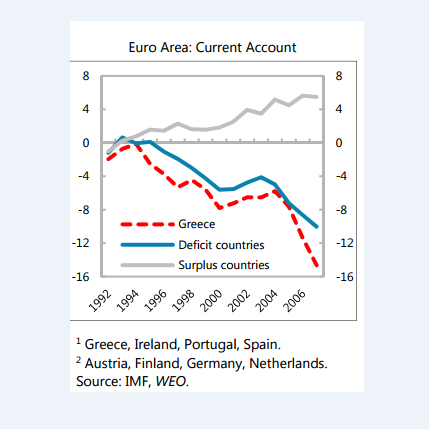
It answers solely to the board of executive directors, and those from Asia and Latin America are clearly incensed at the way EU insiders used the Fund to rescue their own rich currency union and banking system. The three main bail-outs for Greece, Portugal, and Ireland were unprecedented in scale and character. The trio were each allowed to borrow over 2,000% of their allocated quota – more than three times the normal limit – and accounted for 80pc of all lending by the Fund between 2011 and 2014. In an astonishing admission, the report said its own investigators were unable to obtain key records or penetrate the activities of secretive “ad-hoc task forces”. Mrs Lagarde herself is not accused of obstruction.

“Many documents were prepared outside the regular established channels; written documentation on some sensitive matters could not be located. The IEO in some instances has not been able to determine who made certain decisions or what information was available, nor has it been able to assess the relative roles of management and staff,” it said. The report said the whole approach to the eurozone was characterised by “groupthink” and intellectual capture. They had no fall-back plans on how to tackle a systemic crisis in the eurozone – or how to deal with the politics of a multinational currency union – because they had ruled out any possibility that it could happen. “Before the launch of the euro, the IMF’s public statements tended to emphasize the advantages of the common currency, “ it said. Some staff members warned that the design of the euro was fundamentally flawed but they were overruled.
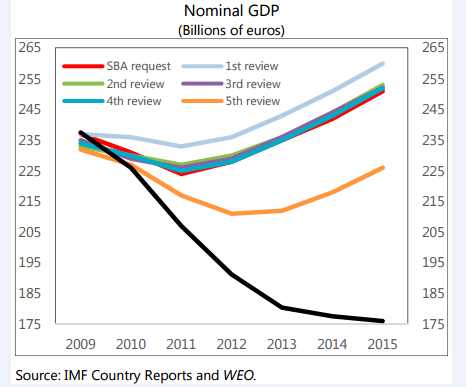

The forecasts for Greek growth compared to what actually happened Credit: IMF

[..] While the Fund’s actions were understandable in the white heat of the crisis, the harsh truth is that the bail-out sacrificed Greece in a “holding action” to save the euro and north European banks. Greece endured the traditional IMF shock of austerity, without the offsetting IMF cure of debt relief and devaluation to restore viability. A sub-report on the Greek saga said the country was forced to go through a staggering squeeze, equal to 11pc of GDP over the first three years. This set off a self-feeding downward spiral. The worse it became, the more Greece was forced cut – what ex-finance minister Yanis Varoufakis called “fiscal water-boarding”. “The automatic stabilizers were not allowed to operate, thus aggravating the pro-cyclicality of the fiscal policy, which exacerbated the contraction,” said the report.

Read more …

Who says we need global growth?

Global Trade Is Not Growing Slower – It’s Not Growing At All (WEF)

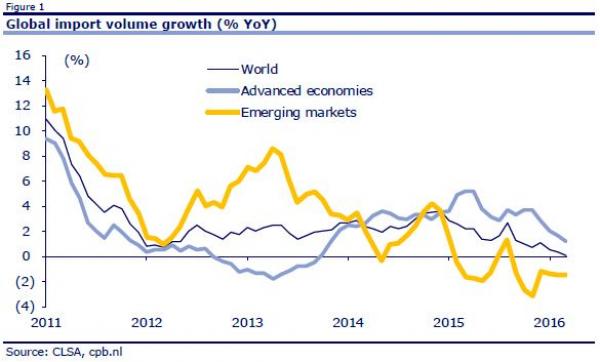
Falling rates of global trade growth have attracted much comment by analysts and officials, giving rise to a literature on the ‘global trade slowdown’ (Hoekman 2015, Constantinescu et al. 2016). The term ‘slowdown’ gives the impression of world trade losing momentum, but growing nonetheless. The sense of the global pie getting larger has the soothing implication that one nation’s export gains don’t come at the expense of another’s. But are we right to be so sanguine? Using what is widely regarded as the best available data on global trade dynamics, namely, theWorld Trade Monitor prepared by the Netherlands Bureau of Economic Policy Analysis, the 19th Report of the Global Trade Alert, published today, evaluates global trade dynamics (Evenett and Fritz 2016).
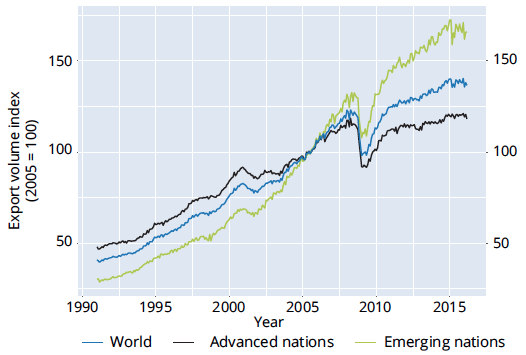

Figure 1 World trade plateaued around the start of 2015

Our first finding that the rosy impression painted by some should be set aside. We demonstrate that: •World export volumes reached a plateau at the start of January 2015. The same finding holds if import volume or total volume data are used instead. •Both industrialised countries’ and emerging markets’ trade volumes have plateaued (Figure 1). •Except during global recessions, a plateau lasting 15 months is practically unheard of since the Berlin Wall fell. •In 2015 the best available data on world export volumes diverges markedly from that reported by the WTO, IMF, and World Bank, and probably explains why analysts at these organisations have missed this profound change in global trade dynamics (Table 1).
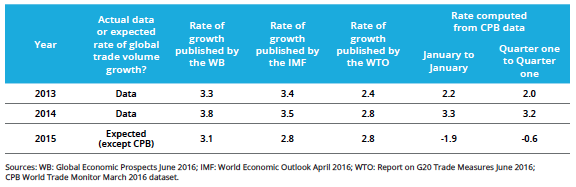

Table 1 Marked differences in reported global trade volume growth in 2015

Read more …

“The fight against sluggish growth rates..” Maybe we should stop that fight?

Not Even Fiscal Stimulus Will Save Global Growth – Deutsche Bank (BBG)

While monetary policy may be at — or beyond — the limits of its usefulness in stoking global growth, economists at Deutsche Bank say fiscal stimulus is unlikely to be much more effective. At least, not the kind that is politically possible. The fight against sluggish growth rates and low inflation has seen central banks from Europe to Japan buy up swaths of the bond market, and experiment with negative interest rates. Yet with growth still stubbornly slow, these efforts are seen either as ineffective or counterproductive, spurring calls for more active fiscal policy, whether it take the form of tax cuts or ‘helicopter money’ transfers to the private sector. Just this past weekend, finance ministers from the Group of Twenty meeting in China gave strong backing to this view.

“Monetary policy alone cannot lead to balanced growth,” they said. “Fiscal strategies are equally important to support our common growth objectives.” Those comments could signal a “new direction for fiscal policy,” according to Deutsche Bank economists led by Peter Hooper. Yet while they welcomed the potential dethroning of monetary policy as “the principal lever of support,” the economists expect that the boost to global growth from the most probable fiscal packages “is likely to be modest.” Europe is in greatest need of fiscal stimulus — even though the ECB has been gobbling up bonds since 2014, and has cut its deposit rate to minus 0.4% — and it’s also where fiscal stimulus would be most effective, according to the Deutsche Bank economists.

Read more …

Are Kuroda and Abe drifting apart?

Kuroda’s $26 Billion Gift to Stock Market Underwhelms Investors (BBG)

Welcome to Japan, where a central bank plan to pump $26 billion a year more into stocks and continue buying 30 times that in debt sees equities struggle to advance and bonds plunge. The Topix index slid as much as 1.4% in Tokyo after the Bank of Japan boosted its annual exchange-traded fund budget to 6 trillion yen ($58 billion), from 3.3 trillion yen. Japanese government bonds headed for their steepest slump since 2008, as policy makers retained a plan to expand the monetary base by an annual 80 trillion yen. Speculation among investors and analysts that Friday’s policy announcement might even see the adoption of so-called helicopter money, as well as a cut to the negative deposit rate, resulted in a lukewarm reception for the expanded stimulus program.

The yen surged as much as 2.4%, the most since the U.K. decision to leave the European Union, even as BOJ Governor Haruhiko Kuroda hinted more easing might still be in the pipeline. “The BOJ had a choice of about five boxes to tick today, but only chose one,” said Sean Callow, a senior FX strategist at Westpac Banking in Sydney. “Buying more ETFs was as widely expected as balloons dropping on Hillary.” [..] In an unexpected development, Kuroda has ordered an assessment of the effectiveness of BOJ policy, to be undertaken at the next meeting, which is scheduled for Sept. 20-21.

Read more …

“The BOJ won’t admit it, but it has reached the limits of quantitative easing and negative rates.”

Bank of Japan Blames Brexit As It Unleashes More Monetary Stimulus (G.)

The Bank of Japan has announced a modest expansion of its monetary easing programme, blaming Britain’s decision to leave the European Union as the biggest uncertainty facing world markets. The central bank acknowledged government pressure for more action to drive the yen lower and help Japan’s legion of exporters, but stopped short of upping its bond purchases or cutting interest rates. Instead the bank sanctioned an increase in purchases of exchange-traded funds as it attempted to accelerate inflation towards its 2% target. The moves disappointed the markets, which had expected another big influx of liquidity. The Nikkei stock average yo-yoed wildly in the aftermath of the move before falling nearly 2% in late afternoon trade.

Other stock markets in the region were also down while futures trading indicated the FTSE100 and Dow Jones would open slightly down on Friday morning. The yen rose 2% against the US dollar, which will frustrate government attempts to devalue the stubbornly high currency. [..] Some market experts said the lack of bold action suggested the bank had decided that the effectiveness of its huge monetary easing programme had reached its limits. “The BOJ did not live up to expectations … increasing ETF purchases makes no contribution to achieving 2% inflation,” said Norio Miyagawa, senior economist at Mizuho Securities. “The BOJ won’t admit it, but it has reached the limits of quantitative easing and negative rates.”

Read more …

After Abenomics has been running for 3 years, deflation continues unabated.

Japan Sees Weaker Consumer Spending, Manufacturing In June (AP)

Japan reported further signs of weakness in its economy in June, with industrial output and consumer spending falling from the year before. The data released Friday were in line with expectations the central bank may follow the government’s lead in opting for more stimulus at a policy meeting that ends Friday. Core inflation excluding volatile food prices dropped 0.5% from 0.4% in May. The Bank of Japan and government have made scant progress toward a 2% inflation goal set more than three year ago, partly due to the prolonged slump in crude oil prices.

Household spending fell 2.2% from a year earlier, while industrial output slipped 1.9% on an annual basis. Earlier this week Prime Minister Shinzo Abe announced plans to propose 28 trillion yen ($267 billion) in spending initiatives to help support the sagging economic recovery. Household incomes rose 0.3% in June, weak for a month when workers commonly receive bonuses.

Read more …

Let’s not pretend there is a way out for Japan.

Japan Should Stop Chasing A Weaker Yen – Steen Jakobsen (CNBC)

Japan has aimed a lot of firepower at keeping its currency weak, but a stronger yen might be just what the long moribund economy really needs, said Saxo Bank’s Chief Investment Officer Steen Jakobsen. “The government of Japan sort of quasi-promises to maintain a weak yen in order to support and buy time for the export companies,” Jakobsen said. “Having a focus only on the export sector takes away from [what] the focus should be: To reform the domestic economy.” Jakobsen’s comments came just as Japan appears set to level a double bazooka of easing at its sluggish economy, firepower that appears aimed, at least in part, at wiping out the recent gains in the newly resurgent yen.

The Bank of Japan was widely expected to announce another monetary easing bomb at the close of its two-day meeting on Friday, with analysts anticipating that the central bank would either cut interest rates deeper into negative territory or expand its asset purchase program or both. At the same time, fresh fiscal stimulus was expected to offer additional cross fire. News agency Jiji reported that Prime Minister Shinzo Abe had revealed a 28 trillion yen ($265 billion) injection, which Reuters estimated at 6% of Japan’s economy.

The double-barreled approach was in line with Abe’s plan to break Japan’s economy out of a decades-long deflationary spiral. That effort, dubbed Abenomics, was introduced in 2013 with a plan for three “arrows:” A first arrow of massive quantitative easing from the BOJ, followed by a second arrow of increased government spending and a third arrow of structural reforms, including immigration and labor changes. But Jakobsen noted that the latest plan for combined BOJ and fiscal easing just replayed the same strategy. “The present situation we’re talking about is just re-launching arrow one and two,” he said. “We’re still missing arrow number three, which is the reform side.”

Read more …

It didn’t take long to kill the dream.

US Homeownership Rate Falls to Five-Decade Low (WSJ)

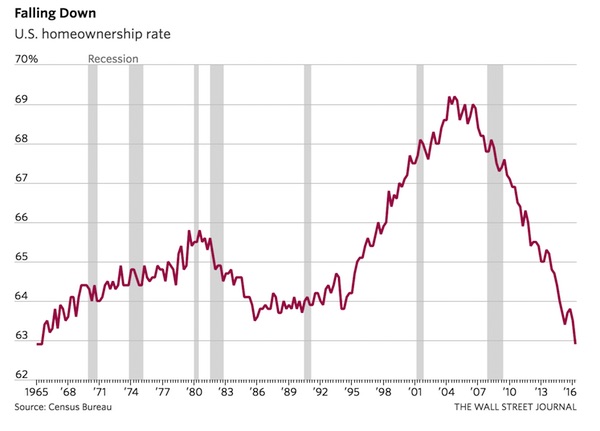
The U.S. homeownership rate fell to the lowest level in more than 50 years in the second quarter of 2016, a reflection of the lingering effects of the housing bust, financial hurdles to buying and shifting demographics across the country. But the bigger picture also suggests more Americans are gaining the confidence to strike out on their own, albeit as renters rather than buyers. The homeownership rate, the proportion of households that are owner-occupied, fell to 62.9%, half a percentage point lower than the second quarter of 2015 and 0.6%age point lower than the first quarter 2016, the Census Bureau said on Thursday. That was the lowest figure since 1965.

There are many ways to interpret the numbers. Part of the story is the catastrophic housing market collapse, which was especially severe for Generation X—those born from 1965 to 1984. Younger households may struggle to save amid student debt, growing rents, rising home prices and limited inventories of starter homes. Indeed, the homeownership rate for 18- to 35-year-olds slipped to 34.1%, the lowest level in records dating to 1994. At 77.9%, the homeownership rate was highest for those 65 years and over.

But the broader picture suggests a degree of economic strength: Renters are spurring a steady increase in overall household formation. Renter-occupied housing units jumped by 967,000 from the same period a year earlier. Overall, household formation has been fairly steady since the early days of the expansion. A rising number of households suggests more people are optimistic enough to strike out on their own and helps further spur growth as they buy furniture, start families and move up the economic ladder. Indeed, moving into a rental unit has been entirely responsible for rising household formation since the recession began.
Read more …

“It’s probably going to take a little longer than they expected.” “Demand growth has faltered a bit.”

Oil Glut Proves Harder To Kill Than Saudis To Goldman Predicted (BBG)

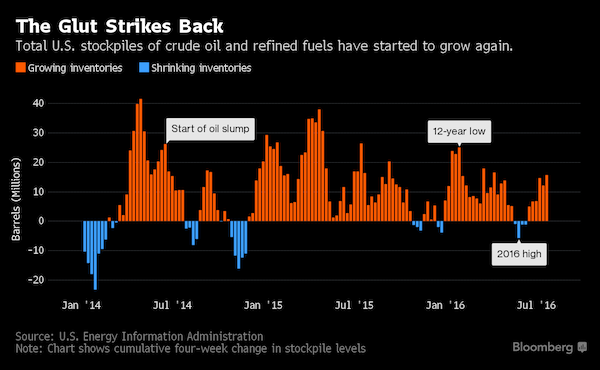
The bullish spirit that gripped oil traders as industry giants from Saudi Arabia to Goldman Sachs declared the supply glut over is rapidly ebbing away. Oil is poised for a drop of 20% since early June, meeting the definition of a bear market. While excess crude production is abating, inventories around the world are brimming, especially for gasoline, and a revival in U.S. drilling threatens to swell supplies further. As the output disruptions that cleared some of the surplus earlier this year begin to be resolved, crude could again slump toward $30 a barrel, Morgan Stanley predicts. “The tables are turning on the bulls, who were prematurely constructive on oil prices on the basis the re-balancing of the oil market was a done deal,” said Harry Tchilinguirian at BNP Paribas in London.

“It’s probably going to take a little longer than they expected.” Oil almost doubled in New York between February and June as big names from Goldman and the International Energy Agency to new Saudi Energy Minister Khalid Al-Falih said declining U.S. oil production and disruptions from Nigeria to Canada were finally ending years of oversupply. Prices retreated to a three-month low near $41 a barrel this week amid a growing recognition the surplus will take time to clear. “There’s lots of crude and refined products around,” said David Fransen, Geneva-based head of Vitol SA, the biggest independent oil trader. “Demand growth has faltered a bit.”
Read more …

Don’t worry, prices will come down.

Wholesale California Gasoline Prices Plunge, Consumers Still Pay Up (R.)

Wholesale gasoline in California became the cheapest in the country this week, but that change has largely gone unseen at the pump, where consumers are still paying the highest prices in the continental United States to fill up their cars. Ample inventories along with relatively stable refinery operations and imports has driven down the spot value of gasoline in Los Angeles at the wholesale level by more than 60 cents since mid-June. However, that has not translated to similarly lower retail fuel prices for consumers because of peculiarities in California’s market. The declines in the state’s retail gasoline market over that period of time have averaged less than 14 cents, according to data from the U.S. Energy Information Administration.

On Thursday, wholesale California gasoline was trading below $1.20 a gallon. The spread between California’s wholesale and retail gasoline markets was about $1.50 a gallon the week to July 25, about 40 cents wider than a similar spread in the New York market. California is one of the most expensive places in the United States to produce gasoline because of the state’s unique blending requirements and its relative isolation from the rest of the country, which makes securing crude oil to refine pricier. Gasoline prices across the country have plunged as crude has also slumped in the past two years, pressured by a global supply glut. On the West Coast, gasoline stocks are at a five-year seasonal high of 29.6 million barrels, according to the EIA.

Read more …

Lots of reports due later today.

In Past 50 Years Earnings Recession This Big Always Triggered Bear Market (F.)

It’s earnings season once again and it looks as if, as a group, corporate America still can’t find the end of its earnings decline since profits peaked over a year ago. What’s more analysts, renowned for their Pollyannish expectations, can’t seem to find it, either. So I thought it might be interesting to look at what the stock market has done in the past during earnings recessions comparable to the current one. And it’s pretty eye-opening. Over the past half-century, we have never seen a decline in earnings of this magnitude without at least a 20% fall in stock prices, a hurdle many use to define a bear market. In other words, buying the new highs in the S&P 500 today means you believe “this time is different.” It could turn out that way but history shows that sort of thinking to be very dangerous to your financial wellbeing.
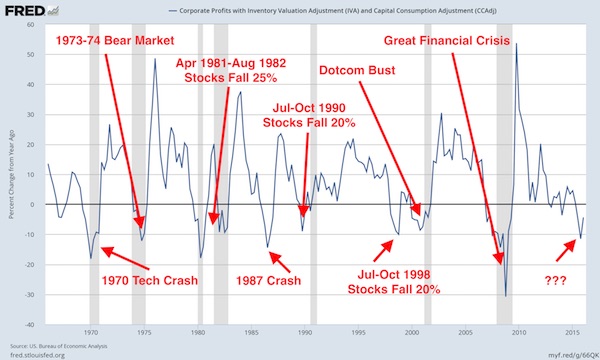
Read more …

Great idea. There should be one in Athens too.

Barcelona Unveils ‘Shame Counter’ That Tracks Refugee Deaths (AFP)

Spain’s seaside city of Barcelona on Thursday unveiled a large digital counter that will track the number of refugees who die in the Mediterranean, next to one of its popular beaches. “We are inaugurating this shame counter which will update all known victims who drowned in the Mediterranean in real time,” said Mayor Ada Colau. The monument consists of a large metal rectangular pillar that comes decked out with a digital counter above the inscription “This isn’t just a number, these are people.”

The counter kicked off with 3,034 — the number of migrants and refugees who have died trying to cross the Mediterranean to Europe in 2016, according to the International Organization for Migration (IOM). “We’re here to look the Mediterranean in the face and look at this number — 3,034 people who drowned because they were not offered a safe passage,” said Colau, as swimmers took advantage of the last rays of sunshine nearby.


Barcelona’s mayor Ada Colau poses in front a digital billboard that shows the number of refugees who died in the Mediterranean sea, named “the shame counter” (AFP Photo/Josep Lago)


Read more …

Jul 242016
 
 July 24, 2016  Posted by at 9:25 am Finance Tagged with: , , , , , , , , , , ,  3 Responses »


Milton Greene “Actress Marilyn Monroe in bed” 1955

China’s Growth Sucks In More Debt Bucks For Less Bang (R.)
G20 Will Use ‘All Policy Tools’ To Protect Growth As Brexit Looms (R.)
OECD’s Gurria Says No Other EU Country Will Consider Exit After Brexit (CNBC)
EU Considers Migration ‘Emergency Brake’ For UK For Up To 7 Years (O.)
Mortgages Issued By Greek Banks Declined 99% In Past Decade (Kath.)
5 Reasons Why Trump Will Win (Michael Moore)
Trump Policy Will Unravel Traditional Neocons – Michael Hudson (RNN)
WikiLeaks Trove Plunges Democrats Into Crisis On Eve Of Convention (SMH)
DNC Chair Won’t Speak At Dem Convention Following WikiLeaks Fallout (CNN)
Imagine How The Land Feels (G.)


Reuters says: “..this year it has taken six yuan for every yuan of growth,[..] twice even the level in the United States during the debt-fueled housing bubble..”

That’s questionable. ZH in 2013: “..over the past five years in the developed world, it took $18 dollars of debt (of which 28% was provided by central banks) to generate $1 of growth..”

China’s Growth Sucks In More Debt Bucks For Less Bang (R.)

As China’s economy notches up another quarter of steady growth, the pace of credit creation grows ever more frantic for every extra unit of production, as inefficient state firms swallow an increasing share of lending. The world’s second-largest economy grew 6.7% in the first half of the year, unchanged from the first quarter, testament to policymakers’ determination to regulate the pace of slowdown after 25 years of breakneck expansion. Analysts say that determination has come at the cost of a damngerous rise in debt, which is six times less effective at generating growth than a few years ago. “The amount of debt that China has taken in the last 5-7 years is unprecedented,” said Morgan Stanley’s head of emerging markets, Ruchir Sharma, at a book launch in Singapore.

“No developing country in history has taken on as much debt as China has taken on on a marginal basis.” While Beijing can take comfort that loose money and more deficit spending are averting a more painful slowdown, the rapidly diminishing returns from such stimulus policies, coupled with rising defaults and non-performing loans, are creating what Sharma calls “fertile (ground) for some accident to happen”. From 2003 to 2008, when annual growth averaged more than 11%, it took just one yuan of extra credit to generate one yuan of GDP growth, according to Morgan Stanley calculations. It took two for one from 2009-2010, when Beijing embarked on a massive stimulus program to ward off the effects of the global financial crisis.

The ratio had doubled again to four for one in 2015, and this year it has taken six yuan for every yuan of growth, Morgan Stanley said, twice even the level in the United States during the debt-fueled housing bubble that triggered the global crisis. Total bond debt in China is up over 50% in the past 18 months to 57 trillion yuan ($8.5 trillion), equal to around 80% of GDP, and new total social financing, the widest measure of credit provided by China’s central bank, rose 10.9% in the first half of 2016 to 9.75 trillion yuan. China’s money supply has increased in tandem with new lending, and at 149 trillion yuan is now 73% higher than in the US, an economy about 60% larger. “China is the largest money printer in the world – they have been for some time. The balance is really extreme,” says Kevin Smith, CEO of U.S.-based Crescat Capital.

Read more …

Ionesco and Samuel Beckett were ahead of their time, but we’re catching up with them. Words lose ever more meaning. Example are this article, but also this WSJ headline: “Hillary Clinton Introduces Tim Kaine as ‘a Progressive Who Likes to Get Things Done'”. That may have sounded lofty even just 20 years ago, but today it’s just meaningless, if not outright repulsive.

G20 Will Use ‘All Policy Tools’ To Protect Growth As Brexit Looms (R.)

Leaders from the world’s biggest economies are poised on Sunday to renew their commitments to support global growth and better coordinate actions in the face of uncertainty over Britain’s decision to leave the EU and growing protectionism. The meeting of finance ministers and central bankers from the Group of 20 major economies in China’s southwestern city of Chengdu is the first of its kind since last month’s Brexit vote and a debut for Britain’s new finance minister. Philip Hammond faced questions about how quickly the UK planned to move ahead with formal negotiations to leave the EU. “We are taking actions to foster confidence and support growth,” a draft statement by the policymakers seen by Reuters said.

“In light of recent developments, we reiterate our determination to use all policy tools – monetary, fiscal and structural – individually and collectively to achieve our goal of strong, sustainable and balanced growth,” it said. The IMF this week cut its global growth forecasts because of the Brexit vote. Data on Friday seemed to bear out fears, with a British business activity index posting its biggest drop in its 20-year history. The draft communique, expected to be issued at the end of the meeting on Sunday afternoon, said Brexit added to uncertainty in the global economy but G20 members were “well positioned to proactively address the potential economic and financial consequences”.

U.S. Treasury Secretary Jack Lew said on Saturday it was important for G20 countries to boost shared growth using all policy tools, including monetary and fiscal policies as well as structural reforms, to boost efficiency. “This is a time when it is important for all of us to redouble our efforts to use all of the policy tools that we have to boost shared growth,” Lew told reporters.

Read more …

He’ll find out yet.

OECD’s Gurria Says No Other EU Country Will Consider Exit After Brexit (CNBC)

Countries in the European Union are unlikely to consider an exit from the bloc once they realize how complicated, costly and disruptive the process will be for the United Kingdom, the secretary general of the Organization for Economic Cooperation and Development (OECD) told CNBC on Saturday. “Nobody in their right mind will even attempt or even think of leaving the European Union because they will understand that it is not in their best interest,” Angel Gurria told CNBC before the start of the G-20 finance ministers and central bank governors meeting in Chengdu, China.

Gurria had recommended against the Brexit vote, but says the next step should be helping the U.K. and its partners through the proceedings in the least costly and least disruptive way. On the Italian banking crisis and whether the EU should rescue the country’s third largest bank, Monte dei Paschi di Siena, Gurria said that “national, regional and EU intervention is necessary”. However, the challenge is to define who is going to be doing what, he added. Rome is bracing for the results of critical bank stress tests that are due on July 29 and is hoping to find a solution for the battered bank ahead of that.

Read more …

Mere days after everyone said there could be no pre-Brexit discussions with the UK, of course there’s things like this anyway.

EU Considers Migration ‘Emergency Brake’ For UK For Up To 7 Years (O.)

Plans to allow the United Kingdom an exemption from EU rules on freedom of movement for up to seven years while retaining access to the single market are being considered in European capitals as part of a potential deal on Brexit. Senior British and EU sources have confirmed that despite strong initial resistance from French president François Hollande in talks with prime minister Theresa May last week, the idea of an emergency brake on the free movement of people that would go far further than the one David Cameron negotiated before the Brexit referendum is being examined.

If such an agreement were struck, and a strict time limit imposed, diplomats believe it could go a long way towards addressing concerns of the British people over immigration from EU states, while allowing the UK full trade access to the European market. While the plan will prove highly controversial in many member states, including France, Poland and other central and eastern European nations, the attraction is that it would limit the economic shock to the EU economy from Brexit by keeping the UK in the single market, and lessen the political damage to the European project that would result from complete divorce.

Read more …

Sales only to those with deep pockets. The rest of the world buys up Greece.

Mortgages Issued By Greek Banks Declined 99% In Past Decade (Kath.)

Cash was the preferred from of payment for the few people who decided to purchase real estate in the first half of the year in Greece, bank officials have suggested. Converging estimates by bank officials contacted by Kathimerini show that eight out of 10 property buyers opted for the transfer of cash between deposit accounts instead of a loan, a trend that started with the imposition of capital controls by the government just over a year ago and continues to date. The same trend is also dominant in consumer credit.

According to data compiled by Kathimerini, the new loans issued in H1 came to €75 million in mortgage credit across the banking system and to €150 million in consumer credit. This sum constitutes a historic low for the last few decades at least. Comparisons with a decade ago are staggering: The number of mortgages issued in January-June 2016 – also affected by the lawyers’ strike – came to just 800, against about 80,000 in the same period in 2006. A Bank of Greece analysis recently said that the course of loans to households is mainly determined by demand, and in the last couple of years the drop in house prices has played a decisive role in the reduction of loan issues.

Read more …

Well argued. But as Moore himself also argues, that’s a problem, not a winner.

5 Reasons Why Trump Will Win (Michael Moore)

Friends: I am sorry to be the bearer of bad news, but I gave it to you straight last summer when I told you that Donald Trump would be the Republican nominee for president. And now I have even more awful, depressing news for you: Donald J. Trump is going to win in November. This wretched, ignorant, dangerous part-time clown and full time sociopath is going to be our next president. President Trump. Go ahead and say the words, ‘cause you’ll be saying them for the next four years: “PRESIDENT TRUMP.” Never in my life have I wanted to be proven wrong more than I do right now. I can see what you’re doing right now. You’re shaking your head wildly – “No, Mike, this won’t happen!”

Unfortunately, you are living in a bubble that comes with an adjoining echo chamber where you and your friends are convinced the American people are not going to elect an idiot for president. You alternate between being appalled at him and laughing at him because of his latest crazy comment or his embarrassingly narcissistic stance on everything because everything is about him. And then you listen to Hillary and you behold our very first female president, someone the world respects, someone who is whip-smart and cares about kids, who will continue the Obama legacy because that is what the American people clearly want! Yes! Four more years of this! You need to exit that bubble right now. You need to stop living in denial and face the truth which you know deep down is very, very real.

Trying to soothe yourself with the facts – “77% of the electorate are women, people of color, young adults under 35 and Trump cant win a majority of any of them!” – or logic – “people aren’t going to vote for a buffoon or against their own best interests!” – is your brain’s way of trying to protect you from trauma. Like when you hear a loud noise on the street and you think, “oh, a tire just blew out,” or, “wow, who’s playing with firecrackers?” because you don’t want to think you just heard someone being shot with a gun. It’s the same reason why all the initial news and eyewitness reports on 9/11 said “a small plane accidentally flew into the World Trade Center.” We want to – we need to – hope for the best because, frankly, life is already a shit show and it’s hard enough struggling to get by from paycheck to paycheck. We can’t handle much more bad news. So our mental state goes to default when something scary is actually, truly happening.

Read more …

The attempts to link Trump to Russia have become a sort of hilarious boomerang.

Trump Policy Will Unravel Traditional Neocons – Michael Hudson (RNN)

On Friday, just after the RNC wrapped up with its presidential candidate, Donald Trump, Paul Krugman of the New York Times penned an article titled “Donald Trump: The Siberian Candidate.” He said in it, if elected, would Donald Trump be Vladimir Putin’s man in the White House? Krugman himself is worried as ludicrous and outrageous as the question sounds, the Trump campaign’s recent behavior has quite a few foreign policy experts wondering, he says, just what kind of hold Mr. Putin has over the Republican nominee, and whether that influence will continue if he wins. Well, let’s unravel that statement with Michael Hudson. [..] So let’s take a look at this article by Paul Krugman. Where is he going with this analysis about the Siberian candidate?

HUDSON: Well, Krugman has joined the ranks of the neocons, as well as the neoliberals, and they’re terrified that they’re losing control of the Republican Party. For the last half-century the Republican Party has been pro-Cold War, corporatist. And Trump has actually, is reversing that. Reversing the whole traditional platform. And that really worries the neocons. Until his speech, the whole Republican Convention, every speaker had avoided dealing with economic policy issues. No one referred to the party platform, which isn’t very good. And it was mostly an attack on Hillary. Chants of “lock her up.” And Trump children, aimed to try to humanize him and make him look like a loving man.

But finally came Trump’s speech, and this was for the first time, policy was there. And he’s making a left run around Hillary. He appealed twice to Bernie Sanders supporters, and the two major policies that he outlined in the speech broke radically from the Republican traditional right-wing stance. And that is called destroying the party by the right wing, and Trump said he’s not destroying the party, he’s building it up and appealing to labor, and appealing to the rational interest that otherwise had been backing Bernie Sanders.

So in terms of national security, he wanted to roll back NATO spending. And he made it clear, roll back military spending. We can spend it on infrastructure, we can spend it on employing American labor. And in the speech, he said, look, we don’t need foreign military bases and foreign spending to defend our allies. We can defend them from the United States, because in today’s world, the only kind of war we’re going to have is atomic war. Nobody’s going to invade another country. We’re not going to send American troops to invade Russia, if it were to attack. So nobody’s even talking about that. So let’s be realistic.

Read more …

Well, I said a long time ago that Clinton would not be electable. There’ll be much more of this released while the convention takes place.

WikiLeaks Trove Plunges Democrats Into Crisis On Eve Of Convention (SMH)

On the eve of the convention at which Hillary Clinton is to be confirmed as presidential candidate, the Democratic Party has been plunged into crisis – the US media is brimful of ugly and embarrassing stories from within the party’s head office, all based on 20,000 emails dropped on Friday evening by the anti-secrecy group WikiLeaks. The correspondence seems to confirm allegations by the campaign of defeated Senator Bernie Sanders that the Democratic National Committee was actively rooting for Mrs Clinton to win, a revelation that will most likely serve as a wedge between the two camps and make it even more difficult for her to persuade Sanders voters to support her.

The emails also reveal plotting within the DNC to embarrass Republican candidate Donald Trump, including drafting a fake ad to recruit “hot women” to work for him. Bad as this trove of emails is, it could presage something much worse. A brief introduction to the emails, that were released on Twitter with a link to a webpage, described them as “part one of our new Hillary Leaks series”. Naming key DNC officials, the introduction says how many of the emails came from each, including communications director Luis Miranda (10,770 emails), national finance director Jordon Kaplan (3797 emails), and finance chief of staff Scott Comer. The emails are dated through the five months to May 25, 2016.

Several of the emails address efforts to embarrass or to wrong-foot the Sanders campaign, which began almost as a non-event but surged with young voter support in particular to become a serious and determined challenger to Mrs Clinton. One email suggests that Senator Sanders be questioned on his faith, in the hope of revealing him as an atheist. It reads: “Does he believe in a God. He had skated on saying he has a Jewish heritage. I think I read he is an atheist. This could make several points difference with my peeps. My Southern Baptist peeps would draw a big difference between a Jew and an atheist.”

Read more …

“She’s been quarantined..” She should be under investigation.

DNC Chair Won’t Speak At Dem Convention Following WikiLeaks Fallout (CNN)

The head of the Democratic National Committee will not speak at the party’s convention next week, a decision reached by party officials Saturday after emails surfaced that raised questions about the committee’s impartiality during the Democratic primary. Debbie Wasserman Schultz, whose stewardship of the DNC has been under fire through most of the presidential primary process, will not have a major speaking role in an effort “to keep the peace” in the party, a Democrat familiar with the decision said. The revelation comes following the release of nearly 20,000 emails.

One email appears to show DNC staffers asking how they can reference Bernie Sanders’ faith to weaken him in the eyes of Southern voters. Another seems to depict an attorney advising the committee on how to defend Hillary Clinton against an accusation by the Sanders campaign of not living up to a joint fundraising agreement. Wasserman Schultz is expected to gavel the convention in and out, but not speak in the wake of the controversy surrounding the leaked emails, a top Democrat said. “She’s been quarantined,” another top Democrat said, following a meeting Saturday night.

Read more …

Love it. Not so much the part of how to get nature into a novel, but the idea itself. The world is alive. These fierce looking hunters singing to the land, the forest. And the land singing back:

“The place itself, in which their people had lived for millennia, was not an inanimate “environment”, a mere backdrop for human activity. It was part of that activity. It was a great being, and to live as part of it was to be in a constant exchange with it. And so they sang to it; sometimes, it sang back.”

Imagine How The Land Feels (G.)

We had climbed, slowly, to a high mountain ridge. We were two young Englishmen who were not supposed to be here – journalism was forbidden – and four local guides, members of the Lani tribe. Our guides were moving us around the highlands of West Papua, taking us to meet people who could tell us about their suffering at the hands of the occupying Indonesian army. The mountain ridge was covered in deep, old rainforest, as was the rest of the area we had walked through. This forest, to the Lani, was home. In the forest they hunted, gathered food, built their homes, lived. It was not a recreation or a resource: there was nothing romantic about it, nothing to debate. It was just life.

Now, as we reached the top of the ridge, a break in the trees opened up and we saw miles of unbroken green mountains rolling away before us to the horizon. It was a breathtaking sight. As I watched, our four guides lined up along the ridge and, facing the mountains, they sang. They sang a song to the forest whose words I didn’t understand, but whose meaning was clear enough. It was a song of thanks; of belonging. To the Lani, I learned later, the forest lived. This was no metaphor. The place itself, in which their people had lived for millennia, was not an inanimate “environment”, a mere backdrop for human activity. It was part of that activity. It was a great being, and to live as part of it was to be in a constant exchange with it. And so they sang to it; sometimes, it sang back.

When European minds experience this kind of thing, they are never quite sure what to do with it. It’s been so long since we had a sense that we dwelled in a living landscape that we don’t have the words to frame what we see. Too often, we go in one of two directions, either sentimentalising the experience or dismissing it as superstition. To us, the wild places around us (if there are any left) are “resources” to be utilised. We argue constantly about how best to use them – should we log this forest, or turn it into a national park? – but only the bravest or the most foolish would suggest that this might not be our decision to make.

To modern people, the world we walk through is not an animal, a being, a living presence; it is a machine, and our task is to learn how it works, the better to use it for our own ends. The notion that the non-human world is largely inanimate is often represented as scientific or rational, but it is really more like a modern superstition. “It is just like Man’s vanity and impertinence,” wrote Mark Twain, “to call an animal dumb because it is dumb to his dull perceptions.” We might say the same about a forest; and science, interestingly, might turn out to be on our side.

Read more …

Jul 132016
 
 July 13, 2016  Posted by at 8:33 am Finance Tagged with: , , , , , , ,  11 Responses »


Tim McKulka Elderly Woman Receives Emergency Food Aid, Sudan 2008

Markets Are In The Twilight Zone, Get Ready For New New Deal (AFR)
BOE Governor Carney Accused Of ‘Peddling Phoney Forecasts’ Over Brexit (G.)
Carney Should Stop Being So Gloomy About Brexit (Ashoka Mody)
German Leaders Demand Brexit Clarity From New British PM (R.)
British Pensions £383 Billion Underwater As Liabilities Hit Record (Tel.)
Ireland’s Economists Left Speechless by 26% Growth Figure (BBG)
Losing Australia’s AAA Rating To Make Losers of Mortgage Holders (BBG)
The Richest Generation in US History Just Keeps Getting Richer (BBG)
A Year After Bailout, Greece Struggles For Brighter Future (AFP)
EU Development Aid To Finance Armies In Africa (EuO)
Global Arms Race Escalates As Sabres Rattle In South China Sea (AEP)
Economic Theory as Ideology (Zaman)
Half Of All US Food Produce Is Thrown Away (G.)


Thought we were already there.

Markets Are In The Twilight Zone, Get Ready For New New Deal (AFR)

Macquarie analysts have likened the bizarre and inherently contradictory moves in markets to a “twilight zone” which is leading investors to a world where free-market economic thinking will be overtaken by the “nationalisation of credit” and state-sponsored growth. Think about that. Monetary policy is beating a path to a world where conventional market signals such as credit spreads and the price of risk will “finally perish” and be unseated by one where states are the drivers of credit, and spending and capital formation is the domain of central banks. “It would take the form of state-sponsored stimulation of consumption, investment, [research and development] and rescuing what essentially is a bankrupt financial superstructure (ie banks, insurance, life and pensions),” the Macquarie report, authored by Hong Kong-based analyst Viktor Shvets, said.

“Whilst similar to FDR’s New Deal, it would be a far more distorted world than either the 1930s or the 1960s-70s, with brand new investment signals.” [..] The unusual commentary from Macquarie says this “state driven paradise” will be brought on by ongoing high levels of volatility and “discontinuities” similar to what markets are grappling with today. “We don’t believe these conditions are yet satisfied, but the chances are high that they would be over the next 12-18 months. In the meantime, we still expect half-hearted ‘stop and go projects’. Japan is likely to be the first to ‘jump’ and wholeheartedly embrace this merger of fiscal, income support and monetary policies but others would eventually follow. It is just a matter of time.”

The Bank of Japan and re-elected Japan Prime Minister Shinzo Abe have signalled a fiscal-led stimulus package in excess of ¥10 trillion ($98 billion) is under consideration. The contradiction that Macquarie is referring to is the way markets have behaved since Brexit, where assets historically linked to “risk-on” and “risk-off” moods have inexplicably rallied in unison. Equities, a classic risk asset, have recovered all of their losses since the Brexit vote on the belief that central banks will step in and lift asset prices by doing stimulus and ignore sound fears about asset bubbles.

Read more …

His role is questionable. Shirked far too close to influencing politics.

BOE Governor Carney Accused Of ‘Peddling Phoney Forecasts’ Over Brexit (G.)

Mark Carney has agreed to hand notes of private meetings he had with the chancellor in the run-up to the EU referendum to MPs, after a Treasury select committee hearing where the governor of the Bank of England faced questions about whether he had “peddled phoney forecasts” about the risks of a vote for Brexit. In his first appearance at the Treasury select committee since the referendum, the Bank’s governor faced questions about whether he had tried to scare the electorate by warning of the economic shock – and possible recession – that a vote to leave the EU would cause. Andrew Tyrie, the committee’s chairman, citing two former chancellors and two former leaders of the Conservative party, said the Bank had also been accused of “startling dishonesty”.

Tyrie, a Conservative MP, told Carney that the accusations, if true, would be a “very robust assault on the Bank’s credibility” and also of the independence from government it was granted in 1997 that could not be recovered under the Canadian’s tenure. Carney said he had held private meetings with George Osborne before the 23 June vote. He agreed that the MPs could appoint someone to review the notes of those meetings but said he would be reluctant for them to be made public. Carney was also asked by Jacob Rees-Mogg, a prominent Brexit campaigner, whether the Bank should be, like Caesar’s wife, beyond suspicion in terms of being influenced by politicians. The governor, who said politicians had sought to inform him rather than influence him, replied: “Those who cast it [the independence] into question should consider their motivations and their judgments.”

Read more …

That would mean Stage Five: Acceptance. It’ll take a while. In the meantime, the ‘gloom’ is driven by politics, not economics. And yes, Carney is the champ, hoping for a self-fulfilling process. The Leave camp, which won (remember?), should perhaps ask for him to step down.

Carney Should Stop Being So Gloomy About Brexit (Ashoka Mody)

Few have been more downbeat about the outlook for the U.K. economy than the country’s own central bank governor, Mark Carney. If he wants to help mitigate the consequences of the vote to leave the European Union, he should send a more encouraging message by holding back on monetary stimulus. People charged with managing economies usually try to be optimistic, on the logic that their positive attitude will give people and businesses the confidence to spend and invest, ultimately making the optimism self-fulfilling. The rhetoric surrounding Britain’s vote on EU membership has been a glaring exception. In a bid to influence the vote, a chorus of global policymakers predicted dire consequences. That chorus has sadly persisted.

After voters chose to leave, the secretary general of the Organisation for Economic Cooperation and Development, Angel Gurria, reiterated forecasts of higher unemployment and permanent damage to household incomes. Christine Lagarde, managing director of the IMF, said that the decision was “casting a shadow over international growth.” Yet Brexit’s shadow is hard to discern amid the broader global decline in output growth and interest rates that began in early 2014. Perhaps no one, though, has been as active as Carney in stoking feelings of gloom and doom – a particularly notable feat, given that central bank governors rarely make predictions of economic and financial turmoil, especially when it concerns their own currency.

As far back as May, the Bank of England said that the possibility of Brexit was already weighing on the British pound, even though much of the decline in sterling’s value had happened earlier, when the polls – and especially the betting markets – showed a clear lead for the “Remain” campaign. The currency actually stabilized during the brief period when polls showed the “Leave” campaign gaining ground. Markets have come to anticipate Carney’s public appearances as harbingers of bad news. The pound began to decline in the hours before his first major post-Brexit speech on June 30, and he did not disappoint: Brexit-induced uncertainty, he insisted, had caused “economic post-traumatic stress disorder amongst households and businesses, as well as in financial markets.”

Read more …

Or else what?

German Leaders Demand Brexit Clarity From New British PM (R.)

German leaders stepped up the pressure on Britain’s incoming prime minister Theresa May on Tuesday by demanding she swiftly spell out when she will launch divorce proceedings with the European Union. “The task of the new prime minister … will be to get clarity on the question of what kind of relationship Britain wants to build with the EU,” Chancellor Angela Merkel told a news conference. Her finance minister Wolfgang Schaeuble said clarity was needed quickly to limit uncertainty after Britain’s shock choice for ‘Brexit’, which has rocked the 28-nation bloc and thrown decades of European integration into reverse. May, 59, will on Wednesday replace David Cameron, who is resigning after Britons rejected his advice and voted on June 23 to quit the EU.

On arriving and departing from Cameron’s last cabinet meeting, she waved a little awkwardly from the doorstep of 10 Downing Street, shortly to become her home. She will face the enormous task of disentangling Britain from a forest of EU laws, accumulated over more than four decades, and negotiating new trade terms while limiting potential damage to the economy. The pound was up 1.2% against the dollar at around $1.3150, boosted by the appointment of a new prime minister weeks earlier than expected after May’s main rival dropped out. But it remains more than 12% below the $1.50 it touched on the night of the June 23 referendum, reflecting concerns that Brexit will hit trade, investment and growth.

The German leaders spoke after May’s ally Chris Grayling appeared to dampen any hopes among Britain’s EU partners that her rapid ascent might accelerate the process of moving ahead with the split and resolving the uncertainty hanging over the 28-nation bloc.

Read more …

Which of course can be blamed on Brexit again. But it’s really just a Ponzi scheme dying a natural death.

British Pensions £383 Billion Underwater As Liabilities Hit Record (Tel.)

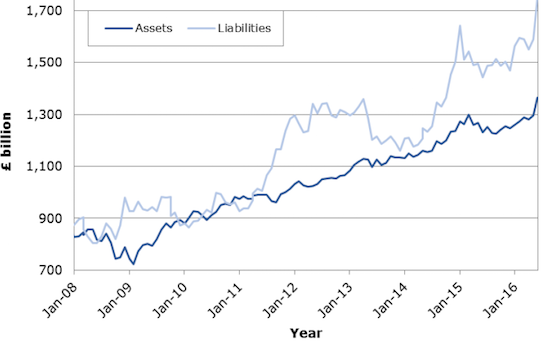
Britain’s gold-plated pensions now have record-breaking liabilities of £1.75 trillion after the EU referendum triggered a rout in their core gilt and equity holdings, highlighting the difficulty of funding the UK’s retirement needs. The country has almost 6,000 defined benefit schemes, which are obliged to pay their members an amount in retirement often tied to their final salary. Just 950 of these schemes were in surplus on June 30, with the rest hoping to make up the shortfall from long-term investment returns. In total, defined benefit funds are £383.6bn underwater, compared to £294.6bn just a month ago, as the tumbling UK government bond yields added to liabilities while global stock markets wiped value from the schemes’ equity investments.

Around 78pc of the long-term liabilities of the schemes are funded, down from 81.5pc within a month. While these figures are merely a snapshot, the data from the Pension Protection Fund highlights the precarious position of numerous schemes. “Companies are having to divert profits into schemes to make good on their promises, which means less investment capital to help businesses grow and less money available to invest in the pensions of younger workers,” said Tom McPhail, head of retirement policy at Hargreaves Lansdown. “Accrued pension rights have to be respected and investors have to be able to trust the system, however there is also a growing argument for the Government to look at finding a more balanced approach to the retirement funding needs of UK workforce.”

UBS analysts have estimated that a 1pc fall in real yields on government bonds results in a 10pc rise in pension liabilities, although this varies by scheme depending on how many bonds they hold. Gilts have jumped in price, lowering their yields, as global investors seek out safe havens. Industrial companies have the largest pension burdens, amounting to 77pc of their overall market value of the businesses, according to UBS’s research, while telecoms firms have liabilities worth 56pc of their value and utilities’ liabilities have reached 54pc.

Read more …

Hilarious.

Ireland’s Economists Left Speechless by 26% Growth Figure (BBG)

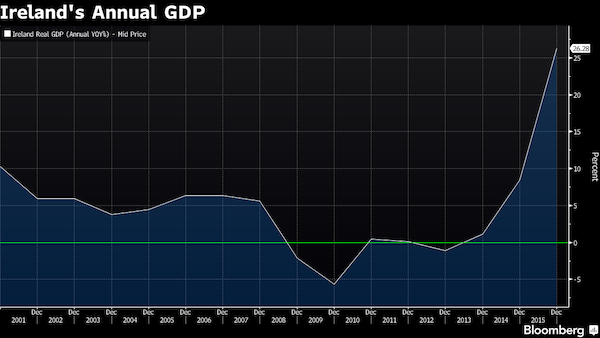
In three days, Jim Power is due in London to brief the British-Irish Trade Association on the state of the Irish economy. Now, he has no idea what he is going to say. The economy grew 26% in 2015, officials from the Central Statistics Office told a stunned room full of economists and reporters in Dublin on Tuesday. Previously, they had estimated growth of 7.8%. “I’m not going to stand up and say the economy grew by 26%,” Power, an independent economist, said after the release. “It’s meaningless – we would be laughing” if these numbers came out of China, he said. The figure is mostly explained by the open nature of Ireland’s economy and its attraction to U.S. companies seeking access to a 12.5% tax rate.

Among firms that have inverted to Ireland, mostly through acquisitions, are Perrigo and Jazz Pharmaceuticals. Corporations with assets overseas of €523 billion were headquartered in Ireland in 2014, up from €391 billion in 2013, according to the statistics office. “We are a very small economy, and if we get a big increase in assets, this is what happens,” Michael Connolly, an official at the CSO, said on Tuesday. Once explained the numbers are “believable,” he said. In a statement, Finance Minister Michael Noonan pointed out that growth numbers cut Ireland’s debt and deficit ratios. Trouble is, they carry downsides too. For one, tax inversions artificially inflate the size of Ireland’s economy.

When the headquarters of a group of companies becomes resident in Ireland, all of its global profits may be counted as part of the nation’s gross national income, according to the ministry. Since 2008, that gauge has been boosted by about 7 billion euros thanks to corporate relocations, without accompanying substance or employment, the ministry has said. This in turn drives up the country’s contribution to the European Union budget, which is based on the size of the economy. For a second thing, it leaves self-described “baffled” analysts like Power at a loss to explain the state of the Irish economy. Power says he’ll look at indicators like employment growth and tax revenue for a better gauge, and guesses Ireland’s underlying economic growth was 5.5% last year.

Read more …

A world of pain.

Losing Australia’s AAA Rating To Make Losers of Mortgage Holders (BBG)

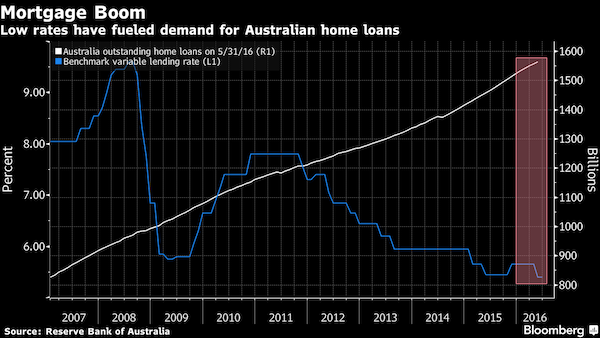
The biggest losers after Prime Minister Malcolm Turnbull scraped through to win Australia’s fractious elections could be homebuyers facing higher costs on their A$1.6 trillion ($1.2 trillion) in mortgages. The price to protect bonds issued by the nation’s banks climbed seven basis points last week after S&P Global Ratings cut its outlook on Australia’s AAA grade to negative on concern government deficits will persist without “more forceful” decisions to rein in shortfalls. It also put the nation’s biggest lenders on notice. Stephen Miller, BlackRock’s head of fixed income for Australia, said Wednesday there’s a “real risk” Australia loses its top debt score.

“An increase in funding costs relating to a ratings downgrade will impact bank margins, but banks may choose to offset this via loan pricing,” said Anthony Ip at Citigroup in Sydney, adding that any increase in funding costs will be significant but manageable. “At the end of the day it’s still a competitive lending market.” Australia’s largest lenders – Australia & New Zealand Banking, Commonwealth Bank of Australia, National Australia Bank and Westpac Banking – rely on offshore bond markets for a fifth of their funding requirements, central bank data show. If their rankings were lowered after a sovereign downgrade, that would increase borrowing costs as much as 20 basis points, prompting them to slap mortgagees with higher interest rates, according to Citigroup.

Read more …

I smell a timebomb.

The Richest Generation in US History Just Keeps Getting Richer (BBG)

Baby boomers started turning 65 in 2011, marking the unofficial beginning of their retirement years. The timing could not have been better for older boomers, who are already part of the wealthiest generation in U.S. history. Since then, the broad S&P 500-stock index is up 91%, including dividends. U.S. stocks hit a record high yesterday. Market performance in the early years of retirement is a crucial worry for anyone living off a nest egg. In the worst-case scenario, stocks crash just as retirees start spending their savings, leaving them in a hole they can no longer earn their way out of. Older boomers have experienced what is arguably the best-case scenario: The S&P 500 has returned 269% since its March 2009 low.

As a recent study in the Journal of Financial Planning shows, wealthy retirees can be very cautious about spending down their savings. This instinct, along with the stock market’s new record, suggests that many boomers are likely to end up with far more money than they know what to do with. Researchers followed the spending and investing behavior of 65- to 70-year-olds from 2000 to 2008. The poorest 40% of the survey respondents generally spent more than they earned, according to the study, which was funded by Texas Tech University. Those in the middle were able to keep their spending at about 8% below what they could have safely spent from pensions, investments, and Social Security.

The wealthiest fifth, meanwhile, had a gap of as much as 53% between their spending and what they could have spent. The authors wrote: “Retirees in the top quintile of financial wealth were spending nowhere near an amount that would place them in danger of running out of money. In fact, the average financial assets of wealthy retirees increased during this period and most retirees spent less than their income.” In other words, these affluent Americans retired and then continued to get richer. That’s quite a feat when you’re no longer working, particularly against the backdrop of the mediocre stock market of the early 2000s.

Read more …

Conditions in Greece are getting worse, fast. I’ll soon have more on that, firsthand. Meanwhile, another 4 refugees died this morning off Lesbos.

A Year After Bailout, Greece Struggles For Brighter Future (AFP)

A year after it fought and lost a tug-of-war with its creditors, Greece remains a country that seems adrift, and many of its citizens view the present as joyless and the future as grim. Summer 2015 saw Greece’s youthful left-wing Prime Minister Alexis Tsipras wage an extraordinary battle between the mighty European Union, the European Central Bank and the IMF. Over five months, Tsipras and his firebrand finance minister, Yanis Varoufakis, took Greece and Europe to the brink as they demanded the creditors ease reforms imposed under two previous bailouts agreed since 2010. As the EU, ECB and IMF took a hard line, Greece’s financial flows shrank and a bank crisis loomed – but Tsipras, instead of buckling, stunned the world by announcing a referendum on the new deal proposed by creditors.

On July 5, 62% of voters rejected the package. But even with the mandate of the Greek people behind him, Tsipras backed down: the risk of seeing Greece thrown out of the eurozone was too much. Instead, in a dramatic U-turn, he let go of Varoufakis, replaced him with the more moderate Euclid Tsakalotos – and just over a week later, signed the third bailout. The deal was worth €86 billion over three years and laden with conditions, such as tax hikes and pension reforms, considered by critics to be so tough that social media buzzed with talk of a coup d’etat. Since then, Greece has soldiered on, weathering popular unrest and the consequences of the 2015 migration crisis, while Tsipras strives to defend his leftwing credentials.

Read more …

Brussels is completely lost. Time to end its misery.

EU Development Aid To Finance Armies In Africa (EuO)

The EU commission wants to finance foreign armies as part of a larger effort to stop people from fleeing to Europe, including in countries with patchy human rights. A commission draft proposal released on Tuesday (5 July) spells out reasons why it is “necessary to provide assistance to the militaries of partner countries”. Some €100 million that were initially slated for development aid will be diverted to finance military-led border control exploits and other initiatives like mine-clearing The EU money can also be used to finance anything from troop transport vehicles to uniforms and surveillance equipment. Even furniture, stationary and “sport facilities” are covered. The EU has already contracted out some €1 billion from 2001 to 2009 when it came to things like law enforcement and border management.

But this is the first time it will pump money directly into a foreign military structure. “The direct financing of the military is not possible [at the moment]. Due to exceptional circumstances in some partner countries, it was important to close this gap,” notes the document, a joint communication to the European Parliament and EU Council. The document attempts to quell some concerns over how the money will be used. It notes, for instance, that it won’t fund “recurrent military expenditure”, weapons and ammunition, and combat training. But such limitations are unlikely to be taken seriously by critics. “This proposal is nothing short of scandalous,” said German Green deputy Reinhard Butikofer.

Read more …

No Ambrose, not the International Court of Justice. The ruling was by the Permanent Court of Arbitration. And your conclusion is fit for the National Enquirer: “The world has not been in such peril since the Cuban Missile Crisis.”

Global Arms Race Escalates As Sabres Rattle In South China Sea (AEP)

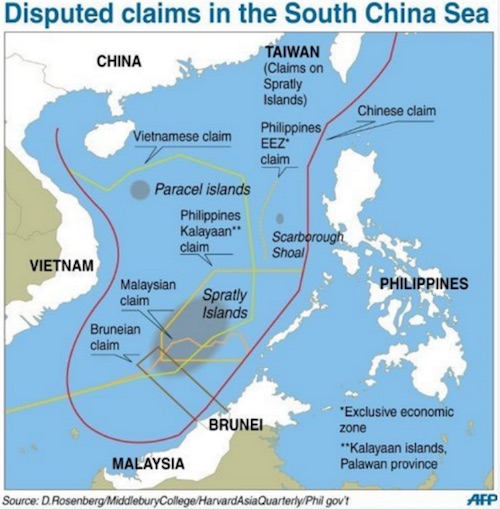
The South China Sea has become the most dangerous fault-line in the world. Beijing and Washington are on a collision course over these contested waters, the shipping lane for 60pc of global trade. As expected, the International Court of Justice in The Hague has ruled that China has no “historic title” to areas of this sea stretching all the way to the ‘nine dash line’ – deep into the territorial waters of a ring of South East Asian states. Equally expected, Beijing has dismissed the verdict with scorn, accusing the tribunal of “shamelessly abusing its authority”. The state media said the country “must be prepared for any military confrontation” with the US, and must not flinch from war if provoked.

It is the latest in a series ominous developments in Asia and Europe that are rapidly subverting the Western international system and setting off a global rearmament race with strong echoes of the late-1930s. Tensions are flaring up across so many spots in East Asia that global investment funds are actively betting on defence stocks and technology companies linked to military expansion. Nomura has launched an “Asian Arms Race Basket” as a hedge against potential conflicts in the East China Sea, the Straits of Taiwan, and the South China Sea. Among the companies listed are Mitsubishi Heavy Industry and Sumitomo Precision in Japan, China Shipbuilding and AVIC Aircraft in China, Korea Aerospace and the explosives group Hanwha, as well as Reliance Defence and Bharat Electronics in India.

The Stockholm International Peace Research Institute says China spent $215bn on defence last year, a fivefold increase since 2000, and more than the whole of the European Union combined. It is developing indigenous aircraft carriers. US experts say its “Two-Ocean Strategy” implies a fleet of five or six aircraft carrier battle groups to project global power. Japan has upgraded its once invisible Self-Defence Force to a full-fledged fighting machine with a humming new headquarters and an air of determined alertness. The country has been increasing military spending for the last four years, especially under its nationalist leader Shinzo Abe, commissioning its largest warship since the Second World War, an 800-ft DDH-class helicopter carrier.

Rearmament has paradoxical effects. It acts as a form of Keynesian stimulus, as it did in the late 1930s. The spending might absorb some of the Asian savings glut and eat into excess industrial capacity, lifting the world out of secular stagnation, but it is a lethal way to do it. A parallel process is underway in Europe where defence spending has been shooting up since the Russian invasion of Crimea, ending years of neglect and austerity budgets. Outlays are expected to rise by 20pc in Central and Eastern Europe this year, and 9.2pc in South-Eastern Europe, according to the French think-tank IRIS.

Read more …

Not terribly smart people.

Economic Theory as Ideology (Zaman)

[..] For a very long time, economists refused to take results from experiments seriously, because these were in direct conflict with axioms at the heart of economic theories. The empirical failure of economic axioms led to the creation of “Behavioral Economics,” which studies actual behavior of human beings. In any scientific field, “behavioral economics” would be the center of attention, since it matches the observational evidence about human behavior. Furthermore, the axiomatic theory, which is contradicted by the empirical evidence, would be a long forgotten idea belonging to the primitive history of economic science. Surprisingly, mainstream economic textbooks, used all over the planet, continue to teach axiomatic theories of human behavior as if they are true, while behavioral economics remains neglected and ignored.

Why do economists maintain an ideological commitment to patently false theories of human behavior? Certainly it is not because these theories are noble and elevating. In fact, many observers have argued that these theories create immoral behavior, by teaching that selfishness, without concern for morality or society, is rational for everyone, and good for society. For example, Nobel Laureate Milton Friedman taught that businesses should maximize profits, without any concern for social responsibility. Given this license, multinational corporations have gone on a rampage, exploiting natural resources by using methods which threaten to destroy the planet. The easiest way to make a profit is to appropriate a priceless natural treasure, like a rainforest, and chop it down for timber.

The losses from industrial wastes are changing the composition of the atmosphere, oceans, lakes and rivers, and inflicting costs on all human beings, but creating profits for corporate coffers. This strategy is called ‘socializing the losses and privatizing the gains.’ With massive profits, it is easy to buy politicians to prevent environmental concerns from getting in the way. The book Merchants of Doubt documents a well funded campaign to create doubt about climate change, so that corporations can continue to make profits while destroying the planet. The persistence of economic theories which celebrate and glorify these poisonous ideologies of personal greed and social irresponsibility can be traced to corporate funding of think-tanks and research which promote “free markets”. The charms of “freedom” propagated by economic ideologies conceal the ugly reality of corporate freedom and wage slavery of the masses.

Read more …

The glory of mankind.

Half Of All US Food Produce Is Thrown Away (G.)

Americans throw away almost as much food as they eat because of a “cult of perfection”, deepening hunger and poverty, and inflicting a heavy toll on the environment. Vast quantities of fresh produce grown in the US are left in the field to rot, fed to livestock or hauled directly from the field to landfill, because of unrealistic and unyielding cosmetic standards, according to official data and interviews with dozens of farmers, packers, truckers, researchers, campaigners and government officials. From the fields and orchards of California to the population centres of the east coast, farmers and others on the food distribution chain say high-value and nutritious food is being sacrificed to retailers’ demand for unattainable perfection.

“It’s all about blemish-free produce,” says Jay Johnson, who ships fresh fruit and vegetables from North Carolina and central Florida. “What happens in our business today is that it is either perfect, or it gets rejected. It is perfect to them, or they turn it down. And then you are stuck.” Food waste is often described as a “farm-to-fork” problem. Produce is lost in fields, warehouses, packaging, distribution, supermarkets, restaurants and fridges. By one government tally, about 60m tonnes of produce worth about $160bn, is wasted by retailers and consumers every year – one third of all foodstuffs. But that is just a “downstream” measure.

In more than two dozen interviews, farmers, packers, wholesalers, truckers, food academics and campaigners described the waste that occurs “upstream”: scarred vegetables regularly abandoned in the field to save the expense and labour involved in harvest. Or left to rot in a warehouse because of minor blemishes that do not necessarily affect freshness or quality. When added to the retail waste, it takes the amount of food lost close to half of all produce grown, experts say. “I would say at times there is 25% of the crop that is just thrown away or fed to cattle,” said Wayde Kirschenman, whose family has been growing potatoes and other vegetables near Bakersfield, California, since the 1930s. “Sometimes it can be worse.”

Read more …

Jul 092016
 
 July 9, 2016  Posted by at 8:25 am Finance Tagged with: , , , , , , , , , ,  Comments Off on Debt Rattle July 9 2016


Jack Delano Mike Evans, welder, Proviso Yard, Chicago & North Western RR 1940

The Decline & Fall Of The Biggest Bond Market In The World (ZH)
More Than 20% Of Americans Are Simply Too Poor To Shop (NYPost)
What If I Told You Employment Actually Declined 119,000 In June (Rosenberg)
Chicken Little Economists Are Wrong About Brexit (MW)
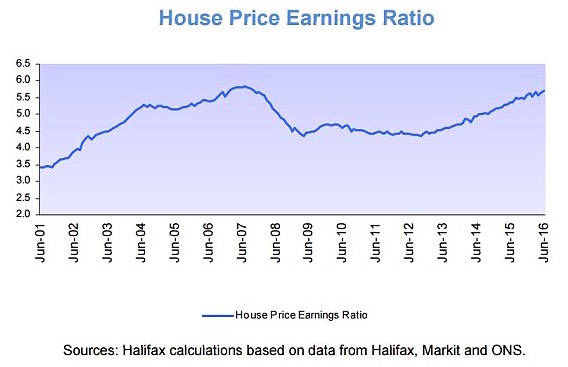
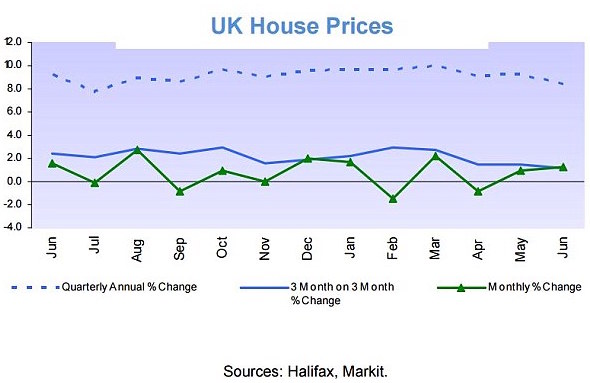
UK Property Hits Levels Of Unaffordability Not Seen Since 2007 (TiM)
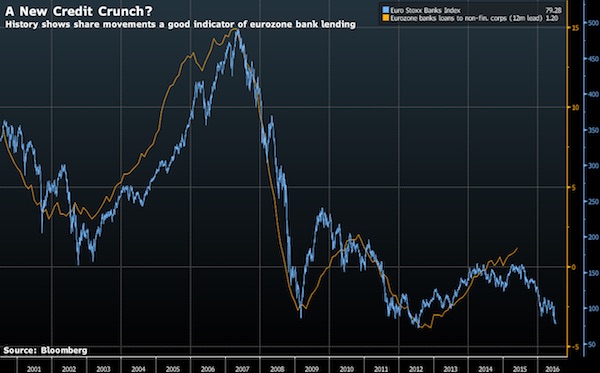
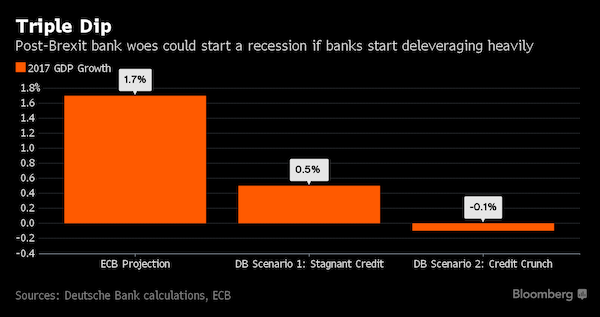
If Bank Stocks Are Linked to Bank Lending, Europe Should Worry (BBG)
Italy PM’s Tuscan Nightmare: The Fall Of ‘Daddy Monte’ (R.)
Albert Edwards: Brexit Is Old News, Time To Worry About Italy (VW)
Italy’s In An Economic Straitjacket, Needs To Be Freed: Albert Edwards (CNBC)
Only Europe’s Radicals Can Save The EU: Yanis Varoufakis (Newsweek)
Worst. Coup. Ever. (TeleSur)
The Persian Gulf’s Huge New Export: Debt (WSJ)
Greek Exports Record Major Decline In May (Kath.)
Russia Hits Back At ‘Anti-Russian’ NATO ‘Hysteria’ (CNBC)


Stop it already!

The Decline & Fall Of The Biggest Bond Market In The World (ZH)

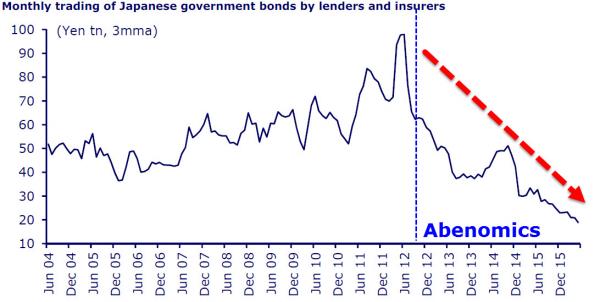
Government bonds are themselves becoming more illiquid, most particularly, as CLSA’s Chris Wood notes, in a country like Japan where the Bank of Japan has been buying more than the net issuance. Monthly trading of JGBs by lenders and insurers has collapsed from a peak of ¥123tn in April 2012 to a record low of ¥15tn in May 2016. This raises the pertinent issue of whether the Bank of Japan has reached the practical limit of its government buying programme in terms of its current purchase programme of ¥80tn relative to estimated annual JGB net new issuance of ¥34tn.

In this respect, the Japanese central bank has from a potentially monetisation standpoint always defended the integrity of its JGB purchase programme by stressing that it only buys JGBs in the secondary market, which means that the seller of the JGB to the BoJ forfeits a claim to that asset. This is contrasted to what would happen if the BoJ bought JGBs in the primary market on an open-ended basis. Such a process would be highly inflationary and, sooner or later, would be viewed by the market as such. And as Wood concludes, the next step is obvious…

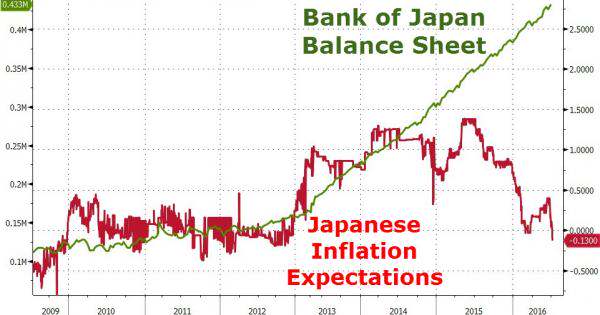
“This is why Japan, as well as America, is also a candidate for monetisation of infrastructure stimulus or for what Bernanke has called a “money-financed fiscal programme”, or what has been called in other quarters “overt monetary financing”. This is because Bank of Japan governor Haruhiko Kuroda is now looking for a new alternative form of monetary easing, given he has probably reached the practical limits of responsible JGB buying, as already discussed, while his initial move to impose negative rates in January led to the opposite market reaction than expected (ie, a stronger yen and a weaker stock market) while also proving politically very unpopular. This probably explains why Kamikaze Kuroda has not expanded the negative rate policy further since January even though inflation and inflation expectations have moved in the opposite direction of what he has been targeting.”

The latest data will make it harder for Kuroda to do nothing at the next BoJ policy meeting due to be held on 28-29 July given the stress he has put on monitoring inflation expectations. That is unless he just admits he has failed! Given the unattractive options of buying still more JGBs or ETFs, or risking an undoubtedly unpopular expansion of negative rates, Kuroda and indeed Abe will be looking for a new approach. Monetisation of infrastructure stimulus may be the option. Meanwhile, in an effort to calm potential concerns about the integrity of the fiscal budget central bankers implementing such a future monetisation of infrastructure spending will doubtless be at pains to describe the process as a “one off” though, as the ever theoretical Bernanke stated in his blog: “To have its full effect, the increase in the money supply must be perceived as permanent by the public.”

Read more …

But the jobs report?!

More Than 20% Of Americans Are Simply Too Poor To Shop (NYPost)

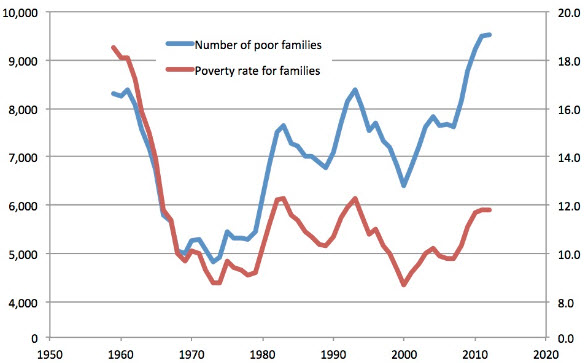
Retailers have blamed the weather, slow job growth and millennials for their poor results this past year, but a new study claims that more than 20% of Americans are simply too poor to shop. These 26 million Americans are juggling two to three jobs, earning just around $27,000 a year and supporting two to four children — and exist largely under the radar, according to America’s Research Group, which has been tracking consumer shopping trends since 1979. “The poorest Americans have stopped shopping, except for necessities,” said Britt Beemer, chairman of ARG. Beemer has been tracking this subgroup for two years, ever since his weekly surveys of 15,000 consumers picked up that 21% of consumers did not finish their Christmas shopping in 2014 due to being too busy working.

That number grew to 29% last year, and Beemer dug in to learn more about them, calling them on holidays. He estimates that this group has swelled from 6 million households four years ago, because their incomes have not kept pace with expenses like medical costs. Nearly half of all Americans have not seen an increase in salary over the last five to seven years, and another 28% have seen their take-home pay reduced by higher medical insurance deductions or switching to part-time jobs, ARG found. “It’s scary when you start to see things that you’ve never seen before,” said Beemer. “People are so pessimistic about their future.” Most of those living on the edge — 68% are women between the ages of 28 and 38 — work in retail or in call centers, according to Beemer.

Read more …

Rosenberg flip flop. “This is otherwise known as looking at the big picture.”

What If I Told You Employment Actually Declined 119,000 In June (Rosenberg)

David Rosenberg: What if I told you that employment actually declined 119,000 in June and has been faltering now for three months in a row? Yes, that is indeed the case. Of course, the focus, as always is on the non-farm payroll report but keep in mind that while this is the data series that moves markets, it does not necessarily have the final word on how the labor market is truly faring. Okay, so let’s get the pablum out of the way first. Nonfarm payrolls surprised yet again but this time to the upside — surging 287,000 in the best showing since last October and again making a mockery of the consensus economics community which penned in a 180,000 bounce….

…as if the Household sector ratified the seemingly encouraging news contained in the payroll data as this survey showed a tepid 67,000 job gain last month and rather ominously, in fact, has completely stagnated since February. Historians will tell you that at turning points in the economy, it is the Household survey that tends to get the story right.

[..] The simple fact of the matter is that May and June were massive statistical anomalies. The broad trends tell the tale. Go back to June 2014 and the six-month trend in payrolls is running at a 2.2% annual rate and the three-month trend at 2.4%. A year ago, as of June 2015, the six-month pace was 1.9% and the three-month at 2.2%. Fast forward to today, and the six-month annualized rate is 1.4% and the three-month has slowed all the way down to a 1.2%. This is otherwise known as looking at the big picture.

When the Household survey is put on the same comparable footing as the payroll series (the payroll and population-concept adjusted number), employment fell 119,000 in June – again calling into question the veracity of the actual payroll report — and is down 517,000 through this span. The six-month trend has dipped below the zero-line and this has happened but two other times during this seven-year expansion.

Read more …

“..the E.U.’s “free-trade zones” have become classic Orwellian nomenclature. Flip it: “Free-trade zone” means “unfree-trade zone.”

Chicken Little Economists Are Wrong About Brexit (MW)

A few years ago when Grexit was the E.U. crisis du jour, I explained why Greece just didn’t matter to the world’s economies or the U.S. stock markets in columns like this one called, “Apple is bigger than the entire Greek economy.” Did you know that Great Britain’s GDP is 10 times larger than Greece’s? Unlike with Apple vs Greece’s entire GDP, at $2.7 trillion per year, Britain’s economy is equal to the combined market cap of Apple, Google, Microsoft, Exxon Mobil, Berkshire Hathaway, Amazon and Facebook. The total market cap of the DJIA is only (?) about $5.5 trillion, or twice Britain’s GDP. Clearly, Brexit has a much bigger potential to impact the broader economy and the financial markets than Greece ever did.

Which, in my opinion, is a good thing. Greece’s economy has shrunk 20% since the great Greek Financial Crises Du Jour was hitting the markets and the country chose to stay in the E.U. rather than getting out. Staying in the E.U. has created a Great Depression kind of decline in the economy there. Now I don’t think Great Britain has ever been positioned as poorly as Greece has been inside the E.U., so I certainly don’t think its economy is about to crash 20% in the next two or three years whether in or out of the E.U. But I like the prospects for the country to unwind the cumbersome red tape, regulations and control from the E.U.’s central powers, thereby unleashing entrepreneurship, innovation and freer trade,

One of the great ironies that Brexit has highlighted is that the E.U.’s “free-trade zones” have become classic Orwellian nomenclature. Flip it: “Free-trade zone” means “unfree-trade zone.” As LunaticTrader put it in a discussion about all of this on Scutify: “The E.U. worked well until the late 1990s when it was mainly a free-trade zone. It has gradually morphed into an ‘unfree trade zone’ because that ‘free’ has been gradually replaced by 80000 laws and regulations, combined with the euro, which took away the weaker countries’ (Greece, Italy, Spain…) main tool to manage their own economy. This doesn’t offer any economic benefits to the weaker E.U. members, as has become abundantly clear.”

From this corner’s perspective, Great Britain’s leaving the E.U. gives the nation itself a much higher probability of creating economic growth and prosperity for its citizens than staying in the E.U. ever did. That new upside potential, plus the fact that its economy is large enough to impact the global and U.S. economies nets out to Brexit being a positive, despite all the handwringing in the media and Chicken Little politicians, economists, pundits and traders who are basically begging you to freak out about it.

Read more …

What Brexit will correct.

UK Property Hits Levels Of Unaffordability Not Seen Since 2007 (TiM)

UK house prices continued to rise in June, adding almost £3,000 in a month, stretching affordability to levels not seen since the run-up to the financial crisis in 2007, a new survey suggests. Halifax said it was too early to say how the referendum that sanctioned the UK’s decision to leave the EU will impact the housing market, but added there were signs the pace of growth is easing. The price of the average home in the UK rose by 1.3% between May and June, or by £2,708, to hit £216,823, up from 0.6% the previous month, according to the latest index by the mortgage lender. Meanwhile, the ratio of house prices to earnings rose to 5.70 in June from 5.65 in May, marking its highest level since October 2007.

This means that buying a new home will cost the average workers close to six years of their earnings before tax. On an annual basis, however, prices grew by 8.4%, down from 9.2% in May, posting the lowest growth since July last year. Martin Ellis, Halifax housing economist, said: ‘There is evidence that the underlying pace of house growth may be easing.’ And added: ‘House prices continue to increase, albeit at a slower rate, but this precedes the EU referendum result, therefore it is far too early to determine any impact since.’ The Bank of England this week warned that property prices ‘had become stretched’ in recent months – meaning a cooling of the market was likely at some point regardless of the Brexit vote.

Read more …

“..if banks decide to keep their balance sheets unchanged until the end of 2017, this could halve economic growth in the euro area next year.”

If Bank Stocks Are Linked to Bank Lending, Europe Should Worry (BBG)

Don’t underestimate the toll that the post-Brexit bank equity rout can take on the euro-area economy. Initial calculations of the effect of the U.K. referendum on the region’s recovery have suggested that the blow will be relatively mild, with ECB President Mario Draghi telling European Union leaders that the impact from direct trade could add up to 0.5 %age point over three years. But such scenarios don’t take into account the consequence of the 23% decline in bank stocks since the Brexit vote. Historically, bank equities have correlated strongly with bank lending, with about a year’s lag, as the chart below shows.

Deutsche Bank analysts led by Marco Stringa argue in a July 5 paper that there’s also a causal link: As banks are now under regulatory pressure to raise capital, slumping stock prices and low profitability make it very difficult to build up funds either externally or internally. Deutsche Bank’s own share price has fallen by more than 25% since June 23. If banks struggle to raise capital, they may come under extra pressure to shrink assets. That could mean less lending to the economy. Bankers often claim that asking them to have more funds of their own instead of borrowing from the market hampers their ability to extend credit. Regulators retort that higher capital requirements in fact strengthen a bank’s ability to make loans, not the opposite.

Even so, it might mightn’t take much for Brexit to put a stop to the timid pick-up in euro-area bank lending that started just last year. That’s not least because of the impact of uncertainty on households’ and companies’ investment choices. The impact of a renewed credit crunch on Europe’s largely bank-dependent companies could be severe. Not by chance, fixing the banks to restart credit to the real economy has been one of the main goals of the ECB’s policies since the crisis. Stringa estimates that if banks decide to keep their balance sheets unchanged until the end of 2017, this could halve economic growth in the euro area next year. Worse still, if lenders only manage to raise half of the funds they need to meet what the economists refer to as “Basel IV” requirements, this could force them to reduce their loan book’s risk-weighted assets.

Read more …

May have co-financed Columbus: “In 1624, the Medici Grand Duke of Tuscany rushed to the defense of depositors of a bank that was by then already 152 years old..”

Italy PM’s Tuscan Nightmare: The Fall Of ‘Daddy Monte’ (R.)

In 1624, the Medici Grand Duke of Tuscany rushed to the defense of depositors of a bank that was by then already 152 years old, Monte dei Paschi di Siena, guaranteeing their savings at a time of economic crisis. Nearly 400 years later, Italian Prime Minister and fellow Tuscan Matteo Renzi aims to do something similar as the world’s oldest bank and Italy’s third-largest lender again threatens the region’s savers. This time the stakes are much higher. The collapse of Monte dei Paschi could not only impoverish thousands of ordinary Italians, it could lead to a wider banking crisis, help tip Renzi from power and provide another strong jolt to the European Union, already reeling from Britain’s referendum vote to leave the group.

“The government must assume its responsibilities, save the bank and its investors, otherwise this gangrene will spread to the rest of the system,” said Romolo Semplici, a 58-year-old real estate entrepreneur whose 22,000-euro investment in the bank’s shares is now worth less than 200 euros. “I’ve always been pro-European, but if Europe doesn’t protect its own citizens then we should think twice if this the kind of Europe that we want to be in.” Government sources say Italy is considering options to prop up the bank, including a state guarantee that would enable the bank to raise money it would otherwise struggle to secure from skeptical investors. Many bankers say the bank will inevitably have to raise around €3-4 billion.

Officials in Brussels, a world away from the medieval cobble-stoned alleys of Siena, one of Italy’s most popular tourist centers, may stand in Renzi’s way. A state rescue of Monte dei Paschi would be the first real test of EU rules limiting the use of taxpayers’ money to bail out investors. The rules require holders of the bank’s shares and junior debt to bear some of the losses. Depositors with more than €100,000 would also be hit. The bank’s share price has halved since Britain voted on June 23 to leave the EU, as investors stampede out of Italian banks on concerns that Brexit could send Italy back into recession and saddle them with even more bad debts.

Read more …

“..Italy may fall in October or may not, but it will eventually occur..”

Albert Edwards: Brexit Is Old News, Time To Worry About Italy (VW)

Edwards looks at the 2008 financial crisis and says it was not Lehman Brothers that was causation. Lehman was a symptom of an economic engine already in decline. Likewise there is Brexit, an issue he notes has been accompanied by some of the most emotional ranting he’s seen – on both sides of the argument, including his own. Brexit will be used as an excuse for all sorts of economic ills, but it is only a symptom, a benchmark for a larger trend. When he takes off the emotional hat, he says the real issue is the continued dismantling of the European Union that is upon which savvy investors should focus. There is a game of dominoes being played out and Brexit was just the latest move in a trend.

“In the aftermath of the Brexit vote there is an increasing fear of other dominoes falling within the heart of the EU – the eurozone,” Edwards wrote. “Italy is bleeping very loudly on most people’s radars with its banking crisis and impending referendum seen as leaving the country on a knife-edge.” The Italian banking crisis is important, but it is not the primary problem. “It is a symptom of the problem that problem being a perpetually stagnant economy and deflation,” he wrote. “Italy simply does not appear to be able to grow inside the eurozone and more importantly probably never will.” But it is not just Italy that could be part of the trend extension, the trend could be extended across Europe.

In making this analysis, Edwards does not cite all too simple issues of immigration, fear of globalization or a lack of foresight by the slovenly masses who vote. He looks at economic numbers and notes that it’s not just Italy that is at risk of withdrawing from a marriage. There have been economic winners and losers, and they are clear and documentable. “Indeed the Italian economy has barely grown one jot since it joined the eurozone at the start of 1999 while Germany has grown rich,” he said, pointing to one clear winner with many clear losers. “As inevitably people compare their fortunes with that of their neighbours, the Italians are mighty pissed off.”

Read more …

“..the country is “condemned to perpetual economic stagnation within the strictures of the euro zone..”

Italy’s In An Economic Straitjacket, Needs To Be Freed: Albert Edwards (CNBC)

The citizens of Italy will vote to leave the euro zone after an impending recession and a shift in power inside the country’s political system, according to Societe Generale’s notoriously bearish strategist, Albert Edwards. “The people are angry,” Edwards said in a note Friday, highlighting a poll in May by IPSOS Global that showed almost half of Italians would vote “out” in a referendum on their country’s EU membership. “Italy simply does not appear to be able to grow inside the euro zone and more importantly probably never will … after the next recession I believe a majority of Italians will have had enough of the euro zone experiment and vote in the radical Five Star Movement,” he added.

Anti-establishment Five Star Movement (M5S) is now Italy’s most popular party after a poll on Wednesday showed that it would win an election over Prime Minister Matteo Renzi’s Democratic Party (PD), according to Reuters. This comes at a time when Renzi is trying to deal with a fragile banking system, bogged down by non-performing loans. A referendum on constitutional reform this October is also looming and could well usher in new elections. But Edwards suggests that the Italian bank crisis – and also Brexit – are not a cause of the world’s economic problems, but just symptoms. The real issue is that the country is “condemned to perpetual economic stagnation within the strictures of the euro zone,” he said, suggesting that recapitalizing the Italian banks will not solve their problems.

With a slew of figures, the Societe Generale strategist detailed in his research note how unemployment has risen since the mid-2000s and how productivity has stagnated. Going forward, he believes Renzi should announce an “aggressive fiscal pump” despite the complaints that might arise from Germany and the European Commission. “Italy has played by the fiscal austerity rules for too long. Although its problems are structural in nature, after running an underlying primary fiscal surplus for some 20 years it is time to break free from its self-imposed deflationary fiscal chains,” he added.

Read more …

Question is: why save the EU?

Only Europe’s Radicals Can Save The EU: Yanis Varoufakis (Newsweek)

Spaniards went to the polls three days after the shock of Brexit to produce a result that, ostensibly, delivers victory to the status quo. However, the status quo is tired, fragmenting, and prone to vicious unraveling unless the EU’s deconstruction is impeded. But, the Spanish establishment, which is determined to maintain the status quo, lacks both the analytical power and the political will to impede the EU’s disintegration. And so an electoral result in favor of continuity becomes the harbinger of deep uncertainty. Reeling under the British voters’ radical verdict, “official” Europe took solace from Spain’s general election outcome. They read into it evidence that the post-Brexit fear factor may help knock some “sense” into voters, putting them off “populist” parties.

But, even if this is so, for how long will fear keep voters loyal to a crumbling status quo? The threat of a pyrrhic victory for Spain’s establishment is, thus, clear and present. Spain and the U.K. differ in one crucial sense. While EU policies and institutions have damaged the Spanish economy a great deal more than Britain’s, Spain’s political system remains largely free of euroskepticism. The paradox dissolves quickly when one considers the traditional lack of legitimacy of the Spanish elites in their own country. British Tories, like Michael Gove and Boris Johnson, knew they could draw mass support from a slogan like “We want our country back!” The Spanish establishment cannot do this.

And they cannot do it because, over the last four decades, they managed to retain control by offering voters an unlikely deal: “You keep us in government and we shall do what is necessary to rid you of us, by transferring power to Brussels and to Frankfurt.” Calling for a restoration of sovereignty now would strike Spanish voters as backtracking on the promise to rid them of their local rulers. But, then again, this promise is under increasing strain at a time when the process of Europeanization is in serious trouble.

Read more …

As you may have noticed, I find it ever harder to stay away from politics. This is because the economic collapse increasingly spils over into what is after all a fully integrated politico-economic system. In this case, what caused Brexit is also what makes Corbyn strong. But Britons are not nearlly far enough along in the Kübler-Ross cycle to understand this. They’re still stuck in blaming other people for the perceived injustices that befall them.

Worst. Coup. Ever. (TeleSur)

As the Chilcot Inquiry report is released to the public, those MPs attempting to depose Labour leader Jeremy Corbyn—their leading lights inescapably sullied by having supported the war—are suing for peace. Over a week of high-profile resignations, statements, demands, pleas and threats have seemingly done little but consolidate Corbyn’s position. In record time, it has gone from being a coup to a #chickencoup to a #headlesschickencoup. This could be the biggest own-goal in the history of British politics. Journalists steeped in the common sense of Westminster, assumed that it was all over for Labour’s first ever radical socialist leadership. How can he lead, they reasoned, if his parliamentary allies won’t work with him?

This, in realpolitik terms, merely encoded the congealed entitlement and lordly presumption of Labour’s traditional ruling caste. Even some of Corbyn’s bien-pensant supporters went along with this view. They should have known better. The putschists’ plan, such as it was, was to orchestrate such media saturation of criticism and condemnation aimed at Corbyn, to create such havoc within the Labour Party, that he would feel compelled to resign. The tactical side of it was executed to smooth perfection, by people who are well-versed in the manipulation of the spectacle. And yet, in the event that Corbyn was not wowed by the media spectacle, not intimidated by ranks of grandees laying into him, and happy to appeal over the heads of party elites to the grassroots, their strategy disintegrated.

This was not politics as they knew it. The befuddlement was not for want of preparation. From even before his election as Labour Party leader, there were briefings to the press that a coup would be mounted soon after his election. And in the weeks leading up to the European Union referendum, Labour Party activists reported that they were expecting a coup to be launched after the outcome was announced, regardless of what the result was. This seemed like a half-baked idea—there was still no overwhelming crisis justifying a coup attempt—and so it turned out to be.

Undoubtedly, part of the rationale for hastening the attempted overthrow was the looming publication of the findings of the Chilcot Inquiry, which was expected to be harshly critical of former Prime Minister Tony Blair, of the justification for the invasion of Iraq, and of the relationship with the Bush administration. Given the role of the Parliamentary Labour Party in leading Britain into that war, against fierce public and international opposition, and given its role in supporting the subsequent occupation, this was a bad moment to have Corbyn at the helm. In the event, Corbyn survived to make a dignified statement apologizing for Labour’s role in the disaster and promising to embark upon a different foreign policy—one quite at odds with that supported by the pro-Trident, pro-bombing backbenchers.

Read more …

The world needs more debt!

The Persian Gulf’s Huge New Export: Debt (WSJ)

The energy-producing states of the Persian Gulf are issuing bonds at the fastest clip ever, showing how the oil bust is reshaping the region’s finances despite a near doubling of crude prices this year. The Gulf Cooperation Council states of Saudi Arabia, United Arab Emirates, Bahrain, Kuwait, Qatar and Oman together have raised a record $18 billion in 2016, according to Dealogic, helping refill coffers depleted by sharp revenue declines. Investors expect issuance to increase further, as governments brace for lower prices than they were budgeting only a few years ago. Saudi Arabia is expected to raise up to $15 billion more in the coming weeks, and total issuance by the Gulf nations could reach $35 billion this year, according to JP Morgan Chase, more than doubling the previous high set in 2009.

The issuers are paying slightly higher costs than other emerging countries with similar ratings, reflecting uncertainty over how successful they will be in opening up their economies, the region’s geopolitical risks and the murky outlook for oil prices, analysts and portfolio managers said. But the bond sales generally have been successful, driven by strong demand from local investors and banks, improving market sentiment due to the oil rebound, and a persistent decline in global interest rates that is putting a premium on securities with better yields. In May, Qatar raised $9 billion in an offering that drew more than twice that sum in orders. The five-year notes issued by the nation of 2.5 million trade at 2.13%. That is more attractive when compared with 1.83% on the comparably rated bonds issued by Korea National Oil, according to Anita Yadav at Emirates NBD.

Read more …

-12.4% YoY

Greek Exports Record Major Decline In May (Kath.)

Exports posted a significant decline in May, reflecting to a great extent the impact of the uncertainty from Athens’s months-long negotiations with its creditors, as well as of the industrial action at the ports of Piraeus and Thessaloniki. According to Hellenic Statistical Authority (ELSTAT) figures issued on Friday, exports contracted 12.4% compared with May 2015, amounting to 2.02 billion euros. The decline came to 6.4% not including fuel products, as exports recorded their first decline in the last four months.

“This decline, besides the general problems and the continued uncertainty in the Greek economy, is partly due to the situation in the country in recent months, as the industrial action at the ports of Thessaloniki and Piraeus started in May,” noted the Greek International Business Association (SEVE) in a statement. Panhellenic Exporters Association chief Christina Sakellaridi added that “an entire year has passed since the capital controls were imposed without normality having been restored to the market. The only favorable impact is expected from the repayment of the state’s dues to private parties, the activation of the investment incentives law, the restoration of cheap liquidity flows to banks, the developments concerning bad loans and privatizations, and the attraction of new investments.”

Read more …

“..absurd to talk about any threat coming from Russia at a time when dozens of people are dying in the center of Europe and when hundreds of people are dying in the Middle East daily..”

Russia Hits Back At ‘Anti-Russian’ NATO ‘Hysteria’ (CNBC)

At a NATO summit in Warsaw, Poland on Friday, the military alliance is expected to formally agree to deploy four battalions with a total of 3,000 to 4,000 troops to the Baltic states (Estonia, Latvia and Lithuania) and Poland on a rotational basis. The deployment comes amid increasing concerns in those areas (all of which were under Soviet control during the Cold War) that Russia could be prepared to try to increase or regain its sphere of influence. In a statement on Thursday, NATO also said it would “strengthen political and practical cooperation with Ukraine, Georgia and the Republic of Moldova” – all former Soviet republics experiencing increasing tensions with Russia due to their political and economic relations with the EU.

In addition, the EU and NATO signed a declaration on Friday aimed at bolstering the region’s security ahead of the full NATO summit Friday afternoon. Left out in the cold from NATO and ostensibly the reason for such a deployment, Kremlin spokesman Dmitry Peskov reportedly hit back at the alliance, saying its actions were akin to “anti-Russian hysteria.” “If one needs badly to look for an enemy image so that [one can] promote anti-Russian, so to say, hysteria, and then, with this emotional background, to deploy more and more air force units, ground troop units, getting them closer to Russian borders, then one can hardly find any common ground for cooperation,” he was quoted by Russia’s Itar Tass news agency as saying.

Peskov was also quoted by Reuters as telling reporters that it was “absurd to talk about any threat coming from Russia at a time when dozens of people are dying in the center of Europe and when hundreds of people are dying in the Middle East daily,” adding that “you have to be extremely short-sighted to twist things in that way.”

Read more …

Jul 042016
 
 July 4, 2016  Posted by at 8:23 am Finance Tagged with: , , , , , , , , ,  3 Responses »


Walker Evans “Sidewalk scene in Selma, Alabama.” 1935

China Bank Bailout Calls Go Mainstream (BBG)
Deutsche: Probability Of US Recession Surges To 60% (ZH)
Druckenmiller, Soros, Spitznagel, Gross Warn Of Crisis (VW)
Oil Rally Threatened as Gasoline Supply Surge Swamps US Demand (BBG)
Brexit Is a Lehman Moment for European Banks (BBG)
Angela Merkel ‘To Oust Juncker’ As Europe Splits Deepen Over Brexit (Tel.)
Germany’s Schäuble Urges Post-Brexit Push to Curb EU Commission (BBG)
French Economy Minister Macron Claims Euro-Clearing Business for Paris (BBG)
Where Have Those Nice Britons Gone? (G.)
Brexit Voters Are Not Thick, Not Racist: Just Poor (Spec.)
German Arms Exports Almost Doubled In 2015 (R.)
Kaczynski May Divert Polish Pension Cash to State Projects (BBG)
Europe Puts Greece On Ebay (G.)
How To Fix A Broken Auckland? Crash Home Prices By 40% (Grimes)


“Non-performing loans jumped by more than 40% in the 12 months ended March to 1.4 trillion yuan ($210 billion)..” “..CLSA estimating NPLs were probably closer to 11.4 trillion yuan at the end of last year..” That would be well over $2 trillion….

China Bank Bailout Calls Go Mainstream (BBG)

Predictions of a Chinese banking system bailout are going mainstream. What was once the fringe view of permabears and short sellers is now increasingly being adopted by economists at some of the world’s biggest banks and brokerages. Nine of 15 respondents in a Bloomberg survey at the end of last month, including Standard Chartered and Commonwealth Bank of Australia, predicted a government-funded recapitalization will take place within two years. Among those who provided estimates of the cost, a majority said it will exceed $500 billion. While a bailout of that size would be a far cry from the $10 trillion forecast of U.S. hedge fund manager Kyle Bass in February, the responses reflect widespread concern that Chinese lenders will struggle to cope as bad loans surge.

Even as some analysts said a state recapitalization would put the banking system on a stronger footing, 80% of respondents predicted news of a rescue would weigh on Chinese markets – dragging down bank stocks and the yuan while pushing up government borrowing costs and credit risk. “A recapitalization will happen after the Chinese government comes clean with the true nonperforming loan figure,” said Kevin Lai at Daiwa Capital Markets. “That will require a lot of money creation.” [..] Chinese lenders are grappling with a growing mountain of bad debt after flooding the financial system with cheap credit for years to prop up economic growth.

Non-performing loans jumped by more than 40% in the 12 months ended March to 1.4 trillion yuan ($210 billion), or 1.75% of the total, according to government data. The figures are widely believed to understate the true scale of the problem, with CLSA estimating NPLs were probably closer to 11.4 trillion yuan at the end of last year.

Read more …

Reading the yield curve.

Deutsche: Probability Of US Recession Surges To 60% (ZH)

Over the weekend, following the latest collapse in long-term yields to new all time lows, Deutsche Bank looked at what implied recession odds are if one once-again adjust for Fed intervention. What it found, in the words of Deutsche Bank’s Dominic Konstam, is “worrisome.” From Deutsche Bank:

Since the UK referendum the US yield curve has flattened to new post-crisis lows. The 3m10y spread is now 115 bps compared to 210 bps at the start of the year, and the 2y10y spread is just 85 bps versus 120 bps on January 1. This relentless flattening of the curve is worrisome. Given the historical tendency of a very flat or inverted yield curve to precede a US recession, the odds of the next economic downturn are rising. In our probit model, the probability of a recession within the next 12 months has jumped to 60%, the highest it’s been since August 2008.

The model adjusts the 3m10y spread by the historically low level of short rates and it suggests that on an adjusted basis the curve has already appeared to be inverted for some time. The yield curve had successfully signaled the last two recessions when the model output rose above 70%. If 10y yields rally to 1.00% and the 3m rate is unchanged, the implied recession probability from our model will reach that number. At current market levels, the market is just 40 bps from that distinct possibility.

In other words, while the Fed is terrified of killing the recovery by “tightening” financial conditions, all that will take for the next recession to arrive is for the Fed and its central bank peers to ease just that much more to send the long end 40 bps lower, something which as we reported yesterday may happen even sooner than expected, now that pension funds are ready to throw in the towel and start buying 10Y and 30Y Tsys with wreckless (sic) abandon.

Read more …

“One of the best indicators showing how healthy is the economy is the velocity of circulation of money.”

Druckenmiller, Soros, Spitznagel, Gross Warn Of Crisis (VW)

Brexit referendum pushed financial markets into turmoil. Even if this is only the beginning of tough times the main reason behind this is definitely not the result of the UK referendum. What we see today is merely a result of financial markets being disconnected from the real condition of the global economy. The red flags signalling overpriced markets (especially in the case of the US) now are raised not only from statistical data but also from experienced investors having a good forecasting record.

From the start, I would like to focus on aforementioned statistical data. They can give us clear picture of the US economy and what happened after previous crisis until now. The financial situation of the US is crucial because it is the American stock exchange that delivers 44% of the global capitalisation of financial markets. American financial sector is responsible for setting trends and today those trends are pointing south. Developing markets are falling right behind the trendsetter. One of the best indicators showing how healthy is the economy is the velocity of circulation of money. The better the economy, the more money people and other participants of the economy spend – this increases money circulation.

At first glance, you can see that after 2008-09 crisis situation worsened. During official ‘post-crisis recovery’ velocity was slightly above 1.7 while during the first quarter of 20016 it fell below 1.5 (for comparison – before the crisis it around 2.0). The above chart is not the only data point. Low money velocity means also less consumption – this is visible in higher inventory-to-sales ratio. Below you can see a record of it. Today this indicator is above the Lehman level. What is more, it soon can match the levels of the worst phase of the 2008 meltdown. This clearly shows how American society is getting poorer.

Read more …

Low prices, but falling demand.

Oil Rally Threatened as Gasoline Supply Surge Swamps US Demand (BBG)

American drivers’ seemingly insatiable thirst for gasoline is running into a flood of supply. Refineries across the nation are operating full-out and imports are pouring into the East Coast, boosting gasoline supplies to a record. At the same time, consumption has turned out to be less robust than thought. That’s weighed on prices, threatening to stem oil’s rebound from a 12-year low. “Earlier this year there was a lot of hope that gasoline would lead crude higher,” said John Kilduff, partner at Again Capital, a New York hedge fund focused on energy. “That’s not turned out to be the case and gasoline will soon be a weight on the market.”

The Energy Information Administration said in a monthly report on June 30 that demand in April was 9.21 million barrels a day, down from 9.49 million seen in weekly data. “The monthly data for April raises doubts about the idea that we have reliably robust gasoline demand to support the entire complex,” said Tim Evans, an energy analyst at Citi Futures Perspective in New York. Gasoline stockpiles along the East Coast, which includes New York Harbor, the delivery point for U.S. futures contracts, surged to a record 72.5 million barrels in week ended June 24, EIA data show. Imports to the region jumped to a six-year seasonal high. Production climbed to a record in the previous week, as refiners typically run harder in the second quarter to meet summer peak driving season.

Read more …

“When the biggest bank in Europe’s biggest economy, with annual revenue of about €37 billion, is worth about the same as Snapchat – a messaging app that generated just $59 million of revenue last year – you know something’s wrong.”

Italy’s efforts at aiding its banks risk leading to a big problem with Germany, but Brexit makes the latter hesitant. But it can’t give in, it would set a precedent the EU can’t handle. So is Italy the next Greece?

Brexit Is a Lehman Moment for European Banks (BBG)

European banks are undergoing a real-life stress test in the wake of Britain’s vote to leave the European Union. Their share prices were already down 20% this year; since the referendum result was announced, they’ve doubled that decline. If the rot isn’t stopped soon, Europe will have found a novel solution to the too-big-to-fail problem — by allowing its banks to shrink until they’re too small to be fit for purpose. The answer is found in the adage never let a good crisis go to waste. The current situation should be both a motivation and an excuse to do what Europe failed to do after the 2008 collapse of Lehman Brothers brought the financial world to its knees: fix its banking system. Here’s a snapshot of this year’s drop in value of some of the region’s biggest institutions:

Deutsche Bank, which once had pretensions to be Europe’s contender on the global investment banking stage, is now worth just €17 billion. When the biggest bank in Europe’s biggest economy, with annual revenue of about €37 billion, is worth about the same as Snapchat – a messaging app that generated just $59 million of revenue last year – you know something’s wrong. No wonder the billionaire investor George Soros was betting against Deutsche Bank shares this month. Greece has recapitalized its banks three times, to almost no effect. Piraeus Bank, for example, is worth less than €1.5 billion, down from €4 billion in December after the last cash injection, and as much as €40 billion just two years ago.

UniCredit, Italy’s biggest bank, has suffered particularly badly this year. It has a market capitalization of just €12 billion, dwarfed by its non-performing loans worth €51 billion. Italian banks as a whole have non-performing debts worth €198 billion, a total that’s been rising ever since the financial crisis and is illustrative of Europe’s failure to tackle its banking problems. Add in so-called “sofferenze,” Italian for doubtful loans, and the total value of Italian debt at risk of non-payment rises to about €360 billion. That explains why Italy has seized upon Brexit to justify trying to shovel €40 billion of state aid into its banking system, much to the annoyance of Germany, which views the move as contravening rules on state aid.

Read more …

The end of the ever closer union.

Angela Merkel ‘To Oust Juncker’ As Europe Splits Deepen Over Brexit (Tel.)

Angela Merkel could move to oust Europe’s federalist chief Jean-Claude Juncker ‘within the next year’, a Germany government minister has said, in a sign of deepening European divisions over how to respond to Britain’s Brexit vote. The German chancellor’s frustration with the European Commission chief came as Europe split over whether to use the Brexit negotiations as a trigger to deepen European integration or take a more pragmatic approach to Britain as it heads for the exit door. “The pressure on him [Juncker] to resign will only become greater and Chancellor Merkel will eventually have to deal with this next year,” an unnamed German minister told The Sunday Times, adding that Berlin had been furious with Mr Juncker “gloating” over the UK referendum result.

Mr Juncker’s constant and unabashed calls for “more Europe”, as well as his reported drinking problem has led to several of Europe other dissenting members – including Poland, Hungary and the Czech Republic – to lay some of the blame for Brexit at his door. Since the June 23 vote both the Czech and Polish foreign ministers have called publicly for Mr Juncker to resign – moves that one senior EU official dismissed last week as “predictable”. However, the rumblings from Berlin now represent a much more serious threat to Mr Juncker’s tenure. The split also offers a glimmer of hope for British negotiators who are preparing for fractious EU-UK divorce talks and are desperate to avoid a repeat of February’s failed negotiations which – controlled as they were by Mr Juncker and the Commission – left David Cameron without enough ‘wins’ to avoid Brexit.

“Everyone is determined that this negotiation is handled in the European Council – i.e. between the 27 heads of government – and not by the Commission, the eurocrats and the EU ‘theologians’ in Brussels,” a senior UK source told The Telegraph. In a signal that battle has partly already been won, Mrs Merkel pointedly met with French and Italian leaders in Berlin last week, excluding Mr Juncker from the conversation. The Commission has also declined to fight the Council for the role of “chief negotiator”. British strategists hope that creating a much broader negotiation that includes the UK’s role in keeping Europe geopolitically relevant through its deep Nato ties, defence contributions and links to Washington, they can avoid a narrow tit-for-tat negotiation on trade where the UK has only very limited leverage.

Read more …

The problem with the end of the ever closer union is who will then decide. And that can only be Germany. The quintessential EU conundrum is unsolvable.

Germany’s Schäuble Urges Post-Brexit Push to Curb EU Commission (BBG)

Finance Minister Wolfgang Schaeuble signaled that Germany wants national governments to set the pace for future cooperation within the European Union, saying in a newspaper interview that they should sidestep the European Commission in Brussels if needed. Schaeuble’s comments to Welt am Sonntag outline the emerging response by Chancellor Angela Merkel’s government to the U.K. referendum on June 23 to leave the EU. It signals a looming clash with advocates of EU integration such as European Commission President Jean-Claude Juncker. EU countries must seek to reach agreements even if not all of the 27 non-U.K. members want to participate and should circumvent the commission, the EU’s executive arm, if it isn’t willing to cooperate, the newspaper quoted Schaeuble as saying.

“Now is the time for pragmatism,” Schaeuble told the newspaper. “If not all 27 want to pull together from the beginning, then we’ll just start with a few. If the Commission isn’t along, then we’ll take matters into our own hands and solve problems between governments.” Schaeuble expressed frustration that EU officials in Brussels took too long to respond to the refugee crisis last year. Many people’s dissatisfaction with the EU is because rules weren’t respected, including by the European Commission in its response to the sovereign-debt crisis, he was quoted as saying. The U.K. and the EU have a shared interest in starting exit talks quickly to limit the fallout and because “market pressure” may rise the longer it takes, Schaeuble told the newspaper.

Read more …

Another sociopath striving for power.

French Economy Minister Macron Claims Euro-Clearing Business for Paris (BBG)

Scruples be damned. The dust has barely settled on the June 23 British vote to take the U.K. out of the European Union, and the French Economy Minister Emmanuel Macron is claiming the euro-clearing business for Paris. Speaking Sunday in a Bloomberg interview, Macron laid out why the French capital is a contender for the business as other euro-area cities from Frankfurt to Dublin gear up for a battle for transactions currently done in London, Europe’s largest financial center. German officials have said Paris is dreaming if it thinks it can beat out Frankfurt, the home of the ECB and Deutsche Boerse’s Eurex operations. “On clearing, we will have a full discussion on a series of issues,” the 38-year-old French minister said.

“We have many more players now in Paris than in Frankfurt, and a much deeper market place.” London’s role in clearing trades in the $493 trillion derivatives market has returned as an issue since Britain voted to exit the 28-nation bloc. EU courts blocked a previous ECB effort to bring clearing under its regulatory control by shifting it to a euro-area country. But that was before the Brexit vote. While echoing President Francois Hollande’s insistence last week that euro-clearing won’t remain in London, Macron went further, saying that Paris may be the best place to move the process.

ECB Executive Board member Benoit Coeure warned his French compatriots to cool down on the prospect, insisting that London’s status as the biggest executor of euro financial transactions will depend on the kind of separation agreement the U.K. negotiates with the remaining 27 countries in the EU. “It is premature to have this type of discussion,” he said in Aix-en-Provence Saturday. “Everything will depend on the legal framework. This landscape, will it change? It depends on the relationship between the U.K. and the single market. Right now, we have no idea.” Separately, Macron also said he doesn’t rule out running for president next year, even though he insisted it was too early to declare.

Read more …

Hi hi. “The rest of the EU wanted to be able to restrain eastern Europeans for another seven years. Most of us did. You kept true to your word and did not.”

Where Have Those Nice Britons Gone? (G.)

Who are you and what have you done with those Britons I used to know and like so much? Have you no idea how disruptive uncertainty is for our countries, for business? Forgive me, of course you do – it’s you British who taught us that. The single market, for heaven’s sake, the EU’s largest and most formidably lucrative business venture, was very much down to you. It was your Lord Cockfield who worked out a plan, and if your then prime minister Margaret Thatcher had not used all her force to push it through in the face of reluctant protectionists on the continent, it might never had happened. Trade is your thing, after all and here it was: full freedom of movement for capital, goods, services and people. Yes, for people, including for eastern Europeans, not long after the Berlin Wall came down.

That happened because you British insisted on uniting the whole of Europe, the sooner, the better, while the French, the Italians and others all held back for as long as they could. They were so worried that the eastern European workers would come storming in their millions to the west, taking our jobs, pushing our wages down. But you insisted. Openness, inclusiveness, freedom – we have come to associate that with you. And you have, or had, such a way with words. You’re so gifted at persuasion, winning us over with your thoroughly prepared and elegant arguments. In the end, all agreed to do the enlargement your way. Except for the instant freedom of movement for all. The rest of the EU wanted to be able to restrain eastern Europeans for another seven years. Most of us did. You kept true to your word and did not.

You also have such a way with people. Your politicians are well schooled in parliament, aspiring to hold their own in any heated debate with their opponents. For decades, you have applied the brakes in the EU and watered down proposals to suit you. (Thanks by the way. You have never been an easy partner but the less-than-perfect compromise that is the EU has been improved by your hard work in Brussels.) And your Foreign Office comes better prepared than anyone else with numbers and facts, closely following what is going on in other countries, and sometimes managing diplomatic acrobatics that stun others into a deal. How on earth did Thatcher talk the others into giving one of the richest countries billions of pounds’ worth of a rebate to its EU fee? Permanently!

Read more …

Amen.

Brexit Voters Are Not Thick, Not Racist: Just Poor (Spec.)

The most striking thing about Britain’s break with the EU is this: it’s the poor wot done it. Council-estate dwellers, Sun readers, people who didn’t get good GCSE results (which is primarily an indicator of class, not stupidity): they rose up, they tramped to the polling station, and they said no to the EU. It was like a second peasants’ revolt, though no pitchforks this time. The statistics are extraordinary. The well-to-do voted Remain, the down-at-heel demanded to Leave. The Brexiteer/Remainer divide splits almost perfectly, and beautifully, along class lines. Of local authorities that have a high number of manufacturing jobs, a whopping 86% voted Leave. Of those bits of Britain with low manufacturing, only 42% did so.

Of local authorities with average house prices of less than £282,000, 79% voted Leave; where house prices are above that figure, just 28% did so. Of the 240 local authorities that have low education levels — i.e. more than a quarter of adults do not have five A to Cs at GCSE — 83% voted Leave. Then there’s pay, the basic gauge of one’s place in the pecking order: 77% of local authorities in which lots of people earn a low wage (of less than £23,000) voted Leave, compared with only 35% of areas with decent pay packets. It’s this stark: if you do physical labour, live in a modest home and have never darkened the door of a university, you’re far more likely to have said ‘screw you’ to the EU than the bloke in the leafier neighbouring borough who has a nicer existence.

Of course there are discrepancies. The 16 local authorities in Scotland that have high manufacturing levels voted Remain rather than Leave. But for the most part, class was the deciding factor in the vote. This, for me, is the most breathtaking fact: of the 50 areas of Britain that have the highest number of people in social classes D and E – semi-skilled and unskilled workers and unemployed people – only 3 voted Remain. Three. That means 47 very poor areas, in unison, said no to the thing the establishment insisted they should say yes to. Let’s make no bones about this: Britain’s poor and workless have risen up. And in doing so they didn’t just give the EU and its British backers the bloodiest of bloody noses. They also brought crashing down the Blairite myth of a post-class, Third Way Blighty, where the old ideological divide between rich and poor did not exist, since we were all supposed to be ‘stakeholders’ in society.

Read more …

Amoral.

German Arms Exports Almost Doubled In 2015 (R.)

German arms exports almost doubled last year to their highest level since the beginning of this century, a German newspaper said on Sunday, citing a report from the Economy Ministry that is due to be presented to the cabinet on Wednesday. Newspaper Welt am Sonntag said the value of individual approvals granted for exporting arms was €7.86 billion last year compared with €3.97 billion worth of arms exports in 2014. It said the Economy Ministry had pointed to special factors that boosted arms exports such as the approval of four tanker aircraft for Britain worth €1.1 billion.

It also pointed to the approval of battle tanks and tank howitzers along with munitions and accompanying vehicles worth €1.6 billion for Qatar – a controversial deal that the report said was approved in 2013 by the previous government. In February German Economy Minister Sigmar Gabriel said preliminary figures showed that Germany had given approval for around €7.5 billion worth of arms shipments in 2015. The Federal Office for Economics and Export Control (Bafa), a subsidiary of the economy ministry, is responsible for licensing arms export deals and Gabriel had promised to take a much more cautious approach to licensing arms exports, especially with regard to the Middle East. Germany is one of the world’s main arms exporters to EU and NATO countries and has been cutting its sales of light weapons outside those states.

Read more …

This happens everywhere: pensions being moved into risky and/or politically driven ‘assets’. That will be the end of pensions.

Kaczynski May Divert Polish Pension Cash to State Projects (BBG)

Poland is considering diverting funds from the country’s $35 billion pension industry and piling them into government-backed projects, ruling party leader Jaroslaw Kaczynski said. Poland’s privately run pension funds, set up in 1999 to provide long-term financing for the nation’s companies and make Warsaw into a regional capital hub, own a fifth of the shares traded on the Warsaw stock exchange. The proposed shift of money from the funds could help the eight-month-old government fulfill its election promises, including higher social benefits, cheap housing as well as state-backed investments into industries ranging from ship building to the production of coal and electric buses.

“We must think what to do with the money in the pension funds, there are already proposals,” Kaczynski, who was reappointed as head of the Law & Justice party on Saturday, said at the party’s congress. “That money is now losing its value,” while it could be the “basis for new, important investments, that will help build strong economic policy and support millions of Polish households.” Kaczynski said his party seeks to implement a new “economic order,” one based on redistributing wealth and rejection of free-market reforms. The Law & Justice government imposed the European Union’s highest levies on banks, rolled out unprecedented child benefits and is in a stand-off with the EU over democratic standards, which triggered the country’s first-ever credit rating downgrade and spooked investors.

Read more …

From May 30. Just loved the Simpsons’ image.

Europe Puts Greece On Ebay (G.)

In Greece today, government power comes with few trappings. Unable to tap capital markets and dependent wholly on international aid, the debt-stricken country’s senior officials are acrobats in a tightrope act. They are placating creditors, whose demands at times seem insatiable, and citizens, whose shock is never far away. Few know this better than Stergios Pitsiorlas, the head of Greece’s privatisation agency. The agency’s asset portfolio – readily available online – goes some way to explaining why. A catalogue of beaches, islands, boutique hotels, golf courses, Olympic venues and historic properties in Plaka on the slopes beneath the ancient Acropolis, it could be a shopping list for the scenery in a movie – rather than a list of possessions that Athens is under immense pressure to offload.

In the coming months, the list will grow as the contours of a “super fund” – established to expedite the sale of ailing utilities and state-owned properties – take shape. The fund, the product of last week’s agreement to disburse an extra €10.3bn (£7bn) in bailout loans in return for further reforms, takes the divestment of state holdings to new heights. More than 71,000 pieces of public property will be transferred to the umbrella entity in what will amount to the biggest privatisation programme on the continent of Europe in modern times. Seven years into Greece’s seemingly unstoppable financial crisis, lenders are not taking any chances. The EU and IMF, which to date have poured more than €250bn into Greece in the form of three bailouts, have demanded that the organisation operates for 99 years.

Greeks have reacted with anger and derision, viewing the fund as the lowest point in the country’s epic struggle to remain anchored to the eurozone. For many, it is the ultimate depredation, another dent to their dignity at a time of unprecedented unemployment, poverty and suffering. If this is the way, they say, then only the Acropolis will retain a patina of Greekness about it. “There is nothing we are not giving up,” splutters Maria Ethymiou, a small business owner encapsulating the mood. “The Germans are going to take everything. I hear that even beaches are up for sale. Is this the Europe that we want? Is this the united Europe of our dreams?”

Read more …

Absolutely right and horribly mistaken at the same time. Arthur Grimes is former chief economist of the Reserve Bank.

How To Fix A Broken Auckland? Crash Home Prices By 40% (Grimes)

In March 2016, the REINZ Auckland median house price reached $820,000. Four years previously, it was $495,000 – that’s a 66% increase in 4 years. What’s more alarming is that in 2012, many people considered that house prices were already getting of reach for most people. That was particularly the case for young people and low income earners. That extraordinary increase – coupled with the already high level in 2012 – was behind my call to a recent Auckland Conversations event that policy-makers should strive to cause a 40% collapse in house prices to bring the median back to around $500,000.

My call for policies to drive a house price collapse is driven by my personal value judgement that it’s great for young families and families on lower incomes, to be able to afford to buy a house if they wish to do so. My concern is not for older, richer families, couples or individuals who already own their own (highly appreciated) house. Others may have a different value judgement to mine – but rarely do they make such a judgement explicit. Or, they may argue that such a collapse would cause financial instability given banks’ loans to mortgage-holders. Luckily, New Zealand’s banks are well-capitalised and stress tests have shown that they can survive a large fall in house prices – mostly because the bulk of their loans pertain to older mortgages with plenty of equity behind them.

For those who share my wish to bring house prices back to a level at which ordinary people can afford, what is to be done? One possibility is to try and stem the demand. Many Aucklanders seem to want their city to remain something like a rural town. In world terms, however, Auckland is a smallish city; while in Australasian terms, it is a mid-sized city sitting between Adelaide and Perth in size, and well behind the big three (Sydney, Melbourne, Brisbane). If New Zealand is to have one city of moderate size where head offices, R&D facilities and other wealth-generating activities reside, Auckland needs to be that city. To curb its growth is tantamount to saying that development should take place in Australia, not here. I favour Auckland being competitive in attracting high-value activities at least within the Australasian context. So I am not in favour of curbing Auckland’s growth.

Read more …

Jul 032016
 
 July 3, 2016  Posted by at 8:43 am Finance Tagged with: , , , , , , , ,  10 Responses »


G. G. Bain Hudson-Fulton celebration. Union League Club. New York. 1909

Post-Brexit Worry Could Ignite A Powerful US Stock Rally (MW)
Brexit and the Derivatives Time Bomb (Ellen Brown)
EU: Going … Going … Gone (Tenebrarum)
The Economy Was Struggling Long Before Brexit (ZH)
Almost Everyone Thinks the Pound’s Days Are Numbered (BBG)
Humpty-Dumpty, Teetering On The Eccles Building Wall (David Stockman)
Why Central Planners Can’t Generate Any Inflation (ZH)
Europeans Contest US Anti-Russian Hype (Lauria)
British MPs Seek To Impeach Tony Blair Using Ancient Law (Ind.)
Nearly Half A Million Greeks Have Left Their Country Since 2008 (Kath.)
Greece – Life in a Modern-day Debt Colony (Nevradakis)


Good bad news.

Post-Brexit Worry Could Ignite A Powerful US Stock Rally (MW)

The U.S. stock market kicks off the second half of 2016 facing a huge Wall of Worry. And that’s bullish. In fact, one stock market sentiment index is now in the vicinity of the extremely low levels that, in the past, preceded sizeable rallies. Consider the average recommended equity exposure among a subset of short-term Nasdaq-oriented stock-market timers monitored by the Hulbert Financial Digest (as measured by the Hulbert Nasdaq Newsletter Sentiment Index, or HNNSI). Since the Nasdaq responds especially quickly to changes in investor mood, and because those timers are themselves quick to shift their recommended exposure levels, the HNNSI is my most sensitive barometer of investor sentiment.

This average currently stands at minus 55.6%, which means the average Nasdaq-oriented stock market timer is allocating more than half of his short-term equity trading portfolio to going short. That is an aggressive bet that the market will keep declining. As you can see from the chart above, the HNNSI just recently was quite a bit higher. On June 9 it stood at +73.5%. That means in just three weeks the average recommended equity exposure has fallen 129 percentage points. That’s an extraordinary drop in such a short period. Further evidence of how bearish the market-timing community is: Since Monday, the day of the post-Brexit correction low, the HNNSI has fallen an additional eight percentage points — even while the market staged a powerful rally. That’s not the kind of sentiment behavior typically seen at major market tops.

Read more …

Excellent point from Ellen: ..Britain has left, and Armageddon hasn’t hit. Other Eurozone nations can now threaten to do the same if they don’t get debt forgiveness or a restructuring.

Brexit and the Derivatives Time Bomb (Ellen Brown)

Brexit could trigger a $500 trillion derivatives meltdown, by forcing the EU to allow insolvent member governments and banks to write down debt. Italy is in financial crisis and is already petitioning for that concession. How to avoid collapse of the massive derivatives house of cards? Alternatives are considered. Sovereign debt – the debt of national governments – has ballooned from $80 trillion to $100 trillion just since 2008. Squeezed governments have been driven to radical austerity measures, privatizing public assets, slashing public services, and downsizing work forces in a futile attempt to balance national budgets. But the debt overhang just continues to grow. Austerity has been pushed to the limit and hasn’t worked. But default or renegotiating the debt seems to be off the table. Why? According to a June 25th article by Graham Summers on ZeroHedge:

“. . . EVERY move the Central Banks have made post-2009 has been aimed at avoiding debt restructuring or defaults in the bond markets. Why does Greece, a country that represents less than 2% of EU GDP, continue to receive bailouts instead of just defaulting?” Summers’ answer – derivatives: “[G]lobal leverage has exploded to record highs, with the sovereign bond bubble now a staggering $100 trillion in size. To top it off, over $10 trillion of this is sporting negative yields in nominal terms. . . .” Globally, over $500 trillion in derivatives trade [is] based on bond yields. But Brexit changes everything, says Summers. Until now, the EU has been able to reject debt forgiveness as an alternative, using the threat of financial Armageddon if the debtor country left the EU. But Britain has left, and Armageddon hasn’t hit.

Other Eurozone nations can now threaten to do the same if they don’t get debt forgiveness or a restructuring. That has evidently started happening, with Italy as the first challenger of EU rules. On June 27th, Ambrose Evans-Pritchard reported in the UK Telegraph that the first serious casualty of the Brexit contagion had struck. The Italian government is preparing a €40 billion rescue of its financial system, as Italian bank shares collapse. The government is now studying a direct state recapitalization of Italian banks, to be funded by a special bond issue. They also want a moratorium of the bail-in rules and bondholder write-downs, although those steps are prohibited under EU laws.

Read more …

“Due to scientific, technological and economic progress we are all trained to believe that whatever comes later must be better. But this just isn’t so..”

EU: Going … Going … Gone (Tenebrarum)

[..] we personally always thought it would be best if the world consisted of a collection of territories the biggest of which was Switzerland. The Germany we like best politically is the one that consisted of more than 360 independent sovereign states, prior to 1794. Citizens could literally “vote with their feet” – and nothing is better to keep one’s rapacious and power-hungry rulers in check. However, we are not “isolationist” by any means – as our readers know, we fully support free markets, free trade, and free movement of people and capital. In fact, one can have all these things, even if there is no central political power imposing them (actually: especially when there is no such central power!).


Germany before 1794: a collection of independent ecclesiastical principalities, free imperial cities, secular principalities and other minor self-ruling entities. Click to enlarge in new window

For instance, the 360 German states mentioned above all used the same money (the coins all had different pictures, but the mints had gotten together to standardize weights), and traded freely with each other. As to the free movement of people – no-one would even have thought to wonder about that point or would have considered “should people be free to go where they want” a legitimate question – passports didn’t even exist yet! Locking up people within the territory ruled over by a specific force monopolist and forcing them to carry papers and ask their bureaucratic overlords for permission to travel is an invention of the modern “free world”.

Due to scientific, technological and economic progress we are all trained to believe that whatever comes later must be better. But this just isn’t so (the science of economics is a pertinent example). We have gained many valuable things, even liberties, we didn’t have before – but we have also lost a great many things that would have been well worth preserving. The Dark Ages weren’t as dark as most people assume, so to speak…in fact, the darkest of all ages was the 20th century, when governments murdered more people than in all of the rest of history combined – all for the “greater good”! As an aside to this, what ended the brief period of economic liberty that followed on the heels of the Western Roman Empire’s collapse?

Charlemagne – the first medieval central planner, who at the synod of Aachen in AD 789 and at the Council of Nijmegen in AD 806 introduced a “usury ban”, price controls, and a “ban on speculation”. In short, as soon as a new central power arose in Europe, it was all over with leaving people alone to do their thing in peace. If Europeans want to have free trade, do they really need a bureaucratic Leviathan in Brussels regulating every nook and cranny of their lives? No. All they need is the back of a napkin, on which they could write: “Henceforth, there will be no more tariffs between us” – and then shake hands on it. Alas, they probably won’t sleep as well anymore. Brussels has ensured that Europe’s citizens all sleep like babies: There are 109 EU regulations concerning pillows, 5 EU regulations concerning pillow cases, and 50 EU laws regulating duvets and sheets.

Read more …

“..the new narrative isn’t the whole truth.”

The Economy Was Struggling Long Before Brexit (ZH)

As a result of Brexit, we pointed out that companies now will have a convenient scapegoat for any future earnings misses, or at the very least use Brexit as a reason to lower guidance for the remainder of the year without any pushback from analysts. We also noted that with the referendum behind us, everyone would conveniently forget that earnings expectations had already been continuously revised down for quite some time now, long before Brexit.But if you don’t want to take our word for it, here is CLSA reminding everyone as well. In a recent note, CLSA wrote that world trade growth had hit a new post-global financial crisis low long before Brexit ever came about. From CLSA:

The UK’s surprise Brexit vote has caused a spike in risk perceptions but even before the vote the global economy was struggling. With the March data world trade growth hit a new post-GFC low. Emerging Market demand has contracted on a YoY basis for six back-to-back months. And developed economy demand has weakened, from +3.7% YoY in the three months to November 2015 to 1.2% YoY in the three months to March.

Of course this won’t stop companies from using Brexit as a hall pass in order to explain away any and all misses and forward guidance revisions, and it also won’t stop analysts from using the infamous “one-time adjustment” line in order to paper over the weaker earnings, but it is good to keep this in mind that the new narrative isn’t the whole truth.

Read more …

Bloomberg’s ‘expert analysts’ strike again.

Almost Everyone Thinks the Pound’s Days Are Numbered (BBG)

The pound will fall even further than its three-decade low reached in the immediate aftermath of the Brexit vote, according to almost all the analysts who’ve changed their forecasts since the referendum. Of the 36 new predictions in a Bloomberg survey, 32 are for sterling to end the year at or below $1.30, with only two forecasting a rally from current levels. The median estimate is even more bearish at $1.25. That’s 6% weaker than the pound’s level of $1.3277 at 5 p.m. London time on Friday and would push the currency through the 31-year low of $1.3121 set on June 27 as traders digested the U.K.’s vote to leave the European Union.

Even after a two-day rally earlier in the week, the pound was still down 11% versus the dollar since polls closed on June 23. The U.K. currency fell further Thursday and Friday after Bank of England Governor Mark Carney signaled the central bank may ease policy within months to deal with the economic fallout of the vote. It dropped 3% last week. “The pound will continue to bear the brunt of the Brexit result,” said Roberto Mialich at UniCredit in Milan, who’s cut his year-end forecast to $1.20. The pound tumbled the most on record on June 24 as the referendum plunged the country into political and market turmoil, leading to the resignation of Prime Minister David Cameron.

Read more …

“What is happening is that after dithering for 90 months on the zero bound the Fed has run out the clock.”

Humpty-Dumpty, Teetering On The Eccles Building Wall (David Stockman)

The Eccles Building trotted out Vice-Chairman Stanley Fischer this morning. Apparently his task was to explain to any headline reading algos still tracking bubblevision that things are looking up for the US economy again and that Brexit won’t hurt much on the domestic front. As he told his fawning CNBC hostess: “First of all, the U.S. economy since the very bad data we got in May on employment has done pretty well. Most of the incoming data looked good,” Fischer said. “Now, you can’t make a whole story out of a month and a half of data, but this is looking better than a tad before.” You might expect something that risible from Janet Yellen – she’s just plain lost in her 50-year old Keynesian time warp. But Stanley Fischer presumably knows better, and that’s the real reason to get out of the casino.

What is happening is that after dithering for 90 months on the zero bound the Fed has run out the clock. The current business cycle expansion—as tepid as is was— is now clearly rolling over. So the Fed has no option except to sit with its eyes wide shut while desperately trying to talk-up the stock market. And that means happy talk about the US economy, no matter how implausible or incompatible with the facts on the ground. No stock market correction or sell-off of even 5% can be tolerated at this fraught juncture. That’s because the U.S. economy is so limp that a proper correction of the massive financial bubble the Fed and other central banks have re-inflated since March 2009 would send it careening into an outright recession.

And that, in turn, would blow to smithereens all of the FOMC’s demented handiwork since September 2008, and indeed since Greenspan launched the era of Bubble Finance back in October 1987. So when Fischer used the phrase “the incoming data looked good”, he was doing his very best impersonation of Lewis Carroll’s version of Humpty Dumpty. “Good” is exactly what our monetary politburo says it is: “When I use a word,” Humpty Dumpty said, in rather a scornful tone, “it means just what I choose it to mean—neither more nor less.” The fact is, the “lesses” have it by a long shot, but the Fed cannot even whisper a word about the giant risks, challenges and threats which loom all across the horizon.

Read more …

See my article yesterday: Deflation Is Blowing In On An Eastern Trade Wind.

Why Central Planners Can’t Generate Any Inflation (ZH)

As China continues to weaken the Yuan, it’s important to note the impact that it has on the inflation expectations of other economies, namely the US, Japan, and Europe. As central planners aggressively try to boost inflation, and in the meantime have created a stunning $11.7 trillion in negative yielding debt, China could be hindering that effort quite a bit. As Morgan Stanley points out, CNY has weakened over the last year or so versus the Euro, Yen, and Dollar and is helping to explain the continued undershoot of inflation in Japan and Europe – and we would add in the US. From MS: “The RMB decline has materialized mainly against the EUR and even more so against the JPY. This may explain the continued undershoot of inflation in Europe and Japan.”

MS goes on to note that the overcapacity in Asia (something we have discussed often) and a weaker currency will continue to lead to lower export prices, and thus dampen future inflation expectations, which can be seen in the US 5y5y inflation expectations. MS also observes that developed market inflation behavior is led by movements in Chinese prices, and the rally in global bonds will continue to push the USD higher, putting further downward pressure on prices.

Moderate US growth together with overcapacity in Asia and a weaker RMB will likely result in lower export prices from Asia. Market-based US inflation expectations are now lower than April, supported by Michigan survey data, all despite commodity prices being generally higher. Post Brexit our rates strategy team remains long duration, which is further supported by this lacklustre inflation environment. Inflation expectations might be held back by falling import prices from economies that run spare capacity. Exhibit 23 shows that the recent DM inflation behaviour was actually led by the movements in Chinese prices. The rally in global bonds, particularly in the US, may actually push USD higher as foreign investors look for places with a relatively high yield.

MS concludes by saying that deflationary pressures are likely to remain in place as overcapacity persists.

Important for the outcome is the evaluation of global deflationary pressures, which may be primarily fed from Asia. Yes, China’s PPI has improved from -5.9%Y to -2.9%Y, but RMB has declined over the past couple of quarters at an annualized rate of 11%, suggesting that import price deliveries from China are currently falling by 5%. Importantly, deflationary pressures are likely to remain in place as overcapacity persists. Take for instance the steel sector, where production capacity has increased by 35 million tons as China progressed through its recent mini-cycle.

Read more …

This could turn into a big challenge to Merkel, both domestically and from other European countries. Ironically, Merkel knows better than anyone that she’s dead wrong.

Europeans Contest US Anti-Russian Hype (Lauria)

“The statesmen will invent cheap lies, putting the blame upon the nation that is attacked, and every man will be glad of those conscience-soothing falsities, and will diligently study them, and refuse to examine any refutations of them; and thus he will by and by convince himself the war is just, and will thank God for the better sleep he enjoys after this process of grotesque self-deception,” wrote Mark Twain.

So suddenly, after many years of an air-tight, anti-Russia campaign believed unquestioningly by hundreds of millions of Westerners, comes Steinmeier last week blurting out the most significant truth about Russia uttered by a Western official perhaps in decades. “What we shouldn’t do now is inflame the situation further through saber-rattling and warmongering,” Steinmeier stunningly told Bild am Sontag newspaper. “Whoever believes that a symbolic tank parade on the alliance’s eastern border will bring security is mistaken.” Instead Steinmeier called for dialogue with Moscow. “We are well-advised to not create pretexts to renew an old confrontation,” he said, saying it would be “fatal to search only for military solutions and a policy of deterrence.”

In keeping with the U.S. propaganda strategy, the U.S. corporate media virtually ignored the remarks, which should have been front-page news. The New York Times did not report Steinmeier’s statement, but two days later ran a Reuter’s story only online leading with the U.S. military’s rejection of his remarks. Just a day after Steinmeier was quoted in Bild, General Petr Pavel, chairman of NATO’s military committee, dropped another bombshell. Pavel told a Brussels press conference flat out that Russia was not at a threat to the West. “It is not the aim of NATO to create a military barrier against broad-scale Russian aggression, because such aggression is not on the agenda and no intelligence assessment suggests such a thing,” he said.

What? What happened to Russian “aggression” and the Russian “threat?” What is the meaning then of the fear of Russia pounded every day into the heads of Western citizens? Is it all a lie? Two extraordinary on-the-record admissions by two men, Steinmeier, the foreign minister of Europe’s most powerful nation, and an active NATO general in charge of the military committee, both revealing that what Western officials repeat every day is indeed a lie, a lie that may be acknowledged in private but would never before be mentioned in public.

Read more …

Next week?! Chilcot. Pack your pajamas, Tony!

British MPs Seek To Impeach Tony Blair Using Ancient Law (Ind.)

Chilcot Inquiry: A number of MPs are seeking to impeach former prime minister Tony Blair using an ancient Parliamentary law. The move, which has cross-party support, could be launched in the aftermath of the Chilcot Inquiry report because of the Labour leader’s alleged role in misleading Parliament over the Iraq War. MPs believe Mr Blair, who was in office between 1997 and 2007, should be prosecuted for breaching his constitutional duties and taking the country into a conflict that resulted in the deaths of 179 British troops. Not used since 1806, when Tory minister Lord Melville was charged for misappropriating official funds, the law is seen in Westminster as an alternative form of punishment if, as believed, Mr Blair will escape serious criticism in the Chilcot Inquiry report.

Triggering the process simply requires an MP to propose a motion, and support evidence as part of a document called the Article of Impeachment. If the impeachment attempt is approved by MPs, the defendant is delivered to Black Rod ahead of a trial. A simple majority is required to convict, at which point a sentence can be passed, which could, in theory, involve Mr Blair being sent to prison. Last year, current Labour leader Jeremy Corbyn said the former prime minister could be made to stand trial for war crimes, saying that he thought the Iraq War was an illegal one and that Mr Blair “has to explain that”. He added: “We went into a war that was catastrophic, that was illegal, that cost us a lot of money, that lost a lot of lives. “The consequences are still played out with migrant deaths in the Mediterranean, refugees all over the region.”

Read more …

There is no more surefire way of destroying an economy and society than chasing out its educated young.

Nearly Half A Million Greeks Have Left Their Country Since 2008 (Kath.)

Nearly half a million Greeks have left the country in search of better opportunities abroad since 2008 due to the financial crisis, with educated professionals among those leading the exodus, a Bank of Greece report has shown. According to the report, which Kathimerini made public on Saturday, more than 427,000 Greeks have emigrated since 2008. The exodus started gradually in 2008, a year before Greece’s debt crisis erupted, exceeding 100,000 in 2013 and growing in 2014 and 2015. As noted in the report, Greek emigres’ main motive is to find work as opportunities in crisis-hit Greece are few and far between, with an unemployment rate that remains above 25%.

It is not the first time that Greeks have abandoned their country en masse. Over the past century, Greece has seen two other major exoduses, one between 1903 and 1917 and the other between 1960 and 1972. The difference between the first two and the current one is that in the 20th century, it was mostly unskilled workers and farmers that left while now educated professionals and young graduates are leading the exodus. There are similarities, however, as pointed out in the report. “It is no coincidence that both phases took place following an intense period of recessionary upheaval that widened the chasm between our country and developed nations and fueled the mass departure of people, chiefly young people, who were seeking new opportunities and prospects for progress,” Sofia Lazaretou, a BoG economist and the author of the report, told Kathimerini.

In the first exodus, between 1903 and 1917, Greeks traveled chiefly to the USA, Australia, Canada, Brazil and southeastern Africa, according to the report, which noted that seven in 10 were aged between 15 and 44 and fewer than two in 10 were women. In the second wave, in 1960-72, seven out of 10 were young people aged 20-34, with five in 10 declaring themselves as manual workers. Six out of 10 traveled to Germany or Belgium to work in factories. The current exodus is being led by young professionals seeking their fortune in Germany, the UK and the United Arab Emirates, the report said. Greece ranks fourth among the 28 EU member-states in terms of mass emigration in proportion to its work force, after Cyprus, Ireland and Lithuania. It ranks third, after Cyprus and Spain, in terms of the proportion of young people leaving the country.

Read more …

Why Brexit is a good thing: this must stop.

Greece – Life in a Modern-day Debt Colony (Nevradakis)

In May, likely for the first time in the post-war history of the Western world, a national parliament willingly ceded what remained of its country’s sovereignty, essentially voting itself obsolete. This development, however, did not make headlines in the global news cycle and was also ignored by most of the purportedly “leftist” media. The country in question is Greece, where a 7,500-page omnibus bill was just passed, without any parliamentary debate, transferring control over all of the country’s public assets to a fund controlled by the European Stability Mechanism, for the next 99 years. This includes all public infrastructure, harbors, airports, public beaches, and natural resources, all passed to the control of the ESM, a non-democratic, supranational body which answers to no parliamentary or elected body.

Within this same bill, the “Greek” parliament also rendered itself voteless: the legislation annuls the role of the parliament to create a national budget or to pass tax legislation. These decisions will now be made automatically, at the behest of the European Union: if fiscal targets set by the EU, the IMF, and the ESM are not met, automatic “cuts” will be activated, without any parliamentary debate, which could slash anything from social spending, to salaries and pensions. In earlier legislation, the Greek parliament agreed to submit all pending bills to the “troika” for approval. For historical precedent, one needs to look no further than the “Enabling Act” passed by the Reichstag in 1933, where the German parliament voted away its right to exercise legislative power, transferring absolute power to govern and to pass laws, including unconstitutional laws, to Chancellor Adolf Hitler.

The Greek omnibus bill was preceded by another piece of legislation, “reforming” Greece’s pension system through the enactment of further cuts to pensions, while increasing taxes almost entirely across the board.

Despite government lies to the contrary, these cuts are regressive and will disproportionately impact the poorer strata of society: the basic pension has been cut to €345 per month, supplementary pensions to poor individuals have been eliminated, the value-added tax on many basic goods has been raised to 24%, the number of households which qualify for heating oil subsidies has been slashed in half while taxes on oil and fuel have again been increased, co-pays on prescription drugs covered by public health insurance have been hiked by 25%, employees’ contributions to the social security fund have been raised (effectively lowering salaries), special taxes have been introduced on coffee and alcoholic beverages, while Greece’s suffering small businesses have been saddled with an increase in their tax rate from 26% to 29%.

Read more …

Jun 222016
 
 June 22, 2016  Posted by at 1:08 pm Finance Tagged with: , , , , , , , , ,  10 Responses »


Founding father of the EU, French economist and financier, Jean Monnet

I stumbled upon an article by Day of the Jackal author Frederick Forsyth, published last week in the Daily Express, that I think every Briton and European and everyone else should read. Forsyth doesn’t delve into the American pressure to form a European Union as a counterweight to the Soviet Union, he sticks with ‘founding father’ Jean Monnet and his reasoning behind the particular shape the Union took. And that is bad enough.

All Forsyth has to do is to quote from Monnet’s work, and I have to admit that while reading it I increasingly got the feeling that it’s quite remarkable that no-one, especially no journalist, does this. It’s there for everyone to see, but that means little if and when no-one actually sees it.

I have repeatedly talked about how the very structure of the EU self-selects for sociopaths and/or worse, but perhaps not enough about how that was deliberately built into the design. A feature not a flaw.

And I don’t think Monnet ever thought about how structures like that develop over time, in which the flaws in that design become ever more pronounced and the more severe cases of sociopathy increasingly take over the more powerful positions. A development that is well visible in present day Brussels.

For me, as I’ve written before, being here in Athens these days is plenty testimony to what the EU truly represents. Not only do we need to help feed many tens of thousands on a daily basis, depression levels are up 80% or so and life expectancy is plunging because proper health care is ever further away for ever more people in a country that not long ago had a health care system anyone would have been proud of.

That is the EU. And, yeah, Britons, do reflect on the NHS. Sure, you can argue it’s not the EU but Cameron and his people that are breaking it down, but it’s also Cameron who is pleading with you to vote to stay in the union.

If it can do this today to one of its member states, it will do it tomorrow to others, and more, if it sees fit. The benefits of the union flow to a select few countries, and to a select few within those countries. And ever fewer are selected as economic policies continue to fail.

It is frankly beyond me to see why anyone would want to be part of that. It’s not about Boris Johnson or Nigel Farage or George Osborne, that is just more deception. It’s about being ruled by midgets, as Forsyth puts it.

Here are some snippets from Frederick Forsyth’s article:

Birth of superstate: Frederick Forsyth on how UNELECTED Brussels bureaucrats SEIZED power

There was nothing base or inhumane about Jean Monnet, the French intellectual now seen as the founding father of the dream, nor those who joined him: De Gasperi the Italian, Hallstein the German, Spaak the Belgian and Schumann the Frenchman. In 1945 they were all traumatised men. Each had seen the utter devastation of their native continent by war and after the second they swore to try for the rest of their lives to ensure nothing like it ever happened again. No one can fault that ambition.

First Monnet analysed what had gone wrong and became obsessed by one single fact. The German people had actually voted the Austrian demagogue into the office of chancellor. What could he, Monnet, learn from this? What he learned stayed with him for the rest of his life and stays with us today in the EU.

The continent of Europe, from western Ireland to the Russian border, from Norway’s North Cape to Malta’s Valletta harbour, must be unified into one huge superstate. Politically, socially, economically, militarily and constitutionally.

There could be no war between provinces so war would be banished. (For a man who had witnessed the Spanish Civil War that was an odd conclusion but he came to it. And there was more).

As coal, iron and steel were the indispensable sinews of war machinery, these industries should be unified under central control. Thus would also be prevented any single state secretly rearming. That at least had the benefit of logic and the Coal and Steel Community was his first success.

But the big question remained: how should this Europe-wide single state be governed? Then he came to the conclusion that still prevails today. In the 1930s democracy had failed. In Germany, Italy and elsewhere desperate people had flocked to the demagogues who promised full bellies and a job in exchange for marching, chanting columns.

So democracy must go. It could not be the governmental system of the new Utopia. It was not fit to be. (He was already president of the Action Committee for the Superstate, his official title. There is nothing new about the word superstate).

Instead there would be a new system: government by an enlightened elite of bureaucrats . The hoi polloi (you and me) were simply too dim, too emotional, too uneducated to be safely allowed to choose their governments.

It never occurred to him to devise a way to strengthen and fortify democracy to ensure that what happened in Italy and Germany in the 1920s and 1930s could not happen again. No, democracy was unsafe and had to be replaced. (This is not propaganda, he wrote it all down).

He faced one last stigma as he sought the support of the six who would become the kernel of his dream: Germany (still ruined by war), France (fighting dismal colonial wars in Indochina and Algeria), Italy in her usual chaos, Holland, Belgium and tiny Luxembourg. How could the various peoples ever be persuaded to hand over their countries from democracy to oligarchy, the government of the elite? Let me quote from what he wrote:

“Europe’s nations should be guided towards the Super-state without their people understanding what is happening. This can be accomplished by successive steps, each disguised as having an economic purpose, but which will eventually and irreversibly lead to federation.”

In other words he could not force them (he had no tanks). He could not bribe them (he had no money). He could not persuade them (his arguments were offensive). Hence the deliberate recourse to government by deception. Both nostrums continue to this day. Study the Remain campaign and the people behind it.

Almost without exception they are pillars of the establishment, London-based, accustomed to lavish salaries, administrative power and enormous privilege. None of this applies to 95% of the population. Hence the need for deception.

At every stage the Remain campaign has stressed the issue is about economics: trade, profits, mortgages, share prices, house values – anything to scare John Citizen into frightened submission. The gravy train of the few must not be derailed. Some of them are already sticking pins into a wax figurine of David Cameron for being soft enough to offer the proles a chance to recover their parliamentary democracy and thus their sovereignty.

Forsyth then continues with a bunch of typically British issues, and ends with:

[..] You have repeatedly been told this issue is all about economics. That is the conman’s traditional distraction. This issue is about our governmental system, parliamentary. Democracy versus non-elective bureaucracy utterly dedicated to the eventual Superstate.

Our democracy was not presented last week on a plate. It took centuries of struggle to create and from 1940 to 1945 terrible sacrifices to defend and preserve.

It was bequeathed to us by giants, it has been signed away by midgets.

Now we have a chance, one last, foolishly offered chance to tell those fat cats who so look down upon the rest of us: yes, there will be some costs – but we want it back.

Jun 192016
 
 June 19, 2016  Posted by at 2:39 pm Finance Tagged with: , , , , , , , ,  8 Responses »


DPC White Star liner S.S. Olympic, sister ship of Titanic, NY 1911

The reason the Brexit debate has gotten so out of hand is nobody understands what it’s about.

The Brexit campaigns have started anew in the UK, and from what I’ve seen here from left field barely a thing has changed since the murder of MP Jo Cox. Neither side has any qualms about using her death to make their respective points. The main, and perhaps only real, point is that nobody understands what the vote is about. Jo Cox, bless her soul, didn’t either.

This lack of understanding is also, at the same time, the reason why the debate has gotten so out of hand. Nobody seems to understand it’s not about Cameron or Nigel Farage, or Michael Gove vs Boris Johnson, it’s about voting for or against the EU, for or against Juncker and Tusk and five other unelected presidents having a say in one’s life.

And that’s not all either. It’s about voting to leave, or remain in, a Union that is already dead and preserved only in a zombie state. Brexit is just one vote and many more will inevitably follow. Brexit is not the first, Grexit had that ‘honor’ last year. Later this month, elections in Italy and Spain have the potential to turn into preliminary Italix and Spexit votes. And then there will be more.

The reason why these things are taking place, and will be, going forward, is that the economies of all these countries are fast deteriorating. The sole reason why people have accepted the rule of Brussels coming from far away over their daily lives, is the promise that it would make those lives better and more comfortable.

That promise has been shattered. The EU has made things worse for most Europeans, not improved them. And when seen in that light, why should people agree to continue to be told what to do by those who’ve made them poorer? There’s no democratic model in which that remotely makes sense. There are only undemocratic models left.

Britain’s Brexit referendum has run head first into global developments, and there is no sign that any voice in the discussion recognizes this. They all think it’s about something else. And of course Cameron’s policies have devastated the country, and of course the even more right wing Leave campaigners would make that worse. But that’s not what this is about.


What Cameron missed when he called the referendum is not that some of his friends could turn on him and go Leave, what he missed is that so many Brits from both the left and the right would turn on him. He never expected that to happen. He always figured his manipulated rosy pink economic numbers would outweigh people’s actual daily lives.

This is a global phenomenon, it has little to do with Cameron himself, other than his neoliberal budget cuts are often even more extreme than those of many of his pan-European and indeed American and global peers. It has a lot more to do with the neoliberalism embedded in Brussels, which has installed technocratic governments in many countries, especially in southern Europe, all with disastrous consequences for the populations.

It’s an exact mirror image of what is happening in the US. The jobs numbers the government and media feed Americans look good once filtered through a hundred layers of manipulation, but people look at what job they themselves have, and what it pays them, and they look at their families, friends and neighbors, and then decide this just ain’t working out or adding up.

The Brexit vote is, in a nutshell, Britain’s last chance to hit the lifeboats and jump the Titanic before it hits the iceberg. This is not even because of the dictatorial character Brussels has taken on, which is starting to display cartoonish properties, it’s because the global economy has hit the debt iceberg well before the EU has.

Voting Remain in next week’s referendum comes down to “Let’s stay onboard so we can help rearrange the deckchairs. And while we’re at it, pick some nice tunes for the orchestra to play on the way down as we sink.”


If there’s one outstanding advantage to the Brexit debate, it must be that it has opened up British society to reveal all its festering boils, pimples, pustules, ulcers and neoplasms that had before remained veiled by either stiff upper lips or outright dumb-ass ignorance. Not that the ‘discussion’ has done anything to lift the dumb-assery, mind you; the intelligence level of the Brits has been exposed as yet another hidden sore.

Nothing typically British there either. Neither the people nor the politicians nor the media in the country show any sign of comprehending what is happening to them. Nobody is capable of taking a step back and seeing a bigger picture. Jo Cox’s death has done nothing to fix that issue. Indeed, if there’s one thing Britain has been, and still is, showing the world it’s that it’s incapable of solving its problems.

But that incompetence is not going to be alleviated by handing the reins to Cameron or Johnson, or Corbyn, or indeed Juncker and Tusk. The only remedy is a cold hard look at what’s really going on in Britain itself, a look at its place in a rapidly imploding global economic system, and a look at what being a part of the EU actually means.

To gauge that last bit, all one has to do is to look at Greece, at how the EU has forced the demise of the Greek economy, of its once magnificent health-care system, and of countless other segments of a society still mired today in inexorable decline. A look at the treatment of refugees holds a lesson or two as well.

The summarized lesson from all this is that Brussels will happily throw you under a bus if it feels that would further its ambitions. Of which the EU has many.

The treatment of Greece and the refugees has redefined the term ‘Union’, and everyone should take note.


In America, the Democratic and Republican parties have all but internally combusted and destroyed themselves. In Britain, Labo(u)r did that years ago through Tony Blair, and the Tories are doing it today by infighting over Brexit. None of these things are incidents or stand-alone events.

They are part of a much larger pattern, as evidenced by the popularity numbers of people like French president Hollande (8%?!). All but a few incumbent parties in the west are evaporating. And all for the same reason: the demise of the existing economic models and systems that they have based their policies and popularity on.

An economy in decline means the end of centralization and the end of existing political power structures. This is inevitable. Because both can exist only by the grace of ever growing economies. It’s what our economies are based on. It’s what our entire world view is based on. Sometime in the future historians will have a hard time understanding this, but for now it’s all we have, because it’s all we’re willing to consider: growth to infinity and beyond.

Which was, or seemed to be, kind of alright as long as there indeed was growth. But there no longer is any growth. And it will not return for a long time, arguably not in our lifetimes. Which makes it a problem that we haven’t prepared for the end of growth. Which is not terrible smart given that making a point for growth having stopped decades ago looks quite solid.


People in Britain try desperately to link Jo Cox’s murder to some sort of larger movement or entity, even if for all they know, for all they can know, the killer is just another warped individual who didn’t take his meds for a long enough period to make him go fully off kilter.

Yeah, he ordered some right wing magazines and books. But that doesn’t mean there’s a conspiracy behind the murder. Nor does it make this fascist and/or right-wing terrorism. Those claims are made solely in an effort to connect the tragedy to the Brexit vote. And that effort all by itself is a huge blemish on Jo Cox’s life, her death and her legacy.

To truly honor her would be to make sure you understand, and help others understand, what she herself did not.

Jun 172016
 
 June 17, 2016  Posted by at 8:58 am Finance Tagged with: , , , , , , , , ,  3 Responses »


Unknown Dutch Gap, Virginia. Bomb-proof quarters of Major Strong 1864

Stocks, Sterling Surge After British MP’s Death (ZH)
’I’d Risk Life And Limb For My Babies’: Jo Cox (G.)
There’s A New Kind Of Housing Crisis in America (MW)
US Housing Bubble 2.0: Shadow Demand vs Shelter-Buyer Fundamentals (Hanson)
America’s Dying Shopping Malls Have Billions in Debt Coming Due (BBG)
Sell The Stocks, Sell The Bonds, Get Out Of The Casino: Stockman (Fox)
Default Cycle: ‘It’s Only A Matter Of Time Before Many Of Them Blow Up’ (ZH)
China’s Debt Is 250% of GDP And ‘Could Be Fatal’, Says Government Expert (G.)
The Fed Has Brought Back ‘Taxation Without Representation’ (Black)
Forget Brexit, It’s Italy’s Turn (Stelter)
Austerity Kills! Greeks’ Health Deteriorating, Life Expectancy Shrinks (KTG)
Antarctic CO2 Hits 400ppm For First Time In 4 Million Years (G.)

The world drowns in cynicism.

Stocks, Sterling Surge After British MP’s Death (ZH)

The devastating news that British MP Jo Cox has died following the shooting incident earlier today by a mentally unstable man…

“U.K. Labour Party lawmaker Jo Cox died after being attacked as she met constituents in her electoral district in West Yorkshire in the north of England. Campaigning ahead of next week’s referendum on Britain’s membership of the European Union was suspended for the rest of Thursday by both sides after the attack, which happened just before 1 p.m. Jo was attacked by a man who inflicted serious and, sadly, ultimately fatal injuries,” West Yorkshire Police Temporary Chief Constable Dee Collins said in a televised press conference in Wakefield.

…has sparked a bullish buying binge in stocks as Sterling rallies on the market’s “hope” that the Brexit vote will be delayed. This evening’s major speech at Mansion House by Bank of England Governor Carney has been cancelled due to her death…

Bank of England says Governor Mark Carney will no longer deliver planned speech in London. BOE cites “dreadful attack today on Jo Cox MP” Governor will attend event and deliver a “short speech reflecting on today’s events”

Read more …

No further comment. Perhaps complete silence would be the most appropriate answer, but all we’ll hear all day and then some is comments and opinions. Spin doctors and conspiracies work overtime.

’I’d Risk Life And Limb For My Babies’: Jo Cox (G.)

Labour MP Jo Cox, who died on Thursday after being attacked in her constituency of Batley and Spen in West Yorkshire by an armed man, makes a speech in parliament about the need for the UK to help child migrants stranded unaccompanied in Europe. The speech was part of a debate on the issue which took place in April 2016.

Read more …

Unaffordability. Known to pop many a bubble.

There’s A New Kind Of Housing Crisis in America (MW)

America has a housing crisis, and most Americans want policy action to address it. That’s the conclusion of an annual survey released Thursday by the MacArthur Foundation. The “crisis” is no longer defined by the layers of distress left behind after the subprime bubble burst, but about access to stable, affordable housing. A vast majority of respondents – 81% – said housing affordability is a problem, and one-third said they or someone they know has been evicted, foreclosed on, or lost their housing in the past five years. Over half the respondents, 53%, said they’d had to make sacrifices over the past three years to be able to pay their mortgage or rent. Yet most respondents believe the housing problem is solvable, and want policymakers to address it.

Nearly two-thirds of survey respondents from both parties say housing hasn’t received enough attention in the 2016 campaign. Most people supported a range of proposed policies to support affordable housing, both rentals and purchase. But people increasingly believe that owning a home is a “an excellent long-term investment.” Some 60% agreed with that statement, up from 56% a year ago and 50% in 2014. Access to stable, affordable housing – whether to rent or buy – is “about more than shelter,” the MacArthur Foundation noted in a release. “It is at the core of strong, vibrant, and healthy families and communities.”

Read more …

“If 2006 was a known bubble with housing prices at “X”, affordability never better, easy availability of credit, unemployment in the 4%’s, total workforce at record highs, and growing wages, then what do you call today with house prices at X+ 5% to 20%, worse affordability and credit, higher unemployment, weakening total workforce, and shrinking wages? Whatever you call it, it’s a greater thing than “X”.

US Housing Bubble 2.0: Shadow Demand vs Shelter-Buyer Fundamentals (Hanson)

[..] if everybody always had to purchase owner-occupied properties using the same down payment amount and a market rate, fixed-rate mortgage then house prices would always reflect the employment, income, and macro-economic conditions of the surrounding area. But, when ‘Shadow Demand’ cohorts enter the market using cheap and easy credit and liquidity prices can detach from local-area economics, especially if the Shadow Demand continues to gain market share. Heck, in the greater Phoenix region, over 50% of all households can’t afford the going rate on a two-bedroom apartment, yet house prices are some of the strongest in the nation. Obviously, this isn’t due to strong end-user, shelter-buyer fundamentals.

As Shadow Demand continues to gain share over end-user buyers, they settle for lower respective returns on their housing investments and prices continue to rise. Then, when appraisers use properties purchased by Shadow buyers — for unconventional purposes with cheap and easy credit and liquidity — as comparable sales, all property values rise. Sure, there are end-user, shelter-buyers who will be able to chase the market all the way up. But, the larger the bubble blows the more the end-user, shelter-buyer demand will get crowded out and/or turn into increased supply as they liquidate. We are seeing this happen all over the nation.

In Bubble 1.0, Shadow Demand continued to gain market share until it blew up. And we know that beginning in 2011 the four pillars of unorthodox, Shadow Demand — beginning with the distressed market — controlled housing demand and still does. The implosion of the mortgage securitization market in 2007 didn’t crash housing. Rather, when the Shadow Demand – reliant on cheap and easy credit and liquidity largely driven by securitization — left the market, housing “reset to end-user, shelter-buyer fundamentals”. In other words, the pendulum swung back to the fundamental, end-user, shelter-buyer with 20% down and a market-rate 30-year fixed mortgage, which was 30% lower. Again, this isn’t a housing crash per se, rather a demand-shift and a reset, or reattachment, to real fundamentals.

Bottom line: History will repeat because the drivers are identical. Bubble 2.0 will end with house prices once again “resetting to end-user fundamentals”, or to what the end-user shelter buyer can afford with a typical down payment and 30-year fixed rate mortgage. And it doesn’t have to be an MBS market blowing up to cause house prices to reattach to end-user fundamentals. It could be anything that swings this pendulum from being driven by Shadow Demand, which is where we are today.

Read more …

Erosion.

America’s Dying Shopping Malls Have Billions in Debt Coming Due (BBG)

Suburban Detroit’s Lakeside Mall, with mid-range stores such as Sears, Bath & Body Works and Kay Jewelers, is one of the hundreds of retail centers across the U.S. being buffeted by the rise of e-commerce. After a $144 million loan on the property came due this month, owner General Growth Properties Inc. didn’t make the payment. The default by the second-biggest U.S. mall owner may be a harbinger of trouble nationwide as a wave of debt from the last decade’s borrowing binge comes due for shopping centers. About $47.5 billion of loans backed by retail properties are set to mature over the next 18 months, data from BofAML show. That’s coinciding with a tighter market for commercial-mortgage backed securities, where many such properties are financed.

For some mall owners, negotiating loan extensions or refinancing may be difficult. Lenders are tightening their purse strings as unease surrounding the future of shopping centers grows, with bleak earnings forecasts from retailers including Macy’s and Nordstrom, and bankruptcy filings by chains such as Aeropostale and Sports Authority. Older malls in small cities and towns are being hit hardest, squeezed by competition from both the Internet and newer, glitzier malls that draw wealthy shoppers. “For many years, people thought the retail business in the U.S. was a bit overbuilt,” said Tad Philipp at Moody’s. “The advent of online shopping is kind of accelerating the separation of winners and losers.” Landlords that can’t refinance debt may either walk away from the property or negotiate for an extension of the due date. It can be hard to save a failing mall, leading to high losses for lenders on soured loans, Philipp said.

Read more …

“.. (low) interest rates are the mothers milk of speculation..”

Sell The Stocks, Sell The Bonds, Get Out Of The Casino: Stockman (Fox)

Read more …

“..central banks in their infinite wisdom have made the cost of money so cheap that it has created an environment that forces a complete misallocation of capital in the market ..”

Default Cycle: ‘It’s Only A Matter Of Time Before Many Of Them Blow Up’ (ZH)

It’s been a tough year for traders and bankers alike, as layoffs have gripped firms due to difficult trading environments and an overall sluggish economy. However, there is one area that is starting to actually pick up. As the number of bankruptcies begin to increase, firms are expanding their turnaround teams in order to handle all of the work headed their way – bankers with experience in turnarounds and restructuring are now in high demand. “Firms are hungry for experienced restructuring professionals, who are increasingly in short supply. You need to reach deep into your Rolodex to find people you know who are capable, and you need to move fast.” said Richard Shinder, hired by Piper Jaffray in March to help build out its restructuring team.

Both the number of bankruptcies and the amount of liabilities associated with them have picked up significantly, as Bloomberg points out. With the amount of companies in distress, firms such as Lazard, Guggenheim, Perella Weinberg and Alix are all hiring in anticipation of even more bankruptcies. “Cycles come and go, but when a wave hits, you want to make sure you are in the right seat with the right group of people. We are putting the band back together.” said Ronen Bojmel, who is helping to build the restructuring team at Guggenheim. Moody’s is forecasting high default rates in sectors that are largely expected given commodity prices, such as Metals & Mining and Oil & Gas, however trouble looks to be spilling over into other sectors such as Construction, Media, Durable Consumer Goods, and even Retail.

As we have discussed for quite some time, central banks in their infinite wisdom have made the cost of money so cheap that it has created an environment that forces a complete misallocation of capital in the market as the search for yield continues down every rabbit hole it can find. This will (and already is) inevitably catch up to the economy in the form of defaults and bankruptcies. “The wave is already here. Many risky debt deals have been done as people chased yield, and it’s a matter of time before many of them blow up.” said Tim Coleman, head of PJT Partners.

Read more …

Local governments = shadow banks. Would like to see someone dig into who owns them.

China’s Debt Is 250% of GDP And ‘Could Be Fatal’, Says Government Expert (G.)

China’s total debt was more than double its GDP in 2015, a government economist has said, warning that debt linkages between the state and industry could be “fatal” for the world’s second largest economy. The country’s debt has ballooned to almost 250% of GDP thanks to Beijing’s repeated use of cheap credit to stimulate slowing growth, unleashing a massive, debt-fuelled spending binge. While the stimulus may help the country post better growth numbers in the near term, analysts say the rebound might be short-lived. China’s borrowings hit 168.48 trillion yuan ($25.6 trillion) at the end of last year, equivalent to 249% of economic output, Li Yang, a senior researcher with the leading government think-tank the China Academy of Social Sciences (CASS), has told reporters.

But the huge number, which includes government, corporate and household borrowings, was lower than some non-government estimates. The consulting firm McKinsey Group said earlier this year that the country’s total debt had quadrupled since 2007 and was likely as high as $28 trillion by mid-2014. The debt-to-GDP ratio is not the highest in the world. The US has a ratio of 331%, for example, much of which is accounted for by federal debt. But part of the concern about China’s massive debt binge is that the most worrying risks lie in the non-financial corporate sector, where the debt-to-GDP ratio was estimated at 156%. This sector includes the liabilities of local government financing vehicles, Li said.

Read more …

Interesting observation.

The Fed Has Brought Back ‘Taxation Without Representation’ (Black)

In February 1768, a revolutionary article entitled “No taxation without representation” was published London Magazine. The article was a re-print of an impassioned speech made by Lord Camden arguing in parliament against Britain’s oppressive tax policies in the American colonies. Britain had been milking the colonists like medieval serfs. And the idea of ‘no taxation without representation’ was revolutionary, of course, because it became a rallying cry for the American Revolution. The idea was simple: colonists had no elected officials representing their interests in the British government, therefore they were being taxed without their consent. To the colonists, this was tantamount to robbery.

Thomas Jefferson even included “imposing taxes without our consent” on the long list of grievances claimed against Great Britain in the Declaration of Independence. It was enough of a reason to go to war. These days we’re taught in our government-controlled schools that taxation without representation is a thing of the past, because, of course, we can vote for (or against) the politicians who create tax policy.

But this is a complete charade. Here’s an example: Just yesterday, the Federal Reserve announced that it would keep interest rates at 0.25%. Now, this is all part of a ridiculous monetary system in which unelected Fed officials raise and lower rates to induce people to adjust their spending habits. If they want us little people to spend more money, they cut rates. If they want us to spend less, they raise rates. It’s incredibly offensive when you think about it– the entire financial system is underpinned by a belief that a committee of bureaucrats knows better than us about what we should be doing with our own money.

Read more …

It’s too late to even try bridging the gaps.

Forget Brexit, It’s Italy’s Turn (Stelter)

If the Germans really want to avoid a Brexit or the exit of other countries from the Eurozone, they will have to change their policies. Unfortunately, German politicians and economists prefer to criticize the other countries instead of doing their homework. They oppose spending more money at home, they oppose a debt restructuring, they oppose debt monetization by the ECB, they oppose exits from the eurozone. In doing so, they increase the pressure in the system as Europe remains locked in recession. Irrespective of how the British vote next week, the problems of Europe keep on growing. It is only a question of when, not if, a euroskeptic party gets into power in one of the largest EU economies, promising to solve all problems by exiting the Euro and the EU.

I continue to see Italy as the prime candidate for such a move. The country suffers under a recession which has by now lasted longer than the recession of the 1930s. It still has not managed to get back to 2008 GDP levels. Unemployment is high, government debt is out of control. Closing the competitive gap to Germany by lowering wages by 30% is a ridiculous idea and an impossible task. The alternative is to leave the eurozone. Italy could then devalue the new lira and regain competitiveness overnight. An Italian uscita (exit) – or “Uscitaly” in the latest clever term of art – is the true risk for the eurozone. And it would be too late when Der Spiegel comes up with a new cover: “Mon dio, Italia. Si prega di non uscire!”

Read more …

This is the EU Britain must vote for or against. This is what it does. It turns member states into third world nations. Greece had a great health care system. But nobody can afford it anymore.

Austerity Kills! Greeks’ Health Deteriorating, Life Expectancy Shrinks (KTG)

The economic crisis and the strict austerity bound to the loan agreement kill. They kill Greeks. The Bank of Greece may not write it in such a melodramatic way on its Monetary Policy Report 2015-2016. However, the conclusions in the chapter about “Reforms in health, economic crisis and impact on the health of population” are shocking and confirm what we have been hearing and reading around from relatives and friends in the last years: that the physical and mental health of Greeks has been deteriorating – partly due to economic insecurity, high unemployment, job insecurity, income decrease and constant exposure to stress. Partly also due to economic problems that have patients cut their treatment, partly due to the incredible cuts and shortages in the public health system. The Report notes that “while it takes longer to record the exact effect, trends show a deterioration of the health of Greeks in the years of loan agreements and austerity cuts.”

The BoG states:
• Suicides increased. “The risk of suicidal behavior increases when there are so-called primary risk factors (psychiatric-medical conditions), while the secondary factors (economic situation) and tertiary factors (age, gender) affects the risk of suicide, but only if primary risk factors pre-exist.
• Infant mortality increased by nearly 50%, mainly due to increase of deaths of infants younger than one year, and the decline of births by 22,1%. Infant mortality increase: 2.65% in 2008 and 3.75% in 2014
• Increase of parts of population with mental illness, especially with depression. Increase: 3.,3% in 2008 to 6.8% in 2009, to 8.2% in 2011 and to 12.3% in 2013. In 2014, a 4.7% of the population above 15 years old declared it suffered form depression – that was 2.6% in 2009.
• Chronic diseases increased by approximately 24%.

The BoG notes that “the large cuts in public expenditure have not been accompanied by changes and improvement of the health system in order to limit the consequences for the weakest citizens and vulnerable groups of the society.” [..] Citing OECD data of 2013, the BoG underlines that 79% of the population in Greece was not covered with insurance and therefore without medical and medicine due to long-term unemployment, while self-employed could not afford to pay their social contributions.

[..] One of the neighborhood pharmacists has been telling me on and off about the dramatic number of patients who cannot afford the self-participation in prescription medicine. Many of his clients cut their treatment into half – like 1 tablet for cholesterol not daily but every other day basis – and that some have given up the whole treatment. “For some people the choice is: either have treatment or food.” And this has been going on since 2012, when then Greek Health Minister adopted the German model of “self-participation in prescription medicine, laboratory tests” and cut some primary health services but forgot to adopt also that aspect of the German model that provides that patients would not spend more than 2% of their income for medical services and medication.

Read more …

4 million years ago is well before anything closely resembling man appeared. That makes this so dangerous for us. It creates an environment that we did not evolve in. As more and more of what was there when we did evolve will also disappear.

Antarctic CO2 Hits 400ppm For First Time In 4 Million Years (G.)

We’re officially living in a new world. Carbon dioxide has been steadily rising since the start of the Industrial Revolution, setting a new high year after year. There’s a notable new entry to the record books. The last station on Earth without a 400 parts per million (ppm) reading has reached it. A little 400 ppm history. Three years ago, the world’s gold standard carbon dioxide observatory passed the symbolic threshold of 400 ppm. Other observing stations have steadily reached that threshold as carbon dioxide spreads across the planet’s atmosphere at various points since then. Collectively, the world passed the threshold for a month last year.

In the remote reaches of Antarctica, the South Pole Observatory carbon dioxide observing station cleared 400 ppm on May 23, according to an announcement from the National Oceanic and Atmospheric Administration on Wednesday. That’s the first time it’s passed that level in 4 million years (no, that’s not a typo). There’s a lag in how carbon dioxide moves around the atmosphere. Most carbon pollution originates in the northern hemisphere because that’s where most of the world’s population lives. That’s in part why carbon dioxide in the atmosphere hit the 400 ppm milestone earlier in the northern reaches of the world.

But the most remote continent on earth has caught up with its more populated counterparts. “The increase of carbon dioxide is everywhere, even as far away as you can get from civilization,” Pieter Tans, a carbon-monitoring scientist at the Environmental Science Research Laboratory, said. “If you emit carbon dioxide in New York, some fraction of it will be in the South Pole next year.”

Read more …

Jun 162016
 
 June 16, 2016  Posted by at 8:10 am Finance Tagged with: , , , , , , ,  5 Responses »


Arthur Rothstein Bank that failed. Kansas 1936

Brexit Is The Only Way The Working Class Can Change Anything (G.)
It’s Time To Call Time On The EU Experiment (Steve Keen)
Osborne’s ‘Punishment Budget’ Is Economic Vandalism (AEP)
JPMorgan CIO: Brexit “Hardly The Stuff Of Economic Calamity” (ZH)
Brexit: Which Banks Will Be Hit Hardest (WSJ)
Yellen Says Forces Holding Down Rates May Be Long Lasting, New Normal (BBG)
Yellen Says Brexit Vote Influenced Fed (BBG)
Bank of Japan Stands Pat Ahead of Brexit Vote (WSJ)
Is The World Turning Its Back On Free Trade? (BBC)
Switzerland Withdraws Longstanding Application To Join EU (RT)
Highrise Harry Whispers The Terrible Truth (MB)
EU Pushes Greece To Set Up New Asylum Committees (EUO)
Could We Set Aside Half The Earth For Nature? (G.)

The essence behind the Leave surge. People dislike Cameron so much they’ll vote for anything he doesn’t want.

Brexit Is The Only Way The Working Class Can Change Anything (G.)

In working-class communities, the EU referendum has become a referendum on almost everything. In the cafes, pubs, and nail bars in east London where I live and where I have been researching London working-class life for three years the talk is seldom about anything else (although football has made a recent appearance). In east London it is about housing, schools and low wages. The women worry for their children and their elderly parents – what happens to them if the rent goes up again? The lack of affordable housing is terrifying. In the mining towns of Nottinghamshire where I am from, the debate again is about Brexit, and even former striking miners are voting leave.

The mining communities are also worried about the lack of secure and paid employment, the loss of the pubs and the grinding poverty that has returned to the north. The talk about immigration is not as prevalent or as high on the list of fears as sections of the media would have us believe. The issues around immigration are always part of the debate, but rarely exclusively. From my research I would argue that the referendum debate within working-class communities is not about immigration, despite the rhetoric. It is about precarity and fear. As a group of east London women told me: “I’m sick of being called a racist because I worry about my own mum and my own child,” and “I don’t begrudge anyone a roof who needs it but we can’t manage either.”

Over the past 30 years there has been a sustained attack on working-class people, their identities, their work and their culture by Westminster politics and the media bubble around it. Consequently they have stopped listening to politicians and to Westminster and they are doing what every politician fears: they are using their own experiences in judging what is working for and against them.

Read more …

Think I made it very and abundantly clear in the past that I fully agree with this. Tad surpised to see it come from Steve, given his link to Varoufakis.

It’s Time To Call Time On The EU Experiment (Steve Keen)

The arguments for and against Brexit have focused on the economic costs and benefits for the UK in leaving or remaining within the EU. Though I am an economist, I am taking a more political perspective to this vote by focusing on the utterly undemocratic nature of the key institutions of the EU. The European Parliament is a weak, diversionary figurehead, while the real power resides within the unelected bureaucracy of the EU and the key political appointees of the Europe’s governments—and particularly its Finance Ministers. These effective cabals run roughshod over political democracies when they elect leaders that oppose core EU economic policies, while at the same time these policies are leading to the ruin of southern Europe, and the stagnation of France and Italy.

The EU has been a failed enterprise ever since 1992, when the Maastricht Treaty was approved. As the prescient non-mainstream English economist Wynne Godley realised at the time, the fetish in this Treaty for government surpluses would lead to the collapse of Europe. Godley wrote that “If a country or region has no power to devalue, and if it is not the beneficiary of a system of fiscal equalisation, then there is nothing to stop it suffering a process of cumulative and terminal decline leading, in the end, to emigration as the only alternative to poverty or starvation” (Godley, Maastricht and all that, London Review of Books, 1992). Godley’s words, which surely seemed rash and insanely pessimistic at the time, have proven true with time. I therefore think that it’s time to call time on the EU experiment. I’ll be voting for Brexit for this reason.

Read more …

A bit surprisingly, Ambrose has turned hard against Brussels and Remain.

Osborne’s ‘Punishment Budget’ Is Economic Vandalism (AEP)

George Osborne is disqualified from serving as Chancellor of the Exchequer for a single week longer. Whatever his past contributions, his threat to push through draconian fiscal tightening in an emergency Brexit budget is economic madness, if not criminal incompetence. Such action would leverage and compound the financial shock of Brexit, and would risk pushing the country into a depression. It violates the known tenets of macro-economics, whether you are Keynesian or not. Alistair Darling, the former Labour Chancellor, has connived in this Gothic drama. He professes to be “much more worried now” than he was even during the white heat of the Lehman crisis and the collapse of the Western banking system in 2008. So he should be. The emergency Budget that he endorses might well bring about disaster.

The policy response is the mirror image of what he himself did – wisely – during his own brief tenure through the Great Recession. We all understand why George Osborne is toying with such pro-cyclical vandalism – or pretending to – for he is acting purely as as partisan for the Remain campaign. He has fatally mixed his roles. No head of the Treasury can behave in this fashion. The emergency Budget would aim to cover a £30bn ‘black hole’ with a mix of tax rises and spending cuts. These “illustration” measures include 2p on income tax and a 5 percentage point rise on inheritance tax, and petrol and alcohol duties. Transport, the police, and local government would be axed by 5pc. There would be cuts in pensions and defence. Spending on the NHS would be “slashed’.

This is a fiscal contraction of 1.7pc of GDP. It would hammer the economy just as it was reeling from the immediate trauma of a Brexit vote and the probable contagion effects across eurozone periphery, already visible in widening bond spreads. It would come amid political chaos, before it was clear what the UK negotiating strategy is, or what the EU might do. It would be the worst possible moment to tighten. The Treasury has already warned that the short-term shock of Brexit would slash output by 3.6pc, or 6pc with 820,000 job losses in its ‘severe’ scenario. The Chancellor now states he will reinforce this with austerity a l’outrance. It is a formula for a self-feeding downward spiral, all too like the scorched-earth policies imposed on southern Europe during the debt crisis.

Read more …

“.. the history of the last two centuries can be summed up in two words: democracy matters.”

JPMorgan CIO: Brexit “Hardly The Stuff Of Economic Calamity” (ZH)

First The Telegraph, then The Sun, and today The Spectator all came out on the “Leave” side of the Brexit debate. However, perhaps even more shocking to the establishment is the CIO of a major bank’s asset management arm dismissing the apparent carnage that Cameron, Obama, and Osborne have declared imminent, warning that, “many articles on the Brexit vote overstate its risks and consequences.” As JPM’s Michael Cembalest adds, the reality is “hardly the stuff that economic calamity is made of.” As The Spectator concludes, “the history of the last two centuries can be summed up in two words: democracy matters.” As JPMorgan Asset Management CIO Michael Cembalest explains…

“My sense is that many articles on the Brexit vote overstate its risks and consequences for the UK, and/or overstate the vote’s impact on political movements and economic malaise in the Eurozone that predate it by months and years. Here are some thoughts on issues I have seen raised over the last few weeks. “UK growth will suffer a huge hit”. Of all the analyses I’ve read about a possible Brexit scenario, I found Open Europe’s report to be the most clear-headed and balanced. Their realistic case estimates the cumulative impact of Brexit on UK GDP at just -0.8% to 0.6% by the year 2030; hardly the stuff that economic calamity is made of.

“UK-EU trade will collapse”. Not necessarily. Norway, Iceland and Switzerland have entered into agreements with the EU on trade and labor mobility (European Economic Area, European Free Trade Area). As shown below, these three non-EU countries export as much to the EU as its members do. Such agreements could serve as a template for post-Brexit trade between Britain and the EU, if both sides see it in their mutual self-interest.”

Read more …

The City could take a big hit.

Brexit: Which Banks Will Be Hit Hardest (WSJ)

Barclays and HSBC are the banks with the most business in Europe. Barclays got just under 9% of its profits from continental European businesses in 2015. At HSBC, roughly 5.5% of last year’s profits came from continental Europe, where it has a large French retail business. Local businesses could become much more difficult to run from the U.K. if a Brexit vote provokes a big change in the trade arrangements with the rest of Europe. Meanwhile, their large London-based investment banks—and those of other European and U.S. groups—would also face losing direct access to Europe without a new trade deal that preserved Britain’s “passport” for services. In this case, Deutsche Bank, BNP Paribas and Société Générale, for example, would suffer some of the same disruption and relocation costs as Barclays or HSBC.

The other vulnerable group would be U.K. mortgage lenders, such as Lloyds Banking Group, Virgin Money and OneSavings. If international investors react badly to Brexit, pulling capital out of the country, the pound will fall further and the Bank of England may feel compelled to lift interest rates to attract investors back into U.K. government bonds. Some believe benchmark interest rates might only have to go to, say, 2%, to make U.K. assets attractive, but that could upend the housing market, where prices have risen dramatically in the past couple of years, helped by substantial lending to small-time landlords. Ultra-low interest rates have kept debt-service costs minuscule, a situation that could be upended quickly.

Read more …

Sounds like she’s giving up.

Yellen Says Forces Holding Down Rates May Be Long Lasting, New Normal (BBG)

Federal Reserve Chair Janet Yellen seems to be coming around to what her one-time rival, Lawrence Summers, has been arguing for a while: Some of the forces holding down interest rates may be long-lasting and secular. That’s reflected in a marked downgrade in rate projections released by policy makers after their meeting on Wednesday. Six of 17 now only see one rise this year, after the central bank lifted rates effectively from zero in December. Officials also slowed the pace of expected moves in both 2017 and 2018: They now only foresee three increases in each of those years, down from the four they expected in March, according to their latest median forecast.

Yellen in the past has ascribed the low level of rates mainly to lingering headwinds from the financial crisis – tight mortgage credit, for instance – and suggested that they would dissipate over time. On Wednesday, though, she also pointed to more permanent forces that could depress rates for longer, namely, slow productivity growth and aging societies, in the U.S. and throughout much of the world. In a press conference after the Fed held policy steady, Yellen spoke of a sense that rates may be depressed by ”factors that are not going to be rapidly disappearing, but will be part of the new normal.”

Read more …

She means the Leave vote did. When it looked like Remain would win easily, things were different.

Yellen Says Brexit Vote Influenced Fed (BBG)

Federal Reserve chair Janet Yellen said next week’s referendum in the UK on whether to remain in the EU was a factor in the US central bank’s decision to hold interest rates steady at its meeting Wednesday in Washington. “It is a decision that could have consequences for economic and financial conditions in global financial markets,” Yellen said during a press conference following the meeting. A vote on June 23 by Britons to leave the EU “could have consequences in turn for the US economic outlook,” she said. Fewer Federal Reserve officials now expect the central bank to raise interest rates more than once this year, as policy makers gave a mixed picture of a US economy where growth is picking up and job gains are slowing.

While the median forecast of 17 policy makers remained at two quarter-point hikes this year, the number of officials who see just one move rose to six from one in the previous forecasting round in March, according to projections released by the Federal Open Market Committee on Wednesday following a two-day meeting in Washington. “The central bank reiterated that interest rates are likely to rise at a “gradual” pace, without referring in the statement to the next meeting in July or any other specific timing for another increase.

Read more …

“The BOJ might also have found itself short of ammunition to respond to that turbulence.”

Bank of Japan Stands Pat Ahead of Brexit Vote (WSJ)

The Bank of Japan stood pat Thursday despite a surging yen and faltering inflation, opting to wait until after the results of a British referendum next week that could roil global markets. The central bank’s decision comes amid growing skepticism about the effectiveness of Prime Minister Shinzo Abe’s economic program in ending Japan’s long cycle of lackluster growth and sporadic deflation. Abenomics, which has leaned most heavily on the central bank, hasn’t produced sustained, robust growth since it was launched more than three years ago. Japan’s economy has swung between modest expansions and contractions in recent quarters, while the BOJ’s hard-won gains in the battle against falling prices are starting to slip away.

Economists have expected the BOJ to take additional action in recent months, particularly given that BOJ Gov. Haruhiko Kuroda has repeatedly vowed to take action “without hesitation” if the central bank’s 2% inflation target is in danger. The central bank also stood pat in April, when expectations for action were high. Some BOJ policy board members, though, signaled ahead of this week’s meeting that they preferred to wait until after the U.K. votes next week on whether to leave the European Union, according to people familiar with the central bank’s thinking. They were concerned that even if the BOJ acted this week, the market impact of its move would fade if a “Brexit” vote rocked global financial markets, according to people close to the bank. The BOJ might also have found itself short of ammunition to respond to that turbulence.

Read more …

Free trade, like all forms of centralization, depends on a growing economy. There is no such thing anymore.

Is The World Turning Its Back On Free Trade? (BBC)

Which politician has captured the curve, summed up a growing mood, in a ferocious speech? “Your iron industry is dead, dead as mutton. Your coal industries, which depend greatly on the iron industries, are languishing. Your silk industry is dead, assassinated by the foreigner. Your woollen industry is in articulo mortis, gasping, struggling. Your cotton industry is seriously sick. Your shipbuilding industry, which held out longest, is come to a standstill.” The Latin, the silk and the mutton are a dead giveaway. Not Trump, but Lord Randolph Churchill in 1884 denouncing Free Trade. The system he preferred – “Fair Trade” – is coming back into fashion.

We have heard a lot about the revolt against the political elites, the backlash by those “left behind” by globalization; a lot about the movements and political personalities this has brought to the fore; a lot about the implications for immigration. But not so much about the economics of it all. It many signal a new rejection of one of the global elite’s most cherished policies – free trade. This is the notion that the fewer economic barriers around the world, and the less countries protect their own goods and trade with special policies, the richer we all end up. The opposite is protectionism – making foreign goods more expensive by putting taxes on their import , tariffs, in order to make home-grown products cheaper by comparison. While few embrace the word protectionism, growing numbers of politicians are openly embracing the principle behind it.

Donald Trump has said he would put a swingeing 45% tax on goods from China and 35% on many from Mexico. Many economists mock this as crazy stuff, but it is a sentiment that goes down well with many Americans. [..] Bernie Sanders has made it very clear he is opposed to NAFTA, the free trade bloc with Mexico and Canada, and the planned Asia Pacific agreement. He has been saying it for a while. This is him in 2011: “Let’s be clear: one of the major reasons that the middle class in America is disappearing, poverty is increasing and the gap between the rich and everyone else is growing wider and wider, is due to our disastrous unfettered free trade policy.”

Read more …

“..only “a few lunatics” may want to join the EU now..”

Switzerland Withdraws Longstanding Application To Join EU (RT)

The upper house of the Swiss parliament on Wednesday voted to invalidate its 1992 application to join the European Union, backing an earlier decision by the lower house. The vote comes just a week before Britain decides whether to leave the EU in a referendum Twenty-seven members of the upper house, the Council of States, voted to cancel Switzerland’s longstanding EU application, versus just 13 senators against. Two abstained. In the aftermath of the vote, Switzerland will give formal notice to the EU to consider its application withdrawn, the country’s foreign minister, Didier Burkhalter, was quoted as saying by Neue Zürcher Zeitung. The original motion was introduced by the conservative Swiss People’s Party MP, Lukas Reimann.

It had already received overwhelming support from legislators in the lower house of parliament in March, with 126 National Council deputies voting in favor, and 46 against. Thomas Minder, counsellor for the state of Schaffhausen and an active promoter of the concept of “Swissness,” said he was eager to “close the topic fast and painlessly” as only “a few lunatics” may want to join the EU now, he told the newspaper. Hannes Germann, also representing Schaffhausen, highlighted the symbolic importance of the vote, comparing it to Iceland’s decision to drop its membership bid in 2015. “Iceland had the courage and withdrew the application for membership, so no volcano erupted,” he said, jokingly.

Read more …

Australia: “We have nothing else except real estate…”

Highrise Harry Whispers The Terrible Truth (MB)

Highrise Harry’s media foghorns continue his campaign to abolish foreign buyer stamp duties today at the AFR: “Alluding to remarks by Meriton boss Harry Triguboff that he might have to reduce his apartment prices in the wake of the surcharges, Ms Berejiklian said that, given so many people were worried about housing affordability, the NSW government would be “happy to wear that consequence”. Mr Triguboff labelled the new taxes “very dangerous”, coming as they did on top of moves by the banks to tighten up lending to foreign buyers. He also urged caution in light of the decline of the mining sector. “We have nothing else except real estate. We have to be very careful,” Mr Triguboff told the AFR.” True indeed, Highrise. But that’s why policy must shift away from property and towards the repair of everything else.

Read more …

Brussels trying to bend Greek sovereign law and legal system.

EU Pushes Greece To Set Up New Asylum Committees (EUO)

The EU wants Greece to quickly set up new appeals committees to better cope with the large number of asylum requests. “New appeals committees under the new law will be set up in the next 10 days, I am confident that procedures will be accelerated soon,” EU migration commissioner Dimitris Avramopoulos [said]. The Greek commissioner said the government in Athens decided on Tuesday to “upgrade and enhance” the appeals committees. “We salute that the Greek government took that initiative,” he said. The aim was “to speed up judicial procedures to assess all the requests and give prompt answers”. The committees are an essential part of an agreement reached in March between Turkey and the EU for sending back migrants.

So far, dealing with appeals regarding asylum requests has been the job of the so-called backlog committees, created in 2010 to deal with the large number of pending asylum cases in Greece. But these committees were not designed to deal with massive influx, as more than 8,000 migrants are still stranded on the Greek islands. EU officials claim it was always the goal of Brussels and Athens to create new committees to take this burden off the backlog committees. A Greek source told EUobserver however that an amendment to the existing law on appeals committees is still being debated in the Greek parliament, and there is no guarantee that the new committees will be set up the next 10 days.

But the issue has become especially important for EU member states after it emerged that the committees had ruled in 55 cases involving Syrians that the claimant could not be returned back to Turkey. In effect ruling that Turkey is not a safe country. Only in two cases did they agree to send those Syrians back to Turkey. According to an EU source, the first decision by the backlog committees that said Turkey is not a safe country created a major upset in Brussels and in other EU capitals, prompting fears that the EU-Turkey deal could unravel. “They are seen as the enemy of the deal,” the source added.

Read more …

E.O. Wilson makes a last desperate call.

Could We Set Aside Half The Earth For Nature? (G.)

As of today, the only place in the universe where we are certain life exists is on our little home, the third planet from the sun. But also as of today, species on Earth are winking out at rates likely not seen since the demise of the dinosaurs. If we don’t change our ways, we will witness a mass extinction event that will not only leave our world a far more boring and lonely place, but will undercut the very survival of our species. So, what do we do? E.O. Wilson, one of the world’s most respected biologists, has proposed a radical, wild and challenging idea to our species: set aside half of the planet as nature preserves. “Even in the best scenarios of conventional conservation practice the losses [of biodiversity] should be considered unacceptable by civilised peoples,” Wilson writes in his new book, Half-Earth: Our Planet’s Fight for Life.

One of the world’s most respected biologists, Wilson is known as the father of sociobiology, a specialist in island biogeography, an expert on ant societies and a passionate conservationist. In the book, Wilson argues eloquently for setting aside half of the planet for nature, including both terrestrial and marine ecosystems. He writes that it’s time for the conservation community to set a big goal, instead of aiming for incremental progress. “People understand and prefer goals,” he writes. “They need a victory, not just news that progress is being made. It is human nature to yearn for finality, something achieved by which their anxieties and fears are put to rest…It is further our nature to choose large goals that while difficult are potentially game-changing and universal in benefit. To strive against odds on behalf of all life would be humanity at its most noble.”

The reason why half is the answer, according to Wilson, is located deep in the science of ecology. “The principal cause of extinction is habitat loss. With a decrease of habitat, the sustainable number of species in it drops by (roughly) the fourth root of the habitable area,” Wilson wrote via email, referencing the species-area curve equation that describes how many species are capable of surviving long-term in a particular area. By preserving half of the planet, we would theoretically protect 80% of the world’s species from extinction, according to the species-area curve. If protection efforts, however, focus on the most biodiverse areas (think tropical forests and coral reefs), we could potentially protect more than 80% of species without going beyond the half-Earth goal. In contrast, if we only protect 10% of the Earth, we are set to lose around half of the planet’s species over time. This is the track we are currently on.

Read more …