
Sep 102015
 
 September 10, 2015  Posted by at 9:16 am Finance Tagged with: , , , , , , , , ,  1 Response »


Dorothea Lange Negro woman who has never been out of Mississippi July 1936


• Japan’s Stock Market is Now Wilder Than China’s (Bloomberg)
• China Deflation Risks Grow, Foreign Central Banks On Alert (Reuters)
• Beijing Clamps Down On Forex Deals To Stem Capital Flight (FT)
• Citigroup Sees 55% Risk of a Global Recession Made in China (Bloomberg)
• SocGen Is Very Nervous About The Recent $9 Trillion Global Market Cap Loss (ZH)
• UK North Sea Oil Investment to Plunge 80% (Bloomberg)
• Europe Faces Political War On Two Fronts As Backlash Builds (AEP)
• If This Is The Best Britain Can Do For Refugees, It’s Sickening (Simon Jenkins)
• America Owns This Nightmare (Salon)
• Thank God for Germany (Robert Fisk)
• EU Presents Plan to Distribute Refugees Across Europe (WSJ)
• Nigel Farage On Juncker Calling For More EU (EV)
• Denmark Blocks Trains, Roads To Germany To Stop Refugees (Quartz)
• Orderly German Welcome Masks Chaos For Refugees
• Greek Economy Back In Intensive Care (Reuters)
• EU Squeezed €7 Billion Greek Bridge Loan Via ESM Loophole (Bloomberg)
• Brazil Credit Rating Cut to Junk by S&P Amid Budget Strain (Bloomberg)
• UK Immigration Income Threshold Creates Thousands Of ‘Skype Kids’ (Guardian)
• Critical Realism & Mathematics versus Mythematics in Economics (SteveKeen)
• Downtown Austin Vault Of Precious Metals Turns Up Mostly Empty (AS)
• The Civil War In Syria – Part 1 (Beppe Grillo)

Keep swinging.

• Japan’s Stock Market is Now Wilder Than China’s (Bloomberg)

For the first time this year, Japan’s stock market is wilder than China’s. As the Topix index plunged 16% from mid-August through Tuesday, short-term volatility jumped to the highest since the aftermath of the 2011 earthquake. The Japan equity measure then soared 6.4% Wednesday, making its price swings more exaggerated than those on the Shanghai Composite Index for the first time since December, data compiled by Bloomberg show. “As it continues to be more volatile, gradually some investors and traders will move to the sidelines to sit back and watch because they view the markets as too dangerous,” said Andrew Clarke at Mirabaud Asia. “And they are correct – just lately Asian markets, especially China, Hong Kong and Japan, have been behaving like casinos.”

For most of the year, Japanese equity investors enjoyed market calm as corporate-governance improvements and a decoupling of stocks from the yen helped the Topix to an eight-year high. Then China’s unexpected yuan devaluation on Aug. 10 spurred a global selloff and upended investment strategies in Tokyo: the correlation between Japan’s equities and currency has soared, while the Topix has been among the world’s worst performing stock measures.

Read more …

Now even central bankers openly doubt China numbers.

• China Deflation Risks Grow, Foreign Central Banks On Alert (Reuters)

The risk China’s economy enters deflation is growing, data suggested on Wednesday, as signs emerge that some foreign central banks are increasingly worried about the impact falling Chinese prices and a weaker yuan could have on their economies. New Zealand’s central bank governor Graeme Wheeler said that China’s surprise devaluation of the yuan, or renminbi, last month had left them concerned about the risk they may let it slide further. “We’ve seen authorities basically say they want to stabilize the renminbi, but if there were to be a very substantial depreciation in the renminbi it would certainly export deflation around the rest of the world, so everybody is looking closely at China,” he said at a press briefing following an interest rate cut in New Zealand.

The deflation threat was underlined by data showing that Chinese manufacturers cut prices at their fastest rate in six years, with the producer price index (PPI) down 5.9% in August from a year earlier, though consumer prices are rising for now. A growing worry for overseas central banks like the Reserve Bank of New Zealand (RBNZ) is that falling Chinese factory gate prices coupled with a weaker yuan mean the price of exports from China will fall sharply, feeding downward price pressures into their economies. Wheeler’s comments came despite attempts by Chinese policymakers to reassure global markets that the yuan will remain stable and China’s economic growth, whilst slowing, is still set to be around 7% this year.

“The RBNZ…verbalised it but this is probably an underlying concern shared by policymakers around the region,” said Sim Moh Siong, foreign exchange strategist at Bank of Singapore. Wheeler said his central bank’s view is that the Chinese economy is actually growing somewhere between “5-6.5% at this point”, a rare public comment by a central bank governor suggesting that China’s growth is below where the country’s policymakers say it is. The slide in Chinese factory prices is not yet feeding into the consumer price index (CPI), which posted a rise of 2% in August from a year earlier, though the National Bureau of Statistics flagged that last month’s gains were mainly due to soaring food prices, not an improvement in economic activity. “The risk for China is still deflation, not inflation,” said Kevin Lai at Daiwa.

Read more …

“They have gone from a credible peg that cost them almost nothing to a weak peg that nobody believes and that is costing them more than $10bn a day to defend. They’re paying huge sums for something they had for free just a few weeks ago..”

• Beijing Clamps Down On Forex Deals To Stem Capital Flight (FT)

China has tightened its capital controls, in a sharp reversal of its market liberalising rhetoric, as it struggles to contain the fallout from last month’s devaluation of the renminbi. The August 11 devaluation unleashed turmoil on global stock markets and policy confusion at home, forcing the central bank to spend up to $200bn to support the currency. The prospect of an interest rate rise in the US has further encouraged capital flight. The State Administration of Foreign Exchange (Safe), the unit of the People’s Bank of China in charge of managing the currency, has in recent days ordered financial institutions to step up checks and strengthen controls on all foreign exchange transactions, according to people familiar with the matter and an official memo seen by the Financial Times.

The Safe has ordered banks and financial institutions to pay particular attention to the practice of over-invoicing exports, used to disguise large capital outflows. The administration confirmed the existence of the memo, but declined to comment further. China has long imposed limits on the amount of foreign exchange that can be bought or sold by individuals and companies, but those controls have broken down somewhat in recent years as the renminbi has become more widely used around the world. Wang Tao, chief China economist at UBS, said the government had been expected to tighten some FX controls. But she added that relying on them exclusively to protect the renminbi “will not be viable over the long term and hence is unlikely to be pursued by China’s central bank for long”.

The policy reversal comes after China’s central bank drew heavily on its vast foreign exchange reserves to prevent the renminbi falling dramatically against the dollar in the wake of the technical devaluation last month. Although still the largest in the world, its reserves fell by the biggest amount on record in August, dropping $94bn to about $3.56tn. For the first time since it began internationalising its currency a few years ago, the central bank has also been intervening heavily in the offshore renminbi market to narrow the gap between the onshore (CNY) and offshore (CNH) exchange rates.

Analysts and people familiar with the matter say Beijing has spent up to $200bn defending the currency, but the net impact on the reserves is disguised by fluctuating valuations of reserve assets and other inflows into the reserves. “They have gone from a credible peg that cost them almost nothing to a weak peg that nobody believes and that is costing them more than $10bn a day to defend. They’re paying huge sums for something they had for free just a few weeks ago,” said one person with close ties to China’s central bank. Within the government, the decision to move on the currency so soon after the bursting of an enormous stock market bubble is now widely regarded as a policy misstep.

Read more …

55.41% would have sounded just as relevent.

• Citigroup Sees 55% Risk of a Global Recession Made in China (Bloomberg)

Citigroup Inc. is sounding the alarm bells for the world economy. In an analysis published late on Tuesday, chief economist Willem Buiter said there is a 55% chance of some form of global recession in the next couple of years, most likely one of moderate depth and length. Unlike the U.S.-driven international slumps of the past two decades, this one will be generated by sliding demand from emerging markets, especially China, which has surged in size to become the world’s No. 2 economy. “The world appears to be at material and rising risk of entering a recession, led by EMs and in particular by China,” wrote Buiter, a former U.K. policy maker. Among reasons for worry is his view that in reality China is already growing closer to 4% than the government’s goal of about 7% targeted for this year.

A shallow recession would likely occur if expansion slowed to 2.5% in the middle of next year and stayed there, he said. Other emerging markets such as Brazil, South Africa and Russia are already in trouble while developed economies are still lackluster. Commodity prices, trade and inflation remain sluggish and corporate earnings are slowing. Buiter is a frequent outlier. Counterparts at Goldman Sachs and JPMorgan are playing down the risk posed by China to rich economies, while those at SocGen said this week that they envisage just a 10% chance of a new global recession with cheap oil providing a buffer against the emerging market weakness. In July 2012, Citigroup was warning of a 90% chance Greece would leave the euro only to be proved wrong.

In the case of China, Buiter reckons it’s facing a “high and rapidly rising risk of a cyclical hard landing” given excess capacity and debts in key sectors as well as corrections in the markets for stocks and real estate. He worries the policy response to fading demand will fall short with debts limiting the scope for monetary policy to help even as the central bank cuts interest rates and tells banks they can hold less cash. Authorities are reluctant to let the yuan fall too far after August’s devaluation or to race to the rescue with fiscal policy. Indeed, PBOC governor Zhou Xiaochuan said last weekend he sees no reason for the yuan to decline further in the long run. As for the advanced economies, Buiter said China’s woes could infect them via declines in trade given it accounted for 14.3% of global commerce in 2013. China unloading some of its $6 trillion of foreign assets such as U.S. Treasuries could also roil international financial markets, while the dollar could surge as investors seek a safe haven.

Read more …

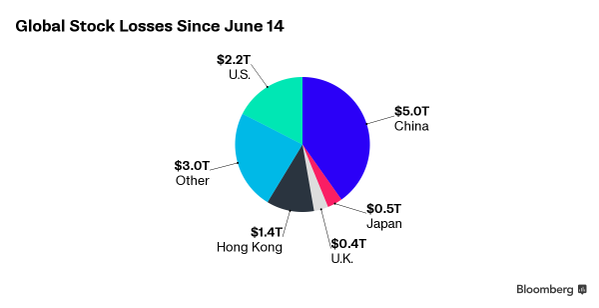
Graph is from Bloomberg; puts losses at $12,5 trillion.

• SocGen Is Very Nervous About The Recent $9 Trillion Global Market Cap Loss (ZH)

The good news: the collapse in global market cap since May of 2015 is not the worst ever. The bad news: the $9 trillion drop in combined market cap between the MSCI All World index and Chinese stocks, is the second highest ever, surpassed only by the $13 plunge in global market capitalization in late 2008. Wait, $9 trillion? Yes: for all the focus on the modest correction in the S&P500, what most have forgotten is that in addition to the US, various other development markets, not to mention emerging markets, have lost trillions and trillions in value since their May peaks.

According to SocGen calculations, there has been a $1 trillion drop in emerging markets, a $4 trillion decline in development equity markets, and let’s not forget, the bursting of the Chinese stock bubble, which from a peak market capitalization of $10 trillion in early June, or about the same as China’s GDP, has lost some $4 trillion, since despite the Chinese government’s increasingly more desperate and futile attempts to reflate the bubble. Combining all this, SocGen summarizes, “we are looking at an overall $US9 trillion loss of market capitalisation in less than 3 months! To put that number in context the most severe loss in market capitalisation over 3 months during the 2008/09 financial crisis was $12.8 trillion.” The drop is almost the same as China’s $10 trillion GDP (and likely well higher if one uses credible calculations).

But that’s not the worst news. As SocGen’s Andrew Lapthorne suggests, “such a decline in market values will impact implied leverage calculations and as such all eyes should now be on credit markets. Asian credit is already reacting to the price declines, with the likes of the Markit iTraxx Asia ex Japan CDS index moving significantly wider. However there has, as yet been no significant de-rating of credit in the likes of the US.” [..] Lapthorne’s conclusion… “US corporates also have an insatiable appetite for more debt, with non-financials raising a further $450bn over the past year, according to their latest report and accounts. Why do they need to borrow so much? Well to buy back their own market capitalisation of course!“
Read more …

“Spending on decommissioning old fields will increase by over 50% to 2019 and overtake spending on the development of new fields the same year..”

• UK North Sea Oil Investment to Plunge 80% (Bloomberg)

Investment in U.K. North Sea oil and gas projects could drop as much as 80% by 2017 as the collapse in crude prices forces the industry to cut back. Capital investment across the industry of 14.8 billion pounds ($22.8 billion) last year will probably decline by 2 billion to 4 billion pounds annually to 2017, Oil & Gas U.K., an industry lobby group, said in its annual economic report Wednesday. “This great industry of ours is facing very challenging times,” Deirdre Michie, Oil & Gas U.K.’s chief executive officer, said in a statement. “Exploration for new resources has fallen to its lowest level since the 1970s” and few new projects are gaining approval from “hard-pressed” companies, she said.

The decline in crude prices of more than 50% over the past year has forced the oil industry to review projects and reduce operating costs. The U.K. North Sea is one of the world’s most expensive areas to operate and resources that were first tapped in the 1960s are depleted. Employment supported by the industry has shrunk by 15% since last year and the lobby group predicts more reductions. “Last year, more was spent than was earned from production, a situation which has been exacerbated by the continued fall in commodity prices,” Michie said. “A continued low oil price will inevitably cause companies to reflect on the long-term viability of their assets.”

About 140 fields will stop producing over the next five years as low oil prices accelerate decommissioning efforts in the region, Wood Mackenzie said in a report. Five fields have already been retired earlier than expected this year and not even a rebound of prices to $85 a barrel would prevent further closures, it said. The Edinburgh-based energy consultant expects 38 new fields will come online over the same period and another 17 new projects to be approved. Spending on decommissioning old fields will increase by over 50% to 2019 and overtake spending on the development of new fields the same year, it said.

Read more …

“Mr Juncker wishes to invoke treaty powers to force countries to accept 160,000 refugees by a quota, whether or not they agree with his solutions..”

• Europe Faces Political War On Two Fronts As Backlash Builds (AEP)

The European Union is fracturing along multiple lines of cleavage, torn by an emerging Kulturkampf over migrant flows before it has overcome the bitter conflict at the heart of monetary union. “The bell tolls, the time has come,” said Jean-Claude Juncker, the head of the European Commission, in his State of the Union speech. “We have to look at the huge issues with which the European Union is now confronted. Our Union is not in a good situation,” he said. Perhaps it would be churlish to point out that the cause of this near existential breakdown is a series of moves that have his fingerprints all over them:

The fateful decision to launch the euro at Maastricht in 1991 without first establishing an EU political union to make it viable, and to do this despite crystal-clear warnings from experts within the Commission and the Bundesbank that it would inevitably lead to a crisis – the “beneficial crisis” as the EMU enthusiasts mischievously supposed. The escalating treaties of Amsterdam, Nice and Lisbon, each concentrating power further in the hands of a deformed institutional system, sapping at the parliamentary lifeblood of the ancient nation-states that can alone be the fora of authentic democracy in Europe. Above all, to destroy trust by overruling the categorical “No” of French and Dutch voters to the European Constitution in 2005, and bringing back the same treaty by executive Putsch, with a disgusted but complicit British prime minister signing the document in a side-room in Lisbon safely screened from the cameras.

One might have thought that the proper conclusion to draw is that the EU can only save itself at this stage by abandoning the Monnet method of treaty-creep and reflexive attempts to force integration beyond proper limits, and retreat instead to the surer ground of bedrock nation states wherever possible. But no, Mr Juncker wishes to invoke treaty powers to force countries to accept 160,000 refugees by a quota, whether or not they agree with his solutions, or indeed whether or not they think it is highly dangerous given the state of total war that now exists between Western liberal civilisation and Jihadi fundamentalism. [..]

By invoking EU law to impose quotas under pain of sanctions, Brussels has unwisely brought home the reality that states have given up sovereignty over their borders, police and judicial systems, just as they gave up economic sovereignty by joining the euro. This comes as a rude shock, creating a new East-West rift within European affairs to match the North-South battles over EMU. With certain nuances, the peoples of Hungary, Slovakia, the Czech Republic, Poland and the Baltic states do not accept the legitimacy of the demands being made upon them.

Read more …

There were times when…

• If This Is The Best Britain Can Do For Refugees, It’s Sickening (Simon Jenkins)

Britons hate immigrants; Britons need immigrants. History has resolved this paradox through occasional charitable outbursts, when the country’s natural defences are besieged by desperate people seeking shelter. Charity conquers aversion, and the nation has always grown stronger in consequence. The European commission president, Jean-Claude Juncker, welcomed the fact today that Europe was currently seen as “a place of refuge and exile, a beacon of hope and haven of stability”. That should be source of pride, not fear. He is right. Yet to him the Syrian refugees were a political test for the European Union, a test it was failing. Along the frontiers of Greece and Germany, the refugees were not a test. They were a human tide pleading for help – and help now.

Britain has no excuse for turning its back on this plea, least of all when its politicians are playing macho by bombing the refugees’ country of origin. It is sickening at such a time to hear the House of Commons told of “heads not hearts policy … a matter of causes not symptoms … doing more to topple Assad … getting others to pull their weight”. The British have been exemplary hosts to those in distress. The Jews expelled by Edward I began to return under Cromwell, much to the City of London’s gain. The Huguenots of the 16th and 17th centuries landed at Dover, like the Syrians on Lesbos. Britons donated a vast sum, of £50,000, to help them, worth some £8bn today. The refugees were so popular that towns such as Colchester begged for more.

Responses in the 19th century to famine in Ireland and the eastern European pogroms were not so welcoming, but refugees were not turned away. In just two years, during 1846 to 1848, Liverpool took in an astonishing 500,000 people from Ireland. Half a century later, in 1914, 700,000 European Jews were estimated to have found sanctuary in London’s Whitechapel and Manchester’s Strangeways and Red Bank neighbourhoods. There were some riots, but no one quibbled over numbers, or talked of heads not hearts. The flows continued. Government statistics found 25,000 Germans, 15,000 Belgians, 12,000 French and 10,000 Norwegians in wartime Britain. Postwar Poland saw a Syrian-scale exodus, with 8 million fleeing the country.

By the 1950s there were 35,000 Poles registered in London, producing no fewer than 50 Polish newspapers. These flows were overtopped by hundreds of thousands of Asians from the subcontinent and East Africa from the 1960s onwards. In 1972 Britain took in 27,000 Ugandan Asians virtually overnight. The result was nothing but benefit to the British economy. Indeed, the chief argument against accepting so-called economic migrants is that it is an economic sanction on the country of origin.

Read more …

We all own it.

• America Owns This Nightmare (Salon)

It is not that the West, or America in particular, is responsible for everything that befalls our awful world. Readers sometimes make it known that they assume this to be the ruling view in this column. But they are grossly unfair and must be corrected: The West, and American in particular, is responsible for almost everything now going wrong across the planet. This is no kind of default political position. It is a detached observation—the kind most Americans dread most. There is not much case for objecting to this thought. Since Columbus hit the rocks in Hispaniola, and da Gama anchored off the Malabar Coast six years later, the West has insisted on leading all the rest. By and large, the world as we have it—defiled, disorderly, violent—is our world.

We Westerners have known best for half a millennium, and our leaders do not take orders—or even suggestions—from anybody. Whatever you see out your window or across any ocean is the doing of those we are content to leave in charge. You may not yet realize that you are reading a column about the migrant crisis in Europe. But it is always best to begin at the beginning. Syrians, Iraqis, Libyans, Afghans, South Asians—one way or another, directly or indirectly, immediately or at a slight remove, they are all victims of the policies through which the Western powers have sought over centuries to impose their will upon weaker people they thought worth disrupting, subjugating and exploiting.

I hope some photographers win press prizes this year for the images coming out of the crisis zones. For me they produce a very weird mixture of sorrow and shame, and I know I am not alone in either case. All those lives interrupted, ruined or lost altogether: Who cannot be moved? But it is only the honest among us who can then admit that every picture coming from a Mediterranean beach or a highway in Hungary is a mirror a migrant holds up to us.

Read more …

Nice from Fisk.

• Thank God for Germany (Robert Fisk)

And we – in this critical hour in the history of our continent, in the history of the EU, in the story of what was once called “Christendom” – we failed the Great Test. Our state-of-the-art nations did not want these wretched people. They became bloodsuckers, human mosquitoes, people-smugglers, a “swarm”. And if the rags of our integrity as human beings have been salvaged these past few weeks, this is due to the dour, rather sour Protestant ethics of an east German hausfrau who history may (or may not, for let us remember her people’s grandfathers for whom my Dad was supposed to shoot his own refugees) say has saved our soul.

But if our generosity stretched that far in welcoming Belgian refugees in the First World War, Jewish refugees before the Second World War, Germans afterwards, Hungarians fleeing the 1956 uprising, even a few Chernobyl survivors (some soon to die), they usually had two things in common. They were white – or as near as much as makes no difference – and they were European and – or as near as much as makes no difference – were from our monotheistic world. The Bosnian refugees of the early 1990s were mostly Muslim, of course, but they looked like and were Europeans, and their version of Islam was for us picturesque rather than religious: snow-covered mosques rather than hot Kabaas, a whiff of eastern cuisine washed down with slivovica, Ramadan-and-one-for-the-road.

But these chaps today, camping opposite Dover, for example, as my Dad’s racist friends used to say, were “black as the ace of spades”. Or a bit black. Or brown. Even the Ethiopian Christians – who passed the Christianity test – failed the colour bar. That is why, I fear, we wept for poor Aylan al-Kurdi. His Muslim religion (such as he would have understood it at that age) was cancelled out by his Kurdish origin – the Kurds being a brave warrior people whom we regularly admirer, support and usually betray. We mourned for him not just because he was an innocent three-year old but because he was a white innocent three-year old. Only one more remark remains to me, and I say it now for the first time in my life, as the son of a father who fought the Kaiser’s arms on the Somme, and of a mother who repaired radios on damaged Spitfires during the Second World War. Thank God for Germany.

Read more …

More EU. Compulsory measures.

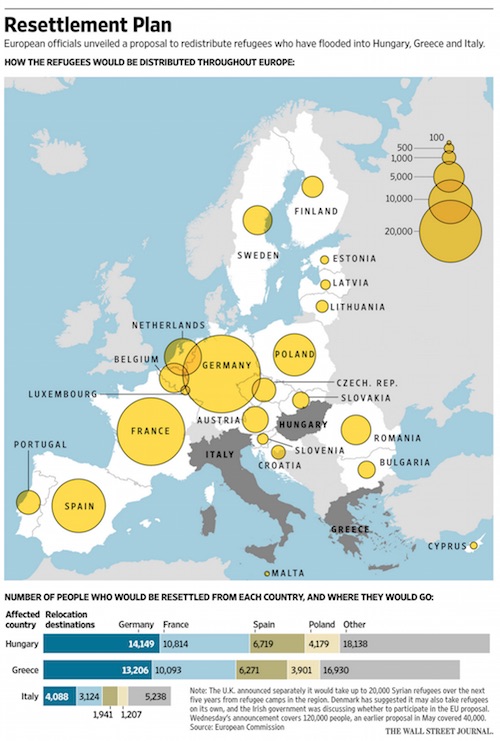
• EU Presents Plan to Distribute Refugees Across Europe (WSJ)

Faced with the largest migration of displaced people since the end of World War II, the European Union proposed to redistribute 160,000 refugees across the bloc, in a move bound to challenge countries with scant experience accommodating newcomers. The EU has sputtered in previous attempts to craft a coherent approach to the crisis amid competing national interests and insistence by some countries -particularly in the poorer East- that accepting refugees must be voluntary. But support for the burden-sharing plan was growing, propelled by public outcry after 71 migrants were found dead in a truck in Austria last month and images of a drowned 3-year-old Syrian boy in Turkey went viral last week.

The new plan still has to be approved by a so-called qualified majority of EU governments, in which bigger countries have weightier votes. With the four largest countries involved -Germany, France, Spain and Italy- in favor, the odds that the proposal would be adopted are growing. In presenting the plan Wednesday, European Commission President Jean-Claude Juncker acknowledged that it wouldn’t go far enough to address the massive flow of migrants to the continent. The plan is Mr. Juncker’s second attempt to help Greece, Italy and Hungary, the three countries on the front line of the crisis.

“I do believe that given the gravity of the situation we face, this proposal is quite modest,” Mr. Juncker said at a news conference, adding that nearly 500,000 people have made their way to Europe in the past year. He added that while the number of incoming refugees and migrants may be “frightening” for some Europeans, they represent only 0.11% of the total EU population, dwarfing the efforts made by Lebanon, Turkey and Jordan, where a total of four million Syrians have found refuge. Mr. Juncker pointed out that earlier, more modest plans were rejected by EU leaders, saying that if “we had taken decisions back then, perhaps we would have saved a lot of lives.”
Read more …

Farage shows his true face. Good. He’s as right on some issues as he is scarily off on others. It’s a shame that bigots will have to decide the future of the EU, but it’s better than more EU.

• Nigel Farage On Juncker Calling For More EU (EV)

“Thank you. Mr Juncker you’ve simply got this wrong. “As I warned you in April, the European Common Asylum Policy sets its terms so wide that to say that anyone who sets a foot on EU soil can stay, I said it would lead to a flow of biblical proportions and indeed that is what we are beginning to see and that’s been compounded by Germany last week saying that basically anyone can come. It is a bit too late now to draw up a list of countries from whom can stay and can’t stay. All they have to do, as they’re doing, is to throw their passports in the Mediterranean and say they’re coming from Syria. As we know the majority of people that are coming and the Slovak Prime Minister has been honest enough to say so, the majority that are coming are economic migrants.

“In addition we see as I warned earlier evidence that ISIS are now using this route to put their jihadists on European soil. We must be mad to take this risk with the cohesion of our societies. If we want to help genuine refugees, if we want to protect our societies, if we want to stop the criminal trafficking gangs from benefitting as they are, we must stop the boats coming as the Australians did and then we can assess who qualifies for refugee status.

“I noted your comments because there is a referendum coming in the United Kingdom. I look forward to seeing you in the UK, I know you intend to spend tens of millions of pounds of British tax payers money telling us what we should think. I have a feeling that the British people will warm to you on a personal level but to suggest that getting rid of a few EU regulations is going to change our minds, sorry unless you give Mr Cameron back control and discretion over our borders the Brits will over the course of the next year, vote to leave.”

Read more …

Unblocked by now. Refugees free to travel. What a stupid move that was.

• Denmark Blocks Trains, Roads To Germany To Stop Refugees (Quartz)

In a new development in Europe’s escalating refugee crisis, Denmark has cut off all rail links to Germany. The country’s government is trying to stop migrants and refugees on their way to Sweden. On Wednesday (Sep.9), Danish police halted at the border two trains coming from Germany to Denmark carrying 200 migrants, reports the BBC. Authorities said that passengers refused to leave the trains because they did not want to be registered as refugees in Denmark, but rather in Sweden.

Denmark’s center-right government has recently cut benefits for asylum seekers, and has been “promoting” its new strict regulations on refugees in Middle Eastern newspapers, in attempt to stop people from coming. Earlier on the same day, Danish police also closed down a highway after 300 migrants were forced off a train and began to make their way across the country on foot. More than 1,200 migrants and refugees have crossed the border between Denmark and Germany in recent days, according to the BBC. Both countries belong to the Schengen zone of passport-free travel, but according to EU law, the scheme can be suspended in extraordinary circumstances.

Read more …

At least they’re trying. At the same time, though, they’re sending back Balkan migrants at a much higher pace.

• Orderly German Welcome Masks Chaos For Refugees

The refugees arrive exhausted in Germany, are greeted and fed by waiting volunteers, then whisked away to reception centres around the country. It all seems as smooth as the assembly line in a BMW factory. Behind this efficient welcome for asylum seekers, though, are scenes of chaos and confusion as Germany’s famous orderliness is overwhelmed and officials scramble to keep up with the waves of newcomers spilling in from the Middle East. Standard procedures like identification and registration are forgotten as most newcomers – Syrians, Iraqis, Afghans and any number of other nationalities – pass through cities like Munich on their way to a hoped-for new life elsewhere. “People who arrive in Munich don’t get registered here at all – they’re distributed all over Germany,” said Christoph Hillenbrand, senior administrator of the Upper Bavaria district around Munich.

Officials are buying so many bunk beds for refugee centres that local supplies are often exhausted and orders are made all the way to China. “IKEA can’t keep up with the demand,” he added, referring to the furniture chain store from Sweden. Newcomers are told to register for refugee benefits at their final destinations within five days, but there is no way to check if they do it. Of about 25,000 arrivals over the weekend, only around 2,000 have stayed in Munich, he added. Officials estimate almost 40% of those arriving this year come from the Balkans and most will be denied asylum, unlike Syrians deemed worthy of protection from their civil war.

Read more …

Going to be a long winter.

• Greek Economy Back In Intensive Care (Reuters)

With deflation entrenched, its industrial base shrinking and a tough new bailout to service, Greece’s economy is heading for another fall with even those of its citizens lucky enough to be in work poorer than at any time since 2001. [..] The economy grew 0.9% between April and June – the only full quarter in office for Tsipras’s government – as consumer spending rose and exports edged up. But economists say GDP will soon go back into reverse. “We expect the economy to shrink (this year) by a bit less than 2%,” Angelos Tsakanikas, economist at IOBE think tank said, after data on Wednesday showed industrial output fell for the second month running in July and August marked the 30th straight month of year-on-year deflation.

Among factors impacting growth, capital controls were imposed in July, when the banks also stayed shut for a week, and the bailout will come with fresh taxes and pension cuts. “Private consumption was a driver behind the growth in the second quarter, helped by tourism … There was also sporadic spending due to fears of haircuts on deposits related to a possible Grexit,” IOBE’s Tsakanikas said. With the danger of an exit from the eurozone and of a possible overnight devaluation averted for now, Greeks will be less inclined to splash out on consumer goods, especially given salaries are at a 14-year low.

Having risen year-on-year in the previous three quarters, the Greek wage index fell in the second quarter to 85.2, its lowest level since the same quarter of 2001, statistics office data showed on Tuesday. After minimal growth in the third quarter, Tsakanikas expects the economy to contract again in the fourth, and further declines are widely predicted for 2016. That signals a return to a recession that ran from 2008 and 2014 and augurs badly for an unemployment rate that, at 25% in May, is already the highest in Europe. “There is no job creation … The jobless rate will rise after the seasonal boost from tourism fades,” Tsakanikas said, predicting a rise to 28% – a tenth of a percentage point above the record high reached in September 2013.

Read more …

Like democracy, accountability is a European orphan.

• EU Squeezed €7 Billion Greek Bridge Loan Via ESM Loophole (Bloomberg)

Who do you call on for €7 billion at short notice to tide over a country like Greece for a month? That was the dilemma euro-area policy makers faced in July as they raced to complete a bailout for Greece and prevent the country from defaulting on the ECB. With time against them, the European Commission’s financial mechanics hit upon a novel solution, without breaking any of the rules shielding taxpayers from losses. While financial markets were used to fund Greece’s bridge loan, the sole investor for the temporary injection was the euro area’s own firewall, according to two people familiar with the matter, who spoke on the condition of anonymity.

The European Stability Mechanism, at that point barred from lending directly to Greece, financed the EU cash advance through a private placement for the Greek bridge loan, the people said. Greece then paid back the short-term funding in August, once its €86 billion ESM bailout was approved. “It highlights just what a political animal the ESM is,” said Jacob Funk Kirkegaard of the Peterson Institute for International Economics in Washington. “That they don’t talk about it is probably because they don’t want to have a debate about just how flexible in practice the ESM is, because there may be other times in the future when people would like to call upon that flexibility to be used.”

When asked Tuesday about the bridge financing, the ESM press office said it doesn’t communicate pro-actively about its investment strategy. The decision to make the private placement to the bridge loan was in keeping with investment policies, which focus on capital preservation and require the fund to invest only in high-quality assets, the Luxembourg-based firewall said. “The proposal by the EC to invest in a short-term transaction in the name of the EU was seen as a good investment opportunity by the ESM investment and treasury department,” the ESM said. “The investment is fully compliant with the ESM existing investment guidelines.”

Read more …

This could have a major effect globally.

• Brazil Credit Rating Cut to Junk by S&P Amid Budget Strain (Bloomberg)

Brazil’s sovereign rating was cut to junk by Standard & Poor’s, taking away the investment grade the country enjoyed for seven years, as President Dilma Rousseff’s struggles to shore up fiscal accounts amid a faltering economy. The country’s rating was reduced one step to BB+, with a negative outlook, S&P said in a statement after markets closed. Brazil’s largest U.S. exchange-traded fund tumbled 6.6% in late trading along with American depositary receipts for Petrobras, the state-controlled oil company. The downgrade, and S&P’s warning that another cut is possible, puts pressure on the economic team led by Finance Minister Joaquim Levy to win passage of measures that would shore up the country’s fiscal situation by cutting spending or raising taxes.

Rousseff has been unable to find support for her initiatives amid an investigation into corruption at the state-controlled oil company that allegedly occurred while she was its chairman, sending her popularity to a record low and generating calls for her impeachment. “The downgrade could be a wakeup call but the political situation is so bad that it’s difficult to resolve, so its a dark path ahead,” Daniel Weeks, the chief economist at Garde Asset Management, said from Sao Paulo. “Markets will take this as a negative, and it will probably drag down emerging markets at a global level.” Brazil’s government said in August it forecasts a fiscal deficit in 2016 of 30.5 billion reais ($7.9 billion), or about 0.5% of gross domestic product. That compares with a targeted surplus of 2% at the beginning of this year and a revised objective of 0.7% announced in July. The country’s gross debt as a percentage of its economy climbed to 65% in July from 51% at the end of 2011.

Read more …

What Britain does to its own citizens.

• UK Immigration Income Threshold Creates Thousands Of ‘Skype Kids’ (Guardian)

At least 15,000 British children are growing up as “Skype kids” because an immigration income threshold does not allow both of their parents to live together in Britain, a children’s commissioner report has found. The research, by the Joint Council for the Welfare of Immigrants (JCWI) and Middlesex University, shows that thousands of British families have been affected by a Home Office minimum income threshold of £18,600 a year for sponsoring a foreign spouse to live in the UK, which was introduced in 2012. The report, Family Friendly?, says the introduction of the £18,600 threshold has resulted in separation for thousands of British families in which one parent is not entitled to live in the UK.

Most of the children – 79% in the survey – affected by the changes are themselves British citizens, and many have suffered distress and anxiety as a result of separation from a parent. The research confirms that the £18,600 minimum income threshold for a UK citizen to bring a foreign spouse or partner from outside Europe to live in Britain on a family visa would not be met by almost half of the adult population. “The threshold is too high and is discriminatory. British citizens who have lived and worked abroad and formed long-term relationships abroad are particularly penalised and find it very difficult to return to the UK,” says the report, published on Wednesday.

Anne Longfield, the children’s commissioner for England, said there was a wealth of evidence indicating that children were far more likely to thrive when raised by parents in a warm, stable and loving family environment. “I am therefore very concerned that the immigration rules introduced in July 2012 actively drive families apart, and leave British children able to communicate with one parent only via Skype,” said Longfield.

Read more …

The route to chaos: Simple rules, complex behavior

• Critical Realism & Mathematics versus Mythematics in Economics (SteveKeen)

The Critical Realist movement, developed by Tony Lawson at Cambridge University, argues against the use of mathematics in economics. I argue that their critique is directed at the abuse of mathematics by Neoclassical economists, rather than the proper use of mathematics per se. In this brief talk–where for some reason my webcam was as static as a Neoclassical model – I explain that my 1995 complex systems model of Minsky – led to a prediction from the properties of the model that could never have been made verbally–and which turned out to be accurate. It is also derived from a set of identities, so while it can be incomplete, it cannot be a mis-specification, as is the case with so many Neoclassical models.

Read more …

Solid reporting job from American Statesman.

• Downtown Austin Vault Of Precious Metals Turns Up Mostly Empty (AS)

Gold first caught Ron Barbala’s eye in 2008. With the housing values plummeting and the stock market cratering, the Phoenix engineer felt betrayed by the economy, which increasingly he considered little more than a mirage. “The standard American method of investing, all of it”, he said. “I’d had it”. Desperate for something of value he literally could put his hands on, he began acquiring gold and silver bullion. “Its value is in its physicality”, Barbala said. “It just is.” Over the next several years, Barbala bought more than $100,000 worth of precious metals through a little-known downtown Austin company. Started in 1999, Bullion Direct began as an online virtual trading floor where thousands of customers could buy and sell precious metals to each other, with the company taking a cut of each sale.

Later, it began selling the metals to customers directly. It also stored the commodities for those who requested it such as Barbala with the glittering coins and bars kept safely in individual piles for each investor in an old bank vault in its Lavaca Street offices. At least that s what everyone thought. By the time auditors and lawyers got access to Bullion Direct s 14th-floor offices six weeks ago, there were only a handful of gold and silver coins in an office safe. A second vault it had recently rented held only slightly more. An estimated $30 million in cash, metal bullion and valuable coins, meanwhile, had vanished. The cumulative weight of the unaccounted for metal is the equivalent of dozens of standard-sized gold bullion bars and hundreds of silver ones. Also missing are an estimated 1,400 ounces of platinum and palladium.

In recent weeks, as thousands of investors in Texas and across the country have absorbed their bad fortune, there has been no shortage of theories where the precious commodities went — including whether they ever existed at all. The one person who knows for sure, company founder and owner Charles McAllister, recently moved from Wimberley to Alabama. Officials say that while he is being cooperative, many basic questions about the missing fortune remain unanswered.

Read more …

“The war in Syria is a business in which the Italian government is participating and it is destroying millions of lives including people who are displaced, fleeing or dead.” “With more than 220 thousand victims, 3.5 million refugees and 12 million displaced people, of whom half are children, Syria is a country that no longer exists.”

• The Civil War In Syria – Part 1 (Beppe Grillo)

For years, ltaly has been in the top ten countries in the world for manufacturing weapons. These are sold to countries at war, especially to Africa and the Middle East. Italy is the top European country selling weapons to Syria: since 2001, Syria purchased weapons under license from Europe to a value of €27,700,000. Of this, the value of weapons coming from our country is nearly €17,000,000. Meanwhile, the United States is arming and training the “moderate“ rebels and now ISIS fighters have rifles bearing the inscription: “Property of US Govt“. Someone’s playing games. The war in Syria is a business in which the Italian government is participating and it is destroying millions of lives including people who are displaced, fleeing or dead.

Does the government want to make a contribution to reducing the number of refugees coming from the countries at war? It has to immediately block the export of weapons to countries in the theatre of war and bring in a foreign policy that is not subject to the interests of the USA. Below is the first part of the reconstruction of Syria’s civil war with the responsibilities and the interests of the international players. In the last few days, the photo of little Aylan, who drowned in Turkey, has jolted our emotions and our consciences. And it has once more turned the spotlight onto a war that the world has forgotten. With more than 220 thousand victims, 3.5 million refugees and 12 million displaced people, of whom half are children, Syria is a country that no longer exists.

The NGOs on the ground are talking about a crisis that is worse than the second world war. We are not just looking at a simple theatre of war. Syria is not a new Kosovo or another Afghanistan, but a conflict that is wider and more complex, that is hosting scores of other micro-conflicts. It’s almost impossible to give a simple account of the last few years, but we have a moral duty to try to do so, so that we can understand the rights and wrongs of one of the worst wars of this century. In order to understand the causes that have facilitated the rise of “Islamic State” in Syria, we need to take a few steps back. At the end of 2011, it was the Syrian army that defeated the anti-government rebels, but at the beginning of January, other parallel and autonomous groups popped up.

Among these was the Al-Nusra Front that came into being on 23 January 21012. It was initially composed of members of the Iraqi branch of al Qaeda (Islamic State of Iraq) that was fighting the American presence in the country. It was the first time that there was the creation of a rebel cell clearly inspired by principles of radical Islam. The strategy of suicide attacks generally using car bombs, started off in the Al-Midan neighbourhood of Damascus on 6 January 2012 with the death of 26 people including many civilians. At the end of March 2012, the total deaths in Syria rose to 10,000 and the veil of hypocrisy fell on the rebels – the ones strongly supportred by the United States and the European Union.

Of the demonstrations out in the streets, there’s just a vague memory. Now there’s open warfare. It’s very violent and it’s between factions. In 2013, what many people had feared up until then, actually happened: the Syrian crisis went across the border with Iraq where the power vacuum left by the withdrawal of the USA troops, opened up the way to horrors that took us back to the previous decade. Armed men with their faces covered retook control of the cities of Fallujah and Ramadi, cities that had already experienced brutal urban warfare in 2004 and 2007. The militia with Abu Bakr al Baghdadi are the ones fighting under the flag of ISIL (Islamic State of Iraq and the Levant) or ISIS (Islamic State of Iraq and Syria).


Read more …

Sep 082015
 
 September 8, 2015  Posted by at 9:16 am Finance Tagged with: , , , , , , , , ,  6 Responses »


Dorothea Lange Country store, Person County, NC Jul 1939

• The Way of the Dragon (Beppe Grillo)
• Sovereign Debt as Weapon: Subverting Democracy in Greece (Zoe Konstantopoulou)
• China Has Spent $236 Billion Trying to Rescue Its Stocks (Bloomberg)
• Draghi’s QE Dispenses Huge Losses to European Stock Markets (Bloomberg)
• Europe To Sink Into Deflation, Triggering Next Round Of Global Market Crash (SI)
• In A Quota System You Do Not Kick Cans Down The Road, But People (Münchau)
• Hollande Readies Syria Air Strikes as Response to Refugee Crisis (Bloomberg)
• US Revamping Rebel Force Fighting ISIS in Syria (NY Times)
• Europe Seeks UN Blessing to Confront Human Smugglers in the Mediterranean (Lynch)
• ‘Stop Bombing, Start Resettling’: Former PM’s Plea To Australia (SMH)
• How Neocons Destabilized Europe (Robert Parry)
• Syrian Refugees In Hungary: ‘This Is The So-Called Developed Europe?’ (Guardian)
• Cameron’s Offer Of 20,000 Syrian Refugees Over 5 Years Is Derisory (Ashdown)
• Merkel Channels Bank Rescue as Germany Plans Refugee Fund (Bloomberg)
• Hit By New Wave Of Refugees, Germany Warns EU Partners (Reuters)
• Sweden’s PM Chides Europe’s Leaders as Refugee Crisis Deepens (Bloomberg)
• At Least 10,000 Migrants To Be Ferried To Mainland Greece In Next 5 Days (AP)
• Oil Falls More Than 3% On Oversupply, China Equity Losses (Reuters)
• US Shale Oil Industry Hit By $30 Billion Outflows
• A Dutchman ‘In Control’ Of The Greek Government (Enikos)
• Writing Down €4.7 Billion In Bonds May Cost Greece €49 Billion (Bloomberg)
• China’s Shift Away From Industry Drains Life From a Steel Town (WSJ)
• Thomas Piketty To Advise Spain’s Anti-Austerity Party Podemos (Guardian)

“There are those who are right to call it ‘creditocracy'”

• The Way of the Dragon (Beppe Grillo)

The Chinese slowdown must be worrying for the Eurozone but for now it doesn’t seem to be rushing to take corrective action – to avoid another event like that happening in 2008, as this time the countries would not be in a position to help out the banks. If double digit growth in China has been what’s kept world growth going, it’s legitimate to expect the current economic slowdown to spread to the world economy, considering, for example, that every year, China is consuming 10% of the world’s oil and more than half of the world’s copper and iron. Right now the value of the Euro is strengthening and that means its value has gone up by about half the amount it devalued in June last year. This cannot help Europe’s economy even because when considering China, China absorbs 3% of Italian exports and 6% of German exports.

Germany is the winning country in this currency war because it doesn’t need to be able to devalue its currency as it is operating with a currency that is much weaker than its own economy.

It thus doesn’t need to devalue as has happened in China because it’s already operating with a Euro that’s weak in relation to its economic fundamentals, and at the same time, it’s not obliged to revalue as happened for Switzerland at the beginning of the year. Apart from the importance of monetary sovereignty, the situation in China confirms another lesson: in a healthy economy the currency must be endogenous. That means that the optimal quantity of a currency for healthy economic growth cannot be decided by a “deus ex machina“ whether that happens to be Draghi or the commercial banks that tighten or loosen credit facilities as they see fit, but for a healthy economy the quantity depends on the demand for money and on the expectations of consumers themselves about their future income.

On the other hand, by pumping more money into the system by expanding credit from the banks and doping the consumers and the real estate markets after having anchored the exchange rate has historically been the best way to subjugate the people by using private debt to remove their opportunity of future growth, mortgaging the income of the generations to come to pay the bankers the interest on the current debt. There are those who are right to call it “creditocracy”. It was like that in Latin America after the various currencies were anchored to the US dollar. It was also like that in Greece and in the countries on the periphery of Europe where consumption was disproportionately buoyed up because of easy access to German savings guaranteed by the Euro. It’s happening in China after its currency was anchored to the US dollar.

Read more …

Zoe for president!

• Sovereign Debt as Weapon: Subverting Democracy in Greece (Zoe Konstantopoulou)

On the 25th of January 2015, only seven months ago, the Greek people through general elections gave a clear and unequivocal mandate to government and to parliament to do away with these homicidal policies. Negotiations started. A special Committee of the Parliament was formed, called the Truth Committee on Public Debt, to conduct an audit and a legal assessment of the debt it issued a preliminary report last June. The report found that the state’s sovereign debt is illegal, illegitimate, odious and unsustainable. It found that the sovereign debt has been concluded through procedures which grossly violate constitutional law, parliamentary procedure and fundamental human rights and freedoms guaranteed under international law, thereby justifying the denunciation of the debt.

It found that creditors had been acting in bad faith, knowingly burdening the country with unsustainable loans to save French, German and Greek private banks. Despite these findings, Greece’s creditors insisted that the people’s mandate be neglected. On June 25th, a 48 hour ultimatum was addressed to the Greek government asking it to accept, contrary to popular mandate, a series of measures dismantling labour law, abolishing social security guarantees and legal protection for over-indebted citizens, while at the same time requiring the sell-out of the most precious public assets and public enterprises, but also major ports, airports and public infrastructure. All to be sold or given away to repay an unsustainable and odious debt.

The Hellenic Parliament accepted the Government’s proposal to hold a referendum on the ultimatum, and the Greek people, through a large majority of 62%, rejected the measures. During the referendum week, international and foreign government officials tried to influence the referendum outcome through statements terrorizing the people. The referendum was held with the banks closed and capital controls imposed as a result for the ECB’s refusal to provide liquidity after the proclamation of the referendum. And yet, democracy prevailed. The people pronounced themselves clearly and said a 62% NO to those homicidal measures. What followed is a nightmare for every democratic conscience and a disgrace.

The creditors refused to consider the referendum outcome. They insisted, under the threat of provoking a bank-failure and a humanitarian disaster, that measures harsher than those rejected be adopted. [..] An over 100 page law construed in 1 article was passed on July 15th in less than 24 hours. A 1000 page law construed in 3 articles was passed on July 22nd in less than 24 hours. An almost 400 page law was passed on August 14, in 24 hours.

Read more …

Seeing today’s last minute surge in Shanghai, this is not over.

• China Has Spent $236 Billion Trying to Rescue Its Stocks (Bloomberg)

China’s government has spent 1.5 trillion yuan ($236 billion) trying to shore up its stock market since a rout began three months ago, according to Goldman Sachs. The “national team” expended about 600 billion yuan in August alone, with the total now equivalent in value to 9.2% of China’s freely-traded shares, strategists including Kinger Lau wrote in a report dated Monday. Investor concern about what will happen when the government starts to pare these holdings is overdone, they wrote, citing past experiences in Hong Kong and in the U.S. The Shanghai Composite Index has tumbled 41% since its June high to erase $5 trillion in value from mainland bourses as leveraged investors fled amid signs of deepening weakness in the economy.

To stop the plunge, officials armed a state agency with more than $400 billion to purchase stocks, banned selling by major shareholders and told state-owned companies to buy equities. The rout, coupled with a shock devaluation of the yuan, has roiled global markets. The gauge slumped the most in two weeks on Monday on speculation government-backed funds halted intervention following the conclusion of a military parade last week. China Securities Finance, the agency tasked with supporting share prices, would no longer add to holdings unless there’s unusual volatility and systemic risk, although it would remain in the stock market for years to come, the regulator said on Aug. 14.

Read more …

In the private sector, he would long have been fired.

• Draghi’s QE Dispenses Huge Losses to European Stock Markets (Bloomberg)

Mario Draghi’s stimulus program hasn’t quite succeeded at unleashing the desired animal spirits across Europe. Here’s the evidence: six months in, and 96% of companies in the Euro Stoxx 50 Index have actually gotten cheaper relative to earnings. The ECB’s plan to flood the financial system with cash by purchasing bonds was supposed to ignite the same celebration of risk-taking it did in the U.S. six years ago. In fact, the opposite has happened, culminating in as much as $526 billion of share values being wiped out last month. The failure of European quantitative easing to improve sentiment toward equities is a troubling sign to bulls as markets from Shanghai to New York endure their worst selloffs since 2011. Rather than set Europe apart as a haven, Draghi’s program has been marginalized in the stock market by events such as Greece’s credit impasse.

The Euro Stoxx 50 lost 9.2% in August amid concern China’s economy will subdue global growth. It rebounded 1.2% on Monday following a weekly drop. “People get very nervous when they feel there are no more policy levers left,” Graham Secker, Morgan Stanley’s head of European equity strategy, said by phone from London. “Investor confidence is extremely low at the moment, and everyone wants to de-risk. They don’t see who is going to ride to the rescue.” Going by economic data, Europe is making progress. Unemployment in the region unexpectedly fell, while German manufacturing expanded at a faster pace. Economists project Europe’s GDP will grow 1.5% this year, the most since 2011. And analysts still predict profits for companies in the currency bloc will increase 12% this year.

The figures are doing little to help stocks. In the latest rout, valuations in the Euro Stoxx 50 fell to 12.4 times projected earnings, compared with 15.3 when Draghi’s program started in March. Dragged down by exporters and commodity stocks, the gauge has tumbled 13% in the last four weeks – almost twice as much as the Standard & Poor’s 500 Index, where price-earnings ratios are about 19% higher. Europe’s carmakers – the companies that have most benefited from the depreciation in the euro – have seen valuations decline as much as 34% since this year’s peak. A similar drop occurred in energy share valuations, and a gauge of chemical stocks became 22% cheaper. France’s Vinci and Vivendi stand out as the only two companies in the Euro Stoxx 50 that trade at higher multiples than then.

Read more …

“Deutsche Bank expects the combined amount of forex sales from the central banks to be $1.5T in the next 16 months.” Could be much more.

• Europe To Sink Into Deflation, Triggering Next Round Of Global Market Crash (SI)

Just one year after Mario Draghi reassured the market he would do ‘whatever it takes’ to ensure the inflation rate in the Eurozone will increase again, he seems to have been pushed back into a corner. The ECB once again had to reduce its economic growth expectations as well as the expectations for the average inflation rate in the Eurozone. Despite the ECB having been a huge buyer of bonds on the open market to increase the liquidity in the system, the €60 billion per month has been insufficient to create a serious trickle-down effect in the real economy. Whereas the central bank is targeting an inflation rate of 2% which it deems to be the ‘sweet point’ for a sustainably growing economy. The inflation expectation for the entire year 2015 is just 0.1% and is expected to increase to 1.5% in 2016 and 1.7% in 2017.

This also means that a negative inflation deflation in the next few months (on the back of a lower oil price) is a very realistic possibility now and it certainly looks like the ECB will have to step up its game to make sure it doesn’t lose control. But it also looks like it has maxed out some bond purchases, as one of the newly-instated updates on the bond-buying program is an increased ceiling of how much the ECB can buy of one issue. Whereas the previous ceiling was placed at 25%, the ECB has now increased this level to 33% and the market is now widely anticipating Draghi to upgrade his Bazooka to a Bazooka 2.0 as the ECB is reportedly considering to purchase more different asset classes, to extend the current program (which is scheduled to end in 12 months from now) and to expand the program from €60 billion per month to €75+ billion per month.

The different players in the currency war are now taking their next steps at a very fast pace. After the Chinese crash and the devaluation of the Yuan, the USA will now very likely hold off on increasing the benchmark interest rate, now the ECB will very likely increase the liquidity in the system by a few billions per week, but the next step will be unfolded next week when China will announce an updated status of its foreign currency reserves. Those reserves peaked at $4T in the summer of last year, but it will be very interesting to see how much of those reserves were dumped by China during its very agitated summer.

The forex reserves dropped by in excess of $40 billion in July, but this number will very likely be much higher in August, and Netherlands-based Rabobank is estimating the outflow could be in excess of $200 billion as the Chinese central bank had to dump foreign currency in an effort to rescue the Yuan from a semi-freefall. And this move could trigger another round of selling as Deutsche Bank expects the combined amount of forex sales from the central banks to be $1.5T in the next 16 months. Yes, that’s 1,500 billion dollar. And then the Federal Reserve will have to make the next move as a weaker Euro and Yuan is once again undermining the American economic growth. The domino pieces are falling. Fast.

Read more …

The Deadly Disunity Of The Europeans

• In A Quota System You Do Not Kick Cans Down The Road, But People (Münchau)

Europe’s multiple crises share a common theme. Whether we are talking about banks, sovereign debt or, as now is the case, refugees, the EU finds it hard to act. What we have is a classic collective action problem, of the kind described by Mancur Olson, the political economist, in the 1960s. People have a common interest in acting but fail to do so because vested interests get in the way. Even the harrowing pictures of the dead young boy will not resolve the collective action problem. All it will do is to produce visible hyperactivity. The three crises share another common theme: each one of them is virtually intractable if you look at it from a micro perspective, from the vantage point of a Greek bank or Budapest East train station. But if you look at immigration from an EU-level perspective, the picture is much more nuanced.

The EU has 500m inhabitants. Setting aside refugees, net immigration — the difference between those coming into and those leaving the EU — was 539,000 in 2013, about 0.1 per cent of the total population. Net immigration was higher in 2010, when it stood at 750,000. The UN refugee agency (UNHCR) puts the number of refugees and migrants who crossed the Mediterranean at 300,000 between January and August, compared with 219,000 for the whole of 2014. If you extrapolate this year’s number to the whole of 2015, you get to around 450,000, an extra 230,000 people compared with last year. These numbers do not capture the whole story: many immigrants, from Syria in particular, use land routes. Net immigration this year may thus well end up being the highest in recent years, but still tiny compared with the EU’s total population.

Net immigration including refugees is clearly rising. Still, this is not an immigration crisis. It is a collective action crisis. Its solution would be straightforward in the presence of a central authority empowered to take decisions. But this is not how the EU works. It works through co-ordination and harmonisation — through fiscal rules, banking regulation and neighbourhood policies. But none of them prevented the crisis, and none of them helps solve it. The problem was never a lack of rules or policies. It was the simple fact that certain things in life cannot just be co-ordinated. Nor are member states big enough to act on their own — not even Germany. Angela Merkel is, for once, on the right side of the argument. But Germany does not have the capacity to absorb all the EU immigrants.

[..] A quota system is far too crude, and politically as unsustainable as fiscal transfers between countries. Such policies breed resentment, and ultimately fail. In a quota system you do not kick cans down the road, but people.

The real alternative, in the long run, is not between co-ordination and mutualisation, but between separation and mutualisation. Those who support further European integration will be in a position to make a powerful argument that only the EU is in a position to solve the crises. The debate will not be about a transfer of power from the capitals to Brussels. It will be about whether we empower the EU with tasks that nobody else can handle and whether we give it the necessary financial resources. I fear this is not going to happen for a long time — for two reasons. The less important one is that the likes of Mr Orban will be among those to take the decision. The deeper reason is that Europeans are not yet desperate enough to accept the Logic of Collective Action, the title of Olson’s 1965 book.

Read more …

Lost.

• Hollande Readies Syria Air Strikes as Response to Refugee Crisis (Bloomberg)

France is preparing for air strikes in Syria as President Francois Hollande seeks ways both to stem a flood of refugees from the Middle East into Europe and grapple with the threat of terrorism. “I’ve asked the minister of defense to begin reconnaissance flights over Syria from tomorrow that would allow for strikes against the Islamic State,” Hollande said at a press conference in Paris on Monday. Hollande, who ruled out sending troops, said Syrian leader Bashar al-Assad is an impediment to peace in the country. Hollande is seeking a response to Europe’s biggest refugee crisis since World War II in tune with public opinion that remains largely hostile to a massive increase in immigration. German Chancellor Angela Merkel announced €6 billion to help the thousands of migrants pouring into the country.

Hollande said today that France will accept 24,000 refugees over two years. He estimates that there are 60,000 asylum seekers in France in 2015. France has warplanes in Abu Dhabi and at a Jordanian air force base. “These will be reconnaissance and intelligence flights,” Hollande said. “We want to know where the training and command sites are.” Hollande also called for “massive” aid to support camps in countries neighboring Syria so that refugees can stay as close as possible to home. “Let’s face reality,” he said. There are four million refugees in camps in countries such as Jordan and Turkey and “if we want to avoid an exodus, what we have to do is supply massive aid” so that “these people can stay as close as possible to the country from which they are fleeing.”

Read more …

Is this what the empire of evil looks like?

• US Revamping Rebel Force Fighting ISIS in Syria (NY Times)

In an acknowledgment of severe shortcomings in its effort to create a force of moderate rebels to battle the Islamic State in Syria, the Pentagon is drawing up plans to significantly revamp the program by dropping larger numbers of fighters into safer zones as well as providing better intelligence and improving their combat skills. The proposed changes come after a Syrian affiliate of Al Qaeda attacked, in late July, many of the first 54 Syrian graduates of the military’s training program and the rebel unit they came from. A day before the attack, two leaders of the American-backed group and several of its fighters were captured. The encounter revealed several glaring deficiencies in the program, according to classified assessments: The rebels were ill-prepared for an enemy attack and were sent back into Syria in too small numbers.

They had no local support from the population and had poor intelligence about their foes. They returned to Syria during the Eid holiday, and many were allowed to go on leave to visit relatives, some in refugee camps in Turkey — and these movements likely tipped off adversaries to their mission. Others could not return because border crossings were closed. The classified options now circulating at senior levels of the Pentagon include enlarging the size of the groups of trained rebels sent back into Syria, shifting the location of the deployments to ensure local support, and improving intelligence provided to the fighters. No decisions have been made on specific proposals, according to four senior Defense Department and Obama administration officials briefed on the matter, who spoke on condition of anonymity to discuss confidential planning.

“As with any difficult endeavor, we expected setbacks and successes, and we must be realistic with those expectations,” Capt. Chris Connolly, a spokesman for the American military task force training the Syrian rebels, said. “We knew this mission was going to be difficult from the very beginning.” The Pentagon effort to salvage its flailing training program in Turkey and Jordan comes as the world is fixated on the plight of thousands of refugees seeking safety in Europe from strife in the Middle East, including many fleeing violence of the Syrian civil war and oppression in areas under the control of the Islamic State, also known as ISIS. Officials in Washington and European capitals acknowledge that halting this mass migration requires a comprehensive international effort to bring peace and stability to areas that those refugees are now fleeing.

Read more …

Got to give them one thing: they’re impervious to shame, even embarrassment.

• Europe Seeks UN Blessing to Confront Human Smugglers in the Mediterranean (Lynch)

Straining to contain their worst migration crisis in generations, European powers have begun laying the groundwork for the passage of a U.N. Security Council resolution authorizing the boarding and interception of people-smuggling ships in the Mediterranean Sea. The effort, which is being led by Britain, is aimed at stemming the exodus of hundreds of thousands of Middle Eastern and African migrants and refugees seeking to reach Europe on rickety boats from Libya, a primary transit point on the illicit human smuggling trade. Britain is hoping to see the resolution adopted before world leaders arrive in New York later this month for the start of the U.N.’s annual General Assembly debate. It has begun circulating key elements of a resolution with key Security Council members.

The diplomatic push comes at a time when Britain and other European governments have come under criticism for doing too little to absorb the waves of migrants fleeing Syria, Libya, and other Middle Eastern and African countries. Thousands of migrants have died making the dangerous boat rides to European shores, and the photograph of a drowned toddler named Aylan Kurdi stirred worldwide outrage last week. One senior European ambassador said it was Europe’s worst crisis since World War II.

Read more …

A few still do have a heart.

• ‘Stop Bombing, Start Resettling’: Former PM’s Plea To Australia (SMH)

Former Liberal premier Jeff Kennett has launched a blistering attack on the Federal Parliament saying the lack of national leadership is failing voters and the question of welcoming tens of thousands of refugees from Syria into Australia should not even be up for debate. Hailing Australia as a great country built on successive waves of immigration since 1788, Mr Kennett called on the federal government to quit plans to bomb Syria and spend the money on processing refugees for resettlement in Australia instead. “This country is a country that has always had its arms open wide. What I see this with this latest discussion, which is based on humanitarian grounds, is actually a wonderful opportunity for us to take over the next three years 50,000 people who are displaced of their freedoms,” he said.

He said instead of constantly looking to raise taxes, state and federal leaders should seize the opportunity of boosting the population with traditionally hard-working migrants as a different way of expanding the economy. “This shouldn’t be requiring much debate,” he said. The former Victorian leader said it was up to political leaders to stare down bigots who oppose any mass migration because of their religious beliefs or claims they not fleeing persecution. Liberal Senator Cory Bernardi is being branded an “embarrassment” for saying the toddler Aylan Kurdi, pictured drowned on a Turkish beach, was not a legitimate refugee.

“There will be always be people who oppose, and there are always going to be some bigots, but leadership rises above it and the Australian public is desperately crying out for leadership,” Mr Kennett said. “The Federal Parliament has failed, absolutely failed, the people of this country for a decade,” a passionate Mr Kennett told Fairfax Media.

Read more …

A bit much throwing around of labels for my taste, but certainly worth a read.

• How Neocons Destabilized Europe (Robert Parry)

The refugee chaos that is now pushing deep into Europe – dramatized by gut-wrenching photos of Syrian toddler Aylan Kurdi whose body washed up on a beach in Turkey – started with the cavalier ambitions of American neocons and their liberal-interventionist sidekicks who planned to remake the Middle East and other parts of the world through “regime change.” Instead of the promised wonders of “democracy promotion” and “human rights,” what these “anti-realists” have accomplished is to spread death, destruction and destabilization across the Middle East and parts of Africa and now into Ukraine and the heart of Europe. Yet, since these neocon forces still control the Official Narrative, their explanations get top billing – such as that there hasn’t been enough “regime change.”

For instance, The Washington Post’s neocon editorial page editor Fred Hiatt on Monday blamed “realists” for the cascading catastrophes. Hiatt castigated them and President Barack Obama for not intervening more aggressively in Syria to depose President Bashar al-Assad, a longtime neocon target for “regime change.” But the truth is that this accelerating spread of human suffering can be traced back directly to the unchecked influence of the neocons and their liberal fellow-travelers who have resisted political compromise and, in the case of Syria, blocked any realistic efforts to work out a power-sharing agreement between Assad and his political opponents, those who are not terrorists.

Read more …

We just never knew how developed Syria was before our ‘leaders’ instigated the fighting.

• Syrian Refugees In Hungary: ‘This Is The So-Called Developed Europe?’ (Guardian)

In a field 500 metres north of Hungary’s border with Serbia, Mouti, a 50-year-old oil engineer, points at the muddy field around him. Several hundred mostly Syrian refugees have been camped here overnight, surrounded by a thin blue circle of Hungarian policemen. They’ve slept in the cold, if they’ve slept at all. A man lies unconscious, roused only by a splash of water. Mothers rock their babies, looking miserable. “This is the so-called developed Europe?” asks Mouti. “It’s supposed to be different to the fucking Arab world.” After the euphoria of Germany welcoming a few thousand refugees from Hungary over the weekend, reality has bitten. Just as thousands left Hungary by its north-western border, thousands more refugees are arriving by its southern one.

And many of them are being forced to camp in this field, while the Hungarian authorities wait for space to free up in reception centres across the country. Mouti and his friend Fadi, an auditor, have come all the way from Deir Ezzor, a town contested by both Islamic State and the Syrian regime. “Both of them are bombing each other,” he says, “and we were stuck in the middle.” Twenty-five days later, they’ve arrived in the EU – but it doesn’t feel much better. They are surrounded by a line of policemen and their eight children are getting sick. Fadi’s brood includes an eight-month-old son, and two boys, aged four and five. They all have colds after being forced to stay here overnight.

“We’re coming from Daesh,” says Fadi, using the pejorative Arab term for Isis, “and this is how Europe treats us?” To underline the point, a group of protesting refugees have held up a sign that reads “Daesh = Hungary”, and some of them are chanting: “Freedom”. It’s just like the situation in Syria, smiles Shoukry, a steelworker from Aleppo. Even in such a depressing situation, there is time for a bit of gallows humour.

Read more …

“David Cameron has highly developed skills in the art of following where he should be leading.” All European ‘leaders’ possess those skills.

• Cameron’s Offer Of 20,000 Syrian Refugees Over 5 Years Is Derisory (Ashdown)

David Cameron has highly developed skills in the art of following where he should be leading. And so, after being taught an excruciating lesson in compassion, decency and leadership by Angela Merkel, and sensing himself behind opinion again, he has produced a plan to take in 20,000 refugees – over five years. Nothing better shows the PM’s tone deafness to the urgency of the situation than to announce this headline figure, and then add that it will take five years to implement. Not only is this response calibrated more by political expediency than compassion, he has also indicated he believes the answer to the problem is more bombing. If the best part of two years of bombing with more than enough high explosive hasn’t solved this problem, how would Britain’s widow’s mite of a few extra bombs help?

Military strikes against Isis are failing, not because we do not have enough high explosive, but because we do not have a diplomatic strategy on Syria that would make sense of the military action. But let us first consider Cameron’s refugee “plan”. Not only is he offering a derisory number of places for refugees, but the prime minister chooses to help those who are already safely housed and fed in refugee camps outside Europe, rather than those who suffer (and die too) for want of these things inside Europe. Could it be that the toxic term here is not “suffering”, but “inside Europe”, because of the effect these words have on his backbench Europhobes? If so then – irony of ironies – the desperate and the destitute tramping towards us on the dusty roads of the Balkans are hostages to Cameron’s headbangers, just as he is.

And how will we measure the success of this plan? Not by how much it assuages the suffering of those fleeing from the Syrian battlefields, obviously – for it is in no way aimed at them. By its effect on reducing the number fleeing, then? But it won’t do that either. Cameron seems to think that seeking asylum is like going to the theatre: one only does it if one has a ticket for a seat Then consider this. Cameron tells us that not helping those in flimsy boats struggling to Europe will reduce the temptation for others to take this “lethal journey”. This is exactly the same inhuman logic that government ministers gave us last Christmas when they insisted (albeit at Europe’s behest) that not saving drowning refugees in the Mediterranean was the best way to stop others following them. Hundreds had to drown before we finally saw that this immoral policy didn’t work. Do we really have to learn that lesson again?

Read more …

Angela’s in a tough spot now that she single-handedly created for herself. She’s right on one thing though: “What we are now experiencing is something that will change our country in the coming years.”

• Merkel Channels Bank Rescue as Germany Plans Refugee Fund (Bloomberg)

German Chancellor Angela Merkel announced plans to spend an extra €6 billion on refugees next year as thousands more migrants poured into the country over the weekend. Merkel said on Monday that Germany will add €3 billion to the 2016 federal budget and provide another €3 billion to states and municipalities to tackle Europe’s biggest refugee crisis since World War II. The chancellor said “it’s not entirely implausible” that Germany will spend an extra €10 billion in total next year to handle the influx. “We know that we were quick to save the banks,” Merkel said in Berlin. “I think we need to be just as quick in taking the necessary measures to ease the burden on the municipalities and states. What we are now experiencing is something that will change our country in the coming years.”

The plans for added funding comes as Germany and Austria spar with Hungary over the handling of refugees, with Hungary following a more hard-line approach to deter refugees. Austrian Chancellor Werner Faymann said on Sunday that his country will end emergency measures that allowed the passage of thousands of migrants over the weekend from Hungary without registering. “I can’t repeat our message to migrants often enough: ‘Please don’t come because we won’t let you through,’” Hungarian Prime Minister Viktor Orban said in Budapest on Monday. “New laws passed by parliament will change our border defense system. Illegal border crossing will automatically trigger imprisonment or expulsion.”

Read more …

Juncker’s big plan: resettling 160,000 refugees. Germany’s reality: 100,000 refugees entered the country just in the past month.

• Hit By New Wave Of Refugees, Germany Warns EU Partners (Reuters)

Struggling to cope with record numbers of asylum seekers, Germany told its European partners on Monday they too must take in more refugees, as police in Hungary used pepper spray on desperate migrants who broke out of a reception center at the border. Chancellor Angela Merkel, speaking after a weekend in which 20,000 migrants entered Germany from Hungary by train, bus and on foot, described the influx as “breathtaking” and tried to reassure German citizens that the crisis was manageable. “I am happy that Germany has become a country that many people outside of Germany now associate with hope,” she said at a news conference in Berlin.

But she and her vice chancellor, Sigmar Gabriel, coupled their message of optimism with a warning to EU partners who have resisted a push from Berlin, Paris and Brussels to agree quotas for refugees flowing in mainly from Syria, Iraq and Afghanistan. “What isn’t acceptable in my view is that some people are saying this has nothing to do with them,” Merkel said. “This won’t work in the long run. There will be consequences although we don’t want that.” Gabriel said that if countries in eastern Europe and elsewhere continued to resist accepting their fair share of refugees, the bloc’s open border regime, known as Schengen, would be at risk. “This would be a dramatic political blow for Europe, but also a heavy economic blow, also for those countries that are saying they don’t want to help now,” he said.

[..] Only months after Europe narrowly averted a Greek exit from the euro zone, the refugee crisis has emerged as the bloc’s biggest challenge. European Commission President Jean-Claude Juncker is due to unveil new proposals on Wednesday on how to distribute refugees among member states. An EU source told Reuters that under his plan, Germany would take on more than 40,000 and France 30,000 of the 160,000 asylum seekers the Commission says need to be relocated from Italy, Greece and Hungary, the main entry points to the EU for refugees arriving by sea and land.

The 160,000 that Juncker wants to redistribute within the EU are just a fraction of the hundreds of thousands of refugees and economic migrants from Asia, Africa and the Middle East who have reached Europe this year on leaky boats across the Mediterranean or over land through the Balkan peninsula. Germany has announced it is letting Syrians seek asylum regardless of where they enter the EU, suspending normal rules and accelerating a flow of migrants north and west from the edges of the bloc. Just last month, more than 100,000 asylum seekers reached Germany, which is preparing for 800,000 this year, around 1% of its population, a move with little precedent for a large Western country.

Read more …

Sweden expects fewer refugees this year than last? Good luck with that.

• Sweden’s PM Chides Europe’s Leaders as Refugee Crisis Deepens (Bloomberg)

Swedish Prime Minister Stefan Loefven said the rest of Europe needs to take more responsibility as his country and Germany continue to bear the heaviest burdens in absorbing refugees fleeing crisis. The European Union needs to replace today’s voluntary system with a permanent and mandatory redistribution mechanism to tackle refugee disasters, Loefven told reporters in Stockholm on Monday. The bloc should consider raising the United Nations quota for refugees it accepts to 100,000 from 20,000, he said. “We’re in the middle of an international refugee crisis,” he said. “We also have a European crisis, but I would say that Europe’s crisis isn’t a refugee crisis, it’s a responsibility crisis.” Loefven will discuss the proposals with German Chancellor Angela Merkel in Berlin on Tuesday.

The two are the biggest recipients in the EU of asylum seekers from Syria, accepting about 50%, according to Loefven. Together with three other EU nations, they have taken about 75% of all asylum requests. That’s not sustainable and needs to change, Loefven said. Changes are needed to the Dublin Regulation, which sets the criteria for dealing with asylum seekers, and new safe and legal ways are necessary to bring refugees into the EU, he said. The conflict in Syria, which erupted after the 2011 uprising against President Bashar al-Assad, has displaced more than 6 million people internally and sent more than 4 million registered refugees to other countries, according to the UN.

“Sweden is one of the few countries that has had, and will continue to show, solidarity in its refugee policy,” Loefven said. It’s concerning that there are still countries such as Hungary that are trying to escape their responsibility, he said. A combination of longer processing times, a lack of housing and jobs and stricter border controls in other EU countries is expected to lead to a drop in the number of asylum seekers to Sweden this year. About 74,000 are expected, compared with 81,000 in 2014. Costs are seen rising to about 17 billion kronor ($2 billion) this year and to 19.8 billion kronor in 2016 from about 13 billion kronor in 2014, the Swedish National Financial Management Authority said last week.

Read more …

Haven’t seen any news of payments for refugee care from Brussels to Athens having been completed. Just lip service.

• At Least 10,000 Migrants To Be Ferried To Mainland Greece In Next 5 Days (AP)

Greece’s migration minister has said at least two-thirds of the estimated 15,000-18,000 refugees and economic migrants stranded in “miserable” conditions on the eastern Aegean island of Lesvos will be ferried to the mainland in the next five days. Giannis Mouzalas told state ERT1 TV extra ferries were laid on Monday to transport the migrants, while some ships will serve as temporary screening and reception centers. Lesvos bears the brunt of the refugee influx, with more than 1,000 arriving daily on frail boats from nearby Turkey. Most remain stuck there for days, sleeping outdoors until they can be identified, and then find berths on crowded ferries to the mainland. Greece’s caretaker government, appointed ahead of elections Sept. 20, has set the problem as its main priority, significantly improving its predecessors’ stumbling efforts to deal with the influx.

Read more …

Oil just falls. Guessing at the reason is not helping.

• Oil Falls More Than 3% On Oversupply, China Equity Losses (Reuters)

Oil fell more than 3% on Monday, hit by weaker Chinese equities and record North Sea crude production data that added to global oversupply concerns. China’s main indexes closed down on Monday as investors sold shares in the aftermath of a four-day market holiday, during which further restrictions on futures trading were announced. “Oil is only taking its cues from China,” SEB chief commodity analyst Bjarne Schieldrop said. “The price is taking little notice of constructive data like stronger (European) equities, stronger base metals and last Friday’s fall in U.S. rig count,” he said. Oil has fallen almost 60% since June 2014 on a global supply glut, with prices seesawing in recent weeks as concerns about a slowing Chinese economy caused turmoil in global stock markets.

“For commodities, the key demand-side figure to care about is not China’s GDP growing at 7% instead of 9 or 10%, it is the manufacturing price index, which has been falling for more than 40 months in a row,” JBC Energy said. OPEC is producing close to record volumes to squeeze out competition, especially from U.S. shale producers, which have so far weathered the price plunges to keep pumping oil. Saudi Arabia is set to maintain output at around 10.2 million to 10.3 million barrels per day, near this summer’s record high, in the fourth quarter as rising refinery demand offsets lower local use for power, according to industry sources. “The focus is shifting back to the still-high oversupply,” Commerzbank senior oil analyst Carsten Fritsch said.

Read more …

Peanuts.

• US Shale Oil Industry Hit By $30 Billion Outflows

US shale producers reported a cash outflow of more than $30bn in the first half of the year, in a sign of the challenges facing the US’s once-booming industry as the slump in oil prices begins to take effect. The shortfall points to a rise in bankruptcies and restructurings in the US shale oil industry, which has expanded rapidly in the past seven years but has never covered its capital expenditure from its cash flow. Capital spending by listed US independent oil and gas companies exceeded their cash from operations by about $32bn in the six months to June, approaching the deficit of $37.7bn reported for the whole of 2014, according to data from Factset, an information service.

US oil production fell in May and June, according to the US Energy Information Administration, and some analysts expect it to continue falling as financial constraints limit companies’ ability to drill and complete new wells. Companies have sold shares and assets and borrowed cash to increase production and add to their reserves. The aggregate net debt of US oil and gas production companies more than doubled from $81bn at the end of 2010 to $169bn by this June, according to Factset. Terry Marshall of Moody’s, the rating agency, said: “The capital markets have been so strong and so open for these companies that a lot of them were able to raise a lot of debt.” Capital markets have remained open for US oil and gas companies despite the crude price more than halving in the past year.

However, there are now signs that the flow of capital is slowing. US exploration and production companies sold $10.8bn of shares in the first quarter of the year, but that dropped to $3.7bn in the second quarter and under $1bn in July and August, according to Dealogic. Similarly, those companies were selling an average of $6.5bn worth of bonds every month in the first half of the year, but the total for July and August was just $1.7bn. The next hurdle facing many US oil companies is the resetting of their borrowing base: the valuation of their oil and gas reserves that banks use to determine how much they will lend.

Read more …

Greece should never accept this, no matter what happens next.

• A Dutchman ‘In Control’ Of The Greek Government (Enikos)

Dutch commissar Maarten Verwey will be the head of the Task Force for Greece and will have direct access to the Prime Minister’s office, says the leading report in financial weekly Agora. The Greek government will be placed under the strict supervision of Brussels to ensure that all agreed reforms will be implemented, says the report. Verwey, the Director General of the European Commission, will head a 20-member Task Force, which will essentially write the bills for almost all areas of government policy, from corporate income tax and labour market policy to the health and welfare system.

“Verwey’s team” will have close cooperation with the troika and will prepare interim reports during the evaluation of the economy. It could also seek the assistance of the IMF, fulfilling therefore the will of the German side for the engagement of the Fund in the third memorandum. The paper says that indicative of the power entrusted on the Task Force is the fact that Verwey will have a direct line of communication with the Prime Minister’s office, in accordance with the wishes of Jean-Claude Juncker.

Read more …

Perversity written large.

• Writing Down €4.7 Billion In Bonds May Cost Greece €49 Billion (Bloomberg)

Writing down €4.7 billion of privately held senior bonds to help fix Greek lenders may cost the nation €49 billion. Banks may only be able to bail in the privately held bonds if they do the same to state-guaranteed notes used as collateral for European Central Bank loans. That would potentially hand the Greek government a €49 billion obligation, even as it struggles to pay pensions and civil-service wages. Excluding the state-backed notes, also called phantom bonds, from a bail-in could lead to lawsuits from private investors. “One potential target for aggrieved private bondholders being bailed in would be the senior phantom bonds if they were not equally bailed in,” said Michael Doran, a partner at law firm White & Case.

“That creates a dilemma, as on its face, a bail-in of these bonds could trigger the sovereign guarantee, which would then leave the Greek state with a significant and perhaps unexpected liability.” Euro-area finance ministers have suggested bailing in senior bank bonds to help refinance lenders after Greece’s economic crisis spurred bad loans, deposit withdrawals and cash shortages. Policy makers have pledged to make as much as €25 billion available to support the recapitalization. Writing down the senior bonds as part of a bailout is a possible option following the completion of ECB stress tests and an asset-quality review next month. Alternatives for filling capital shortfalls include private offerings and European aid. The Greek government may also reach a deal that voids the guarantees and shields the ECB from losses.

Read more …

China simply labels its recession a ‘transition’ or a ‘shift’… And the WSJ helps. Wanna bet the mill in the article would still be open if only there were buyers? China’s reality is it has overproduced and overinvested for years, and now it can no longer keep that up.

• China’s Shift Away From Industry Drains Life From a Steel Town (WSJ)

For as long as Deng Wanyin could remember, the sprawling steel mill in the outskirts of this city has been a part of his life. The 42-year-old forged steel pipes here, as his father had before him. He met his wife in the apartments the state-owned mill provided to house its workers. Their daughter was raised in the mill’s schools. One day in late March, notice came that the mill was shutting down. “When I heard the news, all I felt was an expanse of emptiness,” Mr. Deng said. “I never imagined that this would happen.” The closing of the Pangang Chengdu Steel & Vanadium Co. is leaving Mr. Deng on the sharp edge of China’s juddering economic slowdown that is unsettling global markets.

About 16,000 workers have been given buyouts, upending long-entrenched livelihoods centered on the mill, known locally as Panchenggang, after 57 years in operation. With the mill silent, the sound that dominates the area of faded shophouses and hulking apartment complexes these days is the din of crickets, rising and falling against Sichuan province’s lush greenery. The smog that used to blanket the area has thinned out, and the sharp odor of ammonia from nearby chemical factories, also closed, is gone. The uprooting of company towns is part of a painful transition as the heavy industries that for decades powered China’s rise fade amid falling demand and overinvestment. The government is trying to shift the giant economy to a new track built on consumer spending, services and technology-driven manufacturing.

Fears that the shift is proving trickier than Beijing can handle undermined the confidence of investors world-wide that China would soon re-emerge as a source of global growth. Growth in industrial production continued to sputter in July, falling to 6%, compared with more than 23% in the heyday of growth a decade ago, and the target of 7% GDP growth this year would be China’s slowest in about a quarter century.

Read more …

Podemos must watch out, and speak much louder. It must show how much the government’s numbers are being manipulated, or it will lose badly.

• Thomas Piketty To Advise Spain’s Anti-Austerity Party Podemos (Guardian)

The French economist Thomas Piketty, famous for his controversial book on wealth and inequality, is to advise Spain’s anti-austerity party Podemos. The author of Capital in the Twenty-First Century has agreed to join an international committee of experts that will advise Podemos on its economic programme as the party prepares to fight its first general election in December. Piketty will work with the leftwing party on developing policies to combat inequality, the theme of his bestselling 2013 book, and on measures to democratise the eurozone, Podemos said in a statement on Monday. Frustration with economic crisis, austerity and corruption in high places has fed the rise of new Spanish parties such as Podemos, which translates as “we can” and the centrist Ciudadanos (“citizens”), which are challenging the ruling rightwing People’s party and the opposition Socialists.

Podemos, which was formed last year, and Ciudadanos performed strongly in local and regional elections in May, at the expense of the two traditional parties and particularly the People’s party. Recent polls, however, suggest that support for the new parties may have peaked as the economy improves. A poll last month showed the People’s party with a clear lead over its rivals in a fragmented political landscape, but far short of the majority needed to govern alone. It showed the People’s party with 28.2%, the Socialists on 24.9%, both up from the previous poll, while Podemos and Ciudadanos had lost ground, with 15.7% and 11.1% respectively.

Read more …

Aug 292015
 
 August 29, 2015  Posted by at 9:24 am Finance Tagged with: , , , , , , , , , ,  4 Responses »


Arthur Rothstein Texas Panhandle Dust Bowl Mar 1936

• Fed Up Investors Yank Cash From Almost Everything Just Like 2008 (Bloomberg)
• Everything You’ve Heard About China’s Stock Market Crash Is Wrong (Quartz)
• President Xi Had Too Much Riding On China’s Stock Market Boom (Satyajit Das)
• Chinese President Xi Jinping Amasses Power, Hits ‘Perfect Storm (CNBC)
• The Chinese Bubble (Marco Zanni, M5S in Europe)
• There Can Be No Denying China’s Economy Is Slowing Down (Guardian)
• Citigroup Braces For World Recession, Calls For Corbynomics QE In China (AEP)
• Lies You Will Hear As The Economic Collapse Progresses (Brandon Smith)
• Ultra-Low German Inflation Keeps Pressure On ECB (Reuters)
• The Decades-Old Tension Threatening To Rip Europe Apart (Telegraph)
• How The IMF’s Misadventure In Greece Is Changing The Fund (Reuters)
• Why I Support Corbyn For UK Labour Leader (Steve Keen)
• Brazil Falls Deep Into Recession (CNN)
• Does The World Need A Financial Early Warning System? (Roubini)
• EU ‘Snubbed’ Greek Plan To Tackle Refugee Crisis (Kath.)
• Mediterranean Refugee And Migrant Numbers Pass 300,000 In 2015 (Reuters)
• Europe’s Halting Response to Migrant Crisis Draws Criticism as Toll Mounts (NYT)
• 133 Syrian Refugees Cross Norway’s Arctic Border On Bicyles (Local.no)
• The Merkel Plan (Beppe Grillo’s Blog)

“Mom and pop are running for the hills.”

• Fed Up Investors Yank Cash From Almost Everything Just Like 2008 (Bloomberg)

Mom and pop are running for the hills. Since July, American households – which account for almost all mutual fund investors – have pulled money both from mutual funds that invest in stocks and those that invest in bonds. It’s the first time since 2008 that both asset classes have recorded back-to-back monthly withdrawals, according to a report by Credit Suisse. Credit Suisse estimates $6.5 billion left equity funds in July as $8.4 billion was pulled from bond funds, citing weekly data from the Investment Company Institute as of Aug. 19. Those outflows were followed up in the first three weeks of August, when investors withdrew $1.6 billion from stocks and $8.1 billion from bonds, said economist Dana Saporta.“Anytime you see something that hasn’t happened since the last quarter of 2008, it’s worth noting,” Saporta said.

“It may be that this is an interesting oddity but if we continue to see this it could reflect a more broad-based nervousness on the part of household investors.” Withdrawals from equity funds are usually accompanied by an influx of money to bonds, and an exit from both at the same time suggests investors aren’t willing to take on risk in any form. While retail investor sentiment isn’t the best predictor of market moves, their reluctance could have significance, Saporta said. “It might suggest households are getting nervous about holding investments, and that could lead to some real economic implications including cutting back on spending,” she said. “Should the market turn lower again, it will be interesting to see if we have the traditional move back into bonds or if households move to cash.”

Read more …

No punched pulled, other than that silly 7% GDP number.

• Everything You’ve Heard About China’s Stock Market Crash Is Wrong (Quartz)

This week’s Chinese stock market implosion has been widely viewed as a reaction to the Chinese government’s devaluing the yuan on Aug. 11—a move many presume was a frenzied bid to lower export prices and strengthen the economy. This interpretation doesn’t stand up to scrutiny. First, Chinese investors haven’t been investing based on how the economy is doing, but rather, based on what they think the government will do to prop up the market. The crash, termed “Black Monday,” was more likely a reaction to the central bank’s failure over the weekend to announce a widely expected cut to the bank reserve requirement since previous cuts in February and April had boosted stock prices.

The government eventually caved and announced a cut on Tuesday (Aug. 25). Second, the crash happened nearly two weeks after the devaluation, and the government only let the yuan depreciate by about 3% before swooping in and propping up its value again—which hardly helps exporters since the currency’s value effectively rose some 14% in the last year.

The devaluation probably had more to do with breaking the yuan’s tightly managed peg to the US dollar, an obligation that has been draining the economy of scarce liquidity as capital outflows swell. Both moves—the government pulling back from its market bailout and the currency devaluation—stem from the same ominous problem: China’s leaders are scrambling to find the money to keep its economy running. To understand the broader forces that led to this predicament, here’s a chart-based explainer tracing its origins:

China used its exchange rate to stoke growth
China has long pegged its currency to the US dollar at an artificially cheap rate. Keeping the yuan cheaper than it should be, even as export revenues and foreign investment gushed in, allowed China to amass huge foreign exchange reserves, as we explain in more detail here:

A cheap currency has also powered China’s investment-driven growth model (more on this here). By paying more yuan than the market would demand for each dollar, the People’s Bank of China (PBoC) created extra money out of thin air, sending it sloshing around in the economy. (Meanwhile, the PBoC prevented this from driving up inflation by setting its bank reserve requirements unusually high, as we explain here.)

Easy money, easy lending, easy growth. This was especially true after the global financial crisis hit, when China pumped 4 trillion yuan ($586 billion in 2008 US dollars) into its economy to protect it from the fallout. The resulting double-digit growth attracted foreign investment and hot money inflows, raising demand for yuan. To buoy its faltering export industry, the PBoC had to buy even more dollars to prevent surging yuan demand from driving up the local currency’s value.

Read more …

“..investment spending as a percentage of GDP is unprecedented in history, creating massive overcapacity.”

• President Xi Had Too Much Riding On China’s Stock Market Boom (Satyajit Das)

The real damage in China’s stock market crash is subtle, bringing into question the fundamental economic model, the reform agenda and the political authority of its leadership. Over three millennia, China’s leaders have ruled by the mandate of heaven. Each new dynasty, like that of current president Xi Jinping, must establish a new dynasty, consolidating power and authority. This requires ensuring general prosperity, especially for key groups whose support is essential. The officially sanctioned “state bull market”, or “Uncle Xi bull market”, was enthusiastically cheered by state media and brokers – encouraging participation. But instead of diverting attention from other existing challenges, the stock market correction has drawn attention to challenges such as the end of the property boom.

Chinese real estate represents 23% of GDP – a proportion around three times that in the US at the height of its property bubble. Prices appear inflated relative to incomes and rental yields. Despite vacancy rates of more than 20% and inventories equivalent to five years’ demand in some cities, new housing starts are around 12% above sales. In China, investment spending as a percentage of GDP is unprecedented in history, creating massive overcapacity. The accompanying credit bubble is an immediate concern. By 2014, total Chinese debt was $28trn, or 282% of GDP – up from $7trn (158% of GDP) in 2007 and $2trn (121%) in 2000. The $20trn-plus increase since 2007 represents one-third of the rise in global debt over the period.

The stock market falls raise the risk of significant problems within the financial system. This will ultimately affect China’s potential growth, which has, since 2009, contributed greatly to global economic activity. The episode may slow down or defer necessary economic reforms. A liquid and well-functioning stock market is essential for appropriate pricing of capital and reducing excessive reliance on bank loans. It is important in any possible privatisation of state-owned enterprises, and attracting foreign investors and long-term, stable capital inflows. The fear is that China’s proposals are rhetoric, primarily for foreign consumption. In 2013 the Communist Party stated that market forces must play a “decisive role” in allocating resources. But the market crash and the response suggest that the Chinese authorities are likely to rely more on Communist dogma than market forces when events develop in an unwanted way.

Read more …

Not very useful experts here.

• Chinese President Xi Jinping Amasses Power, Hits ‘Perfect Storm (CNBC)

The yuan, China’s market, and global confidence in Beijing are all dropping. It’s not an easy time to be the leader of the world’s second-biggest economy. President Xi Jinping has consolidated more power within his country than any other Chinese leader since the early ’90s, just in time for a major economic slowdown and financial markets turmoil. Now, Chinese leadership is under “immense” pressure from within and without, John Minnich, East Asia analyst at geopolitical intelligence firm Stratfor, told CNBC. “It’s kind of a perfect storm where a lot of these things are hitting,” he said. “None of these issues by themselves would be enough to apply pressure, but together….”

A deadly industrial explosion in Tianjin earlier this month cast further doubt on Xi’s capability to control local officials, a politically inopportune event during a key moment in his campaign to reform China’s economy and environmental practices at the same time. “We’re approaching a moment where, in the next couple months, if there is going to be resistance from within the leadership against Xi, we’re going to see (it) emerging more strongly,” Minnich said. And as this moment has approached, Beijing’s handling of the stock market crash—which saw everything from liquidity interventions to arrests for allegedly malicious selling—represented the first big stumble for the Xi administration, said Nicholas Consonery, Asia director for the Eurasia Group.

But even with this “perfect storm” of resistance forming, Xi appears to have already consolidated sufficient power to achieve his reform goals, experts told CNBC. While Eurasia Group’s Consonery said the equity market interventions were “definitely” counterproductive, he’s still optimistic about Xi’s plans to manage broader economic headwinds. “I’m not overly panicked about their ability to manage through these problems,” he said, adding that it’s unlikely there will be any changes at the top of the country’s leadership. Minnich agreed that Xi and his close allies won’t lose control of the situation—especially given his continuing popularity with the regular citizenry—but his capacity to institute reforms may be limited by political resistance. “Xi is not all-powerful,” Minnich said.

Read more …

“..the growth strategy for the Euro and the Eurozone is based on a downward adjustment of costs (mainly labour costs) and prices..”

• The Chinese Bubble (Marco Zanni, M5S in Europe)

“What’s happening in China? Many people are asking this question, given the sequence of happenings in the Far East. In brief, what’s happening now is what I have been predicting for some time now: the bursting of a financial and property bubble that will have an impact on the whole world by the end of the year 2015. These are the effects of “laissez-faire” capitalism with a fictitious economy based on finance, with a development model that has been prevalent throughout the 20th century and in the first part of the 21st century. This is what has dragged us into the abyss. China has not understood its error. This is the same mistake made by Italy at the end of the 1970s. It’s the same mistake made by Gorbachev in the middle of the 1980s. If you open your borders to foreign capital and you liberalise finance, this is the result.

You will no longer have control over the macroeconomic, economic and financial variables of your own country and of your financial system. These things will no longer be guided by choices relating to the growth in the living standards of the population, in its wealth and in the real economy, but they will be guided by speculation by the few to the detriment of all the others. And China’s response to this error seems to be going in the direction of “more reliance on the free market and “more liberlisation”, a choice that will drag them into the abyss along with the rest of the world. But coming back to what’s happening here today, the biggest crisis is not in the Eurozone, with the situation in Greece still fresh in the inside pages of the newspapers, but it’s what’s happening in China, with the collapse of the Stock Market in Shanghai and the bursting of the financial bubble.

The events in China have set off a global wave of share market collapses, and these will surely be the cause of a further worsening of the conditions in the Eurozone. And what’s the cause? The cause is the model underlying the single European currency, as I’ll explain. As we’ve been taught (or has this just been imposed on us?) by Merkel, Draghi, Juncker and the like, the growth strategy for the Euro and the Eurozone is based on a downward adjustment of costs (mainly labour costs) and prices, that’s the well-loved internal devaluation, to increase competitiveness and thus making European products more attractive abroad. But the obvious error in this strategy, that the knowing and criminal short-sightedness of the European leaders didn’t want to see in 2009, is that this strategy depends exclusively on external demand, because it’s a growth strategy based solely on exports.

By now, the failure of this approach is clear to everyone, whether they are technically qualified or just lay people, but the criminals in Brussels are going ahead unperturbed. Even a child would understand that in a world affected by crises, a world in which China with a market of 1.5 billion consumers, is collapsing under the blows resulting from the explosion of the financial and real estate bubble, it’s just foolish to base one’s growth on internal devaluation and external demand. A startling example of this failure is surely seen in Finland, a country that is perceived to be one of the virtuous ones in the Eurozone. It is falling to pieces with each useless internal devaluation. The touch paper has been lit. We must prepare for the worst. And perhaps in September the Federal Reserve will increase interest rates thus definitively causing the explosion of another running sore: the debt in Emerging Markets.”

Read more …

China’s car market is imploding at the very time investments are set to hugely increase production.

• There Can Be No Denying China’s Economy Is Slowing Down (Guardian)

The China slowdown is real and central banks pumping up stock markets with cash and confidence is not going to reverse that situation. At some point, investors from Shanghai to New York, via London, will need to recognise that China is no longer a powerhouse for global growth. Unfortunately, it looks as if the Jackson Hole meeting of central bankers in Wyoming this weekend will be an exercise in denial. Monday’s crash and the worst month for the FTSE 100 since 2012 will be considered bumps on the road that can be massaged away with some positive talk and extra dollops of cheap borrowing. The Bank of England governor, Mark Carney, is intent on raising interest rates next year. His talk at Jackson Hole is expected to be a study in calm with an emphasis on the positives messages from the UK economy, which is growing robustly, in the words of most City economists.

At the moment, the spotlight is on the Federal Reserve, which is the first in the queue to start raising rates. The US central bank’s message is much the same. Yes, there will be a short delay to the expected date for a first interest rate increase, but all the signals are still pointing towards a normalisation of global growth, wages, inflation and interest rates. There are other signals to consider, however. A shrug is not the appropriate reaction when Ford says it expects annual car sales in China to decline for the first time in 17 years. Likewise when Volkswagen recently revealed its first slide in deliveries to China in a decade. China is the world’s largest car market and a bellwether for the financial health and confidence of most consumers. Chinese car production in June was down 5.3% compared with the previous month, and sales slumped 6.1% over the same period.

Read more …

Fiscal stimulus in China? More debt? Really?

• Citigroup Braces For World Recession, Calls For Corbynomics QE In China (AEP)

China has bungled its attempt to slow the economy gently and is sliding into “imminent recession”, threatening to take the world with it over coming months, Citigroup has warned. Willem Buiter, the bank’s chief economist, said the country needs a major blast of fiscal spending financed by outright “helicopter” money from the bank to avert a deepening crisis. Speaking on a panel at the Council of Foreign Relations in New York, Mr Buiter said the dollar will “go through the roof” if the US Federal Reserve lifts interest rates this year, compounding the crisis for emerging markets. Professor Zhiwu Chen from Yale University told the same event that China will be doing well if it can contain its slow-motion crisis to mere stagnation for the next 10 years, given the dangerous levels of debt in the system.

“If the Chinese government is able to manage a Lost Decade with very low growth – or no growth – without an economic crisis, it will be a policy achievement,” he said. Prof Chen said a Western-style financial collapse in China is “highly unlikely” since the banks are largely government-owned and losses will be absorbed by the state. There is a loose parallel with Japan, where the economy slid into a deflationary quagmire and lost its economic dynamism but never suffered a full-blown financial crash. In Japan’s case the denouement was averted by keeping “zombie banks” on life-support. The colourful Mr Buiter – a former UK rate-setter – said China has bungled both fiscal and monetary policy, and is now “sliding into recession”. This would be fall in growth to less than 4pc on the “mendacious” figures published by Beijing, but in reality lower.

“They will respond too late to avoid a recession, which is likely to drag the global economy with it down to a global growth rate below 2pc, which is in my definition a global recession,” he said. “The only thing likely to stop it going into recession is a large consumption-oriented fiscal stimulus funded through the central government, preferably monetized by the People’s Bank of China. Despite the economy crying out for it, the Chinese leadership is not ready for this,” he said. This appears to be a call for “Corbynomics” in China. A similar policy was implemented by Takahashi Korekiyo in Japan in the early 1930s, with some success. Whether China really is in such dire straits is hotly contested, even within Citigroup itself. The bank’s equity team said the August sell-off on global markets is a typical late-cycle correction rather than the onset of a major downturn.

Read more …

Always entertaining.

• Lies You Will Hear As The Economic Collapse Progresses (Brandon Smith)

It is undeniable; the final collapse triggers are upon us, triggers alternative economists have been warning about since the initial implosion of 2008. In the years since the derivatives disaster, there has been no end to the absurd and ludicrous propaganda coming out of mainstream financial outlets and as the situation in markets becomes worse, the propaganda will only increase. This might seem counter-intuitive to many. You would think that the more obvious the economic collapse becomes, the more alternative analysts will be vindicated and the more awake and aware the average person will be. Not necessarily…

In fact, the mainstream spin machine is going into high speed the more negative data is exposed and absorbed into the markets. If you know your history, then you know that this is a common tactic by the establishment elite to string the public along with false hopes so that they do not prepare or take alternative measures while the system crumbles around their ears. At the onset of the Great Depression the same strategies were used. Consider if you’ve heard similar quotes to these in the mainstream news over the past couple months:

• John Maynard Keynes in 1927: “We will not have any more crashes in our time.”

• H.H. Simmons, president of the New York Stock Exchange, Jan. 12, 1928: “I cannot help but raise a dissenting voice to statements that we are living in a fool’s paradise, and that prosperity in this country must necessarily diminish and recede in the near future.”

• Irving Fisher, leading U.S. economist, The New York Times, Sept. 5, 1929: “There may be a recession in stock prices, but not anything in the nature of a crash.” And on 17, 1929: “Stock prices have reached what looks like a permanently high plateau. I do not feel there will be soon if ever a 50 or 60 point break from present levels, such as (bears) have predicted. I expect to see the stock market a good deal higher within a few months.”

• W. McNeel, market analyst, as quoted in the New York Herald Tribune, Oct. 30, 1929: “This is the time to buy stocks. This is the time to recall the words of the late J. P. Morgan… that any man who is bearish on America will go broke. Within a few days there is likely to be a bear panic rather than a bull panic. Many of the low prices as a result of this hysterical selling are not likely to be reached again in many years.”

• Harvard Economic Society, Nov. 10, 1929: “… a serious depression seems improbable; [we expect] recovery of business next spring, with further improvement in the fall.”

Here is the issue – as I have ALWAYS said, economic collapse is not a singular event, it is a process. The global economy has been in the process of collapse since 2008 and it never left that path. Those who were ignorant took government statistics at face value and the manipulated bull market as legitimate and refused to acknowledge the fundamentals. Now, with markets recently suffering one of the greatest freefalls since the 2008/2009 crash, they are witnessing the folly of their assumptions, but that does not mean they will accept them or apologize for them outright. If there is one lesson I have learned well during my time in the Liberty Movement, it is to never underestimate the power of normalcy bias.

There were plenty of “up days” in the markets during the Great Depression, and this kept the false dream of a quick recovery alive for a large percentage of the American population for many years. Expect numerous “stunning stock reversals” as the collapse of our era progresses, but always remember that it is the overall TREND that matters far more than any one positive or negative trading day (unless you open down 1000 points as we did on Monday), and even more important than the trends are the economic fundamentals.

Read more …

When are we going to call that 2% goal that is never ever met for what it is: stupid? How about outright mendacity?

• Ultra-Low German Inflation Keeps Pressure On ECB (Reuters)

German inflation remained close to zero in August, keeping pressure on the European Central Bank to consider additional stimulus measures as the falling cost of oil and a slowdown in China put the brakes on prices. Preliminary data for Europe’s largest economy showed on Friday that annual consumer price inflation harmonised to compare with other European countries (HICP) held steady at 0.1%. The figure, which matched a Reuters consensus forecast, remains far below the ECB’s inflation target for the broader euro zone of just below 2% over the medium term. That, along with data earlier in the day showing EU-harmonised prices fell 0.5% year-on-year in Spain, will give the central bank pause for thought as it prepares for its six-weekly policy meeting on Thursday.

Before then, policymakers will also have preliminary inflation data for the euro zone to digest. That is due on Aug. 31 and economists polled by Reuters expect the reading to hold steady at 0.2%. Economists said they did not expect the ECB to beef up next week the bond-buying programme it launched in March, though such moves were possible in time. The central bank’s chief economist Peter Praet said earlier this week that it stands ready to do more and has pledged to bolster the programme if necessary. ING economist Carsten Brzeski said the slump in commodity prices meant headline inflation in Germany could drop below zero in the coming months. “While low inflation or even negative inflation rates are a blessing for German consumers, they could become a new headache for the ECB,” he said.

Read more …

Smothered by supranationals.

• The Decades-Old Tension Threatening To Rip Europe Apart (Telegraph)

Very few arguments are only about the subject ostensibly under discussion. The volcanic bust up between Greece and its creditors was, of course, about the terms of the country’s various bailouts. But it was also a particularly dramatic venting of the tectonic tensions at the heart of the European project. Throughout the bickering, politicians of all stripes exhorted each other to be “good Europeans”, a deceptively bland phrase with a long and complicated history. Trying to untangle its nuanced meaning takes us beneath the surface of the Greek crisis and to the vast contradictions that are threatening to tear Europe apart. David Krell chose The Good European as the title of his book about Friedrich Nietzsche, the much-maligned German philosopher who first coined the phrase.

Despite being posthumously embraced by some particularly malevolent Europeans, the nineteenth century thinker was, according to Krell, “a fierce critic of nationalism, imperialism and militarism” who was concerned that the old ideas of nations and fatherlands might obstruct “the historic process of European unification”. This process was somewhat curtailed by some of Nietzsche’s most misguided fans in the second quarter of the twentieth century, which provided stark lessons about unchecked markets (which contributed to the Wall Street Crash of 1929 and the Great Depression that followed it) and excessive state power. Germany’s reaction to the turmoil was twofold – a heightened belief in the importance of European integration and the birth of a new economic orthodoxy called ordoliberalism.

This little-understood philosophy is often portrayed by critics of Germany as a kind of unbending dogma. Yanis Varoufakis, Greece’s mayfly finance minister, was having a dig at his German counterpart Wolfgang Schäuble in particular and ordoliberalism in general when he said: “To him, the rules are God-given.” But, at its root, ordoliberalism is simply a belief in shielding monetary stability and a balanced budget from political pressure; it reached its apogee in 1957 when the Bundesbank was made independent, a move that many other counties, including the UK, have belatedly copied.

Ludwig Erhard, West Germany’s first finance minister who helped fashion the country’s post-war Wirtschaftswunder [economic miracle] and popularise ordoliberalism, described the role of the state as like that of a football referee who ensures that a clearly defined and constant set of rules are adhered to without personally getting involved in the game. Alexis Tsipras argued that the January election and the July referendum demonstrated that Greece had rejected the terms of the country’s bailouts. To ordoliberals, the Greek prime minister was campaigning on a promise to re-write the offside rule. There are, however, important counterpoints to the ordoliberal worldview. The German economy is often held up as an example to be followed – Yvette Cooper, one of the Labour party leadership hopefuls did that just earlier this month. But there’s as much to be concerned about as admired.

Read more …

Oh, where are the days of DSK…

• How The IMF’s Misadventure In Greece Is Changing The Fund (Reuters)

[..] The greatest angst was over the issue of debt restructuring – or lack of it, some IMF officials recall. “It was absolutely clear in the (IMF) building – not to everybody, but to the vast majority of us – that there was a need for debt restructuring,” the senior IMF economist said. In plain English, “restructuring” means that creditors forgive borrowers part of their debts, cutting deals to accept less than they are owed. But the Europeans opposed restructuring. They feared European banks loaded with Greek bonds could collapse, and argued restructuring would spread Greece’s financial woes to other parts of the eurozone, spurring other countries to ask for their own debt deals. So when the IMF developed its detailed program on Greece, it included no debt restructuring.

The initial plan assumed Greece would repay every euro it had borrowed – not because the IMF thought it could or would, but because the Europeans refused to countenance anything else. “The authorities upfront ruled out that option and no alternative options were discussed and developed,” said Poul Thomsen, head of the IMF’s Greek program, in his presentation at the board meeting of May 9, 2010, according to minutes of the session. “Fundamentally, our assumption is that we can put Greece … on a credible fiscal path.” Despite the grumblings of some board members, the IMF agreed that debt restructuring would have to wait. But the initial Greek program went off track, just as sceptical board members had feared. The economy tanked and the Greek government failed to deliver fully on reforms, such as privatizing state assets and opening up markets.

According to former Greek Finance Minister Papaconstantinou, Strauss-Kahn finally decided to get tough with Merkel and insist on debt restructuring in May 2011. Then the unexpected intervened: As Strauss-Kahn was on his way to Europe to meet the German chancellor, he was arrested in New York after a hotel maid alleged he had sexually assaulted her. Under intense media scrutiny, Strauss-Kahn quit. (In 2011 New York prosecutors dropped charges against him and he reached a settlement with the maid.) The debt meeting never happened. Some involved in the talks think the missed chance, as well as turmoil within the IMF following Strauss-Kahn’s departure, caused a fateful delay in the attempt to get Europe to embrace debt relief.

“I am not saying that Merkel would have been convinced,” Papaconstantinou said of the cancelled meeting. “But the discussion could have started much sooner.”In the eyes of Greek officials, senior figures at the IMF and in the troika did not understand the limitations of the Greek economy. As Greece repeatedly fell short of economic targets, troika officials in Athens tried to explain the realities to their bosses, according to both Greek and troika officials. Greece’s fractured politics, voters’ opposition to austerity and the vested interests of wealthy oligarchs made swift reform difficult, they said. The message did not get through. A senior IMF official who used to run policy told Reuters: “We were not fully aware that these guys (the Greeks) did not have the system, the controls, the bureaucracy to deliver.”

Read more …

He’s a tad less thick than the rest?!

• Why I Support Corbyn For UK Labour Leader (Steve Keen)

There was a time when most educated people knew that the Earth was the center of the universe. There was a sophisticated “Geocentric” model, known as the “Ptolemaic system”, that predicted to very high accuracy the observed movement of all the objects in the Heavens, as they purportedly orbited the Earth on perfect crystalline spheres. 500 years ago, anyone who proposed an alternative model—in which the Sun was the center and the Earth was just another planet orbiting it—was derided as a heretic and a madman. The core concept did require a bit of a modification to fit the data—the pesky planets (the word “planet” means “Wanderer” in ancient Greek) had to rotate on secondary crystalline spheres, which rotated on the main Earth-centric spheres in what were called “epicycles”.

But if you got the center of revolution and speed of rotation of the two classes of spheres (and a few other nuances) just right, you could predict where Mars and Venus were going to appear in the sky for centuries in advance. It was, on its own terms, a very “scientific” theory. Practicing it took intelligence, careful attention to observation, and (for its day) great mathematical sophistication. But it was fundamentally wrong. The model appeared to fit the data (except for comets, which it dismissed as “atmospheric phenomena”), but it was completely wrong about the structure of the Universe. Astronomy has evolved beyond recognition since those days. We still speak of “sunrise”, but we know that what is really happening is “earth rotate”.

Anyone who actually believes that the Sun does orbit the Earth deserves the ridicule of being called a member of the Flat Earth Society. If only economics had grown up as much. Flat Earth views still abound in economics, and because of them, Jeremy Corbyn is being derided as a “deficit denier”, even by members of his own party such as Frank Field. “Deficit denier” is a nice turn of phrase. It effectively equates someone who argues that the government deficit is not a problem to “Climate Change Deniers”, whose rejection of the evidence and theory on Global Warming is clearly pseudo-scientific behavior. It implies that his opponents have science on their side, while Corbyn is the science-denier.

There is one way in which Corbyn’s critics are correct: to some extent, the science is on their side, and not his. But that “science” is closer to Ptolemy’s views of the Universe than what we know to be true about the Universe today.

Read more …

Any president anywhere with an 8% approval rating should be forced to resign.

• Brazil Falls Deep Into Recession (CNN)

Brazil is going bust. Its currency is plummeting, unemployment is rising, its stock market is down 20% from a year ago and its president, Dilma Rousseff, has an 8% approval rating — the lowest since 1992 when Brazil’s president was impeached. Once a major economic success story, Brazil sank into recession on Friday. Its economy contracted 1.9% in the second quarter compared to the first. It was the second consecutive quarter of contraction. “Pretty much everything is turning down,” says Neil Shearing, chief emerging market economist at Capital Economics. Compared with the same quarter last year, its economy shrank 2.6%, by far the worst performance in years, according to government statistics published Friday.

Here are the major reasons why Brazil, the second largest economy in the Western Hemisphere behind the U.S., is now in a recession:
1. Brazil’s exports to China had exploded over the last decade. Now that China’s economy is slowing, it needs fewer exports from Brazil.
2. Brazil’s state-run oil company, Petrobras, is in a massive corruption scandal tied to many members in Rousseff’s political party. The large money-laundering scandal spans across oil, business and political leaders in the country.
3. Prices for all of Brazil’s key commodities – oil, sugar, coffee, metals – have tanked. Commodities are the engine behind Brazil’s economy and they’ve lost value fast.

The recession comes as Brazilians are holding mass protests calling for Rousseff’s impeachment. Although corruption isn’t new in Brazil, the scale of the Petrobras corruption is large. Petrobras officials said earlier this year that the company lost $2 billion just in bribes. In July, the scandal worsened: Brazilian police arrested executives at the country’s electric utility, Electrobras, with charges related to money laundering at Petrobras. As investigators dig deeper, they’re finding more and more officials at other agencies tied to the corruption case. While it’s just one corruption scandal, it’s reach has eroded business confidence. Investment fell nearly 12% in Brazil in the second quarter compared to a year ago, according to Capital Economics. Its currency, the real, has lost 25% of its value against the dollar so far this year. Imports have fallen about 12% from a year ago. For Brazilian companies that have borrowed in U.S. dollars, a plunging currency makes paying back the debt much more expensive.

Read more …

To answer this, Nouriel, you might first want to ask why it doesn’t have one already.

• Does The World Need A Financial Early Warning System? (Roubini)

A comprehensive assessment of a country’s macro investment risk requires looking systematically at the stocks and flows of the national account to capture all dangers, including risk in the financial system and the real economy, as well as wider risk issues. As we have seen in recent crises, private risk taking and debt are socialised when a crisis occurs. So, even when public deficits and debt are low before a crisis, they can rise sharply after one erupts. Governments that looked fiscally sound suddenly appear insolvent. Using 200 quantitative variables and factors to score 174 countries on a quarterly basis, we have identified a number of countries where investors are missing risks – and opportunities.

China is a perfect example. The country’s home developers, local governments and state-owned enterprises are severely over-indebted. China has the balance-sheet strength to bail them out but the authorities would then face a choice: embrace reform or rely once again on leverage to stimulate the economy. Even if China continues on the latter course, it will fail to achieve its growth targets and will look more fragile over time. Brazil should have been downgraded below investment grade last year, as the economy struggled with a widening fiscal deficit, a growing economy-wide debt burden and a weak and worsening business environment. The corruption scandal at energy giant Petrobras is finally causing ratings agencies to reassess Brazil but the move comes too late, and their downgrades probably will not be sufficient to reflect the true risk.

Other emerging markets also look fragile and at risk of an eventual downgrade. In the eurozone, shadow ratings already signalled red flags in the late 2000s in Greece and the other countries on the periphery. More recently, Ireland and Spain may deserve to be upgraded, following fiscal consolidation and reforms. Greece, however, remains a mess. Even with substantial reform to improve its growth potential, it will never be able to repay its sovereign debt and needs substantial relief. An assessment of sovereign risk that is systematic and data-driven could help to spot the risks that changing global headwinds imply. To that extent, it provides exactly what the world needs now: an approach that removes the need to rely on the ad hoc and slow-moving approach of ratings agencies and the noisy and volatile signals coming from markets.

Read more …

Europe doesn’t want to aid refugees.

• EU ‘Snubbed’ Greek Plan To Tackle Refugee Crisis (Kath.)

As Greece fends off criticism for its handling of a burgeoning refugee crisis, sources in the Hellenic Police and Coast Guard have told Kathimerini that a plan was jointly presented to the European Union’s border agency, Frontex, more than two months ago. Kathimerini understands that a team of Greek officials visited Frontex headquarters on June 18 and presented a plan for strengthening patrols at sea and on land on Greece’s porous Aegean border with Turkey, a major transit point for refugees from the Middle East trying to reach Europe. The plan called for officers to be transferred from the Greek police and other European forces to help patrol borders and process arrivals.

It also requested fingerprinting equipment and vehicles to speed up identification and transportation on the island of Lesvos, one of the islands bearing the brunt of the influx. The sources told Kathimerini that although Frontex approved the proposal, it was unable to get other European governments to endorse it. The agency is said to have told Greek officials to start implementing the plan, promising to cover the cost of the Greek police officers’ transfer. It was also suggested that Frontex has already disbursed 100,000 euros to this end, though this was refuted by government sources.

An official at the Ministry for Citizens’ Protection on Thursday said that the issue will be addressed during a visit by Frontex chief Fabrice Leggeri to Athens next week. Meanwhile in a related development, outgoing Alternate Minister for Migration Policy Tasia Christodoulopoulou on Thursday said that she expects Greece to be in a position to receive €30 million in EU funding to deal with the influx within the next few days. She said the agency required by the European Commission to manage the funds is ready but is still waiting for some decisions to be published in the Government Gazette before it can become operational.

Read more …

“The European search and rescue operation FRONTEX had saved tens of thousands of lives this year..” Oh, really? Let’s see some solid proof of that.

• Mediterranean Refugee And Migrant Numbers Pass 300,000 In 2015 (Reuters)

The number of refugees and migrants crossing the Mediterranean to reach Europe has passed 300,000 this year, up from 219,000 in the whole of 2014, the U.N. refugee agency UNHCR said on Friday. More than 2,500 people have died making the crossing this year, not including about 200 who are feared to have drowned off Libya on Thursday. That compares with 3,500 who died or went missing in the Mediterranean in 2014. “The way people are being packed onto boats is causing their deaths,” UNHCR spokeswoman Melissa Fleming told a regular U.N. briefing. People fleeing Syria had long sought refuge in neighboring countries, hoping to return home, but were increasingly opting to head straight for Europe, a choice compounded by tighter entry rules imposed by Syria’s neighbors, which already have huge refugee populations.

“In Lebanon there are now restrictions whereby you really can’t enter unless you have work or evidence that you have a long term place to stay or a plane ticket out,” Fleming said. “If you show up at the border of Lebanon, if you have a plane ticket, they let you in. You go straight to the airport, fly to Turkey, get on the boats, go to Greece, and that’s where we’re seeing a lot of the flow.” Other big refugee-hosting countries, which include Jordan, Turkey and Iraq, were “just over-full with refugees, and they are receiving far too little support from us because we’re underfunded”, Fleming said. The dangers of the sea route across the Mediterranean have been highlighted by the ever growing death toll.

A Red Crescent official said on Friday Libya had recovered 82 bodies washed ashore after a boat packed with migrants sank near the western town of Zuwara. On Thursday, 51 people suffocated in the hold of a boat. Survivors said smugglers had beaten them to force them into the hold and extorted money from anyone wanting to come out of the hold to breathe, Fleming said. One survivor, an Iraqi orthopedic surgeon, said he paid €3,000 to come up onto the top deck with his wife and two-year-old son. The European search and rescue operation FRONTEX had saved tens of thousands of lives this year, but EU countries must do more to act together to deal with the problem, which UNHCR has repeatedly said would be manageable with the right action.

Read more …

The URL includes the word refugees, the text talks about refugess, but the headline is still migrants. And still: “Europe needs a comprehensive global refugee policy..” ignores the fact that Europe doesn’t want one.

• Europe’s Halting Response to Migrant Crisis Draws Criticism as Toll Mounts (NYT)

The daily toll among refugees and migrants desperately trying to reach Europe – 71 suffocated in a truck in Austria and 150 drowned off Libya this week – has dramatically underscored the European Union’s scattered, halting response to increasing waves of asylum seekers. With tens of thousands of people leaving war-torn or impoverished countries to seek asylum or a better life in Europe, criticism of the bloc’s division and dysfunction is now accelerating, as the number of deaths mounts, crossing 2,500 this year. Chancellor Angela Merkel of Germany has said that the migration crisis is a bigger test for the European Union than even the Greek financial meltdown.

She said on Friday that European interior ministers meeting this weekend would be looking into “rapid changes to the asylum system,” and that European leaders could hold an emergency summit meeting “if the preliminary work is done.” And none too soon. There is no European Union standard for asylum; no common list of countries regarded as in conflict, and thus more likely to produce refugees; and no collective centers where asylum seekers can be met, housed, fed and screened. Instead, with much of Brussels still on vacation, a kind of free-for-all has set in, with some countries welcoming and others not, some taking legal responsibility for refugees and others flouting international law. “While Europe is squabbling, people are dying,” said Alexander Betts, a professor and director of the Refugee Studies Center at Oxford University.

“For the first time in its history, the E.U. is facing a massive influx of refugees from outside the region, and the E.U. asylum and immigration framework is poorly adapted for it.” Front-line states like Greece, Italy and now Austria and Hungary are “overwhelmed and increasingly unwilling to take more responsibility,” Mr. Betts said. “Some European states are failing to keep to international law, and there needs to be a more equitable sharing of responsibility.” In contradiction to the rules of the Dublin Regulation, formerly known as the Dublin Convention, some countries are simply allowing migrants to freely pass through their territory to richer European states without even trying to ascertain whether they are refugees entitled to asylum or economic migrants, who can be deported home.

Under the convention, the countries where migrants first enter are supposed to screen them to decide who is a legitimate asylum seeker or refugee, but those countries are overwhelmed. Some countries, like Sweden and Germany, are being generous with their acceptance of refugees, but warn that they cannot be this generous forever. Other countries, like Britain, are strictly applying regulations to dissuade migrants and asylum seekers, while opposing a European Commission proposal in June for mandatory quotas for settlement, to help share the burden. Other countries, like Slovakia and Poland, have said they want only Christian refugees.

Read more …

“.. it is illegal either to cross the border on foot or to give someone without papers a lift, a problem Syrian refugees have sidestepped by using bicycles..”

• 133 Syrian Refugees Cross Norway’s Arctic Border On Bicyles (Local.no)

More than 100 Syrian refugees have crossed the Arctic border into Norway from Russia on bicycles, exploiting a loophole in the country’s border regulations. The Storskog border station – just two hours drive from the Arctic City of Murmansk in Russia’s far north – is Norway’s only legal border crossing with Russia. According to border agreements, it is illegal either to cross the border on foot or to give someone without papers a lift, a problem Syrian refugees have sidestepped by using bicycles. “It is not news to us that tourists cross the border on bicycles, but recently we’ve also started to see some asylum seekers coming by bicycle,” Gøran Stenseth, one of the border officials, told the local Sør-Varanger Avis newspaper.

So far this year, 133 asylum seekers have entered Norway though Storskog on bicycles. According to local police, most of them are Syrian refugees. Hans Møllebakken, head of the local police in Kirkenes, said that he had already arrested several drivers who had driven asylum seekers across the border. “We have looked into the the legislation, and we have decided that from now on we will press charges against drivers who bring them across the border,” he said “We arrested someone on Thursday, and we are working on the case. It could be that people are making money off giving these lifts, and in that case, we are talking about human trafficking.”

Read more …

“..there’s the risk of a catastrophe with 200 million arrivals in the next few years (source: Corriere della Sera)”

• The Merkel Plan (Beppe Grillo’s Blog)

The migration of biblical proportions will not be stopped by tanks or barbed wire or the sinking of boats. It hasn’t just come out of the blue. The EU and the various national governments seem to have suddenly woken up to it and they are exploiting the situation as though they were not the primary cause of the problem. There’s been no whisper of any condemnation of the causes, nor of a long-term strategy to integrate these people into a Europe that is devastated by unemployment. Do we want to create massive ghettos and banlieues? There’s no action beyond a bit of fluffy charity. People are ignoring that this route will lead the Europeans to brush aside the existing political parties and bring about the rise in neonazi movements.

Now attention is focusing on the revision of the Dublin Regulation (that obliges a refugee to stay in the country of arrival). Only now is there a request to speed up the procedures to recognise the refugees (in Italy, thanks to Alfano‘s incompetence, this takes about two years). Measures that the M5S has been calling for all along, though it has been ridiculed or ignored or accused of racism. But where have Merkel and Hollande been up until now? In a black hole? On Mars? Without courageous actions, actions that are new and for the long-term, there’s the risk of a catastrophe with 200 million arrivals in the next few years (source: Corriere della Sera ).

There’s an obligation to give these people the best possible life opportunities in their own nations with targeted investment (health serices, infrastructure, delocalisation of manufacturing companies) with a new Marshall Plan that we could put into action as the “Merkel Plan“ financed with a percentage of the national GDP of each country to be devoted to Africa and monitored by a Control Committee. Other actions are the elimination of weapons production (Italy is the fifth producer in the world) and the end of western interference with peace missions and the total subordination of the Mediterranean and the Middle East to American interests. The flow of refugees from Afghanistan, Syria, Iraq and Lybia, is the result of our wars and our weapons. It’s time for us to examine our consciences.

Read more …

Aug 202015


Gustave Doré Dream of the Eagle (from Dante’s Purgatory) 1868

We’ve come to the end of our little ‘chapters experiment’, using Nicole’s long article. Do let us whether you like things this way, posted in shorter parts rather than one long article. And by all means read through the whole thing one more time. It’s not going to hurt you.

This is the entire article. Part 1 is here:
Global Financial Crisis – Liquidity Crunch and Economic Depression,
Part 2 is here:
The Psychological Driver of Deflation and the Collapse of the Trust Horizon
Part 3 is here:
Declining Energy Profit Ratio and Socioeconomic Complexity
Part 4 is here:
Blind Alleys and Techno-Fantasies
and part 5 is here:
Solution Space


Intro

A great deal of intelligence is invested in ignorance when the need for illusion is deep.
Saul Bellow, 1976

More and more people (although not nearly enough) are coming to recognise that humanity cannot continue on its current trajectory, as the limits we face become ever more obvious, and their implications starker. There is a growing realisation that the future must be different, and much thought is therefore being applied to devising supposed solutions for that future.

These are generally attempts to reconcile our need to make changes with our desire to continue something very much resembling our current industrial-world lifestyle, with a view to making a seamless transition between the now and a comfortably familiar future. The presumption is that it is possible, but this rests on foundational assumptions which vary between the improbable and the outright impossible. It is a presumption grounded in a comprehensive failure to understand the nature and extent of our predicament.

We are facing limits in many ways simultaneously – not surprising since exponential growth curves for so many parameters have gone critical in recent decades, and of course even more so in recent years. Some of these limits lie in human systems, while others are ecological or geophysical. They will all interact with each other, over different timeframes, in extremely complex ways as our state of overshoot resolves itself (to our dissatisfaction, to put it mildly) over many decades, if not centuries. Some of these limits are completely non-negotiable, while others can be at least partially mutable, and it is vital that we know the difference if we are to be able to mitigate our situation at all. Otherwise we are attempting to bargain with the future without understanding our negotiating position.

The vast majority has no conception of the extent to which our modernity is an artifact of our discovery and pervasive exploitation of fossil fuels as an energy source. No species in history has had easy, long term access to a comparable energy source. This unprecedented circumstance has facilitated the creation of turbo-charged civilization.

Huge energy throughput, in line with the Maximum Power Principle, has led to tremendous complexity, far greater extractive capacity (with huge ‘environmental externalities’ as a result), far greater potential to concentrate enormous power in the hands of the few with destructive political consequences), a far higher population, far greater burden on global carrying capacity, and the ability to borrow from the future to satisfy the insatiable greed of the present. The fact that we are now approaching so many limits has very significant implications for our ability to continue with any of these aspects of modern life. Therefore, any expectation that a future in the era of limits is likely to resemble the present (with a green gloss) are ill-founded and highly implausible.

The majority of the Big Ideas with which we propose to bargain with our future of limits to growth rests on the notion that we can retain our modern comforts and conveniences, but that somehow we will do so with far less resource use, and with a fraction of the energy we currently employ. The most mainstream discussions revolve around ‘green growth’, where it is suggested that eternal economic growth can occur on a finite planet, and that we will magically decouple of that growth from the physical basis upon which it rests. Proponents argue that we have already accomplished this to an extent, as the apparent energy intensity of developed state economies has fallen.

In actuality, all that has happened is that the energy deployed to provide developed world comforts has been used in the emerging markets where goods destined for our markets are manufactured, so that the consumption falls within someone else’s energy budget. In reality there has been no decoupling at all. Economic growth requires energy, and there is an exceptionally high correlation between the two. Even the phantom growth of the bubble era, based on the expansion of virtual wealth, requires energy in order to maintain the complexity of the system that generates it.

It is crucial that we understand the boundaries of solution space, in order to be able to focus our finite resources (in every sense of the word) on that which is inherently workable, at least in theory. ‘Workable In theory’ implies that, while there is no guarantee of success given a large number of unpredictable factors, there is also no obvious prima facie barrier to success. If, however, we throw our resources at ideas that are subject to such barriers, and therefore lie beyond solution space, we guarantee that those initiatives will fail and that the resources so committed will have been wasted. It is important to note that ‘success’ does not mean being able to maintain anything remotely resembling business as usual. It refers to being able to achieve the best possible outcome under the circumstances.

Sculptors work by carving away excess material in order to reveal the figure within the block they are working with. Similarly, we can carve away from the featureless monolith of conceivable approaches those that we can see in advance are doomed to fail, leaving us with a figuratively coherent group of potentially workable ideas.

In order to carve away the waste material and get closer to a much smaller set of viable possibilities, we need to understand some of the non-negotiable factors we will be facing, each of which has implications restrictive of viable solution space. Many of these issues are the fundamental substance of the message we have been propagating at the Automatic Earth since its inception and will therefore constitute a review for our regular readership. For more detail on these topics, check out our primers section.


Global Financial Crisis – Liquidity Crunch and Economic Depression

As we have maintained since the Automatic Earth’s launch in early 2008, we have lived through a gigantic monetary expansion over the last 30 years or so –  the largest financial departure from reality in human history. In doing so we have created a crisis of under-collateralization. This period was highly inflationary, as we saw a vast increase in the supply of money and credit versus available goods and services. Both currency printing and credit hyper-expansion constitute inflation, but the outcome, and therefore prescription, for each is very different. While currency printing cuts the real wealth pie into many more pieces, each of which will be very small, credit expansions such as this one create multiple and mutually exclusive claims to the same pieces of pie, hence we have generated a vast quantity of excess claims to underlying real wealth.

In other words, we have created a bubble of virtual wealth, with no substance to back up the pile of promises to repay that it rests upon. As we have said before, this amounts to playing a giant game of musical chairs where there is perhaps one chair for every hundred people playing the game. When the music stops, those best positioned to understand the rules of the game will grab a chair as quickly as possible. Everyone else will be out of the game. The endgame of credit expansion is always a credit implosion, where the excess claims are rapidly and messily extinguished. This is, of course, deflation by definition – a contraction in the supply of money and credit relative to available goods and services – through the collapse of the credit supply, where credit is of the order of 99% of the effective money supply.

A credit implosion crashes both the money supply and the velocity of money – the rate at which money circulates in the economy. Together these factors determine how much economic activity can be sustained. With both the money supply and the velocity of money very low, a state of liquidity crunch exists, where there is insufficient liquidity in the economy to connect buyers and sellers, or producers and consumers. Nothing moves, so there is little or no economic activity. Note that demand is not what one wants, but what one can pay for, so with little purchasing power available, demand will be very low under such circumstances.

During the expansion, both the money supply and the velocity of money increased dramatically, and the resulting artificial stimulation of demand led to an increase in supply, with the ability to sustain a much larger than normal amount of economic activity. But once the limit is reached, where all the income streams of the productive economy can no longer service the debt created, and there are no more willing borrowers or lenders, the demand stimulation disappears, leaving a great deal of supply without a market. The demand that had been effectively borrowed from the future, must be ‘repaid’ once the bubble bursts, leading to a prolonged period of low demand. The supply that had arisen to service it no longer has a reason to exist and cannot be maintained.

The economy moves into a period of seizure under such cIrcumstances. We have frequently compared attempting to run an economy with too small a money supply in circulation to trying to run an automobile with the oil warning light on, indicating too little lubricant. Engines seize up when run with too little lubricant, a role played by money in the case of the engine of the economy. The situation created can also be compared to a computer operating system crash, where nothing functions until the system has been rebooted. During the Great Depression of the 1930s, people noted that they had plenty of everything except money. Liquidity crunch creates a condition of artificial scarcity, where even being surrounded by resources is of little use for a period of time once the operating system has crashed and has yet to be ‘rebooted’.

We will be looking at a period of acute liquidity crunch followed by a long period of chronic financial instability. The initial contraction will be driven by fear and that fear will persist for a long time. This will result in little credit being made available, and only at high cost. In other words, interest rates, which are a risk premium, will be very high as we move beyond the initial phase of contraction and fear is in the drivers seat. Deflation and economic depression are mutually reinforcing, hence once that downward spiral, or vicious circle, dynamic has taken hold, we will remain in its grip for many years.

Given that the cost of capital will be very high, and there will be little purchasing power, proposed solutions which are capital-intensive will lie outside solution space.


The Psychological Driver of Deflation and the Collapse of the Trust Horizon

The collective mood shifts rapidly from optimism and greed to pessimism and fear as the bubble bursts, and as it does so, the financial system moves from expansion to contraction. Financial contraction involves the breaking of promises right left and centre, with credit instruments drastically revalued downwards in the process. As the promises that back them cease to be credible, value disappears extremely rapidly. This is deflation and the elimination of excess claims to underlying real wealth.

Instruments once regarded as money equivalents will lose that status through the loss of confidence in them, causing the supply of what retains sufficient confidence to still be regarded as money to collapse. The more instruments lose the confidence that confers value upon them, the smaller the effective money supply will be, and the more confidence will become a rare ‘commodity’. Being grounded in psychology is the primary reason that deflation cannot be overcome through policy adaptations which are inherently too little and too late. Nothing moves as quickly as a collective loss of confidence in human promises, and nothing destroys value as comprehensively.

The same abrupt change in collective mood will also drive contraction in the real economy, but more slowly, since the time constant for change in the real world is much slower than in the virtual world of finance. This process will also result in broken promises as structural dependencies fracture when there is no longer enough to go around. There will be wage and benefit cuts, layoffs, strikes, strike-breaking, breaches of contract, business failures and more on a huge scale, and these will fuel further fear, anger and the destruction of trust.

In the political realm, trust, such as it is, will be an early casualty. Political promises have been regarded as highly suspect for a long time in any case, but considering that the electorate tends consistently to vote for whomever tells them the largest number of comforting lies, this is not particularly surprising. Our political system selects for mendaciousness by design, since no party is normally elected by telling the truth, yet we have still collectively retained some faith in the concept of democracy until relatively recently. In recent years, however, it has become increasingly clear that the political institutions in supposedly democratic nations have largely been bought by big capital. More often than not, and more blatantly than ever, the political machinery has come to serve those special interests, not the public interest.

The public is increasingly realizing that ‘representative democracy’ leaves them unrepresented, as they see more and more examples of austerity for the masses combined with enormous bailouts guaranteeing that the large scale gamblers of casino capitalism will not take losses on the reckless bets they made gambling with other people’s money. In the countries subjected to austerity, where the contrast is the most stark, a wave of public anger is already depriving national governments, or supranational governance institutions where applicable (ie Europe), of political legitimacy. As more and more states slide into the austerity trap as a result of their unsustainable debt burdens, this polarization process will continue, driving wedges between the governors and the governed which will make governance far more difficult.

Governments struggling with the loss of political legitimacy are going to find that people will no longer follow rules once they feel that the social contract has been violated, and that rules no longer represent the public interest. When the governed broadly accept that society functions under the rule of law, in other words that all are equally subject to the same rules, then they tend to internalize those rules and follow them without the need for negative incentives or outright enforcement. However, once the dominant perception becomes that rules are imposed only on the powerless, to their detriment and for the benefit of the powerful, while the well connected can do as they please, then general compliance can cease very quickly.

Without compliance, force would become necessary, and we are indeed likely to see this occur as a transitional phase as social polarization increases in a climate of increasing anger. The transitional element arises from the fact that force, especially as exercised technologically at large scale, requires substantial resources which are unlikely to remain available. Force produces reaction, straining the fabric of society, quite possibly to breaking point.

As contagion propagates the impact of financial and economic contraction, we will rapidly be moving from a long era of high trust in the value of promises to one of low trust. The trust horizon will contract sharply, leaving supranational and national governments lying beyond its reach, as stranded assets from a trust perspective. Trust determines effective organizational scale, so when the trust horizon draws in, withdrawing political legitimacy in its wake, larger scale entities, whether public or private, are going to find it extremely difficult to function. Effective organizational scale had been increasing for the duration of our long economic expansion, forcing an across the board scaling up of all manner of organizations by increasing the competitiveness accruing to large scale. As we scaled up, we formed structural dependencies on these larger scale entities’ ability to function.

While the scaling-up process was reasonable smooth and seamless, the scaling-down process will not be, as the lower rungs of the figurative ladder we climbed to reach this pinnacle have been kicked out as we ascended. Structural dependencies are going to fail very painfully as large scale ceases to be effective and competitive, leading to abrupt dislocations with ricocheting impacts.

Proposed solutions to our predicament that depend on the functioning of large-scale organizations operating in a top-down manner do not lie within viable solution space.


Instability and the ‘Discount Rate’

The pessimism-and-fear-driven psychology of contraction differs dramatically from the optimism-and-greed-driven psychology of expansion. The extreme complacency as to systemic risk of recent years will be replaced by an equally extreme risk aversion, as we move from overshoot in one direction to undershoot in the other. The perception of economic visibility is gong to change substantially, as we move from a period where people thought they knew where things were headed into an era where fear and confusion reign, and the sense of predictability evaporates abruptly.

This is an important psychological shift, as it affects an aspect known as the ‘discount rate’, which reflects the extent to which we think in the short term rather than the long term, or the extent to which we value the present over the future. The perceived rate of change is an important factor in determining the discount rate, and fear, being a very sharp emotion, causes the rate of change to accelerate markedly, driving the discount rate sharply higher in contractionary times.

True long term thinking is relatively rare. We manage an approximation of it at times when all immediate needs, along with many mere ‘wants’, are met and we are not concerned about this condition changing, in other words at times when we take a comfortable situation for granted. At such times, the longer term view is a luxury we can afford, and we find it relatively simple to summon the presence of mind to think abstractly and constructively, and to ponder circumstances which are are neither personal nor immediate. Even at such times, however, it is not particularly common for humans to transcend mere contemplation and actually act in the interests of the long term, especially if it involves aspects beyond the personal, or perhaps familial.

As the financial bubble bursts, and we rapidly begin to pick up on the fear of others and feel the consequences of contagion in our own lives, our collective discount rates are going to sky-rocket. In a relatively short period of time, a large percentage of the population is going to begin worry about immediate needs, let alone wants, not being met. A short time later those worries are likely to transition into reality, as has already happened in the countries, like Greece, in the forefront of the bursting bubble. As discount rates go through the roof, the luxury of the longer term view, which is always quite ephemeral, is likely to disappear altogether.

Where people have no supply cushions and find themselves abruptly penniless, cold, thirsty, hungry or homeless, the likelihood of them considering anything much beyond the needs of the day at hand is very low. Under such circumstances, the present becomes the only reality that matters, and societies are abruptly pitched into a panicked state of short term crisis management. This of course underlines the need to develop supply cushions and contingency plans in advance of a bubble bursting, so that a greater percentage of people might be able to retain a clear head and the ability to plan more than one day at a time. Unfortunately, few are likely to heed advance warnings and we can expect society to shift rapidly into a state of short-termism.

Given the coming rise in collective discount rates, if proposed solutions depend on the ability for societies to engage in rational planning for longer term goals, then those solutions are not part of solution space.


The Psychology of Contraction and Social Context

Expansionary times are times of relative peace and prosperity. If those conditions persist for a relatively long time, trust builds slowly and societies become more inclusive and cooperative, tending to perceive common humanity and focus on similarities rather than differences. In such times we reach out and interact with distant people, even if we have no relationship of personal trust with them, as we have, over time, vested our trust in stable institutional frameworks for managing our affairs. This institutional trust replaces the need for trust at a personal level and is a key factor in our ability to scale up our economies and their governance structures. Individuals raised in such an environment tend to show a presumption of trust towards others, and their inclination is generally to act cooperatively.

There is a sharp contrast between this stable state of affairs and the circumstances which pertain when suddenly the pie is shrinking and there is not enough to go around. As difficult as it can be to share gains in a way perceived to be fair, it is infinitely more difficult to share losses in a way that is not extremely divisive. As elucidated above, a deflationary credit implosion involved the wholesale destruction of excess claims to underlying real wealth, meaning that a majority of people who thought they had a valid claim to something of tangible value are going to find that they do not. The losses will be very widespread, but uneven, and the perception of unfairness will be almost universal.

Under such circumstances a sense of common humanity is much less prevalent, and the focus shifts from similarities to the differences upon which social divisions are founded and then inflamed. An ‘us versus them’ dynamic is prone to take hold, where ‘us’ becomes ever more tightly defined and ‘them’ becomes an ever more pejorative term. People build literal and figurative walls and peer suspiciously at each other over them. Rather than working together in the attempt to address concerns common to all, division shifts the focus from cooperation to competition. A collectively constructive mindset can easily morph into something far more motivated by negative emotions such as jealousy and revenge and therefore far more destructive of perceived commonality.

The kind of initiatives which capture the public imagination in expansionary times are not at all the type which get traction once a contractionary dynamic takes hold. Attempts to build cooperative projects are going to be facing a rising tide of negative social mood, and will struggle to get off the ground. Sadly, negative ideas are far more likely to go viral than positive ones. Novel movements grounded in anger and fear may arise to feed on this new emotional context and thereby be empowered to wreak havoc on the fabric of society, notably through providing a political mandate to extremists with an agenda of focusing blame on to some identifiable, and marginalizable, social group.

While it will not be the case that cooperative endeavours will be impossible to achieve, they will require additional effort, and are likely to succeed only at a much smaller scale in a newly fractured society than might previously have been expected. It is very much a worthwhile effort, and will be far simpler if begun prior to the end of the period of cooperative presumption. All the more reason to adapt to a major trend change adapt in advance. There is nothing so dangerous as collectively dashed expectations.

If proposed solutions depend on a cooperative social context at large scale, they will not be part of solution space.


Energy – Demand Collapse Followed by Supply Collapse

As we have noted many times, energy is the master resource, and has been the primary driver of an expansion dating back to the beginning of the industrial revolution. In fossil fuels humanity discovered the ‘holy grail’ of energy sources – highly concentrated, reasonably easy to obtain, transportable and processable into many useful forms. Without this discovery, it is unlikely that any human empire would have exceeded the scale and technological sophistication of Rome at its height, but with it we incrementally developed the capacity to reach for the stars along an exponential growth curve.

We increased production year after year, developed uses for our energy surplus, and then embedded layer upon successive layer of structural dependency on those uses within our societies. We were living in an era of a most unusual circumstance – energy surplus on an unprecedented scale. We have come to think this is normal as it has been our experience for our whole lives, and we therefore take it for granted, but it is a profoundly anomalous and temporary state of affairs.

We have arguably reached peak production, despite a great deal of propaganda to the contrary. We still rely on the giant oil fields discovered decades ago for the majority of the oil we use today, but these fields are reaching the end of their lives and new discoveries are very small in comparison. We are producing from previous finds on a grand scale, but failing to replace them, not through lack of effort, but from a fundamental lack of availability. Our dependence on oil in particular is tremendous, given that it underpins both the structure and function of industrial society in a myriad different ways.

An inability to grow production, or even maintain it at current levels past peak, means that our oil supply will be constricted, and with it both the scope of society’s functions and our ability to maintain what we have built. Production from the remaining giant fields could collapse, either as they finally water out or as production is hit by ‘above ground factors’, meaning that it could be impacted by rapidly developing human events having nothing to do with the underlying geology. Above ground factors make for unpredictable wildcards.

Financial crisis, for instance, will be profoundly destabilizing, and is going to precipitate very significant, and very negative, social consequences that are likely to impact on the functioning of the energy industry. A liquidity crunch will cause purchasing power to collapse, greatly reducing demand at personal, industrial and national scales. With production geared to previous levels of demand, it will feel like a supply glut, meaning that prices will plummet.

This has already begun, as we have recently described. The effect is exacerbated by the (false) propaganda over recent years regarding unconventional supplies from fracking and horizontal drilling that are supposedly going to result in limitless supply. As far as price goes, it is not reality by which it is determined, but perception, even if that perception is completely unfounded.

The combination of perception that oil is plentiful, falling actual demand on economic contraction, and an acute liquidity crunch is a recipe for very low prices, at least temporarily. Low prices, as we are already seeing, suck the investment out of the sector because the business case evaporates in the short term, economic visibility disappears for what are inherently long term projects, and risk aversion becomes acute in a climate of fear.

Exploration will cease, and production projects will be mothballed or cancelled. It is unlikely that critical infrastructure will be maintained when no revenue is being generated and money is very scarce, meaning that reviving mothballed projects down the line may be either impossible, or at least economically non-viable.

The initial demand collapse may buy us time in terms of global oil depletion, but at the expense of aggravating the situation considerably in the longer term. The lack of investment over many years will see potential supply collapse as well, so that the projects we may have thought would cushion the downslope of Hubbert’s curve are unlikely to materialize, even if demand eventually begins to recover.

In addition, various factions of humanity are very likely to come to blows over the remaining sources, which, after all, confer upon the owner liquid hegemonic power. We are already seeing a new three-way Cold War shaping up between the US, Russia and China, with nasty proxy wars being fought in the imperial periphery where reserves or strategic transport routes are located. Resource wars will probably do more than anything else to destroy with infrastructure and supplies that might otherwise have fuelled the future.

Given that the energy supply will be falling, and that there will, over time, be competition for increasingly scarce energy resources that we can no longer take for granted, proposed solutions which are energy-intensive will lie outside of solution space.


Declining Energy Profit Ratio and Socioeconomic Complexity

It is not simply the case that energy production will be falling past the peak. That is only half the story as to why energy available to society will be drastically less in the future in comparison with the present. The energy surplus delivered to society by any energy source critically depends on the energy profit ratio of production, or energy returned on energy invested (EROEI).

The energy profit ratio is the comparison between the energy deployed in order to produce energy from any given source, and the resulting energy output. Naturally, if it were not possible to produce more than than the energy required upfront to do so (an EROEI equal to one), the exercise would be pointless, and ideally one would want to produce a multiple of the input energy, and the higher the better.

In the early years of the oil fuel era, one could expect a hundred-fold return on energy invested, but that ratio has fallen by something approximating a factor of ten in the intervening years. If the energy profit ratio falls by a factor of ten, gross production must rise by a factor ten just for the energy available to society to remain the same. During the oil century, that, and more, is precisely what happened. Gross production sky-rocketed and with it the energy surplus available to society.

However, we have now produced and consumed the lions’s share of the high energy profit ratio energy sources, and are depending on lower and lower EROEI sources for the foreseeable future. The energy profit ratio is set to fall by a further factor of ten, but this time, being past the global peak of production, we will not be able to raise gross production. In fact both gross production and the energy profit ratio will be falling at the same time, meaning that the energy surplus available to society is going to be very sharply curtailed. This will compound the energy crisis we unwittingly face going forward.

The only rationale for supposedly ‘producing energy’ from an ‘energy source’ with an energy profit ratio near, or even below, one, would be if one can nevertheless make money at it temporarily, despite not producing an energy return at all. This is more often the case at the moment than one might suppose. In our era of money created from nothing being thrown at all manner of losing propositions, as it always is at the peak of a financial bubble, a great deal of that virtual wealth has been pursuing energy sources and energy technologies.

Prior to the topping of the financial bubble, commodities of all kinds had been showing exponential price rises on fear of impending scarcity, thanks to the human propensity to extrapolate current trends, in this case commodity demand, forward to infinity. In addition technology investments of all kinds were highly fashionable, and able to attract investment without the inconvenient need to answer difficult questions. The combination of energy and technology was apparently irresistible, inspiring investors to dream of outsized profits for years to come. This was a very clear example of on-going dynamics in finance and energy intertwining and acting as mutually reinforcing drivers.

Both unconventional fossil fuels and renewable energy technologies became focii for huge amounts of inward investment. These are both relatively low energy profit energy sources, on average, although the EROEI varies considerably. Unconventional fossil fuels are a very poor prospect, often with an EROEI of less than one due to the technological complexity, drilling guesswork and very rapid well depletion rates.

However, the propagandistic hype that surrounded them for a number of years, until reality began to dawn, was sufficient to allow them to generate large quantities of money for those who ran the companies involved. Ironically, much of this, at least in the United states where most of the hype was centred, came from flipping land leases rather than from actual energy production, meaning that much of this industry was essentially nothing more than an elaborate real estate ponzi scheme.

Renewables, as we currently envisage them, unfortunately suffer from a relatively low energy profit ratio (on average), a dependence on fossil fuels for both their construction and distribution infrastructure, and a dependence on a wide array of non-renewable components.

We typically insist on deploying them in the most large-scale, technologically complex manner possible, thereby minimising the EROEI, and quite likely knocking it below one in a number of cases. This maximises monetary profits for large companies, thanks to both investor gullibility and greed and also to generous government subsidy regimes, but generally renders the exercise somewhere between pointless and counter-productive in long term energy supply terms.

For every given society, there will be a minimum energy profit ratio required to support it in its current form, that minimum being dependent on the scale and complexity involved. Traditional agrarian societies were based on an energy profit ratio of about 5, derived from their food production methods, with additional energy from firewood at a variable energy profit ratio depending on the environment. Modern society, with its much larger scale and vastly greater complexity, naturally has a far higher energy profit ratio requirement, probably not much lower than that at which we currently operate.

We are moving into a lower energy profit ratio era, but lower EROEI energy sources will not be able to maintain our current level of socioeconomic complexity, hence our society will be forced to simplify. However, a simpler society will not be able to engage in the complex activities necessary to produce energy from these low EROEI sources. In other words, low energy profit ratio energy sources cannot sustain a level of complexity necessary to produce them. They will not fuel the simpler future which awaits us.

Proposed solutions dependent on the current level of socioeconomic complexity do not lie within solution space.


Blind Alleys and Techno-Fantasies

The majority of proposals made by those who acknowledge limits fail on at least one of the previous criteria, and often several, if not all of them. Solution space is smaller than we typically think. The most common approach is to insist on government policies intended to implement meaningful change by fiat. Even in the best of times, government policy is a blunt instrument which all too often achieves the opposite of its stated intention, and in contractionary times the likelihood of this increases enormously.

Governments are reactive – and slowly – not proactive. Policies typically reflect the realities of the past, not the future, and are therefore particularly maladaptive at times of large scale trend change, particularly when that change unfolds rapidly. Those focusing on government policy are mostly not thinking in terms of crisis, however, but of seamless proactive adjustment – the kind of which humanity is congenitally incapable.

There is a common perception that government policy and its effect on society depends critically on who holds the seat of power and what policies they impose. The assumption is that elected leaders do, in fact, wield the power to determine and implement their chosen policies, but this has become less and less the case over time. Elected leaders are the public face of a system which they do not control, and increasingly act merely as salesmen for policies determined behind the scenes, mostly at the behest of special interest groups with privileged political access.

It actually matters little who is the figure-head at any given time, as their actions are constrained by the system in which they are embedded. Even if leaders fully understood the situation we face, which is highly unlikely given the nature of the leadership selection process, they would be unable to change the direction of a system so much larger than themselves.

Where public pressure on elected governments develops around a specific issue, for whatever reason, the political response is generally to act in such a way as to appear to do something meaningful, while actually making no substantive change at all. Often the appearance of action is nothing more than vacuous political spin, assuaging public opinion while doing nothing to threaten the extractive interests driving the system in the same direction as always. We cannot expect truly adaptive initiatives to emerge from a system hostage to powerful vested interests and therefore locked into a given direction.

Public understanding of the issues agitated for or against tends, unfortunately, to be limited and one-dimensional, meaning that it is essentially impossible to create public pressure for truly informed policy changes, and it is relatively simple to claim that the appearance of action constitutes actual action. A short public attention span makes this even simpler. People are also extremely unlikely to vote for policies which, if they were to make a meaningful difference, would amount to depriving those same people of the outsized consumption habits to which they have become accustomed. The insurmountable obstacles to achieving change through government policy become obvious.

Planned degrowth assumes the possibility of a smooth progression towards a lower consumption future, but this is not how contractions unfold following the bursting of a bubble. What we can expect is a series of abrupt dislocations that are going to wreak havoc with our collective ability to plan anything at all for many years, by which time we will already be living in a lower consumption future arrived at chaotically. Effective planning for an epochal shift requires the capacity for top-down policy implementation at large scale, combined with social cohesion, the ability to maintain complexity, and the energy to maintain control over a myriad distinct aspects simultaneously. It is simply not going to happen in the manner that proponents envisage.

Similarly, a steady state economy is not a realistic construct in light of many non-negotiable realities. Human history, and in fact the non-human evolution which preceded it, is a dynamic history of boom and bust, of niches opening up, being exploited, being over-exploited and collapsing. It is a history of opportunism and the consequences following from it. In the human experience, boom and bust in the form of the rise and fall of empire is an emergent property of civilizational scale. A steady state at this scale is prima facie impossible.

An approximation of steady state can exist under certain circumstances, where a population well below ecological carrying capacity, and surrounded by abundance, is left in isolation for a very long period of time. The Australian aboriginal existence prior to the European invasion is probably the best example, having persisted for tens of thousands of years. The circumstances which permitted it were, however, diametrically opposite to those we currently face.

Proponents of the steady state economy do not seem to appreciate the extent to which we have long since transgressed the point of no return from the perspective of being able to maintain what we have built. Even if we were merely approaching limits, instead of having moved substantially into overshoot, we would not be able to hold society in stasis just below those limitations.

Populations grow and expansion proceeds with it. Intentionally preventing population growth globally is unrealistic. Even China, as a single country, has struggled with population control policies, and has had to take drastic and dictatorial measures in order to slow population growth. This clearly relies on strong top-down control, which is only barely possible at a national level and will never be possible at a global level.

In China we are also going to see that the outcome of population control has challenging consequences, and that a policy supposedly designed to foster stability can have the opposite effect. The desire for a male child has dangerously distorted the gender ratio in ways which will leave the country with a large excess of young men with no prospects for either work or marriage. That is a guarantee of trouble, either at home or abroad, or possibly both. There will also be far too few employed young people to look after a burgeoning elderly population, meaning a rapid die-off of the elderly cohort at some point.

Even then China is unlikely to have managed to get itself back below the carrying capacity it has done so much to destroy during its frantic dash for growth. The tremendous modernity drive China has engaged in essentially undone any benefit curbing population growth might have had, by increasing energy and resource consumption per capita by an enormous margin. It is population times consumption which determines impact, and in China the ecological impact has in many ways been catastrophic. That has to some extent been compensated for by obtaining access to a great deal of land in other countries, but economic colonialism has done nothing for global stability.

While it is possible to conceive, as some steady-state and degrowth proponents do, of a world in which civilization and large-scale urbanism have been dismantled in favour of autonomous, yet networked, village-scale settlements, that does not make it even remotely realistic. Humanity may, in the distant future, after the overshoot condition has been resolved by nature, as it will eventually be, find itself living in villages once again, but they would not be networked in the modern, technological sense, and the population they housed would be very smaller smaller than at present.

If it is below carrying capacity, then it will grow again, restarting the cycle of expansion and contraction rather than settling for a steady-state. Reaching for the stars again would not be possible however, as the necessary energy and resources have already been consumed or dissipated.

People are often inclined to think that a different trajectory is a matter of choice – for instance that we must collectively choose to live differently in order to prevent an ecological catastrophe. In fact it is not a matter of choice at all. There is no basis for top-down control capable of delivering meaningful change, nor would humanity ever collectively choose to scale back its consumption pattern, although individuals can and do. Given opportunities as a species, we take them, as evolution has shaped us to do.

Groups which made a habit of forgoing opportunities in the past would quickly have been out-competed by those who did not. We are the descendants of a long long line of opportunists, selected over millennia for our flexibility in turning an incredibly wide range of circumstances to our advantage. But, in this instance we will have no choice – the shift to lower consumption will be imposed on us by circumstance. The element of choice will be only in how we choose to face that which we cannot change.

Another class of ideas for ways forward is grounded in techno-optimism, suggesting that because human beings are clever and creative, and have tended to push back apparent limits before, that we will be able to do so indefinitely. The notion is that changing our trajectory is unnecessary because limits can always be circumvented. Needless to say, such a view is not grounded in physical reality. These ‘solutions’ are entrepreneurial rather than policy-driven, although they may expect to be facilitated through policy.

Ideas in this category would include such things as smart renewables-based power grids, high-performance electric cars, high-tech energy storage systems, thorium reactors, fusion reactors, biofuels, genetically modified (pseudo)foodstuffs, geoengineering, enhanced automation, high-tech carbon sequestration, global carbon trading platforms, electronic crypto-currencies, clean-tech, vertical farming skyscrapers and many other notions.

Notice that all of these presume the ready availability of cheap energy and resources, along with large quantities of capital, and all assume that technological complexity can be maintained or even increased. Options such as these also have a substantial dependence on the continuation of globalized trade in both goods and services in order to satisfy their complex supply chains. However, globalization depends on the ability to operate at large scale in extremely complex ways, it depends on cheap energy, it depends on maintaining trust in trading partners, and it depends on the ability to travel without facing unacceptable levels of physical risk from piracy or conflict.

Trade does very poorly in times of financial and economic contraction. In the Great Depression of the 1930s, trade fell by 66% in two years. Trust collapses, and with it the contractual ability to agree on risk-sharing arrangements. Letters of credit become impossible to obtain in a credit crunch, and without them goods do not move.

Many goods will in any case have no market, as there will be little purchasing power for anything but essentials, and possibly not even sufficient for those. As we move from the peak of globalized trade, there will be an enormous excess of transport capacity, which will drive prices down relentlessly to the point where transporting goods becomes uneconomic. Much transport capacity will be scrapped. Without credit to oil the wheels of trade, our highly leveraged economic system will grind to a halt.

It is natural that we regard our current situation as being normal, and take for granted that the march of technological progress – the only reality most of us have known – will continue. Few question very deeply the foundations of our societies, and even those who do recognize that change must occur rarely realize the extent to which that change will inevitably strike at the fundamental basis of modern existence. Globalization has peaked and will shortly be moving into reverse. The world will be a very different place as a result.


Solution Space

To use the word ‘solution’ is perhaps misleading, since it could be said to imply that circumstances exist which could allow us to continue business as usual, and this is not, in fact, the case. A crunch period cannot be avoided. We face an intractable predicament, and the consequences of overshoot are going to manifest no matter what we do. However, while we may not be able to prevent this from occurring, we can mitigate the impact and lay the foundation for a fundamentally different and more workable way of being in the world.

Acknowledging the non-negotiable allows us to avoid beating our heads against a brick wall, freeing us to focus on that which we can either influence or change, and acknowledging the limits within which we must operate, even in these areas, allows us to act far more effectively without wasting scarce resources on fantasies. There are plenty of actions which can be taken, but those with potential for building a viable future will be inexpensive, small-scale, simple, low-energy, community-based initiatives. It will be important to work with natural systems in accordance with permaculture principles, rather than in opposition to them as currently do so comprehensively.

We require viable ways forward across different timeframes, first to navigate the rapid-onset acute crisis which the bursting of a financial bubble will pitch us into, and then to reboot our global operating system into a form less reminiscent of a planet-killing ponzi scheme. The various limits we face do not manifest all at the same time, and so to some extent can be navigated sequentially. The first phase of our constrained future, which will be primarily financial and social, will occur before the onset of energy supply difficulties for instance. Some initiatives are of particular value at specific times, and other have general value across timescales.

Moving into financial contraction is going to feel like having the rug pulled out from under our feet, and all the assumptions upon which we have based our lives invalidated all at once. Preparing in advance can make all the difference to the impact of such an event. At an individual level, it is important to avoid holding debt and to hold cash on hand. It is also very useful to have prepared in advance by developing practical skills, obtaining control over the essentials of one’s own existence where possible and being located in an auspicious place. Human skills such as mediation and organizational ability will be very useful for calming inevitable social tensions.

However, community initiatives will have far greater impact than individual actions. The most effective paths will be those we choose to walk with others, as even in times when effective organizational scale is falling, it does not fall far enough to make acting individually the most adaptive strategy. Even in contractionary times, cooperation is not only possible, but vital. In the absence of lost institutional trust, it must occur within networks of genuine interpersonal trust, and these are of necessity small. Building such networks in advance of crisis is exceptionally important, as they are very much more difficult to construct after the fact, when we will be facing an unforgiving social atmosphere.

Cohesive communities will act together in times of crisis, and will be able to offer significant support to each other. The path dependency aspect is important – the state we find ourselves in when crisis hits will be an major determinant of how it plays out in a given area. Anything people come together to do will build social capital and relationships of trust, which are the foundation of society. Community gardens, perma-blitzes (permaculture garden make-overs), maker-spaces, time-banks, savings pools, local currency initiatives, community hub developments, skills training programmes, asset mapping and contingency planning are but a few of the possibilities for bringing people together.

Essential functions can be reclaimed locally, providing for far greater local self-sufficiency potential. The existence of locally-focused businesses, with local supply chains and local distribution networks for supplying essential goods and services will be a major advantage, hence establishing these in advance will be highly adaptive. Choosing to form them as cooperatives is likely to increase their resilience to external shocks as risks are shared. Where they can function at least partially through alternative trading arrangements, or as part of a local currency network, they can be even more beneficial.

Alternative trading arrangements are a particularly important component of local self-sufficiency during times of financial crisis, as they are able to mitigate the acute state of liquidity crunch which will be creating artificial scarcity. Implementing alternative means of trading will allow a much larger proportion of economic activity to survive, and this will allow many more people to be able to provide for themselves and their families. This in turn creates much greater social stability. Alternative currencies in particular are already being relied on in the countries at the forefront of financial crisis, which already find themselves facing liquidity shortage.

It is by no means necessary to wait until crisis hits before establishing such systems. Indeed they can have considerable value locally even in stable times. Since they only constitute money in one area, and, being fiat currencies, must necessarily operate within the trust horizon, they help to retain purchasing power locally, rather than allowing it to drain away continually. Once well established, alternative currencies can go from being parallel systems to being the major form of liquidity available locally.

Beyond a close-knit community, it will be very helpful to have an informed layer of local government, as this confers the potential for a top-down/bottom-up partnership between local government and the grass roots. Local government is capable of removing barriers to people looking after themselves, assisting with the propagation of successful grass roots initiatives and acting facilitate adaptive responses with the resources at its disposal, even though these will be for more limited than currently.

Contingency planning in advance for the distribution of scarce local resources would be wise. With the trust horizons drawing inwards, local government may be the largest scale of governance still lying within it, and therefore still effective. It operates at a far more human scale than larger political structures, and is far more likely to have the potential for transparency, accountability and reflexive learning.

That is not to say local government is necessarily endowed with these qualities at present. The odds of it becoming so will increase if informed and public spirited individuals get involved in local government as soon as possible, rather than setting their sights on regional or national government. Presiding over contraction will, however, be a thankless task, as constituents will tend to blame those in power for the fact that the pie is shrinking. The job will be a delicate balancing act under very trying circumstances as the fabric os society becomes tattered and torn, but as difficult as it will be, it will remain essential, and getting it right can make a very substantial difference.

Higher levels of government may currently appear to be the relevant seats of power, but are far less likely to be as important in a period of crisis as their response time is far too slow. It is possible that higher levels of government may temporarily be involved in useful rationing programmes, but beyond a certain point, the most important initiatives in practice are likely to be those profoundly local. National governments are more likely to generate additional problems rather than solutions, as they crack down on angry populations during an on-going loss of political legitimacy.

Given the fragility of trade in the future we are facing, programmes of import substitution could be useful, if there would be time to implement them before financial crisis deepens too substantially for the necessary larger-scale organizational capacity to fucntion. Being able to provide for the essentials, without having to rely on vulnerable international supply chains, is extremely beneficial, and food sovereignty in particular is critical.

Once trade withers, we will once again see tremendous regional disparities of fortune, based on differing local circumstances. It would be wise to research in advance what one’s own local circumstances are likely to be, in order to work out in advance how one might live within local limits. Getting expectations aligned with what reality can hope to deliver is a major part of adaptation without unnecessary stress.

In the longer term, we can expect to move through economic depression into some form of relative recovery, although we may see large scale conflict first, and will not, in any case, see a return to present circumstances. We will instead be adapting to the age of limits, mostly in an ad hoc manner due to on-going instability and consequent inability to plan for the long term. The bursting of a bubble on the scale of the one we have experienced has far reaching consequences that are likely to be felt for decades at least. In addition, our current condition of extreme carrying capacity overshoot means that we will actively be tightening our own limits, even as the population declines, by further cannibalizing remaining natural capital.

The operating system reboot which could lead to relative recovery would involve the restoration of some level of trust in the financial system, following the elimination of the huge mass of excess claims to underlying real wealth, and very likely the subsequent destabliization of a currency hyperinflation some years later (timeframe location dependent). We are very likely to see financial innovation, which is nothing more than another name for ponzi scheme, banned for a very long time, and likely the creation of money as interest bearing debt as well.

Humanity is in the habit of locking the door after the horse has bolted, so to speak, only restoring financial regulatory controls once it is too late. Once restored, regulations requiring plain vanilla finance will probably persist until  we have once again had time to forget the inevitable consequences of laissez faire. This will be measured in generations.

The small-scale initiatives which we need to navigate the crunch period could be scaled up as trust is slowly re-established. The speed at which this might happen, and the scale that might eventually be workable, are unclear, but it is not likely to be a rapid process, and scale is likely to remain small relative to today. Society will be lower-energy and therefore significantly simpler by then, with far smaller concentrations of population.

While some fossil fuels will no doubt be used for essential functions for quite some time to come, the majority of society will be excluded from what remains of the hydrocarbon age. We will likely have renewable energy systems, but not in the form of photovoltaic panels and high-tech electricity systems. Diffuse renewable energy can give us thermal energy, or motive power, or the ability to store energy as compressed air, all relatively simply, but at that point it will not be a technological civilization.

We are heading for a profoundly humbling experience, to put it mildly. Technological man is not the demigod he supposed himself to be, but merely the beneficiary of a fortuitous energy bonanza which temporarily allowed him to turn dreams into reality. We would do well, if we could summon up sufficient humility in advance, to learn from the simple and elegant technologies of the distant past, which we have largely discarded or forgotten.

We could also learn from present day places already constrained by limits – places which already operate simply and on a shoe-string budget both in terms of money and energy. It takes practice to learn to function without the structural dependencies we have constructed for ourselves, and the sooner we begin the learning curve, the better off we will be. Focusing on solution space for our ways forward would save us from countless blind alleys in the meantime.

This is the entire article. Part 1 is here:
Global Financial Crisis – Liquidity Crunch and Economic Depression,
Part 2 is here:
The Psychological Driver of Deflation and the Collapse of the Trust Horizon
Part 3 is here:
Declining Energy Profit Ratio and Socioeconomic Complexity
Part 4 is here:
Blind Alleys and Techno-Fantasies
and part 5 is here:
Solution Space

Aug 162015


Gustave Doré Dante and Virgil among the late penitents 1868

We’re doing something a little different. Nicole wrote another very long article and I suggested publishing it in chapters; this time she said yes. Over five days we will post five different chapters of the article, one on each day, and then on day six the whole thing. Just so there’s no confusion: the article, all five chapters of it, was written by Nicole Foss. Not by Ilargi.

This is part 2. Part 1 is here: Global Financial Crisis – Liquidity Crunch and Economic Depression


The Psychological Driver of Deflation and the Collapse of the Trust Horizon

The collective mood shifts rapidly from optimism and greed to pessimism and fear as the bubble bursts, and as it does so, the financial system moves from expansion to contraction. Financial contraction involves the breaking of promises right left and centre, with credit instruments drastically revalued downwards in the process. As the promises that back them cease to be credible, value disappears extremely rapidly. This is deflation and the elimination of excess claims to underlying real wealth.

Instruments once regarded as money equivalents will lose that status through the loss of confidence in them, causing the supply of what retains sufficient confidence to still be regarded as money to collapse. The more instruments lose the confidence that confers value upon them, the smaller the effective money supply will be, and the more confidence will become a rare ‘commodity’. Being grounded in psychology is the primary reason that deflation cannot be overcome through policy adaptations which are inherently too little and too late. Nothing moves as quickly as a collective loss of confidence in human promises, and nothing destroys value as comprehensively.

The same abrupt change in collective mood will also drive contraction in the real economy, but more slowly, since the time constant for change in the real world is much slower than in the virtual world of finance. This process will also result in broken promises as structural dependencies fracture when there is no longer enough to go around. There will be wage and benefit cuts, layoffs, strikes, strike-breaking, breaches of contract, business failures and more on a huge scale, and these will fuel further fear, anger and the destruction of trust.

In the political realm, trust, such as it is, will be an early casualty. Political promises have been regarded as highly suspect for a long time in any case, but considering that the electorate tends consistently to vote for whomever tells them the largest number of comforting lies, this is not particularly surprising. Our political system selects for mendaciousness by design, since no party is normally elected by telling the truth, yet we have still collectively retained some faith in the concept of democracy until relatively recently. In recent years, however, it has become increasingly clear that the political institutions in supposedly democratic nations have largely been bought by big capital. More often than not, and more blatantly than ever, the political machinery has come to serve those special interests, not the public interest.

The public is increasingly realizing that ‘representative democracy’ leaves them unrepresented, as they see more and more examples of austerity for the masses combined with enormous bailouts guaranteeing that the large scale gamblers of casino capitalism will not take losses on the reckless bets they made gambling with other people’s money. In the countries subjected to austerity, where the contrast is the most stark, a wave of public anger is is already depriving national governments, or supranational governance institutions where applicable (ie Europe), of political legitimacy. As more and more states slide into the austerity trap as a result of their unsustainable debt burdens, this polarization process will continue, driving wedges between the governors and the governed which will make governance far more difficult.

Governments struggling with the loss of political legitimacy are going to find that people will no longer follow rules once they feel that the social contract has been violated, and that rules no longer represent the public interest. When the governed broadly accept that society functions under the rule of law, in other words that all are equally subject to the same rules, then they tend to internalize those rules and follow them without the need for negative incentives or outright enforcement. However, once the dominant perception becomes that rules are imposed only on the powerless, to their detriment and for the benefit of the powerful, while the well connected can do as they please, then general compliance can cease very quickly.

Without compliance, force would become necessary, and we are indeed likely to see this occur as a transitional phase as social polarization increases in a climate of increasing anger. The transitional element arises from the fact that force, especially as exercised technologically at large scale, requires substantial resources which are unlikely to remain available. Force produces reaction, straining the fabric of society, quite possibly to breaking point.

As contagion propagates the impact of financial and economic contraction, we will rapidly be moving from a long era of high trust in the value of promises to one of low trust. The trust horizon will contract sharply, leaving supranational and national governments lying beyond its reach, as stranded assets from a trust perspective. Trust determines effective organizational scale, so when the trust horizon draws in, withdrawing political legitimacy in its wake, larger scale entities, whether public or private, are going to find it extremely difficult to function. Effective organizational scale had been increasing for the duration of our long economic expansion, forcing an across the board scaling up of all manner of organizations by increasing the competitiveness accruing to large scale. As we scaled up, we formed structural dependencies on these larger scale entities’ ability to function.

While the scaling-up process was reasonable smooth and seamless, the scaling-down process will not be, as the lower rungs of the figurative ladder we climbed to reach this pinnacle have been kicked out as we ascended. Structural dependencies are going to fail very painfully as large scale ceases to be effective and competitive, leading to abrupt dislocations with ricocheting impacts.

Proposed solutions to our predicament that depend on the functioning of large-scale organizations operating in a top-down manner do not lie within viable solution space.


Instability and the ‘Discount Rate’

The pessimism-and-fear-driven psychology of contraction differs dramatically from the optimism-and-greed-driven psychology of expansion. The extreme complacency as to systemic risk of recent years will be replaced by an equally extreme risk aversion, as we move from overshoot in one direction to undershoot in the other. The perception of economic visibility is gong to change substantially, as we move from a period where people thought they knew where things were headed into an era where fear and confusion reign, and the sense of predictability evaporates abruptly.

This is an important psychological shift, as it affects an aspect known as the ‘discount rate’, which reflects the extent to which we think in the short term rather than the long term, or the extent to which we value the present over the future. The perceived rate of change is an important factor in determining the discount rate, and fear, being a very sharp emotion, causes the rate of change to accelerate markedly, driving the discount rate sharply higher in contractionary times.

True long term thinking is relatively rare. We manage an approximation of it at times when all immediate needs, along with many mere ‘wants’, are met and we are not concerned about this condition changing, in other words at times when we take a comfortable situation for granted. At such times, the longer term view is a luxury we can afford, and we find it relatively simple to summon the presence of mind to think abstractly and constructively, and to ponder circumstances which are are neither personal nor immediate. Even at such times, however, it is not particularly common for humans to transcend mere contemplation and actually act in the interests of the long term, especially if it involves aspects beyond the personal, or perhaps familial.

As the financial bubble bursts, and we rapidly begin to pick up on the fear of others and feel the consequences of contagion in our own lives, our collective discount rates are going to sky-rocket. In a relatively short period of time, a large percentage of the population is going to begin worry about immediate needs, let alone wants, not being met. A short time later those worries are likely to transition into reality, as has already happened in the countries, like Greece, in the forefront of the bursting bubble. As discount rates go through the roof, the luxury of the longer term view, which is always quite ephemeral, is likely to disappear altogether.

Where people have no supply cushions and find themselves abruptly penniless, cold, thirsty, hungry or homeless, the likelihood of them considering anything much beyond the needs of the day at hand is very low. Under such circumstances, the present becomes the only reality that matters, and societies are abruptly pitched into a panicked state of short term crisis management. This of course underlines the need to develop supply cushions and contingency plans in advance of a bubble bursting, so that a greater percentage of people might be able to retain a clear head and the ability to plan more than one day at a time. Unfortunately, few are likely to heed advance warnings and we can expect society to shift rapidly into a state of short-termism.

Given the coming rise in collective discount rates, if proposed solutions depend on the ability for societies to engage in rational planning for longer term goals, then those solutions are not part of solution space.


The Psychology of Contraction and Social Context

Expansionary times are times of relative peace and prosperity. If those conditions persist for a relatively long time, trust builds slowly and societies become more inclusive and cooperative, tending to perceive common humanity and focus on similarities rather than differences. In such times we reach out and interact with distant people, even if we have no relationship of personal trust with them, as we have, over time, vested our trust in stable institutional frameworks for managing our affairs. This institutional trust replaces the need for trust at a personal level and is a key factor in our ability to scale up our economies and their governance structures. Individuals raised in such an environment tend to show a presumption of trust towards others, and their inclination is generally to act cooperatively.

There is a sharp contrast between this stable state of affairs and the circumstances which pertain when suddenly the pie is shrinking and there is not enough to go around. As difficult as it can be share gains in a way perceived to be fair, it is infinitely more difficult to share losses in a way that is not extremely divisive. As elucidated above, a deflationary credit implosion involved the wholesale destruction of excess claims to underlying real wealth, meaning that a majority of people who thought they had a valid claim to something of tangible value are going to find that they do not. The losses will be very widespread, but uneven, and the perception of unfairness will be almost universal.

Under such circumstances a sense of common humanity is much less prevalent, and the focus shifts from similarities to the differences upon which social divisions are founded and then inflamed. An ‘us versus them’ dynamic is prone to take hold, where ‘us’ becomes ever more tightly defined and ‘them’ becomes an ever more pejorative term. People build literal and figurative walls and peer suspiciously at each other over them. Rather than working together in the attempt to address concerns common to all, division shifts the focus from cooperation to competition. A collectively constructive mindset can easily morph into something far more motivated by negative emotions such as jealousy and revenge and therefore far more destructive of perceived commonality.

The kind of initiatives which capture the public imagination in expansionary times are not at all the type which get traction once a contractionary dynamic takes hold. Attempts to build cooperative projects are going to be facing a rising tide of negative social mood, and will struggle to get off the ground. Sadly, negative ideas are far more likely to go viral than positive ones. Novel movements grounded in anger and fear may arise to feed on this new emotional context and thereby be empowered to wreak havoc on the fabric of society, notably through providing a political mandate to extremists with an agenda of focusing blame on to some identifiable, and marginalizable, social group.

While it will not be the case that cooperative endeavours will be impossible to achieve, they will require additional effort, and are likely to succeed only at a much smaller scale in a newly fractured society than might previously have been expected. It is very much a worthwhile effort, and will be far simpler if begun prior to the end of the period of cooperative presumption. All the more reason to adapt to a major trend change adapt in advance. There is nothing so dangerous as collectively dashed expectations.

If proposed solutions depend on a cooperative social context at large scale, they will not be part of solution space.

Part 1 is here: Global Financial Crisis – Liquidity Crunch and Economic Depression

Tune back in tomorrow for part 3: Declining Energy Profit Ratio and Socioeconomic Complexity

Aug 162015
 
 August 16, 2015  Posted by at 9:55 am Finance Tagged with: , , , , , , , , ,  2 Responses »


DPC El Paso, Texas 1903

• China’s Yuan Positions Fall by a Record, Signaling More Outflows (Bloomberg)
• Eight Reasons Why China’s Currency Crisis Matters To Us All (Guardian)
• Bungling Beijing’s Stock Markets (Paul Krugman)
• China Mess, Yuan Devaluation Spread to the US, Carmakers (WolfStreet)
• Germany, IMF Far Apart On Greek Debt Relief (Observer)
• Europe Has Taken Charge Of Greece Like A Television Nanny (Guardian)
• The Greek Debt Deal’s Missing Piece (NY Times)
• Alexis Tsipras Is Down But Far From Out (Guardian)
• German Vote On Greek Bailout Carries Risks For Angela Merkel (Reuters)
• Guess What Happens Next (Keith Dicker)
• Approaching a Global Deflationary Crisis? (Brian Davey)
• The Crisis Is Spreading: China, Australia, Brazil, Canada, Sweden… (Keith Dicker)
• Brazil Authorities Detail US Link in Petrobras Corruption Case (WSJ)
• Brazil Sees Massive Protests Calling For President Rousseff’s Impeachment (SMH)
• EU ‘Self-Promotion’ Budget Reaches €664 Million In 2014 (RT)
• Ugly Attacks on Refugees in Europe (NY Times Ed.)
• Syrians Begin Boarding Refugee Ship On Greek Island (Reuters)
• Get Rid Of Immigrants? No, We Can’t Get Enough Of Them: German Mayor (Guardian)

Lowball spin of the day: “..an increasing willingness among individuals to hold foreign currencies..”

• China’s Yuan Positions Fall by a Record, Signaling More Outflows (Bloomberg)

Yuan positions at China’s central bank and financial institutions fell by the most on record in July, a sign capital outflows picked up and the central bank stepped up intervention to support the yuan. Yuan positions on the balance sheet of the People’s Bank of China totaled 26.4 trillion yuan ($4.13 trillion) at the end of July, according to data on the authority’s website. That’s a drop of 308 billion yuan from a month earlier, based on Bloomberg calculations. Yuan positions at Chinese financial institutions accumulated from foreign-exchange purchases fell by 249.1 billion yuan to 28.9 trillion yuan. “The drop was both due to a trend of diversifying assets and market expectations of a Federal Reserve interest-rate rise,” said Hu Yuexiao at Shanghai Securities.

“The combination of a current-account surplus and a capital-account deficit won’t change for a long time.” The 58.9 billion yuan difference in the size of the declines were due to an increasing willingness among individuals to hold foreign currencies, Hu added. The data come days after the People’s Bank of China devalued the yuan, triggering the currency’s steepest slide in two decades, and announced a shift to a more market-driven exchange-rate mechanism. The changes follow interventions to prop up the yuan that contributed to a decline of almost $300 billion in the nation’s foreign-exchange reserves over the last four quarters. The central bank has lowered banks’ reserve-ratio requirements this year in moves economists said were designed to compensate for such losses in liquidity.

Read more …

Global corporations across the board have bet on years of huge growth in China. The amount of overcapacity will be found out to be stunning, and to cause tons of bankruptcies.

• Eight Reasons Why China’s Currency Crisis Matters To Us All (Guardian)

After China unexpectedly devalued its currency last week, one City economist shrugged despairingly and said: “It’s August.” While it’s meant to be a time for heading for the beach or kicking back in the sunshine with the kids, August has often witnessed the first cracks that presaged what later became profound shifts in the tectonic plates of the global economy – from the Russian debt default in 1998, to what Northern Rock boss Adam Applegarth called “the day the world changed,” when the first ripples of the credit crunch were felt in 2007; to August 2011, when ratings agency Standard and Poor’s sent shockwaves through financial markets by stripping America of its triple-AAA credit rating.

Taking the long view, last week’s devaluation by China, which left the yuan about 3% weaker against the dollar, was relatively modest — sterling had lost 16% of its value in 1967 when Harold Wilson sought to reassure the British public about the “pound in your pocket”. But China’s decision represented the largest yuan depreciation for 20 years; and the ripples may yet be felt thousands of miles away. So what difference will it make to the rest of the world?

1. It could be serious China’s devaluation may be best seen as a distress signal from Beijing policymakers – in which case the world’s second-largest economy may be far weaker than the 7% a year growth that official figures suggests. China has been trying to engineer a shift from export-led growth to an expansion based on consumer spending – while simultaneously trying to deflate a property bubble. Last week’s move, which loosened the yuan’s link to the value of the dollar, suggested some policymakers may be losing patience with that strategy, and reaching for the familiar prop of a cheap currency. Nobel prize-winning economist Paul Krugman described the decision as “the first bite of the cherry,” suggesting more could follow, and in a reference to Chinese premier Xi Jinping, warned that such a modest move gave the impression that, “when it comes to economic policy Xi-who-must-be-obeyed has no idea what he’s doing”.

If its economy really is much weaker than Beijing has let on, it would be alarming for any company hoping to export to China — something firms in Britain have been encouraged to do in recent years, to lessen reliance on the stodgy European economies. China was the sixth-largest destination for British exports last year. China will remain a vast market; but it may not be quite such a one-way bet as some analysts have suggested. And when it comes to the challenges facing Chinese policymakers, Russell Jones, of consultancy Llewellyn Consulting says: “The potential for getting this wrong is quite high.”

Read more …

Krugman agrees with me that China’s leadership has no control where it thought it did. The result of hubris.

• Bungling Beijing’s Stock Markets (Paul Krugman)

China is ruled by a party that calls itself Communist, but its economic reality is one of rapacious crony capitalism. And everyone has been assuming that the nation’s leaders are in on the joke, that they know better than to take their occasional socialist rhetoric seriously. Yet their zigzagging policies over the past few months have been worrying. Is it possible that after all these years Beijing still doesn’t get how this “markets” thing works? The background: China’s economy is wildly unbalanced, with a very low share of gross domestic product devoted to consumption and a very high share devoted to investment. This was sustainable while the country was able to maintain extremely rapid growth; but growth is, inevitably, slowing as China runs out of surplus labor.

As a result, returns on investment are dropping fast. The solution is to invest less and consume more. But getting there will take reforms that distribute the fruits of growth more widely and provide families with greater security. And while China has taken some steps in that direction, there’s still a long way to go. Meanwhile, the problem is how to sustain spending during the transition. And that’s where things have gotten weird. At first, the Chinese government supported the economy in part through infrastructure spending, which is the standard remedy for economic weakness. But it also did so by funneling cheap credit to state-owned enterprises. The result was a run-up in these enterprises’ debt, which by last year was high enough to raise worries about financial stability.

Next, China adopted an official policy of boosting stock prices, combining a stock-buying propaganda campaign with relaxed margin requirements, making it easier to buy stocks with borrowed money. The goal may have been to help out those state-owned enterprises, which could pay down debt by selling stock. But the consequence was an obvious bubble, which began deflating earlier this year. The response of the Chinese authorities was remarkable: They pulled out all the stops to support the market — suspending trading in many stocks, banning short-selling, pushing large investors to buy, and instructing graduating economics students to chant “Revive A-shares, benefit the people.” All of this has stabilized the market for the time being. But it is at the cost of tying China’s credibility to its ability to keep stock prices from ever falling. And the Chinese economy still needs more support.

Read more …

Why there are 30% discounts on car purchases in China.

• China Mess, Yuan Devaluation Spread to the US, Carmakers (WolfStreet)

China’s auto market, which had been the single most important element in the convoluted growth story of GM and other global automakers, was getting battered even before the yuan devaluation. But now elements coagulate into a toxic mix. Sales of passenger vehicles in July dropped 6.6% from a year ago, to 1.27 million, according to the China Association of Automobile Manufacturers, a 17-month low, after they’d already fallen 3.4% in June, and after they’d relentlessly trended down since late last year. This debacle happened even though automakers had cut prices and heaped incentives on the market to stem the decline. GM and VW started it, and it has now turned into a price war. GM’s sales through its joint ventures fell 4% in July year-over-year, to 229,175 vehicles.

Despite falling sales and ballooning price cuts, GM remains, at least in its press release, optimistic about sales and profit margins in China, its second largest market, and simply blamed “model changeovers and the phasing out of older Chevrolet vehicles.” So no biggie. Ford’s sales through its Chinese joint ventures plunged 6% year-over-year, its third monthly decline in a row, to 77,100 vehicles. Unlike GM, it’s publically worried: “Longer term, we’re still very bullish on China,” Hau Thai-Tang, head of Ford’s global purchasing, told an industry conference in New York. But the company would move to lower output in China if there is a “prolonged period of recessions.” While some automakers booked gains, like Daimler whose sales surged 42%, others got clobbered, like Nissan whose sales plunged 14%.

And VW said today that its Audi sales in July had plummeted 12.5% in China, Audi’s largest market. It sells about a third of its cars there. Unlike the folks at GM, Audi sales chief Luca de Meo fretted today: “The market situation in China has remained challenging as expected, exacerbated by the stock market turmoil.” Global automakers assemble in China most of the vehicles they sell in China. In the first half of the year, imports – mostly luxury brands – dropped 24% to 531,900 as a consequence of the corruption crackdown. They made up only about 5% of the 10.1 million passenger vehicles sold in the first half. The remaining 95% were assembled in China.

Read more …

“If there is no firm commitment from the IMF to participate in the third aid package, then we have a new situation..”

• Germany, IMF Far Apart On Greek Debt Relief (Observer)

[..] Lagarde also said she will not commit the IMF to joining the latest bailout until the board has reviewed the agreement, probably in the autumn. Officials said they want to see more details about reforms, particularly to pensions, but the delay will also give European leaders time to consider their stance on debt relief. Germany holds more Greek debt than any other eurozone country and has repeatedly rejected any “haircut” on what Athens owes, but is also keen to keep the IMF involved in the bailout. German finance minister Wolfgang Schäuble reiterated his opposition to an outright writedown of the face value of Greek debt in an interview with Deutsche Welle published on Saturday.

He also said the scope for milder forms of debt relief, like extending debt maturities, was “not very big”. But the IMF has taken an equally hard line, warning last month that, without an “explicit and concrete agreement” on debt relief, the fund will not participate in a new bailout. According to analysis by the EC, ECB and the eurozone bailout fund, Greece’s debts will peak at 201% of GDP in 2016, but still be 160% in 2022. The IMF views a debt-to-GDP ratio above 120% as unsustainable. The IMF is a key part of Europe’s bailout plans because it can provide both funds that spare European countries some financial pain and a reputation for rigour that helps eurozone leaders convince financial markets and domestic parliaments that Greece will keep its commitments.

A parliamentary vote on the bailout package in Berlin on Wednesday is likely to expose fractures in Angela Merkel’s conservative ranks. A key ally described IMF involvement as a “condition” for the support of his party, Reuters reported, although Green and Social Democrat support is expected to get the deal through. “If there is no firm commitment from the IMF to participate in the third aid package, then we have a new situation,” said Wolfgang Bosbach, a high-profile rebel on Greece from Merkel’s CDU party.

Read more …

Headline is better than content.

• Europe Has Taken Charge Of Greece Like A Television Nanny (Guardian)

Many measures are not objectionable in themselves: they are couched in the language of “best practice” and will be carried out with the “technical assistance” of external institutions, including the Organisation of Economic Co-operation and Development and the World Bank. Not even the most radical Syriza hardliner would argue that Greece’s economy is not in need of reform. And there are narrative passages, whose inclusion was presumably insisted on by the Greeks, that represent the tattered remnants of eurozone solidarity: “The correction of extreme imbalances in public finances in recent years has required an unprecedented adjustment and sacrifices from Greece and its citizens,” the document acknowledges.

But once it gets down to the nitty-gritty, the abrogation of political control signalled by the memorandum is extraordinary. It is littered with milestones and targets the Athens government must meet – month by month, year by year – and pledges to subject any significant policy changes to the scrutiny of its international overseers. At one level, this is understandable: Greece’s creditors are putting their own taxpayers’ money at risk and have democratic mandates of their own to fulfil. But it sits in sharp opposition to the widespread public rejection of austerity revealed in June’s Greek referendum – and it won’t work. The shortcomings of the fiscal arithmetic underlying the new plans have been well-rehearsed. Syriza has won modest concessions on the size of the primary surpluses (that is, surpluses before debt repayments) it will have to aim at in the years ahead.

But the EU’s own institutions joined the IMF in suggesting the country’s debt still looks unsustainable without restructuring – something that is yet to be negotiated. More talks will follow in the autumn, once the Greeks have passed yet more legislation to show their determination (and perhaps after snap elections). All this will take place against the background of a eurozone economy that already appears to have been slowing, amid weak global demand, even before the fresh dose of deflation that will be heading Europe’s way after China devalued its currency last week. That will make it even harder for Greece to generate the growth it needs to rebuild public finances.

While Athens strains to reach its targets, it will be simultaneously attempting to concertina decades of social and political evolution – from stodgy backwater to new-model economy, graft-ridden client state to efficient technocracy – into just three years. Drastic economic reforms imposed by external taskmasters hardly have a glowing history, even when enthusiastically adopted (think of the World Bank’s “shock therapy” in Russia or the IMF’s record during the Asian financial crisis of the late 1990s). The parliament may have passed the package on Friday morning after one of its soul-searching all-nighters, but with the economy still being strangled by capital controls, this was democracy at economic gunpoint.

Read more …

“I see very little chance that the bailout will succeed — it’s too much like the other ones.”

• The Greek Debt Deal’s Missing Piece (NY Times)

At long last, European creditor nations and Greece have reached an agreement on a third bailout in five years. The bailout, which was approved by Greece’s Parliament on Friday, included familiar details: In return for an infusion of 86 billion euros, or $95 billion, Greece has promised to increase taxes, cut spending and enact measures to make its economy function more efficiently. But there was one glaring omission. As it stands, none of that new money flowing into Greece will come from the agency that has, until now, played a crucial role in virtually every bailout, in Greece and elsewhere around the world: the IMF. That is because the IMF says that Greece was simply incapable of repaying its staggering debt. Yet the accord reached last week makes no effort to reduce that burden.

If you agree with the IMF’s reasoning, you might have to conclude that despite all of the seemingly ironclad provisions of the agreement imposed by eurozone creditors, Greece will be no more able to honor the deal or to repay its new loans than it has been in other bailouts. “I remain firmly of the view that Greece’s debt has become unsustainable and that Greece cannot restore debt sustainability solely through actions on its own,” the IMF’s chief, Christine Lagarde, said on Friday, following the accord’s approval this week. The Greek debt drama has had its share of twists and turns. Alliances have shifted, rivalries have deepened, and the back-room maneuverings have been appropriately Byzantine. But the IMF shift from being Greece’s most persistent scold to its main advocate for a break on its debt has been among the most intriguing developments so far.

[..] The Europeans were pressuring Mr. Varoufakis to agree to an austerity-loaded debt deal that he was resisting. I have a question for Christine, he said. Can the IMF formally state in this meeting that this proposal we are being asked to sign will make the Greek debt sustainable? Back at IMF headquarters in Washington, the decision was unanimous: It would go public with its assessment that Greece’s debt situation was hopeless. The 19 countries of the euro area make up the IMF’s largest shareholder base, but as the world’s financial watchdog, the fund also represents 169 other nations. If the IMF wants to be seen as an international, as opposed to a European, monetary fund, it must prove that it can speak with an independent voice.

And if that means arguing that Europe, its senior partner in these talks, needs to take a loss on its loans — well, so be it. Many have commended the fund for going public with its views. But the release of its debt reports has not yet had any practical effect. The latest bailout is heavy on austerity measures like privatization of power companies and seaports, reduced pensions and tax increases in shipping and tourism, and says nothing about debt relief. “This is old wine in a new bottle,” said Meghan E. Greene, chief economist at Manulife in Boston. “I see very little chance that the bailout will succeed — it’s too much like the other ones.”

Would it have made a difference if the fund had officially broken with Europe in the spring, when it began to conclude that the Greek debt had become unmanageable? Probably not, says Susan Schadler, a former IMF economist and author of a widely read paper on the fund’s Greece saga. But she argues that by not forcing creditors to take a loss back in 2010, the pain has been borne almost exclusively by the Greeks themselves, and not by bond investors. “The fund should have pushed for a restructuring then,” she said. “That, after all, is its job — to assess the risks and say whether or not the debt is sustainable.”

Read more …

“Every corner and beauty of Greece is being sold..”

• Alexis Tsipras Is Down But Far From Out (Guardian)

The result of the parliamentary all-nighter that approved Greece’s latest multibillion-euro bailout on Friday morning means early elections are now a near certainty and could come as soon as next month. The prime minister, Alexis Tsipras, may have secured parliament’s backing by a comfortable margin but he did so thanks to the support of the opposition, not of his own leftist Syriza party, nearly one-third of whose 149 MPs either voted against or abstained. The rebellion by Syriza hardliners, furious at what they see as a betrayal of the party’s anti-austerity principles, left Tsipras short of the 120 votes – two-fifths of the 300-seat assembly – that Greek prime ministers need to show they command a majority and could survive a censure motion.

Government sources told Greek media Tsipras could now well choose to call a confidence vote for soon after 20 August, the day Athens is due to make a crucial €3.2bn payment to the ECB. This time, he would not be able to count on the votes of the conservative New Democracy opposition, which has already said it would not back the government in a confidence vote – although some other pro-European parties might. Win or lose, however, Tsipras is now widely expected to try to shore up his position by going to the polls this autumn. Fresh elections could be held at a month’s notice, making late September or early October likely dates. “The agreement has cost the government its majority,” Nikos Xydakis, the culture minister, told state television. “As things have turned out, the clearest solution would be elections.”

Tsipras told parliament he did not regret his “decision to compromise” with Greece’s international creditors: “We undertook the responsibility to stay alive, over choosing suicide.” However, Tsipras’s party is now almost certain to split, with the leader of its dissident Left Platform, the former energy minister Panagiotis Lafazanis, already announcing his intention to form a new anti-bailout movement and accusing the government of “annulling democracy” and caving in to the “dictatorship of the eurozone”. The depth of the rebels’ bitterness is plain. Zoe Konstantopoulou, the speaker, raised so many procedural questions and objections that the finance minister, Euclid Tsakalotos, missed the 9.30am vote, Reuters reported, as he had to catch a plane to Brussels.

“Every corner and beauty of Greece is being sold,” Konstantopoulou declared. “The government is giving the keys to the troika [of creditors], along with sovereignty and national assets … I am not going to support the prime minister any more.”

Read more …

“Berlin is keen to keep [the IMF] on board because of the institution’s reputation for rigour.” But they refuse to accept the consequences of that rigor: debt relief.

• German Vote On Greek Bailout Carries Risks For Angela Merkel (Reuters)

In a major test of her authority, Chancellor Angela Merkel will ask sceptical German lawmakers to back an €86 billion bailout for Greece on Wednesday despite uncertainty over whether the IMF will play a role in the rescue. Parliamentary approval is not in doubt because the Social Democrats (SPD) and Greens are expected to back the deal. But the vote could expose a deep divide among Merkel’s conservatives, damaging the German leader and her close ally Volker Kauder, the head of her bloc in parliament.
Kauder, who incensed fellow lawmakers last week with threats of retaliation if they rebelled and voted against a bailout, has described the involvement of the IMF as a “condition” for the support of his party.

However under the bailout approved by euro zone finance ministers at a meeting in Brussels late on Friday, it is unclear whether the IMF will end up playing a role. IMF Managing Director Christine Lagarde told the ministers by telephone that she could not commit until her board reviewed the situation in the autumn. She renewed a call for “significant” debt relief for Greece, a demand Merkel’s government has repeatedly pushed back against. German Finance Minister Wolfgang Schaeuble reiterated his opposition to an outright writedown of the face value of Greek debt in an interview with Deutsche Welle published on Saturday. He said the scope for milder forms of debt relief, like extending debt maturities, was “not very big”.

The IMF took part in the first two rescues for Greece, which totalled €240 billion, and Berlin is keen to keep it on board because of the Washington-based institution’s reputation for rigour. Last month, a record 65 lawmakers from Merkel’s conservative camp broke ranks and refused to back negotiations on the bailout. Far more could rebel in Wednesday’s vote, with top-selling German daily Bild estimating that up to 120 members of her Christian Democratic Union (CDU) and its Bavarian sister party, the Christian Social Union (CSU), may refuse to back the government.

Read more …

There is still time.

• Guess What Happens Next (Keith Dicker)

[..] considering that economic growth is a function of aggregate spending, how on earth can any sane person expect the Greek economy to recover and grow? The answer: they can’t. For further proof why it doesn’t work and it will never work, you just have to look at Iceland. Iceland was the very first country wiped out by the 2008 global debt crisis. The Icelandic government and the Icelandic banks completely mismanaged everything for which they were financially responsible. And when everything hit the fan – no one come running to save them, in fact, the complete opposite happened. Both Britain and the Netherlands threatened to completely wipe Iceland off the global financial map.

At the time, Icelandic banks offered regular banking accounts in Britain and the Netherlands that paid 6% interest. Considering other global banks offered 3% and less, and also considering that the vast majority of people in the world have no idea how a bank is structured; thousands of British and Dutch savers blindly ploughed their savings into these Icelandic bank accounts. After all, it was a bank deposit, it was guaranteed by the bank and 6% is greater than 3%. Where was the risk with this? Next, when the crisis hit Iceland – all bank accounts were frozen, and the savings of many British and Dutch investors melted away. Suddenly, the risk with 6% was crystal clear. Naturally, the British and Dutch governments both demanded their citizens be repaid for making stupid investment decisions.

The Icelandic government meanwhile, finally woke from their frozen state and assessed the situation. Not only did the government not have enough money to repay bank depositors, it didn’t have enough money to pay themselves. And since no one would lend Iceland any money – the country was officially broke. The rivers would stop running, the glaciers would stop flowing, and the thermal baths would stop steaming – or so we were told. Instead, Iceland allowed its banks to collapse, allowed its currency to drop by over 70%, decided not to pay back all of the money it owed, and finally – it actually imprisoned certain bank executives for putting the country into such a financially toxic position. A comparison between the Icelandic approach and the European approach forced upon Greece is as follows:

And as for the outcome, the chart below clearly shows the economic recovery experienced by both countries, over the exact same time frame, and using completely opposite solutions.

Read more …

No, we’re in it.

• Approaching a Global Deflationary Crisis? (Brian Davey)

The desire to make the crisis understandable can convert into a temptation to make it seem simpler than it is. At its most banal we have the explanations that neo liberal German politicians are prone to – like the idea that the crisis is because of a lack of confidence and trust and that this can be resolved (in Europe) purely and simply by countries following the Eurozone rules. If the confidence and trust are restored then all will be well and the market will restore prosperity. A more adequate story is needed than this – and it is one that needs to focus on global trends not just in Europe but in the USA, the so-called developing world and above all in China. This story has a number of different plots and sub plots, not one. We need to understand how the sub plots interweave.

The story is one of debt, competitive imbalances and an energy crisis and all need to be told. To make the story even more complicated we need to keep in mind too that an even more important story, that of climate change, has to be held in our minds too. If and when humanity has any chance of resolving these crises it will have to resolve that one at the same time. Will this be possible? I don’t know – what I do know is that there is a theory, by archeologist Joseph Tainter, that humanities’ problem solving capacities are limited by complexity. A friend is currently trying to get me to use twitter. However I am daunted by reducing complex situations to short simple messages.

Understanding the global economy is like entering a labyrinth. As I get older I notice that some people become famous because of the clarity in the way that they write. What may not be noticed is that the apparent clarity in a political economic message is often the result of simplification. The popularity of neo-liberal economcs is like that. So lets look at the ways of describing the crisis. In summary this can be described as the interrelationship between 4 processes.

(1) Structural policy stupidity – policy governance cannot cope with the complexity of the crisis. Politicians cannot cope with communicating complex messages to their peoples nor find the mechanisms to cope with the complexity of the issues.

(2) Problems are also caused by uneven development between countries and sectors which cannot be sustained without methods for recycling purchasing power from the more competitive countries to the less competitive ones. These imbalances become most problematic when capital export from surplus to deficit countries slows which happens when growth slows in the deficit countries.

(3) The crisis is both cause and effect of a rising amount of debt – personal, corporate, state and financial sector – which has acted as a drag on growth. As growth falls all kinds of debt become more difficult to service so the monetary authorities have tried to push interest rates down. Nevertheless the finance sector has tended to become both more speculative and more predatory as there is a “hunt for yield”. Interest rates rise when risk premiums are imposed on distressed borrowers (including states), money making occurs through financing arrangements based on “passing the risk parcel” exploiting the naivety of lenders about complex financial arrangements and by the promotion of asset price bubbles. The bigger players are rescued during crises but the smaller players (including tax payers and those who lose their state benefits) are made to pay.

(4) The crisis is the result of reaching “the limits of economic growth” and, in particular, because of resource depletion in the energy sector. This is less obvious because of currently low and falling energy and commodity prices but we need to study the experience of the energy sector over last few years, not just the immediate situation. The immediate fall in commodity and energy prices is a result of the onset of the crisis – a crisis which very high and rising energy prices up until recently helped bring on. The high energy prices have been compatible with a high level of debt only because interest rates have been so low and because there has been a “hunt for yield”, something that would pay more than leaving money on deposit paying very little.

Read more …

This list could be much longer still.

• The Crisis Is Spreading: China, Australia, Brazil, Canada, Sweden… (Keith Dicker)

We’ve written before that governments all around the world have borrowed too much money and the weight of these debts are choking economic growth. And to make matters worse – these very same governments and their central banks have implemented various plans that have only made matters worse. Our view has not changed – the global debt crisis has escalated to a point where the government bond bubble has inflated itself to become the mother of all bubbles. It’s going to burst, and when it does it wont be pretty. Further evidence to support our view is as follows:

Canada – the collapse in oil and commodity markets has pushed the country into recession and the Canadian Dollar to decline to levels lower than that reached during the 2008 crisis. Oil dependent provinces Alberta and Newfoundland remain in deep denial. Since everyone in these provinces have only ever experienced a booming oil market, many naively believe things will bounce back – and quickly. Meanwhile, both Toronto and Vancouver housing markets also remain in denial as they continue to go gangbusters. Buyers today are likely buying at all-time highs.

Australia – Over the last 20 years, China has been viewed as the growth engine of the world, and justifiably so. With annual growth rates between 8% to 15%, China’s economy was literally eating every rock, stalk and barrel of practically every commodity in the world. And naturally, any country or company that produced these commodities made a tonne of money – including Australia. Today, China’s growth rate has slowed to about 3% which is a dramatic slow down compared to what it achieved in the past. This slowdown and China’s effort to even maintain these rates, will have significant repercussions around the world.

Brazil – Like Australia, Brazil has benefitted immensely from China’s growth. And now, also like Australia, it too is feeling the affects of the dramatic Chinese slowdown. The economy has now declined for 12 consecutive months making it both the longest and deepest recession in 25 years. But wait – it gets worse. Despite declining growth, inflation continues to soar higher causing interest rates to rise as well. And if that wasn’t bad, also know that the Brazilian currency has fell off the cliff at -53%.

Sweden – Unlike Australia and Brazil, Sweden relies very little on China as a buyer of last resort. Yet, the Swedish economy is also not very hot these days. In fact, instead of spectacular and dramatic declines in anything, it is doing the exact opposite – it just isn’t moving. While Sweden isn’t in the Eurozone, it is smack dab next to it and that in itself is reason enough for the lack of growth. We’ve written before how the debt crisis in the Eurozone is acting like a giant, slow moving tornado that is sucking the life out of the economy and everything near by. And unfortunately for Sweden, it is very near by.

Read more …

A story intended to hide US links, not reveal them.

• Brazil Authorities Detail US Link in Petrobras Corruption Case (WSJ)

Brazilian authorities leading an investigation into a massive corruption scandal at the state-run oil firm Petróleo Brasileiro SA have for the first time detailed suspected wrongdoing on U.S. soil. The authorities had previously shown evidence that some suspects in the case laundered money through U.S. bank accounts. But new evidence purports to show two suspects working out the details of a bribe-for-contracts deal at a Manhattan hotel, adding to the international scope of an investigation that already spans four continents. The U.S. Justice Department and the Securities and Exchange Commission opened investigations last year into Petrobras, whose shares are traded in New York.

“It is certainly significant. Having somebody in the U.S.—where there was some action that furthered the conspiracy—would be a very good jurisdictional hook” for the Justice Department, said Bill Michael, a Chicago-based lawyer with firm Mayer Brown LLP. According to Brazilian prosecutors, a Chinese shipping executive named Hsin Chi Su and a Brazilian named Hamylton Padilha, who was working on behalf of the Houston-based oil-services company Vantage Drilling Co., met at the Four Seasons Hotel in New York in November 2008. Mr. Su, also known as Nobu Su, was the chief executive of a privately held Taiwanese company called Taiwan Maritime Transportation, or TMT. His mother was a major shareholder in Vantage Drilling, prosecutors said.

TMT and Vantage co-owned a deep-water drilling ship named the Titanium Explorer, and were working together to win a lucrative contract to lease the ship to Petrobras. After Vantage had been left off a final list of companies in the running for the contract, the two men agreed at the New York meeting and a subsequent Rio de Janeiro meeting to bribe key Petrobras executives and politicians with $31 million sifted through a series of shell companies and bank accounts in Switzerland, Panama and Monaco, according to prosecutors. A few weeks later, Vantage was placed at the top of the list of potential bidders for the contract, prosecutors said. In January 2009, Petrobras’s board of directors approved the deal. At the time, Vantage said that it expected to see revenues of $1.6 billion over the course of the eight-year deal.

Read more …

What other than a revolution can cleanse Brazil?

• Brazil Sees Massive Protests Calling For President Rousseff’s Impeachment (SMH)

Hundreds of thousands of angry of citizens are expected to take to the streets of more than 114 Brazilian cities on Sunday as allegations of corruption and incompetence swamp the government, and plummeting commodity prices sap its economy, posing a key test for President Dilma Rousseff. This will be the year’s third mass protest against Ms Rousseff, who is facing growing calls for her impeachment. A strong showing could help support her ouster. The Free Brazil Movement, one of the groups organising the demonstrations, says rallies are confirmed in at least 114 cities. Congress is watching the turnout both to judge the support for impeachment proceedings and to measure the level of discontent in their home districts.

“Representatives in the lower house are paying close attention to the protests on Sunday to see if they have a national impact,” said Leonardo Picciani the leader of the Democratic Movement Party in the lower house, which remains in uneasy alliance with Ms Rousseff’s Workers’ Party. Mr Picciani’s party, known as the PMDB, has the largest representation in Congress. Speaker Eduardo Cunha declared his personal opposition to the government after he was accused of soliciting and accepting a $US 5 million bribe, which he denied. While his party has not formally broken from the Workers’ Party, some of its representatives say they’ll vote for impeachment, an aim shared by large segments of the population.

But Brazilians are divided. Women farmers marched through Brazil’s capital on Wednesday in a show of support for Ms Rousseff. The “March of the Daisies” organised by leftist groups linked to Ms Rousseff’s Workers Party, attracted about 35,000 farmers to Brasilia’s downtown area, according to official estimates. Opinion polls show seven out of 10 Brazilians want Ms Rousseff to be impeached, holding her responsible the downturn in Latin America’s largest economy and a massive corruption scandal at state-run oil company Petrobras.

Read more …

As Greeks go hungry and refugees drown: “..neutral factual information is needed of course, but it is not enough on its own..”

• EU ‘Self-Promotion’ Budget Reaches €664 Million In 2014 (RT)

The European Union spent €664 million on promoting its values among grown-ups and children last year, a report by the Business for Britain campaign said. The paper, entitled “How much does the EU spend on promoting itself?” (https://forbritain.org/propagandapaper.pdf), was put together after a line-by-line check of EU budgets for 2014. The report by the Eurosceptic campaign describes thousands of publications, videos and information campaigns produced by the Union in order to improve its image. The key PR expenditures in 2014 went to such projects as “Enhancing public awareness of the Common Agricultural Policy” (€11 million), “Fostering European Citizenship” (€24.8 million), and the “House of European History” museum (€9.6 million), which is to open in Brussels in 2016.

“Money assigned to communications in EU budgets is for much more than just ‘public information’, and instead presents a highly biased account of both the EU and its political objectives,” the reports said. The document cited the European Commission strategy, which stated that “neutral factual information is needed of course, but it is not enough on its own”. The EU materials targeted not only grownups, but also children, with over 100 publications, 1,000 videos, cartoons and coloring books issued for distribution in schools, the reports said. Among them was an animated film describing how the EU “came to the rescue” of farmers, an interactive game teaching youngsters to recycle, and a book about one of the stars on the EU flag, entitled “The little star of Europe.”

“Indoctrinating children in classrooms and funding EU-friendly NGOs is a completely inappropriate use of taxpayers’ money when budgets are being cut at home,” Matthew Elliott, Business for Britain chief executive, told the Telegraph newspaper. The EU promotional activities aren’t limited to the sum of €664 million, as they are also included in larger budgets where they aren’t specifically detailed in the documentation, the report said. “More widely, the EU committed €3.9 billion to budgets that contained provisions for EU promotional spending and ‘corporate communication of the political priorities of the Union.’ This is a substantial rise on the €2.4 billion that was available to the EU for self-promotion in 2008,” the Eurosceptics’ report said.

Read more …

I have to agree with NY Times ed. staff?!

• Ugly Attacks on Refugees in Europe (NY Times Ed.)

It is one of the tragedies of the European refugee crisis that the country with the fewest means, Greece, is the one coping with the greatest number of migrants fleeing tumult and poverty in the Middle East and Africa. It was inevitable that something would go wrong, as it did recently when about 1,000 refugees on the island of Kos, one of several Greek islands overrun this summer by the biggest flow of migrants since World War II, were temporarily packed into a sports stadium in stifling heat, without food, water or toilets. The refugees were eventually moved, but the crisis continues, with about 7,000 refugees on Kos, and more arriving daily. Meanwhile, Europe to the north has failed to agree on an equitable, humane and properly funded response.

If the disproportionate burden borne by Greece, Italy and Spain is not reason enough to inspire joint and urgent action, the human suffering and relentless movement of desperate, illegal and moneyless migrants all across the continent, coupled with an ugly increase in racist attacks, should be. Germany, which has accepted more asylum seekers than any other European country, is witnessing a spate of violent attacks. In the first half of this year, Germany reported more than 179,000 applications for asylum — and 202 attacks on the housing of asylum applicants by far-right and neo-Nazi bands. To its credit, the German government has condemned the attacks and has pledged to continue accepting asylum seekers, who are expected to exceed 450,000 this year.

In Hungary, by contrast, anti-migrant talk has been coupled with official policies intended to keep migrants out, most notably a high fence under construction along the 109-mile border with Serbia. Austria, France and Switzerland have turned back migrants from Italy, and Britain is up in arms over migrants who are clustered in squalid camps in northern France and trying to sneak into England through the Eurotunnel. The EU addressed the crisis at a summit meeting in June. But member states blocked any efforts at setting country quotas for migrants. The best it could do was a pledge to relocate 40,000 refugees over two years — less than a third of those who have already arrived in Italy and Greece this year.

There is no easy answer to the mass migration. The Syrian civil war alone has displaced millions, many of whom will continue trying to reach safe European havens, as will countless other displaced and threatened people in the Middle East and North Africa. What is clear is that no European country alone, and certainly not Greece or Italy, can cope with the flood, or block it. At the very least, the E.U. must allocate far greater resources for humanitarian and administrative work, and it must seek far better ways to share the burden.

Read more …

I’ll repeat what I said yesterday: they should sail it to a British port.

• Syrians Begin Boarding Refugee Ship On Greek Island (Reuters)

Hundreds of Syrian migrants on the Greek island of Kos on Sunday began boarding a passenger ship that is to house and process them, in a bid to ease sometimes chaotic conditions onshore. Greek officials had delayed the embarkation at the quayside in Kos for more than a day, working on plans to avoid disorder among the increasingly desperate migrants who have arrived on the island in dinghies and small boats from nearby Turkey. The boarding of the car ferry Eleftherios Venizelos, which arrived in Kos on Friday, began in the cooler night hours in an organized and orderly fashion. After some minor disagreements among the migrants over who would go first, they queued up on the quayside and boarded in groups of 20.

The ship, chartered by the Greek government, is to provide accommodation for around 2,500 Syrians in its cabins and an area for processing paperwork. As the Syrians are fleeing their country’s civil war, they are treated as refugees. This gives them greater rights under international law than those from other countries regarded as economic migrants who have also crossed the narrow sea channel separating Kos from the Turkish coast. Nearly a quarter of a million migrants have crossed the Mediterranean to Europe this year, according to the International Organisation for Migration. About half have come to the Greek islands, with numbers surging in the summer when calmer weather makes the voyage marginally less risky.

The Greek government chartered the vessel – which belongs to a company which ships tourists, cars and trucks to the Greek islands and across the Adriatic to Italy – to take some of the pressure off Kos. Several thousand migrants are staying in hotels on the island if they can afford it, but more often sleep in tents, abandoned buildings or in the open. On Saturday, about 50 migrants from Afghanistan, Pakistan and Iran fought each other outside the island’s main police station, throwing stones and exchanging blows as tempers boiled over in the intense mid-summer heat. They have little chance of getting aboard the ship as they have not established themselves as refugees like the Syrians, who have priority.

On Tuesday, local police used fire extinguishers and batons against migrants after violence broke out in a sports stadium where hundreds of people, including young children, were waiting for immigration papers. About 40 riot police were subsequently sent to the island to keep order.

Read more …

“.. it is hard to ignore a man who was elected with almost 94% of the vote in 2011, and for an eight-year term.”

• Get Rid Of Immigrants? No, We Can’t Get Enough Of Them: German Mayor (Guardian)

Goslar is a gem of a town in central Germany, nestled in the slopes of the Harz mountains. It is popular with tourists, some of whom come to enjoy its cobbled streets and half-timbered architecture, others to ski or mountain bike, or to trace the footsteps of William Wordsworth who penned the beginnings of the Prelude here while homesick during a visit in the freezing winter of 1798. Now it is becoming famous for another reason. Behind the rich culture is a town with huge problems. It is in one of the weakest economic areas of western Germany, and – like much of the country, which for years has had one of the lowest birthrates in the world – it is facing a demographic crisis. Goslar, a town of 50,000, has shrunk by 4,000 in the last decade and is currently losing as many as 1,500 to 2,000 people a year.

In some parts of the town, which once thrived on silver mining and smelting as well as a spa, whole housing blocks stand empty while others have been torn down. Its problems were only exacerbated by the end of the cold war, when it lost its status as a major garrison town close to the border with East Germany. Oliver Junk is determined to reverse the trend. The mayor of Goslar has sparked a debate that has spread across Germany by saying he wants more immigrants to settle in the town. While other parts of Europe are shunning refugees, sometimes with great brutality, Junk is delivering an alternative message: bring on the immigrants. There cannot be enough of them, he says.

At a recent gathering in Jürgenohl, a suburb of Goslar, Junk tapped his feet to a song-and-dance routine being performed for him in Russian by immigrants dressed in the colourful costumes of the former Soviet bloc countries they arrived from around two decades ago. Praising their efforts at integration and thanking them for their contribution to his city, Junk recalled how Jürgenohl only exists thanks to refugees who built it up after the war. The 39-year-old lawyer, a member of Angela Merkel’s Christian Democrats, has triggered controversy across Germany by insisting that an influx of immigrants is the best thing that could happen to his shrinking town, which took only 48 refugees last year and, so far this year, 41. “We have plenty of empty housing, and rather than see it decay we could give new homes to immigrants, helping them, and so give our town a future,” Junk said.

Some German commentators say he is a self-publicist, others that he is naive. But it is hard to ignore a man who was elected with almost 94% of the vote in 2011, and for an eight-year term. Junk says he is merely being pragmatic. This, after all, is a man who was nicknamed “Duke of Darkness” for ordering street lamps to be turned off after midnight to save money. The far right is furious and plans to descend on Goslar on 29 August, for an anti-Junk rally under the slogan “Perspectives, not mass immigration.”

Read more …

Aug 152015
 
 August 15, 2015  Posted by at 1:54 pm Finance Tagged with: , , , , , , ,  13 Responses »


Gustave Doré Dante and the Angel of the Church before the Door of Purgatory 1868

We’re going to try something a little different. Nicole wrote another very long article and I suggested publishing it in chapters; this time she said yes. So in the next five days we will post five different chapters of the article, one on each day, and then on day six the whole thing. That way, you will have some time left over to spend with your families… 😉

Just so there’s no confusion: the article, all five chapters of it, was written by Nicole Foss. Not by Ilargi.


Intro

A great deal of intelligence is invested in ignorance when the need for illusion is deep.
Saul Bellow, 1976

More and more people (although not nearly enough) are coming to recognise that humanity cannot continue on its current trajectory, as the limits we face become ever more obvious, and their implications starker. There is a growing realisation that the future must be different, and much thought is therefore being applied to devising supposed solutions for that future. These are generally attempts to reconcile our need to make changes with our desire to continue something very much resembling our current industrial-world lifestyle, with a view to making a seamless transition between the now and a comfortably familiar future. The presumption is that it is possible, but this rests on foundational assumptions which vary between the improbable and the outright impossible. It is a presumption grounded in a comprehensive failure to understand the nature and extent of our predicament.

We are facing limits in many ways simultaneously – not surprising since exponential growth curves for so many parameters have gone critical in recent decades, and of course even more so in recent years. Some of these limits lie in human systems, while others are ecological or geophysical. They will all interact with each other, over different timeframes, in extremely complex ways as our state of overshoot resolves itself (to our dissatisfaction, to put it mildly) over many decades, if not centuries. Some of these limits are completely non-negotiable, while others can be at least partially mutable, and it is vital that we know the difference if we are to be able to mitigate our situation at all. Otherwise we are attempting to bargain with the future without understanding our negotiating position.

The vast majority has no conception of the extent to which our modernity is an artifact of our discovery and pervasive exploitation of fossil fuels as an energy source. No species in history has had easy, long term access to a comparable energy source. This unprecedented circumstance has facilitated the creation of turbo-charged civilization.

Huge energy throughput, in line with the Maximum Power Principle, has led to tremendous complexity, far greater extractive capacity (with huge ‘environmental externalities’ as a result), far greater potential to concentrate enormous power in the hands of the few with destructive political consequences), a far higher population, far greater burden on global carrying capacity, and the ability to borrow from the future to satisfy the insatiable greed of the present. The fact that we are now approaching so many limits has very significant implications for our ability to continue with any of these aspects of modern life. Therefore, any expectation that a future in the era of limits is likely to resemble the present (with a green gloss) are ill-founded and highly implausible.

The majority of the Big Ideas with which we propose to bargain with our future of limits to growth rests on the notion that we can retain our modern comforts and conveniences, but that somehow we will do so with far less resource use, and with a fraction of the energy we currently employ. The most mainstream discussions revolve around ‘green growth’, where it is suggested that eternal economic growth can occur on a finite planet, and that we will magically decouple of that growth from the physical basis upon which it rests. Proponents argue that we have already accomplished this to an extent, as the apparent energy intensity of developed state economies has fallen.

In actuality, all that has happened is that the energy deployed to provide developed world comforts has been used in the emerging markets where goods destined for our markets are manufactured, so that the consumption falls within someone else’s energy budget. In reality there has been no decoupling at all. Economic growth requires energy, and there is an exceptionally high correlation between the two. Even the phantom growth of the bubble era, based on the expansion of virtual wealth, requires energy in order to maintain the complexity of the system that generates it.

It is crucial that we understand the boundaries of solution-space, in order to be able to focus our finite resources (in every sense of the word) on that which is inherently workable, at least in theory. ‘Workable In theory’ implies that, while there is no guarantee of success given a large number of unpredictable factors, there is also no obvious prima facie barrier to success. If, however, we throw our resources at ideas that are subject to such barriers, and therefore lie beyond solution space, we guarantee that those initiatives will fail and that the resources so committed will have been wasted. It is important to note that ‘success’ does not mean being able to maintain anything remotely resembling business as usual. It refers to being able to achieve the best possible outcome under the circumstances.

Sculptors work by carving away excess material in order to reveal the figure within the block they are working with. Similarly, we can carve away from the featureless monolith of conceivable approaches those that we can see in advance are doomed to fail, leaving us with a figuratively coherent group of potentially workable ideas. In order to carve away the waste material and get closer to a much smaller set of viable possibilities, we need to understand some of the non-negotiable factors we will be facing, each of which has implications restrictive of viable solution space. Many of these issues are the fundamental substance of the message we have been propagating at the Automatic Earth since its inception and will therefore constitute a review for our regular readership. For more detail on these topics, check out our primers section.


Global Financial Crisis – Liquidity Crunch and Economic Depression

As we have maintained since the Automatic Earth’s launch in early 2008, we have lived through a gigantic monetary expansion over the last 30 years or so –  the largest financial departure from reality in human history. In doing so we have created a crisis of under-collateralization. This period was highly inflationary, as we saw a vast increase in the supply of money and credit versus available goods and services. Both currency printing and credit hyper-expansion constitute inflation, but the outcome, and therefore prescription, for each is very different. While currency printing cuts the real wealth pie into many more pieces, each of which will be very small, credit expansions such as this one create multiple and mutually exclusive claims to the same pieces of pie, hence we have generated a vast quantity of excess claims to underlying real wealth.

In other words, we have created a bubble of virtual wealth, with no substance to back up the pile of promises to repay that it rests upon. As we have said before, this amounts to playing a giant game of musical chairs where there is perhaps one chair for every hundred people playing the game. When the music stops, those best positioned to understand the rules of the game will grab a chair as quickly as possible. Everyone else will be out of the game. The endgame of credit expansion is always a credit implosion, where the excess claims are rapidly and messily extinguished. This is, of course, deflation by definition – a contraction in the supply of money and credit relative to available goods and services – through the collapse of the credit supply, where credit is of the order of 99% of the effective money supply.

A credit implosion crashes both the money supply and the velocity of money – the rate at which money circulates in the economy. Together these factors determine how much economic activity can be sustained. With both the money supply and the velocity of money very low, a state of liquidity crunch exists, where there is insufficient liquidity in the economy to connect buyers and sellers, or producers and consumers. Nothing moves, so there is little or no economic activity. Note that demand is not what one wants, but what one can pay for, so with little purchasing power available, demand will be very low under such circumstances.

During the expansion, both the money supply and the velocity of money increased dramatically, and the resulting artificial stimulation of demand led to an increase in supply, with the ability to sustain a much larger than normal amount of economic activity. But once the limit is reached, where all the income streams of the productive economy can no longer service the debt created, and there are no more willing borrowers or lenders, the demand stimulation disappears, leaving a great deal of supply without a market. The demand that had been effectively borrowed from the future, must be ‘repaid’ once the bubble bursts, leading to a prolonged period of low demand. The supply that had arisen to service it no longer has a reason to exist and cannot be maintained.

The economy moves into a period of seizure under such cIrcumstances. We have frequently compared attempting to run an economy with too small a money supply in circulation to trying to run an automobile with the oil warning light on, indicating too little lubricant. Engines seize up when run with too little lubricant, a role played by money in the case of the engine of the economy. The situation created can also be compared to a computer operating system crash, where nothing functions until the system has been rebooted. During the Great Depression of the 1930s, people noted that they had plenty of everything except money. Liquidity crunch creates a condition of artificial scarcity, where even being surrounded by resources is of little use for a period of time once the operating system has crashed and has yet to be ‘rebooted’.

We will be looking at a period of acute liquidity crunch followed by a long period of chronic financial instability. The initial contraction will be driven by fear and that fear will persist for a long time. This will result in little credit being made available, and only at high cost. In other words, interest rates, which are a risk premium, will be very high as we move beyond the initial phase of contraction and fear is in the drivers seat. Deflation and economic depression are mutually reinforcing, hence once that downward spiral, or vicious circle, dynamic has taken hold, we will remain in its grip for many years.

Given that the cost of capital will be very high, and there will be little purchasing power, proposed solutions which are capital-intensive will lie outside solution space.

Tune back in tomorrow for The Psychological Driver of Deflation and the Collapse of the Trust Horizon .

Aug 132015
 
 August 13, 2015  Posted by at 9:28 pm Finance Tagged with: , , , , , , ,  28 Responses »


Gustave Doré The Ninth Circle of Hell (Treachery) 1857

Eventful days in the middle of summer. Just as the Greek Pandora’s box appears to be closing for the holidays (but we know what happens once it’s open), and Europe’s ultra-slim remnants of democracy erode into the sunset, China moves in with a one-off but then super-cubed renminbi devaluation. And 100,000 divergent opinions get published, by experts, pundits and just about everyone else under the illusion they still know what is going on.

We’ve been watching from the sidelines for a few days, letting the first storm subside. But here’s what we think is happening. It helps to understand, and repeat, a few things:

• There have been no functioning financial markets in the richer parts of the world for 7 years (at the very least). Various stimulus measures, in particular QE, have made sure of that.

A market cannot be said to function if and when central banks buy up stocks and bonds with impunity. One main reason is that this makes price discovery impossible, and without price discovery there is, per definition, no market. There may be something that looks like it, but that’s not the same. If you want to go full-frontal philosophical, you may even ponder whether a country like the US still has a functioning economy, for that matter.

• There are therefore no investors anymore either (they would need functioning markets). There are people who insist on calling themselves investors, but that’s not the same either. Definitions matter, lest we confuse them.

Today’s so-called ‘investors’ put to shame both the definition and the profession; I’ve called them grifters before, and we could go with gamblers, but that’s not really it: they’re sucking central bank’s udders. WHatever we would settle on, investors they’re not.

• The stimulus measures, QE, were never designed to induce economic recovery. They were meant to transfer private losses to public purses. In that, they have been wildly successful.

• China is the end of the line. It was the only economy left that until recently could boast actual growth on a scale that mattered to the global economy. Growth stopped when China, too, introduced stimulus measures. To the tune of some $25 trillion or more, no less.

The perhaps most pivotal importance of China is that it was the world’s latest financial hope. The yuan devaluation shatters that hope once and for all. The global economy looks a lot more bleak for it, even if many people already didn’t believe official growth numbers anymore.

Because we’ve reached the end of the line, the game changes. Of course there will be additional attempts at stimulus, but China’s central bank has de facto conceded that its measures have failed. The yuan devaluations, three days in a row now, mean the central People’s Bank of China has, openly though reluctantly, acknowledged its QE has failed, and quite dramatically at that. They just hope you won’t notice, and try to bring it on with a positive spin.

Central banks are not “beginning” to lose control, they lost control a long time ago. The age of central bank omnipotence has “left and gone away” like Joltin’ Joe. Omnipotence has been replaced by impotence.

This admission will reverberate across the globe. China is simply that big. It may take a while longer for other central bankers to admit to their own failures (though ‘failures’, in view of the wealth transfer, is a relative term here), but it won’t really matter much. One is enough.

What will happen from here on in will be decided by how, where and in what amounts deleveraging will take place. This will of necessity be a chaotic process.

Debt deleveraging leads to, or can even be seen as equal to, debt deflation. This is a process that has already started in various places and parts of economies (real estate), but was kept at bay by QE programs. It will now accelerate to wash over our societies like a biblical plague.

The Automatic Earth started warning about this upcoming deflation wave many years ago. I am wondering if I should rerun some of the articles we posted over the past 8 years or so. I might just do that soon.

It is fine for people to say that since it hasn’t happened yet, we were wrong about this, but for us it was never, and is not now, about timing. If you think like an investor -or at least you think you do- timing may seem to be the most important thing in the world. But that’s just another narrow point of view.

When deflation takes its inevitable place center stage, it will wipe away so much wealth, be it real or virtual or plain zombie, that the timing issue will be irrelevant even retroactively. Whether the total sum of global QE measures is $22 trillion or $42 trillion, its deflation-driven demise will wipe out individuals, companies and nations alike at such a pace, people will wonder why they ever bothered with trying to get the timing right.

This may be hard to understand in today’s world where so many eyes are still focused on central banks and asset- and equity markets, on commodities and precious metals, on housing markets. In that regard, again, it is important to note that there have been no functioning markets for many years. Those eyes are focused on something that merely poses as a market.

For us this was clear years ago. It was never about the timing, it was always about the inevitability. Back in the day there were still lots of voices clamoring for – near-term or imminent – hyperinflation. Not so much now. We always left open the hyperinflation option, but far into the future, only after deflation was done wreaking its havoc. A havoc that will be so devastating you’ll feel silly for ever even thinking about hyperinflation.

Deflation will obliterate our economies as we know them. Imagine an economy for instance where next to no-one sells cars, or houses, or college educations, simply because next to no-one can afford any of it.

Where everything that today is bought on credit will no longer be bought, because the credit will be gone. Where homes are not worth more than the cardboard they’re made of, and still don’t sell.

Where ships won’t sail because letters of credit won’t be issued, where stores won’t open in the morning because they can’t afford their inventory even if it arrives in a nearby port.

As for today’s reality, the Chinese leadership has been eclipsed by its own ignorance about economic systems, the limits of their control over them, and the overall hubris they live in on a daily basis. These people were educated in the 1960s and 70s China of Mao and Deng Xiaoping. In the same air of omnipotence that today betrays all central bankers. Why try to understand the world if you’re the one who shapes it?!

It was obvious this moment would arrive in Beijing as soon as the one millionth empty apartment was counted. There are some 60 million ’empties’ now, a number equal to half the total US housing contingent.

Beijing then heavily promoted the stock market for its citizens, as a way to hide the real estate slump. All the while, it kept the dollar peg going. And now all this is gone. And all that’s left is devaluation. As Bill Pesek put it: “China Adds a Chainsaw to Its Juggling Act”.

Ostensibly to improve the country’s trade position, for lack of a better word. Whether that will work is a huge question. For one thing, the potential increase in capital flight may turn out to be a bigger problem than the devaluation is a solution.

Moreover, one of the main reasons to devalue one’s currency is the idea that then people will start buying your stuff again. But in today’s deflationary predicament, one of the main failures of mainstream economics pops up its ugly head: the refusal to see that many people have little or nothing left to spend.

This as opposed to economists’ theories that people must be sitting on huge savings whenever they don’t spend “what they should”. Ignoring the importance of personal debt levels plays a major part in this. Any which way you define it, the result is a drag on the velocity of money in either a particular economy, or, as we are increasingly witnessing, a major spending slowdown in the entire global economy.

Seen in that light, what good could a 1.9% devaluation (or even a, what is it, super-cubed 5% one, now?!) possibly do when China producer prices fell for the 40th straight month, exports were down 8.3% in July, and cars sell at 30% discounts? Those numbers indicate a fast and furious reduction in spending.

Which in turn lowers the velocity of money in an economy. If money doesn’t move, an economy can’t keep going. If money velocity slows down considerably, so does the entire economy, its GDP, job creation, everything.

This of course is the moment to, once again, point out that we at the Automatic Earth define deflation differently from most. Inflation/deflation is not rising/falling prices, but money and credit supply relative to available good and services, and that, multiplied by the velocity of money.

When this whole debate took off, even before Lehman, there were only a few people I can remember who emphasized the role of deflation the way we did: Steve Keen, Mike Mish Shedlock and Bob Prechter.

And Mish doesn’t even seem think the velocity of money is a big factor, if only because it is hard to quantify. We do though. Steve is a good friend, he’s the very future of economics, and a much smarter man than I am, but still, last time I looked, stumbling over the inflation equals rising prices issue (note to self: bring that up next time we meet). Prechter gets it, but believes in abiotic oil, as Nicole just pointed out from across the other room.

So yeah, we’re sticking out our necks on this one, but after 8+ years of thinking about it, we’re more sure than ever that we must insist. Rising prices are not the same as inflation, and falling prices are but a lagging effect of deflation.

Spending stops when people are maxed out and dead broke. And then prices drop, because no-one can afford anything anymore.

We’ve had a great deal of inflation in the past decade or two, like in US housing. We still have some, for instance in global stock markets and Canada and Australia housing. But these things are nothing but small pockets, where spending persists for a while longer.

Problem is, those pockets pale in comparison to diving -consumer- spending in the US, China, Europe, Japan. Spending that wouldn’t even exist anymore if not for QE, ZIRP and cheap credit.

The yuan devaluation tells us the era of cheap credit is now over. The first major central bank in the world has conceded defeat and acknowledged the limits to its alleged omnipotence.

It always only took one. And then nothing would stand in the way of the biblical plague. It was never a question. Only the timing was. And the timing was always irrelevant.

Aug 132015
 
 August 13, 2015  Posted by at 10:49 am Finance Tagged with: , , , , , , , , ,  5 Responses »


DPC Royal Street, New Orleans 1900

• China Adds a Chainsaw to Its Juggling Act (Pesek)
• China Weakens Yuan For A Third Straight Day On Thursday (CNBC)
• Deflation Ice Age Looms After Yuan Move, Albert Edwards Says (Bloomberg)
• China’s Currency Devaluation Could Spark ‘Tidal Wave Of Deflation’ (Guardian)
• China Could Trigger The Biggest Financial Rout Since 2008 (MarketWatch)
• China Intervenes To Support Tumbling Yuan (MarketWatch)
• Yuan’s Plunge Marks End of Chinese Stability for Global Economy (Bloomberg)
• China Cannot Risk The Global Chaos Of Currency Devaluation (AEP)
• Devaluation Hints at China’s Rising Distress Over Economy (NY Times)
• Yuan Bear in Wilderness in 2014 Now Warns of China Credit Crisis (Bloomberg)
• China’s Slowdown Threatens Euro’s Core More Than Periphery (Reuters)
• Greece Is About To Be Dismantled And Fed To Profit-Hungry Corporations (Ind.)
• Greek Government Criticizes Rebel Lawmakers Before Bailout Vote (Reuters)
• Varoufakis: Greece Bailout Deal ‘Will Not Work’ (AFP)
• Varoufakis Exit Marked ‘Sea Change’ In Greek Talks, EU Sources Say (Reuters)
• Germany Criticises Greek Bailout Agreement (FT)
• There’s A New Twist In The Austrian Bad Bank Saga (Coppola)
• Lawrence Lessig Wants To Crowdfund His Way To The Presidency (Forbes)
• Canadians Piling Up ‘Good Debt,’ Report Says (Globe and Mail)
• Canadian Government Spent Millions On Secret Tar Sands Advocacy (Guardian)
• Don’t Freak Out, But Scientists Think Octopuses ‘Might Be Aliens’ (IE)

Headline Of The Day/Week/Month. Hands down.

• China Adds a Chainsaw to Its Juggling Act (Pesek)

Chinese President Xi Jinping has just added a chainsaw to what had already been a pretty daunting juggling act. All year he’s been trying to keep aloft two giant economic bubbles – one in debt, one in stocks. This week he added a much more unwieldy prop, the value of the yuan, to the show. As I’ve argued, China is entirely justified in lowering its exchange rate, so far by 2.8%. It’s a risky move, but worth taking if it stabilizes the world’s second-biggest economy and nudges it toward a market-determined financial system – assuming Xi’s team truly knows what it’s doing. The problem for China’s president is this latest challenge threatens his ability to manage the other two. As China guides its currency lower, it heightens default risks on foreign-currency debt and increases the odds of capital flight, which would slam stock prices.

It’s not that China lacks latitude to devalue its currency. Before Tuesday’s 1.9% cut in the central bank’s reference rate, the yuan had risen about 15% on a trade-weighted basis in 12 months. But there are other considerations that should constrain Chinese policy. The Group of Seven nations would throw a fit if China lowered the yuan’s value any further; China could even become a target for candidates in the 2016 U.S. presidential election. That’s why Wednesday’s devaluation by an additional 0.9% raised more questions than it answers. The whole idea of devaluing is to do it all at once: make a huge, one-time step, ride out the turbulence and move on. China, it appears, favors a drip-by-drip approach.

That could dent the market’s confidence in the country’s policy makers. Will investors, analysts, risk managers, executives and journalists feel they can still rely on Chinese pronouncements, or will they have to sit on pins and needles every morning, waiting to see how much the People’s Bank of China lops off the yuan? As Ray Dalio of Bridgewater sees it, Beijing’s “promises to defend it here will need to be kept or it will lead to a loss of credibility – like the implied promise to support the stock market at around 3,500 needs to be defended or it will lead to the appearance that the marketplace is more powerful than the government.” Failure to hold the line, Dalio says, “will add currency volatility to stock market volatility and economic volatility on the government’s list of worries.”

It’s not clear whether Xi’s team understands the trap it’s setting for itself. Beijing is already stuck on what hedge-fund manager Jim Chanos calls a “treadmill to hell” as local governments amass $4 trillion of debt and credit. The Chinese government has also ensnared itself in a dangerous cycle of stock-market interventions that imperil its global clout. Wednesday’s bloodbath in shares of major e-retailer Alibaba demonstrates the worsening state of economic fundamentals.

Read more …

One-off cubed.

• China Weakens Yuan For A Third Straight Day On Thursday (CNBC)

The People’s Bank of China (PBoC) weakened the yuan against the dollar for a third consecutive day on Thursday, following reports the central bank intervened to stem the currency’s sharp slide late on Wednesday. The PBoC set the yuan fixing at 6.4010, compared to the previous day’s close of 6.3870, sending the currency to 6.40 per dollar in morning trade. Thursday’s fix was 1.1% below Wednesday’s fix of 6.3306, a pause from the aggressive weaker fixings in recent days: On Tuesday the fix weakened 1.9% and then 1.6% on Wednesday. Traders said Thursday’s slower pace of devaluation made sense following reports by the Wall Street Journal that the central bank asked state-owned lenders to sell dollars on its behalf in the last 15 minutes of U.S trading on Wednesday, which caused the yuan to rally 1% against the greenback after falling to fresh four-year lows in intraday trade.

Earlier on Wednesday, the PBoC warned it was not pursuing steady depreciation in response to allegations that Beijing was manipulating the currency to boost exports. The central bank has yet to confirm the supportive action, but it is broadly being treated as fact by market insiders. Wednesday’s intervention signaled the central bank may have gotten cold feet about its commitment to loosen the reins on the exchange rate. Experts say the PBoC acted to prevent the renminbi from falling too rapidly, a consequence that was widely flagged when the PBoC first announced a more market-oriented yuan just 24 hours earlier.

Read more …

It will take a long time and huge effort for people to understand what this means.

• Deflation Ice Age Looms After Yuan Move, Albert Edwards Says (Bloomberg)

China’s currency devaluation took Albert Edwards a step closer to realizing his doomsday prediction: deflation spreading from Asia to the U.S. and Europe and sending economies crashing. Tumbling emerging-market currencies will now accelerate their declines, curbing import costs in developed nations and triggering a broad drop in prices that will undermine economic growth, according to Edwards, the top-ranked global strategist at Societe Generale. “Make no mistake, this is the start of something big, something ugly,” Edwards wrote in a report on Wednesday. Edwards has long maintained a view he refers to as the Ice Age, when deflation will eventually cover the earth. China’s surprise change to its currency regime this week takes investors one step closer to this outcome, Edwards said.

It will eventually result in an emergency of similar magnitude to the collapse of Lehman Brothers Holdings Inc. in 2008 and the ensuing global financial crisis, he said. “We expect the acceleration of emerging market devaluations to send waves of deflation to the west to overwhelm already struggling corporate profitability and take us back into outright recession,” he wrote. Renowned for his prescient warning in the late 1990s of an impending Asian crisis, he’s also been telling investors to reduce their holdings in equities for almost 20 years. At the end of 2012 he said the New Year would bring nothing but disappointment, just before U.S stocks proceeded to soar 30%. The world’s second-biggest economy shocked markets this week by depreciating its currency by the most in two decades, with the goal of aligning the yuan more closely to the market rate.

China’s decision to make its goods cheaper for the rest of the world to buy also makes it more difficult for wages and consumer prices to increase globally. The yuan fell on Thursday in a third day of losses since Tuesday’s devaluation as the central bank’s reference rate dropped 1.1%. Inflation expectations for the U.S. tumbled this week to the lowest since January. The gap between yields on U.S. five-year notes and similar-dated Treasury Inflation Protected Securities shrank to show traders expect annual consumer-price growth to average 1.27% through 2020. “The key thing here is that Tuesday’s devaluation is not just a one-off –- you will see persistent weakness” from here on, Edwards wrote. “This move will transform perceptions about the resilience of the U.S. economy.”

Read more …

I wrote ‘tidal wave’ 36 hours ago for an upcoming artile. Need to find a new metaphor now.

• China’s Currency Devaluation Could Spark ‘Tidal Wave Of Deflation’ (Guardian)

“Make no mistake, this is the start of something big, something ugly.” City economist Albert Edwards rarely minces his words, but his reaction to China’s devaluation, which sent shockwaves through global markets, underlined how powerfully Beijing’s move may be felt thousands of miles away. Edwards, of the bank Société Générale, argues that as well as creating a challenge for China’s Asian rivals, by making its exports more competitive, a cheaper yuan will send “a tidal wave of deflation” breaking over the world economy. Central banks in the US and the UK have primed investors for interest rate rises, with the Bank of England Mark Carney pointing to the turn of the year for a move, and Janet Yellen, at the Federal Reserve, signalling that a tightening could start as soon as September.

Edwards argues that instead of pushing up rates, central banks in the west should be preparing themselves to ward off a deflationary slump. In the period running up to the financial crisis of 2008, which became known as the “Great Moderation”, inflation in the west was kept under control by the influx of cheap commodities and consumer goods from China and other low-wage economies. Economies including the UK and the US were able to expand more rapidly than they otherwise might have done, without generating a surge in inflation. But today, with inflation already close to zero – indeed at zero in the UK – China’s decision to devalue could bring a fresh wave of price weakness to the west.

Cheap goods are great news when economic demand is relatively strong; but economists fret about falling prices because entrenched deflation can prompt businesses and consumers to postpone spending – hoping prices have farther to fall – and blunt policymakers’ standard tool of interest rate cuts. Erik Britton, of City consultancy Fathom, said: “We’re all going to feel it: we’ll feel it through commodities; we’ll feel it through manufactured goods exports, not just from China but from everywhere that has to compete with it; and we’ll feel it through wages.”

Read more …

Can’t really say China triggers it. It’s just one of many causes, a mere symptom really.

• China Could Trigger The Biggest Financial Rout Since 2008 (MarketWatch)

So much for that “one-time correction.” The People’s Bank of China let the yuan drop again overnight, fixing the currency 1.6% below Tuesday’s close, following the 1.9% devaluation heard around the world a day ago. It then had to intervene to keep things from getting out of hand. Cue continued freakout for global markets. Deutsche Bank, for one, is predicting the yuan is overvalued by around 10%, so if the yuan continues to weaken, things could yet get a lot darker for markets. And stocks aren’t dealing well with the new China reality they’ve seen so far. Jani Ziedins of the Cracked Market blog says the U.S. market’s reaction — the S&P 500 fell 1% Tuesday, and futures are pointing sharply lower on Wednesday — looks a bit overdone.

Still, he says, it’s understandable given the reasons behind it — fears of much bigger economic problems in China. Good news? “…if a crumbling Chinese economy cannot bring down this market, then nothing will and all we can do is hang on and enjoy the ride,” he says. Ziedins says watch the next two days to get some insight into the market’s psyche. Either selling is revving up to drop this market to levels not seen in years or this emotional purge will exhaust itself, and a rebound will follow, he predicts. Our chart of the day shows just how long it’s been since the S&P 500 has had a decent correction. But if death crosses and visions of rotting Apples are disturbing your sleep, you aren’t alone.

”The darkest horizon ever approaches, infused with Chinese black coal,” predicts the Fly, blogging for iBank Coin. It’s time to be cautious, he says. If you really want to shiver your timbers, then check out our call of the day. One of the biggest bears out there is riding the China devaluation to the hilt, talking boils and puss and predicting a financial crisis a la 2008. Brr…

Read more …

First devalue, then support it. Not terribly reassuring.

• China Intervenes To Support Tumbling Yuan (MarketWatch)

China intervened on Wednesday to prop up the yuan in the last minutes of trading, according to people familiar with the matter, in an apparent attempt to prevent an excessive fall in the currency as the authorities seek to give the market more say in setting the exchange rate. The yuan had dropped nearly 2% to its lowest level against the dollar during mainland trading, with one dollar buying about 6.45 yuan, as the People’s Bank of China followed through on its pledge to let market forces play a bigger role in determining the yuan’s value. To that end, the central bank set Wednesday’s reference rate for the yuan based on the currency’s closing level in the previous trading session.

In the past, it had often ignored the daily market moves, at times setting the level–also known as the midpoint, or fixing–so that the yuan was stronger against the dollar even on days after the market indicated it should have been weaker. But the move led to more selling of the yuan, and a statement by the central bank earlier in the day trying to reassuring investors that there was “no economic basis” for continued yuan depreciation largely failed to stabilize the market. The PBOC then instructed state-owned Chinese banks to sell dollars on its behalf in the last 15 minutes of Wednesday’s trading, according to the people. The result: The yuan jumped about 1% in value against the dollar in the final moments of trading, bringing it to a level where one dollar would buy 6.3870 yuan. The Chinese currency is now down 2.8% since Monday’s closing.

Read more …

Big important point. China’s the end of the line.

• Yuan’s Plunge Marks End of Chinese Stability for Global Economy (Bloomberg)

For about two decades China’s yuan was an anchor of stability for the global economy, helping it navigate Asian and global crises by holding steady even as other currencies slid. That era appears to be over. The yuan fell for a third day as the central bank’s reference rate dropped 1.1%. It recorded its steepest fall in 21 years after the People’s Bank of China said Tuesday it will allow markets a greater role setting its value. Commodities from oil to industrial metals plunged and policy makers around the region weighed responses, with Vietnam widening the trading band for its currency on Wednesday. An extended slide in the value of the yuan risks triggering a series of competitive devaluations and threatens a global deflation shock as prices of exports and commodities fall.

Morgan Stanley said Wednesday that China’s export of deflationary pressures “is not a marginal event” given its $10 trillion economy and a deepening slump in producer prices. “Until Tuesday the two biggest economies in the world – the U.S. and China – had shared the burden of stronger currencies,” said Stephen Jen at hedge fund SLJ Macro Partners. “But we have likely seen China breaking off, leaving the U.S. as the sole economy bearing the burden.” The currency realignment will lower profit margins and exports in the U.S., said Jen. It should also enable China and Asia to export some deflation to the rest of the world, he said. The yuan’s depreciation will lead to a profit and export volume transfer from China’s trading partners into China, wrote Morgan Stanley analysts.

China’s economy needs a competitive devaluation against other Asian producers and that points to weak global growth, lower commodity prices and lower inflation worldwide, according to Bill Gross. In the short term, China’s currency move will amplify challenges to global growth and add volatility to markets that have lost some of their fundamental anchoring, wrote Bloomberg View columnist Mohamed El-Erian. “The Chinese currency has been known for its predictability over the past two decades and now that has gone,” said Tao Dong at Credit Suisse in Hong Kong. “China is the second largest economy, the biggest buyer of commodities and machineries, the anchor for Asian economies.”

Read more …

Ambrose’s basic point is China is doing just fine, thank you. But… “China’s fixed investment reached $5 trillion last year, matching the whole of Europe and North America combined.” Thing is, AEP,it was all borrowed.

• China Cannot Risk The Global Chaos Of Currency Devaluation (AEP)

If China really is trying to drive down its currency in any meaningful way to gain trade advantage, the world faces an extremely dangerous moment. Such desperate behaviour would send a deflationary shock through a global economy already reeling from near recession earlier this year, and would risk a repeat of East Asia’s currency crisis in 1998 on a larger planetary scale. China’s fixed investment reached $5 trillion last year, matching the whole of Europe and North America combined. This is the root cause of chronic overcapacity worldwide, from shipping, to steel, chemicals and solar panels. A Chinese devaluation would export yet more of this excess supply to the rest of us. It is one thing to do this when global trade is expanding: it amounts to beggar-thy-neighbour currency warfare to do so in a zero-sum world with no growth at all in shipping volumes this year.

It is little wonder that the first whiff of this mercantilist threat has set off an August storm, ripping through global bourses. The Bloomberg commodity index has crashed to a 13-year low. Europe and America have failed to build up adequate safety buffers against a fresh wave of imported deflation. Core prices are rising at a rate of barely 1pc on both sides of the Atlantic, a full six years into a mature economic cycle. One dreads to think what would happen if we tip into a global downturn in these circumstances, with interest rates still at zero, quantitative easing played out, and aggregate debt levels 30 percentage points of GDP higher than in 2008. “The world economy is sailing across the ocean without any lifeboats to use in case of emergency,” said Stephen King from HSBC in a haunting report in May.

Whether or not Beijing sees matters in this light, it knows that the US Congress would react very badly to any sign of currency warfare by a country that racked up a record trade surplus of $137bn in second quarter, an annual pace above 5pc of GDP. Only deficit states can plausibly justify resorting to this game. Senators Schumer, Casey, Grassley, and Graham have all lined up to accuse Beijing of currency manipulation, a term that implies retaliatory sanctions under US trade law. Any political restraint that Congress might once have felt is being eroded fast by evidence of Chinese airstrips and artillery on disputed reefs in the South China Sea, just off the Philippines. It is too early to know for sure whether China has in fact made a conscious decision to devalue. Bo Zhuang from Trusted Sources said there is a “tug-of-war” within the Communist Party.

All the central bank (PBOC) has done so far is to switch from a dollar peg to a managed float. This is a step closer towards a free market exchange, and has been welcomed by the US Treasury and the IMF. The immediate effect was a 1.84pc fall in the yuan against the dollar on Tuesday, breathlessly described as the biggest one-day move since 1994. The PBOC said it was a merely “one-off” technical adjustment. If so, one might also assume that the PBOC would defend the new line at 6.32 to drive home the point. What is faintly alarming is that the central bank failed to do so, letting the currency slide a further 1.6pc on Wednesday before reacting. The PBOC put out a soothing statement, insisting that “currently there is no basis for persistent depreciation” of the yuan and that the economy is in any case picking up. So take your pick: conspiracy or cock-up.

Read more …

Hints?

• Devaluation Hints at China’s Rising Distress Over Economy (NY Times)

Whenever China’s economy swooned in recent downturns, its currency never buckled. It held steady, or strengthened, even as China’s neighbors or trading partners scrambled to cut the value of their own currencies to deal with the fallout. With the Chinese renminbi now taking its biggest plunge in decades, the worry is that the country’s already slowing economy is even worse off and the government is panicking. By the official measures, the economy is growing at 7%, right in line with government targets. It is a steady pace that the leadership has indicated can support decent job growth and put more money into consumers’ pockets. But a look below the surface shows a different, more worrisome picture. The data coming out of China, too, is somewhat suspect.

Economists now wonder whether, despite official figures showing growth, some provinces and regions could be dealing with outright recessions. “To be honest, no one has a clue where the economy is, and I don’t think that it’s properly measured,” said Viktor Szabo, a senior investment manager at Aberdeen Asset Management. “Definitely there is a slowdown. You can have an argument about what level it is, but it’s not 7%,” he added. The government’s aggressive action on the currency has brought the economy into sharp focus. China allowed the renminbi to weaken even further on Wednesday after a sharp devaluation the previous day. The currency’s official fixing against the dollar is down 3.5% over the last two days. On a typical day, the renminbi rises or falls just a small fraction of a percentage point.

While the government said the decision was intended to make the currency more market oriented, the devaluation was also largely a gift to exporters. In relative terms, it makes China’s shipments of clothing or electronics to consumers in the United States or Europe more affordable. “I don’t see this mini-devaluation as some kind of outrageous act,” said George Magnus, an economic adviser to the bank UBS and an associate at Oxford University’s China center. “But it is part of an array of other economic and financial stimulus measures designed to shore up the flagging growth rate.” The government has taken the usual steps by cutting interest rates and freeing up more money for banks to lend. But the leadership has also turned to more unconventional means in recent months to try to cushion the blow as the economy’s once-runaway expansion sinks back to earth.

Read more …

“The PBOC is telling people that if they want to take their money out, please do..”

• Yuan Bear in Wilderness in 2014 Now Warns of China Credit Crisis (Bloomberg)

In a March 2014 report, Daiwa Securities Co. senior economist Kevin Lai forecast a 10% drop in the yuan by the end of 2015 and warned China needed “very delicate” policy to avert a crisis. He’s still worried, and no longer so alone. The currency has devalued 3.7% since Tuesday morning, when the People’s Bank of China cut its daily reference rate by a record and said it would let the market play a greater role in the fixing. Lai, whose uber-bearish prediction is now halfway to fulfillment, estimates China has some $3 trillion of dollar-denominated debt outstanding which has suddenly become more expensive. “The PBOC is telling people that if they want to take their money out, please do,” Lai said in an interview Wednesday.

“As the selling pressure increases, this could spin into a currency and a credit crisis. They’re exporting the crisis.” The yuan’s tumble roiled Asian currencies and equities this week, even as the central bank said there’s no economic basis for a continuous fall. The cost to insure Chinese government debt against nonpayment rose to the highest in two years, advancing six basis points Tuesday to 107.5 basis points, according to data provider CMA. Chinese corporations have sold bonds and gotten bank loans offshore at a record pace in the past three years and now are the biggest component of major fixed-income indexes in the region.

These issuers will buy dollars as they seek to protect themselves from the currency move, Lai said, increasing the pressure on the yuan and making it even more difficult to pay back their foreign dues. In his March 2014 note and a subsequent report in October, Lai outlined how fake export invoicing, metals purchases and disguised foreign investment had driven $1 trillion of short-term speculative flows into China. He sees the yuan falling to 6.60 per dollar, or more, by the end of 2015, from 6.44 now.

Read more …

Core deflation?!

• China’s Slowdown Threatens Euro’s Core More Than Periphery (Reuters)

Few parts of the world will remain unscathed by the plunging stock markets and economic slowdown rocking China, but the companies of Europe’s soft underbelly may weather it best. Countries comprising the euro zone’s periphery, such as Spain, Italy and Portugal, have relatively small exposure to the world’s growth engine. Core countries like Germany, France and The Netherlands have much deeper links. Strong demand from China has fuelled the boom in Germany’s German auto industry, the success of France’s luxury and fashion empires and solid growth in the Dutch and Finnish chemicals and capital goods sectors. Investment by their companies has grown accordingly.

But that demand may be cooling. China’s factory activity shrank in July at the fastest rate in two years, the country’s stock markets have slumped 30% since mid-June and growth could soon fall below 7% for the first time since early 2009. “Germany has products China wants. But we’ve got slowing global trade, slowing global growth, and Germany has already benefited from its currency weakness advantage,” said Stewart Richardson, partner at RMG Wealth Management in London.” “Germany suffers if China suffers. So on European equities, the periphery outperforms Germany,” he said. European stocks have been the destination of choice for investors this year, with cash flowing in from emerging markets and the United States. A net $80 billion has gone into European equity funds this year, according to Bank of America Merrill Lynch.

Read more …

Now’s the time for Tsipras to be bold.

• Greece Is About To Be Dismantled And Fed To Profit-Hungry Corporations (Ind.)

Greece is heading towards its third “bailout”. This time €86 billion is on the table, which will be packaged up by international lenders with a bundle of austerity and sent off to Greece, only to return to those same lenders in the very near future. We all know the spiralling debt cannot and will not be repaid. We all know the austerity to which it is tied will make Greece’s depression worse. Yet it continues. If we look deeper, however, we find that Europe is not led by the terminally confused. By taking those leaders at their word, we’re missing what’s really going on in Europe. In a nutshell, Greece is up for sale, and its workers, farmers and small businesses will have to be cleared out of the way.

Under the eye-watering privatisation programme, Greece is expected to hand over its €50 billion of its “valuable state assets” to an independent body under the control of the European institutions, who will proceed to sell them off. Airports, seaports, energy systems, land and property – everything must go. Sell your assets, their contrived argument goes, and you’ll be able to repay your debt. But even in the narrow terms of the debate, selling off profitable or potentially profitable assets leaves a country less able to repay its debts. Unsurprisingly the most profitable assets are going under the hammer first. The country’s national lottery has already been bought up. Airports serving Greece’s holiday islands look likely to be sold on long-term lease to a German airport operator.

The port of Pireus looks likely to be sold to a Chinese shipping company. Meanwhile, 490,000 square meters of Corfu beachfront have been snapped up by a US private equity fund. It has a 99-year lease for the bargain price of €23million. According to reporters, the privatisation fund is examining another 40 uninhabited islands as well as a massive project on Rhodes which includes an obligatory golf course. Side-by-side with the privatisation is a very broad programme of deregulation which declares war on workers, farmers and small businesses. Greece’s many laws that protect small business such as pharmacies, bakeries, and bookshops from competition with supermarkets and big businesses are to be swept away. These reforms are so specific that the EU is writing laws on bread measurements and milk expiry dates. Incredibly, Greece is even being told to make its Sunday opening laws more liberal than Germany’s. Truly a free market experiment is being put into place.

Read more …

Let’s please never forget: Opposing views discussed out in the open are democracy’s lifeblood.

• Greek Government Criticizes Rebel Lawmakers Before Bailout Vote (Reuters)

The Greek government criticized rebels within its ranks intent on opposing a new bailout deal in Thursday night’s parliamentary vote, saying a government without a majority “cannot go far” and raising the possibility of early elections. With opposition support, parliament is preparing to approve the €85 billion bailout deal that Greece needs to avoid defaulting on a debt repayment next week. The agreement is expected to easily pass since opposition parties have promised to support Prime Minister Alexis Tsipras to ensure Greece does not return to financial chaos. But the vote will test the strength of a rebellion by anti-austerity lawmakers of Tsipras’s leftist Syriza party, which could raise pressure on him to call snap elections as early as September.

Government spokeswoman Olga Gerovasili said that after the parliamentary vote, the focus would shift to a meeting of euro zone finance ministers on Friday who must also back the bailout, Greece’s third in the past five years. However, she acknowledged there would be a parliamentary rebellion and signaled that the government would struggle in the coming months if Syriza remained disunited. “It is known that some Syriza lawmakers will not vote in favor of the accord,” she told Mega TV. “A government that does not have a governing majority cannot go far.” Far-left members of Syriza insist the government should stand by its promises on which it was elected in January to reverse waves of spending cuts and tax rises imposed since 2010, which have had a devastating effect on an already weak economy.

The rebels, who include some former ministers, have already voted against the government on the austerity deal, angered by Tsipras’s capitulation to the creditors’ demands as Greece edged close to an economic precipice last month. As Greece needs the deal to make a €3.2 billion debt repayment to the ECBon Aug. 20, Tsipras asked parliamentary speaker Zoe Konstantopoulou to expedite debate on the bill approving the bailout. Konstantopoulou, a Syriza hardliner who opposes the deal, responded by calling a series of parliamentary committee meetings to consider the bill on Thursday, delaying the start of the plenary debate that is likely to last well beyond midnight before the vote is held.

Gerovasili made clear the government’s displeasure. “Ms Konstantopoulou has her own ways,” she said. “There are two differing views which are creating disharmony.” Pressed on speculation that Syriza might formally split, leading to elections in the autumn, she said: “It is possible that in the future there could be procedures to seek a new mandate from the people… This will happen when there is an assessment that there must be fresh elections.”

Read more …

“The IMF… is throwing up its hands collectively despairing at a program that is simply founded on unsustainable debt…”

• Varoufakis: Greece Bailout Deal ‘Will Not Work’ (AFP)

Greece’s former finance minister Yanis Varoufakis on Wednesday warned that the latest bailout deal was doomed to fail despite Prime Minister Alexis Tsipras saying he was “confident” of ending economic uncertainty. In a implicit criticism of his former ally Tsipras, he told BBC radio: “Ask anyone who knows anything about Greece’s finances and they will tell you this deal is not going to work.” “The Greek finance minister… says more or less the same thing,” he added. The controversial politician resigned the day after Greeks voted against a proposed bailout in a July 5 referendum, accusing the country’s creditors of “terrorism.” Varoufakis told the BBC that Germany’s veteran Finance Minister Wolfgang Schaeuble had had to “go to the Bundestag and effectively confess this deal is not going to work”.

“The IMF… is throwing up its hands collectively despairing at a program that is simply founded on unsustainable debt… and yet this is a program that everybody is working towards implementing,” he said. Tsipras on Wednesday said he was confident that his debt-crippled nation would secure loan support from a third international bailout which is up for parliamentary approval this week. “I am and remain confident that we will succeed in reaching a deal and in loan support (from the European Stability Mechanism)… that will end economic uncertainty,” he said. Greece and its creditors are under pressure to finalize a deal by next Thursday when Athens must repay some €3.4 billion to the ECB. Germany on Wednesday said it needed more time to comb through the 400-page text setting out the fiscal and other policy measures Greece must take in exchange for the lifeline.

Read more …

“Much better than Varoufakis. More conciliatory, constructive – and modest.”

• Varoufakis Exit Marked ‘Sea Change’ In Greek Talks, EU Sources Say (Reuters)

Negotiations on a bailout deal between Greece and its creditors reached this week underwent a “sea change” after combative finance minister Yanis Varoufakis was removed from the talks, EU sources said on Wednesday. The deal, which will provide Greece with the new money needed to prevent financial meltdown and keep it from crashing out of the single currency, was reached after months of often bad-tempered talks with international lenders. The mood apparently changed after the appointment of Euclid Tsakolotos as finance minister in place of Varoufakis early last month. “There was a sea change in the negotiations with the Greek authorities in recent weeks,” one of the EU sources said.

“The new Greek finance minister has an absolutely different attitude in the talks than the previous one. Talks were very constructive,” the source said. Varoufakis, a charismatic motorbike-riding academic who described himself as an “erratic Marxist,” was feted as a political rock star when he took the finance portfolio after the left-wing Syriza party emerged victorious from an election in January. But as the debt talks dragged on the confrontational Varoufakis lost the confidence of his negotiating partners, irritating German Finance Minister Wolfgang Schaeuble in particular and accusing Europe of “terrorism” in its attempts to resolve the Greek crisis.

He further riled the Germans, the main contributors to a series of rescue packages for Greece, by saying an outline deal last month was like the Versailles treaty which forced crushing reparations on Germany after World War One and led to the rise of Adolf Hitler. In a development that prompted widespread shock and disbelief in Greece, Varoufakis confirmed that he had made secret preparations to hack into citizens’ tax codes to create a parallel payment system. Mild-mannered and professorial, Tsakalotos marked a clear change in style from his leather-jacketed predecessor. One official in Brussels described him last month as: “Much better than Varoufakis. More conciliatory, constructive – and modest.”

Read more …

The conquering force.

• Germany Criticises Greek Bailout Agreement (FT)

Germany criticised an outline deal between Athens and its bailout monitors as insufficient, upsetting eurozone attempts to smooth the way to a new €85bn rescue for Greece. Germany’s finance ministry outlined its objections in a paper circulated to its eurozone counterparts just hours before the Greek parliament was due to debate on Wednesday the painful austerity and reform package that had been reluctantly accepted by the radical left government of prime minister Alexis Tsipras. It also sets up a potentially difficult meeting of eurozone finance ministers on Friday who are due to decide whether to approve the deal — or grant Athens a bridging loan to give the negotiators time to rework the agreement.

Berlin did not make clear whether it would ask for such a delay on Friday. The finance ministry denied that it was rejecting the deal and said it was only raising “some open questions that need to be addressed in the euro group”. These include delays in planned reforms, debt sustainability and the role of the IMF, which has helped EU institutions finance the past two Greece packages. The German intervention revives memories of last month’s acrimonious summit, when Wolfgang Schäuble, Berlin’s hawkish finance minister, openly aired the possibility of a temporary Greek exit from the euro. It punctures the optimism that had been building in Brussels that a deal could be done in time for Athens to pay a €3.2bn debt to the ECB on August 20.

The German paper concedes that “large parts” of the reform programme laboriously agreed last month were indeed included in the outline deal, ranging from tax collection to competition in tourist property rentals. But it says some measures are delayed until October or November and some others “are not yet specified”. Berlin is particularly concerned about a proposed delay in establishing a planned €50bn privatisation fund, which is due to take control of Greek state assets. Amid arguments about how authority over this fund would be shared by the Greek government and EU institutions, the negotiators agreed on a task force to sort out the issue by December. The German report says drily: “Just to set up a task force is not sufficient.”

[..] Meanwhile, the memorandum of understanding, obtained by the FT, makes clear how challenging the plan is for Mr Tsipras’s government, not least in the face of splits in his ruling Syriza party. It highlights how extensive external control of the Greek economy will be, how quickly Athens must implement reforms in the coming weeks and months, and how demanding are the budget plans.

Read more …

Will the entire country be affected? Is a Troika loan in the offing?

• There’s A New Twist In The Austrian Bad Bank Saga (Coppola)

Austria’s province of Carinthia is in trouble again. Followers of the Hypo Alpe Adria (HAA) saga will know that under its erstwhile leader Joerg Haider (who conveniently died in a car crash in 2008) Carinthia’s government guaranteed HAA’s loans, bonds and subordinated debt to the value of about €11bn, which is more than 5 times its annual income. These are “deficiency guarantees”, which means they only kick in if the borrower actually defaults. When HAA failed in 2008, the Austrian federal government prevented the guarantees from kicking in by nationalizing it, buying it from the German Landesbank BayernLB for a nominal €1. From then until 2014 it remained frozen, rescued but not resolved.

Clearly things couldn’t stay that way for ever. Last year, the Austrian federal government passed a law called the Hyposanierunggesetz (Hypo Reorganisation Law), usually known as HaaSanG, which voided deficiency guarantees issued by Carinthia on €890m of HAA subordinated debt and on 800m euros of loans from BayernLB. HAASanG was intended to protect taxpayers by forcing losses on to subordinated debt holders and BayernLB. But the subordinated debt holders fought back. And in a landmark judgment, the Austrian Constitutional Court has found in their favor. Declaring HaaSanG “unconstitutional”, it has repealed it, reinstating not only the guarantees on subordinated debt but also the guarantees on BayernLB’s loans. Carinthia is now once again liable for losses under these guarantees.

Admittedly, this is only 1.69bn of Carinthia’s 11bn total notional liability. And the Austrian federal government is still insisting that the much larger bail-in of subordinated and unsecured creditors under Austria’s version of the European Bank Recovery & Resolution Directive (EBRRD), known as BaSAG, will proceed. The repeal of HAASanG is a setback, but not a showstopper. But there is more to come.

The Austrian newspaper Der Standard reports that the Vienna Commercial Court has petitioned for repeal of BaSAG’s special bail-in provisions for Heta at the Constitutional Court. If this is successful, then all guarantees on HAA assets currently in the HETA “bad bank” and against which bonds have been issued will be reinstated. We know Carinthia can’t possibly honor the guarantees, so if subordinated debt holders suddenly rank pari passu with senior unsecured debt holders because of their reinstated guarantees, losses will have to be shared by everyone equally – including the Austrian federal government.

Read more …

Cute, but..

• Lawrence Lessig Wants To Crowdfund His Way To The Presidency (Forbes)

Lawrence Lessig wants to make it to the Oval Office, pass just one bill and then resign. On Tuesday, the Harvard Law professor and reform activist, released a video announcing his exploratory bid for president. In the video, Lessig explained his plan to run as a “referendum president” on a platform of sweeping political reform—the core of which would be campaign finance reform—in an effort to fix America’s “rigged” political system. In keeping with his platform, Lessig launched a crowdfunding campaign to fund his potential run. If he manages to raise one million dollars by Labor Day, Lessig will officially declare his candidacy and make a run for office for 2016.

Lessig believes that money in politics has stripped America of a truly democratic political system and wants to change that. This is not the first time the professor has delved into politics. In 2014, Lessig co-founded Mayday PAC, a super PAC billed as “a crowdfunded Super PAC to end all Super PACs and the corruption of private money.” With 27 days to go, Lessig’s crowdfunding campaign raised more than $128,800 at the time of publication. Forbes spoke with Lessig about his plan to “unrig the system,” his motivations and the challenges he has yet to face. Can you explain your plan and this concept of a “referendum president”? How would your plan circumvent all these issues facing the other democratic candidates currently in the running?

It’s my view that if we had a referendum on this issue with the American public, it would overwhelmingly produce support for the reform. But we don’t have a referendum power, so this is a way to hack on into the system. So a candidate for president says, “I am going to do this one thing and when that thing is over, I will step aside.” In that process you have a candidate whose election would be a mandate for that one thing and could stand up to Congress and say, here is that one thing and if you don’t do it, you are going to have the wrath of the people who say that you have not respected their mandate. When they do it then we will have created a Congress that is actually free to lead rather than compelled to follow the money.

What motivated you to explore this option?

I had been watching the Democratic Party candidates talk about really incredibly bold and inspiring ideas about what they want to do in the next administration, but I come from Massachusetts—our senator is Elizabeth Warren—and as Warren likes to say, “the system is rigged.” What increasingly frustrated me was the failure to connect that fact to strategy for actually making it possible to achieve these bold ideas. The system is rigged, what that means is that you have to unrig the rigged system first. So what is the plan for unrigging that rigged system and where is the priority for that plan? What led me to do this was recognizing that I didn’t think that any of the candidates actually could do this. If you enter office office with a mandate that is divided among seven or eight issues, it’s hard to stand up to the most powerful interest in the United States and say to them that you are going to have to yield to this because so much else is hanging on what the administration does.

Read more …

Country in a coma.

• Canadians Piling Up ‘Good Debt,’ Report Says (Globe and Mail)

Canadians are borrowing more, but much of what they owe is “good debt,” a new report suggests. The average amount of debt Canadians now hold rose significantly to about $93,000 in June from $76,140 a year earlier, according to the report released Wednesday by Bank of Montreal. The report, which looks at major contributors to overall household debt in the country, found credit card debt and mortgage debt listed as the top two types. Of the Canadians surveyed, 80% said they are in debt. While the percentage stayed the same as last year, so-called “smart purchases” such as home purchases, home repairs/renovations and education expenses topped the list of debt sources for Canadians.

49% of Canadians said buying a home was a significant contributor to their current debt, with 34% saying it was the main factor. Home sales are up 6% in the first half of 2015 from the same period a year ago, according to BMO Economics, with hot housing markets adding fuel to debt levels. Last week, The Real Estate Board of Greater Vancouver reported sales of existing homes in the region soared 30% in July compared with a year earlier, causing benchmark prices to rise more than 11%. The Toronto Real Estate Board reported home sales rising 8% to hit a new July record, with prices jumping 9.4% for the year. “Home sales remain resilient across most of the country, led by soaring transactions in Toronto and Vancouver,” said BMO Nesbitt Burns Inc. economist Sal Guiatieri.

Read more …

“Conservative government used public money on outreach campaign to counter criticism..” I say sue ’em.

• Canadian Government Spent Millions On Secret Tar Sands Advocacy (Guardian)

Conservative government used public money on outreach campaign to counter criticism of controversial Alberta tar sands. Canada’s Conservative government spent several million dollars on a tar sands advocacy fund as its push to export the oil faltered, documents reveal. In its 2013 budget, the government invested $30 million over two years on public relations advertising and domestic and international “outreach activities” to promote Alberta’s tar sands. The outreach activities, which cost $4.5 million and were never publicly disclosed, included efforts to “advance energy literacy amongst BC First Nations communities.” The Harper government has been trying to ship tar sands to the British Columbia coast via two pipelines, Northern Gateway and Kinder Morgan, which scores of First Nations communities have pledged to block because of environmental and economic concerns.

With Canada’s federal election in full swing, Prime Minister Stephen Harper has been on the defensive over his backing of the tar sands, which have derailed the country’s emissions reduction targets and, since the crash of oil prices, destabilized its economy. According to the government documents, other outreach activities included research to support Canadian lobbying against a European environmental measure that would have hampered tar sands exports. Canada has succeeded in delaying the measure – the EU Fuel Quality Directive – several times. The government also partnered with the International Energy Agency to “advance knowledge” about unconventional fuels like fracked shale gas, which several Canadian provinces have passed moratoriums against.

Read more …

“.. as if the octopus genome had been “put into a blender and mixed“

• Don’t Freak Out, But Scientists Think Octopuses ‘Might Be Aliens’ (IE)

Not to send you into a meltdown or anything but octopuses are basically ‘aliens’ – according to scientists. Researchers have found a new map of the octopus genetic code that is so strange that it could be actually be an “alien”. The first whole cephalopod genome sequence shows a striking level of complexity with 33,000 protein-coding genes identified – more than in a human. Not only that, the octopus DNA is highly rearranged – like cards shuffled and reshuffled in a pack – containing numerous so-called “jumping genes” that can leap around the genome. “The octopus appears to be utterly different from all other animals, even other molluscs, with its eight prehensile arms, its large brain and its clever problem-solving abilities,” said US researcher Dr Clifton Ragsdale, from the University of Chicago.

“The late British zoologist Martin Wells said the octopus is an alien. In this sense, then, our paper describes the first sequenced genome from an alien.” The scientists sequenced the genome of the California two-spot octopus in a study published in the journal Nature. They discovered unique genetic traits that are likely to have played a key role in the evolution of characteristics such as the complex nervous system and adaptive camouflage. Analysis of 12 different tissues revealed hundreds of octopus-specific genes found in no other animal, many of them highly active in structures such as the brain, skin and suckers. The scientists estimate that the two-spot octopus genome contains 2.7 billion base pairs – the chemical units of DNA – with long stretches of repeated sequences.

And although the genome is slightly smaller than a human’s, it is packed with more genes. Reshuffling was a key characteristic of the creature’s genetic make-up. In most species, cohorts of certain genes tend to be close together on the double-helix DNA molecule. A gene is a region of DNA that contains the coded instructions for making a protein. In the octopus, however, there are no such groupings of genes with related functions. For instance, Hox genes – which control body plan development – cluster together in almost all animals but are scattered throughout the octopus genome. It was as if the octopus genome had been “put into a blender and mixed”, said co-author Caroline Albertin, also from the University of Chicago.

Read more …

Aug 112015
 
 August 11, 2015  Posted by at 9:23 am Finance Tagged with: , , , , , , , , ,  1 Response »


Howard Hollem Assembly and Repairs Department Naval Air Base, Corpus Christi 1942

• China Slashes Yuan Reference Rate by Record 1.9% (Bloomberg)
• How To Anger Asia And The Fed In One Go: Devalue The Yuan (CNBC)
• Emerging Stocks Head for Two-Year Low After China Devalues Yuan (Bloomberg)
• China Joins The Global Devaluation Party (Coppola)
• Chinese Spurn Unprecedented 30% Car Discounts Amid Slowdown (Bloomberg)
• U.S. Consumers Rein in Spending Growth Plans, New York Fed Says (Bloomberg)
• Greece And Lenders Reach Deal On Third Bailout (Kathimerini)
• Germans And Slovaks Stand Ready To Scupper Greek Deal (Telegraph)
• Germany Gained €100 Billion From Greece Crisis, Study Finds (AFP)
• Greek Military: Armed and Financially Dangerous (Zeit)
• Deflation Stalks the Euro Zone (Bloomberg)
• Bank of Russia Gets Putin’s Praise as Ruble Rebounds With Crude (Bloomberg)
• Impeaching Rousseff Would Set Brazil On Fire: Senate Chief (Reuters)
• UK Farming Unions Call For ‘Seismic Change’ In Way Food Is Sold (Guardian)
• New Zealand A ‘Virtual Economic Trade Prisoner Of China’ (Nz Herald)
• EU To Provide $3.6 Billion Funding For Migrant Crisis Over 6 Years (Reuters)
• French Police Say Time To ‘Bring In British Army’ To Calais (RT)
• History In Motion (Pantelis Boukalas)
• Japan Restarts Sendai Nuclear Reactor Despite Public Opposition (Fairfax)
• A Good Week For Neutrinos (Butterworth)

I haven’t seen anyone in the US whine about currency manipulators yet. Da Donald?

• China Slashes Yuan Reference Rate by Record 1.9% (Bloomberg)

China devalued the yuan by the most in two decades, ending a de facto peg to the dollar that’s been in place since March and battered exports. The People’s Bank of China cut its daily reference rate for the currency by a record 1.9%, triggering the yuan’s biggest one-day loss since China unified official and market exchange rates in January 1994. The change was a one-time adjustment, the central bank said in a statement, adding that it plans to keep the yuan stable at a “reasonable” level and will strengthen the market’s role in determining the fixing. “It looks like this is the end of the fixing as we know it,” said Khoon Goh, a Singapore-based strategist at Australia & New Zealand Banking Group. “The one-off devaluation of the fix and allowing more market-based determination takes us into a new currency regime.”

The PBOC had been supporting the yuan to deter capital outflows and encourage greater global usage as China pushes for official reserve status at the IMF. The intervention contributed to a $300 billion slide in the nation’s foreign-exchange reserves over the last four quarters and made the yuan the best performer in emerging markets, eroding the competitiveness of Chinese exports. [..] The currency’s closing levels in Shanghai were restricted to 6.2096 or 6.2097 versus the dollar for more than a week through Monday and daily moves has been a maximum 0.01% for a month. The devaluation triggered declines of at least 0.9% in the Australian dollar, South Korea’s won and the Singapore dollar, while Hong Kong’s Hang Seng Index of shares rose 0.7%.

China has to balance the need to boost exports with the risk of a cash exodus, Tom Orlik, chief Asia economist at Bloomberg Intelligence, wrote in a research note. He estimates a 1% depreciation in the real effective exchange rate boosts export growth by 1 percentage point with a lag of three months. At the same time, a 1% drop against the dollar triggers about $40 billion in capital outflows, he wrote. “The risk is that depreciation triggers capital flight, dealing a blow to the stability of China’s financial system,” Orlik wrote. The calculation from China’s leaders is that with their $3.69 trillion of currency reserves “they can manage any risks from capital flight,” he said.

Read more …

The Fed must have been expecting this.

• How To Anger Asia And The Fed In One Go: Devalue The Yuan (CNBC)

A new Asian currency war and a delayed Federal Reserve rate hike; these are the potential market-shaking implications of Beijing’s decision to devalue the yuan, strategists told CNBC. “If they are true to their word today and this is a new regime for the fixed mechanism, we might think about using the word ‘floating’ associated with the Chinese exchange rate—that’s a massive change,” noted Richard Yetsenga, head of global markets research at ANZ, referring to Tuesday’s announcement by the People’s Bank of China to allow the yuan to depreciate as much as 2% against the U.S. dollar.

The move took global traders by surprise, with many pointing to weak July trade data, the recent stock market rout’s spillover impact on consumption, and aspirations for inclusion into the IMF’s Special Drawing Rights basket as factors motivating Beijing. “It’s an interesting move which means several things: when the People’s Bank of China first started lowering interest rates and reserve requirements, that freed up bank lending, which likely went to stocks. Now this yuan re-engineering will help companies that represent the greater economy, i.e. exporters, not just companies heavily weighted in stock markets,” explained Nicholas Teo, market analyst at CMC Markets.

China may be focused on becoming more market-oriented, but Tuesday’s announcement is the latest in a series of competitive devaluations in Asia and other emerging markets, traders said. “Clearly, this is a shock to the rest of Asia. If you look at China’s top trading partners—Korea, Japan, the U.S. and Germany—this is a competitive hit to the exports of those countries. China is exporting disinflation to countries who receive Chinese exports. This is especially negative for Asia currencies,” noted Callum Henderson, global head of FX Research at Standard Chartered.

Read more …

There never was another option.

• Emerging Stocks Head for Two-Year Low After China Devalues Yuan (Bloomberg)

Emerging-market stocks headed for a two-year low and currencies sank after China devalued the yuan amid a deepening slowdown in its economy. China Southern Airlines and Air China sank at least 12% in Hong Kong on concern a weaker yuan will boost the value of their dollar-denominated debt. Indonesian stocks fell to a 17-month low. China’s currency slid the most in two decades versus the dollar. South Korea’s won fell 1.3% and Malaysia’s ringgit extended declines to a 1998 low. Russia’s ruble lost 0.6%. The MSCI Emerging Markets Index slid 0.4% to 884.02 at 3:28 p.m. in Hong Kong. China’s central bank cut its reference rate by 1.9%, triggering the yuan’s biggest one-day loss since the nation unified official and market exchange rates in 1994.

Data on Tuesday showed China’s broadest measure of new credit missed economists’ forecasts last month. “This is another effort by China to boost economic growth as a weaker currency could increase exports,” said Rafael Palma Gil, a trader at Rizal Commercial Banking Corp., which has $1.8 billion in trust assets. Investors should favor companies that earn dollars over those with large dollar-denominated debts, he said. MSCI’s developing-nation stock index has fallen 7.3% this year and trades at 11.2 times projected 12-month earnings, data compiled by Bloomberg show. The MSCI World Index has added 3.3% and is valued at a multiple of 16.4.

Eight out of 10 industry groups fell, led by industrial shares. China Southern Airlines tumbled 17% and Air China was poised for the biggest drop since April 2009. Hong Kong’s Hang Seng China Enterprises Index fell 0.6%, erasing earlier gains. The Shanghai Composite Index was little changed. Indonesia’s Jakarta Composite Index tumbled 2% on concern the yuan devaluation may weaken exports from Southeast Asia’s largest economy. Shipments to China, Indonesia’s third-largest trading partner, had already dropped 26% in the first half of 2015, according to government data.

Read more …

Beggar thy neighbor to the bottom of the barrel.

• China Joins The Global Devaluation Party (Coppola)

As Chinese economic performance has worsened in recent months there has been a growing divergence between RMB “central parity” (the unofficial official exchange rate) and the RMB’s market rate. This increased sharply when the most recent statistics were released. Maintaining a higher parity than the market wants is costly, as Russia could tell you: China has been unloading its foreign reserves at a rate of knots to support its currency. Maintaining too high a parity is costly in other ways too. China’s precious export-led growth strategy is at risk from the rising dollar. The “macroeconomic and financial data” referred to by the PBOC includes sharply falling exports, particularly to the EU and Japan. July’s export figures were dismal, and the trade surplus was well below forecast.

Add to this the massive over-leverage of the Chinese economy – overtly engineered by the government – and recent stock market volatility, and devaluation was inevitable. The only surprise is that the PBOC has not acted sooner. Indeed, why hasn’t it acted sooner? After all, the Fed has been passively tightening monetary policy for a year now, ending QE and repeatedly signalling that rate hikes are on the horizon. This is principally why the yuan REER has been rising. Furthermore, both the ECB and the Bank of Japan are doing QE, depressing the Euro and the yen and forcing smaller countries to defend their currencies. Emerging market economies are particularly badly affected, but we shouldn’t forget about Switzerland, which is still trying to prevent its currency appreciating as capital flows in from the troubled Eurozone. Capital inflows can be every bit as damaging as capital outflows. Reuters has an explanation for the PBOC’s reluctance to join the devaluation party:

Analysts say Beijing has been keeping its yuan strong to wean its economy off low-end export manufacturing. A strong yuan policy also supports domestic buying power, helps Chinese firms to borrow and invest abroad, and encourages foreign firms and governments to increase their use of the currency.

This brings us back to the liberalization of the Chinese financial economy. China needs the yuan to be widely accepted OUTSIDE China if it is to have any chance of becoming one of the IMF’s SDR basket currencies – the essential prelude to becoming a global reserve currency. Hence PBOC’s reluctance to devalue. So now, having been forced to devalue because of bad economic news, the PBOC is making a virtue out of necessity. Devaluing the yuan is presented as part of its liberalization strategy. Not that the PBOC has any intention of moving to a free float any time soon, though its statement does signal that it might widen the band.

Read more …

Might as well give them away. Next year’s models are on the way.

• Chinese Spurn Unprecedented 30% Car Discounts Amid Slowdown (Bloomberg)

Bill Shen wants to upgrade his 8-year-old Citroen to something fancier, maybe an Audi or a BMW. But the Shanghai resident is in no hurry. Cars keep getting cheaper. Facing the slowest growth in new car sales in four years, dealerships in China have chipped away at retail prices in the past several months. Now discounts of at least 30% are being offered in major cities on hundreds of models. Audi’s top-of-the-range A8L luxury sedan, originally listed for 1.97 million yuan ($317,000), is now going for 1.28 million yuan, according to Autohome, a popular car-pricing portal. “Prices are getting lower all the time, even as cars are getting better,” said Shen, 37, who works for an auto parts company. “If it’s not urgent, one can wait.”

Consumers like Shen represent the biggest threat to China’s new-vehicle market, which overtook the U.S. in 2009 to become the world’s biggest. With the Chinese economy flagging, and government curbs on car registrations and stock market volatility deterring would-be car buyers, the auto industry is pulling out unprecedented offers to drum up sales. Their success may be reflected in industry sales figures for July slated for release on Tuesday by both the Passenger Car Association and China Association of Automobile Manufacturers. “This round of price cuts is the worst in China’s auto industry history in terms of the number of models involved and the depth of the cuts,” said Su Hui, a deputy division head at the state-backed China Automobile Dealers Association and a 26-year veteran of the trade.

“Nobody saw it coming, not the government, not the automakers, not the dealers.” Besides discounting prices, carmakers and dealers are offering incentives such as subsidized insurance, zero down-payments, interest-free financing and boosting trade-in prices, according to brokerage Sanford C. Bernstein. Peugeot Citroen and Mazda. have warned of a looming price war that will damage profit margins. BMW said this month that slowing sales in China may force it to revise this year’s profitability goals.

Read more …

They’re broke just like the Chinese?!

• U.S. Consumers Rein in Spending Growth Plans, New York Fed Says (Bloomberg)

U.S. consumers last month envisioned the slowest rate of growth in their planned spending in at least two years, according to a survey by the Federal Reserve Bank of New York released on Monday. The New York Fed’s July Survey of Consumer Expectations found that households expect to increase spending by 3.5% over the next year, down from the 4.3% gain seen in June, according to the median response. It was the lowest reading since the survey started in 2013. Median expected inflation over the next year was unchanged at 3%. The monthly New York Fed survey comes ahead of the release of a Commerce Department report on Thursday that is forecast to show U.S. retail sales rose 0.6% in July after falling 0.3% in June.

The Fed is looking for signs that the labor market and inflation have returned to normal before beginning to raise its benchmark federal funds rate. Most economists expect policy makers will act at their next meeting on Sept. 16-17. The Fed has kept rates near zero since 2008 to combat the worst economic crisis since the Great Depression. Spending data are important because the consumer underpins the Fed’s optimism that economic growth will accelerate. “That’s really fundamental to our improved outlook,” Chicago Fed President Charles Evans said during a breakfast with reporters last month. “We are really counting on the consumer playing a strong role.”

Read more …

Tentatively for now.

• Greece And Lenders Reach Deal On Third Bailout (Kathimerini)

Greece and its lenders have reached an agreement on the terms of a third bailout, government sources said early on Monday. The deal appears to have been concluded shortly after 8 a.m. local time following a marathon last session of talks that began on Monday morning. Emerging from the Hilton hotel, where the negotiations were taking place, Finance Minister Euclid Tsakalotos suggested a deal is in place. “We are very close,” he told reporters. “There are a couple of very small details remaining on prior actions.”

Kathimerini understands that the agreement involves the government having to immediately implement 35 prior actions. The measures demanded include changes to tonnage tax for shipping firms, reducing the prices of generic drugs, a review of the social welfare system, strengthening of the Financial Crimes Squad (SDOE), phasing out of early retirement, scrapping tax breaks for islands by the end of 2016, implementation of the product market reforms proposed by the OECD, deregulating the energy market and proceeding with the privatization program already in place.

Should the agreement be finalized, it is likely to be voted on in Greek Parliament on Thursday. This would be followed on Friday by a Eurogroup and the process of other eurozone parliaments approving the deal. The European Stability Mechanism would then be in a position to disburse new loans to Athens before August 20, when Greece has to pay €3.2 billion to the ECB. Greece is aiming to receive €25 billion in the first tranche, allowing it to pay off international lenders, reduce government arrears and have €10 billion left for bank recapitalization.

Read more …

Good. We wouldn’t want anything to run smoothly, would we? Where’s the fun in that?

• Germans And Slovaks Stand Ready To Scupper Greek Deal (Telegraph)

Eurozone creditor governments raised fresh concerns about the viability of a new Greek rescue package on Monday despite hopes from Athens that an agreement to unlock vital rescue funds was inching ever closer. Greeca and its creditor partners reportedly agreed on fiscal targets the country will need to hit over the next two years, on Monday evening. They would amount to a baseline of 0pc in 2015, followed by a primary surplus of 0.5pc the following year, and 1pc in 2017, according to an official quoted by Reuters. The targets would represent significant easing of the initial austerity measures demanded from Athens Leftist government, and reflect the severity of the damage that has been wrought to the economy by capital controls.

Creditors projections assume Greece will contract by another 0.5 pc in 2016, before returning to a 2.3% growth in 2017, the official added. However, in a sign of continued dissent among the ranks of Europe’s creditor nations, both Germany and Slovakia stood firm on the tough conditions Athens must accept as its price to stay in the eurozone. Sloviakian prime minister Robert Fico, who represents one of the most hardened member states against further eurozone largesse to Greece, insisted his government would not stump up a “single cent” in debt write-offs on Greece’s €330bn debt mountain. Without debt relief, the IMF has said it will pull out of talks with Athens until there is an “explicit and concrete agreement”, jeopardising the entire basis of a new three-year rescue package.

But Mr Fico said Slovakia would reject any attempt to cut the value of Greece’s debt and was “nervous” about the current status of talks between the Syriza government and its creditors. “Slovakia will not adopt a single cent on Greek sovereign debt, as long as I am prime minister”, he told Austria’s Der Standard. “There are other options: You can drag redemption dates but this also has limits: We can not wait 100 years until Greece repays its debts.” The IMF has recommended a maturity extension of another 30 years on Greece’s debt mountain; the country will already be paying back its creditors in 2057. Mr Fico added that he “wholeheartedly” supported German finance minister Wolfgang Schaeuble’s proposal for a “temporary” eurozone exit for Greece during eleventh hour summit talks in July.

“There are no rules in the EU over a euro exit…But that does not mean however, that you can not create the rules. The proposal with a fixed-term euro exit has advantages. I support the agreement reached for Greece, but we will be watching very closely what is happening now. We are nervous.”

Read more …

Meanwhile, in the real world..

• Germany Gained €100 Billion From Greece Crisis, Study Finds (AFP)

Germany, which has taken a tough line on Greece, has profited from the country’s crisis to the tune of €100 billion, according to a new study Monday. The sum represents money Germany saved through lower interest payments on funds the government borrowed amid investor “flights to safety”, the study said. “These savings exceed the costs of the crisis – even if Greece were to default on its entire debt,” said the private, non-profit Leibniz Institute of Economic Research in its paper. “Germany has clearly benefited from the Greek crisis.” When investors are faced with turmoil, they typically seek a safe haven for their money, and export champion Germany “disproportionately benefited” from that during the debt crisis, it said.

“Every time financial markets faced negative news on Greece in recent years, interest rates on German government bonds fell, and every time there was good news, they rose.” Germany, the eurozones effective paymaster, has demanded fiscal discipline and tough economic reforms in Greece in return for consenting to new aid from international creditors. Finance Minister Wolfgang Schaeuble has opposed a Greek debt write-down while pointing to his own government’s balanced budget. The institute, however, argued that the balanced budget was possible in large part only because of Germany’s interest savings amid the Greek debt crisis.

The estimated €100 billion euros Germany had saved since 2010 accounted for over 3% of GDP, said the institute based in the eastern city of Halle. The bonds of other countries – including the United States, France and the Netherlands – had also benefited, but “to a much smaller extent”. Germany’s share of the international rescue packages for Greece, including a new loan being negotiated now, came to around €90 billion, said the institute. “Even if Greece doesn’t pay back a single cent, the German public purse has benefited financially from the crisis,” said the paper.

Read more …

And on top of the €100 billion German profit from Greece, there are the secret side deals with German arms industry. That the Troika will refuse for Syriza to cut.

• Greek Military: Armed and Financially Dangerous (Zeit)

The Bonn International Center for Conversion has listed Greece among the most militarized countries since 1990. It was ranked ninth in 2014, ahead of all other NATO members – despite Greece’s financial crisis. “Athens’ high arms expenditures and extensive weapons purchases over the past years have contributed to the desolate budget situation,” according to BICC. The figures show that Greece invested nearly €6 billion in its military in 2000. Eight years later, the figure was €8.6 billion. In 2009, Europe’s NATO member countries spent an average of 1.7% of their GDPs on defense – Greece was at 3.1%. The country was among the world’s five biggest arms importers between 2005 and 2009, according to the Stockholm International Peace Research Institute.

Athens’ high arms expenditures and extensive weapons purchases over the past years have contributed to the desolate budget situation. In May 2010, Greece had to be saved from financial ruin, and eventually received a loan package of hundreds of billions of euros. The government used some of this money to buy more weapons. Now, even more cash is on the table. The Greek government, led by Alexis Tsipras, has accepted a number of conditions connected to the deal. Greece must save money. The value-added tax has been increased, pension payments are to decrease, state-owned companies are to be privatized, and corruption weeded out. But only marginal consideration has been given to the country’s huge military expenditures. The army remains sacrosanct.

Politicians and others in Germany have often harshly criticized Mr. Tsipras. But the critics seem to forget that debt-ridden Greece until recently was ordering armaments worth billions of euros from Germany. Between 2001 and 2010, Greece was the most important customer for the German defense industry. During this period, Greece bought 15% of all of Germany’s exports, SIPRI estimates. Greece’s armed forces have nearly 1,000 German-developed model Leopard 1 and 2 combat tanks. Including models from other countries, Greece has 1,622 tanks. The German military has 240 Leopard tanks in service. (That number is to increase by around 90 because of the crisis in Ukraine.) While the German armed forces have been shrinking and phasing out military equipment for years, Greece has gone the other way. No other E.U. country has more combat tanks today.

Read more …

A very flawed article that presents predictions by Bloomberg Survey economists as fact.

• Deflation Stalks the Euro Zone (Bloomberg)

The euro zone is poised to record its ninth quarter of economic growth, with economists predicting that gross domestic product figures scheduled for release Friday will show the economy expanded by 0.4% in the second three months of the year. Unfortunately for the ECB, that revival isn’t dispelling the risk that disinflation will worsen into deflation. For reasons that future historians of economic policy may struggle to unravel, modern central bankers have decided that the Goldilocks rate of acceleration for consumer prices to run not too hot, not too cold, is 2%. And while forecasts compiled by Bloomberg suggest that economists expect the U.S. to achieve that state of inflationary nirvana in the first three months of next year, prices in the euro region are seen languishing at 1.5% in the first quarter of 2016 and then decelerating.

That outlook helps to explain why almost a quarter of the market for euro-zone government bonds has negative yields, meaning investors are paying for the privilege of keeping their money in $1.5 trillion of securities, according to data compiled by Bloomberg reporters Lukanyo Mnyanda and David Goodman. It has been almost a year, for example, since German two-year notes paid more than zero. The disparity in the inflation outlooks for the euro region and the U.S. is also driving a divergence in borrowing costs. As Bloomberg strategist Simon Ballard points out, investment-grade borrowers are paying more to borrow dollars than euros, and the gap has reached its widest level since at least December 2009.

Read more …

I said it before: Elvira Nabiullina is a smart cookie. Moreover, Russian debt levels are very low compared to western nations. The demise of Putin is greatly exaggerated in the western press.

• Bank of Russia Gets Putin’s Praise as Ruble Rebounds With Crude (Bloomberg)

Russian President Vladimir Putin commended the central bank for its efforts to keep the ruble stable after policy makers called for calm as the currency bounced back from a six-month low. “The central bank is doing a lot to strengthen the national currency or in any case to ensure its stability and the stability of the financial system as a whole,” Putin said at a meeting with Governor Elvira Nabiullina. “I see how persistent you are in going down that path.” The Bank of Russia said on Monday that corporate debt payments in 2015 won’t overwhelm the foreign-exchange market with “excessive demand” after redemptions last year helped spark the worst currency crisis since 1998.

Companies and lenders have to repay as much as $35 billion out of the $61 billion that falls due from September to December, the central bank said on its website. The rest may be rolled over or refinanced because some of it is owed to affiliated companies, it said. [..] Policy makers are short on instruments as they try to avert another ruble collapse after a rushed switch to a freely floating currency in November. While the central bank has faced questions about its commitment to allow the market to set the ruble’s exchange rate, the Russian leadership has been more unabashed in acknowledging a measure of control over the currency market as the economy succumbs to a recession. Putin said in June that a weaker ruble was helping Russian companies weather the economic crisis.

The central bank last month halted foreign-currency purchases, started in mid-May to boost reserves, after a renewed slide in commodity prices triggered further ruble declines. It defended the operations as compatible with its free float and has pledged to avoid interventions unless the ruble’s swings threatened financial stability. With its statement on Monday, the central bank is conducting “verbal intervention aimed at stabilizing market sentiment regarding the ruble,” Dmitry Dolgin, an economist at Alfa Bank in Moscow, said by e-mail. “There are concerns on the market that the looming repayment of external debt will exert significant pressure on the balance of currency demand and supply on the domestic market, especially under the conditions of falling oil prices.”

Read more …

Her popularity rate is at 8%.

• Impeaching Rousseff Would Set Brazil On Fire: Senate Chief (Reuters)

The president of Brazil’s Senate said on Monday that attempting to impeach President Dilma Rousseff was not a priority and warned that seeking her removal in Congress would “set the country on fire.” Renan Calheiros, who is often critical of the administration, struck a more positive tone amid a deepening political crisis after seven months into Rousseff’s second term. Many of the president’s opponents in Congress have called for her impeachment for allegedly breaking the law by doctoring fiscal accounts to allow her government to spend more in the run-up to her re-election in October. Calheiros, a leader of the country’s biggest party, the PMDB, spoke to reporters after meeting with Finance Minister Joaquim Levy to discuss the government’s fiscal austerity plan.

He promised to bring to a vote this week a bill that rolls back payroll tax breaks, which would save the government nearly 13 billion reais ($3.78 billion) a year. The rollback is the last key bill to be approved in an austerity package aimed at preserving the country’s investment-grade rating. The Brazilian real, buffeted by political uncertainty in recent weeks, added some gains after Calheiros’ comments. The lower chamber of Congress, whose speaker recently defected to the opposition, decides whether to start an impeachment process, which then goes to the Senate for a final ruling. Rousseff would be suspended as soon as the lower chamber agrees to impeach her, which requires two-thirds of the votes.

Rousseff’s support in Congress is rapidly fading as the economy heads toward a painful recession and a widening corruption scandal at state oil company Petrobras rattles the country’s political and business elite. Her popularity is at record lows and opponents plan a nationwide anti-government protest on Sunday. Congress has resisted Rousseff’s austerity efforts by watering down measures to cut expenditure and raise taxes, while passing bills that raise public spending.

Read more …

But.. but.. that’s protectionism…!

• UK Farming Unions Call For ‘Seismic Change’ In Way Food Is Sold (Guardian)

Farming is in a “state of emergency” and a “seismic change” is needed to the way food is sold in Britain, agriculture leaders have warned after a crisis summit on falling milk prices. Leading farming unions called on the government to introduce long-term contracts between farmers, distributors and supermarkets and to force retailers to clearly label whether their products are British or imported. The emergency summit in London followed days of protests from farmers over the sharp fall in the prices they are being paid for milk. Asda and Morrisons distribution centres have been blockaded, farmers have removed cartons of milk from supermarkets and cows were paraded through the aisles of an Asda store in Stafford.

Figures from AHDB Dairy, the trade body, show that the average UK farmgate price for milk – the price that farmers are paid – has fallen by 25% over the last year, to 23.66p per litre. Industry experts claim it costs farmers 30p per litre to produce milk, meaning farms have been thrown into chaos by the drop in prices. Farmers have blamed the fall in prices on a supermarket price war but retailers claim the drop reflects declining commodity prices and an oversupply of milk, partly caused by Russia’s block on western imports. Farmers For Action, the campaign group behind the milk protests, is scheduled to meet representatives from Morrisons on Tuesday to discuss the crisis.

The farming unions warned of “dire consequences for the farming industry and rural economy” if the way in which food is sold does not change in the near future. The presidents of the NFU, NFU Scotland, NFU Cymru, Ulster Farmers Union and four other unions, said: “We would urge farm ministers across the UK to meet urgently. They need to admit that something has gone fundamentally wrong in the supply chain and take remedial action. “In general, voluntary codes are not delivering their intended purpose. Government needs to take action to ensure that contracts to all farmers are longer-term and fairer in apportioning risk and reward. “Government also needs to urgently ensure that rules are put in place regarding labelling so that it is clear and obvious which products are imported and which are British.”

Read more …

Sold their soul.

• New Zealand A ‘Virtual Economic Trade Prisoner Of China’ (Nz Herald)

No one doubts the benefits of extending our trade opportunities – but many are alarmed at a dangerous naivety in what passes for our trade policy. That policy reflects our unfortunate dependence on a single commodity; our anxiety to maximise our one trading advantage by currying favour with powerful trading partners has led us into some treacherous waters. We have, for example, rapidly built up a Chinese market for our dairy produce with the result that – without any assurance that that market will remain open to us – we are now virtually economic prisoners, forced to meet almost any Chinese demand in order to retain a market that has become our life blood.

We have chosen, for example, to avert our gaze from the obvious effects of Chinese intervention in the Auckland property market for fear of offending Chinese opinion. More importantly, we have apparently not recognised that the Chinese interest goes beyond merely buying our products in a normal trading relationship, but extends to obtaining control of the productive capacity itself. Dairy farms themselves, processing plants, manufacturing capacity, expertise of various sorts are now owned by Chinese operators; their production increasingly by-passes New Zealand economic entities and suppliers and is marketed by Chinese companies directly to the Chinese consumer.

There are of course many instances of Chinese capital being deployed across the globe in pursuit of assets and capacity. This is not a cause for criticism – the Chinese are entitled like anyone else to pursue their own interests. It is simply a statement of fact. We, however, seem unaware of what is happening. It is no accident that this direct supply to the Chinese market has accompanied a fall in the proportion of New Zealand dairy production handled by Fonterra. While the proportion of our dairy production under Chinese control is still quite small, there can be little doubt that it will grow.

Low dairy prices will force the sale of a number of farms to foreign owners. As the Chinese increasingly control their own sources of supply, their reduced requirements for dairy produce on international markets will inevitably mean downward pressure on prices. Nor is it just the ownership of the physical product that has passed into foreign and often Chinese hands. The decision to allow non-farmer ownership of “units” (or, in other words, shares) in Fonterra has meant that we must now face the prospect of a significant part of the income stream from our most important industry to pass into private and often foreign hands.

Read more …

Over 6 years?! How about right now, and handle the issue properly?

• EU To Provide $3.6 Billion Funding For Migrant Crisis Over 6 Years (Reuters)

The European Commission on Monday approved €2.4 billion of aid over six years for countries including Greece and Italy that have struggled to cope with a surge in numbers of immigrants. Italy is to receive the most aid – nearly €560 million, while Greece will receive €473 million. Tensions have escalated this year as thousands of migrants from the Middle East and Africa try to gain asylum in the European Union. In Calais, a bottleneck for migrants attempting to enter Britain illegally through the Eurotunnel from France, has seen several migrant deaths this month.

Britain has already received its €27 million from the commission in emergency aid funding, which it applied for in March. France will receive its €20 million later this month. Neither country has requested additional aid for security in Calais and will not receive funds from the latest aid program. “We are now able to disburse the funding for the French national program and the UK has already received the first disbursement of its funding,” Natasha Berthaud, a European Commission spokeswoman, said. . “Both of these programs will, amongst other things, also deal with the situation in Calais.” The Commission plans to approve an additional 13 programs later this year, which will then be implemented by EU member states.

Read more …

The only answer Europe ever seems to have.

• French Police Say Time To ‘Bring In British Army’ To Calais (RT)

Police in Calais, from where thousands of illegal immigrants from Africa and the Middle East risk their lives trying to cross the English Channel to make it to the UK, have suggested bringing in the British army to curb the crisis. The head of the Alliance union for police deployed to the French port and Eurotunnel site, Bruno Noel, has warned that the situation could soon get out of control if additional help is not provided. He complained that his unit is “doing Britain’s dirty work.” “We have only 15 permanent French border police at the Eurotunnel site,” the Daily Telegraph quoted him as saying. “Can you imagine how derisory this is given the situation? “So I say, why not bring in the British Army, and let them work together with the French?” Mr Noel added.

According to different estimates, between 2,000 and 10,000 migrants in Calais are trying to cross the English Channel. Many have attempted to reach Britain by boarding trains through the tunnel or on lorries bound for UK destinations. Twelve people have died this year attempting to reach the UK. The numbers of migrants in the Calais camp, known as The Jungle, have soared over the past few months from 1,000 in April to nearly 5,000 by August. The first call to use British troops was made by Kevin Hurley (former Head of Counter Terrorism for City of London Police, an ex-Paratrooper and an expert on international security), who is currently Police and Crime Commissioner for Surrey. He said the problems stemming from the crowds of migrants trying to enter the UK from Calais through the Channel Tunnel could be dealt with efficiently by Gurkha regiments, based close by in Hythe, a small British coastal market town on the south coast of Kent.

The 700-strong 2nd Battalion of the Royal Gurkha Rifles has been based in the Shorncliffe and Risborough barracks just outside Hythe since 2000, according to Office of the Police and Crime Commissioner for Surrey. “I am increasingly frustrated by the huge numbers of illegal migrants who jump out of the backs of lorries at the first truck stop – Cobham Services in Surrey – and disappear into our countryside. There were 100 in the last month alone,” Mr Hurley said late last month. “But, while the UK and French governments decide their next prevention strategy we, the British police, have to deal with the immediate problem. The Gurkhas are a highly respected and competent force, and are just around the corner. They could help to ensure that our border is not breached,” he added.

Read more …

Mass migrations cannot be stopped.

• History In Motion (Pantelis Boukalas)

Throughout the history of mankind the walls protecting cities under siege were never able to keep a determined enemy away forever – a first wave would be followed by a second, and so on. But when that enemy conquered those cities, the waves would stop. However, the overwhelming waves of migrating people that are reaching our shores today, mobilized by the desperate need for survival as opposed to the desire to conquer, will simply keep coming. These desperate people are trying to escape Middle Eastern, Asian and African countries where poverty, war and a lack of freedom threaten their very existence. What has been set in motion now is not the persecution of certain populations, but history itself.

This process cannot be halted, no matter how many fences are erected, no matter how many high walls are put up, such as the ones under construction by Hungary at its border with Serbia, or those envisioned by controversial mogul Donald Trump, a candidate for the Republicans’ presidential ticket, at the US-Mexico border. As for the Channel Tunnel, do the British truly believe that 50,000 – instead of 5,000 – determined refugees in Calais could be prevented from crossing at the mere sight of police officers and weapons? A recent editorial in The New York Times was poignant: “Residents on the island of Lesbos – where many refugees from the Middle East land because of its proximity to Turkey – have responded generously, providing meals, blankets and dry clothing.

Their response should shame others in Europe, particularly the British government, which is panicking over the prospect that a mere 3,000 migrants in Calais, France, might make it across the English Channel.” So far, despite officials’ meetings, the positions of Central and Northern Europe with regard to the refugee issue leaves a lot to be desired. As if Italy’s southern borders and Greece’s eastern borders were not the European Union’s own borders.

Read more …

“..only two of 85 medical institutes and 15 of 159 nursing and other care facilities within a 30-kilometre radius of the Sendai plant had proper evacuation plans.”

• Japan Restarts Sendai Nuclear Reactor Despite Public Opposition (Fairfax)

Japan has restarted its first nuclear reactor since new safety rules were ordered in the wake of the 2011 Fukushima disaster, despite vocal public opposition and anxiety. After months of debate about safety, the No 1 reactor at the 30-year-old Sendai nuclear power plant, on the southwest island of Kyushu, became the first to be brought back to life on Tuesday morning. The reactor, one of 25 which have applied to restart, will begin generating power by Friday and reach full capacity next month. Prime Minister Shinzo Abe has made the restart of the country’s nuclear energy industry a priority of his administration, with the hiatus sending electricity bills soaring, providing a drag on his so-called Abenomics reforms, and serving to highlight Japan’s dependence on energy imports.

But with the scars of Fukushima yet to fade, newspaper polls have shown a majority of Japanese oppose the restart. Mr Abe’s personal approval ratings have also plumbed new depths, having also come under fire for pushing through a controversial new national security bill that will see Japanese troops fight overseas for the first time since World War II. “I would like Kyushu Electric to put safety first and take utmost precautions for the restart,” he said. Yoshihide Suga, the chief cabinet secretary, said “it is important for our energy policy to push forward restarts of reactors that are deemed safe”.

But local residents said they are worried about potential dangers from active volcanoes in the region, and there was no clarity around the evacuation plans for nearby hospitals and schools. An Asahi Shimbun newspaper survey found only two of 85 medical institutes and 15 of 159 nursing and other care facilities within a 30-kilometre radius of the Sendai plant had proper evacuation plans. About 220,000 people live within a 30-kilometre radius – the size of the Fukushima no-go zone – of the Sendai plant. “You will need to change where you evacuate to depending on the direction of the wind. The current evacuation plan is nonsense,” Shouhei Nomura, a 79-year-old former worker at a nuclear plant equipment maker, who now opposes atomic energy and is living in a protest camp near the plant told Reuters.

Read more …

A little physics fascination.

• A Good Week For Neutrinos (Butterworth)

Neutrinos are made by firing protons into a target. This produces lots of mess, including charged particles called pions (made of a quark and an antiquark), which travel a while and can be focussed into a beam. They eventually decay to neutrinos, which remain in a collimated beam and, mostly, just carry on without interacting with anything. Crucially though, a few of them will, by random luck (maybe bad luck from the neutrinos point of view) collide with normal matter, some of it (by good luck from the physicists point of view) the matter inside the NOvA far detector, which can measure what kind of neutrinos they were.

The vast majority of neutrinos produced when a pion decays are so-called “muon neutrinos”. This means when they interact they should produce muons (a heavier version of the electron). If the neutrinos did nothing odd during their 800 km journey to NOvA, about 200 of them should have been seen by now. However, only 33 turned up. Also, six electron neutrinos turned up, when only about one would be expected.

This is evidence that the neutrinos transmogrify, or “oscillate”, during their journey. That is, they change types. This behaviour is already known; it is how we know neutrinos have mass (in the original version of the Standard Model of particle physics they were massless), and it may be connected with mysterious fact that there is so much matter around and so little antimatter. Studying this kind of mystery is what Nova was built for, and this confirmation of neutrino oscillations is just the start.

Read more …