Oct 262015
 
 October 26, 2015  Posted by at 10:02 am Finance Tagged with: , , , , , , , , , ,  7 Responses »


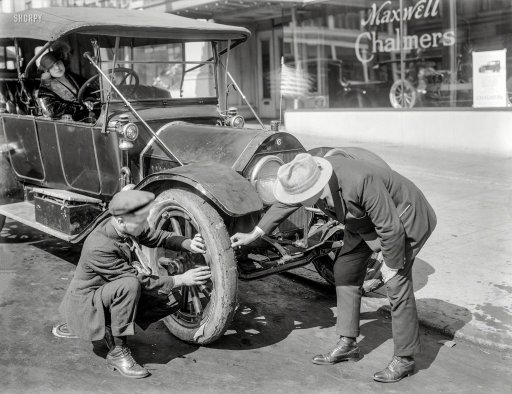
Wyland Stanley Chalmers touring car 1922


• US Economic Data Has Never Been This Weak For This Long (Zero Hedge)
• US Companies Warn of Pending Recession (WSJ)
• EU Agrees To Tighten Border Controls And Slow Migrant Arrival (AP)
• Tensions Rise Between European Nations Over Refugee Crisis (Bloomberg)
• Greece Says Refugees Are Not Enemies, Refuses to Protect Borders From Them (WSJ)
• European Trust: The Perfect Storm (Mungiu-Pippidi)
• China Containerized Freight Index Collapses to Worst Level Ever (WolfStreet)
• A China Twist: Why Are Malls Closing If Consumption Is Rising? (Reuters)
• China’s Leaders Shift From Short-Term Stimulus to Five-Year Plan (Bloomberg)
• China Banks Turn To Investors For More Capital As Bad Loans Pile Up (Reuters)
• ‘Deflationary Boom’ In Prospect As China Slows (FT)
• Why China’s Interest Rate Cut May Be Bad News For The World Economy (Guardian)
• Emerging Currencies’ Fate Looms Large In Rich World Rates Policy (Reuters)
• Africa Is In Grave Danger From The Global Economic Slowdown (Telegraph)
• Japan’s Struggling Economy Finds ‘Abenomics’ Is Not an Easy Fix (NY Times)
• Reality Keeps Catching Up With BOJ’s Inflation Forecasts (Bloomberg)
• When Greeks Fled To Syria (Kath.)

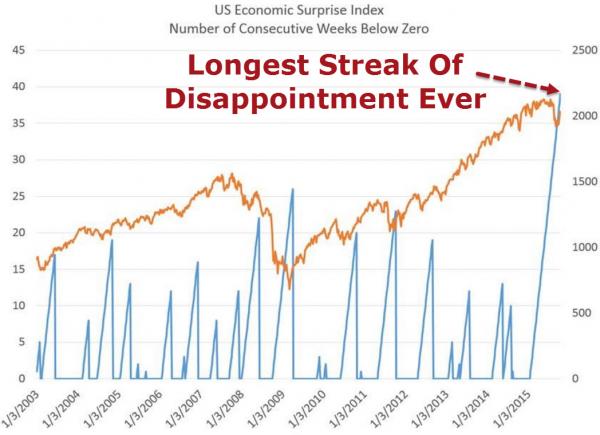
“..this period of economic weakness and disappointment is not just the longest on record, but it is entirely unprecedented…”

• US Economic Data Has Never Been This Weak For This Long (Zero Hedge)

Despite the ongoing propaganda reinforcing America’s “cleanest sheets in a brothel” economic growth, the fact is, there is a reason why The Fed folded, why Draghi doubled-down, why China cut, and why Kuroda will likely unleash moar QQE this week. It appears the ‘trap’ that central planners have set for themselves – by enabling massive financial asset inflation in the face of what is now the longest streak of economic weakness and data disappointment on record – now looks set to prove their impotence and/or Enisteinian insanity. As Ice Farm Capital notes: “.. a year ago were looking at 5yr inflation breakevens around 1.5%. They have since deteriorated to 1.15% (by way of 1%) and this week we are expecting a Q3 GDP print more like 1.5% – a deceleration of a full 240bps.”
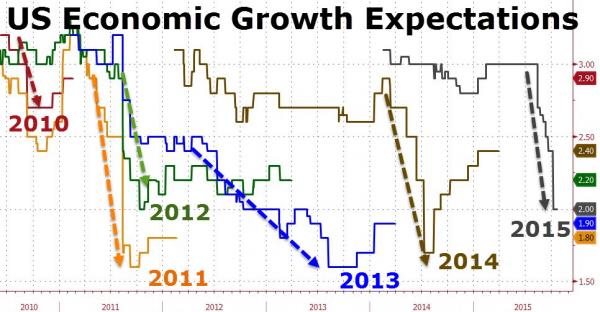
“Corporate profit margins have taken a sharp hit and corporate profits for the S&P are now down 3% yoy despite continued share buybacks. Through this entire period, markets have continually expected happy days to be just around the corner.”

As a result, we have seen economic surprises for the US negative for the longest stretch in the history of the data series:
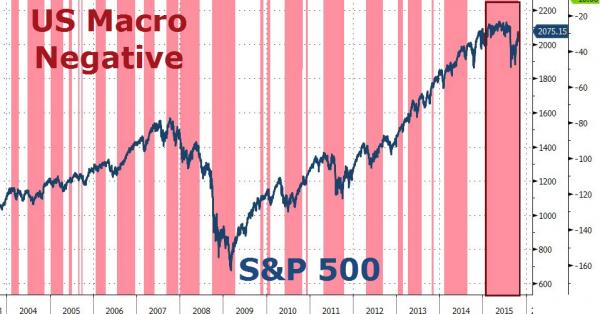
To make it a little clearer, this period of economic weakness and disappointment is not just the longest on record, but it is entirely unprecedented…
Read more …

“The industrial environment’s in a recession. I don’t care what anybody says..”

• US Companies Warn of Pending Recession (WSJ)

Quarterly profits and revenue at big American companies are poised to decline for the first time since the recession, as some industrial firms warn of a pullback in spending. From railroads to manufacturers to energy producers, businesses say they are facing a protracted slowdown in production, sales and employment that will spill into next year. Some of them say they are already experiencing a downturn. “The industrial environment’s in a recession. I don’t care what anybody says,” Daniel Florness, chief financial officer of Fastenal Co., told investors and analysts earlier this month. A third of the top 100 customers for Fastenal’s nuts, bolts and other factory and construction supplies have cut their spending by more than 10% and nearly a fifth by more than 25%, Mr. Florness said.

Caterpillar last week reduced its profit forecast, citing weak demand for its heavy equipment, and 3M, whose products range from kitchen sponges to adhesives used in automobiles, said it would lay off 1,500 employees, or 1.7% of its total, as sales growth sagged for a wide range of wares. The weakness is overshadowing pockets of growth in sectors such as aerospace and technology. Industrial companies are being buffeted on multiple fronts. The slump in energy prices has gutted demand for drilling equipment and supplies. Economic expansion is slowing in China and major emerging markets such as Brazil, which U.S. companies have relied on for sales growth. And the dollar’s strength also has eroded overseas profits.

The drag on earnings and sluggish growth projections for next year come as the Federal Reserve considers raising interest rates for the first time in nine years, and could add momentum to those in favor of postponing any rate increase until next year. Profit and revenue are falling in tandem for the first time in six years, with a third of S&P 500 companies reporting so far. Analysts expect the index’s companies to book a 2.8% decline in per-share earnings from last year’s third quarter, according to Thomson Reuters. Sales are on pace to fall 4%—the third straight quarterly decline. The last time sales and profits fell in the same quarter was in the third period of 2009.

Read more …

Priorities couldn’t be more skewed.

• EU Agrees To Tighten Border Controls And Slow Migrant Arrival (AP)

European and Balkan leaders agreed on measures early Monday to slow the movement of tens of thousands whose flight from war and poverty has overwhelmed border guards and reception centers and heightened tension among nations along the route to the European Union’s heartland. In a statement to paper over deep divisions about how to handle the crisis, the leaders committed to bolster the borders of Greece as it struggles to cope with the wave of refugees from Syria and beyond that cross over through Turkey. The leaders decided that reception capacities should be boosted in Greece and along the Balkans migration route to shelter 100,000 more people as winter looms. They also agreed to expand border operations and make full use of biometric data like fingerprints as they register and screen migrants, before deciding whether to grant them asylum or send them home.

“The immediate imperative is to provide shelter,” European Commission President Jean-Claude Juncker said after chairing the mini-summit of 11 regional leaders in Brussels. “It cannot be that in the Europe of 2015 people are left to fend for themselves, sleeping in fields.” Nearly 250,000 people have passed through the Balkans since mid-September. Croatia said 11,500 people entered its territory on Saturday, the highest tally in a single day since Hungary put up a fence and refugees started moving sideways into Croatia a month ago. Many are headed northwest to Austria, Germany and Scandinavia where they hope to find a home. “This is one of the greatest litmus tests that Europe has ever faced,” German Chancellor Angela Merkel told reporters after the summit. “Europe has to demonstrate that it is a continent of values and of solidarity.”

“We will need to take further steps in order to get through this,” she said. Slovenian Prime Minister Miro Cerar said his small Alpine nation was being overwhelmed by the refugees – with 60,000 arriving in the last 10 days – and was not receiving enough help from its EU partners. He put the challenge in simple terms: if no fresh approach is forthcoming “in the next few days and weeks, I do believe that the European Union and Europe as a whole will start to fall apart.” The leaders agreed to rapidly dispatch 400 border guards to Slovenia as a short-term measure. As they arrived at the hastily organized meeting, some leaders traded blame for the influx with their neighbors, with Greece targeted for the mismanagement of its porous island border.

“We should go down south and defend the borders of Greece if they are not able to do that,” said Hungarian Prime Minister Viktor Orban, who claimed he was only attending the meeting as an “observer” because Hungary is no longer on the migrant route since it tightened borders. But the country that many say is another key source of the flow – Turkey – was not invited, and some leaders said that little could be done without its involvement. “It has to be tackled in Turkey and Greece, and this is just a nice Sunday afternoon talk,” Croatian Prime Minister Zoran Milanovic said, after complaining about having to leave an election campaign to take part in the mini-summit of nations in Europe’s eastern “migrant corridor.”

Read more …

“If we do not deliver some immediate and concrete actions on the ground in the next few days and weeks, I do believe that the European Union and Europe as a whole will start falling apart..”

• Tensions Rise Between European Nations Over Refugee Crisis (Bloomberg)

European leaders clashed over how to manage the influx of hundreds of thousands of refugees forging through the region’s eastern flank as they warned that Europe is buckling under the strain of the crisis. While 11 leaders including German Chancellor Angela Merkel managed to come up with short-term fixes at a summit on Sunday, including the provision of emergency shelter for 100,000 refugees and a stepped-up system for their registration, the meeting laid bare tensions between nations that risk fraying the fragile fabric of cooperation in addressing the growing problem. “This is one of the greatest litmus tests that Europe has ever faced.” Merkel said after the gathering in Brussels. “We will need to take further steps to get through this litmus test.”

With winter approaching and more than a million migrants set to reach the European Union this year, national authorities have shut their borders and waved asylum seekers through to neighboring countries as they struggle to get a grip on Europe’s largest influx of refugees in seven decades. “We have made clear to everyone this evening that waving them through has to stop,” European Commission President Jean-Claude Juncker said. While it’s important to implement measures agreed on Sunday, “there will be no miracle cure.” The situation in the Western Balkans – the focus of the summit in Brussels – has worsened over the past few months, aggravating deep-seated distrust between nations that emerged from the violent breakup of the former Yugoslavia.

The main flow of migrants fleeing conflict-stricken nations changed from a route through southern Europe to one leading from Turkey to Greece and through countries including Croatia, Serbia and Slovenia. “If we do not deliver some immediate and concrete actions on the ground in the next few days and weeks, I do believe that the European Union and Europe as a whole will start falling apart,” Slovenian Prime Minister Miro Cerar told reporters before the meeting. Greece, which is at the front line for refugees arriving in Europe, agreed to provide temporary shelter for 30,000 refugees by the end of the year, with the UN High Commissioner for Refugees supporting a further 20,000 places in the country.

An additional 50,000 places will be established by the countries along the Western Balkan route, according to a statement issued after the gathering. Countries also agreed to work together and with Frontex, the EU border-management agency, to bolster frontier controls and cooperation, including between Turkey and Bulgaria and between Greece and Macedonia. Greece fended off “absurd proposals” at the meeting, including allowing countries to block migrants entering from neighboring countries and giving Frontex a new undertaking on the Greek frontier with Macedonia, Prime Minister Alexis Tsipras said. Tsipras signaled disappointment that Turkey wasn’t invited to the summit because it plays “the basic role, the key role” in the crisis.

Read more …

Sanity. It still does exist.

• Greece Says Refugees Are Not Enemies, Refuses to Protect Borders From Them (WSJ)

Greece’s migration minister has rejected accusations by Germany and other European countries that Greece is failing to defend its borders against mass migration, insisting that the refugees and other migrants trekking to Europe constitute a humanitarian crisis, not a defense threat. “Greece can guard its borders perfectly and has been doing so for thousands of years, but against its enemies. The refugees are not our enemies,” Yiannis Mouzalas said in an interview. Greece is under pressure from other European governments to use its coast guard and navy to control the huge influx of migrants who are making their way, via the Aegean Sea and Greece’s territory, from the Middle East to Northern Europe, especially Germany.

At a European summit in Brussels on Sunday, leaders from Greece and other countries on the latest migration route through the Balkans are facing allegations from Germany, Hungary and others that they are passively allowing migrants to pass through. “In practice what lies behind the accusation is the desire to repel the migrants,” said Mr. Mouzalas. “Our job when they are in our territorial sea is to rescue them, not [let them] drown or repel them.” Countries in Southern and Central Europe have been struggling to cope with the arrival of more than half a million people this year, with the largest number reaching Europe via Turkey and Greece. Many are from war-torn Syria and are treated as refugees from mortal danger, while others come from as far as Pakistan and are seen as having weaker claims to asylum in Europe.

Last week alone, Greece received about 48,000 migrants and refugees on its shores, the highest number of weekly arrivals this year, the International Organization for Migration said Friday. European Union authorities want countries along the transit route to agree on a plan to stop allowing people through, to fingerprint everyone who enters their territory, to beef up border surveillance in Greece, and to deploy 400 border guards to Slovenia, the latest hot spot. Athens opposes an idea floated by European Commission President Jean-Claude Juncker to set up joint Turkish-Greek border patrols. Greece and Turkey have long-standing disputes over their territorial waters, which have led to military tension over the years.

“This was an unfortunate statement by Mr. Juncker,” Mr. Mouzalas said. “The joint patrols have never been on the table. They have no point anyway, as they wouldn’t help ease the situation.” He said an alternative could be to set up a European body to patrol Turkish waters, closer to where many migrants begin their trip, to stem the flow of people attempting the perilous journey to the Greek islands. Mr. Mouzalas said Turkey should have been invited to Sunday’s summit. “Turkey is the door and Greece is the corridor; Europe should not treat Greece as the door,” Mr. Mouzalas said.

Read more …

Nobody trusts anybody anymore.

• European Trust: The Perfect Storm (Mungiu-Pippidi)

The EU is not a popular democracy – such was not, after all, the intention of its founding fathers. Jean Monnet recounts in his memoirs that the founding idea originated in the First World War and that the goal was to pool resources to enable the repulse of an enemy under a unified command – because coordination was failing to deliver under such conditions. It still fails. Ghita Ionescu, the founder of the London School of Economics journal Government and opposition wrote more than twenty years ago that the democratic deficit predated the EU, caused by the specialization of knowledge and increase in the power of experts on one hand, and on the other by the transnationalization of what had previously been national matters. Consequently, it became impossible for governments to act alone even after the “fullest consultation of their peoples”.

In 2004, the number of Europeans who believed that their voice counted in the EU was 39%. Ten years later, after the powers of the European Parliament have greatly increased, that figure has dropped to 29% (those who feel disempowered have increased from 52 to 66, an even greater difference). In other words, a majority always knew that the EU was not a popular democracy from the outset. Even in 2004, for every European who believed he had a voice in the EU two believed that they had none (Eurobarometer 2013a). Apart from Denmark, where an absolute majority believe that their voice counts in the EU (57% vs. 41%), in 26 countries people believe they have no influence in the EU in proportions that vary from 50% in Sweden and 51% in Belgium, up to 86% in both Cyprus and Greece – for obvious reasons.

But there is nothing new here, except, of course, the terrible constraints that the euro crisis has imposed on Greece, Cyprus and other countries, a tragedy caused by the complexity of an interdependent world which makes people less and less able to decide their own fate. In such complex situations, it is only the populists who offer simple solutions for how to empower voters. We do know what has caused the loss of trust: over two generations a significant question mark has arisen over whether the EU is the best vehicle to maximize social welfare for its various peoples. On one hand, there is the EU’s economic performance since the advent of the economic and growth crisis. On the other, there is loss of trust in European elites, perceived as demanding austerity from the people only to live a life of privilege themselves where taxes are concerned.

Read more …

“These rates are a function of oversupply of shipping capacity and of lackluster demand for shipping containers to distant corners of the world. They’ve been in trouble since February. “Trouble” is a euphemism. They relentlessly plunged.”

• China Containerized Freight Index Collapses to Worst Level Ever (WolfStreet)

A week ago, we pointed out how China’s dropping exports and plunging imports – the “inevitable fallout from China’s unsustainable and poorly executed credit splurge,” according to Thomson Reuters – had collided with long-term bets by the shipping industry that has been counting on majestic endless growth. The industry has been adding capacity in quantum leaps, where “the scramble to order so-called ultra-large container vessels had turned into a stampede,” as the Journal of Commerce put it. So we said, “Pummeled by Lousy Global Demand and Rampant Overcapacity, China Containerized Freight Index Collapses to Worst Level Ever”. And now, the China Containerized Freight Index (CCFI) has dropped to an even worse level.

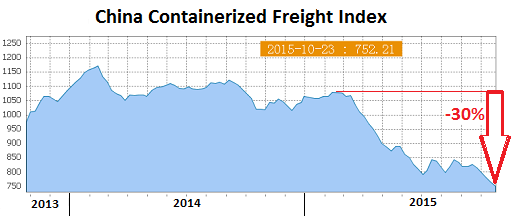
Unlike a lot of official data emerging from China, the index, which is operated by the Shanghai Shipping Exchange and sponsored by the Chinese Ministry of Communications, is raw, unvarnished, not seasonally adjusted, or otherwise beautified. It’s volatile and a reflection of reality, as measured by how much it costs, based on contractual and spot market rates, to ship containers from China to 14 major destinations around the world. These rates are a function of oversupply of shipping capacity and of lackluster demand for shipping containers to distant corners of the world. They’ve been in trouble since February. “Trouble” is a euphemism. They relentlessly plunged.

By early July, the index dropped below 800 for the first time in its history, which started in 1998 when the index was set at 1,000. It soon recovered to about 850. And just when bouts of hope were rising that the worst was over, it plunged again and hit even lower levels. The latest weekly reading dropped another 1.7% from the prior week to 752.21, the worst level ever. The CCFI is now 30% below where it had been in February this year and 25% below where it had been 17 years ago at its inception.
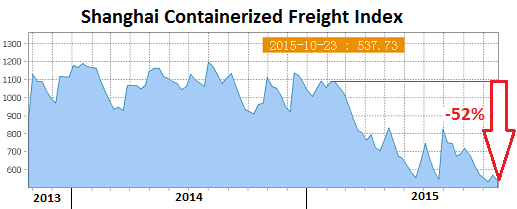
The Shanghai Containerized Freight Index (SCFI), also operated by the Shanghai Shipping Exchange, tracks spot rates (not contractual rates) of shipping containers from Shanghai to 15 major destinations around the world. It’s even more volatile than the CCFI. But being based on spot rates, it’s a good indicator where the CCFI is headed. For last week, the SCFI plunged 5.4% to a new record low of 537.73, down 46% from where it had been at its inception in 2009 when it was set at 1,000 – and down 52% from February:
Read more …

Spending is cratering in China too.

• A China Twist: Why Are Malls Closing If Consumption Is Rising? (Reuters)

Major listed mall operators are also feeling the pain. Dalian Wanda, a big property developer, said in January it would close or restructure 30 of its retail venues and in August said more adjustments were underway. Malaysia-based Parkson, which operates more than 70 department stores in China, closed several of its stores in northern China last year following a 58% drop in China net profit in 2013. “As growth in retail sales slows because of the country’s lower GDP growth, and in cities where mall space is abundant, vacancy rates have risen substantially,” said Moody’s analyst Marie Lam in a research note. In its latest efforts to re-energize the economy, China’s central bank on Friday cut interest rates for the sixth time in less than a year.

Tim Condon, an economist at ING in Singapore warned that investors should not read China’s official retail figures as exclusively reflective of rising household consumption, noting that the data also capture some government purchases. [..] … the risk is that the frenetic pace of mall construction cascades into a bad-debt problem for banks if shoppers fail to match the zeal of property developers. China is currently the site of more than half the world’s shopping mall construction, according to CBRE, a real estate firm, even though it appears that many of these malls will not produce good returns for their investors.

A joint report by the China Chain Store Association and Deloitte showed that by the end of this year, the total number of China’s new malls is projected to reach 4,000, a jump of over 40% from 2011. Real estate analysts note that much of the surge in retail space construction came at the behest of local governments, who were rushing to push real estate development as part of attempts to stimulate the economy. The result has been malls built in haste and managed poorly. Not surprisingly, shoppers are voting with their feet. “If you build it and they’re not coming, that’s a non-performing loan,” said Condon of ING. “That’s the banks’ problem.”

Read more …

A process familiar to the west: “The evidence of recent years shows that China is getting less and less real GDP growth for every yuan of credit create..”

• China’s Leaders Shift From Short-Term Stimulus to Five-Year Plan (Bloomberg)

China’s leaders gathering in Beijing this week to formulate the 13th five-year plan confront an era of sub-7% economic growth for the first time since Deng Xiaoping opened the nation to the outside world in the late 1970s. Old drivers such as manufacturing and residential construction are spluttering, and new areas like consumption, services and innovation aren’t picking up the slack quickly enough. While President Xi Jinping’s blueprint for 2016-2020 will seek to map out the structural change needed to propel the next leg in China’s march toward high-income status, a more immediate fix has been delivered with the sixth interest-rate cut in a year. “Defensive economic stimulus is needed to ensure that structural reforms maintain their momentum,” said Stephen Jen at hedge fund SLJ Macro Partners.

“If growth slows too much, the pace of structural reforms in China will also need to be curtailed. The government wants to conduct reforms before the macro conditions get worse.” Late Friday, China announced it would cut benchmark interest rates, stepping up the battle against deflationary pressures and easing the financing burden on indebted local governments and companies. It also lowered the amount of deposits banks must hold as reserves, adding liquidity that has been drained by intensifying capital outflows since August’s yuan devaluation. Underscoring the juggling act between reform and stimulus, Friday’s rate-cut announcement was accompanied by the scrapping of a ceiling on deposit rates.

[..] some critics argue administering more stimulus now is the wrong medicine and what’s needed are faster and deeper market-driven reforms. China’s sliding growth is mainly caused by too much easy credit channeled into over-investment, says Patrick Chovanec at Silvercrest Asset Management n New York. “The evidence of recent years shows that China is getting less and less real GDP growth for every yuan of credit created,” said Chovanec. “In other words, more easing won’t help, and could even hurt.” The cut to interest rates may only serve to give yet another lifeline to inefficient state companies, the entities most likely to borrow at the benchmark rate, said Andrew Polk at the Conference Board in Beijing. The risk is that these state companies add more industrial capacity with the funds, worsening deflation and tightening real monetary conditions for the rest of corporate China, he said.

Read more …

The relentless and unstoppable rise of bad loans.

• China Banks Turn To Investors For More Capital As Bad Loans Pile Up (Reuters)

Mounting bad loans are running down Chinese banks’ capital buffers, forcing them to turn to investors for fresh funds despite raising a record amount last year. Commercial banks are issuing expensive preference shares as well as convertible and perpetual bonds to shore up their capital bases, even after 2014’s bumper issuance when lenders raced to meet new regulatory requirements. But with bad loans up 30% in the first half of 2015 according to China’s banking regulator, doubts are growing about the ability of some banks to withstand the economic slowdown. “China is facing a systemic credit crisis,” said Jim Antos, banking analyst at Mizuho Securities in Hong Kong. “Chinese banks, until mid 2014, were able to cope with deterioration of loans. It seems that has changed.”

Banks’ operating profit margins also are expected to worsen, following the central bank’s decision on Friday to cut interest rates for the sixth time in less than a year. China’s listed commercial lenders raised $57.6 billion (£37.6 billion) last year to bolster their core capital according to Thomson Reuters data. But they may need to raise an additional 553 billion yuan (£54.7 billion) if a slowdown in the economy pushes the ratio of non-performing loans (NPLs) from 1.5 to 4%, according to calculations by Barclays’ banking analyst Victor Wang. Huaxia Bank is the latest lender to get approval from the Chinese Banking Regulatory Commission (CBRC) to issue 20 billion yuan in preference shares.The economic downturn and structural adjustment have caused “overdue loans to increase quickly, increasing pressure on credit risk management of the entire system,” the official said.

Read more …

Lombard Street Research with a weird plea for a global consumer revival: “..now they can see that oil prices are staying low, consumers are starting to spend the windfall.” BS.

• ‘Deflationary Boom’ In Prospect As China Slows (FT)

The slowdown in Chinese growth, confirmed by last week’s third-quarter GDP report, is feeding fears that the world economy faces a prolonged period of stagnation, perhaps even a new crisis. In fact, China’s weakness is one of the reasons to be optimistic about global growth. Of course, there are many reasons to be pessimistic too. Many emerging markets are in deep trouble. Many asset prices are unsustainably high. Seven years after the financial crisis erupted, major central banks are still forced to keep monetary policy at emergency settings. And the world is short of genuine consumer demand. It is on this last score that China gives cautious grounds for confidence. Chinese growth of about 3-5% as the economy weans itself off wasteful investment is exactly what the world needs.

As the price of oil, copper and other commodities falls in response to China’s structural adjustment, demand deflates in countries that export energy and natural resources. Brazil and Russia, already deep in recession, will be among those watching anxiously for any economic policy announcements at this month’s plenary meeting of the ruling Chinese Communist party. At the same time, however, global rebalancing transfers income from commodity producers to western consumers. Households have largely chosen so far to set aside money saved on cheaper petrol and lower home heating bills. Economic growth in Europe and the US is below par. But now they can see that oil prices are staying low, consumers are starting to spend the windfall.

We capture these two divergent trends in our forecast of a “deflationary boom” in the world economy — with deflation referring to the step-down in demand in China, emerging markets and commodity-producing countries, and boom describing the step-up in household spending in the US, the eurozone and Britain. If China does manage to make the transition to consumer-driven growth, lower investment would mean less crowding-out of opportunities for profitable capital expenditure in advanced economies. Investment growth would follow the consumer revival. For this rosy scenario to materialise, however, either an unprecedented degree of international co-ordination is required or quite a few pieces of the global economic puzzle have to fall into place independently. The latter is what has been happening over the past year. Can it continue? Here are some signposts investors should keep an eye on.

Read more …

Self-defeating policies, in China as much as in the west.

• Why China’s Interest Rate Cut May Be Bad News For The World Economy (Guardian)

So what’s the problem? China, Japan and the eurozone are all easing policy. The US is going to delay tightening policy. More stimulus equals stronger growth and fends off the threat of deflation. That’s got to be good, hasn’t it? Well, only up to a point. Problem number one is that by deliberately weakening their exchange rates, countries are stealing growth from each other. Central banks insist that this does not represent a return to the competitive devaluations and protectionism of the 1930s, but it is starting to look awfully like it. Problem number two is that the monetary stimulus is becoming less and less effective over time. There are two main channels through which QE operates. One is through the exchange rate, but the policy doesn’t work if all countries want a cheaper currency at once.

Then, as the weakness of global trade testifies, it is simply robbing Peter to pay Paul. The other channel is through long-term interest rates, which are linked to the price of bonds. When central banks buy bonds, they reduce the available supply and drive up the price. Interest rates (the yield) on bonds move in the opposite direction to the price, so a higher price means borrowing is cheaper for businesses, households and governments. But when bond yields are already at historic lows, it is hard to drive them much lower even with large dollops of QE. In Keynes’s immortal words, central banks are pushing on a piece of string. Nor is that the end of it. Charlie Bean, until recently deputy governor of the Bank of England, is the co-author of a new report that looks at the impact of persistently low interest rates.

It concludes there is a danger that periods when interest rates are stuck at zero are likely to become more frequent, resulting in a greater reliance on unconventional measures such as QE that are subject to diminishing returns. “Second, and possibly more importantly, a world of persistently low interest rates may be more prone to generating a leveraged ‘reach for yield’ by investors and speculative asset-price boom-busts.” The current vogue is for macro-prudential policies – attempts to prevent bubbles from developing in specific asset markets, such as housing. But the paper makes the reasonable point that the macro-prudential approach – yet to be tried in crisis conditions – might not work. There is, therefore, a risk that tighter monetary policy in the form of higher interest rates will have to deployed in order to deal with the problems that monetary policy has created in the first place.

Read more …

Pushing on an orchestra of strings.

• Emerging Currencies’ Fate Looms Large In Rich World Rates Policy (Reuters)

The fate of emerging market currencies is looming ever larger in the outlook for interest rates in the advanced world, promising that their central banks will keep policies super loose for some time to come. Ever since China sprang a surprise depreciation of the yuan in August, the resulting decline of a whole host of emerging market (EM) currencies has produced a disinflationary pulse that the world is ill prepared to withstand. The danger was clearly much on the mind of ECB President Mario Draghi on Thursday when he all but guaranteed a further easing as soon as December.

“The risks to the euro area growth outlook remain on the downside, reflecting in particular the heightened uncertainties regarding developments in emerging market economies,” warned Draghi, as he sent the euro reeling to two-month lows. They were also cited as a reason the U.S. Federal Reserve skipped a chance to hike interest rates in September. In a recent much-discussed speech, Fed board member Lael Brainard put the deflationary pressures emanating from emerging markets at the center of a forceful case against a “premature” tightening in policy. Fuelling these worries has been a downdraft in emerging market currencies caused in part by worries that higher U.S. rates would suck much needed capital from countries already struggling with large foreign currency debts.

The scale of the shift can be seen in the Fed’s trade weighted U.S. dollar index for other important trading partners, which includes China, Brazil, Mexico and the like. The dollar index began to take off in mid-July and by the end of September had surged over 6% to an all-time high. The impact was clear in U.S. bond markets, where yields on 10-year Treasury notes fell from 2.43% in mid-July to just 2.06% by early October. Investors expectations for U.S. inflation in five years time, a benchmark closely watched by the Fed, sank from a peak of 2.47% in early July to hit an historic trough of 1.99% three months later. That in turn saw investors drastically scale back expectations on when and how fast the Fed might hike. In mid-July, Fed fund futures for December implied a rate of 37 basis points.

By early October it implied only 18 basis points. All of which threatens to become a self-fulfilling cycle where the fear of a Fed hike spurs a steep fall in emerging currencies which in turn stirs concerns about disinflation and prevents the Fed from moving at all. “It’s a negative feedback loop,” says Robert Rennie, global head of market strategy at Westpac in Sydney. “China first flipped the switch with its depreciation of the yuan and the risk of capital flight from EM has kept the pressure on,” he added. “It’s now certain the ECB will ease in December and the Fed will find it tough to hike in December.”

Read more …

Bootle’s a bit of an idiot, but Africa’s fall does deserve more attention.

• Africa Is In Grave Danger From The Global Economic Slowdown (Telegraph)

Nowhere in the world is more at risk from the combination of Chinese economic slowdown, low commodity prices and imminent rises in US interest rates, than Africa. There is now a serious question over whether many African economies can achieve rapid growth in the years ahead or whether they are due to sink back into mediocre performance, thereby condemning their people to a continued low standard of living. The fact that this question now needs to be asked may come as a shock. Not long ago Africa was growing very strongly. Indeed, many good judges saw it as due to repeat the sort of economic take-off accomplished by several countries in east Asia a few decades previously. Yet, whereas five years ago the sub-Saharan African (SSA) growth rate was almost 7pc, last year it was down to less than 5pc.

Moreover, it looks as though this year’s performance will be even weaker, with growth dropping to 3pc. Nor is there any real prospect of a return to previous rapid growth rates. There is a suspicion in the minds of many investors that Africa’s recent growth surge was really just the outcome of the commodity boom. Accordingly, if we are in for a long period of commodity prices at about this level, then African growth prospects are pretty poor. Admittedly, there is considerable variation across countries. The worst hit are Nigeria, Zambia and Angola. The major economy that is doing best is Kenya. Meanwhile, SSA’s most developed economy, and the destination for much overseas investment, namely South Africa – where I was last week – seems to be mired in a phase of decidedly slow growth. This year it might manage 1.5pc.

But its medium-term prospects are pretty poor; its potential growth rate might only be 2pc. When you adjust for population growth, its potential growth of per capita GDP may only be 1.2pc per annum, which is pretty paltry compared to China – even after the recent slowdown. China’s importance to Africa is great – especially for South Africa, Angola, Congo and Zambia. But it can be exaggerated. Exports to China represent about 10pc of South Africa’s GDP. That is substantially lower than the UK’s exposure to the EU. In fact, China is Africa’s second largest export market. The largest is the EU, and by a considerable margin. Africa exports about 50pc more to the EU than it does to China. Accordingly, perhaps the most important factor bearing upon Africa’s economic future is what is going to happen to the euro-zone.

Read more …

Abenomics was always just a crazy desperate move with zero chance of succeeding. And it’s going to get a lot worse still.

• Japan’s Struggling Economy Finds ‘Abenomics’ Is Not an Easy Fix (NY Times)

Japan’s economy has contracted so many times in the last few years that the meaning of recession has started to blur. If an economy is shrinking almost as often as it is growing, what does any single downturn say about its health? Now Japan appears to be faltering again. After a decline in the second quarter, there are signs that output may have slipped again in the third, driven down in part by a slowing Chinese economy. Economists expect any recession to be short and shallow, but the deeper lesson looks more troubling: Nearly three years after Prime Minister Shinzo Abe gained office on a pledge to end economic stagnation, a decisive break with the past still appears far off. “The potential growth rate is close to zero, so any small shock can put the economy into recession,” said Masamichi Adachi at JPMorgan Chase. “Growth expectations are anemic.”

As a result, some economists are betting that the Bank of Japan, which has been pumping vast amounts of money into the economy by buying up government debt, will pull the trigger on more stimulus at its next board meeting on Friday. The central bank’s aggressive intervention has been central to Mr. Abe’s policies, widely known as Abenomics. But events have conspired to blunt its impact. Last year, it was an ill-timed sales tax increase, which rattled Japanese consumers and dissuaded them from spending. Lately it has been the deceleration in China, whose factories have been important buyers of Japanese-made machinery. But the more fundamental problem, many specialists say, is that Japan’s economy simply doesn’t grow much in the first place.

Baseline growth is essentially zero. GDP is the same size it was in the mid-1990s, in part because the work force is shrinking. So where a faster-moving economy might simply lose momentum in response to headwinds, Japan’s goes into reverse. So far, Mr. Abe’s policies have done little to change the dynamic. “Overseas investors appear increasingly disillusioned with Abenomics,” Naohiko Baba at Goldman Sachs said last week. [..] Mr. Abe has continued to make ambitious promises. Last month, he set a goal of increasing Japan’s nominal economic output to 600 trillion yen by 2020 or soon after – an increase of about 20% from the current level. He gave little indication of how an economy that has not grown in two decades could expand by a fifth in just a few years.

Audacious pronouncements have been a hallmark of Abenomics from the start — part of what Mr. Kuroda has described as an effort to dispel Japan’s “deflationary mind-set.” But after three mostly lackluster years, its architects’ credibility is being questioned by many, including their natural supporters in the business elite. “I believe ¥600 trillion is an outrageous figure,” Yoshimitsu Kobayashi, chairman of the Japan Association of Corporate Executives, said after Mr. Abe announced his goal. “I see it as merely a political message.”

Read more …

Jaoan, US, Europe, all these forecasts are completely useless.

• Reality Keeps Catching Up With BOJ’s Inflation Forecasts (Bloomberg)

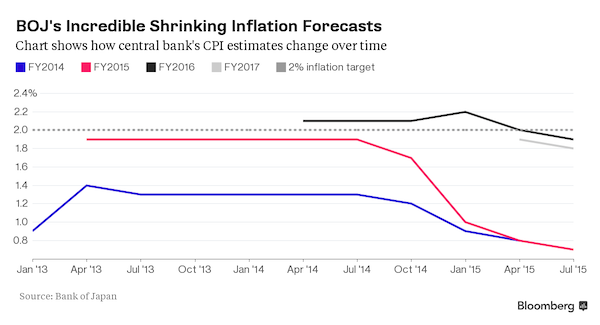
The Bank of Japan will release updated inflation forecasts this Friday. These are an indicator of when, or if, the bank’s board members see Japan reaching the inflation target of 2%. If history is a guide, the forecasts will probably be cut again, with some people with knowledge of the board’s discussions seeing the possibility of a reduction in the estimates for this and next fiscal years. The bank has had to lower estimates for all four years from 2014, as the chart below shows. Japan’s central bank was the second worst inflation forecaster, according to a Bloomberg survey which compared it to the Bank of Canada, the Fed, the ECB, and the Bank of England. The BOJ’s GDP estimates were the least accurate. While Governor Haruhiko Kuroda says he sees the nation hitting that target sometime around the six months from April, the bank isn’t forecasting inflation that high for any full year through the fiscal year that ends in March 2018.
Read more …

Forgotten history. Europe’s full of it.

• When Greeks Fled To Syria (Kath.)

Giorgos Taktikos was just 5 years old when he and his family began their long journey to the Sinai Desert by boarding a small boat in the middle of the night and leaving behind their native Chios. Today, at the age of 78, Taktikos is following history being written the other way round. As a former refugee, he is pained to observe the boatloads of people fleeing the Middle East and reaching Greek shores, while his mind races back to his own long and difficult journey into the unknown. A native of the Chiot village of Kourounia, Taktikos was one of over 30,000 Greeks who left several eastern Aegean islands during the German wartime occupation, some seeking refuge in Syria, others reaching South Africa, in an effort to escape hunger and war.

Boats crossing over, people drowning at sea, overflowing train wagons, refugee camps and deprivation – some things haven’t changed as far as the refugee journey goes. What has changed, however, is the destination: While people were striving to reach Syria back then, today it’s the other way round. “It’s hard to beat hunger and fear; refugee pain is tremendous,” said Taktikos. In the fall of 1942, hunger spread across occupied Greece: While there were severe food shortages in urban centers, the situation was even worse on the islands, given the British Royal Navy’s blockade of the Aegean and the Mediterranean region in general. Getting away was the only way out and for residents of the eastern Aegean, including Samos, Icaria, Chios, Lesvos and Limnos, this was made slightly easier given the islands’ proximity to Turkish shores.

“I was 5. There was plenty of poverty and hunger on the island. In November 1942, a time when it seemed the situation was about to get even worse, my father decided it was time for us to flee in order to survive. Along with two young men, we stole a boat which the Germans had requisitioned, and one night my my father, mother and younger sister, together with another two families, crossed over to Cesme. We were collected by Father Xenakis, an Orthodox priest who met refugees as they arrived and took them to an area where humanitarian organizations could look after them. The first thing he did when we arrived was to make sure the wooden boat was broken into little pieces, so as not to be detected by the Turkish coast guard, who would have forced us to get back on it and return to Greece.”

Read more …

Oct 222015
 
 October 22, 2015  Posted by at 9:38 am Finance Tagged with: , , , , , , ,  11 Responses »


LIFE Freedom in peril 1941

Whenever we at the Automatic Earth explain, as we must have done at least a hundred times in our existence, that, and why, we refuse to define inflation and deflation as rising or falling prices (only), we always get a lot of comments and reactions implying that people either don’t understand why, or they think it’s silly to use a definition that nobody else seems to use.

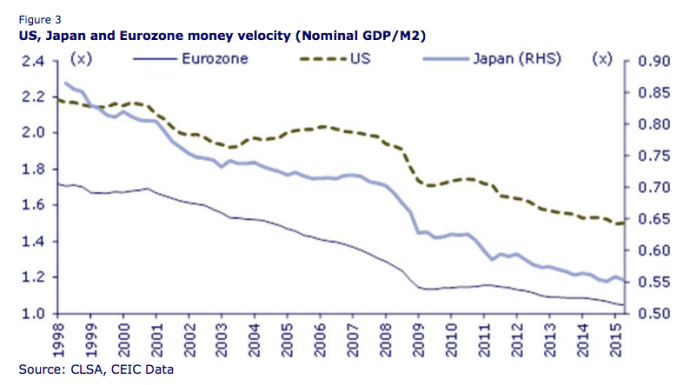
-More or less- recent events, though, show us once more why we’re right to insist on inflation being defined in terms of the interaction of money-plus-credit supply with money velocity (aka spending). We’re right because the price rises/falls we see today are but a delayed, lagging, consequence of what deflation truly is, they are not deflation itself. Deflation itself has long begun, but because of confusing -if not conflicting- definitions, hardly a soul recognizes it for what it is.

Moreover, the role the money supply plays in that interaction gets smaller, fast, as debt, in the guise of overindebtedness, forces various players in the global economy, from consumers to companies to governments, to cut down on spending, and heavily. We are as we speak witnessing a momentous debt deleveraging, or debt deflation, in real time, even if prices don’t yet reflect that. Consumer prices truly are but lagging indicators.

The overarching problem with all this is that if you look just at -consumer- price movements to define inflation or deflation, you will find it impossible to understand what goes on. First, if you wait until prices fall to recognize deflation, you will tend to ignore the deflationary moves that are already underway but have not yet caused prices to drop. Second, when prices finally start falling, you will have missed out on the reason why they do, because that reason has started to build way before a price fall.

A different, but useful, way to define -debt- deflation comes from Andrew Sheng and Xiao Geng in a September 24 piece at Project Syndicate, China in the Debt-Deflation Trap:

The debt-deflation cycle begins with an imbalance or displacement, which fuels excessive exuberance, over-borrowing, and speculative trading, and ends in bust, with procyclical liquidation of excess capacity and debt causing price deflation, unemployment, and economic stagnation.

That’s of course just an expensive way of saying that after a debt bubble must come a hangover. And how anyone can even attempt to deny we’re in a gigantic debt bubble is hard to understand. Our entire economic system is propped up, if not built up, by debt.

The mention of the excess capacity that has been constructed is useful, but we’re not happy with ‘price deflation’, since that threatens to confuse people’s understanding, the same way terms like ‘consumer deflation’ or ‘wage inflation’ do.

Central banks can postpone the deflation of a gigantic debt bubble like the one we’re in, but only temporarily and at a huge cost. And it looks like we’ve now reached the point where they’re essentially powerless to do anything more, or else. We are inclined to point to August 24 as a pivotal point in this, the China crash where people lost faith in the Chinese central bank, but it doesn’t really matter, it would have happened anyway.

And today we’re up to our necks in deflation, and nobody seems to notice, or call it that. Likely because they’re all waiting for CPI consumer prices to fall.

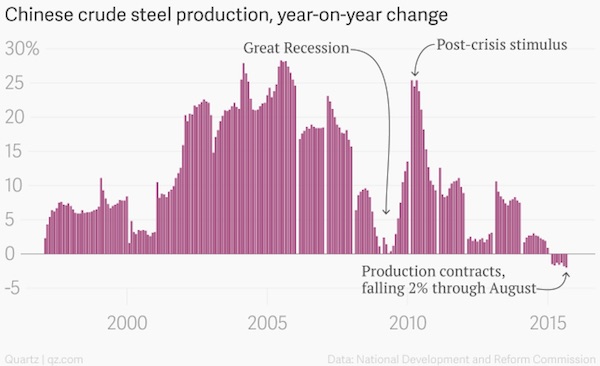
But when you see that Chinese producer prices are down 5.9%, in the 43rd straight month of declines, and Chinese imports are down 20% (with Japan imports off 11%), don’t you hear a bell ringing? What does it take? If the dramatic fall in oil prices hasn’t done it either, how about steel? How about the tragedy British steel has been thrown in, how about the demise of Sinosteel even as China is dumping steel on world markets like there’s no tomorrow?

How about the reversal of funds that once flowed into emerging markets and are now flowing right back out?

Or how about major global banks, all of whom see their profits and earnings deplete, and many of whom are laying off staff by the thousands?

Wait, how about global wealth down by 5% since 2008 despite all the QE and ZIRP policies? And global trade off by -8.4% YoY?!

Here’s from Tyler Durden last week:

Credit Suisse’s latest global wealth outlook shows that dollar strength led to the first decline in total global wealth (which fell by $12.4 trillion to $250.1 trillion) since 2007-2008.

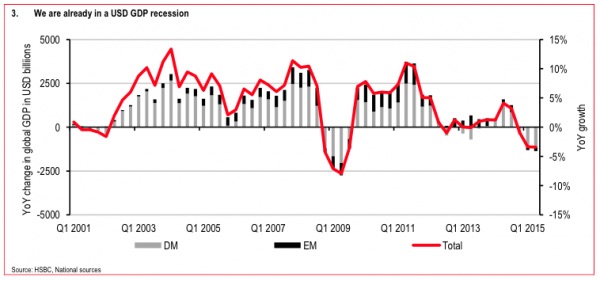
[..] from HSBC: “We are already in a global USD recession. Global trade is also declining at an alarming pace. According to the latest data available in June the year on year change is -8.4%. To find periods of equivalent declines we only really find recessionary periods. This is an interesting point. On one metric we are already in a recession. [..] global GDP expressed in US dollars is already negative to the tune of $1,37 trillion or -3.4%.

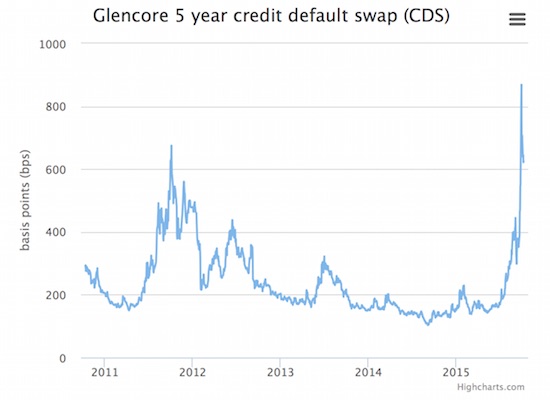
How about companies like Walmart and Glencore, just two of the many large entities that have large troubles? These are not individual cases, they are part of a global trend: deflation. As evidence also by the increase in US corporate downgrades and defaults:

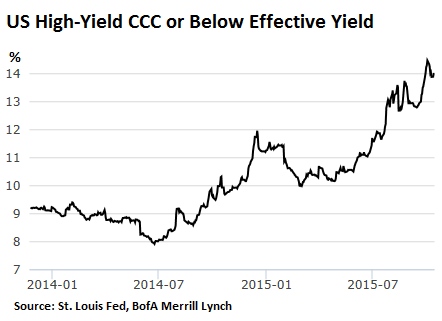
Moody’s issued 108 credit-rating downgrades for U.S. nonfinancial companies, compared with just 40 upgrades. That’s the most downgrades in a two-month period since May and June 2009, the tail end of the last U.S. recession. Standard & Poor’s downgraded U.S. companies 297 times in the first nine months of the year…

Everything and everyone is overindebted. All of the above stats, and a million more, point to the beginning of a deleveraging of that debt, something that curiously enough hasn’t happened at all since the 2007/8 crisis. On the contrary, a massive amount of additional debt has been added to a global system already drowning in it. China alone added $20-15 trillion, and that kept up appearances.

But now China’s slowing down everywhere but in its official GDP numbers. And unless we build a base on the moon, there is no other country or region left that can take the place of China in propping up western debt extravaganza. This will come down.

The only way a system that looks like this could be kept running is by issuing more debt. But even that couldn’t keep it going forever. We all understand this. We just don’t know the correct terminology for what’s happening. Which is that debt that has been inflated to such extreme proportions, must lead to deflation, and do so in spectacular fashion.

As long as politicians and media keep talking about disinflation and central bank inflation targets, and all they talk actually about is consumer prices, we will all fail to acknowledge what’s happening right before our very eyes. That is, the system is imploding. Deflating. Deleveraging. And before that is done, there can and will be no recovery. Indeed, this current trend has a very long way to go down.

So far down that you will have a very hard time recognizing the world, and its economic system, on the other side of the process. But then again, you have a hard time recognizing the world for what it is on this side as well.

Oct 182015
 
 October 18, 2015  Posted by at 9:35 am Finance Tagged with: , , , , , , , , , ,  3 Responses »


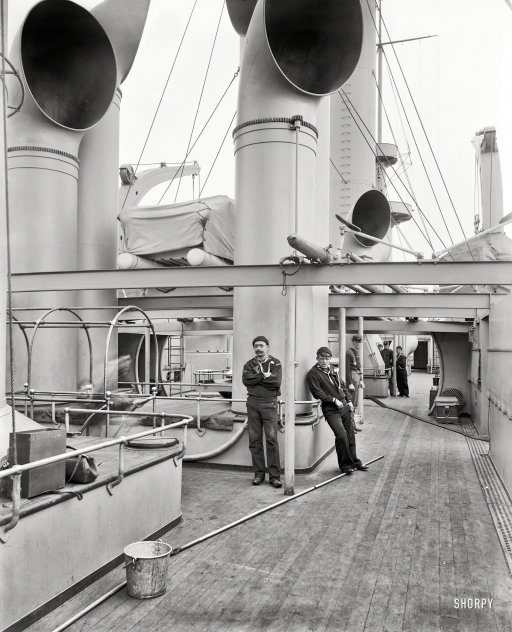
DPC Launch of battleship Georgia, Bath, Maine, Oct 1904

• At Least 10 More Children And 6 Adult Refugees Drown Off Greek Islands (Kath.)
• Germany Shows Signs of Strain from Mass of Refugees (Spiegel)
• Why The Euro Divides Europe (Wolfgang Streeck)
• The Truth Behind China’s Manipulated Economic Numbers (Telegraph)
• China’s Premier Li Says Achieving Growth Of Around 7% ‘Not Easy’ (Reuters)
• China ‘Officially’ Sold A Quarter Trillion Treasurys In The Past Year (ZH)
• The Only Thing In China’s Trade Data That’s Growing -But Shouldn’t Be (Quartz)
• Emerging Nations Trimming $5 Trillion Debt Stokes Currency Risk (Bloomberg)
• Federal Reserve Inaction Could Start Currency War (The Street)
• How Global Debt Has Changed Since The Financial Crisis (WEF)
• Volkswagen Faces €40 Billion Lawsuit From Investors (Telegraph)
• VW Made Several Defeat Devices To Cheat Emissions Tests (Reuters)
• ETFs’ Rapid Growth Sparks Concern at SEC (WSJ)
• JPMorgan Says Bad Corporate Loans Pose Main Risk For Brazil Banks (Reuters)
• Revealed: How UK Targets Saudis For Top Contracts (Observer)
• Britain Has Made ‘Visionary’ Choice To Become China’s Best Friend, Says Xi (Guardian)

No conscience. No humanity. No God.

• At Least 10 More Children And 6 Adult Refugees Drown Off Greek Islands (Kath.)

As EU leaders seek to boost cooperation in tackling a major refugee crisis, there has been more tragedy in the Aegean with at least 16 migrants drowning in their attempt to get to Greece from Turkey. In one incident late on Friday, the bodies of four children – three girls, aged 5, 9 and 16, and a 2-year-old boy – were discovered by the Greek coast guard off Kalymnos. According to the accounts of 11 adult survivors, another boy was missing. On Saturday, the Turkish coast guard recovered the bodies of another 12 migrants whose boat sank off Turkey’s coast. According to sources, they were heading to the Greek island of Lesvos. Lesvos has borne the brunt of an influx of migrants. Last week alone, at least 10 people, including six children, drowned in an attempt to get the island. On a visit to Lesvos on Friday, European Migration Commissioner Dimitris Avramopoulos inaugurated Greece’s first refugee screening center, or “hotspot.”

Read more …

“The German states have reported some 409,000 new arrivals between Sept. 5 and Oct. 15..”

• Germany Shows Signs of Strain from Mass of Refugees (Spiegel)

The road to the reception camp in Hesepe has become something of a refugees’ avenue. Small groups of young men wander along the sidewalk. A family from Syria schleps a clutch of shopping bags towards the gate. A Sudanese man snakes along the road on his bicycle. Most people don’t speak a word of German, just a little fragmentary English, but when they see locals, they offer a friendly wave and call out, “Hello!” The main road “is like a pedestrian shopping zone,” says one resident, “except without the stores.” Red-brick houses with pretty gardens line both sides of the street, and Kathrin and Ralf Meyer are standing outside theirs. “It’s gotten a bit too much for us,” says the 31-year-old mother of three. “Too much noise, too many refugees, too much garbage.” Now the Meyers are planning to move out in November.

They’re sick of seeing asylum-seekers sit on their garden wall or rummage through their garbage cans for anything they can use. Though “you do feel sorry for them,” says Ralf, who’s handed out some clothes that his children have grown out of. “But there are just too many of them here now.” Hesepe, a village of 2,500 that comprises one district of the small town of Bramsche in the state of Lower Saxony, is now hosting some 4,000 asylum-seekers, making it a symbol of Germany’s refugee crisis. Locals are still showing a great willingness to help, but the sheer number of refugees is testing them. The German states have reported some 409,000 new arrivals between Sept. 5 and Oct. 15 – more than ever before in a comparable time period – though it remains unclear how many of those include people who have been registered twice.

Six weeks after Chancellor Angela Merkel’s historic decision to open Germany’s borders, there is a shortage of basic supplies in many places in this prosperous nation. Cots, portable housing containers and chemical toilets are largely sold out. There is a shortage of German teachers, social workers and administrative judges. Authorities in many towns are worried about the approaching winter, because thousands of asylum-seekers are still sleeping in tents. But what Germany lacks more than anything is a plan to make Merkel’s two most-pronounced statements on the crisis – “We can do it” and “We cannot close our borders” – fit together. In the second month of what has been dubbed the country’s brand new “Welcoming Culture,” it has become clear to many that Germany will only be able to cope if the number of refugees drops.

But that is unlikely to happen anytime soon. Tens of thousands of people are making their way to Germany along the so-called Balkan route; at the same time, Merkel’s efforts to reduce the influx through diplomacy and tougher regulations remain just that.

Read more …

Impressive take-down of the many failures of Brussels.

• Why The Euro Divides Europe (Wolfgang Streeck)

The ‘European idea’—or better: ideology—notwithstanding, the euro has split Europe in two. As the engine of an ever-closer union the currency’s balance sheet has been disastrous. Norway and Switzerland will not be joining the EU any time soon; Britain is actively considering leaving it altogether. Sweden and Denmark were supposed to adopt the euro at some point; that is now off the table. The Eurozone itself is split between surplus and deficit countries, North and South, Germany and the rest. At no point since the end of World War Two have its nation-states confronted each other with so much hostility; the historic achievements of European unification have never been so threatened.

No ruler today would dare to call a referendum in France, the Netherlands or Denmark on even the smallest steps towards further integration. Thanks to the single currency, hopes for a European Germany—for integration as a solution to the problems of both German identity and European hegemony—have been superseded by fears of a German Europe, not least in the FRG itself. In consequence, election campaigns in Southern Europe are being fought and won against Germany and its Chancellor; pictures of Merkel and Schäuble wearing swastikas have begun appearing, not just in Greece and Italy but even in France. That Germany finds itself increasingly faced by demands for reparations—not only from Greece but also Italy—shows how far its post-war policy of Europeanizing itself has foundered since its transition to the single currency.

Anyone wishing to understand how an institution such as the single currency can wreak such havoc needs a concept of money that goes beyond that of the liberal economic tradition and the sociological theory informed by it. The conflicts in the Eurozone can only be decoded with the aid of an economic theory that can conceive of money not merely as a system of signs that symbolize claims and contractual obligations, but also, in tune with Weber’s view, as the product of a ruling organization, and hence as a contentious and contested institution with distributive consequences full of potential for conflict.

Read more …

3% growth?! Or worse? “..His work finds that growth collapsed to a mere 0.2pc during the Asian Financial Crisis, rather than the official figure of 7.8pc.”

• The Truth Behind China’s Manipulated Economic Numbers (Telegraph)

\Beijing’s massaged growth statistics have long over-estimated growth. So what do we really know about what’s going on in the world’s second largest economy? The true state of China’s economic fortunes remain a mystery to the world. Monday will see the latest round of official quarterly GDP statistics from Beijing’s National Statistics Bureau. Economists expect they will reveal another moderate slowdown in growth to around 6.8pc – the lowest rate of expansion since the depths of the financial crisis six years ago. Yet the government’s estimates have long been dismissed as an accurate barometer of what’s really going on in the Chinese economy. [..] Questions over China’s “actual” rate of growth have been thrown into sharp relief after a summer of turmoil in financial markets. Sudden anxiety over a Chinese “hard-landing” left investors dumbstruck.

Billions were wiped off global stock indices and authorities were forced to suspend trading to prop up equity prices. China data-watching has now become the main driver for global economic sentiment. In July, Chinese market ructions were sparked by weak industrial profits numbers. By August, a six-year slump in monthly manufacturing triggered the ugliest day of global trading since the depths of the financial crisis eight years ago. “China’s new export this year is fear” says Paul Gruenwald, chief Asia economist at Standard & Poor’s rating agency. “The joke with Asian analysts on China is that we don’t need to forecast the actual rate of Chinese growth, we have to forecast what the Chinese authorities will say the rate will be.” But China’s GDP figure remains totemic. This stems in large part from the Politburo’s own fixation on annualised growth.

Authorities now say they are targeting yearly expansion of “around 7pc”. Harry Wu, an economics professor at Hitotsubashi University in Tokyo, has calculated the states’ GDP numbers have long played down the effects of external shocks to the economy. His work finds that growth collapsed to a mere 0.2pc during the Asian Financial Crisis, rather than the official figure of 7.8pc. For the period from 2008-14, his readings show an average expansion of 6.1pc, rather than 8.7pc. “Would I bet the actual growth rate is 7pc? No”, says Gruenwald. “Do we have enough indicators to work out what’s going on in the economy? Yes.” “The statistics are still catching up – that’s part of the fun of being an Asia [analyst]…we get to put on our detective hats and do a little investigative economics.” This investigative turn has led to a proliferation in “proxy” indicators for Chinese growth.

The calculations range from anything from 3pc-7pc real GDP growth in 2015. This diversity means there is plenty to support the case for China bulls and China bears. One gauge that has grown in popularity in recent years is the “Li Keqiang index”, named after China’s current premier, and revealed as his preferred measure of economic activity while serving as a senior Communist party secretary in the province of Liaoning a decade ago. GDP numbers were merely a “man-made” and “unreliable” construct, Mr Li was quoted as saying in diplomatic cables published by Wikileaks in 2010. Instead, he chose to focus on a trio of real economic indicators – bank lending, rail freight volumes and electricity production. Taking their cue from the premier, economics consultancy Fathom compile the Li Index as the “true” reflection of what the Communist party’s senior officials are most worried about. It suggests the economy has come to a standstill. Growth will reach just 3pc this year, according to Fathom.

Read more …

Look: “A Reuters poll of 50 economists put expected growth at 6.8% year on year..” vs “Industrial profits fell 8.8% year on year in August..” That means that A) Reuters polls idiot economists because B) that 6.8% growth is utter nonsense.

• China’s Premier Li Says Achieving Growth Of Around 7% ‘Not Easy’ (Reuters)

China’s Premier Li Keqiang said that with the global economic recovery losing steam, achieving domestic growth of around 7% is “not easy”, according to a transcript of his remarks posted on the website of the State Council, China’s cabinet. Nonetheless in his comments, made at a recent meeting with senior provincial officials, the premier said that continued strength in the labour market and services were reasons for optimism, despite the headwinds facing the manufacturing sector. “As long as employment remains adequate, the people’s income grows, and the environment continuously improves, GDP a little higher or lower than 7% is acceptable,” the premier said in the comments posted on Saturday. China is due to release its third-quarter GDP growth figures on Monday.

A Reuters poll of 50 economists put expected growth at 6.8% year on year, which would be the slowest since the financial crisis in 2009. China’s growth in the first half of 2015, at 7%, was already the slowest since that time. Policymakers had previously forecast growth of “around 7%” for 2015. Most official and private estimates show that the Chinese labour market as a whole is outperforming the steep slowdown in industry, largely due to continuing strength in the service sector. But some analysts have expressed concern that the sharp drop in industrial profits over the past year indicates deeper weakness in income growth and wages next year, which could weaken overall growth further.

Industrial profits fell 8.8% year on year in August, the steepest drop since China’s statistics agency began publishing such data in 2011. The premier cited the emergence of new industries including the Internet sector, the continued need for high infrastructure investment in western regions, and ongoing urbanization as additional reasons for optimism on China’s future growth trajectory. Nonetheless, Li also highlighted the need for further market-oriented reforms and a reduced government role in the economy in order to fully grasp new economic opportunities and maintain growth.

Read more …

And unofficially much more.

• China Officially Sold A Quarter Trillion Treasurys In The Past Year (ZH)

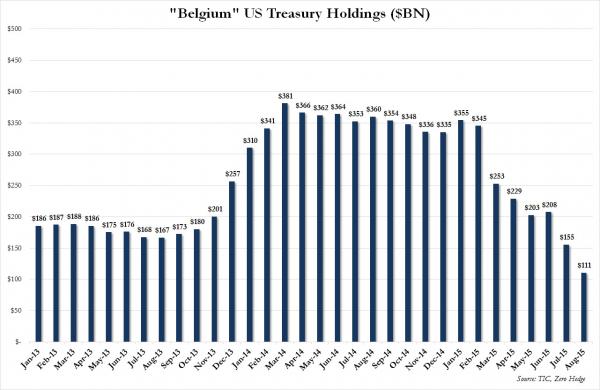
Back in May, this website was the first to explain the “mystery” behind Belgium’s ravenous Treasury buying which in early 2015 had turned into sudden selling, and which we demonstrated was merely China transacting using offshore Euroclear-based accounts to preserve anonymity. Since then theme of Belgium as a Chinese proxy has become so popular, even CNBC gets it. Consequently, we were also the first to correctly warn that China had begun liquidating its Treasury holdings (a finding which left none other than Goldman “speechless”), which also helped us predict that China is about to announce its currency devaluation three days before it happened as the conversion of Chinese reserves from inert paper to active dollars hinted at a massive effort to stabilize the currency, and thus unprecedented capital outflows.

As a result, the only data point which mattered in yesterday’s Treasury International Capital data release was not China’s holdings, which actually “rose” $1.7 billion in the month when China actively devalued its currency and then spent hundreds of billions to prevent the devaluation from becoming an all out FX rout, but the ongoing decline in Belgium holdings. As the chart below shows, Belgium, pardon Euroclear – which is a clearing house not only for China but many other EM nations who park their reserves in Belgium – sold another $45 billion in Treasurys last month, bringing the total to a dangerously low $111 billion, down from $355 billion at the start of the year.

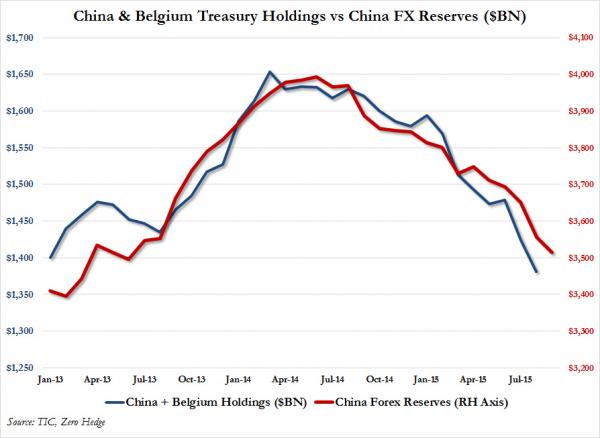
Lumping Belgium and China holdings into one, as we have done since May, shows that as expected, Chinese selling continued in August, and the result was another drop of $43 billion in TSY holdings in the month of August, which incidentally mirrors perfectly the previously announced decline in September Chinese FX reserves, which according to official data declined from $3.557 trillion to $3.514 trillion.

According to the chart above, while to many Quantitative Tightening is a novel concept, the reality is that China (+ Euroclear) have been dumping Treasurys and liquidating reserves since January when total holdings peaked at $1.6 trillion last summer, and have since declined to $1.38 trillion. It means that China has sold a quarter trillion dollars worth of Treasurys in the past year, in the process offsetting what would have been about 25% of the Fed’s QE3. However, the real number is likely far greater.

Read more …

China’s killing the world steel industry by dumping its surplus stock. Britain knows all about it.

• The Only Thing In China’s Trade Data That’s Growing -But Shouldn’t Be (Quartz)

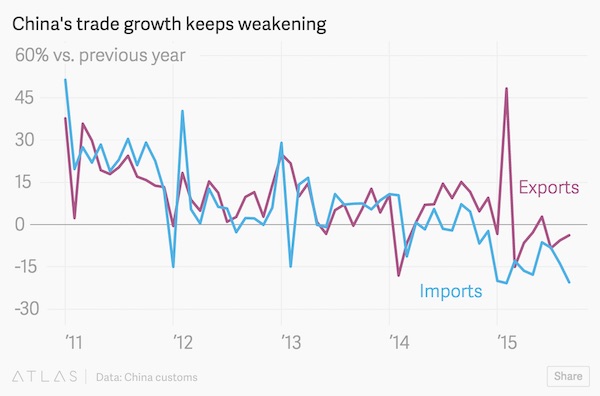
China’s trade data have been a reliable monthly horror show over the last year, and September was no exception. Exports fell nearly 4% from year-earlier levels, while imports dove an astonishing 20%. One thing, however, is growing quite quickly. The trade gap shown here—illustrating the value of goods China exports minus the value of goods that it imports—leapt more than 90% versus September 2014. In fact, if you discount distortions during Chinese New Year, China’s trade gap was the highest it’s ever been. Some of that gap might be due to slumping commodity prices weighing more heavily on China’s import values. Still, the boom in extra exports reflects the fact that China continues to benefit from the global economy much more than the global economy benefits from China.

This is because the People’s Republic hogs more than its due share of global demand. To get why, let’s first look at how China has engineered its yawning trade surplus. As economist Michael Pettis explained in his book The Great Rebalancing, when one country rigs its economy to produce more than it consumes, it amasses extra savings that it then foists onto its trade partners. For more than a decade, this is exactly what the Chinese government has done. By keeping interest rates and the yuan artificially cheap, it suppressed its people’s purchasing power and moved money out of the hands of Chinese consumers, shifting it instead to Chinese manufacturers at artificially low rates. Thanks to these subsidies, Chinese manufacturers cut export prices, driving global competitors out of business.

Read more …

That’s not the only risk it stokes.

• Emerging Nations Trimming $5 Trillion Debt Stokes Currency Risk (Bloomberg)

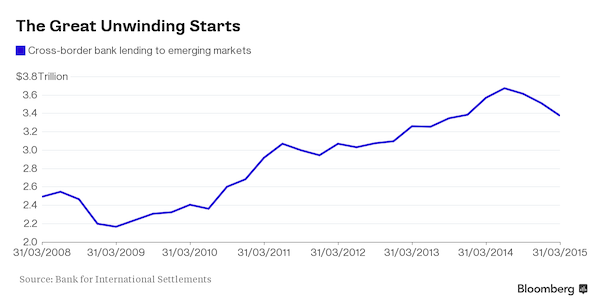
Borrowers in emerging markets have started to address a $5 trillion mountain of dollar-denominated bonds and loans, reducing their obligations for the first time in seven years in a move that threatens to cut short a budding rally in currencies from Brazil to Malaysia. Companies in developing nations paid back $38 billion of dollar debt last quarter, $3 billion more than they borrowed in the period and marking the first reduction in net issuance since 2008, according to data compiled by Bloomberg. Demand for greenbacks among borrowers needing the currency to repay debt is contributing to the largest capital outflows in almost three decades.

The borrowing binge, which took off in the wake of the global financial crisis as interest rates tumbled, may now be reversing as economic growth slows, commodity prices fall and lenders demand higher yields. While developing-nation currencies are rebounding from their record lows, analysts surveyed by Bloomberg expect the depreciation trend to resume as dollar debt repayments accelerate. “This is a massive event,” said Stephen Jen, the co-founder of London-based hedge fund SLJ Macro Partners LLP and a former economist at the IMF whose bearish call on emerging markets since 2012 has proven prescient. “They want to pay down their dollar loans. We are early in the game, there’s pretty intense pressure on emerging markets.”

[..] In the $1.4 trillion corporate debt market, new bond sales dropped to a four-year low of $35 billion last quarter, from a peak of $121 billion in June 2014, data compiled by Bloomberg show. “When growth deteriorates, investment opportunities are naturally lower, therefore money leaves, either to repay debt or buy alternative investments elsewhere,” said Koon Chow, a strategist at Union Bancaire Privee in London and former head of emerging-market strategy at Barclays Capital. “There’s a good chance that the deleveraging does continue because on the commodity side, the reduction in capex is going to be long term.”

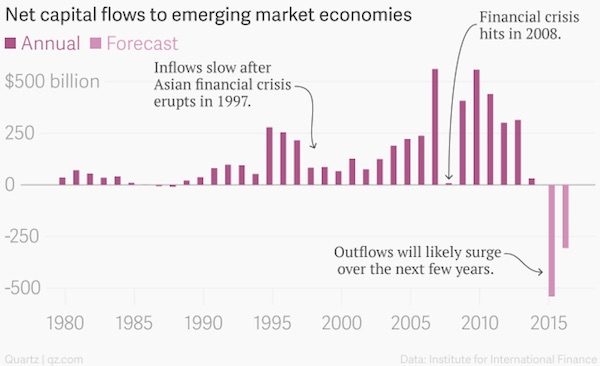
The Institute of International Finance forecast on Oct. 1 that about $540 billion will leave emerging markets this year, the first net capital outflow since 1988. The unwinding of dollar borrowings is more than a fleeting phenomenon, which will contribute to the weakening of emerging-market currencies against the U.S. currency, according to Pierre Lapointe at Pavilion Global Markets. The Fed’s broad measure of the dollar against major U.S. trading partners has rallied 16% since the middle of 2014 and reached a 12-year high last month. “We expect the theme of EM external deleveraging to remain with us for a long time,” Lapointe said in a note on Oct. 9. “Historically, this process tends to last many years. In this context, we are probably halfway throughout the current structural dollar uptrend.”

Read more …

It’s the loss of Fed credibility more than anything.

• Federal Reserve Inaction Could Start Currency War (The Street)

Sometimes doing nothing is the same as doing something – at least, that’s how it is when it comes to the Federal Reserve not raising interest rates. The stock market stays high because the Fed is not going to raise short-term interest rates. The Fed is not going to raise short-term interest rates because the U.S. inflation rate remains low. The inflation rate remains low because the value of the U.S. dollar is high. The dollar is strong because world commodity prices have fallen and have “driven up the dollar and held down U.S. import prices.” According to the Financial Times, the last three items mentioned are interrelated. Furthermore, it now seems as if momentum is picking up within the Federal Reserve to postpone any increases in it policy rate for an extended period of time. That inaction may not be the best decision in terms of the relative strength of currencies.

At least the doves – those reluctant to raise interest rates – are making their voices heard on the issues. Yesterday, Daniel Tarullo, one of the Fed’s Governors, joined another Fed Governor, Lael Brainard, who argued on Monday that the Fed should not raise its target short-term interest rate any time soon. The value of the dollar fell. By early afternoon Wednesday, it cost around $1.145 to buy a Euro, the same rate as on Sept. 17, the day the Federal Open Market Committee decided that the Fed would keep its target short-term interest rate unchanged. The Governors believe that inflation is not going to return that quickly and that without data supporting the return of inflation toward a level closer to the Fed’s target rate of 2%, there should be no upward movement in the policy rate.

Certainly, the predictions of Fed officials don’t indicate any quick return of the economy to the Fed’s target. In these forecasts the expectation is for the inflation rate to pick up in 2016 and 2017, but a 2% inflation rate is not expected until 2018. That’s a long time. According to the Financial Times article, if the Fed doesn’t move interest rates for a long time, the value of the dollar will continue to fall. This should connect to a faster rise in inflation than is forecast by the Fed. With interest rates constant, the stock market should continue to rise. But if inflation begins to rise, the Fed will have a justification for raising short-term interest rates, which will cause the value of the dollar to increase. This will result in slowing down the inflation rate once again. According to this argument, the stock market should begin to fall because the Fed is raising interest rates.

Read more …

Since 2007/8: “The total stock of global debt, even excluding debts held by the financial sector, is up by more than $50 trillion. That’s an increase of more than 50%.”

• How Global Debt Has Changed Since The Financial Crisis (WEF)

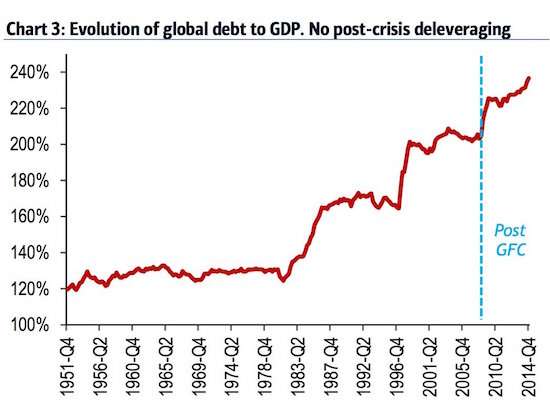
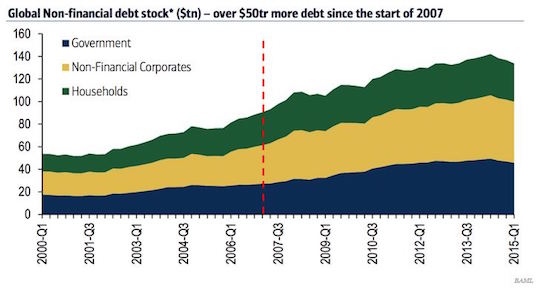
Debt levels have been a subject of constant news in the years since the financial crisis — from the sub-prime housing crisis in the United States, to the eurozone sovereign debt crisis, to the dramatic increases in debt evident in emerging markets now. Graphs produced by analysts at Bank of America Merrill Lynch show an astonishing acceleration in global debt levels, and demonstrate just how little de-leveraging there’s been since the 2008 financial crisis (none). They say its evidence that “the world is still in love with debt.” After 30 years of relative stability from the early 1950s to the early 1980s, something changed, and debt started ramping up:

Debt then took a rapid step up in the mid-1980s, and another in the late 1990s. Over the last 30 years or so, global debt has risen by around 100% of GDP — so it hasn’t just grown in total terms, but has massively outstripped the economic expansion over that period. In some developed economies, like the United States, the United Kingdom and Ireland, there’s been some deleveraging since the financial crisis, particularly by households. But that’s been more than offset by increases in emerging markets. The total stock of global debt, even excluding debts held by the financial sector, is up by more than $50 trillion. That’s an increase of more than 50%.

Household debt has ticked up a little, and government debt has expanded as states attempted to stimulate their economies in the aftermath of the financial crisis. But the main increase has been down to non-financial corporate debt, which has risen by 63% over the period, largely in emerging markets.

Read more …

One of many.

• Volkswagen Faces €40 Billion Lawsuit From Investors (Telegraph)

Volkswagen is set to be pushed deeper into crisis after it emerged that the carmaker is facing a record-breaking €40bn (£30bn) legal attack spearheaded by one of the world’s top law firms. Quinn Emanuel, which has won almost $50bn (£32bn) for clients and represented Google, Sony and Fifa, has been retained by claim funding group Bentham to prepare a case for VW shareholders over the diesel emissions scandal, The Sunday Telegraph can reveal. Bentham has recently backed an action by Tesco shareholders over the retailer’s overstating of profits. The pair are attempting to assemble a huge class action following what they call “fundamental dishonesty” at the German auto giant, which plunged the carmaker into crisis after it admitted using “defeat devices” to cheat pollution tests.

The admission has been hugely costly for shareholders after it wiped more than €25bn off VW’s stock market value. Recalls and fines worth tens of billions of euros more are also expected. Now Quinn Emanuel and Bentham are contacting VW’s biggest investors – which include sovereign wealth funds of Qatar and Norway – to ask them to join the claim. VW has admitted that it fitted “defeat devices” to 11m cars that allowed them to fraudulently pass pollution controls, though the company’s senior management has insisted it was unaware of the practices. Richard East, co-managing partner of Quinn Emanuel in London, said: “We estimate shareholders’ losses could be €40bn as a result of VW’s failure to provide relevant disclosure [about defeat devices] to the market and gives rise to questions about fundamental dishonesty.”

Legal action would be pursued in Germany under its Securities Trading Act, according to Quinn Emanuel, which hopes to file the first wave of actions by February. The law firm will argue that VW’s failure to reveal its use of defeat devices to shareholders constituted gross negligence by management. Mr East added that damages could be calculated from 2009 – when VW started fitting the devices to its engines – and that if investors had known about them they would not have held or traded in VW shares. “We don’t think it will be very hard to find shareholders who have suffered because of it,” he said.

Read more …

Deeply embedded. There needs to be an independent investigation.

• VW Made Several Defeat Devices To Cheat Emissions Tests (Reuters)

Volkswagen made several versions of its “defeat device” software to rig diesel emissions tests, three people familiar with the matter told Reuters, potentially suggesting a complex deception by the German carmaker. During seven years of self-confessed cheating, Volkswagen altered its illegal software for four engine types, said the sources, who include a VW manager with knowledge of the matter and a U.S. official close to an investigation into the company. Spokespersons for VW in Europe and the United States declined to comment on whether it developed multiple defeat devices, citing ongoing investigations by the company and authorities in both regions. Asked about the number of people who might have known about the cheating, a spokesman at company headquarters in Wolfsburg, Germany, said: “We are working intensely to investigate who knew what and when, but it’s far too early to tell.”

Some industry experts and analysts said several versions of the defeat device raised the possibility that a range of employees were involved. Software technicians would have needed regular funding and knowledge of engine programs, they said. The number of people involved is a key issue for investors because it could affect the size of potential fines and the extent of management change at the company, said Arndt Ellinghorst, an analyst at banking advisory firm Evercore ISI. Brandon Garrett, a corporate crime expert at the University of Virginia School of Law, said federal prosecution guidelines would call for the U.S. Justice Department to seek tougher penalties if numerous senior executives were found to have been involved in the cheating. “The more higher-ups that are involved, the more the company is considered blameworthy and deserving of more serious punishment,” said Garrett.

Read more …

Paper fake wealth.

• ETFs’ Rapid Growth Sparks Concern at SEC (WSJ)

The proliferation of exchange-traded funds is causing concern at the U.S. Securities and Exchange Commission, the latest sign of increased scrutiny of the popular products. Investors have piled into the funds over the past decade, attracted to the products’ low fees and issuers’ pitch that they provide exposure to a variety of asset classes while offering the chance to get in and out of positions easily. But they have been drawing scrutiny from the SEC, even before wild trading on Aug. 24 exposed problems with how the funds are set up to trade. “It seems fairly certain that the explosive growth of ETFs in recent years poses a challenge that isn’t going away—and may well become even more acute as new ETFs enter the market,” said SEC Commissioner Luis Aguilar.

The number of exchange-traded products in the U.S. has swelled by more than 60% over the past five years to 1,787 as of the end of September, according to ETFGI, a London consulting firm. And a record number of new providers launched products this year, the firm has said. Competition to list new products is ramping up. Last month, BATS Global Markets Inc. said it would start a new plan to pay ETF providers as much as $400,000 a year to list on its exchange. On Aug. 24, some funds, including ones run by the largest ETF providers, priced at steep discounts to their underlying holdings during that session. Circuit breakers halted trading more than 1,000 times of stocks and ETFs, interfering with pricing of some the funds.

“Why ETFs proved so fragile that morning raises many questions, and suggests that it may be time to re-examine the entire ETF ecosystem,” Mr. Aguilar said in his remarks. Some large ETF providers have said the tumultuous trading on Aug. 24 was partly because of market-structure issues, not the products themselves. “The events of Aug. 24 were a result of the convergence of various market structure issues, including market volatility, price uncertainty, and the use of market and stop orders,” said Vanguard Group in a statement on Friday. (Market orders are instructions to buy or sell a stock at the market price, as opposed to a specific price.) “These issues exacerbated trading difficulties with respect to some ETFs.”

Read more …

“..if 10% of the loan balances of the top 100 borrowers were lowered from non-risk to risky categories, annual bank earnings would fall between 11% and 25%.”

• JPMorgan Says Bad Corporate Loans Pose Main Risk For Brazil Banks (Reuters)

A deterioration in the quality of corporate loan books poses the most obvious risk to Brazil’s largest listed banks, which are wrestling with the nation’s steepest recession in a quarter century, JPMorgan Securities said on Friday. In a report, analysts led by Saúl Martínez said the nation’s top banks are working actively with debt-laden borrowers to ease terms of their credit in order to improve loan affordability, while simultaneously asking for more guarantees. Their assessment was based on talks with industry players. Such a move comes as banks seek to mitigate the earnings impact of worsening corporate balance sheets, with the country sinking into a recession, a corruption probe at state firms and plunging confidence magnifying the current crisis. At this point, Martínez said, “a small number of loans can have a big impact” on loan-related losses at banks.

“Unexpected losses can be greater for corporate loans given that average exposures to specific borrowers are much larger,” the report said. “This is relevant as signs of financial strain in the Brazilian corporate sector are appearing.” His remarks underscore the uncertain outlook facing Brazilian banks. Brazil’s economy shrank in recent quarters and is slated to contract this year and next, the first back-to-back annual declines since the 1930s. Industrial output, retail sales and capital spending indicators have all tumbled over the past two years, with no sign of relief in the near term. According to the analysts’ estimates, if 10% of the loan balances of the top 100 borrowers were lowered from non-risk to risky categories, annual bank earnings would fall between 11% and 25%.

Read more …

Human right? Who needs them?

• Revealed: How UK Targets Saudis For Top Contracts (Observer)

Government departments are intensifying efforts to win lucrative public contracts in Saudi Arabia, despite a growing human rights row that led the ministry of justice to pull out of a £6m prison contract in the kingdom last week. Documents seen by the Observer show the government identifying Saudi Arabia as a “priority market” and encouraging UK businesses to bid for contracts in health, security, defence and justice. “It’s becoming increasingly clear that ministers are bent on ever-closer ties with the world’s most notorious human rights abusers,” said Maya Foa, director of Reprieve’s death penalty team. “Ministers must urgently come clean about the true extent of our agreements with Saudi Arabia and other repressive regimes.”

The UK’s increasingly close relationship with Saudi Arabia – which observes sharia law, under which capital and corporal punishment are common – is under scrutiny because of the imminent beheading of two young Saudis. Ali al-Nimr and Dawoud al-Marhoon were both 17 when they were arrested at protests in 2012 and tortured into confessions, their lawyers say. France, Germany, the US and the UK have raised concerns about the sentences but this has not stopped Whitehall officials from quietly promoting UK interests in the kingdom – while refusing to make public the human rights concerns they have to consider before approving more controversial business deals there.

Several of the most important Saudi contracts were concluded under the obscurely named Overseas Security and Justice Assistance (OSJA) policy, which is meant to ensure that the UK’s security and justice activities are “consistent with a foreign policy based on British values, including human rights”. Foreign Office lawyers have gone to court to prevent the policy being made public. The Labour leader, Jeremy Corbyn, has written to David Cameron asking him to commit to an independent review of the use of the OSJA process. “By operating under a veil of secrecy, we risk making the OSJA process appear to be little more than a rubber-stamping exercise, enabling the UK to be complicit in gross human rights abuses,” Corbyn writes.

The UK has licensed £4bn of arms sales to the Saudis since the Conservatives came to power in 2010, according to research by Campaign Against Arms Trade. Around 240 ministry of defence civil servants and military personnel work in the UK and Saudi Arabia to support the contracts, which will next year include delivery of 22 Hawk jets in a deal worth £1.6bn. And research by the Stockholm International Peace Research Institute shows that the UK is now the kingdom’s largest arms supplier, responsible for 36% of all Saudi arms imports.

Read more …

“They will be looking for horses and people in funny hats and meeting the Queen..”

• Britain Has Made ‘Visionary’ Choice To Become China’s Best Friend, Says Xi (Guardian)

Chinese president Xi Jinping praised Britain’s “visionary and strategic choice” to become Beijing’s best friend in the west as he prepared to jet off on his first state visit to the UK, taking with him billions of pounds of planned investment. The trip, Xi’s first to Britain in more than two decades, has been hailed by British and Chinese officials as the start of a “golden era” of relations which the Treasury hopes will make China Britain’s second biggest trade partner within 10 years. “The UK has stated that it will be the western country that is most open to China,” Xi told Reuters in a rare written interview published on the eve of his departure. “This is a visionary and strategic choice that fully meets Britain’s own long-term interest.”

During the four-day trip, which officially begins on Tuesday, Xi will be feted by sports and film stars, Nobel-winning scientists, members of the royal family and politicians. David Cameron and George Osborne will both accompany Xi, who Beijing describes as a football fan, to Manchester where he will visit Manchester City football club and dine at Town Hall. The Communist party leader will also address parliament. Chinese state media has predicted Britain will afford an “ultra-royal welcome” to Xi, who last set foot in the UK in 1994 when he was an official in the south-eastern city of Fuzhou. A frontpage story in the China Daily boasted that Xi’s arrival would be celebrated with a 103-gun salute – 41 in Green Park and 62 at the Tower of London.

Fraser Howie, the co-author of Red Capitalism, said Beijing would revel in the pomp and circumstance. “They will be looking for horses and people in funny hats and meeting the Queen. That plays fantastically well back in China and they make big use of that to show how important the Chinese leadership is,” he said. “It also plays to the pitch that China is now being recognised on the world stage as a great power. This is especially true in Britain’s case because it was those nasty Brits who beat them in the opium war. Now the table has turned and it is China in the ascendancy and it is Britain who is pandering to the Chinese.”

Read more …

Oct 172015
 
 October 17, 2015  Posted by at 9:17 am Finance Tagged with: , , , , , , , , , ,  3 Responses »


Wyland Stanley Indian guides and Nash auto at Covelo stables., Mendocino County CA 1925

• Last 30 Years Of Global Economic History Are About To Go Out The Window (Quartz)
• Nowhere in US Can A Single Adult Live On Less Than $14/Hr In 40-Hour Week (DK)
• US Manufacturing Falls for a Second Month (Bloomberg)
• US Export Industries Are Losing 50,000 Jobs A Month (Bloomberg)
• Wrath of Financial Engineering: It’s Now Eating into Earnings (WolfStreet)
• Megamergers Will Depend on Huge Amounts of Debt (Barron’s)
• China’s Exporters Downcast As Orders Slow, Costs Rise (Reuters)
• PBOC Data Suggest Capital Outflows Stayed Strong in September (Bloomberg)
• Good News Is Bad News for China (Bloomberg)
• Eurozone Inflation Confirmed At -0.1% In September (Reuters)
• Party Time Is Over For Norway’s Oil Capital – And The Country (Reuters)
• Africa’s Poor Grow By 100 Million Since 1990: World Bank (Reuters)
• Stress Building in Kenyan Credit Markets Spells Doom for Growth (Bloomberg)
• Ancient Rome and Today’s Migrant Crisis (WSJ)
• Immigrants To Account For 88% Of US Population Increase In Next 50 Years (Pew)
• Hungary Seals Border With Croatia to Stem Flow of Refugees (Bloomberg)
• Remote Greek Village Becomes Doorway To Europe (Omaira Gill)
• Turkey Pours Cold Water On Migrant Plan, Ridicules EU (AFP)

“..the story of fast Chinese growth—a story that has soothed investors and corporate managers around the world since the 1980s—is looking increasingly tough to square with the evidence. ..”

• Last 30 Years Of Global Economic History Are About To Go Out The Window (Quartz)

Over the last 30 years, a near constant flow of cash has inundated China and other emerging markets. It has lifted those economies, pulled hundreds of millions of people out of poverty, and dictated corporate expansion plans worldwide. That wave is now ebbing. This year will see the first net outflow of capital from emerging markets in 27 years, according to the Institute of International Finance, a trade group representing international bankers. The group expects more than $500 billion worth of cash previously invested in things like Chinese factories, Brazilian government bonds, and Nigerian stocks to cascade out of such markets this year. What’s going on? In a word: China. In a profound change of narrative for both the global economy and markets that are closely tied to it, the story of fast Chinese growth—a story that has soothed investors and corporate managers around the world since the 1980s—is looking increasingly tough to square with the evidence.

And it’s even tougher to imagine anything else like China—a billion new consumers joining the global economy—emerging any time soon. Of course, the slowdown in China isn’t confined to China. Over the last 30 years, countries worldwide have built their economies to service the needs of the People’s Republic. Brazil would be a case in point. The South American giant has done a brisk business digging up and selling China the iron needed to feed booming steel mills. (Brazil is the world’s second largest iron ore exporter, behind Australia.) But Chinese steel mills aren’t roaring like they used to. Crude steel production fell 2% during the first eight months of the year, a decline unprecedented in data going back roughly 20 years. As Chinese steel plants cooled, iron ore prices fell sharply. At roughly $55 a tonne, iron ore prices are down 60% from where they were at the end of 2013. And as prices for iron plummeted, so did revenues of big iron-ore exporters such as Brazil.

Read more …

“..In no state is a living wage less than $14.26 per hour..”

• Nowhere in US Can A Single Adult Live On Less Than $14/Hr In 40-Hour Week (DK)

You read that right. Alliance for a Just Society just released a report. In it they looked at living expenses in every state, for singles as well as families. This is an attempt to figure out what a reasonable living wage would be. What’s a “living wage”? The study’s definition includes the ability to pay for luxuries items like housing, child care, utilities and savings. The conclusions, while known anecdotally by virtually every American (sans conservatives), are still chilling: Though $15 per hour is significantly higher than any minimum wage in the country, it is not a living wage in most states. A living wage was calculated for all 50 states and for Washington DC In 35 states and in Washington DC, a living wage for a single adult is more than $15 per hour. In no state is a living wage less than $14.26 per hour.

In fact, nationally, the living wage for a single adult is $16.87 per hour ($35,087 annually) – the weighted average of single adult living wages for all 50 states and Washington, D.C. Some of the people who have it the hardest? Childcare workers. In 2014, 582,970 people worked as child care providers at a median wage of $9.48 per hour. Let’s put it into perspective. According to the study, in order to get by on minimum wage as it is in each state right now, you would have to work an almost 111 hour week in Hawaii. You’d be better off in Virginia, where for $7.25 it would only take a touch over 103 hours a week to get by. IF YOU ARE SINGLE. If you’re a real lazybones or don’t like a little hard work, you can move to Washington or South Dakota where you only have to work for about 67 and half hours a week to get by.

Read more …

Ominous.

• US Manufacturing Falls for a Second Month (Bloomberg)

Factory output fell in September for a second month as high inventories and lukewarm demand from overseas customers kept American producers bogged down. The 0.1% drop at manufacturers, which make up 75% of all production, followed a revised 0.4% decrease the prior month, a Federal Reserve report showed Friday. Total industrial production, which also includes mines and utilities, dropped 0.2%. A surge in the dollar since mid-2014 has made U.S. products more expensive in foreign markets at the same time the oil industry cuts back and companies contend with bloated stockpiles. Manufacturing’s woes are only partially being cushioned by steady purchases of automobiles that have led consumer spending in underpinning the economy.

“Manufacturing continues to be kind of soft,” said Joshua Shapiro at Maria Fiorini Ramirez in New York. “It’s a combination of weak foreign demand and inventories getting rebalanced. I’d expect another few months of flat-to-down manufacturing output.” Utility output climbed 1.3% for a second month as warmer September weather boosted demand for air conditioning. Mining production, which includes oil drilling, slumped 2%, the most in four months. Oil and gas well drilling decreased 4%. [..] manufacturing accounts for about 12% of the economy. The previous month’s reading was revised from a 0.5% drop.

Read more …

“The drag from job losses in export industries will linger on for some time at least.” Considering export-oriented jobs are among the better paying ones, that’s a pretty sobering forecast.”

• US Export Industries Are Losing 50,000 Jobs A Month (Bloomberg)

Employment is taking a dive in industries that sell a lot of U.S.-made goods abroad, and things could get worse before they get better. The double whammy to exports from the stronger dollar and cooling overseas markets was bound to hit employment in the world’s largest economy. JPMorgan has put numbers to the damage. Export-oriented industries have been losing about 50,000 jobs a month for most of this year, after adding 9,000 a month on average in 2014, according to JPMorgan economist Jesse Edgerton. Recent manufacturing surveys hint the impact could worsen, and the employment erosion may extend into the first half of 2016, he predicts. In effect, that would mean private payrolls growth takes a step down to around 150,000 a month, from the booming 250,000-plus average of 2014.

“Employment is declining in industries exposed to exports, and we haven’t seen any sign the decline is slowing down,” Edgerton said. “The drag from job losses in export industries will linger on for some time at least.” Considering export-oriented jobs are among the better paying ones, that’s a pretty sobering forecast. U.S. jobs supported by goods exports, for example, pay as much as 18% more than the national average, according to government estimates. At a time of increased concern that growth is losing momentum, a strong labor market backed by jobs that pay well is key to sustaining consumer spending, the biggest part of the economy. Edgerton has pieced out the hit to employment, which isn’t easy to gauge from the Labor Department’s monthly payrolls report.

He developed a way to measure the share of each industry’s output that is exported, both directly and indirectly through sales to other industries that cater to overseas demand. Using that, he worked out how payrolls are faring in those businesses compared with counterparts that focus on the U.S. market. Trends in the top four industries with the largest export share — transportation equipment excluding motor vehicles; machinery; computer and electronic products; and primary metals — offer another reason for concern, Edgerton said. Payrolls have been slowing for decades in capital-intensive manufacturing businesses that dominate exports. So there’s little reason to expect export jobs will see a return to positive territory.

Read more …

“..companies’ ability to pay these interest expenses, as measured by the interest coverage ratio, dropped to the lowest level since 2009. Companies also have to refinance that debt when it comes due.”

• Wrath of Financial Engineering: It’s Now Eating into Earnings (WolfStreet)

Companies with investment-grade credit ratings – the cream-of-the-crop “high-grade” corporate borrowers – have gorged on borrowed money at super-low interest rates over the past few years, as monetary policies put investors into trance. And interest on that mountain of debt, which grew another 4% in the second quarter, is now eating their earnings like never before. These companies – according to JPMorgan analysts cited by Bloomberg – have incurred $119 billion in interest expense over the 12 months through the second quarter. The most ever. With impeccable timing: for S&P 500 companies, revenues have been in a recession all year, and the last thing companies need now is higher expenses.

Risks are piling up too: according to Bloomberg, companies’ ability to pay these interest expenses, as measured by the interest coverage ratio, dropped to the lowest level since 2009. Companies also have to refinance that debt when it comes due. If they can’t, they’ll end up going through what their beaten-down brethren in the energy and mining sectors are undergoing right now: reshuffling assets and debts, some of it in bankruptcy court. But high-grade borrowers can always borrow – as long as they remain “high-grade.” And for years, they were on the gravy train riding toward ever lower interest rates: they could replace old higher-interest debt with new lower-interest debt. But now the bonanza is ending. Bloomberg:

As recently as 2012, companies were refinancing at interest rates that were 0.83 percentage point cheaper than the rates on the debt they were replacing, JPMorgan analysts said. That gap narrowed to 0.26 percentage point last year, even without a rise in interest rates, because the average coupon on newly issued debt increased. Companies saved a mere 0.21 percentage point in the second quarter on refinancings as investors demanded average yields of 3.12% to own high-grade corporate debt – about half a percentage point more than the post-crisis low in May 2013.

That was in the second quarter. Since then, conditions have worsened. Moody’s Aaa Corporate Bond Yield index, which tracks the highest-rated borrowers, was at 3.29% in early February. In July last year, it was even lower for a few moments. So refinancing old debt at these super-low interest rates was a deal. But last week, the index was over 4%. It currently sits at 3.93%. And the benefits of refinancing at ever lower yields are disappearing fast. What’s left is a record amount of debt, generating a record amount of interest expense, even at these still very low yields. “Increasingly alarming” is what Goldman’s credit strategists led by Lotfi Karoui called this deterioration of corporate balance sheets. And it will get worse as yields edge up and as corporate revenues and earnings sink deeper into the mire of the slowing global economy.

But these are the cream of the credit crop. At the other end of the spectrum – which the JPMorgan analysts (probably holding their nose) did not address – are the junk-rated masses of over-indebted corporate America. For deep-junk CCC-rated borrowers, replacing old debt with new debt has suddenly gotten to be much more expensive or even impossible, as yields have shot up from the low last June of around 8% to around 14% these days. Yields have risen not because of the Fed’s policies – ZIRP is still in place – but because investors are coming out of their trance and are opening their eyes and are finally demanding higher returns to take on these risks. Even high-grade borrowers are feeling the long-dormant urge by investors to be once again compensated for risk, at least a tiny bit.

Read more …

More financial engineering to come:

• Megamergers Will Depend on Huge Amounts of Debt (Barron’s)

History doesn’t repeat, but it often rhymes, as Mark Twain may (or may not) have said. And one of those repetitions is the preponderance of megamergers and acquisitions late in economic expansions and bull markets, which are the results of confidence brimming over in C-suites and the sense that opportunities are endless. And so the announcement of not one but two megadeals—privately held Dell mating with data-storage outfit EMC, and Anheuser-BuschInBev linking up with fellow brewer SABMiller —provoked a spate of commentary that they represented some fin-de-cycle phenomenon. As usual, these nuptials are expected to produce that most desired benefit of such unions: often-elusive synergies. That’s mainly a euphemism for cost-cutting, largely through reduced head counts, rather than the rare phenomenon of one plus one adding up to three, something seen mainly in the consultant community, not the real world.

But what really drives deals isn’t so much what’s happening with companies’ stocks as with the credit markets. And the Dell-EMC and AB InBev-SABMiller nuptials, if approved by regulators, will be made possible by nearly $120 billion from the corporate bond and loan markets. The brewers’ $106 billion merger reportedly would involve some $70 billion of borrowing, including about $55 billion in bonds and the rest in loans. The $67 billion Dell-EMC deal, meanwhile, would be funded by $49.5 billion in debt, along with new common equity and cash in the coffers. If either of those financing plans come to fruition, they would eclipse the record set by Verizon, which issued $49 billion in bonds to fund its acquisition of Vodafone’s minority stake in Verizon Wireless. The question is whether there is any limit to what Carl Sagan would describe as the billions and billions that the credit markets can conjure. The answer may determine how long the deal making can continue.

Read more …

The amount of overindebted overinvestment across China based on false expectations of growth will prove to be staggering and often deadly.

• China’s Exporters Downcast As Orders Slow, Costs Rise (Reuters)

Around two-thirds of exporters at China’s largest trade fair expect the slowdown in their markets to persist for at least six months, a Reuters poll has found, with the country expected to announce its weakest economic growth in decades early next week. Many economists expect data released on Monday to show China’s third quarter GDP dipped below 7%, the slowest rate since the global financial crisis. A weak showing could possibly prompt Beijing to take more steps to stimulate the economy. In the vast, booth-filled halls of the biannual Canton Fair on the banks of the Pearl River in Guangzhou this week, a poll of 103 mostly small to medium sized Chinese manufacturers found they expected orders to rise an average of 1.83% this year, though production costs were expected to rise 5.6% in the coming 12 months.

“I feel great pressure right now,” said Kelvin Qiu, the manager of a factory making heaters and radiators based in northeastern China. “I have around 40% less customers than before and the fair is quieter,” he said, comparing activity with the previous Canton fair in April. The Canton fair draws tens of thousands of Chinese exporters and foreign buyers into one gargantuan venue, and has long been regarded as barometer for an economy that has been the world’s biggest exporter since 2009. The poll’s results reflect a gathering pessimism in the export sector, a major driver of the world’s second largest economy. A similar Reuters survey in April had been more bullish, as it showed expectations that orders would rise 3.1%. Exports, however, fell 5.5% in August and 3.7% in September, reflecting anaemic global demand for China-made goods.

36% of exporters polled saying they expected a fresh wave of factory closures. 36% also said they expected an export rebound within 6 months, though 32% said the export slowdown would persist for over one year given continued weakness in core markets like Europe and the United States. Since the previous Canton Fair in April, China’s stock market crash and surprise currency depreciation have clouded the economic outlook, with Beijing taking a series of desperate measures – including interest rate cuts and ramped up fiscal spending – to galvanize growth. Its efforts have had limited success so far. China’s dominance as an exporter has been undermined by its previously strengthening currency, soaring labor costs, and a strategic shift by the authorities away from an excessive reliance on exports to domestic consumption.

Read more …

Beijing in a bind.

• PBOC Data Suggest Capital Outflows Stayed Strong in September (Bloomberg)

Chinese financial institutions including the central bank sold a record amount of foreign exchange in September, a sign capital outflows were more severe last month than was previously thought. The offshore yuan fell to a two-week low. A gauge of their foreign-currency assets declined by the equivalent of 761.3 billion yuan ($120 billion), exceeding an August drop of 723.8 billion yuan, People’s Bank of China data showed Friday. China devalued its currency on Aug. 11 and concerns about further depreciation and slowing economic growth, coupled with the prospect of a U.S. interest-rate increase, are spurring outflows of funds.

“This shows although outflows probably did slow in September from August, they didn’t slow as much as previously expected,” said Chen Xingdong, chief China economist at BNP Paribas in Beijing. “If you look at commercial banks and the central bank as a unit, in August the central bank took more of the outflows and in September commercial banks took more.” Previous data showed the decline in the central bank’s foreign reserves moderated last month, giving rise to speculation that pressure for the yuan to weaken had eased from August. The holdings declined by $43.3 billion to $3.51 trillion, after sliding a record $93.9 billion the previous month, as the PBOC sold dollars to support China’s exchange rate.

Read more …

This sounds like a death sentence: “..debt will increase to 254% of GDP in 2015, up from 248% last year.” 46% of GDP was investment, not production.

• Good News Is Bad News for China (Bloomberg)

On Monday, the Chinese government will once again try to convince the world its troubled economy is not that bad off after all. Third-quarter GDP data will be released, and whether the growth rate beats or misses consensus estimates, it’s likely to be touted by the government as proof of the economy’s continued resilience. No doubt that’ll help further calm investors, whose worst fears about China have ebbed recently. Overly bearish perceptions of China’s economy have become “thoroughly divorced from facts on the ground” proclaims the latest China Beige Book study. In a survey conducted in October by Bank of America-Merrill Lynch, only 39% of fund managers queried considered China the biggest “tail risk,” down significantly from 54% a month earlier.

Those investors shouldn’t get too comfortable. The panic that roiled global stock and currency markets over the summer may well have been overblown. But the real risks to China’s economic well-being are long-term, and they haven’t diminished. In fact, the strong growth rates could be setting the stage for a harder landing later. Even the regime agrees that China’s economy is seriously flawed. Excess capacity is rampant in steel, cement and other industries. Debt has risen to astronomical levels. The growth model China used during its hyper-charged decades — unleashing productivity by tossing its 1.3 billion poor workers into the global supply chain – has lost steam as costs rise and the workforce ages.

How well is China tackling these problems? Not very. Debt continues to rise even as growth slows. IHS Global Insight estimates debt will increase to 254% of GDP in 2015, up from 248% last year. In all-too-many sick industries, zombie companies are being kept afloat by creditors and the government. Deeper free-market reform is needed to spur entrepreneurship and innovation and better allocate financial resources to the most efficient companies. Yet despite much talk from President Xi Jinping and his Communist Party comrades, progress has been glacial. The government’s new plan to improve the performance of bloated state enterprises is underwhelming.

Authorities have done little to make the banking sector more commercially oriented or to open the economy to greater foreign competition or capital flows. The government’s heavy-handed intervention to quell a mid-summer stock market swoon was rightly seen a step backwards. Above all, the economy needs to “rebalance” away from its unhealthy reliance on investment – which according to Goldman Sachs’ Ha Jiming, totaled 46% of GDP last year, more than during Mao’s disastrous Great Leap Forward.

Read more …

Bad data.

• Eurozone Inflation Confirmed At -0.1% In September (Reuters)

Annual inflation in the euro zone turned negative in September due to sharply lower energy prices, the EU’s statistics office confirmed on Friday, maintaining pressure on the ECB to increase its asset purchases to boost prices. Eurostat said consumer prices in the 19 countries sharing the euro fell by 0.1% in the year to September, dipping below zero for the first time since March, and confirming its earlier estimate. Compared to the previous month, prices were 0.2% higher in September. Eurostat said milk, cheese and eggs were cheaper, while heating oil and motor fuel stripped almost a full percentage point from the annual rate. Restaurants and cafes, vegetables and tobacco had the biggest upward impact.

Excluding the most volatile components of unprocessed food and energy – what the ECB calls core inflation – prices were 0.8% up year-on-year, slightly down from the previous reading of 0.9%. Month-on-month, they rose 0.4%. Long term inflation expectations have dropped to their lowest since February, before the ECB’s asset purchases started, as China’s economic slowdown, the commodity rout and paltry euro zone lending growth reinforce pessimistic predictions. Under its money-printing quantitative easing scheme, the ECB is buying government bonds and other assets to pump around €1 trillion into the economy, aiming to lift inflation towards its target rate of just under 2%.

Read more …

Race to the bottom.

• Party Time Is Over For Norway’s Oil Capital – And The Country (Reuters)

In Norway’s oil capital Stavanger, house prices are falling, unemployment is rising and orders of champagne and sushi sprinkled with gold are down – a taste of things to come for the rest of the country as slumping crude prices hit the economy. The oil-producing nation used to be the exception in Europe. At the height of the financial crisis in 2009, unemployment reached just 2.7%; when other nations have had to cut welfare spending, Oslo could rely on its $856-billion sovereign wealth fund to plug any budget deficit. But now it is joining the rest of Europe in its economic slump as oil prices have halved. GDP growth is expected to stagnate at 1.2% in 2015 and 2016. And the government expects to make its first ever net withdrawal from the fund next year as state oil revenues decline with crude prices.

“It is a new era for the Norwegian economy. We are no longer in a league of our own,” Governor Oeystein Olsen said when the central bank unexpectedly cut rates to 0.75% on Sept. 24 to support a slowing economy. Business conditions for companies in Stavanger and the surrounding region got even worse in the third quarter and the weaker sentiment is spreading to firms outside the energy industry, a survey said in September. Demand is lower and profitability is down, it said. Boosting competitiveness has been the mantra of the right-wing minority government of Prime Minister Erna Solberg, which is proposing to cut corporate tax to boost firms’ international competitiveness. Norway as an exception was most on show in Stavanger, the country’s fourth-largest city, with its compact center of white wooden houses and oil industry ships anchored in the harbor. It enjoyed the good times more than anywhere else.

Read more …

“Citizens of resource-rich countries tended to be less literate, live 4.5 years less and have higher rates of malnutrition among women and children than other African states..”

• Africa’s Poor Grow By 100 Million Since 1990: World Bank (Reuters)

The number of Africans trapped in poverty has surged by around 100 million over the past quarter century, the World Bank said on Friday, despite years of economic growth and multi-million dollar aid programs. The report’s figures, described as “staggering” by the bank’s Africa head Makhtar Diop, showed widespread malnutrition, and rising violence against civilians, particularly in central regions and the Horn of Africa. “It is projected that the world’s extreme poor will be increasingly concentrated in Africa,” Diop added in a foreword. A surge in population meant the proportion of Africans in poverty had actually fallen since 1990, but the actual numbers were up. In a major study of households taking stock of African economies and societies after two decades of relatively strong growth, the Bank said 388 million – 43% of the sub-Saharan region’s 900 million people – lived on less than $1.90 a day.

In 1990, at the start of the study period, the ratio was 56%, or 284 million. The findings present a mixed bag for countries that, on average, enjoyed economic growth of 4.5% over the last two decades, dubbed the era of ‘Africa Rising’ in contrast to the post-independence stagnation, war and decay that typified the 1970s and 1980s. A child born in Africa now is likely to live more than six years longer than one born in 1995, the study found, while adult literacy rates over the same period have risen 4 percentage points. However, the Bank defined Africa’s social achievements as “low in all domains” – for instance, tolerance of domestic violence in Africa is twice as high as other developing regions – and noted that the rates of improvement were leveling off.

“Despite the increase in school enrolment, today more than two out of five adults are unable to read or write,” the report said. “Nearly 2 in 5 children are malnourished and 1 in 8 women is underweight,” it continued. “At the other end of the spectrum, obesity is emerging as a new health concern.” Perhaps most disturbingly, the study presented more evidence of the ‘resource curse’ that afflicts states endowed with plentiful reserves of hydrocarbons or minerals, often the source of internal or external conflict, or corruption and government ineptitude. Citizens of resource-rich countries tended to be less literate, live 4.5 years less and have higher rates of malnutrition among women and children than other African states, the study found.

Read more …

Weaker emerging markets will be hit hardest.

• Stress Building in Kenyan Credit Markets Spells Doom for Growth (Bloomberg)

Doubts are growing about Kenya’s ability to keep economic growth on the boil as it battles a plunging stock market, surging debt costs and a weaker currency. Kenyan shilling bonds have lost more money this month than the local securities of 31 emerging markets, while equities in East Africa’s largest economy dropped the most out of 93 global indexes. Efforts to stabilize the shilling have sucked liquidity out of foreign exchange and money markets, spurring a scurry for cash that is driving short-term borrowing costs higher just as the central bank takes over the management of two lenders. An economic expansion that outstripped peers in sub-Saharan Africa since 2011 is slowing as attacks by Islamist militants decimate Kenya’s tourism industry and a drought cuts exports of tea, the two largest sources of foreign exchange.

As President Uhuru Kenyatta’s administration ramps up spending on transport and energy projects to keep fueling growth, budget and current-account deficits are swelling and interest rates are rising. “It’s not looking like there will be an inflexion point for the better any time soon,” Bryan Carter at Acadian Asset Management, who cut all his Kenya bond holdings earlier this year, said by phone from Boston. “The currency looks overvalued.” Yields on short-term Treasury bills have surged above longer-dated bonds, an anomaly known as an inverted yield curve that signals investors are more concerned about near-term repayment risks than economic prospects further out. Rates on 91-day T-bills jumped to 21.4% at an auction on Oct. 8, a record high. That compares with yields of 14.6% on 21 billion shillings ($204 million) of bonds maturing in March 2025.

The inverted curve is “indicative of short-term funding stress in the economy, which is typically followed by a slowdown of credit growth and cyclical economic growth,” Chris Becker at Investec in Johannesburg, said in a note. The World Bank cut its estimate for 2015 growth in Kenya to 5.4% on Thursday, compared with a December forecast of 6%, saying volatility in foreign-exchange markets and the subsequent monetary policy response will curb output. Kenya’s shilling has weakened 12% against the dollar this year amid a rout in emerging-market currencies. The central bank’s Monetary Policy Committee countered by raising the benchmark rate 300 basis points to 11.5%. Investors have been unnerved by the seizure of two small banks in as many months. Regulators placed Imperial Bank under administration on Tuesday, the same day the closely held lender was due to start trading bonds on the Nairobi Securities Exchange.

Read more …

Great historical perspective.

• Ancient Rome and Today’s Migrant Crisis (WSJ)

When ancient Romans looked back to their origins, they told two very different stories, but each had a similar message. One founder of the Roman race was Aeneas, a refugee from the losing side in the Trojan War, who endured storm and shipwreck around the Mediterranean before landing in Italy to establish his new home. The other was Romulus who, in order to find citizens for the little settlement he was building on the banks of the Tiber, declared it an “asylum” and welcomed any runaways and criminals who wanted to join. It was a remarkable story even in antiquity. Some of Rome’s enemies were known to have observed sharply that you could never trust men descended from a band of ruffians.

In the past 500 years, politicians in the West have often returned to ancient Rome and ancient Greece in search of models for their own decisions and policies (or, more often, for self-serving justifications). On questions of citizenship, they have found two wildly conflicting examples. The stories told by the democracy of ancient Athens were typical of the Greek cities. When they looked back to their origins, they imagined that the first Athenians sprang directly out of the soil of Athens itself. The difference was significant. The Athenians rigidly restricted the rights of citizenship, eventually insisting that people should have both a citizen father and a citizen mother to qualify. Ancient democracy came at a price: It was only possible to share political power equally if you severely limited those who were to be allowed to be equals and to join the democratic club.

That is a price that many European democracies are now wondering whether they must pay too. Rome was never a democracy in the Athenian sense. The Roman Empire, brutal as it could often be, was founded on very different principles of incorporation and of the free movement of people. Over the first thousand years of its history, from the eighth century B.C., it gradually shared the rights and protection of full Roman citizenship with the people that it had conquered, turning one-time enemies into Romans. That process culminated in 212 A.D., when the emperor Caracalla made every free inhabitant of the empire a citizen—perhaps 30 million people at once, the single biggest grant of citizenship in the history of the world.

When the Romans looked back to their beginnings, they saw themselves as a city of asylum seekers. John F. Kennedy, in his “Ich bin ein Berliner” speech in the middle of the Cold War, praised ideas of Roman citizenship as an inspiration for Western liberty. “Two thousand years ago,” he said, “the proudest boast was ‘civis Romanus sum’”: that is, “I am a Roman citizen.” He was referring to the freedoms guaranteed by citizen status, particularly rights of legal protection and, in the Roman context, immunity from particularly degrading forms of punishment, including crucifixion.

Read more …

And a great future perspective.

• Immigrants To Account For 88% Of US Population Increase In Next 50 Years (Pew)

Fifty years after passage of the landmark law that rewrote U.S. immigration policy, nearly 59 million immigrants have arrived in the United States, pushing the country’s foreign-born share to a near record 14%. For the past half-century, these modern-era immigrants and their descendants have accounted for just over half the nation’s population growth and have reshaped its racial and ethnic composition. Looking ahead, new Pew Research Center U.S. population projections show that if current demographic trends continue, future immigrants and their descendants will be an even bigger source of population growth.

Between 2015 and 2065, they are projected to account for 88% of the U.S. population increase, or 103 million people, as the nation grows to 441 million. These are some key findings of a new Pew Research analysis of U.S. Census Bureau data and new Pew Research U.S. population projections through 2065, which provide a 100-year look at immigration’s impact on population growth and on racial and ethnic change. In addition, this report uses newly released Pew Research survey data to examine U.S. public attitudes toward immigration, and it employs census data to analyze changes in the characteristics of recently arrived immigrants and paint a statistical portrait of the historical and 2013 foreign-born populations.

Read more …

More footage of razor wire and news of drowning children. Europe is completely lost.

• Hungary Seals Border With Croatia to Stem Flow of Refugees (Bloomberg)

Hungary will seal its border with Croatia from midnight on Friday, expanding one of the European Union’s toughest set of measures to stem the influx of refugees, Foreign Minister Peter Szijjarto said in Budapest. “This is the second-best option,” Szijjarto told reporters. “The best option, setting up an EU force to defend Greece’s external borders, was rejected in Brussels yesterday.” An EU summit on Thursday failed to reach a final agreement on recruiting Turkey to help control the flow of refugees as Russia’s bombing campaign in Syria threatens to push more people to seek safety. The bloc’s leaders also made little progress on how to redesign the system of distributing immigrants, forming an EU border-guard corps or on ensuring arrivals are properly processed.

Hungary has extended an existing barbed-wire fence on its border with Serbia to cover its frontier with Croatia. Prime Minister Viktor Orban warned this week that his government would complete the barrier if EU leaders fail to agree on closing the Greek border, the main entry point for Syrian and other Middle Eastern refugees into the 28-nation bloc. Croatia will now help transport migrants to its border with Slovenia, in agreement with its northwestern neighbor, Croatian Deputy Prime Minister Vesna Pusic told state TV late Friday. From Slovenia refugees are likely to travel to Austria and on to Germany. “Slovenia will not close its border unless Germany closes its border, in which case Croatia will be forced to do the same,” Pusic said. “We will discuss with Slovenia the number of people we can bring to them.”

More than 180,000 migrants have entered Croatia from Serbia since they started arriving in mid-September, according to police data. Most of them have since left the country to Hungary, while a minority entered Slovenia as they seek to reach western European countries. Several eastern European countries are trying to avoid hosting migrants and are against mandatory quotas for the distribution of refugees within the EU. More than 380,000 asylum seekers have crossed into Hungary from the western Balkans this year and the number may reach 700,000 by the end of 2015, government spokesman Zoltan Kovacs told reporters in Budapest on Friday. From Saturday, refugees won’t be able to enter Hungary from Croatia except at designated border crossings.

Read more …

“..on an average day around 5,000 people make the crossing..” That’s 150,000 a month. 1.8 million a year. Just one border crossing.

• Remote Greek Village Becomes Doorway To Europe (Omaira Gill)

Idomeni is a small village sitting within comfortable walking distance of Greece’s border with Macedonia. The 2011 census put its population at just 154 inhabitants. The locals themselves tell you there is nothing remarkable about the place, except for the stream of refugees flocking to this outpost to cross into Macedonia. Yiannis Panagiotopoulos, an Athenian taxi driver recently ferried a newly arrived group of Syrians from Athens to Idomeni. “They were so well dressed. I asked for €1,000 expecting them to protest, and they immediately paid me in cash. The were Coptic Christians and said Saudi Arabia is giving each non-Muslim $2,000 and a smartphone to leave because they want Syria for Muslims only.” Everyone wants to get to Idomeni, and if you can’t afford a taxi, there are plenty of unofficial buses that’ll take you there for €35.

The buses are more or less an illegal operation. Certain cafes near Victoria Square sell the tickets for cash, no receipts, and the trip that should take five and a half hours ends up taking nine because of various meandering detours to avoid rumored police checkpoints. Along the way, service stations have bumped up their prices to cash in on this unexpected windfall. At one, hot meals carry a starting price of eight euros, an extortionate amount for crisis-era Greece. Sitting in the front of one such coach, crammed to the last seat as children sleep on coats laid in the aisle, was 34-year-old Yahyah Abbas from Aleppo in Syria. Before the war, he used to work in a cosmetics distribution company. Now, he said, there is nothing in Syria, “only the devil.” “Syria was the best country in the world. It was ruined by terrorists. I love Bashar al Assad, he is the best. But I cannot live in my country because of terrorists.”

[..] After months of chaos and violent scenes at the border this summer the operation at the border has now fallen into an efficient routine that works “most of the time,” Greek authorities say. The border with Macedonia opens every 15 minutes to accept a group of 50-80 people. When the buses finally arrive at Idomeni, they offload passengers at a rate relevant to the pace of the crossings. Greek police issue each bus load with a number for their group which represents the order in which they will cross. They estimate that on an average day around 5,000 people make the crossing. Volunteers meet the groups straight off the bus and direct them to food, water, toiletries, clothes and medical attention. Then, they wait in huge white UNHCR tents until their turn comes.

Read more …

“They announce they’ll take in 30,000 to 40,000 refugees and then they are nominated for the Nobel for that. We are hosting two and a half million refugees but nobody cares..”

• Turkey Pours Cold Water On Migrant Plan, Ridicules EU (AFP)

The EUs much-hyped deal with Turkey to stem the flow of migrants looked shaky on Friday after Ankara said Brussels had offered too little money and mocked Europe’s efforts to tackle the refugee crisis. Just hours after the EU announced the accord with great fanfare at a leaders’ summit, Ankara said the plan to cope with a crisis that has seen some 600,000 mostly Syrian migrants enter the EU this year was just a draft. Cracks in the deal emerged as Bulgaria’s president apologised after an Afghan refugee was shot dead crossing the border from Turkey. In the latest in a series of jabs at Europe over the crisis, Turkish President Recep Tayyip Erdogan ridiculed the bloc’s efforts to help Syrian refugees and challenged it to take Ankaras bid for EU membership more seriously.

“They announce they’ll take in 30,000 to 40,000 refugees and then they are nominated for the Nobel for that. We are hosting two and a half million refugees but nobody cares,” said Erdogan. Turkish Foreign Minister Feridun Sinirlioglu then slammed an offer of financial help made by top European Commission officials during a visit on Wednesday, saying his country needed at least €3 billion in the first year of the deal. “There is a financial package proposed by the EU and we told them it is unacceptable,” Sinirlioglu told reporters, adding that the action plan is “not final” and merely “a draft on which we are working.” Under the tentative agreement, Turkey had agreed to tackle people smugglers, cooperate with EU border authorities and put a brake on refugees fleeing the Syrian conflict from crossing by sea to Europe.

In exchange, European leaders agreed to speed up easing visa restrictions on Turkish citizens travelling to Europe and give Ankara more funds to tackle the problem, although it did not specify how much. As he announced the agreement on Thursday night, European Council President Donald Tusk had hailed the pact as a “major step forward” but warned that it “only makes sense if it effectively contains the flow of refugees.” European officials said they were still waiting for concrete steps from Turkey and said that the €3 billion demanded by Ankara would be a problem for the EUs 28 member states. Even as the summit was underway, the volatile situation on the EUs frontier with Turkey exploded into violence with the fatal Bulgarian border shooting, which the UN refugee agency said was the first of its kind.

The victim was among a group of 54 migrants spotted by a patrol near the southeastern town of Sredets close to the Turkish border and was wounded by a ricochet after border guards fired warning shots into the air, officials said. The migrants were not armed but they did not obey a police order to stop and put up resistance, they said. Bulgarian president Rosen Plevneliev said he “deeply regrets” the shooting but said it showed the need for “rapid common European measures to tackle the roots of the crisis.” The death adds to the toll of over 3,000 migrants who have died while trying to get to Europe this year, most of them drowning in the Mediterranean while trying to sail across in rubber dinghies or flimsy boats.

Read more …

Oct 152015
 
 October 15, 2015  Posted by at 9:04 am Finance Tagged with: , , , , , , , , ,  1 Response »


DPC League Island Navy Yard, Philadelphia. USS Brooklyn spar deck 1898

• The Biggest American Debt Selloff In 15 Years (CNN)
• Inequality To Drive ‘Massive Policy Shift’: Bank of America (CNBC)
• At US Ports, Exports Are Coming Up Empty (WSJ)
• Consumers Shutting Down As US Economy Deflates (CNBC)
• The US Is Closer To Deflation Than You Think (CNBC)
• Walmart Share Plunge Wipes Out $21 Billion In Market Cap In One Day (USA Today)
• Wal-Mart Just Made Things Worse For Everybody Else (CNBC)
• The Chilling Thing Walmart Said About Financial Engineering (WolfStreet)
• Glencore Collapse Could Be Even Worse Than Feared (MM)
• Unwinding Of Carry Trade May Unmask China’s True Metal Demand (Bloomberg)
• VW: Secret Emissions Tool In 2016 Cars Is Separate From ‘Defeat’ Cheat (AP)
• VW Customers Demand Answers And Compensation Over Emissions Scandal (Guardian)
• Lavrov: Unclear What Exactly US Is Doing In Syria (RT)
• Two-Thirds Of British Hospitals Offer Substandard Care (Guardian)
• Assange ‘In Constant Pain’ As UK Denies Safe Passage To Hospital For MRI (RT)
• Will Trudeaumania Sweep Canada’s Liberals Into Power – Again? (Guardian)
• EU Need for Turkey to Halt Refugee Flow Collides With History (Bloomberg)
• Refugee Rhetoric Echoes 1938 Summit Before Holocaust: UN Official (Guardian)
• ‘Lesbos Is Carrying The Sins Of The Great Powers’ (ES)

This is not reversible.

• The Biggest American Debt Selloff In 15 Years (CNN)

China has been selling U.S. debt but it’s not alone. Lots of emerging markets like Brazil, India and Mexico are also selling U.S. Treasuries. Not that long ago all these countries were all huge buyers of U.S. debt, which is viewed as one of the safest places to park money. “Five or six years ago, the big concern was that China was going to own the United States,” says Gus Faucher, senior economist at PNC Bank. “Now the concern is that China is selling them.” Foreign governments have sold more U.S. Treasury bonds than they’ve bought in the 10 consecutive months through July 2015, the most recent month of available data from the Treasury Department. Just in the first seven months of the year, foreign governments sold off $103 billion of U.S. debt, according to CNNMoney’s analysis of Treasury Department data.

Last year there was an overall increase of nearly $45 billion. It’s a reality of the global economic slowdown. When commodity prices boomed a decade ago, emerging market countries took their profits and invested them in U.S. Treasury bonds and other types of assets that are similar to cash. Now that commodity prices are falling, countries that rely on commodities – Brazil, Mexico, Indonesia – just don’t have the cash they once did to invest in safe assets like U.S. Treasury bonds. “Slow growth means that they just don’t have the same appetite for dollars because they don’t have cash to put to work,” says Lori Heinel, chief portfolio strategist at State Street Global Advisors. “The bigger issue is ‘do they have the dollars flowing into the economies to keep investing in Treasuries?'”

Read more …

Interesting thought on PQE. Too little too late though.

• Inequality To Drive ‘Massive Policy Shift’: Bank of America (CNBC)

Rising income inequality and a deflationary global economic picture are going to lead to big changes in 2016, according to one Wall Street forecast. Quantitative easing and zero interest rates are on their way out in the U.S., and Michael Hartnett, chief investment strategist at Bank of America Merrill Lynch, believes they will be replaced with massive infrastructure spending. The result would benefit Main Street more than Wall Street, which has had a banner seven-year run helped by historically easy Federal Reserve monetary policy. “If the secular reality of deflation and inequality is intensified by recession and rising unemployment, investors should expect a massive policy shift in 2016,” Hartnett said in a note to clients. “Seven years after the West went ‘all-in’ on QE and ZIRP, the U.S./Japan/Europe would shift toward fiscal stimulus via government spending on infrastructure or more aggressive income redistribution.”

A reversal in trend would have a substantial impact on investing. Investors should move to assets that benefit in reflationary times, like Treasury Inflation Protected Securities, gold (which Hartnett thinks will bottom in 2016), commodities and small-cap Chinese stocks, Hartnett said. TIPs have been around flat for the year, while gold has dropped nearly 2% and commodities overall are off nearly 13%. Easy-money measures have helped boost Wall Street, with the S&P 500 up about 200% since the March 2009 lows as companies have spent some $2 trillion on stock repurchases. Dividend payments also have soared during the period, with the second quarter’s $105 billion increase the biggest in 10 years, according to FactSet.

Asset returns have jumped while global economic growth has been anemic in what Hartnett called “the most deflationary expansion of all time.” GDP gains in the U.S. have averaged barely 2% during the post-Great Recession recovery, while some economists believe a global recession could hit in 2016. The clamor for some of that asset wealth to find its way into the larger economy is growing and giving rise, according to Hartnett, to populist presidential candidates like Donald Trump and Bernie Sanders in the U.S. and similar movements around the world. “Deflation exacerbates ‘inequality’ of income, wealth, profits, asset valuations,” Hartnett wrote. “The gap between winners and losers is being driven wider and wider by excess liquidity and technological disruption (trends synonymous with the 1920s, another period infamous for ‘inequality’).”

Read more …

China exports fell 20%. US exports are pluning. See the trend.

• At US Ports, Exports Are Coming Up Empty (WSJ)

One of the fastest-growing U.S. exports right now is air. Shipments of empty containers out of the U.S. are surging this year, highlighting the impact the economic slowdown in China is having on U.S. exporters. The U.S. imports more from China than it sends back, but certain American industries—including those that supply scrap metal and wastepaper—feed China’s industrial production. Those exporters have suffered this year as China’s economy has cooled. In September, the Port of Long Beach, Calif., part of the country’s busiest ocean-shipping gateway, handled 197,076 outbound empty boxes. They accounted for nearly a third of all containers that moved through the port last month. September was the eighth straight month in which empty containers leaving Long Beach outnumbered those loaded with exports.

The empties are shipping out at a faster rate at many U.S. ports, particularly those closely tied to trade with China, while shipments of containers loaded with goods are declining as exporters find it tougher to make foreign sales. That’s at least partly because the strong dollar makes American goods more expensive. Normally, after containers filled with consumer goods are delivered to the U.S. and unloaded, they return to export hubs. There, they typically are stuffed with American agricultural products, certain high-end consumer goods and large volumes of the heavy, bulk refuse that is recycled through China’s factories into products or packaging. Last month, however, Long Beach and the Port of Oakland both reported double-digit gains in exports of empty containers.

So far this year, empties at the two ports are up more than 20% from a year earlier. Long Beach’s containerized exports were down 8.2% this year through September, while Oakland’s volume of outbound loaded containers fell 12.7% from a year earlier in the January-September period. “This is a thermometer,” said Jock O’Connell at Beacon Economics. “The thing to worry about is if the trade imbalance starts to widen.” Trade figures released Tuesday in Beijing underscored China’s faltering demand. China’s imports fell 20.4% year-over-year in September following a 13.8% decline in August. As of June, U.S. exports of scrap materials were down 36% from their peak of $32.6 billion in 2011.

Read more …

This is what deflation truly is: “The math is pretty simple: A lack of purchasing power for consumers has led to a lack of pricing power for companies.”

• Consumers Shutting Down As US Economy Deflates (CNBC)

The math is pretty simple: A lack of purchasing power for consumers has led to a lack of pricing power for companies. When it comes to the U.S. economy big-picture outlook, the ramifications are more complicated, and not particularly pleasant. Wednesday’s producer price index reading, showing a monthly decline of 0.5%, demonstrates a larger problem: At a time when policymakers are hoping to generate the kind of inflation that would indicate strong growth, the reality is that deflation is looming as the larger threat. Declining prices often would be treated as a net positive by consumers, but income weakness is offsetting the effects. Even Wall Street is feeling the heat. Prices for brokerage-related services and financial advice dropped 4.3% in September, accounting for about a quarter of the entire slide for final demand services.

The prospects heading into year’s end are daunting. In addition to the punk PPI number, retail sales gained by just 0.1% in September. Excluding autos, gasoline and building materials, sales actually declined 0.1%. On top of that, the August retail numbers were revised lower, with the headline rate now flat from the originally reported 0.2% gain. On the same day as the two disappointing data releases, Wal-Mart warned that the weakness is likely to extend through its fiscal year, with sales expected to be flat. The warning sent its shares tumbling 9% in morning trade, the worst performance in 15 years. All in all, then, not a great environment in which to raise rates, which the Federal Reserve hopes to do before the end of the year.

“Consumers are growing increasingly uncertain regarding their future income streams and are less willing to finance today’s spending with the prospect of tomorrow’s improved, future earnings,” Lindsey Piegza, chief economist at Stifel Fixed Income, said in a note to clients. “With gasoline prices at multiyear lows, consumers should be spending gangbusters but they aren’t.” Wage growth remains elusive for most workers, with the average hourly earnings rising just 2.2% annually. Job growth has slowed as well, with average monthly nonfarm payroll additions in the third quarter down nearly 28% from the previous quarter. The data on the ground shoot holes in a number of theories that were expected to drive the economy, market behavior and Fed policymaking.

Read more …

Prices rise only in the West.

• The US Is Closer To Deflation Than You Think (CNBC)

Deflation talk these days is mostly centered on the euro zone and parts of emerging markets, but the U.S. is dancing on the brink itself. In fact, if not for a comparatively high inflation rate in the Western quadrant, the U.S. itself actually would have had a negative consumer price index rating in August, driving its economy into the same deflationary malaise found in other slow-growth regions. Of the four Census regions, only the West had a positive CPI for August, according to the most recent figures from the Bureau of Labor Statistics. And it hasn’t just been a recent occurrence. “All price growth in the U.S. in the past eight months came from the West,” the St. Louis Federal Reserve said in a report on geographic inflation influences. Inflation in the West has been a full percentage point above the other three regions, all of which experienced deflation.

Excluding the West, the national rate of inflation as measured by the CPI would have been -0.19% in August, as compared to the already anemic national rate of 0.2%, according to the St. Louis Fed. (The September reading will be released Thursday morning.) Annualized inflation in the West was 1.3% in August. In the Northeast it was -0.1%, -0.2% in the South and -0.3% in the Midwest. Much of the deflationary pressure came through falling energy prices – down 9.5% annualized in the West, 14.5% in the Midwest, 18.3% in the East and 17.1% in the South. Low inflation, and the possibility of deflation, presents a daunting conundrum for Fed officials, who have dismissed falling energy prices as transitory despite the fundamental factor of slowing global demand.

Wall Street has been waiting all year for signs the U.S. central bank would start down the path to normalizing monetary policy by raising rates for the first time in more than nine years. However, liftoff has been delayed as the FOMC has fussed over when conditions will be ideal for the move. More hawkish members want to raise because they worry the Fed will be too late once inflation accelerates, while also citing the need simply to have wiggle room for policy accommodation that the Fed does not have as long as it keeps its key rate near zero. Futures traders do not believe the Fed will hike until March 2016.

Read more …

The direct result of falling consumer spending.

• Walmart Share Plunge Wipes Out $21 Billion In Market Cap In One Day (USA Today)

The Waltons had a bad – and expensive – day. Retailing giant Walmart stunned investors Wednesday when it gave disappointing guidance for growth and profit, sending its stock down 10% to $60.03. The stock drop, which was the biggest in decades, instantly wiped out more than $21 billion in shareholder wealth. That drop was bad for anyone who owns shares of Walmart. But it was especially painful for the company’s top 10 shareholders, who collectively own two-thirds of Walmart’s outstanding stock and saw $14.7 billion in wealth vanish Wednesday. The dive in Walmart shares hurt some of the wealthiest people in America including Walton family members Alice, Jim, John and S. Robson. Famed investor Warren Buffett’s Berkshire Hathaway also is a huge owner of Walmart stock.

Each was on the front line for one of the biggest implosions of a blue-chip stock in recent years. Walton Enterprises, an investment vehicle controlled by several members of the Walmart family, suffered the biggest hit. This investment vehicle owns 1.4 billion shares of Walmart, or 44% of the total shares outstanding, S&P Capital IQ says. Its holdings took a $9.5 billion hit. When you Include the holdings of other Walton family-controlled entities, such as the 197 million shares owned by S. Robson Walton and another 194 million held in the Walton Family name, the day’s loss jumps to more than $12 billion. Buffett’s Berkshire Hathaway owns 60.4 million shares of Walmart and lost nearly $405 million.

Don’t think it’s just a “rich person’s problem,” either. Walmart’s drop hit many individual investors closer to home. Index fund behemoth Vanguard is the fourth largest owner of Walmart stock because Walmart’s huge market value makes it a key holding in many index funds, which are widely held by individual investors. Vanguard’s 98.6 million shares brought home a $660 million daily loss directly to Vanguard investors. The pain of owning a big chunk of a single stock became painfully clear again Wednesday – especially if your last name is Walton.

Read more …

As the no. 1 drops, so must the smaller fish.

• Wal-Mart Just Made Things Worse For Everybody Else (CNBC)

Wal-Mart shares had their worst day in 15 years Wednesday, after the world’s largest retailer said sales will be flat in fiscal 2016, while its earnings will slide to between $4.40 and $4.70 a share — down from $4.84 last year. Shares of competitors including Target, Macy’s, Kohl’s and J.C. Penney fell in sympathy, as Wal-Mart said it would invest billions into price over the next two years. With Wal-Mart already undercutting much of its peers, the move will put added pressure on its competitive set, which is already struggling to grow sales against a backdrop of steep price cuts and rock-bottom starting prices. Deflation in the retail sector was one reason why the National Retail Federation said that holiday sales will increase 3.7% this year, representing a deceleration from 2014.

Analysts and brands alike have said the holiday shopping season is already shaping up to be cutthroat, as retailers will do almost anything to get consumers to spend in their stores. “It’s a never-ending battle to capture their share of the overall spend,” Steve Barr, U.S. retail and consumer leader at PricewaterhouseCoopers, said Tuesday. It’s easy to understand why Wal-Mart, once the undisputed leader in pricing, is putting such an emphasis on delivering the best value to shoppers. According to PwC’s holiday forecast, 87% of shoppers said price is the primary driver behind their holiday spending choices. This is even more pronounced among what the consulting firm has dubbed “survivalists,” those who earn an annual income of less than $50,000.

According to PwC, 90% of survivalists said price is the No. 1 factor behind their holiday purchase decisions. Separately, a study released by coupon website RetailMeNot found consumers said a discount has to offer more than 34% off to be deemed a good deal. “I think we’ll see individuals taking advantage of the fact that prices haven’t moved against them this year,” the NRF’s chief economist, Jack Kleinhenz, said on a call after the trade group’s sales forecast.

Read more …

“The most chilling words in the news release? “These are exciting times in retail given the pace and magnitude of change.”

• The Chilling Thing Wal-Mart Said About Financial Engineering (WolfStreet)

Wal-Mart had a bad-hair day. Its shares plunged $6.71, the largest single-day cliff-dive in its illustrious history. They ended the day down 10%, at $60.02, a number first kissed in 2001. Shares are 34% off their peak in January. So it wasn’t just today. But Wal-Mart didn’t do anything that special at its annual investor meeting today. It announced big “capital investments,” (we’ll get to the quotation marks in a moment), a crummy outlook, and a huge share buyback program. All of which it has done many times before. Only this time, the outlook is even worse, but the promised share buybacks are even larger. Wal-Mart proffered its strategies on how it would try to boost revenue growth in an environment where its primary customers – the 80% that got trampled by the Fed’s policies – are struggling to make ends meet.

A problem Wal-Mart has had for years. The news release hints at these new initiatives, spells out costs, and forecasts the resulting earnings debacle. Wal-Mart will goose “capital investments” by $11 billion in Fiscal 2017, on top of the $16.4 billion it’s spending on “capital investments” in fiscal 2016. This will maul earnings per share. In 2017, they’re expected to drop 6% to 12%, when the analyst community had forecast an increase of 4%. But 2019 is back in the rosy scenario of earnings growth. These capital investments aren’t computers, buildings, or new shelves. They’re largely “investments in wages and training,” which isn’t a capital investment at all, but an ordinary expense. “75% of next year’s investment will be related to people,” CEO Doug McMillon clarified.

That’s why they’ll hit earnings right away. A true capital investment would be an asset that is depreciated over time, with little earnings impact upfront. So sales in fiscal 2016 would be flat, which Wal-Mart blamed on “currency exchange fluctuations.” Would that be the strong dollar? But sales were also flat for the prior three fiscal years when the dollar was weak. Don’t lose hope, however. In the future, starting in fiscal 2017, sales would edge up 3% to 4%. To accomplish this, management is now desperately praying for inflation. The most chilling words in the news release? “These are exciting times in retail given the pace and magnitude of change.”

Then there was the announcement of a $20-billion share buyback program. $8.6 billion remaining from the $15 billion buyback program authorized in 2013 would be retired. That $15-billion program was on top of $36 billion in buyback programs over the preceding four years. Buybacks is what Wal-Mart does best.

Read more …

Derivatives.

• Glencore Collapse Could Be Even Worse Than Feared (MM)

“Editor’s Note: We’re sharing this update on Glencore’s collapse with you because it’s shaping up to be even worse than Michael originally thought. Glencore still poses a “Lehman Brothers”-level risk to the global economy – but it’s now clear the world’s biggest commodities trader is on the hook for hundreds of billions in “shadow debt” that it simply refuses to address. This crisis is one small step away from upending our financial system, so here’s what you need to know…”

A lot of powerful voices have joined me in warning about the potential threat that Glencore poses to global financial markets. Bank of America, for instance, has published a report on the true size of the fallout. As you’ll see in a moment, it’s staggering. But since we talked about Glencore late last month, something insane has happened: The stock has gone up. But not for any good reason. The company has not righted the ship. The surge is only due to short-sellers covering their positions. The ugly truth is, the company is still a “shining” example of exactly what’s wrong with these markets. And I fear individual investors will get caught in the mess and wiped out on a stock like this or some of the others around it. That’s why I want to call out the misapprehensions and lies that are causing this “fauxcovery” and show you what’s next.

Because it could end up even worse than I thought…Since hitting a low of £0.69 ($1.05) per share on Sept. 28, Glencore stock has doubled to £1.29 ($1.97) per share. Even its credit default swap spreads have recovered to 650 basis points from a panic peak of 900 basis points. To place the last point in context, however, markets are pricing the company like a weak single B credit instead of a CCC credit. So while the major credit rating agencies still consider Glencore an investment-grade company, the actual credit markets have a much dimmer view of its prospects. Naturally, the company is doing everything possible to calm markets. First, last week it took the unusual step of publishing a six-page “funding factsheet” designed to dispel market concerns about its liquidity and solvency.

This factsheet shed very little light on what is really going on at the company, however. It said virtually nothing about Glencore’s derivatives contracts, other than stating that its derivatives contracts were undertaken within “industry standard frameworks.” Here’s the thing – “industry standard frameworks” normally require companies to post additional cash collateral upon the loss of an investment-grade rating, so the company’s statement should not have made anybody feel better. That suggests to me that the rise in the company’s stock price was largely a matter of short covering, not investors suddenly deciding that everything is hunky-dory in the House of Glencore.

Read more …

Remember the metals bought with stored and unpaid metals as collateral?

• Unwinding Of Carry Trade May Unmask China’s True Metal Demand (Bloomberg)

The great mystery of metals is the amount used to finance the Chinese carry trade, or collateral used to borrow cheap dollars to buy yuan-backed high-interest-carrying notes. The Bank for International Settlements says this trade may be $1 trillion to $2 trillion, tying up tens of millions of metric tons of iron ore, aluminum and other metals. About a year of global copper consumption (22 million mt) equals just 5% to 10% of the estimate. The true figure will determine real China metal demand and future inventory. The impact of the Chinese metal carry trade is in the distortion of the true underlying copper demand, and a buildup in the metal’s inventory, strictly for collateral in financing. China accounts for 46% of global copper demand, according to the Word Bureau of Metals Statistics.

One question analysts must ask: What if it’s just 35%? The potential stopping of this trade, and normalization of the distorted demand, will provide understanding of China’s true copper needs and their potential growth. Nickel prices have fallen by half since year-end 2013, when they surged after No. 1 global exporter Indonesia banned exports of nonprocessed ore. Inventories are near record levels. The likely culprits for the higher inventory and price crash are the large amounts of the metal held off exchanges because they were used as collateral in a carry trade that took advantage of China’s high interest rates. A warehouse scandal at the Qingdao complex prompted banks to call in these trades, pummeling nickel prices.

The lucrative practice of using commodities as collateral to make money from interest-rate differentials inside and outside of China, a practice known as the carry trade, could cause significant pressure on commodity markets, were the trade to unravel. The Bank for International Settlements says this trade exceeds $1.2 trillion worth of commodities and could reach $2 trillion. Any major change in the direction of this trade could flood the market with more supply.

Read more …

Actually, it’s a second defeat device. And that means it’s company policy, not a freak incident involving only technicians.

• VW: Secret Emissions Tool In 2016 Cars Is Separate From ‘Defeat’ Cheat (AP)

US regulators say they have a lot more questions for Volkswagen, triggered by the company’s recent disclosure of additional suspect engineering of 2016 diesel models that potentially would help exhaust systems run cleaner during government tests. That’s more bad news for VW dealers looking for new cars to replace the ones they can no longer sell because of the worldwide cheating scandal already engulfing the world’s largest automaker. Depending on what the Environmental Protection Agency eventually finds, it raises the possibility of even more severe punishment. Volkswagen confirmed to AP on Tuesday that the “auxiliary emissions control device” at issue operates differently from the “defeat” software included in the company’s 2009 to 2015 models and revealed last month.

The new software was first revealed to EPA and California regulators on 29 September, prompting the company last week to withdraw applications for approval to sell the 2016 model cars in the US. “We have a long list of questions for VW about this,” said Janet McCabe at EPA. “We’re getting some answers from them, but we do not have all the answers yet.” The delay means that thousands of 2016 Beetles, Golfs and Jettas will remain quarantined in US ports until a fix can be developed, approved and implemented. Diesel versions of the Passat sedan manufactured at the company’s plant in Chattanooga, Tennessee, also are on hold. Volkswagen already faces a criminal investigation and billions of dollars in fines for violating the Clean Air Act for its earlier emissions cheat, as well as a raft of state investigations and class-action lawsuits filed on behalf of customers.

If EPA rules the new software is a second defeat device specifically aimed at gaming government emissions tests, it would call into question repeated assertions by top VW executives that responsibility for the cheating scheme lay with a handful of rogue software developers who wrote the illegal code installed in prior generations of its four-cylinder diesel engines. That a separate device was included in the redesigned 2016 cars could suggest a multi-year effort by the company to influence US emissions tests that continued even after regulators began pressing the company last year about irregularities with the emissions produced by the older cars.

Read more …

VW has provided precious little info for its clients. That’ll backfire.

• VW Customers Demand Answers And Compensation Over Emissions Scandal (Guardian)

Nine out of 10 Volkswagen drivers in Britain affected by the diesel emissions scandal believe they should receive compensation, increasing the pressure on the carmaker as it attempts to recover from the crisis. Almost 1.2m diesel vehicles in Britain are involved in the scandal, out of 11m worldwide, and VW faces a hefty bill if it is forced to make payouts to motorists. The company has put aside €6.5bn (£4.8bn) to deal with the cost of recalling and repairing the affected vehicles, but it also faces the threat of fines and legal action from customers and shareholders. There is a growing frustration among VW drivers in the UK over the lack of information about how their vehicle will be repaired, according to the consumer watchdog Which?. VW has sent letters to affected customers, arriving this week.

However, the letters state that the company is still working on its plans and another letter will be sent when these are confirmed. Paul Willis, the managing director of VW UK, told MPs on Monday that the recall of vehicles may not be completed by the end of 2016 and that it was premature to discuss compensation. However a survey by Which? has found that nine out of 10 affected motorists want compensation. Richard Lloyd, the executive director of Which?, said: “Many VW owners tell us they decided to buy their car based on its efficiency and low environmental impact, so it’s outrageous that VW aren’t being clear with their customers about how and when they will be compensated.

“Volkswagen UK must set out an urgent timetable for redress to the owners of the affected vehicles. We also need assurances from the government that it is putting in place changes to prevent anything like this happening again.” In the wake of the scandal, 86% of VW drivers are concerned about the environmental impact of their car, while 83% questioned the impact on its resale value and 73% feared the performance of their vehicle would be affected. More than half of the VW customers said they had been put off from buying a VW diesel car in the future. A total of 96% stated that fuel efficiency was an important factor in buying the diesel vehicle, while 90% said it was the seemingly limited environmental impact. Both these issues are affected by the scandal.

Read more …

“..it’s unclear “why the results of so many combat sorties are so insignificant.”

• Lavrov: Unclear What Exactly US Is Doing In Syria (RT)

The Russian Foreign Ministry has questioned the effectiveness of the US-led year-long air campaign in Syria, saying it’s unclear “why the results of so many combat sorties are so insignificant.” Failing to curb ISIS, the US has now “adjusted” its program. “We have very few specifics which could explain what the US is exactly doing in Syria and why the results of so many combat sorties are so insignificant,” Russian Foreign Minister Sergey Lavrov told Russian channel NTV. “With, as far as I know, 25,000 sorties they [US-led air campaign] could have smashed the entire [country of] Syria into smithereens,” the minister noted.

Lavrov questioned the Western coalition’s objectives in their air campaign, stressing that Washington must decide whether its aim is to eliminate the jihadists or to use extremist forces to pursue its own political agenda. “Maybe their stated goal is not entirely sincere? Maybe it is regime change?” Lavrov said, as he expressed doubts that weapons and munitions supplied by the US to the so-called “moderate Syrian opposition” will end up in terrorists’ hands. “I want to be honest, we barely have any doubt that at least a considerable part of these weapons will fall into the terrorists’ hands,” Lavrov said. American airlifters have reportedly dropped 50 tons of small arms ammunition and grenades to Arab groups fighting Islamic State (IS, formerly ISIS/ISIL) in northern Syria.

US officials assure concerned parties that the fighters have been screened and are really confronting IS. “We do not want the events, when [some countries] not only cooperated with terrorists but plainly relied on them, to happen again,” Lavrov said, recalling that the French, for instance supplied weapons to anti-government forces in Libya in violation of a UN Security Council resolution. Lavrov has called on the US to “transcend themselves” and decide what is more important, either “misguided self-esteem realization” or getting rid of the “greatest threat” that is challenging humanity.

Read more …

Scary.

• Two-Thirds Of British Hospitals Offer Substandard Care (Guardian)

Two-thirds of hospitals are offering substandard care, according to the NHS regulator, which also warns that pressure to cut costs could lead to a further worsening of the health service in the coming years. The Care Quality Commission also said that levels of safety are not good enough in almost three-quarters of hospitals, with one in eight being rated as inadequate. In its annual report, the watchdog detailed examples including one hospital where A&E patients were kept on trolleys overnight in a portable unit and not properly assessed by a nurse; while in another, medicine was given despite the patient’s identity not being properly confirmed. In some care homes, residents either received their medication too late or were given too much of it, leading to overdoses.

Understaffing and money problems are already contributing to a situation where 65% of hospitals, mental health and ambulance services either require improvement or are providing inadequate care.Too many patients are already receiving care that is unacceptably poor, unsafe or highly variable in its quality, from staff who range from the exceptional to those who lack basic compassion, it adds. In the report, England’s health and social care regulator raises concerns that patients could suffer as the service seeks to make the £22bn of efficiency savings by 2020 that NHS England has offered and health secretary Jeremy Hunt is pressing it hard to start delivering. “The environment for health and social care will become even more challenging over the next few years,” it states. “Tensions will arise for providers about how to balance the pressures to increase efficiency with their need to improve or maintain the quality of their care”.

Read more …

As much humanity as refugees receive. “They can guard the car with 10,000 police officers if they wish..”

• Assange ‘In Constant Pain’ As UK Denies Safe Passage To Hospital For MRI (RT)

The UK has refused to grant Julian Assange safe passage to a hospital for an MRI scan and diagnosis, WikiLeaks has said, adding that he has been in “severe pain” since June. Assange’s lawyer has accused the UK of violating his client’s basic rights. WikiLeaks said that the UK government refused to satisfy Assange’s request to visit a hospital unhindered after the Ecuadorian Embassy filed one on his behalf on September 30. An MRI was recommended by a doctor, Laura Wood, back in August, according to the statement read aloud at a press conference given by Ecuadorian Foreign Minister Ricardo Patino on Wednesday.

“He [Julian Assange] has been suffering with a constant pain to the right shoulder region…[since June 2015]. There is no history of acute injury to the area. I examined him and all movements of his shoulder (abduction, internal rotation and external rotation) are limited due to pain. I am unable to elicit the exact cause of his symptoms without the benefit of further diagnostic tests, [including] MRI,” Patino read, citing a letter from the doctor. The UK’s Foreign and Commonwealth Office (FCO) issued a reply stating that Assange could not be guaranteed unhindered passage for a more thorough medical diagnosis on October 12.

Patino has criticized the decision saying that “even in times of war, safe passage are given for humanitarian reasons.” The Ecuadorian Embassy asked the UK authorities to offer a safe passage for a few hours for Assange into a London Hospital “under conditions agreed upon by UK and Ecuador,” Patino said, according to the WikiLeaks press release. “They can guard the car with 10,000 police officers if they wish,” the FM stressed, according to the press-release.

Read more …

If Canada elects Harper again, forget about the country.

• Will Trudeaumania Sweep Canada’s Liberals Into Power – Again? (Guardian)

In the longest official federal election period in the nation’s history, it now appears Liberal leader Justin Trudeau may well be the nation’s next prime minister, with polls showing him establishing a commanding lead over his rivals, and the trend continuing to grow. It’s a stunning development in an election that could be described as an epic cliffhanger. Many, if not most, Canadians are eager for a change from prime minister Stephen Harper and his Conservative government, but with two worthy and eager rivals – the New Democratic party’s Thomas Mulcair and the Liberal party’s Justin Trudeau – where those change-hungry voters will place their bet has been difficult to decipher. When Harper announced the campaign in early August, it was met with immediate cynicism.

The extended campaign time (79 days as opposed to what had been the standard 37 days) gave the Conservatives an immediate advantage, given that their financial war chest is considerably larger than that of the Liberals or NDP. The Conservative strategy seemed a sound one: let the two opposition parties battle it out while the ruling party would float as much advertising as possible, handily winning over another majority. But the ruling party has faced considerable obstacles, including an astonishingly embarrassing ongoing scandal involving appointees to the unelected Senate (the Canadian version of the House of Lords) and a flagging economy. Polls have indicated many Canadians want change.

Ironically enough, one of the main reasons Canadians may have shifted their allegiances to the Liberal party leader is precisely because of the most famous negative ad campaign of the election, paid for and put into heavy rotation by the Conservatives. The ad, first rolled out in May by the Conservatives, has a group of people looking over an application by Justin Trudeau for the PM’s job. Perhaps most striking for its laughably bad acting, the ad has people concluding Trudeau is a lightweight who is “just not ready” for the job, with one concluding “nice hair, though”.

The ad attempts to suggest that not only is Trudeau simply not ready but voting for him is tantamount to a risky foray into untested waters, given the turbulent global economy and nagging threats of terror (the Cons have been playing both up at every turn). But a funny thing happened on the way through this fear-mongering: by just about any standards, Trudeau has run an excellent campaign. In late August he unveiled a campaign promise to invest billions of dollars in Canada’s roads, bridges, public transit and other public facilities. He suggested these were all necessary investments, which would help to stimulate the moribund economy, and went one step further, suggesting if he formed government, he would be open to deficit spending – moderate deficits, he cautioned, which would be over by 2019.

Read more …

Europe has it coming.

• EU Need for Turkey to Halt Refugee Flow Collides With History (Bloomberg)

The EU needs Turkey more than ever to halt the flow of refugees from the Middle East – and has little to offer in return. With its decade-old bid to join the 28-nation union stalled, Turkey will be the topic without being at the table at a summit of EU leaders Thursday in Brussels. On the same mission, Angela Merkel plans to travel to Istanbul on Sunday to meet Turkish leaders. Relations have been all downhill since EU membership talks with Turkey began in 2005, years before civil war in neighboring Syria sent refugees streaming toward Europe. Turkey is stymied in part by Cyprus, its Mediterranean rival, and an anti-expansion mood in northern Europe. Meantime, a blossoming Turkish economy fed the sense that the country of 77 million could get along fine on its own.

“Many people in the EU are regretting the unproductive approach they had to the accession negotiations with Turkey, blocking the process and creating a deep sense of resentment in Ankara,” said Amanda Paul, an analyst at the European Policy Centre in Brussels. “If it were going along normally, it would be easier to reach this sort of agreement with Turkey.” Contacts are so strained that after President Recep Tayyip Erdogan went to Brussels on Oct. 5 to consider an “action plan” on migration, Turkish officials said the plan wasn’t discussed. EU Commission President Jean-Claude Juncker’s spokesman downgraded it to “an accord in principle to undertake a process.”

After Syria descended into war in 2011, European governments were content to let neighboring states such as Turkey, Lebanon and Jordan cope with the refugee influx. Only once Turkey amassed 2.2 million and they started heading northwest did European leaders wake up, finding themselves in the biggest refugee crisis since World War II. Germany, with a population of 81 million, is being roiled by this year’s expected arrival of at least 800,000 refugees, which is causing strains in Merkel’s governing coalition. “Turkey fears that even more refugees will come because the fighting in Syria isn’t letting up,” Merkel said Wednesday in a speech in eastern Germany. “I will fly to Turkey on Sunday to see how we can help on the ground so Turkey’s burden is shouldered more widely.”

Read more …

“It’s just a political issue that is being ramped up by those who can use the excuse of even the smallest community as a threat to the sort of national purity of the state..”

• Refugee Rhetoric Echoes 1938 Summit Before Holocaust: UN Official (Guardian)

The dehumanising language used by UK and other European politicians to debate the refugee crisis has echoes of the pre-second world war rhetoric with which the world effectively turned its back on German and Austrian Jews and helped pave the way for the Holocaust, the UN’s most senior human rights official has warned. Zeid Ra’ad Al Hussein, the UN high commissioner for human rights, described Europe’s response to the crisis as amnesiac and “bewildering”. Although he did not mention any British politicians by name, he said the use of terms such as “swarms of refugees” were deeply regrettable. In July, the UK prime minister, David Cameron, referred to migrants in Calais as a “swarm of people”.

At this month’s Conservative party conference, the home secretary, Theresa May, was widely criticised for suggesting that mass migration made it “impossible to build a cohesive society”. In an interview, the high commissioner said the language surrounding the issue reminded him of the 1938 Evian conference, when countries including the US, the UK and Australia refused to take in substantial numbers of Jewish refugees fleeing Hitler’s annexation of Austria on the grounds that they would destabilise their societies and strain their economies. Their reluctance, Zeid added, helped Hitler to conclude that extermination could be an alternative to deportation.

Three-quarters of a century later, he said, the same rhetoric was being deployed by those seeking to make political capital out of the refugee crisis. “It’s just a political issue that is being ramped up by those who can use the excuse of even the smallest community as a threat to the sort of national purity of the state,” he said. “If you just look back to the Evian conference and read through the intergovernmental discussion, you will see that there were things that were said that were very similar.”

Read more …

“..there are cases of Afghan children drowning off Greece that would touch the public deeply if publicised..”

• ‘Lesbos Is Carrying The Sins Of The Great Powers’ (ES)

Four rubber boats arrive in an hour, 40 to 50 people in each. One man nudges his two-year-old daughter towards me while he fetches his son. I try to soothe her tears. While two French doctors attend the injured, most of the new arrivals seem in good health and high spirits. Many of them, with their fashionable sportswear and smart backpacks, could be day-trippers. But it feels very different as night falls and the coach bearing me and my fellow Startup Boat activists — young volunteers trying to find tech and strategic solutions to the problems posed by the refugee crisis — takes us past a crowd of 150. None of the promised buses have arrived to take them to refugee camps at Moria and Karatape, 20 miles away.

Welcome to Lesbos, where in recent weeks 1,500-3,000 people — predominantly Syrians, then Iraqis and Afghans — have arrived daily, paying traffickers €1,200 for the short passage from Turkey. The former military camp at Moria has an official capacity of 410 but at times has housed 1,000, with hundreds camped outside. Karatape, set up specifically for Syrians, can take 1,000. While we were on Lesbos, a 24-hour period when police were off duty left Karatape at twice capacity, and food stores exhausted. The situation, says Lesbos mayor Spyros Galinos, is like “a bomb in my hands”. “I believe Lesbos is carrying the sins of great powers,” he says. “If this dot on the map could manage to accommodate such high numbers, all member states can help us.”

The problems extend beyond Syrian refugees. In Athens, young Afghan Mohammad Mirzay tells me why EU nations have made a “big mistake”, allowing Syrians the right to remain, however many countries they have travelled through, but not extending this to others. The Taliban are persecuting the Hazaras, he says, while there are cases of Afghan children drowning off Greece that would touch the public deeply if publicised. He takes me to Galatsi Olympic Hall, a venue at the 2004 Games, now designated a safe house. Families are camped in the fetid space. “Why should we be divided?” says Mirzay. “We should push in altogether. We should support ‘human’.”

Read more …

Oct 122015
 
 October 12, 2015  Posted by at 7:27 pm Finance Tagged with: , , , , , ,  4 Responses »


Jack Delano Gallup, New Mexico. Train on the Atchison, Topeka & Santa Fe 1943

Some things you CAN see coming, in life and certainly in finance. Quite a few things, actually. Once you understand we’re on a long term downward path, also both in life and in finance, and you’re not exclusively looking at short term gains, it all sort of falls into place. The only remaining issue then is that so many of you DO look at short term gains only. Thing is, there’s no way out of this thing but down, way down.

Yeah, stock markets went up quite a bit last week. Did that surprise you? If so, maybe you’re not in the right kind of game. You might be better off in Vegas. Better odds and all that. From where we’re sitting, amongst the entire crowd of its peers, this was a major flashing red alarm late last week, from Investment Research Dynamics:

September Liquidity Crisis Forced Fed Into Massive Reverse Repo Operation

Something occurred in the banking system in September that required a massive reverse repo operation in order to force the largest ever Treasury collateral injection into the repo market. Ordinarily the Fed might engage in routine reverse repos as a means of managing the Fed funds rate. However, as you can see from the graph below, there have been sudden spikes up in the amount of reverse repos that tend to correspond the some kind of crisis – the obvious one being the de facto collapse of the financial system in 2008. You can also see from this graph that the size of the “spike” occurrences in reverse repo operations has significantly increased since 2014 relative to the spike up in 2008. In fact, the latest two-week spike is by far the largest reverse repo operation on record.

Besides using repos to manage term banking reserves in order to target the Fed funds rate, reverse repos put Treasury collateral on to bank balance sheets. We know that in 2008 there was a derivatives counter-party default melt-down. This required the Fed to “inject” Treasury collateral into the banking system which could be used as margin collateral by banks or hedge funds/financial firms holding losing derivatives positions OR to “patch up” counter-party defaults (see AIG/Goldman).

What’s eerie about the pattern in the graph above is that since 2014, the “spike” occurrences have occurred more frequently and are much larger in size than the one in 2008. This would suggest that whatever is imploding behind the scenes is far worse than what occurred in 2008. What’s even more interesting is that the spike-up in reverse repos occurred at the same time – September 16 – that the stock market embarked on an 8-day cliff dive, with the S&P 500 falling 6% in that time period. You’ll note that this is around the same time that a crash in Glencore stock and bonds began. It has been suggested by analysts that a default on Glencore credit derivatives either by Glencore or by financial entities using derivatives to bet against that event would be analogous to the “Lehman moment” that triggered the 2008 collapse.

The blame on the general stock market plunge was cast on the Fed’s inability to raise interest rates. However that seems to be nothing more than a clever cover story for something much more catastrophic which began to develop out of sight in the general liquidity functions of the global banking system. Without a doubt, the graphs above are telling us that something “broke” in the banking system which necessitated the biggest injection of Treasury collateral in history into the global banking system by the Fed.

That should scare even the crocodile hunter, I venture, but he’s dead, and you’re not. So move one to the next sign that you’re in way over your head. How about Tyler Durden quoting Bank of America. Turns out, last week’s gains were down to one thing, and one only: short covering. In fact, the second biggest short squeeze in history. So much short covering that stock prices went up. And that’s why they did.

Stocks Soar To Best Week In A Year On “Mother Of All Short Squeezes”

With China shut and The Fed going full dovish panic-mode over growth fears, world markets went crazy…
• S&P up 7 of last 8 days +3.2% – best week since Oct 2014
• Russell 2000 +4.5% – best week since Oct 2014
• Nasdaq up 7 of last 8 (since Death Cross) closed above 50DMA
• Trannies up 8 of last 9 +4.9% – best week since Oct 2014
• Dow up 8 of last 9 +3.5% – best week since Feb 2015
• "Most Shorted" +4.7% – biggest squeeze in 8 months
• Biotechs -2.3%
• Financials +2.2% – best week in 3 months
• Asian Dollar Index +1.4% (worst week USD vs Asian FX since Oct 2011)
• Dollar Index -1.2% (worst week for USD vs Majors in 2 months)
• AUD +4% – best week since Dec 2011
• 2Y TSY Yields +6.5bps – biggest rise in 7 weeks
• 5Y TSY Yields +11bps – biggest rise in 4 months
• WTI Crude +8.9% – 2nd best week since Feb 2011
• OJ +4.8% – best day since March
• Silver +3.8% – best week since May

LOLume!!


The last 8 days have seen a massive short-squeeze… 2nd biggest in history


The last 2 times stocks were short-squeezed this much, did not end well…


And the following stunning chart shows the percent of S&P 500 names above their 50-day moving-average has soared from 4% to 60% in a few weeks…

h/t @ReformedBroker

Got that? The biggest injection of Treasury collateral in history combined with the 2nd biggest short squeeze in history. Still want to buy stocks? Think there’ll be an actual recovery?

And then there’s this mass selling of Treasuries by emerging markets, as per the following Economist graph.

How many trillions are we down so far? And you still want to buy ‘assets’? You sure you can spell the word please? Josh Brown at the Reformed Broker thinks maybe that’s not the smartest move around:

QE Causes Deflation, Not Inflation

In America, Japan and the Eurozone velocity has continued to decline since the financial crisis in 2008. Thus, US, Japan and Eurozone money velocity, measured as the nominal GDP to M2 ratio, has declined from 1.94x, 0.7x and 1.29x respectively in 1Q98 to 1.5x, 0.55x and 1.05x in 2Q15.

Indeed, US money velocity is now at a six-decade low. This is why those who have predicted a surge in inflation in recent years caused by the Fed printing money have so far been proven wrong. For inflation, as defined by conventional economists like Bernanke in the narrow sense of consumer prices and the like, will not pick up unless the turnover of money increases. This is the problem with the narrow form of mechanical monetarism associated with the likes of American economist Milton Friedman.

[..] QE is deflationary because it shrinks net interest margins for banks via depressing treasury bond yields. It also enriches the already wealthy via asset price inflation but they do not raise their consumption in response, because how much more shit can they possibly buy? Finally, it leads to a preference of share buybacks vs investment spending because the payback from financial engineering is so much easier and more immediate.

Now, we’re not sure that QE ’causes’ deflation, or let’s put it this way: perhaps QE doesn’t cause the deflation we see, but it certainly reinforces it. ‘Our’ deflation originates in our debt. And there’s more than plenty of that to go around.

More is still being added on a daily basis. Though we’re approaching the limits of that. Which is a good thing on the one hand, but a bad one on the other: we’re all going to feel like heroine junkies going cold turkey. Not a pleasant feeling. But still healthier in the long run.

That US money velocity is at its lowest pace in 60(!) years -do let that one sink in- is a huge component of what deflation really is: not rising or falling prices, but the interaction of falling/rising money supply vs falling/rising money velocity.

And in that sense, isn’t it interesting to note that “US money velocity is now at a six-decade low.”?! And that, accordingly, no matter how much money is injected into the economy, if it is not being spent, deflation is inevitable?!

Why is it not being spent? Because America, wherever you look, and at whatever level, the country is drowning in debt. And so is the rest of the planet. If a large enough part of your ‘gains’ goes toward paying of what you’ve already spent in the past, you’re just a hamster on a wheel. Well, hamsters rule the planet.

And, now that we’re talking about it, deflation is inevitable anyway in the aftermath of the by far biggest credit mountain in the history of not just mankind, but of the planet, if not the universe.

It may be hard to let sink in if you and/or your pension fund own large(-ish) portfolios of stocks and bonds, or if you make a living trading the stuff, but come on, how long do you think you can keep the charade going? or should that be: ‘could keep it going’?

To add insult to injury, Bloomberg tells us that margin dent is falling fast in ‘da markets’. Ergo: smarter money is paying its money down, before too much of it vanishes into the great beyond. Watch that graph and imagine it going all the way back down to 2012, and then think about where your ‘assets’ will be.

Margin Debt in Freefall Is Another Reason to Worry About S&P 500

Most people get concerned about margin debt when it’s shooting up. To Doug Ramsey, the problem now is that it’s falling too fast. The CIO of Leuthold Weeden whose pessimistic predictions came true in August’s selloff, says the tally of New York Stock Exchange brokerage loans flashed a bearish sign when it slid more than 6% in July and August. The retreat took margin debt below a seven-month moving average that suggests demand for stocks is dropping at a rate that should give investors pause. For years, bull market skeptics have warned that surging equity credit portended disaster for U.S. shares, pointing to a threefold runup between the market low in March 2009 and the middle of this year. Ramsey, who says that surge was never strong enough to form the basis of a bear case, is now worried about how fast it’s unwinding.

“Margin debt contracting is a sign of loss of investor confidence and it’s confirmation of a lot of other evidence we have that we’ve entered a cyclical bear market,” Ramsey said in a phone interview. “We got a lot of traditional warning signs leading up to the high in terms of market action, and deteriorating breadth and margin debt is important to the supply-demand analysis.” Margin debt, compiled monthly by the NYSE, represents credit extended by brokerages for clients to buy stock. It hews closely to benchmark indexes such as the S&P 500, primarily because equity is used to back the loans and as its value rises, so does the capacity to lend.

Of course, the entire global economy has been hanging together with strands of duct tape for decades now, but hey, it looks good as long as you don’t take a peek behind the facade, right? But you know, it all comes together in that money velocity graph earlier.

People have massively toned down their spending, some because they’ve grown wary of what’s going on, but most because they either have nothing left to spend or they are too deep in debt to have anything left after they pay their money down.

And there’s no cure for that. Not even a people’s QE will do it, no matter what shape it would come in. The entire world economy would need to restructure its various debt levels.

Problem with that is, A) we’ve already committed to bail out our banks at the cost of our entire societies, and B) we largely owe our debts to those same banks. So why should they let us off the hook now? They own us.

Meanwhile, even if you think that last bit is silly, how do you yourself think you can squeeze your behind out of the massive short squeeze that happened last week? By purchasing shares? Really?

Oct 122015
 
 October 12, 2015  Posted by at 9:02 am Finance Tagged with: , , , , , , , , , ,  4 Responses »


Dorothea Lange Country filling station, Granville County, NC July 1939

• The Golden Age Of Central Banks Is At An End – Time To Tax And Spend? (Guardian)
• QE Causes Deflation, Not Inflation (Josh Brown)
• Western Economies Still Too Weak To Handle Fed Rate Rise, Says China (Guardian)
• The World Still Needs A Way To Stop Hot Money Scalding Us All (Guardian)
• Glencore Shares Halted Pending Statement On Proposed Asset Sales (Bloomberg)
• Commodity Contagion Sparks Second Credit Crisis As Investors Panic (Telegraph)
• Japan Inc. Sounds Alarm On Consumer Spending (Reuters)
• World Cannot Spend Its Way Out Of A Slump, Warns OECD Chief (Telegraph)
• Growing Government Debt Will Test Euro-Zone Solidarity (Paul)
• EU Bank Chief ‘Could Recall Volkswagen Loans’ (BBC)
• UK Government Emissions Tester Paid £80 Million By Car Firms (Telegraph)
• Volkswagen’s Home City Enveloped In Fear, Anger And Disbelief (FT)
• The Russians Are Fleeing London’s Stock Market (Bloomberg)
• Soaring London House Prices Sucking Cash Out Of Economy (Guardian)
• Australia Housing Bust Now The Greatest Recession Risk (SMH)
• Don’t Let The Nobel Prize Fool You. Economics Is Not A Science (Joris Luyendijk)
• The Tragic Ending To Obama’s Bay Of Pigs: CIA Hands Over Syria To Russia (ZH)
• EU Must Stop ‘Racist Criteria’ In Refugee Relocation – Greece (Reuters)

“The world is one recession away from a period of stagnation and prolonged deflation in which the challenge would be to avoid a re-run of the Great Depression of the 1930s.”

• The Golden Age Of Central Banks Is At An End – Time To Tax And Spend? (Guardian)

Turn those machines back on. So demands the unscrupulous banker, Mortimer Duke, when he finds he and his brother Randolph have been ruined by their speculative scam in the film Trading Places. Having lost all his money betting wrongly on orange juice futures, Mortimer demands that trading be restarted so that he can win it back. It’s not known whether Christine Lagarde is a secret fan of John Landis movies. As a French citizen, François Truffaut might be more her taste. There is, though, more than a hint of Trading Places about the advice being handed out by Lagarde’s IMF to global policymakers. To Europe and Japan, the message is to print some more money. Keep those machines turned on, in other words.

To the US and the UK, there was a warning that raising interest – something central banks in both countries are contemplating – could have nasty spillover effects around the rest of the world. Think long and hard before turning those machines off because you may have to turn them back on again before very long, Lagarde is saying, because the big risk to the global economy is not that six years of unprecedented stimulus has caused inflation but that the recovery is faltering. These are indeed weird times. Share prices are rising and so is the cost of crude oil, but the sense in financial markets is that the next crisis is just around the corner. The world is one recession away from a period of stagnation and prolonged deflation in which the challenge would be to avoid a re-run of the Great Depression of the 1930s.

That fate was avoided in 2008-09 by strong and co-ordinated policy action: deep cuts in interest rates, printing money, tax cuts, higher public spending, wage subsidies and selective support for strategically important industries. But what would policymakers do in the event of a fresh crisis? Would they double down on measures that have already been found wanting or go for something more radical? Ideas are already being floated, such as negative interest rates that would penalise people for holding cash, or the creation of money by central banks that would either be handed straight to consumers or used to finance public infrastructure, also known as “people’s QE”.

Read more …

Time people understood this. “QE is deflationary because it shrinks net interest margins for banks via depressing treasury bond yields. It also enriches the already wealthy via asset price inflation but they do not raise their consumption in response..”

• QE Causes Deflation, Not Inflation (Josh Brown)

Why were the inflation hawks so wrong about quantitative easing? Why didn’t all the money printing lead to commodity prices skyrocketing? One answer is that, while bank reserves were boosted, lending didn’t take off and there was no uptick in the velocity of money the speed at which capital zooms through the economy and turns over. Absent velocity of money, QE could be looked at as either ineffective or actually causing a deflationary environment, where capital is hoarded and everyone is too petrified to risk it on productive endeavors. Christopher Wood (CLSA) explains further in his new GREED & fear note:

To GREED & fear the best way to illustrate that quantitative easing is not working is the continuing decline in velocity and the resulting lack of a credit multiplier since the unorthodox monetary regime was introduced. In America, Japan and the Eurozone velocity has continued to decline since the financial crisis in 2008. Thus, US, Japan and Eurozone money velocity, measured as the nominal GDP to M2 ratio, has declined from 1.94x, 0.7x and 1.29x respectively in 1Q98 to 1.5x, 0.55x and 1.05x in 2Q15 (see Figure 3).

Indeed, US money velocity is now at a six-decade low. This is why those who have predicted a surge in inflation in recent years caused by the Fed printing money have so far been proven wrong. For inflation, as defined by conventional economists like Bernanke in the narrow sense of consumer prices and the like, will not pick up unless the turnover of money increases. This is the problem with the narrow form of mechanical monetarism associated with the likes of American economist Milton Friedman.

Wood goes on to make the point that QE is deflationary because it shrinks net interest margins for banks via depressing treasury bond yields. It also enriches the already wealthy via asset price inflation but they do not raise their consumption in response, because how much more shit can they possibly buy? Finally, it leads to a preference of share buybacks vs investment spending because the payback from financial engineering is so much easier and more immediate.

Read more …

And China too.

• Western Economies Still Too Weak To Handle Fed Rate Rise, Says China (Guardian)

The slow recovery of western economies means the US Federal Reserve should not raise interest rates yet, according to the Chinese finance minister. Speaking on the sidelines of the annual meeting of the World Bank and International Monetary Fund in Lima, Lou Jiwei said developed economies were to blame for the global economic malaise because their slow recoveries were not creating enough demand. “The United States isn’t at the point of raising interest rates yet and under its global responsibilities it can’t raise rates,” Lou said in an interview published in the China Business News on Monday. The minister said the US “should assume global responsibilities” because of the dollar’s status as a global currency.

Lou’s comments were published hours after Fed vice-chairman Stanley Fischer said policymakers were likely to raise interest rates this year, but that that was “an expectation, not a commitment”. Asked about the global economic situation, Lou said the problem was not with developing countries. “Rather, it is the continued weak recovery of developed countries” that’s hindering the global economy, he said. “Developed countries should now have faster recoveries to give developing countries some external demand.” Lou welcomed the structural reforms in Europe as a positive development, but said geopolitics and the Syrian refugee crisis would have an impact on its economy. He described the slowdown in China’s economy as a healthy process, but said policy makers needed to manage it carefully.

“The slowing of China’s economic growth is a healthy process, but it is a sensitive period. The Chinese government must make accurate adjustments, keeping the economy within a predictable space while continuing to promote internal structural reforms,” he said.

Read more …

Stop issuing it?!

• The World Still Needs A Way To Stop Hot Money Scalding Us All (Guardian)

Bill Gross, America’s “bond king”, who made his fortune betting on IOUs from companies and governments, is suing his erstwhile employer for $200m, we learned last week. He says his colleagues were driven by greed and “a lust for power”. His chutzpah was a timely reminder of the vast sums won and lost in the world of globalised capital, but also of the power that still lies in the hands of men (they are mostly men) like Gross, who sit atop a system that remains largely untamed despite the lessons of the past seven years. To those caught up in it, America’s sub-prime crash and its aftermath felt like a unique – and uniquely dreadful – chain of events, a financial and human disaster on an unprecedented scale. Yet it was just the latest in a series of periodic convulsions in modern capitalism, from the east Asia crisis to the Argentine default, to Greece’s humiliation at the hands of its creditors.

The first tremors of the next earthquake could be sensed by the central bankers and finance ministers gathered in Lima for the IMF’s annual meetings this weekend. Many were fretting about the knock-on effects of the downturn in emerging economies – led by China. Take a step back, though, and both the emerging market slowdown and the boom that preceded it are just the latest symptom of the ongoing malaise afflicting the global financial system. Seven years on from the Lehman collapse in September 2008, there has been some re-regulation – the Bank of England will soon announce details of the Vickers reforms, which will make banks split their retail arms from the riskier parts of their business – but many elements of the financial architecture remain unchallenged.

Capital swills unchecked around the world; governments feel compelled to prioritise the whims of international investors such as Gross – who tend to have a neoliberal bent – over the needs of domestic businesses; and credit ratings agencies remain all-powerful, despite their dismal record. The theory behind free-flowing capital is that it allows the world’s savings to find the most profitable opportunities – even far from home – and provides the impetus for investment and entrepreneurialism, aids economic development and boosts growth. Yet as Unctad, the UN’s trade and development arm, detailed in its annual report last week, the reality is very different. Capital flows are often driven more by the global financial weather than by the investment prospects in emerging economies; they can be disproportionately large; and they can change abruptly with the market mood, overwhelming domestic efforts to promote stable development.

Read more …

Not a good sign: “The company is seeking to raise more than $1 billion by selling future production of gold and silver”

• Glencore Shares Halted Pending Statement On Proposed Asset Sales (Bloomberg)

Glencore, which has flagged divestments as part of a plan to cut debt by about $10 billion after commodity prices plunged, halted trading in Hong Kong Monday pending an announcement on proposed asset sales in Australia and Chile. The Swiss trader and miner said last month it’s planning to raise about $2 billion from the sale of stakes in its agricultural assets and precious metals streaming transactions. While the company didn’t identify specific assets in the statement requesting the trading halt, it has copper operations in Chile and coal, zinc and copper mines in Australia. The potential sales are part of the debt-cutting program that Glencore CEO Ivan Glasenberg announced in early September. The plan includes selling $2.5 billion of new stock, asset sales, spending cuts and suspending the dividend. Taken together, the measures aim to reduce debt from $30 billion nearer to $20 billion.

The company is seeking to raise more than $1 billion by selling future production of gold and silver, two people familiar with the situation said Oct. 1. The company produced 35 million ounces of silver last year and 955,000 ounces of gold from mines in South America, Australia and Kazakhstan. Investors including Qatar Holding, the direct investment arm of the Gulf state’s sovereign wealth fund, have expressed an interest in buying a minority stake in Glencore’s agriculture business, according to three people familiar with the conversations. Citigroup, one of the banks hired to run the sale alongside Credit Suisse, said earlier this month that the whole business could be worth as much as $10.5 billion. The company has also announced cuts to copper and zinc output in an effort to support metal markets.

Read more …

“Without the oxygen of cheap debt, commodity trading houses are finished. Each trade in oil or iron ore might generate only 1pc to 2pc in margin – but this greatly increases when magnified by debt. The only limit on profits is then how much you can borrow. Greed drives returns. ”

• Commodity Contagion Sparks Second Credit Crisis As Investors Panic (Telegraph)

The collapse in commodity prices has sparked a second credit crisis as investors dump high-yield bonds, shattering the fragile confidence necessary to support global markets. Those calling it a Lehman moment forget their history. Current events have chilling similarities to the Bear Stearns collapse and mark the start of a new crisis, not the end. The world of commodity trading has been thrown into chaos as the cost of borrowing to fund operations soars. Glencore has become the poster child for the sector’s woes as its shares have more than halved in value during the past six months. More worrying has been the impact on the group’s credit profile. Glencore’s US bonds due for repayment in 2022 have collapsed to around 82 cents in the dollar. Only four months earlier, they had been stable at around 100 cents, implying that those who lent money would get it back plus interest.

Now for every dollar lent to Glencore, banks face losses, and as the price of bonds falls the yield has risen to 7.4pc. Without the oxygen of cheap debt, commodity trading houses are finished. Each trade in oil or iron ore might generate only 1pc to 2pc in margin – but this greatly increases when magnified by debt. The only limit on profits is then how much you can borrow. Greed drives returns. Glencore is a profitable business when it can borrow at around 4pc, but if it has to refinance at 7pc to 10pc those slim profit margins evaporate. The fear of those holding Glencore debt can be seen in the soaring price for the insurance against a default, or credit default swaps (CDS). Glencore five-year CDS has soared to 625, from about 280 just a month ago. A rule of thumb is that a CDS above 400 means a serious risk of a default, or about a 25pc chance in the next five years.

Glencore has taken drastic action to reduce its $50bn debts, or $30bn if all its stocks of metals are deducted, which it reported at the end of September. A $2.5bn equity raising has been completed, the dividend has been axed and assets sold as part of a $10bn debt reduction plan. However, if borrowing costs remain where they are, the game may already be over. If Glencore itself were to fold, it would be a huge problem with its $221bn in annual revenues, but when combined with the other commodity trading houses, Trafigura, Vitol and Noble, the fallout would be disastrous. Trafigura is not listed but its debt is publicly traded and the bonds have collapsed to 86 cents in the dollar, or a yield of 8.9pc. Noble, the Singapore trading house, has also seen its shares collapse as commodity prices slump. First-half profits from Noble’s metals trading have fallen 98pc to just $3m. This has been offset by strong results in oil trading, but the problems remain.

Read more …

Deflation.

• Japan Inc. Sounds Alarm On Consumer Spending (Reuters)

Do not believe in official statistics, Japanese retailers seem to be saying, as they cut earnings forecasts and warn of lackluster consumer spending, a key growth engine for Japan at a time when exports and factory output are stalling. If you go by the larger-than-expected 2.9% gain in household spending in August – the first year-on-year rise in three months – then consumption looks like it is finally alive and well again, after a sales tax hike last year stifled the economy. But profits of retailers suggest the spending data, which has a small sample size, has not captured the full picture. Restrained household consumption raises the stakes for a central bank policy meeting on Oct. 30, and for the government’s plan to flesh out new economic policies before the year-end.

“Consumer spending has ground to a halt,” said Noritoshi Murata, president of Seven & i Holdings (3382.T). “There are a lot of concerns about the global economy and not many positives for consumption. Weak spending could continue into the second half of the fiscal year.” Seven & i, which operates Japan’s ubiquitous 7-Eleven convenience stores, on Oct. 8 trimmed its full-year profit forecast by 1.6% to 367 billion yen ($3.05 billion) and cut its revenue forecast by 3.9% to 6.15 trillion yen, triggering a fall in its shares in Tokyo. The main problem is wages are not rising fast enough to keep pace with rising food prices, and consumers are starting to cut back on other goods. Real wages, adjusted for inflation, rose 0.5% in July from a year earlier. That was the first gain in 27 months.

But wage growth subsequently slowed to 0.2% in August, and summer bonuses fell from last year, government data shows. Another problem is more and more workers are getting stuck in jobs with low pay. Part-time and irregular workers comprised a record 37.4% of the workforce last year, according to the National Tax Bureau. Irregular workers earn on average less than half of what regular full-time workers earn, tax data show. The third problem is the government plans to raise the nationwide sales tax again, to 10% in 2017 from 8%, and households are already changing their behavior.

Read more …

Structural changes for the OECD means opening stores on Sundays. It doesn’t get more clueless.

• World Cannot Spend Its Way Out Of A Slump, Warns OECD Chief (Telegraph)

Countries that try to spend their way out of crisis risk becoming stuck in a permanent malaise, according to the head of the Organisation for Economic Co-operation and Development (OECD). Angel Gurria said central banks were running out of firepower to boost economies in the event of another sharp slowdown, while governments had limited space to ramp up spending. The secretary general said structural reforms and more international co-operation were badly needed in a world of deteriorating growth. “Countries that say: I’ll spend my way out of this third slump. I say: no you won’t, because you’ve already done that, and you ran out of space,” Mr Gurria said on the sidelines of the IMF’s annual meeting in Lima, Peru.

“Now countries are trying to reduce the deficit and debt because that’s a sign of vulnerability and the rating agencies are breathing down their neck – they’ve already downgraded Brazil and France. “We don’t have room to inflate our way out of this one. So we go back to the same issue: it’s structural, structural, structural.” The OECD has been working with countries such as Greece to liberalise product markets, which deal with competitiveness issues and labour laws. Mr Gurria, who has urged countries for years to implement structural reforms, said he was frustrated at the lack of progress: “If you listen to the conversations we have on opening on Sundays you wouldn’t believe it. Or the debates we have about [the] 35 hour [working week]. These are the real issues.

“The people, the trade unions, they all have a stake and their arguments are strong. But where countries have room is to make structural changes, and central banks can help by continuing to ease. “[With quantitative easing] there is a question of whether we’re entering a territory of diminishing returns. Of course we must use it, but there’s not a lot of room left.” Mr Gurria conceded that the benefits of reform were gradual. “Germany modified its labour laws 12 years ago, and it’s reaping the benefits brilliantly and gallantly because of much better performance during the crsis. Spain did it three years ago, and they’re reaping the benefits now. Italy did it last month, and it will take a couple of years.”

Read more …

France as the black shhep. But Germany’s recent woes should not be underestimated.

• Growing Government Debt Will Test Euro-Zone Solidarity (Paul)

The German chancellor and the French president stood side by side last Wednesday to address the European Parliament. But beneath that show of solidarity lies a story of two diverging economies at the heart of the euro zone. At the time the euro was born, Germany’s economy – bearing close to $2 trillion in reunification costs – looked not too dissimilar to France’s. Today, however, the gap between the two countries is the widest since the reunification. Not only is the debt-to-gross-domestic-product ratio of France and Germany the widest in 20 years, but – more importantly in a currency union without a federal state – the latter has a huge and increasing current surplus, while the former is in deficit.

This is not surprising. Germany, while benefiting greatly from the opened markets of its fixed exchange rate partners, undertook a series of reforms to improve its economic position. France was not only unable to reform but indulged in the 35-hour workweek. If we were still living under the European Monetary System that predated the euro, France would simply have had to devalue, as it did many times before the euro. Under the euro, helped by its trade surplus, Germany kept a tighter budget, while the French state kept spending an ever-higher percentage of its GDP in repeated attempts to support its faltering economy. As a result, its debt is now close to the symbolic 100% of GDP level, not accounting for unfunded pension liabilities, and the rating agencies have stripped it of its AAA rating and continue to downgrade it. The European Commission, in its last assessment, speaks of France facing “high sustainability risk” in the medium term.

This is not just a French problem though; it’s a euro-zone one. According to Eurostat, in the first quarter of 2015, the euro-zone debt-to-GDP ratio was 92.9% — the highest it has been since the creation of the euro. Never has the zone been so far away from its own Maastricht fiscal sustainability criteria. Huge differences between countries exist, but the only country of the original 12 euro-zone members still respecting the debt and deficit levels is tiny Luxembourg. What does this say for the future of the euro?

Read more …

More billions to slide out of VW coffers.

• EU Bank Chief ‘Could Recall Volkswagen Loans’ (BBC)

The European Investment Bank (EIB) could recall loans it gave to Volkswagen, its president told a German newspaper. Werner Hoyer told Sueddeutsche Zeitung that the EIB gave loans to the German carmaker for things like the development of low emissions engines. He said they could be recalled in the wake of VW’s emissions cheating. The paper reported that about €1.8bn of those loans are still outstanding. Mr Hoyer is quoted as saying that the EIB had granted loans worth around €4.6bn to Volkswagen since 1990. “The EIB could have taken a hit [from the emissions scandal] because we have to fulfil certain climate targets with our loans,” the Sueddeutsche Zeitung quoted Mr Hoyer as saying. Mr Hoyer was attending the IMFs meeting in Lima, Peru. He added that the EIB would conduct “very thorough investigations” into what VW used the funds for.

Mr Hoyer told reporters that if he found that the loans were used for purposes other than intended, the EU bank would have to “ask ourselves whether we have to demand loans back”. He also said he was “very disappointed” by Volkswagen, adding the EIB’s relationship with the carmaker would be damaged by the scandal. Volkswagen admitted that about 11 million of its vehicles had been fitted with a “defeat device” – a piece of software that duped tests into showing that VW engines emitted fewer emissions than they really did. Mr Hoyer’s comments come days after VW’s US chief Michael Horn faced a Congress panel to answer questions about the scandal, which has prompted several countries to launch their own investigations into the carmaker. On Monday, VW’s UK managing director Paul Willis is due to appear before members of parliament at an informal hearing.

Read more …

TEXT

• UK Government Emissions Tester Paid £80 Million By Car Firms (Telegraph)

The state agency that carries out emissions tests on new vehicles has been paid more than £80 million by car companies over the last decade, The Daily Telegraph can disclose. The Vehicle Certification Agency, whose chief will appear on Monday before a Commons committee looking at the Volkswagen scandal, has reported a year-on-year rise in profits, receiving almost £13 million in 2014/15 alone. Campaigners claim Europe’s national certification agencies are competing so fiercely for business it is not in their interests to catch out car-makers. Samples of new cars must undergo checks by approval agencies to ensure they meet European performance standards. Once a car has been type-approved by the manufacturer s chosen national agency, it can be sold anywhere in Europe.

“Car makers are able to go type-approval shopping around Europe to get the best deals for them”, said Greg Archer, of campaign group Transport & Environment. “No one is checking that type approval authorities are doing an impartial or good job and this needs to change”, he added. Last month Volkswagen admitted that it had systematically installed software in VW and Audi diesels since 2009 to deceive regulators who were measuring their exhaust fumes. Since 2005 the VCA -an executive agency of the Department for Transport- has received a total of £84million from “product certification/type-approval services”, according to a Greenpeace investigation. It said the VCA’s outgoing CEO Paul Markwick, interim chief executive Paul Higgs and chief operating officer John Bragg had held senior positions with major car manufacturers.

MPs on the Commons select committee on transport will question Volkswagen bosses, Transport Secretary Patrick McLoughlin and the VCA’s acting chief, Mr Higgs, over the emissions violations. A Department for Transport spokesman said the VCA charged car-makers in order to cover its operating costs and to provide value for taxpayers. He added: “Whilst the VCA charges the industry for its services, its governance framework is set by government.” It claimed there was “a conflict of interest” . A Greenpeace spokesman said: The Government s testing regime failed the public. The question is why? “Our evidence suggests it’s not actually in the VCA’s interests to catch out the car-makers. Their business model -and it has become a business- is to attract manufacturers to test their cars with them. It’s a conflict of interest.”

Read more …

They’re right to be scared.

• Volkswagen’s Home City Enveloped In Fear, Anger And Disbelief (FT)

Few cities are as dependent on one company as Wolfsburg. Situated 200km west of Berlin, it is home not just to the world’s biggest factory and Volkswagen’s headquarters, it also has a VW Arena where Champions League football is played, a VW bank, and even a VW butcher that makes award-winning curried sausage. “VW is God here,” says a Turkish baker on the main shopping street of Porschestrasse. But news of VW’s diesel emissions scandal has hit the city hard, sparking anger and dismay as well as worries of the financial and employment consequences for both the carmaker and Wolfsburg. Some are even invoking the decline of another motor city Detroit in the US.

“I am worried. It’s not good for Wolfsburg. Detroit stands as a negative example for what can happen: the city has collapsed. The same here is also thinkable,” says Uwe Bendorf, who was born and raised in Wolfsburg and now works at a health insurer. VW’s sprawling factory employs about 72,000 in a city with just 120,000 inhabitants. Over an area of more than 6 sq km, three times the size of the principality of Monaco, the plant churns out 840,000 cars a year, including the VW Golf, Tiguan and Touran models. Among workers, the scandal dominates rather like the chimney stacks of the factory’s power station tower over Wolfsburg.

“It was shock. Then anger. How could they be so stupid?” says one worker, describing his emotions on hearing last month that VW had admitted to large scale cheating in tests on its diesel vehicles for harmful emissions of nitrogen oxides. Another worker says: “Everyone is worried. Will we get our bonus still? Will there be job cuts? There is so much uncertainty.” Outside the factory gates, few are keen to be seen speaking to the media. But this is a city in which VW is omnipresent, and a VW worker never far away.

Read more …

“Total equity sales by Russian companies this year are set to be about 30 times lower than the 2007 peak..”

• The Russians Are Fleeing London’s Stock Market (Bloomberg)

Russian expansionism is going into reverse, at least on the London stock market. Three of Russia’s major commodity-related companies are already preparing to withdraw their listings after the bursting of the raw-materials boom and a slump in share sales by the nation’s companies from more than $30 billion in 2007 to below $1 billion this year. Eurasia Drilling, the country’s largest oil driller, said last week its owners and managers offered to buy shareholders out and take the company private. That follows a move by potash miner Uralkali PJSC to buy back a major part of its free float, saying in August it may delist shares in London as a result. Billionaire Suleiman Kerimov’s family also plans to take Polyus Gold private.

More may follow as their owners’ interest in using foreign shares as a route to expansion wanes in tandem with overseas investors’ appetite for raw-material and emerging-market stocks, said Kirill Chuyko at BCS Financial Group in Moscow. “Each company has a specific reason, but the common one is that investors’ appetite for commodities-related stocks, especially from the emerging markets, is exhausted,” Chuyko said. “At the same time, the owners see that the companies’ valuations don’t reflect their hopes and wishes, while maintaining the listing requires some effort and expenditure.” Total equity sales by Russian companies this year are set to be about 30 times lower than the 2007 peak, when global commodity prices were about 90% higher than current levels.

A gauge of worldwide emerging-market stocks has declined 14% in the past year. Russia has been among the hardest-hit emerging economies as prices of oil and gas, making up half of the national budget, collapsed since last year. The economy shrank 4.6% in the second quarter from a year earlier. That’s a reversal from when oil prices and growth were high and local companies talked up expanding overseas. Polyus planned to merge with a global rival to become one of the world’s top three gold miners, billionaire Mikhail Prokhorov, who controlled the company at the time, said in December 2010. The producer, which redomiciled to the U.K. in 2012 as part of the plan, never achieved his goal.

Read more …

How on earth has this not been obvious for years now?

• Soaring London House Prices Sucking Cash Out Of Economy (Guardian)

Soaring London house prices are costing the economy more than £1bn a year and preventing the creation of thousands of jobs, as individuals plough money into buying and renting instead of spending their cash elsewhere, a report has claimed. London’s housing market recovered quickly from the financial downturn of 2008-2009 and in recent years rents and house prices have rocketed. House prices are more than 46% above their pre-crisis peak, at an average of £525,000 according to the Office for National Statistics, while rents in the private sector have risen by a third over the past decade. The report, by business group London First and consultancy CEBR, found that workers in many sectors were now priced out of the capital, while companies were being forced to pay more to attract staff and help them meet living expenses.

The report said there was a knock-on effect on consumer spending, with money being spent on expensive mortgages and rents rather than other goods. It said as much as £2.7bn could have been spent elsewhere in 2015 if housing costs had kept in line with inflation over the past decade. This additional spending could have supported almost 11,000 more jobs, and meant a boost to the economy of more than £1bn this year. Workers in shops, cafés and restaurants, and those performing administrative office roles would have to pay their entire pre-tax salary to rent an average private home in London, the report found, while social workers, librarians, and teachers faced rents equivalent to more than half their salaries.

It said only the best-paid workers, including company directors and those working in financial services, earned enough to rent in central London “affordably”; that is paying less than one-third of their salaries on housing. “The housing crisis is making it difficult to attract and retain staff in retail, care and sales occupations,” it said. “Even if they spend a limited amount on other goods and services, they are effectively priced out of living independently in the capital. They need to co-habit with partners, friends or family, or be eligible for social housing in the capital.” To compensate for high housing costs, employees expected higher salaries, which meant firms were paying an average of £1,720 a year more to workers than they would have had accommodation costs risen only in line with inflation since 2005. This meant an extra wage bill for firms of £5bn this year, and the figure was set to grow to £6.1bn by 2020.

Read more …

No worries, mate, there’ll be loud denials right up to the end.

• Australia Housing Bust Now The Greatest Recession Risk (SMH)

House prices are set for a 7.5% decline from March next year, with the resulting slowdown in housing lending and construction activity set to hit the broader economy, according to a range of investment banks. “Our economics team are forecasting quarter-on-quarter house prices to fall from the March 2016 quarter before beginning to recover from June 2017,” said Macquarie Research in a briefing note entitled: “Australian Banks: What goes up, must come down”. Macquarie said there would be a “7.5% reduction from peak to trough”. Another economist says heavy household debt and softening house prices pose a greater recession risk to the Australian economy than the slowdown in China.

Bank of America Merrill Lynch Australian economist Alex Joiner says high historic indebtedness, coupled with the chance of a downturn in house-building and prices, could further crimp consumer spending and property investment once the Reserve Bank of Australia was forced to tackle inflation by lifting interest rates. He said while the chance of a “hard landing” in the Chinese economy – on which Australia depends heavily for exports and inward investment – was small, a sharp decline in demand for housing in overheated markets such as Melbourne and Sydney was more probable and would drag the broader economy with it. “We are not forecasting collapse or the bursting of any perceived bubble,” Mr Joiner wrote in a note.

“That said, it is not difficult to envisage a more hard landing scenario in the property market. “This would clearly have a greater negative macro-economic impact channelled through households and the residential construction cycle,” he said. His fears are based on current household indebtedness measures, which have soared to the highest ever. These include the dwelling price-to-income ratio, currently at “never before observed” levels of five and a half times, and a household debt-to-gross-domestic-product ratio, which is at a “record high” 133.6%.

Read more …

I know Joris has read at least some of the many articles I wrote on the topic. Wonder what he took away from that.

• Don’t Let The Nobel Prize Fool You. Economics Is Not A Science (Joris Luyendijk)

Business as usual. That will be the implicit message when the Sveriges Riksbank announces this year’s winner of the “Prize in Economic Sciences in Memory of Alfred Nobel”, to give it its full title. Seven years ago this autumn, practically the entire mainstream economics profession was caught off guard by the global financial crash and the “worst panic since the 1930s” that followed. And yet on Monday the glorification of economics as a scientific field on a par with physics, chemistry and medicine will continue. The problem is not so much that there is a Nobel prize in economics, but that there are no equivalent prizes in psychology, sociology, anthropology. Economics, this seems to say, is not a social science but an exact one, like physics or chemistry – a distinction that not only encourages hubris among economists but also changes the way we think about the economy.

A Nobel prize in economics implies that the human world operates much like the physical world: that it can be described and understood in neutral terms, and that it lends itself to modelling, like chemical reactions or the movement of the stars. It creates the impression that economists are not in the business of constructing inherently imperfect theories, but of discovering timeless truths. To illustrate just how dangerous that kind of belief can be, one only need to consider the fate of Long-Term Capital Management, a hedge fund set up by, among others, the economists Myron Scholes and Robert Merton in 1994. With their work on derivatives, Scholes and Merton seemed to have hit on a formula that yielded a safe but lucrative trading strategy. In 1997 they were awarded the Nobel prize.

A year later, Long-Term Capital Management lost $4.6bn in less than four months; a bailout was required to avert the threat to the global financial system. Markets, it seemed, didn’t always behave like scientific models. In the decade that followed, the same over-confidence in the power and wisdom of financial models bred a disastrous culture of complacency, ending in the 2008 crash. Why should bankers ask themselves if a lucrative new complex financial product is safe when the models tell them it is? Why give regulators real power when models can do their work for them?

Read more …

Excellent overview by Tyler Durden.

• The Tragic Ending To Obama’s Bay Of Pigs: CIA Hands Over Syria To Russia (ZH)

One week ago, when summarizing the current state of play in Syria, we said that for Obama, “this is shaping up to be the most spectacular US foreign policy debacle since Vietnam.” Yesterday, in tacit confirmation of this assessment, the Obama administration threw in the towel on one of the most contentious programs it has implemented in “fighting ISIS”, when the Defense Department announced it was abandoning the goal of a U.S.-trained Syrian force. But this, so far, partial admission of failure only takes care of one part of Obama’s problem: there is the question of the “other” rebels supported by the US, those who are not part of the officially-disclosed public program with the fake goal of fighting ISIS; we are talking, of course, about the nearly 10,000 CIA-supported “other rebels”, or technically mercenaries, whose only task is to take down Assad.

The same “rebels” whose fate the AP profiles today when it writes that the CIA began a covert operation in 2013 to arm, fund and train a moderate opposition to Assad. Over that time, the CIA has trained an estimated 10,000 fighters, although the number still fighting with so-called moderate forces is unclear.

The effort was separate from the one run by the military, which trained militants willing to promise to take on IS exclusively. That program was widely considered a failure, and on Friday, the Defense Department announced it was abandoning the goal of a U.S.-trained Syrian force, instead opting to equip established groups to fight IS.

It is this effort, too, that in the span of just one month Vladimir Putin has managed to render utterly useless, as it is officially “off the books” and thus the US can’t formally support these thousands of “rebel-fighters” whose only real task was to repeat the “success” of Ukraine and overthrow Syria’s legitimate president: something which runs counter to the US image of a dignified democracy not still resorting to 1960s tactics of government overthrow. That, and coupled with Russia and Iran set to take strategic control of Syria in the coming months, the US simply has no toehold any more in the critical mid-eastern nation. And so another sad chapter in the CIA’s book of failed government overthrows comes to a close, leaving the “rebels” that the CIA had supported for years, to fend for themselves. From AP:

CIA-backed rebels in Syria, who had begun to put serious pressure on President Bashar Assad’s forces, are now under Russian bombardment with little prospect of rescue by their American patrons, U.S. officials say. Over the past week, Russia has directed parts of its air campaign against U.S.-funded groups and other moderate opposition in a concerted effort to weaken them, the officials say. The Obama administration has few options to defend those it had secretly armed and trained.

The Russians “know their targets, and they have a sophisticated capacity to understand the battlefield situation,” said Rep. Mike Pompeo, R-Kan., who serves on the House Intelligence Committee and was careful not to confirm a classified program. “They are bombing in locations that are not connected to the Islamic State” group.

Read more …

Seems racism is the only way they can barely keep their distribution plans alive.

• EU Must Stop ‘Racist Criteria’ In Refugee Relocation – Greece (Reuters)

The EU must stop countries picking and choosing which refugees they accept in its relocation programme, otherwise it will turn into a shameful “human market”, Greece’s new migration minister said. The EU has approved a plan to share out 160,000 refugees, mostly Syrians and Eritreans, across its 28 states in order to tackle the continent’s worst refugee crisis since World War Two. The first 19 Eritrean asylum seekers were transferred from Italy to Sweden on Friday. Some countries, such as Slovakia and Cyprus, have expressed a preference for Christian refugees and Hungary has said the influx of large numbers of Muslim migrants threatens Europe’s “Christian values”. Migration Minister Yannis Mouzalas said that Greece was having trouble finding refugees to send to certain countries because the receiving nations had set what he called “racist criteria”.

He declined to name the states concerned. “Views such as ‘we want 10 Christians’, or ’75 Muslims’, or ‘we want them tall, blonde, with blue eyes and three children,’ are insulting to the personality and freedom of refugees,” Mouzalas told Reuters. “Europe must be categorically against that.” An EU official said a group of Syrian refugees was due to be relocated from Greece to Luxembourg under the EU scheme around Oct. 18, the first to be officially reassigned from Greece. A gynaecologist and founding member of the Greek branch of aid agency Doctors of the World, Mouzalas urged the EU to enforce strict quotas “otherwise it will turn into a human market and Europe hasn’t got the right to do that”. The refugees are generally not allowed to select the country to which they are assigned.

Greece has seen a record of about 400,000 refugees and migrants – mainly from Syria, Afghanistan and Iraq – arrive on its shores this year from nearby Turkey, hoping to reach wealthier northern Europe. Those who can afford it move on quickly to other countries, sometimes on tour buses taking them straight from the main port of Piraeus, near Athens, to the Macedonian border. But several thousand, mostly Afghans, have ended up trapped in Greece for lack of money. European authorities are reluctant to treat Afghans systematically as refugees, and a result, they are shut out of the relocation process. “It’s absurd to think that Afghans are coming to find better work. There is a long-lasting war, you aren’t safe anywhere, that’s the reality,” Mouzalas said.

Read more …

Sep 242015
 
 September 24, 2015  Posted by at 8:02 am Finance Tagged with: , , , , , , , , ,  9 Responses »


David Myers Theatre on 9th Street. Washington, DC July 1939

• EU Refugee Summit In Disarray, Greatest Refugee Tide ‘Yet To Come’ (Guardian)
• China Consumers Tighten Belts, A Red Flag For The Global Economy (Reuters)
• China Prosecutor To Intensify Financial Markets Crackdown (Reuters)
• China Is Sitting on an Ocean of Diesel Fuel (Bloomberg)
• Bill Gross: “Mainstream America Is Being Slowly Cooked Alive” (Zero Hedge)
• Deflation Supercycle Is Over As World Runs Out Of Workers (AEP)
• Volkswagen Could Pose Bigger Threat To German Economy Than Greek Crisis (Reuters)
• UK, France And Germany Lobbied For Flawed Car Emissions Tests (Guardian)
• Volkswagen Emissions: Automakers’ Tobacco Moment? (CNBC)
• Volkswagen Test Rigging Follows a Long Auto Industry Pattern (NY Times)
• VW Chief Winterkorn Steps Down After Emissions Scandal (Bloomberg)
• Volkswagen CEO Likely to Get $32 Million Pension After Leaving (Bloomberg)
• What Volkswagen’s Crisis Could Mean for Auto Asset-Backed Securities (Alloway)
• VW Recall Letters In April Warned Of An Emissions Glitch (Reuters)
• How Smog Cops Busted Volkswagen and Brought Down Its CEO (Bloomberg)
• West Virginia Engineer Proves To Be A David To VW’s Goliath (Reuters)
• Forget ‘Developing’ Poor Countries, It’s Time To ‘De-Develop’ Rich Countries (Guardian)
• ‘Downsizing Could Free Up 2.5 Million British Homes’ (Guardian)
• Prepare For A Catastrophic NHS Winter Meltdown (Guardian)

Absolutely nothing was achieved. €1 billion goes to UN to feed refugees outside Europe. Hollow vapor.

• EU Refugee Summit In Disarray, Greatest Refugee Tide ‘Yet To Come’ (Guardian)

European heads of government met in Brussels on Wednesday night in an attempt to bury months of mutual mudslinging over the EU’s biggest ever refugee crisis, but failed to come up with common policies amid signs they were unable to contain and manage the migration emergency. The emergency Brussels summit decided little but to throw money at aid agencies and transit countries hosting millions of Syrian refugees and to step up the identification and finger-printing of refugees in Italy and Greece by November. Calls for European forces to take control of Greece’s borders – the main entry point to the EU from the Middle East – fell on deaf ears. The summit’s chairman delivered coded criticism of the German chancellor, Angela Merkel, and of the European Commission while warning that the refugee crisis would get much worse before it might get better.

Turkey, which is the main source of Syrians trying to move to Germany, was recognised as the lynchpin of any strategy for containing the crisis and it emerged that Ankara was demanding a high price for its cooperation. Donald Tusk, the president of the European Council who chaired the summit, warned: “The greatest tide of refugees and migrants is yet to come.” In a barb directed at Merkel and Jean-Claude Juncker, the president of the European Commission, Tusk added: “We need to correct our policy of open doors and windows.” The summit pitted the governments of central Europe against Germany and France after Berlin and Paris on Tuesday forced a new system of imposed refugee quotas on a recalcitrant east.

There was talk of boycotts and threats to take the issue to court from the Czechs and Slovaks. The EU’s most robust anti-immigration hardliner, Viktor Orbán, the prime minister of Hungary, warned Merkel, against any “moral imperialism”. He argued that Greece was incapable of securing its borders with Turkey and that the job should be given to a pan-European force. He admitted he got no support, adding that he was left with two options – retaining the razorwire fences he has built on the borders with Serbia and Croatia or sending any refugees who enter Hungary straight through to Austria. The Austrian chancellor, Werner Faymann, replied that he should send the refugees through and take down the fence. Merkel said: “Setting up fences between members states is not the solution.” “The conditions for a comprehensive solution are not yet in place.”
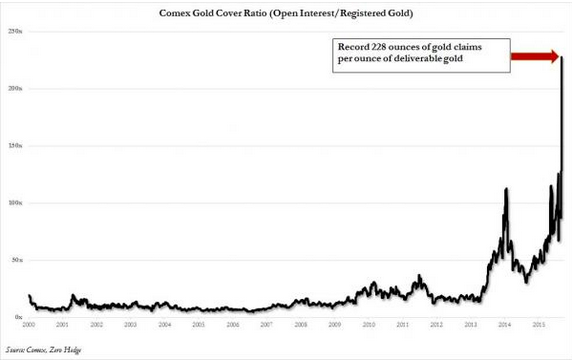
Read more …

Chinese have lost trust in their government.

• China Consumers Tighten Belts, A Red Flag For The Global Economy (Reuters)

Terry Xu considers himself one of the lucky ones. The 32-year-old father-of-one invested 10% of his savings earlier this year in Chinese stocks. Now, with markets down around 40% since mid-June, he’s selling off his portfolio at a loss. Painful, but not a catastrophe – he says his colleagues lost more, and he earns well above the average wage. But the equity market turmoil, coupled with signs the economy is slowing means Xu, and millions of other middle class Chinese consumers like him, is scaling back his spending in an ominous sign for China’s policymakers and the global economy. “This year’s economy has been uncertain,” he said. “It’s not like before, where we just used to buy everything for our child. Now, we only buy and spend what we need”.

Xu earns 20,000 yuan ($3,140) a month as a product development manager for a Western headphone maker in Shenzhen. A flat he bought in 2012 for 900,000 yuan, which he shares with his 4-year-old daughter, wife and parents-in-law, is now worth 2.5 million. Still, he plans to keep his Apple iPhone 4 rather than upgrade to the latest iPhone 6S, and his next pair of trainers will be from the Chinese brand Anta Sports rather than his preferred Nike. Xu’s worries are typical of middle class families – relatively minor compared with the millions of his compatriots who get by on lower incomes. But his belt-tightening jars with the Chinese government’s hopes that consumers will pick up the slack as exports fall and it tries to rebalance the economy away from a long-running reliance on trade and government spending.

Domestic consumption contributed 60% of China’s economic growth in the first half of 2015, up from 51.2% in the whole of 2014, suggesting Beijing’s desired rebalancing is on track. But forward looking indicators and companies’ experiences in China are more worrying. A China consumer confidence index produced by ANZ Bank and polling company Roy Morgan fell to a record low in August. Car sales in China could drop this year for the first time in two decades, while smartphone sales recorded their first fall in China during the second quarter, consumer research firm Gartner said. If that translates into a slowdown in overall consumer spending, the impact will be felt beyond China.

Read more …

Chasing shadows.

• China Prosecutor To Intensify Financial Markets Crackdown (Reuters)

China’s state prosecutor will intensify its crackdown on criminal activities in its stock and futures markets, following a series of high-profile cases involving one of the country’s market regulators and securities firms. The prosecutor told a news conference in Beijing it would strengthen coordination with market regulators as part of efforts to halt activities such as insider trading and spreading of false information, state radio said on its website on Wednesday. The authorities have stepped up investigations on market participants since June, when wild gyrations sent the equity market down as much as 40%. Amid the crackdown, investors, fund managers and watchdog officials have all been the subject of investigations. The China Securities Regulatory Commission said on Sept. 18 it has recently started investigating 19 cases of suspected illegal share sales and speculative activities.

Meanwhile, executives at the country’s largest broker CITIC Securities, including its general manager, are being investigated by authorities for alleged offences including insider trading and leaking information. The country’s securities watchdog has also been swept up in the crackdown. China’s Communist Party sacked CSRC Assistant Chairman Zhang Yujun, state media reported on Sept. 22, days after it was announced he was the subject of a graft probe. The campaign to identify and punish those deemed responsible for the market sell-off started shortly after June’s turmoil. However, most analysts attribute the summer crash to the bursting of a typical stock market bubble which was earlier spurred by official media and fueled in large part by borrowed money.

Read more …

Perfect timing.

• China Is Sitting on an Ocean of Diesel Fuel (Bloomberg)

Add diesel to the commodities flooding global markets from China. The nation exported a record volume of the fuel last month after already shipping unprecedented amounts of steel and aluminum overseas. The weakest economic growth since 1990 is sapping domestic demand for commodities, while refineries, mills and smelters grapple with excess capacity after years of expansion. “A lot of it has to do with slowing demand at a time when companies had plans for much a better demand environment, so capacities had been increased,” said Ivan Szpakowski at Citigroup in Hong Kong. “As demand slows, that’s led to an overcapacity in the domestic market and producers have sought to export the surplus.”

Exports of Chinese raw materials are exacerbating a global glut that drove prices to the lowest since the 2008 financial crisis and prompted steel and aluminum producers around the world to protest against the deluge. While diesel exports are principally a risk to Asian refiners, the additional shipments threaten to worsen a glut that already extends from Singapore to Europe and the U.S. Refining profits, or cracks, from making diesel in the Asian oil trading hub of Singapore have shrunk about 30% from a year ago as exports from China, India and the Middle East create an oversupply, according to Ehsan Ul-Haq, an analyst at KBC Advanced Technologies in London.

“The world is becoming an ocean of diesel,” said Ul-Haq. “Demand in China is not as high as it was previously expected. Chinese refiners are becoming more export oriented.” China’s August shipments of the fuel, also known as gasoil, surged 77% from a year earlier to a record 722,516 metric tons, or about 175,000 barrels a day, according to data released this week by the General Administration of Customs. They may rise to about 250,000 barrels a day later this year, according to ICIS China and JBC Energy GmbH, industry consultants. “Inevitably, this should prevent gasoil cracks in Asia from going higher than they already are,” said David Wech, managing director of Vienna-based JBC.

Read more …

Talking his book.

• Bill Gross: “Mainstream America Is Being Slowly Cooked Alive” (Zero Hedge)

While hardly as dramatic as Bill Gross’ last letter in which he urged readers to “go to cash” as a result of the “Frankenstein creation” that ZIRP has created, his latest letter “Saved by Zero” takes a calmer stance and urges central banks to “get off zero” as the “developed world is beginning to run on empty because investments discounted at near zero over the intermediate future cannot provide cash flow or necessary capital gains to pay for past promises in an aging society. And don’t think that those poor insurance companies and gargantuan pension funds in the hundreds of billions are the only losers.” His punchline:

“Mainstream America with their 401Ks are in a similar pickle. Expecting 8-10% to pay for education, healthcare, retirement or simply taking an accustomed vacation, they won’t be doing much of it as long as short term yields are at zero. They are not so much in a pickle barrel as they are on a revolving spit, being slowly cooked alive while central bankers focus on their Taylor models and fight non-existent inflation.”

We are not so sure about that non-existant inflation: sure, if one ignores healthcare, food, tuition and expecially rental costs, then sure. But let that slide for the time being. Gross’ conclusion: “get off zero and get off quick. Will 2% Fed Funds harm corporate America that has already termed out its debt? A little. Will stock and bond prices go down? Most certainly. But like Volcker recognized in 1979, the time has come for a new thesis that restores the savings function to developed economies that permit liability based business models to survive – if only on a shoestring – and that ultimately leads to rejuvenated private investment, which is the essence of a healthy economy. Near term pain? Yes. Long term gain? Almost certainly. Get off zero now!” Sure, it makes all the sense in the world… and that’s why the Fed won’t do it precisely because of the “stock prices going down” part.

The Fed clearly confirmed that the stock market mandate is the only one it cares about, and as such it will let Wall Street trample over Main Street any day. Confirming this is the latest Fed Funds projection which has a December rate hike now at just 42% odds, meaning the majority of the market no longer believes the rate hike will come before 2016 (just as Goldman demanded), and is acting accoridngly. The real question, one not addressed by Gross in this letter, is the dramatic shift in the market’s posture, one where a continuation of easy conditions no longer leads to a surge in stocks. It is this that is the biggest threat to the Fed, as the market is now confirming a major easing episode such as QE4 or NIRP may not be what the Econ PhD doctor ordered to get new all time highs. This is why the Fed is not only trapped, but pushing on a string. And the longer it keeps rates at zero the greater the pain in the long-run.

Read more …

“..scarce labour will set off a bidding war for workers, all spiced by a state of latent social warfare between the generations.” “The last time Europe’s serfs suddenly found themselves in huge demand was after the Black Death in the mid-14th century. They say it ended feudalism.”

• Deflation Supercycle Is Over As World Runs Out Of Workers (AEP)

Workers of the world are about to get their revenge. Owners of capital will have to make do with a shrinking slice of the cake. The powerful social forces that have flooded the global economy with abundant labour for the past four decades years are reversing suddenly, spelling the end of the deflationary super-cycle and the era of zero interest rates. “We are at a sharp inflexion point,” says Charles Goodhart, a professor at the London School of Economics and a former top official at the Bank of England. As cheap labour dries up and savings fall, real interest rates will climb from sub-zero levels back to their historic norm of 2.75pc to 3pc, or even higher. The implications are ominous for long-term US Treasuries, Gilts or Bunds. The whole structure of the global bond market is a based on false anthropology.

Prof Goodhart says the coming era of labour scarcity will shift the balance of power from employers to workers, pushing up wages. It will roll back the corrosive inequality that has built up within countries across the globe. If he is right, events will soon discredit the sweeping neo-Marxist claims of Thomas Piketty, the best-selling French economist who vaulted to stardom last year. Mr Piketty’s unlikely bestseller – Capital in the 21st Century – alleged that the return on capital outpaces the growth of the economy over time, leading ineluctably to greater concentrations of wealth in an unfettered market system. “Piketty was wrong,” said Prof Goodhart. What in reality happened is that the twin effects of plummeting birth rates and longer life spans from 1970 onwards led to a demographic “sweet spot”, a one-off episode that temporarily distorted labour economics.

Prof Goodhart and Manoj Pradhan argue in a paper for Morgan Stanley that this was made even sweeter by the collapse of the Soviet Union and China’s spectacular entry into the global trading system. The working age cohort was 685m in the developed world in 1990. China and eastern Europe added a further 820m, more than doubling the work pool of the globalised market in the blink of an eye. “It was the biggest ‘positive labour shock’ the world has ever seen. It is what led to 25 years of wage stagnation,” said Prof Goodhart, speaking at a forum held by Lombard Street Research. We all know what happened. Multinationals seized on the world’s reserve army of cheap leader. Those American companies that did not relocate plant to China itself were able play off Chinese wages against US workers at home, exploiting “labour arbitrage”.

US corporate profits after tax are now 10pc of GDP, twice their historic average and a post-war high. It was much the same story in Europe. Volkswagen openly threatened to shift production to Poland in 2004 unless German workers swallowed a wage freeze and longer hours, tantamount to a pay cut. IG Metall bowed bitterly to the inevitable. Cheap labour held down global costs and prices. China compounded the effect with a factory blitz – on subsidised credit – that pushed investment to a world record 48pc of GDP and flooded markets with cheap goods – first clothes, shoes and furniture, and then steel, ships, chemicals, mobiles and solar panels. Lulled by low consumer price inflation, central banks let rip with loose money – long before the Lehman crisis – leading to even lower real interest rates and asset bubbles. The rich got richer.

Read more …

One in 7 German jobs is related to car industry.

• Volkswagen Could Pose Bigger Threat To German Economy Than Greek Crisis (Reuters)

The Volkswagen emissions scandal has rocked Germany’s business and political establishment and analysts warn the crisis at the car maker could develop into the biggest threat to Europe’s largest economy. Volkswagen is the biggest of Germany’s car makers and one of the country’s largest employers, with more than 270,000 jobs in its home country and even more working for suppliers. Volkswagen Chief Executive Martin Winterkorn paid the price for the scandal over rigged emissions tests when he resigned on Wednesday and economists are now assessing its impact on a previously healthy economy. “All of a sudden, Volkswagen has become a bigger downside risk for the German economy than the Greek debt crisis,” ING chief economist Carsten Brzeski told Reuters.

“If Volkswagen’s sales were to plunge in North America in the coming months, this would not only have an impact on the company, but on the German economy as a whole,” he added. Volkswagen sold nearly 600,000 cars in the United States last year, around 6% of its 9.5 million global sales. The U.S. Environmental Protection Agency said the company could face penalties of up to $18 billion, more than its entire operating profit for last year. Although such a fine would be more than covered by the €21 billion the company now holds in cash, the scandal has raised fears of major job cuts. The broader concern for the German government is that other car makers such as Daimler and BMW could suffer fallout from the Volkswagen disaster. There is no indication of wrongdoing on the part of either company and some analysts said the wider impact would be limited.

The German government said on Wednesday that the auto industry would remain an “important pillar” for the economy despite the deepening crisis surrounding Volkswagen. “It is a highly innovative and very successful industry for Germany, with lots of jobs,” a spokeswoman for the economy ministry said. But analysts warn that it is exactly this dependency on the automobile sector that could become a threat to an economy forecast to grow at 1.8% this year. Germany is already having to face up to the slowdown in the Chinese economy. “Should automobile sales go down, this could also hit suppliers and with them the whole economy,” industry expert Martin Gornig from the Berlin-based DIW think tank told Reuters.

Read more …

“Just four months before the VW emissions scandal broke, the EU’s three biggest nations mounted a push to carry over loopholes from a test devised in 1970..”

• UK, France And Germany Lobbied For Flawed Car Emissions Tests (Guardian)

The UK, France and Germany have been accused of hypocrisy for lobbying behind the scenes to keep outmoded car tests for carbon emissions, but later publicly calling for a European investigation into Volkswagen’s rigging of car air pollution tests. Leaked documents seen by the Guardian show the three countries lobbied the European commission to keep loopholes in car tests that would increase real world carbon dioxide emissions by 14% above those claimed. Just four months before the VW emissions scandal broke, the EU’s three biggest nations mounted a push to carry over loopholes from a test devised in 1970 – known as the NEDC – to the World Light Vehicles Test Procedure (WLTP), which is due to replace it in 2017.

“It is unacceptable that governments which rightly demand an EU inquiry into the VW’s rigging of air pollution tests are simultaneously lobbying behind the scenes to continue the rigging of CO2 emissions tests,” said Greg Archer, clean vehicles manager at the respected green thinktank, Transport and Environment (T&E). “CO2 regulations should not be weakened by the backdoor through test manipulations.” Vehicle emissions are responsible for 12% of Europe’s carbon emissions and by 2021, all new cars must meet an EU emissions limit of 95 grams of CO2 per km, putting accurate measurements of real emissions at a premium. The loopholes would not only raise real world CO2 emissions from new cars to 110g CO2 per km – well above the EU limit – but increase fuel bills for drivers by €140 per year according to T&E.

Huw Irranca-Davies, Labour MP and chair of an influential select committee of MPs, the environmental audit committee, said: “Given that the UK is struggling to bring down carbon emissions and other harmful pollutants from road vehicles it is extremely worrying that the UK government appears to be trying to water down the EU’s proposed new road testing regime. “As well as cutting CO2 emissions, improving the efficiency of vehicles can save lives by reducing the illegal levels of air pollution in UK cities, so the Department for Transport should be making these tests more rigorous not less.” The WLTP test was supposed to remove loopholes that had allowed a gap between real world CO2 emissions and test cycle ones to develop, which EU consultants have estimated at up to 20%.

But the UK lobbied for car makers to be allowed to exploit flexibilities such as externally charging their batteries to full before testing. The Department for Transport also argued that the best available technologies should be shunned in favour of outdated ‘inertia classes’, which involve manually adding 100 kilo weights to the car to see what effect greater weight on the amount of CO2 the car pumps out. Research by the International Council on Clean Transportation has found that car manufacturers often game these tests by optimising test car performances at one pound below the desired inertia class. Germany went further than the UK, calling for the tests to be conducted on sloping downhill tracks, and for allowing manufacturers to declare a final CO2 value 4% lower than the one measured. France supported all the proposed loopholes, bar the 4% lower CO2 value.

Read more …

Can governments keep protecting their carmakers from the law?

• Volkswagen Emissions: Automakers’ Tobacco Moment? (CNBC)

The decimation of share prices across the autos industry this week highlights growing concerns that Volkswagen’s problem could quickly turn into one for the entire carmaking industry. The U.S. Environmental Protection Agency has accused Volkswagen of installing a device in its diesel vehicles to run maximum anti-pollution controls only when emissions tests were taking place. VW has admitted the mistake and apologised, with its U.S. boss, Michael Horn, saying the company had “totally screwed up.” No other car manufacturers have been accused of this kind of behavior. However, the light shone on what Volkswagen was trying to sell as emission-reducing cars, which were in fact pumping more nitrogen dioxide (NOx) into the air than thought, could be uncomfortable for others.

The scandal should be “a massive wake up call to governments and regulators around the world,” Friends of the Earth air pollution campaigner Jenny Bates told CNBC. “More than fifty thousand people die early every year in the UK due to our illegally filthy air. Vehicle pollution is the main problem, with diesel vehicles the biggest culprit. Tough pollution standards are crucial for cleaning up our sub-standard air quality – which is why an urgent investigation is needed to ensure that the motor industry is complying with EU regulations.” Even given the drastic share price falls, investors are likely to stay away from the automobile sector for a while as they wonder which company will be next.

Analysts have been producing gloomy forecasts for both Volkswagen and the sector as a result, with one typical example from Societe Generale, which downgraded the sector from Overweight to Neutral, deeming it “dead money”. Yet the fallout could be even worse than feared, if it emerges that the problem of promoting cars as more environmentally friendly than they are goes beyond Volkswagen. This kind of industry-wide problem is sometimes called a “tobacco moment” after the cigarette industry’s early denials of the links between smoking and lung cancer, which eventually proved futile.

Read more …

Industry + governments.

• Volkswagen Test Rigging Follows a Long Auto Industry Pattern (NY Times)

Long before Volkswagen admitted to cheating on emissions tests for millions of cars worldwide, the automobile industry, Volkswagen included, had a well-known record of sidestepping regulation and even duping regulators. For decades, car companies found ways to rig mileage and emissions testing data. In Europe, some automakers have taped up test cars’ doors and grilles to bolster their aerodynamics. Others have used “superlubricants” to reduce friction in the car’s engine to a degree that would be impossible in real-world driving conditions. Automakers have even been known to make test vehicles lighter by removing the back seats. Cheating in the United States started as soon as governments began regulating automotive emissions in the early 1970s.

In 1972, certification of Ford Motor’s new cars was held up after the EPA found that the company had violated rules by performing constant maintenance of its test cars, which reduced emissions but did not reflect driving conditions in the real world. Ford walked away with a $7 million fine. The next year, the agency fined Volkswagen $120,000 after finding that the company had installed devices intended specifically to shut down a vehicle’s pollution control systems. In 1974, Chrysler had to recall more than 800,000 cars because similar devices were found in the radiators of its cars. Such gadgets became known as “defeat devices,” and they have long been banned by the EPA. But their use continued to proliferate, and they became more sophisticated, as illustrated by Volkswagen’s admission this week that 11 million diesel cars worldwide were equipped with software used to cheat on emissions tests. [..]

In the United States, automakers’ lobbying has ensured that the statute giving powers to the National Highway Traffic Safety Administration “has no specific criminal penalty for selling defective or noncompliant vehicles,” says Joan Claybrook, a former administrator of the agency and a longtime advocate of auto safety. There are no criminal penalties under laws applying to the E.P.A. for violations of motor vehicle clean air rules, though there is a division of the Justice Department devoted to violations of environmental law. “I don’t see them changing this behavior unless criminal penalties are enacted into law that allow the prosecutor to put the executives in jail,” Ms. Claybrook said.

Read more …

Criminal investigation MUST follow.

• VW Chief Winterkorn Steps Down After Emissions Scandal (Bloomberg)

Volkswagen CEO Martin Winterkorn resigned after U.S. officials caught the company cheating on emissions tests, leaving the world’s top-selling automaker to appoint a fresh leader to repair its reputation among customers, dealers and regulators around the globe. Stepping down after almost a decade in charge, Winterkorn said he was accepting the consequences of the mushrooming scandal that has wiped €20 billion off the company’s market value. Possible replacements include Matthias Mueller, head of the Porsche brand who has the support of the family that controls a majority stake of Volswagen, and Herbert Diess, who recently joined from rival BMW, a person familiar with the matter said.

Meantime, the company expects more executives to be targeted in the coming days in its investigation, the executive committee of the supervisory board said in a statement, exonerating Winterkorn of being involved in the manipulations. Volkswagen also asked local German prosecutors to assist and open a criminal probe. “The incident must be cleared up mercilessly, and it must be assured that such things cannot ever happen again,” said Stephan Weil, a member of the board committee and the prime minister of Lower Saxony, a key Volkswagen shareholder. “We are very much aware of the scope of this issue, the economic damage and the implications for VW’s reputation.”

Winterkorn, who was supposed to receive a contract extension on Friday, had a dramatic fall from grace that began last week with the revelation that the Wolfsburg, Germany-based company fitted diesel-powered vehicles with software that circumvented air pollution controls, then lied about it to the U.S. Environmental Protection Agency for nearly a year. The 68-year-old CEO, who had repeatedly apologized for the manipulations, was unable to hang on as the stock price plummeted 35% over two days and pressure grew from the German government for quick action. “He had little choice,” said Erik Gordon at the University of Michigan. “The company’s reputation is in tatters.” Volkswagen shares rose 5.2% to close at €111.50 on Wednesday, clawing back some of the losses earlier this week. “Volkswagen needs a fresh start,” Winterkorn said in a statement. “I am clearing the way for this fresh start with my resignation.”

Read more …

Insanity squared.

• Volkswagen CEO Likely to Get $32 Million Pension After Leaving (Bloomberg)

Martin Winterkorn, engulfed by a diesel-emissions scandal at Volkswagen AG, amassed a $32 million pension before stepping down Wednesday, and may reap millions more in severance depending on how the supervisory board classifies his exit. After Winterkorn disclosed Wednesday that he had asked the board to terminate his role, company spokesman Claus-Peter Tiemann declined to comment on how much money the departing CEO stands to get. Volkswagen’s most recent annual report outlines how Winterkorn, its leader since 2007, could theoretically collect two significant payouts. Winterkorn’s pension had a value of 28.6 million euros ($32 million) at the end of last year, according to the report, which doesn’t describe any conditions that would lead the company to withhold it.

And under certain circumstances, he also can collect severance equal to two years of “remuneration.” He was Germany’s second-highest paid CEO last year, receiving a total of 16.6 million euros in compensation from the company and majority shareholder Porsche SE.
While the severance package kicks in if the supervisory board terminates his contract early, there’s a caveat. If the board ends his employment for a reason for which he is responsible, then severance is forfeited, according to company filings. The supervisory board’s executive committee said in a statement Wednesday that Winterkorn “had no knowledge of the manipulation of emissions data,” and that it respected his offer to resign and request to be terminated. It also thanked him for his “towering contributions” to the company.

Winterkorn, 68, said in his statement Wednesday that he was stunned to learn of the scope of alleged misconduct occurring at the company. U.S. officials said Sept. 18 the carmaker had cheated during tests of diesel-powered vehicles sold since 2009. “As CEO I accept responsibility for the irregularities that have been found in diesel engines and have therefore requested the supervisory board to agree on terminating my function as CEO,” he said. “I am doing this in the interests of the company even though I am not aware of any wrongdoing on my part.” The annual report also mentions another piece of his pension: He can use a company car in the years that benefit is being paid out.

Read more …

Being a VW dealership is a nightmare right now.

• What Volkswagen’s Crisis Could Mean for Auto Asset-Backed Securities (Alloway)

From the Environmental Protection Agency to … securitized bonds? The emissions scandal currently rocking Volkswagen is having ripple effects across markets, potentially moving all the way to sliced-and-diced bonds tied to car loans and leases. Sales of auto asset-backed securities, or ABS, have been booming in recent years as investors seek out higher-yielding products. According to Deutsche Bank estimates, about $5.6 billion worth of VW auto ABS is outstanding, with some $4.39 billion of that figure coming from bonds backed by loans and leases. Volkswagen, now facing potential fines and litigation, could find its ability to attract new business temporarily crimped, forcing down the values of the cars backing such loans. But that will probably have little impact on ABS investors, according to Elen Callahan, Deutsche Bank analyst.

“Given that the vehicles are still ‘safe and legal to drive’ and that the repairs will come at no cost to the owner, we do not expect borrowers to become disincentivized from making their contractual monthly payment on their VW vehicle,” she wrote in a note published on Wednesday. Still the $1.25 billion worth of bonds that Deutsche bank estimates are backed by car dealer inventories of VW cars—known as dealer floorplan ABS—could be a more complicated story. “As is typical for dealer floorplan ABS, the ABS trust benefits from VW financing assistance including but not limited to VW’s pledge to repurchase unsold new vehicles and inventory,” Callahan said. “We believe that despite the financial burdens associated with the recalls, VW will continue to honor this commitment given the importance of its dealer network to its primary business.”

The revelations made public last week by the EPA have reminded some auto bond analysts of recalls that hit Toyota Motor in 2009 and 2010, which affected some 9 million vehicles. Car dealers, told to immediately halt sales of popular 2015 and 2016 models, including Volkswagen’s Jetta and Beetle convertible, “are now saddled with unsalable product, at least for the time being,” Barclays analyst Brian Ford told clients in a Tuesday report. “Dealers now have a number of cars that they cannot sell; so inventory will not turn over as rapidly,” he said in a follow-up interview. “The ABS most affected by VW’s sales stoppage of certain 2015 and 2016 diesel models is the dealer floorplan securitizaiton.”

Read more …

This is not new.

• VW Recall Letters In April Warned Of An Emissions Glitch (Reuters)

In April of 2015, Volkswagen of America, Inc. sent letters to California owners of diesel-powered Audis and Volkswagens informing them of an “emissions service action” affecting the vehicles. Owners were told they would need to take their cars to a dealer for new software to ensure tailpipe emissions were “optimized and operating efficiently.” The company didn’t explain that it was taking the action in hopes of satisfying government regulators, who were growing increasingly skeptical about the reason for discrepancies between laboratory emissions test results and real world pollution from Volkswagen’s diesel cars. Officials at the California Air Resources Board and the EPA agreed in December of 2014 to allow a voluntary recall of the company’s diesel cars to fix what Volkswagen insisted was a technical – and easily solved – glitch.

The recall was rolled out nationally over a period of months. On Wednesday, California Air Resources Board spokesman Dave Clegern confirmed that the letters were part of that recall. “This is one of the fixes they presented to us as a potential solution. It didn’t work,” he said. Volkswagen, which had no obligation at the time it initiated the recall to disclose the discussions that had led to it, declined to comment on the letter. The controversy came to public attention last week after Volkswagen acknowledged it had deliberately deceived officials about how much its diesel cars polluted. The recall letter instructed owners of certain 2010-2014 Volkswagen vehicles with 2-liter diesel engines to contact dealers for a software update in order to fix an issue with the malfunction indicator light illuminating.

“If the [light] illuminates for any reason, your vehicle will not pass an IM emissions inspection in some regions,” the letter warned, noting that California required the update before it would renew vehicle registrations. “The vehicle’s engine management software has been improved to assure your vehicle’s tailpipe emissions are optimized and operating efficiently,” read the letter, which said an earlier software update increased the likelihood of the light illuminating.

Read more …

“We had 10 meetings with VW..” “Time and again they refused to tell us what was going on.”

• How Smog Cops Busted Volkswagen and Brought Down Its CEO (Bloomberg)

The revelation that ended Martin Winterkorn’s career at Volkswagen AG came on Sept. 3 in a meeting at an office park east of Los Angeles. After months of obfuscation, company engineers finally divulged a secret to engineers at the California Environmental Protection Agency’s Air Resources Board: Volkswagen had installed a “defeat device” to cheat on vehicle emissions tests — and then lied about it to the board and the U.S. EPA for more than a year. On Sept. 23, Europe’s largest automaker announced that Winterkorn, its 68-year-old chief executive officer, had resigned. While the company exonerated him of involvement in the manipulations, it said it will conduct an internal investigation and has asked local German prosecutors to assist and open a criminal probe.

The unraveling began in 2013. European regulators, concerned about diesel pollution there, wanted to test emissions on vehicles sold in the U.S. under actual driving conditions. The results were expected to show real-world emissions were closer to lab performance in America than in Europe. But they weren’t. That prompted investigations in California that ultimately involved 25 technicians working almost full time. They discovered the software Volkswagen used to circumvent air-pollution regulations in at least 11 million cars. “This is going to become a very, very serious problem for Volkswagen and any other companies that may have had such practices,” said Donald W. Lyons, who founded the Center for Alternative Fuels, Engines and Emissions at West Virginia University.

The nonprofit International Council on Clean Transportation, with offices in Washington, Berlin and San Francisco, got the emissions-testing contract from European regulators. It then hired researchers at the Morgantown, West Virginia, center in early 2013. The center, which has studied engine emissions and use of alternative fuels since 1989, was going to evaluate three diesel passenger cars, including a Volkswagen Passat and Jetta. m“We never went into it saying,‘we’re going to catch a manufacturer,”’ said Arvind Thiruvengadam, a research assistant professor at the center. “We were totally looking and hoping to see something different.”[..]

Using portable measuring equipment with hoses attached to vehicle exhaust pipes, researchers drove the Jetta and BMW through Los Angeles and took the Passat to Seattle and back. They also worked with the California Air Resources Board’s laboratory in El Monte, which tested the cars on a dynamometer, a device that measures engine performance. When the Volkswagen cars were in the lab, they met the Clean Air Act standards. In the real world, they were belching out oxides of nitrogen at much higher levels than allowed. “There was a lot of texting and e-mailing back and forth,” among the two groups: “‘Whoa, things aren’t looking good here,”’ Carder said. In May 2014, the West Virginia center published the results of its study, prompting the California board to start an investigation.

Read more …

“..his team’s findings were made public nearly a year and a half ago..”

• West Virginia Engineer Proves To Be A David To VW’s Goliath (Reuters)

Daniel Carder, an unassuming 45-year-old engineer with gray hair and blue jeans, appears an unlikely type to take down one of the world’s most powerful companies. But he and his small research team at West Virginia University may have done exactly that, with a $50,000 study which produced early evidence that Volkswagen AG was cheating on U.S. vehicle emissions tests, setting off a scandal that threatens the German automaker’s leadership, reputation and finances. “The testing we did kind of opened the can of worms,” Carder says of his five-member engineering team and the research project that found much higher on-road diesel emission levels for VW vehicles than what U.S. regulators were seeing in tests.

The results of that study, which was paid for by the nonprofit International Council on Clean Transportation (ICCT) in late 2012 and completed in May 2013, were later corroborated by the U.S. Environmental Protection Agency and California Air Resources Board (CARB). Carder’s team – a research professor, two graduate students, a faculty member and himself – performed road tests around Los Angeles and up the West Coast to Seattle that generated results so pronounced that they initially suspected a problem with their own research. “The first thing you do is beat yourself up and say, ‘Did we not do something right?’ You always blame yourself,” he told Reuters in an interview. “(We) saw huge discrepancies. There was one vehicle with 15 to 35 times the emissions levels and another vehicle with 10 to 20 times the emissions levels.”

Despite the discrepancies, a fix shouldn’t involve major changes. “It could be something very small,” said Carder, who’s the interim director of West Virginia University’s Center for Alternative Fuels, Engines and Emissions in Morgantown, about 200 miles (320 km) west of Washington in the Appalachian foothills. “It can simply be a change in the fuel injection strategy. What might be realized is a penalty in fuel economy in order to get these systems more active, to lower the emissions levels.” Carder said he’s surprised to see such a hullabaloo now, because his team’s findings were made public nearly a year and a half ago. “We actually presented this data in a public forum and were actually questioned by Volkswagen,” said Carder.

Read more …

Perpetual growth.

• Forget ‘Developing’ Poor Countries, It’s Time To ‘De-Develop’ Rich Countries (Guardian)

This week, heads of state are gathering in New York to sign the UN’s new sustainable development goals (SDGs). The main objective is to eradicate poverty by 2030. Beyoncé, One Direction and Malala are on board. It’s set to be a monumental international celebration. Given all the fanfare, one might think the SDGs are about to offer a fresh plan for how to save the world, but beneath all the hype, it’s business as usual. The main strategy for eradicating poverty is the same: growth. Growth has been the main object of development for the past 70 years, despite the fact that it’s not working. Since 1980, the global economy has grown by 380%, but the number of people living in poverty on less than $5 (£3.20) a day has increased by more than 1.1 billion. That’s 17 times the population of Britain. So much for the trickle-down effect.

Orthodox economists insist that all we need is yet more growth. More progressive types tell us that we need to shift some of the yields of growth from the richer segments of the population to the poorer ones, evening things out a bit. Neither approach is adequate. Why? Because even at current levels of average global consumption, we’re overshooting our planet’s bio-capacity by more than 50% each year. In other words, growth isn’t an option any more – we’ve already grown too much. Scientists are now telling us that we’re blowing past planetary boundaries at breakneck speed. And the hard truth is that this global crisis is due almost entirely to overconsumption in rich countries.

Scientists tell us our planet only has enough resources for each of us to consume 1.8 “global hectares” annually – a standardised unit that measures resource use and waste. This figure is roughly what the average person in Ghana or Guatemala consumes. By contrast, people in the US and Canada consume about 8 hectares per person, while Europeans consume 4.7 hectares – many times their fair share. What does this mean for our theory of development? Economist Peter Edward argues that instead of pushing poorer countries to “catch up” with rich ones, we should be thinking of ways to get rich countries to “catch down” to more appropriate levels of development.

We should look at societies where people live long and happy lives at relatively low levels of income and consumption not as basket cases that need to be developed towards western models, but as exemplars of efficient living. How much do we really need to live long and happy lives? In the US, life expectancy is 79 years and GDP per capita is $53,000. But many countries have achieved similar life expectancy with a mere fraction of this income. Cuba has a comparable life expectancy to the US and one of the highest literacy rates in the world with GDP per capita of only $6,000 and consumption of only 1.9 hectares – right at the threshold of ecological sustainability. Similar claims can be made of Peru, Ecuador, Honduras, Nicaragua and Tunisia.

Read more …

Move over, darling.

• ‘Downsizing Could Free Up 2.5 Million British Homes’ (Guardian)

More than 2.5m homes could be released on to the property market if older owners were given better incentives and information on downsizing, the Royal Institution of Chartered Surveyors (Rics) has claimed. It said tackling the housing crisis needed to address barriers to supply, rather than simply addressing demand, and that 2.6m homes worth a combined £802bn could be released if homeowners received greater support to move into specialist retirement or smaller properties. The group’s Residential Policy Review also recommended that second homeowners should be charged full council tax to encourage them to sell or let the property, and that new developments should have a statutory percentage of affordable rented accommodation.

The report comes just days after the City regulator was forced to deny its policy was to encourage older homeowners to move, after comments made by a member of staff on its mortgage team sparked controversy. Increased life expectancy means that there around 11.4 million over-65s in the UK, and the figure is projected to rise to around 17.2 million by 2033. Currently, homeownership is concentrated in older age groups, with many owning their properties outright. Rics said communication about alternatives to staying in the family home were poor, meaning that options like retirement rental, housing co-operatives and shared housing were not being fully exploited. It acknowledged “there is a very strong emotional dimension to people’s homes, with considerable effort, both physical and emotional, to moving”.

Jeremy Blackburn, head of policy at Rics said: “Britain’s older homeowners are understandably reluctant to move out of much-loved, but often under-occupied family homes. “Clearly, it’s an emotive issue and one that needs to be treated with sensitivity, but we would like to see central and local government provide older people with the information, practical and financial support they need to downsize if that is their choice.” Blackburn cited the example of Bristol City council, which said it was offering a fund to support moving costs. “Almost a third of over 55s have considered downsizing in the last five years; yet we know that only 7% actually did,” he said.

Read more …

Not the first NHS warning in recent days.

• Prepare For A Catastrophic NHS Winter Meltdown (Guardian)

The NHS is on the brink of a major, messy failure. If nothing is done to address the underlying issues now, the failure will be deep with grave consequences and a long recovery. This winter things are set to go catastrophically wrong. Pressure on health services normally reduces in summer, often producing undue optimism about how they will cope come winter and delaying necessary preparations. Last summer there was virtually no reduction in pressure. Oddly, this failed to dent the optimism. The revised story was that unrelenting pressure had become a year-round phenomenon, so increased numbers and longer waits were now normal and the coming winter wouldn’t be any worse. Unfortunately it was, the worst in 20 years.

Demand for healthcare had simply reached a new (summer) plateau, with new peaks of winter demand inevitable and predictable – but not predicted and not prepared for. Waits and delays soared, even though demand increased modestly, following a well-established trend. The crisis happened because the NHS starved itself of the capacity it needed, in the futile belief that lack of supply would constrain demand and so save money. This led not only to running out of spare capacity, but to shortages and the loss of the elasticity to cope with new peaks in demand. The result was waits and delays multiplied rather than increased, and it contributed to the worst NHS deficit in a decade.

Despite this, the lesson has not been learned that the NHS’s struggles this summer foreshadow a meltdown this winter. Some 90% of trusts are predicting a deficit this year. The deficits add up to £2bn, double last year’s figure. Performance continues to wallow, with little or no recovery from the long delays and extended waiting times of last winter. Crucially, performance this summer was worse than last summer, which prefigured last winter’s crisis. The obvious conclusion is that it prefigures something worse.

Read more …

Sep 122015
 
 September 12, 2015  Posted by at 9:23 am Finance Tagged with: , , , , , , , , ,  18 Responses »


DPC The Mammoth Oak at Pass Christian, Mississippi 1900

• UN Warns Of Millions More Refugees Coming To Europe (Reuters)
• Migrant Crisis Could Be ‘Biggest Challenge’ In EU History: Germany (AFP)
• EU Refugee Quota Plan Rebuffed By At Least 4 European Nations (AP)
• Hungary Wants European Military Forces At Greek Borders (DW)
• Welcoming the Refugees: Has Germany Really Changed? (Juan Moreno)
• Germany’s Asylum System Struggles to Cope (Spiegel)
• China Is Dumping US Debt (CNN)
• Citi’s Chief Economist Says China Is ‘Financially Out of Control’ (Bloomberg)
• Goldman’s Next 11 Markets Are Sinking Even Faster Than the BRICs (Bloomberg)
• Poland Versus Greece (Paul Krugman)
• Greece at the Cross-Roads: A Test Case of Austerity (Pollack)
• A Plan B in Europe (Mélenchon, Fassina, Konstantopoulou, Lafontaine, Varoufakis)
• 1.5 Million People Take Part In Catalan Independence March (RTE)
• Canadian Household Debt Hits New Record, Fuelled By Low Mortgage Rates (Star)
• $15 Minimum Wage for NY State: Ford Paid Workers That 100 Years Ago (Intercept)
• Russia Calls On World Powers To Arm Syrian Military (AP)
• Dairy Farmers at the Barricades (Bloomberg)
• Global Food Prices Hit Lowest Level In Over 6 Years (CNBC)

There should have been highest level emergency meetings for a long time now. Is Merkel afraid her Teflon may wear off?

• UN Warns Of Millions More Refugees Coming To Europe (Reuters)

[..] More than 170,000 migrants have crossed into Hungary from non-EU Serbia so far this year. Many try to avoid being registered in Hungary for fear of being stranded there or returned to the country later in their journey across Europe. In Geneva, the U.N. High Commissioner for Refugees (UNHCR) said it was sending pre-fabricated housing units to provide temporary overnight shelter for 300 families in Hungary but also expressed concern over Budapest’s tough approach, including the possible deployment of troops to tackle the crisis. “Obviously we expect authorities to respect rights of refugees whether they are the police or army,” said UNHCR spokesman William Spindler.

Syria’s four-year civil war has so far displaced almost eight million people, said Peter Salama of UNICEF, the U.N. childrens’ agency, adding: “There could be millions and millions more refugees leaving Syria and ultimately (going) to the European Union and beyond.” So far this year, a record 433,000 refugees and migrants have crossed the Mediterranean to Europe, more than double the total for all of 2014, the International Organization for Migration (IOM) said on Friday. The EC, backed by Germany and France, wants EU member states to accept mandatory quotas to share out some 160,000 refugees but the plan faces stiff resistance in some capitals. On Friday the UNHCR said the number of people requiring relocation had now risen to 200,000.

Speaking in Prague, Steinmeier said Germany was expecting about 40,000 refugees this weekend alone, adding the EU needed a “fair mechanism of redistribution of migrants (still coming)”. “This challenge cannot be borne by one country. We have to invoke European solidarity,” he told a joint news conference with the foreign ministers of the Czech Republic, Slovakia, Hungary and Poland – countries opposed to the EU’s proposal for mandatory quotas. Germany has come under fire from Orban and other east European leaders for opening its door to Syrian asylum seekers, saying such generosity will only encourage many more to come. Denmark, which like Britain has opted out of EU rules on justice and home affairs, said on Friday it would not take part in the Commission’s relocation scheme.

Earlier this week, Denmark shut off some traffic with Germany to curb refugees trying to reach Sweden, which remains much more welcoming than other Scandinavian countries, but later allowed them to travel through. Finland said it would accept its 2% share of asylum seekers under the Commission plan but said it remained opposed to mandatory quotas and would cut benefits for refugees. EU interior ministers are due to discuss the Commission proposals on Monday. If they fail to reach a deal on tackling the crisis, European Council chief Donald Tusk said on Friday he would call an extraordinary summit of EU leaders this month.

Read more …

No doubt there.

• Migrant Crisis Could Be ‘Biggest Challenge’ In EU History: Germany (AFP)

The unprecedented influx of refugees and migrants flooding into the EU could be the bloc’s greatest-ever challenge, Germany’s foreign minister said Friday, adding Berlin expects 40,000 new migrants to arrive this weekend. Europe’s largest refugee crisis since the end of World War II could be “the biggest challenge for the EU in its history,” said Frank-Walter Steinmeier, calling for solidarity at Prague crisis talks with eastern EU members who have ruled out binding migrant quotas proposed by the European commission. “If we are united in describing the situation as such, we should be united that such a challenge is not manageable for a single country,” he said, adding “we need European solidarity.”

“Germany expects 40,000 new migrants from the south at the weekend, despite the willingness of German people our possibilities are smaller and smaller,” Steinmeier told counterparts from the Czech Republic, Hungary, Slovakia and Poland. Record numbers of people, many of them fleeing war and conflict in Syria and Iraq, continued to pour into Europe, with around 7,600 entering Macedonia in the last 12 hours.

Read more …

This is going to be a fight.

• EU Refugee Quota Plan Rebuffed By At Least 4 European Nations (AP)

At least four countries Friday firmly rejected a European Union plan to impose refugee quotas to ease a worsening migrant crisis that Germany’s foreign minister said was “probably the biggest challenge” in the history of the 28-nation bloc. Hungary, which along with the Czech Republic, Slovakia and Poland said it would not support the proposal, threatened instead to crack down on the thousands of people streaming across its borders daily as they flee war and persecution. The stance by those Central European countries reflected a hardening front against distributing at least some of the refugees among them and was a stinging rebuff to German Foreign Minister Frank-Walter Steinmeier, who traveled to Prague to try to persuade them to reconsider.

While the Czechs, Slovaks and Poles have been relatively unaffected by the influx, Hungary has faced growing criticism about its stance toward the asylum seekers. Other EU leaders and human rights groups accuse the government of gross mismanagement or serious negligence in housing, feeding and processing the migrants traveling from the Balkans and through Hungary to Western Europe. Peter Bouckaert of Human Rights Watch asserted Hungary was keeping migrants and refugees “in pens like animals, out in the sun without food and water.” A video that the rights group said was from inside a holding facility at the border town of Roszke showed metal fences surrounding clusters of tents and dividing migrants into groups. Guards were depicted throwing food into the air for desperate people to grab.

Erno Simon, a spokesman in Hungary for the U.N. refugee agency, said the housing situation in Roszke with nighttime temperatures falling to near freezing “is really very, very alarming.” Unfazed, Hungarian Prime Minister Viktor Orban threatened an even harder line, saying his country intended to catch, convict and imprison people who continue to penetrate its new border barriers as part of get-tough border security measures scheduled to begin Tuesday. “If they don’t cross into Hungary territory legally, we will consider it a crime,” Orban said, saying the “illegal immigrants” had no one to blame but themselves for any hardships suffered. “They don’t cooperate. They are not willing to go to the places where they receive provisions: food, water, shelter, health care. They have risen up against Hungary’s legal order,” he told a Budapest news conference.

Read more …

How long till we see refugees get shot to death?

• Hungary Wants European Military Forces At Greek Borders (DW)

Beginning on September 15, “Hungarian authorities cannot be forgiving of illegal border-crossing,” Orban said on Friday after meeting with Manfred Weber, the chairman of the conservative European People’s Party in the EU Parliament. “We will not courteously accompany them as until now.” Stricter immigration laws are set to take place next week to block the flow of migrants passing through the country on their way to northern European countries. Many are trying to avoid registering in Hungary out of fear of being stranded or returned to the country later. Over 170,000 people have entered Hungary this year, with the UN expecting another 42,000 to arrive next week. Orban also accused refugees of “rebelling against Hungarian legal order” after numerous camp breakouts and standoffs at the Budapest train station.

“They have seized railway stations, refused to give fingerprints, failed to cooperate, and are unwilling to go to places where they would get food, water, accommodation and medical care,” he said. The prime minister also blamed Greece for Hungary’s current refugee crisis. “If Greece is not capable of protecting its borders, we need to mobilize European forces to the Greek borders so that they can achieve the goals of European law instead of the Greek authorities. That is one of the foremost goals,” Orban said. His statements come at the end of an uneasy week which saw increasing tensions at the Serbian-Hungarian border. The country’s decision to build a fence along its border with Serbia, as well as a recent video of refugees being fed “like animals in a pen” at a border reception center drew international criticism on Friday.

Read more …

Juan Moreno, child of Spanish immigrants to Germany, tries to find out for Der Spiegel if the country’s really changed.

• Welcoming the Refugees: Has Germany Really Changed? (Juan Moreno)

I continue my journey to Leipzig, to the next person who is an expert on foreigners. Oliver Decker is a psychologist, sociologist and philosopher. He received his PhD, became a professor and has focused his academic attentions for the last 13 years on right-wing extremism and xenophobia. Last year, he published his latest study, which was widely quoted in the press. The conclusion: Germans have become less xenophobic. Whereas 9.7% of Germans still had a right-wing extremist weltbild 13 years ago, only 5.4% do today. Anti-Semitism, sympathy for National Socialism, support for a dictatorship: all of that, Decker wrote, is on the wane. That seemed to be the answer to my question. Right down to the decimal point.

Decker is a calm man with a penchant for holding forth in long and complicated sentences. I meet him in a café not far from Leipzig University, where he works. We order something to eat, but before our food comes, Decker makes it clear to me that Laschet is wrong. “There is only an ostensive reduction in xenophobia,” Decker says, explaining that the rejection of certain groups has become more acute. Sinti, Roma and Muslims, for example, are more disapproved of than they used to be, he says. According to Decker, many Germans feel there are two types of foreigners: the useful and the useless. “The Italians brought us their cuisine, so they can stay,” Decker says with ironic bitterness. Americans, Britons, French and Spaniards all integrate well, find work and pay taxes.

But if people believe that newcomers don’t contribute, they are rejected even more than before. Someone once called it “Usefulness-racism.” Decker says that the German identity is deeply bound up with the economy. “Even the poor are proud of the fact that the world envies us for our economy. If that is threatened by immigration, acceptance begins to fall,” he says. So is it all just a big misunderstanding, this new German tolerance of foreigners? Decker smiles. “Germany is currently experiencing a period of economic sunshine, which has led to a reduction in xenophobia. I will be interested to see what studies find a few years from now.”

Read more …

German reality beyond the initial euphoria: pretty soon, dramatic scenes will start to unfold.

• Germany’s Asylum System Struggles to Cope (Spiegel)

Hannelore Kraft, the Social Democratic (SPD) governor of North Rhine-Westphalia, Germany’s most populous state, made clear at the beginning of the week that the number of refugees to be expected this year will likely rise from the 800,000 the federal government forecast in August. She also made clear that the effort needed to deal with the influx will be much greater than previously thought. Just how great that effort might be became clear on Thursday morning during a conference call of all state interior ministries in addition to the federal Interior Ministry in Berlin. As part of the meeting, states indicated how much shelter capacity they possessed, and the results, according to the phone conference’s protocol, were not particularly promising.

Seven states – including Baden-Württemberg, Hesse and Rhineland-Palatinate – reported that they had no remaining capacity whatsoever. Bavaria complained of “uncontrolled access pathways.” And Schleswig-Holstein lamented the “uncoordinated influx into the reception facilities.” The Interior Ministry in Berlin also had an alarm bell to sound: Austria, through which refugees must travel on their way from Hungary to Germany, is beginning to diverge from the joint approach. The conference call provides a small insight into the immense challenges facing Germany this year and in the years to come. Indeed, the effects are likely to remain with the country for decades to come — and will have consequences for Germany’s identity, its prosperity and for its self-image. Against that backdrop, the question arises: Can we handle the crisis? Or will the crisis handle us?

Either is possible. It could be that Germany, with its gleeful welcoming party, is currently sowing the seeds for problems that the country will face in 2040. It could be that the foreigners will remain foreign, that they will create a new, parallel underclass. Simultaneously, it could also be that Germany is currently solving those problems that would, without immigration, face the country in 2040: Labor market problems, pension fund problems and old-age care problems. It will take many years before it becomes clear in which direction the pendulum is swinging. But if Germany wants the opportunities to win out over the dangers, then that state will have to confront the chaos and do all it can to integrate the newcomers, the majority of whom are likely to stay. And that project will have to begin soon, even if the state is currently having difficulties accelerating asylum procedures, providing therapy to traumatized children and training adults for the labor market.

Read more …

“Capital outflows have skyrocketed in China and the yuan is under intense selling pressure..”

• China Is Dumping US Debt (CNN)

It’s no secret that China is the largest holder of U.S. debt. So should Americans be concerned that China has started dumping some of its Treasury holdings? After all, it raises serious questions about whether China will keep lending Washington money to help finance the federal deficit in the future. But right now, China is selling because it’s in dire need of cash. Recently, it unleashed multiple moves to support its markets and prevent its currency from a freefall, while at the same time trying to stimulate the economy. China owned $1.3 trillion of U.S. Treasuries as of June, making it the biggest holder of U.S. debt. But China’s foreign-exchange reserves plunged by a record $94 billion in August, according to the country’s central bank, leaving it with a war chest of $3.6 trillion.

Analysts say it’s very safe to believe a big chunk of that decline occurred due to a reduction in U.S. Treasury holdings. The selling and the potential that China will not be buying U.S. debt in the near future raises questions on its potential to increase America’s borrowing costs. Some of this might already be happening, at least at a small scale. When stock markets are turbulent, investors usually rush to the safety of U.S. Treasurys and yields fall. However, despite August’s extreme stock volatility, rates on Treasurys actually rose slightly in late August. Part of that move is likely due to Wall Street betting the Federal Reserve may raise interest rates next week. But market participants also suspect the unusual action in the bond market was driven by China dumping Treasuries.

This time, Beijing is cutting its Treasury holdings out of a weakened position as it tries to stave off more declines in its currency. China is also propping up its stock market, which lost half its value in the span of just a few months this summer. “Capital outflows have skyrocketed in China and the yuan is under intense selling pressure. The only thing they could do is sell Treasuries to buy their own currency,” said Walter Zimmerman, chief technical analyst at United-ICAP.

Read more …

The 55% chance is a loony number and Buiter’s ‘solutions’ make zero sense, but his headline may well be correct for once. Coming from America’s biggest bank, this should have Beijing in a nervous state.

• Citi’s Chief Economist Says China Is ‘Financially Out of Control’ (Bloomberg)

Willem Buiter, Citigroup chief economist, sees a storm brewing in China. This week, he estimated that there is a 55% chance of a made-in-China global recession in the not too distant future, which he defines as a period of sub-2% global growth. Without a massive, consumer-focused stimulus plan, he argues, Chinese growth will slip below 4%. This would constitute a recession for the world’s second-largest economy, according to Buiter, and the rest of the world wouldn’t be insulated from the slowdown. Buiter appeared on BloombergTV to discuss his headline-grabbing call.

The cause of his consternation is the immense debt that Chinese non-financial companies have racked up in a short period of time. Over the past decade, the indebtedness of China’s private sector has exploded and exceeded that of the U.S., which Buiter pointed out has a much more advanced economy and sophisticated financial system: “I think things are financially out of control in China and we are waiting for the regulators and supervisors to bring things back under control and to do for the financial system the kind of things – recapitalizing banks and other systemically important financial institutions – that would give you the underpinning for continued growth,” he said.

The economist isn’t too optimistic about the prospects for the powers in Beijing to resolve their bloated credit situation. Chinese policymakers are playing a game of “extend and pretend,” said Buiter, drawing a parallel to the EU’s penchant for reaching short-term solutions to the crisis in Greece. “Until the problems in the banking sector, the financial sector generally, and in the corporate sector – the excessive debt burden – is tackled by the government, the only entity that can do it, I think the prospects for resumption of healthy growth in China are dim,” he concluded.

Read more …

It’s called deflation. Global stock markets have lost $12.5 trillion.

• Goldman’s Next 11 Markets Are Sinking Even Faster Than the BRICs (Bloomberg)

This time last year, it looked like Goldman Sachs’s selection of emerging market up-and-comers was ready to fill the void left by shrinking investment returns in Brazil, Russia, India and China. Share prices in these “Next 11” countries – places like the Philippines, Turkey and Mexico – were trading at all-time highs as foreign investors flooded their markets with cash. Inflows into Goldman Sachs’s U.S.-domiciled Next 11 equity fund sent assets under management to twice the level of the firm’s BRICs counterpart. Now, though, the Next 11 countries are looking even worse for investors than the larger markets they were supposed to supplant. MSCI’s Next 11 equity gauge has tumbled 19% this year, versus a 14% slump for the BRIC index. Foreign capital is rushing out, with the Goldman Sachs fund shrinking by almost half as losses deepened to 11% since its inception four years ago.

The turnaround shows how young populations and a rising middle class – characteristics that first lured Goldman Sachs to the Next 11 economies a decade ago – have failed to safeguard stock-market returns in a world facing higher U.S. interest rates, tumbling commodity prices and a Chinese economic slowdown. For John-Paul Smith, one of the few strategists to accurately predict the losses in emerging markets, it also illustrates the dangers of grouping so many disparate countries into a single investment theme. Money managers “are increasingly moving away from acronym-based investment,” said Smith, the former Deutsche Bank AG strategist who founded Ecstrat, a London-based research firm, last year. “Within emerging markets, it is difficult to think of a market that has a combination of attractive valuations and constructive policy developments.”

Read more …

It’s the euro.

• Poland Versus Greece (Paul Krugman)

Yannis Ioannides and Christopher Pissarides, in a new Brookings Paper, talk about the ways lack of structural reform hurts Greek productivity and competitiveness. I have no reason to doubt that there are big things that should change, and that Greece would be much better off if it could somehow break the political barriers to making these changes. But I would argue that it’s very, very wrong to point to factors limiting Greek productivity and claim that these factors are the “cause” of the Greek crisis. Low productivity exacts a price from any economy; it does not normally, or need not, create financial crisis and a huge deflationary depression. Consider, in particular, a comparison that should be made — between Greece and Poland. Poland, like Greece, is a country on Europe’s periphery, closely linked to the rest of the European economy.

It’s also a country with relatively low productivity by northwestern European standards, indeed lower productivity than Greece by standard international measures. But Poland has not had a Greek-style crisis, or indeed any crisis at all. Instead, it has powered through the turmoil of recent years. What’s the difference? The main answer, surely, is the euro: by adopting the euro Greece first brought on massive capital inflows, then found itself in a trap, unable to achieve the needed real devaluation without incredibly costly deflation. Every time someone asserts that the Greek problem is really on the supply side, you should ask, not whether it has supply-side problems — it does — but why this should lead to collapse. Greece seems to have about 60% of Germany’s productivity, which means that it should have real wages only about 60% as high as Germany’s. It should not have 25% unemployment.

Read more …

Interesting critique of Varoufakis.

• Greece at the Cross-Roads: A Test Case of Austerity (Pollack)

Austerity entails sacrifice. It suggests an ascetic mental cast and, perhaps secondarily, enforced or extreme economy (Webster’s). Speaking personally, I have always favored an ascetic cast of mind as the ultimate negation of conspicuous consumption, and beyond, a dependence on consumerism as a principal mode of class identity, and a gut-addiction to luxury, as diversion from the real world of living. The ascetic cast is absolutely essential to a gracious view of Nature and respect for the environment. And it also rules out militarism as incompatible with a nation’s servicing of the basic needs of its people. Asceticism promotes sharing and conserving of scarce resources and, be it said, a spiritual cleanliness not cluttered with status needs and consideration. So much on the positive side.

But what happens when what I take to be a moral category of human belief and conduct has become politicized to favor exactly the opposite societal results. For austerity has been the tool of upper groups to fasten poverty on the remainder, a bone-dry social system devoid of everything from progressive taxation and enforced business regulation to a vibrant social safety net—all in the vacuous name of balanced budgets. Austerity is the battering ram of plutocracy to enhance its own wealth and subjugate working people and the poor to unfulfilled lives often coming down to human social misery. It is a class weapon of power, a means, thoroughly respectable at that, of promoting class differentiation and wealth concentration.

Not unexpectedly, it is the method of choice of the IMF, World Bank, EU, and, standing behind all three, the US (though meant to apply to others more than to itself). It is legitimation in its nastiest form, meant to seal a hierarchical order in place at the expense of its most deprived members. Within the EU, Greece became the designated victim, 1.e., sacrificial lamb, to justify a malicious economic policy-construct pointing the way to where capitalist development was heading: greater inequality through enforced strict ground rules that favor corporatist goals of financial-business hegemony over governments and peoples.

Read more …

“..an international summit on a plan B for Europe..” If they can make that work, it would be a positive development. Somewhat surprised to see Zoe be part of this little group.

• A Plan B in Europe (Mélenchon, Fassina, Konstantopoulou, Lafontaine, Varoufakis)

This is our plan A: We shall work in each of our countries, and all together throughout Europe, towards a complete renegotiation of the European Treaties. We commit to engage with the struggle of Europeans everywhere in a campaign of Civil European disobedience toward arbitrary European practices and irrational “rules” until that renegotiation is achieved. Our first task is to end the unaccountability of the Eurogroup. The second task is to end the pretence that the ECB is “apolitical” and “independent”, when it is highly political (of the most toxic form), fully dependent on bankrupt bankers and their political agents, and ready to end democracy at the touch of a button.

The majority of governments representing Europe’s oligarchy, and hiding behind Berlin and Frankfurt, also have a plan A: Not to yield to the European people’s demand for democracy and to use brutality to end their resistance. We’ve seen this in Greece last July. Why did they manage to strangle Greece’s democratically elected government? Because they also had a plan B: To eject Greece from the Eurozone in the worst conditions possible by destroying its banking system and putting to death its economy. Facing this blackmail, we also need a plan B of our own to deter the plan B of Europe’s most reactionary and anti-democratic forces. To reinforce our position in the face of their brutal commitment to policies that sacrifice the majority to the interests of a tiny minority.

But also to re-assert the simple principle that Europe is about Europeans and that currencies are tools for promoting shared prosperity, not instruments of torture or weapons by which to murder democracy. If the euro cannot be democratised, if they insist on using it to strangle the people, we will rise up, look at them in the eye, and tell them: Do your worst! Your threats don’t scare us. We shall find a way of ensuring that Europeans have a monetary system that works with them, not at their expense. Our Plan A for a democratic Europe, backed with a Plan B which shows the powers-that-be that they cannot terrorise us into submission, is inclusive and aims at appealing to the majority of Europeans. This demands a high level of preparation. Debate will strengthen its technical elements.

Many ideas are already on the table: the introduction of parallel payment systems, parallel currencies, digitization of euro transactions, community based exchange systems, the euro exit and transformation of the euro into a common currency. No European nation can work towards its liberation in isolation. Our vision is internationalist. In anticipation of what may happen in Spain, Ireland – and potentially again in Greece, depending on how the political situation evolves – and in France in 2017, we need to work together concretely towards a plan B, taking into account the different characteristics of each country.

We therefore propose the convening of an international summit on a plan B for Europe, open to willing citizens, organisations and intellectuals. This conference could take place as early as November 2015. We shall begin the process on Saturday the 12th of September during the Fête de l’Humanité in Paris. Do join us !

Read more …

Europe’s next black swan?!

• 1.5 Million People Take Part In Catalan Independence March (RTE)

Some 1.4 million people have joined a march demanding independence for the Catalonia region from Spain, Barcelona city police said. Officials published the figure on Twitter after the demonstration, which marked the start of campaigning for a 27 September regional election billed by Catalan leaders as an indirect vote on independence. The city police force, which is controlled by city hall, estimated turnout at 1.4 million. Spanish government officials say half a million people are taking part in the march. Waving red and yellow Catalan flags, they marched down a major road into the city, yelling “Independence!” while some formed human pyramids – a Catalan folk tradition. The show of force on Catalan national day came at a time of high political tensions, some three months ahead of a general election in Spain, the eurozone’s fourth-biggest economy.

State officials and other authorities did not immediately release their own estimates for turnout in Barcelona, capital of this region which counts 7.5m inhabitants. Before the rally, organisers had said 500,000 people had signed up to take part. At last year’s Catalan national day demo, Spanish state officials and local authorities gave wildly different turnout figures for the politically-sensitive rally. Polls this week showed pro-secession candidates could win a majority of seats in the Catalan parliament during this month’s vote. If they win, Catalan president Artur Mas has vowed to push through an 18-month roadmap to secession for the region, which accounts for a fifth of Spain’s economy.

Read more …

Blind into the abyss: “..for every $1 of after-tax income Canadians earned, they owed nearly $1.65 in credit market debt..”

• Canadian Household Debt Hits New Record, Fuelled By Low Mortgage Rates (Star)

A key indicator of household debt hit a record high in the second quarter of 2015 as lower mortgage rates drove increased borrowing, Statistics Canada figures show. The ratio of debt to disposable income reached 164.6% as debt loads grew faster than incomes, the federal agency noted in its quarterly National Balance Sheet Accounts. That means for every $1 of after-tax income Canadians earned, they owed nearly $1.65 in credit market debt, which includes mortgages, credit cards and other kinds of consumer loans. The ratio was 163% in the previous three-month period, Statistics Canada said. The increase “came as no surprise,” TD Bank economist Jonathan Bendiner wrote in a commentary.

Rising mortgage debt drove most of the growth as interest rate cuts by the Bank of Canada earlier in the year spurred borrowing, especially in the hot housing markets in British Columbia and Ontario, Bendiner noted. The report comes two days after the Bank of Canada held its trendsetting overnight interest rate at 0.5%, citing strength in exports and consumer spending. In the past, Bank governor Stephen Poloz has raised concerns about growing household debt loads as a risk to future economic stability. But that concern was pushed onto the back burner as plunging oil prices sent the Canadian economy into a mild recession in the first half of the year. A credit counselling agency said consumers need to be cautious about taking on debt levels they may not be able to carry if interest rise from their current very low levels.

“Household debt levels are continuing their upward trend, and this puts Canadian consumers in a precarious situation,” said Scott Hannah, the president and chief executive officer of the Credit Counselling Society, a non-profit agency in British Columbia. “If they’re struggling to manage their increasing debt obligations now, a sudden change in external factors — like a rise in interest rates or the loss of a job — will leave many Canadians in greater financial difficulty.” Overall, Canadian households held $1.874 trillion in credit market debt at the end of the quarter, Statistics Canada said.

Read more …

“According to the Wall Street Journal, Ford had “committed economic blunders, if not crimes” that would “get riddance to Henry Ford of his burdensome millions..”

• $15 Minimum Wage for NY State: Ford Paid Workers That 100 Years Ago (Intercept)

This Thursday in Manhattan, New York Gov. Andrew Cuomo called for the state to raise its minimum wage to $15 an hour for all workers. Cuomo can’t just do this by edict — as he essentially could using an industry-specific wage board when he raised the minimum pay for New York fast food workers to $15 an hour by 2021 — so any raise for everyone will have to pass the state legislature. Still, simply getting the endorsement of the governor of the third-biggest U.S. state is a huge victory for a national movement of low-wage workers. What will come next is a series of hysterical warnings from conservative pundits that New York can’t meddle with the almighty power of supply and demand, and that this will cause massive unemployment and destroy the very people it’s supposed to help, etc.

So here’s some historical context: Adjusted for inflation, $15 an hour is exactly what Henry Ford paid his workers over 100 years ago. Ford famously decided in 1914 to raise his workers’ wages to $5 a day while cutting the workday from nine hours to eight. Five dollars in 1914 has the same buying power as $119.32 in 2015. Divided by eight, that’s $14.92 an hour. When Ford made his announcement, the New York Times proclaimed that “The theory of the management at Ford Motor Company is distinctly Utopian and runs dead against all experience.” According to the Wall Street Journal, Ford had “committed economic blunders, if not crimes” that would “get riddance to Henry Ford of his burdensome millions” and “may return to plague him and the industry he represents, as well as organized society.”

Instead, Ford had kicked off the age of mass consumption, a huge century-long economic expansion, and the creation of the first real middle class in world history. As Ford later wrote: “We increased the buying power of our own people, and they increased the buying power of other people, and so on and on. It is this thought of enlarging buying power by paying high wages and selling at low prices which is behind the prosperity of this country.” (Interestingly, someone making $5 dollars a day at Ford would have had to work a little more than 100 days to afford a Model T – and if New York workers get a raise to $15 an hour, they’ll have to work about the same period of time to afford a Ford Fiesta.)

Read more …

Russia’s fed up with US chaos theories.

• Russia Calls On World Powers To Arm Syrian Military (AP)

Sergei Lavrov, Russia’s foreign minister, has called on world powers to help arm the Syrian army, saying it was the most efficient force against Islamic State. The US and Nato have raised concerns over Russia’s military buildup in Syria since they see the president, Bashar al-Assad, as the cause of the Syrian crisis, which has claimed more than 250,000 lives over four years. Moscow, meanwhile, has sought to cast arms supplies to Assad’s government as part of international efforts to combat Isis militants. The increased Russian activity reflects Moscow’s concern that its longtime ally is on the brink of collapse, as well as hopes by the president, Vladimir Putin, that a common battle against Isis can improve Russia’s ties with the west, which have been strained over Ukraine.

Lavrov said in Moscow that Russia would continue to supply Assad with weapons and called on other countries to help the Syrian government and its ground troops. “You cannot defeat Islamic State with airstrikes only,” Lavrov said. “It’s necessary to cooperate with ground troops and the Syrian army is the most efficient and powerful ground force to fight the Islamic State.” Lavrov insisted that by sending weapons to Syria, Russia was not propping up Assad but was contributing to defeating Isis fighters. “I can only say once again that our servicemen and military experts are there to service Russian military hardware, to assist the Syrian army in using this hardware,” he said at a news conference in Moscow. “And we will continue to supply it to the Syrian government in order to ensure its proper combat readiness in its fight against terrorism.”

Read more …

“The world is awash in milk..”

• Dairy Farmers at the Barricades (Bloomberg)

Talk to dairy farmers in Britain, the U.S., New Zealand, Canada, Argentina, and countries worldwide, and you ll hear the same thing: Times are tough. Russia’s ban on European Union milk and the EU’s removal of production quotas have driven local prices down 20% in the past 12 months. That s why 6,000 farmers and 2,000 tractors converged on Brussels on Sept. 7 to protest EU farm policies. Audrey Le Bivic, a dairy farmer from France s Brittany region, was grim: “I cannot pay my bills. If tomorrow I can no longer buy food for my cows, they will not produce any more milk, and I cannot let my cows starve”. “The world is awash in milk, with global trade in whole milk powder at its lowest since 2011”, the U.S. Department of Agriculture says.

For the first seven months of 2015, American dairy exports were down 28%, compared with the same period in 2014, says the U.S. Dairy Export Council; the USDA expects purchases of whole milk powder by China, the world s biggest dairy importer, to drop 40% this year. The former No. 2 importer, Russia, has banned imports from not only the EU, but also the U.S. and Australia in retaliation for sanctions imposed to protest Russian intervention in Ukraine. “We don’t see any major recovery in sight”, says Pekka Pesonen, secretary general of Copa-Cogeca, a farm lobby in Brussels. The Brussels demonstrations were the culmination of a summer of unrest in the countryside. French farmers blockaded highways; their Lithuanian counterparts dumped 30 tons of milk to highlight their plight.

In the U.K. angry farmers raided supermarkets and emptied shelves of milk to pressure retailers including Wal-Mart Stores to commit to higher prices. Dairy farmers have been losing huge amounts of money, says Rob Harrison, an English farmer. China and Russia aren’t the only culprits. Record prices last year primed farmers to bolster output in the U.S., where milk production in 2015 will reach 208.7 billion pounds, the fifth consecutive record-setting year. In April the EU, seeking to liberalize trade, removed quotas that had been in place for the past 30 years, leading to increased production from Ireland, the Netherlands, and the U.K. China is producing more milk thanks to investments such as a $140 million, 20,000-cow facility that China Modern Dairy Holdings, partly owned by private equity firm KKR, unveiled in 2013. The Chinese are also consuming stockpiled milk powder and importing less. Global milk supply grew 3.7% last year, almost triple the growth rate of 2013, the USDA says.

Read more …

Food must be a local trade, not an international one.

• Global Food Prices Hit Lowest Level In Over 6 Years (CNBC)

Global oversupply and concerns over China’s economic slowdown have knocked food commodity prices to the lowest level in over six years, the UN’s food body said on Thursday. The Food and Agriculture Organization of the UN’s trade-weighted food price index posted its steepest monthly drop in August since December 2008, falling to 155.7 points, its lowest level since April 2009. “In addition to ample supplies, a number of other factors contributed to the decrease, including the slump in energy prices and concerns about China’s economic slowdown and its negative consequences on the global economy and financial markets,” the organization said in an statement on Thursday. The index is a measure of the monthly change in international prices of a basket of five food commodities cereal, vegetable oil, dairy, meat and sugar.

Cereal prices were at their lowest level since June 2010 and the prices of milk powders, cheese and butter “dropped substantially.” Vegetable oil prices hit a March 2009 trough and sugar prices also fell on the previous month, hit by a falling Brazilian real and expectations that India will become a net exporter of the commodity. The only food commodity that didn’t see a fall was the price of meat, which remained virtually unchanged from the previous month. “International prices of ovine (sheep) meat moved up somewhat, while those for other types of meat were stable,” the UN said. “Nevertheless, compared to the index’s historic peak in August 2014, overall prices were down by 18%, with pig and ovine meat the most affected, although poultry and bovine meat quotations also slid markedly over the period.”

Read more …

Sep 112015
 
 September 11, 2015  Posted by at 1:33 pm Finance Tagged with: , , , , , , ,  18 Responses »


Lewis Wickes Hine Game of craps. Cincinnati, Ohio 1908

The following is a veritable tour de force by Nicole Foss on the value of gold in a crashing economy, for different people in different circumstances.

Nicole Foss: In light of the rapidly-propagating loss of confidence, and consequent shift to deflation, with falling prices across the board as a result, it is appropriate to review our stance on gold. The yellow metal is often perceived as a panacea – a safe haven guarding against all manner of potential financial disruption. It has long been our stance at the Automatic Earth that this is far too simplistic a position to take. We live in a complex world for which there are no simple one-dimensional solutions. It is important to distinguish between the markets for paper gold and for physical gold, and to understand the risks inherent in gold ownership in order to manage them. As we wrote back in 2009:

Firstly, the goldbugs are right that physical gold is real money (unlike paper gold, which is just another Ponzi scheme). It has held its value for thousands of years and will continue to do so over the long term. However, that does not mean that gold prices cannot fall or that purchasing gold now is the right way for everyone to preserve capital….People’s circumstances are different. Those circumstances determine their freedom of action, both now and in the future.

Bubble Dynamics

It is our view that (paper) gold has been in a bubble which peaked in 2011, along with the rest of the commodity complex. It has been subjected to the same dynamic as other commodities, which have collectively lost touch with their own fundamentals as they have become increasingly over-financialized. Financialization moves the dynamics into the virtual world, while simultaneously subjecting them to perverse incentives. Substantial price movements having at best a tenuous connection with actual supply and demand are the result.

Commodity tops are fear-driven, generally on fear of scarcity. This causes market participants to anticipate ever greater demand and tighter supply, to the point where price is bid up in advance of what the fundamentals would justify. In addition, in bubble times momentum chasing becomes a major factor, with speculators assuming that which rises will continue to do so. Once ever-increasing prices become received wisdom, it no longer matters what one has to pay to buy, because there is a false perception that someone else will always pay more. This is true for a while, until it abruptly is not – until the Greatest Fool has been found. At that point a sharp reversal is on the cards.

Our view of market dynamics as swings of positive feedback in a fractal structure is grounded in human psychology.  There are no efficient markets, no rational utility maximization, no equilibrium, no negative feedback, no perfect competition and no perfect information – in short the mainstream model for the functioning of markets bears no resemblance to reality. Prices do not reflect the fundamentals, but the collective state of confidence of market participants engaging in subconscious herding behaviour. 

We agree with George Soros that markets are reflexive:

Soros rejected the prevailing idea that “market prices are … passive reflections of the underlying fundamentals”, a dogma he dismissed as market fundamentalism, or that there were stabilizing forces which would automatically drive prices back towards equilibrium. Instead, Soros propounded a theory of “reflexivity”, in which fundamentals shape perceptions and prices, but prices and perceptions also shape fundamentals. Instead of a one-way, linear relationship in which causality flows from fundamentals to prices and perceptions, Soros developed the theory of a loop in which prices, fundamentals and perceptions all act on one another. “I contend that financial markets are always wrong in the sense that they operate with a prevailing bias, but that the bias can actually validate itself by influencing not only market prices but also the fundamentals that market prices are supposed to reflect”. 

Later he writes more bluntly: “[The efficient market hypothesis and theory of rational expectations] claims that the markets are always right; my proposition is that markets are almost always wrong but often they can validate themselves”. Beyond a certain point, self-reinforcing feedback loops become unsustainable. But in the meantime positive feedback causes bubbles to inflate further and for longer than anyone could have foreseen at the outset. “Typically, a self-reinforcing process undergoes orderly corrections in the early stages, and, if it survives them, the bias tends to be reinforced, and is less easily shaken. When the process is advanced, corrections become scarcer and the danger of a climactic reversal greater”….

….Crucially, the successful speculator responds to bubbles not by shorting them and waiting for stabilizing forces to drive the market quickly back to some fundamental value, but by identifying them early and riding the wave, hoping to get out before the whole edifice finally comes crashing down. Reading people (other investors, narratives) is as important — if not more important — as understanding the fundamentals of an asset itself. Identifying the next “new new thing” earlier than the rest of the crowd and getting aboard, and then being willing to liquidate before the deluge, is at the heart of the speculator’s success….

….Using the Soros idea of a bubble as a process, rather than simply a frothy end-state, gold has already been a bubble for some time as an ever larger group of investors has climbed aboard, propelling prices higher.

This is of course a perfect description of the Ponzi dynamics upon which bubbles are based, where the winners are those who get in early and out early, leaving everyone else holding an empty bag. This has been a consistent theme at The Automatic Earth. Bubbles are very much a process, one of collectively developing a commitment to a view which transitions from being merely self-reinforcing to becoming firmly entrenched to being publicly indisputable, unless one wishes to be dismissed as insane. Unfortunately, contrarians are typically viewed as insane just at the point where their perspective is the most crucial.

Apart from the fundamental model, we also agree with Soros’ 2010 opinion that gold was forming the “ultimate bubble”:

Soros: In this world, gold is the ultimate bubble because apart from the cost of actually digging it out of the ground it has almost no real fundamentals other than price itself. Investors have been buying it precisely because the price has been going up and is expected to carry on rising. Rising prices have created their own demand. It is the ultimately reflexive investment.

In August 2011, gold had reached the blow-off euphoria stage, with everyone having already bet on further prices rises, and therefore no one left to place the further bets required to take the price higher. In our view this constituted a major top:
 

August 2011: Of all the commodity bubbles, it is the end of the explosive rise in gold that is set to surprise the largest number of people. Very few expect it to follow silver’s lead, but that is exactly what we are suggesting. Gold has been increasingly considered to be the ultimate safe haven. The certainty has been so great that prices rose by hundreds of dollars an ounce in a blow-off top over a mere two months. The speculative reversal currently underway should be rapid and devastating for the True Believers in gold’s ability to defy gravity eternally.

Sentiment is the crucial contrarian indicator:

Ultimately, one has to recognize that the metals are not driven by inflation nor are they driven by deflation. We have clear periods of time in our history where they have acted in the exact opposite manner in which each of the prominent camps would have believed. So, maybe there is another driver of metals which can be relied upon at all times? My answer to that question is that market sentiment is what can be relied upon at all times to point you in the correct direction for the precious metals….One must analyze the market before them irrespective of what other markets may or may not be doing. The main reason is because sentiment is what drives each market, and it varies by market.

The behaviour of central banks is highly indicative of major turning points, given that their actions are lagging indicators of persistent trends, as we have pointed out before:
 

The Automatic Earth, August 2011: Central banks are buying gold, which some consider to be a major vote of confidence, and therefore bullish for gold prices. However, it is instructive to look at the previous behaviour of central banks in relation to gold prices. When gold hit its low point eleven years ago, after a long and drawn out decline, central bankers were selling, in an atmosphere where gold was dismissed as a mere industrial metal of little interest, or even as a ‘barbarous relic’. 

Selling by central banks, which are always one of the last parties to act on developing received wisdom, was actually a very strong contrarian signal that gold was bottoming. They would not have been selling if they had anticipated a major price run up, but central banks are reactive rather than proactive, and often suffer from considerable inertia. As a result they tend to be overtaken by events. Regarding them as omnipotent directors and acting accordingly is therefore very dangerous. 

Now we are seeing the opposite scenario. After eleven years of increasingly sharp rises, central banks are finally buying, and they are doing so at a time when the received wisdom is that gold will continue to reach for the sky. Once again, central banks are issuing a strong contrarian signal, this time in the opposite direction. While commentators opine that central banks will hold their gold even if they develop an urgent need for cash, this is highly unlikely. In a deflationary environment, it is cash that is scarce, and cash that everyone, including central bankers, will be chasing.

An urgent need for cash does indeed appear to be precipitating selling, and this rationale is going to become far more powerful in the relatively near future:

Gold is now sitting on a 5-year low after China dumped 5 tonnes of gold into the Shanghai markets on Monday during the first minutes of trading, with a slow, but steady sell-off continuing through the week. IVN has reported on China’s financial crisis since February, and this was not a wholly unexpected move to liquidity.

The psychology has once again shifted. Instead of a barbarous relic, gold is now being referred to as a “pet rock” of questionable value:

Gold is supposed to be a haven amid hard times and soft money. So why, even as Greece has defaulted, the euro has sunk against the dollar, and the Chinese stock market has stumbled, has gold been sitting there like a pet rock? Trading this week below $1,150 an ounce, the yellow metal has fallen more than 39% since it peaked at nearly $1,900 in August 2011. Since June 2014, investors have yanked $3 billion out of funds investing in precious metals, estimates Morningstar, the financial-research firm; total assets at precious-metal funds have shrunk 20% in 12 months. “A lot of investors have become disillusioned with gold,” says Suki Cooper, head of metals research at Barclays in New York. “Safe-haven demand hasn’t been strong enough to lift prices, but has only been strong enough to keep them from falling.”

Many people may have bought gold for the wrong reasons: because of its glittering 18.7% average annual return between 2002 and 2011, because of its purportedly magical inflation-fighting properties, because it is supposed to shine in the darkest of days. But gold’s long-term returns are muted, it isn’t a panacea for inflation, and it does well in response to unexpected crises—but not long-simmering troubles like the Greek situation.

It is not inflation we are facing, and therefore not an inflation hedge that is currently required:

Inflation continues to undershoot the Fed’s goals despite extremely low interest rates and years of massive bond purchases. In fact, the recent collapse in the commodities complex is only lowering inflation and inflation expectations. Everything from coffee, sugar, beans to crude oil is heading south. Industrial metals like copper and aluminum have renewed their tumble in recent days as soft global economic growth hurts demand and supply gluts deepen. All of that is creating an anti-inflationary environment that sucks the air out of the gold market.

Much darker days are coming as we move into a highly deflationary era, driven by an inevitable credit implosion. Such an event will be relatively rapid, as it always has been in the past, given that credit expansion creates virtual wealth in the form of copious ‘financial assets’ with little or no connection to any form of tangible underlying wealth:

Laurens Swinkels, a senior researcher at Norges Bank Investment Management in Oslo, reckons that the total market value of the world’s financial assets at the end of 2014 was about $102.7 trillion. The World Gold Council estimates that the world’s total quantity of gold held for investment was about $1.4 trillion as of late 2014. So, if you held the same proportion of gold as the world’s investors as a whole, you would allocate 1.3% of your investment portfolio to it.

Of course there are many forms of tangible real wealth besides gold, but even if one included all forms of collateral, there remains an extreme crisis of under-collateralization, or an extreme quantity of excess claims to underlying real wealth. That which has no substance can disappear very quickly back into the thin air from where it originated:

In the days of a gold – or more correctly – a gold exchange standard, the collapse of excessive bank credit was always sudden, and vicious in proportion to the previous expansion. Since credit was expanded out of thin air by banks without underlying stocks of gold to cover it, inevitably slumping prices became associated with bank failures, and central banks were set up to insulate commercial banks from this brutal reality. Saving over-extended banks always requires the artificial lowering of interest rates and the expansion of the money quantity to restrain the currency’s purchasing power from rising against declining commodities. Gold therefore remains a store of value for savers because it cannot be devalued in this way by a central bank.

It is not is not, however, always possible to save over-extended banks. It depends on the degree to which they are over-extended and the existence, or lack thereof, of a lender of last resort with sufficiently deep pockets. 2008 was an extremely expensive attempt to disguise an intractable financial predicament while simultaneously making it worse by propping up the credit Ponzi scheme – doubling down on a losing bet. During the bursting of particularly large financial bubbles, the system breakdown is likely to be sufficiently extreme to preclude attempts to expand the money supply for many years, meaning that neither the banking system nor the value of financial assets can be saved. Deflation and economic depression are mutually reinforcing and this will be the dominant dynamic for a prolonged period. Gold, and other forms of tangible assets, will remain stores of value during this period.

Paper Gold Versus Physical Gold

Gold has not yet retraced it’s steps to an extent which would indicate a full correction of the preceding advance. In paper terms, it has much further to fall, especially as the world moves further into the deflationary spiral which is only just beginning. Gold has already fallen to its cost of production, with up to half of primary producers losing money at the current price, but in a deflationary spiral we can expect a major undershoot in a race to the cost of the lowest price producer. The implication is that prices can fall many hundreds of dollars an ounce more, which is exactly what we expect.

As we said in 2011::
 

Expect to hear all about the enormous Ponzi scheme in paper gold, and a lot more about plated tungsten masquerading as gold. It doesn’t even matter whether or not that rumour is true. What matters is whether or not people believe it, and how it could feed into a spiral of fear as prices fall….Typically a speculative bubble is followed by the reversal of speculation causing prices to fall, and then by falling demand, which undermines prices further. As the bubble unwinds, people begin to jump on a new bandwagon in the opposite direction, chasing momentum as always. The need to access cash by selling whatever can be sold (rather than what one might like to sell), and the on-going collapse of the effective money supply as credit tightens mercilessly, will also factor into the developing vicious circle.


This is the scenario that is now unfolding, particularly in relation to the realization of excess claims to underlying real wealth in the gold market. The paper Ponzi scheme in gold is extreme, with over vastly more paper gold claims than actual gold in existence, and this leverage ratio has greatly increased in recent times, particularly in the last month:


This means that what was already a record dilution factor, with over 200 ounces of paper gold claims for every ounce of deliverable gold, just soared even more, and following today’s [September 9th] 8% drop, there is now a unprecedented 228 ounces of paper claims for every ounce of deliverable “registered” gold.

In fact, this may represent a significant underestimate of the real smoke-and-mirrors problem:

The numerical reports from which fancy graphs and and dry detailed data presentations are created originate from the Too Big To Fail Banks. I’ve said for quite some time that IF the bullion banks who control the Comex and the LBMA are submitting honest data reports for the Comex and LBMA, it would be the only business line in which they do not hide the truth and report fraudulent numbers. What is the probability of that?…

….The obvious conclusion is that the supply deficits in gold and silver are being remedied by hypothecating gold and silver bars from allocated accounts held at bullion banks, including the accounts held in behalf of the gold/silver ETFs, like GLD and SLV. This is why ABN Amro and Rabobank stopped allowing their physical gold account investors to take physical delivery of the gold they thought they have invested in – the gold was not there to deliver. This also occurred in 2013.

Where there is pure paper with nothing to back it up, there is considerable potential for large price movements independent of physical supply and demand:

For investors the present marketplace for gold and silver and other precious metals, has lost any real connection to the regular forces of supply and demand. The issuance of paper gold and silver has allowed a separation from market forces. It has divorced the true monetary values from the quantities of precious metals that are actually in existence. This has vastly inflated the supposed supply, thus putting a downward pressure on price.

The reality is that there is far less physical gold and silver than the supply of the paper equivalence. This situation is allowed to exist because there are many players and speculators in the market that do not actually take possession of their holdings. What they have instead, is pieces of paper that gives an impression of ownership. As long as only a small and manageable number of participants in the futures markets for both gold and silver actually demand delivery of their investment, spot prices can move independently of the real fundamentals.

There is considerable debate as to whether this constitutes active manipulation. Some would argue (in an analogous commodity situation), that dynamics in over-financialized markets move prices as an emergent property, without necessarily having malignant motives or prior outcomes in mind:

The huge drop in oil prices came from the action of traders who had bid up the price of crude in the futures market by momentum trading based on unrealistic assumptions about demand growth. When the price started heading in the opposite direction, traders couldn’t catch a bid on their positions, and the whole market went drastically net short, bidding down the price of the commodity….We can see from this that without the slightest bit of skullduggery, the futures market can greatly affect commodity prices in ways that have nothing to do with supply and demand.

Others suggest that movements in the paper market constitute deliberate manipulation:

An enormous amount of paper gold contracts were dumped into the Comex’s globex electronic trading system during one of the slowest trading periods at any point in time during the trading week (July 19th). A bona fide seller trying to sell a big position at the best possible execution prices would never have dumped a position like this. The only explanation is that someone wanted to drive the price the price of gold lower and make a point of doing so. This particular occurrence in the gold market has been a recurring event over the life of the gold bull market. However, the frequency of the above trading pattern has significantly increased since 2011….There is a definitive correlation between the big spike in gold OTC derivatives and the downward pressure on the price of gold.

Gaming the paper gold market by further inflating the Ponzi scheme can engineer considerable collateral advantages, even as it increases the extent of leverage, and therefore of under-collateralization:

Precious metal prices are determined in the futures market, where paper contracts representing bullion are settled in cash, not in markets where the actual metals are bought and sold. As the Comex is predominantly a cash settlement market, there is little risk in uncovered contracts (an uncovered contract is a promise to deliver gold that the seller of the contract does not possess). This means that it is easy to increase the supply of gold in the futures market where price is established simply by printing uncovered (naked) contracts. Selling naked shorts is a way to artificially increase the supply of bullion in the futures market where price is determined. The supply of paper contracts representing gold increases, but not the supply of physical bullion.

As we have documented on a number of occasions, the prices of bullion are being systematically driven down by the sudden appearance and sale during thinly traded times of day and night of uncovered future contracts representing massive amounts of bullion. In the space of a few minutes or less massive amounts of gold and silver shorts are dumped into the Comex market, dramatically increasing the supply of paper claims to bullion. If purchasers of these shorts stood for delivery, the Comex would fail. Comex bullion futures are used for speculation and by hedge funds to manage the risk/return characteristics of metrics like the Sharpe Ratio. The hedge funds are concerned with indexing the price of gold and silver and not with the rate of return performance of their bullion contracts.

A rational speculator faced with strong demand for bullion and constrained supply would not short the market. Moreover, no rational actor who wished to unwind a large gold position would dump the entirety of his position on the market all at once. What then explains the massive naked shorts that are hurled into the market during thinly traded times? The bullion banks are the primary market-makers in bullion futures. They are also clearing members of the Comex, which gives them access to data such as the positions of the hedge funds and the prices at which stop-loss orders are triggered. They time their sales of uncovered shorts to trigger stop-loss sales and then cover their short sales by purchasing contracts at the price that they have forced down, pocketing the profits from the manipulation.

As always, this is at the expense of smaller investors:

According to the Zero Hedge piece, the equivalent of 17 tons of gold was sold on the New York Comex in two bursts in one morning. Think how crazy that is. A seller trying to optimize profits would not make huge sales like this in a short period of time. The size of the sale itself causes the price to drop. Someone (person or entity) owning that much gold would know such things. So, one has to wonder why someone would work against its own interests like that.

The only answer I can come up with is that the sellers had already accumulated huge short positions in derivatives that they wanted to push into the money. The bottom line effect was that someone who wanted a lot of real gold got it, and the seller probably made a bundle on the other side of trade by shorting in the paper market. Two deep-pocketed entities came out happy. Rank and file gold investors were left licking their wounds.

Some regard gold’s rather more ambivalent recent image as evidence that powerful parties are attempting to undermine gold’s monetary legitimacy, presumably in order to drive the price down and purchase it in quantity at a much lower price:

The bullion banks’ attack on gold is being augmented with a spate of stories in the financial media denying any usefulness of gold. On July 17 the Wall Street Journal declared that honesty about gold requires recognition that gold is nothing but a pet rock. Other commentators declare gold to be in a bear market despite the strong demand for physical metal and supply constraints, and some influential party is determined that gold not be regarded as money.

Why a sudden spate of claims that gold is not money? Gold is considered a part of the United States’ official monetary reserves, which is also the case for central banks and the IMF. The IMF accepts gold as repayment for credit extended. The US Treasury’s Office of the Comptroller of the Currency classifies gold as a currency, as can be seen in the OCC’s latest quarterly report on bank derivatives activities in which the OCC places gold futures in the foreign exchange derivatives classification.

The manipulation of the gold price by injecting large quantities of freshly printed uncovered contracts into the Comex market is an empirical fact. The sudden debunking of gold in the financial press is circumstantial evidence that a full-scale attack on gold’s function as a systemic warning signal is underway.

While it is possible that gold’s recent bad press could be an attempt to talk the price down for nefarious purposes, it is not necessary to invoke conspiracy. Just as gold sentiment was extremely bearish at it’s price nadir in 2000, and then rose to fever pitch as the price increased to nearly $1900/ounce, one would expect sentiment to have gone off the boil with prices down substantially over the last four years. Price and sentiment move in tandem in a self-reinforcing feedback loop. Considering the huge extent of excess claims to underlying physical gold, and therefore the approaching destruction of virtual wealth as the paper gold pyramid implodes, both price and sentiment would appear to have much further to go to the downside. At the point where gold sentiment is the diametric opposite of its peak in 2011, price will be bottoming, but a great deal of upheaval will be unfolding at that point, and paper gold will likely be essentially worthless:

If the owners of this paper gold begin to want a conversion to physical gold, panic will ensue and the entire market in precious metals will collapse. The ratio between paper gold and physical gold is now at a record low of 0.08%. This situation has now become a Ponzi scheme, where the majority of investors will be wiped out, when the next crisis unfolds. It is no longer a matter of if, but when this happens.

Apart from the machinations in the paper gold, and silver, markets, physical precious metals are increasingly in demand, and for a considerable premium over the spot price as supplies tighten. The divergence between paper prices and physical prices will continue to widen, with a major discontinuity expected in the future at the point where extent of the paper Ponzi scheme is finally recognized:

Public demand for physical bars and coins of gold and silver are soaring, since the middle of June. At the same time demand for paper gold and silver has leveled off and is actually falling during this period. As a result, government and private mints are struggling to maintain sufficient supplies of precious metals, for the orders they receive. Some have even been forced to temporarily halt sales. Interest in buying physical gold and especially silver, is at the highest level since the financial meltdown of 2008.

Premiums are already being given, above the spot price for both raw gold and silver, at a number of private mints. Some major national depots in the United States are running empty and more investors than ever, are seeking physical delivery of their investment from Comex (Commodity Exchange) warehouses, which are rapidly becoming depleted as well….

…For the first time, knowledge of the thin inventory of gold and silver held in exchange vaults that back the enormous volumes of paper being traded on a daily basis, is beginning to seep out. For those who are shorting these metals, they are counting on being able to settle accounts in cash or to make a withdrawal from a vault. If too many investors start wanting delivery of gold and silver, the whole present corrupt system will rapidly unravel….

….The United States Mint in July ran out of silver the same day the price of the metal dropped to the lowest level in 2015. The same month the US Mint had sold 170,000 ounces of gold. This was the highest rate since April of 2013 and the fifth highest rate on record. Yet, it was occurring as gold was dipping to the lowest price in five years. The Perth Mint in Australia is also struggling to keep up with demand, as interest surges with new customers in Asia, Europe and the United States. The problem for the mint is the amount of unrefined gold delivered, is not meeting the present physical demand.

In Europe numerous dealers had their inventories emptied, as investors decided given the financial crisis in Greece, that owning gold and silver would be a hedge against any further instability. The UK (United Kingdom) Royal Mint for example, saw demand from Greek customers alone, double earlier this summer. In the United States the amount of Comex registered gold dropped to 359,519 ounces or just over 10 tons, by the beginning of this month. It has never been lower. Meanwhile, the paper gold demand for these remaining stocks, is at a whopping 43.5 million ounces.

Gold’s physical movements are somewhat obscure, but it appears that significant parties are already seeking physical delivery:

Back in April, the publication said that JPMorgan Chase, which has the largest private gold vault in the world, showed a 20% drop in “eligible” gold in its vault in one day. That day was April 5, just five days before the two-day $210 plunge in gold prices. (Eligible gold is gold stored that is not registered to a specific owner, but is available to be either registered or traded.)…Comex-registered gold remained relatively flat in the following days. JPMorgan’s vault is one of the Comex vaults, so the data suggest that the gold was not reclassified from “eligible” to “registered” but actually left the building.

Where did it go? China? India? Russia? We will probably never know. We do know that while the price of paper gold (ETFs, funds, stocks, futures) plunged, demand for the actual metal soared, with buyers paying significant premiums to the spot price.

It is no surprise to see ‘cashing out’ of a Ponzi scheme before a crash that is obviously coming, and this this case ‘cashing out’ means claiming physical possession before a flood of claims collapses the paper gold market. It will, however, be interesting to see what transpires when that crash occurs. Physical gold must be stored somewhere, and the security of storage is also suspect, especially in times of upheaval were storage companies involved in many different aspects of the financial system may fail. As account holders at MF Global discovered in 2011, holders of financial derivatives enjoy super-priority in bankruptcy. Customer segregated accounts had been fraudulently pledged as collateral for derivative bets in Europe that went against the company. Despite the fraud involved, the customer accounts, including those holding physical gold, were removed by the owners of the derivative rights. 

Thus even those who take physical possession early may lose later to paper claims by those higher up the ‘financial food chain’ if they store their wealth within the system and are therefore dependent on the solvency of middle-men. Warehouse receipts for gold will be worthless if the warehouse has been emptied, and possession will be nine tenths of the law. This is already happening:

By the time auditors and lawyers got access to Bullion Direct’s 14th-floor offices six weeks ago, there were only a handful of gold and silver coins in an office safe. A second vault it had recently rented held only slightly more. An estimated $30 million in cash, metal bullion and valuable coins, meanwhile, had vanished. The cumulative weight of the unaccounted for metal is the equivalent of dozens of standard-sized gold bullion bars and hundreds of silver ones. Also missing are an estimated 1,400 ounces of platinum and palladium.

What is clear is that the news has devastated those who believed the company was safekeeping the futures they’d bet on the rounds and bricks of gold and silver. Some lost hundreds of thousands of dollars’ worth of the precious metal with little apparent prospect of regaining it. Jesse Moore, an attorney representing several creditors, predicted that investors can hope to recover 2 or 3 percent of their money, at best….Philosophically, the disappearance of their precious metal has left many Bullion Direct customers, who turned to gold as a safe port in a turbulent financial world, with a crisis of confidence. Attracted to an investment specifically because of its detachment from a government and financial system they didn’t believe in, now that their treasure has disappeared they find themselves wondering what, really, is permanent.

Similarly, safety deposit boxes may well not be secure. They would not be accessible in a systemic banking crisis, and are too obvious a location for the storage of valuables. Following a bank holiday, or a raid by authorities looking for what they believe are ill-gotten gains, as they did in 2008, there may be nothing left to recover:

More than 300 officers and staff were involved in simultaneous raids at three depots in London’s Park Lane, Hampstead and Edgware. Officers have secured the concrete and steel vaults and will take several weeks to remove each box, using angle grinders, to a secret location where they will be prized open with diamond-tipped drills. It is believed that a top tier of criminal masterminds may have rented out “the majority” of the boxes. The safe-keeping company – Safe Deposit Centres Ltd – has been operating for more than 20 years.

Metropolitan Police Assistant Commissioner John Yates said: “Each box will be treated as a crime scene in its own right.” Members of the public who have innocently and legally stored their valuables were “inevitably” going to get swept up in the disruption, it was predicted.

In short, if you do not own metals in physical form, you do not own them at all, and ownership is only as secure as the storage method chosen:

To those who have some gold ETF certificates in a brokerage account, which by law are the possession by DTCC’s Cede & Co. – a bank owned institution – we wish the best of luck to anyone hoping to preserve or even recover any of the invested wealth in such instruments.

Confiscation?

In times of extreme financial crisis, states are highly likely to seek to control the money supply. As previously noted, gold has been considered money for thousands of years, whether or not a gold standard is in force. Financial crisis will involve the loss of monetary equivalence for credit instruments representing promises which will obviously not be kept, leaving relatively few forms of wealth still accepted as having value. Cash, particularly US dollars and a few other favoured currencies, will hold value for the period of deleveraging, but only precious metals will likely retain value in the longer term. The desire to control the supply is going to be powerful, as it was in the United States during the Great Depression of the 1930s, when gold was subject to confiscation.

The Emergency Banking Act of 1933 amended the Trading With the Enemy act of 1917, which had granted the President power to investigate, regulate, or prohibit any transactions in foreign exchange, export or earmarkings of gold or silver coin or bullion or currency by any person within the United States, and to prevent the hoarding of gold by Americans. The provisions of the earlier Act, referring to wars and enemies were extended in 1933 in order to encompass “any other period of national emergency declared by the President”, specifically the protection of a currency on a gold standard at the time.

Emergencies allow for legislation to be rushed through with little scrutiny:

A key piece of legislation in this story is the Emergency Banking Act of 1933, which Congress passed on March 9 without having read it and after only the most trivial debate. House Minority Leader Bertrand H. Snell (R-NY) generously conceded that it was “entirely out of the ordinary” to pass legislation that “is not even in print at the time it is offered.” He urged his colleagues to pass it all the same: “The house is burning down, and the President of the United States says this is the way to put out the fire. And to me at this time there is only one answer to this question, and that is to give the President what he demands and says is necessary to meet the situation.”

Executive Order 6102 under the 1933 Act criminalized the possession of monetary gold by any individual, partnership, association or corporation, requiring that gold be exchanged for paper currency. In accordance with the eminent domain clause of the 5th Amendment, market value compensation was paid at $20.67 per ounce.

Only a month was given for compliance, and the penalty for non-compliance was $10,000 and up to ten years imprisonment. Only jewellery and a few rare collectable coins were exempted. Since currency had previously be convertible into gold on demand, those who surrendered their gold would not initially have thought the surrender permanent, but this reality dawned shortly, especially after the Gold Reserve Act of 1934 altered the conversion price by fiat to $35 per ounce, engineering a devaluation of the gold-based dollar. The Act also made gold clauses in private contracts unenforceable, forcing payment in paper currency instead, without reference to an equivalent value of gold, despite the fact that such contracts had been deliberately constructed to guard against the risk of a currency devaluation:

On June 5, 1933, at the behest of the president, Congress took the next step, passing a joint resolution making it illegal to “require payment in gold or a particular kind of coin or currency, or in an amount in money of the United States measured thereby.” Any provision in a private or public contract promising payment in gold was thereby nullified. Payment could be made in whatever the government declared to be legal tender, and gold could not be used even as a yardstick for determining how much paper money would be owed.

After 1934, only foreign governments and central banks were allowed to convert dollars into gold, and only until 1971. Gold ownership remained off-limits to ordinary people until 1975, but the restriction could be circumvented by those with the means to do so through off-shoring:

Many Americans dutifully turned in their meager holdings. But not everyone. Many simply ignored the order, assumed the risks and stashed them away knowing that gold was more valuable than the paper given in exchange. Keeping it literally meant the difference between living or dying for some. There are not significant historical legal records of US citizens being fined or imprisoned for failing to comply. This was the bottom of the depression and average citizens did not have large quantities of gold. Many were jobless, bankrupt and barely surviving; selling pencils and apples on the street corners as so often depicted in the old black and white newsreels from that era. 

But wealthy businessmen, bankers and society elites did own considerable gold. They obviously did not turn in their gold. How do we know? Most of the US mint made gold coins that were in circulation at the time ($2.50, $5.00, $10.00 and $20.00 denominations, but mostly the 10 and 20 dollar coins) were simply shipped off in bags by the thousands to European banks (primarily in Switzerland and Great Britain) for anonymous safekeeping, far away from the reach of US authorities. They simply sat there in darkness and dust buried at the bottom of bank vaults. When gold ownership was again legalized for US citizens in 1975, tons of the coins appeared back on the US market.

In the depths of the Depression, President Roosevelt was attempting to decrease unemployment, raise wages and increase the money supply, but these goals were complicated by the country’s adherence to the gold standard. Gold confiscation allowed for greater concentration of wealth in the hands of the government in order to fund the programmes of the New Deal:

The forced call-in was done not as a punitive measure against gold owners but as a way to enrich the government at the expense of the entire US population, whose purchasing power would be reduced in the future by both inflation and the subsequent devaluation. The government’s new-found wealth supported New Deal programs such as Social Security (1937)….The motivation of the government for a call-in must be to gain some value, not to merely to deprive, discourage or punish investors. In 1933 the purpose was to enable the government to expand the money supply to overcome deflation and to fund the vast social programs of the New Deal, something impossible to do when the country was on the gold standard and the public held significant quantities of gold.

Ironically, the devaluation created an incentive for foreigners to export their gold to the United States, even as many wealthy Americans were preserving their holdings by sending them in the other direction. In combination with domestic confiscation, foreign inflows resulted in a substantial increase in the supply of gold in the hands of the US Treasury:

Even in 1900 the U.S. only held 602 tonnes of gold in reserve. This was 61 tonnes less than Russia and only 57 tonnes more than France. Over the next 20 years countries’ reserves grew as the amount of gold in the market increased and as normal trading occurred. However, in the 1930s there was a sudden shift up in reserves in the U.S. From 1930 to 1940, treasury holdings had tripled, mostly due to foreign investing….The Bank of France also saw over 200 tonnes of gold get transferred to New York following the raising of prices in America.

This in turn allowed for a major expansion of the money supply during the Depression:

The Gold Reserve Act, an act of monetary policy, drastically increased the growth rate of the Gross National Product (GNP) from 1933 to 1941. Between 1933 and 1937 the GNP in the United States grew at an average rate of over 8 percent. This growth in real output is due primarily to a growth in the money supply M1, which grew at an average rate of 10 percent per year between 1933 and 1937. Previously held beliefs about the recovery from the Great Depression held that the growth was due to fiscal policy and the United States’ participation in World War II. “Friedman and Schwartz stated that the ‘rapid rate [of growth of the money stock] in three successive years from June 1933 to June 1936… was a consequence of the gold inflow produced by the revaluation of gold plus the flight of capital to the United States’”. Treasury holdings of gold in the US tripled from 6,358 in 1930 to 8,998 in 1935 (after the Act) then to 19,543 metric tonnes of fine gold by 1940.

The largest inflow of gold during this period was in direct response to the revaluation of gold. An increase in M1, which is a result of an inflow of gold, would also lower real interest rates, thus stimulating the purchases of durable consumer goods by reducing the opportunity cost of spending. If the Gold Reserve Act had not been enacted, and money supply would have followed its historical trend, then real GNP would have been approximately 25 percent lower in 1937 and 50 percent lower in 1942.

For the following forty years, the US government was able to build enormous gold reserves:

Not only did the government remove the incentive for ordinary citizens to hold gold by establishing price and criminal controls over possession, it also changed the rules in the middle of the game allowing it to build up a massive gold hoard of over 8000 tons today which is maintained at Fort Knox, and is, to the best of our knowledge, unauditable by any mere mortal. Critically, it made the US government the sole source and monopoly agent of gold purchases, using reserve fiat currency it could print with impunity, beginning in 1933 and continuing through 1974 when the limitation on gold ownership was repealed after President Gerald Ford signed a bill legalizing private ownership of gold coins, bars and certificates by an act of Congress codified in Pub.L. 93-373, which went into effect December 31, 1974. In summary, the US government, which is now the largest official holder of physical gold in the world, had 40 years of uncontested zero cost gold accumulation.

The gold confiscation of the Depression years has been described as “grabbing private wealth, and using it to try and reboot the system”. At the time, this was motivated by a combination of the gold standard and the holding of gold reserves by a significant fraction of the population:

It is important to realize that the motivation for confiscating gold which existed for FDR in 1933 has largely disappeared. Back then the U.S. was still on the gold standard (the U.K. had been forced off 18 months earlier). So seizing private gold and then devaluing the currency was in fact a 1930s version of quantitative easing. Saving our banks from their stupidity still means swelling the money supply, and hurting cautious savers by devaluing their wealth.

While gold is still hoarded by governments (and increasingly by fast-growing emerging economies), it is only tenuously tied to our currency system as the “foundation” of sovereign reserves. Gold also makes a disappointing asset to grab, especially in the rich but troubled West. Because few people own it compared for instance to real estate (a sitting duck for local government levies and the new talk of “wealth taxes”) or readily-captured financial assets such as pension pots (already so enticing to distressed governments in Argentina, Hungary and Portugal).

The risk of such a confiscation occurring again in modern times is complicated. The rationale for doing so has changed, since the gold standard is no longer operative. So some regard the risk as remote:

To assess the likelihood of confiscation today, we need to look at what the government could gain by calling in privately held gold. My view is that the Federal government has little to gain by calling in gold today and that therefore the likelihood of confiscation is remote. Because the size and cost of the federal government has expanded so much since the 1930’s, and because the quantities of gold currently held by Americans are too small to fund the huge federal budget for more than a few weeks, the government has little to gain by a call-in today. Furthermore, doing so would send the dollar tumbling toward worthlessness, which would be a disaster when so many dollar-denominated bonds are held as central bank reserves by creditor nations like China. So, while confiscation is certainly possible, we consider it unlikely….Investors who are concerned about confiscation today are often assiduous about keeping their purchases from any one dealer small and their holdings secret. Some avoid keeping their gold in a bank safe-deposit box, and some keep their gold in a non-bank vault outside the country.

Others point out that the mechanisms for a modern confiscation still exist:

On March 9, 1933, the statute was amended to declare (as it remains today) that “during time of war or during any other period of national emergency declared by the President,” the President may regulate or prohibit (under such rules and regulations as the President may prescribe) the hoarding of gold bullion.

Other jurisdictions besides the USA also have confiscation mechanisms on the books, albeit presently in suspension. These could quickly be revived if it were thought expedient:

In Australia, part IV of the Banking Act 1959 allows the Commonwealth government to seize private citizens’ gold in return for paper money where the Governor-General “is satisfied that it is expedient so to do, for the protection of the currency or of the public credit of the Commonwealth.” On January 30, 1976, this part’s operation was “suspended”.

Targeting other more prevalent forms of private wealth may well be a more significant risk at this point. Indeed it is already happening in our current era, for instance with the hijacking of pension funds. Expect significant attacks on real estate holdings as well, since this form of wealth is a ‘sitting duck’ to which punitive property taxation can be applied. Unlike the 1930s, however, confiscation of private wealth by the government will not be able to fund a recovery along the lines of the New Deal. The ocean of bad debt is simply too large this time for any amount of confiscated wealth to fill the gap.

Storing gold outside of one’s home country, in order to avoid whatever confiscation risk may exist today, is a consistent theme, exactly as it was in the 1930s:

People can also own gold in ways which make it inaccessible to government decree. In our opinion, a good way to own gold is directly (i.e. not through a trust), in allocated physical form, and offshore, in a place with a strong tradition for protecting international investors’ property.  This makes it a tough target for confiscation by your government, and one that would upset other countries for little reward.  BullionVault stores gold in four separate jurisdictions, all of which have a reasonable (if imperfect) tradition of defending private property rights: London, New York, Zurich and Singapore. There are clear potential benefits to diversifying physical property across international jurisdictions.

Even with the reduced focus on the monetary role of gold in recent times, it is not at all difficult to imagine desperate governments seeking to concentrate ownership in their own hands. This would not be a simple matter, but it would be extremely naive to presume that the attempt would not be made. Ultimately, consolidation of central control over money is the goal, and that requires preventing capital preservation by the public:

Since gold acts as a stand-alone asset that is not another’s liability, it functioned as an effective store of value prior to 1933 for those who either converted a portion of their capital to gold bullion or withdrew their savings from the banking system in the form of gold coins before the crisis struck. Those who did not have gold as part of their savings plan found themselves at the mercy of events when the stock market crashed and the banks closed their doors (many of which had already been bankrupted)….

….That, by the way, is the primary reason governments tend to restrict gold ownership when confronted with widespread bank runs and failing financial markets. Governments seize gold not because they need the money; they seize it to cut off the escape route and force capital flows back into banks and financial markets. As an aside, that is precisely the reason why governments have an interest in controlling the price of gold. Former Fed chairman Paul Volcker, it has been copiously reported, once said, “Gold is my enemy. I’m always watching what it is doing.”…Gold, in the end, is not just competition for the dollar; it is competition for bank deposits, stocks and bonds most particularly during times of economic stress — and that is the source of enduring interest among policy-makers.

As Alan Greenspan wrote in 1966, gold represents economic freedom. It is economic independence – the ability to opt out of the system – which is inimical to the Ponzi dynamics upon which the system is based. Ponzi schemes require continued buy-in, therefore buy-in becomes less and less optional over time, as the potential lack of it becomes an ever greater threat to an increasingly tenuous credit expansion. Credit expansion actively requires that there be no safe store of value, and therefore no true independence:

In the absence of the gold standard, there is no way to protect savings from confiscation through inflation. There is no safe store of value. If there were, the government would have to make its holding illegal, as was done in the case of gold. If everyone decided, for example, to convert all his bank deposits to silver or copper or any other good, and thereafter declined to accept checks as payment for goods, bank deposits would lose their purchasing power and government-created bank credit would be worthless as a claim on goods. The financial policy of the welfare state requires that there be no way for the owners of wealth to protect themselves. Deficit spending is simply a scheme for the confiscation of wealth. Gold stands in the way of this insidious process. It stands as a protector of property rights.

Greenspan’s focus is on government spending and the welfare state, but this is far too narrow a focus. Public spending and debt is much less of an issue than private credit expansion and debt. The bulk of the Ponzi scheme requiring continued buy-in is based in the private sector, in derivatives and shadow banking. This is the heart of the credit expansion that governments are required by their Big Capital paymasters to protect. Regulations preventing independence and opting-out result from pervasive regulatory capture. The system creates artificial scarcity and rationing on price, forcing the population to obtain the essentials of its own existence through ever greater amounts of borrowing, and in doing so pay its dues to the system as it keeps the credit expansion going. The end comes when the debt overhang is so large that it can no longer be serviced, even by all the income streams of the productive economy which credit expansion has so thoroughly parasitized. The supply of willing borrowers and lenders dries up, and the game is over.

It is not simply deficit spending which amounts to a confiscation of wealth, but the global credit Ponzi scheme which has generated a vast excess of claims to underlying real wealth. As we have pointed out many times before at the Automatic Earth, those excess claims will be invalidated in the coming financial crisis. People will be trying to protect and fulfil their claims, but larger entities will be trying to prevent them from doing so. Under such circumstances, an attempt at gold confiscation, even in the absence of a gold standard, seems to be a very real threat.

Putting Gold Ownership in Perspective

Gold ownership is not a panacea, nor a guarantee of security. It could even represent a threat to personal security. Confiscation is a distinct possibility during a substantial economic contraction. At least gold, unlike real estate, is, for the time being, capable of being transferred to another jurisdiction for remote storage. The risk, of course, is whether or not it might be possible to reclaim it from another location at some point in the future, given that the degree of upheaval is likely to be larger this time than in the 1930s, and that possession is nine tenths of the law.

If stored remotely, its usefulness in the meantime would be very limited. If concealed locally under a confiscation scenario, rather than held in a foreign ‘secure facility’, it may still be extremely difficult and dangerous to exchange for anything of more immediate value, such as cash, or essential supplies. Even with the best forethought, gold ownership is no guarantee of wealth preservation in a major depression. Depressions are not times when much of anything can be guaranteed. 

Gold represents an extremely concentrated source of value, and it is not always advisable to own that which others are very highly motivated to obtain for themselves. Being too close to a highly concentrated source of value is comparable to being too close to the centre of power. If everyone wants what you have, having it creates substantial risks in its own right, and creates a need to manage those additional risks. Where risk management would become too complex or expensive, taking the risk in the first place may not be the best course of action. Other lower risk strategies, with better risk management potential, may be preferable.

The advisability of owning gold would depend very much on one’s own personal circumstances. There are many things one would wish to secure first, before pondering gold as an option. Cash will temporarily be king in a deflationary scenario, where a systemic banking crisis is increasingly likely. As we have seen in Cyprus, for instance, a country can be forced to revert to a cash-only economy very rapidly, meaning that access to cash would be critical for obtaining supplies not already in storage. Supplies cannot normally be purchased directly with gold, and if cash is exceptionally scarce, the cash price for distressed gold sales would not be high. 

While all fiat currencies are destined to die eventually, and competitive devaluation currency wars have indeed already begun, cash will nevertheless be necessary during the period of deleveraging, and is likely to see its purchasing power rise substantially in relation to goods and services domestically. The falling prices characteristic of deflationary times, as prices follow a contracting money supply to the downside, amount to  bull market in cash, for those lucky enough to have some. However, as the vast majority of the money supply is credit rather than physical cash, and ephemeral credit is going to disappear under such circumstances, little cash will remain, and relatively few will have any unless they have secured it in advance.

Following the destruction of much of the money supply with the evaporation of credit, those with very scarce cash would be less an less likely to want to part with it as the value of access to liquidity rises. What little actual cash remains is likely to be hoarded, so that very little cash circulates.

In other words, the velocity of money is going to fall much further than it already has. Obtaining cash will become very difficult, even as the need for it becomes acute. Supplies could be exchanged for gold, but under a scenario where such a thing might be necessary, distressed gold exchange would not result in as many supplies as one might think. Cash on hand will be more important in the initial stages of a financial crisis than gold, as it is cash that confers freedom of action, including the freedom to seize opportunities presented. 

The argument relating to cash does have caveats however, in that where currency re-issue is a substantial risk in the short term, holding much of such a currency makes much less sense. This is clearly the case in the European Union, where the single currency is already under threat and national currencies are arguably likely to be revived within the foreseeable future. 

Another higher priority than gold ownership would be the elimination of debt. Debt repayments create a structural dependence on cash flow at a time when cash will likely be very difficult to come by. Eliminating debt will remove this requirement for cash and secure important assets, such as homes, from the potential for foreclosure. A debt servicing requirement at a time when debt servicing is becoming increasingly difficult (due to high unemployment, falling salaries, rising taxation and pay-as-you-go services), would be a factor in forcing distressed gold sales at much lower prices than one would get today. In addition, the burden of debt will rise as the increasing perception of risk creates a move towards much higher interest rates. This will compound the potential for distressed gold sales.

Obtaining critical supplies and control over the essentials of one’s own existence would also be a higher priority than gold ownership. Securing access to food, water, energy and other essentials would confer relative peace of mind, and also reduce the need for cash going forward. Ultimately, one cannot eat gold. Also, while prices fall in a deflation, volatile currency inter-relationships are going to affect the price of imported goods, meaning that not all prices will necessarily fall, where imported goods are denominated in weak currencies. Imports could rise in price, or cease to be available at all as the evaporation of credit undermines international trade, hence certain imported goods should be obtained as a matter of priority.

In addition, a good strategy could be the establishment of a business dealing in essential goods and services, with local supply chains and local distribution networks. Returns will typically be low in comparison to the returns one might be used to from financial speculation, but the risks will also be much lower, and will be far more manageable with a certain amount of forethought. Deploying a certain amount of capital in the real economy today in order to set up such ventures could secure a vital source of income in the future, as well as providing a means of maintaining essential social stability in uncertain times. This would be a far better use of resources than purchasing a hoard of gold. Business risks during a liquidity crunch would be very large, so a substantial operating cushion would probably be required, however.

For ordinary people, having cash on hand, getting out of debt and securing access to essential supplies is likely to push them to, or beyond, their financial limits. They may need to pool resources with family or friends in order to be able to accomplish these goals, or make hard choices between them. Gold ownership makes little sense unless these hurdles have already been crossed. It represents an insurance policy for those who can afford to own it, but such insurance is a luxury that will not be available to all.

Those who can afford the luxury of insurance are likely to be those who have all higher priority issues already addressed and who can afford to sit on their gold for perhaps twenty years without relying on the value it represents in the meantime. In other words, the benefit of gold ownership would accrue to those who would not need to make distressed sales over the next few years when gold prices would be very depressed – those who are wealthy enough not to have to make hard choices between competing basic priorities. 

For those who can afford to hold gold for the long term, and who are lucky enough to have found a secure and trustworthy storage mechanism in the meantime, gold will hold its value in terms of goods. One can buy approximately the same number of loaves of bread for an ounce of gold as one could have done during the Roman Empire. At that time an ounce of gold would have bought a good toga, and now it would buy a good suit.

It represents a long term store of value for those who are both wealthy enough to own it, and lucky enough to keep it, but this will be a very small minority. For most people, wealth will be measured not in terms of gold, but in terms of far more prosaic, but far more essential commodities and skills. For most people, wealth will not be measured in terms of having something inert to bury in a hole in the ground, or to send abroad for someone else to bury in an armoured hole in the ground.

The real value of gold will always be difficult to establish, as that relative value will always depend on prevailing circumstances, and so many of those circumstances will be subject to rapid change in the coming era of extreme volatility:

And you will put lightning in a bottle before you figure out what gold is really worth. With greenhorns in gold starting to figure all this out, the price has gotten tarnished. It is time to call owning gold what it is: an act of faith….Own gold if you feel you must, but admit honestly that you are relying on hope and imagination. Because gold, unlike stocks, bonds, real estate and other financial assets, generates no income, valuing it is all but impossible. It’s intrinsically worthless or intrinsically priceless. You can build a financial model to value it, but every input is going to be your imagination.