
Apr 192015
 
 April 19, 2015  Posted by at 8:38 am Finance Tagged with: , , , , , , , , , , ,  3 Responses »


DPC Peanut stand, New York 1900


At Global Economic Gathering, US Primacy Is Seen as Ebbing (NY Times)
IMF Credibility Faces Tipping Point Over Greece (USA Today)
‘Bernanke To Go Down As One Of The Most Vilified People Of The Century’ (CNBC)
Markets Face New Threat As US Fed Ponders Interest Rate Rise (Guardian)
Most Americans Think College Is Out of Reach (Bloomberg)
Record Drop In House Prices Suggests China Is Already In A Recession (Zero Hedge)
Germany FinMin Schaeuble Worried About China’s Debt And Shadow Banking (BIA)
Europe Ready For Grexit Contagion As Athens Gets Closer To Russian Cash (AEP)
ECB’s Draghi Says Urgent That Greece Strikes Deal With Creditors (Bloomberg)
Draghi Warns Of Uncharted Waters If Greece Crisis Deteriorates (FT)
Greece Wants EU/IMF Deal But Impasse Could Bring Referendum (Reuters)
Moscow Denies Planning Multibillion Credit To Greece (RT)
Finns Set to Topple Government as Vote Focuses on Economic Pain (Bloomberg)
How Sleepy Finland Could Tear The Euro Apart (Telegraph)
Australia, The Latest Country With Negative Interest Rates (Simon Black)
California’s New Drought Rules Would Require Cuts of Up to 36% (Bloomberg)
Pope Francis Urges EU To Do More To Help Italy With Flood Of Migrants (CT)
Australia Government In Secret Bid To Hand Back Asylum Seekers To Vietnam (SMH)
Air-Pocalypse: Breathing Poison In The World’s Most Polluted City (BBC)

But wait, didn’t Obama say the US has to set the rules for the entire world?

At Global Economic Gathering, US Primacy Is Seen as Ebbing (NY Times)

As world leaders converge [in Washington] for their semiannual trek to the capital of what is still the world’s most powerful economy, concern is rising in many quarters that the United States is retreating from global economic leadership just when it is needed most. The spring meetings of the IMF and World Bank have filled Washington with motorcades and traffic jams and loaded the schedules of President Obama and Treasury Secretary Jacob J. Lew. But they have also highlighted what some in Washington and around the world see as a United States government so bitterly divided that it is on the verge of ceding the global economic stage it built at the end of World War II and has largely directed ever since. “It’s almost handing over legitimacy to the rising powers,” Arvind Subramanian, chief economic adviser to the government of India, said of the United States.

“People can’t be too public about these things, but I would argue this is the single most important issue of these spring meetings.” Other officials attending the meetings this week, speaking on the condition of anonymity, agreed that the role of the United States around the world was at the top of their concerns. Washington’s retreat is not so much by intent, Mr. Subramanian said, but a result of dysfunction and a lack of resources to project economic power the way it once did. Because of tight budgets and competing financial demands, the United States is less able to maintain its economic power, and because of political infighting, it has been unable to formally share it either.

Experts say that is giving rise to a more chaotic global shift, especially toward China, which even Obama administration officials worry is extending its economic influence in Asia and elsewhere without following the higher standards for environmental protection, worker rights and business transparency that have become the norms among Western institutions. President Obama, while trying to hold the stage, clearly recognizes the challenge. Pitching his efforts to secure a major trade accord with 11 other Pacific nations, he told reporters on Friday: “The fastest-growing markets, the most populous markets, are going to be in Asia, and if we do not help to shape the rules so that our businesses and our workers can compete in those markets, then China will set up the rules that advantage Chinese workers and Chinese businesses.”

In an interview on Friday, Mr. Lew, while conceding the growing unease, hotly contested the notion of any diminution of the American position. “There is always a lot of noise in Washington; I’m not going to pretend this is an exception,” he said. “But the United States’ voice is heard quite clearly in gatherings like this.”

Read more …

All managing directors are eventually arrested.

IMF Credibility Faces Tipping Point Over Greece (USA Today)

It was perhaps inevitable that the Greek crisis would hijack the spring meeting of International Monetary Fund this week, but the damage to the international lending agency could grow much worse as the situation in Europe becomes increasingly acute. The standoff between a new Greek government seeking debt relief after five years of grinding recession and authorities at the IMF and European Union, who were unbending in their demands to follow through on further austerity measures to get more bailout money, dominated discussions at the meeting that brings economic policymakers from around the world.

The Greek imbroglio overshadowed other messages from IMF officials this week regarding new sources of financial instability in the world, the need to stimulate economies to more vigorous growth and even discussion about other financial and geopolitical hot spots, such as Ukraine. But the unwillingness of IMF Managing Director Christine Lagarde and her staff to countenance any relief for Greece stands to make the agency an accessory to the potential turmoil that could spread well beyond Greece as the chances for a reasonable, agreed solution to the crisis grow slim. A debacle in Greece would further tarnish the reputation of an agency that has already seen its credibility and influence diminished.

It was perhaps a fitting sideshow to the drama in Washington that a former IMF managing director, Rodrigo Rato, was briefly detained Thursday in Spain as part of a money-laundering investigation and may be charged in the case, even as he is being investigated for other infractions. Rato led the IMF from 2004 to 2007, and was succeeded by Dominique Strauss-Kahn, a political heavyweight who aspired to the presidency of France but who had to leave the IMF post under a cloud of scandal in 2011 over charges of sexual assault against a New York hotel maid. Lagarde, then French finance minister, was parachuted in to take his place, though she herself is involved in a long-running judicial probe over an arbitration process she approved that awarded half a billion dollars to a businessman with ties to her center-right political party.

The legal travails of a succession of IMF leaders have diminished its ability to take the moral high ground in forcing lenders to implement the difficult policy measures that are the conditions for its loans. But that is not the only problem. The neoliberal economic principles enshrined in the IMF economic prescription — which generally call for a reduction in government spending and higher taxes even in the midst of recession — are part of a so-called “Washington consensus” that is finding very little consensus in other parts of the world.

Former IMF economist Peter Doyle, a 20-year veteran who left the agency in anger in 2012 saying he was “ashamed” he had ever worked there, this week urged his fellow economists “to turn on the IMF in public.” Citing several leading economists by name, Doyle noted they had expressed support of the Greek position sotto voce. He called upon these economists to “shout, together, right now,” to be on the record against the IMF stance before the “Euro-tinder box” explodes.

Read more …

Along with Monti, Draghi, Kuroda and Yellen.

‘Bernanke To Go Down As One Of The Most Vilified People Of The Century’ (CNBC)

Former Federal Reserve Chair Ben Bernanke is heading down a well-beaten path: shuffling through the revolving door between Washington’s policy circles and Wall Street’s big money institutions. In a move announced on Thursday, he’s going from his former position at the Federal Reserve to Wall Street as a senior adviser at Citadel. The latter is what has “Fast Money” trader Guy Adami—and a number of other Street watchers—outraged. The $25 billion hedge fund, Citadel, in a statement said, “Dr. Bernanke will consult with Citadel teams on developments in monetary policy, financial markets and the global economy.” Adding a note from its founder and CEO Ken Griffin, “He has extraordinary knowledge of the global economy and his insights on monetary policy and the capital markets will be extremely valuable to our team and to our investors.”

Adami, however, said this week on Thursday’s Fast Money of Bernanke’s new role: “It’s wrong. It’s wrong on so many levels.” Bernanke “was a hero for a month, [and now] he’s going to go down as one of the most vilified people of the 21st century. Mark my words,” the trader added. In an interview with Andrew Ross Sorkin, co-anchor of CNBC’s “Squawk Box” and a columnist for the New York Times, Bernanke said he understood the concerns about going from Washington to Wall Street. He said he decided in Citadel because the hedge fund “is not regulated by the Federal Reserve and I won’t be doing lobbying of any sort.” He also said banks had approached him about jobs but he declined because “wanted to avoid the appearance of a conflict of interest” by working for an institution the Fed does regulate.

Bernanke is not the first and likely won’t be the last federal worker to jump to Wall Street. In 2008 after handing over the reins to Ben Bernanke, Alan Greenspan joined hedge fund Paulson & Co. as an adviser. And just last month, Ex-Fed Governor Jeremy Stein joined hedge fund Blue Mountain Capital Management. “He shouldn’t have been allowed to leave the Fed, number one,” Adami stated. “He should have saw [quantitative easing] through, in my opinion, and for him to go to a place that can take advantage of the information that he has privy to, it’s just wrong.” Indeed, Wall Street observers were broadly critical of Bernanke’s move into the world of big money hedge funds. The Washington Post said this week that the former Fed chief “deserves a seven figure sinecure” based on hisHerculean efforts to save the world economy from another Great Depression.

Read more …

There are no markets left, only casinos.

Markets Face New Threat As US Fed Ponders Interest Rate Rise (Guardian)

The moment US central bank chief Janet Yellen presses the button will be a massive economic event. The prospect that higher interest rates in the world’s largest economy could come this year has already sent the dollar surging against the pound and euro. It has also fuelled fears of a meltdown in countries that have borrowed heavily in the US currency. Borrowing is inherently risky, all the more so when the interest rate can change at short notice. Higher costs for those that have borrowed in dollars could cripple companies in Brazil and Turkey that were enticed by cheap credit to fund a new factory or office building, or just to pay the wages. At the IMF’s spring meeting last week, chief economist Olivier Blanchard dismissed these concerns, arguing that companies may have hedged their position, while investors and finance ministers were well prepared.

But a succession of market shocks in the last two years has convinced many in the financial community that a bigger crash is coming. There have been violent movements in currencies, bonds and commodity prices, especially crude oil and metals. A rise in US interest rates could add to this already volatile situation and drag stock markets towards another sudden crash. The IMF discussed the context in which another financial crash could occur in its latest financial stability report. It highlighted how any shock can send investors fleeing; with only sellers in the market, the price keeps plunging until someone believes it has gone far enough and starts buying. The nervous state of markets these days means there is generally either a surplus of buyers or a surplus of sellers; only rarely have we seen periods of calm with roughly equal numbers.

Last January, for instance, the Swiss franc soared an unprecedented 30% after the central bank conceded that tracking the ailing euro was no longer possible. The previous year, markets had been rocked by the first hint from the US that it would end the era of ultra-cheap credit. It happened after former Fed boss Ben Bernanke let slip that he might stop pumping funds into the US economy through quantitative easing. The “taper tantrum” – referring to the premature “tapering” of QE – sent shock waves through world markets and forced a clarification from the Fed to steady the ship. The IMF’s financial stability report discussed the potential for Taper Tantrum II. The scenario was worse, yet the warning was described by Larry Fink, boss of BlackRock, the world’s biggest private investment fund, as too optimistic.

He is concerned about the European insurance industry, which must pay returns on pensions and other products at a time when the European Central Bank has been driving interest rates in much short-term government debt below zero; in other words, rather than earning interest on government bonds, insurers are paying to park their money in such assets. How could they survive for long under this regime, he asked. The IMF posed the same question, but again expected everything to work out for the best, somehow.

Read more …

Young people can’t afford a home, can’t afford an education. What a sad country it has become. And there‘s much worse to come yet.

Most Americans Think College Is Out of Reach (Bloomberg)

Most Americans believe people who want to go to college can get in somewhere—they just don’t think they’d be able to afford it, according to a new Gallup-Lumina Foundation poll. While 61% of adults believe education beyond high school is available to anyone who needs it, only 21% agree that it’s affordable, according to the poll results, released on Thursday. Some racial groups were much more optimistic than others. 51% of Hispanic adults said higher education is still affordable, Gallup found. Just 19% of black adults and 17% of white adults agreed. The results, based on a survey of 1,533 adults who were contacted from November through December 2014, show there’s a sizable gap between the share of Americans who believe people can merely access college and those who believe people can still afford it.

“If a bachelor’s degree is one important way for today’s young adults to achieve the American dream, affordability in particular could jeopardize that dream,” the report said. Tuition at public colleges has risen more than 250% over the last 30 years, the two organizations noted. At the same time, financial aid hasn’t kept up. Students have been leaving school with record amounts of debt: In a separate study, Gallup and Purdue University found more than a third of students who graduated college from 2000 to 2014 were saddled with more than $25,000 in loans. Even if Americans believe anyone, in theory, could find their way to a college classroom, they’re not optimistic anyone could pay to stay there.

Read more …

And still many keep claiming China will be just fine.

Record Drop In House Prices Suggests China Is Already In A Recession (Zero Hedge)

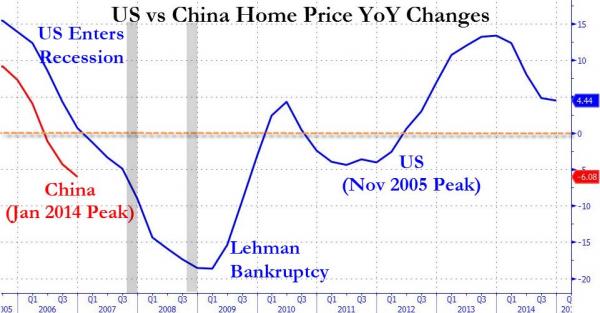
Another month, and another confirmation that China’s hard landing is if not here, then likely mere months away. Overnight, the NBS reported that in March, Chinese house prices dropped in 69 of 70 cities compared to a year ago. According to Goldman’s seasonal adjustments, in March home prices dropped another 0.5% from February, the same as the prior month’s decline, suggesting that the February 28 rate cut hasn’t done much to boost housing spirits. However, it is the annual data that truly stands out, because with a drop of 6.1% this was the biggest drop in Chinese house prices in history.
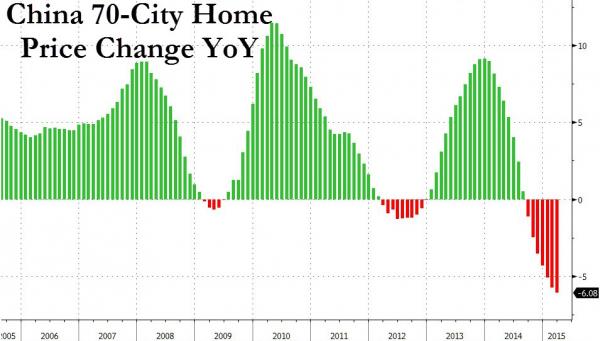
To be sure, the PBOC is now scrambling to halt what, unless it is stopped, will become a full-blown hard landing in months, if it isn’t already. As a result, as shown in the chart below it has recently engaged in several easing steps, with many more to come according to the sell-side consensus. So far these have failed to stimulate the overall economy, which continues to be pressured by a deflation-importing world, but have certainly lead to a massive surge in the Chinese stock market. Incidentally, the ongoing collapse in Chinese home prices is precisely why the PBOC and the Politburo have both done everything in their power to substitute the burst housing bubble with another: that of stocks, by pushing everyone to invest as much as possible in the stock market, leading to the biggest and fastest liquidity and margin debt-driven bubble in history.

Unfortunately for China, as we have shown before, all Chinese attempts to do what every self-respecting Keynesian would do, i.e., replace one bubble with another, are doomed to fail for the simple reason that unlike in the US, where the bulk of assets are in financial form, in China 75% of all household wealth is in real estate. [..]
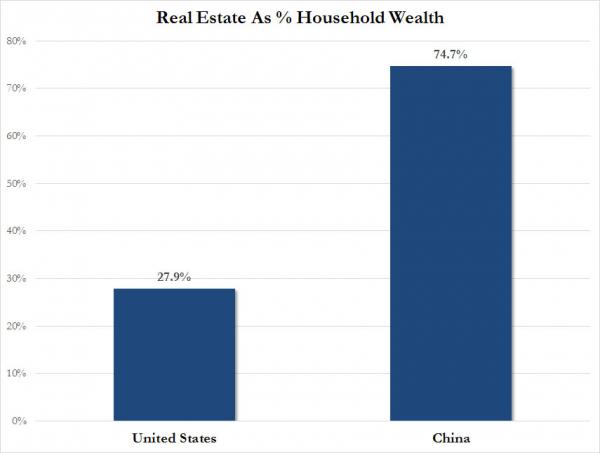
And this is where things get scarier, because if one compares the history of the Chinese and US housing bubbles, one observes that it was when US housing had dropped by about 6% following their all time highs in November 2005, that the US entered a recession. This is precisely where China is now: a 6.1% drop following the all time high peak in January of 2014. If the last US recession is any indication, the Chinese economy is now contracting! So much for hopes of 7% GDP growth this year. The good news, if any, is that Chinese home prices have another 12% to drop before China, which may or may not be in a recession, suffer the US equivalent of the Lehman bankruptcy.
Read more …

All you need to know: “..debt has nearly quadrupled since 2007”.

Germany FinMin Schaeuble Worried About China’s Debt And Shadow Banking (BIA)

Should we concerned about growing debt levels around the world? Wolfgang Schaeuble, Germany’s finance minister, certainly seems to thinks so, stating overnight that debt levels in the global economy continue to give cause for concern. Singling out China in particular, Schaeuble noted that debt has nearly quadrupled since 2007, adding that its growth appears to be built on debt, driven by a real estate boom and shadow banks. Certainly, according to McKinsey’s research, total outstanding debt in China increased from $US7.4 trillion in 2007 to $US28.2 trillion in 2014. That figure, expressed as a percentage of GDP, equates to 282% of total output, higher than the likes of other G20 nations such as the US, Canada, Germany, South Korea and Australia. With China slowing and expectations for further monetary and fiscal easing growing by the day, the concerns raised by Schaeuble may well amplify from here.

Read more …

“There will not be the slightest privatisation in the country, particularly of strategic sectors of the economy.”

Europe Ready For Grexit Contagion As Athens Gets Closer To Russian Cash (AEP)

The ECB has warned that a rupture of monetary union and Greek exit from the euro could have dramatic consequences, but insisted that it has enough powerful weapons to avert contagion. Mario Draghi, the ECB’s president, said it would be far better for everybody if Greece recovers within EMU but made it clear that the currency bloc is no longer vulnerable to the immediate chain-reaction seen in earlier phases of the debt crisis. This sends an implicit message to the radical-Left Syriza government that it cannot hope to secure better terms from EMU creditors by threatening to unleash mayhem. “We have enough instruments at this point of time, the OMT (bond-buying plan), QE, and so on, which though designed for other purposes could certainly be used in a crisis if needed,” said Mr Draghi, speaking after a series of tense meetings at the IMF.

“We are better equipped than we were in 2012, 2011.” In effect, the ECB now has the license to act as a full lender-of-last-resort and mop up the bond markets of Portugal, Spain, or Italy, preventing yields from rising. Yet Syriza appears to be countering such pressure with its own foreign policy gambits as events move with electrifying speed in Athens. Greek sources have told The Telegraph that Syriza may sign a deal with Russia for Gazprom’s “Turkish Stream” pipeline project as soon as next week, unlocking as much as €3bn to €5bn in advance funding. This confirms a report in Germany’s Spiegel magazine, initially denied by both the Russian and Greek governments. It is understood that the deal is being managed by Panagiotis Lafazanis, Greece’s energy minister and head of Syriza’s militant Left Platform, a figure with long-standing ties to Moscow.

Mr Lafazanis warned defiantly on Saturday that Syriza would not “betray the people’s mandate” even if this means a full-blown clash with the creditor powers. “There can’t be a deal with neo-liberal, neo-colonial powers that rule the EU and the IMF unless Greece really threatens their deep economic and geo-strategic interests. We still do not know our own strength,” he told Greek television. Mr Tsipras visited the Kremlin last month insisting he would pursue an independent foreign policy “Several of the so-called partners and certainly some in the IMF want to denigrate and humiliate our government, blackmailing us to implement measures against the working classes,” added Mr Lafazanis. “There will not be the slightest privatisation in the country, particularly of strategic sectors of the economy.”

Read more …

Draghi’s way out of his league.

ECB’s Draghi Says Urgent That Greece Strikes Deal With Creditors (Bloomberg)

European Central Bank President Mario Draghi said it is urgent that Greece strikes a deal with creditors, although its banks continue to meet the requirements for Emergency Liquidity Assistance. “ELA will continue to be given to the banks if they’re judged to be solvent and if they have adequate collateral which is the case now,” Draghi told reporters on Saturday at the International Monetary Fund’s meetings in Washington. The Frankfurt-based ECB decides on Greece’s financial lifeline on a weekly basis. The funding has so far helped defer a financial meltdown as euro-area governments hold back bailout money, complaining that Prime Minister Alexis Tsipras must do more to revamp his country’s economy.

Draghi said “much more work is needed now and it’s urgent” if Greece and its creditors are to strike a deal to release aid. He said any package of policies should produce “growth, fairness, fiscal sustainability and financial stability.” “We all want Greece to succeed,” he said. “The answer is in the hands of the Greek government.” While Europe is better equipped to deal with any fallout in financial markets if Greek negotiations fail than it was when it first fell into crisis, Draghi said the region is still in “uncharted waters.” Draghi said the euro zone economy is strengthening after the ECB began a €1.1 trillion bond-buying program last month. Still, he warned an extended period of low interest rates could prove “fertile ground” for instability in financial markets. “We should be alert to these risks,” Draghi said, adding the risk was not currently a reason to tighten monetary policy.

Read more …

And here he admits he doesn’t have a clue.

Draghi Warns Of Uncharted Waters If Greece Crisis Deteriorates (FT)

Mario Draghi said the euro area was better equipped than it had been in the past to deal with a new Greek crisis but warned of uncharted waters if the situation were to deteriorate badly. The ECB president called for the resumption of detailed discussions aimed at resolving the country’s debt woes and urged the Greek authorities to bring forward proposals that ensured fairness, growth, fiscal stability, financial stability. Asked about the risks of contagion from a new flare-up in Greece, he said: we have enough instruments at this point in time … which although they have been designed for other purposes would certainly be used at a crisis time if needed. The two tools he referred to were the ECB’s so-called outright monetary transactions, which have never been used, and Quantitative Easing, which the ECB launched in January.

He added: we are better equipped than we were in 2012, 2011 and 2010. However Mr Draghi added: Having said that, we are certainly entering into uncharted waters if the crisis were to precipitate, and it is very premature to make any speculation about it. The ECB president was speaking following meetings in Washington that have been overshadowed by renewed fears about the risk of a Greek debt default and possible exit from the euro. US Treasury secretary Jack Lew warned on Friday that a full-blown crisis in Greece would cast a new shadow of uncertainty over the European and global economies, as he put pressure on Athens to come forward urgently with detailed reforms to its economy. Mr Lew said that while financial exposures to Greece had changed significantly since the turmoil of 2012, it was impossible to know how markets would respond to a default.

Read more …

“In the back of our minds these are possibilities of finding a way out, if there is a dead end.”

Greece Wants EU/IMF Deal But Impasse Could Bring Referendum (Reuters)

Greece aims for a deal with its creditors over a reforms package but will not retreat from its red lines, the country’s deputy prime minister told the Sunday newspaper To Vima, not ruling out a referendum or early polls if talks reach an impasse. Athens is stuck in negotiations with its euro zone partners and the International Monetary Fund over economic reforms required by the lenders to unlock remaining bailout aid. Ongoing talks are not expected to produce a deal for the approval of euro zone finance ministers at their next meeting in Riga on April 24 as progress is painfully slow. “Our objective is a viable solution inside the euro,” Yanis Dragasakis told the paper. “We will not back off from the red lines we have set.”

Asked whether the government had thought of calling a referendum or even going to the polls if talks become deadlocked, Dragasakis said this could be a possibility, although the government’s goal was to reach an agreement. “In the back of our minds these are possibilities of finding a way out, if there is a dead end. The aim is (to reach) an agreement.” Greece is quickly running out of cash and in the next few weeks may face a choice of either paying salaries and pensions or paying back loans from the International Monetary Fund. Shut out of bond markets, Athens could get more loans from both the IMF and euro zone governments, but it would first have to implement reforms, agreed with the creditors, to make its finances sustainable and its economy more competitive. The leftist-led government does not want to implement measures including cuts in pensions as it won elections in late January on pledges to end austerity.

Read more …

A credit is not the same as an advance payment.

Moscow Denies Planning Multibillion Credit To Greece (RT)

Russia denied media reports that it is going to give Greece a loan of up to $5 billion as advance payment for future transit profits from a future gas pipeline. The sum was mooted by the German magazine Spiegel. Greece is expected to shortly join a joint Russian-Turkish pipeline project that will pump Russian gas to Europe via Turkey. The magazine cited a senior source in the Greek government as saying that the country would get from $3 billion to $5 billion in credit as part of the deal. It was reportedly agreed during Greek Prime Minister Alexis Tsipras’ visit to Moscow last week. But on Saturday, the Russian president’s spokesman Dmitry Peskov said no such loan is planned.

“[Russian President Vladimir] Putin said himself during the media conference that nobody asked for our help. Naturally energy cooperation was discussed. Naturally, the parties of the high level talks agreed to work out all details of these issues at an expert level. Russia didn’t offer financial help because it was not asked,” the spokesman told the Russian radio station Business FM. Earlier Greek and Russian officials said an energy deal that would have Greece join the Turkish stream project would be inked in a matter of days, but no exact date or particular terms were given. If Russia did loan money to Greece, it would help it deal with a looming national default. The new Greek government is in difficult negotiations with Germany and the IMF to secure further loans to help its economy.

Read more …

Anti-euro gets a foot in the door.

Finns Set to Topple Government as Vote Focuses on Economic Pain (Bloomberg)

Finns look set to vote out a government marred by political infighting and elect a party led by a self-made millionaire promising a business-driven recovery. After three years of economic decline, Finland’s next government will need to fix chronic budget deficits, a debt load that’s set to breach European Union limits, rising unemployment and economic growth that’s about half the average of the euro zone. Juha Sipila, who leads the opposition Center Party, has promised business-friendly policies he says will create 200,000 private-sector jobs. His party is polling about 6% ahead of the next-biggest groups, according to newspaper Helsingin Sanomat. If he wins Sunday’s vote, Sipila will probably try to form a majority coalition that’s likely to include the euro-skeptic The Finns party.

“Putting together a new, workable government that can turn around Finland’s public finances is the most important economic policy step,” Anssi Rantala, chief economist at Aktia Bank Oyj, said by phone. “The government has to take seriously the gigantic deficits we have in state and municipal budgets, and it has to change the way it implements austerity: most has been through tax increases.” Austerity isn’t what splits Finland’s political parties. All major groups have pledged some combination of belt-tightening and growth policies. The Finance Ministry estimates €6 billion euros of austerity measures are needed by 2019 to prevent debt reaching 70% of gross domestic product. It also says there’s no scope to raise taxes without stifling economic growth.

Read more …

Lovely prospect.

How Sleepy Finland Could Tear The Euro Apart (Telegraph)

Finland is the unlikely stage for the latest turn in Greece’s interminable eurozone drama this weekend. With events having decamped temporarily to Washington DC, Athens will be keeping half an eye on developments in Helsinki, where the Nordic state of just 5.4m people heads for the polls on Sunday. In the five years since Greece’s financial woes were revealed to the world, it has been sleepy Finland which has emerged as the most trenchant critic of EU largesse to the indebted Mediterranean. The outcome of the country’s general election could now determine Greece’s future in the monetary union. In a leaked memo seen last month, it was revealed that the Finns had already drawn up contingency plans for a Greek exit from the euro.

Although ostensibly a sensible measure for any finance ministry to contemplate, the document confirmed the Finns’ position as the most uncompromising of the EU’s creditor nations. The reputation is well-deserved. At the height of Greece’s bail-out drama in 2011, Helsinki negotiated an unprecedented bilateral agreement with Athens, receiving €1bn in collateral in return for supporting a rescue deal. A year later, the Finns were prime candidates to become the first dissenters to voluntarily break the sanctity of the monetary union. “We have to be prepared,” the country’s then foreign minister told the Telegraph three years ago. Greece’s current impasse is also partly a result of Finnish obstinacy.

Helsinki was one of the main obstacles to securing a long-term extension to Greece’s bail-out programme under the previous Athens government late last year. The eventual compromise of a three-month, rather than six-month reprieve, has seen the new Leftist regime scramble desperately for cash since February. With the situation in Athens deteriorating by the day, both Finland’s prime minsiter and central bank governor have eschewed high-minded rhetoric about European unity, to insist creditors should be ready to pull the plug on Greece. But unlike its fellow creditor giant Germany, Finland is more economic laggard than European powerhouse. Having been mired in a three-year recession, the country heads to the polls with economic output still 5pc below its pre-crisis levels.

Finland has suffered an economic downturn of almost Greek proportions. The boon from falling oil prices and launch of eurozone QE will still only see the economy expand at a paltry 0.8pc this year, worse only to Italy and Cyprus. Stagnating growth saw Finland stripped of its much coveted Triple-A sovereign debt rating last year. The IMF now recommends a cocktail of structural reforms and fiscal consolidation that would make officials in Athens bristle. “There is no sympathy for Greece any more, especially because our own economy is struggling,” says Jan von Gerich, strategist at Nordea bank in Helsinki.

Read more …

“Everyone believed that it would all work out OK. Then one day it didn’t.”

Australia, The Latest Country With Negative Interest Rates (Simon Black)

Let’s talk about idiots. Somewhere out there, some absurdly well-paid banker just placed his investors’ capital in yet another financial instrument which is guaranteed to lose money: Australian government debt. 47 investors participated in the Australian government’s $200 million bond tender; the participants typically bid the amount they’re willing to pay, and the highest bids win the auction. In this case, and for the first time in Australia, every single one of the 47 bidders offered a price so high that it implies a negative interest rate. Even the lowest bid in the auction, for example, implied a net loss… or an effective yield of NEGATIVE 0.015%. The highest price implied a yield of negative 0.085%. What’s really bizarre is that this particular issue was for ‘inflation-linked’ bonds.

Which means that if the government’s official monkey math shows that inflation is falling, the yield could actually become even MORE NEGATIVE. Insane? Of course. But here’s the thing. These bankers aren’t investing their own money. It’s not like some guy is taking his million dollar bonus and saying, “Hey I think I’ll go buy some government debt that guarantees I’ll lose money.” No. He buys a Maserati. Then he picks up this garbage debt with his customers’ money. Not only is this idiotic, it’s borderline criminal. At a minimum it’s seriously unethical. Banks and other money managers have a solemn obligation… a fiduciary responsibility that comes with the sacred charge of safeguarding other people’s money. Just like the golden rule, this obligation is very simple: take care for other people’s money even more than you care for their own.

But that went out the window a long time ago. Back in the 1500s, Renaissance-era merchant bankers risked their own capital alongside their customers, doing meaningful deals that financed exploration and the expansion of world trade. Now it’s all about commissions, obtuse regulations, and following the latest banking fad. This is officially now the latest banking fad—buying government bonds at negative yields. You’ll remember a few years ago when the latest banking fad was handing out no-money-down mortgages to dead people and unemployed bus drivers… or buying “AAA-rated” bonds which pooled these subprime loans together. That didn’t exactly work out so well. Neither will this. In fact there are plenty of similarities between today’s negative interest rates and the early 2000s housing bubble.

Back then, banks were essentially paying people to borrow money. They offered the least creditworthy borrowers absurd amounts of money which sometimes even exceeded the purchase price of the home they were buying. 102% loans were not uncommon back then, which financed the entire purchase along with the extra closing costs. We even saw 105% loans which allowed a little bit extra to make home improvements. It doesn’t take a rocket scientist to figure out that it’s criminally stupid to pay someone to borrow money. Yet that’s exactly what’s happening now. Instead of people, though, it’s governments who are effectively being paid to borrow. We all remember last time how much this impacted the global financial system. Everyone believed that it would all work out OK. Then one day it didn’t. Lehman Brothers went bust, and the entire banking system started to collapse.

Read more …

High time to pack up and go.

California’s New Drought Rules Would Require Cuts of Up to 36% (Bloomberg)

California issued proposed rules calling for mandatory reductions in water use by municipal agencies as a historic drought drags into a fourth year. The state’s 411 urban water suppliers would have to cut use by as much as 36%, with those that conserved less facing tougher restrictions and a daily penalty of as much as $500 for not complying, the California State Water Resources Control Board said in the proposed rules released Saturday. The board will meet May 5 and 6 to finalize the rules, which would take effect by June 1. “Some of these communities have achieved remarkable results with residential water use now hovering around the statewide target for indoor water use, while others are using many times more,” the Sacramento-based agency said in its proposal.

The emergency rules would be in effect for 270 days. The regulations are based on an executive order Governor Jerry Brown, a 77-year-old Democrat, issued April 1 calling for a mandatory 25% reduction in water use compared with 2013 levels and requiring 50 million square feet of lawns to be replaced by drought-tolerant landscaping. California, the most-populous U.S. state, and its $43 billion agriculture industry are experiencing the worst of the arid conditions moving across the western U.S., with 67% of the state in an extreme drought, according to the U.S. Drought Monitor.

The agency this week released nearly 300 comment letters from the public, businesses, water agencies and cities on an initial proposal. The planned 35% reduction in water use for Beverly Hills would “place a significant burden on our small permanent customer base” of 42,157 residents, Mahdi Aluzri, interim city manager, said in the letter. Beverly Hills’ daytime population, including commuters who work in the city, shoppers and visitors, can rise to more than 250,000 water users, Aluzri said. California’s residents in February reduced water use by 2.8% below 2013 levels, the worst monthly performance since June, the water board said.

Read more …

For this alone, the EU should be dismantled. “A new policy will be presented in May”. May? You should be out there on the water! Another boat with 650 people just capsized as I’m writing this.

Pope Francis Urges EU To Do More To Help Italy With Flood Of Migrants (CT)

Pope Francis on Saturday joined Italy in pressing the European Union to do more to help the country cope with rapidly mounting numbers of desperate people rescued in the Mediterranean during journeys on smugglers’ boats to flee war, persecution or poverty. While hundreds of migrants took their first steps on land in Sicilian ports, dozens more were rescued at sea. Sicilian towns were running out of places to shelter the arrivals, including more than 10,000 this week. The Coast Guard said 74 migrants were saved from a sailboat shortly before it sank Saturday about 100 miles east of the coast of Calabria in southern Italy. A Coast Guard plane and a Dutch aircraft, part of an EU patrol mission, spotted the boat. Passengers included 10 children and three pregnant women.

With his wide popularity and deep concern for social issues, the pope’s moral authority gives Italy a boost in its lobbying for Brussels and northern EU countries to do more. Since the start of 2014, nearly 200,000 people have been rescued at sea by Italy. “I express my gratitude for the commitment that Italy is making to welcome the many migrants who, risking their life, ask to be taken in,” said Francis, flanked by Italian President Sergio Mattarella. “It’s evident that the proportions of the phenomenon require much broader involvement.” “We must never tire of appealing for a more extensive commitment on the European and international level,” Francis said.

Italy says it will continue rescuing migrants but demands that the European Union increase assistance to shelter and rescue them. Since most of the migrants want to reach family or other members of their community in northern Europe, Italian governments have pushed for those countries to do more, particularly by taking in the migrants while their requests for asylum or refugee status are examined. “For some time, Italy has called on the EU for decisive intervention to stop this continuous loss of human life in the Mediterranean, the cradle of our civilization,” Mattarella said. The EU’s commissioner for migration, Dmitris Avramopoulos, says a new policy will be presented in May. Meanwhile, he has also called for member states to help.

Read more …

But it can get worse, believe it or not. The Abbott government quite literally has no shame. They send people back to countries they’re fleeing.

Australia Government In Secret Bid To Hand Back Asylum Seekers To Vietnam (SMH)

Vietnamese Australians and human rights activists have blasted the Abbott Government over a secret Navy-led mission to return a group of asylum seekers back to the Communist government of Vietnam. In a new milestone for the Coalition’s hard-line border policy, an Australian Navy ship was entering Vietnamese waters on Friday after what is believed to be a week-long journey to prevent boats reaching Australia. HMAS Choules was close to the the southern port city of Vung Tau, south of Ho Chi Minh City, Defence sources confirmed to Fairfax Media. The vessel was expected to hand over detainees to the Communist government some time after arriving late Friday or in the early hours of Saturday.

The vessel is carrying asylum seekers intercepted by customs and navy vessels earlier this month, north of Australia, the West Australian newspaper reported on Friday. Immigration Minister Peter Dutton’s office said no comment would be made on “operational matters” but human rights activists lashed the Coalition for another on-water action cloaked in secrecy. Daniel Webb, director of the Human Rights Law Centre, said: “Australia should never return a refugee to persecution. All governments – whatever their policy position – should respect democracy and should respect the rule of law. Continually operating behind a veil of secrecy is a deliberate subversion of both. “If the government truly believed its actions were humane, justified and legal, it wouldn’t go to such extraordinary lengths to hide them from view.” [..]

The Vietnamese community, many of whom arrived in Australia by boat after the fall of Saigon in 1975 as the Communist regime of Hanoi took control of the country, expressed horror at asylum seekers being handed back. Thang Ha, president of the Vietnamese Community in Australia, NSW Chapter, said the government should be aware it could be “throwing people back into hell”. He said returnees would likely be left alone initially but would be followed by party operatives and eventually harassed and likely jailed. “Human rights activists, democracy activists, Christians, Buddhists, artists and singers, they have all been harassed. Some people have been hunted down, their family members have been harassed. Some have been thrown in jail and never heard from again,” he said. “They are throwing them back into hell.”

Read more …

Yes, we are a smart animal.

Air-Pocalypse: Breathing Poison In The World’s Most Polluted City (BBC)

Saharan dust, traffic fumes and smog from Europe may be clogging up London’s air at present – and causing alarm in the newspapers – but in the world’s most polluted city London’s air would be considered unusually refreshing. That city is Delhi, the Indian capital, where air quality reports now make essential reading for anxious residents. In London last week, the most dangerous particles – PM 2.5 – hit a high of 57; that’s nearly six times recommended limits. Here in Delhi, we can only dream of such clean air. Our reading for these minute, carcinogenic particles, which penetrate the lungs, entering straight into the blood stream – is a staggering 215 – 21 times recommended limits. And that’s better than it’s been all winter. Until a few weeks ago, PM 2.5 levels rarely dipped below 300, which some here have described as an “air-pocalypse”.

Like the rest of the world, those of us in Delhi believed for years that Beijing was the world’s most polluted city. But last May, the World Health Organization announced that our own air is nearly twice as toxic. The result, we’re told, is permanent lung damage, and 1.3 million deaths annually. That makes air pollution, after heart disease, India’s second biggest killer. And yet, it’s only in the past two months as India’s newspapers and television stations have begun to report the situation in detail that we’ve been gripped, like many others, with a sense of acute panic. It’s a little bit like being told you’re living next to an active volcano that might erupt at any moment. At first, we simply shut all our doors and windows and sealed up numerous gaps. No more seductively cool Delhi breezes could be allowed in.

We began checking the air quality index obsessively. Then, we rushed out to buy pollution masks, riding around in our car looking like highway robbers. But our three-year-old wouldn’t allow one anywhere near her face. Our son only wore his for a day, and only because I told him he looked like Spider-Man. Despite our alarm, many Delhi-ites reacted with disdain. “It’s just dust from the desert,” some insisted. “Nothing a little homeopathy can’t solve,” others said. But we weren’t convinced. When we heard that certain potted plants improve indoor air quality, we rushed to the nursery to snap up areca palms, and a rather ugly, spiky plant with the unappealing moniker, mother-in-law’s tongue. But on arrival, the bemused proprietor informed us that the American embassy had already purchased every last one. In any case, we calculated that to make a difference, we needed a minimum of 50 plants. “We could get rid of the sofa to make room for them,” my husband offered.

Read more …

Apr 172015


Jack Delano Myrtle Beach, S.C. Air Service Command Technical Sergeant Choken 1943

The REAL Issue With a Grexit/Greek Default is Derivatives (Phoenix)
Grexit Dangers Mount: Yanis Varoufakis Warns Of ‘Liquidity Asphyxiation’ (AEP)
Germany: Has Any Country Ever Had It So Good? (Bloomberg)
Greece To Raid Coffers As IMF Dashes Hopes Of Resolving Crisis (Telegraph)
Greece Deal Appears Distant Amid Deadlock In Reform Talks (Kathimerini)
Finland: ‘Not As Bad As Greece, Yet, But It’s Only Matter Of Time’ (Guardian)
China’s Incredible Shrinking Factory (Reuters)
‘Beijing Put’ May Be Driving China’s Stock-Market Fever (MarketWatch)
China’s Smart Money Is Riding the Stock Boom as Amateurs Rush In (Bloomberg)
China’s Kaisa Keeps Creditors Guessing as Dollar Default Looms (Bloomberg)
Australia Steeled For China Slowdown As Iron Ore Prices Fall (FT)
New Zealand Housing: Human Rights Commisioner Calls For Drastic Action (NZH)
New Zealand Government, Central Bank Clash On Housing (CNBC)
5 Financial Crisis Regulators Cashing In On New Careers (Fortune)
Stephen F. Cohen: U.S./Russia/Ukraine History The Media Won’t Tell You (Salon)
Why A Greek Call For German War Reparations Might Make Sense (MarketWatch)
BP Dropped Green Energy Projects Worth Billions, Prefers Fossil Fuels (Guardian)
Saudi Arabia Adds Half a Bakken to Oil Market in a Month (Bloomberg)
Italy Calls For Help Rescuing Migrants As 40 More Reportedly Drown (Guardian)

It’s all derivatives all the way down.

The REAL Issue With a Grexit/Greek Default is Derivatives (Phoenix)

The situation in Greece boils down to the single most important issue for the financial system, namely collateral. Modern financial theory dictates that sovereign bonds are the most “risk free” assets in the financial system (equity, municipal bond, corporate bonds, and the like are all below sovereign bonds in terms of risk profile). The reason for this is because it is far more likely for a company to go belly up than a country. Because of this, the entire Western financial system has sovereign bonds (US Treasuries, German Bunds, Japanese sovereign bonds, etc.) as the senior most asset pledged as collateral for hundreds of trillions of Dollars worth of trades. Indeed, the global derivatives market is roughly $700 trillion in size. That’s over TEN TIMES the world’s GDP. And sovereign bonds… including even bonds from bankrupt countries such as Greece… are one of, if not the primary collateral underlying all of these trades.

Lost amidst the hub-bub about austerity measures and Debt to GDP ratios for Greece is the real issue that concerns the EU banks and the EU regulators: what happens to the trades that EU banks have made using Greek sovereign bonds as collateral? This story has been completely ignored in the media. But if you read between the lines, you will begin to understand what really happened during the previous Greek bailouts. Remember: 1) Before the second Greek bailout, the ECB swapped out all of its Greek sovereign bonds for new bonds that would not take a haircut. 2) Some 80% of the bailout money went to EU banks that were Greek bondholders, not the Greek economy. Regarding #1, going into the second Greek bailout, the ECB had been allowing European nations and banks to dump sovereign bonds onto its balance sheet in exchange for cash.

This occurred via two schemes called LTRO 1 and LTRO 2 which happened in December 2011 and February 2012 respectively. Collectively, these moves resulted in EU financial entities and nations dumping over €1 trillion in sovereign bonds onto the ECB’s balance sheet. Quite a bit of this was Greek debt as everyone in Europe knew that Greece was totally bankrupt. So, when the ECB swapped out its Greek bonds for new bonds that would not take a haircut during the second Greek bailout, the ECB was making sure that the Greek bonds on its balance sheet remained untouchable and as a result could still stand as high grade collateral for the banks that had lent them to the ECB. So the ECB effectively allowed those banks that had dumped Greek sovereign bonds onto its balance sheet to avoid taking a loss… and not have to put up new collateral on their trade portfolios.

Which brings us to the other issue surrounding the second Greek bailout: the fact that 80% of the money went to EU banks that were Greek bondholders instead of the Greek economy. Here again, the issue was about giving money to the banks that were using Greek bonds as collateral, to insure that they had enough capital on hand. Piecing this together, it’s clear that the Greek situation actually had nothing to do with helping Greece. Forget about Greece’s debt issues, or protests, or even the political decisions… the real story was that the bailouts were all about insuring that the EU banks that were using Greek bonds as collateral were kept whole by any means possible. This is why the current negotiations in Greece boil down to one argument: whether or not it will involve an actual restructuring of Greek debt that will affect bondholders across the board.

Greece wants this. The ECB and EU leaders don’t for the obvious reasons that any haircut of Greek debt that occurs across the board will: 1) Implode a small, but significant amount of EU bank derivatives trades. 2) Be immediately followed by Spain, Italy and ultimately France asking for similar deals… at which point you’re talking about over $3 trillion in high grade collateral being restructured (collateral that is likely backstopping well over $30 trillion in derivatives trades at the large EU banks). Remember, EU banks as a whole are leveraged at 26-to-1. At these leverage levels, even a 4% drop in asset prices wipes out ALL of your capital. And any haircut of Greek, Spanish, Italian and French debt would be a lot more than 4%. The next round of the great crisis is coming. The ECB bought two years of time with its pledge to do “whatever it takes,” but the global bond bubble is still going to burst. And when it does, it’s going to make 2008 look like a joke.

Read more …

“I would willingly, eagerly, accept any terms offered to us if they made sense.”

Grexit Dangers Mount: Yanis Varoufakis Warns Of ‘Liquidity Asphyxiation’ (AEP)

Greek finance minister Yanis Varoufakis has acknowledged that his country is desperately short of funds, accusing Europe’s creditor powers of trying to force his country to its knees by “liquidity asphyxiation”. “Liquidity is drying up in Greece. It is true,” he told a gathering at the Brookings Institution in Washington. Mr Varoufakis said a conspiracy of forces was trying to “snuff out” Greece’s Syriza government but warned that this could have devastating effects. “Toying with Grexit, or amputating Greece, is profoundly anti-European. Anybody who says they know what will happen if Greece is pushed out of the euro is deluded,” he said.

The warnings were echoed by Eric Rosengren, head of the Boston Federal Reserve, who said Europe risks sitting off uncontrollable contagion if it mishandles the Greek crisis, even though Greece may look too small to matter. “I would say to some European analysts who assume that a Greek exit would not be a problem, people thought that Lehman wouldn’t be a problem. If you measured the size of Lehman relative to the size of the US economy it was quite small,” he told a group at Chatham House. “I wouldn’t be overly confident that just because the Greek economy is small relative to the size of the European economy that something like that wouldn’t be a major dislocation. I think everybody should be a little bit concerned,” he said.

Christine Lagarde said the IMF is worried about the “liquidity situation” in Greece but made it clear that the institution would not give the country any leeway on €1bn of debt repayments coming due in early May. “We have never had an advanced economy asking for payment delays. It is clearly not a course of action that would be fit or recommended,” she said. Mrs Lagarde insisted that the the Fund would defend the interests of its contributors, many of them much poorer countries than Greece. Mr Varoufakis said the ECB and the EMU authorities were deliberately tightening the tourniquet on Greece until the arm was “gangrenous” in order to pressure his Syriza government to give in.

“I would willingly, eagerly, accept any terms offered to us if they made sense. Insisting on a primary budget surplus of 4.5pc in a depressed economy with no functioning banking system is absurd. We have the right to challenge the logic of a programme that has failed,” he said. He was speaking before a reception to celebrate Greek independence at the White House. It is understood that he spoke privately with President Barack Obama, though not at the Oval Office.

Read more …

Greece’s almost nieghbor lives off the fat of the rest of Europe’s land.

Germany: Has Any Country Ever Had It So Good? (Bloomberg)

How much good news can one country handle? If you work in the German Ministry of Finance—the Bundesfinanzministerium—you might be wondering that at the moment. This morning the average yield on German sovereign debt turned negative for the first time ever. This wasn’t the only good news today. The German economy is built on manufacturing, and it is by far the largest car builder in the euro area. So data released this morning showing that European car sales were up 11% in March, the fastest growth in 15 months, is certainly welcome. That is not to say the German export sector has been waiting on tenterhooks for an increase in European car sales for a boost; Germany has been running a positive trade balance for decades.

Unemployment is at an all-time low, and employment in the economy has never been higher. Which is great for the German economy. Even better, it has the added benefit of a falling currency. Importantly for Germany, it has managed all this without stoking inflation. With this background, it should come as no surprise that Germany is determined (and able) to balance its budget. So no shortage of customers, no shortage of jobs for its citizens, and no shortage of revenue. Has any country ever had it so good? In fact, as projections released by Eurostat this morning show that the only thing Germany is likely to have a shortage of soon is Germans. Germany currently has the lowest proportion of population under the age of 15 of any country in the European Union, and Eurostat’s projections indicate that will continue to be the case for the foreseeable future.

Read more …

“..labour relations, the social security system, the VAT increase and the rationale regarding the development of state property.”

Greece To Raid Coffers As IMF Dashes Hopes Of Resolving Crisis (Telegraph)

Cash-strapped Greece is planning to resort to drastic measures to stay afloat, as the country’s bail-out drama moves to Washington today. Finance minister Yanis Varoufakis is due to drum up support for his debt-stricken nation when he meets with President Obama at the White House later today. The meeting with the world’s most powerful leader comes as a desperate Athens could raid the country’s pensions funds in order to continue paying out its social security bill. Greece’s deputy finance minister Dimitris Mardas hinted that state-owned enterprises may have to transfer their cash balances to the Bank of Greece if the state was to avoid going bankrupt. The government has long protested it will run out of funds to continue paying out a €1.7bn monthly wage and pension bill if a release of cash is not arranged in the next few days.

With their coffers running dry, Greek officials reportedly made an informal request to delay loan repayments to the IMF, but were rebuffed, according to reports in the Financial Times, However, the Fund’s managing director Christine Lagarde said a moratorium on repayments was “not a course of action that would be fit or recommended”. “We have never had an advanced economy asking for payment delays,” Ms Lagarde said today, adding that any period of clemency would constitute additional financial aid to a debtor economy. “This would mean additional contributions by the international community and some of these countries are in a dearer situation than those seeking the delays,” said Ms Lagarde, who will meet with Mr Varoufakis today. “We will do everything we can so lending to the Fund remains the safest lending route any debtor can adopt.”

Greece came to the brink of falling into an arrears process with its senior creditor last month, but avoided the ignominy of becoming the first developed country to ever fall into an IMF default. The debtor nation, which has received no emergency cash since August 2014, faces a €2.5bn IMF loan bill over May and June. Hinting at the gulf between Greece and its creditors, Greek Prime Minister Alexis Tsipras said “political disagreements” were continuing to block a bail-out extension. Mr Tsipras said there were four areas of disagreement over its reform programme. These were ” labour relations, the social security system, the VAT increase and the rationale regarding the development of state property.” However, the Leftist premier added he was confident Europe would not “choose the path of an unethical and brutal financial blackmail” and ensure Greece remained in the monetary union.

Read more …

They just throw everything out that Greece proposes.

Greece Deal Appears Distant Amid Deadlock In Reform Talks (Kathimerini)

With negotiations between Greece and its creditors effectively deadlocked, a potential deal that could unlock crucially needed funding appeared more distant than ever on Thursday with doubts appearing about whether an agreement can be reached in time for a Eurogroup planned for May 11, well after the next scheduled eurozone finance ministers’ summit in Riga next Friday, which had been the original deadline. Even representatives of the European Commission, which has been Greece’s closest ally in the talks, appeared to be losing their patience. In comments on Thursday spokesman Margaritis Schinas said the EC was “not satisfied” with the level of progress in talks and called for work to “intensify” ahead of next week’s Eurogroup summit.

Sources indicated that the so-called Brussels Group, comprising officials from the government and Greece’s creditors, was to convene in the Belgian capital on Saturday. But a European official told Kathimerini he had no such information and that talks were likely to resume on Monday. The aim is for that meeting to yield a detailed list of reforms that could form the basis for a staff-level agreement and potentially lead to the disbursement of much-needed aid. But the two sides remain far apart. In a statement to Reuters on Thursday Tsipras highlighted several points of agreement – on areas such as tax collection, corruption and redistributing the tax burden – but also conceded that the two sides disagreed on four major issues: labor rules, pension reform, a hike in value-added taxes and privatizations, which he referred to as “development of state property” rather than asset sales.

Despite the differences and “the cacophony and erratic leaks and statements in recent days from the other side,” Tsipras said he was “firmly optimistic” his government would reach an agreement with its creditors by the end of April. “Because I know that Europe has learned to live through its disagreements, to combine its parts and move forward.” Finance Minister Wolfgang Schaeuble, who has leveled some of the harshest criticism against Greece in recent days, indicated that creditors remained ready to help but expected concessions. “If Greece wants support, we will give this support as in recent years, but of course within the framework of what we agreed,” he told Bloomberg. “Whatever happens, we know that Greece is part of the European Union and that we also have a responsibility for Greece and we will never disregard this solidarity.”

In a speech at the Brookings Institution in Washington on Thursday, Schaeuble said Greece was welcome to seek other sources of funding but might have difficulties. “If you find someone else, whether it’s in Beijing, in Moscow, in Washington DC, or in New York who will lend you money, OK, fine, we would be happy. But it’s difficult to find someone who is lending you in this situation amounts [of] 200 billion euros.” He added that Greece must seek to boost competitiveness and its primary surplus.

Read more …

“The public finances are completely screwed, it can’t go on like this..”

Finland: ‘Not As Bad As Greece, Yet, But It’s Only Matter Of Time’ (Guardian)

A sudden flurry of spring snow has dusted the steps of an evangelical church in central Oulu, northern Finland, where about 100 people are crowded together for a Friday sermon. But perhaps the true object of their devotion is inside black binliners by the door. Once a week, food parcels and a free meal attract a mix of unemployed men, single mothers and pensioners to the church. The most highly prized items are packs of sausages just within their sell-by date. Shops used to donate meat, but now they too are feeling the pinch. “There is a group of people in Finland that has dropped out of the employment market,” says pastor Risto Wotschke, whose example has encouraged other churches to offer food handouts.

The weakest economy in the eurozone this year might not prove to be Greece or Portugal, but Finland. The Nordic country is entering its fourth year of recession, with output still well below its 2008 peak. The north of Finland, home to the “Oulu miracle” that was built on the twin pillars of plentiful timber and mobile phone technology, has been hit in particular. Although a paper mill still dominates Oulu’s skyline, jobs in pulp and cellulose have moved abroad, while the collapse of Nokia’s handset business knocked the guts out of the local economy. With unemployment officially at more than 17% – almost twice the Finnish average – this once-booming city of 200,000 people has gone from a poster child of prosperity to a symbol of deepening cracks in the Nordic model.

“It’s not yet as bad here as Greece, but that’s only a matter of time,” says Seppo, a 43-year-old software engineer who lost job along with 500 others last summer after Microsoft, the new owner of Nokia’s mobile devices and services division, abandoned Oulu. Seppo, who asked that his full name not be used, has since found work, but it is 375 miles (600km) away. Every Sunday night he leaves his family for a rented room. “The public finances are completely screwed, it can’t go on like this,” he says, as he stands outside a polling booth on the outskirts of Oulu, where people are already queuing to vote early in Finland’s general election on Sunday. “The politicians are promising everything to everybody, but they won’t take any hard decisions until we are in a really deep crisis.”

Read more …

Their markets have dried up.

China’s Incredible Shrinking Factory (Reuters)

Eight years ago, Pascal Lighting employed about 2,000 workers on a leafy campus in southern China. Today, the Taiwanese light manufacturer has winnowed its workforce to just 200 and leased most of its space to other companies: lamp workshops, a mobile phone maker, a logistics group, a liquor brand. “It used to be as long as you had more orders, you could get everything you needed to expand your factory, and you could expand,” says Johnny Tsai, Pascal’s general manager. No longer. The Chinese factory – an institution that was once so large, it was measured in football fields – is shrinking. Rising labor costs, higher real estate prices, less favorable government policies and smaller order volumes are forcing Chinese plants to downsize just to survive.

Their contraction suggests a new model of light manufacturing emerging from China’s economic slowdown: smaller plants are replacing the vertically integrated behemoths that defined Chinese manufacturing in the early 2000s. Cankun, an appliances factory in southern China featured in the documentary Manufactured Landscapes, had more than 22,000 manufacturing employees in 2005, according to its annual report. Today, that number has shrunk to just 3,000. Some Hong Kong-owned factories in southern China have cut their staff numbers by 50-60%, according to Stanley Lau, chairman of the Federation of Hong Kong Industries. To be sure, the giant Chinese factory is hardly extinct. Taiwan’s Foxconn still employs about 1.3 million people during peak production times, many of them piecing together Apple iPhones.

And factories that can afford to, including Foxconn, are increasing automation. But for industries where the product design changes frequently, such as lighting, robots add little value. Chinese factories’ contraction illustrates how much the advantages they once enjoyed have eroded. In the 1990s and early 2000s, cities in Chinese coastal regions competed to offer investors discounted land. Today, the same land is scarce, and dear. New labor and environmental laws have been introduced, too, making life tougher for employers. And the workforce has changed. China’s working age population began to contract in 2012.

The number of strikes more than doubled last year compared to 2013. Jobs have shifted into the services sector. And labor costs have more than quadrupled in US dollar terms since 2005. Nor are orders what they used to be. On Monday, China announced that export volumes fell 15% in March compared to the same period the year before. China’s manufacturing PMI, which measures activity in the industrial sector, has been hovering around 50, the inflection point between expansion and contraction, for nearly two years.

Read more …

Beijing is playing with pitchforks. From housing bubble to stock bubble to..?

‘Beijing Put’ May Be Driving China’s Stock-Market Fever (MarketWatch)

China’s stock markets are climbing to feverish heights as a record number of ordinary Chinese, including teenagers, flood into equities. But in the eyes of many, the share-buying frenzy and wild bull market are all due to one thing: The Chinese government wants it that way. Like the “Greenspan put” of the dot-com era, in which U.S. investors believed then Federal Reserve chairman Alan Greenspan was backstopping the market, Shanghai now seems to be surging on the belief in a “Beijing put.” Although emerging markets have been doing quite well recently — the MSCI EM Index has risen by more than 10% so far this year – the surge in China markets is particularly prominent.

By the close of Thursday trade, the benchmark Shanghai Composite Index was up 30% year-to-date, and it has more than doubled in just the past 10 months. The boom has also spilled over to the nearby Hong Kong equity market, where the city’s benchmark Hang Seng Index has surged nearly 18% since the start of January, while the mainland-China-tracking Hang Seng China Enterprises Index has climbed by 22% over the same period. Emboldened by the astounding advance, an increasing number of ordinary Chinese have joined what the state-run China News Service has called the “great army of stock investors,” lining up outside of brokerage firms to open new trading accounts.

The sharp increase in new investors and market volume has even caused system breakdowns for China Securities Depository and Clearing Corp. (CSDC) — the national clearing house — as well as individual securities firms. Statistics from CSDC show that last week the number of new stock-trading accounts opened hit a fresh all-time high of 1.68 million, beating the previous 1.67 million recorded for the week of March 27. In only the past month, mainland Chinese investors opened more than 6 million such accounts, according to the data. The CSDC said that this “steep rise” in new stock-account applications left it unable for a while on Tuesday to handle the barrage of requests, while Haitong Securities, the second-largest securities firm in the country, also encountered “a system breakdown” the same day, according to a report in the Beijing Youth Daily.

Read more …

For professionals, it’s fish in a barrel. Clean out grandma.

China’s Smart Money Is Riding the Stock Boom as Amateurs Rush In (Bloomberg)

Individual investors aren’t the only ones pouring cash into Chinese stocks after they surged faster than any other market worldwide. Five of the 11 professional money managers from mainland China, Hong Kong and Taiwan surveyed by Bloomberg from April 8 to 16 said they plan to boost holdings of yuan-denominated A shares this quarter, while four will maintain positions and just two will reduce their stakes. Technology, consumer, health-care and financial shares were preferred industries among the managers, who oversee a combined $41 billion. The responses show the Shanghai Composite Index’s 99% surge over the past year, driven by a record pace of new stock-account openings, still has support outside the Chinese individuals who comprise at least 80% of trading.

Institutional investors are betting that sustained inflows, interest rate cuts and prospects for an improving economy will keep the rally going. “New funds have been continuing to flow into the market and I need to follow the trend,” Dai Ming, a money manager at Hengsheng Asset Management said in Shanghai. “Furthermore, China’s economy will make headway going forward.” Mainland investors have opened a record 10.8 million new stock accounts this year, more than the total number for all of 2012 and 2013 combined, data from China Securities Depository and Clearing show.

The flood of money from these rookie stock pickers has helped feed market momentum after policy makers stepped up efforts to bolster an economy expanding at the slowest pace since the global financial crisis six years ago. The government won’t allow growth to fall below this year’s target of 7%, said Hao Hong, head of China research at Bocom International in Hong Kong, who forecasts at least three more interest-rate cuts in 2015 following reductions in November and March. Premier Li Keqiang said this week that China will accelerate targeted measures to support the economy after it expanded at the slowest pace since 2009 in the first quarter.

Read more …

Yeah, let the no. 1 developer default, see what happens then.

China’s Kaisa Keeps Creditors Guessing as Dollar Default Looms (Bloomberg)

Kaisa has until Monday to find $52 million for missed payments on two of its dollar bonds as it seeks to avoid default. The troubled developer must pay the interest on its 2017 and 2018 notes that was due on March 18 and March 19 respectively after the expiry of a 30-day grace period. The delay is the latest twist in a saga that has seen Kaisa’s founder Kwok Ying Shing make an unexpected return to the company, projects in Shenzhen blocked, a near default on a loan in December and a takeover offer from Sunac. Standard & Poor’s doesn’t expect Kaisa to pay and downgraded it to default last month. “Kaisa in the last four months has been mysterious and unpredictable, and Kwok coming back is equally surprising,” said Ashley Perrott at UBS. “It wouldn’t be a good signal if they didn’t pay the coupon.”

The mishaps threaten to make Kaisa the first Chinese developer to default on its dollar-denominated bonds as it seeks ways to service interest-bearing debt to onshore and offshore lenders that totaled 65 billion yuan ($10.5 billion) as of Dec. 31. Kaisa has also been tied to a corruption probe amid President Xi Jinping’s crackdown on graft, called the harshest since the 1949 founding of the People’s Republic of China by official Chinese media. Kwok exited the company he founded more than 15 years ago on Dec. 31, citing health reasons. Kaisa said in a Hong Kong stock exchange filing April 13 that he’d been appointed chairman and executive director.

In the interim, Sunac agreed to buy a controlling 49.3% stake from the Kwok family on Jan. 30, subject to a debt restructuring that would require investors to accept lower coupons and defer repayment by up to five years. Kaisa has said offshore creditors would stand to recover just 2.4% in a liquidation. Independent research firm CreditSights said Kwok’s reappointment should boost confidence and may be good news for debt investors, while Citigroup Inc. said he’s likely to regain control of the builder. Sunac Chairman Sun Hongbin said on April 15 his company’s takeover of Kaisa is still proceeding. Kaisa was to pay $16.1 million of interest on its $250 million of 2017 notes on March 18 and $35.5 million on its $800 million of 2018 securities March 19. Given the end of the 30-day grace period falls over a weekend, Kaisa technically has until Monday.

Read more …

Steeled my ass.

Australia Steeled For China Slowdown As Iron Ore Prices Fall (FT)

The last time Western Australia was engaged in a dispute with Canberra of this magnitude, it threatened to secede during a financial crisis sparked by the 1930s Depression. The current friction is linked to China’s slowdown — a sign of how closely Australia’s fortunes are tied to Beijing’s appetite for its commodity exports. “It’s not secession but it is tension and disengagement,” Colin Barnett, Western Australia’s premier, said this week when Canberra and other states rejected a request to help plug a widening hole in the state budget caused by plunging iron ore prices. Western Australia is a mining state that enjoyed a decade-long boom selling iron ore — a key ingredient in steel — to China. Known by some as “China’s quarry”, the state hosts BHP Billiton, Rio Tinto and Fortescue, which have spent billions of dollars building mines, railways and ports to almost double iron ore production to 717 million tons over the past five years.

But just as global supply hits record levels, China’s economy is slowing and its desire for the reddish-brown ore may have plateaued. Since peaking at US$190 in 2011, iron ore prices have slid more than 70% to about US$50 a ton. This is denting tax revenues, forcing smaller mining companies to close and lay off thousands of employees. “Western Australia was the big beneficiary of the China boom,” says Chris Richardson at Deloitte. “But it is suffering now as the mine construction phase ends and commodity prices fall amid a surge in iron ore supply and faltering demand.” In 2013 the state lost its triple-A credit rating. On Tuesday, Standard & Poor’s warned it may face a further downgrade because of its budget problems.

Western Australia says that if iron ore prices stay at US$50 per ton it would wipe out A$4 billion (US$3 billion) in projected royalty revenues in 2015-16, 12% of the state budget. Unemployment in the state, although still modest at 5.8%, has risen from 3.8% when iron ore prices peaked. House prices have started to fall in the state capital Perth, while they continue to grow in Sydney and Melbourne. Mr Barnett wants other states to give Western Australia a greater share of revenues from a nationwide goods and services tax. But so far Canberra and other states have rejected his pleas. On Friday, state premiers will discuss the dispute. Weak Chinese data are fueling concerns that Western Australia’s problems could spread across a country that has avoided recession for two decades by riding China’s commodities boom.

Read more …

Smart guy. But why doesn’t he know it’s the – Australian-owned – banks that control the country, and they want to continue as is?

New Zealand Housing: Human Rights Commisioner Calls For Drastic Action (NZH)

New Zealand’s human rights watchdog has added its voice to those calling for drastic action to tackle New Zealand’s housing problems. Chief human rights commissioner David Rutherford said today all political parties should make a cross-party accord to tackle the “very serious” issues of adequate housing in this country. His comments followed a warning by the Reserve Bank this week that Government needed to do more to dampen demand in the face of increasing housing pressures. Mr Rutherford said the housing issues in New Zealand were “many and varied” and there was no co-ordinated plan to address them.

“We’re seeing housing issues being talked about as separate issues when in fact they need to be addressed as a whole: housing affordability in Auckland and Canterbury, the provision of adequate housing in Northland, South Auckland and other places throughout the country, which would reduce the incidence of childhood illnesses due to cold, damp, overcrowded accommodation, and the call for more of our elderly to be cared for in homes which are in many cases likely to be unsuitable for elderly habitation to name just a few of the issues.” He said the human right to adequate housing was a binding legal obligation for the state, which meant the Government had a duty to protect this right and a responsibility to provide remedies.

Mr Rutherford said it would take decades to solve myriad problems but immediate action was needed, beginning with a cross-party accord. “We have had a talkfest about these issues for over 30 years, mainly centred on how many State-owned houses should or should not be built. “In that time, a state like Singapore has surpassed New Zealand in providing adequate housing and that in turn has led to higher levels of wealth and health in Singapore than New Zealand.” The Green Party hailed the Chief Commissioner’s message, saying a lack of action was denying New Zealanders the basic human right of adequate housing. “The Government’s do-nothing approach hasn’t worked,” housing spokesman Kevin Hague said. “It is time for all parties to put their political colours aside and work together to find enduring solutions to the housing crisis.”

Read more …

Politicians want bubbles to keep going.

New Zealand Government, Central Bank Clash On Housing (CNBC)

Increasing supply is the only way to cool off New Zealand’s red-hot housing market, the country’s deputy prime minister told CNBC, ignoring the central bank’s call for a capital gains tax. Property markets across New Zealand’s major cities are steadily climbing, prompting fears of a sharp correction. Sales volume in March rose to an eight-year high, with median prices in the capital city of Auckland soaring 13% on year, nearly double the nation’s 8% gain, the Real Estate Institute of New Zealand (REINZ) said on Tuesday. New Zealand is one of the few advanced economies that hasn’t experienced a major price correction in the past 45 years. Those statistics prompted an unusually aggressive warning from the Reserve Bank of New Zealand (RBNZ).

In a speech on Wednesday, deputy governor Grant Spencer said he “would like to see fresh consideration of possible policy measures to address the tax-preferred status of housing, especially investor related housing.” That’s a clear reference to a capital gains tax on the sale of investment properties, economists widely agreed. However, Bill English, deputy prime minister & minister of finance of New Zealand, told CNBC on Thursday that he believes increased housing supply is the best way to fix the issue. “We just need more houses on the ground faster to deal with the inflows from migration and the positive attitudes of many New Zealand households in a world of lower interest rates,” adding that the government is going through a deliberate, long and complicated process to improve supply.

But the RBNZ believes supply-side solutions are unlikely to yield quick results, noting that increased supply will take a number of years to eliminate the housing shortage. Waiting that long has severe risks, the bank said: “Rising house price inflation, particularly in Auckland, represents a risk to financial and economic stability. The longer excess demand persists, the further prices will depart from their underlying fundamental determinants and the greater the potential for a disruptive correction.”

Read more …

More revolving doors. They want the Bernank for who he knows, not his brilliant insights.

5 Financial Crisis Regulators Cashing In On New Careers (Fortune)

The man who occupied one of the most important economic posts in the U.S. during the financial crisis will soon be collecting his paychecks from one of the largest hedge funds on Wall Street. Former Federal Reserve board chairman Ben Bernanke, who oversaw the country’s central bank from 2006 until last year, will be a senior adviser to Citadel, the hedge fund announced Thursday morning. Founded by billionaire Kenneth Griffin, Citadel manages $25 billion in assets. Bernanke, a former economics professor at Princeton University, left the Fed more than a year ago at which point he was succeeded by current chair Janet Yellen. Bernanke’s new role will find him advising Citadel on global economic and financial matters and monetary policy.

Speaking with The New York Times about his new career path, Bernanke said he had spent the past year scouting job opportunities, and that Citadel represented the prudent choice due to the fact that the asset manager is not regulated by the Fed. Bernanke also told the Times that he is well aware of the public’s poor reception to the so-called “revolving door” that escorts so many Washington regulators to cushy Wall Street positions. That is exactly why he chose Citadel over various banking and lobbying positions he was offered elsewhere in the industry, Bernanke said.

After all, Bernanke’s tenure at the Fed will primarily be remembered for his role helping to engineer the government bailout of the financial industry, as well as for implementing the Fed’s economic stimulus program. As the former Fed chair alluded to, though, Bernanke is far from the only high-profile government employee to have spent the late-2000’s fiscal crisis trying to right the Wall Street ship only to eventually land a lucrative gig in the financial industry. Here are five former regulators from the financial crisis who left the government to make millions.

Read more …

Fascinating read.

Stephen F. Cohen: U.S./Russia/Ukraine History The Media Won’t Tell You (Salon)

Salon: What is your judgment of Russia’s involvement in Ukraine? In the current situation, the need is for good history and clear language. In a historical perspective, do you consider Russia justified?

Cohen: Well, I can’t think otherwise. I began warning of such a crisis more than 20 years ago, back in the ’90s. I’ve been saying since February of last year [when Viktor Yanukovich was ousted in Kiev] that the 1990s is when everything went wrong between Russia and the United States and Europe. So you need at least that much history, 25 years. But, of course, it begins even earlier. As I’ve said for more than a year, we’re in a new Cold War. We’ve been in one, indeed, for more than a decade. My view [for some time] was that the United States either had not ended the previous Cold War, though Moscow had, or had renewed it in Washington. The Russians simply hadn’t engaged it until recently because it wasn’t affecting them so directly. What’s happened in Ukraine clearly has plunged us not only into a new or renewed—let historians decide that—Cold War, but one that is probably going to be more dangerous than the preceding one for two or three reasons.

The epicenter is not in Berlin this time but in Ukraine, on Russia’s borders, within its own civilization: That’s dangerous. Over the 40-year history of the old Cold War, rules of behavior and recognition of red lines, in addition to the red hotline, were worked out. Now there are no rules. We see this every day—no rules on either side. What galls me the most, there’s no significant opposition in the United States to this new Cold War, whereas in the past there was always an opposition. Even in the White House you could find a presidential aide who had a different opinion, certainly in the State Department, certainly in the Congress. The media were open—the New York Times, the Washington Post—to debate. They no longer are. It’s one hand clapping in our major newspapers and in our broadcast networks. So that’s where we are.

Read more …

“The Hague ruled that the Greek party’s right for reparations remains intact but the capacity to execute that right against German property was rejected..”

Why A Greek Call For German War Reparations Might Make Sense (MarketWatch)

German officials have dismissed the Greek war reparations claim for Nazi atrocities as a “dumb” attempt to distract from Greece’s looming debt crisis. However, the truth is that a group of Greek citizens, all relatives of people murdered by the Nazis in 1944, have been seeking war reparations from the German government for almost 20 years – and have won rulings in Greek and Italian courts. Germany fought the claims, bringing the case in 2012 all the way to the International Court of The Hague, where the Greek side scored a hollow victory.

The Hague ruled that the Greek party’s right for reparations remains intact but the capacity to execute that right against German property was rejected, due to a legal principle called “sovereign immunity,” which protects one sovereign country from being sued before the court of another country. It is important to note that Germany brought its case against Italy, not Greece, invoking “sovereign immunity.” Germany argued that Italy should not have allowed Greeks to foreclose against property of the German government on Italian soil. Ultimately, The Hague agreed. It ruled in favor of Germany, stating that Italy had in fact violated international law. But the international court never resolved the underlying issue of reparations – it merely issued a judgment on sovereign immunity.

Even as that case was pending in The Hague, Italian Prime Minister Silvio Berlusconi issued a decree that suspended all civil-enforcement procedures against foreign countries on Italian territory. Almost three years have elapsed since the case was closed in The Hague, and as the Greek bailout negotiations continue to drag on and tensions build, the war reparations issue is coming into focus again. Germany’s counterargument has more or less remained the same over the years. Berlin claims the issue was settled in 1960 when West Germany paid 115 million Deutschmarks to Athens in compensation and was finally closed in 1990 with a final settlement, when West and East Germany reunified.

Read more …

It’s about the bottom line. Companies are supposed to be in the way we set them up.

BP Dropped Green Energy Projects Worth Billions, Prefers Fossil Fuels (Guardian)

BP pumped billions of pounds into low-carbon technology and green energy over a number of decades but gradually retired the programme to focus almost exclusively on its fossil fuel business, the Guardian has established. At one stage the company, whose annual general meeting is in London on Thursday, was spending in-house around $450m (£300m) a year on research alone – the equivalent of $830m today. The energy efficiency programme employed 4,400 research scientists and R&D support staff at bases in Sunbury, Berkshire, and Cleveland, Ohio, among other locations, while $8bn was directly invested over five years in zero- or low-carbon energy. But almost all of the technology was sold off and much of the research locked away in a private corporate archive.

Facing shareholders at its AGM, company executives will insist they are playing a responsible role in a world facing dangerous climate change, not least by supporting arguments for a global carbon price. But the company, which once promised to go “beyond petroleum” will come under fire both inside the meeting and outside from some shareholders and campaigners who argue BP is playing fast and loose with the environment by not making meaningful moves away from fossil fuels. In 2015, BP will spend $20bn on projects worldwide but only a fraction will go into activities other than fossil fuel extraction. An investigation by the Guardian has established that the British oil company is doing far less now on developing low-carbon technologies than it was in the 1980s and early 1990s. Back then it was engaged in a massive internal research and development (R&D) programme into energy efficiency and alternative energy.

Read more …

Jeffrey Brown’s Export Land Model in action.

Saudi Arabia Adds Half a Bakken to Oil Market in a Month (Bloomberg)

Saudi Arabia boosted crude production to the highest in three decades in March, with a surge equal to half the daily output of the Bakken formation in North Dakota. The kingdom boosted daily crude output by 658,800 barrels in March to an average of 10.294 million, according to data the country communicated to OPEC’s secretariat in Vienna. The Bakken formation, among the fastest-growing shale oil regions in the U.S., pumped 1.1 million barrels a day in February, according to data from the North Dakota Industrial Commission. Oil prices have rallied about 16% in New York this month on stronger fuel demand and as a record decline in U.S. rigs fanned speculation that the nation’s production will slow from its highest pace in three decades.

Prices collapsed almost 50% last year as Saudi Arabia led OPEC in maintaining production in the face of a global glut rather than make way for booming U.S. output. “It confirms the new strategy of the Saudis,” Giovanni Staunovo at UBS said. “If OPEC isn’t balancing the market any more, why should the Saudis hold so much spare capacity when they can use it to make money? Production is still likely to increase in the near term as domestic demand will increase.” In the space of 31 days, Saudi Arabia managed a production boost that took drillers in North Dakota’s Bakken almost 3 years to achieve, according to data compiled by Bloomberg. Output from the Bakken shale increased by about 668,000 barrels a day from February 2012 to December 2014, according to data from the state’s industrial commission.

The increase reflects Saudi Arabia’s own growing requirements rather than an attempt to defend market share, according to Harry Tchilinguirian at BNP Paribas in London. “It’s a big jump in Saudi production but it is commensurate with the increase in their domestic needs,” Tchilinguirian said by e-mail. “Saudi Arabia has made large capacity additions in refining, and they’ll probably want to build up crude stocks before demand from local utilities peaks in the summer.” The output figure for Saudi Arabia is in line with a level of 10.3 million a day announced by Oil Minister Ali Al-Naimi in Riyadh on April 7.

Read more …

“..this year’s death toll has already reached 909, compared with about 50 deaths in the same period in 2014, when Italy’s Mare Nostrum rescue mission was still in effect. That programme has since been replaced by Europe’s Triton, a far less ambitious border patrol..”

Italy Calls For Help Rescuing Migrants As 40 More Reportedly Drown (Guardian)

Italy has called on the rest of Europe to share the burden of the growing migration crisis in the Mediterranean as news of yet another tragedy emerged, with 41 migrants feared dead after their boat capsized just off the Sicilian coast. Four people survived the disaster, according to witnesses who interviewed them. The demand for Europe-wide action comes just days after 400 people were killed after a boat capsized on its way from Libya, and as the Italian coastguard brought two vessels with an estimated 1,100 rescued migrants on board to Sicily. There were also unconfirmed reports that Italian authorities had arrested 15 people following allegations that 12 migrants had intentionally been killed after a fight broke out on one of the ships.

According to interviews with the four survivors of the most recently capsized boat conducted by the Organisation for Migration (OIM), which follows the issue closely, the inflatable boat left Libya on Sunday with 45 people on board and was at sea for four days when the boat capsized. A spokesperson for OIM said it was likely that the vessel had trouble finding the correct route to Italy, given how long they were at sea. According to the men, who were picked up by the Italian navy vessel Foscari after they were spotted by an aircraft, the boat quickly began losing air forcing the migrants into the water.

Italy’s foreign minister, Paolo Gentiloni, appealed for help in coming to grips with the humanitarian crisis, saying that 90% of the rescue effort in recent weeks had fallen on the Italian navy, which responds to calls for help from migrant boats in international waters close to Libya. “The emergency is not just about Italy,” he said. “We have a duty to save lives and welcome people in a civilised manner, but we also have a duty to seek international engagement.” Another Italian ship, the Fiorillo, arrived in Sicily with about 301 people on board following the rescue of a vessel in distress, and the Dattilo had at least 592 following six separate rescue operations that took place over two days.

Survivors of the disaster earlier this week in which 400 people died said the vessel sank after passengers surged to one side to catch the attention of a passing commercial ship. About 8,500 migrants were rescued in the Mediterranean between Friday and Monday alone. The warm weather and good sea conditions have led to a sharp increase in attempted crossings. According to some estimates, this year’s death toll has already reached 909, compared with about 50 deaths in the same period in 2014, when Italy’s Mare Nostrum rescue mission was still in effect. That programme has since been replaced by Europe’s Triton, a far less ambitious border patrol that monitors incoming vessels within 30 miles of the Italian coast.

Read more …

Apr 152015
 
 April 15, 2015  Posted by at 9:28 am Finance Tagged with: , , , , , , , , , ,  2 Responses »


George N. Barnard Federal picket post near Atlanta, Georgia 1864

China GDP Tumbles To Lowest In 6 Years Amid Dismal Data (Zero Hedge)
China Walks $264 Billion Tightrope as Margin Debt Powers Stocks (Bloomberg)
Hong Kong’s Peg to Instability (Pesek)
‘Timebomb’ UK Economy To Explode After Election – Albert Edwards (Guardian)
IMF Fears ‘Cascade’ Of Woes As Fed Crunch Nears (AEP)
Prudential Chief Echoes Dimon Saying Liquidity Is Top Worry (Bloomberg)
Syriza Against the Machine (Tom Voulomanos)
Greek Finance Minister to Meet With Obama (WSJ)
Greece Confident Of Reaching Agreement Before 24 April Deadline (Guardian)
More Than Half Of US Welfare Spending Goes To Working Families (Zero Hedge)
American Oil Layoffs Hit 100,000 and Counting (WSJ)
Oil-Rich Nations Sell Off Petrodollar Assets at Record Pace (Bloomberg)
Australia Gets First-Time Negative Yield At Sale Of Inflation Linked Bonds (AFR)
New Zealand Central Bank Calls For Housing Capital Gains Tax (NZ Herald)
Our America (Raul Castro)
The Making of Hillary Clinton (Cockburn And St. Clair)
400 Believed To Have Drowned Off Libya After Migrant Boat Capsizes (Guardian)
Nuclear Reactors in Japan Remain Closed by Judge’s Order (NY Times)
The Inequality Bubble Accelerates, Worse Than ‘29, Even 1789 (Paul B. Farrell)

They said it would be 7%, and 7% it is…

China GDP Tumbles To Lowest In 6 Years Amid Dismal Data (Zero Hedge)

A month ago we warned "Beijing, you have a big problem," and showed 10 charts to expose the reality hiding behind a stock market rally up over 100% in the last year. Tonight we get confirmation that all is not well – China GDP fell to 7.0% (its lowest in 6 years) with QoQ GDP missing expectations at +1.3% (vs 1.4%). Then retail sales rose 10.2% YoY – the slowest pace in 9 years (missing expectations of 10.9%). Fixed Asset Investment rose 13.5% – the lowest since Dec 2000 (missing expectations). And finally Industrial Production massively disappointed, rising only 5.6% YoY (weakest since Dec 2008). Finally, as a gentle reminder to the PBOC-front-runners, a month ago Beijing said there was no such thing as China QE (and no, the weather is not to blame.. but the smog?). [..] all this leading us to the most important chart of all: home prices in China, which are crashing…

… at a pace faster than in what happened to US housing in the immediate aftermath of the Lehman collapse!

And the reason why this is such a problem for China is that unlike the US where the bulk of household wealth is in financial assets (i.e., the market), in China it is the reverse:

nearly three quarters of all household assets are in real estate: real estate which is deflating, if not crashing, at an unprecedented pace.

Finally, here is a chart which leaves even us speechless. If indeed Chinese rail freight is indicative of underlying economic trends, then the hard landing is already here.

Read more …

To keep people from revolting, Beijing allows for the reality of major real estate losses to be hidden by virtual stock market gains.

China Walks $264 Billion Tightrope as Margin Debt Powers Stocks (Bloomberg)

Confident that China’s stock market rally still has legs, Jiang Lin recently began borrowing money from her brokerage to buy more shares. Her newly-opened margin finance account with state-owned China Investment Securities Co. has allowed Jiang, a 29-year-old marketing executive in Beijing, to double up her bets on the vertigo-inducing rally in Chinese share prices. “It’s worth the risk,” said Jiang, while admitting she doesn’t fully understand how margin finance works because she hasn’t had her broker explain it to her. Investors such as Jiang are part of a $264 billion dilemma facing the country’s securities regulator, the China Securities Regulatory Commission, after the Shanghai Composite Index climbed on Monday to a seven-year high.

Should it tighten its rules governing margin finance and risk triggering a crash, or continue tinkering with regulations and see stock purchases on credit rise to potentially perilous levels? Traders are betting that the regulator will shy away from any serious steps to curb an explosion of margin finance, which fueled a 93% one-year surge in Shanghai’s benchmark gauge. Securities firms’ outstanding loans to investors for stock purchases were a record 1.64 trillion yuan ($264 billion) as of April 10, up 50% in less than three months, despite bans imposed by the CSRC in January and April on lending to new clients by four Chinese brokerages. China’s margin finance now stands at about double the amount outstanding on the New York Stock Exchange, after adjusting for the relative size of the two markets.

“Regulators are aware of the risk of rising margin debt but they can’t afford to puncture the equities bubble with very draconian measures,” said Lu Wenjie, a Shanghai-based analyst at UBS. “They want to pelt the mice without smashing the china.” With growth faltering and real estate prices heading lower, China is wary of adding a stock market crash to its economic problems, according to Mole Hau at BNP Paribas. There’s also a political dimension because equity markets are dominated by small retail investors, some of whom may face ruin if a market slump prompts brokers to call in loans. Individual investors make up about 90% of equity trading in China, according to the CSRC.

Read more …

The biggest money-printing wager ever is starting to spread its desolation.

Hong Kong’s Peg to Instability (Pesek)

For years, any call for Hong Kong to scrap its peg to the U.S. dollar was deflected with a single word: stability. The city’s monetary authority has consistently treated the 32-year-old link as the linchpin to the economy’s international credibility. But with Chinese money now swamping the city, the opposite may be true. China this week announced limits on mainland visitors to Hong Kong, who have been a longstanding source of tension in the city. But the flow of money from the mainland shows no sign of slowing. Politically-connected Chinese tycoons, who have a longstanding habit of squirreling their money abroad (the better to hide it from authorities in Beijing), are increasingly turning to Hong Kong’s stock and property markets.

As Louis-Vincent Gave of fund manager GaveKal puts it: “In its troubled marriage with China, it looks very much as if Hong Kong is about to get more money and less mainlanders.” And this is likely only to increase tensions in Hong Kong. Although last year’s enormous protests in the city were presented in the international press as a call for democracy, they were as much about income inequality fueled by money from the mainland. As of 2011, Hong Kong’s Gini coefficient, a measure of inequality, was 0.537. That was the highest since record-keeping began in 1971 and puts Hong Kong well above the 0.4 level analysts associate with social unrest. It’s no coincidence that record protests flared up at the same time as residential home prices surged by 13%.

By the start of 2015, prices had more than doubled since 2009, spurred in part by money flowing in from China. To their credit, locals officials tightened rules in February to keep homeownership from rising further out of the reach of local residents. But those efforts will likely soon be overwhelmed by tidal waves of mainland cash. It’s safe to expect higher living costs in a city already plagued by a scandalous rich-poor divide. If Hong Kong authorities want to cool down their overheating economy, they should start by addressing its undervalued currency. That’s a key reason why Hong Kong’s inflation is growing 4.6% compared with 1.4% in China and 0.4% in South Korea. It has also forced the Hong Kong Monetary Authority into an increasingly uncomfortable position.

Since August, it has been forced to defend its conversation rate to the U.S. currency by selling off massive amounts of Hong Kong dollars. But those efforts have allowed mainlanders to get a cheaper conversion rate than if the Hong Kong dollar traded freely. Unsurprisingly, they’ve been rushing to take advantage of it, by pouring more money into the city. Hong Kong’s peg, in other words, has outlived its usefulness. But Hong Kong authorities have been reluctant to scrap the peg, because they see it as the source of their credibility with western investors. Chinese President Xi Jinping – who has ultimate authority over Hong Kong – might have his own reasons for feeling risk-averse, given the magnitude of economic challenges facing China at the moment.

Read more …

“..George Osborne’s scheme to boost the housing market as one of the “most stupid economic ideas” of the past 30 years..” (Hello, Auckland!)

‘Timebomb’ UK Economy To Explode After Election – Albert Edwards (Guardian)

The UK economy is a ticking time bomb set to explode after the general election, according to a leading City commentator who has warned of a fresh crisis for the pound. Albert Edwards, who heads the global strategy team at investment bank Société Générale and is well known for downbeat views, chides the coalition for a legacy of “grotesquely wide deficits” in both the public sector finances and on the UK’s current account – its overall trading position with the rest of the world. In a note for the bank, Edwards wrote: “As the UK general election rapidly approaches, we take a look at the UK economic situation. We say what we see, and after five years of the Conservative and Liberal Democrat coalition government, the UK economy looks like a ’ticking time bomb’waiting to explode after the election.”

Edwards says his commentary is apolitical and notes he previously heaped scathing criticism on the UK economic situation under Labour in 2008. The difference with his latest critique, he says, is that this time the UK compares particularly badly with other economies. He added: “At least back then [January 2008] the UK was not alone in reaping the sour fruits of economic mismanagement – the US and the eurozone periphery were all sailing in similarly unstable, leaky boats. But now the UK economy stands alone, up to its eyeballs in macro manure. Eventually the stench will fill the nostrils of currency markets with the inevitable result – another sterling crisis.”

Edwards, who has previously taken aim at chancellor George Osborne’s scheme to boost the housing market as one of the “most stupid economic ideas” of the past 30 years, says a push to cut the deficit has failed. To the extent the UK economy has recovered, it is not because the public sector deficit cutting has worked as the government claim, but because, for the last three years, the government has quietly abandoned all pretence at fiscal cuts, kicking the can into the next parliament,” he says. He is not alone in his concern over the UK’s large current account deficit, which reflects the gap between money paid out by the UK and money brought in, and was the widest for more than 60 years in 2014. It emerged last week that the Bank of England is worried the gap could cause financial markets to turn against the British economy in a time of stress.

Read more …

Emerging markets are about to be obliviated.

IMF Fears ‘Cascade’ Of Woes As Fed Crunch Nears (AEP)

The United States is poised to raise rates much more sharply than markets expect, risking a potential storm for global asset prices and a dollar shock for much of the developing world, the International Monetary Fund has warned. The IMF fears a “cascade of disruptive adjustments” as the US Federal Reserve finally pulls the trigger for the first time in eight years, ending an era of cheap and abundant dollar liquidity for the international system. The Fed’s long-feared inflexion point is doubly treacherous because investors seem ill-prepared for what lies ahead, and levels of dollar debt outside the US have reached an unprecedented extreme. The Fund said future contracts are pricing in a “much slower” pace of monetary tightening than the Fed itself is forecasting.

The crunch comes as the world economy remains becalmed in 2015 with stodgy growth of 3.5pc, held back by another set of brutal downgrades for Russia and string of countries in Latin America. Emerging markets face a fifth consecutive year of slippage as they exhaust the low-hanging fruit from catch-up growth and hit their structural limits. The IMF’s World Economic Outlook forecast that rich economies will clock up respectable growth of 2.4pc this year after 1.8pc in 2014 as fiscal austerity fades and quantitative easing lifts the eurozone off the reefs, but there will be no return to the glory days of the pre-Lehman era. “Potential growth in advanced economies was already declining before the crisis. Ageing, together with a slowdown in total productivity, were at work. The crisis made it worse,” said Olivier Blanchard, the IMF’s chief economist.

“Legacies of both the financial and the euro area crises — weak banks and high levels of public, corporate and household debt — are still weighing on growth. Low growth in turn makes deleveraging a slow process.” The world will remain stuck in a low-growth trap until 2020, and perhaps beyond. The Fund called for a blast of infrastructure spending by Germany and others with fiscal leeway to help break out of the impasse. The report said markets may have been lulled into a complacency by the lowest bond yields in history and a strange lack of volatility, seemingly based on trust that central banks will always come to the rescue. Any evidence that the fault lines of the global financial system are about to be tested could “trigger turmoil”, it warned. “Emerging market economies are particularly exposed: they could face a reversal in capital flows, particularly if US long-term interest rates increase rapidly, as they did during May-August 2013,” it said.

Read more …

“The total inventory of Treasuries readily available to market makers today is $1.7 trillion, down from $2.7 trillion at its peak in 2007.”

Prudential Chief Echoes Dimon Saying Liquidity Is Top Worry (Bloomberg)

Prudential Investment Management CEO David Hunt says the No. 1 concern among bond buyers globally is liquidity and its rapid disappearance. “The biggest worry of the buy side around the world is that there has been a dramatic decline in liquidity from the sell side for many fixed income products,” said Hunt, 53, who heads Prudential’s investment management unit, which had $934 billion in assets at the end of 2014. “I think it’s a big risk and is one of the unintended consequences” of regulators trying to prevent another financial crisis, he said. While the size of the U.S. bond market has swelled 23% since the end of 2007 through the end of last year, trading has fallen 28% in the period, Securities Industry & Financial Markets Association data show.

Regulators, seeking to reduce risk, have made it less attractive for banks to hold an inventory of tradable bonds. JPMorgan CEO Jamie Dimon warned in a report last week the next financial crisis could be exacerbated by a shortage of U.S. Treasuries. “If we had a major political event or something that caused rates to spike and traders needed to get out of the current position they have, and there was a lot of people that wanted to do that, I think it would be quite difficult,” Hunt, in Tokyo last week for various management meetings, said. The liquidity drain in bond markets spans Treasuries to corporate notes, Dimon said in a letter to shareholders dated April 8.

“Liquidity can be even more important in a stressed time because investors need to sell quickly, and without liquidity, prices can gap, fear can grow and illiquidity can quickly spread,” he wrote. “The likely explanation for the lower depth in almost all bond markets is that inventories of market-makers’ positions are dramatically lower than in the past.” Inventories are lower, Dimon said, because of multiple new rules that affect market making, including “far higher” capital requirements. The total inventory of Treasuries readily available to market makers today is $1.7 trillion, according to JPMorgan, down from $2.7 trillion at its peak in 2007.

Read more …

“..the German establishment convinced large sectors of the German working class that they are bailing out their southern European neighbors who are too lazy, too corrupt or too disorganized to run a modern successful economy. ”

Syriza Against the Machine (Tom Voulomanos)

It was obvious that the European establishment was not happy with the election of Syriza and it wanted to nib this problem in the bud before other countries, like Spain, Ireland, Portugal, or Italy get any ideas or even worse, before a European wide movement takes shape against the neo-liberal structure of the EU and begins discussing and agitating for alternatives. Unlike what the citizens of Europe may have thought they were getting into, the EU is not a democratic confederation of peoples, but an economic space completely under the control of the European establishment namely, the Financial and Corporate elite, the traditional European oligarchs, the neo-liberal politicians (no matter what meaningless party label they use) and unelected technocrats in their service.

Of course, the German state is the hegemon of this establishment, but its interests more or less converge with the interests of the European ruling class. This is the true architecture of the European Union. Syriza is a disturbance to this order that must be quashed. In order to fully appreciate the current impasse between Syriza and its creditors, it must be seen outside the narrow nationalist paradigm of Germans vs Greeks and be seen for what it truly is, a class war. The German state is simply the most powerful guarantor of the privileges of this European establishment, after the US of course. As such, the German establishment convinced large sectors of the German working class that they have common interests and that they are bailing out their southern European neighbors who are too lazy, too corrupt or too disorganized to run a modern successful economy.

The European media made sure that simple facts were not known to the public of the northern European states. They were not told that the loans to Greece were not for bailing out Greeks but for bailing out European banks, as these loans simply financed debt repayments. With each loan, the debt increased further, forcing more loans on condition that the country privatizes its resources, destroys its social state, throws people into unemployment and poverty. All of which shrink the economy decreasing the country’s ability to service its debt and pay its creditors, forcing it to borrow even more conditional bailout money, further increasing its debt and accelerating austerity and so on and so forth; a vicious cycle that is leading to the third worldization of the European periphery countries. This was the EU against which Syriza campaigned and won.

Read more …

Nice twist. I’m thinking Obama likes Yanis’ style.

Greek Finance Minister to Meet With Obama (WSJ)

Greece’s finance minister Yanis Varoufakis is due to meet President Barack Obama in Washington Thursday, according to a senior finance minister. “Mr. Varoufakis is going to attend celebrations for the Greek Independence Day at the White House, where he will have a private meeting with the U.S. president,” the official said Tuesday. The meeting comes as Greece’s Syriza-led government has been locked in negotiations with its international creditors since coming to power in late January, with progress so far being very slow. Greece needs a deal to secure billions of euros in bailout aid to avoid defaulting on its debts by this summer and potentially tumbling out of the euro.

But the overhauls that creditors want, including further pension cuts and tax increases, in a country reeling from years of drastic austerity, could split or bring down the government of left-wing Prime Minister Alexis Tsipras, which was elected in January on an antiausterity ticket. The Greek finance minister, as well as Bank of Greece Governor Yannis Stournaras will be in Washington to attend the spring meetings of the World Bank Group and the International Monetary Fund. Earlier Thursday, Mr. Varoufakis is scheduled to speak at a conference organized by the Brookings Institution think tank. His German counterpart Wolfgang Schäuble is also going to speak at the same conference on Thursday. The Greek Finance Minister is also expected to meet the European Central Bank’s President Mario Draghi.

Read more …

Well, that’s would I would say if I were them…

Greece Confident Of Reaching Agreement Before 24 April Deadline (Guardian)

Greece has vigorously rebutted speculation that it will declare a debt default and plunge out of the eurozone if it fails to strike a deal with lenders to keep its bankrupt economy afloat. Acknowledging that the Syriza-led anti-austerity government had faced the “teething problems” of any administration new to power, the minister tasked with overseeing the country’s international economic relations expressed confidence that a deal with creditors would be reached even if negotiations went to the wire. “I can assure you we are working flat out for the good scenario,” said deputy foreign minister Euclid Tsakalotos. “I am absolutely confident an agreement will be reached on 24 April. Deals are always done five or three or one minute before midnight, it’s not unusual that they should go right to the brink.”

In what is widely seen as a make-or-break date for the debt-stricken nation, eurozone finance ministers have said they will pass judgment on the reform package Athens has been told to submit next week when they gather in the Latvian capital, Riga, on 24 April. With the country facing a series of debt repayments in May and June – when its existing bailout agreement ends – and the Greek economy forced to survive on emergency funding from the European Central Bank, failure to endorse the proposals could spell disaster for the continent’s most indebted state.

The reform-for-cash deal, an interim accord before Greece signs up to an anticipated third bailout later this year, would unlock €7.2bn (£5.2bn) in financial assistance withheld since August as Athens has argued with creditors at the EU, ECB and IMF over the extent of austerity measures required to release aid. In the 10 weeks since prime minister Alexis Tsipras assumed power, the state of the economy has become ever more perilous as the government has struggled to meet debt obligations and keep up with public sector pensions and salaries while surviving on ever-waning reserves of credit.

Read more …

“..nearly 75% of those receiving some form of public assistance come from working families..” “..bad jobs may be a bigger problem than no jobs..”

More Than Half Of US Welfare Spending Goes To Working Families (Zero Hedge)

We’ve talked quite a bit over the past several months about wage growth or, more appropriately, a lack thereof. The problem in the US is that for the 80% of workers the BLS classifies as “non-supervisory” (i.e. Hillary Clinton’s “everyday Americans”), higher pay is proving to be a rather elusive concept. The same cannot be said for America’s bosses however, who have seen their wages grow at a healthy pace. We’ve also argued that this doesn’t bode well for the US economic “recovery” (which we’ve only been waiting on for six years) because when three quarters of workers are suffering under stagnant wages and when the engine that drives three quarters of economic output (consumer spending) is almost perfectly correlated (0.93) with wage growth, you have a recipe for lackluster GDP prints and if the Atlanta Fed’s nowcast is any indication, that’s just what we can expect going forward.

Another consequence of forcing America’s workforce to subsist on low paying jobs with little hope of pay hikes is that it puts extra pressure on the welfare state because if you can’t make ends meet on what you make you can either make more (which, as it turns out, is easier said than done) or turn to the government for assistance. According to a new report from UC Berkeley, nearly 75% of those receiving some form of public assistance come from working families, confirming that when it comes to straining the public purse, bad jobs may be a bigger problem than no jobs. From UC Berkeley:

Even as the economy has at last begun to expand at a more rapid pace, growth in wages and benefits for most American workers has continued its decades-long stagnation. Real hourly wages of the median American worker were just 5% higher in 2013 than they were in 1979, while the wages of the bottom decile of earners were 5% lower in 2013 than in 1979. Trends since the early 2000s are even more pronounced. Inflation-adjusted wage growth from 2003 to 2013 was either flat or negative for the entire bottom 70% of the wage distribution. Compounding the problem of stagnating wages is the decline in employer provided health insurance, with the share of non-elderly Americans receiving insurance from an employer falling from 67% in 2003 to 58.4% in 2013.

Stagnating wages and decreased benefits are a problem not only for low-wage workers who increasingly cannot make ends meet, but also for the federal government as well as the 50 state governments that finance the public assistance programs many of these workers and their families turn to. Nearly three-quarters (73%) of enrollees in America’s major public support programs are members of working families; the taxpayers bear a significant portion of the hidden costs of low-wage work in America

Read more …

“The closer your job is to the actual oil well, the more in jeopardy you are of losing that job..”

American Oil Layoffs Hit 100,000 and Counting (WSJ)

Thousands of oil-field workers are in the same shoes or, more accurately, steel-toed boots. Since crude prices began tumbling last year, energy companies have announced plans to lay off more than 100,000 workers around the world. At least 91,000 layoffs have already materialized, with the majority coming in oil-field-services and drilling companies, according to research by Graves, a Houston consulting firm. Now the cutbacks are slowly showing up in federal employment data. Direct employment in oil and gas extraction, which had grown by more than 50,000 jobs since 2007, has fallen by about 3,000 jobs since it peaked in October at 201,500, according to the Bureau of Labor Statistics; 12,000 jobs have disappeared from the larger category of energy support since it reached 337,600 jobs in September. And the layoffs are continuing. Last week alone, the Texas Workforce Commission said it received notices of close to 400 layoffs from energy-related companies.

Among them, FTS International, a privately owned oil-field-services business, said it was laying off 194 workers, while Lufkin, a subsidiary of GE that makes oil-field equipment, said it was cutting 149 workers, adding to the 426 workers it has cut since the year began. While layoffs in the industry have hit office workers and high-skilled employees such as geologists and petroleum engineers, it is the roughnecks who are feeling the brunt of the cuts. “The closer your job is to the actual oil well, the more in jeopardy you are of losing that job,” said Tim Cook, oil and gas recruiter and president of PathFinder Staffing in Houston. “Each time an oil rig gets shut down, all the jobs at the work site are gone. They disappear.” The number of working U.S. oil and gas rigs has dropped 46% so far this year to 988, the lowest level in more than five years, according to data from Baker Hughes, an oil-field-services company that is merging with industry giant Halliburton.

Read more …

It’s not just oil, it’s commodoties in general. And much comes from poor countries, not Saudi Arabia.

Oil-Rich Nations Sell Off Petrodollar Assets at Record Pace (Bloomberg)

In the heady days of the commodity boom, oil-rich nations accumulated billions of dollars in reserves they invested in U.S. debt and other securities. They also occasionally bought trophy assets, such as Manhattan skyscrapers, luxury homes in London or Paris Saint-Germain Football Club. Now that oil prices have dropped by half to $50 a barrel, Saudi Arabia and other commodity-rich nations are fast drawing down those “petrodollar” reserves. Some nations, such as Angola, are burning through their savings at a record pace, removing a source of liquidity from global markets. If oil and other commodity prices remain depressed, the trend will cut demand for everything from European government debt to U.S. real estate as producing nations seek to fill holes in their domestic budgets.

“This is the first time in 20 years that OPEC nations will be sucking liquidity out of the market rather than adding to it through investments,” said David Spegel, head of emerging markets sovereign credit research at BNP Paribas. Saudi Arabia, the world’s largest oil producer, is the prime example of the swiftness and magnitude of the selloff: its foreign exchange reserves fell by $20.2 billion in February, the biggest monthly drop in at least 15 years, according to data from the Saudi Arabian Monetary Agency. That’s almost double the drop after the financial crisis in early 2009, when oil prices plunged and Riyadh consumed $11.6 billion of its reserves in a single month. The IMF commodity index, a broad basket of natural resources from iron ore and oil to bananas and copper, fell in January to its lowest since mid-2009.

Although the index has recovered a little since then, it still is down more than 40% from a record high set in early 2011. A concomitant drop in foreign reserves, revealed in data from national central banks and the IMF, is affecting nations from oil producer Oman to copper-rich Chile and cotton-growing Burkina Faso. Reserves are dropping faster than during the last commodity price plunge in 2008 and 2009. In Angola, reserves dropped last year by $5.5 billion, the biggest annual decline since records started 20 years ago. For Nigeria, foreign reserves fell in February by $2.9 billion, the biggest monthly drop since comparable data started in 2010. Algeria, one of the world’s top natural gas exporters, saw its funds fall by $11.6 billion in January, the largest monthly drop in a quarter of century. At that rate, it will empty the reserves in 15 months.

Read more …

Welcome to reality. From a Goldman report today: “Australia is getting “older, fatter and forgetful”.

Australia Gets First-Time Negative Yield At Sale Of Inflation Linked Bonds (AFR)

Australia sold inflation-linked notes at an average yield below zero for the first time, as gains in crude oil and a drop in the local currency underscored the allure of debt offering protection versus consumer-price gains. The government sold $200 million ($US152 million) of 1% indexed bonds due in November 2018 at an average yield of minus 0.076% on Tuesday, the Australian Office of Financial Management said on its website. With the yield on similar conventional debt at around 1.74% and the principal adjusted for consumer-price gains, the result signals bets inflation will accelerate from the 1.7% annual pace recorded in the fourth quarter of 2014.

The Australian dollar has weakened 7% this year, adding to the potential for higher prices on imported goods. Crude oil has rebounded over the past month, undermining prospects that last year’s decline in fuel prices will have a lasting impact on inflation. “The headline rate may go up because of oil prices going up or the Australian dollar coming down,” said Roger Bridges, the chief global strategist for interest rates and currencies at Nikko Asset Management Australia in Sydney. “The nominal yield has gone to a level way below what people think inflation’s going to be. It makes real assets look attractive.” The company bought some of the bonds, Bridges said. It oversees the equivalent of $US18.3 billion. Ten-year break-even rates show expectations for 2.21%, which is higher than Australian yields on bonds due in as long as seven years.

Read more …

“..one of the few advanced economies that hasn’t had a major house price correction in the past 45 years..”

New Zealand Central Bank Calls For Housing Capital Gains Tax (NZ Herald)

The Reserve Bank has urged the government to take another look at a tax on investment in housing, allow increased high-density development and cut red tape for planning consents to address an over-heated Auckland property market. Deputy governor Grant Spencer said in a speech to the Rotorua Chamber of Commerce that housing market imbalances “are presenting an increasing risk to financial and economic stability” in New Zealand, one of the few advanced economies that hasn’t had a major house price correction in the past 45 years. He said there was “considerable scope” to streamline approval processes for residential developments and a need for a more integrated approach to planning and funding of new infrastructure, some of which may be delivered via amendments to the Resource Management Act.

“The proposed RMA reforms have the potential to significantly improve the planning and resource consenting processes,” he said. The government and Auckland Council could also focus on increasing designated areas for high-density housing, because building more apartments was “the best prospect for substantially increasing the supply of dwellings over the next one or two years,” Spencer said. Annual house price inflation in Auckland reached almost 17% last month and the central bank has estimated the city faces a shortfall of between 15,000 and 20,000 properties to meet population growth as the country experiences record migration. Spencer said today there were “practical difficulties” in attempting to use migration policy to mitigate Auckland’s overheated housing market and with inflation so tame, there was little scope for monetary policy to provide assistance. However, there were measures that could counter the growth in investor and credit based demand for housing, he said.

Read more …

Castro’s speech before an audience that included Obama. Do read the entire thing.

Our America (Raul Castro)

The ideals of Simón Bolívar on the creation of a “Grand American Homeland” were a source of inspiration to epic campaigns for independence.In 1800, there was the idea of adding Cuba to the North American Union to mark the southern boundary of the extensive empire. The 19thcentury witnessed the emergence of such doctrines as the Manifest Destiny, with the purpose of dominating the Americas and the world, and the notion of the ‘ripe fruit’, meaning Cuba’s inevitable gravitation to the American Union, which looked down on the rise and evolution of a genuine rationale conducive to emancipation. Later on, through wars, conquests and interventions that expansionist and dominating force stripped Our America of part of its territory and expanded as far as the Rio Grande.

After long and failing struggles, José Martí organized the “necessary war”, and created the Cuban Revolutionary Party to lead that war and to eventually found a Republic “with all and for the good of all” with the purpose of achieving “the full dignity of man.” With an accurate and early definition of the features of his times, Martí committed to the duty “of timely preventing the United States from spreading through the Antilles as Cuba gains its independence, and from overpowering with that additional strength our lands of America.” To him, Our America was that of the Creole and the original peoples, the black and the mulatto, the mixed-race and working America that must join the cause of the oppressed and the destitute. Presently, beyond geography, this ideal is coming to fruition.

One hundred and seventeen years ago, on April 11, 1898, the President of the United States of America requested Congressional consent for military intervention in the independence war already won with rivers of Cuban blood, and that legislative body issued a deceitful Joint Resolution recognizing the independence of the Island “de facto and de jure”. Thus, they entered as allies and seized the country as an occupying force. Subsequently, an appendix was forcibly added to Cuba’s Constitution, the Platt Amendment that deprived it of sovereignty, authorized the powerful neighbor to interfere in the internal affairs, and gave rise to Guantánamo Naval Base, which still holds part of our territory without legal right. It was in that period that the Northern capital invaded the country, and there were two military interventions and support for cruel dictatorships.

Read more …

I will not get caught up in the Hillary over-attention-hype nonsense. Let’s leave it at this portrait.

The Making of Hillary Clinton (Cockburn And St. Clair)

If any one person gave Hillary her start in liberal Democratic politics, it was Marian Wright Edelman who took Hillary with her when she started the Children’s Defense Fund. The two were inseparable for the next twenty-five years. In her autobiography, published in 2003, Hillary lists the 400 people who have most influenced her. Marion Wright Edelman doesn’t make the cut. Neither to forget nor to forgive. Peter Edelman was one of three Clinton appointees at the Department of Health and Human Services who quit when Clinton signed the Welfare reform bill, which was about as far from any “defense” of children as one could possibly imagine. Hillary was on Mondale’s staff for the summer of ’71, investigating worker abuses in the sugarcane plantations of southern Florida, as close to slavery as anywhere in the U.S.A.

Life’s ironies: Hillary raised not a cheep of protest when one of the prime plantation families, the Fanjuls, called in their chips (laid down in the form of big campaign contributions to Clinton) and insisted that Clinton tell Vice President Gore to abandon his calls for the Everglades to be restored, thus taking water Fanjul was appropriating for his operation. From 1971 on, Bill and Hillary were a political couple. In 1972, they went down to Texas and spent some months working for the McGovern campaign, swiftly becoming disillusioned with what they regarded as an exercise in futile ultraliberalism. They planned to rescue the Democratic Party from this fate by the strategy they have followed ever since: the pro-corporate, hawkish neoliberal recipes that have become institutionalized in the Democratic Leadership Council, of which Bill Clinton and Al Gore were founding members. In 1973, Bill and Hillary went off on a European vacation, during which they laid out their 20-year project designed to culminate with Bill’s election as president.

Inflamed with this vision, Bill proposed marriage in front of Wordsworth’s cottage in the Lake District. Hillary declined, the first of twelve similar refusals over the next year. Bill went off to Fayetteville, Arkansas, to seek political office. Hillary, for whom Arkansas remained an unappetizing prospect, eagerly accepted, in December ’73, majority counsel John Doar’s invitation to work for the House committee preparing the impeachment of Richard Nixon. She spent the next months listening to Nixon’s tapes. Her main assignment was to prepare an organizational chart of the Nixon White House. It bore an eerie resemblance to the twilit labyrinth of the Clinton White House 18 years later. Hillary had an offer to become the in-house counsel of the Children’s Defense Fund and seemed set to become a high-flying public interest Washington lawyer. There was one impediment. She failed the D.C. bar exam. She passed the Arkansas bar exam. In August of 1974, she finally moved to Little Rock and married Bill in 1975.

Read more …

Brussels risks being accused of genocide.

400 Believed To Have Drowned Off Libya After Migrant Boat Capsizes (Guardian)

Survivors of a capsized migrant boat off Libya have told the aid group Save the Children that around 400 people are believed to have drowned. Even before the survivors were interviewed, Italy’s coast guard said it assumed that there were many dead given the size of the ship and that nine bodies had been found. The coast guard had helped rescue some 144 people on Monday and immediately launched an air and sea search operation in hopes of finding others. No other survivors or bodies have been recovered. On Tuesday, Save the Children said its interviews with survivors who arrived in Reggio Calabria indicated there may have been 400 others who drowned.

The UN refugee agency said the toll was likely given the size of the ship. The deaths, if confirmed, would add to the skyrocketing numbers of migrants lost at sea. The International Organization of Migration estimates that up to 3,072 migrants are believed to have died in the Mediterranean in 2014, compared to an estimate of 700 in 2013. But the IOM says even those estimates could be low. Overall, since the year 2000, IOM estimates that over 22,000 migrants have lost their lives trying to reach Europe. Earlier Tuesday, the European Union’s top migration official said the EU must quickly adapt to the growing numbers of migrants trying to reach its shores, as new figures showed that more than 7,000 migrants have been plucked from the Mediterranean in the last four days.

“The unprecedented influx of migrants at our borders, and in particular refugees, is unfortunately the new norm, and we will need to adjust our responses accordingly,” the EU’s commissioner for migration, Dimitris Avramopoulos, told lawmakers in Brussels. More than 280,000 people entered the European Union illegally last year. Many came from Syria, Eritrea and Somalia and made the perilous sea journey from conflict-torn Libya.

Read more …

Abe’s last steps.

Nuclear Reactors in Japan Remain Closed by Judge’s Order (NY Times)

Fukui Prefecture, with 13 commercial nuclear reactors clustered along a short, rugged coastline, has earned the area a reputation as a political stronghold for the atomic power industry. Nuclear-friendly politicians dominate most of Fukui’s government offices, and the region is nicknamed Genpatsu Ginza, or Nuclear Alley. Fukui has now emerged as a battleground for the Japanese government’s effort to rebuild the nuclear industry and reverse the economic impact of the reactor shutdowns. On Tuesday, a local judge blocked the latest attempt to get atomic power back on the grid, issuing an injunction forbidding the restarting of two nuclear reactors at the Takahama power plant in the region.

The nuclear industry has been in a state of paralysis since the meltdowns at the Fukushima Daiichi nuclear plant four years ago. None of the 48 usable reactors in Japan are back online. Business groups say that delays in returning at least some plants to service are wrecking their bottom line. The price of electricity has increased by 20% or more, reflecting the cost of importing more oil and natural gas to make up for the lost nuclear power. That translates to the equivalent of several tens of billions of dollars a year in added expenses for households and companies, according to government estimates.

It is a potential stumbling block for Prime Minister Shinzo Abe’s efforts to rekindle economic growth, which have focused on increasing corporate profits and consumer spending. Because of the increased use of fossil fuels, Japan’s carbon emissions have also risen in the four years since the country began taking its reactors offline. The decline in oil prices, which have fallen about 50% since June, has taken some of the pressure off the economy. But the government nonetheless sees a revival of nuclear power as critical to supporting growth and slowing an exodus of Japanese industry to lower-cost countries.

Read more …

History and perspective.

The Inequality Bubble Accelerates, Worse Than ‘29, Even 1789 (Paul B. Farrell)

A couple years ago a Credit Suisse Global Wealth Report gave us a snapshot of just where this explosive inequality bubble is headed, reminding us of something far worse than the 1929 Crash, but of the 1790s when inequality triggered the French Revolution, and 17,000 lost their heads under the guillotine. The Credit Suisse data reveals that just 1% own 46% of the world, while two-thirds of the world’s people have less than $10,000. Forbes also reports that just 67 billionaires already own half of Planet Earth’s assets. Credit Suisse predicts a world with 11 trillionaires in a couple generations, as the rich get richer and the gap widens. Can this trend continue? Or will it trigger a revolutionary economic guillotine?

Nobel economist Joseph Stiglitz, author of “The Price of Inequality,” is not as optimistic as Credit Suisse: “America likes to think of itself as a land of opportunity.” But today the “numbers show that the American Dream is a myth … the gap’s widening … the clear trend is one of concentration of income and wealth at the top, the hollowing out of the middle, and increasing poverty at the bottom.” History is warning us: Inequality is a recipe for disaster, rebellions, revolutions and wars. Not in two generations. Much, much sooner, a reminder of the Pentagon’s famous 2003 prediction: “As the planet’s carrying capacity shrinks, an ancient pattern of desperate, all-out wars over food, water, and energy supplies will emerge … warfare will define human life on the planet by 2020.” Yes, much sooner than two generations.

Early warnings of a crash are dismissed over and over (“a temporary correction”). They gradually numb us about the big one. Time after time we forget history’s lessons. Until finally a big surprise catches us totally off-guard. Financial historian Niall Ferguson put it this way: Before the crash, our world seems almost stationary, deceptively so, balanced, at a set point. So that when the crash finally hits, as inevitably it will, everyone seems surprised. And our brains keep telling us it’s not time for a crash. Till then, life just goes along quietly, hypnotizing us, making us vulnerable, till shockers like Bear Stearns or Lehman Brothers upset the balance. Then, says Ferguson, the crash is “accelerating suddenly, like a sports car … like a thief in the night.”

It hits, shocks us wide awake. In our denial, we may keep telling ourselves it’s just another short-term correction in a hot bull market. Until suddenly, it’s accelerating Mack truck hits. Angry masses, let resentment build, fuming inside. Their Treasury was bankrupt. High interest on national debt consumed half their tax revenues. Why? Earlier wars, a decedent aristocracy, an incompetent King Louis XVI. The anger so intense that during the 1792-93 “Reign of Terror” even the King was guillotined, along with 17,000, many who were innocent, as inequality ripped apart the France nation. Why? The aristocracy, intellectuals and the rich were oblivious of the needs of the masses, much like our leaders today.

Read more …

Apr 142015
 
 April 14, 2015  Posted by at 7:51 pm Finance Tagged with: , , , , , , , ,  3 Responses »


NPC Walker Hill Dairy, Washington, DC 1921

The Shocker Crushing The Economy Revealed (Zero Hedge)
China’s Economy: Hard Landing Or Welcome Rebalancing? (Guardian)
The Risks Behind China’s Silk Road Growth Gamble (CNBC)
Citi Analysts Call The ‘End Of The Iron Age’ (CNBC)
Shale Oil Boom Could End in May After Price Collapse (Bloomberg)
Scrap Fossil Fuel Subsidies, Bring In Carbon Tax – World Bank Chief (Guardian)
The New Militarism: Who’s The Real Enemy? (Ron Paul)
Optimising The Eurozone (Frances Coppola)
Greece Prepares For Debt Default If Talks With Creditors Fail (FT)
Why Europe Needs to Save Greece (Anders Borg)
Greece, The Euro’s Greatest “Success” (Constantin Xekalos)
Ackman Says Student Loans Are the Biggest Risk in the Credit Market (Bloomberg)
Chavez’s Ghost Haunts Spanish Budget Rebels Podemos in Polls (Bloomberg)
Anti-Euro Finnish Party Gets Ready to Rule as Discontent Brews (Bloomberg)
The Power of Lies (Paul Craig Roberts)
She’s Back! (Jim Kunstler)
Greenpeace’s Midlife Crisis (Bloomberg)
The Real Reason Californians Can’t Water Their Lawns (Bloomberg)
Italy Rescues Nearly 6,000 Migrants In A Single Weekend (Guardian)

“..why the consumer has literally gone into hibernation..”

The Shocker Crushing The Economy Revealed (Zero Hedge)

We are grateful to Alexander Giryavets at Dynamika Capital for pointing us to something which is far more troubling than even the Atlanta Fed’s collapse in Q1 GDP tracking: namely the latest Credit Managers Index for the month of March which “deteriorated significantly over the last two months and current readings stand at the recessionary levels not seen since 2008.” To be sure, we have previously shown the collapse in consumer debt as reported by the Fed, which as we noted, just suffered its worst month for revolving credit since December 2010 and explains “why the consumer has literally gone into hibernation – it has nothing to do with the weather, and everything to do with the unwillingness to “charge” purchases, which in turn is a clear glimpse into how the US consumer sees their financial and economic future.”

It turns out it may not have been just a matter of demand: apparently something very dramatic has been happening in February and especially in March. Instead of spoiling the punchline, we will leave it to the National Association of Credit Managers to explain what happened: From the latest NACM Credit Managers Index: We now know that the readings of last month were not a fluke or some temporary aberration that could be marked off as something related to the weather. There is quite obviously some serious financial stress manifesting in the data and this does not bode well for the growth of the economy going forward. These readings are as low as they have been since the recession started and to see everything start to get back on track would take a substantial reversal at this stage. The data from the CMI is not the only place where this distress is showing up, but thus far, it may be the most profound.

Read more …

“..house prices are declining at 6% a year, compared with double digit growth a year ago..”

China’s Economy: Hard Landing Or Welcome Rebalancing? (Guardian)

The worse-than-expected trade data from China on Monday was the latest evidence of the struggleBeijing faces in achieving a soft landing for the world’s second-largest economy. Before the Great Crash of 2008, China’s role as the world’s manufacturing powerhouse, shipping cut-price goods from shoes to smartphones out across the world, seemed like the economic equivalent of alchemy: turning the sweat and toil of hundreds of millions of workers into gold. But seven years later, with eurozone policymakers resorting to quantitative easing to kickstart demand, and US interest rates still at zero, being saddled with a growth model that relies on selling cheap products to the west no longer looks like such a winning strategy.

Global trade growth remains well below the levels that pre-crisis trends would have predicted. Beijing has made clear that after initially cushioning the slowdown with a massive fiscal stimulus, it is now aiming to engineer a shift to a more sustainable growth model, from a dependence on investment and exports towards consumption. On that basis, the sharp decline in exports is to be welcomed as a sign that the rebalancing is working. But some analysts believe it is the latest sign that something is badly amiss. Erik Britton, of City consultancy Fathom, says its analysis, based on rail freight, electricity production and bank lending, suggests growth is running at closer to 3% than the 7% or so suggested by official GDP data.

“China is in a hard landing now,” he says. “They have faced a situation where their previous growth model is not working.” He points out that house prices are declining at 6% a year, compared with double digit growth a year ago — similar to the kind of reversal that plunged the US into the sub-prime mortgage crisis. Furthermore, banks are saddled with non-performing loans and industries are struggling to tackle overcapacity. He believes China will eventually have to accept a drastic depreciation in the renminbi, of perhaps 25%, in order to regain competitiveness and prevent a crash.

Read more …

“.. the proposed projects could end up “little more than a series of expensive boondoggles..”

The Risks Behind China’s Silk Road Growth Gamble (CNBC)

China is betting on a massive infrastructure and cross-border trade initiative to cushion the economy as it transitions to a period of slower, more sustainable growth, but experts warn the program could do more harm than good. Years in the making, the ‘One Belt, One Road’ (OBOR) initiative is composed of two primary projects: the “Silk Road Economic Belt” and “21st Century Maritime Silk Road,” a network of road, rail and port routes that will connect China to Central Asia, South Asia, the Middle East, and Europe. President Xi Jinping hopes the plan will spur more regionally balanced growth as annual GDP hovers at a 24-year low. However, OBOR is unlikely to resolve Beijing’s long-term growth problem as it doesn’t address domestic consumption, noted Bank of America in a recent report.

“OBOR tries to export China’s savings and import foreign demand, so it represents a continuation of China’s old growth model (which had brought China to its current predicament in the first place),” it said. “We suspect that many local governments may leverage off OBOR for a new round of infrastructure spending…This, while helpful in holding up short-term investment, will delay the long overdue rebalancing toward consumption in China,” it added. Some of the countries participating in the OBOR scheme have large current account deficits and unfavorable economic fundamentals, making them high-risk borrowers, BoFAML pointed out. This means Beijing is taking on greater default risk by providing them with capital and financing projects in those nations.

“For example, China swaps renminbi for country Z’s currency at the current exchange rate. If country Z uses the funds to buy Chinese rail equipment and China doesn’t immediately spend currency Z to purchase goods from country Z, China would be exposed to the risk of partial default if currency Z depreciates,” the bank said. The Center for Strategic and International Studies (CSIS) agrees. In a note this week, it stated that borrowers’ failure to pay back loans, or businesses’ inability to recoup their investments could place additional stress on the Chinese economy. Beijing’s past difficulties investing in infrastructure abroad, especially through bilateral arrangements, suggest that the proposed projects could end up “little more than a series of expensive boondoggles,” CSIS remarked.

Read more …

“The real challenge for this market is that it still has lots of supply coming..”

Citi Analysts Call The ‘End Of The Iron Age’ (CNBC)

Oversupply and a lack of demand growth has led some market analysts to speculate that iron ore prices will never recover to former levels, and warn of a divergence in different base metals going forward. The price of iron ore is now just over $47 a ton, according to The Steel Index (TSI), which measures a benchmark of 62-percent ore. This is its lowest level since the TSI started compiling spot market prices in 2008, according to Reuters. On Monday, analysts at Citi slashed their forecasts for the price of the metal and now expect iron ore to average $45 a ton in 2015 and $40 a ton in 2016. These are downgrades of 23% and 36.6%, respectively. “We believe the upside in the sector is now capped, however the downside is being protected by dividend yield. We think it is going to be a tough 1-2 years for the mining sector until we clear surplus capacity in the bulk commodity prices,” Heath Jansen, metals and mining analyst at Citi, said in a note Monday morning.

Another analyst, Colin Hamilton, head of global commodities research at Macquarie, explained that iron prices needed to fall in lower in the short term to clear an oversupply that isn’t prevalent in other commodity markets. “The real challenge for this market is that it still has lots of supply coming,” Hamilton, who has also downgraded is forecasts for iron ore prices, told CNBC. Caroline Bain, senior commodities economist at Capital Economics, highlighted in a note last week that iron ore output grew by 9% in 2014, while copper mine supply grew by just over 1%. She added that low-cost iron ore producers in Australia and Brazil were continuing to ramp up output despite the fall in prices, and said she believed this would boost iron ore supply again this year.

Read more …

“..If it’s fast, if it’s steep, there could be a big jump in the market.”

Shale Oil Boom Could End in May After Price Collapse (Bloomberg)

The shale oil boom that pushed U.S. crude production to the highest level in four decades is grinding to a halt. Output from the prolific tight-rock formations such as North Dakota’s Bakken shale will decline 57,000 barrels a day in May, the Energy Information Administration said Monday. It’s the first time the agency has forecast a drop in output since it began issuing a monthly drilling productivity report in 2013. Deutsche Bank, Goldman Sachs and IHS have projected that U.S. oil production growth will end, at least temporarily, with futures near a six-year low. The plunge in prices has already forced half the country’s drilling rigs offline and wiped out thousands of jobs. The retreat in America’s oil boom is necessary to correct a supply glut and rebalance global oil markets, according to Goldman.

“We’re going off an inevitable cliff” because of the shrinking rig counts, Carl Larry, head of oil and gas for Frost & Sullivan LP, said by phone from Houston on Monday. “The question is how fast is the decline going to go. If it’s fast, if it’s steep, there could be a big jump in the market.” West Texas Intermediate crude for May delivery climbed 27 cents Monday to settle at $51.91 a barrel on the New York Mercantile Exchange. Prices are down 50% from a year ago. The decline in domestic production will come just as U.S. refineries start processing more oil following seasonal maintenance, easing the biggest glut since 1930. The withdrawal from U.S. oil stockpiles is expected to bring relief to a market that’s seen prices drop by more than $50 a barrel since June.

Read more …

But the industry is going to say they already have it so hard..

Scrap Fossil Fuel Subsidies, Bring In Carbon Tax – World Bank Chief (Guardian)

Poor countries are feeling “the boot of climate change on their neck”, the president of the World Bank has said, as he called for a carbon tax and the immediate scrapping of subsidies for fossil fuels to hold back global warming. Jim Yong Kim said awareness of the impact of extreme weather events that have been linked to rising temperatures was more marked in developing nations than in rich western countries, and backed for the adoption of a five-point plan to deliver low-carbon growth. Speaking to the Guardian ahead of this week’s half-yearly meeting of the World Bank in Washington DC, Kim said he had been impressed by the energy of the divestment campaigns on university campuses in the US, aimed at persuading investors to remove their funds from fossil fuel companies.

“We have a whole new generation that is interested in climate change”, he said as he predicted that putting taxes on the use of carbon would trigger a wave of clean technology which would lift people out of poverty in the developing world while preventing the global temperature from rising by more than 2C above pre-industrial levels. Kim said it was crazy that governments increased the use of coal, oil and gas by providing subsidies for consumers. He said that in low and middle-income countries, the richest 20% received six times as much from fossil fuel subsidies as the poorest 20%. He added: “We need to get rid of fossil fuel subsidies now.”

Kim insisted that the recent fall in energy prices meant there had never been a better time to reduce the payments made by governments to help people with their fuel bills. Politicians around the globe currently spend around $1tn (£680bn) a year subsidising fossil fuels, but Kim said: “Fossil fuel subsidies send out a terrible signal: burn more carbon.”

Read more …

“.. the real enemy is the taxpayer..”

The New Militarism: Who’s The Real Enemy? (Ron Paul)

Militarism and military spending are on the rise everywhere as the new Cold War propaganda seems to be paying off. The new “threats” that are being hyped bring big profits to military contractors and the network of think tanks they pay to produce pro-war propaganda. Here are just a few examples: The German government announced last week that it would purchase 100 more “Leopard” tanks — a 45-percent increase in the country’s inventory. Germany had greatly reduced its inventory of tanks as the end of the Cold War meant the end of any threat of a Soviet ground invasion of Europe. The German government now claims these 100 new tanks, which may cost nearly half a billion dollars, are necessary to respond to the new Russian assertiveness in the region. Never mind that Russia has neither invaded nor threatened any country in the region, much less a NATO member country.

The US Cold War-era nuclear bunker under Cheyenne Mountain, Colorado, which was all but shut down in the 25 years since the fall of the Berlin Wall, is being brought back to life. The Pentagon has committed nearly a billion dollars to upgrading the facility to its previous Cold War-level of operations. U.S. defense contractor Raytheon will be the prime beneficiary of this contract. Raytheon is a major financial sponsor of think tanks like the Institute for the Study of War, which continuously churn out pro-war propaganda. I am sure these big contracts are a good return on that investment.

NATO, which I believe should have been shut down after the Cold War ended, is also getting its own massively expensive upgrade. The Alliance commissioned a new headquarters building in Brussels, Belgium, in 2010, which is supposed to be completed in 2016. The building looks like a hideous claw, and the final cost — if it is ever finished — will be well over one billion dollars. That is more than twice what was originally budgeted. What a boondoggle! Is it any surprise that NATO bureaucrats and generals continuously try to terrify us with tales of the new Russian threat? They need to justify their expansion plans!

So who is the real enemy? The Russians? No, the real enemy is the taxpayer. The real enemy is the middle class and the productive sectors of the economy. We are the victims of this new runaway military spending. Every dollar or euro spent on a contrived threat is a dollar or euro taken out of the real economy and wasted on military Keynesianism. It is a dollar stolen from a small business owner that will not be invested in innovation, spent on research to combat disease, or even donated to charities that help the needy.

Read more …

Europe will never be like the US.

Optimising The Eurozone (Frances Coppola)

[..] there is evidently far greater convergence of unemployment rates in the USA than there is in the Eurozone. So if neither is an OCA, why would this be? There are a number of reasons.

Firstly, the USA is a federation. Each state has its own government, but there is also a fully functional fiscal authority at federal level with tax and spending powers. Automatic fiscal stabilisers – unemployment benefit and income taxes – are harmonised across the federation (states have their own unemployment insurance programmes, but these must comply with federal guidelines). There are also federal-level programmes for other major government expenditures such as pensions, education, healthcare and defence. In contrast, the Eurozone has no federal fiscal authority with tax and spending powers. Automatic stabilisers operate at state, not federal, level and there is little attempt to harmonise them – indeed attempts to harmonise tax rates are met with fierce resistance from member states. Similarly, budgets for pensions, education, healthcare and defence are set by the individual states without reference to each other, although Brussels now supervises member state budgets to ensure compliance with fiscal rules.

Secondly, the USA is a transfer union. Richer states support poorer ones by means of federal fiscal transfers. States can borrow on their own account, and they can – and do – go bankrupt. But because of federal programmes and fiscal transfers, living standards tend to be maintained even in states that completely foul up their budgets. In contrast, the Eurozone has little in the way of fiscal transfers: there is development aid to poorer regions, and systematic help for farmers in the Common Agricultural policy, but that’s about all. The lack of federal programmes and fiscal transfers means that living standards can fall catastrophically when states make a mess of their finances (see Greece) or suffer local economic shocks (see Cyprus), while lack of fiscal harmonisation coupled with free movement of capital means that states are vulnerable to “sudden stops” even if they are fiscally responsible (see Spain).

Thirdly, the USA has a monetary authority with a dual mandate. The Fed is responsible for maintaining both price stability and full employment. Consequently, high unemployment can be fought with monetary stimulus as well as fiscal measures. In contrast, the ECB is only responsible for price stability. Provided that inflation is under control, the ECB has no reason to do anything at all about high unemployment. Consequently, the ECB has maintained far tighter monetary conditions than the USA over the last few years despite considerably higher unemployment. This has seriously hampered the efforts of member states, particularly in the distressed periphery, to reduce unemployment.

Finally, the USA – although not an OCA – has a common language and free movement of people both in theory and practice (though parts of the USA can be unfriendly to migrants, as anyone who has read Steinbeck will know). The ease with which people can migrate within the US to find work is a primary cause of the convergent unemployment rates.

Read more …

This was presented like some big news thing; it’s not.

Greece Prepares For Debt Default If Talks With Creditors Fail (FT)

Greece is preparing to take the dramatic step of declaring a debt default unless it can reach a deal with its international creditors by the end of April, according to people briefed on the radical leftist government’s thinking. The government, which is rapidly running out of funds to pay public sector salaries and state pensions, has decided to withhold €2.5 billion of payments due to the IMF in May and June if no agreement is struck, they said. A Greek default would represent an unprecedented shock to Europe’s 16-year-old monetary union only five years after Greece received the first of two EU-IMF bailouts that amounted to a combined €245 billion. The warning of an imminent default could be a negotiating tactic, reflecting the government’s aim of extracting the easiest possible conditions from Greece’s creditors, but it nevertheless underlined the reality of fast-emptying state coffers.

Default is a prospect for which other European governments, irritated at what they see as the unprofessional negotiating tactics and confrontational rhetoric of the Greek government, have also begun to make contingency plans. In the short term, a default would almost certainly lead to the suspension of emergency European Central Bank liquidity assistance for the Greek financial sector, the closure of Greek banks, capital controls and wider economic instability. Although it would not automatically force Greece to drop out of the eurozone, a default would make it much harder for Alexis Tsipras, prime minister, to keep his country in the 19-nation area, a goal that was part of the platform on which he and his leftist Syriza party won election in January.

Germany and Greece’s other eurozone partners say they are confident that the currency area is strong enough to ride out the consequences of a Greek default, but some officials acknowledge it would be a plunge into the unknown. Greece’s finance ministry on Monday reaffirmed the government’s commitment to striking a deal with its creditors, saying: “We are continuing uninterruptedly the search for a mutually beneficial solution, in accordance with our electoral mandate.” In this spirit, Greece resumed technical negotiations with its creditors in Athens and Brussels on Monday on the fiscal measures, budget targets and privatisations without which the lenders say they will not release funds needed to pay imminent debt instalments.

The government is trying to find cash to pay €2.4 billion in pensions and civil service salaries this month. It is due to repay €203m to the IMF on May 1 and €770 million on May 12. Another €1.6 billion is due in June. The funding crisis has arisen partly because €7.2 billion in bailout money due to have been disbursed to Greece last year has been held back, amid disagreements between Athens and its European and IMF creditors over politically sensitive structural economic reforms.

Read more …

“Whether or not the Greeks are deserving of assistance, it is in Europe’s interest to help them..”

Why Europe Needs to Save Greece (Anders Borg)

The fundamental problem underlying Greece’s economic crisis is a Greek problem: the country’s deep-rooted unwillingness to modernize. Greece was subject to a long period of domination by the Ottoman Empire. Its entrenched political and economic networks are deeply corrupt. A meritocratic bureaucracy has not emerged. Even as trust in government institutions has eroded, a culture of dependency has taken hold. The Greeks, it can be argued, have not earned the right to be saved. And yet a Greek exit from the euro is not the best option for either Greece or for the European Union. Whether or not the Greeks are deserving of assistance, it is in Europe’s interest to help them. The OECD, the EC, the IMF, and the World Bank have emphasized, in report after report, the fundamental inability of Greece’s economy to produce long-term sustainable growth.

The country’s education system is sub-par and underfunded. Its investments in research and development are inadequate. Its export sector is small. Productivity growth has been slow. Greece’s heavy regulatory burden, well described by the World Bank’s indicators on the ease of doing business, represents a significant entry barrier in many sectors, effectively closing off entire industries and occupations to competition. As a result, Greece’s economy struggles to reallocate resources, including workers, given the rigidity of the labor market. After Greece was allowed to enter the eurozone, interest-rate convergence, combined with inflated property prices, fueled an increase in household debt and caused the construction sector to overheat, placing the economy on an unsustainable path.

In the years before the beginning of the financial crisis, current-account deficits and bubbly asset prices pushed annual GDP growth up to 4.3%. Meanwhile, public spending rose to Swedish levels, while tax revenues remained Mediterranean. In the eight years that I served on the EU’s Economic and Financial Affairs Council, I worked alongside seven Greek ministers, every one of whom at some point admitted that the country’s deficit numbers had to be revised upward. Each time, the minister insisted that it would never happen again. But it did. Indeed, the pre-crisis deficit for 2008 was eventually revised to 9.9% of GDP – more than 5% higher than the figure originally presented to the Council. And yet, as bad as Greece’s economy and political culture may be, the consequences of the country’s exit from the euro are simply too dire to consider. In the end, such an outcome would be the result of a political decision, and the European values at stake in that decision trump any economic considerations.

(Anders Borg, a former Swedish finance minister, is Chair of the World Economic Forum’s Global Financial System Initiative.)

Read more …

“..when the Germans were there during the occupation in the Second World War, the people lived exactly like they are living now.”

Greece, The Euro’s Greatest “Success” (Constantin Xekalos)

Greece is a social disaster zone. 3 million people are without guaranteed healthcare, 600,000 children are living under the breadline and more than half of them are unable to meet their daily nutritional needs. 90% of families living in the poorer areas rely on food banks and feeding schemes for survival, and unemployment is approaching 30%, with youth unemployment approaching 60%. These are not just numbers, they are real people. In order to show their faces and tell their stories, writer and documentary film maker from Crete and now living in Florence, Constantin Xekalos, decided to make a documentary film entitled: “Greece, the Euro’s greatest success “. In today’s Passaparola he talks about this documentary film and about the suffering of the Greek people that he has encountered in his personal experience. Today it is all happening, but is Italy next?

“Good day to everyone, my name is Constantin Xekalos. I was born in Crete many years ago. I now live in Florence and I will explain why I created this documentary that is doing the rounds on the Web, namely “ Greece, the Euro’s greatest success ” taken from Monti’s statements while he was Prime Minister. My decision was sparked by an Albanian family that was in serious difficulty and was going to Crete in November to pick olives with two tiny children in tow and facing serious financial difficulties. When I saw that the official media was never saying what they should be saying, I said to myself: “do something with your friends in order to report the reality of what Europe is doing”. I shared this idea of mine with a number of friends and bit by bit we formed a group of 5 people, then a sixth person joined us and we got going.

The healthcare tragedy in Greece When we made this documentary it was said that 1/3 of the Greek population, (more than 3 million people,) were without any guaranteed healthcare. In the interim that number has grown. They have been abandoned. If you go to a hospital, obviously a public one, they will treat you and they will accept you if it is an emergency, but if you are admitted, you then have to pay. If you are unable to pay, they send the bill to the Receiver of Revenue’s office and they take it from there. If you have no money, they start with foreclosure, even your home , even if it is your only home!

This is crime against society that is totally unacceptable. In an advanced and so-called democratic Country that is part of the western world, things like this are totally inconceivable, absurd and unacceptable. I repeat, this is crime against society that we absolutely cannot accept! If you are ill, democracy guarantees the treatment you need, otherwise it should be called by some other name. When a child is not guaranteed the nutrition he/she needs, a mere helpless child, or elderly people that are no longer able to look after themselves, then that is no longer democracy. Some of the older Greeks were telling me that when the Germans were there during the occupation in the Second World War, the people lived exactly like they are living now.

Read more …

“..there’s no way students are going to pay it back..”

Ackman Says Student Loans Are the Biggest Risk in the Credit Market (Bloomberg)

Bill Ackman says the biggest risk in the credit market is student loans. “If you think about the trillion dollars of student loans we have outstanding, there’s no way students are going to pay it back,” Ackman, who runs $20 billion Pershing Square Capital Management, said today at 13D Monitor’s Active-Passive Investor Summit in New York. The balance of student loans outstanding in the U.S. – also including private loans without government guarantees – swelled to $1.3 trillion as of the second quarter 2014, based on data released by the Federal Reserve in October. The rising level has prompted investors and government officials to draw parallels to the subprime mortgage market before housing collapsed starting in 2006.

About $100 billion of federal student loans are in default, 9% of outstanding balances, according to a Treasury Borrowing Advisory Committee update on student lending trends released in November. Ackman, 48, said “young people are the kind of people that protest” and predicted that one administration or another will forgive student debt. The investor, who last year trounced other money managers with a 40% gain in his public fund, said at the conference he doesn’t like fixed income markets generally because of very low U.S. interest rates and that investors should be wary of aggressive lending terms.

Read more …

Not a main issue.

Chavez’s Ghost Haunts Spanish Budget Rebels Podemos in Polls (Bloomberg)

After a meteoric rise before this year’s Spanish election, anti-austerity party Podemos is finding the past might now be catching up with the future. Leader Pablo Iglesias and senior party officials have been embroiled in allegations for the past three months over their ties to the former Venezuelan government of Hugo Chavez. Podemos’s support slipped for a third month to 22% in a Metroscopia poll published on Sunday from a peak of 28% in January. The controversy is forcing Iglesias, who says he worked as an adviser to the Venezuelan government before entering Spanish politics, to decide where he takes the party now.

Embracing the radical label, like his ally in Greece, Prime Minister Alexis Tsipras, may limit Podemos’s broader appeal, while reshaping the policy program toward the mainstream risks alienating some of the activists who’ve powered the party’s rise. “If you want to support Venezuela, it’s very difficult to reach the center of the political spectrum,” said Jose Ignacio Torreblanca, head of the Madrid office of the European Council on Foreign Relations. “The bigger issue is how this will affect Podemos’s grassroots support and its political affinities on its journey toward the center.” Opponents of Podemos including former Prime Minister Jose Maria Aznar said the links with the socialist Chavez undermine Spanish democracy.

YouTube videos of Podemos leaders extolling the virtues of Chavismo have spread across Spain, just as the economy in Venezuela gets hit by falling oil prices and the inflation rate edges toward 70%. Iglesias, his deputy, Inigo Errejon, and Juan Carlos Monedero, the party’s head of policy, studied revolutionary movements in Latin America as part of their academic work and went on to advise governments there, in particular Venezuela. Between 2006 and 2007, Iglesias worked for Chavez’s office in Caracas and led classes on “ideology and constitutional law,” according to his resume. Monedero also worked with Chavez, who died in 2013. Podemos denied reports that the party had received financing from Venezuela in a March 2 statement.

Read more …

Europe’s going to wish Syriza were their biggest problem.

Anti-Euro Finnish Party Gets Ready to Rule as Discontent Brews (Bloomberg)

The anti-euro The Finns party, which eight years ago got just 4% of the vote, is now dressing itself up for Cabinet seats as Finnish voters are set to oust the government after four years of economic failure. The Finns, whose support is based on equal parts of anti-euro, anti-immigrant and anti-establishment sentiment, have captured voters on the back of the euro-area’s economic crisis and a home-grown collapse of key industries. In the 2011 election, during the height of the euro crisis, it shocked the traditional parties by winning 19% of the vote. “We can’t be ignored, because a strong majority government won’t be possible without us,” Timo Soini, the party leader, said in a phone interview April 9.

Europeans are seeing their political landscape shifting with the emergence of non-establishment parties from Greece in the south to Finland in the north. In the Hellenic nation, anti-austerity Syriza grabbed power in January elections and in Spain, where an election is due this year, its ally Podemos has topped polls. Almost a third of voters expect The Finns party to be part of government, according to a March 13 survey by the Foundation for Municipal Development.

The country is struggling to emerge from a three-year recession after key industries such as its papermakers have buckled amid slumping demand and Nokia Oyj lost in the smartphone war, cutting thousands of jobs. The government has raised taxes and lowered spending, adding to unpopularity, and on top of that have been bailout costs for Greece and Portugal, among others, which have eroded finances for Finland, still top-rated at Fitch Ratings and Moody’s Investors Service. “Our stance will be very tight, no matter what,” Soini said. “Nothing is forcing Finland to participate in these bailout policies. If we don’t want to take part, we can refuse.”

Read more …

Nice history lesson.

The Power of Lies (Paul Craig Roberts)

It is one of history’s ironies that the Lincoln Memorial is a sacred space for the Civil Rights Movement and the site of Martin Luther King’s “I Have a Dream” speech. Lincoln did not think blacks were the equals of whites. Lincoln’s plan was to send the blacks in America back to Africa, and if he had not been assassinated, returning blacks to Africa would likely have been his post-war policy. As Thomas DiLorenzo and a number of non-court historians have conclusively established, Lincoln did not invade the Confederacy in order to free the slaves. The Emancipation Proclamation did not occur until 1863 when opposition in the North to the war was rising despite Lincoln’s police state measures to silence opponents and newspapers. The Emancipation Proclamation was a war measure issued under Lincoln’s war powers. The proclamation provided for the emancipated slaves to be enrolled in the Union army replenishing its losses.

It was also hoped that the proclamation would spread slave revolts in the South while southern white men were away at war and draw soldiers away from the fronts in order to protect their women and children. The intent was to hasten the defeat of the South before political opposition to Lincoln in the North grew stronger. The Lincoln Memorial was built not because Lincoln “freed the slaves,” but because Lincoln saved the empire. As the Savior of the Empire, had Lincoln not been assassinated, he could have become emperor for life.cAs Professor Thomas DiLorenzo writes: “Lincoln spent his entire political career attempting to use the powers of the state for the benefit of the moneyed corporate elite (the ‘one-percenters’ of his day), first in Illinois, and then in the North in general, through protectionist tariffs, corporate welfare for road, canal, and railroad corporations, and a national bank controlled by politicians like himself to fund it all.”

Lincoln was a man of empire. As soon as the South was conquered, ravaged, and looted, his collection of war criminal generals, such as Sherman and Sheridan, set about exterminating the Plains Indians in one of the worst acts of genocide in human history. Even today Israeli Zionists point to Washington’s extermination of the Plains Indians as the model for Israel’s theft of Palestine. The War of Northern Aggression was about tariffs and northern economic imperialism. The North was protectionist. The South was free trade. The North wanted to finance its economic development by forcing the South to pay higher prices for manufactured goods. The North passed the Morrill Tariff which more than doubled the tariff rate to 32.6% and provided for a further hike to 47%. The tariff diverted the South’s profits on its agricultural exports to the coffers of Northern industrialists and manufacturers. The tariff was designed to redirect the South’s expenditures on manufactured goods from England to the higher cost goods produced in the North.

Read more …

Hillary and the Three Stooges.

She’s Back! (Jim Kunstler)

[..] what does the flight of Hillary say about party politics in this land? That a more corrupt and sclerotic dominion has hardly been glimpsed since the last Bourbons cavorted in the halls of Versailles? Hence, my view that America will witness a very peculiar spectacle leading up to and perhaps beyond the 2016 election: the disintegration of seeming normality against a background of mounting disorder and insurrection. Hillary will go on caw-cawing platitudes about togetherness, diversity, and recovery while the economy sinks to new extremes of unravelment, and the anger of a swindled people finally boils over.

Neither party shows even minimal competence for understanding the actual crises facing this land, and indeed the project of techno-industrial civilization itself. If the people don’t overthrow them, and grind their pretenses underfoot, then events surely will. In the trying months leading up to the presidential election of 2016, Americans will witness the death of their “energy independence” fantasy — actually a meme concocted by professional propagandists. The shale oil “miracle” will go up in a vapor of defaulting junk bonds. Violence will escalate through North Africa and the Middle East, threatening the world oil supply more generally. I would give a low-percentage chance of survival to King Salman of Saudi Arabia, and to the Saud part of Arabia more particularly as civil war among the rival clans breaks out there, with an overlay of Islamic State mischief seeding even greater chaos, and the very likely prospect of sabotage to the gigantic oil terminal at Ras Tanura on the Persian Gulf.

In comparison, the fiasco of Benghazi will look like a mere Three Stooges episode. If a third party were to arise in all this turmoil, it might not be savior brigade, either. In 1856 the Republicans welled up as the Whigs expired in sheer purposelessness and the Democrats romanced slavery. The nation had to endure the greatest convulsion in its lifetime to get to the other side of that. This time, I’m not at all sure we’ll get to the other side in one piece.

Read more …

Greenpeace’s crisis is its corporate culture.

Greenpeace’s Midlife Crisis (Bloomberg)

Greenpeace’s account of its mission to board and occupy an enormous oil-drilling rig in the middle of the Pacific evoked a familiar image of daring environmental activists confronting determined opposition from a corporate titan. The six people who used ropes and harnesses last week to scale the Royal Dutch Shell rig from inflatable rafts dodged “jets of water from high-powered hoses aimed at them by the rig’s crew.” There was only one problem: The encounter involved no hoses. In fact, as a later clarification from Greenpeace made clear, the activists met no resistance at all. It was a small but telling slip-up for Greenpeace, which has been mired in an internal debate over how far to go to capture the public’s attention at a time when its traditional stunts often seem familiar.

Many corporate targets are now savvy enough to avoid the confrontations that hand Greenpeace camera-ready scenes to generate publicity and support. “It’s no longer maybe the mind-blowing tactics that it was in the ’70s or ’80s to go out and take some pictures,” says Laura Kenyon, a Greenpeace campaigner who participated in the latest effort to shadow the Artic-bound Shell rig across the Pacific. “People now expect things from Greenpeace.” It seems scaling a moving oil rig in the middle of an ocean isn’t enough to guarantee attention. The activists managed to spend almost a week aboard Shell’s Polar Pioneer before departing over the weekend. In that time Kenyon’s colleagues set up camp, unfurled a “Save the Arctic” banner, and shot videos of themselves. Shell made no physical attempt to dislodge the Greenpeace team—some crew members could be seen waving to them.

Shell sought a restraining order to keep the activists away, and a federal judge in Alaska granted the measure on April 11. Procter & Gamble was similarly unruffled last year when a Greenpeace team, including one in a tiger suit, used zip lines to hang a banner between two of the company’s Cincinnati office towers in a bid to draw attention to the use of palm oil from rain forests in shampoos. A local police officer rapped on a window and calmly asked the activists when they would be done. Later, in a sign of just how far corporate targets can take nonconfrontational tactics, P&G even persuaded prosecutors to reduce the charges against the activists from felony vandalism and burglary to misdemeanor trespassing.

Read more …

Highly debatable. Why should they water lawns in the first place? Why have lawns? It’s not as if they’re living in (New) England.

The Real Reason Californians Can’t Water Their Lawns (Bloomberg)

In response to the ongoing drought, California Governor Jerry Brown has set limits on urban water use—ordering cuts of as much as 25%. Cities across the state will stop watering highway median strips and rip up grass in public places. Golf courses and cemeteries will turn on the sprinklers less frequently, and water rates might rise. In many ways, this is an odd response to a water problem that’s largely about agriculture. But in that, California is a microcosm of an increasing proportion of the world: underpriced water used mainly for agriculture driving shortages that have nasty side effects on urban areas. The difference between California and the world’s poorest regions is that the side effects aren’t browning fairways but diarrhea, dehydration, and tens of thousands of deaths. California has plenty of water for the people who live there—it’s the crops and gardens that are the problem.

Agriculture accounts for about 80% of the state’s water use. The state’s urban residents consume an average of 178 gallons of water per day, compared with 78 gallons in New York City, in large part because of how much they spray on the ground: Half of California’s urban consumption is for landscaping. The big problem with the 90% of California’s water used on soil is that it’s frequently provided below cost and according to an arcane distribution formula. Angelenos do pay more for their water than New Yorkers—at 150 gallons per person per day, a recent water pricing survey suggests they would pay $99 a month for a family of four, compared with $63 in New York. But they’d use less on the garden if water were priced to reflect long-term cost.

And thanks to a skewed system of water rights and underpricing, many of California’s farms are idling land while others are devoted to water-hungry crops like almonds, using wasteful systems. A little under one-half of California farms still use inefficient forms of flood irrigation. The struggle California faces is increasingly common around the world. By 2030, without greater water efficiency, as much as a third of the world’s population will live in areas where water needs will be as much as 50% above accessible, reliable supply. Fixing the problem isn’t that complex: A McKinsey study of water use in India, for example, suggests that about a third of the gap between 2030 water demand and current supply in that country could be met by measures that actually save money—steps like avoiding over-irrigation and introducing no-till farming. The most expensive of measures required would involve costs below one cent per hundred gallons of water. The impact on food costs would be marginal.

Read more …

And 1,300 more just yesterday.

Italy Rescues Nearly 6,000 Migrants In A Single Weekend (Guardian)

Italy’s coastguard and navy have rescued nearly 6,000 migrants since Friday, as warm weather and improving sea conditions prompted an even higher number of boats than usual to set off from north Africa. Rescue operations are still under way and at least nine migrants have died after their boat capsized about 80 miles off the coast of Libya, according to reports on Monday morning. About 144 people were saved in that operation. Concerns have already been raised about the logic and morality of Europe’s decision to cut back maritime rescue operations in the Mediterranean last autumn. The EU is expected to announce a review of its policies in early May. The new arrivals bring the total number of migrants who have entered Italy to more than 15,000 since the start of the year, according to the International Organisation for Migration (IOM), which tracks the figures closely.

It was the second weekend in a row in which huge numbers of migrants were rescued crossing the Sicilian channel. The majority of the operations this month have been performed by the Italian coastguard and navy and some commercial ships in international waters, rather than the European-backed Triton mission that patrols waters within 30 miles of the Italian coast. Triton replaced a far more ambitious programme conducted by Italy, the Mare Nostrum mission, at the end of last year. Mare Nostrum was a one-year programme that cost Italy about €9m a month, compared with Triton’s budget of €2.9m, and carried out search and rescue missions over a 27,000 square-mile area. Refugee advocate groups have pointed to this year’s migrant death toll of about 480, compared with 50 at the same time last year, as a sign of Triton’s inability to cope with the scale of the migration crisis.

Read more …

Apr 122015
 
 April 12, 2015  Posted by at 9:14 pm Finance Tagged with: , , , , , , , ,  3 Responses »


Byron Street haberdashery, New York 1900

Top 20% of US Earners Pay 84% of Income Tax (WSJ)
Stocks Surge: Nikkei Tops 20,000, Europe Hits 15-Year High (Reuters)
Eurozone Officials Shocked By Greece’s Stance, Says German Newspaper (Reuters)
Yanis Varoufakis and Joseph Stiglitz (INET)
ECB Sees Risks In Greece’s Planned Home Foreclosure Law (Reuters)
Druckenmiller: This Could End ‘Very Badly’ (CNBC)
GE Plan Opens Escape Path From Fed Too-Big-To-Fail Label (Bloomberg)
New Zealand Rock Star Economy Takes Centre Stage As Currency Climbs (Guardian)
Italy Rescues 978 Migrants Attempting to Cross the Mediterranean (Bloomberg)
China-Led Infrastructure Bank to Welcome U.S. ‘Anytime’ (Bloomberg)
Anonymous Declares Cyber War On ISIS Twitter Users (RT)
China Said to Use Powerful New Weapon to Censor Internet (NY Times)
The Universe May Not Be Expanding As Fast As We Thought (NatMon)

And get 99% of income?!

Top 20% of US Earners Pay 84% of Income Tax (WSJ)

Who pays what in income taxes? With April 15 just around the corner, filers may be curious about where they fit into the system as a whole. The individual income tax remains the most important levy in the U.S., providing nearly half of federal revenue. This is unusual: On average, developed nations get only one-third of their revenue from income taxes. Typically they also impose national consumption taxes, such as a value-added tax, that raise as much revenue as their income tax. The pressure on the U.S. income tax has prompted lawmakers on both sides of the aisle to seriously consider a national consumption tax. But liberals worry that such a levy could unduly burden the poor, while conservatives fear it would be too easy to dial up the rate and collect more revenue.

As a result, experts say, there is little chance of tax overhaul this year. The data come from estimates by the nonpartisan Tax Policy Center, a Washington-based research group, as Internal Revenue Service data for 2014 won’t be available for at least two years. Unlike IRS data, it includes information about nonfilers—both people who didn’t need to file and people who should have filed but didn’t. The total also includes Americans living overseas and others, which is why it is greater than the U.S. Census estimate of 319 million. Another important difference: The income cited in the tables includes untaxed amounts for employer-provided health coverage, tax-exempt interest and retirement-plan contributions and growth, among other things. This can be significant.

Read more …

When this bubble bursts, an awful lot of ‘money’ will be lost.

Stocks Surge: Nikkei Tops 20,000, Europe Hits 15-Year High (Reuters)

World equity markets tested record highs on Friday on hopes of more stimulus from top central banks, while the dollar strengthened on favorable government debt yields compared to those of most other developed countries. Wall Street scored solid gains after U.S. conglomerate General Electric said it plans to sell assets and buy back up to $50 billion of its stock. This propelled GE shares to their highest since September 2008, ending up 10.8% at $28.51 in heavy volume. Earlier, Japan’s Nikkei index rose above 20,000 points for the first time in 15 years while top European shares advanced to their highest since 2000. Oil prices rose on lowered expectations of an Iran nuclear deal that would allow more Iranian oil into the market. Gold rose on the day but snapped a three-week winning streak on a stronger dollar.

“We are in a honeymoon period for risk assets, and will be for another quarter,” said Sandra Crowl, an investment committee member at Paris-based asset managers Carmignac Gestion. The Dow Jones industrial average closed up 98.92 points, or 0.55%, to 18,057.65, the S&P 500 ended up 10.88 points, or 0.52%, to 2,102.06 and the Nasdaq Composite finished 21.41 points, or 0.43%, higher at 4,995.98. Tokyo’s Nikkei closed down 0.2% after breaching the 20,000-point mark. Buoyed by gains in Asia and the renewed drop in the euro, the pan-European FTSEurofirst 300 share index reached a 15-year high of over 1,640 as its ninth week of rises in the last 10 took it to its highest since 2000. Germany’s DAX also scored a record high. The MSCI world equity index, which tracks shares in 45 nations, rose 0.4% to 435.72, a shade below its record high.

Read more …

“..in particular its reluctance to talk about cutting civil servants’ pensions.” Ergo, Syriza can’t allow for Greece to remain in the eurozone.

Eurozone Officials Shocked By Greece’s Stance, Says German Newspaper (Reuters)

Eurozone officials were shocked at Greece’s failure to outline plans for structural reforms at last week’s talks in Brussels, a German newspaper on Saturday cited participants as saying, adding the Greek representative behaved like a “taxi driver”. A meeting of deputy finance ministers on Thursday gave Athens a six working day deadline to present revised economic reform plans before eurozone finance ministers meet on April 24 to consider unlocking emergency funding to keep Greece afloat. Eurozone sources told the Frankfurter Allgemeine Sonntagszeitung that they were disappointed and shocked at Athens’ lack of movement in its plans, and in particular its reluctance to talk about cutting civil servants’ pensions.

The mood between Greece’s leftist government and its eurozone partners, especially Germany, has deteriorated in the last few weeks, with personal recriminations flying between ministers and calls from Athens for Berlin to pay war reparations. The paper said at last week’s meeting the Greek representative just asked where the money was “like a taxi driver”, according to sources, and insisted his country would soon be bankrupt. The eurozone sources told the paper that Greece’s creditors do not believe this is the case and that it would be a domestic political issue if Athens is unable to fully pay salaries and pensions. The paper also said that German Finance Minister Wolfgang Schaeuble, who has taken a tough line towards Greece in bailout talks, would have to get the Bundestag lower house of parliament to vote on any fundamental changes to the reform programme.

Read more …

Very impressive.

Yanis Varoufakis and Joseph Stiglitz (INET)

Read more …

“About 28.1% of home loans extended by Greek banks, which were worth a combined €69 billion, were non-performing or unpaid for more than 90 days, as of September 2014..”

ECB Sees Risks In Greece’s Planned Home Foreclosure Law (Reuters)

Greece’s draft law to protect primary residences from foreclosures goes beyond protecting low-income debtors and could encourage strategic defaults, the ECB said in a legal opinion on Saturday in a potential setback to the plan. Greece’s Economy Ministry had asked for the ECB’s views on the draft legislation, which seeks to protect indebted citizens from losing their primary homes – and fulfills a pledge by the governing SYRIZA party to deal with a humanitarian crisis brought on by the country’s debt crisis. The draft law offers protection to primary homes valued up to €300,000 and requires that borrowers do not have an annual income of more than €50,000 to be eligible. It also sets an upper limit of €500,000 for borrowers’ total wealth, of which bank deposits and other liquid assets cannot exceed €30,000.

The conditions are more generous than under Greece’s previous foreclosure law, which expired last year. It provided protection for homes valued at 200,000 euros or less and required that borrowers had an annual income of 35,000 euros maximum and total wealth of 270,000 euros or less. “The very broad scope of eligible debtors, which goes beyond the protection of vulnerable and low-income debtors, may create moral hazard and could lead to strategic defaults, undermining the payment culture and future credit growth,” the ECB said. “The draft law sets out significantly broader eligibility criteria in terms of the value of the protected property, the annual household income, the value of immovable and movable assets and the amount of deposits,” the ECB said, comparing it to the previous law.

It said that broad-based prohibitions on primary home auctions was not a sustainable solution to tackle the high level of non-performing loans at Greek banks. “It is likely that the prohibitions in the draft law will incentivize debtors who are not in real need of protection to stop meeting their obligations or reduce them significantly, even if they have the means to meet them in full.” The ECB supervises Greek and other eurozone banks. Greek banks’ bad loans rose to 34.2% of their loan portfolios by the end of the third quarter of last year, from 31.9% in December 2013, according to Greek central bank data.

About 28.1% of home loans extended by Greek banks, which were worth a combined €69 billion, were non-performing or unpaid for more than 90 days, as of September 2014, according to latest Bank of Greece data. That was up from 26.1% in 2013. Home loans accounted for a third of banks’ total loans as of last September.

Read more …

“..we’ve had money building up four to six years in terms of a risk pattern, I think it could end very badly.”

Druckenmiller: This Could End ‘Very Badly’ (CNBC)

Billionaire investor Stanley Druckenmiller has once again warned that the easy money policies of recent years could end poorly. “I know it’s so tempting to go ahead and make investments and it looks good for today,” the retired founder of Duquense Capital Management said, “but when this thing ends, because we’ve had speculation, we’ve had money building up four to six years in terms of a risk pattern, I think it could end very badly.” The investor’s comments were made at an event in Palm Beach, Florida on Jan. 18, but the transcript was just circulated on Friday. Druckenmiller cited warning signs like the high number of initial public offerings of companies that are unprofitable, and high levels of debt issued to companies, often with poor credit ratings and without many lending restrictions—so called covenants.

Druckenmiller also said that comparing modern day economic policy to that of the Great Depression-era was totally inaccurate. He implied that the U.S. Federal Reserve would not cause to another recession by tightening the flow of money into the system. Druckenmiller showed slides at the event displaying how net worth per household hadn’t returned to pre-1929 levels in 1937, before rates began rising. He compared that to how wealth has risen today far beyond pre-crash levels in 2007. “We’re not even close to the kind of numbers we had in 1937,” he said.

Read more …

Fooling the system.

GE Plan Opens Escape Path From Fed Too-Big-To-Fail Label (Bloomberg)

General Electric’s plan to exit most lending operations could make its finance arm the first entity to escape the grip of the Federal Reserve’s too-big-to-fail oversight, a move that would free the company from strict capital requirements and reduce government monitoring. As part of a broad restructuring announced Friday, GE General Counsel Brackett Denniston said the finance unit will apply to lose its systemically important label sometime next year. GE has already discussed its overhaul, which includes the sale of $26 billion of real estate, with U.S. regulators who will decide whether the company can go free. “We think we’ve come a long way and you can argue we’re not systemic right now,” Denniston said an in interview.

“When the plan is further advanced, when we think the argument is even stronger and more compelling, that’s the right way to do it.” GE Capital is one of four non-banks hit with the tighter scrutiny, which applies to firms that regulators believe could threaten the U.S. economy if they failed. Companies have sought to avoid the capital, liquidity and leverage constraints that can come with being selected, with insurer Metlife Inc. suing the U.S. government to try to escape. Instead of fighting, Fairfield, Connecticut-based GE is slimming down. The company’s shares rose $2.48 to $28.21, or 9.6%, at 2:41 p.m. in New York trading. It was the biggest daily increase since March 2009, according to Bloomberg data.

Decisions on which companies are systemically important are made by the Financial Stability Oversight Council, a group of regulators set up under the 2010 Dodd-Frank Act that Treasury Secretary Jacob J. Lew leads. A designation subjects a company to supervision by the Fed, allowing the central bank to scrutinize it the same way it does large banks like Citigroup and JPMorgan. To get out, GE Capital will have to convince the FSOC that its collapse wouldn’t hurt the broader financial system. Once the restructuring is complete, GE’s ending net investment in GE Capital – a balance-sheet gauge that excludes non-interest bearing liabilities and cash – will fall to $90 billion from $363 billion, the company said. Just $40 billion of that will be in the U.S., making it “inconceivable” that the company could be considered systemic, Denniston said.

Read more …

NZ exports fell 27% in 2014. What more does anyone need to know?

New Zealand Rock Star Economy Takes Centre Stage As Currency Climbs (Guardian)

Australians are going to have to get used to New Zealanders going on about how much better their economy is. Paul Bloxham, the HSBC economist who first called New Zealand a rock star economy, says the New Zealand dollar is going to be strong for some time because the NZ economy is strong. The New Zealand dollar was at 98.27 Australian cents on Friday, up from 98.18 cents on Thursday and it is expected to reach parity. The last time the New Zealand dollar passed the Aussie dollar was on 18 October 1973 and it only managed it for a few hours, Bloxham said on TVNZ’s Q+A program on Sunday. The New Zealand economy is outperforming every other Organisation for Economic Cooperation and Development (OECD) economy. “That’s why we’ve been describing New Zealand as a rock star,” Bloxham said.

It was the fastest growing of the 34 OECD economies in the past year. “And, we think that situation’s going to continue this year as well,” Bloxham said. The Australian economy, in contrast, is at the end of a mining boom. Mining investment is falling and the rest of the economy is “so-so”. “So it makes sense that the New Zealand dollar is strong relative to the Aussie dollar, and we expect the situation to persist for some time,” Bloxham said. In New Zealand, there was an upturn in construction from the Canterbury rebuild and the housing market was booming in Auckland. Bloxham acknowledged dairy prices had fallen sharply but said dairy production was still rising and the domestic economy was doing very well.

Read more …

So what does Brussels say? Nothing.

Italy Rescues 978 Migrants Attempting to Cross the Mediterranean (Bloomberg)

The Italian navy and coast guard engaged in three different rescue operations Friday in order to bring to safety 978 migrants attempting to reach Europe by crossing the Mediterranean Sea, according to a coast guard Twitter post. The migrants were rescued off the Libyan coast following distress calls made from the boats via satellite phone, daily Corriere della Sera reported in its online edition. The government is continuing its “taxi service” to help the criminals that ferry these people over the sea, leader of the opposition Northern League party Matteo Salvini posted on social media following the rescues.

Migration to Europe across the Mediterranean Sea has increased as people flee wars and conflict in countries like Libya, Syria and Somalia. Last year, 218,000 irregular migrants tried to reach Europe, according to the Office of the United Nations High Commissioner for Refugees. The same year, Italy saved 100,250 people through its rescue operation Mare Nostrum at a cost of 114 million euros ($120 million), according to the Italian Interior Ministry. That operation was discontinued in November due to its high cost and criticism from politicians like Salvini that it was helping criminals exploit migrants. Operation Triton, a more limited effort coordinated by European Union border police agency Frontex, has replaced it.

Read more …

Ha! Let’s see what Hillary thinks.

China-Led Infrastructure Bank to Welcome U.S. ‘Anytime’ (Bloomberg)

China is keeping the door open for the U.S. to join its new development bank “anytime,” the lender’s chief said, after the Obama administration failed to persuade most allies to snub the lender. The U.S. is “welcome to the kitchen to work with us,’ Jin Liqun, secretary general of the secretariat for establishing the bank, told reporters in Singapore on Saturday. The Asian Infrastructure Investment Bank’s founding membership will probably be ‘‘short of 60,” he said. “China itself has benefited enormously from contributions by the World Bank” and Asian Development Bank, Jin said at a forum in Singapore. “Now it’s time for China to contribute more to this region, and hopefully China’s contributions will spill over to other regions.”

The U.S. suffered a diplomatic setback as allies including Australia, the U.K, and Germany opted to become founding members of the China-led bank. World Bank President Jim Yong Kim said this week he doesn’t view the development lender as heralding an end to the global economic order forged by the U.S. The AIIB will be owned by all members, not solely China, and will have a mandate to promote broad-based socio-economic development, Jin said. As it will focus exclusively on infrastructure funding, while the World Bank and Asian Development Bank address poverty reduction, there is more complementary territory than “head-on competition,” he said.

Read more …

Enemies and friends?!

Anonymous Declares Cyber War On ISIS Twitter Users (RT)

Hacktivists from the Anonymous group have attacked hundreds of pro-Islamic State websites and thousands of social networks’ accounts used by the terrorist group. ISIS has hit back though, threatening another 9/11 terror act against the US. A faction of the Anonymous group, called GhostSec, is carrying out a cyber campaign called #OpISIS against the Islamic State (IS). They are looking to target members and supporters of the terrorist organization, who want to spread propaganda over the internet. Anonymous are monitoring social media accounts as well as websites operated by the group formerly known as ISIS/ISIL to disrupt their online operations as they try to “cure the ISIS virus.”

The GhostSec division of Anonymous has been keeping itself busy. They have been compiling a list (f websites “frequently used by the Islamic State through Twitter and other social media platforms for transmission of propaganda, religion, recruitment, communications and intelligence gathering purposes,” the group said in a statement. On Wednesday, the Anonymous group reported of “casualties” among the enemy ranks, which included 233 websites, which had been attacked, 85 websites that had been “destroyed” and 25,000 “terminated” Twitter accounts. Not everyone is happy with the actions undertaken by Anonymous. Security services have criticised the group for taking matters into their own hands. These intelligence bodies say the elimination of jihadist websites and social media accounts prevents them from gathering valuable information concerning their activities.

Read more …

“..a “man in the middle attack.”

China Said to Use Powerful New Weapon to Censor Internet (NY Times)

Late last month, China began flooding American websites with a barrage of Internet traffic in an apparent effort to take out services that allow China’s Internet users to view websites otherwise blocked in the country. Initial security reports suggested that China had crippled the services by exploiting its own Internet filter — known as the Great Firewall — to redirect overwhelming amounts of traffic to its targets. Now, researchers at the University of California, Berkeley and the University of Toronto say China did not use the Great Firewall after all, but rather a powerful new weapon that they are calling the Great Cannon. The Great Cannon, the researchers said in a report published on Friday, allows China to intercept foreign web traffic as it flows to Chinese websites, inject malicious code and repurpose the traffic as Beijing sees fit.

The system was used, they said, to intercept web and advertising traffic intended for Baidu — China’s biggest search engine company — and fire it at GitHub, a popular site for programmers, and GreatFire.org, a nonprofit that runs mirror images of sites that are blocked inside China. The attacks against the services continued on Thursday, the researchers said, even though both sites appeared to be operating normally. But the researchers suggested that the system could have more powerful capabilities. With a few tweaks, the Great Cannon could be used to spy on anyone who happens to fetch content hosted on a Chinese computer, even by visiting a non-Chinese website that contains Chinese advertising content.

“The operational deployment of the Great Cannon represents a significant escalation in state-level information control,” the researchers said in their report. It is, they said, “the normalization of widespread and public use of an attack tool to enforce censorship.” The researchers, who have previously done extensive research into government surveillance tools, found that while the infrastructure and code for the attacks bear similarities to the Great Firewall, the attacks came from a separate device. The device has the ability not only to snoop on Internet traffic but also to alter the traffic and direct it — on a giant scale — to any website, in what is called a “man in the middle attack.”

Read more …

Guesstimating dark matter.

The Universe May Not Be Expanding As Fast As We Thought (NatMon)

Two papers recently published in the Astrophysical Journal suggest that the universe may not be expanding at the rate that textbooks claim that it is. That conclusion would also imply that the amount of dark energy in the universe is less than current estimates claim it is. The team reached this conclusion by studying Ia supernovae, which are thought to be uniform enough to be used as beacons to measure distances in the cosmos. The team found that the supernovae were not, in fact, uniform but fell into different populations. “ The findings are analogous to sampling a selection of 100-watt light bulbs at the hardware store and discovering that they vary in brightness,” according to a statement. If their findings are correct, it means that a great deal of the math which astronomers use to measure the universe needs to be re-done.

Among other things it would mean that many of the measured distances to objects, the rate at which the universe is expanding and the amount of dark energy involved are currently wrong. “We found that the differences are not random, but lead to separating Ia supernovae into two groups, where the group that is in the minority near us are in the majority at large distances — and thus when the universe was younger. There are different populations out there, and they have not been recognized. The big assumption has been that as you go from near to far, type Ia supernovae are the same. That doesn’t appear to be the case,” said Milne, an associate astronomer with the UA’s Department of Astronomy and Steward Observatory.

The current view of the universe is that it is continuing to expand at an ever increasing rate, pulled apart by dark energy. This view resulted in the Nobel Prize for Physics for Brian Schmidt, Saul Perlmutter and Adam Riess in 2011. The three researchers independently arrived at the conclusion that many supernovae appeared to be fainter than predicted because they had moved farther away than they should have given the accepted rate of universal expansion. “The idea behind this reasoning. is that type Ia supernovae happen to be the same brightness – they all end up pretty similar when they explode. Once people knew why, they started using them as mileposts for the far side of the universe. The faraway supernovae should be like the ones nearby because they look like them, but because they’re fainter than expected, it led people to conclude they’re farther away than expected, and this in turn has led to the conclusion that the universe is expanding faster than it did in the past,” explained Milne.

Read more …

Apr 102015
 
 April 10, 2015  Posted by at 10:49 am Finance Tagged with: , , , , , , , , , , ,  9 Responses »


G. G. Bain Navy dirigible, Long Island 1915

It’s A Crime To Be Poor In America (MarketWatch)
US States Are Not Prepared for the Next Fiscal Shock (Bloomberg)
Why Your Wages Could Be Depressed for a Lot Longer Than You Think (Bloomberg)
The Fed’s Calamitous Corruption Of Corporate Finance (David Stockman)
U.S. Consumers Will Open Their Wallets Soon Enough (Bloomberg)
We Traveled Across China and Returned Terrified for the Economy (Bloomberg)
Lagarde Warns of ‘Bumpy Ride’ as Fed Prepares for Rates Liftoff (Bloomberg)
Wall Street Fees Wipe Out $2.5 Billion in New York City Pension Gains (NY Times)
China Seeks Dominance in Athens Harbor (Spiegel)
Varoufakis: The Three Critical Elements of a Good Deal for Greece (Bloomberg)
Varoufakis Says Greece Not Looking to Russia to Fix Debt Crisis (Bloomberg)
Greece Met Its Latest Debt Payment, But Where Did The Money Come From? (Ind.)
The Changes To Russia’s Business Environment That Flew Below The Radar (Forbes)
Here’s How Iran Could Prevent A Rebound In Oil Prices (MarketWatch)
Shell Shareholders Less Than Impressed With $70 Billion Bid For BG (Ind.)
Ukraine Creditor Group Has Plan to Avoid Writedown in Debt Talks (Bloomberg)
Homeowners In Auckland’s Fringe Saving Up To $50,000 A Year (NZ Herald)
New Zealand Unlikely to Deliver on 2015 Budget Surplus Promise (Bloomberg)
Japan To Pledge 20% CO2 Cut (Guardian)
Dying at Europe’s Doorstep (Bloomberg)

“In many states, offenders are expected to finance the justice system, including court costs, room and board while incarcerated, probation supervision and drug-treatment programs.”

It’s A Crime To Be Poor In America (MarketWatch)

In America, you’re presumed innocent until proven guilty. Unless you’re poor, that is. Increasingly, it’s a crime to be poor, and the punishment is often further impoverishment. Fifty years ago, Chuck Berry sang about a brown-eyed handsome man who was “arrested for the crime of unemployment.” Little has changed since then. For poor people, even minor scrapes with the law can have major consequences, including prison time, probation, endless debt and permanent joblessness. For people of means, those same legal problems are a nuisance, but they aren’t life-changing events. More cities and states have realized that poverty can be a profit center.

Not for poor people, of course, but for government treasuries and for private companies hired to handle the influx into the criminal justice system of people whose only crime was the inability to pay a traffic ticket or a misdemeanor fine. Cash-strapped cities like Ferguson, Mo., count on fines and court-imposed fees to balance their budgets, and that reliance on the revenue from petty violations was cited by the Justice Department as a contributing factor in Ferguson’s high rates of traffic stops and arrests for minor crimes and misdemeanors. In many states, offenders are expected to finance the justice system, including court costs, room and board while incarcerated, probation supervision and drug-treatment programs.

For anyone living paycheck to paycheck, even a $100 fine can be a challenge, and paying off the debt to the court and to the privatized probation company can be impossible, especially if the arrest has led to the loss of a job or a driver’s license. Just being arrested can be devastating: Half a million people are languishing in jail awaiting trial because they can’t afford to pay the bail. People who are let out of prison are often said to have “paid their debt to society.” But in most cases, they haven’t paid their debt for the costs of their imprisonment and probation. More than 80% of people let out of prison leave owing money, according to an investigation by NPR and the Brennan Center for Justice. Those of us who live sheltered middle-class lives often wonder why anyone would run away from the police or resist arrest.

Running away can cost you your life, as what happened to Walter Scott. Why would he risk being shot in the back by a police officer? Perhaps he feared that an arrest for a minor traffic violation (the tail light on his car was out) would lead to a downward spiral of fines, jail time and permanent joblessness, as it has for others. According to relatives, Scott was behind on his child-support payments, and he may have feared that he’d be jailed for his failure to pay. Which, of course, would have cost him his job and any chance he and his family had of a future. So he ran, and he died.

Read more …

Hanging on by their fingernails.

US States Are Not Prepared for the Next Fiscal Shock (Bloomberg)

U.S. states, still grappling with the lingering effects of the longest recession since the 1930s, are even more vulnerable to another fiscal shock. The governments have a little more than half the reserves they’d stashed away before the 18-month recession that ended in June 2009, according to a report last month by Pew Charitable Trusts. New Jersey, Pennsylvania, Illinois and Arkansas have saved the least. Skimpier rainy-day funds have implications for the national economy, which is in its sixth year of expansion. States would have to cut spending or raise revenue by a combined $21 billion in the event of a recession, exacerbating economic weakness, Moody’s found in a stress test of state finances. Reserves take on added importance for governments balancing obligatory pension and health-care costs with swings in tax collections, said Daniel White at Moody’s.

“What the Great Recession has shown is that things have fundamentally changed in terms of the way that state fiscal conditions are determined,” White said. “They need to be much more prepared for very volatile fiscal conditions than they had been in the past.” Investors are monitoring states’ fiscal balances after seeing how reserves helped some governments weather the recession, said John Donaldson at Haverford Trust. California won credit upgrades and saw borrowing costs shrink after voters in November agreed to bolster rainy-day funds. With Fitch Ratings lifting California to A+ in February, its fifth-highest level, the state has its highest marks from the three biggest rating companies since at least 2009.

Bond buyers demand about 0.3 percentage point of extra yield to own 10-year California munis instead of benchmark debt, close to the lowest spread since 2007, data compiled by Bloomberg show. “We’re looking for stability and credit quality,” said Richard Ciccarone at Merritt Research. “A rainy-day fund is a symbol of conservative financial management.” States were unprepared for the last recession. In 2009, budget gaps totaled $117 billion, about twice the level of reserves, according to Pew, a research group. With more of a cushion, they would’ve cut fewer jobs, White said. The governments employ about 5.1 million nonfarm workers, about 140,000 fewer than the 2008 peak, Bureau of Labor Statistics data show.

Read more …

Because the whole shebang is imploding.

Why Your Wages Could Be Depressed for a Lot Longer Than You Think (Bloomberg)

As if watching your paycheck stagnate for the last couple years hasn’t been bad enough, Federal Reserve researchers are out with more (potentially) bad news: Unless we get some big shifts in global economic forces, your wages could be weak for a while. Longer-term changes including soft productivity growth and labor’s declining share of income are at the heart of the problem, Filippo Occhino and Timothy Stehulak at the Cleveland Fed find. These two macroeconomic shifts, which result from broad themes such as globalization and technology, are felt all the way down to the U.S. worker. Productivity is important because it fosters faster economic growth without generating higher inflation. Companies can pay their workers more while still seeing their earnings increase.

Labor productivity — measured as the amount of goods or services produced by an employee in one hour — has averaged 1.5% growth in the 10 years ended 2014. That compares with 3.6% from the second quarter of 1997 to the end of 2003 — the salad days of American productivity. Gains in productivity have been slow to come by as companies hold off on investing in new capital equipment. Some economists such as Robert Gordon have argued that the U.S. is doomed to stagnant growth, with the low-hanging fruit of big technological innovations, such as the steam engine, all picked.

Another factor keeping wage growth depressed is labor’s declining share of income, the Fed authors note. While it’s been on the downtrend for years, “the evolution of the technology used to produce goods and services, increased globalization and trade openness, and developments in labor market institutions and policies” have exacerbated it since 2000, likely holding down wage growth, they wrote. The faster decrease since then has shaved 0.4 percentage point each year from average real wage growth, compared to the period before 2000.

Read more …

“..only savings from current production and income generate additional primary capital that can foster future wealth.”

The Fed’s Calamitous Corruption Of Corporate Finance (David Stockman)

Central bank financial repression results in the systematic and severe mispricing of financial assets. And that has sweeping consequences far beyond the munificent windfalls it bestows on the thin slice of mankind that frequents the casinos of Wall Street, London, Tokyo and Shanghai. The fact is, the prices of money, debt, equity, traded commodities and all their derivatives comprise a vast and instantaneous signaling system that cascades through every nook and cranny of the real economy. When these signals are systematically falsified by a few dozen central bankers they cause hundreds of millions of ordinary businessmen, workers, investors and entrepreneurs to alter their economic calculus. And not in a good way. False signals lead to mistakes, excesses, losses and waste.

They ultimately reduce economic efficiency and productivity and lower the rate of economic growth and real wealth gains. Since the Greenspan age of financial repression incepted in the late 1980s, for example, the returns to savings have been obliterated while the rewards for speculation have soared. That’s important because only savings from current production and income generate additional primary capital that can foster future wealth. By contrast, leveraged speculation merely causes existing financial assets to be re-priced and a temporary redistribution of paper wealth from the cautious to the gamblers. In an honest free market, in fact, there is no excess return to leveraged speculation at all.

Natural market makers arbitrage out the spread between the costs of carry and the returns to carried assets such as long-dated futures contracts, term debt and various and sundry forms of equity and other risk assets. A relative handful of market makers can make a decent living arbing an honest market, but the mass of investors can not speculate their way to wealth. The latter can happen only when the central bank has its big fat thumb on the financial scales, pressing the cost of carry – that is, leveraged financial gambling – toward the zero bound.

Read more …

Dumbest piece so far this year? Then again, competition is fierce.

U.S. Consumers Will Open Their Wallets Soon Enough (Bloomberg)

People are constantly exhorted to save, but as soon as they do, economists pop up to complain they aren’t spending enough to keep the economy growing. A new blogger named Ben Bernanke wrote on April 1 that there’s still a “global savings glut.” Two days later the Bureau of Labor Statistics announced the weakest job growth since 2013, which economists quickly attributed to soft consumer spending. The U.S. personal savings rate—5.8% in February—is the highest since 2012. “After years of spending as if there were no tomorrow, consumers are now saving like there is a tomorrow,” Richard Moody, chief economist at Regions Financial, wrote to clients in March. Saving too much really can be a problem when spending is weak.

There are only two things you can do with a dollar, after all: spend it or save it. If you spend it, great—that’s money in someone else’s pocket. If you save it, the financial system is supposed to recycle your dollar into productive investment with loans for new houses, factories, software, and research and development. But if no one’s in the mood to invest more and interest rates are already as low as they can go (as they are in much of the world), the compulsion to save can sap demand and throw people out of work. For the U.S. economy, the good news is that the jump in the personal savings rate is probably no more than a blip. Three economists from Deutsche Bank Securities in New York explained why in a March 25 report called U.S. Consumers: Still Shopping, Not Dropping.

While noting a “deceleration” in consumer spending, they wrote, “we think that concerns about the outlook for the consumer are overstated.” Their model of the U.S. economy predicts the savings rate will fall to 3% to 3.5% by 2017. Other economists have also concluded that the spending dropoff is temporary, which is why the slowdown in job growth, to just 126,000 in March, didn’t set off many alarm bells. “Consumer spending is starting to look more and more like a coiled spring,” says Guy Berger, U.S. economist at RBS Securities. One sign that consumers aren’t retrenching: On April 7 the Federal Reserve reported that consumer credit rose $15.5 billion in February, in line with the recent past.

Read more …

And yet, still persisting in that 7% growth prediction?

We Traveled Across China and Returned Terrified for the Economy (Bloomberg)

China’s steel and metals markets, a barometer of the world’s second-biggest economy, are “a lot worse than you think,” according to a Bloomberg Intelligence analyst who just completed a tour of the country. What he saw: idle cranes, empty construction sites and half-finished, abandoned buildings in several cities. Conversations with executives reinforced the “gloomy” outlook. “China’s metals demand is plummeting,” wrote Kenneth Hoffman, the metals analyst who spent a week traveling across the country, meeting with executives, traders, industry groups and analysts. “Demand is rapidly deteriorating as the government slows its infrastructure building and transforms into a consumer economy.”

The China Steel Profitability Index compiled by Bloomberg Intelligence barely rose in March, a time after the annual Lunar New Year when demand would usually surge, and so far this month has resumed its decline. Steel use this year is down 3.4%, after slumping as much as 4% in 2014, according to BI. It had steadily risen for more than a decade. Prices for commodities from iron ore to coal are sinking as China’s leadership tries to steer the economy away from debt-fueled property investment and smokestack industries, embracing services and domestic-led consumption. At the same time, President Xi Jinping is stepping up efforts to combat pollution, further squeezing industry. Deteriorating economic data has led traders and analysts to speculate that China’s central bank will act to revive growth.

The bank has said it will keep an “appropriate balance between loosening and tightening” of interest rates. It has cut interest rates twice since November and lowered lenders’ reserve-requirement ratios once. Economists are forecasting 7% growth in China for this year, in line with government targets and down from 7.4% in 2014, according to the median of 59 estimates compiled by Bloomberg. That’s about half the last decade’s peak rate of 14.2% in 2007. The slowing steel and metals activity suggests the outlook could be grimmer. “There is a big fear this is going to get worse before it gets better,” Hoffman said in an interview. “It’s as bad as the data looks, if not worse.”

Read more …

She sounds like The Automatic Earth: “..liquidity can evaporate quickly if everyone rushes for the exit at the same time..”

Lagarde Warns of ‘Bumpy Ride’ as Fed Prepares for Rates Liftoff (Bloomberg)

IMF Managing Director Christine Lagarde says the world could be in for a “bumpy ride” when the Federal Reserve starts raising interest rates, with overpriced markets and emerging economies likely to take the biggest hits. While risks to the global economy have decreased over the last six months, threats to the world’s financial system have actually risen, Lagarde said on Thursday ahead of next week’s spring meetings of the IMF and World Bank in Washington. A long period of low interest rates in the U.S. and other advanced economies has fostered a higher risk tolerance among investors, “which can lead to overpricing” and could pose “solvency challenges” for life insurers and defined-benefit pension fund, she said.

Lagarde, 59, warned that “liquidity can evaporate quickly if everyone rushes for the exit at the same time – which could, for example, make for a bumpy ride when the Federal Reserve begins to raise short-term rates,” she said the text of a speech at the Atlantic Council in Washington. The turbulence could be especially rough for commodity-exporting emerging economies, which may find themselves caught between falling prices for their goods and a stronger dollar, which increases the burden of dollar-dominated debt, she said. Lagarde’s warning comes as Fed policy makers led by Chair Janet Yellen consider when to raise their benchmark lending rate amid a strengthening labor market, which has pushed U.S. unemployment to the lowest level since May 2008.

The dollar has appreciated 19% over the last year as the U.S. economy has strengthened. The risk is that a surging greenback and higher interest rates will make it harder to service U.S.-denominated debt held outside the country by non-bank borrowers. This debt is estimated at $9 trillion by the Bank for International Settlements. Lagarde urged policy makers to take steps to ensure that markets have enough liquidity, improve prudential policies for non-banks, and follow through on regulatory reforms such as shielding “too-big-to-fail” institutions.

Read more …

This is repeated all across the nation, if not the entire world.

Wall Street Fees Wipe Out $2.5 Billion in New York City Pension Gains (NY Times)

The Lenape tribe got a better deal on the sale of Manhattan island than New York City’s pension funds have been getting from Wall Street, according to a new analysis by the city comptroller’s office. The analysis concluded that, over the past 10 years, the five pension funds have paid more than $2 billion in fees to money managers and have received virtually nothing in return, Comptroller Scott M. Stringer said in an interview on Wednesday. “We asked a simple question: Are we getting value for the fees we’re paying to Wall Street?” Mr. Stringer said. “The answer, based on this 10-year analysis, is no.” Until now, Mr. Stringer said, the pension funds have reported the performance of many of their investments before taking the fees paid to money managers into account.

After factoring in those fees, his staff found that they had dragged the overall returns $2.5 billion below expectations over the last 10 years. “When you do the math on what we pay Wall Street to actively manage our funds, it’s shocking to realize that fees have not only wiped out any benefit to the funds, but have in fact cost taxpayers billions of dollars in lost returns,” Mr. Stringer said. Why the trustees of the funds — Mr. Stringer included — would not have performed those calculations in the past is not clear. Mr. Stringer, who was a trustee of one of the funds when he was Manhattan borough president before being elected comptroller, said the returns on investments in publicly traded assets, mostly stocks and bonds, have traditionally been reported without taking fees into account.

The fees have been disclosed only in footnotes to the funds’ quarterly statements, he said. The stakes in this arena are huge. The city’s pension system is the fourth largest in the country, with total assets of nearly $160 billion. It holds retirement funds for about 715,000 city employees, including teachers, police officers and firefighters. Most of the funds’ money – more than 80% – is invested in plain vanilla assets like domestic and foreign stocks and bonds. The managers of those “public asset classes” are usually paid based on the amount of money they manage, not the returns they achieve. Over the last 10 years, the return on those “public asset classes” has surpassed expectations by more than $2 billion, according to the comptroller’s analysis. But nearly all of that extra gain — about 97% — has been eaten up by management fees, leaving just $40 million for the retirees, it found.

Read more …

Solid read.

China Seeks Dominance in Athens Harbor (Spiegel)

One could argue that China’s long path to Piraeus, Greece, began on April 27, 1961. It’s the day Mao Zedong founded the communist state’s first freight company, the China Ocean Shipping Company (COSCO). The Great Leap Forward, Mao’s plan for industrialization, had proven to be a disaster at the time, leaving millions dead or starving. With Cosco, China had its eyes on overseas markets. Almost 54 years later, the company is steering toward a major prize in Greece. After lengthy wavering, the Greek government – comprised of Prime Minister Alexis Tsipras, his far-left Syriza party and the right-wing populist Independent Greeks – has announced it will be selling the majority of its share in Athens’ Piraeus Port Authority. So far, Cosco is the most promising bidder.

Throughout, Fu Cheng Qui, or “Captain Fu,” as the chief executive of Cosco’s Piraeus subsidiary is called by those who know him, will be closely monitoring the bidding process. Fu has already been in Piraeus for a long time with the company, and he is determined to stay. He has placed the bid on behalf of his company and has little doubt it will be accepted. In his position, 65-year-old Fu is the guardian of China’s gateway to Europe. He may soon control the container piers, cruise-ship terminals and ferry quays of Greece’s biggest port. “The government has changed four times since I have been in Greece,” Fu says. “They all always talk a lot. But what counts? Actions count. Actions! Only actions!”

On the way to the cargo port, a small sign indicates a fork in the road – with one route leading to OLP and the other to PCT. Each to a different world. Pier I belongs to the primarily Greek state-owned OLP port authority. These days, though, most trucks take the other route, to PCT, to pier II and pier III, which is run by Piraeus Container Terminal, a subsidiary of Cosco. “Just look,” Fu says as he steps up to the window. Then the show begins. On Pier II, 11 container gantry cranes are in constant, powerful movement. All are new and made in China. Trucks move across the ground at an interval of only minutes.

Read more …

“.. we are prepared to make all sorts of compromises, we are not prepared to be compromised.”

Varoufakis: The Three Critical Elements of a Good Deal for Greece (Bloomberg)

In an interview with Bloomberg TV at the Institute for New Economic Thinking earlier today, Greek Finance Minister Yanis Varoufakis said he is confident that an agreement will be reached later this month. He identified three pre-conditions for such a deal.

• “Prioritize deep reforms that will deal with the malignancy of the Greek social economy, of the Greek state.”

• “Deal with the ill effects of a five-year catastrophic recession.”

• “A resolution of long term, sustainable fiscal plan that involves three elements. One has to do with appropriate primary surpluses, so we need primary surplus. We never are going to fall back into primary deficits again, but at the same time this should not be excessive because it will crush the private sector. We need a sensible policy for crowding in private investment and that must involve a package of public investment..from some kind of European authority or institution that will help with the process of crowding in private investment..and a rationalization on the different slices of the Greek debt without any haircuts for anyone but in a way that maximizes the amount of value that our creditors will get back from the Greek state.”

He ended the interview by saying that compromises are to be expected, but he is not ready to be compromised. “We wouldn’t be fit for the purpose if we were not prepared to take the political costs which are necessary to stabilize Greece and lead it to growth, but let me be very precise on this, we are prepared to make all sorts of compromises, we are not prepared to be compromised.”

Read more …

“We should be very clear: our bailout fallout needs to be dealt with in the European family..”

Varoufakis Says Greece Not Looking to Russia to Fix Debt Crisis (Bloomberg)

Greek Finance Minister Yanis Varoufakis said his country isn’t looking outside Europe to resolve its financial crisis, adding that he’s confident of reaching an agreement with European partners this month. Asked about a meeting between Prime Minster Alexis Tsipras and Russian President Vladimir Putin Wednesday, Varoufakis denied any links with talks Greece is holding with euro-area governments that are the country’s creditors. “We should be very clear: our bailout fallout needs to be dealt with in the European family,” Varoufakis said in an interview with Bloomberg Television in Paris. “This government is not seeking an extra-European solution to a European problem.”

Greece, Europe’s most-indebted state, is negotiating with euro-area countries and the IMF on the terms of its €240 billion rescue. The standoff, which has left Greece dependent upon ECB loans, risks leading to a default within weeks and the country’s potential exit from the euro area. The ECB approved a €1.2 billion increase in the emergency funds available to Greek lenders Thursday, a person familiar with the decision said. The Governing Council raised the cap on Emergency Liquidity Assistance provided by the Bank of Greece to €73.2 billion in a telephone conference, said the person who asked not to be named because the decision is confidential.

Greek officials said this week they are targeting an April 24 meeting of euro-area finance ministers as a deadline for approving new money. A looming cash crunch in the summer, when the ECB needs to be repaid, means a new bailout deal will be needed before then.
“I am very confident,” Varoufakis said, when asked about the talks. “The negotiations are proceeding quite well. It is in our mutual interest to strike a deal by the 24th and I’m sure we will.”

Read more …

With all the next payments coming up, it’s more interesting to wonder where the money WILL come from.

Greece Met Its Latest Debt Payment, But Where Did The Money Come From? (Ind.)

Greece met a loan payment of €459 million to the IMF on Thursday, according to reports, as the EU discusses whether the country has reformed enough to merit a further cash injection. “The payment order has been given,” a finance ministry source told AFP. But no one is quite sure where the money came from – a consequence of the opaque Greek finance system. There are few trained accountants in the country and they do not adhere to international accounting standards, so records are thin and many citizens do not pay tax. Poor accounting standards are blamed by some for the uncertain numbers that have come out of Greece regarding the country’s debt.

Athens is aware of the tax problem. It promised to hire tourists and cleaners as part time tax inspectors in a recent round of reforms drawn up to meet EU criteria for further cash. The latest IMF payment was ordered at the same time as Greek Prime Minister Alex Tsipras met Putin in Moscow to discuss co-operation between the two orthodox Catholic nations. While both parties denied that Greece had financial aid had been requested, the two sides are said to have talked about extending a Turkish natural gas pipeline through Greece and relief from Russian sanctions on European food produce. Russian investment in key Greek infrastructure, including the port of Thessaloniki, is also in discussion.

Greek finance minister Yanis Varoufakis said during a visit to Washington this week that Greece would meet the April 9 payment and every other until the debts are cleared. He still has some way to go – next month, Athens owes a further €950 million to the IMF. Over €2 billion euros in six- and three-month treasury bills are also due to mature on April 14 and 17 – though they should roll on to the next maturity without incurring further cost. This week Athens raised another €1.14 billion in six-month Treasury bills and announced a further sale of €625 million next week. The country is dependent on such short terms bonds to raise cash, but the takers are mostly domestic investors because Greece is shut out of international debt markets.

Read more …

Bit dull perhaps, but potentially powerful.

The Changes To Russia’s Business Environment That Flew Below The Radar (Forbes)

Companies doing business in Russia have been on a roller coaster ride for the last year. The combination of Western sanctions, a weakened currency and continued geopolitical uncertainty have threatened even the most robust of balance sheets. Yet amid these headline-grabbing harbingers of new challenges in Russia’s business environment, one seems to have gone largely overlooked: last September, Russian lawmakers passed unprecedented changes to their country’s corporate legislation. The aim was to update business legal frameworks and to extend additional protections to minority corporate stakeholders, but it remains uncertain whether the law will have the desired effect. The sweeping changes generally affect the rules for how companies and their stakeholders interact. They also overhaul the different classes of legal entities that are permitted to do business. Some highlights:

• All Russian legal entities are reclassified. Previously, entities were conceptually seen as either for-profit and “commercial” or “non-commercial,” today all organizations are split between the “unitary” and “corporate” categories. A “unitary” organization’s founder does not directly participate in the business’s affairs or ownership, while the founder of a “corporate” entity retains the right to remain a shareholder or manager.
• The rules for joint stock companies have changed. Companies were previously classified as open or closed, according to whether new shareholders could legally enter the company’s ownership structure. Now they are classified as public or non-public. The option to publicly trade their securities or shares distinguishes the former, who must accordingly include the word “public” in their name. All other corporation types, including the non-trading joint stock companies, are non-public by default and face no need to alter their names. Notably, the obsolescent open and closed joint stock companies do not have to reclassify themselves by the new guidelines until they have to alter their charter documents, but must comply with the new rules regardless.

Read more …

“.. Iran would be able to grow production and exports by 300,000 to 400,000 barrels a day within weeks of a final deal.”

Here’s How Iran Could Prevent A Rebound In Oil Prices (MarketWatch)

Investors looking for a bottom in oil prices argue that a deal to curb Iran’s nuclear program and ease sanctions against the country won’t flood the market with more unwanted crude. But one analyst thinks Iran’s return to the market would continue to keep a lid on prices. Oil futures plunged Wednesday as U.S. crude inventories rose yet again. But oil had rallied earlier this week on ideas that fears Iran would soon be able to dump more supply on the market had been overdone. After all, a final deal isn’t due until June 30—and that deadline could easily slip. Moreover, Iran’s degraded infrastructure is likely to keep a lid on production even if a deal is struck, analysts said.

Of course, the likelihood of a deal remains up for debate. Iran’s supreme leader declared Thursday that there was no guarantee of a final agreement, saying world powers couldn’t be trusted to negotiate in good faith. Vikas Dwivedi, a Houston-based oil and gas strategist at Macquarie Capital, sounds far from convinced that a return to the market by Iran would be taken in stride. Making a pun on a 1982 New Wave hit, Dwivedi wrote a note this week entitled “Iran Not So Far Away, Dwivedi argues that Iran would be able to ramp up production significantly in the weeks after the final approval of a deal. But the real pressure, he says, might come from how Arab Gulf producers respond.

Dwivedi says Iran would be able to grow production and exports by 300,000 to 400,000 barrels a day within weeks of a final deal, but that the need for substantial capital upgrades to Iran’s reservoirs means it would take another six to nine months to ramp up production by the 1 million barrels a day needed to recapture the level of output seen before the sanctions.. Meanwhile, Arab Gulf members of OPEC would probably prove themselves unwilling to cede market share to accommodate rising Iranian output, Dwivedi writes. That means OPEC 2015 production could reach 32 million barrels a day or higher versus a previous call of 28.2 million, Dwivedi said. OPEC supply rose to 30.63 million barrels a day in March, according to a Reuters survey.

Read more …

“To make it pay, Shell really needs the oil price to move up to $90, and quickly.”

Shell Shareholders Less Than Impressed With $70 Billion Bid For BG (Ind.)

The City is slathering with excitement at Shell’s £47bn bid for BG group. Its shareholders are less than impressed. The problem for them is that the price represents a 50 per cent premium to where BG shares languished prior to the deal’s announcement. To make it pay, Shell really needs the oil price to move up to $90, and quickly. The question its investors have to ask themselves is whether Shell could pick up something like BG’s portfolio, the opportunity it represents and the earnings stream it generates, with its existing assets and resources. Even if they think it can, and such an outcome won’t be quick, they still have to ask if they’d be happy for someone else to have BG, the profits of which will at least help to power the generous dividend Shell pays them. A dividend that represents a welter burden to their company.

What is certain is that this will not be the last mega-deal to be done in the energy sector, as its giants seek cheaper alternatives to risking cash they’re not earning on exploration. It likely won’t be the biggest either. BG’s most likely suitor was long rumoured to be Exxon, the American giant, which represents the most likely threat to this deal’s completion. But Exxon may have it’s eyes cast in the direction of an even bigger B in the form of BP. BG’s drift had become sufficiently aimless that its board felt the need to risk shareholders ire by offering an appalling £25m with nary a condition attached to lure Helge Lund from Norway’s Statoil. He’s now going to sail off into the sunset in a boat filled with cash.

BP’s board might wish it had only that to worry about. For the US lawyers ranged against it, the Deepwater Horizon disaster is the gift that keeps on giving. The company is more than half owned by Americans, it is run by one (Bob Dudley), and it has substantial operations in the country. But they still insist on referring to it as “British” Petroleum across the Atlantic. The logic of putting it formally into American hands via the mega-deal to end all mega-deals with Exxon is that it could take an awful lot of feet from off its neck.

Read more …

Let me guess: what’s that plan? Make the people pay?

Ukraine Creditor Group Has Plan to Avoid Writedown in Debt Talks (Bloomberg)

Five creditors that own about $10 billion of Ukraine’s bonds are working on a debt-restructuring deal that won’t involve a reduction to their principal holdings as the government seeks to change the terms of its external debt. The committee is working on a plan that “provides Ukraine with the necessary financial liquidity support,” the group said in a statement released by Blackstone. Franklin Templeton, Ukraine’s biggest bondholder with about $7 billion of the nation’s debt, hired Blackstone to represent the creditor group in mid-March, according to Blackstone. Ukraine needs to reach an agreement with creditors by the end of May to save $15.3 billion over four years as a condition for receiving the next tranche of a $17.5 billion IMF loan.

“For sure, the creditors will try to achieve” a deal with no principal reduction, “but realistically it is not viable,” Michael Ganske at Rogge in London, said. “Ukraine’s debt-to-GDP is much too high and the economy is shrinking.” Public-sector debt is set to rise to 94% of gross domestic product this year, according to the IMF, after a yearlong conflict with pro-Russian separatists in the nation’s east crippled its economy. Output shrank 7 to 10% in the first quarter, Finance Minister Natalie Jaresko said on March 24. The country is seeking to restructure at least $21.7 billion, data compiled by Bloomberg News. A price of about 40 cents signals creditors will face writedowns to their principal holdings of about 20%, Bank of America said in March.

Read more …

Think I’ll keep my New Zealand theme going for a bit.

Homeowners In Auckland’s Fringe Saving Up To $50,000 A Year (NZ Herald)

Buying a house on the city’s outskirts can save Aucklanders up to $50,000 each year in mortgage repayments, despite the added commuting costs, new figures reveal. The research, carried out by real estate firm Bayleys, factored in the cost of mortgage repayments as well as the cost of travel from the respective areas. Lower house prices in outlying suburbs – like Papakura, New Lynn, Sunnyvale and Manukau – meant even with transport costs homeowners were still paying significantly less than those in city-fringe suburbs. Bayleys calculated the first-year mortgage repayment costs for different suburbs based on median house prices from the Real Estate Institute of New Zealand (REINZ) and the ANZ variable rate of 6.74%.

It found the annual cost of servicing a mortgage for a median priced Orakei or Remuera home ($1.35 million) was $84,060 in the first year. In Pukekohe, where the median price of a home is $500,000, the annual mortgage repayment in the first year would be $31,128. Even factoring in the $4032 annual cost of commuting from Pukekohe to the CBD by train on the At Hop card system – as well as the $768 public transport cost from Orakei to the city – living in the southern suburb was about $50,000 cheaper. Bayleys Research manager Ian Little said even if a Pukekohe resident commuted by car and chose to park in the central city, it was still cheaper.

Read more …

Elected on a promise, and then back out with feeble excuses? Tar and feathers!

New Zealand Unlikely to Deliver on 2015 Budget Surplus Promise (Bloomberg)

New Zealand’s government is unlikely to return its budget to surplus this year as it promised ahead of an election in 2014, Finance Minister Bill English said. “Lower inflation, while good for consumers, is making it less likely that the final accounts in October will show a surplus for the whole year,” English said in a statement Friday. The budget showed a NZ$269 million ($203 million) deficit in the eight months ended Feb. 28, the Treasury Department said earlier Friday. Prime Minister John Key won a third term last year, campaigning on his economic management and pledging to post the nation’s first budget surplus in seven years in the 12 months ending June 30, 2015.

In May last year, English projected a surplus of NZ$372 million for 2014-15. The Treasury in December said low inflation, which curbs nominal economic growth and tax revenue, suggested the budget would remain in deficit. English, who delivers his next annual budget May 21, previously said that the Treasury forecasts may be proved wrong by the time the full-year financial statements are prepared in October. Consumer prices rose 0.8% in the fourth quarter from a year earlier and were down 0.2% from the prior three-month period – the first quarterly decline in three years. The central bank last month forecast annual inflation would fall to zero in the first quarter.

Read more …

Only possible with more nukes.

Japan To Pledge 20% CO2 Cut (Guardian)

Japan will promise to cut its greenhouse gas emissions by 20% from 2013 levels ahead of a global summit on climate change this year, a report said Thursday, despite uncertainty over post-Fukushima energy policy. The government will likely announce the new target at the G7 summit in June in Germany, the leading business daily Nikkei reported, citing unnamed government sources. In a separate report, Kyodo News said Tokyo will set a target of cutting gas emissions “by at least 20% by 2030, from 2005 levels.” Japan is one of the few leading polluters that has not yet declared a target on emission cuts, as the world works towards a new framework for combating climate change, to be finalised at December’s COP 21 gathering in Paris.

A total of 33 countries – including the no.2 emitter the United States, the no.3 emitter the European Union, and Russia, ranked fifth – submitted their reduction goals to the UN secretariat by the end of last month. The US has pledged to reduce greenhouse gas emissions by 26-28% over 2005 levels within the next decade, while the EU said it will cut its pollution by 40% by 2030 from 1990 levels. Russia said it could drive down emissions by up to 30% compared to 1990 levels, subject to conditions. In earlier rounds of climate talks, Tokyo pledged it would reduce its greenhouse gas output by 25% by 2020 from 1990 levels. But that target was slashed to a 3.8% cut from 2005 levels in the aftermath of the 2011 Fukushima nuclear disaster, which led to idling of the country’s entire nuclear stable.

Read more …

Finally US media are catching up to this story?

Dying at Europe’s Doorstep (Bloomberg)

For people who court danger in foreign lands, Chris Catrambone is a good guy to know. Originally from Louisiana, he made his first $10 million before age 30 investigating insurance claims and lining up medical care for injured workers in some of the world’s most violent places, especially contractors of U.S.-owned companies operating in Iraq and Afghanistan. In 2008, at 27, he moved his two-year-old multinational company, the Tangiers Group, to Malta, the island nation in the central Mediterranean that’s been vital to various empires for more than two millennia, and where moorings are as common as parking spots. Tangiers Group’s portfolio includes travel insurance, up-to-date CIA World Factbook-type reports on emerging markets, and hospitalization and evacuations for expats.

In the summer of 2013, with his wife, Regina, and stepdaughter, Maria Luisa, Catrambone chartered a yacht for a trip to the coast of Tunisia with a stop on the Italian island of Lampedusa, a popular vacation spot. It’s also a landing point used by migrants trying to enter Europe illegally. As the Catrambones left the harbor, Regina spotted a parka floating on the waves. It struck her as incongruous—a winter coat being carried by the warm tide—and she asked their captain about it. He replied that it had almost certainly belonged to one of the thousands who’ve attempted a water crossing to Lampedusa from Libya in inflatable dinghies—one who didn’t make it. “Lampedusa has a beach called Rabbit Beach, and every year it’s rated as one of the top beaches in the world, so of course we wanted to visit it,” Chris says.

“But then we learned that there are bodies of refugees literally washing ashore on this most beautiful beach. So what, you’re going to have a nice swim in the same water where these people are dying? Is that right?” That afternoon, and well into the night, he and Regina discussed what Pope Francis, on his first visit outside the Vatican, had described as “the globalization of indifference” to the plight of refugees at sea. “Papa Francesco said that everyone that could help, should do it, [and] with his own skills,” says Regina, who speaks English as well as her native Italian. “So we start to think, what are our capabilities? We have a good background in helping people in trouble.”

Read more …

Apr 072015
 
 April 7, 2015  Posted by at 8:44 am Finance Tagged with: , , , , , , , ,  5 Responses »


NPC Shad fishing on the Potomac 1920

Oil Slump Pushes S&P Toward First Profit Decline Since 2009 (Bloomberg)
How America Became an Oligarchy (Ellen Brown)
Fidelity’s Wolf Says Zero Rate Inescapable in Oil-Shocked Canada (Bloomberg)
Greece Offers 5 Key Points For Consensus With Creditors (RT)
Greece Puts Figure Of €278.7 Billion On Claim For German Reparations (Guardian)
Varoufakis Extends DC Charm Offensive After Talks With Lagarde (Guardian)
Frustrated EU Officials Want Greek Premier To Ditch Syriza Far Left (FT)
Alexis Tsipras’s Soft Fruit Ploy With Moscow Set To Antagonise EU (FT)
Why Hugh Hendry Went From China’s Biggest Bear To Its Biggest Bull (Zero Hedge)
How Rich and Poor Spend -and Earn- Their Money (WSJ)
Jobs Shocker May Show That US Economy Is In Real Trouble (CNBC)
The Global South Has Free Trade To Thank For Obesity And Diabetes (Guardian)
The School of Globalism (Jim Kunstler)
Russia Says Ukraine Should Seek Direct Debt-Restructuring Talks (Bloomberg)
Canadian Orchestra Drops Ukraine-Born Pianist Over Anti-Kiev Twitter Posts (RT)
Four-Bedroom House In Spain ‘Sold’ In €10 Raffle (Guardian)
New Zealand Dairy Giant Fonterra’s China Sales Fall 61% (NZ Herald)
Italians Rescue 1,500 Migrants In 24 Hours In Mediterranean (BBC)
Mapping America’s Exceptional Drought Conditions (Reuters)

There’s a limit to what QE can buy.

Oil Slump Pushes S&P Toward First Profit Decline Since 2009 (Bloomberg)

Tumbling oil prices and a stronger dollar are pushing down U.S. corporate profits for the first time in more than five years, hurting companies from Exxon Mobil to Wal-Mart. First-quarter earnings per share for companies in the S&P 500 may have fallen about 5.8%, according to estimates compiled by Bloomberg, in the first year-over-year decline since 2009’s third quarter. As earnings season gets its unofficial start this week with Alcoa, the biggest drag will come from a 63% profit decline at energy companies. Oil prices have fallen by about half from a year ago as companies pumped their way into a global glut, and the dollar’s climb of about 25% against a basket of currencies since last summer has chipped away at revenue for companies such as United Technologies.

“There are all these cross currents going on right now heading into earnings season,” said Todd Lowenstein at HighMark Capital. “You’re going to have at least on paper a technical earnings recession, meaning two consecutive quarters of negative growth, in the first and second quarters.” The effects ripple across industries. US Steel last month announced plans to shut an Illinois mill partly on falling demand from the energy companies. The dollar’s surge helped make steel imports cheaper, hurting producers such as Nucor. At Dow Chemical profit is poised to drop as plastics prices decline with oil and farmers buy fewer chemicals because their crops are selling for less. United Technologies has said it expects foreign exchange to cut $100 million from first-quarter profit on sales of its jet engines, elevators and air conditioners. “That still remains the biggest watch item for me,” CFO Akhil Johri told investors on March 12.

The slowdown is showing in some U.S. economic reports. The Labor Department reported Friday that employers added 126,000 jobs in March, the fewest since December 2013. The S&P 500 fell 0.3% at 9:38 a.m. Monday in New York, the first trading day after the report. Once energy companies are pulled out of the picture, S&P earnings look a bit better, with a projected rise of 1.9%. Alcoa is poised to report a higher profit in part because of rising aluminum demand from automakers and airlines – – two industries that are both benefiting from lower oil prices. Profits at auto manufacturers and their suppliers may jump 42%, the estimates show. “People know that energy prices are down, they know the dollar’s up,” said Jim Paulsen at Wells Capital. “What is less known here is what does the earnings performance look like outside the energy industry.”

Read more …

“Can we justify sending troops into other countries to spread a political system we cannot maintain at home?”

How America Became an Oligarchy (Ellen Brown)

According to a new study from Princeton University, American democracy no longer exists. Using data from over 1,800 policy initiatives from 1981 to 2002, researchers Martin Gilens and Benjamin Page concluded that rich, well-connected individuals on the political scene now steer the direction of the country, regardless of – or even against – the will of the majority of voters. America’s political system has transformed from a democracy into an oligarchy, where power is wielded by wealthy elites. “Making the world safe for democracy” was President Woodrow Wilson’s rationale for World War I, and it has been used to justify American military intervention ever since. Can we justify sending troops into other countries to spread a political system we cannot maintain at home?

The Magna Carta, considered the first Bill of Rights in the Western world, established the rights of nobles as against the king. But the doctrine that “all men are created equal” – that all people have “certain inalienable rights,” including “life, liberty and the pursuit of happiness” – is an American original. And those rights, supposedly insured by the Bill of Rights, have the right to vote at their core. We have the right to vote but the voters’ collective will no longer prevails. In Greece, the left-wing populist Syriza Party came out of nowhere to take the presidential election by storm; and in Spain, the populist Podemos Party appears poised to do the same. But for over a century, no third-party candidate has had any chance of winning a US presidential election. We have a two-party winner-take-all system, in which our choice is between two candidates, both of whom necessarily cater to big money. It takes big money just to put on the mass media campaigns required to win an election involving 240 million people of voting age.

In state and local elections, third party candidates have sometimes won. In a modest-sized city, candidates can actually influence the vote by going door to door, passing out flyers and bumper stickers, giving local presentations, and getting on local radio and TV. But in a national election, those efforts are easily trumped by the mass media. And local governments too are beholden to big money. When governments of any size need to borrow money, the megabanks in a position to supply it can generally dictate the terms. Even in Greece, where the populist Syriza Party managed to prevail in January, the anti-austerity platform of the new government is being throttled by the moneylenders who have the government in a chokehold. How did we lose our democracy? Were the Founding Fathers remiss in leaving something out of the Constitution? Or have we simply gotten too big to be governed by majority vote?

Read more …

Join the club.

Fidelity’s Wolf Says Zero Rate Inescapable in Oil-Shocked Canada (Bloomberg)

Canada’s central bank will eventually join global peers by cutting interest rates to zero to revive flagging output, said Fidelity Investments’ David Wolf. The world’s 11th-largest economy is hobbled by weak oil prices, indebted consumers and a currency that remains too strong to draw new business investment, Wolf, a former Bank of Canada adviser under Mark Carney, said Monday from Toronto. Stephen Poloz, Carney’s successor, already cut rates once in January to 0.75% as “insurance” against plummeting crude prices. Swaps trading shows investors are betting on just one more rate cut this year. That probably won’t be enough for Canada to avoid becoming mired in weak global demand like other major economies have, Wolf said.

“There’s a reason why rates are zero just about everywhere else in the developed world,” Wolf, who co-manages the C$7.4 billion Canadian Asset Allocation Fund, said. In Canada, zero rates are “what eventually will happen” as well, he said. The Bank of Canada makes its next interest-rate decision on April 15. Carney cut the benchmark overnight lending rate to 0.25% in April 2009, saying it was effectively zero, and laid out principles for potential quantitative easing. Canada never joined the U.S., Europe and Japan in using that unconventional policy of asset purchases.

Given the unprecedented experience global central banks have had with QE since the financial crisis, and with pushing policy rates to zero or even lower, Canada would need to revisit its 2009 guidelines if policy makers decided to pursue extraordinary stimulus, Wolf said. “No doubt the bank would take a fresh look at what options would be appropriate,” he said. Canada’s dollar is at “roughly fair value” today, Wolf said, and needs to weaken further before companies are encouraged to make new investments to expand locally. The currency traded at C$1.2463 against its U.S. counterpart at 2:02 p.m. in Toronto, and is down about 6.8% this year. “Just going from overvalued to fair valued historically hasn’t been enough to prompt those changes and I don’t think will be in this case either,” he said.

Read more …

First time I see a Greece bad bank being discussed.

Greece Offers 5 Key Points For Consensus With Creditors (RT)

Greek Finance Minister Yanis Varoufakis has unveiled his plan on reviving the Greek economy by both meeting the IMF requirements and circuiting the austerity measures. A preliminary agreement over proposal is expected on April 24. “Negotiations [with international lenders – Ed.] will be completed when we come to a decent agreement that will give a real prospect of stabilization and further substantial growth to the Greek economy,”Varoufakis said in an interview to Naftemporiki newspaper published Monday. The minister also noted that his Cabinet won’t agree to carry out measures leading to a recession. Greece requires a new agreement with Europe to make its €324-billion debt sustainable, as now it accounts for 178% of GDP, said Varoufakis pointing out five terms on which the plan is expected to work out.

First, it is a reasonable level of primary budget surplus about 1.5% of GDP instead of 4.5% agreed by the previous government which has led to a severe recession. Secondly, it is a reasonable debt restructuring that will link payments with the growth rate of nominal GDP. In addition, Greece needs an investment package from the European Investment Bank and the European Investment Fund, which should be placed mainly in the private sector in accordance with the new, non-bureaucratic procedures. Fourth, Greece should pass on effective restructuring of troubled loans by allocating them to a ‘Bad Bank’ unlike other resources of the Fund for financial stability. The fifth thing is significant reforms that will give support to creative people and businesses that produce tradable goods, with export prospects, he added.

Greece expects to reach a preliminary agreement with creditor countries on financing the economy and the external debt at a meeting of eurozone finance ministers on April 24, Varoufakis said. “Preliminary results will be achieved at the meeting of the Eurogroup on April 24,” he said adding that Greece expects to negotiate the unblocking of the last tranche of €7.2 billion from the EU loan program, and to negotiate restructuring of external debt by June.

Read more …

And 25 cents.

Greece Puts Figure Of €278.7 Billion On Claim For German Reparations (Gaurdian)

Greece’s deputy finance minister has said that Germany owes it nearly €279bn (£205bn) in reparations for the Nazi occupation of the country. Greek governments and private citizens have pushed for war damages from Germany for decades but the Greek government has never officially quantified its reparation claims. A parliamentary panel set up by Alexis Tsipras’s government started work last week, seeking to claim German debts, including war reparations, the repayment of a so-called occupation loan that Nazi Germany forced the Bank of Greece to make and the return of stolen archaeological treasures.

Speaking at a parliamentary committee on Monday, the deputy finance minister, Dimitris Mardas, said Berlin owed Athens €278.7bn, according to calculations by the country’s general accounting office. The occupation loan amounts to €10.3bn. The campaign for compensation has gained momentum in the past few years as the Greeks have suffered hardship under austerity measures imposed by the EU and IMF in exchange for bailouts totalling €240bn to save Greece from bankruptcy. Tsipras has frequently blamed Germany for the hardship stemming from the imposition of austerity. The Greek prime minister has angered Berlin by threatening to push for reparations in the middle of talks to unlock aid for Greece. Germany has repeatedly rejected the country’s claims and says it has honoured its obligations, including a 115m deutschmark payment to Greece in 1960.

Read more …

Consider me amused. Looks more like Shakespeare than Greek drama, though.

Varoufakis Extends DC Charm Offensive After Talks With Lagarde (Guardian)

Varoufakis’ surprise trip to Washington was reportedly instigated by Lagarde after ministers began suggesting the government would prefer to pay pensions and salaries than the IMF loan – in keeping with its philosophy to support those hardest hit by the crisis. Failure to meet bondholder obligations could spark a dangerous chain reaction for a country saddled with €320bn in debt – the highest debt-to-GDP ratio in Europe. As such, Lagarde was quick to say she welcomed the news that Athens would honour the loan repayment. Reports indicated the IMF chief had also pressed Varoufakis to agree to pension cuts and raise VAT. Both are anathema to a government that has refused outright to adopt any more “recessionary” measures.

Varoufakis, who has repeatedly said a euro exit would be catastrophic for Greece, promised to break the deadlock by improving the efficacy of negotiations with creditors. “There will be topics established in order to reach deals faster and to reach better quality deals,” he told reporters. “Our government is a reformist government, we are intent upon reforming Greece deeply. This is our promise to the Greek people so having an opportunity to discuss the reform programme here at the IMF with the managing director is an excellent step towards that direction.” Yet such reforms – including the sale of state assets – will not be easy. Internal dissent within Syriza, the governing party, has peaked in recent days with far-left militants, led by the energy minister Panagiotis Lafazanis, robustly rejecting any suggestion of rolling back on pre-election pledges.

Lafazanis, a Marxist who openly supports improving ties with Moscow, controls around a third of Syriza’s MPs and could easily bring down the government by voting against reforms when they are brought before the 300-member house. With the young premier clearly at odds over how to deal with the hardliners, there is growing speculation, not least among eurozone officials, that a new bailout accord to keep the country afloat can only be achieved if Tsipras agrees to dismember his own party and join up with centrist forces to form a new coalition. That would require him also cutting links with his rapidly anti-austerity rightwing junior partner Anel.

“Either Tsipras makes the policy U-turns being demanded of him, or Greece crashes,” said Dimitris Keridis, political science professor at Panteion University. “In that sense this government cannot survive in its current form.” Piling on the pressure, the Greek parliament late on Monday began debating the need to form a committee to investigate how Greece ended up being “stripped of its sovereignty” under its bailout agreement and placed under the surveillance of the EU and IMF. Analysts believe the move will almost certainly inflame relations with Athens’ creditors further.

Read more …

Brussels is always willing to help out a democracy.

Frustrated EU Officials Want Greek Premier To Ditch Syriza Far Left (FT)

Eurozone authorities frustration with Greece has grown so intense that a change in the current Athens government s make-up, however far-fetched, has become a frequent topic of conversation on the sidelines of bailout talks. Many officials up to and including some eurozone finance ministers have suggested privately that only a decision by Alexis Tsipras, Greek prime minister, to jettison the far left of his governing Syriza party can make a bailout agreement possible. More The idea would be for Mr Tsipras to forge a new coalition with Greece s traditional centre-left party, the beleaguered Pasok, and To Potami (The River), a new centre-left party that fought its first general election in January. Tsipras has to decide whether he wants to be prime minister or the leader of Syriza, said one European official.

A senior official in a eurozone finance ministry added: ‘This government cannot survive’. Members of Syriza’s moderate wing admit there is a problem with the Left Platform, the official internal opposition that represents about a third of the party and controls enough MPs to bring down the government if it were to rebel in a parliamentary vote. We used to be more debating society than political party … so it is hard to get a system of party discipline up and running, said one Syriza official. But you have to remember we’ve been in power less than 100 days. Under the leadership of Panayotis Lafazanis, almost as popular a figure in the party as the prime minister, Left Platform members say they will veto structural reforms that are being pushed hard by Greece’s creditors in the current round of bailout talks.

Yet even though Mr Tsipras had adopted a more moderate stance in his dealings with Brussels and Berlin, it is too soon to expect him to risk an open clash with his left wing, according to observers in Athens. To win the support of Pasok and To Potami, Mr Tsipras would also have to dump his right-of-centre coalition partner, the nationalist Independent Greeks. It would be desirable to move to a more coherent pro-European centre-left coalition compared with this unseemly union of the radical left with the populist right, said George Pagoulatos, a professor of political economy at Athens business university. But it is premature for the moment. Eurozone officials insist they are not trying to force a change in the government sensitive to accusations the EU was complicit in ending the tenure of George Papandreou, Greece’s prime minister at the start of the eurozone crisis, and Silvio Berlusconi, the Italian premier until late 2011.

Read more …

Some pretty vicious anti-Putin stuff af FT today. Münchau wrote one I won’t even bother to post here. I’m surprised Tsipras didn’t go see Putin way before.

Alexis Tsipras’s Soft Fruit Ploy With Moscow Set To Antagonise EU (FT)

When Alexis Tsipras visits Vladimir Putin’s Kremlin on Wednesday there is a chance the Greek premier’s eastern manoeuvre will immediately bear fruit: kiwis, peaches and strawberries to be precise. Athens is hopeful that Moscow will lift a retaliatory ban on Greek soft fruits to demonstrate the abiding strength of Russo-Greek relations, just as both leaders feel a diplomatic chill with Europe over the Ukraine crisis and Athens’ bailout saga respectively. But what worries European diplomats is that the Putin-Tsipras gladhanding amounts to something more significant than fruit trade. The big fear, in the words of one suspicious senior official, is a “Trojan horse” plot, where Russia extends billions in rescue loans in exchange for a Greek veto on sanctions — a move that would kill western unity over Ukraine.

No such shock is expected this week. But as Athens nears the brink of insolvency there is growing alarm that Mr Tsipras’s radical left government might turn to Moscow in desperation. It would set off the biggest panic over Greece’s strategic alignment since the 1947 US Marshall Plan, initiated to save the country from communist fighters that Mr Tsipras’ Syriza party lionise to this day. Others argue that Mr Tsipras’ Russia card is but a ploy in bailout talks with Germany and the eurozone. In spite of historic cultural ties and Syriza’s Soviet romanticism, analysts think Greece is too tied to the west – through EU and Nato membership – and too deep in debt for sanctions-damaged Russia to buy it off as a reliable ally.

“The Greeks are using Russia as a way to piss off Berlin, to frighten them. Tsipras wants to show he has other options,” said Theocharis Grigoriadis, a Greece-Russia relations expert at the Free University of Berlin. “But he has no intention of making Greece a Russian satellite. The Russians know that. The Germans know that. It is pure theatre, a Greek game, and I’m afraid it looks like a poodle trying to scare a lion.” From his first day in office Mr Tsipras’ administration has stoked Russian paranoia in western capitals. During his debut at an EU foreign ministers meeting, Greece’s Nikos Kotzias angrily waved a rolled-up Russian sanctions proposal in his hand as he condemned the measures. “We argue and squabble but it is like a family, we’re supposed to share the same world view,” said one official present. “That meeting was something else — it felt like the UN Security Council.”

Read more …

Central Bank Omnipotence, Hugh?

Why Hugh Hendry Went From China’s Biggest Bear To Its Biggest Bull (Zero Hedge)

Back in the day, Chinese stocks had no greater nemesis than Hugh Hendry, whose “China Short” fund soared by 52% in 2011. The (anti) investment thesis was simple: the Chinese economy is bogged down by unprecedented overcapacity. Well, it still is, but Hugh Hendry sensed which way the wind was blowing for the last central bank left to unleash QE, and some time ago, ahead of a gargantuan, liquidity and margin-debt driven Shanghai Composite rally, the Scotsman warned, so far presciently that “To Bet Against China Is To Bet Against Central Bank Omnipotence.”

Considering that Chinese equities are the best performing market in USD terms (second only, oddly enough, to Russia) in 2015, one can see why after a disappointing 2012 and 2013, and modest 2014, Hendry has hit 2015 out of the park with a bang, generating a 10.6% return in the first two months of the year. So is Hendry still bullish on China’s stock market prospects? Why yes, and then some. But is he is contrarian just for the sake of being contrarian? Does he see something in China that nobody else does? Or is he simply right… or wrong, as the case may be? We will let readers decide. Here is his full “managers’ commentary” from his most recent letter to investors dedicated entirely to China.

So much is written about China, and of late very little has been bullish. The notion of impending renminbi devaluation has taken root as traders worry that the dollar rally has pulled its reluctant Chinese counterpart higher, especially against the euro and the yen. Indeed, it seems that shorting the renminbi has become the new equivalent to the JGB short in macro circles. But having shared these doomsday prophecies back in 2010, when the consensus was less negative, I have recently become less concerned about China. Here’s why. First China has recalibrated its growth model. Between 2001 and 2011, China had a very comparable decade to the US economy during the 1920s. Both boomed on surging productivity, high returns on capital, massive gross fixed capital formation and a fervent desire by the rest of the world to participate.

We know that both economies should have boomed; indeed they did. However I would contend that they should have boomed even more. That they didn’t was because of hawkish macro policy. In the 1920s, the Fed refused to allow the high powered money entering its economy via the gold standard to boost credit further. The Chinese discriminated against their household sector: the currency was never allowed to appreciate as much as the boom justified; wages never fully captured the dramatic gains in productivity; and real interest rates were consistently negative. Together, these measures robbed the household of anything between 5% and 7% of GDP per annum, statistically depressing income’s share of GDP and hence boosting involuntary saving. No one really complained, everyone felt better off, but they could have done even better.

Read more …

What money?

How Rich and Poor Spend -and Earn- Their Money (WSJ)

For many Americans, the rise in food and housing prices is a tough squeeze. That’s because—even in an era with low overall inflation—low-income Americans spend a disproportionate share of their money on food and housing. New data from the Labor Department show the extent of the discrepancy. The bottom 10% of Americans, by income, devote 42% of their spending to housing and an additional 17% to food–nearly 60% of their total spending, according to the Consumer Expenditures Survey. By contrast, the wealthiest 10% of Americans dedicate only 31% of their spending to housing and 11% to food–closer to 40% of total spending. This underscores one reason that inflation feels different household to household: People spend their money in such different ways. A parent with children in college or daycare might scoff at the notion that inflation has been low for the last five years.

Conversely, someone with no car payment and no mortgage but who does a lot of driving may be feeling flush from the plunge in gas prices. This year, the expenditure survey added new data breaking down Americans into tenths. Approximately 12.5 million consumer units are in each tenth. In the bottom three brackets are individuals earning around $20,000 a year or less, and spending more than they bring in. The survey breaks out their sources of income. The poorest 10% receive more public assistance than any other group. The second 10% receive more than half their income from Social Security and retirement programs. The third and fourth 10% also receive large shares of their income from retirement programs, suggesting that retirees make up a large share of the lower-middle part of the income distribution.

The top half of Americans receive at least three-quarters of their income from wages and salaries. (The complete definition of the income sources is available here. The chart above combines “regular contributions for support” with “public assistance, supplemental security income and food stamps.”) The sixth through ninth decile in this survey earn between $51,000 and $112,000 a year. The top 10% earn an average of $220,000. Even among this group, the vast majority of annual income comes from wages, although they also receive 10% of their income from other sources, primarily self-employment. As consumers become wealthier, their spending patterns change, sometimes dramatically.

Read more …

“Investors are going to freak out if earnings turn negative..”

Jobs Shocker May Show That US Economy Is In Real Trouble (CNBC)

In the wake of March’s tepid jobs creation, it may be time to take a harder look at this soft patch. Even ahead of Friday’s employment report, concerns were mounting about a growing pile of weak data. JPMorgan’s economic research team cut their first quarter GDP growth forecast to a mere 0.6% on Thursday, citing poor consumer spending data. Recent manufacturing data have also looked especially bad, with the ISM manufacturing index’s March reading showing the slowest growth since May 2013. Separately, housing market indicators have been mixed, perhaps due to the harsh winter weather. Amid all of the concerns, many economists have held out hope because of the string of strong employment reports, which have indicated that growth remains strong where it matters most.

Now, that story changed after the Bureau of Labor Statistics reported that a mere 126,000 jobs were created in March, compared to broad expectations of another 200,00-plus report. “While the jobs report was disappointing, in some ways it confirms what we already know,” commented Marc Chandler, global head of currency strategy with Brown Brothers Harriman. “The U.S. economy slowed markedly in Q1 2015.” In the 45 minutes of futures trading that followed the report (which was released on a day when the stock market was closed for the Good Friday holiday) S&P 500 futures fell by 1%, while bond futures marched higher. In the currency market, the U.S. dollar fell sharply across the board.

While the jobs number may have somewhat shifted expectations about when the Federal Reserve will raise short-term interest rates, these moves are all consonant with shifting perceptions of the American economy—and not with shifting expectations about the Fed. After all, with all else being equal, a more dovish Fed would be good rather than bad for stocks. For Brian Stutland of Equity Armor Investments, the jobs disappointment couldn’t come at a worse time. Earnings season is around the corner, and analysts are already predicting an earnings decline. “You have to worry about whether valuations are correct if earnings are flat to down,” Stutland said. “Investors are going to freak out if earnings turn negative, and you could see a snowball effect.”

Read more …

And Warren Buffett.

The Global South Has Free Trade To Thank For Obesity And Diabetes (Guardian)

The North America Free Trade Agreement, signed in 1993, triggered an immediate surge of direct investment from the US into Mexico’s food processing industry. Between 1999 and 2004, three-quarters of the country’s foreign investment went into the production of processed foods. At the same time, sales of processed foods went up by 5-10% per year. Mexico is now one of the ten biggest producers of processed food in the world, with total sales reaching $124bn in 2012. The corporations running this business – such as PepsiCo, Nestlé, Unilever and Danone – made $28bn in profits from these sales, $9bn more than they made in Brazil, Latin America’s largest economy. Mexico is now one of the ten biggest producers of processed food in the world, with total sales reaching $124bn in 2012.

The corporations running this business – such as PepsiCo, Nestlé, Unilever and Danone – made $28bn in profits from these sales, $9bn more than they made in Brazil, Latin America’s largest economy. Mexico offers the global food industry not only low operation costs, but a network of trade agreements that provide access to big markets such as the European Union and the US. At the same time, these corporations are investing heavily in taking over local distribution. The number of supermarkets, discount chains and convenience stores exploded: in 1997, their numbers went from 700 to 3,850; there were 5,730 such stores in 2004. Today, Oxxo, a convenience store chain owned by a unit of Coca-Cola Mexico, is opening an average of three stores a day, and aims to inaugurate its 14,000th store in Mexico this year.

One of the main effects of all this has been a radical change in people’s diets and a disproportionate increase in malnutrition, obesity and diabetes. Mexico’s National Institute for Public Health reports that, between 1988 and 2012, the proportion of overweight women between the ages of 20 and 49 increased from 25% to 35.5%; the number of obese women in that age group increased from 9.5% to 37.5%. A staggering 29% of Mexican children between the ages of five and 11 were found to be overweight, as were 35% of the youngsters between 11 and 19, while one in 10 school age children suffers from anaemia.

The level of diabetes is equally troubling. The Mexican Diabetes Federation says there are up to 10 million people who suffer from diabetes in Mexico; around two million of them are unaware that they have the disease. This means that more than 7% of the Mexican population has diabetes. The incidence rises to 21% for people between the ages of 65 and 74. In 2012, Mexico ranked sixth in the world for diabetes deaths and specialists predict that there will be 11.9 million Mexicans with diabetes by 2025. Obesity and diabetes function together, interacting so strongly that a new term has emerged: “diabesity”. Who can we thank for this? The transnational food industry supported by governments that share their interests.

Read more …

Larry Summers redux.

The School of Globalism (Jim Kunstler)

One might say the main effect of the 50-year-long Friedman globalism orgy was the schooling of other nations in American-style financial fraud. Surely China has now surpassed the USA, considering the structural perversities of their banking and government relations. They really don’t have to account to anybody, including themselves, and the numbers they publish must be even more fantastical than the junk statistics produced by the US BLS. Europe has been a star pupil and only a few months ago announced a Quantitative Easing (fake capital creation) program as ambitious as America’s have been. Japan, of course, is just marking time until it quietly slips away and goes medieval.

Global disintegration has advanced furthest, not surprisingly, in the fragile band of regions most strung out on the primary commodity: oil. The Middle East/North Africa/Central Asia war zone is steadily combusting, and there is no sign of resolution across the whole of it, only the promise that conflict will get worse. Saudi Arabia was the cornerstone of that district, and the senile Saudi leadership finds itself in peril as its military pretends to support splintering Yemen. The other Arabian princes of other non-Saud clans must be watching the spectacle with wonder and nausea. When Arabia blows up, that will truly be the beginning of the end. The foregoing leads to that other original question: what is that “capital” we’re counting on? I’d propose that it doesn’t exist. It is a figment engraved on the hard drives of the world, a ghost that haunts the people still in charge of that disintegrating global economy. There is still wealth in the world, but a lot less than people such as Larry Summers say there is.

Read more …

Ukraine needs regime change. Who has experience with that?

Russia Says Ukraine Should Seek Direct Debt-Restructuring Talks (Bloomberg)

Russia said only direct talks with Ukrainian authorities may change its refusal to join debt restructuring negotiations. No official contacts have taken place with Ukraine’s Finance Ministry about renegotiating $3 billion of Eurobond debt, Russian Deputy Finance Minister Sergey Storchak said in an April 3 interview in Moscow. Russia expects to be paid on time and in full when the debt matures in December, he said. “We are not going to join any offer that they are getting ready,” Storchak said. “Only one thing can influence our position — some direct contact with the debtor.” Ukraine wants to restructure all external sovereign debt incurred before March 2014 in negotiations to save $15.3 billion in public sector financing under its bailout agreement with the IMF, the Finance Ministry in Kiev said on Saturday.

Russia, the second-largest bondholder after Franklin Templeton, refuses to join restructuring talks, saying the debt it holds was official aid to Ukraine’s struggling economy under former President Viktor Yanukovych. Russia purchased $3 billion of bonds in December 2013 after Yanukovych rejected an association agreement with the European Union in favor of closer ties with the government in Moscow. He was ousted in February last year and fled Ukraine after violent clashes between police and protesters who supported the trade pact with the EU. Ukraine’s Finance Ministry “publicly invited all bondholders” through the clearing system to take part in debt negotiations, including those holding bonds issued in December 2013, the ministry said in e-mailed comments on April 6. “To date, the Ministry has not received any response through the designated website to its invitation from the holders of such bonds.”

Finance Minister Natalie Jaresko said in March that all loans and bonds should be treated the same. The debt Russia holds should be considered “official” state aid, Russian Finance Minister Anton Siluanov said on March 27. The only concession it was willing to make was not to enforce a clause providing for early repayment once Ukraine’s public debt surpassed 60% of gross domestic product, he said. Holders of Ukraine’s bonds have suffered losses of more than 40% since the beginning of 2014, the worst performance among countries in the Bloomberg USD Emerging Market Sovereign Bond Index. The bonds handed investors a 25.7% loss this year, while the index gave a return of 2.64%.

Read more …

Strange story.

Canadian Orchestra Drops Ukraine-Born Pianist Over Anti-Kiev Twitter Posts (RT)

A Ukrainian-born pianist was barred from playing at Canada’s Toronto Symphony Orchestra (TSO) for expressing views on the situation in Ukraine via Twitter, according to the soloist herself. The move led to a social media storm tagged #LetValentinaPlay. The orchestra has officially announced its decision to drop pianist Valentina Lisitsa from its Rachmaninoff Concerto #2 program earlier this week. TSO President and CEO Jeff Melanson cited “ongoing accusations of deeply offensive language by Ukrainian media outlets,” adding that Lisitsa’s “provocative comments” had allegedly “overshadowed past performances.” In the statement, Melanson seems to be referring to Lisitsa’s Twitter posts, in which she expresses her views on the situation in Ukraine.

Lisitsa turned to Facebook on Monday with a plea, asking her fans for support to “tell Toronto Symphony that music can’t be silenced.” “Someone in the orchestra top management, likely after the pressure from a small but aggressive lobby claiming to represent Ukrainian community, has made a decision that I should not be allowed to play,” she wrote, referring to her TSO performances on Wednesday and Thursday. “I don’t even know who my accusers are, I am kept in the dark about it.” After expressing her views, Lisitsa claimed to have received numerous death threats. The last straw was the decision to drop her performance: “My haters didn’t stop there. Trying, in their own words, to teach me a lesson, they have now attempted to silence me as a musician.”

Lisitsa revealed that TSO offered to cover her entire fee for the canceled program, if she chose to stay silent about the reason behind the decision. “They even threatened me against saying anything about the cause of the cancellation … If they do it once, they will do it again and again, until the musicians, artists are intimidated into voluntary censorship,” she wrote. The reaction on Twitter was massive, with the hashtag #LetValentinaPlay surging in popularity and thousands of supporters speaking out. International concert violinist and recording artist Hannah Woolmer tweeted: “To me, this IS a VITAL campaign pls can all my followers retweet if they agree that @TorontoSymphony should #letvalentinaplay.”

Read more …

Who’s next to try this??

Four-Bedroom House In Spain ‘Sold’ In €10 Raffle (Guardian)

A stone’s throw from a former palace and vestiges of a medieval wall, this four-bedroom house in rural Valencia boasts a prime location, 20 miles from the beach and 50 miles from the nearest ski hill. And it is a steal – given that its newest owner paid just €10 (£7.35) for it in a raffle. When the previous owners, the Bolumar family, first wanted to sell the house they had inherited two years ago in Segorbe, a town of 9,300, they tried to do it the traditional way, listing it for €90,000. But the struggling Spanish housing market yielded few potential buyers. “It was really complicated,” said Pepe Bolumar, 35. The family began considering other ways to sell.

Most ideas were dismissed quickly, save one. “Raffling it off seemed interesting – people would have the chance to acquire a home for a low cost and we would still end up covering the cost,” Bolumar said. From there began a year-long project, with the family wrestling their way through seemingly endless amounts of red tape to obtain authorisation from the country’s tax authorities to be the first in Spain to raffle off a house. The €10 tickets, sold from a kiosk in Valencia as well as online, offered the chance to win the 141 sq metre home, no strings attached. As news of the raffle spread through Facebook and Twitter, 32,000 tickets were sold, the majority of them in Spain but also as far away as Australia and Canada. Those in Florida, he said, seemed to be particularly taken with the idea.

“Lots of people from Florida called us, also from England,” said Bolumar. Some of the calls that came in were heartbreaking, he said, from families who had been evicted from their homes or who had fallen on tough times and were desperately hoping to win the house. As the family prepared to gather together with a notary to watch the numbered balls drop from a borrowed lottery machine, Bolumar was confident that the family had recouped the original sale price of the house, estimating it would walk away with further €10,000. “It’s less than what it appears. We didn’t receive €320,000, because we have to cover our costs of the past year,” he said, pointing to publicity as well as the cost of servers and maintenance for the website.

The family will also cover any taxes incurred by the winner from the transfer of the house. “The winner doesn’t have to pay a thing more.” Throughout the process, Bolumar said the family regularly received phone calls from others interesting in raffling off their own houses. It now plans on keeping its website open to offer guidance to others looking to do the same. “It was a huge amount of effort. It took up a whole year and became a second job for me,” said Bolumar, who manages a small business in Valencia. But it proved to be an effective way to beat the tumbling Spanish property market, he said. “If you’re trying to sell your home and its not working, this might be the solution for you.”

Read more …

“So when might Chinese demand return to normal?” You’re looking at it.

New Zealand Dairy Giant Fonterra’s China Sales Fall 61% (NZ Herald)

Fonterra’s half-year result – which revealed a 16% profit drop and a cut to the forecast dividend – was a disappointment for farmers and investors in the co-operative’s listed shareholders’ fund. But an aspect of the interim financials that didn’t get much attention last week was the precipitous decline in Chinese revenue the company experienced in the six months to January 31. Sales in Fonterra’s largest market slumped to $1.2 billion from $3.1 billion in the same period a year earlier. That’s a whopping 61% decline, well ahead of the next biggest geographical revenue fall of 29% in Europe. It underlines the extreme volatility Fonterra has been dealing with in China and the ongoing challenges it faces there.

Aggressive Chinese buying during the latter part of 2013, into early 2014, helped to inflate global dairy prices and resulted in a massive build-up of inventory in China. To put it in perspective, the $3.1 billion Chinese revenue Fonterra posted for the six months to the end of January 2014 was a 138% increase on the $1.3 billion it reported for the half-year up to January 2013. But the spike in demand wasn’t to last. High inventory levels had put the brakes on Chinese buying by the middle of last year. That drop in demand has been a factor in the dairy price downturn New Zealand farmers are now facing.

Speaking to the Business Herald last week, Fonterra chief financial officer Lukas Paravicini attributed the half-year slump in Chinese revenue to a combination of lower dairy prices, which were a negative for the co-op’s ingredients business, and weak demand. It appears the latter factor was the biggest contributor to the decline. Fonterra’s half-year revenue across the rest of Asia fell only 5%, to $2.6 billion, despite falling dairy prices. So when might Chinese demand return to normal? Paravicini expressed some optimism, saying Fonterra’s core ingredients business in China had experienced “a bit” of a recovery. “We’re still in a supply-rich and demand-weak environment and that includes China,” he said.

Read more …

Europe’s shame continues. Anybody seen a task force announced? Neither have I.

Italians Rescue 1,500 Migrants In 24 Hours In Mediterranean (BBC)

Some 1,500 migrants have been rescued from boats trying to cross to Italy in the space of 24 hours, the Italian coastguard has said. The navy and coastguard despatched vessels to rescue the migrants from five different boats. The UNHCR says almost 3,500 people died and more than 200,000 were rescued trying to cross the Mediterranean Sea to reach Europe last year. The chaotic political situation in Libya has added to the crisis. The coastguard despatched four vessels and the navy another after receiving satellite telephone distress calls from three migrant boats. Two more boats were found to be in trouble when the rescuers arrived. The migrants were transferred to Lampedusa island and the ports of Augusta and Porto Empedocle in Sicily. Last year, Italy dealt with 170,000 migrants who entered the EU by sea. Officials say the numbers for the first two months of this year are up 43% on January and February in 2014.

Read more …

“..more than half of the U.S. is affected by water shortages..”

Mapping America’s Exceptional Drought Conditions (Reuters)

As government websites go, the U.S. Drought Portal sounds full of promise. Fun even. But alas, recent news from the site’s weekly reports on things like U.S. drought conditions and wildfire risks, has been anything but fun.

As this Reuters graphic shows, more than half of the U.S. is affected by water shortages, and the problem is growing worse. The number of people affected by extreme or exceptional drought conditions is approaching 40 million, many of those in California, where Gov. Jerry Brown last week ordered a 25% cut in domestic water use for the first time in state history.

According to the U.S. Geological Survey, California’s 2014 Water Year was the third driest in 119 years and the warmest on record, so perpetual wildfire season looks like the new normal. And there’s little relief on the horizon: The National Weather Service’s seasonal drought outlook predicts developing, persisting or intensifying drought conditions for most of the American West through at least the end of June.

DroughtConditions040615-620

Read more …

Mar 082015
 
 March 8, 2015  Posted by at 2:32 am Finance Tagged with: , , , , , , , ,  22 Responses »


Christopher Helin Kissel military Highway Scout Kar at Multnomah Falls, Oregon 1918

The European Union is busy accomplishing something truly extraordinary: it is fast becoming such a spectacular failure that people don’t even recognize it as one. People have no idea, they just think: this can’t possibly be true, and they continue with their day. They should think again. Because the Grand European Failure is bound to lead to real life consequences soon, and they’ll be devastating. The union that was supposed to put an end to all fighting across the continent, is about to be the fuse that sets off a range of battles.

To its east, the EU is involved in a braindead attempt at further expansion – it has only one idea when it comes to size: bigger is always better -, an attempt that is proving to be such a disaster that heads will roll in the Brussels corridors no matter what. Europe has joined the US and NATO very enthusiastically in creating not just a failed state, but a veritable imitation of Hiroshima, in Ukraine, right on its own borders. The consequences of this will haunt the EU (or if it doesn’t last, which is highly plausible, its former members) not just for weeks or months or years, but for many decades.

The carefully re-crafted relationship with Russia, which took 25 years to build, was destroyed again in hardly over a year, something for which Angela Merkel deserves so much blame it may well end up being her main political legacy. Vladimir Putin, and Russia as a nation, will not easily forget the humiliation the west has thrown at them, the accusations, the innuendo, the attempts to draw them into a war they never wanted and in which they see no advantage for any party involved.

That US warmongers would try and set this up, is something Moscow has long known and expected; that Merkel would stand side by side with the likes of John McCain and Victoria Nuland is seen as a deep if not ultimate betrayal between neighbors and friends. Russia will present Germany with the bill when it feels the time is right. Obviously, all other EU countries that have behaved in the insane ways they have over the past year will receive that same bill, or worse.

To be sure, this week we’ve seen the first protest voices from Germany regarding NATO’s vacuous attempts to draw Russia into the battlefields of Ukraine. But those voices are years too late. They can’t undo the damage already done. They may keep American weapons from reaching Kiev – and even that’s a big maybe -, but they can’t bring back either the lives of the victims, the Ukrainian economy or the trust lost between east and west.

To its south, the EU faces perhaps its most shameful -or should that be ‘shameless’? – problem, because it doesn’t do anything about it: the thousands of migrants who try to cross the Mediterranean to get to Europe but far too often perish in the process.

The Italians spend themselves poor, trying to save as many migrants as they can (170,000 last year!), and there are private citizens – Americans even – pouring in millions of dollars, but the EU itself has zero comprehensive policy as people keep dying on its doorstep all the time. The official line out of Brussels is that the EU polices only the European coastline, but the drownings mostly take place off the Lybian coast. At least Italy and others do sail there to alleviate the human misery.

And now the problem threatens to expand into a whole new and additional dimension, with Muslim extremists like ISIS set to travel alongside the migrants to gain entry into Europe with the aim of launching terror attacks. Having turned a blind eye to the issue for years, Europe will now find itself woefully unprepared for this new development. Still, expect more bluster and brute force where there was never any reason or need for it. That the EU’s MO today.

It’s not just in the south either that migrant problems are rampant: the Ukraine is a hotbed migrant route that Europe has lost control over for obvious reasons, and there have for example been thousands of African refugees camping out in the French port of Calais for what feels like forever, desperate to make it to Britain (I know, God knows why..).

To its west, the EU has Britain, which by the time it gets to vote on Europe may well have its belly so full of Brussels that no scare campaign helps anymore. Then Britain will make a sharp turn right, as many other countries will. Which is exclusively due to the EU, and to all the domestic politicians across the entire spectrum who are so blind to the failings of the Union that the only option voters have if they want out is to choose right extremism.

To its north, the EU doesn’t seem to have much to worry about right now, but don’t you worry: they’ll think of something. Count for instance on Brussels to join Denmark in its Arctic land claims, and offend Moscow some more while they’re at it.

But the biggest failure is not even in politics outside of its own territory. The union rots from within. Which starts with its moral bankruptcy, obviously. If you allow yourself to be an active accomplice in the death of over 6000 East Ukrainians, and you simply look away as thousands of migrants die in the seas off your shores, it should not be surprising that you just as easily allow for a humanitarian crisis, like the one in Greece, to develop within your own borders. It comes with the territory, so to speak.

And make no mistake: this absence of moral values is something Europe in its present form will never be able to claim back. Never. The EU has shown itself to be a gross moral failure, and that’s it: the experiment is over. They can’t come back in 10 or 20 years and say: now we want it back, we’re different now. You’d need to have a whole new union, new rules and principles, and new leadership.

It’s like the US, which once (post WW) had an enormous moral high ground in the world to walk on, and it’s completely gone. Nobody trusts anything America says anymore. America has lost its place in the world as guardian of freedom and democracy, and so has Europe. All they can do now to exert influence is to engage in political scheming and military sabre rattling. Everything else is gone.

What will undo Europe from within is its economic policies. Which are strongly linked to the same moral values issue: inside a union, you cannot let thousands of people go without food and health care while others, a few hundred miles away, drive new Mercs and Beamers over a brand new Autobahn. That’s not a union. That’s a feudal society. And those don’t hold.

In practical terms: Mario Draghi will launch ECB Q€ this month, and it will be as dismal a failure as the entire eurozone project. Because the ECB will need to drop interest rates into very negative territory to keep the ship afloat a little longer, and because Draghi won’t find the sovereign bonds he wants to buy, available in the market.

If Draghi acted in the interest of the entire eurozone and all its citizens, he’d be busy restructuring bank debt in Germany, France, Italy, Belgium, all over the eurozone, instead of playing these monopoly money games. But Draghi’s only pumping more ‘wealth’ into the broke banking system, €1.1 trillion more, to be specific.

Eventually, this refusal to restructure a a bankrupt system will bring bail-ins like the one playing out in Austria right now, closer, across the currency zone (though mostly not before 2016). And by the time that process spreads to ever more banks, which is inevitable, it will have consequences Draghi cannot oversee. And they’ll be of his own making. If he just did his work today, and forced banks to get healthy or close down, it wouldn’t end nearly as messy and chaotic.

Europe’s leaders across all of its institutions are completely lost, whether it comes to intelligence, morals or simple decency. They’re all too willing to trample upon their own people in order to have access to power. And that can only lead to more misery.

Stick a fork in their ass and turn them over. They’re done.

Mar 052015
 
 March 5, 2015  Posted by at 10:53 am Finance Tagged with: , , , , , , , ,  7 Responses »


Harris&Ewing Washington, DC, Storm damage..” Between 1913 and 1918

Liquidity Evaporates In China As ‘Fiscal Cliff’ Nears (AEP)
China Lowers Growth Target to About 7% as Headwinds Intensify (Bloomberg)
IMF Director Batista: Greek Bailout Was ‘To Save German & French Banks’ (KTG)
Why ECB Risks Running Out Of Ammunition (SocGen’s Olivier Garnier at FT)
Greece Struggles to Make Debt Math Work Amid Bailout Standoff (Bloomberg)
IMF Abdication On Greece (Peter Doyle)
Greek Officials Have Ruffled Feathers In Brussels Over Diplomatic Manners (AFP)
Denmark Can’t Print Money Fast Enough (Bloomberg)
US Running Out Of Room To Store Oil; Price Collapse Next? (AP)
London Property Boom Built On Dirty Money (Independent)
Warren: Wall Street Received $6 Trillion Backdoor Bailout from Fed (Martens)
David Zervos: Here’s Who’s Buying All That Debt at Negative Yields (Bloomberg)
Brazil Raises Rate to Highest Since 2009 After Prices Surge (Bloomberg)
Why This Tech Bubble is Worse Than the Tech Bubble of 2000 (Mark Cuban)
Russia Accuses US of Plot to Oust Putin Via Opposition Aid (Bloomberg)
Victoria Nuland: Russia’s Actions In Ukraine Conflict An ‘Invasion’ (Guardian)
Oklahoma Scientists Downplay Link Between Earthquakes And Fracking (Grist)
Italy Rescues 1000 Refugees From Mediterranean Over Two Days (AP)

“China is no longer buying US Treasuries and global bonds. It has become a net seller, stepping in to offset accelerating outflows of capital.” [..] “The PBOC’s reserve body, SAFE, was still buying $30bn a month of global bonds a year ago. It is now selling an estimated $10bn a month.”

Liquidity Evaporates In China As ‘Fiscal Cliff’ Nears (AEP)

Nobody can fault China’s leaders for lack of bravery. The Politburo has kept its nerve as the world’s most giddy experiment in credit-driven growth faces assault on three major fronts at once. Real interest rates have rocketed. The trade-weighted rise in the yuan over the past two years has been spectacular. Fiscal policy is about to tighten drastically as the authorities clamp down on big-spending local governments. Put together, China is pursuing the most contractionary mix of economic policies in the G20, relative to the status quo ante. Collateral damage is already visible in the sliding global prices of iron ore, copper, nickel, lead and zinc over recent months, as well as thermal coal, oil, corn and even sugar. Zhiwei Zhang, from Deutsche Bank, says China faces a “fiscal cliff” this year as Beijing attempts to rein in spending. “This year, China will likely face the worst fiscal challenge since 1981. This is not well recognised in the market,” he said.

The IMF says China’s budget deficit topped 10pc of GDP in 2014 if measured properly, including borrowing by the regions through “financing vehicles” as well as land sales – a patently unsustainable form of funding that makes up 35pc of local government revenue. This is the highest deficit of any major country in the world, and far above safe levels. A budget squeeze is already emerging as the property slump drags on. Zhiwei Zhang says land revenues fell 21pc in the fourth quarter of last year. “The decline of fiscal revenue is the top risk in China and will lead to a sharp slowdown,” he said. China’s Development Research Centre (DRC) – the brain trust of premier Li Keqiang – has issued a new report on the bankruptcy of California’s Orange County in 1994. “It is a warning to China that the country needs to improve its tax system,” said the paper.

Interestingly, the DRC has also published a report recently on the decline in China’s electrical, mechanical and car industries, a finding that might surprise some in the West. The Chinese tax system is highly leveraged to the property cycle, like Ireland’s before the boom broke in 2007. The scale is epic. A study by the US Federal Reserve found that property investment in China has risen from 4pc to 15pc of GDP since 2008. This is even higher than in Japan in the blow-off years of the late 1980s. The denouement is well under way. Home prices fell 3.1pc in January from a year earlier. Average sales have dropped 7pc from a year ago in the large Tier 1 cities, 22pc for Tier 2 and 15pc for the Tier 3 towns. The inventory overhang has risen to 18 months, three times US levels. New floor space has dropped 30pc on a three-month moving average.

China is not the only country in Asia facing a hangover. Nomura’s Rob Subbaraman says housing booms in India, Hong Kong and Taiwan all match or exceed the US bubble in 2008, with Malaysia not far behind. “Asia is setting itself up for a major credit crunch,” [..] There is another twist to this. The PBOC’s reserve body, SAFE, was still buying $30bn a month of global bonds a year ago. It is now selling an estimated $10bn a month. This is a $40bn a month shift in central bank intervention in the asset markets, a lot more than the extra $15bn a month that the Bank of Japan has been buying since October. Or put another way, Asia is “tapering” at a pace of $25bn a month. You could argue that this neutralises half the quantitative easing soon to come from the ECB.

Read more …

Hey, everyone can set targets… I got some great ones, and a bridge in Brooklyn too.

China Lowers Growth Target to About 7% as Headwinds Intensify (Bloomberg)

China set the lowest economic growth target in more than 15 years as leaders tackle the side effects of a generation-long expansion that has spurred corruption, fueled debt risks and polluted skies and rivers. The goal of about 7% – down from last year’s aspiration of about 7.5% – was given in a work report that Premier Li Keqiang will deliver to the annual meeting of the legislature today in Beijing. The inflation target was set at about 3%. Headwinds that include a property slump, excess capacity in industry and disinflation prompted the second interest-rate cut in three months at the weekend. The government has vowed to move away from expansion at all costs as it tries to clean up the nation’s environment and control a debt surge.

“The government will lower its growth target for 2015 to focus more on the quality than the quantity of growth,” said Nomura Holdings Inc. economists led by Zhao Yang in a note on Feb. 27. “While reiterating that economic development is its primary task, we expect the NPC to also take a hard line on anti-corruption, committing to its clean governance efforts.” Li’s work report, which opens the meeting of the National People’s Congress, is his second since the 59-year-old was named premier toward the end of 2013’s legislative gathering. Along with President Xi Jinping, the pair are seeking to increase efficiencies and strengthen market forces. Policymakers are trying to balance the need to cushion the economy’s slowdown with monetary and fiscal stimulus against longer-term goals.

They’re seeking to increase the role of private business, promote innovation and reshape the fiscal framework as they shift the economy from reliance on debt-fueled investment toward greater consumption and services. Li has said a slower expansion is tolerable as long as enough jobs are created. Even after growth slowed to 7.4% last year, the weakest pace since 1990, the nation created 13.2 million new urban jobs, exceeding a target of 10 million and the previous year’s 13.1 million. The goal of about 7% compares to the IMF’s forecast of a 6.8% expansion this year and the World Bank’s 7.1% estimate.

Read more …

That has been clear for ages..

IMF Director Batista: Greek Bailout Was ‘To Save German & French Banks’ (KTG)

This was never said officially before! “They gave money to save German and French banks, not Greece,” Paolo Batista, one of the Executive Directors of the IMF told Greek private Alpha TV on Tuesday. Batista strongly criticized not only the euro zone and the ECB but also the IMF and the Fund’s managing Director Christine Lagarde for defending Europe much too much.. He urged Greece to directly negotiate with the IMF and favored the restructuring of the Greek debt that is been hold by the European partners.

Read more …

“.. the ECB is now close to running out of ammunition. The true constraints on further ECB intervention lie in the 25% issue limit and 33% issuer limit on its sovereign bond purchases.”

Why ECB Risks Running Out Of Ammunition (SocGen’s Olivier Garnier at FT)

The European Central Bank’s quantitative easing programme announced in January has been well received by financial markets. Its size (€60bn a month) and open-endedness have positively surprised. The fact that 80% of the bond purchases will not be subject to loss sharing between national central banks has rightly been seen as the price worth paying to get a bigger programme and a wider consensus within the ECB governing council. Indeed, this so-called risk-sharing issue has been overemphasised since all the monetary claims created by the programme will remain a joint and several liability of the eurosystem, whatever the loss-sharing arrangement on asset holdings. Having said that, the ECB is now close to running out of ammunition. The true constraints on further ECB intervention lie in the 25% issue limit and 33% issuer limit on its sovereign bond purchases.

These limits are not arbitrary and could not be easily raised or removed: they are the byproducts of the conditions set in January by the European Court of Justice Advocate General in its opinion on the legality of outright monetary transactions (OMTs), the sovereign bond-buying backstop revealed by Mario Draghi, ECB president, in 2012 after he promised to do “whatever it takes” to bring order to sovereign debt markets. Except for Greek debt, the 25% and 33% caps should not prove binding in a scenario where the ECB keeps its monthly asset purchase pace of €60bn. However, the limits could be reached in worst-case scenarios where the ECB would have to boost the size of its QE programme or implement OMTs targeted on specific sovereigns.

The first type of worst-case scenario would be a new global deflationary shock. It might be triggered by faltering US growth or a sharper than expected slowdown in China. The consequence would be fiercer currency wars with balance sheet expansion races among central banks. In this competition, the ECB would be handicapped: it would not have much room to significantly increase the size of its bond purchase programme. For instance, if monthly purchases had to be raised to €100bn, the 25% issue limit would be reached after only eight months in the case of German government debt. Given the narrow size of the eurozone corporate bond market, any substantial further expansion of the asset purchase programme would then have to include equities. But this could prove controversial within the ECB governing council.

Read more …

“We go into the negotiations with optimism, with especially good preparation, and I believe there won’t be a development..”

Greece Struggles to Make Debt Math Work Amid Bailout Standoff (Bloomberg)

As talks over the disbursement of bailout funds for Greece drag on into their seventh consecutive month, the deadlock threatens to pull the country back into a recession this quarter, or even a possible default within weeks. Greece needs to refinance or repay about €6.5 billion euros in debt and interest in the next three weeks, including Treasury bill redemptions, according to data compiled by Bloomberg. To top that, its budget forecasts a €2.1 billion cash deficit in March. A shortfall in tax revenue already opened a cash hole of €217 million in January, derailing budget targets. Having lost market access, Greece’s only lifeline is emergency loans extended by euro-area member states and the IMF.

Failure to secure an agreement on the disbursement of funds by them has triggered a liquidity squeeze, raising doubts about the country’s solvency, as well as the sustainability of its nascent economic recovery. “There’s no chance the quarrel won’t affect the economy” said Haris Theoharis, a lawmaker for Greece’s River party and a former secretary of public revenue. “Every investment has been put on hold, pending the result of the talks,” he said by phone on Wednesday. Greek Finance Minister Yanis Varoufakis said that the country has an alternative plan to plug its financing shortfall in March, without specifying what it was. “We go into the negotiations with optimism, with especially good preparation, and I believe there won’t be a development,” Varoufakis said in Athens, on Wednesday. The answer to the question of whether “there is an alternative is that there is one,” he said.

Greece’s month-old anti-austerity government led by Prime Minister Alexis Tsipras has yet to agree with its creditors on the terms for the disbursement of an outstanding aid tranche totaling about €7 billion. Negotiations that started in Paris in early September between the previous government and the troika of the European Commission, the IMF and the ECB didn’t yield any results. A snap election in January put an abrupt end to the talks. Two officials directly involved in Greece’s €240 billion bailout said the country could potentially use its available reserves to make it past the end of this month. A third official said Greek financing needs, including debt repayments to the IMF, are only safely covered for another two weeks. The officials asked not to be named while negotiations continue. A spokesman for Greece’s finance ministry declined to comment on when the country may run out of cash.

Read more …

“With so much in play, why did the IMF not clearly put that marker on the record?”

IMF Abdication On Greece (Peter Doyle)

In an otherwise sound critique of Mr. Varoufakis’ list of proposals for Greek government policies last week, Mme. Lagarde’s letter to Mr. Dijsselbloem contains an additional, unremarked, but revealing element. After saying that, in the IMF’s view, the Greek list was sufficiently comprehensive to be a valid starting point for a successful conclusion of the review, she added:

… but a determination in this regard should of course rest primarily on an assessment by Member States themselves and by the relevant European institutions.

One might casually read that phrase as throwaway diplomacy or simply as recognizing the facts of life. But either way, the IMF thereby washed its hands about what might follow if the Europeans determined that the letter was insufficient as a starting point. The message would have been very different had her phrase been:

… and I would [strongly?] encourage you and your European colleagues to reach a similar determination promptly.

With so much in play, why did the IMF not clearly put that marker on the record? The explanation is unlikely to be that it understood via midnight phone calls that the Europeans had pre-approved the letter. At the least, European officials on the other end of such calls had no assurance of how their various parliaments would respond to the IMF’s own substantive and strongly expressed concerns with Greek plans. Instead, the explanation is likely that, in the IMF view, Grexit was unlikely to follow a negative determination or/and that if it did, it would not be systemic even if, as Mme. Lagarde had just publicly stated, it would be disastrous for Greece itself.

The former judgement might have assumed that in the event of a negative determination by Euro parliaments, Mr. Varoufakis would quickly rewrite his letter. But to presume that and that nothing else would occur—despite the heated GreekEuro negotiations, the ongoing bank run, the prospect of ELA suspension, and broader peripheral political contagion—would have been to presume a great deal. The alternative explanation—the judgement that Grexit, if it occurred, would not be systemic—would contradict the IMF’s own detailed analysis of the Eurozone financial system.

Read more …

WHy should they act like the others, when the others is exactly who they don’t want to be?

Greek Officials Have Ruffled Feathers In Brussels Over Diplomatic Manners (AFP)

Strapped for cash and under pressure to deliver on reforms, Greece’s new radical government has ruffled feathers in Brussels by not respecting the diplomatic niceties of the negotiating table. From 40-year-old Prime Minister Alexis Tsipras downwards, Greek officials have gone into EU meetings in fighting mood, their hard talk taking many by surprise and leaving some aghast. Tsipras startled fellow European leaders on Saturday when he spoke of a “trap by aggressive conservative forces” led by an “axis” of Spain and Portugal to undermine the month-old Greek government by cutting off EU funds. Tsipras’ outburst was termed “unusual foul play” by Berlin, and German Finance Minister Wolfgang Schaeuble this week told the broadcaster ARD: “Greece has made its position worse with a rhetoric that is difficult for someone on the outside to understand.”

Maverick Finance Minister Yanis Varoufakis and bullish Foreign Minister Nikos Kotzias have also been involved in clashes as they insisted on Greece’s right to be treated as an equal partner despite its debts to the other members of the eurozone. “Some people thought that Greece should continue to be slapped around, as it had been for the past five years. We will no longer be slapped around,” Kotzias told Greek radio Alpha last week. A former communist, Kotzias in January forced EU foreign ministers to adopt a more conciliatory statement on Russian sanctions over the crisis in Ukraine. “We have the right to strengthen our relations with whichever state we think would benefit our country. We will not raise our hand for permission, like a pupil in class,” the minister said.

At a series of eurozone finance ministers meetings last month to hammer out a four-month loan extension for Athens, the Greeks again exasperated their peers by leaking draft documents and shedding light on secret negotiations. “It’s terrible – the Greeks seem to live on another planet,” a frustrated European official said after the first of three Eurogroup meetings ended in acrimony. The writing had been on the wall from when new finance minister Varoufakis had his first meeting in Athens with austere Eurogroup chief Jeroen Dijsselbloem on January 30. At the end of a frosty press conference – during which Varoufakis said Greece would no longer cooperate with EU-IMF auditors – Dijsselbloem stormed off to the joy of Greek social media, which had a field day with the spat. “Baldie, bring your crew to the square in Brussels in one hour,” the bespectacled Dutchman tells shaven-headed Varoufakis in a popular mock photo of the scene that did the rounds. “Four-eyes, I’ll break you in two like a twig,” Varoufakis responds.

Read more …

Going down in the race to the bottom.

Denmark Can’t Print Money Fast Enough (Bloomberg)

Denmark is unleashing huge amounts of ammunition in its battle to prevent the krone from appreciating. The cost of the campaign, though, suggests that any renewed assault by speculators could require an even more aggressive response — capital controls. The nation revealed yesterday that its foreign currency reserves soared by 173 billion kroner ($26 billion) in February – the biggest increase ever. The central bank has been cranking up the printing presses, minting domestic currency for sale on the foreign exchange market to stop the krone from straying too far from its target rate of about 7.46 per euro. As it offloads kroner, the central bank buys foreign currencies, which go into a reserve account that held a record 737 billion kroner last week.

Those sales, combined with four rate cuts this year – driving the benchmark deposit rate to minus 0.75% – are deterring traders from betting they can make money pushing the currency higher: The initial pressure on Denmark’s currency came after Switzerland abandoned its currency peg in January, and as the European Central Bank’s plan to unveil a government bond-buying program discouraged investors from wanting to own the euro. The Danish government says it’s determined not to let its exports take a hit from currency appreciation. But prices in the derivatives market suggest the war isn’t over. Traders who buy and sell contracts to speculate on where the krone will be in a year’s time are still anticipating it will strengthen. The current bet is for a 0.8% variation from the target rate, which is still within the official 2.25% range the central bank says it will tolerate, but outside the 0.5% band it has typically maintained.

Read more …

Yup.

US Running Out Of Room To Store Oil; Price Collapse Next? (AP)

The U.S. has so much crude that it is running out of places to put it, and that could drive oil and gasoline prices even lower in the coming months. For the past seven weeks, the United States has been producing and importing an average of 1 million more barrels of oil every day than it is consuming. That extra crude is flowing into storage tanks, especially at the country’s main trading hub in Cushing, Oklahoma, pushing U.S. supplies to their highest point in at least 80 years, the Energy Department reported last week. If this keeps up, storage tanks could approach their operational limits, known in the industry as “tank tops,” by mid-April and send the price of crude — and probably gasoline, too — plummeting.

“The fact of the matter is we are running out of storage capacity in the U.S.,” Ed Morse at Citibank said at a recent symposium at the Council on Foreign Relations in New York. Morse has suggested oil could fall all the way to $20 a barrel from the current $50. At that rock-bottom price, oil companies, faced with mounting losses, would stop pumping oil until the glut eased. Gasoline prices would fall along with crude, though lower refinery production, because of seasonal factors and unexpected outages, could prevent a sharp decline.

Read more …

I see squatters in your future.

London Property Boom Built On Dirty Money (Independent)

Billions of pounds of corruptly gained money has been laundered by criminals and foreign officials buying upmarket London properties through anonymous offshore front companies – making the city arguably the world capital of money laundering. Some 36,342 properties in London have been bought through hidden companies in offshore havens and while a majority of those will have been kept secret for legitimate privacy purposes, vast numbers are thought to have been bought anonymously to hide stolen money. The flow of corrupt cash has driven up average prices with a “widespread ripple effect down the property price chain and beyond London”, according to property experts cited in the most comprehensive study into the long-suspected money laundering route through central London real estate, by anti-corruption organisation Transparency International.

Some sources claim it has skewed developers towards building high-priced flats and houses rather than ones ordinary people can afford. While corruption and tax evasion are likely to be the biggest sources of the illicit money, drug dealing, people trafficking and sanctions busting are also common, police say. TI’s research, which includes previously unreleased internal figures from the Metropolitan Police Proceeds of Corruption Unit, found that 75% of properties owned by people under criminal investigation for corruption are held through secret offshore companies. London has become a global magnet for corrupt funds, TI said, due to the high prices of property – enabling millions of pounds to be laundered at a time – and Britain’s notoriously lax rules on the disclosure of property ownership.

Any anonymous company in a secret location, such as the British Virgin Islands, can buy and sell houses in the UK with no disclosure of who the actual purchaser is. Meanwhile, TI said, estate agents only have to carry out anti-money-laundering checks on the person selling the property, leaving the buyers bringing their money into the country facing little, if any scrutiny. Anti-corruption activists including Boris Nemtsov, the Russian opposition figure murdered in Moscow last Friday, have repeatedly expressed frustration that the UK does so little to stem the flow of money stolen from their countries. Robert Barrington, executive director of TI, said: “This has a devastating effect on the countries from which the money has been stolen and it’s hard to see how welcoming the world’s corrupt elite is beneficial to communities in the UK.”

Read more …

Why are we still discussing this? Is anyone denying it?

Warren: Wall Street Received $6 Trillion Backdoor Bailout from Fed (Martens)

Yesterday, the Senate Banking Committee held the first of its hearings on widespread demands to reform the Federal Reserve to make it more transparent and accountable. Senator Elizabeth Warren put her finger on the pulse of the growing public outrage over how the Federal Reserve conducts much of its operations in secret and appears to frequently succumb to the desires of Wall Street to the detriment of the public interest. Warren addressed the secret loans that the Fed made to Wall Street during the financial crisis as follows:

“During the financial crisis, Congress bailed out the big banks with hundreds of billions of dollars in taxpayer money; and that’s a lot of money. But the biggest money for the biggest banks was never voted on by Congress. Instead, between 2007 and 2009, the Fed provided over $13 trillion in emergency lending to just a handful of large financial institutions. That’s nearly 20 times the amount authorized in the TARP bailout.

“Now, let’s be clear, those Fed loans were a bailout too. Nearly all the money went to too-big-to-fail institutions. For example, in one emergency lending program, the Fed put out $9 trillion and over two-thirds of the money went to just three institutions: Citigroup, Morgan Stanley and Merrill Lynch. “Those loans were made available at rock bottom interest rates – in many cases under 1%. And the loans could be continuously rolled over so they were effectively available for an average of about two years.”

One of the key reasons that the Fed wanted to keep this information buried from the public is that Citigroup was insolvent during the period it was receiving loans from the Fed. There is also growing distrust of how some Fed personnel appear to cozy up to Wall Street. During Federal Reserve Chair Janet Yellen’s appearance before the Senate Banking Committee a week earlier, Senator Warren severely criticized the actions of Scott Alvarez, the General Counsel of the Federal Reserve. Warren said Alvarez had delivered a speech before the American Bar Association challenging Dodd-Frank’s so-called push-out rule that would bar insured depository banks from holding dangerous derivatives and swaps on their books. Not long thereafter, Citigroup slipped a repeal of the provision into the must-pass spending bill that would keep the government running through this September.

Read more …

“Zervos says of those who are late to change: ” They will be fleeced! They will be the sheep of Wall Street!”

David Zervos: Here’s Who’s Buying All That Debt at Negative Yields (Bloomberg)

David Zervos at Jefferies takes a look at negative yielding European sovereign debt in a note sent to clients today. In the note he asks what seems like an obvious question: “Who in their right mind would ever buy this many negative yielding bonds? Or, put another way, how can an investor look themselves in the mirror after a day of hard work buying bonds with a ‘guaranteed’ loss?” His answer to the question, and what that answer means, should be of great interest to investors in the euro zone. He blames the index-driven world in which many investors live. Managers follow benchmarks, set under ” longstanding rules which never anticipated negative nominal yields.” The answer for these managers is to change the rules or mandates of their funds to allow them to ignore the rules that are currently forcing them to guarantee a loss on the funds they manage.

Zervos then argues that this change will turbocharge the portfolio effect in the euro zone. When the highest-rated sovereign debt carries a negative yield, it is no longer a risk-free asset; it is a guaranteed loser. Investors will therefore move into risk assets (e.g. quities).
According to Zervos, this move will happen over the coming quarters rather than over a period of years, as happened in the US. Zervos’s comments come as investors look to the European Central Bank to start sovereign bond purchases after its meeting tomorrow. With already negative yields across much of northern Europe and Mario Draghi saying that the ECB would be happy to buy at negative yields, investors will be rushing to change their investment mandates. Zervos says of those who are late to change: ” They will be fleeced! They will be the sheep of Wall Street!”

Read more …

Going going gone.

Brazil Raises Rate to Highest Since 2009 After Prices Surge (Bloomberg)

Brazil raised borrowing costs for a fourth straight meeting to the highest level in almost six years after monthly inflation jumped the most since 2003. The board, led by President Alexandre Tombini, maintained the pace of monetary policy tightening with a half-point increase to 12.75%, as expected by 59 of 63 economists surveyed by Bloomberg. Four analysts forecast a quarter-point increase. The vote was unanimous and took into consideration “the macroeconomic scenario and the inflation outlook,” according to the central bank statement. Pledging fiscal consolidation after a record budget deficit last year, President Dilma Rousseff’s new economic team, spearheaded by Finance Minister Joaquim Levy, is unwinding tax breaks and allowing government regulated prices to rise.

While the bank expected the fiscal adjustments to spur a brief pick-up in prices, the threat of faster inflation posed by the real’s plunge to a 10-year low gives the bank no flexibility to address Brazil’s looming recession, said Jankiel Santos, chief economist at BESI Brasil. “With the real at current levels, there’s nothing else the central bank could do, and there’s no good news on other fronts regarding inflation,” said Santos by telephone from Sao Paulo before the decision. Annual inflation accelerated to 7.36% in mid-February as prices surged 1.33% in the month. Policy makers in January raised their 2015 forecast for increases in regulated prices, such as energy, to 9.3% from 6%. They also saw gasoline prices soared 8% because of higher taxes.

Economists surveyed weekly by the central bank have increased their year-end inflation forecast to 7.47%, above the central bank’s target of 4.5%, plus or minus two%age points. Brazil last missed its target in 2003 when prices rose 9.3%. Policy makers’ concern over the pass-through effects of the real’s depreciation was probably key to the bank’s decision, Carlos Kawall, chief economist at Banco Safra, said by telephone. Since the bank’s January meeting, the real has declined 12.7% to extend its six-month slide against the dollar to 25%, the worst performance among the world’s 16-most traded currencies. The currency fell 1.6% Wednesday to 2.9798 per dollar from 2.9316 on Tuesday, its weakest level since 2004.

Read more …

“..unlike back then when the dream of riches was from a public company, now its from a private company. And there in lies the rub.”

Why This Tech Bubble is Worse Than the Tech Bubble of 2000 (Mark Cuban)

Ah the good old days. Stocks up $25, $50, $100 more in a single day. Day trading was all the rage. Anyone and everyone you talked to had a story about how they had made a ton of money on such and such a stock. In an hour. Stock trading millionaires were being minted by the week, if not sooner. You couldn’t go anywhere without people talking about the stock market. Everyone was in or new someone who was in. There were hundreds of companies that were coming public and could easily be bought and sold. You just pick a stock and buy it. Then you pray it goes up. Which most days it did. Then it ended. Slowly by surely the air came out of the bubble and the stock markets declined and declined till the air was completely gone.

The good news was that some people were able to see it coming and get out. The bad is that others were able to get out, but at significant losses. If we thought it was stupid to invest in public internet websites that had no chance of succeeding back then, it’s worse today. In a bubble there is always someone with a “great” idea pitching an investor the dream of a billion dollar payout with a comparison to an existing success story. In the tech bubble it was Broadcast.com, AOL, Netscape, etc. Today its, Uber, Twitter, Facebook, etc. To the investor, its the hope of a huge payout. But there is one critical difference. Back then the companies the general public was investing in were public companies.

They may have been horrible companies, but being public meant that investors had liquidity to sell their stocks. The bubble today comes from private investors who are investing in apps and small tech companies. Just like back then there were always people telling you their idea for a new website or about the public website they invested in, today people always have what essentially boils down to an app that they want you to invest in. But unlike back then when the dream of riches was from a public company, now its from a private company. And there in lies the rub. People we used to call individual or small investors, are now called Angels. Angels. Why do they call them Angels? Maybe because they grant wishes?

Read more …

“It’s clear that the White House has been counting on a sharp deterioration in Russians’ standard of living, mass protests..”

Russia Accuses US of Plot to Oust Putin Via Opposition Aid (Bloomberg)

Russia’s Security Council accused the U.S. of plotting to oust President Vladimir Putin by financing the opposition and encouraging mass demonstrations, less than a week after a protest leader was murdered near the Kremlin. The U.S. is funding Russian political groups under the guise of promoting civil society, just as in the “color revolutions” in the former Soviet Union and the Arab world, council chief Nikolai Patrushev said in an e-mailed statement Wednesday. At the same time, the U.S. is using the sanctions imposed over the conflict in Ukraine as a “pretext” to inflict economic pain and stoke discontent, he said. U.S. officials have dismissed the suggestion of a plot. Secretary of State John Kerry said this week that Putin “misinterprets a great deal of what the United States has been doing and has tried to do.”

Will Stevens, a spokesman for the U.S. Embassy in Moscow, said by e-mail that sanctions on Russia are aimed at seeking a change in the country’s policies, not its government. More than 50,000 people turned out in central Moscow on Sunday to mourn the death of Boris Nemtsov, a former deputy premier-turned Putin opponent who was gunned down in one of the most heavily guarded areas of the capital late Friday. That was the biggest rally Russia has seen since 2011-2012, when Putin was preparing to return to the presidency for a third term. “It’s clear that the White House has been counting on a sharp deterioration in Russians’ standard of living, mass protests,” Patrushev said. Russia can withstand the pressure, though, thanks to its resilience and “decades of experience in combating color revolutions,” he said. [..]

Patrushev, like Putin an ex-KGB officer and former head of the Federal Security Service, said the U.S. is also working to undermine governments in the Middle East, including by promoting extremism and supporting militant groups. While the U.S. is leading an international coalition to fight the Islamic State in Iraq and Syria, it appears to be slowing its efforts to destroy the terrorist group to avoid bolstering Russia’s biggest ally in the region, Syrian President Bashar al-Assad, Patrushev said. “Our trans-Atlantic partners have a clear goal to divide the Muslim world and to weaken Russia and China at the same time,” Patrushev said.

Read more …

Why is this person still around?

Victoria Nuland: Russia’s Actions In Ukraine Conflict An ‘Invasion’ (Guardian)

Assistant secretary of state Victoria Nuland has admitted the US considers Russia’s actions in Ukraine “an invasion”, in what may be the first time a senior American official has used the term to describe a conflict that has killed more than 6,000 people. Speaking before the House committee on foreign affairs, Nuland was asked by representative Brian Higgins about Russia’s support of rebels in eastern Ukraine, through weapons, heavy armor, money and soldiers: “In practical terms does that constitute an invasion?” Nuland at first replied that “we have made clear that Russia is responsible for fielding this war,” until pressed by Higgins to answer “yes or no” whether it constitutes an invasion. “We have used that word in the past, yes,” Nuland said, apparently marking the first time a senior official has allowed the term in reference to Russia’s interference in eastern Ukraine, and not simply its continued occupation of the Crimean peninsula.

Obama administration officials across departments have strenuously avoided calling the conflict an invasion for months, instead performing verbal contortions to describe an “incursion”, “violation of territorial sovereignty” and an “escalation of aggression”. In November Vice-President Joe Biden, who has acted as one of Obama’s primary liaisons with the Ukrainian president, Petro Poroshenko, rapidly corrected himself after breaking from the White House’s careful language on CNN, saying “When the Russians invaded – crossed the border – into Ukraine, it was, ‘My god. It’s over.’” Barack Obama has so far declined to use the term, as have US ambassadors, the secretary of state, John Kerry, and EU leaders such as the German chancellor, Angela Merkel.

The leaders have probably avoided the word to prevent it from complicating already difficult diplomatic efforts, since it would probably exacerbate antagonistic rhetoric between the parties and diminish the Kremlin’s will to compromise. Samantha Power, US ambassador to the UN warned in August that continued Russian intervention would “viewed as an invasion”, but has not used the term since. Major James Brindle, a Pentagon spokesman, declined to characterize Russia’s actions as an invasion, using terms like “serious military escalation” and “blatant violation of international law”. “To be clear we care much less about what you call it, we’ve been focused on how to respond to it,” he said.

Read more …

America lost its spine.

Oklahoma Scientists Downplay Link Between Earthquakes And Fracking (Grist)

Oklahoma has been experiencing an earthquake boom in recent years. In 2014, the state had 585 quakes of at least magnitude 3. Up through 2008, it averaged only three quakes of that strength each year. Something odd is happening. But scientists at the Oklahoma Geological Survey have downplayed a possible connection between increasing fracking in the state and the increasing number of tremors. Even as other states (Ohio, for example) quickly put two and two together and shut down some drilling operations that were to blame, OGS scientists said that more research was needed before their state took similar steps.

Now, though, emails obtained by EnergyWire reporter Mike Soraghan reveal that the University of Oklahoma and its oil industry funders were putting pressure on OGS scientists to downplay the connection between earthquakes and the injection of fracking wastewater underground. In 2013, a preliminary OGS report noted possible correlation between the two, and OGS signed on to a statement by the U.S. Geological Survey that also noted such linkages. Soon after, OGS’s seismologist, Austin Holland, was summoned to meetings with the president of the university, where OGS is housed, and with executives of oil company Continental. Continental CEO Harold Hamm was a major university funder, while the university president David Boren serves on Continental’s board, for which he earned $272,700 in cash and stock in 2013. From EnergyWire:

“I have been asked to have ‘coffee’ with President Boren and Harold Hamm Wednesday,” [Holland] wrote in an Nov. 18, 2013, email to a co-worker. The significance was not lost on his colleague, OGS Public Information Coordinator Connie Smith. “Gosh,” Smith responded. “I guess that’s better than having Kool-Aid with them. I guess.” A meeting with such powerful figures in the state would be intimidating for a state employee such as Holland, said state Rep. Jason Murphey of Guthrie. “Wow. That’s a lot of pressure,” said Murphey, a Republican whose district has been rattled by numerous quakes. “That just sends chills up your spine if you’re from Oklahoma.”

Oklahoma geologist Bob Jackman, who has tried to get the word out about the connection between fracking and the quakes, recalls Holland saying last year that he couldn’t do the same. According to Jackman, Holland, when pressed, blurted out, “You don’t understand — Harold Hamm and others will not allow me to say certain things.”

Read more …

The original headline said 10,000, but that’s a bit much in 2 days. Still, what a disgrace.

Italy Rescues 1000 Refugees From Mediterranean Over Two Days (AP)

More than 1000 refugees have been saved in the Mediterranean north of Libya in the past two days but 10 people died at sea, Italian officials have said. A flotilla of rescue vessels, including from Italy’s coastguard and navy, and three cargo ships saved 941 people in seven separate operations on Tuesday. On Wednesday, the coastguard and two cargo ships rescued 94 migrants whose motorised dinghy was in distress 40 miles (65 km) north of Libya. Survivors were ferried to southern Italian ports. The migrants rescued on Tuesday had been aboard five motorised dinghies and two larger vessels. One of the larger boats capsized and 10 people were later found dead. For months now, hundreds – sometimes thousands – of migrants fleeing conflicts or poverty have been reaching Italy every week on smugglers’ boats from Libya.

Italy’s interior ministry said 7,882 migrants arrived in the first two months of this year, compared to 5,506 over the same time in 2014. A total of 170,000 migrants and asylum seekers were rescued at sea by Italy’s coast guard, navy and other vessels? including cargo ships last year. It is believed the tally will be higher this year. The coastguard said the migrants saved in the latest rescues claimed to be Syrians, Palestinians, Libyans, Tunisians and people from sub-Saharan Africa. More than 30 children were among those rescued. One of the 50 pregnant women aboard was urgently evacuated for medical treatment. A tug deployed at offshore oil platforms raised one of the first alarms before joining in the rescue operations about 50 miles north of Libya, the coast guard said.

For years, Italy has been appealing to the EU to help with ships, aircraft or funding. It points out that most of those rescued intend to reach relatives or jobs in other European countries. This year, an EU patrol mission known as Triton replaced Italy’s Mare Nostrum air and sea mission that had saved tens of thousands of lives. Triton patrols only EU national waters, while the Italians had carried out rescues off Libya’s coast, where many of the unseaworthy and overcrowded vessels founder. Italy says it won’t turn its back on those in danger. “Often the SOS call [arrives] when the migrant boats are outside the Italian rescue zone, 50 or 60 miles from the Libyan coast,” the coastguard commander Filippo Marini told the AP. International law obliges Italy to alert the coastal country with jurisdiction, he said, but calling on Libyan authorities would yield little help due to the country’s chaotic security situation.

“If there is no reaction or intervention for this country, we must rescue these people,” Marini said. The EU’s smaller-scale mission is fodder for rightwing Italian politicians, including Matteo Salvini, the leader of the anti-immigrant, anti-Europe Northern League party. “Ten more dead and 900 clandestine migrants ready to disembark,” Salvini said on Wednesday. “In Rome and in Brussels, there are full pockets and hands stained with blood.” The migrants’ traffickers are reportedly getting even more ruthless. An Italian child protection advocate, Carlotta Bellini of Save the Children, said migrants have recently reported that armed traffickers demanded they jump into the boat and depart even if weather is bad.

Italian lawmakers also demanded the EU do more. Khalid Chaouki, from premier Matteo Renzi’s Democratic party, lamented “this unexplainable European indifference”. In Brussels, the migration commissioner, Dimitris Avramopoulos, told reporters: “Now more than ever we need a comprehensive and long-term strategy.” He spoke after a commission orientation debate on the EU’s new migration policy. Italian officials have expressed concern that militants could mingle among migrants from Libya, where a group affiliating itself with Islamic State (Isis) has gained a foothold.

Read more …