Sep 192016
 
 September 19, 2016  Posted by at 9:23 am Finance Tagged with: , , , , , , , , , ,  Comments Off on Debt Rattle September 19 2016


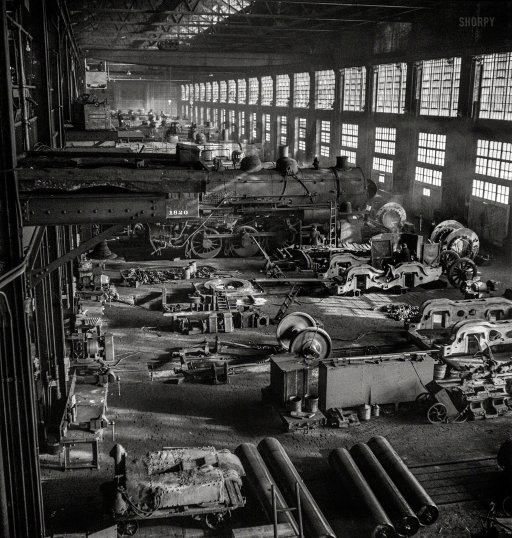
Jack Delano Chicago & North Western Railroad locomotive shops 1942

BIS Flashes Red Alert For a Banking Crisis in China (AEP)
BIS Warning Indicator for China Banking Stress Climbs to Record (BBG)
China Relies on Housing Bubble to Keep GDP Numbers Elevated (CNBC)
Chinese Yuan Borrowing Rate Hits Second Highest Level On Record (R.)
Oil Investors Flee as OPEC Freeze Hopes Face Supply Reality (BBG)
The Death Of The Bakken Field Has Begun (SRSrocco)
Canada To Impose Nationwide Carbon Price (R.)
1000s of VW Lawsuits To Be Filed By The End Of Monday, All in Print (BBG)
Many Car Brands Emit More Pollution Than Volkswagen (G.)
The Ongoing Collapse of Economics (Caswell)
WaPo 1st Paper to Call for Prosecution of its Own Source -After Pulitzer- (GG)
‘People’s Candidate’ Le Pen Vows To Free France From EU Yoke (AFP)
Merkel Suffers Drubbing In Berlin Vote Due To Migrant Angst (R.)
Why Won’t The World Tackle The Refugee Crisis? (Observer)


“..China’s “credit to GDP gap” has reached 30.1, the highest to date and in a different league altogether from any other major country tracked by the institution”

BIS Flashes Red Alert For a Banking Crisis in China (AEP)

China has failed to curb excesses in its credit system and faces mounting risks of a full-blown banking crisis, according to early warning indicators released by the world’s top financial watchdog. A key gauge of credit vulnerability is now three times over the danger threshold and has continued to deteriorate, despite pledges by Chinese premier Li Keqiang to wean the economy off debt-driven growth before it is too late. The Bank for International Settlements warned in its quarterly report that China’s “credit to GDP gap” has reached 30.1, the highest to date and in a different league altogether from any other major country tracked by the institution. It is also significantly higher than the scores in East Asia’s speculative boom on 1997 or in the US subprime bubble before the Lehman crisis.
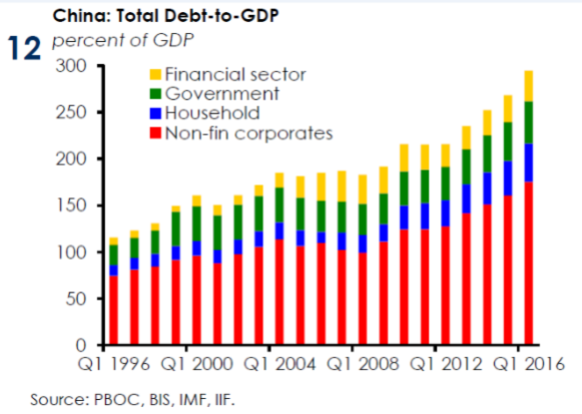
Studies of earlier banking crises around the world over the last sixty years suggest that any score above ten requires careful monitoring. The credit to GDP gap measures deviations from normal patterns within any one country and therefore strips out cultural differences. It is based on work the US economist Hyman Minsky and has proved to be the best single gauge of banking risk, although the final denouement can often take longer than assumed. Indicators for what would happen to debt service costs if interest rates rose 250 basis points are also well over the safety line. China’s total credit reached 255pc of GDP at the end of last year, a jump of 107 percentage points over eight years. This is an extremely high level for a developing economy and is still rising fast.

Outstanding loans have reached $28 trillion, as much as the commercial banking systems of the US and Japan combined. The scale is enough to threaten a worldwide shock if China ever loses control. Corporate debt alone has reached 171pc of GDP, and it is this that is keeping global regulators awake at night. The BIS said there are ample reasons to worry about the health of world’s financial system. Zero interest rates and bond purchases by central banks have left markets acutely sensitive to the slightest shift in monetary policy, or even a hint of a shift. “There has been a distinctly mixed feel to the recent rally – more stick than carrot, more push than pull,” said Claudio Borio, the BIS’s chief economist. “This explains the nagging question of whether market prices fully reflect the risks ahead.”
Read more …

really? “..the state’s control of the financial system and limited levels of overseas debt may mitigate against the risk of a banking crisis.”

BIS Warning Indicator for China Banking Stress Climbs to Record (BBG)

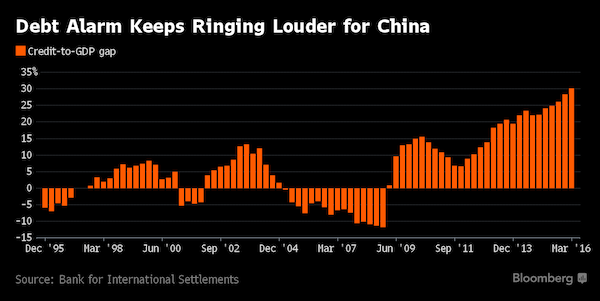
A warning indicator for banking stress rose to a record in China in the first quarter, underscoring risks to the nation and the world from a rapid build-up of Chinese corporate debt. China’s credit-to-GDP “gap” stood at 30.1%, the highest for the nation in data stretching back to 1995, according to the Basel-based Bank for International Settlements. Readings above 10% signal elevated risks of banking strains, according to the BIS, which released the latest data on Sunday. The gap is the difference between the credit-to-GDP ratio and its long-term trend. A blow-out in the number can signal that credit growth is excessive and a financial bust may be looming. Some analysts argue that China will need to recapitalise its banks in coming years because of bad loans that may be higher than the official numbers.

At the same time, the state’s control of the financial system and limited levels of overseas debt may mitigate against the risk of a banking crisis. In a financial stability report published in June, China’s central bank said lenders would be able to maintain relatively high capital levels even if hit by severe shocks. While the BIS says that credit-to-GDP gaps exceeded 10% in the three years preceding the majority of financial crises, China has remained above that threshold for most of the period since mid-2009, with no crisis so far. In the first quarter, China’s gap exceeded the levels of 41 other nations and the euro area. In the U.S., readings exceeded 10% in the lead up to the global financial crisis.
Read more …

“.. the importance of the property sector to China’s overall economic health, posed a challenge. It contributes up to one-third of GDP..”

China Relies on Housing Bubble to Keep GDP Numbers Elevated (CNBC)

Policymakers in China were facing the dilemma of driving growth while preventing the property market from overheating, an economist said Monday as prices in the world’s second largest economy jumped in August. Average new home prices in China’s 70 major cities rose 9.2% in August from a year earlier, accelerating from a 7.9% increase in July, an official survey from the National Bureau of Statistics showed Monday. Home prices rose 1.5% from July. But according to Donna Kwok, senior China economist at UBS, the importance of the property sector to China’s overall economic health, posed a challenge. It contributes up to one-third of GDP as its effects filter through to related businesses such as heavy industries and raw materials.

“On the one hand, they need to temper the signs of froth that we are seeing in the higher-tier cities. On the other hand, they are still having to rely on the (market’s) contribution to headline GDP growth that property investment as the whole—which is still reliant on the lower-tier city recovery—generates…so that 6.5 to 7% annual growth target is still met for this year,” Kwok told CNBC’s “Street Signs.” The data showed prices in the first-tier cities of Shanghai and Beijing prices rose 31.2% and 23.5%, respectively. Home prices in the second tier cities of Xiamen and Hefei saw the larges price gains, rising 43.8 percent and 40.3 percent respectively, from a year ago.

Read more …

Liquidity.

Chinese Yuan Borrowing Rate Hits Second Highest Level On Record (R.)

Hong Kong’s overnight yuan borrowing rate was fixed at the highest level in eight months on Monday after the long holiday weekend. China’s financial markets were closed from Thursday for the Mid-Autumn Festival, and Hong Kong’s markets were shut on Friday. The CNH Hong Kong Interbank Offered Rate benchmark (CNH Hibor), set by the city’s Treasury Markets Association (TMA), was fixed at 23.683% for overnight contracts, the highest level since Jan. 12. Traders said the elevated offshore yuan borrowing rates in the past week were due to tight liquidity in the market and rumors that China took action to raise the cost of shorting its currency.

“Normal lenders of the yuan, like Chinese banks, have refrained from injecting liquidity into the market recently due to speculation that the yuan will depreciate toward certain levels like 6.68, 6.7 per dollar,” said a trader in a local bank in Hong Kong. “(The yuan’s) inclusion into the SDR basket nears, so the central bank would like to maintain the offshore yuan near the stronger side,” said the trader, adding that seasonal reasons including national holidays and caution near the quarter-end also drains yuan liquidity from the market. The U.S. dollar traded near a two-week high against a basket of major currencies on Monday after U.S. consumer prices rose more than expected in August, bolstering expectations the Federal Reserve will raise interest rates this year.

Read more …

Really, it’s about demand.

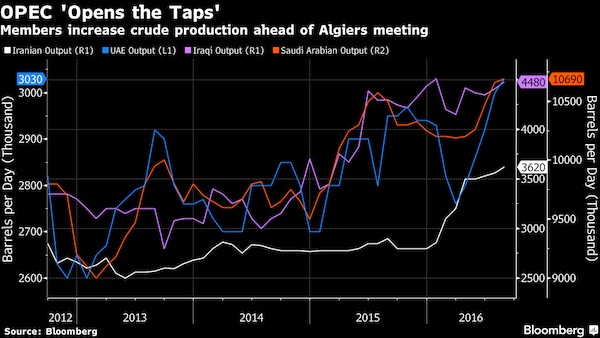
Oil Investors Flee as OPEC Freeze Hopes Face Supply Reality (BBG)

Oil speculators headed for the sidelines as OPEC members prepare to discuss freezing output in the face of signs the supply glut will linger. Money managers cut wagers on both falling and rising crude prices before talks between OPEC and other producers later this month. The meeting comes after the International Energy Agency said that the global oversupply will last longer than previously thought as demand growth slows and output proves resilient. “It’s a cliff trade right here,” said John Kilduff, partner at Again Capita, a New York hedge fund focused on energy. “There’s more uncertainty than usual in the market because of the upcoming meeting. People are waiting for the outcome and a number think this is a good time to stand on the sidelines.”
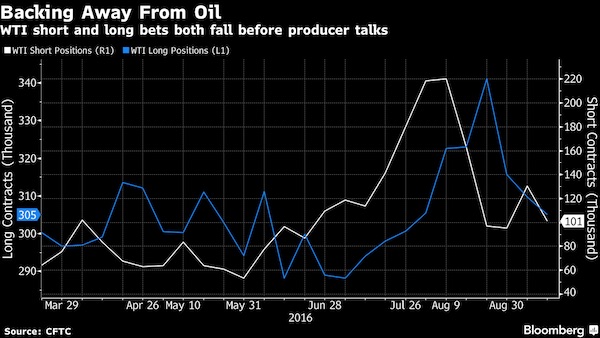
OPEC plans to hold an informal meeting with competitor Russia in Algiers Sept. 27, fanning speculation the producers may agree on an output cap to shore up prices. Oil climbed 7.5% in August after OPEC announced talks in the Algerian capital. [..] World oil stockpiles will continue to accumulate into late 2017, a fourth consecutive year of oversupply, according to the IEA. Just last month, the agency predicted the market would start returning to equilibrium this year. OPEC production rose last month as Middle East producers opened the taps, the IEA said. Saudi Arabia, Kuwait and the UAE pumped at or near record levels and Iraq pushed output higher, according to the agency. “OPEC is out of bullets,” said Stephen Schork, president of the Schork Group. “Even if they agree on a production freeze it will be at such a high level that it will be meaningless.”
Read more …

“..the energy companies producing shale oil in the Bakken are in the hole for $32 billion. ”

The Death Of The Bakken Field Has Begun (SRSrocco)

The Death of the Great Bakken Oil Field has begun and very few Americans understand the significance. Just a few years ago, the U.S. Energy Industry and Mainstream media were gloating that the United States was on its way to “Energy Independence.” Unfortunately for most Americans, they believed the hype and are now back to driving BIG SUV’s and trucks that get lousy fuel mileage. And why not? Americans now think the price of gasoline will continue to decline because the U.S. oil industry is able to produce its “supposed” massive shale oil reserves for a fraction of the cost, due to the new wonders of technological improvement. [..] they have no clue that the Great Bakken Oil Field is now down a stunning 25% from its peak just a little more than a year and half ago:
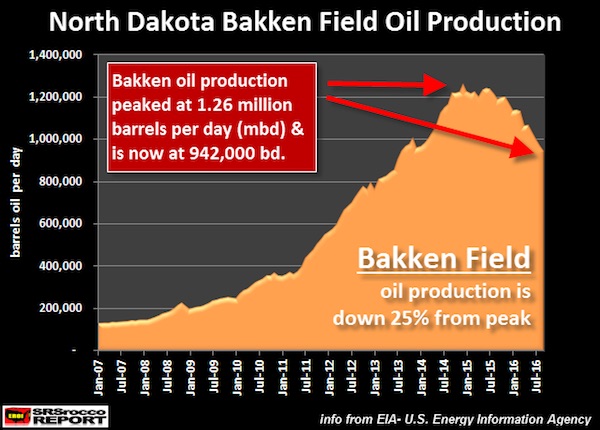
Some folks believe the reason for the decline in oil production at the Bakken was due to low oil prices. While this was part of the reason, the Bakken was going to peak and decline in 2016-2017 regardless of the price. This was forecasted by peak oil analyst Jean Laherrere. [..] I took Jean Laherrere’s chart and placed it next to the current actual Bakken oil field production:
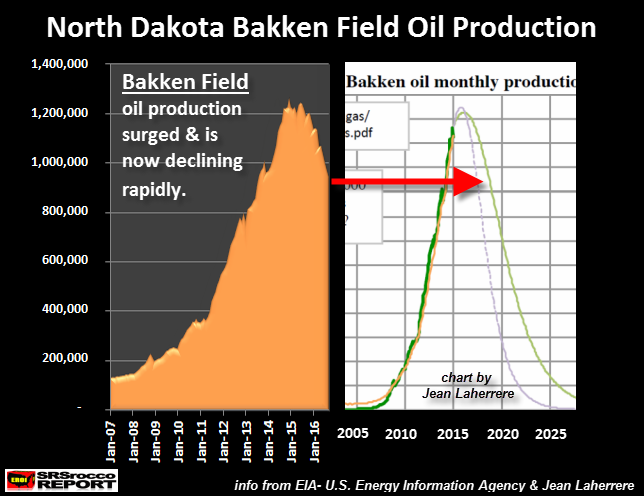
As we can see in the chart above, the rise and fall of Bakken oil production is very close to what Jean Laherrere forecasted several years ago (shown by the red arrow). According to Laherrere’s chart, the Bakken will be producing a lot less oil by 2020 and very little by 2025. This would also be true for the Eagle Ford Field in Texas. According to the most recent EIA Drilling Productivity Report [8], the Eagle Ford Shale Oil Field in Texas will be producing an estimated 1,026,000 barrels of oil per day in September, down from a peak of 1,708,000 barrels per day in May 2015. Thus, Eagle Ford oil production is slated to be down a stunning 40% since its peak last year.
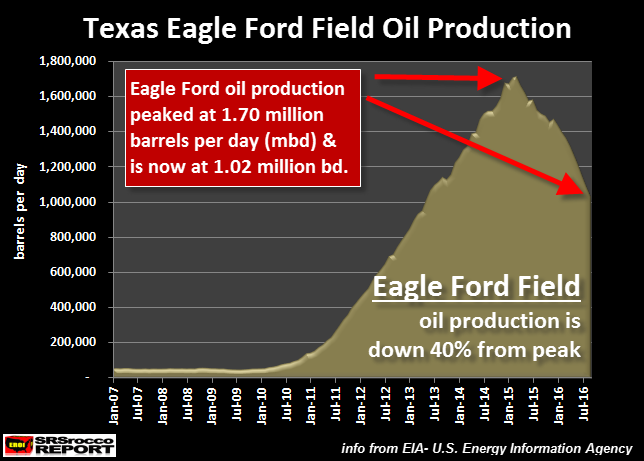
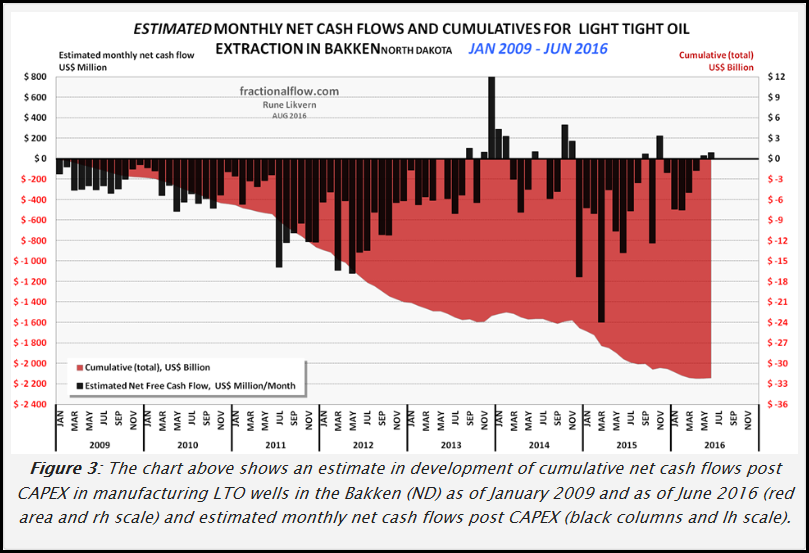
Do you folks see the writing on the wall here? The Bakken down 25% and the Eagle Ford down 40%. These are not subtle declines. This is much quicker than the U.S. Oil Industry or the Mainstream Media realize. And… it’s much worse than that. The U.S. Oil Industry Hasn’t Made a RED CENT Producing Shale. Rune Likvern of Fractional Flow has done a wonderful job providing data on the Bakken Shale Oil Field. Here is his excellent chart showing the cumulative FREE CASH FLOW from producing oil in the Bakken: [..] the BLACK BARS are estimates of the monthly Free Cash flow from producing oil in the Bakken since 2009, while the RED AREA is the cumulative negative free cash flow. [..] Furthermore, the red area shows that the approximate negative free cash flow (deducting CAPEX- capital expenditures) is $32 billion. So, with all the effort and high oil prices from 2011-2014 (first half of 2014), the energy companies producing shale oil in the Bakken are in the hole for $32 billion. Well done…. hat’s off to the new wonderful fracking technology.
Read more …

Lofty.

Canada To Impose Nationwide Carbon Price (R.)

Canada will impose a carbon price on provinces that do not adequately regulate emissions by themselves, Environment Minister Catherine McKenna said on Sunday without giving details on how the Liberal government will do so. Speaking on the CTV broadcaster’s “Question Period,” a national politics talk show, McKenna said the new emissions regime will be in place sometime in October, before a federal-provincial meeting on the matter. She only said the government will have a “backstop” for provinces that do not comply, but did not address questions on penalties for defiance. Canada’s 10 provinces, which enjoy significant jurisdiction over the environment, have been wary of Ottawa’s intentions and have said they should be allowed to cut carbon emissions their own way.

Prime Minister Justin Trudeau persuaded the provinces in March to accept a compromise deal that acknowledged the concept of putting a price on carbon emissions, but agreed the specific details, which would take into account provinces’ individual circumstances, could be worked out later. Canada’s four largest provinces, British Columbia, Alberta, Ontario and Quebec, currently have either a tax on carbon or a cap-and-trade emissions-limiting system. But Brad Wall, the right-leaning premier of the western energy-producing province of Saskatchewan, has long been resistant to federal emissions-limiting plans. McKenna said provinces such as Saskatchewan can design a system in which emissions revenues go back to companies through tax cuts, which would dampen the impact of the extra cost brought by the carbon price.

Read more …

“Lower Saxony, home state to Volkswagen doesn’t offer electronic filing for civil litigation.”

1000s of VW Lawsuits To Be Filed By The End Of Monday, All in Print (BBG)

There was one thing Andreas Tilp and Klaus Nieding needed most for taking a wave of Volkswagen investor cases to court: a pickup truck. Nieding had a load of 5,000 suits sent Friday from his office in Frankfurt to Braunschweig, about 350 kilometers (218 miles) away. Tilp’s 1,000 or so complaints will arrive in a transport vehicle Monday, traveling more than 500 kilometers from his office in the southern German city of Kirchentellinsfurt. There was no other way to do it: Lower Saxony, home state to Volkswagen doesn’t offer electronic filing for civil litigation. The court in Braunschweig, the legal district that includes VW’s Wolfsburg headquarters, is expecting thousands of cases by the end of the day.

Investors are lining up to sue in Germany, where VW shares lost more than a third of their value in the first two trading days after the Sept. 18 disclosure of the emissions scandal by U.S. regulators. Monday is the first business day after the anniversary of the scandal and investors fear they have to sue within a year of the company’s admission that it had equipped about 11 million diesel vehicles with software to cheat pollution tests. The lawsuits disclosed so far are seeking 10.7 billion euros ($11.9 billion). The Braunschweig court has said it will release the total number this week. Volkswagen has consistently argued that it has followed all capital-markets rules and properly disclosed emissions issues in a timely fashion.

The super-sized filing is yet another example of the sheer scale of the scandal that’s haunted VW for a year. It forced the German carmaker into the biggest recall in its history to fix the cars or get them off the road entirely, the fines already levied are among the steepest against any manufacturer, and the carmaker has built up massive provisions to absorb the hit.

Read more …

What are the odds VW sponsored the report?

Many Car Brands Emit More Pollution Than Volkswagen (G.)

A year on from the “Dieselgate” scandal that engulfed Volkswagen, damning new research reveals that all major diesel car brands, including Fiat, Vauxhall and Suzuki, are selling models that emit far higher levels of pollution than the shamed German carmaker. The car industry has faced fierce scrutiny since the US government ordered Volkswagen to recall almost 500,000 cars in 2015 after discovering it had installed illegal software on its diesel vehicles to cheat emissions tests. But a new in-depth study by campaign group Transport & Environment (T&E) found not one brand complies with the latest “Euro 6” air pollution limits when driven on the road and that Volkswagen is far from being the worst offender.

“We’ve had this focus on Volkswagen as a ‘dirty carmaker’ but when you look at the emissions of other manufacturers you find there are no really clean carmakers,” says Greg Archer, clean vehicles director at T&E. “Volkswagen is not the carmaker producing the diesel cars with highest nitrogen oxides emissions and the failure to investigate other companies brings disgrace on the European regulatory system.” T&E analysed emissions test data from around 230 diesel car models to rank the worst performing car brands based on their emissions in real-world driving conditions. Fiat and Suzuki (which use Fiat engines) top the list with their newest diesels, designed to meet Euro 6 requirements, spewing out 15 times the NOx limit; while Renault-Nissan vehicle emissions were judged to be more than 14 times higher. General Motors’ brands Opel-Vauxhall also fared badly with emissions found to be 10 times higher than permitted levels.

Read more …

Exposed. But too late.

The Ongoing Collapse of Economics (Caswell)

If we accept the rapidly growing body of evidence and authority suggesting that many of the core concepts of conventional macroeconomics are bollox, and that economists don’t really know what they’re doing, then the important question becomes ‘What next?’ As conventional macroeconomic theory crumbles in the face of facts, what will replace it? One of the primary contenders is Modern Monetary Theory, which focuses on money itself (something which, believe it or not, conventional macroeconomic theory doesn’t do). Another possibility is that macroeconomics will learn from complexity and systems theory, and that its models (and, hopefully, their predictive ability) will become more like those used in meteorology and climate science.

Anti-economist Steve Keen is working in this direction, influenced by the Financial Instability Hypothesis (FIH) of Hyman Minsky, whatever that is. But wherever macroeconomics is going, it’s clear that the old order is collapsing. The theoretical orthodoxy that has guided the highest level of economic management for many decades is crumbling. Either economics is an objective science or it’s not. And if economics is not an objective science, then we quickly need an economics that is. Countless livelihoods and lives will be deeply affected by the revolution we are witnessing in theoretical macroeconomics. It may be dry, it may be boring, it may be theoretical, and it may seem incomprehensible. But it’s hard to think of any discussion that’s more important.

Read more …

Not looking good.

WaPo 1st Paper to Call for Prosecution of its Own Source -After Pulitzer- (GG)

Three of the four media outlets which received and published large numbers of secret NSA documents provided by Edward Snowden – The Guardian, The New York Times and The Intercept – have called for the U.S. Government to allow the NSA whistleblower to return to the U.S. with no charges. That’s the normal course for a newspaper, which owes its sources duties of protection, and which – by virtue of accepting the source’s materials and then publishing them – implicitly declares the source’s information to be in the public interest. But not The Washington Post.

In the face of a growing ACLU-and-Amnesty-led campaign to secure a pardon for Snowden, timed to this weekend’s release of the Oliver Stone biopic “Snowden,” the Post Editorial Page not only argued today in opposition to a pardon, but explicitly demanded that Snowden – their paper’s own source – stand trial on espionage charges or, as a “second-best solution,” “accept [] a measure of criminal responsibility for his excesses and the U.S. government offers a measure of leniency.” In doing so, The Washington Post has achieved an ignominious feat in U.S. media history: the first-ever paper to explicitly editorialize for the criminal prosecution of its own paper’s source – one on whose back the paper won and eagerly accepted a Pulitzer Prize for Public Service. But even more staggering than this act of journalistic treachery against their paper’s own source are the claims made to justify it.

The Post Editors concede that one – and only one – of the programs which Snowden enabled to be revealed was justifiably exposed – namely, the domestic metadata program, because it “was a stretch, if not an outright violation, of federal surveillance law, and posed risks to privacy.” Regarding the “corrective legislation” that followed its exposure, the Post acknowledges: “we owe these necessary reforms to Mr. Snowden.” But that metadata program wasn’t revealed by the Post, but rather by the Guardian.

Read more …

Soon one of many.

‘People’s Candidate’ Le Pen Vows To Free France From EU Yoke (AFP)

French far-right National Front leader Marine Le Pen on Sunday vowed to give her country back control over its laws, currency and borders if elected president next year on an anti-EU, anti-immigration platform. Addressing around 3,000 party faithful in the town of Frejus on the Cote d’Azur, Le Pen aimed to set the tone for her campaign, declaring in her speech: “The time of the nation state has come again.” The FN leader, who has pledged to hold a referendum on France’s future in the EU if elected and bring back the French franc, said she was closely watching developments in Britain since it voted to leave the bloc. “We too are keen on winning back our freedom…. We want a free France that is the master of its own laws and currency and the guardian of its borders.”

Polls consistently show Le Pen among the top two candidates in the two-stage presidential elections to take place in April and May. But while the polls show her easily winning a place in the run-off they also show the French rallying around her as-yet-unknown conservative opponent in order to block her victory in the final duel. In Frejus, Le Pen sought to sanitise her image, continuing a process of “de-demonisation” that has paid off handsomely at the ballot box since she took over the FN leadership from her ex-paratrooper father Jean-Marie Le Pen in 2011. “I am the candidate of the people and I want to talk to you about France, because that is what unites us,” the 48-year-old politician said in a speech that avoided any reference to the FN which is seen as more taboo than its leader.

Read more …

What would happen if she decides not to run next year?

Merkel Suffers Drubbing In Berlin Vote Due To Migrant Angst (R.)

Chancellor Angela Merkel’s conservatives suffered their second electoral blow in two weeks on Sunday, with support for her Christian Democrats (CDU) plunging to a post-reunification low in a Berlin state vote due to unease with her migrant policy. The anti-immigrant Alternative for Germany (AfD) polled 11.5%, gaining from a popular backlash over Merkel’s decision a year ago to keep borders open for refugees, an exit poll by public broadcaster ARD showed. The result means the AfD will enter a 10th state assembly, out of 16 in total.

Merkel’s CDU polled 18%, down from 23.3% at the last election in 2011, with the centre-left Social Democrats (SPD) remaining the largest party on 23%. The SPD may now ditch the CDU from their coalition in the German capital. The blow to the CDU came two weeks after they suffered heavy losses in the eastern state of Mecklenburg-Vorpommern. The setbacks have raised questions about whether Merkel will stand for a fourth term next year, but her party has few good alternatives so she still looks like the most likely candidate.

Read more …

Perhaps there’s a contradiction hiding in realizing that globalization is moving in reverse, but still expecting global responses to crises.

Why Won’t The World Tackle The Refugee Crisis? (Observer)

It is now the greatest movement of the uprooted that the world has ever known. Some 65 million people have been displaced from their homes, 21.3 million of them refugees for whom flight is virtually compulsory – involuntary victims of politics, war or natural catastrophe. With just less than 1% of the world’s population homeless and seeking a better, safer life, a global crisis is under way, exacerbated by a lack of political cooperation – and several states, including the United Kingdom, are flouting international agreements designed to deal with the crisis. This week’s two major summits in New York, called by the United Nations general assembly and by President Barack Obama, are coming under intense criticism before the first world leaders have even taken their seats.

Amnesty, Human Rights Watch and refugee charities are among those accusing both summits of being “toothless” and saying that the declaration expected to be ratified by the UN on Monday imposes no obligations on the 193 general assembly nations to resettle refugees. The Obama-led summit, meanwhile, which follows on Tuesday, is designed to extract pledges of funding which critics say too often fail to materialise. Steve Symonds, refugee programme director at Amnesty, said: “Funding is great and very much needed, but it’s not going to tackle the central point of some sharing of responsibility. The scale of imbalance there is growing, and growing with disastrous consequences.”

He said nations were sabotaging agreements through self-interest. “It’s very, very difficult to feel any optimism about this summit or what it will do for people looking for a safe place for them and their families right at this moment, nor tackle the awful actions of countries who are now thinking, ‘If other countries won’t help take responsibility, then why should we?’ and are now driving back desperate people. “Compelling refugees to go back to countries where there is conflict and instability doesn’t help this awful merry-go-round going on and on.”
Read more …

Sep 042016
 
 September 4, 2016  Posted by at 9:58 am Finance Tagged with: , , , , , , , , , , ,  Comments Off on Debt Rattle September 4 2016


NPC “Georgetown-Marines game” 1923

Dollar Hegemony Endures As Share Of Global Transactions Keeps Rising (AEP)
US Has 9.93 Million More Government Workers Than Manufacturing Workers (CI)
German Budget Surpluses Are Bad For The Global Economy (Economist)
ECB’s Mersch: Central Banking Based On “Mathematical Models”, Not Reality (ZH)
Europe’s Broken Banks Need the Urge to Merge (BBG)
Economic Czars Warn G-20 of Risk From Populist Backlash on Trade (BBG)
Chinese Consumers Take Credit For Boom In Car Loans (R.)
6 Steps To Avoiding All EU (Incl. Irish) And US Taxes Via Ireland (PP)
Rural France Pledges To Vote For Marine Le Pen As Next President (G.)
Shops Set For Christmas Price Hikes As Millions Of Shipments Stranded (Ind.)
Row On Tarmac An Awkward G20 Start For US, China (R.)
Barack Obama ‘Deliberately Snubbed’ By Chinese In Chaotic Arrival At G20 (G.)
Half The Forms Of Life On Earth Will Be Gone By 2050 (ZH)


It’s nice to be able to agree with Ambrose once in a while.

Dollar Hegemony Endures As Share Of Global Transactions Keeps Rising (AEP)

The US dollar is tightening its grip on the global financial system at the expense of the euro, entrenching American hegemony and rendering the US Federal Reserve more powerful than at any time in history. Newly-released data from the Bank for International Settlements (BIS) show that the dollar’s share of the $5.1 trillion in foreign exchange trades each day has continued rising to 87.6pc of all transactions. It is the latest evidence confirming the extraordinary resilience of the dollar-based international order, confounding expectations of US financial decline a decade ago. Roughly 60pc of the global economy is either in the dollar zone or closely tied to it through currency pegs or ‘dirty floats’, and the level of debt issued in dollars outside US jurisdiction has soared to $9 trillion.

This has profound implications for monetary policy. The Fed has become the world’s central bank whether it likes it or not, setting borrowing costs for much of the global system. The BIS data shows that the volume of transactions in which the euro was on one side of the trade has slipped to 31.3pc from 37pc in 2007. The dollar share has ratcheted up to 87.6pc over the same period. It is much the same picture for the foreign exchange reserves of central banks, a good barometer of global trust. The dollar share has recovered to 63.6pc, roughly where it was a decade ago. The euro share has tumbled over the last eight years from 28pc to 20.4pc, and is barely above Deutsche Mark share in the early 1990s.

“There are no foreseeable rivals to the dollar as a viable reserve currency,” said Eswar Prasad from Cornell University, author of “The Dollar Trap: How the US Dollar Tightened Its Grip on Global Finance”. “The US is hard to beat. The US has deep financial markets, a powerful central bank and legal framework the rest of the world has a great deal of trust in,” he said. The eurozone is crippled by the lack of a unified EU treasury, joint bond issuance, and a genuine banking union to back up the currency. It would require a change in the German constitution to open the way for fiscal union, an unthinkable prospect in the current political climate.

Read more …

Many years ago I dubbed it the ‘Bulgaria Model’.

US Has 9.93 Million More Government Workers Than Manufacturing Workers (CI)

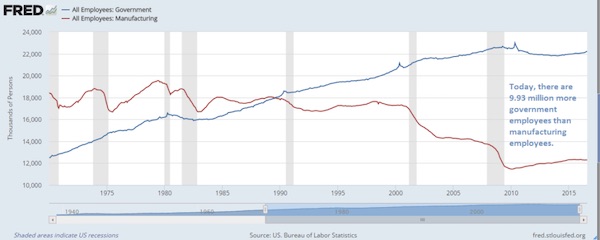
The August jobs report was filled with some interest factoids, like there are now 9.93 million government workers than there are manufacturing workers. That is a ratio of 1.81 government workers for every manufacturing worker. Such was not always the case. But a variety of factors such as labor cost differentials, EPA regulations and taxes had led to manufacturing jobs to be sent overseas. Now a 1.81 government to manufacturing employment ratio is called OVERHEAD. And you wonder why high paying manufacturing jobs are fleeing to other countries?

Read more …

“German saving and Greek suffering are two sides of the same coin..”

German Budget Surpluses Are Bad For The Global Economy (Economist)

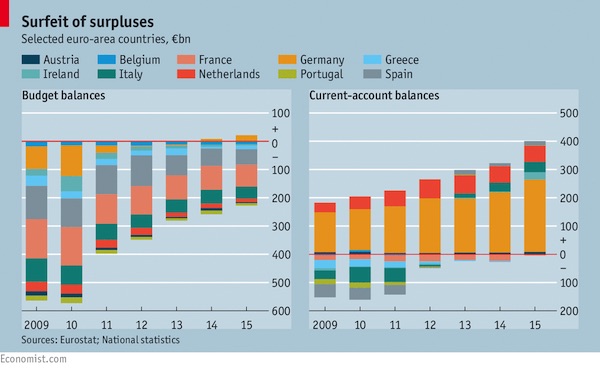
On August 24th Germans received news to warm any Teutonic heart. Figures revealed a larger-than-expected budget surplus in the first half of 2016, and put Germany on track for its third year in a row in the black. To many such excess seems harmless enough—admirable even. Were Greece half as fiscally responsible as Germany, it might not be facing its eighth year of economic contraction in a decade. Yet German saving and Greek suffering are two sides of the same coin. Seemingly prudent budgeting in economies like Germany’s produce dangerous strains globally. The pressure may yet be the undoing of the euro area. German frugality and economic woes elsewhere are linked through global trade and capital flows.

In recent years, as Germany’s budget balance flipped from red to black, its current-account surplus—which reflects net cross-border flows of goods, services and investment—has soared, to nearly 9% of German GDP this year. The connection between budgets and current accounts might not be immediately obvious. But in a series of papers published in 2011 IMF economists found evidence that cutting budget deficits is associated with reduced investment, greater saving and a shift in the current account from deficit toward surplus. Two IMF economists, John Bluedorn and Daniel Leigh, reckoned that a fiscal consolidation of one percentage point of GDP led to an improvement in the ratio of the current-account balance to GDP of 0.6 percentage points.

On that reckoning, the German government’s thriftiness accounts for a small but meaningful share of its growing current-account surplus; perhaps as much as three percentage points of GDP over the past five years.

That has helped to resurrect an old problem. Global imbalances were a scourge of the world economy before the financial crisis of 2007-08. Back then, China and oil-exporting economies accounted for the surplus side of the world’s trade ledger, which reached nearly 3% of the world’s GDP on the eve of the crisis. Other countries, notably America, ran correspondingly large current-account deficits, financed in part by flows of investment from surplus countries that flooded into the country’s overheating housing market. A similar dynamic played out in miniature within the euro area, as core economies like Germany ran current-account surpluses and peripheral countries like Spain ran deficits.

Read more …

Taking away their powers is the only solution. But … that’s not going to happen.

ECB’s Mersch: Central Banking Based On “Mathematical Models”, Not Reality (ZH)

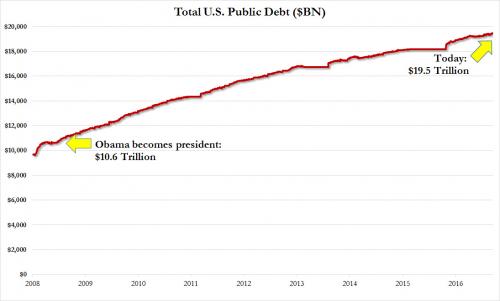
At first (literally the day the Fed announced QE1) it was just “tinfoil fringe blogs” who predicted the failure of the central bank’s attempt to boost the economy by printing money, instead warning that all the Fed would do is unleash an unprecedented income and wealth divide that may culminate in civil war and hyperinflation. Then, gradually, analysts, pundits and even the mainstream press admitted the truth, i.e., that tin-foilers were right all along, until recently even the Fed’s own mouthpiece, Jon Hilsenrath, one day before the Jackson Hole meeting wrote that “Years of Fed Missteps Fueled Disillusion With the Economy and Washington”, an article which set the stage for the pivot to the US issuance of much more debt, because apparently $9 trillion in new debt under Obama is not considered enough “fiscal stimulus.”

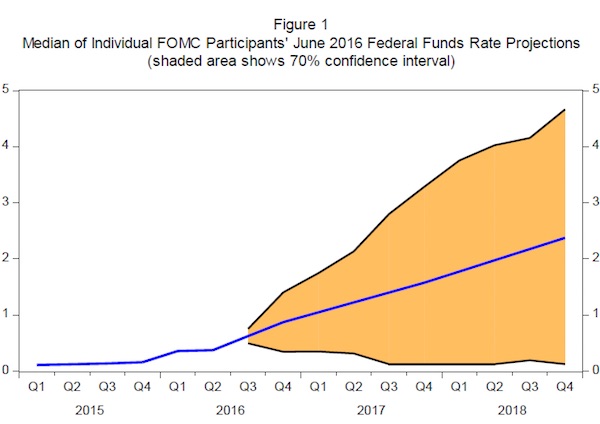
However, with virtually everyone else now slamming central banks for fooling the world for the past 7 years that they knew what they were doing, now that even Yellen admitted she has no idea what will happen in just the next 3 years projecting a 70% confidence interval of the Fed Funds rate of between 0% and 5% by the end of 2018 (we wonder what a 100% confidence would look like)…

.. overnight central bankers themselves attacked central bank policies, when ECB board member Yves Mersch warned on Saturday against using “extreme [policy] measures [with] unacceptable side effects” to shore up the eurozone’s weak economy, which he said could undermine trust in the single currency, a warning aimed squarely at Mario Draghi. Mersch’s comments come amid a growing debate over whether central banks in Europe and Japan should bolster economic growth by turning to even more tools such as “helicopter money.” Even more ludicrous, as we reported yesterday, Reuters already lobbed a tentative trial balloon, hinting that the ECB may be “forced” to buy ETFs and equities having virtually run out of bonds to monetize. Still, despite all ongoing ECB deflationary counter-measures, eurozone inflation was just 0.2% in August, far below the ECB’s near-2% target. Investors are increasingly concerned that the central bank is running out of tools.

Surprisingly, at this point Mersch joined the Weidmann bandwagon, and cautioned against “academic proposals [that] seem to prefer sophisticated models to social psychology.” Or in other words, for the first time, a central banker has suggested that broken (which is a far more accurate definition that sophisticated) financial models should be ignored when dealing with reality. “We cannot fulfill our mandate with mathematical equations, but only with instruments that maintain trust in the currency,” Mersch said at an annual economic forum on the shores of Lake Como, Italy. Expanding his tongue in cheek criticism of Mario Draghi’s relentless crusade to hurt the euro and reflate asset prices at all costs, Mersch then said that “extreme measures or legal violations of our mandate aren’t among those instruments.”

Read more …

Restructure. Only way. And again, not going to happen.

Europe’s Broken Banks Need the Urge to Merge (BBG)

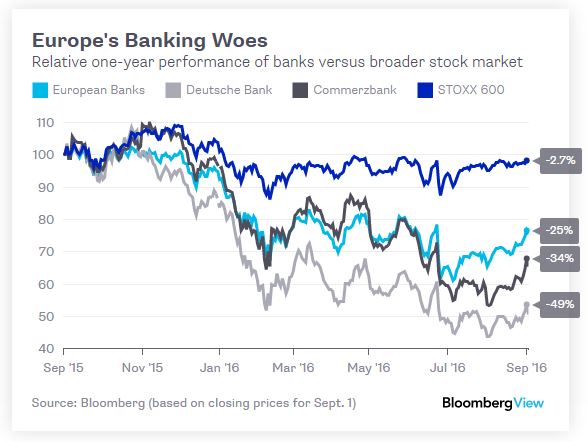
The recent flurry of excitement at the idea that Germany’s Deutsche Bank and Commerzbank contemplated a merger reinforces the view that the European finance industry is ripe for consolidation. Banking leaders themselves talk about the need for mergers in an overbanked market, but no one among the bigger banks seems to want to go first. If something doesn’t change soon, Europe won’t have a banking industry worthy of the name. The relentless collapse in bank share prices this year may speak to difficult market conditions, but they also suggest that Europe’s banking model is broken, amid a deadly combination of negative interest rates, anemic economic growth and a lack of clarity about the future regulatory outlook (albeit in large part because European banks have fought every line of every proposed rule change).

The region’s banks have lost almost a quarter of their value this year, according to the Stoxx 600 Banks index. As Germany has by far the least consolidated banking sector in the euro zone, it’s no surprise that both Commerzbank and Deutsche Bank have done even worse. Merger talk sparked a bit of a rally in the two German banks in recent days, even though the discussions, reported to have taken place over two weeks this summer, have been abandoned. With both banks embarking on major cost-cutting and restructuring projects, it may have been too early to talk of a merger.

Read more …

It’s all in the choice of terminology: populism, protectionism, they sound very negative, so they are what you read. But it makes no difference: without growth, centralization withers away all by itself.

Economic Czars Warn G-20 of Risk From Populist Backlash on Trade (BBG)

The heads of three world economic bodies warned of the risk to trade from the protectionist headwinds sweeping many developed nations as global leaders met in Hangzhou, China. In a panel session Saturday ahead of the Group of 20 summit, Christine Lagarde, Managing Director of the IMF, urged business chiefs to lobby governments to help keep trade flows up as she issued a warning about the outlook for growth into 2017. Her views were echoed by Roberto Azevedo, Director-General of the WTO. “Trade is way too low and has been way too low for a long time,” Lagarde said. “There is at the moment an undercurrent of anti-trade movement. It’s at the political level. It’s at the public opinion level” and also being reflected in policy, she added.

“If there is no international trade, if there is no cross-border investment, if services, capital, people and goods do not cross borders, then it’s less activity for you, it’s less jobs in whichever country you are headquartered,” she said. Lagarde’s comments come as momentum for ratifying the U.S.-led Trans-Pacific Partnership, which would link 12 nations making up about 40% of the world economy, falters in the final months of U.S. President Barack Obama’s term. Both presidential candidates have spoken against the deal, which does not include China, while progress on a U.S.-EU trade and investment deal, known as TTIP, has also stalled.

France’s trade minister Matthias Fekl said late last month that the U.S. hasn’t offered anything substantial in negotiations with the EU on the free-trade deal and that talks should come to an end. His comments followed those of German Economy Minister Sigmar Gabriel, who said discussions on the TTIP “have de-facto broken down, even if no one wants to say so.” Many Western nations are grappling with a mood of protectionism that is leading to calls for caution on free trade, and on foreign investment in things like property and utilities. Chinese companies recently were dealt a blow on prospective projects in both the U.K. and Australia.

Read more …

Let’s see: more debt AND more cars. It’s a win-win! Happy days!

Chinese Consumers Take Credit For Boom In Car Loans (R.)

Chinese households, traditional savers with an aversion to debt, are rapidly warming to the idea of borrowing to buy a car, as automakers push financing deals to boost sales and margins in an increasingly competitive market. Nearly 30% of Chinese car buyers bought on credit last year, up from 18% in 2013, according to analysts from Sanford C. Bernstein and Deloitte, helping a rebound in the car market after a sticky 2015. That is welcome news to China’s government, which wants consumers to borrow and spend more to shift its slowing economy away from heavy industry and investment-led growth. Beijing resident Wang Danian said he planned to buy his first car on credit, saying it was the smart move.

“I can use my cash to do other things,” the 28-year-old said. “If I use all my savings at once to buy a car, and then something happens, I can’t manage the risk.” Six consumers interviewed by Reuters said they would all consider loans, lured by low-fee and interest-free deals, with half saying they’d prefer to buy on credit and save cash for other items. “I’d estimate after the manufacturer came out with the low-interest deal that about 30% of potential cash buyers switched to buying on credit,” said a salesman at a Volkswagen dealership in eastern China’s Jiangsu province who gave his name as Mr. Zhao. That is still a far cry from the more than 80% of cars bought on loans in the United States, but Deloitte predicts China will reach 50% by 2020.

[..] China’s auto market struggled last year thanks to the slowest economic growth in 25 years and a stock market rout, but rebounded in October when the government cut sales tax on smaller cars. By July, vehicle sales were rising at their fastest monthly rate in three and a half years. “While the government’s tax reduction was the most obvious explanation for the rebound in Chinese car sales at the end of 2015, soaring auto financing penetration represented another, lesser noticed, driver of the boom,” Bernstein said in April.

Read more …

Excellent thread from The Property Pin. A lot more under the link.

6 Steps To Avoiding All EU (Incl. Irish) And US Taxes Via Ireland (PP)

1. Making the Intellectual Property (IP). Let’s say that Apple US spent $200m (validly) developing iOS (it’s iPhone operating system). What Apple does next is to “sell” a non-US version of iOS to an Apple Ireland entity (generic name), for c $500m. Apple US will then pay full US taxes on this gain of $300m. Easy so far. The US IRS is already starting to probe these “internal” sales.

2. Stepping up the IP value (when the “magic” happens). Specialist IP corporate finances (why Dublin accountancy firms have big corporate finance practices) make two discoveries. First, if the Apple device has no iOS software, it can’t function. iOS is the “secret sauce” (like a drug patent). They then show Apple Ireland that it has done an amazing deal at the expense of its parent, Apple US. They show that if the non-US version of iOS is converted in to 200 different languages (and local network formats), then Apple Ireland can sell devices all over the world (fancy that). The global commercial value is over €50bn (why many MNC jobs in Ireland are “localisation”, or language translation, jobs). Apple has the tax equivalent of “Alchemy”.

3. Avoiding tax on the IP step-up. A €50bn gain in Apple Ireland is going to incur tax (both Irish and US), and would distort Ireland’s National Accounts (our 2014 GDP was only €200bn). Apple, and the Irish State, worked a scheme to have Apple Ireland both resident in Ireland (essential so Apple Ireland can avail of EU TP (Transfer Pricing) rules; you can’t do EU TP from Cayman, or worse, “Stateless” locations), and non-resident in Ireland (to avoid Irish tax). The EU’s Apple report, proves the recent 26% increase in Irish GDP (“leprechaun economics”) was all Apple, forced to unwind it’s “dual” status (as EU report drew near). Apple paid a once-off tax on the transfer (€500m vs. €50bn gain), which increased our EU GDP levies by 380m. Per Annum.

4. Executing the TP of this IP into Europe. Before step 3., if Apple Ireland sold an iPhone in Germany for €500, Apple Germany would offset valid incurred cash costs (Apple China/Foxconn manufacturing costs of about €150, and Apple Germany marketing costs of about €50) giving a German profit of €300 on that iPhone. German Revenue would take €100 of this in German taxes, and €200 can go back to Ireland. EU TP rules allow EU resident companies, like Apple Ireland, to charge Apple Germany a share of their €50bn IP value, expressed as a royalty charge. Charging this royalty to Apple Germany wipes out all Apple’s German profits. Apple Germany pays no German taxes, and the full €300 goes back to Apple Ireland tax-free.

5. The Cherry on Top. EU challenged step 4. in 2011 (we will get to CCCTB), but the UK Veto stopped it (Osborne was turning Britain into an even bigger EU tax-haven than Ireland). Despite Ireland having the “golden ticket” of being INSIDE the EU’s TP system (why Apple Ireland had to be legally resident in Ireland), AND having the lowest EU corporate tax rate, that was not enough. In 2010, Apple Ireland’s tax rate collapsed from a tiny 0.5% to effectively 0%. Apple Ireland’s profits quadrupled (and doubled every year after). The Irish State had perfected a “straw” for Apple, stuck into the EU, allowing Apple to suck all its EU profits (Germany, France, Italy etc.), via Ireland, to offshore locations, free of EU, Irish and US taxes.

6. Locking it in. US tax law requires US MNCs to remit non-US profits back to the US for final taxing. US tax rate is high at 35% (even by EU standards). The Double Tax Treaty system allows the MNCs to get a credit for taxes paid in the countries in which the profits were made. If Apple pays 35% on German profits, no further US taxes apply. The US IRS allows MNCs to leave non-US profits outside of the US if these non-US profits are going to be re-invested in the non-US location. Apple claimed this right in their US 10K Returns (Margrethe showed how Apple violate this). That is how Apple built the largest offshore cash hoard of modern economic history. Profits from the EU, on which they have never paid EU, Irish or US taxes. Period.

Read more …

In France, as in UK and US and many other places, voters vote against someone, not for.

Rural France Pledges To Vote For Marine Le Pen As Next President (G.)

In the picturesque hamlet of Brachay, in scorching late summer heat, Marine Le Pen was preaching to the politically converted. “Marine, président”, they chanted. “On va gagner” (we’re going to win). A banner stretching the length of one of the stone buildings overlooking the village square read: “Marine: Save France.” Le Pen’s stump speech was the most closely watched and significant campaign launch of la rentrée, the national return to work after the long summer holidays, and the leader of France’s far-right Front National was welcomed like a conquering hero. Le Pen has been largely absent from the political scene for several weeks and has refrained from adding her 10 cents’ worth to the raging polemic over the burkini and rows about security following deadly attacks by Islamic fundamentalists, both fertile ground for her party.

In the meantime, the country’s governing Socialists and centre-right opposition Les Républicains have engaged in what one FN heavyweight described with schadenfreude as a “bloodbath, left and right”. The Parti Socialiste is bitterly split and in turmoil over whether François Hollande, with his calamitous popularity ratings will, or indeed should, stand for a second term. The alternative, to stand down, would be unprecedented for a serving leader. Emmanuel Macron, the finance minister who resigned last week, might be the rabbit that the party pulls out of the hat, but he is disliked by the PS’s leftwing, which is fielding its own candidates. In any case, Macron has not said whether he will even throw his hat into the presidential ring.

On the right, things are scarcely more harmonious. The deadline for Les Républicains candidates is Friday, and already former president Nicolas Sarkozy, mayor of Bordeaux Alain Juppé and former prime minister François Fillon have either announced they are standing or are expected to do so. Amid this political free-for-all, Le Pen is trying to throw off the party’s divisive reputation and market herself as a politician above and beyond the fray of the same-old-same-old French elite: a new, unifying, patriotic force who will break the shackles of Europe, end “mass immigration” and give France back to the French. Her slogan is La France apaisée – a soothed France.

Read more …

So if people have to spend more to buy the same stuff, that’s good for the economy, right?

Shops Set For Christmas Price Hikes As Millions Of Shipments Stranded (Ind.)

Summer is not yet over but Christmas could be about to get more expensive as millions of gifts including TVs and electrical gadgets could be stranded at sea for months. Retailers have been thrown into turmoil after one of the world’s largest shipping companies collapsed into bankruptcy. South Korean company Hanjin’s vessels have been seized at Chinese ports, while others have been banned from docking until unpaid fees are received. As a result, the cost of transporting goods from Asia to the US and Europe has jumped by more than half, threatening margins as retailers begin stocking up for Christmas. September marks the start of the busiest period of the year for transporting goods.

The US National Retail Federation, the world’s largest retail trade association, wrote to Penny Pritzker, secretary of commerce, on Thursday, urging them to work with the South Korean government, ports and others to prevent disruptions. The bankruptcy is having “a ripple effect throughout the global supply chain” that could cause significant harm to both consumers and the economy, the association wrote. “Retailers’ main concern is that there (are) millions of dollars’ worth of merchandise that needs to be on store shelves that could be impacted by this,” said Jonathan Gold, the group’s vice president for supply chain and customs policy.

“Some of it is sitting in Asia waiting to be loaded on ships, some is already aboard ships out on the ocean and some is sitting on US docks waiting to be picked up. It is understandable that port terminal operators, railroads, trucking companies and others don’t want to do work for Hanjin if they are concerned they won’t get paid.” With an estimated half a million 40-foot containers full of goods stuck at sea or in ports there appears to be little hope of a quick resolution to the issue. September marks the start of the busiest time of the year for transporting goods, but a Korean court on Thursday set a deadline of 25 November to submit a plan to resolve the dispute.

Read more …

Hilarious!

Row On Tarmac An Awkward G20 Start For US, China (R.)

A Chinese official confronted U.S. President Barack Obama’s national security adviser on the tarmac on Saturday prompting the Secret Service to intervene, an unusual altercation as China implements strict controls ahead of a big summit. The stakes are high for China to pull off a trouble-free G20 summit of the world’s top economies, its highest profile event of the year, as it looks to cement its global standing and avoid acrimony over a long list of tensions with Washington. Shortly after Obama’s plane landed in the eastern city of Hangzhou, a Chinese official attempted to prevent his national security adviser Susan Rice from walking to the motorcade as she crossed a media rope line, speaking angrily to her before a Secret Service agent stepped between the two.

Rice responded but her comments were inaudible to reporters standing underneath the wing of Air Force One. It was unclear if the official, whose name was not immediately clear, knew that Rice was a senior official and not a reporter. The same official shouted at a White House press aide who was instructing foreign reporters on where to stand as they recorded Obama disembarking from the plane. “This is our country. This is our airport,” the official said in English, pointing and speaking angrily with the aide. The U.S. aide insisted that the journalists be allowed to stand behind a rope line, and they were able to record the interaction and Obama’s arrival uninterrupted, typical practice for U.S. press traveling with the president.

Read more …

“.. the leader of the world’s largest economy, who is on his final tour of Asia, was forced to disembark from Air Force One through a little-used exit in the plane’s belly..”

Barack Obama ‘Deliberately Snubbed’ By Chinese In Chaotic Arrival At G20 (G.)

China’s leaders have been accused of delivering a calculated diplomatic snub to Barack Obama after the US president was not provided with a staircase to leave his plane during his chaotic arrival in Hangzhou ahead of the start of the G20. Chinese authorities have rolled out the red carpet for leaders including India’s prime pinister Narendra Modi, Russian president Vladimir Putin, South Korean president Park Geun-hye, Brazil’s president Michel Temer and British prime minister Theresa May, who touched down on Sunday morning. But the leader of the world’s largest economy, who is on his final tour of Asia, was forced to disembark from Air Force One through a little-used exit in the plane’s belly after no rolling staircase was provided when he landed in the eastern Chinese city on Saturday afternoon.

When Obama did find his way onto a red carpet on the tarmac below there were heated altercations between US and Chinese officials, with one Chinese official caught on video shouting: “This is our country! This is our airport!” “The reception that President Obama and his staff got when they arrived here Saturday afternoon was bruising, even by Chinese standards,” the New York Times reported. Jorge Guajardo, Mexico’s former ambassador to China, said he was convinced Obama’s treatment was part of a calculated snub. “These things do not happen by mistake. Not with the Chinese,” Guajardo, who hosted presidents Enrique Peña Nieto and Felipe Calderón during his time in Beijing, told the Guardian.

“I’ve dealt with the Chinese for six years. I’ve done these visits. I took Xi Jinping to Mexico. I received two Mexican presidents in China. I know exactly how these things get worked out. It’s down to the last detail in everything. It’s not a mistake. It’s not.” Guajardo added: “It’s a snub. It’s a way of saying: ‘You know, you’re not that special to us.’ It’s part of the new Chinese arrogance. It’s part of stirring up Chinese nationalism. It’s part of saying: ‘China stands up to the superpower.’ It’s part of saying: ‘And by the way, you’re just someone else to us.’ It works very well with the local audience. “Why [did it happen]?” the former diplomat, who was ambassador from 2007 until 2013, added. “I guess it is part of Xi Jinping playing the nationalist card. That’s my guess.”

Read more …

I am not optimistic.

Half The Forms Of Life On Earth Will Be Gone By 2050 (ZH)

Humanity should start saving nature and switch to 80% renewables by 2030, otherwise the Earth will keep losing species, and within 33 years around 800,000 forms of life will be gone, conservation biologist Reese Halter told RT’s News with Ed. Humans have changed the Earth so much that some scientists think we have entered a new geological age. According to a report in the Science Magazine, the Earth is now in the anthropocene epoch. Millions of years from now our impact on Earth will be found in rocks just like we see fossils of plants and animals which lived years ago – except this time scientists of the future will find radioactive elements from nuclear bombs and fossilized plastic.

RT: Tell us about this new age.
Reese Halter: Yes. There are three things that come to mind. First of all, imagine you’re back on the football field. Each year in America – America alone – we throw away the equivalent of one football field, a 100 miles deep. That is the first thing. The second thing, we’ve entered the age of climate instability. That means from burning subsidized climate altering fossil fuels our food security is in jeopardy. The third thing that is striking is we’re losing species a thousand times faster than in the last 65 million years. At this rate within 33 years, by midcentury – that means 800,000 forms of life, or half of everything we know will be gone. The only way we can reverse this is to two things: save nature now, our life support system, and we do this by switching to 80% renewables by 2030. It is a WWIII mentality. In America we have the technology; we have the blueprint. We lack the political will just right now. But in the next short while we will, because it is a matter of survival.

RT: We’ve just gone through the hottest month on record. There is plenty of data out there to suggest that we truly are entering something our world has never seen in our lifetime. To brand it as a new geological age, what impact is that going to have? RH: It’s got the impact that humans are here. As I said earlier, we’re talking a 160% more than mother Earth can sustain 7.4 billion people. The way to do it is to pull it back to 90%. If we were a big bathtub the ring will read: toxicity, toxicity, toxicity. We’ve got to peal that back, because what we do to the Earth, we do to ourselves.

Read more …

Jun 132016
 
 June 13, 2016  Posted by at 12:14 pm Finance Tagged with: , , , , , , ,  19 Responses »


John Vachon Paramount Theater and dairy truck, 44th Street, NYC 1943

Like most of you, I too see an increase in the use of the term ‘fascism’ in the media, and it is -almost- always linked to the rise of Donald Trump in the US and various politicians and parties in Europe, Le Pen in France, Wilders in Holland, Erdogan in Turkey, plus a pretty bewildering and motley crew of ‘groups’ in Eastern Europe (Hungary’s Orban) and Scandinavia. I guess you could throw in Nigel Farage and UKIP in Britain as well.

And while I -sort of- understand why the term is used the way it is, and it’s not possible to say it’s used wrong simply because ‘fascism’ knows so many different interpretations and definitions, very few of which can be classified as definitely wrong, that doesn’t mean that just because you’re not definitely wrong, you’re therefore right, and certainly not comprehensive or complete. And there’s a story in there that deserves to be told. Who is really the fascist? From Wikipedia:

George Orwell wrote in 1944 that “the word ‘Fascism’ is almost entirely meaningless … almost any English person would accept ‘bully’ as a synonym for ‘Fascist'”. Richard Griffiths said in 2005 that “fascism” is the “most misused, and over-used word, of our times”. “Fascist” is sometimes applied to post-war organizations and ways of thinking that academics more commonly term “neo-fascist”.

I’m inclined to venture that ‘terrorism’ is a good second for most misused word, but something tells me that once you get into economics and the way terms like ‘stimulus’, ‘unemployment’ and ‘inflation’ are used, this is an argument that would never end. Let’s stick with ‘fascism’ for now.

The prevalent definition -and public notion- of fascism today is connected first and foremost to Adolf Hitler, to the Holocaust, the SS and other German WWII ‘phenomena’. And it’s quite something to link Trump or Le Pen to that, even if they say things at times that may make you shudder. It seems at least a tad hyperbolic, no matter how much you may not like these people. Neither is responsible for the deaths of millions of people.

What’s more interesting, because it can provide perspective, is to look at what fascism is (or was) prior to, and beyond, Hitler and Germany. One man stands out in this: Benito Mussolini, Italian prime minister slash wannabe dictator from 1922 till 1943, who’s even often labeled the founder of fascism (though its roots go back much further). But for Mussolini, fascism was not what Hitler has made us define it as.

For Mussolini, fascism was much more about corporatism (or corporativism, or fascist corporatism), of letting corporations write, define and perhaps even execute a country’s economic policies. And have a strong man -he meant himself- coordinate these policies in government. Where civil servants would inflict them on the people. Mussolini’s idea(l) of fascism was very nationalistic, but also -surprisingly?- anti-conservative. It was “against the backwardness of the right and the destructiveness of the left”.

“Fascism, sitting on the right, could also have sat on the mountain of the center … These words in any case do not have a fixed and unchanged meaning: they do have a variable subject to location, time and spirit. We don’t give a damn about these empty terminologies and we despise those who are terrorized by these words.”

Hitler, in his early days, remained very close to Mussolini’s (and other people’s) definitions. Nazism stands for national socialism.

But what I’m really trying to get at is that if you look closer at these definitions and interpretations, you can made a solid case that it’s not Trump and Le Pen who are the fascists, but instead the present incumbents in our governments, as well as those belonging to the same political class and parties as them, and who aspire to one day fill their seats and shoes.

That the fact that politics and economics (‘politico-economics’) can no longer be seen as separate entities, as I argued recently in “The Only Thing That Grows Is Debt”, conforms pretty much one-on-one to Mussolini’s definition of fascism.

‘Politico-economics’ (a.k.a corporatism) is our present form of government, even of organizing our entire societies, and it’s the very thing people protest against when they vote for Trump and Le Pen (and against Cameron when they vote for Brexit). This would seem to put the claim that Trump is a fascist on its head. Trump is the reaction to fascism as defined by Mussolini, as are le Pen and Orban and Wilders and the others, even as they are accused of being fascists themselves.

Corporations, the elite, govern our societies, no matter that there is still a thin veneer of democratic rights -barely- visible. It makes no difference in the States whether you vote Democratic or Republican, they are the same thing – except for a few intentionally well-conserved minor details.

The same is true all across Europe. In Greece, left-wing Syriza governs in a coalition with very-right-wing Independent Greeks. In Holland, former adversaries from the left and right sit happily in a cabinet and nobody thinks that’s strange. That why people like Le Pen and Wilders and Trump can become what they are today. There is a politico-economic vacuum.

The former differences between parties don’t matter anymore because on major issues politicians have no decision-making voice, they simply do what they are told. And if they do that well, they get handsomely compensated for it. The ultimate paragons of this development are not Trump and le Pen, but Obama, Cameron, both Clintons, Hollande, Merkel, the list is endless because the corporatist takeover is well-nigh complete across the board.

These ‘leaders’ represent a society in which there is no dividing line between politics and economics. They, and their paymasters, have achieved Mussolini’s ideal, something he himself -ironically- never accomplished.

And we could take this argument a step further: even if you would want to talk about the ‘Hitler brand of fascism’, the violence, the large-scale murder, you still have Trump and Le Pen with zero kills to their name, while Obama, Cameron, both Clintons, Hollande, Merkel et al are responsible for hundreds of thousands of lives lost. Just watch what’s coming in the next batch of Clinton emails Wikileaks is set to publish.

In a next step, while we’re at it, we could hold up Mussolini’s fascism ideals and look at what they have in common with trade deals such as TPP and TTiP. Plenty, obviously. Though they are not in sync with the nationalist component of his definition, they do represent a much larger drive than anything that has preceded them in human history, to hand over -the last vestiges of- political power to the corporate sector.

And who’s in favor of these deals? The incumbent politico-economic classes that have taken over our governments. Even as resistance to the deals is surging, they are undoubtedly as we speak scrambling to find ways, legal or not, democratic or not, to push them through. Trump, Le Pen, Wilders want nothing to do with them.

So when I read things like a recent Salon headline:“Fascism is rising in the US and Europe – and Donald Trump is the face of this disturbing new reality”, it makes me think that this is at the very least a little one-sided, if not blind-sided, and for more reasons than one.

Obviously, the sitting parties in Congress want nothing more than for Trump to be branded a fascist. Which is why Hillary Clinton not long ago compared him to Adolf Hitler. Through a wider philosophical and historical lens, there are two issues with that claim. First, Trump hasn’t killed anyone. Second, the person making the claim has.

The problem for Hillary is that a lot of Americans understand this. And that because of this such claims have started to backfire in a 180º turnaround. You can witness the same process in Britain’s Brexit debate, and in many other countries.

I’m not writing this to support Trump or Le Pen, they’re not my kind of people at all. But neither is Hillary. I write it to warn people away from vacuous claims and statements. Which are not only dishonest, they have started to support the very people they’re made against. The political climate is changing, because the economy is tanking.

And I write this to indicate that fascism may well already be amongst us, and it would be a good idea if we learned to recognize it. To suggest that perhaps, if we’re honest, Hillary is closer to Mussolini than Trump is to Hitler.

Look, we could talk our faces blue about the differences and analogies between fascism and racism, something the ‘new right wing’ seems to have plenty of, and something Muhammad Ali’s death and yesterday’s Orlando massacre should teach us yet another lesson about. And we could talk about what they might potentially do if/when they acquire political power. But none of that makes these people fascists. Whereas the other side of the equation, the incumbents…

Dec 142015
 
 December 14, 2015  Posted by at 3:43 pm Finance Tagged with: , , , , , , ,  6 Responses »


Dorothea Lange White Angel Breadline San Francisco 1933

Many people are cheering now that yesterday Marine Le Pen and her Front National (FN) party didn’t get to take over government in any regions in the France regional elections. They should think again. FN did get a lot more votes than the last time around, and, though she will be a little disappointed after last weekend’s results, it’s exactly as Le Pen herself said: “Nothing can stop us”.

And instead of bemoaning this, or even not believing it, it might be much better to try and understand why she’s right. And that has little to do with any comparisons to Donald Trump. Or perhaps it does, in that in the same way that Trump profits from -people’s perception of- the systemic failures of Washington, Le Pen is being helped into the saddle by Brussels.

The only -remaining- politicians in Europe who are critical of the EU are on the -extreme- right wing. The entire spectrum of politics other than them don’t even question Brussels anymore. Which is at least a little strange, because support for the EU on the street is not nearly as strong as among politicians, as referendum after referendum keeps on showing.

Some of which have rejected (more power to) the EU outright, like the one in Denmark last week, while others do it indirectly, by voting for anti-EU parties -see France this and last weekend-. There’s a long list of these votes going back through the years, with for instance both France and Holland saying No to the EU constitution in 2005, which led to many countries to postpone their own votes on the topic.

Brussels had an answer, though: by 2007, the Constitution proposal was converted into a Treaty (of Lisbon), which said basically the same but in a different order, and only through amendments to existing treaties. It was still rejected again in an Irish referendum, but in a second vote in 2009 accepted.

Importantly, the switch from Constitution to Treaty meant unanimity among EU nations was no longer needed; a majority was good enough. And so the whole thing was pushed through regardless of what people thought -and voted .

The overall picture is clear: Europeans in general are fine with the EU, but when it tries to grab more sovereign powers, they say NO, time and again. Only to be overruled by their own domestic politicians as well as Brussels. Their worries, frictions and arguments have only one way to go: the far right. All other political currents are united in unwavering support for the EU, basically no matter what.

But people see what’s happening in Greece, and with refugees, they see the way the Union treats the Russia and Ukraine issue, they see the new-fangled unholy plans with the EU border force, and they don’t want Brussels to tread on their respective nation’s sovereignty anymore than it already has.

They find no resonance for their worries at home, however, other than with people like Le Pen, Nigel Farage and similar ‘political outcasts’. And therefore that’s where they will turn. All Le Pen has to do is wait for the economy to get worse, and it will, and she can reap what the EU has sown.

As soon as Brussels threatens to turn into an authoritarian body, something it has already very evidently done, people will resist it.

The European Union could have been a very useful and appreciated organization, with many obvious advantages for the people of Europe. But as soon as it oversteps its boundaries, it is destined to self-implode. This process and outcome has become inevitable, because the Union has de facto appointed itself the arbiter of these boundaries.

The unelected high lords of Brussels have become too greedy, and too unaccountable, and they will end up achieving the exact opposite of what they claim the EU stands for: they will lead the continent into conflict, armed and otherwise.

The new border force concept is the perfect example for what is going wrong in Europe. A group of the largest, and therefore most powerful EU nations, have agreed on a rainy Monday afternoon that they’re going to set up some sort of military police force that will ‘protect’ the borders of member nations even if these nations don’t ask for such protection and/or outright resist it.

This is obviously directed mostly at Greece for now, and the EU thinks it can do with Greece as it pleases. But ask any German, French or British citizen if they want entrance to their countries controlled and decided by a para-military bunch of foreigners, and they’ll think you’ve lost it. But that’s the idea behind the border force: take away nations’ sovereignty. Start with the smaller and weaker and work your way up.

That this has some interesting legal implications, as I wrote recently in Greece Is A Nation Under Occupation, that few seem to even contemplate, will add to the entertainment.

There are 28 separate constitutions in the EU. Under which of these is it legal for a government to sign away control of its own borders? In how many of these countries will this be appealed at their own version of the Supreme Court? And how many of these courts will say: sure, sovereignty is way overrated anyway!?

The EU could have been a useful union. Not all those border checks, for one thing, not all those forms to fill out all the time. But with the advent of the euro, things got out of hand. You can have a functioning union between very different entities. But only as long as those differences are recognized and respected.

The euro is an idea that seeks to deny the differences between the people(s) of Europe, it seeks to claim that Germany IS Greece. To that end, it must then take away all nations’ sovereignty. The euro cannot exist without that. To function properly as a currency, it needs a banking union, a fiscal union. And then take it from there.

These are all things that nobody properly thought or talked about before it was introduced. Perhaps because everyone knew that these things would be unacceptable to the European people. And now the euro’s here, and all these things will have to be pushed through anyway. Brussels thinks it has plenty experience pushing things through despite the will of the people, so this one will work too.

But all it takes is for someone to point this out in clear language to people. Unfortunately, the only ones who do today connect this with resistance to refugees, to open societies, to all sorts of things that have nothing to do with why the euro is a failure.

Meanwhile, as I’ve written many times before, the EU is this body that self-selects for sociopaths in its hierarchy, being its undemocratic self. What few people recognize is that it also self-selects for the likes of Marine Le Pen.

And we haven’t seen anything yet. As I said before, all Le Pen has to do is for the economy to pine for the fjords. And looking at the current commodities slaughter, that might happen before anyone can look it up in the dictionary.

And Angela Merkel, after having pushed aside the Dublin accord on refugees and opened German doors, now wants to close them again. As if that works. The EU now wants to hand Greece tens of millions of euros just to keep refugees in the country.

But what happens when the recent projection of another 3 million arriving in Europe in 2016 comes to fruition? What happens when the refugees don’t listen to the Berlin/Brussels dictates? One can only imagine the chaos. The EU has offered Turkey €3+ billion to keep them there, but president Erdogan doesn’t look like the kind of guy you can make a deal with and expect him to live up to it.

Europe seriously risks being flooded with people, while its economy shrinks like a cotton jersey in an autumn rain storm. And who’s going to be looking at the wannabe dictators in Brussels for help then? Nations will end up deciding to decide for themselves. And because all politicians but the far right have unequivocally supported the Union for many years, guess who’ll be coming to dinner?

Today the victims are the Greeks and the refugees. And all those whose governments cut their benefits to ‘balance their budgets’. Tomorrow, those budgets must be balanced all over Europe, in this line of thinking.

As we witness the commodities plunge, and the stock market crash that must of necessity follow it, it becomes hard to see how countries like Italy, Spain, even France, could escape resembling Greece a whole lot more in 2016. And then Europe will be right back where it left off 70 years ago.

Dec 132015
 
 December 13, 2015  Posted by at 9:54 am Finance Tagged with: , , , , , , , ,  7 Responses »


Marion Post Wolcott “Center of town. Woodstock, Vermont. Snowy night” 1940

Why A 0.25% Rate Hike Should Have Big Banks Nervous But Probably Won’t (Bern)
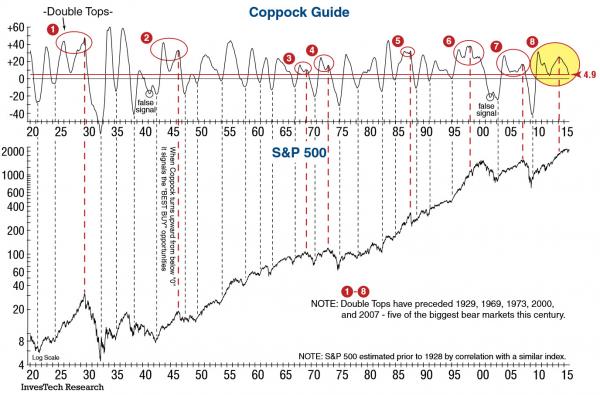
“Coppock Guide” Signals A Bear Market Is At Hand (ZH)
Junk-Bond Rout Deepens, Sends Shockwaves Through Stocks, Other Markets (WSJ)
Junk-Bond Fund’s Demise Highlights SEC Mutual-Fund Worries (WSJ)
China Steel Output Slumps to a One-Year Low as Prices Collapse (BBG)
Missing Chinese Billionaire ‘Assisting Authorities in an Investigation’ (WSJ)
US Senators Close in on Oil-Export Deal Amid Tax-Break Talks (BBG)
EU Powerless to Stop Nationalist Ascendancy as Terror Fears Rise (BBG)
French Vote for Regions as Main Parties Seek to Shut Out Le Pen (BBG)
Julian Assange May Face Swedish Interrogation Within Days (Guardian)
James Hansen, Father Of Climate Change Awareness: Paris Talks ‘A Fraud’ (Guar.)
No Mention In Paris Of Refugees: Global Issues Live In Separate Boxes (Betts)
The Athens Lawyer Who Became A Guardian To Refugee Camp Children (Guardian)

The fixed game.

Why A 0.25% Rate Hike Should Have Big Banks Nervous But Probably Won’t (Bern)

Current excess reserves at the Fed earn interest – The big banks hold a lot of excess reserves at the Federal Reserve [Fed]. The current interest rate paid by the Fed on both required and excess reserves is 0.25%, or 25 basis points. The rate is subject to change by the Fed Board. No surprise that this policy was set forth in the Federal Reserve Regulatory Relief Act of 2006 which was scheduled to go into effect October 1, 2011. Also, no surprise was the advanced effective date of October 1, 2008 when relief for banks was imperative.

The current profit stream that banks count on – According to the St. Louis Fed, depository institutions (banks) held over $2.5 trillion in excess reserves at the Fed in November. At a mere 25 basis points in interest that $2.5 trillion in excess reserves earns big banks about $6.25 billion a year in risk-free revenue. All of that amount may not go directly to the bottom line, though. How much depends upon what interest rate the Fed charges banks to borrow those funds (the fed funds rate). The effective fed funds rate has ranged between 7 basis points and 16 basis points over most of the last five years. The average borrowing rate of big banks since January 1, 2015 has been 12.27 basis points, or 0.1227%.

The banks have earned about $5.73 billion so far in 2015 on excess reserves. The cost to borrow those reserves has been approximately $3.07 billion. The net income earned from those borrowed reserves is $2.66 billion in 2015 thus far. That works out to an average of $725 million per quarter in extra earnings just for borrowing the money and leaving it parked at the Fed. Now, this may not seem like much to you, but I would not mind getting in on that action.

What happens when the fed funds rate rises by 25 basis points? – Let’s be honest about the rate hike, okay? The current fed funds rate is officially set at between zero and 25 basis points. So, if the Fed raises the official fed funds rate to 25 basis point, if that is the actual outcome, then it really will not be raising the rate by a full 25 basis points. The increase will be something more like about 13 basis points over the actual rate since the beginning of the year. Now, if the Fed raises the official rate to between 25 basis points and 50 basis points, then the difference could be closer to 25 basis points. But, it still depends on where within that range the actual fed funds rate lands. If it lands closer to the minimum of the range then the increase is more like 13 to 15 basis points. If it lands in the middle, then we have an actual increase in rates of about 25 basis points as advertised.

I do not really expect the actual rate to rise much, if any, above the 25 basis points threshold. So, my expectation is for a real rate increase of about 15 basis points. But that would mean that the earnings by the big banks could fall to zero. Somehow I do not expect the big banks to take this lying down. I could be wrong, but I also expect another, less publicized change in rate policy by the Fed. If the fed funds rate increases to 25 basis points or more, then the “profits” earned by banks on excess reserves will evaporate into thin air and potentially turn into an expense. Unless…

If the Fed decides to raise the fed funds rate by 25 basis points to the range between 25 and 50 basis points the banks would either decide to reduce reserves (to avoid paying the Fed interest on borrowed funds) or the Fed would need to change the rate paid to depository institutions upward to 50 basis points. Banks would need to put that money to work at a higher level of risk or just pay off the loans from the Fed used to fund reserves. Most likely some of the excess reserves would be withdrawn and banks would attempt to make up the lost earnings by adding more risk to balance sheets. More risk in the financial system is not something we need right now. I do not think the banks really want to take on more risk at the moment either. And since the banks own the Fed, guess which route I expect the Fed to take?

Read more …

Psychology.

“Coppock Guide” Signals A Bear Market Is At Hand (ZH)

With Emerging Market currencies, bonds, and stocks collapsing, US corporate debt crashing, and carry trades unwinding everywhere (ahead of the $800 billion liquidity withdrawal that looms from next week’s 25bps hike from The Fed), it is no surprise that US equities are beginning to shudder (even the FANGs are not immune). But, as InvesTech Research notes, among its 6 compelling reasons to be cautious in 2016, the so-called Coppock Guide may be close to confirming that a bear market is at hand…:

In March 2015, the Coppock Guide was signaling that both primary and secondary momentum had peaked and this continues to be the case today. The Coppock Guide is a valuable tool to gauge the emotional state of a market index as it transitions from one psychological extreme to another. It was developed more than 50 years ago by Edwin S. Coppock and it measures momentum by taking a 10-month weighted moving total of a 14-month rate of change plus a 11-month rate of change of a market index. The Coppock Guide is typically most useful at market bottoms, when market indexes reverse sharply as psychology shifts. It signals a “Best Buy” opportunity when the index turns upward from below “0” (see black dashed lines). The last such buy signal came within 60 days after the March 2009 market bottom.

Early in a bull market, momentum runs high and often peaks early. For this reason, the Coppock Guide isn’t as effective in identifying market tops. In fact, the initial peak in the Coppock Guide was seen during the first 18 months of this lengthy bull market, with a secondary peak in March 2014. When a double-top occurs in an extended bull market without the Coppock falling below “0”, it signals that psychological excess could be at an extreme. And when that momentum finally peaks (see red dashed lines), it usually means a bear market isn’t far behind. This phenomenon was first observed by a market technician named Don Hahn in the late 1960s. Since 1929, there have been only eight instances of a double-top, and each one was followed by bear market losses of 30% or more.

Read more …

It’ll be an interesting week.

Junk-Bond Rout Deepens, Sends Shockwaves Through Stocks, Other Markets (WSJ)

U.S. junk bonds posted their steepest decline since 2011, intensifying fears that a six-year bull market in stocks and other risky assets is nearing an end. The largest high-yield exchange-traded fund, the $15 billion iShares iBoxx $ High Yield Corporate Bond ETF, dropped 2%, to close at $79.52, its lowest since July 2009. Friday’s trading volume of 53 million shares doubled a record set Tuesday. The retreat punctuated a day of heavy selling across markets, with the Dow Jones Industrial Average tumbling 310 points and U.S.-traded crude dropping 3.1%, to $35.62 a barrel. Oil’s 11% decline was its biggest weekly fall since March. Traders said much of Friday’s decline was triggered by the abrupt closure of a high-profile junk-bond mutual fund.

Investors in the Third Avenue Focused Credit Fund learned this week that they won’t get all their cash back for months or more, as Third Avenue liquidates the $789 million fund. The action crystallized long-standing fears about the vulnerability of the stock and bond markets to a broad shift in sentiment. The spreads between U.S. junk bonds and Treasury securities have widened sharply over the past week, underscoring investors’ sense that the risk of default by companies with high levels of debt is on the rise. The Federal Reserve is expected next week to raise interest rates for the first time since 2006, a development that traders said wasn’t a large part of Friday’s selloff but that has increased general market anxiety.

Some hedge funds are taking similar steps as Third Avenue. Hedge-fund firm Stone Lion Capital, a distressed-debt specialist, said it suspended redemptions in its credit hedge funds after many investors asked for their money back. Investors said it was a rare move in the hedge-fund industry since the financial crisis. This fall, Carlyle Group’s struggling Claren Road took a similar action. Some investors said that while they are concerned that falling commodity and junk-bond prices could point to economic turmoil ahead, U.S. consumer and jobs data have been mostly comforting. But even these investors said they are looking for ways to reconcile conflicting signs.

Read more …

Never a ‘run’. Until now?!

Junk-Bond Fund’s Demise Highlights SEC Mutual-Fund Worries (WSJ)

The demise of a Third Avenue junk-bond fund last week underscores financial regulators’ concerns about risks in mutual funds and highlights Washington’s urgency in trying to address those worries. Recently proposed rules are aimed at addressing the problems for investors exposed by the high-risk mutual fund’s struggles, but those regulations are unlikely to take effect until 2017 at the earliest. The Securities and Exchange Commission earlier this fall proposed new rules aimed at preventing the very types of problems that caused Third Avenue’s fund to essentially declare bankruptcy and bar investor withdrawals while it liquidates its high-yield Focused Credit Fund.

Those problems boiled down to the junk fund’s inability to raise sufficient cash to meet a sudden flood of investor redemptions without resorting to fire sales of its assets. The concern from regulators is that mutual funds and other asset managers fail to adequately foresee economic shocks, such as rising interest rates, which cause a fund to drop in value and prompt investors to bolt for the door. Widespread redemptions, in theory, could strain a fund’s ability to convert quickly assets into cash for redeeming shareholders, particularly during a crisis. “Nothing is more fundamental and important…than redeemability,” said SEC Commissioner Kara Stein in September. Ms. Stein’s remarks came as the SEC proposed, for the first time, to force fund managers to develop formal plans for their liquidity, or ability to easily buy and sell fund assets.

The measure also includes provisions aimed at dampening investor flight by allowing funds to charge fees to investors who bolt in periods of market stress. If those rules had been in place earlier, Third Avenue would have had to establish a “liquidity” plan and as part of it, set aside more assets that could be readily converted to cash. It may have faced charges for a poorly developed plan or for deviating from it. The fund industry has been quick to note that there hasn’t been a “run” on a long-term mutual fund in their 75 years of existence, through numerous interest-rate and market cycles. Large outflows from particular funds can occur, but never a “run” on the broader asset class.

Read more …

“Exports climbed 22% to 102 million tons in the first 11 months [..]. That’s almost as much as Japan, the world’s second-biggest producer, made in the whole of last year..”

China Steel Output Slumps to a One-Year Low as Prices Collapse (BBG)

Steelmakers in China reined in production last month as prices collapsed and the onset of winter in the largest producer curbed demand already hurt by a cooling economy. Crude steel output fell 1.6% to 63.32 million metric tons from a year earlier, according to data from the statistics bureau released Saturday. So far this year, production has dropped 2.2% to 738.38 million tons. China makes about half of the world’s steel. Demand in China is weakening as policy makers seek to steer Asia’s biggest economy away from investment-led growth to one driven by consumer demand and services. China’s steel sector contracted further last month, while an industry association said demand was shrinking at an unprecedented speed.

Determined to maintain output as growth cools, mills have flooded the world with exports, shipping more than 100 million tons this year. “The downtrend in steel output should continue as weak credit and demand conditions do not support expansion,” Huang Huiwen at Shanghai Cifco Futures said before the data was released. “Demand also goes into a seasonal lull, with some mills shutting for winter as construction slows.” As prices of some steel products slumped to records, mills in the country sought out overseas markets where their supplies may be sold at more competitive rates. Exports climbed 22% to 102 million tons in the first 11 months, according to customs data. That’s almost as much as Japan, the world’s second-biggest producer, made in the whole of last year, according to World Steel Association data.

Read more …

One a week?!

Chinese Billionaire Said to Be Assisting Authorities in an Investigation (WSJ)

Guo Guangchang became a billionaire by investing where China’s economy was going over the past two decades, pouring money into steel, property and finance while turning his gaze increasingly overseas. On Friday, Mr. Guo indicated authorities are holding him in connection with an investigation, a stark illustration of how Chinese business and finance is coming under intense scrutiny. After nearly two days of mystery over the whereabouts of the man who styles himself a Chinese Warren Buffett, a vague statement near midnight issued by his flagship investment conglomerate, Fosun International, said he is “assisting in certain investigations” by Chinese judicial authorities. The statement, which was signed by Mr. Guo, didn’t divulge his location, but said he is still able to participate in “major matters” before the company.

There was no indication of what the investigations were about or whether Mr. Guo could be implicated himself. Chinese investigators have broad powers to detain both suspects and potential witnesses even when they don’t face accusations of wrongdoing. A Chinese Foreign Ministry spokeswoman said Friday she had no information. Since a midyear stock-market crash exposed weaknesses in China’s financial system, authorities have detained senior stockbrokers, fund managers and bankers from a handful of the country’s top firms, saying little about the progress or findings of their investigations. About a dozen of the most senior people at the biggest brokerage, Citic Securities, have been held for questioning by authorities for months, and the firm says it is cooperating with investigations.

Jitters are particularly high in Shanghai, China’s largest city, where the biggest markets are based. In addition, the Communist Party’s antigraft agency put a vice mayor in Shanghai under official investigation last month, then named certain local brokerages, insurers, a private-equity firm and business schools as targets of its next inspections. With a proud mercantile tradition that has produced the largest regional economy in China, Shanghai has long celebrated business champions. And few stand taller than Mr. Guo, a 48-year-old with a steely focus on building asset values. A standard-bearer for private entrepreneurs, Mr. Guo’s personal fortune was estimated this year at $7.8 billion by Shanghai research firm Hurun Report, putting him at No. 17 on its list of China’s wealthiest people.

Read more …

Perfect timing re: CON21.

US Senators Close in on Oil-Export Deal Amid Tax-Break Talks (BBG)

Senate negotiators are nearing a deal to allow unfettered U.S. crude oil exports for the first time in 40 years, though differences remain on renewable-energy tax credits that Democrats are demanding in return, according to people close to the discussions. While any agreement could still collapse in the coming days – the deal faces opposition in the House – lawmakers are weighing the extension of solar and wind tax credits for as long as five years in exchange for lifting the crude-export restrictions, which were established to counter the energy shortages of the 1970s. Tax breaks are part of the discussion, though lawmakers are still negotiating the length of wind- and solar-energy tax extensions and whether they should be phased out, said a Senate Democratic leadership aide.

If agreed to and approved by Congress, repeal of the nation’s ban on most crude oil exports would mark the most significant shift in U.S. oil policy in more than a generation. Repeal, benefiting oil producers including ConocoPhillips, Hess Corp. and Continental Resources Inc., would come at a time when the industry is cutting jobs to deal with a global glut in crude oil and the lowest prices in seven years. Talks for a deal are under way as envoys from 195 nations reached an agreement to limit fossil-fuel pollution and curb the effects of climate change. Congress is considering lifting the export ban as part of either a package to extend expiring tax provisions or to finance the government through Sept. 30 before current funding authority expires Dec. 16.

Among the items being discussed are a 9% manufacturing tax credit for refiners and an extension of the U.S. Land Water Conservation Fund, according to at least three lobbyists close to the negotiations. Even if such a deal is struck by Republicans and Democrats in the Senate, House Democrats, who are vital to reaching an agreement, have suggested they won’t go along unless a provision for indexing the Child Tax Credit, which allows taxpayers to reduce federal income taxes for each qualifying child, is added to the mix. And it’s unclear whether House Republicans will support a deal if they assess that the price Democrats are seeking is too high.

Read more …

The EU causes nationalism.

EU Powerless to Stop Nationalist Ascendancy as Terror Fears Rise (BBG)

From Viktor Orban in the east to Marine Le Pen in the west, defiance of the European Union’s multilateral, multicultural, open-borders traditions is on the rise. But with issues like refugees and terrorism at the top of the agenda, there’s little the 28-nation EU can do about it. The popular clamor for security has strengthened the cult of the insular state that Orban champions in Hungary and Le Pen espouses in France. Europe’s multiple crises – first debt, then migration, now terrorism, all festering simultaneously – have put the established order on trial, from the former communist east to historically tolerant Sweden and EU-exit candidate Britain. The upshot is an existential threat that risks unpicking the union.

The collective blame lies with EU leaders for looking the other way, according to Sophie In ’t Veld, a Dutch member of the European Parliament, who says it is time to upgrade the bloc’s “very weak instruments” to enforce civil liberties and democratic due process. “People are beginning to lose faith in European integration,” In ’t Veld said in an interview on Thursday in Brussels. “We have all these wonderful values, and then it turns out that in practice they’re not being upheld.” The EU reached for literary heights to mark its eastern expansion on May 1, 2004, commissioning Nobel Prize-winning Irish poet Seamus Heaney to compose an ode to unity and inclusion: “On a day when newcomers appear, let it be a homecoming.”

That the newcomers didn’t feel at home became clear by 2010, when Orban returned as prime minister of Hungary and set out to build a more centralized state. Once a communist-era freedom fighter, Orban came to view democracy with its plurality of voices as a recipe for gridlock, for not getting things done. He championed the ideology of untrammeled majority rule – provided he had the majority – along with the rejection of multiculturalism in what he termed the “illiberal state.” Now Poland has elected a religiously tinged, anti-foreigner, anti-gay, family-values party, capturing the east’s discontent with the Europe it got after breaking free of Soviet domination. It has sought to pack Poland’s supreme court with party faithful, triggering a constitutional impasse.

Breakthroughs by anti-immigration parties across northwestern Europe – reaching an interim peak with the successes of Le Pen’s National Front in the first round of French regional primaries — showed that eastern Europe doesn’t have a patent on the more virulent strains of nationalism. The decisive runoff in France is on Sunday. The anti-European moment may pass, but for now, its originators are feeling vindicated. “The export of Western democracy has failed,” Orban said on Dec. 2, in remarks directed at the U.S. but applicable more broadly. “It’s time for realpolitik. The era based on the export of democracy and human rights is coming to an end.”

Read more …

This election or the next one, she’ll get there. Thanks to the EU.

French Vote for Regions as Main Parties Seek to Shut Out Le Pen (BBG)

French voters go to the polls Sunday to elect regional leaders in the last scheduled nationwide ballot before the next presidential contest in April 2017. President Francois Hollande, his predecessor Nicolas Sarkozy and the National Front’s Marine Le Pen are all jockeying for position in the race, which offers them the chance to establish regional bases and vaunt their credibility with an electorate battered by near-record unemployment and concerns over terrorism. Le Pen aims to build on the first-round result that showed her anti-euro, anti-immigrant party leading in the composite the national vote with prospects to win executive power in three of 13 regions for the first time. Sarkozy needs his party, The Republicans, to blunt her advance and show he has answers to France’s problems, while Hollande faces a judgment on his handling of the attacks that killed 130 in and around Paris one month ago.

“For many French voters, the stakes have changed,” said Jim Shields, a professor of politics at Aston University in Birmingham, England. “For years, elections have been fought on the question of who could best revitalize France’s ailing economy and bring down unemployment. Now, the paramount question is who can keep the French safe. That shift of priority plays to the advantage of the National Front.” Even so, as voters cast their ballots in the second-round runoff, Le Pen’s party is hobbled by its lack of allies from which it can draw fresh support. France’s two main parties are even working together in some districts to keep Le Pen out of power. Prime Minister Manuel Valls, a Socialist like Hollande, said on Friday that he was “convinced” his party’s supporters would engage in tactical voting to defeat Le Pen.

The latest polling suggests the National Front will fail to take either Nord-Pas de Calais-Picardie in the north or Provence-Alpes-Cote d’Azur in the south, both regions it looked set to take after the first round last Sunday. In the east, the party’s third target, the race is too close to call. Le Pen now looks to be losing her grip on the northern region that she is contesting personally. A BVA institute survey in Friday’s La Voix du Nord newspaper suggested she’ll lose out to the The Republic candidate, Xavier Bertrand, Sarkozy’s former labor minister. Marion Marechal Le Pen, the National Front leader’s niece, is also looking doubtful in the southern region.

Read more …

They can’t frustrate their own laws forever.

Julian Assange May Face Swedish Interrogation Within Days (Guardian)

The WikiLeaks founder, Julian Assange, may be questioned in London within days about alleged sexual offences after Ecuador indicated it had reached a bilateral deal with Sweden. Assange has been wanted for questioning by Swedish authorities since 2010, but was granted asylum by Ecuador and has been in the country’s London embassy for more than three years. In April, the activist said he consented to the Swedish prosecutor’s conditions for the interrogation procedure to take place in the Kensington embassy. The agreement refers specifically to Assange and Sweden’s intention to question him in London and will come into effect “in the coming days”, a statement from the Ecuadorian foreign ministry said.

Assange’s Swedish lawyer, Per Samuelson, told the Guardian that Sweden needed to formally approve the deal and he understood those discussions would take place on Thursday. Negotiations began in June this year between Ecuador’s acting foreign minister, Xavier Lasso, and the Swedish justice ministry’s international affairs chief, Anna-Carin Svensson. The Ecuadorian government statement said: “The agreement, without any doubt, is a tool that strengthens bilateral relations and facilitates, for example, the execution of such legal actions as the questioning of Mr Assange, isolated in the Ecuadorian embassy in London.”

The deal would ensure “the implementation and enforcement of national legislation and principles of international law, particularly those relating to human rights, to further the full exercise of national sovereignty in any event of legal assistance that may be required between Ecuador and Sweden”. The agreement would be the final step towards interviewing Assange in London, with a request to the UK for legal assistance having already been granted, according to previous statements from the Swedish prosecutor’s office. Assange sought refuge at the embassy in June 2012 after losing his final legal attempt to avoid extradition. Sweden’s director of public prosecutions, Marianne Ny, said in March this year that she would allow Assange to be interviewed in London if agreement could be reached with Ecuador.

Read more …

Not sure about carbon pricing. The last attempt was a disgrace.

James Hansen, Father Of Climate Change Awareness: Paris Talks ‘A Fraud’ (Guar.)

Mere mention of the Paris climate talks is enough to make James Hansen grumpy. The former Nasa scientist, considered the father of global awareness of climate change, is a soft-spoken, almost diffident Iowan. But when he talks about the gathering of nearly 200 nations, his demeanor changes. “It’s a fraud really, a fake,” he says, rubbing his head. “It’s just bullshit for them to say: ‘We’ll have a 2C warming target and then try to do a little better every five years.’ It’s just worthless words. There is no action, just promises. As long as fossil fuels appear to be the cheapest fuels out there, they will be continued to be burned.”

The talks, intended to reach a new global deal on cutting carbon emissions beyond 2020, have spent much time and energy on two major issues: whether the world should aim to contain the temperature rise to 1.5C or 2C above preindustrial levels, and how much funding should be doled out by wealthy countries to developing nations that risk being swamped by rising seas and bashed by escalating extreme weather events. But, according to Hansen, the international jamboree is pointless unless greenhouse gas emissions aren’t taxed across the board. He argues that only this will force down emissions quickly enough to avoid the worst ravages of climate change.

Hansen, 74, has just returned from Paris where he again called for a price to be placed on each tonne of carbon from major emitters (he’s suggested a “fee” – because “taxes scare people off” – of $15 a tonne that would rise $10 a year and bring in $600bn in the US alone). There aren’t many takers, even among “big green” as Hansen labels environment groups.

Read more …

Refugees don’t make for the same kind of feel good fodder.

No Mention In Paris Of Refugees: Global Issues Live In Separate Boxes (Betts)

While the United Nations climate change talks in Paris struggled to elicit credible commitments, notably missing from the debate was “environmental displacement” – people fleeing their homes on account of natural disaster. As temperatures and sea levels rise, and land-use patterns change, there will be significant consequences for human mobility within and across borders. However, public and media debate scarcely discussed the issue, and the only references in the Paris summit’s negotiated outcome document are vague to the point of meaninglessness. This absence is especially striking in a year in which refugees and migration have otherwise been so high on the political agenda. This political dissonance is of a piece with the compartmentalised way in which we approach many global issues.

During a frenzied summer, media coverage and political attention focused almost exclusively on refugees. Now, with saturation point reached, the circus has moved on. Climate change has, instead, become the de rigueur liberal issue of the day. Remarkably, the global focus on refugees was insufficient to influence the debate in Paris. When we shift our attention so dramatically, we risk missing important analytical connections and, with them, opportunities for meaningful solutions. To be clear, the so-called European refugee crisis was certainly not caused by climate change. But it is symptomatic of a global protection crisis, with climate change as one key component. That crisis is partly the result of numbers: there are more people displaced around the world than at any time since the second world war.

It is partly the result of political will: asylum is being undermined by governments around the world. However, it is above all a reflection of a growing gap between the contemporary nature of displacement and the institutions that govern forced migration. In the aftermath of the second world war, governments created the 1951 Convention relating to the Status of Refugees. It ensures that states have a reciprocal obligation towards people fleeing a well-founded fear of persecution. This framework was well adapted to the refugee movements of the 20th century. It continues to be relevant, but it leaves gaps.

Read more …

Greece has many good souls.

The Athens Lawyer Who Became A Guardian To Refugee Camp Children (Guardian)

Christina Dimakou is not yet 30, but she has four children, one of whom is 17. She shares neither a nationality nor a past with any of them. Two of them are from Syria: the 17-year-old girl fled Damascus after soldiers attempted to kidnap her and her brother, who escaped conscription; there’s a 10-year-old from Iran who longs to go to school for the first time; and a young girl from Afghanistan who has lost her family. For now Dimakou is their guardian. She cares for them within the confines of Moria, a makeshift hilltop camp for refugees on the Greek island of Lesbos. Her charges spend their days behind chain-linked fences where a discarded Minnie Mouse in a torn pink dress, caught in the razor wire, is the only indication that this is the children’s area.

More than 700,000 refugees have entered Europe through Greece this year, most of them wet and bedraggled arrivals on its eastern Aegean islands. Their coming has shaken Europe and changed the life of this determined lawyer. Instead of practising law in Athens, where she passed the bar exam, Dimakou has moved her life to an island now famous for the refugees who wash up on its shores. It’s a life with few of the trappings of the metropolitan middle class with whom she grew up. Her working outfit is an aid worker’s bib, her hair tied back. She shuttles between the crumbling neoclassical architecture of the port city of Mytilene and the crowded refugee reception centre at Moria in a battered Toyota loaded with translators and the dirt from a thousand strangers’ shoes.

She is one of only a dozen members of the guardianship network, a fledgeling programme run by the Athens-based charity Metadrasi, designed to help the countless lost children who have arrived alone. Some have been separated from their families while fleeing Syria, others have taken it upon themselves to strike out and find a new home for relatives who will follow later. Many of them have been told they carry their family’s only hope. To explain her decision Dimakou uses the allegory of the little boy and the starfish. Every day he would go to the beach and throw a few of the dying starfish he found back into the sea. When asked, in the face of the thousands of starfish that would wash up, whether he really made a difference, he would reply: “I make a difference to the ones I throw back.”

“I cannot save the world or make everything better,” Dimakou admits, “but I can affect the things around me. If everyone does this then the world becomes better. And we become better.” In legalese her starfish are known as “unaccompanied minors” and no one can be sure how many of them there are. It is the responsibility of officials from the Greek police and the European borders agency, Frontex, to ensure that all under-18s who arrive are taken into care if they are found to be without a parent or relative. The reality is that since the surge began earlier this year only a fraction of the true number of lost children have been caught in this shredded safety net.

Read more …

Sep 102015
 
 September 10, 2015  Posted by at 11:10 am Finance Tagged with: , , , , , , ,  13 Responses »


Thomas Eakins Walt Whitman 1891

Jean Claude Juncker held a speech yesterday that had, oh irony, been labeled a State of the Union. A perfect way of showing how pompous Juncker and his surroundings have become. A perfect way, too, to point out how much the European Union differs from the United States. The gap is so wide it doesn’t need any explaining.

Much of the speech concerned the refugee crisis Juncker and his cronies share a lot of the blame for, and for good measure he managed to get in a vile threat to Greece, in the vein of “Greece must respect the bailout, or the EU reaction will be ‘different'”, and “Greece cannot be kept in the euro at all costs”. In Brussels, democracy is a word fast losing even the last shreds of its meaning.

Juncker’s a very boring speaker -when he’s not been drinking-, but that doesn’t take away from the message. Brussels seeks to use the refugee crisis for the same purpose it uses all crises for: power grabbing. A reaction from Nigel Farage that was dripping with vile bigotry was the best reaction I read about to the speech, and in my not so humble opinion that is desperately sad.

It’s a shame and a disgrace that bigots like Farage, Le Pen, Orban and Wilders will have to decide the future of the EU, but it’s still a mile and a half better than more EU, because the European Union is rapidly turning into a monstrosity the likes of which even Europe has seldom seen in its history, and that’s saying something.

28 separate formerly sovereign nations are coming under the thumb of a de facto occupying force that is squeezing their sovereignty and democracy out of them in boa constrictor fashion, leaving them behind as empty political shells. And every single one of these nations has voluntarily signed up for this treatment, blindly lured by financial promises that the Greek crisis has abundantly exposed as hollow and void.

Brussels has created another crisis. No, the refugee situation didn’t start last week and yes, the EU did nothing for months, other than shutting down Italy and Greece’s own refugee aid programs and replacing them with the very suspicious Frontex bureau.

And now this crisis is in full flight, what does Juncker call for? More EU, more Union. Which means more power moving to Brussels. This is an MO, not an unfortunate accident.

The Europe of Juncker, Merkel, Cameron and Hollande could and should have moved much faster on the refugee issue, and not have let thousands of people drown before coming up with the plan Juncker presented yesterday, which comes up way short of what will be needed, but which some Reuters editor still had the audacity to label ‘bold’.

A grand resettlement plan for 160,000 refugees makes no sense at all at a time that Germany alone will receive perhaps as much as a million refugees this year. The best thing about the plan may turn out to be the compulsory character Juncker seeks to give it, complete with sanctions for countries that refuse to be told by him what to do.

Even better, obviously, is the fully braindead idea of letting countries pay NOT to accept refugees. Once you start translating human misery into monetary terms, your only possible future looks excruciatingly bleak.

But it will be a spectacle to watch, Brussels dictating terms on sovereign countries, or countries that still think they are sovereign at least.

Brussels succeeded in getting all EU nations to gang up on Greece earlier this year, and countries that are non-compliant on the refugee issue are going to receive death threats like the ones Greece received, but the 27-to-1 majority that existed in that case will not repeat itself.

There is not much difference in depth of bigotry and opportunism between Juncker, Farage and Le Pen. So perhaps it’s only fitting that they get to fight to secure the end of the grandiosely ill-conceived pan-European project amongst themselves. There are no other voices left, no reason, no moderation, no common sense.

Europe’s left is all but dead from largely self-inflicted wounds, set in motion by the likes of Tony Blair. That leaves just one voice, that of the sociopaths, the type of individual overly large institutions select for by default.

If Brussels and Juncker have their way, the EU is going to turn Europe into a -perhaps guerrilla- warzone, of occupiers and occupied battling for power. If the European Union is dissolved, the sovereign nations that remain behind may yet have a -fighting- chance.

The refugee crisis has shown us, and in rich colors, that there are still a lot of decent people in Europe. The problem is that they have no political voice. The dissolution of the Union may be the best -if not only- way to return that voice to them.

Separate sovereign countries with decision making and accountability on a smaller and therefore more human scale are much less likely to draw sociopaths into leading positions.

Jun 242015
 
 June 24, 2015  Posted by at 9:58 am Finance Tagged with: , , , , , , ,  14 Responses »


Ben Shahn Sideshow, county fair, central Ohio 1938

The only thing that would really go towards beginning to solve the problems with Greece is for Athens to NOT sign a deal. The short version of why that is so: it would leave the EU intact for longer. And the ECB.

Neither have any viable future, but as they go down, they can cause a lot of damage and pain. It’s mitigating that pain which should now be our priority no. 1, the pain that will result from the demise of Europe’s institutions. But we see precisely zero acknowledgment of this. Anywhere.

All that attention for whatever comes out of yesterday’s, and today’s, and tomorrow’s Troika vs Athens talks is very cute and nice and all, and putting on a ‘phantom summit’ is hilarious, but in reality it’s all based on a far too myopic picture.

Maybe that’s what you get when you’re only looking at life as exclusively consisting of things that can be either bought or sold, which seems to be the way the entire world press interprets the negotiations, the only way they have of interpreting anything. But this is not about money.

There’s more to life than money. That is to say, there’s a lot more going on than those talks and the deal-or-no-deal results that may or may not emanate from them. To wit: If the past 5 months or so have made anything clear, it’s that the eurozone has no future at all, and the EU as a whole has very little.

There is no trust left between Brussels and Greece, and therefore at the same time also not between Brussels and Rome, or Madrid. Italy and Spain could be the next to receive a five-month treatment like the one Greece has had, and the people there sense it. Even if their present governments do not.

As I said a few days ago :

None of these institutions, IMF, EU, ECB, has any raison d’être or any claim to fame unless there is explicit trust in what they represent. That trust is now gone, and it’s hard to see how it can ever be recovered.

Whatever happens to Greece going forward, that is perhaps the biggest gain its dramatic crisis will gift to the rest of Europe, and indeed the world. Which therefore owe it a debt of gratitude, and of solidarity.

You know, we’ve heard it said that politics is about seeing ahead. Well, that’s just too bad, because if there’s one thing European politicians, to a (wo)man, show us these days it’s that they lack the ability to see ahead, even just beyond the beam in their own eyes.

These people don’t see ahead, they project ahead. They are under the self-reinforcing collective illusion that the future will bring what they want it to bring. They honestly think they have the power to control history. And control all of Europe. Their vision of the future is one that they look good in.

And that can in turn only possibly bring about mayhem. Or actually, as the Greece crisis tells us, it already has. Something the leadership in Brussels, Paris and Berlin will flatly deny, because, as Paulo Coelho once said: “Collective madness is called sanity”.

The more power they seek to gather in Brussels, the harder the resistance against them, and against that power, will become. But that is not going to stop them. Just read the report issued last week by the “Five Presidents: Completing Europe’ Economic and Monetary Union.

Brussels sees, projects, solutions to its problems exclusively in more Brussels. But nobody in Europe wants more Brussels. Nobody wants to give up more sovereignty, people instead want back what has been given away. Still, the myopic Five Presidents come with this:

Economic Union: A new boost to convergence, jobs and growth
• Creation of a euro area system of Competitiveness Authorities;
• Strengthened implementation of the Macroeconomic Imbalance Procedure;
• Greater focus on employment and social performance;
• Stronger coordination of economic policies within a revamped European Semester.

Financial Union: Complete the Banking Union
• Setting up a bridge financing mechanism for the Single Resolution Fund (SRF);
• Implementing concrete steps towards the common backstop to the SRF;
• Agreeing on a common Deposit Insurance Scheme;
• Improving the effectiveness of the instrument for direct bank recapitalisation in the European Stability Mechanism (ESM). Launch the Capital Markets Union
• Reinforce the European Systemic Risk Board

Fiscal Union: A new advisory European Fiscal Board
• The board would provide a public and independent assessment, at European level, of how budgets – and their execution – perform against the economic objectives and recommendations set out in the EU fiscal framework. Its advice should feed into the decisions taken by the Commission in the context of the European Semester.

Those “Five Presidents” (isn’t it telling enough that that Brussels counts five of them?) are Jean-Claude Juncker, Donald Tusk, Jeroen Dijsselbloem, Mario Draghi and Martin Schulz. Nice little team you got there. Politico referred to them as the “Five Horsemen Of The Euro’s Future”.

• Juncker, president of the European Commission, was one of the main architects of the chaos we now see, in a long stint as president of the Eurogroup, 2005-2013. For causing the mayhem he was rewarded with his present seat. Not an unfamiliar chain of events in the musical chairs game for career politicians in Brussels.

• Donald Tusk, president of the EC council, has only one claim to fame, but that still gifted him with his present position: he is a vocally rabid anti-Putin orator. They love that in the EU these days.

• Jeroen Dijsselbloem, the president of the Eurogroup who works hard to remain in that seat for another term, is an agricultural economist. Which is fine for telling us what strawberries should go for in winter, but not for defining policies with regards to for instance Greece. He’s so far outclassed by Varoufakis it can only lead to stupidity.

• Mario Draghi, governor of the ECB, is a Goldman Sachs man, and that’s all we need to know. He’s also one of the global class of central bankers who feel omnipotent after discovering the printing press. They will instead bankrupt their economies.

• Martin Schulz, the president of the European Parliament, is just another career EU tool. After 20 years of loyal heel-licking and brown-nosing, he was rewarded with the seat he’s now in. Nobody should be allowed to be in Brussels any longer than perhaps 5 years at the most. It’s the worst of all possible worlds.

Summarized: it’s incredible and insane that such a set of clowns can actually present a paper about Europe’s future. They all come with a huge agenda, and their own future is far more important to them than doing what’s best for Europe. As the Greeks know better than anyone.

A structure such as the EU, we’ve said it before, selects for the exact wrong people. Power is accumulated is non-transparent and only pseudo-democratic ways, and the accumulation continues unabated if left unchecked. A certain class of wannabe ‘leaders’ feeds on just that.

And now the only conclusion is that the EU as an experiment has failed. There is nothing anyone can do anymore to repair it, there is nothing that can be done to undo the damage. Trust is broken, and will never return. Pushing one nation into utter misery, for everyone to see. is all it took.

The only remaining question now is how to dissolve the union. But that of course is not what those whose income and status depend on that union want to even contemplate, let alone discuss. So who’s going to do it? Who’s going to do it for them? People in the street, that’s who. They’re the only option there is. National governments are not willing to perform that function for them.

To do what everyone should be able to see, should be done. Because if you look hard enough, it’s awfully obvious that the euro is finished. Perhaps not the EU, but that can only continue to exist if the entire structure built around and on top of it is thrown out the window, and if European countries start again from scratch to organize their ‘channels’ of cooperation.

If they stick to the present structure, that can only lead to nasty ugliness, because they are tied together in a union that constraints their freedom and their cultures far more than people are comfortable with.

Something that could always only ever have become clear in less prosperous times. Well, we have those. And with them the gaping cracks in the political edifice. As any builder will tell you, cracks in a foundation are a death sentence.

And those times have made painfully obvious that monetary union without fiscal union, or even political union, can not work. It never could. But a political union would never be accepted. European countries want to remain sovereign.

Anything else is unacceptable. The only reason the euro was ever accepted is that hardly anyone understood at the time that it would imply handing over a substantial part of sovereign powers to increasingly dodgy bureaucrats in Brussels and Strasbourg (well, Britain sort of understood).

In the Greek case, what we’ve seen is that the troika did not go into the negotiations on an equal partners basis. Although the EU is an equal partners union, that’s its very foundation. But it still could have worked, and the problems worked out, though only temporarily, if Brussels had resisted the temptation to turn the EU into a power game. Then again, a structure such as the EU exclusively selects for ‘leaders’ drawn to power games, removed from the everyday public scrutiny national leaders have.

The national leaders, it should be obvious, have also fallen into the power game trap. It is not hard to go out and play bully to a country like Greece, and kick it while it’s down. It’s not even hard to lure such a country, a small player when it comes to population and economy, into yet another trap: that of unpayable debts.

Certainly not if and when you can nominate technocrats to lead nations. Which Brussels has done in Greece, in Italy and in Spain. The problem with that is it’s a blind and unwinnable game in a set-up like the EU. Because the nations you attempt to force into submission, politically and economically, will always remain sovereign nations.

It’s a game you can’t win, because you can’t take over power forever in foreign sovereign nations. The EU has 29 of those. One day an election will take place in which the people will elect a government that seeks to protect the people’s personal and sovereign interests. And until you take away that option, you will never win the game, you will only cause a lot of misery. Again, in Greece this is duly noted.

We’re not entirely comfortable with the far right being the only side that thoroughly understands this, but we’ll take it; we have no choice. Besides, what happens on the left in Greece, Spain, and Portugal may yet balance this out. The crucial mistake the left makes is that so far it’s seeking to remain part of the Europe that Brussels is seeking to construct. Not a wise idea.

So we have Marine Le Pen who speaks most clearly about Europe, and who understands best of everyone in public office what is going on, or at least expresses it best:

Marine Le Pen: Just Call Me Madame Frexit

Marine Le Pen, a frontrunner in France’s 2017 presidential election, says a Greek exit from the euro is inevitable. And if it’s up to her, France won’t be far behind. “We’ve won a few months’ respite but the problem will come back,” Le Pen said of Greece[..]. “Today we’re talking about Grexit, tomorrow it will be Brexit, and the day after tomorrow it will be Frexit.”

Le Pen, 46, is leading first-round presidential election polls in France, ahead of President Francois Hollande, ex-leader Nicolas Sarkozy and Prime Minister Manuel Valls. She’s the only one of the four calling for France to exit the euro, banking on people’s exasperation with the Greek crisis and Britain’s proposed referendum on the European Union to win over voters.

“I’ll be Madame Frexit if the European Union doesn’t give us back our monetary, legislative, territorial and budget sovereignty,” Le Pen said. She’s calling for an orderly breakup of the common currency, with France and Germany sitting around the table to dismantle the 15-year-old monetary union. [..]

Even German Chancellor Angela Merkel has expressed concern about the level of support Le Pen will receive in 2017 and how that power might weigh on French economic policy. “She knows perfectly well that if France leaves, there’s no more euro,” Le Pen said. Although Le Pen hasn’t given a full, detailed plan of how she would lead her country out of the euro, she says she doesn’t believe France would be shut out of the borrowing market or rejected by investors as a result.

We shouldn’t need Le Pen to voice the obvious. But that no other ‘leader’, save for Nigel Farage, puts it into these crystal clear terms, does tell us a lot about all other European leaders. And unfortunately that includes Alexis Tsipras. Though we hold out some hope for him yet.

Here’s hoping he will not sign that deal, whichever it may be in the end, and thereby set in motion the disintegration of the unholy Union.

Mar 222015
 
 March 22, 2015  Posted by at 8:06 am Finance Tagged with: , , , , , , , , ,  6 Responses »


Jack Delano “Untitled” 1940

We’re All Hedge Funds Now (John Rubino)
Why Has Germany Bailed Out A Tiny Bank? (Coppola)
The Perfect Storm For Oil Hits In Two Months (Zero Hedge)
The ‘Natural Interest Rate’ Is Always Positive And Cannot Be Negative (Mises)
The Federal Reserve Bank Must Be Destroyed! (Patrick Barron)
We’re Much Worse Off Than Just Before The Last Economic Crisis (Michael Snyder)
Draghi To Go To Italian Committee But Not Irish Bank Inquiry (Irish Times)
China To Curb Risks From Short-Term Local Debt (Reuters)
Why Do American Weapons End Up In Our Enemies’ Hands? (Ron Paul)
Nazi Extortion: Study Sheds New Light on Forced Greek Loans (Spiegel)
Michael Hudson: Europe Tilts East Towards China (NC/TRRN)
Abe-Kuroda Honeymoon Soured By Fiscal Friction (Reuters)
‘Abandoned’ French Working Class Ready To Punish Left, Vote Le Pen (Guardian)
The Idea of “Basic Income” Takes Root (CP)
Wild Anti-Austerity Strike in Québec (Printemps2015.org)
Moral Hazard: Ukraine New Spy Law Designed As Provocation (RT/RonPaul Inst.)
Russia Urges Germany, France To Safeguard Peace In Ukraine (Reuters)
France Decrees New Rooftops Must Be Covered In Plants Or Solar Panels (Guardian)
Africa Is Centre Of A ‘Wildlife War’ That The World Is Losing (Observer)
Australia PM Tony Abbott Unveils Plan To Save Great Barrier Reef (Guardian)
The Global Extraction Industry: Plunder, Violence And Corruption (Observer)

“Will this time around be any different? Definitely. It will be much worse because the numbers are so much bigger.”

We’re All Hedge Funds Now (John Rubino)

As negative interest rates spread from Switzerland, Japan and Germany to the rest of the developed world, people with money to invest face some life-defining choices. Retirees who need to generate 6% to avoid dipping into principal can’t get there with bank CDs. Pension funds that have promised an 8% return in order to meet obligations to future retirees can’t get anywhere near that with government bonds. Same thing for insurance companies and money market funds, whose business models require positive returns with low risk. What to do? Well, a retiree can either stop being a retiree — that is, go back to work — or invest a lot more aggressively to meet the required 6% return.

That means loading up on equities and junk bonds, either blithely because she doesn’t know what they are (only that they’ve been going up) or with trepidation because she’s aware that every five or so years these things tend to crash. For public companies, building new factories no longer pays as well as borrowing money and using the proceeds to buy back their own common stock. Pension funds, meanwhile, have more options though the end result is the same. They can, like our hypothetical retiree, load up on equities, as Japanese pension funds are reportedly doing…[..] …or they can wander even further into the “alternative” investing universe by hiring hedge funds to generate “alpha.”[..]

In the world of aggressive investing, retirees, corporations and pensions funds are all “dumb money.” They don’t do this kind of thing regularly so they have no institutional or personal experience to draw upon. The result, for pension funds and retirees, is the quintessential beginner strategy of trend following, buying what was hot last year because that’s where the biggest returns are being generated, while public companies are being even dumber, buying stocks on margin (i.e., with borrowed money) without regard for valuation. Similar things happened during the previous bubble, when individuals became real estate speculators, pension funds embraced alternative investments, and corporations ramped up their share repurchase programs. All got creamed in 2008. Will this time around be any different? Definitely. It will be much worse because the numbers are so much bigger.

Read more …

Moral hazard?!

Why Has Germany Bailed Out A Tiny Bank? (Coppola)

The first German bank has died from Austrian contagion. Duesseldorfer Hypothekenbank (“Duesselhyp”), a tiny mortgage lender, has been seized by the Bundesverband Deutsche Banken (BDB), Germany’s association of private banks. According to Reuters, The BDB had hammered out a deal over the weekend with financial market watchdog Bafin, the Bundesbank and resolution authority FMSA to provide a guarantee for DuesselHyp’s holdings of around 350 million euros ($370 million) in Heta bonds that are subject to a debt moratorium imposed by Austrian financial regulators.Duesselhyp’s core tier1 (CT1) capital of €233m was not enough to allow it to continue trading after the expected 50% haircut on its holdings of senior unsecured HAA/Heta bonds.

Under German law, Lone Star, the private equity group that owned Duesselhyp, was not obliged to contribute more capital, and the planned sale of Duesselhyp to Attestor Capital could not proceed. The BDB’s seizure of Duesselhyp is therefore understandable: the alternative was disorderly collapse.But it is not immediately clear why the BDB opted to bail out Duesselhyp rather than forcing bail-in of its creditors. After all, Germany has already adopted the European Bank Resolution & Recovery Directive (EBRRD). True, Duesselhyp is tiny: bailing it out could be done entirely from existing funding without recourse to taxpayers. But bailing out a tiny, over-leveraged and under-capitalized bank seems contrary to the spirit if not the law of the EBRRD. So why did the BDB do it?

The reason is the nature of Duesselhyp’s liabilities. Duesselhyp is an issuer of Pfandbriefe, the super-safe covered bonds that are the bedrock of the German financial system. A look at Duesselhyp’s 2014 interim balance sheet shows that Pfandbriefe backed by public sector loans are by far the largest proportion of Duesselhyp’s liabilities: it has issued a rather smaller number of mortgage Pfandbriefe too. The remainder of Duesselhyp’s liabilities are institutional deposits (it has no retail deposits), which are covered by unlimited guarantees from the German deposit fund. In short, almost all of Duesselhyp’s liabilities are covered by explicit or implicit German government guarantees.

Read more …

Storage issue once more.

The Perfect Storm For Oil Hits In Two Months (Zero Hedge)

This is what we said back in early March when the BTFDers were hoping WTI in the low $40s would never again be seen: “Come June, when all available on-land storage is exhausted, each incremental barrel will have to be dumped on the market forcing prices lower and inflicting further pain on the entire US shale complex (just as Q1 results are released which will invariably show huge writedowns as companies will no longer be able to hide behind the SEC-mandated accounting trick that made Q4 results appear respectable).”

Since then, as expected, crude tumbled to new post-Lehman lows, confirming the global deflationary wave is raging (for more details please see China), and WTI only posted a rebound on quad-witching Friday as another algo-driven stop hunt spooked all those who were short the energy complex. The problem is that despite the latest “dead oil bounce” we have since had to revise our forecast for full US oil storage, and pulled forward the date when this will happen in the aftermath of the latest API inventory data. Recall that earlier this week API reported, and EIA later confirmed, that for the 10th week in a row there was a “massive 10.5 million barrels (far bigger than the 3.1 million barrel expectation) and a 3 million barrel build at Cushing. If this holds for DOE data tomorrow (and worryingly API has tended to underestimate the build in recent weeks) it will be the biggest weekly build since 2001.”

It also means that at the current rate of record oil production, storage will be exhausted in under two months, some time in mid-May. At that point, with no more storage to buffer the record oil production, the open market dumping begins and prices of WTI will crater as every barrel will have to be sold at any clearing price, since the producers will have no other choice than to, literally, dump the oil. In other words, a perfect storm is shaping up for oil some time in late May, early June.

Read more …

Amen.

The ‘Natural Interest Rate’ Is Always Positive And Cannot Be Negative (Mises)

Some economists have been arguing that the “equilibrium real interest rate” (that is the “natural interest rate” or the “originary interest rate”) has become negative, as a “secular stagnation” has allegedly caused a “savings glut.” The idea is that savings exceed investment, and that a negative real interest rate is required for bringing savings in line with investment. From the viewpoint of the Austrian school, the notion of a “negative equilibrium real interest rate” doesn’t make sense at all. To show this, let us develop the case step by step. To start with, one should make a distinction between two types of interest rates: There is the market interest rate, and there is the originary interest rate. The market interest rate is the outcome of the supply of and demand for savings in the market place.

It can be observed, for instance, in the deposit, bond, or loan market for different maturities and credit qualities. The originary interest rate is a category of human action, saying that acting man values goods available at present more highly than goods available in the future. In other words: Future goods trade at a price discount relative to present goods. For instance, 1 US$ available today is preferred over 1 US$ available in one year’s time. If 1 US$ to be received in one year’s time is valued at, say, 0.909 US$, the originary rate of interest is 10%. (1 US$ divided by 0.909 minus 1 gives you 0.10, or 10%, for that matter.) 10% is here the originary interest rate (disregarding any other premia). The originary interest rate is expressive of a value differential, which results from so-called time-preference.

The term time-preference denotes that acting man prefers an earlier satisfaction of wants over a later satisfaction of wants. Time-preference is always and everywhere positive, and so is the originary interest rate. This is, first and foremost, what common sense would tell us. If the originary interest rate was near-zero, it means that you prefer two apples available in, say, 1,000 years over one apple available today. A truly zero originary interest rate implies that the actor’s planning horizon or “period of provision” is infinitely long, which is another way of saying that he would never act at all but would continually push the attainment of his goals into the future. The notion that time-preference and the originary interest rate could be zero, does not only sound absurd, it is also a logical impossibility: Positive time-preference and a positive originary interest rate are logically implied in the irrefutably true “axiom of human action.”

Read more …

“Note that there is nothing that a central bank could provide that could not be provided by another private bank.”

The Federal Reserve Bank Must Be Destroyed! (Patrick Barron)

The Fed was founded under false economic premises–to prevent bank runs by providing temporary liquidity to banks which found themselves unable to redeem their certificates and demand deposits for cash and/or specie. The real cause of illiquid banks–fractional reserve banking–was never seriously addressed. It was assumed that banks had the legal right to invest their customers’ demand funds in loans and that runs were caused by over indulging in this practice. But as Murray N. Rothbard explain in What Has Government Done to Our Money?, loaning demand funds instantly places the bank in an insolvent position, for it cannot redeem all of its demand accounts for cash or specie.

Through the process of lending demand funds, the banks have created fiduciary media out of thin air, reducing their reserve ratio below one hundred percent. If the banks do this on a very modest basis, the public may not be aware of the fraud. However, once the rumor starts that the bank is illiquid, there is a literal “run” to the bank to withdraw demand funds. In such a case, even a bank that only modestly lent its demand funds might find itself unable to honor all withdrawal claims and would be forced to close its doors. (NOTE: Central Banking was established to legitimize counterfeiting fraud, aka – Fractional Reserve Banking) The Federal Reserve Bank, as the lender of last resort, was supposed to prevent such occurrences by providing temporary, penalty rate loans to struggling banks.

Note that there is nothing that a central bank could provide that could not be provided by another private bank. In fact the banking panic of 1907 was stemmed by private bank interventions led by J. P. Morgan. However, Morgan realized that such private bailouts were very risky and presented a case of moral hazard; i.e., that bankers, confident of a bailout by the Morgan banking empire, might book riskier, higher yielding loans. So rather than face the real cause of banking crises and lobby to outlaw fractional reserve banking, the Morgans, Rockefellers, etc.–who did not want to forego the financial benefits of lending demand deposits–lobbied instead for government to create a lender of last resort, a central bank, which we named the Federal Reserve Bank.

Read more …

Good graphs. Pity Michael doesn’t understand inflation.

We’re Much Worse Off Than Just Before The Last Economic Crisis (Michael Snyder)

If you believe that ignorance is bliss, you might not want to read this article. I am going to dispel the notion that there has been any sort of “economic recovery”, and I am going to show that we are much worse off than we were just prior to the last economic crisis. If you go back to 2007, people were feeling really good about things. Houses were being flipped like crazy, the stock market was booming and unemployment was relatively low. But then the financial crisis of 2008 struck, and for a while it felt like the world was coming to an end. Of course it didn’t come to an end – it was just the first wave of our problems.

The waves that come next are going to be the ones that really wipe us out. Unfortunately, because we have experienced a few years of relative stability, many Americans have become convinced that Barack Obama, Janet Yellen and the rest of the folks in Washington D.C. have fixed whatever problems caused the last crisis. Even though all of the numbers are screaming otherwise, there are millions upon millions of people out there that truly believe that everything is going to be okay somehow. We never seem to learn from the past, and when this next economic downturn strikes it is going to do an astonishing amount of damage because we are already in a significantly weakened state from the last one.

For each of the charts that I am about to share with you, I want you to focus on the last shaded gray bar on each chart which represents the last recession. As you will see, our economic problems are significantly worse than they were just before the financial crisis of 2008. That means that we are far less equipped to handle a major economic crisis than we were the last time.

Read more …

Don’t insult the Irish!

Draghi To Go To Italian Committee But Not Irish Bank Inquiry (Irish Times)

The ECB is holding to its position that its president, Mario Draghi, will not go before the Oireachtas banking inquiry in spite of the fact that he will appear at certain committees of the Italian parliament on March 26th. In a statement released to The Irish Times on foot of a question as to why Mr Draghi will not attend the Irish inquiry but will address committees of the Italian parliament, a spokesman said: “The ECB as a European institution is primarily held to account by the European Parliament as the representation of all the union’s citizens. “Therefore, it does not participate in national parliamentary inquiries and will not take part in the proceedings of the inquiry committee of the Irish parliament.”

It added: “Nevertheless, in line with past practice of interaction between the ECB and national parliaments, the ECB is ready to take part in an informal exchange of views on matters within the remit of the ECB’s mandate with the relevant committees of the Irish parliament.” The spokesman reiterated that deputy president Vítor Constâncio “stands ready” to represent the ECB in “such an exchange of views”, adding he was well placed to do so by being the longest-serving member of the executive board who also attended the relevant Eurogroup/Ecofin meetings during the Irish financial crisis. The ECB president has also appeared before committees of the German, French and Spanish parliaments and the ECB spokesman said Mr Draghi would address the budget, finance and European affairs committees of the Italian parliament later this month.

Irish MEP Brian Hayes said it was “totally unsatisfactory” Mr Draghi was not willing to appear before the banking inquiry but addresses national parliaments in certain situations. Inquiry committee member John Paul Phelan wants the ECB to clarify its position: “We know Mr Draghi already attended a German parliamentary finance committee in late October 2012. It now appears he is attending a similar committee in Italy. The ECB needs to clarify its position. On the one hand it says it is not accountable to member state parliaments and so the ECB won’t attend our inquiry. “But without explanation the president of the ECB appears willing to attend Italy’s parliamentary finance committee.”

Read more …

They’re going to try and buy out the shadow system?

China To Curb Risks From Short-Term Local Debt (Reuters)

China will take steps to rein in possible risks from short-term local government bonds, including converting such bonds into long-term debt, the country’s vice finance minister, Zhu Guangyao, said on Saturday. On March 8, the ministry announced local governments would be permitted to swap 1 trillion yuan ($161.2 billion) of maturing, high-interest local debt for new official municipal or provincial bonds, to help cut interest costs. Zhu said local governments were burdened by piles of short-term debt, including that raised through trust products. “In accordance with the State Council’s plans, we will turn such short-term financing into long-term financing, and the size for 2015 is 1 trillion yuan,” Zhu told an international conference on China’s development attended by government officials, business leaders and academics. “This will help reduce the funding costs and reduce risks.”

But the authorities must prevent the problem of “moral hazard” in the process, he said, without elaborating. The government will keep economic growth stable this year while pushing forward financial and fiscal reforms, Zhu added. China has been trying to reduce excess factory capacity, local government debt and risks from a cooling property market, which are likely to drag growth to a quarter-century low of around 7% this year from 7.4% in 2014. “The pre-condition for our deleveraging is to maintain relatively stable economic growth,” Zhu said. The central bank has cut interest rates twice since November, on top of a cut in bank reserve requirements in February, amid concerns about growing deflationary risks, and more such moves are expected. In addition, the government plans to run its biggest budget deficit in 2015 since the global crisis to support spending.

Read more …

By design?

Why Do American Weapons End Up In Our Enemies’ Hands? (Ron Paul)

It happens so often you wonder whether it is due to total ineptness or a deliberate policy to undermine our efforts overseas. It’s most likely a result of corruption and unintended consequences, combined with a foreign policy that makes it impossible to determine who are our friends are and who are our enemies. One would think that so many failures in arming others to do our bidding in our effort to control an empire would awaken our leaders and the American people and prompt policy changes.

A recent headline in Mother Jones read: “US Weapons Have A Nasty Habit of Going AWOL.” The report was about $500 million worth of military equipment that is unaccounted for in Yemen. Just as in so many other places, our policy of provoking civil strife in Yemen has been a complete failure. At one time it was announced that there was a great victory in a war being won with drones assisting groups that claimed to be on our side in the Yemen Civil War. As usual, we could have expected that these weapons would end up in the hands of the militants not on the side of United States and would never be accounted for.

There are numerous examples of how our foreign intervention backfires and actually helps the enemy. Just recently a headline announced: “CIA cash sometimes refills al-Qaeda coffers.” This was a story of our government helping pay ransom to al-Qaeda for the release an Afghan diplomat. However this was a measly $5 million so it was not considered a big deal. Another headline just recently announced that, “Iraqi army downs two UK planes carrying weapons for ISIL.” The Iraqi army is supposed to be on our side, and many people believe the UK is also on our side as well. One thing for sure the American taxpayer pays for all this nonsense.

Building weapons and seeing them end up in the hands of the enemy is almost a routine event and one should expect it to continue to happen under the circumstances of the chaos in the Middle East. This represents a cost to the American taxpayer and is obviously a major contributing factor in what will be the ultimate failure of our plan to remake the Middle East. This is bad enough, and the only people who seem to benefit from it are those who are earning profits in the military-industrial complex. But there is something every bit as bad as our weapons ending up in the hands of the jihadists and being used against us. That is, the fact that our presence there, our weapons, and our bombs, are the best recruiting tool for getting individuals to join the fight against America’s presence in so many conflicts around the world.

Read more …

See Looks Like Germany May Have To Pay Up .

Nazi Extortion: Study Sheds New Light on Forced Greek Loans (Spiegel)

Last week in Greek parliament, Greek Prime Minister Alexis Tsipras demanded German reparations payments, indirectly linking them to the current situation in Greece. “After the reunification of Germany in 1990, the legal and political conditions were created for this issue to be solved,” Tsipras said. “But since then, German governments chose silence, legal tricks and delay. And I wonder, because there is a lot of talk at the European level these days about moral issues: Is this stance moral?” Tspiras was essentially countering German allegations that Greece lives beyond its means with the biggest counteraccusation possible: German guilt. Leaving aside the connection drawn by Tsipras, which many consider to be inappropriate, there are many arguments to support the Greek view. SPIEGEL itself reported in February that former Chancellor Helmut Kohl used tricks in 1990 in order to avoid having to pay reparations.

A study conducted by the Greek Finance Ministry, commissioned way back in 2012 by a previous government, has now been completed and contains new facts. The 194-page document has been obtained by SPIEGEL. The central question in the report is that of forced loans the Nazi occupiers extorted from the Greek central bank beginning in 1941. Should requests for repayment of those loans be classified as reparation demands – demands that may have been forfeited with the Two-Plus-Four Treaty of 1990? Or is it a genuine loan that must be paid back? The expert commission analyzed contracts and agreements from the time of the occupation as well as receipts, remittance slips and bank statements.

They found that the forced loans do not fit into the category of classical war reparations. The commission calculated the outstanding German “debt” to the Greek central bank and came to a total sum of $12.8 billion as of December 2014, which would amount to about €11 billion. As such, at issue between Germany and Greece is no longer just the question as to whether the 115 million deutsche marks paid to the Greek government from 1961 onwards for its peoples’ suffering during the occupation sufficed as legal compensation for the massacres like those in the villages of Distomo and Kalavrita. Now the key issue is whether the successor to the German Reich, the Federal Republic of Germany, is responsible for paying back loans extorted by the Nazi occupiers. There’s some evidence to indicate that this may be the case.

Read more …

Must read/Listen. “..the funding of the World Bank has mainly been to fund infrastructure developments, vastly overpriced, to Third World countries to create money for American engineering firms; also to lend out dollars and to indebt countries to it..”

Michael Hudson: Europe Tilts East Towards China (NC/TRRN)

Real News Network: So, Michael, let’s begin with the Asian Infrastructure Investment Bank. The Chinese have established this bank with a $50 billion investment. Now, is this then a serious challenge to the World Bank?

HUDSON: Well, the idea is to make an alternative development philosophy to the World Bank. From the very beginning, the World Bank has been basically an extension of the U.S. Defense Department, from the first president, John J. McCloy, who is assistant secretary of defense, down through Robert McNamara, 1968 to ’81, and then by the neocon cold warrior Paul Wolfowitz, 2005 to ’07, and Larry Summers, the chief economist, along with Bob Zoellick. So you have the purpose of the World Bank lending essentially for plantation export crops, for export crops to make countries avoid producing anything that might compete with American exports, above all grain, although every single mission of the World Bank, country mission, has recommended that countries undertake land reform and agricultural extension to help promote family farming and countries to feed themselves. The World Bank has not made loans for this.

The World Bank, under U.S. congressional pressure, has said, look, we’re not going to finance countries becoming independent of the United States; our function is to make them export more to the United States and to buy from the United States. So the funding of the World Bank has mainly been to fund infrastructure developments, vastly overpriced, to Third World countries to create money for American engineering firms; also to lend out dollars and to indebt countries to it; and worst of all, to promote privatization. And that’s really the big difference between the Chinese Development Bank’s philosophy and the World Bank.

The World Bank is pressured everywhere for privatization of public utilities, of basic infrastructure, and then it will make loans to the governments to develop this infrastructure or the roads and the external economies, and then sell them cheap to American buyers, who essentially will create monopolies and turn infrastructure into a rent extraction to squeeze out interest, dividends, management fees that are all going to be paid to the Americans. And this has been raising the price of basic utilities–communications, transportation, water, and other things throughout the Third World.

And this has made these economies uncompetitive with the United States that has a mixed economy where the government subsidizes infrastructure. So the Chinese Development Bank is to help make other countries get independent of this sort of neocon, neoliberal, right-wing economic philosophy and work government-to-government, help governments develop infrastructure, so that they can provide basic services at a lower cost or a subsidized cost, or even freely to the populations. That’s how the European countries and American economy got rich. And the only way to help repeat this process is to make a clean break from the United States and the World Bank.

Read more …

Abenomics has been a failure from day one. Is the blame game finally taking off?

Abe-Kuroda Honeymoon Soured By Fiscal Friction (Reuters)

A rift is emerging between Prime Minister Shinzo Abe and his hand-picked central bank boss on how to fix Japan’s tattered finances, which could blunt the impact of the “Abenomics” stimulus policies they have worked together to prosecute. Two years into Bank of Japan Governor Haruhiko Kuroda’s tenure, the cracks are becoming hard to conceal and could affect the timing of any further monetary easing and an eventual end to the massive money-printing program he set in train. Their differences over fiscal policy needed to cut Japan’s staggering public debt, which at 230% of GDP is twice the U.S. figure and about 50 points higher than perilous Greece, have so far been masked by their shared determination to end deflation.

The perception of common purpose is critical to giving businesses, markets and consumers the confidence to change behavior and ensure that the stimulus measures and inflation targets are effective. But the mask began to slip last year when Abe decided to delay a sales tax hike, making Japan’s primary fiscal goal harder to achieve. “The honeymoon days are over,” said Izuru Kato, chief economist at Totan Research. “Kuroda must be frustrated over a lack of progress in structural reform and fiscal consolidation.” A former finance ministry bureaucrat, Kuroda feels Japan cannot afford to delay tax hikes and spending cuts given its dire fiscal state, while Abe prefers to focus more on boosting growth to raise tax revenues.

Last month a key policy panel run by Abe’s right-hand man, Economics Minister Akira Amari, began debating proposals that could water down Japan’s fiscal target of returning to a primary budget surplus, excluding debt servicing costs and income from bond sales, in fiscal 2020. Abe has not resiled from that target, but the panel is laying the ground for him to add other goals that give him more wiggle-room on spending, government officials say.

Read more …

Too late to stop this. Hollande has turned into Tony Blair.

‘Abandoned’ French Working Class Ready To Punish Left, Vote Le Pen (Guardian)

At an election meeting just days before France’s regional elections, a Japanese journalist asked Marine Le Pen a question: why was her far-right Front National party tipped to do so well? Polls suggest that the FN vote will reach unprecedented levels, with up to 30% of the vote, just ahead of the opposition Union for a Popular Movement (UMP) party and leaving the ruling Socialist party trailing. “The Front National is alone against everyone. The French people have realised for some time now that the Front National’s analysis is right, and the other political parties have failed,” Le Pen responded. The FN had gone from “a party of opposition … to a movement of government” by addressing “the economy, immigration and Islamic fundamentalism”, she added. From Le Pen, a damning analysis of this type might be expected.

But from a member of the leftwing commentariat? A new “state of the nation” tome, L’Insécurité culturelle, by analyst Laurent Bouvet, has caused a storm in Paris salons by suggesting that the country’s working class is ready to vote FN in droves because it has been abandoned by the left and deceived by the country’s Socialist government. Bouvet accuses the left of sparking an identity crisis – “cultural insecurity” – among its core blue-collar electorate, by almost exclusively focusing on the problems of minority groups instead of French society as a whole. This has left the workers feeling cast adrift and alienated, he says. “The economic crisis, unemployment, social problems, globalisation make people afraid, but if it was just about economics we would see these people voting for the radical left, which they are not,” Bouvet told the Observer.

Bouvet is a political science professor and member of the leftwing thinktank the Jean Jaurès Foundation, which advises the Socialist party (PS) and aims to “promote the study of workers’ movements and international socialism and promote democratic and humanist ideas”. He says his latest, decidedly politically incorrect, message is one the left does not want to hear. Bouvet says PC blinkers have prevented the Socialists from addressing working-class anxieties about immigration and the rise of Islam – even in its moderate form – in areas where the so-called Français de souche (born-and-bred French) find themselves outnumbered by those with a different religion and cultural habits. Branded les petits blancs (white trash), and accused of racism or patronised if they express their fears, they have turned en masse to the FN, he says.

Read more …

Always a good discussion.

The Idea of “Basic Income” Takes Root (CP)

After years of having relatively few supporters, the idea of Basic Income is now spreading around the world. In Spain – probably “the place on Earth where the debate around Basic Income is most advanced” – after five years of public spending cuts, depressed demand, record unemployment, burgeoning poverty, and a growing public debt now at around 100% of GDP, and after twenty years of discussion in universities, grassroots movements and social networks, Basic Income is finally going mainstream.

Although the new game-changing left-wing political party Podemos has temporarily retreated from its initial Basic Income proposal in favour of “full employment” (more fitting, perhaps, for the welfare states of the 1940s, 1950s, and 1960s), many party members are Basic Income stalwarts. Other political organisations now proposing it include Equo, Pirata and Bildu (a coalition in the Basque Country) and, in Galicia, Anova, while still more small parties have projects which, while not strictly a Basic Income, come close.

A recent number of the Basic Income Earth Network newsletter gives an idea of the worldwide spread of different versions of Basic Income. In Greece the new ruling party Syriza has declared its aim to establish “a closer link between pension contribution and income… and provide targeted assistance to employees between 50 and 65, including through a Guaranteed Basic Income scheme so as to eliminate the social and political pressure of early retirement which over-burdens the pension funds”. In Finland, 65.5% of 1,642 (out of nearly 2,000) candidates for the parliamentary elections on 19 April publicly support the policy. Cyprus has passed a new law giving low income families a Guaranteed Minimum Income of €480 a month.

In 2013, a grassroots movement in Switzerland called for a Basic Income of 2,500 Swiss francs per month and received over 100,000 signatures needed to force a referendum on the proposal. 90% of the members of Hungary’s Green-Left party Párbeszéd Magyarországért (“Dialogue for Hungary”) have voted for a Basic Income to which all citizens would be entitled, €80 per month for children, €160 for adults and €240 for young mothers. The poverty line in Hungary is estimated at around €200 for a single adult. In Portugal, where Basic Income is relatively unknown and misunderstood, the political party LIVRE has included Basic Income in its draft political programme for the autumn elections this year. Now recognising that inequality and social justice are also “green” issues, the fast-growing Green Party of England and Wales has announced that a Basic Income will be included in its manifesto.

Read more …

Announcement from my old stomping grouds for the coming week. Québec has a long history of standing up for the poor, since the French were held down for centuries.

Wild Anti-Austerity Strike in Québec (Printemps2015.org)

Like wolves, humans act collectively and form groups in order to survive and defend our common interests. The idea of community is closely related to survival in the face of adversity and to the well being of society. The preservation of our habitat, of our social rights, and of our future depends on solidarity. Acting together in large numbers makes it much easier to defend our rights and our collective needs. That’s why we propose the creation of an alternative to the isolation and individualism pervasive in society by choosing collective action against the aggressive attacks of governments on our collective wellbeing. Both federal and provincial governments are engaged in attacks on the population.

They now demand that we pay more at the same as they are wantonly slashing everywhere: education and health systems, scientific research, pension funds, the environment, social and community programs, housing, arts and culture, union rights… Faced with the bewildering rate at which cuts and austerity measures are announced, action is urgently needed. The Spring 2015 committee calls for a push towards social change, starting this spring. We envision concrete resistance to austerity uniting students, workers, and society as a whole taking root in Québec. While they reach for the last pennies in our pockets, federal and provincial governments increase military spending, invest in prisons, police, and security measures, and roll out the red carpet for the extractive industries.

People with friends in high places, the rich, large companies, multinationals, banks and lobbying firms are running the show. A small minority is strangling the community. If the interests of the majority do not orient the actions and priorities of the government, it is illusory to continue to speak of this as a democracy. In a just and equitable society, wealth should not be accumulated at the expense of our environment and should be fairly redistributed amongst all. Indigenous peoples, Québecers, and Canadians are neither represented nor respected by governments who do not defend their rights. We will amplify popular discontent and launch a WILD STRIKE.

We call for the pillaging of society to be resisted with a general strike! Let’s disrupt this failed economic order which relegates the interests of society to the bottom of the list. An inclusive strike, a strike by any means: the closure of schools and offices, and cities at a standstill until each and every one of us receives what we are collectively owed. We demand that governments stop privatisation and the sabotage of the common good, end the destruction of the environment, and cease to only favour the rich! Otherwise, we’ll bite. This spring, block austerity! The Spring 2015 committees aim to facilitate the organisation of effective struggles for collective and environmental rights. Everywhere across Québec, let’s join together to massively refuse the ideological project of austerity.

Read more …

“..they feel they have the US particularly and the West in general behind them. So they feel they can engage in every moral reckless behavior because there are no consequences..”

Moral Hazard: Ukraine New Spy Law Designed As Provocation (RT/RonPaul Inst.)

If a Ukrainian draft law on intelligence comes into force, we might start seeing assassinations, bomb blasts, and psychological attacks in the Donbass region, says Daniel McAdams of the Ron Paul Institute. Ukraine’s parliament has passed a law allowing its intelligence units to carry out military operations in eastern Ukraine. If the President Petro Poroshenko signs the law, it would allow special services to infiltrate and operate in the self-proclaimed Donetsk and Lugansk republics.

RT: How does this current move from Kiev correlate with the current peace process in east Ukraine?
Daniel McAdams: I think it’s a provocation and it is designed to be a provocation. The goal is stated clearly from Kiev and it’s echoed in Washington, and to a degree in Berlin, as well, which is that Ukraine needs to be whole again—that is the point they are making including eastern Ukraine and even Crimea. So it is meant to be a provocation. The problem is the government in Kiev is operating with what in finance circles is called “moral hazard”—they feel they have the US particularly and the West in general behind them. So they feel they can engage in every moral reckless behavior because there are no consequences to the actions that they take. But if it does pass, I think it may give us some information, some indication as to what all of the visits from the CIA director to Kiev over the past year and a half were all about. And then we can probably start seeing things like assassinations in Donetsk and Lugansk, bombs going off, provocations, psychological operations. I think it opens the whole can of worms.

RT: The parliament in Kiev also voted on a bill branding some territories in the east as ‘occupied’ including Crimea. What is Kiev trying to achieve here?
DM: Because they can get away with it. The law on autonomy now is going to be granted only after elections take place under Kiev’s rules and laws which definitely goes against the Minsk agreements. They will be supervised by the OSCE which has hardly shown itself to be objective in this case. You’re basically having a de facto taking over of these regions all over again.

RT: What reaction are we expecting internationally, especially from France and Germany who are part of the Normandy Four?
DM: I don’t think they are going to do that much because they have not been willing to speak up and to reprimand their clients in Kiev so far. Yesterday, President Obama had a talk with Chancellor Merkel. And at least, according to the White House’s reading of the conversation, they are in complete agreement about retaining the sanctions on Russia and that the Minsk agreements needed to be fully implemented. So they are simply interpreting the Minsk agreement to suit their ultimate goal, which is the bringing of the regions of the east back under Kiev’s control.

RT: Do you think Washington and Europe are united on this objective?
DM: I wouldn’t say necessarily united but I think over the past year or so we’ve seen that Germany is ready to break. But aside from whisperers in the German intelligence community that basically half of the US generals are bonkers, there has been no real indication that Germany is ready to break. So I think reluctantly they are going along.

Read more …

“.. Lavrov said he was concerned Kiev might stage “provocations” to try to persuade the United States that it should aid Kiev by sending it lethal weapons.” He should be.

Russia Urges Germany, France To Safeguard Peace In Ukraine (Reuters)

Russia appealed to Germany and France on Saturday to ensure Kiev does not try to incite violence in east Ukraine to encourage the United States to send Ukrainian forces lethal weapons. Paris and Berlin helped mediate a peace deal in the Belarussian capital Minsk on Feb. 12 to try to end fighting between government forces and pro-Russian separatists in eastern Ukraine but the truce remains fragile. In an interview with Russian television, Russian Foreign Minister Sergei Lavrov said he was concerned Kiev might stage “provocations” to try to persuade the United States that it should aid Kiev by sending it lethal weapons.

“Provocateurs in Kiev … could try to ‘whip something up’ in the expectation that this will influence the world public and weapons will flow into Ukraine,” he told the new program Vesti on Saturday with Sergei Brilev. “I am convinced that Berlin and Paris, as the most important players …, should prevent such a turn of events.” Lavrov also repeated Russia’s opposition to United Nations peacekeepers being sent to the east.

Read more …

Makes sense.

France Decrees New Rooftops Must Be Covered In Plants Or Solar Panels (Guardian)

Rooftops on new buildings built in commercial zones in France must either be partially covered in plants or solar panels, under a law approved on Thursday. Green roofs have an isolating effect, helping reduce the amount of energy needed to heat a building in winter and cool it in summer. They also retain rainwater, thus helping reduce problems with runoff, while favouring biodiversity and giving birds a place to nest in the urban jungle, ecologists say.

The law approved by parliament was more limited in scope than initial calls by French environmental activists to make green roofs that cover the entire surface mandatory on all new buildings. The Socialist government convinced activists to limit the scope of the law to commercial buildings.The law was also made less onerous for businesses by requiring only part of the roof to be covered with plants, and giving them the choice of installing solar panels to generate electricity instead. Green roofs are popular in Germany and Australia, and Canada’s city of Toronto adopted a by-law in 2009 mandating them in industrial and residential buildings.

Read more …

Only the death penalty for all involved will help. Hunters, traders, buyers, the whole lot. No mercy.

Africa Is Centre Of A ‘Wildlife War’ That The World Is Losing (Observer)

The northern white rhino is heading the way of the dinosaurs. With only five left on Earth – three in Kenya, one in America, and one in the Czech Republic – extinction is now inevitable. It survived for millions of years, but could not survive mankind. This is just one subspecies, but soon the planet’s remaining 28,500 rhinos could be under threat from the illegal wildlife trade. Worth up to £12bn a year, it has joined drugs, arms and human trafficking as one of the world’s biggest crime rackets. Ground zero in this “wildlife war” is Africa, and the conservationists are losing as animals are slaughtered on an industrial scale to meet demand for horn and ivory in newly affluent Asian countries.

Urgent solutions will be debated this week in Kasane, Botswana, as politicians and environmentalists gather for a follow-up to last year’s much-trumpeted London conference on the crisis. Hosted by the British government and Princes Charles, William and Harry, 46 countries signed up to a “London declaration” that promised to address corruption, adopt legislation for tougher penalties against poachers and recruit more law enforcement officers. William Hague, then the foreign secretary, announced at the time: “I believe today we have begun to turn the tide.” More than a year later, however, when the Kasane summit reviews whether these commitments have been implemented, it seems likely that some will be found wanting.

Despite a celebrity-led drive to raise awareness in China and Vietnam, where horn is coveted as an ingredient in traditional medicine or as a status symbol, a record 1,215 rhinos were killed last year in South Africa, 20% more than in 2013. At least 220 chimpanzees, 106 orang-utans, 33 bonobos and 15 gorillas have been lost from the wild over the past 14 months, according to estimates by the Great Apes Survival Partnership. Elephants also remain under siege – at least 20,000 were poached annually from 2011 to 2013, according to the UN – although countries such as Kenya, Tanzania and Uganda have fought back with some measure of success over the past year. “The numbers are still going up and they don’t make us any happier,” said Dr Patrick Bergin, chief executive of the African Wildlife Foundation.

Read more …

About the last person on earth you want to handle the issue.

Australia PM Tony Abbott Unveils Plan To Save Great Barrier Reef (Guardian)

Australia has submitted its long-term plan to arrest the decline of the Great Barrier Reef, with Tony Abbott stressing to the international community that the government is “utterly committed” to the reef’s preservation. The Reef 2050 Long-Term Sustainability Plan has been compiled to allay concerns from Unesco over the fading health of the reef, with the organisation’s world heritage committee set to meet in June to decide whether the reef is to be listed as “in danger.” The plan sets a number of targets to reduce pollution running on to the reef, including an 80% reduction in nitrogen and a 50% cut in sediment by 2025.

The final version of the strategy has been re-written to include the policies of Queensland’s new Labor government, which has pledged to ban the dumping of dredged sediment in the reef’s world heritage area and to provide $100m over five years to improve water quality. For its part, the federal government is banning dumping in the reef’s marine park and announced a further $100m in funding for the Reef Trust, a body that will work with landowners to ensure chemicals are not flowing into the coral ecosystem. There will also be a new independent scientific panel, headed by the government’s chief scientist, Ian Chubb, which will oversee the work of the Reef Trust. Abbott said the government was helping to ensure that the reef is “handed on in the best possible condition to our children and grandchildren”.

Read more …

Our biggest crime aginst humanity: “African mining scandals, says Baldwin, “have roots in Mayfair”, while “oil deals in London have links to violence in Congo.”

The Global Extraction Industry: Plunder, Violence And Corruption (Observer)

Index on Censorship could not have awarded one of its Freedom of Expression prizes more estimably than to Angolan reporter Rafael Marques de Morais. In doing so, Index prises open Marques’s principal discourse: the prising open of the land itself by those who plunder for profit without heed. Marques’s writing in Angola on the links between diamond mining and government corruption draws attention to the growing causes for concern around the world in relation to the industry of “extraction” and how it behaves financially, politically and morally as it pursues sought-after minerals and commodities to fuel economic growth.

Across the globe, the management of extraction in poor countries rich in resources – by government and the multinationals they invite in – has become hallmarked by scandal, violence, corruption and environmental calamity. Vast international conglomerates are often faced with allegations that they abet the plundering of natural resources, usually in league with local officials and almost always to the detriment of indigenous communities. Only a fraction of the wealth accrued from extraction is left in the host country – to say nothing of the communities often “resettled” – ergo forcibly removed – from the land concerned. This nexus of politics and capitalism leads invariably to violence and death.

Ovid, who wrote around 10BC about the origins of man, accounted for the genesis of warfare in these terms: “The land, which had previously been common to all, like sunlight and breezes, was now divided up far and wide by boundaries, set by cautious surveyors. Nor was it only corn and their due nourishment that men demanded of the rich earth: they explored its very bowels, and dug out the wealth which it had hidden away, close to the Stygian shades; and this wealth was a further incitement to wickedness. By this time iron had been discovered, to the hurt of mankind, and gold, more hurtful still than iron. War made its appearance, using both metals in its conflict, clashing weapons in bloodstained hands.”

Read more …

Feb 172015
 
 February 17, 2015  Posted by at 11:08 am Finance Tagged with: , , , , , , , , ,  1 Response »


Byron On the streets after a New York blizzard 1899

How Central Banks Have Lost Control Of The World (Telegraph)
Draghi QE Plan Seen Challenged by Hoarders Amassing Bonds (Bloomberg)
Athens Rejects ‘Unacceptable’ Eurozone Demands (Guardian)
Greece Rejects Eurozone’s ‘Absurd’ Offer As Time Runs Out On Talks (Telegraph)
Greece Defies Creditors, Seeking Credit But No Bailout (Reuters)
Brussels’ Blunt Bargaining Presents Austerity As Greece’s Only Option (Guardian)
Greek Brussels Defiance Means Hope at Home Tinged With Anxiety (Bloomberg)
Greek Talks With Euro-Area Finance Ministers Break Up (Bloomberg)
How a Liquidity Squeeze Could Push Greece Out of the Euro (Bloomberg)
UK Chancellor George Osborne Says It’s Crunch Time For The Eurozone
No Time for Games in Europe (Yanis Varoufakis)
Varoufakis: ‘Austerity Has Done Nothing to Solve Greece’s Problems’ (Spiegel)
Germany’s Schaeuble “Very Sceptical” About Greek Debt Talks (Reuters)
Chinese Home Prices Fall For Ninth Month (BBC)
China New Home Prices Drop At Record Pace (CNBC)
Russian Researchers Expose Breakthrough US Spying Program (Reuters)
EU Places New Sanctions On Ukrainians, Russians (CNBC)
Putin Heads Off a US-Russia War (Margolis)
France Should Recognize Crimea As Part Of Russia – Le Pen (RT)
How Many More Wars? (Ron Paul)

“Competitive easing”

How Central Banks Have Lost Control Of The World (Telegraph)

The world’s oldest central bank has ventured into uncharted territory. Last week, Sweden’s Riksbank slashed its main policy rate into negative territory. In doing so, it became the 14th central bank to ease monetary policy so far this year, but the first to actually take its “repo rate” below zero to -0.1pc. This means Sweden is actually charging its banks to lend money. In Britain, the same interest rate currently stands at a historic low of 0.5pc, but could well be cut further if Mark Carney is to be believed. Switzerland and Denmark have already sent their deposit rates to -0.75pc to prevent currency appreciation and defeat deflation.

Faced with the twins threats of deflation and economic stagnation, monetary policymakers are reaching for their interest rate levers and digital money-printing tools in a bid to stave off recessions and debt deflationary dynamics. In energy exporting nations such as Russia, the collapse in oil prices has led to a flight of capital forcing central banks into massive foreign exchange intervention and dramatic rate hikes to prop up the value of their currencies. Loose monetary policy, coupled with the much anticipated tightening from the world’s largest economy later this year, is provoking fears that central banks are losing their grip on the global economy. Here’s a breakdown of the consequences that could emerge from their actions. “Competitive easing” among central banks has stoked fears of a return of international currency wars.

The announcement of unprecedented monetary stimulus from the ECB and the Bank of Japan has led to the respective weakening of their exchange rates and prompted dramatic responses from the smaller central bank players. In Europe, the Swiss, Danish and Swedish authorities have all moved to impose punitive negative interest rates in a bid to prevent their currencies from rocketing in value. The Swiss kicked off this round of devaluation with a shock decision to abandon its de facto peg with the euro in January. The Riksbank has gone further and will begin its own round of bond-buying in response to the ECB’s moves. Denmark meanwhile, has been forced to lower rates four times in three weeks and purchase €32bn in foreign exchange to prevent the krone from developing into a safe haven for investors. This co-ordinated central bank action is reviving the “ghosts of the 1930s”, according to investment bank Morgan Stanley.

Read more …

“If it becomes at all clear that the ECB is struggling to buy a sufficient quantity of bonds, it makes it even less likely that anybody will want to sell..”

Draghi QE Plan Seen Challenged by Hoarders Amassing Bonds (Bloomberg)

As if Mario Draghi doesn’t have enough problems already. Europe is trying to avert a crippling bout of deflation. Germany wants austerity and less stimulus. And Greece is demanding to renegotiate the terms of its bailout, a move that has revived the risk of the euro area splintering. Now, there’s yet another: the European Central Bank president’s unprecedented plan to jolt the euro zone out of its economic malaise by buying €1.1 trillion of bonds may be hamstrung, even before it starts. The reason? A dearth of new supply and a lack of willing sellers. Morgan Stanley estimates net issuance from governments will be negative for the first time, once the ECB’s plan is taken into account.

The resulting scarcity makes hoarding of the safest euro-area securities by banks, insurers and pension funds all but inevitable, hindering ECB efforts to buy in 19 months roughly the same proportion of those bonds as the Federal Reserve accumulated in almost six years of Treasuries purchases. “If it becomes at all clear that the ECB is struggling to buy a sufficient quantity of bonds, it makes it even less likely that anybody will want to sell,” said Michael Riddell at M&G, who also said he’d been telling clients the ECB may have difficulty with its purchases. “This would scupper their attempts to boost inflation,” he said. The program has been carefully calibrated to take account of the size of different markets, an ECB spokesman said by e-mail on Monday.

The central bank is not at all worried about its success, and operational details will be regularly reassessed, the spokesman said. While the ECB faces economic risks akin to those in the U.S. when the Fed started quantitative easing, global debt trading has evolved. A tighter balance between supply and demand has pushed up prices, helping send rates in Europe to record lows and leaving €1.2 trillion of the region’s sovereign bonds yielding less than zero. That may make holders of the securities more reluctant to sell. “We have institutional investors, which are desperately looking for yield,” said Franck Dixmier at Allianz Global, a unit of Europe’s biggest insurer. “They will not sell. Because what really matters for a pension fund or an insurance company is the yield at the time you purchase the bond – and there’s the question of reinvestment for those investors.”

Read more …

Dirty tricks.

Athens Rejects ‘Unacceptable’ Eurozone Demands (Guardian)

Talks between Greece and its eurozone creditors collapsed in disarray on Monday night, heightening concerns that the country is edging closer to a disruptive exit from the eurozone. The breakdown of discussions in Brussels over the Greek bailout programme appeared to leave both sides as far apart as ever, although eurozone finance ministers said a last-ditch summit could be held on Friday. However, the Greek delegation was told in no uncertain terms that talks would recommence only if the country was willing to extend its bailout package, which carries a list of austerity measures that the new left-wing government in Athens has vowed to pare back. Effectively presenting Greece with an ultimatum, the eurogroup of eurozone finance ministers said Athens had until Friday to agree to maintain the current bailout under the auspices of the Troika – something that Greece has said is unacceptable.

Greece’s finance minister, Yanis Varoufakis, made it clear in the acrimonious discussions in Brussels on Monday that Greece would not accept prolonging the bail out for six months unless the other 18 members of the eurozone agreed to water down the austerity conditions attached to the deal. Varoufakis insisted that an “honourable agreement” was within reach for Greece, despite voicing strong criticism of unspecified advocates of Greece’s current bailout, who were playing “games with the future of Europe”. “We are going to meet half way during the next couple of days,” he said. “Europe will do the usual trick, it will pull a good agreement, an honourable agreement, out of what appears to be an impasse.”

The Syriza-led coalition in Athens is convinced that, despite the tough language used by Germany, it can secure more favourable terms by holding out until closer to the 28 February deadline when its current €172bn bailout expires. But it ran the risk on Monday night of infuriating other eurozone members through its negotiating stance and by leaking the details of a draft agreement while the meeting was going on. A Greek official described the draft agreement as “unacceptable” because it restated that Greece must continue in its current bailout programme. “The Greek authorities have indicated that they intend to successfully conclude the programme, taking into account the new government’s plans,” stated a phrase in the rejected communique, which had been crossed out.

Jeroen Dijsselbloem, the Dutch finance minister who chairs the eurogroup, said there had been disappointment about the failure to find common ground. But he insisted that the Greek government had to make the next move by asking to continue in the bailout programme. “The next step has to come from the Greek authorities; they have to make up their mind.” He said eurozone ministers were likely to meet on Friday, but this would be the last chance to get an agreement.

Read more …

“..carrying out the bailout programme was off the table at the summit. Those who bring this back are wasting their time.”

Greece Rejects Eurozone’s ‘Absurd’ Offer As Time Runs Out On Talks (Telegraph)

The latest meeting between Greece and its international lenders over the debt-stricken country’s €172bn bailout ended in disarray on Monday, as the eurozone’s offer was rejected as “absurd” and “unacceptable”. Greece has demanded an end to the EU and IMF’s “adjustment” programme of economic reforms and austerity agreed three years ago in return for a bailout. Eurozone finance ministers met in Brussels on Monday hoping to reach a compromise before the bailout expires on February 28. However, Greek politicians reacted with anger to a draft statement tabled by Jeroen Dijsselbloem, the Dutch finance minister who chairs meetings of eurozone finance ministers. The communique committed Greece’s far-Left Syriza government to “successfully conclude” the EU-IMF programme.

“The Greek authorities gave their firm commitment to refrain from unilateral action and will work in close agreement with its European and international partners, especially in the field of tax policy, privatisation, labour market reforms, financial sector and pensions,” the draft stated. “The Greek authorities committed to ensure appropriate primary fiscal surpluses and financing in order to guarantee debt sustainability in line wit the targets agreed on the November 2012 Eurogroup statement. Moreover, any new measures should be funded, and not endanger financial stability. “On this basis the Greek authorities expressed their intention to request a six-month technical extension of the current programme as an interemediate step. This would bridge the time for the Greek authorities and the eurogroup to work on a follow up arrangement.”

Greece’s government blasted the document, with one source telling Reuters that “carrying out the bailout programme was off the table at the summit. Those who bring this back are wasting their time.” To replace the bailout, Greece is seeking a “bridging arrangement”, worth up to €21bn, that would allow the government in Athens breathing space to implement radical economic reforms. Wolfgang Schaeuble, the German finance minister, accused the Greek government of “behaving irresponsibly” by threatening to tear up agreements made with the eurozone in return for access to the loans which are all that stand between Greece and financial collapse. “It seems like we have no results so far. I’m quite sceptical. The Greek government has not moved, apparently,” he said.

Read more …

“He cited what he called a “splendid” proposal from the European Commission by which Greece would get four to six months credit in return for a freeze on its anti-austerity policies..”

Greece Defies Creditors, Seeking Credit But No Bailout (Reuters)

Talks between Greece and euro zone finance ministers over the country’s debt crisis broke down on Monday when Athens rejected a proposal to request a six-month extension of its international bailout package as “unacceptable”. The unexpectedly rapid collapse raised doubts about Greece’s future in the single currency area after a new leftist-led government vowed to scrap the €240 billion bailout, reverse austerity policies and end cooperation with EU/IMF inspectors. Dutch Finance Minister Jeroen Dijsselbloem, who chaired the meeting, said Athens had until Friday to request an extension, otherwise the bailout would expire at the end of the month. The Greek state and its banks would then face a looming cash crunch. How long Greece can keep itself afloat without foreign support is uncertain.

The euro fell against the dollar after the talks broke up but with Wall Street closed for a holiday, the full force of any market reaction may only be felt on Tuesday. The European Central Bank will decide on Wednesday whether to maintain emergency lending to Greek banks that are bleeding deposits at an estimated rate of €2 billion a week. The state faces some heavy loan repayments in March. Seemingly determined not to be browbeaten by a chorus of EU ministers intoning that he needed to swallow Greek pride and come back to ask for the extension, Finance Minister Yanis Varoufakis, a left-wing academic economist, voiced confidence that a deal on different terms was within reach within days.

“I have no doubt that, within the next 48 hours Europe, is going to come together and we shall find the phrasing that is necessary so that we can submit it and move on to do the real work that is necessary,” Varoufakis told a news conference, warning that the language of ultimatum never worked in Europe. He cited what he called a “splendid” proposal from the European Commission by which Greece would get four to six months credit in return for a freeze on its anti-austerity policies. He said he had been ready to sign that – but that Dijsselbloem had then presented a different, and “highly problematic”, deal. A draft of what Dijsselbloem proposed, swiftly leaked by furious Greek officials, spoke of Athens extending and abiding by its “current programme” – anathema to a government which, as Varoufakis said, was elected last month to scrap the package.

Read more …

“In the corridors of the European commission, officials will tell anyone interested that Greece long ago relinquished its autonomy.”

Brussels’ Blunt Bargaining Presents Austerity As Greece’s Only Option (Guardian)

Rarely have European finance ministers given such a clear statement. To the request from Greece to scrap its toxic austerity programme, the answer was no. Jeroen Dijsselbloem, the Dutch finance minister, is not the worst when it comes to convoluted euro-speak. Still, he has rarely delivered such a pithy response. Two weeks of shuttle diplomacy is the blink of an eye in Brussels. But that is all it took for Athens to be told its demand for an alternative bailout, with more relaxed rules, was a dream. The eurogroup said the troika programme must continue. As a concession it agreed the programme could be extended, and it would also allow for some elements to be up for discussion. But an extension must bring with it a commitment to carry through the majority of the reforms attached to the programme.

And any dropping of certain measures – such as a squeeze on public sector employment – must be matched by an agreement to add other elements of austerity. In other words, the abandonment of one public sector cut simply brings with it an equally tough one in a different guise. Dijsselbloem gave Greek prime minister Alexis Tsipras until Thursday to buckle, with a view to holding an emergency eurogroup meeting on Friday to discuss surrender terms. Without a call from Tsipras, Dijsselbloem said the bailout would end on 28 February. From 1 March a new bailout could be debated, but the hint was clear – the terms would be just as tough. And let’s face it, the terms are for a full and total surrender.

Not only will Tsipras give up his economic project, he will effectively be telling the Greek people something many have felt since the first bailout in 2010 – that they are governed from Brussels, and how they vote is irrelevant. In the corridors of the European commission, officials will tell anyone interested that Greece long ago relinquished its autonomy. Such was the severity of its financial crash and the dysfunction in its economy, being run from Brussels was the only answer. For Tsipras to have other ideas was wholly naive. And when last week, after the first eurogroup meeting, he told finance minister Yanis Varoufakis to keep pushing for more and the dapper economics professor went public again with accusations of financial waterboarding, the Eurogroup was left with no alternative but to say no.

Read more …

“The rallies show how exhausted Greek society is, how it’s a society on the brink.”

Greek Brussels Defiance Means Hope at Home Tinged With Anxiety (Bloomberg)

Christina Zografou wasn’t among the thousands of Athenians who gathered in Syntagma square on Sunday to support Prime Minister Alexis Tsipras. That’s not because the 21-year-old university student doesn’t support the efforts of his three-week-old government. Rather it’s because Zografou is more anxious than hopeful about what Tsipras will achieve. On Monday night, talks between Greece and its European creditors foundered after Tsipras’s government said the euro area’s proposal to extend existing bailout commitments was “absurd” and “unacceptable.” “I’m not optimistic this government won’t end up like the others; they aren’t prepared,” Zografou said. “The rallies show how exhausted Greek society is, how it’s a society on the brink.”

While opinion polls in Greece point to unprecedented support for the new government, they also show an undercurrent of concern. A Kapa survey of 1,015 Greeks published the day of the rally showed that hope was the overwhelming feeling chosen to describe Tsipras’s handling of the crisis since his election. The most prevalent feeling after that was anxiety. The rallies “place an even greater burden on the government to deliver a ’new deal’ for Greece,” said Spyros Economides, a professor at the London School of Economics. “If they don’t deliver, the goodwill generated among the electorate up to now could quickly be eroded.” Greece’s new anti-austerity government wants to exit the current bailout program, which it blames for the country’s economic hardships, and replace it with a new plan while obtaining bridge financing to avoid defaulting on its international debt.

The plan, which would include raising wages and reinstating government workers, is not getting much support from the country’s creditors. Germany, as the biggest country contributor to Greece’s €240 billion bailouts and the chief proponent of economic reform and budget cuts in return, insists that Tsipras’s government commit to an extension of its current rescue program, which expires Feb. 28. Without a deal, Greece could run out of money, forcing Tsipras to consider abandoning his promises to the electorate to prevent the country from leaving the single currency. In the weeks since Tsipras came to power and as European officials bear down on the new premier, the focus of conversations in Athens’s cafes, bars and sidewalks is all about what needs to be done and what can be done.

Read more …

“Varoufakis said his government had been “happy” with a “splendid,” separate draft communique that was produced by European Economic Affairs Commissioner Pierre Moscovici before the meeting.”

Greek Talks With Euro-Area Finance Ministers Break Up (Bloomberg)

European Commission President Jean-Claude Juncker’s 11th-hour effort to strike a deal with Greece on Monday was parried by euro-area finance ministers who sought to extend an austerity program in exchange for financial support. Talks in Brussels ended abruptly and Greek Finance Minister Yanis Varoufakis claimed a bait-and-switch, saying Juncker’s commission offered a path forward that finance ministers then refused to put on the table. Instead, Dutch Finance Minister Jeroen Dijsselbloem offered a different statement tying Greece to its current agreement. Varoufakis rejected that proposal out of hand, and the euro weakened on the impasse. Time is running out: The current aid agreement expires at the end of February.

Failure to reach an accord could see Greece stumble out of the euro, and while Europe’s defenses are stronger than when the country flirted with exit from the single currency three years ago, a departure could ultimately trigger a flight from risk, bank runs and a downturn in European demand. According to seven European officials with direct knowledge of the talks, the meeting quickly unraveled, sending the euro lower. Dijsselbloem, who leads the finance ministers’ group, eventually halted the proceedings, saying ministers could reconvene on Friday if there’s a breakthrough. “The next step has to come from the Greek authorities,” Dijsselbloem told reporters. “They have to make up their minds whether they will ask for an extension.”

Varoufakis said Greece had no choice but to refuse the statement on offer. “In the history of the European Union nothing good has ever come out of ultimatum,” he told reporters after the meeting. Greece is willing to extend the current aid program as long it’s done on the right terms, Varoufakis said. Prime Minister Alexis Tsipras’s government will now return to the bargaining table and “we are ready and willing to do whatever it takes to reach an honorable agreement over the next two days,” he said. [..] Varoufakis said his government had been “happy” with a “splendid,” separate draft communique that was produced by European Economic Affairs Commissioner Pierre Moscovici before the meeting.

Moscovici, speaking after the meeting, called on euro-area finance ministers to be “logical, not ideological” as negotiations continue. He urged Greece to request an extension and said concessions so far leave ample room for a deal. “We both agreed that it could be possible to keep 70% of the current program and to replace measures, but which have to be fully financed, up to 30%” of current requirements, Moscovici said. “30% is not a minor room for politics.”

Read more …

“With no access to any source of financing, the insolvent state and its banks would have to start using a new currency, or a currency equivalent, as no economy can survive without cash.”

How a Liquidity Squeeze Could Push Greece Out of the Euro (Bloomberg)

The standoff between Greece and its creditors on how to proceed on its bailout program risks triggering a simultaneous cash and credit crunch, which could drive the country out of the euro area. Here’s how a worst-case scenario could unfold: The Greek government, companies and lenders have all effectively lost access to international markets, due to the uncertainty over the country’s future. The current sources of liquidity are bailout funds from the euro-area nations, the currency bloc’s crisis fund, the IMF and the ECB’s Emergency Liquidity Assistance. Failure to strike a compromise means that these payments would cease. This means that the state would be unable to service its debt obligations, which stand at €22 billion this year, excluding treasury bills, according to the 2015 budget.

Greek aid talks in Brussels ended abruptly Monday. “If the ECB considers the talks to have stalled, there is a risk that it will suspend ELA, perhaps leaving Greece with no choice but to exit the euro zone,” Jennifer McKeown at Capital Economics said. Lack of access to bailout funds would also mean that the Greek state wouldn’t be able to repay its €15 billion outstanding of short-term debt held by the country’s lenders. At present, Greek banks continuously roll over bills, helping the government stay afloat. The ECB decision not to accept Greek bills as collateral for financing operations and accelerating deposit outflows are limiting the ability of banks to buy new bills.

With no access to any source of financing, the insolvent state and its banks would have to start using a new currency, or a currency equivalent, as no economy can survive without cash. This would be the start of a de-facto exit from the euro area, caused by Greece’s inability to deal with a stripping of liquidity worth as much as 96 billion euros, according to Bloomberg calculations below.

Read more …

Britain gets nervous. It should offer to act as mediator.

UK Chancellor George Osborne Says It’s Crunch Time For The Eurozone

The UK chancellor, George Osborne, has warned that Britain’s economic stability would be rocked if a deal cannot be reached on Greece’s bailout. Speaking on his way into the European Union ministers’ meeting on Tuesday morning, Osborne said: “We are reaching crunch time for Greece and the eurozone, and I’m here to urge all sides to reach an agreement, because the consequence of not having an agreement would be very severe for economic and financial stability.” He added: “What Britain really needs to see is competence not chaos.”

Talks between Greece and its eurozone creditors collapsed in disarray on Monday night, after Athens rejected a plan to prolong its bailout for six months. Jeroen Dijsselbloem, the chairman of eurozone finance ministers, said on Tuesday morning that eurozone ministers were ready to work with Greece to break the deadlock but insisted that the next move had to come from Athens. “I hope [Greece] will ask for an extension to the programme, and once they do that we can allow flexibility, they can put in their political priorities,” Dijsselbloem said as he arrived for the meeting. Analysts at Commerzbank said the chances of Greece leaving the eurozone were now as high as 50%.

After the eurozone finance ministers again failed to reach an agreement with Greece today, the euro membership of the country hangs in the balance.” Before yesterday’s failed meeting, Commerzbank rated the chances of Greece leaving the currency bloc at 25%.”

Greece is not on the official agenda of the meeting, but a further round of talks between Athens and its eurozone creditors is expected to be getting underway. Dijsselbloem has laid down a deadline of Friday for Greece to ask for an extension to its current bailout deal, which is due to expire on 28 February.

Read more …

Truth to power. “I am writing this piece on the margins of a crucial negotiation with my country’s creditors — a negotiation the result of which may mark a generation..”

No Time for Games in Europe (Yanis Varoufakis)

I am writing this piece on the margins of a crucial negotiation with my country’s creditors — a negotiation the result of which may mark a generation, and even prove a turning point for Europe’s unfolding experiment with monetary union. Game theorists analyze negotiations as if they were split-a-pie games involving selfish players. Because I spent many years during my previous life as an academic researching game theory, some commentators rushed to presume that as Greece’s new finance minister I was busily devising bluffs, stratagems and outside options, struggling to improve upon a weak hand. Nothing could be further from the truth. If anything, my game-theory background convinced me that it would be pure folly to think of the current deliberations between Greece and our partners as a bargaining game to be won or lost via bluffs and tactical subterfuge.

The trouble with game theory, as I used to tell my students, is that it takes for granted the players’ motives. In poker or blackjack this assumption is unproblematic. But in the current deliberations between our European partners and Greece’s new government, the whole point is to forge new motives. To fashion a fresh mind-set that transcends national divides, dissolves the creditor-debtor distinction in favor of a pan-European perspective, and places the common European good above petty politics, dogma that proves toxic if universalized, and an us-versus-them mind-set.

As finance minister of a small, fiscally stressed nation lacking its own central bank and seen by many of our partners as a problem debtor, I am convinced that we have one option only: to shun any temptation to treat this pivotal moment as an experiment in strategizing and, instead, to present honestly the facts concerning Greece’s social economy, table our proposals for regrowing Greece, explain why these are in Europe’s interest, and reveal the red lines beyond which logic and duty prevent us from going. The great difference between this government and previous Greek governments is twofold: We are determined to clash with mighty vested interests in order to reboot Greece and gain our partners’ trust. We are also determined not to be treated as a debt colony that should suffer what it must.

Read more …

“Our country is literally being pushed under water. Just before we suffer an actual cardiac arrest, we are granted a momentary respite. Then we’re pushed back under water, and the whole thing starts again. My aim is to end this permanent terror of asphyxiation.”

Varoufakis: ‘Austerity Has Done Nothing to Solve Greece’s Problems’ (Spiegel)

SPIEGEL: Mr. Varoufakis, you have referred to the European Union’s bailout policy for Greece as “fiscal waterboarding.” What exactly do you mean by that?
Varoufakis: For the past five years, Greece has been subjected to austerity measures that it cannot, under any circumstances, meet. Our country is literally being pushed under water. Just before we suffer an actual cardiac arrest, we are granted a momentary respite. Then we’re pushed back under water, and the whole thing starts again. My aim is to end this permanent terror of asphyxiation.

SPIEGEL: Do you really think “waterboarding” is an appropriate metaphor for a rescue package?
Varoufakis: Well, it managed to get your attention, didn’t it? So it worked.

SPIEGEL: You are comparing a rescue package with a form of torture the CIA used on prisoners. But Greece was showered with money, not water.
Varoufakis: That money was used to bail out banks, especially banks in Germany and in France, to prevent them from taking losses.

SPIEGEL: Greece would have become insolvent long ago if it hadn’t received help.
Varoufakis: The truth of the matter is that 90% of that money never arrived in Greece.

SPIEGEL: Going back to your metaphor, who is the torturer that keeps pushing Greece under water?
Varoufakis: The troika of technocrats sent periodically to Greece to enforce an unenforceable program, technocrats representing the European Commission, the European Central Bank and the International Monetary Fund. I have nothing against these three institutions as such. However, they sent a cabal of technocrats to Greece to implement and monitor an entirely destructive program.

Read more …

The parallel universe: “The problem is that Greece has lived beyond its means for a long time..” And built soupkitchens with all that money?

Germany’s Schaeuble “Very Sceptical” About Greek Debt Talks (Reuters)

Germany’s Finance Minister Wolfgang Schaeuble said in a radio interview on Monday that he was not very optimistic that Greece and its euro zone partners would reach a debt agreement at a meeting in Brussels later in the day. Asked if the Eurogroup of euro zone finance ministers would find a solution for Greece’s debt problems, Schaeuble told Deutschlandfunk: “From what I’ve heard about the technical talks over the weekend, I’m very sceptical, but we will get a report today and then we’ll see.” Schaeuble said Germany did not want Greece ot leave the euro zone, but that the new government in Athens had to fulfil the core conditions of its bailout programme and that it was not about finding a compromise deal “just for the sake of a compromise”.

“The problem is that Greece has lived beyond its means for a long time and that nobody wants to give Greece money anymore without guarantees,” Schaeuble said, noting that Athens had to stick to agreed reforms to become competitive. Schaeuble added that the new Greek government was behaving “quite irresponsibly” right now and that it was no help to insult others who have supported the country in the past. A Greek leftist newspaper close to the ruling party in Athens published a cartoon last week which showed Schaeuble in a Nazi uniform. He is quoted saying “we insist on soap from your fat” and “we are discussing fertilizer from your ashes”, references to the fate of Jews in Nazi death camps. In a separate interview with German broadcaster ZDF, Austria’s finance minister Hans-Joerg Schelling said the new Greek government still appeared to be in “election mode not working mode”.

Read more …

Bad to worse.

Chinese Home Prices Fall For Ninth Month (BBC)

The average price of new homes in China’s 70 major cities fell 0.4% in January from a month ago, marking the ninth consecutive decline. Government data showed that prices in the cities of Beijing and Shanghai also fell more last month than they did in December on an annual basis. China’s once red-hot real estate market has been facing headwinds from a slowing economy and oversupply issues. Investors have been turning away from the market and investing in stocks. Home prices fell in 64 of the 70 cities tracked by the National Bureau of Statistics. On an annual basis, prices fell 5.1% in January – marking the fifth consecutive month that prices fell from a year ago.

The continuing slump comes despite a surprise interest rate cut by China’s central bank in November in an attempt to boost growth in the flagging economy. The world’s second-largest economy grew at its slowest pace in 24 years last year, missing its official target and putting pressure on the government to take measures to avoid a sharper downturn. Earlier this month, China’s central bank surprised markets once again by lowering banks’ reserve requirements to boost lending, which is expected to help the property sector. The rate cut was the first since May 2012, although there have been cuts for select small lenders.

Read more …

“New home prices fell in 69 of 70 cities by from the year-ago period..”

China New Home Prices Drop At Record Pace (CNBC)

New home prices fell in 69 of 70 cities by an average of 5.1% from the year-ago period, according to Reuters calculations based on fresh data from the National Bureau of Statistics (NBS) on Tuesday. The pace pips the 4.3% decline in December, which was the largest drop since the current data series began in 2011, according to the FT. Both Beijing and Shanghai clocked in steeper on-year price falls, of 3.2% and 4.2%, respectively, in January compared with the 2.7% and 3.7% respective declines seen in December. The People’s Bank of China slashed the reserve requirements of major banks – or the minimum amount of cash banks need to hold back from lending – last month. The move follows the central bank’s surprise interest rate cut in November.

After skyrocketing in recent years, China’s property prices have been cooling amid a glut of supply and as economic growth moderated. The housing sector contributes to about 15% of China’s economy. The world’s second-biggest economy slowed to 7.4% in 2014, the slowest rate in 24 years. “Since the beginning of last year we are already seeing a steady drop in housing prices across the board,” said David Ji, head of research, Greater China, at Knight Frank. “The problem that we have now is that the developers have two to five years of stock to clear. So until that has been cleared, prices aren’t going up any time soon,” he added.

The pain in the sector is being felt by property developers like Kaisa, which on Tuesday said its assets frozen by courts to protect its creditors have risen to more than $2 billion, sending its shares down nearly 10% in Hong Kong. The troubled developer said Monday its debts now exceed $10 billion, of which it may have to repay more than half this year, and that it was in discussions with creditors to restructure its borrowings urgently. Kaisa’s problems underscores the role the informal – or shadow – banking sector plays in the slumping property market. These nontraditional Chinese lenders, or investment vehicles known as trusts, have lent massive amounts to the sector following the Global Financial Crisis, resulting in the accumulation of ballooning debt.

Read more …

This could cost US tech firms a fortune.

Russian Researchers Expose Breakthrough US Spying Program (Reuters)

The U.S. National Security Agency has figured out how to hide spying software deep within hard drives made by Western Digital, Seagate, Toshiba and other top manufacturers, giving the agency the means to eavesdrop on the majority of the world’s computers, according to cyber researchers and former operatives. That long-sought and closely guarded ability was part of a cluster of spying programs discovered by Kaspersky Lab, the Moscow-based security software maker that has exposed a series of Western cyberespionage operations. Kaspersky said it found personal computers in 30 countries infected with one or more of the spying programs, with the most infections seen in Iran, followed by Russia, Pakistan, Afghanistan, China, Mali, Syria, Yemen and Algeria.

The targets included government and military institutions, telecommunication companies, banks, energy companies, nuclear researchers, media, and Islamic activists, Kaspersky said. The firm declined to publicly name the country behind the spying campaign, but said it was closely linked to Stuxnet, the NSA-led cyberweapon that was used to attack Iran’s uranium enrichment facility. The NSA is the agency responsible for gathering electronic intelligence on behalf of the United States. A former NSA employee told Reuters that Kaspersky’s analysis was correct, and that people still in the intelligence agency valued these spying programs as highly as Stuxnet. Another former intelligence operative confirmed that the NSA had developed the prized technique of concealing spyware in hard drives, but said he did not know which spy efforts relied on it.

Kaspersky published the technical details of its research on Monday, which should help infected institutions detect the spying programs, some of which trace back as far as 2001. The disclosure could further hurt the NSA’s surveillance abilities, already damaged by massive leaks by former contractor Edward Snowden. Snowden’s revelations have hurt the United States’ relations with some allies and slowed the sales of U.S. technology products abroad. The exposure of these new spying tools could lead to greater backlash against Western technology, particularly in countries such as China, which is already drafting regulations that would require most bank technology suppliers to proffer copies of their software code for inspection.

Read more …

Can it get any crazier?

EU Places New Sanctions On Ukrainians, Russians (CNBC)

The European Union placed more Ukrainians and Russians under sanctions on Monday, accusing them of “undermining or threatening” Ukraine’s independence. The new list places “restrictive measures” on 28 people or organizations, including Russia’s First Deputy Minister of Defense, Arkady Bakhin. Also on the list was Deputy Minister of Defense Anatoly Antonov and Andrei Kartapolov, the deputy chief of the general staff of the Russian armed forces. The sanctions are due to come into effect immediately. The new penalties are part of an ongoing program by the European Union, but come just days after a cease-fire was announced in Ukraine. Military conflict with Russian separatists has been one of the biggest factors weighing on markets in recent months, but despite the cease-fire some of the rebels have not observed the truce, according to reports.

The Russian Foreign Ministry said that Moscow would “adequately” respond to the sanctions, according to Reuters. It added that the measures contradicted common sense and would not result in a solution to the conflict in eastern Ukraine. Ukraine was thrown into turmoil at the start of last year, after protests between anti-government and pro-EU demonstrators led to a change of leadership. Tensions on the streets of Kiev turned into military conflicts on the eastern border, with Moscow accused of aiding pro-Kremlin rebels in the region. Moscow continues to deny the involvement of Russian troops in the conflict.

Despite these denials, the tensions have hit Russia’s economy hard. It is expected to fall into a recession in the coming year on the back of international economic sanctions from both the U.S. and Europe, combined with a dramatic fall in oil prices. The Russian ruble fell sharply against the dollar after the news of more sanctions Monday, despite appreciating much of the morning session. The economic sanctions now mean Western asset freezes and travel bans for yet more Ukrainians and Russians. As well as commanders of armed separatist group in the region, the list also includes Iosif Kobzon, a Russian singer, who the EU has accused of making statements supporting separatists and voting in favor of the annexation of Crimea.

Read more …

“Along came that unlikely man of peace, Russia’s Vlad Putin, who charted a diplomatic course out of the Syria mess for the bumbling White House which had talked itself into corner.”

Putin Heads Off a US-Russia War (Margolis)

Has Russia’s Vladimir Putin pulled Barack Obama’s chestnuts out of the fire for a second time? Will the shaky cease-fire in Ukraine that began this weekend hold up and end a conflict that was threatening a nuclear war between the United States and Russia? The answer to the first question is yes. Remember back in 2013 when the Obama White House was threatening to attack Syria over allegations it was using poison gas? As it turned out, the UN found it was the US-backed Syrian rebels who were likely to have used chemical weapons rather than the Damascus regime. Noble Peace Prize Winner Obama and his lady strategists almost got the US into a war in Syria that could have led to direct clashes with Russia, which was backing the Damascus government.

Along came that unlikely man of peace, Russia’s Vlad Putin, who charted a diplomatic course out of the Syria mess for the bumbling White House which had talked itself into corner. Now, it seems the much-reviled Russian leader is doing it again. The cease-fire agreement forged in Minsk late last week may end or at least de-escalate the conflict in eastern Ukraine that was drawing the US and Russia into a direct confrontation. Whether the cease-fire/truce holds up is uncertain but the absolute necessity of a negotiated settlement over the Ukraine crisis could not be more clear. Nuclear-armed powers must never, ever clash militarily. President Putin proposed the solution over a year ago: autonomy in a federal state and the right to speak Russian for eastern Ukraine.

Most important, Ukraine would never join NATO. Doing so would have put Russia’s vital naval base at Sevastopol under NATO control – as unthinkable for Moscow as for the US to see Norfolk, Virginia or Houston under Russian or Chinese control. Ukraine’s fierce nationalists and their US backers rejected Putin’s plan and set about trying to impose Kiev’s total control by military force. It’s ironic that the US has given total support to Kiev’s war against what it calls “rebels” and “terrorists” while arming and financing Syria’s Sunni rebels whom Damascus brands “rebels” and “terrorists.”

A peace deal comes not an hour too soon. A full battalion of US Army troops is scheduled to arrive in western Ukraine to “train” government troops and lead them into battle. This hare-brained scheme has a potential clash with Russia written all over it. Imagine if Russian troops arrived outside Montreal to train Canadian forces. The US has no strategic interests in Ukraine, which was part of the Soviet Union/Russia until 1991. The whole crazy scheme was promoted by neocons as a way of undermining Russia and putting Ukraine into their ideological orbit.

Read more …

“Russia is a great country, a great people, with which Europe has many common strategic interests. We need to talk with Russia..”

France Should Recognize Crimea As Part Of Russia – Le Pen (RT)

The leader of the French National Front Party, Marine Le Pen has urged the French government to recognize Crimea as part of Russia’s territory and to restore ties with Moscow, a “natural ally of Europe.” There is no alternative, but to recognize the legality of Crimea’s ascension into the Russian Federation, Le Pen told the Polish Do Rzeczy in an interview. The French politician says that Paris must accept Crimea’s choice, as it became part of Russia in the time of lawlessness following an orchestrated “coup” last year, when “Neo-Nazi militants organized a revolution in Ukraine.” Le Pen says the Peninsula had no other choice as “power in Kiev was illegal,” at that time. “The authorities [in Kiev] started to make decisions that would lead to civil war,” she added. The leader of the French National Front emphasized that “Russia is a natural ally of Europe.”

“We are pawns in the game of influence between the United States and Russia. Russia is a great country, a great people, with which Europe has many common strategic interests. We need to talk with Russia,” she said. Le Pen has been a strong critic of EU policies towards Russia and US influence in European geopolitics from the very beginning of the Ukrainian conflict. In March, speaking about the results of the referendum in Crimea, Le Pen said that on the peninsula, the people’s choice was to be expected. “This was to be expected,” Le Pen said. “And the people [of Crimea], who lived in fear, rushed into the arms of the country where they were from: as you know it, Crimea is part of Ukraine only for 60 years.”

Earlier this month, Le Pen voiced her disapproval of Washington’s stake in Europe. Regarding Ukraine, we behave like American lackeys,” she said, before warning that “the aim of the Americans is to start a war in Europe to push NATO to the Russian border.” She went on to accuse European leaders of turning a blind eye to the Ukrainian government’s “bombing of civilians,” adding that both those in Crimea and Eastern Ukraine believed the country should be federalized. Equally critical of the EU role in Ukraine, in September, she told Le Monde that the ongoing crisis in Ukraine is “all the European Union’s fault,” saying Brussels had “blackmailed the country to choose between Europe and Russia.” To resolve the conflict, Le Pen has more than once called on necessity to conduct negotiations on federalization and constitutional reforms to decentralize the power, rather than to try solve the issue by military means.

Read more …

“Just as the Europeans seem to have been able to negotiate a ceasefire between the opposing sides in that civil war, President Obama plans to pour gasoline on the fire by sending in the US military.”

How Many More Wars? (Ron Paul)

Last week President Obama sent Congress legislation to authorize him to use force against ISIS “and associated persons and forces” anywhere in the world for the next three years. This is a blank check for the president to start as many new wars as he wishes, and it appears Congress will go along with this dangerous and costly scheme. Already the military budget for next year is equal to all but the very peak spending levels during the Vietnam war and the Reagan military build-up, according to the Project on Defense Alternatives. Does anyone want to guess how much will be added to military spending as a result of this new war authorization? The US has already spent nearly $2 billion fighting ISIS since this summer, and there hasn’t been much to show for it. A new worldwide war on ISIS will likely just serve as a recruiting tool for jihadists.

We learned last week that our bombing has led to 20,000 new foreign fighters signing up to join ISIS. How many more will decide to join each time a new US bomb falls on a village or a wedding party? The media makes a big deal about the so-called limitations on the president’s ability to use combat troops in this legislation, but in reality there is nothing that would add specific limits. The prohibition on troops for “enduring” or “offensive” ground combat operations is vague enough to be meaningless. Who gets to determine what “enduring” means? And how difficult is it to claim that any ground operation is “defensive” by saying it is meant to “defend” the US?

Even the three year limit is just propaganda: who believes a renewal would not be all but automatic if the president comes back to Congress with the US embroiled in numerous new wars? If this new request is not bad enough, the president has announced that he would be sending 600 troops into Ukraine next month, supposedly to help train that country’s military. Just as the Europeans seem to have been able to negotiate a ceasefire between the opposing sides in that civil war, President Obama plans to pour gasoline on the fire by sending in the US military. The ceasefire agreement signed last week includes a demand that all foreign military forces leave Ukraine. I think that is a good idea and will go a long way to reduce the tensions. But why does Obama think that restriction does not apply to us?

Read more …