
Oct 022017
 
 October 2, 2017  Posted by at 8:56 am Finance Tagged with: , , , , , , , , ,  6 Responses »


Claude Monet Boulevard des Capucines 1873

 

• Catalans Signal They May Declare Independence Within a Week (BBG)
• Catalan Referendum Results Show 90% In Favour Of Independence (G.)
• Catalan Independence Referendum Is A Smokescreen For Other Issues (Ind.)
• Global Retirement Reality: A $400 Trillion Shortfall (Mauldin)
• Hedge Funds Are ‘Dancing On The Rim Of A Volcano’ (BI)
• CDO Redux: Credit Spreads & Financial Fraud (Whalen)
• No, Trump Didn’t Botch the Puerto Rico Crisis (BBG)
• Trump Urges Staff To Portray Him As “Crazy Guy” (Axios)
• Egypt Fears Disaster From Largest Hydroelectric Dam In Africa (AP)
• Planes, Ships, Barges: The DIY Evacuation Of Vanuatu’s Volcano Island (G.)
• Climate Change Will Make Some Countries Richer – IMF (BBG)


An appeal from Puerto Rico via Nicole:

Hurricane Maria destroyed many of Puerto Rico’s local seed and organic food-producing farm crops. Please, if you can, send me seeds. Even fruit seed for the tropics – I can plant them quickly. I will hand them out to those in need – as well as start flats in order to jumpstart their crops. Thank you!

Mara Nieves
PO BOX 9020931
Old San Juan, PR
00901-0931


Ready for more confrontation.

• Catalans Signal They May Declare Independence Within a Week (BBG)

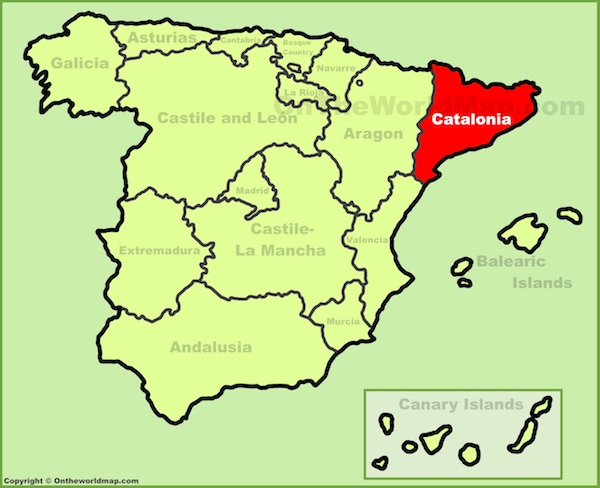
Catalan separatist leaders signaled they may be moving toward a unilateral declaration of independence as early as this week after hundreds of activists were injured on Sunday as they sought to stop Spanish police from shutting down an illegal referendum. Catalan President Carles Puigdemont appealed to the European Union for support as he pledged to inform the regional parliament of the result of the vote in the coming days. The assembly will then act in line with the referendum law, Puigdemont said — and that could lead to a unilateral declaration of independence within 48 hours of the notification. “The citizens of Catalonia have won the right to have an independent state,” Puigdemont said in a televised statement, flanked by members of his regional administration.

Two million Catalans backed independence out of 2.3 million votes cast in total, government spokesman Jordi Turull said at a press conference in the early hours of Monday. Just over 5 million people were eligible to vote. Before the government crackdown began, separatist leaders said they would be comfortable declaring independence with about 1.8 million votes. Puigdemont’s time frame could see him announce the formation of a Catalan republic on Oct. 6, exactly 83 years since his predecessor as regional president, Lluis Companys, also declared independence. Companys was executed by the dictatorship of Francisco Franco. [..] Prime Minister Mariano Rajoy is wrestling with his country’s biggest constitutional crisis since Franco’s death in 1975 as Puigdemont looks to harness decades of frustration to force Catalonia out of Spain.

Heading a minority government, Rajoy is fighting to maintain his authority as allies peel off in the national parliament and his officials struggle to enforce the law in the rebel region. While a declaration of independence would have no legal force, and would most likely not be recognized by the international community, it would nevertheless constitute a historic challenge to the authority of the Spanish government and state institutions. On Sunday night, Rajoy praised police for their “calmness” in defending the constitutional order after they raided polling stations and seized ballot boxes in their efforts to shut down the vote. As forces deployed, camera phones beamed the confrontations to the world. In one video, broadcast by a local newspaper, a woman is seen being thrown down a flight of stairs.

In another, police rip ballot boxes from the hands of would-be electoral officials. “We’ve proved that our rule of law has the resources to repel an attack on democracy of this magnitude,” Rajoy said in a televised statement. “Look for no culprits other than those who organized an illegal act and have broken our common bonds. We’ve witnessed the type of behavior that would be repugnant for any democrat: the indoctrination of children, persecution of judges and journalists.”

Read more …

Just weeks ago there wasn’t even a majority in the polls.

• Catalan Referendum Results Show 90% In Favour Of Independence (G.)

Catalan officials have claimed that preliminary results of its referendum have shown 90% in favour of independence in the vote vehemently opposed by Spain. Jordi Turull, the Catalan regional government spokesman, told reporters early on Monday morning that 90% of the 2.26 million Catalans who voted Sunday chose yes. He said nearly 8% of voters rejected independence and the rest of the ballots were blank or void. He said 15,000 votes were still being counted.The region has 5.3 million registered voters. Turull said the number of ballots did not include those confiscated by Spanish police during violent raids which resulted in hundreds of people being injured. At least 844 people and 33 police were reported to have been hurt, including at least two people who were thought to have been seriously injured.

Catalonia’s regional leader, Carles Puigdemont, spoke out against the violence with a pointed address: “On this day of hope and suffering, Catalonia’s citizens have earned the right to have an independent state in the form of a republic. “My government, in the next few days, will send the results of [the] vote to the Catalan parliament, where the sovereignty of our people lies, so that it can act in accordance with the law of the referendum.” Puigdemont had pressed ahead with the referendum despite opposition from the Spanish state, which declared the poll to be illegal, and the region’s own high court. He told crowds earlier in the day that the “police brutality will shame the Spanish state for ever”. The Spanish government defended its response after hundreds of people were hurt when riot police stormed polling stations in a last-minute effort to stop the vote on Sunday.

Read more …

Background.

• Catalan Independence Referendum Is A Smokescreen For Other Issues (Ind.)

Tensions are running high in Catalonia, with riot police out in force and protesters advocating their right to vote being shot with rubber bullets. At the time of writing, more than 300 people have been injured and at least one person is currently undergoing surgery as a result of clashes between police and protesters. Police repression, the arresting of politicians and the intransigence of the Spanish government (“there will be no referendum” has been Prime Minister Mariano Rajoy’s favourite refrain over the last few weeks) make the temptation to simplify this into a simple left-right or good-bad discourse tantalising. But this issue is far from simple. Both sides in this debate are using the referendum to further their own political agendas.

Spain’s governing party, the Partido Popular (PP), is a right-wing party housing a spectrum of thought from neoliberalists to the hard-line right. The ruling party in Catalonia, PDeCAT, is a centre right party of the Catalan bourgeois which has historically been the natural ally of PP and not a traditional supporter of independence. Interestingly, their move to advocate a referendum has stopped their support from dropping in recent months. Alongside this, neither the national government nor the Catalan parliament are strangers to corruption in politics. PDeCAT has been plagued with allegations of corruption, debate around which has receded significantly as demands for independence have increased. PP, for its part, has often sought conflict as a means of garnering public support.

Positioning this referendum and the spectre of independence as a threat to Spanish citizens and their economic future – as well as tugging on the strings of nationalist patriotism in demanding the continued unity of Spain – PP has engaged widespread support. In recent days, Spanish flags have poured from windows and balconies, and in towns throughout Spain people have cheered the Civil Guard – Spain’s law enforcement agency which operates on military lines – with football chants advocating the defeat of the opposition. Against this political background, Spain is beginning to emerge from the crisis of which it has been in the grasp of since 2008. However, unemployment, particularly among young people, is still extremely high, with poverty and homelessness rates continuing to rise. Both Catalan and Spanish politicians have invoked nationalism as the banner beneath which popular support can be raised, allowing the referendum and its surrounding debates to create a vacuum in which these pressing social issues are demoted.

Read more …

John Mauldin is a scary man.

• Global Retirement Reality: A $400 Trillion Shortfall (Mauldin)

I wrote a letter last June titled “Can You Afford to Reach 100?” Your answer may well be “Yes;” but, if so, you are one of the few. The World Economic Forum study I cited in that letter looked at six developed countries (the US, UK, Netherlands, Japan, Australia, and Canada) and two emerging markets (China and India) and found that by 2050 these countries will face a total savings shortfall of $400 trillion. That’s how much more is needed to ensure that future retirees will receive 70% of their working income. This staggering figure doesn’t even include most of Europe.

[..] The chart below shows the percentage of GDP needed to cover government pension payments in 2015 and 2050. But consider that the percentage of tax revenues required will be much higher. For instance, in Belgium the percentage of GDP going to pensions will be 18% in about 30 years, but that’s 40–50% of total tax revenues. That hunk doesn’t leave much for other budgetary items. Greece, Italy, Spain? Not far behind. And there is other research that makes the above numbers seem optimistic by comparison. The problem that the European economies have is that for the most part they are already massively in debt and have high tax rates. And they can’t print their own currencies. Many of Europe’s private pension companies and corporations are also in seriously deep kimchee. Low and negative interest rates have devastated the ability of pension funds to grow their assets.
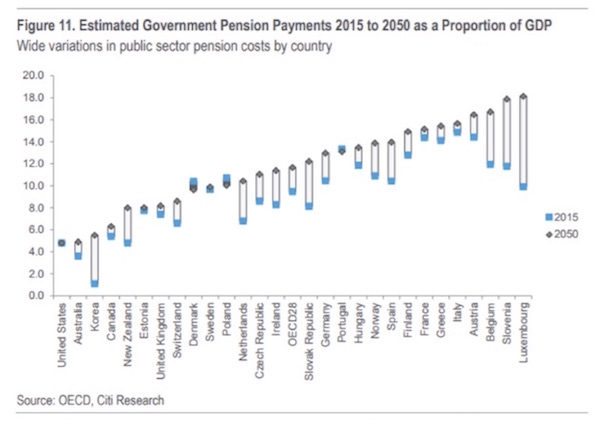
Combined with public pension liabilities, the total cost of meeting the income and healthcare needs of retirees is going to increase dramatically all across Europe. Macron, the new French president, really is trying to shake up the old order, to his credit; and this week he came out and began to lay the foundation for the mutualization of all European debt, which I assume would end up on the balance sheet of the ECB. However, that plan still doesn’t deal with the unfunded liabilities. Do countries just run up more debt? It seems like the plan is to kick the can down the road just a little further, something Europe is becoming really good at. In this next chart, note the line running through each of the countries, showing their debt as a percentage of GDP. Italy’s is already over 150%. And this is a chart based mostly on 2006 and earlier data. A newer chart would be much uglier.
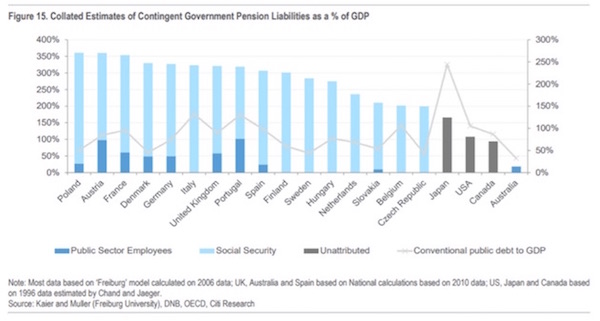
I could go on reviewing the retirement problems in other countries, but I hope you begin to see the big picture. This crisis isn’t purely a result of faulty politics – though that’s a big contributor – it’s a problem that is far bigger than even the most disciplined, future-focused governments and businesses can easily handle. Look what we’re trying to do. We think people can spend 35–40 years working and saving, then stop working and go on for another 20–30–40 years at the same comfort level – but with a growing percentage of retirees and a shrinking number of workers paying into the system. I’m sorry, but that’s magical thinking. And it’s not what the original retirement schemes envisioned at all. Their goal was to provide for a relatively small number of elderly people who were unable to work. Life expectancies were such that most workers would not reach that point, or would at least live just a few years beyond retirement.

As I have pointed out in past letters, when Franklin Roosevelt created Social Security for people over 65 years old, US life expectancy was about 56 years. If the retirement age had kept up with the increase in life expectancy, the retirement age in the US would now be 82. Try and sell that to voters. Worse, generations of politicians have convinced the public that not only is a magical outcome possible, it is guaranteed. Many politicians actually believe it themselves. They aren’t lying so much as just ignoring reality. They’ve made promises they aren’t able to keep and are letting others arrange their lives based on the assumption that the impossible will happen. It won’t.

Read more …

“..betting on the VIX is a ‘quick way to lose money.'”

• Hedge Funds Are ‘Dancing On The Rim Of A Volcano’ (BI)

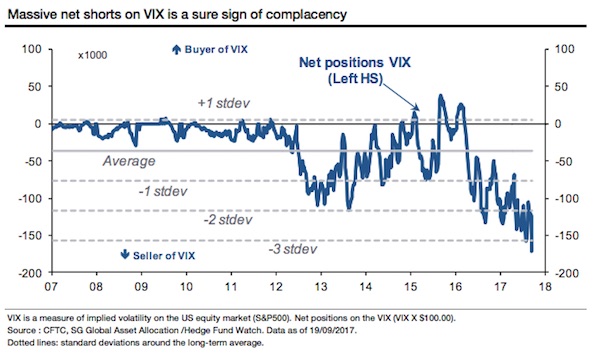
The market is calm. Perhaps too calm. The lack of price swings has investors mired in a sea of complacency, which has them ignoring potential risks, says Societe Generale. The firm specifically cites the CBOE Volatility Index – or VIX – which is used to track nervousness in the US stock market. Not only is the so-called fear gauge locked near the lowest levels on record, but hedge funds are betting it’ll decline even further. Their VIX positioning is the most bearish on record, according to data compiled by the US Commodity Futures Trading Commission. “Compare that with dancing on the rim of a volcano,” a group of SocGen strategists led by Alain Bokobza, the firm’s head of global asset allocation, wrote in a client note. “If there is a sudden eruption (of volatility) you get badly burned.”

This isn’t the first time SocGen has issued a warning about low volatility. Two weeks ago, the firm drew parallels to conditions leading up to the 2007 financial crisis. Describing the current situation as a “dangerous volatility regime,” the firm cited the strong mean-reverting tendency of price swings as a big reason why investors should be bracing themselves. Other heavyweights in the investment field have also spoken out about the low-price-swing situation that they see as untenable. In late July, JPMorgan global head of quantitative and derivatives strategy Marko Kolanovic compared rock-bottom volatility to the conditions leading up to the 1987 stock market crash. [..] Laszlo Birinyi, the investment guru who predicted the bull market and has been repeatedly correct over its 8 1/2-year run, said that betting on the VIX is a “quick way to lose money.”
Read more …

“..the large banks cannot survive without cheating customers, creditors and shareholders..”

• CDO Redux: Credit Spreads & Financial Fraud (Whalen)

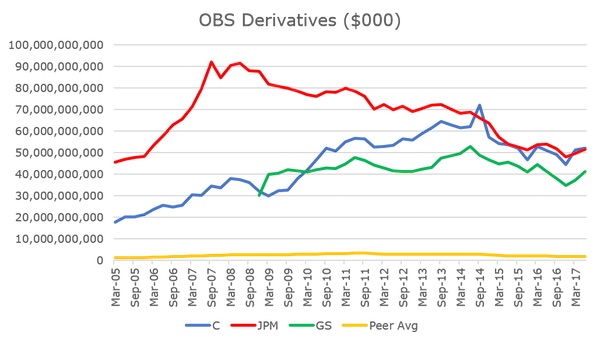
The moral of the story with Citi and other large banks is that there is no free lunch, but sadly no one on the FOMC seems to appreciate this subtlety. When the Fed pushes down interest rates and then manipulates credit spreads to achieve some illusory goal in terms of monetary policy, the result is a change in the behavior of investors and lenders that is profound. The fact that Citi, JPM and GS are now pushing back into the dangerous world of off-balance sheet (OBS) derivatives just illustrates the fact that the large banks cannot survive without cheating customers, creditors and shareholders. And just as retailers cannot compete with AMZN, Citi and GS certainly cannot compete against the monopoly power of the House of Morgan. In the case both of Citi and JPM, just half of the banks’ operating business comes from lending, while the remainder comes from risk bearing investments and trading.

With some $50 trillion in off-balance sheet (OBS) derivatives, which is almost six standard deviations above the $1.8 trillion peer average for large banks, Citi and JPM are now the outliers on Wall Street in terms of derivatives exposure. A move of 30bp in the OBS derivatives book of either bank would wipe out their capital. Chart One below shows the OBS derivatives exposure of Citi, JPM, GS and the other major banks. Notice that all three of the leading derivatives dealers have been increasing exposures since last year. Note too that the relatively small GS has a notional OBS derivatives book of more than $41 trillion, almost as large as that of Citi and JPM. More alarming, a move of just 7bp in the smaller bank’s OBS derivatives exposures would wipe out the capital of Goldman’s subsidiary bank. This gives GS an effective leverage ratio vs its notional OBS derivatives exposures of 8,800 to 1.
Read more …

Yesterday it was the HuffPo, now Bloomberg. Blaming Trump unfairly is a bad approach. Exit echo chamber.

• No, Trump Didn’t Botch the Puerto Rico Crisis (BBG)

[..] to look at the larger context of the entire relief operation, I decided to talk to someone whose experience rivals that of General Honore: retired Navy Captain Jerry Hendrix. Now a senior fellow with the Center for a New American Security, Hendrix served for decades both on the high seas and in high-level staff jobs, including with the Chief of Naval Operations’ Executive Panel and the Office of the Undersecretary of Defense for Policy’s Irregular Warfare Quadrennial Defense Review. Few people know more about military history than Hendrix, who has degrees from Purdue, Harvard, the Naval Postgraduate School and a Ph.D. from Kings College in London. Little wonder that in 2012 was named the service’s director of naval history.

TH: So, it seems like everybody has blasted Trump administration’s response to the Puerto Rico crisis. Has that criticism been fair?

JH: No, I don’t think so. First of all, there was a fair amount of anticipatory action that is not being recognized. Amphibious ships including the light amphibious carriers Kearsarge and Wasp and the amphibious landing ship dock Oak Hill were at sea and dispatched to Puerto Rico ahead of the hurricane’s impact. These are large ships that have large flight decks to land and dispatch heavy-lift CH-53 helicopters to and from disaster sites. They also have big well-decks – exposed surfaces that are lower than the fore and aft of the ship – from which large landing craft can be dispatched to shore carrying over 150 tons of water, food and other supplies on each trip. These are actually the ideal platforms for relief operations owing to their range of assets. The ships, due to their designs to support Marine amphibious landings in war zones, also have hospitals onboard to provide medical treatment on a large scale. That these ships were in the area should be viewed as a huge positive for the administration and the Department of Defense.

TH: Your plaudits toward the White House on all this are surprising to say the least. But where does the response still need to improve?

JH: One area in which the Trump administration could possibly lend additional assistance would be looking at a more robust activation of its assets in the Defense Department’s Transportation Command to include more heavy-lift and cargo aircraft, as well as Maritime Administration shipping to move the logistics-heavy large infrastructure items on the ocean. Everything from bulldozers to transformers needs to come by ships, and it’s been decades since it was really flexed to its full capacity. This would have the dual purpose of revealing any significant weaknesses in the Transportation Command assets and readiness should we need it in a military emergency down the road.

Read more …

Does this mean everybody gets what they want?

• Trump Urges Staff To Portray Him As “Crazy Guy” (Axios)

In an Oval Office meeting earlier this month, President Trump gave his top trade negotiator, Robert Lighthizer, an Art of the Deal-style coaching session on how to negotiate with the South Koreans. Trump’s impromptu coaching came in the middle of a pivotal conversation with top officials about whether or not to withdraw from the U.S.-Korean trade deal. Sources familiar with the conversation recounted the exchange for Axios, and the White House did not dispute this account. A number of senior officials and cabinet secretaries were present for the conversation, including Defense Secretary Mattis, Agriculture Secretary Perdue, and Secretary of State Tillerson. At issue was whether the U.S. would withdraw from the Korean trade deal — an action Trump threatened but still hasn’t done.

“You’ve got 30 days, and if you don’t get concessions then I’m pulling out,” Trump told Lighthizer. “Ok, well I’ll tell the Koreans they’ve got 30 days,” Lighthizer replied. “No, no, no,” Trump interjected. “That’s not how you negotiate. You don’t tell them they’ve got 30 days. You tell them, ‘This guy’s so crazy he could pull out any minute.'” “That’s what you tell them: Any minute,” Trump continued. “And by the way, I might. You guys all need to know I might. You don’t tell them 30 days. If they take 30 days they’ll stretch this out.” Why this matters: Plenty of world leaders think the president is crazy — and he seems to view that madman reputation as an asset. The downsides are obvious: the rhetoric can unnerve allies and has the potential to provoke enemies into needless, unintended war. But Trump keeps using the tactic, with varying degrees of success:

Just today, the president undercut his secretary of state by suggesting diplomacy with “Little Rocket Man” in North Korea was a waste of time — implying that only military action would resolve the conflict. “Save your energy Rex,” Trump tweeted, “we’ll do what has to be done!” We’ve never seen anything like this before. Trump’s tweet, undercutting Tillerson’s diplomatic efforts, comes a day after Tillerson acknowledged for the first time that the administration was in direct communication with North Korea. Trump’s tweet also undercuts a statement made Tuesday by Joint Chiefs Chairman General Dunford: “The military dimension today is in full support of the economic and diplomatic pressure campaign the secretary of state is leading in North Korea.”

Read more …

The kind of thing that can lead to war.

• Egypt Fears Disaster From Largest Hydroelectric Dam In Africa (AP)

The only reason Egypt has even existed from ancient times until today is because of the Nile River, which provides a thin, richly fertile stretch of green through the desert. For the first time, the country fears a potential threat to that lifeline, and it seems to have no idea what to do about it. Ethiopia is finalizing construction of the Grand Ethiopian Renaissance Dam, its first major dam on the Blue Nile, and then will eventually start filling the giant reservoir behind it to power the largest hydroelectric dam in Africa. Egypt fears that will cut into its water supply, destroying parts of its precious farmland, hampering its large desert reclamation projects and squeezing its bourgeoning population of 93 million people, who already face water shortages. Dam construction on international rivers often causes disputes over the downstream impact.

But the Nile is different: few nations rely so completely on a single river as much as Egypt does. The Nile provides over 90% of Egypt’s water supply. Almost the entire population lives cramped in the sliver of the Nile Valley. Around 60% of Egypt’s Nile water originates in Ethiopia from the Blue Nile, one of two main tributaries. Egypt barely gets by with the water it does have. Because of its population, it has one of the lowest per capita shares of water in the world, some 660 cubic meters a person. The strain is further worsened by widespread inefficiency and waste. With the population on a path to double in 50 years, shortages are predicted to become severe even sooner, by 2025. That is despite the fact that Egypt already receives the lion’s share of Nile waters: more than 55 billion of the around 88 billion cubic meters of water that flow down the river each year.

It is promised that amount under agreements from 1929 and 1959 that other Nile nations say are unfair and ignore the needs of their own large populations. Complicating the issue, no one has a clear idea what impact Ethiopia’s dam will actually have. Addis Ababa says it will not cause significant harm to Egypt or Sudan downstream. Much depends on management of the flow and how fast Ethiopia fills its reservoir, which can hold 74 billion cubic meters of water. A faster fill means blocking more water at once, while doing it slowly would mean less reduction downstream.[..] One study by a Cairo University agriculture professor estimated Egypt would lose a staggering 51% of its farmland if the fill is done in three years. A somewhat slower fill over six years would cost Egypt 17% of its cultivated land, the study claimed

Read more …

“..its 83 islands are stuck right in the middle of hurricane alley and they dot the border of the “ring of fire”..”

• Planes, Ships, Barges: The DIY Evacuation Of Vanuatu’s Volcano Island (G.)

Vanuatu is no stranger to the rumblings, shakings, flood waters and wrecking winds of natural disaster. The south Pacific island nation was rated the most at-risk country in the world in a 2016 United Nations study. Its 83 islands are stuck right in the middle of hurricane alley and they dot the border of the “ring of fire” – a belt around the Pacific prone to earthquakes and volcanic eruptions. Despite their precarious situation being a day-to-day reality, the country has been galvanised by the prime minister Charlot Salwai’s order to evacuate the entire island of Ambae because of the threat that the volcano at its centre will blow. “People’s lives must be our first priority,” Salwai said. “Everybody has to go.” What followed has been Vanuatu’s own version of the Dunkirk evacuation. Folk began organising even before Salwai gave the order.

The Ni-Vanuatu – the people of this archipelago – are defined by two things: land and family. From the moment a state of emergency was announced, members of the Ambae community in Port Vila, the capital, began to mobilise. They knew better than to wait for the cash-strapped, resource-starved government and instead jury-rigged a disaster response centre at a church. Local companies began donating goods immediately. Before long they had stockpiles of water, food, bedding and other essentials ready to send. Then they chartered a ship. The MV Makila was one of the first of Vanuatu’s ragtag fleet of inter-island barges and coasters to reach Ambae with supplies. It unloaded those goods then took more than 100 passengers to safety on the nearby island of Espiritu Santo. Then it went back and did it again.

There was no hesitation, no reflection. The ships had to run. So the community members dug deep and shifted for themselves. [..] Nadia Kanegai has been a personal assistant to a prime minister, and a former political candidate herself. A past master at getting things done by Vanuatu’s often shambolic bureaucracy, she didn’t flinch at the difficulties presented by moving hundreds of her home island’s most vulnerable inhabitants to safety. She just hired a plane and told the pilot to keep flying until everyone was out. Kanegai won’t discuss how much this airlift is costing her, but whistle-stop charter flights to the outer islands typically cost the equivalent of £1,000 for a return hop. Her plane made 18 flights on the first day alone.

Read more …

Bloomberg headline “Why Russia Should Love Climate Change Deniers”. Because that sells better than Mongolia?

• Climate Change Will Make Some Countries Richer – IMF (BBG)

President Donald Trump and other climate-change deniers probably don’t think of themselves as contributing to Russia’s future prosperity. But judging from a new International Monetary Fund report, that’s what they might be doing. In its latest World Economic Outlook, the IMF offers a sobering analysis of global warming’s potential repercussions. Looking at the historical relationship between climate and economic output, it finds that poor countries in hot regions – home to a majority of the world’s population – are likely to suffer the most as average temperatures rise. Here’s a map showing the effect of a one-degree-Celsius temperature increase on per-capita GDP, with countries scaled to reflect their populations:
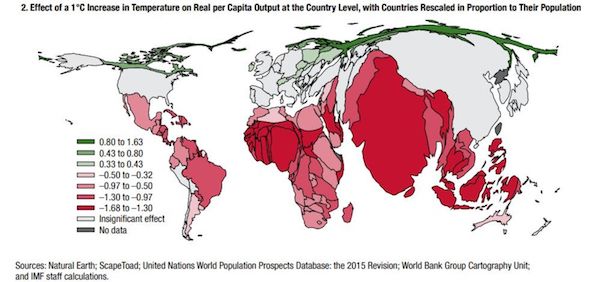
Gazing at the map, though, I couldn’t help but ask: What about the winners? Those green areas in the north certainly suggest that somebody stands to gain. So I downloaded the data to see which countries would get a per-capita GDP boost. Mongolia, Iceland, Finland and Russia topped the IMF’s list. Here’s the whole thing:
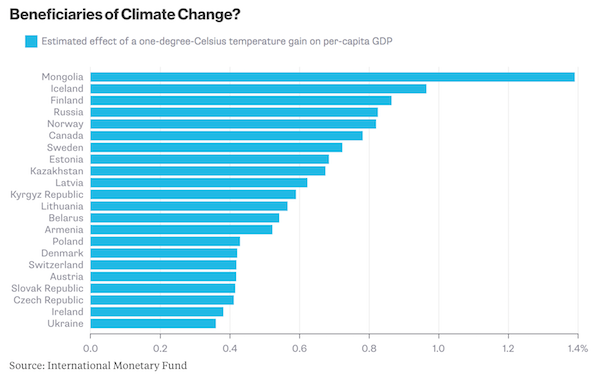
To be sure, this doesn’t mean that the countries will turn into a tropical paradises. For one, the researchers derived their estimates from the relatively small weather fluctuations of the past – nobody can really know what will happen if temperatures go beyond what humans have experienced. Also, don’t forget bigger natural disasters, forced migrations and all the other ills that climate change is expected to bring. That said, the data do suggest that Russia could, at least initially, be an unintended beneficiary of what amounts to a global injustice of epic proportions. Look again at that map: The poor countries in the south stand to bear the brunt of a catastrophe created largely by the wealthy countries in the middle, while the countries in the north get a windfall. That’s an outcome to which Trump, by downplaying the dangers of global warming and withdrawing from the Paris climate accord, has already made a significant contribution.


Read more …

Oct 012017
 
 October 1, 2017  Posted by at 2:02 pm Finance Tagged with: , , , , , , , ,  9 Responses »


Catalunya October 1 2017


I’ve seen a lot of videos and photos of the Catalonia attempt to hold a referendum today (Tyler has a “nice” series of them), and what struck me most of all, apart from the senseless violence police forces were seen to engage in, is the lack of violence on the side of protesters.

So when I see the Interior Ministry claim that 11 policemen were injured, That is hard to take serious. Not that the Catalans had no reason to resist or even fight back. That hundreds of protesters, including scores of grandma’s, are injured is obvious from watching the videos. Since rubber bullets were used in large numbers, fatal injuries are quite possible.

Policemen hitting peaceful older ladies till they bleed is shocking, and we are all shocked. Many of us will be surprised too, but we shouldn’t be. Spain is still the land of Franco, and his followers continue to exert great influence in politics, police and military. And it’s not just them: one video from Madrid showed people singing a fascist theme from the Franco era.


That’s the shape the EU knowingly accepted Spain as a member in, and that shape has hardly changed since. The total silence from Brussels, and from all its capitals, speaks volumes. Belgian PM Michel said earlier today that he doesn’t want to talk about other countries’ politics, and that’s more than I’ve seen anyone else say. It’s of course a piece of gross cowardly nonsense, both Michel’s statement and the silence from all others.

Because this very much concerns the EU. As Julian Assange tweeted “Dear @JunckerEU. Is this “respect for human dignity, freedom and democracy”? Activate article 7 and suspend Spain from the European Union for its clear violation of Article 2.” (Article 7 of the European Union Treaty: “Suspension of any Member State that uses military force on its own population.”) Sure, technically the Guardia Civil is not military, but are Juncker, Michel and above all Merkel really going to try and hide behind that?

Assange also re-tweeted this: “Claude Taylor Breaking: contact with Ecuadorian Govt says they plan on removing Julian Assange from their Embassy in London. Expect his arrest to follow.” Assange’s reaction: “DC based ex-White House claims I’m to be arrested for reporting on Spain’s censorship & arrests in Catalonia. Dirty.”

But that should not be a surprise either. We know from the example of Greece, and the treatment of refugees, what the morals of Europe’s ‘leaders’ are. Their morals are bankrupt. In that sense, they fit in seamlessly with those of Mariano Rajoy’s governing PP party in Spain.


Still, this is not why people want to be part of the EU. So unless very strong statements come from the various capitals, and very soon, given that they’re already way too late, the EU as a whole will find itself in such a deep crisis it might as well pack its bags and go home. Wherever home may be for these career politicians.

If you’re void of any and all ethics and morals, which is what that silence shouts out very loudly, you can’t lay any claim at all to the right to make decisions for anyone at all. That is true for Rajoy and his party, and it’s just as true for all other deadly silent European leaders.

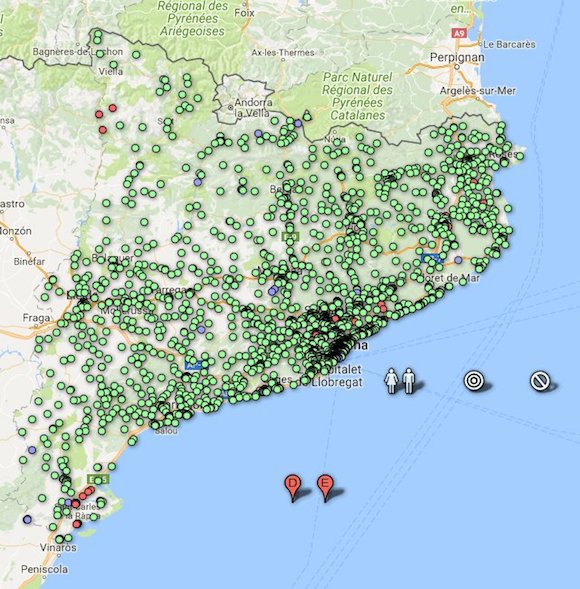
And this is by no means over, it hasn’t started yet. Here’s a map of close vs open polling stations in Catalonia, via Assange. ‘Nuff said. What will Rajoy’s next move be? Locking up everyone? The entire Catalan governing party that organized the referendum? Make no mistake: the Spanish military have long threatened they would destroy Catalonia before allowing it independence.


Catalan polling stations. Green=open. Red=closed


Philosopher Anna M. Hennessey, who has lived in both Spain and in Catalonia, put it this way:

Franco was victorious and did not lose his war, as Hitler and Mussolini lost theirs, but this must not mean that we should let the dictator’s toxic ideological infrastructure persist any further into the twenty-first century. Supporting Catalonia is a necessary step in putting an end to fascism in Europe.

When Fascism Won’t Die: Why We Need to Support Catalonia

People in the United States, especially those from the 1980s onward, know little of Spain’s Civil War (1936-1939) and the long dictatorship that followed. This knowledge is helpful in understanding the situation in Spain and Catalonia right now. The judge (Ismael Moreno) who is set to decide on sedition charges against Catalan activists for attempting to hold a democratic referendum on October 1st, for example, has roots that are deeply connected to Francisco Franco (1892-1975), the military leader who initiated the Civil War, won it, and then went on to rule as Head of State and dictator in Spain for almost forty years.

Franco is a major figure of twentieth-century fascism in Europe. A purge of Francoist government officials never took place when the dictatorship ended in the 1970s, and this leadership has had a lasting impact on how Spain’s government makes its decisions about Catalonia, a region traumatized during and after the war due to its resistance to Franco’s regime. The lingering effects of Franco’s legacy are at this point well-documented and need to be a part of the discourse that surrounds what is quickly unraveling in Barcelona.

[..] Like the Spanish government, the Spanish police force was never purged of its Francoist ties following the dictatorship. It is a deeply corrupt institution [..] Manuel Fraga Iribarne, one of Franco’s ministers during the dictatorship, founded Prime Minister Mariano Rajoy’s Popular Party. The party is currently enmeshed in a corruption scandal of its own. Spain’s royal family is similarly linked to Franco and has also been brought to trial for its own set of corruption charges. It is impossible to ignore the fascist bedrock upon which modern Spain is founded, or to ignore the reality that this foundation has to do with the way Spain treats Catalonia.

And so we can see the dream of a united Europe die. At least one that most people will feel comfortable living in. And if you can’t achieve that, why have a union to begin with? Democracy in Europe is dying in Brussels, it’s dying in Greece and the Mediterranean, and it died today in the streets of Barcelona and other Catalan locations.

Are all Europeans simply going to sit back and wait till it dies where they live, too? My bet is they will only do that until they no longer see the EU as economically beneficial to them. And as of today, because of Catalunya, economics will no longer be the only consideration. Because Spain will not be thrown out, not even suspended. There will be lots of empty strong words, but not all Europeans are all that stupid.

Barcelona mayor Ada Colau has called for Rajoy to resign, but she knows as well as anyone that that will not be enough, and it won’t change a thing. Rajoy is merely one representative of a fascist system that is the underbelly of Spain, waiting for its opportunity to raise its ugly head. It’s found that opportunity today, and the whole world is silent. Well, the ‘leaders’ are.


And while we’re talking disaster, I can’t help myself from briefly addressing Puerto Rico. The anti-Trump echo chamber is louder than ever, and it’s getting absurd. I can’t see what part of it is Trump’s doing, and what is due to other sources, but it simply seems not true that help is not moving forward. In a destruction as complete as Puerto Rico, there are limits to what can be done in a limited amount of time.

All the criticism of Trump at some point becomes criticism of other people involved as well. The mayor of San Juan gets lauded as a hero in certain circles, but is she really? How about the US military, how about FEMA? They look to be doing a good job, and FEMA seems to have learned a lot from Katrina 12 years ago.

Again, I don’t know how much of that is Trump, but if I may be cynical, he’s smart enough to know how his response could or would be used against him, so he would be really thick if he let the situation get worse than it should be. Earlier today Cate Long, an expert on Puerto Rico due to its debt fiasco, and hence with a lot of contacts there, tweeted:

“Federal govt has leapfrogged Puerto Rico govt & made direct connection with 78 municipalities. Central to powerful supply chain & relief.”

While the Huffington Post, not exactly Trump cheerleaders, posted this:

US Military On Puerto Rico: “The Problem Is Distribution”

Speaking today exclusively and live from Puerto Rico, is Puerto Rican born and raised, Colonel Michael A. Valle (”Torch”), Commander, 101st Air and Space Operations Group, and Director of the Joint Air Component Coordination Element, 1st Air Force, responsible for Hurricane Maria relief efforts in the U.S. commonwealth with a population of more than 3 million.

Since the ‘apocalyptic’ Cat 4 storm tore into the spine of Puerto Rico on September 20, Col. Valle has been both duty and blood bound to help. Col. Valle is a firsthand witness of the U.S. Department of Defense (DoD) response supporting FEMA in Puerto Rico, and as a Puerto Rican himself with family members living in the devastation, his passion for the people is second to none. “It’s just not true,” Col. Valle says of the major disconnect today between the perception of a lack of response from Washington verses what is really going on on the ground.

[..] some truck drivers from outside the island have been brought in, and more are coming, however it’s not a fix-all. “We get more and more offers to help, but there is no where to stay, we can’t take any more bodies, there’s no where to put them.” Col. Valle says, adding that their “air mobility” is good, and reiterating that getting more supplies or manpower is not the issue. When asked three times what else Washington can do to help, or anyone for that matter, three times Col. Valle answered, “It’s going to take time.”

Maybe it’s time to exit your echo chamber?


Oct 012017
 
 October 1, 2017  Posted by at 8:41 am Finance Tagged with: , , , , , , ,  Comments Off on Debt Rattle October 1 2017


Edward Hopper Nighthawks 1942


• US Military On Puerto Rico: “The Problem Is Distribution” (HP)
• When Fascism Won’t Die: Why We Need to Support Catalonia (CP)
• David Stockman: Stocks Are Heading For 40-70% Plunge (CNBC)
• The Financialization of America… and Its Discontents
• The US Economy is Failing (Paul Craig Roberts)
• Debt-Slave Industry Frets over Impact of Mass Credit Freezes (WS)
• Hong Kong Economy Most At Risk Of Financial Crisis – Nomura (BBG)
• S&P Says China’s Debt Will Grow 77% by 2021 (BBG)
• China Cuts Reserve Requirements To Boost Lending To Small Firms (R.)
• Fukushima Potentially Leaking Radioactive Water For 5 Months (RT)


An appeal from Puerto Rico via Nicole:

Hurricane Maria destroyed many of Puerto Rico’s local seed and organic food-producing farm crops. Please, if you can, send me seeds. Even fruit seed for the tropics – I can plant them quickly. I will hand them out to those in need – as well as start flats in order to jumpstart their crops. Thank you!

Mara Nieves
PO BOX 9020931
Old San Juan, PR
00901-0931


Just dumping another 10,000 people on the island is not the (whole) answer. Too many people criticize too easily. Time to leave the echo chamber. If HuffPo can do it, so can you.

“As a Puerto Rican, I can tell you that the problem has nothing to do with the U.S. military, FEMA, or the DoD.”

• US Military On Puerto Rico: “The Problem Is Distribution” (HuffPo)

Speaking today exclusively and live from Puerto Rico, is Puerto Rican born and raised, Colonel Michael A. Valle (”Torch”), Commander, 101st Air and Space Operations Group, and Director of the Joint Air Component Coordination Element, 1st Air Force, responsible for Hurricane Maria relief efforts in the U.S. commonwealth with a population of more than 3 million. Since the ‘apocalyptic’ Cat 4 storm tore into the spine of Puerto Rico on September 20, Col. Valle has been both duty and blood bound to help. Col. Valle is a firsthand witness of the U.S. Department of Defense (DoD) response supporting FEMA in Puerto Rico, and as a Puerto Rican himself with family members living in the devastation, his passion for the people is second to none. “It’s just not true,” Col. Valle says of the major disconnect today between the perception of a lack of response from Washington verses what is really going on on the ground.

“I have family here. My parents’ home is here. My uncles, aunts, cousins, are all here. As a Puerto Rican, I can tell you that the problem has nothing to do with the U.S. military, FEMA, or the DoD.” “The aid is getting to Puerto Rico. The problem is distribution. The federal government has sent us a lot of help; moving those supplies, in particular, fuel, is the issue right now,” says Col. Valle. Until power can be restored, generators are critical for hospitals and shelter facilities and more. But, and it’s a big but, they can’t get the fuel to run the generators. They have the generators, water, food, medicine, and fuel on the ground, yet the supplies are not moving across the island as quickly as they’re needed.

“It’s a lack of drivers for the transport trucks, the 18 wheelers. Supplies we have. Trucks we have. There are ships full of supplies, backed up in the ports, waiting to have a vehicle to unload into. However, only 20% of the truck drivers show up to work. These are private citizens in Puerto Rico, paid by companies that are contracted by the government,” says Col. Valle. Put another way, 80% of truck drivers do not show up to work, and yet again, it’s important to understand why. “There should be zero blame on the drivers. They can’t get to work, the infrastructure is destroyed, they can’t get fuel themselves, and they can’t call us for help because there’s no communication. The will of the people of Puerto Rico is off the charts. The truck drivers have families to take care of, many of them have no food or water. They have to take care of their family’s needs before they go off to work, and once they do go, they can’t call home,” explains Col. Valle.

[..] some truck drivers from outside the island have been brought in, and more are coming, however it’s not a fix-all. “We get more and more offers to help, but there is no where to stay, we can’t take any more bodies, there’s no where to put them.” Col. Valle says, adding that their “air mobility” is good, and reiterating that getting more supplies or manpower is not the issue. When asked three times what else Washington can do to help, or anyone for that matter, three times Col. Valle answered, “It’s going to take time.”

Read more …

The footage this morning from Catalonia is horrifying.

• When Fascism Won’t Die: Why We Need to Support Catalonia (CP)

People in the United States, especially those from the 1980s onward, know little of Spain’s Civil War (1936-1939) and the long dictatorship that followed. This knowledge is helpful in understanding the situation in Spain and Catalonia right now. The judge (Ismael Moreno) who is set to decide on sedition charges against Catalan activists for attempting to hold a democratic referendum on October 1st, for example, has roots that are deeply connected to Francisco Franco (1892-1975), the military leader who initiated the Civil War, won it, and then went on to rule as Head of State and dictator in Spain for almost forty years. Franco is a major figure of twentieth-century fascism in Europe. A purge of Francoist government officials never took place when the dictatorship ended in the 1970s, and this leadership has had a lasting impact on how Spain’s government makes its decisions about Catalonia, a region traumatized during and after the war due to its resistance to Franco’s regime.

The lingering effects of Franco’s legacy are at this point well-documented and need to be a part of the discourse that surrounds what is quickly unraveling in Barcelona. Over the past week, Spain’s military body, the Guardia Civil, has forcibly taken control of the Mossos d’Esquadra, Catalonia’s own police force. It has also detained government officials, closed multiple websites, and ordered seven hundred Catalan mayors to appear in court. Ominously, Spanish police from all over the country have traveled up to Barcelona or are en route to the Catalan capital, holing up in three giant cruise ships, two anchored in the city’s port, one in the port of nearby Tarragona. They are doing this at a time when Spain is on high alert for terrorist attacks, removing their police forces from numerous regions that could be in danger of attack, including Madrid, in preparation to stop Catalan people from putting pieces of paper into voting boxes.

Like the Spanish government, the Spanish police force was never purged of its Francoist ties following the dictatorship. It is a deeply corrupt institution [..] Manuel Fraga Iribarne, one of Franco’s ministers during the dictatorship, founded Prime Minister Mariano Rajoy’s Popular Party. The party is currently enmeshed in a corruption scandal of its own. Spain’s royal family is similarly linked to Franco and has also been brought to trial for its own set of corruption charges. It is impossible to ignore the fascist bedrock upon which modern Spain is founded, or to ignore the reality that this foundation has to do with the way Spain treats Catalonia.

Read more …

No tax reform, says Stockman.

• David Stockman: Stocks Are Heading For 40-70% Plunge (CNBC)

David Stockman is warning about the Trump administration’s tax overhaul plan, Federal Reserve policy, saying they could play into a severe stock market sell-off. Stockman, the Reagan administration’s director of the Office of Management and Budget, isn’t stepping away from his thesis that the 8 1/2-year-old rally is in serious danger. “There is a correction every seven to eight years, and they tend to be anywhere from 40 to 70%,” Stockman said recently on CNBC’s “Futures Now.” “If you have to work for a living, get out of the casino because it’s a dangerous place.” He’s made similar calls, but they haven’t materialized. In June, Stockman told CNBC the S&P 500 could easily fall to 1,600, which at the time represented a 34% drop. This week, the index was trading at record levels above 2,500. Stockman puts a big portion of the blame on the Federal Reserve, and its ultra-loose monetary policy.

“This is a bubble created by the Fed,” he said. “We’re heading for higher yields. We are heading for a huge reset of pricing in the risk markets that’s been based on ultra-cheap yields that the central banks of the world created that are now going to go away because they’re telling you that they’re done.” At the height of the 2007-2009 financial crisis, the S&P 500 Index plummeted as much as 58%. It happened in March 2009. “This market at 24 times GAAP earnings, 21 times operating earnings, 100 months into a business expansion with the kind of troubles you have in Washington, central banks [are] going to the sidelines,” he said. “There’s very little reward, and there’s a heck of a lot of risk.” Stockman argued that President Donald Trump’s business-friendly tax reform bill, which was unveiled Wednesday, won’t prevent a damaging sell-off.

He previously said Wall Street is “delusional” for believing it will even be passed. “This is a fiscal disaster that when they [Wall Street] begin to look at it, they’ll see it’s not even remotely paid for. This bill will go down for the count,” said Stockman. He said White House economic advisor Gary Cohn and Treasury Secretary Steve Mnuchin “totally failed to provide any detail, any leadership, any plan. Both of them ought to be fired because they let down the president in a major, major way.” And, it’s not just Washington dysfunction and Fed policy that could ultimately make Stockman’s long-held bearish prediction a reality. He says there will be a catalyst, but it’s unknown exactly what it will be. “You get a black swan in the old days, or maybe you get an orange swan now, the one in the Oval Office who can’t seem to stop tweeting and distracting the whole process from accomplishing anything,” Stockman said of President Donald Trump.

Read more …

Koyaanisqatsi. “..capital and profits flow to the scarcities created by asymmetric access to information, leverage and cheap credit — the engines of financialization.”

• The Financialization of America… and Its Discontents

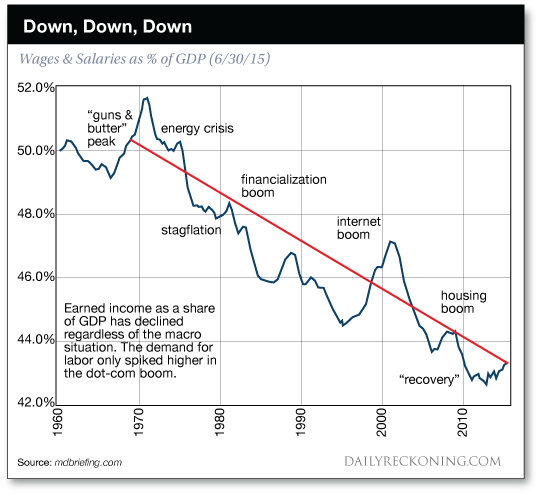
Labor’s share of the national income is in freefall as a direct result of the optimization of financialization. The Achilles Heel of our socio-economic system is the secular stagnation of earned income, i.e. wages and salaries. Stagnating wages undermine every aspect of our economy: consumption, credit, taxation and perhaps most importantly, the unspoken social contract that the benefits of productivity and increasing wealth will be distributed widely, if not fairly. This chart shows that labor’s declining share of the national income is not a recent problem, but a 45-year trend: despite occasional counter-trend blips, labor (earnings from labor/ employment) has seen its share of the economy plummet regardless of the political or economic environment.

Given the gravity of the consequences of this trend, mainstream economists have been struggling to explain it, as a means of eventually reversing it. The explanations include automation, globalization/offshoring, the high cost of housing, a decline of corporate competition (i.e. the dominance of cartels and quasi-monopolies), a failure of our educational complex to keep pace, stagnating gains in productivity, and so on. Each of these dynamics may well exacerbate the trend, but they all dodge the dominant driver of wage stagnation and rise income-wealth inequality: our economy is optimized for financialization, not labor/earned income. What does our economy is optimized for financialization mean? It means that capital and profits flow to the scarcities created by asymmetric access to information, leverage and cheap credit — the engines of financialization.

Financialization funnels the economy’s rewards to those with access to opaque financial processes and information flows, cheap central bank credit and private banking leverage. Together, these enable financiers and corporations to get the borrowed capital needed to acquire and consolidate the productive assets of the economy, and commoditize those productive assets, i.e. turn them into financial instruments that can be bought and sold on the global marketplace. Labor’s share of the national income is in freefall as a direct result of the optimization of financialization. Meanwhile, the official policy goal of the Federal Reserve and other central banks is to generate 3% inflation annually. Put another way: the central banks want to lower the purchasing power of their currencies by 33% every decade.

In other words, those with fixed incomes that don’t keep pace with inflation will have lost a third of their income after a decade of central bank-engineered inflation. But in an economy in which wages for 95% of households are stagnant for structural reasons, pushing inflation higher is destabilizing. There is a core structural problem with engineering 3% annual inflation. Those whose income doesn’t keep pace are gradually impoverished, while those who can notch gains above 3% gradually garner the lion’s share of the national income and wealth.

Read more …

“Unless Robots pay payroll taxes, the financing for Social Security and Medicare will collapse. And it goes on down from there.”

• The US Economy is Failing (Paul Craig Roberts)

Americans carry on by accumulating debt and becoming debt slaves. Many can only make the minimum payment on their credit card and thus accumulate debt. The Federal Reserve’s policy has exploded the prices of financial assets. The result is that the bulk of the population lacks discretionary income, and those with financial assets are wealthy until values adjust to reality. As an economist I cannot identify in history any economy whose affairs have been so badly managed and prospects so severely damaged as the economy of the United States of America. In the short/intermediate run policies that damage the prospects for the American work force benefit what is called the One Percent as jobs offshoring reduces corporate costs and financialization transfers remaining discretionary income in interest and fees to the financial sector.

But as consumer discretionary incomes disappear and debt burdens rise, aggregate demand falters, and there is nothing left to drive the economy. What we are witnessing in the United States is the first country to reverse the development process and to go backward by giving up industry, manufacturing, and tradable professional skill jobs. The labor force is becoming Third World with lowly paid domestic service jobs taking the place of high-productivity, high-value added jobs. The initial response was to put wives and mothers into the work force, but now even many two-earner families experience stagnant or falling material living standards. New university graduates are faced with substantial debts without jobs capable of producing sufficient income to pay off the debts.

Now the US is on a course of travelling backward at a faster rate. Robots are to take over more and more jobs, displacing more people. Robots don’t buy houses, furniture, appliances, cars, clothes, food, entertainment, medical services, etc. Unless Robots pay payroll taxes, the financing for Social Security and Medicare will collapse. And it goes on down from there. Consumer spending simply dries up, so who purcheses the goods and services supplied by robots? To find such important considerations absent in public debate suggests that the United States will continue on the country’s de-industrialization, de-manufacturing trajectory.

Read more …

Tricks to keep credit flowing.

• Debt-Slave Industry Frets over Impact of Mass Credit Freezes (WS)

“Let’s face it, 143 million frauds won’t be perpetrated right away; it will take some time to filter through,” Steve Bowman, chief credit and risk officer at GM Financial, the auto-lending subsidiary of General Motors, told Reuters. He was talking about the consequences of the Equifax hack during which the most crucial personal data, including Social Security numbers, of 143 million American consumers along with equivalent data of Canadian and British consumers, had been stolen. These consumers have all at once become very vulnerable to all kinds of fraud, including identity theft – where a fraudster borrows money in their name. The day Equifax disclosed the hack, I urged affected consumers to put a credit freeze on their credit data at the three major credit bureaus — Equifax, TransUnion, and Experian — to protect themselves against these frauds.

Soon, the largest media outlets and state attorneys general urged consumers to do the same thing. Financial advisors are recommending it. Even Wells Fargo jumped on the credit freeze bandwagon. As a result, consumers have flooded the websites of the three credit bureaus to request credit freezes in such numbers that the sites slowed down, timed out, or went down entirely for periods of time. This credit freeze frenzy is scaring the credit industry – not just the credit bureaus, but also lenders and companies that rely on easy credit to sell their wares, such as automakers and department stores with instant credit cards. With a credit freeze in place, those consumers cannot be approved for new credit until they lift the credit freeze, which can take up to three business days. The time and extra hoops to jump through before applying for a new loan might deter consumers from buying that car at the spur of the moment.

No one knows how this is going to turn out – and how it will impact the debt-based consumer economy. But fears are mounting. If just 10% of 324 million folks in the US put a credit freeze on their data, the credit industry will feel the impact painfully. Hence the efforts to contain the fallout. On Wednesday, an apology by the interim CEO of Equifax, Paulino do Rego Barros Jr. – he succeeded CEO Richard Smith, who’d been sacked – concluded with tidbits of a service Equifax is hoping to roll out by January 31. It would allow “all consumers the option of controlling access to their personal credit data.” It would allow them to “easily lock and unlock access to their Equifax credit files.” This is going to be “simple,” and “free for life.”

This “credit lock” or whatever Equifax wants to call it is not a “credit freeze.” TransUnion is offering a similar service. Credit freezes are covered by state law, and credit bureaus have to conform to state law. With these “credit locks” credit bureaus can do whatever they want to, and consumers will have to read the fine print to figure out what that is and how well a “credit lock” will protect them. But those credit locks offer the credit industry a huge advantage over a credit freeze: They can be designed to be lifted instantly. And this is a sign of how frazzled the credit industry, including the lenders, are becoming, about the credit freezes.

Read more …

Interesting methodology.

• Hong Kong Economy Most At Risk Of Financial Crisis – Nomura (BBG)

Hong Kong is the economy most at risk of suffering a financial crisis, with China the second most vulnerable, according to the latest update of an early warning system devised by Nomura. The findings don’t mean there will be a crisis. “It’s not a purely scientific approach that is very precise,” Singapore-based analyst Rob Subbaraman said by phone on Friday. “It doesn’t mean that indicators are always accurate or that because they have worked in the past they will work in the future.” Subbaraman developed the system along with fellow analyst Michael Loo using data going back to the early 1990s. The findings show that emerging markets are more prone than developed markets, and that Asia ex-Japan is the region that is most at risk.

The analysts selected five indicators that flash a signal of a financial crisis happening in the next 12 quarters when they breach set thresholds:
* Corporate and household credit to GDP
* The corporate and household debt-service ratio
* The real effective exchange rate
* Real — or adjusted for inflation — property prices
* Real equity prices

The latest update covers the 12 quarters up to and including the first three months of this year. As there are five indicators, each of the countries studied can have a maximum of 60 signals. Hong Kong has the most signals, 52 — higher than during the 1997 Asian financial crisis. China’s total fell to 40 from 41 in the previous update that covered the period up to the fourth quarter of 2016. “Hong Kong looks to be well in the danger zone,” Subbaraman and Loo wrote in the note. They described the decline in China’s total — the first drop since its number of flashing indicators started a steep ascent from zero in the first quarter of 2013 — as encouraging. “Nonetheless, China is still in the danger zone and without further efforts to drain its credit and property excesses, it will be difficult to arrest the trend slowdown in growth.”

Read more …

Chinese reality. Shadow banks and local government financing vehicles.

• S&P Says China’s Debt Will Grow 77% by 2021 (BBG)

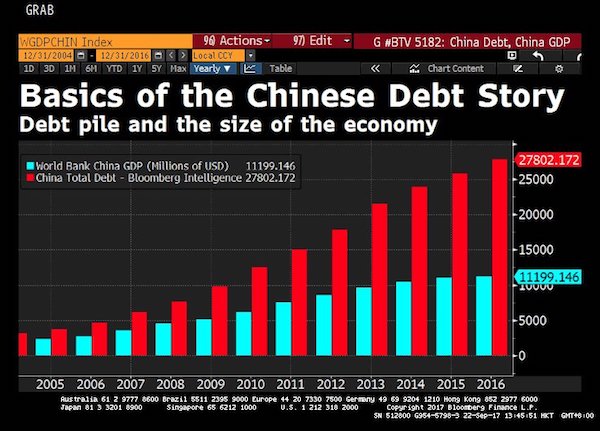
China’s total debt could rise 77% to $46 trillion by 2021, and its push to rein in heavy corporate borrowing has had “only tentative results so far,” S&P Global Ratings said. While the pace of debt expansion is slowing, it still exceeds economic growth, implying that high credit risks could still “incrementally increase,” the rating company said in a report Friday. “Recent intensification of government efforts to rein in corporate leverage could stabilize the trend of financial risks over the next few years,” credit analyst Christopher Lee wrote. “But we still foresee that credit growth will remain at levels that will gradually increase financial stress.” S&P last week cut China’s sovereign credit rating for the first time since 1999, citing the risks from soaring debt, and revised its outlook to stable from negative.

The Finance Ministry responded that the analysis ignores the country’s sound economic fundamentals and that the government is fully capable of maintaining financial stability. In a separate report Friday, S&P said China’s push to rein in corporate borrowing likely hasn’t produced lasting results because it lacks specific targets and time frames for cuts. Corporate debt, including local government financing vehicles, rose 5% last year to $14.5 trillion and is the highest among large economies at 134% of GDP, S&P said. State-owned enterprises are the heaviest borrowers, S&P said, adding that a focus on maintaining stability contributes to cautious policy making and a bias toward a status quo that prioritizes economic growth.

SOEs produce a fifth of economic output while taking out 40% of the bank loans, and they’re less profitable than private counterparts with double the overall debt leverage ratio, S&P said. “Without bold actions, China’s corporate deleveraging aims won’t be met in the next one to two years,” Lee wrote. “China allows moral hazards to persist by providing implicit or even direct support to highly indebted SOEs.

Read more …

Caution to the wind!

• China Cuts Reserve Requirements To Boost Lending To Small Firms (R.)

China’s central bank on Saturday cut the amount of cash that some banks must hold as reserves for the first time since February 2016 in a bid to encourage more lending to struggling smaller firms and energize its lackluster private sector. The People’s Bank of China (PBOC) said on its website that it would cut the reserve requirement ratio (RRR) for some banks that meet certain requirements for lending to small business and the agricultural sector. The PBOC said the move was made to support the development of “inclusive” financial services. The reserve requirement rate will be cut a further 50 bps to 150 bps from the benchmark RRR rate for banks that meet certain requirements for lending to the targeted sectors, the PBOC said. China’s cabinet had in late September flagged a possible move, saying the government will take a number of measures, including tax exemptions and targeted reserve requirement ratio cuts to encourage banks to support small businesses.

Read more …

Slow death.

• Fukushima Potentially Leaking Radioactive Water For 5 Months (RT)

The Fukushima nuclear power plant may have been leaking radioactive water since April, its owner has admitted. Tokyo Electric Power Company said on Thursday that a problem with monitoring equipment means it can’t be sure if radiation-contaminated water leaked from the reactor buildings damaged in the 2011 nuclear disaster which was sparked by an earthquake and tsunami, the Japan Times reports. The company said there were errors on the settings of six indicators monitoring groundwater levels of wells around reactor buildings 1-4 at the Fukushima Daiichi Nuclear power station. The indicators weren’t showing accurate water levels, and the actual levels were about 70 centimeters lower than that which the equipment showed. In May, groundwater at one of the wells sank below the contaminated water inside, NHK reports, which possibly caused the radioactive water to leak into the soil.

The company said it is investigating, and that no abnormal increase of radioactivity has shown up in samples. The problem with the six wells in question was discovered this week when the company was preparing another well nearby. The 2011 Fukushima nuclear disaster occurred when three of the plant’s reactors experienced fuel meltdowns and three units were damaged by hydrogen explosions as a result of the earthquake and subsequent tsunami. TEPCO has kept groundwater levels in wells higher than the contaminated water levels inside the plant, usually a meter higher. It also installed water-level indicators, which have now been revealed to be inaccurate. Last week, the company was ordered to pay damages of 376 million yen ($3.36 million) to 42 plaintiffs for the nuclear disaster in the second case a court has which has seen rulings against the company.

The suit, one of about 30 class actions brought against the plant, was brought by residents forced to flee their homes when three reactor cores melted, knocking off the cooling systems and sending radioactive material into the air. The case examined whether the government and TEPCO could have foreseen the tsunami. A government earthquake assessment made public in 2002 predicted a 20% chance of a magnitude 8 earthquake affecting the area within 30 years. The 2011 quake was a magnitude 9. The case argued that the disaster was preventable as emergency generators could have been placed at a location higher than the plant, which stands 10 meters above sea level. The court found the state wasn’t liable, but another case in March found both TEPCO and the government liable.

Read more …

Sep 292017
 
 September 29, 2017  Posted by at 9:10 am Finance Tagged with: , , , , , , , ,  Comments Off on Debt Rattle September 29 2017


Pablo Picasso Weeping woman 1937


• US Inequality Near Historic Highs, Wages Stagnant (BI)
• UBS Indentifies 8 Cities With Biggest Housing Bubbles (ZH)
• Chinese Money Is Still Leaking Into the World’s Housing Markets (BBG)
• China’s Bitcoin Market Alive And Well As Traders Defy Crackdown (R.)
• China Orders North Korean Companies Active In The Country To Shut Down (BBG)
• The Closing Of The Catalan Polling Stations (EI)
• French Vineyards Robbed Of Seven Tonnes Of Grapes (AFP)
• Schäuble Leaves But Schäuble-ism Lives On (Varoufakis)
• Over Half Of All Greek Enterprises Are In The Red (K.)
• Surge In Migration To Greece Fuels Misery In Refugee Camps (G.)
• China’s Love of Meat Is Driving Global Antibiotic Usage (BBG)
• Tropical Forests Don’t Absorb Carbon. They Emit As Much As All US Transit (Q.)


Economy out of balance.

• US Inequality Near Historic Highs, Wages Stagnant (BI)

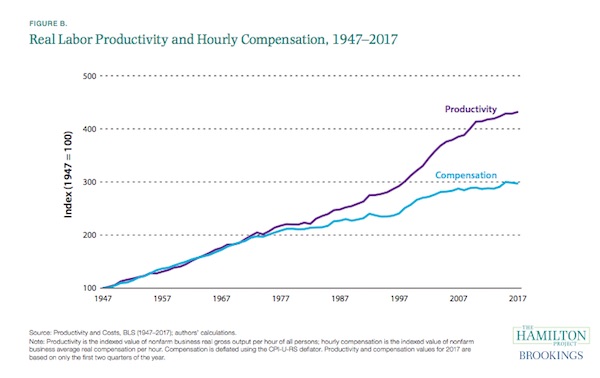
There is a reason so many Americans feel the economy’s recovery from the Great Recession has not benefited them: It hasn’t. An expansion that began, believe it or not, more than seven years ago has extended a longer-run trend of wage stagnation for the average US worker, despite a sharp drop in the official unemployment rate to 4.4% from an October 2009 peak of 10%. No wonder the recovery seems so lopsided, particularly given economic inequality levels not seen since before the Great Depression. A new report from the Hamilton Project, an economic-policy initiative of the Brookings Institution in Washington, offers a range of startling figures and charts that paints a rather dramatic picture of US economic disparities. “The U.S. economy has experienced long-term real wage stagnation and a persistent lack of economic progress for many workers,” wrote Jay Shambaugh, a White House economist under President Barack Obama who now heads the Hamilton Project.

After adjusting for inflation, wages are just 10% higher in 2017 than they were in 1973, amounting to real annual wage growth of just below 0.2% a year, the report says. [..] One big source of the problem: Starting around the 1970s, US productivity growth began rising much more rapidly than workers’ compensation — meaning the share of growth was accumulating increasingly in corporate profits at the expense of pay. The report attributes this both to the increasing role of technology in the workplace but also to a loss of bargaining power brought on by anti-union labor policies and other wage-suppressing measures. “Changes in worker bargaining power, competition within and across industries, and globalization can all influence the share of output workers receive,” the report said.

Read more …

What happened to Auckland?

• UBS Indentifies 8 Cities With Biggest Housing Bubbles (ZH)

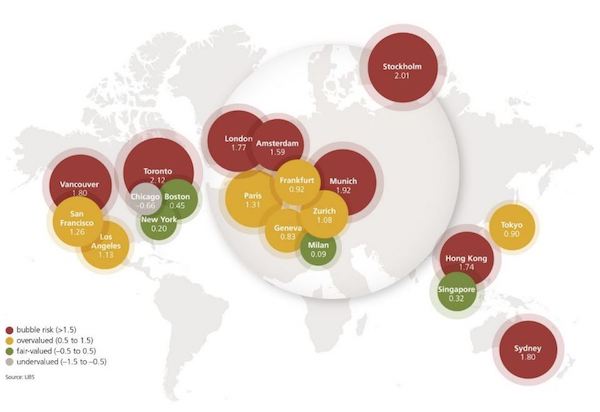
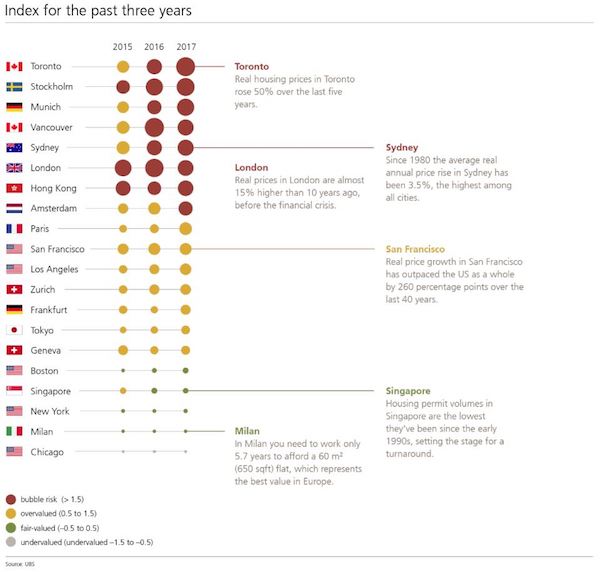
Two years ago, when UBS looked at the world’s most expensive housing markets, it found that London and Hong Kong were the only two areas exposed to bubble risk. What a difference just a couple of years makes, because in the latest report by UBS wealth Management, which compiles the bank’s Global Real Estate Bubble Index, it found that eight of the world’s largest cities are now subject to a massive speculative housing bubble. And while perpetually low mortgage rates are clearly to blame for the rapid ascent of home prices, Chinese money laundering operations clearly seem to also be playing a role as their favorite markets of Vancouver, Toronto and Sydney all made this year’s list. Bubble risk seems greatest in Toronto, where it has increased significantly in the last year.

Stockholm, Munich, Vancouver, Sydney, London and Hong Kong all remain in risk territory, with Amsterdam joining this group after being overvalued last year. Valuations are stretched in Paris, San Francisco, Los Angeles, Zurich, Frankfurt, Tokyo and Geneva as well. In contrast, property markets in Boston, Singapore, New York and Milan seem fairly valued, while Chicago remains undervalued, just as it was last year. Price bubbles are a regularly recurring phenomenon in property markets. The term “bubble” refers to a substantial and sustained mispricing of an asset, the existence of which cannot be proved unless it bursts. But recurring patterns of property market excesses are observable in the historical data. Typical signs include a decoupling of prices from local incomes and rents, and distortions of the real economy, such as excessive lending and construction activity. The UBS Global Real Estate Bubble Index gauges the risk of a property bubble on the basis of such patterns.

As UBS points out, artificially low interest rates in Europe, for example, have kept mortgage payments below their 10-year average despite real prices surging 30% since 2007. Falling mortgage rates over the last decade have made buying a home vastly more attractive, which increased average willingness to pay for home ownership. In European cities, for example, the annual usage costs for apartments (mortgage interest payments and amortization) are still below their 10-year average, despite real prices escalating 30% since 2007. In Canada and Australia, too, a large part of the negative impact of higher purchase prices on affordability was cushioned by low mortgage rates.

Read more …

Xi must watch his reserves.

• Chinese Money Is Still Leaking Into the World’s Housing Markets (BBG)

Tighter capital controls have done little to dent the appetite of Chinese buyers who already helped drive prices higher across the globe. While definitive data are hard to come by, real estate brokers including Knight Frank LLP, Savills Plc and domestic firm Shiju report rising purchases of overseas property this year. What’s changed is that the curbs have prompted buyers to look for cheaper homes in smaller cities, making down payments more manageable. Part of the reason for the unhindered overseas purchases could be that authorities have already succeeded in stemming capital outflows after cracking down on the most acquisitive companies. That eases the need to enforce limits on individuals, a more difficult and costly process, said Steven Zhang at Morgan Stanley Huaxin. “It’s a question of cost and benefit,” Zhang said.

Since the start of 2017, Chinese applying for their $50,000-a-year foreign-exchange quotas must sign pledges that the money won’t be used for real estate. Violators face a range of potential sanctions. [..] The impact of the increased currency scrutiny has been on the size rather than the quantity of deals. At real estate portal Juwai.com, the average price of overseas properties Chinese buyers inquired about dropped to just over $292,000 this year from more than $356,000 in 2016. Some buyers are eschewing pricey hubs like New York for less-expensive areas such as Florida and Texas, according to Eric Lam, chief executive of Shiju, the overseas broker unit of Shenzhen World Union Properties. They’re typically spending up to 3 million yuan ($450,000) for U.S. homes, and as much as 2 million yuan for U.K. properties, prices that make for manageable down payments using exchange quotas, Lam said.

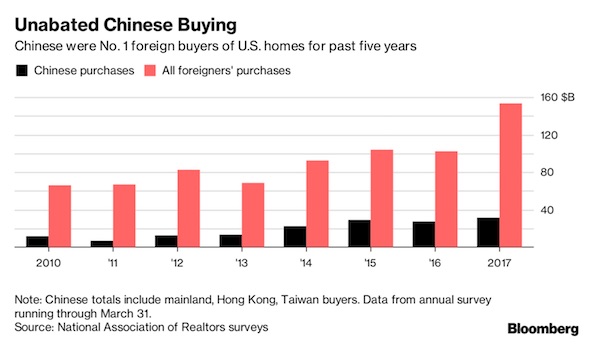
Jones Lang LaSalle said it was mainly selling U.K. homes, often below $500,000, and Cushman & Wakefield also highlighted surging Chinese demand for British property after the pound weakened following the Brexit vote. [..] The undimmed appetite suggests Chinese money could continue to put upward pressure on prices, a trend that’s stoked concern among locals in cities from Vancouver to Sydney. Chinese buyers, mainly from the mainland but also from Taiwan and Hong Kong, spent a record $31.7 billion on U.S. residential properties in the year through March 31, remaining the biggest foreign force in the market.

Read more …

The crackdown doesn’t come into effect until October.

• China’s Bitcoin Market Alive And Well As Traders Defy Crackdown (R.)

Weeks after Beijing banned fundraising through token launches and ordered some bitcoin exchanges to shut, casting a chill over the cryptocurrency industry, traders say that the market is far from dead. While several exchanges have announced that they will close by the end of this month, traders have now moved to buy and sell bitcoin directly with each other on peer-to-peer marketplaces and messenger apps. Industry insiders say some overseas-based initial coin offerings (ICOs) are still being marketed. Although the crackdown has dissuaded large swathes of less-experienced investors from participating in the trade, market participants point to the limits Chinese regulators ultimately face in controlling the industry, where many users are anonymous and difficult to track.

In the short-run, the crackdown has also created an arbitrage opportunity for investors, with the price of bitcoin in China now trading at a discount to overseas exchanges. “They can’t set rules to stop me from investing in what I want to invest in. They say you are protecting me, but as long as I think this is good, they have no way to intervene,” said a Chinese bitcoin investor named Victor, who declined to give his full name citing current sensitivities. [..] “The fact that bitcoin is still being traded is an indication that China isn’t looking to eliminate them, but reposition things in a way to have better control over them,” said Marshall Swatt, the founder of New York-based Coinsetter, a bitcoin exchange acquired by larger peer San Francisco-based Kraken in 2016.

Other Chinese cryptocurrency players said traders were also moving away from using Tencent’s WeChat app, to encrypted messenger app Telegram to avoid regulatory scrutiny. Some said they were still seeing overseas-based ICOs being marketed in China. The Sept. 4 shutdown of ICOs stipulated that Chinese citizens were not allowed to invest in ICOs. Overseas ICOs have been returning money on a voluntary basis.

Read more …

That’s going to hurt.

• China Orders North Korean Companies Active In The Country To Shut Down (BBG)

China ordered North Korean companies active in the country to shut down as it seeks to implement United Nations’ sanctions against the hermetic regime. Joint ventures between Chinese firms and North Korean entities and individuals will also have to close, according to a statement on the website of China’s Ministry of Commerce Thursday. Companies are required to cease business within 120 days of Sept. 12 – the day after the UN passed new sanctions aimed at punishing North Korea for its latest missile and nuclear tests. Non-profit and non-commercial public utility and infrastructure projects are not subject to the order, the ministry said. The move comes ahead of U.S. Secretary of State Rex Tillerson’s visit to China at the weekend. North Korea is among topics to be discussed with senior Chinese leaders, along with President Donald Trump’s planned trip to the region and trade and investment issues, the State Department said in a statement on Wednesday.

Read more …

Please keep the peace.

• The Closing Of The Catalan Polling Stations (EI)

As we reported yesterday, the Catalan head prosecutor has instructed the regional police, the Mossos d’Esquadra, to seal the designated polling stations for Sunday’s independence referendum by Friday. This may not be easy. The radical left separatist party CUP is calling for the seals to be broken, and there will be attempts to organise sit-ins at the polling stations before the police comes to seal them, which would force the police to clear the sit-in. As we noted yesterday they are about 2,700 polling stations in a Catalan election, which stretches the police’s ability to cover them all simultaneously. The Mossos have responded officially that they will act proportionately, and that there is a risk that sealing the polling places may lead to public unrest. In addition, they are demanding a court order – not just an instruction from the prosecutor – to seal the polling stations.

The Catalan government says that the police is there to guarantee order so that people can exercise their right to vote, while the Spanish government says the police is there to prevent illegal acts from being carried out. The Catalan premier has convened the region’s public safety board, which includes representatives of the Spanish interior minister who will be in attendance. The interior minister had previously set up security coordination meetings for all the Spanish and Catalan police forces, which the Mossos resent as they result in putting them under command of the national police. We have also reported that Mariano Rajoy will miss tomorrow’s informal EU summit in Tallinn, which starts today with a dinner, ostensibly on account of the Catalan referendum. The referendum is scheduled for Sunday. We wonder whether Mariano Rajoy feels he needs to be in Spain on the Friday just in case unrest breaks out.

Read more …

Sounds like a lot. The French are serious about wine.

• French Vineyards Robbed Of Seven Tonnes Of Grapes (AFP)

At least seven tonnes of grapes have been stolen in the dead of night from vineyards in France’s prime winegrowing region of Bordeaux, following a disastrous yield blamed on poor weather, police say. Three vineyards have had grapes and even whole vines stolen since mid-September, police said on Wednesday. They said about six and a half tonnes of grapes disappeared from a vineyard in Genissac near the world-famous Saint Emilion region, adding that the theft was clearly committed by professional vintners. Between 600 and 700kg (1,300 and 1,500lb) of grapes were stolen from a vineyard in Pomerol, which produces top quality reds. Thieves also uprooted 500 vines from a vineyard in nearby Montagne, police said.

A fourth grape robbery took place in Lalande-de-Pomerol, according to a local press report. Thieves making away with grapes is not a new phenomenon but it has surged this year apparently because of a very low yield. “There’s a great temptation to help oneself from [the vineyard] next door,” an industry expert told AFP on condition of anonymity. France faces its poorest wine harvest since 1945 after an unusually mild March and frosty April, experts said last month, although a hot summer promises to deliver top vintages. The agriculture ministry said output was expected to total 37.2m hectolitres (983m US gallons), 18% less than 2016 and 17% below the average over the past five years.

Read more …

Merkel already sold off Greece to please her bankers. Now she’s planning to make things worse in order to cement a coalition.

• Schäuble Leaves But Schäuble-ism Lives On (Varoufakis)

Wolfgang Schäuble may have left the finance ministry but his policy for turning the eurozone into an iron cage of austerity, that is the very antithesis of a democratic federation, lives on. What is remarkable about Dr Schäuble’s tenure was how he invested heavily in maintaining the fragility of the monetary union, rather than eradicating it in order to render the eurozone macro-economically sustainable and resilient. Why did Dr Schäuble aim at maintaining the eurozone’s fragility? Why was he, in this context, ever so keen to maintain the threat of Grexit? The simple answer is: Because a state of permanent fragility was instrumental to his strategy for using the threat of expulsion from the euro (or even of Germany’s withdrawal from it) to discipline the deficit countries – chiefly France.

Deep in Dr Schäuble’ thinking there was the belief that, as a federation is infeasible, the euro is a glorified fixed exchange rate regime. And the only way of maintaining discipline within such a regime was to keep alive the threat of expulsion or exit. But to keep that threat alive, the eurozone could not be allowed to develop the instruments and institutions that would stop it from being fragile. Thus, the eurozone’s permanent fragility was, from Dr Schäuble’s perspective an end-in-itself, rather than a failure. The Free Democratic Party’s ascension will see to it that Wolfgang Schäuble’s departure will not alter the policy of doing whatever it takes to prevent the eurozone‘s evolution into a sustainable macroeconomy.

The FDP’s sole promise to its voters was to prevent any of Emmanuel Macron’s plans, for some federation-lite, from being agreed to, and for pursuing Grexit. Even worse, whereas Wolfgang Schäuble understood that austerity plus new loans were catastrophic for countries like Greece (but insisted on them as part of his campaign to discipline France and Italy), his FDP successors at the finance ministry will probably be less ‘enlightened’ believing that the ‘tough medicine’ is fit for purpose. And so the never ending crisis of Europe’s social economy, that feeds the xenophobic political monsters, continues.

Read more …

Waterboarding. And worse. Do this to an economy, and it will fail outright. That, then, must be what Berlin is aiming for.

• Over Half Of All Greek Enterprises Are In The Red (K.)

At least 56% of small and medium-sized enterprises (SMEs) are now in debt due to low liquidity and high borrowing, a combination that forbids them from meeting their short-term obligations. Only a fraction have a chance of having their debt restructured, which means that sooner or later they will follow the fate of many of their peers and be forced to shut down. This is the main conclusion of a Piraeus Bank analysis after a sample of 7,896 companies were assessed using its Enterprise Rating System (ERS). Given that over 97% of enterprises in Greece are SMEs, the risk both to them and the economy in general is clear, with an impact on state revenues, employment and bank provisions.

The ERS assessment resulted in four categories of enterprises based on liquidity, solvency, degree of leverage and debt servicing. Just 8.6% of all companies have made it into the A category. They are the healthiest businesses, with high cash flows, even though two-thirds face problems with their earnings. Category B accounts for 35.7% of companies, which display satisfactory performance; however, it should be observed that the obligations of these businesses exceed their assets by 1.2 times. The largest category is C, with two-fifths of all companies, or 40.4%; they are enterprises which have not yet reached the brink as they have some chances at becoming sustainable, but indicate a low degree of debt servicing, finding themselves in the red.

Finally there is category D, which hosts 15.4% of all companies. The vast majority (82.5%) has a substantial problem in terms of sustainability; not only do they have a negative operating profit rate, averaging at -9.1%, but they are also loss-making. The average company in this category has borrowing that is three-and-a-half times its assets and 25 times its earnings before interest, tax, depreciation and amortization (EBITDA).

Read more …

Lesvos Solidarity on Twitter: “Section C in #moria now houses around 200 unaccompanied minors, incl pregnant girls. They are unattended after 17.00.”

• Surge In Migration To Greece Fuels Misery In Refugee Camps (G.)

Greece is experiencing a dramatic rise in the number of refugees and migrants entering the country, exacerbating already deplorable living conditions on island camps. The number of people arriving, across land and sea borders, has more than doubled since the beginning of the summer. Authorities estimate arrivals are now at their highest level since March 2016, with over 200 men, women and children being registered every day. “It is dramatic and it is the most vulnerable of the vulnerable coming in,” said Elias Pavlopoulos, who heads Médecins sans Frontières in Greece. “There are whole families fleeing war zones in Syria and Iraq. In the last few months our clinics have seen more people who have suffered violence, who are victims of rape, who have been tortured, than ever before.”

Despite a pledge by EU member states in September 2015 to relocate 160,000 asylum seekers – including 106,000 from Greece and Italy – a mere 29,000 have been moved to other European countries so far. With the 28-nation bloc failing to meet the deadline set out in its own plan, mass demonstrations are expected in capitals across Europe this weekend. Refugees and migrants have been arriving in Greece not only on rickety boats from Turkey but by foot across the frontier between the two countries. On Wednesday, police announced 37 refugees – including 19 children – from Iraq, Syria, Eritrea and Afghanistan, had been dumped by smugglers on the national highway outside Thessaloniki.

Human rights groups are increasingly likening the situation to 2015, when, at the height of the migrant crisis that engulfed Europe, Greece saw close to a million people enter the country on onward journeys that often took them to Germany. “We’re living the days of 2015,” said Pantelis Dimitriou from Iliaktida, a local NGO on Lesbos operating accommodation and support centres for the newly arrived. “The flows have become huge. From around 50 to 60 in early July they are now at more than 200 every day. Maybe it is the German elections, maybe it is about Turkey’s [worsening] relations with the EU, or maybe this is the last push before winter, but something is going on.” More worrying is the number of minors making the often treacherous journey to get to Greece. In a statement this week, Save the Children said around 40% of the new arrivals were under the age of 18. Over 1,500 unaccompanied minors are currently on waiting lists in Greece to be housed in child shelters.

Read more …

We need a global ban on using antibiotics on farms. But the industry is very powerful.

• China’s Love of Meat Is Driving Global Antibiotic Usage (BBG)

Growing global demand for animal protein is good news for the pharmaceutical industry, but a worry for public health. Food animals will consume 200,235 tons of antimicrobial medicines by 2030, 53% more than they were getting in 2013, according to a study published Thursday in the journal Science. China, already the world’s largest consumer of veterinary antimicrobials, is forecast to lead the charge, with a 59% jump. That bodes badly for the efficacy of these infection-fighting medications. The study’s authors linked the quantity of drugs used on farms with the emergence of foodborne bacteria, like Campylobacter and Salmonella harboring antibiotic-resistance genes. Limiting daily meat intake worldwide to the equivalent of one standard fast-food burger per person could reduce global consumption of antimicrobials in food animals by 66%, the researchers said.

Read more …

It was fun while it lasted?!

• Tropical Forests Don’t Absorb Carbon. They Emit As Much As All US Transit (Q.)

Since humans began to worry about having put too much carbon in the atmosphere, we’ve considered tropical forests an important “carbon sink.” Their fast growth rate, dense vegetation, and rich soils sucked more carbon out of the atmosphere then they produced. In other words, tropical forests were a natural greenhouse-gas vacuum. Except now, just when the world most needs them to be, they’re not. At some point, it turns out, deforestation, drought, and other forest-disturbing factors tipped the scales, making tropical forests a net producer of carbon rather than a sink, according to a new study published Sept. 28 in the journal Science. Each year, instead of absorbing carbon, these degraded forests are a source of more carbon (roughly 425 teragrams of carbon per year) than an entire year’s worth of US transportation emissions.

Scientists at Woods Hole Research Center and Boston University spent two and a half years trekking to tropical forests in 22 countries, measuring trees’ thickness and recording their growth rate, which is a big factor in how much carbon a forest is absorbing. They then paired their field data with laser remote-sensing data and 12 years of satellite data from NASA’s MODIS satellites. The researcher’s combined approach allowed them to figure out not just losses from dramatic deforestation, but also the harder-to-calculate losses from less obvious factors, like selective logging and small-scale farming. Previous studies have looked at large-scale deforestation in the tropics as a source of carbon, and more recent papers have pointed towards the subtler forms of degradation as a likely underestimated source.

Read more …

Sep 272017
 
 September 27, 2017  Posted by at 8:46 am Finance Tagged with: , , , , , , , ,  2 Responses »


Edward Hopper Night windows 1928


• Yellen Concedes Inflation Models Could Be Off “In Some Fundamental Way” (BBG)
• Fed’s Beautiful Model in Pictures (Mish)
• The Law Strangling Puerto Rico (NYT)
• US Housing Market “Unhealthy And Mismatched With Today’s Buyers” (CNBC)
• Home Prices, Sales In Beijing Are Falling Fast (BI)
• China Still Stocking Up On Metals And Credit – Beige Book (CNBC)
• China Tells Entrepreneurs They Must Put Patriotism Over Profit (BBG)
• Macron Lays Out Vision For ‘Profound’ Changes In EU (G.)
• Uber’s New ‘Good Cop’ Tack Will Face Test in US City Tussles (BBG)
• Hedge Fund Paulson & Co Declares War On Poor Gold Mining Returns (R.)
• The Case For The 3-Hour Workday (BI)
• Spain Deploys Ever More Police To Prevent Catalan Independence Vote (G.)
• Banned West Papua Independence Petition Handed To UN (G.)
• Zealandia Drilling Reveals Secrets Of Sunken Lost Continent (G.)


If she knows she’s always wrong, why doesn’t she resign?

• Yellen Concedes Inflation Models Could Be Off “In Some Fundamental Way” (BBG)

Janet Yellen still has faith, but she’s open to converting. In a wide-ranging speech on inflation, the Fed chair wrestled with an issue that’s flummoxing policy makers everywhere: Why is inflation not only low, but in some instances going south? At this point in an expansion that’s lasted the better part of a decade and has returned jobless levels to pre-recession levels, leading economic models would ordinarily tell us to expect inflation to rise. Kudos to her for admitting the uncertainty. The question is one of the pre-eminent themes of the modern economic era. It’s perhaps fitting she air the issues not in a political environment like Congress or the Federal Open Market Committee, which calls for decisions, but in what might be her last address to the National Association for Business Economics.

Yellen conceded that some assumptions about how the modern economy works could be wrong. She is not operating on the premise that they are wrong, but she is prepared to entertain the prospect. She did so in a very rational way, and she urged no sharp about-turns in policy. If officials’ understanding of the link between inflation and the labor market and, more broadly, inflation itself, ends up being flawed, then there is an obligation to recalibrate policy. Neither Yellen nor the FOMC are there yet. And to be clear, the committee still believes inflation will again start to edge up and stabilize around the Fed’s 2% target. Under that scenario, a bit more tightening of policy is required. Not a ton, and the steps should be gradual. As they have been.

If the scenario proves off, then think again. As Yellen said in her remarks, a couple of things could be at work in explaining the bad behavior of inflation. For one, it’s not necessarily that the model linking low unemployment with wages and inflation is wrong; it may be that in the post-recession world the jobless level at which inflation kicks in could be lower. (The jobless rate in the U.S. now is 4.4%.) But it’s also plausible that policy makers misunderstand inflation on a more fundamental level. “Our framework for understanding inflation dynamics could be misspecified in some fundamental way, perhaps because our econometric models overlook some factor that will restrain inflation in coming years despite solid labor market conditions,” Yellen said.

Read more …

Amen.

• Fed’s Beautiful Model in Pictures (Mish)

Pictures say more than words, especially when it comes to Fed hubris. Two pictures make the case.


Don’t worry. That the Fed is consistently wrong on growth and inflation is purely transitory.

Read more …

“..if the Jones Act did not exist, then neither would the public debt of Puerto Rico.”

• The Law Strangling Puerto Rico (NYT)

Hurricane Maria was the most powerful storm to hit Puerto Rico in more than 80 years. It left the entire island without electricity, which may take six months to restore. It toppled trees, shattered windows, tore off roofs and turned streets into rivers throughout the island. President Trump declared that “Puerto Rico was absolutely obliterated” and issued a federal disaster declaration. But the United States needs to do more. It needs to suspend the Jones Act in Puerto Rico. After World War I, America was worried about German U-boats, which had sunk nearly 5,000 ships during the war. Congress enacted the Merchant Marine Act of 1920, a.k.a. the Jones Act, to ensure that the country maintained a shipbuilding industry and seafaring labor force. Section 27 of this law decreed that only American ships could carry goods and passengers from one United States port to another.

In addition, every ship must be built, crewed and owned by American citizens. Almost a century later, there are no U-boats lurking off the coast of Puerto Rico. The Jones Act has outlived its original intent, yet it is strangling the island’s economy. Under the law, any foreign registry vessel that enters Puerto Rico must pay punitive tariffs, fees and taxes, which are passed on to the Puerto Rican consumer. The foreign vessel has one other option: It can reroute to Jacksonville, Fla., where all the goods will be transferred to an American vessel, then shipped to Puerto Rico where — again — all the rerouting costs are passed through to the consumer. Thanks to the law, the price of goods from the United States mainland is at least double that in neighboring islands, including the United States Virgin Islands, which are not covered by the Jones Act.

Moreover, the cost of living in Puerto Rico is 13% higher than in 325 urban areas elsewhere in the United States, even though per capita income in Puerto Rico is about $18,000, close to half that of Mississippi, the poorest of all 50 states. This is a shakedown, a mob protection racket, with Puerto Rico a captive market. The island is the fifth-largest market in the world for American products, and there are more Walmarts and Walgreens per square mile in Puerto Rico than anywhere else on the planet. A 2012 report by two University of Puerto Rico economists found that the Jones Act caused a $17 billion loss to the island’s economy from 1990 through 2010. Other studies have estimated the Jones Act’s damage to Puerto Rico, Hawaii and Alaska to be $2.8 billion to $9.8 billion per year. According to all these reports, if the Jones Act did not exist, then neither would the public debt of Puerto Rico.

[..] Food costs twice as much in Puerto Rico as in Florida. Jones Act relief will save many Puerto Ricans — especially children and seniors — from potential starvation. Jones Act relief will also enable islanders to find medicine, especially Canadian pharmaceuticals, at lifesaving rates. And it will give islanders access to international oil markets — crucial for running its electric grid — devoid of a 30% Jones Act markup. And suspending or repealing the law is crucial to the arduous rebuilding process ahead. In one town alone, 70,000 people were evacuated because of a failing dam. Jones Act relief will enable residents to buy materials, rebuild their homes and prevent an explosion of homelessness.

Read more …

Either prices fall or sales do. People can’t afford homes anymore.

• US Housing Market “Unhealthy And Mismatched With Today’s Buyers” (CNBC)

From a broad view, the U.S. housing market looks very healthy. Demand is high, employment and wages are growing, and mortgage rates are low. But the nation’s housing market is assuredly unhealthy; in fact, it is increasingly mismatched with today’s buyers. While the big numbers don’t lie, they don’t tell the real truth about the affordability and availability of U.S. housing for the bulk of would-be buyers. First, several reports out this week point to both continued heat in home values as well as pushback from homebuyers. Prices remain nearly 6% higher than they were a year ago, nationally, with some local markets seeing double-digit annual price gains. Those prices are being driven by a severe lack of supply at the low end of the market, which is where the most demand exists. That means lower-priced homes are seeing bigger price gains than higher-priced homes because of the competition.

At the same time, sales are falling, again, because there are too few homes on the low end, and the homes that are available are very expensive. “It sets up a situation in which the housing market looks largely healthy from a 50,000-foot view, but on the ground, the situation is much different, especially for younger, first-time buyers and/or buyers of more modest means,” wrote Svenja Gudell, chief economist at Zillow in a response to the latest home-price data. “Supply is low in general, but half of what is available to buy is priced in the top one-third of the market.” Supply on the low end is tight because during the housing crash investors large and small bought hundreds of thousands of foreclosed properties and turned them into rentals. There are currently 8 million more renter-occupied homes than there were in 2007, the peak of the housing boom, according to the U.S. Census.

Investors could take the opportunity of high prices and high demand to sell these properties, but today’s high rents offer them better returns. Low supply of homes for sale might also seem like a great opportunity for the nation’s homebuilders. Yes, they went through an epic housing crash, but they have since consolidated market share and righted their balance sheets. Homebuilders are simply not building enough inexpensive houses that the market needs. [..] Just 2% of newly built homes sold in August were priced under $150,000, and just 14% priced under $200,000. Compare that with the existing home market, where more than half of homes sold in August were priced under $250,000.

Read more …

“..a sharp reduction in property sales which tumbled 73.7% from the same quarter a year earlier.”

• Home Prices, Sales In Beijing Are Falling Fast (BI)

According to the Caixin website, citing data from the research arm of 5I5J Group, the average price of existing homes in Beijing fell 5%, continuing the slide that began in the June quarter. The fall corresponded with a sharp reduction in property sales which tumbled 73.7% from the same quarter a year earlier. According to survey, turnover alone fell 43.7% in the quarter to 2.06 million units based on measurements using online contracts, the lowest quarterly total since 2015. The sharp decline in turnover and prices follows a series of measures introduced by Beijing’s municipal government to quash speculative activity in the city’s property market. Since October last year, it has raised borrowing costs and minimum downpayment requirements for mortgages for second homes.

It has also introduced requirements for non-local buyers to provide tax or social security payment records for at least 60 consecutive months and increased scrutiny on “strategic divorces” as ways to squeeze speculation out of the market, said Caixin. “In the spirit of central government’s directive that ‘homes are for living in, not speculating on,’ the real estate market in Beijing will continue to be under tight control, thus the existing home market in Beijing is likely to remain tepid in the near term,” Hu Jinghui, vice president of 5I5J Group’s research arm, told Caixin. The measures introduced in Beijing mirror similar efforts from authorities in other large cities to curb rapid price growth seen since the middle of 2015. Previously limited to large tier-one cities initially, restrictions on both buyers and sellers have been rolled out across an increasing number of centres in recent months, including in smaller cities, in an attempt to limit speculators from moving from one market to another.

Read more …

Deleveraging is just a word.

• China Still Stocking Up On Metals And Credit – Beige Book (CNBC)

The China-driven surge in commodity prices could soon come to an end, according to a private survey of Chinese businesses. Contrary to “markets’ unremitting faith in the Chinese government campaign to combat” oversupply in metals, “firms are saying quite the opposite. For the sixth quarter in a row, coal, aluminum, steel, and copper each saw capacity rise on net,” according to the China Beige Book’s early brief of third-quarter data released Tuesday. “Sector-wide growth took a dive across the board—revenue, profits, output, export orders, volumes, hiring, capex, borrowing, wages, and sales prices,” the report said. The China Beige Book is a quarterly survey of Chinese companies in an attempt to present a more accurate picture of growth. Many question the accuracy of most Chinese government data, since officials may have incentive to inflate or deflate the figures they report in order to show compliance with central policy.

“There has been for the past year and a half a desire to not think too much about China,” Leland Miller, chief executive officer of China Beige Book, told CNBC. “I think you’re at a point right now where there’s been a complacency on the part of the Chinese economy that is lending itself to unrealistic expectations about the economy that are not going to be met.” Copper prices have rallied more than 25% this year to a three-year high on bets for stronger global growth, primarily out of the world’s second-largest economy, China. But the metal has since come off those levels to trade about 16.5% higher for the year. Morgan Stanley echoed some of the China Beige Book’s concern in a Monday report.

“So in fact, the strongest price performances of 2017 (aluminium, zinc, lead, copper, nickel, alumina, iron ore) are based on either China’s reform-based supply shocks or global currency trades – not a sustained improvement in demand growth,” equity strategist Tom Price and a team of analysts said. They have negative price forecasts on aluminum, copper, iron ore and steel. In its third-quarter survey of 3,300 firms and 160 bankers across 34 industries, the China Beige Book also found that companies borrowed at the second-highest rate in four years, contrary to widespread beliefs that China is reducing its use of credit to fuel growth. “Most of the year when the Chinese government has been talking about deleveraging that has not been evidenced in China Beige Book data,” Miller said. “At least part of the time corporations have had even easier access to capital and even when conditions have been tightening it has not contributed to deleveraging or slower deleveraging.”

Read more …

Yeah, the US should do the same.

• China Tells Entrepreneurs They Must Put Patriotism Over Profit (BBG)

The Chinese government underlined that patriotism is a core element of entrepreneurship, with official media saying it had for the first time defined what enterprise means for the world’s second-biggest economy. The joint statement issued late Monday by the Communist Party’s Central Committee and the State Council urged entrepreneurs to advance patriotism and professionalism, as well as innovation and social responsibility. It called for stronger party guidance of entrepreneurs and for them to endorse party leaders. It also promised to create a environment where they can thrive. The guideline “has defined the core meaning of Chinese entrepreneurship under the new era,” with being patriotic and professional core components, the official Xinhua News Agency said. It’s the first edict “of its kind that focused on entrepreneurial spirit” and is intended “to spur market vitality,” Xinhua said.

The call for patriotic entrepreneurs underscores the trend of emphasizing the national missions of both private and state-run businesses under President Xi Jinping, who has sought to shore up the state sector and build “national champions.” It reflects internal concern about capital outflows and acquisitions, which have put downward pressure on the yuan in recent years. “Key elements of the document relate to the phenomenon of Chinese firms going on massive overseas shopping sprees,” said Han Meng, a senior researcher at the Chinese Academy of Social Sciences Institute of Economics in Beijing. “If not reined in, this could hurt China’s economic base. Patriotic entrepreneurs are those who can do more to benefit the domestic economy and society.”

Read more …

Great time to call for more centralization.

• Macron Lays Out Vision For ‘Profound’ Changes In EU (G.)

The French president, Emmanuel Macron, has set out his plans for a “profound transformation” of the EU with deeper political integration to win back the support of disgruntled citizens, but suggested a bloc moving forward at differing speeds could become somewhere the UK may “one day find its place again”. Macron, a staunchly pro-European centrist who came to power in May after beating the Front National’s Marine Le Pen, pleaded for the EU to return to its founders’ “visionary” ideas, which were born out of the disaster of two world wars. In what was hailed on Tuesday as one of the most pro-European speeches by an EU leader in years, he spoke up for common EU policies on defence, asylum and tax, called for the formation of European universities, and promised to play Ode to Joy, the EU anthem, at the Paris Olympics in 2024.

He said time was running out for the EU to reinvent itself to counter the rise of far-right nationalism and “give Europe back to its citizens”. With Brexit looming, Macron warned the rest of Europe against the dangers of anti-immigrant nationalism and fragmentation. “We thought the past would not come back … We thought we had learned the lessons,” he told a crowd of European students at Sorbonne University in Paris. Days after a far-right party entered the German parliament for the first time in 70 years, Macron said an isolationist attitude had resurfaced “because of blindness … because we forgot to defend Europe. The Europe that we know is too slow, too weak, too ineffective”.

Read more …

Uber will leave Canadian province of Québec in October.

• Uber’s New ‘Good Cop’ Tack Will Face Test in US City Tussles (BBG)

Uber is testing out a new conciliatory tone in London, where officials said they wouldn’t renew the ride-hailing service’s operating license. It’s going to have ample opportunity to see if that approach will work in the U.S. San Francisco’s city attorney is investigating whether Uber Technologies Inc. is a public nuisance. In New York, officials are mulling ways to tighten controls on ride-hailing, including requiring a quarter of all trips come with wheelchair-accessible vehicles. And Seattle has passed an ordinance to make it easier for Uber drivers to unionize. “Uber is at a turning point with big-city governments,” Jon Orcutt, director of communications and advocacy for the TransitCenter, said of Uber and other ride-sharing companies. “London’s action to threaten to withdraw their license really could turn the corner in a more normal regulatory situation for Uber.”

London officials said Friday the city would not renew Uber’s operating license, which is set to expire Sept. 30, because it isn’t “fit and proper to hold a private hire operator license.” The city cited a failure to do sufficient background checks on drivers, report crimes and a program called “Greyball” used to avoid regulators. In response, newly minted Chief Executive Officer Dara Khosrowshahi released an open letter Monday apologizing “for the mistakes we’ve made” and acknowledging that the company “got things wrong along the way” during its rapid growth. London is a critical global market for Uber, which could encourage the company to make regulatory concessions to remain on the streets, Orcutt said. That stands in contrast with the company’s sharp-elbowed approach under co-founder and former CEO Travis Kalanick.

Uber ruffled feathers in city halls in several major U.S. cities that struggled to corral the company during its growth. It raised the ire of local officials and incumbent taxi drivers by compiling a track record of skirting traditional taxi-industry regulations and refusing to share trip data and other records sought by city officials. San Francisco City Attorney Dennis Herrera in July requested court orders for Uber and competitor Lyft Inc. to hand over years worth of records after the companies refused to comply with an earlier subpoena for the records. Herrera’s office is investigating whether the companies and their estimated 45,000 drivers in the city are creating a public nuisance, a finding that could subject the companies to civil monetary penalties and expose them to court injunctions restricting their operations in the city.

Read more …

Wait. If the mines don’t function, gold gets scarcer, right?

• Hedge Fund Paulson & Co Declares War On Poor Gold Mining Returns (R.)

New York-based Paulson & Co, led by longtime gold bull John Paulson, called on Tuesday for the world’s biggest investors in gold-mining stocks to form a coalition to tackle miners’ “dreadful” performance. Speaking at the Denver Gold Forum, the industry’s top annual event, Paulson & Co partner Marcelo Kim launched the blistering attack on the sector, saying the hedge fund was looking for fellow founding members for a body to speak out on issues including high executive pay, cozy board appointments and value-destroying mergers and acquisitions. “If we don’t do anything to change, then as investors we will continually be disappointed with shareholder returns and the industry will slowly dig itself into a hole of irrelevance and oblivion,” Kim told a packed room of delegates.

The “shareholders’ gold council” would focus solely on the gold sector, issuing vote recommendations to shareholders on issues including company takeovers and chief executive officer pay, Kim said. He said that fellow large sector investor, Tocqueville, had endorsed the council idea. Average total shareholder returns from gold mining investments, including world No.1 producer Barrick, are a negative 65% since 2010 over a period when the CEOs of 13 of the largest companies have cumulatively received $550 million in pay, Kim said. In that time, the gold price rose by 20% and the price of oil, a major input cost for miners, fell by 28%, he said. Since 2010, the industry has written off $85 billion due to overpaying for acquisitions and massive cost overruns on mine builds, he said.

Amongst large producers, the weakest performer was Canadian miner Eldorado, which had destroyed shareholder value through M&A, he said. Eldorado could not immediately be reached for comment. Not all gold miners had performed poorly, Kim said, singling out Africa-focused Randgold as a role model. Shareholders have no one to blame but themselves for rubber stamping mergers, CEO pay packages and board appointments, Kim said, adding that there was little industry engagement with company boards or activism.

Read more …

Lack of focus.

• The Case For The 3-Hour Workday (BI)

Over the course of an eight-hour workday, the average employee works for about three hours — two hours and 53 minutes, to be more precise. The rest of the time, according to a 2016 survey of 1,989 UK office workers, people spend on a combination of reading the news, browsing social media, eating food, socializing about non-work topics, taking smoke breaks, and searching for new jobs (presumably, to pick up the same habits in a different office). The research has been clear for awhile that long workdays hardly get the best from people. Some research has found people can only concentrate for about 20 minutes at a time. One study found people struggled to stay on task for more than 10 seconds.

Toward the end of the day, performance begins to flatline or even worsen, K. Anders Ericsson, an expert on the psychology of work, said. “If you’re pushing people well beyond that time they can really concentrate maximally, you’re very likely to get them to acquire some bad habits,” Ericsson told Business Insider in 2016. Ericsson is the foremost expert on the topic of building expertise. He’s made a career out of studying the most successful people on Earth, and figuring out what exactly helps them rise so high. Turns out the mantra “practice makes perfect” is true, but only if people engage in a certain kind of practice known as “deliberate practice.” Experts don’t spend hours upon hours honing their craft, Ericsson has found. They spend a few hours at a time purposefully trying to improve, and then they stop.

Read more …

A very tense weekend is coming.

• Spain Deploys Ever More Police To Prevent Catalan Independence Vote (G.)

Police will be deployed at polling stations to prevent people from voting in the Catalan independence referendum, the Spanish government has confirmed. Although the Catalonia regional government has insisted the unilateral poll will go ahead on Sunday, the Spanish government has vowed to stop the vote, which it says is a clear violation of the constitution. Spain’s constitutional court has suspended the legislation underpinning the referendum while it rules on its legality. A spokesman for the Spanish government’s Catalan delegation said on Tuesday that the region’s prosecutor had ordered the Mossos d’Esquadra, Catalonia’s police force, to take control of polling booths and identify those in charge. “The order has been conveyed and it will be executed with all normality,” he said.
The Spanish government said the steps it had taken over the past week, including raiding Catalan government offices, arresting 14 officials and seizing almost 10m ballot papers, meant the vote could not take place. “Today we can affirm that there will be no effective referendum in Catalonia,” the Spanish government’s representative in Catalonia, Enric Millo, told reporters on Tuesday. “All the referendum’s logistics have been dismantled.” In an order to police issued on Monday, the prosecutor’s office said it would take the names of anyone participating in the vote and confiscate relevant documents. Anyone in possession of the keys or entrance codes to a polling booth could be considered a collaborator to crimes of disobedience, misuse of office and misappropriation of funds, the order said.

However, despite the words and actions of the Spanish government, not to mention the deployment of thousands of extra police officers to Catalonia, the regional government is adamant that the referendum cannot be stopped. Catalonia’s regional president, Carles Puigdemont, has accused the Spanish prime minister, Mariano Rajoy, of acting “beyond the limits of a respectable democracy” in his efforts to prevent the referendum. He has also compared the Spanish government’s behaviour to the repression of the Franco era and said it is only serving to drive more Catalans towards independence.

Read more …

People want to be independent all over.

• Banned West Papua Independence Petition Handed To UN (G.)

A petition banned by the Indonesian government, but bearing the signatures of 1.8 million West Papuans – more than 70% of the contested province’s population – has been presented to the United Nations, with a demand for a free vote on independence. Exiled West Papuan independence campaigner Benny Wenda presented the bound petition to the UN’s decolonisation committee, the body that monitors the progress of former colonies – known as non-self-governing territories – towards independence. The petition was banned in the provinces of Papua and West Papua by the Indonesian government, and blocked online across the country, so petition sheets had to be “smuggled from one end of Papua to the other”, Wenda told the Guardian from New York.

Independence campaigners have been jailed and allegedly tortured in Papua for opposing the rule of Indonesia, which has controlled Papua (now Papua and West Papua) since 1963. Those signing the petition risked arrest and jail. “The people have risked their lives, some have been beaten up, some are in prison. In 50 years, we have never done this before, and we had to organise this in secret,” Wenda said. “People were willing to carry it between villages, to smuggle it from one end of Papua to the other, because this petition is very significant for us in our struggle for freedom.”

Read more …

Atlantis down under.

• Zealandia Drilling Reveals Secrets Of Sunken Lost Continent (G.)

The mostly submerged continent of Zealandia may have been much closer to land level than previously thought, providing pathways for animals and plants to cross continents from 80m years ago, an expedition has revealed. Zealandia, a for the most part underwater landmass in the South Pacific, was declared the Earth’s newest continent this year in a paper in the journal of the Geological Society of America. It includes Lord Howe Island off the east coast of Australia, New Caledonia and New Zealand. On Wednesday researchers shared findings from their two-month-long expedition, one of the first extensive surveys of the region, announcing fossil discoveries and evidence of large-scale tectonic movements.

“The discovery of microscopic shells of organisms that lived in warm shallow seas, and spores and pollen from land plants, reveal that the geography and climate of Zealandia was dramatically different in the past,” said Prof Gerald Dickens of Rice University. Researchers drilled more than 860 metres below the sea floor in six different sites across Zealandia. The sediment cores collected showed evidence of tectonic and ecological change across millions of years. “The cores acted as time machines for us, allowing us to reach further and further back in time,” said Stephen Pekar, a researcher on board the scientific drilling vessel, in August. “As one scientist put it: ‘We are rewriting the geologic and tectonic history of Zealandia at this drill site.’”

The 5 million sq km continent, roughly the size of the Indian subcontinent, is believed to have separated from Australia and Antarctica, as part of Gondwana, about 80m years ago. On Wednesday Prof Rupert Sutherland from New Zealand’s Victoria University said the expedition had discovered “big geographic changes”. “[The research] has big implications for understanding big scientific questions, such as how did plants and animals disperse and evolve in the South Pacific? The discovery of past land and shallow seas now provides an explanation: there were pathways for animals and plants to move along.”

Read more …

Sep 242017
 
 September 24, 2017  Posted by at 6:41 pm Finance Tagged with: , , , , , , , , , , ,  2 Responses »


Robert Frank London 1952-53


‘Tis the jolly time of elections, referendums, flags and other democracy-related issues. They are all linked in some way or another, even if that’s not always obvious. Elections, in New Zealand and Germany this weekend, referendums in Catalonia and Kurdistan the coming week, a looming Party Congress in China, quarrels about a flag in the US and then there’s always Brexit.

About China: the Congress is only in October, Xi Jinping looks sure to broaden his powers even more, and it ain’t all that democratic, but we should still follow it, if only because party officials will be either demoted or promoted, and some of them govern more people than most kings, queens, presidents and prime ministers. They say everything’s bigger in Texas, but in China everything really is. Including debt.

New Zealand: the election very early this morning didn’t bring a much hoped for win for Labour, or any clear winner at all, so don’t expect any grand changes in policy. New Zealand won’t wake up till its economy dives and the housing bubble pops.

Germany: Angela Merkel has set up today’s election so that she has no competition. Though she will see the ultra-right AfD enter parliament. Still, her main ‘rival’, alleged left wing Martin Schulz, is a carbon copy of Merkel when it comes to the main issues, i.e. immigration and the EU. An election that is as dull as Angela herself, even though she’ll lose 10% or so. The next one won’t be, guaranteed.
As for the US, no elections there, but another round of big words about nationalism, patriotism and the flag. Donald Trump is well aware that 75% or so of Americans say the flag must be respected, so criticizing people for kneeling instead of standing when the anthem gets played is an easy win for him. No amount of famous athletes is going to change that.

It all doesn’t seem very smart or sophisticated. But then, the US is the only western country I know of that plays the anthem at domestic sports games and has children vow a Pledge of Allegiance to it every single day. Other countries can’t even imagine doing that. They keep their anthems for special occasions. And even then only a few people stand up when it’s played. For most, it’s much ado about nothing but a strip of cotton.

What is perhaps interesting is that a whole list of NFL team owners donated a million dollars to Trump, and now speak out against him and ‘side with their players’, even though not one of them has offered Colin Kaepernick a job since he got fired for going down on one knee. Should I add ‘allegedly’? The only right way to handle the issue would seem to be to talk about why Kaepernick and others do what they do, not that they do it. There’s more than enough division in the country to warrant such talks.

Let Trump invite Kaepernick and Stephen Curry, maybe even Lebron and Stevie Wonder, to the White House with the very intention to talk about that. In the current hostile climate that is not going to happen though, even if Da Donald might want to. There’s a group of people who after 30 years of a deteriorating economy said ‘this is not my country anymore’, and voted for the only -apparent- alternative available, Trump, and another group who then said ‘this is not my president’.

And never the twain shall have a conversation. Somebody better find a way to get them to talk about it, or worse is to come. Far too many Americans identify themselves solely as not being someone else. Yeah, Trump too, but he’s been under constant siege from all sides, and of course he’ll fight back. No, that does not make me a Trump cheerleader, as some have suggested, but what’s happening today threatens to blow up the entire nation, after first having eroded the whole political system. This is a serious risk.

Now spymaster James Clapper is saying again that the whole Russia thing, for which there still is zero proof, could make the election invalid. Well, not without proof, Jimbo. And until you do have that proof, shut up, it’s poisonous (he knows). Instead, go help the 3.5 million literally powerless Americans in Puerto Rico. There are plenty issues to deal with that don’t involve bashing your president. Keep that for later.


(Proposed) referendums (referenda?) in Catalunya and ‘Kurdistan’ raise interesting questions about sovereignty and self determination. We’ll see a lot more of that going forward. I’ve repeatedly mentioned the issue of sovereignty when it comes to Greece, which cannot really be called sovereign anymore because others, foreigners, make all main decisions about its economy.
There may be plenty different definitions of sovereignty, but there can be no doubt it means that a domestic authority has control over a country. That also means that possible changes to that authority can only be made domestically. To come back to Greece briefly, I’m surprised that no constitutional lawyers or scholars have questioned respective governments handing de facto control to ‘outsiders’.

But that can be both deepened and broadened to the decision to join both first the EU, and later the euro. Have all 27 EU countries run these decisions by their constitutional lawyers and highest courts? I’ve never seen an opinion like that from any country. Does a country’s ruling authority have the power to sign away its sovereignty? I would bet in most cases it does not, or the constitution involved was/is either shoddily written or not worth much to begin with.

That any elected US president -or Congress, Senate- would have the power to sell the country to the highest bidder -or any part of it- sounds preposterous, even if I’m no constitutional lawyer or scholar. What countries CAN do, of course, is sign treaties and other agreements concerning defence or trade, among others. But any possible sovereignty violations would always need to be scrutinized at the highest domestically available level of judicial power.

Moreover, I would argue that sovereignty is not something that can be divided, split up or broken into separate parts. You’re either sovereign or you’re not. One country, indivisible, as the US Pledge of Allegiance states (but that doesn’t mean a group of people inside a country can’t seek its own sovereignty).


The ‘composition’ of the EU raises a lot of questions. Many countries have given up their rights to control over their currencies, and therefore their entire economic policies, and though the euro is undoubtedly beneficial in some areas, it has turned out to be a straight-jacket in others, when less sunny economic times arrived.

So what happens if those less sunny times are here to stay? Will countries like Greece continue to bend over for Germany, and for the ECB it controls, or will some of these countries (re-)examine their rights to sovereignty? How is this defined in the EU charter anyway? It has to be there, or many constitutions were violated to begin with when countries signed up. Sovereignty that is not properly defined is meaningless.

Another, non-economic, example concerns the Visegrad countries, Czech Republic, Hungary, Poland and Slovakia. It’s wonderfully ironic that Wikipedia says the Visegrad alliance (est. in 1991) was formed “for the purposes of furthering their European integration”, ironic because one might be tempted to think it does the opposite. The Visegrad countries refuse to be part of the EU’s scheme to resettle refugees.

And Brussels tries to force them to comply with that scheme, with threat after threat. But that too, no matter how one views the issue or where one’s sympathies lie, is in the end a sovereignty issue. And what use is it to force refugees upon a country that doesn’t want them? The bigger question is of course: why were they ever invited into the EU when they think that way, and that way is fundamentally different from that prevalent in Brussels and other member countries?

Or perhaps the even bigger question should be: how do you combine a country’s sovereignty with a political and economic union of nations that must sign away parts of their sovereignty -and therefore all of it, as argued before-. If you ask me, it’s not nearly as easy -let alone legal- as they try to make it look.


Catalunya and ‘Kurdistan’ are good examples – albeit from a different angle- of that same conundrum. A topic closely linked to sovereignty is self-determination. Wikipedia:
The right of people to self-determination is a cardinal principle in modern international law (commonly regarded as a jus cogens rule), binding, as such, on the United Nations as authoritative interpretation of the {UN] Charter’s norms. It states that a people, based on respect for the principle of equal rights and fair equality of opportunity, have the right to freely choose their sovereignty and international political status with no interference.
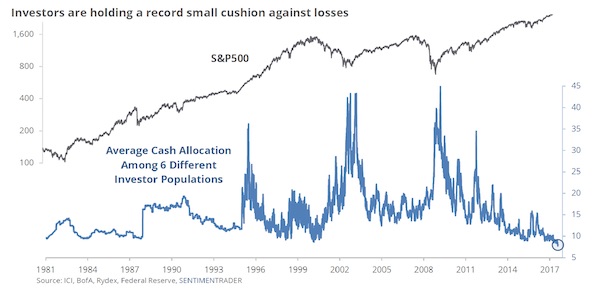
[..] on 11 February 1918 US President Woodrow Wilson stated: “National aspirations must be respected; people may now be dominated and governed only by their own consent.

‘Self determination’ is not a mere phrase; it is an imperative principle of action.

The Kurds have been denied that right for a very long time. For reasons related to divide and rule policies in a whole slew of different global powers both in the region and outside of it, and reasons related to oil. After being a major force in the fight against ISIS, and after seeing Turkey get ever more agressive against them -again-, the Kurds have -not for the first time- planned a referendum for a sovereign state. As the UN charter unequivocally says is their right.

The problem is, they want to establish their state on land that other countries claim is theirs. Even if the Kurds have lived there for a long time. And that’s a common theme in most of these ‘events’. Catalunya, Palestina, ‘Kurdistan’, they’re told they can perhaps have independence and sovereignty, but not on land where their people have lived for 1000s of years, because that land ‘belongs to us’.

And holding a referendum is therefore unconstitutional, says Spain, or whatever legal term is thrown out. But if the UN charter makes the international community’s position as clear as it does, how can it contradict a member nation’s constitution? Was that member not paying attention when it signed up to the Charter, or did the UN itself let that one slip?


Catalunya (Catalonia) is the northeast tip of Spain. Its people have long wanted independence and never gotten it. When present day Spain was formed, it was made part of Spain. And now the people want their own nation. It is not hard. But then again it is. We are now one week before October 1, the date the referendum was planned, and the Spanish government has done everything it could and then some to frustrate the referendum, and therefore the will of the people of Catalunya.

As the politicians who inhabit the EU and UN sit by idly, scared silly of burning their fingers. After arresting Catalan politicians and confiscating anything that could be used to hold the referendum, Spain has sent cruise ships full of police to Catalan harbors, and tried to take over control of the Catalan police force. But Catalan politicians and harbor crew have refused to let the ships dock, and Catalan police won’t obey Spanish orders.

It’s starting to look like Spain PM Rajoy wants to provoke a violent Catalan reaction, so he can send in his army and blame Barcelona and environs. What he doesn’t want to understand is that this will be the end of his government, his career, and of any chance Catalunya will remain part of Spain other than in the short term. It feels like Franco’s military, who, don’t forget, only relinquished control some 40 years ago, are still there in spirit if not physically.

For everybody’s sake, we can only hope someone does something to stop Rajoy and whoever’s behind his decisions, because if anyone ever wondered why the Catalans wanted to be independent, after those decisions there can be no question anymore. If he sends in the army, Spain as a whole will be something of the past. But first the referendum result, which was very doubtful all along, has now been settled: nearly all Catalans stand united against Rajoy today.

And Catalans are a mixed people. Many do not have their roots there, or even speak the language. But they will not turn on their friends and neighbors.


Kurdistan’s situation is even a lot more convoluted than Catalunya’s. Borders in the Middle East were drawn more or less at random by the French and British after the fall of the Ottoman Empire nearly 100 years ago. And the Kurds never got their independence, or their country. But now they want it. However, they live spread over 4 different countries, Turkey, Iran, Iraq and Syria. And some of the land they live on has oil. Lots of it. And the cradle of civilization, between the Tigris and Euphrates rivers.


Just about everyone, including the US, all countries in the region, and the old colonial powers, have declared their resistance to the Kurdish referendum. Getting back to the UN charter et al, isn’t that a curious position? Politicians sign lofty declarations, but when their successors are called upon to uphold them, nobody’s home. And it’s not as if self-determination is such a difficult topic to understand.

The referendum will be held on September 25 in Iraq’s semi-autonomous Kurdish region, so not in other Kurdish regions. Therefore only 900,000 people, out of some 35 million Kurds, get to vote. But the question on the ballot will be:

“Do you want the Kurdistan region and the Kurdistani areas outside the region’s administration to become an independent state?”

And that of course means something much more, and much bigger. There’s a ‘Kurdistan’ in Iran, Syria and Turkey as well. Kurds there don’t get to vote, though.

Quoting Bloomberg: “The vote will be held in the three governorates officially ruled by the KRG, as well as in disputed areas currently controlled by Kurdish forces, known as the peshmerga. The Kurds expanded their domain in 2014 when, faced with Islamic State attacks, the Iraqi army deserted the oil-rich city Kirkuk.”

Here’s where the Kurds were living according to the 2014 CIA World Factbook:


As is the case in Catalunya, Iraq’s parliament and top court have declared the vote unconstitutional. That again raises the question: how can a vote violate a country’s constitution if and when that country has signed the UN charter which explicitly defines every people’s right to self-determination? Who’s been asleep when both documents were signed?

How could the UN let countries sign its charter whose constitutions violated that same charter? Have we all just been playing fast and loose all along? Or, more interestingly, what are we all going to do now that we know about this? Are we going to take self-determination away from people, and sign that into a whole new UN charter? Or are we going to make sure the charter is upheld and make countries change their constitutions to comply with it?


There is a third option (very much in favor): to not do anything. But that gets more dangerous all the time. The days that people could just be ignored are gone. Social media have probably played a large role in that. And so have changing power relationships.

The EU is blowing itself up through increasing calls for more Europe just as people want less. I’ve said it often before: centralization stops when and where economic growth does. And despite all the creative accounting we see, economic growth is definitely gone in Europe. Just ask Greece, Spain. Ask the people, not the politicians. People will only accept their decisions being made by far away ‘leaders’ if they perceive them as beneficial to their lives, the lives of their children.

Those days are gone, no matter the propaganda. That’s true all over Europe, and it’s true all across the US. The refusal by incumbent powers to recognize this, admit to it, is what gives us the likes of Trump and Brexit and countless other challengers. That Marine Le Pen and others have failed to date doesn’t mean the status quo wins; others will follow. In that vein I was surprised to see Yanis Varoufakis, whom I hold in very great esteem, declare in name of his DiEM 25 movement that:

“I am not taking sides on whether Catalonia should be independent or not” and “What we’re promoting in DiEM25 would solve the problem. We want a real European Union that becomes a single jurisdiction, a country if you want to call it that. In that scenario, it doesn’t matter if Catalonia is part of Spain!”

Europe will not be one country. Nor should it want to be. Europe has 1000 different ways to work together, and the EU has been an utter failure at that. While it has done a ton of good, it is being -predictably- destroyed by the power politics at its top levels. Nobody ever told Europeans that they would wind up living as German provinces. But that is what they are.

As Varoufakis himself makes abundantly clear is his book Adults in the Room. That’s why Germans have no real choice in today’s election: they have such utter control of the EU they would be crazy to vote against it. But at the same time, the rest of the ‘Union’ would be crazy to let them hold that power.

And I know that DiEM25 wants to change and reform the EU, but how will they do that knowing they need Germany, more than all other countries, to accomplish it, as Germany is sitting so pretty? Calls for a one-country Europe seem at the very least irresponsibly premature. That’s very far from reality. First things first. No cheating. You can’t say it doesn’t matter what happen to the Catalans today because ‘we’ have bigger plans for tomorrow. That means abandoning them. That’s not a new Europe: that’s what they already have today.


As for ‘Kurdistan’, what can we do but hope and pray? Hope that the old European colonial powers, as well as Turkey, Iraq and Iran, plus Russia and China, live up to the UN Charter they signed, and let the Kurds show they can be a force for peace in the region, which needs one so badly?! They have shown in no uncertain terms they can defend themselves, and their land, against anyone who threatens them. The Kurdish women army, YPJ, is all you need to know when it comes to that. They are the bravest amongst us.

If they had their own country, they would continue to do just that, and better. Which just goes to show that nationalism and patriotism are not of necessity negative emotions. It gives people an identity. Which is exactly why brighter heads than the present ones put the right to self-determination in the UN Charter, at a time, 1945, when the world had seen indescribable destruction.

There’s a lesson there. That we seem to have forgotten already. And now have to learn all over again. Through Colin Kaepernick, through the unbelievable Kurdish women’s YPG army, though the streets of Barcelona. Our world is screwed up, and we need to unscrew it.


Sep 242017
 
 September 24, 2017  Posted by at 9:00 am Finance Tagged with: , , , , , , , , , , ,  4 Responses »


Elliott Erwitt Gateway Center Demolition Area Pittsburgh 1950


• All The Bubbles That Are About To Pop In One Chart (Dillian)
• America’s $20 Trillion Debt In Global Context (HowMuch)
• Accounting Error Spells Chaos For Global Economy (Graeber)
• The American Golden Calf (PL)
• Boobs on Credit (Jim Quinn)
• Bernanke Past the Point of No Return (AM)
• Janet Yellen’s 78-Month Plan for US National Monetary Policy (AM)
• A Private Solution For China’s Zombie Company Problem? Unlikely (R.)
• More Chinese Cities Impose Property Control Measures (R.)
• The Tide Is Starting To Turn Against The World’s Digital Giants (G.)
• Why Uber’s Fate Could Herald Backlash Against ‘Digital Disruptors’ (G.)
• France’s Far-Left Leader Urges French ‘Resistance’ Against Macron (R.)
• Spain Rebuffed in Boosting Control Over Catalonia’s Police (BBG)
• No Storm Ever Destroyed a Grid Like Maria Ruined Puerto Rico’s (BBG)


It’s big graphs day today. This is Jared Dillian’s.

• All The Bubbles That Are About To Pop In One Chart (Dillian)

It wasn’t always this way. We never used to get a giant, speculative bubble every seven to eight years. We really didn’t. In 2000, we had the dot-com bubble. In 2007, we had the housing bubble. In 2017, we have the everything bubble. I did not coin the term “the everything bubble.” I do not know who did. Apologies (and much respect) to the person I stole it from. Why do we call it the everything bubble? Well, there is a bubble in a bunch of asset classes simultaneously. And the infographic below that my colleagues at Mauldin Economics created paints the picture best. I don’t usually predict downturns, but this time I bet my reputation that a downturn is coming. And soon.

Read more …

Private debt would be more useful. But okay…

• America’s $20 Trillion Debt In Global Context (HowMuch)

The U.S. federal government just passed a record $20 trillion in publicly held debt. That’s bigger than the entire economy of every country in the European Union, combined. The debt will only grow higher unless President Trump and the U.S. Congress can agree to unprecedented spending cuts combined with tax increases. Don’t count on that happening anytime soon. Most people think that an eye-popping $20+ trillion debt is insurmountable, and in fact, it is the largest in the world by far. But when you look at another fiscal measure—the ratio of debt-to-GDP—the U.S. is not in the worst situation. Our visualization allows you to quickly see how the U.S. government’s debt compares to other countries around the world. The size of the country correlates to the size of the debt. The U.S. and Japan stand out because they have the highest debts in the world ($20.17T and $11.59T, respectively).

Other countries, like Germany and Brazil, appear much smaller because their debts are comparatively tiny ($2.45T and $1.45T, respectively). We then color-coded each country according to its debt-to-GDP ratio. Green countries have a healthy margin, but dark red and fuchsia countries have debts that are even bigger than their entire economies. The debt-to-GDP ratio is a critical metric for evaluating a country’s fiscal health. It makes a lot of sense for the American government to have a higher debt than a much smaller country, like Germany. That’s why it’s important to consider the GDP of each country, a number which represents the sum of all transactions occurring in the economy. Once you understand the public debt as a percentage of GDP, you get a level playing field for countries on different economic scales. When you think about it like this, the U.S. isn’t even among the ten worst sovereign debts in the world.

Top 10 countries with the Worst Debt-to-GDP Ratios
1. Japan (245% at $11.59B)
2. Greece (173% at $338B)
3. Italy (138% at $138B)
4. Portugal (133% at $274B)
5. Belgium (111% at $111B)
6. Spain (106% at $106B)
7. Canada (106% at $106B)
8. Ireland (105% at $105B)
9. France (98% at $98B)
10. Brazil (82% at $82B)

Read more …

Dave Graeber suggests (strongly) that official UK numbers miss -intentionally or not- a huge chunk of household debt. Government debt could be involved, but even then.

• Accounting Error Spells Chaos For Global Economy (Graeber)

The thing that always struck me is how much the morality of debt—that anyone in debt has only themselves to blame, that deadbeats are contemptible—stubbornly refuses to die. Even now, when the situation is largely engineered by government policy, the first impulse of pundits and other popular moralists is invariably to assume the real problem must, somehow, be a bunch of lazy freeloaders, living beyond their means. As a result, by the standards of public discourse that exist today—that is, the sort of things it’s considered acceptable coming from the mouth of a politician or TV commentator or government economist—it’s not really legitimate to worry about rising levels of household debt simply because it causes misery or deprivation, if it means millions of actual flesh and blood human beings will be living lives of fear, anxiety, and constant humiliation.


Illustration Rachel Bolton

It’s only really legitimate to worry about rising levels of household debt insofar as it might be likely to cause another financial crisis. (Such a crisis, after all, might well affect the lives of the rich and upper reaches of the professional and managerial classes, that is, the kind of lives that policy-makers feel they have to take account of.) And even then, it must be posed as a moral problem caused by irresponsible self-indulgence—as one Daily Mail headline recently put it: “Your neighbour’s shiny new SUV is about to crash the economy!” Yet the two impulses are clearly in tension. To look at debt in macro-economic terms does make it easier to see it as a structural problem, as the result of self-conscious policy decisions. As a result, everyone seems to want to minimise the problem. Here are the numbers that they published in 2017, which a friend of mine who works in the City translated into handy tabular form:

The attentive reader will note that the image is symmetrical. Up to around 2014, at least, the top and bottom half exactly mirror one another. This is exactly as things should be: it’s an “accounting identity”, as in a ledger sheet, debits and credits have to add up. The remarkable thing is that after 2014, they don’t, and in the projected future, the top and bottom are actually quite different. When I first saw this diagram I was startled and confused. Was I missing something? Was there something about the math I didn’t understand? I passed the image on to two different economists and asked just that: isn’t there something wrong with the numbers here?

Read more …

A version of the ugly duckling. Behind Trump’s words on athletes and the anthem. Many people like the athletes, but some 75% of Americans think they should respect the flag. Trump thought this through.

• The American Golden Calf (PL)

As a young boy, I enjoyed my family’s bantam chickens that laid very small eggs and hatched very small chicks. Theirs was a small and miniature world. One day one of my bantams started sitting on eggs to hatch its chicks. Something happened to her eggs but she continued to sit, so I decided to put a duck egg under her. Duck eggs are at least three times bigger than bantam eggs and take a few days longer to hatch, but she dutifully sat on the egg several days longer. She hatched the duckling and, as you can imagine, it thought that his world was normal and that the bantam hen was his mother. The duckling eventually grew into a full sized mallard duck, probably five or six times the size of its bantam mother. The full-grown duck would follow its hen mother around as would normal chicks. It was a funny sight to watch.

But I remember thinking, even as a small boy, that the duck’s entire reality was that the bantam hen was his mother and that was the way the world worked. He had no need to consider anything else. This is the world of the American people today. Their perceptions of reality control them and they who control their perceptions control the American people. Our perception of America has always been that she is the mother country and ordained by God, good and just and a beacon of freedom. This is hammered into our psyches from our early days. From pre-school up, we are taught to worship the state. I don’t know if it is still done, but in the public (non)education system, for many years, schoolchildren across the South — and elsewhere, I suppose — recited the Pledge of Allegiance each morning.

Political rallies and government meetings are still often begun with a recitation of the pledge. People say it with patriotic fervor, with their hands placed dutifully on their hearts. Sporting events, political rallies and other public venues are often kicked off with the playing and/or singing of the Star Spangled Banner. Before the song begins, people are instructed to rise, men to remove their hats,and people place their hands over their hearts. They don’t realize its value as a propaganda tool. We have come to equate the flag, the pledge and the national anthem with patriotism, and patriotism with government, country and support for government, support for foreign wars and veterans. Anything less is “un-American.”

Read more …

“What happens when a bimbo defaults on her boob loan? How narrow minded of me.”

• Boobs on Credit (Jim Quinn)

As I was driving to work yesterday morning on the Schuylkill Expressway a commercial comes on the radio from a plastic surgeon advertising for anyone looking for a better set of boobs. I had never heard a plastic surgeon commercial before, so I thought that was unusual. But, that wasn’t the best part. This plastic surgeon was offering no money down 18 month interest free financing on your new boobs. I wonder if they are moving boobs with subprime debt the same way the auto companies have used subprime debt to move cars. Of course, when a deadbeat defaults on an auto loan the car is easily repossessed. What happens when a bimbo defaults on her boob loan? How narrow minded of me. What happens when some dude who wants to be a bimbo defaults on his/her loan? I guess it was just a matter of time before breast enhancement met debt enhancement in this warped world of materialism, narcissism, financialization, and delusions.

Now that revolving credit has reached a new all-time high of $1 trillion and total consumer debt outstanding has exceeded it’s 2008 peak at $12.8 trillion, the Fed has completed its job of helping the average American again in-debt themselves up to their eyeballs. This is considered a success story in this twisted, perverted, bizarro world we call America today. The solution to an epic debt induced global financial catastrophe caused by Federal Reserve easy money, Wall Street fraud, and Washington DC corruption has been to increase global debt by 50% since 2007, with virtually all of it created by central bankers and the governments they control. In what demented Ivy League educated academic mind would piling $68 trillion more debt on the backs of taxpayers as a cure for a disease caused by the initial $149 trillion of debt be considered rational and sustainable? It’s like having pancreatic cancer and trying to cure it with a self inflicted gunshot.

Read more …

The following two pieces are fom the same article.

• Bernanke Past the Point of No Return (AM)

In late November 2008, Federal Reserve Chairman Ben Bernanke put in place a fait accompli. But he didn’t recognize it at the time. For he was blinded by his myopic prejudices. Bernanke, a self-fancied Great Depression history buff with the highest academic credentials, gazed back 80 years, observed several credit market parallels, and then made a preconceived diagnosis. After that, he picked up his copy of A Monetary History of the United States by Milton Friedman and Anna Schwartz, turned to the chapter on the Great Depression, and got to work expanding the Fed’s balance sheet. Now here is something all those “Great Depression experts” always neglect to mention: the Fed’s holdings of government securities expanded my more than 400% between late 1929 and early 1933.

Friedman’s often repeated assertion that the Fed “didn’t pump enough” in the early 1930s – which is held up as the gospel truth by nearly everyone – is simply untrue. It is true that the money supply collapsed anyway – but not because the Fed didn’t try to pump it up. Many contingent circumstances mitigated against money supply expansion: too many banks went bankrupt, taking all their uncovered deposit money to money heaven, as there was no FDIC insurance; only 50% of all banks were even members of the Federal Reserve system; no-one wanted to borrow or lend in view of the massive economic contraction and the Hoover administration’s ill-conceived interventionism. We can also tentatively conclude that the economy’s pool of real funding was under great pressure, which was exacerbated as a result of the trade war triggered by the protectionist Smoot-Hawley tariff enacted in June 1930.

The collapse in international trade and investment meant that the pool of savings of the rest of the globe was no longer accessible. Bernanke’s dirty deed commenced with the purchase of $600 billion in mortgage-backed securities, using digital monetary credits conjured up from thin air. By March 2009, he’d run up the Fed’s balance sheet from $900 billion to $1.75 trillion. Then, over the next five years, he ballooned it out to $4.5 trillion. All the while, Bernanke flattered his ego with platitudes that he was preventing Great Depression II. Did it ever occur to him he was merely postponing a much-needed financial liquidation and rebalancing? Did he comprehend that his actions were distorting the economy further and setting it up for an even greater bust?

Perhaps Bernanke understood exactly what he was doing. As many readers have insisted over the years, the Fed works for the big banks and big money interests. Not Main Street. Regardless, the Fed recognizes that the optics of its $4.5 trillion balance sheet have become a bit skewed. The Great Recession officially ended over eight years ago. Why is the Fed’s balance sheet still extremely bloated?


US broad true money supply TMS-2 and assets held by the Federal Reserve

Read more …

A 6.5 year plan.

• Janet Yellen’s 78-Month Plan for US National Monetary Policy (AM)

By our back of the napkin calculation, starting with October’s initial $10 billion reduction, then incrementally increasing the reduction by $10 billion each quarter until hitting $50 billion per month, and then contracting by $50 billion a month from there, it will take 78-months for the Fed to get its balance sheet back to $900 billion (i.e., where it was before Bernanke’s act of depravity). Thus, in roughly six and a half years, or in March 2024, monetary policy will be back to normal. If you recall, the Soviets operated under five-year plans for the development of the national economy of the USSR. Now, Yellen, an ardent central planner and control freak, has charted the Fed’s 78-month plan for the national monetary policy of the United States. Have you ever heard of something so ridiculous?

However, while the Soviets were zealous believers in their plans, we suspect the Fed will be as committed to the cause as a fat person to a New Year’s Day diet. In truth, the Fed will never, ever reduce its balance sheet to $900 billion. They won’t even get close; they are well past the point of no return. In the early 1930s the Soviet planners under Stalin had a great idea: why not fulfill the 5 year plan in four years? This showed that nothing was impossible for the “new Soviet man” and two plus two was henceforth five. As Marxists will explain, this is in perfect keeping with the rules of polylogism. Even the laws of mathematics must bend to proletarian logic. For starters, financial markets will not allow the Fed to execute its 78-month tightening program according to plan. At some point, credit markets will have a severe reaction.

This would ripple through stock markets and nearly all assets that are propped up by cheap credit. What’s more, if this doesn’t panic the Fed from its master 78-month monetary policy plan, the economy will. No doubt, at some point within the next 78-months the U.S. economy will shrink. What will the Fed do then? Will they continue to tighten in the face of a contracting economy? No way. They will ease, and then they will ease some more. They won’t stop until it is near impossible for an honest person to work hard, save their money, and pay their way in life. Many fine fellows were already pickled over by the Fed in the last easing cycle and lost their way. More are bound to follow.


Guess who’s lying in wait… it will be found out that a creature long held to be extinct was merely hibernating in its cave, sharpening its claws.

Read more …

China’s just shifting debt around, hoping it’ll end up under a carpet some place. But the zombies merely start infecting healthy businesses.

• A Private Solution For China’s Zombie Company Problem? Unlikely (R.)

China’s latest push to revive its bloated state-owned sector is set to pick up pace this year, with bankers and investors expecting possible spin-offs and asset sales to follow a key Communist Party Congress in October. But the effort is likely to only involve a limited role for private money, even as Beijing has been promoting it as crucial for reforming state-owned enterprises (SOEs), according to people familiar with China’s plans. Beijing would likely lean on cash-rich SOEs like China Life Insurance and Citic Group to bail out the largest of the struggling companies, the people said. They cited China Life stepping in to help China Unicom raise $12 billion last month. A limited role for private capital would raise questions about the depth of any overhaul of the SOEs.

China hopes to speed up the reforms in order to meet ambitious economic growth targets and manage its corporate debt burden. “The current model allows winners, companies doing better, to partially own those doing worse,” said Alicia Garcia-Herrero, chief Asia Pacific economist at Natixis. “In other words, this is a reshuffling of profit, loss among SOEs to a large extent.” China Life is in talks with China Three Gorges New Energy, a unit of the country’s top hydropower developer, according to sources familiar with the matter. China’s state-run companies dominate the country’s key industries, from banking to insurance, energy, and telecoms. They retain an edge over their private rivals in investing both locally and overseas, in part thanks to easier financing.

But they also produce lower returns than their private counterparts and account for the biggest proportion of the bad loans on the books of the country’s banks. The fund raising by Unicom, a state-owned telecoms group, had sparked hopes for the mixed ownership effort, as outlined in a 2015 government plan. The partial privatization of Unicom in August, involving 14 investors, including the tech giants Alibaba and Tencent, was welcomed by markets. But, as Beijing balanced the need for cash with the need for control, China Life ended up with a 10.6 percent stake in the company, nearly a third of the total sold. New investors, including China Life, were given three of 15 board seats.

Read more …

Feels half ass.

• More Chinese Cities Impose Property Control Measures (R.)

A number of second-tier cities in China have rolled out property speculation curbs in an effort to cool home property sales, according to the official Xinhua News Agency and documents published by some municipal governments. The city of Shijiazhuang, southwest of Beijing, has banned investors from selling newly bought homes for up to five years, while Changsha in Hunan province banned homeowners from buying a second property for up to three years from the time of their first home purchase, Xinhua said. Changsha has also limited property sales to non local residents to one unit per person. The city of Chongqing, as well as Nancang in the southern province of Jiangxi, meanwhile, banned transactions of new and second-hand homes for two years after purchase.

The various measures took effect last week. Additionally, Xian in Shaanxi province has asked real estate developers from Monday to report home prices to local price-monitoring departments before sale and reiterated its pledge to crack down on property price manipulation and speculation. The latest property clampdowns follow moves in June by two Chinese cities, Xian in Shaanxi and Zhenzhou in Henan province, to cool their property markets. Average new home prices in China’s 70 major cities rose 0.2 percent in August from a month ago, data from the statistics bureau showed.

Read more …

I’m not convinced. Besides, Google and Facebook already are branches of the intelligence industry.

• The Tide Is Starting To Turn Against The World’s Digital Giants (G.)

In his wonderful book The Swerve: How the Renaissance Began, the literary historian Stephen Greenblatt traces the origins of the Renaissance back to the rediscovery of a 2,000-year-old poem by Lucretius, De Rerum Natura (On the Nature of Things). The book is a riveting explanation of how a huge cultural shift can ultimately spring from faint stirrings in the undergrowth. Professor Greenblatt is probably not interested in the giant corporations that now dominate our world, but I am, and in the spirit of The Swerve I’ve been looking for signs that big changes might be on the way. You don’t have to dig very deep to find them. Some are pretty obvious. In 2014, for example, the European Court of Justice decided that EU citizens had the so-called “right to be forgotten” and that Google would have to comply if it wanted to continue to do business in Europe.

In May this year, the European commission fined Facebook €110m for “providing misleading information” about its takeover of WhatsApp. And in June the commission levied a whopping €2.4bn fine on Google for abusing its monopoly in search. Since the European commission is the only regulator in the world that seems to have the muscle and inclination to take on the internet giants, these developments were relatively predictable. What’s more interesting are various straws in the wind that show how digital behemoths are losing their shine. Many of these relate to Brexit and the election of Donald Trump, and to the dawning of a realisation that Google and Facebook in particular may have played some role in these political earthquakes.

This was not because the leadership of the two companies actively sought these outcomes, but because people began to realise that the infrastructure they had built for their core business of extracting users’ data and selling it to companies for ad-targeting purposes could be – and was – “weaponised” by political actors in order to achieve political goals. Public concern about these discoveries was not exactly mollified by the responses of the companies’ bosses – which were variously dismissive, evasive (“it’s just the algorithms – nothing to do with us”), disingenuous, inept and politically naive. They had to be like that, because a franker response would reveal that taking responsibility for what happens on their platforms would vaporise the business model that has made them so rich and powerful.

Read more …

Why let Uber grow as big as it has and only then act?

• Why Uber’s Fate Could Herald Backlash Against ‘Digital Disruptors’ (G.)

In the mind of many Uber supporters, the Transport for London (TfL) decision – coming a few days before Khan’s appearance at the Labour party conference – revealed an organisation in thrall to established labour interests. Sources told the Observer that the decision was communicated to Uber only two minutes before it was announced and that there had been only one meeting in the last year between the company and the senior team at TfL who insisted that the licence renewal could not be discussed. “TfL has once again caved into pressure from unions who never miss an opportunity to rip off passengers,” said Alex Wild, research director at the rightwing pressure group Taxpayers’ Alliance. The pushback against the laissez-faire philosophy of the US west coast’s tech community is being waged on both sides of the Atlantic.

In the US, calls to regulate technology companies have made strange bedfellows of Democratic senator Elizabeth Warren and ex-White House aide and Breitbart chief Steve Bannon. Last week the former chief strategist to Donald Trump reiterated his view that firms such as Facebook and Google should be regulated like “public utilities”. Meanwhile progressives such as Warren warn of the monopolistic behaviour of Google, Amazon, and Apple while pushing for a renewed debate over antitrust laws. “Silicon Valley is going from being heroes to villains,” said Vivek Wadhwa, a distinguished fellow and adjunct professor at Carnegie Mellon University. “It’s been brewing for quite a while, but there’s a big shift happening.” But, still, the speed of this shift has surprised many. “In our wildest dreams we didn’t think TfL would refuse the licence,” said Maria Ludkin, legal director at the GMB union. “We thought they’d attach conditions to make sure Uber would improve passenger and driver safety.”

[..] Ironically, while many drivers like Abdul have leapt to Uber’s defence, it was the company’s treatment of them that drew attention to the aggressive corporate culture which brought about its downfall in the capital. Last October, following a case brought by the GMB that has wide-ranging implications for all companies in the gig economy, an employment tribunal ruled that Uber’s UK drivers should be classed as workers rather than as self-employed. “We’d had an epidemic of companies saying their people are self-employed when in fact, when you examine their rights and responsibilities, the way they’re acting each day, it’s pretty clear they’re either fully employed or are workers entitled to sickness pay, etc,” Ludkin said. “We brought the Uber case because we had so many drivers coming to us. We looked at their contracts and thought it was a ludicrous idea that 30,000 of them were self-employed, which was Uber’s position.”

Read more …

Let’s see what’s left of the famed French protests. Note: the US is not alone in contesting crowd sizes.

• France’s Far-Left Leader Urges French ‘Resistance’ Against Macron (R.)

French far-left opposition party leader Jean-Luc Melenchon drew tens of thousands to a rally on Saturday against President Emmanuel Macron’s labor reforms, aiming to reinforce his credentials as Macron’s strongest political opponent. Trade union protests against Macron’s plan to make hiring and firing easier and give companies more power over working conditions seem to be losing steam, but Melenchon said his “France Unbowed” party was calling on unions to join them and together “keep up the fight”. “The battle is not over, it is only starting,” Melenchon told the crowd gathered on the Place de la Republique where the rally against what Melenchon has called “a social coup d‘etat” ended.

In a warning to Macron, who has said he will not bow to street pressure, Melenchon said: “It is the street that defeated the kings, it is the street that defeated the Nazis,” while the crowd chanted “Resistance! Resistance!” It remains to be seen whether Melenchon and his party have the capacity to mobilize the kind of street resistance which forced the last two presidents to dilute their own attempts to loosen the labor code. Melenchon tweeted that over 150,000 demonstrators had turned up while police put the number at 30,000. A campaign rally in March, weeks before the presidential election, drew some 130,000 people, party officials had said.

Read more …

Pitting police forces against each other is a recipe for trouble. Peaceful resistance is teh way to go for Catalonia. But…

• Spain Rebuffed in Boosting Control Over Catalonia’s Police (BBG)

Police in Spain’s rebel region of Catalonia rejected giving more control to the central government in defiance of authorities in Madrid who are trying to suppress an independence referendum on Oct. 1. The SAP union, the largest trade group for the 17,000-member Mossos d’Esquadra regional force, said it would resist hours after prosecutors Saturday ordered that it accept central-government coordination. The rejection echoed comments by Catalan separatist authorities. “We don’t accept this interference of the state, jumping over all existing coordination mechanisms,” the region’s Interior Department chief Joaquim Forn said in brief televised comments. “The Mossos won’t renounce exercising their functions in loyalty to the Catalan people.”

The disobedience may fuel speculation the Mossos aren’t committed to work with the national Civil Guard in Spain’s largest regional economy. The standoff came a day after Prime Minister Mariano Rajoy’s government acknowledged it’s sending more reinforcements to help control street demonstrations and carry out a separate court order to halt the vote. Officials in Madrid have quietly rented cruise ships including the Rhapsody and moored them in Catalan ports as temporary housing for riot police and other security officials being sent to the region in what El Correo newspaper said may ultimately exceed the number of Mossos by the referendum date.

Read more …

“100% of the system run by the Puerto Rico Power Authority is offline”. How long till people will start dying in hospitals?

• No Storm Ever Destroyed a Grid Like Maria Ruined Puerto Rico’s (BBG)

You don’t even have to leave the airport to see that Hurricane Maria has laid waste to Puerto Rico’s power grid. On Friday, the San Juan airport was abandoned. No electricity meant no air conditioning, and no air conditioning meant hot and muggy air wafting through the terminals. Ceilings were leaking. Floors were wet. Only the military, relying on its own sight and radar systems, was landing planes. The airport is one of the first places crews will restore power – whenever they can get to it. Hundreds are still waiting for the all-clear to move in and start the arduous task of resurrecting Puerto Rico’s grid. The devastation that Maria exacted on Puerto Rico’s aging and grossly neglected electricity system when it slammed ashore as a Category 4 storm two days ago is unprecedented – not just for the island but for all of the U.S.

100% of the system run by the Puerto Rico Power Authority is offline, because Maria damaged every part of it. The territory is facing weeks, if not months, without service as utility workers repair power plants and lines that were already falling apart. “I have seen a lot damage in the 32 years that I have been in this business, and from this particular perspective, it’s about as large a scale damage as I have ever seen,” said Wendul G. Hagler II, a brigadier general in the National Guard, which is assisting in the response. No federal agency dared on Friday to estimate how long it’ll take to re-energize Puerto Rico. If it’s any indication of how far they’ve gotten, the island’s power authority known as Prepa is only now starting to assess the damage.

“We are only a couple of days in from the storm – there could be lots of issues and confusion at the beginning of something like this,” said Kenneth Buell, a director at the U.S. Energy Department who is helping lead the federal response in Puerto Rico. “We are in the phase where we have people queued up and lining up resources.” What Buell does know is Puerto Rico’s power plants seem inexplicably clustered along the island’s south coast, a hard-to-reach region that was left completely exposed to all of Maria’s wrath. A chain of high-voltage lines thrown across the island’s mountainous middle connect those plants to the cities in the north.

Puerto Rico’s rich hydropower resources have also taken a hit. On Friday, the National Weather Service pleaded for people to evacuate an area in the northwest corner of the island after a dam burst. “All areas surrounding the Guajataca River should evacuate NOW. Their lives are in DANGER!,” the service said on Twitter. And that’s not to mention the state of Puerto Rico’s grid before the storm. Government-owned Prepa, operating under court protection from creditors, has more than $8 billion in debt but little to show for it. Even before the storm, outages were common, and the median plant age is 44 years, more than twice the industry average.

Read more …

Sep 232017
 
 September 23, 2017  Posted by at 8:29 am Finance Tagged with: , , , , , , , , , ,  8 Responses »


Salvador Dalí Mi esposa desnuda 1945


• Why the Stock Market’s Up and Why it Won’t Last (MO)
• The Great Corporate Cash Shell Game (BBG)
• Debt Has Become A Way Of Life In Canada (OweC)
• Housing Affordability NEVER Worse…By a Long-Shot (Hanson)
• The Demise of the Dollar: Don’t Hold Your Breath (CH Smith)
• China Slashes Trade Ties With North Korea (BBC)
• Russia Steps In To Prevent ‘Domino Effect’ In Its Banking Sector (CNBC)
• UK’s Credit Rating Downgraded By Moody’s (BBC)
• The Scandals That Brought Down Uber (Ind.)
• Uber Had This Coming – It Was Never Just A ‘Tech Platform’ (Ind.)
• Puerto Rico Is Back In The 18th Century (Kunstler)
• It Gets Ugly in Catalonia (DQ)
• The Killing of History (John Pilger)


“Once the Fed stops buying that paper, the dealers will have a lot less cash and that means a lot more selling.”

• Why the Stock Market’s Up and Why it Won’t Last (MO)

The U.S. Treasury has been up against its debt ceiling since March 15 when the ceiling was re-imposed. Since then, there has been no net new issuance from the Treasury. The Treasury has run down its cash balances and borrowed internally from its own resources, which are not subject to the ceiling. This period has been very helpful to the financial markets. With the federal government not selling any net new supply of securities—just rolling the maturing stuff over—the markets have been flush with cash that would otherwise have been absorbed by the government. This hit of extra liquidity is about to disappear and then some. President Trump has made a three-month debt ceiling deal with the Democrats which means that the Treasury can resume borrowing without restrictions through December.

This increase in the debt ceiling is needed to reliquify the federal government (which is down to $38 billion in cash) and repay the internal funds the Treasury raided since the debt ceiling was imposed back in March. The Treasury needs to borrow a substantial amount of money. There hasn’t been a material increase in the Treasury’s borrowing schedule yet, but it is coming. The Treasury Borrowing Advisory Committee (TBAC), a group of senior Wall Street executives, has advised the Treasury to issue $501 billion in net new supply in the fourth quarter, virtually all in November and December, and the Treasury almost always follows the TBAC script. That’s an outrageous amount of money. The cash the Treasury needs is not sitting somewhere in primary dealer bank accounts; it’s invested in the financial markets. Securities will have to be sold to accommodate this new issuance.

This is not new. A borrowing spike happens every time we have an increase in the debt ceiling as the chart demonstrates. Note that this chart reflects an estimate of net new issuance needed to return to last year’s cash on hand and was produced before TBAC had issued its recommendations. TBAC is proposing to move more slowly. Nonetheless, past funding spikes are clearly demarcated and the next one is going to be big. While Treasury supply will increase, the trend of demand for Treasuries has been going the other way. Bid coverage at auctions has been declining in recent months and the largest banks have been reducing their inventories of Treasury securities. Falling demand in the face of increasing supply is a recipe for a bear market in bonds. Bond yields will rise and that will put pressure on stocks as well.

The Federal Reserve has given the market extraordinary support over the past eight years by financing most new Treasury supply. Even after it stopped outright QE in November of 2014, the Fed continued to buy $25–$45 billion per month in maturing Mortgage Backed Securities from the primary dealers. That cashed up the dealers and helped finance their purchases of new Treasuries. But now, the Fed intends to join the Treasury as a net seller of Treasuries (and MBS) as it starts to reduce its balance sheet this fall. Once the Fed stops buying that paper, the dealers will have a lot less cash and that means a lot more selling.

Read more …

“These companies have a record amount of cash and they’re more deeply indebted than ever before.”

• The Great Corporate Cash Shell Game (BBG)

There’s a mystery hidden on the balance sheets of Corporate America: These companies have a record amount of cash and they’re more deeply indebted than ever before.This seems paradoxical and kind of silly. Why raise money from bond investors when you already have the liquid assets on hand? As Bloomberg News reported Thursday, non-financial companies’ liquid assets, which include foreign deposits, currency as well as money-market and mutual fund shares, reached a record of almost $2.3 trillion in the second quarter. That’s an increase of nearly 60% since mid-2009. This cash cushion also appears sort of comforting; companies can do whatever they want. They’re rich. But in reality, it is neither silly nor overly comforting.

First of all, a disproportionate amount of the cash is held by the biggest companies, such as Apple, Microsoft, Alphabet and General Electric, and it is mostly held in overseas accounts. These corporations can’t bring that cash back without incurring steep tax bills, so they’ve been keeping it offshore. When they need money, they simply raise dollars by borrowing from the bond market at record-low rates. Indeed, the amount of bonds issued by these companies has surged, rising 66% from mid-2009 to $5.24 trillion of bonds outstanding as of the end of June, Federal Reserve data show. That isn’t necessarily a recipe for default because a large chunk of this is an exercise in financial engineering aimed at avoiding onerous taxes. But it has consequences.

First, it limits the benefit to the economy if and when those tax policies are changed because much of the money has already been released through the bond market. And second, to the extent that companies have cash, they’re not using enough of it for exciting projects. There hasn’t been a tremendous wave of innovation or salary increases. Instead, companies have repurchased billions of dollars of their own shares, which is great for the stock market but doesn’t do a whole lot to bolster economic growth.

Read more …

A bit poorly written, but still: “For each $1.00 the economy grew in this 1 year period the total debt outstanding increased by $5.48.”

• Debt Has Become A Way Of Life In Canada (OweC)

The borrowing and spending binge by Canadian households, businesses and governments (all levels) continues unabated. Growing the debt in the economy significantly faster than the economy itself grows seems to have developed into a way of life in Canada. At the end of June, 2017 the total debt outstanding in Canada was $7.51 trillion. At the end of June, 2016 it was $7.13 trillion. In the 1 year period from the end of June, 2016 to the end of June, 2017 it increased by $375 billion. This is an increase of 5.2%. The approximate beginning of the global financial crisis was June, 2007. At the end of June, 2007 the total debt outstanding in Canada was $3.99 trillion. In the last 10 years it has increased by $3.52 trillion. This is an increase of 88.3%. At the end of June, 2017 the total debt outstanding of domestic non-financial sectors was $5.32 trillion.

At the end of June, 2016 the total debt outstanding of domestic non-financial sectors was $5.04 trillion. In the 1 year period from the end of June, 2016 to the end of June, 2017 it increased by $278 billion. This is an increase of 5.5%. At the end of June, 2007 the total debt outstanding of domestic non-financial sectors was $2.84 trillion. In the last 10 years it has increased by $2.47 trillion. This is an increase of 86.9%. At the end of June, 2017 the annual GDP at market prices in Canada was $2.12 trillion, and in the preceding 1 year it grew by 6.3%, – ie: the size of the economy grew by $133.9 billion. In the 1 year period from the end of June, 2016 to the end of June, 2017 the total debt outstanding in Canada increased by $375 billion. For each $1.00 the economy grew in this 1 year period (using the GDP at market prices metric) the total debt outstanding increased by $2.80.

Looking at just the total debt outstanding of domestic non-financial sectors in Canada: In the 1 year period from the end of June, 2016 to the end of June, 2017 the total debt outstanding of domestic non-financial sectors increased by $278 billion. For each $1.00 the economy grew in this 1 year period (using the gdp at market prices metric) the total debt outstanding of domestic non-financial sectors increased by $2.08. At the end of June, 2017 the total debt outstanding in Canada was 3.5 times greater than our annual gdp at market prices, and looking at just the total debt outstanding of domestic non-financial sectors, that was 2.5 times greater than our annual gdp at market prices. [..] In the 1 year period from the end of June, 2016 to the end of June, 2017 the total debt outstanding in Canada increased by $375 billion. For each $1.00 the economy grew in this 1 year period the total debt outstanding increased by $5.48.

Read more …

Communities and societies don’t matter. Only money does.

• Housing Affordability NEVER Worse…By a Long-Shot (Hanson)

My chart highlights how for DECADES the income required to buy a median priced house – using popular programs & rates for each era – remained mostly flat (red line) and WELL BELOW the level of household income (black line). How could house prices rise so much for decades but income required to buy (red) them remain flattish? Because of the accompanying falling rates/easing credit guideline cycle. In fact, during Bubble 1.0 house prices soared but exotic loans legitimately made them more affordable than ever, as shown.

But in ’12, as trillions in unorthodox capital, credit & liquidity began to drive massive speculation (just like Bubble 1.0) income required to buy began to surge, with prices, shooting above median HH income (boxed in yellow). Meaningful sales growth with this affordability backdrop is impossible. …This is the point in this inflationary cycle at which affordability detached from end-user fundamentals. Now, in ’17, end-user purchase power & house prices have never been more diverged from the multi-decade trend line and a mean reversion – via surging wages, new era exotic loans, plunging rates, and/or falling house prices, as speculation ebbs – is inevitable.

Read more …

Must read. Like Charles, I don’t see it either. There is nothing to replace the USD for the foreseeable future.

• The Demise of the Dollar: Don’t Hold Your Breath (CH Smith)

Every form of credit/debt is denominated in a currency. A Japanese bond is denominated in yen, for example. The bond is purchased with yen, the interest is paid in yen, and the coupon paid at maturity is in yen. What gets tricky is debt denominated in some other currency. Let’s say I take out a loan denominated in quatloos. The current exchange rates between USD and quatloos is 1 to 1: parity. So far so good. I convert 100 USD to 100 quatloos every month to make the principal and interest payment of 100 quatloos. Then some sort of kerfuffle occurs in the FX markets, and suddenly it takes 2 USD to buy 1 quatloo. Oops: my loan payments just doubled. Where it once only cost 100 USD to service my loan denominated in quatloos, now it takes $200 to make my payment in quatloos. Ouch. Notice the difference between payments, reserves and debt: payments/flows are transitory, reserves and debt are not.

What happens in flows is transitory: supply and demand for currencies in this moment fluctuate, but flows are so enormous–trillions of units of currency every day–that flows don’t affect the value or any currency much. FX markets typically move in increments of 1/100 of a percentage point. So flows don’t matter much. De-dollarization of flows is pretty much a non-issue. What matters is demand for currencies that is enduring: reserves and debt.The same 100 quatloos can be used hundreds of times daily in payment flows; buyers and sellers only need the quatloos for a few seconds to complete the conversion and payment. But those needing quatloos for reserves or to pay long-term debts need quatloos to hold. The 100 quatloos held in reserve essentially disappear from the available supply of quatloos.

Another source of confusion is trade flows. If the U.S. buys more stuff from China than China buys from the U.S., goods flow from China to the U.S. and U.S. dollars flow to China. As China’s trade surplus continues, the USD just keep piling up. What to do with all these billions of USD? One option is to buy U.S. Treasury bonds (debt denominated in dollars), as that is a vast, liquid market with plenty of demand and supply. Another is to buy some other USD-denominated assets, such as apartment buildings in Seattle. This is the source of the petro-dollar trade. All the oil/gas that’s imported into the U.S. is matched by a flow of USD to the oil-exporting nations, who then have to do something with the steadily increasing pile of USD.

The USD is still the dominant reserve currency, despite decades of diversification. Global reserves (allocated and unallocated) are over $12 trillion. Note that China’s RMB doesn’t even show up in allocated reserves–it’s a non-player because it’s pegged to the USD. Why hold RMB when the peg can be changed at will? It’s lower risk to just hold USD. While total global debt denominated in USD is about $50 trillion, the majority of this is domestic, i.e. within the U.S. economy. $11 trillion has been issued to non-banks outside the U.S., including developed and emerging market debt:

Read more …

Well, not entirely.

• China Slashes Trade Ties With North Korea (BBC)

China has moved to limit North Korea’s oil supply and will stop buying textiles from the politically isolated nation, it said on Saturday. China is North Korea’s most important trading partner, and one of its only sources of hard currency. The ban on textiles trade will hurt Pyongyang’s income, while China’s oil exports are the country’s main source of petroleum products. The tougher stance follows North Korea’s latest nuclear test this month. The United Nations agreed fresh sanctions – including the textiles and petroleum restrictions – in response. A statement from China’s commerce ministry said restrictions on refined petroleum products would apply from 1 October, and on liquefied natural gas immediately.

A limited amount, allowed under the UN resolution, would still be exported to North Korea. The current volume of trade between the two countries – and how much the new limits reduce it by – is not yet clear. But the ban on textiles – Pyongyang’s second-biggest export – is expected to cost the country more than $700m a year. China and Russia had initially opposed a proposal from the United States to completely ban oil exports, but later agreed to the reduced measures. North Korea has little energy production of its own, but does refine some petroleum products from crude oil it imports – which is not included in the new ban. The AFP news agency reports that petrol prices in Pyongyang have risen by about 20% in the past two months.

Read more …

Spring cleaning: “Russia’s central bank has reportedly now closed more than a third of the country’s banks – approximately 300 lenders – in the last three years..”

• Russia Steps In To Prevent ‘Domino Effect’ In Its Banking Sector (CNBC)

Russia’s central bank has been forced to rescue two major lenders in less than a month, intensifying concerns among global investors that a systemic banking crisis could be in the offing. The Russian government’s latest rescue of a major bank was confirmed on Thursday, when the Central Bank of Russia (CBR) said it had nationalized the country’s 12th largest lender in terms of assets, B&N Bank. Last month, the CBR stepped in to launch one of the largest bank rescues in Russia’s history when Otkritie Bank required a bailout to help plug a $7 billion hole in its balance sheet. Russia’s central bank moved to dismiss intensifying concerns that a brewing systemic crisis could be forthcoming on Thursday, as it said its second major bank nationalization in three weeks had prevented a “domino effect” in the country’s ailing banking sector.

“We realized that it’s better to isolate a bit more so that the domino effect does not arise, and according to the results of this work the domino effect is excluded, there is no risk of this,” Vasily Pozdyshev, deputy governor at the CBR, told a press conference as reported by state media. B&N Bank requires an estimated capitalization of around $4.3 billion to $6 billion, according to Pozdyshev, an amount approximately equivalent to 25% of the lender’s balance sheet. The failure of two major lenders in relatively quick succession has fueled anxiety over the health of Russia’s banking sector, which has been hampered by an economic slowdown and Western sanctions in recent years.

In 2014, Russian regulators were jolted into action after a dramatic slump in oil prices as well as tough international sanctions for its annexation of Crimea and Russia’s perceived role in destabilizing eastern Ukraine. The CBR has been attempting to clean up the banking sector since 2013, shutting down scores of banks that it believed represented a risk to the system. Russia’s central bank has reportedly now closed more than a third of the country’s banks – approximately 300 lenders – in the last three years as it sought to eradicate undercapitalized institutions.

Read more …

Brexit becomes expensive.

• UK’s Credit Rating Downgraded By Moody’s (BBC)

The UK’s credit rating has been cut over concerns about the UK’s public finances and fears Brexit could damage the country’s economic growth. Moody’s, one of the major ratings agencies, downgraded the UK to an Aa2 rating from Aa1. It said leaving the European Union was creating economic uncertainty at a time when the UK’s debt reduction plans were already off course. Downing Street said the firm’s Brexit assessments were “outdated”. The other major agencies, Fitch and S&P, changed their ratings in 2016, with S&P cutting it two notches from AAA to AA, and Fitch lowering it from AA+ to AA.

Moody’s said the government had “yielded to pressure and raised spending in several areas” including health and social care. It says revenues were unlikely to compensate for the higher spending. The agency said because the government had not secured a majority in the snap election it “further obscures the future direction of economic policy”. It also said Brexit would dominate legislative priorities, so there could be limited capacity to address “substantial” challenges. It added “any free trade agreement will likely take years to negotiate, prolonging the current uncertainty for business”. Moody’s has also changed the UK’s long-term issuer and debt ratings to “stable” from “negative”.

Read more …

Uber was allowed to grow massively, elbowing any competition out of the way. It’s just dumb.

• The Scandals That Brought Down Uber (Ind.)

Transport for London has announced it will not renew ride-sharing app Uber’s licence, because it had identified a “lack of corporate responsibility” in the company. The statement highlighted four major areas of concern: the company’s approach to reporting criminal offences, the obtaining of medical certificates, its compliance with Enhanced Disclosure and Barring Service (DBS) checks on employees, and its use of controversial Greyball software to “block regulatory… access to the app”. The company has recently been dogged by a number of corporate scandals in the UK and its international operations, which ultimately led to the resignation of CEO Travis Kalanick in June. Uber has repeatedly come under fire for its handling of allegations of sexual assault by its drivers against passengers.

Freedom of Information data obtained by The Sun last year showed that the Metropolitan Police investigated 32 drivers for rape or sexual assault of a passenger between May 2015 and May 2016. In August, Metropolitan Police Inspector Neil Billany wrote to TfL about his concern that the company was failing to properly investigate allegations against its drivers. He revealed the company had continued to employ a driver after he was accused of sexual assault. According to Inspector Billany, the same driver went on to assault another female passenger before he was removed. The letter said: “By not reporting to police promptly, Uber are allowing situations to develop that clearly affect the safety and security of the public.”

The statement by London’s transport body also expresses concern about “its approach to explaining the use of Greyball in London”. In March it emerged that Uber had been secretly using a tool called Greyball to deceive law enforcement officials in a number of US cities where the company flouted state regulations. Greyball used personal data of individuals it believed were connected to local government and ensured that its drivers would not pick them up if they requested a ride on the app. It was used in Portland, Oregon, Philadelphia, Boston, and Las Vegas, as well as France, Australia, China, South Korea and Italy. Uber denies ever using the software in the UK.

Read more …

Politicians are too scared to call for regulation of things they don’t understand.

• Uber Had This Coming – It Was Never Just A ‘Tech Platform’ (Ind.)

Uber isn’t the only sharing economy app that has become part of daily life in the capital. Since 2008, over four million people have stayed in an Airbnb in London. The company, which links guests up with empty rooms or homes in the capital, recently came under fire in the US for not properly screening a host who attempted to sexually assault a woman (a spokesman for Airbnb later told The Independent that a background check had been done on the host and that there had been no prior convictions). The legal ruling over Uber could now bring the responsibilities of other companies such as Airbnb into the limelight. The rapid proliferation of these types of “gig economy” companies over the past few years has meant that many of them have forgotten their basic responsibilities toward their customers.

As The Independent’s Josie Cox has written, they forgot that the sharing economy business model was based on trust – we had to have confidence that the strangers we were sharing cars with were safe, and they couldn’t provide that. For too long, Uber tried to evade its role as anything more than a provider of tech. But we were never just sharing software; we were sharing our lives. Uber tried to get away with pretending it was a neutral software platform for far too long – all it did was link people together, and its responsibilities went as far as fixing glitches. But it was always a private taxi hire firm. It was a company with employees, who it should have been paying properly from that start, and customers, who it should have been protecting.

Read more …

“We’re only two days past the Hurricane Maria’s direct hit on Puerto Rico and there is no phone communication across the island, so we barely know what has happened. We’re weeks past Hurricanes Irma and Harvey, and news of the consequences from those two events has strangely fallen out of the news media. Where have the people gone who lost everything? The news blackout is as complete and strange as the darkness that has descended on Puerto Rico.”

• Puerto Rico Is Back In The 18th Century (Kunstler)

Ricardo Ramos, the director of the beleaguered, government-owned Puerto Rico Electric Power Authority, told CNN Thursday that the island’s power infrastructure had been basically “destroyed” and will take months to come back “Basically destroyed.” That’s about as basic as it gets civilization-wise. Residents, Mr. Ramos said, would need to change the way they cook and cool off. For entertainment, old-school would be the best approach, he said. “It’s a good time for dads to buy a ball and a glove and change the way you entertain your children.” Meaning, I guess, no more playing Resident Evil 7: Biohazard on-screen because you’ll be living it — though one wonders where will the money come from to buy the ball and glove? Few Puerto Ricans will be going to work with the power off.

And the island’s public finances were in disarray sufficient to drive it into federal court last May to set in motion a legal receivership that amounted to bankruptcy in all but name. The commonwealth, a US territory, was in default for $74 billion in bonded debt, plus another $49 billion in unfunded pension obligations. So, Puerto Rico already faced a crisis pre-Hurricane Maria, with its dodgy electric grid and crumbling infrastructure: roads, bridges, water and sewage systems. Bankruptcy put it in a poor position to issue new bonds for public works which are generally paid for with public borrowing. Who, exactly, would buy the new bonds? I hear readers whispering, “the Federal Reserve.” Which is a pretty good clue to understanding the circle-jerk that American finance has become.

Some sort of bailout is unavoidable, though President Trump tweeted “No Bailout for Puerto Rico” after the May bankruptcy proceeding. Things have changed and the shelf-life of Trumpian tweets is famously brief. But the crisis may actually strain the ability of the federal government to pretend it can cover the cost of every calamity that strikes the nation — at least not without casting doubt on the soundness of the dollar. And not a few bonafide states are also whirling around the bankruptcy drain: Illinois, Connecticut, New Jersey, Kentucky. Constitutionally states are not permitted to declare bankruptcy, though counties and municipalities can. Congress would have to change the law to allow it. But states can default on their bonds and other obligations. Surely there would be some kind of fiscal and political hell to pay if they go that route.

Nobody really knows what might happen in a state as big and complex as Illinois, which has been paying its way for decades by borrowing from the future. Suddenly, the future is here and nobody has a plan for it. The case for the federal government is not so different. It, too, only manages to pay its bondholders via bookkeeping hocuspocus, and its colossal unfunded obligations for social security and Medicare make Illinois’ predicament look like a skipped car payment. In the meantime — and it looks like it’s going to be a long meantime – Puerto Rico is back in the 18th Century, minus the practical skills and simpler furnishings for living that way of life, and with a population many times beyond the carrying capacity of the island in that era.

Read more …

Still 8 days to go. How can this remian peaceful? Will Rajoy try to provoke violence (if he isn’t already) and blame it on the Catalans?

• It Gets Ugly in Catalonia (DQ)

Madrid’s crackdown on Catalonia is already having one major consequence, presumably unintended: many Catalans who were until recently staunchly opposed to the idea of national independence are now reconsidering their options. A case in point: At last night’s demonstration, spread across multiple locations in Barcelona, were two friends of mine, one who is fanatically apolitical and the other who is a strong Catalan nationalist but who believes that independence would be a political and financial disaster for the region. It was their first ever political demonstration. If there is a vote on Oct-1, they will probably vote to secede. The middle ground they and hundreds of thousands of others once occupied was obliterated yesterday when a judge in Barcelona ordered Spain’s militarized police force, the Civil Guard, to round up over a dozen Catalan officials in dawn raids.

Many of them now face crushing daily fines of up to €12,000. The Civil Guard also staged raids on key administrative buildings in Barcelona. The sight of balaclava-clad officers of the Civil Guard, one of the most potent symbols of the not-yet forgotten Franco dictatorship, crossing the threshold of the seats of Catalonia’s (very limited) power and arresting local officials, was too much for the local population to bear. Within minutes almost all of the buildings were surrounded by crowds of flag-draped pro-independence protesters. The focal point of the day’s demonstrations was the Economic Council of Catalonia, whose second-in-command and technical coordinator of the referendum, Josep Maria Jové, was among those detained. He has now been charged with sedition and could face between 10-15 years in prison. Before that, he faces fines of €12,000 a day.

[..] yesterday’s police operation significantly — perhaps even irreversibly — weakens Catalonia’s plans to hold a referendum on October 1, as even the region’s vice-president Oriol Junqueras concedes. But that doesn’t mean Spain has won. As the editor of El Diario, Ignacio Escolar, presciently notes, yesterday’s raids may have been a resounding success for law enforcement, but they were an unmitigated political disaster that has merely intensified the divisions between Spain and Catalonia and between Catalans themselves. Each time Prime Minister Rajoy or one of his ministers speak of the importance of defending democracy while the Civil Guard seizes posters and banners related to the October 1 vote and judges rule public debates on the Catalan question illegal and then fine their participants, a fresh clutch of Catalan separatists is born.

In the days to come they will be swarming the streets, waving their flags, clutching their red carnations and singing their songs. For the moment, the mood is still one of hopeful, resolute indignation. But the mood of masses is prone to change quickly, and it’s not going to take much to ignite the anger.

Read more …

Pilger was a Vietnam correspondent. He knows what he’s talking about.

• The Killing of History (John Pilger)

One of the most hyped “events” of American television, The Vietnam War, has started on the PBS network. The directors are Ken Burns and Lynn Novick. Acclaimed for his documentaries on the Civil War, the Great Depression and the history of jazz, Burns says of his Vietnam films, “They will inspire our country to begin to talk and think about the Vietnam war in an entirely new way”. In a society often bereft of historical memory and in thrall to the propaganda of its “exceptionalism”, Burns’ “entirely new” Vietnam war is presented as “epic, historic work”. Its lavish advertising campaign promotes its biggest backer, Bank of America, which in 1971 was burned down by students in Santa Barbara, California, as a symbol of the hated war in Vietnam. Burns says he is grateful to “the entire Bank of America family” which “has long supported our country’s veterans”.

Bank of America was a corporate prop to an invasion that killed perhaps as many as four million Vietnamese and ravaged and poisoned a once bountiful land. More than 58,000 American soldiers were killed, and around the same number are estimated to have taken their own lives. I watched the first episode in New York. It leaves you in no doubt of its intentions right from the start. The narrator says the war “was begun in good faith by decent people out of fateful misunderstandings, American overconfidence and Cold War misunderstandings”. The dishonesty of this statement is not surprising. The cynical fabrication of “false flags” that led to the invasion of Vietnam is a matter of record – the Gulf of Tonkin “incident” in 1964, which Burns promotes as true, was just one. The lies litter a multitude of official documents, notably the Pentagon Papers, which the great whistleblower Daniel Ellsberg released in 1971.

There was no good faith. The faith was rotten and cancerous. For me – as it must be for many Americans – it is difficult to watch the film’s jumble of “red peril” maps, unexplained interviewees, ineptly cut archive and maudlin American battlefield sequences. In the series’ press release in Britain – the BBC will show it – there is no mention of Vietnamese dead, only Americans. “We are all searching for some meaning in this terrible tragedy,” Novick is quoted as saying. How very post-modern. All this will be familiar to those who have observed how the American media and popular culture behemoth has revised and served up the great crime of the second half of the twentieth century: from The Green Berets and The Deer Hunter to Rambo and, in so doing, has legitimised subsequent wars of aggression. The revisionism never stops and the blood never dries. The invader is pitied and purged of guilt, while “searching for some meaning in this terrible tragedy”. Cue Bob Dylan: “Oh, where have you been, my blue-eyed son?”

I thought about the “decency” and “good faith” when recalling my own first experiences as a young reporter in Vietnam: watching hypnotically as the skin fell off Napalmed peasant children like old parchment, and the ladders of bombs that left trees petrified and festooned with human flesh. General William Westmoreland, the American commander, referred to people as “termites”. In the early 1970s, I went to Quang Ngai province, where in the village of My Lai, between 347 and 500 men, women and infants were murdered by American troops (Burns prefers “killings”). At the time, this was presented as an aberration: an “American tragedy” (Newsweek ). In this one province, it was estimated that 50,000 people had been slaughtered during the era of American “free fire zones”. Mass homicide. This was not news.

Read more …

Sep 222017
 
 September 22, 2017  Posted by at 9:15 am Finance Tagged with: , , , , , , , , , ,  3 Responses »


Harry Callahan Chicago 1947


• Albert Edwards: The Bank Of England’s ‘Monetary Schizophrenia’ (CW)
• 4-Warnings For The Bull Market (Roberts)
• QT1 Will Lead to QE4 Rickards)
• S&P Strips Hong Kong of AAA Rating A Day After China Downgrade (BBG)
• China Hits Back At S&P’s ‘Mistaken’ Credit Downgrade (AFP)
• Jamie Dimon Faces Market Abuse Claim Over Bitcoin Comments (ZH)
• Spain’s Attack On Catalonia Spills Over To 100,000 Domain Names (IN)
• Spain Hires Cruise Liner to House Police in Rebel Catalonia (BBG)
• Greece Will Remain Under Strict Supervision For Years, EWG Chief Says (K.)
• Life Unlikely Beyond 115 Year Mark Despite Medical Advances (DT)


“At the same time it is warning of a consumer credit bubble, the BoE has just increased its programme of lending to banks at preferential rates to increase bank lending in things like, yes you’ve guessed it, consumer credit!”

• Albert Edwards: The Bank Of England’s ‘Monetary Schizophrenia’ (CW)

After last month admitting he was becoming tired of central bank bashing – a feeling many of his readers may relate to – Albert Edwards has launched another scathing attack. The Bank of England (BoE) was in the line of fire this time, with the SocGen strategist claiming Mark Carney’s team was leading the way when it comes to ‘monetary schizophrenia’. Edwards finds it remarkable how similar the US and UK macro situations often are. ‘This was most evident in the run-up to the 2008 global financial crisis with both the Federal Reserve and Bank of England (BoE) asleep at the wheel, building a most precarious pyramid of prosperity upon the shifting sands of rampant credit growth and illusory housing wealth,’ he said. ‘These of all the major central banks were the most culpable in their incompetence and most prepared with disingenuous excuses. And 10 years on, not much has changed.

‘The Fed and BoE are once again presiding over a credit bubble, with the BoE in particular suffering a painful episode of cognitive dissonance in an effort to shift the blame elsewhere. The credit bubble is everyone’s fault but theirs.’ Edwards sees unsecured credit at the heart of the problem, where growth has shot up by more than 10% in both the UK and US. Edwards accepts the debt time-bomb is specific to the UK. ‘We are in a QE, zero interest rate world, where central banks are effectively force-feeding debt down borrowers’ throats. They did it in 2003-2007 and they are doing it again,’ he highlights. ‘Most of the liquidity merely swirls around financial markets, but there is certainly compelling evidence now of a consumer credit bubble in both the UK and US (as well as a corporate credit bubble in the US).’

However, he finds the reaction of the BoE most ‘bizarre’, with Carney darkly warning banks of lessons of the past while recently increasing bank capital requirements on consumer loans. The perplexed Edwards points out: ‘At the same time it is warning of a consumer credit bubble, the BoE has just increased its programme of lending to banks at preferential rates to increase bank lending in things like, yes you’ve guessed it, consumer credit!

Read more …

“It may not ‘feel’ like the mania of the late 1990s to early 2000, but in terms of actually measurable data, the overall bullish consensus seems to be even greater than it was back then.”

• 4-Warnings For The Bull Market (Roberts)

As I have discussed many times previously, the stock market rise has NOT lifted all boats equally. More importantly, the surge in confidence is a coincident indicator and more suggestive, historically, of market peaks as opposed to further advances. As David Rosenberg, the chief economist at Gluskin Sheff noted: ‘For an investment community that typically lives in the moment and extrapolates the most recent experience into the future, it would only fall on deaf ears to suggest that peak confidence like this and peak market pricing tend to coincide with each other.” He is absolutely correct. As shown below in the consumer composite confidence index (an average of the Census Bureau and University Of Michigan surveys), previous peaks in confidence have been generally associated with peaks in the market.

For those of you unfamiliar with Texas sayings, “all hat, no cattle” means that someone is acting the part without having the “stuff” to back it up. Just wearing a “cowboy hat,” doesn’t make you a “cowboy.” I agree with the premise that leverage alone is not a problem for stocks in the short-term. In fact, it is the increase in leverage which pushes stock prices higher. As shown in the chart below, there is a direct correlation between stock price and margin debt growth. But, margin debt is NOT a benign contributor. As I discussed previously in “The Passive Indexing Trap:” “At some point, that reversion process will take hold. It is then investor ‘psychology’ will collide with ‘margin debt’ and ETF liquidity. It will be the equivalent of striking a match, lighting a stick of dynamite and throwing it into a tanker full of gasoline.”

Not surprisingly, the expansion of leverage to record levels coincides with the drop in investor cash levels to record lows. As noted by Pater Tenebrarum via Acting-Man blog: “Sentiment has become even more lopsided lately, with the general public joining the party. It may not ‘feel’ like the mania of the late 1990s to early 2000, but in terms of actually measurable data, the overall bullish consensus seems to be even greater than it was back then. Along similar lines, here is a recent chart that aggregates the relative cash reserves of several groups of market participants (including individual investors, mutual fund managers, fund timers, pension fund managers, institutional portfolio managers, retail mom-and-pop type investors). It shows that there is simply no fear of a downturn:”

So much for the “cash on the sidelines” theory. When investors believe the market can’t possibly go down, it is generally time to start worrying. As Pater concludes: “As a rule, such extremes in complacency precede crashes and major bear markets, but they cannot tell us when precisely the denouement will begin.”

Read more …

“The Fed has essentially trapped itself into a state of perpetual manipulation.” All major central banks have.

• QT1 Will Lead to QE4 Rickards)

There are only three members of the Board of Governors who matter: Janet Yellen, Stan Fischer and Lael Brainard. There is only one Regional Reserve Bank President who matters: Bill Dudley of New York. Yellen, Fischer, Brainard and Dudley are the “Big Four.” They are the only ones worth listening to. They call the shots. The don’t like dots. Everything else is noise. Here’s the model the Big Four actually use: 1. Raise rates 0.25% every March, June, September and December until rates reach 3.0% in late 2019. 2. Take a “pause” on rate hikes if one of three pause factors apply: disorderly asset price declines, jobs growth below 75,000 per month, or persistent disinflation. 3. Put balance sheet normalization on auto-pilot and let it run “on background.” Don’t use it as a policy tool.

[..] Here’s what the Fed wants you to believe… The Fed wants you to think that QT will not have any impact. Fed leadership speaks in code and has a word for this which you’ll hear called “background.” The Fed wants this to run on background. Think of running on background like someone using a computer to access email while downloading something on background. This is complete nonsense. They’ve spent eight years saying that quantitative easing was stimulative. Now they want the public to believe that a change to quantitative tightening is not going to slow the economy. They continue to push that conditions are sustainable when printing money, but when they make money disappear, it will not have any impact. This approach falls down on its face — and it will have a big impact.

Markets continue to not be fully discounted because they don’t have enough information. Contradictions coming from the Fed’s happy talk wants us to believe that QT is not a contractionary policy, but it is. My estimate is that every $500 billion of quantitative tightening could be equivalent to one .25 basis point rate hike. The Fed is about to embark on a policy to let the balance sheet run down. The plan is to reduce the balance sheet $30 billion in the fourth quarter of 2017, then increase the quarterly tempo by an additional $30 billion per quarter until hitting a level of $150 billion per quarter by October 1, 2018. Under that estimate, the balance sheet reduction would be about $600 billion by the end of 2018, and another $600 billion by the end of 2019. That would be the equivalent of half a .25 basis point rate hike in each of the next two years in addition to any actual rate hikes.

While they might attempt to say that this method is just going to “run on background,” don’t believe it. The decision by the Fed to not purchase new bonds will be just as detrimental to the growth of the economy as raising interest rates. The Fed’s QT policy that aims to tighten monetary conditions, reduce the money supply and increase interest rates will cause the economy to hit a wall, if it hasn’t already. The economy is slowing. Even without any action, retail sales, real incomes, auto sales and even labor force participation are all declining. Every important economic indicator shows that the U.S. economy is slowing right now. When you add in QT, we may very well be in a recession very soon. Because they’re getting ready for a potential recession where they’ll have to cut rates yet again. Then it’s back to QE. You could call that QE4 or QE1 part 2. The Fed has essentially trapped itself into a state of perpetual manipulation.

Read more …

Hong Kong dollar is pegged to USD.

• S&P Strips Hong Kong of AAA Rating A Day After China Downgrade (BBG)

S&P Global Ratings cut Hong Kong’s credit rating a day after it downgraded China for the first time since 1999, a move that reflects the “strong institutional and political linkages” between the special administrative region and the mainland, the ratings firm said. The financial hub’s long-term issuer credit rating was lowered to AA+ from AAA, S&P said in a statement Friday. The agency lowered China’s sovereign rating Thursday to A+ from AA-, citing the risks from soaring debt, and revised its outlook to stable from negative. “We are lowering the rating on Hong Kong to reflect potential spillover risks to the SAR should deleveraging in China prove to be more disruptive than we currently expect,” S&P said in a statement, referring to the Hong Kong special administrative region.

It’s the second time this year Hong Kong’s rating has been cut in response to a China downgrade. Moody’s Investors Service in May lowered the finance hub’s rating and changed the outlook to stable from negative after it cut China for the first time since 1989. “Downgrading Hong Kong after China is a natural step,” said Mark McFarland, chief Asia economist at Union Bancaire Privee. “It has been widely anticipated that S&P would eventually follow the others and that Hong Kong would be dropped a notch too.” While S&P said Hong Kong’s credit metrics remain “very strong” based on the strength of the central government in Beijing, it faces a slew of challenges from surging property prices to the Federal Reserve’s plans to raise interest rates. Because the former British colony’s currency is pegged to the dollar, it effectively imports U.S. monetary policy.

Read more …

The only thing they can do. But claiming that China is ‘so different’ from developed nations is not terribly encouraging.

• China Hits Back At S&P’s ‘Mistaken’ Credit Downgrade (AFP)

China on Friday lashed out at the decision by Standard & Poor’s to downgrade the country’s credit rating, calling the warning against ballooning debt “mistaken” and based on “cliches” about its economy. The agency slashed China from AA-minus to A-plus on Thursday, a move that followed a similar decision in May by Moody’s stemming from concerns that the world’s second largest economy is increasingly overleveraged. “Standard & Poor’s downgrade of China’s sovereign credit rating is a mistaken decision,” the finance ministry said in a statement, adding that the move was “perplexing.” It went on to scold the company for making a decision based on “cliches” about China’s economy. The rating “ignores the unique characteristics of the capital raising structure of China’s financial markets”, it said.

“Most unfortunately, this is inertial thinking that international ratings agencies have held for a long time and is a misreading of China’s economy based on the experiences of developed countries,” the ministry said. “This misreading also overlooks the good fundamentals and development potential of China’s economy.” S&P followed the move on Friday by cutting the top-notch credit rating of Hong Kong citing the city’s close links the the mainland economy. Debt-fuelled investment in infrastructure and property has underpinned China’s rapid growth, but there are widespread concerns that years of freewheeling credit could lead to a financial crisis with global implications. Beijing has been clamping down on bank lending and property purchases, but those efforts are complicated by the government’s determination to meet its full-year growth target of around 6.5%. That compares with last year’s pace of 6.7%, which was the slowest in more than a quarter of a century.

Read more …

JPMorgan trading in what its CEO calls a fraud demands some answers.

• Jamie Dimon Faces Market Abuse Claim Over Bitcoin Comments (ZH)

A week after Jamie Dimon made headlines by proclaiming Bitcoin a “fraud” and anyone who owns it as “stupid,” the JPMorgan CEO faces a market abuse claim for “spreading false and misleading information” about bitcoin. Unless you have been living under a rock for the past week, you will be well aware of JPMorgan CEO Jamie Dimon’s panicked outburst with regard the ‘fraud’ that Bitcoin’s ‘tulip-like’ bubble is. To paraphrase: “It’s a fraud. It’s making stupid people, such as my daughter, feel like they’re geniuses. It’s going to get somebody killed. I’ll fire anyone who touches it.” One week later, an algorithmic liquidity provider called Blockswater has filed a market abuse report against Jamie Dimon for “spreading false and misleading information” about bitcoin. The firm filed the report with the Swedish Financial Supervisory Authority against JPMorgan Chase and Dimon, the company’s chief executive.

Blockswater said Dimon violated Article 12 of the EU Market Abuse Regulation (MAR) by declaring that cryptocurrency bitcoin was “a fraud”. The complaint said Dimon’s statement negatively impacted “the cryptocurrency’s price and reputation”. It also said Dimon “knew, or ought to have known, that the information he disseminated was false and misleading”. “Jamie Dimon’s public assertions did not only affect the reputation of bitcoin, they harmed the interests of some of his own clients and many young businesses that are working hard to create a better financial system,” said Florian Schweitzer, managing partner at Blockswater. Blockswater said JPMorgan traded bitcoin derivatives for their clients on Stockholm-based exchange Nasdaq Nordic before and after Dimon’s statements, which Schweitzer said “smells like market manipulation”.

Read more …

Democracy 2017.

• Spain’s Attack On Catalonia Spills Over To 100,000 Domain Names (IN)

The offices of the .cat registry were raided by Spanish police this morning. The Guardia Civil officers entered the .cat registry’s offices around 9am local time this morning and have seized all computers in the domain registry’s offices in downtown Barcelona. The move comes a couple of days after a Spanish court ordered the domain registry to take down all .cat domain names being used by the upcoming Catalan referendum. The .cat domain registry currently has over 100 thousand active domain names and in light of the actions taken by the Spanish government it’s unclear how the registry will continue to operate if their offices are effectively shutdown by the Spanish authorities. The seizure won’t impact live domain names or general day to day operations by registrars, as the registry backend is run by CORE and leverages global DNS infrastructure. However it is deeply worrying that the Spanish government’s actions would spill over onto an entire namespace.

Read more …

Why do you think the Catalans want out? Spain is answering that.

• Spain Hires Cruise Liner to House Police in Rebel Catalonia (BBG)

Spain has discreetly hired ferries to be moored in the Port of Barcelona as temporary housing for possibly thousands of police specially deployed to keep order in rebel Catalonia and help suppress an illegal independence referendum. The country’s interior ministry asked Catalan port authorities to provide a berth for one ship until Oct. 3 – two days after the planned vote – saying it was a matter of state, a spokeswoman for the port said by phone Wednesday. The vessel, known as “Rhapsody,” docked in the city about 9:30 a.m. Thursday, she said. The aim is to amass more than 16,000 riot police and other security officers by the Oct. 1 referendum, El Correo newspaper reported on its website. That would exceed the number of Catalan police, the Mossos d’Esquadra, who serve both the Catalan and central governments.

Spain is putting more boots on the ground in the northeastern region as it arrests local officials, raids regional-government offices and takes control of payroll administration in the run-up to the referendum. The ballot initiative, passed by the Catalan Parliament and declared illegal by the country’s highest court, has escalated a years-long stand-off between pro-independence campaigners and Spain’s central administration in Madrid. As well as the “Rhapsody,” with capacity for 2,448 people, the ministry also hired another vessel to dock in Barcelona with a third headed for the port of Tarragona, 100 kilometers (60 miles) west along the coast, El Confidencial website reported. The “Rhapsody” is operated by the Italian shipping company Grandi Navi Veloci SpA, the port spokeswoman said.

Read more …

Without debt relief all streets are dead ends.

• Greece Will Remain Under Strict Supervision For Years, EWG Chief Says (K.)

The Greek economy will remain under close supervision for years after the completion of the third bailout deal, the president of the Euro Working Group (EWG), Thomas Wieser told insider.gr in an interview published on Wednesday. Even though he is confident the cash-strapped country will be able to recover, Wieser says that a lot of work needs to be done first, starting with the timely completion of the third bailout review. He also suggests that additional measures may be needed in 2019 and 2020 depending on the course of the budget next year. Asked whether he believes this will be Greece’s last memorandum, the Austrian-American economist says “three programs have already been implemented in the space of eight years and the political desire for yet another is zero. The rest of the eurozone also wants the third program to be the last one.”

Wieser adds that Greece’s ability to tap international lending markets by the end of the program in August 2018 will be a “decisive factor for the Greek government to push ahead with reforms.” “In other words, knowing that the program is ending in a few months is a huge incentive to get the reforms done,” he says, adding that a successful completion of the program is within reach given the government’s limited fiscal obligations. Wieser appears confident that Greece will successfully wrap up the upcoming review within the fall even though the government needs to push through 95 so-called prior actions, saying the majority has already been legislated. However, he adds, Greece may need additional measures after August 2018 depending on whose scenario plays out: the IMF’s pessimistic outlook, or the upbeat projects of the European institutions and the Greek government.

Greece will also remain under supervision – as have Spain, Ireland, Portugal and Cyprus – until 75% of its debts are paid off, and this will be much stricter “in the first few years at least, than, say, it was for Ireland,” Wieser adds. Regarding debt relief, Wieser tells insider.gr that “an analysis will be conducted in the summer of 2018 and a decision taken upon the completion of the program.”

Read more …

Freedom exists because there are limits and boundaries. Living forever is not freedom.

• Life Unlikely Beyond 115 Year Mark Despite Medical Advances (DT)

Researchers claim to have discovered the maximum age ‘ceiling’ for human lifespan. Despite growing life expectancy because of better nutrition, living conditions and medical care, Dutch scientists say our longevity cannot keep extending forever. Women can only live to a maximum of 115.7 years, they said, while men can only hope for 114.1 years at the most. The research by statisticians at Tilburg and Rotterdam’s Erasmus universities said, however, there were still some people who had bent the norm. The research by statisticians at Tilburg and Rotterdam’s Erasmus universities said women could live to a maximum of 115.7 years, while men could only hope for 114.1 years at the most. However, they did concede that there were exceptions, like Jeanne Calment, the French woman who died in 1997 at the age of 122 years and 164 days old – the longest life ever recorded.

Lifespan is the term used to describe how long an individual lives, while life expectancy is the average duration of life that individuals in an age group can expect to have – a measure of societal wellbeing. The team mined data over 30 years from some 75,000 Dutch people whose exact ages were recorded at the time of death. “On average, people live longer, but the very oldest among us have not gotten older over the last thirty years,” Prof John Einmahl said. “There is certainly some kind of a wall here. Of course the average life expectancy has increased,” he said, pointing out the number of people turning 95 in the Netherlands had almost tripled. “Nevertheless, the maximum ceiling itself hasn’t changed,” he said.

The Dutch findings, to be published next month, come in the wake of those by US-based researchers who last year claimed a similar age ceiling. However, that study by Albert Einstein College of Medicine in New York found that exceptionally long-lived individuals were not getting as old as before. Einmahl and his researchers disputed that, saying their conclusions deduced by using a statistical brand called ‘Extreme Value Theory’, showed almost no fluctuation in maximum lifespan.

Read more …

Sep 182017
 
 September 18, 2017  Posted by at 9:15 am Finance Tagged with: , , , , , , , , , ,  2 Responses »


Pablo Picasso The old fisherman 1895


• Muted Inflation A Trillion-Dollar Puzzle – BIS (R.)
• Global Debt Underreported By $14 Trillion – BIS (ZH)
• World’s Central Banks Can’t Ignore the Bitcoin Boom – BIS (BBG)
• Dogecoin Creator On Cryptocurrencies: “Very Bubble. Much Scam. So Avoid.” (NYT)
• The Future Of Cryptocurrency Is Not As It Seems (Eric Peters)
• China’s $40 Trillion Banking System: “Largest Imbalances I’ve Ever Seen” (ZH)
• Stockman: Trump’s Now ‘Blowing Kisses to Janet Yellen’
• Spain’s Prosecutor Warns Over Catalonia Referendum As Leaflets Seized (R.)
• After Single Payer Failed, Vermont Embarks On Big Health Care Experiment (WP)
• Greek Government Told To Begin Online Auctions Or Face A Bank Bail-In (K.)
• In Greece, Full-Time Work Is Not The Norm It Once Was (K.)
• Hurricane Maria Heading For Caribbean (AFP)


Debt is the answer. They want you to think they don’t know that.

• Muted Inflation A Trillion-Dollar Puzzle – BIS (R.)

The conundrum of stubbornly low inflation despite a pick-up in global growth and continued monetary stimulus is a “trillion dollar” question, the umbrella body for the world’s leading central banks said on Sunday. The Bank for International Settlements (BIS) said in its latest quarterly report that cheap borrowing rates and the rare simultaneous expansion of advanced and developing economies are driving financial markets higher, with signs of “exuberance” starting to re-emerge. U.S. corporate debt is much higher than before the financial crisis and a drop in the premiums investors demand for riskier lending has boosted sales of so-called covenant-lite bonds offering high yields. The BIS said this raises a question over the potential for another crisis if there is a significant rise in interest rates.

The body has called for a gradual return to higher rates, though central banks are being tentative because of persisting low inflation. “It feels like ‘Waiting for Godot’,” said Claudio Borio, the head of the monetary and economic department of the BIS, referring to a play in which the main characters wait for someone who never arrives. But the BIS says no one has yet worked out why inflation has remained so subdued while economies have approached or surpassed estimates of full employment and central banks have provided unprecedented stimulus. “This is the trillion-dollar question that will define the global economy’s path in the years ahead and determine, in all probability, the future of current policy frameworks,” Borio said. “Worryingly, no one really knows the answer.”

Read more …

The BIS is surprised by lack of inflation, or does it pretend that? And it’s also surprised by swaps and forwards? Really?

• Global Debt Underreported By $14 Trillion – BIS (ZH)

In its latest annual summary published at the end of June, the IIF found that total nominal global debt had risen to a new all time high of $217 trillion, or 327% of global GDP…

… largely as a result of an unprecedented increase in emerging market leverage.

While the continued growth in debt in zero interest rate world is hardly surprising, what was notable is that debt within the developed world appeared to have peaked, if not declined modestly in the latest 5 year period. However, it now appears that contrary to previous speculation of potential deleveraging among EM nations, not only was this conclusion incorrect, but that developed nations had been stealthily piling on just as much debt, only largely hidden from the public eye, in the form of swaps and forwards.

According to a just released analysts by the Bank of International Settlements, “FX swaps and forwards: missing global debt?” non-banks institutions outside the United States owe large sums of dollars off-balance sheet through instruments such as FX swaps and forwards. The BIS then calculates what balance sheets would look like if borrowing through such derivative instruments was recorded on-balance sheet, as functionally equivalent repo debt, and calculates that the total “is of a size similar to, and probably exceeding, the $10.7 trillion of on-balance sheet dollar debt”, potentially as much as $13-14 trillion.

[..] “Every day, trillions of dollars are borrowed and lent in various currencies. Many deals take place in the cash market, through loans and securities. But foreign exchange (FX) derivatives, mainly FX swaps, currency swaps and the closely related forwards, also create debt-like obligations. For the US dollar alone, contracts worth tens of trillions of dollars stand open and trillions change hands daily. And yet one cannot find these amounts on balance sheets. This debt is, in effect, missing.”

Read more …

Who says they’re ignoring it? They’re frantically looking to control it.

• World’s Central Banks Can’t Ignore the Bitcoin Boom – BIS (BBG)

The world’s central banks can’t sit back and ignore the growth in cryptocurrencies as it could pose a risk to the stability of the financial system, according to the Bank for International Settlements. It said central banks will need to figure out whether to issue a digital currency and what its attributes should be, though the decision is most pressing in countries like Sweden where cash use is dwindling. Institutions need to take into account of not only privacy issues and efficiency gains in payment systems, but also economic, financial and monetary policy repercussions, the BIS said in its Quarterly Review. The analysis comes at the end of a rough week for digital currencies, with JPMorgan CEO Jamie Dimon calling bitcoin a “fraud” and China moving to crack down on domestic trading of cryptocurrencies.

But with bitcoin and others gaining in popularity as payment systems go mobile and investors pour in money, central banks are beginning to delve into them and their underlying blockchain technology, which promises to speed up clearing and settlements. At the Bank of England, Mark Carney has cited cryptocurrencies as part of a potential “revolution” in finance. To better understand the system, the Dutch central bank has created its own cryptocurrency, albeit for internal use only. U.S. officials are exploring the matter too, though in March Federal Reserve Governor Jerome Powell said there were “significant policy issues” that needed further study, including vulnerability to cyber-attack, privacy and counterfeiting.

According to the BIS, one option for central banks might be a currency available to the public, with only the central bank able to issue units that would be directly convertible with cash and reserves. There might be a greater risk of bank runs, however, and commercial lenders might face a shortage of deposits. Another question to be resolved would be the question of privacy.

Read more …

“It’s going to be like the dot-com bust, but on a much more epic scale.”

• Dogecoin Creator On Cryptocurrencies: “Very Bubble. Much Scam. So Avoid.” (NYT)

Jackson Palmer no longer thinks it’s funny to imitate Doge, the internet meme about a Shiba Inu dog whose awe-struck expressions and garbled syntax (e.g. “Wow. So pizza. Much delicious.”) made him a viral sensation several years ago. But if he did, he might channel Doge to offer a few cautionary words for investors who are falling for cryptocurrency start-ups, Silicon Valley’s latest moneymaking craze: Very bubble. Much scam. So avoid. Mr. Palmer, the creator of Dogecoin, was an early fan of cryptocurrency, a form of encrypted digital money that is traded from person to person. He saw investors talking about Bitcoin, the oldest and best-known cryptocurrency, and wanted to find a way to poke fun at the hype surrounding the emerging technology. So in 2013, he built his own cryptocurrency, a satirical mash-up that combined Bitcoin with the Doge meme he’d seen on social media.

Mr. Palmer hoped to use Dogecoin to show the absurdity of wagering huge sums of money on unstable ventures. But investors didn’t get the joke and bought Dogecoin anyway, bringing its market value as high as $400 million. Along the way, the currency became a magnet for greed and attracted a group of scammers and hackers who defrauded investors, hyped fake products, and left many of the currency’s original backers empty-handed. Today, Mr. Palmer, 30, is one of the loudest voices warning that a similar fate might soon befall the entire cryptocurrency industry. “What’s happening to crypto now is what happened to Dogecoin,” Mr. Palmer told me in a recent interview. “I’m worried that this time, it’s on a much grander scale.”

[..] Mr. Palmer, a laid-back Australian who works as a product manager in the Bay Area and describes himself as “socialist leaning,” was disturbed by the commercialization of his joke currency. He had never collected Dogecoin for himself, and had resisted efforts to cash in on the currency’s success, even turning down a $500,000 investment offer from an Australian venture capital firm. [..] Mr. Palmer worries that the coming reckoning in the cryptocurrency market — and it is coming, he says confidently — will deter people from using the technology for more legitimate projects. “The bigger this bubble goes, the bigger negative connotation it’s going to have,” he said. “It’s going to be like the dot-com bust, but on a much more epic scale.”

Read more …

Peters is the CIO at One River Asset Management. “Once private markets perfect cryptocurrency technology, governments will commandeer it, killing today’s pioneers. Then with every cryptodollar, yen, euro and renminbi registered on their servers, they’ll have complete dominion over money, laundering, taxation.”

• The Future Of Cryptocurrency Is Not As It Seems (Eric Peters)

“Any other thoughts on the matter?” he asked. We’d spent quite some time discussing Bitcoin, Ethereum, and copycat cryptocurrencies popping up faster than North Korean nukes. I mostly listened, he knew far more about the subject; blockchain, distributed ledgers, mining, halving, hash rates. Unlike the S&P 500 realized volatility’s collapse to 8%, these new creations are realizing at 90%. Which makes them attractive to day-traders, adrenaline junkies, who launched 100 crypto hedge funds just last month. It’s the millennial’s wild west. Like all generations, they’ve discovered a new frontier, with few rules, seedy saloons, gunfights, corpses. As our earthly unknowns disappear, we find new ones in the ether. Which is where money belongs; it’s not real, it’s an abstraction, an age-old illusion.

As a golden myth captured mankind’s imagination, we built our societies upon a rare yellow metal. For 2,500 years we fought, killed, conquered. Until governments tired of the arbitrary spending constraints imposed upon them by a scarce element. So they invented today’s fiction, a printed promise, fiat currency. Seigniorage is the difference between that currency’s market value and its cost of production – that spread is a source of vast wealth and power. And in all human history, not a single government has willingly forfeited such a thing. Nor will one ever. Only after a hyperinflationary depression, confronted with revolution, do governments sometimes relinquish their power to print (Zimbabwe most recently).

Consequently, the future of cryptocurrency is not as it seems. Once private markets perfect cryptocurrency technology, governments will commandeer it, killing today’s pioneers. Then with every cryptodollar, yen, euro and renminbi registered on their servers, they’ll have complete dominion over money, laundering, taxation. They’ll track every transaction. Imposing negative interest rates in an instant. There will be no hiding, no mattresses. And in a deflationary panic, they’ll instantaneously add an extra zero to every account, their own especially.

Read more …

“..we’re on a $40 trillion credit system on $2 trillion of equity on maybe $1 trillion of liquid reserves.”

• China’s $40 Trillion Banking System: “Largest Imbalances I’ve Ever Seen” (ZH)

KB: We’re in the such late stages of a game that is the largest global imbalance I’ve ever seen in my life. When you look at on balance sheet and off balance sheets, you look at on balance sheet in the banks, you look in the shadow banks. The number of total credit in the system, China is right at $40 trillion. Think about the number I just said. $40 trillion. And that’s using an exchange rate of call it 6.7 to the dollar, right? So it’s grown 1,000% in a decade. And we’re on a $40 trillion credit system on $2 trillion of equity on maybe $1 trillion of liquid reserves.

RP: Where do you get the equity and liquid reserves from?

KB: Well, it’s the amount of equity in the banks of China. It’s right at about $2 trillion. So that’s kind of a stated number. The reserves is my own calculation, right? The Chinese magically have leveled their reserves out around $3 trillion, which happens to be the minimum level of IMF reserve adequacy as defined by the IMF rule.

RP: So what have they been doing now? So, they were under pressure, and then everything kind of eased off, I guess, as the dollar started weakening a bit.

KB: Yeah. Actually, they’ve done three things. Well, so four things have caused this, quote, easing off that you refer to. Three have been driven by SAFE and the PBOC, one that’s been driven by our illustrious Trump. So the first three are, number one, they essentially halted all cross-border M&A. So if you look at the parabola of M&A coming out of China from 2012 to 2016, it reached dizzying heights in 2016. In 2017, it’s like 15% of the 2016 number and no new deals being announced. Now, they’ll always be some outbound M&A that’s driven by really policy at the Communist Party level, right?

They’ll always buy copper mines in Uganda. They’ll always invest in ports in Greece. They’ll always do things that are from a strategic perspective and a policy perspective. The things that the Communist Party needs to procure resources for its people over the long-term. But when you look at the rampant M&A of money leaving China, they just put a halt to it in November of 2016. And the second thing they did was they made it impossible for multinational corporations to get their profits and or working capital out of China. And that’s something that has been a problem for a lot of the multinationals that do business in China.”

Read more …

Perma bear.

• Stockman: Trump’s Now ‘Blowing Kisses to Janet Yellen’

Stockman: Trump’s ‘Done Nothing in Nine Months’ and Is Now ‘Blowing Kisses to Janet Yellen’ (Fox Business, September 15, 2017)

Read more …

EU, UN, US, nobody stands up for democracy. Revealing.

• Spain’s Prosecutor Warns Over Catalonia Referendum As Leaflets Seized (R.)

Spanish authorities on Sunday pursued efforts to block an independence vote in Catalonia, seizing campaign materials as the chief prosecutor said jailing the region’s top politician could not be ruled out. The government in the northeastern region is intent on holding a referendum on October 1 that will ask voters whether they support secession from Spain, a ballot Madrid has declared illegal. In a raid on a warehouse in the province of Barcelona on Sunday, police confiscated around 1.3 million leaflets and other campaign materials promoting the vote issued by the Catalan government. The haul was the largest in a series of similar raids, the Interior Ministry said in a statement.

Spanish prosecutors, who have ordered police to investigate any efforts to promote the plebiscite, said last week that officials engaged in any preparations for it could be charged with civil disobedience, abuse of office and misuse of public funds. More than 700 Catalan mayors gathered in Barcelona on Saturday to affirm their support for it. Asked if arresting regional government head Carles Puigdemont was an option if preparations continued, Spain’s chief public prosecutor said in an interview: ”We could consider it because the principal objective is to stop the referendum going ahead. “I won’t rule out completely the option of seeking jail terms… It could happen under certain circumstances,” Jose Manuel Maza was quoted as also telling Sunday’s edition of newspaper El Mundo.

Read more …

Promising.

• After Single Payer Failed, Vermont Embarks On Big Health Care Experiment (WP)

Doug Greenwood lifted his shirt to let his doctor probe his belly, scarred from past surgeries, for tender spots. Searing abdominal pain had landed Greenwood in the emergency room a few weeks earlier, and he’d come for a follow-up visit to Cold Hollow Family Practice, a big red barnlike building perched on the edge of town. After the appointment was over and his blood was drawn, Greenwood stayed for an entirely different exam: of his life. Anne-Marie Lajoie, a nurse care coordinator, began to map out Greenwood’s financial resources, responsibilities, transportation options, food resources and social supports on a sheet of paper. A different picture began to emerge of the 58-year-old male patient recovering from diverticulitis: Greenwood had moved back home, without a car or steady work, to care for his mother, who suffered from dementia. He slept in a fishing shanty in the yard, with a baby monitor to keep tabs on his mother.

This more expansive checkup is part of a pioneering effort in this New England state to keep people healthy while simplifying the typical jumble of private and public insurers that pays for health care. The underlying premise is simple: Reward doctors and hospitals financially when patients are healthy, not just when they come in sick. It’s an idea that has been percolating through the health-care system in recent years, supported by the Affordable Care Act and changes to how Medicare pays for certain kinds of care, such as hip and knee replacements. But Vermont is setting an ambitious goal of taking its alternative payment model statewide and applying it to 70% of insured state residents by 2022 which — if it works — could eventually lead to fundamental changes in how Americans pay for health care.

“You make your margin off of keeping people healthier, instead of doing more operations. This drastically changes you, from wanting to do more of a certain kind of surgery to wanting to prevent them,” said Stephen Leffler, chief population health and quality officer of the University of Vermont Health Network. Making lump sum payments, instead of paying for each X-ray or checkup, changes the financial incentives for doctors. For example, spurring the state’s largest hospital system to invest in housing. Or creating more roles like Lajoie’s, focused on diagnosing problems with housing, transportation, food and other services that affect people’s well-being.

Read more …

The Troika is in Athens to turn on the thumbscrews.

• Greek Government Told To Begin Online Auctions Or Face A Bank Bail-In (K.)

The possibility that banks will need for a fresh recapitalization grows with every day the delay in the implementation of online property transactions drags on. This might lead to a deposit haircut, along with generating a major crisis in relations between the government and the country’s creditors. Creditor representatives are accusing the government of delay tactics, for party political purposes, in starting electronic auctions. This puts the sustainability of the credit system at risk as it denies them a crucial tool in efforts to tackle the problem of nonperforming loans (NPLs).

The creditors have explicitly warned Athens about the prospect of a new recapitalization and the risk of a bail-in for banks and their depositors unless the auctions proceed quickly, as their representatives told notaries and banks in Greece during the presentations of the auctions’ online platform, according to the president of the Notaries’ Association, Giorgos Rouskas. The creditors reacted strongly when told that the first online auctions would not take place before early 2018 even though during the second bailout review Athens had committed to start the auctions on September 1. The government claimed the system is in place but the law provides for a period of two months between the submission of an auction request and its realization.

Seeing that the government is again trying to renege on its commitments, the creditors put fresh pressure on Athens, which backed down and said the system may open in the coming days for banks, so that the first online auctions can take place by end-November. In an interview with Kathimerini, Rouskas stressed that “the online platform is ready and all technical tests have been completed.” The onus is therefore on the banks now, which Rouskas explains have to register the repeat auctions or any new ones in the system, being the party initiating the auctions. They will then get a date based on the new system. “We have prepared the platform. It is now up to the lender, be that a bank or a private individual, to issue a request for an online auction scheduling, which notaries are forced to follow. This has not happened yet, but I believe we are very close to its implementation,” said Rouskas.

Read more …

Why Greece will not recover. Money supply way down, money velocity way way down.

• In Greece, Full-Time Work Is Not The Norm It Once Was (K.)

Official data by the Hellenic Statistical Authority point to an increase in employment by about 250,000 jobs in the last three years (from the second quarter of 2014 to this year’s Q2), but that is only part of the truth. The figures also reveal a constant decline in average salaries, an ongoing increase in the percentage of employed workers who earn less than 500 euros a month – at least one in four gets less than that amount – soaring temporary work (either due to project-specific hirings, subsidies being paid for a restricted period, or time contracts), and a rise in the rate of part-time employment.

Senior and top officials are no longer offered such handsome pay packages, the primary sector is being abandoned and any new enterprises that are being set up are mostly in the field of restaurants, hotels and retail stores. Greeks can only find jobs such as waiters, cleaners, maids or sales assistants, which as a rule are of a seasonal character and fetch a low salary. The 40-hour working week concerns ever fewer workers nowadays, and without the subsidies handed out by the Manpower Organization (OAED) and the increase in tourism flows the unemployment rate probably wouldn’t have declined at all.

Read more …

The season is far from over.

• Hurricane Maria Heading For Caribbean (AFP)

Maria became a hurricane Sunday as it headed toward the storm-staggered eastern Caribbean with 75 mile (120 kilometer) per hour winds, the US National Hurricane Center said. Storm warnings and watches went up in many of the Caribbean islands still reeling from the destructive passage of Hurricane Irma earlier this month. As of 2100 GMT, Maria was a Category One hurricane, the lowest on the five point Saffir-Simpson scale, located 140 miles (225 kilometers) northeast of Barbados, the NHC said, bearing west-northwest at 15 miles (24 kilometers) an hour. “On the forecast track, the center of Maria will move across the Leeward Islands Monday night and then over the extreme northeastern Caribbean Sea on Tuesday,” it said.

Hurricane warnings were triggered for St Kitts, Nevis and Montserrat, while lesser ‘watches’ were issued for the US and British Virgin Islands where at least nine people were killed during Irma. A warning is typically issued 36 hours before the first occurrence of tropical storm-force winds while watches are issued 48 hours in advance. Tropical storm warnings were, meanwhile, issued for Martinique, Antigua and Barbuda, Saba and St Eustatius and St Lucia. Barbuda was decimated by Hurricane Irma September 5-6 when it made its first landfall in the Caribbean as a top intensity Category Five storm. The NHC said Maria could produce a “dangerous storm surge accompanied by large and destructive waves” that will raise water levels by four to six feet (1.2 to 1.8 meters) when it passes through the Leeward Islands.

Read more …