
Aug 062015
 
 August 6, 2015  Posted by at 11:36 am Finance Tagged with: , , , , , , , ,  1 Response »


NPC Fire at Thomas Somerville plant, Washington DC 1926


Commodities Are Crashing Like It’s 2008 All Over Again (Bloomberg)
Lost Decade in Emerging Markets: Investors Already Halfway There (Bloomberg)
Analyst Who Called Top of China Stock Rally Sees Rout Worsening (Bloomberg)
The Fed Is Cornered And There Are Visible Market Stresses Everywhere (Haselmann)
GDP Bonds Are Answer To Greek Debt Problem (FT)
Greece’s Debt Burden Can And Must Be Lightened Within The Euro (Bruegel)
Tsipras: Greece On ‘Final Stretch’ Of Talks With Creditors (Guardian)
Tests Start On Greece’s Systemic Lenders (Kathimerini)
Saudi Arabia May Go Broke Before The US Oil Industry Buckles (AEP)
ECB Paper: Banks That Lobby More Likely To Get Favourable Treatment (Reuters)
Eurozone Retail Sales Fall Sharply in June (WSJ)
A Prescription for Peace and Prosperity (Paul Craig Roberts)
Osborne, In Big Banks’ Pockets, Faces Wrath Of Challengers (Guardian)
The Economist: The TPP is Dead (Naked Capitalism)
Canada Is On The Verge Of A Recession (CNN)
Pope Francis’ ‘Attendance’ At GOP Debate Will Help Sink The Party (Farrell)
Most Americans Say Their Children Will Be Worse Off (MarketWatch)
Refugee Crisis on the Beach in Greece (NY Times)

I’m thinking 2008 will turn out to have nothing on the present crash.

Commodities Are Crashing Like It’s 2008 All Over Again (Bloomberg)

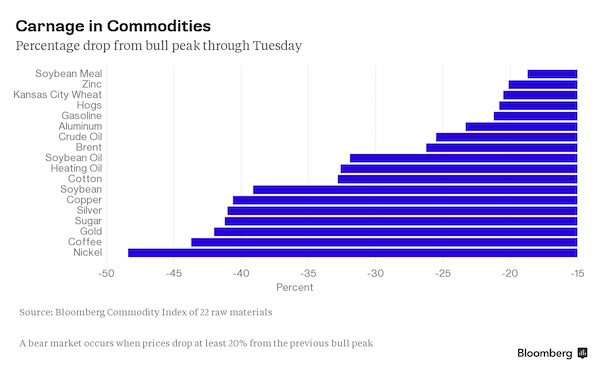
Attention commodities investors: Welcome back to 2008! The meltdown has pushed as many commodities into bear markets as there were in the month after the collapse of Lehman Brothers Holdings Inc., which spurred the worst financial crisis seven years ago since the Great Depression. Eighteen of the 22 components in the Bloomberg Commodity Index have dropped at least 20% from recent closing highs, meeting the common definition of a bear market. That’s the same number as at the end of October 2008, when deepening financial turmoil sent global markets into a swoon.

A stronger U.S. dollar and China’s cooling economy are adding to pressure on raw materials. Two of the index’s top three weightings – gold and crude oil – are in bear markets. The gauge itself has bounced off 13-year lows for the past month. Four commodities – corn, natural gas, wheat and cattle – have managed to stay out of bear markets, due to bad weather and supply issues. Hedge funds are growing more pessimistic as the year has gone on. Money managers have slashed bets on higher commodity prices by half this year, anticipating lower oil and gold prices.
Read more …

Everything shrinks.

Lost Decade in Emerging Markets: Investors Already Halfway There (Bloomberg)

Just 14 years ago Wall Street fell in love with the BRICs, the tidy acronym for four major emerging economies that, to many, looked like sure winners. Today, after heady runs and abrupt reversals, most of the BRICs – in fact, most developing nations – look like big-time losers. The history of emerging markets is a history of booms and busts, but the immediate future may hold something more prosaic: malaise. Investors today confront what could turn out to be a lost decade of returns, with four or five more meager years ahead. “These are very much the lean years after the bonanza decade,” said Harvard Kennedy School economist Carmen Reinhart, one of the world’s top experts on financial crises and developing economies.

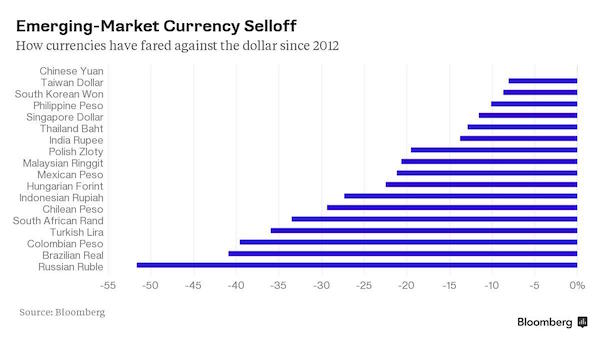
Not long ago the BRICs – Brazil, Russia, India and China – were celebrated as engines of global growth. Now Brazil and Russia face deep recessions brought on by the collapse in global commodities, while China is slowing and struggling to prop up its fast-sinking stock market. The prospect of higher U.S. interest rates only adds to the gloom. Currencies from the South African rand to the Malaysian ringgit fell anew on Wednesday amid worries the U.S. Federal Reserve might move as early as September. To Ruchir Sharma, the turnabout suggests the outsize investment returns of the early 2000s – the MSCI Emerging Markets Index nearly quadrupled between 2002 and 2010 – now look like an anomaly.

“Very few emerging markets historically have ever been able to make it to the developed countries,” said Sharma, head of emerging markets at Morgan Stanley. “This is a return to normalcy.” The numbers are certainly sobering. All told, developing-nation currencies have fallen to their lowest levels since 1999, and bonds denominated in those currencies have wiped out five years’ worth of gains.
Read more …

“Shanghai looks bad and the global cycle is starting to look a little weaker, and that should pressure these things.”

Analyst Who Called Top of China Stock Rally Sees Rout Worsening (Bloomberg)

More than two decades’ experience poring over stock charts helped Thomas Schroeder lock in profits in April before Chinese companies in Hong Kong went into freefall. Now he’s bearish again, betting the slump in Chinese shares won’t stop anytime soon. The Shanghai Composite Index will decline to as low as 3,100 in two months, Schroeder said, 16% below the closing level Wednesday, despite intermittent rallies as the government steps up efforts to stabilize the market. The Hang Seng China Enterprises Index of mainland shares traded in Hong Kong will drop about 10%, he said. To Schroeder, slowing Chinese economic growth and collapsing commodities prices are heightening the chance that the indexes will fall below key equity market support levels.

These are lines on charts that technical analysts say typically mark a floor for prices. Technical analysts use past patterns to try to predict future movements. “For now, we’re in the bear camp,” Schroeder, founder and managing director at Chart Partners, a provider of trading strategies linked to technical analysis, said by phone from Bangkok. “You’re not going to get to it right away. I’m sure the Chinese government will continue to come in and try to support the market in Shanghai. But in the next two months, you’re going to be” reaching these levels.

The former global head of technical research for SG Securities and Asian technical analysis chief at UBS is watching the 3,400 level on the Shanghai Composite. He expects the gauge to fall further if that’s breached. It closed Wednesday at 3,694.57. The H-share measure had jumped 37% from a low in October when Schroeder made his call. Though it edged up a further 5.8% to a peak on May 26, it then slumped more than 25%, while a 32% rout in Shanghai shares helped destroy about $4 trillion in mainland market value. [..] “There are some big moves coming,” said Schroeder. “Shanghai looks bad and the global cycle is starting to look a little weaker, and that should pressure these things.”

Read more …

“Regulations have chased the ‘carry trades’ from the banking system into the shadow banking system where officials can’t see or measure the risk.”

The Fed Is Cornered And There Are Visible Market Stresses Everywhere (Haselmann)

Part One, China An economic slowdown is underway in China. This is reflected in the steep drop in the commodity complex and in the currencies of emerging market countries. Large imbalances are being worked off as Beijing attempts to shift the composition of its growth. Policy decision are not always economic. New sources of growth are being sought by Beijing as deleveraging occurs. Since officials care foremost about social stability, they try to preserve as many current jobs as possible during their attempt at economic transformation. During this period, banks might be averse to calling in loans. State owned enterprises (SOEs) are pressured to keep producing, so that workers can continue to receive a pay check. The result is over-production and downward pressure on prices.

Part Two, The Seven Year Fed Subsidy The Fed’s zero interest rate policy has provided a subsidy to investors for the past 7 years. The lure of easy profits from cheap money was wildly attractive and readily accepted by investors. The Fed “put” gave investors great confidence that they could outperform their exceptionally low cost of capital. These implicit promises by central banks encouraged trillions of dollars into ‘carry trades’ and various forms of market speculation. Complacent investors maintain these trades, despite the Fed’s warning of a looming reduction in the subsidy, and despite a balance sheet expected to shrink in 2016. It has been a risk-chasing ‘game of chicken’ that is coming to an end. Changing conditions have skewed risk/reward to the downside. This is particularly true because financial assets prices are exceptionally expensive.

Maybe investors do not believe ‘lift-off’ looms, because the Fed has changed its guidance so many times. Or maybe, investors are interpreting plummeting commodity prices and the steep fall in global trade as warning signs that global growth and inflation are under pressure. Is this why the US 30 year has rallied 40 basis points in the past 3 weeks? (see my July 17th note, “Bonds are Back”) Either scenario creates a paradox for risk-seeking investors. If the US economy continues on its current slow progress pace, then the Fed will act on its warning and hike rates in September. However, if the Fed does not hike in September it is likely because problems from China, commodities, Greece, or emerging markets (etc) cause the global outlook to deteriorate further. Neither scenario should be good for risk assets.

Part Three, “Carry Trade” During the 2008 crisis, Special Investment Vehicles (SIVs) were primarily responsible for freezing the interbank lending market. SIVs were separate entities set up primarily to earn the ‘carry’ differential between short-dated loans and longer-dated assets purchased with the proceeds of the loans. This legal structure allowed banks to own billions of dollars of securities (CDOs and such) off of their balance sheets. Since the entities were wholly-owned with liquidity guarantees, the vehicles received the same attractive funding rates as the parent banks. When the housing crisis (and Lehman collapse) spurred loan delinquencies, banks had to place all of these hidden securities onto their balance sheets.

Since the magnitude of the SIV levered assets was unknown to others, bank solvency was questioned, and interbank lending froze. Many of these securities had to be sold at fire sale prices, i.e., prices well below their economic value. When the Fed begins to normalize rates, trillions in carry trades will likely begin to unwind. The similarity to 2008 is glaring, except that banks no longer own SIVs. Regulations have chased the ‘carry trades’ from the banking system into the shadow banking system where officials can’t see or measure the risk. The banking system today is, no doubt, far less exposed, but too many sellers could overwhelm the depth of the market, leading to asset price contagion that filters into the real economy.

Read more …

Varoufakis proposed this in January.

GDP Bonds Are Answer To Greek Debt Problem (FT)

It is clear that Greece cannot repay its sovereign debt as it is now structured, despite a generous dose of reprofiling, (extend and pretend), already granted by the country’s public sector creditors in the eurozone. The IMF has endorsed this view. But how can one lower the debt burden on Greece, and yet at the same time be fair to other eurozone countries with debt burdens enlarged by the global financial crisis, such as Ireland; and fair also to the taxpayers in creditor countries, some of which may well be still poorer than the Greeks? There is, I believe, a way to do so. This mechanism is to restructure most, or all, of such Greek debt into real GDP bonds.

These pay nothing so long as real per capita income is below its previous peak, but, as a quid pro quo, they pay a multiple, say twice, of any%age increase in real per capita income as it rises beyond its prior peak level. The maturity would be long, say 40 years, but there would have to be a fixed maturity, since otherwise, in a growing economy the burden could eventually become excessive. Such a switch would achieve several objectives simultaneously. First, creditors would get paid if, and only if, they helped Greece to start growing again. The present fixation with large primary surpluses and austerity would get replaced with a growth programme. So long as growth remained possible, as it surely must, nothing would have to be written off. The net present value of the debt would be a strongly positive function of future Greek growth rates.

Second, the interest/dividend repayments would become strongly contracyclical, with larger payouts in booms when tax payments are high, rather than (mildly) pro-cyclical as they are now. Nothing would be paid in a recession, such as exists at present. Third, exactly the same option, to switch existing debt into real GDP bonds, could also be offered to any other country that has had to accept a support programme, notably Ireland, Cyprus and Portugal. There is no need to give uniquely favourable terms to Greece among all those countries worst hit by the financial crisis. Countries without such a programme, such as Italy, would be allowed to switch existing debt into real GDP bonds, but only on terms agreed after negotiation with existing creditors.

Any country could, of course, issue real GDP bonds to finance current deficits. Real GDP bonds are, of course, a form of national equity. The world is currently drowning in debt, and this is but one way to move the debt/equity ratio back towards a safer and saner balance. Just as we require banks to hold a higher equity ratio, and for much the same reasons, so we should encourage countries, especially those with volatile economies, to shift from debt to equity finance.

Read more …

A second proposal for GDP(-linked) bonds. COntagion?!

Greece’s Debt Burden Can And Must Be Lightened Within The Euro (Bruegel)

Perhaps the greatest damage caused by the confrontation with Greece is a general loss of confidence. If we want to get Greece back to growth, people, companies and investors have to regain confidence in the viability of the country. For this to work, a legitimate and competent government as well as an efficient administration and judiciary are essential. Yet the issue of debt sustainability is still central, even if the debt servicing costs are negligible in the short term. No one doubts the IMF’s analysis that the sustainability of Greek government debt constitutes a key precondition for recovery. The third program, which is now being negotiated, aims to put Greece back where it stood at the end of last year: with growth expectations of almost 3%.

This third programme is intended to be the exact opposite of a transfer program. It aims to strengthen the Greek economy and thereby protect the loans and guarantees provided by the creditors. A large part of the disbursements will go into debt repayments to official creditors. This is important, but not enough. The current link between debt servicing and membership of the single currency leads to a vicious circle that increases uncertainty, weakens growth and makes full debt repayment less likely. There will be no confidence and no growth in Greece without a solution to the debt problem. We suggest breaking this vicious cycle by tying the interest rates on the loans to the growth rate of the Greek economy, together with a conditional debt moratorium.

A Greece without growth should not pay any interest or make any repayments. The stronger the growth rate, the higher the interest and repayments to European creditors. The debt moratorium would mean that Greece could push back the repayments if it has not reached a certain level of GDP by 2022, when it is scheduled to begin servicing its debts to the European creditors. Such a solution would end the uncertainty and recognise the fact that Greek growth is a joint European concern and a prerequisite for Greece to service its debts. Stability and confidence could return. Much of the cause for the current political confrontation would be gone. Meanwhile, such an approach would not reduce the incentives for reform.

It is in the self-interest of any Greek government to pursue growth-friendly reforms. Of course, it will be necessary to design the plan in such a way as to avoid moral hazard; yet this is possible and the conditions are favourable. Such a solution would also be advantageous for the creditors. Some form of debt relief is inevitable. The main advantage of our proposal is that creditors would benefit if growth resumes and thereby reclaim more of their loans than otherwise possible. At the same time, our proposal has only a negligible impact on the creditors’ current budgets and would thus have no meaningful consequences for the constitutional debt limits of member states.

Read more …

Take the money and run.

Tsipras: Greece On ‘Final Stretch’ Of Talks With Creditors (Guardian)

Greece is “in the final stretch” of talks with lenders on a multibillion-euro bailout, the country’s prime minister, Alexis Tsipras, has said, on a day when banks suffered more punishing losses on the Athens stock market. Greece and its creditors are racing to agree a complex, three-year deal worth up to €86bn by 20 August, when Athens must come up with €3.5bn to repay debts to the ECB. Both sides have said a deal is possible, although Tsipras struck the most optimistic note so far when he said on Wednesday that the deal could end the uncertainty over Greece’s place in the eurozone. He said: “We are in the final stretch. Despite the difficulties we are facing, we hope this agreement can end uncertainty on the future of Greece.”

The head of the European commission, Jean-Claude Juncker, said an agreement was likely this month. He told Agence France-Presse: “All the reports I am getting suggest an accord this month, preferably before the 20th.” Negotiations were proceeding in a satisfactory way, he said. Officials from the commission, the ECB and the IMF began meeting the Greek government in the final week of July. Experts from the European Stability Mechanism, the eurozone fund that is expected to provide €50bn towards the bailout, are also at the Athens talks, but do not have the same power as the troika of lenders to set the conditions attached to the loan. At stake is the small print on reforms Greece must carry out in order to qualify for the loan, including overhauling its pension system and introducing a sweeping privatisation programme.

[..] Failure to reach an agreement would leave officials scrambling to find another emergency bridging loan, to add to the €7bn Greece had from an EU-wide bailout fund in July. Eurozone officials are anxious to avoid another short-term loan, as the rules on using the EU-wide fund have since been tightened to placate non-euro states such as the UK that are wary of being dragged into the Greek debt crisis.

Read more …

Why does Greece still have systemic lenders? Why does any country, for that matter?!

Tests Start On Greece’s Systemic Lenders (Kathimerini)

European officials began on Wednesday the inspection that will eventually determine the extent of the recapitalization required by local banks, while the timetable is extremely tight, aiming to have the entire process to boost the lenders’ share capital completed well before the end of the year. Inspectors from the ECB and the European Stability Mechanism yesterday delved into the files of more than 4,000 corporate loans and 2,000 mortgages, as they began probing the loan portfolios of the country’s four systemic banks. The December deadline is meant to prevent the application of the new bail-in law – i.e. the haircut on deposits of more than €100,000 – which will otherwise come into force in January 2016.

The timetable is so restricted that it foresees the monitoring of the loan portfolios’ figures up to June 30 running alongside the stress tests that will examine banks’ possible responses to various economic scenarios in the next couple of years. That will bring the start of the stress tests a step closer, with the first data being drawn as soon as mid-August, so that the results of both procedures can be announced by the end of October. That will leave a period of two months for the completion of the recapitalization, which could be conducted in summary fashion at the banks’ general meetings. Bank managers are expressing concern about the size of the capital requirements, with current estimates putting the total amount between €10 and €15 billion.

However, the final amount will to a great extent depend on the macroeconomic scenarios, which will involve economic contractions and unemployment levels that will determine the capacity of households and corporations to meet their loan repayment obligations. Corporate loans will come under the scrutiny of the Asset Quality Review, with the European experts assessing a broad sample of some 1,000 loans per bank. They will also probe around 500 mortgage loans per lender, factoring in the drop in property values.

Read more …

Ambrose loves the US almost as much as he does Yanis.

Saudi Arabia May Go Broke Before The US Oil Industry Buckles (AEP)

If the oil futures market is correct, Saudi Arabia will start running into trouble within two years. It will be in existential crisis by the end of the decade. The contract price of US crude oil for delivery in December 2020 is currently $62.05, implying a drastic change in the economic landscape for the Middle East and the petro-rentier states. The Saudis took a huge gamble last November when they stopped supporting prices and opted instead to flood the market and drive out rivals, boosting their own output to 10.6m barrels a day (b/d) into the teeth of the downturn. Bank of America says OPEC is now “effectively dissolved”. The cartel might as well shut down its offices in Vienna to save money.

If the aim was to choke the US shale industry, the Saudis have misjudged badly, just as they misjudged the growing shale threat at every stage for eight years. “It is becoming apparent that non-OPEC producers are not as responsive to low oil prices as had been thought, at least in the short-run,” said the Saudi central bank in its latest stability report. “The main impact has been to cut back on developmental drilling of new oil wells, rather than slowing the flow of oil from existing wells. This requires more patience,” it said. One Saudi expert was blunter. “The policy hasn’t worked and it will never work,” he said. By causing the oil price to crash, the Saudis and their Gulf allies have certainly killed off prospects for a raft of high-cost ventures in the Russian Arctic, the Gulf of Mexico, the deep waters of the mid-Atlantic, and the Canadian tar sands.

Consultants Wood Mackenzie say the major oil and gas companies have shelved 46 large projects, deferring $200bn of investments. The problem for the Saudis is that US shale frackers are not high-cost. They are mostly mid-cost, and as I reported from the CERAWeek energy forum in Houston, experts at IHS think shale companies may be able to shave those costs by 45pc this year – and not only by switching tactically to high-yielding wells. Advanced pad drilling techniques allow frackers to launch five or ten wells in different directions from the same site. Smart drill-bits with computer chips can seek out cracks in the rock. New dissolvable plugs promise to save $300,000 a well. “We’ve driven down drilling costs by 50pc, and we can see another 30pc ahead,” said John Hess, head of the Hess Corporation.

It was the same story from Scott Sheffield, head of Pioneer Natural Resources. “We have just drilled an 18,000 ft well in 16 days in the Permian Basin. Last year it took 30 days,” he said. The North American rig-count has dropped to 664 from 1,608 in October but output still rose to a 43-year high of 9.6m b/d June. It has only just begun to roll over. “The freight train of North American tight oil has kept on coming,” said Rex Tillerson, head of Exxon Mobil. He said the resilience of the sister industry of shale gas should be a cautionary warning to those reading too much into the rig-count. Gas prices have collapsed from $8 to $2.78 since 2009, and the number of gas rigs has dropped 1,200 to 209. Yet output has risen by 30pc over that period.

Read more …

What a surprise…

ECB Paper: Banks That Lobby More Likely To Get Favourable Treatment (Reuters)

Banks that spend money on lobbying or hire former regulators are more likely to get favourable treatment from their watchdog agency, according to a ECB paper published today. While lobbying in the United States has been subject to extensive disclosure for years, European authorities only started to tighten the rules in recent months. Companies that want to meet with officials are now obliged to join a register and their meetings are logged. The ECB paper, based on data from about 780 US banks, found that lenders which have lobbied, hired a former regulator or government official, or are otherwise close to the authorities are less likely to face additional sanctions if their capital ratios fall below the minimum threshold.

They also tend to have higher Fitch Bank Support Ratings, meaning they are considered more likely to receive public-sector help if they are at risk of default, the paper found. “Increasing lobbying expenditures raise the probability of preferential regulatory treatment, but even small lobbying expenditures prove to be effective,” authors Magdalena Ignatowski, Charlotte Werger and Josef Korte wrote in the paper. “Lobbying becomes more effective by involving former politicians as lobbyists,” the paper said. “The effectiveness of proximity to the relevant legislative committee increases with the amount of campaign contributions from the financial industry that elected legislators receive.”

But lobbying and other sources of political influence cease to be effective when a bank finds itself in deep financial distress and faces being closed, the paper found. The ECB research did not account for undeclared or indirect lobbying, such as that carried out by an association of banks, which means the real effect of lobbying might be even stronger, the authors wrote. “Our evidence indicates that expenditures on lobbying are on the rise, and that banks are increasing their influence activities,” the authors of the paper wrote. “It is important to be aware that regulatory treatment is not immune to the influence of banks, and that we might expect this influence to further increase.”

Read more …

And that’s NOT a surprise.

Eurozone Retail Sales Fall Sharply in June (WSJ)

Retail sales in the eurozone fell more sharply than expected in June, a fresh sign that the currency area’s economic recovery remains too weak to quickly bring down very high rates of unemployment, or raise inflation to the ECB’s target. Separately, the final results of surveys of purchasing managers at businesses around the eurozone recorded a slowdown in activity during July, although it was less marked than first estimated. And in Italy, the eurozone’s third largest member, figures showed industrial production fell by 1.1% on the month in June, a sign that the recovery from the country’s worst postwar recession is still fragile. The EU’s statistics agency said Wednesday retail sales in the 19 countries that use the euro fell 0.6% in June from May, but were up 1.2% from the same month last year.

It was the largest month-to-month fall since September 2014. Economists surveyed by The WSJ had estimated sales fell 0.2%, having seen figures from Germany that recorded a large drop. Eurostat said sales in Germany were down 2.3% from May. That is a blow to hopes that low unemployment and rising wages in its largest member would boost the recovery in the eurozone as whole, as Germans purchased more goods and services from weaker parts of the currency area. But the weakness in retail sales wasn’t confined to Germany, and is also a setback to the ECB’s goal of raising the annual rate of inflation to its target of just under 2%.

Read more …

Plenty of dreams.

A Prescription for Peace and Prosperity (Paul Craig Roberts)

For the United States to return to a prosperous road, the middle class must be restored and the ladders of upward mobility put back in place. The middle class served domestic political stability by being a buffer between rich and poor. Ladders of upward mobility are a relief valve that permit determined folk to rise from poverty to success. Rising incomes throughout society provide the consumer demand that drives an economy. This is the way the US economy worked in the post-WWII period. To reestablish the middle class the offshored jobs have to be brought home, monopolies broken up, regulation restored, and the central bank put under accountable control or abolished. Jobs offshoring enriched owners and managers of capital at the expense of the middle class.

Well paid manufacturing and industrial workers lost their livelihoods as did university graduates trained for tradable professional service jobs such as software engineering and information technology. No comparable wages and salaries could be found in the economy where the remaining jobs consist of domestic service employment, such as retail clerks, hospital orderlies, waitresses and bartenders. The current income loss is compounded by the loss of medical benefits and private pensions that supplemented Social Security retirement. Thus, jobs offshoring reduced both current and future consumer income. America’s middle class jobs can be brought home by changing the way corporations are taxed. Corporate income could be taxed on the basis of whether corporations add value to their product sold in US markets domestically or offshore.

Domestic production would have a lower tax rate. Offshored production would be taxed at a higher rate. The tax rate could be set to cancel out the cost savings of producing offshore. Under long-term attack by free market economists, the Sherman Antitrust Act has become a dead-letter law. Free market economists argue that markets are self-correcting and that anti-monopoly legislation is unnecessary and serves mainly to protect inefficiency. A large array of traditionally small business activities have been monopolized by franchises and “big box” stores. Family owned auto parts stores, hardware stores, restaurants, men’s clothing stores, and dress shops, have been crowded out. Walmart’s destructive impact on Main Street businesses is legendary. National corporations have pushed local businesses into the trash bin.

Read more …

How is it possible that people like Osborne get to make these decisions?

Osborne, In Big Banks’ Pockets, Faces Wrath Of Challengers (Guardian)

George Osborne has cut state support for Britain’s working families and imposed a pay freeze on public sector workers. But when it comes to Britain’s big banks, the chancellor has proved himself to be a pushover. That much was evident from the strong hints by Standard Chartered that it was no longer thinking of removing its head office from the UK and relocating to east Asia. Why? Because Osborne kindly did what was asked of him and announced deep cuts in the government’s bank levy that will halve the tax take for the exchequer by the early 2020s. Rarely has the lobbying power of the established banks been more obvious. In the runup to the election, HSBC said it was reviewing whether to keep its HQ in London.

Standard Chartered let it be known that it, too, was so unhappy about the bank levy that it might up sticks. The result was that Osborne beat a hasty retreat in his summer budget. He announced changes to the taxation of banks, cutting the bank levy while at the same time announcing an additional corporation tax of 8% for those banks making profits of more than £25m. This had the effect of shifting the tax burden from global UK-domiciled banks like HSBC, Barclays and Standard Chartered to the smaller challenger banks, because the levy was related to the size of a bank’s balance sheet, not just in Britain but anywhere in the world. Smaller banks such as Metro, Tesco and Aldermore were not big enough to pay. Despite the cave-in, this is not mission accomplished for the chancellor.

He has solved one problem – the risk that London’s reputation as a global banking hub might be damaged by the departure of HSBC or Standard Chartered – but created another. The challenger banks are now faced with paying higher corporation tax in order to keep HSBC and Standard Chartered sweet. Predictably, they are furious about it and are lobbying Osborne to raise the profits threshold for paying the supplementary corporation tax to £250m. More competition in high street banking is a good idea. It is forcing the established players to treat their customers with a bit more respect. Osborne wants HSBC and Standard Chartered to stay in the UK but not at the expense of the challenger banks. It won’t be long before a second climbdown is announced.

Read more …

That would be very good news.

The Economist: The TPP is Dead (Naked Capitalism)

Leith van Onselen at MacroBusiness tells us:

The chief economist of The Economist magazine, Simon Baptist, believes that the Trans-Pacific Partnership (TPP) trade deal is dead following the failure of final round negotiations in Hawaii last week. Here’s Baptist’s latest commentary on the TPP from his latest email newsletter:

The latest talks on the Trans-Pacific Partnership (TPP) did not end well and election timetables in Canada and the US mean that the prospect of a deal being ratified before the end of 2016 (at the earliest) is remote. The usual problem of agricultural markets was prominent, headlined by Canada’s refusal to open its dairy sector. For New Zealand—one of the four founder countries of the TPP, along with Brunei, Chile and Singapore—this was a non-negotiable issue.

Dairy was not the only problem. As usual, Japan was worried about cars and rice, and the US about patent protection for its pharma companies. The TPP was probably doomed when the US joined, and certainly when Japan did. It then became more of a political project than an economic one. Big trade agreements had hitherto focused on physical goods, while the TPP had an aim of forging rules of trade beyond this in intellectual property, investment and services.

China was a notable absence, and the US and Japan, in particular, were keen to set these rules with enough of the global economy behind them such that China would be forced into line later on. For now, the shape of international standards in these areas remains up for grabs. The next step for the TPP, if anything, is whether a smaller group—such as the founding four —will break away and go ahead on their own, with a much smaller share of global GDP involved, and in the hope that others will join later.

Yves here. This conclusion is even more deadly than it seems, particularly coming from a neoliberal organ like the Economist. I have to confess to not reading the Economist much on this topic, precisely because the articles I did see hewed so tightly to party line: that the TPP and its ugly sister, the Transatlantic Trade and Investment Partnership, were “free trade” deals and therefore of course should be passed, since more “free trade” was always and ever a good thing. In fact, trade is already substantially liberalized, and the further GDP gains that economists could gin up using their models (which have overstated results) were so pathetically small as to amount to rounding error. Accordingly, contacts in DC told us that the business community was not pushing the deal hard: “Multinationals don’t see much benefit to be had from being able to sue Malaysia over environmental regulations.” The corporate support for the TPP in the US was thus much narrower than the cheerleading in the press would have you believe.

Read more …

Not everyone seems to agree yet, but it’s there.

Canada Is On The Verge Of A Recession (CNN)

The latest economic data from Canada shows that it is inching toward recession, after its economy posted its fifth straight month of contraction. Statistics Canada revealed on July 31 that the Canadian economy shrank by 0.2% on an annualized basis in May, perhaps pushing the country over the edge into recessionary territory for the first half of 2015. “There is no sugar-coating this one,” Douglas Porter, BMO chief economist, wrote in a client note. “It’s a sour result.” The poor showing surprised economists, who predicted GDP to remain flat, but it the result followed a contraction in the first quarter at an annual rate of 0.6%. Canada’s economy may or may not have technically dipped into recession this year – defined as two consecutive quarters of negative GDP growth – but it is surely facing some serious headwinds.

Attempts to rebound: Canada’s central bank slashed interest rates in July to 0.50%, the second cut this year, but that may not be enough to goose the economy. With rates already so low, there comes a point when interest rate cuts have diminishing returns. Consumer confidence in Canada is at a two-year low. There are other fault lines in the Canadian economy. Fears over a housing bubble in key metro areas such as Toronto and Vancouver are rising. “In light of its hotter price performance over the past three to five years and greater supply risk, this vulnerability appears to be comparatively high in the Toronto market,” the deputy chief economist of TD Bank wrote in a new report. A run up in housing prices, along with overbuilding units that haven’t been sold, and a high home price-to-income ratio has TD Bank predicting a “medium-to-moderate” chance of a “painful price adjustment.”

In other words, the bubble could deflate. Housing markets in the oil patch have already started losing value. The Calgary Real Estate Board predicts that the resale value of homes will fall by 0.2% by the end of the year. And total home sales could fall by 22% in 2015. That is a dramatic downward revision from the group’s prediction in January that home sales would rise by 1.6%. It’s all about oil: But that’s because the economic situation is much worse in the oil patch than many had predicted six months ago. And oil prices have crashed again, a detail not yet captured by the disappointing GDP figures. Crude oil (WTI) is now below $50 per barrel, and Canada’s heavy oil trades at a discount to even that low figure due to pipeline constraints and lower quality.

Read more …

The Pope and The Donald.

Pope Francis’ ‘Attendance’ At GOP Debate Will Help Sink The Party (Farrell)

We know this activist pope just won’t stop — he keeps ramping up his attack, hammering away at capitalism’s war against the poor and the environment: “In this third world war, waged piecemeal, which we are now experiencing, a form of genocide is taking place, and it must end.” Get it? In Pope Francis’ world view, WWIII has already begun, is raging, here, now, today. So no surprise that his relentless anticapitalism attacks are driving conservative critics crazy. A RawStory.com headline captured the voice of the party: “Rush Limbaugh goes bonkers because Pope Francis called out-of-control capitalism the dung of the devil.” Yes, the pope said that capitalism is the “dung of the devil.”

It’s so easy to imagine what he’ll say live to 300 GOP members of Congress next month when he appears before a join session of Congress. Pope Francis’s blunt delivery reminds us of a construction worker operating a loud jackhammer, hell-bent on dismantling the massive concrete edifice of American capitalism with deep, biting attacks like: “Men and women are sacrificed to the idols of profit and consumption: it is the ‘culture of waste.’ If a computer breaks it is a tragedy, but poverty, the needs and dramas of so many people end up being considered normal.” Warning, he’s now their champion inciting the rebellion.

Yes, Pope Francis will actually hear every dismissal voiced by GOP debaters, about how they’re ignoring what the pope says in matters of economics, social policy, global-warming science. Big mistake guys. The GOP’s days of playing deaf are over, the elephant on the 2015-16 political stage is the big guy in the white suit with the engaging smile. Dismissing him won’t work this election, he’s got an army of billions on his side.

Read more …

Most Americans are right on at least something.

Most Americans Say Their Children Will Be Worse Off (MarketWatch)

The next generation of Americans will be healthier, their parents say, all except for their finances. Barely more than one in 10 (13%) American adults believe their children will be better off financially than they were when their career reached its peak and just over half (52%) believe their children will have less disposable income than they did in the future, according to a survey of more than 1,100 American adults released Wednesday by life insurer Haven Life and research firm YouGov. What’s more, just 20% of Americans believe their children will have a better quality of life when they reach their age. “For the baby boomer generation, pocket money from mom and dad was only part of their early childhood,” says Yaron Ben-Zvi, CEO of Haven Life.

“Today’s parents are increasingly prepared to worry about and provide for their children’s financial well-being well far into their adulthoods.” (In fact, 40% of millennials say they get some kind of financial help from their parents, according to an April 2015 Bank of America/USA Today survey of 1,000 kids and 1,000 parents.) Why do parents believe that their children are faced with bigger financial challenges? They are saddled with more student loan debt than previous generations. The number of borrowers who default (those who are at least nine months past due) rose to 1.2 million annually in 2012 from around 500,000 per year a decade ago, according to the New York Fed. And many young people – especially those living in big cities – are still priced out of the housing market.

Studies also show that the better start children have in life in terms of financial support and education, the more likely they are to surpass their parents’ earnings. Children raised in low-income American families are more likely to have very low incomes as adults, while children raised in high-income families can anticipate a much bigger jump in income, according to a report – “Economic Mobility in the United States” – released last month by researchers at Stanford University. Their future is brighter in one way, parents say. Two thirds (66%) believe their kids will be as healthy or have a healthier lifestyle and, as such, will have a higher quality of life, the Haven Life/YouGov survey also found. Some 81% of millennials exercise regularly versus 61% of baby boomers, and millennials take more fitness classes, according to research group Nielsen. Unlike many of their parents, they’re also growing up in a country where smoking is banned by 36 states in workplaces, restaurants and bars.

Read more …

Curious juxtaposition. Misery and holidays.

Refugee Crisis on the Beach in Greece (NY Times)

Refugee camps are always sad, desperate places. I saw a lot of them when I was covering southern Africa for four years. But most were in desolate, poor places, not vacation islands like Lesbos, Greece, where thousands of refugees have been arriving in small inflatable boats, as upscale tourists do their best to unwind. The strangest part about covering this story was the constant juxtaposition of the European good life and the misery of people who, fleeing war and violence, now found themselves sitting among piles of garbage as they waited for their papers to be processed. My Greek colleague, Nikolas Leontopoulos, and I would meet with officials in the town of Mytilene, passing tourists who were busy picking out their favorite suntan lotion, and then an hour later we were in the back hills, where families had not eaten and the stench of clogged toilets was overwhelming.

At one point, we went to visit a good-hearted hotel owner who, driving along on a scorching hot day, came across a group of refugees walking the 30 miles to the processing station. She picked them up only to find herself arrested for “aiding smugglers.” But now she was a world away, supervising an evening of salsa for her guests. German mothers in skimpy dresses danced with their young children. Fathers watched with ice-cold beers in their hands. The sea just beyond the patio lapped gently on the shores. In the north, the beaches were littered with pools of black plastic — the boats the refugees arrived in and then punctured for fear they would be sent back. Nearby there was always a neat pile of abandoned life jackets and other flotation devices, many of them ridiculously flimsy — inflatable tubes decorated with fish — which would have done little good if the boats had capsized. There were also toothbrushes and abandoned backpacks and toys, too. People’s lives scattered around.

Read more …

Jul 102015
 
 July 10, 2015  Posted by at 11:04 am Finance Tagged with: , , , , , , , ,  12 Responses »


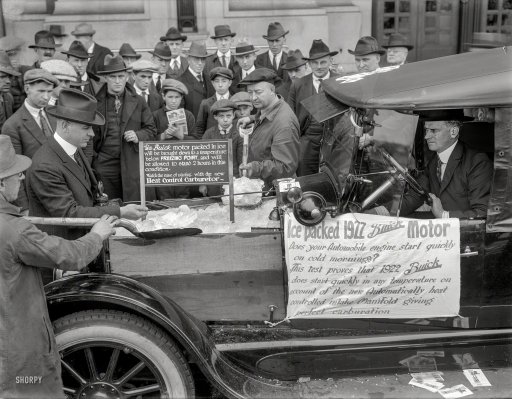
Wynand Stanley Ice-packed Buick motor stunt, San Francisco 1922

Stock Slide Ruins China’s Illusion of Control (Bloomberg)
Greece Seeks €53.5 Billion Bailout in Effort to Keep Euro (Bloomberg)
France Intercedes on Greece’s Behalf to Try to Hold Eurozone Together (WSJ)
The Big Achievement Of Tsipras’s Proposal Is To Sow Division (Münchau)
Galbraith: Greek Revolt Against Bad Economics Threatens EU Elites (Parramore)
The US Must Save Greece (Joe Stiglitz)
Greece Presents €2 Billion Russian Gas Deal (FT)
Germany Concedes Greece Needs Debt Relief, Greek Plan Awaited (Reuters)
Germany Failed To Learn From Its Own History-And Greece Pays The Price (WaPo)
Weidmann Warns Greek Banks Concerns Rising By Day (FT)
Greek Government Insider On 5 Months Of ‘Humiliation’ And ‘Blackmail’ (MP)
Swiss Poised To Support Greek Tax Amnesty (SI)
The Lesson for the World Coming from Greece (Martin Armstrong)
Varoufakis: Schäuble Wants Grexit, I Prefer Be an MP Known as Yanis (GF)
Max Keiser and Yanis Varoufakis Retrospective (2012 footage)
Darwin’s Casino (John Michael Greer)
Pope Calls For New Economic Order, Criticizes Capitalism (Reuters)

And that is nigh impossible to regain.

Stock Slide Ruins China’s Illusion of Control (Bloomberg)

The other, grander gamble that Xi has taken is to keep the Chinese economy growing. Of course, the Communist Party since Deng Xiaoping has staked its legitimacy on economic growth, so far to good effect. But Jiang Zemin and Hu Jintao governed through a broad-based consensus of senior party leaders, which meant that the risks of legitimacy and delegitimacy were spread across the group and the institution they represented. Xi, in contrast, has taken more power – and therefore the risks of economic growth – onto his shoulders. There are many tools central government can use to keep an economy growing, and China under Xi will use them all. State-owned enterprises may be less efficient in the long run than truly private companies, but they have the enormous political benefit of responding to centralized state directives.

With good economists advising him, Xi stands a reasonable chance of transitioning China into a more consumer-driven economy, thereby assuring a source of modest continued growth even as the export-driven economy slows down. But that task, too, depends on the individual purchasing decisions of ordinary Chinese – that is, success of China’s economy, and therefore of Xi’s presidency, ultimately depends on the domestic consumer market. This brings us back to the stock market. Sure, Xi has to worry that the correction will spook emerging consumers, encouraging them to sit on their cash rather than spending it. But the much bigger political problem is that ordinary Chinese, watching the market fall, will experience the certain knowledge that Xi can’t really do anything about it.

Short-term stopgaps like closing markets during sell-offs or ordering state-owned enterprises not to sell their shares won’t address market fundamentals – because they can’t. In confirmed capitalist societies, we long ago learned that the government can’t stop the market from going where it believes it must. The reason, of course, is that the market isn’t a single entity that can be forced to take collective action. It’s an aggregation of individual decision-makers, all of whom share a competitive interest in achieving gain and limiting loss. For that reason, governments in experienced capitalist countries know that the only meaningful, long-term way to respond to market declines is by trying to create economic conditions that will restore faith in the markets.

Read more …

A whole long weekend of this. And then votes on Mon-Tue in national parliaments.

Greece Seeks €53.5 Billion Bailout in Effort to Keep Euro (Bloomberg)

The government of Greek Prime Minister Alexis Tsipras sought a three-year bailout loan of at least €53.5 billion ($59.2 billion), in a last-ditch effort to keep the country in the euro. In exchange, it offered a package of reforms and spending cuts, including pension savings and tax increases, similar to the one presented by creditors last month. The proposal was submitted to European institutions late Thursday and will be presented to the Greek Parliament Friday. It is set to be discussed at a summit of European Union leaders Sunday to determine whether Greece gets a new bailout, or be forced to leave the single currency. Greece offered measures that almost mirrored a proposal from creditors on June 26, which was rejected by voters in a July 5 referendum.

In return, it asked for its long-term debt to be made more manageable to allow it to rebound from a crisis that has erased a quarter of its economy. It is unclear if the proposal is enough to clinch a deal with creditors amid signs of economic deterioration since banks were closed and capital controls imposed 12 days ago. “The Greeks appear to have made significant concessions, apparently accepting much of the most recent creditor proposal,” Chris Scicluna, head of economic research at Daiwa Capital Markets in London, wrote in a note. “It remains to be seen whether creditors will want even more austerity.” The Greek government said it would use the three-year loan from the European Stability Mechanism to cover debt repayments between 2015 and 2018, mostly to the International Monetary Fund and the European Central Bank.

It will then be left with debt owed only to European Union institutions. Greece’s proposal includes creditors’ longstanding demands for sales tax increases and cuts in public spending on pensions. Greece also proposes the restructuring of its debt and a package of growth measures of €35 billion. Pressure has been mounting on Greece’s creditors to make the country’s debt more manageable. “A realistic proposal from Greece will have to be matched by an equally realistic proposal on debt sustainability from the creditors,” European Union President Donald Tusk told reporters in Luxembourg Thursday. “Only then will we have a win-win situation.”

Read more …

“French leaders have waxed poetic in recent days about the special place Greece holds. Greek independence was celebrated by French writers and artists from Victor Hugo and to Eugene Delacroix..”

France Intercedes on Greece’s Behalf to Try to Hold Eurozone Together (WSJ)

The race to come up with a last-minute proposal to keep Greece in the eurozone began with a Sunday night phone call from Greek Prime Minister Alexis Tsipras to French President Francois Hollande, moments after Greece’s referendum dealt a near-fatal blow to the talks. If Greece wanted to remain in the eurozone, Athens must make ambitious proposals to its creditors quickly, Mr. Hollande told him, adding: “Help me help you.” That advice was part of an urgent French campaign to salvage months of negotiations from the wreckage of the Greek referendum. After long staying out of the fray, Mr. Hollande was scrambling to keep the discussions alive. His strategy: to press Mr. Tsipras for stronger economic overhauls while persuading Angela Merkel to give Greece more time and, ultimately, hope for debt relief.

The stance reflects a particularly French vision of the eurozone as a grand political project, with strategic benefits for Europe worth defending even at high cost. A Greek exit from the eurozone would set a dangerous precedent, French officials say, turning the currency bloc into little more than an arrangement of fixed currency exchange rates that governments could discard. French leaders have waxed poetic in recent days about the special place Greece holds. Greek independence was celebrated by French writers and artists from Victor Hugo and to Eugene Delacroix, Prime Minister Manuel Valls told lawmakers Wednesday in explaining why France refuses to accept a Greek exit from the euro. “Greece is a passion for France and Europe,” Mr. Valls said.

“The goddess that gave its name to our continent is at the heart of our mythology.” Domestic politics is also at work. Mr. Hollande, a Socialist, faces a rebellion from members of his parliamentary majority who accuse him of abandoning his 2012 election pledge to push for pro-growth policies in Europe. Standing up to Berlin on behalf of Greece is a chance to brandish his leftist credentials for party hard-liners, analysts say. It is unclear whether France’s triage will lead to a deal by Sunday, when European Union leaders are due to decide Greece’s fate. But France’s intervention has helped keep the talks on life support.

Read more …

“.. there is now the acute problem of an insolvent banking system..” A problem all of the Troika’s own design.

The Big Achievement Of Tsipras’s Proposal Is To Sow Division (Münchau)

I do not have the foggiest whether these latest Greek proposals will be enough to secure a deal. There are still very big obstacles to overcome. But Alexis Tsipras has achieved something that has eluded him in the past five months: he has managed to split the creditors. The IMF insists on debt relief. The French helped the Greek prime minister draft the proposal and were the first to support it openly. President François Hollande is siding with Mr Tsipras. And that changes the stakes for Angela Merkel. If the German chancellor says no now, she will stand accused of taking reckless risks with the eurozone and the Franco-German alliance. If she says yes, her own party might divide similarly to the way the British Conservatives divided over Europe. I have always predicted that the moment of truth for the eurozone will come eventually. It will come this weekend.

The financial markets seemed to have made up their mind that a deal will happen. But beware the many landmines on the path to a deal. Of those, only the first has been sidestepped with Mr Tsipras’ offer. What he is now proposing is, economically, not fundamentally different from what he, and the Greek electorate, rejected in Sunday’s referendum — but it works politically for him. The phase-in period of some of the harder measures is longer. And if there is a deal, there will have to be an explicit reference to debt relief this time. The IMF insists on it. And even Donald Tusk, the president of the European Council, says so. This is an important development, but it is not clear that all creditors will, or can, agree.

By tomorrow, the technical people and the finance ministers will need to discuss whether the Greek numbers add up. The answer is almost certainly no, not least because of the rapid deterioration of the country’s economy. The imposition of capital controls and bank withdrawal limits brought most economic activity to a standstill. Any macroeconomic adjustment programme will have to start with a realisation that the situation is worse today than two weeks ago. The Greek list takes account of this in terms of slower adjustment periods. This is economically sensible. But Ms Merkel has already said she wanted this problem taken care of through additional austerity. For a programme to be agreed, one side will have to back down here.

On top of this, there is now the acute problem of an insolvent banking system — one that is totally reliant on a special lifeline by ECB called emergency liquidity assistance. The ECB will find it hard to increase ELA. So apart from agreeing on a macroeconomic stabilisation programme, European leaders will this weekend need to answer the more immediate question of what to do with the Greek banks. This is possibly the single most complicated question because there are no easy and fast answers. What may have to happen is that the number of banks will have to shrink to three or two, and that depositors may have to be “bailed in”. I cannot see that the creditors would agree to a further bank restructuring programme, in addition to the €53.5bn in new loans currently under discussion.

Read more …

The superego paradox again.

Galbraith: Greek Revolt Against Bad Economics Threatens EU Elites (Parramore)

Lynn Parramore: What’s your view of the attitudes of the creditor powers?
Jamie Galbraith: What happened on the 26th of June was that Alexis (Tsipras) came to realize, at long last, that no matter how many concessions he made he wasn’t going to get the first one from the creditors. That’s something Wolfgang Schäuble had made clear to Yanis (Varoufakis) months before. But it was hard to persuade the Greek government of this because its members naturally expected, as you would when you’re in a negotiation, that if you make a concession the other side will make a concession. That isn’t the way this one worked. The Greeks kept making concessions. They’d present a program and the other side would say —as you can read in the press — oh, no, that’s not good enough. Do another one. Then they’d complain that the Greeks were not being serious. What the creditors meant by that was this: when you come around and agree to what we tell you, then you’re serious. Otherwise not. This is the way bad professors treat extremely recalcitrant students. You come in with a paper draft and they say, no, that’s not good enough. Do another one.

LP: Have the individual creditors differed on how to treat Greece?
JG: There are some divisions amongst the creditors that are well known. But they’re all variations on the theme of insular, sheltered, cloistered people who do not understand what is happening in Greece and do not know the economics. So, for example, the European Commission tends to be a little bit nicer, the IMF tends to be better on debt restructuring but worse on the structural issues, and the ECB was infuriated by the fact that its technocrats couldn’t walk into any ministry in Athens and make demands and be paid attention to. So there were different aspects of this that seemed to trouble different creditors, but it all amounted to the fact that between them there was no basis for arriving at anything other than the original Memorandum of Understanding (bailout program).

LP: What exactly triggered the breakdown that led to the referendum?
JG: What happened was that the IMF took the staff level agreement draft that the Greeks had presented, and marked it up in red ink and presented it back to the Greeks as an ultimatum— this is what we will accept. Or rather (EC president) Juncker presented it back to the Greeks as an ultimatum. And Yanis was told, take it or leave it. So they basically had no choice but to walk away from it, to leave it.

LP: How do you think the referendum has changed the situation? Has it given the Greeks leverage or not?
JG: That’s a difficult question. The recent Ambrose Evans Pritchard piece is very much on the mark. The Greek government, and particularly the circle around Alexis, were worn down by this process. They saw that the other side does, in fact, have the power to destroy the Greek economy and the Greek society — which it is doing — in a very brutal, very sadistic way, because the burden falls particularly heavily on pensions. They were in some respects expecting that the yes would prevail, and even to some degree thinking that that was the best way to get out of this. The voters would speak and they would acquiesce. They would leave office and there would be a general election. But civil society took this over in the most dramatic and heroic fashion. It was an incredible thing to see. The Greeks, amazingly, voted 61% no. That, momentarily, gave a jolt of adrenaline to everybody in the government. But the next morning, they were back where they were before. And that’s why, of course, Yanis left at that point.

Read more …

What’s the use with Spain and Italy waiting in the wings?

The US Must Save Greece (Joe Stiglitz)

As the Greek saga continues, many have marveled at Germany’s chutzpah. It received, in real terms, one of the largest bailout and debt reduction in history and unconditional aid from the U.S. in the Marshall Plan. And yet it refuses even to discuss debt relief. Many, too, have marveled at how Germany has done so well in the propaganda game, selling an image of a long-failed state that refuses to go along with the minimal conditions demanded in return for generous aid. The facts prove otherwise: From the mid-90’s to the beginning of the crisis, the Greek economy was growing at a faster rate than the EU average (3.9% vs 2.4%). The Greeks took austerity to heart, slashing expenditures and increasing taxes.

They even achieved a primary surplus (that is, tax revenues exceeded expenditures excluding interest payments), and their fiscal position would have been truly impressive had they not gone into depression. Their depression—25% decline in GDP and 25% unemployment, with youth unemployment twice that—is because they did what was demanded of them, not because of their failure to do so. It was the predictable and predicted response to the austerity. The question now is: What’s next, assuming (as seems ever more likely) they are effectively thrown out of the euro? It’s likely that the European Central Bank will refuse to do its job—as the Central Bank for Greece, it should do what every central bank is supposed to do, act as a lender of last resort.

And if it refuses to do that, Greece will have no option but to create a parallel currency. The ECB has already begun tightening the screws, making access to funds more and more difficult. This is not the end of the world: Currencies come and go. The euro is just a 16-year-old experiment, poorly designed and engineered not to work—in a crisis money flows from the weak country’s banks to the strong, leading to divergence. GDP today is more than 17% below where it would have been had the relatively modest growth trajectory of Europe before the euro just continued. I believe the euro has much to do with this disappointing performance. [..]

The U.S. was generous with Germany as we defeated it. Now, it is time for the U.S. to be generous with our friends in Greece in their time of need, as they have been crushed for the second time in a century by Germany, this time with the support of the troika. At a technical level, the Federal Reserve needs to create a swap line with Greece’s central bank, which—as a result of the default of the ECB in fulfilling its responsibilities—will have to take on once again the role of lender of last resort. Greece needs unconditional humanitarian aid; it needs Americans to buy its products, take vacations there, and show a solidarity with Greece and a humanity that its European partners were not able to display.

Read more …

“Greece is no-one’s hostage,” he said. “The Greek people’s No vote, and I am referring to all of the people, is not going to become a humiliating Yes.”

Greece Presents €2 Billion Russian Gas Deal (FT)

Greece has mapped out details of a landmark €2bn gas project with Russia, a scheme that could stir tensions with Brussels just as Athens seeks a third bail-out. Panayiotis Lafazanis, the firebrand leftist energy minister, presented the project to Greek energy executives on Thursday in a defiant speech, vowing that Athens would not be pushed around by EU institutions, writes Christian Oliver. EU policymakers are concerned that Russia could take advantage of the crisis to pull Greece deeper into its orbit and pipeline politics is critical to relations between the two nations. Athens and Moscow say their new project, the so-called South European Pipeline, will bring 47 billion cubic metres of Gazprom’s gas into Europe by 2018.

Mr Lafazanis promised that it would create 20,000 much needed jobs in Greece. This promised deal with Russia is a sharp rebuke to Brussels, which wants to reduce dependence on Gazprom and argues that southeastern Europe should diversify its supply by prioritising gas from Azerbaijan. Opening his remarks with pugnacious references to the eurozone crisis, Mr Lafazanis said that Greece was aiming to secure a deal with Brussels as quickly as possible. However, he then warned EU institutions that Athens was not about to roll over. “Greece is no-one’s hostage,” he said. “The Greek people’s No vote, and I am referring to all of the people, is not going to become a humiliating Yes.”

Read more …

Only 5 months late. Or is that 5 years?

Germany Concedes Greece Needs Debt Relief, Greek Plan Awaited (Reuters)

Germany conceded on Thursday that Greece would need some debt restructuring as part of any new loan programme to make its economy viable as the Greek cabinet raced to finalize reform proposals to avert an imminent economic meltdown. The admission by German Finance Minister Wolfgang Schaeuble came hours before a midnight deadline for Athens to submit a reform plan meant to convince European partners to give it another loan to save it from a possible exit from the euro. Greece has already had two bailouts worth €240 billion euros from the eurozone and the IMF, but its economy has shrunk by a quarter, unemployment is more than 25% and one in two young people is out of work.

Schaeuble, who has made no secret of his scepticism about Greece’s fitness to remain in the currency area, told a conference in Frankfurt: “Debt sustainability is not feasible without a haircut and I think the IMF is correct in saying that. But he added: “There cannot be a haircut because it would infringe the system of the European Union.” He offered no solution to the conundrum, which implied that Greece’s debt problem might not be soluble within the eurozone. But he did say there was limited scope for “reprofiling” Greek debt by extending loan maturities, shaving interest rates and lengthening a moratorium on debt service payments.

Read more …

Germany resists all real history. Inferiority complex?

Germany Failed To Learn From Its Own History-And Greece Pays The Price (WaPo)

One of the great paradoxes of our time is how Germany has done so exemplary a job in recent decades of understanding and accepting responsibility for the horrors of the Nazi era while continuing to entertain a willful ignorance of the economic policy errors that paved the Nazis’ path to power. The solution to this riddle is that Germans’ deep-seated debt obsession (in German, the words for “debt” and “guilt” are the same) has blinded them to the consequences of that obsession. You’d think, for instance, that Germans would have learned from John Maynard Keynes’s 1920 book “The Economic Consequences of the Peace,” which correctly predicted that the onerous reparations inflicted on Germany by the Treaty of Versailles were economically unsustainable and politically perilous to the prospects for German democracy.

You’d think they’d have learned from their own descent into Nazism that balancing budgets when unemployment is at record heights can undermine a democracy’s viability. You’d think they’d have learned from the London debt agreement of 1953 that debt forgiveness and reasonable repayment terms can foster prosperity and strengthen democracy in the debtor nation — which, in this case, happened to be Germany. That Germans have learned none of these lessons is now — tragically, for Greece — apparent. Germany’s insistence that Greece continue to slash services and social investment if it is ever to qualify for debt forgiveness remains unaltered, even though Greek unemployment stands at 25%, even though 40% of Greek children live in poverty, even though a neo-Nazi party (Golden Dawn) has come out of nowhere to win seats in Greece’s parliament.

Read more …

Weidmann is saying weird things, as always.

Weidmann Warns Greek Banks Concerns Rising By Day (FT)

Jens Weidmann, the president of Germany’s Bundesbank, has said doubts about Greek banks solvency are legitimate and rising by the day. Mr Weidmann also said the majority of Greeks who had voted ‘no’ in Sunday’s referendum had spoken out .. against contributing any further to the solvency of their country through additional consolidation measures and reforms. The Bundesbank president, a member of the governing council of the European Central Bank who has called for Greek banks ¨ 89bn liquidity lifeline to be scrapped, said in needed to be crystal clear that responsibility for Greece lay with Athens and international creditors, and not the ECB.

The Eurosystem [of eurozone central banks] should not increase the liquidity provision, and capital controls need to stay in force until an appropriate support package has been agreed by all parties and the solvency of both the Greek government and the Greek banking system has been ensured. The Bundesbank president hit out at Athens for causing economic ruin. [Eurozone member states] can decide for themselves not to service their debts, to collect taxes inadequately, and this is something I particularly fear in the case of Greece to lead their country s economy into deep trouble, he said in Frankfurt on Wednesday. The Syriza-led government had not only walked out on the previous agreements, but has been widely criticised as an unreliable negotiating partner. Mr Weidmann’s comments came as France s finance minister Michel Sapin, who is pushing for a deal that would allow Greece to stay in the eurozone, emphasised the greater cost of a Grexit.

“What s costlier? That Greece exits the eurozone and defaults on all its debt? Asking the question is answering it”, Mr Sapin told Radio Classique on Thursday. “A deal is the best solution for Greece and Europe.” “Greek banks have been closed for more than a week. Greece is already in a pre-chaos stat”e, he said. “How history will judge us?” However, Mr Sapin reiterated the need for the Greek government to present credible reforms as well as difficult decisions to balance the budget. “There are taxes to raise, it’s difficult,” he said. Mr Sapin saluted the good attitude of Greek Finance Minister Euclid Tsakalotos at the latest eurogroup meeting of finance ministers. “He came with a lot of modesty”, he said.

Read more …

“How much money do you want to leave the euro?”

Greek Government Insider On 5 Months Of ‘Humiliation’ And ‘Blackmail’ (MP)

A senior member of Greece’s negotiating team with its European creditors agreed to a meeting last week in Athens with Mediapart special correspondent Christian Salmon. Speaking on condition that his name is withheld, he detailed the history of the protracted and bitter negotiations between the radical-left Syriza government, elected in January, and international lenders for the provision of a new bailout for the debt-ridden country. The almost two-hour interview in English took place just days before last Sunday’s referendum on the latest drastic austerity-driven bailout terms offered by the creditors, and opposed by Prime Minister Alexis Tsipras, and which were finally rejected by 61.3% of Greek voters.

While the ministerial advisor slams the stance of the international creditors, who he accuses of leading a strategy of deliberate suffocation of Greece’s finances and economy, he is also critical of some of the decisions taken by Athens. His account also throws light on the personal tensions surrounding the talks led by former Greek finance minister Yanis Varoufakis, who resigned from his post on Monday deploring “a certain preference by some Eurogroup participants, and assorted ‘partners’, for my ‘absence’ from its meetings”. The advisor cites threats proffered to Varoufakis by Eurogroup president Jeroen Dijsselbloem, warning he would sink Greece’s banks unless the Tsipras government bowed to the harsh deal on offer, and by German finance minister Wolfgang Schäuble, who he says demanded: “How much money do you want to leave the euro?”

Read more …

“..amnesties generally favour wealthy people who can pay accountants to exploit loopholes..”

Swiss Poised To Support Greek Tax Amnesty (SI)

Struggling to pay off more than €300 billion in debts, Greece is banking on Switzerland to help it recover a treasure trove of undeclared assets that tax cheats have stashed in alpine vaults. But anti-tax haven campaigners are sceptical about “undemocratic” tax amnesties that are prone to loopholes, allowing many tax dodgers to wriggle out of their obligations. “The devil is always in the detail with these deals. If Switzerland can claim it is helping to clear untaxed assets out of its banks, this could provide it with a public relations service,” Nicholas Shaxson of Tax Justice Network told swissinfo.ch. “But amnesties generally favour wealthy people who can pay accountants to exploit loopholes, such as insurance wrappers and discretionary trusts.”

Such “slippery structures” render assets “technically declared”, allowing them to remain offshore under the radar of amnesties, Shaxson added. “Tax amnesties only make a difference if the public believe that, once they have ended, the government will assertively go after people who did not disclose,” Heather Low of Global Financial Integrity (GFI) told swissinfo.ch. “Tax cheats in the United States would be afraid of the authorities if they did not disclose during an amnesty. I’m not so sure this would be the case in Greece.” In April, former Greek Finance Minister Yanis Varoufakis announced plans for a global tax amnesty to repatriate overseas funds to Greece. It is believed the government has settled for a one-off 21% levy on those who come clean, pending parliamentary approval of the proposal.

Negotiations between Greece and Switzerland on how best to recover black money hidden in Swiss banks have been ongoing since 2012. But the two sides are reported to be edging closer to a solution that would allow banks to cooperate. While Switzerland would not be an official partner to a Greek tax amnesty, the approval and cooperation of the Swiss authorities would be integral to the scheme working. To this end, two meetings were arranged between the countries in March and April to discuss the practical details of persuading Greek tax cheats to sign up to the amnesty. While not yet concluded, Varoufakis felt encouraged enough to announce Greece’s intended global tax amnesty following a meeting with Swiss officials in April.

Read more …

“If Russia really wants to take Europe, all they have to do is be patient.”

The Lesson for the World Coming from Greece (Martin Armstrong)

The mainstream news is painting the Greeks as the bad guys, and the Troika as the savior of Europe. Quite frankly, it is really disgusting. Pictures of an elderly Greek pensioner have gone viral, depicting what the Troika is deliberately doing to the Greek people by punishing them for their own failed design of the euro in a system that is just economically unsustainable. The heartbreaking photographs circulating are of 77-year-old retiree, Giorgos Chatzifotiadis, after he collapsed on the ground openly in tears, driven to despair, outside a Greek bank with his savings book and identity card strewn next to him on the ground. This illustrates the horror the Troika is deliberately inflicting upon the Greek population.

This image illustrates the core of the issue: ordinary Greeks tormented by EU politicians who pretend to care about people. This is not a Greek debt crisis, this is a Euro Crisis and they refuse to admit that what they designed was solely for the takeover of Europe at the cost of the future of everyone, from pensioners to the youth. Chatzifotiadis queued up at three banks in Greece’s second city of Thessaloniki on Friday in the hope of withdrawing pensions on behalf of him and his wife. When he went to a fourth bank, he was told he could not withdraw his €120; the ordeal simply became too much and he fell down in tears in total desperation. His comments were simply that he “cannot stand to see my country in this distress”. He continued to say, “That’s why I feel so beaten, more than for my own personal problems.”

This is just the tip of the iceberg. We are facing terrible times ahead because socialism is completely collapsing. Government employees have lined their pockets, which is precisely the endgame and how Rome collapsed. It was not the barbarians at the gate. It was that the Roman army was not paid and they began hailing their various generals as emperor and they attacked cities who did not support their choice. Only after weakening themselves, then the barbarians came in for easy pickings. If Russia really wants to take Europe, all they have to do is be patient. They will self-destruct for the Troika cannot see any change in thinking for that means they must admit that they were wrong from the outset.

Read more …

“Schaeuble has a plan for Greece’s exit from the Eurozone,” and added, “this is his best chance to succeed.”

Varoufakis: Schäuble Wants Grexit, I Prefer Be an MP Known as Yanis (GF)

Former Greek Finance Minister Yanis Varoufakis admitted that Germany appears to have a plan to force Greece outside the Eurozone, even though while he was in office he insisted that Grexit scenarios were a bluff to push the Greek government to accept harsh austerity measures. Talking with reporters at the Greek Parliament café, Varoufakis noted that Wolfgang Schaeuble is the only Eurozone Minister with a specific plan. He also said that the German Finance Minister completely controls the majority of the Eurogroup except for French Finance Minister Michel Sapin.

“Schaeuble has a plan for Greece’s exit from the Eurozone,” and added, “this is his best chance to succeed.” When asked if he believes the Germans are taking into account the estimated cost of a Grexit, Varoufakis argued that Schaeuble believes losses can be controlled. Furthermore, the former Greek Finance Minister stated that it is possible that his exit from the Greek government was due to Schaeuble’s pressure.

As for whether he believes that a deal will be achieved in the next 24 hours, he initially said “no comment” but later added: “I would like an agreement to be reached but only if it is also a solution. At the moment, we cannot judge the outcome.” People at the café called him “Minister” but he always answered: “I’m not a Minister. I’m a member of Parliament.” “Once a Minister, always a Minister,” he said, adding that he prefers to be an MP and be called Yanis. Asked to comment on the recent referendum results, he stated that the outcome was epic and grandiose, although he avoided to answer the question about whether the citizens voted “No” but the government is following the “Yes” direction.

Read more …

Nice compilation.

Max Keiser and Yanis Varoufakis Retrospective (2012 footage)

Taken from Keiser Report episode 247 & 301 a look back at the dialogue between Max & Yanis in 2012 which should give some insight into the battle with financial terrorism unfolding in Greece.

Read more …

“There’s quite precisely no common ground between the two belief systems, and yet self-proclaimed Christians who spout Rand’s turgid drivel at every opportunity make up a significant fraction of the Republican Party just now.”

Darwin’s Casino (John Michael Greer)

Our age has no shortage of curious features, but for me, at least, one of the oddest is the way that so many people these days don’t seem to be able to think through the consequences of their own beliefs. Pick an ideology, any ideology, straight across the spectrum from the most devoutly religious to the most stridently secular, and you can count on finding a bumper crop of people who claim to hold that set of beliefs, and recite them with all the uncomprehending enthusiasm of a well-trained mynah bird, but haven’t noticed that those beliefs contradict other beliefs they claim to hold with equal devotion. I’m not talking here about ordinary hypocrisy. The hypocrites we have with us always; our species being what it is, plenty of people have always seen the advantages of saying one thing and doing another.

No, what I have in mind is saying one thing and saying another, without ever noticing that if one of those statements is true, the other by definition has to be false. My readers may recall the way that cowboy-hatted heavies in old Westerns used to say to each other, “This town ain’t big enough for the two of us;” there are plenty of ideas and beliefs that are like that, but too many modern minds resemble nothing so much as an OK Corral where the gunfight never happens. An example that I’ve satirized in an earlier post here is the bizarre way that so many people on the rightward end of the US political landscape these days claim to be, at one and the same time, devout Christians and fervid adherents of Ayn Rand’s violently atheist and anti-Christian ideology. 

The difficulty here, of course, is that Jesus tells his followers to humble themselves before God and help the poor, while Rand told hers to hate God, wallow in fantasies of their own superiority, and kick the poor into the nearest available gutter. There’s quite precisely no common ground between the two belief systems, and yet self-proclaimed Christians who spout Rand’s turgid drivel at every opportunity make up a significant fraction of the Republican Party just now. Still, it’s only fair to point out that this sort of weird disconnect is far from unique to religious people, or for that matter to Republicans. One of the places it crops up most often nowadays is the remarkable unwillingness of people who say they accept Darwin’s theory of evolution to think through what that theory implies about the limits of human intelligence.

If Darwin’s right, as I’ve had occasion to point out here several times already, human intelligence isn’t the world-shaking superpower our collective egotism likes to suppose. It’s simply a somewhat more sophisticated version of the sort of mental activity found in many other animals. The thing that supposedly sets it apart from all other forms of mentation, the use of abstract language, isn’t all that unique; several species of cetaceans and an assortment of the brainier birds communicate with their kin using vocalizations that show all the signs of being languages in the full sense of the word—that is, structured patterns of abstract vocal signs that take their meaning from convention rather than instinct.

Read more …

“Quoting a fourth century bishop, he called the unfettered pursuit of money “the dung of the devil”..”

Pope Calls For New Economic Order, Criticizes Capitalism (Reuters)

Pope Francis on Thursday urged the downtrodden to change the world economic order, denouncing a “new colonialism” by agencies that impose austerity programs and calling for the poor to have the “sacred rights” of labor, lodging and land. In one of the longest, most passionate and sweeping speeches of his pontificate, the Argentine-born pope also asked forgiveness for the sins committed by the Roman Catholic Church in its treatment of native Americans during what he called the “so-called conquest of America.” Quoting a fourth century bishop, he called the unfettered pursuit of money “the dung of the devil,” and said poor countries should not be reduced to being providers of raw material and cheap labor for developed countries.

Repeating some of the themes of his landmark encyclical “Laudato Si” on the environment last month, Francis said time was running out to save the planet from perhaps irreversible harm to the ecosystem. Francis made the address to participants of the second world meeting of popular movements, an international body that brings together organizations of people on the margins of society, including the poor, the unemployed and peasants who have lost their land. The Vatican hosted the first meeting last year. He said he supported their efforts to obtain “so elementary and undeniably necessary a right as that of the three “L’s”: land, lodging and labor.”

“Let us not be afraid to say it: we want change, real change, structural change,” the pope said, decrying a system that “has imposed the mentality of profit at any price, with no concern for social exclusion or the destruction of nature.” This system is by now intolerable: farm workers find it intolerable, laborers find it intolerable, communities find it intolerable, peoples find it intolerable … The earth itself – our sister, Mother Earth, as Saint Francis would say – also finds it intolerable,” he said in an hour-long speech that was interrupted by applause and cheering dozens of times.

The pontiff appeared to take a swipe at international monetary organizations such as the IMF and the development aid policies by some developed countries. “No actual or established power has the right to deprive peoples of the full exercise of their sovereignty. Whenever they do so, we see the rise of new forms of colonialism which seriously prejudice the possibility of peace and justice,” he said. “The new colonialism takes on different faces. At times it appears as the anonymous influence of mammon: corporations, loan agencies, certain ‘free trade’ treaties, and the imposition of measures of ‘austerity’ which always tighten the belt of workers and the poor,” he said.

Read more …

Jun 282015
 
 June 28, 2015  Posted by at 11:42 am Finance Tagged with: , , , , , , , ,  6 Responses »


Harris&Ewing Goat team, Washington, DC 1917

A Perfect Storm Of Crises Blows Apart European Unity (Guardian)
The Losses For The EU Lenders Are Truly Eye-Watering (Muscatelli)
The Greek Butterfly Effect: Forcing The Issue of Math (Northman Trader)
Intervention in 27th June 2015 Eurogroup Meeting (Yanis Varoufakis)
Forget Greece, Portugal Is The Eurozone’s Next Crisis (MarketWatch)
Goldman’s Stunner: A Greek Default Is Precisely What The ECB Wants (Zero Hedge)
Tsipras Asking Grandma to Figure Out If Greek Debt Deal Is Fair (Bloomberg)
Here’s Why Any Greek Debt Deal Will Amount To Nothing (Satyajit Das)
Europe’s Moment of Truth (Paul Krugman)
Wikileaks: Plot Against Former Greek PM’s Life, ‘Silver Drachma’ Plan (GR)
Greece Referendum: Why Tsipras Made the Right Move (Fotaki)
IMF Heads Must Roll Over Shameful Greek Failings (Telegraph)
Austrians Launch Petition To Quit EU (RT)
The Government Must Run Deficits, Even In Good Times (Ari)
Pope Francis Recruits Naomi Klein In Climate Change Battle (Observer)

Because it has no morals.

A Perfect Storm Of Crises Blows Apart European Unity (Guardian)

The time was shortly after 3am when David Cameron descended from level 80 of the vast Justus Lipsius building in Brussels on Friday. The birds were singing as he was whisked away for a much-curtailed sleep at the British ambassador’s residence, five minutes up the road. The prime minister is no novice when it comes to long and tedious discussions at European summits. But what he had just witnessed over a seemingly never-ending dinner with the other 27 EU leaders was something different altogether. The immediate crisis under discussion was migration and what the EU should do to handle the many thousands who have crossed the Mediterranean from Africa and the Middle East and arrived via Italy and the western Balkans over recent months.

Increasingly, Europe is a magnet for those seeking a better life. But the EU does not know how to react and the problems are spreading. Last week a strike by French workers at Calais caused huge tailbacks on motorways leading to both the ferry port and Channel tunnel as hundreds of migrants – mainly from east Africa, the Middle East and Afghanistan – tried to take advantage of queueing traffic by breaking into lorries bound for the UK. Against this background, a supposedly cordial working dinner, held high in the Council of Ministers building, rapidly descended into personal insults and finger-jabbing – which an exhausted-looking Cameron later summed up as “lengthy and, at times, heated discussions”.

Matteo Renzi, the Italian prime minister, was incensed by the refusal of several countries, including Hungary, which has taken in 60,000 refugees since the beginning of the year, and the Czech Republic, to agree to take part in a compulsory refugee-sharing scheme to help ease Italy’s burden. Cameron kept fairly quiet. The UK has opted out of EU asylum policy and Renzi, who was in an emotional state, did not need to be reminded of its non-participation. But others took up the cudgels as the row intensified across the table. Dalia Grybauskaite, the Lithuanian president, told Renzi in no uncertain terms that her country would not take part either. Bulgaria, one of the EU’s poorest countries, took a similar line. Disputes flared. European commission president Jean-Claude Juncker, prime mover behind the idea of compulsory burden sharing, and council president Donald Tusk tore strips off each other over what should be done, as inter-institutional solidarity broke down.

Read more …

They don’t seem to realize that though.

The Losses For The EU Lenders Are Truly Eye-Watering (Muscatelli)

Greece is on the brink. Even if a last-minute deal is found it is clear that the solutions proposed are little more than a way to delay the crisis. A more comprehensive resolution of the Greek tragedy needs to address the medium-term (non-)sustainability of the Greek debt position. Economists know that negotiations usually break down when there is uncertainty in bargaining. When the two sides are uncertain as to what gains and losses the other side can make through any deal or by walking away. In this case, part of the uncertainty is political, because the Greek and other EU governments don’t fully know what might be acceptable to their electorates. But a good part of the uncertainty at this bargaining table is economic. Because we are in totally uncharted waters.

Monetary unions can be, and have been, dissolved before in history but, except in the aftermath of wars, not usually in anger. There are several sources of uncertainty for both sides in the dispute. First, if Greece leaves the Eurozone, at one level it will have greater freedom to walk away from at least some its debt, or to restructure it in a way which suits its short-term economic need. It could plan a moderate primary surplus. The problem for the Greek government is that it will inherit a broken banking system and there will be great uncertainty on whether a devaluing new Drachma could benefit its net trade position, with an impaired financial system, and shut out from world capital markets. Greece is not Iceland, and there is less social consensus on how to share the short-run burden of economic adjustment in a Grexit scenario.

Second, the losses for the EU lenders are truly eye-watering. The two bail-out packages for Greece amount to €215.8 billion. Of these €183.8 billion came from other EU countries and the rest from the IMF. The biggest shares of the support through the European Financial Stability Facility came from Germany and France. None of this includes the cost of support given to the Greek banking system via the ECB. The IMF would suffer considerable losses too (the UK’s main exposure is through this channel). The impact of Grexit and a partial or full debt repudiation on the rest of the EU would be considerable. Paradoxically by triggering a Grexit rather than an orderly debt restructure, the EU lenders may lose more of their current bail-out. So why are they not more accommodating? Because if it stays in, Greece will need a further bail-out, as no-one believes the current plan is sustainable. It’s that uncertainty again.

Read more …

Dead on. 1- 2 = -1.

The Greek Butterfly Effect: Forcing The Issue of Math (Northman Trader)

Many times nothing happens for a long time. Then all of a sudden everything happens at once. Like a dam break. It builds slowly and then it bursts. Example: Who would have ever thought the Confederate flag would be taken down across the South during the same week that a rainbow flag is symbolically hoisted across the entire country? Just because things seem unthinkable doesn’t mean they won’t happen. Take the global debt construct as another example. For decades the world has immersed itself in ever higher debt. The general attitude has been one of indifference. Oh well, it just goes higher. Doesn’t really impact me or so the complacent rationalize. When the financial crisis brought the world to the brink of financial collapse the solution was based on a single principle:

Make the math workable. In the US the 4 principle “solutions” to make the math workable were to:
1. End mark to market which had the basic effect of allowing institutions to work with fictitious balance sheets and claim financial viability.
2. Engage in unprecedented fiscal deficits to grow the economy. To this day the US, and the world for that matter, runs deficits. Every single year. The result: Global GDP has been, and continues to be overstated as a certain percentage of growth remains debt financed and not purely organically driven.
3. QE, to flush the system with artificial liquidity, the classic printing press to create demand out of thin air.
4. ZIRP. Generally ZIRP has been sold to the public as an incentive program to stimulate lending and thereby generate wage growth & inflation. While it could be argued it had some success in certain areas such as housing, the larger evidence suggests that ZIRP is not about growth at all.

ZIRP’s true purpose is actually much more sinister: To make global debt serviceable. To make the math work without a default. Here’s the reality: If we had “normalized” rates tomorrow the entire financial system would collapse under the weight of the math. In short: Default. Which brings us to Greece the butterfly, the truth and indeed the future: Greece for all its structural faults is the most prominent victim of fictitious numbers. From the original Goldman Sachs deal to get them into the EU based on fantasy numbers and to numerous bail-outs, the simple truth has always been the same: The math doesn’t work. It never has and it never will until there is a default on at least some of the debt. And in this context the Greek government’s move to call for a public referendum on July 5 may be a very clever strategic move as it forces the issue of math.

Read more …

“The very idea that a government would consult its people on a problematic proposal put to it by the institutions was treated with incomprehension and often with disdain bordering on contempt.”

Intervention in 27th June 2015 Eurogroup Meeting (Yanis Varoufakis)

Colleagues, In our last meeting (25th June) the institutions tabled their final offer to the Greek authorities, in response to our proposal for a Staff Level Agreement (SLA) as tabled on 22nd June (and signed by Prime Minister Tsipras). After long, careful examination, our government decided that, unfortunately, the institutions’ proposal could not be accepted. In view of how close we have come to the 30th June deadline, the date when the current loan agreement expires, this impasse of grave concern to us all and its causes must be thoroughly examined.

We rejected the institutions’ 25th June proposals because of a variety of powerful reasons. The first reason is the combination of austerity and social injustice they would impose upon a population devastated already by… austerity and social injustice. Even our own SLA proposal (22nd June) is austerian, in a bid to placate the institutions and thus come closer to an agreement. Only our SLA attempted to shift the burden of this renewed austerian onslaught to those more able to afford it – e.g. by concentrating on increasing employer contributions to pension funds rather than on reducing the lowest of pensions. Nonetheless, even our SLA contains many parts that Greek society rejects.

So, having pushed us hard to accept substantial new austerity, in the form of absurdly large primary surpluses (3.5% of GDP over the medium term, albeit somewhat lower than the unfathomable number agreed to by previous Greek governments – i.e. 4.5%), we ended up having to make recessionary trade-offs between, on the one hand, higher taxes/charges in an economy where those who pay their dues pay through the nose and, on the other, reductions in pensions/benefits in a society already devastated by massive cuts in basic income support for the multiplying needy.

Let me say colleagues what we had already conveyed to the institutions on 22nd June, as we were tabling our own proposals: Even this SLA, the one we were proposing, would be extremely onerous to pass through Parliament, given the level of recessionary measures and austerity it entailed. Unfortunately, the institutions’ response was to insist on even more recessionary (aka parametric) measures (e.g. increasing VAT on hotels from 6% to 23%!) and, worse still, on shifting the burden massively from business to the weakest members of society (e.g. to reduce the lowest of pensions, to remove support for farmers, to postpone ad infinitum legislation that offers some protection to badly exploited workers).

Read more …

There’s more than one candidate.

Forget Greece, Portugal Is The Eurozone’s Next Crisis (MarketWatch)

In the end, they kicked the can a little further down the road. After keeping the markets on a cliff-hanger for the last week, wondering whether the Greeks might end up getting kicked out of the eurozone, a deal of some sort looks likely. It won’t fix Greece, and it won’t fix the euro either. But it will patch the whole system up until Christmas — and that will buy everyone some time to concentrate on something else. And yet, in reality, the real crisis may not be in the east of the eurozone, but right over in the west. Portugal is the ticking time-bomb waiting to explode. Why? Because the country has run up unsustainable debts, most of the money is owed to foreigners, and with the economy still in deep trouble it may have to default as well.

The elections later this year may well trigger the second Portuguese crisis — and that will reveal how the problems in Europe involve far more than just Greece, even if that attracts most of the world’s attention. All the evidence suggests that, once the debt-to-GDP ratio climbs into the 130% bracket and above, it is basically unsustainable. Back in 2011 and 2012, when the euro crisis first flared up, three countries went bust. Of those, Greece is still in intensive care, and looks likely to remain so for the foreseeable future — the Greeks look willing to do just enough to stay in the eurozone, while the rest of Europe is willing to offer it just enough money to stay afloat while making it impossible to grow (it is a reverse Goldilocks — probably the worst of all possible solutions).

Ireland, which was always the strongest of the three bankrupt nations, is now growing again at a reasonable rate, helped along by the robust recovery in the U.K., which is still its main export market. And then there is Portugal — which is not in Greek-style permanent crisis, and yet does not seem capable of a sustainable recovery. On the surface, Portugal looks in much better shape than it did three years ago. It has exited the bailout scheme, leaving the program in May last year, after hitting European Central Bank and International Monetary Fund targets. The economy is starting to expand again. GDPt rose by 0.4% in the latest quarter, extending the run to a whole year of expansion, taking the annual growth rate up to 1.5%. It is forecast to expand by another 1.6% this year.

If Portugal can indeed recover, that would be a big win for the EU and IMF. Their catastrophic mix of internal devaluation and austerity looks to have been a complete failure in Greece, but if they can make it work in both Ireland and Portugal, the reputation of both institutions could be salvaged.

Read more …

Don’t think the ECB is smart enough to oversee the fall-out.

Goldman’s Stunner: A Greek Default Is Precisely What The ECB Wants (Zero Hedge)

[..] if this is correct, Goldman essentially says that it is in the ECB’s, and Europe’s, best interest to have a Greek default – and with limited contagion at that – one which finally does impact the EUR lower, and resumes the “benign” glideslope of the EURUSD exchange rate toward parity, a rate which recall reached as low as 1.05 several months ago before rebounding to its current level of 1.14. Needless to say, that is a “conspiracy theory” that could make even the biggest “tin foil” blogs blush. A different way of saying what Goldman just hinted at: “Greece must be destroyed, so it (and the Eurozone) can be saved (with even more QE).” Or, in the parlance of Rahm Emanuel’s times, “Let no Greek default crisis go to QE wastel.” Goldman continues:

Greece, like many emerging markets before it, is suffering a balance of payments crisis, whereby a “sudden stop” in foreign capital inflows caused GDP to fall sharply. In emerging markets, this comes with a large upfront currency devaluation – on average around 30% across nine key episodes (Exhibit 1) – that lasts for over four years. This devaluation boosts exports, so that – as unpleasant as this phase of the crisis is – activity rebounds quickly and GDP is significantly above pre-crisis levels five years on (Exhibit 2).

In Greece, although unit labor costs have fallen significantly, price competitiveness has improved much less, with the real effective exchange rate down only ten% (with much of that drop only coming recently). This shows that the process of “internal devaluation” is difficult and, unfortunately, a poor substitute for outright devaluation. The reason we emphasize this is because, even if a compromise is found that includes a debt write-down (as the Greek government is pushing for), this will do little to return Greece to growth. Only a managed devaluation can do that, one where the creditors continue to lend and help manage the transition.

Here, Goldman does something shocking – it tells the truth! “As such, the current stand-off is about something much deeper than the next disbursement. It signals that the concept of “internal devaluation” is deeply troubled.” Bingo – because what Goldman just said in a very polite way, is that a monetary union in which one of the nations is as far behind as Greece is, and recall just how far behind Greece is relative to IMF GDP estimates imposed during the prior two bailouts..

Read more …

It’s stunning to see that when confronted with basic democracy, the press has no idea what to say or do.

Tsipras Asking Grandma to Figure Out If Greek Debt Deal Is Fair (Bloomberg)

Economists with PhDs and hedge-fund traders can barely stay on top of the vagaries of Greece’s spiraling debt crisis. Now, try getting grandma to vote on it. That’s what Prime Minister Alexis Tsipras is doing by calling a snap referendum for July 5 on the latest bailout package from creditors. The 68-word ballot question namechecks four international institutions and asks voters for their opinion on two highly technical documents that weren’t made public before the referendum call and were only translated into Greek on Saturday.
Worse, they may no longer be on the table. International Monetary Fund chief Christine Lagarde told the BBC late on Saturday that “legally speaking, the referendum will relate to proposals and arrangements which are no longer valid.”

Tsipras’s decision means everyone from fishermen to taxi-drivers and factory workers will have to form an opinion on the package, with their country’s economic future hanging in the balance. A rejection of the bailout terms could lead to an exit from the euro area and economic calamity; accepting them would probably keep Greece in the euro, but with more austerity. “Usually in democracies, it’s the technocrats and the politicians who take care of the details, while voters are asked about broader issues and principles,” said Philip Shaw, the chief economist in London at asset manager Investec. “This is a transfer of responsibility from parliament to the voters.”

Read more …

The numbers stopped making sense long ago. Quit looking at the numbers.

Here’s Why Any Greek Debt Deal Will Amount To Nothing (Satyajit Das)

All the heated negotiations and analysis around a bailout for Greece seem oblivious to the key problems of any settlement. Since February’s “deal,” the parties have inched close to an agreement in a prolonged battle of alternative drafts (some incorrect; other misdirected). It remains highly uncertain whether agreement can be reached. The creditors insist this is their “last and best” offer. The Greeks bluster about democracy and blackmail. Now, the Greek government has called a snap referendum on the new proposals. In its current form, the terms will represent a few concessions by the creditors, but almost total capitulation by the Greek government. Consider:

First, the agreement is likely to cover five months, necessitating a more comprehensive further program, which will inevitably require creditors to provide new financing to Greece (in effect a third bailout) if default is to be avoided. Second, the focus originally has been on the release of €7.2 billion from the existing second bailout program. If the amounts that Greece has run down from reserves, pensions and also its account at the IMF are replaced, then there is little additional new funding to Greece. It seems the European have found a little more money, by shuffling funds, whereby the amount would be a more “generous” 17 or so billion euro. But it is far from clear what Greece needs in any case.

Third, the issue of debt repayments or relief is not addressed, other than in vague terms. Greece has commitments of around 5-10 billion euro each year plus the continuing need to roll over around €15 billion in short-term Treasury bills. Greece may not have the ability to meet these obligations on an ongoing basis. This does not take into account additional funding needs of the State that may arise from budget shortfalls or the need of Greek banks.

Read more …

Oh, c’mon, I feel so awkward agreeing with Krugman….

Europe’s Moment of Truth (Paul Krugman)

Until now, every warning about an imminent breakup of the euro has proved wrong. Governments, whatever they said during the election, give in to the demands of the troika; meanwhile, the ECB steps in to calm the markets. This process has held the currency together, but it has also perpetuated deeply destructive austerity — don’t let a few quarters of modest growth in some debtors obscure the immense cost of five years of mass unemployment. As a political matter, the big losers from this process have been the parties of the center-left, whose acquiescence in harsh austerity — and hence abandonment of whatever they supposedly stood for — does them far more damage than similar policies do to the center-right.

It seems to me that the troika — I think it’s time to stop the pretense that anything changed, and go back to the old name — expected, or at least hoped, that Greece would be a repeat of this story. Either Tsipras would do the usual thing, abandoning much of his coalition and probably being forced into alliance with the center-right, or the Syriza government would fall. And it might yet happen. But at least as of right now Tsipras seems unwilling to fall on his sword. Instead, faced with a troika ultimatum, he has scheduled a referendum on whether to accept. This is leading to much hand-wringing and declarations that he’s being irresponsible, but he is, in fact, doing the right thing, for two reasons.

First, if it wins the referendum, the Greek government will be empowered by democratic legitimacy, which still, I think, matters in Europe. (And if it doesn’t, we need to know that, too.) Second, until now Syriza has been in an awkward place politically, with voters both furious at ever-greater demands for austerity and unwilling to leave the euro. It has always been hard to see how these desires could be reconciled; it’s even harder now. The referendum will, in effect, ask voters to choose their priority, and give Tsipras a mandate to do what he must if the troika pushes it all the way. If you ask me, it has been an act of monstrous folly on the part of the creditor governments and institutions to push it to this point. But they have, and I can’t at all blame Tsipras for turning to the voters, instead of turning on them.

Read more …

Getting ugly.

Wikileaks: Plot Against Former Greek PM’s Life, ‘Silver Drachma’ Plan (GR)

Evidence pointing to international espionage, a plot to murder former Greek Prime Minister Costas Karamanlis and a 2012 plan for Greece’s exit from the euro code-named the “Silver Drachma” are just some of the sensational findings unveiled in a report by Greek Anti-Corruption Investigator Dimitris Foukas, released on Friday and sent to the Justices’ Council for consideration. The report outlines the findings of three converging judicial investigations spanning several years, initiated after the notorious phone-tapping scandal in 2005 and revelations that the mobile phones of then Prime Minister Karamanlis and dozens of other prominent Greeks were under surveillance.

This investigation later merged with that of the “Pythias Plan’” – for the neutralization and even murder of Karamanlis – and allegations that Greek National Intelligence Service officers and former Minister Michalis Karchimakis had leaked classified state secrets and documents. Foukas cited evidence – including Wikileaks reports – supporting the existence of the Pythias Plan, which he said was designed to exert pressure on the Greek government to change its policy in crucial sectors, such as energy, arms procurements and public sector procurements. According to the report, the rapprochement between Greece and Russia provoked action by the United States to avert agreements for Russian pipelines, leading to the gradual abandonment of the plans by Athens and its commitment to the Trans-Adriatic Pipeline (TAP), as well as the cancellation of plans to acquire Russian military equipment.

Read more …

Word: “With hundreds of thousands of people depending on soup kitchens, and thousands of suicides in the years 2010-2015, the moral case for debt forgiveness seems just as strong as the technical one based on economics.”

Greece Referendum: Why Tsipras Made the Right Move (Fotaki)

Greece will hold a referendum on July 5 on whether the country should accept the bailout offer of international creditors. The government’s decision to reject what was on offer and call the referendum is ultimately an attempt to take charge of its domestic policy and reaffirm its credibility with voters. Although Greece is hard strapped for cash this is clearly a political decision with profound consequences for the future of the European Union. It is also the right one. This is not merely useful as a negotiating tactic for obtaining a better deal with its creditors, as many commentators might suggest. The coalition of the left, Syriza, had no choice but to oppose further measures that would lock its economy into a deflationary spiral, the trappings of which are destroying Greek society.

Elected with the mandate to end the savage austerity policies already imposed, Syriza could hardly accept the further cuts demanded. These include cuts in income support for pensioners below the poverty line and a VAT hike of up to 23% on food staples. Even more onerous was the demand that Greece should deliver a sustained primary budget surplus of 1% for 2016, gradually increasing to 3.5% in the following years when its economy has already been contracting for six years. By most counts the austerity policies imposed by Greece’s creditors in 2010 in exchange for the bailout money have been an abject economic and moral failure. The IMF itself has acknowledged “a notable failure” in managing the terms of the first Greek bailout, in setting overly optimistic expectations for the country’s economy and underestimating the effects of the austerity measures it imposed.

The former IMF negotiator, Reza Moghadam, has acknowledged the fund’s erroneous projections about Greek growth, inflation, fiscal effort and social cohesion. The debt is now almost 180% of Greece’s GDP, up from 120% when the bailout program began. And this is mainly due to the fact that GDP has contracted by 25%, rather than the significantly lower projections by the IMF. The shrinking of the economy and rising unemployment levels have exceeded those that hit the US in the financial crisis of the 1930s. The human and social costs have been even more staggering in Greece. Incomes have fallen by an average of 40%, and the unemployment rate reached 26% in 2014 (and higher than 50% for youth). With hundreds of thousands of people depending on soup kitchens, and thousands of suicides in the years 2010-2015, the moral case for debt forgiveness seems just as strong as the technical one based on economics.

Yet in the terms presented to Greece by their creditors there is no commitment to reducing Greece’s crippling debt (which all commentators acknowledge is unrepayable). Nor is there any tangible proposal for rebuilding the Greek economy. Germany, France, and the EU, aided by the IMF and ECB, continue to insist on implementing policies that have so manifestly failed Greece. They do so to avoid having to justify the massive bailouts of their own financial systems – shifting the burden from banks to taxpayers – if Greece fails to make the repayments. The leading EU partners must not be seen to act leniently towards Greece as this might encourage anti-austerity parties Spain and elsewhere.

Read more …

No, the IMF should be dismantled.

IMF Heads Must Roll Over Shameful Greek Failings (Telegraph)

Whatever the eventual outcome of the Greek debt talks, there are a number of judgments can already be made; one is that a large part of the blame for this ever deepening debacle lies at the doors of the International Monetary Fund, which from the very beginning has had both its priorities and its analysis of the situation hopelessly wrong. The IMF is meant to fix these things; instead, it has conspired to turn what should have been a containable crisis into a total disaster. With its reputation in tatters and its credibility shot to bits, it is small wonder that China and others are seeking alternative, rival models of governance for the global financial system. If this were any normal organisation, the IMF’s managing director, Christine Lagarde, would be forced to resign and someone with less of a vested interest in propping up the folie de grandeur of EMU installed in her place.

Tharman Shanmugaratnam, deputy prime minister of Singapore – measured, clever, internationally respected and impressively free- market orientated in his approach to global affairs – would make an excellent choice, though even he, as a long-standing chairman of the IMF’s policy committee, is somewhat tainted. It may require a complete outsider. Crisis management is of course what the IMF is there for; and if in the thick of a crisis, you are almost bound to get flak. Has there ever been a crisis in the IMF’s 70-year history that was not said to have done irreparable damage to the organisation’s reputation? It’s hard to think of one. Whatever it does, the IMF always gets it in the neck. Take the Russian financial crisis of 1998. The $5bn the IMF lent to help the country over its difficulties was immediately stolen and spirited away into Swiss bank accounts.

Or the pre-millennial Asian crises, where the IMF was accused of imposing a degree of austerity on afflicted nations it would never dare advocate for any G7 economy. I could go on, but it would fill the rest of the newspaper. In any case, criticism comes with the territory, which is possibly why the IMF has always been so impervious to it, and also why it repeatedly fails to learn from its mistakes. By any standards, however, the IMF’s entanglement with the eurozone crisis is a whopper of a screw-up. Nor is it something in which the IMF should have got involved in the first place. Europe, one of the richest regions in the world, should have been left to sort out its own affairs. This is more particularly the case as the Greek debt crisis is almost entirely one of the eurozone’s own making.

Read more …

Shut off the light on your way out.

Austrians Launch Petition To Quit EU (RT)

Austrians have launched a petition to quit the EU, arguing that the nation will be better off economically if it leaves the union. To force the national parliament to consider the initiative activists need to have gathered 100,000 signatures by July 1. The petition was started by a retired 66-year-old translator, Inge Rauscher, who has collected enough signatures to launch an official campaign. The plea seeks to request that the national parliament debate the idea of a referendum on quitting the EU. However, to get that issue even discussed, the petition must gather 100,000 signatures. “We want to go back to a neutral and peace-loving Austria,” Rauscher said at the start of the campaign this week. Austrians have until July 1 to sign the petition which they can do in municipal or district offices.

Rauscher and her non-partisan Heimat & Umwelt committee (Homeland and Environment) argue that Austria will benefit from leaving the EU both economically and environmentally. She also criticized Austria’s forceful endorsement of EU sanctions against Russia, generally blaming Brussels for the economic downturn. “We are not any longer a sovereign state in the European Union. Over 80% of all essential legislation is being imposed by Brussels, not by elected commissioners. In our view, Europe is not a democracy. The European Parliament does not even have legislative powers,” Rauscher told Sputnik Radio.

An independent Austria, the committee believes, would gain an extra €9,800 per household per year, because the country will be freed from the burdens of EU bureaucracy. Recent polls show that only about one third of Austrians would be in favor of leaving the EU, according to the Local. The idea is championed by both the right-wing Freedom Party and the Euro-skeptic Team Stronach party. “This initiative is open for all political parties and we expect a broad support,” Rauscher said. “This is proved by our numerous conversations with the citizens over the past months.”

Read more …

Ari, interesting, but you kill your own argument by defining inflation as rising prices.

The Government Must Run Deficits, Even In Good Times (Ari)

It is my view that it is very important to keep things simple and this is what I will aim to do here. I will get down to the simplest identity and build from there using empirical data. I will draw conclusions which logically follow from the data and base assumptions. But despite the elementary nature of the idea, I still think that what it will show is very informative and the conclusion it leads to is one that the current government in the UK would be appalled to consider. Although the conclusion will be surprising to some people, I believe that every step of the logic shown here is undeniably true. I would be very interested if someone can show me a faulty link in the chain. The starting point is the basic identity here:

If GDP in one year is given by £A, then the total amount of money spent on domestic goods and services is £A.
If nominal GDP the next year grows by proportion n, then GDP in year two is given by £A*(1+n) and the total amount of money spent in year two is also £A*(1+n).
What it means is that, if, for example, growth is 2% and inflation is 2%, then a total of 4% more money MUST be spent in year two than was spent in year one.

The question I will mainly be answering in the rest of this post is ‘where does this money come from?’. I will not just try to answer this question in the abstract but to quantify the effect of different sources of money. When money is spent in an economy then it contributes to nominal GDP. Nominal GDP growth is the increase in A above. The economy can be simplified to how much money was spent and how much of that leads to real growth and how much to inflation. I will try to show, using empirical data, the source of funding for our economic growth and how this leads to the conclusion that we have a big problem now. I am trying to keep things simple so I will avoid using any long equations, but to see this idea broken down into greater detail, it can be seen in the model I develop here and give an example of here (where I explain that the next crash we will have could well be a painful one).

I am not too concerned with the supply side during this discussion; it is a different issue. For example, better infrastructure and training will increase future real growth by improving productivity. There are two sides to an economy and both are important. However all of this is irrelevant for this analysis because it is just looking at the importance of demand. Deficiencies in supply will be shown in inflation figures. The supply side can expand supply to fill a certain amount of the demand as demand grows. This is dependent upon the spare capacity in the economy. If many people are out of work, then it would be easier to fulfill an increase in demand than if there is full employment. This will show in the numbers. The higher the level of GDP, the higher proportion of the extra spending that will lead to inflation.

Read more …

Not sure about this…

Pope Francis Recruits Naomi Klein In Climate Change Battle (Observer)

She is one of the world’s most high-profile social activists and a ferocious critic of 21st-century capitalism. He is one of the pope’s most senior aides and a professor of climate change economics. But this week the secular radical will join forces with the Catholic cardinal in the latest move by Pope Francis to shift the debate on global warming. Naomi Klein and Cardinal Peter Turkson are to lead a high-level conference on the environment, bringing together churchmen, scientists and activists to debate climate change action. Klein, who campaigns for an overhaul of the global financial system to tackle climate change, told the Observer she was surprised but delighted to receive the invitation from Turkson’s office.

“The fact that they invited me indicates they’re not backing down from the fight. A lot of people have patted the pope on the head, but said he’s wrong on the economics. I think he’s right on the economics,” she said, referring to Pope Francis’s recent publication of an encyclical on the environment. Release of the document earlier this month thrust the pontiff to the centre of the global debate on climate change, as he berated politicians for creating a system that serves wealthy countries at the expense of the poorest. Activists and religious leaders will gather in Rome on Sunday, marching through the Eternal City before the Vatican welcomes campaigners to the conference, which will focus on the UN’s impending climate change summit.

Protesters have chosen the French embassy as their starting point – a Renaissance palace famed for its beautiful frescoes, but more significantly a symbol of the United Nations climate change conference, which will be hosted by Paris this December. Nearly 500 years since Galileo was found guilty of heresy, the Holy See is leading the rallying cry for the world to wake up and listen to scientists on climate change. Multi-faith leaders will walk alongside scientists and campaigners, hailing from organisations including Greenpeace and Oxfam Italy, marching to the Vatican to celebrate the pope’s tough stance on environmental issues. The imminent arrival of Klein within the Vatican walls has raised some eyebrows, but the involvement of lay people in church discussions is not without precedent.

Read more …

Jun 192015
 
 June 19, 2015  Posted by at 10:31 am Finance Tagged with: , , , , , , , , , ,  2 Responses »


G.G. Bain New York, suffragettes on way to Boston 1913

Are Surpluses Normal? (Steve Keen)
Greece Is Literally Dying To Leave The Euro (Daily Mail)
Eurozone Ministers Insist On ‘New Proposals’ For Greece Summit (AFP)
Greece’s Proposals to End the Crisis: My Eurogroup Intervention (Varoufakis)
ECB Meeting To Decide On €3.5 Billion Greek Emergency Funding (Guardian)
Greece Faces Banking Crisis After Eurozone Meeting Breaks Down (Guardian)
Why Greece Might Now Have The Upper Hand In Crunch Talks (Guardian)
Grexit Would Be ‘Beginning Of End’ For Eurozone, Greek PM Tsipras Says (AFP)
Euclid Tsakalotos: Greece’s Secret Weapon In Credit Negotiations (Guardian)
Would An Argentina-Style Cure Work For Greece? Probably Not (Guardian)
What Greece Can Learn From Iceland’s Banking Crisis (Independent)
Leaving Greece To Its Own Devices Is Not An Option (FT)
Portugal Says It Has Reserves to Face Financing Restrictions (Bloomberg)
If Greece And Russia Feel Humiliated, Europe Cannot Ignore That (Guardian)
Russia, Greece Sign Deal On Turkish Stream Gas Pipeline (RT)
Moscow Threatens Retaliation Over Belgian Seizure Of State Assets (RT)
‘True Friend Of Ukraine’ Tony Blair Tapped To Join Kiev Advisory Council (RT)
New Zealand Posts Weakest GDP Growth In Two Years (MarketWatch)
Pope Francis’s Climate Encyclical Will Launch A Revolution (Paul B. Farrell
The Green Pope: How Religion Can Do Economics A Favour (Guardian)

Another great explanation. Very simple to understand.

Are Surpluses Normal? (Steve Keen)

England’s Chancellor George Osborne took the Conservative Party’s claim to fiscal responsibility one step higher last week when he announced that they will enact a law which will require British governments to run surpluses “in normal times”: “in normal times, governments of the left as well as the right should run a budget surplus to bear down on debt and prepare for an uncertain future.” (“Mansion House 2015: Speech by the Chancellor of the Exchequer”) This begs the question, “what is normal?” Can a word like “normal” even be applied to something as volatile as the economy? If we’re honest, when we say “why can’t you just be normal?” to someone or about something, what we really mean is “why can’t you be the way I’d like you to be?”

So by “normal times”, the Chancellor really means “when things are really good”. In that sense, the ultimate “normal times” for the Western world were the years from the end of the Korean War until just before the OPEC Oil crisis—from 1954 until 1973. These were the socially tumultuous years from Happy Days and The Fonz, to the Beatles, the Vietnam War and the death of Jim Morisson. But they were also the years when the economy boomed, with the real rate of growth in America averaging 4% a year (I use US data in this post rather than British since key UK data from that time period isn’t available). Can you imagine how happy George Osborne would be to report a real rate of growth of 4% today? So 1954 until 1973 is the yardstick for “normal times” in the modern, post-World-War era. And in those normal times, the annual change in US government debt was normally plus 1.72% of GDP.

Yes, that’s right, the “normal thing” for the government during those Happy Days was to run a deficit of just under 2% of GDP. As Figure 1 shows, only once—for about 6 months during 1956—did government debt actually fall. But at the same time, government debt as a percentage of GDP did fall—from almost 70% at the start of Happy Days to just under 40% by 1973. How did that happen? Because the rate of growth of the economy exceeded the rate of growth of government debt. In other words, the causation seems to run, not from the government deciding to “fix the roof while the sun is shining”, but from the sun shining so much that no roof was needed.

There is also little support in this data for Osborne’s mantra “that the people who suffer when governments run unsustainable deficits are not the richest but the poorest”—that is, unless we take his cue from the qualifier “unsustainable” to consider that there may in fact be “sustainable deficits”. The only problem for Osborne is that it appears that sustainable deficits apply even during “normal”—read “good”—economic times.

Read more …

I suggest you read through this with care.

Greece Is Literally Dying To Leave The Euro (Daily Mail)

How does a nation die? This week, in the beleaguered hospitals of Athens, I saw a glimpse of the shocking answer. It is when its own people die in their thousands simply because the state cannot afford to heal them. In the Reichstag in Berlin, it is now said openly that Angela Merkel is ready to discuss putting Greece out if its misery – to let it ‘Grexit’ and parachute free of its colossal European debt, which could have a huge impact across the globe. Yet to pay down this debt, Greeks have been battered by austerity measures that make Labour complaints about Osborne’s cutbacks utterly laughable.

There is no greater metaphor for a country’s health than its own healthcare system. And it is only when you see for yourself the horrors convulsing Greece’s NHS that you realise just how insane it is for this once-proud nation to continue as it is. If it was your country, it would make you weep with pain and shame. In its overloaded hospital wards, I either saw or heard first-hand accounts of babies held hostage for payments and dying patients left unattended; of porters sent out as paramedics, patients told to bring their own sheets, brakes failing on ancient ambulances travelling at high speed and hospitals running out of drugs and dressings. Operating theatres have been shut and staff numbers slashed because there simply is no money left.

Five years ago, Greece spent £13 billion on the health of its 11 million population – above the European average. It is now spending about half this. Worse still, in the first four months of this year the 140 state hospitals received just £31 million, a 94% fall on the previous year. And to make matters even blacker, any reserves have just been taken back by the government in its desperate scramble for cash to pay public servants and international debts. There are claims of an astonishing three-year fall in a Greek person’s life expectancy in just five years since the country’s economy crashed. If confirmed, this would be without precedent in modern Europe. And the individual human stories are pitiful, verging on the macabre.

Read more …

These guts are nuts. They didn’t even discuss the latest Greek proposals on Thursday.

Eurozone Ministers Insist On ‘New Proposals’ For Greece Summit (AFP)

Eurozone ministers Friday insisted that an emergency leaders summit called to solve the Greece debt crisis required firm proposals by Athens in advance of the meeting. “Calling a summit that will not be prepared if there is no arrangement this weekend, I don’t find that very constructive,” said Austrian Finance Minister Hans Jorg Schelling arriving for a meeting with his EU counterparts. “We don’t know if Greece is going to make a move and make new proposals. Taking this to the political level, as Greece does, is obviously a double-edged sword,” he added.

EU President Donald Tusk called a summit of the leaders of the 19 eurozone countries Monday in Brussels after finance ministers Thursday failed to break the five-month-old deadlock between the anti-austerity government in Athens and its EU-IMF creditors. “It’s very important that this is first prepared on the technical level because we need to have some kind of a proposal on the table for the euro summit,” Finnish Finance Minister Alex Stubb said Friday. Any deal between the Greek authorities and its creditors will first require an agreement on the technical details, negotiated by teams of experts from the institutions overseeing Greece’s bailout — the International Monetary Fund, the European Commission and the European Central Bank.

Several rounds of talks to strike a cash for reforms deal at this level have broken off in the five months since SYRIZA came to power, with the government insisting that any agreement be negotiated at the higher political level. But any deal “must be prepared by the institutions, then discussed in the Eurogroup [of euro finance ministers] and the heads, of course, have the right and responsibility to discuss political issues,” said Lithuanian Finance Minister Rimantas Sadzius.

Read more …

These are those latest proposals.

Greece’s Proposals to End the Crisis: My Eurogroup Intervention (Varoufakis)

The only antidote to propaganda and malicious ‘leaks’ is transparency. After so much disinformation on my presentation at the Eurogroup of the Greek government’s position, the only response is to post the precise words uttered within. Read them and judge for yourselves whether the Greek government’s proposals constitute a basis for agreement.

Colleagues,

Five months ago, in my very first Eurogroup intervention, I put it to you that the new Greek government faced a dual task: We had to earn a precious currency without depleting an important capital good. The precious currency we had to earn was a sense of trust, here, amongst our European partners and within the institutions. To mint that precious currency would necessitate a meaningful reform package and a credible fiscal consolidation plan. As for the important capital we could not afford to deplete, that was the trust of the Greek people who would have to swing behind any agreed reform program that will end the Greek crisis.

The prerequisite for that capital not to be depleted was, and remains, one: tangible hope that the agreement we bring back with us to Athens:
• is the last to be hammered out under conditions of crisis;
• comprises a reform package which ends the 6-year-long uninterrupted recession;
• does not hit the poor savagely like the previous reforms did;
• renders our debt sustainable thus creating genuine prospects of Greece’s return to the money markets, ending our undignified reliance on our partners to repay the loans we have received from them.

Five months have gone by, the end of the road is nigh, but this finely balancing act has failed to materialise. Yes, at the Brussels Group we have come close. How close? On the fiscal side the positions are truly close, especially for 2015. For 2016 the remaining gap amounts to 0.5% of GDP. We have proposed parametric measures of 2% versus the 2.5% that the institutions insist upon. This 0.5% gap we propose to bridge over by administrative measures. It would be, I submit to you, a major error to allow such a minuscule difference to cause massive damage to the Eurozone’s integrity. Convergence had also been achieved on a wide range of issues. Nevertheless, I will not deny that our proposals have not instilled in you the trust that you need. And, at the same time, the institutions’ proposals that Mr Juncker conveyed to PM Tsipras cannot engender the hope that our citizens need. Thus, we have come close to an impasse.

Read more …

Given the push for bank runs, hard to say what this will result in. More bullying?

ECB Meeting To Decide On €3.5 Billion Greek Emergency Funding (Guardian)

The ECB is holding an emergency meeting on Friday morning to discuss whether to pump more funds into Greek banks to prevent a full-blown banking crisis. The meeting, starting at noon (11am UK time) via conference call, comes after the acrimonious breakdown of talks between finance ministers in Luxembourg on Thursday night raised the prospect of Greece’s exit from the eurozone. After the talks broke up with a war of words between Greece and its creditors, European leaders agreed to an emergency summit on Monday evening. The timing – just three days before a scheduled summit of all European Union leaders – was determined by fears of a run on the banks.

Greek depositors have withdrawn more than €3.2bn since Monday, including €1.2bn on Thursday, raising fears of a run on the banks. The ECB warned finance ministers on Thursday that Greek banks may not open on Monday. According to Reuters, when asked whether the banks would be open on Friday, ECB executive board member Benoit Coeure said: “Tomorrow yes. Monday I don’t know.” On Friday morning, the ECB’s decision-making governing council will discuss a request from the Bank of Greece for an increase in liquidity to Greek banks. According to newspaper Kathimerini, the Bank of Greece will ask for – and expects to get – €3.5bn of assistance via the Emergency Liquidity Assistance (ELA) facility. The request comes just two days after the ECB threw Greece a €1.1bn lifeline in ELA funds.

Read more …

Used this for my article this morning. The quotes are insane.

Greece Faces Banking Crisis After Eurozone Meeting Breaks Down (Guardian)

Greece is facing a full-blown banking crisis after a meeting of eurozone finance ministers broke down in acrimony and recrimination on Thursday evening, bringing the prospect of Greek exit from the eurozone a step nearer. Some €2bn of deposits have been withdrawn from Greek banks so far this week – including a record €1bn yesterday – triggering fears that a breakdown in talks would spark a further flight of funds. The German leader Angela Merkel, French president François Hollande and Greek prime minister Alexis Tsipras agreed to stage an emergency EU summit on Monday as a last critical attempt to prevent Greece going bankrupt. A representative of the ECB told the meeting it was unsure whether Greek banks would have the funds to be able to open on Monday.

As thousands of pro-EU protestors gathered outside the Athens parliament building, leaders of the eurozone and the IMF aimed bitter criticism at the leftwing Greek government, accusing it of lying to its own people, misrepresenting and misleading other EU leaders, refusing to negotiate seriously, and taking Greece to the brink of catastrophe. The Luxembourg talks broke down within an hour of discussions about the Greek crisis starting, indicating the bad blood between both sides. Christine Lagarde, the head of the IMF, said there was an urgent need for dialogue “with adults in the room”. She added: “We can only arrive at a resolution if there is a dialogue. Right now we’re short of a dialogue.”

Lagarde has taken a tough line on debt talks with Athens over the past four months, since the radical leftist Syriza government took control and insisted creditors drop proposals for further austerity as the price of releasing the last tranche of bailout funds. At the talks in Luxembourg she reportedly introduced herself to Greek finance minister Yanis Varoufakis as “the criminal in chief”, in reference to Tsipras’s claim earlier this week that the IMF bore “criminal responsibility” for the situation in Greece.

Pierre Moscovici, the European commissioner for economic affairs, who has been more sympathetic to the Greek case, said: “There’s not much time to avoid the worst.” He appealed to the Tsipras government to return to the negotiating table, making it plain that Athens has been treating its creditors and EU partners with contempt. He said Athens had made no credible counter-proposals on the bailout terms and said that Varoufakis tabled no new proposals on Thursday, despite the session of Eurogroup finance ministers being billed as the last chance to secure a deal sending Greece a financial lifeline and keeping it in the euro. He called on the Greek government “to avoid a fate that would be catastrophic”.

Read more …

Merkel’s legacy?!

Why Greece Might Now Have The Upper Hand In Crunch Talks (Guardian)

Greece knows it. The IMF knows it. Every European finance minister knows it. After the latest failure to secure a deal at the meeting of finance ministers in Luxembourg, the crisis is coming to a head. The unescapable facts are that between Monday and Wednesday, some €2bn (£1.43bn) left the Greek banking system – more than the €1.1bn in additional emergency financing provided by the European Central Bank this week. The banks are losing around 0.5% of their deposits each day and cannot sustain losses of this sort. They are on the brink of collapse. Greek public finances also look dire, with tax revenues 24% below target in May. The government is balancing the books – but only by not paying its bills.

There will be an emergency summit of eurozone leaders on Monday, but by then it may already be too late. Capital controls look inevitable to stem the outflow from the banks and could be needed before the weekend after the latest setback. Athens has already said it will be unable to pay the IMF at the end of the month unless it gets some immediate financial assistance. There was little evidence in Luxembourg of a deal, no sign even that either side was adopting a more emollient approach. The idea that Greece might be offered a grace period after its debts become due to the IMF was rejected by Christine Lagarde. The fund’s managing director could not have been clearer: “I have a deadline, which is 30 June, when a payment is due from Greece. If 1 July it’s not paid, it’s not paid.”

Meanwhile in Athens, the government said it was preparing for the return of the drachma. “If we are forced to say the big no, the difficulties will last for a few months”, said the social security minister, Dimitris Stratoulis. “But the consequences will be much worse for Europe.” This is a reasonable point. Throughout the crisis, the IMF, the ECB and the European commission have been negotiating from what they perceive as a position of strength. That’s because traditionally debtors do what creditors tell them. But not this time
There have been four big factors that have allowed Alexis Tsipras to run rings round Angela Merkel. The first is that being flat broke can sometimes help. When a country has suffered as much as Greece has in the past five years, telling it that life will be awfully bad outside the eurozone is not that much of a threat.

Read more …

No doubt.

Grexit Would Be ‘Beginning Of End’ For Eurozone, Greek PM Tsipras Says (AFP)

A Greek exit from the eurozone would be the beginning of the end of the single currency, Greek Prime Minister Alexis Tsipras was quoted as saying Friday in a newspaper interview. “The famous Grexit cannot be an option either for the Greeks or the European Union. This would be an irreversible step, it would be the beginning of the end of the eurozone,” Austrian daily Kurier quoted Tsipras as saying, in an interview published in German. “The Greek government cannot absorb the savings program forced upon it by the EU and the IMF. They would also not be positive for the Greek economy. Greece would not become more competitive and the debts would also not be reduced. The whole concept needs to be changed,” he said.

Read more …

Many highly educated people on the Greek side that is constantly ridiculed by the troika.

Euclid Tsakalotos: Greece’s Secret Weapon In Credit Negotiations (Guardian)

For those who thought the battle to save Greece was all about a rag tag bunch of leftists finally seeing the light, Euclid Tsakalotos has made many think again. At the eleventh hour, the Oxford-educated economist has emerged as Athens’ secret weapon, sounding every inch the man he was raised to be: a public school member of the British establishment. “It is rather surprising to the other side,” he says, the Greek parliament framed in the window of his eighth floor office. “But so, too, is the fact that I understand their economic arguments.” Phlegmatic, professorial, mild-mannered, Tsakalotos has spent the best part of 30 years in the ivory towers of Britain and Greece “engaging critically” with neoclassical economic thinking.

No other training could have prepared him better for his role as the point man in negotiations between Athens and the international creditors propping up its near-bankrupt economy. “The fact that he also sounds like an aristocrat helps too,” said an insider in the Syriza party. “He speaks their language better than they do. At times it’s been quite amusing to watch.” The son of a civil engineer who worked in the well-heeled world of Greek shipping, Tsakalotos was born in Rotterdam in 1960. When his family relocated to London, he was immediately enrolled at the exclusive London private school St Paul’s. A place at Oxford, where he studied PPE, ensued. The hurly burly world of radical left politics could not have been further away.

“My grandfather’s cousin was general Thrasyvoulos Tsakalotos who led the other side, the wrong side, in the Greek civil war,” he said of the bloody conflict that pitted communists against rightists between 1946-49. “He expressed the fear that I might end up as a liberal, certainly not anything further to the left.” Tsakalotos, who has written six books including The Crucible of Resistance, an analysis of Greece at the forefront of Europe’s economic crisis, embraced the left at Oxford when he joined the student wing of Greece’s euro communist party. What goaded him more than anything else was the treatment of the Greek left – who had led the resistance movement against Nazi occupation – after the second world war.

“Greeks have had a lot to resist, civil war, dictatorship, authoritarianism,” he said. “But perhaps the most terrible thing was the unfairness with which the left was treated in the postwar period. We were the only nation where people who had participated in what had been a very important resistance movement were treated like pariahs while those who had collaborated with the Germans had it good. It was just so wrong.”

Read more …

Just one of a myriad of theories.

Would An Argentina-Style Cure Work For Greece? Probably Not (Guardian)

There is a beguiling argument that life for Greece outside the eurozone wouldn’t be so bad. Sure, the immediate economic pain would be severe, but a new drachma, coupled with debt default, might deliver a whoosh of relief in time. Isn’t history full of countries that have devalued their way out of crisis by generating an export boom? Didn’t Argentina recover that way when it abandoned its currency peg to the US dollar in 2002? Taken to its logical extreme, this argument says the real threat to the survival of the eurozone is that Greece leaves and prospers. Come the next crisis, other strugglers might opt to quit, dumping their debts as they go. If this idea sounds far-fetched, Jim Leaviss on M&G’s bond team would agree. He makes an excellent case that Greece isn’t Argentina, not by any stretch.

Sure, there are parallels between the causes and symptoms of distress – an overvalued currency, unsustainable debts, shoddy tax collection, dodgy official statistics and high unemployment. But an Argentinian-style cure – massive devaluation and conversion of bank accounts – is unlikely to produce the same recovery in Greece, thinks Leaviss. Argentina was lucky with its timing of its devaluation, he argues. Global trade boomed after 2002 as the US Federal Reserve cut interest rates after the 9/11 terrorism attacks and China was welcomed into the world economy. A newly-competitive Argentina increased exports by 120% between 2002 and 2006. It’s hard to imagine Greece copying that performance. Tourism is already 18% of the economy, so probably can’t double as it almost did in Argentina.

The poorer quality of the land makes an agricultural boom harder. Greece’s biggest export (surprisingly) is refined petroleum, which is priced in dollars. And its biggest export market is Germany – “possibly problematic post a debt default”, notes Leaviss dryly. His common-sense conclusion is that countries that thrived after devaluation (Canada and Sweden are other examples) had trading partners that were growing strongly. “Greece does not have that luxury, nor an economy that can respond quickly to increased export competitiveness,” concludes Leaviss. Note, too, that the Argentinian revival looks less impressive these days with real growth at just 0.5%. They’re all good points, even if life inside the eurozone for Greece is also hellish.

Read more …

Tell ‘em to grow a pair.

What Greece Can Learn From Iceland’s Banking Crisis (Independent)

Greece is teetering on the brink of a financial crisis at the same time as Iceland is finally lifting controls imposed during one. The Icelandic finance minister has announced the end of capital controls – or limitations on what people there can do with their money – imposed after the 2008 crash. Iceland’s recovery has been celebrated. While other countries are still suffering from flat inflation and badly behaved bankers, Iceland has jailed those in charge when its banks were borrowing 20 times their worth. Unemployment is below 5 per cent, down from almost 10% at the height of the crisis in 2010.

Should Greece follow Iceland’s example? Iceland had its own currency, the krona, It could artificially devalue it relative to other currencies, reducing the real value of high wages by 50%, cutting spending, making exports more competitive and imports more expensive. The devalued currency also put Iceland on the map as a tourist destination. Greece can’t pull the same trick because it has the euro. The Icelandic prime minister Sigmundur David Gunnlaugsson told the BBC: “It can be difficult to leave the euro when you’re in. Since the Greeks are already within the Eurozone, this is a problem that must be solved not just by the Greeks but by the Eurozone as a whole.”

Many commentators watching the situation in Greece have raised fears about the possibility of the Greek government imposing capital controls if the country was unable to default on its debts. Iceland embraced capital controls, freezing foreign money in its banks, which stopped inflation. Now the government is relaxing these controls. It might be too late for capital controls to have the same impact in Greece. Around €30bn of capital has left Greek bank accounts since October.

Read more …

Better get going then.

Leaving Greece To Its Own Devices Is Not An Option (FT)

Spectators of the debt drama starring Greece and its eurozone creditors are shuffling uncomfortably in their seats. They do not know the ending, but every twist in the plot suggests that it is extremely unlikely to be happy. The Greek state is slipping closer to official default on its loans, and even exit from the eurozone. This creates an impression that the drama, which began in 2001 with the fatal decision to admit Greece into Europe’s monetary union, is approaching a sort of Act V dénouement. But real life is not a play, when the curtains come down after a fixed period of action. Some high-level eurozone politicians – by which I mean prime ministers and finance ministers – have made it clear for at least five weeks that they are ready to let Greece default and, if necessary, drop out of the 19-nation currency area.

Yet not all have thought hard enough about what might follow. To say “good riddance to the Greeks, they’ve been unreliable and irresponsible, we’ll be better off without them” does not amount to a serious policy. For the likely consequences would go beyond capital controls in Greece, or the issuance of scrip that ordinary Greeks would mark sharply down against the euro. This emergency is about more than money. It is about European security, especially in the Balkans, an area that for at least 140 years has repeatedly sucked in outside powers and left them licking their wounds afterwards. The economic, financial and political turmoil that would erupt in Greece after a debt default, let alone a eurozone exit, would be terrible for most Greeks – but it would also have repercussions beyond Greece’s borders.

It would add to the political disorder, economic distress, corruption, organised crime, irregular migration, great power manoeuvring and outright war that characterises an arc of countries stretching all the way from Bosnia-Herzegovina in the Balkans to Syria on the east Mediterranean coast. Now here is the point. As a matter of self-interest, European governments – and the US – would not want to let Greece slide into complete chaos, any more than they stood on the sidelines when armed conflicts erupted in nearby Kosovo in 1998-99 and in Macedonia in 2001. It is telling that, after 22 people were killed last month in political and ethnic violence in Macedonia, the Europeans and the US swung quickly into diplomatic action to broker early general elections in the former Yugoslav republic.

Read more …

Sure.

Portugal Says It Has Reserves to Face Financing Restrictions (Bloomberg)

Portuguese Prime Minister Pedro Passos Coelho said his country has cash reserves to weather developments that might come from Greece’s standoff with creditors. “If anything happens, we have reserves to face any more serious financing restriction that might occur in international markets,” Coelho said Tuesday night at an event in Oporto, northern Portugal. “And that’s the reason why if something more serious happens in Greece, Portugal won’t fall next because it doesn’t have any problem of financing in the markets.” His comments were broadcast by television station RTP.

The Portuguese government built up a cash buffer before the end of its aid program and the country’s debt agency forecast in a May 29 presentation that Portugal’s treasury cash position will be €9.8 billion at the end of 2015, compared with €12.4 billion at the end of 2014. Portugal has been selling longer-maturity bonds and easing debt repayments due in the next three years after exiting a bailout program provided by the European Union and the International Monetary Fund. Coelho’s government, which faces elections in September or October, in March made an early repayment of part of its IMF loan after the European Central Bank announced a bond-buying plan and borrowing costs fell.

The country’s 10-year bond yield is at 3.15%, after falling to 1.509% on March 12, the lowest since Bloomberg began collecting data in 1997. The yield climbed to more than 18% in 2012. The nation’s debt remains rated below investment grade by Fitch Ratings, Moody’s Investors Service and Standard & Poor’s. “Portugal’s treasury is able to face any volatility in external markets until the end of the year,” Coelho said. The debt agency said in the May 29 presentation that it had already sold 12.6 billion euros of bonds this year and planned to sell another 6.9 billion euros of the securities in 2015.

Read more …

That’s not how Brussels sees things.

If Greece And Russia Feel Humiliated, Europe Cannot Ignore That (Guardian)

Listening to the news these days, you’d assume that the politics of humiliation has taken over in Europe. Coming out of Greece and Russia, there is fiery rhetoric about nations being downtrodden, their pride trampled, their wellbeing attacked by hostile external forces. Greek prime minister Alexis Tsipras has accused his country’s creditors of attempting to “humiliate our people”, while Vladimir Putin has announced that 40 intercontinental missiles would be added to his country’s arsenal, as a retaliatory measure against what he claims are western attempts to humiliate and intimidate Russia. The grievances that Putin and Tsipras harbour against Europe are different, and translate into acts of varying degrees of gravity: military aggression on one hand, and the threat to the eurozone on the other.

But they share a notion that national feelings have been severely damaged, and that amends need to be made. That Tsipras felt the need to travel to St Petersburg and seek solace in a meeting with Putin says a lot about this alliance of the aggrieved. Of course, their comments need to be seen in a context of heightened diplomatic posturing. Greece’s negotiations with creditors have reached crunch time. Russia’s regime pursues a strategy aimed at rewriting post-cold war rules to its advantage, after having launched a war in Ukraine last year. But the perception of humiliation is real nonetheless, not least because the Greek and the Russian people seem to share it with their leaders. And in international relations, careless rhetorical flourishes can leave lasting damage.

As the language of humiliation is being ratcheted up to hysterical heights, it’s increasingly hard to see how the involved parties can climb down to a more diplomatic level. After so much energy has been spent on claiming victimhood and nursing grievances, talk of a compromise would suddenly sound too much like a retreat. To deflate the situation, it would be helpful to ask two questions. First: was there ever an intention to actually humiliate? Second, if a conciliatory gesture is really required, should it entail a full-blown mea culpa from the supposed humiliators? My answer to both of these questions would be no.

Read more …

Russian Deputy PM reportedly said today the country is ready to help Greece with funds.

Russia, Greece Sign Deal On Turkish Stream Gas Pipeline (RT)

Russia and Greece have signed a deal to create a joint enterprise for construction of the Turkish Stream pipeline across Greek territory, Russian Energy Minister Aleksandr Novak said. The pipeline will have a capacity of 47 billion cubic meters a year. The Greek extension of the Turkish Stream project is called the South European pipeline in the memorandum signed on Friday, Novak said at the St. Petersburg Economic Forum. Construction will start in 2016 and be completed by 2019. The two countries will have equal shares in the company, Novak added.Construction of the pipeline in Greece will be financed by Russia, and Athens will return the money afterward.

The Russian shareholder in the joint enterprise will be state-owned Vnesheconombank (VEB), Novak said. Greek Energy Minister Panagiotis Lafazanis said the Friday meeting was”historical”. “The pipeline will connect not only Greece and Russia, but also the peoples of Europe,” Lafazanis was quoted as saying by Sputnik news agency. “Our message is a message of stability and friendship… The pipeline we are beginning today is not against anyone in Europe or anyone else, it is a pipeline for peace, stability in the whole region.”

Read more …

France is going the same route.

Moscow Threatens Retaliation Over Belgian Seizure Of State Assets (RT)

Moscow has summoned the Belgian ambassador to lodge a protest over the freeze of its state assets. It said that Moscow may consider retaliatory measures against Belgium if the assets are seized, including against Belgium diplomatic property in Russia. This comes after Belgian bailiffs notified Belgian, Russian and other international companies of the seizure of assets belonging to Russia at the behest of the Isle of Man-based Yukos Universal Limited, a subsidiary of the Russian energy giant, which was dismantled in 2007. They have given the target companies a fortnight to comply.

“The frozen Russian assets include accounts of the Russian Embassy and Russia’s Permanent Mission to the UN. Even without any further analysis, this means a blatant violation of international law. We don’t yet know what the official position of our Belgian partners is, but at first sight, this seems to be an excessive act,” Russia’s Justice Minister Aleksandr Konovalov said. Russia will appeal the court’s arrest of Russian property, Russian presidential aide Andrey Belousov said. According to the official, “the situation with the arrest of the property is politicized, [and] Moscow hopes to avoid a new escalation in relations.”

On Thursday, Russia’s Foreign Ministry said it views Belgium’s actions as “an unfriendly act” and “a blatant violation” of the norms of international law, adding that it could consider retaliatory measures against Belgium if the assets are seized. “The Russian side will have to consider the adoption of adequate retaliatory measures against the property of Belgium located in the Russian Federation, including the property of the Embassy of Belgium in Moscow, as well as its legal entities,” the Russian Foreign Ministry said in a statement.

Read more …

A low even for aburdist theater.

‘True Friend Of Ukraine’ Tony Blair Tapped To Join Kiev Advisory Council (RT)

Ukrainian President Petro Poroshenko has invited former British PM Tony Blair to “share his experience of public administration” on an international council of European public figures advising Kiev on government reforms. After meeting with Poroshenko in Kiev, the former UK leader told reporters that Ukraine faced “great challenges” from “Russian aggression” and “corruption.” Blair, who was prime minister from 1997 to 2007, also called on Ukrainian leaders to follow “not self-interest but values” such as “freedom, democracy and a desire to serve the people.” Poroshenko boasted that “despite the war, we are carrying out reforms,” and said that Blair asked him “exactly what help was needed from the international community.”

“This is the approach of a true friend of Ukraine,” said Poroshenko, who was elected in June 2014 in a controversial poll boycotted by rebellious regions in Eastern Ukraine. Ukraine’s International Advisory Council for Reforms started working last month. Leading it is former Georgian President Mikheil Saakashvili, who has since been appointed governor of the Odessa Region, in the south of the country. In Georgia, Saakashvili is wanted for crimes related to embezzlement during his time in office. Other members of the body, which has no executive or legislative powers, include former Swedish foreign minister Carl Bildt, Slovak reformer Mikulas Dzurinda and economist Anders Aslund. US Senator John McCain, a prominent supporter of the 2014 Maidan coup that deposed former Ukrainian President Viktor Yanukovich, said he was forced to decline a seat on the council, due to US Congress regulations.

Read more …

A nation on crack.

New Zealand Posts Weakest GDP Growth In Two Years (MarketWatch)

New Zealand’s economy continued to expand in the first quarter but growth was the weakest in two years, weighed by a fall in agriculture, forestry and mining. Gross domestic product rose 0.2% on the quarter in the three months to March 31, Statistics New Zealand said Thursday. On the year, GDP rose 2.6%. Both figures were below the median expectations in a Wall Street Journal poll of 14 economists, which had forecast growth of 0.6% on the quarter and 3.1% on the year. New Zealand’s agriculture-focused economy has started to flounder in recent months: global dairy prices are down more than 50% since early 2014 and New Zealand’s biggest trading partners, Australia and China, are experiencing slower growth.

“The lower growth reflected a 2.9% fall in primary industries–agriculture, forestry and mining–the largest fall since September 2010,” Statistics New Zealand said. Agricultural activity fell 2.3% in the March quarter on the back of decreased milk production in a quarter marked by drought conditions and lower dairy prices. However, Statistics New Zealand noted oil and gas were big factors in the lower GDP growth in the quarter. “There was less extraction and exploration, as international prices fall,” said national accounts manager Gary Dunnet. Mining activity was down 7.8%. Forestry production and exports of forestry products were also down, Statistics New Zealand said.

Read more …

Wishful thinking.

Pope Francis’s Climate Encyclical Will Launch A Revolution (Paul B. Farrell

Thursday is launch day for Pope Francis’s historic anticapitalist revolution, a multitargeted global revolution against out-of-control free-market capitalism driven by consumerism, against destruction of the planet’s environment, climate and natural resources for personal profits and against the greediest science deniers. Translated bluntly, stripped of all the euphemisms and his charm, that is the loud-and-clear message of Pope Francis’ historic encyclical released Thursday. Pope Francis has a grand mission here on Earth, and he gives no quarter, hammering home a very simple message with no wiggle room for compromise of his principles: ‘If we destroy God’s Creation, it will destroy us,” our human civilization here on Planet Earth.

Yes, he’s blunt, tough, he is a revolutionary. Pope Francis’s call-to-arms will be broadcast loud, clear and worldwide. Not just to 1.2 billion Catholics, but heard by seven billion humans all across the planet. And, yes, many will oppose him, be enraged to hear the message, because it is a call-to-arms, like Paul Revere’s ride, inspiring billions to join a people’s revolution. The fact is the pontiff is already building an army of billions, in the same spirit as Gandhi, King and Marx. These are revolutionary times. Deny it all you want, but the global zeitgeist has thrust the pope in front of a global movement, focusing, inspiring, leading billions. Future historians will call Pope Francis the “Great 21st Century Revolutionary.”

Yes, our upbeat, ever-smiling Pope Francis. As a former boxer, he loves a good match. And he’s going to get one. He is encouraging rebellion against super-rich capitalists, against fossil-fuel power-players, conservative politicians and the 67 billionaires who already own more than half the assets of the planet. That’s the biggest reason Pope Francis is scaring the hell out of the GOP, Big Oil, the Koch Empire, Massey Coal, every other fossil-fuel billionaire and more than a hundred million climate-denying capitalists and conservatives. Their biggest fear: They’re deeply afraid the pope has started the ball rolling and they can’t stop it. They had hoped the pope would just go away.

But he is not going away. And after June 18 his power will only accelerate, as his revolutionary encyclical will challenge everything on the GOP’s free-market capitalist agenda, exposing every one of the anti-environment, antipoor, antiscience, obstructionist policies in the conservative agenda.

Read more …

Well, it sounds cute.

The Green Pope: How Religion Can Do Economics A Favour (Guardian)

Small is Beautiful by EF Schumacher is probably the most influential text on green economics ever written. As a collection of essays by a former industrial economist, who for two decades after the second world war was chief economic adviser to the National Coal Board, it did more than anything else to reimagine economics as servant to a convivial society living in balance with the environment. But its most enduring idea from which the book’s title is derived, about the importance of scale, was taken straight from a papal encyclical. Schumacher took subsidiarity, the principle that things are always best done at the lowest practical level, from an encyclical of Pope Pius XII issued in 1931 in the wake of the economic catastrophe of the Great Depression.

It is an injustice and disturbance of right order to push power up rather than down, it said, insisting that nations which do the latter will be happier and more prosperous. Today local democracy, decentralised food and energy systems and local participatory budgeting are arguably better paths for progress. Following the Pope’s encyclical this week on the need for a more equal global economy that respects planetary boundaries, high-profile church figures from across the spectrum of faiths echoed his concerns.

The Christian faith has an honourable tradition of criticising capitalism and the excesses of the market, and of insisting on different ways of doing things, not least since the crash of 2007–08. Famously, medieval Christianity placed a prohibition on usury, the charging of punitive interest on loans. That was only relaxed with the emergence of an aggressive mercantile middle class. Islamic banking today, at least notionally, still operates without the charging of formal interest. There is also a debate in green economics about the degree to which interest-bearing loans are hard–wired to an environmentally destructive growth imperative.

Read more …

Jun 162015


Dorothea Lange Crossroads grocery store and filling station, Yakima, Washington, Sumac Park 1939

Greece Accuses Europe Of Plotting Regime Change (AEP)
Starvation Is The Price Greeks Will Pay For Remaining In The EU (PC Roberts)
Not Just Greece, Everyone Should Leave The Euro -There’s No Point (Worstall)
Why Greece Should Choose Eurozone Exit Rather Than Dependence (Irish Times)
Contagion From Greek Crisis Engulfs Eurozone Bonds (Reuters)
Defiant Tsipras Accuses Creditors Of ‘Pillaging’ Greece (FT)
Why Can’t Greece Just Declare Bankruptcy? (Stiglitz/Guzman)
Greece Isn’t Any Old Troubled Debtor (BBC)
Ex-IMF Official Says ‘Errors’ By Lenders Worsened Greek Crisis (Kathimerini)
What Is Reform? The Strange Case Of Greece And Europe (James Galbraith)
3% of the World’s Top Scientists are Greek (Greek Reporter)
Sunday Times ‘Reporter’ ‘Defends’ Snowden ‘Article’ (CNN)
IMF: Inequality Hurts Economic Growth (Guardian)
1% Of Households In 2014 Made Up 42% Of Total Private Global Wealth (Forbes)
Foreign Investors Pose Threat To US Residential Real Estate (MarketWatch)
$112 Billion Fund Manager Worries Bond-Market Fire Doors Are Locked (Bloomberg)
Fast Track Hands the Money Monopoly to Private Banks, Permanently (Ellen Brown)
CIA Torture Has Broken Spy Agency Rule On Human Experimentation (Guardian)
How Pension Funds Face Huge Risk From Climate Change (Guardian)
Pope Warns Of Destruction Of World’s Ecosystem In Leaked Encyclical (Guardian)

Brussels has experince in this.

Greece Accuses Europe Of Plotting Regime Change (AEP)

Greek premier Alexis Tsipras has accused Europe’s creditor powers of trying to subvert Greece’s elected government after five years of “pillaging”, warning in solemn terms that his country will defend its sovereign dignity whatever the consequences. The defiant stand came as the European Commission lashed out at the Greeks and warned that the country would collapse into a “state of emergency” unless there is a deal to avert a financial crash. Germany’s EU Commissioner Guenther Oettinger said the creditor powers must draw up urgent plans to cope with social unrest in Greece and a break-down of energy supplies and medicine as soon as July. In a terse statement, Mr Tsipras called on the EU institutions and the IMF to “adhere to realism”.

He accused the creditors of “political motives” for demanding further pension cuts, hinting that their real goal is to destroy the credibility of his radical-Left Syriza government and force regime change. “We are not only carrying a historical past underlined with struggles. We are carrying our people’s dignity as well as the aspirations of all Europeans. We cannot ignore this responsibility. It has to do with democracy,” he said. Germany’s Suddeutsche Zeitung reported that the creditors are drawing an ultimatum to the Greeks, threatening to cut off Greek access to the European payments system and forcing capital controls on the country as soon as this weekend. The plan would lead to the temporary closure of the banks, followed by a rationing of cash withdrawals.

Syriza sources have told the Telegraph that Greece may seek an injunction from the European Court of Justice to stop the creditors and the EU institutions acting in a way that breaches Greek treaty rights. This would be an unprecedented move, greatly complicating the picture. Equity markets fell across the Europe and bonds sold off sharply in the high-debt Latin states as investors start to think through the dramatic implications of a Greek default, followed by EMU rupture. “The Greek saga is finally reaching its climax, we think,” said Hans Redeker from Morgan Stanley. Yields on 10-year Portuguese bonds have jumped almost 170 basis points since their lows in March, reaching an eight-month high of 3.22pc. Spain’s yields have jumped by 120 points to 2.35pc.

While these levels are nothing like the panic spikes in past spasms of the EMU debt crisis, they are approaching levels that could soon tighten borrowing conditions for companies and mortgages. It may become harder for these countries to shake off deflation. Mario Draghi, the head of the European Central Bank, said the authorities could handle the immediate fall-out from a Greek default but refused to offer any further assurances. “The consequences in medium to long term to the Union is not something we are in a position to foresee,” he said.

Read more …

“Why will creating money for Greece create inflation but not for Goldman Sachs, Citibank, and JPMorganChase?”

Starvation Is The Price Greeks Will Pay For Remaining In The EU (PC Roberts)

Syriza, the new Greek government that intended to rescue Greece from austerity, has come a cropper. The government relied on the good will of its EU “partners,” only to find that its “partners” had no good will. The Greek government did not understand that the only concern was the bottom line, or profits, of those who held the Greek debt. The Greek people are as out to lunch as their government. The majority of Greeks want to remain in the EU even though it means that their pensions, their wages, their social services, and their employment opportunities will be reduced. Apparently for Greeks, being a part of Europe is worth being driven into the ground. The alleged “Greek crisis” makes no sense whatsoever.

It is obvious that Greece cannot with its devastated economy repay the debts that Goldman Sachs hid and then capitalized on the inside information, helping to cause the crisis. If the solvency of the holders of the Greek debt, apparently the NY hedge funds and German and Dutch banks, depends on being repaid, the ECB could just follow the example of the Federal Reserve and print the money to secure the Greek debt. The ECB is already printing 60 billion euros a month to save the European financial system, so why not include Greece? A conservative might say that such a course of action would cause inflation, but it hasn’t. The Fed has been creating money hands over fists for seven years, and according to the government there is no inflation.

We even have negative interest rates attesting to the absence of inflation. Why will creating money for Greece create inflation but not for Goldman Sachs, Citibank, and JPMorganChase? Obviously, the Western world doesn’t want to help Greece. The West wants to loot Greece. The deal is that Greece gets new loans with which to repay existing loans in exchange for selling municipal water companies to private investors (water rates will go up on the Greek people), for selling the state lottery to private investors (Greek government revenues drop, thus making debt repayment more difficult), and for other such “privatizations” such as selling the protected Greek islands to real estate developers. This is a good deal for everyone but Greece.

Read more …

The eurozone sinks all boats.

Not Just Greece, Everyone Should Leave The Euro -There’s No Point (Worstall)

If the 100,000 people of my native Bath all use different currencies then trade between the citizenry is going to be rather difficult. If we all use the same currency it will be easier and there will be more trade. Since trade is what gives us Smithian growth (from Adam Smith, the specialisation and division of labour and the trade in the resultant production), makes us all richer, this is a good idea. However, it’s possible to have too much of a good thing. If we’re using the same currency then we must, by definition, have the same monetary policy. And the larger the area we cover the more likely it is that we’ll have two more more areas within which it will react differently to an external or asymmetric shock (the definition of that second simply being a shock that hits different areas in different ways).

This is what Paul Krugman has been talking about with Finland and everyone has been talking about with respect to the property booms in Ireland and Spain a decade back. All of this is background: people have been chewing over how optimal the euro area is ever since the idea was first floated (hint: it’s not optimal). However, note that the size of that optimality depends upon the strength of the two effects. And if that increased trade effect is smaller then the optimal area becomes smaller. And what this most recent research seems to be showing is that there’s no extra trade effect at all:

“More importantly, we find that the trade effects of EMU are different from other currency unions. But, most disturbingly, we find that the precise econometric methodology used to estimate the currency effect on trade matters. A lot. In the large, we find no consistent evidence that EMU stimulated trade. Indeed, we are forced to conclude that econometric methodology matters so much that it undermines confidence in our ability to estimate the effect of currency union on trade.”

A reasonable rule of thumb is that if the effect you’re looking for varies a lot dependent upon the method you’re using to look for it (assuming that all the methods you are using are reasonable) then what you’re finding is not actually the effect, but variances due entirely to the measurement method. But even putting that aside they find that there’s a small through zero to possibly even negative effect upon trade of the currency union of the euro. Or, as we might put it, there’s no benefit and we’re left just with the costs. Things that cost us but have no benefit are things that we shouldn’t be doing. Thus, clearly, we shouldn’t be having the euro. Or, as we might put it, everyone should leave it, not just Greece.

Read more …

“One doesn’t have to agree with the politics of the far left in Greece to vindicate the integrity of their economic case.”

Why Greece Should Choose Eurozone Exit Rather Than Dependence (Irish Times)

The narrative of the euro zone crisis, the epicentre of which is Greece, has been airbrushed. Germany’s insistence that the 2012 bailout programme is a realistic reference point for current discussion is misconceived. Its assertion that debt relief can be discussed only after the completion of the current programme, rather than being the obvious starting point for a new agreement, is profoundly mistaken. The tenor of the euro zone’s criticism of the government of Alexis Tsipras has shifted from the patronising to the denunciatory, from faux long-suffering indulgence with a brash upstart to near visceral condemnation. The message is that the grown-ups are “exasperated” and “running out of patience” with Greece.

Germany’s minister for economic affairs, Sigmar Gabriel, argues that “Greece’s game theorists are gambling the future of their country. And Europe’s too.” This is revisionist rhetoric. Greece is more right than its critics. One doesn’t have to agree with the politics of the far left in Greece to vindicate the integrity of their economic case. What is true of a relationship is true also for a country: dependence is never healthy. Continued membership means continued dependence. Given the pressures being exerted on Greece, exit rather than dependence would be the better option. In February German finance minister Wolfgang Schäuble insisted that Greece complete the 2012 programme, regardless of the sea change in politics since then and the evidence that austerity was taking Greece further into recession.

He warned Athens not to question the framework of existing agreements or “everything is over”. It was a calamitous misjudgment. The “negotiations” have demonstrated how big countries behave when small countries step out of line and just how easily history can be rewritten. Tsipras, in an interview with Le Monde, said the euro zone’s dominant players were, by degrees, bringing about the “complete abolition of democracy in Europe” and were ushering in a technocratic monstrosity with powers to subjugate states that refuse to accept the “doctrines of extreme neoliberalism”.

Read more …

So much for ‘we have it under control’.

Contagion From Greek Crisis Engulfs Eurozone Bonds (Reuters)

Italian, Spanish and Portuguese bond yields leapt on Tuesday in one of the most serious episodes of contagion since the height of Europe’s debt crisis after the latest breakdown in talks between Greece and its creditors. Except for a jump in May during a global bond sell-off driven by improving inflation expectations, yields on bonds issued by the eurozone’s most vulnerable states were on track for their biggest three-day move since mid-2013. Similarly sharp moves were seen in 2012 as the crisis peaked, although yields on the three countries’ bonds remain far below the highs of above 7% hit in that period.

The moves, analysts say, could impact the dynamic of the negotiations between Greece and European leaders, who may have thought that the relative calm in markets during the protracted talks was a sign that investors thought a Grexit was manageable. “A lot of people, especially in Germany, have seemed relaxed about Greece. We’ve seen comments saying that if Greece exits it’s not such a big thing,” said Jean-Francois Robin, head of rates strategy at Natixis. “The market is just showing exactly the opposite of that.”

Read more …

Sociopaths.

Defiant Tsipras Accuses Creditors Of ‘Pillaging’ Greece (FT)

Alexis Tsipras, the Greek prime minister, vowed not to give in to demands made by his country’s international creditors, accusing them of “pillaging” Greece for the past five years and insisting it was now up to them to propose a new rescue plan to save Athens from bankruptcy. Mr Tsipras’ remarks came less than 24 hours after the collapse of last-ditch talks aimed at reaching agreement on the release of €7.2bn in desperately needed rescue funds. The comments were part of a chorus of defiance in Athens that left many senior EU officials convinced they can no longer clinch a deal with Greece to prevent it from crashing out of the eurozone.

Without a deal to release the final tranche of Greece’s current bailout, Athens is likely to default on a €1.5bn loan repayment due to be paid to the IMF in two weeks, an event officials fear would set off a financial chain reaction from which Greece would be unable to recover. “One can only suspect political motives behind the fact that [bailout negotiators] insist on further pension cuts, despite five years of pillaging,” Mr Tsipras said in a statement. “We are carrying our people’s dignity as well as the aspirations of all Europeans. We cannot ignore this responsibility. It is not a matter of ideological stubbornness. It has to do with democracy.”

Reflecting the growing fears of a Greek default, Günther Oettinger, Germany’s European commissioner, called for an “emergency plan, a ‘Plan B’” in case Athens failed to reach a deal, saying this would lead to “a state of emergency” in Greece, including difficulties paying for energy, police services and medicines. The growing signs of breakdown sent the Athens stock exchange down nearly 5% and borrowing costs on Greek bonds sharply higher. The jitters appeared to spread to other peripheral eurozone bonds as well, with sell-offs in benchmark Italian, Spanish and Portuguese debt.

Read more …

It can. And should.

Why Can’t Greece Just Declare Bankruptcy? (Stiglitz/Guzman)

Governments sometimes need to restructure their debts. Otherwise, a country’s economic and political stability may be threatened. But, in the absence of an international rule of law for resolving sovereign defaults, the world pays a higher price than it should for such restructurings. The result is a poorly functioning sovereign-debt market, marked by unnecessary strife and costly delays in addressing problems when they arise. We are reminded of this time and again. In Argentina, the authorities’ battles with a small number of “investors” (so-called vulture funds) jeopardized an entire debt restructuring agreed to — voluntarily — by an overwhelming majority of the country’s creditors.

In Greece, most of the “rescue” funds in the temporary “assistance” programs are allocated for payments to existing creditors, while the country is forced into austerity policies that have contributed mightily to a 25% decline in gross domestic product and have left its population worse off. In Ukraine, the potential political ramifications of sovereign-debt distress are enormous. So the question of how to manage sovereign-debt restructuring — to reduce debt to levels that are sustainable — is more pressing than ever. The current system puts excessive faith in the “virtues” of markets. Disputes are generally resolved not on the basis of rules that ensure fair resolution, but by bargaining among unequals, with the rich and powerful usually imposing their will on others.

The resulting outcomes are generally not only inequitable, but also inefficient. Those who claim that the system works well frame cases like Argentina as exceptions. Most of the time, they claim, the system does a good job. What they mean, of course, is that weak countries usually knuckle under. But at what cost to their citizens? How well do the restructurings work? Has the country been put on a sustainable debt path? Too often, because the defenders of the status quo do not ask these questions, one debt crisis is followed by another. Greece’s debt restructuring in 2012 is a case in point. The country played according to the “rules” of financial markets and managed to finalize the restructuring rapidly; but the agreement was a bad one and did not help the economy recover.

Three years later, Greece is in desperate need of a new restructuring. Distressed debtors need a fresh start. Excessive penalties lead to negative-sum games, in which the debtor cannot recover and creditors do not benefit from the larger repayment capacity that recovery would entail.

Read more …

Note: Peston rarely has anything worth quoting. But even he can see something’s amiss in the Greece ‘debate’.

Greece Isn’t Any Old Troubled Debtor (BBC)

it is not just the quantum of austerity that divides Athens from its creditors, it is also the method of execution. So the eurozone and IMF want further pension cuts and an increase in VAT on electricity. These measures are toxic for the Greek Syriza government because they are regressive, they disproportionately hurt the poorer Greeks who elected Syriza. So “why insist on pensions?”, says Blanchard. His answer is that pension expenditure in Greece is 16% of GDP, and “transfers from the budget to the pension system are close to 10% of GDP”. Now here in Britain we would think that public spending on pensions of close to a tenth of GDP is incredibly lavish: the equivalent figure for the UK, and indeed for most anglophone countries like the US and Canada, is much lower (at around 6% of GDP in Britain).

But in the UK, US and Canada, private pension saving is much higher than on the continent of Europe. And Greece’s government spending on pensions, as a share of GDP, is very much in the ballpark of spending in the rest of the eurozone: on the basis of the last official OECD figures, which admittedly are five years old, Greece spent less than Italy, France and Austria on pensions and only a bit more than Germany. And there is another thing: in 2009 the OECD calculated that Greek government cash spending on old-age and survivors benefits was 13% of its GDP. If the equivalent figure today is 10%, which is what Blanchard seems to suggest, that implies the outlay on pensions has already been reduced by around 40%, given that Greece’s GDP has shrunk by a quarter.

That said, on the basis of the last Eurostat figures, which are for 2012, Greece’s old-age outlay – including disability and incapacity payments – was considerably higher than the euro area average. So the stats are murky. But it is worth pointing out that Greece has proportionately more old people than the eurozone average, and more poor people (thanks to five years of slump). In other words, it is not obvious that there is outrageous excess in the Greek pension system (and there certainly isn’t in comparison with provision in Blanchard’s French home).

To state the obvious, which seems however to be lost on the leaders of the eurozone, once the euro is not forever for any member, it is not forever for all members. And once that clonking penny drops for global investors, the notion that the whole project will fall apart – not tomorrow, but one day – will increasingly become the default view.

Read more …

“We should have fought for this from the start.”

Ex-IMF Official Says ‘Errors’ By Lenders Worsened Greek Crisis (Kathimerini)

Greece’s former representative at the IMF, Panayiotis Roumeliotis, appeared before the parliamentary inquiry into the country’s debt and argued that Greece’s lenders have contributed to worsening the Greek crisis through the policies they advocated. “The mistake made by lenders is that they placed emphasis on the fiscal side and high taxes, which they are continuing to do now,” he said. “This resulted in the recession.” Roumeliotis was Greece’s envoy to the IMF when the first bailout was signed in 2010 and he claimed at the hearing that there was contact at the time between German and French officials to ensure that there would not be a restructuring of Greece debt as much of it was held by German and French banks. “They took too long to restructure Greece’s debt,” he said. “We should have fought for this from the start.”

Read more …

Galbraith is Varoufakis’ friend and adviser he brought with him from texas.

What Is Reform? The Strange Case Of Greece And Europe (James Galbraith)

On our way back from Berlin on Tuesday, Greek Finance Minister Yanis Varoufakis remarked to me that current usage of the word “reform” has its origins in the middle period of the Soviet Union, notably under Khrushchev, when modernizing academics sought to introduce elements of decentralization and market process into a sclerotic planning system. In those years when the American struggle was for rights and some young Europeans still dreamed of revolution, “reform” was not much used in the West. Today, in an odd twist of convergence, it has become the watchword of the ruling class.[..]

What is missing from the creditors’ demands is, well, reform. Cuts in pensions and VAT increases are not reform; they add nothing to economic activity or to competitiveness. Fire-sale privatization can lead to predatory private monopolies as anyone living in Latin America or Texas knows. Labor market deregulation is in the nature of an unethical experiment, the imposition of pain as therapy, something the internal records of the IMF as far back as 2010 confirm. No one can suggest that wage cuts can bring Greece into effective competition for jobs in traded goods with either Germany or Asia. Instead, what will happen is that anyone with competitive skills will leave. Reform in any true sense is a process that requires time, patience, planning, and money.

Pension reform and social insurance, modern labor rights, sensible privatizations and effective tax collection are reforms. So are measures relating to public administration, the justice system, tax enforcement, statistical integrity and other matters, which are agreed in principle and which the Greeks would implement readily if the creditors would permit it – but for negotiating reasons they do not. So would be an investment program emphasizing the advanced services Greece is well-suited to provide, including in health care, elder-care, higher education, research, and the arts. It requires recognizing that Greece cannot succeed by being the same as other countries; it must be different – a country with small shops, small hotels, high culture, and open beaches. A debt restructuring that would bring Greece back to the markets (and yes, that could be done, and the Greeks have a proposal to do it) would also be, on any reasonable reckoning, a reform.

The plain object of the creditors’ program is therefore not reform. It is the doubling-down on debt collection in the face of disaster. Pension cuts, wage cuts, tax increases and fire sales are offered up on the magical thought that the economy will recover despite the burden of higher taxes, lower purchasing power, and external repatriation of profits from privatization. The magic has already been tested for five years, with no success in the Greek case. That is why, instead of recovering as predicted after the bailout of 2010, Greece has suffered a loss of over 25% of its income with no end in sight. That is why the debt burden has gone from about 100% of GDP to 180%, when measured in terms of face values. But to admit this failure, in the case of Greece, would be to undermine the entire European policy project and the authority of those who run it.

Read more …

Still a very well educated people.

3% of the World’s Top Scientists are Greek (Greek Reporter)

Greeks may be only 0.2% of the world population but 3% of top international scientists are of Greek nationality, says a survey. John Ioannidis, Professor of Medicine at Stanford University, conducted the research and presented it on Saturday at the Panhellenic Medical Conference in Athens. Ioannidis gave a lecture in memory of prominent Doctor and Professor Dimitris Trichopoulos who died in December 2014. The title was “The exodus of Greek scientists – a meta-analysis,” and the survey showed statistics for a total of 672 scientists with Greek names who have the most influence in the international scientific bibliography. The professor used statistical data from the Google Scholar database.

On average, the 672 Greek scientists have received 17,000 reports each in the international scientific bibliography. Only one in seven of them (14%) lived or live in Greece, 86% of them live abroad where several of them were born, and 33 of them have passed away. In the wider scientific community there are about 20 million authors who have made at least one scientific publication. Greek names represent about 1% of those, meaning 200,000, while Greek names represent 3% of all scientists. The most ancient Greek scientist, Aristotle, is constantly used as a reference in the scientific bibliography. Statistically, out of the 672 leading Greek scientists, only 95 (14%) are located in Greece.

Read more …

How one can not be speechless after this 4 minute video is beyond us.

Sunday Times ‘Reporter’ ‘Defends’ Snowden ‘Article’ (CNN)

CNN’s George Howell speaks with Sunday Times correspondent Tom Harper about reports that Russia and China have decrypted files stolen by NSA leaker Edward Snowden.

Read more …

As its leadership promotes more of it.

IMF: Inequality Hurts Economic Growth (Guardian)

The idea that increased income inequality makes economies more dynamic has been rejected by an IMF study, which shows that the widening income gap between rich and poor is bad for growth. A report by five IMF economists dismissed “trickle down” economics, and said that if governments want to increase the pace of growth they should concentrate on helping the poorest 20% of their citizens. The study, covering advanced, emerging and developing countries, said technological progress, weaker trade unions, globalisation and tax policies that favoured thewealthy had all played their part in making widening inequality “the defining challenge of our time”. The IMF report said the way income is distributed matters for growth.

“If the income share of the top 20% [the rich] increases, then GDP growth actually declines over the medium term, suggesting that the benefits do not trickle down. In contrast, an increase in the income share of the bottom 20% [the poor] is associated with higher GDP growth,” said the report. Echoing the frequent warnings about rising inequality from the Fund’s managing director Christine Lagarde, the report says governments around the world need to tackle the problem. It said: “Raising the income share of the poor, and ensuring that there is no hollowing-out of the middle class, is actually good for growth.” The study, however, reflects the tension between the IMF’s economic analysis and the harder-line policy advice given to individual countries, such as Greece, that need financial support.

During its negotiations with Athens, the IMF has been seeking to weaken worker rights, but the research paper found that the easing of labour market regulations was associated with greater inequality and a boost to the incomes of the richest 10%. “This result is consistent with forthcoming IMF work, which finds the weakening of unions is associated with a higher top 10% income share for a smaller sample of advanced economies,” said the study.

Read more …

Guillotines must follow.

1% Of Households In 2014 Made Up 42% Of Total Private Global Wealth (Forbes)

The total number of millionaire households around the world reached a record 17.4 million in 2014, up 13.7% from 15.3 million the year before. Meanwhile, the ultra high net worth set is expected to grow at an equally impressive rate over the next five years. According to the Boston Consulting Group, wealth for the richest global families worth more than $100 million is projected to cross the $18 trillion mark by 2019. Currently, private wealth held by families with a fortune of more than $100 million total a combined $10 trillion, or roughly 6% of global wealth. Those ultra rich fortunes grew by 11% in 2014. To get to $18 trillion by 2019, the report predicts that household wealth will grow at a compound annual rate of about 12% in the next five years.

The report, published Monday, says there are more than 5,000 U.S. households worth $100 million or more. China follows with more than 1,000 ultra rich households. “This top segment is expected to be the fastest growing, in both the number of households and total wealth,” the reports’ authors wrote. In addition, the research shows that the top 1% of households in 2014 made up 42% of total private global wealth. Keep in mind, the survey only analyzes cash deposits, securities and life and pension plans. That means other big drivers of wealth like real estate, business ownership and collections aren’t included in the estimates.

Forbes’ own billionaires list, which analyzes all assets an individual can hold, counts 1,826 individuals from across the world with personal 10-figure fortunes, according to the World Billionaires list released in March. They controled an estimated $7.05 trillion at the time of the report. In the U.S. alone, Forbes estimates that there’s nearing 450 American billionaires. Many investors are “benefiting from the markets going up,” senior partner and wealth management expert Bruce Holley said at a Monday briefing. The amount of wealth held in equities rose to 64.1 trillion, up 17.5% from 2013, according to the report.

Read more …

All over the Anglo world.

Foreign Investors Pose Threat To US Residential Real Estate (MarketWatch)

U.S. real estate purchases by foreign nationals over a recent 12-month period totaled $92 billion. The negative impact of foreign investments in American residential real estate might have been badly overlooked by some U.S. government officials — and the potential harm it might cause is largely unknown to the average American. Reports from a variety of sources suggest that a housing recovery is taking place, though not at the pace expected. As of last month, it was still some 16% below its peak in 2008. Yet at the same time, some U.S. cities are experiencing an unusually high demand for residential real estate, with buyers outbidding each other, often by tens, and sometimes hundreds of thousands of dollars.

The same kind of outbidding was going on just prior to the 2007 real-estate crash where wealthy buyers, mostly foreign, were buying homes by paying for them in cash. Average American home owners, of whom one in three is on the verge of financial ruin, aren’t fueling such buying frenzies. Skyrocketing real-estate prices in America’s selected urban centers are likely the result of a foreign influx of cash, more particularly mainland Chinese money, which is now flooding major American cities in the billions of dollars. Last year, Bloomberg revealed a secret path that allows wealthy Chinese to transfer billions overseas. Before that, The Wall Street Journal outlined the questionable mechanics of moving cash out of China, where wealthy mainland Chinese bring their funds to Hong Kong and from there to other parts of the world.

Most of it ends up invested in favorite foreign destinations — namely the U.S., Australia, and Canada. Despite some Chinese banks across the border from Hong Kong allowing for a trial program (introduced in 2011) for overseas property purchases and emigration, the Bloomberg report noted that, “China’s foreign-exchange rules cap the maximum amount of yuan that individuals are allowed to convert at $50,000 each year and ban them from transferring the currency abroad directly.” So it’s illegal for mainland Chinese to take more than $50,000 out of the country — but wealthy Chinese are smuggling out billions. You can bet your last dollar that a good chunk of that Chinese money (of dubious origin) was earmarked for residential real-estate purchases, that is, the roofs over American heads.

Read more …

Let ‘er rip.

$112 Billion Fund Manager Worries Bond-Market Fire Doors Are Locked (Bloomberg)

If you haven’t realized by now that a lot of people are worried about bond-market liquidity, then I’m not sure why you’re bothering to read me. But in the hope that you’ll at least start taking an interest in where your pension fund is hanging out these days, maybe you’ll listen when a guy who manages $112 billion tells you that if bad things happen in bond land, the fire doors might turn out to be locked. Martin Gilbert runs Aberdeen Asset Management which, as previously mentioned, manages rather a lot of money. On Monday, he explained why he’s lined up a $500 million overdraft facility and has a further $1 billion of cash: “It will get ugly. You want bank lines in place in case you have to meet a redemption and there is no market.”

Let’s pause for a second to parse that sentence. Gilbert was talking about the risk of either Greece leaving the euro or the U.S. starting to raise borrowing costs. Either or both could spook investors, who in turn might ask Aberdeen for their money back. Except Aberdeen is concerned it might not be able to sell the things it bought with their money – so it would either have to deplete its cash to make the repayments, or borrow money to meet those redemptions. Setting aside a rainy day fund of $1.5 billion, just in case, is “a substantial amount but you’ve got to be prepared,” Gilbert said.

With the benefit of hindsight, I decided a while ago that the starting gun for the credit crunch was fired on Aug. 9, 2007. That day, BNP Paribas told investors it was freezing redemptions from three of its investment funds because it had decided there was no reliable way to determine the value of the assets in the funds, which in turn would make it impossible to sell things to repay investors. In other words, to echo Aberdeen’s Gilbert, there was no market.

Read more …

Permanently.

Fast Track Hands the Money Monopoly to Private Banks, Permanently (Ellen Brown)

On June 3, 2015, WikiLeaks released 17 key documents related to TiSA, which is considered perhaps the most important of the three deals being negotiated for “fast track” trade authority. The documents were supposed to remain classified for five years after being signed, displaying a level of secrecy that outstrips even the TPP’s four-year classification. TiSA involves 51 countries, including every advanced economy except the BRICS. The deal would liberalize global trade in services covering close to 80% of the US economy, including financial services, healthcare, education, engineering, telecommunications, and many more. It would restrict how governments can manage their public laws, and it could dismantle and privatize state-owned enterprises, turning those services over to the private sector.

Recall the secret plan devised by Wall Street and U.S. Treasury officials in the 1990s to open banking to the lucrative derivatives business. To pull this off required the relaxation of banking regulations not just in the US but globally, so that money would not flee to nations with safer banking laws. The vehicle used was the Financial Services Agreement concluded under the auspices of the World Trade Organization’s General Agreement on Trade in Services (GATS). The plan worked, and most countries were roped into this “liberalization” of their banking rules. The upshot was that the 2008 credit crisis took down not just the US economy but economies globally. TiSA picks up where the Financial Services Agreement left off, opening yet more doors for private banks and other commercial service industries, and slamming doors on governments that might consider opening their private banking sectors to public ownership.

Read more …

What the f*ck is this? How much Mengele literature have these bozos been reading?

CIA Torture Has Broken Spy Agency Rule On Human Experimentation (Guardian)

The Central Intelligence Agency had explicit guidelines for “human experimentation” before, during and after its post-9/11 torture of terrorism detainees, the Guardian has learned, which raise new questions about the limits on internal oversight over the agency’s in-house and contracted medical research. Sections of a previously classified CIA document, made public by the Guardian on Monday, empower the agency’s director to “approve, modify, or disapprove all proposals pertaining to human subject research”. The leeway provides the director, who has never in the agency’s history been a medical doctor, with significant influence over limitations the US government sets to preserve safe, humane and ethical procedures on people.

CIA director George Tenet approved abusive interrogation techniques, including waterboarding, designed by CIA contractor psychologists. He further instructed the agency’s health personnel to oversee the brutal interrogations – the beginning of years of controversy, still ongoing, about US torture as a violation of medical ethics. But the revelation of the guidelines has prompted critics of CIA torture to question how the agency could have ever implemented what it calls “enhanced interrogation techniques” – despite apparently having rules against “research on human subjects” without their informed consent.

Indeed, despite the lurid name, doctors, human-rights workers and intelligence experts consulted by the Guardian said the agency’s human-experimentation rules were consistent with responsible medical practices. The CIA, however, redacted one of the four subsections on human experimentation. “The more words you have, the more you can twist them, but it’s not a bad definition,” said Scott Allen, an internist and medical adviser to Physicians for Human Rights. The agency confirmed to the Guardian that the document was still in effect during the lifespan of the controversial rendition, detention and interrogation program.

Read more …

Just on of the risks to pension funds.

How Pension Funds Face Huge Risk From Climate Change (Guardian)

The pension funds of millions of people across the world, including teachers, public sector workers, health staff and academics in the UK and US, are heavily exposed to the plummeting coal sector, a Guardian analysis has revealed. It has also found that just a dozen people, including the owner of Chelsea FC, Roman Abramovich, own coal reserves equivalent to the annual carbon emissions of China, the world’s biggest polluter. The UN, which advocates a shift to clean energy, has more than $100m (£65m) invested in coal through its own pension fund. The Guardian examined the ownership of the biggest 50 publicly traded coal companies, ranked by the reserves held which in total are equivalent to more than 11 years of global emissions.

This alone could push the planet past beyond the 2C of climate change deemed dangerous by the world’s governments. A fast-growing, global fossil fuel divestment movement, backed by the Guardian’s Keep it in the Ground campaign, is having particular success in persuading investors to dump coal stocks. The world’s largest sovereign wealth fund, held by Norway, decided earlier this month to sell off more than $8bn of coal assets. The World Bank and the Bank of England have both warned that global action to cut carbon emissions could render fossil fuel reserves worthless, as analyses show most must remain in the ground. Coal, the most polluting fuel, is particularly at risk and investment bank Goldman Sachs declared in January the fuel had reached “retirement age”.

The coal price has crashed by 60% since 2011, as gas, renewable energy and climate policies have damaged demand. Tom Sanzillo, a former New York State comptroller who oversaw a $156bn pension fund, said: “Coal is arguably the worst performing sector in the whole world. Pension funds, which have a fiduciary duty to make money, have no business owning any of these companies. It is not a prospective risk, it is a now risk.” “The coal sector is falling into a financial death spiral,” said Mark Campanale, founder of the Carbon Tracker Initiative, which has pioneered analysis of the financial risks of fossil fuels. “The members of university, healthcare and UN pension funds are smart and informed people; they will be shocked to discover just how far exposed their funds are to coal investment risk.”

Read more …

How hostile will Washington be when he visits later this year?

Pope Warns Of Destruction Of World’s Ecosystem In Leaked Encyclical (Guardian)

Pope Francis will this week call for changes in lifestyles and energy consumption to avert the “unprecedented destruction of the ecosystem” before the end of this century, according to a leaked draft of a papal encyclical. In a document released by an Italian magazine on Monday, the pontiff will warn that failure to act would have “grave consequences for all of us”. Francis also called for a new global political authority tasked with “tackling … the reduction of pollution and the development of poor countries and regions”. His appeal echoed that of his predecessor, pope Benedict XVI, who in a 2009 encyclical proposed a kind of super-UN to deal with the world’s economic problems and injustices.

According to the lengthy draft, which was obtained and published by L’Espresso magazine, the Argentinean pope will align himself with the environmental movement and its objectives. While accepting that there may be some natural causes of global warming, the pope will also state that climate change is mostly a man-made problem. “Humanity is called to take note of the need for changes in lifestyle and changes in methods of production and consumption to combat this warming or at least the human causes that produce and accentuate it,” he wrote in the draft. “Numerous scientific studies indicate that the greater part of the global warming in recent decades is due to the great concentration of greenhouse gases … given off above all because of human activity.”

The pope will also single out those obstructing solutions. In an apparent reference to climate-change deniers, the draft states: “The attitudes that stand in the way of a solution, even among believers, range from negation of the problem, to indifference, to convenient resignation or blind faith in technical solutions.” The leak has frustrated the Vatican’s elaborate rollout of the encyclical on Thursday. Journalists were told they would be given an early copy on Thursday morning and that it would be released publicly at noon following a press conference. On Monday evening, the Vatican asked journalists not to publish details of the draft, emphasising that it was not the final text. A Vatican official said he believed the leak was an act of “sabotage against the pope”.

Read more …

May 312015
 
 May 31, 2015  Posted by at 10:44 am Finance Tagged with: , , , , , , , , , ,  Comments Off on Debt Rattle May 31 2015


Jack Allison “Utopia Children’s House, Harlem, New York.” 1938

There’s A Currency War Going On And The Fed Can’t Play (CNBC)
When Betting on QE Suddenly Goes Wrong (WolfStreet)
For The Fed, It’s The Rebound That Matters (MarketWatch)
What Bubble Vision Doesn’t Get About Q1’s Punk GDP Numbers (Stockman)
Why the Bank of Japan Can’t Stop a Sudden Collapse of the Yen (WolfStreet)
China Central Bank: We Want ‘Healthy’ Stock Market (Reuters)
What Do Falling Corporate Profits Mean With Stocks Near Their Highs? (Lyons)
Elon Musk’s Growing Empire Is Fueled By Government Subsidies (LA Times)
Economic Theory: Science Or Scam? (Hanauer)
New Arrests Coming in FIFA Corruption Probe, Says Investigator (Bloomberg)
Seymour Hersh And The Dangers Of Corporate Muckraking (Mark Ames)
Stephen Hawking: No Funding For Students With My Kind Of Condition (Guardian)
European Union Anger at Russian Travel Blacklist (BBC)
The Rebel of St. Peter’s Square (Spiegel)
‘Wanted Criminal’ Saakashvili Attempts a Napoleon as Governor of Odessa (RT)
Over 4,200 Migrants Rescued In Mediterranean In 1 Day As Crisis Grows (Reuters)
Kos Shows There Is No Escape From The Migrant Crisis (Guardian)
The Most Polluted City In The World?! (NY Times)

Emerging economies face the biggest threat from this.

There’s A Currency War Going On And The Fed Can’t Play (CNBC)

There is a currency war going on—one in which the Federal Reserve is the least able to play, said David Woo, head of global interest rates and currencies research at Bank of America Merrill Lynch, on Friday. The ECB statement during a dinner last week regarding the purchase of more bonds is a strong signal it doesn’t want the euro to go back over $1.15, said Woo during an interview with CNBC’s “Squawk on the Street.” “You could argue that the U.S. got back on the street playing that game,” explained Woo. “Now, the U.S. cannot tell others they cannot play this game.” With inflation picking up and better performance from U.S. companies, the Fed has less of a reason to get engaged in this war at the moment, said Woo.

As the deadline for a debt payment by Greece draws closer, the volatility of currencies has increased. The country is supposed to pay about €300 million to the IMF on June 5, but creditors have been worried about Greece’s ability to make the payment. Woo added that the latest data show €5.6 billion leaving the Greek banking system for elsewhere—double the March figure. He added that this might force a showdown into the end of June.

Meanwhile, Wells Fargo’s Scott Wren, also on “Squawk on the Street,” said that the volatility was creating more of a chance to buy stocks. “Volatility is going to hopefully cause more buying opportunities. Even in a worst-case scenario for Greece, which I don’t think is going to happen, they are going to Band-Aid this thing and kick it down the road,” said Wren. Woo said that his biggest worry is Asia, especially China. With the Chinese yuan one of the strongest currencies and Germany’s exposure to China, there might be some problems for the euro. “I think the euro will have an issue,” said Woo. “German exposure is more than U.S exposure to China.”

Read more …

One day, they’ll find themselves pushing on a string.

When Betting on QE Suddenly Goes Wrong (WolfStreet)

The ECB rode to the rescue. This sort of turmoil went against everything it had tried to accomplish. So it announced that it would frontload some of its bond-buying spree ahead of the summer, under the pretext that this would avoid having to buy so much debt at a time when European market players would be on vacation and nothing could get done. As far as the markets were concerned, the announcement meant an additional short-term mini-QE. It stopped the bleeding. Bonds recovered some, and yields settled down. By now, the German 10-year yield, after spiking from 0.05% to 0.77% during the weeks of turmoil, has dropped to 0.50%.

All this even though the ECB’s QE has barely begun. But it shows how these bouts of QE around the globe have perverted asset pricing mechanisms. The markets front-run QE as rumors and suggestions of QE run wild, and they’re driving up bonds and stocks in the hope of QE, as they have done in Europe, and when QE finally arrives as it did in March, stocks and bonds begin to sink. German stocks, for example, are down 7.4% from their peak in early April, after having shot up nearly 50% since October. And so central bank jawboning, rumors of QE, suggestions of QE, promises of QE, and finally QE itself work in driving up markets – until someday, they don’t. And that’s when “unexpected” turmoil sets in.

Read more …

Brilliant obfuscation: the lower the Q1 data are, the bigger the rebound can be. Even reality is just in the eye of the beholder.

For The Fed, It’s The Rebound That Matters (MarketWatch)

The Federal Reserve has already indicated that it isn’t too bothered by the weak first quarter. The key factor for the U.S. central bank going forward is the strength of the bounce back. “It’s the extent of the rebound that will be critical in determining the timing of the Fed’s first move on interest rates,” said Chris Williamson, chief economist at Markit, in a note to clients. New data from the government Friday showed that the economy got off to a weak start in 2015, shrinking at an 0.7% annual rate in the first quarter, down from the prior estimate of a tepid 0.2% increase. Bricklin Dwyer, economist at BNP Paribas, said the first quarter GDP report should give the Fed confidence that the soft patch was likely driven by temporary disruptions. What matters for the Fed is the second-quarter data.

St. Louis Fed President James Bullard on Thursday said he wanted to hike rates this year but needed “confirmation” of his hunch that the first quarter weakness wouldn’t last. Barclays said Friday its Q2 GDP tracking estimate was 2.5%. This is down from expectations earlier in the year, of second quarter growth over 3%. The Chicago PMI report also injected some concern that the economy may be struggling to move beyond the first quarter soft-patch, said Millan Mulraine at TD Securities. The index dipped back into contractionary territory, falling to 46.2 from 52.3 the month before. Fed officials will gather on June 16-17 to set policy for the next six weeks. While Fed officials have taken pains not to take a rate hike off the table at that meeting, economists don’t think policymakers will have enough data to justify a rate hike.

Read more …

“..you would think that after a recessionary plunge that was in a league all by itself that some account of that would be taken in assessing the recovery.”

What Bubble Vision Doesn’t Get About Q1’s Punk GDP Numbers (Stockman)

Promptly upon release of today’s GDP update, Steve Liesman and his Wall Street economist pals spent 10 minutes bloviating about why the negative print should be completely ignored. Herein is an essay on why it is they who should be given the heave-ho. According to Liesman & Co the GDP shrinkage reported by the BEA for Q1 was all a mistake due to winter, strikes and unseasonal seasonals. So don’t sweat the small stuff, they brayed to what remains of the CNBC audience, the US economy actually continues bounding along at a 2.5% growth rate, as it has for the entire recovery. Well, hold it right there. I am all for ignoring the quarterly jerks and flops embedded in the GDP data, too. But if you want to talk trend and context – let’s do exactly that.

And first and foremost there is no such trend as 2.5% growth. After all, Liesman and his Wall Street cronies have been cheerleaders for the Fed’s insane 80 months of ZIRP and massive QE on the grounds that extraordinary measures were needed to combat the deep economic plunge known as the Great Recession. In fact, measured from peak to trough, the latter was the worst downturn since 1950. Real GDP shrank by 4.2% compared to an average of 1.7% during the previous nine recessions, and handily topped the 2.6% decline in 1981-1982 and the 3.0% decline in 1973-1975. So you would think that after a recessionary plunge that was in a league all by itself that some account of that would be taken in assessing the recovery.

Indeed, that’s particularly pertinent in the present instance because the depth of the Great Recession was exacerbated by a violent inventory liquidation in the fall and winter quarters right after the Wall Street meltdown in September-October 2008. In fact, fully one-third of the $636 billion (2009 dollars) real GDP decline from peak to trough was accounted for by inventory liquidation; real final sales dropped by a far more modest 2.8%. Accordingly, the appropriate way to measure the trend is to remove the violent inventory swings from the numbers, and then to look at the path of real final sales after the peak – averaging in the down quarters and the subsequent rebound.

Read more …

Rate hike. “It will be the mother of all currency debasements.”

Why the Bank of Japan Can’t Stop a Sudden Collapse of the Yen (WolfStreet)

On Friday morning in Tokyo, the Nikkei stock index was up again, at 20,600, highest in 15 years. Since “Abenomics” has become a common word in December 2012, the Nikkei has soared 128% on a crummy economy, terrible government deficits, and an insurmountable mountain of government debt. This 10-day run of straight gains, or 11-day run if Friday plays out, is the longest glory streak since February 1988 when Japan was in one of the craziest bubbles the world had ever seen. The subsequent series of crashes had the net effect that the Bank of Japan became engaged in propping up the stock market not only by pushing interest rates to zero and dousing the market with money via waves of QE, but also by buying equity ETFs and J-REITs.

Prime Minister Shinzo Abe has made asset-price inflation his top priority. Under pressure from the BOJ and the government, state-controlled entities – such as the Government Pension Investment Fund with ¥137 trillion in assets – are dumping Japanese Government Bonds into the lap of the BOJ and are buying stocks with the proceeds. Foreign hedge funds have jumped into the fray, which is the hot money that can evaporate overnight. But fear not, every time the Nikkei drops 100 points or so, the BOJ starts buying, or creates the perception that it’s buying, and within minutes, stocks shoot back up. It’s part of the BOJ’s relentlessly communicated policy to inflate asset prices come hell or high water. And hell or high water may now be on the way. [..]

To keep the nation from descending to where Greece is, the BOJ will keep its iron fist on the government bond market. It will keep interest rates near zero. It will keep JGB prices inflated. And it will keep the government funded. It will do so by buying JGBs and handing out yen, no matter what. The rest is secondary – the yen and the stock market, both. So when the yen begins to crash past all jawboning, there might not be much of a floor underneath it. If Japan is lucky, there won’t be a sudden ruble-like 60% crash in the yen, on top of the 35% swoon it already experienced. Or it may come years down the road when another government is in place and when a different crew runs the BOJ. That’s the plan for those folks today. After us the deluge. But if something nevertheless triggers it in an untimely manner, or if it starts coming unglued on its own, it will get ugly. It will be the mother of all currency debasements.

Read more …

If only bloated would count as healthy.

China Central Bank: We Want ‘Healthy’ Stock Market (Reuters)

China’s central bank said on Friday it wants to see a “healthy” stock market, a day after surging Chinese shares slumped 6% in record trading volume as investors fled tighter borrowing rules. In its 2015 financial stability report, the People’s Bank of China (PBOC) warned of a slowing economy and rising debt levels, but repeated its vow to deepen China’s nascent financial market through reforms. The PBOC said in the report released online it was monitoring widely-recognised financial risks in the world’s second-biggest economy, including heavily-indebted local governments and a slowing real estate market. It did not address the dangers of China’s soaring shares, saying only that it wishes to promote a “stable” bourse. Chinese stocks have zoomed up 140% in the last 12 months.

“We will promote stable and healthy development of the stock market, and continue to expand the main board and the small-and medium boards,” the PBOC said, adding that there are plans to set up a new board on the Shanghai stock exchange. Chinese stocks, which ended flat on Friday after a volatile session, skidded earlier this week as more brokers tightened margin trading requirements and as the central bank drained cash from the money market. There are worries that China’s buoyant stock market is being powered by its looser monetary policy, at the expense of small businesses which are grappling with high real interest rates and a shortage in loans.

Even though the PBOC has cut interest rates three times in six months to stoke growth in China’s stuttering economy from a six-year low, real interest rates in China are still over 3%, Morgan Stanley said in a report this month. That is well above real rates in Japan, Europe and the United States, where borrowing costs are negative, the investment bank said. The PBOC acknowledged the problem of high borrowing cost in China, saying it would lower interest rates in a “targeted” fashion, but did not elaborate. “Downward pressure on the economy is increasing,” it said. “Some economic risks are showing up, and the overall debt level is still climbing.”

Read more …

That ticking sound.

What Do Falling Corporate Profits Mean With Stocks Near Their Highs? (Lyons)

If you’ve followed our commentary for awhile, you may have noticed that we don’t cover fundamental or economic data too often. That is for a good reason: we don’t use it, at all. Occasionally, however, a data point will cross the radar that piques our interest for whatever reason. So it is with the current state of U.S. Corporate Profits. The U.S. Bureau of Economic Analysis released the latest data today revealing that Corporate Profits (after Tax with Inventory Valuation Adjustment and Capital Consumption Adjustment) were down 9% for the 1st quarter and are now down 16% from their peak in the 3rd quarter of 2013. Perhaps we don’t run in the right circles but we haven’t heard much regarding the significance of this trend on the stock market, which continues to trade near its all-time highs.

Perhaps that’s a good thing considering we’ve found scant profitable uses for fundamental data in our investment approach (which is why we don’t use it). So we decided to take a look at it ourselves to see what effect similar historical precedents, assuming there were any, may have had on the stock market. This is what we looked for: Quarters when Corporate Profits were down at least 12% from their 2-year high, and the S&P 500 made a 2-year high at some point within the same quarter. As it turns out, there have been 21 quarters meeting that criteria since 1960.

Many of the occurrences came in clusters in 1980, 1986-1987 and 1998-2000. There were also single occurrences in 1961, 2007, 2011 and the 1st quarter of last year. Without going into great depth of analysis, one can tell by the inauspicious dates that these circumstances have not worked out well in the past. The stock market may not have rolled over immediately in every occasion (e.g., 1986, 1998, 2014), but it usually ended up paying the piper. Specifically, the average drawdown over the 2 years following these quarters was -18.6%. This compares with an average 2-year drawdown of -7.3% following all quarters since 1960.

We don’t follow economic and fundamental data too often since we’ve never found it very helpful in our investment decision-making process. At times, however, a certain data series will garner our attention. Often times, as is the case with Corporate Profits presently, it grabs our attention because it is receiving very little attention elsewhere. From just a cursory look at the current trend of falling Corporate Profits, however, it would appear to be a potential negative influence on the stock market that is trading near its all-time highs – if not immediately, then eventually.

Read more …

Pop.

Elon Musk’s Growing Empire Is Fueled By Government Subsidies (LA Times)

Los Angeles entrepreneur Elon Musk has built a multibillion-dollar fortune running companies that make electric cars, sell solar panels and launch rockets into space. And he’s built those companies with the help of billions in government subsidies. Tesla Motors, SolarCity and Space Exploration Technologies, known as SpaceX, together have benefited from an estimated $4.9 billion in government support, according to data compiled by The Times. The figure underscores a common theme running through his emerging empire: a public-private financing model underpinning long-shot start-ups. “He definitely goes where there is government money,” said Dan Dolev, an analyst at Jefferies Equity Research. “That’s a great strategy, but the government will cut you off one day.”

The figure compiled by The Times comprises a variety of government incentives, including grants, tax breaks, factory construction, discounted loans and environmental credits that Tesla can sell. It also includes tax credits and rebates to buyers of solar panels and electric cars. A looming question is whether the companies are moving toward self-sufficiency — as Dolev believes — and whether they can slash development costs before the public largesse ends. Tesla and SolarCity continue to report net losses after a decade in business, but the stocks of both companies have soared on their potential; Musk’s stake in the firms alone is worth about $10 billion. (SpaceX, a private company, does not publicly report financial performance.)

Musk and his companies’ investors enjoy most of the financial upside of the government support, while taxpayers shoulder the cost. The payoff for the public would come in the form of major pollution reductions, but only if solar panels and electric cars break through as viable mass-market products. For now, both remain niche products for mostly well-heeled customers. The subsidies have generally been disclosed in public records and company filings. But the full scope of the public assistance hasn’t been tallied because it has been granted over time from different levels of government. New York state is spending $750 million to build a solar panel factory in Buffalo for SolarCity.

The company will lease the plant for $1 a year. It will not pay property taxes for a decade, which would otherwise total an estimated $260 million. The federal government also provides grants or tax credits to cover 30% of the cost of solar installations. SolarCity reported receiving $497.5 million in direct grants from the Treasury Department. That figure, however, doesn’t capture the full value of the government’s support. Since 2006, SolarCity has installed systems for 217,595 customers, according to a corporate filing. If each paid the current average price for a residential system — about $23,000, according to the Union of Concerned Scientists — the cost to the government would total about $1.5 billion, which would include the Treasury grants paid to SolarCity.

Read more …

“..if paying workers more resulted in higher unemployment, we would have no restaurants in Seattle.”

Economic Theory: Science Or Scam? (Hanauer)

Noah Smith, a smart financial writer with a very good blog, wrote an article on the $15 minimum wage at Bloomberg earlier this week. The piece celebrated the fact that, finally, we’ll have some data on how the $15 minimum wage would affect jobs. Smith said he considered it a test because in theory “a higher minimum wage should cause increased unemployment.” The more I thought about it, the less sense this premise made. Noah’s article underscored two big things for me: first, the degree to which people see the evidence they want to see, and also how silly the idea of “economic theory” can be. Smith claims that we don’t know what the result of a $15 minimum wage will be. Will it kill jobs or not? But the truth is, there’s abundant and overwhelming evidence that this theory is wrong, and that higher minimum wages don’t hurt employment.

The evidence is there; you just have to choose to see it. Let’s just look in my own back yard for an example of that evidence. Washington State has had the highest minimum wage in the nation for several years—at $9.47, it’s a full 30% more than the federal minimum of $7.25. Washington’s unemployment rate of 5.5% isn’t the best in the country, but it’s not the worst, either. In fact, it perfectly matches the national rate. But Seattle was until recently the fastest growing big city in the country. And speaking of evidence, the first part of the $15 minimum wage rollout was successfully implemented in April, and unemployment in our county promptly plummeted to 3.3%.

An even more dramatic example of the goofiness of this so-called “economic theory” is the impact of the wages of tipped workers on the restaurant industry. In Washington, these workers earn at least $9.47 plus tips, a whopping 440% more than the federal tipped minimum of $2.13 plus tips. Despite the predictions of “economic theory,” and despite the warnings from the National Restaurant Association that eliminating the tip credit would cause food armageddon, Seattle has one of the most robust restaurant scenes in the USA. Why? Because when restaurants pay restaurant workers enough so that even they can afford to eat in restaurants, it’s really good for the restaurant business. If economic “theory” were correct, if paying workers more resulted in higher unemployment, we would have no restaurants in Seattle.

Read more …

Hornets nest.

New Arrests Coming in FIFA Corruption Probe, Says Investigator (Bloomberg)

The U.S. investigation of corruption in soccer’s governing body is moving to a new phase that will bring criminal charges against more people, the Internal Revenue Service’s chief investigator said in an interview. How the case develops hinges in part on the fate of nine FIFA officials and five sports marketing executives charged in a racketeering and bribery indictment unsealed May 27, said Richard Weber, chief of the IRS Criminal Investigation Division. The prosecution, which has garnered worldwide attention, came two days before FIFA re-elected its embattled president, Sepp Blatter, 79, for another four-year term. “It’s probably hard to say who is on the list for the next phase and the timing of that,” Weber said. “I’m confident in saying that an active case is ongoing, and we anticipate additional arrests, indictments and/or pleas.”

The IRS joined the Federal Bureau of Investigation and U.S. prosecutors in Brooklyn, New York, in building a case alleging sports-marketing executives paid more than $150 million in bribes and kickbacks over 24 years for media and marketing rights to soccer tournaments. Prosecutors charged Jeffrey Webb and Jack Warner, the current and former presidents of soccer’s governing body for North America, Central America and the Caribbean. They secured guilty pleas from Charles Blazer, 70, the group’s former general secretary; Jose Hawilla, a Brazilian sports marketing executive, who agreed to forfeit $151 million; and Warner’s two sons, Daryll and Daryan. “A lot depends on how the case unfolds from this point forward, depending on if other defendants decide to cooperate, whether or not other witnesses come forward based upon the allegations in the indictment,” Weber said.

“There are a lot of factors beyond our control, so it’s hard to put a specific timeframe on it,” he said. “But we do have evidence that we’re already developing and working on. It depends on how other pieces of the puzzle come together.” The IRS entered the case in 2011 when a Los Angeles-based agent, Steven Berryman, began a tax investigation of Blazer, Weber said. Blazer lived in a Trump Tower apartment, flew on private jets, dined at the world’s finest restaurants and hobnobbed with celebrities and world leaders. His blog, “Travels with Chuck Blazer and his Friends,” featured pictures of Blazer with Hillary Clinton, Nelson Mandela and Prince William, among others. Blazer, now fighting cancer, drew the IRS into FIFA, Weber said. In late 2011, the IRS joined the FBI, which was separately probing FIFA.

Read more …

Gulf and Western and Mario Puzo.

Seymour Hersh And The Dangers Of Corporate Muckraking (Mark Ames)

[..] it’s a wonder that Hersh and his collaborator on the Korshak articles, Jeff Gerth (now at ProPublica), didn’t find themselves in the obit pages shortly afterwards, their careers tragically cut short in mysterious car crashes or suicide overdoses. . . . Instead, Hersh smelled blood: the Korshak articles opened his eyes to a company that was, in the 1970s, the symbol of aggressive, shady corporate power: Gulf & Western. Most people have probably forgotten Gulf & Western, once considered the most aggressively acquisitive conglomerate in the US, so aggressive that even Wall Street nicknamed the company “Engulf & Devour” (immortalized as the evil corporation in Mel Brooks’ “Silent Movie”).

G&W’s best known subsidiary was Paramount Pictures, which Gulf & Western bought in the mid-1960s during its massive acquisition spree, underwritten by easy money from banking giants Chase Manhattan and Manufacturers Hanover. Under Gulf & Western, Paramount made some classic films including Chinatown, The Godfather, Airplane!, and Three Days of the Condor. G&W also made the career of future media tycoon Barry Diller, who was named Paramount’s CEO and chairman in 1974 and served there for a decade. Mob attorney Korshak was so integral to Gulf & Western’s Paramount subsidiary, he was known as the film company’s “consigliere,” and rumored to be the model for Robert Duvall’s consigliere character in Paramount’s “The Godfather.”

Two years after acquiring Paramount in 1968, G&W pulled off a mind-boggling transaction with notorious Sicilian mafia financier Michele Sindona, who oversaw the mafia’s global heroin money laundering operations, managed the Vatican’s global portfolio (earning the nickname “God’s banker”), and helped the CIA move money around the globe. Somehow, Gulf & Western managed to exchange reams of worthless commercial paper in a broke subsidiary, Commonwealth United, at a vastly inflated price in exchange for a 10.5% stake in Sindona’s investment empire, Societa General Immobilaire — which was followed by another shady transaction giving half of Paramount Studio’s movie lot to Sindona’s mafia bank.

Read more …

What did the people pay for their education who now cut funding for the next generation?

Stephen Hawking: No Funding For Students With My Kind Of Condition (Guardian)

World-renowned physicist and author Stephen Hawking has spoken of fears that a gifted academic with a condition as serious as his own would not be able to flourish in today’s tough economic times. The 73-year-old, Britain’s highest-profile scientist who found fame with a new audience following the release of award-winning film The Theory Of Everything, expressed the concerns at an event to celebrate his 50th year as a fellow at the University of Cambridge’s Gonville and Caius college. He praised the college for supporting him throughout the progression of motor neurone disease, allowing him to focus on his groundbreaking work. But, speaking before an invited audience at the college, he added: “I wonder whether a young ambitious academic, with my kind of severe condition now, would find the same generosity and support in much of higher education. “Even with the best goodwill, would the money still be there? I fear not.”

Although Hawking did not elaborate on his comments, he has previously raised concerns about cuts to government funding for research budgets. Seven years ago he warned that £80m of grant cuts threatened Britain’s international standing in the scientific community, saying: “These grants are the lifeblood of our research effort; cutting them will hurt young researchers and cause enormous damage both to British science and to our international reputation.” His comments come at a time when universities continue to lobby for sufficient resources. Speaking earlier this month, Wendy Platt, director general of the Russell Group, which represents the leading research universities, said: “The new government must ensure our universities have sufficient funding to carry out cutting-edge research and provide excellent teaching to students.”

Read more …

Because we can ban Russians, but they can’t ban us.

European Union Anger at Russian Travel Blacklist (BBC)

The European Union has responded angrily to Russia’s entry ban against 89 European politicians, officials and military leaders. Those banned are believed to include general secretary of the EU council Uwe Corsepius, and former British deputy prime minister Nick Clegg. Russia shared the list after several requests by diplomats, the EU said. The EU called the ban “totally arbitrary and unjustified” and said no explanation had been provided. Many of those on the list are outspoken critics of the Kremlin, and some have been turned away from Russia in recent months. The EU said that it had asked repeatedly for the list of those banned, but nothing had been provided until now. “The list with 89 names has now been shared by the Russian authorities.

We don’t have any other information on legal basis, criteria and process of this decision,” an EU spokesman said on Saturday. “We consider this measure as totally arbitrary and unjustified, especially in the absence of any further clarification and transparency,” he added. Swedish Foreign Minister Margot Wallstrom said the move did not “contribute to increasing the trust of Russian actions” The list of those barred from Russia has not been officially released, although what appears to be a leaked version (in German) is online. A Russian foreign ministry official would not confirm the names of those barred, but said that the ban was a result of EU sanctions against Russia.

“Why it was precisely these people who entered into the list… is simple – it was done in answer to the sanctions campaign which has been waged in relation to Russia by several states of the European Union,” the official, who was not named, told Russian news agency Tass. The official said Moscow had previously recommended that all diplomats from countries that imposed sanctions on Russia should check with Russian consular offices before travelling to see if they were banned. “Just one thing remains unclear: did our European co-workers want these lists to minimise inconveniences for potential ‘denied persons’ or to stage another political show?” he said.

Read more …

Long article about the frictions Francis allegedly causes.

The Rebel of St. Peter’s Square (Spiegel)

When Pope Francis, otherwise known as Jorge Mario Bergoglio, entered St. Peter’s Basilica at 10 a.m. on Pentecost Sunday for the Holy Mass, he had been in office for 797 days. Seven-hundred-ninety-seven days in which he has divided the Catholic rank-and-file into admirers and critics. At time during which more and more people have begun to wonder if he can live up to what he seems to have promised: renewal, reform and a more contemporary Catholic Church. Francis has had showers for homeless people erected near St. Peter’s Square, but has at the same time also spent millions on international consultants. He brought the Vatican Bank’s finances into order, but created confusion in the Curia. He has negotiated between Cuba and the United States, but also scared the Israelis by calling Palestinian President Mahmoud Abbas an “angel of peace.”

This pope is much more enigmatic than his predecessor – and that is becoming a problem. Right up to this day, many people have been trying to determine Francis’ true intentions. If you ask cardinals and bishops, or the pope’s advisors and colleagues, or veteran Vatican observers about his possible strategy these days – the Pope’s overarching plan – they seem to agree on one point: The man who sits on the Chair of St. Peter is a notorious troublemaker. Like a billiard player who nudges the balls and calmly studies the collisions during training, Francis is getting things rolling in the Vatican. His interest in experimentation may stem from his past as a chemical engineer. He makes decisions like Jesuit leaders – after thorough consultation, but ultimately on his own.

The Francis principle has a workshop character to it, with processes more important than positions. Traditional Catholics see things exactly the other way around from Bergoglio, the Jesuit, and this is creating confusion right up to the highest circles of the Vatican. People want to know where the pope is heading.

Read more …

Saakashvili had been ‘hiding’ in New York before being handed a Ukrainian passport. WIth Georgia on his mind.

‘Wanted Criminal’ Saakashvili Attempts a Napoleon as Governor of Odessa (RT)

Petro Poroshenko’s decision to appoint Georgia’s disgraced former President as Governor of the Odessa region just might be his most bizarre move yet. Mikhail Saakashvili is a wanted criminal suspect in his homeland. When the pro-Euromaidan activist Maxim Eristavi tweeted on Friday that Mikhail Saakashvili was to become Odessa’s new Governor, the Twittersphere didn’t seem to know whether shock or amusement was the most appropriate reaction. However, on closer inspection, the move isn’t such a surprise after all. There are myriad reasons why Saakhasvili would find Odessa’s top job attractive and equally as many why Poroshenko is most likely delighted to send him there.

It’s common knowledge that Ukraine is a tragically divided land, but Odessa is split like no other city in the country. 150 years ago, Odessa was one of Europe’s most vibrant destinations, at a time when it was a multi-ethnic smorgasbord of Russians, Jews, Greeks, Italians and Albanians. In fact, it even had two French governors – Duc De Richelieu and Count Andrault De Langeron. So famed was Odessa that in 1869, the legendary American writer, Mark Twain, predicted that it would become “one of the great cities of the old world.” Russia’s national poet Alexander Pushkin wrote of the Black Sea Pearl: “the air is filled with all Europe, French is spoken and there are European papers and magazines to read.” By 1897, 37%% of the city’s population was Jewish.

Post World War II, the Russian (largely to Moscow and Leningrad) and Jewish (mainly to Israel and the USA) elite moved out and the Soviets moved in Ukrainian villagers to replace them. The glory days have long since passed. Riddled with corruption, in the 21st century, Odessa is an extremely melancholic and economically moribund city better known for mafia activity and sex tourism (Odessa Dreams by the Guardian’s Shaun Walker is a useful read on the latter subject), than high culture. Despite its rich history, and striking Italianate architecture, any right-thinking visitor would find the place rather mournful.

Read more …

There are thousands a day now. When will Europe start shooting them?

Over 4,200 Migrants Rescued In Mediterranean In 1 Day As Crisis Grows (Reuters)

More than 4,200 migrants trying to reach Europe have been rescued from boats in the Mediterranean in last 24 hours, the Italian coastguard said on Saturday. In some of the most intense Mediterranean migrant traffic of the year, a total of 4,243 people have been saved from fishing boats and rubber dinghies in 22 operations involving ships from nations including Italy, Ireland, Germany, Belgium and Britain. On Friday the Italian navy said 17 dead bodies had been found on one of the boats off Libya. Details of the nationalities of the victims and how they died have not yet been released. The bodies and more than 200 survivors will be brought to the port of Augusta in eastern Sicily aboard the Italian navy corvette Fenice later on Saturday, the coastguard said.

Migrants escaping war and poverty in Africa and the Middle East this year have been pouring into Italy, which has been bearing the brunt of Mediterranean rescue operations. Most depart from the coast of Libya, which has descended into anarchy since Western powers backed a 2011 revolt that ousted Muammar Gaddafi. Calm seas are increasingly favoring departures as warm spring weather sets in. Last month around 800 migrants drowned off Libya in the Mediterranean’s most deadly shipwreck in living memory when their 20-metre long fishing boat capsized and sank. That spurred the European Union to agree on a naval mission to target gangs smuggling migrants from Libya, but a broader plan to deal with the influx is in doubt due to a dispute over national quotas for housing asylum seekers.

The EU plan to disperse 40,000 migrants from Italy and Greece to other countries met with resistance this week, with Britain saying it would not participate and some eastern countries calling for a voluntary scheme. Around 35,500 migrants arrived in Italy from the beginning of the year up to the first week of May, the UN refugee agency estimated, a number which has swelled considerably since. About 1,800 are either dead or missing. Most of those rescued on Friday and Saturday are expected to reach ports around southern Italy during the weekend. The British naval vessel HMS Bulwark offloaded more than 740 early on Saturday at the southeastern Italian port of Taranto. More than 200 migrants arrived at the Calabrian port of Crotone in south-west Italy on board the Belgian navy ship Godetia.

Read more …

They will keep coming. Move over and get used to it.

Kos Shows There Is No Escape From The Migrant Crisis (Guardian)

In the face of characteristic warnings (“misguided sentimentalism”) from the Daily Mail of 1938, some thousands of refugees were none the less allowed into Britain before the second world war, with 15,000 Jewish children arriving on the Kindertransport trains orchestrated by Sir Nicholas Winton. As well as finding foster parents, he had to raise £50 per head to pay for their eventual departure. The former prime minister, Stanley Baldwin, launched another fund to help refugees who needed “a hiding place from the wind, a covert from the tempest”. Margaret Thatcher’s family was among those who took in a refugee. “The honour of our country is challenged,” Baldwin said, in the years before Britons became so agitated, as in Kos, about correct refugee appearance.

But as much as they deserve international ridicule and disgust, the tales of holidaymakers’ “nightmares”, and pictures of studiously averted faces, are no more shame-inducing than Britain’s official approach to the migrant crisis, which they could not more vividly encapsulate. Our new government also averts its eyes from the hordes of displaced, regardless of their various origins and claims, and clearly has no truck with the sort of idealistic bilge once emitted by Winton and Baldwin. Nor with the principles that later made room – in an unenthusiastic Britain – for 28,000 Ugandan Asians and 19,000 Vietnamese boat people.

Rather, when the country’s honour is challenged, Cameron’s response appears to be modelled on the lines of the Sun columnist who described all the Mediterranean migrants – half of whom, says the UNHCR, are fleeing war and persecution – as “cockroaches”. After 46,000 Mediterranean migrants arrived in the first four months of this year, and more than 1,750 died or went missing, one of Cameron’s first acts, as prime minister, was to opt out of an EU proposal to allocate refugees evenly among member states. To date, Britain has formally resettled 187 refugees from Syria, a number that might be just, fractionally less inexcusable if it were accompanied by any inclination to discover and rescue eligible asylum seekers before thousands more are abused, cheated and drowned by smugglers.

Read more …

If this is not scary enough for you…

The Most Polluted City In The World?! (NY Times)

When I became a South Asia correspondent for The New York Times three years ago, my wife and I were both excited and prepared for difficulties – insistent beggars, endemic dengue and summertime temperatures that reach 120 degrees. But we had little inkling just how dangerous this city would be for our boys. We gradually learned that Delhi’s true menace came from its air, water, food and flies. These perils sicken, disable and kill millions in India annually, making for one of the worst public health disasters in the world. Delhi, we discovered, is quietly suffering from a dire pediatric respiratory crisis, with a recent study showing that nearly half of the city’s 4.4 million schoolchildren have irreversible lung damage from the poisonous air.

For most Indians, these are inescapable horrors. But there are thousands of others who have chosen to live here, including some trying to save the world, others hoping to describe it and still others intent on getting their own small piece of it. It is an eclectic community of expatriates and millionaires, including car executives from Detroit, tech geeks from the Bay Area, cancer researchers from Maryland and diplomats from Dublin. Over the last year, often over chai and samosas at local dhabas or whiskey and chicken tikka at glittering embassy parties, we have obsessively discussed whether we are pursuing our careers at our children’s expense.

Foreigners have lived in Delhi for centuries, of course, but the air and the mounting research into its effects have become so frightening that some feel it is unethical for those who have a choice to willingly raise children here. Similar discussions are doubtless underway in Beijing and other Asian megacities, but it is in Delhi – among the most populous, polluted, unsanitary and bacterially unsafe cities on earth – where the new calculus seems most urgent. The city’s air is more than twice as polluted as Beijing’s, according to the World Health Organization. (India, in fact, has 13 of the world’s 25 most polluted cities, while Lanzhou is the only Chinese city among the worst 50; Beijing ranks 79th.)

Read more …

May 202015
 
 May 20, 2015  Posted by at 10:24 am Finance Tagged with: , , , , , , , , , , , ,  9 Responses »


NPC District National Bank, Dupont branch, Washington, DC 1924

The Low Velocity Economy – US Money Velocity At All-Time Low (CI)
Euro Plunges As ECB Official Pledges To Speed Up Bond Purchases (Bloomberg)
5 Bubbles Draghi’s QE Is Already Blowing (MarketWatch)
Is The UK In The Early Stages Of Deflation? (Guardian)
Bernie Sanders Wants Wall Street To Pay For Your College Tuition (Vox)
The Economy for Young Americans Is Still Terrible (Atlantic)
Theft Of Greek Bank Deposits To Send Shockwaves Around The World (KWN)
Greek Deception, Greek Tragedy, German Farce, German Myth (Steve Keen)
Athens Proposes Bank Transaction Levy, Creditors Reject VAT Plan (Kathimerini)
Varoufakis’ Overhaul Of VAT System May Skyrocket Food & Utility Prices (KTG)
Europe’s Moment Of Truth (Tassos Koronakis, Central Committee of Syriza)
China Slowdown Deepens Provincial Economic Divide (FT)
John Kerry Admits Defeat Over Ukraine, And That’s A Good Thing (Salon)
It Begins: Ukraine Takes First Real Steps To Default (Mercouris)
Angela Merkel Has Been Abandoned By Kerry, Nuland And Putin (Helmer)
No, You Can’t Go Back To The USSR! (Dmitry Orlov)
Dead Nation Walking (Jim Kunstler)
Air Bag Defect Triggers Largest Auto Recall In US History (Guardian)
I’ve Read Obama’s Secret Trade Deal. Warren’s Right to Be Concerned (Politico)
Italian Coastguards: Military Action Will Not Solve Migrant Crisis (Guardian)
Anti-Euro Far Right Set To Enter Government Coalition In Finland (Guardian)
The Best Show This Summer: Pope’s ‘Morality Vs. Capitalism’ (Paul B. Farrell)
That’s Billion, With A Bee: The Massive Cost Of Hive Collapse (Reuters)

This spells deflation.

The Low Velocity Economy – US Money Velocity At All-Time Low (CI)

The velocity of money is a measure of the economic activity. It looks at how many times a unit of currency ($1 in the case of the United States) flows through the economy and is used by the various members of the economy. In the case of M2 velocity (includes cash and checking deposits (M1) as well as savings deposits, money market mutual funds and other time deposits), it is at an all-time low after peaking in 1998.

An alternative measure of velocity is MZM. MZM represents all money in M2 less the time deposits, plus all money market funds. Like M2 velocity, MZM velocity is at an all-time low.

Here is a chart of MZM velocity against the 10 year constant maturity Treasury rate.

What this chart says is that the economy is not catching fire despite the massive amount of money in circulation. And wage growth is terrible as well, despite Fed intervention.

Here’s to our policy makers in Washington DC!

1972GratefulDeadEurope72

Read more …

Back on the road to parity and beyond.

Euro Plunges As ECB Official Pledges To Speed Up Bond Purchases (Bloomberg)

The euro tumbled the most in two months against the dollar after a European Central Bank official said the bank will speed up its bond-buying program before an anticipated mid-year lull. The single currency extended Monday’s decline after Executive Board member Benoit Coeure said the ECB will increase purchases under its quantitative-easing program from €60 billion in May and June, ahead of an anticipated drop-off in market liquidity. The euro was already weighed down by speculation Greece’s banking system is weeks away from insolvency, and fell versus all 16 of its major peers. Coeure’s remarks “provided an acute reminder of how fragile and volatile the markets have been in 2015,” said Lee McDarby at Nomura Holdings Inc. in London. “The euro weakened by over 1% almost instantly in response.”

The euro dropped as much as 1.4% to $1.1160, the lowest level in a week. A decline through $1.10 would reignite calls for a drop to parity with the dollar, McDarby said. Coeure’s comments about injecting money more quickly into the euro-zone economy emerged Tuesday morning as the text of a speech delivered in London the day before. ECB Governing Council member Christian Noyer said separately in Paris on Tuesday that the central bank is ready to extend QE if needed. The euro stayed lower after reports Tuesday showed regional consumer-price growth flatlined in April and German investor confidence declined this month by more than forecast in a Bloomberg economist survey.

Greece’s travails were already hurting Europe’s single currency, undoing a 4.6% rally in April that snapped nine months of losses. That rebound came amid signs of improvement in the 19-nation economy. Greek Prime Minister Alexis Tsipras and Finance Minister Yanis Varoufakis said Monday they were optimistic a deal to unlock bailout funds was within reach, even as creditors warned the country has yet to comply with the terms of its emergency loans. “We’re coming closer to the endgame for Greece,” said Lee Hardman at Bank of Tokyo-Mitsubishi. “The expectation is still an agreement will be reached between Greece and its creditors, but there’s a risk that they fail to reach one,” which may send the euro lower, he said.

Read more …

Just a start.

5 Bubbles Draghi’s QE Is Already Blowing (MarketWatch)

Sixty billion euros here. A hundred billion there. To paraphrase Everett Dirksen’s apocryphal quote about the U.S. budget, pretty soon you are talking about real money. Earlier this year, the European Central Bank launched its quantitative easing program with €60 billion a month of asset purchases by the central bank. Now, in response to some mild turbulence in the bond market, it is talking about front-loading QE, taking the total of fresh cash minted in Frankfurt every month up to 100 billion or even more. In short, real money. Academics will no doubt be discussing the effectiveness of QE in lifting the real economy for a couple of generations at least, and probably not reaching any definitive conclusions.

Perhaps it pulls countries out of a recession, or perhaps they would have eventually started to grow again anyway? One thing we can say for sure, however, is that it boosts asset prices. In fact, it is already happening. A series of Mario Draghi bubbles are already inflating across the eurozone. Where exactly? Well, Spanish construction is booming, Dublin house prices are soaring, German wages are accelerating, Malta is riding a wave of hot money, and Portuguese equities are among the best performers in the world. For a lucky few investors, QE is already working its magic.

The ECB president probably had no choice but to finally bite the bullet and launch the ECB’s own version of QE earlier this year. The continent was sliding rapidly into deflation, with prices dropping in countries such as Spain. The economy was slipping into a depression, and unemployment was rising relentlessly even as the rest of the global economy was recovering. The only real surprise was that it took so long. That doesn’t mean, however, that the money created won’t blow up asset prices. Indeed, it is already happening.

Read more …

“Deflation is where prices fall across the board for a sustained period.” No, it is not. And how can you solve a problem you don’t understand?

Is The UK In The Early Stages Of Deflation? (Guardian)

Blink and you ll miss it. That sums up what the experts think about inflation turning negative in the UK for the first time since 1960, a time when Dwight Eisenhower was the US president and before the pre-fame Beatles had played a single note in Hamburg. That year, the period when the annual cost of living was falling proved to be brief, and the expectation is that it will be this time too. Why? Because the reason inflation has dipped below zero is largely due to the halving of oil prices in the second half of last year. Unless those falls in the cost of crude are repeated this year and it s almost certain they won t inflation will start to pick up again. The timing of Easter, which has an impact on the cost of air and sea travel, was also a factor. So, for now, it is a mistake to say the UK is in the early stages of Japanese-style deflation.

Deflation is where prices fall across the board for a sustained period. It is an environment in which consumers put off making major purchases because they assume that the TV, car or freezer they want will be cheaper in the future than it is today. With consumer confidence high and unemployment falling, there seems no immediate prospect of this happening. Indeed, the opposite may well happen, with consumers tempted to increase their spending because their monthly pay cheques stretch further. Earnings growing at around 2% a year in conjunction with inflation 0.1% lower than a year ago equals a modest increase in real incomes that are likely to keep shop tills jangling in the months ahead.

A cut in average earnings growth from 2% to 1% would suggest the economy was in a downward wage-price spiral All that said, a wary eye needs to be kept on the inflation numbers. Core inflation the cost of living excluding volatile items such as energy and food fell to 0.8% in April, the lowest since 2001. If it fell further, the risk of deflation proper would increase. he unknown factor that could push core inflation lower is wages. Despite two and a half years of steady growth and shortening dole queues, earnings are still only growing at around their pre-crisis levels of 4%. The Bank of England believes they will start to pick up because firms will struggle to find workers from a shrinking pool of labour. But if the supply of labour continues to increase, employers could respond to falling inflation by making their pay offers less generous.

Read more …

Good plan. No chance.

Bernie Sanders Wants Wall Street To Pay For Your College Tuition (Vox)

The big banks got bailed out, and presidential contender Bernie Sanders says they should pay it forward. The independent senator from Vermont introduced his plan on Tuesday, which would use a tax on stock trades to help pay students’ tuition. The price of attending a public college has been climbing since the 1980s. Sanders’s plan would shift the burden to pay for college away from students and families and back onto the government. Sanders’s bill, which he says would cost $47 billion in the first year, doesn’t stand a chance in the Senate. But it highlights an important question for higher education policy: can the federal government force states to make college more affordable?

Public college tuition has risen 30% in the past decade. Since 2004, published tuition rates have jumped from $6,448 in 2004 to $9,139 in 2014. Net tuition at public colleges — the amount students actually pay after financial aid is taken into account — has, meanwhile, nearly doubled since 2000. Part of this is a story about rising tuition costs, as the price to attend both public and private colleges has grown rapidly in recent years. But there is a second story here, one about states’ funding for higher education not keeping pace with all the students who want to attend — and leaving students to pay a bigger chunk of their bill.

In the late 1980s, only about a quarter of public college revenue came from tuition. The rest came from the state or other sources. Now students cover about half the cost of their education — and may soon provide the majority of public college revenues. In general, public colleges spend about the same amount per student that they did in 1987. States are spending more on higher education than they did in the past. But more people go to college than used to, and state budgets haven’t been able to keep up with enrollment increases and inflation. Students at public universities are now increasingly likely to borrow, and more likely to graduate with debt: 59% of students at public colleges took out loans in 2012, and students who borrowed graduated with an average of $25,600 in debt.

Sanders’s plan would set up a grant program to cover the share of tuition that students currently pay. The federal government would pay for two-thirds of the grant program’s budget, using a new tax on stock trades to raise an estimated $47 billion in revenue. States would be required to chip in the additional one-third of funding, as well as keep up their current spending levels on higher education. While Sanders’s proposal is far to the left of many Democrats, the type of grant program he proposed isn’t totally different from other proposals floated on Capitol Hill. Requiring states to fund higher education has been tried before, and it worked.

Read more …

Screwed by boomers.

The Economy for Young Americans Is Still Terrible (Atlantic)

I’ve been doing a lot of thinking recently about the labor market for a longer forthcoming piece, and one of the mysteries I’ve been grappling with is: How do you describe how this economy is treating young people? Let’s start by singing the necessary praises. Last year was was the best for job-creation this century. We’re in the middle of the longest uninterrupted stretch of private-sector job creation on record. After creating mostly low-paying service jobs for the first few years of the recovery, the labor market is finally churning out more high-skill jobs. All of these things should be great news for young people. Should. But a deeper look at the Young-American Economy today suggests that, in contrast to the overall labor market, it is still sort of terrible.

To start with the camera lens zoomed all the way out: The majority of young people aren’t graduating from a four-year university. Rather they are dropping out of high school, graduating from high school and not going to college, or dropping out of college. Millennial is often used, in the media, as a synonym for “bachelor-degree-holding young person,” but about 60% of this generation doesn’t have a bachelor’s degree. And how are they doing, as a group? Young people don’t seem to have a jobs problem—their jobless rate is a bit elevated, but not alarmingly so. Rather they have a money problem. The jobs they’re getting don’t pay much and their wages aren’t growing. A recent analysis of the Current Population Survey last year found that the median income for people between 25 and 34 has fallen in every major industry but healthcare since the Great Recession began.

Zoom in on recent college graduates, and the picture gets more complicated. In The Washington Post, Ylan Q. Mui says “the era of the overeducated barista is coming to a close.” That would be nice, indeed. But the data suggests that the era is hardly over: Overeducated baristas, once totally ubiquitous, are now merely super-abundant. Under-employment (the share of college grads in jobs that historically don’t require a college degree) is high. The quality of jobs that underemployed young people are getting is getting worse. And for these reasons, wages are growing incredibly slowly, if at all.

Read more …

The EU, ECB and IMF have their eyes on Greek bank deposits.

Theft Of Greek Bank Deposits To Send Shockwaves Around The World (KWN)

The troika of the EU, ECB and IMF have not yet pulled the plug on the Greek banks, but the following quote in the Financial Times from this weekend should be a warning to anyone who still has money on deposit in that country: “The idea of a ‘Cyprus-like’ presentation to Greek authorities has gained traction among some eurozone finance ministers, according to one official involved in the talks.” The ECB is up to its eyeballs swimming in unpayable Greek debt that it holds. The ECB is not going to take a loss on this Greek paper on its books. Because Greece does not have the financial capacity to repay what is now about €112 billion of credit exposure on the ECB’s books, the ECB has only two alternatives.

It can push the €112 billion of Greek debt it holds to the national central banks of the Eurozone and on to the backs of the taxpayers in those countries, which is politically untenable. Or it can confiscate depositor money in Greek banks, like it did in Cyprus and as the FT has now reported. The difference is that Greece presents a problem that is an order of magnitude bigger than Cyprus because of the huge debt it has outstanding. That means the shockwaves from a ‘Cyprus-like’ confiscation of bank deposits will reverberate throughout the Eurozone and far beyond because bank depositors in other countries will start asking, which country is next to confiscate bank deposits?”

Read more …

Steve’s excellent takedown of austerity.

Greek Deception, Greek Tragedy, German Farce, German Myth (Steve Keen)

There is no prospect of Schäuble’s program working without a substantial write-down of Greek government debt—yet this is something the Troika refuses to countenance. In this sense the Troika’s program is the essence of farce, since it is persisting with a ludicrously improbable program. Schäuble’s assertion that the program imposed on Greece is “not blind “austerity”” also cannot be reconciled with the fact that the Troika’s program has had a far worse impact on Greece than the Troika expected. A European Parliament study pointed out that the Troika predicted that unemployment in Greece would peak at 15% in 2012, and fall thereafter. Instead, it rose to over 25%, and remains above this level today. Who else but the blind—or those acting in a farce—could ignore such a huge disparity between the ambitions of the Troika’s program and its actual results?

This failure is not because the Greeks haven’t tried hard enough—far from it. The cutbacks that were imposed at the direction of the Troika were extreme. They included, for example, a reduction in the minimum wage of more than 20%, and a 25% cut to hospital funding. How can this last measure be reconciled with Schäuble’s description of the Troika’s policies as “preparing aging societies for the future”? The Troika’s program has failed on its own terms because it had a far more drastic negative impact on the Greek economy than the Troika’s economic models predicted. The economy has contracted by 6% a year in nominal terms for several years—and by as much as 10% in inflation-adjusted terms. What was expected to be a “short, sharp shock” followed by a return to sustained growth has instead become a Greek Great Depression.

Read more …

Tell the creditors to go take a hike.

Athens Proposes Bank Transaction Levy, Creditors Reject VAT Plan (Kathimerini)

Athens is promoting the idea of a special levy on banking transactions at a rate of 0.1-0.2%, while the government’s proposal for a two-tier value-added tax – depending on whether the payment is in cash or by card – has met with strong opposition from the country’s creditors. A senior government official told Kathimerini that among the proposals discussed with the eurozone and the International Monetary Fund is the imposition of a levy on bank transactions, whose exact rate will depend on the exemptions that would apply. The aim is to collect €300-600 million on a yearly basis.

Available data show that the annual level of bank transactions comes to over €660 billion but the government will likely exempt debit card transactions, such as cash machine withdrawals, given that the Finance Ministry is eager to promote the use of debit cards as part of its efforts to combat tax evasion. The precise terms of the levy have not yet been addressed but the idea is being discussed in principle, as it is seen to have considerable fiscal benefits and a low impact on ordinary household budgets. As for the proposal for shaving three percentage points from the VAT rate when a transaction is not made in cash, Greece’s creditors are opposed to the scheme, arguing that it would bring annual losses of 6.5 billion euros for state coffers.

Instead, they propose the main rate to be set at 18-20% and the low one (applying to food, drugs and books) to stand at 8%. At the same time, they want the discounted rate that applies on Aegean islands to be scrapped. Athens proposed a top VAT rate of 18%, dropping to 15% for cash-free transactions, and a 9.5% rate for food, drugs and books, falling to 6.5% for card transactions. Following the rejection of this idea from the country’s lenders, the Finance Ministry sent a new proposal that includes three VAT rates. According to sources, these are 7.5%, 15 and 21 or 22. It is estimated that this scheme would bring in an additional €800 million in revenues. However, €200 million of this would be returned to the Aegean islands to compensate for the increase in their VAT rates.

Read more …

The creditors want even higher rates.

Varoufakis’ Overhaul Of VAT System May Skyrocket Food & Utility Prices (KTG)

Greek Finance Minister Yanis Varoufakis said it clearly Monday night on political program on private STAR TV. There will be a flat Value Added Tax of 18% for cash-transactions and a 3% discount – ie. 15% V.A.T. – for payments with credit or debit card. He assured that “the low V.A.T. of 6.5% will still be valid for food items, medicines, books, newspapers and other print material” provided the payments will be done via non-cash transactions. Otherwise,the VAT for these items will be 9.5%. With the current state of V.A.T. there is hardly any basic food item with 6.5% V.A.T. except bread and pasta. Varoufakis’ proposal for a rather complicated V.A.T. system will be submitted to the creditors with the aim to tackle Value Added Tax evasion, which is estimated to be €9.5 billion per year.

At the same time, the new system will allow tax authorities to follow step by step all purchases done by taxpayers due the online access of tax offices to bank accounts. It will not only give incentives of 3% V.A.T. discount to consumers for the purchase of products and services and force entrepreneurs to accept the “new deal and sell innovation”, it will also enable the tax authorities to check each newspaper, each shampoo and each carrot you buy, then sum the purchases up and check if taxpayers’ tax declaration and income matches to the expenses he/she has done. This however has not so much to do with people’s tax evasion or not.

It has to do with the unfair tax system of “deemed and fictitious income and taxation” imposed by the Troika in 2012 (or 2011) and according to which the tax office considers that each person needs €3,000 per year to cover his basic needs (food, cleaning material etc.). The person is then been taxed accordingly independently of whether it has an income or not. In fact, this measure is been implemented to people without income, that is Greece’s famous 25% jobless labor craft. If the person happens to live in own or rented apartment, another €2,000-3,000 are being added and the jobless has to be tax for the €5,000-6,000 income he does not have. Furthermore, with this measure it will be time for the Greeks to say Goodbye to privacy of their purchases and dirty little habits.

Read more …

From the Syriza desks.

Europe’s Moment Of Truth (Tassos Koronakis, Central Committee of Syriza)

Dear friends, After almost four months of intensive negotiations, we have reached a moment of truth for our common European project. The Syriza-led government does its best to reach an honorable agreement with its European and international partners that respects both the obligations of Greece as a European member-state, but also the Greek peoples’ electoral mandate. The Syriza-led government has already started a series of reforms that tackle corruption and widespread tax-evasion. Spending is reined in and collected tax revenue exceeds expectations, reaching a primary budget surplus of 2.16 bn (January-April 2015), far above the initial estimation for a 287m deficit. Meanwhile, Greece has honored all debt obligations by its own resources, a unique case among European nations since any disbursement of funds has been cut off since August 2014.

Four months of exhausting negotiations have passed, where Greece’s creditors systematically insist on forcing on the SYRIZA-led government the exact austerity program that was rejected by the Greek people in the January 25 elections. Liquidity asphyxiation, orchestrated by the Institutions, has led to a critical situation for our country’s finances, making it unbearable to serve upcoming debt obligations. The Greek government has done its best to reach an agreement, but red lines -having to do with sustainable and not unrealistic primary surpluses, the restoration of collective contracts and the minimum wage, workers protection from massive lay-offs, the protection of wages, pensions and the social security system from further cuts, stopping fire-sale privatizations etc- are to be respected.

Popular sovereignty and democratic mandates are to be respected. Greek people’s patience and goodwill is not to be mistaken as willingness to succumb to unprecedented blackmail. European democracy is not to be asphyxiated. Times are crucial; political will from our European partners is needed to overcome the current stalemate. This call is not just a call for solidarity, it is a call for due respect of the foremost of European values. In this framework, SYRIZA appeals to all progressive and democratic social and political actors who acknowledge that Greece’s fight is not limited within its national borders, but constitutes a fight for democracy and social justice in Europe.

In these critical moments, we are calling for acts of social and political solidarity, ranging from the organization of rallies and awareness campaigns across Europe, to institutional initiatives in local, regional and national parliaments and personal or collective statements of support to the efforts of Greece to swift the European paradigm from disastrous austerity to a new model for sustainable growth. Your support is of utmost importance, not only for the people of Greece, but for the fate of the European idea.

Read more …

“Our economy here has relied almost entirely on building housing but everyone who can afford an apartment already has one..”

China Slowdown Deepens Provincial Economic Divide (FT)

Last month more than 30 provincial taxi drivers drank poison and collapsed together on the busiest shopping street in Beijing in a dramatic protest against economic and working conditions in their home town. The drivers, who the police say all survived, were from Suifenhe, a city on the Russian border in the northeastern province of Heilongjiang. Such lurid acts of protest are an ancient tradition in China but the extremity of their action highlights one of the biggest problems facing Beijing as it tries to manage the worst economic slowdown in nearly three decades: a deepening provincial economic divide. An examination of regional growth rates across the country shows the slowdown has affected some areas far worse than others. Perhaps predictably, the worst-hit places are those that can least afford it.

Heilongjiang is among the poorest performers. While national nominal growth slipped to 5.8% in the first quarter compared with a year earlier — its lowest level since the global financial crisis — the province’s nominal GDP actually contracted, by 3.2%. In the provincial capital of Harbin, signs of economic malaise are everywhere. A large upscale mall in the centre of town with half a dozen boarded-up shopfronts is abandoned inside apart from a luxury home furnishing shop and a Bentley dealership with three salespeople asleep on couches in the corner. A short drive from the city centre and the primary reason for the region’s economic woes becomes clear. As far as the eye can see there are empty or half-built residential tower communities boasting names such as “Jade Lake World”, “River Chateau”, “Polyup Town” and Intime City”.

Each tower holds roughly 400 units and each community has between 20 and 50 towers. In the new Qunli district alone there are more than 30 completed or half-built communities. Without much industry, Harbin’s economy has traditionally relied on agriculture, tourism and trade with Russia but in the past five years it has been boosted by the enormous residential property construction binge seen all over China. “In the past few years a decent-sized cement company could sell 1m cubic metres of cement annually but now they are lucky to sell 100 cu m a day and they are all losing money,” says Chen Liyong, a 31-year-old taxi driver who lost his job at a cement company late last year. “Our economy here has relied almost entirely on building housing but everyone who can afford an apartment already has one and we don’t have anyone moving here from other places.”

Read more …

As I said: a kow-tow.

John Kerry Admits Defeat Over Ukraine, And That’s A Good Thing (Salon)

It is just as well Secretary of State John Kerry’s momentous meetings with Russian leaders last week took place in Sochi, the Black Sea resort where President Putin keeps a holiday home. When you have to acknowledge that two years’ worth of pointless hostility in the bilateral relationship has proven none other than pointless, it is best to do so in a far-away place. Arriving in the morning and leaving in the afternoon, Kerry spent three hours with Sergei Lavrov, Russia’s very competent foreign minister, and then four with Putin. After struggling with the math, these look to me like the most significant seven hours the former senator will spend as this nation’s face abroad.

Who cannot be surprised that the Obama administration, having turned the Ukraine question into the most dangerous showdown since the Cold War’s worst, now declares cordiality, cooperation and common goals the heart of the matter? The question is not quite as simple as one may think. On the one hand, the policy cliques’ long swoon into demonization has been scandalously juvenile, and there has been no sign until now of sense to come. Grown men and women advancing the Putin-is-Hitler bit with straight faces. Getting the Poles, paranoids for understandable reasons on all questions to with Russia, to stage ostentatious displays of teenagers in after-school military exercises. American soldiers in those silly berets they affect drilling Ukrainian Beetle Baileys in “war-making functions,” as the officer in charge put it.

When the last of these theatrics got under way in mid-April, it was time for paying-attention people to sit up. As noted in this space, it seemed to indicate that we Americans were prepared to go to war with another nuclear power to rip Ukraine from its past and replant it in the neoliberals’ hothouse of client states—doomed to weakness precisely because corrupt leaders were enticed with baubles to sever their people from history. On the other hand, it took no genius to see what would eventually come. This column predicted long back—within weeks of the American-cultivated coup that deposed President Yanukovych in February of last year—that the Obama administration would one day be forced to retreat before it all came to resolution.

Read more …

Trying to stiff Russia. Not a good idea.

It Begins: Ukraine Takes First Real Steps To Default (Mercouris)

The Ukrainian government is on the brink of declaring default. The Ukrainian government has proposed a bill allowing the government to impose a “moratorium” on payment of the country’s external debts. Such a moratorium is just another word for a default. It is the same device the Russian government used when it defaulted on its external debt in 1998. This is not quite the end of Ukraine’s debt saga. Ukraine will only be formally in default when it misses a payment. It is possible Ukraine has taken this step as a negotiating tactic to put more pressure on its Western creditors. It is also possible Ukraine is hoping to preserve some financial credibility by picking and choosing which creditors it will pay. As we have discussed previously, it might try to go on paying its Western creditors while defaulting on the debts it owes to Russia.

Frankly, this all looks unlikely and it seems that what we are looking at is an across-the-board default. In truth, as has been pointed out by several people — notably by Eric Kraus — the numbers of the various IMF plans have never added up, and a default looked increasingly inevitable from the moment the Maidan coup happened, when it became clear the Ukrainian government was heading into a confrontation with its economically critically important eastern regions and with its biggest trade partner Russia. The accelerating collapse of Ukraine’s economy (with GDP contracting by 17% in the first quarter by comparison with last year) and the deadlock in the negotiations with the Western creditors, appears to have made today’s default announcement unavoidable.

Read more …

“../the word Merkel said, “verbrecherische” has rarely been used by her before; it carries the connotation in colloquial German of gangsterism — and of Nazism.”

Angela Merkel Has Been Abandoned By Kerry, Nuland And Putin (Helmer)

Angela Merkel, the German Chancellor, would do almost anything to get and keep power. That, in the opinion of powerful German bankers, includes making herself look ready for war with Russia in order to make her political rival, Frank-Walter Steinmeier, the coalition Foreign Minister and opposition leader in Berlin, look too weak to be electable when the German poll must be called by 2017. So, sources close to the Chancellery say, Merkel insulted President Vladimir Putin and all Russians to their faces last week. This week Victoria Nuland, the junior State Department official who told the chancellor to get fucked a year ago, was in Moscow, replacing Merkel with a settlement of the Ukraine conflict the Kremlin prefers.

“We are ready for this,” Foreign Minister Sergei Lavrov said last Thursday after meeting Secretary of State John Kerry. Referring to Nuland, Lavrov added: “we were not those who had suspended relations. Those, who had done it, should reconsider their stance….But, as usual, the devil is in the details.” Lavrov meant not one, but two devils, who have sabotaged every move towards a settlement of the Ukraine conflict since the start of 2014 – Nuland and Merkel. Merkel’s Kaput! moment came on May 10, when she went to Moscow to lay a wreath at the Tomb of the Unknown Soldier. Deutsche Welle, the state German press agency, called it Merkel’s “compromise after she stayed away from a Russian military parade the day before.”

At the following press conference with Putin, Merkel said: “We have sought more and more cooperation in recent years. The criminal and illegal annexation of Crimea and the military hostilities in eastern Ukraine has led to a serious setback for this cooperation.” German sources say the word Merkel said, “verbrecherische” has rarely been used by her before; it carries the connotation in colloquial German of gangsterism — and of Nazism. “Merkel doesn’t seem to care what she says any longer,” a high-level German source says. “She exhibits more and more emotion these days, more irritation, and less care for what she says, and where. Putin understood exactly what she meant, and on the occasion she said it. He acted with unusual generosity not to react.”

The Kremlin transcript omitted Merkel’s remarks altogether. The Moscow newspapers ignored Merkel’s word and emphasized the positive Putin ones. “Our country fought not against Germany,” Putin replied to Merkel, “but against Nazi Germany. We never fought Germany, which itself became the Nazi regime’s first victim. We always had many friends and supporters there.

Read more …

“He who doesn’t regret the collapse of the USSR doesn’t have a heart; he who wants to see it reborn doesn’t have a brain.” (Putin)

No, You Can’t Go Back To The USSR! (Dmitry Orlov)

One of the fake stories kept alive by certain American politicians, with the help of western media, is that Vladimir Putin (who, they vacuously claim, is a dictator and a tyrant) wants to reconstitute the USSR, with the annexation of Crimea as the first step. Instead of listening to their gossip, let’s lay out the facts. The USSR was officially dissolved on December 26, 1991 by declaration 142-H of the Supreme Soviet. It acknowledged the independence of the 15 Soviet republics, and in the place of the USSR created a Commonwealth of Independent States, which hasn’t amounted to much. In the west, there was much rejoicing, and everyone assumed that in the east everyone was rejoicing as well.

Well, that’s a funny thing, actually, because a union-wide referendum held on March 17, 1991, produced a stunning result: with over 80% turnout, of the 185,647,355 people who voted 113,512,812 voted to preserve the USSR. That’s 77.85% not exactly a slim majority. Their wishes were disregarded. Was this public sentiment temporary, borne of fear in the face of uncertainty? And if it were to persist, it would surely be a purely Russian thing, because the populations of all these other Independent States, having tasted freedom, would never consider rejoining Russia. Well, that’s another funny thing: in September of 2011, fully two decades after the referendum, Ukrainian sociologists found out that 30% of the people there wished for a return to a Soviet-style planned economy (stunningly, 17% of these were young people with no experience of life in the USSR) and only 22% wished for some sort of European-style democracy.

The wish for a return to Soviet-style central planning is telling: it shows just how miserable a failure the Ukraine’s experiment with instituting a western-style market economy had become. But, again, their wishes were disregarded. This would seem to indicate that Putin’s presumptuously postulated project of reconstituting the USSR would have plenty of popular support, would it not? What he said on the subject, when asked directly (in December of 2010) is this: He who doesn’t regret the collapse of the USSR doesn’t have a heart; he who wants to see it reborn doesn’t have a brain. Last I checked, Putin does have a brain; ergo, no USSR 2.0 is forthcoming.

Read more …

Third world.

Dead Nation Walking (Jim Kunstler)

Many people seem to think that America has lost its sense of purpose. They overlook the obvious: that we are striving to become the Bulgaria of the western hemisphere. At least we already have enough vampires to qualify. You don’t have to seek further than the USA’s sub-soviet-quality passenger railroad system, which produced the spectacular Philadelphia derailment last week that killed eight people and injured dozens more. Six days later, we’re still waiting for some explanation as to why the train was going 100 miles-per-hour on a historically dangerous curve within the city limits.

The otherwise excellent David Stockman posted a misguided blog last week that contained all the boilerplate arguments denouncing passenger rail: that it’s addicted to government subsidies and that a “free market” would put it out of its misery because Americans prefer to drive and fly from one place to another. One reason Americans prefer to drive — say, from Albany, NY, to Boston — is that there is only one train a day, it never leaves on time or arrives on time, and it takes twice as long as a car trip for no reason that makes any sense. Of course, this is exactly the kind of journey (slightly less than 200 miles) that doesn’t make sense to fly, either, given all the dreary business of getting to-and-from the airports, not to mention the expense of a short-hop plane ticket.

I take the popular (and gorgeous!) Hudson River Amtrak train between Albany and New York several times a year because bringing a car into Manhattan is an enormous pain in the ass. This train may have the highest ridership in the country, but it’s still a Third World experience. The heat or the AC is often out of whack, you can’t buy so much as a bottle of water on the train, the windows are gunked-over, and the seats are often broken. They put wifi on trains a couple of years ago but it cuts out every ten minutes.

Anyway, even if Americans seem to prefer for the present moment to drive or fly, it may not always be the case that they will be able to. Several surprising forces are gathering to take down the Happy Motoring matrix. Peak oil is actually not playing out in the form of too-high gasoline prices, but rather a race between a bankrupt middle class unable to pay the total costs of motoring and an oil industry that can’t make a profit drilling for hard-to-get oil. That scenario is plain to see in the rapid rise and now fall of shale oil.

Read more …

Are there any cars left that have not been recalled?

Air Bag Defect Triggers Largest Auto Recall In US History (Guardian)

Japanese air bag manufacturer Takata is expected to declare about 33.8m vehicles defective on Tuesday, a move that is expected to lead to the largest auto recall in US history, the Detroit News reported, citing three officials briefed on the announcement. The company is expected to announce that it has filed a series of four defect information reports with the US National Highway Traffic Safety Administration (NHTSA), declaring both driver and passenger air bag inflators defective in the vehicles, the report said. The US Department of Transportation and the NHTSA said earlier that they would make a “major” announcement related to the air bag recall.

The number of vehicles with potentially defective Takata air bags recalled globally since 2008 has risen to about 36m following recalls over the past week by Japan’s Toyota, Nissan and Honda. The automakers have said that they decided to proceed with the recalls after finding some Takata air bag inflators were not sealed properly, allowing moisture to seep into the propellant casing. Moisture damages the propellant and can lead to an inflator exploding with too much force, shooting shrapnel inside the vehicle. Six deaths have been linked to the defective air bags, all in cars made by Honda, which has borne the brunt of the Takata recalls to date and which gave a disappointing profit forecast last month due to higher costs related to quality fixes.

Read more …

Great piece from a ‘cleared advisor’ to the government.

I’ve Read Obama’s Secret Trade Deal. Warren’s Right to Be Concerned (Politico)

“You need to tell me what’s wrong with this trade agreement, not one that was passed 25 years ago,” a frustrated President Barack Obama recently complained about criticisms of the Trans Pacific Partnership (TPP). He’s right. The public criticisms of the TPP have been vague. That’s by design—anyone who has read the text of the agreement could be jailed for disclosing its contents. I’ve actually read the TPP text provided to the government’s own advisors, and I’ve given the president an earful about how this trade deal will damage this nation. But I can’t share my criticisms with you. I can tell you that Elizabeth Warren is right about her criticism of the trade deal.

We should be very concerned about what’s hidden in this trade deal—and particularly how the Obama administration is keeping information secret even from those of us who are supposed to provide advice. So-called “cleared advisors” like me are prohibited from sharing publicly the criticisms we’ve lodged about specific proposals and approaches. The government has created a perfect Catch 22: The law prohibits us from talking about the specifics of what we’ve seen, allowing the president to criticize us for not being specific. Instead of simply admitting that he disagrees with me—and with many other cleared advisors—about the merits of the TPP, the president instead pretends that our specific, pointed criticisms don’t exist.

What I can tell you is that the administration is being unfair to those who are raising proper questions about the harms the TPP would do. To the administration, everyone who questions their approach is branded as a protectionist—or worse—dishonest. They broadly criticize organized labor, despite the fact that unions have been the primary force in America pushing for strong rules to promote opportunity and jobs. And they dismiss individuals like me who believe that, first and foremost, a trade agreement should promote the interests of domestic producers and their employees.

Read more …

Of course it won’t. It will kill people.

Italian Coastguards: Military Action Will Not Solve Migrant Crisis (Guardian)

The Italian coastguards leading migrant rescue missions in the southern Mediterranean have voiced concern about the EU’s migration strategy, arguing that military operations will not stop migration to Europe and calling instead for European navies to prioritise search-and-rescue missions. Speaking on Monday before EU defence and foreign ministers agreed to launch military operations against Libyan smugglers, coastguard captain Paolo Cafaro said a military campaign would not eradicate the root causes of the Mediterranean crisis. His colleagues Admiral Giovanni Pettorino and Capt Leopoldo Manna called for an increased focus on saving migrants’ lives, with Manna urging European navies, including that of Britain, to give him more control over their boats in order to streamline Mediterranean search-and-rescue activities.

All three are senior officers within Italy’s Guardia Costiera, a semi-autonomous wing of the Italian navy. Pettorino leads its search-and-rescue division; Cafaro is in charge of the division’s planned rescue missions; and Manna heads its emergency response control room, which has ultimate responsibility for managing how coastguard, navy, and merchant vessels of all nationalities respond to migrant SOS calls. Cafaro said: “The problem of migration, of desperate people, will not be solved with these [military] measures. It will assume other forms. They will try to find other ways.” Cafaro admitted it was desirable “to stop all the involvement of criminal organisations in this traffic, all the money that they earn from this traffic, this is [something that is] necessary to destroy. But the problem of migration cannot be solved with measures like these.”

Cafaro also questioned whether European navies would be able to target smugglers’ boats before they are used for migration missions, due to both the absence of a blessing from Libya’s official government and the UN, as well the complexities of the smuggling process. Smuggling boats are often simply fishing boats bought in the days prior to a trip, and kept in civilian harbours until the night of their departure. Cafaro said: “I think that different European navy ships at sea can intercept and destroy wooden boats – that I think is very possible and feasible. [But] they can’t do that in Libyan territorial waters. They must do that when they are in international waters, after the people on board have been rescued, and then they can do it.”

Read more …

Of course the Guardian can’t help itself: it must label Syriza ‘a populist party’.

Far Right Set To Enter Government Coalition In Finland (Guardian)

Finland’s government is expected to include far right representation after the new prime minister, Centre party leader Juha Sipilä, confirmed that he was opening negotiations to bring the populist Finns party (PS) into coalition for the first time. The PS’s charismatic leader, Timo Soini, is poised to become a minister, probably with the finance or foreign affairs portfolio, after the party finished second in the general election on 19 April. Sipilä said it was the “best option” to meet the challenges facing the country, notably the economy. He said he wanted a strong coalition capable “of making reforms and implementing those decisions”.

The third partner in the coalition will be the conservative National Coalition party, led by outgoing premier Alexander Stubb. The coalition will have a comfortable majority, with 123 seats out of 200. Negotiations have begun on a detailed agenda for government. The Social Democrats, part of the previous government, will be in opposition after their crushing election defeat. Throughout the campaign, Soini, 52, assured voters he was ready to govern. He is a well-known Eurosceptic and a critic of the financial rescue package for Greece.

Soini avoided any reference to the euro on the campaign trail, though his party manifesto clearly states that Finland should renegotiate the terms of European Union membership and recover powers from Brussels. Soini also toned down his criticism of immigration, though he made no attempt to condemn the xenophobic comments of some other PS candidates. There is a consensus view, shared by the three main parties that have governed in the past, that it is preferable to have the populists on board, rather than allow them to gain ground in opposition. Along with Belgium and Greece, Finland is the third EU country with populist Eurosceptics in government.

Read more …

“WWIII: Capitalism vs Morality, the Final Battle to Save the World.”

The Best Show This Summer: Pope’s ‘Morality Vs. Capitalism’ (Paul B. Farrell)

Yes it’s summertime, folks! Family vacations! Rock stars on concert tours across America: Garth Books. Katy Perry. U2. One Direction. Plus endless movie blockbusters opening in theaters near you: “Mad Max.” “Jurassic World.” “Age of Ultron.” “Terminator Genisys.” “Tomorrowland.” “Mission Impossible: Rogue Nation.” But one blockbuster tour is destined to beat all competition, break all records, hit the music charts at No.1 with a bullet, fill stadiums seating millions and rattling enemies with endless screenings condemning the dark side of capitalism, while raking in billions for humanity. Yes, when ticket sales ante up, Pope Francis will crush the competition with his summer-long blockbuster rollout: “WWIII: Capitalism vs Morality, the Final Battle to Save the World.”

On the surface it’s “WWIII: Capitalism vs Climate.” But in fact, capitalism’s at war with morality. Capitalism has lost its soul, has no moral code. Yes, capitalism does hate the very mention of global warming, bristles at any suggestion of protecting Planet Earth from climate change. But bottom line, this is a battle to the death with morality, capitalism’s at war with the gods. In their arrogance and narcissism, capitalists really do believe they are superior, the “Invisible Hand” of God. Unfortunately they don’t see what’s about to hit them, some even dismissing the pope as politically irrelevant. Big mistake. They’re also distracted by the traveling tent circus overcrowded with 20 GOP presidential candidates fighting for money from rich donors, headlines in local newspapers, broadcast sound bites, all to get a few voters out in Iowa cornfields.

But so far, this is little more than a noisy distraction, previews of coming attractions for a home movie. So what’s ahead for capitalists? Some talking points already emerged from the pope’s recent trial balloon. A “Declaration of Religious Leaders, Political Leaders, Business Leaders, Scientists and Development Practitioners” was released right after the Vatican’s “Climate Summit” at the Pontifical Academies of Sciences and Social Sciences in Rome. The summit opened with a clear declaration that everyone, rich and poor, has a “moral duty” to protect the environment. Listen:

“Human-induced climate change is a scientific reality, and its decisive mitigation is a moral and religious imperative for humanity … the poor and excluded face dire threats from climate disruptions, including the increased frequency of droughts, extreme storms, heat waves, and rising sea levels … The world has within its technological grasp, financial means and know-how to mitigate climate change while also ending extreme poverty … through the relentless pursuit of peace, which also will enable the shift of public financing from military spending to urgent investments for sustainable development.”

Read more …

Permaculture understands this: “.. attracting wild bees (in this case, by planting wildflowers at the edge of a crop) could aid in crop pollination – up to 50% of it, at least.”

That’s Billion, With A Bee: The Massive Cost Of Hive Collapse (Reuters)

In farming, technology will only take you so far. GPS can help drive automated harvesters around the fields, satellites help to ensure the right crops get planted at the right time. But if you want your crops to grow, you’ll have to rely on something a little more old-fashioned: honey bees. And they’re dying in enormous numbers: The makers of insecticides containing neonics, Bayer and Syngenta chief among them, have a lot to lose if regulatory bodies end up siding with the environmentalists. More than 90% of the corn in the U.S. is treated with neonics, according to this release from Bayer. To put this in perspective, last year the USDA estimated that around 91.6 million acres of corn were planted in the United States. That’s a lot of neonic’d corn.

So what happens if — or when — we run out of honey bees? In addition to posing a huge risk to global food supply, there would be dire economic repercussions. Right now, the honey bee adds more than $15 billion to the U.S. economy alone, through its pollination of fruits, vegetables and other crops, according to a 2014 report from the White House. Worldwide, that number is around $365 billion per year. And it’s not just traditional farmers who would suffer. The honey bee industry in the U.S. pulls in more than $300 million in revenue a year, according to a December 2014 IbisWorld report.

But as the bees die, some fear the industry will go with them. The American Beekeeping Federation told the Wall Street Journal that its membership has been massively depleted over the past 20 years. The solution to a lack of honey bees might just be… different bees. At least that’s according to a University of Wisconsin-Madison study, which showed that attracting wild bees (in this case, by planting wildflowers at the edge of a crop) could aid in crop pollination – up to 50% of it, at least.

Read more …

May 172015
 
 May 17, 2015  Posted by at 10:35 am Finance Tagged with: , , , , , , , , , , , , ,  2 Responses »


Harris&Ewing Painless Dentist, Washington, DC 1918

Most of US Domestic Manufacturing Now in Technical Recession (Tonelson)
When Fools Rush In… (Reuters)
The Coming Crash of All Crashes – but in Debt (Martin Armstrong)
Are You Ready For The Coming Debt Revolution? (Bill Bonner)
Exit Strategy, Part One: ZIRP (Mehrling)
Why Most Gold Bugs Are Dead Wrong (Jim Rickards)
US Wakes Up To New -Silk- World Order (Pepe Escobar)
Tsipras Told Lagarde Greece Could Not Pay IMF (Kathimerini)
Alexis’s Choice (Macropolis)
German EconMin Says Greece Can Only Get More Aid If It Reforms (Reuters)
Top German Judge Says Greece Has Valid Claim Over WWII Forced Loan (Kathimerini)
The 2012 Greek-German Breakthrough That Didn’t Come (Kathimerini)
Banks Rule the World, but Who Rules the Banks? (Katasonov)
Pope Francis Extends Agenda Of Change To Vatican Diplomacy (Reuters)
China’s Amazon Railway Threatens ‘Uncontacted Tribes’ And Rainforest (Guardian)
‘Paddle in Seattle’ Arctic Oil Drilling Protest Targets Shell (BBC)
Early Human Societies Had Gender Equality (Guardian)

Not looking good.

Most of US Domestic Manufacturing Now in Technical Recession (Tonelson)

[..] the durable goods sub-sector – which represents more than half of domestic manufacturing – entered a technical recession (six months or more of cumulative real output decline), and several industries within durable goods extended their slumps. Here are the manufacturing highlights of the Federal Reserve’s new release on April industrial production:

• According to the Fed, constant dollar manufacturing production in April topped March’s level by just 0.01%. March’s real manufacturing output growth was revised up from 0.13% to 0.29%, but February’s initially revised 0.22% decrease was revised down to a 0.24% drop.

• As a result, after-inflation manufacturing output is 0.54% smaller than last November. Moreover, since January, this production has advanced by only 0.05%.

• The April Fed figures also show that durable goods manufacturing entered a technical recession (with real production down cumulatively by 0.32% since October), and such downturns grew longer in several critical durable goods sub-sectors. In particular,

• although inflation-adjusted automotive output rose by a healthy 1.30% on month in April, its production is still 4.22% lower than in July, 2014;

• thanks to a 0.85% monthly decrease in real output in April, machinery production is now down 0.52% since last August;

Read more …

“The thing about bubbles is that speculators often realize stocks are overpriced, but think they’ll get out before the crash.”

When Fools Rush In… (Reuters)

If you want to see the greater fool theory in action, look no further than at what’s happening in the stock market. Since the year 2000 the average small-cap stock in the Russell 2000 Index is up 151% while the average blue chip in the Dow Jones Industrial Average has gained only 57%. As a result, small-cap stocks now seem absurdly overpriced. According to investment research firm MSCI, the average small-cap stock’s price-earnings ratio is 29. The historical average P/E for stocks is about 15.

That’s why GMO, a well-respected mutual fund shop, recently put out one of its grimmest forecasts for small stocks — returns of -1% annualized for the next seven years or -3.2% after deducting inflation. High quality blue chips, by contrast, are expected to deliver 2.7% a year. Yet investors keep pouring money into small-caps. According to Morningstar, small-cap exchange traded funds have experienced $3.3 billion in inflows in 2015 while large-cap ones have seen $35.9 billion in outflows in 2015. The thing about bubbles is that speculators often realize stocks are overpriced, but think they’ll get out before the crash. Both fools and angels know that’s always easier said than done.

Read more …

“Banks will give secured car loans at around 4% while their cost of funds is really 0%. This is the widest spread since the Panic of 1899.”

The Coming Crash of All Crashes – but in Debt (Martin Armstrong)

Why are governments rushing to eliminate cash? During previous recoveries following the recessionary declines from the peaks in the Economic Confidence Model, the central banks were able to build up their credibility and ammunition so to speak by raising interest rates during the recovery. This time, ever since we began moving toward Transactional Banking with the repeal of Glass Steagall in 1999, banks have looked at profits rather than their role within the economic landscape. They shifted to structuring products and no longer was there any relationship with the client. This reduced capital formation for it has been followed by rising unemployment among the youth and/or their inability to find jobs within their fields of study.

The VELOCITY of money peaked with our ECM 1998.55 turning point from which we warned of the pending crash in Russia. The damage inflicted with the collapse of Russia and the implosion of Long-Term Capital Management in the end of 1998, has demonstrated that the VELOCITY of money has continued to decline. There has been no long-term recovery. This current mild recovery in the USA has been shallow at best and as the rest of the world declines still from the 2007.15 high with a target low in 2020, the Federal Reserve has been unable to raise interest rates sufficiently to demonstrate any recovery for the spreads at the banks between bid and ask for money is also at historical highs. Banks will give secured car loans at around 4% while their cost of funds is really 0%. This is the widest spread between bid and ask since the Panic of 1899.

We face a frightening collapse in the VELOCITY of money and all this talk of eliminating cash is in part due to the rising hoarding of cash by households both in the USA and Europe. This is a major problem for the central banks have also lost control to be able to stimulate anything.The loss of traditional stimulus ability by the central banks is now threatening the nationalization of banks be it directly, or indirectly. We face a cliff that government refuses to acknowledge and their solution will be to grab more power – never reform.

Read more …

“..grandparents prey on their grandchildren..”

Are You Ready For The Coming Debt Revolution? (Bill Bonner)

There is a specter haunting America… and all the developed nations of the world. It is the specter of a debt revolution. We left off yesterday talking about how the economy of the last 30 years – and especially that of the last six years – has favored the old over the young. “Rise up, ye young’uns,” we as much as said, “you have nothing to lose but your parents’ debts.” We showed how the value of U.S. corporate equity, mainly held by older people, had multiplied by 28 times since 1981. That was no honest bull market in stocks; it was a market sent soaring by an explosion of credit. But what did it do for young people whose only assets are their time and their youthful energy? Alas, the real economy has increased by only five times over the same period.

And when you look more closely at work and wages, the specter grows grimmer and more menacing. Average hourly wages have barely budged in the last 30 years. And average household incomes have fallen – from $57,000 to $52,000 – in the 21st century. But as our fingers came to rest yesterday, there was one question hanging in the air, like the smoke from an exploded hand grenade: Why? Was this huge shift – of trillions of dollars of wealth from young working people to old asset holders – an accident? Was it just the maturing of a market economy in the electronic age? Was it because China took the capitalist road in 1979? Or because robots were competing with young people for jobs? Nope… on all three counts.

First, old people, not young people, control government. Ultra-wealthy campaign funders like Sheldon Adelman and the Koch brothers were all born in the 1930s. The big money comes from wealthy geezers like these, eager to buy candidates early in the season when they are still relatively cheap. Old companies fund most Washington lobbyists, too. And old people decide elections: There are a lot of them… and they vote. They know where the money is. Second, the government – doing the bidding of old people – restricts competition, subsidizes well-entrenched industries, raises the cost of employing young people, and directs its bailouts, cheap credit, and contracts to the graybeards. Third, the credit-based money system increases the profits and prices of existing capital. It encourages borrowing and spending.

This rewards the current generation while pushing the costs into the future. None of this was an accident. None of it would have happened without the active intervention of the old folks, using the government to get what they could never have gotten honestly. This is not the same as saying they were completely aware of what they were doing and what consequences their actions would have. We doubt the Nixon administration had any idea what would happen after it tore up the Bretton Woods monetary system in 1971. It was behind the eight ball, fearing foreign governments would call away America’s gold. Few in the White House realized they had made such a calamitous mistake when the president ended the convertibility of the dollar into gold.

And yet it created a world in which parents and grandparents could prey on their grandchildren… for the next 44 years. And it’s still not over. The new credit money – which could be borrowed into existence with no need for any savings or gold backing – was just what old people needed. We have estimated that it increased spending by about $33 trillion over and above what the old, gold-backed system would have allowed.

Read more …

Rates must rise first.

Exit Strategy, Part One: ZIRP (Mehrling)

The Fed has announced plans to raise rates in the imminent future, but the market does not believe it. Why not? Conventional wisdom appears to be that the Fed will chicken out, just as it did during the so-called Taper Tantrum. The Fed has signaled its appreciation that “liftoff” will involve increased volatility, and has stated its resolve this time simply to let that volatility happen, but markets don’t believe it. I want to suggest a slightly different source of disconnect, concerning expectations about what exactly will happen in the monetary plumbing when the Fed raises rates. Case in point is the recent Credit Suisse memo, apparently the first of a series, that forecasts “a much larger RRP facility–think north of a trillion” whereas the FOMC itself “expects that it will be appropriate to reduce the capacity of the [RRP] facility soon after it commences policy firming”.

That’s a pretty big disconnect. Pozsar and Sweeney (authors of the CS memo) think about the exit from ZIRP (Zero Interest Rate Policy) from the perspective of wholesale money demand, which they insist is “a structural feature of the system” and “the dominant source of funding in the US money market”. Before the crisis, that money demand was funding the shadow banking system, largely through the intermediation of repo dealer balance sheets. Now, it is funding the Fed’s balance sheet, largely through the intermediation of prime money funds and US bank balance sheets, both of which issue money-like liabilities and invest the proceeds in excess reserves held at the Fed. The big problem that now looms is that neither prime money funds nor banks want that business any more.

Capital regulations have made the bank side of the business unprofitable, and looming requirements that prime money funds mark to market (so-called floating NAV rather than constant NAV) will force them out of the business as well. Where is that money demand going to go? Pozsar and Sweeney say it will go directly to the Fed, causing the swelling of the Reverse Repo Facility pari passu with the shrinking of excess reserves. The mechanism will be a shift from prime money funds and bank deposits into government-only money funds, which will absorb the flow by accumulating RRP.

In other words, the Fed will not be able to shrink its balance sheet as part of this first stage of exit from quantitative easing. It will only be able to shift the way that balance sheet is funded–much less excess reserves held by banks, much more RRP held by government-only money funds. Nevertheless, because this shift will allow the Fed to regain control over the Fed Funds rate, it will accept that consequence. Exit from ZIRP comes before exit from QE.

Read more …

“China is not trying to destroy the old boys’ club — they are trying to join it.”

Why Most Gold Bugs Are Dead Wrong (Jim Rickards)

One of the most persistent story lines among gold bugs and market participants who foresee the collapse of the dollar goes something like this: China and many emerging markets including the other BRICS are looking for a way out of the global fiat currency system. That system is dominated today by the U.S. dollar. This dollar dominance allows the U.S. to force certain kinds of behavior in foreign policy and energy markets. Countries that don’t comply with U.S. wishes find themselves frozen out of global payment systems and find their banks unable to transact in dollars for needed imports or to get paid for their exports. Russia, Iran, and Syria have all been subjected to this treatment recently. China does not like this system any more than Russia or Iran but is unwilling to confront the U.S. head-on.

Instead, China is quietly accumulating massive amounts of gold and building alternative financial institutions such as the Asia Infrastructure Investment Bank, AIIB, and the BRICS-sponsored New Development Bank, NDB. When the time is right, China will suddenly announce its actual gold holdings to the world and simultaneously turn its back on the Bretton Woods institutions such as the IMF and World Bank. China will back its currency with its own gold and use the AIIB and NDB and other institutions to lead a new global financial order. Russia and others will be invited to join the Chinese in this new international monetary system. As a result, the dollar will collapse, the price of gold will skyrocket, and China will be the new global financial hegemon. The gold bugs will live happily ever after. The only problem with this story is that the most important parts of it are wrong. As usual, the truth is much more intriguing than the popular version.

Here’s what’s really going on. As with most myths, parts of the story are true. China is secretly acquiring thousands of tons of gold. China is creating new multilateral lending institutions. No doubt, China will announce an upward revision in its official gold holdings sometime in the next year or so. In fact, Bloomberg News reported on April 20, 2015, under the headline “The Mystery of China’s Gold Stash May Soon Be Solved,” that “China may be preparing to update its disclosed holdings…” But the reasons for the acquisition of gold and the updated disclosures, if they happen, are not the ones the blogosphere believes. China is not trying to destroy the old boys’ club — they are trying to join it.

Read more …

Precious little has been reported on Kerry’s trip to Sochi, even though it was a big turnaround.

US Wakes Up To New -Silk- World Order (Pepe Escobar)

The real Masters of the Universe in the U.S. are no weathermen, but arguably they’re starting to feel which way the wind is blowing. History may signal it all started with this week’s trip to Sochi, led by their paperboy, Secretary of State John Kerry, who met with Foreign Minister Lavrov and then with President Putin. Arguably, a visual reminder clicked the bells for the real Masters of the Universe; the PLA marching in Red Square on Victory Day side by side with the Russian military. Even under the Stalin-Mao alliance Chinese troops did not march in Red Square. As a screamer, that rivals the Russian S-500 missile systems. Adults in the Beltway may have done the math and concluded Moscow and Beijing may be on the verge of signing secret military protocols as in the Molotov-Ribbentrop pact.

The new game of musical chairs is surely bound to leave Eurasian-obsessed Dr. Zbig “Grand Chessboard” Brzezinski apoplectic. And suddenly, instead of relentless demonization and NATO spewing out “Russian aggression!” every ten seconds, we have Kerry saying that respecting Minsk-2 is the only way out in Ukraine, and that he would strongly caution vassal Poroshenko against his bragging on bombing Donetsk airport and environs back into Ukrainian “democracy”. The ever level-headed Lavrov, for his part, described the meeting with Kerry as “wonderful,” and Kremlin spokesman Dmitry Peskov described the new U.S.-Russia entente as “extremely positive”.

So now the self-described “Don’t Do Stupid Stuff” Obama administration, at least apparently, seems to finally understand that this “isolating Russia” business is over – and that Moscow simply won’t back down from two red lines; no Ukraine in NATO, and no chance of popular republics of Donetsk and Lugansk being smashed, by Kiev, NATO or anybody else. Thus what was really discussed – but not leaked – out of Sochi is how the Obama administration can get some sort of face-saving exit out of the Russian western borderland geopolitical mess it invited on itself in the first place.

Read more …

Who leaks what, and why?

Tsipras Told Lagarde Greece Could Not Pay IMF (Kathimerini)

The Greek government is hoping that it will be able to reach a technical agreement with lenders this week, paving the way for it to receive the funds that would allow it to continue meeting its obligations. The difficulty the coalition is facing in servicing its debt and paying pensions and salaries was highlighted by events a few days ago, when – as Kathimerini can reveal – Prime Minister Alexis Tsipras wrote to IMF Managing Director Christine Lagarde to inform her that Athens would not be able to pay the €750 million due to the Fund on May 12 unless the ECB allowed Greece to issue T-bills. Kathimerini understands that the letter, sent on Friday, May 8, was also delivered to European Commission President Jean-Claude Juncker and ECB President Mario Draghi.

Sources also said that Tsipras called US Treasury Secretary Jack Lew to inform him of the situation. It was only over the weekend that a decision to pay the IMF was taken after it emerged that Greece could use some €650 million denominated in Special Drawing Rights issued by the IMF and held in a reserve account to meet the debt repayment. The government provided another €90 millions from other sources to make the payment on May 12. An internal IMF memo leaked by Channel 4 in the UK indicated that Fund officials see Greece’s negotiations with its lenders as being finely balanced. They note that some progress has been made but that the “process is still problematic” as Greek negotiators seem to have “limited room” for maneuver and staff at the institutions do not have access to ministers in Athens.

The note sees progress in the areas of value-added tax, tax administration and an insolvency framework but says that there have been no advances at all in other areas, including on setting new fiscal targets. The IMF officials also express concern that the government is reversing some of the reforms implemented in previous years, especially in terms of the labor market. The memo also raises again the issue of the sustainability of Greece’s debt, saying that there is an “inverse relationship” between the reforms being asked of Greece and the sustainability of its debt. The note, however, says that the Fund is not “pushing European partners to consider a debt relief.”

Read more …

He had always already chosen his path.

Alexis’s Choice (Macropolis)

Alexis Tsipras seems to have chosen his path. Whether he will manage to reach the end of it is another matter, but the prime minister’s decision to shake up Greece’s negotiating team and to issue a common statement with European Commission President Jean-Claude Juncker last week made it clear that he prefers the option of agreeing with lenders rather than being left in limbo, or worse. Securing a deal will be some feat. The suggestion last week that the red lines on pensions and labour market reform may be crossed would mean Tsipras entering treacherous territory. It is worth remembering that less than six months ago, his predecessor Antonis Samaras was unwilling – or not able – to pass pension and labour reforms through Parliament, triggering the early presidential election and national vote.

If Tsipras is somehow able to agree to a package that includes policies in these two areas, but is also able to pass it through Parliament and keep his government intact, he will have perhaps completed the most impressive balancing act in modern Greek political history. Whether he is able to do it will depend on the content of the agreement. If most of the measures agreed are seen as restoring fairness in the way that the burden of Greece’s fiscal and structural adjustment is shared, he will have some grounds to argue with SYRIZA MPs and members that the compromise is worth making and the anxiety of the last few months has not been in vain.

However, while the party may accept some of the measures – even the creation of a single VAT rate of around 18% for almost all goods and services – it is difficult to imagine SYRIZA’s most radical personalities sitting back and accepting changes that will affect the majority of pensioners or working Greeks. There is a world of difference between slashing high-end supplementary pensions and having to implement a zero deficit rule that will lead to all of these auxiliary payments being cut or abolished – even though the vast majority come to less than €200 per month. Once Tsipras and his party go behind closed doors to mull the details of an agreement with the institutions (if one actually comes about), there can be no guarantee of what state they will be in when they come out.

There may be a mass walkout, or a few of the more principled or ideologically driven MPs could decide to turn their back on the prime minister. The first scenario would probably lead to the collapse of the government (Tsipras is unlikely to turn to PASOK or Potami to save his administration), while the second would allow the wounded prime minister to hobble on. The third option of holding a referendum to throw the decision back to the Greek electorate is a popular idea among many within SYRIZA but is unlikely to be a risk that Tsipras wants to take.

Read more …

Regurgitating parrots.

German EconMin Says Greece Can Only Get More Aid If It Reforms (Reuters)

German Economy Minister Sigmar Gabriel warned the Greek government that Greece could only get further funds if it carried out reforms in a German newspaper interview published on Sunday. Greece’s cash reserves are dwindling and negotiations between Prime Minister Alexis Tsipras’s new left-led government and its lenders over a cash-for-reforms deal have been fraught with delays for months. Asked if Greece could still be saved, Gabriel told Bild am Sonntag that this was up to Athens and said a referendum on the necessary reforms could perhaps speed up decisions. On Monday German Finance Minister Wolfgang Schaeuble suggested Greece might need a referendum to approve painful economic reforms on which its creditors are insisting, but Athens said it had no such plan for now.

Gabriel stressed that the government needed to take action in any case: “A third aid package for Athens is only possible if the reforms are implemented. We can’t simply send money there.” He warned about the consequences of Greece quitting the single currency bloc, saying: “A Greek exit would not only be highly dangerous economically but also politically.” Gabriel said if one country were to leave the euro zone, the rest of the world would look at Europe differently: “Nobody would have any confidence in Europe anymore if we break up in our first big crisis. We shouldn’t talk ourselves into a Grexit.”

Read more …

There are videos playing in Athens subway stations that deal with war reparations.

Top German Judge Says Greece Has Valid Claim Over WWII Forced Loan (Kathimerini)

A top German judge has said that Greece has a just claim in its demands for Berlin to repay a loan Athens was forced to issue its Nazi occupiers during World War II. In an interview with Der Spiegel magazine published on Saturday, Dieter Deiseroth, a judge at the Supreme Administrative Court, said that the Greek claim for compensation regarding the money given by the Bank of Greece (estimated at some 11 billion euros in today’s money) has a strong basis as “there’s a lot of evidence to suggest it was a loan.” Deiseroth also argued that private claims for compensation are also valid. “Greece has not waived its demands,” said the judge, who added that an absence of legal action from Athens so far does not constitute an abandoning of claims.

Read more …

Part 3 in a series on Merkel and Greece.

The 2012 Greek-German Breakthrough That Didn’t Come (Kathimerini)

Even after the formation of the pro-bailout government under Antonis Samaras following the June 2012 elections, eurozone hawks continued to press for a clean break from Greece. The same pressure was also being applied within the German government: The “infected limb” camp, led by Finance Minister Wolfgang Schaeuble, tried to convince Chancellor Angela Merkel that a Greek exit from the eurozone was not only manageable but also in Europe’s long-term interest. This was the time the so-called Plan Z (leaked to the Financial Times last year) was also put forward. The circle of officials who knew about this contingency plan for handling a Greek eurozone exit was tiny. Joerg Asmussen, Germany’s former state secretary at the Finance Ministry and a member of the ECB’s executive board since the start of 2012, was one of its main overseers.

Asmussen had briefed Merkel on the plan, but the Chancellery had played no role in designing it. In the opposing camp were those who feared a domino effect, arguing that a Greek exit would lead to the collapse of the eurozone. Asmussen and Merkel’s former adviser, Bundesbank chief Jens Weidmann, told the chancellor that they could not know which of the two camps was right. They questioned whether it was possible to shield Portugal from possible Grexit. Merkel became convinced that the risks of a rupture were unpredictably high. By the time she returned from her summer hiking holiday in northern Italy in mid-August, the chancellor had decided to put an end to all discussion of a Greek exit. However, she still needed a partner in Athens she could count on. A few days later she was due to meet with Samaras in Berlin, to ascertain whether he was someone she could do business with.

Read more …

A circle jerk that leaves the highest levels invisible.

Banks Rule the World, but Who Rules the Banks? (Katasonov)

These days, it is already a truism that the hegemony of the US is based on the Federal Reserve System’s (FRS) printing press. It is also more or less clear that the shareholders of the FRS are major international banks. These include not just US (Wall Street) banks, but also European banks (London City banks and several in continental Europe). During the 2007-2009 global financial crisis, the FRS quietly gave out more than $16 trillion worth of credit (virtually interest free) to various banks. The owners of the money gave out the credit to themselves, that is to the main shareholder banks of the Federal Reserve. Under strong pressure from US Congress, a partial audit of the FRS was carried out at the beginning of this decade and the results were published in the summer of 2011. The list of credit recipients is also a list of the FRS’ main shareholders.

They are as follows (the amount of credit received is shown in brackets in billions of dollars): Citigroup (2,500); Morgan Staley (2,004); Merrill Lynch (1,949); Bank of America (1,344); Barclays PLC (868); Bear Sterns (853); Goldman Sachs (814); Royal Bank of Scotland (541); JP Morgan (391); Deutsche Bank (354); Credit Swiss (262); UBS (287); Leman Brothers (183); Bank of Scotland (181); and BNP Paribas (175). It is interesting that a number of the recipients of FRS credit are not American, but foreign banks: British (Barclays PLC, Royal Bank of Scotland, Bank of Scotland); Swiss (Credit Swiss, UBS); the German Deutche Bank; and the French BNP Paribas. These banks received nearly $2.5 trillion from the Federal Reserve. We would not be mistaken in assuming that these are the Federal Reserve’s foreign shareholders.

While the makeup of the Federal Reserve’s main shareholders is more or less clear, however, the same cannot be said of the shareholders of those banks who essentially own the FRS’ printing press. Who exactly are the shareholders of the Federal Reserve’s shareholders? To begin with, let us take a good look at the leading US banks. Six banks currently represent the core of the US banking system. The ‘big six’ includes Bank of America, JP Morgan Chase, Morgan Stanley, Goldman Sachs, Wells Fargo, and Citigroup. They occupy the top spots in US bank ratings in terms of indices such as amount of capital, controlled assets, deposits attracted, capitalisation and profit. If we were to rank the banks in terms of assets, then JP Morgan Chase would be in first place ($2,075 billion at the end of 2014), while Wells Fargo is in the lead in terms of capitalisation ($261.7 billion in the autumn of 2014).

In terms of this index, incidentally, Wells Fargo came out on top not only in America, but in the world (although in terms of assets, the bank is only fourth in America and does not even figure in the world’s top twenty). There is some shareholder information on the official websites of these banks. The bulk of the big six US banks’ capital is in the hands of so-called institutional shareholders – various financial companies. These include banks, which means there is cross shareholding. At the beginning of 2015, the number of institutional shareholders of each bank were: Bank of America – 1,410; JP Morgan Chase – 1,795; Morgan Stanley – 826; Goldman Sachs – 1,018; Wells Fargo – 1,729; and Citigroup – 1,247. Each of these banks also has a fairly clear group of major investors (shareholders). These are investors (shareholders) with more than one per cent of capital each and there are usually between 10 and 20 such shareholders. It is striking that exactly the same companies and organisations appear in the group of major investors for every bank.

Read more …

Above all parties, and above all politics. A unique position.

Pope Francis Extends Agenda Of Change To Vatican Diplomacy (Reuters)

Pope Francis’ hard-hitting criticisms of globalization and inequality long ago set him out as a leader unafraid of mixing theology and politics. He is now flexing the Vatican’s diplomatic muscles as well. Last year, he helped to broker an historic accord between Cuba and the United States after half a century of hostility. This past week, his office announced the first formal accord between the Vatican and the State of Palestine — a treaty that gives legal weight to the Holy See’s longstanding recognition of de-facto Palestinian statehood despite clear Israeli annoyance. The pope ruffled even more feathers in Turkey last month by referring to the massacre of up to 1.5 million Armenians in the early 20th century as a “genocide”, something Ankara denies.

After the inward-looking pontificate of his scholarly predecessor, Pope Benedict, Francis has in some ways returned to the active Vatican diplomacy practiced by the globetrotting Pope John Paul II, widely credited for helping to end the Cold War. Much of his effort has concentrated on improving relations between different faiths and protecting the embattled Middle East Christians, a clear priority for the Catholic Church. However in an increasingly fractured geopolitical world, his diplomacy is less obviously aligned to one side in a global standoff between competing blocs than that of John Paul’s 27-year-long papacy.

This is reinforced by his status as the world’s first pope from Latin America, a region whose turbulent history, widespread poverty and love-hate relationship with the United States has given him an entirely different political grounding from any of his European predecessors. “Under this pope, the Vatican’s foreign policy looks South,” said Massimo Franco, a prominent Italian political commentator and author of several books on the Vatican. He said the pope has been careful to avoid taking sides on issues like Ukraine, where he has never defined Russia as an aggressor, but has always referred to the conflict between the government and Moscow-backed rebels as a civil war.

Read more …

China buys the world as its economy is self-destructing. How do you explain that to your grandchildren?

China’s Amazon Railway Threatens ‘Uncontacted Tribes’ And Rainforest (Guardian)

Chinese premier Li Keqiang is to push controversial plans for a railway through the Amazon rainforest during a visit to South America next week, despite concerns about the possible impact on the environment and on indigenous tribes. Currently just a line on a map, the proposed 5,300km route in Brazil and Peru would reduce the transport costs for oil, iron ore, soya beans and other commodities, but cut through some of the world’s most biodiverse forest. The six-year plan is the latest in a series of ambitious Chinese infrastructure projects in Latin America, which also include a canal through Nicaragua and a railway across Colombia. The trans-Amazonian railway has high-level backing.

Last year, President Xi Jinping signed a memorandum on the project with his counterparts in Brazil and Peru. Next week, during his four-nation tour of the region starting on Sunday, Li will, according to state-run Chinese media, suggest a feasibility study. Starting near Açu Port in Rio de Janeiro state, the proposed track would connect Brazil’s Atlantic coast with Peru’s Pacific coast, via the states of Goiás, Mato Grosso and Rondônia. The logistical challenges are considerable because the line will pass through dense forest, swamps and then either desert or mountains (there are two options for the Peruvian end of the route), as well as areas of conflict between tribes and drug traffickers.

Near the Bolivian border, it will come close to the “Devil’s Railway”, an ill-fated link built in 1912 between Porto Velho in Brazil and Guajará-Mirim in Bolivia. It cost 6,000 lives and was barely used after the collapse of the rubber industry. Financing is likely to come from the China Development Bank, with construction carried out by local firms and the China International Water and Electric Corporation. China’s involvement is partly explained by a desire to reduce freight costs, but it also hopes to create business for domestic steel and engineering firms that have been hit by the slowdown of the Chinese economy.

Read more …

Done deal. Unless prices go to $20.

‘Paddle in Seattle’ Arctic Oil Drilling Protest Targets Shell (BBC)

Hundreds of people in kayaks and small boats have staged a protest in the north-western US port city of Seattle against oil drilling in the Arctic by the Shell energy giant. Paddle in Seattle was held by activists who said the firm’s drilling would damage the environment. It comes after the first of Shell’s two massive oil rigs arrived at the port. The firm wants to move them in the coming months to explore for oil off Alaska’s northern coast. Earlier this week, Shell won conditional approval from the US Department of Interior for oil exploration in the Arctic. The Anglo-Dutch company still must obtain permits from the federal government and the state of Alaska to begin drilling. It says Arctic resources could be vital for supplying future energy needs.

A solar-powered barge – The People’s Platform – joined the protesters, who chanted slogans and also sang songs. “This weekend is another opportunity for the people to demand that their voices be heard,” Alli Harvey, Alaska representative for the Sierra Club’s Our Wild America campaign, was quoted as saying by the Associated Press news agency. “Science is as clear as day when it comes to drilling in the Arctic – the only safe place for these dirty fuels is in the ground.” The protesters later gathered in formation and unveiled a big sign which read “Climate justice now”. They mostly stayed outside the official 100-yard (91m) buffer zone around the Polar Pioneer, the Seattle Times newspaper reports. Police and coastguard monitored the flotilla, saying it was peaceful.

The demonstrators are now planning to hold a day of peaceful civil disobedience on Monday in an attempt to shut down Shell operations in the port, the newspaper adds. The port’s Terminal 5 has been at the centre of a stand-off between environmentalists and the city authorities after a decision earlier this year to allow Shell use the terminal as a home base for the company’s vessels and oil rigs. Shell stopped Arctic exploration more than two years ago after problems including an oil rig fire and safety failures. The company has spent about $6bn on exploration in the Arctic – a region estimated to have about 20% of the world’s undiscovered oil and gas.

Read more …

Agriculture killed off women’s equal status. And we’re still paying a dear price for that.

Early Human Societies Had Gender Equality (Guardian)

Our prehistoric forebears are often portrayed as spear-wielding savages, but the earliest human societies are likely to have been founded on enlightened egalitarian principles, according to scientists. A study has shown that in contemporary hunter-gatherer tribes, men and women tend to have equal influence on where their group lives and who they live with. The findings challenge the idea that sexual equality is a recent invention, suggesting that it has been the norm for humans for most of our evolutionary history. Mark Dyble, an anthropologist who led the study at University College London, said: “There is still this wider perception that hunter-gatherers are more macho or male-dominated. We’d argue it was only with the emergence of agriculture, when people could start to accumulate resources, that inequality emerged.”

Dyble says the latest findings suggest that equality between the sexes may have been a survival advantage and played an important role in shaping human society and evolution. “Sexual equality is one of a important suite of changes to social organisation, including things like pair-bonding, our big, social brains, and language, that distinguishes humans,” he said. “It’s an important one that hasn’t really been highlighted before.” The study, published in the journal Science, set out to investigate the apparent paradox that while people in hunter-gatherer societies show strong preferences for living with family members, in practice the groups they live in tend to comprise few closely related individuals.

The scientists collected genealogical data from two hunter-gatherer populations, one in the Congo and one in the Philippines, including kinship relations, movement between camps and residence patterns, through hundreds of interviews. In both cases, people tend to live in groups of around 20, moving roughly every 10 days and subsisting on hunted game, fish and gathered fruit, vegetables and honey. [..] The authors argue that sexual equality may have proved an evolutionary advantage for early human societies, as it would have fostered wider-ranging social networks and closer cooperation between unrelated individuals. “It gives you a far more expansive social network with a wider choice of mates, so inbreeding would be less of an issue,” said Dyble. “And you come into contact with more people and you can share innovations, which is something that humans do par excellence.”

Read more …

May 122015


G. G. Bain Temporary footpath, Manhattan Bridge 1908

Fed Said To Have Emergency Plan To Intervene If US Defaulted On Debt (Reuters)
5 Major Banks in Unprecedented Guilty Plea On Forex Rigging (Reuters)
US Companies Hoarding $1.7 Trillion In Cash (FT)
That Bond Selloff Cost How Much? (CNBC)
The Lessons For Greece’s Economy From 70 Currency Union Breakups (Bloomberg)
This One Chart Proves The Grexit Is Desirable, And Inevitable (Raas)
Greece Two Weeks From Cash Crisis – Yanis Varoufakis (BBC)
Of Rules And Order: German Ordoliberalism (Economist)
Some Eurozone Banks ‘Just As Likely To Fail’ As Before 2008 Crisis (Guardian)
China’s Banks Obscure Credit Risk, Face “Insolvency” In Property Downturn (ZH)
Next Up for China’s Central Bank: How to Get Loans to Small Firms (WSJ)
During One Hour Every Day, China’s Stock Rally Falls Apart (Bloomberg)
David Cameron May Bring EU Referendum Forward To 2016 (Guardian)
Muskular Magic (Jim Kunstler)
Why NSA Surveillance Is Worse Than You’ve Ever Imagined (Reuters)
Finance Deserves Its Corrupt Reputation (Doctorow)
Kerry to Meet Putin in Russia for the First Time in Two Years (Bloomberg)
Sri Lanka First Nation In The World To Protect All Its Mangroves (Guardian)
Ice Loss In West Antarctica Is Speeding Up (Guardian)
‘Many Powerful People Don’t Want Peace,’ Pope Tells Children (RT)
Water: The Weirdest Liquid On The Planet (Guardian)

More bailouts?!

Fed Said To Have Emergency Plan To Intervene If US Defaulted On Debt (Reuters)

The Federal Reserve drew up extensive plans for handling a U.S. debt default that included scheduling deferred payments and lending cash to investors, according to a lawmaker who cited Fed documents. America courted disaster in 2011 and 2013 when political fights over the national debt nearly left the federal government unable to pay its bills. Analysts and officials warned that missing payments could lead to economic calamity, and details have only slowly emerged over how financial officials braced for the unthinkable. In a June 2014 letter to Treasury Secretary Jack Lew seen by Reuters on Monday, Republican Representative Jeb Hensarling of Texas said his staff had reviewed the Fed’s unclassified plans for how to handle a default.

The plans included scheduling new payment dates for defaulted securities, Hensarling said in the letter which was also signed by Republican Representative Patrick McHenry of North Carolina. The New York Fed, which carries out the will of the Fed in financial markets, would also conduct “business as usual” with regard to accepting Treasury securities as collateral, according to the letter. The plans continue to be relevant to investors because debt ceiling debates have become a perennial danger from Washington. The Treasury is currently scraping up against an $18.1 trillion borrowing cap, and the Congressional Budget Office estimates the government could struggle to pay bills by October or November if Congress and the White House do not agree to lift the cap.

Read more …

Let’s see prison terms.

5 Major Banks in Unprecedented Guilty Plea On Forex Rigging (Reuters)

The parent companies or main banking units of as many as five major banks, rather than their smaller subsidiaries, are expected to plead guilty to U.S. criminal charges over manipulation of foreign exchange rates, people familiar with the matter said. A handful of banks will likely resolve forex-rigging investigations by the U.S. Justice Department as soon as this week: JPMorgan Chase, Citigroup, British banks Royal Bank of Scotland and Barclays and Swiss bank UBS. It would be unprecedented for parent companies or main banking units, rather than smaller subsidiaries, of so many major banks, to plead guilty to criminal charges in a coordinated action, the people said.

If parent companies of U.S.-based JPMorgan and Citigroup plead guilty, it would be the first time in decades that a major American financial institution has done so. Last year, when Swiss bank Credit Suisse pleaded guilty in the United States to helping wealthy Americans evade taxes, it became largest institution in over 20 years to plead to criminal wrongdoing. It was soon followed by French banking giant BNP Paribas. U.S. authorities, fearing unintended reverberations such as the layoffs of innocent employees, have rarely sought criminal convictions against major global financial institutions and instead have allowed their smaller foreign subsidiaries to take the bullet.

Guilty pleas trigger a cascade of consequences. Banks may have to negotiate regulatory exemptions to avoid serious disruptions of business. It has been called the “Arthur Andersen effect” after the demise of the big 5 accounting firm after its indictment in 2002 over charges related to Enron’s accounting scandal. Some 28,000 employees at the firm lost their jobs.

Read more …

The US economy could use that cash, but “64% of the cash, or about $1.1tn, was held overseas..”

US Companies Hoarding $1.7 Trillion In Cash (FT)

Just five US companies are hoarding nearly half a trillion dollars as the country’s tax code and a tepid global economy deter businesses from spending their overseas cash piles. Apple, Microsoft, Google, Pfizer and Cisco are sitting on $439bn of cash — accounting for more than a quarter of the total $1.73tn being held by US groups, according to Moody’s Investor Services. The top 50 together hold almost $1.1tn, with the iPhone maker alone accounting for more than a 10th of the cash reserves. The Moody’s analysis showed 4% growth in the cash on corporate balance sheets of the companies it covers, excluding the financial sector, over the past year. The growing cash piles underline the reluctance of boardrooms to repatriate money held abroad even as they tap debt markets to fund record spending on dividends, buybacks and acquisitions.

Moody’s estimated that 64% of the cash, or about $1.1tn, was held overseas, up from $950bn or 57% a year ago. “There has been little progress toward corporate tax reform that would incentivise US companies to permanently repatriate funds held overseas,” said Richard Lane of Moody’s. Economists with Goldman Sachs said they saw such reform as “unlikely” to happen this year or next. Cheap borrowing costs have kept companies from dipping into foreign cash, as executives seek to avoid a tax bill on profits earned abroad. Instead, Oracle, AT&T, AbbVie and Microsoft have completed multibillion-dollar debt issuances ahead of a recent sell-off in Treasury markets, as investors prepare for the Federal Reserve to lift rates. That could change if borrowing costs rise. Activist shareholders continue to press companies to return cash — in the form of buybacks and dividends — on which S&P 500 constituents are set to spend $1tn this year.

Read more …

“It’s still saying after being in crisis for so long, the economy cannot post any nominal growth over the next 10 years.”

That Bond Selloff Cost How Much? (CNBC)

Amid a sharp selloff in the bond market, players in Europe’s low-yielding papers have gotten their fingers burned, big time. It’s “ugly bond math,” Hans Mikkelsen at Bank of America Merrill Lynch, said in a note last week. The 30-year German bund prices declined around 12% over a two-week period, with a 53-basis-point increase in yield, which tots up roughly 25 years’ worth of yield, he calculated. That compares with a typical high-yield bond, for which a 53-basis-point rise in yield would suggest an around 2.3% price fall, erasing only around a third of a year’s worth of yield, Mikkelsen said. Bond prices move inversely to yields. Bond yields have moved even further since that report was written.

Germany’s bonds have taken the brunt of the selloff, with the 30-year yielding around 1.22%, up from 0.436% on April 20, while the benchmark 10-year’s yield is around 0.603%, up from around 0.077% on April 20. That’s not terribly surprising, Bastien Drut, a strategist at Amundi, said in a blog post last week. “After more than five quarters of declining German yields, it is logical to be seeing some profit-taking,” he said. “This is even easier to understand since long-term rates were quickly moving towards negative territory.” Players in negative-yield bonds are also smarting. While bondholders may hold those securities for a variety of reasons, some clearly bought in hopes their yields would get even more negative.

It’s essentially a buy high and sell higher play. Or in less flattering terms, it could be called a greater fool theory. But the greater fool may have left the building. Switzerland’s 10-year bond has a bid-ask spread of 0.053-0.087%, turning positive after trading around a negative 0.184% on April 20. “For me, it has seemed strange why people would give money to a government and say ‘please lose money for me and I’ll take it back five years later,'” Nizam Idris, head of strategy, fixed income and currencies at Macquarie, said. “It’s still saying after being in crisis for so long, the economy cannot post any nominal growth over the next 10 years.”

Read more …

“.. the evidence from the past suggests there could be a strong rebound [..] A lot depends on how the transition is managed.“

The Lessons For Greece’s Economy From 70 Currency Union Breakups (Bloomberg)

The hardliners in Athens may have a point. History suggests Greece leaving the euro wouldn’t make catastrophe inevitable, suggests Adam Slater at Oxford Economics. More than 70 countries and territories have quit currency unions since 1945 and yet only a small minority have then suffered large losses in output, he said in a recent study. Most of these, such as in the former Yugoslavia, can be explained by other shocks like civil war. While Greece’s gross domestic product could still slump about 10%, the decline could be limited and the economy may have undetected advantages that allow a decent recovery. “The most likely outcome if it leaves is that there will be a significant initial drop in GDP, but the evidence from the past suggests there could be a strong rebound,” said Slater. “A lot depends on how the transition is managed.”

Czechoslovakia, for example, dissolved its monetary union in 1993 over the span of just five weeks. The output of Slovakia fell less than 4% that year and was 10% higher than it had been in 1992. Slater’s calculations show that in economies changing currency unions, median growth averaged 2.7% in the year of the breakup and 3.2% from the year before cessation to the year after it. Overall, growth was positive in about two-thirds of the exits and negative in about a third for the year it occurred. Very negative outcomes with output crashing 20% or more occurred just 8% of the time. Latvia suffered the most when it went solo from the Soviet Union. Oman fared the best. “Output can be surprisingly resilient in the face of currency union exits and the severe financial crises that sometimes accompany them,” said Slater.

So how would Greece fare? Slater reckons it would benefit as a weaker exchange rate spurs exports and monetary conditions loosen. By defaulting, the government could also find fiscal space to recapitalize banks and any stock slide is unlikely to hurt households given just 2% of their financial assets are in equities. Once the shock of Grexit has passed, markets could even rally. Such an argument gives support to those Greeks who argue they could walk from the euro with little long-term cost to their economy. “There is an upside risk — if reasonably well organized, historical experiences suggest Grexit might see a much smaller initial drop,” said Slater. “There could also be some upside in financial markets.”

Read more …

“The road to growth is through a managed bankruptcy and fresh start.”

This One Chart Proves The Grexit Is Desirable, And Inevitable (Raas)

Saturday 9th May, or as I’ve been calling it, G-Day, has come and gone without the invasion of Europe by the New Drachma. Having predicted May 9 as the day, I now say “I was wrong … about the date.” Yet the conditions for a Greek Exit from the Euro are as strong today as they ever were, and getting stronger by the day. In my previous post predicting May 9 as G-Day, I listed six reasons why Grexit is inevitable. The passing of the 9th without a Grexit does not in any way invalidate any of those reasons. Now I’ll add another reason; it is the only way that Greece will rebuild the Greek economy and get the country back to work. And until the country gets back to work, there will be no future for Greece. This chart, from the National Party (the ruling party) of New Zealand shows why Greece must leave the Euro, and why it will be a good thing. Look closely at this chart:

Now what does this tell us? Here are some quick observations:
• New Zealand almost when broke in 1984, and in the space of 3 – 4 years, after restructuring its economy, went from being the 24th least open economy in the OECD to being the 1st, most open economy. And the economy grew nicely, after weathering the terrible pain of the restructuring.
• Ireland has stuck with the Troika’s demands and programme, and remains in trouble.
• Iceland, after defaulting and being locked out of the international capital markets and the initial pain, has now enjoyed multiple years of solid economic growth, and is now #1 on this chart of levels of employment.
• Meanwhile Greece is right there at the bottom. It knows that it can follow Ireland and spend another decade handing over assets to the loan sharks, sorry, the Troika and the loan sharks they represent, or it can take the Iceland approach and see renewed economic growth, quickly.

The road to growth is through a managed bankruptcy and fresh start. People can do this, and so can companies. As for lending to people, in the United Kingdom the FCA (Financial Conduct Authority) requires lenders to ensure that their clients are actually able to repay, and to ensure that the loan will not result in undue hardship. So why didn’t those lending to Greece, or to be more accurate, buying Greek bonds and therefore making an affirmative investment, confirm that their investment would be able to be repaid without undue hardship?

Read more …

Before June 1.

Greece Two Weeks From Cash Crisis – Yanis Varoufakis (BBC)

Greece’s finance minister says his country’s financial situation is “terribly urgent” and the crisis could come to a head in a couple of weeks Yanis Varoufakis gave the warning after eurozone finance ministers met in Brussels to discuss the final €7.2bn tranche of Greece’s €240bn EU/IMF bailout. Ministers said Greece had made “progress” but more work was needed. The Greek government is struggling to meet its payment obligations. Earlier, Greece began the transfer of €750m in debt interest to the IMF – a day ahead of a payment deadline. “The liquidity issue is a terribly urgent issue. It’s common knowledge, let’s not beat around the bush,” Mr Varoufakis told reporters in Brussels. “From the perspective [of timing], we are talking about the next couple of weeks.”

Greece has until the end of June to reach a reform deal with its international creditors. Its finances are running so low that it has had to ask public bodies for help. The crisis has raised the prospect that Greece might default on its debts and leave the euro. The eurozone is insisting on a rigorous regime of reforms, including cuts to pensions, in return for the bailout, but Greece’s anti-austerity Syriza-led government is resisting the tough terms. In a statement, the eurozone finance ministers said they “welcomed the progress that has been achieved so far” in the negotiations, but added: “We acknowledged that more time and effort are needed to bridge the gaps on the remaining open issues.”

Eurogroup chairman Jeroen Dijsselbloem said there had to be a full deal on the bailout before Greece received any further payments. “There are time constraints and liquidity constraints and hopefully we will reach an agreement before time runs out and before money runs out,” he said. There had been fears that Greece would default on its IMF debt repayment due on Tuesday. However, a Greek finance ministry official was quoted as saying that the order for repayment had been executed on Monday. Almost €1bn has been handed over to the IMF in interest payments since the start of May. It is unclear how the government came up with the funds, but the mayor of Greece’s second city Thessaloniki revealed last week that he had handed over cash reserves in response to an appeal for money.

Read more …

Whaddaya know, a useful article from the Economist.

Of Rules And Order: German Ordoliberalism (Economist)

“No matter what the topic, it’s four to one against me,” laments Peter Bofinger, one of the five members of Germany’s Council of Economic Experts, which advises the government. The other four, he says, consider deficits and debt bad, oppose the European Central Bank’s quantitative easing as “monetary meddling” and believe austerity is the answer to the euro crisis. In Germany, says Mr Bofinger, “I’m the last Keynesian—and I feel like the last Mohican.” The relationship between Mr Bofinger and his colleagues mirrors the gap that exists between German and Anglo-Saxon (or Latin) views of economics. German thinking on economics has long differed from the mainstream in other countries, including other euro-zone members.

In the past six years of euro crisis, the gap has become larger, more visible and more controversial. Sebastian Dullien of the European Council on Foreign Relations, a think-tank, says that this amounts to a “decoupling” of Germany from the rest of the world. Such a stance leaves economists outside Germany bewildered. Why are Germans sceptical of attempts by the ECB to pep up Europe’s economies? Why do they insist on fiscal austerity in countries where demand is collapsing? And why are they obsessed with rules for their own sake, as opposed to their practical effects? The answers are rooted in German intellectual history, especially in ordoliberalism.

This is an offshoot of classical liberalism that sprouted during the Nazi period, when dissidents around Walter Eucken, an economist in Freiburg, dreamed of a better economic system. They reacted against the planned economies of Nazi Germany and the Soviet Union. But they also rejected both pure laissez-faire and Keynesian demand management. The result was a school that was close both in personal contacts and in its content to the Austrian school associated with Friedrich Hayek. The two shared a view that deficit spending for demand management was foolish. Ordoliberalism differed, however, in believing that capitalism requires a strong government to create a framework of rules which provide the order (ordo in Latin) that free markets need to function most efficiently.

Read more …

Quite a few, actually.

Some Eurozone Banks ‘Just As Likely To Fail’ As Before 2008 Crisis (Guardian)

Almost eight years after the collapse of Lehman Brothers some eurozone banks are just as vulnerable to collapse as they were before crisis hit in 2008, according to research by a UK-based academic published on Tuesday. “Our findings indicate that despite all the efforts to improve the resilience of banking, some banks are as vulnerable today as they were before the last banking crisis, they are just as likely to fail,” said Nikos Paltalidis, of the University of Portsmouth Business School. “In case of a financial or economic shock, we found that banks would experience losses big enough to reduce their capital below the required regulatory minimum, because the quality of equity on the biggest European lenders is not sufficient to mitigate systemic crisis,” he said.

In the immediate aftermath of the collapse of Lehman in September 2008, a number of governments bailed out their banks, including in the UK where Lloyds Banking Group and Royal Bank of Scotland received a £65bn capital injection . Paltalidis did not scrutinise the UK banking sector but found that a shock in sovereign debt markets across the eurozone would spread fastest around the system to cause losses for the banking industry. He said holdings of government bonds inside eurozone banks were now the biggest proportion of their assets since 2006. The report concludes: “It is evident from the results that the European banking system remains highly vulnerable and conducive to financial contagion implying that the new capital rules have not substantially reduced systemic risks, and hence, there is a need for additional policies in order to increase the resilience of the sector”.

Read more …

$28 trillion in debt.

China’s Banks Obscure Credit Risk, Face “Insolvency” In Property Downturn (ZH)

Data released on Friday by state regulators showed that China’s non-performing loans rose 141 billion yuan during Q1, marking the sharpest quarterly increase on record and bringing the total to 983 billion. NPLs have been on the rise in China for quite some time, and as we discussed at the end of March, the pace at which loans to the manufacturing sector have sourced has quickened in the face of the country’s slumping economy, leading the nation’s largest lenders to slash payout ratios. Anxiety over bad debt has only increased in recent weeks after a subsidiary of state-run China South Industries Group was allowed to default without government intervention suggesting that Beijing is willing to let small state-affiliated companies go if the risk to the system is deemed appropriately negligible.

The trend is especially worrisome given the sheer size of China’s debt load (a topic we first discussed years ago) which, at $28 trillion, totals more than 280% of GDP. Among that debt is some $364 billion in property loans (i.e. debt backed by property collateral) and according to Fitch, that’s not necessarily a good thing given the country’s slumping real estate sector, which saw developer Kaisa default earlier this year. The worry is that the preponderance of property loans on banks’ books serves to spread real estate risk to the economy writ large. In fact, Fitch says a lengthy downturn for China’s property market could render some large lenders insolvent given their exposure. Via Fitch:

Property exposure is the biggest threat to the viability of China’s banks because of the banking system’s reliance on real estate collateral and the strong linkages between property and other parts of the economy, Fitch Ratings says in a new special report. The agency estimates that for Fitch-rated banks, loans secured by property – residential mortgages and corporate loans backed by property – have increased 400% since end-2008, compared with 260% for loans overall. Loans secured by property now make up 40% of total loans in these banks. Residential mortgages have more than tripled since end-2008, and corporate loans secured with property have increased almost five-fold in the same period.

Read more …

That’s what the shadow banks do…

Next Up for China’s Central Bank: How to Get Loans to Small Firms (WSJ)

Having delivered an interest-rate cut to help big state-owned companies and local governments cope with debilitating debt, China’s central bank is grappling with another thorny task: how to steer credit to the private businesses Beijing deems crucial to growth. The quarter-percentage-point reduction in benchmark lending and deposit rates on Sunday was primarily aimed at addressing debt-repayment problems that are increasingly weighing on the Chinese economy. But the rate action is likely to bring less benefit to the small companies that Beijing is counting on to shift to a more sustainable growth path, largely because Chinese banks remain reluctant to lend to them.

To prod banks to make credit more accessible for borrowers the government wants to promote, the People’s Bank of China will speed up “targeted” measures in the coming months, according to PBOC officials and economists, giving banks more liquidity on the condition that they lend more to these groups. Looking ahead, “targeted policy tools will likely play a bigger role,” said China economist Haibin Zhu at J.P. Morgan. But even within the central bank, it’s an open question how effective such measures will be. For most of last year, the PBOC had resisted “big-bang” stimulus such as interest-rate cuts to avoid adding to China’s debt burdens. Instead, it took a number of tailored measures such as cutting the amount of rainy-day reserves and providing lower-interest-rate loans only for banks that cater to small and agricultural businesses.

However, those efforts haven’t paid off in any meaningful way, say bankers and analysts, as small corporate borrowers still find it hard to get loans, especially from large banks that see them as riskier than bigger companies. Li Qiang, at Guangrao Rural Commercial Bank in Shandong province, which specializes in lending to private businesses, said big banks in the region have all but stopped making new loans to factory owners and other private companies, and their reluctance has also made smaller banks like his more cautious. “Banks are worried about rising credit risks,” he said. These days, Mr. Li is spending most of his time persuading his clients to pay back loans on time. “It’s very difficult for businesses to obtain new credit.”

Read more …

Insane.

During One Hour Every Day, China’s Stock Rally Falls Apart (Bloomberg)

It’s the most dangerous hour in the Chinese stock market – when the world’s biggest boom suddenly goes bust. The time is 1:20 to 2:20 p.m., and its losses stand out in a rally that added 545 points, or 15%, to the Shanghai Composite Index over the past 30 days. In that hour alone, the equity gauge dropped 359 points. It fell in 19 of 30 sessions, the most consistent declines among rolling one-hour periods when the Shanghai bourse was open for trading. So what’s behind the losses? Hao Hong at Bocom International says large Chinese institutions are probably choosing that time to place sell orders as they gradually re-balance portfolios to accommodate a 109% surge in Shanghai shares over the past year.

A competing theory comes from William Wong at Chinese brokerage Shenwan Hongyuan. He says overseas investors may be reducing their positions, with orders getting executed late in the Shanghai day as European money managers start to wake up. Of course, patterns like these tend to eventually self-correct as more investors catch on. “Definitely people are looking at it,” said Brett McGonegal at Reorient Group, a Hong Kong-based advisory firm. “Once the needle moves, you have a lot more that goes behind it. Computers pick it up very quickly.”

The declines may lure traders of index futures, contracts that make it easy to place leveraged bets on intraday swings, according to Bocom’s Hong. In China’s cash equities market, where the Shanghai Composite rose 3% on Monday, investors aren’t allowed to trade the same shares more than once in a single day. Whatever the trend’s staying power, it’s yet another example of how volatile Chinese stocks have become as investors grapple over what’s in store for the nation’s longest bull market.

Read more …

Expected. But a great risk this will backfire. See Nicola Sturgeon’s demand for a double-lock.

David Cameron May Bring EU Referendum Forward To 2016 (Guardian)

David Cameron is drawing up plans to bring forward an in/out referendum on Britain’s membership of the European Union by a year to 2016 in order to avoid a politically dangerous clash with the French and German elections in 2017. As the prime minister declared that he had a mandate from the electorate to renegotiate the terms of Britain’s membership, government sources said Downing Street was keen to move quickly on the timing of the referendum. “The mood now is definitely to accelerate the process and give us the option of holding the referendum in 2016,” one source said. “We had always said that 2017 was a deadline rather than a fixed date.”

George Osborne, the chancellor, will meet other European finance ministers at a summit in Brussels on Tuesday. The issue of Britain’s membership of the EU is not on the official agenda, but it is expected to be raised informally. A parliamentary bill to approve the referendum will be included in the Queen’s speech on 27 May. The bill will be formally tabled in the House of Commons shortly afterwards to ensure that the prime minister has the option of holding the referendum next year. Government sources say there are key factors that could accelerate the momentum towards a 2016 referendum. The early introduction of the bill – and the Tories’ surprise parliamentary majority – will mean that it could enter the statute book by the end of this year if it is given a reasonably easy ride in the House of Lords.

If peers break with the Salisbury convention, which says that the upper house should not delay measures in the winning party’s election manifesto, then the government would have to force the bill through using the Parliament Act. This would take place a year after the bill’s second reading in the Commons which means the prime minister could override the Lords in June 2016. This means the referendum could be held in July or after the summer break in September 2016.

Read more …

“They believe, as Musk himself often avers, that Tesla cars “don’t burn hydrocarbons.” That statement is absurd, of course, and Musk, who holds a degree in physics from Penn, must blush when he says that. ”

Muskular Magic (Jim Kunstler)

Elon Musk, Silicon Valley’s poster-boy genius replacement for the late Steve Jobs, rolled out his PowerWall battery last week with Star Wars style fanfare, doing his bit to promote and support the delusional thinking that grips a nation unable to escape the toils of techno-grandiosity. The main delusion: that we can “solve” the problems of techno-industrial society with more and better technology. The South African born-and-raised Musk is surely better known for founding Tesla Motors, maker of the snazzy all-electric car. The denizens of Silicon Valley are crazy about the Tesla. There is no greater status trinket in Northern California, where the fog of delusion cloaks the road to the future. They believe, as Musk himself often avers, that Tesla cars “don’t burn hydrocarbons.” That statement is absurd, of course, and Musk, who holds a degree in physics from Penn, must blush when he says that.

After all, you have to plug it in and charge somewhere from the US electric grid. Only 6% of US electric power comes from “clean” hydro generation. Another 20% is nuclear. The rest is coal (48%) and natural gas (21%) with the remaining sliver coming from “renewables” and oil. (The quote marks on “renewables” are there to remind you that they probably can’t be manufactured without the support of a fossil fuel economy). Anyway, my point is that the bulk of US electricity comes from burning hydrocarbons, and then there is the nuclear part which is glossed over because the techno-geniuses and politicians of America have no idea how they are going to de-commission our aging plants, and no idea how to safely dispose of the spent fuel rod inventory simply lying around in collection pools. This stuff is capable of poisoning the entire planet and we know it.

The PowerWall roll out highlighted the “affordability” of the sleek lithium battery at $3,500 per unit. The average cluck watching Musk’s TED-like performance on the web was supposed to think he could power his home with it. Musk left out a few things. Such as: you need the rooftop solar array to feed the battery. Figure another $25,000 to $40,000 for that, depending on whether they are made in China (poor quality) or Germany, or in the USA (and installation is both laborious and expensive). Also consider that you need a charge controller and inverter to manage the electric flow and convert direct current (DC) from the sun into usable alternating current (AC) for your house — another $3,500. So, the cost of hanging a solar electric system on your house with all its parts is more like fifty grand.

What happens when the solar panels, battery, etc., reach the end of their useful lives, say 25 years or so, when there is no more fossil fuel (or an industry capable of providing it economically). How will you fabricate the replacement parts? By then the techno-wizards will have supposedly “come up with” a magic energy rescue remedy. Stand by on that, and consider the possibility that you will be disappointed with how it works out.

Read more …

If they can, they will..

NSA Surveillance Is Worse Than You’ve Ever Imagined (Reuters)

Last summer, after months of encrypted emails, I spent three days in Moscow hanging out with Edward Snowden for a Wired cover story. Over pepperoni pizza, he told me that what finally drove him to leave his country and become a whistleblower was his conviction that the National Security Agency was conducting illegal surveillance on every American. Thursday, the Second Circuit Court of Appeals in New York agreed with him. In a long-awaited opinion, the three-judge panel ruled that the NSA program that secretly intercepts the telephone metadata of every American — who calls whom and when — was illegal. As a plaintiff with Christopher Hitchens and several others in the original ACLU lawsuit against the NSA, dismissed by another appeals court on a technicality, I had a great deal of personal satisfaction.

It’s now up to Congress to vote on whether or not to modify the law and continue the program, or let it die once and for all. Lawmakers must vote on this matter by June 1, when they need to reauthorize the Patriot Act. A key factor in that decision is the American public’s attitude toward surveillance. Snowden’s revelations have clearly made a change in that attitude. In a PEW 2006 survey, for example, after the New York Times’ James Risen and Eric Lichtblau revealed the agency’s warrantless eavesdropping activities, 51% of the public still viewed the NSA’s surveillance programs as acceptable, while 47% found them unacceptable. After Snowden’s revelations, those numbers reversed. A PEW survey in March revealed that 52% of the public is now concerned about government surveillance, while 46% is not.

Given the vast amount of revelations about NSA abuses, it is somewhat surprising that just slightly more than a majority of Americans seem concerned about government surveillance. Which leads to the question of why? Is there any kind of revelation that might push the poll numbers heavily against the NSA’s spying programs? Has security fully trumped privacy as far as the American public is concerned? Or is there some program that would spark genuine public outrage? [..] One reason for the public’s lukewarm concern is what might be called NSA fatigue. There is now a sort of acceptance of highly intrusive surveillance as the new normal, the result of a bombardment of news stories on the topic.

I asked Snowden about this. “It does become the problem of one death is a tragedy and a million is a statistic,” he replied, “where today we have the violation of one person’s rights is a tragedy and the violation of a million is a statistic. The NSA is violating the rights of every American citizen every day on a comprehensive and ongoing basis. And that can numb us. That can leave us feeling disempowered, disenfranchised.”

Read more …

” When you teach your students that it’s “economically rational” to commit crimes where the fines for misconduct are lower than the expected return on the crime, you instill a professional ethic that has no room for morals.”

Finance Deserves Its Corrupt Reputation (Doctorow)

Harvard/Chicago economist Luigi Zingales published a sharply argued, searing paper about the finance industry’s reputation for corruption and social uselessness, concluding that it’s largely deserved and that academic economists have a role to play in reforming it. It’s not just that finance is corrupt, or that it captures its regulators, or that it routinely bilks its least-sophisticated customers, and is complicit in frauds perpetrated by politicians against the taxpayer. Lots of industries fit that bill – but finance is much better at it than those industries, and they do it more, and more egregiously.

Implicit in Zingales’s paper is that it’s not good for finance to be universally loathed and mistrusted. It’s the same specter that haunts Piketty’s Capital, the threat of the guillotines, or at least, Glass–Steagall. Most refreshing is the prescription for academia, to be “watchdogs, not lapdogs” to finance, to be bold about policy prescriptions even if they are politically inconceivable. He cites research that puts the “Efficient Market Hypothesis” at the core of financial malfeasance. When you teach your students that it’s “economically rational” to commit crimes where the fines for misconduct are lower than the expected return on the crime, you instill a professional ethic that has no room for morals.

As finance academics, we should care deeply about the way the financial industry is perceived by society. Not so much because this affects our own reputation, but because there might be some truth in all these criticisms, truths we cannot see because we are too embedded in our own world. And even if we thought there was no truth, we should care about the effects that this reputation has in shaping regulation and government intervention in the financial industry. Last but not least, we should care because the positive role finance can play in society is very much dependent upon the public perception of our industry.

When the anti-finance sentiment becomes rage, it is difficult to maintain a prompt and unbiased enforcement of contracts , the necessary condition for competitive arm’s length financing. Without public support, financiers need a political protection to operate, but only those financiers who enjoy rents can afford to pay for the heavy lobbying. Thus, in the face of public resentment only the noncompetitive and clubbish finance can survive.

Read more …

Kerry kowtows and Bloomberg cites Breedlove on new Russian offensives? Whatever. “Kerry last met with Putin in May 2013, before relations took a turn for the worse when Russia gave asylum to Edward Snowden.”

Kerry to Meet Putin in Russia for the First Time in Two Years (Bloomberg)

U.S. Secretary of State John Kerry will fly to Russia to meet with President Vladimir Putin for their first direct talks after two years filled with tension over Ukraine and other conflicts. Putin plans to receive Kerry on Tuesday in Sochi, the site of the 2014 Winter Olympics, the U.S. State Department announced on Monday. The top U.S. diplomat will have an opportunity to probe Putin, whose actions are drawing more attention to the inner workings of the Kremlin than at any time since the end of the Cold War. U.S. officials and analysts are trying to assess how much muscle-flexing the Russian leader plans in Europe and elsewhere as he seeks to reestablish Russia as a major power.

“Putin wants to end his isolation, this is not something which he feels comfort about,” Alexander Baunov, a senior associate at the Carnegie Moscow Center, said by e-mail. “Kerry’s goal is to see whether Putin is serious about peace in Ukraine.” In addition to Ukraine, Kerry and Putin are likely to discuss the negotiations for an Iran nuclear deal, efforts to end civil wars in Yemen and Syria, where Russia is embattled ruler Bashar al-Assad’s staunchest ally, and counterterrorism activities. Kerry will stop in Sochi on his way to a NATO foreign ministers meeting in Turkey, where the allies’ discussion will include the prospects for a new flare-up of fighting in Ukraine and steps to prevent alliance members such as the Baltic states from facing aggression by Russia.

U.S. officials such as Air Force General Philip Breedlove, NATO’s top commander, have said Russian-backed Ukrainian rebels have been using a lull in fighting under a cease-fire agreed to in February to prepare for a possible new offensive. Breedlove said the U.S. needs to increase its deterrence efforts in order to manage Putin’s “opportunistic confidence.” The U.S.’s intelligence assessment is that a renewed offensive by Ukrainian rebels is coming, and could be aimed at the southeastern port city of Mariupol, said U.S. officials who spoke on condition of anonymity to discuss classified assessments. Kharkiv in the northeast, Ukraine’s second-largest city, is also also a possibility because attention is so focused on the land corridor to Crimea, the officials said.

Read more …

Girl Power!

Sri Lanka First Nation In The World To Protect All Its Mangroves (Guardian)

More than half the world’s mangroves have been lost over the last century but all of those surviving in Sri Lanka, one of their most important havens, are now to be protected in an unprecedented operation. The organiser of the project, the biggest of its kind, see the role of women as the key to its success. Mangroves are an important protection against climate change as they sequester up to five times more carbon than other forests, area for area. They protect coastlines against flooding, including tsunamis, and provide vital habitat for marine animals, especially crabs, shrimp and juvenile fish. In an initiative designed to prevent any more being cut down in Sri Lanka and to boost some of the poorest communities in the world, women will be offered small loans and training to start businesses.

In return for the microloans, 15,000 women – including thousands of widows from the civil war – will be expected to stop using the trees for firewood and to guard the forests near their homes. Conservationists behind the scheme, which is backed by the Sri Lankan government, believe the focus on the women will bring huge benefits to living standards in coastal communities. Moreover, they are convinced it is the most effective way to get the coastal communities to care for their mangroves instead of hacking them down for firewood. “We have discovered that if you want a project to succeed, have the women of the community run it,” said Anuradha Wickramasinghe, chairman of the Sri Lankan NGO Sudeesa. “Other conservation organisations have found the same thing. “It’s in our culture. The mother is the central. Even in my own family, my mother and my wife, it’s the same.

Read more …

“..the western part of Antarctica is losing mass at 121 billion tons (gigatons) a year..”

Ice Loss In West Antarctica Is Speeding Up (Guardian)

As I’ve previously noted, one of the most challenging problems in climate science deals with how to measure the Earth’s system. Whether ocean temperatures, atmospheric temperatures, sea level, ice extent or other characteristics, measurements have to be made with sufficient accuracy and geographical coverage so that we can calculate long-term trends. In some parts of the planet, the measurements are particularly daunting because of the ruggedness of the terrain and the hostility of the environment. This brings us to a new study just published on Antarctic ice loss by Christopher Harig and Frederik Simons of Princeton. They work in the Princeton Polar Ice program. This study used satellite measurements to determine the rate of mass loss from this large ice sheet.

The ice sheet has two parts, a stable and large eastern part and a smaller and less stable western portion. The impact of climate change on these portions is different. The western part is losing mass at an increasing rate over the past years. In the east, however, the information is less clear. Increased precipitation (snowfall) is adding to the ice there, even while portions of the ice are warming. The satellite method that these authors used actually measures the gravitational pull of the ice on two orbiting satellites. The huge ice sheet has such a large mass that it attracts objects toward it. As the ice melts and flows into the oceans, the attraction decreases – it is this change that is measured. The satellites are part of the Gravity Recovery and Climate Experiment (GRACE) project.

In the past, the satellites could only be used to make gross measurements over large areas. Their ability to separate what is happening in different regions is very limited. For such local measurements, other techniques had to be used. The new paper provides an improvement to the resolution of GRACE. They find that the western part of Antarctica is losing mass at 121 billion tons (gigatons) a year. This rate has increased recently. In particular, in one region (the Amundsen Sea coast, the ice loss has doubled in the past six years). In the east, there is a small mass gain (approximately 30 gigatons a year). This mass gain partially offsets what is happening in the west but there is still a large loss of water to the sea each year.

Read more …

“the industry of death, the greed that harms us all, the desire to have more money.”

‘Many Powerful People Don’t Want Peace,’ Pope Tells Children (RT)

The “industry of death” exists in the world as many people in power live off war, Pope Francis told Italian schoolkids in the Vatican on Monday. “Many powerful people don’t want peace because they live off war,” the Pontiff said as he met with pupils from Rome’s primary schools in the Nervi Audience Hall. Talking to children during the audience organized by the Peace Factory Foundation, he explained that every war has the arms industry behind it. “This is serious. Some powerful people make their living with the production of arms and sell them to one country for them to use against another country,” the Pope was cited by AGI news agency as saying. The head of the Catholic Church labeled the arms trade “the industry of death, the greed that harms us all, the desire to have more money.”

“The economic system orbits around money and not men, women,” he told 7,000 kids present at the audience. Despite the fact that wars “lose lives, health, education,” they are being waged to defend money and make even more profit, the Pope said. “The devil enters through greed and this is why they don’t want peace,” 78-year-old Francis said. “There can be no peace without justice,” the Pope said and asked the children to repeat those words out loud three times. “Peace must be built day by day and even if, one day in the future, we can say that there will finally be no more wars, then too peace will be built day by day because peace is not an industrial product, it is artisanal: it is built day by day through our mutual love, our closeness,” he said.

Read more …

FYI.

Water: The Weirdest Liquid On The Planet (Guardian)

Water is the only substance on Earth whose chemical formula has entered the vernacular. We all know H2O, even if we don’t understand precisely what it means. But if it sounds simple, the reality is different. This common, seemingly boring substance baffles and confuses anyone who peers at it for long enough. Water breaks all the rules. Since the 19th century, chemists have developed a robust framework to describe what liquids are and what they can do. Those ideas are almost useless at explaining the weird behaviour of water. Its strangeness underlies what happens every time you drop an ice cube into a drink. Think about it for a moment: in front of you is a solid, floating on its liquid. Solid wax doesn’t float on melted wax; solid butter doesn’t float on melted butter in a hot saucepan; rocks don’t float on lava when it spews out of a volcano.

Ice floats because water expands when it freezes. If you’ve left a bottle of fizz in the freezer overnight, you’ll know that this expansion is a powerful force: strong enough to shatter glass. This seems like a small and inconsequential curiosity, but this anomaly – one of water’s plethora of strange and unique behaviours – has shaped our planet and the life that exists on it. Through aeons of cycles of freezing and melting, water has seeped into giant boulders, cracked those rocks apart and broken them up into soil. Ice floats in our drinks, but also across our oceans as sea ice and glittering icebergs. In frozen lakes and rivers, the ice does more than decorate the surface; it insulates the water underneath, keeping it a few degrees above freezing point, even in the harshest of winters.

Water is at its most dense at 4C and, at that temperature, will sink to the bottom of a lake or river. Because bodies of water freeze from the top down, fish, plants and other organisms will almost always have somewhere to survive during seasons of bitter cold, and be able to grow in size and number. Over geological time, this oddity has allowed complex life to survive and evolve despite the Earth’s successive ice ages, periods when fragile life forms would have otherwise been wiped out on the desiccated, frozen ground and – if water behaved like a normal liquid – in solidified seas, too. This, though, is just the start. Take a glass of water and look at it now. Perhaps the strangest thing about this colourless, odourless liquid is that it is a liquid at all.

If water followed the rules, you would see nothing in that glass and our planet would have no oceans at all. All of the water on Earth should exist as only vapour: part of a thick, muggy atmosphere sitting above an inhospitable, bone-dry surface. A water molecule is made from two very light atoms – hydrogen and oxygen – and, at the ambient conditions on the surface of the Earth, it should be a gas. Hydrogen sulphide (H2S), for example, is a gas, even though it is twice the molecular weight of water. Other similar-sized molecules – such as ammonia (NH3) and hydrogen chloride (HCl) – are also gases. If you thought that was strange, how about this: hot water freezes faster than cold water. It’s a peculiarity known as the Mpemba effect, after a Tanzanian high-school student named Erasto B Mpemba, who found in 1963 that hot ice-cream mix froze faster than a colder mix in a classroom experiment. Though ridiculed by his teacher, Mpemba was not alone in noticing this peculiar effect of water – Aristotle, Francis Bacon and René Descartes have all written about it.

To understand why water bends all the rules, think about how an insect – a water strider, say – can zip along the surface of a pond. It doesn’t fall into the depths because of the water’s surface tension, which is immense when compared with that of other liquids. This comes about because of the intriguing ability of water molecules to stick to each other. In the liquid form, the hydrogen atoms of one water molecule are attracted to the oxygen atom of another molecule. Each water molecule can form up to four of these hydrogen bonds and, collectively, they give water a cohesiveness unique in liquids. This explains why water is a liquid on the surface of the Earth: the hydrogen bonds hold the molecules together in such a way that more energy than normal is needed to separate them, for example if you want to boil the liquid into a gas.

Read more …

Apr 262015
 
 April 26, 2015  Posted by at 9:48 am Finance Tagged with: , , , , , ,  2 Responses »


Harris&Ewing Streamlined street car passing Washington Monument 1938

The ECB Needs to Know Its Place (Philippe Legrain)
Will Greece Run Out Of Cash? – No! – (Bruegel)
Isolated In Debt Talks, Greek Finance Rebel Gets The Cold Shoulder (Reuters)
Migrant Influx Strains Greece As Economy Suffers (Reuters)
Greeks’ View Of Crisis: ‘What Lies Ahead Is Great, Great Hardship’ (Guardian)
Euro Ministers Alarmed as Bloc Shuts Down Greece Plan B (Bloomberg)
Greece Not Playing A Game Of Chicken On Debt (Reuters)
Is Greece About To “Lose” Its Gold Again? (Zero Hedge)
The Migrants Who Took Over A Sicilian Palace (BBC)
Petrobras’s Next Steps May Be Tougher Than $17 Billion Loss (Bloomberg)
What A $1.5 Million Home In Sydney Looks Like (News.com.au)
7th-Largest Economy At $24 Trillion? Our Oceans, Says WWF (CNBC)
US Thinktank Seeks To Change Pope Francis’s Mind On Climate Change (Guardian)
Trillion-Dollar Questions, The Flash Crash And The Hound Of Hounslow (Guardian)
The Story Of The Greek Hero On The Beach (Guardian)

Must read. “Irrespective of the merits of fiscal consolidation and structural reforms, it is not the role of unelected central bankers to demand them — let alone dictate them.”

The ECB Needs to Know Its Place (Philippe Legrain)

The rot began under Draghi’s predecessor, Jean-Claude Trichet. The former governor of the Banque de France fought tooth and nail to prevent a restructuring of an insolvent Greece’s debt in 2010, which would have imposed hefty losses on French banks. To give credence to the spurious claim that Greece was merely going through temporary funding difficulties, the ECB then started buying Greek government bonds. That gave Frankfurt a further reason to oppose the subsequent restructuring of Greece’s market-issued debt in 2012 — and the ECB’s threat to inflict chaos on the eurozone if it was disobeyed greatly limited the debt relief that Athens obtained, as I explain at length in my book European Spring. Both Trichet and Draghi have threatened, in effect, to force Greece out of the euro if it defaulted.

Now, the ECB’s ownership of Greek bonds is a further obstacle to the debt relief that Greece needs. Frankfurt is also squeezing Greek banks to pressure the government to comply with its eurozone creditors’ demands in a nakedly political manner. Trichet’s treatment of another crisis victim, Ireland, was equally outrageous. In November 2010, he threatened to cut off Irish banks’ access to ECB funding — which would have forced Ireland out of the euro — unless the government applied for an EU-IMF loan, bailed out the banks’ (often German) creditors, and implemented austerity and structural reforms. That abuse of power lumbered Irish taxpayers with some €64 billion in bank debt — €14,000 for every person in Ireland. Irrespective of the merits of fiscal consolidation and structural reforms, it is not the role of unelected central bankers to demand them — let alone dictate them.

Yet ECB officials routinely do. Trichet repeatedly espoused austerity, claiming (falsely) that it would be expansionary. Until he changed his tune in Jackson Hole last August, Draghi, too, demanded that eurozone governments tighten their belts. The president of Germany’s Bundesbank, Jens Weidmann, regularly lectures foreign governments, notably France’s, on what they ought to do. Yet were French officials to give the Bundesbank advice, Weidmann would scream bloody murder. It’s not just inappropriate jawboning. In the summer of 2011, Trichet and Draghi wrote to Italy’s then-prime minister, Silvio Berlusconi, demanding that he embark on austerity and reforms as a condition for the ECB buying Italian government bonds to limit the panic that threatened to force it to default.

When Berlusconi failed to comply, the ECB, in effect, forced the elected prime minister out of office, by letting it be known that it would only buy Italian bonds if he was replaced with a more pliable technocrat. In December 2011, when it seemed as if panic could cause the euro to collapse within weeks, Draghi demanded that eurozone governments agree to a “fiscal compact” that would entrench much tighter discipline, hinting that this might prompt the ECB to step in to quell the panic. Eurozone governments duly complied and are now locked into this new fiscal straitjacket through treaty obligations transposed into national constitutions. The ECB has also had a direct hand in setting fiscal policy and economy-wide reforms as part of the Troika (which also includes the IMF and the European Commission), which has run countries that have received EU-IMF loans — Greece, Ireland, Portugal, and Cyprus — as quasi-colonies.

Read more …

Make that a ‘no’.

Will Greece Run Out Of Cash? – No! – (Bruegel)

For many weeks now it has been regularly reported that Greece will run out of money if an agreement is not reached with the official lenders in the next few days. So far this has not happened. Given the huge stock of financial assets the Greek government has, I am always cautious about reports that it will soon run out of cash. At the end of September 2014, the Greek government had assets worth €86.6 billion. The data is unfortunately outdated, and assets have most likely been depleted significantly during the past six months. Some of the deposits are earmarked for banking issues. It may be difficult to sell some of the equity holdings, in particular bank shares.

Still, even if the €86.6 billion has declined by a dozen or two, and even if not all of the remaining assets could be easily used to pay for obligations, there is still a lot, and much more than the €30 billion assets the Greek general government had at the end of 1997. As a share of financial assets in GDP, Greece ranked seventh among the 28 EU countries in September 2014, so asset holdings were relatively high in a European comparison too. Greece has looming repayment deadlines: as Silvia Merler recently showed, Greece has to repay €6.7 billion to the ECB and €9.8 billion to the IMF in 2015. (There are also maturing treasury bills, but these are rolled over by the largely state-owned Greek banks).

Greece also has to pay some interest on its liabilities, though not that much, because interest payments on EFSF loans (the largest creditor of the country) are deferred (see my earlier post on Greek interest payments here). The question is therefore whether the primary budget surplus and the possible liquidation of some financial assets would be sufficient for the Greek government to carry on paying financial obligations until an agreement is reached with the creditors in the coming weeks or months. My guess is yes, at least perhaps till the summer, when large repayment will become due.

Read more …

“..his eurozone peers insist only painful changes can lift Greece out of one of the deepest economic depressions in Europe since the 1950s.”

Isolated In Debt Talks, Greek Finance Rebel Gets The Cold Shoulder (Reuters)

As the buses carrying European finance ministers left for a gala dinner in the Latvian capital on Friday night, one of the party hung back at the hotel and then wandered off alone into the dusk.Greece’s Yanis Varoufakis had other dinner plans, he said, after a bruising first day of meetings in Riga that underlined his isolation as he tries to avert national bankruptcy. While other ministers were feted by their entourages with food and warm clothing during the meeting in Riga, Varoufakis was seen alone at almost every turn, eschewing aides or any security detail. “He is completely isolated,” a senior euro zone official told Reuters on condition of anonymity. “He didn’t even come to the dinner to represent his country,” the official said of the event where ministers, serenaded by a Latvian choir, ate salmon and sea bass.

At breakfast before the meeting, Varoufakis and European Central Bank President Mario Draghi avoided eye contact as they picked up food at the buffet, Reuters reporters observed. The hardening of the mood against Varoufakis risks deepening the divide that Greece must bridge with its creditors if Athens is to avert default. After three months of largely fruitless negotiations, euro zone ministers warned him on Friday that the radical leftist Greek government will get no more aid until it agrees a complete economic reform plan, before the end of June. Some countries are so frustrated by what they see as Greece’s failure to compromise that one minister said it may be time to prepare for a Greek default.

Varoufakis, the only male minister at the meeting without a tie, said he was unfazed by the tone of Friday’s meeting – which Jeroen Dijsselbloem, the chairman of the euro zone finance ministers, described as “very critical” of Athens. In a sign of the coolness creeping in, Dijsselbloem referred to Varoufakis as “the Greek colleague” to reporters in Riga, although he addresses him by his first name in meetings. “I’m not surprised,” Varoufakis told reporters. “When you are approaching the end of negotiations, the stance hardens.”He denied reports that he had been insulted by ministers in Riga. “All these are false.”

While his economic demands have fallen on deaf ears, Varoufakis has become an improbable heartthrob in Germany. ZDF public television lampooned its own news anchor for enthusiastically comparing the minister with Hollywood tough guy Bruce Willis, while Stern magazine published a gushing article on Varoufakis’s “classical masculinity”. But some ministers say they resent being lectured by an academic who has studied in Britain, taught in Australia and the United States and challenged the theoretical basis of European policymaking.

While Varoufakis criticizes the spending cuts demanded by international creditors, his euro zone peers insist only painful changes can lift Greece out of one of the deepest economic depressions in Europe since the 1950s. According to people present in the room, several ministers rolled their eyes, closed their eyes or put their hands over their ears during Varoufakis’ interventions at Friday’s meeting. “Eurogroup ministers don’t like the fact that he is giving a small lecture when he is speaking to them,” one euro zone official said. “And for that reason (chairman) Dijsselbloem stopped him yesterday, saying: ‘Yanis, you don’t tell us what we want to hear.'”

Read more …

”It’s true the infrastructure [to house the migrants elsewhere] does not exist, but it’s not the fault of those being held.”

Migrant Influx Strains Greece As Economy Suffers (Reuters)

Shortly after taking power in January, Greece’s new government opened the gates of one of the main detention centers where thousands of undocumented migrants had been held against their will after arriving on the country’s Mediterranean shores. Many of the inmates, including refugees and children, were driven to Athens and released, in what Prime Minister Alexis Tsipras’s leftist government hailed as the beginning of the end of inhumane migrant policies of the past. Now the move has created other problems. With the influx of migrants from Africa and the Middle East rising this year, hundreds have ended up like 40-year-old Syrian Dia Qasem and her three sons: stuck in the Greek capital’s public squares with nowhere to sleep and little eat.

“The only help is from God,” sobbed Qasem, a neat hazel-eyed woman with chipped red nail varnish, one afternoon this week. Qasem and her sons fled Damascus last year and, after a dangerous voyage from Turkey, they landed on the island of Kos. They have enough money to stay in a hotel on occasion. But most nights Qasem settles down to sleep with her sons, other Syrians and migrants from other nationalities, under a tree in a central Athens’ square. Above her hung a billboard with a photo of the Acropolis and the slogan “Welcome to Greece!!!” The migrant crisis came into focus this week after the death of hundreds in a shipwreck off Libya. In Greece, the influx is testing the social and economic limits of a country already crippled by financial crisis.

Greek reaction to foreigners pouring into city centers, lining up at food banks and shelters already crowded with impoverished Greeks, is turning hostile. “Where are all these people going to stay? Where will all these people go? Where will they find a place to rest? asked Babis Karagianidis, an Athens resident. “With all the internal problems that we have? We can’t solve our own problems.” For Tsipras, an open-door policy on detention centers that was meant to help migrants is turning into a big political problem — largely because Greece doesn’t have the money to find alternative housing for the foreigners. According to a survey by the University of Macedonia, Greeks see the government’s response to the migrant crisis as barely passable. “Immigration is up there with finances as the government’s priorities,” said Theodore Couloumbis, an Athens political analyst. “And the government hasn’t got the luxury to add fronts to the problems it’s fighting.”

Greece is one of the main routes into the European Union for tens of thousands of Asian and African migrants fleeing war and poverty every year. The state of the country’s detention centers — seven in all still holding 2,000 people — received much international scrutiny. Greece was fined €1 million by the EU because of their poor conditions, which include intense crowding and no heating or hot water, says Tasia Christodoulopoulou, Greece’s minister for immigration.She says the government’s policy, and the emptying out of the Amygdaleza detention center near Athens, was a necessity. Other centers still house detainees and it is unclear what the government plans to do. “People that were there were living an indescribable barbarity,” she said in an interview. ”It’s true the infrastructure [to house the migrants elsewhere] does not exist, but it’s not the fault of those being held.”

Read more …

“Anyone who can is taking their money abroad. Nothing is moving; the market is dead.”

Greeks’ View Of Crisis: ‘What Lies Ahead Is Great, Great Hardship’ (Guardian)

Another week. Another crisis. Another make-or-break meeting that may, or may not, throw Greece into the unchartered waters of default, eurozone exit, destitution and despair. It is a sliding scale of drama, of high-octane intensity that Greeks have learned to watch with a mixture of shock, angst, bewilderment and dismay. Today dismay predominates. Five years on – Thursday was the fifth anniversary of the debt-stricken nation’s request for a bailout – there is an overriding sense of worse to come. “All I see is worried faces,” sighs Giorgos Pappas, who has a bird’s-eye view of central Athens from his appropriately named Cosmos café. “Anyone who can is taking their money abroad. Nothing is moving; the market is dead.”

Riding high on the promise of hope, Alexis Tsipras’s anti-austerity government initially enjoyed unparalleled support. But three months later, with a life-saving deal no nearer with its creditors – the EU, ECB and IMF – hope is ebbing. Greece desperately needs to find €7.2bn in funds under its €240bn bailout, but Athens’ inability to agree reforms in exchange for the money is pushing it to the brink of default. Last week, surveys showed the Syriza party-led coalition haemorrhaging the popular backing that has kept it buoyant. Support for the leftists and their hard-line stance in negotiations has dropped precipitously. Only 45.5 % told pollsters at the University of Macedonia that they endorsed the government’s stance, compared with 72% in February.

After an unusually long, wet winter, the sun has come out, which has helped lift the mood. Tourists are pouring in and with them comes the feelgood spirit of spring. But no amount of coping can hide the exhaustion of a nation with no idea of what tomorrow will bring. What everyone does know, thanks to regular newspaper headlines, is that time is running out. The endgame is here because cash reserves are perilously close to running dry. The light at the end of the tunnel remains cutbacks and reforms: that is to say more misery for a country that has seen its economy contract by a quarter since 2010.

On the street foreboding grows. The sight of the government now scrambling to find funds, which included ordering local authorities and state organisations to hand over cash reserves last week, has sparked panic that bank deposits could be next. Amid talk of a parallel currency being introduced and civil servants being paid in IOUs, anxious savers have rushed to clear out their accounts. “Everyone thinks their savings will be next,” said an official at the Bank of Greece.

Read more …

“Any mention of a plan B is profoundly anti-European..”

Euro Ministers Alarmed as Bloc Shuts Down Greece Plan B (Bloomberg)

Europe’s refusal to draw up contingency plans to prepare for the failure of negotiations with Greece is alarming some euro-area finance ministers. Slovenian finance chief Dusan Mramor led the calls at a meeting of the bloc’s 19 finance chiefs on Friday to consider a “plan B” to mitigate the fallout if negotiations with Greece fail. Several others raised similar concerns during official talks and in private conversations at a meeting in Riga, Latvia, on Friday, two people with knowledge of the discussions said. “What my discussion was about was what we will do if no new program will be achieved in time for Greece to be able to refinance itself or improve liquidity,” Mramor told reporters on Saturday. “A plan B can be anything.”

As Greece struggles to pay pensions and salaries, its government has failed to present a plan to revamp its economy that passes muster with euro-area officials who are withholding further aid. In February, finance ministers gave the Greek government until the end of June to complete the deal and said they expected a list of reforms by the end of April. Friday’s meeting, which European Union officials had for weeks identified as the moment when the list would be considered, instead descended into attacks on Greek Finance Minister Yanis Varoufakis for his failure to deliver. “Some countries have said, because of their concern on the lack of progress and the attitude on the Greek side, ‘if it continues like this, we will really get into trouble,’” Dutch Finance Minister Jeroen Dijsselbloem, who led Friday’s meeting, told reporters on Saturday. “In that context plan B has been mentioned.”

Still, ministers were left frustrated that European Economic Commissioner Pierre Moscovici clamped down on discussions of a backup plan. They went on to air their concerns without him, one of the people said. Finance chiefs aren’t saying in public that they’re contemplating alternative outcomes because that would send the message to markets that it’s game over, the person said “The central scenario is that in the Greece case we’re going to reach an agreement,” Spanish Economy Minister Luis de Guindos told reporters on Saturday. “That’s the only one that we’re considering.” Varoufakis joined Moscovici’s effort to prevent others in the group taking precautions in case the talks fail. “Any mention of a plan B is profoundly anti-European,” Varoufakis told Euronews on Friday. “My immediate response was to say there is no such plan B, there cannot be such plan B.”

Read more …

“So you are not giving a solution to Greece, you press the Greek government? What can be the solution? Golden Dawn is coming. Nobody has an interest in that..”

Greece Not Playing A Game Of Chicken On Debt (Reuters)

Greek Foreign Minister Nikos Kotzias said on Friday he respects Germany just not German politics, nor the way Berlin views Greece’s economy, which faces the prospect of running out of money if it cannot agree to new bailout terms with creditors. Kotzias is part of the leftist government that took over in January after an anti-austerity campaign promising to roll back reforms and cutbacks agreed by the prior government to improve Greece’s finances. Kotzias said Greece and its euro zone partners need to compromise on creating political policies that will foster growth and allow the country to pay its debts. Asked if he is simply asking the rest of Europe to trust Greece, he said: “No. To be pragmatic. Trust is a very important thing but they have to be pragmatic.”

“Do they want to support us to have growth… or do they decide to have Greece struggle, to punish Greece and to create an example of what happens to a country that has a left government,” Kotzias said at the end a four-day visit to Washington and New York. German Chancellor Angela Merkel said in Brussels on Thursday that everything must be done to prevent Greece from going into bankruptcy. However, Friday’s meeting of euro zone finance ministers in Riga brought a stark warning to Athens that its leftist government will get no more aid until a complete economic reform plan is agreed. Greece has scraped up enough cash to meet its obligations, but faces a big test on May 12 when it is due to pay a €750 million payment to the IMF. Now the question is how long could it last without fresh funds.

He further dismissed talk the 19-nation euro zone currency area could better handle a Greek default now versus the financial crisis that resulted in a Greek bailout of 240 billion euros. “It is like a game of chicken, but not the kind of game you know. What our friends are forgetting is that we don’t have gas to move… We like to come back to compromising and at the end we will do it,” said Kotzias, a fluent German speaker. “So you are not giving a solution to Greece, you press the Greek government? What can be the solution? Golden Dawn is coming. Nobody has an interest in that, so that is why they will find a solution,” said Kotzias, highlighting the far-right political party that is the third largest in parliament.

Read more …

“Ms. Katseli was also upset that Greece’s lenders will have the right to seize the gold reserves in the Bank of Greece under the terms of the new deal.

Is Greece About To “Lose” Its Gold Again? (Zero Hedge)

When it comes to the topic of Greece, most pundits focus on two items: i) when will Greece finally run out of confiscated cash, and ii) will Greece fold to the Troika (and agree to another bailout(s) with even more austerity) or to Russia (and agree to the passage of the Russian Turkish Stream pipeline, potentially exiting NATO and becoming the most important European satellite of the USSR 2.0) once that moment arrives. And yet what everyone appears to be forgetting is a nuanced clause buried deep in the term sheet of the second Greek bailout: a bailout whose terms will be ultimately reneged upon if and when Greece defaults on its debt to the Troika (either in or out of the Eurozone). Recall that as per our report from February 2012, in addition to losing its sovereignty years ago, Greece also lost something far more important. It’s gold: To wit:

Ms. Katseli, an economist who was labor minister in the government of George Papandreou until she left in a cabinet reshuffle last June, was also upset that Greece’s lenders will have the right to seize the gold reserves in the Bank of Greece under the terms of the new deal.

The “new deal” referred to is the Second Greek Bailout, which either will be extended and lead to a third (and fourth, and fifth bailout, each with every more draconian terms until finally Greece does default), or will collapse at which point the Troika will indeed have the right to seize the Greek gold reserves. What makes this case particularly curious, however, is that it won’t be the first time Greece will have “lost” its gold. In The Tower of Basel, citing the BIS archive from Febriary 9, 1931, Adam LeBor writes:

In February 1931, Gates McGarrah, the [BIS’s] American president, wrote to H. C. F. Finlayson, in Athens, asking about the Bank of Greece’s gold. Finlayson, a former British financial attaché in Berlin, was now an adviser to the Bank of Greece. Some of the Greek bank’s gold may have gone missing. Rather like nowadays, it seemed the accounting at the Bank of Greece left something to be desired. “What has ever happened to the gold of the Bank of Greece, some of which you thought might be left in our custody in Paris or elsewhere?” inquired McGarrah, who, as the president of the BIS might have been expected to know what it held and where. It might, McGarrah suggested, be a good time to find the Greek gold and place it with the BIS.

The BIS, wrote McGarrah, could give the Bank of Greece “all sorts of facilities, rather greater than those of a local Central Bank.” For example, if the Bank of Greece held gold at the Bank of France and wanted to buy another currency, it first had to buy francs from the Bank of France. The Bank of Greece then converted the francs to the second currency, with all the usual losses of exchange rates and commissions. However, if the Bank of Greece held gold at the Bank of France in the name of the BIS, the BIS could “give the Bank of Greece any currency it desires at any time and can fix an agreed rate without going through the actual exchange operation.” And, the BIS did not charge any commission.

Read more …

After I published the article, I was thinking perhaps I should have called it “Europe, The Lost Continent”.

But then again, something tells me I may yet have time to use that title sometime soon.

They should take over the new ECB buiding in Frankfurt.

The Migrants Who Took Over A Sicilian Palace (BBC)

As thousands of desperate African migrants arrive on Sicily’s shores, they must suddenly find their footing in a country in the grip of recession. They have something in common, though, with the island’s own homeless and unemployed – and in fact, working together with Sicilians, a group of migrants recently moved into a palace sitting empty in Palermo. When I visited, the elegant building appeared empty, its windows shuttered against the sun. I rang the buzzer and waited. Unsure if anyone had heard me, I banged on the heavy wooden door, but there was no answer. At last, a woman opened the door. Behind her, several of her housemates looked on nervously. They had been reluctant to come to the door, she explained, in case I was from the police. Some of the residents knew I was coming but my knocking had scared them.

We stood in a long, dimly lit corridor, lined with several ornately carved doors. The woman introduced herself. “My name is Wubelem Aklilu,” she told me. She had three rooms and shared the palace with 18 other people from Ethiopia and Eritrea, and one from Sicily. Wubelem means “Beauty” in Amharic, so that’s the English name the Italians have given her. Her housemates call her Mommy. Beauty agreed to show me around. One of the first rooms we entered was pitch black. When she hit the lights I found myself standing in front of an altar, below a vivid religious oil painting. This impressive mansion, which Italians call a palazzo, was built in the 19th Century by one of the most important families in Palermo – the Florios – whose name still adorns a brand of Marsala wine.

The Florios eventually gave the building to an order of nuns, the Daughters of St Joseph. After their numbers dwindled over the years, the nuns tried to sell it – but without success. For a decade the palace stood empty. It was also 10 years ago that Beauty left Ethiopia. She had been running a shop near the university in Addis Ababa. But as well as selling food she handed out pamphlets and sold T-shirts in support of a political party – a party in opposition to the government. It was a dangerous thing to do. One day, she saw police waiting for her as she approached the shop, so she turned round and walked quickly away.

Afraid for her life, she crossed over the border to Sudan, leaving behind her mother and children. She trekked across the Sahara to Libya, and eventually decided to attempt the sea crossing to Europe. The number of migrants making this perilous journey has rapidly increased since Libya descended into civil war. More than 1,727 have died on the route this year, and the death toll could be as high as 30,000 by the end of 2015, it’s estimated, if current trends continue. More than 85% of those making the journey come from sub-Saharan Africa.

Read more …

“It was Mantega’s concern about inflation that led Petrobras to buy fuel abroad to sell to Brazilians at a loss..”

Petrobras’s Next Steps May Be Tougher Than $17 Billion Loss (Bloomberg)

Petrobras’s massive writedowns this week answer the question about the cost of its corruption and pose a much bigger one: whether the state-run driller can restore its role as Brazil’s economic anchor and source of national pride. The problem is not just graft. The writedown for its executives’ transgressions represents less than one-eighth of Petrobras’s $17 billion in charges reported for 2014. The bulk of the impairment was due to mismanagement of two refinery projects. It was enough to give Petrobras its first annual operating loss since 1991. The former state bankers now running the world’s most indebted oil company averted disaster by getting long-delayed 2014 earnings audited, thus removing grounds for creditors to accelerate repayment of part of Petrobras’s $135 billion debt.

What remains to be seen is how well they can insulate the oil giant from decisions that make sense politically but turn out to be calamitous in a business context, while reducing debt and delivering projects on time and budget. “The biggest lesson to understand is that Petrobras’s management structure, built from political appointments, doesn’t work,” said Alvaro Marangoni at Quadrante Investimentos in Sao Paulo. The first sign of a new direction at Petroleo Brasileiro is the absence of government ministers on the new board of directors, said Joao Augusto de Castro Neves, Latin America director for Washington-based consultant Eurasia Group. The previous board was chaired by former Finance Minister Guido Mantega, and before him Dilma Rousseff, who was chief of staff to Brazilian President Luiz Inacio Lula da Silva at the time and is now the country’s president herself.

It was Mantega’s concern about inflation that led Petrobras to buy fuel abroad to sell to Brazilians at a loss, keeping prices low for consumers but running up Petrobras’s debt. Other instances of government meddling, from letting political allies appoint executives to investing in far-flung refineries that were never finished, were just as costly.

Read more …

We saw the same in Vancouver a few years ago. Million dollar crackshacks.

What A $1.5 Million Home In Sydney Looks Like (News.com.au)

Would you pay 1.5 million dollars for a house you couldn’t live in? That is exactly what you would be expected to cough up for this dilapidated, mould-infested home in the inner Sydney suburb of Annandale. The house comes complete with holes in the floor, ceilings that are nearly rusted through, decaying walls and a backyard that requires more than a little TLC. It is the first time the house, located on Johnson street, has gone on the market since 1953 and the real estate agent in charge of the sale is under no illusions as to its run down state. “It needs so much work,” says James Bourke, from Callagher. With housing prices steadily growing in major cities, the “Australian dream” of owning your own house appears to be a distant reality for many young Australians.

Sydney has seen the highest rate of growth in housing prices leading some to speculate that the country’s biggest city is leading a nationwide housing bubble. Earlier in the month real estate group PRDnationwide tipped Sydney to be “minutes” away from its property price growth peak. But if you ever needed prooof that a million dollars doesn’t stretch as far as it used to, this is it. Despite its run-down state, the property has had a lot of interest since going on the market. Last Saturday, Mr Bourke had 31 groups “come through” to see the house and is frequently giving private viewings. However the reactions have been mixed. “A lot of people have come in and said this is well beyond what we can do,” Mr Bourke says.

But others are prepared for the challenge, which, given the level of work required, could take quite some time. “It might even take a year to get any changes through the council,” he said. The high price tag shouldn’t come as a surprise given the growing popularity of the inner west suburb. “There is a premium in this area because there’s so much demand. You don’t see bargains around here,” says Mr Bourke.

Read more …

The very attempt to express the value of the oceans in monetary terms shows how deep we’ve sunk.

7th-Largest Economy At $24 Trillion? Our Oceans, Says WWF (CNBC)

If our oceans were considered a country, their worth would outshine the likes of Russia and Brazil’s economies, according to a new report. The world’s oceans are worth $24 trillion and generate $2.5 trillion in goods and services annually, making it technically the seventh-largest economy worldwide, according to the “Reviving the Ocean Economy” report, commissioned by the WWF, this week. This eye-watering asset value was determined by four components: direct output of resources ($6.9 trillion), productive coastline ($7.8 trillion), trade/transport ($5.2 trillion) and carbon absorption ($4.3 trillion). World Wide Fund for Nature (WWF) admits, however, that this trillion-dollar figure is an “underestimate,” as wind energy and offshore oil and gas drilling weren’t factored in, due to the difficulty in calculating their exact amounts.

So if the oceans are worth so much, this should be good, right? Wrong. With enviable value and precious assets come several threats, and the WWF suggest that with not enough being done it is becoming a “matter of global urgency” for governments to combat the man-made and natural factors impacting the oceans. In light of the report, WWF is calling upon governments and individuals worldwide with eight action proposals, asking those such as the U.K. government to progress the development of marine conservation zones and sustainable goals. Threats impacting the functioning of this system include pollution and destruction of marine habitats, yet one of the most destructive is climate change, which contributes to ocean acidity and impacts how marine animals live.

Read more …

The Koch brothers team up against the Vatican.

US Thinktank Seeks To Change Pope Francis’s Mind On Climate Change (Guardian)

A US activist group that has received funding from energy companies and the foundation controlled by conservative activist Charles Koch is trying to persuade the Vatican that “there is no global warming crisis” ahead of an environmental statement by Pope Francis this summer that is expected to call for strong action to combat climate change. The Heartland Institute, a Chicago-based conservative thinktank that seeks to discredit established science on climate change, said it was sending a team of climate scientists to Rome “to inform Pope Francis of the truth about climate science”. “Though Pope Francis’s heart is surely in the right place, he would do his flock and the world a disservice by putting his moral authority behind the United Nations’ unscientific agenda on the climate,” Joseph Bast, Heartland’s president, said.

Jim Lakely, a Heartland spokesman, said the thinktank was “working on” securing a meeting with the Vatican. “I think Catholics should examine the evidence for themselves, and understand that the Holy Father is an authority on spiritual matters, not scientific ones,” he said. A 2013 survey of thousands of peer-reviewed papers in scientific journals found that 97.1% agreed that climate change is caused by human activity. The lobbying push underlines the sensitivity surrounding Pope Francis’s highly anticipated encyclical on the environment, whose aim will be to frame the climate change issue as a moral imperative.

While it is not yet clear exactly what the encyclical will say, Pope Francis has been an outspoken advocate for action on the issue. In a speech in March, Cardinal Peter Turkson, who has played a key role in drafting the document, said Pope Francis was not attempting a “greening of the church”, but instead would emphasise that “for the Christian, to care for God’s ongoing work of creation is a duty, irrespective of the causes of climate change”.

Read more …

“HFT is now reckoned to account for three-quarters of trading on US stock markets..”

Trillion-Dollar Questions, The Flash Crash And The Hound Of Hounslow (Guardian)

High-frequency trading may sound like a minority, and rather frowned-upon, sport, but it’s not. HFT is now reckoned to account for three-quarters of trading on US stock markets, and regulators have done nothing to halt its rise. More trading in more places, runs their thinking, creates more activity, which leads to keener pricing that benefits everybody. So where does Sarao fit in? According to the allegations, he was illegally “spoofing” these constantly churning markets – trying to trick other investors’ computers into making false moves from which he could profit. He was trading contracts called e-minis, whose price rises and falls with movements in the S&P500 index, on the largest US futures market, the Chicago Mercantile Exchange.

The US department of Justice alleges that he used a system called “layering” – for example sending out a series of “sell” orders he intended to cancel but which created the illusion of downward pressure on the market. As other computers reacted to that artificial pressure, he would profit by buying at a lower price and then selling when prices returned. All faster than a blink of an eye. On the day of the flash crash, the DoJ alleges Sarao used layering “extensively and with particular intensity”, and made a net profit of $879,018 on that day alone. Overall, the DoJ claims Sarao fraudulently made $40m in five years. We’ll have to wait and see how the prosecutors make their case, if it goes to trial. But many have pointed out that the idea of Sarao helping cause the flash crash seems far-fetched.

First, Sarao was running his algorithm on several occasions from June 2009 and the market did not plunge. Second, he’d turned off his computer two minutes before the big fall started. Third, if he merely “contributed” to the crash, were others more to blame? If so, why single out Sarao? There’s another oddity, too. The Chicago Mercantile Board questioned Sarao about his suspicious trading before the flash crash. Indeed, on the very day, it wrote to him to say that all orders “are expected to be entered in good faith for the purpose of executing bona fide transactions”. He was hardly unknown to authorities, so why did they let him continue trading after May 2010, and wait almost five years to demand his extradition?

One school of thought has it that Sarao, whatever the legality of his techniques, should be hailed as a hero. Hedge fund manager John Hempton of Bronte Capital regards conventional HFT firms as the real villains because their goal is to “rip off” regular investors by “front running” their orders – using computers to spot trading patterns and getting in ahead. “I would prefer the front running computers to go away,” says Hempton. “And the way to make that happen is to allow spoofing. Spoofing makes the world unsafe for front-running high-frequency traders.” He calls the DoJ’s case “plain silly”.

Read more …

“I’ve never seen anything like it, the terror that can haunt a human’s eyes: Babis Manias, fisherman”

The Story Of The Greek Hero On The Beach (Guardian)

It was an image that came to symbolise desperation and valour: the desperation of those who will take on the sea – and the men who ferry human cargo across it – to flee the ills that cannot keep them in their own countries. And the valour of those on Europe’s southern shores who rush to save them when tragedy strikes. Last week on the island of Rhodes, war, repression, dictatorship in distant Eritrea were far from the mind of army sergeant Antonis Deligiorgis. The world inhabited by Wegasi Nebiat, a 24-year-old Eritrean in the cabin of a yacht sailing towards the isle, was still far away. At 8am on Monday there was nothing that indicated the two would meet. Stationed in Rhodes, the burly soldier accompanied his wife, Theodora, on the school run. “Then we thought we’d grab a coffee; We stopped by a cafe on the seafront.”

Deligiorgis had his back to the sea when the vessel carrying Nebiat struck the jagged rocks fishermen on Rhodes grow up learning to avoid. Within seconds the rickety boat packed with Syrians and Eritreans was listing. The odyssey that had originated six hours earlier at the Turkish port of Marmaris – where thousands of Europe-bound migrants are now said to be amassed – was about to end in the strong currents off Zefyros Beach. For Nebiat, whose journey to Europe began in early March – her parents paid $10,000 for a voyage that would see her walk, bus and fly her way to “freedom” – the reef was her first contact with the continent she had prayed to reach. Soon she was in the water clinging to a rubber buoy.

“The boat disintegrated in a matter of minutes,” the father-of-two recalled. “It was as if it was made of paper. By the time I left the café at 10 past 10, a lot of people had rushed to the scene. The coastguard was there, a Super Puma [helicopter] was in the air, the ambulance brigade had come, fishermen had gathered in their caiques. Without really giving it a second’s thought, I did what I had to do. By 10:15 I had taken off my shirt and was in the water.” Deligiorgis brought 20 of the 93 migrants to shore singlehandedly. “At first I wore my shoes but soon had to take them off,” he said, speaking by telephone from Rhodes. “The water was full of oil from the boat and was very bitter and the rocks were slippery and very sharp. I cut myself quite badly on my hands and feet, but all I could think of was saving those poor people.”

In the chaos of the rescue, the 34-year-old cannot remember if he saved three or four men, or three or four children, or five or six women: “What I do remember was seeing a man who was around 40 die. He was flailing about, he couldn’t breathe, he was choking, and though I tried was impossible to reach. Anyone who could was hanging on to the wreckage.” Deligiorgis says he was helped by the survival skills and techniques learned in the army: “But the waves were so big, so relentless. They kept coming and coming.” He had been in the water for about 20 minutes when he saw Nebiat gripping the buoy. “She was having great problems breathing,” he said. “There were some guys from the coastguard around me who had jumped in with all their clothes on. I was having trouble lifting her out of the sea. They helped and then, instinctively, I put her over my shoulder.”

Read more …