Nov 272014
 
 November 27, 2014  Posted by at 12:02 pm Finance Tagged with: , , , , , , , ,  2 Responses »


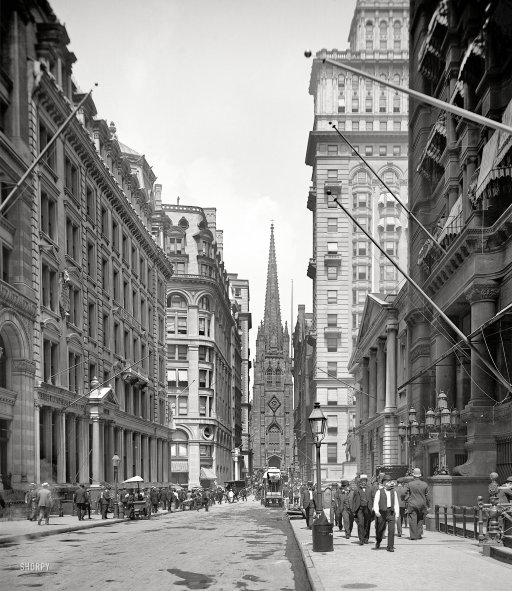
DPC Wall Street and Trinity Church, New York 1903


• Oil Price Fall Starts To Weigh On Banks (FT)
• Oil Sinks Further As OPEC Meeting Begins (MarketWatch)
• World On Brink Of Oil Price War As OPEC Set To Keep Pumping (Telegraph)
• Oil Bust of 1986 Reminds US Drillers of Price War Risks (Bloomberg)
• Drill On: U.S. Mantra as OPEC Power Wanes in the Face of Shale (Bloomberg)
• Oil Slump Reverberates After Nigeria Currency Devaluation (Reuters)
• Seadrill Plunges on Dividend Suspension as Oil Rig Market Sours (Bloomberg)
• Tightening By Superpower Fed Trumps Mini-Stimulus In Europe And Asia (AEP)
• China’s Industrial Profits Drop Most in Two Years Amid Slowdown (Bloomberg)
• Spanish Consumer Prices Decline More Than Forecast (Bloomberg)
• Juncker Investment Plan Questioned on Capital, Leverage (Bloomberg)
• Greece Paralyzed By Major Strike, Flights Stopped (Reuters)
• After Zero Rates, Sweden Ponders Next Steps To Avoid Deflation (Reuters)
• Europe’s Economy Faces Three Major Risks: Draghi (CNBC)
• Goldman Sachs, HSBC Sued By Jeweller For Fixing Platinum Prices (Independent)
• Attack Dogs Deployed To Save South Africa’s Rhinos (Bloomberg)

A loss of $340 million on just one loan.

• Oil Price Fall Starts To Weigh On Banks (FT)

Banks including Barclays and Wells Fargo are facing potentially heavy losses on an $850 million loan made to two oil and gas companies, in a sign of how the dramatic slide in the price of oil is beginning to reverberate through the wider economy. Details of the loan emerged as delegates of Opec, the oil producers’ cartel, gathered in Vienna to address the growing glut in the supply of oil. Several Opec members have been calling for a production cut to shore up prices, but Saudi Arabia, Opec’s leader and largest producer, signalled that it would not push for a big change in the group’s output targets. Repercussions from the decline in the price of crude, which has dropped 30% since June, are spreading beyond the energy sector, hitting currencies, national budgets and energy company shares.

The price slide is having a serious impact on oil producers that rely on revenues from crude exports to balance their budgets. The Russian rouble has lost 27% of its value since mid-June, when crude began to fall, while the Norwegian krone is down 12% and on Wednesday the Nigerian naira touched a record low. Companies are also being hit, with BP’s shares down 17% since mid-June and Chevron’s down 11%. Shares in SeaDrill, one of the world’s biggest drilling rig owners, fell as much as 18% on Wednesday as it suspended dividend payments. The company has suffered from an oversupply of rigs as the majors respond to crude’s slide by cancelling projects. Now banks are also being affected, with Barclays and Wells said to face potential losses on an energy-related loan.

Earlier this year, the two banks led an $850 million “bridge loan” to help fund the merger of Sabine Oil & Gas and Forest Oil, U.S.-based oil companies. Investors, however, balked at buying the loan when it was first offered in June and slumping oil prices combined with volatile credit markets in the months since have scuppered further attempts to sell, or syndicate, the loan, according to market participants. With underwriting banks unable to offload the loan to investors they are now facing losses on the deal as the value of the two oil companies’ debt erodes. Sabine’s bonds were trading above their face value at around $105.25 in June, but have since fallen to $94.25 – firmly in “distressed” territory. Their yield – which moves inversely to price – has jumped from around 7.05% to 13.4%. Rival bankers estimate that if Barclays and Wells attempted to syndicate the $850m loan now, it could go for as little as 60 cents on the dollar.

Read more …

Isn’t it fun?

• Oil Sinks Further As OPEC Meeting Looms (MarketWatch)

Oil prices extended their losses and sunk to fresh four-year lows on Thursday as expectations of a cut in OPEC oil production faded following the Saudi Arabian oil minister’s comments Wednesday. On the New York Mercantile Exchange, light, sweet crude futures for delivery in January traded at $72.22 a barrel, down $1.47, or 2% in the Globex electronic session. January Brent crude on London’s ICE Futures exchange fell $1.92, or 2.5%, to $75.83 a barrel. The Organization of the Petroleum Exporting Countries meets in Vienna within a few hours to decide whether its members will cut production to remove some of the glut in supply in global markets and boost oil prices. The 12-member oil cartel typically steps in to adjust output when prices move sharply due to excess or insufficient supply. It currently has an oil production ceiling of 30 million barrels a day and has been producing in excess of this level in recent months.

Crude-oil prices have plummeted this year, losing almost 30% of their value since June, mainly due to rising U.S. oil production driven by the shale boom and slowing demand growth in Asia and Europe. Analysts say that OPEC will need to cut oil production much lower than its current ceiling for prices to make a significant recovery. Today’s OPEC meeting and any decision on production cuts is likely to set the tone for oil prices for the next few months and well into 2015. Forget about an OPEC cut: Three delegates told Reuters that OPEC was unlikely to take any action after Russia said it wouldn’t cut in tandem. On Wednesday, Saudi Oil Minister Ali al-Naimi said he expects the market “to stabilize itself eventually,” hinting he wouldn’t push for a cut in OPEC’s production targets. “This is a very clear indication that the Saudis and OPEC will do nothing at the meeting … It is not 100% rock solid or set in stone, but it is a very clear signal,” Michael Wittner, head of oil market research at Societe Generale said. His bearish price forecasts are for $70 Brent and $65 WTI for the next two years.

Read more …

“Saudi oil minister Ali Al-Naimi said: “The market will stabilise itself eventually”. Question is where and when.

• World On Brink Of Oil Price War As OPEC Set To Keep Pumping (Telegraph)

Oil slumped on Wednesday as expectations that Opec will cut production faded following dovish remarks by cartel kingpin Saudi Arabia, which could signal the beginning of a price war. Speaking on the sidelines ahead of Thursday’s critical meeting of the Organisation of Petroleum Exporting Countries (Opec) in Vienna, Saudi oil minister Ali Al-Naimi said: “The market will stabilise itself eventually”. His remarks were interpreted by the market as a signal that the cartel would keep its production ceiling at 30m barrels per day (bpd), which sent the price of crude lower. Brent crude – a global benchmark comprised of a blend of high-quality oil from 15 North Sea fields – fell 1.3pc to $77.30 per barrel after Mr Naimi’s comments, before recovering to trade flat at $78.29 by late afternoon. Brent crude has fallen 30pc since June. Crude traded in the US fell to as low as $74 per barrel as traders bet that Opec will allow the price to fall further amid growing signs of a global price war amid producers.

“There remains little prospect of any production cut being agreed at [Thursday’s] Opec meeting,” said brokers at Commerzbank. “Opec will merely agree to comply better with the current production target of 30m bpd. Iranian officials, traditionally seen as hawks within the cartel of mainly Middle East producers, also appeared to soften their position following an afternoon of closed door meetings with counterparts from Saudi Arabia and Kuwait. Bijan Zanganeh, Iran’s oil minister, told reporters after leaving the talks that Iran was now “close” to the Saudi position, heading into Thursday’s final discussion at the Opec secretariat. Rafael Ramirez, Venezuela’s Opec representative, had tried to galvanise support for production cuts to restore oil prices to around $100 per barrel, after talks with senior Russian oil officials on Tuesday delivered no immediate sign of a consensus. Although Russia is not a member of Opec’s 12 nations, the country is a major oil producer and has expressed concerns over falling prices.

Major Opec nations, Russia and US shale oil drillers now appear on the brink of a price war as these three giant producing blocs fight for a greater share of global demand. Although Opec states enjoy the lowest average production costs – in some cases around $2 per barrel – they have increasingly lost ground in North America, which remains the world’s largest consumer of oil. Some Opec members now want producers outside the cartel, including Russia and the US, to shoulder some of the responsibility for balancing the market by essentially cutting their output. UAE energy minister Suhail Al-Mazrouei said on Wednesday that Opec alone was not responsible for the stability of the oil market. “This is not a crisis that requires us to panic,” he said.

Read more …

“In 1986, the Saudis opened the spigot and sparked a four-month, 67% plunge that left oil just above $10 a barrel.” This time around, the Saudis will achieve that by simply not closing the spigot.

• Oil Bust of 1986 Reminds US Drillers of Price War Risks (Bloomberg)

The last time that U.S. oil drillers got caught up in a price war orchestrated by Saudi Arabia, it ended badly for the Americans. In 1986, the Saudis opened the spigot and sparked a four-month, 67% plunge that left oil just above $10 a barrel. The U.S. industry collapsed, triggering almost a quarter-century of production declines, and the Saudis regained their leading role in the world’s oil market. So while no one expects the Saudis to ramp up output now like they did then and U.S. shale oil companies are pledging to keep drilling regardless, the memory of that bust looms large for American industry executives on the eve of OPEC’s meeting tomorrow.

As the Saudis gather with officials from the 11 other OPEC nations in Vienna, analysts are split on whether the group will cut output to lift prices or leave production unchanged to fight for market share with shale drillers. “1986 was the big price collapse and the industry did not see it coming,” said Michael Lynch, president of Strategic Energy and Economic Research in Winchester, Massachusetts, who has covered the oil sector for 37 years. “It put a lot of them out of business. You just don’t forget it. It’s part of the cultural memory.” The Organization of Petroleum Exporting Countries, responsible for about 40% of the world’s output, pumped 31 million barrels a day in October, exceeding its official target of 30 million. Oil has tumbled more than 30% from a 2014 peak in June.

Read more …

The more they drill, the lower prices will go. They’ll lose financing.

• Drill On: U.S. Mantra as OPEC Power Wanes in the Face of Shale (Bloomberg)

No matter what OPEC countries decide tomorrow about cutting oil output, U.S. producers already know what they’re going to do: drill on. As Saudi Arabia and its 11 fellow members of the Organization of Petroleum Exporting Countries meet for what’s viewed as the cartel’s most important conclave since 2008’s worldwide financial crisis, the U.S. has the most to gain and the least to lose. For the oil industry, a significant production cut by OPEC would lift prices and profits across the board and help finance further U.S. energy innovation. And while a weaker response – or no move – would put more pressure on energy companies, the industry is increasingly insulated by burgeoning North American output. “The U.S. oil industry is going to continue on its growth track whether OPEC comes out with a cutback or not,” Daniel Yergin, vice chairman of consultant IHS. “As oil prices go down, the U.S. industry is going up the learning curve and is better capable of coping with lower prices than it would have been two or three years ago.”

The swagger of U.S. producers in the face of plunging oil prices shows the confidence they’ve gained from upending OPEC’s six decades of market dominance with technology that wrings oil from dense rock for prices as low as $40 a barrel. The shale boom has placed the U.S. oil industry in its strongest position since OPEC began flexing its pricing power in the early 1970s. Investors are taking note, pouring money back into shale producers in the past 10 days after shares fell an average 20% since July. Beyond the ability of producers to remain profitable at lower prices, the broader U.S. economy is even less susceptible to whatever course OPEC might take. A shift away from industries like steelmaking and into services such as health care has helped make the economy less reliant than ever on oil and natural gas, according to government data compiled since 1950.

Since the 1973 Arab oil embargo, the first major shock brought about by OPEC coordination, the amount of oil and gas consumed in the U.S. to generate $1 of gross domestic product has fallen 64%. The U.S. in August imported an average of about 4.8 million barrels a day of crude and petroleum products, a 24% decline from 1986, the year when Saudi Arabia’s market machinations sent prices below $10 a barrel in a crushing blow to U.S. producers. As the services economy has grown, oil demand has fallen, with the U.S. burning 13% less oil in 2013 than 2005. Improvements in fuel consumption mean cars and trucks can travel further on each gallon of gasoline. The nation is 26%age points more efficient in terms of the the energy required to generate economic growth than the global average, according to the U.S. Energy Information Administration.

Read more …

” IMF data shows Nigeria, Russia and Saudi Arabia all need prices above $90 to balance their budgets.”

• Oil Slump Reverberates After Nigeria Currency Devaluation (Reuters)

The impact of sub-$80 oil prices rippled across energy-exporting emerging markets on Wednesday, with investors betting other countries will have to follow Nigeria in devaluing their currencies. Brent crude remained firmly below $80 per barrel and around a third lower from June levels after Saudi Arabia signaled it was unlikely to push for a major change in output when producers’ club OPEC meets on Thursday. Nigeria’s naira hit a record low near 178 per dollar – lower than its new target band of 160-176 per dollar – a day after the central bank devalued the currency by 8% and hiked rates by 100 basis points to conserve its reserves. Central bank governor Godwin Emefiele forecast a sustained drop in oil, saying the $73 per barrel assumed in Nigeria’s 2015 budget may be too optimistic.

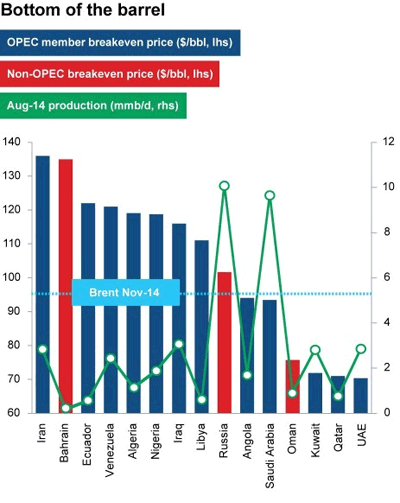
“Oil remains on the back foot … it is a relevant dynamic for the rouble and for various parts of the Middle East and Africa,” said Manik Narain, emerging markets strategist at UBS in London. “We will see more pressure on local currencies there and Nigeria is an early example.” The risk that falling revenues will affect spending plans in oil-exporting countries, with unpredictable political and economic consequences, is a prime concern of investors. IMF data shows Nigeria, Russia and Saudi Arabia all need prices above $90 to balance their budgets. Sub-Saharan Africa’s other big oil producer, Angola, saw its kwanza currency trade near a record low hit on Tuesday.

Read more …

These guys are getting scared.

• Seadrill Plunges on Dividend Suspension as Oil Rig Market Sours (Bloomberg)

Seadrill fell the most in six years after the offshore driller controlled by billionaire John Fredriksen suspended dividends as the slump in oil prices weakens demand for rigs. Seadrill, which hadn’t frozen or cut dividends in six years, dropped as much as 19% in Oslo trading, the most since November 2008. The stock was down 17% to 118.3 kroner at 3:58 p.m., the lowest since July 2010. “The decision to suspend the dividend has been a difficult decision for the board,” Fredriksen, chairman of Bermuda-based Seadrill, said in a statement. “However, taking into consideration the significant deterioration in the broader offshore drilling and financing markets over the past quarter, the board believes this is the right course of action.”

The plunge in crude prices since June is blowing through the oil-services industry as clients peg back spending on finding and developing fields. Transocean, one of Seadrill’s largest competitors, earlier this month wrote down the value of its fleet by $2.76 billion. Halliburton, the second-biggest oil-service company, is buying the third-largest, Baker Hughes. Seadrill, which paid owners $1 a share for the first two quarters this year, said in August that level was sustainable until at least the end of 2015. Today’s surprise decision will strengthen the company’s capital position by about $2 billion a year, the company said. “Suspending dividends entirely is the most reasonable thing to do, since the market is looking so bleak,” said Robert Andre Jensen from SpareBank 1 Markets AS. “Fredriksen’s companies are known for paying dividends, but you have to focus on your chances to survive the downturn.”

Read more …

“The liquidity cycle is inflecting downwards. The odds of turbulence are rising ..”

• Tightening By Superpower Fed Trumps Mini-Stimulus In Europe And Asia (AEP)

The apparent tsunami of stimulus from central banks in Asia and Europe is a mirage. The world’s monetary authorities are on balance tightening. There may or may not be good reasons to buy equities at the current giddy heights, but reliance on the totemic powers and friendly intention of central banks should not be one of them. The US Federal Reserve matters most in a financial world that still moves to the rhythm of the 10-year US Treasury bond, and still runs on a de facto dollar standard. More than 40 currencies have dollar pegs or “dirty floats”, including China, joined to America’s hip whether they like it or not. Some $11 trillion of cross-border loans and bonds issued outside the US are denominated in dollars. The US capital markets are still a colossal $59 trillion, more than the total for Europe and Japan combined.

The Institute of International Finance says the impact of Fed action on capital flows to emerging markets is “twice as large” as moves by the European Central Bank. The Fed can hardly put off rate rises for much longer as the US economy grows at a 3.9pc clip and the jobless rate drops to a six-year low of 5.8pc. The “quit rate” tracked by labour economists as a barometer of the jobs market is suddenly surging, a clear sign that slack is vanishing and wage pressures will soon rise. The world is already turning on its axis even before the Fed pulls the trigger, as if the QE era were a memory. The dollar largesse that flooded the commodity nexus and drove the credit booms of Asia, Latin America and Africa is draining away. “The liquidity cycle is inflecting downwards. The odds of turbulence are rising,” said CrossBorder Capital, which monitors global flows.

Fresh money creation in Japan, China and the eurozone would not offset a liquidity squeeze by the Fed in a symmetric fashion even if it were happening, but it is not in fact happening on anything like an equivalent scale, and may not do so for a long time. The “happy handover” scenario is wishful thinking. China is tightening at a slower pace, but it is still tightening. The surprise rates cuts last week are less than meets the eye. The People’s Bank of China (PBOC) regulates the level of credit in the economy through curbs on quantity, not by adjusting the cost of credit. These controls are still in place. It is too early to conclude that President Xi Xinping has capitulated and ordered the PBOC to reflate, pushing the day of reckoning into the future once again. The balance of evidence is that Beijing is still attempting – with great difficulty – to deflate China’s $26 trillion credit boom before it turns into a national tragedy.

Read more …

” .. investment in fixed assets such as machinery expanded the least since 2001 ..”

• China’s Industrial Profits Drop Most in Two Years Amid Slowdown (Bloomberg)

Industrial profits in China fell the most in two years, underscoring the need for looser monetary conditions as the world’s second-largest economy slows. Total profits of China’s industrial enterprises fell 2.1% from a year earlier in October, the National Bureau of Statistics said today in Beijing. That compares with September’s 0.4% increase and is the biggest drop since August 2012, based on previously reported data.

The People’s Bank of China, which last week cut benchmark interest rates, refrained from selling repurchase agreements in open-market operations today for the first time since July, loosening monetary policy further. Mired by a property slump, overcapacity and factory-gate deflation, China is headed for its slowest full-year economic expansion since 1990. Data released Nov. 13 showed the economy’s slowdown deepened in October. Factory production rose 7.7% from a year earlier, the second weakest pace since 2009, while investment in fixed assets such as machinery expanded the least since 2001 from January through October. Retail sales gains also missed economists’ forecasts last month.

Read more …

And it’s supposed to be doing so well?!

• Spanish Consumer Prices Decline More Than Forecast (Bloomberg)

Spanish consumer prices fell more than economists forecast in November, which may raise concerns that deflation is taking hold in the euro region’s fourth-largest economy. Prices dropped 0.5% from a year earlier, the Madrid-based National Statistics Institute said today. The decline, based on a European Union measure, was bigger than the 0.3% forecast by economists in a Bloomberg News survey. Economic growth was unchanged at 0.5% in the third quarter, INE said in a separate release, confirming its Oct. 30 estimate. Euro-area data tomorrow is forecast to show inflation in the 18-nation currency region slowed to 0.3% in November to match the least since 2009.

European Central Bank policy makers are watching for signs that additional stimulus may be needed and have expert committees examining further measures to help boost near-stagnant growth to add to long-term loans and asset-purchase programs. “The data show risks of deflation remain high for some countries,” said Diego Trivino, chief economist at Intermoney Valores in Madrid. “Price drops in Spain are forced and structural as it’s the only way it can regain competitiveness in an environment of near-zero inflation in the euro region.” Spanish bond yields fell to a record low this week along with those of most members of the 18 nation euro region after ECB President Mario Draghi stoked speculation of a new stimulus program extending to sovereign bonds.

Read more …

Juncker is a windbag, and plans like this are what comes out of such bags.

• Juncker Investment Plan Questioned on Capital, Leverage (Bloomberg)

German Chancellor Angela Merkel said she supports the European Commission’s 315 billion-euro ($394 billion) investment plan “in principle” as businesses around Europe sounded a note of caution. “We stress that investments are important, but that it has to be clear above all where the projects of the future lie,” Merkel, who announced Germany’s own 10 billion-euro investment program earlier this month, told the Bundestag in Berlin yesterday. The investment plan unveiled by commission President Jean-Claude Juncker will use 5 billion euros in cash from the European Investment Bank and 16 billion euros in European Union guarantees. The start-up money, projected to have an impact of 15 times its size, will serve as capital for a new EIB unit that can share risk with private investors.

The fund doesn’t have sufficient capital, Spanish Economy Minister Luis de Guindos said in Madrid yesterday. He described the commission’s leverage projection as “a bit high.” It’s right to focus on measures “to raise growth prospects across Europe and the emphasis on increasing private-sector investment,” British Chancellor of the Exchequer George Osborne said in a statement. The program, called the European Fund for Strategic Investments, is set to be operational by mid-2015. It doesn’t require EU member nations to commit any new money or alter existing budget agreements. The Brussels-based commission will dedicate 8 billion euros of existing funds to backstop its guarantee.

“Using a small amount of public funds to leverage private-sector provision can be a successful way to ensure that we choose projects that drive productivity and growth,” said Markus Beyrer, director general at BusinessEurope, a lobby representing employers from 35 nations. “We hope the leverage ratios set out in the investment plan can be achievable, but we must ensure that projects taken forward are genuinely ones that would not have taken place without the new fund.” By taking on some of the risk of new projects through a first-loss liability, the investment fund aims to attract cash-rich banks and companies to support investments in energy, broadband and transport infrastructure and back risk finance for small and medium-sized companies.

Read more …

Go. Leave.

• Greece Paralyzed By Major Strike, Flights Stopped (Reuters)

Greek labour unions staged a 24-hour strike on Thursday that cancelled hundreds of flights, shut public offices and severely disrupted local transport, in the first major industrial action to cripple the austerity-weary country in months. Private sector union GSEE and its public sector counterpart ADEDY called the walkout to protest against planned layoffs and pension reform demanded by European Union and International Monetary Fund lenders who have bailed out Greece twice. All Greek domestic and international flights were cancelled after air traffic controllers joined the strike. Trains and ferries also halted services. Hospitals worked on emergency staff while tax and other local public offices remained shut. “GSEE is resisting the dogmatic obsession of the government and the troika with austerity policies and tax hikes,” the union said in a statement this week.

It accused the government of trying to take the labour market back to “medieval times” and of implementing policies that are causing a “humanitarian crisis”. Thousands of Greeks were preparing to march to parliament later on Thursday as part of rallies to mark the strike. The two unions last held a general strike in April. Major protests have declined sharply since then as frustration and anger give way to a mood of despondency and resignation over a jobless rate exceeding 25% and a sharp fall in incomes. Turnout at Thursday’s rallies could provide a key measure of the opposition facing Prime Minister Antonis Samaras’s conservative-led government, which is under pressure from EU/IMF lenders to impose more cutbacks to balance next year’s budget.

Read more …

Yep. Krugman was here.

• After Zero Rates, Sweden Ponders Next Steps To Avoid Deflation (Reuters)

What should a central bank do next when it already has zero interest rates and arguably still faces the threat of Japanese-style deflation? If it’s the Swedish Riksbank, it should keep cutting, and do so soon, says Lars Svensson. Svensson no longer has a say; he quit as a deputy Riksbank governor last year after failing to persuade fellow board members to cut rates aggressively. Last month, they heeded his advice, lowering the repo rate to 0% and pushing back the official forecast for when the Riksbank will start tightening monetary policy again to mid-2016. After years of tense, polarized meetings that eventually led to Svensson’s resignation, a united Riksbank now sees zero rates as enough to push inflation up toward its 2% target. Svensson disagrees, saying Sweden should go into negative rates – effectively charging banks to deposit funds at the central bank – to avoid the deflation which has trapped Japan in low economic growth punctuated by periodic recessions for more than a decade.

“From this point it is unlikely that the current policy at zero is enough,” he told Reuters. “They should lower to -0.25 or even -0.50. The next meeting would be the natural time.” The Riksbank’s next policy meeting is on Dec. 15, with its decision announced the following morning. Rate-setters have not ruled out negative rates, but Riksbank Governor Stefan Ingves has rejected the comparison with Japan, pointing to expected Swedish growth this year of around 1.9%, with the economy moving up a gear again in 2015. Nevertheless, Swedish consumer prices have been flat or falling for most of the last two years on an annual basis. Underlying inflation, the Riksbank’s preferred measure which excludes interest rate effects, was 0.6% in October.

Read more …

Draghi himself is a big risk.

• Europe’s Economy Faces Three Major Risks: Draghi (CNBC)

Europe’s recovery faces three risks – unemployment and a lack of productivity and structural reforms, according to the European Central Bank’s President, Mario Draghi. In a speech to be delivered to the Finnish Parliament later Thursday, Draghi concedes that the euro area economic outlook “is surrounded by a number of downside risks.” According to a transcript released ahead of the speech to Finnish lawmakers, Draghi will say that the euro zone’s “recovery will likely be dampened by high unemployment, sizeable unutilized capacity, and the necessary balance sheet adjustments….Inflation in the euro zone remains very low (and) meanwhile, we are facing continuously sluggish money and credit dynamics.”

“We have seen a weakening in the euro area’s growth momentum over the summer Also, most recent forecasts by private and public sector institutions have been revised downwards. Our expectation for a moderate recovery in the next years still remains in place, reflecting our monetary policy measures, the ongoing improvements in financial conditions, and the progress made vis-à-vis structural reforms and fiscal consolidation,” he said. His comments come amid speculation as to whether the ECB will implement a U.S.-style quantitative easing program to stimulate the euro zone economy in the face of slowing growth, disinflation and low consumer confidence – at a 9-month low in November.

Read more …

Why isn’t Washington suing them?

• Goldman Sachs, HSBC Sued By Jeweller For Fixing Platinum Prices (Independent)

Goldman Sachs and HSBC are among a group of banks being sued in the US for allegedly fixing platinum and palladium prices. Modern Settings — a jeweller that buys precious metals and derivatives set on their prices — claims the banks “were privy to and shared confidential, non-public information about client purchase and sale orders that allowed them to glean information about the direction” of prices. “This unlawful behaviour allowed defendants to reap substantial profits, while non-insiders, which include plaintiffs, were injured,” lawyers acting for the company added. Separately, HSBC is facing a probe into allegations that an employee leaked confidential client information to a major hedge fund, according to reports. The leak is alleged to have taken place in March 2010, when HSBC was advising Prudential on its failed bid for AIA. A senior HSBC trader is said to have alerted a trader at hedge fund Moore Capital Management about a transaction taking place.

Read more …

It’s going to take a lot more than dogs.

• Attack Dogs Deployed To Save South Africa’s Rhinos (Bloomberg)

Strapped into a black nylon harness, Venom abseils from a helicopter 100 feet to a bush clearing below. The two-year-old Belgian Shepherd’s master Marius slides down in tandem and unclips his ward. Then the dog races across the grass and tears down a man wearing a felt-stuffed bite suit. Venom is part of an army of dogs being trained as South African defense company Paramount Group’s contribution to fighting the poachers in South Africa, home to most of the world’s rhinos. Prized for their horns, which are used in Asian traditional medicine, a record 1,020 rhinos have been slaughtered in the country this year, triple the number three years ago.

The Malinois, as the breed is also known, “can work in extreme conditions,” Henry Holsthyzen, who runs Paramount’s K9 Solutions dog academy, said at a presentation of the year-old school yesterday. “It’s been proven useful in Iraq and Afghanistan. It’s high energy, highly intelligent and very fast. It’s an awesome package.” Rhino horns are made of the same material as human hair or finger nails, yet is more valuable than gold by weight. Prices for a kilogram range from $65,000 to as much as $95,000 in China and Vietnam, where consumers buy them in a powdered form to ingest as a supposed cure for cancer and to try improve their libido. South Africa is trying a number of measures to end the poaching, including setting up a protection zone within the Israel-sized Kruger National Park, moving rhinos to private ranches and deploying soldiers to fight poachers.
Read more …

Nov 242014
 
 November 24, 2014  Posted by at 2:33 pm Finance Tagged with: , , , , , , , ,  7 Responses »


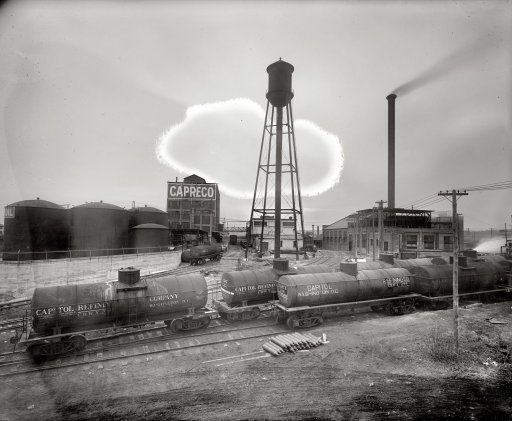
NPC Capitol Refining Co. plant, Relee, Alexandria County 1925

This is an article by our good friend Euan Mearns at the University of Aberdeen. It was originally published here .

  • In February 2009 Phil Hart published on The Oil Drum a simple supply demand model that explained then the action in the oil price. In this post I update Phil’s model to July 2014 using monthly oil supply (crude+condensate) and price data from the Energy Information Agency (EIA).
  • This model explains how a drop in demand for oil of only 1 million barrels per day can account for the fall in price from $110 to below $80 per barrel.
  • The future price will be determined by demand, production capacity and OPEC production constraint. A further fall in demand of the order 1 Mbpd may see the price fall below $60. Conversely, at current demand, an OPEC production cut of the order 1 Mbpd may send the oil price back up towards $100. It seems that volatility has returned to the oil market.

Figure 1 An adaptation of Phil Hart’s oil supply demand model. The blue supply line is constrained by data (see Figure 4). The red demand lines are conceptual. Prior to 2004, oil supply was fairly elastic to changes in price, i.e. a small rise in price led to a large rise in production. This is explained by OPEC opening and closing the taps. Post 2004, oil supply became inelastic to price, i.e. a large change in price led to marginal increase in supply. This is explained by the world pumping flat out. Demand tends to be fairly inelastic and inversely correlated with price in that high price suppresses demand a little. Supply and price at any point in time is defined by the intersection of the supply and demand curves. 72 Mbpd and $40 / bbl in 2004 became 76 Mbpd and $120 / bbl in 2008 as demand for oil soared against inelastic supply.

Figure 2

Followers of the oil market will be familiar with the recent evolution of oil supply and price shown in Figure 2.

Figure 3

What is less widely appreciated is that a cross plot of the data shown in Figure 2 results in the well-ordered relationship shown in Figure 3. Oil supply and price are clearly following some well established rules. This relationship led to Phil Hart developing his model shown as Figure 1.

Figure 4

Separating the data into two time periods brings more clarity to the process at work. The data define a fairly well-ordered time series beginning at January 1994 at the bottom left rising slowly to January 2004 and then steeply to the Olympic Peak of July 2008. The financial crash then caused the oil price to give up all of its gains returning to 2004 levels by December 2008.

Figure 5

The second time period from January 2009 to the present shows some different forces at work. Starting in 2009 some new production capacity was built. This was not in OPEC and is concentrated in N America where the light tight oil (LTO) boom took off supplemented by steady expansion of tar sands production. Prior to 2009, the production peaks were of the order 74 Mbpd. Post 2009 peaks of the order 77 Mbpd were achieved. About 3 Mbpd new capacity has been added. In May 2011 there is a significant and curious excursion to lower production not accompanied by a fall in price. This coincides with Libya coming off line for the first time and the loss of 1.6 Mbpd production. It seems possible that this coincided with weak demand and the fortuitous loss of production cancelling weak demand leaving price unchanged.

The EIA are always running a few months behind with their statistics these days, not ideal in a rapidly changing world. Thus we do not yet have the data to see the recent crash in the oil price. But we know the price has fallen below $80 and production is unlikely to be significantly changed. So, how do we explain production of roughly 77 Mbpd and a price below $80?

Figure 6

Figure 6 updates Phil Hart’s model (Figure 1) to take account of the oil supply and price movements of the last 5 years. Capacity expansion is achieved by adding 3 Mbpd to the former, well-defined supply-price curve (blue arrow). There is no a-priori reason that this curve should hold in the new supply-price regime, but for the time being that is all I have to work with. The red lines, as described in the caption to Figure 1, conceptually represent inelastic demand where high price marginally suppresses demand for oil. The recent past has seen oil priced at $110 with supply running at about 77 Mbpd as defined by the right hand red coloured demand curve. Reducing demand by about 1 Mbpd brings the price below $80 / bbl (red arrow).

The Recent Past and the Future

Old hands will know that it is virtually impossible to forecast the oil price. The anomalous recent price stability of $110±10 I believe reflects great skill on the part of Saudi Arabia balancing the market at a price high enough to keep Saudi Arabia solvent and low enough to keep the world economy afloat. The reason Saudi Arabia has not cut production now, when faced with weak global demand for oil, probably comes down to their desire to maintain market share which means hobbling the N American LTO bonanza. Alternatively, they could be conspiring with the USA to wreck the Russian economy? But Saudi Arabia is not the only member of OPEC and the economies of many of the member countries will be suffering badly at these prices and that ultimately leads to elevated risk of civil unrest. It is not possible to predict the actions of the main players but it is easier to predict what the outcome may be of certain actions.

  1. If demand for oil weakens by about a further 1 Mbpd this may send the price down below $60 / bbl.
  2. If OPEC cuts supply by about 1 Mbpd at constant demand this may send the price back up towards $100 / bbl.
  3. Prolonged low price may see LTO production fall in N America and other non-OPEC projects shelved resulting in attrition of non-OPEC capacity. This may take one to two years to work through but with constant demand, this will inevitably send prices higher again.
  4. Prolonged low price may see many specialist LTO producers default on loans, risking a new credit crunch and reduced LTO production. This would likely lead to a major consolidation of operators in the LTO patch where the larger companies (the IOCs) pick up the best assets at knock down prices. That is the way it has always been.
  5. Black Swans and elephants in the room – with conflict escalation in Ukraine and / or Syria-Iraq and a new credit crunch, all bets will be off.

[Ilargi:] And this comment to the article from Euan’s friend and collaborator Roger Andrews certainly warrants attention as well. (check the grey dots!):

Hi Euan:

I put this XY plot of the data together from the data links you supplied. It shows the same trends as your Figures except that I’ve plotted all the points on one graph and segregated them into five periods, with trend lines and arrows showing the overall “direction of travel” for each (arrows in both directions for October 2004-May 2009, which as you noted goes zooming up and then comes right back down again).

I’ve also projected production data for the missing months since May 2014 (shouldn’t be too far off) so that we can at least get an idea of how the latest trend might compare with the old ones. We seem to be in uncharted territory.

Nov 242014
 
 November 24, 2014  Posted by at 12:02 pm Finance Tagged with: , , , , , , , , , ,  Comments Off on Debt Rattle November 24 2014


William Henry Jackson Hospital Street, St. Augustine, Florida 1897

• Global Business Confidence Plunges To Post-Crisis Low (CNBC)
• Pope Francis Warns Greed Of Man Will ‘Destroy The World’ (Daily Mail)
• Record Numbers Of UK Working Families In Poverty Due To Low-Paid Jobs (Guardian)
• New Abnormal Means Relying on Central Banks for Growth (Bloomberg)
• Why We Can’t Afford Another Financial Crisis (Guardian)
• PBOC Bounce Seen Short Lived as History Defies Bulls (Bloomberg)
• China Rate-Cut Likely To Hurt Banks, Curb New Loans To Small Borrowers (Reuters)
• Bad News Mounts for Chinese Banks, Funds Grow More Bullish (Bloomberg)
• Property, Manufacturing Woes Help Trim China’s Shadow Banking (Reuters)
• The Consequences of Imposing Negative Interest Rates (Tenebrarum)
• Why Countries Wage Currency Wars (A. Gary Shilling)
• How the EU Plans to Turn $26 Billion Into $390 Billion (Bloomberg)
• Draghi’s About to Find Out How Urgent His Call for Action Has Become (Bloomberg)
• UK Supermarket War Turns Smaller Food Suppliers Into ‘Cannon Fodder’ (Guardian)
• ‘OPEC’s Easy Days Setting Oil Production Are Over’ (Bloomberg)
• Russia Losing ‘Up To $140 Billion’ From Sanctions, Oil Drop (Reuters)
• Demand Set to Outstrip the $100 Trillion Bond Market Again in 2015 (Bloomberg)
• Swedish Banks Face Deposit Drain as Interest Rates Slump (Bloomberg)
• World Locked Into ‘Alarming’ Global Warming: World Bank (CNBC)

How much money was thrown into the system in those five years?

• Global Business Confidence Plunges To Post-Crisis Low (CNBC)

Worldwide business confidence slumped to a five-year low, with company hiring and investment intentions at or near their weakest levels in the post-global financial crisis era, according to a new survey. “Clouds are gathering over the global economic outlook, presenting the darkest picture seen since the global financial crisis,” said Chris Williamson, chief economist at Markit. The number of companies expecting their business activity to be higher in a years’ time exceeded those expecting a decline by just 28%. This was below the net balance of 39% recorded in the summer, the Markit Global Business Outlook Survey showed. The tri-annual survey, published on Monday, looked at expectations for the year ahead across 6,100 manufacturing and services companies worldwide. Optimism in manufacturing fell to its lowest since mid-2013 but remained ahead of that seen in services, where confidence about the outlook slumped to the lowest in the survey’s five-year history.

Global hiring intentions slid to within a whisker of the all-time low seen in June of last year, deteriorating in the U.S., Japan, the U.K., euro zone, Russia and Brazil. [..] Investment intentions also collapsed to a new post-crisis low across major economies. China and India bucked the trend, however, with capital expenditure plans in the two countries improving. The survey highlighted a growing list of concerns among companies about the outlook for the year ahead including a worsening global economic climate, the prospect of higher interest rates in countries such as the U.K. and U.S. and geopolitical risk emanating from crises in Ukraine and the Middle East. “Of greatest concern is the slide in business optimism and expansion plans in the U.S. to the weakest seen over the past five years. U.S. growth therefore looks likely to have peaked over the summer months, with a slowing trend signaled for coming months,” Williamson said.

Read more …

‘It is also painful to see the struggle against hunger and malnutrition hindered by ‘market priorities’, the ‘primacy of profit’, which reduce foodstuffs to a commodity like any other, subject to speculation and financial speculation in particular ..’

• Pope Francis Warns Greed Of Man Will ‘Destroy The World’ (Daily Mail)

Pope Francis has warned that planet earth could face a doomsday scenario if the world does not stop abusing its resources for profit The pontiff warned that nature would exact revenge, and urged the world’s leaders to rein in their greed and help the hungry. He told the Second International Conference on Nutrition (CIN2) in Rome: ‘God always forgives, but the earth does not. ‘Take care of the earth so it does not respond with destruction.’ The three-day meeting aimed at tackling malnutrition, and included representatives from 190 countries.

It was organised by the UN food agency (FAO) and World Health Organization (WHO) in the Italian capital. The 77-year old said the world had ‘paid too little heed to those who are hungry.’ While the number of undernourished people dropped by over half in the past two decades, 805 million people were still affected in 2014. ‘It is also painful to see the struggle against hunger and malnutrition hindered by ‘market priorities’, the ‘primacy of profit’, which reduce foodstuffs to a commodity like any other, subject to speculation and financial speculation in particular,’ Francis said.

Read more …

Britain’s new normal: ” .. the report showed a real change in UK society over a relatively short period of time.”

• Record Numbers Of UK Working Families In Poverty Due To Low-Paid Jobs (Guardian)

Insecure, low-paid jobs are leaving record numbers of working families in poverty, with two-thirds of people who found work in the past year taking jobs for less than the living wage, according to the latest annual report from the Joseph Rowntree Foundation. The research shows that over the last decade, increasing numbers of pensioners have become comfortable, but at the same time incomes among the worst-off have dropped almost 10% in real terms. Painting a picture of huge numbers trapped on low wages, the foundation said during the decade only a fifth of low-paid workers managed to move to better paid jobs. The living wage is calculated at £7.85 an hour nationally, or £9.15 in London – much higher than the legally enforceable £6.50 minimum wage.

As many people from working families are now in poverty as from workless ones, partly due to a vast increase in insecure work on zero-hours contracts, or in part-time or low-paid self-employment. Nearly 1.4 million people are on the controversial contracts that do not guarantee minimum hours, most of them in catering, accommodation, retail and administrative jobs. Meanwhile, the self-employed earn on average 13% less than they did five years ago, the foundation said. Average wages for men working full time have dropped from £13.90 to £12.90 an hour in real terms between 2008 and 2013 and for women from £10.80 to £10.30.

Poverty wages have been exacerbated by the number of people reliant on private rented accommodation and unable to get social housing, the report said. Evictions of tenants by private landlords outstrip mortgage repossessions and are the most common cause of homelessness. The report noted that price rises for food, energy and transport have far outstripped the accepted CPI inflation of 30% in the last decade. Julia Unwin, chief executive of the foundation, said the report showed a real change in UK society over a relatively short period of time. “We are concerned that the economic recovery we face will still have so many people living in poverty. It is a risk, waste and cost we cannot afford: we will never reach our full economic potential with so many people struggling to make ends meet.

Read more …

Central banks can’t create growth.

• New Abnormal Means Relying on Central Banks for Growth (Bloomberg)

The “new normal” may be new. It’s hardly normal. The “new abnormal” would be more apt, according to reports published this month by Ed Yardeni and ING’s Mark Cliffe in London. “Dictionaries define ‘normal’ as regular, usual, healthy, natural, orderly, ordinary, rational,” Cliffe said Nov. 7. “It is hard to use those words to describe the current performance of the world economy and financial markets.” Among signs of irregularity since Pimco popularized the expression “new normal” in 2009 to describe an environment of below-average economic growth: Central banks are still deploying near-zero interest rates or quantitative easing six years after the financial crisis, yet output, inflation, business investment and wages remain mostly subpar. In financial markets, equities are hitting new highs as bond yields probe new lows. Even as the U.S. shows signs of strength, commodities are slumping.

The lesson for Yardeni is that by running to the rescue every time asset prices swooned in the past two decades, central bankers’ prescriptions distorted economies. “If a central bank moderates recessions, then speculative excesses are likely to build up much more during the booms and never get fully cleaned out,” Yardeni, a former chief economist at Deutsche Bank, said in a Nov. 19 report. “So each financial crisis gets progressively worse than the previous one, forcing the central bank to provide even more easy money to avert a financial meltdown.” Cliffe at ING is less willing than Yardeni to lambaste central banks, noting it’s hard to say how bad a recession may have occurred without their aid. Still, he agrees that policy makers now find themselves having to keep an eye on markets as much as the economies when setting policy.

Read more …

“For now, the Federal Reserve, the European Central Bank and the Bank of England prefer not to contemplate this dire possibility.”

• Why We Can’t Afford Another Financial Crisis (Guardian)

A look into the future: David Cameron’s nightmare has come true; the slowdown in the global economy has turned into a second major recession within a decade. In those circumstances, there would be two massive policy challenges. The first would be how to prevent the recession turning into a global slump. The second would be how to prevent the financial system from imploding. These are the same challenges as in 2008, but this time they would be magnified. Zero interest rates and quantitative easing have already been used extensively to support activity, which would leave policymakers with a dilemma. Should they double down on QE or come up with more radical proposals – drops of helicopter money or using QE for specified purposes, such as investment in green energy?

For now, the Federal Reserve, the European Central Bank and the Bank of England prefer not to contemplate this dire possibility. They will deal with it if it happens, but are assuming it won’t. More explicit plans have been drawn up for the big banks. The concern here is obvious. The bailouts last time played havoc with the public finances and the still incomplete repair job has required unpopular austerity. Governments are not flush enough to contemplate a second wave of bailouts. Even if they had the money, they know just how voters would react if there was talk of bailing out the bankers a second time.

Read more …

They’ll just cut again. Or maybe even just devalue the yuan overnight.

• PBOC Bounce Seen Short Lived as History Defies Bulls (Bloomberg)

China’s benchmark stock index rose to a three-year high after the central bank’s surprise interest rate cut late last week. Recent history suggests the gains won’t last long. While the Shanghai Composite Index climbed 1.9% today, six of the past seven cuts to interest rates and reserve requirements have been followed by declines in stock prices over the next two months. The last time the PBOC lowered lending and deposit rates, in July 2012, the benchmark index fell 7.4%, according to data compiled by Bloomberg. The rate cut, announced after the close of regular trading in China on Nov. 21, underlines concern that a slowdown in the world’s second-largest economy is deepening. Factory production rose 7.7% in October from a year earlier, the second-weakest pace since 2009, while retail sales missed economists’ forecasts.

China’s economy expanded 7.3% in the three months ended September and it’s projected to grow this year at the slowest pace since 1990 amid weakness in the property market and manufacturing. “In the short term, it’s positive, but in the long term, the economic slowdown is probably the main driver of the market,” Lucy Qiu, an emerging markets analyst at UBS Wealth Management, which has $1 trillion in invested assets, said by phone from New York on Nov. 21. “This announcement came after a slew of underperforming economic releases. It kind of shows the government is determined to support growth, but going forward we really have to look at the data.” The PBOC has cut reserve requirements for the nation’s largest lenders three times and lowered benchmark rates three times since late 2011.

Policy makers said in a Nov. 21 statement that the move in interest rates was “a neutral operation and doesn’t mean any change in monetary policy direction.” As China is still able to keep medium to high growth rates, it “has no need to take strong stimulus measures, and the direction of prudent monetary policy won’t change,” the central bank said. China’s retail inflation held at the slowest pace since January 2010 last month. Consumer prices increased 1.6%, matching September’s rate, while producer prices fell for a record 32nd month, slumping 2.2%.

Read more …

Unintended consequences?!

• China Rate-Cut Likely To Hurt Banks, Curb New Loans To Small Borrowers (Reuters)

China’s latest interest rate cut is set to dent the profitability of domestic lenders, especially mid-sized banks, which are already suffering from higher bad loans and a slowdown in profit growth. The central bank unexpectedly cut rates late on Friday, stepping up efforts to support small and medium-sized enterprises (SMEs) which are struggling to repay loans and access credit, as the economy slides to its slowest growth in nearly a quarter of a century. It slashed the one-year benchmark lending rate by 40 basis points to 5.6% while lowering the one-year benchmark deposit rate by 25 basis points to 2.75%. The narrowing of interest rate margins will eat into lenders’ profitability, with Cinda Securities’ chief strategist, Jiahe Chen, predicting it will cut profits by up to 5%. Interest margins generated from lending have already been shrinking for second-tier lenders, which have been squeezed by competition from online financiers and a rise in funding costs stemming from an industry tussle for deposits.

Fitch Ratings downgraded its credit rating of China Guangfa Bank, a medium-sized lender, two days before the rate-cut announcement, and said the level of off-balance-sheet lending among second-tier banks was a concern. The squeeze on profits will make it tougher for lenders to raise capital to meet new international rules designed to protect depositors from banking collapses. Retained profits are one way in which banks can build up regulatory capital. “In the past when Chinese banks disbursed loans, they mainly relied on profits from their own capital to replenish their capital,” Jiang Jianqing, chairman of China’s biggest commercial bank, the Industrial and Commercial Bank of China, told a conference in Beijing on Saturday. The PBoC said in announcing the rate cut that it wanted to help smaller firms gain access to credit. While the measures may ease the financing costs of these firms’ existing loans, it is unlikely to encourage banks to write new loans to lower-rung borrowers, bankers said.

Read more …

Bad debt is China’s biggest conundrum. How can they ever get out other than through defaults?

• Bad News Mounts for Chinese Banks, Funds Grow More Bullish (Bloomberg)

China’s banks, already saddled with mounting bad debt, face the risk of sagging profit growth after an interest-rate cut slashed their margins on loans. The twist: some investors are getting more optimistic, not less, about the outlook for the industry’s shares. Victoria Mio, chief investment officer for China at Robeco Hong Kong, whose parent company oversees about €237 billion ($294 billion), said Nov. 21 that bank stocks were very attractive because they were priced at levels that assumed an economic “hard landing.” Hours later, the central bank cut the one-year lending rate by 0.4 percentage point and the one-year deposit rate by 0.25 percentage point. Afterward, Mio said sustained monetary easing may drive an economic rebound and a jump in banks’ share prices. She was “more positive” on the stocks.

Chinese banks are trading at an average 4.8 times estimated earnings for this year, the lowest globally for lenders with a market value of more than $10 billion, according to data compiled by Bloomberg. Another fund manager, Baring Asset Management Ltd.’s Khiem Do, said he was “still bullish” on banks after the rate move and that dividends of more than 6% would become even more attractive as interest rates fall. “You tell me which banks in the world are paying out this yield, and making money, and working in an environment where the economy is growing at about 7% per annum,” he said earlier by phone. Do helps oversee about $60 billion as Hong Kong-based head of Asian multi-asset strategy. Ma Kunpeng, a Shanghai-based analyst at Sinolink Securities Co., has a buy rating on the industry. He said banks’ share prices have fallen even when earnings have exceeded expectations because investors have focused more on “perceived risks” than profits.

Read more …

China’s economy doesn’t function without shadow banks. There might be a hard lesson for Beijing in the offing here.

• Property, Manufacturing Woes Help Trim China’s Shadow Banking (Reuters)

A bid by China to rein in its “shadow banking” activity is producing results, thanks to slowing economic growth and tighter regulation. But some success for a policy drive to curb risky lending is not all good news for Beijing, as smaller companies may face even bigger struggles to find funding. A cut in interest rates, announced by Beijing on Friday, is unlikely to help them much. Shadow banking includes off-balance-sheet forms of bank finance plus lending by non-traditional institutions, all of which is less regulated than formal lending and thus considered riskier. At the end of 2013, China had the world’s third-largest shadow banking sector, according to the Financial Stability Board, a task force set up by the G-20 economies. It estimated that Chinese assets of “other financial intermediaries” than traditional ones were then just under $3 trillion.

In the three months ended Sept. 30, the shadow banking portion of what China calls total social financing – a broad measure of liquidity in the economy – contracted for the first time on a quarterly basis since the 2008/09 financial crisis. Loans extended by trust companies fell by roughly 100 billion yuan ($16.33 billion). Bankers’ acceptances, a short-term method of financing regularly used by manufacturers, dropped 668.3 billion yuan, according to Reuters calculations based on central bank data. October lending data, released last week, showed further contractions in these types of shadow banking. Bankers’ acceptances and trust loans “fall into categories that have been squeezed by tightening regulations in the last few months, so it’s an ongoing trend,” said Donna Kwok, an economist at UBS in Hong Kong.

Read more …

“What can be abolished by laws and decrees is merely the right of the capitalists to receive interest. But such laws would bring about capital consumption and would very soon throw mankind back into the original state of natural poverty.”

• The Consequences of Imposing Negative Interest Rates (Tenebrarum)

Ever since the ECB has introduced negative interest rates on its deposit facility, people have been waiting for commercial banks to react. After all, they are effectively losing money as a result of this bizarre directive, on excess reserves the accumulation of which they can do very little about. At first, only a small regional bank, Deutsche Skatbank, imposed a penalty rate on large depositors – slightly in excess of the 20 basis points banks must currently pay for ECB deposits. It turns out this was a Trojan horse. Other banks were presumably watching to see if depositors would flee Skatbank, and when that didn’t happen, Commerzbank decided to go down the same road. However, there is an obvious flaw in taking such measures – at least is seems obvious to us. The Keynesian overlords at the central bank who came up with this idea have failed to consider a warning Ludwig von Mises once uttered about the attempt to abolish interest by decree.

Obviously, the natural interest rate can never become negative, as time preferences cannot possibly become negative: ceteris paribus, consumption in the present will always be preferred to consumption in the future. Mises notes that if the natural interest rate were to decline to zero, all consumption would stop – we would die of hunger while investing all of our resources in capital goods, i.e., while directing all of our efforts and funds toward production for future consumption. This is obviously a situation that would make no sense whatsoever – it is simply not possible for this to happen in the real world of human action. Mises warns however that if interest payments are abolished by decree, or even a negative interest rate is imposed by decree, owners of capital will indeed begin to consume their capital – precisely because want satisfaction in the present will continue to be preferred to want satisfaction in the future regardless of the decree. This threatens to eventually impoverish society and reduce it to a state of penury:

If there were no originary interest, capital goods would not be devoted to immediate consumption and capital would not be consumed. On the contrary, under such an unthinkable and unimaginable state of affairs there would be no consumption at all, but only saving, accumulation of capital, and investment. Not the impossible disappearance of originary interest, but the abolition of payment of interest to the owners of capital, would result in capital consumption.

The capitalists would consume their capital goods and their capital precisely because there is originary interest and present want-satisfaction is preferred to later satisfaction. Therefore there cannot be any question of abolishing interest by any institutions, laws, and devices of bank manipulation. He who wants to “abolish” interest will have to induce people to value an apple available in a hundred years no less than a present apple. What can be abolished by laws and decrees is merely the right of the capitalists to receive interest. But such laws would bring about capital consumption and would very soon throw mankind back into the original state of natural poverty.”

Read more …

Because they’re desperate.

• Why Countries Wage Currency Wars (A. Gary Shilling)

The U.S. dollar has been on a tear this year, rising against the currencies of virtually all major developed economies. What we’re seeing around the world is intense – and in some cases, deliberate – devaluations. What’s going on and what are the investment implications? One reason for the devaluations is that, when economic growth is weak – as it has been globally for five years – governments feel tremendous pressure to increase exports and reduce imports to restore growth. Often that means lowering the value of the currency so that products sent abroad are relatively less expensive and those coming into the country more so. The European Central Bank, for example, wants to depress the euro to keep deflation at bay. The euro’s earlier strength drove down import prices, forcing domestic producers who compete with imports to slash their prices. As a result, consumer price inflation moved steadily toward zero. It was a mere 0.4% in October versus a year earlier.

The euro-zone economy remains stagnant, with a third recession since 2007 a possibility. Unemployment is high. Youth unemployment tops 25% in many countries; it exceeds 50% in Spain and Greece. Meanwhile, consumer sentiment, which never recovered from the last recession, is again dropping. In early June, the ECB responded by cutting its benchmark interest rate from 0.25% to 0.15% and introducing a penalty charge of 0.1% on reserves it holds for member banks. While these measures were more symbolic than substantive, the euro slid in reaction. In September, the ECB started to make up to €1 trillion in cheap, four-year loans available to member banks, provided they made more credit available to the private sector. Still, these actions didn’t seriously depress the euro, so ECB President Mario Draghi in September announced a further cut in the overnight interest rate to 0.05% and an increase in the penalty rate for member-bank deposits to 0.2%.

In October, the ECB purchased a broad array of securities, including bonds backed by auto loans, home mortgages and credit-card debt, to encourage lenders to offer more credit to companies. Again, these actions have proved more symbolic than substantive, but the euro has weakened a bit further. While the ECB will probably end up with outright quantitative easing in one form or another, keep in mind that QE is less effective in the euro area. Financing is concentrated in the banks, which account for 70% of corporate financing, not in bond markets as in the U.S., where QE works its way into the economy rapidly. Also, weak euro-zone banks are weighed down by bad loans, anemic profits and the need to raise capital to meet new regulatory requirements. In addition, there are 18 euro-area countries and, therefore, 18 separate bond markets for the ECB to consider.

Read more …

Magic?!

• How the EU Plans to Turn $26 Billion Into $390 Billion (Bloomberg)

The European Union is planning a €21 billion ($26 billion) fund to share the risks of new projects with private investors, two EU officials said. The new entity is designed to have an impact of about 15 times its size, making it the anchor of the EU’s €300 billion investment program, said the officials, who asked not to be named because the plans aren’t final. European Commission President Jean-Claude Juncker is due to announce the three-year initiative this week. The commission will pledge as much as €16 billion in guarantees for the vehicle, which will also include €5 billion from the European Investment Bank, the officials said. Loans, lending guarantees and stakes in equity and debt will be part of its toolbox, with the goal to jumpstart private risk-taking so that stalled projects can get off the ground.

Juncker’s investment plan aims to combine EU resources and regulatory changes “to crowd in more private investment in order to make real investments a reality,” EU Vice President Jyrki Katainen said Nov. 14 in Bratislava. The plan is one element of the EU’s economic strategy and “not a magic wand with which we will be able to miraculously invest ourselves out of a difficult economic climate,” he said. Europe is struggling to spur economic growth as it emerges only slowly from waves of crisis. The 18-nation euro area is forecast to see growth of just 0.8% this year, according to EU forecasts, while the region’s unemployment rate of 11.5% masks rates of about 25% in Greece and in Spain. While the Juncker proposal involves seeding investment in infrastructure and other fields, the €21 billion sum with a proposed leverage rate of 15 times risks disappointing markets.

Read more …

EU consumer data coming this week.

• Draghi’s About to Find Out How Urgent His Call for Action Has Become (Bloomberg)

Mario Draghi is about to find out just how urgent his call for action has become. One week after the European Central Bank president vowed to revive inflation “as fast as possible,” policy makers will receive a glimpse on just how feeble cost pressures are now in the euro region. Economists forecast data on Nov. 28 will show consumer-price growth matching the weakest since 2009. That would add to the drumroll for a stimulus debate at the Dec. 4 meeting as panels of officials study possible new measures and prepare to cut their economic outlook. While Draghi has stoked pressure toward sovereign-bond buying, colleagues from Germany to the Netherlands are unconvinced quantitative easing is warranted, and his vice president suggested at the weekend that the ECB might hold off until next year. Spanish government bond yields fell today on speculation the ECB will start buy sovereign debt.

“The stakes are high and the risks are asymmetric,” said Frederik Ducrozet, an economist at Credit Agricole in Paris. “A drop in inflation, even a small one, could push the ECB to do something more in December. On the other hand if there is an upside surprise, that buys them time.” Inflation data for November are forecast to show a dip to 0.3% from 0.4%, while economic confidence is seen declining and October unemployment staying at 11.5%, according to economists surveyed by Bloomberg News before those reports this week.

Read more …

Deflation at work.

• UK Supermarket War Turns Smaller Food Suppliers Into ‘Cannon Fodder’ (Guardian)

Food producers have become cannon fodder in the bitter supermarket price war, according to accountancy firm Moore Stephens, which found 28% more specialist manufacturers have gone into insolvency this year than last. In the year to September, 146 food producers went into insolvency, including wholesale bakeries, pasta makers, fish processors and ready meal manufacturers. In one of the larger cases, 170 jobs were lost when Sussex-based fresh pasta maker Pasta Reale went into administration in August after it lost three major supermarket contracts in a year. Duncan Swift, head of the food advisory group at Moore Stephens, said: “The supermarkets are going through the bloodiest price war in nearly two decades and are using food producers as the cannon fodder. UK supermarkets are trying to compete on price with Aldi and Lidl but with profit margins that are far higher than these discount chains.

“To try and make the maths work, the big supermarkets are putting food producers under so much pressure that we have seen a sharp increase in the number of producers failing.” The rise in insolvencies among food suppliers is in stark contrast to the 8% fall in liquidations in the economy as a whole over the same period. Swift said that because supermarket buyers’ bonuses were based on securing cash contributions from suppliers, they were being hit with “spurious deductions”, cancellations at short notice and threats to take them off the supplier list.

Highlighting contracts where suppliers contribute to supermarkets’ costs, he said: “Supplier contributions cause major cashflow problems for food producers and can tip them into insolvency. It’s a raw deal for food producers, who need the supermarkets to reach the public, but who can’t afford the terms of business that the supermarkets foist on them.” The extent of these contributions has come into the spotlight this year after Tesco admitted it had found a £263m black hole in its accounts relating to the way it booked payments from suppliers.

Read more …

This is OPEC’s biggest problem, followed closely by infighting within the cartel. Agreements won’t be worth the paper they’re written on. Who’s going to check production?

• ‘OPEC’s Easy Days Setting Oil Production Are Over’ (Bloomberg)

The days when OPEC members could all but guarantee consensus when deciding production levels for oil are long gone, according to a veteran of almost two decades of the group’s meetings. The global glut of crude, which has contributed to a 30% decline in prices since June 19, has left the organization disunited and dependent on non-members to shore up the market, said former Qatari Oil Minister Abdullah Bin Hamad Al Attiyah. The 12-member Organization of Petroleum Exporting Countries is scheduled to meet in Vienna on Nov. 27. “OPEC can’t balance the market alone,” Al Attiyah, who participated in the group’s policy meetings from 1992 to 2011, said in a Nov. 19 phone interview. “This time, Russia, Norway and Mexico must all come to the table. OPEC can make a cut, but what will happen is that non-OPEC supply will continue to grow. Then what will the market do?”

Read more …

Sounds very bearable.

• Russia Losing ‘Up To $140 Billion’ From Sanctions, Oil Drop (Reuters)

Russia is suffering losses at a rate of about $40 billion per year because of Western sanctions and $90-100 billion from the drop in the oil price, Finance Minister Anton Siluanov said on Monday. The admission came on the same morning that a central bank official said that banking profits could be 10% lower in 2014, compared to the previous year. External markets are largely closed for Russian banks and companies, some of which – including top banks Sberbank and VTB – are under Western sanctions over Moscow’s role in the Ukraine crisis. Banks’ profits and margins are also under pressure because they have to serve increased domestic demand for loans, while their sources of capital and liquidity are limited.

Read more …

That’s what you get in a world run on zombie money.

• Demand Set to Outstrip the $100 Trillion Bond Market Again in 2015 (Bloomberg)

Even in the $100 trillion market for bonds worldwide, one of the most persistent dilemmas facing potential buyers is a dearth of supply. Demand for debt securities has surpassed issuance five times in the past seven years, according to data compiled by JPMorgan. The shortfall is set to continue into 2015, with the New York-based firm predicting demand globally will outstrip supply by $400 billion as central banks in Japan and Europe step up their own debt purchases. The mismatch helps to explain why bond yields worldwide have fallen by more than half since the financial crisis in 2008 to a record-low 1.51% in October, even as borrowing by governments, businesses and consumers added $30 trillion to the market for debt securities. Now, with a global economic slowdown threatening to hold back the U.S. recovery and few signs of inflation anywhere in the developed world, the shortage of bonds may temper the rise in yields forecasters project next year.

“It will keep global yields lower than they would be otherwise,” Chris Low, the New York-based chief economist at FTN Financial, said in a telephone interview on Nov. 19. The demand for bonds “reflects disappointing global growth and that’s been a consistent theme.” Potential bond buyers are poised to spend $2.4 trillion next year on a net basis, while borrowers will issue an estimated $2 trillion of debt, according to JPMorgan, the top-ranked firm for fixed-income research in the U.S. and Europe by Institutional Investor magazine. Since the end of 2007, JPMorgan estimates the potential bond demand has exceeded supply by more than $2.5 trillion, including a gap almost a half-trillion dollars this year. The Bank for International Settlements estimates the amount of bonds outstanding has surged more than 40% since 2007 as countries such as the U.S. increased deficits to pull their economies out of recession and companies locked in low-cost financing as central banks dropped interest rates. Even so, a shortfall emerged.

Read more …

How to shoot yourself in the foot: tell banks they need more deposits, but enact low interest policies that drain them away. All part of the same brilliant plan. They had a visit from Krugman, didn’t they?

• Swedish Banks Face Deposit Drain as Interest Rates Slump (Bloomberg)

Sweden’s biggest banks could see deposits plunge as record-low interest rates prod households to start seeking higher returns elsewhere. Net deposit inflows declined to 4.4 billion kronor ($589 million) in the third quarter from 44.3 billion kronor the prior quarter, according to Statistics Sweden. While the period typically sees a seasonal decline, deposits were less than half the 10.2 billion kronor recorded a year earlier. While the financial crisis initially saw an influx of deposits into Nordea Bank and other Swedish lenders amid a flight to safety, record-low interest rates are now driving savers into riskier assets. Swedish bank depositors earn on average about 0.4%, while the country’s benchmark stock index has returned more than 8% this year. “We’ve never had such big savings in rates but they have now hit the floor and will return very little in the coming five to seven years,” Claes Hemberg, an economist at Avanza Bank, which offers online trading accounts as well as deposit accounts, said by phone Nov. 20.

“That knowledge hit home when the Riksbank cut rates to zero and it’s now obvious that there is nothing there to fetch. It’s a real U-turn.” The trend threatens to erode a cheap and stable funding source for banks just as regulators demand more. Swedes have about 60% to 65% of their savings in bank accounts or bonds and the rest in stocks, down from about 70% in 2000, according to Avanza. The shift comes amid a campaign by policy makers, including former Finance Minister Anders Borg, to urge banks to reduce their reliance on market funding and increase deposits. The Financial Stability Council, comprised of the Riksbank, the government, the debt office and the regulator, earlier this year said risks that need to be kept under surveillance include bank reliance on market funding in foreign currency.

Read more …

1.5°C is lowballing it. There is no doubt we’re looking at 2ºC minimum.

• World Locked Into ‘Alarming’ Global Warming: World Bank (CNBC)

The world is locked into 1.5°C global warming, posing severe risks to lives and livelihoods around the world, according to a new climate report commissioned by the World Bank. The report, which called on a large body of scientific evidence, found that global warming of close to 1.5°C above pre-industrial times – up from 0.8°C today – is already locked into Earth’s atmospheric system by past and predicted greenhouse gas emissions. Such an increase could have potentially catastrophic consequences for mankind, causing the global sea level to rise more than 30 centimeters by 2100, droughts to become more severe and placing almost 90% of coral reefs at risk of extinction. The World Bank called on scientists at the Potsdam Institute for Climate Impact Research and Climate Analytics and asked them to look at the likely impacts of present day (0.8°C), 2°C and 4°C warming on agricultural production, water resources, cities and ecosystems across the world.

Their findings, collated in the Bank’s third report on climate change published on Monday, specifically looked at the risks climate change poses to lives and livelihoods across Latin America and the Caribbean, Eastern Europe and Central Asia, and the Middle East and North Africa. In the report entitled “Turndown the heat – Confronting the new climate normal,” scientists warned that even a seemingly slight rise in global warming could have dramatic effects on us all. “A world even 1.5°C [warmer] will mean more severe droughts and global sea level rise, increasing the risk of damage from storm surges and crop loss and raising the cost of adaptation for millions of people,” the report with multiple authors said. “These changes are already underway, with global temperatures 0.8 degrees Celsius above pre-industrial times, and the impact on food security, water supplies and livelihoods is just beginning.”

Read more …

Nov 232014
 
 November 23, 2014  Posted by at 11:30 am Finance Tagged with: , , , , , , , , ,  Comments Off on Debt Rattle November 23 2014


Hans Behm Windy City tourists at Monroe Street near State 1908

• China’s Surprise Rate Cut Shows How Freaked Out The Government Is (Quartz)
• The End of China’s Economic Miracle? (WSJ)
• Hugh Hendry: “A Bet Against China Is A Bet Against Central Bank Omnipotence” (MW)
• Central Banks in New Push to Prime Pump (WSJ)
• Forget What Central Bankers Say: Deflation Is The Real Monster (Observer)
• “I Am 100% Confident That Central Banks Are Buying S&P Futures” (Zero Hedge)
• UK Chancellor Haunted By Deficit And £1.45 Trillion Debt Pile (Telegraph)
• Junk Bonds Whipsawed as Trading Drought Rattles Investors (Bloomberg)
• Pension Funds Lambaste Private-Equity Fees (WSJ)
• Sun Sets On OPEC Dominance In New Era Of Lower Oil Prices (Telegraph)
• Google Break-Up Plan Emerges From European Parliament (FT)
• European Season of Political Discontent Rung In by UKIP (Bloomberg)
• The Curse Of Black Friday Sales (NY Post)
• UK Retailers Pin Hopes On American Shopping Extravaganza (Independent)
• Don’t Prick The Christmas Spending Bubble, It Keeps Capitalism Alive (Observer)
• Food Banks Face Record Demand As Low-Income Families Look For Help (PA)
• Russia FM Lavrov Accuses West Of Seeking ‘Regime Change’ In Russia (Reuters)
• Rapper May Face 25 Years In Prison Over ‘Gangsta Rap’ Album (RT)
• We Need A New Law To Protect Our Wildlife From Critical Decline (Monbiot)

“The push that came to shove might have been the grim October data, which showed industrial output, investment, exports, and retail sales all slowing fast. Those data suggest it will be much harder to get anywhere close to the government’s 2014 target of 7.5% GDP growth .. ”

• China’s Surprise Rate Cut Shows How Freaked Out The Government Is (Quartz)

Earlier [this week], the People’s Bank of China slashed the benchmark lending rate by 40 basis points, to 5.6%, and pushed down the 12-month deposit rate 25 basis points, to 2.75%. Few analysts expected this. The PBoC—which, unlike many central banks, is very much controlled by the central government—generally cuts rates only as a last resort to boost growth. The government has been rigorously using less broad-based ways of lowering borrowing costs (e.g. cutting reserve requirement ratios at small banks, and re-lending to certain sectors). The fact that the government finally cut rates suggests that these more “targeted” measures haven’t succeeded in easing funding costs for Chinese firms. The push that came to shove might have been the grim October data, which showed industrial output, investment, exports, and retail sales all slowing fast.

Those data suggest it will be much harder to get anywhere close to the government’s 2014 target of 7.5% GDP growth, given that the economy grew only 7.3% in the third quarter, its slowest pace in more than five years. But wait. Isn’t the Chinese economy supposed to be losing steam? Yes. The Chinese government has acknowledged many times that in order to introduce the market-based reforms needed to sustain long-term growth and stop piling on more corporate debt, it has to start ceding its control over China’s financial sector. Things like, for instance, setting the bank deposit rate artificially low, which generally punishes savers to benefit state-owned enterprises (SOEs). But clearly, the economy’s not supposed to be decelerating as fast as it is. Tellingly, it’s been more than two years since the central bank last cut rates, when the economic picture darkened abruptly in mid-2012, the critical year that the Hu Jintao administration was to hand over power to Xi Jinping.

The all-out push to boost growth that followed made 2013 boom, but also freighted corporate balance sheets with dangerous levels of debt. But this could only last so long; things started looking ugly again in 2014. Up until now, attempts to buoy the economy have mainly focused on helping out small non-state companies, says Mark Williams, chief economist at Capital Economics, in a note. Often ineligible for state-run bank loans, small firms have mostly been paying steep rates for shadow financing. Since the benchmark rate cut affects official loans given out by mostly state-run banks, today’s cut will mainly benefit SOEs, hinting that the authorities “apparently feel larger firms are now in need of support too,” writes Williams. In addition, lowering the amount banks charge for capital makes them less likely to lend. Though that should in theory be offset by the lowering of the deposit rate, savers have been shunting their money into higher-yielding wealth management products, making deposits increasingly scarce.

Read more …

“I could see empty apartment buildings stretching for miles, with just a handful of cars driving by. It made me think of the aftermath of a neutron-bomb detonation.”

• The End of China’s Economic Miracle? (WSJ)

On a trip to China in 2009, I climbed to the top of a 13-story pagoda in the industrial hub of Changzhou, not far from Shanghai, and scanned the surroundings. Construction cranes stretched across the smoggy horizon, which looked yellow in the sun. My son Daniel, who was teaching English at a local university, told me, “Yellow is the color of development.” During my time in Beijing as a Journal reporter covering China’s economy, starting in 2011, China became the world’s No. 1 trader, surpassing the U.S., and the world’s No. 2 economy, topping Japan. Economists say it is just a matter of time until China’s GDP becomes the world’s largest. This period also has seen China’s Communist Party name a powerful new general secretary, Xi Jinping , who pronounced himself a reformer, issued a 60-point plan to remake China’s economy and launched a campaign to cleanse the party of corruption.

The purge, his admirers told me, would frighten bureaucrats, local politicians and executives of state-owned mega companies—the Holy Trinity of vested interests—into supporting Mr. Xi’s changes. So why, on leaving China at the end of a nearly four-year assignment, am I pessimistic about the country’s economic future? When I arrived, China’s GDP was growing at nearly 10% a year, as it had been for almost 30 years—a feat unmatched in modern economic history. But growth is now decelerating toward 7%. Western business people and international economists in China warn that the government’s GDP statistics are accurate only as an indication of direction, and the direction of the Chinese economy is plainly downward. The big questions are how far and how fast. My own reporting suggests that we are witnessing the end of the Chinese economic miracle.

We are seeing just how much of China’s success depended on a debt-powered housing bubble and corruption-laced spending. The construction crane isn’t necessarily a symbol of economic vitality; it can also be a symbol of an economy run amok. Most of the Chinese cities I visited are ringed by vast, empty apartment complexes whose outlines are visible at night only by the blinking lights on their top floors. I was particularly aware of this on trips to the so-called third- and fourth-tier cities—the 200 or so cities with populations ranging from 500,000 to several million, which Westerners rarely visit but which account for 70% of China’s residential property sales. From my hotel window in the northeastern Chinese city of Yingkou, for example, I could see empty apartment buildings stretching for miles, with just a handful of cars driving by. It made me think of the aftermath of a neutron-bomb detonation—the structures left standing but no people in sight.

Read more …

“China’s had a decade which has been very, very similar to that of the US in the 1920s.”

• Hugh Hendry: “A Bet Against China Is A Bet Against Central Bank Omnipotence” (MW)

Merryn Somerset Webb: That brings us, I guess, to China. You were one of the first to point out the native problems in China. Your rather amazing video wandering around empty housing estates, etc, which I think was pretty well watched. What’s your view now?

Hugh Hendry: I think my view would surprise you. Before I surprise you, I would like to seek legitimacy of my view by telling you that I have made money. It’s been my most successful profit centre in the year to date, and we’ve made over 5% trading in China-related macro themes. In terms of surprising you, I am more sanguine about China. Actually I’ve been rather impressed by their policy responses over the last two years. When I look at China, China has got two components. It’s got this manic investment gross capital formation and in something which has been deepening these global deflationary fears, because they kept expanding over capacity industries such as cement and steel and undermining prices in the rest of the world. That in itself lowers these inflation figures below Central Bank targets. It becomes reflexive and then the central bank says “Crikey, I’ve got to be radical here. I’ve got to buy equities”. So there’s been that going on.

On the other hand, there’s been a robbing Peter to pay Paul, and China’s had a decade which has been very, very similar to that of the US in the 1920s. The US, people forget this, but Liaquat Ahamed – I’ve just destroyed his name, forgive me, but the Lords of Finance author – I reread it recently and I was very taken by the notion of how mean the Fed had been in the 1920s. Again, I say it to you with cathartic crisis, the response of the rest of the world is to be long dollars invested in America and that was certainly the case in the 1920s. But America was recovering nicely from the Great War and it had this incredible productivity revolution. There was great demand for credit and so it was fine on its own.

Read more …

What can you expect from Jon Hilsenrath?

• Central Banks in New Push to Prime Pump (WSJ)

Two major central banks moved Friday to pump up flagging global growth, sending stock markets soaring but raising new questions about the limitations of a seven-year effort to use monetary policy to address economic problems. The People’s Bank of China announced a surprise reduction in benchmark lending and deposit rates, the first cuts since 2012, after other measures to boost faltering growth fell short. Hours later, European Central Bank President Mario Draghi said the bank might take new measures to boost inflation, now near zero, his strongest signal yet that the ECB is getting closer to buying a broader swath of eurozone bonds.

The moves came less than two weeks after the Bank of Japan said it would ramp up its own securities-purchase program known as quantitative easing, or QE, as the Japanese economy fell into recession. The twin steps Friday, half a world apart, sent global stock prices sharply higher, bolstered the U.S. dollar and boosted oil prices. The Shanghai Composite Index rose 1.4%, while Germany’s DAX index jumped 2.6%. The Dow Jones Industrial Average finished up 0.51%, and at 17810.06 is now closing in on the 18000 threshold that has never been surpassed. The Nikkei rose 0.3%. Amid the flurry of central bank activity, the dollar was the winner among global currencies, rising 0.27% against a broad index of other currencies to put it up 9% for the year.

Though the moves toward easier money in Europe and Asia are good for investors, they come with multiple risks. They could perpetuate or spark asset bubbles, or stoke too much inflation if taken too far. Also, they don’t address structural problems that policy makers in each economy are struggling to fix. The steps, particularly in Europe, represent a subtle endorsement of the Federal Reserve’s easy-money approach to postcrisis economics, but come as the U.S. central bank shifts its own low-interest-rate policies. The Fed last month ended a six-year experiment with bond purchases, and it has begun talking about when to start raising short-term interest rates as the U.S. economy improves, though those discussions are early and rate increases are likely months away, at the earliest.

Read more …

“Even low inflation can be damaging, particularly if it breeds the expectation that outright deflation will follow. If people expect prices to fall, they are encouraged to hold off spending.” Makes you wonder about Christmas sales.

• Forget What Central Bankers Say: Deflation Is The Real Monster (Observer)

The European Central Bank might like to update its website – specifically, its educational video to teach teenagers about the importance of keeping prices in check. In it, a spotted, fanged, snarling “inflation monster” floods money into the marketplace, making vivid the perils of prices rising too quickly. Near the end of the cartoon a much smaller, smiling, pink creature makes a brief appearance – the “deflation monster”. Fear of inflation is understandable in a continent that saw devastating hyperinflation last century – a shock seen by some as pivotal in the rise of Hitler. But look around the eurozone now and the bigger threat is deflation. Even in the UK, inflation is well below the Bank of England’s target and the central bank expects it to fall further over coming months.

Oil prices have been falling, as have other commodity prices. In Britain a supermarket price war is pushing food prices down further still. Wages are barely budging and a price freeze for energy bills should also help to keep inflation low this winter. The Bank fully admits it failed to forecast this significant drop below the government-set 2% target for inflation. Governor Mark Carney used the Bank’s latest forecasts earlier this month to warn of “some pretty big disinflationary forces”, largely coming from abroad. He predicted inflation would fall even further, to below 1% over the next six months. If it does, he will face the unenviable task of being the first governor since BoE independence in 1997 to write a letter to the chancellor explaining why inflation is so low.

All of the 14 letters written until now have been because inflation missed the target too far in the other direction, overshooting by more than 1 percentage point. Aside from the awkwardness of the Dear George moment, there are very real reasons why Carney is saying the Bank needs to get inflation back to target. The inflation monster may be scary, but the deflation monster is by no means harmless. Even low inflation can be damaging, particularly if it breeds the expectation that outright deflation will follow. If people expect prices to fall, they are encouraged to hold off spending. Economic stagnation and rising unemployment can follow.

Read more …

Why would anyone doubt that?

• “I Am 100% Confident That Central Banks Are Buying S&P Futures” (Zero Hedge)

I have been an independent trader for 23 years, starting at the CBOT in grains and CME in the S&P 500 futures markets long ago while they were auction outcry markets, and have stayed in the alternative investment space ever since, and now run a small fund. I understand better than most I would think, the “mechanics” of the markets and how they have evolved over time from the auction market to ‘upstairs”. I am a self-taught, top down global macro economist, and historian of “money” and the Fed and all economic and governmental structures in the world. One thing so many managers don’t understand is that the markets take away the most amounts of money from the most amounts of people, and do so non-linearly.

Most sophisticated investors know to be successful, one must be a contrarian, and this philosophy is in parallel. Markets will, on all time scales, through exponential decay (fat tails, or black swans, on longer term scales), or exponential growth of price itself. Why was I so bearish on gold at its peak a few years back for instance? Because of the ascent of non-linearity of price, and the massive consensus buildup of bulls. Didier Sornette, author of “Why Stock Markets Crash”, I believe correctly summarizes how Power Law Behavior, or exponential consensus, and how it lead to crashes. The buildup of buyers’ zeal, and the squeezing of shorts, leads to that “complex system” popping. I have traded as a contrarian with these philosophies for some time.

The point here is, our general indices have been at that critical point now for a year, without “normal” reactions post critical points in time, from longer term time scales to intraday. This suggests that many times, there is only an audience of one buyer, and as price goes up to certain levels, that buyer extracts all sellers. After this year and especially this last 1900 point Dow run up in October, and post non-reaction, that I am 100% confident that that one buyer is our own Federal Reserve or other central banks with a goal to “stimulate” our economy by directly buying stock index futures. Talking about a perpetual fat finger! I guess “don’t fight the Fed” truly exists, without fluctuation, in this situation. Its important to note the mechanics; the Fed buys futures and the actual underlying constituents that make up the general indices will align by opportunistic spread arbitragers who sell the futures and buy the actual equities, thus, the Fed could use the con, if asked, that they aren’t actually buying equities.

Read more …

“Public sector net debt, excluding public sector banks, was £1.45 trillion in October, and now represents almost 80pc of UK gross domestic product. Britain’s debt pile has increased by almost £100bn over the past year alone .. ”

• UK Chancellor Haunted By Deficit And £1.45 Trillion Debt Pile (Telegraph)

The Government’s ability to reduce the deficit this year and tame Britain’s huge debt mountain is in doubt, despite a slight fall in borrowing last month. Public sector net borrowing, excluding public sector banks, fell to £7.7bn in October, from £7.9bn in the same month a year ago. The deficit was also in line with economists’ expectations. While an across-the-board rise in tax receipts, including a 1.5pc increase in income tax to £10.5bn in October, helped to reduce borrowing last month, the deficit remains £3.7bn – or 6pc – higher this year than in 2013. The Office for Budget Responsibility had forecast a 7pc increase in income tax receipts this year, which are currently down 0.4pc compared with the same period in 2013, at £81.5bn. Income from VAT and stamp duties increased by 4.9pc and 3.6pc, to £10.3bn and £1.3bn respectively in October, while corporation tax payments also edged up, despite weak oil and gas revenues.

The OBR is expected to revise up the Government’s borrowing forecasts on December 3, when the Chancellor will present the Autumn Statement. This will reduce the likelihood of any big tax giveaways before the next election. Samuel Tombs at Capital Economics said: “This year’s poor borrowing figures limit the Chancellor’s room for manoeuvre and undermine his argument that the public finances can be restored to a sustainable position after the next election through spending cuts alone.” Robert Chote, the chairman of the OBR, said last month that the Government was likely to miss its income tax targets this year as weak pay growth and a surge in low paid jobs means the Treasury rakes in less revenue than predicted. A Treasury spokesperson said borrowing remained “in line with the Budget forecast” and stressed that the Government would continue to take steps to “build a resilient British economy”.

The Treasury and OBR expect a “sizeable” increase in income tax receipts from self-employed workers in January 2015 as distortions related to the reduction of the top rate of tax unwind. Economists were sceptical that any January boost would make up the current shortfall. Michael Saunders, chief UK economist at Citibank, expects the deficit to overshoot the OBR’s forecast by £13bn this fiscal year, taking borrowing up to £100bn this year. “The tax and benefit reforms of the last 15 years have proved very successful in boosting employment and workforce participation, but also have eroded the extent to which economic recovery generates a fiscal windfall,” he said. The size of Britain’s debt pile also continued to balloon in October. Public sector net debt, excluding public sector banks, was £1.45 trillion in October, and now represents almost 80pc of UK gross domestic product.

Britain’s debt pile has increased by almost £100bn over the past year alone, and the Treasury is expected to pay almost £1bn a week in debt interest payments this year. Debt interest payments are now close to the Goverment’s combined transport and defence budget, with payments expected to rise to £75bn in 2018-19.

Read more …

Noted this before: as capital fless junk bonds, big bad things can happen.

• Junk Bonds Whipsawed as Trading Drought Rattles Investors (Bloomberg)

Junk bond investors have a bad case of the jitters. Every bit of bad news is whipsawing prices, with bonds tumbling as much as 50% in a single day. “We’ve seen some flash crashes in the market,” said Henry Craik-White, analyst at ECM Asset Management. “If you get caught on the wrong side of a name, you can get severely punished in this market.” Investors are rattled because they’re concerned that a lack of liquidity in the bond market will make it impossible for them to sell holdings in response to negative headlines. Trading dropped about 70% since 2008, with a corporate bond that changed hands almost five times a day a decade ago now only being sold once a day on average, according to Royal Bank of Scotland. Alarms started ringing in September with the collapse of British retailer Phones 4u after Vodafone and EE refused to renew contracts. The retailer shut its business and sought creditor protection on Sept. 15, sending the company’s payment-in-kind bonds down to 1.9 pence on the pound, according to data compiled by Bloomberg.

A month later, notes of Spanish online travel service EDreams Odigeo fell 57% in one afternoon when Iberia Airlines and British Airways said they were withdrawing tickets from the company’s websites. The 10.375% bonds almost fully recovered the following trading day when the airlines reinstated the tickets. Abengoa’s debt plunged as much as 32% last week amid investor confusion about how the Spanish renewable energy company accounted for $632 million of green bonds. The Seville-based company’s 8.875% notes dropped to 74 cents on the euro from 107 cents in two days and rebounded to 95 cents after Abengoa held a conference call to reassure bondholders.

Read more …

” .. a Dutch pension fund for nurses and social workers that she invests for paid more than €400 million (about $500 million) to private-equity firms in 2013..”

• Pension Funds Lambaste Private-Equity Fees (WSJ)

Pension-fund managers from the Netherlands to Canada, searching for new ways to invest, lambasted private-equity executives at a conference in Paris this week for charging excessive fees. Ruulke Bagijn, chief investment officer for private markets at Dutch pension manager PGGM, said a Dutch pension fund for nurses and social workers that she invests for paid more than €400 million (about $500 million) to private-equity firms in 2013. The amount accounted for half the fees paid by the PFZW pension fund, even though private-equity firms managed just 6% of its assets last year, she said. “That is something we have to think about,” Ms. Bagijn said.

The world’s largest investors, including pension funds and sovereign-wealth funds, are seeking new ways to invest in private equity to avoid the supersize fees. Some investors are buying companies and assets directly. Others are making more of their own decisions about which funds to invest in, rather than giving money to fund-of-fund managers. Big investors are also demanding to invest alongside private-equity funds to avoid paying fees. Jane Rowe, the head of private equity at Ontario Teachers’ Pension Plan, which manages Can$141 billion (US$124.4 billion), is buying more companies directly rather than just through private-equity funds. The plan invests with private-equity firms including Silver Lake Partners and Permira, according to its annual report. Ms. Rowe told executives gathered in a hotel near Place Vendome in central Paris that she is motivated to make money to improve the retirement security of Canadian teachers rather than simply for herself and her partners.

“You’re not doing it to make the senior managing partner of a private-equity fund $200 million more this year,” she said, as she sat alongside Ms. Ruulke of the Netherlands and Derek Murphy of PSP Investments, which manages pensions for Canadian soldiers. “You’re making it for the teachers of Ontario. You know, Derek’s making it for the armed forces of Canada. Ruulke’s doing it for the social fabric of the Netherlands. These are very nice missions to have in life.”

Read more …

That’ one cute graph. But any article that quotes Yergin is dead in the water.

• Sun Sets On OPEC Dominance In New Era Of Lower Oil Prices (Telegraph)

It wouldn’t be the first time that a meeting of OPEC has taken place in an atmosphere of deep division, bordering on outright hatred. In 1976, Saudi Arabia’s former oil minister Ahmed Zaki Yamani stormed out of the OPEC gathering early when other members of the cartel wouldn’t agree to the wishes of his new master, King Khaled. The 166th meeting of the group in Vienna next week is looking like it could end in a similarly acrimonious fashion with Saudi Arabia and several other members at loggerheads over what to do about falling oil prices. Whatever action OPEC agrees to take next week to halt the sharp decline in the value of crude, experts agree that one thing is clear: the world is entering into an era of lower oil prices that the group is almost powerless to change This new energy paradigm may result in oil trading at much lower levels than the $100 (£64) per barrel that consumers have grown used to paying over the last decade and reshape the entire global economy.

It could also trigger the eventual break-up of OPEC, the group of mainly Middle East producers, which due to its control of 60pc of the world’s petroleum reserves has often been accused of acting like a cartel. Even worse, some experts warn that a prolonged period of lower oil prices could reshape the entire political map of the Middle East, triggering a new wave of political uprisings in petrodollar sheikhdoms in the Persian Gulf, which depend on the income from crude to underwrite their high levels of public spending and support less wealthy client states in the Arab world. “We are now entering a new era in world oil and we will have lower prices for some time to come,” says Daniel Yergin, the Pulitzer prize-winning author of The Quest: Energy Security and the Remaking of the Modern World. “Oil was really the last commodity in the super-cycle to remain standing.” Mr Yergin spoke exclusively to The Sunday Telegraph ahead of what is being called the most important gathering of OPEC in more than 20 years.

Read more …

Don’t think the Financial Times finds it a good idea.

• Google Break-Up Plan Emerges From European Parliament (FT)

The European parliament is poised to call for a break-up of Google, in one of the most brazen assaults so far on the technology group’s power. The gambit increases the political pressure on the European Commission, the EU’s executive arm, to take a tougher line on Google, either in its antitrust investigation into the company or through the introduction of laws to curb its reach. A draft motion seen by the Financial Times says that “unbundling [of] search engines from other commercial services” should be considered as a potential solution to Google’s dominance. It has the backing of the parliament’s two main political blocs, the European People’s Party and the Socialists.

A vote to effectively single out a big US company for censure is extremely rare in the European parliament and is in part a reflection of how Germany’s politicians have turned against Google this year. German centre-right and centre-left politicians are the dominant force in the legislature and German corporate champions, from media groups to telecoms, are among the most vocal of Google’s critics. Since his nomination to be the EU’s digital commissioner, Germany’s Günther Oettinger has suggested hitting Google with a levy for displaying copyright-protected material; has raised the idea of forcing its search results to be neutral; and voiced concerns about its provision of software for cars.

Google has become a lightning rod for European concerns over Silicon Valley, with consumers, regulators and politicians assailing the company over issues ranging from its commercial dominance to its privacy policy. It has reluctantly accepted the European Court of Justice’s ruling on the right to be forgotten, which requires it to consider requests not to index certain links about people’s past. The European parliament has no formal power to split up companies, but has increasing influence on the commission, which initiates all EU legislation. The commission has been investigating concerns over Google’s dominance of online search for five years, with critics arguing that the company’s rankings favour its own services, hitting its rivals’ profits.

Read more …

Eh, no. UKIP did not start this.

• European Season of Political Discontent Rung In by UKIP (Bloomberg)

Some 16,867 voters in southeast England ushered in a season of European political tumult that in an extreme scenario could lead to Britain exiting the European Union, Greece quitting the euro or Catalonia seceding from Spain. Victory by the anti-EU U.K. Independence Party in a British parliamentary contest was fueled by the same sense of economic injustice and antagonism to politics-as-usual that will unsettle Europe in coming months. It also gave a flavor of the potential fallout, as the pound fell against most of its 16 major peers. “The markets have a lot to worry about,” Edmund Phelps, a Nobel Prize-winning economist at Columbia University in New York, said in an interview before the British vote. “It’s possible that we could see a swing toward the extreme right, and one must wonder what ramifications this would have for the European Union and the euro area.”

Since Greece’s runaway debt convulsed the euro region in 2010, Europe has avoided doomsday storylines like the breakup of the EU, the euro or a member state. Whether those risks were banished or merely deferred will become clearer in the next rounds of political jousting. Early elections are beckoning in Greece, Catalonia, Italy and Austria, and that’s before scheduled ballots including in the U.K. in May, Portugal in September or October and in Spain at year’s end. The re-emergence of political risk in Europe is cited by Royal Bank of Scotland Plc analysts including Alberto Gallo as among the “top trades” for 2015. Europeans rehearsed the revolt in last May’s European Parliament balloting, upping the vote count of anti-establishment parties to about 30% from 20%. The motley groups failed to form a cohesive force and mainstream parties retained control. Protest parties are now set to consolidate gains at the national level.

Read more …

I’ll pay plastic, please.

• The Curse Of Black Friday Sales (NY Post)

After a tough 2014, nervous retailers couldn’t afford to wait for the traditional day after Thanksgiving to pull the trigger on holiday shopping discounts. So retail titans from Amazon to Walmart — and nearly every store in between — have been stretching the selling season with Black Friday discounts that started the day after Halloween. Macy’s, JCPenney and Toys R Us, which started opening on Thanksgiving a couple of years ago, are opening earlier than ever for Turkey Day 2014. Retail experts say the hysterical bombardment of deals both online and in stores all November long shows just how ineffective — and dysfunctional — the Black Friday business model has become. Just 28% of shoppers are expected to hit the stores the day after Thanksgiving this year, according to a survey released last week from Bankrate.com.

“Retailers know that big pop, the big Black Friday day — it’s not working,” said Bankrate.com analyst Jeanine Skowronski. Black Friday used to be the day retailers’ profit ledgers entered the black for the year. Now it’s known for chaos, stampeding crowds and deals that can be found with less hassle online or some other time. As shoppers struggle with stagnant wages and high food prices, stores are fighting to win their limited discretionary dollars and turn a profit amid all the price-cutting. Add to that, on Black Friday, picketers will be outside 1,600 Walmart stores, calling for higher wages and full-time jobs for those who want them. “Personally, I never go to a store on Black Friday—there’s no need to,” said Edward Hertzman, publisher of Sourcing Journal.

“A better sale is probably just around the corner, especially on seasonal merchandise.” Since the 2008 Black Friday trampling death of a Long Island Walmart employee by a mob of shoppers, the post Turkey Day doorbuster sales have been notorious for attracting dangerous crowds. This year, Walmart and other stores are staggering deals and trying new strategies to keep the crowds less dangerous. Stores began extending Black Friday to try to bounce back from the recession. Now, however, they have trained consumers to expect a constant stream of price cuts, and are jockeying for first place in a fiercely competitive race. The discounts may help stores reach the forecast of up to 4% revenue growth for the 2014 holiday season, but margins will suffer.

Read more …

Have they incorporated Alibaba’s Singles Day yet? How about if we have one ‘special’ event every week? Would they all shop like crazy?

• UK Retailers Pin Hopes On American Shopping Extravaganza (Independent)

Black Friday begins on Monday. If that’s the sort of sentence that elicits a double-take, I can only apologise — and say, blame the Americans. Ever a nation to milk something for all it’s worth and a bit more, the US has turned the day after Thanksgiving, when retailers cut their prices, into a week-long extravaganza. So Amazon will begin its “Black Friday Deals Week” promotions from 8am on Monday, with “lighting deals” every 10 minutes and lasting until stocks run out. The climactic day will still be Friday, and this year, more than ever, Britain will be swamped with discounts online and in the High Street. Visa Europe is forecasting that £360,000 will be spent every minute, or £6000 per second on its cards next Friday.

Once the preserve of Amazon, which in 2010 brought the phenomenon of the day after Thanksgiving as the day for retailers to offer big bargains, it’s now become one of the most important dates in the retail calendar. Friday is already set to become the biggest online shopping day in the UK. [..] In the US, Black Friday got its name from Philadelphia, where the police had to cope with the collision of shoppers heading for the sales and American football fans going to the annual Army v Navy fixture. It quickly acquired another interpretation, as the day when stores moved from being in the red to the black. UK retailers are crossing their fingers and hoping that the second meaning comes true.

Read more …

So all we need to do is cut our holiday shopping?

• Don’t Prick The Christmas Spending Bubble, It Keeps Capitalism Alive (Observer)

Global capitalism, as a system, simply doesn’t work. Russell Brand’s new book provides the proof. As does my new book. And the hundreds of other new books that are just out. And the Sainsbury’s advert. And all the current adverts for booze and perfume, chocolates and jewels, supermarkets and computer games. The gaudy, twinkly proof is going up all around us as the last of the leaves come down. It’s called Christmas. [..]

Christmas is an annual bubble – an irrational buying fever that’s actually scheduled. We know it will come and, like all bubbles, we know it will end. Unlike most bubbles, we also know precisely when it will end. The huge signs advertising a collapse in prices are already stacked in department stores’ stockrooms as the final spasm of Christmas Eve top-whack spending is taking place. At this time of year, the invisible hand gets delirium tremens – possibly from the number of drinks the invisible mouth is sticking away. Looked at with a Scrooge-like economist’s hat on (gift idea for an accountant!), this makes no sense. Millions of people are each buying hundreds of things they don’t need – often luxuries they can scarcely afford – and at a time when such items’ prices are artificially inflated because everyone else is also buying them.

Wait a couple of weeks and jumpers with reindeer on, chocolates in stocking-shaped presentation packs and sacks of brussels sprouts will be going for a song. The rational economic choice, even for an alcoholic gourmand who likes wearing jewels, would be to schedule a knees-up for 10 January. And, as every shopkeeper will tell you, a huge sector of our economy depends on this. Our already beleaguered high streets would be wastelands without it, the hellish out-of-town malls exist primarily to harness this “golden quarter” of spending. The capitalist dream that western economies aspire to live is sustained by a crazy retail spike caused by a bastardised form of religious observance.

Read more …

And now, after three pieces on shopping crazes, here’s your moment of zen:

• Food Banks Face Record Demand As Low-Income Families Look For Help (PA)

Growing numbers of people on low incomes are turning to food banks to survive, new research has revealed. Almost 500,000 adults and children were given three days’ food in the first six months of the current financial year – a record – the Trussell Trust reported. The charity said the number of adults being referred to one of its 400 food banks had increased by 38% compared with the same period last year. Problems with social security were the biggest trigger for going to a food bank, but more than a fifth blamed low income. In the six months to September, 492,641 people were given three days’ food and support, including 176,565 children, compared with 355,982 during the same period in the previous year.

Trussell Trust chief executive David McAuley said: “Whilst the rate of new food banks opening has slowed dramatically, we’re continuing to see a significant increase in numbers helped by them. “Substantial numbers are needing help because of problems with the social security system but what’s new is that we’re also seeing a marked rise in numbers of people coming to us with low income as the primary cause of their crisis. “Incomes for the poorest have not been increasing in line with inflation and many, whether in low-paid work or on welfare, are not yet seeing the benefits of economic recovery. “Instead they are living on a financial knife-edge where one small change in circumstances or a life shock can force them into a crisis where they cannot afford to eat.”

Read more …

“He said that when international sanctions had been used against other countries such as Iran and North Korea, they had been designed not to harm the national economy.”

• Russia FM Lavrov Accuses West Of Seeking ‘Regime Change’ In Russia (Reuters)

Foreign Minister Sergei Lavrov accused the West on Saturday of trying to use sanctions imposed on Moscow in the Ukraine crisis to seek “regime change” in Russia. His comments stepped up Moscow’s war of words with the United States and the European Union in their worst diplomatic standoff since the Cold War ended. “As for the concept behind to the use of coercive measures, the West is making clear it does not want to force Russia to change policy but wants to secure regime change,” Tass news agency quoted Lavrov as telling a meeting of the advisory Foreign and Defence Policy Council in Moscow. He said that when international sanctions had been used against other countries such as Iran and North Korea, they had been designed not to harm the national economy.

“Now public figures in Western countries say there is a need to impose sanctions that will destroy the economy and cause public protests,” Lavrov said. His comments followed remarks on Thursday in which President Vladimir Putin said Moscow must guard against a “colour revolution” in Russia, referring to protests that toppled leaders in other former Soviet republics. Western sanctions have limited access to foreign capital for some of Russia’s largest companies and banks, hit the defence and energy industries, and imposed asset freezes and travel bans on some of Putin’s allies.

Read more …

Move over, Pussy Riot?!

• Rapper May Face 25 Years In Prison Over ‘Gangsta Rap’ Album (RT)

Brandon Duncan has no criminal record, but could face a life sentence of 25 years in prison as prosecutors say his latest album lent artistic motivation for a recent string of gang-related shootings. San Diego County prosecutors have charged Duncan, 33, with nine felonies connected to a wave of gang-related shootings in the California city. Although the musician has not been charged with discharging or providing firearms in the recent shootings, prosecutors say his musical lyrics encourage gang behavior. Duncan’s latest album, entitled “No Safety,” features a photograph of a revolver with bullets on the cover. The gangsta rapper, who is being held on $1 million bail, is scheduled to head to court in December. If found guilty of felony charges, Duncan could serve a life sentence of 25 years in prison, his lawyer said. San Diego police say Duncan is a gang member, who goes by the name TD.

In 2000, California, faced with an increase in gang-related violence, passed Proposition 21, which takes aim at individuals “who actively participates in any criminal street gang with knowledge that its members engage in or have engaged in a pattern of criminal gang activity.” Prosecutors, citing a section of the law, argued that Duncan, through his music and gang affiliations “willfully promotes, furthers, or assists in any felonious criminal conduct by members of that gang.” “We’re not just talking about a CD of anything, of love songs. We’re talking about a CD (cover)… There is a revolver with bullets,” said Deputy District Attorney Anthony Campagna, as quoted by the Los Angeles Times. Duncan’s lawyer, Brian Watkins, disputes the claim, saying the prosecution’s use of an obscure California law is “absolutely unconstitutional” and impedes his client’s First Amendment right to the freedom of speech.

“It’s no different than Snoop Dogg or Tupac,” Watkins, naming other rappers known for their controversial lyrics, said. “It’s telling the story of street life.” “If we are trying to criminalize artistic expression, what’s next, Brian De Palma and Al Pacino?” said Watkins, in reference to the 1983 movie “Scarface” directed by De Palma and starring Pacino.

Read more …

“Our living wonders, which have persisted for millions of years, are disappearing in the course of decades.”

• We Need A New Law To Protect Our Wildlife From Critical Decline (Monbiot)

One of the fears of those who seek to defend the natural world is that people won’t act until it is too late. Only when disasters strike will we understand how much damage we have done, and what the consequences might be. I have some bad news: it’s worse than that. For his fascinating and transformative book, Don’t Even Think About It: why our brains are wired to ignore climate change, George Marshall visited Bastrop in Texas, which had suffered from a record drought followed by a record wildfire, and Sea Bright in New Jersey, which was devastated by Hurricane Sandy. These disasters are likely to have been caused or exacerbated by climate change.

He interviewed plenty of people in both places, and in neither case – Republican Texas or Democratic New Jersey – could he find anyone who could recall a conversation about climate change as a potential cause of the catastrophe they had suffered. It simply had not arisen. The editor of the Bastrop Advertiser told him: “Sure, if climate change had a direct impact on us, we would definitely bring it in, but we are more centred around Bastrop County.” The mayor of Sea Bright told him: “We just want to go home, and we will deal with all that lofty stuff some other day.” Marshall found that when people are dealing with the damage and rebuilding their lives they are even less inclined than they might otherwise be to talk about the underlying issues.

In his lectures, he makes another important point that – in retrospect – also seems obvious: people often react to crises in perverse and destructive ways. For example, immigrants, Jews, old women and other scapegoats have been blamed for scores of disasters they did not create. And sometimes people respond with behaviour that makes the disaster even worse: think, for instance, of the swing to Ukip, a party run by a former banker and funded by a gruesome collection of tycoons and financiers, in response to an economic crisis caused by the banks. I have seen many examples of this reactive denial at work, and I wonder now whether we are encountering another one. The world’s wild creatures are in crisis. In the past 40 years the world has lost over 50% of its vertebrate wildlife. Hardly anywhere is spared this catastrophe. In the UK, for example, 60% of the 3,000 species whose fate has been studied have declined over the past 50 years. Our living wonders, which have persisted for millions of years, are disappearing in the course of decades.

Read more …

Nov 222014
 
 November 22, 2014  Posted by at 9:31 pm Finance Tagged with: , , , , , , , ,  13 Responses »


Jack Delano Spectators at annual barrel rolling contest in Presque Isle, Maine Oct 1940

How low can and will oil prices go, and what will the effects of those prices be? I bet you’ll have a hard time finding even just two people who have the same opinion on that. Not that it’s merely a matter of opinion, mind you, there are a great number of real life factors that come into play. It’s not an easy game.

OPEC gets together next week, and it’s a cartel divided. Many if not most of its members are suffering some kind of losses at present prices, and the obvious choice seems to be to cut output in order to raise prices again. But that’s not easy either, because at lower prices they need more output, not less, to minimize the damage. Besides, is non-OPEC producers don’t cut their output, OPWC cuts may do very little to lift prices.

After the recent plunge in prices, WTI is in the $75 per barrel range, and Brent around $80, the playing field has already been altered significantly. Some producers are fine with oil at $60, others need $120. Many Middle East governments need high prices to keep domestic unrest at bay, even if they can produce relatively cheaply. Some, like Venezuela, are already very close to what looks like a collapse.

There doesn’t seem to be much doubt that Saudi Arabia’s decision to cut its prices has played a major role in bringing down prices. The reason why it’s done that, however, is not so clear. Weakening the economic and political power of Russia, Venezuela and ISIS is a very obvious underlying reason. That the House of Fahd would engage in some sort of battle with US shale seems less likely; the Saudi rulers don’t fight the US that has protected them militarily for decades in the volatile region they’re in.

These geopolitical reasons behind the price drop are interesting, but perhaps the purely economic background plays a far greater role than we tend to think. We know that most large economies are not doing well at all, and we also know that their leaders and central bankers do whatever they can to make us think that pig was born with lipstick on. But perhaps we lose something in the translation, perhaps things are worse than we realize.

An article at MarketWatch by ‘investment specialist’ Ivan Martchev suggests that the impact on the price of oil of the economic slowdown in China could be far greater, in the recent past as well as going forward, than most wish to acknowledge. Since a lot of demand growth comes from China, as Europeans and Americans drive less miles per capita, a significant slowing of that growth demand could be a major factor in where oil prices go in 2015. Martchev:

Cheap Oil May Be A Sign Of Bigger Problems

One thing that strikes me about this oil-price decline is how persistent and methodical it has been. Commodities trend much differently than stocks as strong trends sometimes seem almost linear in nature with very shallow countertrend moves. I have used the analogy that the zigs and zags of stocks are typically much better defined than those for key commodities in strong trends.

The other asset class that tends to show such “zagless” strong trends at times is currencies. This can easily be seen in the Japanese yen’s USD/JPY [..] The euro is also showing a weakening trend [..] Strong declines in commodity prices signify a supply-demand imbalance. You can’t quickly shut off supply, as there are many already-spent budgets and projects that need to be completed, so weakening demand can carry the oil price much further.

I think this oil situation has little to do with the U.S. and much more to do with Europe and China, much the same way in which commodity-price weakness in 1997-1998 was due to the Asian Crisis and not U.S. demand.

How low can the oil price go? [..] we know that the cash cost of shale oil is about $60 per barrel, varying among different producers, and that historically, commodity producers have been known to produce their respective commodities at a loss to keep personnel and equipment going, as well a service debts that have financed their recent expansion.

In that regard, it would be interesting to note that energy junk bonds comprise 16% of the junk-bond market, and their issuance is up 148% to $211 billion according to Fitch. So, yes, I think the oil price can decline below $60.

As to how low the oil prices can go, that depends on how much China will slow down as the number-one consumer of oil. China’s financial system is operating on record leverage at the moment. Record leverage in the financial system and a sharply weakening real-estate market suggest that their economic slowdown has the potential to carry far below Beijing’s GDP growth target of 7%.

Yes, China has had three real-estate downturns in the past seven years, but the latest one is coming at a time of debt-driven boom, which means the consequences this time can be quite different. I used to think that China was a classic savings-and-investment economic-growth model, and it was, but that was 10 years ago.

I no longer think that, since GDP growth in the past five years has come from ever-increasing leverage ratios in the banking system. No debt-driven boom is permanent by definition, so the decline in the Chinese real-estate market has the potential to create a domino effect there in 2015. If China does decelerate well below 7% in 2015, an oil price target in the $30 to $40 range is completely realistic.

I have to agree wit that conclusion. And I think China is doing far worse than it lets on. Even if official Beijing numbers fail to reflect this, the amount of oil imported should reflect it. recently, China, has stockpiled large quantities, but it has no limitless storage facilities. One would presume its demand on global oil markets may diminish quite a bit soon.

It’s interesting to see Martchev note that both the China economy and the US shale industry are extremely leveraged, i.e. both are in dangerously deep debt positions. The kind that a slowdown can hurt badly, if not murder outright.

Back in July, Wolf Richter pointed to the Ponzi that US shale has turned into:

[..] the Energy Department’s EIA has checked into it and after crunching some numbers found:

Based on data compiled from quarterly reports, for the year ending March 31, 2014, cash from operations for 127 major oil and natural gas companies totaled $568 billion, and major uses of cash totaled $677 billion, a difference of almost $110 billion.

To fill this $110 billion hole that they’d dug in just one year, these 127 oil and gas companies went out and increased their net debt by $106 billion. But that wasn’t enough. To raise more cash, they also sold $73 billion in assets. It left them with more cash (borrowed cash, that is) on the balance sheet than before, which pleased analysts, and it left them with a pile of additional debt and fewer assets to generate revenues with in order to service this debt.

It has been going on for years. During each of the last three years, the gap was over $100 billion.

If oil prices sink further on the lack of Chinese demand, perhaps even to $30-$40, what will be left of US shale? And I’m not even talking about the 75% or so output decline rates per well, which makes shale a questionable undertaking in the first place. I’ve said repeatedly that US shale is about money, not energy, that it’s a land speculation wager and not much else.

And even at $75 per barrel, that industry is already in big trouble. Not long ago, we saw indications that shale companies would keep drilling and producing full blast with their profit margins being strangled, out of fear that investors would walk away if they showed any sign of weakness. Now, that is no longer their biggest worry:

Drilling Slowdown on Sub-$80 Oil Creeps Into Biggest US Fields

The slowdown in the U.S. oil-drilling boom spread to two of the nation’s largest fields this week. The Permian Basin of Texas and New Mexico, the country’s biggest oil play, lost four rigs targeting crude, dropping to 558, Baker Hughes aid on its website today. Those in North Dakota’s Williston Basin, the third-largest and home to the Bakken shale formation, slid to the lowest level since August, according to the Houston-based field services company’s website.

It was the first time in four weeks that oil rigs dropped in the Williston. “We’ll start to see really big drops early next year if oil prices stay the same,” James Williams, president of WTRG Economics in London, Arkansas, said. Nineteen shale regions in the U.S. are no longer profitable with oil at $75 a barrel, data compiled by Bloomberg show.

Those areas, including parts of the Eaglebine and Eagle Ford in Texas, pumped about 413,000 barrels a day, according to the latest data available from Drillinginfo and company presentations. Domestic oil output slipped 59,000 barrels a day in the week ended Nov. 14 [..] Hess said in a conference call Nov. 10 that it’ll cut its rig count to 14 next year in response to the lower oil prices. Apache, with headquarters in Houston, will reduce spending in North America by 25% next year, a company statement issued yesterday shows.

And that’s just a Bloomberg account. You need salt with that. What is clear is that even at $75, angst is setting in, if not yet panic. If China demand falls substantially in 2015, and prices move south of $70, $60 etc., that panic will be there. In US shale, in Venezuela, in Russia, and all across producing nations. Even if OPEC on November 27 decides on an output cut, there’s no guarantee members will stick to it. Let alone non-members.

And sure, yes, eventually production will sink so much that prices stop falling. But with all major economies in the doldrums, it may not hit a bottom until $40 or even lower. Oil was last- and briefly – at $40 exactly 6 years ago, but today is a very different situation.

All the stimulus, all $50 trillion or so globally, has been thrown into the fire, and look at where we are. There’s nothing left, and there won’t be another $50 trillion. Sure, stock markets set records. But who cares with oil at $40?

Calling for more QE, from Japan and/or Europe or even grandma Yellen, is either entirely useless or will work only to prop up stock markets for a very short time. Diminishing returns.

The one word that comes to mind here is bloodbath. Well, unless China miraculously recovers. But who believes in that?

Nov 172014
 
 November 17, 2014  Posted by at 12:34 pm Finance Tagged with: , , , , , , , , , , ,  12 Responses »


NPC US Naval Research Lab, Bellevue, DC 1925

• Japan Falls Into Recession As Consumers ‘Stop Spending’ (BBC)
• China Bad Loans Jump Most Since 2005 (Bloomberg)
• China’s Shadow Banking Grinds To A Halt As Bad Debt Surges (Zero Hedge)
• UK PM Cameron Warns On Second Global Crash (CNBC)
• Global Markets ‘Living On Borrowed Time’: Wilbur Ross (CNBC)
• G20 Final Communique Lists 800 Measures For Economic Growth (Guardian)
• The G20 Small Print: Summits Promise More Than They Deliver (Guardian)
• Cracks Widen At OPEC As Oil Prices Tumble (CNBC)
• Companies Scouring Europe for Best Tax Deals Are Turning to France (Bloomberg)
• The Explosive Ascent Of The Podemos Party In Spain (Guardian)
• Ukraine Finances In Jeopardy: IMF (CNBC)
• Russia Claims Satellite Image Shows Moment MH17 Shot Down By Fighter Jet (Mirror)
• Putin Rebukes Ukraine for Cutting Links With East Regions (Bloomberg)
• How Almonds Are Sucking California Dry (BBC)
• Are We Really Interested In Saving Time? (John Gray)
• The Trouble With the Genetically Modified Future (Bloomberg)
• World Is Crossing Malnutrition Red Line (BBC)

And Abe will use his self wrought crisis to grab more power through an election in which he has no real competition.

• Japan Falls Into Recession As Consumers ‘Stop Spending’ (BBC)

Japan’s economy unexpectedly shrank for the second consecutive quarter, marking a technical recession in the world’s third largest economy. GDP fell at annualised 1.6% from July to September, compared with forecasts of a 2.1% rise. That followed a revised 7.3% contraction in the second quarter, which was the biggest fall since the March 2011 earthquake and tsunami. Tokyo Correspondent Rupert Wingfield-Hayes says, “ordinary people in Japan have stopped spending money”. Economists said the weak economic data could delay a sales tax rise. Prime Minister Shinzo Abe is widely expected to call a snap election to seek a mandate to delay an increase in the sales tax to 10%, scheduled for 2015.

The tax increase was legislated by the previous government in 2012 to curb Japan’s huge public debt, which is the highest among developed nations. April saw the first phase of the sales tax increase, from 5% to 8%, which hit growth in the second quarter and still appears to be having an impact on the economy. The economy shrank 0.4% in the third quarter from the quarter previous. The data also showed that growth in private consumption, which accounts for about 60% of the economy, was much weaker than expected. The next tax rise had already been put in question by already weak economic indicators.

Read more …

I think these numbers are grossly lowballing the problems.

• China Bad Loans Jump Most Since 2005 (Bloomberg)

China’s bad loans jumped by the most since 2005 in the third quarter, fueling concern that a cooling economy will be further weakened as banks limit lending to avoid credit risks. Nonperforming loans rose by 72.5 billion yuan ($11.8 billion) from the previous quarter to 766.9 billion yuan, the China Banking Regulatory Commission said in a statement on Nov. 15. Soured credit accounted for 1.16% of lending, up from 1.08% three months earlier. As China heads for the weakest economic expansion since 1990, Communist Party leaders have discussed lowering the nation’s growth target for 2015, according to a person with knowledge of their talks. Bankers’ low appetite for risk and their rising concerns about asset quality are leading to a “sluggish” expansion in credit, according to UBS AG.

“We are still suffering from the aftermath of the credit binge and massive stimulus measures put in place in 2008,” said Rainy Yuan, a Shanghai-based analyst at Masterlink Securities Corp. “Banks have accelerated recognition of their bad loans in the last two quarters so that they could start the clean-up process.” Still, the pace of debt souring may have reached its peak, Jim Antos, a Hong Kong-based analyst at Mizuho Securities Asia, said in a note today. He estimated that nonperforming loans at Hong Kong-listed banks will probably increase by 18% in 2015, slowing from an estimated 31% gain in 2014.

Read more …

The potential fall-out from the demise of shadow banking in China is like that of a nuclear bomb.

• China’s Shadow Banking Grinds To A Halt As Bad Debt Surges (Zero Hedge)

[..] as China finally reveals little by little the true extent of its gargantuan bad debt problem (which is far worse than ever in history, although Beijing is taking its time in making the necessary revelations: and after all Chinese banks are all SOEs – if needed they can all just get a few trillions renminbi in in liquidity injections a la the “developed west”), it is also slamming the breaks on the shadow banking system that for years what the sector where marginal credit creation, and thus growth as well as bad debt formation, was rampant. And as Japan showed so clearly just 48 hours after the end of America’s own QE3, reserves, like credit and money, are infinitely fungible in the global interconnected market. And infinitely, no pun intended, in demand, because if one central bank ends the goosing of risky assets, another has to immediately step in its place.

So while it has been widely documented that Japan is doing all in its power to crush the Japanese economy and in the process to send the Nikkei to all time highs, little has been said about a far greater slowdown in domestic (and indirectly global) credit creation using the “China” channel, where shadow banking has just slammed shut. Finally recall: it was the epic collapse in America’s own shadow banking liabilities in the aftermath of the Fannie and Freddie, and shortly thereafter, Lehman bankruptcy, which wiped out $8 trillion from the US shadow banking peak, that was the main reason for the Fed’s relentless intervention and attempts to reflate systemic funding since then. If the shadow banking collapse virus has finally jumped to China, there is no saying just how far Chinese GDP can drop if it is now constrained on the top side by surge in bad debt. One thing is certain: Japan’s paltry, in the grand scheme of things, expansion in its own QE will barely be felt if the record Chinese credit creation dynamo is indeed slamming shut.

Read more …

Cameron’s set-up for more policies that enrich the rich.

• UK PM Cameron Warns On Second Global Crash (CNBC)

The global economy is again showing worrying signs of an imminent financial crisis, according to David Cameron, the prime minister of the United Kingdom, who has warned of a dangerous backdrop of instability and uncertainty. Writing in the U.K.’s Guardian newspaper, he said that this weekend’s G-20 summit in Brisbane had further underlined the problems facing the global economy. “Six years on from the financial crash that brought the world to its knees, red warning lights are once again flashing on the dashboard of the global economy,” he said in the article, published late Sunday. Global trade talks have stalled, the eurozone is teetering on the brink of recession and emerging markets are now slowing down, he said.

The spread of Ebola, the conflict in the Middle East and Russia’s “illegal” actions in Ukraine are all adding to the global insecurity, according to Cameron. His words echo those of the Bank of England last week, which said that there were downside risks for the U.K. from weaker euro area activity which could also weigh on exports and be associated with rising market volatility. The U.K. is heavily indebted compared to most of its peers but has been praised by organizations like the IMF for being the fastest growing G-7 economy since the financial crash of 2008. The government – majority-led by the right-of-center Conservative Party – has followed a path of austerity and fiscal restraint since coming to power in 2010, although it has still missed deficit targets during that period.

Criticized at first, the austerity policies have come at the same time as a significant drop in unemployment in the U.K., with the Bank of England now looking to raise interest rates next year. Opposition policymakers argue the country has become unbalanced, with poorer citizens bearing the brunt of the cuts in spending. This thesis gained some backing on Monday with a new report that showed that the poorest groups in U.K. society lost the biggest share of their incomes on average following the benefit and direct tax changes since 2010. The research, by the London School of Economics and the University of Essex, also showed that the changes have not contributed to cutting the deficit and have instead been spent on tax breaks.

Read more …

No kidding.

• Global Markets ‘Living On Borrowed Time’: Wilbur Ross (CNBC)

Global financial markets are living on borrowed time with geopolitical crises and deflationary risks still a concern, private-equity billionaire Wilbur Ross told CNBC. “I think [markets] are living on borrowed time because investors have no alternatives,” the chairman and chief executive of private equity firm WL Ross & Co told CNBC Europe’s “Squawk Box” on Monday. “Everyone’s scared to death of long-term fixed income because we know rates will be going up, short-term fixed income doesn’t give you any yield, commodities are going no place except down [so] where else can you put money unless you want to buy a $100 million [Alberto] Giacometti sculpture,” he said.

So far, it has been a calm November for global stock markets when compared to the sharp selloff and volatility seen in October on the back of global growth worries. In the last thirty days, for instance, the FTSE100 has gained 7.4% and the S&P 500 and Dow Jones almost 10% – and the Nasdaq over 11% – from the market plunge seen in mid-October. Ross told CNBC earlier in the year that his company had been selling six times as much as it had been buying on the back of attractive stock valuations in the U.S. “We have been a seller on balance, not because we think a terrible crash is coming but we need to sell opportunistically because we tend to have relatively large stakes in relatively thin securities so we have to sell when the markets are very strong.”

Read more …

” … the IMF and the OECD had calculated the commitments “if fully implemented” would deliver an additional 2.1% to the GDP of G20 economies.” How crazy does that sound to you?

• G20 Final Communique Lists 800 Measures For Economic Growth (Guardian)

G20 leaders have approved a package of 800 measures estimated to increase their economic output by 2.1% by 2018 if fully implemented. At the end of the two-day summit in Brisbane, Australia, leaders representing 85% of the world’s economy also called for “strong and effective action” on climate change, with countries urged to reveal new emissions reduction targets in the first few months of next year. Australia, the host nation, had wanted to keep the summit focused on economic growth rather than climate change, but new commitments by China, the US and Japan helped build momentum for stronger global action to curb greenhouse gases. The host prime minister, Tony Abbott, said the summit had “very substantially delivered” on the goals of Australia’s presidency: boosting growth and employment, enhancing global economic resilience and strengthening global institutions. “We have signed off on a peer-reviewed growth package that, if implemented, will achieve a 2.1% increase in global growth over the next five years, on top of business as usual,” he said.

“This year the G20 has delivered real and practical outcomes. Because of the efforts the G20 has made this year, culminating in the last 48 hours, people right around the world are going to be better off … through the achievement of inclusive growth and jobs.” G20 finance ministers and central bank governors who gathered in Sydney in February agreed to develop policies “to lift our collective GDP [gross domestic product] by more than 2% above the trajectory implied by current policies over the coming five years”. The communique, issued after the leaders’ summit in Brisbane on Sunday said the IMF and the OECD had calculated the commitments “if fully implemented” would deliver an additional 2.1% to the GDP of G20 economies compared with baseline forecasts issued last year. “This will add more than US$2tn to the global economy and create millions of jobs,” the communique said. It said countries would hold one another to account for implementing the commitments spelled out in the Brisbane action plan and comprehensive growth strategies. But the IMF and OECD analysis sounded a note of caution, pointing to “the high degree of uncertainty entailed in quantifying the impact of members’ policies”. G20 members had set out “close to 1,000 individual structural policy commitments, of which more than 800 are new”.

Read more …

“What’s not clear is whether the long drama that has been the global financial crisis will end happily or with bodies littering the stage.” Excuse me, but that is painfully clear.

• The G20 Small Print: Summits Promise More Than They Deliver (Guardian)

The G20 is going to boost living standards and create better jobs. It has an 800-point action plan that will increase the size of the global economy by more than 2% over the next four years. It is going to step up the fight against climate change, make banks safer, modernise infrastructure, crack down on tax evasion and win the battle against Ebola. Not bad for a weekend in Brisbane. A word of advice: read the small print. Summits invariably promise more than they deliver; commitments made in communiqués are forgotten as soon as leaders have jetted out of the country. A quick look at the document pieced together in Brisbane suggests it is the familiar wishlist of pledges, most of which will not be met. Did the G20 sign up to numerical targets for cutting carbon emissions? No it did not. Did it put extra money on the table for tackling Ebola? No.

Is it expecting the private sector to produce most of the money for infrastructure projects? Yes. Is the action against tax evasion weakened by the failure to make registers of beneficial ownership open to public scrutiny? Most definitely. Is the G20 complacent in thinking that it has fixed the banks? Almost certainly. The G20 is right when it says the global recovery is “slow, uneven and not delivering the jobs needed”. The assessment that the global economy is being held back by a lack of demand is bang also on the money. Few would dispute the conclusion that there are both financial and geopolitical risks out there. It was something of a triumph for Barack Obama to get climate change in the communiqué at all given the opposition of Tony Abbott, the summit’s host. What’s clear is that the world is at a critical juncture. What’s not clear is whether the long drama that has been the global financial crisis will end happily or with bodies littering the stage.

Read more …

They’re meeting in 10 days. And no-one is going to volunteer to produce less. At current prices, they need to pump full blast.

• Cracks Widen At OPEC As Oil Prices Tumble (CNBC)

Oil prices firmly below $80 a barrel are rattling nerves within OPEC and calls are mounting for concrete action at the group’s crucial next meeting this month. Over the weekend oil-producing countries Kuwait and Iran raised concerns about oil’s worrying lows and what OPEC should be doing to help protect its members’ economies. Kuwait’s cabinet and the country’s Supreme Petroleum Council held an “extraordinary” joint meeting Sunday to consider measures to stop the slide in prices. According the official KUNA news agency, the meeting “discussed the steps that have to be taken on all levels…including having consultations with fellow OPEC member states for maintaining interests of all parties”.

This comes as a surprise considering the country’s earlier statements of confidence in a rebound of prices and that there was no reason to panic Only last week Kuwait’s oil minister stressed that he did not believe there would be a reduction in output by OPEC when its 12 members gather in November 27 in Vienna. Also Sunday Iran’s oil minister criticized countries of trying to justify keeping oil production at the current level – which were set before countries such as Iran were allowed to return to selling oil in the global marketplace. Iran is already tapping its sovereign wealth fund to mitigate the impact of the oil price slump.

Read more …

Holland, Luxembourg, Ireland, now France. We add one per day.

• Companies Scouring Europe for Best Tax Deals Are Turning to France (Bloomberg)

Move over, Ireland. Companies from Microsoft to China’s Huawei scouring Europe for fiscally attractive shores are turning to an unlikely country: France. As a base for research and development teams, that is. Tax breaks for R&D, €5.6 billion ($7 billion) this year alone, combined with world-class scientists are making France a honey pot for technology companies. As the French parliament debates how to shrink the country’s budget deficit this month some lawmakers are demanding reining in the R&D credits, saying some companies are abusing them. President Francois Hollande has pledged it’s a budget line he won’t touch. “The research tax breaks are decisive — they make France economically more attractive,” said Olivier Piou, who heads Gemalto, an Amsterdam-based developer of security products for bank cards, mobile phones and passports.

The fiscal breaks offset a significant part of Gemalto’s R&D budget, making it more compelling to keep 30% of its 2,000 researchers worldwide in France, Piou said. Ireland’s corporate tax of 12.5%, less than half France’s 33.3%, ensures companies from Google to Apple keep their European headquarters in the Celtic nation. Still, for R&D, global companies are increasingly beefing up their teams in France, transforming the country into a European technology hub, mirroring the U.K.’s dominance in the financial industry and Germany’s manufacturing prowess. Hollande boasted about the “edge” the measure gives France during his nationally televised interview on Nov. 6. “Often we have our handicaps, but here we have an advantage,” he said.

The jobs being created and the technological ecosystem the tax breaks are spawning is just what Hollande needs as he struggles to rekindle growth and reverse record-high joblessness. The measure, introduced in the 1980s, was expanded by former President Nicolas Sarkozy. It is among the few of his predecessor’s policies retained by Hollande. More than 17,000 companies, ranging from biotechnology and energy to software and gaming, are cashing in on the tax advantages and subsidies for innovation this year in France, with an average break of about €323,500. The R&D tax break is France’s second-biggest behind a payroll credit, a measure to spur competitiveness, according to the Budget Ministry. The move, meant to keep the brightest minds and high-value jobs at home, is also prompting foreign companies to set-up laboratories or hire French algorithm whizzes.

Read more …

This is what Europe needs: fresh blood in politics, new parties, different visions. And truly sovereign countries.

• The Explosive Ascent Of The Podemos Party In Spain (Guardian)

Spain is in a mess, with unemployment at almost 25%, and over half its young people without work, a plight that can damage an individual for life. And in comparison with Britain it has been transformed by immigration at lightning speed: in the early 90s fewer than one in every hundred Spaniards were immigrants; in the noughties, the number surged sixfold, from 924,000 immigrants officially registered in 2000 to 5.6 million in 2009. Yet, despite rampant joblessness, poverty and insecurity, parties that have prioritised clampdowns on immigrants have failed to thrive. Instead, disaffection has found a different expression: a party whose premise is that ordinary Spaniards should not have to pay for a crisis they had nothing to do with.

Podemos is founded on the politics of hope: its English translation is “we can”. It was founded only this year but won 1.2m votes and five seats in May’s European elections. And now it has topped opinion polls, eclipsing the governing rightwing People’s party and the ostensibly centre-left PSOE – the Spanish Socialist Workers’ party. There are few precedents for such an explosive political ascent in modern western Europe; in Spain, a discredited political elite appears to be tottering. Not that Podemos simply materialised out of nowhere. In the buildup to Spain’s 2011 general election, hundreds of thousands of indignados took to the streets in protest at the political elite. Yet without political leadership and direction, such movements – although they can mobilise the disengaged – invariably fizzle out.

As Iñigo Errejón, the Podemos election supremo, has written, before May’s European elections, “social mobilisation had been in retreat. Among large sections of the left the most pessimistic assumptions prevailed.” But Podemos was the child of the indignados movement, a party that emphasises bottom-up democratic participation: where the indignados had neighbourhood assemblies, Podemos has “circles” that take similar forms. There are even circles among Britain’s Spanish diaspora in London and Manchester. The funding for its European campaign was largely crowdsourced, and its policies and priorities are decided partly through online voting.

Read more …

That winter may yet be awfully hard.

• Ukraine Finances In Jeopardy: IMF (CNBC)

A $17 billion loan may not be enough for Ukraine to manage its finances if the conflict with Russia continues, the International Monetary Fund warned over the weekend. All parties involved in the Crimean crisis must work together, “because it’s very hard to imagine how the finances of Ukraine can be kept under control [otherwise],” the group’s deputy managing director David Lipton told CNBC at the G-20 summit in Brisbane. In April, the group agreed to a $17 billion two-year rescue package for Kiev with the aim of restoring macroeconomic stability. Yet that goal remains far off with the country in the midst of a currency crisis and facing an 8% contraction in GDP this year. The hryvnia plunged to record lows against the U.S. dollar in recent days, slumping nearly 90% in value year-to-date. Meanwhile, the World Bank estimates that economic growth may only return in 2016.

“We are working with Ukraine to try and stabilize their economy, which has become destabilized by what’s happened, including this conflict. This program stabilization really is now under threat from the flaring up of conflict,” said Lipton. “We’ve been presuming that Ukraine and the separatists would make some progress after the ceasefire, [and] that Russia would co-operate with that.” However, signs of co-operation remain to be seen. A ceasefire deal between pro-Russian rebels and government forces in September has been repeatedly violated as both groups accuse each other of launching fresh offensives in eastern Ukraine. At the G-20 summit, Russian president Vladimir Putin said “there was a good chance of resolution” in the eight-month old conflict even as Reuters reported fresh rounds of artillery file in Donetsk over the weekend.

Read more …

Report immediately ridiculed.

• Russia Claims Satellite Image Shows Moment MH17 Shot Down By Fighter Jet (Mirror)

These sensational new pictures allegedly show Malaysia Airlines flight MH17 being shot down by a fighter jet. The photographs were broadcast tonight by Russian state media as evidence the passenger plane was shot down in July by a Ukrainian warplane and not a ground to air missile as previously believed. It was claimed that the images were produced by a British or US satellite. The “leaked” pictures show a missile streaking towards the MH17 flight which was downed, killing all 298 people on board, it was claimed.  TV presenter Mikhail Leontiev claimed the mysterious source who provided the images concluded they showed “how a Mig-29 fighter plane destroys the Boeing passenger plane”.

The West has repeatedly suggested the plane was shot down by pro-Moscow rebels using a Russian-made BUK missile system. Russia has argued an unidentified plane was in vicinity at the time of the crash, and that Ukraine and the West have hushed up this fact.  The Kremlin-owned channel’s presenter said: “Today we have all grounds to suppose that a State crime was committed by those who deliberately destroyed the plane. And by those who are cynically hiding it, having the full information.” The extraordinary broadcast came ahead of Western leaders including David Cameron confronting Vladimir Putin over the crash at a summit in Australia. Channel One claimed: “We have at our disposal a sensational shot, supposedly made by foreign satellite spy during the final seconds of MH17 above Ukraine.” The reported disputed a BUK missile as the cause of the tragedy. “To cut it short, it looks like there was no BUK and no launch from the ground. There were dozens professional and thousands of amateur witnesses, and no-one registered it,” claimed Leontiev.

Read more …

They even threw out a human rights treaty.

• Putin Rebukes Ukraine for Cutting Links With East Regions (Bloomberg)

Russian President Vladimir Putin responded to his isolation at a global summit over his role in fomenting fighting in Ukraine by chastising authorities in Kiev. Putin said his counterpart in Ukraine, Petro Poroshenko, made a “big mistake” by moving to sever banking services and pull out state companies from two breakaway regions. He spoke after Group of 20 leaders berated Russia over the conflict at a summit in Brisbane, Australia. “Why are the authorities in Kiev now cutting off these regions with their own hands?” Putin told reporters. “I do not understand this. Or rather, I understand that they want to save money, but this is not the right occasion and the right time to do this.” Putin, who was told by fellow leaders to stop arming pro-Russian rebels, said he was leaving the G-20 gathering early to get some sleep on the flight home before tomorrow’s meetings. Russia has rejected accusations that it’s supplying manpower and weapons to support the insurgents who have carved out separatist republics in eastern Ukraine.

The government in Kiev is moving to revoke the special status and cut off links with rebel-held areas of the regions of Luhansk and Donetsk after they held elections two weeks ago that Ukraine considers illegitimate. Under a presidential decree issued yesterday, state companies and institutions were ordered to suspend work and evacuate employees with their consent. The central bank must stop Ukrainian lenders from servicing accounts used by individuals and companies in the breakaway areas, according to the document on Poroshenko’s website. “This is a big mistake because in this way they are cutting off these regions with their own hands,” Putin said, adding that he wants to discuss the decision with Poroshenko. “I do not think this a fatal blow though. I hope that life and practice in reality will yet make their adjustments to these plans.”

Read more …

” .. what this place is witnessing is a dust bowl of truly Steinbeckian proportions .. comedians joke that it’s so dry in California these days that the longest lines at Disneyland are for the water fountains – or ponder replacing the bear on the California state flag with a camel.”

• How Almonds Are Sucking California Dry (BBC)

California’s worst drought for more than a century is causing huge problems for farmers, who need a trillion gallons of water per year for their almond orchards alone. But it also leaves homeowners facing difficult choices about what to do with their lawn I have a neighbour, Deborah, and ever since I’ve lived here, her front lawn has been luxuriant and green. But wandering by the other day I did a double take. Mounds of earth were piled up where the grass had once been, and an army of workmen had set about installing succulent plants and ground cover, and the kind of prickly cactus you normally see in children’s cartoons. By the time Deborah had finished explaining why she was doing it, I could hardly believe I hadn’t done the same thing myself. Aside from the satisfaction of knowing you are planting something that is actually meant to grow in these desert-like conditions – as opposed to grass, which sucks up water with the zeal of an inebriate who has stumbled upon the keys to the drinks cabinet – she also stands to save a fortune on her water bill.

She even avoids having to confront a sorry, burned-out apology-for-a-front-lawn every time she leaves the house. Added to which, the city of Los Angeles actually paid her to do it – generously too, by all accounts. And if paying people to rip up their lawns and replace them with drought-tolerant plants strikes you as an odd use of government resources, then all I can say to you is that desperate times call for desperate measures – and these are desperate times. California is now in its third year of drought. The reservoirs are running dry and so too are the ground water supplies. While comedians joke that it’s so dry in California these days that the longest lines at Disneyland are for the water fountains – or ponder replacing the bear on the California state flag with a camel – what this place is witnessing is a dust bowl of truly Steinbeckian proportions. It’s so dry, in fact, that officials were reportedly thinking of adding a fifth level to the current four-tiered drought scale, which currently rates 99% of the state as “abnormally dry”.

Read more …

Intriguing piece by brilliant philosopher John Gray.

• Are We Really Interested In Saving Time? (John Gray)

A new food substitute has been advertised as time-saving. But when we say we want to save time, is this a lie we tell ourselves to mask other desires, asks John Gray. It might seem an extreme step to give up eating meals in order to save time, but this is how a new food substitute is being promoted. Soylent is a drink made by adding oil and water to a specially prepared powder that the manufacturers claim contains all the nutrients the human body needs. It’s described as creamy and faintly sweet-tasting, and enthusiasts who have given up regular meals to live on the fluid say it’s quite satisfying. With a month’s supply costing around £40, it’s cheaper than ordinary food and if it becomes widely popular will be even cheaper in future. The suggestion is that you can give your body the nourishment it needs without thought or bother, just by knocking back a drink of the fluid two or three times a day. Invented by a 24-year old American software engineer, Soylent is being promoted as a solution to what many people like to think is the bane of their lives – a perpetual shortage of time.

The name of the new food has a curious history. In Soylent Green, an unsettling film that appeared in 1973, the Soylent in question was a green wafer supposedly made from plankton algae. Taking its theme from a novel Make Room! Make Room!, published by the American science fiction writer Harry Harrison in 1966, the film is set in a heavily overpopulated world in which much of humankind lives by consuming the wafer. The action takes place in New York City, by then an overcrowded megalopolis containing 40 million people. The film’s story line tells how a New York City Police Department detective investigating a suspicious death eventually discovers that the wafer on which the world’s population lives is in fact made from human remains. The film ends with the detective, by now a broken-down figure, exclaiming, “Soylent Green is people!”

Human numbers have greatly increased over the past 40 years – from just under four billion when the film was made to well over seven billion now. At the same time concern about overpopulation, which was widespread when the film was made, has become distinctly unfashionable. Nowadays many would view as heresy the idea that there could be too many human beings on the planet, and I’ve not come across any mention of overpopulation in the publicity surrounding the Soylent that’s being marketed today. The new meal replacement isn’t being presented as a remedy for world hunger or an overcrowded planet. It’s an affliction of the well-fed that the liquid food is meant to cure.

Read more …

Losing the precautionary principle is never a good idea. But we definitely lost it. And it’s very hard to get it back, that probably requires a disaster to happen.

• The Trouble With the Genetically Modified Future (Bloomberg)

Like many people, I’ve long wondered about the safety of genetically modified organisms. They’ve become so ubiquitous that they account for about 80% of the corn grown in the U.S., yet we know almost nothing about what damage might ensue if the transplanted genes spread through global ecosystems. How can so many smart people, including many scientists, be so sure that there’s nothing to worry about? Judging from a new paper by several researchers from New York University, including “The Black Swan” author Nassim Taleb, they can’t and shouldn’t. The researchers focus on the risk of extremely unlikely but potentially devastating events. They argue that there’s no easy way to decide whether such risks are worth taking – it all depends on the nature of the worst-case scenario.

Their approach helps explain why some technologies, such as nuclear energy, should give no cause for alarm, while innovations such as GMOs merit extreme caution. The researchers fully recognize that fear of bad outcomes can lead to paralysis. Any human action, including inaction, entails risk. That said, the downside risks of some actions may be so hard to predict – and so potentially bad – that it is better to be safe than sorry. The benefits, no matter how great, do not merit even a tiny chance of an irreversible, catastrophic outcome. For most actions, there are identifiable limits on what can go wrong. Planning can reduce such risks to acceptable levels. When introducing a new medicine, for example, we can monitor the unintended effects and react if too many people fall ill or die.

Taleb and his colleagues argue that nuclear power is a similar case: Awful as the sudden meltdown of a large reactor might be, physics strongly suggests that it is exceedingly unlikely to have global and catastrophic consequences. Not all risks are so easily defined. In some cases, as Taleb explained in “The Black Swan,” experience and ordinary risk analysis are inadequate to understand the probability or scale of a devastating outcome. GMOs are an excellent example. Despite all precautions, genes from modified organisms inevitably invade natural populations, and from there have the potential to spread uncontrollably through the genetic ecosystem. There is no obvious mechanism to localize the damage.

Read more …

Overeating is malnutrition too.

• World Is Crossing Malnutrition Red Line (BBC)

Most countries in the world are facing a serious public health problem as a result of malnutrition, a report warns.The Global Nutrition Report said every nation except China had crossed a “malnutrition red line”, suffering from too much or too little nutrition. Globally, malnutrition led to “11% of GDP being squandered as a result of lives lost, less learning, less earning and days lost to illness,” it added. The findings follow on from last year’s Nutrition from Growth summit in London. At the 2013 gathering, 96 signatories made “significant and public commitments to nutrition-related actions” and this report was an assessment of the work that still needed to be done and the progress made. “Malnutrition is an invisible thing, unless it is very extreme,” explained Lawrence Haddad, co-chairman of the independent expert group that compiled the report. “This invisibility stops action happening but it does not stop bad things happening to the children, ” he told BBC News. “It does not stop preventing the children’s brains from developing; it does not stop their immune systems from not developing. “It is a silent crisis and we are trying to raise the awareness of the extent of malnutrition and the damage it does.”

The UN World Food Programme estimates that poor nutrition causes nearly half of deaths in children aged under five – 3.1 million children each year. Dr Haddad, a senior research fellow for the International Food Policy Research Institute, highlighted three areas that the report focused on. “The first thing we did was to say that we were not just going to focus on undernutrition, which is closely related to hunger, but also overnutrition and obesity,” he explained. “Malnutrition just means bad nutrition.” The second thing we did was focus on not just the outcomes, we also focused on the drivers. We looked at underlying factors, such as sanitation, water quality, food security, spending on nutrition and women’s status etc. “The third thing we did was to look at a very specific set of commitments that were made in the 2013 summit that David Cameron hosted in London.”

The expert group’s assessment on global nutrition drew a number of conclusions. “First of all, it is really interesting when you put all the data together you find out that nearly every country in the world has crossed a red line on nutrition in terms of it being a serious public health issue,” Dr Haddad observed. “In fact, the only country that has not is China… [but] they are very close to crossing a red line and that data is four to five years old. He added: “Often you read that it is just a problem that happens in Asia and Africa but, actually, every country in the world is grappling with malnutrition.” “The second big headline is almost half of the countries are grappling with more than one type of malnutrition. About half of the countries in the world are not just grappling with the undernutrition problem but also the overnutrition problem as well. “Countries like the UK dealt with the undernutrition problem, then there was a bit of a respite but then had to start dealing with overnutrition.

Read more …

Oct 192014
 
 October 19, 2014  Posted by at 10:50 am Finance Tagged with: , , , , , , , , , ,  1 Response »


Edwin Rosskam Service station, Connecticut Ave., Washington, DC Sep 1940

• Low Oil Price Means High Anxiety For OPEC As US Flexes Its Muscles (Observer)
• Germany’s Tough Medicine Risks Killing Off The European Project (Observer)
• Why The Eurozone’s Woes Have Become The World’s Problem (Observer)
• Under-30s Being Priced Out Of The UK (Observer)
• Britain’s Five Richest Families Worth More Than Poorest 20% (Guardian)
• UK Mortgage Battle Hots Up As Banks Prepare To Slash Rates (Guardian)
• Why Abenomics Failed: There Was A “Blind Spot From The Outset” (Zero Hedge)
• Richard Feynman On The Social Sciences (Tavares)
• Orwell Was Only Wrong About The Date (Scott Stantis)
• Struggle Against Extinction: The Pictures That Capture The Story (Observer)
• The Age Of Loneliness Is Killing Us (Monbiot)
• Human Extinction? Not So Much (Ecoshock)
• White Rhino Dies In Kenya: Only Six Animals Left Alive In The World (Observer)
• Radiation Levels At Fukushima Rise To Record Highs After Typhoon (RT)
• Oxfam Calls For Troops In Africa As Ebola Response Is Criticized (Observer)
• Ebola Deaths In Liberia ‘Far Higher Than Reported’ (Observer)

Saudi Arabia vs its former partners, but still with the US, in a long established protection racket.

• Low Oil Price Means High Anxiety For OPEC As US Flexes Its Muscles (Observer)

During a week of turmoil on the global stock markets, the energy sector played out a drama that could have even bigger consequences: a standoff between the US and the Opec oil-producing nations. While pension holders and investors watched aghast as billions of pounds were lost to market gyrations, a fossil-fuel glut and a slowing global economy have driven the oil price down to a level that could save the world $1.8bn a day on fuel costs. If this is some consolation for households everywhere after last week’s hit on stock market wealth, it means pain for the Opec cartel, composed mainly of Middle East producers. Opec’s 12-member group has largely controlled the global price of crude oil for the past 40 years, but the US’s discovery of shale oil and gas has dramatically shifted the balance of power, to the apparent benefit of consumers and the discomfort of petrostates from Venezuela to Russia.

The price of oil has plummeted by more than a quarter since June but will Opec, which holds 60% of the world’s reserves and 30% of supplies, cut its own production to try to lift prices? Or will the cartel allow a further slide from the current price – in the mid-$80s per barrel – in the hope of making it impossible for US drillers to make a profit from their wells, and so driving them out of business? Saudi Arabia – Opec powerhouse and traditional ally of Washington – and other rich Gulf nations have been building up their cash reserves and have shown themselves willing to slash prices in a bid to retain market share in China and the rest of Asia. The US, the world’s biggest oil consumer, has relied in the past on Saudi to keep Opec price rises relatively low. But now it has the complicating factor of protecting its own huge shale industry.

Even US oil producers see the political benefits of abundant shale resources and the resultant downward pressure on prices. Rex Tillerson, chief executive of Exxon Mobil, the biggest US oil company, said recently that his country had now entered a “new era of energy abundance” – meaning it is no longer dependent on the politically unstable Middle East. So there will be understandable tension next month when the ruling Opec body meets in Vienna and its member states fight over what to do. The cartel would like to reassert its authority over oil prices but some producing countries, such as Saudi, can withstand lower crude values for much longer than others, and the relative costs of production vary wildly between nations.

Read more …

That’s what I’m hoping for.

• Germany’s Tough Medicine Risks Killing Off The European Project (Observer)

Beppe Grillo, the comedian-turned-rebel leader of Italian politics, must have laughed heartily. No sooner had he announced to supporters that the euro was “a total disaster” than the currency union was driven to the brink of catastrophe once again. Grillo launched a campaign in Rome last weekend for a 1 million-strong petition against the euro, saying: “We have to leave the euro as soon as possible and defend the sovereignty of the Italian people from the European Central Bank.” Hours later markets slumped on news that the 18-member eurozone was probably heading for recession. And there was worse to come. Greece, the trigger for the 2010 euro crisis, saw its borrowing rates soar, putting it back on the “at-risk register”. Investors, already digesting reports of slowing global growth, were also spooked by reports that a row in Brussels over spending caps on France and Italy had turned nasty.

With China’s growth rate continuing to slow, and US data showing the world’s largest economy was not as immune to the turmoil as many believed, it was time to head for the hills. Wall Street slumped and a month of falls saw the FTSE 100 lose 11% of its value. In the wake of the 2008 global financial crisis, voters backed austerity and the euro in expectation of a debt-reducing recovery. But as many Keynesian economists warned, this has proved impossible. More than five years later, there are now plenty of voters willing to call time on the experiment, Grillo among them. And there seems to be no end to austerity-driven low growth in sight. The increasingly hard line taken by Berlin over the need for further reforms in debtor nations such as Greece and Italy – by which it means wage cuts – has worked to turn a recovery into a near recession.

Read more …

Given Europe’s size, they always were.

• Why The Eurozone’s Woes Have Become The World’s Problem (Observer)

Forget the economic threat posed by Ebola. Pay scant heed to the risk that the Chinese property bubble is about to be pricked. Take with a pinch of salt the risk that an imminent rise in US interest rates will trigger a wave of disruption across the fragile markets of the emerging world. In the end, the explanation for last week’s plunge on global financial markets comes down to one word: Europe. That’s not to say none of the other factors matter. Global pandemics, all the way back to the Black Death in the 14th century, have always been economically catastrophic. The knock-on effects of America starting to jack up the cost of borrowing are uncertain, but potentially problematical. The dangers facing policymakers in China as they seek to move the economy towards lower but better balanced growth are obvious. But it is the worsening condition of the eurozone that has spooked markets in the past couple of weeks.

The problem can be broken down into a number of parts. The first problem is that recovery in Europe appears to have been aborted. A tentative recovery began in the middle of 2013, but appears to have run into the sand. Technically, the eurozone has been in and out of recession since 2008. In reality, the story of the past six years has been of a deep slump followed by half a decade of flatlining. Until now, markets have been able to comfort themselves with the fact that the core of the eurozone – Germany – has been doing fine. Recent evidence has shown that the slow growth elsewhere in Europe, in countries such as France and Italy, is now having an effect on Germany. Exports and manufacturing output are suffering, not helped by the blow to confidence caused by the tension in Ukraine. That’s problem number two.

Until now, opposition from Berlin and the still influential Bundesbank in Frankfurt has made it impossible for the European Central Bank to fire its last big weapon: quantitative easing. The slowdown in Germany should make it easier for the ECB’s president, Mario Draghi, to begin cranking up the electronic printing presses, but are markets impressed? Not really. They are coming to the view that monetary policy – using interest rates and QE to regulate the price and quantity of money – is maxed out. The third facet of the problem is concern that Draghi’s intervention will be too little, too late, and that Europe is condemned to years of nugatory growth.

Read more …

This is as crazy and disgraceful as the over 50% youth unemployment in southern Europe.

• Under-30s Being Priced Out Of The UK (Observer)

Britain is on the verge of becoming permanently divided between tribes of haves and have-nots as the young increasingly miss out on the opportunities enjoyed by their parents’ generation, the government’s social mobility tsar claim. The under-30s in particular are being priced out of owning their own homes, paid lower wages and left with diminishing job prospects, despite a strong economic recovery being enjoyed by some. Those without the benefits of wealthy parents are condemned to languish on “the wrong side of the divide that is opening up in British society”, according to Alan Milburn, the former Labour cabinet minister who chairs the government’s Commission on Social Mobility. In an illustration of how the less affluent young have been abandoned, Milburn notes that even the Saturday job has become a thing of the past. The proportion of 16- to 17-year-olds in full-time education who also work has fallen from 37% to 18% in a decade.

Milburn spoke out in an interview with the Observer as tens of thousands of people, including public sector workers such as teachers and nurses opposed to a below-inflation 1% pay offer from the government, protested in London, Glasgow and Belfast about pay and austerity on Saturday. The TUC, which organised the protests under the slogan “Britain Needs a Pay Rise”, said that between 80,000 and 90,000 people took part in the London march. Speaking on the eve of the publication of his final annual report on social mobility to ministers before the general election, Milburn demanded urgent action by the state and a change in direction by businesses. He said that only a radical change would save a generation of Britons buffeted by an economic downturn and condemned by a fundamental change in the labour market that left them without hope of better lives.

In a strikingly downbeat intervention, Milburn said: “It is depressing. The current generation of young people are educated better and for longer than any previous one. But young people are losing out on jobs, earnings and housing. “This recession has been particularly hard on young people. The ratio of youth to adult unemployment rates was just over two to one in 1996, compared to just under three to one today. On any definition we are nowhere near the chancellor’s objective of “full employment” for young people. Young people are the losers in the recovery to date.”

Read more …

Britain as a mirror to the world.

• Britain’s Five Richest Families Worth More Than Poorest 20% (Guardian)

The scale of Britain’s growing inequality is revealed by a report from a leading charity showing that the country’s five richest families now own more wealth than the poorest 20% of the population. Oxfam urged the chancellor George Osborne to use Wednesday’s budget to make a fresh assault on tax avoidance and introduce a living wage in a report highlighting how a handful of the super-rich, headed by the Duke of Westminster, have more money and financial assets than 12.6 million Britons put together. The development charity, which has opened UK programmes to tackle poverty, said the government should explore the possibility of a wealth tax after revealing how income gains and the benefits of rising asset prices had disproportionately helped those at the top. Although Labour is seeking to make living standards central to the political debate in the run-up to next year’s general election, Osborne is determined not to abandon the deficit-reduction strategy that has been in place since 2010.

But he is likely to announce a fresh crackdown on tax avoidance and measures aimed at overseas owners of high-value London property in order to pay for modest tax cuts for working families. The early stages of the UK’s most severe post-war recession saw a fall in inequality as the least well-off were shielded by tax credits and benefits. But the trend has been reversed in recent years as a result of falling real wages, the rising cost of food and fuel, and by the exclusion of most poor families from home and share ownership. In a report, a Tale of Two Britains, Oxfam said the poorest 20% in the UK had wealth totalling £28.1bn – an average of £2,230 each. The latest rich list from Forbes magazine showed that the five top UK entries – the family of the Duke of Westminster, David and Simon Reuben, the Hinduja brothers, the Cadogan family, and Sports Direct retail boss Mike Ashley – between them had property, savings and other assets worth £28.2bn.

The most affluent family in Britain, headed by Major General Gerald Grosvenor, owns 77 hectares (190 acres) of prime real estate in Belgravia, London, and has been a beneficiary of the foreign money flooding in to the capital’s soaring property market in recent years. Oxfam said Grosvenor and his family had more wealth (£7.9bn) than the poorest 10% of the UK population (£7.8bn). Oxfam’s director of campaigns and policy, Ben Phillips, said: “Britain is becoming a deeply divided nation, with a wealthy elite who are seeing their incomes spiral up, while millions of families are struggling to make ends meet. “It’s deeply worrying that these extreme levels of wealth inequality exist in Britain today, where just a handful of people have more money than millions struggling to survive on the breadline.”

Read more …

Chasing the last few suckers left.

• UK Mortgage Battle Hots Up As Banks Prepare To Slash Rates (Guardian)

The battle to tempt mortgage customers with attractive deals is heating up again as major lenders put more rate cuts into action. Barclays is preparing to offer what it said are some of its lowest ever rates, including a three-year fixed rate at 2.29%, a five-year fix at 2.85% and a 10-year fix at 3.49%. All of these deals are aimed at people with 40% deposits and come with a £999 fee. Barclays is also cutting the rate on its innovative family springboard mortgage, which helps people with only a 5% deposit get on the property ladder by allowing their parents to put some money into a savings account which is then linked to the mortgage. The savings money is later released back to their parents with interest, provided that the mortgage payments are kept up to date. The rate on a three-year fixed family springboard deal, which has no application fee, is to be slashed from 3.79% to 2.99%.

The bank is also cutting rates on deals aimed at people with deposits of 10%, 15%, 20% and 30% in what will be the seventh consecutive round of reductions to its range. Barclays said its “never seen before” rate cuts will come into place early this week and they are likely to be around for only a limited period. Meanwhile, a new 0.99% deal from HSBC will be launched on Monday. HSBC has said the product, which is available for borrowers with a 40% deposit, has the lowest rate it has ever offered. The 0.99% deal is in effect a 2.95% discount off HSBC’s 3.94% standard variable rate (SVR), which lasts for two years. In theory, HSBC could decide to increase its SVR within the two-year discount period, which would mean the rate would move above 0.99% but the borrower would still get a rate of 2.95% below whatever the new SVR rate was for the two years after initially taking out the deal.

Read more …

Exactly what I’ve always said all the time about Abenomics. It should be held up as an example for all of our stimulus measures.

• Why Abenomics Failed: There Was A “Blind Spot From The Outset” (Zero Hedge)

Ever since Abenomics was announced in late 2012, we have explained very clearly that the whole “shock and awe” approach to stimulating the economy by sending inflation into borderline “hyper” mode in a country whose main problem has to do with an aging population demographic cliff and a global market that no longer thinks Walkmen and Sony Trinitrons are cool and instead can find all of Japan’s replacement products for cheaper and at a higher quality out of South Korea, was doomed to failure. Very serious sellsiders, economists and pundits disagreed and commended Abe on his second attempt at fixing the country by doing more of what has not only failed to work for 30 years, but made the problem worse and worse.

Well, nearly two years later, or roughly the usual delay before the rest of the world catches up to this website’s “conspiratorial ramblings”, the leader of the very serious economist crew, none other than Goldman Sachs, formally admits that Abenomics was a failure, and two weeks after Goldman also admitted that now Japan is informally (and soon officially) in a triple-drip recession, begins the scapegoating process when in a note by its Naohiko Baba, it says that Abenomics failed because all along it was based on two faulty “misconceptions and miscalculations.” Ironically, the same “misconceptions and miscalculations” that frame the Keynesian “recovery” debate in every insolvent developed world country which is devaluing its currency to boost its exports and economy, when in reality all it is doing is propping up its stock market, allowing the 1% of the population to cash out and leaving the 99% with the economic collapse that inevitably follows.

So what happened with Abenomics, and why did Goldman, initially a fervent supporter and huge fan – and beneficiary because those trillions in fungible BOJ liquidity injections made their way first and foremost into Goldman year end bonuses – change its tune so dramatically?

Read more …

Bit of a loose argument, since Feynman never specifically talked about economics, but point taken.

• Richard Feynman On The Social Sciences (Tavares)

Looking back at his own experience, Feynman was keenly aware of how easy our experiments can deceive us and thus of the need to employ a rigorous scientific approach in order to find the truth. Because of this, he was highly critical of other sciences which did not adhere to the same principles. The social sciences are a broad group of academic disciplines concerned with the study of the social life of human groups and individuals, including anthropology, geography, political science, psychology and several others. Here is what he had to say about them in a BBC interview in 1981:

“Because of the success of science, there is a kind of a pseudo-science. Social science is an example of a science which is not a science. They follow the forms. You gather data, you do so and so and so forth, but they don’t get any laws, they haven’t found out anything. They haven’t got anywhere – yet. Maybe someday they will, but it’s not very well developed. “But what happens is, at an even more mundane level, we get experts on everything that sound like they are sort of scientific, expert. They are not scientists. They sit at a typewriter and they make up something like ‘a food grown with a fertilizer that’s organic is better for you than food grown with a fertilizer that is inorganic’. Maybe true, may not be true. But it hasn’t been demonstrated one way or the other. But they’ll sit there on the typewriter and make up all this stuff as if it’s science and then become experts on foods, organic foods and so on. There’s all kinds of myths and pseudo-science all over the place.

“Now, I might be quite wrong. Maybe they do know all these things. But I don’t think I’m wrong. See, I have the advantage of having found out how hard it is to get to really know something, how careful you have about checking your experiments, how easy it is to make mistakes and fool yourself. I know what it means to know something. “And therefore, I see how they get their information. And I can’t believe that they know when they haven’t done the work necessary, they haven’t done the checks necessary, they haven’t done the care necessary. I have a great suspicion that they don’t know and that they are intimidating people by it. I think so. I don’t know the world very well but that’s what I think.”

Read more …

Amen. Word.

• Orwell Was Only Wrong About The Date (Scott Stantis)

Read more …

Wildlife Photographer of the Year exhibition.

• Struggle Against Extinction: The Pictures That Capture The Story (Observer)

Toshiji Fukuda went to extraordinary lengths to photograph an Amur tiger, one of the world’s rarest mammals, in 2011. He built a tiny wooden hut overlooking a beach in Russia’s remote Lazovsky nature reserve, on the Sea of Japan, and spent the winter there. Fukuda was 63 at the time. “Older people have one advantage: time passes more quickly for us than the young,” he said later. Possession of such resilience was fortunate because Fukuda had to wait seven weeks for his only glimpse of an Amur tiger, which resulted in a single stunning image of the animal strolling imperiously along the beach below his hide. “It was as if the goddess of the Taiga had appeared before me,” he recalled.

In recognition of the photographer’s efforts, Fukuda was given a key award at the 2013 Wildlife Photographer of the Year exhibition, an annual event that has showcased the best images taken of the planet’s rarest animals and habitats and which has taken on an increasingly important role in recording their fates. This year’s exhibition, which opens on Friday, is the 50th such exhibition – to be held, as usual, at the Natural History Museum – and a recent study of past winning images has revealed the unexpected twists of fortune that have affected the world’s wildlife. Some animals, which appeared to be doing well, have plummeted towards extinction. Others, which seemed to be doomed, have bounced back. “It still seems to be very much a matter of hit or miss whether a threatened species recovers or instead continues to dwindle towards extinction,” said the museum’s curator of mammals, Roberto Portela Miguez.

Read more …

” … a life-denying ideology, which enforces and celebrates our social isolation. The war of every man against every man – competition and individualism, in other words – is the religion of our time…”

• The Age Of Loneliness Is Killing Us (Monbiot)

What do we call this time? It’s not the information age: the collapse of popular education movements left a void filled by marketing and conspiracy theories. Like the stone age, iron age and space age, the digital age says plenty about our artefacts but little about society. The anthropocene, in which humans exert a major impact on the biosphere, fails to distinguish this century from the previous 20. What clear social change marks out our time from those that precede it? To me it’s obvious. This is the Age of Loneliness. When Thomas Hobbes claimed that in the state of nature, before authority arose to keep us in check, we were engaged in a war “of every man against every man”, he could not have been more wrong. We were social creatures from the start, mammalian bees, who depended entirely on each other. The hominins of east Africa could not have survived one night alone. We are shaped, to a greater extent than almost any other species, by contact with others. The age we are entering, in which we exist apart, is unlike any that has gone before.

Three months ago we read that loneliness has become an epidemic among young adults. Now we learn that it is just as great an affliction of older people. A study by Independent Age shows that severe loneliness in England blights the lives of 700,000 men and 1.1m women over 50, and is rising with astonishing speed. Ebola is unlikely ever to kill as many people as this disease strikes down. Social isolation is as potent a cause of early death as smoking 15 cigarettes a day; loneliness, research suggests, is twice as deadly as obesity. Dementia, high blood pressure, alcoholism and accidents – all these, like depression, paranoia, anxiety and suicide, become more prevalent when connections are cut. We cannot cope alone.

Yes, factories have closed, people travel by car instead of buses, use YouTube rather than the cinema. But these shifts alone fail to explain the speed of our social collapse. These structural changes have been accompanied by a life-denying ideology, which enforces and celebrates our social isolation. The war of every man against every man – competition and individualism, in other words – is the religion of our time, justified by a mythology of lone rangers, sole traders, self-starters, self-made men and women, going it alone. For the most social of creatures, who cannot prosper without love, there is no such thing as society, only heroic individualism. What counts is to win. The rest is collateral damage. British children no longer aspire to be train drivers or nurses – more than a fifth say they “just want to be rich”: wealth and fame are the sole ambitions of 40% of those surveyed.

Read more …

Why anyone would want to do Guy McPherson the honor of talking about his loony tunes is beyond me, but here goes. Nicole gets mentioned.

• Human Extinction? Not So Much (Ecoshock)

The case against going extinct soon due to extreme climate change & human impacts.

Read more …

The sadness is unspeakably deep.

• White Rhino Dies In Kenya: Only Six Animals Left Alive In The World (Observer)

An endangered northern white rhino has died in Kenya, a wildlife conservancy has said, meaning only six of the animals are left alive in the world. Suni, a 34-year-old northern white, and the first of his species to be born in captivity, was found dead on Friday by rangers at the Ol Pejeta Conservancy near Nairobi. While there are thousands of southern white rhinos in the plains of sub-Saharan Africa, decades of rampant poaching has meant the northern white rhino is close to extinction. Suni was one of the last two breeding males in the world as no northern white rhinos are believed to have survived in the wild. Though the conservancy said Suni was not poached, the cause of his death is currently unclear. Suni was born at the Dvur Kralove Zoo in Czech Republic in 1980. He was one of the four northern white rhinos brought from that zoo to the Ol Pejeta Conservancy in 2009 to take part in a breeding programme.

Wildlife experts had hoped the 90,000-acre private wildlife conservancy, framed on the equator and nestled between the snow capped Mount Kenya and the Aberdare mountain range, would offer a more favourable climate for breeding. The conservancy said in a statement: “The species now stands at the brink of complete extinction, a sorry testament to the greed of the human race. “We will continue to do what we can to work with the remaining three animals on Ol Pejeta in the hope that our efforts will one day result in the successful birth of a northern white rhino calf.” Suni’s father, Suit, died in 2006 of natural causes, also aged 34.

Read more …

” … levels of the radioactive isotope cesium are now at 251,000 becquerels per liter, three times higher than previously-recorded levels.”

• Radiation Levels At Fukushima Rise To Record Highs After Typhoon (RT)

The amount of radioactive water near the Fukushima Daiichi nuclear plant has risen to record levels after a typhoon passed through Japan last week, state media outlet NHK reported on Wednesday. Specifically, levels of the radioactive isotope cesium are now at 251,000 becquerels per liter, three times higher than previously-recorded levels. Cesium, which is highly soluble and can spread easily, is known to be capable of causing cancer. Meanwhile, other measurements also show remarkably high levels of tritium – another radioactive isotope of hydrogen. Samples from October 9 indicate that there are 150,000 becquerels of tritium per liter in the groundwater near Fukushima, according to Japan’s JIJI agency. Compared to levels recorded last week, that’s an increase of more than 10 times.

Additionally, “materials that emit beta rays, such as strontium-90, which causes bone cancer, also shattered records with a reading of 1.2 million becquerels, the utility said of the sample,” JIJI reported. Officials blamed these increases on the recent typhoon, which resulted in large amounts of rainfall and injured dozens of people on Okinawa and Kyushu before moving westward towards Tokyo and Fukushima. While cesium is considered to be more dangerous than tritium, both are radioactive substances that authorities would like to keep from being discharged into the Pacific Ocean in high quantities. For now, extra measures to contain the issue are not on the table, since “additional measures have been ruled out since the depth and scope of the contaminated water leaks are unknown, and TEPCO already has in place several measures to control the problem, such as the pumping of groundwater or walls to retain underground water,” according to the IANS news service.

Read more …

A shocking number: “There are some 3,700 Ebola orphans.”

• Oxfam Calls For Troops In Africa As Ebola Response Is Criticized (Observer)

Anger is growing over the “inadequate” response to the Ebola epidemic this weekend with the World Health Organisation’s Africa office accused of incompetence and world governments of having failed. Aid charities and the president of the World Bank are among the critics, declaring that the fight against the virus is in danger of being lost. On Saturday Oxfam took the unusual step of calling for troops to be sent to west Africa, along with funding and medical staff, to prevent the Ebola outbreak becoming the “definitive humanitarian disaster of our generation”. It accused countries that did not commit military personnel of “costing lives”. The charity said that there was less than a two-month window to curb the spread of the virus but there remained a crippling shortfall in logistical support. Several African countries have for the last decade been suffering severe shortages of homegrown medics thanks to a “brain drain” to countries such as Britain, which rely on foreign workers.

The executive director of frontline medical charity Médecins Sans Frontières, Vickie Hawkins, said national and global health systems had failed. “We are angry that the global response to this outbreak has been so slow and inadequate. “We have been amazed that for months the burden of the response could be carried by one single, private medical organisation, while pleading for more help and watching the situation get worse and worse. When the outbreak is under control, we must reflect on how health systems can have failed quite so badly. But the priority for now must remain the urgent fight against Ebola – we simply cannot afford to fail.” The worst outbreak on record has claimed 4,500 lives, out of 8,914 recorded cases since the start of the year, mostly in Liberia, Sierra Leone and Guinea. The true number is agreed to be higher. There are some 3,700 Ebola orphans.

Read more …

There should be no doubt about this. Too many reasons for too many people to play it down.

• Ebola Deaths In Liberia ‘Far Higher Than Reported’ (Observer)

The true death toll from the Ebola epidemic is being masked by chaotic data collection and people’s reluctance to admit that their loved ones had the virus, according to one of west Africa’s most celebrated film-makers. Sorious Samura, who has just returned from making a documentary on the crisis in Liberia, said it is very clear on the ground that the true number of dead is far higher than the official figures being reported by the World Health Organisation. Liberia accounts for more than half of all the official Ebola deaths, with a total of 2,458. Overall, the number of dead across Liberia, Sierra Leone and Guinea has exceeded 4,500. Samura, a television journalist originally from Sierra Leone, said the Liberian authorities appeared to be deliberately downplaying the true number of cases, for fear of increasing alarm in the west African country.

“People are dying in greater numbers than we know, according to MSF [Médecins sans Frontières] and WHO officials. Certain departments are refusing to give them the figures – because the lower it is, the more peace of mind they can give people. The truth is that it is still not under control.” WHO has admitted that problems with data-gathering make it hard to track the evolution of the epidemic, with the number of cases in the capital, Monrovia, going under-reported. Efforts to count freshly dug graves had been abandoned. Local culture is also distorting the figures. Traditional burial rites involve relatives touching the body – a practice that can spread Ebola – so the Liberian government has ruled that Ebola victims must be cremated. “They don’t like this burning of bodies,” said Samura, whose programme will air on 12 November on Al Jazeera English. “Before the government gets there they will have buried their loved ones and broken all the rules.”

Read more …

Oct 132014
 
 October 13, 2014  Posted by at 9:18 pm Finance Tagged with: , , , ,  7 Responses »


Edwin Rosskam Service station on Connecticut Ave., Washington DC Sep 1940

It’s easily been longer than I care to remember that I first wrote it was only a matter of time before individual OPEC members would throw out the cartel’s agreements on prices and production, and just produce at full force and capacity, and then some. We may have seen that time arrive.

The underlying reason I first talked about it was two-fold. First: the economic crisis, which could lead to one thing only: less global demand. And second: the fast increasing wealth and population numbers in oil-producing nations which, as initially defined by Jeffrey Brown and Sam Foucher in the Export Land Model, has proven to be a much bigger factor in OPEC economies than people realized.

Hardly anyone, still to this day, talks about the Export Land Model, but birth rates in Arab oil producing nations have been sky-high for many years, and the fact that in a country like Saudi Arabia some 50% of the population is younger than 20 years old, has enormous consequences domestically. Certainly with the King and the rest of the reigning class seriously getting on in age.

A generational clash can be avoided only by pampering the young, and that comes with a big surge in domestic demand for oil. And since for many young people there are no jobs, Saudi Arabia has no industries to speak of, there are many who follow the example of Saudi’s like Osama Bin Laden into extremism.

Wait, first let me point to a nice piece of Fed ‘communication’. There’s been an entire parade of Fed heads paraded in the media lately, and one of the major issued addressed is that the global slowdown, which finally looks to have sunk in all over the place, would cause Yellen et al to be careful with, and postpone if needed, its interest rate hikes. Analysts and ‘experts’ also look to be wholly convinced of this. But then comes vice head Stanley Fisher and says a rate hike wouldn’t hurt anyone anyway:

Fed’s Fischer Says Rate Hike Won’t Damage Global Economy

The Federal Reserve’s eventual rate increase, the first since 2006, will not damage the global economy, Federal Reserve Vice Chairman Stanley Fischer said on Saturday. While there could be “trigger further bouts of volatility” in international markets when the Fed first hikes, “the normalization of our policy should prove manageable for the emerging market economies,” Fischer said in a speech at the IMF’s annual meeting.

[..] Since last year, Fischer said, the Fed has “done everything we can, within limits of forecast uncertainty, to prepare market participants for what lies ahead.” The Fed has been as clear as it can be about the future course of its policy course, and markets understand, Fischer said. “We think, looking at market interest rates, that their understanding of what we intend to do is roughly correct … ”

Any emerging market governments paying attention should feel a shiver of cold air when reading that. Fisher provides the Fed with an alibi here: if, make that when, rate hikes start makes victims, Fisher and Yellen can say they had no idea, that their models clearly stated that would not happen. Don’t count on them waiting.

Then back to OPEC. Like the EU, 54-year old OPEC has lived past its best before date. Predictably, individual members’ interests have started to diverge too much for it to remain a coherent entity. And the divergence widens fast these days.

I’ve hinted before at the long-standing cooperation between the US and Saudi Arabia, and there’s little doubt in my mind that the two are up to something. Washington has it in for Putin, first and foremost. The ‘Ukraine project’ has not brought what was intended.

Russia also still stands behind its only Middle East sphere of influence, Syria, something the Saudis like as little as America (but which Moscow won’t give up and and end up with zero say in the region) . And there’s always Venezuela, OPEC member and very vulnerable to power oil prices. Then there are a dozen other possible ‘targets’ among oil producers that the Saudi/US partnership may want to weaken. Who likes Iran, for one thing?

We’ve known for a while that the Saudis were lowering their prices. Which is something other OPEC members will be plenty upset about. But now we find out they’re also increasing production, and trying to catch EUropean and Asian customers before other fellow members can. That adds a whole extra dimension to the story:

Saudis Make Aggressive Oil Push in Europe

Days after slashing prices in Asia, Saudi Arabia is now making an aggressive push in the European oil market, traders say. The kingdom is taking the unusual step of asking buyers to commit to maximum shipments if they want to get its crude. “The Saudi push is not just in Asia. It’s a global phenomenon,” one oil trader said. “They are using very aggressive tactics” in Europe too, the trader added.

This month, state-owned Saudi Aramco stunned the rest of OPEC by slashing its November prices to defend its market share in Asia’s growing market. The move, setting a price war in the oil-production group, was combined with a boost in the kingdom’s output in September.

But Riyadh is also moving to protect its sales to Europe, a declining market where it is facing rivalry from returning Libyan production. After cutting its November prices there, Saudi Aramco is also asking refiners to commit to full, fixed deliveries in talks to renew contracts for next year, the traders say. [..] “They are threatening buyers” to discontinue sales if they don’t agree with the fixed deliveries, another trader said.

What follows from that is that Saudi Arabia more or less unilaterally decides where oil prices are going. Iran and Iraq have already announced price cuts, and the rest has no choice but to follow, no matter how badly they need higher prices. It’s a kind of musical chairs, and quite a few nations will fall be the wayside. Though not necessarily Russia.

Algeria and Kuwait, for whatever reasons, seem to be lined up with the Saud family against the rest of OPEC:

Oil Bear Market Tests OPEC Unity as Venezuela Seeks Meeting

Oil ministers from Kuwait and Algeria dismissed possible production cuts as crude’s slump to a four-year low prompted Venezuela to call for an emergency meeting of OPEC. [..] Bear markets for Brent and U.S. crude are putting pressure on OPEC’s consensus on output ahead of the group’s scheduled Nov. 27 meeting in Vienna …

OPEC supplies 40% of the world’s oil, and its largest Persian Gulf producers, including Saudi Arabia, Iraq and Iran, are offering deeper discounts to buyers in Asia to maintain market share amid a global glut. “If we had a way to preserve the stability of prices or something that would bring it back to previous levels, we would not hesitate in that,” Kuwait’sAl-Omair said in remarks reported by KUNA yesterday. “There is no room for countries to reduce their production,” he said, without giving details.

Ample supply, helped by surging U.S. and Russian output, pushed Brent crude into a bear market last week. The European benchmark slumped more than 20% from its peak for the year on June 19, meeting a common definition of a bear market. Brent fell on Oct. 10 to its lowest since December 2010.

“This is going to increase pressure for Saudi Arabia to cut output to raise prices …” “They are increasingly giving signs they won’t do it on their own. Saudi Arabia doesn’t want to lose market share in Asia … ”.

OPEC is boosting production as its members fight for market share and seek to meet rising domestic demand. [..] Saudi Arabia, Iran and most recently Iraq all widened the discounts they’ll offer on their main grades sold to Asia next month to the most since at least 2009.

Venezuelan President Nicolas Maduro gave instructions to ask for an extraordinary OPEC meeting, the country’s foreign ministry said in a post on its Twitter account on Oct. 10. “The price of oil is important for our country, and we’ll start actions to stop its fall,” the ministry cited former oil minister Rafael Ramirez as saying.

Crude prices have fallen because of several factors, including U.S. shale production, geopolitics and speculation, Algeria’s Yousfi said yesterday at a news conference in the city of Oran. “We follow with great attention the level of oil prices, but we are very tranquil,” he said. Crude probably won’t fall below $76 to $77 a barrel because that price level represents the highest cost of production in the U.S. and Russia, Al-Omair of Kuwait said. Both countries have abundant supply and are outside the group..

‘There is no room for countries to reduce their production’, says Kuwait. In other words, it’s everybody for themselves. Because supply and demand numbers seem to indicate there’s lots of room to cut production. So that can’t be it. Still, production rises in Saudi Arabia, US, Russia and undoubtedly many other producing nations. What else can they do when prices fall, but try and sell higher volumes to the highest bidder, as demand wanes in a shrinking global economy that’s done blowing bubbles? There’s nothing left but to pump all out and hope for the best.

OPEC Members’ Rift Deepens Amid Falling Oil Prices

A rift between OPEC members deepened over the weekend, as producers in the cartel moved in different directions amid falling oil prices. Venezuela, which has been one of the most outspoken proponents of a production cut by the Organization of the Petroleum Exporting Countries, called over the weekend for an emergency meeting of the group to respond to falling prices. But Kuwait said Sunday that OPEC was unlikely to act to rein in output.

Also on Sunday, Iraq’s State Oil Marketing Company cut the price of Basrah Light crude in November for Asian and European buyers by 65 cents to a discount of $3.15 a barrel below the Oman/Dubai benchmark for Asian customers and $5.40 below the Brent benchmark for European customers…

The moves and countermoves are the latest in a time of particular discord in OPEC. The organization was founded to leverage members collective output to help influence global prices. In recent periods of low prices, Saudi Arabia, OPEC’s top producer and de facto leader has managed to cobble together some level of consensus.

But even modest cooperation between many members has broken down, and Saudi Arabia, in particular, has moved to act on its own. While it cut output earlier this summer, other members didn’t go along. Since then, it has dropped its prices.

Each member has a different tolerance for lower prices. Kuwait, the United Arab Emirates and Saudi Arabia generally don’t need prices quite as high as Iran and Venezuela to keep their budgets in the black.

The 3 easy steps to blow up OPEC are easy indeed. The question may be why now, and why the way it happens. But that it’s happening is clear.

  • Step 1: raise output
  • Step 2: lower prices
  • Step 3: watch member nations’ governments go down like cats in a sack, trying to keep control of their societies.
  • Step 3a: yank up the US dollar

This is not a purely economic issue, it’s political. The US has a large voice in it in the director’s role, and the House of Saud plays the part of the protagonist. This is a major development in world politics, it’s not just some financial market-driven move.

World power relations are being hugely changed on the fly as we’re all watching and trying to figure what to make of all this. One thing’s for sure: the world will never be the same.

Why it happens now is a great question, which is impossible to answer. And that’s fine: it’s enough to try and understand exactly what is going on, let alone why.

But I bet you it has to do with the US and Europe realizing they can no longer keep pretending their economies are growing or recovering or doing fine.

We’ve landed in the next phase of what arguably started in 2007, but what you could place back many years before that, an economic system based on the fantasy that is debt driven growth, inflated by a factor of a trillion, give or take a few zeros.

That system is in the process of dying. And the people who have tried to make you believe, and succeeded, that it would all be fine in the end, are now jockeying for position in the aftermath of the demise of a world built on debt.

And they are the same people who built that world, profited from it to an insane degree, and want to use those profits to hang on to power in a world that will be dramatically different from the one they called the shots in. And that doesn’t bode well; it tells us violent clashes will be on the horizon.

Oct 132014
 
 October 13, 2014  Posted by at 10:44 am Finance Tagged with: , , , , , , , , , , ,  5 Responses »


John Vachon Gas station in Minneapolis Dec 1937

• Emerging Markets Enter Era Of Slow Growth (FT)
• Global Signs of Slowdown Ripple Across Markets, Vex Policy Makers (WSJ)
• World Leaders Play War Games As The Next Financial Crisis Looms (Guardian)
• Fed’s Fischer Says Rate Hike Won’t Damage Global Economy (MarketWatch)
• Saudis Make Aggressive Oil Push in Europe (WSJ)
• OPEC Members’ Rift Deepens Amid Falling Oil Prices (WSJ)
• Draghi Says Growing ECB Balance Sheet Is Last Stimulus Tool Left (Bloomberg)
• Draghi-Weidmann Fight Intensifies as ECB Debates Action (Bloomberg)
• Italy on Sale to Chinese Investors as Recession Bites (Bloomberg)
• French Ministers Tussle Over Urgency of Benefit-System Revamp (Bloomberg)
• China Steel Now As Cheap As Cabbage (MarketWatch)
• China Central Bank: No Major Stimulus Needed in ‘Foreseeable Future’ (WSJ)
• Air-Pockets, Free-Falls, and Crashes (John Hussman)
• Surging British Anti-EU UKIP Party Demands Early ‘Brexit’ Vote (Reuters)
• Monkeys, the Queen and Inequality (Russell Brand)
• Poverty Ensnares 1-in-7 Australians Even After Decades of Growth (Bloomberg)
• Drugs Flushed Into The Environment Linked To Wildlife Decline (Guardian)
• 10 Reasons To Quit The US For Europe (MarketWatch)
• Ebola-Stricken Sierra Leone Double-Whammied by Iron Ore Plunge (Bloomberg)
• If “The Protocols Work,” How Did Dallas Nurse Get Ebola?

It’s a new day. The masks come off, along with all the emperors’ clothes.

• Emerging Markets Enter Era Of Slow Growth (FT)

Growth in emerging markets is slowing to its lowest ebb since the aftermath of the financial crisis due to a combination of China’s fading dynamism, a sputtering performance in eastern Europe and Latin America’s slowdown. Evidence that emerging economies are entering a new era of slower growth will fuel concerns for the global outlook as western countries continue to struggle, the oil price lurches towards a four-year low and eurozone stalwart Germany suffers from declining growth. Data from 19 large emerging economies collated by research firm Capital Economics show that industrial output in August and consumer spending in the second quarter fell to their lowest levels since 2009. Export growth in August also plunged. These trends are contributing to a sense that slower growth is becoming a permanent fixture among the world’s most dynamic group of economies. “This is the new normal,” said Neil Shearing, chief emerging markets economist at Capital Economics. “For the rest of the decade this is it. This is as good as it gets.”

Speaking at the annual meetings of the International Monetary Fund last week, Olivier Blanchard, the fund’s chief economist, said there had been “a fairly major change in the landscape” for emerging markets in the medium term. Christine Lagarde, the IMF’s managing director, said there was “clearly a major slowdown in countries like Brazil and Russia”, pointing out that the end of quantitative easing would send shockwaves to emerging economies. “We’re going to continue to caution a lot of the emerging market economies … to just prepare themselves for a bit more volatility than we have observed over the last few months,” she said. George Magnus, senior adviser to UBS, said: “It is now clear that the exceptional acceleration in emerging market growth between 2006 and 2012 is over,” he said, noting that the IMF has revised downward its forecasts for EM growth on six occasions since late 2011.

Although official gross domestic product statistics for the third quarter have not yet been published, projections are bleak. China’s GDP annual growth rate in the quarter – due to be announced next week – is set to plunge to 6.8%, down from 7.5% in the second quarter, according to Jasper McMahon of Now-Casting Economics in London. Brazil is on track to report GDP growth of 0.3% this year, down from an official 2.5% in 2013, according to Now-Casting’s model. Capital Economics’ model, which makes projections for overall EM GDP growth based on published official and private data, shows an aggregate growth rate of 4.3% in July, down from 4.5% in June and preliminary numbers for August suggest a further slowdown. “It looks like August is going to be the weakest month in terms of emerging markets’ GDP growth since October 2009,” Mr Shearing said.

Read more …

Debt stimulus is on its last legs.

• Global Signs of Slowdown Ripple Across Markets, Vex Policy Makers (WSJ)

Gathering signs of a slowdown across many parts of the world are roiling financial markets and confounding policy makers, who after years of battling anemic economic growth have limited tools left to jump-start a recovery. Slumping exports in Germany are adding fuel to worries about a third recession in the eurozone in six years. China is slowing in the wake of its credit boom, weighing on countries throughout the region. Japan’s economy has recently contracted despite a policy offensive to lift it from years of stagnation. Other onetime powerhouses, from Brazil to South Africa, also are struggling. The pullback is sending tremors through global markets, hammering equities after years of steady gains and knocking down commodity prices. The Dow Jones Industrial Average on Friday turned negative for the year. A recent drop in oil prices—a decline of about 20% in four months—reflects the downward pressure on global growth.

The U.S. remains a relative bright spot in an otherwise gloomy picture, particularly its job market, which is gaining traction after years of fitful growth. But doubts are building over the U.S. economy’s ability to accelerate as some of its biggest trading partners struggle. Top Federal Reserve officials are already voicing concern about sagging growth overseas and its drag on the world’s largest economy. Fed officials in recent days noted they are watching how weakness abroad has boosted the dollar, which could keep inflation below the Fed’s target and hurt U.S. growth by restraining its exports. That could mean a longer wait to start raising interest rates. “If foreign growth is weaker than anticipated, the consequences for the U.S. economy could lead the Fed to [begin increasing rates] more slowly than otherwise,” Fed Vice Chairman Stanley Fischer said during weekend meetings of the International Monetary Fund, which drew urgent pleas for action from top policy makers.

Read more …

“All seemed serene, but only because of an unsustainable build-up in debt. There was a structural shift in power and income share from labour to capital. Rising asset prices compensated for real income growth. Then came the crisis, which was long and costly. ”

• World Leaders Play War Games As The Next Financial Crisis Looms (Guardian)

Press the uniform. Check the battle plans. Call up the reservists. Arm the bombers and refuel the tanks. Field Marshal George Osborne is going on manoeuvres. On Monday in Washington, the chancellor of the exchequer will see if Britain is ready for war. A financial war that is. Along with his allies from the United States, he will play out a war game designed to show whether lessons have been learned from the last show, the slump of 2008. Like all commanding officers, Osborne thinks he is ready. He will have general Mark Carney at his side. He has studied the terrain. He has a plan that he insists will work. Let’s hope so. Because the evidence from last week’s meeting of the International Monetary Fund in Washington was that it won’t be long before the real shooting starts. The Fund’s annual meeting was like a gathering of international diplomats at the League of Nations in the 1930s. Those attending were desperate to avoid another war but were unsure how to do so.

They can see dark forces gathering but lack the weapons or the will to tackle them effectively. There is an uneasy, brooding peace as the world waits to see whether lessons really have been learnt or whether the central bankers, the finance ministers and the international bureaucrats are fighting the last war. Here’s the situation. The years leading up to the start of the financial crisis in August 2007 were like the Edwardian summer in advance of the first world war. All seemed serene, but only because of an unsustainable build-up in debt. There was a structural shift in power and income share from labour to capital. Rising asset prices compensated for real income growth. Then came the crisis, which was long and costly. Once it was over, there was a strong urge to return to the world as it was. Countries wanted to return to balanced budgets and normal levels of interest rates, just as they had once hankered after going back on the Gold Standard.

Read more …

Again, part of a carefully planned series of Fed bosses giving their ‘opinions’. This one: a rate hike won’t hurt anyone at all. An absurd statement, but important to make. Now, when the victims start dropping post-hike, Fisher can claim that’s not what his models predicted.

• Fed’s Fischer Says Rate Hike Won’t Damage Global Economy (MarketWatch)

The Federal Reserve’s eventual rate increase, the first since 2006, will not damage the global economy, Federal Reserve Vice Chairman Stanley Fischer said on Saturday. While there could be “trigger further bouts of volatility” in international markets when the Fed first hikes, “the normalization of our policy should prove manageable for the emerging market economies,” Fischer said in a speech at the International Monetary Fund’s annual meeting. Fischer also played down concern about the recent fall of the euro, which has fallen more than 8% against the dollar since the beginning of the year. “We were all surprised for how long the euro stayed as high as it did, so to turn around and say that terrible things are likely to happen — I think, what is happening now is reflective of the underlying strengths of the economy,” Fischer said.

There was a sharp selloff of emerging market currencies and assets last year after the Fed first publicly discussed the possibility of ending its bond-buying program, otherwise known as quantitative easing. Some experts, notably Reserve Bank of India Governor Raghuram Rajan, have worried publicly that the Fed could derail the global economy if it doesn’t look outward before it raises domestic interest rates. Since last year, Fischer said, the Fed has “done everything we can, within limits of forecast uncertainty, to prepare market participants for what lies ahead.” The Fed has been as clear as it can be about the future course of its policy course, and markets understand, Fischer said. “We think, looking at market interest rates, that their understanding of what we intend to do is roughly correct,” Fischer said.

Read more …

The Saudis are increasing their exports at a time when prices are plummeting. The end of OPEC?

• Saudis Make Aggressive Oil Push in Europe (WSJ)

Days after slashing prices in Asia, Saudi Arabia is now making an aggressive push in the European oil market, traders say. The kingdom is taking the unusual step of asking buyers to commit to maximum shipments if they want to get its crude. “The Saudi push is not just in Asia. It’s a global phenomenon,” one oil trader said. “They are using very aggressive tactics” in Europe too, the trader added. This month, state-owned Saudi Aramco stunned the rest of the Organization of the Petroleum Exporting Countries by slashing its November prices to defend its market share in Asia’s growing market. The move, setting a price war in the oil-production group, was combined with a boost in the kingdom’s output in September.

But Riyadh is also moving to protect its sales to Europe, a declining market where it is facing rivalry from returning Libyan production. After cutting its November prices there, Saudi Aramco is also asking refiners to commit to full, fixed deliveries in talks to renew contracts for next year, the traders say. They say the Saudi oil company had previously offered a formula allowing flexibility of more or less 10% of contracted volumes, the most commonly used in the industry. “They are threatening buyers” to discontinue sales if they don’t agree with the fixed deliveries, another trader said.

Read more …

OPEC continues to exist in name only. Like the EU, it has served its purpose but now members’ interests have become too different from each other.

• OPEC Members’ Rift Deepens Amid Falling Oil Prices (WSJ)

A rift between OPEC members deepened over the weekend, as producers in the cartel moved in different directions amid falling oil prices. Venezuela, which has been one of the most outspoken proponents of a production cut by the Organization of the Petroleum Exporting Countries, called over the weekend for an emergency meeting of the group to respond to falling prices. But Kuwait said Sunday that OPEC was unlikely to act to rein in output. Saudi Arabia, meanwhile, appeared to expand on its recent move to defend its market share at the expense of other members by aggressively courting customers in Europe. Traders said Saudi Arabia is now asking for stronger commitments from some of its buyers in Europe, a move that would lock in those customers, including any new ones it would gain with recent price reductions.

Also on Sunday, Iraq’s State Oil Marketing Company cut the price of Basrah Light crude in November for Asian and European buyers by 65 cents to a discount of $3.15 a barrel below the Oman/Dubai benchmark for Asian customers and $5.40 below the Brent benchmark for European customers, according to official selling prices published by the company. The moves and countermoves are the latest in a time of particular discord in OPEC. The organization was founded to leverage members collective output to help influence global prices. In recent periods of low prices, Saudi Arabia OPEC s top producer and de facto leader has managed to cobble together some level of consensus. But even modest cooperation between many members has broken down, and Saudi Arabia, in particular, has moved to act on its own. While it cut output earlier this summer, other members didn’t go along. Since then, it has dropped its prices.

Each member has a different tolerance for lower prices. Kuwait, the United Arab Emirates and Saudi Arabia generally don t need prices quite as high as Iran and Venezuela to keep their budgets in the black. Late Friday, Venezuelan Foreign Minister Rafael Ramirez, who represents Caracas in the group, called for an urgent meeting to tackle falling prices. The group’s next regular meeting is set for late next month. But on Sunday, Ali al-Omair, Kuwait’s oil minister, said there had been no invitation for such a meeting, suggesting the group would need to stomach lower prices. He said there was a natural floor to how low prices could fall at about $76 to $77 per barrel, near what he said was the average production costs per barrel in Russia and the U.S.

Read more …

Well, that’s too bad then, isn’t it?

• Draghi Says Growing ECB Balance Sheet Is Last Stimulus Tool Left (Bloomberg)

President Mario Draghi said expanding the European Central Bank’s balance sheet is the last monetary tool left to revive inflation although there is no target for how much it might be increased. “It’s very difficult for me to give you an exact figure at this point in time,” Draghi told reporters in Washington today during the annual meeting of the International Monetary Fund. “I gave you a kind of ballpark figure, say about the size the balance sheet had at the start of 2012.”

The ECB is trying to spur inflation from its lowest in almost five years as its economy risks sliding into its third recession since 2008. The central bank’s balance sheet, which can be boosted by buying assets or accepting collateral in return for loans, now stands at €2.1 trillion ($2.7 trillion) compared with a 2012 peak of €3.1 trillion. Recent interest rate cuts, the offering of cheap loans to banks and the forthcoming purchase of private-sector assets should have a sizable impact on the balance sheet, Draghi said. He denied the ECB is purposefully trying to weaken the euro, saying it has no target for its value and that its recent decline reflects international differences in monetary policy. Draghi also said the ECB sees no serious risk of a bubble in the sovereign debt market.

Read more …

For Merkel and the Bundesbank to give in now would seem to risk political suicide.

• Draghi-Weidmann Fight Intensifies as ECB Debates Action (Bloomberg)

Mario Draghi and Jens Weidmann are clashing anew over how much more stimulus the ailing euro-area economy needs from the European Central Bank. As Europe’s woes again proved the chief concern at weekend meetings of the International Monetary Fund in Washington, President Draghi repeated he’s ready to expand the ECB’s balance sheet by as much as €1 trillion ($1.3 trillion) to beat back the threat of deflation. Bundesbank head Weidmann responded by saying that a target value isn’t set in stone. The differences at the heart of policy making risk leaving the ECB hamstrung as the region’s economy stalls and inflation fades further from the central bank’s target of just below 2%. History suggests Draghi will ultimately prevail over his German colleague.

“There’s an enormous conflict within the Governing Council on what the ECB should do,” said Joerg Kraemer, chief economist at Commerzbank AG in Frankfurt. “Clearly, it’s Draghi against Weidmann once again. In the end, Draghi will get his way and we will see quantitative easing next year.” The ECB is swelling its balance sheet as it seeks to revive inflation of 0.3%, the lowest in almost five years. By buying private-sector assets, as it plans to do from this month, or continuing to accept collateral from banks in return for cheap loans, it is pushing liquidity into the economy. Still unresolved is if it will ultimately buy sovereign debt, a taboo subject in Germany where politicians worry it amounts to financing governments and removing pressure on them to act.

Building up assets is the last monetary tool the ECB has left after it cut interest rates to a record low, Draghi said on Oct. 11 in Washington. Action taken so far pushed the euro as low as $1.2501 this month, the least since 2012. The ECB’s balance sheet now stands at €2.05 trillion, below the 2012 peak of €3.1 trillion and €2.7 trillion at the start of that year. “I gave you a kind of ballpark figure, say about the size the balance sheet had at the start of 2012,” Draghi told reporters. Weidmann responded within minutes. “I don’t need to explain to you that there has been communicated a certain target value for the balance sheet,” he said. “How formal this target value is, that’s a different question.”

Read more …

This is what Beppe Grillo is fighting to prevent. Wholesale dumping of national assets. Why should any nation want that?

• Italy on Sale to Chinese Investors as Recession Bites (Bloomberg)

Clotilde Narzisi and Luca Soliman have run the Caffe Orefici, 200 feet from Milan’s iconic Duomo Cathedral, for 10 years. Forced to sell their business because of high taxes, they say their only hope now is to leave it in Chinese hands. “They are the only ones who are buying,” said 43-year-old Narzisi during a break after the lunch-time rush of businessmen and shoppers in the heart of Italy’s financial capital. “We want to sell, taxes are too high; we work eight hours a day for the state and one hour for us.” Caffe Orefici is among the 18,000 advertisements from businesses and individuals that have been published since February last year on Vendereaicinesi.it — sell to the Chinese — a website that helps Italians, stricken by the third recession in six years, attract bids for properties, products and services from Chinese suitors. While Italian stores turn to the local Chinese community, the country’s largest companies are seeking investments directly from the Asian giant.

Italy has been China’s biggest target in Europe after the U.K. this year, with cross-border acquisitions for $3.43 billion, according to Bloomberg available data. Prime Minister Matteo Renzi, who’s struggling to cut Europe’s second-biggest debt of more than €2 trillion ($2.53 trillion), urged Chinese investors in June during a Beijing visit to buy stakes in Italian companies, following his counterparts in Greece and Portugal who tapped Chinese money to raise revenue and exit bailout programs.[..] While unemployment near a record of 12.7% and fiscal burden at an all-time high make it difficult for Italians to access credit, the 321,000 Chinese living in the country are better positioned as they can count on family networks rather than banks for financing, said Toppino, who’s from the northwestern town of Alba. Renzi flew to China in June with a delegation of dozens of Italian companies to help broker deals. A few weeks later, Italy’s state lender announced the sale of a stake in energy grids holding company CDP Reti to State Grid of China for €2.1 billion.

Read more …

The technocrats are trying to take over. Hollande starts to look like Tony Blair without the charisma.

• French Ministers Tussle Over Urgency of Benefit-System Revamp (Bloomberg)

Two of Francois Hollande’s top ministers sent differing signals on how quickly to revamp the unemployment-benefits system, keeping alive a debate the French president sought to suppress. For Finance Minister Michel Sapin, the matter can wait until the scheduled talks between labor unions and business in mid-2016. Economy Minister Emmanuel Macron indicated more urgency, saying the government can move faster. The issue was raised last week by Prime Minister Manuel Valls, who said the wasteful system needs to be fixed in the “short term.” Hours later, Hollande shot down the suggestion, saying the government “has enough on its plate.” Sapin is siding with the president.

“The year 2015 should be used to think about an improvement of the unemployment insurance mechanism that would increase the incentive to resume work,” Sapin said in an interview with Bloomberg Television in Washington. Asked about the same issue in an interview yesterday in the newspaper Le Journal du Dimanche, Macron was more strident. “There shouldn’t be any taboo or posturing,” he said. “The unemployment insurance system has a €4 billion ($5.1 billion) deficit. What politician can be satisfied with that? There was reform but not enough. We cannot leave it at that.” Macron also said “we have six months to create a new reality in France and Europe.”

Read more …

Bye bye suppliers.

• China Steel Now As Cheap As Cabbage (MarketWatch)

As global steel prices face downward pressure from falling demand, the situation in China is making the problem all the more intractable, as overcapacity is prompting Chinese steel enterprises to cut their prices in order to boost exports. Data from the China Iron & Steel Association (CISA) showed Monday that domestic steel prices have been falling for 12 straight weeks, with the Steel Composite Price Index down more than 13% compared since the end of last year, even as the nation’s construction activity and real-estate market are cooling significantly. The average price for the range of steel products on offer has fallen to 3,212 yuan ($520) per metric ton for the first half of the year, down 28% from the average price in 2012, CISA data showed.

And as a People’s Daily report said Monday, the price level means the steel is now almost as cheap by weight as Chinese cabbage. “Sharply slowing steel demand growth in an oversupplied sector is the key reason for China’s currently low steel prices,” CIMB analysts said in a recent note. Standard & Poor’s also cited Chinese oversupply as the largest headache for steel makers in the rest of Asia, and is likely to remain so. A recent survey by CISA said the steel-billet inventory of key enterprises was up 36% in July, compared to a year earlier, steel-product inventory climbed 21.3%. Pressures arising from expanding inventories and sluggish domestic demand have made for cut-throat competition among China’s steel mills, resulting in meager profits. The margin for China’s large and medium-sized steel companies was 0.54% for the first seven months of 2014, CISA said.

Read more …

Not one single digit coming out of China can be trusted. Every bracket, semi-colon and comma has a political agenda behind them. Not saying it’s different in the US. Just that the discrepancy between official numbers and alternative data is growing. Today’s 15.3% YoY export increase report looks very suspicious.

• China Central Bank: No Major Stimulus Needed in ‘Foreseeable Future’ (WSJ)

The chief economist at China’s central bank said Saturday that he doesn’t see any reason for large-scale fiscal or monetary stimulus “in the foreseeable future” despite slowing growth in the world’s second-largest economy and disagreements about the depth and timing of economic overhauls. Speaking in Washington at a meeting of the Institute of International Finance, a financial-industry group, Ma Jun said the Chinese job market “looks pretty stable” despite wobbly economic growth. And, he said, leverage in certain sectors – including real estate, certain state-owned enterprises and local-government financing vehicles – was already too high, and that further lending to these areas should be avoided. In Beijing, debate about how to manage the country’s slowdown has been intense.

The People’s Bank of China so far has bolstered the economy using narrow stimulus measures, including targeted lending in sectors like agriculture and public housing. But The Wall Street Journal reported last month that Chinese leaders are considering replacing the central bank’s governor, Zhou Xiaochuan, as part of internal battles over whether larger-scale expansion of credit should be used to spur economic growth. Mr. Ma on Saturday instead emphasized the importance of reforms to prevent slower growth from turning into a broader crisis. The government is working on improving the productivity of state-owned companies and better controlling their spending, he said. Beijing also is endeavoring to allow more companies both public and private to go bankrupt, which is “warranted,” he added.

Read more …

“Market action is narrowing in a classic pattern that reflects the effort of investors to reduce risk around the edges of their portfolios, in what typically proves an ill-founded belief that a falling tide will not lower all ships.”

• Air-Pockets, Free-Falls, and Crashes (John Hussman)

In recent weeks, the market has transitioned to the most hostile return/risk profile we identify: the pairing of overvalued, overbought, overbullish conditions with deterioration in market internals and price cointegration – what we call “trend uniformity” – across a wide range of stocks, sectors, and security types (see my September 29, 2014 comment Ingredients of a Market Crash). As in 2007 and 2000, we’re observing characteristic features of that shift. One of those features is that early selling from overvalued bull market peaks tends to be indiscriminate, as deterioration in market internals and the “average stock” often precedes substantial losses in the major indices. As of Friday, only 28% of NYSE stocks are above their respective 200-day moving averages. In the current cycle, both the Russell 2000 small-cap index, and the capitalization-weighted NYSE Composite set their recent highs on July 3, 2014, failing to confirm the later high in the S&P 500 on September 18, 2014.

Through Friday, the NYSE Composite is down -7.3% from its July 3rd peak, and the Russell 2000 is down -12.8%, while the S&P 500 is down only -4.0% over the same period. What’s happening here is that selling is being partitioned in secondary stocks, and more recently high-beta stocks (those with greatest sensitivity to market fluctuations). Market action is narrowing in a classic pattern that reflects the effort of investors to reduce risk around the edges of their portfolios, in what typically proves an ill-founded belief that a falling tide will not lower all ships. Abrupt market losses are typically not responses to obvious “catalysts” but instead reflect a shift in investor preferences toward risk aversion, at a point where risk premiums are quite thin and prone to an upward spike to normalize them. That’s essentially what’s captured by the combination of overvalued, overbought, overbullish coupled with deteriorating internals.

Another characteristic of these shifts is increasing volatility at short intervals – what I described at the 2007 peak and in early-2008 by analogy to “phase transitions” in particle physics. The extreme daily and intra-day market volatility in recent sessions is typical of that dynamic. [..] No doubt – this pile of zero-interest hot potatoes has helped to compress risk premiums across the entire range of risky assets toward zero (and we estimate, in some cases, below zero). But understand that the bulk of the advance in financial assets in recent years has not been a reasonable response to the level of interest rates, but instead reflects a dangerous compression of risk premiums.

Read more …

Farage has 25% of the votes in recent polls. He can allow Cameron to stay in power in exchange for an early referendum on Britain’s EU membership. In one place – region or nation – or another in Europe, people will vote to leave.

• Surging British Anti-EU UKIP Party Demands Early ‘Brexit’ Vote (Reuters)

Britain’s anti-EU UK Independence Party said on Sunday it would use its growing success to try to secure an early referendum on leaving the European Union, after its support hit a record high of 25% in an opinion poll. The poll, published days after UKIP won its first elected seat in Britain’s parliament at the expense of Prime Minister David Cameron’s Conservative Party, suggested it could pick up more seats than previously thought in a national election in May. UKIP favours a British exit from the European Union, known as a ‘Brexit’, and tighter immigration controls. It has shaken up the British political landscape, challenging its traditional two-party system and piling pressure on Cameron to tack further to the right.

UKIP leader Nigel Farage said he would demand that Cameron bring forward a planned referendum on EU membership from 2017 to next year if UKIP polled strongly and the prime minister needed its support to stay in office. “I’m not prepared to wait for three years. I want us to have a referendum on this great question next year and if UKIP can maintain its momentum and get enough seats in Westminster we might just be able to achieve that,” Farage told the BBC. UKIP’s rise threatens Cameron’s re-election drive by splitting the right-wing vote, increases the likelihood of another coalition government, and poses a challenge to the left-leaning opposition Labour party in northern England too.

It also adds to pressure on Cameron from within parts of his own party to become more Eurosceptic. Cameron has promised to try to renegotiate Britain’s EU relations if re-elected next year, before offering Britons a membership referendum in 2017. But some of his own lawmakers want him to take a tougher line and to bring forward the vote. UKIP won European elections in Britain in May, has poached two of Cameron’s lawmakers since late August, and will try to win a second seat in parliament in a by-election next month. Before Sunday, most polling experts had forecast it could win only a handful of the 650 seats in parliament in 2015. But based on the result of a Survation poll for The Mail on Sunday, the party could win more than 100 seats in 2015.

Read more …

” … there is exclusivity even around the use of violence. The state can legitimately use force to impose its will and, increasingly, so can the rich. Take away that facility and societies will begin to equalise.”

• Monkeys, the Queen and Inequality (Russell Brand)

“The definition of being rich means having more stuff than other people. In order to have more stuff, you need to protect that stuff with surveillance systems, guards, police, court systems and so forth. All of those sombre-looking men in robes who call themselves judges are just sentinels whose job it is to convince you that this very silly system in which we give Paris Hilton as much as she wants while others go hungry is good and natural and right.” This idea is extremely clever and highlights the fact that there is exclusivity even around the use of violence. The state can legitimately use force to impose its will and, increasingly, so can the rich. Take away that facility and societies will begin to equalise. If that hotel in India was stripped of its security, they’d have to address the complex issues that led to them requiring it.

“These systems can be very expensive. America employs more private security guards than high-school teachers. States and countries with high inequality tend to hire proportionally more guard labour. If you’ve ever spent time in a radically unequal city in South Africa, you’ll see that both the rich and the poor live surrounded by private security contractors, barbed wire and electrified fencing. Some people have nice prison cages, and others have not so nice ones.” Matt here, metaphorically, broaches the notion that the rich, too, are impeded by inequality, imprisoned in their own way. Much like with my earlier plea for you to bypass the charge of hypocrisy, I now find myself in the unenviable position of urging you, like some weird, bizarro Jesus, to take pity on the rich. It’s not an easy concept to grasp, and I’m not suggesting it’s a priority. Faced with a choice between empathising with the rich or the homeless, by all means go with the homeless.

Read more …

The consequences of the choices you make, or let others make for you. Australia seems to think this is alright.

• Poverty Ensnares 1-in-7 Australians Even After Decades of Growth (Bloomberg)

One in seven Australians live below the poverty line, even after more than two decades of economic growth, an Australian Council of Social Service report showed. The poverty rate in Australia climbed to 14% in 2012, or 2.55 million people, from 13% in 2010, the council said yesterday in a report. This included 603,000 children, or 18% of the total. The poverty line is defined as 50% of median disposable income, a standard measure of financial hardship in wealthy countries, it said. “The child poverty rate should be of deep concern to us all, with over a third of children in sole-parent families” falling into this category, Cassandra Goldie, chief executive officer of Acoss, said in a statement. “This is due to the lower levels of employment among sole-parent households, especially those with very young children, and the low level of social security payments for these families.”

While a mining-investment boom sustained growth and employment in Australia’s economy, which has avoided recession since 1991, increasing numbers of people have missed out and instead seen their finances stretched by high housing costs. People in Sydney, with a population of 4.4 million Australia’s biggest city, are more likely to be in poverty than those in any other state capital, mainly because of high housing costs, the report showed. 15% of Sydneysiders fall into this category. New South Wales is the only state where a higher proportion of city residents than those in non-metropolitan areas live in poverty. “The humiliation, deprivation and depth of despair some people feel is all too often either unknown or forgotten in the public stories and discourse about people living on welfare benefits,” David Thompson, chief executive officer of Jobs Australia, a body for nonprofit organizations that assist the unemployed, said in the statement. “It is not them or us, they are us. And we would all do well to remember that, in a blink of an eye, it could be us.”

Read more …

Not a new issue, but awfully hard to prove. And until we can, it will simply continue. The precautionary principle is always trumped by the dollar.

• Drugs Flushed Into The Environment Linked To Wildlife Decline (Guardian)

Potent pharmaceuticals flushed into the environment via human and animal sewage could be a hidden cause of the global wildlife crisis, according to new research. The scientists warn that worldwide use of the drugs, which are designed to be biologically active at low concentrations, is rising rapidly but that too little is currently known about their effect on the natural world. Studies of the effect of pharmaceutical contamination on wildlife are rare but new work published on Monday reveals that an anti-depressant reduces feeding in starlings and that a contraceptive drug slashes fish populations in lakes. “With thousands of pharmaceuticals in use globally, they have the potential to have potent effects on wildlife and ecosystems,” said Kathryn Arnold, at the University of York, who edited a special issue of the journal Philosophical Transactions of the Royal Society B. ”Given the many benefits of pharmaceuticals, there is a need for science to deliver better estimates of the environmental risks they pose.”

She said: “Given that populations of many species living in human-altered landscapes are declining for reasons that cannot be fully explained, we believe that it is time to explore emerging challenges,” such as pharmaceutical pollution. Research published in September revealed half of the planet’s wild animals had been wiped out in the last 40 years. In freshwater habitats, where drug residues are most commonly found, the research found 75% of fish and amphibians had been lost. A few dramatic examples of wildlife harmed by drug contamination have been discovered previously, including male fish being feminised by the synthetic hormones used in birth-control pills and vultures in India being virtually wiped out by an anti-inflammatory drug given to the cattle on whose carcasses they feed. Inter-sex frogs have also recently been found in urban ponds contaminated with wastewater.

Read more …

Not so sure about this, but let’s hear the arguments.

• 10 Reasons To Quit The US For Europe (MarketWatch)

The European economy may be limping along, but Americans living there say there are other reasons why they call Europe home — or maison, casa or zuhause. More Americans are moving overseas. The Social Security Administration currently sends 613,650 retirement-benefit payments outside the U.S., more than double the 242,128 benefit payments sent abroad in 2002. The number of Americans who actually gave up their citizenship rose to 3,000 in 2013, three times as many as in 2012. Others — like Richard Wise, 54, who moved to London in 2012 — took their passports. Contrary to popular opinion on food in Britain, famous for bangers and mash, Wise says, “the food stopped sucking a long, long time ago.” Some Americans left for a quieter life. Sarah McCullough Canty, 47, moved to the west of Ireland in 2002. “My husband is from Ballydehob, West Cork, so the choice to go to his homeland was easy,” she says. “It’s one of the most beautiful places on earth.”

She doesn’t have to worry about shootings and gun crime. “My children are free to roam the streets of the village with no fear,” she says. “They are not exposed to hard drugs.” (Of course, that’s certainly not the case in larger Irish cities like Limerick and Dublin.) Older people, in particular, seem to fare well in Europe — a potential draw for America’s aging boomers. Norway is the best place to live for over-60s, according to the “Global AgeWatch Index,” released this week by HelpAge International, a London-based nonprofit group. Norway replaced Sweden as the No. 1 place to live, as measured by four key issues: income security, health, personal capability and an enabling environment. Sweden was No. 2, followed by Switzerland, Canada, Germany, The Netherlands and Iceland. The U.S. came in at No. 7. Japan, New Zealand and the U.K. completed the Top 10.

Read more …

“The economy will grow at half last year’s pace, the World Bank forecast, even before the volatility in the global commodity markets threatened more upheaval in a country that’s had to rebuild itself since the end of a twelve-year civil war in 2002.”

• Ebola-Stricken Sierra Leone Double-Whammied by Iron Ore Plunge (Bloomberg)

In Sierra Leone, one of the poorest countries in Africa, the hardships of Ebola hit at victims and non-victims alike. Sulaiman Kamara, a handcart pusher in Freetown before the outbreak began in May, used to earn 50,000 Leones ($11) a day, before a shriveling economy took away his job. The 42-year-old father of three now hawks cigarettes and candy on streets with shuttered shops and restaurants, empty hotels and idling taxis. Some days, he’s lucky to make a quarter of his former earnings. Things are about to get worse again. Iron ore, the biggest export earner, is in a major tailspin, leaving Sierra Leone’s two miners on the verge of collapse and jeopardizing 16% of GDP in a country where output per person was just $809 last year. Used in steelmaking, iron ore has slumped 39% this year as the world’s largest miners spend billions of dollars expanding giant pits in Australia and Brazil.

Digging up ore that’s less rich in iron and operating with restrictions imposed to stop the disease’s spread, local producers can’t compete. “The impact of Ebola in terms of iron ore revenue is huge,” said Lansana Fofanah, a senior economist in Sierra Leone’s Ministry of Finance and Economic Development. “Iron ore is responsible for the country’s double digit growth since 2011 until the Ebola outbreak.” Iron ore contributes more in mining royalties than any other mineral to government revenue, which has plunged since the outbreak began, and as the budget deficit worsens, the International Monetary Fund has agreed to step in. The economy will grow at half last year’s pace, the World Bank forecast, even before the volatility in the global commodity markets threatened more upheaval in a country that’s had to rebuild itself since the end of a twelve-year civil war in 2002.

Read more …

Full protective gear works great. Until you have to take it off. And: “We know that Mr. Duncan got dialysis. He also got a breathing tube inserted into his lungs. And those are procedures in which there is a danger of contamination of health care workers. ‘Those high-risk procedures were undertaken “as a desperate measure to try to save [Duncan’s] life,’ Frieden said, adding that he was unaware of any prior Ebola patient receiving either of those treatments.”

• If “The Protocols Work,” How Did Dallas Nurse Get Ebola?

When the first U.S. Ebola patient turned up at a Dallas hospital late last month, public health officials were quick to reassure the public that the health care system was prepared to handle it and prevent the deadly disease from spreading. “We are stopping Ebola in its tracks in this country,” Dr. Tom Frieden, director of the Centers for Disease Control and Prevention, said on Sept. 30, after Dallas patient Thomas Eric Duncan’s Ebola test came back positive. “We can do that because of two things: strong infection control that stops the spread of Ebola in health care; and strong core public health functions.” But news that a nurse who treated Duncan became infected in the process has cast doubt on whether those safety precautions were good enough or were properly followed. The nurse at Texas Health Presbyterian Hospital was wearing full protective gear when she treated Duncan, but somehow got infected anyway. Frieden said Sunday that the CDC was conducting an investigation into what went wrong, to try to prevent it from happening again.

“It is deeply concerning that this infection occurred,” Frieden acknowledged. “We don’t know what occurred… but at some point there was a breach in protocol and that breach in protocol resulted in this infection.” The reality is, even when health care workers know the proper steps, small – but potentially deadly – lapses can still happen. “It’s hard to stick to the protocol 100% of the time when you’re responding to emergencies; you get lax,” Dr. Dalilah Restrepo, an infectious diseases specialist at Mount Sinai Roosevelt and Mount Sinai St. Luke’s in New York City, told CBS News in an interview last week. The protocol for dealing with Ebola governs the steps hospitals and health care workers take to isolate an Ebola patient and the protective gear they wear to avoid infection. Personal protective equipment – the head to toe “spacesuit” gear – is impervious to the infectious bodily fluids that can spread Ebola from person to person. But for health care workers, taking off contaminated gear without infecting themselves is tricky and requires training and practice.

“In taking off equipment, we identify this as a major area for risk,” Frieden said. “When you have gone into contaminated gloves, masks or other things, to remove those without risk of contaminated material touching you and being then on your clothes or face or skin and leading to an infection is critically important and not easy to do right.” Restrepo echoed concern about the hazards involved in safely removing protective gear. “We’ve seen in the removal process there’s always a risk for infection,” she said. The best practice, she explained, is to have someone trained in infectious disease control responsible for helping a doctor or nurse remove their protective gear every time they leave a patient’s room. “It’s pretty much from the ground up. Booties come off first,” she said. The priority is to keep contamination away from the eyes, nose and mouth, the primary means of transmission.

Read more …

Oct 052014
 
 October 5, 2014  Posted by at 8:56 pm Finance Tagged with: , , , , , , ,  13 Responses »


DPC Gotham Grows Up 1913

Of course I’ve been following oil prices too, on top of all the other topics. The economics of oil has become amusing, in that it raises a lot of questions. First of all, obviously, why are prices falling as much as they are? In the financial world, people are prone to thinking that the price of everything moves up or down due to what goes on in the markets. That traders decide what shines and what doesn’t, be it stocks, bonds or commodities. Me, I haven’t thought that for a long time.

If central banks, the Fed first and foremost, buy bonds and stocks in order to manipulate their prices, and they ‘set’ interest rates as well, I just don’t see any reason to presume they would leave gold and silver and oil alone. That still leaves plenty of questions though. Apparently, someone up there wants low oil prices the same way they want low interest rates. But why, and why now?

The Saudis first announced they would cut production, but recently they’ve said they’d cut prices instead. Saudis also reported a budget deficit a few weeks ago (imagine that, they spend more than they earn!). And it wouldn’t be the first time the US and Saudi Arabia have struck a deal on oil production numbers and prices with political goals in mind.

Stemming the flow of income for IS would seem to be an option. But they sell their oil at a huge discount (50-70%?!) to world prices already, so they wouldn’t be hit terribly hard. On a side note, going after the middle men who buy and sell IS oil would be much more effective than the more or less random bombing we see today. We might want to wonder why this doesn’t happen a lot more, and a lot more out in the open. The CIA doesn’t make enough from the poppy trade yet?

Hurting Russia might be a valid reason. No doubt, lots of pretend smart folks in Washington have come up with the notion. Only, is it really all that smart? Far as I can see, if you want to lower prices to a level where Moscow starts to hurt, you laos risk making large swaths of the domestic US shale industry unprofitable. And that industry is already bleeding – borrowed to boot – money left right and center.

Moreover, the pressure to lift the ban on US exports keeps growing. Exports into a world market that operates on price levels potential US exporters can hardly make a living with. Sure, the conventional producers feel crowded out by shale, but how can that be a reason to start selling at a – potential – loss elsewhere?

Talking about conventional producers, aka Big Oil, they’ve already been hit by plummeting stock values. Based to a large extent on dwindling reserves. And huge capital investments in ever riskier, more expensive and in essence simply highly questionable projects.

Which they engage in anyway because it’s all they have left. Against which backdrop, I’ll repeat myself here, shale enthusiasts should ask themselves why Big Oil has sold off, or simply closed down, so many shale plays recently. Another repeat: shale is a money play, not an energy one. There’s simply not nearly enough there there.

But let’s get back to the drop in oil prices, and the reason why. Not that it’s disconnected from shale, not at all, but there are other forces at work as well. Let’s run through a bunch of quotes from a Telegraph piece today, to see how the main press views the situation:

World On The Brink Of Oil War As OPEC Bickers Over Price

A sudden slump in the price of crude has exposed deep divisions within the Organisation of Petroleum Exporting Countries (Opec) ahead of its final scheduled meeting of the year next month to decide on how much oil to pump. Some members, led by Iran, have called for immediate action to stem the drop in oil prices [..] Brent has tumbled 20% in the last three months after touching $115 per barrel in June. [..] Shale oil [..] can cost up to $80 per barrel to produce [..] However, at current price levels many of these new so called “tight oil” wells are approaching the point when they will soon become unprofitable.

In a declining global economy, and like it or not, that’s what we’re in, organizations such as OPEC, but also the EU, cannot but break apart. There is not enough reason to stick together, and there are lots of reasons not to. I wrote eons ago that down the line, the only thing to do for many OPEC members would be to produce and sell all they can. And even then.

The Export Land Model developed by Jeffrey Brown, old friend from our Oil Drum days, and Sam Foucher, former co-Montrealer, states that oil producing nations will – tend to – require an ever larger portion of their production for domestic use. Their populations grow very fast, and so does the lifestyle of all these extra people. There’s a reason Saudi Arabia reported that deficit.

Besides, every nation in this shrinking global economy will have trouble to make ends meet. That goes for OPEC members even more than for others, because oil is often the only profitable industry they have. The only possible option is cats in a sack: compete till death. And I’m sorry for using that metaphor, some of my best friends are cats. This will happen in the EU too down the line: from cooperation to competition, driven by sheer necessity and desperation.

By the way, the article says “Shale oil [..] can cost up to $80 per barrel to produce”, but I have zero doubt that the vast majority of shale oil costs far more per barrel. Just depends what you include in your accounting. So the next line, … at current price levels many of these new so called “tight oil” wells are approaching the point when they will soon become unprofitable, is I think complete bogus. There’s no way they’re not already bleeding money faster than the greater fish in the casino.

[..] falling oil prices are also a double-edged sword for Britain’s economy and investors [..] prices are approaching the point when many of the developments planned offshore west of Shetland by international oil companies could be placed on ice. A sharp drop-off in domestic oil production and associated tax receipts from the North Sea would give Mr Osborne an unwelcome hole to fill in the government’s public finances [..] However, falling oil prices will help to keep inflation low.

This is pure fun: every economy in the world is trying, in vain, to boost inflation, but Britain wants it lowered. It does touch on a major point, though: all the investments and projects, whether new or existing, that will be cancelled due to lower prices. AN industry that defeats itself, you got to love it.

All eyes are now firmly focused on the next move by Opec, which controls 60% of the world’s oil reserves and about a third of daily physical supply. [..] Opec states have largely managed to maintain cohesion over the last decade as prices over $100 per barrel have enriched their economies and encouraged adherence to quotas. This consensus is now starting to break down [..]

There is no cohesion when everybody does the cats in a sack thing. Not in OPEC, not in the EU, not in any of these organizations founded in times of plenty. You name them: World Bank, IMF, UN, they’ll all start breaking down. Which in most cases is not a bad thing. They all acquire power they should never have been allowed to. Question of democracy.

Then, using data from Reuters, IEA, Deutsche and Bloomberg, the Telegraph produces this graph, which is very interesting even if it leaves a few questions. Like: how reliable are the data, especially knowing some are from the IEA? And: what does the Nov 14 in the middle of the graph stand for? Contracts for future delivery? We’ll have to assume so. Let’s just say it’s about the trends, more than the precise numbers. For comparison, Brent is at $92.31 right now, having lost another 1.19% on Friday. The American WTI standard is at $89.74, a loss of 1.4%.

Would you look at that: Iran and Bahrain need $135 per barrel, Ecuador, Venezuela, Algeria, Nigeria, Iraq, Libya need between $110 and $120 and Russia needs $100. Angola and Saudi Arabia are just about – but only just – scraping by, and only Oman, Kuwait, Qatar and UAE are sitting pretty.

And the Saudis volunteer to lower prices rather than cut production? Politics. Just imagine the amount of money Iran is losing at these levels. I’m less sure about Russia, given that these are western made data, but Putin’s not in a comfy spot, certainly not as the biggest producer of them all. Again, I can’t verify the numbers, I treat them merely as trends, but that should be enough to provide an idea of what is happening in oil.

Yes, there is less demand, China has been overstating its numbers for a long time now, and it’s not buying what those false numbers would seem to imply. But what’s more important, I think, is the amounts of money borrowed to produce, and keep producing, based on the overly positive numbers from not just China, but also Europe, Japan and the US. Everything’s been built on lofty growth ‘expectations’, and there is no growth.

Iran has the highest fiscal break-even price for its budget at over $130 per barrel of Brent, compared with the UAE at around $70 per barrel and Saudi Arabia at about $90. However, the Gulf’s Arab states are all sitting on huge cash piles that are held overseas through sovereign wealth funds and foreign currency assets that can be drawn upon to help them weather any short-term drop in oil export revenues.

But are we talking short-term drops? Ironically, the current prices (and remember, oil was at $40 in 2008) are set to cause such mayhem in production and investment that prices must go up again no matter what the economy does.

Iran, possibly supported by Iraq, will push hard for a change in Opec’s production targets at the meeting and a cut to its overall output by 500,000 barrels per day (bpd) from the 30m bpd limit that it currently sets for members. [..] Saudi Arabia’s influential oil minister, Ali Naimi, who has so far dismissed calls for an emergency meeting to be held ahead of November. Nevertheless, the kingdom has taken the precaution of trimming its own output and reducing the price of crude it offers to customers in Asia in an apparent move to defend its market share.

It’s easy to see, from the graph, why Iran would be up in arms – so to speak, for now -. Why the Saudis cut their prices is less obvious. Trying to finish off a handful fellow OPEC members who are already drowning? Aiding Washington vs Moscow? Revenge on North Dakota?

According to Opec figures, Saudi Arabia cut its output over the summer by more than 400,000 bpd to 9.6m bpd.

How reliable are OPEC numbers? Are those just the ones members themselves report? Saudi Arabia has a deficit, AND they cut prices, AND they cut production? I can’t say I’ve figured out either the real actions, or the reasons behind them, but that doesn’t make any sense as a stand-alone set of facts. So why do they do it, if they do, if these things are accurate? We’ve yet to find out.

Saudi enjoys some of the lowest production costs, excluding capital expenditure on new projects, in the region of $2 per barrel, giving it a large margin to soak up a sudden drop-off in price. This compares with estimated production costs in the North Sea which are in the region of $50 per barrel, according to Oil & Gas UK figures.

The graph puts Saudi production costs at $90 per barrel, and the Telegraph, which published the graph, puts it at $2? Please explain, guys. Is that $88 per barrel in “capital expenditure on new projects”?

An end to Tehran’s economic isolation could trigger the opening up of its oil industry to foreign investment, a move that would bring more crude onto an already flooded market. Iran is currently producing around 3m bpd of crude but it is thought with access to Western technology this figure could be easily doubled.

Wouldn’t that be lovely in the current market? Might as well shut down shale altogether?!

Combined with Iraq, which aims to eventually increase production capacity to as much as 9m bpd by the end of the decade, both countries could challenge the current dominant position of Saudi Arabia and the Arab Gulf states within Opec. The looming issue of global over-capacity has been further complicated by the sudden return to the market of light, sweet Libyan crude.

Yay, more added goodies.

Fracking has helped the US achieve its highest oil production levels since 1986 over the last two months at a rate of 8.5m bpd. The threat of a full lifting of the ban on exports has also helped the US to drive down the price and potentially cripple the Russian economy. Moscow is largely dependent on crude sales for foreign currency earnings and oil trading at around $80 per barrel for a period of months could bring the country to its knees.

Something tells me that Putin is far more aware of the reality of the shale industry than Americans are. Which is that shale oil has a present, but no future.

[..] if Opec fails to cut production in response to the current trend in falling oil prices then around 9% of US “tight oil” output would be immediately rendered uneconomic at a level of $90 per barrel. This figure would rise to 39% should prices slump as low as $80 per barrel.

Again, I don’t belive this for a second. It may be true is you exclude capital costs, but what if you include them, as in normal accounting, and what happens when interest rates rise, in an industry that’s borrowed itself up to its infinity and beyond?

Cute article, nice try, but in the end it leaves far too many questions.

Speaking of which, where do Shell and Exxon stand in all this? What are their breakeven prices across the board? Exxon and Rosneft announced a first Arctic well this week, but at what price can it produce? Does Big Oil have a future? Does OPEC have one? In both cases, I’m in the not-at-all-sure camp. Or maybe there’s no such camp, but then I hereby started it.

Saw a piece of news flash by today about a Dutch report that states their planned offshore wind parks would cost Holland billions of additional dollars every year, not save them. That’s a lot of extra costs for a small economy that’s already broke (they don’t now that yet, but they will, just like all the rest).

So what is the future of oil? There are too many questions out there to answer that question, but what seems clear is that this future, no matter what it will be, is going to be nothing like what we were told it would be.

The same goes for the future of energy in general, and the way our societies utilize it, given that large scale wind power cannot deliver on its promises, in economies which themselves can’t deliver on their promises either.

Number 1: our economic situation is much worse than we care to admit, edged on by politicians and media. Number 2: there isn’t nearly as much oil and gas as we are led to believe. Number 3: wind and solar are things our – soon to be – impoverished economies won’t be able to afford.

That is to say: not on a centralized scale. In smaller units, we may be able to make things happen. It’s a bit of a guess, but given that big, centralized and globalized units are hitting a brick wall all over, it may well be all we have left. That or the deluge.

The oil industry runs on the same fumes as the housing industry: credit. Saudi Arabia has a deficit, and US shale adds a fortune in debt every day as it plays the pig and lipstick. Who needs profits when you can borrow all you need?