
Dec 132014
 
 December 13, 2014  Posted by at 11:42 am Finance Tagged with: , , , , , , ,  1 Response »


Marjory Collins “Italian girls watching US Army parade on Mott Street, New York” Aug 1942


• The Federal Reserve’s Language Lessons (Reuters)
• After Years Of Doubts, Americans Turn More Bullish On Economy (Reuters)
• Oil Seen Dropping to $55 ($45?) Next Week as Price Rout Deepens (Bloomberg)
• US Stocks Tumble to Cap Dow’s Worst Week Since 2011 (Bloomberg)
• Oil Rot Spreading in Credit (Bloomberg)
• We Have Just Escaped The Earth’s Gravity And Are Now In Space Orbit (Zero Hedge)
• U.S. Oil Rigs Drop Most in Two Years, Baker Hughes Says (Bloomberg)
• Don’t Vote ‘Wrong’ Way, EU’s Juncker Urges Greeks (Reuters)
• Albert Edwards: China Deflation Risks Sparking A Eurozone Break-Up (CNBC)
• Would Global Deflation Really Be That Bad? (CNBC)
• Falling Oil Threatens Canada’s Bulletproof Banking System (MarketWatch)
• How Elizabeth Warren Led The Great Swaps Rebellion of 2014 (Bloomberg)
• $303 Trillion In Derivatives US Taxpayers Are Now On The Hook For (Zero Hedge)
• Venezuela’s Got $21 Billion. And Owes $21 Billion (Bloomberg)
• Japan’s Lemmings March Toward The Cliff Chanting “Abenomics” (David Stockman)
• Putin 2000 – 2014, Midterm Interim Economic Results (Awara)
• Only ‘Minimal’ Risk Of Default: Ukrainian Official (CNBC)
• Ukraine’s Chocolate King President Not Sweet On Keeping Promise (Reuters)
• Australia’s Once-Vibrant Auto Industry Crashes in Slow Motion (NY Times)
• Did A European Spacecraft Detect Dark Matter? (Christian Science Monitor)
• The Chinese Mystery Of Vanishing Foreign Brides (FT)

The financial world caught behind the oil curve: they listen only to Yellen.

• The Federal Reserve’s Language Lessons (Reuters)

“Will they or won’t they?” is the question on investors’ minds as the Federal Reserve policy-setting committee meets next week for the last time this year. Markets have followed Fed speakers closely in recent weeks for clues on whether the U.S. central bank will change key language in its post-meeting statement regarding how long it will keep benchmark interest rates near zero. Some expect the Fed to remove the reference to “considerable time” when setting a time frame for near-zero rates and maybe replace it, as it did ahead of the 2004-2005 monetary policy tightening cycle, with a nod to being “patient”. But that belief has been complicated somewhat by the slump in oil prices that has pulled inflation expectations lower and caused the S&P stock index to post its first negative week in eight on Friday.

The expectation of lower inflation could prevent the Fed from changing its current stance. Client notes from Goldman Sachs, Citi and Bank of America/Merrill Lynch this week deal with expectations for the removal of the wording, roughly agreeing that however close the call is, it is more likely than not that the phrase will go away. “They are going to remove it; I don’t think (Fed Chair Janet Yellen) is going to keep it in there just because of what we are seeing with the energy sector,” said Sean McCarthy, regional chief investment officer for Wells Fargo Private Bank in Scottsdale, Arizona. “All the other data has been strong, whether you are looking at construction, at the ISM numbers, and especially the jobs data that she cares about most.”

Indeed, recent statements from Fed officials suggest the language could be changed. Goldman Sachs, in a note, pointed to “widespread use of the word ‘patient'” as a signal that “some participants would prefer to revise the current language.” The lack of consensus on the Fed’s move all but guarantees that whatever the Federal Open Market Committee’s statement says on Wednesday the stock market will be volatile, as it usually is on Fed decision days. “The goal,” said the BofA/Merrill note, “will be to smooth the market’s reaction. The Fed does not intend to signal a fundamental shift in policy, and we expect chair Yellen’s press conference remarks to reinforce this point.”

Read more …

While Americans are not just behind the curve, they positively confirm a top has been reached. If ever you needed a sign, this is it: “Their expectations run quite counter to recent price data.”

• After Years Of Doubts, Americans Turn More Bullish On Economy (Reuters)

Pessimism and doubt have dominated how Americans see the economy for many years. Now, in a hopeful sign for the economic outlook, confidence is suddenly perking up. Expectations for a better job market helped power the Thomson Reuters/University of Michigan index of consumer sentiment to a near eight-year high in December, according to data released on Friday. U.S. consumers also saw sharp drops in gasoline prices as a shot in the arm, and the survey added heft to strong November retail sales data that has showed Americans getting into the holiday shopping season with gusto. “Surging expectations signal very strong consumption over the next few months,” said Ian Shepherdson, an economist at Pantheon Macroeconomics.

While improvements in sentiment haven’t always translated into similar spending growth, consumers at the very least are feeling the warmth of several months of robust hiring, including 321,000 new jobs created in November. When asked in the survey about recent economic developments, more consumers volunteered good news than bad news than in any month since 1984, said the poll’s director, Richard Curtin. Moreover, half of all consumers expected the economy to avoid a recession over the next five years, the most favorable reading in a decade, Curtin said. The data bolsters the view that the U.S. economy is turning a corner and that worker wages could begin to rise more quickly, laying the groundwork for the Federal Reserve to begin hiking its benchmark interest rate to keep inflation from eventually rising above the Fed’s 2% target.

Overall, the sentiment index rose to a higher-than-expected 93.8, mirroring levels seen in boom years like 1996 and 2004. Many investors see the Fed raising rates in mid-2015, and policymakers will likely debate at a meeting next week whether to keep a pledge that borrowing costs will stay at rock bottom for a “considerable time.” Consumers see faster inflation ahead. Over the next year, they expect a 2.9% increase in prices, up from 2.8% in November, according to the sentiment survey. Their expectations run quite counter to recent price data. The Labor Department said separately its producer price index dropped 0.2% last month, brought lower by falling gasoline prices. Prices were soft even excluding the drag from gasoline.

Read more …

“The market hasn’t seen the response they’re looking for on the supply side yet ..”

• Oil Seen Dropping to $55 ($45?) Next Week as Price Rout Deepens (Bloomberg)

Benchmark U.S. oil prices are poised to test $55 a barrel after a six-month rout pushed crude to the lowest in five years. West Texas Intermediate crude ended below $58 today for the first time since May 2009 after the International Energy Agency cut its global demand forecast for the fourth time in five months. Prices are down 46% from this year’s highest close of $107.26 on June 20. “By taking out $58, oil is moving towards the next target $55,” said Phil Flynn, senior market analyst at Price Futures. “It’s such an emotional selloff, and the even numbers are going to be the magic numbers.” WTI for January delivery dropped $2.14, or 3.6%, to $57.81 a barrel today on the New York Mercantile Exchange. Brent slid $1.83 to $61.85 on the London-based ICE Futures Europe exchange, the lowest since July 2009.

Both benchmarks have collapsed about 20% since Nov. 26, the day before OPEC agreed to leave its production limit unchanged at 30 million barrels a day. U.S. output, already at a three-decade high, will continue to rise in 2015, according to the IEA, which reduced its estimate for oil demand growth in 2015 by 230,000 barrels a day. “We could definitely see $55 next week,” said Tariq Zahir, commodity fund manager at Tyche Capital. “We are probably going to see some violent trading.” Skip York, vice president of energy research at Wood Mackenzie, said the next price target is $45. “The market hasn’t seen the response they’re looking for on the supply side yet,” York said. “We’re now in this environment where I think prices are going to keep drifting down until the market is convinced, until the signal that production growth needs to slow has been received and acted on by operators.”

Read more …

“At first it was just oversupply of oil. But now it’s that, plus fear of a world economy that’s growing too slow.”

• US Stocks Tumble to Cap Dow’s Worst Week Since 2011 (Bloomberg)

U.S. stocks sank, with the Dow Jones Industrial Average capping its biggest weekly drop in three years, as oil continued to slide and Chinese industrial data raised concern over a global economic slowdown. Materials stocks declined the most in the Standard & Poor’s 500 Index, losing 2.9% as a group, while energy shares dropped 2.2%. IBM, DuPont and Exxon Mobil sank at least 2.9% to lead declines in all 30 Dow stocks. The S&P 500 lost 1.6% to 2,002.33 at 4 p.m. in New York, extending losses in the final hour to cap a weekly drop of 3.5%. The Dow sank 315.51 points, or 1.8%, to 17,280.83. The Dow slid 3.8% for the week, its biggest decline since November 2011. “Clearly the oil situation is driving things,” Randy Warren at Warren Financial said. “At first it was just oversupply of oil. But now it’s that, plus fear of a world economy that’s growing too slow. Those fears are definitely outweighing the positive signs we’re seeing domestically.”

The selloff picked up speed in the final hour as the Dow average plunged more than 100 points and the S&P 500 ended about 2 points above its average price for the last 50 days, a level monitored by technical analysts. At about 2:50 p.m., March futures on the benchmark gauge for U.S. equities slipped below 2,000 for the first time since Nov. 4. More than $1 trillion was erased from the value of global equities this week as oil prices tumbled, raising concern over the strength of the global economy. Oil extended losses today amid speculation that OPEC’s biggest members will defend market share against U.S. shale producers. The IEA cut its forecast for global oil demand for the fourth time in five months.

Read more …

“Everyone is trying to squeeze through a very small door.”

• Oil Rot Spreading in Credit (Bloomberg)

Credit investors are preparing for the worst. They’re cleaning up their portfolios, selling riskier debt that’s harder to trade in bad times and hoarding longer-term government bonds that do best in souring markets. While investors have pruned energy-related holdings in particular as oil prices plunge, they’re also getting rid of other types of corporate bonds, causing yields to surge to the highest in more than a year. “We believe the pervasive nature of the sell-off is more reflective of overall liquidity concerns in the cash market than of fundamental deterioration,” Barclays analysts Jeffrey Meli and Bradley Rogoff wrote in a report today. “The weakness, while certainly most pronounced in the energy sector, has been broad based.”

Rather than waiting around for a trigger to escalate this month’s selloff, investors are pulling out of dollar-denominated corporate debt now, causing a 0.8% decline in the notes this month, according to a Bank of America Merrill Lynch index that includes investment-grade and junk-rated securities. This would be the first month of losses since September. Yields on the debt have surged to 2.21 percentage points more than benchmark rates, the highest premium in 14 months. While the biggest driver of the selling is plummeting oil prices, the selling extends beyond just energy. Bonds of wireless provider Verizon have fallen 1% this month and debt of HCA, a hospital operator, has dropped 1.2%, Bank of America Merrill Lynch index data show.

Even though the global speculative-grade default rate is less than half its historical average at 2.2%, investors are getting ready for sentiment to turn. When that happens, it may be all the more difficult to get out as hoards of other investors try to sell in a market where trading hasn’t kept pace with the growth of outstanding debt. There’s “very little liquidity” in corporate bonds, especially in lower-rated debt, Bill Gross, who joined Janus Capital in September, said today in a Bloomberg Surveillance interview with Tom Keene. “Everyone is trying to squeeze through a very small door.”

Read more …

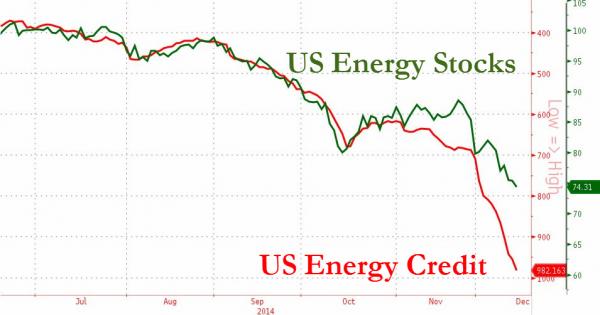
Just take one look at that energy junk bond chart.

• We Have Just Escaped The Earth’s Gravity And Are Now In Space Orbit (Zero Hedge)

Houston, we have a serious problem… With only 20% of US Shale regions remaining economic at these oil price levels, it should not be surprising that the credit risk of the US Energy sector is exploding to near 1000bps… and contagiously infecting the broad HY market… Credit risk in the energy sector is starting to infect the broad HY market – HYG at 2-year yield highs and HYCDX near 15-month wides…
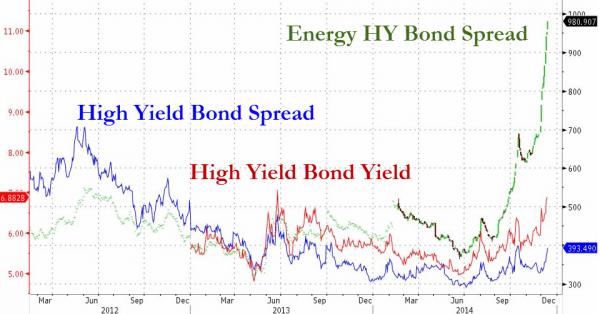
Which signals considerable pain to come for US Energy stocks..
Read more …

“It’s starting ..”

• U.S. Oil Rigs Drop Most in Two Years, Baker Hughes Says (Bloomberg)

U.S. oil drillers idled the most rigs in almost two years as they face oil trading below $60 a barrel and escalating competition from suppliers abroad. Rigs targeting oil dropped by 29 this week to 1,546, the lowest level since June and the biggest decline since December 2012, services company Baker Hughes said on its website yesterday. As OPEC resists calls to cut output, U.S. producers including ConocoPhillips and Oasis Petroleum have curbed spending. Chevron put its annual capital spending plan on hold until next year. Rigs targeting U.S. oil are sliding from a record 1,609 after a $50-a-barrel drop in global prices, threatening to slow the shale-drilling boom that has propelled domestic production to the highest level in three decades.

“It’s starting,” Robert Mackenzie, oilfield services analyst at Iberia Capital, said. “We knew this day was going to come. It was only a matter of time before the rig count was going to respond. The holiday is upon us and oil prices are falling through the floor.” ConocoPhillips said Dec. 8 that would cut spending next year by about 20%. The Houston-based company is deferring investment in North American plays including the Permian Basin of Texas and New Mexico and the Niobrara formation in Colorado. Oasis, an exploration and production company based in Houston, said Dec. 10 that it’s cutting 2015 spending 44%.

“Our capex will be lower,” Roger Jenkins, chief executive officer of Murphy Oil, an Arkansas-based exploration company, said during a presentation Dec. 10. “I think this idea of lowering capex around 20% is going to be pretty common in the industry.” Even as producers cut budgets and lay down rigs, domestic production is surging, with the yield from new wells in shale formations including North Dakota’s Bakken and Texas’s Eagle Ford projected to reach records next month, Energy Information Administration data show. Oil output climbed to 9.12 million barrels a day in the week ended Dec. 5, the highest in EIA data going back to 1983, and is projected to increase to 9.3 million barrels a day next year.

Read more …

“I won’t express my own opinion…”

• Don’t Vote ‘Wrong’ Way, EU’s Juncker Urges Greeks (Reuters)

The European Union’s chief executive has given Greeks a stark and unusual warning of major problems if they vote the “wrong” way and radicals win an early parliamentary election. Jean-Claude Juncker, the president of the European Commission, stressed in remarks carried late on Thursday by Austrian broadcaster ORF that he was not trying to insert himself into the Greek political process. In general, EU officials take pains to avoid accusations of interference and Juncker’s remarks went beyond the normal reticence. As the government in Athens faces a possible election and defeat by an untried left-wing party that opposes the terms the EU has set on Greece’s financial bailout, Juncker said he was not averse to seeing “familiar faces” remaining in charge. Prime Minister Antonis Samaras said on Thursday that Greece risked a “catastrophic” return to financial crisis if his government fell as a result of a parliamentary vote he has called for this month to elect a head of state.

Juncker, who was closely involved in managing the euro zone debt crisis when he was prime minister of Luxembourg, said he was sure Greek voters understood the risks of an election that polls show could bring to power the left-wing Syriza party. “I assume that the Greeks – who don’t have an easy life, above all the many poor people – know very well what a wrong election result would mean for Greece and the euro zone,” he said. “I won’t express my own opinion. I just wouldn’t like extremist forces to take the wheel. “I would like Greece to be governed by people with an eye on and a heart for the many little people in Greece – and there are many – and also understand the necessity of European processes.” He said he did not view market ructions in Greece of late as a sign that a new Greek crisis was breaking out.

Read more …

“.. the euro zone cannot withstand another full scale recession and will ultimately fracture despite the best efforts of the ECB.”

• Albert Edwards: China Deflation Risks Sparking A Eurozone Break-Up (CNBC)

Societe Generale’s uber-bearish strategist Albert Edwards believes that investors are slowly waking up to the idea that the Chinese have a “major deflation problem” and its transition into a more consumer-led economy won’t be a smooth one. Traditionally the country is known for its cheap exports that compete strongly with domestically produced goods around the world. That model is unlikely to change soon, according to Edwards. “The realization that China will be exporting more deflation helps to explain why U.S. inflation expectations continue to plunge despite recent stronger than expected real economy data,” he said in a note on Thursday.

He continues to warn that weakness in emerging markets could seriously impact Germany, the traditional powerhouse for the euro bloc. Germany sees China as one of the biggest buyers of its goods. Edwards said that Germany will eventually have to “walk the walk” and aggressively cut spending as it falls into recession next year. “My own view is that the euro zone cannot withstand another full scale recession and will ultimately fracture despite the best efforts of the ECB,” he said.

Read more …

“I am just not perceiving the global economy on the verge of a boom…the risks look to the downside – especially as the effects of lower oil are factored in.”

• Would Global Deflation Really Be That Bad? (CNBC)

The collapse in oil process may only be a few months old, but economists are already debating its long-term effects: will the world be gripped in growth-sapping Japanese-style deflation or will the world economy benefit from a period of lower prices? Deflation is classed as when consumer prices turn negative with the theory being that buyers would hold off from making purchases in the hope of further falls. This raises the fear of a prolonged deflationary spiral with the slump becoming so entrenched that it impacts growth and does little for the potential of wage increases. The price of oil has seen a dramatic 40% fall since June and has weighed on headline inflation figures and is likely to continue to do so next year. Consultancy Capital Economics estimate that the energy component of inflation in advanced economies will fall temporarily to around minus 10% next year. Some consumers see little price reductions at the pump as their governments subsidize the commodity, but in the U.S. many have been cheering the drop in oil which has put more money in their pocket.

Bill Blain, a fixed income strategist at Mint Partners argues that lower oil prices does not necessarily translate into growth, however. “Oil price declines are initially hailed as positive growth drivers – but in an already recessionary environment, perhaps they have become a soporific too far?,” he said in a morning note on Friday. “I am just not perceiving the global economy on the verge of a boom…the risks look to the downside – especially as the effects of lower oil are factored in.” Consumer prices in November rose 0.3% for the euro zone, compared to the year before, and the European Central Bank has regularly downgraded its prospects for the next year as 2015 approaches. In the U.S., annual inflation still remains below the 2% goal given by the Federal Reserve. The Bank of England is expecting the U.K.’s inflation rate to fall below 1% next year and China’s number currently sits at a five-year low.

Read more …

“In this context, the risk to Canadian banks doesn’t stem necessarily from a narrow view of loans to oil companies, but more from a broad macro risk perspective.”

• Falling Oil Threatens Canada’s Bulletproof Banking System (MarketWatch)
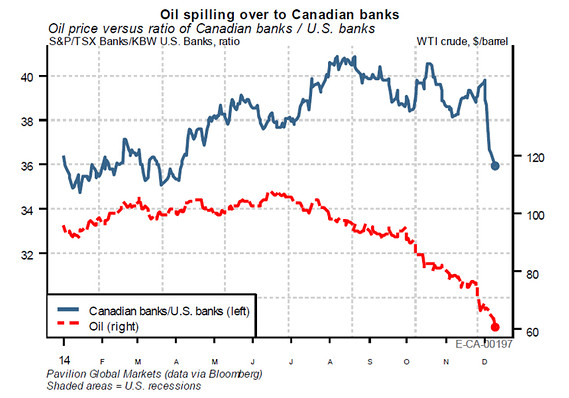
While the U.S. financial system – as well as many international banks – has gotten hopped up on a wide assortment of financial opiates and stumbled through more than a dozen bank-fueled crises through the decades, Canada boasts a stellar track record of banking sobriety. However, a spectacular death spiral in crude-oil futures – West Texas Intermediate settled Thursday at $59.95, a more than five-year low – threatens to deliver a serious shock to the banking system of the U.S.’s northern neighbor, according a research note published Thursday by Pavilion Global Markets. Canada ranks as one the world’s five largest energy producers and a net exporter of oil, according to the U.S. Energy Information Administration. So, a big drop in oil would pose several risks to Canada’s oil-dependent economy.

“The drop in oil prices, as mentioned above, will have wide-ranging implications on the Canadian economy,” Pavilion strategists Pierre Lapointe and Alex Bellefleur said in the note. It’s not just that Canada’s banks will find themselves saddled with souring loans from underwater energy producers. The problem, Pavilion argues, is that Canada’s employment rate could suffer as oil-related businesses are forced to close. Here’s how they put it: “In this context, the risk to Canadian banks doesn’t stem necessarily from a narrow view of loans to oil companies, but more from a broad macro risk perspective. As employment in the oil industry declines, a negative income and wealth shock to many households will take place, impacting a variety of loans (credit card, mortgage) on Canadian bank balance sheets.”

Read more …

It’s insane what goes on here. Banks get to write laws, and now out in the open.

• How Elizabeth Warren Led The Great Swaps Rebellion of 2014 (Bloomberg)

John Carney couldn’t understand why the vote was so close. The Delaware congressman, a Democratic member of the House Financial Services Committee, had been there when a reform to the Dodd-Frank “swaps push-out” passed—in a 55-6 landslide. He’d joined a veto-proof majority, 292-122, to back the reform in a House bill that was throttled by the Democratic Senate. The bank-friendly Democrat had not expected the reform’s quiet return, as a rider in the must-pass “Cromnibus” spending package, to kick off a revolt. “This passed with nearly 300 votes,” said Carney on Thursday night, after the House had voted on the Cromnibus, and as legislators of both parties congratulated him or wished him Merry Christmas. “It would have been more than 300, like some of the other bills we’ve done, if there wasn’t this toxic description of what it might do. Unfortunately, the world we live in, the political world, is one of perception. I try to deal with the facts.”

“Sometimes that’s at odds with the way we do work here, where you get these political narratives that take on a larger than life part of the discussion.” Put it this way: Carney was not Ready for Warren. For the better part of two days, most of his fellow Democrats approached the Cromnibus—which did not de-fund the president’s immigration order, or the bulk of the Affordable Care Act—as a sell-out of cosmic proportion. This started when Massachusetts Senator Elizabeth Warren gave a Wednesday floor speech challenging her colleagues to restore swaps push-out, which prohibited banks from booking derivatives in their own subsidiaries. “The financial industry spent more than $1 million a day lobbying Congress on financial reform, and a lot of that money went to former elected officials and government employees,” said Warren. “And now we see the fruits of those investments. This provision is all about goosing the profits of the big banks.”

The backlash should have been predictable. As Carney recalled, the original bill to change the swaps rule lost some votes after critical media coverage. More specifically, the New York Times reporters Eric Lipton and Ben Protess noticed that Citigroup had practically written the swaps language; its “recommendations were reflected in more than 70 lines of the House committee’s 85-line bill.” Yet it didn’t become “toxic” until the fight over the “Cromnibus.” Warren made the swaps language infamous. In the House, she found an impromptu whip team led by Illinois Representative Jan Schakowsky and the party’s ranking member on the Financial Services Committee, California Representative Maxine Waters. She found an ally in the Minority Leader, California Representative Nancy Pelosi, who took the floor on Thursday to warn that the swaps rule was exactly the sort of time-bomb that could create another financial crisis in the pattern of 2008.

This rattled the Democrats’ appropriators, some of whom were heading for the exits. Virginia Representative Jim Moran spent a good part of Thursday telling reporters that Warren was “running for president” and drowning Democrats in her ambition. “She obviously has a lot of influence,” said Moran after the votes. “The media listens to everything she says.”

Read more …

Here’s what Warren doesn’t like.

• $303 Trillion In Derivatives US Taxpayers Are Now On The Hook For (Zero Hedge)

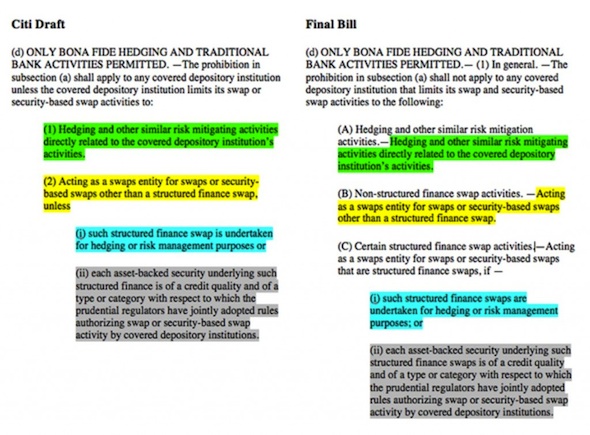
Courtesy of the Cronybus(sic) last minute passage, government was provided a quid-pro-quo $1.1 trillion spending allowance with Wall Street’s blessing in exchange for assuring banks that taxpayers would be on the hook for yet another bailout, as a result of the swaps push-out provision, after incorporating explicit Citigroup language that allows financial institutions to trade certain financial derivatives from subsidiaries that are insured by the Federal Deposit Insurance Corp, explicitly putting taxpayers on the hook for losses caused by these contracts. Recall:

Five years after the Wall Street coup of 2008, it appears the U.S. House of Representatives is as bought and paid for as ever. We heard about the Citigroup crafted legislation currently being pushed through Congress back in May when Mother Jones reported on it. Fortunately, they included the following image in their article:
Read more …

And the CIA once again thinks it’s in control of toppling a government.

• Venezuela’s Got $21 Billion. And Owes $21 Billion (Bloomberg)

Of all the financial barometers highlighting the crisis in Venezuela, this may be the one that unnerves investors the most as oil sinks: The country’s foreign reserves only cover two years of bond payments. The government and state-run oil company owe $21 billion on overseas bonds by the end of 2016, an amount equal to about 100% of reserves. Those figures explain why derivatives traders aren’t only betting that a default is almost certain but that it will most likely happen within a year. The 48% collapse in crude in the past six months stripped President Nicolas Maduro of the one thing – windfall profits for the country’s No. 1 export – that was preventing a full-blown crisis.

Even before oil started sinking, the OPEC member had depleted 30% of its international reserves in the past six years, the result of billions of dollars of capital flight triggered by the socialist push implemented by Maduro’s mentor and predecessor, the late Hugo Chavez. “These are panic capitulation levels,” Kathryn Rooney Vera, an economist at Bulltick Capital Markets, said in an e-mailed response to questions. “Oil’s continued price decline is ratcheting up risk aversion to exporters, and even more so for an economy already as distorted as that of Venezuela.” The cost to insure Venezuelan debt against non-payment over the next 12 months surged to about 6,928 basis points yesterday in New York, according to CMA data, widening the price gap over five-year protection to a record.

The upfront cost of one-year contracts implies a 65% probability of default by December 2015. Swaps prices show a 94% chance of non-payment by 2019. Venezuela’s benchmark bonds due 2027 have fallen for seven straight days, reaching 41.22 cents on the dollar as of 12:02 p.m. in New York today, the lowest in 16 years. Maduro said Dec. 10 that the government is doing everything it can to boost the price of oil, which he says should be about $100 a barrel. The country advocated unsuccessfully for production cuts at November’s meeting of members OPEC. Yesterday, Maduro said the country could export cement to bring more dollars into the country.

Read more …

” .. there is no evidence or honest economic logic to support the proposition that – over any reasonable period of time – a nation can become richer by making its people poorer ..”

• Japan’s Lemmings March Toward The Cliff Chanting “Abenomics” (David Stockman)

According to Takahiro Mitani, trashing your currency, destroying your bond market and gutting the real wages of domestic citizens is a sure fire ticket to economic success. Yes, that’s what the man says, “I have no doubt that the economy is in a recovery trend if you look at the long run….” After two years of hoopla and running the BOJ’s printing presses red hot, however, there is not a shred of evidence that Abenomics will lead to any such thing. In fact, after the recent markdown of Q3 GDP even deeper into negative territory, Japan’s real GDP is no higher now than it was the day Abenomics was launched in early 2013; and, in fact, is no higher than it was on the eve of the global financial crisis way back in 2007.

In the meanwhile, the Yen has lost 40% of its value and teeters on the brink of an uncontrolled free fall. Currency depreciation, of course, is supposedly the heart of the primitive Keynesian cure on which Abenomics is predicated, but there is no evidence or honest economic logic to support the proposition that – over any reasonable period of time – a nation can become richer by making its people poorer. That’s especially true in the case at hand, which is to say, a Pacific archipelago of barren rocks. Japan imports virtually 100% of every BTU and every ton of metals and other raw materials consumed by its advanced $5 trillion industrial economy.

Yet thanks to the mad money printer who Prime Minister Abe seconded to the BOJ, Hiroki Kuroda, import prices are up by a staggering 30% since 2012. Even with oil prices now collapsing, the yen price of crude oil imports is still higher than it was two years back. Not surprisingly, input costs for Japan’s legions of small businesses have soared, and the cost of living faced by its legendary salary men has risen far faster than wages. Accordingly, domestic businesses that supply the home market—and that is the overwhelming share of Japan’s output—are being driven to the wall, bankruptcies are at record highs and the real incomes of Japan’s households have now shrunk for 16 consecutive months and are down by 6% compared to 2 years ago.

Read more …

A view of Russia we don’t often see here in the west.

• Putin 2000 – 2014, Midterm Interim Economic Results (Awara)

A study released today by Awara Group, a Russia-based consulting firm, shows that Russia’s economy is not as dependent on oil and gas as is commonly claimed. Having researched the development of key indicators of the economy from 2000 to 2013, the authors of the study want to debunk the media story that Russia’s governments under Putin have been supposedly exclusively relying on an economic model based on oil and gas rents while neglecting the need to modernize and diversify the economy. It turns out that quite the opposite is true.

The crisis-torn economy battered by years of robber capitalism and anarchy of the 1990’s, which Putin inherited in 2000, has now reached sufficient maturity to justify a belief that Russia can make the industrial breakthrough that the President has announced. “The Russian economy is much more diversified and modernized than critics claim. The contention that it is only about oil and gas is total nonsense”, says Jon Hellevig, chief researcher for the study. “This is why Russia will not only stay afloat under the conditions of sanctions, but actually will make the industrial breakthrough that President Putin has announced”, Hellevig continues. The study reveals a range of impressive indicators on the development of the economy between 2000 and 2013 and the health of the Russian economy:

  1. The share of natural resources rents in GDP (oil, gas, coal, mineral, and forest rents) more than halved between 2000 to 2012 from 44.5% to 18.7%. The actual share of oil and gas was 16%.
  2. Russian industrial production has grown more than 50% while having undergone a total modernization at the same time.
  3. Production of food has grown by 100% in 2000 – 2013.
  4. Production of cars has more than doubled at the same time that all the production has been totally remodeled.
  5. Russian exports have grown by almost 400%, outdoing all major Western countries.
  6. Growth of exports of non-oil & gas goods has been 250%.
  7. Russia’s export growth has more than doubled compared with the competing Western powers.
  8. Oil & gas does not count for over 50% of state revenues as has been claimed, but only 27.4%. Top revenue source is instead payroll taxes.
  9. Russia’s total tax rate at 29.5% is among lowest of developed countries, non-oil & gas total tax rate is half that of the Western countries.
  10. Russia’s GDP has grown more than tenfold from 1999 to 2012.
  11. Public sector share of employment in Russia is not high in comparison with developed economies. State officials make up 17.7% of Russia’s total work force, which situates it in the middle of the pack with global economies.
  12. Russia’s labor productivity is not 40% of the Western standards as is frequently claimed, but rather about 80%.

Far from “relying” on oil & gas, the Russian government is engaged in massive investments in all sectors of the economy, biggest investments going to aviation, shipbuilding, and manufacturing of high-value machinery and technological equipment. Totally contrary to these facts, the Western media, financial analysts, and even leaders such as U.S. President Obama keep parroting the refrain that “Russia only relies on oil and gas” and “Russia does not produce anything”. Clearly, Barack Obama has not been analyzing the Russian economy, so this must mean that those whose job it is to do so are misleading the President.

We strongly believe that everyone benefits from knowing the true state of Russia’s economy, its real track record over the past decade, and its true potential. Having knowledge of the actual state of affairs is equally useful for the friends and foes of Russia, for investors, for the Russian population – and indeed for its government, which has not been very vocal in telling about the real progress. I think there is a great need for accurate data on Russia, especially among the leaders of its geopolitical foes. Correct data will help investors to make a profit. And correct data will help political leaders to maintain peace. Knowing that Russia is not the economic basket case that it is portrayed to be would help to steer the foes from the collision course with Russia they have embarked on.

Read more …

Translation: we’re about to go broke.

• Only ‘Minimal’ Risk Of Default: Ukrainian Official (CNBC)

Ukraine is at “minimal” risk of defaulting on its debt repayments, according to an official in the country’s recently-appointed government, despite a currency in freefall and an apparent $15-billion black hole in its bailout from the IMF. “We do have economic difficulties, but that is something that is going into the debate with the IMF,” Dmytro Shymkiv, deputy head of presidential administration, told CNBC. “The risk of default is minimal,” he added, arguing that 95% of the country was not suffering as a result of the military conflict in the east of Ukraine. A further $15 billion may be needed to bailout the struggling country, on top of the $17-billion loan package the IMF worked out for the troubled country, and Prime Minister Arseny Yatseniuk appealed for Western help to stop a default on Thursday.

Ukraine’s currency, the hryvnia, has lost over 90% of its value against the U.S. dollar to date this year, as conflict raged on its borders. Inflation is spiralling, and the country is facing a future without cheap gas supplies from neighbor Russia, after their fallout over the deposition of former Ukrainian President Viktor Yanukovych and subsequent emergence of a more pro-European government in Ukraine. The economies of Donetsk and Luhansk, the areas where fighting between the Ukrainian army and pro-Russian separatists is worst, have ground to a halt – but these account for close-to a fifth of the country’s economy, according to Yatseniuk.

There is some hope that negotiations to resolve the conflict may re-open soon, with President Petro Poroshenko saying Friday morning that the country had experienced its first 24 hours of proper ceasefire in seven months. Shymkiv, the former head of Microsoft Ukraine who is now tasked with implementing much-needed administrative, social and economic reforms in the country, said: “We’re trying to bring our knowledge and experience to the development of the country. That’s the only way we can bring it out of the mis-development of the economy.” Asked about potential conflict between Yatseniuk and Poroshenko, he said: “There aren’t conflicts between President and Prime Minister. We have no time to have disputes.”

Read more …

He didn’t say he was willing to take any losses …

• Ukraine’s Chocolate King President Not Sweet On Keeping Promise (Reuters)

The Chocolate King is finding it difficult to relinquish his throne. Petro Poroshenko, one of Ukraine’s richest men and owner of a sweets empire, made an unusual promise last spring while campaigning to be president – if elected, he would sell most of his business assets. “As president of Ukraine, I only want to concern myself with the good of the country and that is what I will do,” he told an interviewer. Poroshenko won the election, but he hasn’t succeeded yet at keeping his campaign promise. With his country at war with Russian-backed separatists in the east, the economy faltering and its currency weakening, Ukraine’s 49-year-old president hasn’t sold any of his assets, including his most valuable one: a majority stake in Roshen Confectionery Corp, Ukraine’s biggest sweets maker. His promise appears to be a victim of the very problems that face him as president.

Executives at the two financial firms that Poroshenko has hired to help sell his assets caution that deals, particularly in former Soviet republics and eastern Europe, can often take a year or more. But they also concede that their client’s timing is terrible. “It’s clearly not a good time to sell,” said Giovanni Salvetti, managing director of Rothschild CIS, which is trying to sell Roshen. “I hope the situation will improve in the first or second quarter” of 2015. Makar Paseniuk, a managing director at ICU in Kiev, which acts as Poroshenko’s financial adviser, said there is an agreement to sell one of his other assets. He declined to identify it but said the deal has not closed and it’s not clear when or if it will. Besides Roshen, Poroshenko’s portfolio includes numerous other assets, including real estate and investments in a bank, an insurance company and a shipyard in Crimea. He also owns a Ukrainian television station that he has said he will keep.

Read more …

Nice little history lesson. Must read, certainly if you don’t know what a ute is.

• Australia’s Once-Vibrant Auto Industry Crashes in Slow Motion (NY Times)

There has been a car industry in Australia for about as long as there have been cars. But within two or three years, the last of the continent’s auto plants will go dark. At the turn of the 20th century, while visionaries in the United States and Europe labored on horseless carriages, Australians were also creating them. In 1896 in Melbourne, Herbert Thomson built a steam car for sale using Dunlop pneumatic tires made in Australia. In 1901, Harley Tarrant began selling cars made mostly from Australian parts. Over the next century, American automakers including General Motors, Ford and Chrysler came to dominate the market, turning out cars from factories set up in nearly every Australian state. Toyota, Nissan and Mitsubishi later joined them.

But the end is nigh. Auto plants have been closing, one by one, over five decades. The three remaining carmakers here — Toyota, Ford and the Holden subsidiary of G.M. — are shutting their manufacturing operations over the next few years. Government policy has played a large role in the contraction; the Australian market has gone from one of the world’s most protected to possibly the least-protected among auto-manufacturing nations. The Australian car industry had always benefited from barriers to imported vehicles. Those who bought early Thomson steam cars and gasoline-powered Tarrants were industrialists, wealthy ranchers, bankers and politicians who saw merit in protecting the home industry.

So early adopters in the 1900s who wanted foreign-made cars, and there were plenty of them, could only import the chassis complete with engine, transmission, axles and wheels — and the hood and the grille. The rest of the car had to be manufactured, mostly by hand, by body builders who generally evolved from outfits that had made coaches and buggies for the horse trade. Holden started in the leatherwork and saddlery business in 1856, but by the early 20th century was making motorcycle sidecars and car bodies for chassis from G.M. In 1931, G.M. bought Holden Motor Builders and plans were laid for a distinctly Australian car, which finally arrived after World War II, in 1948.

Read more …

If confirmed, this is the biggest discovery in eons.

• Did A European Spacecraft Detect Dark Matter? (Christian Science Monitor)

Astronomers may finally have detected a signal of dark matter, the mysterious and elusive stuff thought to make up most of the material universe. While poring over data collected by the European Space Agency’s XMM-Newton spacecraft, a team of researchers spotted an odd spike in X-ray emissions coming from two different celestial objects – the Andromeda galaxy and the Perseus galaxy cluster. The signal corresponds to no known particle or atom and thus may have been produced by dark matter, researchers said. “The signal’s distribution within the galaxy corresponds exactly to what we were expecting with dark matter – that is, concentrated and intense in the center of objects and weaker and diffuse on the edges,” study co-author Oleg Ruchayskiy, of the École Polytechnique Fédérale de Lausanne (EPFL) in Switzerland, said in a statement.

“With the goal of verifying our findings, we then looked at data from our own galaxy, the Milky Way, and made the same observations,” added lead author Alexey Boyarsky, of EPFL and Leiden University in the Netherlands. Dark matter is so named because it neither absorbs nor emits light and therefore cannot be directly observed. But astronomers know dark matter exists because it interacts gravitationally with the “normal” matter we can see and touch. And there is apparently a lot of dark matter out there: Observations of star motion and galaxy dynamics suggest that about 80% of all matter in the universe is “dark,” exerting a gravitational force but not interacting with light.

Researchers have proposed a number of different exotic particles as the constituents of dark matter, including weakly interacting massive particles (WIMPs), axions and sterile neutrinos, hypothetical cousins of “ordinary” neutrinos (confirmed particles that resemble electrons but lack an electrical charge). The decay of sterile neutrinos is thought to produce X-rays, so the research team suspects these may be the dark matter particles responsible for the mysterious signal coming from Andromeda and the Perseus cluster. If the results — which will be published next week in the journal Physical Review Letters — hold up, they could usher in a new era in astronomy, study team members said. “Confirmation of this discovery may lead to construction of new telescopes specially designed for studying the signals from dark matter particles,” Boyarsky said. “We will know where to look in order to trace dark structures in space and will be able to reconstruct how the universe has formed.”

Read more …

Weird. Just plain weird.

• The Chinese Mystery Of Vanishing Foreign Brides (FT)

Police in central China have launched an investigation into the disappearance of more than 100 Vietnamese women who married local bachelors and had been living in villages around the city of Handan. The women all disappeared at the same time in late November, along with a Vietnamese woman who married a local villager 20 years ago and had introduced most of the brides to local men in recent months in exchange for a fee. Faced with severe gender imbalances as a result of China’s decades-old one-child policy and a traditional preference for male children, many Chinese men are unable to find suitable brides and resort to paying for wives from poorer Asian countries such as Vietnam.

Particularly in more traditional rural parts of China, marriage is highly transactional and men are increasingly expected to provide a house, car, electrical appliances and a steady income before a woman or their family will consider him eligible for marriage. For those who cannot afford the expensive requirements of Chinese brides, paying for a bride from Vietnam or elsewhere in the region can be a much cheaper option. As a consequence of the demand for cheap foreign brides, China has an enormous problem with human trafficking. “My brother worked outside the village and was too poor to afford a local wife so my family paid Rmb100,000 to get a wife from Vietnam through that old Vietnamese woman who came here 20 years ago,” said the brother of Bai Baoxing, a local man whose Vietnamese wife disappeared with the others barely a month after they were married.

Mr Bai’s brother said the new bride spoke decent Mandarin Chinese and he and his family were now wondering whether she was even Vietnamese. Chinese media reports identified the absconded Vietnamese marriage broker as Wu Meiyu. After living in a village on the outskirts of Handan for 20 years, she started offering introductions to Vietnamese brides for a fee at the start of this year. An officer in the local Handan city police office told the Financial Times that provincial police were now handling the case and they could not comment on the ongoing investigation. Chinese media are filled with cases of women from poor rural areas who are abducted and sold into marriage, as well as cases involving foreign brides.
Read more …

Dec 122014
 
 December 12, 2014  Posted by at 11:59 am Finance Tagged with: , , , , , , , , ,  Comments Off on Debt Rattle December 12 2014


Jack Delano Atchison, Topeka & Santa Fe train at Emporia, Kansas Mar 1943

• IEA Warns On Social Unrest As It Cuts 2015 Oil Demand Growth Forecast (CNBC)
• Oil Drops Below $60 After Saudis Question Need to Cut (Bloomberg)
• Oil Pressure Could Sock It To Stocks (CNBC)
• Fed Bubble Bursts in $550 Billion of Energy Debt (Bloomberg)
• Oil Bust Contagion Spreads to Wall Street and the Banks (WolfStreet)
• Ruble Consolation Gets Putin Record Oil Income (Bloomberg)
• This Has Never Happened Before Without A Drop In Stock Prices (Napier via ZH)
• France Drifts Into Deflation As ECB ‘Pea-Shooter’ Falls Short (AEP)
• WTF Chart Of The Day: Explaining The Surge In US Retail Sales (Zero Hedge)
• China’s Slowdown Deepens as Factory Output Growth Wanes (Bloomberg)
• China Tells Banks To Step Up Lending To Lift Flagging Growth (Reuters)
• Skepticism Jumps in Options as VIX Rises 70% in Four Days (Bloomberg)
• NY Regulator Probing Barclays And Deutsche Over Forex Algorithms (FT)
• US House Narrowly Passes Spending Bill, Averts Government Shutdown (Reuters)
• US Prosecutors Face New Fallout From Insider Trading Ruling (Reuters)
• Welcome To The UK: DIY Burials And Payday Loans For Kids (CNBC)
• Crystal Ball: Top 10 Economic Predictions For 2015 (CNBC)
• These Are Lies The New York Times Wants You To Believe About Russia (Salon)
• Full Scale Of Plastic In The World’s Oceans Revealed For First Time (Guardian)

“Venezuela needs to fill a capital shortfall of around $29 billion next year ..” “.. a currency devaluation would not do much to alleviate the pain. “This is a country really facing a perfect storm.”

• IEA Warns On Social Unrest As It Cuts 2015 Oil Demand Growth Forecast (CNBC)

Weak demand and oversupply in oil markets raise the risk of global social instability and the potential for financial defaults, the International Energy Agency (IEA) warned on Friday, as it cut its forecasts for global oil demand growth in 2015. The report came as oil prices slid to new multi-year lows, with Brent crude hitting a 5.5-year low of $63.33 a barrel on Friday. “Continued price declines would for some countries and companies make an already difficult situation even worse,” the IEA said in its new monthly report. Global oil inventories are projected to build by around 300 million barrels in the first half of 2015 in the absence of any disruption, the group said. It estimated that stocks in major global economies could start to “bump” against storage capacity limits.

“The resulting downward price pressure would raise the risk of social instability or financial difficulties if producers found it difficult to pay back debt,” it said. Singling out Russia and Venezuela, the IEA said that further price drops would heighten the financial risks to “highly leveraged” producers, and countries that are heavily dependent on oil revenues. It warned on the threat to international financial stability should the situation in Russia deteriorate to the point of a default. Bond yields and the cost of insuring Russia against a default have risen in recent weeks amid fears over falling oil prices and intensifying sanctions from the West. Oil the country’s biggest export – is crucial for its economy, and influence in the world.

“Lower oil prices significantly dent potential export revenues in net oil exporting countries, slashing their income streams and in turn denting demand,” it said. “In particularly cash strapped economies, such as Venezuela and Russia, this impact is likely to be magnified as the risk of default escalates,” it said, adding that Venezuela’s capital Caracas was currently struggling to make bond payments, fund social programs and pay debts to oil partners. Venezuela needs to fill a capital shortfall of around $29 billion next year, according to Bradford Jones at hedge fund Sagil Capital. He told CNBC Friday that the country was facing a number of very tough decisions and believed a currency devaluation would not do much to alleviate the pain. “This is a country really facing a perfect storm,” he said.

Read more …

“When you see a persistent trend like this you can be sure there are a lot of investors caught on the wrong side ..”

• Oil Drops Below $60 After Saudis Question Need to Cut (Bloomberg)

Benchmark U.S. oil prices dropped below $60 a barrel for the first time since July 2009 as Saudi Arabia questioned the need to cut output, signaling its priority is defending market share. West Texas Intermediate crude slid 1.6% in New York. The market will correct itself, according to Saudi Arabian Oil Minister Ali Al-Naimi. Global demand for crude from the Organization of Petroleum Exporting Countries will drop next year by about 300,000 barrels a day to 28.9 million, the least since 2003, the group predicted yesterday. Oil’s collapse into a bear market has been exacerbated as Saudi Arabia, Iraq and Kuwait, OPEC’s three largest members, offered the deepest discounts on exports to Asia in at least six years. The group decided against reducing its output quota at a meeting last month, letting prices drop to a level that may slow U.S. production that’s surged to the highest level in more than three decades.

“The path of least resistance is lower,” Mike Wittner, head of oil research at Societe Generale in New York, said by phone. “This week we’ve had the Saudis cut prices to Asia, OPEC reduced the call on its crude and al-Naimi reiterated that they aren’t cutting output and letting the market do its work. They all reinforce the bearish message.” WTI for January delivery dropped 99 cents to close at $59.95 a barrel on the New York Mercantile Exchange. It was the lowest settlement since July 14, 2009. Total volume was 14% above the 100-day average for the time of day. The U.S. benchmark is down 39% this year. [..] “When you see a persistent trend like this you can be sure there are a lot of investors caught on the wrong side,” Bill O’Grady, chief market strategist at Confluence Investment Management in St. Louis, which oversees $2.4 billion, said by phone. “They are looking for any glimmer of green as an opportunity to get out of positions. Any moves higher will be of short duration.”

Read more …

“It’s (oil) actually much weaker than the futures markets indicate. [..] The Canadian crude, if you go into the oil sands, is in the $30s, and you talk about Western Canadian Select heavy crude upgrade that comes out of Canada, it’s at $41/$42 a barrel. Bakken is probably about $54.” Kloza said there’s some talk that Venezuelan heavy crude is seeing prices $20 to $22 less than Brent ..”

• Oil Pressure Could Sock It To Stocks (CNBC)

With crude sliding through the key $60 level, oil pressure could stay on stocks Friday. West Texas Intermediate futures for January closed at $59.95 per barrel, the first sub-$60 settle since July 2009. The $60 level, however, opens the door to the much bigger, $50-per-barrel level. Besides oil, traders will be watching the producer price index Friday morning, and it’s expected to be off 0.1% with the fall in energy. Consumer sentiment is also expected at 10 a.m. EST. Consumers stepped up and spent in November, as evidenced in the 0.7% gain in that month’s retail sales Thursday. That better mood should show up in consumer sentiment. Stocks on Thursday gave up sizeable gains after oil reversed course and fell through $60. Traders also were nervously watching the progress of a spending bill in Washington, which was delayed. The Dow was up 63 at 17,596, wiping out much of a 225-point intraday gain.

“Oil has pretty much spooked people,” said Daniel Greenhaus, chief global strategist at BTIG. “There just isn’t a bid. With everything in energy and the oil price collapsing as it is, who is going to step in and be a buyer now? The answer is nobody.” Oil continued to slide in after-hours trading. “The selling appears to have accelerated a little bit after the close with really no bullish news in sight,” said Andrew Lipow, president of Lipow Associates. WTI futures temporarily fell below $59 in late trading. “The big level is going to be $50 now in terms of psychological support. Much as $100 is on the upside,” said John Kilduff of Again Capital. Oil stands a good chance of getting there too. Tom Kloza, founder and analyst at Oil Price Information Service, said the market could bottom for the winter in about 30 days, but then it will be up to whatever OPEC does. The cartel in November voted to keep its production unchanged in an effort to hold market share.

“It’s (oil) actually much weaker than the futures markets indicate. This is true for crude oil, and it’s true for gasoline. There’s a little bit of a desperation in the crude market,” said Kloza. “The Canadian crude, if you go into the oil sands, is in the $30s, and you talk about Western Canadian Select heavy crude upgrade that comes out of Canada, it’s at $41/$42 a barrel. Bakken is probably about $54.” Kloza said there’s some talk that Venezuelan heavy crude is seeing prices $20 to $22 less than Brent, the international benchmark. Brent futures were at $63.20 per barrel late Thursday. “In the actual physical market, it’s fallen by even more than the futures market. That’s a telling sign, and it’s telling me that this isn’t over yet. This isn’t the bottoming process. The physical market turns before the futures,” he said.

Read more …

A portrait of a bloodbath.

• Fed Bubble Bursts in $550 Billion of Energy Debt (Bloomberg)

The danger of stimulus-induced bubbles is starting to play out in the market for energy-company debt. Since early 2010, energy producers have raised $550 billion of new bonds and loans as the Federal Reserve held borrowing costs near zero, according to Deutsche Bank AG. With oil prices plunging, investors are questioning the ability of some issuers to meet their debt obligations. Research firm CreditSights Inc. predicts the default rate for energy junk bonds will double to 8% next year. “Anything that becomes a mania – it ends badly,” said Tim Gramatovich, chief investment officer of Peritus Asset Management. “And this is a mania.”

The Fed’s decision to keep benchmark interest rates at record lows for six years has encouraged investors to funnel cash into speculative-grade securities to generate returns, raising concern that risks were being overlooked. A report from Moody’s Investors Service this week found that investor protections in corporate debt are at an all-time low, while average yields on junk bonds were recently lower than what investment-grade companies were paying before the credit crisis. Borrowing costs for energy companies have skyrocketed in the past six months as West Texas Intermediate crude, the U.S. benchmark, has dropped 44% to $60.46 a barrel since reaching this year’s peak of $107.26 in June.

Yields on junk-rated energy bonds climbed to a more-than-five-year high of 9.5% this week from 5.7% in June, according to Bank of America Merrill Lynch index data. At least three energy-related borrowers, including C&J Energy Services, postponed financings this month as sentiment soured. “It’s been super cheap” for energy companies to obtain financing over the past five years, said Brian Gibbons, a senior analyst for oil and gas at CreditSights in New York. Now, companies with ratings of B or below are “virtually shut out of the market” and will have to “rely on a combination of asset sales” and their credit lines, he said.

Read more …

“Six years of the Fed’s easy money policies purposefully forced even conservative investors to either lose money to inflation or venture way out on the risk curve. So they ventured out, many of them without knowing it because it happened out of view inside their bond funds. And they funded the fracking boom and the offshore drilling boom, and the entire oil revolution in America ..”

• Oil Bust Contagion Spreads to Wall Street and the Banks (WolfStreet)

Oil swooned again on Wednesday, with the benchmark West Texas Intermediate closing at $60.94. And on Thursday, WTI dropped below $60, currently trading at $59.18. It’s down 43% since June. Yesterday, OPEC forecast that demand for its oil would further decline to 28.9 million barrels a day next year, after having decided over Thanksgiving to stick to its 30 million barrel a day production ceiling, rather than cutting it. It thus forecast that there would be on OPEC’s side alone 1.1 million barrels a day in excess supply. Hours later, the US Energy Information Administration reported that oil inventories in the US had risen by 1.5 million barrels in the latest week, while analysts had expected a decline of about 3 million barrels. So the bloodletting continues: the Energy Select Sector ETF is down 26% since June; S&P International Energy Sector ETF is down 34% since July; and the Oil & Gas Equipment & Services ETF is down 46% since July.

Goodrich Petroleum, in its desperation, announced it is exploring strategic options for its Eagle Ford Shale assets in the first half next year. It would also slash capital expenditures to less than $200 million for 2015, from $375 million for 2014. Liquidity for Goodrich is drying up. Its stock is down 88% since June. They all got hit. And in the junk-bond market, investors are grappling with the real meaning of “junk.” Sabine Oil & Gas’ $350 million in junk bonds still traded above par in September before going into an epic collapse starting on November 25 that culminated on Wednesday, when they lost nearly a third of their remaining value to land at 49 cents on the dollar. In early May, when the price of oil could still only rise, Sabine agreed to acquire troubled Forest Oil Corporation, now a penny stock. The deal is expected to close in December.

But just before Thanksgiving, when no one in the US was supposed to pay attention, Sabine’s bonds began to collapse as it seeped out that Wells Fargo and Barclays could lose a big chunk of money on a $850-million “bridge loan” they’d issued to Sabine to help fund the merger. A bridge loan to nowhere: investors interested in buying it have evaporated. The banks are either stuck with this thing, or they’ll have to take a huge loss selling it. Bankers have told the Financial Times that the loan might sell for 60 cents on the dollar. But that was back in November before the bottom fell out entirely. As so many times in these deals, there is a private equity angle to the story: PE firm First Reserve owns nearly all of Sabine and leveraged it up to the hilt. [..]

Six years of the Fed’s easy money policies purposefully forced even conservative investors to either lose money to inflation or venture way out on the risk curve. So they ventured out, many of them without knowing it because it happened out of view inside their bond funds. And they funded the fracking boom and the offshore drilling boom, and the entire oil revolution in America, no questions asked.

Read more …

Makes it look less awful.

• Ruble Consolation Gets Putin Record Oil Income (Bloomberg)

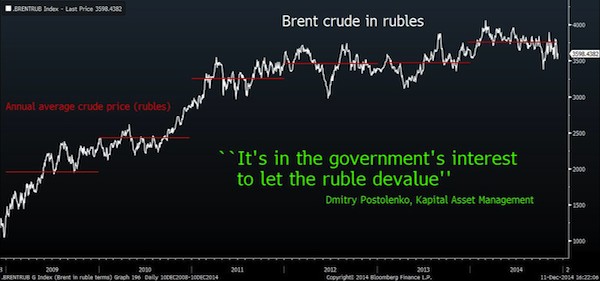
While Russia’s plunging currency is becoming a growing concern for policy makers in Moscow, the benefits for the Treasury are swelling as it receives more and more rubles for each dollar of oil export revenue. The CHART OF THE DAY shows that Brent crude sold for an average 3,759 rubles a barrel this year, the most on record, even after the mean dollar price of $101.74 dropped to the lowest since 2010. Russia’s fiscal accounts are benefiting from this year’s more than 40% decline in the ruble as it kept pace with a similar slide in oil, which is priced in dollars.

The government’s budget surplus is 1.27 trillion rubles ($23 billion) through November, compared with 600 billion rubles in the same period last year and 789 billion rubles in 2012, according to Finance Ministry data. It was 1.34 trillion in 2011. “A weak ruble is good for the government budget,” Dmitry Postolenko, a money manager at Kapital Asset Management in Moscow, said Dec. 10 by e-mail. “It’s in the government’s interest to let the ruble devalue but it should do it in a way that will not lead to a panic among Russians who keep money in rubles.”

Read more …

” The consensus, it would seem, views this deflationary move as one without tears. With US equities trading at 27X CAPE , that’s one hell of a bet!!”

• This Has Never Happened Before Without A Drop In Stock Prices (Napier via ZH)

The Solid Ground has long flagged the importance of falling inflation expectations when nominal interest rates are so low. The Fed cannot lower nominal rates, so its control over real rates of interest rests entirely with its ability to create actual inflation or manage inflation. After five and a half years of QE, inflation expectations are very near their lows. Over the next five years investors now expect inflation to average just below 1.3%. This level of expected inflation has always previously been associated with a decline in US equity prices. There have been no exceptions until today.

THE PROWLER: Which force is currently depressing the corporations share of GDP? It is a question worth asking, because if such suppression lifts then the corporates share of GDP can go higher and, the likelihood is, share prices will go with it. While most questions in finance are difficult to answer this one is really easy because nobody and nothing is depressing the corporations share of GDP. The usual suspects for depriving the corporation of higher profits — labour, creditors and the state — are all “quiescent”, to use a word favoured by the man formerly known as ‘The Maestro’. Indeed, these forces are so quiescent that most equity investors consider them to be demons which have been slain.

THE SLEEPING TIGER: There is nothing in the historical record to equate dormancy with death when it comes to the future path of wages, interest rates or corporate taxation. For the equity bulls who choose to believe in the prolonged dormancy of labour, creditors and the state, all at the same time, history has a very clear warning that there is another potent force which can drive mean reversion of corporate profits and equity valuations – deflation. [..]

BOOM! Ultimately, just such a shock would come to many places if China tired of the monetary tightening implicit in its link to the world’s strongest currency, the USD. At some stage China will need to relax the monetary reins and this will be virtually impossible if it is tethered to a rising USD. The 1994 devaluation of the RMB wreaked havoc with the finances of China’s competitors and a similar, in fact even more powerful, dynamic is evident today. A devaluation of the RMB would thus be another trigger for a credit crisis. The consensus, it would seem, views this deflationary move as one without tears. With US equities trading at 27X CAPE , that’s one hell of a bet!!

Read more …

“The ECB is presiding over a deflationary disaster. They need to act fast and aggressively or else markets will start to attack Italian debt.” Well, and Greece, and Spain etc. Perhaps even France this time. The vigilantes played European whack-a-mole before.

• France Drifts Into Deflation As ECB ‘Pea-Shooter’ Falls Short (AEP)

France is sliding into a deflationary vortex as manufacturers slash prices to keep market share, intensifying pressure on the European Central Bank to take drastic action before it is too late. The French statistics agency INSEE said core inflation fell to -0.2pc in November from a year earlier, the first time it has turned negative since modern data began. The measure strips out energy costs and is designed to “observe deeper trends” in the economy. The price goes far beyond falling oil costs and is the clearest evidence to date that the eurozone’s second biggest economy is succumbing to powerful deflationary forces. Headline inflation is still 0.3pc but is expected to plummet over the next three months. French broker Natixis said all key measures were likely to be negative by early next year.

Eurostat data show prices have fallen since April in Germany, France, Italy, Spain, Holland, Belgium, Portugal, Greece and the Baltic states, as well as in Poland, Romania and Bulgaria outside the EMU bloc. Marchel Alexandrovich, from Jefferies, said the number of goods in the eurozone’s price basket now falling has reached a record 34pc. “Eurozone deflation is now inevitable. There is no way around it,” said Andrew Roberts, at RBS. “We think yields on German 10-year Bunds will fall to 0.42pc next year.” “The ECB is presiding over a deflationary disaster. They need to act fast and aggressively or else markets will start to attack Italian debt. Italy’s nominal GDP is falling faster than their borrowing costs and that is pushing them towards a debt spiral,” he added. The Bank of Italy’s governor, Ignazio Visco, said any further falls in prices at this stage could have “extremely grave consequences for economies with very high public debt levels, such as Italy”.

The trade-weighted exchange rate of the euro has risen by 2pc over the past two months as the rouble plummets and currencies buckle across the emerging market nexus, despite the ECB’s efforts to talk it down. This is a form of monetary tightening. The German-led hawks at the ECB are running out of excuses for opposing quantitative easing after demand for the ECB’s second auction of cheap four-year loans (TLTROs) fell short of expectations. “The TLTRO is a peashooter rather than a bazooka,” said Nick Kounis, at ABN Amro.
Lenders took up just €129.8bn of fresh credit, far less than €270bn of old loans due to be repaid. This means that the ECB’s balance will continue to contract – rather than expanding by €1 trillion as intended – unless it embraces full-blown QE.

Read more …

Holiday seasonal adjustment?!

• WTF Chart Of The Day: Explaining The Surge In US Retail Sales (Zero Hedge)

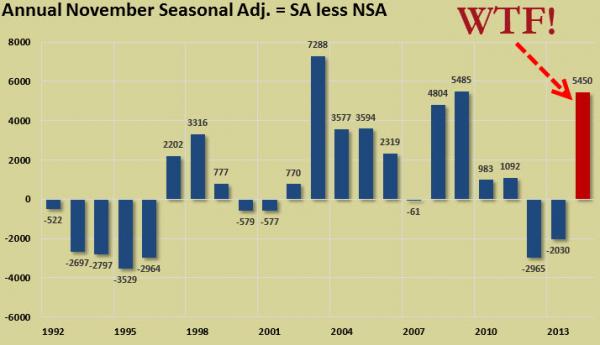
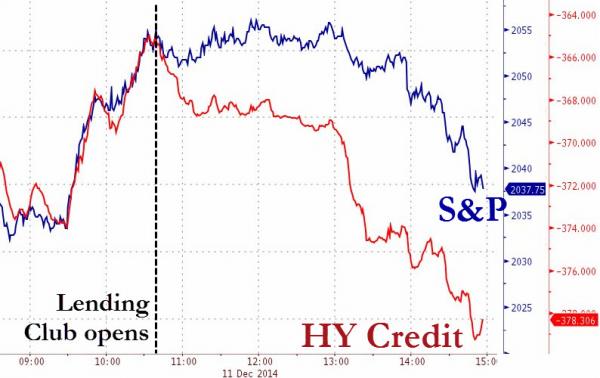
Confused at how such awesome retail sales headlines can lead to the kind of weakness we are seeing in stocks now that Lending Club’s IPO has started trading? Wondering why bonds are now lower in yield on the day in the face of ‘proof’ that the US consumer is back? Wonder no more, as STA Wealth Management’s Lance Roberts points out, November’s seasonal adjustment for retail sales was – drum roll please – the 3rd largest on record… so maybe, just maybe, the ‘market’ is seeing through that pure riggedness, wondering about the huge surge in continuing claims, and agog at the blowout in credit spreads and collapse in crude… Seriously?!! The 3rd largest November seasonal adjustment on record… why? and remember retail sales only beat by 0.1ppt!

Speechless, yet? Well look at this…

Rigged much?

Read more …

“.. factory production will continue to slow in the first quarter of next year, while a gauge of manufacturing activity will fall below the 50 expansion-contraction line ..”

• China’s Slowdown Deepens as Factory Output Growth Wanes (Bloomberg)

China’s economy slowed in November as factory shutdowns exacerbated weaker demand, raising pressure on the central bank to add further stimulus. Bloomberg’s gross domestic product tracker came in at 6.78% year-on-year in November, down from 6.91% in October and a fourth month below 7%, according to a preliminary reading. Factory production rose 7.2% from a year earlier, retail sales gained 11.7%, and investment in fixed assets expanded 15.8% in January through November from a year earlier, official data showed. The government ordered some factories to close in Beijing and surrounding provinces during the Asia-Pacific Economic Cooperation forum in early November to curb pollution. China’s central bank cut benchmark interest rates last month as a property slump weighs on the world’s second-biggest economy.

“The major reason for the slowdown is weak demand,” said Ding Shuang, senior China economist at Citigroup Inc. in Hong Kong. “Both external and internal demand are relatively weak.” Ding said he expects factory production will continue to slow in the first quarter of next year, while a gauge of manufacturing activity will fall below the 50 expansion-contraction line, prompting the central bank to cut banks’ required reserve ratios. “The data adds to evidence of weakness in China’s economy,” Bloomberg’s Beijing-based economist Tom Orlik wrote in a note. “The People’s Bank of China’s hands may be tied by the speculative surge on the mainland’s equity markets. Fear of adding further fuel to the fire appears to have constrained the PB0C to return to targeted measures, at least temporarily.”

Read more …

“The amount of new loans issued by Chinese banks fell by more than a third in October.”

• China Tells Banks To Step Up Lending To Lift Flagging Growth (Reuters)

China has told its banks to lend more in the final months of 2014 and relaxed enforcement of loan-to-deposit ratios to expand credit, sources told Reuters, as Beijing prepares to release data that could confirm the relentless slowing of its economy. Figures on inflation, imports and fiscal spending in November have already undershot expectations since the People’s Bank of China (PBOC) sprang a surprise interest rate cut on Nov. 21, raising fears that the bid to boost lending could foreshadow more weak figures on industrial activity for the month, due on Friday, and on lending, due in the next few days. “I wouldn’t be surprised by that at all,” said Andrew Polk, resident economist for the Conference Board in Beijing. “It seems pretty clear activity is continuing to weaken throughout this fourth quarter.” Two sources with knowledge of the matter said China’s central bank increased the annual new loan target to 10 trillion yuan($1.62 trillion) for 2014, up from what Chinese media have said was a previous target of 9.5 trillion yuan.

Banks have disbursed 8.23 trillion yuan of loans between January and October, so they will have to quicken the pace in the last two months if they are to meet the new target. If upcoming data also proves worse than expected, some analysts say the PBOC could cut banks’ reserve requirement ratio (RRR) as soon as this weekend, allowing them to further increase lending. Bank lending is a crucial part of China’s monetary policy as the government instructs commercial banks, most of which are directly or indirectly controlled by the state, how much to lend and when to lend each year. The amount of new loans issued by Chinese banks fell by more than a third in October. “If credit supply is increased, it will certainly help economic growth in the first quarter,” said Chang Chun Hua, an economist at Nomura in Hong Kong. “If this is true, it shows that the government is quite concerned about growth.”

Read more …

Inevitable.

• Skepticism Jumps in Options as VIX Rises 70% in Four Days (Bloomberg)

Options traders aren’t buying the stock market’s message. While the Standard & Poor’s 500 Index posted its first gain of the week on Dec. 11, rising 0.5%, the Chicago Board Options Exchange Volatility Index also jumped, climbing 8.4% to cap its biggest four-day advance since 2011. The two gauges, one measuring share prices and the other anxiety among traders, only move in unison about 20% of the time. Investors watching oil plunge day after day are growing concerned the decline will destabilize financial markets and that’s boosting demand for hedges, according to Bob Doll, the chief equity strategist at Nuveen Asset Management. Gains in the VIX picked up after House Minority Leader Nancy Pelosi said Republicans lack the votes to pass a $1.1 trillion U.S. spending bill and urged fellow Democrats to force removal of some banking and campaign-finance provisions.

“I’d put oil front and center,” Doll said by phone. “We’ve had a move from $100 to $60, and if that had happened over a year or two that’s one thing, but this has been so much so fast that it creates higher uncertainty, which creates higher volatility, and that’s the reason you’re seeing people buy protection.” The S&P 500 and VIX haven’t posted a bigger lockstep advance since at least 2000, according to data compiled by Bloomberg. They’ve both gained on the same day on only 22 other times this year, the data show.

U.S. stocks rebounded from the worst day in eight weeks as an improvement in retail sales helped overshadow a drop in West Texas Intermediate crude below $60. The S&P 500 rose 0.5% at 4 p.m. in New York, paring an earlier rally of 1.5%. “It is unusual to see stocks rally like they did and premiums rise on the same day,” Jared Woodard, a New York-based equity derivatives strategist at BGC Partners LP, said by phone. “When the index gave back a lot of these gains you saw more demand for put protection. As stocks reversed a bit, people thought there may be another leg down.”

Read more …

“The probe into the possible use of algorithms is one of the reasons why DFS, led by Benjamin Lawsky, declined to participate in a broad forex settlement with banks.”

• NY Regulator Probing Barclays And Deutsche Over Forex Algorithms (FT)

New York’s top banking regulator is investigating whether Barclays and Deutsche Bank used algorithms to manipulate foreign exchange rates, which could increase the penalties they face, a person familiar with the probe said. The state’s Department of Financial Services is reviewing whether the use of computer algorithms in bank currency trading platforms suggests a systemic problem at the lenders, as opposed to wrongdoing by several rogue traders, the person said. If the algorithms are seen as a bank-wide issue, DFS could seek to impose bigger penalties, the person added. The probe into the possible use of algorithms is one of the reasons why DFS, led by Benjamin Lawsky, declined to participate in a broad forex settlement with banks.

In November, UBS, Citigroup, JPMorgan Chase, HSBC, Royal Bank of Scotland and Bank of America were fined more than $4bn for their role in a forex rate-rigging scandal. The UK’s Financial Conduct Authority and the US’s Commodity Futures Trading Commission were part of that settlement. But the US Department of Justice and DFS did not participate and their investigations are ongoing. The DOJ’s probe includes the six banks that were part of the broad settlement, and the investigation is expected to result in large penalties and criminal findings. DFS is investigating about a dozen banks in its forex probe. Deutsche said it had “received requests for information from regulatory authorities that are investigating trading in the foreign exchange market. The bank is co-operating with those investigations, and will take disciplinary action with regards to individuals if merited.”

Read more …

“.. both Obama and JPMorgan chief executive Jamie Dimon were calling Democrats to support it. “It is very strange, very strange that the two of them would be working for the support of this bill ..”

• US House Narrowly Passes Spending Bill, Averts Government Shutdown (Reuters)

The U.S. House of Representatives averted a government shutdown on Thursday, narrowly passing a $1.1 trillion spending bill despite strenuous Democratic objections to controversial financial provisions. The vote followed a long day of drama and discord on Capitol Hill that highlighted fraying Democratic unity and featured an uneasy alliance between President Barack Obama and House Speaker John Boehner, enemies in past budget battles but on the same side this time in pushing for passage. A vote on the measure was delayed for hours after Democrats revolted against provisions to roll back part of the Dodd-Frank financial reform law and allow more big money political donations, while conservative Republicans objected because the measure did not block funds for Obama’s immigration order.

Democrats said Republican leaders, flexing their new political muscle after big wins in the midterm elections that will give them control of both chambers of Congress next year, had gone too far in trying to roll back Dodd-Frank. “We have enough votes to show them never to do this again,” Democratic House Leader Nancy Pelosi told members of her party, behind closed doors, according to a source in the room. Some Democrats also demanded the removal of a provision that allows a massive increase in individual contributions to national political parties for federal elections, potentially up to $777,600 a year.

The debate pitted Obama against Pelosi, one of his most loyal allies in Congress, as Obama and his administration waged a last-ditch campaign to persuade Democrats to set aside their objections, arguing that if it failed, the party would get a worse spending deal next year under Republican control. The effort to save the bill angered some Democrats, who complained that both Obama and JPMorgan chief executive Jamie Dimon were calling Democrats to support it. “It is very strange, very strange that the two of them would be working for the support of this bill,” said Representative Maxine Waters, the top Democrat on the House Financial Services Committee. In the 219-206 vote, 67 Republicans rejected the spending bill, largely because it failed to take action to stop Obama’s executive immigration order. But that was offset by 57 Democrats who voted in favor.

Read more …

“The three-judge panel not only found that prosecutors needed to prove a trader knew that the original source of non-public information has received a benefit in exchange for the tip, but also narrowed what actually constituted such a benefit.”

• US Prosecutors Face New Fallout From Insider Trading Ruling (Reuters)

U.S. prosecutors, already smarting from an appeals court ruling that weakens their ability to crack down on future insider trading, on Thursday faced widening fallout from the decision as some existing cases threatened to unravel. Lawyers for some defendants hinted they might seek to withdraw guilty pleas, and a Manhattan federal judge questioned if four such pleas were affected. The moves were the latest repercussions from the 2nd U.S. Circuit Court of Appeals finding that prosecutors presented insufficient evidence to convict Todd Newman, a former portfolio manager at Diamondback Capital Management, and Anthony Chiasson, co-founder of Level Global Investors. Speaking at a conference, U.S. Securities and Exchange Commission Chair Mary Jo White said Thursday “there is no question it’s a significant decision,” adding her agency was reviewing the Wednesday ruling, which she called “overly narrow.”

Some defendants who cooperated and pleaded guilty in the prosecution of Newman and Chiasson are now considering taking the extraordinary step of withdrawing their pleas, two lawyers said Thursday. The three-judge panel not only found that prosecutors needed to prove a trader knew that the original source of non-public information has received a benefit in exchange for the tip, but also narrowed what actually constituted such a benefit. In several such cases, the defendants were tipped based on information they received third- or fourth-hand, rather than straight from the source, which made it tougher to prove their awareness that source had obtained something tangible in return. The ruling threatens to challenge a broad insider trading crackdown underway since 2009 under Manhattan U.S. Attorney Preet Bharara, whose office during his tenure has secured 82 other convictions.

Read more …

As another headline today at the Guardian says: “UK standard of living rises to fourth highest in EU”.

• Welcome To The UK: DIY Burials And Payday Loans For Kids (CNBC)

The tight financial conditions faced by Brits were highlighted again this week with reports on how cash-strapped young people are using payday loans and impoverished relatives are burying their loved ones at home. One in eight young people say they have borrowed money from lending firms, according to a new report released Thursday by the U.K. children’s charity Action for Children. The report interviewed 1,058 people in focus groups between the ages of 12 and 18 and found that 41% of those that had borrowed had done so with payday loan providers. The charity also found that store cards are also be used more and more, with over a third of the young people saying they had used them. Its anecdotal evidence suggested that young people were using the debt to replace household goods, set up their first home or to keep up with their friends.

“Baffling financial jargon and a lack of knowledge will dramatically create a vicious circle of debt, increasing the risk of mental health problems and unemployment,” said Tony Hawkhead, the chief executive of Action for Children, in Thursday’s report. Payday loan companies have been heavily criticized by policymakers in the U.K. for the four-figure interest rates they tie to cash advances. Regulators have moved to introduce new rules to cap charges and these firms have made changes to their lending criteria in response. The companies stress they have strict rules on who can receive loans, with the minimum age being 18 years. However the breakdown within Thursday’s study shows that minors are receiving these loans with 46% of the 12-year-old respondents saying they had borrowed money from a payday lender.

Read more …

Take your pick. Much more of this to come in the weeks ahead.

• Crystal Ball: Top 10 Economic Predictions For 2015 (CNBC)

The global economy muddled along this year, with the resurgence in the U.S. economy helping to offset slowing growth in Europe, Japan and China. So, where does this leave the world economy in 2015? “Positive fundamentals are in place for the momentum in the global economy to improve during 2015,” said Nariman Behraves, Chief Economist at IHS, which expects global growth to pick up to 3% from an estimated 2.7% this year.

IHS outlined its top 10 economic predictions that make up its global outlook:
1. U.S. economy will power ahead
2. Euro zone’s struggle to continue
3. Japan to emerge from recession
4. China will keep slowing
5. EMs: a mixed bag
6. Commodities slide to extend
7. Disinflation threat
8. Fed will be the first to hike rates
9. Dollar will remain king
10. Perennial downside risks easing

The global recovery has been plagued by a multitude of “curses” during the past few years, including high public- and private-sector debt levels that have necessitated deleveraging by households corporates and governments, says IHS. But these obstacles to growth are easing in some countries, notably the U.S and U.K., which explains their better-than-average performance.

Read more …

Strong piece from Patrick Smith, former Asia bureau chief of the Herald Tribune.

• These Are Lies The New York Times Wants You To Believe About Russia (Salon)

You can look at the Russian economy two ways now and you should. So let’s: It is an important moment in the destruction of something and the construction of something else, and we had better be clear just what in both cases. The world we live in changes shape as we speak. Truth No. 1: Russians are besieged. Sanctions the West has insisted on prosecuting in response to the Ukraine crisis — Washington in the lead, the Europeans reluctant followers — are hitting hard, let there be no question. Oil prices are at astonishing lows, probably if not yet provably manipulated by top operatives in the diplomatic and political spheres.

Truth No. 2: Russians are hot. With an energetic activism just as astonishing as the oil prices, Russian officials, President Putin in the very visible lead but with platoons of technocrats behind him, are forging an extensive network of South-South relationships — East-East, if you prefer — that are something very new under the sun. Some of us were banging on about South-South trade and diplomatic unity as far back as the 1970s; I have anticipated the arriving reality since the early years of this century. But I would never have predicted the pace of events as we have them before us. Stunning. Holiday surprise: There is a Truth No. 3 and it is this: Truth No. 1, the siege of the Russian economy, is proving a significant catalyst in the advance of Truth No. 2, the creative response of a nation under ever-mounting pressure.

Timothy Snyder, the Yale professor whose nitwittery on the Ukraine crisis is simply nonpareil (and praise heaven he has gone quiet), exclaimed some months ago that Putin is threatening to undermine the entire postwar order. I replied in this space the following week, Gee, if only it were so. Already it seems to be. But miss this not: Russia is advancing this world-historical turn with a considerable assist from its adversaries in the West, not alone. For all the pseuds who pretend to know Schumpeter but know only one thing, the creative destruction bit, how is this as a prime example of the phenom? Details in a sec, but this thought first: We are all bound to pay close attention to these events because they matter to everyone, whether this is yet obvious or not. Probably in our lifetimes — and I had it further out until recently — we will begin to inhabit a different planet.

Read more …

We deserve all we’ve got coming.

• Full Scale Of Plastic In The World’s Oceans Revealed For First Time (Guardian)

More than five trillion pieces of plastic, collectively weighing nearly 269,000 tonnes, are floating in the world’s oceans, causing damage throughout the food chain, new research has found. Data collected by scientists from the US, France, Chile, Australia and New Zealand suggests a minimum of 5.25tn plastic particles in the oceans, most of them “micro plastics” measuring less than 5mm. The volume of plastic pieces, largely deriving from products such as food and drink packaging and clothing, was calculated from data taken from 24 expeditions over a six-year period to 2013. The research, published in the journal PLOS One, is the first study to look at plastics of all sizes in the world’s oceans.

Large pieces of plastic can strangle animals such as seals, while smaller pieces are ingested by fish and then fed up the food chain, all the way to humans. This is problematic due to the chemicals contained within plastics, as well as the pollutants that plastic attract once they are in the marine environment. “We saw turtles that ate plastic bags and fish that ingested fishing lines,” said Julia Reisser, a researcher based at the University of Western Australia. “But there are also chemical impacts. When plastic gets into the water it acts like a magnet for oily pollutants. “Bigger fish eat the little fish and then they end up on our plates. It’s hard to tell how much pollution is being ingested but certainly plastics are providing some of it.”

The researchers collected small plastic fragments in nets, while larger pieces were observed from boats. The northern and southern sections of the Pacific and Atlantic oceans were surveyed, as well as the Indian ocean, the coast of Australia and the Bay of Bengal. The vast amount of plastic, weighing 268,940 tonnes, includes everything from plastic bags to fishing gear debris. While spread out around the globe, much of this rubbish accumulates in five large ocean gyres, which are circular currents that churn up plastics in a set area. Each of the major oceans have plastic-filled gyres, including the well-known ‘great Pacific garbage patch’ that covers an area roughly equivalent to Texas.

Read more …

Dec 082014
 
 December 8, 2014  Posted by at 11:36 am Finance Tagged with: , , , , , , , , , ,  3 Responses »


Russell Lee Front of livery stable, East Side, New York City Jan 1938

• Japan’s Economy Is Worse Than Feared (WSJ)
• Japan’s Recession Deepens as Election Looms for Abe (Bloomberg)
• China Trade Data Miss Forecasts By A Wide Margin (MarketWatch)
• China Trade Data Paints Dreary Picture Of Economy (CNBC)
• The Two Main Threats That Are Shaking Global Firms: China And Deflation (CNBC)
• Oil, Gas Bloodbath Spreads to Junk Bonds, Leveraged Loans. Defaults Next (Wolf)
• Canada’s LNG Export Dream Is Dead (Oilprice.com)
• Dollar Surge Endangers Global Debt Edifice, Warns BIS (AEP)
• Sudden Swings Expose Fragility Of Financial Markets: BIS (Reuters)
• International Lending To China Soars In 2014: BIS (Reuters)
• Why The Dollar Is Still King: BIS (CNBC)
• Why The World Is Like A Real-Life Game Of Global Domination (Guardian)
• Citigroup Panicked Over Fraud at Chinese Ports (Bloomberg)
• The Long Slow Inexorable Demise Of America’s Working-White-Male (Zero Hedge)
• ECB’s Loans Offer Clues In QE Guessing Game (Reuters)
• Bank of England: Half A Million Housebuyers Face Mortgage Arrears (Guardian)
• Bank of England: UK Banking To Double In Size, Reach 950% of GDP (Guardian)
• Keep An Eye On The Fed’s Accelerating Asset Sales (CNBC)
• Bill Gross: You Can’t Cure Debt With More Debt (CNBC)
• The Most Essential Lesson of History That No One Wants To Admit (Beversdorf)
• Uncork the Central Bank Bubbly (StealthFlation)
• Taming Corporate Power: The Key Political Issue Of Our Age (Monbiot)

“The key economic figures come just six days before general elections ..”

• Japan’s Economy Is Worse Than Feared (WSJ)

Japan’s economy contracted for the second straight quarter in the July-to-September period, revised data released Monday showed, serving as a bitter reminder to Prime Minister Shinzo Abe that the nation’s economy remains in the woods two years after he came into office. Gross domestic product shrank an annualized 1.9% in the third quarter from the previous three-month period. The government last month estimated that the economy shrank 1.6% in the third quarter after a 6.7% plunge in the second quarter, indicating that the economy had entered a recession.

The key economic figures come just six days before general elections, which Mr. Abe is framing as a referendum on his economic policy program known as Abenomics. Recession or not, Japan’s economy is in a funk. Private consumption, the most important pillar of the economy, has shown little sign of life after a one-two punch of a sales tax increase in April and inflation caused by the yen’s 30% fall against the dollar. The consumption slump had led businesses to slash production and capital investment, further undermining economic growth.

Read more …

How crazy will he get after being re-elected?

• Japan’s Recession Deepens as Election Looms for Abe (Bloomberg)

Japan’s recession was deeper than initially estimated as company investment unexpectedly shrank, a blow to Prime Minister Shinzo Abe as he campaigns for re-election on his economic credentials. The economy contracted an annualized 1.9% in the July to September period from the previous quarter, weaker than the 1.6% drop reported in preliminary data. The result was also below every forecast in a Bloomberg News survey that showed a median 0.5% decrease. The surprise decline in business investment sapped the strength of the world’s third-biggest economy, compounding damage from a slump in consumer spending after a sales-tax rise in April. With the main opposition party caught unprepared, Abe is on-track to win the Dec. 14 election, even as a decline in the yen cuts into people’s spending power. “Today’s report shows a pretty bleak picture of Japan’s economy,” said Taro Saito, director of economic research at NLI Research Institute in Tokyo. “We are going to see a recovery but only a gradual one. The weakening yen should provide a boost to manufacturers and those benefits will penetrate through a wide range of industries.”

Read more …

Not much use, these analysts.

• China Trade Data Miss Forecasts By A Wide Margin (MarketWatch)

China’s exports rose a disappointing 4.7% in November while imports unexpectedly fell, as the world’s second-largest economy grapples with sluggish global activity and weak demand at home. Analysts said the data the government released on Monday show that the country’s crucial export sector – the one segment of the economy that had been showing signs of strength – was struggling during the month. “This was worse than expected,” said Ma Xiaoping, economist at HSBC. “We can see there is considerable downward pressure on the economy.” China’s economy has been showing slower growth after years of double-digit expansion. Growth slipped to 7.3% year-over-year in the third quarter, its slowest pace in more than five years. Full-year growth could fail to reach the government target of about 7.5% for the year.

November exports were below market expectations of an 8% gain compared with a year earlier and much less robust than the 11.6% increase in October. Meanwhile, imports sank 6.7% against expectations for a 3% rise, after a 4.6% year-over-year rise in October. Analysts said a rebound in the yuan’s value against other currencies could have been a factor. CIMB economist Fan Zhang said the weak export growth also reflects a strong month in the year-earlier period, while the drop in imports includes the impact of a sharp decline in global commodities prices, particularly oil. “In 2015, I still expect exports to improve over 2014 because of U.S. economic growth,” Mr. Zhang said. China’s central bank in late November cut benchmark interest rates for the first time in more than two years in a bid to give the economy a boost and cut borrowing costs for struggling companies. It has also injected liquidity into the banking system and encouraged banks to lend to struggling small businesses and the agricultural sector.

Read more …

Time for Xi and Li to set a new, much power, growth target?!

• China Trade Data Paints Dreary Picture Of Economy (CNBC)

China’s annual import and export figures slowed sharply in November, data showed on Monday, reinforcing signs of fragility in the world’s second-largest economy. Exports rose 4.7% in November from a year earlier, much slower than an 11.6% rise in October and below expectations for an 8.2% increase in a Reuters poll. Imports fell an annual 6.7% in November, well below October’s 4.6% rise, and below expectations for a 3.9% increase. That left the country with a trade surplus of $54.5 billion for the month, above expectations of $43.5 billion. The Australian dollar weakened against the U.S. dollar after the data was released, recently trading at $0.8297.

“It’s clear domestic demand is pretty weak, most of the decline seems to be commodity related – which partly reflects lower prices, but is also because of the slowdown in the housing sector and overcapacity in industrial sectors,” Alaistair Chan, economist at Moody’s Analytics told CNBC. The slowdown in exports, meanwhile, was likely driven by a clamp down on over-invoicing seen earlier in the year and could suggest a cooling in global demand, said Dariusz Kowalczyk, senior economist and strategist at Credit Agricole.

Read more …

“The Asian powerhouse, which has been the world’s biggest consumer of raw materials, is now on course to post its slowest growth in nearly a quarter of a century.”

• The Two Main Threats That Are Shaking Global Firms: China And Deflation (CNBC)

With an uneasiness looming over the global economy as the year draws to a close, chief financial officers (CFOs) have told CNBC that softer growth in China and the threat of deflation in the euro zone are the two biggest issues their firms are facing. Fifty-one CFOs from Europe and Asia – who make up the CNBC CFO Global Council – were asked what the major risks that their firms are currently up against. Coming ahead of the pack by a clear margin was the threat of falling growth in China. It came top of the list for Asian CFOs and was the third biggest risk for their European counterparts. When asked which of the year’s geopolitical or economic risks had the greatest impact on their businesses, 57% pointed at the warning signs coming from the world’s second largest economy.

The results underline how important China is for global confidence as the country shifts from its traditional role as the world’s factory floor to becoming a consumer-led economy. The Asian powerhouse, which has been the world’s biggest consumer of raw materials, is now on course to post its slowest growth in nearly a quarter of a century. It grew 7.3% year-on-year during the July-September period, its slowest pace in more than five years, jeopardizing Beijing’s 7.5% target for 2014. The slowdown comes after years of double-digit growth and at a time when the country’s new leadership is stepping up regulation and trying to curb an overheated credit market. As well as the tougher stance by Beijing, there has been a more gentle touch from the People’s Bank of China.

The central bank looks increasingly ready to backstop the economy and manage the fall in growth after announcing a surprise rate cut last month. Diana Choyleva, the head of macroeconomic research at Lombard Street Research, believes that growth and monetary conditions in China are actually much weaker than the official numbers suggest. She regularly concentrates her research on the country and said in a note last week that Beijing is battling an ongoing correction in investment and capital flight from its shores. “China’s banks are one of the victims of Beijing’s past excesses and will have to pay the price as the needed cleanup and financial market reforms unfold,” she said.

Read more …

“.. what the Fed has been worrying about is already happening in the energy sector: leveraged loans are getting mauled. And it’s just the beginning.”

• Oil, Gas Bloodbath Spreads to Junk Bonds, Leveraged Loans. Defaults Next (Wolf)

The price of oil has plunged nearly 40% since June to $65.63, and junk bonds in the US energy sector are getting hammered, after a phenomenal boom that peaked this year. Energy companies sold $50 billion in junk bonds through October, 14% of all junk bonds issued! But junk-rated energy companies trying to raise new money to service old debt or to fund costly fracking or off-shore drilling operations are suddenly hitting resistance.

And the erstwhile booming leveraged loans, the ugly sisters of junk bonds, are causing the Fed to have conniptions. Even Fed Chair Yellen singled them out because they involve banks and represent risks to the financial system. Regulators are investigating them and are trying to curtail them through “macroprudential” means, such as cracking down on banks, rather than through monetary means, such as raising rates. And what the Fed has been worrying about is already happening in the energy sector: leveraged loans are getting mauled. And it’s just the beginning.

This monthly chart by S&P Capital IQ’s LeveragedLoan.com shows the leveraged loan index for the oil and gas sector. Earlier this year, when optimism about the US shale revolution was still defying gravity, these loans were trading at over 100 cents on the dollar. In July, when oil began to swoon, these loans fell below 100 cents on the dollar. The trend accelerated during the fall. And in November, these loans dropped to around 92 cents on the dollar.

How bad is it? The number of leveraged loans in the oil and gas sector trading between 80 and 90 cents on the dollar (blue line in the chart below) has soared parabolically from 0% in September to 40% now. These loans are now between 10% and 20% in the hole! And some leveraged loans are now trading below 80 cents on the dollar:

Read more …

And so is Australia’s.

• Canada’s LNG Export Dream Is Dead (Oilprice.com)

Lower oil prices have killed off major plans for liquefied natural gas exports from Canada’s west coast. On December 2 the state-owned oil company of Malaysia, Petronas, decided to shelve plans to build an enormous LNG export terminal in British Columbia, citing the falling price of oil. It is common for LNG contracts to be priced using a formula linked to the price of crude oil, so declining oil prices pushes down prices for LNG. Petronas’ Pacific NorthWest LNG, as it was known, was a proposed $32 billion export terminal that would send LNG to Asia. The decision highlights how competitive global LNG trade has become, despite growing demand. Greenfield projects, such as Pacific Northwest LNG, face steep startup costs that become prohibitive when oil prices fall. Although low oil prices may have been the icing on the cake, Canadian LNG projects were facing serious obstacles before oil prices plummeted.

There is stiff competition from a slew of LNG projects already under construction in the U.S. and Australia, which will come online much earlier than anything from British Columbia. Several LNG export facilities in the U.S. are not starting from scratch, for example. The Sabine Pass terminal on the Gulf Coast and the Cove Point facility on the Chesapeake Bay were both originally constructed to import LNG rather than export. The original facilities were put on ice when the U.S. no longer needed LNG imports. Now, companies are retrofitting them to handle exports – a much cheaper process than building a new facility. The indefinite cancellation of Pacific NorthWest LNG is a major setback for Canada’s plans to export natural gas. The move comes after BG Group abandoned plans to build a separate LNG export terminal on Canada’s west coast. Chevron is also in limbo with its Kitimat LNG project after its partner Apache pulled out.

Read more …

“BIS officials are worried that tightening by the US Federal Reserve will transmit a credit shock through East Asia and the emerging world, both by raising the cost of borrowing and by pushing up the dollar.”

• Dollar Surge Endangers Global Debt Edifice, Warns BIS (AEP)

Off-shore lending in US dollars has soared to $9 trillion and poses a growing risk to both emerging markets and the world’s financial stability, the Bank for International Settlements has warned. The Swiss-based global watchdog said dollar loans to Chinese banks and companies are rising at annual rate of 47%. They have jumped to $1.1 trillion from almost nothing five years ago. Cross-border dollar credit has ballooned to $456bn in Brazil, and $381bn in Mexico. External debt has reached $715bn in Russia, mostly in dollars. A chunk of China’s borrowing is disguised as intra-firm financing. This replicates practices by German industrial companies in the 1920s, which hid their real level of exposure as the 1929 debt trauma was building up. “To the extent that these flows are driven by financial operations rather than real activities, they could give rise to financial stability concerns,” said the BIS in its quarterly report. “More than a quantum of fragility underlies the current elevated mood in financial markets,” it warned.

Officials are disturbed by the “risk-on, risk-off, flip-flopping” by investors. Some of the violent moves lately go beyond stress seen in earlier crises, a sign that markets may be dangerously stretched and that many fund managers do not really believe their own Goldilocks narrative. “Mid-October’s extreme intraday price movements underscore how sensitive markets have become to even small surprises. On 15 October, the yield on 10-year US Treasury bonds fell almost 37 basis points, more than the drop on 15 September 2008 when Lehman Brothers filed for bankruptcy.” “These fluctuations were large relative to actual economic and policy surprises, as the only notable negative piece of news that day was the release of somewhat weaker than expected retail sales data for the US one hour before the event,” it said.

The BIS said 55% of collateralised debt obligations (CDOs) now being issued are based on leveraged loans, an “unprecedented level”. This raises eyebrows because CDOs were pivotal in the 2008 crash. “Activity in the leveraged loan markets even surpassed the levels recorded before the crisis: average quarterly announcements during the year to end-September 2014 were $250bn,” it said. BIS officials are worried that tightening by the US Federal Reserve will transmit a credit shock through East Asia and the emerging world, both by raising the cost of borrowing and by pushing up the dollar. “The appreciation of the dollar against the backdrop of divergent monetary policies may, if persistent, have a profound impact on the global economy. A continued depreciation of the domestic currency against the dollar could reduce the creditworthiness of many firms, potentially inducing a tightening of financial conditions,” it said.

Read more …

They do know.

• Sudden Swings Expose Fragility Of Financial Markets: BIS (Reuters)

Sudden swings in financial markets recently suggest they are becoming increasingly sensitive to unexpected events, the global organization of central banks said on Sunday, warning “more than a quantum of fragility” underlies the current bullish mood. MSCI’s all-country world stock index is hovering around multi-year highs after rebounding from sell-offs in August and October. The downturns were triggered by uncertainty over the global economic outlook and monetary policy, as well as geopolitical tensions, and the Bank for International Settlements (BIS) said the sharp and sudden dips pointed to frailty in the markets. “These abrupt market movements (in October) were even more pronounced than similar developments in August, when a sudden correction in global financial markets was quickly succeeded by renewed buoyant market conditions,” the BIS said in its quarterly review.

“This suggests that more than a quantum of fragility underlies the current elevated mood in financial markets,” it said, adding that recent developments suggest markets are becoming “increasingly fragile” “Global equity markets plummeted in early August and mid-October. Mid-October’s extreme intra-day price movements underscore how sensitive markets have become to even small surprises,” it said in the report. The comments followed the organization’s warning in September that financial asset prices were at “elevated” levels and market volatility remained “exceptionally subdued” thanks to ultra-loose monetary policies being implemented by central banks around the world.

Since then, the U.S. Federal Reserve has brought its monthly bond-purchase program to an expected end. However, Japan’s central bank has spurred global markets by expanding its massive stimulus spending while China unexpectedly cut interest rates, adding to stimulus measures from the European Central Bank. The BIS said these divergent monetary policies, coupled with the recent appreciation of the dollar, could have a “profound impact” on the global economy, particularly in emerging markets where many companies have large dollar-denominated liabilities. Separately, the BIS report said that international banking activity expanded for the second quarter running between end-March and end-June. Cross-border claims of BIS reporting banks rose by $401 billion. The annual growth rate of cross-border claims rose to 1.2% in the year to end-June, the first move into positive territory since late 2011.

Read more …

“China’s share of BIS reporting banks’ foreign claims on all emerging markets stood at 28% in mid-2014, up from just 6% at the end of 2008.”

• International Lending To China Soars In 2014: BIS (Reuters)

China has become the largest emerging market destination for international bank lending, accounting for more than a quarter of cross-border claims on all emerging market economies, a central banking report shows. Cross-border claims on China increased by $65 billion in the second quarter of 2014 to $1.1 trillion, and were up nearly 50% in the year to the end of June, according to a quarterly report from the Bank for International Settlements on Sunday. “China has become by far the largest (emerging market) borrower for BIS reporting banks. Outstanding cross-border claims on residents of China totaled $1.1 trillion at end-June 2014, compared with $311 billion on Brazil and slightly more than $200 billion each on India and Korea,” the report says.

It said China’s share of BIS reporting banks’ foreign claims on all emerging markets stood at 28% in mid-2014, up from just 6% at the end of 2008. The BIS, often referred to as the central bankers’ central bank, says China’s status as the principal emerging market destination for international bank lending reflects a “remarkable evolution” since the financial crisis of 2008-9. However, concerns are mounting among international investors of a credit bubble developing in China, with the country’s property market seen as the biggest risk to the economy.

In late November, after saying for months that China did not need any big economic stimulus, the People’s Bank of China surprised financial markets with its first interest rate cut in more than two years to shore up growth and help firms pay off mountains of debt. Outside China, cross-border claims on emerging market economies rose 2.7%, or $33 billion, in the three months to the end of June, the BIS said, with the increase coming mainly from Asia. However, cross-border lending to Russia declined 10%. Russia has seen its finances come under strain from western sanctions over Moscow’s role in the Ukraine crisis and the falling price of oil, its main export.

Read more …

“We argue that the dollar’s role may reflect instead the share of global output produced in countries with relatively stable dollar exchange rates – the ‘dollar zone’ ..”

• Why The Dollar Is Still King: BIS (CNBC)

A question that has frustrated even the most experienced economists in the last few decades is how the dollar has remained the most prominent reserve currency in the world despite the global share of U.S. output eroding away. The Bank for International Settlements (BIS), a Basel-based institution that is known as the central bank of central banks, thinks it has found the answer. “We argue that the dollar’s role may reflect instead the share of global output produced in countries with relatively stable dollar exchange rates – the ‘dollar zone’,” it said in its new quarterly report released on Sunday. In 1978, economists Robert Heller and Malcolm Knight were credited as first to draw attention to the fact that countries held an average of 66% of their foreign-exchange reserves in dollars. Even today that number hasn’t budged much with the latest statistics from the International Monetary Fund showing that just over 60% of allocated funds are held in the greenback.

The higher the correlation in price between a given currency and the dollar, the higher the economy’s dollar share of that country’s official reserves, according to Robert McCauley and Tracy Chan, the two authors of the BIS report. The report adds that the dollar’s robustness comes despite an 18% decline against major currencies since 1978 and the U.S. economy’s share of global GDP (gross domestic product) shrinking 6% in those 36 years. “The ‘dollar zone’ still accounts for more than half of the global economy. In countries whose currencies are more stable against the dollar than against the euro, reserve composition that favors the dollar produces more stable returns in terms of the domestic currency,” they said.

Read more …

It’s a shame this guy feels he needs to resort to Putin bashing.

• Why The World Is Like A Real-Life Game Of Global Domination (Guardian)

Putin gives a speech and the rouble falls. Europe’s central bank boss gives a speech and the stock markets fall. Opec meets in Vienna and the oil price plummets. Japan’s prime minister calls a snap election and the yen’s slide against the dollar accelerates. All these things in the last six weeks of an already fractious year. There are suddenly multiple conflicts being played out in the global markets, conflicts the global game’s usual rules are not built to handle. The first concerns a clear game of beggar thy neighbour between China and Japan. Since 2012 Japan has printed money hand over fist, with the aim of kickstarting economic growth. With growth stalling for a third time in the final quarter of 2014 its premier Shinzo Abe printed more. China perceives this as unfair competition, and with its own growth slowing, it responded in late November with a surprise interest-rate cut.

Many see this as the outbreak of a classic currency war, along 1930s lines, where rival economic giants engage in a pointless game of devaluing their own currency – boosting exports but hitting the spending power of their people – to their mutual detriment. By hitting each other’s capacity to export, they edge the region towards deglobalisation. The second new dynamic is the game of chicken being played over the oil price between America, Russia and Opec. Oil demand is falling because growth in the emerging markets – China, Brasil and the like – is slowing down. Yet supply has risen – by 11m barrels to 92m barrels per day since the global financial crisis began. America has become the world’s biggest oil producer thanks to the rapid rollout of shale and deep sea oilfields.

Since June 2014 the price of a barrel of Brent crude has fallen from $115 to $68 – and after Opec met in late November and rejected calls to cut production some analysts predicted the price could collapse to $40. Saudi Arabia and the other gulf monarchies were the key players in the decision to keep production high and prices falling – and few doubt there is politics behind the move. It hurts Russia, Venezuela and Iran. For Saudi Arabia there are scores to settle with both Russia and Iran over their role in crushing the Syrian revolution, and with Venezuela for being Russia’s perpetual Bolivarian cheerleader.

As a result, Vladimir Putin has had to admit to his people that a combination of western sanctions and Saudi oil strategy will push Russia into recession next year. At times like this economists resort to game theory, warning sparring countries that, in a game where everybody is trying to shrink something – whether it be prices or currencies – everybody loses out. So let’s game it out – not in the austere language of theory but of the empire-building “god games” popular on games consoles.

Read more …

The whole shebang is still under lockdown after all this time.

• Citigroup Panicked Over Fraud at Chinese Ports (Bloomberg)

Citigroup was in a “state of panic” when alleged fraud was uncovered in two Chinese ports, Mercuria Energy’s lawyer said as a London trial over disputed metal finance deals got under way. “The discovery of the fraud was a massive problem for Citi as it was their metal and it was at their risk,” Mercuria lawyer Graham Dunning told a London judge. “There was a state of panic.” The disputed copper and aluminum is under lockdown in the ports of Qingdao and Penglai, where Chinese authorities are investigating an alleged fraud. Neither side can get access and they don’t know how much of the metal is there, Dunning said at a pre-trial hearing in August. Citigroup argues that it effectively delivered the metal to Mercuria under the terms of a sale-and-repurchase agreement by handing over warehouse receipts. The bank says it is owed about $270 million. Mercuria, a Cyprus-based firm with major trading operations in Geneva, argues the products were never properly delivered.

“It appears that substantial quantities may be missing from the warehouses or may be the subject of multiple pledges,” Dunning said today. The probe at Qingdao, China’s third-largest port, is examining companies owned by a Chinese-Singaporean metals trader, Chen Jihong, who is alleged to have pledged the same metal inventories multiple times for collateral on loans. Chinese authorities have uncovered almost $10 billion in fraudulent trade, including irregularities at Qingdao, according to the country’s currency regulator. Standard Chartered, Standard Bank and ABN Amro have also made loans affected by the alleged fraud. “Mercuria’s apparent goal is for it to be Citi, not Mercuria, which is left out of pocket,” Citigroup said in documents from the trial. Mercuria was responsible for safeguarding and insuring the metal, the bank said.

Read more …

What do they do all day?

• The Long Slow Inexorable Demise Of America’s Working-White-Male (Zero Hedge)

Not “off the lows”…

Read more …

Germany holds the levers here.

• ECB’s Loans Offer Clues In QE Guessing Game (Reuters)

The guessing game over the timing of euro zone money printing will intensify as the European Central Bank unveils a closely watched gauge of policy in the coming week, the highlight of a calendar dominated by Europe’s malaise. On the other side of the Atlantic, investors will continue placing their bets on a different but equally crucial event: when the U.S. Federal Reserve might raise interest rates. U.S. data and several Fed central bankers will give a sense of the speed of the recovery and when a rate rise might be merited, while oil prices and Chinese data will provide plenty more for markets to digest. “The key story is going to be in the euro zone,” said James Knightley, ING’s senior economist, referring to the results of the ECB’s targeted long-term refinancing operations (TLTROs) on Thursday. The cheap loans for banks are one of the ECB’s main ways to flush money into the stagnating euro zone economy. “If the take-up is poor, that could increase market talk that the ECB is going to step in and use other tools,” Knightley said.

That means a sovereign bond-buying program like those used in the United States, Britain and Japan, but which Germany fears would encourage reckless state borrowing and fuel inflation. Such a program may come early next year. “The take-up of TLTROs could swing the ECB’s Governing Council between January and March, depending on how the number looks,” said Citigroup economist Guillaume Menuet. The first TLTRO was taken up only to the tune of €83 billion. Hopes are higher for this time but forecasts hover around the €150 billion mark, leaving the ECB short of the €400 billion it was prepared to offer banks in total. On Monday in Brussels, ECB President Mario Draghi will tell euro zone finance ministers no amount of stimulus can replace reforms to tax, labor and pension systems to bring down near-record unemployment.

Read more …

Rate rises will be murder.

• Bank of England: Half A Million Housebuyers Face Mortgage Arrears (Guardian)

The Bank of England has warned half a million families would be at risk of falling into mortgage arrears once it started to raise interest rates from their emergency level of 0.5%. Threadneedle Street said the number of households running into difficulties would increase by a third to 480,000 in the event of a two-percentage-point increase in the cost of borrowing. The Bank stressed the proportion of borrowers having trouble paying their home loans should remain well below the levels of the early 1990s – when Britain suffered its worst postwar property crash – provided incomes rose alongside interest rates. “Higher interest rates will increase financial pressure on households with high levels of debt,” the Bank said in its Quarterly Bulletin. “The%age of households with high debt-servicing ratios, who would be most at risk of financial distress, is not expected to exceed previous peaks given the likely paths of interest rates and income.

“But developments in incomes for the households who are potentially most vulnerable will be an important determinant of the extent to which financial distress does increase.” The findings were based on a survey for the Bank conducted by NMG consulting. It found that the average outstanding mortgage debt was £83,000 per household, with average household income of £33,000 a year (£43,000 for those with a mortgage) and unsecured debt £8,000. Interest rates have been pegged at 0.5% – the lowest in the Bank’s 320-year history – since March 2009 and cheap borrowing costs have made it easier for households with large home loans to keep up payments on their mortgages. The Bank has used its forward guidance policy to stress that interest rate rises, when they come, will be gradual and limited in size. Financial markets do not anticipate the first rise to come before the second half of 2015 but the Bank is exploring the impact of tighter policy on households where more than 40% of income is spent on mortgage repayments, since these housebuyers are most likely to fall into arrears.“

Read more …

Oh, great! 950% of GDP. What could go wrong?

• Bank of England: UK Banking To Double In Size, Reach 950% of GDP (Guardian)

Britain’s exposure to its banks, already the largest in the G20 group of leading nations, is set to double in the next 35 years. “The size of the UK banking system might roughly double from its current size to over 950% of GDP by 2050, far outstripping the projected increase in other G20 banking systems,” the Bank of England said. The UK’s banking system is currently 450% of GDP, Threadneedle Street said. In money terms, it would amount to a rise from over £5tn to £60tn. “Some have suggested that the current size of the UK banking system represents a material risk to economic stability and that action should be taken to reduce its size,” the central bank said in its latest quarterly bulletin. However, in an article asking “Why is the banking system so big and is that a problem?” the Bank of England said it had not found evidence of a link between the size of the economy and the risk of a crisis.

It said more work was needed and that it had not looked at the interconnectedness of the banking system and its opacity as it increases in size. “The empirical analysis in this article does not find a strong link between banking system size and the probability or output cost of a crisis, at least once the resilience of the system is taken into account,” the bank said in the article. “Establishing empirically whether banking system size is a leading indicator of banking crises is not straightforward,” it said. The banking system has undergone a dramatic shift in past 40 years, with assets rising from about 100% of GDP in 1975, the Bank of England said. It said the UK’s banking system was the largest out of Japan, the US and the 10 biggest EU economies. Nearly a fifth of global banking activity is booked in the UK, where there are 150 deposit-taking foreign branches of banks and almost 100 foreign subsidiaries from more than 50 countries.

Read more …

“Since peaking at $4.07 trillion last August, the Fed’s monetary base has been reduced by $259.2 billion as of the latest reserve reporting date on November 26, 2014.”

• Keep An Eye On The Fed’s Accelerating Asset Sales (CNBC)

The U.S. monetary authorities (Fed) are stepping up the contraction of their balance sheet at a surprisingly fast pace. Since peaking at $4.07 trillion last August, the Fed’s monetary base has been reduced by $259.2 billion as of the latest reserve reporting date on November 26, 2014. More than half of these Fed asset sales occurred between the end of October and the end of November. But the balance sheet remains an impressive $3.8 trillion – a huge difference with the pre-crisis monetary base of $820-$830 billion. It is interesting to note that even at these comparatively modest amounts of high-powered money, the pre-crisis U.S. monetary policy was very expansionary: the federal funds rate was fluctuating around 3% while the inflation rate was accelerating above 4%.

Obviously, these are different times now: the U.S. financial system and the economy have changed in a rapidly evolving global context. Still, the comparison is useful because it shows how much the Fed’s balance sheet will have to adjust in the months ahead. One key aspect of that adjustment process is the Fed’s statement that interest rates will remain low well after the beginning of large liquidity withdrawals to “normalize” the policy stance. The question is: how is that possible? If the quantity of money is being reduced in as large amounts as is currently the case, would it not be normal to expect that its price (i.e., interest rate) would also have to rise? Certainly it would.

But what makes the Fed’s statement credible is the fact that huge excess reserves (money banks can use to make loans) of the U.S. banking system – $2.4 trillion at the last count – will continue to keep an extraordinarily liquid interbank market for some time. Last Friday, for example, the effective federal funds rate (overnight money banks lend to each other) closed trading at 0.11% – more than half way below the Fed’s target of 0.25%. These excess reserves are now being drained by the Fed’s bond sales; they have been cut by $286.1 billion from their peak of last August. There is still plenty of cutting to do, though. Just think that during the pre-crisis period from January 2007 to June 2008 banks’ average excess reserves were fluctuating around monthly levels of $1.9 billion (sic). That is a far cry from the $2.4 trillion we have now.

Read more …

Not exactly a new point, but ..

• Bill Gross: You Can’t Cure Debt With More Debt (CNBC)

Central banks are trying to solve a debt crisis by piling on more debt, creating a “point of low return” for investors, bond guru Bill Gross said in a letter to clients. The Janus Capital portfolio manager and Pimco founder takes the Federal Reserve, Bank of Japan and European Central Bank to task for using monetary policy to make it easier for governments to run up debt, all in the hopes of stimulating anemic global growth. “How could they?” Gross asks, using nursery rhymes including the characters Punch and Judy to bemoan the possibility of “inflationary horror” that characterized the 1970s. It’s probably better to read the Gross letter in its entirety – get it here – to see how he connects the dots, but his conclusion is stark:

Ah, policymakers. Perhaps the last five years have been one giant nursery rhyme. But each of these central bankers is trying to achieve the same basic objective: Solve a debt crisis by creating more debt. Can it be done? A few years ago, I wrote that this uncommonsensical feat could be accomplished, but with a number of caveats: 1) Initial conditions must not be onerous; 2) Both monetary and fiscal policies must be coordinated and lead to acceptable structural growth rates; and 3) Private investors must continue to participate in the capital market charade that such policies produced.

Several pitfalls have occurred within each caveat, not the least of which is stagnant growth and companies using the easy money of the past six years not to propel the economy but to jack up their own stock prices and reward themselves and shareholders. At the same time, the much-awaited handoff from monetary to fiscal policy has not happened, in large part because the Fed and others have been willing to provide trillions in accommodation:

In the U.S., as elsewhere, there has been little focus on public investment and infrastructure spending. It’s been all monetary policy, all of the time, with most of the positives flowing over to markets as opposed to the real economy. The debt currently being created is not promoting real growth and solving a debt crisis – it is being used by corporations to repurchase shares and accentuate the growing inequality between the very rich and the middle class.

Read more …

” .. as Dr. Paul so clearly points out, the sole purpose of H. Res. 758 is simply a pouring of the legal foundation for something much more substantive. You see, this is how wars begin.”

• The Most Essential Lesson of History That No One Wants To Admit (Beversdorf)

Ron Paul wrote an eye opening article recently about some legislation that was just signed in Congress, namely H. Res. 758. In the article Dr. Paul explains the purpose of the resolution. It’s not a new law but provides a basis of facts that will be relied on for future action. So essentially the resolution purports that Russia behaved badly in various ways and by way of signing H. Res. 758 each congressman was indicating their agreement that the propositions contained therein are factual. Now just because a group of obnoxiously arrogant A-holes stand around in a tax-revenue financed chamber and say “yeah” to several assertions does not make those assertions factual, but here in the United Orwellian States of America it kinda does. Because those assertions that were voted to be fact (similar to the First Council of Nicaea) will now be written as factual history and taught to our children as having happened that way. The very same way we all attained our ideas of American superiority.

The dishonesty and ignorance it creates is reason enough not to do such things, however, the real stinker of it is, as Dr. Paul so clearly points out, the sole purpose of H. Res. 758 is simply a pouring of the legal foundation for something much more substantive. You see this is how wars begin. And the wheels for this particular war have been in motion for many years now. We’ve been told our actions heretofore are simply a necessary response to the Ukraine situation. However, those who can objectively look at the Ukraine situation will realize the US sponsored coup in Ukraine was simply a spark to light the fuse of a much larger detonation.

Now I understand many at this point are thinking “yep another conspiracy theory, why can’t it ever just be the US government thinks what they are doing is best for Americans”? And it can, it just never is anymore and perhaps ever was. Lies are told and public opinion is manipulated. For war must be every bit good theatre in the press, as good strategy on the ground. It is the theatre that makes war so ugly. Fighting a war for what one believes in is unfortunate and brutal but fighting for lies and deceit to an end that benefits only those telling the lies is a type of ugliness most of us cannot comprehend. It is only in the world ruled by sociopaths where such things can happen.

Read more …

“No worries, Father Allen, Brother Ben and Sister Janet figured out how to turn the universe’s economic waters into wine.”

• Uncork the Central Bank Bubbly (StealthFlation)

What a glorious global economic gala! Apparently, contracting world GDP growth, monumental sovereign debt loads, ballooning central bank balance sheets, crashing commodity prices, competitive currency devaluations and synthetically suppressed interest rates, as far as the eye can see, are all great tidings to be joyously celebrated throughout this holiday season. Well, at least that’s the takeaway from the whooping wonderful world of capital markets. Have no fear, all is perfectly in order. Jamie Dimon, Jim Cramer, Larry Fink and Company have our back. The rest of us mere mortals are simply supposed to stand aside and take their professional word for it, silently sipping the financial establishment’s spiked eggnog until we attain a sheepish state of stupid stupor. After all, the money experts at the Fed are on the case, what could possibly go wrong?

Joy to the world! es, it’s true, your Nation too can enjoy the very same blissful state of economic euphoria, all you need is the will to turn your monetary policy completely on its head, a la festive freeloading Fed. No need to maintain the integrity of your means of exchange, that’s so old school. That’s right, you too are absolutely invited to enter the ZIRP zero bound party zone, just buy out all your own newly issued treasury obligations and be sure to lap up any illiquid debt that may be languishing. Set it and forget it, that’s it, nothing to it. In the end, it will all take care of itself according to the all knowing fabulous Fed heads and the crazed Keynesian collegiate kooks that orchestrated and obliged this opulent banker blowout. No worries, Father Allen, Brother Ben and Sister Janet figured out how to turn the universe’s economic waters into wine.

Oh, there is one important caveat which needs to be pointed out, along with the monetary ecstasy ease regime, your Nation is also required to unequivocally serve the United States’ geopolitical ambitions and global economic interests, otherwise, no monetary marmalade for you! Just ask Vlad on that score. His toast is badly burnt, his olive oil spread is spoiled, and his Ruble is now rubble. No money honey for comrade Putin until he bows down to the high and mighty masters of the badass bully banking USD monetary system hegemony.

Read more …

Wealth inequality is a symptom. Power inequality is the disease.

• Taming Corporate Power: The Key Political Issue Of Our Age (Monbiot)

Does this sometimes feel like a country under enemy occupation? Do you wonder why the demands of so much of the electorate seldom translate into policy? Why parties of the left seem incapable of offering effective opposition to market fundamentalism, let alone proposing coherent alternatives? Do you wonder why those who want a kind and decent and just world, in which both human beings and other living creatures are protected, so often appear to be opposed by the entire political establishment? If so, you have encountered corporate power – the corrupting influence that prevents parties from connecting with the public, distorts spending and tax decisions, and limits the scope of democracy.

It helps explain the otherwise inexplicable: the creeping privatisation of health and education, hated by the vast majority of voters; the private finance initiative, which has left public services with unpayable debts; the replacement of the civil service with companies distinguished only by incompetence; the failure to re-regulate the banks and collect tax; the war on the natural world; the scrapping of the safeguards that protect us from exploitation; above all, the severe limitation of political choice in a nation crying out for alternatives. There are many ways in which it operates, but perhaps the most obvious is through our unreformed political funding system, which permits big business and multimillionaires in effect to buy political parties. Once a party is obliged to them, it needs little reminder of where its interests lie. Fear and favour rule.

And if they fail? Well, there are other means. Before the last election, a radical firebrand said this about the lobbying industry: “It is the next big scandal waiting to happen … an issue that exposes the far-too-cosy relationship between politics, government, business and money … secret corporate lobbying, like the expenses scandal, goes to the heart of why people are so fed up with politics.” That, of course, was David Cameron, and he’s since ensured that the scandal continues. His Lobbying Act restricts the activities of charities and trade unions but imposes no meaningful restraint on corporations.

Read more …

Dec 052014
 
 December 5, 2014  Posted by at 12:20 pm Finance Tagged with: , , , , , , , , , ,  1 Response »


William Henry Jackson Hand cart carry, Adirondacks, New York 1902

• This Is Oil’s ‘Minsky Moment’: Marc Chandler (CNBC)
• Cheap Oil’s Economic Benefits May Be A Big Myth (MarketWatch)
• Brent Drops From 4-Year Low as Saudi Discounts Deepen Price War (Bloomberg)
• Oil Drop Gives U.S. Drillers Argument to End Export Ban (Bloomberg)
• Canada-U.S. LNG Rivalry Draws Focus After Petronas Delay (Bloomberg)
• ECB Paralyzed By Split As Irreversible Deflation Trap Draws Closer (AEP)
• Greenspan Says He Would Pre-Empt Asset Bubbles Financed by Debt (Bloomberg)
• US Economy Still Bigger, But China’s More Crucial (MarketWatch)
• Wage Growth Stuck Below Pre-Crisis Levels (CNBC)
• British Workers Suffer Biggest Real-Wage Fall Of Major G20 Countries (Guardian)
• ‘Colossal’ Cuts To Come, Warns UK Institute For Fiscal Studies (BBC)
• North Sea Oil Exploration To Be Allocated UK Taxpayers’ Money (Guardian)
• Poland More Worried About Europe Than Russia (CNBC)
• Eurozone Mulls Longer Greek Bailout, But Athens Refuses (Reuters)
• Japan Pension Fund Head Calls for $389 Billion Stock Revamp (Bloomberg)
• The Japanese Government Bond Market Is Dead. And the Yen? (Wolfstreet)
• Companies Don’t Need Banks for Bank Loans (Bloomberg)
• Putin Warns Russians Of Hard Times Ahead (BBC)
• Finns Who Can’t Be Fired Show Debt Trap at Work (Bloomberg)
• Vatican Finds Hundreds Of Millions Of Euros ‘Tucked Away’ (Reuters)

Marc Chandler says what I have said: it’s not about the energy, it’s about the financing. Which is vanishing from the shale patch. “The big risk now to our shale is not going to be that the price of oil drops so far that it’s not going to be profitable,” he said. “The weakness, the Achilles’ heel, is that they don’t get the cheap funding anymore.”

• This Is Oil’s ‘Minsky Moment’: Marc Chandler (CNBC)

Six years ago, the theories of economist Hyman Minsky were used to make sense of the collapse in housing prices, and its attendant effects on the economy. Today, Marc Chandler says the energy sector has just suffered its own Minsky moment. And while he doesn’t expect it to take down the stock market, the slide in oil could have a serious impact on the high-yield bond market. Minsky moment is a term coined by Pimco economist Paul McCulley in 1998, and it refers to a point when a period of rapid growth and risk-taking leads to a sudden turn lower and a crisis. Chandler, global head of markets strategy at Brown Brothers Harriman, says that is precisely what is happening in crude oil. “Many people a couple years ago, a year ago, were saying that oil prices could only go up—’we’re in peak oil’—meaning that we’re running out of the stuff. So a lot of things were leveraged based on oil prices that can only go up. Sort of like house prices—’they can only go up.’ So what happened is, because people held this as a deep conviction, they leveraged up,” Chandler said.”

In fact, the energy sector has borrowed $90 billion in the high-yield market since 2008, Chandler said, making energy producers “a large component of the high-yield market itself.” The problem is that “a lot of the loans, like loans on houses, were made not so much on a person’s ability to repay the loan as on the value of the house. Similarly, the banks and investors bought high-yield bonds or leveraged loans on the energy sector not on the basis of their ability to repay it, but on the value of the oil in the ground.” And so what happens now that crude oil has fallen nearly 40% from its June highs? Chandler foresees both further consolidation (along the lines of Halliburton’s acquisition of Baker Hughes) and failures ahead as the cheap financing dries up. “The big risk now to our shale is not going to be that the price of oil drops so far that it’s not going to be profitable,” he said. “The weakness, the Achilles’ heel, is that they don’t get the cheap funding anymore.” Or, to use a more modern metaphor: “This is sort of when Wile E. Coyote runs off the cliff.”

Read more …

“[When] an individual fills up their automobile, there is not an extra $10 bill that shows up in their wallet, therefore, the incentive to spend really is not recognized and the ‘savings’ get washed within already tight consumer budgets ..”

• Cheap Oil’s Economic Benefits May Be A Big Myth (MarketWatch)

Cheap oil is awesome, right? Most economists describe it as a sort of tax cut for Americans at the gas pump. Even Larry Fink, a hot-shot Wall Street money manager, declared oil’s decline “spectacular.” “This is an incredible tax cut for Americans and everywhere else around the world,” Fink told CNBC Wednesday, referring to the startling plunge oil has seen in recent weeks. The cheap oil argument goes like this: consumers and businesses save in heating costs and in fueling their cars and those savings will be spent on discretionary items, fueling consumption. A recent article in the Washington Post indicated that Americans would pocket a $230 billion windfall, if prices stay at their current levels, compared to where they were in June.

However, some financial experts argue that a decline in oil isn’t all that it’s cracked up to be. In fact, it could be a bad omen for the U.S. economy. Lance Roberts, Strategist for STA Wealth Management, said the idea that declining energy prices are good for the economy is wrong. “[When] an individual fills up their automobile, there is not an extra $10 bill that shows up in their wallet, therefore, the incentive to spend really is not recognized and the ‘savings’ get washed within already tight consumer budgets,” Roberts argued. It’s often noted that consumer spending accounts for about two-thirds of gross domestic product. But Roberts pointed out that history does not seem to support the idea that lower gasoline prices, and other cheaper energy costs, lead to higher consumer spending, as the following chart shows:

In fact, as Roberts attempted to illustrate in the chart below, sharp declines in energy prices have actually “been coincident with lower economic growth rates,” as he termed it. In other words, falling oil prices have typically been a harbinger of difficult economic times to come. Think of oil prices as a measure of the global economy’s blood pressure. While there has been a production glut, the strengthening dollar has also contributed to the dramatic drop in oil prices — and that rapidly rising dollar is a function of weakness elsewhere, particularly in Europe and Asia.

Read more …

Everything’s on hold for US job numbers later today, but oil is at multi-year lows and slowly falling further this morning.

• Brent Drops From 4-Year Low as Saudi Discounts Deepen Price War (Bloomberg)

Brent extended losses from a four-year low as Saudi Arabia offered customers in Asia record discounts on its crude, bolstering speculation it’s defending market share. West Texas Intermediate dropped in New York. Futures fell as much as 0.8% in London and are headed for a second weekly decline. State-run Saudi Arabian Oil Co. cut its differential for Arab Light sales to Asia next month to $2 a barrel below a regional benchmark, according to a company statement. That’s the lowest in at least 14 years. The kingdom doesn’t want to subsidize Iran, Iraq and Venezuela and is willing to let the market decide prices, said Daniel Yergin, an energy analyst and Pulitzer Prize-winning author.

Crude slumped 18% last month as the Organization of Petroleum Exporting Countries maintained its output quota, letting prices decrease to a level that may slow U.S. production. Saudi Arabia has no price target and will let the market decide at what level oil should trade for now, said a person familiar with its policy. “It seems what the Saudis want, the Saudis are going to get,” Phil Flynn, a senior market analyst at Price Futures Group in Chicago, said by e-mail today. “We’re going to see prices continue to be under pressure. It is still game on.”

Read more …

Great idea to add US oil to an already overloaded global market.

• Oil Drop Gives U.S. Drillers Argument to End Export Ban (Bloomberg)

Collapsing crude prices have given oil producers a new argument for ending a 39-year-old U.S. ban on exports. With U.S. output at a 31-year high and imports at the lowest level since 1995, producers seeking the best possible price for crude are straining at having to keep sales at home. Removing the ban could erase an imbalance between U.S. and foreign crude prices by expanding the market for shale oil. A 38% decline in crude prices since June, “will weigh into the debate” and help make the case to lift the export ban, said Senator Lisa Murkowski, the Alaska Republican poised to take over as head of the Energy and Natural Resources Committee next year. Lawmakers in Washington are set to hold a hearing next week on dropping the ban. Murkowski hasn’t decided yet whether she’ll introduce a bill to allow exports.

Republicans, who are slated to take control of both houses of Congress next year, have yet to reach consensus on what to do. The top House and Senate Republicans haven’t yet taken a position on the matter and some rank-and-file members, including Senator Susan Collins of Maine, say they are wary of action because of fears it may lead to higher gasoline and heating-oil prices. President Barack Obama’s former top economic adviser Lawrence Summers called for ending the ban in September after the Brookings Institution, a Washington policy group, released an analysis showing that exports would lower gasoline prices. White House Press Secretary Josh Earnest declined to say yesterday whether lifting the ban was being discussed or considered by the administration.

Read more …

With falling oil prices, these projects loook ever more megalomaniacal. “Backers of LNG projects in British Columbia face higher costs than Gulf Coast proponents such as Sempra Energy because of the pipelines required across two Canadian mountain ranges, the lack of existing infrastructure on the Pacific Coast and negotiations with aboriginals.”

• Canada-U.S. LNG Rivalry Draws Focus After Petronas Delay (Bloomberg)

Petroliam Nasional’s deferred decision on a C$36 billion ($32 billion) liquefied natural gas project in British Columbia is bringing to the fore Canada’s struggle to compete with the U.S. on costs. Petronas, as the Malaysian state-owned producer is known, is pushing contractors to bring costs closer in line with U.S. rivals as it tries to keep the first exports to Asia on track to start by 2019, Michael Culbert, chief executive officer of the Pacific NorthWest LNG project, said. “We’ve got real competition that is coming out of the Gulf Coast projects,” Culbert said by phone yesterday, estimating U.S. suppliers can deliver LNG to Asia for $1 to $2 less per million British thermal units than Canadian projects. “With the changing oil prices, contractors may not be as busy as they thought they would be.” While U.S. terminals are already being built, none of the proponents in Canada have decided to proceed. Pacific NorthWest LNG would be the country’s first large project to come online among a handful put forward by Shell to Chevron.

Petronas joined BG Group in pushing back a decision on its plans in Canada as oil trades close to five-year lows. BG cited competition from U.S. supplies when it deferred its decision in October. Backers of LNG projects in British Columbia face higher costs than Gulf Coast proponents such as Sempra Energy because of the pipelines required across two Canadian mountain ranges, the lack of existing infrastructure on the Pacific Coast and negotiations with aboriginals. U.S. projects have caught up to Canadian rivals that received export approvals to start lining up buyers earlier and are now passing them by. Gulf Coast proponents adding export capabilities to existing LNG import terminals need less new equipment and have access to a network of pipelines already linked to vast supplies of gas in shale formations, as well as a larger labor pool.

Read more …

Ambrose is right. All the speculation on ECB QE is more or less pointless, because Germany (re: the Bundesbank) is not likely to change its mind.

• ECB Paralyzed By Split As Irreversible Deflation Trap Draws Closer (AEP)

The European Central Bank has dashed hopes for quantitative easing this year and acknowledged for the first time that the institution’s elite board is split on plans for a €1 trillion liquidity blitz. Equity markets fell across southern Europe,with Italy’s MIB off 2.77pc, led by sharp falls in bank stocks. Spain’s IBEX dropped 2.35pc. The euro surged by more than 1pc to $1.2455 against the dollar in early trading as speculators rushed to cover short positions. Expectations for immediate stimulus had been riding high after the ECB’s president, Mario Draghi, pledged action “as fast as possible” last month. The bank slashed its forecasts for economic growth to 1pc next year, and admitted that inflation will remain stuck at just 0.7pc, a combination that traps large parts of southern Europe in deflationary slump and corrodes debt dynamics. BNP Paribas said eurozone inflation is likely to average 0pc in 2015, after turning negative this month.

“The ECB’s measures are woefully behind the curve,” said Ashoka Mody, a former EU-IMF bailout chief now at the Bruegel think-tank in Brussels. “For anyone who wants to see it, a debt-deflation cycle is ongoing in the distressed economies. The authorities have very nearly lost control of a process that will become ever harder to manage as it becomes more entrenched,” he said. Mr Mody said the ECB repeatedly asserts that it will act “if needed” but declines to spell out what that means and why it continues to delay when the inflation level – now 0.3pc – is already so far below target. “Cheap talk is a legitimate policy tool. But talk can also create a cognitive bubble,” he said. Mr Draghi denied that the ECB is complacent about the deflation risk or that is succumbing to paralysis. “Let me be absolutely clear. We won’t tolerate prolonged deviation from price stability,” he said.

Yet he pleaded for more time to study the effects of the oil price crash and gave a strong hint that there would be no further decisions on monetary stimulus until after the next meeting in January. The governing council discussed possible purchases of every major asset “other than gold” but has not yet agreed to go beyond the current mix of covered bonds and asset-backed securities. “The credibility of the ECB lies in tatters. It’s now patently clear that Draghi lacks the crucial German support for launching full-blown QE,” said sovereign bond strategist Nicolas Spiro. Mr Draghi insisted that the bank could in principle ram through the QE decision by majority vote but said he was “still confident” that a package of measures could be designed to keep everybody on board.

Read more …

The oracle leaks lubricant.

• Greenspan Says He Would Pre-Empt Asset Bubbles Financed by Debt (Bloomberg)

Former Federal Reserve Chairman Alan Greenspan, who was blamed by some economists for overheating equity and housing prices in the 1990s and 2000s, said that were he in the job today, he would take pre-emptive action to tackle asset bubbles if they were financed by leverage. Greenspan, who argued in office that it was better to clean up after an asset bubble had burst rather than artificially prick it, told delegates at a conference hosted by Citigroup Inc. in London today that he believed that argument is correct when a speculative boom isn’t financed by debt, mentioning the 1987 stock market crash as an example. If the overheating was caused by leverage, however, “then you’re going to have problems,” he said. “Bubbles are aspects of human nature and you can try as hard as you like, you will not alter the path,” Greenspan told the audience at Citigroup’s European Credit Conference via a video link from Washington.

“I still hold to the general view that unless you have debts supporting the bubble, I would just let it alone because certain things about human nature cannot be changed and I’ve come to the conclusion this is one of them.” The former Fed chairman, who warned against “irrational exuberance” in stock markets as early as 1996, was faulted by some economists for not using higher borrowing costs to prevent equity prices from rising before the bursting of the so-called tech bubble in 2000. He cut interest rates afterwards to “mop up” the damage, which some analysts said led to an overheating in the housing market that partly caused the financial crisis. Greenspan remained unapologetic about the tech bubble, saying in a December 2002 speech that central banks had “little experience” in dealing with market bubbles and that “dealing aggressively with the aftermath of a bubble” was “likely to avert long-term damage.”

Read more …

Yeah, that’s a really important topic. Bragging rights in the glue factory.

• US Economy Still Bigger, But China’s More Crucial (MarketWatch)

Commentary was ablaze Thursday over new data suggesting China now makes up a larger portion of the world economy than the U.S., or at least when adjusted to reflect purchasing power. The numbers — published by the International Monetary Fund — had folks from Nobel laureate economist Joseph Stiglitz to MarketWatch columnist Brett Arends declaring the end of the U.S. as the top economic power, while others such as Harvard professor and former Clinton Administration advisor Jeffrey Frankel, argued that America was still on top. But while most economic analysis would still put the U.S. comfortably atop the world rankings, HSBC economist Frederic Neumann said that the real lesson of the IMF data was that China, and emerging Asia as a whole, has become more crucial to the global economy.

In a report Friday, Neumann noted that if you adjust this year’s gross domestic product data for purchasing parity (smoothing out foreign-exchange differences by making the price of products the same in each country), not only is China bigger than the U.S., but the emerging economies of Asia would be bigger than those of the U.S. and euro zone combined. “But that’s not necessarily the right measure to look at to gauge a market’s importance to the world,” Neumann wrote. “Here, international purchasing power matters, and that is best captured by looking at GDP in U.S. dollars.” In other words, an economy’s influence must be measured by what it’s worth globally, not just in its own currency. So if you look at nominal dollar-denominated GDP, the U.S. makes up 22% of the world’s total, while the euro zone is 17%, and China is 11%. “But that’s not to dismiss the growing importance of Asia,” the HSBC economist wrote. “For one, emerging Asia’s combined U.S.-dollar GDP will pull equal to that of the U.S. for the first time this year.”

Read more …

We know. That’s why we call BS on ‘growth’.

• Wage Growth Stuck Below Pre-Crisis Levels (CNBC)

Stagnant wage growth in developed countries has pulled average global earnings lower and is in danger of dragging economic performance down, according to the International Labour Organization (ILO). In its latest report published Friday, the ILO said that global wage growth in 2013 slowed to 2%, from 2.2% the year before. As such, pay growth has a significant way to go before it reaches its pre-crisis level of around 3%. The average rate was pulled down by stagnant pay in developed countries, the organization said. Annual wage growth in these economies had been around 1% since 2006, but fell to just 0.1% in 2012, and 0.2% in 2013. Wage growth in developed countries was hit hard by the recent economic crisis, which saw employers become reluctant to increase workers’ pay. Over the past few years, as nascent recoveries took hold in major economies including the U.S. and U.K., pay increases have lagged broader economic growth.

It’s an issue that will be in focus on Friday, when the U.S.’s non-farm payrolls numbers are released. The unemployment rate is expected to be unchanged at 5.8%, according to Reuters, but analysts are hoping for a slight increase in wages – a key measure for the Federal Reserve in considering when to raise interest rates. “Wage growth has slowed to almost zero for the developed economies as a group in the last two years, with actual declines in wages in some,” Sandra Polaski, the ILO’s deputy director-genera for policy, said in a release. “This has weighed on overall economic performance, leading to sluggish household demand in most of these economies and the increasing risk of deflation in the euro zone.” By contrast, pay growth in emerging countries has stormed ahead over the last two years, according to the ILO, coming in at 6.7% and 5.9% in 2012 and 2013 respectively.

Read more …

That’s how they get their ‘recovery’.

• British Workers Suffer Biggest Real-Wage Fall Of Major G20 Countries (Guardian)

British workers suffered the biggest fall in real wages of all major G20 countries in the three years to 2013, according to the International Labour Organisation (ILO). They fared worse in terms of falling real pay than all of the bailed-out eurozone economies – Portugal, Spain and Ireland – apart from Greece. Wages in Japan and Italy also fell over the period but at a slower rate than in the UK, while real terms pay increased in the US, France, Germany, Canada and Australia. Patrick Belser, senior economist at ILO and author of the report, said: “In the UK in 2008 there was some positive growth of real wages whereas some other countries had stagnant or declining wages – such as Japan. Then what you see subsequently is a continuous fall in wages to 2013. We expect wages to be at best flat this year, and they will most likely decline.”

The biggest fall in UK wages adjusted for inflation came in 2011, when they fell by 3.5%. In Italy, which was one of the countries hit hardest by the eurozone crisis, real pay fell by only 1.9%. Last year real UK pay fell by 0.3% according to the ILO, compared with a 2% increase globally. Real wages in the UK have fallen consistently since 2008, with inflation outpacing pay rises an economic recovery and recent rapid falls in unemployment. In the UK, but also in Greece, Ireland, Italy, Japan and Spain, average real wages in 2013 remained below their 2007 level. Belser said weak productivity was part of the story in the UK. The Bank of England said in its latest quarterly inflation report last month that recent employment growth had been concentrated among young, lower-skilled and lower-paid workers, which was probably dragging down average wage growth. Weaker-than-expected pay growth in Britain has also generated lower than expected tax revenues for the government, which in turn has slowed deficit reduction.

Read more …

“One thing is for sure – if we move in anything like this direction, whilst continuing to protect health and pensions, the role and shape of the state will have changed beyond recognition.”

• ‘Colossal’ Cuts To Come, Warns UK Institute For Fiscal Studies (BBC)

The plans set out by George Osborne in the Autumn Statement on Wednesday will require government spending cuts “on a colossal scale” after the election, an independent forecaster has warned. The Institute for Fiscal Studies (IFS) said just £35bn of cuts had already happened, with £55bn yet to come. The detail of reductions had not yet been spelled out, IFS director Paul Johnson said. As a result, he said it would be wrong to describe them as “unachievable”. However, voters would be justified in asking whether the chancellor was planning “a fundamental reimagining of the role of the state”, Mr Johnson told a briefing in central London on Thursday.

If reductions in departmental spending were to continue at the same pace after the May 2015 election as they had over the past four years, welfare cuts or tax rises worth about £21bn a year would be needed by 2019-20, at a time when the Conservatives were committed to income tax cuts worth £7bn, according to the IFS. Mr Johnson added: “One thing is for sure – if we move in anything like this direction, whilst continuing to protect health and pensions, the role and shape of the state will have changed beyond recognition.”

Read more …

What a great idea with oil moving towards $50. Does that mean they’ll get more of our money?

• North Sea Oil Exploration To Be Allocated UK Taxpayers’ Money (Guardian)

Taxpayers’ money could be channelled directly into North Sea oil exploration under a scheme announced to the industry in Aberdeen on Thursday by Danny Alexander, chief secretary to the Treasury. The promise to give financial support for seismic surveys was one of a number of tax and other benefits proposed by the government in an attempt to halt a collapse in exploration and remedy a fall in production. The moves were welcomed by the offshore industry but criticised by environmentalists as “environmental and economic illiteracy of the highest order”. Alexander said it was right to give targeted support to Scotland’s oil and gas industry building on tax reductions and other moves made in the autumn statement on Wednesday.

“We’re incentivising and working with the industry to develop new investment opportunities and support new areas of exploration. This will help ensure that the industry continues to thrive and contribute to the economy,” he explained. Other North Sea countries including Norway and Holland provide seismic incentives but they are new in the UK. Mike Tholen, economics and commercial director at lobby group Oil & Gas UK, said the allocation was expected to be a few millions of pounds rather than billions and to be matched by companies. It would be targeted at areas that would otherwise not be explored. “It is small beer financially but it is important because it is government putting its money where its mouth is,” he said.

Friends of the Earth said it was extraordinary that the government was trying to squeeze as much oil out of the North Sea as it could while the international community was trying to agree a plan during world climate talks in Lima, Peru to head off the threat of catastrophic climate change. Craig Bennett, the organisation’s policy and campaigns director, said: “This is environmental and economic illiteracy of the highest order. Ministers must end their obsession with dirty fossil fuels and build a clean economy for the future based on energy efficiency and the nation’s huge renewable power resources.”

Read more …

As the western press tries to make the most out of Poland’s fear of Putin, they have other things on their mind.

• Poland More Worried About Europe Than Russia (CNBC)

With Russia and Ukraine for neighbors, Poland’s economy is feeling the heat from the geopolitical crisis but government officials said insist the country was a bright spot in a bad neighborhood and that the euro zone was more of a concern than Russia. “Sanctions are felt across the board, exports to Ukraine are down 25% and to Russia they’re down 10%,” Krzysztof Rybinski, the former deputy governor of the Polish Central Bank, told CNBC Friday. “But I don’t think investors will pull the plug on Poland unless Russia does something really unpredictable.” For Poland the euro zone slowdown was more of a worry. “For the Polish economy it’s much more important what happens in the west, if there is no growth, stagnation and recession in the west it will take us down with the situation.

Russia and Ukraine together are only about 7.5% of Polish exports – that’s significant but not as much as (our exports to) Germany.” Sanctions in Russia and the conflict in Ukraine, coupled with sluggish growth in the euro zone have had a “chilling” effect on Central Eastern Europe, with Poland no exception. Despite credit rating agency Moody’s saying that Poland’s economy had shown “resilience in times of stress” the country’s gross domestic product has declined. The economy grew by 2.0% in 2012, but grew 1.6% last year, according to EU statistics service Eurostat. Rybinski said there had been some positive effects of the sanctions on Russia, however. “We have many Ukrainian young people flowing through the border to Polish universities, this is a positive effect of sanctions. Other positive effects are that the zloty (the Polish currency) is not very strong which is helping Polish exporters,” he said.

Read more …

Without that bailout, the markets will attack Greece once again.

• Eurozone Mulls Longer Greek Bailout, But Athens Refuses (Reuters)

Euro zone ministers are considering extending Greece’s bailout by six months to mid-2015, according to a document obtained by Reuters, but Athens said it was only willing to consider an extension of a few weeks to the unpopular program. Extending the program beyond a few weeks into the new year would complicate Prime Minister Antonis Samaras’ efforts to secure victory for his preferred candidate in a presidential vote in February. He had depended on exiting the EU/IMF bailout by the end of the year, when funding from the EU is due to end. “Greece has not received any written proposal on an extension,” a government official told Reuters. “In any case, everything that the prime minister and Finance Minister (Gikas) Hardouvelis has said stands – that Greece can discuss only a technical extension, which cannot be longer than a few weeks.”

An extension of the bailout, under which Athens will have received a total of €240 billion ($300 billion) since 2010, is necessary because international lenders and the Greek government are still negotiating what Athens must do to get the remaining €1.8 billion and secure a back-up credit line for after the bailout ends and Greece returns to market financing. Athens needed to wrap up its bailout review by a meeting on Dec. 8 of euro zone ministers to meet the timeline for exiting by the end of the year. But the talks have been held up by a row over a budget shortfall next year, and a senior euro zone official on Wednesday said Greece would have to ask for an extension on its bailout because a credit line to replace the program will not be ready in time. Euro zone officials are now urging the country to reach a deal by Dec. 14, a Greek finance ministry official said.

Read more …

Stop pretending already. There is no cure for Japan.

• Japan Pension Fund Head Calls for $389 Billion Stock Revamp (Bloomberg)

Japan’s Government Pension Investment Fund is considering whether to overhaul its $389 billion of stock investments by loosening rules that restrict managers to domestic or international equities. A month after the $1.1 trillion pool unveiled plans to more than double local and foreign share targets so that each makes up 25% of assets, Takahiro Mitani, its president, said separating the world into Japan and everywhere else may not be the best approach. GPIF should consider letting some of its managers invest both at home and abroad, he said. “More funds are investing without discriminating between domestic and foreign, and I think that’s worth considering,” Mitani, 65, said in an interview in Tokyo on Dec. 3. “If choosing between Toyota and Volkswagen, instead of being limited to just Toyota and Nissan, raises investment performance and efficiency, it’s an option we mustn’t rule out.”

The California Public Employees’ Retirement System, the biggest U.S. public pension, makes no distinction between local and foreign holdings. Calpers, which oversees about $295 billion, has a 51% target for public equities, according to its website. GPIF’s stock investments were parceled out to managers in 45 different pieces as of March 31, according to the fund’s annual report. The Topix index rallied 8.4% since GPIF announced the investment strategy changes on Oct. 31. The Bank of Japan unexpectedly expanded its bond buying to 80 trillion yen ($666 billion) a year on the same day, as it targets annual inflation of 2%. The extra purchases helped drive yields on benchmark 10-year notes down by 3.5 basis points to 0.435% yesterday, after touching a more than 1 1/2-year low at the end of November. The Topix rose 0.4% at today’s close to extend a seven-year high. The yen fell 0.3% to 120.01 per dollar.

GPIF would have to revise its systems to allow one manager to invest across Japanese and non-domestic shares, Mitani said. Alternatively, it could create a new global stock class on top of the existing ones, he said. The fund is due to review foreign equity managers in about 18 months, according to Mitani, who said he plans to retire when his five-year term finishes at the end of March.

Read more …

And this is what you get, Mr. Pension fund head: ” .. 37% of Japan’s yen-denominated wealth has gone up in smoke ..” Abenomics equals desperation.

• The Japanese Government Bond Market Is Dead. And the Yen? (Wolfstreet)

[The BOJ’s] relentless bid has driven yields to near zero, now increasingly for longer-dated maturities as well. In this process, the Bank of Japandemonium, as I’ve come to call it, has tightened its iron grip on the government bond market to where the market ran out of air and died. Takeshi Fujimaki, an opposition lawmaker, explained the phenomenon this way:

The BOJ used consumer prices as an excuse to add stimulus and continues to hide that it’s monetizing government debt. But the truth is that Japan will default unless the BOJ continues to buy JGBs even after inflation accelerates beyond its intended target.

Alas, to monetize ever larger portions of government debt, the BOJ is selling freshly printed yen into a market it can manipulate but not control: the global currency market. Once big players around the world start dumping the yen, and once scared Japanese folks start dumping their yen too, the yen might do what the ruble is doing now: spiraling down uncontrollably. When Abenomics became a noun in late 2012, it took ¥75 to buy $1. Today it takes ¥120. With the effect that 37% of Japan’s yen-denominated wealth has gone up in smoke. But once the BOJ decides that the yen has fallen enough, it might not be able to stop its fall. It would have to sell its international reserves and buy yen – the opposite of QE.

If it decided to buy yen, instead of printing yen, to prop up the currency, it would thereby surrender control over the government bond market. The relentless bid would disappear even as the flood of new JGBs would continue. There would be no other buyers, not with yields at near zero. Chaos would break out instantly. The BOJ might try for a minute or two, and it might try to talk up the yen, but it can’t actually prop up the yen with yen purchases without causing JGBs to spiral out of control, which it would never allow to happen. It would never allow a debt crisis to throw Japan into chaos. Instead, it will continue to guarantee the nominal value of the debt by buying up every JGB that comes on the market, while keeping yields at near zero. And to heck with the yen. Fujimaki sees ¥200 to the dollar.

Read more …

Good point.

• Companies Don’t Need Banks for Bank Loans (Bloomberg)

A while ago U.S. banking regulators announced guidelines to prevent banks from making loans to companies at more than six times Ebitda, because the regulators thought those loans were too risky. More recently those regulators have announced, roughly once a week, that they intend to enforce those rules, but for real this time. Here is a Wall Street Journal story about how private-equity firms – whose buyouts tend to be funded by leveraged loans – are adapting to those rules. Here is one funny way to adapt:

Private-equity firms have used adjustments in their models that contribute to a company’s earnings, thereby decreasing the leverage ratio and lifting a company’s future cash flow, a measure regulators use to calculate a company’s ability to repay debt. Vista Equity Partners adjusted Tibco Software’s Ebitda for the 12 months to Aug. 31 by 58%, to $378 million, from Tibco’s own calculation of $239 million.

This is an admirable strategy: If you want to borrow 8.5 times as much money as you make in a year, then that’s bad. One way to fix that is to borrow less money, but that is no fun. Another way to fix it is to make more money, but that is hard. A third way to fix it is to cross out the number of dollars that you make in a year and write a different number, and, boom, now you are borrowing 5.3 times Ebita. (Yes yes yes Vista “factored in cost savings” that the buyout would generate.) I don’t know how popular that strategy is.

The more interesting adaptation strategy is direct syndication. The thing is, most leveraged loans don’t come from banks. When a company does a leveraged loan, a bank will normally arrange the loan, and lend some of the money, but typically most of the money will come from other investors: hedge funds, mutual funds, collateralized loan obligations, etc.3 In the modern leveraged-loan market — much like in the stock and bond markets — banks are mostly intermediaries, matching companies that want to borrow with investors who want to lend. Those investors can still lend. The banks can’t. (I mean, they can, but the regulators will make sad faces at them.) But statistically the banks weren’t lending that much anyway. They were calling up the investors who were actually lending, but banks don’t have a monopoly on telephones.

Read more …

Everyone seems to be gambling on Russians dumping Putin in hard times, but why should they?

• Putin Warns Russians Of Hard Times Ahead (BBC)

President Vladimir Putin has warned Russians of hard times ahead and urged self-reliance, in his annual state-of-the nation address to parliament. Russia has been hit hard by falling oil prices and by Western sanctions imposed in response to its interventions in the crisis in neighbouring Ukraine. The rouble, once a symbol of stability under Mr Putin, suffered its biggest one-day decline since 1998 on Monday. The government has warned that Russia will fall into recession next year. Speaking to both chambers in the Kremlin, Mr Putin also accused Western governments of seeking to raise a new “iron curtain” around Russia. He expressed no regrets for annexing Ukraine’s Crimea peninsula, saying the territory had a “sacred meaning” for Russia.

He insisted the “tragedy” in Ukraine’s south-east had proved that Russian policy had been right but said Russia would respect its neighbour as a brotherly country. Speaking in Basel in Switzerland later, US Secretary of State John Kerry said the West did not seek confrontation with Russia. “No-one gains from this confrontation… It is not our design or desire that we see a Russia isolated through its own actions,” Mr Kerry said. Russia could rebuild trust, he said, by withdrawing support for separatists in eastern Ukraine.

Read more …

This has many European countries worried.

• Finns Who Can’t Be Fired Show Debt Trap at Work (Bloomberg)

Finland is a nice place to be if you work in the public sector. But laws that protect municipal workers from the hard reality of a faltering economy are adding to the debt burden in a country that had its credit rating cut just two months ago. In some towns, no public-sector staff can be fired until as late as 2022. Meanwhile, Finnish local government debt has tripled to €16.3 billion ($20 billion) since 2000. It will grow by another €10 billion by 2018, the Finance Ministry estimates. “The government and municipalities have the same problem: the income base has collapsed while expenses have continued to grow,” Anssi Rantala, chief economist at Aktia Bank Oyj, said by phone. As more people retire than join the workforce, Finland’s recession shows no sign of easing.

Prime Minister Alexander Stubb has described the country’s plight as a “lost decade” as manufacturing fails to spur growth for a third consecutive year. Adding to the country’s woes is the economic pain spreading through its eastern neighbor as exports to Russia collapse. In October, Standard & Poor’s cut Finland to AA+ from AAA as the state’s debt exceeds the 60% limit to gross domestic product permitted inside the European Union. As the government struggles to squeeze more competitiveness out of its labor force, existing laws are hampering its efforts. Many municipal employees enjoy a five-year immunity in case their town is merged with another. Among Finland’s 320 towns, the smallest ones may merge several times – giving those workers another five years of job protection each time.

Read more …

Francis has guts. He fired the head of the Swiss guard as well yesterday. But money is a topic that can draw especially harsh responses, certainly when it’s a lot. And the Vatican has an awful lot.

• Vatican Finds Hundreds Of Millions Of Euros ‘Tucked Away’ (Reuters)

The Vatican’s economy minister has said hundreds of millions of euros were found “tucked away” in accounts of various Holy See departments without having appeared in the city-state’s balance sheets. In an article for Britain’s Catholic Herald Magazine to be published on Friday, Australian Cardinal George Pell wrote that the discovery meant overall Vatican finances were in better shape than previously believed. “In fact, we have discovered that the situation is much healthier than it seemed, because some hundreds of millions of euros were tucked away in particular sectional accounts and did not appear on the balance sheet,” he wrote. “It is important to point out that the Vatican is not broke … the Holy See is paying its way, while possessing substantial assets and investments,” Pell said, according to an advance text made available on Thursday.

Pell did not suggest any wrongdoing but said Vatican departments had long had “an almost free hand” with their finances and followed “long-established patterns” in managing their affairs. “Very few were tempted to tell the outside world what was happening, except when they needed extra help,” he said, singling out the once-powerful Secretariat of State as one department that had especially jealously guarded its independence. “It was impossible for anyone to know accurately what was going on overall,” said Pell, head of the new Secretariat for the Economy that is independent of the now downgraded Secretariat of State. Pell is an outsider from the English-speaking world transferred by Pope Francis from Sydney to Rome to oversee the Vatican’s often muddled finances after decades of control by Italians.

Pell’s office sent a letter to all Vatican departments last month about changes in economic ethics and accountability. As of Jan. 1, each department will have to enact “sound and efficient financial management policies” and prepare financial information and reports that meet international accounting standards. Each department’s financial statements will be reviewed by a major international auditing firm, the letter said. Since the pope’s election in March, 2013, the Vatican has enacted major reforms to adhere to international financial standards and prevent money laundering. It has closed many suspicious accounts at its scandal-rocked bank. In his article, Pell said the reforms were “well under way and already past the point where the Vatican could return to the ‘bad old days’.”

Read more …

Dec 042014
 
 December 4, 2014  Posted by at 9:05 pm Finance Tagged with: , , , , , ,  28 Responses »


Dorothea Lange Homeless mother and child walking from Phoenix to Imperial County CA Feb 1939

So, Matthew Lynn, I’m sure you’re a fine young man and your mommy loves you to bits, but you’re obviously in the wrong line of work. Or maybe the right one, come to think of it, since if you can make enough people see the world your way, in the end you’ll be right. That’s how journalism is defined these days. Anything goes, provided you can make people believe what you write. The problem is, that process can only end up with everyone a lot dumber than they already are. The lowest common denominator wins the day, every day.

My problem with that is, why does someone work for a finance site like MarketWatch who has no clue what finance actually is, and how it works? Your ignorance leads you, I’m sure without any bad intentions, to insult millions of people who are having a very bad time. Does that mean anything to you? See, I’m guessing it doesn’t. I think you don’t know bad times, because if you did, you would never write the offensive blubber you do.

But Matthew, this once, and only once, I’m going to say what I have to say about your mindless drivel. Because I don’t care one bit about the investor crowd whose fancy you’re trying to tickle, I’m here for the people you aim to leave by the wayside (yeah, I know, you had no idea..). And you know, normally I don’t care anymore, I can’t get angry every single time some nutjob gets his stuff upside down. But this goes too far, you’ve overstretched even your lowest common standards.

In your article, you paint the perfect example of why seeing deflation only as falling prices is so completely useless, numbing and dumbing. Hey, maybe I should thank you for that.

If you refuse to look a WHY prices fall, you never learn a thing, and you will always be behind. Apart from the fact that the idea of Greece and Spain doing well can easily be refuted by 1000 other data sources, there’s the simple fact that looking at one day or week or month tells you nothing. You need to look at consumer spending over at least the past few years. That would also show more respect for the over 25% of the working population, and over 50% of youth, who are unemployed in both Greece and Spain, and who are the topic of your ‘article’.

Here’s you, Matthew:

If Deflation Is So Terrible, Why Are Spain, Greece Growing?

Prices are starting to fall across the European continent. Mass unemployment, and a grinding recession are forcing companies with too much capacity to charge less for their products. Company profits will soon be collapsing, while government debt ratios threaten to spiral out of control. The threat of deflation is so worrying, the European Central Bank is expected to throw everything in its armory to prevent it, and to get prices rising again. It may even move towards full-blown quantitative easing as early as Thursday.

You get it awfully wrong from the get-go. What you call “companies with too much capacity” are simply those who could sell their products before the recession set in, and would now have to fire people to get rid of that ‘overcapacity’, thereby lowering spending capacity, which would lead to even more ‘overcapacity’, and therefore more unemployed. I’m thinking you must have studied economics, because that’s the only place people pick up such warped notions. It’s a chicken and egg thing, Matthew, a horse and a cart, and getting them the wrong way around is not going to help.

What you describe but don’t understand is deflation. It starts with a drop in spending, caused by lower or no wages, saving or simply the demise of confidence. It doesn’t start with overcapacity. It starts with people losing their jobs.

But here’s a puzzle. The two countries with the worst deflation in Europe are Greece and Spain. And two of the countries with the best growth? Funnily enough, that also happens to be Greece and Spain. So if deflation is so terrible, how come those two are recovering fastest? The answer is that deflation is not nearly as bad as it sometimes made out to be by mainstream economists.

Matthew, I’m not a mainstream economist. I’m not an economist at all, and I see that as my saving grace. Steve Keen is a good friend, but I don’t know any other economists who make any sense to me (Steve says he know a few, so we’re covered). But I don’t think even Steve fully gets deflation either. Which of course he’ll deny.

Still, saying that Greece and Spain are doing just great despite their deflation is simply meaningless. Deflation is not about prices, it’s about spending. And people in Greece have been forced to lower their spending for years now. So much so that one single extra boat of tourists would suffice to raise its GDP. But that makes no difference for the population. Which means Greece is not doing well. Yeah, the highest GDP growth in Europe, but that only says something about the rest. Still, selling a few additional retsinas and tzatzikis may lift Greece, but not Europe. Here’s more you:

The real problem is debt. But if that is true, perhaps the eurozone would be better off trying to fix its debt crisis than campaigning to raise prices – especially as it probably won’t have much success with that anyway. There is no question that the eurozone is sliding inexorably towards deflation. Only last week, we learned that the inflation rate across the zone ratcheted down to 0.3% last month, from 0.4% a month earlier, and a significantly lower figure than the market expected. It has been going steadily down for some time. Consumer inflation has not hit the ECB’s target level of 2% since the start of 2013. It has been falling steadily since it peaked at 3% in late 2011.

I must admit, after reading that again, I have no idea where you’re going with it. The problem is debt, I get that, and I agree too, and that should be fixed, kudos, but after that, you don’t seem to have much of a train of thought, just numbers.

It would be rash to expect that to change any time soon. The oil price has collapsed, and other commodity prices are coming down as well. That will all feed into the inflation rate. Retail sales are still weak, and unemployment is still rising. People who have lost their job don’t spend money – and companies don’t hike prices when the shops are empty.

What you’re describing there is not so much deflation itself, but its consequences. And you yourself just claimed that deflation is not all that bad, didn’t you?

Most economists will tell you that is very worrying — and that the ECB needs to act immediately to stop it getting worse. People will postpone buying anything because they think it will be cheaper next month. Companies will be reluctant to invest because they see their prices and profits going down. Confidence will be sapped, and the economy will suffer. Even worse, the debts of peripheral eurozone countries will spiral out of control — because the amount they owe will remain the same, but there will be less income to service it. But there is something odd about that analysis. The two countries with the worst price data are also the two countries doing best within Europe.

What happens is that Greece and Spain have become so cheap that tourists from other countries come and spend their money on their beaches. That lifts their GDP. Nothing to do with the people in the street. Nor does it have anything to do with deflation. Deflation is defined by the speed at which people spend their money (provide the money supply remains reasonably high). If no-one spends, prices fall. The reason people don’t spend is because they’re too poor. I’m lousy at rocket science, but I do get that one.

Just take a look at the figures. In Greece, prices are falling at an annual rate of 1.7%. In Spain, they are falling by 0.4%. So presumably those are the two countries that have been hit hardest? Well, it has not quite worked out like that. The fastest growing economy in the eurozone right now is none other than Greece. True, it is not exactly China, but it is expanding at an annual rate of 1.9% right now. And how about Spain? Its economy is also growing again, at an annualized rate of 1.6%.

You see, this is where you start to be insulting. You have a nation full of people who don’t even know anymore how to pay for a doctor, and because of some empty government massaged number you want to tell those same people they’re actually doing fine? They’re still as poor as they were before Samaras published that number, and before you reported on it.

By contrast, the economies where prices are still rising are not doing as well. Over in Germany, the supposed powerhouse of Europe, the inflation rate is still just in positive territory, at an annual rate of 0.5%. But growth in the third quarter was only 0.1%, narrowly avoiding recession. The same is true in France – inflation just about stayed positive, but growth has completely stalled.

Yeah, I know, it’s shooting fish in a barrel here for me: if you don’t know what inflation or deflation is, you’re bound to get everything wrong and upside down. But even then, don’t you at least think when you write “the economies where prices are still rising are not doing as well”, that that is weird? Because it would mean that countries who are already knee deep in deflation, whether it’s your definition or mine, with lower prices and therefore higher unemployment, do better than those who have fewer jobless. Doesn’t that strike you as odd?

So there does not appear to be much of a connection between rising prices and stronger growth. Nor do falling prices appear to be hurting very much.

See, now I’m getting pissed off. Did you even read that? Falling prices, Matthew, are the result of having more than half of your young people out of work for years on end. What the f*ck do you mean, they don’t appear to be hurting that much?

So what is going on? In reality, there is nothing terrible about prices falling. It is what happens in a competitive economy. Most of us like it when the stuff we buy gets cheaper. There is no serious evidence to suggest that it deters people from buying things. If it did, no one would ever buy a television or a smartphone, because they know perfectly well that they can get a better one for less money next year. In reality, they buy plenty of both.

This is where I give up on you, Matthew, and where I call on the MarketWatch board to fir your ass. Chances are, I know, that they agree with this absurdity, but what the heck, I’m calling anyway. I mean, what the hell is this supposed to mean: “There is no serious evidence to suggest that it deters people from buying things. If it did, no one would ever buy a television or a smartphone ..”

There’s plenty evidence, go to Athens, go to their soupkitchens and hospitals, and you’ll see that deflation DOES deter people from buying smartphones. Because they need the money, if they even have any, to pay for treatments to keep their children alive that we don’t even have to think twice about. It doesn’t deter them becise deflation loewred prices, but because deflation took their jobs away.

People buy things when they need them, taking price trends into account – after all, you can’t take either the money or the phone with you when you die, so you can’t postpone the purchase forever. Neither is there much evidence that it saps the confidence of companies. Again, if it did, no one would make any kind of consumer electronics. Businesses will invest where they think they can make money, and so long as costs are falling as well it is fine for prices to come down.

No people don’t buy things when they need them when they can’t afford them, you ignorant drip. You’re completely clueless about the world out there. And I take that personal, because these are my people. They’re all my people.

The threat to growth from deflation is wildly oversold. Indeed, for most of the 19th century deflation was completely normal — and that didn’t stop the industrial revolution in its tracks. Indeed, mild deflation may actually be helping Spain and Greece. As things get cheaper, consumers feel a bit more confident – and start spending again.

Yeah, the 19th century was a great period, wasn’t it, Matthew, and completely normal to boot, whatever that may mean. Just ask Marx and Dickens how normal it was, or the millions who came to America escaping the hell that was much of Europe. All Oliver Twist needed was a bit more confidence, so he could start spending again…

The one thing that is a problem is where there are high debts, as there certainly are across the eurozone. If prices fall, then those debt ratios are just going to get worse and worse. At a certain point, they will be unsustainable. But in that case, surely the right response is to deal with the debt, not the deflation. Many eurozone countries have debts that they probably won’t ever be able to repay.

If they thought inflation was going to deal with that for them, they will be disappointed. It isn’t going to happen. By far the best thing for them to do now would be to restructure their debts. The ECB will throw everything it has at fighting deflation. But it is probably not going to work – and it might well be better if it didn’t.

See, Matthew, you actually know some things. But you don’t understand them. I know, if only because you end with this cracker:

Deflation is not nearly as bad as everyone thinks.

I don’t really know what to say in the face of so much, what do you call this, nonsense, propaganda, ignorance? I write because I don’t like what happens to the people that folks like Matthew Lynn couldn’t care less about, as long as their little economic theories seem to fit whatever little rich lives they lead.

I have nothing with that. I have something with the people. And I therefore find comments like the ones above by Matthew Lynn repulsive.

Here’s real life:

Is The Greek Economy Improving?

The Guardian’s Greece correspondent, Helena Smith, is deeply sceptical about the heralded recovery having any real impact on the ground. “The ‘success story’ peddled by the government differs wildly to what life is really like on the ground – with plummeting living standards, unprecedented unemployment and the inability of most to keep up with bills, including the barrage of new taxes that can change with lightning speed on any given day,” she says.

“Five years down the road the crisis, to great degree, has been ‘normalised’ but the disconnect is evident in the collateral damage caused by the massive devaluation Greece has been forced to undergo in return for emergency funding: suicides, homelessness, a middle class pauperised by austerity. “And all eclipsed by a level of uncertainty, shared by all who live in a country whose debt load – the biggest impediment to real economic recovery – has actually grown since the crisis began.” [..]

Catherine Moschonas, from Thessaloniki: “Wages still much lower than a few years ago but taxes are MUCH higher, especially land taxes – the state is now taxing real estate that people can’t find tenants for and can’t sell because nobody’s buying. Generally policies are driving rather than limiting tax evasion – otherwise people can’t make ends meet (quite apart from perceived lack of social justice in measures taken).

“For families, healthcare increasingly a major financial concern as hospitals or sections close and social insurance is cut – but most people can’t afford private healthcare. People with relatively decent paychecks are one sick parent away from disaster. I don’t see any sign that things are improving”

Greece’s Recovery Is Deceptive

A small economic recovery is little consolation when one considers that in the past 5 years of recession, the Greek economy has lost a fifth of its total volume. And in a country that has seen unemployment rise to 28%, a drop of half a percentage point is not particularly noticeable.

.. the conservative Prime Minister Antonis Samaras desperately needs successes to mobilize his core voters. But real life is not helping him much. Growth in Greece is still very fragile, restructuring of inefficient state apparatuses is still very slow, tax avoidance has not been clamped down on, privatization is stalling, and austerity measures are driving more and more people to despair – younger generations in particular are struggling with a dearth of opportunities ..

.. even in these unusual circumstances, the Greek parties are not in a position to achieve even a basic consensus on how to rescue the country. Even now, they are feverishly preparing for a new election instead of trying to establish some political stability and continuity. Leading members of Syriza have even suggested demanding leftover war reparations from Germany and use them in calculations for a new budget. This might sound like a farce from the periphery of the eurozone, but it is testament to the backwardness of political culture in Greece. Anyone who wants to help the Greek people needs to keep their politicians and governments under control first.

Greeks Struggle To Get By Despite Economic ‘Recovery’

The number of Greeks at risk of poverty has more than doubled in the last five years – from about 20% in 2008 to 44% in 2013, according to a report by the International Labor Organization.

Sorry if I get too emotional for your taste at times, but I have a hard time with sheer and especially mean hubris. Telling people things are great since their basic necessities just got cheaper, exactly BECAUSE they can no longer afford them (because that IS deflation), that must be the pits. Still, it’s how 99% of economists ‘understand’ the world. Now you know why it’s all such a mess.

Dec 032014
 
 December 3, 2014  Posted by at 12:25 pm Finance Tagged with: , , , , , , , , , ,  2 Responses »


Harris&Ewing National Emergency War Garden Commission display, Wash. DC 1918

• New US Oil And Gas Well November Permits Tumble Nearly 40% (Reuters)
• Think Collapsing Oil Is Bullish? Think Again (MarketWatch)
• Deficit Spending And Money Printing: A German Point Of View (Salzer)
• OPEC Is Wrong To Think It Can Outlast US On Oil Prices (MarketWatch)
• Oil War Slams Venezuela, Probability of Default Soars to 84% (Wolfstreet)
• Why Oil Is Finally Declining, Which May Lead to Disaster (Lee Adler)
• The Financialization of Oil (CH Smith)
• Oil, the Ruble and Putin Are All Headed for 63. A Russian Joke (Bloomberg)
• What Low Oil Prices Mean For The Environment (Reuters)
• French Bank Tells Investors To Dump UK Assets (CNBC)
• Australia Headed Into Perfect Storm In 2015 (CNBC)
• If Deflation Is So Terrible, Why Are Spain, Greece Growing? (MarketWatch)
• Eurozone Business Activity Slumps To 16-Month Low (CNBC)
• Non-Eurozone Czech Central Banker: We Need ECB Easing Too (CNBC)
• The Gold Fairy Tale Fails Again (Barry Ritholtz)
• Stop Talking about NATO Membership for Ukraine (Spiegel)
• We Are Starting To Learn Who Owns Britain (Monbiot)
• Mediterranean Diet Keeps People ‘Genetically Young’ (BBC)
• Olive Oil Prices Soar After Bad Harvest (Guardian)
• Stephen Hawking Warns Artificial Intelligence Could End Mankind (BBC)

Putting a brave face on the desperate hope for higher prices, soon. Or else.

• New US Oil And Gas Well November Permits Tumble Nearly 40% (Reuters)

Plunging oil prices sparked a drop of almost 40% in new well permits issued across the United States in November, in a sudden pause in the growth of the U.S. shale oil and gas boom that started around 2007. Data provided exclusively to Reuters on Tuesday by industry data firm Drilling Info Inc showed 4,520 new well permits were approved last month, down from 7,227 in October. The pullback was a “very quick response” to U.S. crude prices, which settled on Tuesday at $66.88, said Allen Gilmer, chief executive officer of Drilling Info. New permits, which indicate what drilling rigs will be doing 60-90 days in the future, showed steep declines for the first time this year across the top three U.S. onshore fields: the Permian Basin and Eagle Ford in Texas and North Dakota’s Bakken shale. The Permian Basin in West Texas and New Mexico showed a 38% decline in new oil and gas well permits last month, while the Eagle Ford and Bakken permit counts fell 28% and 29%, respectively, the data showed.

That slide came in the same month U.S. crude oil futures fell 17% to $66.17 on Nov. 28 from $80.54 on Oct. 31. Prices are down about 40% since June. U.S. prices fell below $70 a barrel last week after the Organization of Petroleum Exporting Countries agreed to maintain output of 30 million barrels per day. Analysts said the cartel is trying to squeeze U.S. shale oil producers out of the market. Total U.S. production reached an average of 8.9 million barrels per day in October, and is expected to surpass 9 million bpd in December, the highest in decades, according to the U.S. Energy Information Administration. Gilmer said last month’s pullback in permits was more about holding off on drilling good locations in a low-price environment than breaking even on well economics. “I think in this case this was just a quick response, saying ‘there are enough drill sites in the inventory, let’s sit back, take a look and see what happens with prices,'” he said.

Read more …

Hey, that’s my headline!

• Think Collapsing Oil Is Bullish? Think Again (MarketWatch)

The biggest story of 2014 isn’t the end of quantitative easing. It’s the unrelenting collapse in oil prices, and what that means for stock markets worldwide. The meme out there? Falling oil is bullish. After all, the more oil falls, the more consumers and companies save. I’m sorry, but there are a number of flaws with this argument. First of all, falling oil can be bullish, but collapsing oil tends to historically be very bearish. Many major corrections and bear markets have been preceded by oil in a precipitous fall. Second, people forget that several state budgets actually rely on tax revenue that is derived from oil drilling and exploration activities. If that tax revenue collapses because those companies collapse on that oil decline, what’s the response by those states? Raises taxes on, you guessed it, consumers.

Third, you might want to be careful what you wish for when it comes to falling oil prices. A good amount of many junk-debt indices is made up of energy-sector bonds. Junk-debt spreads have been widening, and should defaults occur in the energy space, that could serve as a butterfly effect for all bonds. The biggest thing that counters the “collapsing oil is bullish” meme is the behavior of defensive sectors of the stock market, which our equity sector ATAC Beta Rotation Fund BROTX, +0.68% has the ability to position all in to based on our proprietary risk trigger. If indeed falling oil were bullish, shouldn’t more cyclical areas of the market rally on that? If falling oil were bullish, shouldn’t U.S. small-cap stocks — which are heavily dependent upon domestic U.S. revenue growth — be substantially outperforming?

Read more …

And that’s my line! “Why do we insist upon economic growth, if we don’t actually need the products which are additionally produced every year?” Good to see I’m not the only one writing about that.

• Deficit Spending And Money Printing: A German Point Of View (Salzer)

What we experience today is completely contrary to the German (maybe not the U.S.) understanding of the role of the Central Bank. The ECB has now assumed a role not only to protect the value of our common currency against inflation but also to take action as if it is responsible to create economic growth and full employment with instruments like money printing, zero interest rates and unlimited investments in bonds which the free market is rejecting.

We pay a high price for the chimera that we need constant economic growth and that it is a stigma if our GDP-growth is only 1.5% p.a. Can’t we accept that after 50 years of undisturbed peace and continuous prosperity we have reached a certain degree of personal satisfaction where we don’t need a new car every year, another cell-phone, additional furniture, more TV-sets, more laptops etc, etc.

Why do we insist upon economic growth, if we don’t actually need the products which are additionally produced every year? Is it really worth it to increase the already heavy burden of public debt, which our children must service someday, by accepting even more debt in a vain effort to increase public demand? Let’s instead be happy with zero GDP growth, zero inflation and zero growth of public debt! That could be a more rational solution. Why don’t we consider it?

Read more …

To what extent is North Dakota spinning its numbers? ” .. the state of North Dakota says the average cost per barrel in America’s top oil-producing state is only $42 [..] In McKenzie County, which boasts 72 of the state’s 188 oil rigs, the average production cost is just $30, the state says.”

• OPEC Is Wrong To Think It Can Outlast US On Oil Prices (MarketWatch)

Give Saudi Arabia credit: Whoever sets oil-production policy for the desert kingdom has guts. Unfortunately, the sheiks have made what’s likely to become a sucker’s bet. You know this part already, but the 12-nation Organization of the Petroleum Exporting Countries last week declined to cut production, sending Brent crude oil futures tumbling to their cheapest point since 2009. The Saudis appear to be spoiling for a fight, trying to find out exactly how cheap oil must be to force surging U.S. shale-oil production to seize up like an unlubricated engine. “Naimi declares price war on U.S. shale oil,” a Reuters headline shouted, referring to Saudi Arabia Oil Minister Ali al-Naimi. But there are at least three big problems with this strategy.

One, North American crude isn’t as expensive to produce as it used to be. Two, there’s more than you think in the pipeline to make it even cheaper. And third, OPEC nations, including Saudi Arabia, have squandered their edge in cheap oil supplies on welfare states rulers can’t easily cut back. In 2012, when U.S. shale burst into public consciousness, common wisdom was that it would cost at least $70 to $75 a barrel to produce. As recently as last week, saying U.S. producers could tolerate $60 oil seemed aggressive. But data from the state of North Dakota says the average cost per barrel in America’s top oil-producing state is only $42 — to make a 10% return for rig owners. In McKenzie County, which boasts 72 of the state’s 188 oil rigs, the average production cost is just $30, the state says.

Another 27 rigs are around $29. That’s part of why oil companies aren’t cutting capital spending much — and they say they can keep production rising without spending more, by getting more out of wells they have already drilled. A key example is mega-independent Devon, which produces about 200,000 of the 9 million-plus barrels the U.S. drills each day. Devon wouldn’t give an interview, but said last month that it expects production to rise 20%-25% next year with little growth in capital spending. It has room to work because its pretax cash profit margins have widened by 37% in the first nine months of this year, to almost $30 per barrel of oil equivalent. More than half its 2015 production is protected by hedges if prices stay below $91 a barrel, the company says.

Read more …

Can the CIA finally take over?

• Oil War Slams Venezuela, Probability of Default Soars to 84% (Wolfstreet)

OPEC member Venezuela has one of the largest oil and natural gas proven reserves in the world. It’s the 12th largest producer in the world. It’s still one of the top suppliers of crude oil to the US. Oil produces 95% of Venezuela’s export earnings. Oil and gas account for 25% of GDP. Oil is Venezuela’s single most important product. Oil is its critical source of foreign currency with which to pay for all manner of imported consumer and industrial products. But the price of oil has plunged 35% since June. Venezuela was already in trouble before the price of oil plunged. The fracking boom in the US and the tar-sands boom in Canada have been replacing Venezuelan imports of crude to the US for years.

The Keystone pipeline, if Congress approves it, will replace costly oil trains to move Canadian tar-sands crude to US refineries, making it even more competitive with Venezuelan crude. Shipments of crude from Venezuela to the US will continue to dwindle. Venezuela’s budget deficit is 16% of GDP, the worst in the world. Inflation is running at a white-hot 63%, also the worst in the world. The economy is heavily subsidized, but now the money for the subsidies is running out. Currency controls have been instituted to shore up the Bolivar. But instead, they’re strangling what is left of the economy. Anti-government protests and riots burst on the scene earlier this year as the exasperated people couldn’t take it any longer. The scarcity of even basic consumer products such as toothpaste and toilet paper has now spread across the spectrum, including medical supplies. Next year, scarcity is going to be even worse.

Venezuelan economist Angel Garcia Banchs worries that “what’s coming to Venezuela is chaos that will probably lead to barbarity and people looting.” It doesn’t help the budget that the government sells its most valuable export commodity at heavily subsidized prices at home, based on a special though iffy deal: the people get cheap energy, and in return, hopefully, they don’t riot, or outright revolt. The hope is that the government gets to stay in power a little longer even as it is going bankrupt. Yet social spending isn’t going to get cut, promised President Nicolas Maduro on state TV on Friday. “If we had to cut anything in our budget, we would cut extravagances, we would cut our own salaries as high officials, but we will never cut one Bolivar of the money that goes to education, food, housing, the missions of our nation,” he said.

Read more …

“For the biggest speculators and financiers in the world, oil was a money substitute, a hedge against the massive money printing campaigns of the Fed, the BoJ, and the ECB.”

• Why Oil Is Finally Declining, Which May Lead to Disaster (Lee Adler)

The price of oil has finally started to obey the law. What law is that? The Law of Supply and Demand. Thanks to the US fracking boom that has done this (see chart) to US production, the supply of oil worldwide has outstripped demand since 2012. So why haven’t prices fallen before this summer? And are falling oil prices now a good thing? Or not? While US production was exploding, other countries had level or declining production. Meanwhile consumption was falling in developed nations, but the developing world more than made up for that. Worldwide consumption has been steadily increasing since 2009. However, because of the US fracking boom, with the exception of 2011 supply has exceeded demand. Prices should have been declining since 2012, right? After the oil price bubble peaked in 2008, the price of oil did crash when demand dropped. That drop in demand created a huge oversupply just as the US fracking boom was in its infancy.

Then the Fed and its cohort central banks started printing money helter skelter in 2009. The results showed up not only in world stock markets but in commodities as well, particularly oil. The price of oil rose in spite of the fact that world oil production continued to outstrip demand. For the biggest speculators and financiers in the world, oil was a money substitute, a hedge against the massive money printing campaigns of the Fed, the BoJ, and the ECB. It worked for a while, and the oil market even helped in 2011 when supply fell below consumption for a year. But then the US production increase again overran world wide consumption.

Read more …

Prices don’t have to sink further to cause mayhem, they only need to stay where they are now.

• The Financialization of Oil (CH Smith)

Like home mortgages, oil has been viewed as a “safe” asset. The financialization of the oil sector has followed a slightly different script but the results are the same: A weak foundation of collateral is supporting a mountain of leveraged, high-risk debt and derivatives. Oil in the ground has been treated as collateral for trillions of dollars in junk bonds, loans and derivatives of all this new debt. The 35% decline in the price of oil has reduced the underlying collateral supporting all this debt by 35%. Loans that were deemed low-risk when oil was $100/barrel are no longer low-risk with oil below $70/barrel (dead-cat bounces notwithstanding). Financialization is always based on the presumption that risk can be cancelled out by hedging bets made with counterparties.

This sounds appealing, but as I have noted many times, risk cannot be disappeared, it can only be masked or transferred to others. Relying on counterparties to pay out cannot make risk vanish; it only masks the risk of default by transferring the risk to counterparties, who then transfer it to still other counterparties, and so on. This illusory vanishing act hasn’t made risk disappear: rather, it has set up a line of dominoes waiting for one domino to topple. This one domino will proceed to take down the entire line of financial dominoes. The 35% drop in the price of oil is the first domino. All the supposedly safe, low-risk loans and bets placed on oil, made with the supreme confidence that oil would continue to trade in a band around $100/barrel, are now revealed as high-risk. [..]

The failure of one counterparty will topple the entire line of counterparty dominoes. The first domino in the oil sector has fallen, and the long line of financialized dominoes is starting to topple. Everyone who bought a supposedly low-risk bond, loan or derivative based on oil in the ground is about to discover the low risk was illusory. All those who hedged the risk with a counterparty bet are about to discover that a counterparty failure ten dominoes down the line has destroyed their hedge, and the loss is theirs to absorb. All the analysts chortling over the “equivalent of a tax break” for consumers are about to be buried by an avalanche of defaults and crushing losses

Read more …

Putin is still very popular in Russia. Western media will tell you that’s because of domestic propaganda, but they themselves engage in anti-Putin propaganda over here.

• Oil, the Ruble and Putin Are All Headed for 63. A Russian Joke (Bloomberg)

Heard the one about Vladimir Putin, the oil price and the ruble’s value against the dollar? They will all hit 63 next year. That’s the joke doing the rounds of the Kremlin as the Russian government digs in to weather international sanctions over the conflict in Ukraine. According to at least five people close to Putin, pressure from the U.S. and Europe is galvanizing Russians to withstand a siege on their economy. The black humor is part of an image of defiance not seen since the Cold War. As the economy enters its first recession in more than five years, the ruble depreciates to records and money exits the country, Putin’s supporters are closing ranks and say he’s sure to run for another six-year term in 2018. “We are becoming poorer, our savings vanish, prices grow, however we see an opposite effect to the one that is wanted by people who wish to see Putin knocked down,” said Olga Kryshtanovskaya, a sociologist studying the elite at the Russian Academy of Sciences. The jokes just underline their determination to stand till the end, she said.

Putin celebrates his 63rd birthday on Oct. 7. The price of Brent crude sank to a five-year low of $67.53 a barrel this week. The ruble has dropped to near 55 to the dollar from as strong as 34 less than six months ago, meaning it needs to lose another 13% to complete the joke. A friend of Putin who spoke on condition of anonymity said sanctions won’t work because the U.S. and European Union don’t understand the Russian mentality. The country endured the Leningrad siege for more than two years during World War II and will survive this too, he said. “The West is wrong in its understanding of the motivation Putin and his inner circle have,” said Evgeniy Minchenko, head of the International Institute of Political Expertise in Moscow. “They think Putin is a businessman, that money is the most important thing for him and that by pressing him and his allies financially they will break them.”

Read more …

Not much so far.

• What Low Oil Prices Mean For The Environment (Reuters)

Are low oil prices good or bad for the environment? From one perspective, they’re bad: lower oil prices mean lower gas prices, which in turn encourage people to drive rather than use more environmentally friendly means of transportation. But in the case of U.S. shale oil, lower prices are good for Mother Earth, if only temporarily. Oil prices have been falling steadily since June, and given OPEC’s recent decision not to curb production, it seems they’ll remain low for a while. As Myles Udland pointed out in Business Insider last week, a lot of shale projects have break-even prices beneath the $80-per-barrel price level, but producers become less and less incentivized to start new projects as prices fall. [..] shale drilling permits fell 15% across 12 major shale formations in October, a sign that shale producers are willing to slow their rapid expansion until they can get more bang for their buck. It comes down to opportunity cost.

As Harold Hamm, an early shale pioneer who has lost $10 billion since August (let that sink in), told Bloomberg, “Nobody’s going to go out there and drill areas, exploration areas and other areas, at a loss. They’ll pull back and won’t drill it until the price recovers. That’s the way it ought to be.” Many see OPEC’s refusal to curb output as a multi-billion-dollar game of chicken with U.S. shale producers, whose booming production can be credited with the recent fall in world oil prices. Early evidence shows that it may be working—for now; fuelfix.com reported yesterday that Texas shale permits were down 50% in November. Ultimately, the case can be made that low oil prices are bad for the environment, as they encourage more oil use now, which makes investments in alternative energy less urgent. And the shale isn’t going anywhere–it’s just waiting there patiently for prices to become sufficient for new extraction projects.

Read more …

“Stay away from U.K. assets into the 7 May elections ..”

• French Bank Tells Investors To Dump UK Assets (CNBC)

French bank Société Générale has told investors to steer clear of U.K. assets and sell sterling, because “zero” reform and political deadlock pose key risks to the country’s economy. “Stay away from U.K. assets into the 7 May elections,” the SocGen global asset strategy team, led by Alain Bokobza, said in the bank’s 2015 outlook. “In the U.K., 2015 will be marked by the General Election, triggering some volatility and pushing the risk premium on the FTSE 100 higher as the debate on the European Union exit gains momentum.” As such, Bokobza recommended: “Minimal exposure to U.K. assets as political deadlock and delayed tightening by the Bank of England should lead to a weakening of sterling.”

This warning comes despite the U.K.’s robust economic growth compared with the euro zone. U.K. GDP grew by 0.7% in the third quarter on the previous quarter, while the euro zone and France grew by just 0.2% and 0.3% respectively over the same period. But the French banking group insisted that U.K. assets remained risky, and had continually underperformed. “We have been underweight on U.K. assets in the last quarters, with little reason for regret. In particular, U.K. equities are underperforming all developed markets, and a lower GBP/USD is one of our strategic calls (with a 1.50 target),” the bank’s asset strategy team said. “So far there has been zero structural reform and no improvement in twin deficits or exports despite a significant devaluation of the currency. Also, the spillover effects of weak euro zone fundamentals have been underestimated. We are concerned, and therefore seek to protect our asset allocation.”

Read more …

The perils of having just one main client.

• Australia Headed Into Perfect Storm In 2015 (CNBC)

Australia’s economy will undergo a crucial stress test in 2015, faced with a triple whammy from the lagged impact of plunging commodity prices, sharp declines in mining investment and renewed fiscal tightening, says Goldman Sachs. “The challenges are now widely known…but these challenges still lie mainly ahead for Australia rather than behind,” Tim Toohey, chief economist, Australia at Goldman Sachs wrote in a note on Wednesday. On top of the these headwinds, the economy also needs to contend with tighter financial conditions and lower levels of housing investment, said Toohey, factors that had previously helped to offset the slump in the mining sector. The bank expects GDP growth to average just 2.0% next year, down from an estimated 2.9% in 2014, as the economy continues to search for new growth drivers.

The decline in mining investment will continue to be a major drag on the economy, leaving commodity exports and consumption to pick up the slack, the bank said. Australia’s third quarter GDP data published on Wednesday pointed to a sluggish domestic economy, suggesting rebalancing away from mining-driven growth is taking longer than hoped. The economy expanded 2.7% on year in the three months to September, undershooting expectations for growth of 3.1%, as construction spending fell while sliding export prices hit incomes. “This GDP result concurs broadly with the perceived wisdom on the Australian economy, albeit with perhaps a little more domestic weakness than expected, said David de Garis, director and senior economist at National Australia Bank.

Read more …

A perfect example of why seeing deflation only as falling prices is so completely useless and dumbing. If you refuse to look a WHY prices fall, you never learn a thing, and you will always be behind. Apart from the fact that the idea of Greece and Spain doing well can easily be refuted by 1000 other data sources, looking at one day or week or month tells you nothing. You need to look at consumer spending over at least the past few years. That would also show more respect for the 25% of the working population, and 50% of youth, who are unemployed in both countries.

• If Deflation Is So Terrible, Why Are Spain, Greece Growing? (MarketWatch)

Prices are starting to fall across the European continent. Mass unemployment, and a grinding recession are forcing companies with too much capacity to charge less for their products. Company profits will soon be collapsing, while government debt ratios threaten to spiral out of control. The threat of deflation is so worrying, the European Central Bank is expected to throw everything in its armory to prevent it, and to get prices rising again. It may even move towards full-blown quantitative easing as early as Thursday. But here’s a puzzle. The two countries with the worst deflation in Europe are Greece and Spain. And two of the countries with the best growth? Funnily enough, that also happens to be Greece and Spain. So if deflation is so terrible, how come those two are recovering fastest?

The answer is that deflation is not nearly as bad as it sometimes made out to be by mainstream economists. The real problem is debt. But if that is true, perhaps the eurozone would be better off trying to fix its debt crisis than campaigning to raise prices — especially as it probably won’t have much success with that anyway. There is no question that the eurozone is sliding inexorably towards deflation. Only last week, we learned that the inflation rate across the zone ratcheted down to 0.3% last month, from 0.4% a month earlier, and a significantly lower figure than the market expected. It has been going steadily down for some time. Consumer inflation has not hit the ECB’s target level of 2% since the start of 2013. It has been falling steadily since it peaked at 3% in late 2011

It would be rash to expect that to change any time soon. The oil price has collapsed, and other commodity prices are coming down as well. That will all feed into the inflation rate. Retail sales are still weak, and unemployment is still rising. People who have lost their job don’t spend money — and companies don’t hike prices when the shops are empty.

Read more …

Super Mario to the rescue.

• Eurozone Business Activity Slumps To 16-Month Low (CNBC)

Business activity in the euro zone fell to a 16-month low in November, according to data released on Wednesday, confirming fears that the region’s economy is faltering. Final euro zone composite Purchasing Manager’s Index (PMI) data from Markit came in at 51.1 in November, below flash estimates of 51.4 released last month. It marks a fall from October’s final reading of 52.1. The composite reading measures both manufacturing and services activity, with the 50-point mark separating contraction from expansion. The figures could put more pressure on the ECB to increase stimulus measures ahead of its next monetary policy announcement on Thursday. There is growing pressure on the bank to start buying government bonds, although Germany has opposed the move to date.

The euro zone data was preceded by disappointing services PMI figures for Germany and France, the euro zone’s largest and second-largest economies respectively. The slowdown across the 18-country region reflected weakness in new order inflows, as new business fell for the first time since July last year. Job creation also remained near-stagnant, Markit said. Chris Williamson, chief economist at Markit, said there were “worrying signs” of economic performance deteriorating in the euro zone’s core countries, which, if sustained, “could drive the region back into recession.” “France remains the biggest concern, suffering an ongoing decline in business activity, but growth has also slowed to the weakest for one-and-a-half years in Germany,” he added.

Read more …

“ECB easing is necessary for us, we are closely related with the euro zone and ECB easing should, in the long run, generate more demand in the euro zone, which is helpful for us ..”

• Non-Eurozone Czech Central Banker: We Need ECB Easing Too (CNBC)

As the European Central Bank’s (ECB) next policy meeting looms, the governor of the Czech central bank has insisted that further euro zone easing will have “necessary” knock-on benefits for the Czech Republic. The ECB is expected to leave monetary policy unchanged on Thursday, although there are growing calls for the bank to launch a full-blown quantitative easing package. ECB President Mario Draghi is likely to wait until the new year before deciding on sovereign bond-buying measures – a move that Czech National Bank (CNB) Governor Miroslav Singer said he supported. “It (further easing) is helpful for us. ECB easing is necessary for us, we are closely related with the euro zone and ECB easing should, in the long run, generate more demand in the euro zone, which is helpful for us,” Singer told CNBC.

Speaking from the CNB in Prague, Singer said that easing could take some time to filter through to some weaker parts of the euro zone, but added that a weaker euro would help “shield” the Czech Republic’s economy by giving some of the region’s biggest countries a boost. The Czech Republic is a member of the European Union, but doesn’t yet use the euro. Its currency is called the Czech koruna. The euro has weakened against the dollar and other currencies since the summer, falling to a two-year low against the greenback last month after Draghi hinted that the bank was prepared to undertake more stimulus. Singer added that a weaker euro had helped boost countries like Germany, which price their exports in euros. A weaker euro makes euro zone exports cheaper in the global market.

Read more …

Barry shares my worries.

• The Gold Fairy Tale Fails Again (Barry Ritholtz)

Yesterday, oil rallied 4.3% and gold gained 3.6% as commodities had an up day after a long and painful fall. The fascinating aspect of the trading wasn’t the $45 pop in gold, nor the even greater%age rally in oil, but the accompanying narrative. (As of this writing, each has giving up about half of those gains). When it comes to speculating, especially in precious metals, it is all about storytelling. Over the years, I have tried to remind investors of the dangers of the narrative form (See this, this and this). Following a storyline is a recipe for losing money. Why? The spoken word emerged eons ago and narration was a convenient way to pass along information from person to person, generation to generation. Your DNA is coded to love a good yarn of heroes and villains and conflicts to resolve, preferably in a way that is both exciting and memorable. However, your genetic makeup wasn’t created with the risks and rewards of capital markets in mind. When it comes to being suckers for storytelling, I have been especially critical of the gold bugs.

Since 2011, the gold narrative has been a money loser, the secular bull market for the metal clearly over. However, gold often provides a plethora of teachable moments. I want to point out several recent gold narratives that have been dangerous to investors. One of my favorite narratives involves the SPDR Gold Shares, an exchange-traded fund. The history of this ETF is a fascinating tale, well told by Liam Pleven and Carolyn Cui of the Wall Street Journal. Since its peak in September 2011, GLD has declined 37%. As we discussed almost a year ago, the most popular gold narrative was that the Federal Reserve’s program of quantitative easing would lead to the collapse of the dollar and hyperinflation. “The problem with all of this was that even as the narrative was failing, the storytellers never changed their tale. The dollar hit three-year highs, despite QE. Inflation was nowhere to be found,” I wrote at the time.

More recently, the narrative has shifted. Switzerland was going to save gold based on a ballot proposal stipulating that the Swiss National Bank hold at least 20% of its 520-billion-franc ($538 billion) balance sheet in gold, repatriate overseas gold holdings and never sell bullion in the future. This was going to be the driver of the next leg up in gold. Except for the small fact that the “Save Our Swiss Gold” proposal was voted down, 77% to 23%, by the electorate. Why anyone believed this fairy tale in the first place is beyond me. Surveys of voters suggested that the ballot proposal was likely to fail. And yet there’s muddled thinking about gold among the bears too. Short sellers loaded up on bets that gold would plummet, a mistake in its own right since the outcome was all but foretold. When the collapse failed to materialize as the ballot initiative lost, the shorts had to cover their errant bets, sending spot prices higher (temporarily it seems).

Why do these narratives all tend to fail? For the most part, they reflect information that is already in prices. Markets are far from perfectly efficient (they are kinda- sorta-eventually-almost efficient). But they are more efficient than many seem to assume. What’s that you say? Consumers in China and India are big buyers of gold? You mean, the way they always have been? Indeed, most of the recent narratives contain information that is already reflected in prices. Yesterday, I read a breaking news article that said India’s decision to lift gold import restrictions would have a big, positive impact on prices. The problem with that narrative is that India eased import limits in May – and it moved gold prices higher by all of 0.5%.

Read more …

The Germans don’t like what NATO is up to.

• Stop Talking about NATO Membership for Ukraine (Spiegel)

Just to be sure there is no misunderstanding: Vladimir Putin bears primarily responsibility for the new Cold War between the West and Russia. These days, you have to make that clear before criticizing Western policies so as not to be shoved into the pro-Putin camp. When NATO foreign ministers meet in Brussels today, the question of Ukraine’s possible future membership in the alliance is not on the agenda. It will, however, overshadow the meeting — and that is the fault of two politicians. During an interview with German public broadcaster ZDF on Sunday night, Ukrainian President Petro Poroshenko said he would like to hold a referendum on NATO membership at some point in the future. And new NATO General Secretary Jens Stoltenberg apparently had nothing better to do than to offer Poroshenko his verbal support and to reiterate the right of every sovereign nation in Europe to apply for NATO membership.

As if that weren’t enough, Stoltenberg added in comments directed at Moscow that “no third country outside NATO can veto” its enlargement. In the current tense environment, open speculation about possible Ukrainian membership in NATO is akin to playing with fire. German Chancellor Angela Merkel proposed the former Norwegian prime minister as NATO chief because he is considered to be a far more level-headed politician than predecessor Anders Fogh Rasmussen. But since he took the helm, differences between the two have been difficult to identify. Hawkish statements made by NATO’s top military commander, Philip Breedlove, haven’t done much to ease the situation either. Why is it even necessary for NATO officers to comment so frequently about Ukraine? Since the outbreak of the crisis, the alliance has expressed the opinion that the conflict cannot be resolved through military means. If that’s true, then wouldn’t it be better if Stoltenberg, Breedlove and company kept quiet?

Read more …

“David Cameron has been just as generous with our money: as he cuts essential services for the poor, he has almost doubled the public subsidy for English grouse moors, and frozen the price of shotgun licences, at a public cost of £17m a year.”

• We Are Starting To Learn Who Owns Britain (Monbiot)

Bring out the violins. The land reform programme announced last week by the Scottish government is the end of civilised life on Earth, if you believe the corporate press. In a country where 432 people own half the private rural land, all change is Stalinism. The Telegraph has published a string of dire warnings – insisting, for example, that deer stalking and grouse shooting could come to an end if business rates are introduced for sporting estates. Moved to tears yet? Yes, sporting estates – where the richest people in Britain, or oil sheikhs and oligarchs from elsewhere, shoot grouse and stags – are exempt from business rates, a present from John Major’s government in 1994. David Cameron has been just as generous with our money: as he cuts essential services for the poor, he has almost doubled the public subsidy for English grouse moors, and frozen the price of shotgun licences, at a public cost of £17m a year.

But this is small change. Let’s talk about the real money. The Westminster government claims to champion an entrepreneurial society of wealth creators and hardworking families, but the real rewards and incentives are for rent. The power and majesty of the state protects the patrimonial class. A looped and windowed democratic cloak barely covers the corrupt old body of the nation. Here peaceful protesters can still be arrested under the 1361 Justices of the Peace Act. Here the Royal Mines Act 1424 gives the crown the right to all the gold and silver in Scotland. Here the Remembrancer of the City of London sits behind the Speaker’s chair in the House of Commons to protect the entitlements of a corporation that pre-dates the Norman conquest. This is an essentially feudal nation.

It’s no coincidence that the two most regressive forms of taxation in the UK – council tax banding and the payment of farm subsidies – both favour major owners of property. The capping of council tax bands ensures that the owners of £100m flats in London pay less than the owners of £200,000 houses in Blackburn. Farm subsidies, which remain limitless as a result of the Westminster government’s lobbying, ensure that every household in Britain hands £245 a year to the richest people in the land. The single farm payment system, under which landowners are paid by the hectare, is a reinstatement of a medieval levy called feudal aid, a tax the vassals had to pay to their lords.

Read more …

Sounds good, tastes good too.

• Mediterranean Diet Keeps People ‘Genetically Young’ (BBC)

Following a Mediterranean diet might be a recipe for a long life because it appears to keep people genetically younger, say US researchers. Its mix of vegetables, olive oil, fresh fish and fruits may stop our DNA code from scrambling as we age, according to a study in the British Medical Journal. Nurses who adhered to the diet had fewer signs of ageing in their cells. The researchers from Boston followed the health of nearly 5,000 nurses over more than a decade. The Mediterranean diet has been repeatedly linked to health gains, such as cutting the risk of heart disease. Although it’s not clear exactly what makes it so good, its key components – an abundance of fresh fruit and vegetables as well as poultry and fish, rather than lots of red meat, butter and animal fats – all have well documented beneficial effects on the body. Foods rich in vitamins appear to provide a buffer against stress and damage of tissues and cells. And it appears from this latest study that a Mediterranean diet helps protect our DNA.

The researchers looked at tiny structures called telomeres that safeguard the ends of our chromosomes, which store our DNA code. These protective caps prevent the loss of genetic information during cell division. As we age and our cells divide, our telomeres get shorter – their structural integrity weakens, which can tell cells to stop dividing and die. Experts believe telomere length offers a window on cellular ageing. Shorter telomeres have been linked with a broad range of age-related diseases, including heart disease, and a variety of cancers. In the study, nurses who largely stuck to eating a Mediterranean diet had longer, healthier telomeres. No individual dietary component shone out as best, which the researchers say highlights the importance of having a well-rounded diet.

Read more …

But then this does not help. Especially for the poor in southern Europe.

• Olive Oil Prices Soar After Bad Harvest (Guardian)

Take it easy with the salad dressing: the price of Italian olive oil has more than doubled in the past year to its highest level in a decade as the impact of drought and a fruit fly infestation has hit production. The price of extra virgin oil from Spain, the world’s biggest producer, is also up 15% year-on-year after olive trees across the Mediterranean suffered from drought and extreme heat in May and June, their peak blooming period when moisture is vital to develop a good crop. Analysts began warning that prices would rise this summer, but the cost of Italian extra virgin olive oil soared by nearly a quarter in November compared with October as the poor state of the harvest became clear, according to market analysts Mintec. Loraine Hudson at Mintec said demand could outstrip supply over the next year as Italian production would be down 35% and global production down 19% to 2.5m tonnes at a time when global consumption is rising.

Read more …

“It would take off on its own, and re-design itself at an ever increasing rate ..”

• Stephen Hawking Warns Artificial Intelligence Could End Mankind (BBC)

Prof Stephen Hawking, one of Britain’s pre-eminent scientists, has said that efforts to create thinking machines pose a threat to our very existence. He told the BBC:”The development of full artificial intelligence could spell the end of the human race.” His warning came in response to a question about a revamp of the technology he uses to communicate, which involves a basic form of AI. But others are less gloomy about AI’s prospects. The theoretical physicist, who has the motor neurone disease amyotrophic lateral sclerosis (ALS), is using a new system developed by Intel to speak.

Machine learning experts from the British company Swiftkey were also involved in its creation. Their technology, already employed as a smartphone keyboard app, learns how the professor thinks and suggests the words he might want to use next. Prof Hawking says the primitive forms of artificial intelligence developed so far have already proved very useful, but he fears the consequences of creating something that can match or surpass humans. “It would take off on its own, and re-design itself at an ever increasing rate,” he said. “Humans, who are limited by slow biological evolution, couldn’t compete, and would be superseded.”

Read more …

Nov 292014
 
 November 29, 2014  Posted by at 12:13 pm Finance Tagged with: , , , , , , , ,  6 Responses »


DPC The Mammoth Oak at Pass Christian, Mississippi 1900

• Market Rout As Oil Slide Rocks Energy Groups (FT)
• Could Oil Collapse Cause Next Credit Crisis? (CNBC)
• OPEC Gusher to Hit Weakest Players, From Wildcatters to Iran (Bloomberg)
• Oil Drop Is Big Boon For Global Stock Markets, If It Lasts (AEP)
• Oil Countries Wasted Chance To Build Strong Economies (Guardian)
• OPEC Has Ushered In QE4 (MarketWatch)
• Inside OPEC Room, Naimi Declares Price War On US Shale Oil (Reuters)
• Will The US Give The Dutch Their Gold Back? (CNBC)
• Swiss, French Call To Bring Home Gold As Dutch Move 122 Tons Out Of US (RT)
• Fed’s Latest Invention Holds Promise For Controlled Rate Rise (Reuters)
• In Show Of Confidence, Americans Take On More Debt (Reuters)
• Wells Fargo Accused of Predatory Lending in Chicago Area (Bloomberg)
• Does a Generation Burdened by Debt Care About Government Spending? (Bloomberg)
• Eurozone Inflation Slows as Draghi Tees Up QE Debate (Bloomberg)
• Why Italy’s Stay-Home Shoppers Terrify The Eurozone (Reuters)
• Economic Devastation In Italy Prompts New Wave Of Migration To Australia (ABC)
• Animal Extinctions From Climate Rival End of Dinosaurs (Bloomberg)
• Fracking As Deadly As Thalidomide, Tobacco And Asbestos (Guardian)
• Traffickers Profit as Asylum Seekers Head for Europe (Spiegel)
• Up To 13,000 People Working As Slaves In UK (Guardian)

” .. with US crude at or below $70, “no [shale] basin is safe” from cuts in drilling activity.”

• Market Rout As Oil Slide Rocks Energy Groups (FT)

Shares in the world’s biggest energy groups have tumbled in a market rout as plunging oil prices put at risk billions of dollars of investment and jeopardised future supplies of crude. The sharp slide in the price of Brent oil after Opec’s decision not to cut output triggered warnings that oil companies would cut as much as $100bn of capital spending in response, imperilling the US shale bonanza and threatening much Arctic oil exploration. Meanwhile oil’s fall continued to play havoc with the currencies of oil exporting countries, especially Russia. At one point on Friday, the rouble slid to a record low.

Leonid Fedun, vice-president of Lukoil, Russia’s second largest crude producer, told the Financial Times that Opec was trying to turn the US shale oil “boom” into a “bust” for smaller producers. He compared the surge in North American shale to the dotcom and subprime mortgage booms, and said Opec’s objective now was “to get small producers with large debts and low efficiency to pack up and leave the market”. Opec said on Thursday that it was leaving its output ceiling of 30m barrels a day unchanged, prompting a swift 8% drop in the oil price, which was already down by nearly 40% since mid-June. The move showed that Saudi Arabia, Opec’s largest producer and effective leader, had decided to relinquish its traditional role of balancing the oil market by increasing or reducing output, letting prices do the job instead, analysts said. “We cannot overstate what a dramatic and fundamental change this is for the oil market,” said Mike Wittner, senior oil analyst at Société Générale.

Friday’s brutal sell-off in the US and across Europe hit shares in the oil majors, the big oil services companies that supply them, as well as the smaller explorers most exposed to the plunge in crude. ExxonMobil fell 4.3%, Chevron 5.4% and oilfield services group Halliburton 11.1%. They recovered slightly by the close. But the slide could bring relief for motorists. The price fall has sent a chill through the US shale sector, which had driven US oil production to its highest level in more than three decades. Analysts at Tudor Pickering Holt, the energy investment bank, warned that, with US crude at or below $70, “no basin is safe” from cuts in drilling activity. WTI, the US benchmark, is currently trading below $67 a barrel. The Bakken shale of North Dakota and the Mississippian Lime region of Oklahoma would be among the regions bearing the initial brunt of the slowdown, they said.

Read more …

“It’s not just the Saudis who could get much poorer from the oil price free fall. Everyone could suffer if the collapse triggers a wave of defaults through the high-yield debt market, and in turn, hits stocks.”

• Could Oil Collapse Cause Next Credit Crisis? (CNBC)

It’s not just the Saudis who could get much poorer from the oil price free fall. Everyone could suffer if the collapse triggers a wave of defaults through the high-yield debt market, and in turn, hits stocks. The first to fall: the banks that were last hit by the housing crisis. Why could that happen? Well, energy companies make up anywhere from 15 to 20% of all U.S. junk debt, according to various sources. In fact, they’ve been the most prolific issuers of high-yield debt over the years, as their share of that market was just 5% in 2005. The oil bull market we once knew filled their coffers and made executives feel confident they could borrow more and more money.

Much of that high-yield debt is now on the books of banks, asset managers and pension funds. What’s more, banks are even more dependent on a happy junk market as they make a market in the bonds. Any collapse in prices could cause bidders to run and liquidity to dry up. They also issue high-yield debt exchange-traded funds, which have been wildly popular with investors over the last decade. If that popularity turns into heavy selling, the banks may not be able to sell the bonds fast enough to meet the pricing demands of the ETF, traders said. “I’ve no doubt the (high-yield) sector will get bad, but the worry is that because of the general lack of liquidity in high yield overall that it could be an environment that makes contagion very much a possibility,” said James Farro of Coghlan Capital.

There are cracks, but certainly no contagion yet. From its high above $100 this June, WTI crude is down more than 36% and counting. The Credit Suisse High Yield Bond Fund, one of the many proxies for junk debt, is off 6% over that period. Yet stocks in the bank sector are up more than 8% since June. And the Dow Jones industrial average is more than 6% higher. “This is the one thing I’ve seen over and over again,” said Larry McDonald, head of U.S strategy at Newedge USA’s macro group. “When high yield underperforms equity, a major credit event occurs. It’s the canary in the coal mine.” [..] During the last high-yield collapse, which centered around debt tied to the housing sector, Citigroup lost 63% of its value in the following 60 days, Kensho [a quantitative analytics tool] shows. Bank of America was cut in half.

Read more …

Bloomberg doesn’t expect too much brain activity in its readers: ” ..only about 4% of shale production needs $80 or more to be profitable”.

• OPEC Gusher to Hit Weakest Players, From Wildcatters to Iran (Bloomberg)

The refusal of Saudi Arabia and its OPEC allies to curb crude oil output in the face of plummeting prices has set the energy world on a painful course that will leave the weakest behind, from governments to U.S. wildcatters. A grand experiment has begun, one in which the cartel of producing nations – sometimes called the central bank of oil – is leaving the market to decide who is strongest and how to cut as much as 2 million barrels a day of surplus supply. Oil patch executives including billionaire Harold Hamm have vowed to drill on, asserting they can profit well below $70 a barrel, with output unlikely to fall for at least a year. Marginal producers in less profitable U.S. shale areas, as well as countries from Iran to Russia and operations from Canada to Norway will see the knife sooner, according to analyses by Wells Fargo, IHS and ITG Investment Research. “We’re in a very nerve-wracking environment right now and will be for probably the next couple of years,” Jamie Webster, senior director at IHS said today in a phone interview.

“This is a different game. This isn’t just about additional barrels, this is about barrels that are going to keep coming and keep coming.” Investors punished oil producers, as Hamm’s Continental fell 20%, the most in six years, amid a swift fall in crude to below $70 for the first time since 2010. Exxon Mobil fell 4.2% to close at $90.54. Talisman was down 1.8% at 3:00 p.m. in Toronto after dropping 14% yesterday. A production cut by12-member OPEC would have been the quickest way to tighten the world’s oil supplies and boost prices. In the U.S., supply is expected either to remain flat or rise by almost 1 million barrels a day next year, according to International Energy Agency and ITG. That’s because only about 4% of shale production needs $80 or more to be profitable. Most drilling in the Bakken formation, one of the main drivers of shale oil output, returns cash at or below $42 a barrel, the IEA estimates.

Read more …

Key sentence: “provided the chief cause is a surge in crude supply rather than a collapse in economic demand”. Ambrose needs to do some thinking.

• Oil Drop Is Big Boon For Global Stock Markets, If It Lasts (AEP)

Tumbling oil prices are a bonanza for global stock markets, provided the chief cause is a surge in crude supply rather than a collapse in economic demand. HSCB says the index of world equities rose 25pc on average over the twelve months following a 30pc drop in oil prices, comparable to the latest slide. Equities rose 19pc in real terms. Data stretching back to 1876 is less emphatic but broadly tells the same tale. The S&P 500 index of Wall Street stocks rose by 11pc on average. The equity rally of 1901 was a corker. Yet there were big exceptions. Stock markets continued to fall by 23pc in 1930 after the oil price crash. Much the same happened after the dotcom bust in 2001. On both occasions the forces of global recession overwhelmed the stimulus or “tax cut” effect for consumers and non-oil companies of lower energy costs. Roughly one third of the current oil slump is a shortfall in expected demand, caused by China’s industrial slowdown and Europe’s austerity trap.

The other two thirds are the result of a sudden supply glut, which Saudi Arabia and the Gulf states have so far chosen not to offset by cutting output. This episode looks relatively benign. Nick Kounis from ABN Amro says it will add $550bn of stimulus to world markets. “That is fantastic news for the global economy,” he said. But it comes at a time when stocks are already high if measured by indicators of underlying value. The Schiller 10-year price earnings ratio is at nose-bleed levels above 27. Tobin’s Q, a gauge based on replacement costs, is stretched to near historic highs. Andrew Lapthorne from Societe Generale says the MSCI world index of stocks has risen 38pc over the last three years but reported profits have risen just 3pc. “Valuations, as measured by median price to cash flow ratios, are near historical highs. As US QE has come to an end, depriving the world of $1 trillion printed dollars a year, there are plenty of reasons to be nervous,” he said.

Past patterns may not prove a useful guide this time. Zero rates and QE have distorted all the normal signals. So has the emergence of China as the swing force in global commodity demand. Nor is it certain that this fall in oil prices will endure. Morgan Stanley said the over-supply in the market is “vastly overstated”. Much of the immediate glut is due to a supply surge of 800,000 barrels a day in Libya after export terminals were reopened over the early summer following a truce by tribal militias. This truce is already unravelling. Output has dropped by 400,000 barrels a day since September. “Libya is getting worse by the day,” said Alastair Newton, head of political risk at Nomura. “Iraq is producing at the top of its band, and Russia’s output always goes down in the winter for weather reasons. The 2m barrel surplus could disappear in no time.”

Read more …

Oil has created welfare states with fast surging populations, but no industrial base, no jobs.

• Oil Countries Wasted Chance To Build Strong Economies (Guardian)

Many of the large oil-producing nations such as Saudi Arabia, Kuwait and Venezuela have squandered their chance to build strong and sustainable economies on the proceeds of high oil prices, a leading energy analyst has warned. Fadel Gheit, an oil expert at the Oppenheimer brokerage in New York, said prices at $90 a barrel had allowed nations to temporarily prosper without regard to the cyclical nature of commodity prices. “Many of these countries have failed to diversify their economies. They are welfare states, dependent on high-cost oil without any other real manufacturing, industry or even tourism and now the oil bubble has burst,” he said. Gheit, a former Mobil Oil executive, said the oil producers should have followed the examples of countries such as Japan and South Korea which had built vibrant economies without any natural resources.

The damning view of some of the largest energy producers came as the price of benchmark Brent crude continued to fall and the Oppenheimer analyst believes it will not stop at $70. There is growing concern about the political implications for oil-producing countries of a prolonged slump in prices, especially Iran, Algeria and Venezuela, which have high-cost production and heavy public spending commitments. Russia, which derives half its budget revenue from oil and gas, is already struggling with a collapse in the value of the rouble and an economy fast moving into recession. The Kremlin, which is also struggling with western sanctions over Ukraine, is thought to need an oil price of $105 to balance its budget, according to some estimates.

Iran, also hit by sanctions in the past over its nuclear programme, is heavily dependent on its energy exports and is said to need $140 a barrel to balance its budget. Meanwhile, oil accounts for 95% of Venezuela’s exports. Harvard economists claim its per capita gross domestic product is 2% lower than it was in the 1970s when oil prices were 10 times lower. Gheit says oil producers have been blind to consuming nations reducing their energy intensity and even more importantly that US shale is turning the supply map upside down. “They have failed to see that fracking is like a virus and it’s going to proliferate and it will eventually spread even to Russia and Saudi Arabia.”

Read more …

And deflation.

• OPEC Has Ushered In QE4 (MarketWatch)

Welcome to the new era of QE4. As if on cue, OPEC stepped in just as monetary policy (at least the Fed’s) has dried up. Central bankers have nothing on the oil cartel that did just what everyone expected, but has still managed to crush oil prices. Protest away about the 1% getting richer and how prior QE hasn’t trickled down to those who really need it, but an oil cartel is coming to the rescue of America and others in the world right now. It’s hard to imagine a “more wide-reaching and effective stimulus measure than to lower the cost of gas at the pump for everyone globally,” says Alpari U.K.’s Joshua Mahoney. “For this reason, we are effectively entering the era of QE4, with motorists able to allocate more of their money towards luxury items, while firms are now able to lower costs of production thus impacting the bottom line and raising profits.”

The impact of that could be “bigger than anything that has come before,” says Mahoney, who expects that theory to be tested and proved, via sales on Black Friday and the holiday season overall. In short, a consumer-spending explosion as we race to the malls on a full tank of cheap gas. Tossing in his own two cents in the wake of that OPEC decision, legendary investor Jim Rogers says it’s a “fundamental positive for anybody who uses oil, who uses energy.” Just not great if you’re from Canada, Russia or Australia, he says. Or if you’re the ECB, fretting about price deflation. Or until it starts crushing shale producers.

Read more …

I don’t know what to think of this. I still don’t believe the Saudis would do anything the Americans don’t want them to. But it works as an argument to convince the rest of OPEC, even if he doesn’t mean it.

• Inside OPEC Room, Naimi Declares Price War On US Shale Oil (Reuters)

Saudi Arabia’s oil minister told fellow OPEC members they must combat the U.S. shale oil boom, arguing against cutting crude output in order to depress prices and undermine the profitability of North American producers. Ali al-Naimi won the argument at Thursday’s meeting, against the wishes of ministers from OPEC’s poorer members such as Venezuela, Iran and Algeria which had wanted to cut production to reverse a rapid fall in oil prices. They were not prepared to offer big cuts themselves, and, choosing not to clash with the Saudis and their rich Gulf allies, ultimately yielded to Naimi’s pressure. “Naimi spoke about market share rivalry with the United States. And those who wanted a cut understood that there was no option to achieve it because the Saudis want a market share battle,” said a source who was briefed by a non-Gulf OPEC minister after Thursday’s meeting.

A boom in shale oil production and weaker growth in China and Europe have sent prices down by over a third since June. “You think we were convinced? What else could we do?” said an OPEC delegate from a country that had argued for a cut. Secretary General Abdullah al-Badri effectively confirmed OPEC was entering a battle for market share. Asked on Thursday if the organization had a answer to rising U.S. production, he said: “We answered. We keep the same production. There is an answer here”. OPEC agreed to maintain – a “rollover” in OPEC jargon – its ceiling of 30 million barrels per day, at least 1 million above its own estimate of demand for its oil in the first half of next year. Analysts said the decision not to cut output in the face of drastically falling prices was a strategic shift for OPEC. “It is a brave new world. OPEC is clearly drawing a line in the sand at 30 million bpd. Time will tell who will be left standing,” said Yasser Elguindi of Medley Global Advisors.

Read more …

The Swiss vote on gold tomorrow apparently touches Holland as well: some $2 billion worth of gold, bought by the Swiss when the Nazis stole it from the Dutch central bank, has never been returned. The vote aims at banning the Swiss central bank from letting gold leave the country.

• Will The US Give The Dutch Their Gold Back? (CNBC)

As the Dutch central bank looks to repatriate some of its gold reserves back from the New York Federal Reserve, Dennis Gartman, the editor and publisher of The Gartman Letter, has questioned what reputational damage this could cause for the U.S. The Dutch central bank last week confirmed that it was shipping gold from the U.S. to the Netherlands to “spread its gold stock in a more balanced way”, adding that it would have a “positive effect on public confidence”. It comes after the Germans made a similar move in 2013, indicating that it would transfer 300 tons from New York by 2020. The Bundesbank has surprised many in the industry, however, by only moving 5 tons last year in what it called a “run-up phase of gold repatriation”.

Gartman stressed that it was a complicated issue which “is made all the more complicated by the fact that the Germans have talked about repatriation but have repatriated only a very small sum”. He added that there was a “reputational” problem for the New York Federal Reserve, which could have been quickly and easily handled by a press conference by the bank. Instead, the closely-watched commodities analyst – who conceded that he was not a gold bug – said the silence from the bank concerned him. The Dutch central bank is set to cut the amount of its stock held in New York from 51% to 31%, but keep its reserves in London and Canada unchanged. The bank has been vague on whether the move had already been completed and a spokesperson for the bank couldn’t comment on the proceedings due to the security issues associated with such an operation.

“Were I the Dutch, or the Germans or any country housing gold in the U.S. I’d be asking questions about my gold and I’d be remiss were I not doing so,” Gartman told CNBC via email. “In the end, I suspect that the gold is indeed there; that the Germans will ask for and get their gold repatriated; that the rumors are ill founded and ill advised.” Gartman’s concerns were put to an official at the Bundesbank in February by Germany’s Handelsblatt newspaper. Executive Board Member Carl-Ludwig Thiele refuted rumors that the gold in New York was no longer there, or that the Germans had been given limited access to it. Thiele called it “absurd” and said he had personally seen the reserves.

Read more …

Are the Somali pirates paying attention?

• Swiss, French Call To Bring Home Gold As Dutch Move 122 Tons Out Of US (RT)

The financial crisis in Europe is prompting some nations to repatriate their gold reserves to national vaults. The Netherlands has moved $5 billion worth of gold from New York, and some are calling for similar action from France, Switzerland, and Germany. An unmatched pace of money printing by major central banks has boosted concerns in European countries over the safety of their gold reserves abroad. The Dutch central bank – De Nederlandsche Bank – was one of the latest to make the move. The bank announced last Friday that it moved a fifth of its total 612.5-metric-ton gold reserve from New York to Amsterdam earlier in November. It was done in an effort to redistribute the gold stock in “a more balanced way,” and to boost public confidence, the bank explained.

“With this adjustment the Dutch Central Bank joins other banks that are keeping a larger share of their gold supply in their own country,” the bank said in a statement. “In addition to a more balanced division of the gold reserves…this may also contribute to a positive confidence effect with the public.” Dutch gold reserves are now divided as follows: 31% in Amsterdam, 31% in New York, 20% in Ottawa, Canada and 18% in London. Meanwhile, Switzerland has organized the ‘Save Our Swiss Gold’ referendum, which is taking place on November 30. If passed, it would force the Swiss National Bank to convert a fifth of its assets into gold and repatriate all of its reserves from vaults in the UK and Canada.

“The Swiss initiative is merely part of an increasing global scramble towards gold and away from the endless printing of money. Huge movements of gold are going on right now,” Koos Jansen, an Amsterdam-based gold analyst for the Singaporean precious metal dealer BullionStar, told the Guardian. France has also recently joined in on the trend, with the leader of the far-right National Front party Marine Le Pen calling on the central bank to repatriate the country’s gold reserves. In an open letter to the governor of the Banque de France, Christian Noyer, Le Pen also demanded an audit of 2,435 tons of physical gold inventory. Germany tried and failed to adopt a similar path in early 2013 by announcing a plan to repatriate some of its gold reserves back from the US and France.

Read more …

“If left in place over the long term, segregated central bank cash accounts could radically remake the ways in which liquidity services are provided to the public ..” Does the public have a vote in this?

• Fed’s Latest Invention Holds Promise For Controlled Rate Rise (Reuters)

The Federal Reserve’s latest market proposal could help it smoothly raise interest rates and bring far more banks into direct contact with the U.S. central bank in a way that another tool, unveiled last year, could not. Analysts have applauded a draft Fed idea to offer lenders segregated cash accounts to be used as collateral for transactions with private investors. Such accounts could be an “additional supplementary tool” as the central bank returns to a more normal policy stance, according to minutes of the Fed’s Oct. 28-29 policy meeting, which were released last week. The move would increase competition for funds in the short-term overnight market as smaller domestic banks would have far more access to the Fed’s offered rate on excess reserves, analysts said.

It could also help stabilize the financial system when demand surges for liquid funds. “If left in place over the long term, segregated central bank cash accounts could radically remake the ways in which liquidity services are provided to the public,” wrote Wrightson ICAP Chief Economist Lou Crandall. While Crandall estimated the program could eventually expand to “several trillion dollars” in balances, UBS economists said it would be $400-$550 billion in earlier stages. The brief, surprise mention of segregated accounts in the minutes suggests that the Fed’s overnight reverse repurchase facility, a fixed-rate full-allotment tool known as “ON RRP” that has been tested since last year, could again be relegated in the Fed’s toolbox.

Fed officials once telegraphed ON RRP, also meant to mop up excess reserves, as the primary tool for keeping a floor under rates when the time comes to tighten policy. But earlier this year the Fed said the rate it pays on excess reserves (IOER) would be the “primary” tool. It is unclear how important segregated accounts would be, if implemented. Central bankers want as much control over market rates as possible when they raise the key federal funds rate from near zero, where it has been since late 2008. The worry is that the trillions of dollars in newly created bank reserves could complicate that tightening. But adding segregated accounts could boost the supply of quality money-market instruments, lifting borrowing costs. Simon Potter, head of the New York Fed’s market operations, mentioned at the meeting possible next steps to investigate any issues with carrying out the program, the minutes said.

Read more …

Is this a joke? ” .. a survey by the Federal Reserve Bank of New York, which pronounced the end of the crisis-era “deleveraging process.”

• In Show Of Confidence, Americans Take On More Debt (Reuters)

Total U.S. household debt rose slightly in the third quarter to a total of $11.7 trillion, according to a survey by the Federal Reserve Bank of New York, which pronounced the end of the crisis-era “deleveraging process.” The increase of $78 billion from the previous quarter was driven by auto and student loans and credit card balances, and continues a general trend since the middle of last year. While household indebtedness is still 7.6% below its peak six years ago, when a financial crisis set off the worst recession in decades, economists said the survey pointed to increased confidence among Americans. The report on household debt and credit showed that mortgages, the largest slice of debt, edged up by 0.4%. Mortgage originations rose a bit to $337 billion, well below historical norms, while auto loan originations hit the highest level since 2005 at $105 billion. Credit card limits rose by 0.9% from the previous quarter.

“In light of these data, it appears that the deleveraging period has come to an end and households are borrowing more,” New York Fed economist Wilbert van der Klaauw said in a statement. Some 11% of student loans were 90-plus days delinquent or in default, the highest in the last three quarters, according to the New York Fed survey that draws from a nationally representative consumer credit sample. The share of mortgage balances that were delinquent eased slightly. The report is “another step in the evolution toward more normal credit market functioning,” said Credit Suisse economist Dana Saporta. The “willingness of households to take on more debt at this juncture – particularly credit card debt – (is) a positive sign of confidence in future income prospects.”

Read more …

“The bank’s tactics start at home-loan origination and continue through refinancing and foreclosure, the county said, a process its lawyers summarized in the complaint as “equity stripping.“

• Wells Fargo Accused of Predatory Lending in Chicago Area (Bloomberg)

Wells Fargo targets black and Latino borrowers for more costly home loans than their white counterparts in the Chicago area, helping to prolong a local and national foreclosure crisis, the biggest county in Illinois said. Cook County, which has a population of more than 5 million and includes the third-biggest U.S. city, accused the bank of engaging in predatory lending in a complaint filed yesterday in Chicago federal court, following similar efforts by municipal governments in Los Angeles and Miami. The bank’s tactics start at home-loan origination and continue through refinancing and foreclosure, the country said, a process its lawyers summarized in the complaint as “equity stripping.” The process may have involved as many as 26,000 loans, the county said. “Equity stripping is an abusive form of ‘asset based lending’ that maximizes lender profits based on the value of the underlying asset and onerous loan terms, while in disregard for a borrower’s ability to repay,” according to the complaint.

Aimed also at minority women, the bank’s fee structure and its practice of bundling mortgages to sell as securities allowed the lender to make money off loans even in the event of a foreclosure, the county said. The county is seeking a court order halting the practice and money damages that may exceed $300 million. Tom Goyda, a spokesman for the San Francisco-based bank, in an e-mailed statement called the county’s case “baseless” and said Wells Fargo would vigorously defend itself. ‘It’s disappointing they chose to pursue a lawsuit against Wells Fargo rather than collaborate together to help borrowers and home owners in the county,’’ Goyda said. “We stand behind our record as a fair and responsible lender.”

Read more …

“The conventional wisdom is that young voters aren’t interested in fiscal issues, and it’s just not true,” Schoenike said. “It’s that no one is talking to them.”

• Does a Generation Burdened by Debt Care About Government Spending? (Bloomberg)

The political arguments for reducing the national debt often focus on the disastrous results awaiting our children and grandchildren. But do the kids even care? A Washington-based nonprofit known as The Can Kicks Back set out to answer that question by testing an interactive, online ad campaign in two U.S. House races this year. That data, provided to Bloomberg Politics, show younger voters may indeed be willing to engage on federal spending. “Growing up in the recession has had a real effect on how they view this stuff,” said Ryan Schoenike, executive director of the group. “We have to be fiscally conservative with our own finances, so we expect that from our government, too.” That rings true to Corie Whalen Stephens, the 27-year-old spokeswoman for another youth-focused political group, Generation Opportunity. “For a lot of people my age, it’s been hard to find jobs, get out of debt from college, save up,” she said. “We have to be fiscally conservative with our own finances, so we expect that from our government, too.”

To assess millennials’ interest in spending issues, The Can Kicks Back deployed a set of online ads in California’s 5th Congressional District, just north of San Francisco, where Democratic Representative Mike Thompson easily won reelection; and in New York’s 1st District in eastern Long Island, where Republican Lee Zeldin unseated Democratic Representative Tim Bishop. The group identified the two districts as having relatively high rates of millennials (which they’re defining as 18- to 34-year-olds). The marketing campaign exceeded expectations with response rates that topped average Google benchmarks for political ads, according to an analysis from CampaignGrid, the online advertiser. The data showed that millennials were more likely to click on animated ads about the nation’s debt issues as opposed to more dramatic or comedic spots. Women were more likely to watch the ads than men, while the click rate among Hispanic viewers skewed higher compared to blacks, Asians and whites.

Democrats, Republicans and independents all clicked through the ads at comparable rates, an indication to Schoenike that there may be bipartisan interest in the issue. “The conventional wisdom is that young voters aren’t interested in fiscal issues, and it’s just not true,” Schoenike said. “It’s that no one is talking to them.” The group’s research could give some hints on how campaigns can engage young voters, who didn’t turn out in the numbers they did in 2012. A report from Pew Research in March showed millennials are generally unattached to organized politics and religion, laden with debt, and more likely than older generations to say they support an activist government. A poll released in October by the Institute of Politics at Harvard’s John F. Kennedy School of Government indicated that the youth vote is now up for grabs and could be a critical swing vote.

Read more …

It’s starting to feel strange to see ‘Europe’ and ‘inflation’ used in the same sentence.

• Eurozone Inflation Slows as Draghi Tees Up QE Debate (Bloomberg)

Euro-area inflation slowed in November to match a five-year low, prodding the European Central Bank toward expanding its unprecedented stimulus program. Consumer prices rose 0.3% from a year earlier, the European Union’s statistics office in Luxembourg said today. That was in line with the median forecast of 41 economists in a Bloomberg News survey. Unemployment held at 11.5% in October, Eurostat said in a separate report. Continued low inflation is keeping pressure on the ECB to add to its existing package of measures aimed at reviving the economy. While the slowdown is partly related to a drop in oil prices, President Mario Draghi, who may unveil more pessimistic forecasts after a meeting of policy makers on Dec. 4, says he wants to raise inflation “as fast as possible.” “

The scale of the disinflation problem facing the ECB becomes increasingly concerning as time progresses,” said Colin Bermingham, an economist at BNP Paribas SA in London. “Downward revisions to their inflation and growth forecasts will be key to justifying an expansion of their asset purchase programs.” The Eurostat report showed that energy prices fell 2.5% in November from a year earlier. Crude oil has plunged more than 30% in the past three months. Food, alcohol and tobacco prices increased 0.5%. Core inflation, which strips out volatile items such as energy, food, tobacco and alcohol, stayed at 0.7% in November, according to Eurostat.

“The only crumb of comfort for the ECB – and it is not much – is that November’s renewed drop in inflation was entirely due to an increased year-on-year drop in energy prices,” said Howard Archer, chief European economist at IHS Global Insight in London. The data are “worrying news” for the central bank, he said. Data yesterday showed Spanish consumer prices dropped 0.5% this month from a year ago, matching the fastest rate of deflation since 2009. In Germany, Europe’s largest economy, inflation slowed to the weakest since February 2010. Euro-area inflation has been at less than half the ECB’s goal of just below 2% for more than a year.

Read more …

“Italy is stuck in a rut of diminishing expectations.” And soon the whole world will follow.

• Why Italy’s Stay-Home Shoppers Terrify The Eurozone (Reuters)

“Three for the price of two” used to be the most common special offer in Giorgio Santambrogio’s supermarket chains. It has barely been used this year. The reason explains why efforts to resuscitate Italy’s moribund economy are failing. “People aren’t stocking up because they know prices will be lower in a month’s time,” says Santambrogio, chief executive of Vege, a Milan-based association covering 1,500 supermarkets and specialist stores. “Shoppers are demanding steeper and steeper discounts.” Italy is stuck in a rut of diminishing expectations. Numbed by years of wage freezes, and skeptical the government can improve their economic fortunes, Italians are hoarding what money they have and cutting back on basic purchases, from detergent to windows. Weak demand has led companies to lower prices in the hope of luring people back into shops. This summer, consumer prices in Italy fell on a year-on-year basis for the first time in a half-century, and they have barely picked up since.

Falling prices eat into company profits and lead to pay cuts and job losses, further depressing demand. The result: Italy is being sucked into a deflationary spiral similar to the one that has afflicted Japan’s economy for much of the past two decades. That is the nightmare scenario that policymakers, led by European Central Bank chief Mario Draghi, are desperate to avoid. The euro zone’s third-biggest economy is not alone. Deflation – or continuously falling consumer prices – is considered a risk for the whole currency bloc, and particularly countries on its southern rim. Prices have fallen for 20 months in Greece and five in Spain, for example. Both countries are suffering through deep cuts in salaries and state welfare. Yet Italy, a large economy with a huge public debt, is the country causing most worry. Part of the reason deflation is seen differently across southern Europe is cultural.

Greeks and Spaniards are historically big spenders. The Spanish economy surged for a decade thanks to a property and consumption bubble that crashed in 2008. Greece grew strongly in the same period, before being brought to its knees in 2009 by its government’s clandestine finances. This year, falling prices are helping these economies sell more of their products at home and abroad, fuelling a nascent recovery. Italians, however, are historically big savers.

Read more …

“It’s a phenomenon that we think is probably going to smooth out as soon as the economic recovery starts in Italy.” Ha ha ha!

• Economic Devastation In Italy Prompts New Wave Of Migration To Australia (ABC)

Australia is witnessing a new wave of migration from Italy in numbers not seen in half a century, as thousands flee the economic devastation in Europe. The explosion of numbers saw more than 20,000 Italians arrive in Australia in 2012-13 on temporary visas, exceeding the number of Italians that arrived in 1950-51 during the previous migration boom following World War Two. The research group Australia Solo Andata (Australia One Way) is made up of Italians in Australia and has been tracking the trend using figures from the Department of Immigration and Border Protection. Spokesman Michele Grigoletti said he has been surprised by just how many of his countrymen are making the move to Australia. “Italians are coming to Australia in numbers we could not expect,” Mr Grigoletti said.

“We already have the first six months of data from 2013-14 and we know that the trend of Italians [arriving] is on the increase again.” Between 2011 and 2013, there was a 116% increase in the number of Italian citizens in Australia with a temporary visa. Data showed working holiday visas were the most popular visa issued to Italian citizens between the ages of 18 and 30. Almost 16,000 of the visas were granted in 2012-13, up 66% on the previous financial year. Italy’s Consul General in Sydney, Sergio Martes, said the figures were not surprising. “We have seen similar figures in northern Europe, with Italians going to Germany and England. They are probably the two main countries receiving our young people at the moment,” he said. “It’s a phenomenon that we think is probably going to smooth out as soon as the economic recovery starts in Italy.” The data revealed residents of the United Kingdom, Germany and France were issued the biggest number of working holiday visas for Australia in 2012-13.

Read more …

This is who we are. Nothing is more characteristic of the human race. Not even the fact that we deny it.

• Animal Extinctions From Climate Rival End of Dinosaurs (Bloomberg)

Animals are dying off in the wild at a pace as great as the extinction that wiped out the dinosaurs about 65 million years ago because of human activity and climate change. Current extinction rates are at least 12 times faster than normal because people kill them for food, money or destroy their habitat, said Anthony Barnosky, a biology professor at the University of California-Berkeley. “If that rate continues unchanged, the Earth’s sixth mass extinction is a certainty,” Barnosky said in a phone interview. “Within about 200 to 300 years, three out of every four species we’re familiar with would be gone.” The findings, due to air in a documentary on the Smithsonian Channel on Nov. 30, add to pressure on envoys from some 190 countries gathering next week at a United Nations conference in Peru to discuss limits on the greenhouse gases blamed for global warming.

“We might do as much damage in 400 years as an asteroid did to the dinosaurs,” Sean Carroll, a biologist who leads the Department of Science Education at Howard Hughes Medical Institute in Bethesda, Maryland, said in an interview. He was also interviewed for the documentary. Temperatures already have increased by 0.85 of a degree since 1880 and the current trajectory puts humanity on course for a warming of at least 3.7 degrees Celsius, the UN estimates. That’s quicker than the shift in the climate when the last ice age ended about 10,000 years ago. “We would have an extinction crisis without climate change simply through how we use land and water and population growth,” Carroll said. “But now you add to that this global force of climate change and that changes relationships between species and ecosystems in unpredictable ways.”

Warmer temperatures are having a perverse impact on some animals. Grizzly bears and red foxes move north and come in contact with polar bears and arctic foxes, said Elizabeth Hadly, a biology professor at Stanford University who specializes in animal diversity, another subject of the documentary. The arctic fox is now in decline because red foxes are more aggressive, Hadly said by phone. Grizzly bears and polar bears sometimes mate, and that produces offspring with neither camouflage for the snow nor the ability to hunt in the woods. The number of animals in the wild has about halved in the past 40 years mainly because humans have moved into habitats, competing for space and water supplies, according to a report by the environmental group WWF and the Zoological Society of London released in September.

Read more …

And it loses money too.

• Fracking As Deadly As Thalidomide, Tobacco And Asbestos (Guardian)

Fracking carries potential risks on a par with those from thalidomide, tobacco and asbestos, warns a report produced by the government’s chief scientific adviser. The flagship annual report by the UK’s chief scientist, Mark Walport, argues that history holds many examples of innovations that were adopted hastily and later had serious negative environmental and health impacts. The controversial technique, which involves pumping chemicals, sand and water at high pressure underground to fracture shale rock and release the gas within, has been strongly backed by the government with David Cameron saying the UK is “going all out for shale”. But environmentalists fear that fracking could contaminate water supplies, bring heavy lorry traffic to rural areas, displace investment in renewable energy and accelerate global warming.

The chief scientific adviser’s report appears to echo those fears. “History presents plenty of examples of innovation trajectories that later proved to be problematic — for instance involving asbestos, benzene, thalidomide, dioxins, lead in petrol, tobacco, many pesticides, mercury, chlorine and endocrine-disrupting compounds…” it says. “In all these and many other cases, delayed recognition of adverse effects incurred not only serious environmental or health impacts, but massive expense and reductions in competitiveness for firms and economies persisting in the wrong path.” Thalidomide was one of the worst drug scandals in modern history, killing 80,000 babies and maiming 20,000 babies after it was taken by expectant mothers. Fracking provides a potentially similar example today, the report warns: “… innovations reinforcing fossil fuel energy strategies – such as hydraulic fracturing – arguably offer a contemporary prospective example.”

Read more …

This is a silent human drama of epic proportions.

• Traffickers Profit as Asylum Seekers Head for Europe (Spiegel)

Behind the La Grotta bar, Italy comes to an end. But a narrow road continues onward across the border into France, hugging a cliff above the sea. It is a bottleneck for illegal immigrants and traffickers. Hidden behind agave bushes, three young men from Mali are crouching on the steep slope, staring at the border. Just a few meters away, a group of Syrian refugees are camped out in front of La Grotta, like pilgrims searching for a hostel: men carrying backpacks, women wearing headscarves and a little boy. Ahmad, as he asked to be called, is the gray-bearded spokesman of the illegal immigrants. Formerly a software developer in Damascus, he left his wife and children behind. Ahmad pulls a crumpled piece of paper out of his jacket pocket, the official certification of his arrival in Italy – as refugee number 13,962.

But this number is a reflection of statistics kept in merely one place – the police headquarters in Crotone, located in southern Italy’s Calabria region. All in all, more than 150,000 migrants and refugees have landed on Italy’s shores nationwide since January and almost half of them – more than 60,000 men, women and children – were never registered in the European Union’s Eurodac database. They have long since disappeared, heading north toward the rest of Europe. There was an unwritten rule after the tragic shipwreck off the island of Lampedusa on Oct. 3, 2013, in which 366 people drowned: Rome sends naval ships and coast guard vessels into the Mediterranean as part of the “Mare Nostrum” rescue operation, but it lets most of the migrants continue northward without further ado, so that they will not apply for political asylum in Italy as the country of their arrival, as required under the Dublin II agreement.

But in late September, Italy changed course. In a confidential communiqué, which SPIEGEL has seen, Interior Minister Angelino Alfano ordered that henceforth migrants “always” be identified and fingerprinted. Alfano noted that various EU countries have, “with increasing insistence,” complained that the immigrants are left to continue their “journey to northern European countries” without being challenged by Italian authorities. Preferred destinations include Sweden, Germany and Switzerland, countries with social welfare and the possibility of political asylum. Italy, on the other hand, as confirmed once more by a Nov. 4 ruling by the European Court of Human Rights, cannot even guarantee suitable accommodations for asylum applicants. More than ever, the Dublin system is degenerating into a farce, with only about 6% of all asylum seekers in Germany actually being returned to the country where they first set foot in the EU.

Read more …

” .. the protections which the government has put in place are not worth the paper they’re written on ..”

• Up To 13,000 People Working As Slaves In UK (Guardian)

Between 10,000 and 13,000 people in Britain are victims of slavery, up to four times the number previously thought, analysis for the government has found. The figure for 2013 is the first time the government has made an official estimate of the scale of modern slavery in the UK, and includes women forced into prostitution, domestic staff, and workers in fields, factories and fishing. The National Crime Agency’s Human Trafficking Centre had previously put the number of slavery victims in 2013 at 2,744. Launching the government’s strategy to eradicate modern slavery, the home secretary, Theresa May, said the scale of abuse was shocking. “The first step to eradicating the scourge of modern slavery is acknowledging and confronting its existence,” she said.

The estimated scale of the problem in modern Britain is shocking and these new figures starkly reinforce the case for urgent action.” The data was collated from sources including the police, the UK Border Force, charities and the Gangmasters Licensing Authority. The Home Office described the estimate as a “dark figure” that may not have come to the NCA’s attention. The modern slavery bill going through parliament will provide courts in England and Wales with powers to protect victims of human trafficking. Scotland and Northern Ireland are planning similar measures. May said: “Working with a wide range of partners, we must step up the fight against modern slavery in this country, and internationally, to put an end to the misery suffered by innocent people around the world.”

The Home Office said the UK Border Force would introduce specialist trafficking teams at major ports and airports to identify potential victims, and the legal framework would be strengthened for confiscating the proceeds of crime. But Aidan McQuade, the director of the Anti-Slavery International charity, questioned whether the government’s strategy went far enough. He told BBC Radio 4’s Today programme: “If you leave an employment relationship – even if you’re suffering from any sort of exploitation up to and including forced labour, even if you’re suffering from all sorts of physical and sexual violence – you’ll be deported. “So that [puts] enormous power in the hands of unscrupulous employers. And frankly, the protections which the government has put in place are not worth the paper they’re written on in order to prevent this sort of exploitation once they’ve given employers that sort of power.”

Read more …

Nov 282014
 
 November 28, 2014  Posted by at 8:58 pm Finance Tagged with: , , , , , , , , , , ,  7 Responses »


NPC Thanksgiving turkeys for the President Nov 26 1929

Thinking plummeting oil prices are good for the economy is a mistake. They instead, as I said only yesterday in The Price Of Oil Exposes The True State Of The Economy, point out how bad the global economy is doing. QE has been able to inflate stock prices way beyond anything remotely looking fundamental, but energy prices have now deflated instead of stocks. Something had to give at some point. Turns out, central banks weren’t able to inflate oil prices on top of everything else. Stocks and bonds are much easier to artificially inflate than commodities are.

The Fed and ECB and BOJ and PBoC may of course yet try to invest in oil, they’re easily crazy enough to try, but it will be too late even if they did. In that sense, one might argue that OPEC – or rather Saudi Arabia – has gifted us QE4, but the blessings of the ‘low oil price stimulus’ will of necessity be both mixed and short-lived. Because while the lower prices may free some money for consumers, not nearly all of the freed up ‘spending space’ will end up actually being spent. So in the end that’s a net loss as far as spending goes.

The ‘OPEC Q4′ may also keep some companies from going belly up for a while longer due to falling energy costs, but the flipside is many other companies will go bust because of the lower prices, first among them energy industry firms. Moreover, as we’re already seeing, those firms’ market values are certain to plummet. And, see yesterday’s essay linked above, many of eth really large investors, banks, equity funds et al are heavily invested in oil and gas and all that comes with it. And they are about to take some major hits as well. OPEC may have gifted us QE4, but it gave us another present at the same time: deflation in overdrive.

You can’t force people to spend, not if you’re a government, not if you’re a central bank. And if you try regardless, chances are you wind up scaring people into even less spending. That’s the perfect picture of Japan right there. There’s no such thing as central bank omnipotence, and this is where that shows maybe more than anywhere else. And if you can’t force people to spend, you can’t create growth either, so that myth is thrown out with the same bathwater in one fell swoop.

Some may say and think deflation is a good thing, but I say deflation kills economies and societies. Deflation is not about lower prices, it’s about lower spending. Which will down the line lead to lower prices, but then the damage has already been done, it’s just that nobody noticed, because everyone thinks inflation and deflation are about prices, and therefore looks exclusively at prices.

It’s like a parasite can live in your body for a long time before you show symptoms of being sick, but it’s very much there the whole time. A lower gas price may sound nice, but if you don’t understand why prices fall, you risk something like that monster from Alien popping up and out.

I had started writing this when I saw a few nicely fitting articles. First, at MarketWatch, they love the notion of the stimulus effects. They even think a ‘consumer-spending explosion’ is upon us. They’re not going to like what they see. That is, not when all the numbers have gone through their third revision in 6 months or so.

OPEC Has Ushered In QE4

Welcome to the new era of QE4. As if on cue, OPEC stepped in just as monetary policy (at least the Fed’s) has dried up. Central bankers have nothing on the oil cartel that did just what everyone expected, but has still managed to crush oil prices. Protest away about the 1% getting richer and how prior QE hasn’t trickled down to those who really need it, but an oil cartel is coming to the rescue of America and others in the world right now.

It’s hard to imagine a “more wide-reaching and effective stimulus measure than to lower the cost of gas at the pump for everyone globally,” says Alpari U.K.’s Joshua Mahoney. “For this reason, we are effectively entering the era of QE4, with motorists able to allocate more of their money towards luxury items, while firms are now able to lower costs of production thus impacting the bottom line and raising profits.”

The impact of that could be “bigger than anything that has come before,” says Mahoney, who expects that theory to be tested and proved, via sales on Black Friday and the holiday season overall. In short, a consumer-spending explosion as we race to the malls on a full tank of cheap gas. Tossing in his own two cents in the wake of that OPEC decision, legendary investor Jim Rogers says it’s a “fundamental positive for anybody who uses oil, who uses energy.” Just not great if you’re from Canada, Russia or Australia, he says. Or if you’re the ECB, fretting about price deflation. Or until it starts crushing shale producers.

Bloomberg, talking about Europe, has a less cheery tone.

Eurozone Inflation Slows as Draghi Tees Up QE Debate

Eurozone inflation slowed in November to match a five-year low, prodding the European Central Bank toward expanding its unprecedented stimulus program. Consumer prices rose 0.3% from a year earlier, the EU statistics office said today. Unemployment held at 11.5% in October [..] While the slowdown is partly related to a drop in oil prices, President Mario Draghi, who may unveil more pessimistic forecasts after a meeting of policy makers on Dec. 4, says he wants to raise inflation “as fast as possible.” [..]

“The only crumb of comfort for the ECB – and it is not much – is that November’s renewed drop in inflation was entirely due to an increased year-on-year drop in energy prices,” said Howard Archer at IHS. The data are “worrying news” for the central bank, he said. Data yesterday showed Spanish consumer prices dropped 0.5% this month from a year ago, matching the fastest rate of deflation since 2009. In Germany, Europe’s largest economy, inflation slowed to the weakest since February 2010. [..]

Bundesbank President Jens Weidmann, a long-running opponent to buying government bonds, today highlighted the positive consequence of low oil prices. “There’s a stimulant effect coming from the energy prices – it’s like a mini stimulus package,” he said in Berlin.

Sure, there’s a stimulant effect. But that’s not the only effect. While I’m happy to see Weidmann apparently willing to fight Draghi and his pixies over ECB QE programs, I would think he understands what the other effect is. And if he does, he should be far more worried than he lets on.

But then I stumbled upon a long special report by Gavin Jones for Reuters on Italy, and he does provide intelligent info on that other effect of plunging oil prices. Deflation. As I said, it eats societies alive. I cut two-thirds of the article, but there’s still plenty left to catch the heart of the topic. For anyone who doesn’t understand what deflation really is, or how it works, I think that is an excellent crash course.

Why Italy’s Stay-Home Shoppers Terrify The Eurozone

Italy is stuck in a rut of diminishing expectations. Numbed by years of wage freezes, and skeptical the government can improve their economic fortunes, Italians are hoarding what money they have and cutting back on basic purchases, from detergent to windows. Weak demand has led companies to lower prices in the hope of luring people back into shops. This summer, consumer prices in Italy fell on a year-on-year basis for the first time in a half-century ..

Falling prices eat into company profits and lead to pay cuts and job losses, further depressing demand. The result: Italy is being sucked into a deflationary spiral similar to the one that has afflicted Japan’s economy for much of the past two decades. That is the nightmare scenario that policymakers, led by European Central Bank chief Mario Draghi, are desperate to avoid.

The euro zone’s third-biggest economy is not alone. Deflation – or continuously falling consumer prices – is considered a risk for the whole currency bloc, and particularly countries on its southern rim. Prices have fallen for 20 months in Greece and five in Spain, for example. Both countries are suffering through deep cuts in salaries and state welfare. Yet Italy, a large economy with a huge public debt, is the country causing most worry. [..]

Like Japan, Italy has one of the world’s oldest and most rapidly aging populations – the kind of people who don’t spend. “It is young people who spend more and take risks,” says Sergio De Nardis, at thinktank Nomisma. In recent years, young people have been the hardest hit by layoffs, he says. Many have left the country to seek work elsewhere. People tend to spend more when they see a bright future. Italian confidence has steadily eroded over the past two decades … In Italy, as in Japan, the lack of economic growth has become chronic.

Underpinning economists’ worries is Italy’s biggest handicap: a huge national debt equal to 132% of national output and still growing. Rising prices make it easier for high-debt countries like Italy to pay the fixed interest rates on their bonds. And debt is usually measured as a proportion of national output, so when output grows, debt shrinks. Because output is measured in money, rising prices – inflation – boost output even if economic activity is stagnant, as in Italy. But if activity is stagnant and prices don’t rise, then the debt-to-output ratio will increase. [..]

Sebastiano Salzone, a diminutive 33-year-old from the poor southern region of Calabria, left with his wife five years ago to run the historic Cafe Fiume on Via Salaria, a traditionally busy shopping street near the center of Rome. Salzone was excited by the challenge. But after four years of grinding recession, his business is struggling to survive. “When I took over they warned me demand was weak and advised me not to raise prices. But now, I’m being forced to cut them,” he says. [..] Despite the lower prices, sales have dropped 40%, or 500 euros a day, in the last three years. [..]

For hard-pressed individuals, low and falling prices can seem a godsend; but low prices lead to business closures, lower wages and job cuts – a lethal spiral. Since Italy entered recession in 2008 it has lost 15% of its manufacturing capacity and more than 80,000 shops and businesses. Those that remain are slashing prices in a battle to survive.

Home fixtures maker Benedetto Iaquone says people are now only changing their windows when they fall apart. To hold onto his €500,000-a-year business, Iaquone says he is cutting prices. By doing so, he is helping fuel the chain of deflation from consumers to other companies.

In Italy’s largest supermarket chains, up to 40% of products are now sold below their recommended retail price, according to sector officials. “There is a constant erosion of our margins,” says Vege chief Santambrogio.

What Italy would look like after a decade of Japan-style deflation is grim to imagine. It is already among the world’s most sluggish economies, with youth unemployment at 43%. As a member of a currency bloc, Rome’s options are limited [..] Italy’s budget has to follow European Union rules.

Lasting deflation would force more companies out of business, reduce already stagnant wages and raise unemployment further [..] The inevitable rise in its public debt could eventually lead to a default and a forced exit from the euro.

Many in southern Europe say the EU should abandon its strict fiscal rules and invest heavily to create jobs. They also say Germany, the region’s strongest economy, should do more to push up its own wages and prices. Mediterranean countries need to price their products lower than Germany to make up for the fact that their goods – particularly engineered products such as cars – are less attractive. But with German inflation at a mere 0.5%, maintaining a decent price difference with Germany is forcing southern European countries into outright deflation.

Italy’s policymakers are trying to stop the drop. Prime Minister Matteo Renzi cut income tax in May by up to €80 a month for the country’s low earners. But so far the emergency measures have had little effect – partly because Italians don’t really believe in them. A survey by the Euromedia agency showed that, despite the €80 cut, 63% of Italians actually think taxes will rise in the medium-term. Early evidence suggests most Italians are saving the extra money in their paychecks. If so, it will be reminiscent of similar attempts to boost demand in Japan in the late 1990s. The Japanese hoarded the windfalls offered by the government rather than spending them.

That same process plays out, as we speak, in a lot more countries, both in Europe and in many other parts of the world: South America, Southeast Asia etc.

Deflation erodes societies, and it guts entire economies like so much fish. Deflation is already a given in Japan, and in most of not all of southern Europe. Where countries might have saved themselves if only they weren’t part of the eurozone.

If Italy had the lira or some other currency, it could devalue it by 20% or so and have a fighting chance. As things stand now, the only option is to keep going down and hope that another country with the same currency Italy has, i.e. Germany, finds some way to boost its own growth. And even if Germany would, at some point in the far future, what part of that would trickle down to Italy? So what’s Renzi’s answer? An €80 a month tax cut for people who paid few taxes to begin with.

Deflation is not lower prices. Deflation is people not spending, then stores lowering their prices because nobody’s buying, then companies firing their employees, and then going broke. Rinse and repeat. Less spending leads to lower prices leads to more unemployment leads to less spending power. If that is not clear, don’t worry; you’ll see so much of it you own’t be able to miss it.

And don’t think the US is immune. Most of the Black Friday and Christmas sales will be plastic, i.e. more debt, and more debt means less future spending power. Unless you have a smoothly growing economy, but that’s not going to happen when Europe, Japan and soon China will be in deflation.

And yes, oil at $50-60-70 a barrel will accelerate the process. But it won’t be the main underlying cause. Deflation was baked into the cake from the moment that large scale debt deleveraging became inevitable, and you can take any moment between the Reagan administration, which first started raising debt levels, to 2008 for that. And all the combined central bank stimulus measures will mean a whole lot more debt deleveraging on top of what there already was.

We’ll get back to this topic. A lot.

Nov 282014
 
 November 28, 2014  Posted by at 12:06 pm Finance Tagged with: , , , , , , , , ,  1 Response »


Andreas Feininger Production B-17 heavy bomber at Boeing plant, Seattle Dec 1942

• US Equity Markets In ‘Dotcom Style’ Bubble (Telegraph)
• China Has ‘Wasted’ $6.8 Trillion In Investment, Warn Beijing Researchers (FT)
• Oil Seen in New Era as OPEC Won’t Yield to US Shale (Bloomberg)
• Russian Oil Oligarch: ‘$60 And Below Is Possible’ (Reuters)
• Russian Oil Giant Battles Debt After $55 Billion Deal (Bloomberg)
• US Shale Boom Is Same As Dotcom Bubble, Says Russian Oil Executive (Telegraph)
• OPEC Policy Ensures US Shale Crash, Russian Tycoon Says (Bloomberg)
• Will OPEC Bankrupt US Shale Producers? (CNBC)
• Tar Sands Producers With World’s Cheapest Oil Face Cascading Woes (Bloomberg)
• Abe Tested by Weak Retail Sales as Japan Election Looms (Bloomberg)
• Good or Bad? Oil Slide Poses Conundrum as Japan Seeks Inflation (Bloomberg)
• Kuroda Bond Splurge Crowds Out Individual Buyers (Bloomberg)
• Eurozone November Inflation Dips To 0.3% (CNBC)
• Germany Warns Wrecking Russian Economy Would Be Perilous (Bloomberg)
• Junk Bond Carnage, One Company at a Time (WolfStreet)
• Swiss Vote Provokes ‘6,000-Year Gold Bubble’ Attack (AEP)
• Italian Unemployment Rises to Record (Bloomberg)
• France Paying For Past Mistakes: Economy Minister (CNBC)
• Venezuela Burns Through Third of New Chinese Money in a Week (Bloomberg)
• Reports of Thailand’s Revival Are Greatly Exaggerated (Bloomberg)
• America’s Youngest Outcasts (Homeless Children America.org (pdf))

Don’t worry. Won’t be long now.

• US Equity Markets In ‘Dotcom Style’ Bubble (Telegraph)

Asset values around the world are over-heating, the UK’s top professional investors’ body has warned, raising fears over a dotcom-style bubble in US stocks. Investors are concerned that prices for US stocks are dependent on central bank funding, according to a survey of professional money managers completed by the CFA Society of the UK. “US equities are looking particularly expensive since the correction in October as they have powered ahead,” said Simon Evan-Cook, senior investment manager at Premier Asset Management, which manages £3.2bn in funds. “However, valuation always gets in the way of these things, people who said tech was going to change the world back in1999 were right, they just paid too much money for it at the time and we get the impression that could be happening with US equities at the moment,” he added. The survey offers a rare insight into the thinking of the investment community, which manages billions of pounds on behalf of pension funds and households.

It revealed that 42pc of the 554 professional investors now believe that developed market equities are overvalued. The number of money managers that felt there were further gains to be made in equity markets, was just 23pc. The Dow industrials and S&P 500 finished at record levels on Wednesday night before closing for the holiday season on Thursday and Friday. The S&P 500 index gained 0.3pc, to 2,072.83, marking its 47th closing high in 2014. “Government bonds are also horrifically expensive,” said John Ventre, head of Multi-Asset, Old Mutual Global Investors which manages £17.4bn in funds. Mr Ventre added that US equity markets are also looking expensive as earnings growth is relaint on share buybacks and currently unsustainable. “Respondents continue to believe that most asset classes are overvalued. This probably reflects the concern that market values are dependent on the easy monetary conditions being employed by central banks in the face of weak global growth,” said Will Goodhart, CFA Society chief executive.

Read more …

Before you know it, we’re talking real money.

• China Has ‘Wasted’ $6.8 Trillion In Investment, Warn Beijing Researchers (FT)

“Ghost cities” lined with empty apartment blocks, abandoned highways and mothballed steel mills sprawl across China’s landscape – the outcome of government stimulus measures and hyperactive construction that have generated $6.8 trillion in wasted investment since 2009, according to a report by government researchers. In 2009 and 2013 alone, “ineffective investment” came to nearly half the total invested in the Chinese economy in those years, according to research by Xu Ce of the National Development and Reform Commission, the state planning agency, and Wang Yuan from the Academy of Macroeconomic Research, a former arm of the NDRC. China is this year on track to grow at its slowest annual pace since 1990, and the report highlights growing concern in the Chinese leadership about the potential economic and social consequences if wasteful investment leaves projects abandoned and bad loans overloading the financial system.

The bulk of wasted investment went directly into industries such as steel and automobile production that received the most support from the government following the 2008 global crisis, according to the report. Mr Xu and Ms Wang said ultra-loose monetary policy, little or no oversight over government investment plans and distorted incentive structures for officials were largely to blame for the waste. “Investment efficiency has fallen dramatically [in recent years],” they say in the report. “It has become far more obvious in the wake of the global financial crisis and has caused a lot of over-investment and waste.” Beijing has in recent years sought to move from its investment-heavy, credit-dependent growth model to one that relies more on consumption and services. But slipping growth rates this year have seen it fall back on loose credit and government-mandated infrastructure investment to prop up the economy and ensure steadily rising employment.

Read more …

What a curious headline. OPEC couldn’t have taken any different decision. But that’s because of the global financial situation, not shale.

• Oil Seen in New Era as OPEC Won’t Yield to US Shale (Bloomberg)

OPEC’s decision to cede no ground to rival producers underscored the price war in the crude market and the challenge to U.S. shale drillers. The 12-nation OPEC kept its output target unchanged even after the steepest slump in oil prices since the global recession, prompting speculation it has abandoned its role as a swing producer. Yesterday’s decision in Vienna propelled futures to the lowest since 2010, a level that means some shale projects may lose money. “We are entering a new era for oil prices, where the market itself will manage supply, no longer Saudi Arabia and OPEC,” said Mike Wittner, head of oil research at SocGen in New York. “It’s huge. This is a signal that they’re throwing in the towel. The markets have changed for many years to come.”

The fracking boom has driven U.S. output to the highest in three decades, contributing to a global surplus that Venezuela yesterday estimated at 2 million barrels a day, more than the production of five OPEC members. Demand for the group’s crude will fall every year until 2017 as U.S. supply expands, eroding its share of the global market to the lowest in more than a quarter century, according to the group’s own estimates. Benchmark Brent crude fell the most in more than three years after OPEC’s decision, sliding 6.7% to close at $72.58 a barrel. Futures for January settlement extended losses to $71.12 a barrel in London today, the lowest since July 2010. Prices peaked this year at $115.71 in June.

“We will produce 30 million barrels a day for the next 6 months, and we will watch to see how the market behaves,” OPEC Secretary-General Abdalla El-Badri told reporters in Vienna after the meeting. “We are not sending any signals to anybody, we just try to have a fair price.” OPEC pumped 30.97 million barrels a day in October, according to data compiled by Bloomberg. The group has exceeded its current output ceiling in all but four of the 34 months since it was implemented, the data show. OPEC’s own analysts estimate production was 30.25 million last month, according to a report Nov. 12. Members will abide by the 30 million barrel-a-day target, El-Badri said yesterday. “OPEC has chosen to abdicate its role as a swing producer, leaving it to the market to decide what the oil price should be,” Harry Tchilinguirian at BNP Paribas in London, said yesterday. “It wouldn’t be surprising if Brent starts testing $70.”

Read more …

That would do in his own company.

• Russian Oil Oligarch: ‘$60 And Below Is Possible’ (Reuters)

Russia’s most powerful oil official Igor Sechin said in an interview with an Austrian newspaper that oil prices could fall below $60 by mid-way through next year. Sechin, chief executive of Rosneft, Russia’s largest oil producer, also said U.S. oil production would fall after 2025 and that an oil market council should be created to monitor prices, the same day the OPEC cartel met in Vienna and left its output targets unchanged. “We expect that a fall in the price to $60 and below is possible, but only during the first half, or rather by the end of the first half (of next year),” Sechin told the Die Presse newspaper.

On Thursday, OPEC decided against production cuts to halt a slide in global oil prices, sending benchmark Brent crude plunging to a fresh four-year low below $73 a barrel. Russia is not a member of OPEC. Sechin, who met representatives from world oil powers in Vienna earlier in the week, said he believed Russia had the potential to cut between 200,000 and 300,000 barrels a day of production if prices remained low. On U.S. oil production, Sechin said: “After 2025, the production volumes will decrease, namely because of the resource base, to the extent that we know it today.” Earlier on Thursday, Rosneft said in a statement that OPEC’s decision to leave its output unchanged would not affect the work of the company.

Read more …

Simialr stories can be told for most of the world’s major oil companies.

• Russian Oil Giant Battles Debt After $55 Billion Deal (Bloomberg)

Igor Sechin spent $55 billion in 2013 to buy competitor TNK-BP and create a Russian oil colossus, pumping about 5% of the world’s crude. Almost two years later and investors have written off the deal. Battered by sanctions and oil’s accelerating price crash, Rosneft has lost 38% of its market value this year in dollar terms and today the whole company, TNK-BP and all, is worth $50 billion. And buying TNK-BP has left Sechin, Rosneft’s chief executive officer and a long-time ally of Russian President Vladimir Putin, with a lot of debt to repay. State-controlled Rosneft owes about $60 billion to banks and bondholders, making it more indebted relative to earnings than any large oil producer apart from Brazil’s Petroleo Brasileiro SA.

“Their aggressive expansion and debt accumulation made them more vulnerable to the falling oil price and the effect of sanctions,” Oleg Popov, who helps oversee $1 billion at Allianz Investments in Moscow, said by phone. Sechin, who had pledged the combined company would be worth $120 billion, has bigger ambitions than simply creating Russia’s largest oil producer. Putin’s point man for energy has sought to build a global oil major, swapping drilling rights at home for exploration blocks from Norway to the Gulf of Mexico. He bought production projects in Venezuela and half an oil refinery in Germany. As the company’s balance sheet gets more stretched, he will find it harder to achieve those aims, providing an example of how the Ukraine crisis has harmed some of Russia’s largest companies and limited their ambitions to expand globally.

Read more …

“OPEC secretary general Abdulla Salem El-Badri denied the meeting was divided and that the decision will trigger a price war that could put shale oil drillers in the US out of business. “We’re not sending any signal,” he said.”

• US Shale Boom Is Same As Dotcom Bubble, Says Russian Oil Executive (Telegraph)

The rise of US shale is similar to the dotcom boom of the late Nineties and will cause many companies to fail, one of Russia’s top oil executives has warned. Leonid Fedun, vice-president of Lukoil, Russia’s second-largest oil producer, believes that with the price of Brent crude and WTI at multi-year lows, fracking companies will struggle to make fracking profitable. These fears were given extra weight on Thursday after Opec’s members agreed to leave oil production quotas unchanged, sending oil prices plummeting. Some believe Opec, which controls the majority of the world’s oil output, is threatened by the emergence of US shale and is trying to force many American drilling companies out of business. “In 2016, when Opec completes this objective of cleaning up the American marginal market, the oil price will start growing again,” Mr Fedun told Bloomberg. He said the current oil market was similar to the rise of the technology sector more than a decade ago that saw companies’ stock prices surge before collapsing several years later.

“The shale boom is on a par with the dotcom boom. The strong players will remain, the weak ones will vanish,” added Mr Fedun, who is worth around $4bn. The price of a barrel of Brent crude oil dropped 6.7pc to $72.58 on Thursday, while WTI fell 6.3pc to $69.05. The sharp falls came after Opec’s members agreed to keep oil production levels at 30m barrels per day (bpd), following three days of talks in Vienna. The meeting ended in anger, with Venezuela’s representative, Rafael Ramirez, storming out of the secretariat after his proposal to make cuts of up to 1.5m bpd was rejected. OPEC secretary general Abdulla Salem El-Badri denied the meeting was divided and that the decision will trigger a price war that could put shale oil drillers in the US out of business. “We’re not sending any signal,” he said.

Read more …

“The major strike is against the American market ..”

• OPEC Policy Ensures US Shale Crash, Russian Tycoon Says (Bloomberg)

OPEC policy on crude production will ensure a crash in the U.S. shale industry, a Russian oil tycoon said. The Organization of Petroleum Exporting Countries kept output targets unchanged at a meeting in Vienna today even after this year’s slump in the oil price caused by surging supply from U.S shale fields. American producers risk becoming victims of their own success. At today’s prices of just over $70 a barrel, drilling is close to becoming unprofitable for some explorers, Leonid Fedun, vice president and board member at Lukoil, said in an interview in London. “In 2016, when OPEC completes this objective of cleaning up the American marginal market, the oil price will start growing again,” said Fedun, who’s made a fortune of more than $4 billion in the oil business, according to data compiled by Bloomberg. “The shale boom is on a par with the dot-com boom. The strong players will remain, the weak ones will vanish.”

At the moment, some U.S. producers are surviving because they managed to hedge the prices they get for their oil at about $90 a barrel, Fedun said. When those arrangements expire, life will become much more difficult, he said. While some OPEC countries including Venezuela pushed for a reduction in output quotas at today’s meeting, Saudi Arabia, the group’s dominant member, argued for the status quo. In Russia, where Lukoil is the second-largest producer behind state-run Rosneft, the industry is much less exposed to oil’s slump, Fedun said. Companies are protected by lower costs and the slide in the ruble that lessens the impact of falling prices in local currency terms, he said. Even so, output in Russia, the biggest producer after Saudi Arabia in 2013, is likely to fall slightly next year as lower prices force producers to rein in investment, Fedun said. “The major strike is against the American market,” Fedun said.

Read more …

Yes. Quite a few.

• Will OPEC Bankrupt US Shale Producers? (CNBC)

OPEC’s contentious decision to keep its production target, leaving the market with a supply glut, could trigger a wave of debt defaults by U.S. shale oil producers, warn analysts. The 12-member oil cartel on Thursday said it would stick to its output target of 30 million barrels a day, triggering a sharp decline in oil prices, with U.S. crude futures tumbling nearly $6 to $67.75 on Friday – the lowest since May 2010. Neil Beveridge, senior oil analyst at Sanford C. Bernstein, told CNBC the plunge in oil prices raises the risk of bankruptcy for U.S. shale players. “While production growth is very strong [in North America], remember if you look at the debt situation for a lot of these companies, there is a lot of distressed debt,” said Beveridge. “$68 a barrel is not economical for a lot of these shale oil wells. CDS [credit default swap] spreads and yields on some of the debt are rising very quickly, because at these kinds of oil prices you are going to see producers go bankrupt,” he added.

Since 2011, U.S. energy firms have ploughed some $1.5 trillion into ramping up their operations, taking on a large share of debt to do so, according to Alliance Bernstein. Debt issued by energy companies now accounts for more than 15% of U.S. junk bond market, compared with less than 5% a decade ago. Small companies that have levered up to fund exploration and production will see their margins squeezed with bankruptcy “a distinct possibility,” Ivan Rudolph-Shabinsky, portfolio manager of credit at AllianceBernstein, wrote in a blog post this week. “Companies involved in exploration and production—known as ‘upstream operations’—are vulnerable simply because they’ve earmarked too much capital for production. While fracking has helped increase capacity, the cost of developing production capabilities isn’t likely to be fully recovered,” Rudolph-Shabinsky said.

Read more …

Carnage in the tar.

• Tar Sands Producers With World’s Cheapest Oil Face Cascading Woes (Bloomberg)

Canada’s biggest energy producers now face the same prospects of shrinking budgets and declining profit as their smaller rivals as prices drop for what’s already the world’s cheapest oil. Producers including Suncor and Canadian Natural, which each fell the most in at least three years yesterday, operate in one of the most expensive places on earth to produce oil. If crude prices continue sinking following OPEC’s decision not to cut global oil supplies, Canada’s producers big and small will have to tighten their belts to prepare for declining profits. “This is a pretty big shock,” said Justin Bouchard, an analyst at Desjardins Securities in Calgary. “There’s no question there’s going to be a slowdown. Even the big guys will have to look at their capital spending plans.”

Western Canada Select, the Canadian benchmark, has lost more than a third of its value since June, in step with declines for West Texas Intermediate and the international gauge Brent. WCS traded yesterday at $55.94 a barrel, the lowest in the world. Investors reacted by sending the 69-company S&P/TSX Composite Index Energy Sector Index down 5.1%, the most since August 2011. WTI sank as much as 8.1% and Brent fell as much as 8.4% after the announcement from OPEC. Large Canadian energy producers will probably trim capital spending with WTI below $70 a barrel, which reduces cash flow about 30%, Matthew Kolodzie, a Toronto-based credit analyst at RBC Dominion Securities, said in a note yesterday. If oil falls to $60 a barrel and natural gas prices decline as well, Canadian Natural will probably have to lower spending plans by C$2 billion ($1.8 billion), Kolodzie said.
Read more …

You can’t force people to spend, not as a government, not as a central bank. There’s no such thing as omnipotence, and this is where that shows.

• Abe Tested by Weak Retail Sales as Japan Election Looms (Bloomberg)

Japan’s inflation slowed for a third month and retail sales fell more than forecast, showing the economy continues to struggle from a sales-tax increase as Prime Minister Shinzo Abe heads into an election next month. The Bank of Japan’s key price gauge increased 2.9% in October from a year earlier, equivalent to a 0.9% gain when the effects of April’s tax bump are excluded. Retail sales dropped 1.4% from September, more than a 0.5% decline forecast in a Bloomberg News survey. An unexpected increase in production points to resilience among manufacturing exporters that contrasts with the pinch on Japanese households from the weakening yen amid unprecedented monetary easing.

Abe has ordered preparations for a stimulus package as he seeks a fresh mandate for Abenomics in an election Dec. 14. “There is still no clear sign that domestic consumption is recovering after the sales-tax hike,” said Minoru Nogimori, an economist at Nomura Holdings Inc. “Fiscal stimulus would be a plus but probably won’t be large enough to provide sufficient support, given Japan’s fiscal situation.” With today’s data reinforcing forecasts for the BOJ to expand its already unprecedented monetary stimulus, two-year note yields slumped below zero% for the first time and the yen dropped – sending Japanese equities higher.

Read more …

True for many nations.

• Good or Bad? Oil Slide Poses Conundrum as Japan Seeks Inflation (Bloomberg)

When a country imports almost all its energy, a slide in oil prices to a four-year low should be helpful – cutting costs for companies and households. For Japan, it may not be so simple. The reliance of the world’s third-largest economy on fossil-fuel imports has deepened since Japan shuttered its nuclear-power industry following the March 2011 Fukushima meltdowns. With the price of Dubai crude oil – a benchmark for Middle East supply to Asia – down more than a third from a June peak, that ought to mean more disposable cash for households who have been hit by an April sales-tax increase. Economy Minister Akira Amari reinforced this good-news interpretation today, telling reporters in Tokyo that cheap oil helps to offset the impact of a tumbling yen – which drives up the cost of imported goods.

Where sliding energy costs are a challenge is the campaign by policy makers to embed inflationary expectations across the economy. After 15 years of entrenched deflation, central bank Governor Haruhiko Kuroda is trying to get sustained 2% gains in consumer prices. Until wage rises are so big that they make companies push up prices, much of the onus is on import costs, so a slump in oil undercuts Kuroda’s efforts. “The declining oil prices are positive to consumers and companies, but they give Kuroda a headache as he commits on prices rather than economic growth,” Hiroaki Muto, an economist at Sumitomo Mitsui Asset Management in Tokyo. “The answer could be further monetary easing.”

Read more …

Japan can’t afford to lose its domestic investor base due to Kuroda’s bond buying, it’s the only thing that kept the mad government debt situation controllable.

• Kuroda Bond Splurge Crowds Out Individual Buyers (Bloomberg)

The Bank of Japan’s record bond buying is crowding out individual buyers, narrowing the investor base for the world’s second-largest bond market. The government last month canceled sales of sovereign notes maturing in 2016 through financial companies to households because buyers would have to pay more in broker fees than they would get in interest, according to the Ministry of Finance. The BOJ’s 80 trillion yen ($677 billion) a year in debt purchases drove two-year yields below zero today for the first time on record in secondary market trading. The coupon on the latest two-year securities was 0.038%, less than half the rate in June last year, and compared with about 0.02% interest on bank deposits. “The BOJ’s massive JGB buying is hampering efforts to increase sales to individual investors,” said Toru Suehiro, a market economist in Tokyo at Mizuho Securities, one of the 23 primary dealers obliged to bid at government bond auctions.

“Diversifying the investor base is important for the stabilization of the market over the longer term but the excessive decline in yields poses a dilemma in that sense.” BOJ Governor Haruhiko Kuroda has been driving down sovereign yields to encourage investment in riskier corporate notes and stocks. The Ministry of Finance, by contrast, needs to spur demand from a broad range of buyers as 109.72 trillion yen of debt come due this fiscal year, bigger than Indonesia’s economic output. Historical volatility on JGBs surged to the highest since August 2013 this week, adding to concerns over the impact of any exit from monetary easing. The government started sales of JGBs to households in 2003 and began offering some notes at financial companies after the privatization of Japan Post in 2007. In an attempt to get a greater number of individuals to finance the world’s largest debt burden, the ministry in January also switched to monthly sales of 10-year, floating rate bonds and fixed rate, 5-year notes, from every three months previously.

Read more …

With one lower oil prices, deflation can no longer be denied. Or conquered with stimulus.

• Eurozone November Inflation Dips To 0.3% (CNBC)

Eurozone inflation fell again in November amid expectations that the European Central Bank could try to bolster the region’s economy by announcing further stimulus measures. Consumer prices rose 0.3% in November from the same period a year earlier, according to a flash estimate from Eurostat, the EU statistics office. This is down from 0.4% in October and in line with market expectations. The single currency fluctuated in morning trade on Friday amid a slew of economic news. After the inflation number the euro rose to around 1.2446 against the greenback after trading at 1.2435 beforehand. The inflation data come at a key time for the ECB, just days ahead of its next policy meeting on Thursday. The bloc has been staring down the barrel of negative growth and weak demand, with tensions in Ukraine pressuring Germany in particular. Market-watchers have been busy this week placing bets on whether Mario Draghi, president of the ECB, will announce more stimulus, even as soon as next week.

Read more …

Opinions in Germany no longer rhyme. At some point Merkel will have to lower her tone.

• Germany Warns Wrecking Russian Economy Would Be Perilous (Bloomberg)

Germany wants to avoid wrecking Russia’s economy with sanctions imposed in the conflict over Ukraine, Foreign Minister Frank-Walter Steinmeier said. The economic measures are taking a toll on Russia, so the European Union doesn’t need to intensify them, Steinmeier said in a speech today in Berlin. Instead, Germany must take the lead in negotiations aimed at defusing the eight-month conflict on Europe’s eastern periphery, he said. “An economically isolated Russia, one that may face collapse, would not help improve security in Europe or in Ukraine, but would pose a danger to itself and others,” Steinmeier said. “One of the problems is that many people aren’t having a dialogue. That’s not true of the Germans.” Steinmeier echoed Chancellor Angela Merkel’s warning that the standoff with Russia over the conflict in Ukraine will be lasting.

Even as fighting flares between pro-Russian separatists and Ukrainian forces in the former Soviet republic’s east, with Europe accusing Russia of stoking the conflict, Steinmeier said the door to talks should remain open. The clash over Ukraine “won’t be over tomorrow or the day after tomorrow,” Steinmeier said. “I plead as a necessary reaction not to hold senseless talks, but at the same time, not to foreclose simply on all the channels” with Russia. Germany can’t declare Russia, its “rather large neighbor,” a friend or enemy, Steinmeier said. Officials in the 28-member EU who argue for ratcheting up sanctions because they’re working suffer from a “dangerous misunderstanding.” “Can that really be our aim and purpose, to wrestle Russia economically to the ground with those instruments that we have and can sharpen?” Steinmeier said. “My single answer is: No, that’s not true and can’t be the purpose of sanctions.”

Read more …

Taking America apart, one step at a time.

• Junk Bond Carnage, One Company at a Time (WolfStreet)

Storied weapons maker Colt Defense LLC is in a pickle. But it’s not the only junk-rated company in a pickle. The money is drying up. Selling even more new debt to service and pay off old debt is suddenly harder and more expensive to pull off, and holders of the old debt – your conservative-sounding bond fund, for example – are starting to grapple with the sordid meaning of “junk”: Colt announced on Wednesday that it might not be able to make its bond payment in May. [..] This scenario is starting to play out company by company, hitting the most fragile ones first, as investors are becoming at least somewhat reluctant to throw good money after bad. That reluctance has to be overcome with additional compensation in form of yield, thus a greater expense for the companies when they can least afford it.

The junk-debt-funded oil and gas shale revolution is particularly on the hot seat. Its ever-faster moving fracking treadmill of steep decline rates and costly drilling is now smacking into the plunging price of oil. Hoping that the price of oil and gas would only go up, energy companies have drilled $1.5 trillion into the ground since 2000, and they’re now shouldering a huge pile of debt – much of it junk rated. This year, energy companies have issued 15.2% of all new junk bonds. Yet, oil and gas production is only a small part of the US economy. In 2013, their junk bond issuance made up 10.3% of all junk bonds. Back in 2004, it made up 4.3%. That’s how the fracking party has been funded.

The more the price of crude drops, the deeper these companies sink into the morass. At some point, defaults will begin to cascade through the system. The total return on the Merrill Lynch High Yield Energy Index for the last three month was a loss of 5.8%, the worst performance since the fourth quarter of crisis year 2008. More broadly, the average yield of CCC or lower rated bonds, the riskiest junk out there, shot up from 8% in early July to over 10% on Tuesday, according to the BofA Merrill Lynch US High Yield Index. And the High Yield Total Return Index for these types of bonds lost 5.3% over the same period. Meanwhile the BofA Merrill Lynch US High Yield BB Index, which groups together less risky junk bonds, has barely budged with yield at a historically low 4.8%. It’s still fully suspended in the middle of a magnificent bubble.

Read more …

Citigroup’s Willem Buiter is the butt of goldbugs anger today.

• Swiss Vote Provokes ‘6,000-Year Gold Bubble’ Attack (AEP)

5 million Swiss voters will decide on Sunday whether to force the Swiss National Bank to repatriate all its gold from vaults in Britain and Canada, boost its holdings of bullion to 20pc of foreign reserves and then keep the metal forever. The “Save Our Swiss Gold” referendum is a valiant attempt by Switzerland’s army of gold bugs – and the populist Swiss People’s party (SVP) – to lead the world back to the halcyon days of the international Gold Standard. It is a primordial scream against a quantitative easing and money creation a l’outrance by the leading central banks. Yet there is a snag. The Swiss National Bank (SNB) is the biggest printer of them all in relative terms, far outstripping the Bank of Japan, let alone the US Federal Reserve or the Bank of England – mere amateurs at this game. The SNB has boosted its balance sheet to a colossal 83pc of GDP in a maniacal – but fully justified – effort to stop the Swiss franc appreciating beyond 1.20 to the euro, and to head off deflation.

It vowed to print whatever is necessary to buy foreign bonds and defend the exchange rate. It has been true to its word since 2011. At one stage it was mopping up half of the entire sovereign bond issuance of the eurozone each month, a scale of action that the European Central Bank’s Mario Draghi can only dream of. During the eurozone debt crisis, Standard & Poor’s even accused the SNB of becoming a conduit for capital flight, via Switzerland, to German, Dutch and French bonds, and therefore indirectly exacerbating Euroland’s North-South rift. You have to smile when you hear Swiss gold enthusiasts complaining that these foreign bonds – bought with electronic fiat francs created out of thin air – are now losing value as the euro slides against the dollar. But then we all suffer from congnitive dissonance. The result of this buying blitz is that the SNB now has a balance sheet of 522bn francs (£345bn). Only 7.5pc of this is in gold, some 1,040 metric tonnes. It will have to buy 1,733 tonnes to reach the 20pc target mandate by 2019 if the vote passes.

Gold bulls are snorting. The world’s annual mine output is roughly 2,500 tonnes. We can all do the arithmetic. The SNB might persuade a friendly central bank to sell a few crates, but last year the central banks were net buyers. Led by Russia and other BRICS states, they bought 367 tonnes. Citigroup’s Willem Buiter has poked fun at the Swiss plan, and at metal fetishism in general, in a lascerating report entitled Gold: a six thousand year-old bubble revisited. “Making it illegal to ever sell any of the gold the central bank has now or acquires in the future would make the gold useless as an international reserve. The gold stock can never be used for foreign exchange market interventions and it cannot be used as collateral. The gold becomes useless as a store of value of any kind. Its value is therefore zero.” Mr Buiter says gold is a “fiat commodity” of almost no intrinsic value, coveted only as an asset “to the extent that enough people believe it has value as an asset”.

Read more …

Go. Leave.

• Italian Unemployment Rises to Record (Bloomberg)

Italy’s unemployment rate unexpectedly rose above 13% in October, setting a new record as businesses refrain from hiring amid the country’s longest recession since World War II. The unemployment rate rose to 13.2% from a revised 12.9% the previous month, the Rome-based national statistics office Istat said in a preliminary report today. That’s the highest since the quarterly series began in 1977. The median estimate of seven economists surveyed by Bloomberg called for an unemployment rate of 12.6% in October. Youth unemployment rate for those aged 15 to 24 rose to 43.3% last month from 42.7% in September, today’s report showed.

Italian Prime Minister Matteo Renzi has been battling labor unions and politicians from the opposition and within his own party to push through reforms to make the labor market more flexbile and eliminate the gap between overprotected workers with open-ended contracts and younger people with no job security. The proposed reforms are still being discussed by parliament. After the final approval, the government will have another six months to detail the measures and pass them via decrees, meaning the changes won’t be in place until next year at the earliest.

Read more …

“The biggest danger we see right now is a period of window dressing where lip service is paid to grand projects and reforms ..”

• France Paying For Past Mistakes: Economy Minister (CNBC)

French Economy Minister Emmanuel Macron has placed the blame for the sustained weakness in his country’s economy with previous administrations, saying the country was paying for past mistakes. “I do think that this feeling (of frustration) is clearly due to our past and we are paying for past mistakes. But first, during the last two years we have started to reform and now we have decided to accelerate these reforms and I do think that we have to deliver more, more rapidly and explain more – that’s the key point,” he told CNBC on Thursday. “That’s what we want to do and that’s what we are doing but it’s unfair that the current frustration is due to the current situation, it’s due to the past,” he said. France’s socialist government has come under fire for failing to reignite the country’s weak economic activity. More people are now unemployed in the country than ever before and the government has clashed with trade unions in its efforts to reform the labor market.

Macron said the country shouldn’t have to “pay twice”, adding: “we cannot pay for the past.” His comments come after a high-profile report in which proposals were put forward to rescue Germany and France’s economies, the largest and second-largest economies in the euro zone respectively. The economists who authored the report – Henrik Enderlein and Jean Pisani-Ferry, both professors at Germany’s Hertie School of Governance – proposed a package of reforms and initiatives designed to revive growth. They also warned in their report that both countries had no time to lose in implementing reforms. “France and Germany need to act now. And they need to act together. The biggest danger we see right now is a period of window dressing where lip service is paid to grand projects and reforms, but no real steps are taken”, ” the authors said in the 50-page report, noting both countries face elections in 2017.”

Read more …

I smell default.

• Venezuela Burns Through Third of New Chinese Money in a Week (Bloomberg)

Venezuela’s international reserves declined $1.3 billion in the week after President Nicolas Maduro transfered $4 billion of Chinese loans to the central bank. The country’s reserves dropped to $22.2 billion today, according to central bank data. A collapse in global oil prices pushed Venezuela’s foreign currency holdings to an 11-year low earlier this month. Maduro on Nov. 18 ordered the Chinese loan proceeds to be moved from an off-budget fund, so that they would show up in reserves and help boost investor confidence in an economy beset by the world’s highest inflation and widest budget deficit. The following day, Venezuelan bonds rose the most in six years in intraday trading. “If the plan was to calm the bondholders, then burning through a third of that money in five working days doesn’t do it in any way,” Henkel Garcia, director of Caracas-based consultancy Econometrica, said in a telephone interview.

Read more …

It’s about to get worse, not better. The weakest go first.

• Reports of Thailand’s Revival Are Greatly Exaggerated (Bloomberg)

Thailand may still be the best place in the world to get a nose job, even after its military coup last spring. But tentative signs of an economic rebound hardly resolve the deep structural problems that continue to afflict its politics, economy and society.
The Thai stock market is booming, and growth has ticked upward slightly after shrinking almost 2% in the first quarter. The country has retained its position as the world’s No. 1 destination for medical tourism, including cosmetic surgeries. At best, however, May’s coup has only stemmed the bleeding caused by months of political turmoil. The World Bank thinks the country will remain the slowest-growing economy in Southeast Asia through 2016. High household debt levels – more than 80% of gross domestic product – will continue to depress spending. While coup leaders have put some money in citizens’ pockets with millions in payments to rice and rubber farmers, household consumption is projected to grow only 1.5% next year.

The central bank’s easy-money policy has led mostly to a run-up in stock prices. Previous military-led governments in the 1980s were able to jump-start growth through heavy state-directed investment. But today’s ruling generals face a more complex challenge. It’s too late for Thailand to regain low-end manufacturing jobs, which have shifted to cheaper neighbors. To move up the value chain, the country needs to invest in education, research and development, and infrastructure – something juntas have proved no better than civilian governments at doing. Plans to spend $60 billion on transportation infrastructure during the next 10 years will help but not immediately and not enough.

Read more …

“The impact of homelessness on the children, especially young children, is devastating and may lead to changes in brain architecture that can interfere with learning, emotional selfregulation, cognitive skills, and social relationships.”

• America’s Youngest Outcasts (Homeless Children America.org (pdf))

America’s Youngest Outcasts reports on child homelessness in the United States based on the most recent federal data that comprehensively counts homeless children, using more than 30 variables from over a dozen established data sets. A staggering 2.5 million children are now homeless each year in America. This historic high represents one in every 30 children in the United States. Child homelessness increased in 31 states and the District of Columbia from 2012 to 2013. Children are homeless in every city, county, and state—every part of our country. Based on a calculation using the most recent U.S. Department of Education’s count of homeless children in U.S. public schools and on 2013 U.S. Census data:

• 2,483,539 children experienced homelessness in the U.S. in 2013.
• This represents one in every 30 children in the U.S.

From 2012 to 2013, the number of children experiencing homelessness annually in the U.S.:

• Increased by 8% nationally.
• Increased in 31 states and the District of Columbia.
• Increased by 10% or more in 13 states and the District of Columbia.

Major causes of homelessness for children in the U.S. include: (1) the nation’s high poverty rate; (2) lack of affordable housing across the nation; (3) continuing impacts of the Great Recession; (4) racial disparities; (5) the challenges of single parenting; and (6) the ways in which traumatic experiences, especially domestic violence, precede and prolong homelessness for families. The impact of homelessness on the children, especially young children, is devastating and may lead to changes in brain architecture that can interfere with learning, emotional selfregulation, cognitive skills, and social relationships. The unrelenting stress experienced by the parents, most of whom are women parenting alone, may contribute to residential instability, unemployment, ineffective parenting, and poor health.

Read more …

Nov 272014
 
 November 27, 2014  Posted by at 12:02 pm Finance Tagged with: , , , , , , , ,  2 Responses »


DPC Wall Street and Trinity Church, New York 1903

• Oil Price Fall Starts To Weigh On Banks (FT)
• Oil Sinks Further As OPEC Meeting Begins (MarketWatch)
• World On Brink Of Oil Price War As OPEC Set To Keep Pumping (Telegraph)
• Oil Bust of 1986 Reminds US Drillers of Price War Risks (Bloomberg)
• Drill On: U.S. Mantra as OPEC Power Wanes in the Face of Shale (Bloomberg)
• Oil Slump Reverberates After Nigeria Currency Devaluation (Reuters)
• Seadrill Plunges on Dividend Suspension as Oil Rig Market Sours (Bloomberg)
• Tightening By Superpower Fed Trumps Mini-Stimulus In Europe And Asia (AEP)
• China’s Industrial Profits Drop Most in Two Years Amid Slowdown (Bloomberg)
• Spanish Consumer Prices Decline More Than Forecast (Bloomberg)
• Juncker Investment Plan Questioned on Capital, Leverage (Bloomberg)
• Greece Paralyzed By Major Strike, Flights Stopped (Reuters)
• After Zero Rates, Sweden Ponders Next Steps To Avoid Deflation (Reuters)
• Europe’s Economy Faces Three Major Risks: Draghi (CNBC)
• Goldman Sachs, HSBC Sued By Jeweller For Fixing Platinum Prices (Independent)
• Attack Dogs Deployed To Save South Africa’s Rhinos (Bloomberg)

A loss of $340 million on just one loan.

• Oil Price Fall Starts To Weigh On Banks (FT)

Banks including Barclays and Wells Fargo are facing potentially heavy losses on an $850 million loan made to two oil and gas companies, in a sign of how the dramatic slide in the price of oil is beginning to reverberate through the wider economy. Details of the loan emerged as delegates of Opec, the oil producers’ cartel, gathered in Vienna to address the growing glut in the supply of oil. Several Opec members have been calling for a production cut to shore up prices, but Saudi Arabia, Opec’s leader and largest producer, signalled that it would not push for a big change in the group’s output targets. Repercussions from the decline in the price of crude, which has dropped 30% since June, are spreading beyond the energy sector, hitting currencies, national budgets and energy company shares.

The price slide is having a serious impact on oil producers that rely on revenues from crude exports to balance their budgets. The Russian rouble has lost 27% of its value since mid-June, when crude began to fall, while the Norwegian krone is down 12% and on Wednesday the Nigerian naira touched a record low. Companies are also being hit, with BP’s shares down 17% since mid-June and Chevron’s down 11%. Shares in SeaDrill, one of the world’s biggest drilling rig owners, fell as much as 18% on Wednesday as it suspended dividend payments. The company has suffered from an oversupply of rigs as the majors respond to crude’s slide by cancelling projects. Now banks are also being affected, with Barclays and Wells said to face potential losses on an energy-related loan.

Earlier this year, the two banks led an $850 million “bridge loan” to help fund the merger of Sabine Oil & Gas and Forest Oil, U.S.-based oil companies. Investors, however, balked at buying the loan when it was first offered in June and slumping oil prices combined with volatile credit markets in the months since have scuppered further attempts to sell, or syndicate, the loan, according to market participants. With underwriting banks unable to offload the loan to investors they are now facing losses on the deal as the value of the two oil companies’ debt erodes. Sabine’s bonds were trading above their face value at around $105.25 in June, but have since fallen to $94.25 – firmly in “distressed” territory. Their yield – which moves inversely to price – has jumped from around 7.05% to 13.4%. Rival bankers estimate that if Barclays and Wells attempted to syndicate the $850m loan now, it could go for as little as 60 cents on the dollar.

Read more …

Isn’t it fun?

• Oil Sinks Further As OPEC Meeting Looms (MarketWatch)

Oil prices extended their losses and sunk to fresh four-year lows on Thursday as expectations of a cut in OPEC oil production faded following the Saudi Arabian oil minister’s comments Wednesday. On the New York Mercantile Exchange, light, sweet crude futures for delivery in January traded at $72.22 a barrel, down $1.47, or 2% in the Globex electronic session. January Brent crude on London’s ICE Futures exchange fell $1.92, or 2.5%, to $75.83 a barrel. The Organization of the Petroleum Exporting Countries meets in Vienna within a few hours to decide whether its members will cut production to remove some of the glut in supply in global markets and boost oil prices. The 12-member oil cartel typically steps in to adjust output when prices move sharply due to excess or insufficient supply. It currently has an oil production ceiling of 30 million barrels a day and has been producing in excess of this level in recent months.

Crude-oil prices have plummeted this year, losing almost 30% of their value since June, mainly due to rising U.S. oil production driven by the shale boom and slowing demand growth in Asia and Europe. Analysts say that OPEC will need to cut oil production much lower than its current ceiling for prices to make a significant recovery. Today’s OPEC meeting and any decision on production cuts is likely to set the tone for oil prices for the next few months and well into 2015. Forget about an OPEC cut: Three delegates told Reuters that OPEC was unlikely to take any action after Russia said it wouldn’t cut in tandem. On Wednesday, Saudi Oil Minister Ali al-Naimi said he expects the market “to stabilize itself eventually,” hinting he wouldn’t push for a cut in OPEC’s production targets. “This is a very clear indication that the Saudis and OPEC will do nothing at the meeting … It is not 100% rock solid or set in stone, but it is a very clear signal,” Michael Wittner, head of oil market research at Societe Generale said. His bearish price forecasts are for $70 Brent and $65 WTI for the next two years.

Read more …

“Saudi oil minister Ali Al-Naimi said: “The market will stabilise itself eventually”. Question is where and when.

• World On Brink Of Oil Price War As OPEC Set To Keep Pumping (Telegraph)

Oil slumped on Wednesday as expectations that Opec will cut production faded following dovish remarks by cartel kingpin Saudi Arabia, which could signal the beginning of a price war. Speaking on the sidelines ahead of Thursday’s critical meeting of the Organisation of Petroleum Exporting Countries (Opec) in Vienna, Saudi oil minister Ali Al-Naimi said: “The market will stabilise itself eventually”. His remarks were interpreted by the market as a signal that the cartel would keep its production ceiling at 30m barrels per day (bpd), which sent the price of crude lower. Brent crude – a global benchmark comprised of a blend of high-quality oil from 15 North Sea fields – fell 1.3pc to $77.30 per barrel after Mr Naimi’s comments, before recovering to trade flat at $78.29 by late afternoon. Brent crude has fallen 30pc since June. Crude traded in the US fell to as low as $74 per barrel as traders bet that Opec will allow the price to fall further amid growing signs of a global price war amid producers.

“There remains little prospect of any production cut being agreed at [Thursday’s] Opec meeting,” said brokers at Commerzbank. “Opec will merely agree to comply better with the current production target of 30m bpd. Iranian officials, traditionally seen as hawks within the cartel of mainly Middle East producers, also appeared to soften their position following an afternoon of closed door meetings with counterparts from Saudi Arabia and Kuwait. Bijan Zanganeh, Iran’s oil minister, told reporters after leaving the talks that Iran was now “close” to the Saudi position, heading into Thursday’s final discussion at the Opec secretariat. Rafael Ramirez, Venezuela’s Opec representative, had tried to galvanise support for production cuts to restore oil prices to around $100 per barrel, after talks with senior Russian oil officials on Tuesday delivered no immediate sign of a consensus. Although Russia is not a member of Opec’s 12 nations, the country is a major oil producer and has expressed concerns over falling prices.

Major Opec nations, Russia and US shale oil drillers now appear on the brink of a price war as these three giant producing blocs fight for a greater share of global demand. Although Opec states enjoy the lowest average production costs – in some cases around $2 per barrel – they have increasingly lost ground in North America, which remains the world’s largest consumer of oil. Some Opec members now want producers outside the cartel, including Russia and the US, to shoulder some of the responsibility for balancing the market by essentially cutting their output. UAE energy minister Suhail Al-Mazrouei said on Wednesday that Opec alone was not responsible for the stability of the oil market. “This is not a crisis that requires us to panic,” he said.

Read more …

“In 1986, the Saudis opened the spigot and sparked a four-month, 67% plunge that left oil just above $10 a barrel.” This time around, the Saudis will achieve that by simply not closing the spigot.

• Oil Bust of 1986 Reminds US Drillers of Price War Risks (Bloomberg)

The last time that U.S. oil drillers got caught up in a price war orchestrated by Saudi Arabia, it ended badly for the Americans. In 1986, the Saudis opened the spigot and sparked a four-month, 67% plunge that left oil just above $10 a barrel. The U.S. industry collapsed, triggering almost a quarter-century of production declines, and the Saudis regained their leading role in the world’s oil market. So while no one expects the Saudis to ramp up output now like they did then and U.S. shale oil companies are pledging to keep drilling regardless, the memory of that bust looms large for American industry executives on the eve of OPEC’s meeting tomorrow.

As the Saudis gather with officials from the 11 other OPEC nations in Vienna, analysts are split on whether the group will cut output to lift prices or leave production unchanged to fight for market share with shale drillers. “1986 was the big price collapse and the industry did not see it coming,” said Michael Lynch, president of Strategic Energy and Economic Research in Winchester, Massachusetts, who has covered the oil sector for 37 years. “It put a lot of them out of business. You just don’t forget it. It’s part of the cultural memory.” The Organization of Petroleum Exporting Countries, responsible for about 40% of the world’s output, pumped 31 million barrels a day in October, exceeding its official target of 30 million. Oil has tumbled more than 30% from a 2014 peak in June.

Read more …

The more they drill, the lower prices will go. They’ll lose financing.

• Drill On: U.S. Mantra as OPEC Power Wanes in the Face of Shale (Bloomberg)

No matter what OPEC countries decide tomorrow about cutting oil output, U.S. producers already know what they’re going to do: drill on. As Saudi Arabia and its 11 fellow members of the Organization of Petroleum Exporting Countries meet for what’s viewed as the cartel’s most important conclave since 2008’s worldwide financial crisis, the U.S. has the most to gain and the least to lose. For the oil industry, a significant production cut by OPEC would lift prices and profits across the board and help finance further U.S. energy innovation. And while a weaker response – or no move – would put more pressure on energy companies, the industry is increasingly insulated by burgeoning North American output. “The U.S. oil industry is going to continue on its growth track whether OPEC comes out with a cutback or not,” Daniel Yergin, vice chairman of consultant IHS. “As oil prices go down, the U.S. industry is going up the learning curve and is better capable of coping with lower prices than it would have been two or three years ago.”

The swagger of U.S. producers in the face of plunging oil prices shows the confidence they’ve gained from upending OPEC’s six decades of market dominance with technology that wrings oil from dense rock for prices as low as $40 a barrel. The shale boom has placed the U.S. oil industry in its strongest position since OPEC began flexing its pricing power in the early 1970s. Investors are taking note, pouring money back into shale producers in the past 10 days after shares fell an average 20% since July. Beyond the ability of producers to remain profitable at lower prices, the broader U.S. economy is even less susceptible to whatever course OPEC might take. A shift away from industries like steelmaking and into services such as health care has helped make the economy less reliant than ever on oil and natural gas, according to government data compiled since 1950.

Since the 1973 Arab oil embargo, the first major shock brought about by OPEC coordination, the amount of oil and gas consumed in the U.S. to generate $1 of gross domestic product has fallen 64%. The U.S. in August imported an average of about 4.8 million barrels a day of crude and petroleum products, a 24% decline from 1986, the year when Saudi Arabia’s market machinations sent prices below $10 a barrel in a crushing blow to U.S. producers. As the services economy has grown, oil demand has fallen, with the U.S. burning 13% less oil in 2013 than 2005. Improvements in fuel consumption mean cars and trucks can travel further on each gallon of gasoline. The nation is 26%age points more efficient in terms of the the energy required to generate economic growth than the global average, according to the U.S. Energy Information Administration.

Read more …

” IMF data shows Nigeria, Russia and Saudi Arabia all need prices above $90 to balance their budgets.”

• Oil Slump Reverberates After Nigeria Currency Devaluation (Reuters)

The impact of sub-$80 oil prices rippled across energy-exporting emerging markets on Wednesday, with investors betting other countries will have to follow Nigeria in devaluing their currencies. Brent crude remained firmly below $80 per barrel and around a third lower from June levels after Saudi Arabia signaled it was unlikely to push for a major change in output when producers’ club OPEC meets on Thursday. Nigeria’s naira hit a record low near 178 per dollar – lower than its new target band of 160-176 per dollar – a day after the central bank devalued the currency by 8% and hiked rates by 100 basis points to conserve its reserves. Central bank governor Godwin Emefiele forecast a sustained drop in oil, saying the $73 per barrel assumed in Nigeria’s 2015 budget may be too optimistic.

“Oil remains on the back foot … it is a relevant dynamic for the rouble and for various parts of the Middle East and Africa,” said Manik Narain, emerging markets strategist at UBS in London. “We will see more pressure on local currencies there and Nigeria is an early example.” The risk that falling revenues will affect spending plans in oil-exporting countries, with unpredictable political and economic consequences, is a prime concern of investors. IMF data shows Nigeria, Russia and Saudi Arabia all need prices above $90 to balance their budgets. Sub-Saharan Africa’s other big oil producer, Angola, saw its kwanza currency trade near a record low hit on Tuesday.

Read more …

These guys are getting scared.

• Seadrill Plunges on Dividend Suspension as Oil Rig Market Sours (Bloomberg)

Seadrill fell the most in six years after the offshore driller controlled by billionaire John Fredriksen suspended dividends as the slump in oil prices weakens demand for rigs. Seadrill, which hadn’t frozen or cut dividends in six years, dropped as much as 19% in Oslo trading, the most since November 2008. The stock was down 17% to 118.3 kroner at 3:58 p.m., the lowest since July 2010. “The decision to suspend the dividend has been a difficult decision for the board,” Fredriksen, chairman of Bermuda-based Seadrill, said in a statement. “However, taking into consideration the significant deterioration in the broader offshore drilling and financing markets over the past quarter, the board believes this is the right course of action.”

The plunge in crude prices since June is blowing through the oil-services industry as clients peg back spending on finding and developing fields. Transocean, one of Seadrill’s largest competitors, earlier this month wrote down the value of its fleet by $2.76 billion. Halliburton, the second-biggest oil-service company, is buying the third-largest, Baker Hughes. Seadrill, which paid owners $1 a share for the first two quarters this year, said in August that level was sustainable until at least the end of 2015. Today’s surprise decision will strengthen the company’s capital position by about $2 billion a year, the company said. “Suspending dividends entirely is the most reasonable thing to do, since the market is looking so bleak,” said Robert Andre Jensen from SpareBank 1 Markets AS. “Fredriksen’s companies are known for paying dividends, but you have to focus on your chances to survive the downturn.”

Read more …

“The liquidity cycle is inflecting downwards. The odds of turbulence are rising ..”

• Tightening By Superpower Fed Trumps Mini-Stimulus In Europe And Asia (AEP)

The apparent tsunami of stimulus from central banks in Asia and Europe is a mirage. The world’s monetary authorities are on balance tightening. There may or may not be good reasons to buy equities at the current giddy heights, but reliance on the totemic powers and friendly intention of central banks should not be one of them. The US Federal Reserve matters most in a financial world that still moves to the rhythm of the 10-year US Treasury bond, and still runs on a de facto dollar standard. More than 40 currencies have dollar pegs or “dirty floats”, including China, joined to America’s hip whether they like it or not. Some $11 trillion of cross-border loans and bonds issued outside the US are denominated in dollars. The US capital markets are still a colossal $59 trillion, more than the total for Europe and Japan combined.

The Institute of International Finance says the impact of Fed action on capital flows to emerging markets is “twice as large” as moves by the European Central Bank. The Fed can hardly put off rate rises for much longer as the US economy grows at a 3.9pc clip and the jobless rate drops to a six-year low of 5.8pc. The “quit rate” tracked by labour economists as a barometer of the jobs market is suddenly surging, a clear sign that slack is vanishing and wage pressures will soon rise. The world is already turning on its axis even before the Fed pulls the trigger, as if the QE era were a memory. The dollar largesse that flooded the commodity nexus and drove the credit booms of Asia, Latin America and Africa is draining away. “The liquidity cycle is inflecting downwards. The odds of turbulence are rising,” said CrossBorder Capital, which monitors global flows.

Fresh money creation in Japan, China and the eurozone would not offset a liquidity squeeze by the Fed in a symmetric fashion even if it were happening, but it is not in fact happening on anything like an equivalent scale, and may not do so for a long time. The “happy handover” scenario is wishful thinking. China is tightening at a slower pace, but it is still tightening. The surprise rates cuts last week are less than meets the eye. The People’s Bank of China (PBOC) regulates the level of credit in the economy through curbs on quantity, not by adjusting the cost of credit. These controls are still in place. It is too early to conclude that President Xi Xinping has capitulated and ordered the PBOC to reflate, pushing the day of reckoning into the future once again. The balance of evidence is that Beijing is still attempting – with great difficulty – to deflate China’s $26 trillion credit boom before it turns into a national tragedy.

Read more …

” .. investment in fixed assets such as machinery expanded the least since 2001 ..”

• China’s Industrial Profits Drop Most in Two Years Amid Slowdown (Bloomberg)

Industrial profits in China fell the most in two years, underscoring the need for looser monetary conditions as the world’s second-largest economy slows. Total profits of China’s industrial enterprises fell 2.1% from a year earlier in October, the National Bureau of Statistics said today in Beijing. That compares with September’s 0.4% increase and is the biggest drop since August 2012, based on previously reported data.

The People’s Bank of China, which last week cut benchmark interest rates, refrained from selling repurchase agreements in open-market operations today for the first time since July, loosening monetary policy further. Mired by a property slump, overcapacity and factory-gate deflation, China is headed for its slowest full-year economic expansion since 1990. Data released Nov. 13 showed the economy’s slowdown deepened in October. Factory production rose 7.7% from a year earlier, the second weakest pace since 2009, while investment in fixed assets such as machinery expanded the least since 2001 from January through October. Retail sales gains also missed economists’ forecasts last month.

Read more …

And it’s supposed to be doing so well?!

• Spanish Consumer Prices Decline More Than Forecast (Bloomberg)

Spanish consumer prices fell more than economists forecast in November, which may raise concerns that deflation is taking hold in the euro region’s fourth-largest economy. Prices dropped 0.5% from a year earlier, the Madrid-based National Statistics Institute said today. The decline, based on a European Union measure, was bigger than the 0.3% forecast by economists in a Bloomberg News survey. Economic growth was unchanged at 0.5% in the third quarter, INE said in a separate release, confirming its Oct. 30 estimate. Euro-area data tomorrow is forecast to show inflation in the 18-nation currency region slowed to 0.3% in November to match the least since 2009.

European Central Bank policy makers are watching for signs that additional stimulus may be needed and have expert committees examining further measures to help boost near-stagnant growth to add to long-term loans and asset-purchase programs. “The data show risks of deflation remain high for some countries,” said Diego Trivino, chief economist at Intermoney Valores in Madrid. “Price drops in Spain are forced and structural as it’s the only way it can regain competitiveness in an environment of near-zero inflation in the euro region.” Spanish bond yields fell to a record low this week along with those of most members of the 18 nation euro region after ECB President Mario Draghi stoked speculation of a new stimulus program extending to sovereign bonds.

Read more …

Juncker is a windbag, and plans like this are what comes out of such bags.

• Juncker Investment Plan Questioned on Capital, Leverage (Bloomberg)

German Chancellor Angela Merkel said she supports the European Commission’s 315 billion-euro ($394 billion) investment plan “in principle” as businesses around Europe sounded a note of caution. “We stress that investments are important, but that it has to be clear above all where the projects of the future lie,” Merkel, who announced Germany’s own 10 billion-euro investment program earlier this month, told the Bundestag in Berlin yesterday. The investment plan unveiled by commission President Jean-Claude Juncker will use 5 billion euros in cash from the European Investment Bank and 16 billion euros in European Union guarantees. The start-up money, projected to have an impact of 15 times its size, will serve as capital for a new EIB unit that can share risk with private investors.

The fund doesn’t have sufficient capital, Spanish Economy Minister Luis de Guindos said in Madrid yesterday. He described the commission’s leverage projection as “a bit high.” It’s right to focus on measures “to raise growth prospects across Europe and the emphasis on increasing private-sector investment,” British Chancellor of the Exchequer George Osborne said in a statement. The program, called the European Fund for Strategic Investments, is set to be operational by mid-2015. It doesn’t require EU member nations to commit any new money or alter existing budget agreements. The Brussels-based commission will dedicate 8 billion euros of existing funds to backstop its guarantee.

“Using a small amount of public funds to leverage private-sector provision can be a successful way to ensure that we choose projects that drive productivity and growth,” said Markus Beyrer, director general at BusinessEurope, a lobby representing employers from 35 nations. “We hope the leverage ratios set out in the investment plan can be achievable, but we must ensure that projects taken forward are genuinely ones that would not have taken place without the new fund.” By taking on some of the risk of new projects through a first-loss liability, the investment fund aims to attract cash-rich banks and companies to support investments in energy, broadband and transport infrastructure and back risk finance for small and medium-sized companies.

Read more …

Go. Leave.

• Greece Paralyzed By Major Strike, Flights Stopped (Reuters)

Greek labour unions staged a 24-hour strike on Thursday that cancelled hundreds of flights, shut public offices and severely disrupted local transport, in the first major industrial action to cripple the austerity-weary country in months. Private sector union GSEE and its public sector counterpart ADEDY called the walkout to protest against planned layoffs and pension reform demanded by European Union and International Monetary Fund lenders who have bailed out Greece twice. All Greek domestic and international flights were cancelled after air traffic controllers joined the strike. Trains and ferries also halted services. Hospitals worked on emergency staff while tax and other local public offices remained shut. “GSEE is resisting the dogmatic obsession of the government and the troika with austerity policies and tax hikes,” the union said in a statement this week.

It accused the government of trying to take the labour market back to “medieval times” and of implementing policies that are causing a “humanitarian crisis”. Thousands of Greeks were preparing to march to parliament later on Thursday as part of rallies to mark the strike. The two unions last held a general strike in April. Major protests have declined sharply since then as frustration and anger give way to a mood of despondency and resignation over a jobless rate exceeding 25% and a sharp fall in incomes. Turnout at Thursday’s rallies could provide a key measure of the opposition facing Prime Minister Antonis Samaras’s conservative-led government, which is under pressure from EU/IMF lenders to impose more cutbacks to balance next year’s budget.

Read more …

Yep. Krugman was here.

• After Zero Rates, Sweden Ponders Next Steps To Avoid Deflation (Reuters)

What should a central bank do next when it already has zero interest rates and arguably still faces the threat of Japanese-style deflation? If it’s the Swedish Riksbank, it should keep cutting, and do so soon, says Lars Svensson. Svensson no longer has a say; he quit as a deputy Riksbank governor last year after failing to persuade fellow board members to cut rates aggressively. Last month, they heeded his advice, lowering the repo rate to 0% and pushing back the official forecast for when the Riksbank will start tightening monetary policy again to mid-2016. After years of tense, polarized meetings that eventually led to Svensson’s resignation, a united Riksbank now sees zero rates as enough to push inflation up toward its 2% target. Svensson disagrees, saying Sweden should go into negative rates – effectively charging banks to deposit funds at the central bank – to avoid the deflation which has trapped Japan in low economic growth punctuated by periodic recessions for more than a decade.

“From this point it is unlikely that the current policy at zero is enough,” he told Reuters. “They should lower to -0.25 or even -0.50. The next meeting would be the natural time.” The Riksbank’s next policy meeting is on Dec. 15, with its decision announced the following morning. Rate-setters have not ruled out negative rates, but Riksbank Governor Stefan Ingves has rejected the comparison with Japan, pointing to expected Swedish growth this year of around 1.9%, with the economy moving up a gear again in 2015. Nevertheless, Swedish consumer prices have been flat or falling for most of the last two years on an annual basis. Underlying inflation, the Riksbank’s preferred measure which excludes interest rate effects, was 0.6% in October.

Read more …

Draghi himself is a big risk.

• Europe’s Economy Faces Three Major Risks: Draghi (CNBC)

Europe’s recovery faces three risks – unemployment and a lack of productivity and structural reforms, according to the European Central Bank’s President, Mario Draghi. In a speech to be delivered to the Finnish Parliament later Thursday, Draghi concedes that the euro area economic outlook “is surrounded by a number of downside risks.” According to a transcript released ahead of the speech to Finnish lawmakers, Draghi will say that the euro zone’s “recovery will likely be dampened by high unemployment, sizeable unutilized capacity, and the necessary balance sheet adjustments….Inflation in the euro zone remains very low (and) meanwhile, we are facing continuously sluggish money and credit dynamics.”

“We have seen a weakening in the euro area’s growth momentum over the summer Also, most recent forecasts by private and public sector institutions have been revised downwards. Our expectation for a moderate recovery in the next years still remains in place, reflecting our monetary policy measures, the ongoing improvements in financial conditions, and the progress made vis-à-vis structural reforms and fiscal consolidation,” he said. His comments come amid speculation as to whether the ECB will implement a U.S.-style quantitative easing program to stimulate the euro zone economy in the face of slowing growth, disinflation and low consumer confidence – at a 9-month low in November.

Read more …

Why isn’t Washington suing them?

• Goldman Sachs, HSBC Sued By Jeweller For Fixing Platinum Prices (Independent)

Goldman Sachs and HSBC are among a group of banks being sued in the US for allegedly fixing platinum and palladium prices. Modern Settings — a jeweller that buys precious metals and derivatives set on their prices — claims the banks “were privy to and shared confidential, non-public information about client purchase and sale orders that allowed them to glean information about the direction” of prices. “This unlawful behaviour allowed defendants to reap substantial profits, while non-insiders, which include plaintiffs, were injured,” lawyers acting for the company added. Separately, HSBC is facing a probe into allegations that an employee leaked confidential client information to a major hedge fund, according to reports. The leak is alleged to have taken place in March 2010, when HSBC was advising Prudential on its failed bid for AIA. A senior HSBC trader is said to have alerted a trader at hedge fund Moore Capital Management about a transaction taking place.

Read more …

It’s going to take a lot more than dogs.

• Attack Dogs Deployed To Save South Africa’s Rhinos (Bloomberg)

Strapped into a black nylon harness, Venom abseils from a helicopter 100 feet to a bush clearing below. The two-year-old Belgian Shepherd’s master Marius slides down in tandem and unclips his ward. Then the dog races across the grass and tears down a man wearing a felt-stuffed bite suit. Venom is part of an army of dogs being trained as South African defense company Paramount Group’s contribution to fighting the poachers in South Africa, home to most of the world’s rhinos. Prized for their horns, which are used in Asian traditional medicine, a record 1,020 rhinos have been slaughtered in the country this year, triple the number three years ago.

The Malinois, as the breed is also known, “can work in extreme conditions,” Henry Holsthyzen, who runs Paramount’s K9 Solutions dog academy, said at a presentation of the year-old school yesterday. “It’s been proven useful in Iraq and Afghanistan. It’s high energy, highly intelligent and very fast. It’s an awesome package.” Rhino horns are made of the same material as human hair or finger nails, yet is more valuable than gold by weight. Prices for a kilogram range from $65,000 to as much as $95,000 in China and Vietnam, where consumers buy them in a powdered form to ingest as a supposed cure for cancer and to try improve their libido. South Africa is trying a number of measures to end the poaching, including setting up a protection zone within the Israel-sized Kruger National Park, moving rhinos to private ranches and deploying soldiers to fight poachers.

Read more …