
Mar 112016
 
 March 11, 2016  Posted by at 10:57 am Finance Tagged with: , , , , , , ,  Comments Off on Debt Rattle March 11 2016


Dorothea Lange American River camp, Sacramento, CA. Destitute family. 1936


• ECB’s Draghi Plays His Last Card To Stave Off Deflation (AEP)
• Draghi Can Cut Borrowing Costs, But He Can’t Make Companies Borrow (BBG)
• Japan, An Economics Lab Where Theories Go to Die (BBG)
• China May Rein in Wage Increases to Boost Economy (WSJ)
• Germany Confirmed To Be Back In Deflation (FT)
• Australians Have Amnesia On Housing And Banks (BS)
• Americans’ Home Wealth Recovers $7 Trillion as Prices Firm (BBG)
• An Economy Under Austerity Is Like A Filthy Restaurant Kitchen (Leveller)
• How a BREXIT Could Save Europe From Itself (Heath)
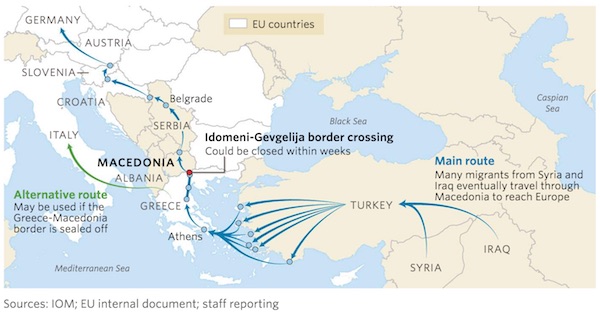
• Netherlands: Turkey-EU Refugee Swap Deal ‘Temporary’ (AFP)
• EU To Ease Greece Refugee Buildup Amid Doubts Over Turkey Deal (Reuters)
• 500,000 Refugees Reached Greece In Q4 2015 (Reuters)

“..“We don’t anticipate it will be necessary to reduce rates further,” he said. The throw-away comment was instantly taken to mean that -0.4pc is the absolute floor that will be permitted by Germany.”

• ECB’s Draghi Plays His Last Card To Stave Off Deflation (AEP)

The ECB has pulled out all the stops to avert a dangerous deflation-trap, launching a blast of triple stimulus despite angry criticism from Germany that it is entirely unnecessary and will do more harm than good. The markets reacted wildly to the package of measures, surging at first and then plummeting on creeping fears that the bank has exhausted its policy options and may be defenceless against a fresh shock. Mario Draghi no longer seems able to conjure confidence with his former panache. His magic has, for now, deserted him. The ECB cut the deposit rate by 10 basis points to a historic low of -0.4pc and stepped up the pace of QE from €60bn to €80bn a month. It buttressed the effect with unlimited 4-year loans to banks at near-zero cost, hoping this will limit the damaging side-effects of negative rates for banks.

“We have shown we are not short on ammunition,” insisted Mr Draghi, who was badly burned in December after seeming to over-promise and then falling short. “Mario Draghi has returned to the fray firing a blunderbuss,” said Simon Ward from Henderson Global Investors. Mr Draghi pledged to flood the financial system with fresh liquidity for as long as it takes to keep the fragile economic recovery alive and prevent a deflationary psychology taking hold, yet there was a sting in the tail. “We don’t anticipate it will be necessary to reduce rates further,” he said. The throw-away comment was instantly taken to mean that -0.4pc is the absolute floor that will be permitted by Germany. Marc Ostwald, from Monument Securities, said the ECB has bet everything on one last throw of the dice. “It’s a kitchen sink job, but at the same time Draghi is saying there is a limit to what they can do, that this is it, and there will nothing more,” he said.

The euro surged by more than two cents to $1.12 against the dollar, making it even harder for the ECB to stave off deflation. “It is not what they were hoping for,” said Simon Derrick from BNY Mellon. “What’s clear is that people are very uncomfortable with negative rates, and markets have become hypersensitive to any shift in monetary expectations,” he said. Hans Redeker, currency chief at Morgan Stanley, said foreign exchange traders had latched onto a subtle shift in ECB policy. It is moving away from efforts to force down the yield curve on sovereign debt, switching instead to a drive for lower corporate credit spreads. This is likely to draw money into eurozone assets. Negative interest rates are widely seen as a tool to force down the exchange rate, a form of “currency war” that will no longer be tolerated by the US after the G20 meeting in Shanghai. The ECB’s shift to other tools is a sign that it is backing away from this game. “We’re not in that war at all,” said Mr Draghi. [..]

Professor Richard Werner from Southampton University, the man who invented the term QE, said the ECB’s policies are likely to destroy half of Germany’s 1,500 savings and cooperative banks over the next five years. They cannot pass on the negative rates to savers so their own margins are suffering. “They are under enormous pressure from regulatory burdens already, and now they are reaching a tipping point,” he said. These banks make up 70pc of German deposits and provide 90pc of loans to small and medium firms, the Mittelstand companies that form the backbone of German industry. Prof Werner said these lenders are being punished in favour of banks that make their money from asset bubbles and speculation. “We have learned nothing from the financial crisis. The sooner there is a revolt in Germany, the better,” he said.

Read more …

How can you fight deflation when you don’t know what it is?

• Draghi Can Cut Borrowing Costs, But He Can’t Make Companies Borrow (BBG)

Mario Draghi’s plans to buy corporate bonds will cut financing costs for European companies, if history is any guide. Getting the firms to actually borrow and spend money will be harder. Corporations already have hefty incentives to sell debt, with average yields on investment-grade bonds in the region below 2 percent for a second year. But they have little appetite to raise money to invest in new factories and equipment, because the economic outlook is so weak. “If you don’t need the funds then why should you raise them?” said Ivo Kok, the treasurer of Alliander NV, an investment-grade Dutch gas and electricity distribution company. “It is more of a risk to have an awful lot of cash around that you’re not putting to work.”

The ECB said on Thursday that it will start buying investment-grade corporate bonds sometime toward the end of the second quarter, as part of a broader bond purchase program. To help stave off deflation and stimulate growth, it plans to buy €80 billion of debt a month, also including eurozone government bonds, asset-backed securities, and covered notes. The central bank is also taking steps to provide cheap funding to banks through a program known as “targeted longer-term refinancing operations.” That financing, which essentially pays banks to borrow, is meant to encourage more lending. The ECB’s efforts are already looking like they may cut companies’ borrowing costs. A measure of investment-grade corporate credit risk, the Markit iTraxx Europe Index, dropped to its lowest point in two months.

Banks are seen benefiting too – notes issued by Italian lenders Intesa Sanpaolo and UniCredit, the biggest users of the TLTRO facility, were among the gainers. But even before the ECB’s moves, companies had access to cheap credit, said Gary Herbert at Brandywine Global Investment Management. “Is there a need to lever up a balance sheet to grow a business when underlying customers aren’t demanding more of what you make?” Herbert said.

Read more …

“Japan has a number of unusual traits that make it a very good proving ground for macro models, including a shrinking population, inefficient labor markets, an economy out of sync with the rest of the world and a government willing to engage in dramatic economic experiments.”

• Japan, An Economics Lab Where Theories Go to Die (BBG)

The main thing you have to understand about macroeconomic theory – both of the type used by academics and the type employed by private-sector forecasters – is that it doesn’t really work. Events are constantly taking macro people by surprise, counterexamples to pet theories are a dime a dozen, and the rare theory that can be tested against available data is usually rejected outright. In macroeconomics, your choice of model is usually between “awful” and “very slightly less awful.”

Most macroeconomic theories can be easily tested: all we have to do is take a look at Japan. Japan has a number of unusual traits that make it a very good proving ground for macro models, including a shrinking population, inefficient labor markets, an economy out of sync with the rest of the world and a government willing to engage in dramatic economic experiments. Once we start examining theories used to explain the U.S. economy, and apply them to Japan, we find that these theories usually fail.

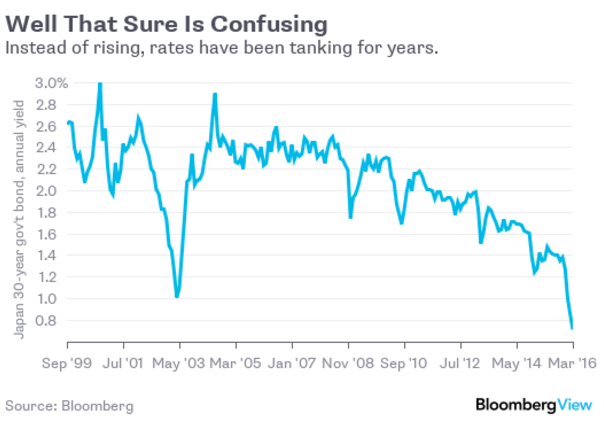
For example, take the theory of loanable funds, which is taught in most undergraduate introductory econ classes. According to this model, when the government borrows a lot of money, it pushes up interest rates. That makes a certain logical sense, since interest rates are the price of borrowing, and an increase in demand for credit should push up the price. But even as Japanese government deficits and borrowing have exploded since 1990, interest rates have done nothing but fall as the chart below shows:
Read more …

Doesn’t sound like a good sign.

• China May Rein in Wage Increases to Boost Economy (WSJ)
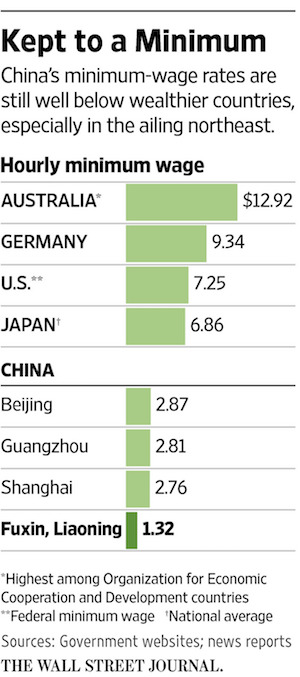
China’s Communist leaders are trying to rein in wage increases, favoring business interests at the expense of increasingly discontented workers as growth sags. China’s labor ministry recently urged “steady and cautious control” over minimum wages and proposed a formula change that would slow increases, according to people briefed on the plan. The southern province of Guangdong, a manufacturing hub, last month announced a two-year freeze on minimum wages. During annual legislative meetings in Beijing this past week, Finance Minister Lou Jiwei criticized China’s labor laws as being overly protective of workers, saying they fuel wage inflation and discourage employers from creating more jobs. Despite a rise in labor strife, Premier Li Keqiang made no direct mention of labor relations in his annual speech, a departure from previous years.

Over much of the past decade, Chinese wages grew faster than the economy, lifting workers’ living standards but also diminishing China’s competitive edge. The increases helped ensure workers shared in economic prosperity. Now, as growth slows, leaders are signaling wages and labor rights—already poorly enforced—might need to take a back seat. “China, as a developing country, has adopted labor laws of a European welfare state,” said Yang Keng, chairman of real-estate firm Sichuan BRC Group and a political adviser to the government. “The motives are good but businesses have been hurt.” China is trying to avoid painful job losses by keeping growth at a robust 6.5% over the next five years. Leaders already plan to lay off 1.8 million steel and coal workers and aren’t eager to drive up unrest with deeper cuts.

Instead, they are trying to free up funds for businesses to invest, including by tackling workers’ wages and welfare benefits. “The government is moving in a broadly pro-capital direction,” said Eli Friedman, an assistant professor at Cornell University who studies labor relations in China. “This would be a disaster for Chinese workers, and would certainly undermine efforts at economic rebalancing.”

Read more …

Schäuble rules.

• Germany Confirmed To Be Back In Deflation (FT)

Germany’s inflation rate for February came in unchanged from its preliminary reading, confirming Germany has fallen back into deflation. Consumer prices were confirmed to have fallen 0.2% year-on-year in February on an EU-harmonised basis, down from a 0.4% rise in January. Economists had forecast the figure to remain the same. On a month-on-month basis, consumer prices rose by 0.4%. The news will give a further headache to the ECB, which yesterday announced a package of additional monetary easing measures partly designed to ward off deflationary pressures from the single currency zone.

Read more …

Scary numbers.

• Australians Have Amnesia On Housing And Banks (BS)

Australian investors are far too over-exposed to housing and should not be doubling down on that risky exposure by owning shares in the banks as well, according to Lazard Asset Management. Lazard portfolio manager Philipp Hofflin says his greatest concern is the risk posed by the housing market, which he argues is fundamentally overvalued as an asset class. “We are concerned about it because we think the price is fundamentally wrong,” Hofflin told a conference of investment advisers in Melbourne. “It is the biggest issue that faces Australia and the largest asset class by far. There are clearly signs of speculative activity,” he said, citing high levels of interest-only loans and the majority of first homebuyers choosing investment properties rather than owner-occupied.

The media has been awash with reports in recent weeks about the risks of the housing bubble bursting, but Hofflin says it is impossible to predict the timing of such an event because you could only identify the catalysts in retrospect. But if capital-city housing were a fully equity-funded stock (with no debt), it would be trading at a price to earnings ratio of 65, compared with a long-term stock average of 16 to 17. Units are trading about 49 times earnings. The net yield on an Australian home of 2.2% is well below the comparable yield on a US home of 6.2%; on a unit it is 2.9% compared with 5.7% in the US. He pointed to parallels with Australia’s two previous debt-fuelled housing booms in the 1880s and 1920s, both of which were followed by extended economic depressions.

“We’ve been here before. We got here because we suffer from collective intergenerational amnesia,” Hofflin argues. Australians’ over-exposure to housing is evident in the middle 60% of income households, where housing accounts for 90% of their net worth. At the top of the US housing bubble in 2006, that figure was 36% of the household balance sheet and it fell to 28% in the recession. “Often in Australia, the only other thing they own is bank shares, who lend on that property, and hybrids, and term deposits with those same banks. It is one very large, concentrated risk,” Hofflin says. Of investors who directly own shares, over 60% are held in the banks while 80% are in financials.

Read more …

Just as scary.

• Americans’ Home Wealth Recovers $7 Trillion as Prices Firm (BBG)

In March 2014, Steven and Bernadette Doherty paid $183,000 for a two-bedroom home in Charlotte, North Carolina, $6,000 more than its appraised value. Today, similar houses in the neighborhood are being priced at $300,000 or more. “We bought at the right time,” said Bernadette, a retired Wells Fargo information technology worker. “In retrospect, we were lucky as prices have gone up so much more.” Home-price appreciation is a welcome development for households whose nest eggs were shattered by the residential real-estate bust that began a decade ago. The 2006-2009 housing slump reduced wealth by $7 trillion. Since then, the value of homeowners’ equity in real estate has more than doubled from a low in the first quarter of 2009, a Federal Reserve report today showed. What’s more, housing wealth is poised to reach a new record as early as the second quarter, say economists at the St. Louis Fed and Pantheon Macroeconomics.

Improving property values are allowing homeowners to shake off recent stock-market volatility and keep spending. From the end of 2013 through last year’s fourth quarter, home equity climbed 22% compared with a 11% gain in the Standard & Poor’s 500 Index. The stock index has declined 3% this year. “The increase in housing wealth is a kind of stealth offset to falling stock prices,” said Ian Shepherdson, chief economist at Pantheon Macroeconomics, who predicts record home equity values next quarter. “Home ownership is much wider than stock ownership. The consumption effect from a given rise in holdings has been bigger for homes.” Some cities, including Charlotte, are already seeing prices at all-time highs. Home values in Dallas, Denver, and San Francisco and Portland, Oregon, all hit records in December, while they’re down less than 1% in Boston from an August peak, according to S&P/Case-Shiller indexes. About 38% of 87 U.S. metropolitan areas were in record territory last year, data tracker RealtyTrac figures show.

Read more …

A year old, but an excellent explanation of austerity.

• An Economy Under Austerity Is Like A Filthy Restaurant Kitchen (Leveller)

The austerity fetishists trying to do to Europe and America what the IMF and World Bank did to its third world victims in the eighties, on behalf of their masters in Wall Street, often compare an economy to a household. This household, they tell us, has lived beyond its means, by maxing out its credit card and getting into debt. What do you do when you get into debt? You pay it off! Stop shopping at Whole Foods and go to Walmart instead. Take the shiny gadgets you don’t need to a pawn shop for a bit of extra cash. Work harder. Even ignoring the fact that the increased indebtedness of households these days is part of a structural problem rather than a moral one, the basis for the ‘economy is like an indebted household’ analogy has no relation whatsoever to economics. They would have you believe that austerity is a practical measure, where if you sell off your wasteful trinkets you will become solvent once again – all premised on the iron moral principle that Debts Must Be Paid.

This is a load of bollocks. We want to propose instead that austerity is like a restaurant kitchen, not because we think the analogy is perfect, but because every time a Keynesian economist tries to knock down the household analogy they drone on with “households can’t print money”. Which is hardly a catchy argument to throw at the right wing pub bore. It is possible to have a little more imagination than that. Here is the Leveller’s austerity kitchen analogy, for your pub argument utility belt. Use it carefully. The restaurant has got itself into debt. We don’t really care how, suffice to say the decisions that led to it were made by the owners and not the staff. The owners like to say “we” are in debt to include the staff, which is interesting, given that when the restaurant was making a tidy profit the previous year there was no “we” when it came to giving themselves a fat pay rise. But now, for whatever stupid structural reason you’d care to pick, they are in debt.

Even if there isn’t some troll sat there insisting that the ovens and hobs don’t create value through being there – let’s call her Libby Terrian – consider austerity as being like the restaurant saying, “well there is no immediate value being created by the dishwasher, and we already have a porter and a sink, so let’s sell the dishwasher”. As in the machine, not the porter. So they flog the dishwasher and get some liquidity, and use it to pay off some of their interest-ridden debt. Sadly the value of the dishwasher is not equal to the value of the debt, not even close, and so the debt starts to mount once more; all they’ve done is bought a little time. At the same time, the poor kitchen porter is having to work much harder to keep everything clean – naturally they can’t afford to give him a pay rise to reflect this increase in workload – but he just can’t keep up, because the value of his labour has been reduced by taking the dishwasher out of the microeconomy.

Meanwhile Libby Terrian thinks it would be way better if the chefs just cooked the food at home and brought it in because then the restaurant wouldn’t have to spend money on oven maintenance every few months, but thankfully nobody listens to Libby, because she is mental. Further problems mount from this, of course. The porter’s increased workload with less ability to do it properly leads to an unfortunate situation several nights a week whereby he can’t produce clean plates quickly enough for the chefs, who end up having to wash plates by themselves. Not only does this affect the quality of their dishes, it also affects general hygiene in the restaurant. The restaurant begins to get a reputation for being dirty.

Read more …

Mostly what I said not long ago.

• How a BREXIT Could Save Europe From Itself (Heath)

It is those who love Europe, its diversity, its history and its humanity who should be the most enthusiastic about Brexit. A paradox? Not at all. The European Union, as currently constituted, has run out of road. It is doomed to fail, sooner or later, with catastrophic consequences for our part of the world, and the only way forward is for one major country to break ranks and show that there can be a better alternative consistent with Europe’s core enlightenment values. It would be far better if we, rather than a more socialist or nationalistic country, were the first to break the mould: Britain would have the opportunity to show that free trade, an open, self-governing society and a liberal approach could ensure the peace and prosperity at the heart of the European dream. Others would soon join us. If we vote to stay, we will lose the moral authority to speak out, and other, less benign, inward-looking, illiberal approaches may triumph instead.

The eurozone is broken, and another, far greater economic crisis inevitable. The next trigger could be a fiscal meltdown in Italy, or another banking collapse, or a political implosion in Spain or France, or another global recession. Nobody can be sure what the proximate cause will be – but there will be one, and the fallout will be turmoil of a far greater magnitude than anything we saw in Greece. At the same time, the tensions fuelled by the migration crisis will grow relentlessly, especially if hundreds of thousands or even millions of people are settled across the continent over the next few years. Many in the Remain camp agree that the eurozone requires drastic surgery, but their solution is naive. They believe that even more integration – a pan-eurozone welfare state, greater transfers between countries, central powers over fiscal policy – would help cancel out the currency’s inherent defects.

I doubt that this would actually work in purely economic terms, but even if it did, it is delusional to believe that such a model can be politically sustainable. Democracy, the term, is derived from the ancient Greek: it denotes a system whereby the people (dêmos) are in power or in which they rule (krátos). One cannot, by definition, have a genuine democracy in the absence of a people; and there is no such thing as a European demos. The French are a people; the Swiss are a people, even though they speak multiple languages; the Americans are a people, even though Democrats and Republicans hate each other. But while Europeans have much in common, they are not a people. Danes don’t know or care about Portuguese politics; the Spanish have no knowledge or interest in Lithuanian issues.

One could hold pan-European elections, of course, with voters picking multi-national slates of candidates; but, then, one could also ask every person on the planet to vote for a world president. Such initiatives would ape democratic procedures, but would be a sham. They would be Orwellian takedowns of genuine democracy, not extensions of it. There would be no relationship or understanding between ruler and citizen, zero genuine popular control, nil real accountability; coalitions of big countries would impose their will on smaller nations, and elites would run riot. We would be back to imperial politics, albeit in a modernised form.

Read more …

Did they tell the Turks this?

• Netherlands: Turkey-EU Refugee Swap Deal ‘Temporary’ (AFP)

A proposed EU-Turkey deal to swap Syrian refugees one-for-one will be only “temporary” and a longer-term resettlement arrangement will be necessary, the Netherlands warned Thursday. European Union interior ministers meeting in Brussels were debating a proposal made by Ankara at a leaders’ summit on Monday for a wide-ranging deal to curb the migration crisis. Under the deal the EU would resettle one Syrian refugee directly from camps in Turkey, in exchange for every Syrian that Turkey takes from the overstretched Greek islands, a scheme both sides have hailed as “game-changing”.

But Dutch migration minister Klaas Dijkhoff, whose country holds the six-month rotating presidency of the 28-nation EU, said that it was “not a permanent mechanism.” “I think the one-on-one readmission and resettlement, it’s temporary,” Dijkhoff told reporters as he arrived for the meeting. “I think when you have the one-on-one scheme, we will see over time that it won’t pay off to cross the sea in an illegal and very dangerous fashion. So that flow will stop,” he said. “And then we will have to talk with Turkey about a more permanent resettlement scheme in a sense of burden sharing.”

Read more …

“It will be very difficult to arrive at something legally sound and implementable before the summit..”

• EU To Ease Greece Refugee Buildup Amid Doubts Over Turkey Deal (Reuters)

The European Union aims to rehouse thousands of asylum-seekers from Greece in the coming months, officials said on Thursday as EU ministers wrestled with concerns about the legality of a new plan to force migrants back to Turkey. Dimitris Avramopoulos, the member of the executive European Commission who handles migration, told reporters at a meeting of national interior ministers that at least 6,000 people a month should be relocated to other member states under a scheme which has moved only about 900 hundred people so far. Avramopoulos noted a recent acceleration in relocations under the system which has divided EU governments as some refuse to take in refugees, most of whom are from Syria and Iraq, though he acknowledged the target was ambitious.

Some 35,000 people have been stranded in Greece since Austria and states on the route to Germany began closing borders, barring access to migrants hoping to follow more than a million who reached northern Europe last year. EU officials said that blockage appeared to have made more asylum seekers ask for relocation rather than try to make their own way northward. Chancellor Angela Merkel, under electoral pressure at home after opening Germany’s doors to a million Syrians, has pressed EU partners to share the load. But few are keen and critics say many of those rehoused elsewhere will head for Germany anyway. On Monday, Merkel pushed EU leaders to pencil a surprise deal she brokered with Ankara to halt the flow to Greece by returning to Turkey anyone arriving on the Greeks islands.

But legal details are still being worked out for an EU summit next week and many governments are still sceptical of the scheme. The top United Nations human rights official said it could mean illegal “collective and arbitrary expulsions”. EU ministers also voiced unease at the price of Ankara’s cooperation, notably an accelerated process to ease visa rules for Turks by June and revive negotiations on Turkey’s distant EU membership hopes. “I ask myself if the EU is throwing its values overboard,” said Austrian Interior Minister Johanna Mikl-Leitner, whose government has led a push to seal off Greece from the north as an alternative to relying on Turkey to stop migrants leaving.

She noted the seizure of an opposition newspaper in Turkey three days before it presented EU leaders with the draft deal, under which Europeans will take one Syrian direct from Turkey for every compatriot who is detained and sent back from Greece. Human rights concerns also pose problems for EU lawyers trying to tie up the package by the March 17-18 summit, notably because to despatch people at speed back to Turkey relies on an assessment that Turkey is a “safe” country for them to be in. An EU definition of such a state includes a reference to the Geneva Convention on refugees, to which Turkey does not fully comply, leaving legal experts in Brussels hunting a solution. “It will be very difficult to arrive at something legally sound and implementable before the summit,” an EU official said.

Read more …

That EU ‘ease’ above talks about resettling 6,000 per month.

• 500,000 Refugees Reached Greece In Q4 2015 (Reuters)

Nearly half a million irregular migrants arrived in Greece in the last three months of 2015, most of whom then moved north through the Balkans, data from EU border agency Frontex showed on Thursday. Frontex, which collates data on the number of irregular border crossings, recorded 484,000 such incidents on the Eastern Mediterranean route from Turkey to Greece between October and December and 466,000 on the Western Balkan route, notably people re-entering the European Union at the Croatian border from non-EU Serbia.

That took the total number of illegal EU border crossings, not using regular crossing points, to 978,300 in the quarter, a record since Frontex began collating such data in 2007. Of those arriving in Greece, mostly on islands off the Turkish coast, 46% said they were Syrian and 28% Afghan, Frontex said. It recorded a drop in arrivals in Italy from Libya but noted a sharp increase in arrivals in Spain from Morocco, albeit at a low level. There were 2,800 illegal crossings in the fourth quarter on the Western Mediterranean route, it said, a record for that season and double that in the same period of 2014.

Read more …

Mar 112016
 
 March 11, 2016  Posted by at 7:27 am Finance Tagged with: , , , , , ,  2 Responses »


Arthur Rackham “Why, Mary Ann, what are you doing out here?”1907

I’ll try and keep this gracefully short: Mario Draghi ‘unleashed’ a bazooka full of desperate tools on the financial markets yesterday and they blew up in his face faster than you could say blowback or backdraft (and that’s just the start of the alphabet). This must and will mean that Draghi’s stint as ECB head is for all intents and purposes done. But…

But there are two questions: 1) who has the power to fire him (not an easy one), and 2) who can replace him. Difficult issues because the only candidates that would even be considered for the job by the same people who hired -no, not elected- Mario -and who will still be in power after he’s gone-, under present conditions, are carbon copies of Draghi. They all went to the same schools, worked for the same banks etc.

So maybe they’ll let him sit a bit longer. Then again, the damage has been done, and Mario has done a lot of destruction, is what the markets said yesterday. But to replace him with someone who’s also already lost all credibility, because they supported Mario every step of the way, carries a very evident risk: that nobody will believe in the entire ECB itself anymore. If you ask me, it’s crazy that anyone still would, but that’s another chapter altogether.

Not that Janet Yellen and Japan’s Kuroda and China’s Zhou Xiaochuan should not also be put out by the curb. While they may -seem to- vary in approaches today, they all started from the same untested, purely theoretical and entirely clueless origins. Just saying. None of them have any idea what negative rates etc will lead to. They’re all in the same rabbit hole. And that’s not a joke, it’s deeply sad.

Ultra-low interest -even negative- rates and bond purchases to the tune of $1 trillion a year, Mario’s schtick, exist all across the formerly rich world. And they all do for the same purpose: to make the people think that they, and their economies, are still rich. Just so bankers can take from them whatever it is they still do have. Think pension funds, investment funds.

Why did this pandemonium of ZIPR and QE ever get started? Because central banks, and the economists that work within them, edged along by bankers who risked behemoth losses, said the most important thing to do was to ‘save’ the banking system, and they can always find some theory to confirm that preference.

But the banking system is where the losses are, and it’s where the risks are. Which are then both transferred to Joe and Jane Blow, who subsequently have less to spend, which defeats the alleged central bank purpose of ‘stimulating’ the economy.

Draghi’s argument for the new (water-)bazooka measures is that without them, Europe would face ‘awful’ deflation. But it’s his very measures that create and encourage deflation. So who still knows how to count beyond 101? Good question.

But anyway, I just wanted to say that Draghi’s gone in all but physical presence. And if they keep him on for a while longer, that means that what happened today will happen again, just faster. Big risk.

No Super Mario no more.

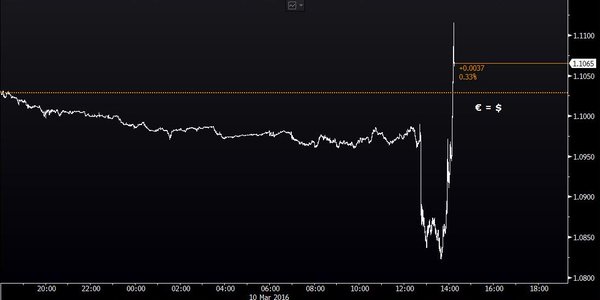
What happened with Draghi yesterday is eerily reminiscent of the ‘glorious’ Bernanke days, when ‘poor’ Ben would make one of his weighty announcements and the effects he was looking for would fizzle out within hours. In full accordance with the law of diminishing returns, Draghi’s new and far more desperate measures lost their very meaning even within the space of barely more than half an hour. This EURUSD graph says it all:

That is ugly. That has meaning. Much more than Mario -the former Goldman Sachs executive- himself and his paymasters will be willing to acknowledge. It means the financial world is now ready to bet against Draghi. Like they bet against China.

Europe’s best hope, somewhat ironically, is German resistance against Draghi, which yesterday reached a point of no return. Ambrose Evans-Pritchard gave a perfect example overnight of why that is:

Professor Richard Werner from Southampton University, the man who invented the term QE, said the ECB’s policies are likely to destroy half of Germany’s 1,500 savings and cooperative banks over the next five years. They cannot pass on the negative rates to savers so their own margins are suffering. “They are under enormous pressure from regulatory burdens already, and now they are reaching a tipping point,” he said.

These banks make up 70pc of German deposits and provide 90pc of loans to small and medium firms, the Mittelstand companies that form the backbone of German industry. Prof Werner said these lenders are being punished in favour of banks that make their money from asset bubbles and speculation.

“We have learned nothing from the financial crisis. The sooner there is a revolt in Germany, the better,” he said.

Draghi’s done. This hole is too deep for him to climb out of.

Mar 022016
 
 March 2, 2016  Posted by at 10:21 am Finance Tagged with: , , , , , , , , , ,  3 Responses »


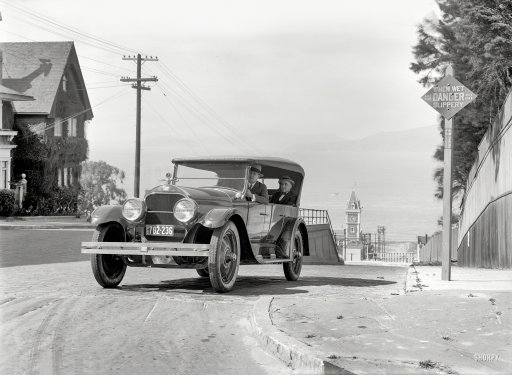
Christopher Helin Flint auto, Ghirardelli Square, San Francisco 1924

• China To Lay Off 5 To 6 Million Workers (Reuters)
• Deflation Defeats Impotent Central Banks (A. Gary Shilling)
• Smells Like Subprime (BBG)
• China Credit Outlook Cut to Negative by Moody’s (BBG)
• China’s Secret Weapon: Used Car Salesmen (FT)
• China Reserve Ratio Cut ‘No Signal Of Impending Large-Scale Stimulus’ (Reuters)
• Debts Rise At China’s Big Steel Mills, Consumption Falls (Reuters)
• Natural Gas Prices Plunge To 17-Year Lows (CNBC)
• Europe’s Biggest Oil Hub Fills as Ship Queue at Seven-Year High (BBG)
• UAE Says Oil Collapse Will Force All Producers to Cap Volumes (BBG)
• Negative Rates … Negative Outcomes (Corrigan)
• Trumpocalypse Now (Guardian)
• Euro Depression Is ‘Deliberate’ EU Choice, Says Mervyn King (Telegraph)
• Why Austria’s Asylum Cap Is So Controversial (Economist)
• EU Nations Urged To Lift Border Checks To Save Passport-Free Zone (Guardian)
• Rights Groups Accuse France Of Brutality In Calais Eviction (AP)
• Greece Seeks EU Aid For 100,000 Refugees (AFP)

Big risk for Xi. He must be desperate.

• China To Lay Off 5 To 6 Million Workers (Reuters)

China aims to lay off 5-6 million state workers over the next two to three years as part of efforts to curb industrial overcapacity and pollution, two reliable sources said, Beijing’s boldest retrenchment program in almost two decades. China’s leadership, obsessed with maintaining stability and making sure redundancies do not lead to unrest, will spend nearly 150 billion yuan ($23 billion) to cover layoffs in just the coal and steel sectors in the next 2-3 years. The overall figure is likely to rise as closures spread to other industries and even more funding will be required to handle the debt left behind by “zombie” state firms. The term refers to companies that have shut down some of their operations but keep staff on their rolls since local governments are worried about the social and economic impact of bankruptcies and unemployment.

Shutting down “zombie firms” has been identified as one of the government’s priorities this year, with China’s Premier Li Keqiang promising in December that they would soon “go under the knife”.. The government plans to lay off five million workers in industries suffering from a supply glut, one source with ties to the leadership said. A second source with leadership ties put the number of layoffs at six million. Both sources requested anonymity because they were not authorized to speak to media about the politically sensitive subject for fear of sparking social unrest. The ministry of industry did not immediately respond when asked for comment on the reports. The hugely inefficient state sector employed around 37 million people in 2013 and accounts for about 40% of the country’s industrial output and nearly half of its bank lending.

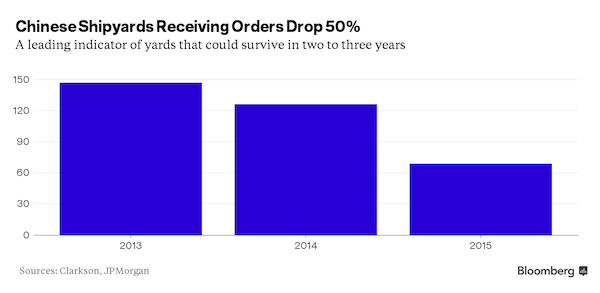
It is China’s most significant nationwide retrenchment since the restructuring of state-owned enterprises from 1998 to 2003 led to around 28 million redundancies and cost the central government about 73.1 billion yuan ($11.2 billion) in resettlement funds. [..] China aims to cut capacity gluts in as many as seven sectors, including cement, glassmaking and shipbuilding, but the oversupplied solar power industry is likely to be spared any large-scale restructuring because it still has growth potential, the first source said. The government has already drawn up plans to cut as much as 150 million tonnes of crude steel capacity and 500 million tonnes of surplus coal production in the next three to five years. It has earmarked 100 billion yuan in central government funds to deal directly with the layoffs from steel and coal over the next two years, vice-industry minister Feng Fei said last week.

The Ministry of Finance said in January it would also collect 46 billion yuan from surcharges on coal-fired power over the coming three years in order to resettle workers. In addition, an assortment of local government matching funds will also be made available. However, the funds currently being offered will do little to resolve the problems of debts held by zombie firms, which could overwhelm local banks if they are not handled correctly. “They have proposed this dedicated fund only to pay the workers, but there is no money for the bad debts, and if the bad debts are too big the banks will have problems and there will be panic,” said Xu Zhongbo, head of Beijing Metal Consulting, who advises Chinese steel mills.

Read more …

Nothing they could ever do. Deflation must and will have its day.

• Deflation Defeats Impotent Central Banks (A. Gary Shilling)

Central banks are deadly fearful of deflation. That’s why the Federal Reserve, the European Central Bank, the Bank of Canada, the Bank of Japan and Sweden’s Riksbank, among others, have 2% inflation targets. They don’t love rising prices, but they worry about the consequences of a general decline in consumer prices, so they want a firebreak. Unfortunately, they seem powerless to meet their targets in the current economic environment. The guardians of monetary policy are riveted by Japan, where consumer prices have declined in 48 of the last 83 quarters. This pattern of deflation long ago convinced Japanese buyers to hold off purchases in anticipation of lower prices. But the result is excess inventories and too much productive capacity, which force prices even lower.

That confirms expectations, resulting in yet more buyer restraint. The result of this deflationary spiral has been a miserable economy with an average growth in real GDP of just 0.8% at annual rates since the beginning of 1994. Central banks also fret that in a deflationary environment, debt burdens remain fixed in nominal terms, but the ability to service them drops along with falling nominal incomes and waning corporate cash flows. So bankruptcies leap, while borrowing, consumer spending and capital investment all weaken.

As I argued on Monday, deflation remains a clear and present danger. Worryingly, the remedies central bankers are using aren’t working. First, in reaction to the financial crisis, they knocked their short-term reference rates down to essentially zero, and bailed out their stricken banks and other financial institutions. That may have forestalled financial collapse but it did little to stimulate borrowing, spending, capital investment and economic activity. Creditworthy borrowers already had ample liquidity and few attractive spending and investment outlets; slashing borrowing costs to record lows stimulated asset prices such as equities, with little economic benefit.

Furthermore, banks were too scared to lend. And as they resisted attempts to break them up and eliminate the too-big-to-fail problem, regulators bereaved them of profitable activities such as proprietary trading and building and selling complex derivatives. That forced them back toward less lucrative traditional spread lending – borrowing short-term money cheaply and lending it for longer at a profit – just as the shrinking gap between short- and long-term funds made that business even less attractive. With the amount of capital banks are obliged to set aside against their trading activities also leaping, they’re now regulated to such an extent that many of them probably wish they had been broken up.

Read more …

And Beijing claims Kyle Bass is wrong?

• Smells Like Subprime (BBG)

Chinese bankers often pride themselves on having studied in the U.S. or the U.K and true to form, they’re bringing home a lot of the intricate financing that helped people overseas get loans for homes, cars and education. But these financiers are taking creative structures one step further.On Monday, Bloomberg News reported that China will allow domestic banks to issue as much as 50 billion yuan ($7.6 billion) of asset-backed securities that would be paid back using the proceeds from nonperforming loans. (Yes, you read that correctly.) The structure they’re employing is similar to the method that was used to repackage subprime mortgages in the U.S. ahead of the global financial crisis. But when bankers in America were bundling those low-doc mortgages into AAA-rated bonds, they still expected most of the loans would be repaid.

In this case, the debt has already gone bad. Considering hardly any Chinese asset-backed securities have ever received a less than AA score from a local rating company to date, chances are these ones will be awarded the same grade. Of course, investors buying these bonds should be aware they’re backed with debt that’s already soured, regardless of its credit score. Yet, the move is worrying because it’s the latest in a string of revivals in China of dangerous structures that were common in the West before being all but abandoned after 2008. Many of the instruments are helping banks disguise or unload their exposure to troubled companies in the same way issuance of asset-backed securities helped U.S. and British lenders mask their exposure to souring home payments as loans became delinquent.

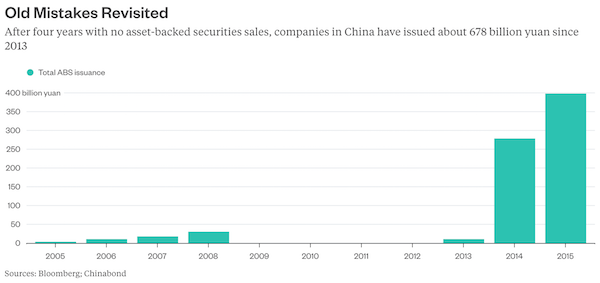
Ironically, China had pretty much banned asset-backed securities until 2013 because of what happened during the credit crisis. Since authorities began allowing them again, they’ve spread like wildfire. Official data indicate that 593 billion yuan of ABS were sold last year, 79% more than in 2014. Less comprehensive Chinabond data show some 678 billion yuan being issued over the past two years. The first quota of 50 billion yuan is just a test. If there’s enough demand you can bet there will be plenty more of these repackaged bad-loan bonds floating around China in coming years. The amount of debt classed as nonperforming at Chinese commercial banks jumped 51% from a year earlier to 1.27 trillion yuan as of Dec. 31, the highest since June 2006, data from the China Banking Regulatory Commission showed last month.

Read more …

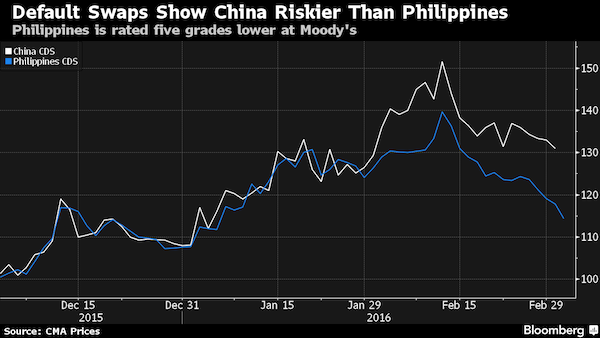
CDS look very ugly.

• China Credit Outlook Cut to Negative by Moody’s (BBG)

China’s credit-rating outlook was lowered to negative from stable at Moody’s Investors Service, which highlighted the country’s surging debt burden and questioned the government’s ability to enact reforms just days before leaders gather to approve a five-year road map for the economy. The government’s financial strength may come under pressure if it takes on liabilities from troubled state-owned companies, while capital outflows have limited policy makers’ scope to stimulate the weakest economy in a quarter century, the ratings company said in a statement on Wednesday. State intervention in equity and foreign-exchange markets has heightened uncertainty about the leadership’s commitment to reform, Moody’s said.

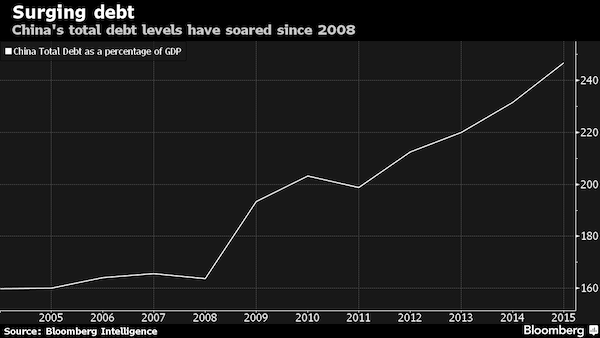
While markets shrugged off the outlook cut on Wednesday, it highlights concern among global investors that the ruling Communist Party will struggle to overhaul Asia’s largest economy at a time when capital is flowing out of the country and debt levels have climbed to an unprecedented 247% of GDP. Chinese leaders will begin nearly two weeks of policy meetings on Saturday to map out how to tackle the nation’s economic challenges and meet the government’s goal of doubling per-capita income by 2020. “The government’s ability to absorb shocks has diminished and we want to signal this in the negative outlook,” Marie Diron, a senior vice president at Moody’s, said in an interview on Bloomberg Television. Authorities “have stepped backward in their reform steps and so that is creating some uncertainty.”

Read more …

Growth market. Next up: scrapyards.

• China’s Secret Weapon: Used Car Salesmen (FT)

You have probably read, in the Financial Times and elsewhere, that China is the world’s largest car market. It is not. It is the world’s largest new car market, with sales of 21.1m units last year compared with 17.4m in the US. When used cars are included, the US auto market swells to more than 40m units, against less than 30m total passenger car sales in China. In value terms, the gap between the two markets is even larger. In 2014, the overall value of US car sales was almost $1.2tn, more than twice as large as China’s $470bn. This is not surprising, considering that two-thirds of cars on Chinese roads are less than five years old and 80% of all buyers are first-time drivers. The latter fact explains why crossing an intersection in China can be a harrowing experience for pedestrians.

Put another way, an industry that most Americans, Europeans and Japanese have grown up with and now take for granted does not yet even exist in China. Dismiss a shady character as a “used car salesman” and most Chinese people will not understand the reference. As Chinese leaders gather at their annual parliamentary session later this week, it is worth bearing in mind that they are doing so in a country where one cannot very easily buy a used car. That fact should reassure Chinese politicians and multinational executives worried about the pace of growth in the world’s second-largest economy, which will be a topic of much discussion at the National People’s Congress.

Government officials insist that the rising “new economy” will balance out the declining “old economy”, allowing the country to grow at an average rate of 6.5% through 2020. The creation of entirely new industries will further support growth. The inevitable rise of what will soon be the world’s largest used car market is one such example. While its emergence will initially cannibalise some new car sales — primarily those of cheap domestic brands — the potential for growth is huge. In most developed auto markets, there are at least two used car sales for every one new car sale. In China the ratio is inverted, with roughly three new car transactions for every used car sold.

Read more …

Just a signal of panic.

• China Reserve Ratio Cut ‘No Signal Of Impending Large-Scale Stimulus’ (Reuters)

China’s move to cut banks’ reserve requirement ratio (RRR) indicates a slight easing bias in China’s “prudent” monetary policy, but that is by no means a signal of any coming large-scale stimulus, the official Xinhua news agency said in a commentary late on Tuesday. The Xinhua commentary follows rising market expectations that China could implement a version of the massive stimulus it adopted during the global financial crisis, launching in late 2008 a 4 trillion yuan ($610 billion)stimulus package to boost the economy. The news agency said strong stimulus was not needed because China still had monetary policy tools available and China’s economy was growing at a reasonable rate, with no signs of chaos or crisis in the global economy. Xinhua stated that because China would stick to its prudent monetary policy, there would be no changes in the way the government adjusted liquidity, which would be kept at a reasonable and flexible level, it said.

That meant China’s lending and total social financing would grow at a steady and reasonable rate, Xinhua noted. Xinhua’s view was echoed by state-owned People’s Daily, which reported on Wednesday, citing economists, that the RRR cut was not stimulus, but only reflected increasing policy flexibility aimed at supporting economic development. Late on Monday, the People’s Bank of China announced a cut in the amount of cash that banks must hold as reserves – the reserve ratio requirement (RRR) – by 50 basis points. It frees up an estimated $100 billion in cash for new lending. Hong Hao at BOCOM International said the RRR cut was largely liquidity neutral, because the move was intended to offset the decline in China’s foreign currency reserves and to accommodate more than 1 trillion yuan of open market operations facilities due this week.

Read more …

So they can’t go broke, right?!

• Debts Rise At China’s Big Steel Mills, Consumption Falls (Reuters)

China’s major steel mills added to their debt pile in 2015 while consumption of steel products fell for the first time in two decades, a senior official said on Wednesday, adding to the industry’s difficulties as it tries to tackle a crippling glut. The debt ratio of major steel mills rose 1.6 %age points to 70.1% from a year ago, taking the big mills’ debt to 3.27 trillion yuan ($499 billion), Li Xinchuang, the vice secretary general of the China Iron & Steel Association (CISA), told a conference. At the same time, steel product consumption in China fell 5.4% to 664 million tonnes in 2015 from a year ago, the first drop since 1996, said Li, who is also head of the China Metallurgical Industry Planning and Research Institute.

China is trying to rein in its bloated steel sector, and aims to cut crude steel capacity by 100 million to 150 million tonnes within the next five years, as well as ban new steel projects and eliminate so-called “zombie” mills. However, slower demand and rising debt will put further pressure on the industry, with prices already at multi-year lows. China’s major steel mills produced a combined 601 million tonnes of steel last year, accounting for nearly three-quarters of the country’s total output, Li said. CISA earlier said the country’s total annual crude steel capacity now stands at 1.2 billion tonnes. Total production reached 803.8 million tonnes last year, down 2.3%, the first drop since 1981. The drive to cut industrial capacity will force China to lay off probably 1.8 million workers from coal and steel sectors, and the central government will allocate 100 billion yuan to deal with job losses and tackle debt.

Read more …

“..Australian LNG production is expected to grow 50% in the five years through to 2020..”

• Natural Gas Prices Plunge To 17-Year Lows (CNBC)

Natural gas prices have crashed to 17-year-lows in the past week, underscoring burgeoning supply in the global market just as U.S. exports its first ever shale gas cargo. On Monday, natural gas prices on the New York Mercantile Exchange settled 4.5% lower to their lowest level since 1999 after U.S. weather forecasts signaled warmer weather in the weeks ahead, curbing demand for natural gas used for heating. The decline brought February losses in natural gas to 26%. Prices recovered on Tuesday but the outlook remains depressed. Japan, the world’s largest importer of natural gas, is restarting its nuclear reactors six years after the 2011 Fukushima disaster, with three out of 43 nuclear reactors brought back online since August and more expected to come.

Japan is likely to bring back more reactors online, which will make the country less dependent on LNG for electricity generation. In January, shipments of LNG into Japan fell the most in more than six years, according to Bloomberg calculations. This does not bode well for Australia, which has pumped more than $160 billion in LNG investments just before the commodities rout that has taken oil prices down 70% since the summer of 2014. Australian LNG production is expected to grow 50% in the five years through to 2020 even as certain producers cut capital expenditures and reduce spending on upstream activities, said Fitch Group unit BMI Research in a note last week.
Read more …

“..people will be filling up their “swimming pools” with it this year.”

• Europe’s Biggest Oil Hub Fills as Ship Queue at Seven-Year High (BBG)

The queue of ships waiting outside Europe’s biggest port and oil-trading hub of Rotterdam has grown to the longest in seven years as a global supply glut fills storage capacity. As many as 50 oil tankers, twice as many as normal, are waiting outside Rotterdam because storage sites are almost full, the port’s spokesman Tie Schellekens said by phone on Tuesday. “This is a clear sign of the oversupply filling up storage to the brim,” Gerrit Zambo, an oil trader at Bayerische Landesbank in Munich, said by phone. “People are preferring to store oil rather than cut production. These are bearish signs.” The world is so awash with oil that BP CEO Bob Dudley said last month people will be filling up their “swimming pools” with it this year.

Traders are taking advantage of a market contango, where forward prices are higher than current prices, by buying oil cheap, storing it and selling the commodity later. As onshore storage fills up, companies could start stockpiling at sea in a repeat of a strategy last seen in 2008 and 2009. Crude oil in storage tanks in Rotterdam stood at 51.3 million barrels on Feb. 19, the highest for the time of year in data starting in 2013, according to Genscape, which monitors inventories. Royal Vopak NV, the world’s largest oil-storage company, last week reported a fourth-quarter occupancy rate of 96% at its 11 terminals in the Netherlands compared with 85% a year earlier. The situation in Rotterdam mirrors that in the biggest U.S. storage hub of Cushing in Oklahoma, where stockpiles are at a record high.

“In Cushing and probably Rotterdam storage is filling up very quickly,” said Giovanni Staunovo at UBS in Zurich, Switzerland. “In China, given high oil imports, there are too many ships and the infrastructure seems not be able to handle that.” Saudi Arabia, the world’s biggest oil exporter, said last month it won’t cut production to ease global oversupply, while Iran has pledged to increase output after sanctions were lifted in January. Still, oil climbed on Tuesday from the highest close in more than seven weeks on speculation that monetary stimulus in China could help revive flagging economic growth in the world’s second-biggest fuel consumer.

Read more …

It will bankrupt them first.

• UAE Says Oil Collapse Will Force All Producers to Cap Volumes (BBG)

The oil-price collapse will compel all producers to freeze output and no early OPEC meeting can take place without such a move, the United Arab Emirates’ energy minister said. “This is the reality,” Suhail Al Mazrouei said Tuesday in Abu Dhabi. “Current prices will force everyone to freeze production; stubbornness doesn’t make sense.” Saudi Arabia – the world’s largest crude exporter – Russia, Venezuela and Qatar have proposed that producers cap production at January levels to bolster prices that have tumbled almost 70% in two years. OPEC member Iran, which is ramping up output following the removal of sanctions in January, has said the plan is “ridiculous” and saddles it with “unrealistic demands.”

Venezuela is among members of the Organization of Petroleum Exporting Countries to call for a meeting of oil producers this month, while Saudi Arabian Oil Minister Ali al-Naimi has said he hopes for such a gathering. The group’s next scheduled meeting is in June. Mazrouei said he hasn’t received an invitation for an early meeting and a summit won’t be necessary if producers don’t agree in advance to freeze output. That runs counter to Iran’s plans to increase volumes by 1 million barrels a day this year. “The idea of bringing a lot of production in a short period is not practical,” Mazrouei said.

Read more …

Laws of nature.

• Negative Rates … Negative Outcomes (Corrigan)

There has been much head-scratching of late as to why, with interest rates lower than they have been since the Universe first exploded out of the Void, businesses are not undertaking any where near as much investment as that hoped for beforehand by the academic cabal whose ‘effective demand’ and ‘transmission channel’ fixations have helped drive rates to today’s mind-boggling levels. This is obviously a complex topic in which there are many different factors at work – not the least of which is that the prevalence of overly-low interest rates for much of the recent past has meant that all too much of such investment as is now desired has not only already been done, but done in what has turned out to be so misguided a fashion, that there is less appetite – as well as fewer means, in many cases – to undertake much more of it today.

If the cure for higher prices – as the saying in commodity markets goes – is higher prices, then the cause of lower rates is almost certainly lower rates! Be that as it may, on a more fundamental level, it might also be possible to tease out at least one aspect of the answer to the conundrum with the aid of a little straightforward logic, as we shall now attempt to do here. In theory, positive interest rates reflect the primal truth that goods fit for our enjoyment today are worth more to their potential consumer than those same goods which are only available tomorrow. Moreover, since producer goods are otherwise inedible, unwearable, uninhabitable, etc., in their present form, they only derive their value in respect of their quality of being innate consumer goods-to-be.

Hence, the means of producing the day’s goods for some future date are always to be discounted back using that same ratio (which is none other than the natural rate) as the one which prevails between consumables-now and consumables-then. Doing so gives us a positive IRR (or, if you prefer, assuring that NPV>0) for the process. Here it goes without saying that since the natural rate is inherently unobservable, the market interest rate will be used in its place – an unavoidable substitution which demands that this latter quantity be subject to as few falsifications as possible (a vexed topic suitable for a forthcoming, much deeper treatment).

Read more …

Oh, wait, Drumpfocalypse.

• Trumpocalypse Now (Guardian)

There will be those in the Republican and conservative establishment who will try to spin the Super Tuesday results. Some among the GOP chattering classes will tell you that Trump didn’t get the knock-out punch he wanted – that there is still a chance to restore order. Don’t believe it. The numbers make it clear that, for the Republican party, it’s Trumpocalypse Now. While Ted Cruz won his home state of Texas as well as Oklahoma, and Rubio ran him close in Virginia and actually managed to win Minnesota, Trump dominated elsewhere. His success extended from Massachusetts to Georgia to Alabama to Tennessee to Oklahoma. He won in Ted Cruz’s south, and he won in the north-east, where a more establishment-friendly candidate like Marco Rubio was supposed to prevail.

Trump is winning with men and women, moderates and conservatives, with the young and the old. Trump is winning despite a weekend of unforced errors – after failing to repudiate former Klu Klux Klan Grand Wizard David Duke. Trump is winning even after taking political napalm from Marco Rubio since last week’s debate – with Rubio ridiculing his rival on the trail for days. Trump is winning despite the fact that the Republican speaker of the House and majority whip in the Senate both criticized him this week. He is winning in spite of the fact that almost every big name Republican officer-holder and mega-donor is lined up behind his opponents. The race is not technically over. While Trump will win the lion’s share of delegates tonight, both Cruz and Rubio will pick up delegates and spend the next couple of weeks trying to convince voters and donors that they can stop the frontrunner – that they have a path to the nomination.

Whether or not either of these men can really achieve that at this point – and I remain highly skeptical, despite Cruz’s two-state win – the day of reckoning for the Republican party has arrived. Whatever happens, what neither Cruz nor Rubio nor anyone else can do is to stop the forces that Trump’s candidacy has unleashed. It’s no longer possible to say the Republican party is a conservative party. You can’t even say the Republican party’s base is conservative. It appears that a new, populist-nationalist wing has wrested control of the of the GOP away from its familiar constituency. This is no longer the party of William F Buckley and Jack Kemp. It’s now the party of Pat Buchanan and Ross Perot.

Read more …

“I never imagined that we would ever again in an industrialised country have a depression deeper than the United States experienced in the 1930s and that’s what’s happened in Greece.”

• Euro Depression Is ‘Deliberate’ EU Choice, Says Mervyn King (Telegraph)

Europe’s deep economic malaise is the result of “deliberate” policy choices made by EU elites, according to the former governor of the Bank of England. Lord Mervyn King continued his scathing assault on Europe’s economic and monetary union, having predicted the beleaguered currency zone will need to be dismantled to free its weakest members from unremitting austerity and record levels of unemployment. Speaking at the launch of his new book, Lord King said he could never have envisaged an economic collapse of the depths of the 1930s returning to Europe’s shores in the modern age. But the fate of Greece since 2009 – which has suffered a contraction eclipsing the US depression in the inter-war years – was an “appalling” example of economic policy failure, he told an audience at the London School of Economics.

“In the euro area, the countries in the periphery have nothing at all to offset austerity. They are simply being asked to cut total spending without any form of demand to compensate. I think that is a serious problem. “I never imagined that we would ever again in an industrialised country have a depression deeper than the United States experienced in the 1930s and that’s what’s happened in Greece. “It is appalling and it has happened almost as a deliberate act of policy which makes it even worse”. Lord King – who spent a decade fighting the worst financial crisis in history at the Bank of England – has said the weakest eurozone members face little choice but to return to their national currencies as “the only way to plot a route back to economic growth and full employment”.

“The long-term benefits outweigh the short-term costs,” he writes in The End of Alchemy. The former Bank governor has said popular disillusion with EU economic policies are likely to lead to disintegration of the single currency rather than a move towards “completing” monetary union. Two of the eurozone’s debtor nations – Ireland and Spain – are currently locked in electoral stalemate after their pro-bail-out governments failed to win the backing of voters. But the European Commission has defended itself against claims that punishing austerity measures have made incumbent European regimes unelectable, arguing that Brussels’ economic policy represents a “virtuous triangle” of austerity, structural reforms and investment.

Read more …

Nobody cares about the laws they signed up for.

• Why Austria’s Asylum Cap Is So Controversial (Economist)

Europe is divided on how to handle the largest number of refugees since the second world war. Still, Austria’s move to cap asylum claims at 80 per day at its southern border and limit the daily number of people travelling through Austria to seek asylum in Germany to 3,200 has sparked outrage. After Austria, which lies on the migrant route from the Balkans into Germany, announced its plan, Dimitris Avramopoulos, European Commissioner for migration, home affairs and citizenship, wrote to Austria’s interior minister to protest. The move, he said, was “plainly incompatible” with EU law. The minister replied, on television: “they have their legal adviser and I have legal advisers.” The Geneva Convention and the EU Charter of Fundamental Rights clearly state that asylum is a right.

Human-rights activists argue that a cap runs counter to the spirit of these texts; lawyers know that, as fundamental as they are, rights are never absolute. But Austria would seem to be flouting some EU directives. One (which was voted for by Austria) says that asylum applications must be officially registered (that is, given a number) no more than ten days after they have been lodged; a daily limit would seem to make following that difficult. Last year, around 700,000 migrants entered Austria and around 90,000 applied for asylum. According to another rule, refugees are supposed to apply for asylum in the first “safe country” they are in, rather than moving on to another. EU rules have been woefully stretched by Europe’s immigration crisis already of course. In 2011, European judges criticised Greece for failing to register asylum applications at the border.

All applications, they said, were being made on one day a week at one police station in Athens. More recently, the European Commission criticised Greece for not being able to control its border and letting people hike up north. In 2011, Italy issued thousands of temporary residency permits, which allow immigrants to travel around Europe, to Tunisians who had arrived on its shores. In response, France closed its border with Italy. No action was taken. Mr Avramopoulos is adamant that Austria’s measures are unlawful, but it is not clear what he intends to do about it. The European Commission’s legal services are building up their case but judges might never hear it. Further angry exchanges seem more likely than legal action. Meanwhile, Austria’s move has led to border slowdowns for migrants across the Balkans. EU leaders have announced they will hold a summit in early March with Turkey to attempt to seek fresh solutions to the crisis.

Read more …

Never mind. Schengen’s long dead.

• EU Nations Urged To Lift Border Checks To Save Passport-Free Zone (Guardian)

European Union countries are being urged to lift internal border controls before the end of the year, to save the “crowning achievement” of the passport-free travel zone from total collapse, according to a draft report by the European commission. Walls, fences and border checks have returned across Europe as the EU struggles to cope with the biggest inflow of refugees since the end of the second world war. Since September 2015, eight countries in the 26-nation passport-free Schengen zone have re-instated border checks. These controls “place into question the proper functioning of the Schengen area of free movement”, according to the draft report seen by the Guardian, which will be published on Friday. “It is now time for member states to pull together in the common interest to safeguard one of the union’s crowning achievements.”

Separately, the European commissioner for humanitarian aid is expected to announce on Wednesday that €700m (£544m) will be spent over three years in helping refugees in the western Balkans. Much of the money is destined for Greece, as EU leaders scramble to help Athens deal with its own crisis. 24,000 refugees are in need of permanent shelter and 2,000 people are arriving on Greek shores each day. EC president Donald Tusk has described helping Greece as “a test of our Europeanness”. The passport-free travel zone, which stretches from Iceland to Greece but does not include the UK or Ireland, has been under unprecedented pressure; its collapse could unravel decades of European integration. The commission wants member states to lift border controls “as quickly as possible” and with “a clear target date of November 2016”. But Brussels also wants tighter control of the EU’s external border and will repeat warnings that Greece could be kicked out of Schengen if it fails to improve border management by May.

[..] Greece is under growing pressure to hand over management of its borders to the EU, as it struggles to cope with the numbers. According to this latest plan, EU authorities will carry out an inspection of Greece’s borders in mid April to determine whether controls are adequate, with a final decision on Greece’s place in Schengen to be taken in May. The EU executive also reaffirms its intention to overhaul rules governing asylum claims. Under the current rules, known as the Dublin system, asylum seekers have to lodge their claim in the first country they enter. The Dublin regime was effectively finished last year when the chancellor, Angela Merkel, opened Germany’s borders to any Syrian who wanted to claim asylum there, regardless of where they arrived in the EU. In mid-March the commission will set out a list of options for reforming EU asylum policy. The favoured idea is a permanent system of relocation, where refugees are shared out around the union, depending on the wealth and size of a country.

Read more …

Second hand citizens.

• Rights Groups Accuse France Of Brutality In Calais Eviction (AP)

More than a dozen humanitarian organizations on Tuesday accused authorities of brutally evicting migrants from their makeshift dwellings in a sprawling camp in northern France, as fiery protests of the demolition continued. Thousands of migrants fleeing war and misery in their homelands use the port city of Calais as a springboard to try to get to Britain on the other side of the English Channel. However, authorities are moving to cut short that dream by closing a large swath of the slum camp in the port city of Calais. In the stinging accusation at the close of the second day of a state-ordered mass eviction and demolition operation, the organizations charged that authorities have failed to respect their promise of a humane and progressive operation based on persuading migrants to vacate their tents and tarp-covered homes.

“Refugees, under threats and disinformation, were given one hour to 10 minutes to leave their homes,” a statement said. Police pulled out some who refused, making arrests in certain cases, while others were not allowed to gather their belongings or identity papers, the statement charged. Migrants and pro-migrant activists protested against the eviction Tuesday, some climbing onto shanty rooftops to briefly stall the tear-down, and others by starting a night fire. Tents and tarp-covered lean-tos were also set afire on Monday and earlier Tuesday. The protesting organizations alleged that police aimed flash-balls at the roof protesters, then clubbed them and made some arrests. Tear gas, water cannons and other tactics have been used excessively, the statement charged.

Organizations respected for their humanitarian work with migrants, such as Auberge des Migrants (Migrants’ Shelter), GISTI and Secours Catholique were among the 14 who signed the list of charges. The mass evictions from the southern sector of the camp were announced Feb. 12 with promises by Interior Minister Bernard Cazeneuve that there would be no brutality. However, the Monday start of operations came as a surprise. The regional prefecture in charge of the demolition says the hundreds of police present are needed to protect workers in the tear-down and state employees advising migrants of their options. France’s government has offered to relocate uprooted migrants into heated containers nearby or to centers around France where they can decide whether to apply for asylum. Officials have blamed activists from the group No Borders for the ongoing unrest. But many migrants resist French offers of help, afraid of hurting their chances of reaching Britain.

Officials say the evictions concern 800-1,000 migrants, but organizations working in the camp say the real number is more than 3,000.

Read more …

Crazy they even have to ask.

• Greece Seeks EU Aid For 100,000 Refugees (AFP)

Greece has asked the EU for €480 million ($534 million) in emergency funds to help shelter 100,000 refugees, the government said Tuesday, warning that the migrant influx threatened to overwhelm its crisis-hit resources. “Greece has submitted an emergency plan to the European Commission .. corresponding to around 100,000 refugees,” government spokeswoman Olga Gerovassili told reporters. “We cannot bear the strain of all the refugees coming here… these are temporary measures, there needs to be a permanent solution on where the refugees will be relocated,” she added. “Greece has made it clear that it will use every diplomatic means available to find the best possible solution,” Gerovassili said.

With Austria and Balkan states capping the numbers of migrants entering their soil, there has been a swift build-up along the Greek border with Former Yugoslav Republic of Macedonia (FYROM). Athens had previously warned that it could be stuck with up to 70,000 people trapped on its territory. Gerovassili said there were 25,000 migrants and refugees currently in the country and that FYROM was only allowing “a few dozen” through every day. Over 7,000 people – many of them stranded in near the Idomeni border crossing for days – spent a freezing night and awoke under wet canvas among sodden wheat fields.

Read more …

Feb 212016
 
 February 21, 2016  Posted by at 10:50 pm Finance Tagged with: , , , , , , , , , ,  6 Responses »


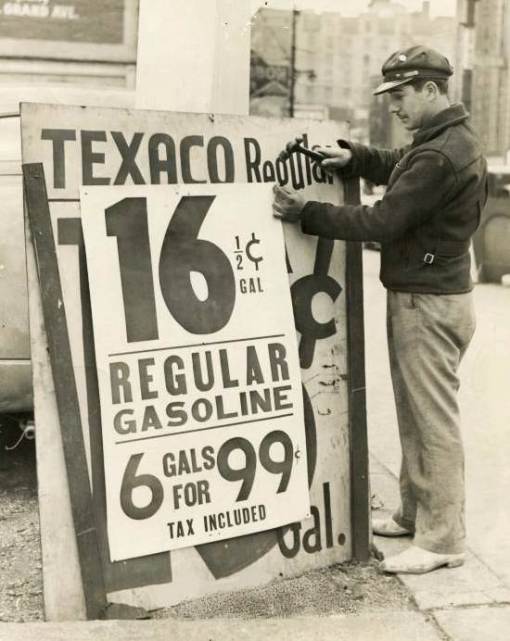
“6 gals for 99c”, Roosevelt and Wabash, Chicago 1939

That the world’s central bankers get a lot of things wrong, deliberately or not, and have done so for years now, is nothing new. But that they do things that result in the exact opposite of what they ostensibly aim for, and predictably so, perhaps is. And it’s something that seems to be catching on, especially in Asia.

Now, let’s be clear on one thing first: central bankers have taken on roles and hubris and ‘importance’, that they should never have been allowed to get their fat little greedy fingers on. Central bankers in their 2016 disguise have no place in a functioning economy, let alone society, playing around with trillions of dollars in taxpayer money which they throw around to allegedly save an economy.

They engage solely, since 2008 at the latest, in practices for which there are no historical precedents and for which no empirical research has been done. They literally make it up as they go along. And one might be forgiven for thinking that our societies deserve something better than what amounts to no more than basic crap-shooting by a bunch of economy bookworms. Couldn’t we at least have gotten professional gamblers?

Central bankers who moreover, as I have repeatedly quoted my friend Steve Keen as saying, even have little to no understanding at all of the field they’ve been studying all their adult lives.

They don’t understand their field, plus they have no idea what consequences their next little inventions will have, but they get to execute them anyway and put gargantuan amounts of someone else’s money at risk, money which should really be used to keep economies at least as stable as possible.

If that’s the best we can do we won’t end up sitting pretty. These people are gambling addicts who fool themselves into thinking the power they’ve been given means they are the house in the casino, while in reality they’re just two-bit gamblers, and losing ones to boot. The financial markets are the house. Compared to the markets, central bankers are just tourists in screaming Hawaiian shirts out on a slow Monday night in Vegas.

I’ve never seen it written down anywhere, but I get the distinct impression that one of the job requirements for becoming a central banker in the 21st century is that you are profoundly delusional.

Take Japan. As soon as Abenomics was launched 3 years ago, we wrote that it couldn’t possibly succeed. That didn’t take any extraordinary insights on our part, it simply looked too stupid to be true. In an economy that’s been ‘suffering’ from deflation for 20 years, even as it still had a more or less functioning global economy to export its misery to, you can’t just introduce ‘Three Arrows’ of 1) fiscal stimulus, 2) monetary easing and 3) structural reforms, and think all will be well.

Because there was a reason why Japan was in deflation to begin with, and that reason contradicts all three arrows. Japan sank into deflation because its people spent less money because they didn’t trust where their economy was going and then the economy went down further and average wages went down so people had less money to spend and they trusted their economies even less etc. Vicious cycles all the way wherever you look.

How many times have we said it? Deflation is a b*tch.

And you don’t break that cycle by making borrowing cheaper, or any such thing, you don’t break it by raising debt levels, and try for everyone to raise theirs too. Which is what Abenomics in essence was always all about. They never even got around to the third arrow of structural reforms, and for all we know that’s a good thing. In any sense, Abenomics has been the predicted dismal failure.

Now, I remember Shinzo Abe ‘himself’ at some point doing a speech in which he said that Abenomics would work ‘if only the Japanese people would believe it did’. And that sounded inane, to say that to people who cut down on spending for 2 decades, that if only they would spend again, the sun would rise in concert. That’s like calling your people stupid to their faces.

The reality is that in global tourism, the hordes of Japanese tourists have been replaced by Chinese (and we can tell you in confidence that that’s not going to last either). The Japanese economy simply dried out. It sort of functions, still, domestically, albeit it on a much lower level, but now that global trade is grasping for air, exports are plunging too, the population is aging fast and there’s a whole new set of belts to tighten.

So last June, the desperate Bank of Japan governor Haruhiko Kuroda did Abe’s appeal to ‘faith’ one better, and, going headfirst into the fairy realm, said:

I trust that many of you are familiar with the story of Peter Pan, in which it says, ‘the moment you doubt whether you can fly, you cease forever to be able to do it’. Yes, what we need is a positive attitude and conviction. Indeed, each time central banks have been confronted with a wide range of problems, they have overcome the problems by conceiving new solutions.

And that’s not just a strange thing to say. In fact, when you read that quote twice, you notice -or I did- that’s it’s self-defeating. Because, when paraphrasing Kuroda, we get something like this: ‘the moment the Japanese people doubt whether their government can save the economy, they cease forever to believe that it can’.

Now, I’m not Japanese, and I’m not terribly familiar with the role of fairy tales in the culture, but just the fact that Kuroda resorted to ‘our’ Peter Pan makes me think it’s not all that large. But I also think the Japanese understood what he meant, and that even the few who hadn’t yet, stopped believing in him and Abe right then and there.

Then again, Asian cultures still seem to be much more obedient and much less critical of their governments than we are, for some reason. The Japanese don’t voice their disbelief, they simply spend ever less. That’s the effect of Kuroda’s Peter Pan speech. Not what he was aiming for, but certainly what he should have expected, entirely predictable. Why hold that speech then, though? Despair, lack of intelligence?

In a similar vein, we chuckled out loud on Friday, first when president Xi demanded ‘Absolute Loyalty’ from state media when visiting them, an ‘Important Event’ broadly covered by those same media. Look, buddy, when you got to go on TV to demand it, someone somewhere’s bound to to be thinking you don’t have it…

And we chuckled also when the South China Morning Post (SCMP) broke the news that the People’s Bank of China, in its monthly “Sources and Uses of Credit Funds of Financial Institutions” report has stopped publishing the “Position for forex purchase”, which is that part of capital movements -and in China’s case today that stands for huge outflows- which goes through ‘private’ banks instead of the central bank itself.

It’s like they took a page, one-on-one-, out of the Federal Reserve’s playbook, which cut its M3 money supply reporting back in March 2006. What you don’t see can’t hurt you, or something along those lines. The truth is, though, that if you have something to hide, the last thing you want to do is let anyone see you digging a hole in the ground.

But the effect of this attempt to not let analysts get the data is simply that they’re going to get suspicious, and start digging even harder and with increased scrutiny. And they have access to the data anyway, through other channels, so the effect will be the opposite of what’s intended. And that too is predictable.

First, from Fortune, based on the SCMP piece:

Is China Trying to Hide Capital Outflows?

China’s central bank is making it harder to calculate the size of capital outflows afflicting the economy, just as investors have started paying closer attention to those mounting outflows, which in December reached almost $150 billion and in January around $120 billion. The central bank omitted data on “position for forex purchase” during its latest report, the South China Morning Post reported today.

The unannounced change comes at a time pundits are questioning whether outflows have the potential to cripple China’s currency and economy. Capital outflows lead to a weaker currency, which concerns the hordes of Chinese companies that borrowed debt in foreign currencies over the past few years and now have to pay it back with a weaker yuan.

The news of the central bank withholding data is important because capital outflow figures aren’t released as line items. They are calculated by analysts in a variety of ways, one of which includes using the omitted data. The Post quoted two analysts concluding the central bank’s intention was to hide the true amount of continuing outflows.

The impulse to hide bad news shouldn’t come as a surprise. China’s government has been evasive about economic matters from this summer’s stock bailout to its efforts propping up the value of the yuan. Analysts still have a variety of ways to estimate the flows, but the central bank is making it ever more difficult.

And then the SCMP:

Sensitive Financial Data ‘Missing’ From PBOC Report On Capital Outflows

Sensitive data is missing from a regular Chinese central bank report amid concerns about capital outflow as the economy slows and the yuan weakens. Financial analysts say the sudden lack of clear information makes it hard for markets to assess the scale of capital flows out of China as well as the central bank s foreign exchange operations in the banking system.

Figures on the “position for forex purchase” are regularly published in the People’s Bank of China’s monthly report on the “Sources and Uses of Credit Funds of Financial Institutions”. The December reading in foreign currencies was US$250 billion. But the data was missing in the central bank’s latest report. It seemed the information had been merged into the “other items” category, whose January figure was US$243.9 billion -a surge from US$20.4 billion the previous month.

[..] “Its non-transparent method has left the market unable to form a clear picture about capital flows,” said Liu Li-Gang, ANZ’s chief China economist in Hong Kong. “This will fuel more speculation that China is under great pressure from capital outflows. It will hurt the central bank’s credibility.”

[..] All forex-related data released by the central bank is closely monitored by financial analysts. They often read item by item from the dozens of tables and statistics to try to spot new trends and changes. China Merchants Securities chief economist Xie Yaxuan said the PBOC would not be able to conceal data as there were many ways to obtain and assess information on capital movements.

“We are waiting for more data releases such as the central bank’s balance sheet and commercial banks’ purchase and sales of foreign exchange released by the State Administration of Foreign Exchange for a better understanding of the capital movement and to interpret the motive of the central bank for such change,” Xie said.

It’s like they’ve landed in a game they don’t know the rules of. But then again, that’s what we think every single time we see Draghi and Yellen too, who are kept ‘alive’ only by investors’ expectations that they are going to hand out free cookies, and lots of them, every time they make a public appearance.

And what’s going on in Japan and China will happen to them, too: they will achieve the exact opposite of what they’re aiming for. They arguably already have. Or at least none of their desperate measures have achieved anything close to their stated goals.

They may have kept equity markets high, true, but their economies are still as bad as when the QE ZIRP NIRP stimulus madness took off, provided one is willing to see through the veil that media coverage and ‘official’ numbers put up between us and the real world. But they sure as h*ll haven’t turned anything around or caused a recovery of any sorts. Disputing that is Brooklyn Bridge for sale material.

Eh, what can we say? Stay tuned?! There’ll be a lot more of this lunacy as we go forward. It’s baked into the stupid cake.


Professor Steve Keen and Raúl Ilargi Meijer discuss central banking, Athens, Greece, Feb 16 2016

Feb 152016


Dorothea Lange We’ll be in California yet. We’re not going back to Arkansas 1938

Financial bubbles blown on the back of massive amounts of debt, of necessity lead to debt deflation (it’s just entropy, really). Fighting this is futile, and grossly costly to boot. The only sensible thing to do is to guide the process as best you can and try to minimize the damage, especially at the bottom rungs of society, because that’s where the deflation first takes hold, and where it spreads out from.

Attempting to boost inflation, or boost demand, before letting the debt deflation run its course through restructuring and defaults (perhaps even a -partial- jubilee) leads only to -further- distortion, and -further- impoverishes society’s poorer (at some point to a large extent the former middle classes). Whose lower spending, as nary a soul seems to comprehend, is the origin of the deflation to begin with.

All the attempts by central bankers to boost inflation that we’ve seen so far squarely ignore this, and operate on the false assumption that if only prices for financial assets and real estate can be raised even higher -artificially-, deflation can be warded off.

Thing is, deflation starts not at the top, it starts at the bottom. It’s not the banks or the bankers or the well-off who are maxed out and stop spending, but the people in the street.

They are responsible for most of the spending in an economy, and therefore for the velocity with which money moves in a society. And if the velocity of money falls below a critical point, no increase in the other side of the inflation/deflation equation -the money/credit supply- can make up for the difference. There is a point where all of the King’s horses and all of the King’s central bankers can’t put Humpty Dumpty together again.

The people in the street are not just maxed out in the sense that they have no money, they have less than no money, since they’re deep in debt. An increasing part of whatever they do still have, and what they make in their ever lower paying jobs, goes toward debt payments. Yeah, that’s the giant sucking sound.

QE and other ‘plans’ like it don’t address this even in the slightest, and are necessarily failures before they even start.

Central bank stimulus measures are all exclusively targeted at the upper rungs, and therefore miss their aim entirely. Or perhaps we should say ‘alleged’ aim, since it takes quite a leap of faith to presume that all the world’s central bankers fail to understand their own field so thoroughly that all they can all come up with is failures.

However, given that they all studied the same faulty economics textbooks, we can’t rule out this possibility. It is certainly strongly suggested -once again- by Steve Keen in Our Dysfunctional Monetary System.

Rather than effective remedies, we’ve had inane policies like QE, which purport to solve the crisis by inflating asset prices when inflated asset prices were one of the symptoms of the bubble that caused the crisis. We’ve seen Central Banks pump up private bank reserves in the belief that this will encourage more bank lending when (a) there’s too much bank debt already and (b) banks physically can’t lend out reserves.

What may also play a role is that the upper rungs tend to be blind to anything outside of their own circles, that because they 1) have their hands on a nation’s wallets and 2) they see themselves as the most important segment of any given society, they elect to try and solve the problem inside their own circles -and truly believe this is feasible-.

This can of course not possibly work. Because they’re hugely outnumbered. They don’t have nearly enough influence on money flows in their societies. If they can’t sell the bottom, let’s take a number, 80%, of society sufficient produce or gasoline or homes or trinkets, the entire society seizes up the way an engine does that runs out of oil.

The top makes its fortune for a while getting the bottom ever deeper into debt, only to inevitably find that this kills off the entire economy. Then they do some more of the same, and find ever more of their own kind becoming part of the bottom.

The problem for the rich is simple: there’s not enough of them. Well, that and they don’t understand how societies function. Let alone economies. Scraps off the table won’t do the trick. Next stop pitchforks.

Any deflationary period would have been hard no matter what. Still, none would have had to lead to what we’re facing now.

But look out there at what’s happening in politics, at who’s popular in various places. It’s all geared towards more inequality, not less, like some tooth and claw Darwin version were the world’s economics teacher, wherever you look it’s all the well-off making ever surer they will remain well-off or better.

And even if you look for instance at Bernie Sanders in the US, he wants more for the bottom of society, but that seems more for sentimental or ideological reasons than a sign he actually understands why it would raise the odds of the States being a going concern going forward.

The actual Darwin could have taught us all a lesson or two three about the role of balances in ecosystems, and in human societies. But then he actually studied them. Economists, politicians and central bankers have not.

Feb 032016
 
 February 3, 2016  Posted by at 11:19 am Finance Tagged with: , , , , , , , ,  Comments Off on Debt Rattle February 3 2016


DPC Jai alai hall, Havana, Cuba 1904

• Recession Risks Warn Of ‘Severe’ Drop In The Stock Market (MW)
• Exxon Faces First Downgrade in 86 Years (BBG)
• Iraq Sells Oil At $22, Fiscal Cliff Looms (BI)
• Goldman Sachs Questions Capitalism (BBG)
• Eurozone Manufacturing & Service Industries Cut Prices (BBG)
• Plan To Increase The Yuan’s Trading Flexibility Gains Momentum (BBG)
• Spring Festival Travel A One-Way Journey For Many Chinese (CNBC)
• Buying A Home Is Overrated (MW)
• The Bank of Japan Is Selling Out Its People (Gefira)
• Hedge Funds, Wall Street not Happy with the New Spain (Don Quijones)
• Thousands Of Greek Firms Flee To Bulgaria (Kath.)
• Australian Asylum Ruling Paves Way For Deportation Of Infants (Reuters)
• Greek Military To Oversee Response To Refugee Crisis (Kath.)
• More Than 62,000 Migrant Arrivals In Greece Last Month (Reuters)
• UN Says One-Third Of Refugees Sailing To Europe Are Children (Guardian)
• Nine Migrants, Including Two Babies, Drown En Route To Greece (Reuters)

That graph feels so scary it gives me the shivers. And Deutsche sees ‘healthy’ growth return later this year? Who are they kidding?

• Recession Risks Warn Of ‘Severe’ Drop In The Stock Market (MW)

Another brokerage firm has used the “R” word on Tuesday, warning investors to wake up to the idea that rising risks of a recession could send the stock market over a steep cliff. Based on current valuations, the prices of most stocks don’t appear to have factored in a recession scenario, “hence the downside should we see a recession could be rather severe,” RBC Capital Markets’ global equity team wrote in a research note to clients. Applying a stress test to their coverage universe, using worst-case, price-to-earnings valuations seen during the 2008-to-2009 recession, RBC analysts said they believe the shares of most companies could still fall another 50% or more from current levels. The concern for RBC analysts stems from the recently volatility in the stock market, caused by macro weakness, softness in China and commodity market challenges.

On Monday, Deutsche Bank strategist David Bianco said the second-half of 2015 was “clearly a profit recession” for S&P 500 companies, and suggested it probably won’t be until the second half of this year that “healthy” growth returns. Nearly half of S&P 500 companies have now reported fourth-quarter results through Tuesday morning, and earnings-per-share is headed for a 5.8% decline on the year, according to FactSet, compared with an estimated 5.7% decline as of Friday. That’s the data provider’s blended growth rate, which combines those companies that have reported with the estimates for the rest. That would be the third-straight quarter of an EPS decline, the longest such streak since the Great Recession. Among Tuesday’s culprits for the earnings decline, Exxon Mobil reported a 58% profit plunge and Pfizer reported a 50% earnings drop. Royal Caribbean Cruises reported earnings that nearly doubled, but the stock plunged 16% after the company provided a weak first-quarter outlook.

Read more …

We write history.

• Exxon Faces First Downgrade in 86 Years (BBG)

Exxon Mobil, one of three U.S. companies with Standard & Poor’s highest rating, is facing its first downgrade in 86 years as the worst crude-market collapse in a generation strangles oil producers of cash. For Exxon, that would be a historic event: the global explorer that traces its roots to the 19th century and John D. Rockefeller’s Standard Oil Trust has been rated AAA by S&P since 1930. The oil giant was placed on credit watch with negative implications because its credit measures probably will remain weak through 2018, S&P said Tuesday.

“We get value from our AAA credit rating in our business,” Exxon’s Vice President of Investor Relations Jeffrey Woodbury said during a conference call with analysts before the credit review was announced. “Whether it be access to financial markets or access to resources, there is a benefit that we get from it, and we see it as being important.” The world’s five largest oil explorers had their credit ratings cut or threatened with downgrade as the market crash undermines their ability to pay debts, dividends and rig leases. For most of the oil industry, slashing drilling budgets and other cost-cutting “are insufficient to stem the meaningful deterioration expected in credit measures over the next few years,” S&P said.

In a sweeping review that also included many of the top U.S. shale drillers, Chevron had its rating cut by S&P, to AA- from AA, for the first time in almost 30 years, a day after Shell’s rating was reduced to the lowest since S&P began coverage in 1990. Exxon, Totaland BP may be next, the rating company said. S&P said it’ll decide whether to downgrade Irving, Texas-based Exxon within 90 days. If it does cut the rating, it’ll probably only be by a single notch, S&P said. Shell’s long-term credit rating was reduced on Monday by one level to A+, the fifth-highest investment grade, from AA-, and was placed on watch for another possible reduction, the ratings company said Tuesday. S&P also assigned negative outlooks to BP, Eni, Repsol, Statoil and Total.

Read more …

Bail out.

• Iraq Sells Oil At $22, Fiscal Cliff Looms (BI)

The plunge in oil prices is already having far-reaching effects on countries whose economies are dependent on oil exports. But in Iraq, the stakes of cheap oil are even higher than in Saudi Arabia, which is instituting unprecedented taxation and austerity, or in Nigeria, which is now asking for an $11 billion World Bank loan. What little remains of Iraq’s government and social order might collapse if oil remains in its current price trough — with dire consequences. According to a Monday AFP report, Iraq is now selling oil at half of the country’s apparent fiscal break-even price. Right now, Iraq is selling its oil at around $22 a barrel, half of what it would need to fetch for the country to be able to fund the upcoming year of government budgetary obligations, the report said.

But Iraq’s situation is actually even worse. As recently as the 2014 fiscal year, Iraq was formulating its national budget on the assumption that oil would remain at around $90 a barrel and that the country’s oil exports would continue to climb (which they have). Iraqi government revenue experienced dramatic annual increases between 2009 and 2013, almost entirely because of oil. That’s all over, now that oil is expected to stay under $40 a barrel through the end of the year. Though Iraqi oil is comparatively cheap to extract, it also contains unusually high levels of sulfur, meaning that it typically sells for around 10% less than Brent crude, the global price benchmark.

The Iraqi government is still making money pumping oil — just not nearly enough to fund the country’s anticipated national budget. Such a daunting fiscal cliff would be challenging for a stable or politically coherent country. But it’s potentially disastrous in a place like Iraq, where the majority of territory is split between the terrorist group ISIS and the Kurdistan Regional Government. Even the areas still under some semblance of federal control are fought over by a constellation of militia groups with ties to recognized political parties.

Read more …

Shouldn’t they question the Fed instead?

• Goldman Sachs Questions Capitalism (BBG)

One of the most heated debates among investors is the question of whether corporate profit margins can maintain their elevated level, or whether they will inevitably mean revert. Here’s a quick look at S&P 500 profit margins, for example, going back over 25 years. They remain high by by historical standards.

A new note from Goldman Sachs analysts led by Sumana Manohar looks at the bull and bear arguments for the profit margins debate. Manohar argues that profit margins have expanded thanks to three key trends: strong commodities prices, emerging market cost arbitrage (companies making things more cheaply in emerging markets), demand growth from emerging markets, and improved corporate efficiency driven by the use of new technology. Continuing one of its major analytical themes of recent months, Goldman also notes that the market has rewarded companies that have undertaken mergers and share buybacks, compared to companies that have invested internally, further bolstering margins. So will profit margins inevitably roll over?

Goldman goes through both sides of the argument. On the bull side, the bank says that ongoing consolidation in industries, cost deflation, and tighter purse strings help keep a floor under margins. Ultimately though, it thinks that the above trends, coupled with weak demand and general industrial overcapacity, mean that margins are likely to come down. But what if margins stay elevated? That too is possible, and the implications could be unsettling. Goldman writes: “We are always wary of guiding for mean reversion. But, if we are wrong and high margins manage to endure for the next few years (particularly when global demand growth is below trend), there are broader questions to be asked about the efficacy of capitalism.”

In other words, profit margins should naturally mean-revert and oscillate. The existence of fat margins should encourage new competitors and pricing cycles that cause those margins to erode while conversely, at the bottom of the cycle, low margins should lead to weaker players exiting the business and giving stronger companies more breathing space. If that cycle doesn’t continue, then something strange is taking place. Needless to say, it’s not every day you see a major investment bank say they might have to start asking broader questions about capitalism itself.

Read more …

Deflation’s in the driver’s seat, and there’s nothing anyone can do. Cutting prices is just one step in the process.

• Eurozone Manufacturing & Service Industries Cut Prices (BBG)

The euro area’s manufacturing and services industries cut prices at the fastest pace in almost a year in January, underlining concerns about weak inflation in the region. Markit Economics said its composite Purchasing Managers Index for January was “disappointing” and raises the prospect that the ECB will once again pump up its stimulus program. The PMI declined to 53.6 – a 4-month low – from 54.3 in December, and the measure of output prices dropped to the lowest since March. “Most worrying of all from a policy maker’s perspective is the intensification of deflationary pressures.,” said Chris Williamson, chief economist at Markit in London. “This raises the question of whether existing stimulus has simply been insufficient, or whether monetary policy is proving ineffective.”

ECB President Mario Draghi has said the Governing Council will review its stimulus in March amid signs that falling oil prices will push the euro region’s inflation rate back to zero. The Bank of Japan has already responded to the deteriorating outlook with negative interest rates and investors see a slower pace of tightening by the Federal Reserve. In the euro area, Markit said the PMI had some “mildly positive signs,” with rising levels of employment and backlogs of work. The headline composite number was also marginally better than the initial estimate, and it remains above the key 50 level that divides expansion from contraction. The services index slipped to 53.6 from 54.2, matching the preliminary reading. The composite report continued to point to divergences in the 19-nation economy, with Spain and Germany leading growth. France offered a disappointing reading, with the index at just 50.2, lower than the 50.5 initial estimate.

Read more …

They sent them a what? “The PBOC didn’t immediately reply to a fax seeking comment.”

• Plan To Increase The Yuan’s Trading Flexibility Gains Momentum (BBG)

A proposal to fix the yuan’s quandary is gaining momentum among some economists. The plan, put forward by at least three analysts, calls for China to let the yuan fluctuate freely against a basket of currencies within a trading band. Outside the range – which would be as narrow as 4% or as wide as 15% under different versions of the proposal – the central bank will intervene in the market. Similar to what Singapore has adopted, the plan could be China’s get-out-of-jail card after a slew of changes in its opaque currency policy since August whipsawed investors and cost the central bank more than $500 billion in reserves, said the economists, including a former central bank adviser and a visiting scholar from the IMF.

Under the current system, the yuan is allowed to trade 2% above or below a reference rate versus the dollar set by the People’s Bank of China. Critics say that the regime fixates investors’ attention on the dollar-yuan exchange rate, even as the authorities aim to break its tie to the strengthening U.S. currency. The lack of transparency on how it sets the reference rate, or fixing, keeps investors guessing about the intentions of policy makers. “They are sort of stuck, I don’t think the market knows what exactly the policy is,” Tamim Bayoumi, a senior fellow at Peterson Institute for International Economics and an economist at the IMF since 1988, said from Washington. “The proposal is one way out of that,” said Bayoumi, who pitched the idea in a blog in December, favoring a 4% trading band.

By targeting a broader range of currencies and a wider band, the proposed system attempts to give market forces more sway in determining the exchange rates, save foreign reserves while shifting investors’ focus away from the dollar and provide clarity on policy. The PBOC didn’t immediately reply to a fax seeking comment. Chinese policy makers have been struggling to restore calm in the yuan since August when it revamped its currency system to make it more flexible. While the authorities have repeatedly said they aim to keep the exchange rate stable against a basket of currencies even if it falls versus the dollar, they have had little success convincing investors. The onshore yuan’s 5.6% slide versus the dollar over the past six months fueled expectations for a further depreciation and boosted capital outflows.

Read more …

I see a lot of unhappy people in our future.

• Spring Festival Travel A One-Way Journey For Many Chinese (CNBC)

A giant annual human migration is underway in China, and it’s a bonanza for some but a painful process for others. Some 2.9 billion trips are expected to be undertaken between the start of China’s annual travel season on January 24 and the end on March 3, according to China’s transport ministry, with this week leading up to Spring Festival or Lunar New Year, which starts on February 8, being the busiest. [..] According to a real-time travel map by Chinese internet giant Baidu, the Beijing-to-Shanghai route on Wednesday afternoon in Asia was the most heavily traveled across all forms of transport, followed by Xian to Beijing and Shenyang to Beijing. For many migrant workers, however, this year’s journey home may be their final one, as slowing growth puts paid to their city dreams.

China’s factory activity skidded to a three-year low point in January, adding to gloom about the state of the world’s second-largest economy. Although growth in the service sector held above the key 50 expansionary level, the January official non-manufacturing purchasing manager’s index slowed to 53.5 from 54.4 in December. Restaurant workers Du Lijuan and Song Yaoguo told CNBC that they would not be among the crush of travelers this week. Both are waiting in Beijing for unpaid salaries of about $1,000 each before heading back home to the countryside, after losing their at a restaurant when it ran into financial difficulties in September. “We have no money to buy tickets, to buy gifts for our family or children,” Du said. “Normally, we spend $650 every Lunar New Year. I am not coming back [to Beijing].”

For years, migrant workers have been the backbone of China’s economic growth, by working in factories and constructing buildings, but many are considering new lives in the countryside after this Spring Festival, because they fear being unable to find jobs if they return to the cities. The migrant population fell by 5.7 million to 247 million in 2015, its first drop in about three decades.

Read more …

It’s the debt, stupid!

• Buying A Home Is Overrated (MW)

Is buying a house instead of renting really the best financial decision? It’s a question that’s frequently debated, with traditional thinking being that renting is akin to throwing money out the window. But there are some good reasons to believe that buying a home instead of renting isn’t as great of an investment as Americans once thought. “Housing is overrated as a financial investment,” according to economist Alex Tabarrok, an economics professor at George Mason University and a research fellow at the university’s Mercatus Center, which conducts research on financial markets. He addressed the question of what economists think about buying compared to renting on Marginal Revolution, a blog he runs with fellow economist and George Mason professor Tyler Cowen.

“First, it’s not good to have a significant share of your wealth locked into a single asset,” he wrote. “Diversification is better and it’s easier to diversify with stocks. Second, unless you are renting the basement, houses don’t pay dividends. Stocks do. You can hope that your house will accumulate in value but don’t count on it. Indeed, you should expect that as an investment your house will appreciate less than does the stock market.” Owning a home makes it harder for many people to change locations for new job opportunities, leading to homeowners holding onto homes even while prices fall, Tabarrok said. Still, Americans don’t seem to be giving up on homeownership yet. Sales of existing homes rose 14.7% in December, the biggest monthly increase ever recorded, after depressed sales in November. Sales in 2015 were the best since 2006, at 5.26 million.

Americans are also buying homes that are larger and pricier; average home size was 2,720 square feet in 2015, up from 2,660 square feet in 2014. And the average price of new homes for sale in 2015 was $351,000, up from $100,000 in 2009. (Still, this doesn’t necessarily reflect the housing market’s strength, as new construction has mostly happened in the high-end market.) Of course, there are some benefits to homeownership, and they aren’t just avoiding unexpected rent hikes and unpredictable landlords. Many people simply enjoy interior decorating and entertaining, Tabarrok added. And perhaps more importantly, home ownership is often tied to access to better public schools. The U.S. tax code also subsidizes houses. Still, he cautioned against the seduction of a large home. “Behavioral economics tells us that we quickly get used to big houses, but we never get used to commuting,” he wrote. “So when you have a choice, go for the smaller house closer to work.”
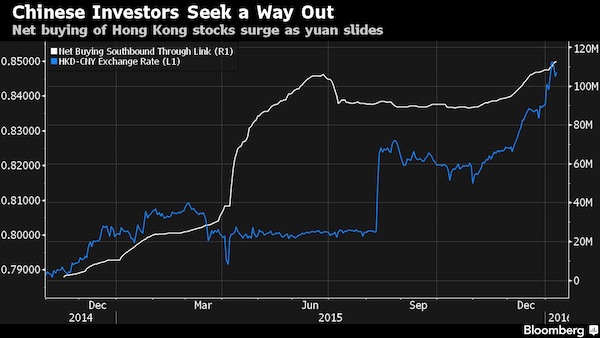
Read more …

h/t ZH

• The Bank of Japan Is Selling Out Its People (Gefira)

The Bank of Japan’s unexpected rate cuts to negative are a desperate attempt to help out the FED and to support the dollar at the expense of the aging Japanese population. The negative market reaction to the FED’s rate hike of December shows that investors do not believe an economic recovery in the US is underway. Two reasons make central banks start to raise interest rates. The first is that economy is doing well, and central banks have to prevent an overheated economy. But it is also a signal to investors everything is going well. In this situation, the first reaction of investors will be the opposite as central bankers planned they will and increase their investments and markets will go up. The second reason central banks raise interest rates is the defensive one; the moment the economy is out of control, investors are beginning to abandon the sinking ship.

The continually increasing interest rate has the task of keeping the investors aboard. Central banks in less developed economies raise rates to defend the national currency, thus preventing investors from fleeing. An increase in the interest rate can add fuel to the fire and in many cases has the opposite effect. Investors start smelling angst of the authorities and start abandoning the sinking ship. In such a situation stock markets are coming crashing down because investors withdraw from them. We saw this last pattern happening in the US economy after the December FED’s rate hike. As a result, the dollar-yen exchange rate is starting to decline, with the value of the dollar falling off as Japanese investors start panicking and fleeing the US market. Surely, Japanese investors know that a rate hike without an accompanying economic growth will erode every existing investment.

There is a general misconception according to which countries drive their currency down to generate growth. People adhere to the simplistic belief that a weak currency drives exports and helps the nation to prosper. The fact is that a cheap currency creates growth by giving away real goods in exchange for IOU (I Owe Yous) or paper debt obligations that will never be repaid. The US is the beneficiary or the receiving end of the weak yen policy. Because the US continues to maintain its world hegemony, it needs a strong dollar. A strong dollar makes everything the US empire buys in the world cheap. A strong dollar causes the world to be willing to exchange real goods for printed paper dollars that have no intrinsic value, and that are issued by a country that does not have the industrial capacity to ever repay what it owes its debtors.

The endless trade deficit the US has with Japan shows how the Japanese are prepared to provide the US with real goods without demanding tangible goods in return. Because the international press publishes trade data in dollars, the trade balance deficit seems to have been shrinking over the last years. The actual situation becomes apparent if we look at the trade deficit in yens. The US trade deficit with Japan is growing bigger and bigger year after year, as Japanese producers are giving away a big chunk of their production to US consumers in return for more and more US paper debt. By manipulating the yen, Japanese authorities are giving away a real part of their GDP that they take from their people to the US empire.

Read more …

Very good. Do read the whole thing. The socialists have been asked to form a government.

• Hedge Funds, Wall Street not Happy with the New Spain (Don Quijones)

Plunging shares, shrinking profits, and a spate of new regulations and court cases that could end up setting it back billions of euros – that’s what the Spanish banking sector is facing. But now, banks are also grappling with the complete absence of a friendly central government to insulate them from the cruel vagaries of the global economic downturn. And the strain is beginning to show. “The political parties must reach an agreement as soon as possible and form a government that is stable,” pleaded Francisco González, president of Spain’s second biggest bank, BBVA. Such a government must not “think about utopias, which only serve to create frustration,” must be “realistic” and (most important of all) must “continue with the policies of the last three of four years.”

González cautioned that foreign investors “are phoning less often” than before. Those “investors” probably include firms like Blackstone and Goldman Sachs, which made a fortune in the immediate aftermath of Spain’s real estate collapse and EU-funded bailout, by picking up publicly subsidized housing on the cheap and either flipping them or renting them at much higher rates. In those days, the city council was led by Ana Botella, the then Mayor and wife of Spain’s former President José María Aznar. One of the main brokers in the deals struck between the city council’s two housing agencies and international funds like Goldman and Blackstone was José María Aznar Botella – their son!

Despite his lack of investment banking experience, Aznar Botella served as an advisor and go-between at the Madrid-based real estate firm Gesnova Gestión Inmobiliaria Integral, which enjoyed close ties with firms like Blackstone subsidiary Fidere, Lone Star, Apollo, KKR, Goldman’s Madrid-based subsidiary Azora, and U.S. private equity firm Cerberus Capital Management LP, whom Aznar-Botella also serves as an advisor. Here’s how the scheme worked: in the aftermath of Spain’s real estate bust, the Rajoy government set up a bad bank by the name of Sareb, a public-private venture responsible for managing distressed assets transferred from the four nationalized financial institutions BFA-Bankia, Catalunya Banc, NGC Banco-Banco Gallego, and Banco de Valencia.

As soon as the bad bank was operational, global investment firms began flocking to Madrid to pick up the juiciest pieces at the best prices, part-subsidized by Spanish taxpayers. To get their hands on the really good stuff, however, investors needed someone on the inside, which is presumably where the Aznar-Botello mother & son partnership came in. But it’s one thing to sell tranches of unoccupied or foreclosed properties to foreign investors to help put a floor under Spain’s property market; it’s quite another when you start selling huge batches of social housing at a ridiculous discount to some of the biggest financial firms on the planet, in a country that has one of the smallest stocks of social housing in Europe. It didn’t take long before rents began soaring and the police began knocking doors down.

Read more …

The Troika making sure Greece will never recover.

• Thousands Of Greek Firms Flee To Bulgaria (Kath.)

According to the president of the Hellenic Confederation of Professionals, Craftsmen and Merchants (GSEVEE), some 6,000 Greek enterprises have emigrated to Bulgaria in the last couple of years alone. At the same time, the GSEVEE chief says, Greeks are behind about 60,000 new tax registrations and bank accounts in the neighboring country. Giorgos Kavathas on Tuesday cited the above figures from an ongoing survey by GSEVEE, adding that the interventions planned for the social security system can only be expected to lead to more Greek firms emigrating. The survey will be presented in the next few days, he noted.

He was speaking at a press conference held jointly by GSEVEE and the Hellenic Confederation of Commerce and Enterprises (ESEE) regarding their participation in tomorrow’s general strike against the government’s planned pension reforms. The two unions warned that manufacturers and merchants will not stop at this strike, and will escalate their industrial action further. “The social security matter is a major national issue and we agree there has to be a reform, although no actuarial study would lead to safe conclusions given the existence of 1.5 million jobless,” argued the president of ESEE, Vassilis Korkidis.

Read more …

Trying to rival the EU in inhumanity.

• Australian Asylum Ruling Paves Way For Deportation Of Infants (Reuters)

Australia’s High Court threw out a challenge to offshore immigration detention camps on Wednesday, clearing the way for the deportation of dozens of infants born in Australia to detained asylum seekers. The court rejected a legal test case brought by an unidentified Bangladeshi woman that challenged Australia’s right to deport detained asylum seekers to the tiny South Pacific island nation of Nauru. The detention centre on Nauru houses about 500 people and has been widely criticised by the United Nations and human rights agencies for harsh conditions and reports of systemic child abuse. The Bangladeshi woman was on a boat intercepted by Australian authorities in October 2013. She was detained on Australia’s remote Christmas Island and later sent to Nauru.

She gave birth to a daughter after she was transferred to Australia for medical treatment in 2014 and has remained there with her child. Other families with children born in Australia in similar circumstances are now in line to be returned to the camps. Lawyers from the Human Rights Law Centre (HRLC) acting for the Bangladeshi woman had argued it was illegal for Australia to operate and pay for offshore detention in a third country. “I hope that the immigration minister and the prime minister, just like other decent Australians, can see that there is simply no excuse to take 37 babies, to rip children from their classrooms, and warehouse them on a tiny island,” HRLC Director of Legal Advocacy Daniel Webb told reporters. “Now, the legality may be complex. The politics may be complex. But the morality is simple. It is fundamentally wrong.”

Read more …

It’s all aimed at streamlining the process to move refugees north. But that’s not what Europe wants.

• Greek Military To Oversee Response To Refugee Crisis (Kath.)

Defense Minister Panos Kammenos on Tuesday heralded the creation of a central body to oversee and improve Greece’s response to the migration and refugee crisis and ensure the country safeguards its position in the Schengen passport-free area, noting that the new body will be led by a senior military official. Greece’s military is to have the oversight of the “Central Coordinating Body for the Management of Migration” until the Migration Ministry and the Hellenic Police gain the necessary know-how and experience to tackle the problem independently, Kammenos indicated at Tuesday’s press conference.

The center, which is to be operational by February 15, is to be based at the Defense Ministry headquarters and coordinate with the Hellenic Police, Coast Guard, Migration Ministry and nongovernmental organizations working with migrants and refugees. The aim is to increase the efficiency of transferring migrants from the islands to the mainland, to improve the provision of food as well as medical and healthcare to migrants, and to monitor the creation of five screening centers, or hot spots, for migrants on the eastern Aegean islands of Lesvos, Chios, Samos, Kos and Leros. Referring to the growing pressure on the islands of the eastern Aegean that receive thousands of migrants daily from neighboring Turkey, Kammenos explained that the new plan aims to spread the burden.

The five hot spots to be set up on the islands are to accommodate migrants for only 24 hours while two relocation centers, on the outskirts of Athens and Thessaloniki, will host new arrivals for up to 72 hours. The screening and relocation centers are to operate in a similar way to the central body, under a local military official who is to coordinate with police and coast guard officers. As the European Union increases the pressure on Greece to manage its borders more effectively, French Interior Minister Bernard Cazeneuve is due in Athens on Thursday and Friday for talks expected to focus on the migration crisis.

Read more …

Wow! Imagine what spring will bring.

• More Than 62,000 Migrant Arrivals In Greece Last Month (Reuters)

The total number of migrants and refugees arriving in Greece in January topped 62,000, the International Organization for Migration said on Tuesday. “(It) is many, many times what we saw a year ago in the previous January,” IOM spokesman Joel Millman said. He added that there were more than 360 deaths among migrants in the waters off Greece, Turkey and Italy during the month.

Read more …

When are we going to get real about this?

• UN Says One-Third Of Refugees Sailing To Europe Are Children (Guardian)

Children now make up over a third of the people making the perilous sea crossing from Turkey to Greece, the UN has said, as two more babies drowned off Europe’s shores. For the first time since the start of the migration crisis in Europe, there are also now more women and children crossing the border from Greece to Macedonia than adult males, according to UN children’s agency Unicef. The figures emerged as Europe struggles with its biggest movement of people crisis since the second world war, with more than a million people fleeing war, violence and poverty risking life and limb to reach its shores last year. “Children currently account for 36% of those risking the treacherous sea crossing between Greece and Turkey,” the Unicef spokeswoman Sarah Crowe said.

“Children and women on the move now make up nearly 60%” of those entering from Macedonia, she added. The figures mark a significant shift since June, when 73% of refugees were adult males and only one in 10 were under the age of 18. Marie Pierre Poirier, Unicef’s special coordinator for the refugee and migrant crisis in Europe, said women and children were even more vulnerable to the dangers of trying to travel to Europe. “The implication of this surge in the proportion of children and women on the move are enormous,” she said in a statement. “It means more are at risk at sea, especially now in the winter, and more need protection on land.” Underlining her point, the International Organisation for Migration (IOM) said on Tuesday that one in every five who drowned last month while trying to sail from Turkey to Greece was a child, with minors accounting for 60 of the 272 deaths.

Including January, a total of 330 children have died in those waters over the last five months, many of them just metres from shore, the organisation said. The drownings continue a grim trend that accelerated last year when nearly 4,000 people died trying to reach Europe by sea. The plight of children was brought home last year when the body of Syrian toddler Alan Kurdi was found washed up on the shore close to Bodrum, Turkey, horrifying the international community. The bodies of two more babies were recovered by the Turkish coastguard in the Izmir province on Tuesday along with seven dead adults, just days after another 37 people drowned off another part of the coast.

Read more …

Europe will not be pardoned for this.

• Nine Migrants, Including Two Babies, Drown En Route To Greece (Reuters)

The bodies of nine people, including two babies, were found drowned off the coast of western Turkey on Tuesday, after a boat carrying refugees and migrants to Greece partly capsized, the Turkish coast guard said in a statement. The fiberglass vessel partially capsized at 0535 local time (0335 GMT) off the coast of Seferihisar in Izmir province, close to the Greek Island of Samos. Two people were rescued swimming to the shore, the coast guard said. A crackdown on illegal crossing and the dangerous winter conditions has failed to deter tens of thousands from boarding flimsy boats and attempting to cross the Mediterranean waves in the first few weeks of the year.

Read more …

Feb 012016
 
 February 1, 2016  Posted by at 9:50 am Finance Tagged with: , , , , , , , , ,  6 Responses »


Matson Aircraft refueling at Semakh, British Mandate Palestine 1931

• China Manufacturing Shrinks At Fastest Rate For Over 3 Years (Reuters)
• Mid-Tier Chinese Banks Piling Up Trillions Of Dollars In Shadow Loans (Reuters)
• US Hedge Funds Mount New Attacks on China’s Yuan (WSJ)
• China’s Steel Sector Hit By Growing Losses (FT)
• Athens And Rome Expose Europe’s Greatest Faultlines (Münchau)
• Euro-Area Factories Cut Prices as Deflation Risks Loom Large (BBG)
• Nigeria Asks For $3.5 Billion In Global Emergency Loans (FT)
• Why Miners Have it Worse Than Oil Producers (BBG)
• Saudis Told To Embrace Austerity As Debt Defaults Loom (Tel.)
• 1 Million Investors Lose $7.6 Billion In China Online Ponzi Scheme (Reuters)
• The West Is Reduced To Looting Itself (Paul Craig Roberts)
• US, UK-Backed Saudi War & Blockade Cause Mass Starvation In Yemen (Salon)
• Europe Chokes Flow of Refugees to Buy Time for a Solution (WSJ)
• German Police ‘Should Shoot At Migrants’, Populist Politician Says (BBC)
• UK Labour MP Compares Cologne Attacks To Birmingham Night Out (Tel.)
• The EU Must Reassert Humane Control Over Chaos Around The Mediterranean (UN)

No kidding: “It is quite concerning that the significant monetary and fiscal stimulus in 2015 has only managed to slow the rate of decline in China’s industrial activity..”

• China Manufacturing Shrinks At Fastest Rate For Over 3 Years (Reuters)

Activity in China’s manufacturing sector contracted at its fastest pace in almost three-and-a-half years in January, missing market expectations, an official survey showed on Monday. The official purchasing managers’ index (PMI) stood at 49.4 in January, compared with the previous month’s reading of 49.7 and below the 50-point mark that separates growth from contraction on a monthly basis. It is the weakest index reading since August 2012. Analysts polled by Reuters predicted a reading of 49.6. The PMI marks the sixth consecutive month of factory activity contraction, underlining a weak start for the year for a manufacturing complex under severe pressure from falling prices and overcapacity in key sectors including steel and energy.

The price of oil fell on the disappointing data, which was compounded by weak export figures from South Korea. Brent crude was trading at $35.54 per barrel at 02.00 GMT, down 45 cents, or 1.25%, from the last close. China’s stock markets also fell in morning trading, although the Nikkei in Japan and the ASX/S&P 200 in Australia both swatted away the gloom to remain in positive territory. Zhou Hao, an economist at Commerzbank, said: “The electricity production remained sluggish and the crude steel output continued the weak trend in January, reflecting an ongoing deleveraging process in the industrial sectors.” “In the meantime, China has started an aggressive capacity reduction in many sectors, which could add downward pressure on the bulk commodity prices over time.”

Meanwhile, the official non-manufacturing PMI fell to 53.5 from December’s 54.4, according to the National Bureau of Statistics (NBS). The services index remained in expansionary territory highlighting continuing strength that has helped China weather the sharp slowdown in manufacturing. With manufacturing decelerating quickly, services have been a crucial source of growth and jobs for China over the past year, and analysts have been watching closely to see if the sector can maintain momentum in 2016. Angus Nicholson of IG in Melbourne said: “It is quite concerning that the significant monetary and fiscal stimulus in 2015 has only managed to slow the rate of decline in China’s industrial activity. “The first quarter of activity is always the weakest in China due to the seasonal disruption of Chinese new year, and there is the possibility of global markets reacting very negatively when the quarterly data starts filtering out in March and April.”

The China slowdown was underlined on Monday by figures showing that South Korea’s exports suffered their worst downturn in January since the depths of the global financial crisis in 2009. The trade ministry in Seoul said sluggish demand from China helped exports to fall to a worse-than-expected 18.5% from a year earlier, extending December’s slump of 14.1% and marking the 13th straight month of declines. Shipments to China, South Korea’s largest market, tumbled 21.5% on-year in January in their biggest drop since May 2009, and the trade ministry said export conditions were worsening.

Read more …

There’s still not nearly enough scrutiny of the shadow banks. But that is where the real problems will be.

• Mid-Tier Chinese Banks Piling Up Trillions Of Dollars In Shadow Loans (Reuters)

Mid-tier Chinese banks are increasingly using complex instruments to make new loans and restructure existing loans that are then shown as low-risk investments on their balance sheets, masking the scale and risks of their lending to China’s slowing economy. The size of this ‘shadow loan’ book rose by a third in the first half of 2015 to an estimated $1.8 trillion, equivalent to 16.5% of all commercial loans in China, a UBS analysis shows. For smaller banks, the rate is much faster. This growing practice, which involves financial structures known as Directional Asset Management Plans (DAMPs) or Trust Beneficiary Rights (TBRs), comes at a time when some mid-tier lenders, under pressure from China’s slowest economic growth in 25 years, are already delaying the recognition of bad loans.

“These are now the fastest growing assets on the balance sheets of most listed banks, excluding the Big Five, not just in percentage terms but absolute terms,” said UBS financial institutions analyst Jason Bedford, a former bank auditor in China who focuses on the issue. “The concern is that the lack of transparency and mis-categorization of credit assets potentially hide considerable non-performing loans.” To provide a buffer against tough times, banks are required to set aside capital against their credit assets – the riskier the asset, the more capital must be set aside, earning them nothing. Loans typically carry a 100% risk weighting, but these investment products often carry a quarter of that, so banks can keep less money in reserve and lend more.

Banks must also make provision of at least 2.5% for their loan books as a prudent estimate of potential defaults, while provisions for these products ranged between just 0.02 and 0.35% of the capital value at the main Chinese banks at the end of June, Moody’s Investors Service said in a note last month. At China’s mid-tier lender Industrial Bank Co, for example, the volume of investment receivables doubled over the first nine months of 2015 to 1.76 trillion yuan ($267 billion). This is equivalent to its entire loan book – and to the total assets in the Philippine banking system, filings showed. Investment receivables may include such benign assets as government bonds, but increasingly they include TBRs and DAMPs at mid-tier lenders.

At Evergrowing Bank, investment receivables reached 397 billion yuan in September, surpassing its loan book of 290 billion yuan. The bank said last year practically all of its investment receivables were DAMPs and TBRs. China Zheshang Bank, another smaller lender, also saw its investment receivables double over the same period, the bank’s prospectus to sell shares in Hong Kong shows. Zhang Changgong, the bank’s deputy governor, said banks were increasingly becoming return-seeking asset managers, not mere lenders. “In the past banks (made loans and) held assets. Now banks manage assets,” he said.

Read more …

It’s game on. “When you talk about orders of magnitude, this is much larger than the subprime crisis..”

• US Hedge Funds Mount New Attacks on China’s Yuan (WSJ)

Some of the biggest names in the hedge-fund industry are piling up bets against China’s currency, setting up a showdown between Wall Street and the leaders of the world’s second-largest economy. Kyle Bass’s Hayman Capital Management has sold off the bulk of its investments in stocks, commodities and bonds so it can focus on shorting Asian currencies, including the yuan and the Hong Kong dollar. It is the biggest concentrated wager that the Dallas-based firm has made since its profitable bet years ago against the U.S. housing market. About 85% of Hayman Capital’s portfolio is now invested in trades that are expected to pay off if the yuan and Hong Kong dollar depreciate over the next three years—a bet with billions of dollars on the line, including borrowed money.

“When you talk about orders of magnitude, this is much larger than the subprime crisis,” said Mr. Bass, who believes the yuan could fall as much as 40% in that period. Billionaire trader Stanley Druckenmiller and hedge-fund manager David Tepper have staked out positions of their own against the currency, also known as the renminbi, according to people familiar with the matter. David Einhorn’s Greenlight Capital Inc. holds options on the yuan depreciating. The funds’ bets come at a time of enormous sensitivity for China’s leaders. The government is struggling on multiple fronts to manage a soft landing for the economy, deal with a heavily indebted banking system and navigate the transition to consumer-led growth.

Expectations for a weaker yuan have led to an exodus of capital by Chinese residents and foreign investors. Though it still boasts the largest holding of foreign reserves at $3.3 trillion, China has experienced huge outflows in recent months. Hedge funds are gambling that China will let its currency weaken further in a bid to halt a flood of money leaving the country and jump-start economic growth. The effort is a lot riskier, though, than taking on a currency whose value is set by the market. China’s state-run economy gives the government a number of levers to pull and tremendous resources at its disposal. Earlier this year, state institutions bought up so much yuan in the Hong Kong market where foreigners place most of their bets that overnight borrowing costs shot up to 66%, making it difficult to finance short positions and sending the yuan up sharply.

Read more …

Just the beginning. They don’t dare close too many mills and make large numbers of people unemployed. But they have, in my guess, at least 50% overcapacity.

• China’s Steel Sector Hit By Growing Losses (FT)

A sharp reversal in China’s steel industry has led to more than half of major producers reporting losses last year. Member companies of the China Iron and Steel Association suffered a combined loss of Rmb64.5bn ($9.8bn), compared with profits of Rmb22.6bn in 2014. The country’s steel industry, which accounts for more than half of global production, contracted for the first time last year, with raw steel production dropping 2.3% — the first fall since 1981. Steel demand is wilting as construction and heavy industry stutter, a slowdown highlighted on Monday when China’s official manufacturing purchasing managers’ index for January fell to 49.4, from 49.7 in December. PMI readings below 50 indicate a fall-off in activity.
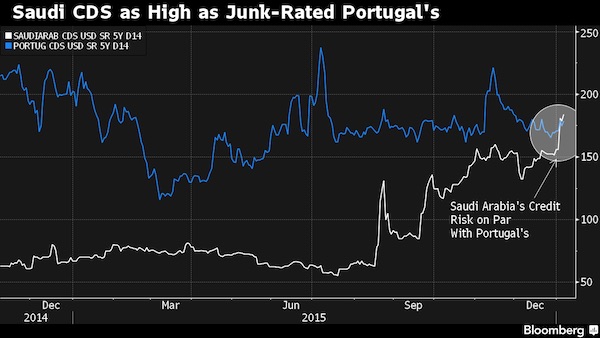
Li-Gang Liu, China chief economist at ANZ, said the reading suggested “the contraction in the manufacturing sector became more entrenched”. Mr Liu noted that year-on-year steel output fell 12% in both December and early January. The National Bureau of Statistics attributed the steeper than expected fall on the government’s campaign to reduce industrial overcapacity, especially in the steel and coal sectors, as well as a spillover effect from the lunar new year holiday. The holiday begins on February 7 and firms often suspend activity weeks in advance. China’s economic slowdown hit domestic steel demand hard in 2015, with steel-intensive industries, including the once-resilient property sector, unwilling to launch new projects in the face of overhanging inventories.

CISA, blaming industry losses on plummeting domestic prices, said its price index fell more than 30% over the course of 2015. Mill closures remain unlikely despite the losses, however, in part due to fears that the subsequent mass job losses could lead to social instability. The closure of so-called zombie companies alone could mean 400,000 lay-offs, according to a recent speech by Li Xinchuang, head of the China Metallurgical Industry Planning and Research Institute. Faced with these issues, ramping up export volume remains the industry’s chosen palliative for overcapacity. China’s steel exports grew more than 20 per cent in 2015 to 112m tonnes. The flood of Chinese steel is stoking trade protectionism as companies in other parts of the world struggle to compete with Chinese prices. In 2015, 37 cases were filed against Chinese steel producers, most on anti-dumping grounds.

Read more …

Sure it’s not really Brussels where the deepest faultlines are?

• Athens And Rome Expose Europe’s Greatest Faultlines (Münchau)

How should we think about systemic risk in Europe today? The EU has been moderately successful at crisis management. But the ability to muddle through is reaching its limits when, as now, several crises intersect at once. You can see the problem most clearly in Greece — a country battling both an economic meltdown and a refugee crisis — with not much help from the rest of the EU. Last week when the European Commission issued a report criticising Athens over its failure to control its borders, Macedonia took the unilateral decision to close its southern crossing with Greece — leaving thousands of refugees in transit on the Greek side of the border. In Athens, meanwhile, parliament discussed pension reform, forced upon the country by their creditors as a quid pro quo for continued financial life support.

Greece may be the starkest example, but it is not the only country facing overlapping crises. It is not even the most important one facing this dilemma. That would be Italy. While Rome’s problems are different from those of Greece, the country’s long-term sustainability in the eurozone is just as uncertain, unless you believe that its economic performance will miraculously improve when there is no reason why it should. Italy was overwhelmed by the increase of refugees from north Africa last year. On top of that it faces unresolved economic problems — no productivity growth for 15 years; a large stock of public sector debt that leaves the government with virtually no fiscal room for manoeuvre; and a banking system with €200bn in non-performing loans, plus another €150bn of debt classified as troubled.

Then consider that its three main opposition parties have, at one time or another, all questioned the country’s membership of the eurozone. Even if none of them look like coming to power in the near future, it is clear that Italy only has a limited amount of time to fix its multiple problems. The struggle to repair the banking system is a good example of just how big the task is. Last week, the Italian government and the European Commission agreed a convoluted scheme to relieve the Italian banking system of some of these toxic assets. It uses all the dirty tricks of modern finance, including the infamous credit default swap, a financial product that mimics insurance against default on a bond, which was particularly popular during the pre-2007 credit bubble. These instruments allow investors to hedge against default risk. But more often than not, their true purpose is to conceal information, to fool investors, or to circumvent regulatory restrictions.

Read more …

Which of course deepens the deflation. Ergo: more price cuts on the way. Rock and an impossible place.

• Euro-Area Factories Cut Prices as Deflation Risks Loom Large (BBG)

Factories in the euro area slashed prices of goods by the most in a year in January, highlighting the deflationary risks that’s keeping alarm bells ringing at the ECB. In its monthly manufacturing report, Markit Economics said price pressures “remained on the downside” and output charges fell for a fifth month. In addition, all countries in its survey reported declines, the first time that’s happened in 11 months. President Mario Draghi said the ECB’s stimulus policies will be reviewed in March as the region’s inflation rate may drop below zero again because of oil’s slump. Price growth has been slower than the central bank’s goal of just under 2% for almost three years. “The euro zone’s manufacturing economy missed a beat at the start of the year,” said Chris Williamson at Markit.

“If the slowdown in business activity wasn’t enough to worry policy makers, prices charged by producers fell at the fastest rate for a year to spur further concern about deflation becoming ingrained.” Inflation in the 19-country region accelerated to 0.4% in January, according to data last week, with the core rate rising to 1%. Still, that may only be a temporary reprieve. Markit’s headline Purchasing Managers’ Index fell to 52.3 from 53.2, matching an initial estimate published last month. Among the region’s largest countries, growth slowed in Germany and Italy, stagnated in France and accelerated in Spain. Markit said its survey signals annual manufacturing output growth of just 1.5% at the start of the year. “The data are likely to add to pressure on the ECB to expand the central bank’s stimulus programme as soon as March,” Williamson said.

Read more …

Watch the dominoes go.

• Nigeria Asks For $3.5 Billion In Global Emergency Loans (FT)

Nigeria has asked the World Bank and African Development Bank for $3.5 billion in emergency loans to fill a growing gap in its budget in the latest sign of the economic damage being wrought on oil-rich nations by tumbling crude prices. The request from the eight-month-old government of President Muhammadu Buhari is intended to help fund a $15 billion deficit in a budget heavy on public spending as the west African country attempts to stimulate a slowing economy and offset the impact of slumping oil revenues. It comes as concerns grow over the impact of low oil prices on petroleum exporting economies in the developing world. Azerbaijan, which last month imposed capital controls to try and halt a slide in its currency, is in discussions with the World Bank and the IMF about emergency assistance.

Nigeria’s economy is Africa’s largest and has been hit hard by the fall in crude prices — oil revenues are expected to fall from 70% of income to just a third this year. Finance minister Kemi Adeosun told the Financial Times recently that she was planning Nigeria’s first return to bond markets since 2013. But Nigeria’s likely borrowing costs have been rising alongside its budget deficit. A projected deficit of $11bn, or 2.2% of gross domestic product, had already risen to $15bn, or 3%, as a result of the recent turmoil in oil markets. The $2.5bn loan from the World Bank and a parallel $1bn loan from the ADB, which would enjoy below-market rates, must still be approved by both banks’ boards.

Under World Bank rules its loan would be subject to an IMF endorsement of the government’s economic policies and bank officials say they would have to be confident the Nigerian government was undertaking significant structural reforms. But both loans would carry far fewer conditions than one from the IMF, which does not believe Nigeria needs a fully fledged international bailout at this point.

Read more …

Can we call it a draw for now? Bit early to call, we’re just getting off the starting line.

• Why Miners Have it Worse Than Oil Producers (BBG)

“Things’ll go your way, if you hold on for one more day,” vocal group Wilson Phillips once crooned. Mining companies seem to have taken those lyrics to heart, opting to maintain production as long as their cash reserves allow and in effect delay a long-awaited resolution in the supply and demand balance of dry commodities, according to a new note from Goldman Sachs. The nature of the metals and mining business—legal considerations combined with an ability to store excess supply for the long-haul—means the industry faces a longer shakeout than in the energy sector. “Many of the [mining] structures are no longer assets but rather liabilities due to environmental regulations,” write Goldman analysts led by Head of Commodities Research Jeffrey Currie.

“This suggests that, in order to delay the environmental costs of mine rehabilitation, the penalties associated with employee layoff and non-performance of commercial obligations, owners will operate the facilities until they run out of cash and are obliged to suspend operations.” The trend is particularly true of U.S. coal miners, according to the analysts, and underscored by recent failed auctions of mining assets. “[Last] week we saw Alpha Natural Resources cancel an auction of 35 coal mines at the last minute due to a lack of interest, illustrating the fact that some mining assets burdened with outstanding liabilities and negative margins are left without any residual value,” Goldman notes.

Fundamental differences between metals and energy businesses have resulted in lower volatility for prices of gold, aluminium and similar dry commodities compared to energy-related products such as natural gas, electricity, and crude, the Goldman analysts say. “Theoretically, once an energy market breaches storage capacity, prices need to collapse below cash costs to immediately re-balance supply with demand. In practice, however, operational stress in energy is a local, not global concept as breaching storage capacity happens most likely in landlocked locations, but it does whittle away at the global supply overhang,” the analysts write. “In contrast, metals can be ‘piled high’ in low-cost locations almost anywhere in the world with far greater density, i.e. dollar per square foot, than energy.”

To illustrate the point, Goldman calculates that $1 billion worth of gold would, at current spot prices, fit into a generously-sized bedroom closet, while $1 billion worth of oil would take up 17 very large crude carriers, each with a capacity of more than a quarter of a million deadweight metric tons. With an estimated 12 months of cash reserves left for some U.S. coal miners, financial stress needs to deepen before the supply-demand balance even begins to resolve itself.

Read more …

Saudi leaders have the same problem as the Chinese: they’re afraid of their people.

• Saudis Told To Embrace Austerity As Debt Defaults Loom (Tel.)

Saudi Arabia faces years of tough austerity as the worst oil price crash in the modern history forces the kingdom to make radical cuts to government largesse, the IMF has warned. The world’s largest producer of crude oil will need to “transform” its economy away from oil revenues, which make up more than 80pc of the government’s wealth, according to Masood Ahmed, head of the Middle East department at the IMF. The Saudi monarchy has already been forced to unveil the largest programme of government austerity in decades as oil prices have collapsed by more than 70pc in 18 months. “This will have to be part of a multi-year adjustment process,” Mr Ahmed told The Telegraph. He urged the kingdom to reform its generous system of oil subsidies and introduce a host of new taxes, including consumption levies such as VAT.

“There will have to be a major transformation of the Saudi economy. It is necessary and it is going to be difficult, but it is a challenge which I think the authorities have clearly laid out”, said Mr Ahmed. The warning comes as the world’s weakest oil producing nations could buckle under the pressure of the price rout. IMF officials have been in Azerbaijan this week amid fears Baku will need a $4bn international rescue package to stave off a debt default. During the world’s last major oil price crash in 1986, 17 out of 25 of the developing world’s major oil producers defaulted on their debts, according to research from Oxford Economics. Debt mountains in producer nations ballooned by 40pc of GDP on average.

“The 1980s precedents are alarming; producers that avoided sovereign defaults were the exception rather than the rule”, said Gabriel Sterne at Oxford Economics. Azerbaijan was forced to abandon its foreign exchange peg with the dollar in December, after speculators caused the currency to crash. The Saudis have been burning through their reserves at a record pace to protect the riyal’s fixed value against a soaring dollar, and should continue to preserve the peg at all costs, said the IMF. Mr Ahmed said it was “neither necessary nor appropriate” for Riyadh to move to a floating exchange rate, forcing it to undertake record levels of expenditure cuts instead.

Read more …

$7.6 billion in a year and a half. Eat your heart out, Bernie.

• 1 Million Investors Lose $7.6 Billion In China Online Ponzi Scheme (Reuters)

Chinese police have arrested 21 people involved in the operation of peer-to-peer lender Ezubao, the official Xinhua news agency said on Monday, over an online scam it said took in some 50 billion yuan ($7.6 bn) from about 900,000 investors. Ezubao was a Ponzi scheme, the Xinhua report said, and more than 95% of the projects on the online financing platform were fake. Among those arrested were Ding Ning, the chairman of Yucheng Group, which launched Ezubao in July 2014. It was not possible to reach Ezubao officials for comment and it was not clear if Ding had legal representation.
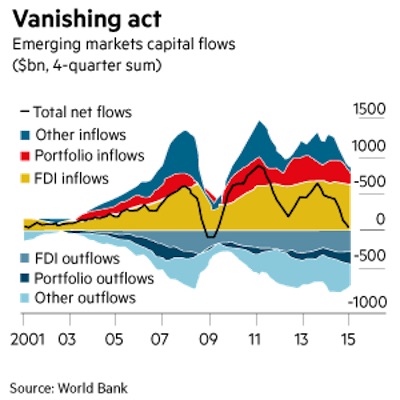
Ezubao’s website has been shut down and it appeared Yucheng Group’s Beijing office had been closed when Reuters reporters visited before Monday’s Xinhua report. Chinese police said they had sealed, frozen and seized the assets of Ezubao and its linked companies as part of investigations into China’s largest P2P online platform by lending figures. The Ezubao case has underscored the risks created by China’s fast-growing $2.6 trillion wealth management product industry. Many products are sold through loosely regulated channels, including online financial investment platforms and privately run exchanges.

Read more …

“The combination of propaganda, financial power, stupidity and bribes means that there is no hope for European peoples.”

• The West Is Reduced To Looting Itself (Paul Craig Roberts)

I, Michael Hudson, John Perkins, and a few others have reported the multi-pronged looting of peoples by Western economic institutions, principally the big New York Banks with the aid of the International Monetary Fund (IMF). Third World countries were and are looted by being inticed into development plans for electrification or some such purpose. The gullible and trusting governments are told that they can make their countries rich by taking out foreign loans to implement a Western-presented development plan, with the result being sufficient tax revenues from economic development to service the foreign loan. Seldom, if ever, does this happen. What happens is that the plan results in the country becoming indebted to the limit and beyond of its foreign currency earnings.

When the country is unable to service the development loan, the creditors send the IMF to tell the indebted government that the IMF will protect the government’s credit rating by lending it the money to pay its bank creditors. However, the conditions are that the government take necessary austerity measures so that the government can repay the IMF. These measures are to curtail public services and the government sector, reduce public pensions, and sell national resources to foreigners. The money saved by reduced social benefits and raised by selling off the country’s assets to foreigners serves to repay the IMF. This is the way the West has historically looted Third World countries. If a country’s president is reluctant to enter into such a deal, he is simply paid bribes, as the Greek governments were, to go along with the looting of the country the president pretends to represent.

When this method of looting became exhausted, the West bought up agricultural lands and pushed a policy on Third World countries of abandoning food self-sufficiency and producing one or two crops for export earnings. This policy makes Third World populations dependent on food imports from the West. Typically the export earnings are drained off by corrupt governments or by foreign purchasers who pay little while the foreigners selling food charge much. Thus, self-sufficiency is transformed into indebtedness. With the entire Third World now exploited to the limits possible, the West has turned to looting its own. Ireland has been looted, and the looting of Greece and Portugal is so severe that it has forced large numbers of young women into prostitution. But this doesn’t bother the Western conscience.

Previously, when a sovereign country found itself with more debt than could be serviced, creditors had to write down the debt to an amount that the country could service. In the 21st century, as I relate in my book, The Failure of Laissez Faire Capitalism, this traditional rule was abandoned. The new rule is that the people of a country, even a country whose top offiials accepted bribes in order to indebt the country to foreigners, must have their pensions, employment, and social services slashed and valuable national resources such as municipal water systems, ports, the national lottery, and protected national lands, such as the protected Greek islands, sold to foreigners, who have the freedom to raise water prices, deny the Greek government the revenues from the national lottery, and sell the protected national heritage of Greece to real estate developers.

What has happened to Greece and Portugal is underway in Spain and Italy. The peoples are powerless because their governments do not represent them. Not only are their governments receiving bribes, the members of the governments are brainwashed that their countries must be in the European Union. Otherwise, they are bypassed by history. The oppressed and suffering peoples themselves are brainwashed in the same way. For example, in Greece the government elected to prevent the looting of Greece was powerless, because the Greek people are brainwashed that no matter the cost to them, they must be in the EU. The combination of propaganda, financial power, stupidity and bribes means that there is no hope for European peoples.

Read more …

Humanity? Morals? Not us.

• US, UK-Backed Saudi War & Blockade Cause Mass Starvation In Yemen (Salon)

Mass starvation is ongoing in Yemen, the United Nations warns, calling it a “forgotten crisis.” The poorest country in the Middle East may be on the brink of famine, while it faces bombing and a blockade from a Saudi-led coalition, backed by the U.S. and the U.K. Approximately 14.4 million Yemenis — more than half of the population of the country — are food insecure, according to a new report by the Food and Agriculture Organization of the United Nations, also known as the FAO. The U.N. estimates there are 25 million people in Yemen. This means at least 58% of the population is food insecure. Hunger is growing. In the seven months since June 2015, the number of food insecure Yemenis has grown by 12%. Since late 2014, the number has grown by 36%. “The numbers are staggering,” remarked Etienne Peterschmitt, FAO deputy representative and emergency response team leader in Yemen.

Peterschmitt called the mass starvation “a forgotten crisis, with millions of people in urgent need across the country.” The FAO says “ongoing conflict and import restrictions have reduced the availability of essential foods and sent prices soaring.” What the FAO does not mention in its report, however, is that these import restrictions are a result of the Saudi blockade on Yemen. Since the war broke out in March, with the backing of the U.S. and U.K., Saudi Arabia has imposed a naval, land and air blockade on Yemen — which imports more than 90% of its staple foods. Because of the Saudi-led blockade and war, for more than six months, humanitarian organizations have warned that 80% of the Yemeni population, 21 million people, desperately need food, water, medical supplies and fuel.

The U.N. has insisted for over half a year that Yemenis are enduring a “humanitarian catastrophe.” Salon sent the FAO multiple requests for comment, inquiring as to why the agency did not directly acknowledge the Saudi blockade, yet did not receive a response. The U.S. media and government have devoted very little attention to the Saudi blockade, and the U.N. has not mentioned it much in its reports on Yemen. Journalist Sharif Abdel Kouddous has warned that “Yemen is now the world’s worst humanitarian crisis.” [..] The Obama administration has sold more than $100 billion in weapons to the Saudi absolute monarchy in the past five years. The Saudi military has dropped U.S.-made cluster munitions, which are banned in 118 countries, on civilian neighborhoods in Yemen, in what Human Rights Watch called “outrageous” and a “war crime.”

Read more …

The unholy union on its last legs.

• Europe Chokes Flow of Refugees to Buy Time for a Solution (WSJ)

Europe is bottling up migrants at the foot of the Balkans as its other plans for stemming the migration crisis flounder. EU member states have sent border guards, police vehicles and fingerprinting machines to Macedonia, which isn’t a member of the bloc. The goal: to squeeze the river of people still streaming north from Greece toward Germany into a trickle, turning away all but those from war-torn countries such as Syria and Iraq. The mounting restrictions are buying German Chancellor Angela Merkel time as she asks voters for patience and lobbies fellow EU leaders to implement what she promises will be a comprehensive solution to the migration crisis.

Ms. Merkel wants Turkey to dismantle smuggling networks that bring migrants across the Aegean Sea to Greece, and she wants Greece to set up large registration camps that would allow recognized refugees to be settled across the EU. But with the chancellor’s approach making little headway, many European policy makers say they have only until March to reduce the numbers from the Middle East, South Asia and Africa who are arriving in the Continent’s core, mainly Germany. Soon, spring weather on the Aegean is expected to accelerate the arrivals, just as Ms. Merkel’s conservatives face state elections in which an anti-immigration party is poised for unprecedented gains. Within Ms. Merkel’s ruling coalition, demands to shut Germany’s own border are multiplying. Support for her open-door policy is waning abroad too. Even her ally Austria has announced an annual cap on asylum places.

Mounting political pressure around Europe to cut the numbers arriving, coupled with security fears about potential terrorists using the migrant trail, is leading to measures that could effectively redraw Europe’s border at the Balkans. In Macedonia, a small, impoverished ex-Yugoslav republic, officials warn that European governments are discussing a Plan B that would have the Macedonian-Greek border sealed off entirely, with the help of EU and Balkan countries further north. “We aren’t three months away, but weeks” from cutting off Greece, Macedonian Foreign Minister Nikola Poposki said in an interview. “Actually, this is the second-worst option, because the worst option isn’t doing anything, and then each of the [EU] member states would be sealing off its own borders,” he said.

Read more …

“The last German politician under whom refugees were shot at was Erich Honecker..”

• German Police ‘Should Shoot At Migrants’, Populist Politician Says (BBC)

German police should “if necessary” shoot at migrants seeking to enter the country illegally, the leader of a right-wing populist party has said. Frauke Petry, head of the eurosceptic Alternativ fuer Deutschland (AfD) party, told a regional newspaper: “I don’t want this either. But the use of armed force is there as a last resort.” Her comments were condemned by leftwing parties and by the German police union. More than 1.1 million migrants arrived in Germany last year. Also on Saturday, German Chancellor Angela Merkel said most migrants from Syria and Iraq would go home once the wars in their countries had ended. She told a conference of her centre-right CDU party that tougher measures adopted last week should reduce the influx of migrants, but a European solution was still needed.

Police must stop migrants crossing illegally from Austria, Ms Petry told the Mannheimer Morgen newspaper (in German), and “if necessary” use firearms. “That is what the law says,” she added. A prominent member of the centre-left Social Democrats, Thomas Oppermann, said: “The last German politician under whom refugees were shot at was Erich Honecker” – the leader of Communist East Germany. Germany’s police union, the Gewerkschaft der Polizei, said (in German) officers would never shoot at migrants. It said Ms Petry’s comments revealed a radical and inhumane mentality. The number of attacks on refugee accommodation in Germany rose to 1,005 last year – five times more than in 2014.

Read more …

Not PC. “They” are the enemy, not “We”.

• UK Labour MP Compares Cologne Attacks To Birmingham Night Out (Tel.)

The Labour MP Jess Phillips is facing calls to resign after comparing the organised sexual assaults committed by gangs of migrants in Cologne to the regular harassment of women on the streets of Birmingham. The city’s residents and business owners have hit back, saying her comments were “irresponsible, highly inaccurate and misleading”. Ms Phillips, the MP for Birmingham Yardley, suggested this week that the recent attacks in Germany are no different to the situation women find themselves in the centre of Birmingham. Her remarks have incensed locals who have called on her to resign from her post and “identify the error of her ways in what she said”. Mike Olley, manager of the West Side business improvement district, said that Birmingham’s Broad Street is “not like the Wild West”.

Speaking on BBC Radio 4’s Today programme, he said that sexual harassment is “not an institutionalised part of what goes on there” On New Year’s Eve in Cologne, Germany, dozens of women found themselves trapped in a crowd of around 1,000 men, who groped them, tore off their underwear, and shouted lewd insults. German authorities have since said that almost all of the New Year’s Eve sex attackers have a “migrant background”. Superintendent Andy Parsons, Police Commander for Central Birmingham, said that Ms Phillips’ comments “aren’t born out certainly in terms of crime statistics”. He added: “But I also appreciate it’s not just about statistics. I’ve got recent experience myself policing New Year on Broad Street, it was extremely busy and the atmosphere was one of celebration rather than one of sexual overtones.

“In a night time economy …there will be activity that is alcohol fuelled – but is it fair to compare it to incidents in Cologne on New Year? I don’t think it is.” However, some acknowledged that sexual harassment is a problem in the city. Michael Mclean, chairman of Broad Street Pub Watch said that sexual harassment is “something that we see and if I turned round and said that we didn’t, I’d be lying”. He went on: “Does it happen? Yes it does. Is it true what people are saying relating it to the cologne sex attacks? Absolutely not. The correlation between the two is a massive over exaggeration.”

Read more …

Sutherland has consistently been that lonely civilized voice.

• The EU Must Reassert Humane Control Over Chaos Around The Mediterranean (UN)

by Peter Sutherland, UN’s special representative for migration

The European refugee debate reached a new nadir with a proposal to expel Greece from the Schengen zone and effectively transform it into an open-air holding pen for countless thousands of asylum seekers. The idea is not only inhumane and a gross violation of basic European principles; it also would prove vastly more costly than the alternative – a truly common EU policy that quells the chaos of the past year. Six countries have already reimposed border controls, and the European commission is preparing to allow them, and presumably others, to do the same for two years. The financial price of this alone is enormous – in the order of at least €40bn (including costs to fortify borders and those incurred by travellers and shippers). It would be much less expensive, financially and politically, to establish a common EU border and coastguard, and a functioning EU asylum agency.

This has proved to be, effectively, a zero-sum game. The rush by member states last year to seal their own perimeters left them unable to help shore up the EU’s external borders. They failed to send Greece the personnel and ships it had been promised. As such, the need for national border controls has become a self-fulfilling prophecy. A selfish, unilateral approach to borders constitutes a repeat of the tragedy of 2015, when EU member states individually spent about €40bn to address the crisis after it had reached European shores. In early 2015, the UN asked for a small fraction of that to feed, house and school the four million refugees in Turkey, Jordan, and Lebanon, but the international community and Europe failed to deliver (and many EU members still haven’t paid their share).

Unable to feed and educate their children, thousands of refugees ceded their savings to smugglers for a chance to reach Europe – precisely what you and I would have done had we been in their place. Europe cannot afford another such failure. The EU, working with the international community, must reassert humane control over the chaos around the Mediterranean. This entails immediate action on three fronts: first, raising the necessary tens of billions to allow refugees in frontline countries to live, work, and go to school there; states and the private sector must also help to create jobs both for refugees and natives through investments in the region and free-trade regimes.

Second, EU members must agree to accept several hundred thousand refugees directly from the region via safe, secure pathways and to match them to communities in Europe able to host them; failing to do this will alienate the frontline countries that bear most of the burden. Third, EU states must focus on creating a common-border regime, coastguard and asylum agency rather than return to the era of the Berlin Wall. The EU is hurtling towards disintegration, not due to some insurmountable challenge or outside force. It is instead succumbing to a self-induced panic that has paralysed its common sense. It is time to end the nightmare.

Read more …

Jan 222016
 
 January 22, 2016  Posted by at 6:55 pm Finance Tagged with: , , , , , , , , , ,  6 Responses »


Berenice Abbott Murray Hill Hotel, New York 1937

When David Bowie died, everybody, in what they wrote and said, seemed to feel they owned him, and owned his death, even if they hadn’t thought about him, or listened to him, for years. In the same vein, though the Automatic Earth has been talking about deflation (for 8 years, it’s our anniversary today) and the looming China Ponzi disaster for a long time, now that these things actually play out, everybody talks as if they own the story, and present it as new (because, for one thing, well, after all for them it is new…).

And that’s alright, it’s how people live, and function, they always have, and no-one’s going to change that. It’s just that for me, I’ve been wondering a little about what to write lately, because I’ve already written the deflation and China stories, many times, before most others tuned into them. But still, it’s strange to now, as markets start plunging, read things like ‘Deflation is Here’, as if deflation is something new on the block.

Deflation has been playing out for years. Central bank largesse has largely kept it at bay in the public eye, but that now seems over. Debt deflation is inevitable when -debt- bubbles burst, and when these bubbles are large enough, there’s nothing that can stop the process, not even miracle growth. But you’re not going to understand this if and when you look only at falling prices as the main sign of deflation; they’re merely a small part of the process, and a lagging one at that.

A much better indicator of deflation is the velocity of money, the speed at which ‘consumers’ spend money. And velocity has been going down for years. That’s where and how you notice deflation, when combined with the money and credit supply. Which have soared in most places, but were no match for a much faster declining velocity. People have much less money to spend. Which shouldn’t be a surprise if, just to name an example, new US jobs pay 23% less than the ones they’re -supposedly- replacing.

As I said a few weeks ago, it’s probably only fitting, given its pivotal role in our economies and societies, that it’s oil that’s leading the way down. Other commodities are not far behind, because demand for -and spending on- them has been plummeting too, as overproduction and overinvestment, especially in China, do the rest.

However you look at present global debt, percentage wise, or in absolute numbers, you name it, there’s never been anything like it. We outdid ourselves by so much we don’t have the rational or probably even subconscious ability to oversee what we’ve done. We live in the world’s biggest bubble ever by a margin of god only knows how much. And that bubble will deflate. It is already doing just that.

The next steps in the debt deflation process will of necessity be chaotic. A substantial part of that chaos is bound to emerge from denial, and the reluctance to accept reality. Which often rise from a poor understanding of the processes taking place. It certainly looks as if there’s lots of that in China, where both the working principles of financial markets and the grip authorities -can- have on them, seem to be met with a huge dose of incomprehension.

Mind you, given the levels of comprehension vs outright ‘theoretical religion’ among leading western politicians and economists, the ones who most often rise to decision-making positions in governments and financial institutions, we have nothing on China when it comes to truth and denial.

From all that follows what will be the next leg down in the ‘magnificent slump’: the awfully messy demise of currency pegs.

In a short explainer for the uninitiated, allow me to steal a few words from Investopedia: “There are two types of currency exchange rates—floating and fixed, still in existence. Major currencies, such as the Japanese yen, euro, and the US dollar, are floating currencies—their values change according to how the currency is being traded on forex markets. Fixed currencies, on the other hand, derive value by being fixed (or pegged) to another currency.”

While there are more currency pegs in the world today than we should care to mention -there are dozens-, it seems fair to say that in today’s deflationary environment, practically all are under siege. Most African currencies are pegged to the euro, and they do have to wonder how smart that is going forward. Still, the main, and immediate, problems seem to arise in pegs to the US dollar (with one interesting exception: the Swiss franc – more in a bit).

Most oil producing Gulf nations are pegged to the greenback. So is Hong Kong. And, for all intents and purposes, so is China, though you have to wonder what a peg truly is if you change it on a daily basis. China is on its way to a peg vs a basket of currencies, but that seriously interferes with its stated intention to become a reserve currency -of sorts-. If your currency can’t stand on its own two feet, i.e. float, you’re per definition weak.

China’s vice president Li Yuanchao said this week in Davos that Beijing has no plans to devalue the yuan, i.e. to cut the peg to the dollar. Then again, he also stated that “central command” would ‘look after’ stock market investors. Put the two statements together and you have to wonder what the one on the yuan (couldn’t help myself there) is worth.

The first “link in the chain” that appears vulnerable is the Hong Kong dollar, which is stuck between China and the US, and unlike the yuan still has a solid dollar peg, but, obviously, also has a strong link to the yuan. The issue is that if China continues on its current course of daily small yuan devaluations, the difference with the HKD will grow so large that ever more investments and savings will move to Hong Kong, despite a maze of laws designed to keep just that from happening.

And that is the overall danger to currency pegs as they still exist in today’s rapidly changing global financial world: all economies are falling, but some are falling -much- faster than others.

Not so long ago, the World Bank called on Saudi Arabia to defend its USD peg with its FX reserves. It even looked as if they meant it. But Saudi Arabia has no choice but to deplete those reserves to prevent other nasty things from happening that are much more important than a currency peg. Like social chaos.

It’s somewhat wonderfully ironic that the main most recent experience with abandoning a peg comes from a source that faced -and now feels- the exact opposite of what nations like Saudi Arabia and China do. That is, it became too costly and risky for Switzerland to keep its franc pegged (or ‘capped’, to be precise) to the euro any longer a year ago, because of upward, not downward pressure.

Since then, the euro went from 1.20 franc to 1.09 or thereabouts, which perhaps doesn’t look all that crazy, and many ‘experts’ seek to downplay the effects of the move, but it’s still estimated to have cost the Swiss some $25 billion. For comparison, the US has 40 times as many people as Switzerland’s 8 million, so the per capita bill would be close to $1 trillion stateside. That wouldn’t have added to Yellen’s popularity. Currency pegs and caps can be expensive hobbies.

And that’s why the Saudis and Chinese are so anxious about letting go of their pegs. That and pride. In their cases, their respective currencies wouldn’t, like the franc, rise versus the one they’re pegged to, they would instead lose a lot of value. And in the fake markets we live in today, where price discovery has long since been left behind, there’s no telling how much. Well, unless they seek to keep control, but then it would be just a matter of time until they need to rinse and repeat.

Even if it seems obvious to make a particular move, and if everybody knows you really should, showing what can be perceived as real weakness could be a killer when everything else around you is manipulated to the bone.

Still, neither Beijing nor Riyadh stand a chance in a frozen-over hell, to ultimately NOT sharply devalue their currencies or just simply let go of their pegs. Simply because China’s economy is falling to pieces, and the Saudi’s dependence on oil prices is dragging it into a financial gutter. Just look at what falling prices had done to the riyal vs non-pegged oil producer currencies by October 2015, when Brent was still at $45:

The Saudis could have been paid for their oil in a currency worth perhaps twice as much as their own, the one their domestic economy runs on. That’s overly simplistic, because the Saudi tie to the USD runs far and deep, but that doesn’t make it untrue.

What will bring down the Chinese and Saudi pegs, along with a long list of other pegs, is, how appropriately, the very same markets they’ve been relying on to NOT function. The bets against Hong Kong’s ability to maintain its USD peg have already started, and China is next, along with the House of Saud (the latter two just take more fire-power). Which of course is exactly why they speak their soothing ‘confident’ words. Words that are today interpreted as the very sign of weakness they’re meant to circumvent.

What worked for George Soros in his bet vs the Bank of England and the pound sterling in 1992, will work again unless these countries are ahead of the game and swallow their pride and -ultimately- smaller losses.

Granted, so much will have to be recalibrated if the yuan devalues by 50% or so, and the riyal does something similar (it’s very hard to see either not happening), that it will take some serious time before everyone knows where they -and others- stand. And since volatility tends to feed on itself once there’s enough of it, it seems to make sense that governments would seek control. But that doesn’t mean they -can- actually have any.

Today’s major currency pegs are remnants of a land of long ago lore; they have no place in this world, they are financial misfits. Who’ve been allowed to persist only because central banks and governments have been able to distort markets for as long as they have. But that ability is not infinite, and it’s in nobody’s longer term interest that it would be.

Not even those that now seem to profit most from it. We will end up with societies that function no better for the ridiculous Davos elites than they do for the bottom rung. But no elite will ever see that, let alone admit it voluntarily.

Deflation and foreign exchange chaos. There’s your future. As for stocks and oil, who’s left to buy any? Not the consumer who’s 70% of US and perhaps 60% of EU GDP, they’re maxed out on private debt. So why would investors put their money in either? And if they don’t, where do you see prices go?

Even more importantly, deflation makes a lot of money, and even much more virtual money, vanish into overnight thin air. That’s what everyone is running into when all these currencies, China, Saudi, Gulf states et al, are forced to recalibrate. $17 trillion disappeared from global equities markets in the past 6 months.

How much vanished from the value of ‘official’ oil reserves? How much from iron ore and aluminum? How much do all the world’s behemoth corporations and banks and commodity-exporting countries have their resource ‘wealth’ on their books for in their sunny creative accounting models? And how much of that is just thin hot air too?

We’re about to find out.

Jan 202016
 
 January 20, 2016  Posted by at 9:22 am Finance Tagged with: , , , , , , , , , ,  5 Responses »


DPC Pere Marquette transfer boat 18 passing State Street bridge Chicago River 1901

• Oil Falls 3% On Surplus Worries, As US Drops Toward $27 (Reuters)
• Shell Q4 Profit Plunges as Oil’s Slump Deepens (BBG)
• Chinese Stocks in Hong Kong Fall to Global Financial Crisis Lows (BBG)
• Nikkei, Hang Seng Lead Slump In Asian Markets (CNBC)
• Recent S&P 500 Correction Appears Small in Context of History (BBG)
• World Faces Wave Of Epic Debt Defaults: Central Bank Veteran (AEP)
• Hedge Fund That Called Subprime Crisis Urges China To Devalue Yuan by 50% (BBG)
• China Is Getting Less and Less Bang for Its Credit Buck (BBG)
• China Needs a Great Economic Shift Away From Debt Fueled ‘Growth’ (Wolf)
• China Data Indicate Heavy Deflationary Pressure (Nikkei)
• What Is China’s Actual GDP? (CNBC)
• Mining Giant BHP Billiton Lowers Forecast, Investors Fear Dividend Cut (WSJ)
• Fed’s $216 Billion Treasuries Rollover Recalls Crisis Era Buying (BBG)
• ECB Plans To Order Banks To Tackle Bad Loans (Reuters)
• Varoufakis Speaks About 2015 Greece Parallel Currency Plan (Kath.)
• Greek Immigration Minister Slams Turkish Failure To Curb Refugee Flow (Kath.)
• EU To Scrap ‘First Country’ Asylum Claim Rule (FT)
• Children On Syrian Refugee Route Could Freeze To Death: UN (Reuters)
• Doctors Without Borders Says EU Worsens Refugee Crisis, Aids Smugglers (AP)
• Rate Of Refugee Arrivals In Greece Dwarfs 2015 Pace (AFP)
• More Plastic Than Fish In The Sea By 2050 (Guardian)

On our way to $20 and beyond.

• Oil Falls 3% On Surplus Worries, As US Drops Toward $27 (Reuters)

Crude futures slumped again in Asian trade on Wednesday, with U.S. oil droppping more than 3% toward $27 a barrel and its lowest since 2003, on worries about global oversupply. That came after the International Energy Agency, which advises industrialized countries on energy policy, warned that oil markets could “drown in oversupply” in 2016. The crash hammered Asian stock markets with MSCI’s broadest index of Asia-Pacific equities outside Japan falling 2.8% to a four-year low. “Oil prices are at a level where OPEC countries are all struggling. They are selling oil for cashflow not for profit,” said Jonathan Barratt at Sydney’s Ayers Alliance. “U.S. producers are holding out, but I think they’re bleeding as well,” he said.

U.S. crude futures were trading down 97 cents at $27.49 a barrel, or 3.4%, at 0625 GMT, the lowest since September 2003. The contract settled down 96 cents, or 3.26%, the session before. The expiry of the February contract on Wednesday was “probably” adding further downward pressure on U.S. West Texas Intermediate oil as traders closed positions, said Michael McCarthy at Sydney’s CMC Markets. Brent futures dropped 61 cents to $28.15 a barrel, or 2.1%, not far from the 12-year low hit on Monday. It settled up 21 cents, or 0.7 per cent, in the previous session. McCarthy said the market had already taken into account the 500,000 barrels per day Iran has forecast it will add to global production. “(Iran) is really another strike in the same beating the market has taken,” McCarthy said.

Read more …

Profit? You mean creative accounting.

• Shell Q4 Profit Plunges 50% as Oil’s Slump Deepens (BBG)

Royal Dutch Shell said fourth-quarter profit plunged as the rout in crude prices deepened. The company sees profit adjusted for one-time items and inventory changes of $1.6 billion to $1.9 billion, Shell said Wednesday in a preliminary earnings statement. That compares with the $1.8 billion average estimate of nine analysts surveyed by Bloomberg, and profit of $3.3 billion a year earlier. Shell, which is buying BG Group in the industry’s largest deal in a decade, has cut jobs and reduced spending as CEO Ben Van Beurden prepares for a prolonged downturn. Crude’s slump below $30 a barrel has driven down Shell’s market value to the lowest in almost seven years and prompted concern it may be overpaying for BG’s production and cash flow.

The average price of Brent crude, the international benchmark, fell 42% in the quarter from a year earlier to $44.69 a barrel, the lowest since 2009. Aberdeen Asset Management and Invesco Asset Management, two of Shell’s major shareholders, have said they will support the company’s plan to buy BG even with crude’s collapse. The acquisition allows Shell to accelerate the reshaping of its portfolio toward deepwater assets and natural gas and BG’s production is likely to grow strongly in the next three to five years, Invesco fund manager Martin Walker said. Standard Life Investments is the only Shell holder that has so far publicly said it will vote against the combination because the acquisition is “value destructive.”

Shell has justified the deal by saying it boosts its ability to maintain dividends, makes it the world’s biggest liquefied natural gas company and gives it oil and gas assets from Australia to Brazil. The company’s B shares, the class of stock used in the deal, have dropped 11% this year, extending last year’s 31% decline. Shell’s shareholders are scheduled to vote on the acquisition on Jan. 27 and BG’s the next day. Shell requires the backing of 50% of its holders. In BG’s case, votes in favor must represent at least 75% of the total value of the company’s shares. The merger will probably become effective Feb. 15, Shell said.

Read more …

Hong Kong is fast becoming the eye of the storm.

• Chinese Stocks in Hong Kong Fall to Global Financial Crisis Lows (BBG)

Chinese stocks in Hong Kong tumbled to the lowest level since the depths of the global financial crisis as a slide in the city’s dollar spurred concerns over capital outflows. Oil producers and property developers led declines. The Hang Seng China Enterprises Index plunged as much as 5.5% before paring losses to trade 4% lower at 1:57 p.m. in Hong Kong. PetroChina fell to a 11-year low as oil extended its decline and Cnooc, China’s largest offshore oil company, said it will cut output for the first time in more than a decade. Hong Kong’s dollar traded near its weakest level since 2007 as concern about China’s slowing economy curbs demand for the city’s assets. The Shanghai Composite Index lost 0.8%.

“The local dollar’s slide is igniting concerns that capital outflows are accelerating as funds are selling equities en masse,” said Castor Pang at Core-Pacific Yamaichi Hong Kong. “Overall sentiment is very bad in Hong Kong.” The so-called H-shares gauge slid to 8,043.47, heading for the lowest level since March 2009. The index has slumped 17% this year, joining China’s Shanghai Composite as the world’s worst-performing major global benchmark measure out of the 93 tracked by Bloomberg. Similar to their mainland counterparts, Hong Kong policy makers are fighting to prevent a vicious cycle of capital outflows and a weakening currency with the resulting financial-market volatility heightening concern that China’s deepest economic slowdown since 1990 will worsen. PetroChina and China Petroleum & Chemical tumbled at least 6.2% in Hong Kong.

Oil extended its decline from the lowest close in more than 12 years, while Cnooc’s output cut increased speculation the nation’s producers are succumbing to the global price war. Cnooc’s acknowledgment that spending cuts are hurting production may be a prelude to further reductions by Chinese explorers, according to Nomura. The stock dropped 6%. Hong Kong’s Hang Seng Index tumbled 3.7% to a three-year low as trading volumes surged 77% above the 30-day average for this time of day. Property developers led declines, with Cheung Kong Property Holdings Ltd. sliding 6.1% to a record low. “To protect the Hong Kong dollar peg the government has to raise the interest rate,” said Louis Tse, a Hong Kong-based director at VC Brokerage Ltd. “The property companies are high-beta stocks because you have to borrow during the development phase,” with higher borrowing costs potentially weighing on home owners as well.

Read more …

And Europe follows as we speak.

• Nikkei, Hang Seng Lead Slump In Asian Markets (CNBC)

Asian stocks tumbled Wednesday, with major indexes declining by more than 1% each, as global sentiment remained low on concerns over economic growth, China and low oil prices. “The frailty in the Chinese growth remain the core problem for investors and the spotlights are not moving away from it anytime soon,” Naeem Aslam, chief market analyst at AvaTrade, said in a note Wednesday. Overnight, the IMF cut its global growth forecast for 2016 to 3.4%, from 3.6%. The organization cited slower growth in emerging markets, especially in China, falling commodity prices, and rising interest rates in the U.S. as potential risks to global growth. Markets in China opened in negative territory, following a 3.5% gain in the previous session after Beijing released a slew of data including the full-year growth number for 2015.

The Shanghai composite was down 1.15% and the Shenzhen composite declined by 1.10%. The CSI300 was down 1.64%. Hong Kong’s Hang Seng index was down 3.77%. The Chinese economy grew by 6.9% in 2015, according to official data, down from 2014’s 7.3%, and the slowest pace of economic expansion since 1990. Some analysts believe further intervention and economic stimulus from Beijing are forthcoming as the country juggles a structural re-balancing act. Cynthia Kalasopatan from Mizuho Bank said in a morning note, “Soft growth momentum led to expectations that Chinese authorities will need to implement further policy easing to support the economy. “More policy and RRR cuts may be in the pipeline,” she added, “What’s more, targeted fiscal tools may be used as well to spur growth.”

The People’s Bank of China (PBOC) said late on Tuesday it would inject more than 600 billion yuan ($91.22 billion) into the financial system to help ease a liquidity squeeze expected before the Lunar New Year holiday in early February. [..] bank and property shares were sharply lower. Bank of China’s Hong Kong-listed shares dropped 1.97% and its Shanghai-listed ones fell 1.70%. Hong Kong-listed Shimao Property dropped 6.02%.

Read more …

The shape of things to come.

• Recent S&P 500 Correction Appears Small in Context of History (BBG)

The recent 10% drop in U.S. stocks looks very small when considered in the context of the 220% rally from the 2009 nadir to the 2015 peak. The Standard & Poor’s 500 Index remains more than 5% above its 200-week moving average, and has not spent this long continuously above it since the 1990s dot-com era. When that bull run finished, the market fell to 38% below the 200-week moving average, while the 2009 crash bottomed out 48% below it.

Read more …

“The European banking system may have to be recapitalized on a scale yet unimagined, and new “bail-in” rules mean that any deposit holder above the guarantee of €100,000 will have to help pay for it.”

• World Faces Wave Of Epic Debt Defaults: Central Bank Veteran (AEP)

The global financial system has become dangerously unstable and faces an avalanche of bankruptcies that will test social and political stability, a leading monetary theorist has warned. “The situation is worse than it was in 2007. Our macroeconomic ammunition to fight downturns is essentially all used up,” said William White, the Swiss-based chairman of the OECD’s review committee and former chief economist of the Bank for International Settlements (BIS). “Debts have continued to build up over the last eight years and they have reached such levels in every part of the world that they have become a potent cause for mischief,” he said. “It will become obvious in the next recession that many of these debts will never be serviced or repaid, and this will be uncomfortable for a lot of people who think they own assets that are worth something,” he said in Davos.

“The only question is whether we are able to look reality in the eye and face what is coming in an orderly fashion, or whether it will be disorderly. Debt jubilees have been going on for 5,000 years, as far back as the Sumerians.” The next task awaiting the global authorities is how to manage debt write-offs – and therefore a massive reordering of winners and losers in society – without setting off a political storm. Mr White said Europe’s creditors are likely to face some of the biggest haircuts. European banks have already admitted to $1 trillion of non-performing loans: they are heavily exposed to emerging markets and are almost certainly rolling over further bad debts that have never been disclosed. The European banking system may have to be recapitalized on a scale yet unimagined, and new “bail-in” rules mean that any deposit holder above the guarantee of €100,000 will have to help pay for it.

The warnings have special resonance since Mr White was one of the very few voices in the central banking fraternity who stated loudly and clearly between 2005 and 2008 that Western finance was riding for a fall, and that the global economy was susceptible to a violent crisis. Mr White said stimulus from quantitative easing and zero rates by the big central banks after the Lehman crisis leaked out across east Asia and emerging markets, stoking credit bubbles and a surge in dollar borrowing that was hard to control in a world of free capital flows. The result is that these countries have now been drawn into the morass as well. Combined public and private debt has surged to all-time highs to 185pc of GDP in emerging markets and to 265pc of GDP in the OECD club, both up by 35 %age points since the top of the last credit cycle in 2007. “Emerging markets were part of the solution after the Lehman crisis. Now they are part of the problem too,” Mr White said.

[..] In retrospect, central banks should have let the benign deflation of this (temporary) phase of globalisation run its course. By stoking debt bubbles, they have instead incubated what may prove to be a more malign variant, a classic 1930s-style “Fisherite” debt-deflation. Mr White said the Fed is now in a horrible quandary as it tries to extract itself from QE and right the ship again. “It is a debt trap. Things are so bad that there is no right answer. If they raise rates it’ll be nasty. If they don’t raise rates, it just makes matters worse,” he said. There is no easy way out of this tangle. But Mr White said it would be a good start for governments to stop depending on central banks to do their dirty work. They should return to fiscal primacy – call it Keynesian, if you wish – and launch an investment blitz on infrastructure that pays for itself through higher growth.

Read more …

Don’t think they’d do it in one go. But who knows, it might be the way to go.

• Hedge Fund That Called Subprime Crisis Urges China To Devalue Yuan By 50% (BBG)

Mark Hart, the hedge fund manager whose bets against U.S. subprime mortgages and European sovereign debt proved prescient, said China should weaken its currency by more than 50% this year. A one-off devaluation would allow policy makers to “draw a line in the sand” at a more appropriate level for the yuan, easing pressure on China’s foreign-exchange reserves and removing an incentive for capital outflows, according to Hart, who’s been betting against the currency since at least 2011. China should devalue before its $3.3 trillion hoard of reserves shrinks much further, he said, because the country can still convince markets it’s acting from a position of strength. “There wouldn’t be anything underhanded about a sharp devaluation,” Hart said. “Why should China be forced to suffer deflationary effects of defending its currency when everyone else isn’t?”

Hart, whose prescription clashes with consensus forecasts for the yuan and recent comments from senior government officials, said China would be justified in weakening the currency after central banks in Europe and Japan fueled declines in their exchange rates to stoke economic growth in recent years. Such a move would likely come as a surprise to global investors, who were rattled by a drop of less than 3% in the yuan last August. China’s current approach to managing the currency’s decline has been costly. Foreign-exchange reserves dropped by a record $513 billion last year as the central bank intervened to ease the currency’s slide, while an estimated $843 billion of capital flowed out of China in the 11 months through November as some investors sought to get in front of further yuan weakness.

Aside from intervention, policy makers have moved to curb bearish bets against the yuan and tighten restrictions on the flow of money across the country’s borders. Those measures have fueled doubts among global investors about the ruling Communist Party’s commitment to give markets a central role in the world’s second-largest economy and make the yuan an international currency. “They’re trying to drive a car with one foot on the brake,” said Hart, who estimates the People’s Bank of China spent more than $100 billion supporting the yuan in onshore and offshore markets during the first 12 days of January. “If China were to devalue to a level that wasn’t actually a true equilibrium they will get run over pretty quickly, they will blow through FX reserves, and then they will lose face because they’ll be forced to devalue.”

Read more …

Omen.

• China Is Getting Less and Less Bang for Its Credit Buck (BBG)

Behind the numbers showing China’s continued slowdown at the end of last year lies a warning for Communist Party leaders who have been equally determined to embrace economic change and to ensure a rapid pace of growth. The flashing yellow light: there’s less and less power behind policy makers’ stimulus. For each $1 in credit expansion, China added the equivalent of 27 cents of GDP last year, the least since 2009, according to data compiled by Bloomberg from government figures released Tuesday. As recently as 2011, each $1 generated 59 cents.

The diminishing mileage for credit raises a conundrum for President Xi Jinping and his premier, Li Keqiang, of whether to let China slow further as they shut down surplus smokestack industrial capacity, or keep pumping liquidity. It also highlights the importance of financial-industry reforms – another ball the leadership is juggling. “This will require rolling back preferences that tilt, and trap, the flow of investment in inefficient state enterprises,” said David Loevinger, a former China specialist at the U.S. Treasury and now an analyst at fund manager TCW in Los Angeles. “This is always challenging because the companies that stand to lose are big and powerful and the companies that stand to win are small and may not even yet exist.”

Read more …

Martin Wolf noticed the omen too: “..the “incremental capital output ratio” — the amount of capital needed to generate additional income — has roughly doubled since the early 2000s.”

• China Needs a Great Economic Shift Away From Debt Fueled ‘Growth’ (Wolf)

Chinese policymakers have a stellar reputation for the quality of economic management but the same was true of the Japanese three decades ago. For the Japanese, the difficulty of shifting from their high-savings, high-investment, catch-up economic model proved very large. Indeed, this has still not been completed. While the Chinese economy has far more room to grow than Japan a quarter of a century ago, its disequilibria are even bigger. Moreover, contrary to conventional wisdom, the transition to a new pattern of growth has not really begun. Already, the difficulty of handling this transition is damaging Chinese policymakers reputation. Mistakes in handling the implosion of the bubble economy of the 1980s did the damage in Japan. Now it is the Chinese authorities mishandling of the currency and the stock market.

Similarly, the financial crisis of 2007 and 2008 devastated the reputation of western financiers and policymakers. Everybody seems to be a genius when credit is surging. Understandably and rightly, observers are calling upon the Chinese authorities to be more transparent. Given their political system -‘the bureaucrat knows best’- that is going to be hard to do, but this is a second-order matter. The first-order one is that it is unclear how and whether the transition to a more balanced economy is to be made. Again, some people focus on the transition from manufacturing to services. This does seem to be going quite well: according to Chinese data, industry grew at an annual rate of just 6% in the first three quarters of 2015, while services grew 8.4%. However, a large part of this apparent success is due to growth of income from financial services.

Just as was the case in the west, before the crisis, this is as much a symptom of credit growth as of a transition to a more balanced ‘new normal’. The fundamental indicators of a change in the shape of the economy would be a fall in savings and investment and a rise in consumption. Such a shift is necessary not only because much of the investment is wasted, but because it is associated with an explosive rise in debt. China has today a far higher share of investment in GDP than other high-growth east Asian economies ever had. Furthermore, according to the McKinsey Global Institute, overall indebtedness is extremely high with a concentration in non-financial corporations. It is higher than in the US, for example.

In response to the 2008 financial crisis, China promoted a huge rise in debt-fuelled investment to offset the weakening in external demand. But underlying growth in the economy was slowing. As a result, the “incremental capital output ratio” — the amount of capital needed to generate additional income — has roughly doubled since the early 2000s. China’s overall capital-output ratio is also very high and rising. At the margin, much of this investment is likely to be lossmaking. If so, the debt associated with it will also be unsound. But, if wasteful investment were slashed, the economy would go into recession.

Read more …

From debt to deflation, a natural course.

• China Data Indicate Heavy Deflationary Pressure (Nikkei)

Excess manufacturing capacity, rising real estate inventories and volatile financial markets weigh on China’s economy as the government tries to engineer a soft landing, with data for 2015 suggesting that deflation may loom. China’s real GDP growth slipped to 6.9% last year, the lowest in a quarter century. Real growth had not dropped below 7% since 1990, when international sanctions were imposed in response to the 1989 Tiananmen Square crackdown. Nominal growth, based on official GDP figures, totaled 6.4%, falling below real growth for the first time since 2009. Nominal growth that is slower than real growth indicates heavy deflationary pressure. Severe overcapacity in major manufacturing industries is one cause. China’s steel industry has 400 million tons of excess capacity.

Exports came to 100 million tons in 2015, on par with Japan’s annual output. With supply outstripping demand, wholesale prices sank 5.2% in 2015, 3.3%age points faster than in 2014. Companies are shouldering heavier real debt-repayment burdens despite repeated interest rate cuts by the People’s Bank of China. Production is depressed, with crude steel, cement and sheet glass output dropping in 2015. Electricity use, a more accurate gauge of economic conditions, slid 0.2%. Mounting real estate inventories are another drag on the economy. Inventories soared nearly 50% in two years to 718.53 million sq. meters at the end of 2015. Housing activity has been sluggish for some time in many outlying cities.

Office building vacancy rates have reached about 40% in the inland cities of Chongqing and Chengdu, a developer said. With little new investment coming in, spending on property development edged up 1% in 2015 – just one-tenth the growth seen in 2014. Turmoil in financial markets compounds the country’s problem. The slide in Chinese stocks since the start of the year could dampen brisk consumer spending. Services accounted for half of GDP in 2015, with the finance industry contributing significantly amid a rise in stock trading. If retail investors flee the market, growth could drop accordingly.

Read more …

“It doesn’t take a rocket scientist to figure out the growth in old China for the past year or so has been somewhere around zero — it’s nothing like 6.8%..”

• What Is China’s Actual GDP? (CNBC)

China announced Tuesday that its economy notched 6.9% growth in 2015 — down from the prior year, but perfectly matching expectations. And yet commentary from around the world suggests almost no outside investor or economist believes Beijing’s figures. Although there has never been definitive evidence that Chinese economic data is exaggerated, the widely-held theory says that China’s National Bureau of Statistics will overstate growth in a stability-minded effort to hide the truth about a slowing economy. So instead of relying on government reports, China-watchers analyze other metrics for a more complete picture of the country’s GDP. “Nobody knows for sure, but when we look at things that are harder numbers to fudge…our estimate is growth probably about 3.5% versus roughly 7,” said A. Gary Shilling.

“We watch (the official GDP announcement) as closely as we do in some sense out of a sense of obligation,” said Donald Straszheim, head of China Research at Evercore ISI. “I wasn’t expecting to learn a great deal last night when these numbers came out.” Not only does China’s NBS refuse to respond to inquiries, Straszheim said, but the statistics unit will announce only its total GDP growth figure — not the components of that number. “If you don’t have the components, how can you have a total? And if you have the components, which would add to the total, why are they not publicly available?” Straszheim asked. [..] For his part, Shilling said his firm models China’s possible GDP growth on measures of rail traffic, electricity consumption, coal consumption and debt.

Billionaire distressed asset investor Wilbur Ross, meanwhile, sees China’s actual growth at about 4% on a similar basket of metrics. The “reason is that if you look at physical indicators — rail car loadings, truck loadings, cement consumption, steel consumption, exports, natural gas consumption, electricity consumption — none of those are consistent with 6.8 or 6.9,” he explained. Straszheim said his group uses data from sources it regards as largely independent from government pressure, pointing to commodity consumption among other measures. But most of these indicators seek to measure the share of China’s economy based on exporting, manufacturing, and capital investment — and Beijing has made no secret that it sees the country shifting toward an increasingly service-oriented economy.

That could, in turn, potentially make it even harder for investors to know the truth about China’s GDP. “It doesn’t take a rocket scientist to figure out the growth in old China for the past year or so has been somewhere around zero — it’s nothing like 6.8%,” Straszheim said, explaining that the “new” China of services and consumer spending is tough to measure in the absence of robust data from the private sector. [..] Derek Scissors, a scholar for the American Enterprise Institute, pointed out that China’s own official numbers seem to contradict one another. For example, China’s Xinhua reported that November railways cargo fell 15.6% year on year, but the state statistics office said industrial production through the year was up 6.1%. “What? Did they just produce the goods and leave them on the factory floor and they never went anywhere?” Scissors asked.

Read more …

Putting on the brave face mask.

• Mining Giant BHP Billiton Lowers Forecast, Investors Fear Dividend Cut (WSJ)

BHP Billiton said it is committed to protecting its balance sheet amid a sharp downturn in world commodity markets, as expectations build about the miner preparing to cut its dividend. The Anglo-Australian mining giant has faced growing speculation it may have to cut its payout by as much as half this year as it grapples with plunging resources prices and the fallout from one of its worst mining disasters, a deadly dam burst at a mine operated by Samarco Mineração SA, a 50-50 joint venture with Brazil’s Vale SA. Last week, BHP also announced its largest write-down ever, a roughly US$7.2 billion pretax charge against its U.S. onshore energy assets as oil prices slumped below US$30 a barrel for the first time in more than 10 years.

Only 18 months ago, the market was speculating about the possibility of a major share repurchase by the company to reward investors. Now, even maintaining its dividend, a US$6.6 billion annual burden on its balance sheet, appears a stretch. Cutting investor payouts is a measure big companies are loath to take, for fear of alienating important shareholders. It is particularly difficult when options for growth are limited. “We continue to cut costs and remain focused on safely improving our operational performance to enhance the resilience of our business,” Chief Executive Andrew Mackenzie said Wednesday. “In this environment, we are also committed to protecting our strong balance sheet so we have the financial flexibility to manage further volatility and take advantage of the expected recovery in copper and oil over the medium term,” he added.

In August, BHP recorded its worst annual earnings result since 2003. Slackening demand from China, as miners ramp up production from mines planned when prices were booming, has hit prices of nearly every commodity, including coal, iron ore, oil and copper, which are BHP’s core products. BHP’s share price has since slumped to its lowest level in more than a decade. That’s been exacerbated by uncertainty over the Samarco disaster. [..] the Nov. 5 incident killed at least 17 people and triggered a criminal investigation and roughly US$5 billion civil lawsuit by authorities. On Wednesday, it also led BHP to pare its projection for global iron-ore production in the year through June, to 237 million metric tons from an earlier forecast of 247 million. Investors have urged BHP to clear the air on its plans for future dividends. They say uncertainty over the outlook has been a key driver in sending the miner’s share price sharply lower.

Read more …

Well, to be fair, this IS the crisis era.

• Fed’s $216 Billion Treasuries Rollover Recalls Crisis Era Buying (BBG)

If you were under the impression that the Federal Reserve was done buying Treasuries, think again. While the central bank won’t be expanding its balance sheet, about $216 billion of Treasuries in its portfolio mature in 2016, up from negligible amounts the past few years. Last week, New York Fed President William C. Dudley reiterated policy makers’ plan to keep reinvesting the proceeds for the time being, giving bondholders and Wall Street dealers reason to cheer. The Fed is the biggest holder of the government’s debt. Its $2.5 trillion hoard, amassed in a bid to support the economy after the financial crisis, is more of a focus for some investors than the trajectory of interest rates. From this month through 2019, about $1.1 trillion of Treasuries in the portfolio are set to mature.

For bond bulls, the Fed’s signals that it will roll over the obligations have been another reason to doubt the consensus forecast that yields will rise in 2016. If officials had chosen to stop funneling that money into new debt, the government would likely have to boost borrowing by roughly an equivalent amount this year, potentially pushing up Treasury yields. “The Fed tightening gave us little worry, but the unwind of the balance sheet gives us major worries,” said Mark MacQueen, co-founder of Sage Advisory Services. “The Fed is keenly aware that the balance sheet has a much greater impact on the overall yield levels in the markets going forward than raising rates.”

Officials anticipate keeping the holdings stable until the normalization of interest rates is “well under way,” though there’s no specific level for the Fed’s target at which reinvestment would end, Dudley said in prepared remarks of a speech Jan. 15. That ensures the legacy of the Fed’s quantitative-easing programs, which boosted its Treasuries holdings from less than $500 billion in 2009, will extend even further into the future. As officials roll maturing issues into new debt, that swells the amount coming due later in the decade.

Read more …

As in: bring them out into the open. Problem is, that’s the death knell for many banks.

• ECB Plans To Order Banks To Tackle Bad Loans (Reuters)

The ECB plans to tell euro zone banks how to better manage bad loans, banking officials said on Tuesday, in an effort to resolve an issue that is curbing the region’s economic recovery. Bad loans have more than doubled across the euro zone since 2009 and stood at nearly a €1 trillion at the end of 2014, the IMF said last year. Those loans burden banks and make it harder for them to lend. The ECB has asked a number of banks across the euro zone, including Italy’s Monte dei Paschi di Siena and UniCredit, about their non-performing loans. They were selected to establish a representative sample, not necessarily because they are particularly affected, the sources said. Italian bank shares have tumbled in recent days on fears the ECB had singled out some banks because of their vulnerabilities.

But the banking sources said all types of banks across the continent were included in the sample. The request for information is the first step in a process that will see the ECB define best practices on how to deal with bad loans, encompassing banks with different business models in different jurisdictions. Those guidelines will eventually be used by the ECB’s supervisory teams when formulating recommendations for the banks on their watch. The recommendations might range from hiring more staff to deal with non-performing loans or changing internal practices, to making more provisions, reviewing the value of soured loans or even creating a bad bank. An ECB spokesman said the request for information was “standard supervisory practice”. A bad loan is typically one that is more than 90-days overdue.

Read more …

“I carry a great responsibility,” he said. “I would do a lot of things differently.”

What really happened was Varoukais couldn’t guarantee Plan X would work, and Tsipras then said it would be too great a responsibility to implement it.

• Varoufakis Speaks About 2015 Greece Parallel Currency Plan (Kath.)

Yanis Varoufakis was instructed last year by Prime Minister Alexis Tsipras to put together a small team of people to draw up a plan for introducing a parallel currency if Greece was unable to reach an agreement with its lenders on a new bailout, the ex-finance minister said in a TV interview late Tuesday. Speaking on Skai TV’s “Istories” (Stories) program, Varoufakis outlined what was known as Plan X. He said that a small team of about six people examined the various parameters surrounding a potential standoff that would lead to Greece being unable to meet its obligations. Among the issues examined by Varoufakis and his advisers were how the country would continue to have access to medicines, fuel and food under such circumstances.

Varoufakis said that he advised Tsipras to put the plan, which would see Greece defaulting on 27 billion euros in Greek government bonds held by the European Central Bank, into action as soon as he called a referendum at the end of June. “I thought that if we did what we had decided as a negotiating team… and announced that we would restructure these bonds and implement the parallel payment system, then by the Monday, Tuesday or Wednesday before the referendum the discussion we expected between [ECB president Mario] Draghi and [German Chancellor Angela] Merkel would take place,” he said. Varoufakis said that Tsipras considered adopting Plan X but that he was advised against it by Deputy Prime Minister Yiannis Dragasakis.

“The prime minister thought about it very carefully,” said the ex-minister. “I saw him puzzle over what he should do and in the end he decided to follow Dragasakis’s recommendation and not mine.” Varoufakis added that he was against efforts to secure funding from Russia but that there had been an agreement with China regarding investment in Greece, including in Greek bonds. “This agreement was overturned, though, with a phone call from Berlin,” he claimed. The outspoken economist said that he became frustrated with Tsipras when the prime minister agreed to a primary surplus target of 3.5% of GDP for the coming years, saying that he thought this goal was “macroeconomically impossible.” Tsipras told him that he agreed in return for receiving debt relief. “It’s true I don’t have a lot of hair but when I heard this I started pulling out what little I have left,” he said. Varoufakis admitted that he “failed” during his time in office. “I carry a great responsibility,” he said. “I would do a lot of things differently.”

Read more …

He should chide Brussels, not Ankara.

• Greek Immigration Minister Slams Turkish Failure To Curb Refugee Flow (Kath.)

Immigration Policy Minister Yiannis Mouzalas on Tuesday criticized Turkey for failing to take any serious measures to cut the flow of migrants into Europe as Brussels called on Greece to complete construction of five “hot spots” on its territory. In an interview with Deutsche Welle, Mouzalas said Ankara’s failure to clamp down on human traffickers put an excess burden on the country’s shoulders. “Smuggling networks are still in full operation… The deportation of migrants who have traveled from Turkey is also a big problem,” Mouzalas said. Greek authorities had carried out 130 deportations in the past 15 days, he said, while some 30,000 people had arrived from Turkey over the same period.

The International Organization for Migration (IOM) confirmed Tuesday that 31,244 migrants and refugees had arrived in Greece by sea since the beginning of 2016, compared with just 1,472 recorded arrivals in January last year. Meanwhile the Greek minister rebuffed criticism that his government had turned down EU help to deal with the crisis. He said that although Athens had officially requested 1,800 staff from EU border agency Frontex, only 900 were dispatched to Greece. Mouzalas did acknowledge delays in completing the five hot spots for registering and processing migrants and refugees on the islands of Lesvos, Samos, Leros, Kos and Chios. Speaking to German newspaper Sueddeutsche Zeitung, European Union Migration Commissioner Dimitris Avramopoulos said Greece – and Italy – must set up hot spots within the next four weeks.

Read more …

Big turnaround, big relief for Greece. But big problems elsewhere.

• EU To Scrap ‘First Country’ Asylum Claim Rule (FT)

Brussels is to scrap rules that make the first country a refugee enters responsible for any asylum claim, revolutionising the bloc’s migration policy and shifting the burden from its southern flank to its wealthier northern members. The “first-country” requirement is the linchpin of the EU refugee system. But it has become politically toxic for EU leaders as Germany and other states criticise frontier countries such as Greece and Italy for failing to register and shelter the 1.1m people that have poured into Europe from the Middle East and North Africa. The policy essentially broke down last year, when Germany waived its right to send hundreds of thousands of asylum-seekers back to other EU member states, but exhorted its reluctant partners to shoulder more responsibility.

The European Commission has concluded the rule – which is part of the Dublin regulation – is “outdated” and “unfair”, and will be scrapped in a proposal to be unveiled in March, according to officials briefed on its contents. The move could oblige some EU members such as Britain to take in many more refugees, since it would become harder to send them back to neighbouring countries. It could also increase the pressure on EU members to back a formal quota system and common asylum rights and procedures to spread the burden across the union. European Council president Donald Tusk on Tuesday warned that the EU had “no more than two months to get things under control” or face “grave consequences”.

Changing the rules on who is responsible for refugees when they arrive would mark a victory for Italian prime minister Matteo Renzi, who has repeatedly argued that the law is unfair and that other member states should do more to help with the refugee crisis. Replacing the “first country of entry” principle is likely to prove technically and politically tricky. Countries in northern Europe such as the UK are net beneficiaries from the status quo, able to transfer asylum-seekers back to other EU states quickly. Although the UK has an opt-out on EU migration policy, it has opted into the Dublin rules for this reason. In practice, the current rules have broken down.

Last autumn, German chancellor Angela Merkel controversially waived the country’s right to return Syrian refugees to the first country of entry, generating both praise and opprobrium from her peers – before reversing course and triggering months of chaotic border openings and closures across Europe. Transfers to Greece have been effectively banned since 2011 after the European Court of Human Rights declared that the country’s asylum system was unfit for purpose even before the recent influx.

Read more …

Don’t just talk, call that emergency assembly.

• Children On Syrian Refugee Route Could Freeze To Death: UN (Reuters)

Thousands of refugee children traveling along the migration route through Turkey and southeastern Europe are at risk from a sustained spell of freezing weather in the next two weeks, the United Nations and aid agencies said on Tuesday. The U.N. weather agency said it forecast below-normal temperatures and heavy snowfall in the next two weeks in the eastern Balkan peninsula, Turkey, the eastern Mediterranean and Syria, Lebanon, Israel and Jordan. “Many children on the move do not have adequate clothing or access to the right nutrition,” said Christophe Boulierac, spokesman for the U.N. children’s agency UNICEF. Asked if children could freeze to death, he told a news briefing: “The risk is clearly very, very high.”

Children were coming ashore on the Greek island of Lesbos wearing only T-shirts and soaking wet after traveling on unseaworthy rubber dinghies, the charity Save the Children said in a statement. “Aid workers at the border reception center in Presevo say there is six inches of snow on the ground and children are arriving with blue lips, distressed and shaking from the cold,” it said. It said temperatures were forecast to drop to -20 degrees Celsius (-4°F) in Presevo in Serbia and -13 degrees (9°F) on the Greek border with Macedonia. Last year children accounted for a quarter of the one million migrants and refugees arriving across the Mediterranean in Europe, Boulierac said. The UN refugee agency UNHCR said a daily average of 1,708 people had arrived in Greece so far in January, just under half the December daily average of 3,508.

Read more …

Well, obviously.

• Doctors Without Borders Says EU Worsens Refugee Crisis, Aids Smugglers (AP)

The aid group Doctors Without Borders said Tuesday attempts by various European Union nations to deter migrants have put thousands of people in danger and created more business for smugglers. In a report, it said border closures and tougher policing only encourage people seeking sanctuary or jobs to use other routes to get to Europe. MSF’s head of operations, Brice de le Vingne, said “policies of deterrence, along with their chaotic response to the humanitarian needs of those who flee, actively worsened the conditions of thousands of vulnerable men, women and children.” The group urged the EU to create more legal ways to come to Europe and allow asylum applications at the land border between Turkey and Greece.

More than 1 million migrants arrived in the EU last year, however they have not always been welcomed. Meanwhile, the EU’s top migration official says so-called “hotspots” should be up and running in Greece and Italy within a month in an effort to better control how migrants flow into the bloc and conduct early security checks on them. The hotspots are intended to register new arrivals, take fingerprints and other data, and perform background checks. Those with no chance of asylum would quickly be sent home, while others would be more evenly distributed among EU nations. Migration Commissioner Dimitris Avramopoulos was quoted by Germany’s Sueddeutsche Zeitung on Tuesday as saying he sees no immediate end to the flood of asylum seekers and that it’s critical to get hotspots running quickly.

Read more …

And nobody’s preparing, all they talk about is fewer refugees, even zero.

• Rate Of Refugee Arrivals In Greece Dwarfs 2015 Pace (AFP)

Greece has seen 21 times more migrants arrive on its shores so far this month than in all of January 2015, the International Organization for Migration said Tuesday. Since the beginning of 2016, IOM said 31,244 migrants and refugees had arrived in Greece by sea, compared with just 1,472 recorded arrivals on the Greek islands in January last year. “This is a huge jump,” spokesman Itayi Viriri told reporters in Geneva, warning that it does not bode well for the rest of the year. “If the trend as it is now continues then certainly were looking at another record number,” he cautioned. In 2015, more than one million migrants and refugees made the perilous Mediterranean crossing to Europe – nearly half of them Syrians fleeing a civil war that has been raging for nearly five years.

Although the number of arrivals in Greece last year was initially small, by the end of the year the country alone saw well over 850,000 arrivals. The continued influx will likely add to the EUs dissatisfaction with Turkey, a hub for migrants seeking to reach Europe which has on occasion been criticised by its Western partners for not doing enough to limit the numbers crossing the Aegean Sea. Ankara and Brussels in November agreed a plan to stem the flow by providing Turkey with €3 billion of EU cash as well as political concessions for Turkish cooperation in tackling Europes worst refugee crisis since World War II. IOM said Tuesday that nearly 90% of those who have arrived in Greece so far this year are Syrians, Afghans and Iraqis. Most of them are not staying in Greece. IOM cited numbers from Greek police showing that nearly 31,000 migrants had crossed the border to Macedonia since the beginning of the month.

Read more …

Time for us to leave.

• More Plastic Than Fish In The Sea By 2050 (Guardian)

As a record-breaking sailor, Dame Ellen MacArthur has seen more of the world’s oceans than almost anyone else. Now she is warning that there will be more waste plastic in the sea than fish by 2050, unless the industry cleans up its act. According to a new Ellen MacArthur Foundation report launched at the World Economic Forum on Tuesday, new plastics will consume 20% of all oil production within 35 years, up from an estimated 5% today. Plastics production has increased twentyfold since 1964, reaching 311m tonnes in 2014, the report says. It is expected to double again in the next 20 years and almost quadruple by 2050. Despite the growing demand, just 5% of plastics are recycled effectively, while 40% end up in landfill and a third in fragile ecosystems such as the world’s oceans.

Much of the remainder is burned, generating energy, but causing more fossil fuels to be consumed in order to make new plastic bags, cups, tubs and consumer devices demanded by the economy. Decades of plastic production have already caused environmental problems. The report says that every year “at least 8m tonnes of plastics leak into the ocean – which is equivalent to dumping the contents of one garbage truck into the ocean every minute. If no action is taken, this is expected to increase to two per minute by 2030 and four per minute by 2050 “In a business-as-usual scenario, the ocean is expected to contain one tonne of plastic for every three tonnes of fish by 2025, and by 2050, more plastics than fish [by weight].”

Read more …

Jan 132016
 
 January 13, 2016  Posted by at 9:01 am Finance Tagged with: , , , , , , , , , ,  Comments Off on Debt Rattle January 13 2016


Jimmy King Bowie last photo on last birthday Jan 8 2016

• Beware The Great 2016 Financial Crisis, Warns Albert Edwards (Guardian)
• Chinese Exports Post First Annual Decline Since 2009 (WSJ)
• China’s Hefty Trade Surplus Is Dwarfed by Outflows (WSJ)
• China Predicts Painful Year In 2016 As Trade Slumps (Guardian)
• Behind Chinese Yuan’s Tiny Drop, Indications of True Crisis Lurk (BBG)
• Chinese Shipyards Vanish With Appetite for Consuming Iron Ore (BBG)
• China’s Banks Could Be The Next Big Problem (MarketWatch)
• Yuan Jolt May Prompt Looser Policies in Australia, Singapore (BBG)
• In Rush to Exit Yuan, China Traders Buy Sinking Hong Kong Stocks (BBG)
• OPEC Considering Emergency Meeting On Oil Prices (CNN)
• Saudi Arabia Says It Remains Committed to Dollar Peg (WSJ)
• Saudi Debt Risk on Par With Junk-Rated Portugal as Oil Slides (BBG)
• What Market Turbulence Is Telling Us (Martin Wolf)
• UK Industrial Output Plunges Most in Almost Three Years (BBG)
• California Air Resources Board Rejects VW Engine Fix (BBG)
• First Lady’s Box Should Be Empty At State Of The Union Speech (USA Today)
• Population Growth In Africa: Grasping The Scale Of The Challenge (Guardian)
• 3.7 Million Brazilians Return To Poverty Due To Economic Crisis (Xinhua)
• Smugglers Change Tactics As Refugee Flow To Greece Holds Steady (DW)

“Deflation is upon us and the central banks can’t see it.”

• Beware The Great 2016 Financial Crisis, Warns Albert Edwards (Guardian)

The City of London’s most vocal “bear” has warned that the world is heading for a financial crisis as severe as the crash of 2008-09 that could prompt the collapse of the eurozone. Albert Edwards, strategist at the bank Société Générale, said the west was about to be hit by a wave of deflation from emerging market economies and that central banks were unaware of the disaster about to hit them. His comments came as analysts at RBS urged investors to “sell everything” ahead of an imminent stock market crash. “Developments in the global economy will push the US back into recession,” Edwards told an investment conference in London. “The financial crisis will reawaken. It will be every bit as bad as in 2008-09 and it will turn very ugly indeed.”

Fears of a second serious financial crisis within a decade have been heightened by the turbulence in markets since the start of the year. Share prices have fallen rapidly and a slump in the cost of oil has left Brent crude trading at barely above $30 a barrel. “Can it get any worse? Of course it can,” said Edwards, the most prominent of the stock market bears – the terms for analysts who think shares are overvalued and will fall in price. “Emerging market currencies are still in freefall. The US corporate sector is being crushed by the appreciation of the dollar.” The Soc Gen strategist said the US economy was in far worse shape than the Federal Reserve realised. “We have seen massive credit expansion in the US. This is not for real economic activity; it is borrowing to finance share buybacks.”

Edwards attacked what he said was the “incredible conceit” of central bankers, who had failed to learn the lessons of the housing bubble that led to the financial crisis and slump of 2008-09. “They didn’t understand the system then and they don’t understand how they are screwing up again. Deflation is upon us and the central banks can’t see it.” Edwards said the dollar had risen by as much as the Japanese yen had in the 1990s, an upwards move that pushed Japan into deflation and caused solvency problems for the Asian country’s banks. He added that a sign of the crisis to come was the collapse in demand for credit in China. “That happens when people lose confidence that policymakers know what they are doing. This is what is going to happen in Europe and the US.”

Read more …

Some confusion stems from counting trade in yuan vs dollars. But remember these are all still official Chinese numbers.

• Chinese Exports Post First Annual Decline Since 2009 (WSJ)

Chinese exports declined for the year, marking their worst performance since 2009, as weak demand continued to weigh on the world’s second-largest economy. Exports, however, fell less than expected in December thanks to a favorable comparison with year-earlier figures. The improved monthly results don’t signal a major recovery this year despite a weaker yuan, economists said. “In the next few months, the comparative price effect will fade out and export growth will recover,” ING Group economist Tim Condon said. “But it’s not going to be as strong as in 2013 or 2014.” According to the General Administration of Customs, China’s exports fell 1.4% in December in dollar terms from a year earlier, after a drop of 6.8% in November.

This was a more modest decline than the 8.0% fall forecast by 15 economists surveyed by The WSJ In yuan terms, exports rose last month. Imports last month fell 7.6% from a year earlier, compared with an 8.7% decline in November. The country’s trade surplus widened to $60.1 billion in December from $54.1 billion in November. Last year’s weak Chinese exports and even weaker imports led to a record $594.5 billion annual trade surplus, compared with $382.5 billion in 2014, the agency said, as full-year exports fell 2.8% and imports fell 14.1%. Despite the decline in exports last year, the Asian giant managed to increase its share of global trade. “China’s declining exports in 2015 were mainly due to sluggish external demand on the back of slowing global economic recovery since the financial crisis,” Customs spokesman Huang Songping told reporters Wednesday.

“But China’s export performance is better than other major economies in the world.” Few economists see a huge export turnaround ahead, however, with exports no longer as important for China as they used to be. December’s improved outbound data may reflect a one-time boost as companies rushed to meet year-end orders. While business sentiment in Germany picked up recently, confidence surveys in the U.S. have weakened. And on the import side, domestic demand and global commodity prices remain weak. “Demand may not be a big driver,” said Standard Chartered Bank economist Ding Shuang.

Read more …

“..there was roughly $750 billion of capital outflow in 2015. No wonder the currency is under pressure.”

• China’s Hefty Trade Surplus Is Dwarfed by Outflows (WSJ)

China’s fat trade surplus should be a source of comfort. But juxtaposed against falling reserves, it actually sends an alarming message about the degree of capital flight. The surplus swelled by 55% in 2015, to $595 billion, figures released Wednesday showed. This news isn’t as good as looks. For one, it doesn’t reflect a boom in exports, which for the full year actually fell by 2.8%. The surplus widened because imports fell even more, by 14.1%. Moreover, it raises a question: How did China manage to post a decline of $513 billion in foreign-exchange reserves last year? Since a trade surplus brings foreign currency into the country, and most exporters turn that currency over to the central bank, it should boost reserves by a corresponding amount. That reserves fell suggests fund outflows large enough to overwhelm even that trade surplus.

To get a full picture, more variables must be accounted for. Full-year data isn’t yet available for China’s foreign direct investment, overseas direct investment and services trade deficit. But based on numbers currently available, and adding the trade surplus, a rough estimate of total net inflows from trade and direct investment in 2015 comes to about $379 billion. This must be compared with the fall in reserves. In fairness, this decline was exaggerated by the stronger dollar, which makes China’s holdings in other currencies less valuable when they are reported in dollar terms. Taking these valuation effects into account, and based on estimates of the composition of its mostly secret portfolio, China may have sold a net $375 billion of reserves in 2015. Putting these two figures together, it appears that there was roughly $750 billion of capital outflow in 2015. No wonder the currency is under pressure.

Read more …

“It’s just a shame they had to go to such lengths to achieve this. The question is what asset class will be the next target for the speculators?”

• China Predicts Painful Year In 2016 As Trade Slumps (Guardian)

Weak demand for Chinese goods will continue to hurt the country’s economy in 2016, according to officials, despite better than expected trade figures that helped shore up stock markets in Asia Pacific. China’s trade volume fell 7% in 2015 compared with the previous year, Chinese customs said on Wednesday, as slowing growth in the world’s second-largest economy and plunging commodity prices took their toll. Although imports slumped 13.2% and exports were down 1.8%, the numbers surprised the markets where economists had been forecasting a much weaker reading. Helped by further action from Beijing to stabilise the yuan and dampen fears of a devaluation, equity markets in the region initially bounced back after days of volatile trading.

The Shanghai Composite index was up slightly at 4am GMT while the Australian ASX/S&P200 index looked set to snap eight straight days of losses by surging more than 1%. In Japan, the Nikkei was up 2.4% and Hong Kong’s Hang Seng was also up more than 2%. However, customs spokesman Huang Songping warned at a news conference that China’s trade faced “many challenges” in 2016 due to weak external demand. One of the main reasons for China’s lower exports in 2015 was weak external demand, he added. The 5% fall in the value of the yuan since last August had helped support exports but the impact would begin to fade, he said. Earlier, the People’s Bank of China held the line on the yuan for a fourth straight session on Wednesday while putting the squeeze on offshore sellers of the currency.

The central bank has also used aggressive intervention to engineer a huge leap in yuan borrowing rates in Hong Kong, essentially making it prohibitively expensive to short the currency. The result has been to drag the offshore level of the yuan back toward the official level, closing a gap that had threatened to get out of control just a few days earlier. Confusion about China’s policy had stoked concerns Beijing might be losing its grip on economic policy, just as the country looks set to post its slowest growth in 25 years. Chris Weston at IG Markets in Melbourne welcomed a more stable day of trading but cautioned that Beijing may have delayed another outbreak of volatility by driving up funding costs in Hong Kong and making it impossible to short the yuan.

“What counts is the fact Chinese authorities have achieved their goal of converging the onshore and offshore yuan, with stability in the ‘fix’ and they have even seen a positive session in the equity markets,” he said. “It’s just a shame they had to go to such lengths to achieve this. The question is what asset class will be the next target for the speculators?”

Read more …

Objects in mirror are bigger than they appear.

• Behind Chinese Yuan’s Tiny Drop, Indications of True Crisis Lurk (BBG)

The Chinese yuan’s 6% decline over the past five months is hardly anyone’s idea of a crisis. On average it comes out to a drop of less than 0.04% a day. But behind the scenes, Chinese policy makers are unleashing a torrent of measures to stabilize the currency and prevent it from tumbling. Added up, these efforts rival some of the biggest currency defenses seen in emerging markets over the past two decades. Here’s a quick look at the central bank’s most aggressive steps. Hong Kong has become a key focal part for policy makers. Over the last two days, they bought enough yuan there to push overnight borrowing costs for the currency to a record 67% on Tuesday from just 4% at the end of last week. These rates, designed to discourage speculators, are even higher than those at the peak of Russia’s defense of the ruble in 2014 and Brazil’s intervention in 1999.

In propping up the exchange rate, the People’s Bank of China also burnt through more than half a trillion of dollars in foreign reserves in the past 12 months, cutting them to $3.3 trillion. The draw-down was almost equivalent to the entire stockpile of Switzerland, the world’s fourth largest holder. Regulators also went to great lengths to tighten capital controls, cracking down on illegal money transfers and restricting lenders from conducting some cross-border transactions. Among its emerging-market peers, the yuan remains one of the top-performing currencies over the past year against the dollar, yet Chinese policy makers are acting with an increasing sense of urgency. At stake is the financial stability of the world’s No. 2 economy – disorderly depreciation could fuel more capital outflows, which already approached $1 trillion in the 12 months through November. “They are really trying to stop the panic,” said Lucy Qiu at UBS Wealth Management said.

By intervening in the Hong Kong market, the PBOC is forcing the offshore rate to converge toward the stronger onshore rate in an effort to anchor expectations among overseas investors. Officials also stressed that the aim is to keep the yuan basically stable against a basket of currencies, rather than pegging it against the rising dollar. Deterring speculators and attracting investors with off-the-chart rates can help contain a currency crisis, but it can also send an economy into a tailspin by cutting companies and consumers off from credit. That is unlikely to be the case in China. The yuan loan increase in Hong Kong would have less impact on the mainland’s economy, where the benchmark seven-day interbank rate remains stable at about 2.4%.

Read more …

Job losses will be a major China issue in 2016. Beijing will try and force companies to hire large groups of people, but that’s sure to backfire.

• Chinese Shipyards Vanish With Appetite for Consuming Iron Ore (BBG)

The weakening yuan and China’s waning appetite for raw materials have come around to bite the country’s shipbuilders, raising the odds that more shipyards will soon be shuttered. About 140 yards in the world’s second-biggest shipbuilding nation have gone out of business since 2010, and more are expected to close in the next two years after only 69 won orders for vessels last year, JPMorgan analysts Sokje Lee and Minsung Lee wrote in a Jan. 6 report. That compares with 126 shipyards that fielded orders in 2014 and 147 in 2013. Total orders at Chinese shipyards tumbled 59% in the first 11 months of 2015, according to data released Dec. 15 by the China Association of the National Shipbuilding Industry.

Builders have sought government support as excess vessel capacity drives down shipping rates and prompts customers to cancel contracts. Zhoushan Wuzhou Ship Repairing & Building last month became the first state-owned shipbuilder to go bankrupt in a decade. “The chance of orders being canceled at Chinese yards is becoming greater and greater,” said Park Moo Hyun at Hana Daetoo Securities in Seoul. “While a weaker yuan could mean cheaper ship prices for customers, it still won’t be enough to lure back any buyers. Chinese shipbuilders won’t be able to revive even if you try breathing some life into them.” The Baltic Dry Index, which measures the cost of transporting raw materials, dropped 39% last year and hit a historical low Dec. 16.

Aggravating the situation is Chinese shipyards’ heavy reliance on bulk carriers, which are used to haul commodities from iron ore to coal and grain. Bulk ships accounted for 41.6% of Chinese shipyards’ $26.6 billion orderbook as of Dec. 1, according to Clarkson, the world’s largest shipbroker. That compares with a 3.5% share at South Korean shipyards, which have more exposure to the tankers and gas carriers that are among the few bright spots in a beleaguered shipping industry.

Read more …

How is Xi going to save his banks? Hard to see.

• China’s Banks Could Be The Next Big Problem (MarketWatch)

While China’s equity turbulence appears to have temporarily paused, its main equity indices are now 15% lower since the start of the year, despite Beijing remaining committed to its policy of market intervention. In some ways the government’s hands are tied from last year’s stock buying as it now has a substantial position to protect. Added to this, the original reason the party could not let its bull market die remains due to the potential political fallout from losses after it effectively orchestrated the bubble. But in attempting to solve one problem, are policy makers just sowing the seeds of another? Attention is now turning to the collateral damage from official intervention to support stocks, in particular to the banks. Analysts are questioning the cost to China’s state-owned yet overseas-listed banks, which have once again been called up for national service.

The concern is that by acting as a buyer of last resort to prop up the stock market, this sets up China’s banks to be the next fault line in the economy. In a new report, rating agency Fitch warns of a clear conflict between banks struggling to manage state strategic roles and their profit goals. How much intervention has come this year is still unknown, but last July after the initial stock market rout 17 banks, including the big five, were reported to have lent $200 billion. There is also a pattern here. Last summer state-owned banks had to play another strategic role as they were strong-armed by the central government into a 3.2 trillion yuan debt-for-bond swap to help bail out local authorities. The list of troubled assets needing help is unlikely to end there. The central government has prioritized cleaning up struggling state-owned enterprises, which, according to SocGen, includes some 30% that are bankrupt with 23 trillion yuan in liabilities.

Given this accumulation of questionable assets at the behest of the state, investors might feel somewhat anxious in case there ultimately is a reckoning. While Fitch notes these initiatives will harm profits, it does at least expect the central government rather than non-sovereign shareholders will be the banks’ main source of funds if they do need additional capital. If investors suspected that they would be forced to repeat the scenario from the global financial crisis when Western banks raised fresh capital from shareholders with deeply discounted share issues, stock prices would be vulnerable to steep falls. Fitch’s sanguine assumption of the central government stepping in depends on how much capital China’s banks may need.

Analyst Charlene Chu at Autonomous Economics, estimates this figure could be as high as $7.7 trillion of new capital in the next three years. Such a figure would send the government debt-to-GDP ratio skyrocketing, which at around 22% is usually used to reaffirm China’s robust financial position. Another issue is that in China the overlap between corporates and the state can often make it difficult to get a true financial picture. For instance, hugely profitable state banks in recent years have by some estimates accounted for 50% of the net profits of all listed Chinese companies. This could mean if China’s banks had to recognize a substantial increase in bad debts, another wild card is the impact on the central government’s fiscal position through lost tax revenue.

Read more …

The yuan can shake the entire region.

• Yuan Jolt May Prompt Looser Policies in Australia, Singapore (BBG)

The extreme jolt financial markets received this year from a weakening yuan is spurring speculation that central banks from Singapore to Australia will be forced to loosen policy. The Monetary Authority of Singapore may widen the band within which it guides the local dollar if the currencies of its major trading partners and competitors become “extremely volatile,” said Mirza Baig at BNP Paribas. Central banks in Australia, Taiwan and India are most likely to respond by cutting interest rates, said Mansoor Mohi-uddin at RBS. Weaker-than-estimated yuan fixings last week heightened concerns that China’s economic slowdown is accelerating and triggered a global market rout. About a year ago, foreign-exchange markets were hammered when Switzerland surrendered its three-year-old cap on the franc against the euro and nations from Canada to Singapore unexpectedly eased monetary policy.

“The depreciation of the RMB is clearly creating large financial shocks,” said Baig, who is based in Singapore. “One thing that we are considering – although this doesn’t enter into our forecast – is that the RMB becomes more of a free-floating, more volatile currency. Then local central banks are also likely to adopt a more laissez-faire kind of approach towards currency management.” China stepped up its defense of the yuan, buying the currency in Hong Kong on Tuesday, according to people familiar with the matter. Betting against the yuan will fail and calls for a large depreciation are “ridiculous” as policy makers are determined to ensure the currency’s stability, Han Jun, the deputy director of China’s office of the central leading group for financial and economic affairs, said Monday in New York. The State Bank of Vietnam has already moved this year to a more market-based methodology in setting a daily reference rate versus the dollar.

“They’re now forced to change their currency regime to make it more in tune with day-to-day fluctuations in markets,” Baig said. While BNP Paribas expects Singapore’s central bank to maintain its monetary policy, there is a risk that it may widen its band ”in response to elevated financial market volatility,” Baig said. The Monetary Authority of Singapore guides the local currency against an undisclosed basket and adjusts the pace of appreciation or depreciation by changing the slope, width and center of a band. It refrains from disclosing details of the basket, the band, and the pace of appreciation or depreciation. The yuan probably has the third-highest weighting in the basket, exceeded only by the U.S. dollar and Malaysian ringgit, Baig said. A JPMorgan gauge of currency volatility rose to 10.42% Monday, the most since September. “The more volatile and weaker yuan is set to be more of a risk to regional central banks’ outlooks than higher Fed interest rates this year,” RBS’s Mohi-uddin said.

Read more …

But just how low can the yuan go?

• In Rush to Exit Yuan, China Traders Buy Sinking Hong Kong Stocks (BBG)

Chinese investors are so desperate to shift their money out of yuan-denominated assets that they’re piling into some of the world’s worst-performing stocks. Mainland buyers purchased Hong Kong shares through the Shanghai stock link for a 10th week last week, even as the Hang Seng Index tumbled 6.7%. Chinese traders held 112.5 billion yuan ($17.1 billion) of the city’s equities by Monday, the most since the bourse program started in 2014, and up by 23.7 billion yuan since late October. With the yuan weakening, investors are looking for a way out, according to Reorient. “By buying Hong Kong stocks, it’s like buying the Hong Kong dollar,” said Uwe Parpart, chief strategist at the brokerage. Mainland investors are expecting “further depreciation and when that’s the case it’s a good idea to get out. If you buy at a certain rate and then the yuan goes down, even when the stock market goes down, you may still be getting ahead in the game.”

Hong Kong and mainland markets are at the epicenter of a global stock slump fueled by concern about China’s sliding currency and economic management. The Hang Seng Index was down 9.2% this year through Monday, while a rout in Shanghai and Shenzhen wiped out more than $1.3 trillion in value. With forecasters expecting the yuan to weaken further against the dollar and restrictions on capital outflows whittling down investment options, the exchange link offers a government-sanctioned way for Chinese traders to own assets in a strengthening currency. “Channels for outflows from mainland China are currently limited,” said Cindy Chen at Citigroup. “I expect the flow to continue.”

Read more …

Result will be zero.

• OPEC Considering Emergency Meeting On Oil Prices (CNN)

After watching the price of crude oil collapse by more than 65% to a 12-year low, there are signs that OPEC may have had enough. Nigeria’s top oil official and OPEC President Emmanuel Kachikwu said the cartel is considering an emergency meeting, perhaps as soon as next month. At issue is whether OPEC would agree to cut production, a move that could help stop the crude price freefall. “I expect to see one. … There’s a lot of energy currently around that,” he told CNN. “I think a … majority in terms of [OPEC] membership are beginning to feel that the time has come to … have a meeting and dialogue again once more without the sort of tension that we had in Vienna on this.” When OPEC last met in the Austrian capital in December, it was bitterly divided and refused to cut output.

The next ordinary meeting is scheduled for June 2. Led by Saudi Arabia, OPEC decided in 2014 to wage a price war with low cost producers in the U.S. and elsewhere in a bid to defend market share. Since then, oil companies have sacked hundreds of thousands of workers, and slashed investment budgets. But the global supply glut continues, thanks in part to China’s slowing economy, and prices have continued to tumble. A strong dollar, which makes oil more expensive around the world, has fueled the slump. Oil prices fell toward $30 a barrel early on Tuesday, having plunged by 16% in 2016 alone, but steadied later to trade little changed on the day. Many OPEC countries are still making money at these prices but others are losing – Nigeria’s production costs are estimated at about $31 a barrel, for example.

And all, including Saudi Arabia, are suffering a huge squeeze on government revenues. Kachikwu said most OPEC members were watching their economies “being shattered,” and something had to give. “We need to… see how we can balance the need to protect our market share with the need for the survival of the business itself, and survival of the countries.” An emergency meeting is no guarantee that OPEC will act to restrain supply, however Iran is eager to boost production this year as soon as Western sanctions are lifted – expected imminently – and it’s hard to see Saudi Arabia working with its big Mideast rival to support oil prices. Saudi Arabia broke off diplomatic relations with Iran last week after its embassy in Tehran was attacked. That attack followed Saudi Arabia’s execution of a prominent Shiite cleric.

Still, the OPEC president believes an agreement of some form is possible. “I think ultimately for the interest of everybody some policy change will happen,” Kachikwu said. “Now will the amount of barrels that you can take out because of that policy change necessarily make that much of a dramatic difference? Probably not, but the symbolism of the action is even more important than the volumes that are taken out of the market.”

Read more …

Lots of private debt in foreign currrencies. The confidence starts to look out of place…

• Saudi Arabia Says It Remains Committed to Dollar Peg (WSJ)

Saudi Arabia will maintain the riyal’s peg to the U.S. dollar, the governor of the country’s central bank said Monday, while criticizing bets against the currency. In a statement posted on the website of Saudi Arabian Monetary Agency, as the central bank is known, governor Fahad al-Mubarak said speculation was driving volatility in the forward market for the Saudi riyal, but the country’s financial and economic fundamentals remained stable. “I would like to reiterate our official position that Saudi Arabian Monetary Agency will uphold its mandate of maintaining the peg, “ the governor said.

The riyal is fixed at roughly 3.75 to the dollar, but one-year forward contracts have hit multiyear highs in the past days—reflecting speculation on a weaker riyal—after the kingdom ran a record budget deficit of nearly $98 billion last year, forcing it to announce late last month spending and subsidy cuts for 2016 to cope with a fall in the global price of oil, the kingdom’s main revenue earner. A sharp fall in the price of oil since the middle of 2014 has put immense pressure on Saudi Arabia’s petrodollar-dependent economy, with some investors betting in recent months that the kingdom would let go of the nearly 30-year old peg as foreign-exchange reserves decline. These have fallen to $635.5 billion at the end of November, down 15% from a peak of $746 billion in August last year, according to the latest central bank data.

Analysts say the central bank has spent billions to maintain the currency peg; in the past, the has worked well for Saudi Arabia, giving it stability as it enjoyed a decade of high-price oil. But income from oil sales has slumped, adding strains to Saudi Arabia’s finances. Abandoning the peg would stretch those dollars as the riyal would weaken. Backing away from peg pledges isn’t unprecedented, however. Officials at the Swiss National Bank, for instance, publicly backed the franc’s link to the euro mere days before the bank stunned markets by abandoning it a year ago. Still, most analysts don’t see Saudi Arabia abandoning its peg in the near- to midterm, as repayment costs for households and corporates that have borrowed in foreign currencies will rise in local-currency terms. Consumer price inflation is likely to accelerate due to a rise in import prices, which the government can ill-afford after cutting subsidies.

And even if the peg were adjusted rather than abandoned, this would add uncertainty about future adjustments, and ultimately make it more vulnerable to speculative attacks. “The peg is a key policy anchor,” said Paul Gamble, senior director for sovereigns at Fitch Ratings. “There is a huge capacity to defend it and a strong political commitment to it.”

Read more …

… where confidence really stands.

• Saudi Debt Risk on Par With Junk-Rated Portugal as Oil Slides (BBG)

Investors wanting to take out insurance on Saudi Arabia’s debt have to pay as much as they would for Portugal, a nation still saddled with a junk credit-rating five years after an international bailout. The cost of insuring the kingdom’s debt more than doubled in the past 12 months to a 190 basis points, or $190,000 annually to insure $10 million of the country’s debt for five years, the highest since April 2009. That’s almost identical to contracts linked to debt from Portugal, whose rating is seven levels below Saudi Arabia’s Aa3 investment grade at Moody’s Saudi Arabia’s finances are under pressure as it fights a war in Yemen at a time when crude prices are languishing at the lowest level in almost 12 years.

The country, which counts on energy exports for 70% of government revenue, sold domestic bonds for the first time since 2007 last year to help fund a budget deficit that may have been the widest since 1991. Net foreign assets dropped for 10 straight months through November, the longest streak since at least 2006, to $627 billion. “They have huge reserves and extremely low debt, but the question is, how long are oil prices going to stay at this level?” said Anthony Simond at Aberdeen Asset Management. Brent crude, a pricing benchmark for more than half the world’s oil, sank below $35 a barrel last week. It advanced 0.8% to $31.82 a barrel today, rebounding from the lowest level in almost 12 years. The Saudi government, which doesn’t have any outstanding international bonds, said it will choose from options including selling local and international debt and drawing from its reserves to finance an expected 2016 budget deficit of 326 billion riyals ($87 billion).

Read more …

“Global investors withdrew about $52bn from emerging market equity and bond funds in the third quarter of 2015..” Otherwise, Wolf gets lost in his own growth story.

• What Market Turbulence Is Telling Us (Martin Wolf)

Bull markets, it is said, climb a wall of worry. There are certainly plenty of reasons to worry. But markets are no longer climbing, which indicates the bull market is dead. Since markets are already highly valued, that would not be surprising. Standard & Poor’s composite index of the US market has in effect marked time since June 2014. According to Robert Shiller’s cyclically adjusted price/earnings ratio, the US market has been significantly more highly valued than it is at present only during the disastrous bubbles that burst in 1929 and 2000. Professor Shiller’s well-known measure of value is not perfect. But it is a warning that stock market valuations are already generous and that a continued bull market might be dangerous. Still more important, a portfolio rebalancing is under way.

The most important shift is in the perceived economic and financial prospects for emerging economies. As a result, capital is now flowing out of emerging economies. These outflows are driving the strong dollar. Given that, the US Federal Reserve’s decision to tighten monetary policy looks like an important blunder. In its new Global Economic Prospects report, the World Bank brings out the extent of the disillusionment with (and within) emerging economies. It notes that half of the 20 largest developing country stock markets experienced falls of 20 per cent or more from their 2015 peaks. The currencies of commodity exporters (including Brazil, Indonesia, Malaysia, Russia, South Africa), and of big developing countries subject to rising political risks (including Brazil and Turkey), fell to multiyear lows both against the US dollar and in trade-weighted terms.

Global investors withdrew about $52bn from emerging market equity and bond funds in the third quarter of 2015. This was the largest quarterly outflow on record. Net short-term debt and bank outflows from China, combined with retrenchment in Russia, accounted for the bulk of this; but portfolio and short-term capital inflows dried up elsewhere in the third quarter of 2015. Net capital flows to emerging and frontier economies even fell to zero, the lowest level since the 2008-09 crisis. An important feature is not just the reduction in inflows but also the sheer size of outflows from affected economies.

Read more …

The ‘healthy’ British economy has become a mere narrative.

• UK Industrial Output Plunges Most in Almost Three Years (BBG)

U.K. industrial production fell the most in almost three years in November as warmer-than-usual weather reduced energy demand. Output dropped 0.7% from the previous month, with electricity, gas and steam dropping 2.1%, the Office for National Statistics said in London on Tuesday. Economists had forecast no growth on the month. The data highlight the uncertain nature of U.K. growth, which remains dependent on domestic demand and services. After stagnating in October and falling in November, industrial production will have to rise 0.5% to avoid a contraction in the fourth quarter. The pound fell against the dollar after the data and was trading at $1.4486 as of 9:35 a.m. London time, down 0.4% from Monday. Manufacturing also delivered a lower-than-forecast performance in November, with output dropping 0.4% on the month.

On an annual basis, factory output fell 1.2%, a fifth consecutive decline. The data follow other reports of weakness in the manufacturing sector. A survey published by Markit this month showed growth cooled in December, suggesting it made little contribution to the economy in the fourth quarter. According to manufacturers’ organization EEF, companies are feeling increasingly pressured by issues such as the strength of the pound. It said on Monday that only 56% of manufacturers say the U.K. is a competitive location, compared with 70% a year ago. Bank of England officials will probably keep their key interest rate at a record-low 0.5% this week. Minutes of the meeting released Thursday may reveal their thinking on the fall in oil prices and worries about China’s economy.

Read more …

CARB is one organization you don’t want to do battle with.

• California Air Resources Board Rejects VW Engine Fix (BBG)

Volkswagen’s work to overcome the emissions-cheating scandal was set back after the California Air Resources Board rejected its proposed engine fix, just a day before Chief Executive Officer Matthias Mueller meets regulators to discuss ways out of the crisis. California spurned the automaker’s December recommendation for how to fix 2-liter diesel engines as “incomplete.” VW said it will present a reworked plan to the U.S. Environmental Protection Agency at a meeting in Washington on Wednesday. Europe’s largest automaker is in the midst of complex technical talks with the California board and counterparts at the EPA about possible fixes for 480,000 diesel cars. The EPA said Tuesday it agreed that VW’s plan can’t be approved. Volkswagen set aside $7.3 billion in the third quarter to help pay for the crisis and has acknowledged this won’t be enough.

“The message from the regulators to VW couldn’t be more clear – you need to come up with a better plan,” said Frank O’Donnell, president of Clean Air Watch, a Washington environmental group. “VW has mistakenly thought it could resolve this on the cheap.” On its website, the state said it determined that there was “no easy and expeditious fix for the affected vehicles.” “Volkswagen made a decision to cheat on emissions tests and then tried to cover it up,” Mary Nichols, chairwoman of the state board, said in an e-mailed statement. “They need to make it right.” Volkswagen responded that it had asked California last month for an extension to submit additional information and data about the turbocharged direct injection, or TDI, diesel engines.

“Since then, Volkswagen has had constructive discussions with CARB, including last week when we discussed a framework to remediate the TDI emissions issue,” VW said in an e-mailed statement. The California board said it and the EPA will continue to evaluate VW’s technical proposals. The rejection closely followed a bumble by CEO Mueller on Sunday, the eve of the North American International Auto Show in Detroit. During an interview with National Public Radio, he appeared to dismiss the crisis by saying Europe’s largest automaker “didn’t lie” to regulators about what amounts to a “technical problem.” When the interview aired Monday morning, VW asked NPR for a do-over, where Mueller blamed a noisy atmosphere for his earlier comments. He apologized on behalf of the automaker, hewing more closely to comments he had made in a Detroit speech on Sunday night.

[..] Fixes prescribed for Europe haven’t translated into U.S. approval because of the tougher emissions standards in North America, which is why Volkswagen had begun cheating in the U.S. in the first place. In Europe, the company’s proposed fix on 8.5 million diesel engines was approved a month ago. For most vehicles in Europe, software upgrades will suffice, while others will get a tube with mesh on one end to regulate air flow. VW estimated that repair would take less than an hour to complete. Germany took the lead on signing off on the technical fix, which encompasses a range of engine sizes including the 2-liter variant now contested in the U.S. In the U.S., beyond developing an effective fix for each of the three types of non-compliant 4-cylinder engines, VW must document any adverse impacts on vehicles and consumers.

Read more …

If you have to look at USA TOday for some sanity….

• First Lady’s Box Should Be Empty At State Of The Union Speech (USA Today)

The White House announced that there will be a seat left vacant in the gallery during Obama’s State of the Union Address “for the victims of gun violence who no longer have a voice.” This old stunt is part of Obama’s campaign for new federal restrictions on firearms ownership, but if he really wanted to provide a voice for those who’ve lost theirs, at least in part, due to his own administration’s policies, he’d have to empty all the seats in the gallery reserved for the first lady and her guests. While trumpeting the private death toll from guns, Obama on Tuesday night will likely ignore the 986 people killed by police in the United States last year according to The WaPo’s database. Many police departments are aggressive — if not reckless — in part because the Justice Department always provides cover for them at the Supreme Court.

Obama’s “Justice Department has supported police officers every time an excessive-force case has made its way” to a Supreme Court hearing, The New York Times noted last year. Attorney General Loretta Lynch recently said that federally-funded police agencies should not even be required to report the number of civilians they kill. To add a Euro flair to the evening, Obama could drape tri-color flags on a few empty seats to commemorate the 30 French medical staff, patients, and others slain last Oct. 3 when an American AC-130 gunship blasted their well-known hospital in Kunduz, Afghanistan. The U.S. military revised its story several times but admitted in November that the carnage was the result of “avoidable … human error.” Regrettably, that bureaucratic phrase lacks the power to resurrect victims.

No plans have been announced to designate a seat for Brian Terry, the U.S. Border Patrol agent killed in 2010. Guns found at the scene of Terry’s killing were linked to the Fast and Furious gunwalking operation masterminded by the Alcohol, Tobacco, Firearms and Explosives (ATF) agency. At least 150 Mexicans were also killed by guns illegally sent south of the border with ATF approval. The House of Representatives voted to hold then-attorney general Eric Holder in contempt for refusing to disclose Fast and Furious details, but Obama is not expected to dwell on this topic in his State of the Union address. On a more festive note, why not save some seats for a wedding party? Twelve Yemenis who were celebrating nuptials on Dec. 12, 2013, won’t be able to attend Obama’s speech because they were blown to bits by a U.S. drone strike.

The Yemeni government – which is heavily bankrolled by the U.S. government – paid more than a million dollars compensation to the survivors of innocent civilians killed and wounded in the attack. Four seats could be left vacant for the Americans killed in the 2012 attack in Benghazi, Libya – U.S. Ambassador Christopher Stevens, Foreign Service Officer Sean Smith, and CIA contractors Tyrone Woods and Glen Doherty. But any such recognition would rankle the presidential campaign of Hillary Clinton, who has worked tirelessly to sweep those corpses under the rug. It would also be appropriate to include a hat tip to the hundreds, likely thousands, of Libyans who have been killed in the civil war unleashed after the Obama administration bombed Libya to topple its ruler, Moammar Gadhafi.

Read more …

Welcome to Europe.

• Population Growth In Africa: Grasping The Scale Of The Challenge (Guardian)

The last 100 years have seen an incredible increase in the planet’s population. Some parts of the world are now seeing smaller increments of growth, and some, such as Japan, Germany, and Spain, are actually experiencing population decreases. The continent of Africa, however, is not following this pattern. Now home to 1.2 billion (up from just 477 million in 1980), Africa is projected by the United Nations Population Division to see a slight acceleration of annual population growth in the immediate future. In the past year the population of the African continent grew by 30 million. By the year 2050, annual increases will exceed 42 million people per year and total population will have doubled to 2.4 billion, according to the UN. This comes to 3.5 million more people per month, or 80 additional people per minute.

At that point, African population growth would be able to re-fill an empty London five times a year. From any big-picture perspective, these population dynamics will have an influence on global demography in the 21st century. Of the 2.37 billion increase in population expected worldwide by 2050, Africa alone will contribute 54%. By 2100, Africa will contribute 82% of total growth: 3.2 billion of the overall increase of 3.8 billion people. Under some projections, Nigeria will add more people to the world’s population by 2050 than any other country. The dynamics at play are straightforward. Since the middle of the last century, improvements in public health have led to a inspiring decrease in infant and child mortality rates. Overall life expectancy has also risen.

The 12 million Africans born in 1955 could expect to live only until the age of 37. Encouragingly, the 42 million Africans born this year can expect to live to the age of 60. Meanwhile, another key demographic variable – the number of children the average African woman is likely to have in her lifetime, or total fertility rate – remains elevated compared to global rates. The total fertility rate of Africa is 88% higher than the world standard (2.5 children per woman globally, 4.7 children per woman in Africa). In Niger, where GDP per capita is less than $1 per day, the average number of children a woman is likely to have in her life is more than seven. Accordingly, the country’s current population of 20 million is projected to grow by 800,000 people over the next 12 months.

By mid-century, the population may have expanded to 72 million people and will still be growing by 800,000 people – every 18 weeks. By the year 2100, the country could have more than 209 million people and still be expanding rapidly. This projectionis based on an assumption that Niger’s fertility will gradually fall to 2.5 children over the course of the century. If fertility does not fall at all – and it has not budged in the last 60 years – the country’s population projection for 2100 veers towards 960 million people. As recently as 2004, the United Nations’ expected Africa to grow only to 2.2 billion people by 2100. That number now looks very out of date.

Read more …

Got to keep wondering what the Olympics will look like. An international podium for protests?

• 3.7 Million Brazilians Return To Poverty Due To Economic Crisis (Xinhua)

Around four million Brazilians have returned to poverty as a consequence of the country’s ongoing economic crisis, local media reported on Monday. The news daily Valor Economico cited data from a recent study carried out by Banco Bradesco, one of the largest private banks in Brazil, which found the crisis pushed around 3.7 million Brazilians back to poverty. The middle class dropped by two%age points to 54.6% during the period of January to November, 2015. Meanwhile, the number of those in the lower class increased to 35%, according to the report. The study also indicates a drop in salaries, with the middle class receiving a monthly income of $407 to $1630 US and that of the poorest stands at $233. Brazil is in the depth of a recession as it grapples with rising unemployment, stagnant growth and soaring inflation. Brazil’s Central Bank has changed its previous prediction for the country’s drop in GDP for 2016 from 2.95% to 2.99%.

Read more …

“Boat captains are now forcing refugees to jump out and swim ashore before steering the dinghies back to Turkey.”

“These people will travel around the whole world just to find an open door.”

• Smugglers Change Tactics As Refugee Flow To Greece Holds Steady (DW)

Looking over pitch-black waters, Pothiti Kitromilidi smokes a cigarette with her eyes fixed on distant streetlights along the Turkish coast. Aside from the stars, little else is visible. It is Friday night, and Kitromilidi, a coordinator for the FEOX Rescue Team, is standing on the southeastern shore of Chios, a Greek island where asylum-seekers have been arriving under the cover of darkness ever since the Turkish Coast Guard increased its presence. Only a few refugees made the crossing in recent days, but Kitromilidi credits bad weather over the authorities, who she says “pretend to work during the week and take weekends off.” Now the seas are calm again and Kitromilidi’s expecting a long night out. She radios back and forth with team members spread out over the area on ATVs and Vespa scooters.

Everyone is waiting as Kitromilidi shines a light into the dark water below. “We don’t see them, we have to hear them,” she said. Then the call comes in: “Boat landed! Boat landed!” Kitromilidi jumps in her car and speeds to the arrival site where 45 Afghans are standing, dripping wet and shivering. The rescue team gets to work, providing dry clothes and emergency thermal blankets with help from a Norwegian humanitarian group, Drop in the Ocean, while Spanish doctors from Salvamento Maritimo Humanitario (SMH) attend to the injured. Amidst screaming children and aching bodies, the chaotic process seems almost streamlined: Wet clothes off, dry clothes on, plastic bags replace wet socks and everyone gets filed onto a bus while volunteers pick up any trash left behind in an impressive display of cross-organizational coordination.

Yet after months of refining their procedures, humanitarian workers in Chios continue facing new challenges as smugglers change tactics under new pressures from Turkey and the European Union. Whenever the flow seems to slow down, large backlogs of refugees arrive in short bursts of time, overwhelming humanitarian services. This past weekend, more than 3,000 people arrive in Chios alone. “The numbers have been stable since the fall and now we are thinking they will stay the same until March,” said Edith Chazelle, Camp management coordinator for the Norwegian Refugee Council. “We are all surprised they are still coming with the cold weather and the rough water.”

Rescue workers also noted most dinghies are no longer being abandoned on Greek beaches. Boat captains are now forcing refugees to jump out and swim ashore before steering the dinghies back to Turkey. On Friday night, FEOX volunteer Mihalis Mierousis swam out to save a baby that was tossed overboard. The infant was less than one year old and survived the ordeal, but Mierousis said the practice might be due to a shortage of dinghies. “Unfortunately, this is not unusual,” he said. “Many people get thrown into the water, and we have to save them this way.” Other rescue workers said smugglers are taking families hostage and forcing fathers to steer dinghies to Chios and back as ransom. Rumors abound.

Read more …