
Apr 302016
 
 April 30, 2016  Posted by at 8:52 am Finance Tagged with: , , , , , , , , , ,  Comments Off on Debt Rattle April 30 2016


Byron Street haberdashery, New York 1900


• US Puts China, Japan on New Watch List for FX Practices (BBG)
• US Chides Five Economic Powers Over Policies (WSJ)
• UK Consumers Borrow At Fastest Rate In Over A Decade (R.)
• Apple Stock Suffers Worst Week Since 2013 (R.)
• Chinese Cities Dive Back Into Debt To Fuel Growth Even As Defaults Rise (R.)
• China’s Stocks, Bonds, Yuan Are a Triple Losing Bet This Month (BBG)
• Hong Kong Underwater Mortgages Jump 15-Fold in Q1 as Prices Drop (BBG)
• Derivatives Houses To Open Accounts With Federal Reserve (FT)
• Draghi Challenge Seen As Consumer Prices Fall More Than Forecast (BBG)
• Fighting Deflation With Unconventional Fiscal Policy (VoxEu)
• Oil Market Deja Vu Triggers Predictions of a Return to $30 (BBG)
• Pipelines: The Next Devastating Phase Of The Oil Bust (Forbes)
• More Tigers Poached In India So Far This Year Than In All Of 2015 (AFP)
• Small Mammal Shuts Down World’s Most Powerful Machine (NPR)
• The Full Story Behind Bloomberg’s Attempt To “Unmask” Zero Hedge (ZH)
• Turkey PM: Denying Visa-Free Travel Means Collapse Of EU Refugee Deal (DS)

Very funny. But the one country that has seen its currency gain global advantage of late is the US itself.

• US Puts China, Japan on New Watch List for FX Practices (BBG)

The U.S. put economies including China, Japan and Germany on a new currency watch list, saying their foreign-exchange practices bear close monitoring to gauge whether they provide an unfair trade advantage over America. The inaugural list also includes South Korea and Taiwan, the Treasury Department said Friday in a revamped version of its semi-annual report on the foreign-exchange policies of major U.S. trading partners. The five economies met two of the three criteria used to judge unfair practices under a February law that seeks to enforce U.S. trade interests. Meeting all three would trigger action by the president to enter discussions with the country and seek potential penalties.

The new scrutiny of some of the world’s biggest economies comes amid a bruising presidential campaign in which candidates from both the Democratic and Republican parties have questioned the merits of free trade. Republican front-runner Donald Trump has promised to declare China a currency manipulator, and the latest report may fail to appease critics in Congress who say China’s practices have cost American manufacturing jobs. “We will continue to watch this process closely to ensure that the president squarely addresses currency manipulation and stands up for the American people,” House Ways and Means Chairman Kevin Brady, a Texas Republican, said in a statement on the Treasury report. The Treasury had already been monitoring countries for evidence of currency manipulation under a 1988 law.

In the latest report, the department concluded that no major trading partner qualified as a currency manipulator; the last country it labeled as such was China, in 1994. Under the new law, Treasury officials developed three criteria to decide if countries are being unfair: an economy having a trade surplus with the U.S. above $20 billion; having a current-account surplus amounting to more than 3% of its GDP; and one that repeatedly depreciates its currency by buying foreign assets equivalent to 2% of output over the year. China, Japan, Germany and South Korea were flagged as a result of their trade and current-account surpluses, the department said. Taiwan made the list because of its current-account surplus and persistent intervention to weaken the currency, according to the Treasury. If a country meets all three criteria, it could eventually be cut off from some U.S. development financing and excluded from U.S. government contracts.

Read more …

But then again, the idea is probably that attack is the best defense…

• US Chides Five Economic Powers Over Policies (WSJ)

The Obama administration delivered a shot across the bow to Asia’s leading exporters and Germany for their economic policies and warned that a number of major economies around the globe could face intense pressure to engage in currency interventions to counter slow growth. The U.S. Treasury Department, in its semiannual currency report to Congress, called out China, Japan, South Korea, Taiwan and Germany for relying on policies it says threaten to damage the U.S. and the global economy. The countries are cited in a new name-and-shame list that can trigger sanctions against offending trade partners under fresh powers Congress granted last year to address economic policies that threaten U.S. industries.

U.S. officials are increasingly concerned other countries aren’t doing enough to boost demand at home, relying too heavily on exports to bolster growth. Counting on cheap currencies as a shortcut to boosting exports can create risks across the global economy, as nations fight to stay ahead of their competitors. Over the past two decades, for example, many U.S. officials have accused China of using an undervalued currency to bolster its manufacturing sector. A cheaper currency makes products cheaper overseas. Although China has moved to address some of those worries, tension over currency policy more broadly has heightened in recent years, amid an unprecedented era of easy-money policies, weak global growth and rising exchange-rate volatility.

The failure of many countries to overhaul their economies after the financial crisis has prompted economists to slash global growth forecasts. Amplifying those worries, a 20% surge in the dollar’s value against a basket of major currencies over the past two years has slowed U.S. growth, as American products became more expensive to international buyers. The Obama administration said in its new report that the economic and currency policies of China, Japan, Korea, Taiwan and Germany are adding to the global economy’s problems. Absent stronger efforts by those countries to boost domestic demand, “global growth has suffered and will continue to suffer,” the Treasury Department said.

Read more …

This is not good. This is very bad.

• UK Consumers Borrow At Fastest Rate In Over A Decade (R.)

British mortgage approvals fell for the first time in six months in March shortly before a new tax took effect, but consumers borrowed at the fastest rate in over a decade, Bank of England data showed. Mortgage approvals for house purchases numbered 71,357 in March, down from 73,195 in February. Analysts in a Reuters poll had forecast 74,500 mortgage approvals were made in March. British finance minister George Osborne announced in November that he would add a surcharge on the purchase of buy-to-let properties and second homes from April 1, in a move aimed to boost home ownership by first-time buyers. The news spurred an increase in buying of such properties in recent months before March’s slowdown as the deadline approached.

Net mortgage lending, which lags approvals, rose by £7.435 billion last month, the biggest increase since October 2007, before the global financial crisis hit and above all forecasts in the Reuters poll. Figures released earlier this week by the British Bankers’ Association, which are less comprehensive than those of the BoE, also showed a fall in mortgage approvals in March accompanied by a rise in mortgage lending as previously approved deals were carried out. The BoE said consumer credit grew by £1.883 billion last month, the strongest increase since March 2005 and a long way above the median forecast for an increase of £1.3 billion in the Reuters poll of economists. The rise was not a one-off: in the first quarter as a whole, consumer credit rose by an annualised 11.6%, the strongest increase since the first three months of 2015.

Read more …

The narrative: “..progress [in China] has been a let-down..”. But a 26% plunge in revenue is not just a ‘let-down’.

• Apple Stock Suffers Worst Week Since 2013 (R.)

Apple on Friday ended its worst week on the stock market since 2013 as worries festered about a slowdown in iPhone sales and after influential shareholder Carl Icahn revealed he sold his entire stake. Shares of Apple, a mainstay of many Wall Street portfolios and the largest component of the Standard & Poor’s 500 index, have dropped 11% in the past five sessions. That shrank the technology behemoth’s market capitalization by $65 billion. Confidence in the company has been shaken since posting its first-ever quarterly decline in iPhone sales and first revenue drop in 13 years on Tuesday, although Apple investors pointed to the stock’s relatively low valuation as a key reason to hold onto the stock. “If you’re going to buy Apple, you have to buy it for the long term, because the next year or two are going to be very tough,” said Michael Yoshikami, chief executive of Destination Wealth Management.

Faced with lackluster sales of smartphones in the United States, Apple has bet on China as a major new growth engine, but progress there has been a let-down. Revenue from China slumped 26% during the March quarter and its iBooks Stores and iTunes Movie service in China were shut down last week after the introduction of new regulations on online publishing. Pointing to concerns that Beijing could make it difficult for Apple to conduct business in China, long-time Apple investor Carl Icahn told CNBC on Thursday that he had sold his stake in the company he previously described as a “no brainer” and undervalued. The selloff has left Apple trading at about 11 times its expected 12-month earnings, cheap compared to its average of 17.5 over the past 10 years. S&P 500 stocks on average are trading at 17 times expected earnings.

Read more …

China is fast becoming a one-dimensional nation.

• Chinese Cities Dive Back Into Debt To Fuel Growth Even As Defaults Rise (R.)

With a nod from Beijing, China’s local governments have embarked on a massive new round of off-balance sheet debt financing, underpinning a fragile pick up in the economy but raising red flags on financial stability. The increased borrowing for an economy already swimming in debt adds to concerns about growing bubbles in certain major asset classes, such as real estate and commodities, and a bond market seeing a rise in corporate defaults. Economists say increasing public sector investment – most of it financed locally with debt – is behind improvements in China’s economy. First-quarter GDP rose at the weakest pace in seven years, but other data suggested growth was picking up in March. “With new infrastructure projects effectively all funded by debt and more consumer mortgages, the leverage problem and risks on the financial sector are rising,” Credit Suisse analysts wrote in a research report.

Local government financing vehicles (LGFVs), which Chinese cities use to circumvent official spending limits, raised at least 538 billion yuan ($83 billion) in bonds in the first quarter, up 178% from a year earlier and the highest quarterly issuance since June 2014, Everbright Securities said, quoting figures from privately held financial data provider WIND. Issuance in March alone was a monthly record of 287 billion yuan ($44.3 billion). China’s planning agency, the National Development and Reform Commission, declined to comment on the sharp rise in LGFV issuance. Most of the LGFV debt in the first quarter was made up of so-called enterprise bonds, which the NDRC oversees. Beijing had been trying to move LGFV debt on to municipal balance sheets via the 2014 creation of a municipal bond market. But policymakers retreated from this in the middle of 2015, easing borrowing restrictions as economic growth stumbled.

Consequently, LGFV issuance in the first quarter of 2016 was nearly 60% as large as the municipal bond issuance meant to replace it, up from just 37% in the fourth quarter of 2015, central clearinghouse and brokerage data shows. “In the second half of last year, the government raised the%age of project financing that can be funded with debt,” said Yang Zhao, chief China economist at Nomura in Hong Kong, helping spark the flurry of LGFV deals. “If they continue on, the debt-to-GDP ratio could actually go up quite rapidly. I don’t think the policy is sustainable, and you’ll see policymakers slow down the pace of (credit) easing in a quarter or two.”

Read more …

“..Your return is too low for your risk in China.”

• China’s Stocks, Bonds, Yuan Are a Triple Losing Bet This Month (BBG)

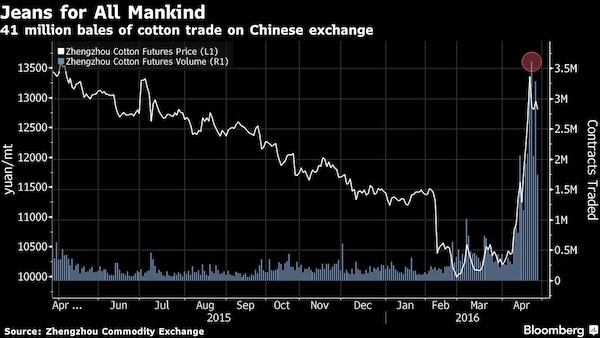
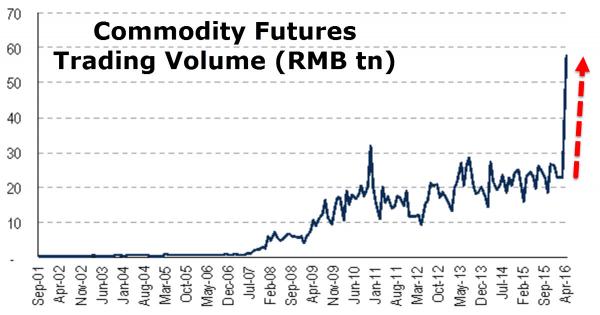
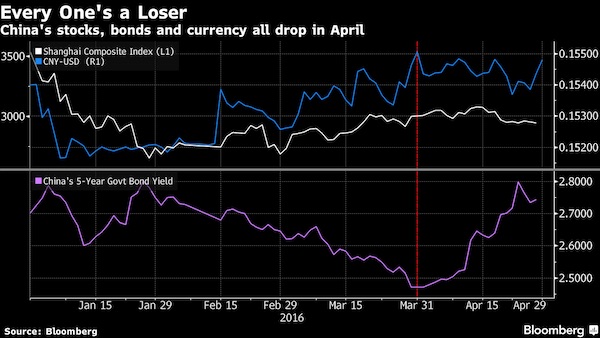
For the first time in two years, China’s stocks, bonds and currency are all a losing proposition. The Shanghai Composite dropped 2.2% in April, the yuan fell 0.6% versus the dollar, while government and corporate bonds tumbled, with the five-year sovereign yield rising 27 basis points. Even a sudden revival in the nation’s commodities markets is looking fragile after frenzied speculation prompted exchanges to take measures to cool trading. The declines mark a reversal from March, when the benchmark equities gauge jumped 12% and the yuan rallied the most since 2010 as new credit surged. Improving data from industrial output to retail sales have led traders to pare back bets for more stimulus, while rising credit defaults are fueling the biggest selloff in junk debt since the data became available in 2014.

Deutsche Bank is one bull looking to reduce holdings of Chinese stocks on bets the economy will fail to reach the government’s growth targets and yuan declines will accelerate. “Clearly there was a turn in China,” said Sean Taylor, CIO for Asia Pacific for Deutsche Bank’s wealth-management unit in Hong Kong. “You’ve seen money in the A-share market going to property and commodities. We’ve been adding risk in the last few months and coming into the summer, we will take it away and wait for opportunities to add again. We are not yet ready for China’s structural story because earnings haven’t come through.” Investor interest in the world’s second-largest equity market is waning, with turnover on the Shanghai Stock Exchange falling to levels last seen regularly in 2014 and a gauge of volatility dropping to a 12-month low. Investments in stock-market funds fell by 89 billion yuan ($13.7 billion) in April.

[..] Government bonds are coming under pressure as inflation increased to the highest since mid-2014, while corporate notes are slumping amid a spate of defaults and a surprise move by state-owned China Railway Materials to halt its bond trading this month because of what the company called “repayment issues.” “We will definitely see more defaults and difficulties for corporates in issuing new bonds,” said David Gaud at Edmond de Rothschild Asset Management in Hong Kong. “Credit costs will go up and credit spreads will widen. Your return is too low for your risk in China.”
Read more …

Small potatoes for now, but at the same time there’s nothing in sight that could reverse the trend.

• Hong Kong Underwater Mortgages Jump 15-Fold in Q1 as Prices Drop (BBG)

The number of Hong Kong homeowners with apartments worth less than their mortgages surged 15 times in the first quarter, according to the Hong Kong Monetary Authority. The number of negative-equity mortgages rose to 1,432, with a total value of HK$4.9 billion ($634 million), for the three months ended March, from 95 such home loans worth HK$418 million in the previous quarter, the city’s de facto central bank said on its website Friday.

Property prices in Hong Kong, which reached a record last year, have been sliding and sales tumbled to a 25-year low in February amid economic uncertainty. Home prices in the city slumped 13% from September to March, according to data compiled by Centaline Property Agency. The government is determined to tackle the housing problem and maintain a healthy development of the market, the city’s Rating and Valuation Department said in a report on Friday, while maintaining that it has no intention to withdraw demand-side property curbs.

Read more …

The one word that comes to mind: incestuous: “..The switch has been made possible by clearing houses’ designation as systemically-important utilities..”

• Derivatives Houses To Open Accounts With Federal Reserve (FT)

Derivatives brokers choosing where to park their margin money will now have the option of the world’s most powerful central bank. The Federal Reserve Bank of Chicago has authorised three of the US’s largest clearing houses, run by CME Group and Intercontinental Exchange, and the Options Clearing Corporation, to open an account at the central bank. ICE’s permit is for its US credit derivatives clearing house. The change at the CME applies only to house cash belonging to brokers, its executives said on a conference call on Thursday. Margin posted by their customers will continue to be walled off and held by commercial banks or in US Treasury bonds, they confirmed.

The switch has been made possible by clearing houses’ designation as systemically-important utilities, which recognised the dangers to the financial system if they failed and gave them access to the Fed’s cash in an emergency. Tougher regulation of markets means they must now handle billions of dollars of futures and swaps trades every day. Traders who use derivatives must safeguard their deals against defaults with margin and collateral. For clearing brokers whose business has been damaged by years of low interest rates, keeping cash at the Fed could yield better returns. New market rules also authorised a regional Fed bank to maintain an account for designated clearing houses and pay earnings on any balance, as it already does for US banks subject to Fed oversight.

“When effective, we expect to pass a higher rate to clearing members for their house positions than we do today,” John Pietrowicz, CME’s chief financial officer, told analysts. Mr Pietrowicz said the accounts would open in the “next month or so”. While the majority of the returns would be passed back to clearing members, CME would also be able to “earn more” as cash balances increased. CME applied for access to a Fed account in 2014, a spokeswoman said, and would direct funds into an omnibus account for collateral and settlement services. The derivatives industry and its regulator have argued in recent years that tougher banking laws have hurt the brokerage business by making clearing uneconomical. “The resulting industry consolidation would increase systemic risk by concentrating derivatives clearing activities in fewer clearing member banks,” Walt Lukken, chief executive of the FIA industry association, testified to a US House agriculture subcommittee on Thursday.

Read more …

It might be best to ignore these numbers. Whatever BBG’s economist panel predicts is always wrong. Growth numbers are always manipulated. One good thing to take away is that consumer prices do not equal inflation.

• Draghi Challenge Seen As Consumer Prices Fall More Than Forecast (BBG)

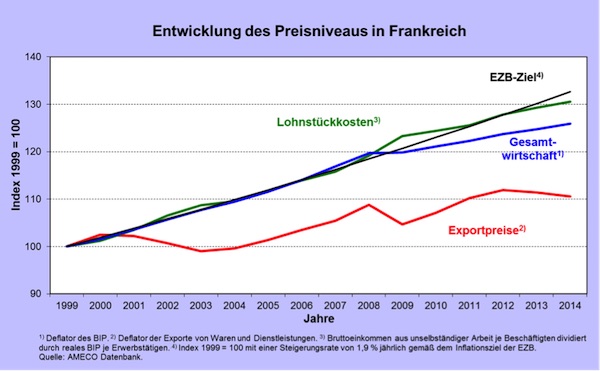
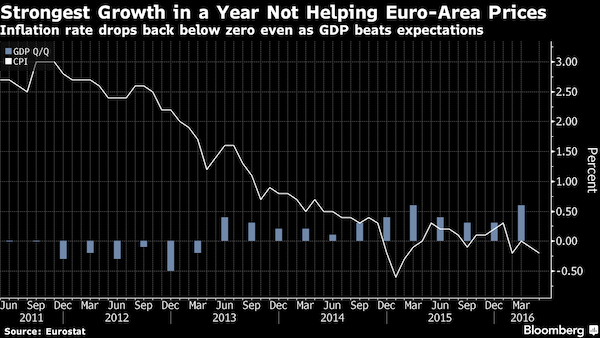
Mario Draghi’s policy challenge was highlighted once again on Friday, with the fastest economic growth in a year overshadowed by a renewed drop in consumer prices. The euro-area inflation rate fell to minus 0.2% in April, a worse out-turn than the 0.1% decline forecast by economists in a Bloomberg survey. It wasn’t all bad news for the ECB president however, with the economy expanding 0.6% in the first quarter and unemployment declining in March to the lowest since 2011. Draghi has said the situation in the 19-nation region is slowly improving, but that hasn’t assuaged his concerns about the inflation outlook. Policy makers cut interest rates and ramped up other stimulus last month, and the ECB president has signaled he’s willing to do even more to revive price growth. “Draghi has to be on alert – despite the solid growth momentum, inflation is not picking up,” said Michael Schubert at Commerzbank.

“The ECB will have to do more in the future, an extension of QE being most likely, but for the time being we’ll have to be patient.” Eurostat released the euro-area growth data about two weeks earlier than usual as it tries to make figures on output more timely, which could help inform the ECB’s policy-making. The new timing brings the region into line with the U.S. and U.K., which also publish first estimates within about a month of the end of the quarter. Based on the latest data, the euro area grew faster than both countries in the January-March period, with the U.K. expanding 0.4% and the U.S. by 0.5% on an annualized basis. National euro-zone data on Friday also provided some positive news, with both the French and Spanish economies expanding faster than expected. Growth in France accelerated to 0.5% from 0.3%, helped by investment and consumer spending, while Spain shrugged off a political deadlock that’s left it facing new elections to grow 0.8%.
Read more …

More economists entirely clueless on the link between debt and deflation. There’s tons of them, and they’re on ‘both sides of the debate’. And it doesn’t matter one iota how many ‘equations’ from their school books they can quote. Suggesting that increasing VAT rates -in incremental steps- will make people spend more ignores the reason why they don’t spend now: debt. In fact, VAT increases will make things more expensive, and that will result in less spending, not more. That’s what Japan has been showing us for 20 years.

• Fighting Deflation With Unconventional Fiscal Policy (VoxEu)

In his Marjolin lecture on 4 February 2016, Mario Draghi asserted that “there are forces in the global economy that are conspiring to hold inflation down” (Draghi 2016). Eurostat confirmed that in February 2016 the annual inflation rate for the Eurozone was -0.2% (Eurostat 2016). On 10 March 2016, the ECB board agreed upon a set of largely unexpected monetary policy measures, with the aim of boosting inflation and growth in the Eurozone. These measures were inspired, among others, by thoughts in Bernanke (2010) and Blanchard et al. (2010).

The conundrum the Eurozone faces is finding a recipe to support inflation and ultimately consumption and economic growth in a setting in which traditional monetary policy measures are not viable, and governments cannot support growth with fiscal spending because of their large debt-to-GDP ratios. In this column, we discuss an alternative to monetary interventions, which we call unconventional fiscal policy. • Unconventional fiscal policy aims to increase growth and inflation in a budget neutral fashion, while keeping constant the tax burden on households.

Feldstein (2002) introduced the notion of unconventional fiscal policy measures at times of liquidity traps. Among several possible interventions Feldstein proposed: “A series of pre-announced increases in the value-added tax (VAT) to generate consumer price inflation, and hence increase private spending via intertemporal substitution.” In his words: “This [VAT] tax-induced inflation would give households an incentive to spend sooner rather than waiting until prices are substantially higher.” The intuition for this proposal is based on a simple logic: announcing higher prices in the future will increase current inflation expectations. Higher inflation expectations at times of fixed nominal interest rates should reduce real interest rates (Fisher equation), and lower real interest rates should increase households’ incentives to consume rather than save (Euler equation).

Because imposing higher VAT reduces households’ wealth – especially poorer households’ wealth – and might affect households’ labour supply, lower income taxes (or transfers for those households that do not pay any income tax) should accompany the increase in VAT. Designed this way, the policy measure would be budget-neutral for the government, as well as for households. It would incentivise households to consume immediately, jump-start the economy, and hence help the economy exit the slump. In his presidential address to the 2011 American Economic Association Annual Meeting, Bob Hall (2011) reiterated Feldstein’s ideas, and encouraged further research to understand the viability and effects of unconventional fiscal policy, both theoretically and empirically.

Read more …

Clueless: “..the current recovery could boost industry activity and slow the decline..”

• Oil Market Deja Vu Triggers Predictions of a Return to $30 (BBG)

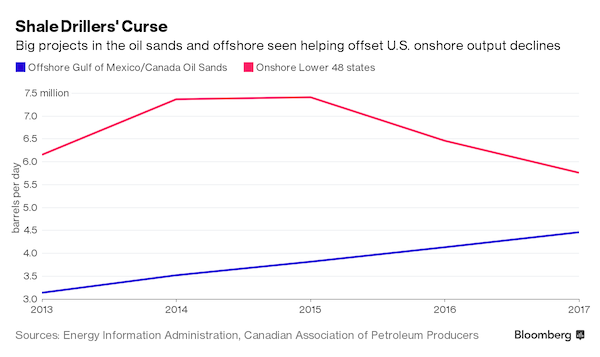
Oil’s climb above $45 a barrel is reassuring influential figures from BP to the IEA that the industry is finally recovering from the worst slump in a generation. Others say the market is about to fall into the same trap as last year. There’s a sense of deja vu at Commerzbank, BNP Paribas and UBS, who say crude’s gain of about 70% from a 12-year low in January resembles the recovery that took hold this time last year – only to sputter out by May as the supply glut endured. Prices will sink back towards $30 a barrel in the coming weeks, BNP and UBS warn. “There are dangerous parallels to 2015,” said Eugen Weinberg at Commerzbank. “The market already appears overheated and a correction is overdue.”
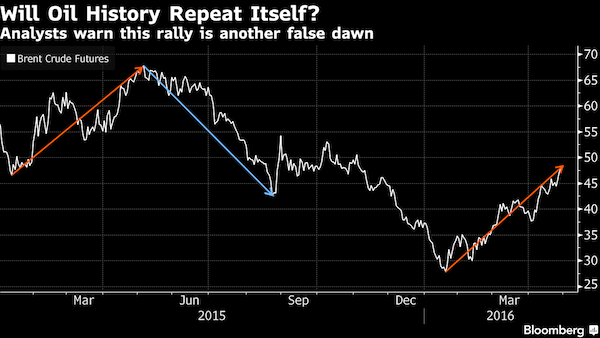
Last year, Brent crude rose 45% from January to almost $68 in May as traders anticipated a rapid decrease in U.S. output as drilling rigs were idled. The rally reversed when production kept rising, peaking at 9.61 million barrels a day in June 2015, a year after the price slump began. While drilling cutbacks eventually took their toll and the nation’s output slipped to 8.9 million barrels a day last week, the current recovery could boost industry activity and slow the decline.

Read more …

At least something’s trickling down…

• Pipelines: The Next Devastating Phase Of The Oil Bust (Forbes)

When oil and natural gas prices began their swan dive in 2014 and continued their descent in 2015, the casualties seemed obvious. Exploration and production companies would need to file for bankruptcy protection and restructure en masse. Banks that financed these companies would need to write down bad loans and noteholders that invested in their high yield debt would be left holding the bag, or at least, the equity securities of the reorganized producers. The damage would also extend to the so-called “midstream” companies that transport oil and gas from wells to processing facilities and end-users downstream. It was thought that the damage to such midstream companies would be substantial, but manageable.

However, an ongoing legal tussle in the Sabine Oil and Gas bankruptcy proceeding in New York threatens to devastate an important corner of the $500 billion midstream industry and set off a new and entirely unexpected phase of the energy crisis. The dispute started in September 2015, when Sabine filed a motion in its bankruptcy case seeking authority to reject contracts it had entered into with two separate midstream operators that provided gas gathering and other services. Rejecting contracts and walking away from pre-bankruptcy obligations is commonplace for bankrupt debtors, but in the oil and gas industry many midstream companies thought their arrangements were protected from this risk.

That is because such gathering contracts “dedicate” the relevant oil and gas mineral interests and surrounding acreage to the midstream companies, which is intended to create a property interest known as a “real covenant” that “runs with the land.” Under longstanding bankruptcy principles, conveyances of real property—and certain associated rights—are not contracts that can be “rejected.” If the midstream companies prevailed in the argument that contractual dedications could create real covenants, then if a producer filed for bankruptcy protection or if its mineral rights were transferred to a new owner, the midstream company would retain its exclusive property right to gather oil and gas produced from the land and receive a fee for such services.

This argument seemed a strong one. However, after examining the applicable Texas property law at issue, on March 8, 2016, Judge Chapman issued a non-binding bench ruling holding that the legal requirements for treating these arrangements as real property interests were not satisfied and that they could be invalidated in bankruptcy through the contract rejection process. This ruling rocked the midstream world. It also came when similar attempts to reject gathering agreements were underway in the Quicksilver Resources and Magnum Hunter Resources bankruptcy cases in Delaware, leading to a sense that the midstream industry was under assault.

Read more …

We’re fast losing the conditions that gave us life. But we lack the intelligence to understand this. Which makes it only fitting. If you’re not smart enough to survive, then you won’t.

• More Tigers Poached In India So Far This Year Than In All Of 2015 (AFP)

More tigers have been killed in India already this year than in the whole of 2015, a census showed Friday, raising doubts about the country’s anti-poaching efforts. The Wildlife Protection Society of India, a conservation charity, said 28 of the endangered beasts had been poached by April 26, three more than last year. Tiger meat and bones are used in traditional Chinese medicine and fetch high prices. “The stats are worrying indeed,” said Tito Joseph, programme manager at the group. “Poaching can only be stopped when we have coordinated, intelligence-led enforcement operations, because citizens of many countries are involved in illegal wildlife trade. It’s a transnational organised crime.”

Poachers use guns, poison and even steel traps and electrocution to kill their prey. India is home to more than half of the world’s tiger population with 2,226 in its reserves according to the last count in 2014. The figures come after a report by the WWF and the Global Tiger Forum said the number of wild tigers in the world had increased for the first time in more than a century to an estimated 3,890. The report cited improved conservation efforts, although its authors cautioned that the rise could be partly attributed to improved data gathering.

Read more …

“Nor are the problems exclusive to the LHC: In 2006, raccoons conducted a “coordinated” attack on a particle accelerator in Illinois. It is unclear whether the animals are trying to stop humanity from unlocking the secrets of the universe. Of course, small mammals cause problems in all sorts of organizations. Yesterday, a group of children took National Public Radio off the air for over a minute before engineers could restore the broadcast.”

• Small Mammal Shuts Down World’s Most Powerful Machine (NPR)

A small mammal has sabotaged the world’s most powerful scientific instrument. The Large Hadron Collider, a 17-mile superconducting machine designed to smash protons together at close to the speed of light, went offline overnight. Engineers investigating the mishap found the charred remains of a furry creature near a gnawed-through power cable. “We had electrical problems, and we are pretty sure this was caused by a small animal,” says Arnaud Marsollier, head of press for CERN, the organization that runs the $7 billion particle collider in Switzerland. Although they had not conducted a thorough analysis of the remains, Marsollier says they believe the creature was “a weasel, probably.” (Update: An official briefing document from CERN indicates the creature may have been a marten.)

The shutdown comes as the LHC was preparing to collect new data on the Higgs Boson, a fundamental particle it discovered in 2012. The Higgs is believed to endow other particles with mass, and it is considered to be a cornerstone of the modern theory of particle physics. Researchers have seen some hints in recent data that other, yet-undiscovered particles might also be generated inside the LHC. If those other particles exist, they could revolutionize researcher’s understanding of everything from the laws of gravity, to quantum mechanics. Unfortunately, Marsollier says, scientists will have to wait while workers bring the machine back online. Repairs will take a few days, but getting the machine fully ready to smash might take another week or two. “It may be mid-May,” he says.

These sorts of mishaps are not unheard of, says Marsollier. The LHC is located outside of Geneva. “We are in the countryside, and of course we have wild animals everywhere.” There have been previous incidents, including one in 2009, when a bird is believed to have dropped a baguette onto critical electrical systems. Nor are the problems exclusive to the LHC: In 2006, raccoons conducted a “coordinated” attack on a particle accelerator in Illinois. It is unclear whether the animals are trying to stop humanity from unlocking the secrets of the universe. Of course, small mammals cause problems in all sorts of organizations. Yesterday, a group of children took National Public Radio off the air for over a minute before engineers could restore the broadcast.

Read more …

Though they have every right to defend themselves, something makes me wish Tyler Durden had counted to 10 before writing this. They could have limited it to: “Zero Hedge admits to having hired an unstable writer”, and left it at that. That’s all the Bloomberg attempt at smut warrants. As is, Zero Hedge poebably killed the secrecy as much as Bloomberg did.

• The Full Story Behind Bloomberg’s Attempt To “Unmask” Zero Hedge (ZH)

Over the years, Zero Hedge has proven to be a magnet for media attention. It started years ago with a NY Magazine article published in September 2009 which first “unmasked” the people behind Zero Hedge with the “The Dow Zero Insurgency: The nothing-can-be-believed chaos of the financial crisis created a golden opportunity for a blog run by a mysterious ex-hedge-funder with a dodgy past and conspiracy theories to burn” in which we were presented as a bunch of “conspiracy theory” tin foil hat paranoid loons. We are ok with being typecast as “conspiracy theorists” as these “theories” tend to become “conspiracy fact” months to years later.

Others, such as “academics who defend Wall Street to reap rewards” had taken on a different approach, accusing the website of being a “Russian information operation”, supporting pro-Russian interests, which allegedly involved KGB and even Putin ties, simply because we refused to follow the pro-US script. We are certainly ok with being the object of other’s conspiracy theories, in this case completely false ones since we have never been in contact with anyone in Russia, or the US, or any government for that matter. We have also never accepted a dollar of outside funding from either public or private organization – we have prided ourselves in our financial independence because we have been profitable since inception. Which brings us to the latest “outing” of Zero Hedge, this time from none other than Bloomberg which this morning leads with “Unmasking the Men Behind Zero Hedge, Wall Street’s Renegade Blog” in which it makes the tacit admission that “Bloomberg LP competes with Zero Hedge in providing financial news and information.”

To an extent we were surprised, because while much of the “information” Bloomberg claims it reveals could have been discovered by anyone with a cursory 30 second google search, this time the accusation lobbed at Zero Hedge by Bloomberg was a new one: that we are capitalists who seek to generate profits and who have expectations from our employees. This comes from a media organization which caters to Wall Street and is run by one of the wealthiest people in the world. Underlying the entire Bloomberg article is disclosure based on a former employee at Zero Hedge. Traditionally we don’t reply to such media stories but in this case we’ll make an exception as there is a substantial amount of information Bloomberg has purposefully failed to add.

Read more …

Brussels will never be able to push through visa-free travel for nearly 80 million Turks. It’s simply not going to happen, not in a democratic way. Greece should be very afraid.

• Turkey PM: Denying Visa-Free Travel Means Collapse Of EU Refugee Deal (DS)

Prime Minister Ahmet Davutoglu said on Thursday evening that there are disappointments and the EU has un-kept promises in recent Turkish-EU relations and that Turkey will stop implementing the recent readmission agreement if the EU does not keep its word and grant visa-free travel to Turkish citizens. Speaking to a group of journalist who accompanied his visit to Qatar on Thursday, Davutoglu said that Turkey is successfully implementing the EU-Turkey deal from March 18 and that the deal has ended illegal migration to Europe.

“Last October there were 6,800 illegal migrants passing over to Europe from Turkey every day. This figure went down to 3,000 in January after we started to implement the terms of the November deal with EU. We made a game changing move with the March 18 deal and this figure is now about 25 per day. Moreover, in April there have been some days on which no migrant passed to Europe,” Davutoglu said, and asked: “Have you heard about the death of a migrant in the Aegean Sea since April 4?” Asserting that Turkey will fulfill all EU criteria for visa-free travel on Monday, Davutoglu said that Ankara will stop implementing the readmission agreement if the EU does not grant visa-free travel.

“These two issues are linked to each other and are part of the deal with the EU. This is a test for everyone. We think that we have passed our test,” Davutoglu said, and added that it is now time for the EU to fulfill its obligations. “[The EU] promised to invest €1 billion for refuges until end of July. We will see whether they keep their promise or not. We have experienced disappointment in the past. We will react negatively if these experiences reoccur,” Davutoglu said, adding that in 2004 the EU had promised to lift restrictions on Turkish Cypriots if they vote for the Annan Plan, but it did not keep its promise afterward.
Read more …

Apr 292016
 
 April 29, 2016  Posted by at 8:40 am Finance Tagged with: , , , , , , , , , , ,  1 Response »


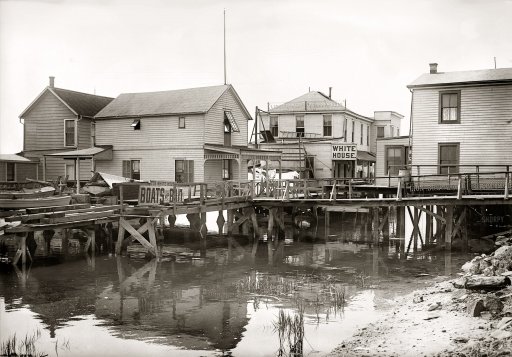
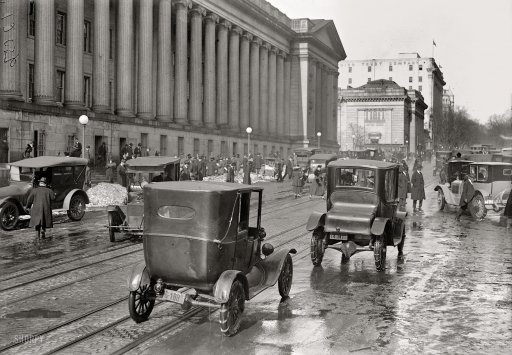
Harris&Ewing Treasury Building, Fifteenth Street, Washington, DC 1918

• Asia’s Two Biggest Stock Markets Have Become An $11 Trillion Headache (BBG)
• Japan’s Abenomics ‘Dead In The Water’ After US Currency Warnings (AEP)
• Debt Is Growing Faster Than Cash Flow By The Most On Record (ZH)
• The Typical American Couple Has Only $5,000 Saved For Retirement (MW)
• US Corporate Profits on Pace for Third Straight Decline (WSJ)
• Dollar Drops to 11-Month Low as Asian Stocks Fall; Oil Near $46 (BBG)
• Sluggish US Growth Part Of A Worrying Global Trend (G.)
• Renting In London More Costly Than Living In Most European 4-Star Hotels (Ind.)
• China Banks’ Profit Growth Stalls As Bad Debts Rise (R.)
• China’s Central Bank Raises Yuan Fixing by Most Since July 2005 (BBG)
• Puerto Rico Risks Historic Default as Congress Chooses Inaction (BBG)
• El Niño Dries Up Asia As Its Stormy Sister La Niña Looms (AFP)
• German Inflation Turns Negative In April (R.)
• Greece’s Perfect Debt Trap (Kath.)
• German Minister Proposes Law To Limit Social Benefits For EU-Foreigners (DW)
• Finland Parliament, Pressured By Weak Economy, Debates Euro Exit (R.)
• Italy Says Austria ‘Wasting Money’ In Migrant Border Row (AFP)
• One Nation in Europe Wants Refugees But Is Failing to Get Enough (BBG)

$11 trillion is merely the start.

• Asia’s Two Biggest Stock Markets Have Become An $11 Trillion Headache (BBG)

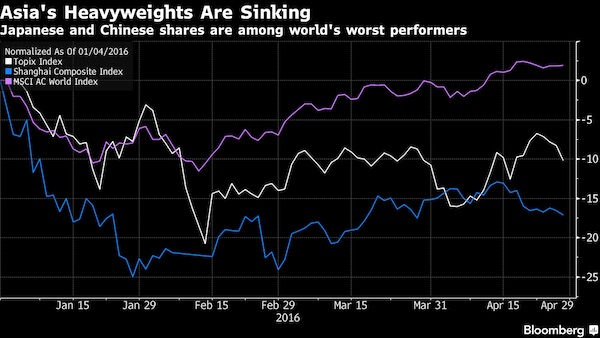
Asia’s two biggest stock markets are jostling for an ignominious prize. Japan’s Topix index and China’s Shanghai Composite Index have tumbled more than 13% in 2016 to rank along Nigerian and Mongolian shares as the world’s worst performers. In the two years through the end of December, the Asian gauges outperformed MSCI’s global measure by at least 20 percentage points. The Bank of Japan stood pat on monetary policy Thursday, sending Tokyo stocks tumbling, while the Shanghai measure fell to a one-month low. The benchmark gauges in two of the world’s largest stock markets, which have a combined value of almost $11 trillion, are declining as investors detect a reduced appetite from policy makers to boost monetary stimulus.

Thursday’s BOJ decision was the first under Governor Haruhiko Kuroda where a majority of economists expected easing that didn’t materialize, while strategists now see China’s central bank keeping its main interest rate on hold until the fourth quarter. “Neither China nor Japan have a solid plan on dealing with their slowing economies,” said Tomomi Yamashita at Shinkin Asset Management. “There is still scope for easing, and as for Japan there are fiscal policies they can carry out. There’s still hope. But today there was just too much hope on the BOJ.”

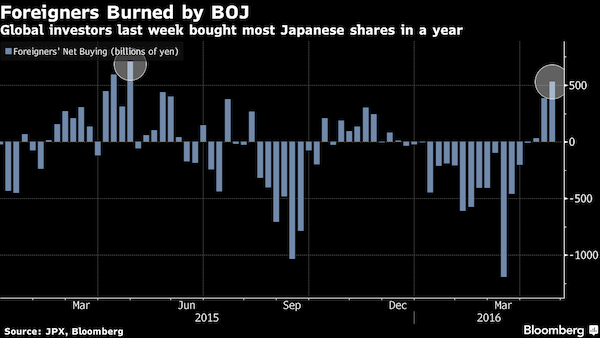
The Topix sank 3.2% on Thursday after the central bank kept bond-buying, interest rates and exchange-traded fund purchases unchanged. The stock gauge has fallen for four straight days, handing losses to foreign investors who piled the equivalent of $4.9 billion into the market last week, the most in a year. Overseas traders were net sellers of Japanese equities for the first 13 weeks of 2016. “I give up,” Ryuta Otsuka at Toyo Securities in Tokyo said. “It’s a really disappointing result and I feel like throwing in the towel. It cuts because we had so much hope.” The Topix posted four straight annual gains through 2015, while even a $5 trillion rout in Chinese shares last summer couldn’t stop the Shanghai Composite from being the world’s top-performing major market over the last two years. The declines for both gauges in 2016 compare with a 2.5% advance by the S&P 500, which is closing in on last year’s record.

Read more …

Sometimes I wonder why it takes people so long to figure things out. I’ve been saying ever since Abenomics was launched that it would fail. Because it was always pie in the sky only, not based on any understanding of what caused spending to plummet.

• Japan’s Abenomics ‘Dead In The Water’ After US Currency Warnings (AEP)

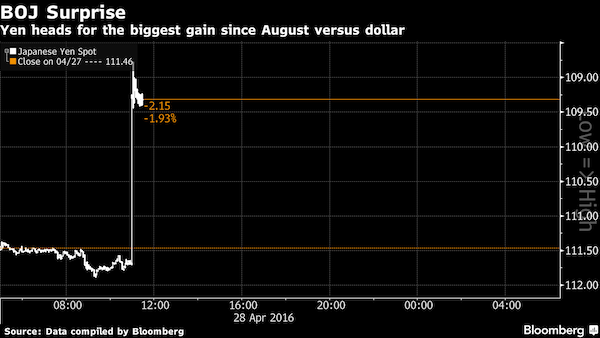
The Bank of Japan has been forced to retreat from further emergency stimulus after a blizzard of criticism at home and abroad, and warnings that extreme measures may now be doing more harm than good. The climb-down by the world’s most radical central bank is the latest sign that the monetary experiments since Lehman crisis may have run their course. The authorities have not exhausted their ammunition but are hitting political and legal constraints. The yen surged 3pc against the US dollar in the biggest one-day move in eight months and equities skidded across Asia after the BOJ failed to take fresh action to stave off deepening deflation, catching markets badly off guard. Governor Haruhiko Kuroda dashed hopes for ‘helicopter money’, warning that direct monetary financing of spending would be “illegal”.

Mr Kuroda insisted that the BoJ still has plenty of firepower and can at any time push interest rates even deeper into negative territory or boost bond purchases beyond the current $74bn a month. “If additional easing is needed, we will do so promptly,” he said. The reality is that negative rates (NIRP) have backfired badly on every front. They have prompted bitter protests from banks and money market funds caught in a squeeze. The yen has appreciated by 10pc since the BoJ first embarked on the policy in January, the exact opposite of what was intended. The rising yen – ‘endaka’ – is pushing Japan deeper into a deflation trap and undercutting the whole purpose of ‘Abenomics’. Core inflation has fallen to minus 0.3pc. The Nikkei has dropped 13pc this year, with contractionary wealth effects that make the BoJ’s task even harder.

“Negative rates have completely failed,” said David Bloom from HSBC. Washington will not tolerate the use of NIRP in any case, deeming it a disguised attempt to drive down exchange rates and export problems to the rest of the world. Jacob Lew, the US Treasury Secretary, warned Japan and the eurozone at the G20 in Shanghai in February that the Obama administration is losing patience with use of beggar-thy-neighbour tactics by countries already running a current account surplus. They are in effect shifting their excess capacity abroad. Germany in particular is coming into the US cross-hairs. Richard Koo from Nomura said the US is now on the warpath against currency manipulators. Mr Lew’s threat effectively renders Abenomics “dead in the water”. The Japanese economy is contracting again, caught in a debt-deflation vice.

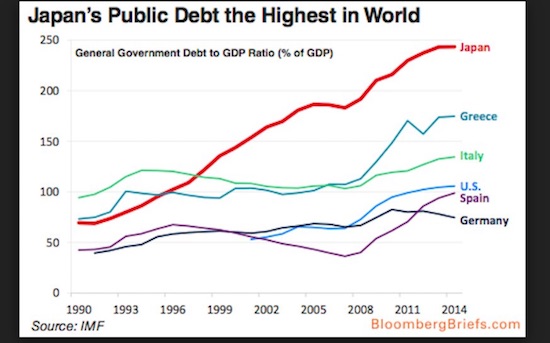
Growth has been negative for four of the last eight quarters. What was once a ‘Lost Decade’ is turning into a “Lost Quarter Century” with no remedy in sight. “Their options are diminishing. I can’t see any way out of the debt-trap, and it is an acid test for the western world,” said Neil Mellor from BNY Mellon. Public debt is rising fast on a shrinking economic base, pushing the public debt ratio to an estimated 250pc of GDP this year. “The debt will never be ‘repaid’ in the normal sense of the word,” said Lord (Adair) Turner from the Institute for New Economic Thinking. Olivier Blanchard, the former chief economist for the International Monetary Fund, warned recently that country is nearing the end-game as the pool of domestic funding for the bond market starts to dry up and the Japanese treasury is forced to rely on much more costly capital from global investors.

Read more …

The predictable culmination of decades of a failed system is a hockeystick.

• Debt Is Growing Faster Than Cash Flow By The Most On Record (ZH)

By now it is a well-known fact that corporations have no real way of generating organic growth in this economy, so they are relying on two things to boost share prices: multiple expansion (courtesy of central banks) and debt-funded buybacks (courtesy of central banks), the latter of which requires the firm to generate excess incremental cash. Incidentally, as SocGen showed last year, all the newly created debt in the 21st century has gone for just one thing: to fund stock buybacks.


The problem with this is that if a firm is going to continue to add debt to its balance sheet in order to fund buybacks (and dividends), then it needs to be able to generate enough operational cash flow in order to service the debt. Even if one makes the argument that debt is cheap right now, which may be true, or that central banks are backstopping it, which is certainly true in Europe as of a month ago, the fact remains that principal balances come due eventually also, and while debt can be rolled over, at some point the inability to generate cash from the operations catches up with them; furthermore even a small increase in rates means the rolling debt strategy is dies a painful death, as early 2016 showed.

In the following chart we can see net debt growth skyrocketing nearly 30% y/y, while EBITDA (cash flow) has been contracting for the past year. In fact, as SocGen shows below, the difference in the growth rate between these two most critical data series is now over 35% – the biggest negative differential in recent history.


Of course, every finance 101 student knows that a firm which has to borrow more cash than it is able to produce from its core operations is not a sustainable business model, and yet today’s CFOs, pundits and central bankers do not. And the next question is: what happens if the Fed does raise rates, what happens to the feasibility of these companies servicing the debt while also spending on R&D and CapEx (assuming there is any), and who can only afford the rising interest expense as a result of ever smaller interest rates? The answer is, first, massive cost cutting, i.e. layoffs, which would be a poetic way for the Fed’s disastrous policies to be reintroduced to the real economy… and then, more to the point, mass defaults. 

Read more …

Our entire societies will have to change dramatically because of this. Parents will have to move in with their children again. The children who earn much less than the parents did.

• The Typical American Couple Has Only $5,000 Saved For Retirement (MW)

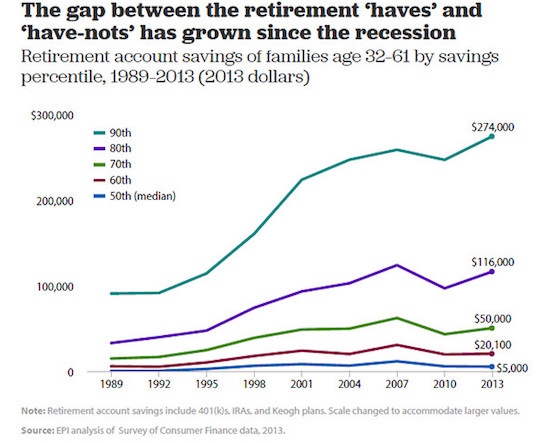
When American companies began switching from traditional pensions to self-directed 401(k)-like plans in the 1980s and 1990s, it was supposed to lead to a golden age of retirement security. No longer would workers be at the mercy of the company’s generosity or of Social Security’s solvency; workers themselves would be responsible for saving enough for a comfortable retirement. Some 30 years later, the results are in: The median working-age couple has saved only $5,000 for their retirement, according to an analysis of the Federal Reserve’s 2013 Survey of Consumer Finances by economist Monique Morrissey of the Economic Policy Institute. The do-it-yourself pension system is a disaster.

Even as the traditional company-funded pension has nearly disappeared and even as Social Security benefits are being slowly eroded, most workers haven’t saved enough to offset those losses to their retirement income. 70% of couples have less than $50,000 saved. Even those on the cusp of retirement — the median couple in their late 50s or early 60s — has saved only $17,000 in a retirement savings account, such as a defined-contribution 401(k), individual retirement account, Keogh or similar savings account. How long does $5,000, or even $50,000, last? Until the first big medical bill? Morrissey figures that about 43% of working-age families have no retirement savings at all. Among those who are five to 10 years away from retirement, 39% have no retirement savings of their own.

The sad fact is that most Americans are less prepared for retirement than Americans were 30 years ago. Few have enough pension wealth to make much difference in their lives once they stop working. The lack of savings in 401(k) and individual retirement accounts wouldn’t be a such big deal if retirees could rely on other sources of income, such as a traditional defined-benefit pension or Social Security. But those other income sources are declining. Fewer and fewer newly retired people are covered by a regular pension that provides a guaranteed monthly check based on salary and years of service. In addition, Social Security benefits are already being reduced as the normal retirement age is gradually increased from 65 to 67. Further reductions in Social Security benefits — by limiting the cost-of-living adjustment or by increasing the normal retirement age to 70, for example – would be disastrous for tomorrow’s retirees.


The median working-age couple had $5,000 in a retirement savings account as of the most recent data. The top 10% of savers had accumulated $274,000, according to the Economic Policy Institute analysis of Federal Reserve survey data

Read more …

Forget growth. Think survival.

• US Corporate Profits on Pace for Third Straight Decline (WSJ)

U.S. corporate profits, weighed down by the energy slump and slowing global growth, are set to decline for the third straight quarter in the longest slide in earnings since the financial crisis. Weakness was felt across the board, with executives from Apple to railroad Norfolk Southern and snack giant Mondelez saying the current quarter remains tough. 3M, which makes tapes, filters and insulation for consumer electronics, forecast continued weak demand for that industry. Procter & Gamble reported sales declines in its five business categories despite price increases. “It’s a difficult environment indeed,” said PepsiCo CEO Indra Nooyi. “Most of the developed world outside the United States is grappling with slow growth. GDP growth in developing and emerging markets is also challenged.”

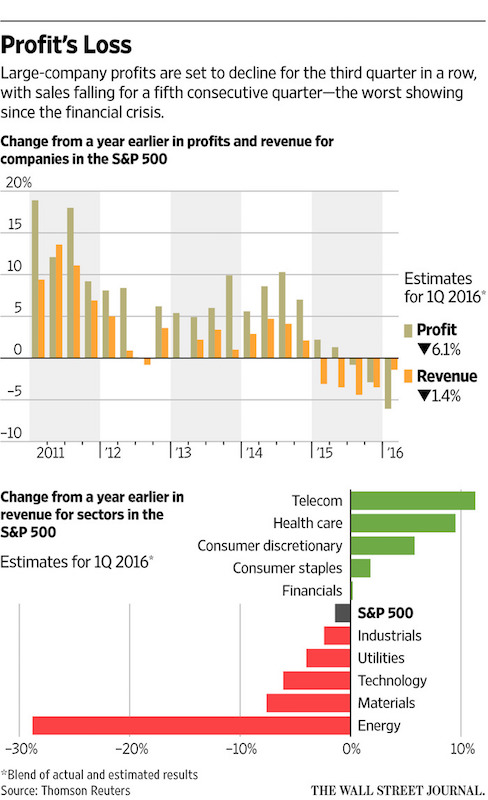
The concerns from company executives echo weak economic data released Thursday morning, which showed U.S. gross domestic product rose just 0.5% in the first quarter. Business investment and consumer spending on goods slowed, while consumer spending on services climbed. “On the one hand, consumer spending continued to be the primary economic driver in the U.S. On the other hand, industrial production has been disappointing,” United Parcel Service Inc. CEO David Abney said Thursday after the delivery company reported a 3.1% revenue increase. Based on the 55% of companies in the S&P 500 index that had already reported results Thursday morning, Thomson Reuters expects overall earnings to decline by 6.1% in the first quarter compared with a year earlier.

Even excluding energy companies, which are expected to have their worst quarter since oil prices began to plunge in 2014, profits are on pace to fall by 0.5%. Revenues are expected to fall 1.4% overall, or rise 1.7% excluding energy, according to Thomson Reuters. This would mark the S&P 500’s third consecutive quarter of declining earnings—the longest streak since the financial crisis. Revenues will have declined for five quarters in a row, outstripping even the four-quarter slide in 2008 and 2009.

Read more …

The US dollar is set to rise like a mushroom cloud and break the global camel’s back.

• Dollar Drops to 11-Month Low as Asian Stocks Fall; Oil Near $46 (BBG)

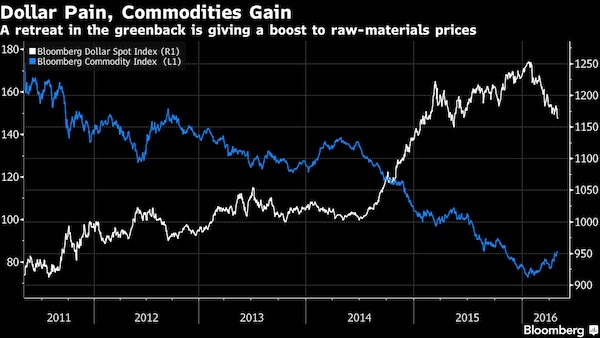
The dollar dropped against all of its G-10 peers after weaker-than-expected U.S. economic growth dimmed prospects for a Federal Reserve interest-rate increase at a time when monetary easing is being put on hold elsewhere. Asian stocks fell and crude oil traded near $46 a barrel. The Bloomberg Dollar Spot Index sank to an 11-month low, while the yen was headed for its biggest weekly jump since 2008 after the Bank of Japan unexpectedly refrained from adding to record stimulus on Thursday. Japanese financial markets are shut for a holiday and an MSCI gauge of shares in the rest of the Asia-Pacific region slid for the third day in a row. The greenback’s decline is proving a plus for commodities, which are poised for their best monthly gain since 2010. Crude has jumped 20% since the end of March, while gold and silver are at 15-month highs.

The BOJ’s surprise decision capped a week of fence-sitting for central banks, with the Fed keeping interest rates steady for a third straight meeting and policy makers from New Zealand to Brazil also holding the line. The slowest pace of American economic expansion in two years reignited some concern over the global outlook, and pushed out bets on the potential timeline for tighter Fed policy. “Central banks look like they have run out of bullets to a degree,” said Mark Lister at Wellington’s Craigs Investment Partners. “We’re getting to that point where there are limits to the results they can get from anything more they do. This points to a fragile outlook with still a lot of risks out there.”

Read more …

Worrying only if it surprises you perhaps?!

• Sluggish US Growth Part Of A Worrying Global Trend (G.)

It would be easy to dismiss the slowdown in the US economy to near-stall speed as a piece of rogue data resulting from the inability of number crunchers at the Department of Commerce in Washington to take account of the fact that large parts of the country are blanketed by snow during the winter. Easy but wrong. Back in spring 2015, the world’s biggest economy was expanding at an annual rate of 3.9%. In the third quarter the growth rate halved to 2%, before falling again to 1.4% in the final three months of the year. Describing the further easing to 0.5% in the first three months of 2016 as a temporary aberration – which was the knee-jerk response of upbeat analysts on Wall Street – is pushing it a bit.

A better explanation is that the sluggishness of US growth is part of a global trend, in which all the major economies are expanding more weakly than they were in the middle of last year. That’s the story for China, the eurozone, Japan and the UK. Each quarter, the data company Markit compiles a global Purchasing Managers’ Index for JP Morgan, with the intention of providing an up-to-date picture of economic conditions. The result for the first three months of 2016 showed activity at its lowest level in more than three years. Nor is there much hint of an improvement in the near future. In the US, firms are hacking back at investment – normally the sign of a looming recession. Consumer confidence has weakened, in part because real incomes are being squeezed.

As export-driven economies, Japan and the eurozone rely on a thriving US to buy their goods, so it is no surprise to find both struggling. The Bank of Japan will be forced to revisit its decision not to provide additional stimulus, since the upshot of its inaction has been a sharp rise in the yen, which will lead to even slower growth. Mario Draghi may again have to lock horns with the Bundesbank president, Jens Weidmann, in order to force through measures aimed at boosting activity in Europe. But the law of diminishing returns is at work. Each cut in interest rates, each fresh dollop of quantitative easing, has less of an impact than the last. The global economy is running out of steam and the conventional weapons are increasingly ineffective. This is not about blizzards shutting factories in Michigan. It goes much deeper than that.

Read more …

Britain is a sad joke.

• Renting In London More Costly Than Living In Most European 4-Star Hotels (Ind.)

It is now cheaper to live in a 4-star hotel in two-thirds of European capitals than it is to rent the average London flat. Latest figures show that the average rent for a London flat is now £1,676 per month – or £55 a night – having increased by 30% in the last four years. For the same amount of money you could live year round in a hotel in Dublin, Rome, Paris or Brussels. Among the hotels that are more affordable than the average London rent include the Mercure Warszawa Grand in Warsaw that boasts a fitness centre, business facilities and two restaurants.

The Best Western Plus Hotel in Paris, the Nordic Hotel Domicil in Berlin and the Relais Castrum Boccea in Rome can also all be booked for less than £55 a night on travel websites for the 5th May this year. The figures were highlighted by Labour’s Mayoral candidate Sadiq Khan. He said: “Renting a home shouldn’t be a luxury, but under the Tories Londoners could live in 4-star luxury in most of Europe for what they pay. “Rents have gone up by 30% with a Tory Mayor and it would be exactly the same under Zac Goldsmith – with rents soaring above £2,000 a month. Mr Khan said he would create a London-wide social letting agency as well as naming and shaming bad landlords and setting up a landlord licensing scheme.”

Read more …

And that’s before the bad debts are properly accounted for, and while the PBoC still issues record amounts of additional debt.

• China Banks’ Profit Growth Stalls As Bad Debts Rise (R.)

Four of China’s five largest state-owned banks barely posted any growth in profit in the first quarter, as widely expected, with rising bad debt and narrower margins hitting their bottom lines. The country’s banks face challenges from both defaulting borrowers, who are struggling amid a slowing economy, and successive cuts in interest rates which have eaten away at margins. Industrial and Commercial Bank of China, China’s biggest lender by assets, announced a 0.6% rise in net profit on Thursday. Bank of Communications posted a 0.5% rise in net profit in the first quarter and Agricultural Bank of China a slightly better 1.1% rise in profit. On Tuesday, Bank of China recorded a 1.7% rise in net profit in the fist quarter.

Non-performing loan (NPL) ratios remained flat -or rose- at all four lenders, while bad loan volumes increased, helping to sink loan-loss allowance ratios. At ICBC, the volume of non-performing loans increased 14% in the three-month period to 204.66 billion yuan ($31.60 billion), from 179.52 billion yuan at the end of 2015, sending the bank’s NPL ratio to 1.66% from 1.5%. ICBC’s loan-loss allowance ratio fell to 141.21%, from 156.34% at the end of December. ICBC also pointed to “the continuing impact of five interest rate cuts by the People’s Bank of China” since 2015 as a source of stress. The bank reported its interest margin (NIM) – the difference between its lending rate and the cost of borrowing – fell to 2.28 at the end of the first quarter, from 2.47 at end-December.

At BoC, NIM fell to 1.97 at end-March from 2.12 at end-December. BoCom did not disclose its NIM, but reported a 2.78% decline in net interest income, even as the bank’s net income rose half a% to 19.07 billion yuan for the first quarter. AgBank also did not disclose its NIM. In a bid to relieve banks of the mounting pile of bad debts, China’s central bank is preparing regulations that would allow commercial lenders to swap non-performing loans of companies for stakes in those firms, sources told Reuters in February.

Read more …

Going through the motions.

• China’s Central Bank Raises Yuan Fixing by Most Since July 2005 (BBG)

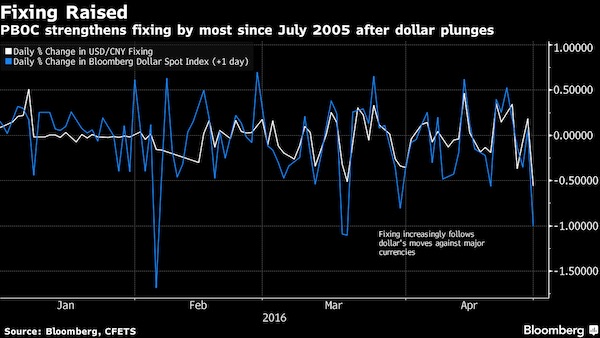
China’s central bank responded to an overnight tumble in the dollar by strengthening its currency fixing the most since a peg was dismantled in July 2005. The reference rate was raised by 0.6% to 6.4589 per dollar. A gauge of the greenback’s strength sank 1% on Thursday after the Bank of Japan’s decision to unexpectedly keep monetary policy unchanged sent the yen surging. The offshore yuan was little changed at 6.4834 after gaining 0.3% in the last session. While the change in the fixing is extreme relative to the small moves of recent years, analysts said it reflects increased volatility in the dollar against other major exchange rates rather than a policy shift by the People’s Bank of China. The yuan weakened against a basket of peers even as it climbed versus the greenback on Friday.

“The offshore yuan’s reaction is muted, so it seems the market was already expecting a much stronger fixing,” said Ken Cheung, a currency strategist at Mizuho Bank in Hong Kong. “This is a reaction to the dollar weakness overnight, and there’s not much in the way of policy intention to read into.” The dollar reached the lowest level since June after the yen jumped the most in almost six years and data showed U.S. gross domestic product expanded in the first quarter at the slowest pace in two years. A Bloomberg replica of the CFETS RMB Index, which measures the yuan against 13 exchange rates, fell 0.2% to a 17-month low. The onshore yuan climbed less than 0.1%.

“The fixing is no surprise, the expectation for a stronger yuan fix was laid by the gains for the yen after the Bank of Japan announcement yesterday,” said Patrick Bennett at Canadian Imperial Bank of Commerce in Hong Kong. “The trade weighted basket continues to depreciate, albeit at a modest pace. But the key to the lower trade-weighted rate does not really lie with the PBOC, rather it is the dollar weakness against other major currencies which is the main driver.”

Read more …

May 1 is big, but still just a transfer station. July 1 is much bigger.

• Puerto Rico Risks Historic Default as Congress Chooses Inaction (BBG)

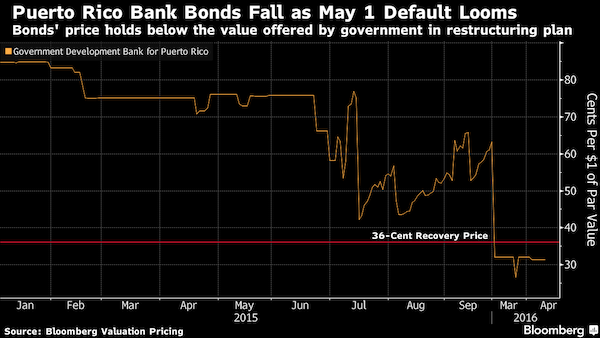
Even if Puerto Rico manages to strike a last-minute deal to defer bond payments due in three days, the commonwealth’s financial collapse is about to enter an unprecedented phase. Anything short of making the $422 million payment that Puerto Rico says it can’t afford would be considered a technical default. More importantly, it opens the door to larger and more consequential defaults on debt protected by the island’s constitution, and raises the risk of putting efforts to resolve the biggest crisis ever in the $3.7 trillion municipal market into turmoil. Nearly 10 months after Governor Alejandro Garcia Padilla said the commonwealth was unable to repay all its obligations, Puerto Rico has failed to reach an accord on a broad restructuring deal presented to bondholders.

During that time the administration has delayed payments to suppliers, postponed tax refunds, grabbed revenue originally used to repay other bonds and missed payments on smaller agency debt. With its options drying up, no bondholder agreement in sight and Congressional action delayed, defaulting may be the next step for Puerto Rico. “It’s a game changer because it starts an actual legal process with teeth on both sides that can finally advance settlement negotiations,” said Matt Fabian at Municipal Market Analytics. “Pre-default negotiations are really not going anywhere. Post default might have a better chance.” Puerto Rico and its agencies racked up $70 billion in debt after years of borrowing to fill budget deficits and pay bills as its economy shrunk and residents left the island for work on the U.S. mainland.

The island’s Government Development Bank, which lent to the commonwealth and its municipalities, is in talks with creditors to avoid defaulting on the $422 million that’s due May 1. The commonwealth may use a new debt moratorium law if it cannot defer that GDB payment, Jesus Manuel Ortiz, a spokesman for Garcia Padilla, said. While a GDB default would be the largest yet by Puerto Rico, a missed payment on its general obligations would signal to investors that the commonwealth is finally executing on its warnings that it cannot pay its debts. Puerto Rico and its agencies owe $2 billion on July 1, including a $805 million payment on its general-obligation bonds, which are guaranteed under the island’s constitution to be paid before anything else.

Read more …

“..60 million people worldwide requiring “urgent assistance..”..

• El Niño Dries Up Asia As Its Stormy Sister La Niña Looms (AFP)

Withering drought and sizzling temperatures from El Nino have caused food and water shortages and ravaged farming across Asia, and experts warn of a double-whammy of possible flooding from its sibling, La Nina. The current El Nino which began last year has been one of the strongest ever, leaving the Mekong River at its lowest level in decades, causing food-related unrest in the Philippines, and smothering vast regions in a months-long heat wave often topping 40 degrees Celsius (104 Fahrenheit). Economic losses in Southeast Asia could top $10 billion, IHS Global Insight told AFP. The regional fever is expected to break by mid-year but fears are growing that an equally forceful La Nina will follow.

That could bring heavy rain to an already flood-prone region, exacerbating agricultural damage and leaving crops vulnerable to disease and pests. “The situation could become even worse if a La Nina event — which often follows an El Nino — strikes towards the end of this year,” Stephen O’Brien, UN under-secretary-general for humanitarian affairs and relief, said this week. He said El Nino has already left 60 million people worldwide requiring “urgent assistance,” particularly in Africa. Wilhemina Pelegrina, a Greenpeace campaigner on agriculture, said La Nina could be “devastating” for Asia, bringing possible “flooding and landslides which can impact on food production.” El Nino is triggered by periodic oceanic warming in the eastern Pacific Ocean which can trigger drought in some regions, heavy rain in others.

Much of Asia has been punished by a bone-dry heat wave marked by record-high temperatures, threatening the livelihoods of countless millions. Vietnam, one of the world’s top rice exporters, has been particularly hard-hit by its worst drought in a century. In the economically vital Mekong Delta bread basket, the mighty river’s vastly reduced flow has left up to 50% of arable land affected by salt-water intrusion that harms crops and can damage farmland, said Le Anh Tuan, a professor of climate change at Can Tho University. More than 500,000 people are short of drinking water, while hotels, schools and hospitals are struggling to maintain clean-water supplies. Neighbouring Thailand and Cambodia also are suffering, with vast areas short of water and Thai rice output curbed.

Read more …

You would think the reason to continue executing a policy lies in its success rate. Not so, you poor innocent you. In reality, the very failure of a policy is reason to continue it: if the strongest eurozone economy with low unemployment does not show any signs of inflationary pressures, the ECB after all might have a point in continuing its ultra-loose monetary policy

• German Inflation Turns Negative In April (R.)

German consumer prices unexpectedly fell in April, data showed on Thursday, illustrating the scale of the task the ECB faces in trying to propel inflation back to its target range. The eurozone has struggled with little or no inflation for the past year and the ECB expects the bloc-wide figure to turn negative again before slowly ticking up, undershooting its goal of just under 2% for years to come. The ECB unveiled a surprisingly large stimulus package in March but falling inflation expectations have fueled expectations of even more easing, possibly as early as June, when the bank’s staff present new growth and inflation forecasts. “It might be hard for some German ECB critics to digest, but if the strongest eurozone economy with low unemployment does not show any signs of inflationary pressures, the ECB after all might have a point in continuing its ultra-loose monetary policy,” ING Bank economist Carsten Brzeski said.

Separate data on Thursday showed unemployment unexpectedly fell in April, with the jobless rate remaining at its lowest in more than 25 years. German consumer prices, harmonized to compare with other European countries (HICP), fell by 0.1% on the year after a 0.1% rise in March, the Federal Statistics Office said. The Reuters consensus forecast was for a zero reading. On a non-harmonized basis, consumer prices fell 0.2% on the month and inched up 0.1% on the year. A breakdown showed energy remained the main drag while the food, services and rental costs increased at a slower pace. Analysts said the German data suggested that the April inflation rate for the whole eurozone, due out on Friday, would also turn negative again.

Read more …

It’s high time now to see how the Greek debt trap is linked to the article above about German deflation. The link continues with the article below this one: Germany monopolizes the benefits of being in the EU.

• Greece’s Perfect Debt Trap (Kath.)

The longer we spend in the hole the harder it is to get out. As long as the negotiations with the troika are not finished and the economy is starved of cash, as long as businesses cannot plan for the next day and citizens remain wary of returning cash to the banks, recovery becomes even more difficult. The government promises that after a positive evaluation by creditors the economy will bounce back like a spring released. Even if we were to accept this theory – which would also demand huge investments – a positive evaluation is still the prerequisite. Despite the progress made in the talks, the economy is deteriorating. Indicative of this is a growing inability to pay taxes. Today outstanding tax debts exceed €87 billion. At the end of 2012 they were at €55.1 billion.

They have grown by 32 billion euros since then, equaling the amount raised by tax rate increases over the same period (as Kathimerini reports on Friday). In the first quarter of 2016, outstanding debts increased by €3.22 billion and, by the end of the year, may exceed last year’s total of €13.48 billion. Nonperforming bank loans, which were at 8.2% of the total at the start of 2010, were at 36.4% at the end of 2015. Unpaid dues to social security funds came to €15.78 billion at the end of the first quarter, from €13.02 billion last September. The swelling of these debts did not begin under this government. Previous governments and opposition parties, as well as creditors, all played a role in this. From the start of the crisis, citizens/taxpayers have been buffeted by uncertainty, despair and anger.

The expectation of debt relief encouraged delays in payments, while excessive taxation meant that outstanding payments multiplied. Also, the state, unable to meet its own obligations, held back on paying what it owed to taxpayers. With the worsening economy and the lack of trust, capital controls were inevitable and, of course, drove us deeper into trouble. This anxiety is set to continue. The government cannot undertake the burden of what creditors demand, and the creditors, in turn, appear disinclined to help out. As the Federation of Greek Industries noted in its weekly bulletin on Thursday: “The government’s insistence on raising taxes instead of cutting expenses, and the recessionary impact that this will have on the economy, leads to the troika’s shortsighted persistence on contingency measures which, unfortunately, increase further the recessionary wave and will be the final blow to the economy.”

We are caught in the perfect trap. As long as the negotiations drag on, the instability and lack of confidence will increase outstanding debt at all levels, prevent growth and, in turn, demand even harsher measures. The only way out is for both the government and creditors to show good will and trust each other. After the past year this seems a most unlikely leap of faith.

Read more …

Dividing and demolishing the Union brick by brick. Germany wants to be left with the benefits of that union only, and to shed the drawbacks. Not going to work out well.

• German Minister Proposes Law To Limit Social Benefits For EU-Foreigners (DW)

EU foreigners living in Germany may soon have to wait five years before qualifying for social benefits, reported newspapers on Thursday, in reference to a new proposed law from German Labor Minister Andrea Nahles. “We have to stop immigration into the social security system,” Nahles said during an interview in December when she announced plans to restrict social benefits for non-German EU citizens. She added that the restrictions were a matter of “self defense” for Germany. Should the law pass, foreigners from fellow EU member states will be strictly excluded from social assistance if they do not work in Germany or have not acquired social security rights through previous work in Germany. With those same conditions, EU foreigners would also be shut out from Germany’s benefit system for the unemployed, which is known as “Hartz IV.”

EU citizens can eventually gain access to social benefits – but only if they have been living in Germany for five years without state assistance. The draft law, however, provides so-called “transition benefits” for those EU foreigners who no longer qualify for social assistance in Germany. For a maximum of four weeks, those affected will receive assistance to cover the costs of food, housing, and health care. They will also be given a loan to cover costs for a return trip to their home country, where they can then apply for social benefits. The new measures are a direct response to a decision by Germany’s Federal Social Court late last year concerning immigrants from EU countries. In December 2015, the court ruled that EU-foreigners would only acquire entitlement to social benefits after living in the country for at least six months. The decision led to backlash from local authorities, who feared the social system would be overburdened.

Read more …

This is something we’ll see a lot of. It’s over. What’s left is pretense.

• Finland Parliament, Pressured By Weak Economy, Debates Euro Exit (R.)

Finnish lawmakers on Thursday held a rare debate on whether the Nordic country should quit the euro after 53,000 people signed a petition to force the issue into parliament. The petition, although very unlikely to lead to Finland’s exit of the 19-member currency bloc, highlights the growing level of frustration over the country’s economic performance amid rising unemployment, weak outlook and government austerity. The initiative demands a referendum on euro membership, but this would only go ahead if parliament backed such a vote. Although no political group has proposed a euro exit, some euro-sceptic parliamentarians cited lack of independent monetary policy as a problem and said Finland should have held a referendum before adopting the euro in 1998.

Nordic neighbors Sweden and Denmark voted against adopting the euro a few years later. “The euro is too cheap for Germany and too expensive for the rest of Europe, it does not fulfill requirements of an optimal currency union,” said Simon Elo, an MP from the co-ruling euro-sceptic Finns party. The Finnish economy grew by just 0.5% last year after three years of contraction. The stagnation stemmed from a string of problems, including high labor costs, the decline of Nokia’s former phone business and a recession in neighboring Russia. This year, Finland’s economy is expected to grow slower than in any other EU country, except Greece. Some economists say the country’s prospects would improve if it returned to the markka currency which could then devalue against the euro.

Read more …

Union? What union?! Get real.

• Italy Says Austria ‘Wasting Money’ In Migrant Border Row (AFP)

Italy told Austria Thursday it would prove Vienna was “wasting money” on anti-migrant measures and closing the border between the two countries would be “an enormous mistake”. Austrian Interior Minister Wolfgang Sobotka, who has vigorously defended the controversial package which was driven by a surge of the far right, met his counterpart Angelino Alfano over the plans, which have infuriated Italians. Alfano said “the numbers do not support” fears of a mass movement of migrants and refugees across the famous Brenner Pass in the Alps. Sobotka said preparations would continue for the construction of a 370-metre (yard) barrier which would be up to four metres (13 foot) high in places, but Alfano said the feared-for crisis would not materialise and “we will show them it is money wasted”.

Italian Premier Matteo Renzi has warned that closing the pass would be a “flagrant breach of European rules” and is pushing the European Commission to force Austria to hold off on a move many fear could symbolise the death of the continent’s Schengen open border system. On Thursday he described the bid to close the border as being “utterly removed from reality”. A European Commission spokesman said the body had “grave concerns about anything that can compromise our ‘back to Schengen’ roadmap”. Its chairman Jean-Claude Juncker is expected to discuss the issue with Renzi at talks in Rome on May 5. The Vienna government is under intense domestic pressure to stem the volume of asylum seekers and other migrants arriving on its soil with the far-right surging in polls.

UN chief Ban Ki-moon hit out Thursday at what he called “increasingly restrictive” refugee policies in Europe, saying he was “alarmed by the growing xenophobia here” and elsewhere in Europe, in a speech to the Austrian parliament. More than 350,000 people, many of them fleeing conflict and poverty in countries like Syria, Iraq and Eritrea, have reached Italy by boat from Libya since the start of 2014, as Europe battles its biggest migration crisis since World War II. Wedged between the Italian and Balkan routes to northern Europe, Austria received 90,000 asylum requests last year, the second highest in per capita terms of any EU country. Legislation approved Wednesday by the Austrian parliament enables the government to respond to spikes in migrant arrivals by declaring a state of emergency which provides for asylum seekers to be turned away at border points.

Read more …

Portugal sees what Canada sees too. Question is how deliberate is the EU policy of being so slow in relocating refugees to countries asking for them? Portugal wants 10,000. Canada will take a multiple of that.

• One Nation in Europe Wants Refugees But Is Failing to Get Enough (BBG)

Portugal has offered to host 10,000 of the refugees who’ve landed on Europe’s shores from the globe’s war-torn zones. So far, it has taken in 234. Not because it doesn’t want to. Rather, because few have come knocking at its door. “It’s difficult to quickly find refugees that can come to Portugal,” President Marcelo Rebelo de Sousa said on Friday as he met migrants in Evora, southern Portugal. As the refugee crisis stretches the struggling Greek government and rattles politics in Germany and beyond, Portugal’s willingness to share the burden isn’t getting a lot of attention. While the country blames a lack of coordination in Europe and administrative roadblocks, the contrast between its economic performance and that of Germany, which admitted more than 1 million migrants in 2015 alone, may also be playing a role.

Although the Portuguese economy recovered in 2014 and accelerated last year after shrinking for three years through 2013, joblessness remains high. Unemployment, which has eased to 12.3% after peaking at 17.5% in 2013, is still almost triple the German rate of 4.3%, and that may continue to dent Portugal’s allure. “It’s not a very appealing destination given the unemployment rate,” said Rui Serra, chief economist at Caixa Economica Montepio Geral in Lisbon. “It’s easier for an immigrant to go to the center of Europe where there is a more concentrated market than in some countries of the periphery like Portugal. In the center of Europe income per capita is higher.” Prime Minister Antonio Costa says there are structural problems in the euro zone that aggravate the disparities.

“That structural problem has to do with the asymmetry between the different economies,” he said in Athens on April 11. “It’s necessary to give a new impulse to the convergence of our economies with the more developed economies of the euro zone.” With the country’s demographics in mind, the Portuguese government has laid out the welcome mat for refugees. Portugal’s population has declined and aged every year from the end of 2011 to about 10.37 million at the end of 2014 as a weak economy has led many working-age residents to leave. Germany’s population, while also aging, still increased overall every year in the same period.

Read more …

Apr 282016
 
 April 28, 2016  Posted by at 9:01 am Finance Tagged with: , , , , , , , , , , ,  4 Responses »


G. G. Bain Goose Creek, houses on the water, Jamaica Bay, Long Island 1910

• The European Union Always Was A CIA Project (AEP)
• Yen Surges, Nikkei Plunges As BOJ Keeps Policy Steady (CNBC)
• Japan Consumer Prices Fall At Fastest Pace In 3 Years (R.)
• America’s Earnings Recession Just Got Worse (CNN)
• America’s Trade Deficit Begins at Home (Roach)
• China Trades Enough Cotton in One Day to Make Jeans for Everyone (BBG)
• IMF Warns Chinese Response To Debt Needs To Be More Comprehensive (FT)
• China Struggles As Oil Losses Climb (EM)
• US Oil Woes Start To Hit Workers Hard (WSJ)
• Dan Loeb: We’re In The ‘First Inning’ Of A ‘Washout’ In Hedge Funds (CNBC)
• The Bad Smell Hovering Over The Global Economy (G.)
• Europe’s Securitisation Industry’s Sales At Lowest For 5 Years (FT)
• Merkel Attacks Draghi Over Interest Rates Policy, Cites Risks To Banks (R.)
• Tusk Rejects Tsipras Request For EU Summit On Greece Bailout (G.)
• Athens Under Pressure To Clear Piraeus Refugee Camp Before Tourists Arrive (G.)
• More Than A Million People In UK Living In Destitution (G.)
• Papua New Guinea To Close Aussie Refugee Detention Camp (AFP)

Ambrose dives into history. A shame he can’t see beyond the Cold War when assessing Russia.

• The European Union Always Was A CIA Project (AEP)

Brexiteers should have been prepared for the shattering intervention of the US. The European Union always was an American project. It was Washington that drove European integration in the late 1940s, and funded it covertly under the Truman, Eisenhower, Kennedy, Johnson, and Nixon administrations. While irritated at times, the US has relied on the EU ever since as the anchor to American regional interests alongside NATO. There has never been a divide-and-rule strategy. The eurosceptic camp has been strangely blind to this, somehow supposing that powerful forces across the Atlantic are egging on British secession, and will hail them as liberators. The anti-Brussels movement in France – and to a lesser extent in Italy and Germany, and among the Nordic Left – works from the opposite premise, that the EU is essentially an instrument of Anglo-Saxon power and ‘capitalisme sauvage’.

France’s Marine Le Pen is trenchantly anti-American. She rails against dollar supremacy. Her Front National relies on funding from Russian banks linked to Vladimir Putin. Like it or not, this is at least is strategically coherent. The Schuman Declaration that set the tone of Franco-German reconciliation – and would lead by stages to the European Community – was cooked up by the US Secretary of State Dean Acheson at a meeting in Foggy Bottom. “It all began in Washington,” said Robert Schuman’s chief of staff. It was the Truman administration that browbeat the French to reach a modus vivendi with Germany in the early post-War years, even threatening to cut off US Marshall aid at a furious meeting with recalcitrant French leaders they resisted in September 1950.

Truman’s motive was obvious. The Yalta settlement with the Soviet Union was breaking down. He wanted a united front to deter the Kremlin from further aggrandizement after Stalin gobbled up Czechoslovakia, doubly so after Communist North Korea crossed the 38th Parallel and invaded the South. For British eurosceptics, Jean Monnet looms large in the federalist pantheon, the eminence grise of supranational villainy. Few are aware that he spent much of his life in America, and served as war-time eyes and ears of Franklin Roosevelt. General Charles de Gaulle thought him an American agent, as indeed he was in a loose sense. Eric Roussel’s biography of Monnet reveals how he worked hand in glove with successive administrations. It is odd that this magisterial 1000-page study has never been translated into English since it is the best work ever written about the origins of the EU.

Nor are many aware of declassified documents from the State Department archives showing that US intelligence funded the European movement secretly for decades, and worked aggressively behind the scenes to push Britain into the project. As this newspaper first reported when the treasure became available, one memorandum dated July 26, 1950, reveals a campaign to promote a full-fledged European parliament. It is signed by Gen William J Donovan, head of the American wartime Office of Strategic Services, precursor of the CIA. The key CIA front was the American Committee for a United Europe (ACUE), chaired by Donovan. Another document shows that it provided 53.5% of the European movement’s funds in 1958. The board included Walter Bedell Smith and Allen Dulles, CIA directors in the Fifties, and a caste of ex-OSS officials who moved in and out of the CIA.

Papers show that it treated some of the EU’s ‘founding fathers’ as hired hands, and actively prevented them finding alternative funding that would have broken reliance on Washington. There is nothing particularly wicked about this. The US acted astutely in the context of the Cold War. The political reconstruction of Europe was a roaring success. There were horrible misjudgments along the way, of course. A memo dated June 11, 1965, instructs the vice-president of the European Community to pursue monetary union by stealth, suppressing debate until the “adoption of such proposals would become virtually inescapable”. This was too clever by half, as we can see today from debt-deflation traps and mass unemployment across southern Europe.

Read more …

Japan cannot take an ever rising yen. It will need to plummet, and quite soon.

• Yen Surges, Nikkei Plunges As BOJ Keeps Policy Steady (CNBC)

Japanese shares sold off and the yen surged against the dollar Thursday after the Bank of Japan’s (BOJ) decision to keep monetary policy steady disappointed a section of the market betting on further stimulus. The benchmark Nikkei 225 was down 3.24%, compared to a 1.41% gain before the decision. The Topix index fell 2.15%. The yen moved sharply higher, with the dollar/yen pair dropping 2.10% to 109.11 as of 12:45 p.m. HK/SIN, compared with the 111 level it traded at before the decision. Australia’s ASX 200 was up 0.54%, boosted by advances in the energy and materials sub-indexes. In South Korea, the Kospi fell 0.61%. In Hong Kong, the Hang Seng index was up 0.50%. Chinese mainland markets retreated, with the Shanghai composite down 0.68%, while the Shenzhen composite dropped 1.04%.

Following the BOJ’s decision and the yen’s strength, major Japanese exporters saw their shares tumble, with Toyota, Nissan and Honda down between 2.74 and 3.55%. A stronger yen is usually a negative for exporters as it reduces their overseas profits when converted into local currency. “However, in the last ten years, Japan’s exporters’ currency sensitivity has been reduced,” Masakazu Takeda at Hennessy Japan Fund told CNBC’s “Capital Connection.” Takeda said as an example, every time the dollar weakened by 10 yen, Toyota’s operating profits declined by about 13%. “That’s down from 20% ten years ago,” he said, adding, “Companies have been making efforts to reduce the currency sensitivity.” Japanese banking stocks also sold off sharply, with shares of Mitsubishi UFJ down 5.06%, SMFG down 5.21% and Nomura tumbling 9.41%. Nikkei index heavyweight Fast Retailing sold off 5.05%.

Read more …

Where Abenomics fails most spectacularly: “..Household spending in March fell 5.3% from a year earlier..” Note: this was reported prior to the BOJ decision to hold off on stimulus.

• Japan Consumer Prices Fall At Fastest Pace In 3 Years (R.)

Japan’s consumer prices fell in March at the fastest pace in three years and household spending declined at the fastest pace in a year, keeping the Bank of Japan under pressure to implement more stimulus to support the economy. Separate data showed industrial output rose more than expected and labor demand rose to the highest in two decades, but renewed worries about weak private consumption are likely to temper any optimism about the economy. The BOJ is likely to debate expanding monetary stimulus at a policy meeting ending later on Thursday, as sluggish global demand hurts exports and weak wage growth undermines private consumption, sources have told Reuters.. “Oil prices falls and the waning effect from a weak yen pushed down core CPI,” said Hidenobu Tokuda, senior economist at Mizuho Research Institute.

“We expect the BOJ will ease policy today. It will probably be difficult politically for the BOJ to further cut negative interest rates, so we expect the central bank will focus on qualitative easing such as increasing ETF buying.” The core consumer price index (CPI), which includes oil products but excludes volatile fresh food prices, fell 0.3% in March from a year earlier, more than the median forecast for a 0.2% annual decline. That marked the fastest decline since April 2013 due to lower prices for gasoline and slowing gains in prices for durable goods and overseas travel. The core-core CPI, which excludes food and energy, rose 0.7% in the year to March, slower than a 0.8% annual increase in the previous month. Household spending in March fell 5.3% from a year earlier due to lower spending on clothes, leisure activities and gasoline. That was more than the median estimate for a 4.2% annual decline and marked the fastest decline since March 2015.

Read more …

It’s not just Apple.

• America’s Earnings Recession Just Got Worse (CNN)

Apple, Chipotle and Twitter each got thumped Wednesday after reporting weak or disappointing earnings. Twitter and Chipotle have their own distinct failures, but Apple, like many, is also a victim of the global slowdown. Overall, S&P 500 earnings so far this quarter are down 8%. That marks the third quarterly decline in a row and the worst since 2009, according to S&P Global Market Intelligence. Weak global growth is closing consumers’ wallets, while the strong dollar is only making iPhones and other American goods more expensive for foreign buyers. Add on still-low oil prices and Corporate America is facing major headwinds. “It’s like these companies are trying to play basketball but the tar is melting and sticking to their sneaks. Not fun to watch,” says Jack Kramer, co-founder of MarketSnacks, a financial newsletter.

Apple’s stock quickly fell more than 7% when markets opened Wednesday after it revealed its first annual sales growth decline since 2003. Reeling from its E. coli scare late last year, Chipotle reported its first quarterly loss ever and its stock dropped about 5%. And Twitter’s stock spiraled 15% lower on Wednesday after its results missed estimates. They’re not alone. Big oil, tech and other former bull market studs like Starbucks are getting burned this quarter too. Earnings for energy companies are down a whopping 110% compared to a year ago. Consider this: seven of the 10 major sectors in the S&P 500 are in the red so far this quarter. A year ago, only two sectors suffered profit drops, according to S&P. Tech companies’ earnings are down nearly 6% this quarter. Embodying the trend is Google. It got pounded by the strong dollar, which hurt overseas sales. Microsoft also lost overseas revenue due to the strong dollar.

Read more …

Stephen Roach says Americans should save more. But the entire economy still ‘stands’ exactly because they either don’t or can’t.

• America’s Trade Deficit Begins at Home (Roach)

Thanks to fear mongering on the US presidential campaign trail, the trade debate and its impact on American workers is being distorted at both ends of the political spectrum. From China-bashing on the right to the backlash against the Trans-Pacific Partnership (TPP) on the left, politicians of both parties have mischaracterized foreign trade as America’s greatest economic threat. In 2015, the United States had trade deficits with 101 countries – a multilateral trade deficit in the jargon of economics. But this cannot be pinned on one or two “bad actors,” as politicians invariably put it. Yes, China – everyone’s favorite scapegoat – accounts for the biggest portion of this imbalance. But the combined deficits of the other 100 countries are even larger.

What the candidates won’t tell the American people is that the trade deficit and the pressures it places on hard-pressed middle-class workers stem from problems made at home. In fact, the real reason the US has such a massive multilateral trade deficit is that Americans don’t save. Total US saving – the sum total of the saving of families, businesses, and the government sector – amounted to just 2.6% of national income in the fourth quarter of 2015. That is a 0.6-percentage-point drop from a year earlier and less than half the 6.3% average that prevailed during the final three decades of the twentieth century. Any basic economics course stresses the ironclad accounting identity that saving must equal investment at each and every point in time. Without saving, investing in the future is all but impossible.

And yet that’s the position in which the US currently finds itself. Indeed, the saving numbers cited above are “net” of depreciation – meaning that they measure the saving available to fund new capacity rather than the replacement of worn-out facilities. Unfortunately, that is precisely what America is lacking. So why is this relevant for the trade debate? In order to keep growing, the US must import surplus saving from abroad. As the world’s greatest economic power and issuer of what is essentially the global reserve currency, America has had no trouble – at least not yet – attracting the foreign capital it needs to compensate for a shortfall of domestic saving. But there is a critical twist: To import foreign saving, the US must run a massive international balance-of-payments deficit.

The mirror image of America’s saving shortfall is its current-account deficit, which has averaged 2.6% of GDP since 1980. It is this chronic current-account gap that drives the multilateral trade deficit with 101 countries. To borrow from abroad, America must give its trading partners something in return for their capital: US demand for products made overseas.

Read more …

Some day soon we’ll hear a very loud bang in the Chinese commodities craze. It has effectively turned exchanges into bookmakers. Many ‘investors’ don’t know what they’re buying, they’re just afraid -again- of being left behind.

• China Trades Enough Cotton in One Day to Make Jeans for Everyone (BBG)

It’s not just metals caught up in China’s commodity fever. The equivalent of 41 million bales of cotton traded in a single day on the Zhengzhou Commodity Exchange last week, the most in more than five years and enough to make almost 9 billion pairs of jeans, or at least one for every person on the planet. Prices that had slumped to the lowest on record in February surged almost 19% in the four days leading up to the trading spike on Friday. Traders have piled in to Chinese commodity markets, sending volumes of everything from steel to coking coal soaring and prompting exchanges to boost margins and fees or issue warnings to investors. The surge in trading is reminiscent of last year’s equities rally that boosted the stock market before a rout erased $5 trillion. China is the world’s largest consumer of cotton and second-biggest producer.

“Record low levels in February and March sparked buying interest from both inside and outside of the cotton industry and also triggered speculation, which resulted in mounting bets in Zhengzhou futures,” said Liu Qiannan at Galaxy Futures. “With massive investment and encouragement from the crazy steel and iron ore market in China, sentiment then turned to bullish from bearish.” More than 3.6 million contracts of 5 metric tons apiece traded in Zhengzhou on Friday. With Chinese exchanges double counting volume to account for the long and short side of a trade, that’s still about 9 million tons, or 41 million bales. One bale can make 215 pairs of jeans, according to the National Cotton Council of America. On the same day, about 1.6 billion pounds traded on ICE Futures U.S. in New York. That’s about 3.3 million bales, or more than 700 million pairs of jeans, enough to dress only the U.S., Brazil and Japan in denim.

Read more …

Hollow rhetoric (since there’s no solution), but it does confirm once again how dire China’s situation is : “..one in six of the business loans on Chinese banks’ books — was owed by companies who brought in less in revenues than they owed in interest payments alone.”

• IMF Warns Chinese Response To Debt Needs To Be More Comprehensive (FT)

China’s leaders need to look beyond the current solutions being floated to tackle the country’s mounting corporate debt problems and come up with a bigger plan to do so, the IMF’s top China expert has warned. The IMF has been expressing growing concern about China’s debt issues and pushing for an urgent response by Beijing to what the fund sees as a serious problem for the Chinese economy. It warned in a report earlier this month that $1.3tn in corporate debt — or almost one in six of the business loans on Chinese banks’ books — was owed by companies who brought in less in revenues than they owed in interest payments alone.

In a paper published on Tuesday, James Daniel, the fund’s China mission chief, and two co-authors, went further and warned that Beijing needed a comprehensive strategy to tackle the problem. They warned that the two main responses Beijing was planning to the problem — debt-for-equity swaps and the securitisation of non-performing loans — could in fact make the problem worse if underlying issues were not dealt with. “Converting NPLs into equity or securitising them are techniques that can play a role in addressing these problems and have been used successfully by some other countries,” Mr Daniel and his co-authors wrote.

“But they are not comprehensive solutions by themselves — indeed, they could worsen the problem, for example, by allowing zombie firms [non-viable firms that are still operating] to keep going.” The plan for debt-for-equity swaps could end up offering a temporary lifeline to unviable state-owned companies, they warned. It could also leave them managed by state-owned banks or other officials with little experience in doing so. Pooling non-performing loans and selling them as securities also presented other potential problems. While it could help clear up debt problems quickly it could also end up helping to prop up struggling state-owned enterprises. Some 60% of non-performing loans in China are owed by SOEs “and are concentrated in a few distressed industries”, they wrote.

Read more …

This is why China is stockpiling like nuts.

• China Struggles As Oil Losses Climb (EM)

China’s biggest oilfield is suffering huge losses as the government seeks to avoid layoffs despite prices that have dropped below production costs. On April 8, the official Xinhua news agency reported that the Daqing oilfield in northern Heilongjiang province lost over 5 billion yuan (U.S. $769 million) in the first two months of the year. In spite of the costs, production in the first quarter held steady at year-earlier levels of 9.28 million tons (755,800 barrels per day), according to PetroChina, the listed subsidiary of state-owned China National Petroleum Corp. (CNPC). Output has been declining for years at Daqing, China’s mainstay oil resource, which has fueled the economy for over six decades. Annual production of 50 million metric tons (1 million barrels per day) lasted 27 years until 2003 before slipping to the 40-million-ton range, the official English-language China Daily and Global Times said.

In December 2014, PetroChina announced plans to cut output by 1.5 million tons and scale back production at the depleted field to 32 million tons by 2020. But even at lower levels, production at Daqing with enhanced recovery methods is proving uneconomic. Production costs stand at U.S. $45 (292 yuan) per barrel, said Jiang Wanchun, Communist Party secretary of the oilfield, according to The Wall Street Journal. China’s average production cost is $40 (260 yuan) per barrel, China Daily said. With benchmark oil prices falling below $45 since early December, Daqing has been losing money on every barrel it pumps. Prices dipped below U.S. $28 (182 yuan) per barrel in February before staging a partial recovery. Even after international prices approached the $45 range last week, the prospects for profits at Daqing appeared marginal at best.

Read more …

As a bubble pops.

• US Oil Woes Start To Hit Workers Hard (WSJ)

The slump in crude prices is starting to show up as missed payments by consumers in the oil patch. In states from Oklahoma and Texas to North Dakota and Wyoming, rising unemployment in the energy sector is pushing up loan delinquencies and raising the risk of new losses for banks. Wells Fargo this month reported an increase in borrowers falling behind on payments in areas including Houston and parts of Alaska. J.P. Morgan said auto-loan delinquency rates picked up in some energy-related markets. Overall, energy-dependent states are posting delinquency rates that in many cases exceed the national average, according to data prepared for The Wall Street Journal by credit bureau TransUnion. “In these energy states, we are clearly seeing the impact of the loss of oil jobs,” said Ezra Becker, senior vice president and head of research at TransUnion.

“We don’t expect to see any kind of material improvement in the short term.” Some 119,600 oil and gas jobs nationwide have been eliminated—22% of the total—since September 2014, according to the Federal Reserve Bank of Dallas. The price of U.S.-traded oil, while on the rise this year, has dropped 28% since June. Some analysts have warned that persistent crude oversupply could prevent further price gains. Car loans and credit cards have been affected the most, and there are some early signs of delinquency-rate increases in borrowers who can’t make mortgage payments. Moody’s Investors Service said the share of borrowers in oil-focused areas falling 30 days behind on a pool of Freddie Mac mortgages, while low at 0.38% in December, began to exceed the average elsewhere in the country last summer. The average for other areas was 0.29% in December.

Read more …

And now hit hard by Apple too.

• Dan Loeb: We’re In The ‘First Inning’ Of A ‘Washout’ In Hedge Funds (CNBC)

Hedge funds are getting killed, says hedge fund manager Dan Loeb. Loeb’s Third Point Capital put out its quarterly letter to investors on Tuesday, calling the first three months of 2016 “one of the most catastrophic periods of hedge fund performance that we can remember since the inception of this fund.” Third Point was down 2.3% during the first quarter, which compares with a 1.3% gain for the S&P 500 over the same period. (As bad as that may be, though, it could have been worse — Bill Ackman’s Pershing Square was down more than 25% in the quarter.) Despite the weak performance, Third Point believes it is positioned to do well the rest of the year.

“There is no doubt that we are in the first innings of a washout in hedge funds and certain strategies,” Third Point said. “We believe we are well-positioned to seize the opportunities borne out of this chaos and are pleased to have preserved capital through a period of vicious swings in treacherous markets.” What caused the catastrophe? “Volatility across asset classes and a reversal of certain trends that started last summer caught many investors flat-footed in Q1 2016,” the firm added.

More specifically, Loeb said:
• China is all over the map.
• Hedge funds were long the “FANG” stocks — Facebook, Amazon, Netflix and Google — and those stocks are not doing well.
• “The Valeant debacle in mid-March decimated some hedge fund portfolios.” (The stock lost almost three-quarters of its value during the quarter).
• The collapsed Pfizer-Allergan deal hurt investors.
• A “huge asset rotation” into a “market neutral” strategy.
• He thinks the dollar has peaked, and oil has hit a bottom.

“We believe that the past few months of increasing complexity are here to stay and now is a more important time than ever to employ active portfolio management to take advantage of this volatility,” Loeb concluded. As an industry, hedge funds bounced back in March after a miserable start to 2016. The HFRI Fund Weighted Composite Index gained 1.8% in March, its strongest performance since February 2015. However, hedge funds saw investor redemptions in the first quarter. Investors withdrew $14.3 billion, leaving total assets under management at $3.1 trillion, according to industry tracker Preqin.

Read more …

What happens when central banks lose the illusion of control, and stocks start falling for real?!

• The Bad Smell Hovering Over The Global Economy (G.)

All is calm. All is still. Share prices are going up. Oil prices are rising. China has stabilised. The eurozone is over the worst. After a panicky start to 2016, investors have decided that things aren’t so bad after all. Put your ear to the ground though, and it is possible to hear the blades whirring. Far away, preparations are being made for helicopter drops of money onto the global economy. With due honour to one of Humphrey Bogart’s many great lines from Casablanca: “Maybe not today, maybe not tomorrow but soon.” But isn’t it true that action by Beijing has boosted activity in China, helping to push oil prices back above $40 a barrel? Has Mario Draghi not announced a fresh stimulus package from the ECB designed to remove the threat of deflation?

Are hundreds of thousands of jobs not being created in the US each month? In each case, the answer is yes. China’s economy appears to have bottomed out. Fears of a $20 oil price have receded. Prices have stopped falling in the eurozone. Employment growth has continued in the US. The International Monetary Fund is forecasting growth in the global economy of just over 3% this year – nothing spectacular, but not a disaster either. Don’t be fooled. China’s growth is the result of a surge in investment and the strongest credit growth in almost two years. There has been a return to a model that burdened the country with excess manufacturing capacity, a property bubble and a rising number of non-performing loans. The economy has been stabilised, but at a cost.

The upward trend in oil prices also looks brittle. The fundamentals of the market – supply continues to exceed demand – have not changed. Then there’s the US. Here there are two problems – one glaringly apparent, the other lurking in the shadows. The overt weakness is that real incomes continue to be squeezed, despite the fall in unemployment. Americans are finding that wages are barely keeping pace with prices, and that the amount left over for discretionary spending is being eaten into by higher rents and medical bills. For a while, consumer spending was kept going because rock-bottom interest rates allowed auto dealers to offer tempting terms to those of limited means wanting to buy a new car or truck.

In an echo of the subprime real estate crisis, vehicle sales are now falling. The hidden problem has been highlighted by Andrew Lapthorne of the French bank Société Générale. Companies have exploited the Federal Reserve’s low interest-rate regime to load up on debt they don’t actually need. “The proceeds of this debt raising are then largely reinvested back into the equity market via M&A or share buybacks in an attempt to boost share prices in the absence of actual demand,” Lapthorne says. “The effect on US non-financial balance sheets is now starting to look devastating.” He adds that the trigger for a US corporate debt crisis would be falling share prices, something that might easily be caused by the Fed increasing interest rates.

Read more …

And this is while the ECB has been buying ABS since 2014. Where would the ‘industry’ be without the ECB? It’s the ‘little things’ that tell the story of where we are, best.

• Europe’s Securitisation Industry’s Sales At Lowest For 5 Years (FT)

Europe’s securitisation market has experienced its worst quarter for new sales in nearly five years, underscoring the industry’s ongoing decline in spite of efforts from policymakers to revive the sector. During the first three months of the year, €14.3bn of securitisations were sold, marking the lowest quarterly level since mid-2011. Public issuance fell from €19.7bn over the same period a year earlier, according to data from the Association for Financial Markets in Europe. Securitisation — which takes mortgages and other loans, and packages them into bond-like instruments of varying risks — was once a booming industry in Europe but has struggled since the financial crisis. The slide in activity comes in spite of efforts from Brussels to revive the asset class, which it sees as a key source of funding across Europe’s economies.

The ECB has been buying asset-backed securities since late 2014 as part of its asset purchase programmes designed to stimulate the region’s economy. “The market is languishing,” said Richard Hopkin, head of fixed income at the Association for Financial Markets in Europe. “Firms are restructuring and scaling back their securitisation businesses.” Earlier in April, Nomura became the latest investment bank to pare back its securitisation team, amid broader cuts to its European investment banking business. Last summer, Barclays announced job cuts in its team. Market participants have pointed to stringent regulation on the asset class, in particular the capital charges against the products for banks and insurance companies, as a central factor in its decline.

Read more …

There’s a High Noon fight brewing between Draghi and all of Germany.

• Merkel Attacks Draghi Over Interest Rates Policy, Cites Risks To Banks (R.)

The ECB’s ultra-low interest rates could worsen problems for already weak banks in Europe, German Chancellor Angela Merkel said on Wednesday, calling for a tightening of monetary policy. The ECB unveiled a large stimulus package in March that included cutting its deposit rate deeper into negative territory and increasing asset buys, despite the objections of Germany, the largest economy in the euro zone. The ECB stimulus prompted a fresh wave of criticism from German politicians who fear the ultra-easy monetary policy is eroding both the savings of thrifty citizens and also bank margins, putting the banking system at risk. “The risks remain high. There are still too many weak banks in Europe and the low interest rates … will tend to make this problem worse over the coming years,” Merkel said at an event in Duesseldorf for German savings banks.

ECB head Mario Draghi says the policy of printing money and keeping borrowing costs at rock bottom is working and that interest rates will stay at current record lows for a long time. The ECB targets inflation of close to 2% over the medium-term but it is running at just below zero. Merkel said politicians need to press for more structural reforms to help generate stronger growth and private investment, thereby freeing up central banks to pursue a tighter monetary policy. “Central banks, including the ECB, are independent so I think politicians must focus on stimulating growth,” she said.

Read more …

The likes of Tusk and Dijsselbloem simple enjoy holding a gun to Greece’s head so much they can’t help themselves. It’s what sociopaths derive their pleasures from. So no emergency meeting because of a non-reason: ““There are practical issues that many countries have, with national holidays next week.”

That’s like the old joke of a country being invaded and telling the attackers to come back next week.

• Tusk Rejects Tsipras Request For EU Summit On Greece Bailout (G.)

Mounting urgency has returned to Greece with the country’s financial predicament igniting fears of a re-run of last summer’s nail-biting drama. Rejecting a Greek request for an extraordinary EU summit to discuss its troubled bailout programme, European council president Donald Tusk instead urged eurozone finance ministers to resume talks that would avert further turmoil. The nation faces default if it fails to receive the necessary loans to cover €3.5 bn in maturing debt in July. “We have to avoid a situation of renewed uncertainty for Greece,” he told reporters after speaking with prime minister Alexis Tsipras on Wednesday. “We need a specific date for a new Eurogroup meeting in the not-so-distant future and I am talking not about weeks but about days.”

In a repeat of last year’s heady days, Athens’ leftist-led government is scrambling to raise funds to ensure payment of salaries and pensions in May. The reserves of state entities and pension funds have effectively been sequestered with officials demanding deposits be placed in the central bank on short-term loan to cover looming shortfalls. “The government is behaving as if it has already run out of money,” said prominent political commentator Pantelis Kapsis. “That in itself signifies there will be no agreement soon. There is great uncertainty. All scenarios are on the table including early elections.” Greece’s embattled prime minister appealed for the emergency EU summit after Athens and its creditors failed late Tuesday to resolve differences over the extent of budget cuts and reforms the debt-stricken state must make in return for rescue loans.

The lack of headway prompted Dutch finance minister and Eurogroup chairman, Jeroen Dijsselbloem, who oversees negotiations, to cancel a scheduled meeting at which it was hoped the talks would finally be concluded on Thursday. Speaking in Paris after talks with his French counterpart Michel Sapin on Wednesday, Dijsselbloem said a new meeting would be lined up in the weeks ahead. “I don’t have a deadline, although there is a sense of urgency that we all share, so we’ll have to see whether it can be next week or ultimately the week after,” he told reporters. “There are practical issues that many countries have, with national holidays next week.”

Read more …

A bad tourist season could be the last straw for Greece, and another reason for Europe to add more demands.

• Athens Under Pressure To Clear Piraeus Refugee Camp Before Tourists Arrive (G.)

[..] At its peak last month, close to 14,000 refugees had amassed in Piraeus, posing serious challenges for public order and health. By mid-April, however, attention had turned increasingly to the capital’s erstwhile international airport in Elliniko. Once poised to become Europe’s biggest metropolitan park, the disused airport was transformed into an “official” shelter in March, when it became clear that countries further north had cut off access to Europe for good. If there was a semblance of order to the chaos of Piraeus, there is none here: outside derelict buildings, children play barefoot around overflowing rubbish bins; officialdom comes in the form of a single police car, parked alongside a fence clad with clothes, while up a flight of stairs inside the departure terminal, roughly 2,000 men, women and children – almost double the centre’s capacity – sleep side by side.

Lack of heat or air-conditioning means it is cold at night and stifling during the day; sanitation amounts to five toilets for men and five for women, with showers installed earlier this month. A further 3,000 refugees are crammed into two former Olympic venues – the old hockey and baseball stadiums – at Elliniko, where conditions are said to be so poor that access for NGOs or the media is rare. With hunger reputed to be on the rise, volunteers have openly voiced fears of offering services to people who are increasingly desperate. Last week, following the death of a 17-year-old Afghan girl in the camp, irate local mayors felt compelled to write a letter to prime minister Alexis Tsipras deploring the conditions as unacceptable and inhumane. Calling for immediate measures, the Athens Medical Association warned of a public health emergency.

“So far, Greece has been very lucky,” Papayiannakis noted before news of the Afhgan girl’s death broke. “There have been no serious incidents – but luck, you know, can run out.” Despite record unemployment and poverty levels, Greeks have responded to the influx with compassion and solidarity. Many have brought food and clothes to public squares, harking back to their families’ own experience as refugees when thousands were forcibly expelled from the Anatolian heartland after Greece’s ill-fated attempt to invade Turkey in 1922. For immigrants like Arif Rahman, a businessman who heads the Bangladeshi Chamber of Commerce, that reaction has been heartening – even if the government’s own response has been bungled and chaotic.

A slender man who first came to Greece in the late 1980s, Rahman has all too often witnessed his adopted country’s tough immigration policies – not least its steadfast refusal to offer citizenship to the children of emigres. “Now is the time for Greeks to show what civilisation and democracy means,” he says. “These people don’t want to stay here. We keep telling the government, as foreign community leaders, ‘Ask us for help, we know our people, we know what they need. Don’t let it get uglier than it already has.’”

Read more …

What a crazy country it is turning into. All in an eery silence. Where are the protests?

• More Than A Million People In UK Living In Destitution (G.)

More than a million people in the UK are so poor they cannot afford to eat properly, keep clean or stay warm and dry, according to a groundbreaking attempt to measure the scale of destitution in Britain. A study by the Joseph Rowntree Foundation (JRF) found that 184,500 households experienced a level of poverty in a typical week last year that left them reliant on charities for essentials such as food, clothes, shelter and toiletries. More than three-quarters of destitute people reported going without meals, while more than half were unable to heat their home. Destitution affected their mental health, left them socially isolated and prone to acute feelings of shame and humiliation.

Although the study could not demonstrate that destitution had increased in recent years, it said this would be a plausible conclusion because of related evidence showing austerity-era rises in severe poverty, food bank use, homelessness and benefit sanction rates. In 2015, there were 668,000 destitute households containing 1,252,000 people, including 312,000 children. The study said this was an underestimate because the data did not capture poor households who eschewed charity handouts or used only state-funded welfare services Julia Unwin, chief executive of JRF, said: “It is simply unacceptable to see such levels of severe poverty in our country in the 21st century. Governments of all stripes have failed to protect people at the bottom of the income scale from the effects of severe poverty, leaving many unable to feed, clothe or house themselves and their families.”

Researchers called on the government to monitor destitution levels annually to better understand how people in poverty slipped into extreme hardship and to examine what could be done to close the holes in the welfare safety net. Destitution was defined by researchers as reliance on a weekly income so low (£70 for a single adult, £140 for a couple with children after housing costs) that basic essentials were unaffordable. People who met at least two of six measures over the course of a month, including eating fewer than two meals a day for two or more days, inability to heat or light their home for five days or sleeping rough for one or more nights, were also deemed to be destitute.

Read more …

Australia is trying to outdo the EU in becoming the wasteland of of international law, morals, decency and human values.

• Papua New Guinea To Close Aussie Refugee Detention Camp (AFP)

Australia’s hardline immigration policy was thrown into turmoil yesterday after Papua New Guinea (PNG) ordered a processing camp to close, leaving the fate of hundreds of asylum-seekers hanging in the balance. The move to shutter the Australian-funded Manus island facility follows a Supreme Court ruling on Tuesday that holding people there was unconstitutional and illegal. Piling further pressure on Canberra, just weeks away from an expected election campaign, an Iranian refugee set himself on fire during a visit by UN officials to Nauru, the other Pacific nation where Australia sends boat people. And four others on the tiny outpost reportedly attempted suicide by drinking washing powder on Tuesday.

“Respecting this (court) ruling, Papua New Guinea will immediately ask the Australian government to make alternative arrangements for the asylum seekers at the regional processing centre,” Prime Minister Peter O’Neill said. Papua New Guinea’s former opposition leader Belden Namah had challenged the Manus arrangement in court, claiming it violated the rights of asylum seekers. The Supreme Court found that detaining them on the island was “contrary to their constitutional right of personal liberty”.

Despite this, Australian Immigration Minister Peter Dutton was adamant that none of the 850 or so men held there would enter his country and that Canberra’s policy – designed to deter others wanting to make the risky journey by boat – would not change. “As I have said, and as the Australian government has consistently acted, we will work with our PNG partners to address the issues raised by the Supreme Court of PNG,” he said in a statement after Mr O’Neill’s decision. Mr O’Neill did not set a timeframe for the closure. He said he did not anticipate asylum seekers being kept for so long at the Manus camp, which was reopened in 2012 by Australia after being closed five years earlier when the then Labor government abandoned offshore processing.

Read more …

Apr 242016


NPC Shad fishing on the Potomac 1920

• China’s Commodity Futures Bubble Insanity (ZH)
• Where Have All Britain’s Shoppers Gone? (Observer)
• Why America’s Impressive 5% Unemployment Rate Still Feels Like A Lie (Qz)
• The Lemmings Of Wall Street (Stockman)
• A Pro-EU ‘Study’ Straight From The Ministry Of Truth (Tel.)
• ECB’s Nowotny Says Negative Rates Necessary To Avoid Deflation (Reuters)
• Schaeuble Sees No Greece Debt Relief as Long as Debt Sustainable (BBG)
• Why Juncker Should Worry About Panama Papers (Politico)
• EU Finmins To Focus On Spending Cap To Cut Morass Of Budget Rules (R.)
• UK Issues Travel Warning For Southern US States (CNBC)
• US Government Is a Major Counterparty to Wall Street Derivatives (Martens)
• Australian Politician Sets River On Fire (AFP)
• In This Jungle, Mowgli Might Not Have Any Playmates Left (CNBC)
• Visa-Free Travel A Stumbling Block For Turkey and EU (DW)
• Merkel Accused Of Turning Blind Eye To Plight Of Syrian Refugees In Turkey (O.)
• Tomorrow, We Have A Chance To Stop The Death Of Innocents (Observer)

It’s not just the next bubble in line: each bubble is crazier than the one before.

• China’s Commodity Futures Bubble Insanity (ZH)

The credit-fueled speculative bubble in China’s commodity market, as we detailed previously, exploded this week as the mainstream slowly comes to realize that the gains in industrial metals are not a “sign of strength in China’s and the world’s economic recovery” but merely the next rotation of fast-money slooshing from Chinese equities to Chinese corporate bonds to Chinese real estate and now to Chinese commodity futures… Trading in futures on everything from steel reinforcement bars and hot-rolled coils to cotton and polyvinyl chloride has soared this week, prompting exchanges in Shanghai, Dalian and Zhengzhou to boost fees or issue warnings to investors. Deutsche Bank details the total crazinesss…

The onshore China commodity markets this week traded (conservatively) $350bn notional, a 17x increase on the $20bn notional that traded on Feb 1st 2016 i.e. a month ago (is it coincidence that the notional is about the same as at the peak of the equity frenzy?).

My calculations are pretty basic; I’ve trawled the screens and chosen 32 commodities in agri, metals and coke/coal and done a quick (contracts x value)/CNY for a dollar amount. I have not used the largest day’s volume either (e.g. Deformed Bar, RBTA has traded close to $100bn, but I used closer to $60bn). Cotton (VVA Comdty) has been trading $15bn, up from $500mm in Feb. In the US, the long established cotton contract (CT1 Comdty) trades $600mm. China listed Sugar (CBA Comdty) has traded $14bn versus the US listed sugar beet at $850mm.

This is what insanity looks like!!

Read more …

Deflation=slowing consumer spending=lower money velocity. Simple. But the only answer they can come up with is “We need some warm weather…”

• Where Have All Britain’s Shoppers Gone? (Observer)

Shopping is the national pastime. High streets, malls and retail parks have long been places people went for a day out, rather than on a mission to buy a particular item, and their spending helped lift the country out of recession. But a big drop in footfall – the number of people visiting high street and retail centres – over the past year has exposed fresh cracks in the high street, leaving retail chiefs wondering where all their customers have gone. Analysts are reporting declines in the number of shopper visits to high streets and shopping centres around the country of as much as 10% in some cities over the past year. Worries about the economic outlook, coupled with the rise of internet shopping, jitters about the EU referendum and more spending on eating out and leisure leave little cash left over for splurging in the shops.

“There is a lot of nervousness around [among retailers],” says Tim Denison, retail analyst at Ipsos Retail Performance. “People have had more disposable income but retailers have not been as successful as they could have been in taking their share. Instead any spare money has gone on leisure and holidays rather than pure retail spend.” According to Ipsos’s retail traffic index, overall footfall was down 0.9% in the first quarter of 2016 compared with the same period a year ago. But that headline masks the fact that some towns and cities are faring much worse than the national picture would suggest. The Ipsos data singles out Newcastle upon Tyne as the worst performer, with shopper numbers down a hefty 9.95% over the past year, closely followed by Stoke-on-Trent, down 8.1%. Other pockets of particular weakness were Chelmsford, Lincoln and Cambridge.

By comparison Ashford in Kent, Crawley in West Sussex and Epsom in Surrey were among the best-performing retail centres – the result, according to Denison, of wealth radiating out from London. Even in those towns, however, growth is not exactly rampant. Five of the top seven best-performing shopping centres were up less than 1% year on year. A number of retail chains have already blamed poor performance on declining numbers of shoppers. Poundland has pointed directly to the fact there are fewer people on the high street as a key reason behind its slowing sales. Last week value fashion retailer Primark revealed its first drop in UK underlying sales for 12 years, although boss George Weston said it was not yet time to press the panic button, given that chilly spring weather had weighed on all sales for all fashion retailers. “We need some warm weather and then we will know if there is a real problem on the high street,” he said.

Read more …

“..the labor participation rate has fallen from a high of 67.3% in 2000 to 62.6% today. That 62.2% represents a 38-year low, which puts Bloomberg’s claim of a 42-year-low in joblessness in perspective.”

• Why America’s Impressive 5% Unemployment Rate Still Feels Like A Lie (Qz)

On Apr. 14, Bloomberg News announced that jobless claims in the US have reached their lowest level since 1973. “All other labor market data are telling us that the economy is creating a lot of jobs,” economist Patrick Newport told the outlet. “This is further confirmation that the labor market is strong.” That same day, thousands of fast food workers, airport workers, home care workers, and adjunct professors took to the streets across the country to protest brutal labor conditions and demand a $15 minimum wage. Most of these workers make far below $15 per hour. Some make as low as $7.25 per hour, the current federal minimum wage. Most lack benefits. Some, like adjunct professors, have contingent, temporary jobs, sometimes consisting of only one poorly paid course per year.

Many low-wage employees work two or even three jobs in an attempt to cobble together enough income to cover basic needs. According to the US Bureau of Labor, all of these workers are considered “employed.” They are viewed as part of the American economy’s success story, a big part of which is our 5% unemployment rate. As president Barack Obama boasted in February: “The United States of America right now has the strongest, most durable economy in the world.” Obama’s claims of a strong economy ring hollow for the many thousands of workers who say they cannot make enough to survive. But Obama’s claims of a strong economy ring hollow for the many thousands of workers—in professions ranging from those which require a GED to those which require a PhD—who say they cannot make enough money to survive.

And these people, at least, are working. Those who cannot find work at all tell an even grimmer story.] There are three main reasons the vaunted economic recovery still feels false to so many. The first is the labor participation rate, which plunged at the start of the Great Recession and discounts the millions of Americans who have been out of work for six months or more. The second is “the 1099 economy,” a term The New Republic’s David Dayen coined to refer to the soaring number of temps, contractors, freelancers, and other often involuntarily self-employed workers. The third is a surge in low-wage service jobs, coupled with a corresponding decrease in middle-class jobs.

Employment statistics in particular have a habit of eclipsing the real story. As any worker will tell you, it is not the number of jobs that matters most, but what kind of jobs are available, what they pay, and how that pay measures against the cost of living. The 5% unemployment rate, other words, is hiding the devastating story of underemployment, wage loss, and precariousness that defines life for millions of Americans. Since 2008, the labor participation rate has fallen from a high of 67.3% in 2000 to 62.6% today. That 62.2% represents a 38-year low, which puts Bloomberg’s claim of a 42-year-low in joblessness in perspective. The jobless number is “low” only because more people are no longer considered to be participating in the workforce.

Read more …

“..the visage of an old age colony being hurtled toward the edge of a debt cliff by central bankers who have taken leave of their faculties does not bring the idea of economic recovery and growth immediately to mind.”

• The Lemmings Of Wall Street (Stockman)

I mistakenly took Squawk Box off mute this morning. It was just in time to hear one of the regular anchors – the one who makes Joe Kernen sound slightly insightful by comparison – forecast a pick-up in global growth on the grounds that “China is recovering”. Yes, the credit intoxicated land of the Red Ponzi just tied one on for the record books. During Q1 it generated new debt at a madcap annual rate of $4 trillion or nearly 40% of GDP. And that incendiary deposit of more unpayable debt, which came on top of the $30 trillion already smothering history’s greatest construction site and open air gambling den, did indeed goose China’s real estate prices, state company CapEx, infrastructure building and steel production. Call it fiat growth because even pyramid building adds to stated GDP, at first.

Even then, the overwhelming share of this explosion of new credit went to pay interest on the existing mountain of IOUs. Charles Ponzi could never have imagined a scam so audacious. Nor are the red suzerains of Beijing unique in the headlong dash toward the financial cliff. Except for the nicety that Japan’s 30-year and 40-year bonds are trading at a microscopic fraction this side of zero (0.3%), Kuroda and his tiny band of mad men at the BOJ have driven the entirety of Japan’s monumental public debt – which is now actually measured in the quadrillions of yen – into the netherworld of negative yield. Needless to say, the visage of an old age colony being hurtled toward the edge of a debt cliff by central bankers who have taken leave of their faculties does not bring the idea of economic recovery and growth immediately to mind.

The same can be said for the ECB’s $90 billion per month bond buying bacchanalia. Having made German bunds so scarce as to have eviscerated any semblance of yield and turned Italy’s sovereign junk into super-bluechips, the ECB will soon be slurping up the corporate bonds of any global company that can fog a BBB credit breathalyzer and plant an SPV within the borders of the EU-19. What happens when Draghi is finally stopped and the Big Fat Bid of the ECB and its fast money front-runners disappears? The hopeful CNBC anchor-lady didn’t say. And about what happens if he isn’t stopped, she didn’t say, either.

The fact is, Simple Janet has already proven the end game. Money printing central bankers can’t stop. Were they to allow financial prices to normalize and trillions of bad credit to be liquidated, the whole financial house of cards they have built around the planet would blow sky high. The “soft landing” case is a null set.

Read more …

“The sole purpose of this “sober and serious” text, there can be no doubt, was to produce one conclusion – an alarming headline “finding” which, however dubious, can be repeated again and again in the weeks to come, until it lodges in the public consciousness.”

• A Pro-EU ‘Study’ Straight From The Ministry Of Truth (Tel.)

Earlier this month, the government published a leaflet strongly urging us to vote “Remain” in the European Union – and sent it to all 27m UK households. Not only did the multi-million pound cost of producing and distributing this leaflet undermine the carefully-negotiated spending rules relating to the referendum on June 23, designed to stop the campaign becoming a money-driven free-for-all. The text itself was blatant propaganda – full of statistical sleights of hand disguised as reasoned arguments, a master-class in passive aggressive manipulation. It turns out, though, this tawdry leaflet was just the start when it comes to “Remain” using taxpayer cash and “the government machine” to bolster its cause.

For last week, Chancellor George Osborne launched a thumping 200-page “Treasury study” into the long-term implications of leaving the EU, which “forecast a £4,300 fall in GDP per household” if we leave. For many millions of voters, that’s a scary number – around a quarter of today’s average disposable income. Once again, this huge Treasury document represents a clear breach of long-standing rules that Whitehall remains detached from political campaigning, rules of particular relevance during a knife-edge referendum contest. And, reading through it, one is constantly stuck by the grotesque extent to which, for all the scientific pretence, the “analysis” is deliberately skewed.

The sole purpose of this “sober and serious” text, there can be no doubt, was to produce one conclusion – an alarming headline “finding” which, however dubious, can be repeated again and again in the weeks to come, until it lodges in the public consciousness. Rather than Her Majesty’s Treasury, this document could have been produced by Orwell’s Ministry of Truth. Unusually for a newspaper pundit, perhaps, I’m a trained economist. And in all my many years of studying official economic documents – budgets, comprehensive spending reviews and the like – through all that sifting and weighing of fine-print, I’ve never come across methodology and assumptions so blatantly rigged.

Read more …

Ergo: the ECB doesn’t understand what deflation is.

• ECB’s Nowotny Says Negative Rates Necessary To Avoid Deflation (Reuters)

The euro zone needs negative interest rates to avoid sliding into deflation, ECB Governing Council member Ewald Nowotny said in an Austrian newspaper interview, defending the policy against widespread criticism in Germany. The ECB kept the cost of borrowing for banks at zero on Thursday and will continue to charge them 0.4% for parking money at the central bank. A slew of German politicians have complained in recent weeks that low interest rates are hurting savers. But Nowotny defended the policy. “You have to discuss negative rates in a broad context,” the head of the Austrian central bank was quoted as saying by the newspaper Der Standard on Saturday.

They are part of the central bank’s efforts to stabilize Europe’s economic situation after a severe crisis, he said. “Now it is all about preventing Europe from dropping into deflation.” He said that he would welcome it if interest rates could be raised again “the sooner the better”, but that the conditions must be right. “This will happen as soon as the economy is doing better, business activity picks up and inflation gets higher.” Countering the criticism of low interest rates, Draghi himself said on Thursday that some of it could be seen as endangering its independence, which could delay investment and hence prolong its current policies.

Read more …

Next step is demand for more austerity in Greece.

• Schaeuble Sees No Greece Debt Relief as Long as Debt Sustainable (BBG)

German Finance Minister Wolfgang Schaeuble said Greece doesn’t need debt relief now and won’t require an easing of its debt burden as long as the troika of creditors determines that debt sustainability is ensured. The European Stability Mechanism, the euro region’s financial backstop, will seek to lock in the favorable refinancing costs it’s passing on to Greece for an extended period of time, Schaeuble said in Amsterdam. While not part of the Greek program, these operations – if in place – would help ease pressure on Greece, he said. “The debt sustainability analysis determines whether measures are needed” to help the cash-strapped country, Schaeuble told reporters after a two-day meeting of EU finance ministers. “It is my conviction that this is not necessary for the coming years.”

Greece’s government bonds rose for a third day on Friday after euro-area finance ministers and the IMF signaled that a deal on the nation’s next bailout installment is in sight. Schaeuble said “we have no desire” to repeat the confrontation between Greece and its creditors from last summer. The nation’s government submitted a bill to parliament on Friday evening, overhauling the Greek pension system and raising income tax for middle and high earners. The bill, which also raises taxation on gambling and dividends, is part of a €5.4 billion belt-tightening package required by creditors for the conclusion of the bailout review. The government still has to negotiate with representatives of creditor institutions a set of contingency measures equal to 2% of Greek GDP, which will only be triggered if it fails to meet its budget targets. An agreement on the bailout package and the target for Greece to reach a primary surplus of 3.5% of GDP by 2018 “appear possible,” Schaeuble said.

Read more …

He has little to fear unless and until the documents are released Wikileaks style. Once that is done, Juncker is not the biggest fish.

• Why Juncker Should Worry About Panama Papers (Politico)

[..] The European Council chose to forget or ignore that Juncker had long resisted attempts to improve banking transparency and improve cross-border taxation – which had given Luxembourg a particular competitive advantage over its neighbors. A lot now depends on the extent to which LuxLeaks and/or the Panama Papers erode Juncker’s defense that everything was legal and he was ignorant of any wrongdoing. If there was law-breaking, then the ex-prime minister is vulnerable to the charge that either he didn’t know what was going on and should have, or he knew what was going on and allowed it. He is vulnerable also to whispers that Luxembourg’s business and political community is so small and tightly knit that complete ignorance is implausible.

What is more difficult to guess – at this moment of shifting standards – is whether Juncker will be condemned for allowing practices in Luxembourg that though legal were morally questionable. (You do not have to be a tax lawyer to see that what Juncker calls “the logic of non-harmonization” was compounded by Luxembourg’s culture of secrecy/discretion, which meant that companies could keep secret their tax arrangements and individuals could hide their revenue.) It is entirely possible that the government leaders who put Juncker in place – and their successors – will stick to the view that bygones should be bygones and Juncker’s past policies should not affect his standing as Commission president.

But what I detect, in at least some parts of Europe, is a readiness to revisit the past and to apply the standards of the present — meaning that what was legally correct may yet be found morally unacceptable in the court of public opinion. Juncker may choose to argue that his Commission is at the vanguard of reform. But what if his past record embarrasses the likes of Margrethe Vestager, as she turns over tax rulings made by national authorities with multinational corporations? Or Jonathan Hill, as he advances his proposal for increasing the tax transparency rules applying to multinationals? Or Pierre Moscovici, arguing for measures against tax evasion and money-laundering? Is this a sinner who repents, an opportunist, or just a hypocrite?

Whether Juncker is credible will also be important in the context of the Commission’s attempt to enforce fiscal discipline in Greece (or anywhere else). How does the Commission argue for improving revenue collection while LuxLeaks and Panama Papers paint a picture of a Juncker-run Grand-Duchy promoting tax-avoidance?

Read more …

The blind moving goalposts as they ‘see’ fit.

• EU Finmins To Focus On Spending Cap To Cut Morass Of Budget Rules (R.)

EU finance ministers agreed on Saturday to discuss whether they can regain some control over a morass of EU budget rules by focusing mainly on an annual spending cap as the best measure of compliance. Years of changes and additions to EU rules, called the Stability and Growth Pact, have made meeting targets extremely complex, prompting an attempt to simplify them, European Commissioner Vice President Valdis Dombrovskis told a news conference after the meeting of EU finance ministers. “We did not discuss how to change the Pact, just how to choose the indicators to assess the compliance with the Pact,” Dutch Finance Minister Jeroen Dijsselbloem said.

The Dutch, who currently preside over the EU, proposed that the ministers consider using a single indicator with which to judge budgetary compliance, called the expenditure rule. It already exists in EU law as one indicator to be used to judge the fiscal performance of an EU country, but has so far been more in the background. The focus until now was on the development of the structural budget balance, a measure that strips off changes to budget revenue and expenditure stemming from the phase of the business cycle as well as all one-offs. Because the structural deficit is a complex and volatile indicator, the Dutch instead proposed putting more emphasis on the expenditure rule, which says a government cannot increase annual spending more than its medium-term potential growth rate.

“It is directly in the hands of finance ministers. It gives us more guidance in the process of designing the budget. It says in advance what you have to do, and you have the control in your hands,” Dijsselbloem said. He said that while the structural deficit, which is the key indicator mentioned in EU economic legislation, was a valuable theoretical concept, it could not be directly controlled by finance ministers. “There was general agreement that we need an indicator that takes out all the cyclical elements and one-offs but preferably it should be more stable and not change all the time, and we could put more emphasis on indicators that we can actually directly influence as finance ministers,” he said.

Dijsselbloem said EU deputy finance ministers would further work on what measurement to use to better assess compliance and the ministers would return to the discussion in the third quarter of 2016. The aim of the EU budget rules, created in 1997, is to keep nominal budget deficits below 3% of gross domestic product and public debt below 60%. But as the rules were revised in 2005, 2011 and 2013 to take account of economic and political realities and to incorporate intergovernmental treaties, they became more and more complex. “The sheer number of indicators in the current framework poses a massive challenge for the national implementation of the fiscal framework,” the Dutch presidency said in a paper prepared for the ministers’ meeting. “It contains targets, upper limits and benchmarks for the nominal balance, structural balance, expenditure growth and debt development,” the paper said.

Read more …

While Obama was talking up the special relationship.

• UK Issues Travel Warning For Southern US States (CNBC)

The U.K. government has updated foreign travel advice, warning British citizens about risks visiting America’s Southern states. Specifically the new advice draws attention to potential difficulties for lesbians, gays, bisexuals and transgenders. “The U.S. is an extremely diverse society and attitudes towards LGBT people differ hugely across the country,” the U.K. Foreign Office website says. “LGBT travelers may be affected by legislation passed recently in the states of North Carolina and Mississippi,” it said. North Carolina and Mississippi have introduced laws that negatively affect people in the LGBT community. The North Carolina “bathroom” law is a statewide policy banning individuals from using public bathrooms that don’t correspond to their sex as stated on their birth certificate.

Celebrities including Bruce Springsteen, Ringo Starr and Pearl Jam have canceled concerts there in protest. And tech giant PayPal has canceled a large-scale investment plan after the legislation was rubber stamped. In Mississippi a “religious liberties” law will take effect in July. That legislation again blocks cities from allowing transgender people to use public bathrooms for the sex they identify as. It also aims to protect dozens of forms of businesses and services from being prosecuted if they refuse to serve LGBT people. A similar transgender “bathroom bill” in the Tennessee state failed Monday after it was withdrawn by its sponsor.

Read more …

By design.

• US Government Is a Major Counterparty to Wall Street Derivatives (Martens)

According to a study released by the Federal Reserve Bank of New York in March of last year, U.S. taxpayers have already injected $187.5 billion into Fannie Mae and Freddie Mac, two companies that prior to the 2008 financial crash traded on the New York Stock Exchange, had shareholders and their own Board of Directors while also receiving an implicit taxpayer guarantee on their debt. The U.S. government put the pair into conservatorship on September 6, 2008. The public has been led to believe that the $187.5 billion bailout of the pair was the full extent of the taxpayers’ tab. But in an astonishing acknowledgement on February 25 of this year, the Government Accountability Office, the nonpartisan investigative arm of Congress, issued an audit report of the U.S. government’s finances, revealing that the government’s “remaining contractual commitment to the GSEs, if needed, is $258.1 billion.”

This suggests that somehow, without the American public’s awareness, the U.S. government is on the hook to two failed companies for $445.6 billion dollars. And that may be just the tip of the iceberg of this story. The official narrative around the bailout of Fannie and Freddie is that they were loaded up with toxic subprime debt piled high by the Wall Street banks that sold them dodgy mortgages. While that is factually true, the other potentially more important part of this story is the counterparty exposure the Wall Street banks had to Fannie and Freddie’s derivatives if the firms had been allowed to fail.

The New York Fed’s staff report of March 2015 concedes the following: “Fannie Mae and Freddie Mac held large positions in interest rate derivatives for hedging. A disorderly failure of these firms would have caused serious disruptions for their derivative counterparties.” Exactly how big was this derivatives exposure and which Wall Street banks were being protected by the government takeover of these public-private partnerships that had spiraled out of control into gambling casinos? According to Fannie and Freddie’s regulator of 2003, OFHEO, “The notional amount of the combined financial derivatives outstanding of Fannie Mae and Freddie Mac increased from $72 billion at the end of 1993, the first year for which comparable data were reported, to $1.6 trillion at year-end 2001.”

Read more …

“Unbelievable. A river on fire. Don’t let it burn the boat..”

• Australian Politician Sets River On Fire (AFP)

An Australian politician has set fire to a river to draw attention to methane gas he says is seeping into the water due to fracking, with the dramatic video attracting more than two millions views. Greens MP Jeremy Buckingham used a kitchen lighter to ignite bubbles of methane in the Condamine River in Queensland, about 220 kilometres (140 miles) west of Brisbane. The video shows him jumping back in surprise, using an expletive as flames shoot up around the dinghy. “Unbelievable. A river on fire. Don’t let it burn the boat,” Buckingham, from New South Wales, said in the footage posted on Facebook on Friday evening, which has been viewed more than two million times. “Unbelievable, the most incredible thing I’ve seen. A tragedy in the Murray-Darling Basin (river system),” he said, blaming it on nearby coal-seam gas mining, or fracking.

Australia is a major gas exporter, but the controversial fracking industry has faced a public backlash in some parts of the country over fears about the environmental impact. Farmers and other landowners are concerned that fracking, an extraction method under which high-pressure water and chemicals are used to split rockbeds, could contaminate groundwater sources. The Murray-Darling Basin is a river network sprawling for one million square kilometres (400,000 square miles) across five Australian states. But the industry has said the practice is safe and that coal seam gas mining is a vital part of the energy mix as the world looks for cleaner fuel sources.

Origin Energy, which operates wells in the region, said it was monitoring the bubbling. “We’re aware of concerns regarding bubbling of the Condamine River, in particular, recent videos demonstrating that this naturally occurring gas is flammable when ignited,” the company said in a statement to the Australian Broadcasting Corporation. “We understand that this can be worrying, however, the seeps pose no risk to the environment, or to public safety, providing people show common sense and act responsibly around them.” The Australian energy firm said the methane seeps could be due to several factors, including natural geology and faults, drought and flood cycles, as well as human activity including water bores and coal seam gas operations.

Read more …

The planet’s future is its past: cockroaches and jellyfish. “We’re gradually destroying our planet’s ability to support our way of life..” Eh, gradually?!

• In This Jungle, Mowgli Might Not Have Any Playmates Left (CNBC)

In Disney’s live-action remake of “The Jungle Book,” young human Mowgli is still palling around with bears and panthers. In reality, however, the world has changed since Rudyard Kipling’s tales first hit shelves more than a century ago. Speaking figuratively, biodiversity’s bag of Skittles has not only gotten smaller, it now has fewer flavors. Just how different are things? One expert puts it this way: If Mowgli were around today, he would most likely be raised by cows, goats and chickens instead of wolves and panthers and orangutans. If he were really unfortunate, his compatriots could be even worse. “Maybe even rats and cockroaches, if things go badly,” said Charles Barber, former forest chief at the U.S. Department of State’s Bureau of Oceans and International Environmental and Scientific Affairs, in an interview with CNBC.

The problem, according to some scientific experts, is that humans have changed the world so dramatically that it has also altered the diversity of life on Earth. “Most of these changes represent a loss of biodiversity,” analysts wrote in the Millennium Ecosystem Assessment in 2005, a report that chronicled the effects of human activity on nature produced by the United Nations and the World Resources Institute, where Barber now works. Among the Millennium Assessment’s findings were that humans have “changed ecosystems more rapidly and extensively than in any comparable period in human history,” due to food, fresh water and fuel needs. The spillover from those changes has contributed to big gains in humanity’s development, but “have been achieved at growing costs in the form of the degradation of many ecosystem services,” researchers wrote at the time.

This means that “plants and animals are now sharing the planet with a whole lot of people,” Barber said, adding that “we’re dealing with a fantastically different world.” One measure of biodiversity loss is just how fast certain species are now disappearing. Organizations like the Center for Biological Diversity state that an “extinction crisis” is underway that is wiping out plants and animals at a breathtaking pace. The last few hundred years have borne witness to mass extinctions that occur much quicker than the so-called natural “background rate” of one to five species per year. The CBD estimates that “literally dozens” of species are dying every day, which could see 30-50% of endangered populations being wiped out by midcentury.

Today, scientists say nearly a quarter of all mammals and coniferous trees are threatened with extinction. [..] A recent report by the World Wildlife Fund found that between 1970 (the year Earth Day was born) and 2010, the number of mammals, birds, reptiles and fish fell by more than 50%. “We’re gradually destroying our planet’s ability to support our way of life,” said WWF CEO Carter Roberts, at the time the report was published.

Read more …

If Brussels tries to push this through, it’ll mean the end of the EU. If it doesn’t, it’ll mean the refugee flow will start all over again and at the very least Schengen dies. Can’t win.

• Visa-Free Travel A Stumbling Block For Turkey and EU (DW)

The refugee deal between the European Union and Turkey is stalled on the complexities of visa liberalization. EU officials say they won’t sacrifice their principles, but will they follow through? Turkish and EU leaders appear optimistic: 78 million Turkish citizens will gain long-coveted visa-free travel to the Schengen zone by June. After all, they have to in order to prevent a controversial deal on deportations from crumbling. Ankara has threatened to withdraw from the EU-Turkey migrant deal if visa liberalization is not in place by the end of June, putting in jeopardy a plan on which the European Union has pinned all of its hopes for slowing the arrival of people fleeing conflict and poverty.

Under the deal, reached in March, Turkey agreed to take back irregular migrants and refugees who crossed the Aegean to Greece in exchange for the European Union’s taking in Syrian refugees directly, as well as financial aid, visa liberalization and the acceleration of Turkey’s EU membership talks. While several parts of the migration deal have come under criticism, Turkey’s long-running struggle to gain unfettered access to the European Union for its citizens raises its own questions and remains a major sticking point. The EU executive, the European Commission, will present its third visa-liberalization progress report on May 4, and, if Turkey fulfills all 72 criteria to bring the country into compliance with EU and international law, a legislative proposal will be put forward to transfer the country to the visa-free list.

Less than two weeks before May 4, the European Commission said this week that Turkey was making progress but had only met 35 of 72 criteria for visa-free travel. On Thursday, however, European Migration Commissioner Dimitris Avramopoulos told reporters that he believed all benchmarks would be met. In a troubling sign, Turkey and the EU appear unable to even agree on what criteria have been met so far, with Turkish Prime Minister Ahmet Davutoglu saying this week that his government had brought the number down to the “single digits.” He has vowed to push the remaining criteria through parliament. According to Angeliki Dimitriadi, a visiting fellow at the European Council on Foreign Relations in Berlin, a major issue is what the EU means by “implementing.”

“It’s unclear how we measure benchmarks,” Dimitriadi told DW. “Are we looking at the benchmark as laws being passed or looking for actual implementation of all 72 criteria? Questions remain whether they have fulfilled this on paper or in reality.” Noting that the technical aspects of meeting EU criteria -implementing biometric passports, for example – take time, Dimitriadi said it would be nearly impossible to meet the June deadline. “I would be extremely surprised if they succeeded, and it has nothing to do with Turkey,” she said. “Any country would have a problem.”

Read more …

“..only a third of the children go to school – partly because of a lack of capacity, and partly because they are put to work by their parents.”

• Merkel Accused Of Turning Blind Eye To Plight Of Syrian Refugees In Turkey (O.)

Merkel and her European colleagues have been accused of pandering too much to Turkey, amid calls for stronger international criticism of its crackdown on the political opposition. On Saturday Can Dundar, one of two prominent Turkish journalists on trial for reporting that Turkey was supplying arms to Syrian rebels, said Merkel was betraying the principles of democracy and free speech. “When you arrive, we’ll be on trial – alongside several academics who signed a petition calling for peace,” Dundar wrote in Der Spiegel, the German weekly magazine. “Will you again leave, behaving as if none of this pressure exists? Or will you lend an ear to us, and those who stand with us, in support of free expression?”

There are also concerns that Merkel is undermining free speech in Germany, after she acceded to a request from Ankara to prosecute a German comedian who made fun of President Erdogan. By going ahead with the EU-Turkey deal, Merkel was also accused of turning a blind eye to the predicament of Syrians in Turkey; many are due to be deported back there on the basis that Turkey guarantees their rights. But, despite recent legislative changes, only a tiny minority of Syrians have the right to work in Turkey. The majority work in the black market and live in urban poverty, far from camps like the one Merkel visited – which house just 10% of Turkey’s 2.7 million Syrians. And some have been deported back to Syria, according to research by Amnesty International.

In the areas surrounding the camp, Syrians praised Merkel for her wider support for refugees in 2015 – but reminded her of the predicament of the majority who did not have homes provided for them by the Turkish state. “It’s true the camp in Nizip is very nice,” said Abu Shihab, Syrian manager of a sweatshop in Gaziantep that employs Syrian children. “But what about those who live outside the camps?” While Merkel’s visit to a child-protection centre highlighted her intention to help Syrian children, solving the humanitarian crisis requires a more concerted effort. In Gaziantep, surveys of refugees by the Syria Relief Network, a coalition of NGOs, suggest only a third of the children go to school – partly because of a lack of capacity, and partly because they are put to work by their parents.

Read more …

We’re dead set to do much worse tomorrow than we did yesterday. So much for progress.

• Tomorrow, We Have A Chance To Stop The Death Of Innocents (Observer)

Rabbi Harry Jacobi was one of 10,000 Jewish children saved from Nazi-controlled territory on the eve of the Second World War by those who recognised their plight and the necessity to act. Born in Berlin, his family sent him to Amsterdam, as his uncle had agreed to sponsor him. It was assumed that he would be safe in the neutral Netherlands and he joined other children in the orphanage. In May 1940, the Nazis invaded the Netherlands and began their rapid march on the capital. On 15 May, a Dutch woman, Truus Wijsmuller, the head of the refugee committee, went straight to the orphanage, rounded up the children and had them bussed directly to the nearest port. There, on the docks, she nagged and cajoled and twisted arms until the captain of a cargo ship, De Bodegraven, finally agreed to take the children and set sail for Britain and safety.

No permission was sought or given; Wijsmuller and the ship’s captain simply ignored the red tape. The children were in danger and something had to be done. Ten minutes after they sailed, the radio announced that the Netherlands had capitulated. They survived the journey, although the boat was strafed by Nazi fighter planes, and at last arrived in Falmouth. There, they were held on the boat for three days while the authorities weighed up whether to let them in or not; three days of anxious uncertainty aboard a boat that the Nazis has reported sunk. Thankfully, permission was given to dock in Liverpool and Harry became one of the very lucky 10,000 children who avoided near-certain death, were welcomed to Britain and offered a secure future.

Ten thousand children. Hauntingly, just the same figure has surfaced recently in the discussions around tomorrow’s Commons debate on amendments to the immigration bill that calls on the UK to take a lead in protecting unaccompanied minors in Europe. Seventy-six years after Harry Jacobi’s rescue, the figure of 10,000 is the number of children that Europol has identified as having disappeared on our continent in the process of fleeing from danger and suffering elsewhere. Ten thousand children who will have disappeared into trafficking networks across Europe, forced into drug abuse, child labour, sexual exploitation. Independent medical assessments have found that nearly half of all unaccompanied minors carry a sexually transmitted disease, testament to the terrible dangers they face along the way to Europe.

Some will have died. In the past three months, two minors have died trying to reach their family members in the UK from Calais. These 10,000 are a small percentage of the 95,000 migrant children estimated to be alone in Europe. And the “Dubs amendment” to be debated tomorrow, named for Alf (Lord) Dubs, who has sponsored it and is himself a survivor of the Kindertransport, calls for the resettlement of only 3,000 in the UK. A tiny proportion of those at risk, but it’s a start in securing safe and legal routes out of danger. Anything is better than the appallingly unsafe and illegal routes currently creating such havoc.

Read more …

Apr 232016
 
 April 23, 2016  Posted by at 9:33 am Finance Tagged with: , , , , , , , , ,  3 Responses »


Alfred Palmer New B-25 bomber at Kansas City plant of North American Aviation 1942

• Albert Edwards: Central Bankers Lead Us On The Road To Perdition (ZH)
• America’s Wealth Effect From Rising Home Prices Has Been Cut in Half (BBG)
• China’s Great Ball of Money Is Rushing Into Commodities Futures (BBG)
• Ex-BOJ Economist Suggests Tax to Make Japan Inc. Spend Their Cash (BBG)
• US Oil Megaprojects Dreamed Up a Decade Ago Thrive Amid Price Slump (BBG)
• Will the Fossil Fuel Industry Take the Rest of the Economy Down With It? (Ahmed)
• SunEdison: Death Of A Solar Star (FT)
• The Inside Story Of Vancouver’s Wildest Property Deal (ZH)
• Greece’s Debt Crisis Looks Familiar, But Consequences May Be Worse (FT)
• Lenders Tell Greece To Prepare Contingency Package Of Extra Reforms (R.)
• The Economic Consequences Of The Eurozone (Coppola)
• Refugee, Migrant Flow From Turkey To Greece Picking Up Again (Reuters)

“..Joe and Joanna Sixpack want to scream in rage. They are doing so by rejecting the establishment political parties and candidates at almost every electoral turn..”

• Albert Edwards: Central Bankers Lead Us On The Road To Perdition (ZH)

Earlier this week we described the personal come to non-GAAP Jesus moment of trading commentator Richard Breslow, who confessed in no uncertain terms that he has had it with endless central banking intervention: “a portfolio built to only withstand stress thanks to central bank intervention is one destined to blow-up spectacularly. The embedded flaw in this new logic is that central banks give investors perfect foresight. And nothing can go wrong… You don’t need to be a Taleb or Mandelbrot to calculate that we have been having once in a hundred year events on a regular basis for the last thirty years.”

Today it is another famous skeptic, SocGen’s Albert Edwards who has had enough and says he feels “utterly depressed” because he has not “one scintilla of doubt that these central bankers will destroy the enfeebled world economy with their clumsy interventions and that political chaos will be the ugly result. The only people who will benefit are not investors, but anarchists who will embrace with delight the resulting chaos these policies will bring!” As he openly warns his readers : “I have long recognised my own contrariness (or is it bloody-mindedness) and hopefully put it to good use in my chosen profession. If you want the consensus bull-market cheerleading nonsense, readers know it is amply available elsewhere.” With that warning in place, here is why the man who popularized the deflationary “Ice Age” blows up”

“I am neither monetarist nor Keynesian. I see merit and demerit in both sides of a very fractious argument. But what I do know is when in the last few weeks I have heard that Janet Yellen sees no bubble in the US, when Ben Bernanke hones and restates his helicopter money speech, and when Mario Draghi says that the ECB’s policy of printing money and negative interest rates was working, I feel utterly depressed (I could also quote similar nonsense from Japan, the UK and China). I have not one scintilla of doubt that these central bankers will destroy the enfeebled world economy with their clumsy interventions and that political chaos will be the ugly result. The only people who will benefit are not investors, but anarchists who will embrace with delight the resulting chaos these policies will bring!”

We said in 2010 when the Fed launched QE2 that the ultimate outcome would be civil (or more than civil) war, so we thoroughly agree with Edwards “depression” because sadly he is right, but since stocks keep rising, few others seem to care. Edwards’ lament continues:

“I’m not really sure how much more of this I can take. So here we are 5, 6 or is it now 7 years into this economic recovery and it still remains pathetically weak. And so it should in the wake of one of the biggest private sector credit bubbles in history. The de-leveraging hangover was always going to be massive and so it is. Quick-fix monetary QE nonsense has made virtually no difference to the economic recoveries other than to inflate asset prices, make the rich richer, inequality worse and make Joe and Joanna Sixpack want to scream in rage. They are doing so by rejecting the establishment political parties and candidates at almost every electoral turn and seeking out more extreme alternatives at both ends of the political spectrum. And who can blame them apart from the chattering classes?

I have just returned from Germany on a marketing trip. I absolutely agreed with their Finance Minister Schäuble when he blamed ECB loose money policies for contributing to the rise in the extremist right Alternative for Germany party. Schäuble, “said to Mario Draghi…be very proud: you can attribute 50% of the results of a party that seems to be new and successful in Germany to the design of this [monetary] policy,” And this is not just a German phenomena – it is a global one. The people are angry and they are lashing out. But central bankers have painted themselves into a corner with their overconfident rhetoric and monetary experiments. They have now committed us all to their road to perdition.”

Read more …

Deflation 101: “..around the middle of 2005, households would spend an extra $3.40 in the event that their home gained in value by $100. Near the end of 2015, households would increase outlays by just $1.70..”

• America’s Wealth Effect From Rising Home Prices Has Been Cut in Half (BBG)

The U.S. consumer might be the engine of global growth – just not the roaring V12 it used to be. From the fourth quarter of 2003 through 2006, amid the real estate bubble, personal consumption expenditures grew at an average annual clip of 3.5%. Since the S&P/Case-Shiller Composite 20-City Home Price Index bottomed out in March 2012, however, personal consumption expenditures have increased by just 2.3%, on average. In an economic letter published by the Federal Reserve Bank of Dallas, economists John Duca, Anthony Murphy, and Elizabeth Organ identify one reason why this American muscle car has lost its nitrous oxide. The researchers found that the wealth effect from real estate – that is, the extent to which home price appreciation juices consumer spending – has been cut in half since the mid-2000s:

The chart shows that around the middle of 2005, households would spend an extra $3.40 in the event that their home gained in value by $100. Near the end of 2015, households would increase outlays by just $1.70 if real estate values rose by the same amount. “In other words, home prices in 2015 need to rise double as fast as in 2005 in order to generate the same impact on consumer spending,” writes Torsten Slok, chief international economist at Deutsche Bank. “This weaker wealth effect is a key reason why the recovery since 2009 has been so weak.” This finding reinforces the challenge that monetary policymakers faced in reflating the U.S. economy via large-scale asset purchases, as this transmission channel didn’t pack the same punch it used to.

The wealth effect for liquid assets, such as bank deposits, is substantially higher than for illiquid assets like real estate, a testament to the ease with which the former can be deployed. The housing bubble of the aughts was characterized not only by soaring real estate values, but also households’ penchant for using real estate as a piggy bank to finance current consumption. In the wake of the crisis, access to credit by this channel was curtailed dramatically and the debt overhang served as a notable drag on consumption, to boot. “In the U.S., increased availability of consumer and mortgage credit, along with rising asset prices, contributed greatly to the consumption boom in the mid-2000s; reversals in these factors exacerbated the bust in consumption during the Great Recession,” the authors wrote.

Read more …

A huge bubble in things nobody wants. China gets nuttier by the day.

• China’s Great Ball of Money Is Rushing Into Commodities Futures (BBG)

Chinese speculators have a new obsession: the commodities market. Trading in futures on everything from steel reinforcement bars and hot-rolled coils to cotton and polyvinyl chloride has soared this week, prompting exchanges in Shanghai, Dalian and Zhengzhou to boost fees or issue warnings to investors. While the underlying products may be anything but glamorous, the numbers are eye-popping: contracts on more than 223 million metric tons of rebar changed hands on Thursday, more than China’s full-year production of the material used to strengthen concrete. “The great ball of China money is moving away from bonds and stocks to commodities,” said Zhang Guoyu at Tebon Securities “We’ve seen a lot of people opening accounts for commodities futures recently.”

The frenzy echoes the activity that fueled China’s stock market last year before a rout erased $5 trillion, and follows earlier bubbles in property to garlic and even certain types of tea. China’s army of investors is honing in on raw materials amid signs of a pickup in demand and as the nation’s equities fall the most among global markets and corporate bond yields head for the steepest monthly rise in more than a year. Hao Hong, chief China strategist at Bocom International in Hong Kong, says the improvement in fundamentals and the availability of leverage to bet on commodities is making them irresistible to traders. “These guys are going nuts,” Hong said. “Leverage exaggerates the move of the way up, but also on the way down – much like what margin financing did to stocks in 2015.”

The gain in steel prices isn’t just on the futures market, with spot prices for the physical product also rallying amid a sudden shortage as construction activity accelerates. Rebar prices have risen 57% this year on average across China, according to Beijing Antaike Information Development, a state-owned consultancy. Even after output of steel increased to the highest monthly volume on record in March, rebar inventory is still falling, signaling a supply deficit.

Read more …

No-one wishes to acknowledge that it’s over. There’s a reason Japan Inc. is not investing.

• Ex-BOJ Economist Suggests Tax to Make Japan Inc. Spend Their Cash (BBG)

Japanese policy makers have taken extraordinary measures in recent years to yank the nation clear of deflation and create a better environment for businesses. They’ve had mixed results, and corporate Japan is yet to reciprocate with higher spending and wages. That’s prompted some analysts to suggest more radical ways of compelling companies to deploy their cash hoard on capital investment and salaries. Hiromichi Shirakawa, a former central bank official who is now chief Japan economist at the Credit Suisse Group, is at the forefront of the debate with his plan to tax corporate savings. “We have to try this policy as a last resort for beating deflation,” he said in an interview by telephone from Tokyo. “We have been suffering deflation for twenty years and the current policy is still not working.”

Shirakawa’s thinking goes like this: Corporate savings have swelled since Prime Minister Shinzo Abe came to power at the end of 2012 and unleashed fiscal stimulus and unprecedented monetary easing via the Bank of Japan. The ultra-loose policy weakened the yen, boosting profits for exporters. These earning must now be put to work. Kozo Yamamoto, one of the key members of Abe’s brains-trust of reflationist advisers, thinks the idea is worth looking at. This month he called for more fiscal stimulus, a fresh round of easing from the central back and the consideration of a tax on corporate cash. Imposing a 2% levy tax on cash and deposits of non-financial corporations could spur them to redirect enough money into investment to boost GDP by 0.9%, according to one scenario explored by Shirakawa.

That’s a significant bump given that GDP is likely to expand about 0.5% this calendar year, based on the median of forecasts compiled by Bloomberg. Meanwhile, the BOJ’s preferred inflation gauge is hovering around zero. Businesses remain wary of boosting investment, given Japan’s low growth rate and the likelihood that the market for goods and services will contract as the population ages and declines. While ruling party lawmakers responsible for tax policy say they’re not currently looking at this option, the BOJ’s recent adoption of negative interest rates may open the door wider than ever before. By introducing the concept of a tax on savings – if only, for now, on a portion of cash that financial institutions park at the central bank – the move could in time spur a broader debate about fiscal measures to force companies to spend more.

Read more …

Follow the money.

• US Oil Megaprojects Dreamed Up a Decade Ago Thrive Amid Price Slump (BBG)

Oil production in some of the riskiest, highest-cost regions of North America is still thriving, even as the worst slump in a generation takes a bite out of U.S. shale. Onshore U.S. output is poised to drop 22% from last year through 2017, according to the Energy Information Administration. However, new volumes coming on stream from developments envisioned years ago in Canada’s oil sands and the U.S. Gulf of Mexico are limiting North America’s total production decline. Exxon Mobil is among companies bringing platforms online in the U.S. Gulf of Mexico from discoveries made in the past decade, which will help boost offshore output by 18% from last year to a record high in 2017, the EIA forecast this month. In the oil sands, developers including Canadian Natural Resources are also expanding projects, leading to a 16% increase over the same period, Canadian Association of Petroleum Producers data show.

Read more …

Chicken and egg.

• Will the Fossil Fuel Industry Take the Rest of the Economy Down With It? (Ahmed)

[..] Some analysts believe the hidden trillion-dollar black hole at the heart of the oil industry is set to trigger another global financial crisis, similar in scale to the Dot-Com crash. Jason Schenker, president and chief economist at Prestige Economics, says: “Oil prices simply aren’t going to rise fast enough to keep oil and energy companies from defaulting. Then there is a real contagion risk to financial companies and from there to the rest of the economy.” Schenker has been ranked by Bloomberg News as one of the most accurate financial forecasters in the world since 2010. The US economy, he forecasts, will dip into recession at the end of 2016 or early 2017. Mark Harrington, an oil industry consultant, goes further. He believes the resulting economic crisis from cascading debt defaults in the industry could make the 2007-8 financial crash look like a cakewalk.

“Oil and gas companies borrowed heavily when oil prices were soaring above $70 a barrel,” he wrote on CNBC in January. “But in the past 24 months, they’ve seen their values and cash flows erode ferociously as oil prices plunge—and that’s made it hard for some to pay back that debt. This could lead to a massive credit crunch like the one we saw in 2008. With our economy just getting back on its feet from the global 2008 financial crisis, timing could not be worse.” Ratings agency S&P reported this week that 46 companies have defaulted on their debt this year—the highest levels since the depths of the financial crisis in 2009. The total quantity in defaults so far is $50 billion. Half this year’s defaults are from the oil and gas industry, according to S&P, followed by the metals, mining and the steel sector. Among them was coal giant Peabody Energy.

Despite public reassurances, bank exposure to these energy risks from unfunded loan facilities remains high. Officially, only 2.5% of bank assets are exposed to energy risks. But it’s probably worse. Confidential Wall Street sources claim that the Dallas Fed has secretly advised major U.S. banks in closed-door meetings to cover-up potential energy-related losses. The Fed denies the allegations, but refuses to respond to Freedom of Information requests on internal meetings, on the obviously false pretext that it keeps no records of any of its meetings. According to Bronka Rzepkoswki at advisory firm Oxford Economics, over a third of the entire U.S. high yield bond index is vulnerable to low oil prices, increasing the risk of a tidal wave of corporate bankruptcies: “Conditions that usually pave the way for mounting defaults—such as growing bad debt, tightening monetary conditions, tightening of corporate credit standards and volatility spikes – are currently met in the U.S.”

Read more …

People’ll believe anything.

• SunEdison: Death Of A Solar Star (FT)

The triumphant email message pinged into SunEdison chief executive Ahmad Chatila’s inbox with only moments to spare. “We are approved by the Independent Cmte,” it said, confirmation that his over-indebted solar energy company would be able to cheat death — at least that day. The email brought news of approval for a cash transfer from TerraForm Global, a company controlled by SunEdison, enough to pay off a $100m margin loan due by 3pm that afternoon. The drastic action that SunEdison took that day in November allowed it to postpone default for several months, but the company was already sliding towards the biggest bankruptcy the renewable energy industry has ever seen. Its fate became a little clearer on Thursday when the world’s largest developer of renewable power projects filed for bankruptcy with debts of $16.1bn, and assets valued at $20.7bn.

The collapse is full of the usual cautionary tales, of corporate hubris and excessive debt, but also offers a new one in its industry: the dangers of financial engineering taken to extremes. In 2009 Mr Chatila took charge at MEMC, a struggling supplier of silicon wafers for chip and solar panels, and set about transforming the company. Through a series of deals, he built a solar power development business, and in 2013 changed the group’s name to SunEdison, after one of the acquisitions. From a low point in 2012, the shares rose 20-fold to peak at $32.13 in July last year. Since then, they have dropped by 99%. The past 12 months have been rough on many US solar power companies, including SunPower and Elon Musk’s SolarCity, but SunEdison is the only one to have blown up in such a spectacular fashion. The root cause of this is its complex financial structure.

Solar power is fundamentally a low-risk business. Developers, unlike their counterparts in oil and gas, do not have to explore to find resources, and they do not have to manage wild swings in product costs. Projects are typically signed up on 20-year contracts with fixed or predictably rising prices, and the global market is growing rapidly as falling costs make solar increasingly competitive against fossil fuels. The downside of that stability is a crowded market in which returns are generally low. Mr Chatila, however, was thinking big. In a presentation to analysts in February last year, he suggested SunEdison was taking a tilt at the world’s most valuable energy company, ExxonMobil. “Their market cap is around $400bn,” he said. “That’s what we’re going after.” SunEdison’s market capitalisation at the time was about $6bn. A blitz of deals, fuelled by soaring debts, was intended to bring the company closer to realising that ambition. Instead, it sent it plunging to earth.

Read more …

Chinese will overpay by this much just to get money out of the country.

• The Inside Story Of Vancouver’s Wildest Property Deal (ZH)

It was in fall last year that Bruno and Peter Wall received an offer too good to refuse. The prominent Vancouver property developers behind Wall Financial Corporation had spent C$16.8 million (HK$102 million) to buy two ageing walk-up apartment blocks on adjacent lots on Nelson Street in 2013. They had big plans for the downtown site: a glittering 60-storey residential skyscraper, taking advantage of the location within the city’s West End Community Plan, where a building could rise 168 metres tall under new zoning. The project was dubbed “Nelson on the Park” and the Walls turned to favourite designer Chris Doray to come up with what they hoped would be a new Vancouver landmark. But now a consortium of investors was proposing something even more remarkable.

They would pay the Walls C$60 million for the site alone, which had just been valued at C$15.6 million by BC Assessment. The huge profit was impossible to resist, and the sale was completed in late January. Doray, a 25-year veteran of the Vancouver development scene whose design has now been shelved, said he was “astonished” by the transaction, which he said set a new benchmark for commercial real estate in the city. “The price on this block of land has now thrown everybody in the industry out of whack,” said Doray. “The property is worth, what, C$20 million, and somebody pays C$60million? One wonders what’s going on. Is this New York? Is this Hong Kong?” The scale of the purchase, orchestrated by Sun Commercial Real Estate (Suncom) – a firm that specialises in pooling wealthy investors from Vancouver’s Chinese immigrant community – was exceptional enough.


1059 Nelson Street in downtown Vancouver, where property developers Bruno and Peter Wall had once hoped to build a 60-story skyscraper.

But an investigation by the South China Morning Post now reveals the strange and frantic backdrop to the transaction – including a two-hour stampede by Suncom’s investors, desperate for a slice of the deal. It is a transaction that also sheds light on the rush of Chinese money fuelling Vancouver’s soaring real estate market. The Post interviewed key players and pored over land titles, company directorship and address changes, and English and Chinese social media postings to understand a transaction that looked, from the outside, incomprehensible – and potentially disastrous. But Suncom, whose activities are being reviewed by the BC Securities Commission, knew exactly what it was doing. Because on February 29, one month after taking ownership of the Nelson Street site, the Suncom consortium flipped it, corporate records show. The price was C$68 million. And the Post met the new buyer, a rich Chinese immigrant named Gao Shan, last month.

Read more …

“While the IMF has demanded a restructuring of Greece’s debts, Germany has suddenly decided that no debt relief is needed at all. Still, it has insisted the IMF participate anyway.”

• Greece’s Debt Crisis Looks Familiar, But Consequences May Be Worse (FT)

While Europe’s political class has been consumed with preventing refugees from entering the EU and Britain from exiting, the mother of all EU crises has slowly and quietly been gathering steam again: Greece. Eurozone finance ministers will meet on Friday after yet another round of fruitless talks in Athens where almost nobody agreed on the way forward. And just like the Greek crisis that gripped the EU last year, there is a hard stop arriving very soon: unless Athens receives its next round of bailout aid, it risks defaulting on €3.5bn in debt payments in July, raising anew the agonising prospect of Grexit. How could this be happening again? After a series of increasingly desperate summits nearly a year ago, EU leaders agreed an €86bn bailout that pulled Greece back from the brink.
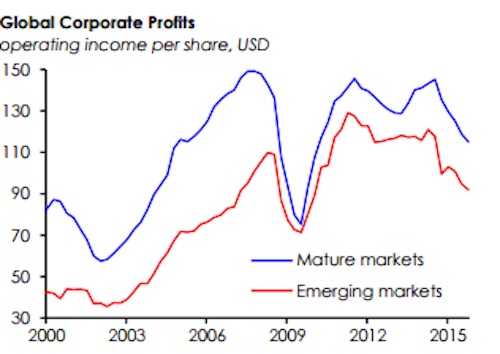
Just months later, a chastened Alexis Tsipras, the far-left prime minister who made his political bones railing against two similar EU rescues, won re-election promising to implement the harsh fiscal measures included in a third programme. European Commission officials were touting Mr Tsipras as a changed man; shorn of his ornery finance minister Yanis Varoufakis, Brussels convinced itself that the long-time radical had transformed into a diligent economic reformer. But they overlooked the political realities in Athens — not to mention the financial realities of the bailout. In fact, last summer’s deal was less a cure-all for Greece’s economic woes than a collective kicking of the can down the road. It avoided default by loaning Athens €13bn very quickly in exchange for a narrowly focused set of pension and tax reforms.

Even then, much of the heavy lifting was put off until the new programme’s first quarterly review — including the politically combustible issue of debt relief. As if to underline how ephemeral the deal was, the International Monetary Fund made clear it was not participating and would put off any decision on whether to join until it was certain Mr Tsipras, who had become the first leader of a developed country to default on an IMF payment, would live up to his commitments. That first quarterly review has now stretched into two additional quarters, and the three-dimensional stand-off between Athens, Berlin and the IMF has only deepened. While the IMF has demanded a restructuring of Greece’s debts, Germany has suddenly decided that no debt relief is needed at all. Still, it has insisted the IMF participate anyway.

Meanwhile, the IMF has decided the agreement reached in July was badly constructed and should have lower budget surplus targets. As for Mr Tsipras, he has returned to an angry, defensive crouch, railing against outside forces. There is little political capacity in Athens to push through additional reforms or spending cuts even if Mr Tsipras wanted to. “Europe’s politicians have been distracted with other challenges and markets have become complacent about the inherent risks in Greece’s new bailout,” said Mujtaba Rahman, head of European analysis at the Eurasia Group risk consultancy. “But if Berlin doesn’t revise its approach, this is going to blow up in everyone’s faces.”

The players, the arguments and even the choreography have changed little since last year. But the consequences of failure may have. A year ago, EU leaders felt confident they had ringfenced Greece and that a Grexit, while severely damaging to the Greek economy, would have little impact on the rest of the eurozone. Now, however, they are deeply worried about the prospect of a failed EU member state with 50,000 Syrian, Iraqi and Afghan refugees stuck in deteriorating camps — a state the rest of the bloc is looking to as a front line against the influx of migrants into Europe.

Read more …

Succumbing to sadists.

• Lenders Tell Greece To Prepare Contingency Package Of Extra Reforms (R.)

International lenders asked Greece on Friday to prepare a package of additional savings measures which would be passed into law now but implemented only if needed, to make sure the country reaches agreed fiscal targets. Once agreed, the set of contingent reforms, together with measures already under negotiation, would enable the disbursement of new loans to Athens and pave the way for debt relief. The idea of a contingency package appears to end a long dispute between the eurozone and the IMF over whether Greece’s current reforms are enough. “We came to the conclusion that the policy package should include a contingent package of additional measures that would be implemented only if necessary to reach the primary surplus target for 2018,” the chairman of euro zone finance ministers Jeroen Dijsselbloem told a news conference in Amsterdam after the ministers met.

The contingency measures needed to be “credible, legislated up-front, automatic and based on objective factors.” Greek Finance Minister Euclid Tsakalotos said Athens could not legislate “contingent measures” as Greek law did not allow it. But Dijsselbloem said a way would be found. “We need to work on how that mechanism is going to look like. Of course if there are legal constraints we can’t and won’t break legal constraints. We will design it in a way that delivers credibility …and (is) legally possible,” Dijsselbloem told a news conference. The contingency package is to produce savings of 2% of GDP, on top of savings of 3% that are to come from reforms under negotiation now, Dijsselbloem said. The amount is the difference between euro zone and IMF forecasts of what primary surplus Greece is likely to achieve in 2018.

The current reforms include a pension and income tax reform, the setting up of a privatization fund and a scheme to deal with bad loans. The content of the contingency set is not decided yet. Agreement on both reform packages – the regular and the contingent one – would mean euro zone ministers would meet again on Thursday to approve the deal and have a “serious discussion” on debt relief for Greece. The prospect of debt talks may encourage Athens to back the new package, and lenders reminded their Greek counterparts that there are time constraints. “The liquidity situation is becoming tight, there are debt service payments … there is a risk that the government may have to accumulate domestic arrears again,” the head of the euro zone bailout fund Klaus Regling said.

Read more …

It’s of little use to see this from an economic point of view; it makes no sense in that context. It’s purely a political power game, and economics are a side show at best.

• The Economic Consequences Of The Eurozone (Coppola)

The latest round of Greek bailout negotiations is going anything but smoothly. In fact, the growing rift between Greece’s European creditors – notably Germany – and the IMF threatens to derail them completely. The IMF estimates that the proposed 3.5% primary surplus would turn out to be more like 1.5%, making debt relief essential. But Germany insists that a 3.5% of GDP primary surplus could be sustained indefinitely with the right reforms and no debt relief will be needed. Deadlock. But now we learn that an additional set of “contingent reforms” is to be imposed on Greece. The draft Memorandum of Understanding already specifies spending cuts and tax rises to the tune of 3% of GDP: the new set would make savings of a further 2% of GDP. These contingent measures are currently unspecified: apparently the Greek government is to propose them.

Once specified, they would be passed into law by the Greek government, though they would not come into force unless “needed” (i.e. if Greece missed its fiscal targets). But of one thing we can be certain. They will not be reforms aimed at restoring the Greek economy. No, their sole purpose will be to extract yet more money from Greek households and businesses, to the detriment of the health and wellbeing of the Greek people and the profitability of Greek businesses. The combination of the MOU with the new measures is brutal. No way can a fiscal tightening of 3% of GDP, plus a further tightening of 2% when (not if) Greece misses its fiscal targets, do anything but further economic damage. There is no monetary offset to soften the blow, since Greece is excluded from the ECB’s QE.

A fiscal tightening of this magnitude without central bank support is the equivalent of doing major surgery without anesthetic. The patient may survive the surgery, but the pain and shock will set back its recovery by years. And the surgery is counterproductive, too. It will not ensure that the creditors get their money back more quickly. On the contrary, it may mean they never get it back. The more damage is done to Greece’s economy, the harder it will find it to pay its creditors. To quote the great American economist Irving Fisher, “The more the debtors pay, the more they owe”. Fisher’s “The Debt Deflation Theory of Great Depressions”, from which this quotation is taken, should be required reading for anyone involved in the Greek bailout negotiations. Greece’s depression is now deeper and longer-lasting than the USA’s Great Depression – and it is far from over.

Read more …

“More than 3 million people have been displaced in the Lake Chad basin – in Nigeria, Niger, Cameroon and Chad – by violence by the militant group Boko Haram..”

• Refugee, Migrant Flow From Turkey To Greece Picking Up Again (Reuters)

The numbers of migrants landing in Greece from Turkey is starting to creep up again, showing efforts to close off the route are coming under strain, the International Organization for Migration (IOM) said on Friday. Around 150 people a day had arrived over the last three days, still way off the numbers seen a month ago, the organisation added, but showing an increase since an EU deal with Turkey deal to stem the flow. “The arrivals in Greece which were down to literally zero some days this month, are beginning to creep back up,” IOM spokesman Joel Millman told a Geneva news briefing. “It could be the weather, it could be any number of things, it could be that smugglers are getting more creative.” Europe signed an agreement with Turkey last month to close off the main route into Europe for more than a million people, most fleeing war and poverty in the Middle East, Asia and Africa.

NATO sent ships into Greek and Turkish waters in the Aegean in March, though Greek Prime Minister Alexis Tsipras said on Friday that Turkish demands were hampering the mission. “It could be that there is just still a lot of demand in Turkey … people have already spent months to get to Turkey and where there is a will and where there is means, people will try to satisfy them,” Millman told the briefing. “It still shows that hermetic sealing that seemed to be happening a month ago isn’t anymore.” There were also signs of increased numbers of people from sub-Saharan Africa taking the perilous route across the Mediterranean to Europe, he said. More than 3 million people have been displaced in the Lake Chad basin – in Nigeria, Niger, Cameroon and Chad – by violence by the militant group Boko Haram, he added.

Read more …

Apr 202016
 
 April 20, 2016  Posted by at 9:43 am Finance Tagged with: , , , , , , , , ,  2 Responses »


Esther Bubley Passengers on Memphis-Chattanooga Greyhound bus 1943

• Shanghai Stocks Slide 3.6% As China Markets Tumble (MW)
• China’s Rapid Development Under Communist Party May Be Coming To An End (BBG)
• 1.3 Million Redundant Chinese Coal Workers To Be Relocated (PD)
• As Global Steel Crisis Grips, China Says March Output Was A Record (Reuters)
• Goldman Posts Weakest Results In 4 Years, Revenue Tumbles 40% (Reuters)
• Saudi $10 Billion Financial District Is Missing One Thing: Banks (BBG)
• Iran Struggles To Find Enough Ships For Oil Exports (Reuters)
• Deflation Is A Master From Germany – And The ECB Is Its Victim (Flassbeck)
• German Producer Prices Post Sharp Annual Drop (WSJ)
• EU Has Lost Favour With Citizens, EC President Juncker Warns
• How American Neocons Destroyed Mankind’s Hopes For Peace (PCR)
• A New Dark Age Looms (Gail)
• Coral Bleaching Hits 93% Of Great Barrier Reef (AFP)
• Turkish Border Guards Kill 8 Syrians Including Women And Children (DM)

“.. the market acted like it hit an air pocket.”

• Shanghai Stocks Slide 3.6% As China Markets Tumble (MW)

Chinese stocks plunged in trading, with more than 1,000 stocks in Shanghai retreating into negative territory. The Shanghai Composite Index was last down 3.6%, meaning it was headed for its biggest daily percentage drop since Feb 25., when the benchmark fell 6.4%. China’s smaller Shenzhen Composite Index plunged 4.9%, while the Nasdaq-style ChiNext benchmark dropped 5.6%. Chinese shares had mostly been trending higher since January, so Wednesday’s plunge was a jolt for traders. Overall, the Shanghai benchmark is down about 17% for the year. “What’s most scary is that everyone is guessing about what’s the negative news,” says Deng Wenyuan, analyst at Soochow Securities, “And this magnifies irrational panic mood.”

Bill Bowler, equities trader at Forsyth Barr Asia Ltd. said that once the Shanghai benchmark dipped below the 3,000 level, “the market acted like it hit an air pocket.” The benchmark was last at 2,928.25. Elsewhere in the region, stock markets were mixed. Japan’s Nikkei was up 0.1%, Hong Kong’s Hang Seng was down 1.4%, and Australia’s S&P/ASX was last up 0.4% In China, traders and analysts cited a number of possible reasons for selling, from short-term liquidity pressures to worries about less-than-stellar figures as first-quarter earnings results roll in. A lack of confidence in the recent recovery of the market hasn’t helped, they said. A total of 72 companies have been approved to go public so far this year, stoking expectation for fresh shares on the market. Analysts also expect more Chinese firms currently listed in the U.S. to return to the mainland. Both developments would put further pressure on existing shares.

Read more …

I’d say it already has.

• China’s Rapid Development Under Communist Party May Be Coming To An End (BBG)

China’s decades of rapid development under tight Communist Party control may be coming to an end, according to Roy Smith, the New York University academic who as a banker in 1990 anticipated Japan’s decline. “China has now arrived at an existential moment after nearly 40 years of extraordinary economic progress,” said Smith, who also warned about budding Japan-like financial strains ahead of the Chinese stock rout in 2015. The country’s “increasingly complex and troubled economic and social system with all its scarcities” will make it tougher for Communist cadres to manage, he said. While President Xi Jinping committed in 2013 to giving markets a “decisive” role in steering the economy, much of the financial system remains dominated by state-owned lenders directing credit toward the leadership’s preferred borrowers.

Restrictive social policies limiting services available to some urban residents who migrated from rural areas have seen little change as yet under Xi. Changes to rural property ownership rules have also been limited. And foreign companies are vocal in criticizing the lack of western-style rule of law in a country where the judicial system is under the Communist Party. Authorities need to “move much further to adopt reforms that allow the country meaningfully to be shaped by market forces in the future,” said Smith, who specializes in international banking and finance at NYU’s Stern School of Business. Xi “has fortified his personal power base to be able to do so, but in the end, his may be a test of whether a ‘red state’ superpower, with all its vulnerabilities, can be made to succeed and endure.”

Rising debt adds to the imperative for reform, as do demands from citizens for higher-quality and more expensive health care, improved education and pensions provision. Smith continues to see parallels with Japan’s build-up of bad loans that ended up hobbling the economy. To be sure, there are plenty of differences too. China is at a much lower stage of development compared with Japan in 1990 and, on a per-capita basis, China’s GDP in 2013 was still just half of where Japan was in 1960, according to World Bank data.

Yet overall debt has grown to almost 2.5 times the economy’s size and is showing few signs of slowing down. A fresh surge in borrowing was needed for policy makers to generate a first-quarter annual growth rate of 6.7%, keeping the pace within the government’s 2016 target of 6.5% to 7%. In Japan’s case, the economy stagnated as banks became impaired by losses in the wake of a property-bubble collapse and manufacturers shifted production overseas. It’s a tale of caution for China, according to the former Goldman Sachs Group Inc. banker. “China has followed Japan’s economic development model, and may now too be facing a financial crisis like Japan’s that it may not be able to control, and that could diminish its ability to become the next Asian superpower,” said Smith.

Read more …

Add that to the 1.8 million (?!) steel workers and before you know it you have a bit of a problem.

• 1.3 Million Redundant Chinese Coal Workers To Be Relocated (PD)

China aims to cut coal output by as much as 500 million tons in the next three to five years, the State Council said at the start of 2016. Meanwhile, China also plans to consolidate its remaining coal industry, meaning that fewer miners will be employed. Due to the cuts, 1.3 million employees have to be relocated. The central government has earmarked 100 billion yuan to support those relocation efforts. In spite of the government’s financial support, many coal miners have to give much thoughts about a relocation plan. An anonymous employee said that it forces young people to start over again, even if it isn’t so difficult to find a new job in another industry. As for employees who have already spent many years in the coal industry, they are less competitive in the job market as they have developed no other specialized skills.

In response to the current situation, China’s Ministry of Human Resources and Social Security released new guidelines for the relocation of redundant employees in China’s coal and steel industries. Local authorities and organizations are encouraged to provide the laid-off workers with free training and career guidance, and they should give workers training subsidies, the guidelines stated. Authorities have also been asked to enhance trans-regional cooperation in order to help workers relocate to regions with better employment opportunities. In addition, public welfare job opportunities will be offered to older people for whom it is more difficult to find new jobs, as well as to families suddenly lacking a primary breadwinner.

Read more …

This is turning into a full-blown trade war that nobody dares call by its name.

• As Global Steel Crisis Grips, China Says March Output Was A Record (Reuters)

Under pressure to curb steel output and relieve a global glut, China said on Tuesday its production actually hit a record high last month as rising prices, and profits, encouraged mills that had been shut or suspended to resume production. The China Iron & Steel Association (CISA) said March steel production hit 70.65 million tonnes, amounting to 834 million tonnes on an annualized basis. Traders and analysts predicted more increases in April and May. The data comes as major steel producing countries failed to agree measures to tackle an industry crisis, with differing views over the causes of overcapacity. A meeting of ministers and trade officials from over 30 countries, hosted by Belgium and the OECD on Monday, concluded only that overcapacity had to be dealt with in a swift and structural way.

Washington pointed the finger at China, saying Beijing needed to cut overcapacity or face possible trade action from other countries. “Unless China starts to take timely and concrete actions to reduce its excess production and capacity … the fundamental structural problems in the industry will remain and affected governments – including the United States – will have no alternatives other than trade action to avoid harm to their domestic industries and workers,” U.S. Secretary of Commerce Penny Pritzker and U.S. Trade Representative Michael Froman said in a statement. Asked what steps the Chinese government would take following the unsuccessful talks, Commerce Ministry spokesman Shen Danyang told reporters on Tuesday: “China has already done more than enough. What more do you want us to do?”

“Steel is the food of industry, the food of economic development. At present, the major problem is that countries that need food have a poor appetite so it looks like there’s too much food.” In a monthly report, the CISA said a recent rally in steel prices in China – up 42% so far this year – was unsustainable given the rising production, and it warned that increased protectionism in Southeast Asia and Europe would make steel exports more difficult. “The big rise in steel prices has led to a rapid reopening of capacity that had been shut or suspended … a large rise in output will not be good for the gap between market demand and supply,” the CISA said.

Read more …

When TBTF starts to fail.

• Goldman Posts Weakest Results In 4 Years, Revenue Tumbles 40% (Reuters)

Goldman Sachs reported the worst quarterly results in more than four years on Tuesday as volatile markets kept clients from trading, investing or issuing new securities. Goldman’s report wrapped up a dismal quarter for big U.S. banks. The previous day, its most comparable rival, Morgan Stanley, also said its profit fell by more than one-half due to tough markets. Goldman’s first-quarter revenues tumbled 40%, hit by sliding commodity prices, worries about the Chinese economy and uncertainty about U.S. interest rates. Profit fell even more sharply, emphasizing Goldman’s reliance on the capital markets business, particularly bond trading which can be volatile. Analysts peppered CFO Harvey Schwartz with questions about Goldman’s commitment to bond trading as well as its unusually low returns during the quarter, and his outlook for the rest of the year.

“I certainly would not sit here and tell you we were happy about this quarter,” he said. “But we will do what it takes over time to make sure that we deliver for our clients and maximize the returns for shareholders.” Goldman executives have repeatedly said they believe difficulties in trading are short term and that the business will come back. But as Wall Street approaches its sixth year of weak volumes and unexpected price swings that are hurting results, some investors are wondering how long the pain will last. Overall, Goldman’s profit fell by more than one-half from a year ago and quarterly revenue was the weakest in over four years. Highlighting the challenges, return on average common equity (ROE) – a measure of how well it uses shareholder money to generate profit – was 6.4% in the quarter, down from 14.7% a year earlier.

Read more …

Hubris rules before the fall.

• Saudi $10 Billion Financial District Is Missing One Thing: Banks (BBG)

Saudi Arabia’s $10 billion financial hub in Riyadh will have gleaming towers connected by sky bridges, cutting-edge climate technology and a monorail that can circle the whole area in 11 minutes. What it doesn’t have yet are banks. Not a single financial institution has agreed to take space in the 73 buildings the state is constructing at the King Abdullah Financial District, according to Waleed Aleisa, chief executive officer and project manager of the district at developer Al Ra’idah. The one lender on the 1.6 million square-meter (17.2 million square-foot) site north of the city center is Samba Financial Group, which bought a plot of land and is building its own tower. “Saudi banks want to own their own buildings and want to pay as little as possible,” Aliesa said in an interview.

“They don’t appreciate the brand as much as we see in the West, where banks will pay a premium to be in financial hubs.” As Saudi Arabia prepares for a post-oil future by boosting other industries, its plan to strengthen Riyadh’s position as a financial center is plagued with delays, cost overruns and a failure to understand the needs of local banks, according to Aliesa. Attracting financial clients now will be challenging given that the work, about 70% finished, has largely ground to a halt and the developer is considering replacing the main contractor. “There will be demand without a doubt, but it is still uncertain as to when the construction will be concluded,” Ramzi Darwish, a consultant with Cluttons LLC, said in an interview. “Once completed, there may be some challenges in filling all of the space because of the huge amount of offices being built.”

The government is looking at ways to lure banks with incentives that could include tax breaks lasting a decade or more as well as separate regulation that makes it easier to hire and issue work visas, Aliesa said. Al Ra’idah, which is developing the district for the Saudi Public Pension Agency, will look for another developer to take over from Saudi Bin Laden Group – which has about half of the project’s contracts by value – if the builder can’t restart construction within about two months, he said Tuesday. “What has been impacting the project progress is the project owner’s non-fulfillment of agreed contractual terms, especially those related to timely payments of our entitlements,” Saudi Bin Laden Group said by e-mail. “Our contractual position is robust and supported with the necessary evidence and documents.”

Read more …

If there’s money to be made, the ships will be there.

• Iran Struggles To Find Enough Ships For Oil Exports (Reuters)

Iran faces a struggle to increase oil exports because many of its tankers are tied up storing crude, some are not seaworthy, and foreign shipowners remain reluctant to carry its cargoes. Tehran is seeking to make up for lost trade to Europe following the lifting of EU sanctions imposed in 2011 and 2012, which deprived it of a market that accounted for over a third of its exports and left it relying completely on Asian buyers. Iran has 55-60 oil tankers in its fleet, a senior Iranian government official told Reuters. He declined to say how many were being used to store unsold cargoes, but industry sources said 25-27 tankers were parked in sea lanes close to terminals including Assaluyeh and Kharg Island for this purpose.

Asked how many tankers were not seaworthy and needed to go to dry docks for refits to meet international shipping standards, the senior official said: “Around 20 large tankers … need to be modernised.” A further 11 Iranian tankers from the fleet were carrying oil to Asian buyers on Tuesday, according to Reuters shipping data and a source who tracks tanker movements. That was broadly in line with the number consistently committed to Asian runs since sanctions were lifted in January, putting more strain on the remaining available fleet. This means foreign ships are needed for Iran’s plans for a big export push to Europe and elsewhere, to meet its target of reaching pre-sanctions sales levels this year. But many owners, who are not short of business in a booming tanker market, are unwilling to take Iranian cargoes.

The main reason is that some U.S. restrictions on Tehran remain in place and prohibit any trade in dollars or the involvement of U.S. firms including banks – a major hurdle for the oil and tanker trades, which are priced in dollars. Eight foreign tankers, carrying a total of around 8 million barrels of oil, have shipped Iranian crude to European destinations since sanctions were lifted in January, according to data from the tanker-tracking source and ship brokers. That equates to only around 10 days’ worth of sales at the levels of pre-2012, when European buyers were purchasing as much as 800,000 bpd from the OPEC producer. So far no Iranian tankers have made deliveries to Europe, according to data from the tanker-tracking source.

Read more …

Nice try, and Germany does a lot wrong, but German Christian parties did not cause deflation, which is not a European issue either, but a global one. Moreover, one can argue that German-induced austerity causes deflation, but just as well that it’s QE that causes deflation, which Germany is against.

• Deflation Is A Master From Germany – And The ECB Is Its Victim (Flassbeck)

These days, we are witnessing a tragedy of historic proportions in Europe. A country called Germany stubbornly and almost unanimously refuses to come to terms with the economic consequences of its own mistakes. It blames all the others but never accepts its own responsibility for what is happening. In particular, the Christian parties, who persuaded the German people for decades that independence of the central bank is one of the main achievements and pillars of democracy, show with their rabid attacks on the ECB and its current interest rate policy that they know no principles and that laws do not count for them when it comes to their primitive party interests. The intellectual level of these attacks is very low. The lack of intelligence and insight is being outweighed by far by their political brutality, which has recently been increasing on an almost daily basis.

The personal attacks are more and more directed towards ECB president, Mario Draghi. Where does European deflation, which makes up the core of the whole problem comes from? It is mainly because of increasing deflation that the ECB decided to lower the interest rate to zero. Did deflation fall out of the sky? Did the ECB cause it? Are other European countries responsible for it? Such simple questions should be asked in the critical media in Germany every day. Anyone who is intellectually even halfway honest can answer them immediately. Instead, the majority of the German media continue spreading platitudes, giving the impression that there is still some reason behind the madness (Der Spiegel’s long history in this is a sad case in point).


Evolution of price levels in France (green line: labour units costs; black line: the ECB inflation target; red line: prices of goods for exports; blue line: economy in total) (2).

Figures 1 and 2 show the evolution in Germany and in France. They tell you who is responsible for the deflation and the low interest rates. There is no doubt about it that it is Germany. European deflation has its origins in Germany and nowhere else.


Evolution of price levels in Germany (green line: labour units costs; black line: the ECB inflation target; red line: prices of goods for exports; blue line: economy in total) (2).

Read more …

Deflation is here to stay no matter what.

• German Producer Prices Post Sharp Annual Drop (WSJ)

The prices of goods leaving Germany’s factory gates in March registered their sharpest annual drop in over six years, pulled lower by energy prices, the Federal Statistical Office said Wednesday. Producer prices in March were unchanged from February, but fell 3.1% from March last year, the sharpest annual fall since January 2010. By comparison, economists polled by the WSJ forecast a monthly rise of 0.1%, but an annual decline of 2.9%. The data indicate there is only limited upward pressure on German consumer prices from the production side. Energy prices once again had the largest effect on producer prices, Destatis said. Excluding energy prices, which can be volatile, producer prices in Europe’s largest economy slipped 0.1% from February and declined 0.9% from March last year.

Read more …

How is this not his cue to step down?!

• EU Has Lost Favour With Citizens, EC President Juncker Warns

Europe’s citizens are increasingly abandoning the European project because the EU has interfered too much with their lives, the commission president has warned. Jean-Claude Juncker told a meeting of the Council of Europe – not an EU body – in Strasbourg that people were “stepping away” from the EU, which he said had “lost a part of its attractiveness”. Juncker said one of the reasons EU citizens were losing faith in the union was because “we are interfering in too many areas of their private lives, and in too many areas where member states are better placed to act”. European commissions had been “wrong to over-regulate and interfere too much in the lives of our citizens”, he said, stressing that the EU’s current executive was trying to cut new legislation to a minimum.

The comments were Juncker’s sharpest since his inaugural state of the union speech in September last year, when he warned the EU was “not in a good place” and that it needed to move far beyond business as usual to address the daunting political challenges facing the bloc. He told the Council of Europe on Tuesday that EU officials were not very popular at home when they pleaded the European cause, and “no longer respected” when they said the EU had to be given priority. Juncker warned that a slowing birthrate and shrinking economic potential meant Europe faced losing respect on the world stage. Europe made up 20% of the world population a century ago, but by the end of this century will account for barely 4%, he said. “We are losing economic clout in a very visible way,” the commission president said, adding that the combination of long-term decline and more immediate crises such as the refugee crisis and Islamist terror attacks left the EU facing “very tough times”.

Read more …

Vintage Paul Craig Roberts.

• How American Neocons Destroyed Mankind’s Hopes For Peace (PCR)

When Ronald Reagan turned his back on the neoconservatives, fired them, and had some of them prosecuted, his administration was free of their evil influence, and President Reagan negotiated the end of the Cold War with Soviet President Gorbachev. The military/security complex, the CIA, and the neocons were very much against ending the Cold War as their budgets, power, and ideology were threatened by the prospect of peace between the two nuclear superpowers. I know about this, because I was part of it. I helped Reagan create the economic base for bringing the threat of a new arms race to a failing Soviet economy in order to pressure the Soviets into agreement to end the Cold War, and I was appointed to a secret presidential committee with subpeona power over the CIA. The secret committee was authorized by President Reagan to evaluate the CIA’s claim that the Soviets would prevail in an arms race.

The secret committee concluded that this was the CIA’s way of perpetuting the Cold War and the CIA’s importance. The George H. W. Bush administration and its Secretary of State James Baker kept Reagan’s promises to Gorbachev and achieved the reunification of Germany with promises that NATO would not move one inch to the East. The corrupt Clintons, for whom the accumulation of riches seems to be their main purpose in life, violated the assurances given by the United States that had ended the Cold War. The two puppet presidents – George W. Bush and Obama – who followed the Clintons lost control of the US government to the neocons, who promptly restarted the Cold War, believing in their hubris and arrogance that History has chosen the US to exercise hegemony over the world.

Thus was mankind’s chance for peace lost along with America’s leadership of the world. Under neocon influence, the United States government threw away its soft power and its ability to lead the world into a harmonious existance over which American influence would have prevailed. Instead the neocons threatened the world with coercion and violence, attacking eight countries and fomenting “color revolutions” in former Soviet republics. The consequence of this crazed insanity was to create an economic and military strategic alliance between Russia and China. Without the neocons’ arrogant policy, this alliance would not exist. It was a decade ago that I began writing about the strategic alliance between Russia and China that is a response to the neocon claim of US world hegemony.

The strategic alliance between Russia and China is militarily and economically too strong for Washington. China controls the production of the products of many of America’s leading corporations, such as Apple. China has the largest foreign exchange reserves in the world. China can, if the government wishes, cause a massive increase in the American money supply by dumping its trillions of dollars of US financial assets. To prevent a collapse of US Treasury prices, the Federal Reserve would have to create trillions of new dollars in order to purchase the dumped financial instruments. The rest of the world would see another expansion of dollars without an expansion of real US output and become skeptical of the US dollar. If the world abandoned the US dollar, the US government could no longer pay its bills.

Read more …

Very interesting angle: “..as Earth warms, our historical understanding will turn obsolete faster than we can replace it with new knowledge..”

• A New Dark Age Looms (Gail)

Imagine a future in which humanity’s accumulated wisdom about Earth – our vast experience with weather trends, fish spawning and migration patterns, plant pollination and much more – turns increasingly obsolete. As each decade passes, knowledge of Earth’s past becomes progressively less effective as a guide to the future. Civilization enters a dark age in its practical understanding of our planet. To comprehend how this could occur, picture yourself in our grandchildren’s time, a century hence. Significant global warming has occurred, as scientists predicted. Nature’s longstanding, repeatable patterns – relied on for millenniums by humanity to plan everything from infrastructure to agriculture – are no longer so reliable. Cycles that have been largely unwavering during modern human history are disrupted by substantial changes in temperature and precipitation.

As Earth’s warming stabilizes, new patterns begin to appear. At first, they are confusing and hard to identify. Scientists note similarities to Earth’s emergence from the last ice age. These new patterns need many years — sometimes decades or more — to reveal themselves fully, even when monitored with our sophisticated observing systems. Until then, farmers will struggle to reliably predict new seasonal patterns and regularly plant the wrong crops. Early signs of major drought will go unrecognized, so costly irrigation will be built in the wrong places. Disruptive societal impacts will be widespread. Such a dark age is a growing possibility. In a recent report, the National Academies of Sciences, Engineering and Medicine concluded that human-caused global warming was already altering patterns of some extreme weather events.

But the report did not address the broader implication — that disrupting nature’s patterns could extend well beyond extreme weather, with far more pervasive impacts. Our foundation of Earth knowledge, largely derived from historically observed patterns, has been central to society’s progress. Early cultures kept track of nature’s ebb and flow, passing improved knowledge about hunting and agriculture to each new generation. Science has accelerated this learning process through advanced observation methods and pattern discovery techniques. These allow us to anticipate the future with a consistency unimaginable to our ancestors. But as Earth warms, our historical understanding will turn obsolete faster than we can replace it with new knowledge. Some patterns will change significantly; others will be largely unaffected, though it will be difficult to say what will change, by how much, and when.

Read more …

“..the big question is how many of these events can it handle? And I think the answer is not many more.”

• Coral Bleaching Hits 93% Of Great Barrier Reef (AFP)

Australia’s Great Barrier Reef is suffering its worst coral bleaching in recorded history with 93% of the World Heritage site affected, scientists said Wednesday as they revealed the phenomenon is also hitting the other side of the country. After extensive aerial and underwater surveys, researchers at James Cook University said only seven% of the site had escaped the whitening triggered by warmer water temperatures. “We’ve never seen anything like this scale of bleaching before,” said Terry Hughes, convenor of the National Coral Bleaching Taskforce. The damage ranges from minor in the southern areas – which are expected to soon recover – to very severe in the northern and most pristine reaches of the site which stretches along 2,300 kilometres of the east coast.

Hughes said of the 911 individual reefs surveyed, only 68 (or 7%) had escaped the massive bleaching event which has also spread south to Sydney and across the country to Western Australia. Researcher Verena Schoepf, from the University of Western Australia, said coral was already dying at a site she had recently visited off the western state’s north coast. “Some of the sites that I work at had really very severe bleaching, up to 80 to 90% of the coral bleached,” she told AFP. “So it’s pretty bad out there.” While Western Australia’s Ningaloo Marine Park appeared to have escaped damage, areas north of Broome were suffering, she said, just one day after scientists revealed coral bleaching had been detected in Sydney Harbour for the first time.

Andrew Baird, from James Cook University’s centre for coral reef studies, said the bleaching was a sign of a global problem. “It’s much bigger than just Australia,” he said, adding that there were reports of bleaching throughout Indonesia and indications it was beginning in the Maldives. But he said he had been surprised by the scale and severity of the event on the Great Barrier Reef, a major tourist drawcard which is teeming with marine life. “We’ve been expecting a really big event for a while I suppose and here it is,” he told AFP. Baird said because the bleaching was far less serious in the southern reaches “lots of the reef will still be in good shape”. “But the reef that’s been badly affected – which is a third to a half of it – is going to take a while to recover”. “And again the big question is how many of these events can it handle? And I think the answer is not many more.”

Read more …

As Europe looks away…

• Turkish Border Guards Kill 8 Syrians Including Women And Children (DM)

Eight Syrians including women and young children have been shot dead by Turkish border guards while trying to flee their war-torn homeland, it has emerged. The group of refugees were trying to cross into Turkey via a mountain smuggling group when they were gunned down by Turkish forces patrolling the border. As well as those killed, many others are said to have been injured in the firefight including one man who was shot in both of his legs while carrying his young son and another who was shot in the arm. Abdmunem Kashkash, a lawyer from Aleppo who was with the group but managed to cross into Turkey unharmed, said Turkish border guards are ‘killing unarmed people’ every day.

‘There was one little girl who was shot and we could not do more for her for four hours, until nightfall,’ he said. ‘An old man and woman are missing – they have probably been killed too.’ Those who have been injured while desperately trying to flee Syria have been taken to a hospital in Azaz – a rebel-held town next to the Turkish border where 10,000 displaced people are sheltering. The deaths appear to confirm claims made by the Human Rights Watch last week that Turkish guards of opening fire on civilians as they approached the country’s border wall with Syria.

Gerry Simpson, senior refugee researcher at Human Rights Watch, said: ‘As civilians flee ISIS fighters, Turkey is responding with live ammunition instead of compassion. ‘The whole world is talking about fighting ISIS, and yet those most at risk of becoming victims of its horrific abuses are trapped on the wrong side of a concrete wall.’ The Turkish Government has insisted that it is maintaining the same open-door policy at the frontier that it has since 2011, with free access for all Syrians whose lives are in imminent danger. However, a senior official told The Times that ‘certain restrictions may apply due to special circumstances’.

Read more …

Apr 112016


Dorothea Lange Butter bean vines across the porch, Negro quarter, Memphis, Tennessee 1938

• US Banks’ Dismal First Quarter Spells Trouble For 2016 (Reuters)
• US Faces ‘Disastrous’ $3.4 Trillion Pension Funding Hole (FT)
• Abenomics Rebuked As BlackRock Joins $46 Billion Japan Pullout (BBG)
• Beijing Risks ‘Sterling-Style’ Currency Crisis As Deflation Persists (AEP)
• Chinese Buyers Double Their Aussie Property Investments, Again (BBG)
• In BP’s Final $20 Billion Gulf Settlement, US Taxpayers Pay $15.3 Billion (F.)
• British Banks’ ‘Misconduct Bill’ Has Reached Nearly $75 Billion (Reuters)
• The 1% Hide Their Money Offshore – Then Use It To Corrupt Our Democracy (G.)
• Hit By Panama Row, Cameron Announces New Tax Evasion Law In 2016 (Reuters)
• Italy Pushes For ‘Last Resort’ Bank Rescue Fund (FT)
• Austria Regulator Imposes 54% Haircut, Long Wait On Heta Bank Creditors (R.)
• As Ukraine Collapses, Europeans Tire of Us Interventions (Ron Paul)
• State Of Emergency Over Suicide Epidemic In Canada’s First Nations (G.)
• Mass Coral Bleaching Now Affects Half Of Great Barrier Reef (G.)
• Fewer Than 0.1% Of Syrians In Turkey In Line For Work Permits (G.)
• Hundreds Hurt As Refugees Confront FYROM Border Police Tear Gas (AP)

When TBTF starts failing, watch your wallet.

• US Banks’ Dismal First Quarter Spells Trouble For 2016 (Reuters)

It is only April, but some on Wall Street are already predicting a rotten 2016 for U.S. banks. Analysts say it has been the worst start to the year since the financial crisis in 2007-2008 and expect poor first-quarter results when reporting begins this week. Concerns about economic growth in China, the impact of persistently low oil prices on the energy sector, and near-zero interest rates are weighing on capital markets activity as well as loan growth. Analysts forecast a 20% decline on average in earnings from the six biggest U.S. banks, according to Thomson Reuters I/B/E/S data. Some banks, including Goldman Sachs, are expected to report the worst results in over ten years.

This spells trouble for the financial sector more broadly, since banks typically generate at least a third of their annual revenue during the first three months of the year. “What’s concerning people is they’re saying, ‘Is this going to spill over into other quarters?'” Goldman’s Richard Ramsden said in an interview. “If you do have a significant decline in revenues, there is a limit to how much you can cut costs to keep things in equilibrium.” Investors will get some insight on Wednesday, when earnings season kicks off with JPMorgan, the country’s largest bank. That will be followed by Bank of America and Wells Fargo on Thursday, Citigroup on Friday, and Morgan Stanley and Goldman Sachs on Monday and Tuesday, respectively, in the following week.

Banks have been struggling to generate more revenue for years, while adapting to a panoply of new regulations that have raised the cost of doing business substantially. The biggest challenge has been fixed-income trading, where heavy capital requirements, new derivatives rules, and restrictions on proprietary trading have made it less profitable, leading most banks to simply shrink the business. Bank executives have already warned investors to expect major declines across other areas as well. Citigroup CFO John Gerspach said to expect trading revenue more broadly to drop 15% versus the first quarter of last year. JPMorgan’s Daniel Pinto said to expect a 25% decline in investment banking. Several bank executives have warned about declining quality of energy sector loans.

Read more …

“California, Illinois, New Jersey, Chicago and Austin, would need to put at least 20% of their revenues into their pension plans to prevent a rise in their deficits, while Nevada would have to contribute almost 40%.”

• US Faces ‘Disastrous’ $3.4 Trillion Pension Funding Hole (FT)

The US public pension system has developed a $3.4tn funding hole that will pile pressure on cities and states to cut spending or raise taxes to avoid Detroit-style bankruptcies. According to academic research shared exclusively with FTfm, the collective funding shortfall of US public pension funds is three times larger than official figures showed, and is getting bigger. Devin Nunes, a US Republican congressman, said: “It has been clear for years that many cities and states are critically underfunding their pension programmes and hiding the fiscal holes with accounting tricks.” Mr Nunes, who put forward a bill to the House of Representatives last month to overhaul how public pension plans report their figures, added: “When these pension funds go insolvent, they will create problems so disastrous that the fund officials assume the federal government will have to bail them out.”

Large pension shortfalls have already played a role in driving several US cities, including Detroit in Michigan and San Bernardino in California, to file for bankruptcy. The fear is other cities will soon become insolvent due to the size of their pension deficits. Joshua Rauh, a senior fellow at the Hoover Institution, a think-tank, and professor of finance at the Stanford Graduate School of Business, who carried out the study, said: “The pension problems are threatening to consume state and local budgets in the absence of some major changes. “It is quite likely that over a five to 10-year horizon we are going to see more bankruptcies of cities where the unfunded pension liabilities will play a large role.” The Stanford study found that the states of Illinois, Arizona, Ohio and Nevada, and the cities of Chicago, Dallas, Houston and El Paso have the largest pension holes compared with their own revenues.

In order to deal with the large funding shortfall, many cities and states will have to increase their contributions to their pension funds, either by raising taxes or cutting spending on vital services. Olivia Mitchell, a professor at the Wharton School at the University of Pennsylvania, told FTfm last month that US public pension plans face “grave difficulties”. “I do believe that US cities and towns will continue to suffer, and there will be additional bankruptcies following the examples of Detroit,” she said. Currently, states and local governments contribute 7.3% of revenues to public pension plans, but this would need to increase to an average of 17.5% of revenues to stop any further rises in the funding gap, the research said. Several cities and states, including California, Illinois, New Jersey, Chicago and Austin, would need to put at least 20% of their revenues into their pension plans to prevent a rise in their deficits, while Nevada would have to contribute almost 40%.

Read more …

“A lot of people are starting to doubt Abenomics.” Very few have ever believed in it. But there was free money to be had.

• Abenomics Rebuked As BlackRock Joins $46 Billion Japan Pullout (BBG)

For global equity investors and Shinzo Abe, it’s splitsville. Starting in the first days of 2016, foreign traders have been pulling out of Tokyo’s stock market for 13 straight weeks, the longest stretch since 1998. Overseas traders dumped $46 billion of shares as economic reports deteriorated, stimulus from the Bank of Japan backfired and the yen’s surge pressured exporters. The benchmark Topix index is down 17% in 2016, the world’s steepest declines behind Italy. Losing the faith of foreigners would be a blow to the Japanese prime minister – they’re the most active traders in a market Abe has held up as a litmus on his growth strategies. “Japan is back,” and “Buy my Abenomics!” he proclaimed during a visit to the New York Stock Exchange in September 2013, when shares were marching to an eight-year high.

Now about half of those gains are gone and BlackRock, the world’s largest money manager, is among firms ending bullish calls on Japan equities. “Japan has been disappointing,” said Nader Naeimi, Sydney-based head of dynamic markets at AMP Capital Investors, which oversees about $115 billion. He’s a long-time fan of Tokyo equities who says he’s now looking for opportunities to sell. “A lot of people are starting to doubt Abenomics.” While markets elsewhere are climbing back from a global selloff, investors in Japan see fewer reasons for optimism. Growing concern that Abenomics – the three-pronged strategy of fiscal and monetary stimulus and structural reform – is falling flat has spurred speculation the nation will slip into deflation, setting back efforts to end three decades of malaise.

Masahiro Ichikawa, a senior strategist at Sumitomo Mitsui, fears a downward spiral. Foreigners are needed to boost the stock market, and if equities don’t rise the public will lose confidence and curb spending, as he sees it. That could send Japan back into deflation. “If foreigners don’t come back, the future of Abenomics could be jeopardized,” he said.

Read more …

“Reserves will continue to fall until we devalue. Once we get towards $2 trillion the markets will start to panic. They won’t believe that the government can control it any longer..”

• Beijing Risks ‘Sterling-Style’ Currency Crisis As Deflation Persists (AEP)

A top adviser to the Chinese government has warned that Beijing risks a currency blow-up akin to Britain’s traumatic ordeal in 1992, if it continues trying to defend its exchange rate peg amid a deepening deflation crisis. Yu Hongding, a director of the Chinese Academy of Social Sciences, said China is caught in two concurrent “deflationary spirals” that are feeding on the other. A major devaluation and a blast of well-targeted fiscal stimulus will be needed to break out of the trap. “They must stop intervening on the exchange market. China needs to devalue by 15pc. They are creating conditions for speculators,” he told the Daily Telegraph, speaking at the Ambrosetti forum of global policymakers on Lake Como.

Prof Yu, a former rate-setter for the PBOC and currently a member of the national planning committee, said the government is making a serious mistake in trying to defend the yuan by burning through foreign exchange reserves, already down to $3.2 trillion from $4 trillion in mid-2014. He warned that the slowdown in capital outlows in March may prove fleeting. “Reserves will continue to fall until we devalue. Once we get towards $2 trillion the markets will start to panic. They won’t believe that the government can control it any longer,” he said. Prof Yu said Beijing had been caught off guard by the relentless slowdown over the last five years. “In 2011 we thought the economy would stabilize, and we thought the same thing in 2012, and again in 2013, and it continued to slide,” he said.

It is far from clear whether the world could handle a 15pc devaluation given the vast scale of Chinese overcapacity, or that the US Treasury and Congress would tolerate such a move. Fears of uncontrollable capital flight and a yuan devaluation were key reasons for the plunge in global equity markets earlier this year, and are clearly what prompted the US Federal Reserve to delay rate rises. The fate of China’s currency has become the most neuralgic issue in global finance. One worry is that a sharp drop in the yuan would set off a second round of ‘currency wars’ across East Asia, transmitting a deflationary shock through the international system as cheap Asian exports flooded into Western markets.

Prof Yu’s life is a remarkable story of achievement in Maoist China. He worked for ten years in a machine factory, wrestling with Marx’s Das Kapital at night before discovering western economics. He devoured Paul Samuelson’s classic text, ‘Foundations of Economic Analysis’, first in a Chinese translation and then in the original after teaching himself English, no easy feat in the Cultural Revolution. He went onto to earn a doctorate at Oxford University, and was still in England when sterling was blown out of the European Exchange Rate Mechanism in September 1992. He still recalls the exact details of the debacle, including the two desperate rate rises by the Bank of England in a single day. “The British experience is very interesting for us,” he said.

Read more …

Keeps the bubble alive until it doesn’t.

• Chinese Buyers Double Their Aussie Property Investments, Again (BBG)

Chinese appetite for property in Australia shows no sign of waning after buyers doubled investment in the nation’s homes and offices for a second straight year. Spending on Australian residential and commercial real estate rose to A$24.3 billion ($18.4 billion) in the 12 months through June 2015, up from A$12.4 billion a year earlier and A$5.9 billion in 2013, according to the Foreign Investment Review Board’s annual report. All Chinese investors in a survey conducted by KPMG and the University of Sydney want to allocate more money to Australia, a separate report showed on Monday. Real estate is fueling inflows from the world’s second largest economy, which last year overtook the U.S. as Australia’s largest foreign investor.

“Overall we are seeing a strong story of Chinese investment into Australia’s broader economy which is in line with premium products, services and lifestyle-oriented themes,” Doug Ferguson, head of KPMG Australia’s Asia and International Markets and co-author of the report, said in a statement. Purchases by foreigners, many with a connection to China, helped drive an almost 55% jump in home prices across Australia’s capital cities in the past seven years as mortgage rates dropped to five-decade lows. The rising demand has triggered community concern that locals are being priced out of the property market, prompting the government to tighten scrutiny of foreign investment.

Read more …

Like so many other things these days, perfectly legal.

• In BP’s Final $20 Billion Gulf Settlement, US Taxpayers Pay $15.3 Billion (F.)

Now that a judge has approved BP’s $20 billion settlement over the 2010 gulf oil spill, it is appropriate to look at the overall societal costs, as well as the bottom line to BP. And at tax time, people understandably think about their own taxes, too. The government struck a $20 billion settlement with BP, which is a big number. Yet BP should be able to deduct the vast majority, a whopping $15.3 billion, on its U.S. tax return. That means American taxpayers are contributing quite a lot to this settlement, whether they know it or not. BP can write off the natural resource damages payments, restoration, and reimbursement of government costs. Only $5.5 billion is labeled as a non-tax-deductible Clean Water Act penalty. One big critic of the deal is U.S. Public Interest Research Group, which often rails against tax deductions by corporate wrongdoers.

U.S. Public Interest Research Group has asked the Justice Department to deny tax deductions for BP and other corporate defendants. U.S. PIRG’s has a research report on settling for a lack of accountability that details the tax deductions corporations can claim for legal settlement. However, a change to the tax code may be the only way to get there. The proposed Truth in Settlements Act (S. 1898) would require agencies to report after-tax settlement values. Another bill, S. 1654, would restrict tax deductibility and require agencies to spell out the tax status of settlements. The present tax code allows businesses to deduct damages, even punitive damages. Restitution and other remedial payments are also fully deductible. Only certain fines or penalties are nondeductible. Even then, the rules are murky, and companies routinely deduct payments unless it is completely clear that they cannot.

Read more …

No bankers have been indicted, and no shareholder has taken them to court.

• British Banks’ ‘Misconduct Bill’ Has Reached Nearly $75 Billion (Reuters)

Lawsuits and misconduct fines have cost Britain’s largest retail banks and customer-owned lenders almost 53 billion pounds ($74.86 billion) over the past 15 years, a new study has found. The scale of the payouts has hampered banks’ efforts to rebuild capital, restricted the amount they are able to lend and reduced dividends for investors. Britain’s banks have been hit by scandals ranging from the manipulation of foreign exchange and benchmark interest rates to the mis-selling of loan insurance and complex interest-rate hedging products. While lenders have struggled to return money to shareholders because of the charges, they have continued to pay billions of pounds in bonuses to staff, the study by the independent think-tank New City Agenda said.

“The profitability of UK retail banks has been imperilled by persistent misconduct,” said John McFall, a director of New City Agenda and former Treasury Committee chairman. “This has made every citizen poorer through our pension funds and our ownership of the bailed out banks.” The report said the mis-selling of payment protection insurance alone cost banks at least 37.3 billion pounds in Britain’s costliest consumer scandal. Lloyds had to set aside 14 billion pounds to cover misconduct between 2010 and 2014, almost twice the amount of any other British lender, the report said.

Read more …

Yup, that’s how it works.

• The 1% Hide Their Money Offshore – Then Use It To Corrupt Our Democracy (G.)

Over the past 72 hours, you have seen our political establishment operating at a level of panic rarely equalled in postwar history. Britain’s prime minister has had yanked out of him some of his most intimate financial details. Complete strangers now know how much he’s inherited so far from his mum and dad, and the offshore investments from which he’s profited. Yesterday he even took the unprecedented step of revealing the taxes he’d paid over the past six years. Leaders of other parties have responded by summarily publishing their own HMRC returns. In contemporary Britain, where one’s extramarital affairs are more readily discussed in public than one’s tax affairs, this is jaw-dropping stuff. And it will not stop here.

Whatever the lazy shorthand being used by some commentators, David Cameron has not released his tax returns, but merely a summary certified by an accountants’ firm. That halfway house will hardly be enough. If Jeremy Corbyn, other senior politicians and the press keep up this level of attack, then within days more details of the prime minister’s finances will emerge. Nor will the flacks of Downing Street be able to maintain their lockdown on disclosing how many cabinet members have offshore interests: the ministers themselves will break ranks. Indeed, a few are already beginning to do so. But the risk is that all this will descend into a morass of semi-titillating detail: a string of revelations about who gave what to whom, and whether he or she then declared it to the Revenue.

The story will become about “handling” and “narrative” and individual culpability. That will be entertaining for those who like to point fingers, perplexing for those too busy to engage in the detail – and miss the wider truth revealed by the leak which forced all this into public discussion. Because at root, the Panama Papers are not about tax. They’re not even about money. What the Panama Papers really depict is the corruption of our democracy. Following on from LuxLeaks, the Panama Papers confirm that the super-rich have effectively exited the economic system the rest of us have to live in. Thirty years of runaway incomes for those at the top, and the full armoury of expensive financial sophistication, mean they no longer play by the same rules the rest of us have to follow. Tax havens are simply one reflection of that reality.

Discussion of offshore centres can get bogged down in technicalities, but the best definition I’ve found comes from expert Nicholas Shaxson who sums them up as: “You take your money elsewhere, to another country, in order to escape the rules and laws of the society in which you operate.” In so doing, you rob your own society of cash for hospitals, schools, roads… But those who exited our societies are now also exercising their voice to set the rules by which the rest of us live. The 1% are buying political influence as never before. Think of the billionaire Koch brothers, whose fortunes will shape this year’s US presidential elections. In Britain, remember the hedge fund and private equity barons, who in 2010 contributed half of all the Conservative party’s election funds – and so effectively bought the Tories their first taste of government in 18 years.

Read more …

He will have to reveal a lot more of his own finances, no matter what laws he has lying on the shelf.

• Hit By Panama Row, Cameron Announces New Tax Evasion Law In 2016 (Reuters)

British Prime Minister David Cameron will say on Monday that new legislation making companies criminally liable if employees aid tax evasion will be introduced this year, as he seeks to repair the damage from a week of questions about his personal finances. Cameron published tax records on Sunday to try and defuse criticism over his handling of the fallout from the Panama Papers, in which his late father was mentioned for setting up an offshore fund. After four carefully worded statements in four days, Cameron bowed to pressure and admitted that he had benefited from selling his share in his father’s fund in 2010. He recognized on Saturday that he had mishandled the disclosure. Cameron is leading efforts to persuade British voters to stay in the EU in a June 23 referendum that the polls suggest will be tight, and the tax row has raised concerns among the “in” camp that their cause may have been damaged.

The prime minister will attempt to regain the upper hand when he appears in the House of Commons later on Monday. “This government has done more than any other to take action against corruption in all its forms, but we will go further,” Cameron will say, according to advance excerpts of his statement circulated by his Downing Street office. “That is why we will legislate this year to hold companies who fail to stop their employees facilitating tax evasion criminally liable,” he will say. The plan had already been announced by finance minister George Osborne in March 2015, but previously the commitment was to introduce the legislation by 2020, Downing Street said. The decision to speed up that particular measure is unlikely to satisfy Cameron’s many critics in opposition parties and in some campaign groups that say Britain already has the tools it needs to crack down on tax evasion but lacks the will.

Read more …

Debt restructuring is still a four letter word in Europe.

• Italy Pushes For ‘Last Resort’ Bank Rescue Fund (FT)

Italy is rushing to cobble together an industry-led rescue to address mounting concerns over the solidity of a banking sector whose woes pose a risk to the wider eurozone economy. Finance minister Pier Carlo Padoan has called a meeting in Rome on Monday with executives from Italy’s largest financial institutions to agree final details of a “last resort” bailout plan. Yet on the eve of that gathering, concerns remain as to whether the plan will be sufficient to ringfence the weakest of Italy’s large banks, Monte dei Paschi di Siena, from contagion, according to people involved in the talks. Italian bank shares have lost almost half their value so far this year amid investor worries over a €360bn pile of non-performing loans — equivalent to about a fifth of GDP. Lenders’ profitability has been hit by a crippling three-year recession.

The plan being worked on, which could be officially announced as soon as Monday evening, recalls the Sareb bad bank created in 2012 by the Spanish government to deal with financial crisis in its smaller cajas banks, say people involved. Although the details remain under discussion, it foresees the establishment of a private vehicle that will include upwards of €5bn in equity contributions – mostly from Italy’s banks, insurers and asset managers – and then a larger debt component. The fund will then mop up shares in distressed lenders. A second vehicle will seek to buy non-performing loans at market prices. “It is a backstop fund,” said one person involved in the talks. The Italian government can provide only limited financial backing because of EU state aid rules and because it is already struggling under a public debt load that amounts to 132.5% of GDP.

The bailout marks the latest and most wide-reaching attempt by Italy to shore up confidence having already sponsored the rescue of four small banks last year and passed a law intended to speed up the sale of bad loans. Both earlier measures failed to eradicate market concerns. [..] people involved in the talks question whether the plan would have the financial scope to provide a buffer of last resort for Monte dei Paschi di Siena. Italy’s third-largest bank was the worst performer in the 2014 European stress tests, with about €170bn in assets and about €50bn in bad loans. It is considered by many bankers to be the major risk to Italian financial stability and regarded as too big to fail. “Monte Paschi is the elephant in the room,” says one of Italy’s top bankers.

Read more …

Is this an attempt to let Carinthia go broke after all?

• Austria Regulator Imposes 54% Haircut, Long Wait On Heta Bank Creditors (R.)

Austria’s financial markets regulator FMA on Sunday cut the nominal value of “bad bank” Heta Asset Resolution’s senior bonds by more than half, highlighting the long struggle creditors face for repayment if a settlement is not reached. The FMA, which is overseeing the wind-down of Heta, on Sunday announced measures including the bail-in, or haircut, of 54%, the extension of bonds’ maturities to 2023 and the cancellation of coupon payments as of March of last year.The announcement is the latest chapter in a standoff between the province of Carinthia and Heta’s creditors, many of which insist on repayment in full because their bonds were guaranteed by Carinthia, which could push the province into insolvency.

Carinthia guaranteed the bonds of local lender Hypo Alpe Adria before it collapsed and Heta was formed to wind it down. Carinthia says it cannot afford to fully honour the remaining guarantees, which the FMA put at €11.1 billion. Creditors are likely to sue Carinthia to recover the difference between what is paid out to them under Heta’s wind-down and their bonds’ full face value. The FMA put that difference at €6.4 billion, roughly three times the annual budget of Carinthia, a southern province of about 560,000 people that borders Italy and Slovenia and was long the stronghold of far-right politician Joerg Haider. The haircut’s size is based on the amount the FMA expects will be recovered from the sale of Heta’s assets by 2020.

It had said the estimate would be conservative to ensure that, if it is wide of the mark, there is extra revenue to be shared out. Only by the end of 2023 will it be possible to pay out all funds owed, the FMA said, partly in anticipation of many court cases, meaning creditors face a wait of seven years for their repayment of 46% of senior bonds’ face value. Carinthia offered to buy back the bonds it guaranteed, with loans from the Austrian government, for 75% of senior bonds’ face value, plus a last-minute sweetener by the Austrian government that brought the offer to around 82%. Too few creditors accepted the offer when it expired last month, and the question is now whether a compromise can be found or whether the dispute will be settled in court.

Read more …

Ron Paul doesn’t capture the entire picture, but from a US perspective he’s largely right.

• As Ukraine Collapses, Europeans Tire of Us Interventions (Ron Paul)

On Sunday Ukrainian prime minister Yatsenyuk resigned, just four days after the Dutch voted against Ukraine joining the European Union. Taken together, these two events are clear signals that the US-backed coup in Ukraine has not given that country freedom and democracy. They also suggest a deeper dissatisfaction among Europeans over Washington’s addiction to interventionism. According to US and EU governments – and repeated without question by the mainstream media – the Ukrainian people stood up on their own in 2014 to throw off the chains of a corrupt government in the back pocket of Moscow and finally plant themselves in the pro-west camp. According to these people, US government personnel who handed out cookies and even took the stage in Kiev to urge the people to overthrow their government had nothing at all to do with the coup.

When Assistant Secretary of State Victoria Nuland was videotaped bragging about how the US government spent $5 billion to “promote democracy” in Ukraine, it had nothing to do with the overthrow of the Yanukovich government. When Nuland was recorded telling the US Ambassador in Kiev that Yatsenyuk is the US choice for prime minister, it was not US interference in the internal affairs of Ukraine. In fact, the neocons still consider it a “conspiracy theory” to suggest the US had anything to do with the overthrow. I have no doubt that the previous government was corrupt. Corruption is the stock-in-trade of governments. But according to Transparency International, corruption in the Ukrainian government is about the same after the US-backed coup as it was before.

So the intervention failed to improve anything, and now the US-installed government is falling apart. Is a Ukraine in chaos to be considered a Washington success story? This brings us back to the Dutch vote. The overwhelming rejection of the EU plan for Ukrainian membership demonstrates the deep level of frustration and anger in Europe over EU leadership following Washington’s interventionist foreign policy at the expense of European security and prosperity. The other EU member countries did not even dare hold popular referenda on the matter – their parliaments rubber-stamped the agreement.

Brussels backs US bombing in the Middle East and hundreds of thousands of refugees produced by the bombing overwhelm Europe. The people are told they must be taxed even more to pay for the victims of Washington’s foreign policy. Brussels backs US regime change plans for Ukraine and EU citizens are told they must bear the burden of bringing an economic basket case up to European standards. How much would it cost EU citizens to bring in Ukraine as a member? No one dares mention it. But Europeans are rightly angry with their leaders blindly following Washington and then leaving them holding the bag.

Read more …

This continues to make my half-Canadian heart bleed. It’s been going on for so long.

• State Of Emergency Over Suicide Epidemic In Canada’s First Nations (G.)

A Canadian First Nation community of 2,000 people has declared a state of emergency after 11 of its members tried to take their own lives, national media reported. CTV News reported on Sunday that the remote northern community of the Attawapiskat First Nation in Ontario experienced an additional 28 suicide attempts last month. More than 100 people in the community have attempted suicide since last September, and one person died, according to CTV. The youngest was 11, the oldest 71. Charlie Angus, the local member of parliament, told the Canadian Press it was part of a “rolling nightmare” of more and more suicide attempts among young people throughout the winter. The Canadian Press said the regional First Nations government was sending a crisis response unit including social workers and mental health nurses to the community following the declaration.

The Health Canada federal agency said in a statement that it had sent two mental health counsellors as part of that unit. Attawapiskat resident Jackie Hookimaw told The Canadian Press that the epidemic started in the autumn when her 13-year-old niece Sheridan killed herself after being bullied at school. “There’s different layers of grief,” she said. “There’s normal grief, when somebody dies from illness or old age. And there’s complicated grief, where there’s severe trauma, like when somebody commits suicide.” Canadian prime minister Justin Trudeau said on Twitter: “The news from Attawapiskat is heartbreaking. We’ll continue to work to improve living conditions for all Indigenous peoples.” Another Canadian First Nation community in the western province of Manitoba appealed for federal aid last month, citing six suicides in two months and 140 suicide attempts in two weeks.

Read more …

“..three to four times worse than in 1998 or the second great bleaching in 2002.”

• Mass Coral Bleaching Now Affects Half Of Great Barrier Reef (G.)

The mass coral bleaching event smashing the Great Barrier Reef has severely affected more than half its length and caused patches of bleaching in most areas, according to scientists conducting an extensive aerial survey of the damage. “The good news with my last flight is that I found 50 reefs that weren’t bleached, so that may be the southern boundary,” said Terry Hughes from James Cook University. Hughes is the head of the national coral bleaching task force, which has been conducting flights over the length of the reef, mapping bleached areas and recording the severity of the damage. Climate change and a strong El Niño have caused hundreds of kilometres of the reef to bleach, as the higher water temperatures stress the coral, and they expel their symbiotic algae.

If the bleaching is bad enough, or the temperatures remain high for long enough, the corals die, putting the future of reefs at risk. The mass bleaching on the Great Barrier Reef is part of what the US National Oceanographic and Atmospheric Administration has called the third global bleaching event – the first occurred in 1998. Initial reports suggested only the most northern and remote areas of the Great Barrier Reef were bleaching, but as aerial surveys have continued, scientists have struggled to find a southern boundary. The latest find of a stretch of unaffected reefs around Mackay was a small piece of good news, Hughes said. But he said its significane would be unclear until reefs further south were examined. “It may be a false southern boundary,” Hughes said.

The reefs around Mackay have unusually large tides, which might have pulled in cooler water and saved the coral there. [..] Two weeks ago, the Great Barrier Reef Marine Park Authority reported half the coral in the northern parts of the reef were dead. Hughes said that was consistent with reports from divers north of Port Douglas. Hughes said this was by far the worst bleaching event to have hit the Great Barrier Reef. He said it was three to four times worse than in 1998 or the second great bleaching in 2002. Last year, the Great Barrier Reef narrowly escaped being listed as “in danger” by Unesco, even though environmental groups said it clearly met the criteria. Hughes said the “outstanding universal value” of the reef was now “severely compromised”.

Ariane Wilkinson, a lawyer at Environmental Justice Australia, said the bleaching might cause Unesco to reconsider its decision. “[Unesco] weren’t scheduled to examine the reef this year but in light of the terrible bleaching it is entirely possible that they may decide to look at the reef,” she said. “If the World Heritage system is to have any value, it must address the most serious threats to the most iconic examples of world heritage,” she said. “If any site falls into this category, it is the … Great Barrier Reef.”

Read more …

Safe third country.

• Fewer Than 0.1% Of Syrians In Turkey In Line For Work Permits (G.)

Fewer than 0.1% of Syrians in Turkey currently stand to gain the right to work under much-vaunted Turkish labour laws, undermining EU claims that the legislation excuses a recent decision to deport Syrian asylum-seekers back to Turkey. Turkish employers have allowed roughly 2,000 – or 0.074% – of Turkey’s 2.7 million Syrians to apply for work permits under new legislation enacted two months ago, according to government figures provided to aid workers at a meeting in late March. The number of permits granted has not yet been disclosed. More applications are expected in the coming months, but the statistic nevertheless highlights how the new law, enacted in January, does not offer blanket access to the labour market for all Syrians in Turkey.

Instead work permits can only be given to those who have the blessing of their employers, many of whom may still be unaware of the law, or unwilling to comply with it since it would require them to pay their employees the minimum wage. The figure was revealed in a speech to aid groups by the head of Turkey’s general directorate for migration management, who said he hoped the number would rise once more people became aware of the law. The news will complicate the new EU-Turkey deal to deport all asylum-seekers arriving to Greece back to Turkey, since the EU has justified the controversial agreement by claiming Turkey was a place that upheld internationally agreed obligations to refugees, including access to legal work. While Turkey is not a full signatory to the 1951 UN refugee convention, EU politicians have sometimes cited the January law as an example of how Turkey maintains the values of the convention by other means.

But in reality the law does not automatically offer most refugees a route out of the black market, several Syrians argued in interviews. Most problematically, the law requires an employer to give his employees a contract before they can apply for a permit. But this is an unattractive proposition for many employers, since they often employ Syrians precisely because they are easily exploited, said Hussam Orfahli, CEO of an Istanbul-based firm that helps Syrians apply for paperwork in Turkey. “If he wants you to have a work permit, then you can get it – but if he doesn’t, then you won’t,” said Orfahli, who has applied for permits on behalf of 60 wealthy clients, but has yet to hear whether any of them have been successful. “The minimum wage is 1,300 Turkish lira [£320] and most employers refuse to give contracts so that they can pay less, and don’t have to pay your health insurance.”

Read more …

Children injured by (8 hours of!) tear gas. Europe 2016.

• Hundreds Hurt As Refugees Confront FYROM Border Police (AP)

Migrants waged running battles with Macedonian police Sunday after they were stopped from scaling the border fence with Greece near the border town of Idomeni, and aid agencies reported that hundreds of stranded travelers were injured. Macedonian police used tear gas, stun grenades, plastic bullets and a water cannon to repel the migrants, many of whom responded by throwing rocks over the fence at police. Greek police observed from their side of the frontier but did not intervene. More than 50,000 refugees and migrants have been stranded in Greece after Balkan countries closed their borders to the massive flow of refugees pouring into Europe. Around 11,000 remain camped out at the border with Macedonia, ignoring instructions from the government to move to organized shelters as they hold out hope to reach Western Europe.

Clashes continued in the afternoon as migrant groups twice tried to overwhelm Macedonian border security. The increasing use of tear gas reached families in their nearby tents in Idomeni’s makeshift camp. Many camp dwellers, chiefly women and children, fled into farm fields to escape the painful gas. Observers held out hope that evening rainfall, which began about seven hours into the clashes, would dampen hostilities. The aid agency Doctors Without Borders estimated that their medical volunteers on site treated about 300 people for various injuries. Achilleas Tzemos, deputy field coordinator of Doctors Without Borders, told the AP that the injured included about 200 experiencing breathing problems from the gas, 100 others with cuts, bruises and impact injuries from nonlethal plastic bullets.

He said six of the most seriously injured were hospitalized. The clashes began soon after an estimated 500 people gathered at the fence. Many said they were responding to Arabic language fliers distributed Saturday in the camp urging people to attempt to breach the fence Sunday morning and “go to Macedonia on foot.” A five-member migrant delegation approached Macedonian police to ask whether the border was about to open. When Macedonian police replied that this wasn’t happening, more than 100, including several children, tried to scale the fence. Greece criticized the Macedonian police response as excessive. Giorgos Kyritsis, a spokesman for the government’s special commission on refugees, said Macedonian forces had deployed an “indiscriminate use of chemicals, plastic bullets and stun grenades against vulnerable people.”

Read more …

Apr 062016


Jack Delano Residents of Miss Disher’s rooming house for rail workers, Clinton, Iowa 1943

• The Global Liquidity Trap Turns More Treacherous (Minerd)
• Global Profits Recession Leaves Investors With Nowhere to Hide (BBG)
• Global Bond Yield Plunge to Record 1.3% Is Flashing Warning Sign (BBG)
• Are We Facing A Global “Lost Decade”? (Steve Keen)
• Default Tsunami Brewing (BBG)
• China’s Global Investment Spree Is Fuelled By Debt (Economist)
• China Bulls Become an Extinct Species (WSJ)
• Bond Investors Looking to Get Ahead of ECB Turn to Derivatives (BBG)
• The Panama Papers Could Hand Bernie Sanders The Keys To The White House (Ind.)
• Bernie Sanders Predicted The Panama Papers In 2011 (AHT)
• How America Became A World Leader In Tax Avoidance (Salon)
• Panama Has Company as Bank-Secrecy Holdout: America (BBG)
• Panama Secrecy Leak Claims First Casualty as Iceland PM Quits (BBG)
• Mossack Fonseca Says Data Hack Was External, Files Complaint (Reuters)
• David Cameron Left Dangerously Exposed By Panama Papers Fallout (G.)
• The Enduring Certainty Of Radical Uncertainty (John Kay)
• EU Executive To Present Steps To Tighten External Border Controls (Reuters)
• With New Deal, A Refugee’s Rights Come Down To Luck (Reuters)
• Greece Pauses Deportations As Asylum Claims Mount (AP)

Whaddaya know.. Someone other than me gets the link between money velocity and deflation. And Guggenheim’s Scott Minerd adds negative rates for good measure.

• The Global Liquidity Trap Turns More Treacherous (Minerd)

For the first time since the Great Depression, the world is in a global liquidity trap. The unintended consequence of many central banks pushing negative interest rate policy is conjuring deflationary headwinds, stronger currencies, and slower growth — the exact opposite of what struggling economies need. But when monetary policy is the only game in town, negative rates are likely to beget even more negative rates, creating a perverse cycle with important implications for investors. When central banks reduce policy rates, their objective is to stimulate growth. Lower rates are designed to spur savers to spend, redirect capital into higher-return (ie riskier) investments, and drive down borrowing costs for businesses and consumers. Additionally, lower real interest rates are associated with a weaker currency, which stimulates growth by making exports more competitive.

In short, central banks reduce borrowing costs to kindle reflationary behaviour that helps growth. But does this work when monetary policy is driven through the proverbial looking glass of negative rates? There is a strong argument that when rates go negative it squeezes the speed at which money circulates through the economy, commonly referred to by economists as the velocity of money. We are already seeing this happen in Japan where citizens are clamouring for 10,000-yen bills (and home safes to store them in). People are taking their money out of the banking system to stuff it under their metaphorical mattresses. This may sound extreme, but whether paper money is stashed in home safes or moved into transaction substitutes or other stores of value like gold, the point is it’s not circulating in the economy.

The empirical data support this view — the velocity of money has declined precipitously as policymakers have moved aggressively to reduce rates. A decline in the velocity of money increases deflationary pressure. Each dollar (or yen or euro) generates less and less economic activity, so policymakers must pump more money into the system to generate growth. As consumers watch prices decline, they defer purchases, reducing consumption and slowing growth. Deflation also lifts real interest rates, which drives currency values higher. In today’s mercantilist, beggar-thy-neighbour world of global trade, a strong currency is a headwind to exports. Obviously, this is not the desired outcome of policymakers. But as central banks grasp for new, stimulative tools, they end up pushing on an ever-lengthening piece of string.

The BOJ and the ECB are already executing massive quantitative easing programmes, but as their balance sheets expand, assets available to purchase shrink. The BoJ now buys virtually all of the Japanese government bonds that are issued every year, and has resorted to buying exchange traded funds to expand its balance sheet. The ECB continues to grow the definition of assets that qualify for purchase as sovereign debt alone cannot satisfy its appetite for QE. As options for further QE diminish, negative rates have become the shiny new tool kit of monetary policy orthodoxy. If Doctor Draghi and Doctor Kuroda do not get the outcome they want from their QE prescriptions – which is highly likely – then more negative rates will be on the way.

Read more …

Greater fools and bubbles.

• Global Profits Recession Leaves Investors With Nowhere to Hide (BBG)

The profits recession is global – and that’s bad news for the world economy and for equity markets. So say researchers at the Institute of International Finance, a Washington-based association that represents close to 500 financial institutions from 70 countries. In their April “Capital Markets Monitor,” IIF executive managing director Hung Tran and his team blamed the global decline in earnings on poor productivity growth, weak demand and a general lack of pricing power. U.S. companies also are being squeezed by rising labor costs as they add people to their payrolls. The pervasiveness of the downturn means there’s nowhere for corporations to turn. “In the past, if you had poor performance at home, you could recoup and compensate for that with overseas investment,” Tran said in an interview.

“But if you suffer declines in profits domestically and internationally, you tend to retrench.” That in turn raises the odds of an economic recession. He put the chances of a U.S. downturn within two years at around 30 to 35% due to the earnings slump, up from 20 to 25%. The prolonged profits recession makes Tran and his associates skeptical that the recent rebound in global stock markets can last. They see prices stuck in a downward trend. “With profits expected to remain under pressure for the foreseeable future, this situation will eventually exert downward pressure on equity prices,” they wrote in their report.

Read more …

Shares? No. Bonds? No.

• Global Bond Yield Plunge to Record 1.3% Is Flashing Warning Sign (BBG)

Global bond yields fell to a record, a warning sign on the worldwide economy. The yield on the Bank of America Global Broad Market Index plunged to 1.3%, the lowest level in almost 20 years of data. Bonds in the gauge have returned 3.6% in 2016, while the MSCI All Country World Index of shares has slumped 1.5%, including dividends. “This is a sign of global disinflation,” said Hideaki Kuriki at Sumitomo Mitsui Trust Asset Management. “The U.S. cannot pull up the world economy.” The Treasury 10-year note yield was little changed on Wednesday at 1.73% as of 10:19 a.m. in Tokyo, based on Bloomberg Bond Trader data. The price of the 1.625% security due in February 2026 was 99 2/32. The yield dropped to a record 1.38% in 2012. The Federal Reserve is scheduled to issue the minutes of its March 15-16 meeting Wednesday. Chair Janet Yellen said last week U.S. central bankers need to “proceed cautiously” in raising interest rates because the global economy presents heightened risks.

Read more …

Don’t think a decade will do it.

• Are We Facing A Global “Lost Decade”? (Steve Keen)

The era of low growth known as Japan’s “Lost Decade” commenced in 1990, and persists to this day. While most authors acknowledge that the seeds for the Lost Decade were sown by excessive credit growth in the preceding Bubble Economy years, only Richard Koo and Richard Werner have systematically argued that insufficient credit growth during the “Lost Decade” explains Japan’s now quarter-century long slump. Yet these arguments tell us more about the dilemmas facing today’s world economy than many more commonly accepted explanations of the current slowdown.

The insufficient credit growth story is rejected out of hand by most economists, for reasons summed up by Paul Krugman. From the perspective of mainstream economics, any event that negatively affects debtors is, to a large degree, offset by the positive effects of that event for creditors. Krugman therefore sees no possibility of Koo’s argument of “an entire economy being “balance-sheet constrained”: Maybe part of the problem is that Koo envisages an economy in which everyone is balance-sheet constrained, as opposed to one in which lots of people are balance-sheet constrained. I’d say that his vision makes no sense: where there are debtors, there must also be creditors, so there have to be at least some people who can respond to lower real interest rates even in a balance-sheet recession. (Krugman, 2013)

Koo is, however, correct: it IS possible for an entire economy to be balance-sheet constrained. Understanding why requires an appreciation of private credit creation that goes beyond the mere accounting truism that every entity’s liability is another entity’s asset. This paper will argue that the assumptions made by mainstream economists about the role of credit and banking in the economy are incorrect. When taking into account the “money creation” functions of banking, it becomes clear that the USA and most advanced economies as well as many emerging economies have joined Japan in being balance-sheet constrained, and face their own “lost decade” as a consequence of low credit growth. I will start with the empirical data and its implications, and then move on to the argument that an entire economy can be balance-sheet constrained.

Read more …

We’ve neglected emerging markets recently.

• Default Tsunami Brewing (BBG)

Investors worried by a potential second wave of defaults in the U.S. should be even more concerned about emerging markets.Moody’s Investors Service says default rates currently stand at about 4% and could soar to as high as 14.9% by the end of the year under the most pessimistic scenario, Bloomberg News reports today. Its best-case projection is a 5.05% rate.Edward Altman, New York University professor and creator of the widely used Z-Score method for predicting bankruptcies, has also forecast rising U.S. defaults this year, saying in January that recession could follow even with a rate of less than 10%, given the increase in debt since the financial crisis.

Altman, a specialist in credit markets, hasn’t been able to create successful default rate statistics for emerging markets due to a lack of historical data, he told an audience at Hong Kong University last year. However, it was safe to assume that they would normally exceed those of developed markets such as the U.S., he concluded. If that’s the case, there’s trouble on the way. According to Standard & Poor’s, emerging markets recorded their highest number of defaults for 11 years in 2015, a tally of 26. The Bank of America Merrill Lynch High Yield Emerging Markets Corporate Plus index currently comprises 696 bonds, a number that’s risen from 346 eight years ago. Based on those numbers, the delinquency rate stands at only 3.7% (though the S&P figures don’t capture the entire universe of defaults).

A study by Moody’s published in February 2009 showed that the default rate among high-yield emerging-markets issues could reach as high as 22% in the five years following severe banking and sovereign crises. So far, most countries in the asset class have suffered currency and liquidity crises but have skirted the more severe sovereign and banking kind. A further cause for concern: Fitch Ratings said in January that 24% of companies in seven of the biggest emerging markets have raised money offshore. That increases their vulnerability to weakening currencies, an issue that’s dogging Chinese issuers. Fitch also said that the share of banks and sovereign ratings on negative outlook is at the highest since 2009.

Read more …

China debt=Monopoloy money.

• China’s Global Investment Spree Is Fuelled By Debt (Economist)

[..] Chinese buyers, by and large, are far more indebted than the firms they are acquiring. Of the deals announced since the start of 2015, the median debt-to-equity ratio of Chinese buyers has been 71%, compared with 44% for the foreign targets, according to The Economist’s analysis of S&P Global Market Intelligence data. Cash cushions are generally also much thinner for Chinese buyers: their liquid assets are roughly a quarter lower than their immediate liabilities. The forbearance of their creditors makes these heavy debts more bearable in China than they would be elsewhere. But the Chinese buyers are financially stretched, all the same. Where, then, are they getting the money for the deals? For many, the answer is yet more debt. Chinese banks see lending to Chinese firms abroad as a safe way of gaining more international exposure.

The government has encouraged them to support foreign deals. As long as the firms to be acquired have strong cash flows, the banks are happy to lend against the targets’ balance-sheets, bringing debt to levels usually only seen in leveraged buy-outs. Foreign banks are also getting involved in some of the deals: HSBC, Credit Suisse, Rabobank and UniCredit are helping to arrange syndicated loans for ChemChina, which agreed to buy Syngenta, a Swiss seed and pesticide firm, for $43 billion. When the acquirers’ finances look shaky, bankers say they find solace in two things: that the deals themselves will generate returns and that the political pedigree of the buyers, especially that of state-owned companies, will protect them. “You have to trust that the acquirer has become too big to fail,” says an M&A adviser.

For the buyers, there are two strong financial rationales for the deals, albeit ones that highlight distortions in the Chinese market. First, debt-funded buyouts can actually make their debt burdens more tolerable. Take the case of Zoomlion, a construction-equipment maker with 83 times more debt than it earns before interest, tax, depreciation and amortisation. It wants to buy Terex, an American rival with debt just 3.5 times larger than its earnings, for $3.4 billion. Even if the purchase consists entirely of borrowed cash, the combined entity would still have a debt-to-earnings multiple of roughly 18, a marked improvement for Zoomlion.

Second, Chinese buyers know that one key financial metric works to their advantage: valuations in the domestic stockmarket are much higher than abroad. The median price-to-earnings ratio of Chinese buyers is 56, twice that of their targets. In effect, this means they can issue shares domestically and use the proceeds to buy what, from their perspective, are half-price assets abroad. This also gives them the firepower to outbid rivals in bidding wars. To foreign eyes, it might look like the Chinese are overpaying. But so long as their banks and shareholders are willing to stump up the cash, Chinese companies see a window of opportunity.

Read more …

Except in Beijing.

• China Bulls Become an Extinct Species (WSJ)

The definition of a China “bull” used to be those who saw the Chinese economy rushing full speed ahead into the distant future. Their vision wasn’t so far-fetched. Remember: Annual growth was still hitting double digits until 2010. As recently as 2014, Justin Lin Yifu, a former World Bank chief economist, was publicly confident that growth could roll along at 8% a year for another 20 years, with the right mix of economic overhauls to oil the wheels. The minority “bear” proposition was for a severe slowdown, somewhere in the mid-to-low single digits. An even rarer breed of “permabears” warned of collapse. How quickly calculations have changed. We haven’t yet reached the point where the former bear case has become the bull case, but we’re getting close.

At a recent workshop hosted by the Council on Foreign Relations, a nonpartisan U.S. think tank, participants—35 or so academic economists, Wall Street professionals and geopolitical strategists—lined up around three different growth scenarios for China. Only 31% chose the optimistic one, defined as 4% to 6% annual growth, dependent on leaders successfully implementing reforms; 61% foresaw a “lost decade” of 1% to 3% growth; the rest thought a so-called hard-landing, or contraction, was most likely. Of course it wasn’t a scientific survey, but what’s interesting is that apparently nobody considered the possibility that the Chinese government could deliver on its promise of “medium to fast” growth, meaning 6.5% or higher.

If the old-style bulls are virtually extinct as a species, a major reason is widespread skepticism that the Chinese leadership under President Xi Jinping is focused on economic transformation. Instead, Mr. Xi’s attention seems to be fixated on his anticorruption drive, cracking down on internal dissent, bringing the media to heel, firming up his control over the security forces and challenging the U.S. for dominance in the South China Sea. Ironically, those predicting a hard landing in the Council on Foreign Relations workshop might have had the best rationale for optimism. Michael Levi, a council fellow and one of the organizers, says this crowd thought that the economy hitting rock-bottom would galvanize the leadership into action and that China would “come out better on the other side.”

Read more …

Liquidity vacuum.

• Bond Investors Looking to Get Ahead of ECB Turn to Derivatives (BBG)

A rush for credit exposure in Europe is manifesting in the swaps market because investors are struggling to find enough bonds to satisfy their demand. The ECB’s plan to purchase corporate bonds is fueling demand for securities in anticipation of a rally when the purchases start. Investment-grade bond funds in euros had inflows each week since the ECB said on March 10 that it would expand measures to stimulate the economy. That’s already suppressed yields and made it harder to obtain the notes, making credit derivatives more attractive. Wagers on European credit-default swap indexes have more than doubled since the ECB’s announcement. Investors had sold a net $25 billion of protection as of March 25, near the highest since at least December 2013 and up from $11 billion as of March 4.

“There’s a dearth of bonds investors can get their hands on,” said Mitch Reznick at Hermes Investment Management. “In this liquidity vacuum, managers can use credit-default swaps as a proxy for the bonds that they can’t obtain in order to get longer in credit.” Investors placed the equivalent of $379 million into investment-grade bond funds in euros in the week through March 30, the fourth straight week of inflows, according to Bank of America. That helped push average borrowing costs for investment-grade companies to 1.07%, the lowest in almost a year, the bank’s bond index data show. They’re putting money into euro funds even as they withdraw from other segments, Bank of America said, citing EPFR Global data. Dollar and sterling funds had a combined $249 million of withdrawals in the period, the data show.

The ECB said it will start buying bonds from investment-grade companies in the euro area toward the end of the second quarter and investors are rushing to buy securities before then because they expect the purchases to sap liquidity and suppress yields even further. Some investors are also hoarding bonds, compounding the situation and making it more efficient to sell credit protection, Reznick said. “The quickest way to go long credit is by selling contracts tied to indexes in large size,” said Roman Gaiser at Pictet Asset Management. “That’s easier than buying lots of individual bonds. It’s a quick way of getting exposure to credit.”

Read more …

I have no such hope.

• The Panama Papers Could Hand Bernie Sanders The Keys To The White House (Ind.)

The revelation that the rich and wealthy are shovelling money in overseas tax havens is not a particularly surprising one. Nevertheless, the sheer scale of the 11.5 million document leak from Panamanian law firm Mossack Fonesca has whipped up an overdue storm and forced the issue of tax justice back on the agenda. It is likely that the Panama papers is just the tip of the iceberg, and if even more is revealed about the financial affairs of world leaders, the implication for global politics will be huge. The Democratic presidential primaries in the US have been characterised by surging anger at the global elite. The Panama papers scandal will only fuel popular indignation at the actions of perceived establishment figures – those who have stood idly by and allowed this huge miscarriage of justice to take place.

Although there have been no major American casualties over the leak at this stage, all of the presidential candidates will be questioned about the scandal. And nobody is going to be under more pressure than Hillary Clinton. For some Americans, she is the embodiment of a “global elite”, while Bernie Sanders is its antithesis. The huge leak exposes governments across the globe wilfully ignoring tax avoidance by the rich. Although Clinton has not been linked to any malfeasance in the leak, there is a sense that she is among the elite rich, some of whose members have benefited from such schemes. It has been revealed Clinton pushed through the Panama Free Trade Deal at the same time that Sanders vocally opposed it, citing research warning that it would strictly limit the government’s ability to clamp down on questionable or even illegal activity.

Even if the Clintons remain unmentioned in future tax bombshells, Sanders can continue to exploit the narrative that Clinton is part of the demographic responsible, and has assisted in flagrant abuses of the system through trade deals. As this scandal looks intent on dragging on, it is now increasingly likely that undecided voters will swing towards the Sanders camp in the vital primaries coming up, including New York. In a general election, Republican favourite Donald Trump’s alleged historic tax dodging will leave him in hot water in comparison to Sanders’ squeaky clean record. He is the only candidate who even speaks in terms of the 1% vs the 99%. Should he secure the Democratic nomination, early general election polls suggest Sanders would knock Trump out of the park.

Read more …

“Sanders has opposed all free trade agreements in recent memory, such as NAFTA and the TPP. Clinton has supported them and even criticized Sanders for his lack of support.”

• Bernie Sanders Predicted The Panama Papers In 2011 (AHT)

[..] the Panama Papers implicate 140 world leaders from 50 countries in stashing enormous sums of untaxed money in offshore shell corporations. Of course, this is part and parcel of the 1%, but the ubiquitousness shown in the leaks is astonishing. [..] No American leaders have been named in the leak as yet, but the editor of Süddeutsche Zeitung told other journalists “Just wait for what is coming next” in regards to American empire. Nevertheless, Senator and Democratic primary contender Bernie Sanders may very well have already come out ahead. In October 2011, Sanders criticized the Panama trade pact on the Senate floor.“Panama’s entire annual economic output is only $26.7 billion a year, or about two-tenths of one% of the U.S. economy. No one can legitimately make the claim that approving this free trade agreement will significantly increase American jobs.”

Sanders then asks the Senate, “why would we be considering a standalone free trade agreement with Panama?” The agreement in question, which was ultimately passed despite Sanders’ objections, is called The United States—Panama Trade Promotion Agreement (TPA). Sanders then answered his own question in a haunting premonition of things to come: “Well it turns out that Panama is a world leader when it comes to allowing wealthy Americans and large corporations to evade U.S. taxes by stashing their cash in offshore tax havens; and the Panama free trade agreement will make this bad situation much worse. Each and every year, the wealthiest people in our country and the largest corporations evade about $100 billion in U.S. taxes through abusive and illegal offshore tax havens in Panama and other countries…”

The D.C.-based progressive think tank Citizens for Tax Justice proclaims “that tax haven use is ubiquitous among America’s largest companies,” citing its volumes of research. In 2014, Fortune 500 companies held more than $2.1 trillion in accumulated profits offshore in order to evade taxes. Hillary Clinton, Sanders’ opponent in the Democratic primary, argued vehemently for the TPA in 2011. “The Free Trade Agreements passed by Congress tonight will make it easier for American companies to sell their products to South Korea, Colombia and Panama, which will create jobs here at home,” part of Clinton’s 13 October, 2011 statement read. Strangely enough, her full statement no longer exists on the State Department’s website. Sanders has opposed all free trade agreements in recent memory, such as the North American Free Trade Agreement (NAFTA) and the Trans-Pacific Partnership (TPP). Clinton has supported them and even criticized Sanders for his lack of support.

Read more …

We need a Delaware Papers.

• How America Became A World Leader In Tax Avoidance (Salon)

What we have not yet seen is any U.S. individual implicated in the leak, which seems unlikely given our stable of international wealth. The editor of Süddeutsche Zeitung, the German newspaper which first received the documents, promises there will be more to come. But one reason why Americans haven’t yet been implicated is that they already have a perfectly good place for their tax avoidance schemes: right here in the United States. While several developed countries are already moving to reduce the anonymity behind shell companies, including a public registry of “beneficial ownership” information in the United Kingdom and a directive to collect similar information throughout the European Union, the United States has resisted such transparency. According to recent research, the United States is the second-easiest country in the world to obtain an anonymous shell corporation account. (The first is Kenya.) You can create one in Delaware for your cat.

While we force foreign financial institutions to give up information on accounts held by U.S. taxpayers through the Foreign Account Tax Compliance Act of 2010, we don’t reciprocate by complying with international disclosure requirements standardized by the OECD and agreed to by 97 other nations. As a result, the U.S. is becoming one of the world’s foremost tax havens. Several states – Delaware, Nevada, South Dakota, Wyoming – specialize in incorporating anonymous shell corporations. Delaware earns between one-quarter and one-third of their budget from incorporation fees, according to Clark Gascoigne of the FACT Coalition. The appeal of this revenue has emboldened small states, and now Wyoming bank accounts are the new Swiss bank accounts. America has become a lure, not only for foreign elites looking to seal money away from their own governments, but to launder their money through the purchase of U.S. real estate.

In addition, if the United States really wanted to stop Panama or the Cayman Islands or other offshore tax havens from allowing the wealthy to avoid hundreds of billions in payments, they could do so in about 15 minutes. Our recent free trade deal with Panama allegedly prevents Americans from creating offshore tax havens there, but in general, such tax information exchanges are insufferably weak. And the little America does abroad to police tax evasion dwarfs the next to nothing we do at home. The intertwining of global and political elites makes tax avoidance, whether legal or illegal, a secondary concern for the country, regardless of how it robs the country of resources and promotes the conception of a two-tiered economic and justice system where the upper class need not follow the same rules as the rest of us. Our politicians made a consistent choice that this rampant tax avoidance doesn’t bother them.

“Anonymous shell companies have been used to rip off Medicare,” said Gascoigne. “They’ve been used to evade U.S. sanctions. Arms dealers like Viktor Bout, the so-called Merchant of Death, used U.S. shell companies to launder money.” Indeed, Mossack Fonseca has affiliated offices in Wyoming, Nevada, and Florida. America is up to its eyeballs in this style of corruption.

Read more …

“..the U.S. is just as big a secrecy jurisdiction as so many of these Caribbean countries and Panama. We should not want to be the playground for the world’s dirty money, which is what we are right now.”

• Panama Has Company as Bank-Secrecy Holdout: America (BBG)

Panama and the U.S. have at least one thing in common: Neither has agreed to new international standards to make it harder for tax evaders and money launderers to hide their money. Over the past several years, amid increased scrutiny by journalists, regulators and law enforcers, the global tax-haven landscape has shifted. In an effort to catch tax dodgers, almost 100 countries and other jurisdictions have agreed since 2014 to impose new disclosure requirements for bank accounts, trusts and some other investments held by international customers – standards issued by the OECD, a government-funded international policy group. Places like Switzerland and Bermuda are agreeing, at least in principle, to share bank account information with tax authorities in other countries.

Only a handful of nations have declined to sign on. The most prominent is the U.S. Another, Panama, is at the center of a storm over tax evasion and global cash flight that broke out over the weekend. A law firm there helped set up tens of thousands of shell companies, according to a report by the International Consortium of Investigative Journalists. ICIJ and other news organizations published reports they said showed global efforts to hide wealth, undertaken by global politicians and the ultra-rich, with the aid of banks and lawyers. The central tool: shell companies that people used to shield the identity of the owners’ assets. While such structures can be legal, they can also support efforts to avoid taxes.

The latest reporting “underscores the secrecy in Panama,” said Stefanie Ostfeld, the acting head of the U.S. office of the anti-corruption group Global Witness. “What’s lesser known, is the U.S. is just as big a secrecy jurisdiction as so many of these Caribbean countries and Panama. We should not want to be the playground for the world’s dirty money, which is what we are right now.” Advisers around the world are increasingly using the U.S. resistance to the OECD’s standards as a marketing tool — attracting overseas money to U.S. state-level tax and secrecy havens like Nevada and South Dakota, potentially keeping it hidden from their home governments.

[..] “The U.S. doesn’t follow a lot of the international standards, and because of its political power, it’s able to continue,” said Bruce Zagaris an attorney at Berliner Corcoran & Rowe who specializes in international tax and money laundering regulations. “It’s basically the only country that can continue to do that. Others like Panama have tried, but Panama can’t punch as high as the U.S.” Indeed, in a statement issued Monday by OECD secretary general Angel Gurria, the OECD said “Panama is the last major holdout that continues to allow funds to be hidden offshore from tax and law-enforcement authorities.” The statement didn’t mention the U.S., which is the OECD’s largest funder.

Read more …

Icelanders want a lot more: for the entire ruling class to be replaced.

• Panama Secrecy Leak Claims First Casualty as Iceland PM Quits (BBG)

The Panama secrecy leak claimed its first casualty after Iceland’s Prime Minister Sigmundur David Gunnlaugsson resigned following allegations he had sought to hide his wealth and dodge taxes. The decision was announced in parliament after the legislature had been the focus of street protests that attracted thousands of Icelanders angered by the alleged tax evasion efforts of their leader. Gunnlaugsson, who will step down a year before his term was due to end, gave in to mounting pressure from the opposition and even from corners of his own party. “What this exemplifies more than anything else is that there’s a growing lack of tolerance over the way that the international financial system has been gamed and rigged by corrupt elites,” Carl Dolan, director of Transparency International’s EU division, said in a phone interview from Brussels.

The Panama files, printed in newspapers around the world, showed that the 41-year-old premier and his wife had investments placed in the British Virgin Islands, which included debt in Iceland’s three failed banks. The leaked documents therefore also raise questions about Gunnlaugsson’s role in overseeing negotiations with the banks’ creditors. Ironically, the offshore investments were held while Iceland enforced capital controls. Gunnlaugsson is the second Icelandic premier to resign amid a popular uprising, after Geir Haarde was forced out following protests in 2009. Gunnlaugsson always looked to be the most vulnerable of the politicians implicated in the documents. From Moscow to Islamabad and Buenos Aires, most public figures have managed to beat off the revelations with either outrage, denial or indifference.

None of those tactics worked for Gunnlaugsson, whose first response was to walk out of an interview with Swedish TV, a clip that went viral after the leaks were published on Sunday. “The Iceland PM is the tip of the iceberg in terms of how much political instability we’ll see long-term on the basis” of the leaks, Ian Bremmer, president of the New York-based Eurasia Group, said by phone on Tuesday. Iceland’s electorate balked at the alleged tax evasion and Gunnlaugsson’s initial refusal to budge. Police on Monday erected barricades around the parliament in Reykjavik as protesters beat drums and pelted the legislature with eggs and yogurt. Almost 10,000 people gathered, according to police, while organizers said the figure was twice as high. Thousands more had signed up on Facebook to attend a second round of protests that was due to take place on Tuesday afternoon.

Read more …

Will we ever find out how these files saw the light of day?

• Mossack Fonseca Says Data Hack Was External, Files Complaint (Reuters)

The Panamanian lawyer at the center of a data leak scandal that has embarrassed a clutch of world leaders said on Tuesday his firm was a victim of a hack from outside the company, and has filed a complaint with state prosecutors. Founding partner Ramon Fonseca said the firm, Mossack Fonseca, which specializes in setting up offshore companies, had broken no laws and that all its operations were legal. Nor had it ever destroyed any documents or helped anyone evade taxes or launder money, he added in an interview with Reuters. Company emails, extracts of which were published in an investigation by the U.S.-based International Consortium of Investigative Journalists and other media organizations, were “taken out of context” and misinterpreted, he added.

“We rule out an inside job. This is not a leak. This is a hack,” Fonseca, 63, said at the company’s headquarters in Panama City’s business district. “We have a theory and we are following it,” he added, without elaborating. “We have already made the relevant complaints to the Attorney General’s office, and there is a government institution studying the issue,” he added, flanked by two press advisers. Governments across the world have begun investigating possible financial wrongdoing by the rich and powerful after the leak of more than 11.5 million documents, dubbed the “Panama Papers,” from the law firm that span four decades. The papers have revealed financial arrangements of prominent figures, including friends of Russian President Vladimir Putin, relatives of the prime ministers of Britain and Pakistan and Chinese President Xi Jinping, and the president of Ukraine.

On Tuesday, Iceland’s prime minister, Sigmundur David Gunnlaugsson, resigned, becoming the first casualty of the leak. “The (emails) were taken out of context,” Fonseca said. He lamented what he called journalistic activism and sensationalism, extolling his own investigative research credentials as a published novelist in Panama. “The only crime that has been proven is the hack,” Fonseca said. “No one is talking about that. That is the story.” France announced on Tuesday it would put the Central American nation back on its blacklist of uncooperative tax jurisdictions. Alvaro Aleman, chief of staff to President Juan Carlos Varela, told a news conference the government could respond with similar measures against France, or any other country that followed France’s lead.

Read more …

Question is, even if he held no shares: did he know what his dad did?

• David Cameron Left Dangerously Exposed By Panama Papers Fallout (G.)

David Cameron was left dangerously exposed on Tuesday after repeatedly failing to provide a clear and full account about links to an offshore fund set up by his late father, as the storm over the Panama Papers gathered strength in both the UK and elsewhere around the world. The prime minister and his office have now offered three partial answers about the fund set up by his father Ian, which avoided ever paying tax in Britain. The key unanswered question is whether the prime minister’s family stands to gain in the future from his father’s company, Blairmore, an investment fund run from the Bahamas. After Downing Street said on Monday that the fund was a “private matter”, a journalist asked Cameron about it during a visit to Birmingham on Tuesday. Cameron replied: “I own no shares, no offshore trusts, no offshore funds, nothing like that. And, so that, I think, is a very clear description.”

He dodged the key part of the question about whether he or his family stood to benefit. Having failed to satisfy reporters, Downing Street issued a further statement that Cameron’s wife and children also do not benefit from offshore funds but again left the main question about the future unanswered. The Labour leader, Jeremy Corbyn, who had called earlier in the day for an independent investigation, told the Guardian: “Three times Downing Street has been asked to provide a full and comprehensive answer. The public has a right to know the truth. “We need to know the full extent of the links between Britain and the web of tax avoidance and evasion revealed by the Panama Papers at all levels.”

[..] The row embroiling Cameron picked up pace on Tuesday morning when Corbyn responded to Downing Street’s assertion that the matter was private by telling reporters: “Well, it’s a private matter insofar as it’s a privately-held interest. But it’s not a private matter if tax is not being paid. So an investigation must take place, an independent investigation, unprejudiced, to decide whether or not tax has been paid.” Later in the day, Cameron told reporters: “In terms of my own financial affairs, I own no shares. I have a salary as prime minister and I have some savings, which I get some interest from and I have a house, which we used to live in, which we now let out while we are living in Downing Street and that’s all I have.”

Read more …

More on the nonsense prevalent in ‘mainstream’ economics. No clue about risk.

• The Enduring Certainty Of Radical Uncertainty (John Kay)

The excellent new book by Mervyn King, former governor of the Bank of England, is inevitably noticed mainly for its views on banking regulation and the outlook for the eurozone. For me the most important message of The End of Alchemy is its emphasis on radical uncertainty — or, to quote Donald Rumsfeld, former US defence secretary: “The things we do not know we do not know.” That emphasis reflects the parallel intellectual paths Lord King and I have taken since we were young dons 40 years ago. In a book published in 1976, economist Milton Friedman disparaged a tradition that “drew a sharp distinction between risk, as referring to events subject to a known or knowable probability distribution, and uncertainty, as referring to events for which it was not possible to specify numerical probabilities”.

Friedman went on: “I have not referred to this distinction because I do not believe it is valid. We may treat people as if they assigned numerical probabilities to every conceivable event.” Asked, “Who will win the war?”, Churchill might have responded, “Britain, with probability 0.7”; and Hitler with a similar answer but perhaps different number. However absurd, this is what we were taught and what we passed on to the next generation of students. It seemed an exciting time for young turks in finance; insider trading in an old-boy network was to be superseded by a new generation of quants and rocket scientists. We had the mathematical tools to revolutionise investment banking. Our theory came to underpin the risk models used in financial institutions and imposed by regulators.

But Friedman was wrong. There really are limits to the range of problems susceptible to the mathematics of classical statistics. He was, erroneously, rejecting the concept of radical uncertainty described 50 years earlier by the economists John Maynard Keynes and Frank Knight. “By uncertain knowledge,” wrote Keynes in 1921, “I do not mean merely to distinguish what is known for certain from what is only probable. The sense in which I am using the term is that in which the prospect of a European war is uncertain…There is no scientific basis to form any calculable probability whatever. We simply do not know.”

While the long-term future of interest rates or copper prices, about which Keynes also speculated, might be approached probabilistically, questions about the social system 50 years hence are too open-ended, and the outcomes too varied and insufficiently specific, to be described in probabilistic terms. A recent book on superforecasters, co-written by Philip Tetlock, illustrates the point well. By trying to turn multi-faceted questions into ones precise enough to enable those who proffer answers to be assessed for their accuracy, he makes the questions narrow and uninteresting: “How will the Syrian war develop” and “How will Europe manage its refugee crisis?” become: “How many Syrian refugees will land in Europe in 2016?”

Read more …

To get rid of refugees, the EU has no qualms about shamelessly linking them to terrorism.

• EU Executive To Present Steps To Tighten External Border Controls (Reuters)

The EU’s executive will propose on Wednesday a raft of technical measures to strengthen its external borders as it seeks to tackle both an uncontrolled influx of migrants and security threats following deadly attacks in Paris and Brussels. More than 160 people were killed in the November shooting and bombing attacks in Paris and suicide bombings in Brussels in March. The deadly strikes, claimed by Islamic State, strengthened the hand of those campaigning for tighter security checks and data sharing against those who warn of the risks of abuse and undermining privacy through enhanced surveillance. In its proposal on Wednesday, seen by Reuters ahead of official publication, the European Commission said the carnage in Paris and Brussels “brought into sharper focus the need to join up and strengthen the EU’s border management, migration and security cooperation.”

Europol chief Rob Wainwright highlighted separately on Tuesday an “indirect link” between Europe’s migration crisis, which saw more than a million people arriving over the last year, and the Islamist militant threat, saying some militants had used the chaotic migrant influx to sneak in. EU border agency Frontex also said that two of the perpetrators of the Nov. 13 attacks in Paris had entered through Greece and been registered by Greek authorities after presenting fraudulent Syrian documents. “EU citizens are known to have crossed the external border to travel to (Middle East) conflict zones for terrorist purposes and pose a risk upon their return. There is evidence that terrorists have used routes of irregular migration to enter the EU,” the Commission said in its proposal.

But the EU has a dozen-or-so different sets of fragmented databases for border management and law enforcement that are plagued with gaps and often not inter-operable. Custom authorities’ data are held largely separate. The Commission on Wednesday will therefore set out technical proposals to beef them up and improve the way they communicate with one another, including a joint search interface.

Read more …

Rich Europeans have one priority only: to remain rich and privileged.

• With New Deal, A Refugee’s Rights Come Down To Luck (Reuters)

Through a barbed wire fence, 17-year-old Syrian refugee Asma attempted to tell us about her journey to Greece. We didn’t have much time to listen. Greek police officers were breathing down our necks, threatening to arrest us unless we left. We learned that Asma traveled alone on a tiny rubber boat from Turkey, and broke her arm – still wrapped in a white bandage – when a building collapsed in her hometown of Daraa, the birthplace of the Syrian uprising. As she started to tell us about her hope for a fresh start in Germany, the policemen issued their final warning before escorting us off Moria camp’s fenced perimeter. “We’re animals now,” Asma shouted after us. “We’re no longer humans.” If Turkey is a crowded departure hall to a better life, Greece is now a transit lounge for those who’ve missed their connection.

Many will never move onward to northern Europe; others will only move backward. With more than 52,000 refugees and migrants stranded in the country, Greece has become exactly what Prime Minister Alexis Tsipras warned months ago: a “warehouse of souls.” And the new deal between the EU and Turkey, intended to stem the refugee flow into Europe, only redirects it. Under the terms of the deal, most asylum seekers who illegally travel to Greece from Turkey are to be sent back to Turkey. The first returns took place Monday at dawn. For every returnee to Turkey, a Syrian living in a Turkish refugee camp will be legally resettled by plane to EU countries. As such, a refugee’s rights come down to luck. If Asma had arrived in Greece last month, she’d likely be in Germany by now.
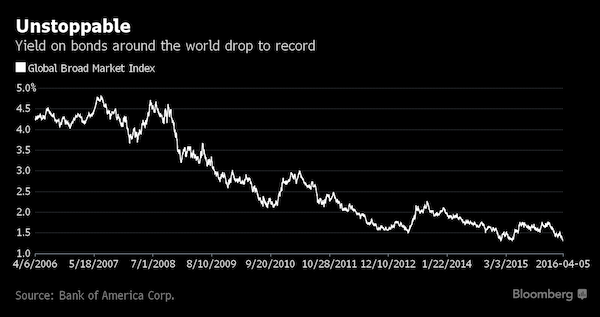
If she had arrived three weeks ago, she’d likely be trapped in a makeshift camp on the Greece-Macedonia border – not much of an upgrade, but she’d have more access to the outside world than she does in Lesbos, where more than 3,000 refugees are locked in a former military base. For refugees like her, who arrived after the deal took effect March 21, most will be sent back to Turkey; that is, unless they can individually prove Turkey is “unsafe” for them. Even many Syrians, Iraqis and Eritreans – who have special protections under international law and qualify for the EU’s official “relocation” program – will be returned to Turkey. Officials insist the deal isn’t about restricting access to asylum in Europe, but eliminating illegal smuggling routes that sent more than 1 million refugees and migrants to Europe from Turkey over the past year.

Indeed, as ferryboats carrying migrants returned to Turkey on Monday, Syrians from Turkish refugee camps were being resettled in Germany and Finland. But this “one-for-one” deal struck in Brussels – which creates a kind of human carousel – is disconnected from the reality on the ground in Greece. The deal’s byzantine complexities have sowed confusion, fear and anxiety among asylum-seekers and authorities alike. Humanitarian groups such as the United Nations refugee agency, Doctors Without Borders and Save the Children have suspended activities on several Greek islands to protest its terms. They argue that the deal turns reception centers for refugees into inhumane, de facto detention facilities.

Read more …

This is going to get so messy..

• Greece Pauses Deportations As Asylum Claims Mount (AP)

Authorities in Greece have temporarily suspended deportations to Turkey and acknowledged that most migrants and refugees detained on Greek islands have applied for asylum. The EU began sending back migrants Monday under an agreement with Turkey, but no transfers were planned Tuesday. Maria Stavropoulou, director of Greece’s Asylum Service, told state TV that some 3,000 people held in deportation camps on the islands are seeking asylum, with the application process to formally start by the end of the week. She says asylum applications typically take about three months to process, but would be “considerably faster” for those held in detention.

Read more …

Mar 272016
 
 March 27, 2016  Posted by at 11:24 am Finance Tagged with: , , , , , , , , ,  4 Responses »


NPC Pittsburg Water Heater Co., Washington DC 1920

• Hugh Hendry: “If China Devalues By 20% The World Is Over” (ZH)
• The Great Deflation: Stocks To Plunge 80-90% – Harry Dent (Maloney)
• You Are -Still- Here (ZH)
• US Banks Ramp Up Push for Home-Equity Lines (WSJ)
• China Warns Officials: No Unrest, Or Lose Your Job (WSJ)
• China Coal Use Slides Further On Weakening Industrial Demand (BBG)
• Guessing The Future Without Say’s Law (Macleod)
• Seven Ugly Latina Sisters In Deep Political Trouble (Bawerk)
• California Lawmakers, Unions Reach Deal for $15 an Hour Minimum Wage
• The Church of Economism and Its Discontents (EI)
• The State Has Lost Control: Tech Firms Now Run Western Politics (Morozov)
• Trump Questions US Position On OPEC Allies, NATO, China (NY Times)
• Greece Removes Migrants From FYROM Border Camp (AFP)
• The Bar at the End of the Road (WSJ)

Hendry finds trouble sticking to his bull position.

• Hugh Hendry: “If China Devalues By 20% The World Is Over” (ZH)

For now, as we showed just ten days ago, those short the Yuan have swung to wildly profitable to losing money as both the USD has slid and the Yuan has spiked, although both of these trades appear to be reversing now. Needless to say, Hendry disagrees with the China contrarians and believes that the way to fix the Chinese economy is through a stronger currency, even if there is no logical way how that could possibly work when China’s debt load is 350% of GDP while its NPLs are over 10% and rising.

So, borrowing form a favorite Keynesian trope, one where when the countrfactual to his prevailling – if incorrect – view of the world finally emerges, Hendry is convinced that a 20% devaluation would lead to global devastation; the same way if Paulson did not get Congress to sign off on his three page term sheet that would lead to the “apocalypse.” Only unlike Paulson who only hinted at a Mad Max world, for Hendry the alternative to him being right is a very explicit doomsday scenario, as he explains in the following excerpt from his RealVision interview:

Tomorrow we wake up and China has devalued 20%, the world is over. The world is over. Euro breaks up. The world is over. The euro breaks up. Everything hits a wall. There’s no euro in that scenario. The US economy, I mean everything hits a wall! Everything hits a wall!

The dollar strength that you imagined is devastation because you just eliminated dollars. They’re a scarce commodity. You’ve wiped them out. And China is a pariah state.

It’s a ‘Mad Max’ movie, right. OK, China gets to be the king in ‘Mad Max’ world. How appealing is that? There is no world after the tomorrow where China devalues by 20%. There is no world. Yeah, it’s looney tunes to believe that, people say, ‘oh wow, they needed to catch a break.’

Their share of world trade has never been higher. They’re facing no pressure, immense terms of trade improvement, and you would destroy world trade. World trade is down 25%. You would probably have passport restrictions, the world is over.

And while it is clear on which side of the Yuan Hugh is currently positioned (Hendry’s Eclectica is down 2.1% through March 18 and -5.9% YTD) either directly or synthetically, we can’t wait to see who is right in the end: China and its central bank (as well as Hugh Hendry) or reason and common sense (as well as some of the smartest hedge funds in the world).

Read more …

Mike Maloney’s a TAE fan.

• The Great Deflation: Stocks To Plunge 80-90% – Harry Dent (Maloney)

Read more …

Look out below.

• You Are -Still- Here (ZH)

Buybacks blacked out, option expiration ramp over, and real investors fleeing… what happens next?

Dip, Jawbone, Rip… Repeat…


And close-up…


But this time it’s different, 150 days of almost perfect correlation and co-movement means nothing – right?

Read more …

Insane that this is possible.

• US Banks Ramp Up Push for Home-Equity Lines (WSJ)

At hardware stores along the U.S. East Coast in recent weeks, TD Bank has been trying to persuade shoppers to think bigger than paint and plumbing supplies: The bank wants them to start taking cash out of their homes again. The TD Bank tour bus, equipped with a galley kitchen and iPads where homeowners can start the application process, is part of a marketing push unusual for the mortgage industry since the housing bust. As the broader mortgage market remains in the doldrums, banks are again touting home-equity lines of credit, which allow homeowners to draw down the equity in their home as they need the cash, as well as cash-out refinances, which involve taking cash out of a home while refinancing and ending up with a larger mortgage balance.

The effort is gaining steam as banks try to offset faltering mortgage originations and a refinancing wave that is fizzling out. Lenders are betting that offers for home-equity lines of credit, or helocs, will resonate with many borrowers whose home values are higher than they were just a couple of years ago and who need cash for renovations or other expenses after holding on to their homes for longer than expected. Lenders extended just over $156 billion in home-equity lines of credit last year, the largest dollar amount since 2007, the beginning of the housing bust, according to new figures from mortgage-data firm CoreLogic. That marks a 24% increase from 2014 and a 138% spike from 2010 when new approvals hit a low point. The average line amount extended to homeowners last year reached a record $119,790, according to the firm, which tracks the data back to 2002.

Read more …

No. 1 worry.

• China Warns Officials: No Unrest, Or Lose Your Job (WSJ)

In China, the timing of an announcement is sometimes more significant than the announcement itself. The Communist Party’s Central Committee and the State Council, China’s cabinet, this week warned party and state officials that they will lose their jobs if they fail to control public unrest. That’s not altogether surprising: on one level,it’s just a restatement of longstanding practice. “For more than 10 years, one of the assessment criteria for promotion of regional officials is the extent to which they can minimize protests,” said Willy Lam, a China politics analyst at the Chinese University of Hong Kong. “So most local officials pull out all stops to prevent petitioners going to Beijing.” But this week’s announcement marks the first time authorities have come up with a definitive public statement explicitly warning party and state officials “at all levels” that their jobs are on the line, state media said.

Why the urgency? The policy announcement comes two weeks after hundreds of unpaid coal workers took to the streets in the gritty northeastern city of Shuangyashan, after their provincial governor claimed a troubled coal company there did not owe its miners any wages. The governor, Lu Hao, later said he misspoke. Mr. Lu remains in office. It’s quite likely the Shuangyashan incident was pivotal in galvanizing the State Council and the party’s Central Committee, Mr. Lam and others say. The incident, widely publicized in the media, came in the thick of China’s annual meeting of its top legislature in Beijing, where Mr. Lu made his comments. At the meeting, known as the lianghui or “two sessions,” a battery of top officials including Premier Li Keqiang repeatedly vowed that they would be able to navigate a sharp slowdown in the economy without seriously affecting workers caught in the transition.

Mr. Li’s public positioning percolates through to a wide swathe of policy in the immediate wake of the congress. “In China, the political calendar doesn’t start in January – it starts with the lianghui in March,” human rights activist Hu Jia said. Government officials are likely worried that the Shuangyashan incident and others could inflict a political cost on the leadership by highlighting issues such as the deficit of labor rights in China, Mr. Hu said. Party chiefs face a difficult task. Over the next five years, they need to shut down millions of tons of industrial capacity that’s making China’s economy inefficient. This means downsizing scores of steel, coal and other large industries that currently employ hundreds of thousands of workers. They have promised to do this without large-scale layoffs. Those displaced, Mr. Li said, would be given new jobs or government assistance.

These promises now hang in the balance. The Shuangyashan incident came amid a surge in other forms of public unrest. Data from labor rights watchdog China Labour Bulletin show a 200% increase in the number of strikes, industrial action and other protests occurring in China from July last year to January this year. Disparate groups of Chinese, from jobless migrant workers to angry taxi drivers have taken to the streets to protest a new era of economic dislocation. The slowing economy has wiped out at least 156 billion yuan ($24 billion) worth of investments in wealth management products across the country, mostly involving small investors. Many of these failures have sparked public protests. Dogged by the prospect of more layoffs and deepening economic woes, the question looms: How many officials will China axe?

Read more …

Not because it wants to come clean.

• China Coal Use Slides Further On Weakening Industrial Demand (BBG)

China’s coal use is forecast to fall a third year as industrial output slows, adding force to President Xi Jinping’s drive to cut overcapacity and dimming the hopes of global miners for an uptick in demand by the world’s biggest consumer. Demand will slide 2% this year and prices will remain at a low level, according to the state-run Xinhua News Agency, citing Xu Liang, deputy secretary general of the China Coal Industry Association. Output by the world’s largest producer will also fall by 2%. Consumption has weakened amid a push to use cleaner fuels and shift a slowing economy away from heavy industry. Demand for coal, which accounted for 64% of the country’s total energy use last year, contracted 3.7% last year, following a 2.9% decline in 2014, according to the National Bureau of Statistics.

“This year’s coal situation is equally bleak,” Xinhua quoted Xu as saying. China’s easing coal appetite has helped push prices in Asia to their lowest since 2006, punishing mining companies and prompting the government to propose capacity cuts that threaten the jobs of 1.3 million coal miners. By cutting capacity in the next two to three years, production could fall to about 3.5 billion to 3.6 billion tons, balancing supply and demand, Xu said. The country aims to eliminate as much as 500 million metric tons of coal capacity by 2020, almost 9% of its total. Coal output dropped 3.3% to 3.75 billion metric tons last year, while consumption slipped to 3.965 billion tons, both sliding from record highs in 2013, according to Xu. Use of the fuel in power generation dropped 6.2% last year, while demand from industries including steel, cement and glass making declined.

Read more …

“..when an economist talks of economic growth being above or below trend, he is talking about a measure that has no place in sound economic reasoning, and that is gross domestic product.

• Guessing The Future Without Say’s Law (Macleod)

With Japanese and Eurozone interest rates becoming increasingly negative, and the Fed backing off from at least some of the planned increases in the Fed funds rate this year, economists are reassessing the interest rate outlook. Economists lack consensus, with some expecting yet more easing, based on the apparent collapse in cross-border trade last year. The fact that the Bank of Japan and the European Central Bank see fit to pursue increasingly aggressive monetary reflation is taken as evidence of underlying difficulties faced in these key economies. And lingering doubts about the sustainability of China’s credit bubble point to a high risk of a credit-induced slump in the world’s growth engine.

Other economists, citing official US data and relying on the Fed’s statements, point out that unemployment levels have more than satisfied the Fed’s target, and that core inflation has picked up to the point where the Fed would be fully justified to increase interest rates over the course of this year, or risk overheating in 2017. These two opposite camps conflict in their forecasts, but where they fundamentally differ is in expectations of future economic growth. Far from displaying the highest levels of macroeconomic discipline, their diversity of opinion should alert us that their forecasts may lack sound theoretical foundation. The purpose of reasoned theory is to reduce uncertainty, not promote it. And the explanation for most of the failures behind modern macroeconomic thinking is the substitution of market-based economics by economic planning.

The fact that today’s macroeconomics dismisses the laws of the markets, commonly referred to by economists as Say’s law, explains all. Subsequent errors confirm. The many errors are a vast subject, but they boil down to that one fateful step, and that is denying the universal truth of Say’s law. Say’s law is about the division of labour. People earn money and make profits from deploying their individual skills in the production of goods and services for the benefit of others. Despite the best attempts of Marxism and Keynesianism along with all the other isms, attempts to override this reality have always failed. The failure is not adequately reflected in government statistics, which have evolved to the point where they actually conceal it. So when an economist talks of economic growth being above or below trend, he is talking about a measure that has no place in sound economic reasoning, and that is gross domestic product.

Read more …

The CIA still has a lot of power to the south.

• Seven Ugly Latina Sisters In Deep Political Trouble (Bawerk)

Get beyond endless Latin American headlines burning column inches and you come to far broader strategic conclusion: The seven ‘ugly Latino sisters’, namely Brazil, Venezuela, Ecuador, Bolivia, Colombia, Mexico and Argentina are all deep political trouble from collapsed benchmark prices. It’s merely a case of who’s in more advanced states of political decay where left leaning governments’ can’t hang on much longer vs. those trying to buy a bit of time with more ‘centrist’ positions. In either case, it’s going to be a classic example of too little too late where the seven ugly sisters have committed at least seven deadly sins when it comes to resource mismanagement over the past decade. This isn’t about whether crisis can be avoided, but how bad the impacts will be. Another ‘lost Latino decade’ beckons. The ugliest twins are obviously Brazil and Venezuela right now.

We firmly expect Rousseff to be impeached next month on the back of endless corruption scandals, and the drastically ill-judged return of Lula that poured far more oil on corruption cover up flames. Watch for Michel Temer to take over the reins of a coalition PMDB government, busily negotiating posts behind closed doors with other players to tee up a formal Worker’s Party split to form a caretaker government through to 2018. How much Temer can get done depends on how far the outstanding ‘car wash’ scandal still rubs off on PMDB factions for major economic reforms, where the rot still runs pretty deep. Initial rhetoric (and inevitable market lifts) on supposed ‘structural reforms’ and far broader liberalisation measures remain unlikely to play through. Although it’s possible Petrobras might push through 2017 licencing rounds purely for political appearances, it’s not going to deliver tangible results in current price environments.

Dig just ‘under the salt’, and Petrobras leverage will remain high; local content even higher. Until Brazil can properly clear its electoral decks in 2018 Mr. Temer is going to have a very limited mandate. If anything, his core challenge is trying to make sure his caretaker outfit doesn’t end up ‘washed out’ day one, given Temer is by no means beyond political reproach, with the PMDB basically as corrupt as the ruling PT. The smart move for Brazil would actually be calling fresh elections with the TSE (electoral authority) invalidating the entire Rousseff-Temer 2014 ticket to put a line under what currently shapes up to be the worst commodity driven economic crash Brazil has ever experienced. Regrettably, Brazilian politics has nothing to do with national interests at this stage, and everything to do with narrow self-preservation societies.

Read more …

“..most proposals have the wage increasing about a dollar a year until it reaches $15 an hour”

• California Lawmakers, Unions Reach Deal for $15 an Hour Minimum Wage

California legislators and labor unions on Saturday reached an agreement aims to raise the state’s minimum wage to $15 from $10 an hour, a state senator said, a move that would make for the highest statewide minimum in the nation. Sen. Mark Leno (D., San Francisco) said the proposal would go before the Legislature as part of his minimum-wage bill that stalled last year. Mr. Leno didn’t confirm specifics of the agreement, but most proposals have the wage increasing about a dollar a year until it reaches $15 an hour. The Los Angeles Times, which first reported the deal, said the wage would rise to $10.50 in 2017, with subsequent increases to take it to $15 by 2022. Businesses with fewer than 25 employees would have an extra year to comply.

At $10 an hour, California already has one of the highest minimum wages in the nation along with Massachusetts. Only Washington, D.C., at $10.50 an hour is higher. The hike to $15 would make it the highest statewide wage in the nation by far, though raises are in the works in other states. The deal means the issue won’t have to go to the ballot, Mr. Leno said. One union-backed initiative has already qualified for the ballot, and a second, competing measure is also trying to qualify. Union leaders, however, said they wouldn’t immediately dispense with planned ballot measures. Sean Wherley, a spokesman for SEIU-United Healthcare Workers West, confirmed that his group was involved in the negotiations. But he said the group would continue pushing ahead with its initiative on the ballot. “Ours is on the ballot. We want to be certain of what all this is,” Mr. Wherley said.

Read more …

The Econocene.

• The Church of Economism and Its Discontents (EI)

The global human population increased from approximately 1 billion in the year 1800 to 7 billion in 2011. Over this period, the field of economics emerged, transforming political discourse. The institutional conditions for market expansion were put in place, and the success of markets suppressed myriad other ways societies have organized themselves. Economic activity per capita increased somewhere between 10 and 30-fold, resulting in a 70 to 210-fold increase in total economic activity.1 Population growth has slowed significantly in recent decades, but both economic growth through market expansion and its attendant environmental destruction have only continued.

Econocene is a fitting term for this new era because it makes us think about the expanding market economy, the ideological system that supports it, and its impact on society and the environment. Reflecting on environmental boundaries led ecological economist Herman Daly to propose limits on material throughput. Environmental economists propose taxes on greenhouse gas emissions and the creation of markets to resolve environmental conflicts. While acknowledging the importance of making markets work within the limits of nature and for the common good, I will explore how this new dominance of economic thinking, which I will call economism, has reshaped the diverse cultures of the world and come to function as a modern secular religion.

An advantage of the term Econocene is that it evokes the everyday cosmos of modern people. Artifacts of the economy—towering buildings, sprawling shopping malls, and swirling freeways—surround the 50% of the globe’s population who live in cities. A combination of smog and bright lights now obliterates the starry heavens so important to humanity’s historic consciousness and so humbling to our species’s historic sense of importance, focusing our attention on the economic constructs all around us. The cosmos reflected in the term Econocene includes not only the material artifacts of the economy, but also the market relations that bind us and define our place in the system. Urban dwellers are now fully dependent on markets for material sustenance.

They awake to radio announcers discussing supposedly significant changes in exchange rates, stock markets, and the proportion of people looking for work. The dominance of the market is not just an urban phenomenon: its “invisible hand” guides rural life as well. The crops planted reflect expected future prices, and soils reflect their history of economic use. Farmers have become so specialized that they, too, buy most of their food in supermarkets. In order to grapple with the challenges of this new era, we need to give it a name that resonates with people’s lived experiences.

Read more …

The role of Google and Facebook clearly warrants more scrutiny.

• The State Has Lost Control: Tech Firms Now Run Western Politics (Morozov)

[..] The grim reality of contemporary politics is not that it’s impossible to imagine how capitalism will end – as the Marxist critic Fredric Jameson once famously put it – but that it’s becoming equally impossible to imagine how it could possibly continue, at least, not in its ideal form, tied, however weakly, to the democratic “polis”. The only solution that seems plausible is by having our political leaders transfer even more responsibility for problem-solving, from matters of welfare to matters of warfare, to Silicon Valley. This might produce immense gains in efficiency but would this also not aggravate the democratic deficit that already plagues our public institutions? Sure, it would – but the crisis of democratic capitalism seems so acute that it has dropped any pretension to being democratic; hence the proliferation of euphemisms to describe the new normal (with Angela Merkel’s “market-conformed democracy” probably being the most popular one).

Besides, the slogans of the 1970s that were meant to bolster the democratic pillar of the compromise between capital and labour, from economic and industrial democracy to codetermination, look quaint in an era where workers of the “gig economy” cannot even unionise, let along participate in some broader management of the enterprise. There’s something even more sinister afoot though. “Buying time” no longer seems like an adequate description of what is happening, if only because technology companies, even more so than the banks, are not only too big too fail but also impossible to undo – let alone replicate – even if a new government is elected. Many of them have already taken on the de facto responsibilities of the state; any close analysis of what’s happening with “smart cities” – whereby technology firms become key gateways to essential services of our cities – easily confirms that.

In fact, technology firms are rapidly becoming the default background condition in which our politics itself is conducted. Once Google and Facebook take over the management of essential services, Margaret Thatcher’s famous dictum that “there is no alternative” would no longer be a mere slogan but an accurate description of reality. The worst is that today’s legitimation crisis could be our last. Any discussion of legitimacy presupposes not just the ability to sense injustice but also to imagine and implement a political alternative. Imagination would never be in short supply but the ability to implement things on a large scale is increasingly limited to technology giants. Once this transfer of power is complete, there won’t be a need to buy time any more – the democratic alternative will simply no longer be a feasible option.

Read more …

Some questions must be asked. If nobody else does that, you get Trump.

• Trump Questions US Position On OPEC Allies, NATO, China (NY Times)

Donald J. Trump, the Republican presidential front-runner, said that if elected, he might halt purchases of oil from Saudi Arabia and other Arab allies unless they commit ground troops to the fight against the Islamic State or “substantially reimburse” the United States for combating the militant group, which threatens their stability. “If Saudi Arabia was without the cloak of American protection,” Mr. Trump said during a 100-minute interview on foreign policy, spread over two phone calls on Friday, “I don’t think it would be around.” He also said he would be open to allowing Japan and South Korea to build their own nuclear arsenals rather than depend on the American nuclear umbrella for their protection against North Korea and China. If the United States “keeps on its path, its current path of weakness, they’re going to want to have that anyway, with or without me discussing it,” Mr. Trump said.

And he said he would be willing to withdraw United States forces from both Japan and South Korea if they did not substantially increase their contributions to the costs of housing and feeding those troops. “Not happily, but the answer is yes,” he said. Mr. Trump also said he would seek to renegotiate many fundamental treaties with American allies, possibly including a 56-year-old security pact with Japan, which he described as one-sided. In Mr. Trump’s worldview, the United States has become a diluted power, and the main mechanism by which he would re-establish its central role in the world is economic bargaining. He approached almost every current international conflict through the prism of a negotiation, even when he was imprecise about the strategic goals he sought.

He again faulted the Obama administration’s handling of the negotiations with Iran last year — “It would have been so much better if they had walked away a few times,” he said — but offered only one new idea about how he would change its content: Ban Iran’s trade with North Korea. Mr. Trump struck similar themes when he discussed the future of NATO, which he called “unfair, economically, to us,” and said he was open to an alternative organization focused on counterterrorism. He argued that the best way to halt China’s placement of military airfields and antiaircraft batteries on reclaimed islands in the South China Sea was to threaten its access to American markets. “We have tremendous economic power over China,” he argued. “And that’s the power of trade.” He did not mention Beijing’s ability for economic retaliation.

Read more …

Keep it peaceful.

• Greece Removes Migrants From FYROM Border Camp (AFP)

Greece has begun evacuating refugees from the main Idomeni camp on the Macedonia border, while the flow of refugees arriving on the Aegean islands has slowed to a trickle, officials said on Saturday. Eight buses transported around 400 refugees from Idomeni to nearby refugee camps on Friday, police sources said. A dozen more buses were waiting for migrants reluctant to leave the border, which has been shut down since earlier this month. “People who have no hope or have no money, maybe they will go. But I have hope, maybe something better will happen tomorrow, maybe today,” said 40-year-old Fatema Ahmed from Iraq, who has a 13-year-old son in Germany and three daughters with her in the camp. She said she would consider leaving the squalid Idomeni camp – where people are sheltering even on railway tracks – if the Greek government decides to give every migrant family “a simple house”.

Those persuaded to board the first buses were mainly parents with children who can no longer tolerate the difficult conditions. Janger Hassan, 29, from Iraqi Kurdistan, who has been at the Idomeni camp for a month with his wife and two young children, thinks he will probably leave. “There’s nothing to do here. “The children are getting sick. It’s a bad situation the last two days: it’s windy, sometimes it’s raining here,” he said. “We don’t have a choice. We have to move,” he said. Desperation was evident in the camp. One tent bore the slogan: “Help us open the border”. A total of 11,603 people remained at the sprawling border camp on Saturday, according to the latest official count. Giorgos Kyritsis, spokesman of the SOMP agency, which is coordinating Athens’s response to the refugee crisis, said the operation to evacuate Idomeni will intensify from Monday.

“More than 2,000 places can be found immediately for the refugees that are at the Idomeni camp and from Monday on, this number can double,” Kyritsis added, pledging to create 30,000 more places in the next three weeks in new shelters. Meanwhile, the flow of refugees arriving in Greece is slowing. Athens on Thursday said no migrants had arrived on its Aegean islands in the previous 24 hours, for the first time since the controversial EU-Turkey deal to halt the massive influx came into force at the weekend. The agreement, under which all migrants landing on the Greek islands face being sent back to Turkey, went into effect last Sunday. Despite the deal, 1,662 people arrived on Monday, but this fell to 600 on Tuesday and 260 on Wednesday.

Read more …

“Today we had little people, but if we have all the people then we will succeed.”

• The Bar at the End of the Road (WSJ)

A tiny bar in a rundown train station in a remote Greek town has become the center of the universe for the migrants stuck at the border of Macedonia. When Macedonia shut its border to Greece in early March, the Greek border town of Idomeni, once a quick stopover for migrants on route to Europe became the end of the line for many. At least for now. But that isn’t stopping many migrants from trying to make their way across the border and beyond. On a recent cold and wet few days at the camp, migrants hang out in the bar for the warmth it provides and the food and friendship it offers. People talk over chips, pizza and beer, but mostly take solace in having a temporary escape from the misery of the camp. Out of their cold, muddy tents and playing games like checkers and backgammon, or connecting with distant relatives on their phones.

Groups are usually separated by nationality, but talking about how to get out of Greece and farther into Europe is a topic everyone discusses. One morning, someone had a plan to cross a fast-flowing, ice-cold river to the border, despite the fence and increased police presence. It was a dangerous plan, but any escape would do. Someone had a printout of a map showing the route across the river all the way to the border. People study it and take photos of it. Zakaria, a migrant from Aleppo, Syria, says, “I want to continue my studies. I don’t care which country. It can be Germany or another country so long as I can continue my studies. I will wait here until I cross somehow. I would go back home to Syria if I could. Believe me I don’t want to be here, I want to be home, but I don’t even have a home there. No country and no home.”

By noon that day, hundreds of people amassed at the meeting point on the map. Following the trail through forests and fields, this group of men and women, young and old carry their belongings and eventually come to the river. The water is freezing. People are yelling and crying. Children are terrified. But they made it across. They were lucky. Earlier that morning, a separate group attempted to cross and three people reportedly died attempting the cross. After resting, they continue to the border, but are turned back by the Macedonian army. Back at the camp, they are exhausted and downtrodden, but they have the bar, and talk soon turns to finding another way to escape. Sarwar, a migrant from Lahore, Pakistan, who has been in Idomeni for 16 days and just returned from trying to cross the border says, “They stop us today but we will try again. We are many, many people and more come now. Soon we can run through the fence. Today we had little people, but if we have all the people then we will succeed.”

Read more …

Mar 142016
 
 March 14, 2016  Posted by at 9:45 am Finance Tagged with: , , , , , , , , ,  2 Responses »


John M. Fox WCBS studios, 49 East 52nd Street, NYC 1948

• Marc Faber: Central Banks Will End Up Buying All Financial Assets (CNBC)
• There’s Only One Buyer Keeping the S&P 500’s Bull Market Alive (BBG)
• The Central Bankers Are Crazy & Public is Out Of Its Mind (Armstrong)
• The Effects of a Month of Negative Rates in Japan (BBG)
• Bank Of Japan Scrambles To Find Positives In Negative Rates (Reuters)
• There Is A Limit To Draghi’s Negative Interest Rate Madness (Mish)
• The European Central Bank Has Lost The Plot On Inflation (FT)
• A Thought Experiment On Budget Surpluses (Steve Keen)
• Central Banks Beat Bitcoin At Own Game With Rival Supercurrency (AEP)
• China Debt Swap Could Leave Banks In Capital Hole (Reuters)
• China’s Next Bubble? Iron Ore Surges As Speculators Weigh In (AFP)
• China’s Growth Target Is the Next Test for Its Central Bank (BBG)
• Goldman: 4 Reasons Why Yuan Will Weaken vs Dollar (CNBC)
• Subprime Flashback: Early Defaults Are a Warning Sign for Auto Sales (WSJ)
• Key Formula for Oil Executives’ Pay: Drill Baby Drill (WSJ)
• Dairy Industry In Race To Ruin (NZH)
• Why Monsanto’s GMO Business Isn’t Growing in India (WSJ)
• February Breaks Global Temperature Records By ‘Shocking’ Amount (Guardian)
• Anti-Refugee And Pro-Refugee Parties Both Win In German Elections (Guardian)
• Bulgaria Pushes To Be Part Of EU-Turkey Refugee Deal (AFP)

Don’t know that you would call this socialism, but with the limits to negative rates, it sounds plausible.

• Marc Faber: Central Banks Will End Up Buying All Financial Assets (CNBC)

Central banks around the globe are pursuing strategies that will put all financial assets into government hands, perma-bear Marc Faber, told CNBC’s Squawk Box. He also took the opportunity to endorse Donald Trump’s bid for the U.S. presidency. Faber said central bank policies are essentially monetizing debt, particularly in Japan, where he claims the Bank of Japan is buying all the government bonds the treasury is issuing. He expects that asset buying by global central banks will only increase, even though he believes those policies aren’t working to stimulate the economy. “The central banks aren’t interested in what works, they’re interested in their own prestige. And they are so deep into it already and it didn’t work. They will increase the medicine,” said Faber, the publisher of The Gloom, Boom & Doom Report.

“Eventually, they’ll buy all the government bonds; they’ll buy all the corporate bonds, all the shares outstanding. Afterwards the housing market goes down, they’ll buy all the homes and then the government will own everything.” That’s the road to socialism, he said. “I could see a situation where at the end the government owns all the corporations and all the government bonds and then we are back into socialism, into a planning economy,” said Faber. To be sure, the Bank of Japan does not buy Japan government bonds (JGBs) directly from the treasury; it only purchases them in the open market. Since some entities, such as banks and insurers, are required to hold JGBs in their reserves, the BOJ is unlikely to acquire all of the bonds outstanding. The BOJ does, however, use its quantitative easing program to purchase select exchange traded funds (ETFs) in the open market.

The U.S. Federal Reserve began tapering its quantitative easing program in 2013 and officially ended it in late 2014. But last week, the ECB announced further easing measures, including expanding the size of its bond-buying program to 80 billion euros ($89.23 billion) worth of assets a month, to include corporate bonds. Faber expects these programs will only expand. “The governments in my view, with their agents the Federal Reserve and other central banks and with the treasury department, they will do anything not to let asset prices go down,” said Faber. “If the stock markets go down, I’m convinced all the central banks will buy stocks. All of them,” he said, noting that this is not without precedent, citing Hong Kong’s purchase of stocks during the Asian Financial Crisis in the late 1990s.

Read more …

Beware.

• There’s Only One Buyer Keeping the S&P 500’s Bull Market Alive (BBG)

Demand for U.S. shares among companies and individuals is diverging at a rate that may be without precedent, another sign of how crucial buybacks are in propping up the bull market as it enters its eighth year. Standard & Poor’s 500 Index constituents are poised to repurchase as much as $165 billion of stock this quarter, approaching a record reached in 2007. The buying contrasts with rampant selling by clients of mutual and exchange-traded funds, who after pulling $40 billion since January are on pace for one of the biggest quarterly withdrawals ever. While past deviations haven’t spelled doom for equities, the impact has rarely been as stark as in the last two months, when American shares lurched to the worst start to a year on record as companies stepped away from the market while reporting earnings.

Those results raise another question about the sustainability of repurchases, as profits declined for a third straight quarter, the longest streak in six years. “Anytime when you’re relying solely on one thing to happen to keep the market going is a dangerous situation,” said Andrew Hopkins at Wilmington Trust.. “Over time, you come to the realization, ‘Look, these companies can’t grow. Borrowing money to buy back stocks is going to come to an end.”’

Read more …

“I asked John if he slept with Karen and got his admittal!” “I told him, Oh that’s cool, I think it’s probably about time you stopped drinking.”

• The Central Bankers Are Crazy & Public is Out Of Its Mind (Armstrong)

The central bankers are simply crazy, not evil. They are trying to steer the economy by utilizing this simpleton theory that if you make something cheaper, someone will buy it. Japanese and German cars managed to get a major foothold in the U.S. because the quality of U.S. manufacturers collapsed, thanks to unions. The socialist battle against corporations forgot something important – the ultimate decision maker is the consumer. The last American car I bought in the 1970s simply caught on fire while parked in my driveway. Another friend bought a brand-new American car and there was a terrible rattle. When they took the door panel off, there was an empty bottle of Coke inside. Cheaper does not always cut it. Gee, shall we cheer if the stock market goes down by 90%? It would be a lot cheaper. Why does the same theory not apply?

Then we have the trading public. If the central bankers have gone crazy with this whole negative interest rate theory, then the public is simply out of their minds. The euro rallied because Draghi cut rates further, extended the stimulus another year, increased the amount by another 33%, and then declared rates would stay there for years to come. And these insane traders cheer. Unbelievable! They are celebrating the public admission of Draghi that all his efforts to date have failed, so let’s do even more of the same. And they love this nonsense? Negative interest rates have become simply a tax on saving money and the stupid traders and media writers love it. The Fed tries to raise rates and they say – NO! This is a stunning combination of admission and stupidity that one would expect from a pretty but clueless girl and her drunk college boyfriend who can’t say no to any girl: “I asked John if he slept with Karen and got his admittal!” “I told him, Oh that’s cool, I think it’s probably about time you stopped drinking.”

All they see is that lower interest rates “should” stimulate but ignore the fact that they never do. They are too stupid to grasp the fact that raising taxes cannot be offset by lower interest rates. People judge everything by the bottom-line and not some crazy theory that’s just stupid. A simple correlation study by a high school student in math class would prove this theory does not correlate to the expected outcome. And we cheer this insanity confirming our own overall stupidity and one is left wondering who is crazier? I suppose it is just that central bankers are crazy and the public, as well as the media, are just out of their minds.

Read more …

Bank hits.

• The Effects of a Month of Negative Rates in Japan (BBG)

The Bank of Japan shocked markets in January with negative rates. The policy had immediate effects on financial markets, even before it actually started on February 16. Although most analysts don’t expect a change on Tuesday, they are expecting the central bank eventually to cut the rate further. Here’s a look at some effects of negative rates:

About 70% of government bonds have a yield of zero or below, meaning investors are paying to hold the debt. Pushing the yield curve down to make borrowing less costly and to encourage lending is the aim of the new policy, according to Governor Haruhiko Kuroda. However, those actions are hurting the bond market, with 69% of traders in February saying market function has declined compared with three months ago, according to a BOJ survey.

A 10-year, fixed-rate home loan carried a 0.8% rate last week, down from 1.05% before the introduction of the negative rate, according to a speech by Kuroda. Japan’s three biggest banks cut their deposit rate to a record low of 0.001%, meaning you receive 10 yen (9 cents) in income on a deposit of 1 million yen. All 11 companies running money-market funds stopped accepting new investments, citing the BOJ stimulus. They plan to return money to investors, the Nikkei newspaper reported, and money from the funds is moving to deposits, according to analysts at Deutsche Bank. Deposit returns are still positive, if negligible.

Read more …

“Bank shares fell sharply.”

• Bank Of Japan Scrambles To Find Positives In Negative Rates (Reuters)

Bank of Japan officials have been scurrying to commercial banks to explain and apologize for its surprise adoption of negative interest rates in January, while Prime Minister Shinzo Abe has distanced himself from a decision that is proving unpopular with the public. Some officials close to the premier say it could cause a rift in his once close relationship with BOJ Governor Haruhiko Kuroda, whose radical stimulus measures have so far failed to lift Japan clear of two decades of deflation and stagnation. A government press relations official said there was nothing to add beyond remarks made publicly by Chief Cabinet Secretary Yoshihide Suga that no such rift exists. With the economy shrinking again and prices flat, Abe has already announced he will set up a panel to consider fresh budget spending to provide the stimulus that monetary policy has struggled to achieve.

The controversy over the negative rates move, which unlike his previous eye-catching policy steps was not welcomed by Japan’s stock market, comes even as Kuroda is on the verge of gaining greater control of the bank’s nine-member board. Two skeptics of his stimulus program are stepping down in the coming months. The diminishing returns from his preferred modus operandi of market-shocking measures will leave him little option but to revert to the drip-feed easing he derided in his predecessor Masaaki Shirakawa if inflation fails to pick up, some analysts say. “Given the confusion caused by the January move, I don’t think the BOJ will be able to cut rates again for the time being,” said Hideo Kumano, a former BOJ official who is now chief economist at Dai-ichi Life Research Institute.
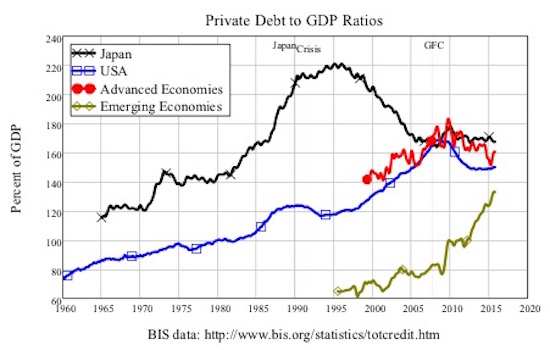
“The BOJ may instead expand asset purchases in small installments. That would be returning to the incremental approach of easing Kuroda dismissed in the past as ineffective.” Mandated by Abe to transform the risk-shy BOJ, Kuroda delighted markets and silenced skeptics within the bank by deploying a massive money-printing program, dubbed “quantitative and qualitative easing” (QQE), in April 2013. The Tokyo stock market soared and the yen tumbled, giving exporters a boost, and Japanese growth and inflation registered a pulse. He struck again in October 2014 with a big expansion of QQE, though the market boost was smaller, price rises were already moderating and the economy was taking a step back for every step forward. But the late-January rates decision failed to reverse a rise in risk-aversion that was hitting stocks and forcing up the yen, traditionally a safe haven in times of market stress. Bank shares fell sharply.
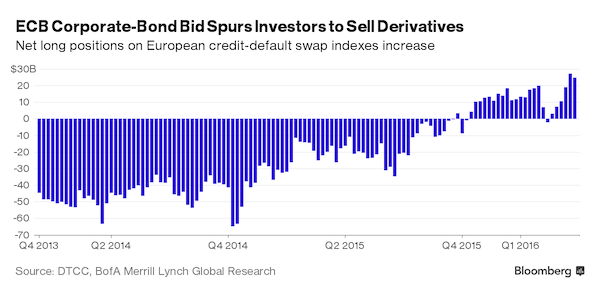
Read more …

Very clear and simple explanation of what the limits are.

• There Is A Limit To Draghi’s Negative Interest Rate Madness (Mish)

On Thursday, ECB president Mario Draghi lowered the deposit rate on money parked at the ECB to -0.4% from -0.3%. Draghi also cut the main refinancing rate by 5 basis points to 0%. How low can he go? Is there a limit? There is indeed a practical limit to negative interest rate madness, and it’s likely we have already hit that limit. Let’s investigate why. All hell would break loose if rates fell lower than -1.0%, and perhaps well before that. This has to do with Euribor. Euribor is the rate offered to prime banks on euro-denominated interbank term loans. It is based on the average interest rates of about 50 European banks that lend and borrow from each other. [..]

How does Euribor place a Limit? Millions of mortgages in Europe are based on Euribor. The vast majority of mortgage rates in Spain and Portugal are based on Euribor. A huge number in Italy are based on Euribor. The typical mortgage loan in many Eurozone countries is Euribor plus 1%age point. For those on 1-month Euribor, the interest banks collect is no longer 1%. Instead, banks collect 0.70%. Servicing fees eat into that profit. If Euribor fell below -1.0% banks would have to pay customers interest on their mortgages rather than collect interest! This has already happened in some instances, primarily related to the Swiss Franc where rates are even lower.

Low rates eat into bank profits. Such concerns place a floor on negative rates. This is why Draghi announced he is finished cutting rates. The practical limit on negative interest rates in Europe may very well be -0.4%, right where we are now. Perhaps Draghi has a buffer of another -0.20% or so, but he is reluctant to use it. If 12-month Euribor rates go any lower, it will affect bank profits on every Euribor-based mortgage loan. Loans based on 1-month and 6-month Euribor are already impacted. Draghi is unable or unwilling to go further down the interest rabbit hole, but there are still lots of rabbit hole possibilities regarding various QE measures. Corporate bonds still offer Draghi wide possibilities for more economic madness.

Read more …

“The only reason you would want to make a long-term investment at these rates is that you do not believe in the target.”

• The European Central Bank Has Lost The Plot On Inflation (FT)

Better than expected. How often have we heard these three words after a policy decision by the European Central Bank? My advice is to stop reading immediately whenever you see them. After all, what the markets expect to happen is entirely in the control of the ECB. The only thing that matters is the policy decision itself: the extent to which it can help achieve a target in this case an inflation rate of just under 2%. It may have been better than expected. But was it sufficient? The components of the decision an≠nounced on Thursday by Mario Draghi, ECB president, were: cuts in the three official interest rates; an increase in the volume of asset purchases; and more generous terms on targeted longer-term refinancing operations, a liquidity facility for banks pegged to the quantity of loans on their balance sheet.

The deposit rate, at which banks park their reserves at the central bank, is down from -0.3 to -0.4%. Mr Draghi hinted that we should not expect further cuts in that rate. And that line was the really big news of the day. He did not so much cut the rates as end the rate cuts. This is why the euro first fell then rose when investors realised this rate cut was not what it seemed. There is nothing fundamentally wrong with any of the decisions except that the ECB missed a trick. It could have widened the spread between short-term and long-term interest rates or, in financial parlance, it could have steepened the yield curve. One method would have been to make a bigger cut in the deposit rate and a smaller increase in the size of asset purchases. Since asset purchases reduce long-term rates, a small increase in purchases would have reduced them by less.

There are big problems with a flat yield curve. It is a nightmare for the banks because their business consists of turning short-term savings into long-term loans. When long rates are similar to short rates, banks find it hard to make money. They have to find other ways to generate income. Think also about the deeper meaning of a flat yield curve with all interest rates near 0%. Assume you trust Mr Draghi’s commitment to the inflation target. Would you, as a private investor, buy a 10-year corporate bond that yields 0.5%? If inflation really were to reach 2% within two or three years, you would surely make a loss. The only reason you would want to make a long-term investment at these rates is that you do not believe in the target. Long-term rates are low because people believe the ECB has lost the plot on inflation. I, too, believe this.

Read more …

Government surpluses kill economies.

• A Thought Experiment On Budget Surpluses (Steve Keen)

While conservative parties—like the USA’s Republicans, the UK’s Tories, and Australia’s Liberals,—are more emphatic on this point than their political rivals, there’s little doubt that all major political parties share the belief that the government should aim to have low government debt, to at least balance its budget, and at best to run a surplus. As the UK’s Prime Minister put it in 2013:

“Would you want a government that is not targeting a surplus in the next Parliament, that just said no, we’re going to run overdrafts all the way through the next parliament,” he told BBC political editor Nick Robinson. “I don’t think that would be responsible. So the other parties are going to have to answer this question, ‘Do you think it’s right to have a surplus?’ I do.” (David Cameron: It’s responsible to target budget surplus”, BBC October 1 2013)

So is it “right to run a surplus”? Let’s consider this via a little thought experiment. The numbers are far-fetched, but they’re chosen just to highlight the issue: Imagine an economy with an GDP of $100 per year, where the money supply is just $1—so that $100 of output each year is generated by that $1 changing hands 100 times in a year. And imagine that this country’s government has accumulated debt of $100—giving it a debt to GDP ratio of 100%—and it decides to reduce it by running a surplus that year of 1% of GDP. And imagine that it succeeds in its target. What will this country’s GDP the following year, and what will happen to the government’s debt to GDP ratio? The GDP will be zero, and the government’s debt to GDP ratio will be infinite.

Huh? The outcomes of this policy are the opposite of its intentions: a policy aimed at reducing the government’s debt to GDP ratio increased it dramatically; and what is perceived as “good economic management” actually destroys the economy. What went wrong? The target of running a surplus of 1% of GDP means that the government collects $1 more in taxes than it spends. This $1 surplus of taxation over spending takes all of the money in the economy out of circulation, leaving the population with no money at all. The physical economy is still there, but without money, no-one can buy anything, and the economy collapses. The government can pay its debt down by $1 as planned, but the GDP of the economy is now zero, so the government debt to GDP ratio has gone from $100/$100 or 100%, to $99/$0 or infinity.

As I noted, the numbers are far-fetched, but the principle is correct: a government surplus effectively destroys money. A government surplus, though it might be undertaken with the noble aim of reducing government debt, and the noble intention of helping the economy to grow, will, without countervailing forces from elsewhere in the economy, increase the government’s debt to GDP ratio, and make the economy smaller (if the rate of turnover of money—it’s so-called “velocity of circulation”—is greater than one). This little thought experiment illustrates the logical flaw in the conventional belief that running a government surplus is “good economic management”: it ignores the relationship between government spending and the money supply. Unless the public finds some other way to compensate for the effect of a government surplus on the money supply, the surplus will reduce GDP by more than it reduces government debt.

Read more …

Provocative. Let’s see how this unfolds.

• Central Banks Beat Bitcoin At Own Game With Rival Supercurrency (AEP)

Computer scientists have devised a digital crypto-currency in league with the Bank of England that could pose a devastating threat to large tranches of the financial industry, and profoundly change the management of monetary policy. The proto-currency known as RSCoin has vastly greater scope than Bitcoin, used for peer-to-peer transactions by libertarians across the world, and beyond the control of any political authority. The purpose would be turned upside down. RSCoin would be a tool of state control, allowing the central bank to keep a tight grip on the money supply and respond to crises. It would erode the exorbitant privilege of commercial banks of creating money out of thin air under a fractional reserve financial system.

“Whoever reacts too slowly to these developments is going to take it on the chin. They will lose their businesses,” said Dr George Danezis, who is working on the design at University College London. “My advice is that companies should play very close attention to what is happening, because this will not go away,” he said. Layers of middlemen in payments systems face a creeping threat across the nexus of commerce, stockbroking, currency trading or derivatives. Many risk extinction over time. “Deep in the markets there are dark pools buying and selling shares, and entities that facilitate that foreign exchange. There are Visa, Master, and PayPal. These are the sorts of guys that we are going to disrupt,” he said. University College drafted the plan after being encouraged by the Bank of England last year to come up with a radical design for a secure digital currency.

The Bank itself has an elite four-man unit grappling with the implications of crypto-currencies and blockchain technology. Central banks at first saw Bitcoin as a rogue currency and a threat to monetary order, but they are starting to glimpse ways of turning the new technology to their advantage. The findings of the University College team were delivered to the Network and Distributed System Security Symposium (NDSS) in San Diego, revealing for the first time what may be in store. Dr Danezis said a national pilot project could be up and running within eighteen months if a decision were made to launch such a scheme. The RSCoin is deemed more likely to gain to mass acceptance than Bitcoin since the ledger would remain exclusively in the hands of the central bank, with the ‘trust’ factor of state authority. It would have the incumbency benefits of an established currency behind it.

Read more …

“..any bank that swaps a corporate loan for equity of the equivalent value will need at least four times as much capital for that exposure.”

• China Debt Swap Could Leave Banks In Capital Hole (Reuters)

China’s mooted debt-for-equity swap could leave the country’s banks in a capital hole. New rules are being proposed that would allow lenders to exchange bad loans for shares. That could ease pressure on ailing companies. But it would also put pressure on bank capital ratios. In developed economies, it’s not unusual for creditors of troubled companies to accept shares in exchange for loans. In China, however, banks are restricted from investing in non-financial companies, limiting their scope for restructuring ailing borrowers. The regulations being prepared would remove that constraint, Reuters reported on March 10, potentially clearing the way for a wave of debt conversions. Some exchanges are already happening: Huarong Energy, a troubled shipbuilder, announced on March 8 it would give creditors a 60% stake in the company in return for forgiving debt worth $2.2 billion.

Yet while such swaps help overindebted Chinese companies, they are less positive for banks. True, the industry’s reported ratio of non-performing loans – which rose to 1.7% of total lending at the end of 2015 – will fall. But capital requirements will also rise as banks recognize more losses. Under China’s interpretation of international Basel rules, corporate loans typically attract a risk weighting of 100% for capital purposes. But the risk weighting for equity investments is at least 400%, and can be as high as 1250%, according to a 2013 assessment of Chinese regulations by the Bank for International Settlements. In other words, any bank that swaps a corporate loan for equity of the equivalent value will need at least four times as much capital for that exposure.

This calculation also assumes that banks have already written down troubled loans to their correct value. In reality, that’s unlikely to be the case. So-called “special mention” loans, which are wobbly but not yet officially classed as bad, accounted for a further 3.8% of overall lending at the end of last year. The true level of non-performing debt is probably much higher. The result is that any large-scale swap of debt-for-equity in the country will leave lenders short of capital. As the largest shareholder of Chinese banks, the government would have to step in. Though that might be one way to start solving China’s debt problem, other investors in the banks would feel the pain.

Read more …

Casino.

• China’s Next Bubble? Iron Ore Surges As Speculators Weigh In (AFP)

With a huge global steel glut and slowing demand in China, an enormous recent spike in the price of iron ore has left analysts scratching their heads, with some even claiming a flower show might be to blame. But observers say the extraordinary movements for one of the world’s basic bulk commodities have been fuelled by something far more prosaic than daisies and daffodils – simple speculation. The spot price for iron ore – the key material for steel – jumped 20% on the Dalian Commodity Exchange on Monday. It closed at $57.35 per tonne on Friday, up nearly 33% so far this year. But the vast majority of trades on the exchange do not reflect real-world transactions: the iron ore futures volume on Wednesday alone represented an underlying 978 million tonnes of the commodity – more than China’s entire imports last year.

“Steel prices are in a crazy phase now. Everyone’s emotions are high and pushing up prices is the norm,” Chen Bingkun at Minmetals and Jingyi Futures told AFP. “The price rise is also caused by speculation.” Only part of the real global iron ore trade passes through exchanges such as Dalian or Singapore, the other main hub for derivatives based on the commodity. Instead, the business is dominated by a small group of producers, including Anglo-Australian giants Rio Tinto and BHP Billiton, Brazil’s Vale and Fortescue Metals of Australia. They all compete to sell to steelmakers in China and elsewhere on longer-term contracts, often priced according to indices calculated by specialist trade publications, leaving limited liquidity for the spot market and heightening its volatility.

Chinese analysts and industry officials have cited a mix of factors driving the speculation that fuelled the price surge, including hopes for higher government spending on steel-hungry infrastructure after the economy grew at its slowest pace in a quarter of a century last year. The beginning of warmer weather and the end of the Lunar New Year holiday have restarted construction projects and steel production. Even an upcoming flower show in the Chinese steel hub of Tangshan has been named as a factor, with local steel companies expected to suspend output to ensure blue skies for the event – which could prompt them to step up production before the halt. China produces more steel than the rest of the world combined, and in the long term, cuts of up to 150 million tonnes in its capacity over five years could ultimately support steel prices, although their impact on iron ore costs is less clear.

Read more …

“If market participants have been worried about China since June-July 2015, they have not seen the real thing yet.”

• China’s Growth Target Is the Next Test for Its Central Bank (BBG)

China’s central bank chief oozed calm in an annual press briefing in Beijing Saturday, supported by weeks of composure in markets as investor anxiety over the nation’s currency policy eased. How long the lull lasts will depend on how policy makers manage a balancing act made tougher by a weaker-than-anticipated start to the year for the world’s No. 2 economy. After People’s Bank of China Governor Zhou Xiaochuan spoke at the country’s annual gathering of the legislature, data showed an “alarming” failure of growth to respond to recent stimulus, Bloomberg Intelligence analysts Tom Orlik and Fielding Chen concluded. The weakening momentum seen in industrial output and retail sales highlight skepticism about the Communist Party’s goal of achieving average growth of at least 6.5% in its five-year plan to 2020.

Gavekal Dragonomics calls the target “incredible.” JPMorgan says a sustainable pace is “much lower” than what officials are targeting for this year. The danger is that to meet the leadership’s objective, which for 2016 is an expansion of 6.5% to 7%, Zhou will need to loosen monetary policy faster and further. That could intensify depreciation pressures on the yuan, which has benefited in recent weeks from a drop in the dollar. Looser monetary policy, along with the expanded fiscal deficit pledged by Premier Li Keqiang’s cabinet, would quicken a buildup of debt that already amounts to almost 2.5 times GDP. “This is a risky target for the next five years as it means the continuation of super-loose monetary and fiscal policy,” said Chen Zhiwu, a finance professor at Yale University, and a former adviser to China’s State Council.

“If market participants have been worried about China since June-July 2015, they have not seen the real thing yet.” The data released Saturday showed industrial production rose 5.4% in the first two months of the year from a year before, the weakest reading since the 2009 global recession. That’s even before policy makers have much to show for a campaign to shut down excess capacity in the unproductive state-owned sector. Retail sales also slowed, while the value of homes soared versus a year ago with property sales in some mid-sized cities doubling. Fixed-asset investment exceeded economists’ estimates. Speaking hours before the data releases, Zhou, 68, warned banks about increased credit risk and rising real estate prices in the biggest cities. He sought to ease concerns over volatility in the stock and currency markets while saying meeting the five-year growth target would not require a big stretch.

Read more …

China is going to get called on its illusions.

• Goldman: 4 Reasons Why Yuan Will Weaken vs Dollar (CNBC)

The Chinese yuan, the source of much anguish in financial markets from Sao Paulo to Singapore since last summer, is enjoying some respite. The currency, also known as renminbi, is currently trading near its best levels against the dollar this year at 6.5241, having slumped to 6.5800 earlier in 2016. Efforts by Chinese policymakers to shore up confidence in the economy have helped somewhat. Capital outflows, a big factor behind the weakness in the currency and the subsequent depletion of China’s foreign exchange reserves as the People’s Bank of China intervened to prevent the yuan from falling more, also appear to have eased. But Goldman Sachs still expects the currency to weaken to 7 against the greenback by the end of the year and has listed four reasons behind its call. Here they are:

Debt overhang The sharp surge in credit in recent years has led to an accumulation of debt in the economy that will likely imply interest rates will stay lower for longer, Goldman Sachs estimates. The softer monetary policy should add to depreciation pressures on the currency.

Economic slowdown China’s once-runaway export growth has slowed (shipments fell at their fastest pace since 2009 in February) as the currency has appreciated on a trade-weighted basis over many years. Overall economic growth was 6.9% in 2015, sturdy by global standards but the slowest pace in China in 25 years. Policymakers may now have to tweak the currency to counter the slowdown in the economy, Goldman reckons.

Preference for weaker currency According to Goldman Sachs, the managed depreciation of the yuan in December and the early weeks of 2016 suggests “a degree of bias” on the part of the authorities for a weaker currency. Goldman cites a recent interview given by PBOC Governor Zhou Xiaochuan to Caixin magazine, in which Zhou suggested that the current yuan level against the dollar did not represent a “reasonable and balanced” level for the currency.

Policy divergence Goldman’s U.S. team expects the U.S. Federal Reserve to raise interest rates three times this year, while forecasting economic growth to be above the trend level. An increase in U.S. interest rates coupled with a downward trend in Chinese monetary policy will imply outflow pressures and lead to yuan weakness, Goldman says. The trend for further softness in the yuan has raised speculation on policy options for the PBOC, including a one-off devaluation in the yuan or a more steady weakness. Goldman believes the second option is more likely as a chunky one-off devaluation would raise doubts over the credibility of Chinese policymakers and draw political attention at a sensitive time.

Read more …

This is going to go so wrong.

• Subprime Flashback: Early Defaults Are a Warning Sign for Auto Sales (WSJ)

To understand how far the U.S. auto business has been reaching for new customers, consider the early performance of a bond issue called Skopos Auto Receivables Trust 2015-2. The bonds were built out of subprime auto loans and sold in November. Through February, about 12% of the underlying loans were at least 30 days past due, a third of which were more than 60 days delinquent. In another 2.6% of loans, borrowers had filed for bankruptcy or the vehicles had been repossessed. Those borrowers are at the outer fringe of the auto market. Still, the high level of missed payments for loans made so recently is a warning sign for an industry that needs every customer it can get to keep sales increasing at a record pace.

The early delinquency rates seen in the debt issue from Skopos Financial, a Dallas-based lender that specializes in loans to people with weak or no credit histories, are in line with those for several similar bond deals from other lenders around the same time. About 12% of the loans backing bonds sold in November by Exeter Finance, another Dallas-based subprime lender, were more than 30 days delinquent through February, according to the company. A spokeswoman said delinquency rates came down from the previous month. Loan payments have been slipping as well for the broader group of subprime borrowers who make up a big slice of the auto market. The 60-plus day delinquency rate among subprime car loans that have been packaged into bonds over the past five years climbed to 5.16% in February, according to Fitch Ratings, the highest level in nearly two decades.

The rate of missed payments is higher for loans made in more recent years, a reflection of more liberal credit standards and the larger number of deals from lenders serving less creditworthy customers, according to Standard & Poor’s Ratings Services. Investors are becoming concerned. Flagship Credit Acceptance, another small lender, recently had to offer higher yields than expected to sell bonds backed by subprime auto loans. Flagship declined to comment. “What’s driving record auto sales is not the economy, but record auto lending,” said Ben Weinger, who runs hedge fund 3-Sigma Value LP in New York and who has bearish bets on some auto lenders. He said demand for auto debt has led lenders to systematically loosen underwriting standards, which he predicts will result in higher loan delinquencies.

Read more …

Paid to harm your own company. Perfect.

• Key Formula for Oil Executives’ Pay: Drill Baby Drill (WSJ)

Markets have been waiting for U.S. energy producers to slash output during a period of depressed crude prices. But these companies have been paying their top executives to keep the oil flowing. Production and reserve growth are big components of the formulas that determine annual bonuses at many U.S. exploration and production companies. That meant energy executives took home tens of millions of dollars in bonuses for drilling in 2014, even though prices had begun to fall sharply in what would be the biggest oil bust in decades. The practice stems from Wall Street’s treatment of such companies’ shares as growth stocks, favoring future prospects over profitability. It has helped drive U.S. energy producers to spend more unearthing oil and gas than they make selling it, energy executives and analysts say.

It has also helped fuel the drilling boom that lifted U.S. oil and natural-gas production 76% and 31%, respectively, from 2009 through 2015, pushing down prices for both commodities. “You want to know why most of the industry outspent cash flow last year trying to grow production?” William Thomas, CEO of EOG Resources, said recently at a Houston conference. “That’s the way they’re paid.” Lately, though, some shareholders are asking companies to reduce connections between pay and production, saying such incentives don’t make sense since abundant supplies have caused commodity prices to crash. Signs that oil production may finally be easing helped push up crude prices Friday to their highest levels of the year. The International Energy Agency said in a monthly report that output in some regions was falling faster than expected and that prices may have “bottomed out.”

A separate report said the number of rigs drilling for oil and natural gas in the U.S. fell to a record low. Still, CEO pay and production are likely to remain a flash point for investors because few wells are profitable even at these higher crude prices. The persistence of U.S. production in the face of such economics has been one of the biggest puzzles in the energy market. Members of the Organization of the Petroleum Exporting Countries have increased production, betting that U.S. energy producers would curtail drilling or be forced out of business. But even as oil prices began their plunge in the second half of 2014, many companies kept drilling.

Read more …

New Zealand is so toast. Land prices are doomed, and home prices will follow a swell as corporate defaults.

• Dairy Industry In Race To Ruin (NZH)

Imagine being approached with an investment proposal that went something like this: how about you borrow almost $30 billion to invest in something that produces a commodity that swings in price by more than 50% over a two-year cycle? How about you invest in producing that commodity on the idea that demand has moved structurally higher, but pretty much ignores what other suppliers of that commodity might do? You would probably be more than a little sceptical. Yet that was the proposition New Zealand Inc essentially agreed to invest in over the past decade. This is the story of the dairy boom that has now bust, leaving dairy farmers holding debts of more than $40b and producing a commodity that is losing them $1.6b a year. Those debts are worth more than three times the income produced by that land and up from just $11.3b as recently as 2003.

The Reserve Bank has forecast that if this week’s payout cut to $3.90/kg is extended into next season, and then recovers only slowly, then 44% of those loans would be non-performing. That doesn’t necessarily mean the banks would kick 44% of farmers off their land – but it does mean the banks face profit drops. No other business leader in any other industry would borrow three times the income to build a business that produced something they couldn’t control the price of. Robert Muldoon was ridiculed and condemned for borrowing and betting big on a continued high price for oil when he invested in petro-chemical plants at Motonui, Waitara and Kapuni, and indirectly on the Clyde Dam and Tiwai Point expansion. This sort of investment decision makes no sense. Unless, of course, you weren’t actually borrowing the money purely to produce cashflow from the sale of that commodity.

It makes perfect sense if you are borrowing money to push up the value of land, the gains from which are tax-free. Most farmers would vehemently deny they are farming for tax-free capital gains, and most hold their land for multiple decades and often for multiple generations. But it is simply not credible to say that land value is irrelevant in their decision-making. It’s certainly relevant in the decision-making of the banks. Finance Minister Bill English put it best this week when he said it was time for farmers to be more like proper business investors. “This is an industry where they’ve had a focus on growing equity and growing land values for quite a long time now. It’s going to be a significant adjustment to getting back to the core business of effective farming for cash flow. “They are going to see land values drop. That is pretty much certain.”

Read more …

“Despite dozens of biotech-food-crop trials in India, the country has approved none for commercial cultivation.”

• Why Monsanto’s GMO Business Isn’t Growing in India (WSJ)

Genetically modified organisms, or GMOs, grow in an estimated 97% of India’s cotton fields and have helped India by some measures become the fiber’s top global producer. But after a decade of Monsanto’s efforts with Mahyco to win Indian-government approval for biotech food crops, seeds for plants like Mr. Char’s remain in limbo, stymied by environmentalist opposition, farmer skepticism and bureaucratic inertia. Despite dozens of biotech-food-crop trials in India, the country has approved none for commercial cultivation. “What greater case study in terms of food security than a country that will soon have more people than any other country in the world?” said Robert Fraley, Monsanto’s chief technology officer. “To see a country that has the potential and intellectual ability to be a leader in these biotech advances, to be stymied politically, I think it’s a tragedy.”

India’s Agriculture Minister, Radha Mohan Singh, said the government was waiting for India’s Supreme Court to rule in a case opposing genetically modified food crops before deciding on their commercial cultivation. Meanwhile, Monsanto’s established cotton business in India faces new threats, including new government price controls around seed genetics and an antitrust probe into pricing practices, prompting Monsanto on March 4 to warn that it could withdraw its biotech crop genes from the country. Monsanto’s experience is part of a broader backlash against genetically engineered crops from a mix of environmentalists, consumer groups and nationalism thwarting the technology’s expansion after years of growth. Biotech-crop opponents say they can damage the environment, burden poor farmers with high-price seeds and potentially harm health.

GMO proponents reject such assertions, and the U.S. Food and Drug Administration, World Health Organization and European Commission have concluded GMOs are safe to eat. Yet pushback has swept the world. More than half of European Union countries have moved to bar GMO cultivation. Russia hasn’t approved any biotech crops. China, which allows cultivation of some, isn’t expected to approve new ones soon. In the U.S., where GMO crops are widespread, some food brands are stripping GMOs from their products. The backlash has slowed global-sales growth of genetically modified seeds. Sales grew 4.7% to $21 billion in 2014, compared with 8.7% growth in 2013 and average annual growth of 21% from 2007 through 2012, according to research firm PhillipsMcDougall.

Read more …

Looks insane.

• February Breaks Global Temperature Records By ‘Shocking’ Amount (Guardian)

Global temperatures in February smashed previous monthly records by an unprecedented amount, according to Nasa data, sparking warnings of a climate emergency. The result was “a true shocker, and yet another reminder of the incessant long-term rise in global temperature resulting from human-produced greenhouse gases”, wrote Jeff Masters and Bob Henson in a blog on the Weather Underground, which analysed the data released on Saturday. It confirms preliminary analysis from earlier in March, indicating the record-breaking temperatures. The global surface temperatures across land and ocean in February were 1.35C warmer than the average temperature for the month, from the baseline period of 1951-1980.

The global record was set just one month earlier, with January already beating the average for that month by 1.15C above the average for the baseline period. Although the temperatures have been spurred on by a very large El Niño in the Pacific Ocean, the temperature smashed records set during the last large El Niño from 1998, which was at least as strong as the current one. The month did not break the record for hottest month, since that is only likely to happen during a northern hemisphere summer, when most of the world’s land mass heats up. “We are in a kind of climate emergency now,” Stefan Rahmstorf, from Germany’s Potsdam Institute of Climate Impact Research and a visiting professorial fellow at the University of New South Wales, told Fairfax Media. “This is really quite stunning … it’s completely unprecedented,” he said.

Read more …

Polarization

• Anti-Refugee And Pro-Refugee Parties Both Win In German Elections (Guardian)

The anti-refugee party, Alternative für Deutschland (AfD), has shaken up Germany’s political landscape with dramatic gains at regional elections, entering state parliament for the first time in three regions off the back of rising anger with Angela Merkel’s asylum policy. But, in a sign of the increasingly polarised nature of Germany’s political debate, pro-refugee candidates also achieved two resounding victories in the elections – the first to take place in Germany since the chancellor embarked on her flagship open-doors approach to the migration crisis. Merkel’s Christian Democrat party suffered painful defeats to more left-leaning parties in two out of three states, one of them Baden-Württemberg, a region dominated by the CDU since the end of the second world war. News weekly Der Spiegel described the result as a “black Sunday” for the conservatives.

The CDU also failed to oust the incumbent Social Democrats in Rhineland-Palatinate. But it was the breakthrough of the AfD – a party that did not exist a little more than three years ago and last year was on the verge of collapse – that was arguably most striking. In Saxony-Anhalt in the former east Germany, the party with links to the far-right Pegida movement had gained 24.4%, according to initial exit polls, thus becoming the second-biggest party behind the CDU. In both Rhineland-Palatinate and Baden-Württemberg, it appeared to have gained 12% and 15%. Germany’s rightwing upstarts appeared to have benefited from an increased voter turnout across the country. In all three states, the AfD gained most of its votes from people who had not voted before, rather than disillusioned CDU voters. In Saxony-Anhalt, as many as 40% of AfD voters were previously non-voters, while 56% of AfD voters in the state said they had opted for the party because of the refugee crisis, according to one poll.

[..]If the AfD’s strong showing reflected deep hostility to Merkel’s plan, however, other results last night told a different story. [..] The politician who won in Baden-Württemberg’s, Green state premier Winfried Kretschmann, had passionately defended the German chancellor’s open-borders stance, stating in one day that he was “praying every day” for her wellbeing. With a centrist, pro-business party programme that defied orthodox ideas of what an environmental party should stand for, the Green party in Germany’s southwest managed to come top with 30.5% in a state. Remarkably, 30% of voters who had switched from Christian Democrat to Green in the state said they had done so because of the refugee debate. “In Baden-Württemberg we have written history”, Kretschmann told reporters after the first exit polls.

Read more …

More closed borders.

• Bulgaria Pushes To Be Part Of EU-Turkey Refugee Deal (AFP)

Bulgarian Prime Minister Boyko Borisov pressed on March 12 to have his country’s borders protected as part of a proposed EU-Turkey deal aimed to stop the flow of migrants to Europe. Bulgaria has so far remained on the sidelines of the EU’s worst migration crisis since WWII after it built a 30-kilometre razor wire fence in 2014 and sent 2,000 border police to guard its 260-kilometre (160-mile) border with Turkey. But the EU member fears that it could become a major transit hub after countries along the main western Balkan migrant trail shut their borders this week. All countries on the frontline should be able to rely on support from the EU for protection of the EU’s external borders,” Borisov told visiting Austrian Interior Minister Johanna Mikl-Leitner and Austrian Defense Minister Hans Peter Doskozil in Sofia.

Borisov said he had sent a letter to that effect to EU President Donald Tusk on March 11. “Bulgaria insists that the talks between the EU and Turkey for solving the migration problem should also include Bulgaria’s land borders with Turkey and Greece as well as the Black Sea border between the EU and Turkey,” the letter read. [..] Bulgarian media reported on Saturday that Borisov was ready to block the deal if Turkey only agreed to stop the flow of migrants to the Greek islands in the Aegean Sea. Mikl-Leitner and Doskozil, who were due to visit the Bulgarian-Turkish border later on Saturday, expressed their “full support” for Borisov’s demands. “What applies to Greece also has to apply to Bulgaria,” Doskozil said. Mikl-Leitner meanwhile pledged to host a police conference on border security and human traffickers with the countries along the western Balkan migrant trail, including Germany and Greece.

Read more …