
Jan 122016
 
 January 12, 2016  Posted by at 9:43 am Finance Tagged with: , , , , , , , , ,  2 Responses »


V&APA Bowie age 16 in the Kon-Rads 1963


• RBS Cries ‘Sell Everything’ As Deflationary Crisis Nears (AEP)
• An ‘Extremely Normal And Realistic’ 26% S&P 500 Drop Is Taking Shape (MW)
• Oil Down 20% Since Start Of Year, $10 Target Looms (Reuters)
• Plunging Prices Could Force A Third Of US Oil Firms Into Bankruptcy (WSJ)
• China Resorts To ‘Nuclear Strength’ Weapons To Defend The Yuan (Guardian)
• Chinese Official: Bets Against Yuan Are ‘Ridiculous and Impossible’ (WSJ)
• China Banks Feel The Heat Of Meltdown (FT)
• China FX Reserve Sell-Off To Soon Move Beyond US Treasuries (Reuters)
• Why China’s Market Illness Has Gotten More Contagious (WSJ)
• China Rout Threatens to Spawn India Crisis (BBG)
• EU Set To Weigh China’s Eligibility For Lower Import Tariffs (BBG)
• South Africa’s Flash Crash Exposes Cracks in Currency Liquidity (BBG)
• Saudi Arabia Plays Down Riyal Peg Fears (FT)
• Banks’ Worst Fears Eased as Basel Soft-Pedals Capital Overhaul (BBG)
• Canadian Stocks Fall in Longest Slump Since 2002 (BBG)
• Discovery (Jim Kunstler)
• It’s Time For Europe To Turn The Tables On Bullying Britain (Luyendijk)
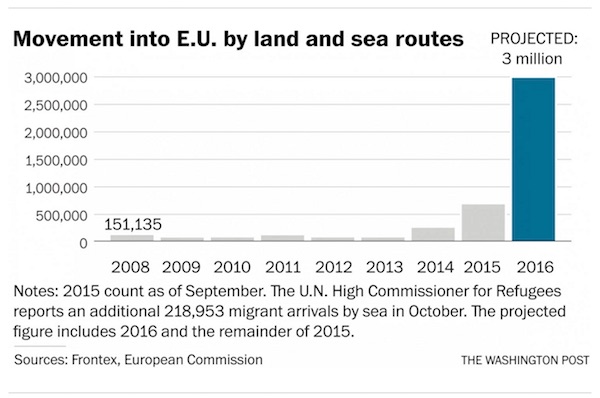
• Migrant Flows ‘Still Way Too High,’ EU Tells Turkey (AFP)
• Mass Migration Into Europe Is Unstoppable (FT)

As things shape up the very way we always said they would, others claim ownership of the story.

“China has set off a major correction and it is going to snowball. Equities and credit have become very dangerous, and we have hardly even begun to retrace the ‘Goldlocks love-in’ of the last two years..”

• RBS Cries ‘Sell Everything’ As Deflationary Crisis Nears (AEP)

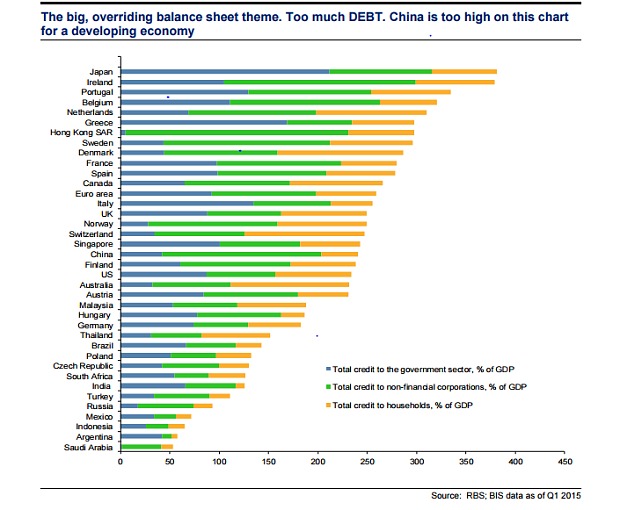
RBS has advised clients to brace for a “cataclysmic year” and a global deflationary crisis, warning that major stock markets could fall by a fifth and oil may plummet to $16 a barrel. The bank’s credit team said markets are flashing stress alerts akin to the turbulent months before the Lehman crisis in 2008. “Sell everything except high quality bonds. This is about return of capital, not return on capital. In a crowded hall, exit doors are small,” it said in a client note. Andrew Roberts, the bank’s credit chief, said that global trade and loans are contracting, a nasty cocktail for corporate balance sheets and equity earnings. This is particularly ominous given that global debt ratios have reached record highs. “China has set off a major correction and it is going to snowball. Equities and credit have become very dangerous, and we have hardly even begun to retrace the ‘Goldlocks love-in’ of the last two years,” he said.
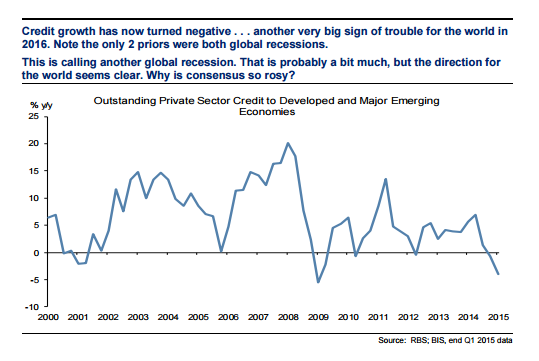
Mr Roberts expects Wall Street and European stocks to fall by 10pc to 20pc, with even an deeper slide for the FTSE 100 given its high weighting of energy and commodities companies. “London is vulnerable to a negative shock. All these people who are ‘long’ oil and mining companies thinking that the dividends are safe are going to discover that they’re not at all safe,” he said. Brent oil prices will continue to slide after breaking through a key technical level at $34.40, RBS claimed, with a “bear flag” and “Fibonacci” signals pointing to a floor of $16, a level last seen after the East Asia crisis in 1999. The bank said a paralysed OPEC seems incapable of responding to a deepening slowdown in Asia, now the swing region for global oil demand Morgan Stanley has also slashed its oil forecast, warning that Brent could fall to $20 if the US dollar keeps rising.

It argued that oil is intensely leveraged to any move in the dollar and is now playing second fiddle to currency effects. RBS forecast that yields on 10-year German Bunds would fall time to an all-time low of 0.16pc in a flight to safety, and may break zero as deflationary forces tighten their grip. The European Central Bank’s policy rate will fall to -0.7pc. US Treasuries will fall to rock-bottom levels in sympathy, hammering hedge funds that have shorted US bonds in a very crowded “reflation trade”. RBS first issued its grim warnings for the global economy in November but events have moved even faster than feared. It estimates that the US economy slowed to a growth rate of 0.5pc in the fourth quarter, and accuses the US Federal Reserve of “playing with fire” by raising rates into the teeth of the storm. “There has already been severe monetary tightening in the US from the rising dollar,” it said.

It is unusual for the Fed to tighten when the ISM manufacturing index is below the boom-bust line of 50. It is even more surprising to do so after nominal GDP growth has fallen to 3pc and has been trending down since early 2014. RBS said the epicentre of global stress is China, where debt-driven expansion has reached saturation. The country now faces a surge in capital flight and needs a “dramatically lower” currency. In their view, this next leg of the rolling global drama is likely to play out fast and furiously. “We are deeply sceptical of the consensus that the authorities can ‘buy time’ by their heavy intervention in cutting reserve ratio requirements (RRR), rate cuts and easing in fiscal policy,” it said.
Read more …

How about 50%? Standard & Poor’s 1500 index – a broad basket of large, mid and small company stocks – is already down -26.9% from its 52-week high.

• An ‘Extremely Normal And Realistic’ 26% S&P 500 Drop Is Taking Shape (MW)

It’s been a brutal start to 2016 in the markets. But the way this chart is setting up, there’s a lot more pain on the way, according to J.C. Parets of the All Star Charts blog. “We’re down 9% from the all-time highs in the S&P 500 SPX, +0.09% and I see people acting like two-year-olds that just had their favorite toy taken away from them,” he said. “Why, because the market is down 9% from its highs last year after rallying over 220% over the prior 6 years? Please.” He goes on to explain how this recent spate of selling action isn’t unusual and how “things get absolutely destroyed all the time.” Like the British pound, energy, emerging markets and agricultural commodities, to name just a few.

“And these are real collapses in prices, not this 9% nonsense that people are getting all worked up about because it’s the S&P 500, or Apple or something that they’re too sensitive about,” Parets wrote in his blog post. He used the chart above to support his prediction that the S&P is headed toward the 1,570 level, which would be an “extremely normal and realistic” 26% correction from the top. Or another 20% from where it stands now. “This is a ‘sell rallies’ market, not a ‘buy the dip’ environment,” he added. That’s not to say there won’t be bounces. “Go look at a list of the best days in stock market history, they all come during massive selloffs,” Parets said. “I would expect this decline to be no different and the rallies we do get should be vicious.”

Read more …

And now Lybia comes on line…

• Oil Down 20% Since Start Of Year, $10 Target Looms (Reuters)

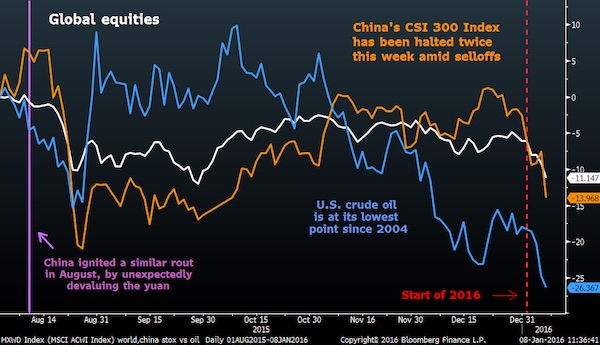
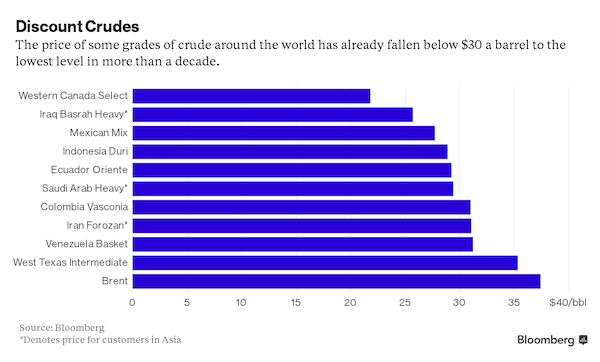
Crude oil prices continued a relentless dive early on Tuesday, falling almost 20% since the beginning of the year as analysts scrambled to cut their 2016 oil price forecasts and traders bet on further price falls. U.S. crude West Texas Intermediate was trading at $30.66 per barrel at 0531 GMT on Tuesday, down 75 cents from the last settlement and about 20% lower than at the beginning of the year. Earlier it traded at $30.60, the lowest since December 2003. Brent crude futures fell 83 cents to $30.72 a barrel. Earlier they declined to $30.66, their lowest since April 2004. Brent has fallen nearly 20% in January and, like WTI, has declined on every day of trading so far this year.

Trading data showed that managed short positions in WTI crude contracts, which would profit from a further fall in prices, are at a record high, implying that many traders expect further falls. “It’s going to be a very interesting year in oil,” said Ric Spooner at CMC Markets in Sydney. “The lower the price goes, the faster in time we are likely to form a base and recover.” Analysts also adjusted to the early price rout in the year, with Barclays, Macquarie, Bank of America Merrill Lynch, Standard Chartered and Societe Generale all cutting their 2016 oil price forecasts on Monday. “A marked deterioration in oil market fundamentals in early 2016 has persuaded us to make some large downward adjustments to our oil price forecasts for 2016,” Barclays bank said.

“We now expect Brent and WTI to both average $37/barrel in 2016, down from our previous forecasts of $60 and $56, respectively,” it added. But it was Standard Chartered that took the most bearish view, stating that prices could drop as low as $10 a barrel. “Given that no fundamental relationship is currently driving the oil market toward any equilibrium, prices are being moved almost entirely by financial flows caused by fluctuations in other asset prices, including the USD and equity markets,” the bank said. “We think prices could fall as low as $10/bbl before most of the money managers in the market conceded that matters had gone too far,” it added.

Read more …

It’ll be epic.

• Plunging Prices Could Force A Third Of US Oil Firms Into Bankruptcy (WSJ)

Crude-oil prices plunged more than 5% on Monday to trade near $30 a barrel, making the specter of bankruptcy ever more likely for a significant chunk of the U.S. oil industry. Three major investment banks – Morgan Stanley, Goldman Sachs and Citigroup – now expect the price of oil to crash through the $30 threshold and into $20 territory in short order as a result of China’s slowdown, the U.S. dollar’s appreciation and the fact that drillers from Houston to Riyadh won’t quit pumping despite the oil glut. As many as a third of American oil-and-gas producers could tip toward bankruptcy and restructuring by mid-2017, according to Wolfe Research.

Survival, for some, would be possible if oil rebounded to at least $50, according to analysts. More than 30 small companies that collectively owe in excess of $13 billion have already filed for bankruptcy protection so far during this downturn, according to law firm Haynes & Boone. Morgan Stanley issued a report this week describing an environment “worse than 1986” for energy prices and producers, referring to the last big oil bust that lasted for years. The current downturn is now deeper and longer than each of the five oil price crashes since 1970, said Martijn Rats, an analyst at the bank. Together, North American oil-and-gas producers are losing nearly $2 billion every week at current prices, according to a forthcoming report from AlixPartners, a consulting firm. “Many are going to have huge problems,” said Kim Brady at consultancy Solic Capital.

Read more …

“Its actions are comparable to steps taken by other central banks when they previously fought against international speculators, such as George Soros..”

• China Resorts To ‘Nuclear Strength’ Weapons To Defend The Yuan (Guardian)
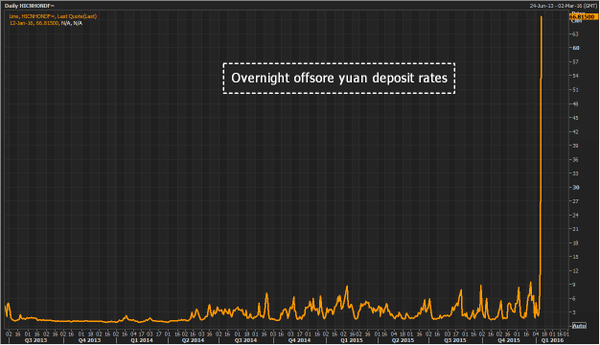
The Chinese authorities have resorted to “nuclear strength” weapons to deter an attack on the yuan by short sellers and convince sceptical investors that they are in control of the country’s spluttering financial system. China’s central bank fixed the currency firmer again on Tuesday but traders were not persuaded and the currency slipped in early trade despite what dealers called aggressive intervention to support the currency. The gap between the mainland yuan and its offshore counterpart had grown in recent days but suspected intervention by China’s state-owned banks brought them almost into line on Tuesday. The action sent the rate at which banks charge each other to borrow yuan in Hong Kong to a record high of 67% on Tuesday.

“The market suspects that the People’s Bank of China is possibly using major state banks to directly drain yuan liquidity in offshore markets,” said a dealer at an European bank in Shanghai. The dealer described the strength of the central bank’s actions as being of “nuclear-weapon” level strength. “Its actions are comparable to steps taken by other central banks when they previously fought against international speculators, such as George Soros,” he said. [..] Perceived mis-steps by China’s authorities have stoked concerns in global markets that Beijing might be losing its grip on economic policy, just as the country looks set to post its slowest growth in 25 years. Amid suspicions by some in the market that China wants the yuan to devalue in order to boost its ailing exporters, sources suggested there were moves afoot for China’s cabinet to take a bigger role in overseeing financial markets.

The state council has set up a working group to prepare for upgrading the cabinet’s financial department to bureau level, said a source close to the country’s leadership. Officials were doing their best to talk up the currency [..] The central bank’s chief economist Ma Jun said on Monday that the bank planned to keep the yuan basically stable against a basket of currencies, and fluctuations against the US dollar would increase. Han Jun, deputy director of the office of the Chinese Communist party’s leading group on financial and economic affairs, said a more substantial decline in the yuan was “ridiculous” and “impossible”.

Read more …

The louder their claims, the lower confidence goes.

• Chinese Official: Bets Against Yuan Are ‘Ridiculous and Impossible’ (WSJ)

Wagers that the yuan will slump 10% or more against the dollar are “ridiculous and impossible,” a senior Chinese economic official said Monday, warning that China had a sufficient tool kit to defeat attacks on its currency. “Attempts to sell short the renminbi will not succeed,” said Han Jun, deputy director of the office of the Central Leading Group on Financial and Economic Affairs, at a briefing at the Chinese Consulate in New York. “The expectations of markets can be changed.” The comments are the latest demonstration of Chinese officials’ determination to defeat those betting that yuan declines will intensify. They echo comments such as ECB President Mario Draghi’s 2012 “whatever it takes” speech, made when European government bonds issued by weaker countries were under attack.

Yet analysts said China’s plan carries considerable risks, potentially creating tension with the government’s efforts to integrate itself into the global financial architecture. Currency-market interventions are costly and risk confusing investors by adding to volatility, some said. “These interventions work well only if they’re undertaken in the context of much broader reforms,” said Eswar Prasad, a former top China hand at the International Monetary Fund and now an economics professor at Cornell University. Bets against the yuan, or renminbi, have picked up in 2016, sending the currency to its lowest level in nearly five years against the dollar and widening the gap between the official Chinese yuan fixing and the so-called offshore market in Hong Kong, where the government is less involved.

On Monday, the yuan rose 0.3% against the dollar in China and rose 1.5% in the offshore market, to 6.5863 per dollar. In late New York trading, the yuan was up 0.4% to 6.5666 per dollar. The debate over the direction of the yuan has captivated Wall Street since last August, when China roiled financial markets by reducing the currency’s value against the dollar by 2% on Aug. 11, its largest single-day decline in two decades. Further yuan devaluation would threaten to exacerbate existing problems in the global economy, where sluggish demand for goods and services is tripping up growth. Many nations have sought to bolster flagging domestic growth by increasing exports, but a sharp decline in the yuan would likely undermine such efforts by making Chinese goods cheaper and more competitive abroad.

Read more …

“China’s banks could require up to $7.7 trillion of new capital and funding over the next three years…” But that’s just part of the story; it’s still based on very low amounts of bad loans -“barely 1% at the big lenders, and 1.8% at mid-tier banks this year-, and that doesn’t seem realistic. Fitch puts it at 21%(!).

• China Banks Feel The Heat Of Meltdown (FT)

If the US or Europe had experienced the kind of equity market slump that China has suffered of late, its financial institutions would be quaking and leading the list of biggest fallers in Shanghai and Hong Kong trading. As it is, the big banks have seen their share prices tumble by about 10% over the past two or three weeks, far less than the 15% slump in the Shanghai Composite index. On the face of it, there may be good reason for that. Traditionally China’s large financial institutions are not big stock market players — retail investors make up the bulk of the market. In reality, the banks are the most exposed to China’s ills. They are directly bound up in the stock market turmoil and the government’s efforts to shore up sentiment against the flood of selling. Figures relating to the past week or so are not yet available.

But during a similar rout in early July last year, 17 banks — including the big five listed but partly state-owned groups — lent more than $200bn to facilitate broker purchases of shares and funds. Even without the seizure of their balance sheets to prop up the equity market, China’s banks are pretty troubled. Like banks in the west before the financial crisis, China’s lenders — with government encouragement — have inflated a vast credit bubble, funding the country’s ambitious companies and fast-expanding property market. Chinese banking assets now amount to more than $30tn. Over the past decade, credit growth has consistently topped 10% a year. (It peaked at close to 35% in 2009.) Even this year, it is expected to be double the 6-7% forecast rate of GDP growth.

Last August, JPMorgan estimated China’s non-financial industry private sector debt at 147%, half as much again as in 2007. The downturn in China’s fortunes — particularly across its heartland heavy industry — is already hitting the banks. Annual non-performing loan rates have been doubling annually since 2012. China Merchants Bank, China Everbright and ICBC are seen as among the most troubled. China bulls point to the still low level of NPLs — barely 1% at the big lenders, and 1.8% at mid-tier banks this year, according to analyst forecasts. As a gauge, NPLs in Greece have risen to between 30 and 40% amid that country’s crisis. But China experts at independent research house Autonomous suggest investors are underestimating a spiralling problem. Across the board, loan losses will rise by $845bn this year, Autonomous predicts. That, they think, will be enough to shrink profits by 6% at big banks.

[..] Investors in China’s banks may well recognise that the lenders cannot be compared with institutions that operate along western lines and will expect hazier disclosures and readier state interference. They are also likely to think that China will not allow its banks to fail. But if analysts, like those at Autonomous are to be believed, China’s banks could require up to $7.7tn of new capital and funding over the next three years.

Read more …

Exporting deflation.

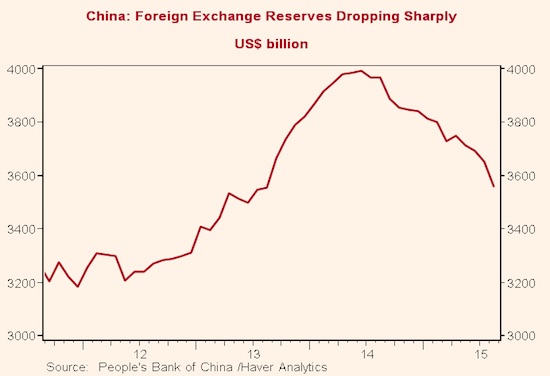
• China FX Reserve Sell-Off To Soon Move Beyond US Treasuries (Reuters)

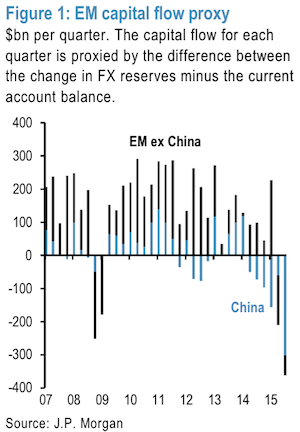
The unwinding of China’s foreign exchange reserves could soon extend beyond U.S. Treasuries, with U.S. corporate and euro zone sovereign bonds among the assets most vulnerable to selling from Beijing, Bank of America Merrill Lynch said on Monday. China sold a record $510 billion of FX reserves last year to counter the damaging impact on an already decelerating economy from the surge of capital fleeing the country. The lion’s share of that came from $292 billion sales of U.S. Treasury debt, followed by $92 billion sales of U.S. stocks, $3 billion of U.S. agency bonds and $170 billion of non-U.S. assets, according to BAML estimates. China increased its U.S. corporate bond investments by $44 billion last year to $415 billion, BAML strategists estimated, adding that it won’t be long before investors turn their attention to other assets Beijing could potentially sell.

“In the next two months I would still say Treasuries. But if the pressure continues beyond that, it’s non-U.S. assets, and in the U.S. space it’s definitely corporates and agencies,” said Shyam Rajan, rates strategist at BAML in New York. Rajan and his colleagues estimate that China’s $3.33 trillion FX reserves comprise $1.15 trillion non-U.S. assets (mostly short-dated euro-denominated bonds), $415 billion U.S. corporate bonds, $212 billion in agencies, $266 billion stocks and $1.29 trillion of Treasuries. Selling across these bonds may not automatically trigger a sharp rise in their yields though, Rajan said, pointing to the experience of Treasuries in the latter part of last year when swap spreads moved below zero.

“The way to trade the reserve flow story is through relative value trades, such as the swap spread tightening in Treasuries. I would imagine it plays out the same way in other markets too,” Rajan said. Last year’s record unwind brought China’s total FX reserves to a three-year low of $3.33 trillion. Most analysts expect that to be depleted further this year. JP Morgan estimates that capital flight from China since the second quarter of 2014 has totaled $930 billion, while credit ratings agency Fitch on Monday put the figure at over $1 trillion. U.S. investment bank Morgan Stanley on Monday joined Goldman Sachs in lowering its forecast for the Chinese yuan, citing the ongoing flow of capital out of the country and need for a weaker currency to support the economy.

Read more …

Nothing much has changed, other than suspicions that Beijing can’t handle the downfall. But global exposure to China is still the same, it’s just been ridiculously downplayed.

• Why China’s Market Illness Has Gotten More Contagious (WSJ)

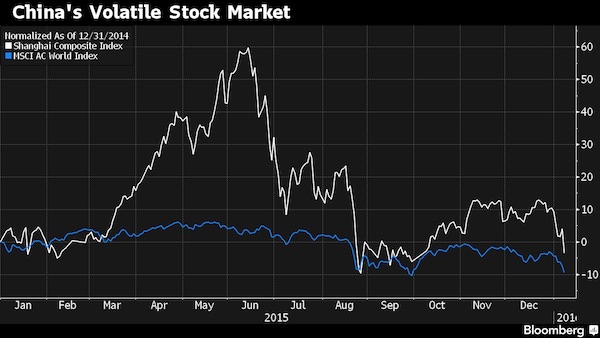
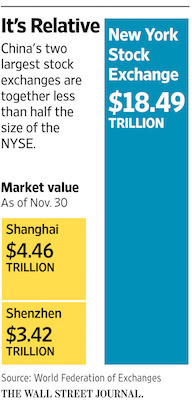
The Shanghai stock market is undersized and isolated. Its market capitalization is less than one-quarter the size of New York’s. Just 37% of its shares are available to trade, and foreigners own only a tiny fraction. Yet the tide of selling by Chinese investors last week—along with an unexpectedly sharp move to weaken the yuan—rolled through stocks, commodities and currencies across the globe. The chain reaction heralds a new era for China, whose financial-market muscle has long been underdeveloped compared with its economic heft. On Monday, Chinese shares resumed their slide. The Shanghai Composite Index dropped 5.3%, leaving it down 15% in the new year. U.S. shares stumbled but covered their losses in the final hour of trading and closed up slightly.

Oil fell to a new 12-year low in the U.S., and currencies in countries like South Africa and Russia fell sharply. Until last year, few in global markets took their cue from Shanghai, which has a history of roller-coaster trading. In the summer of 2015, a sharp plunge in the Shanghai Composite, after a 60% rise earlier in the year, combined with a surprise yuan devaluation to trigger a global selloff. Attention soon faded, and Shanghai’s market ended the year up 9.4%. But last week’s meltdown again showed China’s market influence. And to many, it suggested an even more ominous possibility: that Beijing may be fumbling its management of China’s economy. That could have disastrous consequences for the prices of goods and commodities, and thus markets, around the world.

Today, China accounts for about 11% of world gross domestic product, 12% of the globe’s oil consumption and about half the demand for steel. It is the No. 1 trading partner for countries from South Korea and Australia to Brazil and soaks up exports worth more than 10% of GDP from Singapore and Taiwan. Despite tight controls over the currency and the banking system that wall off China from much of the global financial system, China’s huge presence in global trade means the country is more tightly tied to the rest of the world than ever. Its roaring growth has been a boon to Western stock markets like Germany’s, whose exchange is filled with manufacturers that sell machines and factory equipment there.

Now, China ties may be a liability. In Europe, whose companies get 10% of their revenue from the Asia-Pacific region, the pan-European Stoxx Europe 600 is down 7% in 2016 through Monday, and Germany’s DAX is down 8.5%. Europe is especially vulnerable to a China slowdown: Its own economic growth has been weak for years, and the Continent has been counting on exports to plug the gap. Nearly 10% of the exports from the 28-member EU go to China. The story isn’t the same everywhere, though. U.S. companies get only 5% of their revenue from Asia-Pacific. They also can rely on a more buoyant domestic economy. The S&P 500 was down 6% this year through Friday.
Read more …

And India is one of the first victims of the popping China Ponzi.

• China Rout Threatens to Spawn India Crisis (BBG)

A deepening slowdown in China threatens to derail India’s economic growth, triggering financial market upheaval and a falling currency, Vishal Kampani, the nation’s top investment banker, said. “If China keeps getting hit like this, the yuan has to devalue, and we will see another crisis in India,” Kampani at JM Financial, the South Asian country’s top M&A adviser last year, said in a Jan. 8 interview. “I refuse to believe that India will stand out and will look very different.” Indian stocks and the rupee fell Monday, tracking declines in other emerging markets as volatility in China sapped risk appetite globally. China’s efforts to stabilize the yuan failed to halt equity losses, reviving concern about the Communist Party’s ability to manage an economy set to grow at its weakest pace since 1990. India’s benchmark S&P BSE Sensex Index fell 0.4% on Monday in Mumbai after dropping as much as 1.4% earlier.

The rupee weakened 0.2% to 66.7725 against the dollar as of 4:11 p.m. local time. A devaluation of the yuan could weaken the rupee, creating “huge problems” for Indian companies that have to pay back dollar loans, Kampani said. China is India’s largest trade partner and third-largest export market, so a slowdown there could prolong a record slump in the South Asian nation’s overseas shipments, which declined 12 straight months through November. A China-led rout in Indian markets also risks damping private investment, already hurt by credit lines choked by bad debt and a legislative gridlock that’s blocked economic bills. That would boost pressure on Prime Minister Narendra Modi to sustain public spending even at the risk of worsening Asia’s widest budget deficit. Modi has seen his economic agenda stall in parliament, disappointing investors who bet that his landslide win in 2014 would speed up reforms.

Read more …

In which the richer nations can once again overpower the poorer.

• EU Set To Weigh China’s Eligibility For Lower Import Tariffs (BBG)

European Union policy makers are poised to kick off deliberations to determine whether EU industries ranging from steel to solar can keep relying on import tariffs to fend off aggressive Chinese competitors, the opening salvo in a political and economic battle due to last all year. The European Commission, the EU’s executive arm, will hold an initial debate Jan. 13 about whether the bloc should recognize China as a market economy starting in December. Such a step would make it more difficult for European manufacturers such as ArcelorMittal and Solarworld AG to win sufficiently high EU duties meant to counter alleged below-cost – or “dumped” – imports from China.

The talks will pit free-trade governments in northern Europe against more protectionist ones in the south, put Europe on a possible track that the U.S. is staying off and produce a political verdict on whether communist China has come of age economically 15 years after it joined the World Trade Organization. In addition to being a political prize for Beijing, market-economy status would be a business boost for China, whose growth has slumped to the weakest since 1990 and which suffered a 10% fall in stocks last week. “This is one of the hottest issues on the agenda,” Jo Leinen, a German MEP who chairs its delegation for relations with China, said by phone from Saarbruecken, Germany, on Jan. 7. “It’s a hot potato. The Chinese are pushing for market-economy status and interests are divided in Europe.”

The matter combines top-level political calculations with tricky economic and legal considerations. With the EU struggling to bolster economic growth and keep Greece in the euro area, leaders across Europe have courted China for investment in infrastructure and orders of goods such as Airbus planes. While it’s the EU’s No. 2 trade partner behind the U.S., China is grouped with the likes of Belarus, Kazakhstan and Mongolia in seeking market-economy designation by Europe and faces more European anti-dumping duties than any other country. The import levies cover billions of euros of Chinese exports such as stainless steel, solar panels, aluminum foil, bicycles, screws, paper, kitchenware and office-file fasteners, curbing competition for producers across the 28-nation EU. Market-economy status for China would signal more European trust in Beijing by ensuring the EU uses Chinese data for trade investigations affecting the country.

Read more …

Emerging markets will start collapsing outright, Brazil, South Africa, China and more.

• South Africa’s Flash Crash Exposes Cracks in Currency Liquidity (BBG)

It took just 15 minutes on Monday morning for South Africa’s rand to plummet 9% in what traders said may be a prelude of the new normal in the global $5.3 trillion-a-day currency market. Such flash crashes will probably become more common in foreign-exchange trading as liquidity shrinks amid tighter regulation and reduced demand for emerging-market assets, according to Insight Investment and Citigroup.The rand slid to record lows versus the dollar and yen in Asian trading before recovering the bulk of the day’s losses almost as swiftly. “The rand isn’t alone in this,” said Paul Lambert at Insight Investment, a Bank of New York Mellon unit, which manages more than $582 billion.
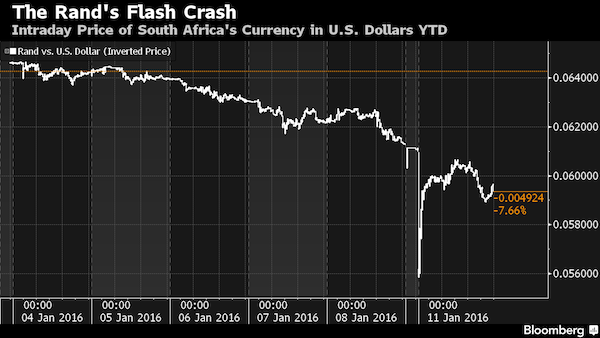
“The rand is another reflection of the change in the liquidity environment in which we’re all operating. We’re learning that unless there are clients on the other side, banks are very unwilling to take risk onto their books.” Volatility in the rand versus the dollar surged toward the highest level in four years, while a measure of global currency price swings climbed to the most since October. The difference between prices at which traders are willing to buy and sell the rand, used as a gauge of liquidity, was about 1.5 times wider on average in the past six months than it was during the first half of 2015, according to data compiled by Bloomberg.

In a phenomenon that’s also hit U.S. stock markets in recent years, regulation is pushing banks to reduce their size and cut down on market making, making it more difficult to trade without prices moving adversely. A reduction in liquidity has contributed to similar price swings in fixed-income securities, including the $13 trillion U.S. government bond market. Bursts of volatility in currency markets and diminishing liquidity are another affliction for emerging economies such as South Africa, which seek to secure overseas investments amid slowing growth, a rout in commodities and domestic political challenges. Boosting international trade and capital inflows is made harder by currency turmoil as investors and banks become less willing to take on additional risk.

Read more …

A rock and an impossible place.

• Saudi Arabia Plays Down Riyal Peg Fears (FT)

Saudi Arabia sought to cool talk about the future of its currency peg, saying movements in the forward market were the result of market “misperception” about the state of the kingdom’s economy. Oil price declines and rising tensions between Saudi Arabia and Iran have pushed up the cost of riyal-dollar forward prices and questioned the validity of the 30-year-old peg. In a statement, the governor of the Saudi Arabian Monetary Agency said it would “uphold its mandate” of maintaining the peg at SR3.75 to the dollar, “backed up by the full range of monetary policy instruments including its foreign exchange reserves”. The statement was prompted by forward market volatility, said governor Fahad al-Mubarak, which he attributed to “mispricing linked to market operators’ misperception about Saudi Arabia’s overall economic backdrop”.

Economic and financial indicators were stable, underpinned by its net creditor position and a sound and resilient banking system, Mr al-Mubarak said. Oil price woes are weighing on several commodity currencies, not least Russia’s rouble, which dropped more than 1% to a 13-month low. Further rouble declines would cut across the Central Bank of Russia’s strategy for resuming its easing cycle, said Rabobank’s Piotr Matys, and increased the risk of a prolonged recession. Oil’s impact on the Saudi kingdom would prompt markets to “worry more” about falling reserves and the exchange rate pegs of Saudi Arabia and other Gulf states, said Kamakshya Trivedi of Goldman Sachs in a note, “especially if attempts at fiscal adjustment are not credible or unsuccessful”.

Simon Quijano-Evans at Commerzbank acknowledged that Saudi Arabia had four years’ worth of reserves to cover budget and current account deficits. But he added that without a sustained upward oil price move, market speculation about the peg would increase. “History has shown us that if a policy peg is not economically viable, there really is little point in holding on as the intrinsic benefits from the set-up eventually become its principal vulnerabilities,” he said. Gulf bankers were unconcerned, saying the peg had survived worse financial backdrops. In the late 1990s, when oil prices were even lower, the finance ministry toiled under domestic debts totalling more than 100% of gross domestic product. Sama still has $627bn in foreign reserves, down 14% on last November, as the kingdom burns through its savings to fund the deficit and an expensive war in Yemen.

“Traders are forgetting about Saudi firepower,” said one senior Gulf banker. “This is a low-cost trade with a huge potential payout,” said another senior financier. “Those bearish oil may want to bet that pressure will become too great for Saudi. Possible, but not my scenario.”

Read more …

Nothing has changed, nothing at all. The bankers still write the rules that are supposed to keep them in check.

• Banks’ Worst Fears Eased as Basel Soft-Pedals Capital Overhaul (BBG)

Global banking regulators pledged to refrain from further tightening capital requirements with new rules to be finalized in 2016, dispelling industry fears that triggered intense lobbying efforts over the past year. The Basel Committee on Banking Supervision doesn’t plan to raise capital requirements across the board in the remaining projects of its post-crisis bank rule overhaul, it said Jan. 11 after a meeting of its oversight body, chaired by ECB President Mario Draghi. The group, which includes the Bank of England and U.S. Federal Reserve, said it will assess the potential costs of any additional action. “The committee will conduct a quantitative impact assessment during the year,” the group said in a statement. “As a result of this assessment, the committee will focus on not significantly increasing overall capital requirements.”

Basel’s slate of rules for this year, including a review of trading risks that the committee endorsed on Jan. 10, have faced heavy criticism from bankers, who say onerous new capital charges would crimp their ability to lend. The overhaul of how banks value risky assets has led industry executives to warn a regulatory onslaught – sometimes referred to as Basel IV – is still ahead, even after the last decade of new rules designed to prevent another market meltdown. Karen Shaw Petrou at Federal Financial Analytics said the Basel’s latest statement is a response to bankers’ warnings. “Global regulators clearly hope to tamp down continuing talk of a ‘Basel IV’ rule, emphasizing in both action and statements that continuing changes are recalibrations, not hikes,” Petrou said in an e-mail.

Draghi said the agreements reached by the Basel committee and the upcoming agenda seek to provide greater clarity about the capital framework and, “a clear path for completing post-crisis reforms.” As part of this process, the regulator will hold a public consultation on removing internal-model approaches for some risks, such as the Advanced Measurement Approach for operational risk, as well as on “setting additional constraints on the use of internal model approaches for credit risk, in particular through the use of floors.” The committee also sounded a soft note on another lingering worry of bankers, the unweighted leverage ratio. It will keep the minimum amount of capital per total assets unchanged at 3%, when it becomes a binding requirement in 2018, it said. For the world’s biggest banks, there may be an add-on, it said, without elaborating.

Read more …

Canada has so much more to go.

• Canadian Stocks Fall in Longest Slump Since 2002 (BBG)

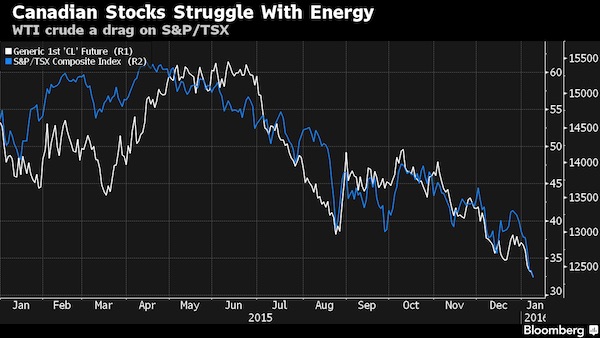
Energy’s drag on Canadian stocks showed no signs of abating as the nation’s benchmark equity gauge slumped a ninth straight day, the longest losing streak since 2002. Canadian equities have lost 7.4% during this period with the Standard & Poor’s/TSX Composite Index failing to post a positive trading day in 2016. Crude futures in New York tumbled to a 12-year low. Analysts at Morgan Stanley projected Brent oil may slump to as low as $20 a barrel on strength in the dollar. Brent dropped 6.7% to $31.32 a barrel in London. Bank of America Corp. cut its average 2016 Brent forecast to $46 a barrel from $50. “Risk appetite will not return until we start to see crude carve out a bottom,” said David Rosenberg at Gluskin Sheff in a note to clients.

The S&P/TSX fell 1% to 12,319.25 at 4 p.m. in Toronto. The gauge capped a 20% plunge from its September 2014 record on Jan. 7, hitting a magnitude in declines commonly defined as a bear market. Canada was the second Group of 7 country to see its benchmark enter a bear market, after Germany’s DAX Index did in August. Energy producers sank 2.7%. The group, which accounts for about 20% of the broader index, was the worst-performing sector in the S&P/TSX last year.
Read more …

The demise of retail.

• Discovery (Jim Kunstler)

It looks like 2016 will be the year that humanfolk learn that the stuff they value was not worth as much as they thought it was. It will be a harrowing process because a great many humans are abandoning ownership of things that are rapidly losing value — e.g. stocks on the Shanghai exchange — and stuffing whatever “money” they can recover into the US dollar, the assets and usufructs of which are also going through a very painful reality value adjustment. Of course this calls into question foremost exactly what money is, and the answer is: basically a narrative construct. In other words, a story explaining why we behave the way we do around certain things. Some parts of the story have a closer relationship with reality than other parts. The part about the US dollar has a rather weak connection.

When various authorities — the BLS, the Federal Reserve, The New York Times — state that the US economy is “strong,” we can translate that to mean giant companies listed on the stock exchanges are able to put up a Potemkin façade of soundness. For instance, Amazon.com. The company continues to seem like a good idea. And it reinforces that idea in the collective imagination by sending a lot of low-priced goods to your door, (all bought on credit cards), which rings your (nearly) instant gratification bell. This has prompted investors to gobble up Amazon stock. It’s well-established by now that the “brick-and-mortar” retail operations are majorly sucking wind. Meaning, fewer people are driving to the Target store and venues like it to buy stuff. Supposedly, they are buying stuff at Amazon instead.

What interests me in that story is the idea that every single object purchased these days has a UPS journey attached to it. Of course, people also drive to the Target store, though I doubt they leave the place with just one thing. That dynamic ought to call into question just how people are living in the USA, and the answer to that is: spread out all over the place in a suburban sprawl living arrangement that has poor prospects for being reformed or mitigated. Either you drive yourself to the Target store for a slow-cooker and a few other things, or Amazon has to send the brown truck to each and every house. Either way includes an insane amount of transport, and sooner or later both the brick-and-mortar chain store model and the Amazon home delivery model will fail.

Read more …

Joris is primarily funny here. But he wants to ‘reform’ the EU, and that’s a dead end. One point is good: EU’s finance center can’t be in a country outside of it. So the UK threat to leave would force banks and multinationals out of London.

• It’s Time For Europe To Turn The Tables On Bullying Britain (Luyendijk)

So let us start talking now, out loud in Brussels as well as in Europe’s opinion pages and in national parliaments, about the offer we are going to make to the Scots, should they prefer Brussels to London in the event of Brexit. Let’s also discuss in which ways we are going to repatriate financial powers from London to the European mainland. It is strange enough that Europe’s financial centre lies outside the eurozone, but to have it outside the EU? That would be like placing Wall Street in Cuba. Clearly multinational corporations from China, Brazil or the US cannot have their European HQs outside the EU. So let’s have an EU summit about which European capitals these headquarters should ideally move to. Make sure the English can hear these discussions, and in the meantime keep an eye on how the value of commercial real estate in London plummets.

Or consider the UK-based Japanese car industry – would Greece, with its excellent port and shipping facilities, not be its ideal new home? Oh yes, and sooner or later, the 1.3 billion Indians will object again to not having a permanent seat on the UN security council when 55 million English do. Let’s work out what favours we want from India in exchange for our support. The best way for the EU to prevent Brexit is to start preparing for it, loudly. But this is not enough. European politicians and pundits must not be shy of cutting England down to size. This is the chief problem for those in England trying to make the EU case: they must acknowledge first how irrelevant and powerless their country has become. Except that is still a huge taboo. Seen from China or India, the difference between the UK and Belgium is a rounding error: 0.87% of world population versus 0.15%.

But this is not at all how Britain sees itself – consider the popular derogatory expression “a country the size of Belgium”. But alas, what a missed opportunity this referendum is. A child can see that the EU needs fundamental reform and just imagine for a moment that England had argued not for a better deal for Britain, but for all of us Europeans. How electrifying it would have been if Cameron had demanded an end to the insanely wasteful practice of moving the European parliament back and forth between Strasbourg and Brussels. If he had insisted on a comprehensive overhaul of the disastrous common agricultural policy, on the long overdue reduction in salaries and tax-free perks for Eurocrats, and on actual prosecution of corrupt officials. Instead he has set his sights on largely symbolic measures aimed at humiliating and excluding European migrants, safeguarding domestic interests versus those of the eurozone and, no surprises here, guarantees for London’s financial sector.

Ultimately, as far as the EU is concerned, the English are only in it for themselves. All the more reason, then, for Europeans to stop imploring them to stay in, and begin using their strength in the negotiations.

Read more …

These clowns actually believe they’re in control.

• Migrant Flows ‘Still Way Too High,’ EU Tells Turkey (AFP)

The number of migrants crossing the Aegean Sea from Turkey to Greece is “still way too high”, a top EU official said Monday, a month and a half after a deal aimed to limit the flow. EU vice president Frans Timmermans said Turkey and Brussels had to speed work up on implementing the action plan, while Ankara reaffirmed it was looking at a measure to tempt more Syrians to stay in Turkey by granting them work permits. “The numbers are still way too high in Greece, between 2,000-3,000 people (arriving) every day. We cannot be satisfied at this stage,” Timmermans told reporters after talks with Turkey’s EU Affairs Minister Volkan Bozkir in Ankara. “The goal of this (action plan) is to stem the flow. 2,000-3.000 (arrivals) a day is not stemming the flow. But we are in this together and we will work on that,” he added.

Under the November 29 deal, EU leaders pledged €3 billion in aid for the more than 2.2 million Syrian refugees sheltering in Turkey, in exchange for Ankara acting to reduce the flow. Under pressure from voters at home, EU leaders want to reduce the numbers coming to the European Union after over one million migrants reached Europe in 2015. Yet there has so far been no sign of a significant reduction in the numbers of migrants from Syria, Afghanistan and other troubled states undertaking the perilous crossing in rubber boats from Turkey’s western coast to EU-member Greece. Turkish authorities on a single day last week found the bodies of at least 36 migrants, including several children, washed up on beaches and floating off its western coast after their boats sank.

In the latest tragedy Monday, two women and a five-year-old girl died when a boat carrying 16 Afghan migrants sank in bad weather off the Aegean coast, reports said. “I believe we need to speed our work to get some of the projects in place,” said Timmermans. “I also said to the minister that we need… to be very explicit on what elements of the action plan have already been implemented and where we still need work.” Bozkir said that Turkey was expending “intense efforts” on halting the migrant flow, saying the Turkish authorities were stopping 500 people every day. “We will try to reduce the pressure on illegal immigration by giving work permits to Syrians in Turkey,” he added.

Read more …

Dead on. Not a bright future. As long as the right wing keeps rising in the face of incompetence.

• Mass Migration Into Europe Is Unstoppable (FT)

In the 18th and 19th centuries, Europeans populated the world. Now the world is populating Europe. Beyond the furore about the impact of the 1m-plus refugees who arrived in Germany in 2015 lie big demographic trends. The current migration crisis is driven by wars in the Middle East. But there are also larger forces at play that will ensure immigration into Europe remains a vexed issue long after the war in Syria is over. Europe is a wealthy, ageing continent whose population is stagnant. By contrast the populations of Africa, the Middle East and South Asia are younger, poorer and rising fast. At the height of the imperial age, in 1900, European countries represented about 25% of the world’s population. Today, the EU’s roughly 500m people account for about 7% of the world’s population. By contrast, there are now more than 1bn people in Africa and, according to the UN, there will be almost 2.5bn by 2050.

The population of Egypt has doubled since 1975 to more than 80m today. Nigeria’s population in 1960 was 50m. It is now more than 180m and likely to be more than 400m by 2050. The migration of Africans, Arabs and Asians to Europe represents the reversal of a historic trend. In the colonial era Europe practised a sort of demographic imperialism, with white Europeans emigrating to the four corners of the world. In North America and Australasia, indigenous populations were subdued and often killed — and whole continents were turned into offshoots of Europe. European countries also established colonies all over the world and settled them with immigrants, while at the same time several millions were forcibly migrated from Africa to the New World as slaves. When Europeans were populating the world, they often did so through “chain migration”.

A family member would settle in a new country like Argentina or the US; news and money would be sent home and, before long, others would follow. Now the chains go in the other direction: from Syria to Germany, from Morocco to the Netherlands, from Pakistan to Britain. But these days it is not a question of a letter home followed by a long sea voyage. In the era of Facebook and the smartphone, Europe feels close even if you are in Karachi or Lagos. Countries such as Britain, France and the Netherlands have become much more multiracial in the past 40 years. Governments that promise to restrict immigration, such as the current British administration, have found it very hard to deliver on their promises.

The EU position is that, while refugees can apply for asylum in Europe, illegal “economic migrants” must return home. But this policy is unlikely to stem the population flows for several reasons. First, the number of countries that are afflicted by war or state failure may actually increase; worries about the stability of Algeria are rising, for example. Second, most of those who are deemed “economic migrants” never actually leave Europe. In Germany only about 30% of rejected asylum seekers leave the country voluntarily or are deported. Third, once large immigrant populations are established, the right of “family reunion” will ensure a continued flow. So Europe is likely to remain an attractive and attainable destination for poor and ambitious people all over the world.

Read more …

Jan 082016


Unknown Charleston, SC, after bombardment. Ruins of Cathedral of St John and St Finbar 1865

• Slowing Productivity Fast Becoming A Global Problem (Lebowitz)
• Dow, S&P Off To Worst Four-Day Jan Start Ever As China Fears Grow (Reuters)
• US Stock Markets Continue Plunge (Guardian)
• China Has Not One Insolvable Problem, But Many Of Them (Mish)
• Capital Flight Pushes China To The Brink Of Devaluation (AEP)
• China Stocks Rebound as State Funds Said to Buy Equities (BBG)
• China’s Yuan Fixing Calms Markets as Asian Stocks Rally With Oil (BBG)
• The Decline Of The Yuan Destroys Belief In Central Banking (Napier)
• One Big Market Casualty: China Regulators’ Reputation (CNBC)
• China Orders Banks To Limit Dollar Buying This Month To Stem Outflows (CNBC)
• Yuan Depreciation Risks Competitive Devaluation Cycle (Reuters)
• China’s Forex Reserves Post Biggest Monthly Drop On Record (Xinhua)
• China’s Stock Market Is Hardly Free With Circuit Breakers Gone (BBG)
• Iran Severs All Commercial Ties With Saudi Arabia (Reuters)
• Saudi Arabia Considers IPO For World’s Biggest Energy Company Aramco (Guardian)
• VW Weighs Buyback of Tens of Thousands of Cars in Talks With US (BBG)
• Human Impact Has Pushed Earth Into The Anthropocene (Guardian)
• Europe’s Economy Faces Confidence Test as Borderless Ideal Fades (BBG)
• Turkey Does Nothing To Halt Refugee Flows, Says Greece (Kath.)

We’ve reached the end of a line. Not even the narrative works from here.

• Slowing Productivity Fast Becoming A Global Problem (Lebowitz)

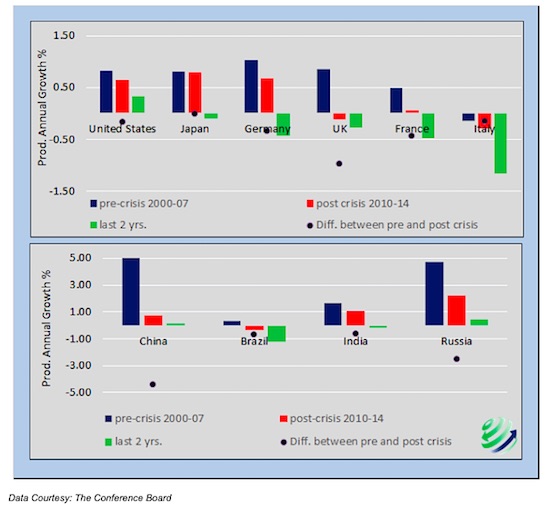
In “The Fed And Its Self-Defeating Monetary Policy” we focused our discussion on U.S. productivity, but weak and slowing productivity growth is not just an American problem. All of the world’s leading economies are, to varying degrees, exhibiting the same worrisome pattern. And slowing productivity is something investors across asset classes should pay attention to in 2016. The graph below compares annualized productivity trends from three time periods – the 7 years immediately preceding the financial crisis, the 5 years immediately following the crisis, and the 2 most recently reported years (2013 and 2014). The black dots display the change in trend from pre to post crisis.

In all cases the black dots are below zero representing slowing productivity growth. More troublesome, the world’s largest economies are most recently reporting either negligible productivity growth or a decline in productivity. Assuming that demographics are already “baked” and debt has been over-used to produce non-productive growth since well before the crisis, good old-fashioned productivity gains are what the global economy requires to produce durable organic growth in the developed world. Central bankers, politicians and investors are well advised to understand this dynamic.

Read more …

Jobs numbers today will be big.

• Dow, S&P Off To Worst Four-Day Jan Start Ever As China Fears Grow (Reuters)

U.S. stocks sold off further on Thursday, giving the Dow and S&P 500 their worst four-day starts to a year ever, dragged down by another drop in Chinese equities and oil prices at 12-year lows. China allowed the biggest fall in its yuan currency in five months, adding to investor fears about the health of its economy, while Shanghai stocks were halted for the second time this week after another steep selloff. Oil prices fell to 12-year lows and copper prices touched their lowest since 2009, weighing on energy and materials shares. Shares of Freeport McMoran dropped 9.1% to $5.61. All 10 S&P 500 sectors ended in the red, though, and the Nasdaq Biotech index fell 4.1%. “People see the weakness in China and in the overall equity market and think there’s going to be an impact on corporations here in the United States,” said Robert Pavlik at Boston Private Wealth in New York.

“When you have a market that begins a year with weakness, people are sort of suspect anyway. The economy isn’t moving all that well, the outlook is modest at best, and they don’t want to wait for the long term. China creates more uncertainty.” The Dow Jones industrial average closed down 392.41 points, or 2.32%, to 16,514.1, the S&P 500 had lost 47.17 points, or 2.37%, to 1,943.09 and the Nasdaq Composite had dropped 146.34 points, or 3.03%, to 4,689.43. The Dow has lost 5.2% since the end of 2015 in the worst first four trading days since the 30-stock index was created in 1928. The S&P 500 is down 4.9% since Dec. 31, its worst four-day opening in its history, according to S&P Dow Jones Indices, while the Nasdaq is down 6.4%.

Read more …

Serious losses and serious jitters.

• US Stock Markets Continue Plunge (Guardian)

US stocks continued to fall on Thursday as fears of an economic slowdown in China spooked investors around the world. The Dow Jones industrial average fell 392.41 points, or 2.32%, capping its worst four-day start to a year in more than a century. The S&P 500 posted its largest daily drop since September, losing 47.17 points, or 2.37%, to 1,943.09 and the Nasdaq Composite dropped 146.34 points, or 3%, to 4,689.43. The falls followed another day of turmoil on the world’s stock markets amid more signs that the Chinese economy is slowing. China moved early to try to head off more panic, scrapping a new mechanism that Beijing had initially hoped would prevent sharp selloffs.

Beijing suspended the use of “circuit breakers” introduced to halt trading after dramatic selloffs. The circuit breakers appear to have exacerbated the selloffs, as would-be sellers waited for the markets to open again in order to sell. The decision came after the breaker was tripped for the second time in a week as the market fell 7% within half an hour of opening. Signs of problems in the world’s second largest economy triggered selling in Europe. The German DAX was the worst performer, falling 2.29%, as manufacturing firms were hit by fears about China’s impact on the global economy. In London the FTSE 100 staged a late rally but still ended the day down 119 points, or 1.96%, at 5,954. That’s a three-week low, which wipes around £30bn ($43.86bn) off the index.

Read more …

Well put.

• China Has Not One Insolvable Problem, But Many Of Them (Mish)

Yuan and Capital Flight
• China needs to prop up the yuan to slow capital flight.
• China needs to let the yuan drop to support exports.
• China needs to float the yuan and remove capital controls to prove it really deserves to be taken seriously as a reserve currency.
• If the yuan sinks, capital flight will increase and China risks the ire of US congress and those play into protectionist sentiment, notably Donald Trump.
• Artificial stabilization of the yuan will do nothing but create an oversized move down the road as we saw in Switzerland.

SOEs and Malinvestments
• China needs to write off malinvestments in state owned enterprises (SOEs).
• If China does write off malinvestments in SOEs it will harm those investing in them, generally individual investors who believed in ridiculous return guarantees.
• If China doesn’t write off malinvestments it will have to prop up the owners of those enterprises, mainly the ruling class, at the expense of everyone else, delaying much needed rebalancing.

Property Bubble
• China needs to fill tens of millions of vacant properties, but no one can afford them.
• If China makes the properties affordable it will have to cover the losses, or builders will suffer massive losses.
• If China subsidizes losses for the builders, there are still no real jobs in in the vacant cities.
• If China does not subsidize the losses, the builders and current investors will both suffer massive damage.

Jobs
• China is losing exports to places like Vietnam that have lower wage points.
• Property bubbles, the overvalued yuan, SOEs, and capital flight all pose conflicting problems for a government desperate for job growth.

Stock Market
• China’s stock market is insanely overvalued (as are global equity markets in general). Many investors are trapped. A sinking stock market and loss of paper profits will make overvalued properties even more unaffordable.
• Propping up the market, as China has attempted (not very effectively at that), encourages more speculation.

Pollution
• Curtailing pollution will cost tens of millions of jobs.
• Not curtailing pollution will cost tens of millions of lives.

Read more …

“Our new base case is that the Chinese government will simply let the debt party go on until it eventually collapses under its own weight..”

• Capital Flight Pushes China To The Brink Of Devaluation (AEP)

China is perilously close to a devaluation crisis as the yuan threatens to break through the floor of its currency basket, despite massive intervention by the central bank to defend the exchange rate. The country burned through at least $120bn of foreign reserves in December, twice the previous record, the clearest evidence to date that capital outflows have reached systemic proportions. “There is certainly a sense that the situation is spiraling out of control,” said Mark Williams, from Capital Economics. Mr Williams said the authorities botched a switch in early December from a dollar currency peg to a trade-weighted exchange basket, accidentally setting off an exodus of money. Skittish markets suspected – probably wrongly – that it was camouflage for devaluation. The central bank is now struggling to pick up the pieces.

Global markets are acutely sensitive to any sign that China might be forced to abandon its defence of the yuan, with conspiracy theories rampant that it is gearing up for currency war in a beggar-thy-neighbour push for export share. Any such move would send a powerful deflationary impulse though a world economy already on its knees, and risk setting off a chain-reaction through Asia, replicating the 1998 crisis on a larger and more dangerous scale. The confused signals coming from Beijing sent Brent crude crashing to an 11-year low of $32.20. They have also set off a parallel drama on China’s equity markets. The authorities shut the main exchange after the Shanghai Composite index plunged 7.3pc in less than half an hour, triggering automatic circuit-breakers. The crash wiped out $635bn of market capitalisation in minutes.

It was triggered by a witches’ brew of worries: a fall in China’s PMI composite index for manufacturing and services below the boom-bust line of 50, combined with angst over an avalanche of selling by company insiders as the deadline neared for an end to the share-sales ban imposed last year. Faced with mayhem, regulators have retreated yet again. They have extended the ban, this time prohibiting shareholders from selling more than 1pc of the total float over a three-month period. The China Securities Regulatory Commission said the move was to “defuse panic emotions”. The freeze on sales is an admission that the government is now trapped, forced to keep equities on life-support to stop the market crumbling. The commission said its “national team” would keep buying stocks if necessary, doubling down on its frantic buying spree to rescue the market last year.

[..] Jonathan Anderson, from Emerging Advisors Group in Shanghai, said the latest burst of stimulus – led by an 18pc rise in credit – is clear evidence that Beijing is unwilling to take its medicine and deflate the country’s $27 trillion loan bubble. “The debt ratio is rocketing upwards. China is still adding new leverage at a massive, frenetic pace,” he said. “The authorities have clearly shown that they have no intention of addressing leverage problems. Our new base case is that the Chinese government will simply let the debt party go on until it eventually collapses under its own weight,” he said.

Read more …

Light. Tunnel. Oncoming freight train.

• China Stocks Rebound as State Funds Said to Buy Equities (BBG)

Chinese stocks gained in volatile trading after the government suspended a controversial circuit breaker system, the central bank set a higher yuan fix and state-controlled funds were said to buy equities. The Shanghai Composite Index rose 3% at 1:34 p.m. local time, after falling as much as 2.2% earlier. Regulators removed the circuit breakers after plunges this week closed trading early on Monday and Thursday. The central bank set the currency’s reference rate little changed Friday after an eight-day stretch of weaker fixings that roiled global markets. State-controlled funds purchased Chinese stocks on Friday, focusing on financial shares and others with large weightings in benchmark indexes, according to people familiar with the matter.

“The scrapping of the circuit breaker system will help to stabilize the market, but a sense of panic will remain, particularly among retail investors,” said Li Jingyuan, general manager at Shanghai Bingsheng Asset Management. “The ‘national team’ will probably continue to buy stocks significantly to stabilize the market.” While China’s high concentration of individual investors makes its stock-market notoriously volatile, the extreme swings this year have revived concern over the Communist Party’s ability to manage an economy set to grow at the weakest pace since 1990. The selloff has spread around the world this week, sending U.S. equities to their worst-ever start to a year and pushing copper to the lowest levels since 2009.

[..] The flip-flop in the circuit breaker rule adds to the sentiment among global investors that authorities are improvising – and improvising poorly – as they try to stabilize markets and shore up the economy. “They are changing the rules all the time now,” said Maarten-Jan Bakkum, a senior emerging-markets strategist at NN Investment Partners in The Hague with about $206 billion under management. “The risks seem to have increased.” Investors should expect more volatility in Chinese markets as the government attempts to shift away from a planned economy to one driven by market forces, Mark Mobius, chairman of the emerging markets group at Franklin Templeton Investments, wrote in a blog post on Thursday. Policy makers face a “conundrum” as they seek to maintain financial stability while at the same time loosening their grip on markets, he said.

Read more …

“Global shares have lost more than $4 trillion this year..”

• China’s Yuan Fixing Calms Markets as Asian Stocks Rally With Oil (BBG)

China’s efforts to stabilize its markets showed early signs of success as the yuan strengthened and regional equities rallied for the first time in five days. Treasuries and the yen fell as demand for havens eased. The Shanghai Composite Index gained 2.4% at the midday break after the securities regulator suspended a controversial circuit-breaker system. Asia’s benchmark share index pared its biggest weekly drop since 2011. The yuan rose 0.1% in onshore trading after the People’s Bank of China ended an eight-day stretch of setting weaker reference rates. Crude oil rallied, while Treasuries and the yen headed for their first declines this week. Global shares have lost more than $4 trillion this year as renewed volatility in Chinese markets revived doubts over the ruling Communist Party’s ability to manage the world’s second-largest economy.

The tumult has heightened worries over competitive devaluations and disinflation as emerging-market currencies tumbled with commodities. Investors will shift their attention to America’s economy on Friday as the government reports monthly payroll figures, a key variable for U.S. interest rates. “The PBOC may have been surprised at how badly China and global stock markets reacted to yuan depreciation,” said Dennis Tan at Barclays in Singapore. “They may want to keep the yuan stable for a while to help calm the stock market.” The PBOC set the yuan’s daily fixing, which restricts onshore moves to a maximum 2% on either side, at 6.5636 per dollar. That’s 0.5% higher than Thursday’s onshore effective closing price in the spot market and ends an eight-day reduction of 1.42%.

China’s markets regulator abandoned the circuit breaker just days after it was introduced, as analysts blamed the new mechanism for exacerbating this week’s selloff. Mainland exchanges shut early on Thursday and Monday after plunges of 7% in the CSI 300 triggered automatic halts. Chinese shares rallied after a volatile start to the day that sent the Shanghai Composite down as much as 2.2%. Producers of energy and raw-materials led the advance as investors gravitated to some of last year’s most beaten-down stocks and state funds were said to intervene to by purchasing shares with large index weightings.

Read more …

China will be exporting a crushing deflation.

• The Decline Of The Yuan Destroys Belief In Central Banking (Napier)

The key failure of control is in China because that failure will overwhelm other seeming successes. In 2012 this analyst labelled one chart “the most important chart in the world”. It was a chart of China’s foreign exchange reserves. It showed how they were declining and The Solid Ground postulated that this would produce a decline in real economic activity in China and higher real interest rates in the developed world. The result of these two forces would be deflation, despite the amount of wind puffed below the wings of the global economy in the form of QE. Of course, no sooner had this report been issued than China’s grand falconer got to work by borrowing hundreds of billions of USD through its so-called commercial banking system!

The alchemical process through which this mandated capital inflow supported the exchange rate while permitting money creation in China stabilized the global economy- for a while. However, by 2014 it was ever more difficult to borrow more money than the people of China were desperate to export and the market began to win. Since then foreign reserves have been falling and the grand falconer has tried to support the exchange rate while simultaneously easing monetary policy to boost economic growth. I’m no falconer but isn’t this akin to trying to get a bird to fly while tying back its wings? Some investors, well paid to believe six impossible things before breakfast, did not question the ability of the grand Chinese falconer to fly a falcon with tethered wings.

They changed their minds briefly as the bird plummeted earthwards in August 2015 but still the belief in the ability to reflate the economy and simultaneously support an overvalued exchange rate continued. In January 2016 this particular falcon, let’s call it the people’s falcon, was more ‘falling with attitude’ than flying. This bird does not fly and if this bird does not fly the centre does not hold. A major devaluation of the RMB is just beginning and the faith in all the falconers will wane as deflation comes to the world almost seven years after the falconers first fanned the winds of QE supposed to levitate everything.

Read more …

Whack-a-mole.

• One Big Market Casualty: China Regulators’ Reputation (CNBC)

The wobbles in China that rocked financial markets this week have not only cast doubts over the economy, they’ve also shaken confidence in policymakers’ ability to stem the volatility. For two decades, China’s frenetic growth has been the source of the world’s envy, with investors placing faith in the ability of policymakers to help transform China from a manufacturing-led powerhouse to a consumer-driven economy . As the economy stutters and regulators scramble to contain wild moves in the yuan and stocks, analysts are calling out what appears to be a ham-fisted approach to managing market volatility.

“Market volatility this week suggests that nobody really knows what the policy is right now. Or if the government itself knows or is capable of implementing the policy even if there is one,” DBS said in a currency note Friday. “The market’s message was loud and clear that more clarity and less flip-flopping is needed going forward.” China-listed stocks plunged this week, with trade suspended completely in two sessions after the CSI 300 index dropped more than 7 percent, triggering a circuit breaker meant to limit market volatility. The China Securities Regulatory Commission (CSRC) suspended the circuit-breaker system, implemented for the first time on Monday, before the start of trade Friday. The quick regulatory flip-flops spurred a lot of derision among social media commentators.

“The CSRC all treated us as experiments to make history. When it failed, it concluded with ‘lacking experience,’ and that’s it,” Weibo user Li Hua posted. “I strongly call for resignation of related personnel who designed this policy! There’s no cost of failure so that decision makers can do whatever they want.” Another factor weighing on faith in China’s regulators: Policy makers at the central bank, the People’s Bank of China (PBOC), have tinkered again with its currency without providing much indication to the market about its endgame. On Thursday the PBOC allowed the yuan to fall by the most in five months, to the lowest level since the fixing mechanism was established in 2011.

Read more …

Money will continue to flow out no matter what they do.

• China Orders Banks To Limit Dollar Buying This Month To Stem Outflows (CNBC)

China’s foreign exchange regulator has ordered banks in some trading hubs to limit dollar purchases this month, three people with direct knowledge said on Friday, in the latest attempt to stem capital outflows. The spread between the onshore and offshore markets for the yuan, or renminbi, has been growing since the devaluation last year, spurring Beijing to adopt a range of measures to curb outflows of capital. All banks in certain trading hubs, including Shenzhen, have been affected, the people added. China suspended forex business for some foreign banks, including Deutsche, DBS and Standard Chartered at the end of last year.

Read more …

Beggar all of thy neighbors.

• Yuan Depreciation Risks Competitive Devaluation Cycle (Reuters)

The depreciation of the Chinese yuan risks triggering a cycle of competitive devaluation and is causing enormous worry in the world’s financial markets, Mexican Finance Minister Luis Videgaray said on Thursday. China allowed the biggest fall in the yuan in five months on Thursday, sending global markets down on concerns that China might be aiming for a devaluation to help its struggling exporters and that other countries could follow suit. “This is one of the worst starts of the year for all the world’s markets,” Videgaray said at an event in Mexico City. “There is a real worry that in the face of the slowing Chinese economy that the public policy response is to start a round of competitive devaluation,” he said.

Mexico has been committed to a freely floating currency since a devastating financial crisis in the mid-1990s and authorities refrain from some of the more direct forms of intervention seen in other emerging markets. Mexico’s peso slumped to a record low on Thursday, triggering two auctions of $200 million each by Mexico’s central bank to support the currency. The country’s program of dollar auctions, under which the central bank can sell up to $400 million a day, is set to expire on Jan. 29. Videgaray said policymakers would announce if the plan would be maintained or modified before that deadline. He noted the program’s goal is not to defend a certain peso level but to ensure sufficient order and liquidity in the market. “We have managed to achieve this objective in a satisfactory manner,” he said. “Up until now, there has been no decision to modify the mechanism.”

Read more …

Can’t be a good sign no matter what they say.

• China’s Forex Reserves Post Biggest Monthly Drop On Record (Xinhua)

China’s foreign exchange reserves posted the sharpest monthly fall on record in December, official data showed Thursday. Foreign exchange reserves fell to $3.33 trillion at the end of last month, the lowest level in more than three years and down by 108billion dollars from November, according to the People’s Bank of China. The fall in December extended a month-on-month decline of $87.2 billion registered in November. The yuan has been heading south since the central bank revamped the foreign exchange mechanism in August to make the rate more market-based. The yuan has been losing ground as the Chinese economy is expected to register its slowest pace of growth in a quarter of a century in 2015.

Meanwhile, the United States raised interest rates in December and more rises are expected in 2016. The onshore yuan (CNY), traded in the Chinese mainland, declined 4.05% against the greenback in 2015. Li Huiyong, analyst with Shenwan Hongyuan Securities, said the faster decline indicated greater pressure for capital outflow as the yuan depreciated. On Thursday, the central parity rate of the yuan weakened by 332 basis points to 6.5646 against the U.S. dollar, its weakest level in nearly five years, according to the China Foreign Exchange Trading System. “An appropriate size for China’s forex reserves should be around 1.5 trillion U.S. dollars. There is still large room for necessary operations to sustain a stable yuan,” Li said.

Read more …

They need to let it go. But won’t.

• China’s Stock Market Is Hardly Free With Circuit Breakers Gone (BBG)

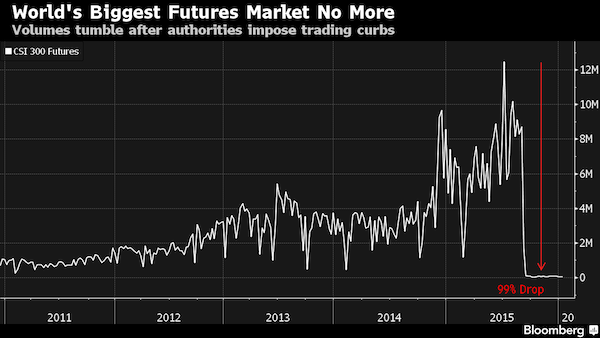
China’s removal of market-wide circuit breakers after just four days still leaves investors facing plenty of restrictions in how they trade. A 10% daily limit on single stock moves and a rule preventing investors from buying and selling the same shares in a day remain in force. Volume in what was once the world’s most active index futures market is minimal after authorities curtailed trading amid a summer rout, making it more difficult to implement hedging strategies. Officials unveiled curbs Thursday on share sales by major stockholders just a day before an existing ban was due to expire. And the activity of foreign investors is limited by quotas, given either to asset managers or to users of the Hong Kong-Shanghai exchange link.

“Although there’s more ability now for offshore participation, it’s largely a market that’s restricted the domestic users,” said Ric Spooner at CMC Markets Asia Pacific. “That means it doesn’t get the arbitrage benefits that international investors bring. It’s a work in progress.” There’s also the prospect that regulators and executives will dust off last year’s playbook as they seek to stem losses. At the height of the summer rout, about half of China’s listed companies were halted, while officials investigated trading strategies, made it harder for investors to borrow money to buy equities and vowed to “purify” the market. Chinese equities seesawed in volatile trading on Friday, with the CSI Index rising 1.3% as of 10:02 a.m. local time after climbing 3.1% and sinking 1.7%.

The gauge slid 12% in the first four days of the week, two of which were curtailed as the circuit breakers triggered market-wide halts for the rest of the day. The flip-flop on using the mechanism, which was meant to help stabilize the market, is adding to investor concern that authorities are improvising. Policy makers weakened the yuan for eight days straight through Thursday, and authorities were said to intervene on Tuesday to prop up equities. Policy makers used purchases by government-linked funds to bolster shares as the CSI 300 plunged as much as 43% over the summer. State funds probably spent $236 billion on equities in the three months through August, according to Goldman Sachs.

Read more …

Saudi rocket attack on embassy in Yemen.

• Iran Severs All Commercial Ties With Saudi Arabia (Reuters)

Relations between Iran and Saudi Arabia deteriorated even further on Thursday as Tehran severed all commercial ties with Riyadh and accused Saudi jets of attacking its embassy in Yemen’s capital. A row has been raging for days between Shi’ite Muslim power Iran and the conservative Sunni kingdom since Saudi Arabia executed cleric Nimr al-Nimr, an opponent of the ruling dynasty who demanded greater rights for the Shi’ite minority. Saudi Arabia, Bahrain, Sudan, Djibouti and Somalia have all broken off diplomatic ties with Iran this week, the United Arab Emirates downgraded its relations and Kuwait, Qatar and Comoros recalled their envoys after the Saudi embassy in Tehran was stormed by protesters following the execution of Nimr and 46 other men.

In a cabinet meeting chaired by Iran’s President Hassan Rouhani on Thursday, Tehran banned all imports from Saudi Arabia. Saudi Arabia had announced on Monday that Riyadh was halting trade links and air traffic with the Islamic Republic. Iran also said on Thursday that Saudi warplanes had attacked its embassy in Yemen’s capital, Sanaa, an accusation that Riyadh said it would investigate. “Saudi Arabia is responsible for the damage to the embassy building and the injury to some of its staff,” Foreign Ministry Spokesman Hossein Jaber Ansari was quoted as saying by the state news agency, IRNA. Residents and witnesses in Sanaa said there was no damage to the embassy building in Hadda district.

Read more …

Aramco is so big, it may be impossible to value.

• Saudi Arabia Considers IPO For World’s Biggest Energy Company Aramco (Guardian)

Saudi Arabia is considering a stock market listing for its national oil group – the world’s biggest energy company and probably the most valuable company on the planet. Saudi Aramco is a highly secretive organisation but is likely to be valued at well over $1tn (£685bn). Any public share listing would be viewed as a potent symbol of the financial pain being wreaked by low prices on the world’s biggest crude exporting country. Prince Muhammad bin Salman, the country’s highly influential deputy crown prince, confirmed in an interview on Monday with the Economist magazine that a decision would be taken within months whether to raise cash in this way, even as oil company shares are depressed at this time.

“Personally I am enthusiastic about this step,” he said. “I believe it is in the interest of the Saudi market, and it is in the interest of Aramco, and it is for the interest of more transparency, and to counter corruption, if any, that may be circling around.” The sale via an initial public offering (IPO) of any part of Saudi Aramco would be a major change in direction for a country, which has jealously guarded its enormous – and cheaply produced – oil reserves. Aramco’s reserves are 10 times greater than those of Exxon, which is the largest publicly listed oil company. The prince, considered the power behind the throne of his father King Salman, is keen to modernise the largely oil-based Saudi economy by privatisation or other means but it also needs to find money.

The country is under pressure, with oil prices plunging to their lowest levels in 11 years and more than 70% below where they were in June 2014. This has put huge strain on Saudi public spending plans, which were drawn up when prices were much higher and pushed the public accounts into deficit.

Read more …

A long way from salvation.

• VW Weighs Buyback of Tens of Thousands of Cars in Talks With US (BBG)

Volkswagen may buy back tens of thousands of cars with diesel engines that can’t be easily fixed to comply with U.S. emissions standards as part of its efforts to satisfy the demands of regulators, according to two people familiar with the matter. Negotiations between the German automaker and the U.S. Environmental Protection Agency are continuing and no decisions have been reached. Still, a buyback would be an extraordinary step that demonstrates the challenge of modifying vehicles that were rigged to pass emission tests. VW has concluded it would be cheaper to repurchase some of the more than 500,000 vehicles than fix them, said the people, who declined to be cited by name.

One person said the number of cars that might be bought back from their owners totals about 50,000, a figure that could change as talks continue. “We’ve been having a large amount of technical discussion back and forth with Volkswagen,” EPA Administrator Gina McCarthy said Thursday, when asked about the possibility of VW having to buy back some vehicles. “We haven’t made any decisions on that.” McCarthy told reporters after an event in Washington Thursday that VW’s proposals to bring its cars into compliance with emissions standards have so far been inadequate. “We haven’t identified a satisfactory way forward,” McCarthy said. The EPA is “anxious to find a way forward so that the company can get into compliance,” she said.

Read more …

“..the presence of isotopes from nuclear weapons testing..”

• Human Impact Has Pushed Earth Into The Anthropocene (Guardian)

There is now compelling evidence to show that humanity’s impact on the Earth’s atmosphere, oceans and wildlife has pushed the world into a new geological epoch, according to a group of scientists. The question of whether humans’ combined environmental impact has tipped the planet into an “anthropocene” – ending the current holocene which began around 12,000 years ago – will be put to the geological body that formally approves such time divisions later this year. The new study provides one of the strongest cases yet that from the amount of concrete mankind uses in building to the amount of plastic rubbish dumped in the oceans, Earth has entered a new geological epoch.

“We could be looking here at a stepchange from one world to another that justifies being called an epoch,” said Dr Colin Waters, principal geologist at the British Geological Survey and an author on the study published in Science on Thursday. “What this paper does is to say the changes are as big as those that happened at the end of the last ice age . This is a big deal.” He said that the scale and rate of change on measures such as CO2 and methane concentrations in the atmosphere were much larger and faster than the changes that defined the start of the holocene. Humans have introduced entirely novel changes, geologically speaking, such as the roughly 300m metric tonnes of plastic produced annually. Concrete has become so prevalent in construction that more than half of all the concrete ever used was produced in the past 20 years.

Wildlife, meanwhile, is being pushed into an ever smaller area of the Earth, with just 25% of ice-free land considered wild now compared to 50% three centuries ago. As a result, rates of extinction of species are far above long-term averages. But the study says perhaps the clearest fingerprint humans have left, in geological terms, is the presence of isotopes from nuclear weapons testing that took place in the 1950s and 60s. “Potentially the most widespread and globally synchronous anthropogenic signal is the fallout from nuclear weapons testing,” the paper says. “It’s probably a good candidate [for a single line of evidence to justify a new epoch] … we can recognise it in glacial ice, so if an ice core was taken from Greenland, we could say that’s where it [the start of the anthropocene] was defined,” Waters said.

Read more …

It’s all become a joke.

• Europe’s Economy Faces Confidence Test as Borderless Ideal Fades (BBG)

Here’s the latest in a long line of threats to Europe’s economy: the border guard. Danish officers checking travel documents on the boundary with Germany this week aren’t out to stymie trade or hinder tourism – they’re under orders from politicians anxious to stem the flow of refugees. Even so, analysts are beginning to worry about what could happen to the already-embattled region when the free movement of people is called into question. Like the euro, the single currency used by 19 of the European Union’s 28 nations, the Schengen Agreement has long been touted by politicians as an irrevocable pillar of a multi-national union, allowing unimpeded travel between states for business or pleasure. So with an already fragile recovery, monetary policy stretched trying to fend off deflation and companies deferring investment, the mere threat that Schengen could unravel may be hard to shrug off.

“If in the migrant crisis Schengen were to disintegrate, this would send a disastrous signal to markets: the European project would be seen as in fact reversible,” said Wolfango Piccoli, managing director of Teneo Intelligence in London. “Nobody could blame investors if against that backdrop, they would suddenly start to re-evaluate the reliability of promises made by European institutions in the euro-zone crisis.” The EU says Europeans make over 1.25 billion journeys within the Schengen zone every year, which comprises 26 countries from the Barents Sea to the eastern Mediterranean. It also includes countries such as Iceland and Norway that aren’t part of the EU. Signed in 1985, Schengen took effect 10 years later. In normal times, it means travelers within the bloc aren’t subjected to border checks, and external citizens holding a visa for one country may usually travel without restriction to all.

These aren’t normal times and now the edifice of carefree travel across the continent is cracking. During 2015, the arrival of people fleeing wars and persecution in Asia, Africa and the Middle East exceeded 1 million, sparking political tension and public debate over how, and where, to settle the newcomers. Denmark’s decision to establish temporary controls seems, according to the EU, to be covered by Schengen rules that allow such curbs in emergencies. But it’s not the first; that move came hours after Sweden started systematic ID checks at its borders, while Germany was forced to take similar action in September along its frontier with Austria. Hungary erected a fence at its borders with Serbia and Croatia last year.

Read more …

€3 billion, Angela.

• Turkey Does Nothing To Halt Refugee Flows, Says Greece (Kath.)

Turkey has not taken any action to clamp down on human traffickers and between 3,000 and 4,000 migrants and refugees are reaching Greece every day, Immigration Policy Minister Yiannis Mouzalas said Thursday. Mouzalas suggested in an interview on Skai TV that Ankara has not lived up to its pledges to stem the flow of people traveling across the Aegean to Greece. “It has not done anything to stop human trafficking, as is evident from the migratory flows.” The minister said that the high level of arrivals has continued because the news that some migrants are not being allowed through European borders has yet to filter through but, at the same time, refugees waiting to cross from Turkey are concerned that if they do not do so soon they will be prevented from reaching Central and Northern Europe.

“The high rate has to do with refugees’ fear that the borders will close for everyone,” he said, adding that he thought this possibility is “very likely.” “When the message reaches Morocco that Moroccans are not being allowed to cross into Europe but are being held and repatriated, the flows will drop.” Mouzalas said that around half of the people arriving in Greece over the last two months have been undocumented migrants.

Read more …

Jan 042016
 
 January 4, 2016  Posted by at 4:27 pm Finance Tagged with: , , , , , , ,  2 Responses »


Marion Post Wolcott Natchez, Mississippi, grocery window 1940

The Chinese stock markets broke through 2 circuit breakers today, breakers that were introduced only a few months ago in response to the market selloff, triggered by a surprise yuan devaluation, in August. The first breaker, at -5%, forced a 15-minute trading halt. The second one, at -7%, halted trading for the rest of the day.

For many people, today’s bust can’t have been a huge surprise, because it’s been known for some time that a ban on stock sales by parties holding a 5% or larger stake in a company, is set to expire on Friday. Beijing may panic again before that date, but it can’t force stakeholders to hold on to large portfolios forever either.

Xi and his crew should have stayed out of the markets from the start, but that’s not how they see the world. They still think like apparatchicks, and don’t understand that markets are opposed, at a 180º angle, to top down control. You can either have a market, or you can have central control.

They pumped up the housing market for all they could, and when that bubble blew they tricked their people into buying stocks. And now that one’s fixing to die too, and that didn’t take nearly as long as the housing bubble. The central control team is frantically looking for the next carnival attraction, but it won’t be easy.

They should have stayed out of all markets. Just like western central banks. All interference by governments and central banks can only make things worse, a fact at best temporarily hidden by the distortions they force upon markets.

And we shouldn’t forget that expectations for China as the world’s economic savior determined western central bank ‘thinking’ to a large extent over the past decade. Like so many others, central bankers too are incapable of spotting a Ponzi when it’s staring them in the face.

Now the Chinese bubble is bursting, and set to spill over into and over the global economy with dire consequences, we are all exposed to that much more than was ever necessary. All the PBoC, Yellen, Kuroda and Draghi managed to accomplish was a dran-out illusion, a slow-motion sleight of hand.

Here’s something I was writing over the weekend, prior to today’s market action:

China underlies all problems the world faces economically today. Since at least 2008, the global economy has been a one-dimensional one-way street, in which all hope was focused on China. Western companies and stock traders were so confident that China would lift the entire planet out of its recessionary doldrums, they leveraged themselves up the wazoo to bet on a China-based recovery. It was the only game in town, and it was merrily facilitated by central banks.

The People’s Bank of China threw some $25 trillion at the illusion, the Fed, ECB and BoJ combined for probably as much again. One way of looking at it is that if you weren’t sure on how bad the recession really was, now you know the numbers.

But today China is close to entering its own recession, whether Beijing will admit it or not. The official GDP growth goal of 6.5% looks downright silly when you see this graph that Charlene Chu sent to BI:


CEIC and the National Bureau of Statistics; Charlene Chu, Autonomous Research

From the article:

Secondary industry comprises about 40-45% of GDP. [..] In China, GDP is classified into three industries, primary (agriculture), secondary (manufacturing and construction), and tertiary (services). [..]

This slowdown in the secondary industry is part of China’s intentional shift toward an economy focused on services and consumer consumption rather than manufacturing.

The first line there is educative, the second is nonsense. Manufacturing in China is plunging because ‘we’ don’t buy their overcapacity and overproduction any longer. And neither do the Chinese themselves. Primary industry, agriculture, may grow a little bit, but certainly not much.

Tertiary industry, services, may also grow a bit, but Beijing can’t just flip a switch and get people to buy services on a scale that can make up for the decline in manufacturing. Neither can it retrain tens of millions of workers for jobs in that illusive services sector, let alone on short notice.

This decline will take years for the Chinese economy to absorb, since so much of it is based on overleveraged overcapacity and overproduction. The spectre of massive job losses hangs over the entire ‘adjustment’ process, both in China itself and in countries that -used to- supply it with commodities. Mass unemployment in China in turn raises the spectre of severe social unrest.

As I said in 2016 Is An Easy Year To Predict, China has got to be the biggest story going forward (rather than oil, for instance), and it would have been already, to a much larger extent than it has, if there were less denial involved. And less debt.

Like the west, China will have to deleverage its enormous debt burden before it can even start thinking of rebuilding its economy. Which is precisely what they all seek to deny, loudly and boisterously, not only as if a recovery were feasible without dealing with the debt, but even as if more debt could mean more recovery.

This debt deleveraging will involve such stupendous amounts of -largely virtual- money that the situation, the bottom, from which rebuilding will need to take place will be one at which today’s societies will be hardly recognizable anymore.

Debt deleveraging comes with deflation. Spending will plummet, unemployment will shoot up, production will grind to a halt. Power will shift from established political and economic parties to others.

Obviously, this will not be a smooth transition. The clarions of war sound in the distance already. What is crucial to realize is that none of it can be prevented, other than perhaps the warfare; the economic parts of the play must must be staged. All we can do is to make it as bearable as possible.

The people on the streets, as always, will bear the brunt of the downfall. We only need to look at Greece today to get a pretty good idea of how these things play out.

It won’t be all straight down from here, but the trend will be crystal clear. It didn’t start all of a sudden today, but China’s double circuit breaker is a useful sign, if not an outright red flag. One thing’s for sure: we’ll make the history books.

Dec 282015
 
 December 28, 2015  Posted by at 10:48 pm Finance Tagged with: , , , , , , , , ,  4 Responses »


AP Police Officer Carries Aylan Kurdi’s Body, Bodrum Sep 2 2015

No year is ever easy to predict, if only because if it were, that would take all the fun out of life. But still, predictions for 2016 look quite a bit easier than other years. This is because a whole bunch of irreversible things happened in 2015 that were not recognized for what they are, either intentionally or by ‘accident’. Things that will therefore now be forced to play out in 2016, when denial will no longer be an available option.

A year ago, I wrote 2014: The Year Propaganda Came Of Age, and though that was more about geopolitics, it might as well have dealt with the financial press. And that goes for 2015 at least as much. Mainstream western media are no more likely to tell you what’s real than Chinese state media are.

2015 should have been the year of China, and it was in a way, but the extent to which was clouded by Beijing’s insistence on made-up numbers (GDP growth of 7% against the backdrop of plummeting imports and exports, 45 months of falling producer prices and bad loans reaching 20%), by the western media’s insistence on copying these numbers, and by everyone’s fear of the economic and financial consequences of the ‘Great Fall of China‘.

2015 was also the year when deflation, closely linked -but by no means limited- to China, got a firm hold on the global economy. Denial and fear have restricted our understanding of this development just as much.

And while it should be obvious that 2015 was the year of refugees as well, that topic too has been twisted and turned until full public comprehension has become impossible. Both in the US and in Europe politicians pose for their voters loudly proclaiming that borders must be closed and refugees and migrants sent back to the places they’re fleeing due to our very own military interventions.

And that said politicians have the power to make that happen, the power to close borders to hundreds of thousands of fellow human beings arriving on their countries’ doorsteps. As if thousands of years of human mass migrations never occurred, and have no lessons to teach the present or the future.

The price of oil was a big story, and China plays the lead role in that story, even if again poorly understood. All the reports and opinions about OPEC plans and ‘tactics’ to squeeze US frackers are hollow, since neither OPEC as a whole nor its separate members have the luxury anymore to engage in tactical games; they’re all too squeezed by the demise of Chinese demand growth, if not demand, period.

Ever since 2008, the entire world economy has been kept afloat by the $25 trillion or so that China printed to build overleveraged overcapacity. And now that is gone, never to return. There is nowhere else left for our economies to turn for growth. Everyone counted on China to take them down the yellow brick road to la-la-land, forever. And then it didn’t happen.

What 2015 should have made clear, and did in a way but not nearly clear enough, is that the world economy is falling apart due to a Ponzi bubble of over-production, over-capacity, over-investment, over-borrowing, all of which was grossly overleveraged. And that this now is, for lack of a better word, over.

Most people who read this will have noticed the troubled waters investment funds -hedge funds, mutual funds, money market funds et al- have recently landed in. But perhaps not many understand what this means, and where it may lead. These things tend to be seen as incidents, as is anything that diverts attention away from the ‘recovery just around the corner’ narrative.

Not only do the losses and redemptions at investment funds drive these funds to the brink, everything they’ve invested in also tumbles. Add to this the fact that most of the investments are highly leveraged, which means that typically a loss of just a few percent can wipe out all of the principal, and a notion of the risks becomes clear.

Of course, since many of the funds hold the same or similar investments, we can add yet another risk factor: contagion. Things will blow up first where the risk is highest. Then everything else becomes riskier. Low interest rates have caused many parties to chase high yields -junk bonds-, and that’s where risks are highest.

This is the 2015 story of investment funds, and it will continue, and aggravate, in 2016. Ultra low interest rates drive economies into deflation and investors into ever riskier assets. This is a process of unavoidable deterioration, unstoppable until it has played out in full. A 0.25% rate hike won’t do anything to change that.

Why do interest rate hikes pose such a problem? Because ZIRP has invited if not beckoned everyone to be up to their necks in debt. The entire economy is being kept lopsidedly upright, Wile. E style, by debt. Asset prices, even as commodities have now begun to fall in serious fashion, still look sort of OK, but only until you start to look at the amount of leverage that’s pinning it all up.

Once you see that, you understand how fragile it all is. Go one step further, and it becomes clear that this exponentially growing ‘machinery‘ can only be ‘sustained’ by ever more debt and leverage. Until it no longer can.

Commodities prices have nowhere to go but down for a long time to come. These prices have been propped up by the illusionary expectations for Chinese growth and demand, and now that growth is gone. So, too, then, must the over-leveraged over-investments both in China and abroad.

Growth that was expected to be in double digits for years to come has shrunk to levels well below that ‘official’ 7%. China’s switch to a consumer driven economy is as much a fantasy as the western switch to a knowledge economy has proved to be. If you don’t actually produce things, you’re done. And producing for export markets is futile when there’s no-one left to spend in those markets.

Ergo, commodities, raw materials, the very building blocks of our economies, from oil all the way to steel, are caught in a fire sale. Everything must go! Eventually, commodities prices will more or less stabilize, but at much lower levels than they -still- are at present. That we will need to figure this out in 2016 instead of 2015 is our own fault. We could have been healing, but we’ve yet to face the pain.

Trying to guesstimate how low oil will go is a way of looking at things that seems very outdated. It’s interesting just about exclusively for people who ‘invest’ in the markets, but the reality is that the Fed, BoJ, PBoC and ECB have first made sure through QE and ZIRP/NIRP that there no longer are functioning markets, and they are now losing their relevance because of these very ‘policies’.

Price discovery has already started (oil, commodities), and central banks have benched themselves. They could only re-enter the game if they quit interfering in the markets, but they’re too afraid, all of them, of the consequences that might have, not even so much for their economies but for their TBTF banks.

Yellen’s rate hike will mean some extra profits for those same banks at the cost of the rest of the financial world, but with growth gone to not return for a very long time, and with deflation hitting everything in sight and then some, there is no pretty picture left.

And none of this is really hard to process or understand. It’s just that there’s these concerted efforts to keep you from understanding, that keep you believing in some miracle salvation effort. Which would, so goes the narrative, have to come from the same central banks and the same Wall Street banks that put everyone and their pet guinea pig as deep in debt as they are.

If you have been reading the Automatic Earth over the past 8 years and change, you know what this is about. There are a few, but unfortunately only a few, other sources that may have put you on the same trail.

I was impressed with the following earlier this month from David Stockman, Reagan’s Director of the Office of Management and Budget, who now seems to have firmly caught up with the deflation theme Nicole Foss and I have been warning about ever since we started writing – pre-TAE – at the Oil Drum 10 years ago. Stockman today says that we are entering an epic deflation and the world economy is actually going to shrink for the first time since the 1930s. (!)

The End Of The Bubble Finance Era

There has been so much over-investment in energy, mining, materials processing, manufacturing and warehousing that nothing new will be built for years to come. [..] .. there will be a severe curtailment in the production of mining and construction equipment, oilfield drilling rigs, heavy trucks and rail cars, bulk carriers and containerships, materials handling machinery and warehouse rigging, machine tools and chemical processing equipment and much, much more.

It’s good to see people finally acknowledging this. It’s still rare. But there’s another, again interlinked, development that is very poorly understood. Which is that in a debt deflation, the ‘money’ that appears to be real and present in leveraged investments more often than not doesn’t get pulled out of one ‘investment’ only to be put into another, it just goes POOF, it vanishes.

And though it may seem strange, conventional economics has a very hard time with that. In the eyes of that field, if you don’t spend your money, you must be saving it. The possibility of losing it altogether is not a viable option. Or, if you lose it, someone else must be gaining it, zero-sum style.

But that view ignores the entire ‘pyramid’ of leveraged loans and investments and commodity prices, which precisely because that pyramid contained no more than a few percentage points of ‘real collateral’ to underpin everything it kept afloat, should have been a red flag. Because this is the very essence of debt deflation.

Just one little example of how and why this happens comes from this Bloomberg item. The key word is ‘evaporates’:

$100 Billion Evaporates as World’s Worst Oil Major Plunges 90%

Colombia is nursing paper losses of more than $100 billion after its oil boom fell short of expectations, wiping out 90% of the value of what was once Latin America’s biggest company. From being the world’s fifth-most valuable oil producer at its zenith in 2012, worth more than BP, state-controlled Ecopetrol now ranks 38th. Its market capitalization has fallen to $14.5 billion, down from its peak of $136.7 billion. “They just haven’t found oil, it’s as simple as that,” Rupert Stebbings at Bancolombia said from Medellin. “The whole oil sector got massively over-bought, and people assumed that one day they’d hit an absolute gusher.”

2016 will be the year when a lot of ‘underlying wealth’ evaporates. Trillions of dollars already have in the commodities markets, but, again, our media don’t tell us about it, or at least they frame it in different terms. They use deflation to mean falling consumer prices, but then insist on calling falling prices at the pump a positive thing. Without recognizing to what extent those falling prices eat away at the entire economy, and at society at large.

To summarize for now: we have elected to deny and ignore what has happened to our economies, our societies and our lives in 2015, only to be forced to face all of it in 2016. That makes the year an easy one to predict. But there are of course a lot of other possible spokes and wheels and other things.

Any government that sees its nation slide down into a deep enough pit will always consider going to war. One or more central banks may opt for a Hail Mary helicopter ride. A volcano may erupt. But none of these things will prevent the bubbles we have blown from deflating. They may divert attention, they may delay the inevitable a bit more, sure. But bubbles never last.

I have a whole list of key words I wanted to use in this, but I think I’ll turn them into a separate article. The main point is you understand the gist of it all. There are no markets, and what has posed as markets is crumbling before our very eyes, inexorably. The best we can do is say ‘see you on the other side’, if we’re lucky.

Dec 152015
 
 December 15, 2015  Posted by at 9:53 am Finance Tagged with: , , , , , , , ,  Comments Off on Debt Rattle December 15 2015


Unknown No Dog Biscuits Today

• Stephen Roach: China Is The Biggest Commodities Story Since WWII (BBG)
• Fitch Warns Of Effects Of Sharp China Slowdown (CNBC)
• Rio Tinto CEO Says Iron Ore Rivals ‘Hanging on by Their Fingernails’ (BBG)
• Miners Shoveling Furiously Prop Up Aussie GDP as Iron Ore Melts (BBG)
• US Natural-Gas Prices Plunge Toward A 14-Year Low (MarketWatch)
• Never Mind $35, The World’s Cheapest Oil Is Already Close to $20 (BBG)
• Junk Rated Stocks Flashing Same Signal as High-Yield Bond Market (BBG)
• Big Banks In Europe And US Announced 100,000 New Job Cuts This Year (FT)
• Yahoo Told: Cut 9,000 Of Your 10,700 Staff (AP)
• Economic Pain In US Heartland As Likely Fed Hike Nears (Reuters)
• The Mystery of Missing Inflation Weighs on Fed Rate Move (WSJ)
• Are Negative Rates Fueling Deflation? (Martin Armstrong)
• Fedpocalypse Now? (Jim Kunstler)
• Throwing Out Granny: Abe Wants Elderly Japanese To Move To Countryside (BBG)
• Absolute Good -Us- vs Absolute Evil -Them- (Crooke)
• EU To Offer Turkey No Guarantee On Taking In Refugees (Reuters)
• Where The Dream Of Europe Ends (Gill)
• EU Backs Housing Scheme For Migrants And Refugees In Greece (AP)
• Three Of Six Missing Migrants Confirmed Drowned (Kath.)

“The Bloomberg Commodity Index, a measure of returns for 22 raw materials, closed at the lowest in 16 years on Monday..”

• Stephen Roach: China Is The Biggest Commodities Story Since WWII (BBG)

Commodities are at risk of extending declines as China’s slowdown hurts demand and the world’s largest user shifts its economic model away from raw materials, according to Stephen Roach, who said some producers haven’t yet faced up to the change. “The China factor can’t be emphasized enough,” Roach, a senior fellow at Yale University, said in a Bloomberg Television interview in Hong Kong on Tuesday. China “has been the most commodities-intensive story that the world economy has seen in the post-WWII period. Now China is shifting the model to more of a commodity-light, services-led economy.”

Raw materials sank to the lowest level since 1999 this week as China’s slowest expansion in a quarter of a century cut demand in a reversal of the pattern seen a decade ago, when booming growth in Asia fueled a surge across commodity prices that was dubbed the super-cycle. Continued concern about China, coupled with a rising dollar as the Federal Reserve raises rates, will make it difficult for commodities to rebound, according to Roach, a former non-executive chairman for Morgan Stanley in Asia. “Commodities are, after a super-cycle, obviously going the other way, big time,” Roach said. Some companies “are in denial that China is changing its character, its structure. It’s going to take a while for that to sink in, and until it sinks in, there’s still downward pressure on commodity markets and prices.”

The Bloomberg Commodity Index, a measure of returns for 22 raw materials, closed at the lowest in 16 years on Monday as supplies of everything from oil to copper outstripped demand. Base metals and crude oil fell on Tuesday, with copper trading 0.6% lower at $4,645 a metric ton in London, down 26% this year. The best way to heal lower prices are lower prices, as that takes supply out of the system, according to Roach. Metals companies in China including producers of copper, aluminum, zinc and nickel have all announced cuts to supply or plans to rein in capacity growth to stem the price rout. Outside China, Glencore pared copper production from mines in Africa, while Alcoa has curbed aluminum output.

Read more …

A test run that puts China GDP growth at 2.3%. A number picked by accident?

• Fitch Warns Of Effects Of Sharp China Slowdown (CNBC)

A sharp slowdown in the world’s second largest economy China would hit global growth hard, according to a report by Fitch ratings agency, which warned of “significant knock-on effects” for the rest of the world. In its report published Tuesday, Fitch warned that a sharp slowdown in China’s GDP growth rate to 2.3% during 2016-2018 “would disrupt global trade and hinder growth, with significant knock-on effects for emerging markets and global corporates. In turn, this would keep short-term interest rates and commodity prices lower for longer.” Global GDP growth is currently expected to be 3.1% in 2017, according to Oxford Economics’ global economic model which was used by Fitch to frame its “shock” China scenario. But if a slowdown of such a magnitude materialized in China, Fitch said global GDP growth would slow to 1.8% in 2017.

As a result, any rise in U.S. and euro zone short-term interest rates would be postponed, and oil prices would remain under pressure, Fitch said. ‘Lower-for-longer in terms of growth, interest rates and commodity prices, could be the defining mantra of this decade for the major advanced economies if a Chinese shock scenario materializes,’ Bill Warlick, senior director of Macro Credit Research at Fitch, noted in the study. While Fitch emphasized that this hypothetical scenario did not reflect its current expectations for China’s growth, it was “designed to test credit connections between China and the rest of the world.”

In terms of these “credit connections”, a China slowdown would “impair” the credit profiles of many companies globally, particularly commodity-dependent ones in oil and gas, steel, and mining, Fitch said. “Shipping companies would also suffer, as commodities account for a significant portion of freight volume. The global technology, heavy manufacturing and automotive sectors would also feel increased credit pressure due to a slowdown in Chinese demand,” the agency warned. [..] Within Fitch’s rated portfolio, 25 percent of oil and gas companies and 52 percent of other commodities companies are already sub-investment grade. If the slowdown scenario materialized, it could create ripple effects through the high-yield bond market, the agency said.

Read more …

They should have checked his hands, too.

• Rio Tinto CEO Says Iron Ore Rivals ‘Hanging on by Their Fingernails’ (BBG)

The iron ore collapse has pushed producers to the brink of survival, according to the head of the world’s second-biggest mining company. “There are a lot of producers that we believed would leave the market that are hanging on by their fingernails,” Sam Walsh, chief executive officer of Rio Tinto Group, said in an interview with Bloomberg TV. “They are burning up cash reserves of their shareholders.” Iron ore’s 45% retreat this year has left the industry on the precipice of an unprecedented shake-out as higher-cost suppliers are slowly forced to exit the market. Prices are continuing to fall as the largest companies, including Vale, Rio Tinto and BHP Billiton, expand production and grab market share. Iron ore fell below $39 a metric ton last week, a record low in daily prices dating back to 2009. That’s down from near $190 in 2011, when Chinese demand was booming.

“I suspect that right now, even at a price of $39 a ton, there are people that are suffering pretty loudly,” Walsh said. “Sooner or later the adjustment will take place.” The slump has hurt miners’ shares. Rio stock has lost 28% in Sydney this year, dropping to A$40.39 on Dec. 9, the lowest price since 2009, while BHP has fallen 40%. In Brazil, Vale has dropped 49%. Rio and its rivals have been criticized by analysts, competitors and governments for pursuing a strategy of expanding lower-cost mines even as prices fell amid a global glut. Walsh said it would be abnormal for his company to consider withholding supply given that Rio is the lowest cost producer. Rio and BHP are in an “imaginary world” because their strategy hurts themselves as much as their competitors, Lourenco Goncalves, the CEO of Cliffs Natural Resources, the biggest U.S. iron ore producer, said last month. Prices below $50 are “not comfortable to anyone,” he said.

Read more …

It’s same all over commodities: overproduce to stay alive. Run and still move backwards.

• Miners Shoveling Furiously Prop Up Aussie GDP as Iron Ore Melts (BBG)

The price of Australia’s top export has been almost slashed in half this year. That makes it all the more surprising economists increasingly see iron ore propping up growth as they assemble their 2016 forecasts. The reason: Australian producers are making up for the price destruction by doubling down on volume, in the process worsening a global supply glut. There’s even a new entrant to the market – Gina Rinehart, Australia’s richest person, last week oversaw her company’s first shipment of iron ore to South Korea. The surging exports are also papering over a massive drag on the economy from collapsing mining investment and could account for most of next year’s growth, according to Citigroup and Goldman Sachs.

Still, the fall in commodity prices will hurt fiscal revenue, making it more difficult for the government to pare back a deficit and reach its goal for a surplus by the end of the decade. “We’re running faster to stand still when it comes to national income,” said James McIntyre at Macquarie in Sydney. Australia is forecasting an 8% rise in the volume of iron ore exports next year to 824 million metric tons, which would be almost double the amount the country shipped five years earlier. Goldman Sachs estimates that the country’s net exports will contribute 2 percentage points to growth next year without which the economy would stall.

Read more …

It’s everywhere. NatGas could bounce back a little if winter sets in.

• US Natural-Gas Prices Plunge Toward A 14-Year Low (MarketWatch)

The winter heating season has begun, but natural-gas prices have plunged toward levels they haven’t seen since January 2002. Natural gas for January delivery fell 10.9 cents, or 5.5%, to trade at $1.881 per million British thermal units Monday. It suffered a weekly loss of nearly 11% last week. Prices traded as low as $1.862 and based on the most active contracts, prices haven’t seen an intraday level this low since January 2002, according to FactSet data. A settlement around the current level would be the lowest since September 2001. The price drop comes amid a glut in supply. Domestic natural-gas supplies in storage topped out just above 4 trillion cubic feet the week of Nov. 20, the largest storage level on record, based on U.S. government data.

There is “too much natural gas, not enough demand—that is even with the shutdown of coal facilities,” said Richard Gechter, Jr., principal and president of Richard W. Gechter Natural Gas Consulting. “Supply has increased beyond anyone’s expectations.” The winter season historically runs from November to March of the following year. Supplies in storage stood at 3.88 trillion cubic feet as of Dec. 4, and the U.S. Energy Information Administration expects inventories will finish the end of the winter season at 1.862 trillion cubic feet. That would be a smaller drawdown than what’s typically seen in the winter. “Strong inventory builds, continuing production growth and expectations for warmer-than-normal winter temperatures have all contributed to low natural-gas prices,” the EIA said.

Read more …

“It’s really a dramatic situation that really cannot continue for a very long time for many producers.”

• Never Mind $35, The World’s Cheapest Oil Is Already Close to $20 (BBG)

As oil crashes through $35 a barrel in New York, some producers are already living with the reality of much lower prices. A mix of Mexican crudes is already valued at less than $28, an 11-year low, according to data compiled by Bloomberg. Iraq is offering its heaviest variety of oil to buyers in Asia for about $25. In western Canada, some producers are selling for less than $22 a barrel. “More than one-third of the global oil production is not economical at these prices,” Ehsan Ul-Haq at KBC Advanced Technologies said. “Canadian oil producers could have difficulty in covering their operational costs.” Oil has slumped to levels last seen in the global financial crisis in 2009 amid a global supply glut.

While the prices of benchmarks West Texas Intermediate and Brent hover in the $30s, they represent a category of crude – light and low in sulfur – that is more highly valued because it’s easier to refine. Some producers of thicker, blacker and more sulfurous varieties have suffered heavier losses and are already living in the $20s. A blend of Mexican crude has plunged 73% in 18 months to $27.74 on Dec. 11, its lowest level since 2004, according to data compiled by Bloomberg. Venezuela is experiencing similar lows. Western Canada Select, which is heavy and sulfurous, has slumped 75% to $21.82, the least in seven years. Other varieties including Ecuador’s Oriente, Saudi Arabia’s Arab Heavy and Iraq’s Basrah Heavy were selling below $30, the data show.

Crudes of this type trade at a discount to lighter varieties because to process them “refiners have to invest in upgrading facilities such as coking plants, which are very expensive,” KBC’s Ul-Haq said. “Most places in the world, a lot of the producers they don’t really get the Brent price, and they don’t get the WTI price,” Torbjoern Kjus at DNB ASA in Oslo said. “It’s really a dramatic situation that really cannot continue for a very long time for many producers.”

Read more …

Interconnected.

• Junk Rated Stocks Flashing Same Signal as High-Yield Bond Market (BBG)

Think equity investors have been blind to warning signs coming from junk bonds? Not quite. For most of the year pessimists have warned that equity markets were missing signals in high-yield credit, where losses snowballed even as gauges like the Standard & Poor’s 500 Index remained relatively stable. While true, most of that is an illusion of index composition – not evidence of complacency. As one of the broadest share gauges, the S&P 500 has companies that span the credit spectrum from junk to investment grade – or have no debt at all. From that perspective, it’s less surprising that the full index wouldn’t mimic the plunge in junk bonds themselves, where annual losses for related exchange-traded funds exceed 10%. And that’s what happened: until Friday, the equity gauge was virtually flat for the year.

What if you look at stocks that are representative of the high-yield universe? A basket compiled by Bloomberg of below investment-grade companies, including Chesapeake and Cliffs Natural Resources, has dropped a lot more – 51% in 2015. The slump in stocks with the lowest credit quality reflects the same concern gripping the debt market, that the commodity selloff and the Federal Reserve’s plan to start raising interest rates will jeopardize solvency. While near record cash and the resilience in large technology firms have sheltered the S&P 500 from deeper losses, junk-rated stocks are vulnerable to a credit contagion with a smaller size and a tilt toward commodities. “It’s really the same kind of signal,” Curtis Holden at Tanglewood Wealth Management, which oversees about $840 million, said. “The market is saying through how well the S&P 500 is holding up on a relative basis, ‘Look for quality. Don’t look for junk companies.”’

Read more …

They would like you to believe this is due to “robots and regulation”.

• Big Banks In Europe And US Announced 100,000 New Job Cuts This Year (FT)

Big banks in Europe and the US announced almost 100,000 new job cuts this year, and thousands more are expected from BNP Paribas and Barclays early next year, as the wave of lay-offs that began in 2007 shows no sign of abating. The 2015 cuts – which exclude the impact of major asset sales — amount to more than 10% of the total workforce across the 11 large European and US banks that announced fresh lay-offs, according to analysis by the Financial Times. The most recent came last week, as workers at Dutch lender Rabobank learnt of 9,000 cuts across their bank the day after Morgan Stanley announced 1,200 lay-offs, including at its ailing fixed income division.

Barclays and BNP Paribas, two of Europe’s biggest banks, will unveil job cuts when they announce strategies that are designed to strip out 10 to 20% of the costs at their investment banks, people familiar with the situations said. At Barclays, the axe will fall on March 1 when chief executive Jes Staley unveils a fresh strategy with the bank’s annual results. The announcement will include Barclays’ plans to move more quickly to shrink its investment bank, which employs about 20,000 people. BNP Paribas’s new corporate and institutional banking chief Yann Gérardin will announce a new cost cutting plan in February. The French bank has already said it is planning to cut more than 1,000 jobs in its Belgian retail network.

Banks have found that they have been carrying too many staff, as they suffer falls in revenues from a combination of tougher post-crisis regulation, ultra-low interest rates and sluggish activity among clients. Those under new leadership — such as Deutsche Bank, Credit Suisse and Barclays — have been under particular scrutiny, as incoming chief executives try to turn the ailing banks they inherited into the more profitable companies demanded by investors.

Read more …

Good by and thanks for all the fish.

• Yahoo Told: Cut 9,000 Of Your 10,700 Staff (AP)

Yahoo is facing shareholder pressure to pursue other alternatives besides a complex spin-off of its internet operations while chief executive Marissa Mayer struggles to revive the company’s revenue growth. The demands from SpringOwl Asset Management and Canyon Capital Advisors reflect shareholders’ frustration with Ms Mayer’s inability to snap the company out of a financial downturn after three-and-half years in the top job. Ms Mayer hoped to placate investors with last week’s announcement of a revised spin-off, but the company’s shares have slid 6pc since then. The shares fell 32 cents to close at $32.59 on Monday. SpringOwl, a New York hedge fund, has sent a 99-page presentation to Yahoo’s board that calls for the company to lay off 9,000 of its 10,700 workers and eliminate free food for employees to help save $2bn annually.

Canyon Capital, a Los Angeles investment firm, wants Yahoo to sell its internet business instead of spinning it off. Yahoo has warned the spin-off could take more than a year to complete, a time frame that Canyon Capital called “simply unacceptable” after Yahoo spent most of 2015 preparing to hive off its $31bn stake in China’s Alibaba in an attempt to avoid paying taxes on the gains from its initial investment of $1bn. Yahoo scrapped the Alibaba spin-off after another shareholder, Starboard Value, threatened an attempt to overthrow the board if the company stuck to that plan. Starboard and other investors were worried the Alibaba stake would be taxed at a cost of more than $10bn after the Internal Revenue Service declined to guarantee it would qualify for an exemption.

Now that two more shareholders expressing their dismay with Yahoo’s direction, Ms Mayer’s fate could be tied to a cost-cutting reorganisation that she has been working on for the past two months. Ms Mayer, who is on a brief maternity leave after giving birth to twins last week, says the overhaul will jettison Yahoo’s least profitable products – a shake-up that could lay off a large number of workers.

Read more …

The truth is slipping through the cracks of propaganda. American recovery my…

• Economic Pain In US Heartland As Likely Fed Hike Nears (Reuters)

America’s heartland, the vast area in the middle of the country that produces much of the nation’s food and energy and is home to many of its traditional manufacturers, is sending warning signals that all is not well with the economy. From agriculture to heavy equipment and small business lending, farmers, manufacturers and transport companies that serve them are taking hits from a stronger dollar or plunging prices for farm commodities and oil. Industry executives worry that the expected move by the U.S. Federal Reserve to raise interest rates on Wednesday – which would be the first hike in a decade – could put more jobs at risk.

“Many of the companies that we do business with are hurting and some have already gone away,” said Bill Hickey, president of Chicago-based steel company Lapham-Hickey Steel, which has seven mills across the country and supplies processed steel to car makers and construction firms. He worries banks could start cutting off credit to troubled industrial companies. The Thomson Reuters/PayNet Small Business Lending Index fell 5% in October from the previous month and was flat on the year, marking only the second time it had failed to rise since February 2010. Weakness in the manufacturing, farm and transport sectors likely will not deter a rate increase by the Fed, economists say. There is “no doubt that manufacturing weakness is costing growth,” said Harm Bandholz at UniCredit Research.

However, the sector only accounts for about 12% of the U.S. economy and some areas like automotive are performing well. “You can’t say that everything is perfect,” he said. “But the United States is not doing so bad anymore that we need 0% interest rates.” The downbeat indicators from heartland industries illustrate the economy’s lumpiness. Preliminary data show that November U.S. orders for heavy, over-the-road trucks fell 59% from a year earlier – the worst November since 2009, according to transportation analysis firm FTR. Freight at the U.S. major railroads was off 1.9% for the year through Dec. 5. Coal accounts for much of the decline. But shipments of consumer goods by container – or intermodal shipments – were only up 1.6%. “The numbers are as bad as I’ve seen them,” said Anthony Hatch, an independent railroad analyst.

Farmers are under pressure from declining crop prices and weak demand. U.S. farm incomes are expected to drop 38% for all of 2015, the steepest year-on-year drop since 1983. Nathan Kauffman, an economist with the Kansas City Fed, said higher rates would create “the potential for more financial stress.”

Read more …

Set a target, make a prediction, see both fail miserably, rinse and repeat.

• The Mystery of Missing Inflation Weighs on Fed Rate Move (WSJ)

Federal Reserve officials this week are expected to raise interest rates for the first time in nine years on the expectation that employment and inflation will hit targets reflecting a healthy U.S. economy. But Fed officials face a troubling question: Jobs are on track, but inflation isn’t behaving as predicted and they don’t know why. Unemployment has fallen to 5%, a figure close to estimates of full employment, while inflation remains stuck at less than 1%, well below the Fed’s 2% target. Central bank officials predict inflation will approach their target in 2016. The trouble is they have made the same prediction for the past four years. If the Fed is again fooled, it may find it raised rates too soon, risking recession.

Low inflation—and low prices—sound beneficial but can stall growth in wages and profits. Debts are harder to pay off without inflation shrinking their burden. For central banks, when inflation is very low, so are interest rates, leaving little room to cut rates to spur the economy during downturns. The Fed’s poor record of predicting inflation has set off debate within the central bank over the economic models used by central bank officials. Fed Chairwoman Janet Yellen, in a 31-page September speech on the subject, acknowledged “significant uncertainty” about her prediction that inflation would rise. Conventional models, she said, have become “a subject of controversy.”

Ms. Yellen faces dissent from Fed officials who want to keep interest rates near zero until there is concrete evidence of inflation rising, voices likely to try to put a drag on future rate increases. While the job market is near normal, “I am far less confident about reaching our inflation goal within a reasonable time frame,” Charles Evans, president of the Chicago Fed, said in a speech this month. “Inflation has been too low for too long.” For a generation, economists believed central banks had control over the rate of inflation and could use it as a policy guide: If inflation was too low, then lower interest rates could boost the economy; high inflation could be checked by raising rates.

Read more …

If the Fed would just listen to Martin Armstrong… (or the Automatic Earth, for that matter) “..lowering interest rates is DEFLATIONARY, not inflationary, for it reduces disposable income.”

• Are Negative Rates Fueling Deflation? (Martin Armstrong)

Those in power never understand markets. They are very myopic in their view of the world. The assumption that lowering interest rates will “stimulate” the economy has NEVER worked, not even once. Nevertheless, they assume they can manipulate society in the Marxist-Keynesian ideal world, but what if they are wrong? By lowering interest rates, they ASSUME they will encourage people to borrow and thus expand the economy. They fail to comprehend that people will borrow only when they BELIEVE there is an opportunity to make money. Additionally, they told people to save for their retirement. Now they want to punish them for doing so by imposing negative interest rates (tax on money) to savings. They do not understand that lowering interest rates, when there is no confidence in the future anyhow, will not encourage people to start businesses and expand the economy.

It wipes out the income of savers and then the only way to make and preserve money becomes ASSET investment, as in the stock market — not creating business startups. So lowering interest rates is DEFLATIONARY, not inflationary, for it reduces disposable income. This is particularly true for the elderly who are forced back to work to compete for jobs, which increases youth unemployment. Since the only way to make money has become ASSET INFLATION, they must withdraw money from banks and buy stocks. Now, they are in the hated class of the “rich” who are seen as the 1% because they are making money when the wage earner loses money as taxation rises and the economy declines. As taxes rise, machines are replacing workers and shrinking the job market, which only fuels more deflation.

Then you have people like Hillary who say they will DOUBLE the minimum wage, which will cause companies to replace even more jobs with machines. Democrats, in particular, are really Marxists. They ignore Keynes who also pointed out that lowering taxes would stimulate the economy. Keynes, in all fairness, did not advocate deficit spending year after year nor never paying off the national debt. Keynes wrote regarding taxes: “Nor should the argument seem strange that taxation may be so high as to defeat its object, and that, given sufficient time to gather the fruits, a reduction of taxation will run a better chance, than an increase, of balancing the budget.” Keynes obviously wanted to make it clear that the tax policy should be guided to the right level as to not discourage income.

Keynes believed that government should strive to maximize income and therefore revenues. Nevertheless, Democrats demonized that as “trickle-down economics.” Keynes explained further: “For to take the opposite view today is to resemble a manufacturer who, running at a loss, decides to raise his price, and when his declining sales increase the loss, wrapping himself in the rectitude of plain arithmetic, decides that prudence requires him to raise the price still more–and who, when at last his account is balanced with nought on both sides, is still found righteously declaring that it would have been the act of a gambler to reduce the price when you were already making a loss.

Read more …

“There is something in the air like a gigantic static charge, longing for release.”

• Fedpocalypse Now? (Jim Kunstler)

If ever such a thing was, the stage is set this Monday and Tuesday for a rush to the exits in financial markets as the world prepares for the US central bank to take one baby step out of the corner it’s in. Everybody can see Janet Yellen standing naked in that corner — more like a box canyon — and it’s not a pretty sight. Despite her well-broadcasted insistence that the economic skies are blue, storm clouds scud through every realm and quarter. Equities barfed nearly four% just last week, credit is crumbling (nobody wants to lend), junk bonds are tanking (as defaults loom), currencies all around the world are crashing, hedge funds can’t give investors their money back, “liquidity” is AWOL (no buyers for janky securities), commodities are in freefall, oil is going so deep into the sub-basement of value that the industry may never recover, international trade is evaporating, the president is doing everything possible in Syria to start World War Three, and the monster called globalism is lying in its coffin with a stake pointed over its heart.

Folks who didn’t go to cash a month ago must be hyperventilating today. But the mundane truth probably is that events have finally caught up with the structural distortions of a financial world running on illusion. To everything there is a season, turn, turn, turn, and economic winter is finally upon us. All the world ‘round, people borrowed too much to buy stuff and now they’re all borrowed out and stuffed up. Welcome to the successor to the global economy: the yard sale economy, with all the previously-bought stuff going back into circulation on its way to the dump. A generous view of the American predicament might suppose that the unfortunate empire of lies constructed over the last several decades was no more than a desperate attempt to preserve our manifold mis-investments and bad choices.

The odious Trump has made such a splash by pointing to a few of them, for instance, gifting US industrial production to the slave-labor nations, at the expense of American workers not fortunate enough to work in Goldman Sachs’s CDO boiler rooms. Readers know I don’t relish the prospect of Trump in the White House. What I don’t hear anyone asking: is he the best we can come up with under the circumstances? Is there not one decent, capable, eligible adult out there in America who can string two coherent thoughts together that comport with reality? Apparently not.

Read more …

The Ballad of Narayama. 1983 version is a great movie. Don’t think I ever saw the 1958 one.

• Throwing Out Granny: Abe Wants Elderly Japanese To Move To Countryside (BBG)

Mayor Yukio Takano has a problem. Since 1980, the number of children in his Tokyo ward has halved while the elderly population has doubled – and he’s running out of space to build more nursing homes in the Japanese capital’s most densely populated borough. A possible solution: Relocate his older constituents to the countryside. It’s an audacious idea, and it’s none other than Prime Minister Shinzo Abe who is pushing it. His government sees an exodus of elderly to rural precincts as the best way of coping with Tokyo’s rapidly aging population and shrinking numbers elsewhere. Then again, asking seniors to decamp to the countryside may also be unpopular.

“For sure, people are going to say this is like throwing out your granny, or pushing out people out who don’t want to go, but that’s not the case,” says Takano who is surveying residents of his Toshima ward on such a plan before moving ahead. “Japan is doomed if people in Tokyo can’t co-exist, and we can’t get the countryside reinvigorated.” For many in Japan, the idea of moving seniors to the countryside rekindles the legend of “ubasuteyama,” meaning granny-dumping mountain. Legend has it that old people in ancient times were carried off to the hills and left to die. There’s even a mountain named after the folk story in Nagano, central Japan. Abe put tackling Japan’s declining population at the top of his agenda in September in a revamp of his economic policies known as Abenomics. The government is trying to reverse two unwelcome trends.

A surge in Tokyo’s elderly population over the next 10 years may overwhelm urban healthcare systems; while depopulation and stagnant economies in rural Japan are set to leave nursing homes and hospitals half-empty. Eighty minutes by express train from Takano’s ward is the mountain town of Chichibu where the population has been decreasing since 1975. While the town’s center is lined with shuttered businesses and abandoned buildings, it does have plenty of empty nursing-home beds and underused medical facilities. [..] Japan’s population is set to drop by more than 700,000 a year on average between 2020 and 2030, when a almost third of the population will be 65 or older, according to the National Institute of Population and Social Security Research. At the same time, the government’s ability to extend financial incentives to spur population growth is limited, according to Ishiba, with central government debt at more than double that of GDP.

Read more …

“It’s the old apocalyptic tale: God’s people versus Satan’s.”

• Absolute Good -Us- vs Absolute Evil -Them- (Crooke)

We all know the narrative in which we (the West) are seized. It is the narrative of the Cold War: America versus the “Evil Empire.” And, as Professor Ira Chernus has written, since we are “human” and somehow they (the USSR or, now, ISIS) plainly are not, we must be their polar opposite in every way. “If they are absolute evil, we must be the absolute opposite. It’s the old apocalyptic tale: God’s people versus Satan’s. It ensures that we never have to admit to any meaningful connection with the enemy.” It is the basis to America’s and Europe’s claim to exceptionalism and leadership. And “buried in the assumption that the enemy is not in any sense human like us, is [an] absolution for whatever hand we may have had in sparking or contributing to evil’s rise and spread.

How could we have fertilized the soil of absolute evil or bear any responsibility for its successes? It’s a basic postulate of wars against evil: God’s people must be innocent,” (and that the evil cannot be mediated, for how can one mediate with evil). Westerners may generally think ourselves to be rationalist and (mostly) secular, but Christian modes of conceptualizing the world still permeate contemporary foreign policy. It is this Cold War narrative of the Reagan era, with its correlates that America simply stared down the Soviet Empire through military and – as importantly – financial “pressures,” whilst making no concessions to the enemy. What is sometimes forgotten, is how the Bush neo-cons gave their “spin” to this narrative for the Middle East by casting Arab national secularists and Ba’athists as the offspring of “Satan”: David Wurmser was advocating in 1996, “expediting the chaotic collapse” of secular-Arab nationalism in general, and Baathism in particular.

He concurred with King Hussein of Jordan that “the phenomenon of Baathism” was, from the very beginning, “an agent of foreign, namely Soviet policy.” Moreover, apart from being agents of socialism, these states opposed Israel, too. So, on the principle that if these were the enemy, then my enemy’s enemy (the kings, Emirs and monarchs of the Middle East) became the Bush neo-cons friends. And they remain such today – however much their interests now diverge from those of the U.S. The problem, as Professor Steve Cohen, the foremost Russia scholar in the U.S., laments, is that it is this narrative which has precluded America from ever concluding any real ability to find a mutually acceptable modus vivendi with Russia – which it sorely needs, if it is ever seriously to tackle the phenomenon of Wahhabist jihadism (or resolve the Syrian conflict).

What is more, the “Cold War narrative” simply does not reflect history, but rather the narrative effaces history: It looses for us the ability to really understand the demonized “calous tyrant” – be it (Russian) President Vladimir Putin or (Ba’athist) President Bashar al-Assad – because we simply ignore the actual history of how that state came to be what it is, and, our part in it becoming what it is. Indeed the state, or its leaders, often are not what we think they are – at all. Cohen explains: “The chance for a durable Washington-Moscow strategic partnership was lost in the 1990 after the Soviet Union ended. Actually it began to be lost earlier, because it was [President Ronald] Reagan and [Soviet leader Mikhail] Gorbachev who gave us the opportunity for a strategic partnership between 1985-89.

Read more …

Then Turkey will simply have to ask for more billions.

• EU To Offer Turkey No Guarantee On Taking In Refugees (Reuters)

The European Union will set no minimum on the number of Syrian refugees its member states are willing to take from Turkey in a resettlement scheme to be unveiled on Tuesday, a senior EU official said on Monday. The European Commission, the bloc’s executive, will present the proposal following an agreement with Ankara two weeks ago that European leaders hope can help stem the flow of refugees and economic migrants reaching the EU from Turkey via Greece. It will mention no number, the official said, in its plan for deserving cases to be flown directly from Turkey to the EU – an omission that could disappoint Turkish leaders. Nor will there be any system to send them to certain states – rather, EU countries can volunteer to take part in the scheme.

Germany under Chancellor Angela Merkel has led efforts for an EU agreement on taking in substantial numbers of the 2.3 million Syrians now sheltering in Turkey as a way of cutting back on people risking their lives in chaotic migration by sea. But few other states have been so enthusiastic, particularly following bitter rows inside the bloc in recent months caused by a German-backed push to impose mandatory quotas on governments to take in asylum seekers from frontier states Italy and Greece. An agreement among EU states in the summer to take in up to 22,000 refugees, mainly from the Middle East, has yet to become fully operational. The same is true for schemes to relocate up to 160,000 asylum seekers already inside the EU. Some countries argue against more schemes until capacity is reached in others.

Read more …

They open the door and then close it. Just like that.

• Where The Dream Of Europe Ends (Gill)

Macedonia has shut its borders to all but three nationalities and the backlog has been returned to Athens where they wonder what to do next. Idomeni, the small Greek village that represents the final Greek frontier and the doorway to Europe for refugees fleeing war and poverty in their countries, was strangely empty on Wednesday night. After days of a stalemate when Macedonia closed its border to everyone except refugees from Syria, Afghanistan and Iraq, Greek authorities took measures to transport around 2,000 refugees back to Athens where they will be accommodated at Elaionas camp and, most recently, the Tae Kwon Do stadium, built for when Athens hosted the Olympic games in 2004 and converted into a temporary shelter.

Most refugees arriving in Greece want to move onward, heading through Macedonia mainly towards the promised lands of Germany, the Netherlands or Sweden. When the border shut, a backlog of desperate people became stranded at Idomeni in freezing conditions and with little food and water. These were people mainly from Iran, Pakistan, Eritrea, Sudan and other countries deemed non eligible by the Macedonian authorities. Back in Athens, their time is running out. At Victoria Square in central Athens, brothers Saif Ali, 18 and Ali 15 from Lahore in Pakistan were pondering their next move after reluctantly returning to Athens the previous day. Having wasted their money on an unsuccessful trip to Idomeni, they are currently staying at Elaionas camp, which is now full.

“We knew when we paid to take a bus to Idomeni that the border was closed, but we decided to take the risk. They didn’t let us pass, they beat us with sticks. They sent us back. Our money got wasted. “We were stuck there for five days, it was so cold.” said Saif Ali. “We tried to pass through with everyone else, they check your papers one by one. People had fake papers, and I saw some people borrow the papers of Afghanis, show them to the guards and then slip them back to the owners.”

Read more …

Crazy.

• EU Backs Housing Scheme For Migrants And Refugees In Greece (AP)

The European Union has pledged to spend €80 million on a housing scheme for migrants and asylum speakers stranded in Greece. Kristalina Georgieva, the EU Commissioner for Budget and Human resources, signed an agreement Monday for a rent subsidy program due to launch next year. Thousands of stranded refugees are currently housed in old venues from the 2004 Olympics or are sleeping in tents pitched in city squares and parks in Athens. More than 750,000 migrants and refugees have crossed through Greece this year, hoping to travel to central and northern Europe, but Macedonia and other Balkan countries last month toughened border rules, restricting crossings to nationals from Syria, Iraq and Afghanistan. Under the scheme, migrants will receive hotel vouchers or checks to live in vacant apartments.

Read more …

And why not drown some more people.

• Three Of Six Missing Migrants Confirmed Drowned (Kath.)

Greek coast guard officers recovered the bodies of three of the six people who were reported missing after their boat capsized off the coast of Kastelorizo as they tried to reach Greece from Turkey on Tuesday morning. The authorities said three of the passengers were confirmed drowned as the search continued for the other three. Greek coast guards were alerted by their Turkish counterparts after the latter rescued 12 migrants who had managed to swim to a small islet off Turkey’s coast and another five people from the sea. The nationality of the passengers was not clear.

Read more …

Dec 072015
 
 December 7, 2015  Posted by at 2:08 pm Finance Tagged with: , , , , , ,  12 Responses »


Tyrone Siu|Reuters Deflation

As yet another day of headlines shows, see the links and details in today’s Debt Rattle at the Automatic Earth, deflation is visible everywhere, from a 98% drop in EM debt issuance to junk bonds reporting the first loss since 2008 to corporate bonds downgrades to plummeting cattle prices in Kansas to China’s falling demand for iron ore and a whole list of other commodities.

The list is endless. It is absolutely everywhere. And it’s there every single day. But how would we know? After all, we’re being told incessantly that deflation equals falling consumer prices. And since these don’t fall -yet-, other than at the pump (something people seem to think is some freak accident), every Tom and Dick and Harry concludes there is no deflation.

But if you wait for consumer prices to fall to recognize deflationary forces, you’ll be way behind the curve. Always. Consumer prices won’t drop until we’re -very- well into deflation, and they will do so only at the moment when nary a soul can afford them anymore even at their new low levels.

The money supply, however it’s measured, may be soaring (Ambrose Evans-Pritchard makes the point every other day), but that makes no difference when spending falls as much as it does. And it does. The whole shebang is maxed out. And the whole caboodle is maxed out too. All of it except for central banks and other money printers.

Everyone has so much debt that spending can only come from borrowing more. Until it can’t. We read comments that tell us the global markets are reaching the end of the ‘credit cycle’, but can the insanity that has ‘saved’ the economy over the past 7 years truly be seen as a ‘cycle’, or is it perhaps instead just pure insanity? There’s never been so much debt on the planet, so unless we’re starting a whole new kind of cycle, not much about it looks cyclical.

Also, though we hear this all the time, the collapse in spending does not happen because people are ‘saving’, but we wouldn’t know that from the ‘official’ numbers, because when people pay down their debts, that is counted as ‘saving’.

So you have debt collectors at the front door (and the back) and you’re about to be evicted or lose your car, and then when you pay them with what you would really need to feed your kids with, and sell your furniture, and sell your TV, economic models tell you you’re actually saving.

That’s the sort of accounting retardation that keeps us from ever understanding what bind we’re really in. When deflation starts and commodities prices begin plunging -and they would have to be first, there’s no better barometer-, we’re told to think that only when what we pay for goods and services goes down, do we have deflation. And when we pay off our debts with our very very last pennies, they tell us we’re saving.

Of course we could have known long ago what’s happening not only if these faulty definitions weren’t so infectiously widespread, but also if our central banks wouldn’t have engaged in stimulus related actions, ostensibly meant to save the economy but which are in reality just yet another means of wealth transfer away from you and me.

What all the stimulus has done is suspend us in a Wile E. moment fashion, in which things look sort of OK while we’re busy frantically paddling our feet, but in which we’re just as sure as Mr. E. to eventually plummet to the ground, albeit with much less predictable results than in his case (he’s always fine after 10 seconds max).

Stimulus, whether disguised as QE or anything else, keeps us from recognizing the reality of the situation, and the deflation, that we’re in. But then someone gets nervous about their investments, or their loans, their stocks, and before you know it they all do, and everything turns out to be based on leveraged debt, of which they can’t get any anymore, and they all want their money back all at the same time, and you hear a big loud Poof!

One more time, this is deflation. This is what it looks like, what it smells like and what it quacks like.

Dec 072015
 
 December 7, 2015  Posted by at 9:48 am Finance Tagged with: , , , , , , , , ,  8 Responses »


DPC Cuyahoga River, Lift Bridge and Superior Avenue viaduct, Cleveland, Ohio 1912

• Emerging Market Debt Sales Are Down 98% (BBG)
• BIS Warns “Uneasy Calm” In Global Markets May Be Shattered By Fed Hike (ZH)
• BIS Argues For Tighter Monetary Policy In Spite Of ‘Uneasy Calm’ (FT)
• Corporate Bond Market Hit By Rates Fears (FT)
• Junk Bonds Set For First Annual Loss Since Credit Crisis (WSJ)
• Japan’s Current Recession To Prove An Illusion (FT)
• Last Gasps of a Dying Bull Market – And Economy (Hickey)
• As Oil Keeps Falling, Nobody Is Blinking (WSJ)
• Gradual Erosion Of The EU Will Leave A Glorified Free-Trade Zone (Münchau)
• China’s Iron Ore, Steel Demand To Fall Further In 2016 (AFR)
• China’s Biggest Broker CITIC Can’t Locate Two Of Its Top Execs (Reuters)
• Falling Cattle Prices Put The Hurt On Kansas Ranchers, Feedlots (WE)
• Prison Labor In USA Borders On Slavery (AHT)
• German States Slam New Refugee Boss For ‘Slow Work’ (DPA)
• US Alliance-Supported Groups In Syria Turn Guns On Each Other (Reuters)
• Iraq Could Ask Russia for Help After ‘Invasion’ by Turkish Forces (Sputnik)

Maxed out.

• Emerging Market Debt Sales Are Down 98% (BBG)

The commodity-price slump and the slowdown in China’s economy are crippling developing nations’ ability to borrow abroad, even as international debt sales from advanced nations remain at a five-year high. Issuance by emerging-market borrowers slumped to a net $1.5 billion in the third quarter, a drop of 98% from the second quarter, according to the Bank for International Settlements. That was the biggest downtrend since the 2008 financial crisis and helped to reduce global sales of securities by almost 80%, a BIS report said. Emerging-market assets tumbled in the third quarter, led by the biggest plunge in commodity prices since 2008 and China’s surprise devaluation of the yuan.

The average yield on developing-nation corporate bonds posted the biggest increase in four years, stocks lost a combined $4.2 trillion and a gauge of currencies slid 8.3% against the dollar. Sanctions on Russian entities and political turmoil in Brazil and Turkey also affected sales by companies in those countries. “Weak debt-securities issuance in the third quarter can only be partially explained by seasonality,” the latest quarterly review from the BIS said. “Growing concerns over emerging-market fundamentals, falling commodity prices and rising debt burdens probably played a role. Additionally, an increasing focus on local markets may also have been a factor.”

One side effect of the decline in international-debt sales was the emergence of the euro as a borrowing currency. The net issuance of securities in the shared currency by non-financial companies was $23 billion in the three months through Sept. 30, while dollar-denominated debt accounted for $22 billion. The main reason for that was a jump in euro-bond offerings from emerging markets, where the share of the currency went up to 62% from 18% in the second quarter. Borrowers from advanced economies issued a net $22 billion in debt, $100 billion less than in the preceding three months. Still, cumulative figures remained the highest since 2010 because of the increases in the first half of the year.

Read more …

$3.3 trillion in non-bank EM debt. Hike into that.

• BIS Warns “Uneasy Calm” In Global Markets May Be Shattered By Fed Hike (ZH)

[..] the nightmare situation is that you accumulate an enormous amount of foreign currency liabilities only to see your currency crash just as market demand for EM assets dries up. Drilling down further, the bank notes that of the $9.8 trillion in non-bank, USD dollar debt outstanding, more than a third ($3.3 trillion) is concentrated in EM. “Since high overall dollar debt can leave borrowers vulnerable to rising dollar yields and dollar appreciation, dollar debt aggregates bear watching,” Robert Neil McCauley, Patrick McGuire and Vladyslav Sushko warn. The right pane here gives you an idea of how quickly borrowers’ ability to service that debt is deteriorating.

“Any further appreciation of the dollar would additionally test the debt servicing capacity of EME corporates, many of which have borrowed heavily in US dollars in recent years,” Borio reiterates, ahead of the December Fed meeting at which the FOMC is set to hike just to prove it’s actually still possible. All in all, central banks have managed to preserve an “uneasy calm,” Borio concludes, but “very much in evidence, once more, has been the perennial contrast between the hectic rhythm of markets and the slow motion of the deeper economic forces that really matter.” In other words: the market is increasingly disconnected from fundamentals and the rather violent reaction to a not-as-dovish-as-expected Mario Draghi proves that everyone still “hangs on the words and deeds” of central banks.

In the end, Borio is telling the same story he’s been telling for over a year now. Namely that the myth of central banker omnipotence is just that, a myth, and given the abysmal economic backdrop, the market risks a severe snapback if and when that myth is exposed. One of the pressure points is EM, where sovereigns may have avoided “original sin” (borrowing heavily in FX), but corporates have not. With $3.3 trillion in outstanding USD debt, a rate hike tantrum could spell disaster especially given the fact that the long-term, the fundamental outlook for EM continues to darken. Borio’s summary: “At some point, [this] will [all] have to be resolved. Markets can remain calm for much longer than we think. Until they no longer can.”

Read more …

“Markets can remain calm for much longer than we think. Until they no longer can.”

• BIS Argues For Tighter Monetary Policy In Spite Of ‘Uneasy Calm’ (FT)

Central banks must not let market volatility halt their plans to retreat from crisis-fighting monetary policies, the Bank for International Settlements has warned ahead of the expected first rate rise by the US Federal Reserve in nine years. While the current “uneasy calm” in financial markets threatened to blow up into bouts of financial turmoil, with clear tensions between markets’ behaviour and underlying economic conditions, such a threat should not dissuade monetary policymakers from taking the first steps towards tighter monetary policy, the BIS argued in its latest quarterly review. “At some point, [the tension] will have to be resolved,” said Claudio Borio, head of the BIS’s monetary and economic department. “Markets can remain calm for much longer than we think. Until they no longer can.”

The Federal Open Market Committee, the Fed’s rate-setting board, is set to vote on December 16. Recent strong jobs figures have raised the likelihood of an increase to the federal funds rate. An earlier shift towards the exit by the US central bank sparked a “taper tantrum” in financial markets — a reference to the Fed’s decision to announce that it was tapering, or slowing, the pace of its asset purchases made under its quantitative easing package. The Fed resisted raising rates this year in part because of market turmoil over the summer. Going into this month’s meeting, conditions have been milder — although the BIS noted this calm had been uneasy. “Very much in evidence, once more, has been the perennial contrast between the hectic rhythm of markets and the slow motion of the deeper economic forces that really matter,” Mr Borio said. The BIS has long believed that what it describes as “unthinkably” low interest rates are fuelling instability in global financial markets.

Read more …

“People are going to be carried out on stretchers..”

• Corporate Bond Market Hit By Rates Fears (FT)

Investor alarm at the riskier end of the US corporate bond market is mounting, with borrowing costs for the lowest-rated companies climbing to their highest level since the financial crisis as the Federal Reserve prepares to raise interest rates for the first time in nearly a decade. While the US stock market has recovered after a bumpy autumn and is relaxed about the prospect of tighter monetary policy, the corporate bond market has become increasingly jittery. Typically, when bond and stock markets point in different directions, a drop in the former augurs a correction in the latter — as happened this summer.

Concerns over the possible impact of a US interest rate increase on more vulnerable borrowers has been exacerbated by rising indebtedness and shrinking revenues among companies. This has fuelled concerns that the profitable “credit cycle” that has reigned since the financial crisis receded is coming to an end. “People are going to be carried out on stretchers,” said Laird Landmann, a senior bond fund manager at TCW, a Californian asset manager. “When earnings are coming down, leverage is high and interest rates are going up. It’s not good.” Safer corporate bonds judged “investment grade” by Standard & Poor’s, Moody’s or Fitch have been reasonably steady, with average yields dipping slightly again after a faltering start to November.

But debt rated below that threshold has had a bad autumn, particularly debt issued by companies in the struggling energy industry. UBS estimated in a note last week that as much as $1tn of US corporate bonds and loans rated below investment grade could be in the danger zone as borrowing conditions become tougher just as many face repayments. Much of the pain is in the energy sector but the Swiss bank argues the problems are wider than this. “It is our humble belief that the consensus at the Fed does not fully understand the magnitude of the problems in corporate credit markets and the unintended consequences of their policy actions,” wrote Matthew Mish, a UBS strategist.

Read more …

Debt debt debt wherever you look.

• Junk Bonds Set For First Annual Loss Since Credit Crisis (WSJ)

Junk bonds are headed for their first annual loss since the credit crisis, reflecting concerns among investors that a six-year U.S. economic expansion and accompanying stock-market boom are on borrowed time. U.S. corporate high-yield bonds are down 2% this year, including interest payments, according to Barclays data. Junk bonds have posted only four annual losses on a total-return basis since 1995. The declines are worrying Wall Street because junk-market declines have a reputation for foreshadowing economic downturns. Junk bonds are lagging behind U.S. stocks following a debt selloff in the past month. The S&P 500 has returned 3.6% on the year, including dividends.

Adding to the worries are signs that the selling has spread beyond firms hit by the energy bust to encompass much of the lowest-rated debt across the market, potentially snarling some takeovers and making it difficult for all kinds of companies to borrow new funds. In the fourth quarter of the year, there has been a “meaningful disconnect between equities and high yield,” said George Bory, head of credit strategy at Wells Fargo Securities. “It’s a warning sign about the potential challenges in the economy.” High-yield bonds pay high interest rates, typically above 7%, because the heavily indebted companies that issue them are more likely to default.

Investors flock to the debt in boom times when other securities pay minimal interest and often dump it just as quickly when they get nervous, making junk bonds a bellwether for risk appetite. Defaults are rising after several years near historically low levels, as new bond sales stall and companies with below-investment-grade credit ratings struggle to refinance their debts. The junk-bond default rate rose to 2.6% from 2.1% this year and will likely jump to 4.6% in 2016, breaching the 30-year average of 3.8% for the first time since 2009, said New York University Finance Professor Edward Altman, inventor of the most commonly used default-prediction formula.

Read more …

Wow. Abe turns into Catweazle. All about magic.

• Japan’s Current Recession To Prove An Illusion (FT)

Japan’s “recession” will soon be exposed as an illusion according to the country’s economy minister, Akira Amari, who on Sunday predicted data revisions this week will turn contraction into growth. Initial figures just three weeks ago showed the economy shrank at an annualised 0.8% in the third quarter, meeting the technical definition of a recession, and prompting gloom about the outlook. But Mr Amari said he expected a revision from 0.8% to zero this week. That would confirm Japan’s economy is not in a downward spiral, despite sluggish consumption and exports, but it would raise fresh questions about the unreliable early growth data. “I expect growth to turn positive from here,” said Mr Amari, an influential figure in the government of prime minister Shinzo Abe. “I think we’re on a path of steady recovery.”

Expectations for an upward revision have grown since the publication of finance ministry data last week showing a third-quarter rise in corporate investment. That was the opposite of the initial gross domestic product data, which showed investment falling. Analysts at Citi in Tokyo expect an upward revision to show growth was flat while Goldman Sachs expects a revision to plus 0.2% for the quarter. Mr Abe wants companies to invest more at home and is planning to encourage them by cutting corporation tax from 32.11% to 29.77% next year. He is also pushing them to raise wages. Mr Abe’s goal is to turn the surge in corporate profits caused by the weak yen into greater demand, in order to sustain economic growth and drive inflation towards the Bank of Japan’s goal of 2%.

One problem is the large number of Japanese companies that make accounting losses and therefore pay no corporation tax anyway. On Sunday, Mr Amari hinted at new measures to push them towards investment. “You have to pay fixed asset taxes regardless of losses,” he said. “I’d like to bring in fixed asset tax relief for companies making new investments, which is something we’ve never done before.”

Read more …

“..in the U.S., the economy appears relatively healthier only because the rest of the world is so awful.”

• Last Gasps of a Dying Bull Market – And Economy (Hickey)

Deteriorating market breadth and herding into an ever-narrower number of stocks is classic market top behavior. Currently, there are many other warning signs that are also being ignored. The merger mania (prior tops occurred in 2000 and 2007), the stock buyback frenzy (after the record amount of buybacks in 2007 buybacks were less than one-sixth of that level at the bottom in 2009), the year-over-year declines in corporate sales (-4% in Q3 and down every quarter this year) and falling earnings for the entire S&P 500 index, the plunges this year in the high-yield (junk bond) and leveraged loan markets, the topping and rolling over (the unwind) of the massive (record) level of stock margin debt… and I could go on.

It was very lonely as a bear at the tops in 2000 and 2007. I was just a teenager in 1972 so I was not an active investor, but just a few days prior to the early 1973 January top, Barron ‘s featured a story titled: “Not a Bear Among Them.” By “them” Barron ‘s meant institutional investors. I do vividly remember my Dad listening to the stock market wrap-ups on the kitchen radio nearly every night in 1973-74. It seemed to me back then that the stock market only went in one direction — and that was DOWN. The global economy is in disarray. It’s the legacy of the central planners at the central banks. China’s economy has been rapidly slowing despite all sorts of attempts by the government to prop it up (including extreme actions to hold up stocks). China’s economic slowdown has cratered commodity prices to multi-year lows and helped drive oil down to around $40 a barrel.

All the “commodity country” economies (and others) that relied on exports to China are suffering. Brazil is now in a deep recession. Last month Taiwan officially entered recession driven by double-digit declines (for five consecutive months) in exports. Also last month Japan officially reentered recession. Canada and South Korea’s governments recently cut forecasts for economic growth. Despite the lift from an extremely weak euro, Germany’s Federal Statistical Office reported last month that the economy slowed in Q3 due to weak exports and slack corporate investment. The German slowdown led a slide in the overall eurozone economy in Q3 per data from the European Union’s statistics agency. The recent immigration and terrorist problems make matters worse. Tourism will suffer.

Here in the U.S., the economy appears relatively healthier only because the rest of the world is so awful. That has driven the U.S. dollar skyward (DXY index over 100), hurting tourism and multinational companies exporting goods and services overseas. Last month the U.S. Agriculture Department forecast that U.S. farm incomes will plummet 38% this year to $56 billion – the lowest level since 2002.

Read more …

But someone will have to take the losses… And they will be spectacular.

• As Oil Keeps Falling, Nobody Is Blinking (WSJ)

The standoff between major global energy producers that has created an oil glut is set to continue next year in full force, as much because of the U.S. as of OPEC. American shale drillers have only trimmed their pumping a little, and rising oil flows from the Gulf of Mexico are propping up U.S. production. The overall output of U.S. crude fell just 0.2% in September, the most recent monthly federal data available, and is down less than 3%, to 9.3 million barrels a day, from the peak in April. Some analysts see the potential for U.S. oil output to rise next year, even after Saudi Arabia and OPEC on Friday again declined to reduce their near-record production of crude. With no end in sight for the glut, U.S. oil closed on Friday below $40 a barrel for the second time this month.

The situation has surprised even seasoned oil traders. “It was anticipated that U.S. shale producers, the source of the explosive growth in supply in recent years, would be the first to fold,” Andrew Hall, CEO of commodities hedge fund Astenbeck Capital wrote in a Dec. 1 letter to investors reviewed by The Wall Street Journal. “But this hasn’t happened, at least not at the rate initially expected.” For the past year, U.S. oil companies have been kept afloat by hedges—financial contracts that locked in higher prices for their crude—as well as an infusion of capital from Wall Street in the first half of the year that helped them keep pumping even as oil prices continued to fall. The companies also slashed costs and developed better techniques to produce more crude and natural gas per well.

The opportunity for further productivity gains is waning, experts say, capital markets are closing and hedging contracts for most producers expire this year. These factors have led some analysts to predict that 2016 production could decline as much as 10%. But others predict rising oil output, in part because crude production is growing in the Gulf, where companies spent billions of dollars developing megaprojects that are now starting to produce oil. Just five years after the worst offshore spill in U.S. history shut down drilling there, companies are on track to pump about 10% more crude than they did in 2014. In September, they produced almost 1.7 million barrels a day, according to the latest federal data.

Read more …

What it always should have been, at the most.

• Gradual Erosion Of The EU Will Leave A Glorified Free-Trade Zone (Münchau)

The main characteristic of today’s EU is an accumulation of crises. This is no accident. It happens because policies are not working. Political leaders such as David Cameron and Viktor Orban, the prime ministers of the UK and Hungary, are even questioning some of the fundamental values on which the EU is built – such as the freedom of movement of people. The EU is in an unstable equilibrium: small disturbances can produce large changes. We have reached this point because the various projects of the union now have a negative economic effect on large parts of the European population. I would no longer hesitate to say, for example, that your average Italian is worse off because of the euro.

The country has had no real growth since it joined the euro, while it had grown at fairly average rates before and I have heard no rational explanation that does not attribute this to the flaws in European monetary arrangements. This is not just a problem for the eurozone. As Simon Tilford of the Centre for European Reform has argued, the worst-paid Britons have been made worse off, too. Their real incomes have fallen, and an inadequate supply of housing has pushed up accommodation costs. Both trends have been exacerbated by a net inflow of workers from abroad, even though net immigration into the UK has not been extreme by European standards.

No individual is in a position to make an objective assessment of the effect of immigration on their own income and wealth, but it is clearly not irrational to suspect that an influx of net immigration and one’s own falling real wages to be somehow related. The Danes, who last week voted against ending the country’s opt-out from EU home and justice affairs, also acted rationally. Why opt into a common justice system that still cannot produce adequate levels of co-ordination between police forces in the fight against terrorism? Home and justice affairs are public goods. Why should a rational voter prefer a dysfunctional public goods provider? The same holds for Finland. The country has been locked in a four-year long recession.

There is now a parliamentary motion in the works that may end up in a referendum on whether to quit the eurozone. I do not think that Finland will take that step, for political reasons. But, at the same time, I have not the slightest doubt that Finnish growth and employment would recover if it did. A currency devaluation would be a much more powerful tool than the policy that the Finnish government is trying to implement right now: improving competitiveness through wage cuts.

Read more …

Overextended miners and producers face a lot of hurt.

• China’s Iron Ore, Steel Demand To Fall Further In 2016 (AFR)

China’s steel production will not recover next year, according to its official government forecaster, which believes demand for iron ore will decline by 4.2%. The report released on Monday by the China Metallurgical Industry Planning and Research Institute predicts steel production will fall 3.1% to 781 million tonnes in 2016, as economic growth continues to moderate. The forecast provides another round of bad news for Australian iron ore miners, which are already battling record low prices of around $US40 a tonne. China’s steel industry reached a long predicted turning point in 2015, as the economy slowed and over-supply in the property sector crimped demand for everything from machinery, to home appliances and cars.

This will see China’s steel consumption post its first annual decline since 1995, falling 4.8% this year, according to the government forecaster. The declines are set to continue next year with consumption falling by 3% to 648 million tonnes. “With a slowdown in steel for construction, machinery and vehicles we saw consumption decline for the first time in 20 years,” said the institute in its annual outlook report. The declines this year have been faster than the institute predicted. Monday’s downgrade to 2015 production was the third this year. It believes iron ore demand, which fell 0.4% in 2015, will decline by 4.2% in 2016 to around 1.07 billion tonnes.

Read more …

Everyday occurence.

• China’s Biggest Broker CITIC Can’t Locate Two Of Its Top Execs (Reuters)

CITIC Securities is not able to contact two of its top executives, China’s biggest brokerage said on Sunday, following media reports that they had been asked by authorities to assist in an investigation. CITIC said in a Hong Kong exchange filing it could not reach two of its most senior investment bankers, Jun Chen and Jianlin Yan. Chinese business publication Caixin said on Friday the pair had been detained, although it was not clear whether they were subjects of an investigation or merely being asked to assist with it. CITIC Securities is among Chinese brokerages facing investigation by the country’s securities regulator for suspected rule breaches. Some employees of CITIC Securities have returned to work after assisting with unspecified government investigations, the company said in the filing.

Chen is head of CITIC’s investment banking division, according to the company website, while Yan runs investment banking at the company’s overseas unit CITIC Securities International. Several high-profile brokerage executives have been investigated in mainland China as authorities looked for answers to explain a slump of more than 40% in stocks between June and August that they blamed in part on “malicious short-selling”. Executives at CITIC Securities have been investigated for insider trading and leaking information. Last month, CITIC said it was choosing a new chairman and incumbent Wang Dongming could not take part because of his age. However, the Financial Times reported that Wang had been forced out because of the scandal, citing people familiar with the matter.

Read more …

Yet another way to spell debt deflation.

• Falling Cattle Prices Put The Hurt On Kansas Ranchers, Feedlots (WE)

Tumbling cattle prices have left the mood of the state’s ranchers a lot more somber this year. The Kansas Livestock Association held its annual meeting at the Hyatt Regency Wichita this week and, on Friday, heard from Randy Blach, president of market analyst CattleFax. Blach’s message is that he knows 2015 has been a rough ride for ranchers as prices have plunged from their record highs a year ago. The reasons have been long in coming. Ranchers and feeders enjoyed a terrific year in 2013 and 2014 as beef and cattle prices skyrocketed. Herds had shrunk because of the drought, and prices hit record highs. High prices and the return of the rains caused ranchers to hold back large numbers of heifers to rebuild herds. Well, now the herds are largely rebuilt. And more steers are being sent to slaughter.

The effect has been dramatic in the second half of the year, Blach said, citing the slaughter price for cattle. “Last year at this time it was $174 a hundred (pounds),” he said. “Now, it’s $125. That’s a $50-a-hundred loss in a very short period of time.” In addition, the export market for beef has dropped significantly as the global economy, particularly in China, has slowed, and the dollar has risen 15 to 20% against foreign currencies. This year has already punished some of the middlemen in the chain. Kansas feedlots have seen steep losses in the second half. For the consumer, high prices will start to fall in grocery stores by mid-2016, Blach said. Shoppers will start seeing more quantity, variety and price specials. “It will start being pretty visible,” he said. And prices will remain down through the end of the decade, he said, rebuilding demand for beef.

Read more …

“..a prison where modern day Black men labor in the sun while guards patrol from horseback just as they did a century and a half ago.”

• Prison Labor In USA Borders On Slavery (AHT)

When slavery was abolished in the United States in 1865, the focus on free labor shifted from human ownership, to forced prison labor. This practice has been exploited for a very long time and the companies that prosper from it, the list of which includes American corporate giants like Wal Mart, McDonald’s, Victoria’s Secret and a long list of others, are generating huge revenues by people who are reportedly paid 2 cents to $1.15 per hour. According to the USUncut.com article, “These 7 Household Names Make a Killing Off of the Prison-Industrial Complex”, the list of companies benefiting from this questionable type of workforce is a real eye opener. The article reveals how prisoners work an average of 8 hours a day, yet they are paid roughly six times less than the federal minimum wage. Prison labor is an even cheaper alternative to outsourcing.

“Instead of sending labor over to China or Bangladesh, manufacturers have chosen to forcibly employ up to 2.4 million incarcerated people in the United States. Chances are high that if a product you’re holding says it is ‘American Made,’ it was made in an American prison.” It is also noteworthy that items that say “Made in China” are sometimes manufactured in Chinese prisons. According to the NPR article, “Made In China – But Was It Made In A Prison?”, there are few limits to the use of prison labor in Communist China, “Prisoners in China’s re-education-through-labor camps make everything from electronics to shoes, which find their way into U.S. homes.” This is an issue that potentially affects every American family, but squarely impacts the African-American community, where on any given day, more Black males are serving prison time than attending college.

The practice hearkens back to the brutal days of slavery in America’s deep South, in countless ways. An article published by The Atlantic this year, “American Slavery, Reinvented,” examines the Louisiana State Penitentiary called Angola, which was converted from a southern plantation into a prison, where modern day Black men labor in the sun while guards patrol from horseback just as they did a century and a half ago. The article explains that the prisoners who do not perform the labor as expected, will be severely punished, “…once cleared by the prison doctor, (the prisoners) can be forced to work under threat of punishment as severe as solitary confinement. Legally, this labor may be totally uncompensated; more typically inmates are paid meagerly—as little as two cents per hour—for their full-time work in the fields, manufacturing warehouses, or kitchens. How is this legal? Didn’t the Thirteenth Amendment abolish all forms of slavery and involuntary servitude in this country?”

Read more …

“..964,574 refugees had arrived in Germany by the end of November..”

• German States Slam New Refugee Boss For ‘Slow Work’ (DPA)

Ministers rushed to defend the new head of the national refugee authority from attacks by leaders of Germany’s federal states, saying he had only been in position a few weeks and needed time to make a difference. Rhineland-Palatinate minister-president Malu Dreyer said on the weekend that the Federal Office for Migration and Refugees (BAMF) was working too slowly and shouldn’t be taking weekends off during the crisis. On Monday, the Passauer Neue Presse (PNP) reported that 964,574 refugees had arrived in Germany by the end of November, based on figures the Interior Ministry gave in response to a parliamentary question. That’s more than four times as many as arrived in 2014, when the total for the whole year was 238,676. The BAMF still faces a backlog of 355,914 cases, the PNP reported.

But Chancellor Angela Merkel’s chief of staff Peter Altmaier – who has overall responsibility for refugees – leapt to the defence of BAMF boss Frank-Jürgen Weise on Sunday. Altmaier told broadcaster ARD on Sunday evening that Weise “has only been in office for a few weeks, and an unbelievable amount has been done in this time”. Altmaier said that in spite of massively increased numbers of asylum applications, the BAMF had managed to cut down the time it takes to make decisions. “That’s why I don’t think it’s productive when whoever it is thinks they can make political declarations off the backs of the workers” at the BAMF, he said. Labour Minister Andrea Nahles told broadcaster ZDF that things would really pick up at the BAMF after the new year, when 4,000 new officials would join the office. “Then there will be a big step forward,” she said.

Read more …

“Allies” fighting one another.

• US Alliance-Supported Groups In Syria Turn Guns On Each Other (Reuters)

Groups that have received support from the United States or its allies have turned their guns on each other in a northern corner of Syria, highlighting the difficulties of mobilizing forces on the ground against Islamic State. As they fought among themselves before reaching a tenuous ceasefire on Thursday, Islamic State meanwhile edged closer to the town of Azaz that was the focal point of the clashes near the border with Turkey. Combatants on one side are part of a new U.S.-backed alliance that includes a powerful Kurdish militia, and to which Washington recently sent military aid to fight Islamic State. Their opponents in the flare-up include rebels who are widely seen as backed by Turkey and who have also received support in a U.S.-backed aid program.

Despite the ceasefire, reached after at least a week of fighting in which neither side appeared to have made big gains, trust remains low: each side blamed the other for the start of fighting and said it expected to be attacked again. A monitoring group reported there had still been some firing. The fighting is likely to increase concern in Turkey about growing Kurdish sway near its border. It also poses a new challenge for the U.S.-led coalition which, after more than a year of bombing Islamic State in Syria, is trying to draw on Syrian groups to fight on the ground but finding many have little more in common than a mutual enemy. Azaz controls access to the city of Aleppo from the nearby border with Turkey. It also lies in an area coveted by Islamic State, which advanced to within 10 km of the town on Tuesday and took another nearby village later in the week.

The fighting pitched factions of the Free Syrian Army, supported by Turkey and known collectively as the Levant Front, against the YPG and Jaysh al-Thuwwar – both part of the Democratic Forces of Syria alliance backed by Washington. The Syrian Observatory for Human Rights, a Britain-based group that monitors the conflict in Syria, said Levant Front was supported in the fighting by the Ahrar al-Sham Islamist group and the al Qaeda-linked Nusra Front. Observatory director Rami Abdulrahman said the rebels had received “new support, which is coming in continuously” from Turkey, a U.S. ally in the fight against Islamic State. “Turkish groups against U.S. groups – it’s odd,” he said.

Read more …

Russia will act in careful ways. They’re not going to send troops into battle with Turkey.

• Iraq Could Ask Russia for Help After ‘Invasion’ by Turkish Forces (Sputnik)

The head of Iraq’s parliamentary committee on security and defense, Hakim al-Zamili, in an interview with Al-Araby Al-Jadeed, said that Baghdad could turn to Moscow for help after Turkey had allegedly breached Iraq’s sovereignty. Numerous reports suggest that on Friday Turkey sent approximately 130 soldiers to norther Iraq. Turkish forces, deployed near the city of Mosul, are allegedly tasked with training Peshmerga, which has been involved in the fight against Daesh, also known as ISIL. On Saturday, Baghdad described the move as “a serious violation of Iraqi sovereignty,” since it had not been authorized by Iraqi authorities.

“We may soon ask Russia for direct military intervention in Iraq in response to the Turkish invasion and the violation of Iraqi sovereignty,” Iraqi lawmaker al-Zamili said. Earlier, Hakim al-Zamili threatened Turkey with a military operation if the Turkish soldiers do not leave Iraq immediately The parliamentarian reiterated that Turkey sent troops into Iraqi territory without notifying the government. Iraqi Prime Minister Haider Abadi urged Ankara to immediately pull out its forces, including tanks and artillery, from the Nineveh province. Iraqi President Fuad Masum referred to the incident as a violation of international law and urged Ankara to refrain from similar activities in the future, al-Sumaria TV Channel reported.

Read more …

Nov 102015
 
 November 10, 2015  Posted by at 10:22 am Finance Tagged with: , , , , , , , , ,  3 Responses »


Ben Shahn Quick lunch stand in Plain City, Ohio 1938

• Moody’s Warns Of Global Shockwaves From China Slowdown (CityAM)
• OECD Rings Alarm Bell Over Threat Of Global Growth Recession (Ind.)
• China Deflation Pressures Persist As Producer Prices Fall 44th Month (Bloomberg)
• Copper Sinks to Six-Year Low as Chinese Demand Slumps (WSJ)
• Emerging Economies See Half Trillion In Capital Flight in 6 Months (Zero Hedge)
• EU Leaders Vow Measures To Halt Cheap Chinese Steel Imports (Guardian)
• Volkswagen Moves To Appease Angry Customers, Workers (Reuters)
• World’s Largest Banks to Be Forced to Hold Big Capital Cushions (WSJ)
• Banking Giants Learn Cost of Preventing Another Lehman Moment (Bloomberg)
• Saudi Arabia To Tap Global Bond Markets As Oil Fall Hits Finances (FT)
• Germany Loses Key Ally In Portugal As Austerity Regime Crumbles (AEP)
• Catalonia Votes To Start Breakaway Process From Spain (Reuters)
• Eurozone Finance Ministers Press Greece to Move Forward With Overhauls (WSJ)
• Greece Wants Political Solution On Bad Debt Dispute Blocking Review (Reuters)
• Hedge Funds Give Politicians Cover To Short-Change Pension Plans (Ritholtz)
• Housing Next Target In Cameron’s Dismantling Of The Welfare State (Guardian)
• The Leviathan (Jim Kunstler)
• Court Again Blocks Obama’s Plan To Protect Undocumented Migrants (Reuters)
• EU Plans New Refugee Centers as Influx Overwhelms Greece (Bloomberg)
• Major Aid Agencies Are Deceiving The General Public on Refugees (Kempson)

At least if you read the Automatic Earth this is no shock.

• Moody’s Warns Of Global Shockwaves From China Slowdown (CityAM)

Global economic stability is at risk from financial shocks in the face of a bigger-than-expected fallout from China’s slowing growth, a new report from Moody’s has warned. The credit ratings agency also said that policymakers may find it difficult to act against potential shockwaves as they “lack the ample fiscal and monetary policy buffers” needed to stave off troubles. “Global economic growth will not support significant reductions in government debt or increases in interest rates by major central banks,” said Moody’s global macro outlook. “As a result, authorities lack the ample fiscal and monetary policy buffers usually created at the top of the business cycle, leaving growth and global financial stability particularly vulnerable to shocks for an extended period of time.”

The report comes a day after the OECD cut its global growth forecast, citing a “deeply concerning” slowdown in emerging markets. Although growth in western economies has been on a steady upward trajectory over the past few years, Moody’s warned that authorities lack the fiscal and monetary ammunition to sustain growth and to mitigate mounting corporate and national debt piles. “Advanced economies would be unable to do much to shore up global growth, given policymakers’ limited room for manoeuvre on fiscal and monetary policy and the high leverage we’re seeing in a number of sectors and countries,” said Marie Diron, senior vice president at Moody’s Investors Service.

Read more …

But still manages to see higher growth ahead. That would mean the factors playing now would be mostly finished next year? That China’s giant bubble is done deflating?!

• OECD Rings Alarm Bell Over Threat Of Global Growth Recession (Ind.)

China’s economic slowdown is set to drag the global economy to the verge of recession, according to the latest forecasts from the Organisation for Economic Co-operation and Development (OECD). The Paris-based multilateral organisation said the world economy will expand by just 2.9% this year, slipping below the 3% level often used to classify a global “growth recession”. The OECD’s latest forecast is lower than the already gloomy 3.1% estimate from the IMF. And it would represent the weakest level of global output expansion since 2009, when the world was in the midst of the biggest financial crisis since the 1930s. The OECD said China’s domestic economic deceleration was “at the heart” of the downgrade in its twice-yearly global outlook.

Global trade is set to expand by just 2% this year, a pace described by Catherine Mann, the OECD’s chief economist, as “deeply concerning”. Ms Mann noted there have been just five years in the past half century in which trade growth was so weak. “World trade has been a bellwether for global output” she warned. “The growth rates of global trade observed so far in 2015 have, in the past, been associated with global recession”. The OECD said the trade deceleration was largely explained by a sharp decline in Chinese imports. China’s slowing levels of domestic investment have led to a collapse in the global price of commodities ranging from oil to copper, hammering emerging market exporters from Brazil to Russia and wreaking havoc among commercial commodity producers.

The OECD forecast global growth to pick up to 3.3% in 2016 and 3.6% in 2017. But Angel Gurria, the OECD’s secretary general, noted that by historical standards even this was lacklustre. “Ten years after the onset of the crisis we still would not have achieved the global rate of growth enjoyed before the crisis,” he said. Mr Gurria also remarked that “Even this improvement hinges on supportive macroeconomic policies, investment, continued low commodity prices for advanced economies and a steady improvement in the labour market.”

Read more …

And not a little either: “The producer-price index fell 5.9%, its 44th straight monthly decline.”

• China Deflation Pressures Persist As Producer Prices Fall 44th Month (Bloomberg)

China’s consumer inflation waned in October while factory-gate deflation extended a record streak of negative readings, signaling policy makers may need to hit the gas again to ease deflationary pressures. The consumer-price index rose 1.3% in October from a year earlier, according to the National Bureau of Statistics, missing the 1.5% median estimate in a Bloomberg survey and down from 1.6% in September. The producer-price index fell 5.9%, its 44th straight monthly decline. The lingering deflation risks, along with weakening trade, open the door for additional stimulus as inflation remains about half the government’s target pace. The People’s Bank of China – which has cut interest rates six times in the past year – is seeking to stabilize the economy without fueling a renewed surge in debt.

“The risk of deflation has accentuated,” said Liu Li-Gang, the chief Greater China economist at Australia & New Zealand Banking in Hong Kong. “This requires the PBOC to engage in more aggressive policy easing.” China’s stocks halted a four-day rally after the data, with the Shanghai Composite Index losing 0.2%. Food prices rose 1.9% from a year earlier, from 2.7% in September. Non-food prices climbed 0.9%. Prices of consumer goods increased 1%, while services increased 1.9%, the data showed. The inflation reading follows a tepid trade report that suggested the world’s second-biggest economy isn’t likely to get a near-term boost from global demand. Overseas shipments dropped 6.9% in October in dollar terms while weaker demand for coal, iron and other commodities from declining heavy industries helped push imports down 18.8%, leaving a record trade surplus of $61.6 billion..

Read more …

All -industrial- commodities, raw materials.

• Copper Sinks to Six-Year Low as Chinese Demand Slumps (WSJ)

Copper prices skidded to a six-year low and mining shares tumbled on Monday after China’s import data showed declining demand from the world’s top buyer of the industrial metal. China’s imports of copper and copper products for the first 10 months of 2015 fell 4.2%, to 3.82 millions tons, from the year-earlier period, the country’s General Administration of Customs said Monday. Imports are on track for their first year-on-year drop since 2013. “This is further evidence of that slowing in China and that their demand for copper is going to continue to decline,” said Paul Nolte, a portfolio manager with Kingsview Asset Management in Chicago. “Obviously, declining demand is going to keep the pressure on copper prices.”

China accounts for about 40% of global copper demand and the import data highlighted long-running concerns that the country’s economic slowdown would translate into lower copper imports. Recent reports showed that Chinese factory activity continues to contract and construction starts lag behind last year’s pace. Monday’s fall in copper prices rattled the mining sector, which has been battered by a prolonged slump in prices of metals and other commodities. The S&P Metals and Mining Select Index, which tracks the share prices of 30 companies, fell 1% on Monday, bringing year-to-date losses to 46%. Shares of Glencore, one of the world’s largest copper producers, declined 5.3%. Copper’s selloff has been particularly painful for Glencore, which got 20% of its operating income from copper production in the first half of 2015.

Read more …

The dollar comes home.

• Emerging Economies See Half Trillion In Capital Flight in 6 Months (Zero Hedge)

When Janet Yellen and the rest of the Eccles cabal decided to stay on hold in September, the “new” reaction function was all anyone wanted to talk about. Of course, the idea that the Fed was to that point “data dependent” (versus market dependent) was something of a joke in the first place, but the specificity the FOMC employed when referring to global financial markets still took some observers off guard. The worry for the Fed revolved primarily around the possibility that a hike could accelerate EM capital outflows at a time when a series of idiosyncratic factors (like a civil war in Turkey, a political crisis in Brazil, and the 1MDB scandal in Malaysia) had already pushed the emerging world to the brink of crisis. Enormous outflows from China as a result of the yuan deval didn’t help.

In short, the theory was that even a “symbolic” 25 bps hike had the potential to trigger an EM exodus that would make the taper tantrum look like a walk in the park as a soaring dollar exacerbated an already tenuous scenario playing out across the space. Now, as we look back at Q2 and Q3, we learn that all told, well more than a half trillion in capital fled EM over six months. Here’s JP Morgan who calls the capital flight “unprecedented”: “Recent capital outflows from EM have raised fears of a potential credit crunch, which if it materializes, could exacerbate the economic downshifting of EM economies. On our estimates $360bn of capital left China during the previous two quarters and an additional $210bn left from the rest of EM.” This of course led directly to a massive FX reserve drawdown and indeed, over the past 18 or so months, the end of the so-called “Great Accumulation” of USD assets has come to a rather unceremonious end.

Read more …

Sounds hollow. Protectionism is not as easy as it sounds.

• EU Leaders Vow Measures To Halt Cheap Chinese Steel Imports (Guardian)

European politicians have promised “full and speedier” measures to stem the tide of cheap Chinese imports blamed for bringing Britain’s steel industry to its knees. The pledge came as Europe’s largest steelmakers called for immediate action to save an industry that has shed 85,000 jobs across the continent since 2008. It followed a crunch EU summit on Monday attended by the Conservative business secretary, Sajid Javid, amid fierce criticism of the UK government’s handling of the steel crisis. UK steel companies have announced 5,000 job cuts in a matter of weeks, blaming unfairly subsidised Chinese imports, high energy costs and business rates, and a strong pound. Unions have expressed huge disappointment at the outcome of the meeting.

Roy Rickhuss, general secretary of the Community union, said: “Council ministers and the (European) Commission have clearly failed to grasp the urgency of the current situation. Steelworkers whose jobs are at risk and who are seeing the impact of the dumping of cheap steel will take very little comfort from the conclusions of today’s meeting. “We need action now and would have at least expected a clear statement of intent from the meeting that they will speed up reform of trade defence instruments or introduce other measures so that European steel producers are better protected from dumping. “The promise of yet another meeting of steel stakeholders only delays the action the industry requires. The summit also failed to give a proper view on the impact of China gaining market economy status, which will pose an existential threat to the European steel industry.

Read more …

VW still gets to be its own cop, juror and judge. That is so insane.

• Volkswagen Moves To Appease Angry Customers, Workers (Reuters)

Volkswagen took new steps on Monday to appease U.S. customers and German union leaders unhappy with the company’s response to a sweeping emissions cheating scandal that claimed another high-profile executive. Volkswagen is offering a $1,000 credit, of which half is to be spent at VW and Audi dealerships, to U.S. owners of certain diesel models that do not comply with government emissions standards, VW’s U.S. subsidiary said. The automaker said eligible U.S. owners of nearly 500,000 VW and Audi models equipped with 2.0 liter TDI diesel engines can apply to receive a $500 prepaid Visa card and a $500 dealership card, and three years of free roadside assistance services.

The move was the latest attempt to pacify owners who have been frustrated by how the German automaker plans to fix affected models. The company has warned it could rack up multi-billion-euro costs to remedy the issue and repair the damage to its reputation. “I guess it’s a very small step in the right direction. But far from what I’d like to see in terms of being compensated,” said Jeff Slagle, a diesel Golf owner in Wilton, Connecticut. The scandal erupted in September when VW admitted it had rigged U.S. tests for nitrogen oxide emissions. The crisis deepened last week when it said it had understated the carbon dioxide emissions and fuel consumption of vehicles in Europe.

VW said on Monday it continues to discuss potential remedies with U.S. and California emissions regulators, including the possibility that some of the affected cars could be bought back from customers. In Washington, Democratic Senators Richard Blumenthal and Edward Markey on Monday decried VW’s consumer program as “insultingly inadequate” and “a fig leaf attempting to hide the true depths of Volkswagen’s deception.” The senators said VW “should offer every owner a buy-back option” and “should state clearly and unequivocally that every owner has the right to sue.” Slagle, who bought his vehicle in 2011, said he was surprised there was still no plans for how to fix the cars: “Even though they’re clearly culpable, somehow they’re in the driver’s seat.”

Read more …

What does it matter? They’d still be TBTF.

• World’s Largest Banks to Be Forced to Hold Big Capital Cushions (WSJ)

Global financial regulators published new rules aimed at stopping banks from becoming “too big to fail,” which could force the world’s largest lenders to raise as much as $1.19 trillion by 2022 in debt or other securities that can be written off when winding down failing banks. The rules, published Monday, are intended to prevent a repeat of the 2008 financial crisis, when taxpayers had to bail out banks whose collapse would have threatened large-scale financial panic. The plan, drawn up by the Financial Stability Board in Basel, Switzerland, is meant to ensure that the world’s biggest lenders maintain sizable financial cushions that can absorb losses as a bank is failing, without threatening a crisis in the broader banking system.

The new standards aim to make banks change the way they fund themselves to better weather a crisis, and to ensure that the cost of a giant bank’s failure will be borne by its investors, not taxpayers. The rules will apply to the world’s top 30 banks, such as HSBC, J.P. Morgan and Deutsche Bank, which the FSB classifies as “systemically important.” Banks are considered to be systemically important if their failure would pose a broad threat to the economy. “The FSB has agreed [to] a robust global standard so that [systemic banks] can fail without placing the rest of the financial system or public funds at risk of loss,” said Mark Carney, governor of the Bank of England and chairman of the FSB. The rules “will support the removal of the implicit public subsidy enjoyed by systemically important banks,” he said Monday.

The standard, which comes seven years after the 2008 financial crisis, “is an essential element for ending too-big-to-fail for banks,” he added. The FSB rule doesn’t have any legal force until it is implemented by regulators in the countries where the affected banks reside. In the U.S., where eight of the banks are located, the Federal Reserve earlier this month proposed a somewhat stricter version of the regulation. But the Fed estimated that those eight U.S. firms had a collective shortfall of about $120 billion in debt or other securities – a figure that equals roughly 10% of the FSB’s estimate for the 30 affected global banks. That suggests the other 22 global banks have more ground to make up to comply than their U.S. counterparts.

Read more …

Why are Chinese state owned banks included? To show us the political power our own banks also have?

• Banking Giants Learn Cost of Preventing Another Lehman Moment (Bloomberg)

Banking behemoths led by HSBC and JPMorgan now know the cost they’ll have to shoulder so the global financial system doesn’t have another Lehman moment. The Financial Stability Board, created by the Group of 20 nations in the aftermath of the crisis, published its plan for tackling banks seen as too big to fail. The most systemically important lenders must have total loss-absorbing capacity equivalent to at least 16% of risk-weighted assets in 2019, rising to 18% in 2022, the FSB said on Monday. A leverage ratio requirement will also be imposed, rising from 6% initially to 6.75%. The shortfall banks face under the 18% measure ranges from €457 billion to €1.1 trillion, depending on the instruments considered, according to the FSB. Excluding the four Chinese banks in the FSB’s list of the world’s 30 most systemically important institutions, that range drops to €107 billion to €776 billion.

“The TLAC announcement is hugely important; it’s a milestone of the first order in bank reform and ending too big to fail,” Wilson Ervin, vice chairman of the Group Executive Office at Credit Suisse, said before the announcement. “There are a lot of important details to consider and hopefully improve, but the big picture is, if you have a bank rescue fund with $4 trillion to $5 trillion of resources, you can break the back of this problem.” [..] The FSB rules separate the liabilities needed to keep a bank running from purely financial debts such as notes issued for funding. By “bailing in” the bonds — writing them down or converting them to equity — regulators aim to ensure a lender in difficulty has the resources to be recapitalized without using public money, and to allow the resolved firm to continue to operate. In a departure from previous practice, senior debt issued by banks is explicitly exposed to loss.

Read more …

Presented as an opportunity.

• Saudi Arabia To Tap Global Bond Markets As Oil Fall Hits Finances (FT)

Saudi Arabia has decided to tap international bond markets for the first time, in a sign of the damage lower oil prices are inflicting on its public finances. Saudi officials say the kingdom could increase debt levels to as much as 50% of gross domestic product within five years, up from a forecasted 6.7% this year and 17.3% in 2016. Work on finalising the bond programme is likely to start in January, according to a senior official. While banks have yet to receive any mandates, some lenders have already sent unsolicited proposals to guide the kingdom in approaching international markets. The authorities are in the meantime looking to set up a debt management office to help oversee the process of raising local and international bonds.

“Debt levels are still very low — tapping international debt markets will be an important way to fund spending without absorbing liquidity from domestic banks,” said Monica Malik at Abu Dhabi Commercial Bank. The decision to tap bond markets underscores the impact on the kingdom’s revenues from the plunge in the oil price, from $115 a barrel last year to $50 now, as well as Riyadh’s expensive military intervention in Yemen. Over the past year, Saudi Arabia has seen its foreign reserves decline from last year’s high of $737bn to a three-year low of $647bn in September. Riyadh started to issue domestic bonds in the summer to fund its budget deficit. The government could continue to issue domestically for another 12 to 18 months, officials say, but it will need to diversify globally to leave liquidity available for private sector lending.

Read more …

“‘We don’t have a coup here: we have democracy. Whoever lacks the votes in the national assembly cannot govern,’ says the leader of the Left Bloc.”

• Germany Loses Key Ally In Portugal As Austerity Regime Crumbles (AEP)

Portugal’s Communists and radical Left Bloc are poised to take power in a historic departure as part of an anti-austerity coalition led by the Socialists, despite being branded too dangerous for office by the country’s president just 11 days ago. While it is not a replay of the “Syriza moment” in Greece last January, the ascendancy of the Left marks a clear break with the previous austerity regime and with the policies of the now-departed EU-IMF Troika. “Political risks are rising,” said Alberto Gallo from RBS. While Portugal has been a model of good behaviour in the eurozone until now, largely immune to radical politics, it has extremely high debt levels. He warned that the country may be skating on thin ice. The bond markets reacted badly to news that the three rival parties had overcome bitter differences and struck a definitive deal on a detailed governing programme.

Yields on 10-year Portuguese bonds jumped 21 basis points to 2.86pc. The risk-spread over German Bunds has risen 68 points since March. A Socialist-led government under Antonio Costa will deprive Germany of a stalwart ally in its efforts to uphold fiscal discipline and drive reform in the eurozone. It has always been crucial to the German political narrative of the EMU debt crisis that the pro-austerity arguments should be made for them by political leaders in the peripheral states. The change of regime in Lisbon could usher in a clean sweep by Left-leaning forces across southern Europe if the Spanish Socialists unite with the country’s new insurgent parties to dislodge the Right in the country’s elections next month. The race is currently too close to call.

There would then be an emerging “Latin bloc” with the heft to confront Germany and push for a fundamental overhaul of EMU economic strategy. At the very least, the political chemistry of the eurozone would change beyond recognition. Portugal’s Left-wing alliance won a majority in the country’s parliament last month but was initially rebuffed by President Anibal Cavaco Silva, who insisted on re-appointing a conservative government even though it had lost its working majority, and even though the political centre of gravity in the country has shifted markedly to the Left, and austerity fatigue is palpable. In an incendiary speech he incited Socialist deputies to break ranks with their own party and the support the Right, arguing that it was in effect a national emergency. This high-risk gambit failed totally. The triple-Left has held together, overcoming bitter differences in the past.

Read more …

Beware the Spanish army. They’ve been threatening Catalonia for years.

• Catalonia Votes To Start Breakaway Process From Spain (Reuters)

Catalonia’s regional assembly voted on Monday in favor of a resolution to split from Spain, energizing a drive towards independence and deepening a standoff with central government in Madrid. The declaration, which pro-independence parties in the northeastern region hope will lead to it splitting from Spain altogether within 18 months, was backed by a majority in the regional parliament. The fraught debate over Catalan secession has railroaded campaigning for national elections on December 20, away from the country’s lopsided emergence from an economic crisis. “The Catalan parliament will adopt the necessary measures to start this democratic process of massive, sustained and peaceful disconnection from the Spanish state,” the resolution, in Catalan, said.

Parties favoring independence from Spain won a majority of seats in the Catalan assembly, representing one of Spain’s wealthiest regions, in September. But the Spanish constitution does not allow any region to break away and the center-right government of Prime Minister Mariano Rajoy has repeatedly dismissed the Catalan campaign out of hand. The government would file an appeal with the Constitutional Court to ensure that Monday’s resolution had “no consequences,” Rajoy said. “I understand that many Spaniards have had a bellyful (…) of this continued attempt to delegitimise our institutions.” Polls show that opposition to Catalan independence is a vote winner across the political spectrum in the rest of Spain.

Catalan secessionists argue that they have tried to persuade the government to discuss the independence issue and have been blocked by unionist parties. The declaration said it considered that judicial decisions “in particular those of the Constitutional Court” were not legitimate, setting the region and Madrid on a collision course.

Read more …

Slow torture. The love of thumbscrews.

• Eurozone Finance Ministers Press Greece to Move Forward With Overhauls (WSJ)

Eurozone finance ministers on Monday said Greece needs to deliver on new foreclosure rules and other promised overhauls within a week to get a delayed slice of financial aid valued at €2 billion. The ministers, at their monthly meeting in Brussels, also urged Athens to deliver swiftly on overhauls to its financial system, including measures aimed at strengthening bank governance, in order to proceed with the recapitalization of its banks. Under the €86 billion bailout deal reached this summer, Greece has to implement around 50 promised overhauls, known as milestones, in return for loans meant to help the government pay salaries and bills, and settle domestic arrears.

But while progress has been made on some issues—including measures to substitute a tax on private education, the governance of the country’s bailed-out banks and the treatment of overdue loans—ministers said Athens was falling behind in putting some promised measures into action. “Implementation needs to be finished over the course of the coming week,” said Dutch Finance Minister Jeroen Dijsselbloem, who presides over the meetings with his eurozone counterparts. He added that senior officials from eurozone finance ministries would meet early next week to assess whether Greece delivered on the overhauls and sign off on the disbursement of €2 billion in financial aid.

Mr. Dijsselbloem also said €10 billion in bailout funds set aside for the recapitalization of Greek banks would be disbursed once Athens completed the agreed overhauls and delivered some key financial-sector measures, including on bank governance. “Next thing to do is to have all the financial sector measures in place before the completion of the recapitalization process,” he said. Thanks to recent stress tests that uncovered lower-than-expected capital requirements at Greece’s banks and new forecasts that predict the economy will shrink less than previously expected, pressure on the government in Athens has eased in recent months. But the disagreement over overhauls is also putting off talks on how to reduce the country’s debt load.

At the same time, postponing payments to government employees and contractors risks weighing on Greece’s economic recovery. Under this summer’s agreement, Athens was meant to implement a full set of overhauls by mid-October. But national elections in September and disagreements over some unpopular and painful measures have held up talks with creditors. Key among these is a new set of rules for when banks can foreclose on homeowners who haven’t been paying their mortgages. Greece’s left-wing Syriza government wants to protect citizens at risk of losing their primary residence and had initially asked banks not to take possession of homes worth less than €300,000—an amount creditors have deemed too high.

Read more …

Takeaway: France has no voice in Europe.

• Greece Wants Political Solution On Bad Debt Dispute Blocking Review (Reuters)

Greece said on Monday it would take a political decision to overcome a dispute with international lenders over the treatment of non-performing loans at Greek banks, an issue it says threatens less well-off homeowners. Athens insists resolving the issue should not result in thousands of poor Greeks at risk of losing their homes and says a deal may have to be taken by Europe’s leaders to bridge the dispute. “The thorny issue is the distance that separates us on the issue of protecting primary residences,” Economy Minister George Stathakis told Real FM radio. “I think the negotiations we conducted with the institutions has closed its cycle .. so its a political decision which must be taken,” he said.The comments came ahead of a euro zone finance ministers’ meeting in Brussels which is to assess if Athens qualifies for more bailout funds.

Stathakis said that there was progress on most of the remaining issues holding up the review and that “a compromise will be reached” on the regulation of tax and pension fund arrears. The country’s progress in meeting the terms of the bailout is due to be assessed at the Eurogroup later on Monday. An accord would have released €2 billion to Athens, part of an initial tranche of €26 billion under the bailout, worth in total up to €86 billion. Greek Prime Minister Alexis Tsipras and European Commission President Jean-Claude Juncker discussed the bad-loans issue by telephone on Sunday. French President Francois Hollande and German Chancellor Angela Merkel also talked about it by phone. “Greece is making considerable efforts. They are scrupulously respecting the July agreement,” French Finance Minister Michel Sapin told reporters. “I want an agreement to be reached today. France wants an agreement today.”

Read more …

Just like CDS are supposedly insurance against volatility, but are really just a way to hide losses.

• Hedge Funds Give Politicians Cover To Short-Change Pension Plans (Ritholtz)

A new report poses an interesting question: “Would public pension funds have fared better if they had never invested in hedge funds at all?” This is a subject we have investigated numerous times. The conclusion of the report confirms our earlier commentary: a small number of elite funds generate alpha (market-beating returns) after fees for their clients while the vast majority underperform yet still manage to overcharge for their services. One wouldn’t imagine that a market pitch built around “Come for the poor performance; stay for the excessive fees” would work. And yet the industry continues to attract assets. This year, gross hedge fund assets under management crossed the $3 trillion mark.

[..] People do care about performance, as well as fees. It is just that in the hierarchy of public-pension fund needs, both take a back seat to expected returns. This is because the higher the expected return, the lower the capital contributions required of some obligated public entity. Here is the punchline: Those expected returns are a myth. They don’t exist, except for the most elite funds, which are a tiny percentage of the industry. A few can generate alpha; most of the rest are mere wealth-transfer machines. As the chart below shows, none of the major classes of hedge funds beats the market. In other words, hedge funds aren’t used to generate higher returns; they simply make it possible for some public entity to reduce contributions to the underlying pension. This is the primary driving force in the rise of hedge funds for public pensions.

This fiction has been perpetuated by consultants and others with a vested interest. The myth has been swallowed whole by politicians, who can make the finances of the local and state governments they oversee appear better than they really are. I have yet to find the source of the idea that hedge funds outperform the market. It was created out of whole cloth as a sales pitch. There is no basis in accepted academic theory or actual practice to expect the hedge-fund industry to deliver returns above beta (market-matching returns). But the huge gap between pension-fund obligations and their actual assets has encouraged fund managers to invest more in hedge funds because of these inflated return expectations. This misrepresentation is creating an even bigger shortfall in the future for pension funds. The sooner they figure this out, the better off they will be.

Read more …

Oliver Twist redux.

• Housing Next Target In Cameron’s Dismantling Of The Welfare State (Guardian)

Before he was elected, David Cameron had Harold Macmillan’s picture on his desk to show he, too, was a one-nation, noblesse oblige, postwar consensus sort of politician – part of his “big society” disguise. But how misleading to choose Macmillan – who, appalled by what he’d seen of the great depression while MP for Stockton-on-Tees, built a record 350,000 council homes a year as prime minister. Now Cameron has embarked on the abolition of social housing, both council- and housing association-owned. This isn’t an accident of the cuts, but a deliberate dismantling of another emblem of the 1945 welfare state. Instead of social housing for rent, the only money is for starter homes and shared ownership, out of reach of most average and below-average earners.

A third of the population can never own, without some radical redistribution of earnings and wealth currently flowing the other way. But plummeting home ownership is all that worries this government. Those who can never own will only have an unregulated private sector of rising rents, with housing benefit failing to keep up, and insecure six-month tenancies, where 1.5 million children are already at risk of regularly moving and shifting school. This is the end of a 70-year era of secure tenancies in social housing. This makes political sense as part of Cameron and George Osborne’s still under-recognised attempt to reduce the state permanently to 35% of GDP, a level below anything resembling British and European standards for public services.

As with tax credits, Osborne’s spending review cuts this month may prove politically impossible, but he will hope areas such as social housing are invisible, certainly to most Conservative voters. Osborne has purloined the word “affordable” to mean the opposite – an 80% of market rent that typical council renters can’t afford. The housing and planning bill, now in the Commons, is designed to finish off social renting. It carries out the manifesto pledge of a right to buy housing association properties at heavy discounts. Local authorities have to sell their most valuable homes to pay towards that discount – so two social homes are lost for every one sold.

Read more …

“The world is bankrupt after thirty years of borrowing from the future to throw a party in the present, and the authorities can’t acknowledge that. But they can provide the conditions for disguising it…”

• The Leviathan (Jim Kunstler)

The economic picture manufactured by the national consensus trance has never been more out of touch with reality in my lifetime. And so the questions as to what anyone might do can hardly be addressed. How can I protect my savings? Who do I vote for? How do I think about where my country is going? Incoherence reigns, especially in the circles ruled by those who guard the status quo, which includes the failing legacy news media. The Federal Reserve has morphed from being a faceless background institution of the most limited purpose to a claque of necromancers and astrologasters, led by one grand vizier, in full public view pretending to steer a gigantic economic vessel that has, in fact, lost its rudder and is drifting into a maelstrom.

For more than a year, the fate of the nation has hung on whether the Fed might raise their benchmark interest rate one quarter of a %. They talk about it incessantly, and therefore the mob of financial market observers has to chatter about it incessantly, and the chatter itself has appeared to obviate the need for any actual action on the matter. The Fed gets to influence markets without ever having to do anything. And mostly it has worked to produce the false narrative of an advanced economy that is working splendidly well to the advantage of the common good.

This is all occurring against the background of a larger global network of economic relations that is quite clearly breaking apart. The rising tensions between the US, Russia, China, and the Euro Union grew out of monetary mischief “innovated” by our central bank, especially the shenanigans around debt monetization, which have created dangerous distortions in markets, trade, and perceptions of national interest. Nations are rattling sabers at one another and bluster is in the air. The world is bankrupt after thirty years of borrowing from the future to throw a party in the present, and the authorities can’t acknowledge that.

But they can provide the conditions for disguising it, especially in the statistical hall of mirrors that once-upon-a-time produced meaningful signals for the movement of capital. Instead of reality-based choices and decisions, the task at hand for the people in charge has been the ever more baroque elaboration of a Potemkin economic false-front, behind which lies a landscape of ruin scavenged by desperate racketeers. That this racketeering has moved so seamlessly into the once-sacred precincts of medicine and higher ed ought to inform us how desperate and perilous it has become.

Read more …

“The Texas attorney general, Ken Paxton, said in a statement that the ruling meant the state, which has led the legal challenge, “has secured an important victory to put a halt to the president’s lawlessness”.

• Court Again Blocks Obama’s Plan To Protect Undocumented Migrants (Reuters)

Barack Obama’s executive action to shield millions of undocumented immigrants from deportation has suffered a legal setback with an appeal to the supreme court now the administration’s only option. A 2-1 decision by the fifth US circuit court of appeals in New Orleans has upheld a previous injunction – dealing a blow to Obama’s plan, which is opposed by Republicans and challenged by 26 states. The states, all led by Republican governors, said the federal government exceeded its authority in demanding whole categories of immigrants be protected. The Obama administration has said it is within its rights to ask the Department of Homeland Security to use discretion before deporting non-violent migrants with US family ties.

The case has become the focal point of the Democratic president’s efforts to change US immigration policy. Seeing no progress on legislative reform in Congress, Obama announced in November 2014 that he would take executive action to help immigrants. He has faced criticism from Republicans who say the program grants amnesty to lawbreakers. Part of the initiative included expansion of a program called Deferred Action for Childhood Arrivals, protecting young immigrants from deportation if they were brought to the US illegally as children. In its ruling the appeals court said it was denying the government’s appeal to stay the May injunction “after determining that the appeal was unlikely to succeed on its merits”. Republicans hailed the ruling as a victory against the Obama administration.

Read more …

The incompetence is blinding.

• EU Plans New Refugee Centers as Influx Overwhelms Greece (Bloomberg)

European Union governments acknowledged that policies to channel migration aren’t working, announcing new processing centers to deal with refugees who slip through Greece without being registered. With little more than 100 of a planned 160,000 asylum-seekers sent from Greece and Italy to future homes in other European countries and winter setting in, EU interior ministers said the record-setting influx threatens to overwhelm some governments. “It is time to shift gears and start delivering on all fronts,” EU Home Affairs Commissioner Dimitris Avramopoulos told reporters Monday after the ministers met in Brussels. “We have talked a lot, it is the moment to deliver.”

European clashes over sheltering the mostly Muslim, mostly poor newcomers were accompanied by warnings of the risk to the system of passport-free travel between most EU countries, which is regularly hailed as one of the bloc’s greatest achievements. “There can be a Europe without internal borders only if Europe’s external borders are secured,” Austrian Interior Minister Johanna Mikl-Leitner said. EU leaders will grapple with refugee policy Wednesday and Thursday in Malta, at a summit with African officials that was called in April when the biggest numbers were coming across the central Mediterranean Sea. Now most are fleeing Syria’s civil war, traveling through Turkey, entering the EU in Greece and moving further northwest.

Some 200,000 came ashore on the Greek island of Lesbos in October alone, making it impossible for economically strapped Greece to cope, Luxembourg Foreign Minister Jean Asselborn said. “It’s an illusion, it’s impossible to ask a country, especially Greece, to welcome 10,000 people a day and to manage the screening,” said Asselborn, who chaired the meeting. New processing centers will be set up further north, to screen and register asylum-seekers who make it through Greece without stopping at reception centers dubbed “hotspots” in EU jargon.

Read more …

Please watch. Eric Kempson is a 60-year old British artist who lives on Lesvos and devotes his life to saving refugees. This is what he has to say about aid agencies. Lots of F words.

• Major Aid Agencies Are Deceiving The General Public on Refugees (Kempson)

When the agancies finally made it to Lesvos a year late, they turned out to be horrible failures. UNHCR, Red Cross, just take it in…

Read more …

Nov 062015
 
 November 6, 2015  Posted by at 11:08 am Finance Tagged with: , , , , , , , , , , ,  3 Responses »


William Henry Jackson Hand cart carry, Adirondacks, New York 1902

• European Union Predicts 3 Million More Refugees By End Of Next Year (WaPo)
• UN Expects Daily Refugee Flow Of 5,000 To Europe This Winter (Reuters)
• From Lesvos, Tsipras Says Greece Cannot Cope With Refugees (Reuters)
• Tsipras To Hold Emergency Meeting On Refugees With Mayors And Governors (AP)
• A Hand in the Water is not Like a Hand in the Fire (Press Project)
• Merkel Hit By Refugee Crisis Setback As Berlin Drops Transit Zones Plan (Guar.)
• The Economic Impact of the European Refugee Crisis (Atlantic)
• Is Europe’s Economy So Bad the ECB Will Run Out of Things to Buy? (Bloomberg)
• EU Cuts Growth and Inflation Outlook as ECB Decision Looms (Bloomberg)
• Brussels Demands More Austerity ‘Measures’ In Greece (Kath.)
• How China Broke the World’s ‘Bubble Machine’ (Bonner)
• The Valeant Scandal and Steve Keen on China and Portugal (RT)
• China’s Stock-Market Bulls Are Back, But Where Are the Earnings? (Bloomberg)
• China’s Bonds Set for Worst Week Since May as PBOC Seen on Hold (Bloomberg)
• Monetary Bazookas Or Not, “Global Crisis Is Inevitable” (Saxobank)
• Deflation Risks May Warrant Radical New Central-Bank Thinking: IMF (WSJ)
• Standard Chartered’s Shares Plunge 7% After Fitch Downgrade (Bloomberg)
• MSF Says US Planes Attacked Staff Fleeing Kunduz Hospital (Reuters)
• Exxon Mobil Investigated for Possible Climate Change Lies (NY Times)
• World Only Half Way To Meeting Emissions Target With Current Pledges (Guardian)

Mayhem foretold.

• European Union Predicts 3 Million More Refugees By End Of Next Year (WaPo)

The European Union predicted Thursday that up to 3 million additional asylum seekers could enter the 28-member bloc by the end of next year, suggesting the staggering pace of new arrivals in recent months shows no sign of abating. The forecast, buried in a 204-page report on the future of the European economy, will add to an already burning debate in Europe about whether the continent can handle the influx, which has broken all modern records. So far this year, more than 760,000 people have entered the continent seeking refuge or jobs, according to the U.N.’s refugee agency. The new arrivals have badly strained government resources in countries all along the trail, which leads from the Mediterranean Sea in the south to richer nations in Europe’s north.

One of the more affluent countries, Sweden, said Thursday that it would apply for emergency E.U. aid, an admission that it is failing to cope. Sweden, which has taken the largest per capita share of refugees of any E.U. country, is expecting 190,000 asylum seekers this year — double its previous record. “The major problem today is that the number of asylum seekers is growing faster than we can arrange for accommodation,” Morgan Johansson, the minister for justice and migration, told reporters. “Sweden can no longer guarantee accommodation to everyone who comes. Those who are arriving could be met with the news that there isn’t anywhere to stay.” [..] Despite the unprecedented scale of the flows, the overall population of the European Union was forecast to rise only 0.4% as a result of the influx.

In a separate forecast, the U.N. High Commissioner for Refugees said it predicted that an average of up to 5,000 migrants a day would travel from Turkey to Greece over the next four months. That would mark a substantial departure from the migrant travel patterns in previous years, when winter’s harsh weather vastly reduced the numbers. The refugee agency appealed for nearly $100 million to winterize tents and sanitation systems while it warned of more deaths among refugees if adequate measures are not taken. Peter Sutherland, the U.N. secretary general’s special representative on migration issues, told the BBC that there was no sign that the flow of migrants was diminishing, despite a rising death toll from rougher autumn seas. He called for Europe to take collective action to deal with the crisis. “This is now a global responsibility, but it is a particular European responsibility”, he said. “And in Europe we can’t say simply that those who are the closest to the problem, and therefore receive most of the migrants, have to handle it themselves”.

Read more …

At 5,000 a day, you don’t get to 3 million. Actually, you get to 1,825 million.

• UN Expects Daily Refugee Flow Of 5,000 To Europe This Winter (Reuters)

Refugees and migrants are likely to continue to arrive in Europe at a rate of up to 5,000 per day via Turkey this winter, the United Nations said on Thursday, appealing for more funds to avert tragedy in Greece and the Balkans in coming months. More than 760,000 people have already crossed the Mediterranean so far this year, mainly to Greece and Italy, after fleeing wars in Syria, Afghanistan and Iraq, as well as conflicts in Eritrea and other parts of Africa. “Harsh weather conditions in the region are likely to exacerbate the suffering of the thousands of refugees and migrants landing in Greece and travelling through the Balkans, and may result in further loss of life if adequate measures are not taken urgently,” the U.N. High Commissioner for Refugees (UNHCR) said.

“UNHCR’s new winter plan anticipates that there could be up to 5,000 arrivals per day from Turkey between November 2015 and February 2016,” it said. The agency is seeking an additional $96.15 million to support Croatia, Greece, Serbia, Slovenia and the former Republic of Macedonia, bringing the total amount that it is trying to raise for Europe’s refugee crisis to $172.7 million. The fresh funds will be used to upgrade shelter and reception facilities for winter conditions, and to supply family tents and housing units equipped with heating, the statement said. Sanitation and water supply systems will also be improved. “Winter clothing and blankets, as well as other essential items for protecting people from the elements, will be included in the aid packages to be distributed to individuals with specific needs,” it said.

Read more …

He should be much more vocal on this.

• From Lesvos, Tsipras Says Greece Cannot Cope With Refugees (Reuters)

Greece’s prime minister conceded on Thursday that the country was unable to cope with the thousands of migrants arriving daily on its shores, just days after saying that he was shamed by Europe’s handling of the crisis. Alexis Tsipras was visiting Lesvos the Greek island which has received the bulk of arrivals and where aid groups condemned living conditions for refugees as dire. ”I think we are battling something which is beyond our abilities, and everyone should understand that,” he said, on a visit to a packed migrant registration center with Martin Schulz, head of the European Parliament. Cash-strapped Greece has been struggling to handle an influx of hundreds of thousands of migrants fleeing from war and hardship in the Middle East. Aid organisations estimate more than 601,000 have entered Europe through Greece this year.

With at least 430 people having died this year trying to make the short sea crossing along Greece’s border with Turkey, Tsipras said it was “imperative” to reach a deal with Ankara to stem the flow. About 15,000 refugees and migrants were effectively stranded on Lesvos on Thursday because a ferry strike had stopped reception centres forwarding arrivals onto the Greek mainland. “It’s an asphyxiating situation,” Tsipras said. International aid agency IRC, which has a unit on Lesbos, said conditions at one main centre were unacceptable and that Greece had struggled for years to cope with far fewer migrants. At Moria, an army camp converted into a refugee centre, Schulz and Tsipras got a taste of some of the frustration. “We are here three days. We are hungry. I have two children, my children are sick,” one man shouted at Tsipras.

Tsipras patted his arm. “We will do our best.” The United Nations refugee agency UNHCR launched a new funding appeal on Thursday, saying it needed $96.15 million in additional support for Greece and affected Balkan countries. Greece has had €5.9 million in EU aid so far this year. UNHCR forecasts up to 5,000 arrivals per day from Turkey between now and February. With a recent bout of bad weather, people smugglers have started offering discounts on journeys with flimsy inflatables and charging more for trips on boats. “We were unfortunate enough to see an improvised dinghy as we were heading in, full of refugees,” Tsipras said. “It’s criminal.” ”It is imperative that we reach an agreement with Turkey to stop the flows by targeting the smugglers.”

Read more …

Far too late, and wrong meeting. What’s needed is something much higher up: UN.

• Tsipras To Hold Emergency Meeting On Refugees With Mayors And Governors (AP)

Greek Prime Minister Alexis Tsipras has invited mayors of eastern Aegean islands bearing the brunt of the current refugee influx to Athens for an emergency meeting on how to deal with the crisis. The meeting, scheduled for midday Friday, was also to be attended by the north and south Aegean regional governors as well as mayors and religious officials from the islands of Lesvos, Samos, Kos, Leros and Chios, and government officials.

Greece is the main gateway into the European Union for hundreds of thousands of people fleeing war and poverty at home. The vast majority arrive after a short but dangerous sea journey to Greek islands from the nearby Turkish coast and then head to the mainland and on to more prosperous northern EU countries through the Balkans. Hundreds have drowned, including many children, when their overcrowded and unseaworthy boats have sunk or capsized.

Read more …

“Before the war, Syria had a population of 23ml, it was a middle income country and had one of the best education systems in the Arab world with 90% literacy rate. Today, more than half, 12.5ml people cannot survive without humanitarian aid..”

• A Hand in the Water is not Like a Hand in the Fire (Press Project)

The number of internally displaced people in Syria is estimated at 7.6ml while the number of those who fled to neighboring countries; Turkey, Lebanon, Jordan and Iraq is more that 4ml. Before the war, Syria had a population of 23ml, it was a middle income country and had one of the best education systems in the Arab world with 90% literacy rate. Today, more than half, 12.5ml people cannot survive without humanitarian aid. 50% of the children no longer attends school, half of the population has no access to running water and electricity-not simply because they have no money to pay for it but, mostly, because the war has destroyed 50% of the water and electricity infrastructure. Syria used to host 12 refugee camps which accommodated 560.000 Palestinians.

Today, after the war, 450.000 Palestinians are still in the country, scattered everywhere. Jordan closed its borders to Palestinians from Syria at the beginning of the war while Lebanon did the same on May, 2015. In all, 80.000 Palestinians from Syria have found refuge in Turkey, Lebanon, Jordan, and Egypt hoping to be able to cross over to Europe. Almost all of them fear extradition back to Syria due to their particular circumstances. As expected, the first Syrian refugees fled to the neighboring countries; Jordan, Lebanon, Turkey and, in smaller numbers, Iraq and Egypt. The Syrians who chose to move to those countries usually did it because they could not pay the trafficker’s fees for a passage to Europe- during the first years the prices were three times higher than today. Another reason was that some of them believed that the war would not last long and they would be able to return to their country relatively soon.

Read more …

As Rome burns and babies drown…

• Merkel Hit By Refugee Crisis Setback As Berlin Drops Transit Zones Plan (Guar.)

Angela Merkel has suffered a setback in her attempt to stabilise the influx of refugees into Germany by setting up “transit zones” on the border with Austria. The zones, denounced as detention camps by the Social Democrats (SPD), the German chancellor’s junior coalition partner, were rejected at crisis talks in Berlin on Thursday. Instead, her government announced it would establish up to five reception centres inside Germany for the swifter processing of asylum claims and the prompt deportation of those with little chance of obtaining refugee status, mainly people from the Balkans. Merkel’s climbdown came as the European commission predicted the arrival of up to 3 million people in the EU by 2017.

The Berlin agreement – reached at crisis talks between Merkel’s Christian Democrats, its Bavarian sister party, the Christian Social Union, and the SPD – represented an unusual defeat for the centre-right and a victory for Sigmar Gabriel, the SPD leader and vice-chancellor. The German interior ministry indicated the massive scale of the movement of people towards Germany this year when it supplied the latest figures on Thursday for registered refugees – 758,000, a record-breaking figure that suggests the number will exceed 1 million this year. They mainly came from Syria and Iraq, Afghanistan, Albania and Kosovo. The migrants from the latter two places are likely to be deported promptly under the tighter regime Merkel is trying to create while remaining open to those viewed as bona fide refugees.

The Merkel’s climbdown on transit zones came as the EU prepares for a crucial week of summitry devoted for the fifth time in a matter of months to the migration emergency. EU interior and justice ministers are to meet on Monday to ponder their options amid growing evidence that their governments are failing to come up with coherent policies or to come good on repeated pledges of money, resources and refugee-sharing by quotas.

Read more …

Economic models on 3 million extra refugees are completelyt useless: nobody has a clue.

• The Economic Impact of the European Refugee Crisis (Atlantic)

Three million refugees and migrants could arrive in Europe by the end of 2017, the European Commission says in its economic forecast for the fall of 2015. The report says the newcomers will have a relatively small economic impact in the medium term, with GDP rising between 0.2% and 0.3% above the baseline by 2020. But, the EC notes, that could vary by country with destination countries such as Germany seeing a more significant impact than transit countries. Here’s more:

“The impact from higher public spending and a larger labour force with a skillset similar to the existing one in the EU is expected to: “contribute to a small increase in the level of GDP this year and next, compared to a baseline scenario, rising to about 0.25% by 2017”. This however is less than the rise in the underlying population, implying a small, negative impact on GDP per capita throughout the period; and “strengthening the outlook for employment (which is expected to improve gradually to about 0.3% more employed persons by 2017), in part from a wage response.”

The EC reports points out that, typically, non-EU migrants typically receive less in individual benefits than they contribute in taxes and social contributions. And their employment is the most important factor of net fiscal contribution. The influx excluding failed asylum applications will increase the EU’s population by 0.4%, the forecast says. The report further says:

“For Member States with an ageing population and shrinking workforce, migration can alter the age distribution in a way that may strengthen fiscal sustainability yet, if the human potential is not used well, the inflow can also weaken fiscal sustainability. Moreover, while migration flows can partly offset unfavourable demographic developments, earlier studies have shown that immigration could not on its own solve the problems linked to ageing in the EU.”

Economic models examining the integration of 3 million extra people over the next two years notwithstanding, Europe is deeply divided over how to handle the most severe refugee crisis since World War II. More than 760,000 refugees and migrants have entered the EU in the first nine months of this year, but the bloc has only agreed on relocating 160,000 of them. Of these, as we reported Wednesday, 116 have been sent to their new homes. About 1.2 million people have sought asylum in the EU since the start of 2014. Many of them are people fleeing the Syrian civil war, and unrest in Afghanistan, Iraq, Eritrea, and elsewhere. Others, however, are economic migrants, and will likely be turned away by Europe.

Read more …

The ECB should not be buying a single piece of paper.

• Is Europe’s Economy So Bad the ECB Will Run Out of Things to Buy? (Bloomberg)

With European Central Bank President Mario Draghi hinting at further easing by the central bank next month, markets are busy trying to work out whether the next move will be to lower deposit rates even further into negative territory or ramp up asset purchases. Or perhaps both. The terms of the ECB’s quantitative easing, or QE, program mean that it theoretically has a fixed universe of assets to purchase – a limit that could be hit earlier than its intended September 2016 deadline if the bank substantially increases the size of its purchases. Under its current rate of €60 billion a month, the ECB should be more than capable of purchasing the 893 billion euros of agency and government bonds with yields above the deposit rate planned through next September.

However, if the rate of purchases is ramped up then it could come close to running out of available assets, according to Bloomberg Intelligence economist David Powell. Instead, he said, the ECB could cut the deposit rate to increase the investible universe of assets, as well as significantly increasing QE purchases. “BI Economics calculates that a decline in bond yields of 25 basis points across the curve would shrink the universe of bonds to €1.3 trillion,” he said. “In that instance, a cut to the deposit rate would be required to implement asset purchases of €90 billion much beyond September 2016 – the total through September would be roughly €1.2 trillion of overall purchases of agency and government bonds.”

Rather than relying on a rate cut to free up assets, the ECB could simply shift the mix of purchases to agency debt, corporate debt, or even debt from other countries. In December last year, Draghi directly addressed the issue of eligible assets under the ECB’s QE program. Asked whether the board had discussed buying gold or U.S. Treasuries, he replied: “On what sort of assets should be included in QE, my sense and recollection is that we discussed all assets, but gold.” In other words, asset scarcity should not be a problem. However, lowering the deposit rate might be.

Read more …

Only blatant nonsense spouts from Brussels. Europe is toast.

• EU Cuts Growth and Inflation Outlook as ECB Decision Looms (Bloomberg)

The European Commission cut its euro-area growth and inflation outlook for next year, citing more challenging global conditions and fading impetus from lower oil prices and a weaker euro. GDP in the 19-nation bloc is set to grow 1.8% in 2016, down from a previous projection of 1.9% in May, the Commission said in its autumn forecast published Thursday. Inflation is seen accelerating to 1.6% in 2017 from 0.1% this year. The economic recovery in the 19-nation region is resting on unprecedented stimulus by the European Central Bank. With a slowdown in emerging markets weighing on global trade, risks have increased that growth won’t be strong enough to sustain the decline in unemployment and bring inflation back in line with the ECB’s goal of just below 2%.

“Today’s economic forecast shows the euro-area economy continuing its moderate recovery,” Valdis Dombrovskis, vice president of the European Commission, said in a statement. “Sustaining and strengthening the recovery requires taking advantage of” temporary tailwinds including “low oil prices, a weaker euro exchange rate and the ECB’s accommodative monetary policy,” he said. While noting that the recovery has proved to be resilient to external shocks so far, uncertainty surrounding the economic outlook shows few signs of abating. Risks include a larger-than-anticipated slowdown in China and financial-market volatility triggered by a normalization of U.S. monetary policy, according to the report.

In Germany, factory orders dropped 2.8% in the third quarter from the previous one amid a slump in demand from outside the euro area, the Economy Ministry in Berlin said in a separate release on Thursday. Orders from within the country and the currency bloc are still supporting manufacturing, it said. The Commission upgraded its euro-area growth forecast for this year 1.6%, from a previous estimate of 1.5%. Output should accelerate to 1.9% in 2017, it said. Breaking down growth components, the Commission predicts domestic demand will pick up this year and continue to maintain its momentum over the near term, supported by a boost to nominal income, purchasing power and improving labor-market conditions.

Meanwhile, investment is forecast to strengthen “gradually,” albeit at a lower pace than in past recoveries, pointing to subdued demand expectations, credit-supply constraints and persistent corporate deleveraging pressures. Reacting to the report, EU Commissioner for Economic and Financial Affairs Pierre Moscovici said the recovery “remains on course,” but warned improvement is still unevenly spread across the euro area and major challenges remain going into next year. “These require bold and determined policy responses in 2016, especially in the face of an uncertain global outlook,” he said in a statement.

Read more …

Cutting spending in a contracting economy. Who still thinks Greece is better off inside the EU?

• Brussels Demands More Austerity ‘Measures’ In Greece (Kath.)

The European Commission expects the recession that returned to Greece this year to continue into 2016 and is calling on the government to immediately draw up additional measures for 2017. Along with the release of its fall forecasts on Thursday, Brussels also criticized Athens for reversing the positive momentum recorded in the economy last year, which is attributed to the renewed uncertainty during 2015 and the introduction of capital controls. The Commission expects the Greek economy to contract 1.4% this year and 1.3% in 2016, before rebounding by 2.7% in 2017.

It blamed the loss of the 2014 momentum on the uncertainty created by the unsuccessful completion of the second bailout program, the referendum called by Prime Minister Alexis Tsipras in July, the three-week bank holiday and the capital controls, which came into effect on June 28. Despite the above constraints, the Greek economy expanded 1% in the first half of the year, although this was due to the rise in consumption as Greeks feared for their incomes and savings. It further reflected the decline in imports, while the very positive course of tourism for a second year in a row also helped. In the current second half of the year, Brussels believes that the Greek economy is burdened by the great volume of tax obligations that have to be paid out by the end of the year, the wait-and-see attitude of investors and the lack of credibility in the economy.

The Commission hopes that the stabilization of the credit sector after a successful recapitalization, the recovery of confidence and the return of investors through the privatizations program could lead the economy back to growth in the latter half of next year. It stressed that the application of the agreed reforms is key to a Greek recovery. Regarding the necessary primary budget surplus, the Commission says that besides the measures for 2015-17 already taken, amounting to 4% of gross domestic product, the government should take extra measures adding up to another 1.75% of GDP for 2017.

Read more …

“Imports into China – mostly raw materials – are dropping at a double-digit rate. Exports are rolling over, too. There is nothing like easy money to cause people to make mistakes. Americans overspent. China overproduced. Now, Americans can’t step up their buying (they owe too much already)… and China has too much capacity.”

• How China Broke the World’s ‘Bubble Machine’ (Bonner)

Here’s how it worked: Once the world’s money lost its golden anchor in 1971, things got a little funny. Americans spent money they never earned and never saved – dollars created “out of nothing” with nothing more than keystrokes on a computer. Much of this new money went overseas, where foreign nations – notably China – had to print their own currency to keep up with it. But you’ve heard this story before. China makes. The U.S. takes. In the process, a glut of dollars ends up in the hands of the Chinese feds as foreign exchange reserves. The buildup of these reserves is both the cause and the measure of the globalized boom the world has enjoyed since the early 1980s. As Americans bought more goods from China than they sold to China, they sent more dollars to the Middle Kingdom.

These dollars boosted the world’s money supply… and set heads a’spinning, wheels a’turning, and chimneys a’smokin’. China (and other countries) filled the orders and banked the dollar sales. Of course, you can’t easily spend dollars in China. So the Chinese central bank, the People’s Bank of China (PBoC) exchanged merchants’ and manufacturers’ dollars for renminbi at a fixed rate (otherwise, the demand for renminbi would push up its exchange value – something the Chinese have been keen to avoid). This left the PBoC with lots of dollars. What could it do with its stash? Buy U.S. Treasury bonds! As China recycled its export dollars into U.S. government debt, it lowered U.S. interest rates and increased the amount of money bidding for U.S. financial assets.

That – roughly – is how we got to where we are today. China’s supply of foreign currency reserves rose from zero in 1979 to $4 trillion in 2014. Worldwide, reserves grew by $12 trillion. Here, you can easily see the difference between this new credit-based system and the gold-backed system it replaced. You could never add $12 trillion to the world’s money supply in the same way if it was linked to gold. All the gold ever mined has a present value of only about $6 trillion. This big increase in the global money supply was what set off the booms and bubbles of the last 35 years. But now, what’s this? The bubble machine is broken? The PBoC is no longer adding to its dollar reserves. Instead, it is offloading them. About $400 billion has been clipped from China’s foreign exchange reserves since 2014.

This drop is a big change for China… and for the world’s financial system. Imports into China – mostly raw materials – are dropping at a double-digit rate. Exports are rolling over, too. There is nothing like easy money to cause people to make mistakes. Americans overspent. China overproduced. Now, Americans can’t step up their buying (they owe too much already)… and China has too much capacity. China’s growth, by the way, has been heavily concentrated on building factories and infrastructure – capital investment. China spent $4.3 trillion on fixed capital investment in 2013 – 10 times more than in 2000. But when you produce too much already, building more factories only makes the situation worse. Prices fall; on a year-over-year basis, producer prices in China haven fallen every month for the last three and half years.

Read more …

Steve comes in at 13 minutes+.

• The Valeant Scandal and Steve Keen on China and Portugal (RT)

The European Union cuts its Eurozone growth forecast for 2016. Despite this being the third year of consecutive growth for the European Union, growth is slow and will slow even further. Ameera David weighs in. Ameera also highlights a new smart Gmail feature that will be able to scan your email and offer quick replies. Then, Ameera and RT correspondent Manuel Rapalo update their earlier discussion on Airbnb’s fight in to stay legal in San Francisco and discuss Expedia’s $3.9 billion deal to buy Airbnb competitor HomeAway. Afterwards, Paul Craig Roberts gives us his take on the elimination of two popular social security claiming measures, part of his interview with Boom Bust’s Bianca Facchinei that will air Friday.

After the break, Boom Bust’s Edward Harrison sits down with Steve Keen, head of economics, history, and politics at Kingston University to get his thoughts on the path forward for China, emerging markets, and the global economy, as well as to assess whether politics in Portugal are radicalizing. And in The Big Deal, Ameera and Edward Harrison talk about the scandal surrounding former stock darling Valeant Pharmaceuticals.

Read more …

Casino.

• China’s Stock-Market Bulls Are Back, But Where Are the Earnings? (Bloomberg)

Hao Hong has seen this movie before, and it didn’t end well for China’s stock-market bulls. Five months after an equity boom built on weak corporate profits turned into a $5 trillion crash, a similar scenario is playing out in China today. The benchmark Shanghai Composite Index has surged 20% from its Aug. 26 low, despite third-quarter profits that trailed analyst estimates at 68% of companies in the index, the eighth straight quarter of disappointing results. The absence of a rebound in earnings is one reason why Hong at Bocom International says the latest surge in stocks is a “bear market rally.” Foreign investors seem to agree: they’ve been selling mainland equities through the Shanghai-Hong Kong exchange link for four straight weeks, cutting holdings by the most in two months on Thursday.

“It’s very difficult to see this rally sustaining without an earnings recovery,” said Tony Chu at RS Investment. Foreign investors “don’t have a very strong medium-to-longer-term view.” The rally in China follows an unprecedented government campaign to prop up share prices, along with increased monetary stimulus to combat the deepest economic slowdown in 25 years. The official support has helped revive confidence among local investors, spurring a pick-up in trading activity and sending the Shanghai Composite to an 11-week high on Thursday. The $1.6 trillion recovery in Chinese share prices is also boosting valuations as earnings shrink. Trailing 12-month profits at Shanghai Composite companies have dropped 10% so far this year, leaving the index with a price-to-earnings ratio of 18. While that’s still below the multiple of 25 reached at the height of the boom in June, it’s about 38% more expensive than the five-year average.

Read more …

From bonds to stocks and back?

• China’s Bonds Set for Worst Week Since May as PBOC Seen on Hold (Bloomberg)

China’s 10-year sovereign bonds headed for the biggest weekly drop in five months on speculation investors are taking profits amid signs the central bank is done cutting borrowing costs for now. The People’s Bank of China has lowered benchmark deposit and lending rates six times since November and reduced lenders’ reserve ratios in an attempt to spur a slowing economy. The monetary authority will leave its policy rates unchanged through the end of next year, a Bloomberg survey showed last week. China’s local-currency sovereign debt rallied for five months through October and the 10-year yield fell to a six-year low last week. The yield on the notes due October 2025 climbed six basis points from Oct. 30 and two basis points on Friday to 3.14% as of 10 a.m. in Shanghai, according to National Interbank Funding Center prices.

That’s the biggest weekly increase for a benchmark of that maturity since May. “Profit-taking will probably continue to be the theme through to the end of the year, especially for active traders,” said Qu Qing at Huachuang Securities. “Given the slide in yields earlier, this may not be a good time to enter the market.” The cost of one-year interest-rate swaps, the fixed payment to receive the floating seven-day repurchase rate, rose three basis points this week to 2.35% and declined one basis point on Friday. The seven-day repo rate, a gauge of interbank funding availability, fell four basis points from Oct. 30 and three basis points on Friday to 2.26%, a weighted average from the National Interbank Funding Center shows.

Read more …

What we have said for almost ten years now.

• Monetary Bazookas Or Not, “Global Crisis Is Inevitable” (Saxobank)

Until recently, the consensus assumed a strengthening of the global economy in 2016. It won’t happen. If the global economic growth manages to reach 3.1% next year, as forecast by the IMF, it will be a miracle. We haven’t realised that the global economic recovery is already here for over six years. This recovery phase is weaker than previous ones and much more disparate. Since the onset of the global financial crisis in 2007, the potential growth rate has been much lower everywhere: from 3% to 2% for the US, from 9.4% to 7.20% for China and from over 5% to below 4% for Poland. Many regions, such as the euro area, have remained on the sidelines and experienced stalling economic growth. Over the last two decades, economic cycles have been shortened due to the financialization of the economy, trade globalization, deregulation and the acceleration of innovation cycles.

Since the 1990s, the US went through three recessions: in 1991, 2001 and 2009. It is erroneous to believe that the recovery has just begun. We are close to the end of the current economic cycle. The outbreak of a new global crisis in the coming years is inevitable. The lack of economic momentum next year and short periods of deflation related to falling oil prices will certainly push central banks to pursue their disastrous “extend-and-pretend” strategy which will increase the price of financial assets and global debt. The ECB could push further interest rates into negative territory and could increase or lengthen the purchase program. Several options are on the table: the central bank could drop the 25% purchase limit on sovereign bonds with AAA rating or could add a program to help the corporate bond market.

Following the same path, China could take out the monetary bazooka in the first half of 2016 by launching its own version of QE-style bond buys. Along with a dovish monetary policy, China could implement a massive Keynesian stimulus programme, relying on the already-expected bond issue plan which could raise 1 billion yuan. This move could temporarily reassure world markets. The only central bank that has a leeway to hike rates is the US Federal Reserve. 52% of investors expect a tightening of US monetary policy in December. However, the speed and magnitude of tightening will remain low. It is unlikely the rates will be back anytime soon to where they were before the global financial crisis. Too high interest rates could cause a myriad of bankruptcies in heavily indebted industries, such as the shale oil sector in the US.

The Fed and other central banks are in a dead-end having fallen in the same trap as the Bank of Japan. If they increase rates too much, they will precipitate another financial crisis. It is impossible to stop the accommodative monetary policy.

Read more …

Let’s get rid of the absurd idea that central banks can control economies. Not even the Soviet Union succeeded in that.

• Deflation Risks May Warrant Radical New Central-Bank Thinking: IMF (WSJ)

The Bank of Japan and other central banks around the world may need to try radical new easy-money policies to stave off the rising specter of deflation and revive sickly economic prospects, the IMF’s new chief economist warns. “I worry about deflation globally,” new IMF Economic Counselor Maurice Obstfeld said in an interview ahead of an annual IMF research conference that focuses this year on unconventional monetary policies and exchange rate regimes. “It may be time to start thinking outside the box.” Weak—and in some cases falling—price growth has plagued Japan, Europe, the U.S. and other major economies since the financial crisis. Plummeting commodity prices are exacerbating the so-called “lowflation” and deflation problems that curb investment, spending and growth.

Surveying several dozen of the largest economies around the world, Mr. Obstfeld said the number of countries experiencing low inflation is rising. Combined with slowing emerging market output, ballooning government debt and monetary policy constrained by the lower limits of interest rates, the deflation risk is fueling fears the global economy could be fast stuck into a deep low-growth mire. In the wake of the financial crisis, the Federal Reserve, the Bank of Japan and the ECB launched unprecedented easy-money stimulus programs to avert economic disaster and jumpstart growth. The Fed’s efforts have cut the unemployment rate but failed to sufficiently juice inflation. Tokyo has struggled to pull the long-listless economy out of the doldrums. And the ECB’s efforts have only narrowly avoided a triple-dip recession. Some economists argue the ECB’s actions have pumped up corporate cash reserves, but done little to boost employment or investment.

So, what would be thinking outside the box for Mr. Obstfeld? One option is a proposal by Adair Turner, a member of the Bank of England’s Financial Policy Committee, for central bankers to overtly finance increased budget stimulus with permanent increases in the money supply. By contrast, the increased money supply resulting from recent central bank bond-buying programs is meant to be temporary. In a paper prepared for the IMF conference, Mr. Turner contends Japan will be forced to use such “monetary financing” within the next five years and says the policy should become a normal central bank tool for all economies facing stagnation. Such an option would be highly provocative to fiscal hawks and those who fear giving central banks too much power, especially when many economists question both the returns and financial-turmoil side effects from existing easy-money policies.

Read more …

2016 will be a very bad year for banks.

• Standard Chartered’s Shares Plunge 7% After Fitch Downgrade (Bloomberg)

Standard Chartered shares slumped in Hong Kong after Fitch Ratings downgraded the bank, citing the outlook for the lender’s profits and asset quality. The London-based bank this week unveiled plans to tap investors for $5.1 billion, eliminate thousands of jobs and cut risky assets across Asia. The bank’s shares fell as much as 7.1% Friday in Hong Kong. They were down 4.8% as of 11:30 a.m. local time, extending this year’s decline to 35%. The benchmark Hang Seng Index slipped 0.9%. Standard Chartered is now lagging behind the Bloomberg World Banks Index by the most since the gauge started in 2003. While Chief Executive Officer Bill Winters’s measures to restructure the lender and boost capital address some of Fitch’s concerns about the bank, implementing the plan could be challenging because of credit risks and high management and staff turnover, the ratings firm said in a statement.

Fitch on Thursday cut the lender’s credit rating one grade to A+ from AA-, with a negative outlook. Winters, who took over in June, on Tuesday unveiled 15,000 job losses to help save $2.9 billion by 2018, with the bank scrapping the second-half dividend. Standard Chartered will also restructure or exit $100 billion of assets and reduce its riskiest lending in Asia after loan impairments surged. The bank reported an unexpected third-quarter loss of $139 million, compared with a profit of $1.5 billion a year earlier. The bank’s impaired-loan ratios remain above its peers’ and appear to have become more volatile as a result of concentrated sector and country exposures, Fitch said. “Standard Chartered remains vulnerable to volatility from a difficult operating and regulatory environment.” The bank’s shares fell 6.3% in London on Thursday.

Read more …

Apparently, the US army called the hospital prior to the attack to ask if there were any Taliban present.

• MSF Says US Planes Attacked Staff Fleeing Kunduz Hospital (Reuters)

Medical aid group Medicins Sans Frontieres (MSF) said Thursday it was hard to believe a U.S. strike on an Afghan hospital last month was a mistake, as it had reports of fleeing people being shot from an aircraft. “All the information that we’ve provided so far shows that a mistake is quite hard to understand and believe at this stage,” MSF General Director Christopher Stokes told reporters while presenting the group’s internal report on the incident. The report said many staff described “seeing people being shot, most likely from the plane” as they tried to flee the main hospital building, which was under attack by U.S. military aircraft. At least 30 people were killed when the hospital in Kunduz was hit by a powerful U.S. attack aircraft on Oct. 3 while Afghan government forces were battling to regain control of the northern city from Taliban forces who had seized it days earlier.

The United States has said the hospital was hit by accident and two separate investigations by the U.S. and NATO are underway. But the circumstances of the incident, one of the worst of its kind during the 14-year conflict, are still unclear. Stokes told reporters the organisation was still awaiting an explanation from the U.S. military. “From what we are seeing now, this action is illegal in the laws of war,” Stokes said. “There are still many unanswered questions, including who took the final decision, who gave the targeting instructions for the hospital.” Capt. Jeff Davis, a Pentagon spokesman, said MSF shared the report in advance with the U.S. Defence Department. “Since this tragic incident, we have worked closely with MSF to determine the facts surrounding it,” he said in a statement, which did not address the report’s specifics.

Read more …

Exxon knew it all. But that means so did everybody else.

• Exxon Mobil Investigated for Possible Climate Change Lies (NY Times)

The New York attorney general has begun an investigation of Exxon Mobil to determine whether the company lied to the public about the risks of climate change or to investors about how such risks might hurt the oil business. According to people with knowledge of the investigation, Attorney General Eric T. Schneiderman issued a subpoena Wednesday evening to Exxon Mobil, demanding extensive financial records, emails and other documents. The investigation focuses on whether statements the company made to investors about climate risks as recently as this year were consistent with the company’s own long-running scientific research.

The people said the inquiry would include a period of at least a decade during which Exxon Mobil funded outside groups that sought to undermine climate science, even as its in-house scientists were outlining the potential consequences — and uncertainties — to company executives. Kenneth P. Cohen, vice president for public affairs at Exxon Mobil, said on Thursday that the company had received the subpoena and was still deciding how to respond. “We unequivocally reject the allegations that Exxon Mobil has suppressed climate change research,” Mr. Cohen said, adding that the company had funded mainstream climate science since the 1970s, had published dozens of scientific papers on the topic and had disclosed climate risks to investors.

Mr. Schneiderman’s decision to scrutinize the fossil fuel companies may well open a new legal front in the climate change battle. The people with knowledge of the New York case also said on Thursday that, in a separate inquiry, Peabody Energy, the nation’s largest coal producer, had been under investigation by the attorney general for two years over whether it properly disclosed financial risks related to climate change. That investigation was not previously reported, and has not resulted in any charges or other legal action against Peabody. Vic Svec, a Peabody senior vice president, said in a statement, “Peabody continues to work with the New York attorney general’s office regarding our disclosures, which have evolved over the years.”

Read more …

Here’s the only safe bet: nothing will happen that costs too much money.

• World Only Half Way To Meeting Emissions Target With Current Pledges (Guardian)

Current global efforts to cut greenhouse gas emissions leave about half of the reductions needed still to be found, according to a new analysis by the UN. The report suggests that governments will have to go much further in their pledges to limit future carbon dioxide emissions, which have been submitted to the UN ahead of the crunch conference on climate change taking place this December in Paris. Ways for governments to ramp up their commitments in future are one of the key components of the Paris talks. The UN Environment Programme (Unep) published a report showing that global emissions levels should not exceed 48 gigatonnes (GT) of carbon dioxide equivalent by 2025, and 42 GT in 2030, if the world is to have a good chance of holding global warming to no more than 2C on average above pre-industrial temperatures.

The 2C threshold is regarded by scientists as the limit of safety, beyond which the ravages of climate change – such as droughts, floods, heatwaves and sea level rises – are likely to become catastrophic and irreversible. But current pledges, known as Intended Nationally Determined Contributions (INDCs), are likely to lead to emissions of 53 to 58 GT of carbon dioxide equivalent in 2025, and between 54 and 59 GT in 2030. This means that emissions in 2030 are likely to be about 11GT lower than they would have been without the INDCs. But, according to Unep, they need to be about 12GT lower than that to give the world a two-thirds chance of avoiding more than 2C of warming. This leaves a large “emissions gap” to be made up.

Much work has gone into analysing the emissions pledges that countries have made, with branches of the UN, the International Energy Agency, the New Climate Economy group, and other independent organisations producing reports on what can be expected if the Paris pledges are fulfilled. There is broad consensus that the commitments that have so far been made are not yet adequate to meet the 2C limit. However, the commitments – which will come into force from 2020, when current international commitments on emissions, agreed at the Copenhagen summit in 2009, are scheduled to run out – represent a marked improvement on “business as usual”. The IEA has calculated that, if followed through, the emission plans would result in the growth of emissions from the energy sector slowing to near zero by the end of the next decade.

This would not be enough to meet scientific advice, but would be a remarkable reversal of the near-relentless upward trend of greenhouse gas emissions in modern times. Other analyses, endorsed by the UN, have suggested that warming would be limited to about 2.7C to 3C by the end of this century, under the current INDCs. While this would still not satisfy scientific advice, it would put the world on a much better footing than it is at present, as on current trends warming would reach as much as 5C above pre-industrial levels by 2100.

Read more …

Oct 282015
 
 October 28, 2015  Posted by at 9:35 am Finance Tagged with: , , , , , , , , , ,  8 Responses »


Lewis Wickes Hine Newsies Gus Hodges, 11, and brother Julius, 5, Norfolk VA 1911

• Weak US Business Spending Plans Point To Slower Economic Growth (Reuters)
• Chinese Consumer Sentiment Indicator Slumps In October (CNBC)
• Japan’s Retail Sales Fall Piles Pressure On Bank of Japan (CNBC)
• China Steel Head Says Demand Slumping at Unprecedented Speed (Bloomberg)
• Why Don’t We Save Our Steelworkers The Way We Saved Bankers? (Chakrabortty)
• In China’s Alleyways, Underground Banks Move Money (WSJ)
• Where Are My (Business Cycle) Dragons? (FT)
• Fossil Fuel Companies Risk Plague Of Climate Change Lawsuits (AEP)
• US Plans to Sell Down Strategic Oil Reserve to Raise Cash (Bloomberg)
• VW Posts $3.85 Billion Quarterly Loss, First In 15 Years (Bloomberg)
• Canada Can Show That Ending Austerity Makes Sense (Paul Krugman)
• EU Net Neutrality Laws Fatally Undermined By Loopholes (Guardian)
• Territorial Disputes: The South China Sea (Bloomberg)
• US to Begin ‘Direct Action on the Ground’ in Iraq, Syria (NBC)
• IMF Paints Gloomy Outlook For Sub-Saharan Africa (Reuters)
• Children Hardest Hit By Europe’s Economic Crisis (Reuters)
• The End Of Visa-Free Travel In Europe May Be Looming (Bloomberg)
• Migrant Crisis Could Prompt EU to Loosen Budget Deficit Rules (WSJ)
• Slovenia Considers Calling For EU Military Aid (FT)
• The Children’s Feet Are Rotting, In 1 Month All These People Will Be Dead (HP)
• So Long And Thanks For All The Poo (WaPo)

Deflation in the US…

• Weak US Business Spending Plans Point To Slower Economic Growth (Reuters)

A gauge of U.S. business investment plans fell for a second straight month in September, pointing to a sharp slowdown in economic growth and casting more doubts on whether the Federal Reserve will raise interest rates this year. Other data on Tuesday showed consumer confidence slipped this month amid worries over a recent moderation in job growth and its potential impact on income. Housing, however, remains the bright spot, with home prices accelerating in August. That should boost household wealth, supporting consumer spending and the broader economy, which has been buffeted by a strong dollar, weak global demand, spending cuts in the energy sector and efforts by businesses to reduce an inventory glut.

The continued weakness in business spending, together with the slowdown in hiring, could make it difficult for the Fed to lift its short-term interest rate from near zero in December, as most economists expect. The U.S. central bank’s policy-setting committee started a two-day meeting on Tuesday. “The drift of data suggests that the first time the Fed will raise rates will be in the spring,” said Steve Blitz, chief economist at ITG Investment Research in New York. Non-defense capital goods orders excluding aircraft, a closely watched proxy for business spending plans, slipped 0.3% last month after a downwardly revised 1.6% decline in August, the Commerce Department said. These so-called core capital goods were previously reported to have dropped 0.8% in August.

The data was the latest dour news for manufacturing, which has borne the brunt of dollar strength, energy sector investment cuts and the inventory correction. Manufacturing accounts for 12% of the economy. In a separate report, the Conference Board said its consumer sentiment index fell to 97.6 this month from a reading of 102.6 in September. Consumers were less optimistic about the labor market, with the share of those anticipating more jobs in the months ahead slipping. There was a drop in the proportion of consumers expecting their incomes to increase and more expected a drop in their income. The downbeat assessment of the labor market follows a step down in job growth in August and September.

Read more …

…and in China…

• Chinese Consumer Sentiment Indicator Slumps In October (CNBC)

Consumer sentiment in China plunged in October, as the outlook for business conditions plummeted and household finances weakened, a survey showed Wednesday. The Westpac MNI China Consumer Sentiment Indicator fell to 109.7 in October from 118.2 in September, marking the lowest reading since the survey began in 2007. Business outlook over the coming year was the hardest hit, with Business Conditions in One Year registering a 10.3% decline, while the Business Conditions in Five Years component fell 8.2%. Current and expected measures for household finances were also weaker, down 5.3% and 7.3% respectively. The survey is taken from consumers across 30 Chinese cities ranging from tier 1 to tier 3.

Respondents said that they were planning on reducing their shopping and entertainment activities in the near term. “This result openly questions the resilience of the Chinese consumer to the discouraging state of the real economy,” said Huw McKay, senior international economist at Westpac. The survey follows China’s gross domestic product release last week, which showed the world’s second largest economy grew by 6.9% in the three months through September, the slowest pace since 2009. Concerns over the health of the Chinese economy have spilled from Chile to Korea, sparking a sharp sell-off in the price of commodities that Chinese factories traditionally consume in hefty amounts, as well as the currencies of the countries that benefit from selling raw materials to China.

[..] The drop in confidence was most acute among in the 35-to-54-year-old group, with sentiment plunging 11.2% between September and October. In contrast, confidence among the youngest and oldest age cohorts (18-34 and 55-64) declined more moderately by 3.3% and 3.2% respectively, Wesptac said in a statement.

Read more …

…and in Japan too..

• Japan’s Retail Sales Fall Piles Pressure On Bank of Japan (CNBC)

Japan’s retail sales unexpectedly fell on-year in September, official data showed on Wednesday, suggesting that consumer spending does not the momentum to make up for weak exports and factory output. The retail sales news could add to pressure on the Bank of Japan under to expand monetary stimulus, possibly as soon as its rate review meeting on Friday, when it is also expected to slash its rosy economic and price projections, analysts say. Retail sales fell 0.2% in September from a year earlier, compared with economists’ median estimate for a 0.4% rise, the Ministry of Economy, Trade and Industry said on Wednesday.

The decline, which followed five straight months of gains, was largely due to sluggish demand for cars and fuel, according to the data. On a seasonally adjusted basis, retail sales rose 0.7% in September from the previous month. Japan’s economy shrank in April-June and may suffer another contraction in July-September on weak exports and consumption. Analysts say any rebound in the current quarter will be modest as companies feel the pinch from soft demand in China and other emerging Asian markets.

Read more …

…and it’s not just consumers, it’s spending across the board.

• China Steel Head Says Demand Slumping at Unprecedented Speed (Bloomberg)

If anyone doubted the magnitude of the crisis facing the world’s largest steel industry, listening to Zhu Jimin would put them right, fast. Demand is collapsing along with prices, banks are tightening lending and losses are stacking up, the deputy head of the China Iron & Steel Association said on Wednesday. “Production cuts are slower than the contraction in demand, therefore oversupply is worsening,” said Zhu at a quarterly briefing in Beijing by the main producers’ group. “Although China has cut interest rates many times recently, steel mills said their funding costs have actually gone up.” China’s mills – which produce about half of worldwide output – are battling against oversupply and sinking prices as local consumption shrinks for the first time in a generation amid a property-led slowdown.

The fallout from the steelmakers’ struggles is hurting iron ore prices and boosting trade tensions as mills seek to sell their surplus overseas. Shanghai Baosteel Group forecast last week that China’s steel production may eventually shrink 20%, matching the experience seen in the U.S. and elsewhere. “China’s steel demand evaporated at unprecedented speed as the nation’s economic growth slowed,” Zhu said. “As demand quickly contracted, steel mills are lowering prices in competition to get contracts.” Medium- and large-sized mills incurred losses of 28.1 billion yuan ($4.4 billion) in the first nine months of this year, according to a statement from CISA. Steel demand in China shrank 8.7% in September on-year, it said.

Signs of corporate difficulties are mounting. Producer Angang Steel warned this month it expects to swing to a loss in the third quarter on lower product prices and foreign-exchange losses. The company’s Hong Kong stock has lost more than half its value this year. Last week, Sinosteel, a state-owned steel trader, failed to pay interest due on bonds maturing in 2017. Crude steel output in the country fell 2.1% to 608.9 million tons in the first nine months of this year, while exports jumped 27% to 83.1 million tons, official data show. Steel rebar futures in Shanghai sank to a record on Wednesday as local iron ore prices fell to a three-month low.

Read more …

Because there’s a huge global steel oversupply?

• Why Don’t We Save Our Steelworkers The Way We Saved Bankers? (Chakrabortty)

Every so often a society decides which of its citizens really matter. Which ones get the star treatment and the big cash handouts – and which get shoved to the bottom of the pile and penalised. These are the big, rough choices post-crash Britain is making right now. A new hierarchy is being set in place by David Cameron in budget after austerity budget. Wealthy pensioners: winners. Young would-be homeowners: losers. Millionaires see their taxes cut to 45%, while the working poor pay a marginal tax rate of 80%. Big business gets to write its own tax code; benefit claimants face harsh sanctions. When the contours of this new social order are easy to spot, they can cause public uproar – as with the cuts to tax credits. Elsewhere, they’re harder to pick out, though still central. It is into this category that the crisis in the British steel industry falls.

It would be easy to tune out the past few weeks’ headlines about plant closures and job losses as just another story of business disaster. But what’s happening to our steelworkers, and what we do to protect them, goes to the heart of the debate about which people – and which places – count in Britain’s political economy. If Westminster lets the UK’s steel industry die, it’s in effect declaring that certain regions and the people who live and work in them are surplus to requirements. That it really doesn’t matter if Britain makes things. That the phrase “skilled working-class jobs” is now little more than an oxymoron. That’s the criteria against which to judge MPs, as they continue to take evidence today on the crisis and then debate options.

What does this crisis look like? Imagine coming to work on a September morning – only to find that you and one in six other employees in your entire industry face redundancy before Christmas. That’s the prospect facing British steelworkers. Motherwell, Middlesbrough, Scunthorpe: some of the most kicked-about places in de-industrialised Britain now face more punishment. Mothball the SSI plant in Redcar and it’s not just 2,200 workers that you send to the dole office and whose families you shove on the breadline. An entire local economy goes on life support: the suppliers of parts, the outside engineers who used to do the servicing, the port workers and hauliers, the cafes and shops. Within days of SSI’s closure, one of Teeside’s biggest employment agencies went into liquidation.

[..] Britain is entering the early stages of yet another industrial catastrophe. It could finally sink a sector, steel, that actually helps reduce the country’s gaping trade deficit. With that will go another pocket of well-paid blue-collar jobs. Chuck in employer contributions to pensions and national insurance, and the total remuneration per SSI staffer is £40,000 a year. Just try getting such pay in a call centre or distribution warehouse, even as a manager. Imagine what would happen if manufacturing were centred around the capital, and its executives had Downing Street on speed dial. Actually, you needn’t imagine – merely remember the meltdown of 2008. Then Gordon Brown was so desperate to save the City that the IMF estimates he propped it up with £1.2 trillion of public money. That’s the equivalent of nearly £20,000 from every man, woman and child in the country doled out to bankers in direct cash, loans and taxpayer guarantees.

Read more …

Try ten times that: “..central-bank officials who attempt to say that underground banks handle about 800 billion yuan ($125 billion) annually..”

• In China’s Alleyways, Underground Banks Move Money (WSJ)

In a warren of tiny shops beneath grimy residential towers, a white-haired man selling Snickers bars and fizzy drinks from a kiosk no larger than a cashier’s booth is figuring out a way to move $100,000 out of China. That is twice what Chinese are allowed to send out of the country in a year. Licensed banks won’t do it. But middlemen like Mr. Chen, perched in his mini-mart at the front lines of a vast underground currency-exchange and offshore-remittance network, can and often will. “There’s never a certainty that these things can be done,” said Mr. Chen, who declined to give his full name. “But, usually, when things get stricter, the fee will just be a bit higher.” Facing a turbulent stock market and a weakening economy, many Chinese are trying to move money offshore.

That spells business for operations that can end-run capital controls. No official data track the underground transfers, but central-bank officials who attempt to say that underground banks handle about 800 billion yuan ($125 billion) annually, and more than usual this year. One sign of unusually high activity in underground banks is a drop in China’s foreign-exchange reserves, an indicator of demand for hard currency. Reserves fell by a record $93.9 billion in August and $43 billion more in September, though part of the reason was central-bank selling to support the yuan. Often hidden behind the façades of convenience stores and tea shops, they cater to a clientele ranging from corrupt officials hiding gains to middle-class Chinese trying to buy overseas property.

All believe their money is safer abroad or can bring a higher return, a sentiment that has deepened since this summer’s stock-market plunge. New York real-estate agent Jiang Jinjin said she has handled nearly 2,000 residential-property purchases this year for Chinese families with children at Columbia University. “I didn’t sleep much this summer. Too many kids looking for apartments,” she said. Some customers rely on relatives and friends to carry cash over on repeated trips, she said, and some set up U.S. companies. Such firms can be used to overpay for imports, experts on underground banking say. Ms. Jiang said her company checks the provenance of money used to buy real estate.

The outflows have put underground bankers in China in the cross hairs of financial regulators. China’s capital controls were set up to keep funds onshore when the country was starved for investment. Officials consider them still necessary, to prevent sharp outflows of the kind that shocked developing economies in the 1997 Asian financial crisis. Also, too much cash going out could complicate efforts to stimulate growth through interest-rate cuts.

Read more …

Early understanding.

• Where Are My (Business Cycle) Dragons? (FT)

The Qian Diagram implies a complete circulation with characteristics of contraction and expansion as well as phases of prosperity, recession, depression and recovery. The corresponding economic cycles are as follows: “Hidden Dragon. Do not act” refers to the economy that in a slump or depressed state in which it is hard to do anything; “Dragon appearing in the field” implies an economic recovery, in which successful people can take the opportunity to succeed; “The energetic gentlemen work hard all day” means keeping vigorous through the whole recovery phase, and no one can relax at any time. Being certain about the target and achieving it with effort and prudence, there will be no great harm even if in the face of risks; “Dragon wavering over the depths” refers to the phase from depression to recovery.

During this rising period, the average social profit rate is high and almost every business runs smoothly; “Flying dragon in the heavens” refers to the most economically prosperous period; “Arrogant dragon will have cause to repent” refers to recession in the economic cycle, which suggests things will develop in the opposite direction when they reach an extreme; “A flight of dragon without heads” indicates that in the prosperous period, monopoly will emerge, while after the economy enters recession, monopoly would disintegrate and be replaced instead by a pattern of free competition, which is a symbol of good performance for the economy.

[..] Guanzi is said to be the record of thoughts and remarks by Qi’s famous premier Guan Zhong and his School in the Spring and Autumn Period, which was between 475 B.C. and 221 B.C… Thought on demand management policy as well as fiscal and monetary policies is all covered in Guanzi. There are extensive discussions on the proper fiscal policy that should be undertaken during an economic depression in the Chapter Cheng Ma the sixty-ninth of Guanzi. “When people lose their fundamentals of living in years with frequent floods and droughts, the monarch can recruit those who live in extreme poverty and give them payment through the activities like constructing the palace. Therefore, the purpose of constructing pavilions is to appease national economic fluctuations rather than for enjoyment.” This is the earliest description of policy in Chinese history with characteristics of Keynesianism.

Read more …

Ambrose has a hobby horse.

• Fossil Fuel Companies Risk Plague Of Climate Change Lawsuits (AEP)

Oil, gas and coal companies face the mounting risk of legal damages for alleged climate abuse as global leaders signal an end to business-as-usual and draw up sweeping plans to curb greenhouse gas emissions, Bank of America has warned. Investors in the City are increasingly concerned that fossil fuel groups and their insurers are on the wrong side of a powerful historical shift and could be swamped with exhorbitant class-action lawsuits along the lines of tobacco and asbestos litigation in the US. “It is setting off alarm bells that there could be these long tail risks,” said Abyd Karmali, Bank of America’s head of climate finance. Mr Karmali said the United Nations’ “COP21” climate summit in Paris in December is likely to be a landmark event that starts to shut the door on parts of the fossil industry.

“It is a non-exchangeable, one-way ticket to a low-carbon economy,” he said. Christiana Figueres, the UN’s top climate official, said 155 countries have already put forward detailed plans covering 88pc of global CO2 emissions, and others are expected to join before the deadline expires. “It is unstoppable. No amount of lobbying at this point is going to change the direction,” she told a Carbon Tracker forum in London. Mrs Figueres said the mood has changed entirely since the failed summit in Copenhagen in 2009. This time China is fully on board. “China is already spending more on renewables than any other country. It is going to introduce its own emissions trading scheme in 2017,” she said. Mrs Figueres said the pledges are not yet enough to cap the rise in average global temperatures to two degrees Centrigrade above pre-industrial levels by 2100 – the “two degree world” deemed the safe limit.

But the Paris accord does promise to “bend” the trajectory to 2.7 degrees and will almost certainly be followed by a series of deals that brings the ultimate target within sight. “We think most countries will be able to over-achieve,” she said. While the exact contours are still unclear, Paris is likely to sketch a way towards zero net emissions later this century. It implies that most fossil fuel reserves booked by major oil, gas and coal companies can never be burned. A deal would also send a moral signal with legal ramifications. Mark Carney, the Governor of the Bank England, warned last month that by those who had suffered losses from climate change may try to bring claims on third-party liability insurance. He specifically mentioned the parallel of asbestos claims in US courts, which have mounted over the years to $85bn and devastated some Lloyd’s syndicates.

Read more …

Like Gordon Brown selling England’s gold reserves. Timing is everything.

• US Plans to Sell Down Strategic Oil Reserve to Raise Cash (Bloomberg)

The U.S. plans to sell millions of barrels of crude oil from its Strategic Petroleum Reserve from 2018 until 2025 under a budget deal reached on Monday night by the White House and top lawmakers from both parties. The proposed sale, included in a bill posted on the White House website, equates to more than 8% of the 695 million barrels of reserves, held in four sites along the Gulf of Mexico coast. Sales are due to start in 2018 at an annual rate of 5 million barrels, rising to 10 million by 2023 and totaling 58 million barrels by the end of the period. The proceeds will be “deposited into the general fund of the Treasury,” according to the bill. The sale is the second time the U.S. has raised cash from the reserve, created as a counter-balance to the power of Arab producers after the first oil crisis of 1973-74.

The U.S. may sell also additional barrels to cover a $2 billion program from 2017 to 2020 to modernize the strategic reserve, including building new pipelines. The White House on Tuesday urged lawmakers to support the budget deal, including the proposed partial sale of the SPR, saying it was “a responsible agreement that is paid for in a balanced way.” Supporters of the sale argue the U.S. doesn’t require such a big emergency reserve as rising domestic production on the back of the shale boom offsets the need for imports. Critics, including oil analysts and former U.S. energy officials, say using the underground reserve as a piggy bank makes it less effective in meeting its intended purpose: combating a “severe energy disruption.” What’s more, the government would be selling at a time when oil is unlikely to have recovered from its slump over the past 18 months.

Read more …

VW must cut investments. They might as well cut their entire diesel division.

• VW Posts $3.85 Billion Quarterly Loss, First In 15 Years (Bloomberg)

Volkswagen AG, Europe’s largest automaker, posted a €3.48 billion operating loss for the third quarter, worse than analysts’ estimate of a €3.27 billion loss. The company made €3.23 billion profit in the third-quarter a year ago. The historic loss comes amid a widening global emissions scandal after it was revealed software was used to cheat official exhaust analysis checks. The company also announced it would cut its 2015 profit target, saying earnings before interest and tax would drop “significantly.”

Read more …

Afraid it’s too late now. Deflation comes first. Oil is down for the count. Next, watch real estate.

• Canada Can Show That Ending Austerity Makes Sense (Paul Krugman)

Canadians were less caught up than the rest of us in the ideology of bank deregulation. As a result, Canada was spared the worst of the 2008 financial crisis. Which brings us to the issue of deficits and public investment. Here’s what the Liberal Party of Canada platform had to say on the subject: “Interest rates are at historic lows, our current infrastructure is aging rapidly, and our economy is stuck in neutral. Now is the time to invest.” Does that sound reasonable? It should because it is. We’re living in a world awash with savings that the private sector doesn’t want to invest and is eager to lend to governments at very low interest rates. It’s obviously a good idea to borrow at those low, low rates, putting those excess savings, not to mention the workers unemployed due to weak demand, to use building things that will improve our future. [..]

Since 2010 public investment has been falling as a share of GDP in both Europe and the US, and it’s now well below pre-crisis levels. Why? The answer is that in 2010 elite opinion somehow coalesced around the view that deficits, not high unemployment and weak growth, were the great problem facing policymakers. There was never any evidence for this view; after all, those low interest rates showed that markets weren’t at all worried about debt. But never mind – it was what all the important people were saying, and all that you read in much of the financial press. And few politicians were willing to challenge this orthodoxy. Those who should have stood up for public spending suffered a striking failure of nerve.

Britain’s Labour Party, in particular, essentially accepted Conservative claims that the nation was facing a fiscal crisis and was reduced to arguing at the margin about what form austerity should take. Even President Barack Obama temporarily began echoing Republican rhetoric about the need to tighten the government’s belt. And having bought into deficit panic, centre-left parties found themselves in an extremely weak position. Austerity rhetoric comes naturally to right-wing politicians, who are always arguing that we can’t afford to help the poor and unlucky (although somehow we’re able to afford tax cuts for the rich). Centre-left politicians who endorse austerity, however, find themselves reduced to arguing that they won’t inflict quite as much pain. It’s a losing proposition, politically as well as economically.

Now come Justin Trudeau’s Liberals, who are finally willing to say what sensible economists have been saying all along. And they weren’t punished politically – on the contrary they won a stunning victory. So will the Liberals put their platform into practice? They should. Interest rates remain incredibly low: Canada can borrow for 10 years at only 1.5%, and its 30-year inflation-protected bonds yield less than 1%. Furthermore, Canada is probably facing an extended period of weak private demand thanks to low oil prices and the likely deflation of a housing bubble. Let’s hope, then, that Trudeau stays with the programme. He has an opportunity to show the world what truly responsible fiscal policy looks like.

Read more …

“.. its cut-down nature has prompted the web’s inventor, Tim Berners-Lee, to advise people to “just say no” to it.”

• EU Net Neutrality Laws Fatally Undermined By Loopholes (Guardian)

Supporters of net neutrality have accused the European Union of undermining its own net neutrality laws after MEPs voted down amendments aimed at closing loopholes. Net neutrality is the principle that internet service providers should treat all online content equally without blocking or slowing down specific websites on purpose or allowing companies to pay for preferential treatment. The European parliament voted through new rules intended to enshrine that principle in law, but critics say they are fatally undermined by a number of loopholes which “open the door to an end to net neutrality”. An attempt to close those loopholes through amendments failed to gain enough support from MEPs to pass.

Following the vote, the regulations are immediately in force in all EU member states, but national regulators, who are ultimately responsible for overseeing the implementation of the rules, will not be expected to start enforcement for six months. Among the exceptions opposed by net neutrality supporters is one which allows providers to offer priority to “specialised services”, providing they still treat the “open” internet equally. Many had seen the exception as allowing providers to offer an internet fast lane to paying sites, leading to the Italian government to propose removing the exception from the draft regulations. The final draft, however, limits what services can be given priority to uses like remote surgery, driverless cars and preventing terrorist attacks. The regulation also requires that those specialised services cannot be offered if they restrict bandwidth for normal internet users.

A different exception is aimed at situations where the limitation is not speed, but data usage. The EU’s regulations allow “zero rating”, a practice whereby certain sites or applications are not counted against data limits. That gives those sites a specific advantage when dealing with users with strict data caps such as those on mobile internet. The new regulations allow national regulators to decide whether or not to allow zero rating in their own country. The most significant example of the practice is Internet.org, Facebook’s platform for spreading net access to the developing world. The service allows access for free to sites including Facebook and Wikipedia, but its cut-down nature has prompted the web’s inventor, Tim Berners-Lee, to advise people to “just say no” to it.

Read more …

A tangled web.

• Territorial Disputes: The South China Sea (Bloomberg)

Some things are worth fighting for. What about a few desert islands occupied mainly by birds, goats and moles? China and Japan seem to think so, the rest of the world is alarmed and a look at other territorial disputes around the globe shows that stranger things have happened. There are about 60 such conflicts simmering worldwide. Most will bubble along, unresolved but harmless, 400 years after the Peace of Westphalia established the notion of national sovereignty. Others are more dangerous. China claims more than 80% of the South China Sea and has constructed artificial islands there for potential development. The U.S. sailed a warship through nearby waters in October, showing it doesn’t recognize the features in the Spratly Islands as having the same rights as Chinese territory.

Five other nations claim parts of the same maritime area: Vietnam, the Philippines, Brunei, Malaysia and Taiwan. China’s claim to the oil- and gas-rich waters dates to 1947. In November 2014, China and Japan agreed to disagree about century-old claims to a separate set of islands 1,000 miles to the northeast in the East China Sea. That was progress; a year earlier China had proclaimed an “air defense identification zone” over the islands. Taiwan stakes a claim, too and South Korea flew military planes through the self-proclaimed Chinese zone. President Barack Obama went to Japan in 2014 and promised to defend the disputed islands, called Senkaku in Japanese and Diaoyu in Chinese and administered by Japan since 1972. China is locked in a separate disagreement with India over the two countries’ land border.

Read more …

Boots on the ground.

• US to Begin ‘Direct Action on the Ground’ in Iraq, Syria (NBC)

Defense Secretary Ashton Carter said Tuesday that the U.S. will begin “direct action on the ground” against ISIS forces in Iraq and Syria, aiming to intensify pressure on the militants as progress against them remains elusive. “We won’t hold back from supporting capable partners in opportunistic attacks against ISIL, or conducting such missions directly whether by strikes from the air or direct action on the ground,” Carter said in testimony before the Senate Armed Services committee, using an alternative name for the militant group. Carter pointed to last week’s rescue operation with Kurdish forces in northern Iraq to free hostages held by ISIS. Carter and Pentagon officials initially refused to characterize the rescue operation as U.S. boots on the ground.

However, Carter said last week that the military expects “more raids of this kind” and that the rescue mission “represents a continuation of our advise and assist mission.” This may mean some American soldiers “will be in harm’s way, no question about it,” Carter said last week. After months of denying that U.S. troops would be in any combat role in Iraq, Carter late last week in a response to a question posed by NBC News, also acknowledged that the situation U.S. soldiers found themselves in during the raid in Hawija was combat. “This is combat and things are complicated,” Carter said.

Read more …

The poor were always going to be the first and worst victims.

• IMF Paints Gloomy Outlook For Sub-Saharan Africa (Reuters)

This year’s slump in commodity prices and the end of a flood of cheap dollars has pegged back African growth to its weakest in six years and things could get worse if the global economy continues to flounder, the IMF said on Tuesday. In its latest African Economic Outlook, entitled “Dealing with the Gathering Clouds”, the Fund said the poorest continent was likely to grow 3.75% this year and 4.25% next, a big drop from the years before and after the 2008/2009 financial crisis. “The strong growth momentum evident in the region in recent years has dissipated,” the report said. “With the possibility that the external environment might turn even less favourable, risks to this outlook remain on the downside.”

Hardest-hit have been sub-Sahara’s eight oil exporters – led by top producers Nigeria and Angola – although others such as Ghana, Zambia and South Africa were also suffering from weak minerals prices, power shortages and difficult financing conditions. However, the Fund noted some bright spots, most notably Ivory Coast, which is scheduled to expand as much as 9% this year due to an investment boom that followed the end of a brief civil war in 2012. This weekend’s overwhelmingly peaceful election, which President Alassane Ouattara – a former IMF official – is widely expected to win, has reinforced hopes Francophone Africa’s biggest economy has put its worst years behind it. With commodities revenues forecast to remain depressed for several years, governments have to work quickly to diversify revene sources by improving domestic tax collection, said Antoinette Sayeh, head of the IMF’s Africa department.

Read more …

The poor, the young, the old and the sick.

• Children Hardest Hit By Europe’s Economic Crisis (Reuters)

Some 26 million children and young people in Europe are threatened by poverty or social exclusion after years of economic crisis, according to a study by the Bertelsmann Foundation which gave Greece the worst marks in the entire EU. Bertelmann’s Social Justice Index, an annual survey of social conditions in the 28-member bloc, found a yawning gap between north and south, and between young and old. In Spain, Greece, Italy and Portugal, the number of children and young people that are under threat because of their economic condition has increased by 1.2 million to 7.6 million since 2007, the study said. In addition, the number of EU citizens between 20 and 24 years old who are neither employed nor in education or training has risen in 25 of the 28 member states since 2008, with Germany and Sweden the only countries where the outlook for this age group has improved.

In Italy, 32% of people in their early 20s fall into this category, while in Spain it is 24.8%. “We cannot afford to lose a generation in Europe, either socially or economically,” said Aart De Geus, chairman of the executive board at Bertelsmann. “The EU and its member states must make special efforts to sustainably improve opportunities for younger people.” By contrast, the study found that a declining number of people aged 65 or older are at risk of poverty, because retirement benefits have not declined as strongly as incomes for younger citizens. Bertelsmann said three Europe-wide trends were exacerbating this gulf between young and old, including growing public debt, stagnating investment in education and research, and rising pressure on the financial viability of social security systems. Sweden, Denmark, Finland, the Netherlands and Czech Republic stood at the top of the social justice rankings, while Greece, Romania, Bulgaria, Italy and Spain were at the bottom.

Read more …

And then there’s no reason to be left for the EU.

• The End Of Visa-Free Travel In Europe May Be Looming (Bloomberg)

Warnings of an end to visa-free travel intensified in the EU as Slovenia said it may join Hungary in fencing off its borders if the bloc fails to help countries on its southeastern fringe. Slovene Foreign Minister Karl Erjavec said the Adriatic nation will “adopt all measures” to ensure the safety of its citizens and migrants if the situation worsens and the accord reached Sunday in Brussels isn’t implemented, STA news service reported Tuesday. EU President Donald Tusk said the bloc must protect its external frontiers. He echoed an alarm issued Monday by Italian Foreign Minister Paolo Gentiloni, who said free-movement of people, one of the EU’s founding principles, may be at risk. “This challenge has the potential to change the European Union we have built,” Tusk told EU lawmakers on Tuesday in Strasbourg, France.

“It has the potential to create tectonic changes in the European political landscape, and these are not changes for the better.” The leaders of 11 EU and Balkan countries agreed on a 17-point plan on Sunday that offered short-term fixes for the 1 million or more migrants expected in the bloc this year. The deal includes sending about 400 policemen to help Slovenia control its borders, emergency housing for as many as 100,000 refugees, a stepped-up registration system and bolstering policing on the EU’s southeastern edge. Still, with winter approaching, countries continue to squabble over longer-term solutions. Many Balkan countries say they’re being overwhelmed after German Chancellor Angela Merkel said last month there could be no limit on asylum for those who meet the conditions. That coincided with a shift in the route taken by migrants that once led mainly through Libya to Italy. Now most are winding from Turkey to Greece, through the Balkan states, and then further north.

Complaining about a lack of coordination in the EU, countries have embarked on divergent policies. Many eastern members oppose a German-led push to redistribute the refugees across the bloc with mandatory quotas, saying the migrants don’t want to stay on their territory. Amid the bickering, Hungary has drawn criticism for fencing off its borders, while Slovenia has complained Croatia is waving migrants through. The Republic of Macedonia says its southern neighbor Greece is doing the same, without following the rules that arrivals must be registered in the first EU state they enter. Such squabbling helped prompt European Commission President Jean-Claude Juncker to call Sunday’s meeting in Brussels and he said on Tuesday that national cooperation already had improved.
“We are putting an end to all beggar-thy-neighbor policies,” Juncker told the European Parliament. “Instead, countries shall help their neighbors by telling each other what they are doing.”

Read more …

The EU must compensate Greece for all costs, not ‘allow’ it to run a bigger deficit. That’s just crazy. And amoral.

• Migrant Crisis Could Prompt EU to Loosen Budget Deficit Rules (WSJ)

European Union governments will be able to offset some of the costs related to the migrant crisis from the EU’s budget deficit rules, according to a top EU official in charge of policing national budgets. Under EU rules, governments have to stick to a budget deficit of 3% of GDP or face fines. “It will be a country-by-country assessment, but we will bear in mind the cost entailed by refugee policies more than up to now,” European Commission chief Jean-Claude Juncker told the European Parliament in Strasbourg on Tuesday. Mr. Juncker said that given the “exceptionally serious problem” of the refugee crisis, there will be some room for maneuver for the Commission, the EU executive, when assessing the countries’ budget deficits.

“If a country is making huge efforts, there should be a commensurate understanding of what they have done. If a country is unable to prove it’s affected by the cost of refugee policies, then we won’t necessarily apply the flexibility of the Stability and Growth Pact to them,” Mr. Juncker said. Germany, the main destination country for refugees arriving in Europe, is expected to triple its budget for accommodating asylum seekers to an estimated €15 billion. Germany’s current deficit is within the EU rules, but that may change by the end of the year. Austria and Italy, two countries affected by the migration crisis and whose budgets are likely to surpass the 3% threshold, have already been pressing the Commission to exempt their refugee spending from the EU’s budget assessment.

Fiscal hawks, however, including Germany’s own finance minister, Wolfgang Schäuble, have been wary of supporting that call, for fear that other countries will seize the opportunity and offset budget expenditures which aren’t necessarily refugee-related. Greece, Croatia and Slovenia—all countries on the main migrant route into Europe—are already in breach of the 3% deficit rule. They are likely to get their deadlines for reaching 3% extended if they can prove that the refugee crisis has taken a toll on their already-strapped coffers.

Read more …

The EU has no military. Nor would it solve anything. Separate countries do, but can they operate on reign territory?

• Slovenia Considers Calling For EU Military Aid (FT)

Slovenia, the tiny Balkan state struggling to cope with the migration crisis, has raised the idea of invoking a never-before-used “solidarity clause” in the EU treaties to formally request European aid and military support. Ljubljana recently floated the option of triggering Article 222, which enables military aid to EU nations overwhelmed by disasters, according to two officials familiar with the talks. It indicates the drastic steps under consideration to deal with a tide of asylum seekers arriving in Europe. The Alpine state of just 2m people has received 84,000 migrants over the past 10 days, leading the government to call in its national army as well as private security personnel to help its small police force. It received a further 8,000 migrants between Monday evening and Tuesday morning — a figure that exceeds the size of Slovenia’s army.

Against that backdrop, one Slovenian government official said invoking Article 222 was a “viable option” as a last resort. Ljubljana has not officially commented on the idea. Alarmed by the potential for Slovenia pulling the bloc’s emergency cord, EU officials have sought to head off a request, in part by arranging for EU countries to provide 400 police to help Ljubljana manage the crisis. Slovenian officials have put a brave face on the meagre results of Sunday’s summit of European leaders on the so-called western Balkans route, but are keeping up threats to take more aggressive steps. Miro Cerar, Slovenia’s prime minister, had warned the EU would “fall apart” unless the “unbearable” pressure was not eased promptly. His foreign minister Karl Erjavec hinted at the potential for a fence, saying “impediments” could be considered to stem the cross-border flows.

The solidarity clause states that EU member states “shall mobilise all the instruments at its disposal, including the military resources” in the event the requesting country is subject to a terrorist attack or is the victim or a man-made or natural disaster. It has never been invoked. Although the clause is explicit in the potential for military aid and the “spirit of solidarity”, it does not say the support would be automatic. Some EU officials are keen for the principle not to be tested. Up to half a million migrants have attempted to pass through the so-called Balkan corridor between Greece and Germany since the start of the year, overwhelming governments and inflaming already tense relations in the region.

Read more …

Devastating.

• The Children’s Feet Are Rotting, In 1 Month All These People Will Be Dead (HP)

“There are thousands of children here and their feet are literally rotting, they can’t keep dry, they have high fevers and they’re standing in the pouring rain for days on end. You have one month guys, and then all these people will be dead”. Those were the final words of Dr Linda on the phone, a doctor that our volunteer organisations (Help Refugees and CalAid) had asked to fly out to Lesbos in response to an emergency cry for help from an overwhelmed volunteer on the ground. The weight of those words and the responsibility that comes with them felt crippling. But why are we, a film maker, a radio presenter, and a music assistant being tasked with this responsibility? Shouldn’t, as we had presumed, the large charities and governments be taking the charge of care for the precious lives arriving on Europe shores?

Another call came in – this time from volunteers in Serbia – the refugees are burning plastic bags to keep warm, they have nothing else, they are freezing to death, and the fumes from the bags are slowly poisoning them, please send help. Then another – this time from volunteers on Lesbos trying to find out how to order body bags en masse… will they have to resort this? Time will tell, but certainly people there have already started to die. We wished we could pick up the phone and call someone… who? A charity? An emergency team? The government? The army? How could we sit by and watch whilst these people die, and the handfuls of volunteers struggle and suffer too. But who is there to call? The charities are acting slowly, they have protocols to follow, political considerations, red tape, hierarchy and procedures.

Our government’s policy is not to help in Europe, and only to send aid to places like Syria, Lebanon in Jordan. So… it’s left to everyday people, untrained, unprepared, and overwhelmed, to deal with this crisis. Everyday people like us… a small group of friends who nine weeks ago decided to raise a little bit of cash, get a car load of goods and drive it to Calais. We’d heard from friends who’d been there some of the terrible stories of war and persecution, we knew that numbers were growing, that more children were coming everyday, and that conditions were dire. Our plan was to do our bit, pat ourselves on the back, and then go back to our lives feeling that we’d done something good for our fellow mankind.

Read more …

Nature is a complex system.

• So Long And Thanks For All The Poo (WaPo)

It only takes a glance at a history book and a look out the window to know that our planet has lost many of its biggest creatures: The world that was once home to mammoths and towering dinosaurs can now barely maintain stable populations of rhinos and whales. But according to a new study, we’ve got more to mourn than just the animals themselves. We’ve lost their feces, too — and that’s a bigger problem than you might think. Why should we miss steaming piles of dinosaur dung? According to research published Monday in the Proceedings of the National Academy of Sciences, megafauna play a greater role in the spread of nutrients across the planet than scientists ever realized. The research focused on modeling the distribution of phosphorus, a nutrient necessary for fertilizing plant growth.

Scientists know that animals help carry these nutrients around by, well, not pooping where they eat. Without this process, nutrients would end up following gravity onto the ocean floor, instead of spreading as high as the mountain tops. But these days most of the nutrient recycling that happens is due to bacteria — not wandering poopers. “I wanted to know whether the world of the past with all the endemic animals was more fertile than our current world,” lead study author Chris Doughty of Oxford University told The Post. “Large free-ranging animals are much less abundant than they once were. Today, if scientists were to study the role of animals they would find that it is important but small,” Doughty explained. “However, in the past, we hypothesize that it would have been at least an order of magnitude larger than today.

Essentially, we have replaced wild free-roaming animals with fenced domestic cattle that cannot move nutrients in the same way.” Some of these contributors — the massive land animals that once roamed our planet — are gone for good. But others are dwindling before our very eyes. In one example of the effect, the researchers found that whales — which have seen dramatic population loss in the last century, mainly due to hunting and habitat disruption — used to bring an estimated 750 million pounds of phosphorus up from the deep ocean to the surface each year. Since whales feed deep in the water and come up to breathe — and poop — at the surface, they’re great at helping to recycle these resources.

But today, the researchers estimate, whales only bring 165 million pounds of phosphorus up annually. That’s just 23% of their previous contribution. Phosphorus movement by birds and fish that come inland after eating in the sea (like salmon, for example) are just 4% what they once were.

Read more …