
Oct 312015
 
 October 31, 2015  Posted by at 10:00 am Finance Tagged with: , , , , , , , , ,  3 Responses »


Louise Rosskam General store in Lincoln, Vermont 1940


• US on Road to Third World (Paul Craig Roberts)
• Janet Yellen Just Got Some Pretty Bad News (CNBC)
• Fed’s Updated Model of Economy Suggests It’s Time to Raise Rates (Bloomberg)
• China Has Created A Steel Monster And Now Must Tame It (Reuters)
• VW Sticks to $24.2 Billion China Spending Plan Amid Cost Cuts (Bloomberg)
• Chevron to Cut Up to 7,000 Jobs (WSJ)
• Saudi Arabia Credit Rating Cut by S&P After Oil Prices Sink (Bloomberg)
• Swiss Probe Banks to Gauge Exposure to Petrobras Scandal (Bloomberg)
• Largest US Banks Face $120 Billion Shortfall Under New Rule (Reuters)
• Portugal Risks Becoming ‘Ungovernable’: President (Telegraph)
• Subprime Mortgages Make Surprise Comeback In The UK (Guardian)
• Greek PM Tsipras Says Shamed By Europe’s Handling Of Refugee Crisis (Reuters)
• Greece Says 22 Refugees Drown Off Aegean Islands, 144 Rescued (Reuters)
• Tsipras: Aegean Waves Wash Up Dead Children, And Europe’s Very Civilization (AP)
• Tsipras Blames Migrant Flows On Western Military Action In Middle East (AP)
• The Next Wave: Afghans Flee To Europe in Droves (Spiegel)
• Refugee Crisis: Germans Restrict Entry Points From Austria (BBC)

How to gut a society.

• US on Road to Third World (Paul Craig Roberts)

On January 6, 2004, Senator Charles Schumer and I challenged the erroneous idea that jobs offshoring was free trade in a New York Times op-ed. Our article so astounded economists that within a few days Schumer and I were summoned to a Brookings Institution conference in Washington, DC, to explain our heresy. In the nationally televised conference, I declared that the consequence of jobs offshoring would be that the US would be a Third World country in 20 years. That was 11 years ago, and the US is on course to descend to Third World status before the remaining nine years of my prediction have expired. The evidence is everywhere. In September the US Bureau of the Census released its report on US household income by quintile. Every quintile, as well as the top 5%, has experienced a decline in real household income since their peaks.

[..] Only the top One Percent or less (mainly the 0.1%) has experienced growth in income and wealth. The Census Bureau uses official measures of inflation to arrive at real income. These measures are understated. If more accurate measures of inflation are used (such as those available from shadowstats.com), the declines in real household income are larger and have been declining for a longer period. Some measures show real median annual household income below levels of the late 1960s and early 1970s. Note that these declines have occurred during an alleged six-year economic recovery from 2009 to the current time, and during a period when the labor force was shrinking due to a sustained decline in the labor force participation rate. On April 3, 2015 the US Bureau of Labor Statistics announced that 93,175,000 Americans of working age are not in the work force, a historical record.

Normally, an economic recovery is marked by a rise in the labor force participation rate. John Williams reports that when discouraged workers are included among the measure of the unemployed, the US unemployment rate is currently 23%, not the 5.2% reported figure. In a recently released report, the Social Security Administration provides annual income data on an individual basis. Are you ready for this? In 2014 38% of all American workers made less than $20,000; 51% made less than $30,000; 63% made less than $40,000; and 72% made less than $50,000. The scarcity of jobs and the low pay are direct consequences of jobs offshoring. Under pressure from “shareholder advocates” (Wall Street) and large retailers, US manufacturing companies moved their manufacturing abroad to countries where the rock bottom price of labor results in a rise in corporate profits, executive “performance bonuses,” and stock prices.

The departure of well-paid US manufacturing jobs was soon followed by the departure of software engineering, IT, and other professional service jobs. Incompetent economic studies by careless economists, such as Michael Porter at Harvard and Matthew Slaughter at Dartmouth, concluded that the gift of vast numbers of US high productivity, high value-added jobs to foreign countries was a great benefit to the US economy. In articles and books I challenged this absurd conclusion, and all of the economic evidence proves that I am correct. The promised better jobs that the “New Economy” would create to replace the jobs gifted to foreigners have never appeared. Instead, the economy creates lowly-paid part-time jobs, such as waitresses, bartenders, retail clerks, and ambulatory health care services, while full-time jobs with benefits continue to shrink as a percentage of total jobs.

These part-time jobs do not provide enough income to form a household. Consequently, as a Federal Reserve study reports, “Nationally, nearly half of 25-year-olds lived with their parents in 2012-2013, up from just over 25% in 1999.” When half of 25-year olds cannot form households, the market for houses and home furnishings collapses.

Read more …

Damned if you do and doomed if you don’t. The loss of credibility will finish the job for Yellen no matter what the Fed does.

• Janet Yellen Just Got Some Pretty Bad News (CNBC)

Two days after the Federal Reserve released what was allegedly its most hawkish statement in months came a reminder that the path toward a rate hike won’t be an easy one. One of the main economic factors for Fed officials when it comes to assessing the right time to start hiking rates is wage growth, tied with the consumer spending that is supposed to follow. There was bad news on both fronts in economic data released Friday morning. The big releases of the day were on personal income, which increased just 0.1% in September, missing even the meager consensus estimate of 0.2%, and the University of Michigan consumer confidence survey, which, at 90, whiffed as well with its second-lowest reading of the year.

Below the Wall Street radar, though, came another report that doesn’t garner the headlines but is believed to be one watched closely by Fed Chair Janet Yellen and her fellow monetary policymakers: The employment cost index. The quarterly release from the Bureau of Labor Statistics showed that compensation costs for nongovernment workers rose just 0.6% in the three-month period – about what economists had expected but not much to move the inflation needle. On an annualized basis, compensation costs rose just 2%, which actually is a decline from the 2.2% increase realized for the same period a year ago. Benefit costs increased just 1.4%, despite a 3% jump in health-care packages. The news was slightly better for state and local government workers, who collectively saw a 2.3% annualized increase, compared with 1.8% in the year-ago period.

The pace of wage increases is critical to Fed thinking. Many on Wall Street took Wednesday’s statement, which referenced conditions for an interest rate increase by the end of the year, as indicating that central bank officials are close to hiking for the first time since taking their key policy rate to near-zero in late 2008. Federal Open Market Committee members are hoping to see demand-driven inflation, something hard to come by when wage increases are so anemic. The wage and confidence news comes just a day after the government reported gross domestic product growth of just 1.5% in the third quarter. With the slow wage growth, core inflation as measured through Yellen’s preferred indicator, the personal consumption expenditures index, is tracking at just 1.25%, according to Steve Blitz, chief economist at ITG.

“The FOMC, if true they are tied to trends, can only be disappointed by the trend in consumption and wage growth coming out of the third quarter,” Blitz said in a note. “Because [if] they really, really, really want to move 25 basis points in December they have to be, by their own rules, now focused on whether the individual data points for the economy in the next six weeks indicate a change in trends to the upside. In other words, the next two payroll numbers mean everything.”

Read more …

Channeling Groucho: “Those are my principles, and if you don’t like them… well, I have others..”

• Fed’s Updated Model of Economy Suggests It’s Time to Raise Rates (Bloomberg)

The Federal Reserve Board released an updated version of its large-scale model on the U.S. economy that may hold clues into why policy makers pivoted at their meeting earlier this week toward a December interest-rate increase. The revised inputs and calculations on Friday suggest the economy will use up resource slack by the first quarter of 2016, according to an analysis by Barclays Plc, and that also indicates Fed staff lowered their near-term estimate for how fast the economy can grow without producing inflation – a concept known as potential growth. “The output gap appears closed,” said Michael Gapen at Barclays in New York. “This means further progress would lead to resource scarcity and potential upward pressure on inflation in the medium term.”

Gapen said that may explain why U.S. central bankers signaled this week that they will consider the first interest-rate increase since 2006 at their next meeting, on Dec. 15-16. The model assumes that the Federal Open Market Committee raises the benchmark lending rate in late 2015. However, immediate liftoff has “been a feature” of the model since late 2014, Barclays noted. In the current model, “the long-run growth rate is two-tenths lower” at 2%, Barclays said. FOMC participants forecast the economy’s long-run growth rate at 2% in September. The unemployment rate stood at 5.1% in September, and the Fed model assumes little change from that level, dipping to a low of 4.8% in a forecast horizon that extends to 2020, according to Barclays.

FOMC officials estimated full employment – or the level of the unemployment rate consistent with stable prices – at 4.9% last month. “This view is quite different than ours,” said Gapen, who formerly worked at the Fed. “We forecast ongoing declines in the unemployment rate and see it reaching 4.3% by end-2016.” The model, known as FRB/US and updated periodically, is a series of calculations put together by Fed staff that sketch out how broad measures of the economy would change based on a set of defined parameters. The staff also constructs a bottom-up forecast for policy makers before each FOMC meeting. U.S. central bankers use the models and forecasts as reference points, not sole determinants of their decision-making.

Read more …

“By 2014, China’s production had reached 823 million tonnes. It was not just the world’s largest producer, it produced more than the rest of the world combined.”

• China Has Created A Steel Monster And Now Must Tame It (Reuters)

The British steel industry is in crisis. That statement may come as a surprise to non-UK readers, many of whom might well be forgiven for thinking the country’s steel mills had gone the way of other legacy industries such as coal mining and shipbuilding. But Britain produced 12.1 million tonnes of crude steel last year, making the country the fifth-largest producer in the EU. It won’t produce that much this year. The last couple of months have brought a string of closure announcements, including that of the Redcar plant in Teeside, a symbol of previous against-the-odds survival. British steel mills are struggling with UK-specific problems, particularly high energy costs that are significantly above the European average.

Stung into belated action, the government is scrambling to assemble a rescue plan, albeit with one hand tied behind its back by EU state subsidy rules. But there is a much, much bigger problem roiling steel production, not just in Britain, but across the globe. China. China exported 11.25 million tonnes of steel last month. It was an all-time high and, expressed in annualized terms, was equivalent to 80% of the entire steel output of the 28-member EU last year. This wave of Chinese steel is creating a global steel-making crisis, of which Britain is only a minor sub-plot. But the biggest crisis of all may yet turn out to be in China itself. With exquisitely bad political timing, Britain’s steel woes erupted just before the long-planned visit to the country by Chinese President Xi Jinpeng.

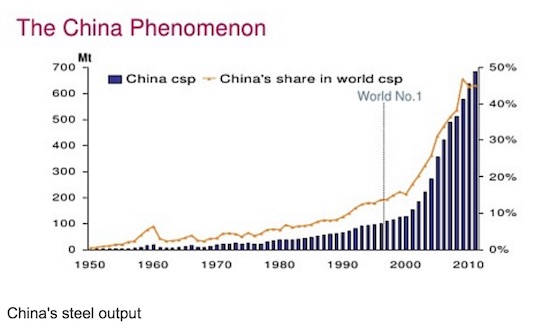
Xi said China was committed to eliminating surplus steel capacity with 77.8 million tonnes already shuttered and more closures planned. Overcapacity, he added, was a global problem, not just a Chinese problem. Which is true. Steel-making has been dogged for decades by structural overcapacity, a tendency to overproduction and resulting weak pricing. But this time is different, because there has never been a steel giant like China before. China’s crude steel production tripled between 1980 and 2000 to 128.5 million tonnes and then went supernova in the following decade with annual growth rates of up to 30%. By 2014, China’s production had reached 823 million tonnes. It was not just the world’s largest producer, it produced more than the rest of the world combined.

Underpinning that breakneck pace of growth was the country’s massive investment in urban infrastructure. From new cities to new roads to new airports, it all needed massive amounts of steel, and of course the iron ore used to make the steel, generating secondary booms in key suppliers such as Australia. But now the boom is over and the world is paying the price.

Read more …

All on red. Expansion plans for a shrinking market. Time to ditch shares?!

• VW Sticks to $24.2 Billion China Spending Plan Amid Cost Cuts (Bloomberg)

Volkswagen will shield its five-year, €22 billion expansion plan in China from cost cuts, underscoring the importance of its largest market to stem the fallout of the diesel-emissions manipulation scandal. This year and next, VW is pushing to update about 70% of the vehicles it sells in China and introduce more than 30 models to the market. The company is aiming to boost its production capacity in China from last year’s 3 million cars to at least 5 million vehicles. The carmaker needs growth in China to at least partly offset the towering cost of recalling as many as 11 million diesel cars worldwide. Volkswagen set aside €6.7 billion for the recalls in the third quarter, acknowledging this won’t be enough.

Analysts’ estimates for the total price tag, including fines and legal costs, range from about €20 billion to as much as €78 billion. “We continue to be committed to our investment plans in China, including our capacity goal,” Larissa Braun, a spokeswoman for VW’s Chinese business, said Friday in an e-mailed response to questions. The Wolfsburg-based manufacturer will make the investments together with joint venture partners SAIC Motor and FAW Car. The expansion comes even as the Chinese economy slows and many cities consider restricting car purchases to fight traffic jams and pollution. The market is such a priority that VW’s new Chief Executive Officer Matthias Mueller made the country his first major trip destination as CEO, joining German chancellor Angela Merkel on a trade mission this week.

Read more …

All oil majors are in far deeper doodoo then they let on. All big producing nations too.

• Chevron to Cut Up to 7,000 Jobs (WSJ)

Chevron on Friday said it could cut 6,000 to 7,000 jobs and pare its capital spending by 25% next year, as profit tumbled in its third quarter. Still, results for the quarter fell less than Wall Street had expected. Shares of Chevron, down 20% this year, added 1% in premarket trading. Chevron didnt detail when the job cuts could occur. As of December 2014, Chevron had about 64,700 employees, according to a securities filing. The second-biggest U.S. oil company said it expects capital spending of $25 billion to $28 billion in 2016, down 25% from this year’s budget. The company said it expects to cut spending further in 2017 and 2018, to around $20 billion to $24 billion. For the quarter ended Sept. 30, Chevron reported earnings of $2.04 billion, or $1.09 a share, down from $5.6 billion, or $2.95 a share, a year earlier. Revenue fell 37% to $34.32 billion.

Analysts polled by Thomson Reuters expected Chevron to post 76 cents a share in earnings on $29.76 billion in revenue for the third quarter. A 15% reduction in capital spending to $7.97 billion helped prop up earnings in the period. Foreign currency effects also added $394 million to profit in the quarter, up from $366 million a year earlier. The company eked out a $59 million profit in its exploration and production segment, down from a profit of $4.65 billion a year earlier. Its U.S. segment swung to a loss of $603 million from a profit of $929 million a year earlier. The company’s average price for a barrel of crude oil and natural gas liquids was $42 in the quarter, down from $87 a year ago. The average price for natural gas was $1.96 per thousand cubic feet, down from $3.46 in the prior year.

Read more …

A deflating fairy tale of riches.

• Saudi Arabia Credit Rating Cut by S&P After Oil Prices Sink (Bloomberg)

Saudi Arabia’s credit rating was cut by Standard & Poor’s , which said the decline in oil prices will increase the budget deficit in a country that relies on energy exports for 80% of its revenue. S&P cut the sovereign rating one level to A+, the fifth-highest classification, as it said the biggest OPEC producer’s deficit will increase to 16% of GDP this year. The nation’s credit outlook is negative as the decline in oil prices makes it difficult to reverse the fiscal deterioration, S&P said in a statement. “Credit metrics for oil producers like Saudi Arabia are coming under pressure,” said Steve Hooker, a money manager at Newfleet in Hartford, Connecticut, who helps oversee $12.5 billion of debt. “It’s not likely to reverse until the oil prices go up.”

The widening deficit and a high reliance on energy revenue “point to vulnerabilities in Saudi Arabia’s public finances,” the ratings company said. Brent crude has plunged 27% from this year’s high in May amid a persistent global supply glut. Still, public debt in Saudi Arabia is among the world’s lowest, with a gross debt-to-GDP ratio of less than 2% in 2014. “We could lower the ratings within the next two years if Saudi Arabia did not achieve a sizable and sustained reduction in the general government deficit, or its liquid fiscal financial assets fell below 100% of GDP,” Trevor Cullinan, a credit analyst at the rating company, said in the statement.

The Saudi Finance Ministry said it “strongly disagrees with S&P’s approach to ratings management in this particular instance.” The downgrade was “driven by fluid market factors rather than changes in the fundamentals of the sovereign,” which “remain strong,” the ministry said in a statement on the website of state-run Saudi Press Agency. The country is rated Aa3 by Moody’s Investors Service, the equivalent of one step higher than S&P’s new grade. S&P’s classification for Saudi Arabia is the same as Slovakia, Ireland, Bermuda and Israel.

Read more …

No mention of action other than freeing up $120 million that had been frozen.

• Swiss Probe Banks to Gauge Exposure to Petrobras Scandal (Bloomberg)

Switzerland’s finance regulator is investigating local banks to gauge their possible exposure to a widening scandal surrounding Brazilian oil producer Petrobras. The regulator, known as Finma, said it is looking into whether banks and securities trading firms met their due-diligence obligations in possible cases of money laundering, and whether any possible incidents were reported to authorities. Bern, Switzerland-based Finma didn’t identify the banks that it began talking to months ago as part of the ongoing investigation. Switzerland’s attorney-general in March released $120 million of $400 million in assets tied to suspicious Petrobras-related transactions that had previously been frozen. The Rio de Janeiro-based oil and gas producer is mired in a corruption scandal in which company executives allegedly directed hundreds of millions of dollars from overpriced contracts to politicians.

The worsening affair has sent investor confidence in Brazil tumbling, plunged Latin America’s largest country into recession and triggered calls for Brazilian President Dilma Rousseff to be impeached over her handling of the matter. Swiss prosecutors said in March they’d uncovered more than 300 accounts belonging to senior Petrobras executives and its suppliers at more than 30 banking institutions apparently used to “process bribery payments.” Valor reported on the Finma probe earlier. Swiss Attorney-General Michael Lauber and his Brazilian counterpart Rodrigo Janot have complimented each other on the speed and cooperation with which the two countries’ justice systems have worked together, at a time when Swiss justice has been criticized for moving too slowly.

Read more …

Makes no difference when you’re TBTF.

• Largest US Banks Face $120 Billion Shortfall Under New Rule (Reuters)

Six big U.S. banks need to raise an additional $120 billion, most likely in long-term debt, under a rule proposed on Friday by the Federal Reserve. The requirements are aimed at ensuring that some of the biggest and most interconnected banks, which include Goldman Sachs, JPMorgan and Wells Fargo, can better withstand another crisis by turning some of their debt, particularly debt issued by their holding companies, into equity without disrupting markets or requiring a government bailout. The banks are expected to meet the $120 billion shortfall by issuing debt, which is usually more cost-effective than issuing equity, according to Federal Reserve officials speaking at a background press briefing Friday.

The rule proposed Friday, largely in line with banks’ expectations, concerns the lenders’ total loss-absorbing capacity. It is one of a series of rules aimed at reducing risk in the banking system by determining how much debt and equity banks should use to fund themselves. In a procedural vote, the Fed’s governors approved a draft of the proposal, meaning it will be submitted for public comment. During a public meeting with Fed officials, one staffer who worked on the rule said banks should have an easy time complying, because many requirements overlapped with existing rules. Further, the bulk of the debt requirements can be fulfilled by refinancing existing debt, the staffer said.

Some requirements must be met by Jan. 1, 2019, while more-stringent requirements must be met by Jan. 1, 2022. The requirements are most stringent for JPMorgan, followed by Citigroup. After that come Bank of America, Goldman Sachs and Morgan Stanley, all of which have the same requirement. Wells Fargo’s requirement is the next highest, followed by State Street and finally Bank of New York Mellon. JPMorgan has more than $2 trillion in total assets, making it the largest U.S. bank by that measure.

Read more …

Portugal’s president is playing a murky role in this.

• Portugal Risks Becoming ‘Ungovernable’: President (Telegraph)

Portugal risks becoming “ungovernable” as Leftist forces prepare to topple the returning government of prime minister Pedro Passos Coelho after just 11 days, the country’s president has warned. Mr Passos Coelho – whose pro-bail-out coalition presided over four years of austerity policies – was sworn into office on Friday after his ruling coalition finished first in recent elections, but lost its parliamentary majority. The appointment was met with controversy after the country’s president vowed to block an alliance of Leftist, anti-EU parties from taking the reins of office. The coalition of Socialists, Communists and the radical Left have vowed to bring down the minority government when a parliamentary vote is held on November 10. A collapse would make it the shortest government in Portugal’s 40 years of post-war democracy.

Addressing the nation, president Anibal Cavaco Silva defended himself against accusations of constitutional over-reach. But the head of state struck a more conciliatory tone, calling for all the main parties to broker a compromise to stop Portugal from descending into political chaos. “Without political stability, Portugal will become an uncontrollable country. And, of course, no one trusts an ungovernable country,” said the president. “The government taking over today does not have majority in parliament so the effort of dialogue and compromise has to proceed with the other political forces to seek the necessary understanding.” Mr Cavaco Silva warned the anti-austerity Left against derailing four years of fiscal consolidation and poisoning relations with the EU.

Prime minister Passos Coelho said Portugal’s commitment to the eurozone was “imperative”. “Nobody should risk the well being of the Portuguese in the name of ideological agendas or personal or political ambition,” he said. Despite exiting its €78bn bail-out last year, Portugal has the highest combined debt levels in the eurozone and the second highest government deficit at -7.8pc. The pro-euro opposition Socialist party is presenting itself as the only stable government having agreed to work with the two more strident anti-EU forces on the left. Together they will command a majority of over 50pc in the 230-seat parliament. The Left-wing alliance has reportedly agreed to reverse many of the fiscal measures taken by the previous conservative government, providing relief to low-income pensioners and workers.

Read more …

A country ruled by money.

• Subprime Mortgages Make Surprise Comeback In The UK (Guardian)

Sub-prime mortgages, widely blamed for causing the 2007-08 financial crisis, are making a surprise comeback in the UK, with several new lenders launching home loans for people with poor credit histories. Lenders are targeting people who have faced serious financial problems including repossession and bankruptcy – as well as those with more minor blots on their records – for the mortgages, which come with interest rates as high as 8%. Bluestone Mortgages, a lender part-owned by Australia’s biggest investment bank, has just launched in the UK, following hard on the heels of another Australian-owned business, Pepper Homeloans, which similarly caters for those who have experienced a “credit event” such as missing payments on a previous mortgage. Another recent arrival is Foundation Home Loans, which offers buy-to-let mortgages to people who have had financial problems.

These three join a group of other players in a sector that argues it is offering a lifeline to the sizeable number of people who have suffered a financial “hiccup” and as a result are being rejected by the big name high street lenders. But the new wave of sub-prime mortgages on offer may prompt concern among those who fear a return to the lending practices of the past. And these mortgages come at a price: some borrowers taking out a two-year fixed-rate deal will be charged as much as 7%-8%, compared with current best-buy rates of as little as 1.54% on conventional loans. Peter Tutton, head of policy at StepChange debt charity, sounded a note of caution, pointing out that “last time around, before the crash, there were some really bad lending practices. Certain sub-prime lenders were lending to people who couldn’t afford it and were vulnerable and were being repossessed.”

Read more …

“Tsipras also said any suggestion that Greece was not effectively safeguarding the EU’s outermost borders – he referred to leaders of “certain European countries” – was borne of ignorance of international law dictating protection of the lives of people in distress at sea.”

• Greek PM Tsipras Says Shamed By Europe’s Handling Of Refugee Crisis (Reuters)

Greece’s prime minister said on Friday he was ashamed to be a member of a European Union that he said was sidestepping responsibilities over the migrant crisis and crying hypocritical tears for children who have drowned trying to reach its shores. In some of the hardest-hitting comments yet on a crisis resonating throughout Europe, Alexis Tsipras told parliament Greece didn’t want a “single euro” for saving lives as thousands of refugees continued to arrive daily on its shores, and the EU remained at odds on how to deal with the influx. At least 35 people drowned trying to cross the sea between Turkey and Greece this week. Authorities fear the death toll will rise as more people attempt the short but dangerous passage to Greece before the onset of winter.

“I feel ashamed as a member of this European leadership, both for the inability of Europe in dealing with this human drama, and for the level of debate at a senior level, where one is passing the buck to the other,” Tsipras told parliament. Impoverished Greece has been a transit point for more than 570,000 refugees and migrants fleeing conflict in the Middle East and beyond since January, triggering bickering among European nations. Speaking during prime ministers’ question time, Tsipras also said any suggestion that Greece was not effectively safeguarding the EU’s outermost borders – he referred to leaders of “certain European countries” – was borne of ignorance of international law dictating protection of the lives of people in distress at sea. “These are hypocritical, crocodile tears which are being shed for the dead children on the shores of the Aegean.”

“Dead children always incite sorrow. But what about the children that are alive who come in thousands and are stacked on the streets? Nobody likes them.” [..] Although his migration minister was quoted as saying earlier this week that EU financing was needed for a subsidized housing program to work, Tsipras said Greece did not expect to get paid for saving lives. “Greece is in crisis. We are a poor people, but we have retained our values and humanity, and we aren’t claiming a single euro to do our duty to people who are dying in our back yard,” Tsipras said, after an opposition lawmaker asked what Greece had received in return for agreeing to host refugees. His country, he said, couldn’t put a price on the human cost. “I’m not addressing you,” he told a lawmaker. “I’m addressing those European partners who are wagging their finger at Greece.

Read more …

The time for safe passage is long overdue.

• Greece Says 22 Refugees Drown Off Aegean Islands, 144 Rescued (Reuters)

Greece rescued 144 refugees and recovered the bodies of 22, including four infants and nine children, after their boats sank in two separate incidents in the Aegean sea, the coastguard said on Friday. The death toll from drownings at sea has mounted recently as weather in the Aegean has taken a turn for the worse, turning wind-whipped sea corridors into deadly passages for thousands of refugees crossing from Turkey to Greece. The coast guard said 138 migrants were rescued and 19 drowned after their wooden boat capsized off the island of Kalymnos late on Thursday. In a second incident off the island of Rhodes, three people, including a child and an infant, drowned and four were missing. Six people were rescued at sea, the coastguard said.

Some 16 people, including two infants and eight children, were confirmed dead and 274 people were rescued when a wooden boat they were on literally fell apart in rough seas off the Greek island of Lesbos late on Wednesday. Greece has been a transit point for more than 570,000 refugees and migrants fleeing conflict in the Middle East and beyond this year, triggering bickering among European nations at odds on how to deal with one of the biggest humanitarian crises in decades. Refugees have reported smugglers offering ‘discounts’ of up to 50% on tickets costing between 1,100 to 1,400 euros to make the journey on inflatable rafts in bad weather, UN refugee agency UNHCR said on Thursday. Perceptibly sturdier wooden boats cost more, at between €1,800 and €2,500 €per passenger.

Read more …

“The waves of the Aegean are not just washing up dead refugees, dead children, but (also) the very civilization of Europe..”

• Tsipras: Aegean Waves Wash Up Dead Children, And Europe’s Very Civilization (AP)

Drowned babies and toddlers washed onto Greece’s famed Aegean Sea beaches, and a grim-faced diver pulled a drowned mother and child from a half-sunk boat that was decrepit long before it sailed. On shore, bereaved women wailed and stunned-looking fathers cradled their children. At least 27 people, more than half of them children, died in waters off Greece Friday trying to fulfill their dream of a better life in Europe. The tragedy came two days after a boat crammed with 300 people sank off Lesbos in one of the worst accidents of its kind, leaving 29 dead. It won’t be the last. As autumn storms threaten to make the crossing from Turkey even riskier and conditions in Middle Eastern refugee camps deteriorate, ever more refugees – mostly Syrians, Afghans and Iraqis – are joining the rush to reach Europe.

More than 60 people, half of them children, have died in the past three days alone, compared with just over a hundred a few weeks earlier. Highlighting political friction in the 28-nation European Union, Greece’s left-wing prime minister, Alexis Tsipras, cited the horror of the new drownings to accuse the block of ineptitude and hypocrisy in handling the crisis. [..] Speaking in Athens, Tsipras accused Europe of an “inability to defend its (humanitarian) values” by providing a safe alternative to the sea journeys. “The waves of the Aegean are not just washing up dead refugees, dead children, but (also) the very civilization of Europe,” he said, dismissing Western shock at the children’s deaths as “crocodile tears.” “What about the tens of thousands of living children, who are cramming the roads of migration?” he said.

“I feel ashamed of Europe’s inability to effectively address this human drama, and of the level of debate … where everyone tries to shift responsibility to someone else.” Tsipras’ government has appealed for more assistance from its EU partners. It argues that those trying to reach Europe should be registered in camps in Turkey, then flown directly to host countries under the EU’s relocation program, to spare them the sea voyage. But it has resisted calls to demolish its own border fence with Turkey, which would also obviate the need to pay smugglers for a trip in a leaky boat. “My opinion is that at this stage — for purely practical reasons — … the opening of the border fence is not possible,” Greek Migration Minister Yiannis Mouzalas said.

“When talking about receiving refugees, it’s not under our control — they are coming,” he told state ERT TV. “So it’s a question of how we address this problem. … We will not put them in jail or try to drown them. They will have all the rights that they are allowed under (international) agreements and Greek law.” Greece’s Merchant Marine Ministry said 19 people died and 138 were rescued near the eastern island of Kalymnos early Friday, when a battered wooden pleasure boat capsized. Eleven of the victims were children, including three babies. At least three more people — a woman, a child and a baby — died when another boat sank off the nearby island of Rhodes, while an adult drowned off Lesbos.

Read more …

Curious: the version of the AP piece above, as posted by HuffPo, was quoted by Zero Hedge as containing the bolded lines in this piece below. But when I looked at the link, these lines had been edited out. An NBC version also misses the reference to western military action. The New York Post version still carries them.

• Tsipras Blames Migrant Flows On Western Military Action In Middle East (AP)

Greek Prime Minister Alexis Tsipras accused Europe of an “inability to defend its (humanitarian) values” by providing a safe alternative to the dangerous sea journeys. “I want to express … my endless grief at the dozens of deaths and the human tragedy playing out in our seas,” he told parliament. “The waves of the Aegean are not just washing up dead refugees, dead children, but (also) the very civilization of Europe.” Tsipras accused western countries of shedding “crocodile tears” over children dying in the Aegean but doing little for those who make it across. “What about the tens of thousands of living children, who are cramming the roads of migration?” he said.

Tsipras blamed the migrant flows on western military interventions in the Middle East, which he said furthered geopolitical interests rather than democracy. “And now, those who sowed winds are reaping whirlwinds, but these mainly afflict reception countries,” he added. “I feel ashamed of Europe’s inability to effectively address this human drama, and of the level of debate … where everyone tries to shift responsibility to someone else,” Tsipras said.

Read more …

“Many Afghans dream of a better life in Europe. About 80,000 applied for asylum in Europe in the first half of 2015 alone, with most of them going to Germany.”

• The Next Wave: Afghans Flee To Europe in Droves (Spiegel)

Redwan Eharai’s journey ends where it began: in Afghanistan, in the city of Herat. Eharai, a 15-year-old boy, is carrying the heavy body of his mother Sima up the hill to the cemetery, together with neighbors and relatives. He and his mother had set out from Afghanistan together, headed for Germany. Now he is standing at her grave. She died at the border between Iran and Turkey, struck in the head by a bullet fired by an Iranian police officer. Hundreds of people have now come to say their goodbyes. When she was still alive and urgently needed help, no one was there for her, says Eharai, as he looks into his mother’s grave. Despite his stubble, which makes him look almost like a grown man, he currently seems more like a child.

His family is poor – Eharai’s father died of a brain tumor five years ago, and Sima, his 43-year-old mother, suffered from depression. She had trouble sleeping and cried a lot. In Afghanistan, being a widow without an income, and with three children, is like being buried alive, says Eharai – you have no rights at all. Instead, Sima Eharai decided to leave Afghanistan and go to Germany with three of her children, Adnan, Erfan and Redwan. Sanaz, her eldest daughter, was already living in Frankfurt. Her mother, determined that she would have a better life, had arranged for her to marry a German of Afghan descent. “I can’t continue living like this,” Sima Eharai said when she called her daughter the last time. “Either I make it to you or I’ll follow my husband into death.”

Many Afghans dream of a better life in Europe. About 80,000 applied for asylum in Europe in the first half of 2015 alone, with most of them going to Germany. They are the second-largest group of refugees and migrants in Germany after Syrians. At the moment, people are flooding into Herat Province from all over Afghanistan. From there, they drive across the border to Iran or travel farther south to cross into Iran along a less well-guarded section of the border. About 3,000 Afghans are now coming into Iran every day illegally. From there, they continue to Turkey, where they board boats to the Greek islands of Lesbos or Kos and then cross the Balkans to Northern Europe.

Read more …

That just moves the problems somewhere else.

• Refugee Crisis: Germans Restrict Entry Points From Austria (BBC)

Germany is to restrict the number of entry points for migrants arriving via Austria, in a bid to control the flow as thousands cross into Bavaria daily. It says it has reached agreement with Austria on five crossing points on the 800km (500-mile) border. Authorities in Bavaria have complained a lack of co-ordination with Austria is hampering efforts to aid new arrivals. Many others continue to make their way via Greece, in freezing temperatures, hoping to get asylum in Germany. Meanwhile, more than 20 migrants – many of them children – have drowned in more boat sinkings in Greek waters while they were trying to reach EU countries via Turkey. Greek officials said 19 people had died and 138 were rescued near the island of Kalymnos.

Three others died off Rhodes and three were missing. Six were rescued there. And the Spanish coastguard called off the search for 35 migrants missing at sea the day after their boat was shipwrecked en route from Morocco. Fifteen migrants were rescued alive from the vessel and the bodies of four others were found. A spokeswoman for Germany’s interior ministry told AFP news agency that the new rules on entry points would go into effect immediately. “We would like to have a more orderly procedure,” she said. A senior Bavarian politician said that under the agreement, 50 migrants an hour could cross into the state at the five agreed points.

Earlier this week, German Interior Minister Thomas de Maziere accused Austria of transporting refugees to the German frontier at night, leaving them there unannounced. Federal police spokesman Heinrich Onstein has said everything was being done to prevent the migrants from having to sleep outdoors. He said the problem had been that “we do not know how many people will arrive, and at which border post”. However an Austrian police spokesman dismissed such accusations as a “joke”, given that Austria was receiving 11,000 people a day just at the Spielfeld crossing from Slovenia. Germany expects at least 800,000 asylum seekers this year – some estimates put it as high as 1.5 million. That is at least four times the number who arrived last year.

Read more …

Oct 302015
 
 October 30, 2015  Posted by at 9:44 am Finance Tagged with: , , , , , , , , ,  12 Responses »


Arthur Rothstein Migratory fruit pickers’ camp in Yakima, Washington 1936

• It Is Already Too Late To Scrap China’s One-Child Policy (AEP)
• Li Floats New China Five-Year Growth Minimum of Around 6.5% (Bloomberg)
• China Steel Industry Outlook ‘Worst Ever Amid Unprecedented Losses’ (Zero Hedge)
• 28 Chinese Investors In Fanya Metal Exchange Go Missing After Protest (Quartz)
• Shell Has Biggest Loss in More Than a Decade on Price Slump (Bloomberg)
• London House Prices Most Overvalued In The World, Says UBS (Guardian)
• Why Investors Are Shorting Canada’s Housing Market (CNBC)
• Great Expectations: The Driving Force Behind Latest Property Crisis (McWilliams)
• Bank of Japan Keeps QE On Hold As It Hopes For Recovery (Reuters)
• Britain’s Youth At Risk Of Being ‘Lost Generation’ (Guardian)
• US Special Ops Have Been Fighting ISIS On The Ground For Months (Bloomberg)
• In Defeat For Beijing, Hague Court To Hear South China Sea Dispute (Reuters)
• European Parliament Votes To Urge Protection for Edward Snowden (NY Times)
• Two Boats Carrying Refugees Sink Off Greece, Leaving 21 Dead (AP)
• Greek Coast Guard Seeks Dozens Of Migrants Off Lesvos After Wreck (Kath.)
• Germany To Spend Up To €16 Billion On Refugees Next Year (Reuters)
• Refugees Risk Freezing To Death In Germany, Too (Local.de)
• EU Nations Have Relocated Only 86 Refugees From 160,000 Pledged (Bloomberg)
• Lesbos Volunteer Says Huge Amount Of Trauma As Refugee Boats Capsize (Guardian)
• Lesbos Braces For Winter As Refugees Keep Coming (Gill)

Playing God.

• It Is Already Too Late To Scrap China’s One-Child Policy (AEP)

China’s Communist Party has scrapped its hated one-child policy in a bid to shore up political support, but the move comes far too late to avert a collapse of the workforce and a demographic crisis by the late 2020s. All couples will be allowed to have a second child under new rules agreed at the party’s closely-watched 5th Plenum in Beijing. The ban on larger families in cities will remain despite pleas from Chinese academics for total freedom. The policy shift will make no difference to the workforce for almost 20 years and by then China will already be in the full grip of a demographic crunch. “They have merely moved to a two-child policy. The family planning authorities are still there, and there is still an apparatus of state power intruding into people’s intimate lives,” said Jonathan Fenby, a China veteran at Trusted Sources.

The coercive anti-natalist policies begun by Mao Zedong in the early 1970s – and pushed further by ideologues in thrall to the Club of Rome’s Malthusian doomsday theories, the “Limits of Growth” – have had powerful and perverse effects. They freed workers from family duties and created a “demographic dividend” of sorts that until recently flattered China’s growth rate. Now the process is kicking violently into reverse. The workforce began to decline in absolute terms in 2012 and has since been shrinking by 3m people a year. The IMF says the reserve army of labour peaked five years ago and is going into “precipitous decline”, threatening a labour shortage of 140m by the early 2030s. This is happening just as life expectancy soars to 75.2 – with a target of 77 in 2020 – causing a drastic deterioration in the ratio of workers to pensioners, and unlike the demographic decline in Japan it will start to bite before the country is rich.

The ratio was 6.6 in 2000. It is expected to be 2.37 in 2030 and 1.25 in 2060. The Chinese Academy of Social Sciences says the fertility rate has collapsed to 1.4 and is nearing the danger line of 1.3, the so-called “low fertility trap” where it becomes culturally self-perpetuating. This has already happened in Japan, Korea and Taiwan, and in some of China’s richest cities. The rate in Shanghai has fallen to 0.8 for complex social reasons that no longer have anything to do with one-child policy. A relaxation of the rules in 2013 has not led to a pick-up in the city. “Having children is simply too expensive. Working couples can’t afford private hospital costs, childcare and kindergartens,” said Mr Fenby. China may already have left it too late to ditch the one-child policy.

Critics say the damage has been evident for years, leaving aside the traumatic suffering of poor women seized by police after tip-offs and forced into late-term abortions, the indignity of “menstrual monitors” and the status of “illegal” children denied ration coupons and schooling. Chinese demographers say the distorted family structure undermines support for the elderly and has led to a 20pc surplus of boys over girls, leaving a volatile army of frustrated single males. The Politburo refused to listen. Harvard professor Martin King Whyte said the policy had become “sacrosanct”, frozen by bureaucratic inertia. The long-awaited reform eclipsed the launch of the Communist Party’s latest five-year plan, intended to close the chapter on a series of errors and policy pirouettes over the past 12 months that have shattered global confidence in Chinese economic management.

Read more …

Could you be a bit more precise, please?: “The nation needs annual growth of at least 6.53% in the next five years”.

• Li Floats New China Five-Year Growth Minimum of Around 6.5% (Bloomberg)

Premier Li Keqiang highlighted a minimum growth estimate for China in the coming five years that could indicate the leadership’s readiness to accept the weakest period of expansion since the economy was opened up more than three decades ago. The nation needs annual growth of at least 6.53% in the next five years to meet the government’s goal of establishing a “moderately prosperous society,” Li said in an Oct. 23 speech to Communist Party members, according to people familiar with the matter who asked not to be identified as the remarks weren’t public. Communist Party leaders Thursday conclude a four-day gathering to discuss their 2016-20 five-year plan for the nation, the first since President Xi Jinping and Premier Li took office. Policy makers are managing the priorities of both reforming the economy and keeping short-term growth fast enough so that structural changes don’t cause a hard landing.

“This lower number is more realistic and feasible if substantive reforms can be implemented,” said Xiao Geng, a professor of finance and public policy at the University of Hong Kong. “It is good as Li is focusing on delivering the party’s key promise on raising the living standards of Chinese people. After all, growth is the best available verifiable indicator for progress.” Private economists have predicted a reduction in the five-year growth target to 6.5%, down from 7% in the current plan – a reflection of the Communist leadership’s continuing attempts to move away from debt-fueled expansion. “It seems that Premier Li is sending a signal through his speech that China’s government is likely to lower their growth target to 6.5% in the 13th five-year plan,” said Le Xia at Banco Bilbao Vizcaya. “The 6.5% target is still a little challenging. A target of 5-6% seems a more feasible one.”

Read more …

Shadow banks.

• China Steel Industry Outlook ‘Worst Ever Amid Unprecedented Losses’ (Zero Hedge)

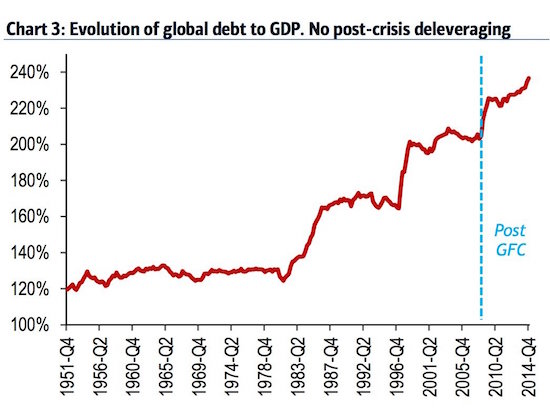
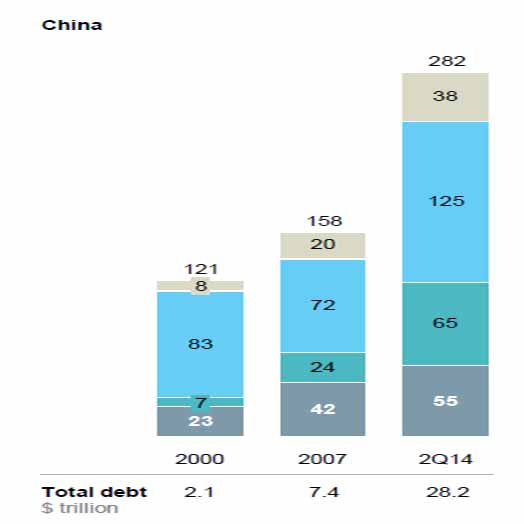
It’s almost difficult to believe, but just 8 years ago, in 2007 and right before the world was swept in the worst financial crisis in history, China had only $7.4 trillion in debt, or 158% in consolidated debt/GDP. Since then this debt has risen to over $30 trillion (specifically $28.2 trillion as of Q2, 2014) representing a staggering 300% debt/GDP. This means that China was responsible for more than a third of all the $57 trillion debt created since 2007, making a mockery of the QE unleashed by all the DM central banks – something we first noted about two years before the famous McKinsey report went to print. However, it was precisely this credit expansion that not only allowed China to completely ignore the global depression of 2008/2009 but to build lots and lots of ghost cities such as these.

To be sure, many noticed but everyone kept quiet: after all, to build these cities China not only had to create trillions in debt, it had to import a hundreds of billions worth of commodities from places such as Brazil and Australia. Then, in the late summer and fall of 2014 something happened: for whatever reason, as we noticed one year ago, the most unregulated aspect of China’s financial system, its shadow banks, not only stopped lending money but actually went into reverse, thus putting a lid on China’s Total Social Financing expansion, which had been the world’s “under the radar” growth dynamo for so many years. At that moment not only did China’s ghost cities officially die, but it meant an imminent collapse for China’s feeder commodity economies such as the abovementioned China and Brazil.

In the US this phenomenon was given a very simpler name by the brilliant economists: “snow.” And since China’s domestic demand, not only from “ghost cities” but all other fixed investment was a function of pervasive credit, suddenly China’s commodity industry in general, and steel industry in particular, entered a state of shocked stasis. To get a sense of how bad it is, look no further than China’s steel industry. It is here that, as Bloomberg reports, “demand is collapsing along with prices,” and “banks are tightening lending and losses are stacking up, the deputy head of the China Iron & Steel Association said on Wednesday.” “Production cuts are slower than the contraction in demand, therefore oversupply is worsening,” said Zhu at a quarterly briefing in Beijing by the main producers’ group. “Although China has cut interest rates many times recently, steel mills said their funding costs have actually gone up.”

Read more …

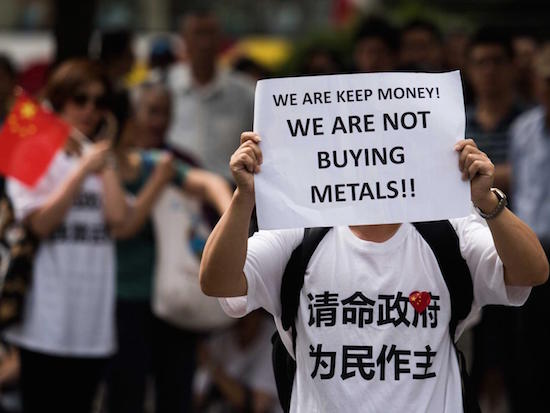
“..police detained 2,800 people who planned to participate in the Oct. 26 demonstration [..] the future could be bleak for the 28 who remain in custody.”

• 28 Chinese Investors In Fanya Metal Exchange Go Missing After Protest (Quartz)

Over two dozen Chinese investors in Fanya Metal Exchange haven’t made any contact with friends or family members since they were arrested on Oct. 25, ahead of a planned protest in Beijing. They were detained as part of a massive police crackdown on Fanya investors, who have been agitating for the government to help them recover an estimated $6 billion they invested in the trading platform that now many suspect is a fraud. Investors have been unable to access any of their money since April, and about 10,000 signed up to participate in a protest in Beijing on Oct. 26. A total of 28 protest organizers, who represented investors from different provinces and cities, were arrested by police during an evening meeting in Beijing on Oct. 25, several investors told Quartz.

None of them had been in touch with their families or other investors by Thursday morning, these investors said. Family members of seven have received police notices that their relative is being held on suspicion of “gathering crowds to disturb public order,” which could carry a five-year jail term. There has been no news about the 21 others. Quartz talked directly to four investors who had been jailed as part of the larger crackdown, and three who witnessed or heard about the arrests of others in the past 48 hours. These would-be protesters, and others Quartz has spoken to in the past, are mostly middle class people in their thirties and forties who have never had any run-ins with the government before.

But they say they see no other way to get the government to notice their plight after complaints and previous protests got no reaction. “We were just exercising rights given by the constitution,” one told Quartz. Article 35 of China’s constitution guarantees citizens freedom of speech, assembly, and demonstration, among other rights, but it is rarely upheld. Investors estimate police detained 2,800 people who planned to participate in the Oct. 26 demonstration, rounding them up in the capital city and as they traveled to Beijing from Shanghai, the northern Shanxi province and other areas. Most have been released without incident, but the future could be bleak for the 28 who remain in custody.

Read more …

“The oil price rout has wiped almost $500 billion since the end of last year ..”

• Shell Has Biggest Loss in More Than a Decade on Price Slump (Bloomberg)

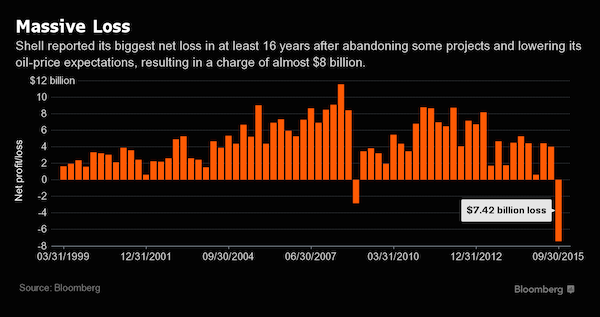
Royal Dutch Shellreported its biggest net loss in at least 16 years after Europe’s largest energy group abandoned some projects and lowered its oil-price expectations, resulting in a charge of almost $8 billion. The loss highlights the pain oil and gas companies are enduring as prices plunge, forcing them into the biggest belt-tightening in a generation. Eni, the Italian oil group, also fell into a loss in the third quarter, while profit slumped at BP and Total. The oil price rout has wiped almost $500 billion since the end of last year from Bloomberg World Oil & Gas Index, which tracks energy stocks globally including Shell, ExxonMobil and Chevron.

Shell, which is buying BG Group in the energy industry’s largest deal this year, reported a third-quarter net loss of $7.42 billion, compared with a profit of $4.46 billion a year earlier. Adjusted for one-time items and inventory changes, profit dropped 70% to $1.77 billion, The Hague-based Shell said Thursday in a statement. That missed the $2.92 billion average estimate of 17 analysts surveyed by Bloomberg. Shell took a $4.61 billion charge resulting from the withdrawal from offshore drilling in Alaska and an oil-sands project in Canada, and $3.69 billion triggered by cuts to its outlook for oil and natural gas prices.

Read more …

Each single one of these cities will deny it’s in a bubble.

• London House Prices Most Overvalued In The World, Says UBS (Guardian)

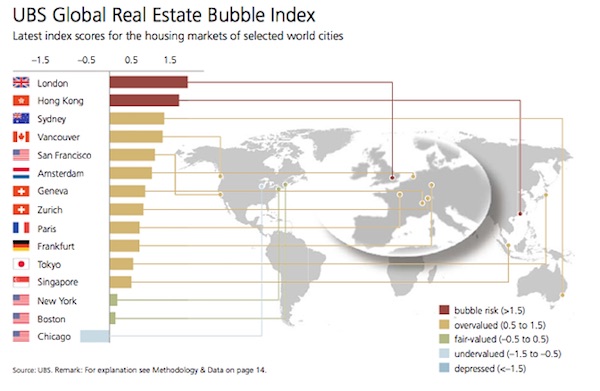
House prices in London are the most over-valued of any major city in the world and are in “bubble-risk territory”, a report by economists at UBS has found. Foreign investment, the help-to-buy scheme, “alluring” yields for buy-to-let landlords, and ongoing population growth have all led property prices in the city to decouple from local incomes, and there could be a “substantial price correction” if the conditions for investment deteriorated, the report said. The UBS Global Real Estate Bubble Index looked at 15 cities around the world, including Hong Kong, Sydney, New York, San Francisco and Geneva, examining prices against the economic backdrop in each country.

It found London was less affordable for locals who wanted to buy than any city except Hong Kong, and that it was at most risk of prices falling. The city rated 1.88 on UBS’s bubble index, and the report said that between 1985 and 2009, whenever the index exceeded 1.0 “a real price correction of on average 30% began within three years 95% of the time”. It added: “Investors in overvalued markets should not expect real price appreciation in the medium to long run.” Price increases of 40% since the start of 2013 have more than offset losses during the financial crisis and mean that homes in London now cost more than ever before. On Wednesday, the Land Registry said the average price had almost hit the £500,000 mark, with the annual rate of inflation running at 9.6%.

Meanwhile, wage growth has been sluggish, and the price increases have made London one of the most expensive cities in the world based on price-to-income and price-to-rent ratios, the UBS report said. “It takes a skilled service-sector worker approximately 14 years of average earnings to be able to buy a 60 sq m dwelling; the expense of buying a flat is comparable to renting it for 30 years,” it said. In Hong Kong, the same property costs 21 times income to buy, and the average yearly income of a highly skilled worker can buy only around 3 sq m of living space. The report said the Chinese territory was also at risk of a downward cycle, and that housing prices were expected to fall by more than 10% by the end of 2016.

Read more …

Let me guess…

• Why Investors Are Shorting Canada’s Housing Market (CNBC)

A growing number of investors are betting Canada’s frothy property market will nosedive, according to research firm Markit, as low energy prices drag down the country’s economic outlook. Investors are taking out an increasing number of “short” positions on banks and insurers with high exposure to the property market, Markit explained, with these investors expecting share prices to slide. This comes amid record low interest rates in the country— which have been cut twice this year, down to 0.5%. Financial groups now account for three of the top 10 shorted stocks in the country, it said. Home Capital Group — one of Canada’s largest financial institutions— currently ranks as the most shorted stock in Canada. Markit measures the short interest in a stock by calculating the amount of shares that are out on loan.

Home Capital Group recently saw an 18% share sell-off and the cost to borrow its shares jump 10% after second-quarter results showed fewer mortgage starts than expected. Shares on loan now total 31.9%, according to Markit. That’s followed closely behind by Canadian Western Bank, which has 54% of its $19 billion portfolio in real estate, personal loans and mortgages. About 27.7% of its shares are on loan, making it the fourth most shorted stock in the country. Genworth Mi Canada, which underwrites private residential mortgages, has not only seen its stock slide approximately 22% in the last 12 months, but the number of short holdings increased to 19.3%, Markit said. “Short sellers have been trying to call the top of the Canadian property market for some years now, which has proven to be a tricky trade as the continued cheapness of credit has continued to propel local demand and prices,” the report, led by Markit analyst Relte Stephen Schutte, said.

But it seems investors are taking a hint from declining market conditions. Data from the RBC Purchasing Managers Index (PMI) clocked the sharpest decline in Canadian business conditions in the survey’s history in September. Weak demand and stagnating exports helped send the PMI reading to a 5-year low of 48.6 — with any reading below 50 indicating a contraction. Furthermore, with oil prices widely forecast to stay lower for longer, it’s likely there could be further pain heaped on an economy which Markit estimates has a 20% structural exposure to energy markets. Canada’s economy technically entered recession after clocking two quarters of economic contraction in the first half of 2015. Meanwhile, property prices have continued to soar across the country, particularly in cities like Toronto and Vancouver. The latter was earlier this year dubbed one of the most expensive markets in the world in a housing survey by The Economist. It claimed Vancouver property was overvalued by 89%.

Read more …

Ireland’s back at it too.

• Great Expectations: The Driving Force Behind Latest Property Crisis (McWilliams)

Is it possible that we have got ourselves into the position where we have a housing crisis again, where those at the bottom and middle can’t find a place to live and those moving from the middle upwards are locked into, yet again, bidding wars for homes where the speculator and the owner are pitted against each other? Could we be in the situation where investors and large foreign funds are sitting on land waiting for the prices to go up in order to make a killing, thus exacerbating the supply shortage? It’s hard to believe – after everything we have been through – but it’s true. Above all, the Irish property market needs stability. It needs to be liberated from constantly changing expectations about where prices are going to go. Expectations about future prices are what destroy a property market and lead to the unhealthy intrusion of speculators in the market for accommodation.

Accommodation should be a fixed cost in an economy, a cost faced by all of us, like the cost of electricity. Can you imagine what would happen to the use of electricity in Ireland if people thought the price was going to change on a daily basis and everyone had their own generator trying to sell at the best price to a national grid? Imagine the surges and scarcities in both use and supply as users and suppliers tried to get the best price. Now think about the housing market. When there is an expectation that prices are going to go up, it is understandable in a capitalist system that the people who own the land will wait for prices to go ever higher, thus squeezing potential buyers. It is also understandable that potential buyers will panic when they see prices rising and bring forward their demand so they won’t be left behind.

This is precisely the opposite of what is suggested by classical economics. In classical economics, we are told that when the price of something rises then the demand will fall, but this is not the case in property. When the price rises, the demand rises too. What do you think happens to supply? Traditional economics suggests that when the price rises the supply will rise, but is this what actually happens in real life? If owners of land and houses believe that prices are going to rise, wouldn’t they be mad to sell now when they can make more money by delaying? So supply doesn’t rise when price expectations rise, it actually falls – exacerbating the panic. So you can see that the issue for the property market is not so much supply and demand at today’s prices as the traditional economics model suggests, but rather the reaction of supply and demand to the expectations about future prices.

Read more …

If only the Japanese would believe in Abenomics…

• Bank of Japan Keeps QE On Hold As It Hopes For Recovery (Reuters)

The Bank of Japan has held off expanding its massive monetary stimulus programme, preferring to keep its powder dry in the hope that the economy can overcome the drag from China’s slowdown without extra support. But the central bank is likely to remain under pressure to expand its asset-buying or quantitative easing programme as slumping energy costs, weak exports and a fragile recovery in household spending kept inflation well short of its 2% target. Consumer prices fell 0.1% in the year to September, a second monthly decline, while household spending slid 1.3% from a year earlier, official figures released on Friday said. The BOJ maintained its pledge to increase base money, or cash and deposits at the central bank, at an annual pace of 80 trillion yen ($662bn) through aggressive asset purchases.

The US dollar fell 0.5% against the yen and the Nikkei share average lost 0.6% before recovering into positive territory despite disappointment that the BOJ had backed away from another increase in liquidity for equity markets. Markets will now focus on the BOJ’s twice-yearly outlook report due to be released later on Friday. They will also scrutinise comments by BOJ governor Haruhiko Kuroda’s for clues on the timing of any future monetary easing when he gives a news conference on Friday afternoon. With the economy skirting recession, the BOJ is likely to cut its economic growth and inflation forecasts for the fiscal year that began in April. But it will only slightly alter its forecast that inflation will hit 1.9% next fiscal year, sources have told Reuters, giving it grounds to argue that Japan can hit its inflation target without expanding stimulus.

Read more …

They already are.

• Britain’s Youth At Risk Of Being ‘Lost Generation’ (Guardian)

Young people face the the worst economic prospects for several generations and their lives have got worse over the past five years, a comprehensive report has concluded. The Equality and Human Rights Commission (EHRC) said that young people – defined as those under 34 – suffered the biggest slide in income and employment and now faced higher barriers to achieving economic independence and success than five years ago. The period during which their fate has worsened coincides with the election of the Conservative-led coalition government in 2010. The commission, which has a mandate from parliament to tackle discrimination, said that although life had become fairer for many, progress had stalled or even worsened for some groups in society.

The report, Is Britain Fairer?, showed that during the recession and up to 2013, people aged under 34 were hit by the steepest drops in pay and employment, had less access to decent housing and better paid jobs, and were experiencing deepening levels of poverty. The unemployment rate for 16- to 24-year-olds stood at 14.8% for the three months to August, according to official figures, with some 683,000 classed as unemployed. That rate was higher than the 13.8% recorded for the three months to February 2008 – before the financial downturn struck. EHRC commissioner Laura Carstensen said that while barriers were being lowered in some sections of society, young people in particular were having to cope with far more difficult circumstances.

“Theirs are the shoulders on which the country will rely to provide for a rapidly ageing population, yet they have the worst economic prospects for several generations,” she said. TUC general secretary Frances O’Grady said the government could no longer afford to ignore the plight of young people, who were struggling to cope with low levels of pay, worsening employment prospects and rising housing costs. “This report should be wake-up call to ministers. Hiking up university and college fees and excluding young people from the new higher minimum wage rate is not the way to build a fair and prosperous Britain. It is the blueprint for a lost generation,” she said.

Read more …

And not just a few.

• US Special Ops Have Been Fighting ISIS On The Ground For Months (Bloomberg)

When Defense Secretary Ashton Carter announced Tuesday that the U.S. would begin “direct action” against Islamic State targets in Syria and Iraq, it sounded like a new mission for U.S. forces in a country where the president has repeatedly insisted Americans would not be engaged in combat operations. But America’s special operations forces have been engaging in these kinds of missions for several months, particularly in the Kurdish-controlled provinces in northern Iraq. And the special operations forces have already built up an extensive infrastructure to support these activities. This casts doubt on the official Pentagon statements that last week’s raid was “a unique circumstance.”

Since President Barack Obama authorized the first special operations teams to deploy to Iraq in the summer of 2014, the White House has provided few details on the mission and composition of the forces. The Pentagon today refers to the mission for the 3,500 U.S. service members as primarily “advise and assist,” with an emphasis on training local forces. But the small and highly classified military footprint in northern Iraq shows the U.S. is more involved in the fight against the Islamic State. According to U.S. and Kurdish officials, the U.S. now runs an operations center in Irbil staffed by a special operations task force whose work is so classified its name is a state secret.

The task force has worked in recent months to identify and locate senior leaders of the Islamic State and participated in the mission last Thursday, in which a member of the Army’s Delta Force was killed freeing prisoners from an Islamic State prison in Hawija. (He was the first U.S. soldier killed by enemy fire in the fight against ISIS) The secret U.S. military presence in northern Iraq doesn’t end there. Highly trained American special operations forces known as Joint Terminal Attack Controllers, who help paint targets for airstrikes of Islamic State vehicles, camps and buildings, also operate in northern Iraq. U.S. officials tell us these controllers also work closely with other Western countries and the Iraqis to avoid collisions and direct air traffic for drones and other aircraft to support the mission against the Islamic State. Finally, according to these officials, there is a contingent from the Marine Special Operations Command in charge of training Kurdish counter-terrorism forces fighting against the Islamic State.

Read more …

We’ll sell out the Philippines. Want to bet?

• In Defeat For Beijing, Hague Court To Hear South China Sea Dispute (Reuters)

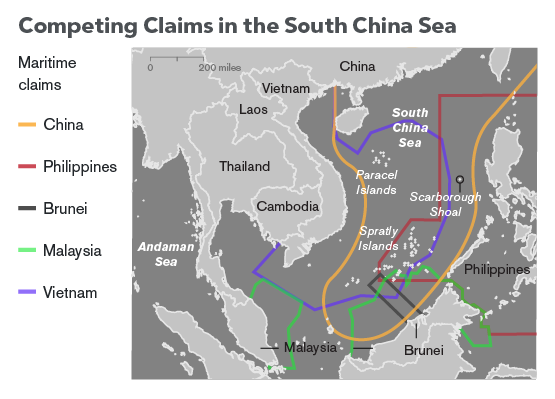
In a legal setback for Beijing, an arbitration court in the Netherlands ruled on Thursday that it has jurisdiction to hear some territorial claims the Philippines has filed against China over disputed areas in the South China Sea. Manila filed the case in 2013 to seek a ruling on its right to exploit the South China Sea waters in its 200-nautical mile exclusive economic zone (EEZ) as allowed under the United Nations Convention on the Law of the Sea (UNCLOS). The Hague-based Permanent Court of Arbitration rejected Beijing’s claim that the disputes were about territorial sovereignty and said additional hearings would be held to decide the merits of the Philippines’ arguments. China has boycotted the proceedings and rejects the court’s authority in the case.

Beijing claims sovereignty over almost the entire South China Sea, dismissing claims to parts of it from Vietnam, the Philippines, Taiwan, Malaysia and Brunei. The tribunal found it had authority to hear seven of Manila’s submissions under UNCLOS and China’s decision not to participate did “not deprive the tribunal of jurisdiction”. The Chinese government, facing international legal scrutiny for the first time over its assertiveness in the South China Sea, would neither participate in nor accept the case, Vice Foreign Minister Liu Zhenmin told reporters. “The result of this arbitration will not impact China’s sovereignty, rights or jurisdiction over the South China Sea under historical facts and international law,” Liu said. “From this ruling you can see the Philippines’ aim in presenting the case is not to resolve the dispute. Its aim is to deny China’s rights in the South China Sea and confirm its own rights in the South China Sea.”

Read more …

Will France dare invite and protect Snowden?

• European Parliament Votes To Urge Protection for Edward Snowden (NY Times)

The European Parliament narrowly adopted a nonbinding but nonetheless forceful resolution on Thursday urging the 28 nations of the European Union to recognize Edward J. Snowden as a “whistle-blower and international human rights defender” and shield him from prosecution. On Twitter, Mr. Snowden, the former National Security Agency contractor who leaked millions of documents about electronic surveillance by the United States government, called the vote a “game-changer.” But the resolution has no legal force and limited practical effect for Mr. Snowden, who is living in Russia on a three-year residency permit. Whether to grant Mr. Snowden asylum remains a decision for the individual European governments, and none have done so thus far.

Still, the resolution was the strongest statement of support seen for Mr. Snowden from the European Parliament. At the same time, the close vote — 285 to 281 — suggested the extent to which some European lawmakers are wary of alienating the United States. Many European citizens have expressed sympathy for Mr. Snowden and criticism of eavesdropping and wiretapping by the United States and its closest intelligence-sharing allies, which include Britain and Canada. The resolution calls on European Union members to “drop any criminal charges against Edward Snowden, grant him protection and consequently prevent extradition or rendition by third parties.” In June 2013, shortly after Mr. Snowden’s leaks became public, the United States charged him with theft of government property and violations of the Espionage Act of 1917.

By then, he had flown to Moscow, where he spent weeks in legal limbo before he was granted temporary asylum and, later, a residency permit. Four Latin American nations have offered him permanent asylum, but he does not believe he could travel from Russia to those countries without running the risk of arrest and extradition to the United States along the way. The White House, which has used diplomatic efforts to discourage even symbolic resolutions of support for Mr. Snowden, immediately criticized the resolution. “Our position has not changed,” said Ned Price, a spokesman for the National Security Council in Washington. “Mr. Snowden is accused of leaking classified information and faces felony charges here in the United States. As such, he should be returned to the U.S. as soon as possible, where he will be accorded full due process.”

Read more …

Story after story after story….

• Two Boats Carrying Refugees Sink Off Greece, Leaving 21 Dead (AP) /span>

Authorities have said 21 people when two boats carrying people trying to reach Greece from Turkey sank over Thursday night in the latest deadly incidents in the eastern Aegean Sea. The Greek merchant marine ninistry said 18 people were killed and 138 people rescued near the island of Kalymnos, while another three died and six were rescued in a separate incident early on Friday off the island of Rhodes. The deaths occurred amid a surge of crossings to Greek islands involving people fleeing Syria, Afghanistan and other countries ahead of winter and as European governments weight taking tougher measures to try and limit the number of arrivals in Europe. Eight people were killed early on Thursday after a boat capsized off the island of Lesbos.

Read more …

…after story after story after story after tragic story….

• Greek Coast Guard Seeks Dozens Of Migrants Off Lesvos After Wreck (Kath.)

Hellenic Coast Guard vessels scoured the coastline of Lesvos on Thursday night in a bid to find more than 30 migrants feared to be missing after a large boat capsized near the eastern Aegean island on Wednesday, killing at least nine people. Following a huge operation on Wednesday evening that resulted in the rescue of 242 migrants, Greek coast guard vessels continued the search with Frontex boats on Thursday night. A senior coast guard official on Lesvos told Kathimerini that it was unclear exactly how many people were missing as many of the migrants are said to have been traveling alone and were not being sought by relatives. According to the Shipping Ministry, at least 17 migrants died in several incidents between Wednesday morning and late Thursday night, including 11 children.

Another 15 children were being treated at the pediatric clinic of Lesvos’s general hospital while another three were flown by C-130 military transport plane to the intensive-care unit of an Athens hospital. Coast guard officers on Lesvos and other islands struggling with the migrant influx, such as Samos and Agathonisi, have appealed for backup, Kathimerini understands. Space constraints for the temporary accommodation of the migrants pose another problem. On Thursday a small church near the port of Molyvos on Lesvos was used to shelter migrants, including children, some with symptoms of hypothermia or fever.

As the influx of migrants into Greece continues unabated, despite the worsening weather, some have called for a fence on the Greek-Turkish land border to be brought down to ease the wave of migrants arriving by sea, a proposal that has been rejected by the government. According to official figures of the Citizens’ Protection Ministry, more than 545,000 migrants have entered Greece this year. Of these, 23% are children. A total of 70 deaths have been recorded and another 100 people are believed to be missing. This month alone, more than 72,000 migrants have arrived in Greece, according to the UN refugee agency. The figure is only slightly smaller than the 77,163 migrants who arrived in Greece in the whole of 2014.

Read more …

Any chance of spending some of that to save lives now?

• Germany To Spend Up To €16 Billion On Refugees Next Year (Reuters)

Germany’s federal states and municipalities could face costs of up to €16 billion next year to deal with the refugee crisis, the Association of German Cities said on Thursday. Europe’s richest country has become a favoured destination for people fleeing war, violence and poverty in Asia, Africa and the Middle East. It expects 800,000 to a million migrants to enter the country this year, twice as many as in any prior year. Germany’s states have long complained that they are struggling to cope with the record influx and have urged the federal government in Berlin to provide more help.

Helmut Dedy, deputy managing director of the Association of German Cities, said the federal states and municipalities could end up spending €7 billion to €16 billion on costs related to refugees next year, depending on the number of new arrivals. Taking into account funds the government has already agreed to provide, that means the states and municipalities will still need €3 billion to €5.5 billion in financing, Dedy said. The association’s estimates are based on two scenarios with between 500,000 and 1.2 million refugees arriving next year. “The challenge is noticeable everywhere – from providing accommodation and on the housing market to schools, in daycare centres and in healthcare,” said Stephan Articus, managing director of the Association of German Cities.

He said the federal states therefore needed to pass the approved federal funds for accommodating and providing for refugees on to municipalities in full because until now the states’ involvement in financing the communities had been “extremely varied”. The federal government has already agreed to set aside €5 billion in windfall income from this year’s budget to help finance the states and municipalities in 2016. The government in Berlin pays the 16 federal states €670 each month for every asylum seeker they take in.

Read more …

“It’s only a question of time before the first baby freezes to death here..”

• Refugees Risk Freezing To Death In Germany, Too (Local.de)

Police near Passau, on the Bavarian border with Austria, have warned that there are no places left in emergency accommodation centres as crowds wait to cross into Germany in plummeting temperatures. “It’s only a question of time before the first baby freezes to death here,” Passau district police spokesman Lothar Venus said. Around 2,500 people were waiting in the open on the Austrian side of the border on Wednesday night, huddling together under the harsh glare of searchlights. Police have complained that Austrian authorities often bring large groups to the border in the late afternoon or evening. “It’s no problem up until midday. But in the late afternoon, it’s blow after blow. Our Austrian colleagues are just as overloaded as we are,” Freyung district police spokesman Thomas Schweikl said.

At 700 metres above sea level, temperatures fell to around 2 C, and a stream flowing nearby added damp to the harsh conditions. On the German side, there are simply not enough buses to bring refugees to accommodation elsewhere in Bavaria, leaving them stuck until transport arrives. “What do ten buses mean faced with this many people? We would need 40 to bring these people here quickly into the warm,” Venus said. He added that the risk was increasing that the refugee groups would begin moving into Germany of their own accord, walking the three kilometres along an unlit main road Two nights ago, 1,000 people did exactly that.

On Wednesday night, officers were able to avoid that scenario repeating itself, in part by housing people in a workshop cleared out specially by a local business owner – at least offering 300 people a roof over their head. At the border itself, the Red Cross handed out tea, vegetable soup and fruit. But few of the refugees accepted the proffered blankets, preferring to hang on to their place in the queue. All eyes will be on a meeting Angela Merkel has called with state leaders this weekend to deal with the problem. The Chancellor’s gathering is a response to Bavarian state premier Horst Seehofer’s ultimatum demanding that she work with Austria to stop the flow of people by Sunday – or else he would act on his own initiative.

Read more …

Emptiness rules Europe.

• EU Nations Have Relocated Only 86 Refugees From 160,000 Pledged (Bloomberg)

A European Union plan to resettle 160,000 refugees who have arrived in Greece and Italy has relocated just 86 so far. The pledge, made last month by EU governments, was meant to share the burden of the influx of migrants from Middle Eastern wars and civil strife between the bloc’s different countries in an effort to decrease the number of people making the journey northward through Europe. The 86 refugees who have been relocated so far had all been staying in Italy, EU Commission spokeswoman Natasha Bertaud told reporters in Brussels on Thursday. The EU is planning further transfers this week from Italy to Finland and France, and later to Spain, she said.

With more than 700,000 refugees arriving by sea so far this year and tens of thousands more on their way, EU governments are grappling with an influx on a scale not seen since the 1940s. Some have responded by closing borders and building fences, others by shuttling migrants across frontiers for other countries to deal with. The 160,000 redistribution plan laid bare the disunity within the EU over the crisis with bigger countries forcing the process through over the opposition of Hungary, the Czech Republic, Slovakia and Romania. All of the bloc’s 28 nations are now participating in the program apart from the U.K., which is not bound by EU rules on migration.

The failure to relocate more refugees is largely because countries have not told the EU Commission, which is coordinating the program, how many spaces they have for migrants to take up, Bertaud said. The EU needs “all member states to tell us how many places they have available right now out of their share of 160,000,” she said. “We have some of this information but we do not have it from all member states.” Countries also need to install officials in Greece to process the applications, she said. “We now have 30 people who are ready to be relocated from Greece and expect the flight to go to Luxembourg soon,” she said.

Read more …

“Two of our volunteers tried to resuscitate a child that died in the harbour and they kept doing CPR because the dad was distraught and they just wanted to show the dad that they had done their absolute best.”

• Lesbos Volunteer Says Huge Amount Of Trauma As Refugee Boats Capsize (Guardian)

A British volunteer on Lesbos has described horrendous scenes after worsening weather caused boats to capsize in the Aegean Sea, killing at least 11 people, including several children. Authorities on the Greek island said 38 people were believed to be missing at sea on Thursday after high winds battered the ageing wooden fishing boats that are increasingly used to make the perilous crossing from Turkey to Greece. Tracey Myers, a volunteer based in the port town of Molyvos, said: “I’ve never seen a day like yesterday. I never ever want to see another day like yesterday in my life. These people are escaping war and can’t get a route to safety. There is the need for the shelter, but the real need is for them to have a safe way to apply for asylum.”

Eleven people drowned on Wednesday after a boat carrying hundreds of refugees capsized and several smaller boats were also swamped, triggering one of the biggest rescue missions in the Aegean Sea this year. The Greek coastguard said it had rescued 242 people. Speaking to the Guardian by telephone from a rescue centre, Myers said volunteers had been warned of a “hideous medical need” when the high winds caused a “constant stream of boats sinking in the sea” on Wednesday afternoon. “We had one boat come and we had 10 half-drowned babies, and we had to lay them out on stretchers and try [to] resuscitate them. Then we had to move all those people on and the same thing happened again. “The harbour was just a scene of half-dead kids, with us trying to get the water out of them and trying to resuscitate them.”

Myers said about a third of the people rescued on Wednesday were children younger than five, mainly from Syria, with at least 25 suffering serious shock, hypothermia and other injuries. She said: “Two of our volunteers tried to resuscitate a child that died in the harbour and they kept doing CPR because the dad was distraught and they just wanted to show the dad that they had done their absolute best. One of the volunteers did CPR on this kid for 25 minutes, but the kid was gone. “Another of our volunteers came across a three or four-year-old boy and they tried to electroshock him and bring him back to life and resuscitate him, but he passed in his arms. The volunteers here are seeing a huge amount of trauma.”

Read more …

“They brought us this body the other day and begged us to bury it even though there was no space. But I don’t know what we’ll do from now on…”

• Lesbos Braces For Winter As Refugees Keep Coming (Gill)

Agios Panteleimonas is a saint known for his miracles and his steadfast faith.These days, at the sprawling cemetery in Mytilene named after him, there are no miracles to be found. The cemetery has three levels of gravesites, ranging from the best to the cheapest at the back. Now there is a new category beyond the pauper’s grave – the refugee grave. In a corner at the back of the site are mounds of earth that lie at a different angle compared to the rest of the graves with pieces of broken marble serving as headstones. “Our dead are buried facing east,” explains Christos Mavraheilis, “but the Muslims ask to be buried on their side, facing Mecca.” This is the final resting place for those who were unsuccessful in completing the perilous journey from Turkey to Lesbos.

The graves are marked with a serial number, burial date and the words “unknown minor” or “unknown Afghan.” “We’re not running out of space, we’re already completely out of space.” Mavraheilis explained. A local church’s philanthropic organization undertakes the process of the burials. DNA samples are taken at the hospital in the hopes of one day finding relatives. Several identified bodies are awaiting repatriation. There is already a backlog of bodies waiting to take their place. “There isn’t an inch of space left,” said Mavraheilis. He pointed to a fresh grave. “They brought us this body the other day and begged us to bury it even though there was no space. But I don’t know what we’ll do from now on. Especially when we bury a child, the local mothers from around here cry too. We’re all human,” he said. “They left for a better tomorrow which they never saw.”

Read more …

Oct 282015
 
 October 28, 2015  Posted by at 9:35 am Finance Tagged with: , , , , , , , , , ,  8 Responses »


Lewis Wickes Hine Newsies Gus Hodges, 11, and brother Julius, 5, Norfolk VA 1911

• Weak US Business Spending Plans Point To Slower Economic Growth (Reuters)
• Chinese Consumer Sentiment Indicator Slumps In October (CNBC)
• Japan’s Retail Sales Fall Piles Pressure On Bank of Japan (CNBC)
• China Steel Head Says Demand Slumping at Unprecedented Speed (Bloomberg)
• Why Don’t We Save Our Steelworkers The Way We Saved Bankers? (Chakrabortty)
• In China’s Alleyways, Underground Banks Move Money (WSJ)
• Where Are My (Business Cycle) Dragons? (FT)
• Fossil Fuel Companies Risk Plague Of Climate Change Lawsuits (AEP)
• US Plans to Sell Down Strategic Oil Reserve to Raise Cash (Bloomberg)
• VW Posts $3.85 Billion Quarterly Loss, First In 15 Years (Bloomberg)
• Canada Can Show That Ending Austerity Makes Sense (Paul Krugman)
• EU Net Neutrality Laws Fatally Undermined By Loopholes (Guardian)
• Territorial Disputes: The South China Sea (Bloomberg)
• US to Begin ‘Direct Action on the Ground’ in Iraq, Syria (NBC)
• IMF Paints Gloomy Outlook For Sub-Saharan Africa (Reuters)
• Children Hardest Hit By Europe’s Economic Crisis (Reuters)
• The End Of Visa-Free Travel In Europe May Be Looming (Bloomberg)
• Migrant Crisis Could Prompt EU to Loosen Budget Deficit Rules (WSJ)
• Slovenia Considers Calling For EU Military Aid (FT)
• The Children’s Feet Are Rotting, In 1 Month All These People Will Be Dead (HP)
• So Long And Thanks For All The Poo (WaPo)

Deflation in the US…

• Weak US Business Spending Plans Point To Slower Economic Growth (Reuters)

A gauge of U.S. business investment plans fell for a second straight month in September, pointing to a sharp slowdown in economic growth and casting more doubts on whether the Federal Reserve will raise interest rates this year. Other data on Tuesday showed consumer confidence slipped this month amid worries over a recent moderation in job growth and its potential impact on income. Housing, however, remains the bright spot, with home prices accelerating in August. That should boost household wealth, supporting consumer spending and the broader economy, which has been buffeted by a strong dollar, weak global demand, spending cuts in the energy sector and efforts by businesses to reduce an inventory glut.

The continued weakness in business spending, together with the slowdown in hiring, could make it difficult for the Fed to lift its short-term interest rate from near zero in December, as most economists expect. The U.S. central bank’s policy-setting committee started a two-day meeting on Tuesday. “The drift of data suggests that the first time the Fed will raise rates will be in the spring,” said Steve Blitz, chief economist at ITG Investment Research in New York. Non-defense capital goods orders excluding aircraft, a closely watched proxy for business spending plans, slipped 0.3% last month after a downwardly revised 1.6% decline in August, the Commerce Department said. These so-called core capital goods were previously reported to have dropped 0.8% in August.

The data was the latest dour news for manufacturing, which has borne the brunt of dollar strength, energy sector investment cuts and the inventory correction. Manufacturing accounts for 12% of the economy. In a separate report, the Conference Board said its consumer sentiment index fell to 97.6 this month from a reading of 102.6 in September. Consumers were less optimistic about the labor market, with the share of those anticipating more jobs in the months ahead slipping. There was a drop in the proportion of consumers expecting their incomes to increase and more expected a drop in their income. The downbeat assessment of the labor market follows a step down in job growth in August and September.

Read more …

…and in China…

• Chinese Consumer Sentiment Indicator Slumps In October (CNBC)

Consumer sentiment in China plunged in October, as the outlook for business conditions plummeted and household finances weakened, a survey showed Wednesday. The Westpac MNI China Consumer Sentiment Indicator fell to 109.7 in October from 118.2 in September, marking the lowest reading since the survey began in 2007. Business outlook over the coming year was the hardest hit, with Business Conditions in One Year registering a 10.3% decline, while the Business Conditions in Five Years component fell 8.2%. Current and expected measures for household finances were also weaker, down 5.3% and 7.3% respectively. The survey is taken from consumers across 30 Chinese cities ranging from tier 1 to tier 3.

Respondents said that they were planning on reducing their shopping and entertainment activities in the near term. “This result openly questions the resilience of the Chinese consumer to the discouraging state of the real economy,” said Huw McKay, senior international economist at Westpac. The survey follows China’s gross domestic product release last week, which showed the world’s second largest economy grew by 6.9% in the three months through September, the slowest pace since 2009. Concerns over the health of the Chinese economy have spilled from Chile to Korea, sparking a sharp sell-off in the price of commodities that Chinese factories traditionally consume in hefty amounts, as well as the currencies of the countries that benefit from selling raw materials to China.

[..] The drop in confidence was most acute among in the 35-to-54-year-old group, with sentiment plunging 11.2% between September and October. In contrast, confidence among the youngest and oldest age cohorts (18-34 and 55-64) declined more moderately by 3.3% and 3.2% respectively, Wesptac said in a statement.

Read more …

…and in Japan too..

• Japan’s Retail Sales Fall Piles Pressure On Bank of Japan (CNBC)

Japan’s retail sales unexpectedly fell on-year in September, official data showed on Wednesday, suggesting that consumer spending does not the momentum to make up for weak exports and factory output. The retail sales news could add to pressure on the Bank of Japan under to expand monetary stimulus, possibly as soon as its rate review meeting on Friday, when it is also expected to slash its rosy economic and price projections, analysts say. Retail sales fell 0.2% in September from a year earlier, compared with economists’ median estimate for a 0.4% rise, the Ministry of Economy, Trade and Industry said on Wednesday.

The decline, which followed five straight months of gains, was largely due to sluggish demand for cars and fuel, according to the data. On a seasonally adjusted basis, retail sales rose 0.7% in September from the previous month. Japan’s economy shrank in April-June and may suffer another contraction in July-September on weak exports and consumption. Analysts say any rebound in the current quarter will be modest as companies feel the pinch from soft demand in China and other emerging Asian markets.

Read more …

…and it’s not just consumers, it’s spending across the board.

• China Steel Head Says Demand Slumping at Unprecedented Speed (Bloomberg)

If anyone doubted the magnitude of the crisis facing the world’s largest steel industry, listening to Zhu Jimin would put them right, fast. Demand is collapsing along with prices, banks are tightening lending and losses are stacking up, the deputy head of the China Iron & Steel Association said on Wednesday. “Production cuts are slower than the contraction in demand, therefore oversupply is worsening,” said Zhu at a quarterly briefing in Beijing by the main producers’ group. “Although China has cut interest rates many times recently, steel mills said their funding costs have actually gone up.” China’s mills – which produce about half of worldwide output – are battling against oversupply and sinking prices as local consumption shrinks for the first time in a generation amid a property-led slowdown.

The fallout from the steelmakers’ struggles is hurting iron ore prices and boosting trade tensions as mills seek to sell their surplus overseas. Shanghai Baosteel Group forecast last week that China’s steel production may eventually shrink 20%, matching the experience seen in the U.S. and elsewhere. “China’s steel demand evaporated at unprecedented speed as the nation’s economic growth slowed,” Zhu said. “As demand quickly contracted, steel mills are lowering prices in competition to get contracts.” Medium- and large-sized mills incurred losses of 28.1 billion yuan ($4.4 billion) in the first nine months of this year, according to a statement from CISA. Steel demand in China shrank 8.7% in September on-year, it said.

Signs of corporate difficulties are mounting. Producer Angang Steel warned this month it expects to swing to a loss in the third quarter on lower product prices and foreign-exchange losses. The company’s Hong Kong stock has lost more than half its value this year. Last week, Sinosteel, a state-owned steel trader, failed to pay interest due on bonds maturing in 2017. Crude steel output in the country fell 2.1% to 608.9 million tons in the first nine months of this year, while exports jumped 27% to 83.1 million tons, official data show. Steel rebar futures in Shanghai sank to a record on Wednesday as local iron ore prices fell to a three-month low.

Read more …

Because there’s a huge global steel oversupply?

• Why Don’t We Save Our Steelworkers The Way We Saved Bankers? (Chakrabortty)

Every so often a society decides which of its citizens really matter. Which ones get the star treatment and the big cash handouts – and which get shoved to the bottom of the pile and penalised. These are the big, rough choices post-crash Britain is making right now. A new hierarchy is being set in place by David Cameron in budget after austerity budget. Wealthy pensioners: winners. Young would-be homeowners: losers. Millionaires see their taxes cut to 45%, while the working poor pay a marginal tax rate of 80%. Big business gets to write its own tax code; benefit claimants face harsh sanctions. When the contours of this new social order are easy to spot, they can cause public uproar – as with the cuts to tax credits. Elsewhere, they’re harder to pick out, though still central. It is into this category that the crisis in the British steel industry falls.

It would be easy to tune out the past few weeks’ headlines about plant closures and job losses as just another story of business disaster. But what’s happening to our steelworkers, and what we do to protect them, goes to the heart of the debate about which people – and which places – count in Britain’s political economy. If Westminster lets the UK’s steel industry die, it’s in effect declaring that certain regions and the people who live and work in them are surplus to requirements. That it really doesn’t matter if Britain makes things. That the phrase “skilled working-class jobs” is now little more than an oxymoron. That’s the criteria against which to judge MPs, as they continue to take evidence today on the crisis and then debate options.

What does this crisis look like? Imagine coming to work on a September morning – only to find that you and one in six other employees in your entire industry face redundancy before Christmas. That’s the prospect facing British steelworkers. Motherwell, Middlesbrough, Scunthorpe: some of the most kicked-about places in de-industrialised Britain now face more punishment. Mothball the SSI plant in Redcar and it’s not just 2,200 workers that you send to the dole office and whose families you shove on the breadline. An entire local economy goes on life support: the suppliers of parts, the outside engineers who used to do the servicing, the port workers and hauliers, the cafes and shops. Within days of SSI’s closure, one of Teeside’s biggest employment agencies went into liquidation.

[..] Britain is entering the early stages of yet another industrial catastrophe. It could finally sink a sector, steel, that actually helps reduce the country’s gaping trade deficit. With that will go another pocket of well-paid blue-collar jobs. Chuck in employer contributions to pensions and national insurance, and the total remuneration per SSI staffer is £40,000 a year. Just try getting such pay in a call centre or distribution warehouse, even as a manager. Imagine what would happen if manufacturing were centred around the capital, and its executives had Downing Street on speed dial. Actually, you needn’t imagine – merely remember the meltdown of 2008. Then Gordon Brown was so desperate to save the City that the IMF estimates he propped it up with £1.2 trillion of public money. That’s the equivalent of nearly £20,000 from every man, woman and child in the country doled out to bankers in direct cash, loans and taxpayer guarantees.

Read more …

Try ten times that: “..central-bank officials who attempt to say that underground banks handle about 800 billion yuan ($125 billion) annually..”

• In China’s Alleyways, Underground Banks Move Money (WSJ)

In a warren of tiny shops beneath grimy residential towers, a white-haired man selling Snickers bars and fizzy drinks from a kiosk no larger than a cashier’s booth is figuring out a way to move $100,000 out of China. That is twice what Chinese are allowed to send out of the country in a year. Licensed banks won’t do it. But middlemen like Mr. Chen, perched in his mini-mart at the front lines of a vast underground currency-exchange and offshore-remittance network, can and often will. “There’s never a certainty that these things can be done,” said Mr. Chen, who declined to give his full name. “But, usually, when things get stricter, the fee will just be a bit higher.” Facing a turbulent stock market and a weakening economy, many Chinese are trying to move money offshore.

That spells business for operations that can end-run capital controls. No official data track the underground transfers, but central-bank officials who attempt to say that underground banks handle about 800 billion yuan ($125 billion) annually, and more than usual this year. One sign of unusually high activity in underground banks is a drop in China’s foreign-exchange reserves, an indicator of demand for hard currency. Reserves fell by a record $93.9 billion in August and $43 billion more in September, though part of the reason was central-bank selling to support the yuan. Often hidden behind the façades of convenience stores and tea shops, they cater to a clientele ranging from corrupt officials hiding gains to middle-class Chinese trying to buy overseas property.

All believe their money is safer abroad or can bring a higher return, a sentiment that has deepened since this summer’s stock-market plunge. New York real-estate agent Jiang Jinjin said she has handled nearly 2,000 residential-property purchases this year for Chinese families with children at Columbia University. “I didn’t sleep much this summer. Too many kids looking for apartments,” she said. Some customers rely on relatives and friends to carry cash over on repeated trips, she said, and some set up U.S. companies. Such firms can be used to overpay for imports, experts on underground banking say. Ms. Jiang said her company checks the provenance of money used to buy real estate.

The outflows have put underground bankers in China in the cross hairs of financial regulators. China’s capital controls were set up to keep funds onshore when the country was starved for investment. Officials consider them still necessary, to prevent sharp outflows of the kind that shocked developing economies in the 1997 Asian financial crisis. Also, too much cash going out could complicate efforts to stimulate growth through interest-rate cuts.

Read more …

Early understanding.

• Where Are My (Business Cycle) Dragons? (FT)

The Qian Diagram implies a complete circulation with characteristics of contraction and expansion as well as phases of prosperity, recession, depression and recovery. The corresponding economic cycles are as follows: “Hidden Dragon. Do not act” refers to the economy that in a slump or depressed state in which it is hard to do anything; “Dragon appearing in the field” implies an economic recovery, in which successful people can take the opportunity to succeed; “The energetic gentlemen work hard all day” means keeping vigorous through the whole recovery phase, and no one can relax at any time. Being certain about the target and achieving it with effort and prudence, there will be no great harm even if in the face of risks; “Dragon wavering over the depths” refers to the phase from depression to recovery.

During this rising period, the average social profit rate is high and almost every business runs smoothly; “Flying dragon in the heavens” refers to the most economically prosperous period; “Arrogant dragon will have cause to repent” refers to recession in the economic cycle, which suggests things will develop in the opposite direction when they reach an extreme; “A flight of dragon without heads” indicates that in the prosperous period, monopoly will emerge, while after the economy enters recession, monopoly would disintegrate and be replaced instead by a pattern of free competition, which is a symbol of good performance for the economy.

[..] Guanzi is said to be the record of thoughts and remarks by Qi’s famous premier Guan Zhong and his School in the Spring and Autumn Period, which was between 475 B.C. and 221 B.C… Thought on demand management policy as well as fiscal and monetary policies is all covered in Guanzi. There are extensive discussions on the proper fiscal policy that should be undertaken during an economic depression in the Chapter Cheng Ma the sixty-ninth of Guanzi. “When people lose their fundamentals of living in years with frequent floods and droughts, the monarch can recruit those who live in extreme poverty and give them payment through the activities like constructing the palace. Therefore, the purpose of constructing pavilions is to appease national economic fluctuations rather than for enjoyment.” This is the earliest description of policy in Chinese history with characteristics of Keynesianism.

Read more …

Ambrose has a hobby horse.

• Fossil Fuel Companies Risk Plague Of Climate Change Lawsuits (AEP)

Oil, gas and coal companies face the mounting risk of legal damages for alleged climate abuse as global leaders signal an end to business-as-usual and draw up sweeping plans to curb greenhouse gas emissions, Bank of America has warned. Investors in the City are increasingly concerned that fossil fuel groups and their insurers are on the wrong side of a powerful historical shift and could be swamped with exhorbitant class-action lawsuits along the lines of tobacco and asbestos litigation in the US. “It is setting off alarm bells that there could be these long tail risks,” said Abyd Karmali, Bank of America’s head of climate finance. Mr Karmali said the United Nations’ “COP21” climate summit in Paris in December is likely to be a landmark event that starts to shut the door on parts of the fossil industry.

“It is a non-exchangeable, one-way ticket to a low-carbon economy,” he said. Christiana Figueres, the UN’s top climate official, said 155 countries have already put forward detailed plans covering 88pc of global CO2 emissions, and others are expected to join before the deadline expires. “It is unstoppable. No amount of lobbying at this point is going to change the direction,” she told a Carbon Tracker forum in London. Mrs Figueres said the mood has changed entirely since the failed summit in Copenhagen in 2009. This time China is fully on board. “China is already spending more on renewables than any other country. It is going to introduce its own emissions trading scheme in 2017,” she said. Mrs Figueres said the pledges are not yet enough to cap the rise in average global temperatures to two degrees Centrigrade above pre-industrial levels by 2100 – the “two degree world” deemed the safe limit.

But the Paris accord does promise to “bend” the trajectory to 2.7 degrees and will almost certainly be followed by a series of deals that brings the ultimate target within sight. “We think most countries will be able to over-achieve,” she said. While the exact contours are still unclear, Paris is likely to sketch a way towards zero net emissions later this century. It implies that most fossil fuel reserves booked by major oil, gas and coal companies can never be burned. A deal would also send a moral signal with legal ramifications. Mark Carney, the Governor of the Bank England, warned last month that by those who had suffered losses from climate change may try to bring claims on third-party liability insurance. He specifically mentioned the parallel of asbestos claims in US courts, which have mounted over the years to $85bn and devastated some Lloyd’s syndicates.

Read more …

Like Gordon Brown selling England’s gold reserves. Timing is everything.

• US Plans to Sell Down Strategic Oil Reserve to Raise Cash (Bloomberg)

The U.S. plans to sell millions of barrels of crude oil from its Strategic Petroleum Reserve from 2018 until 2025 under a budget deal reached on Monday night by the White House and top lawmakers from both parties. The proposed sale, included in a bill posted on the White House website, equates to more than 8% of the 695 million barrels of reserves, held in four sites along the Gulf of Mexico coast. Sales are due to start in 2018 at an annual rate of 5 million barrels, rising to 10 million by 2023 and totaling 58 million barrels by the end of the period. The proceeds will be “deposited into the general fund of the Treasury,” according to the bill. The sale is the second time the U.S. has raised cash from the reserve, created as a counter-balance to the power of Arab producers after the first oil crisis of 1973-74.

The U.S. may sell also additional barrels to cover a $2 billion program from 2017 to 2020 to modernize the strategic reserve, including building new pipelines. The White House on Tuesday urged lawmakers to support the budget deal, including the proposed partial sale of the SPR, saying it was “a responsible agreement that is paid for in a balanced way.” Supporters of the sale argue the U.S. doesn’t require such a big emergency reserve as rising domestic production on the back of the shale boom offsets the need for imports. Critics, including oil analysts and former U.S. energy officials, say using the underground reserve as a piggy bank makes it less effective in meeting its intended purpose: combating a “severe energy disruption.” What’s more, the government would be selling at a time when oil is unlikely to have recovered from its slump over the past 18 months.

Read more …

VW must cut investments. They might as well cut their entire diesel division.

• VW Posts $3.85 Billion Quarterly Loss, First In 15 Years (Bloomberg)

Volkswagen AG, Europe’s largest automaker, posted a €3.48 billion operating loss for the third quarter, worse than analysts’ estimate of a €3.27 billion loss. The company made €3.23 billion profit in the third-quarter a year ago. The historic loss comes amid a widening global emissions scandal after it was revealed software was used to cheat official exhaust analysis checks. The company also announced it would cut its 2015 profit target, saying earnings before interest and tax would drop “significantly.”

Read more …

Afraid it’s too late now. Deflation comes first. Oil is down for the count. Next, watch real estate.

• Canada Can Show That Ending Austerity Makes Sense (Paul Krugman)

Canadians were less caught up than the rest of us in the ideology of bank deregulation. As a result, Canada was spared the worst of the 2008 financial crisis. Which brings us to the issue of deficits and public investment. Here’s what the Liberal Party of Canada platform had to say on the subject: “Interest rates are at historic lows, our current infrastructure is aging rapidly, and our economy is stuck in neutral. Now is the time to invest.” Does that sound reasonable? It should because it is. We’re living in a world awash with savings that the private sector doesn’t want to invest and is eager to lend to governments at very low interest rates. It’s obviously a good idea to borrow at those low, low rates, putting those excess savings, not to mention the workers unemployed due to weak demand, to use building things that will improve our future. [..]

Since 2010 public investment has been falling as a share of GDP in both Europe and the US, and it’s now well below pre-crisis levels. Why? The answer is that in 2010 elite opinion somehow coalesced around the view that deficits, not high unemployment and weak growth, were the great problem facing policymakers. There was never any evidence for this view; after all, those low interest rates showed that markets weren’t at all worried about debt. But never mind – it was what all the important people were saying, and all that you read in much of the financial press. And few politicians were willing to challenge this orthodoxy. Those who should have stood up for public spending suffered a striking failure of nerve.

Britain’s Labour Party, in particular, essentially accepted Conservative claims that the nation was facing a fiscal crisis and was reduced to arguing at the margin about what form austerity should take. Even President Barack Obama temporarily began echoing Republican rhetoric about the need to tighten the government’s belt. And having bought into deficit panic, centre-left parties found themselves in an extremely weak position. Austerity rhetoric comes naturally to right-wing politicians, who are always arguing that we can’t afford to help the poor and unlucky (although somehow we’re able to afford tax cuts for the rich). Centre-left politicians who endorse austerity, however, find themselves reduced to arguing that they won’t inflict quite as much pain. It’s a losing proposition, politically as well as economically.

Now come Justin Trudeau’s Liberals, who are finally willing to say what sensible economists have been saying all along. And they weren’t punished politically – on the contrary they won a stunning victory. So will the Liberals put their platform into practice? They should. Interest rates remain incredibly low: Canada can borrow for 10 years at only 1.5%, and its 30-year inflation-protected bonds yield less than 1%. Furthermore, Canada is probably facing an extended period of weak private demand thanks to low oil prices and the likely deflation of a housing bubble. Let’s hope, then, that Trudeau stays with the programme. He has an opportunity to show the world what truly responsible fiscal policy looks like.

Read more …

“.. its cut-down nature has prompted the web’s inventor, Tim Berners-Lee, to advise people to “just say no” to it.”

• EU Net Neutrality Laws Fatally Undermined By Loopholes (Guardian)

Supporters of net neutrality have accused the European Union of undermining its own net neutrality laws after MEPs voted down amendments aimed at closing loopholes. Net neutrality is the principle that internet service providers should treat all online content equally without blocking or slowing down specific websites on purpose or allowing companies to pay for preferential treatment. The European parliament voted through new rules intended to enshrine that principle in law, but critics say they are fatally undermined by a number of loopholes which “open the door to an end to net neutrality”. An attempt to close those loopholes through amendments failed to gain enough support from MEPs to pass.

Following the vote, the regulations are immediately in force in all EU member states, but national regulators, who are ultimately responsible for overseeing the implementation of the rules, will not be expected to start enforcement for six months. Among the exceptions opposed by net neutrality supporters is one which allows providers to offer priority to “specialised services”, providing they still treat the “open” internet equally. Many had seen the exception as allowing providers to offer an internet fast lane to paying sites, leading to the Italian government to propose removing the exception from the draft regulations. The final draft, however, limits what services can be given priority to uses like remote surgery, driverless cars and preventing terrorist attacks. The regulation also requires that those specialised services cannot be offered if they restrict bandwidth for normal internet users.

A different exception is aimed at situations where the limitation is not speed, but data usage. The EU’s regulations allow “zero rating”, a practice whereby certain sites or applications are not counted against data limits. That gives those sites a specific advantage when dealing with users with strict data caps such as those on mobile internet. The new regulations allow national regulators to decide whether or not to allow zero rating in their own country. The most significant example of the practice is Internet.org, Facebook’s platform for spreading net access to the developing world. The service allows access for free to sites including Facebook and Wikipedia, but its cut-down nature has prompted the web’s inventor, Tim Berners-Lee, to advise people to “just say no” to it.

Read more …

A tangled web.

• Territorial Disputes: The South China Sea (Bloomberg)

Some things are worth fighting for. What about a few desert islands occupied mainly by birds, goats and moles? China and Japan seem to think so, the rest of the world is alarmed and a look at other territorial disputes around the globe shows that stranger things have happened. There are about 60 such conflicts simmering worldwide. Most will bubble along, unresolved but harmless, 400 years after the Peace of Westphalia established the notion of national sovereignty. Others are more dangerous. China claims more than 80% of the South China Sea and has constructed artificial islands there for potential development. The U.S. sailed a warship through nearby waters in October, showing it doesn’t recognize the features in the Spratly Islands as having the same rights as Chinese territory.

Five other nations claim parts of the same maritime area: Vietnam, the Philippines, Brunei, Malaysia and Taiwan. China’s claim to the oil- and gas-rich waters dates to 1947. In November 2014, China and Japan agreed to disagree about century-old claims to a separate set of islands 1,000 miles to the northeast in the East China Sea. That was progress; a year earlier China had proclaimed an “air defense identification zone” over the islands. Taiwan stakes a claim, too and South Korea flew military planes through the self-proclaimed Chinese zone. President Barack Obama went to Japan in 2014 and promised to defend the disputed islands, called Senkaku in Japanese and Diaoyu in Chinese and administered by Japan since 1972. China is locked in a separate disagreement with India over the two countries’ land border.

Read more …

Boots on the ground.

• US to Begin ‘Direct Action on the Ground’ in Iraq, Syria (NBC)

Defense Secretary Ashton Carter said Tuesday that the U.S. will begin “direct action on the ground” against ISIS forces in Iraq and Syria, aiming to intensify pressure on the militants as progress against them remains elusive. “We won’t hold back from supporting capable partners in opportunistic attacks against ISIL, or conducting such missions directly whether by strikes from the air or direct action on the ground,” Carter said in testimony before the Senate Armed Services committee, using an alternative name for the militant group. Carter pointed to last week’s rescue operation with Kurdish forces in northern Iraq to free hostages held by ISIS. Carter and Pentagon officials initially refused to characterize the rescue operation as U.S. boots on the ground.

However, Carter said last week that the military expects “more raids of this kind” and that the rescue mission “represents a continuation of our advise and assist mission.” This may mean some American soldiers “will be in harm’s way, no question about it,” Carter said last week. After months of denying that U.S. troops would be in any combat role in Iraq, Carter late last week in a response to a question posed by NBC News, also acknowledged that the situation U.S. soldiers found themselves in during the raid in Hawija was combat. “This is combat and things are complicated,” Carter said.

Read more …

The poor were always going to be the first and worst victims.

• IMF Paints Gloomy Outlook For Sub-Saharan Africa (Reuters)

This year’s slump in commodity prices and the end of a flood of cheap dollars has pegged back African growth to its weakest in six years and things could get worse if the global economy continues to flounder, the IMF said on Tuesday. In its latest African Economic Outlook, entitled “Dealing with the Gathering Clouds”, the Fund said the poorest continent was likely to grow 3.75% this year and 4.25% next, a big drop from the years before and after the 2008/2009 financial crisis. “The strong growth momentum evident in the region in recent years has dissipated,” the report said. “With the possibility that the external environment might turn even less favourable, risks to this outlook remain on the downside.”

Hardest-hit have been sub-Sahara’s eight oil exporters – led by top producers Nigeria and Angola – although others such as Ghana, Zambia and South Africa were also suffering from weak minerals prices, power shortages and difficult financing conditions. However, the Fund noted some bright spots, most notably Ivory Coast, which is scheduled to expand as much as 9% this year due to an investment boom that followed the end of a brief civil war in 2012. This weekend’s overwhelmingly peaceful election, which President Alassane Ouattara – a former IMF official – is widely expected to win, has reinforced hopes Francophone Africa’s biggest economy has put its worst years behind it. With commodities revenues forecast to remain depressed for several years, governments have to work quickly to diversify revene sources by improving domestic tax collection, said Antoinette Sayeh, head of the IMF’s Africa department.

Read more …

The poor, the young, the old and the sick.

• Children Hardest Hit By Europe’s Economic Crisis (Reuters)

Some 26 million children and young people in Europe are threatened by poverty or social exclusion after years of economic crisis, according to a study by the Bertelsmann Foundation which gave Greece the worst marks in the entire EU. Bertelmann’s Social Justice Index, an annual survey of social conditions in the 28-member bloc, found a yawning gap between north and south, and between young and old. In Spain, Greece, Italy and Portugal, the number of children and young people that are under threat because of their economic condition has increased by 1.2 million to 7.6 million since 2007, the study said. In addition, the number of EU citizens between 20 and 24 years old who are neither employed nor in education or training has risen in 25 of the 28 member states since 2008, with Germany and Sweden the only countries where the outlook for this age group has improved.

In Italy, 32% of people in their early 20s fall into this category, while in Spain it is 24.8%. “We cannot afford to lose a generation in Europe, either socially or economically,” said Aart De Geus, chairman of the executive board at Bertelsmann. “The EU and its member states must make special efforts to sustainably improve opportunities for younger people.” By contrast, the study found that a declining number of people aged 65 or older are at risk of poverty, because retirement benefits have not declined as strongly as incomes for younger citizens. Bertelsmann said three Europe-wide trends were exacerbating this gulf between young and old, including growing public debt, stagnating investment in education and research, and rising pressure on the financial viability of social security systems. Sweden, Denmark, Finland, the Netherlands and Czech Republic stood at the top of the social justice rankings, while Greece, Romania, Bulgaria, Italy and Spain were at the bottom.

Read more …

And then there’s no reason to be left for the EU.

• The End Of Visa-Free Travel In Europe May Be Looming (Bloomberg)

Warnings of an end to visa-free travel intensified in the EU as Slovenia said it may join Hungary in fencing off its borders if the bloc fails to help countries on its southeastern fringe. Slovene Foreign Minister Karl Erjavec said the Adriatic nation will “adopt all measures” to ensure the safety of its citizens and migrants if the situation worsens and the accord reached Sunday in Brussels isn’t implemented, STA news service reported Tuesday. EU President Donald Tusk said the bloc must protect its external frontiers. He echoed an alarm issued Monday by Italian Foreign Minister Paolo Gentiloni, who said free-movement of people, one of the EU’s founding principles, may be at risk. “This challenge has the potential to change the European Union we have built,” Tusk told EU lawmakers on Tuesday in Strasbourg, France.

“It has the potential to create tectonic changes in the European political landscape, and these are not changes for the better.” The leaders of 11 EU and Balkan countries agreed on a 17-point plan on Sunday that offered short-term fixes for the 1 million or more migrants expected in the bloc this year. The deal includes sending about 400 policemen to help Slovenia control its borders, emergency housing for as many as 100,000 refugees, a stepped-up registration system and bolstering policing on the EU’s southeastern edge. Still, with winter approaching, countries continue to squabble over longer-term solutions. Many Balkan countries say they’re being overwhelmed after German Chancellor Angela Merkel said last month there could be no limit on asylum for those who meet the conditions. That coincided with a shift in the route taken by migrants that once led mainly through Libya to Italy. Now most are winding from Turkey to Greece, through the Balkan states, and then further north.

Complaining about a lack of coordination in the EU, countries have embarked on divergent policies. Many eastern members oppose a German-led push to redistribute the refugees across the bloc with mandatory quotas, saying the migrants don’t want to stay on their territory. Amid the bickering, Hungary has drawn criticism for fencing off its borders, while Slovenia has complained Croatia is waving migrants through. The Republic of Macedonia says its southern neighbor Greece is doing the same, without following the rules that arrivals must be registered in the first EU state they enter. Such squabbling helped prompt European Commission President Jean-Claude Juncker to call Sunday’s meeting in Brussels and he said on Tuesday that national cooperation already had improved.
“We are putting an end to all beggar-thy-neighbor policies,” Juncker told the European Parliament. “Instead, countries shall help their neighbors by telling each other what they are doing.”

Read more …

The EU must compensate Greece for all costs, not ‘allow’ it to run a bigger deficit. That’s just crazy. And amoral.

• Migrant Crisis Could Prompt EU to Loosen Budget Deficit Rules (WSJ)

European Union governments will be able to offset some of the costs related to the migrant crisis from the EU’s budget deficit rules, according to a top EU official in charge of policing national budgets. Under EU rules, governments have to stick to a budget deficit of 3% of GDP or face fines. “It will be a country-by-country assessment, but we will bear in mind the cost entailed by refugee policies more than up to now,” European Commission chief Jean-Claude Juncker told the European Parliament in Strasbourg on Tuesday. Mr. Juncker said that given the “exceptionally serious problem” of the refugee crisis, there will be some room for maneuver for the Commission, the EU executive, when assessing the countries’ budget deficits.

“If a country is making huge efforts, there should be a commensurate understanding of what they have done. If a country is unable to prove it’s affected by the cost of refugee policies, then we won’t necessarily apply the flexibility of the Stability and Growth Pact to them,” Mr. Juncker said. Germany, the main destination country for refugees arriving in Europe, is expected to triple its budget for accommodating asylum seekers to an estimated €15 billion. Germany’s current deficit is within the EU rules, but that may change by the end of the year. Austria and Italy, two countries affected by the migration crisis and whose budgets are likely to surpass the 3% threshold, have already been pressing the Commission to exempt their refugee spending from the EU’s budget assessment.

Fiscal hawks, however, including Germany’s own finance minister, Wolfgang Schäuble, have been wary of supporting that call, for fear that other countries will seize the opportunity and offset budget expenditures which aren’t necessarily refugee-related. Greece, Croatia and Slovenia—all countries on the main migrant route into Europe—are already in breach of the 3% deficit rule. They are likely to get their deadlines for reaching 3% extended if they can prove that the refugee crisis has taken a toll on their already-strapped coffers.

Read more …

The EU has no military. Nor would it solve anything. Separate countries do, but can they operate on reign territory?

• Slovenia Considers Calling For EU Military Aid (FT)

Slovenia, the tiny Balkan state struggling to cope with the migration crisis, has raised the idea of invoking a never-before-used “solidarity clause” in the EU treaties to formally request European aid and military support. Ljubljana recently floated the option of triggering Article 222, which enables military aid to EU nations overwhelmed by disasters, according to two officials familiar with the talks. It indicates the drastic steps under consideration to deal with a tide of asylum seekers arriving in Europe. The Alpine state of just 2m people has received 84,000 migrants over the past 10 days, leading the government to call in its national army as well as private security personnel to help its small police force. It received a further 8,000 migrants between Monday evening and Tuesday morning — a figure that exceeds the size of Slovenia’s army.

Against that backdrop, one Slovenian government official said invoking Article 222 was a “viable option” as a last resort. Ljubljana has not officially commented on the idea. Alarmed by the potential for Slovenia pulling the bloc’s emergency cord, EU officials have sought to head off a request, in part by arranging for EU countries to provide 400 police to help Ljubljana manage the crisis. Slovenian officials have put a brave face on the meagre results of Sunday’s summit of European leaders on the so-called western Balkans route, but are keeping up threats to take more aggressive steps. Miro Cerar, Slovenia’s prime minister, had warned the EU would “fall apart” unless the “unbearable” pressure was not eased promptly. His foreign minister Karl Erjavec hinted at the potential for a fence, saying “impediments” could be considered to stem the cross-border flows.

The solidarity clause states that EU member states “shall mobilise all the instruments at its disposal, including the military resources” in the event the requesting country is subject to a terrorist attack or is the victim or a man-made or natural disaster. It has never been invoked. Although the clause is explicit in the potential for military aid and the “spirit of solidarity”, it does not say the support would be automatic. Some EU officials are keen for the principle not to be tested. Up to half a million migrants have attempted to pass through the so-called Balkan corridor between Greece and Germany since the start of the year, overwhelming governments and inflaming already tense relations in the region.

Read more …

Devastating.

• The Children’s Feet Are Rotting, In 1 Month All These People Will Be Dead (HP)

“There are thousands of children here and their feet are literally rotting, they can’t keep dry, they have high fevers and they’re standing in the pouring rain for days on end. You have one month guys, and then all these people will be dead”. Those were the final words of Dr Linda on the phone, a doctor that our volunteer organisations (Help Refugees and CalAid) had asked to fly out to Lesbos in response to an emergency cry for help from an overwhelmed volunteer on the ground. The weight of those words and the responsibility that comes with them felt crippling. But why are we, a film maker, a radio presenter, and a music assistant being tasked with this responsibility? Shouldn’t, as we had presumed, the large charities and governments be taking the charge of care for the precious lives arriving on Europe shores?

Another call came in – this time from volunteers in Serbia – the refugees are burning plastic bags to keep warm, they have nothing else, they are freezing to death, and the fumes from the bags are slowly poisoning them, please send help. Then another – this time from volunteers on Lesbos trying to find out how to order body bags en masse… will they have to resort this? Time will tell, but certainly people there have already started to die. We wished we could pick up the phone and call someone… who? A charity? An emergency team? The government? The army? How could we sit by and watch whilst these people die, and the handfuls of volunteers struggle and suffer too. But who is there to call? The charities are acting slowly, they have protocols to follow, political considerations, red tape, hierarchy and procedures.

Our government’s policy is not to help in Europe, and only to send aid to places like Syria, Lebanon in Jordan. So… it’s left to everyday people, untrained, unprepared, and overwhelmed, to deal with this crisis. Everyday people like us… a small group of friends who nine weeks ago decided to raise a little bit of cash, get a car load of goods and drive it to Calais. We’d heard from friends who’d been there some of the terrible stories of war and persecution, we knew that numbers were growing, that more children were coming everyday, and that conditions were dire. Our plan was to do our bit, pat ourselves on the back, and then go back to our lives feeling that we’d done something good for our fellow mankind.

Read more …

Nature is a complex system.

• So Long And Thanks For All The Poo (WaPo)

It only takes a glance at a history book and a look out the window to know that our planet has lost many of its biggest creatures: The world that was once home to mammoths and towering dinosaurs can now barely maintain stable populations of rhinos and whales. But according to a new study, we’ve got more to mourn than just the animals themselves. We’ve lost their feces, too — and that’s a bigger problem than you might think. Why should we miss steaming piles of dinosaur dung? According to research published Monday in the Proceedings of the National Academy of Sciences, megafauna play a greater role in the spread of nutrients across the planet than scientists ever realized. The research focused on modeling the distribution of phosphorus, a nutrient necessary for fertilizing plant growth.

Scientists know that animals help carry these nutrients around by, well, not pooping where they eat. Without this process, nutrients would end up following gravity onto the ocean floor, instead of spreading as high as the mountain tops. But these days most of the nutrient recycling that happens is due to bacteria — not wandering poopers. “I wanted to know whether the world of the past with all the endemic animals was more fertile than our current world,” lead study author Chris Doughty of Oxford University told The Post. “Large free-ranging animals are much less abundant than they once were. Today, if scientists were to study the role of animals they would find that it is important but small,” Doughty explained. “However, in the past, we hypothesize that it would have been at least an order of magnitude larger than today.

Essentially, we have replaced wild free-roaming animals with fenced domestic cattle that cannot move nutrients in the same way.” Some of these contributors — the massive land animals that once roamed our planet — are gone for good. But others are dwindling before our very eyes. In one example of the effect, the researchers found that whales — which have seen dramatic population loss in the last century, mainly due to hunting and habitat disruption — used to bring an estimated 750 million pounds of phosphorus up from the deep ocean to the surface each year. Since whales feed deep in the water and come up to breathe — and poop — at the surface, they’re great at helping to recycle these resources.

But today, the researchers estimate, whales only bring 165 million pounds of phosphorus up annually. That’s just 23% of their previous contribution. Phosphorus movement by birds and fish that come inland after eating in the sea (like salmon, for example) are just 4% what they once were.

Read more …

Oct 222015
 
 October 22, 2015  Posted by at 9:38 am Finance Tagged with: , , , , , , ,  11 Responses »


LIFE Freedom in peril 1941

Whenever we at the Automatic Earth explain, as we must have done at least a hundred times in our existence, that, and why, we refuse to define inflation and deflation as rising or falling prices (only), we always get a lot of comments and reactions implying that people either don’t understand why, or they think it’s silly to use a definition that nobody else seems to use.

-More or less- recent events, though, show us once more why we’re right to insist on inflation being defined in terms of the interaction of money-plus-credit supply with money velocity (aka spending). We’re right because the price rises/falls we see today are but a delayed, lagging, consequence of what deflation truly is, they are not deflation itself. Deflation itself has long begun, but because of confusing -if not conflicting- definitions, hardly a soul recognizes it for what it is.

Moreover, the role the money supply plays in that interaction gets smaller, fast, as debt, in the guise of overindebtedness, forces various players in the global economy, from consumers to companies to governments, to cut down on spending, and heavily. We are as we speak witnessing a momentous debt deleveraging, or debt deflation, in real time, even if prices don’t yet reflect that. Consumer prices truly are but lagging indicators.

The overarching problem with all this is that if you look just at -consumer- price movements to define inflation or deflation, you will find it impossible to understand what goes on. First, if you wait until prices fall to recognize deflation, you will tend to ignore the deflationary moves that are already underway but have not yet caused prices to drop. Second, when prices finally start falling, you will have missed out on the reason why they do, because that reason has started to build way before a price fall.

A different, but useful, way to define -debt- deflation comes from Andrew Sheng and Xiao Geng in a September 24 piece at Project Syndicate, China in the Debt-Deflation Trap:

The debt-deflation cycle begins with an imbalance or displacement, which fuels excessive exuberance, over-borrowing, and speculative trading, and ends in bust, with procyclical liquidation of excess capacity and debt causing price deflation, unemployment, and economic stagnation.

That’s of course just an expensive way of saying that after a debt bubble must come a hangover. And how anyone can even attempt to deny we’re in a gigantic debt bubble is hard to understand. Our entire economic system is propped up, if not built up, by debt.

The mention of the excess capacity that has been constructed is useful, but we’re not happy with ‘price deflation’, since that threatens to confuse people’s understanding, the same way terms like ‘consumer deflation’ or ‘wage inflation’ do.

Central banks can postpone the deflation of a gigantic debt bubble like the one we’re in, but only temporarily and at a huge cost. And it looks like we’ve now reached the point where they’re essentially powerless to do anything more, or else. We are inclined to point to August 24 as a pivotal point in this, the China crash where people lost faith in the Chinese central bank, but it doesn’t really matter, it would have happened anyway.

And today we’re up to our necks in deflation, and nobody seems to notice, or call it that. Likely because they’re all waiting for CPI consumer prices to fall.

But when you see that Chinese producer prices are down 5.9%, in the 43rd straight month of declines, and Chinese imports are down 20% (with Japan imports off 11%), don’t you hear a bell ringing? What does it take? If the dramatic fall in oil prices hasn’t done it either, how about steel? How about the tragedy British steel has been thrown in, how about the demise of Sinosteel even as China is dumping steel on world markets like there’s no tomorrow?

How about the reversal of funds that once flowed into emerging markets and are now flowing right back out?

Or how about major global banks, all of whom see their profits and earnings deplete, and many of whom are laying off staff by the thousands?

Wait, how about global wealth down by 5% since 2008 despite all the QE and ZIRP policies? And global trade off by -8.4% YoY?!

Here’s from Tyler Durden last week:

Credit Suisse’s latest global wealth outlook shows that dollar strength led to the first decline in total global wealth (which fell by $12.4 trillion to $250.1 trillion) since 2007-2008.

[..] from HSBC: “We are already in a global USD recession. Global trade is also declining at an alarming pace. According to the latest data available in June the year on year change is -8.4%. To find periods of equivalent declines we only really find recessionary periods. This is an interesting point. On one metric we are already in a recession. [..] global GDP expressed in US dollars is already negative to the tune of $1,37 trillion or -3.4%.

How about companies like Walmart and Glencore, just two of the many large entities that have large troubles? These are not individual cases, they are part of a global trend: deflation. As evidence also by the increase in US corporate downgrades and defaults:

Moody’s issued 108 credit-rating downgrades for U.S. nonfinancial companies, compared with just 40 upgrades. That’s the most downgrades in a two-month period since May and June 2009, the tail end of the last U.S. recession. Standard & Poor’s downgraded U.S. companies 297 times in the first nine months of the year…

Everything and everyone is overindebted. All of the above stats, and a million more, point to the beginning of a deleveraging of that debt, something that curiously enough hasn’t happened at all since the 2007/8 crisis. On the contrary, a massive amount of additional debt has been added to a global system already drowning in it. China alone added $20-15 trillion, and that kept up appearances.

But now China’s slowing down everywhere but in its official GDP numbers. And unless we build a base on the moon, there is no other country or region left that can take the place of China in propping up western debt extravaganza. This will come down.

The only way a system that looks like this could be kept running is by issuing more debt. But even that couldn’t keep it going forever. We all understand this. We just don’t know the correct terminology for what’s happening. Which is that debt that has been inflated to such extreme proportions, must lead to deflation, and do so in spectacular fashion.

As long as politicians and media keep talking about disinflation and central bank inflation targets, and all they talk actually about is consumer prices, we will all fail to acknowledge what’s happening right before our very eyes. That is, the system is imploding. Deflating. Deleveraging. And before that is done, there can and will be no recovery. Indeed, this current trend has a very long way to go down.

So far down that you will have a very hard time recognizing the world, and its economic system, on the other side of the process. But then again, you have a hard time recognizing the world for what it is on this side as well.

Oct 202015
 
 October 20, 2015  Posted by at 9:11 am Finance Tagged with: , , , , , , , , , ,  5 Responses »


Hans Behm Windy City tourists at Monroe Street near State 1908

• Another Quarter Of Remarkably Precise China GDP Growth Data (Reuters)
• China’s Better-Than-Expected GDP Prompts Skepticism From Economists (WSJ)
• Chinese Economists Have No Faith In 7% Growth ‘Target’ (Zero Hedge)
• China’s Capital Outflows Top $500 Billion (FT)
• China Heads For Record Crude Buying Year (Reuters)
• Britain’s Love Affair With China Comes At A Price (AEP)
• The Perfect Storm That Brought Britain’s Steel Industry To Its Knees (Telegraph)
• Deutsche Bank, Credit Suisse Set to Scale Back Global Ambitions (Bloomberg)
• Wal-Mart Puts The Squeeze On Suppliers To Share Its Pain (Reuters)
• Brazil’s Corruption Crackdown Can’t Be Stopped (Bloomberg)
• US Supreme Court May Weigh In on a Student Debt Battle (Bloomberg)
• New Canada PM Justin Trudeau: Out of Father’s Shadow and Into Power (Bloomberg)
• Farewell Fossil Fools – Harper And Abbott Both Dispatched (CS)
• Death by Fracking (Chris Hedges)
• Is There A War Crime In What The Dutch Safety Board Is Broadcasting? (Helmer)
• Stranded in Cold Rain, a Logjam of Refugees in the Balkans (NY Times)
• Without Safe Access To Asylum, Refugees Will Keep Risking Their Lives (Crawley)
• Merkel In Turkey: Trade-Offs And Refugees (Boukalas)
• Greek Coast Guard Rescues 2,561 Migrants Over The Weekend (AP)

Maybe Beijing is just very good at predicting.

• Another Quarter Of Remarkably Precise China GDP Growth Data (Reuters)

China GDP releases are starting to look like near-perfect landings each and every time, in all kinds of weather conditions and visibility. Yet another quarter has just gone by – literally less than three weeks ago – and already statisticians have reported that growth slowed a tiny sliver from Beijing’s 2015 target of 7% recorded for the first half of the year. Now it’s 6.9%, slightly above the Reuters consensus forecast from 50 economists of 6.8%. It is difficult to understate just how precise such figures are in the grand scheme of economic data reporting. It is also difficult to ignore just how remarkable this stability is considering the Chinese authorities are trying to rebalance the entire economy away from reliance on exporting manufacturing goods toward domestic consumer spending.

And that worry about a Chinese growth slowdown was one of the main reasons cited by the U.S. Federal Reserve for holding off last month on its first rate rise in nearly a decade. That’s also not to mention that China growth concerns dominated the International Monetary Fund and World Bank’s latest meetings in Lima, Peru. In the past three years, Chinese GDP data as reported have only missed the Reuters Polls consensus three times, and on each occasion it was because the reported growth figure beat by just 0.1 percentage point. For the periods of Q4 2013 through to Q1 of this year, the reported figure was exactly on forecast.

Other large and important global economies are nowhere near as accurate. U.S. growth data have taken even the most pessimistic forecaster completely off guard on several occasions since the financial crisis, most recently in the first quarter of last year. The initial report for Q1 GDP this year also matched the lowest forecast. Initial U.S. growth data have only actually been reported exactly in line with expectations three times in the last half decade. It seems implausible that economists, who are often widely panned as a group for failing to predict economic turning points, are uncannily able to nail Chinese GDP within a few tiny slivers of a percentage point each and every time.

Read more …

Not much use trying to analyze something so obvious.

• China’s Better-Than-Expected GDP Prompts Skepticism From Economists (WSJ)

Within minutes of China’s publishing its rosier-than-expected numbers, a wave of skepticism emanated from economists over the accuracy of the official 6.9% third-quarter growth figure. Economists’ doubts centered in part on the apparent disconnect between the headline figure and the underlying data. Both exports and imports declined during the third quarter, and industrial production was weaker than expected. Factories have seen 43 consecutive months of falling prices and—despite a flood of government infrastructure spending—fixed-asset investment decelerated in September. While retail sales and services have held up, and new lending data in September point to a pickup in demand, these factors haven’t been enough to offset the parade of negative data, economists said.

“When you look at the numbers, it’s not entirely easy to see how GDP growth held up so well,” said Société Générale CIB economist Klaus Baader. The weak reports leading up to Monday’s GDP release had strengthened the impression that China is increasingly under siege to reach its 2015 growth target of about 7%, which already would be its slowest pace in a quarter century. Economists say the world’s second-largest economy is far from collapsing, though a number of them say they believe actual growth is one or two percentage points below the official figure. China’s official growth statistics have long been viewed with skepticism. Although the methodology has improved exponentially since the days of the 1958-61 Great Leap Forward, when cadres were encouraged to inflate production statistics to please Chairman Mao, many say there is still a focus on reaching a predetermined number, even when underlying conditions change.

Read more …

Much better index, and Pettis explaining how China is both much worse and not all that bad (I disagree).

• Chinese Economists Have No Faith In 7% Growth ‘Target’ (Zero Hedge)

Earlier today in “The Truth Behind China’s GDP Mirage: Economic Growth Slows To 1999 Levels”, we pointed out that Beijing may be habitually understating inflation for domestic output, which has the effect of making “real” GDP less “real” than nominal GDP. This is what we’ve called the “deficient deflator math” problem and it raises questions about whether China is netting out import prices when they calculate the deflator. If they’re not, then the NBS is likely overstating GDP during periods of rapidly declining commodities prices. If Beijing is indeed understating the deflator it’s not entirely clear that it’s their fault, as robust statistical systems take time to implement, especially across an economy the size of China’s.

That said, there are plenty of commentators who believe that the practice of overstating GDP is policy and exists with or without an understated deflator. Put simply: quite a few people think China is simply lying about its economic output. To be sure, there’s ample evidence to suggest that Beijing’s critics are right. After all, the Li Keqiang index doesn’t appear to be consistent with the numbers coming out of the NBS and the degree to which the data tracks the Communist party’s “target” is rather suspicious (and that’s putting it nicely).

In effect, everyone is perpetually in an awkward scenario when it comes to Chinese GDP data. Economists are forced to “predict” a number that they know is gamed and while that’s pretty much always the case across economies (just see “double adjusted” US GDP data for evidence), with China it’s arguably more blatant than it is anywhere else, and one could run up a pretty impressive track record simply by betting with Beijing’s “target.” It’s with all of this in mind that we bring you the following clip from University of Peking economist Michael Pettis, whose outlook is apparently far more dour than his compatriots:

Read more …

I can’t see how or why this would stop.

• China’s Capital Outflows Top $500 Billion (FT)

Capital outflows from China topped $500bn in the first eight months of this year, according to new calculations by the US Treasury that highlight the shifting fortunes in the global economy. The outflows, which peaked at about $200bn during the market turmoil in August according to the estimates released on Monday, have also contributed to a shift by Washington in its assessment of the valuation of China’s currency, the renminbi. In its latest semi-annual report to Congress on the global economy, the US Treasury dropped its previous assessment that the renminbi was “significantly undervalued”. Instead, the Treasury said the Chinese currency was “below its appropriate medium-term valuation”. “Given economic uncertainties, volatile capital flows and prospects for slower growth in China, the near-term trajectory of the RMB is difficult to assess,” Treasury economists wrote.

“However, our judgment is that the RMB remains below its appropriate medium-term valuation.” The new language reflects the cautious welcome that the Obama administration has given to Beijing’s efforts in recent months to prop up the renminbi since China announced on August 11 that it would allow a greater role for the market in setting the currency’s exchange rate. It is also a sign of the recognition in Washington that even as it believes China’s currency should strengthen in the longer term, in the short term the renminbi is facing downward pressures because of several factors including what amount to historic outflows from China and other emerging economies. “Market factors are exerting downward pressure on the RMB at present, but these are likely to be transitory,” the Treasury said. Among those factors, Treasury economists wrote, was the unwinding of carry trades betting on the appreciation of the renminbi.

Read more …

Q: what will happen to prices when Chinese storage has filled up its teapots?

• China Heads For Record Crude Buying Year (Reuters)

As China closes in on the US as the world’s biggest crude oil importer, demand from private refiners and stockpiling of cheap oil is expected to keep imports at record levels after a wobble in the third quarter. Despite slower growth in recent months – crude imports rose just 1.3% in September on a year earlier – buying for October-November delivery has picked up strongly, traders and analysts say. The purchases will ease concerns of a sharp slowdown in Chinese buying and support prices in coming months, analysts said. The increased buying has shown up in tanker movements and freight rates, said Energy Aspects analyst Virendra Chauhan, and analysts are upgrading earlier forecasts for second half growth. “Despite a slowing Chinese economy, crude imports remain robust on the back of accelerated stockpiling activities into operating and commercial storage,” said Wendy Yong, analyst at oil consultancy FGE.

Since July, China has also granted nearly 700,000 barrels per day (bpd) of crude import quotas to small refiners, known as “teapots”, or roughly 10% of China’s current total imports, as part of efforts to boost competition and attract private investment, creating a new source of demand. “The teapots are super-active,” said one oil trader, with many racing to fill their new quotas. And state-owned refiners are restocking after a third-quarter lull. Unipec, the trading arm of Asia’s top refiner Sinopec, bought 6 million barrels of North Sea Forties crude and 2.9 million barrels of Russian ESPO for loading this month, and it has also stepped up Angolan crude purchases for November. To accommodate the oil, new storage tanks on southern Hainan island have either been put to use or are due to be filled with crude from end-2015.

Read more …

Something to do with licking certain body parts.

• Britain’s Love Affair With China Comes At A Price (AEP)

It is a sobering experience to travel through eastern China with a British passport. Again and again you run into historic sites that were burned, shelled or sacked by British forces in the 19th century. The incidents are described in unflattering detail on Mandarin placards for millions of Chinese national pilgrims, spiced with emotional accounts of the Opium Wars. The crown jewel of this destructive march was the Summer Palace of the Chinese emperors outside Beijing, looted of its Qing Dynasty treasures by Lord Elgin in 1860, and burned to ground. It was a reprisal for the murder of 18 envoys by the Chinese court, but the exact “casus belli” hardly matters anymore. The defilement lives on in the collective Chinese mind as a high crime against the nation, the ultimate symbol of humiliation by the West.

The Communist Party has carefully nurtured the grievance under its “patriotic education” drive. David Marsh, from the Official Monetary and Financial Institutions Forum, says Britain’s leaders are implicitly atoning for a colonial past by rolling out the red carpet this week for Chinese President Xi Jinping, and biting their tongue on human rights. They are acknowledging that British officialdom is in no fit position to lecture anybody in Beijing. The exact line between good manners and kowtowing is hard to define, but George Osborne came close to crossing it on his trade mission to China last month, earning plaudits from the state media for his “pragmatism” and deference. But as the Chancellor retorted, you have to take risks in foreign policy. Moral infantilism is for the backbenches. “China is what it is,” he said.

The proper question for David Cameron and Mr Osborne is whether they have accurately judged the diplomatic and commercial trade-off in breaking ranks with other Western allies and throwing open the most sensitive areas of the British economy to Chinese expansion, and whether they will reap much in return. The US Treasury was deeply irritated when the Chancellor defied Washington and signed up to the Asian Infrastructure Investment Bank (AIIB), China’s attempt to create an Asian rival to the Bretton Woods institutions controlled by the West. Mr Osborne was correct on the substance. Congress acted foolishly in trying to smother the AIIB in its infancy and stem the rise of China as a financial superpower. It was tantamount to treating the country as an enemy, an approach that soon becomes self-fulfilling.

The AIIB is exactly what is needed to recycle China’s trade surpluses back into the world economy, just as the US Marshall Plan recycled American surpluses in the 1950s. The problem is that Britain carelessly undercut a close ally, putting immediate mercantilist interests ahead of a core strategic relationship. Anglo-American ties are now at their lowest ebb for years, a risky state of affairs at a time when the UK faces a showdown with the European Union.

Read more …

Overinvestment.

• The Perfect Storm That Brought Britain’s Steel Industry To Its Knees (Telegraph)

Britain’s steel industry is caught in a “perfect storm”, ravaged by global economics and politics, reducing an industry that once led the world to a mere bit player on the global stage. Just 12m tonnes of the metal that is a basic raw material for the modern world were produced in the UK in 2013, according to the World Steel Association, out of a global total of 1.65bn. In 1983 this figure was 15m tonnes out of a total 663bn. However, the number of people employed making the metal in Britain has dropped from 38,000 in 1994 to less than 18,000 today. While productivity improvements account for some of the decline, with worldwide demand more doubling than in a generation, there are other factors that are inflicting a much heavier toll on the industry. Globalisation is the main one, according to Chris Houlden at commodities analyst CRU.

“The issue facing UK steel has been developing since the financial crisis,” he says. “Demand for steel in Britain and the EU has fallen and not recovered and there’s persistent global overcapacity.” While things weren’t all sunshine and roses ahead of the crash – the sector faced the universal pressures to find efficiencies and savings – Britain’s steel industry could function successfully with the growing global economy gobbling up available output, led by China’s burgeoning growth. Today things are different. Beijing is pencilling in annual growth of about 7pc, half the rate seen in heady pre-crisis times as its economy industrialised, placing huge demand on the country’s steel mills to turn out the beams and sheets needed for machines and construction.

Thanks to heavy investment in its steel industry, China is now responsible for half of the world’s steel output – up from 10pc a decade ago – and is reluctant to let it go to waste. As a result, China’s mills are dumping excess output abroad, and the country’s overcapacity is estimated to be 250m tonnes a year. “China’s production is not abating,” says Peter Brennan, European editor at steel industry data provider Platts. “You might have thought they would cut capacity but in a country where industry is effectively government controlled, it’s not happened. In what’s arguably a more unstable society, the government has no intention of cutting masses of jobs.”

The sentiment is echoed by the International Steel Statistics Bureau. “It would take a major reversal of the slowdown in the Chinese economy to prevent them pushing steel abroad,” says ISSB commercial manager Steve Andrews. “That’s why they are looking externally. There’s not the political will to remove capacity. They have taken some of the old and highly polluting plants out as they look at improving air quality but a lot of their stuff is big and modern.” The result is cheap steel coming on to the market, pushing prices down. But it’s not just China that is dumping output. “China is not unique,” says Houlden. “There’s low to no growth in a lot of other major steel producers such as Brazil and Russia, so they are doing it, too. Japan, the world’s second largest producer, is also looking to export more steel.”

Read more …

All banks are in deep shit.

• Deutsche Bank, Credit Suisse Set to Scale Back Global Ambitions (Bloomberg)

Europe’s last global banks are caving in to pressure from regulators and preparing to tell investors just how much their aspirations will shrink. “The European banks were too long holding onto the past and not realizing that this change is for good – it’s permanent,” said Oswald Gruebel, a former chief executive officer of both UBS and Credit Suisse. “The main reason for reducing global investment banking is that with the capital requirements which the regulators put on these banks, you cannot make any decent return.” Deutsche Bank announced sweeping management changes on Sunday, less than two weeks before co-CEO John Cryan will present his plans to scale back the trading empire built by his predecessor.

On Wednesday, Tidjane Thiam will probably reveal a strategy to prune Credit Suisse’s investment bank in favor of wealth management. Barclays, BNP Paribas and Standard Chartered are also trimming operations. Europe’s global lenders are struggling to adapt to rising capital requirements, record-low interest rates and shrinking opportunities for growth. Their retrenchment risks further squeezing lending to economies in the region and handing more business to U.S. competitors, which were quicker to raise capital levels and are benefiting from growth at home. “Everything that’s being done should have been done years ago,” said Barrington Pitt Miller at Janus Capital in Denver. “The European muddle-through scenario has been proven not to be a terribly good one.”

Read more …

Very predictable, and very blind too: “..Wal-Mart believes it can grow sales by 3 to 4% a year over the next three years..”

• Wal-Mart Puts The Squeeze On Suppliers To Share Its Pain (Reuters)

Suppliers of everything from groceries to sports equipment are already being squeezed for price cuts and cost sharing by Wal-Mart. Now they are bracing for the pressure to ratchet up even more after a shock earnings warning from the retailer last week. The discount store behemoth has always had a reputation for demanding lower prices from vendors but Reuters has learned from interviews with suppliers and consultants, as well as reviewing some contracts, that even by its standards Wal-Mart has been turning up the heat on them this year. “The ground is shaking here,” said Cameron Smith, head of Cameron Smith & Associates, a major recruiting firm for suppliers located close to Wal-Mart’s headquarters in Bentonville, Arkansas. “Suppliers are going to have to help Wal-Mart get back on track.”

For the vendors, dealing with Wal-Mart has always been tough because of its size – despite recent troubles it still generates more than $340 billion of annual sales in the U.S. That accounts for more than 10% of the American retail market, excluding auto and restaurant sales, and the company increasingly sells a lot overseas too. To risk having brands kicked off Wal-Mart’s shelves because of a dispute over pricing can badly hurt a supplier. On Wednesday, Wal-Mart stunned Wall Street by forecasting that its earnings would decline by as much as 12% in its next fiscal year to January 2017 as it struggles to offset rising costs from increases in the wages of its hourly-paid staff, improvements in its stores, and investments to grow online sales.

This at a time when it faces relentless price competition from Amazon.com, dollar stores and regional supermarket chains. Keeping the prices it pays suppliers as low as it can is essential if it is to start to claw back some of this cost hit to its margins. Helped by investments to spruce up stores and boost worker pay, Wal-Mart believes it can grow sales by 3 to 4% a year over the next three years, or by as much as $60 billion, offering suppliers new opportunities to boost their own revenues.

Read more …

Here’s hoping.

• Brazil’s Corruption Crackdown Can’t Be Stopped (Bloomberg)

In a continent of peacocks, Brazilian federal judge Sergio Moro makes an unlikely celebrity. Laconic and poker-faced, he has little time for the spotlight, and yet his name is emblazoned on t-shirts and protest banners, and splashed across social media. Why the fuss? Check out the 13th federal district court, where Moro has presided over the largest corruption investigation in the country’s history, sent muckety-mucks to jail and helped restore civic pride in a land where too often justice has been honored in the breach. So after the Brazilian Supreme Court ruled last month to take a high-profile defendant named by witnesses in the landmark Petrobras case away from the 13th district, worried citizens hit the streets. Is the so-called Operation Carwash investigation into looting at the state oil company in danger of getting derailed, as some claim?

Brazil’s white-collar crooks should be so lucky. True, the scope of the scam at Latin America’s biggest corporation might never have come to light had it not been for the 43-year-old judge, who specializes in money-laundering cases, and a dedicated cadre of prosecutors. From their base in Curitiba, a city in southern Brazil, investigators exposed what Prosecutor General Rodrigo Janot called a “complex criminal organization” bent on skimming money from padded supply contracts with Petrobras into political coffers. But getting to Curitiba took the collaboration of the best minds in public service, from the federal police to the Finance Ministry’s financial intelligence unit. That web of sleuths and wonks is the best assurance that the effort to shut down Brazil’s most brazen political crime ring will carry on, no matter who holds the gavel.

The probe began when federal police watching a gas station and one-time car wash (hence the name) in the nation’s capital uncovered a money-changing scheme to spirit gains overseas. The public prosecutor’s office took up the chase and, tapping into finance ministry data, followed the money trail to Petrobras. Janot took the investigation across the Atlantic, where Swiss prosecutors found evidence pointing to the head of Brazil’s lower house, as well as to corporate leaders. Some of Brazil’s biggest oil and construction executives are behind bars, and dozens of politicians are under investigation, including the head of the senate. And despite recently ruling to spin off parts of the investigation, the Supreme Court has consistently buttressed Moro’s authority in the past.

Read more …

“One in four borrowers is either delinquent or in default on his or her student loans.”

• US Supreme Court May Weigh In on a Student Debt Battle (Bloomberg)

Mark Tetzlaff is a 57-year-old recovering alcoholic who has been convicted of victim intimidation and domestic abuse. He may also be the person with the best shot at upending the way U.S. courts treat student debt for bankrupt borrowers. Tetzlaff has spent three years battling lawyers for the Department of Education over the right to have his student loans canceled in bankruptcy. On Thursday, he appealed his case to the Supreme Court. If the nation’s highest court takes the case on, it will be one of the rare occasions when it has addressed the $1.3 trillion pile of student debt held by 41 million Americans. Tezlaff also got a new attorney after representing himself for most of his case. The lawyer, Douglas Hallward-Driemeier, successfully argued part of the landmark June case that made same-sex marriage a legal right in all 50 states.

Hallward-Driemeier and his team have asked the court to clarify 1970s-era rules that prevent borrowers from getting rid of education debt in bankruptcy, except in cases in which repaying it would constitute an “undue hardship.” Lawmakers never fully defined “undue hardship,” leaving it to the courts to define these special, and rare, circumstances in individual cases. Tetzlaff has said that the standard being applied to his case is unconstitutional. The Supreme Court may be tempted to consider the case partly because it would be able to resolve a split between federal courts in their interpretation of the law, according to court documents. Courts disagree mainly on which of two tests should be used to determine whether someone can erase his or her debt in bankruptcy.

The so-called Brunner test is used in most federal courts and was applied in Tetzlaff’s case. It is the strictest version of the standard because it requires debtors to prove that they have diligently tried to repay their loans, that making any payments would deprive them of a “minimal” standard of living, and that the hardship affecting them today will persist long into the future. Over the past two decades, lawyers arguing on behalf of the government have further pushed courts to take the most stringent view of each one of those components. Tezlaff’s legal team has said the Supreme Court should instead apply a less harsh alternative to the Brunner test, known as the “totality of the circumstances” test, which has been gaining ground in courts across the country.

[..] It would be hard to overstate the significance of this case for people struggling with student debt. Student loans are the largest source of consumer debt aside from mortgages. The total amount of outstanding student debt is expected to double to $2.5 trillion in the next decade. One in four borrowers is either delinquent or in default on his or her student loans.

Read more …

Surprisingly nice write-up of Trudeau for Bloomberg. I wish Justin well, but Canada’s in for very hard times.

• New Canada PM Justin Trudeau: Out of Father’s Shadow and Into Power (Bloomberg)

As a young man, Justin Trudeau continually sought respite from his father’s long shadow. He debated in university as Jason Tremblay, boxed as Justin St. Clair and eventually settled on Canada’s west coast – as far in Canada as he could get from being Pierre Trudeau’s eldest and still be close to great skiing. Now 43, he has come full circle, reviving a moribund Liberal Party to a solid majority amid a new wave of the Trudeaumania that swept his father to power in 1968. In ousting Stephen Harper Monday, he becomes the country’s first inter-generational prime minister and gets to move back into his childhood home. Trudeau campaigned on a brand of optimism, transparency and youthful energy – while promising government activism to stimulate a weak economy and address middle class anxiety over income inequality and retirement security.

In contrast to the departing Harper, he will run deficits willingly, reduce Canada’s combat role against the Islamic State and get behind the Iran nuclear deal. He’ll also rule out the purchase of F-35 fighters in favor of more spending on the navy and join President Barrack Obama in Paris in pushing for aggressive action on climate change. He is, in many ways, the happy faced anti-Harper. Trudeau’s political role model is not so much his beloved “papa,” whose public persona over 15 years as prime minister mixed charisma and aloofness, but his maternal grandfather, Jimmy Sinclair, a consummate glad-handing, baby-kissing Scottish immigrant to Canada and Rhodes scholar.

It was no accident that Trudeau held his final campaign event Sunday night in the Vancouver constituency his grandfather represented from 1940 to 1958. “I’m not sure if love of campaigning has any kind of genetic component, but if it does, I can trace my passion for it straight back to grandpa,” he told an enthusiastic crowd on what was the birthday of both his father and his eldest son, eight-year-old Xavier James, named for Sinclair. “He loved knocking on doors, getting out, meeting with people, taking the time to really listen to what they had to say. It’s his style that I’ve adopted as my own.”

Read more …

“Both of them had a penchant for using precisely the same words to describe the country’s future as an “Energy Superpower”.

• Farewell Fossil Fools – Harper And Abbott Both Dispatched (CS)

The prospects for the forthcoming global climate conference to be held in Paris later this year have received a significant diplomatic boost. The two developed world leaders most intent on undermining the conference – Australia’s Tony Abbott and Canada’s Stephen Harper – have been dispatched to the political wilderness. Based on early Canadian election vote counting Monday night, Harper’s Conservative Party look set to lose office, with the centrist Liberals having been declared the winner of 173 seats at the time of writing and projected to win 184 of the 338 lower house seats (according to Canada’s Globe and Mail), giving them the ability to rule in their own right. The Conservatives have suffered big losses, with latest counting giving them 92 seats with a projection of 102 seats.

Back in June 2014 when Abbott visited Harper in Canada, the two put on an act of professing concern for climate change while describing a policy that would actually limit carbon emissions as something that would “clobber the economy” in Abbott’s words while being “job killing” in Harper’s words. As Climate Spectator noted in Harper and Abbott: Two fossils fooling no one, what was plainly obvious was that both Harper and Abbott had confused the interests of the coal mining industry (in Abbott’s case) and tar sands (Harper) with the interests of their respective country as a whole.

A year on it appears the two of them had far too narrowly focussed and deeply flawed economic strategies. [..] Harper and Tony Abbott have followed eerily similar strategies. Both of them had a penchant for using precisely the same words to describe the country’s future as an “Energy Superpower”. Unfortunately for them the plummeting price of a barrel of oil and a tonne of coal left them both floundering without a coherent economic narrative for how to drive their respective nations’ future prosperity. They then both resorted in desperation to the bottom of the barrel trying to using fears of terrorism in an attempt to restore their popularity.

Read more …

“Resistance will be local. It will be militant. It will defy the rules imposed by the corporate state. It will turn its back on state and NGO environmental organizations. And it will not stop until corporate power is destroyed or we are destroyed.”

• Death by Fracking (Chris Hedges)

The maniacal drive by the human species to extinguish itself includes a variety of lethal pursuits. One of the most efficient is fracking. One day, courtesy of corporations such as Halliburton, BP and ExxonMobil, a gallon of water will cost more than a gallon of gasoline. Fracking, which involves putting chemicals into potable water and then injecting millions of gallons of the solution into the earth at high pressure to extract oil and gas, has become one of the primary engines, along with the animal agriculture industry, for accelerating global warming and climate change. The Wall Street bankers and hedge fund managers who are profiting from this cycle of destruction will—once clean water is scarce and crop yields decline, once temperatures soar and cities disappear under the sea, once droughts and famines ripple across the globe, once mass migrations begin—surely profit from the next round of destruction.

Collective suicide is a good business, at least until it is complete. It is a pity most of us will not be around to see the power elite go down. [..] The activists are waging a war against a corporate state that is deaf and blind to the rights of its citizens and the imperative to protect the ecosystem. The corporate state, largely to pacify citizens being frog-marched to their own execution, passes environmental laws and regulations that, at best, slow the ongoing environmental destruction. Corporations, which routinely ignore even these tepid restrictions, largely write the laws and legislation designed to regulate their activity. They rewrite them or overturn them as the focus of their exploitation changes. They turn public hearings on local environmental issues into choreographed charades or shut them down if activists succeed in muscling their way into the room to demand a voice.

They dominate the national message through a pliable and bankrupt corporate media and slick public relations. Elected officials are little more than corporate employees, dependent on industry money to stay in office and, when they retire from “public service,” salivating for jobs in the industry. Environmental reform has become a joke on the public. And the Big Green environmental groups are complicit because they rely on donors, at times from the fossil fuel and animal agriculture industries; they are silent about the reality of corporate power, largely ineffectual, and part of the fiction of the democratic process. Resistance will be local. It will be militant. It will defy the rules imposed by the corporate state. It will turn its back on state and NGO environmental organizations. And it will not stop until corporate power is destroyed or we are destroyed.

Read more …

John Helmer has written a deep-digging and extensive series on the Dutch MH17 report (h/t Yves Smith). I’ve left the topic alone, because Holland was never in a position to write a neutral analysis. From the get-go it was made clear that Russia and the rebels were responsible, proof be damned, because that fitted the overall anti-Russia mood whipped up by US and EU. What’s perhaps most galling is that the question of intent has been taken off the table altogether: whoever shot down the plane, did they do it on purpose? In ignoring that question, the answer is implied, and analysis makes way for propaganda. Victims’ families be damned.

• Is There A War Crime In What The Dutch Safety Board Is Broadcasting? (Helmer)

Tjibbe Joustra, chairman of the Dutch Safety Board, wants it to be very clear that Russia is criminally responsible for the destruction of Malaysian Airlines Flight MH17 on July 17, 2014; that a Russian-supplied ground-to-air missile, fired on Russian orders from territory under Russian control, exploded lethally to break up the MH17 aircraft in the air, killing everyone on board; and that Russian objections to these conclusions are no more than cover-up and dissimulation for the guilty. Joustra also wants to make sure that no direct evidence for what he says can be tested, not in the report which his agency issued last week; nor in the three Dutch government organs which prepared and analysed the evidence of the victims’ bodies, the aircraft remains, and the missile parts on contract to the Dutch Safety Board (DSB) – the Dutch National Aerospace Laboratory (NLR), the Netherlands Organization for Applied Scientific Research (TNO), and the Netherlands Forensic Institute (NFI).

So Joustra began broadcasting his version of what he says happened before the release of the DSB report. He then continued in an anteroom of the Gilze-Rijen airbase, where the DSB report was presented to the press; in a Dutch television studio; and on the pages of the Dutch newspapers. But when he and his spokesman were asked today for the evidence for what Joustra has been broadcasting, they insisted that if the evidence isn’t to be found in the DSB report, Joustra’s evidence cannot be released. So, if the evidence for Joustra’s claims cannot be found in the NLR, TMO and NFI reports either, what exactly is Joustra doing – is he telling the truth? Is he broadcasting propaganda? Is he lying? Is he covering up for a crime?

In the absence of the evidence required to substantiate what the DSB chairman is broadcasting, is the likelihood that Joustra is concealing who perpetrated the crime equal to the probability that he is telling the truth? And if there is such a chance that Joustra is concealing or covering up, is this evidence that Joustra may be committing a crime himself? In English law, that may be the crime of perverting the course of justice. In US law, it might be the crime of obstruction of justice. In German law, it might be the crime of Vortäuschung einer Straftat. By the standard of World War II, Joustra’s crime might be propagandizing for the losing side, that’s to say the enemy of the winning side.

When William Joyce, an Anglo-American broadcaster on German radio during the war and known as Lord Haw-Haw, was prosecuted in London in 1945, he was convicted of treason and hanged. The treason indictment said he “did aid and assist the enemies of the King by broadcasting to the King’s subjects propaganda on behalf of the King’s enemies.” The legality of this indictment and the conviction was upheld by the Court of Appeal and the House of Lords.

Read more …

They’re going to die like flies.

• Stranded in Cold Rain, a Logjam of Refugees in the Balkans (NY Times)

After weeks of warnings about the dangers involved in Europe’s migrant influx, and fears about winter’s arrival, the worries of public officials and humanitarian groups were realized on Monday when thousands of asylum seekers, many of them families with small children, began to back up at crossings and were stranded in a chilly rain. The backups came just two days after Hungary closed its border with Croatia, and occurred as countries on the north end of the Balkan route tightened border controls while states to its south quarreled over how to manage the unabated human flow into Europe.

The logjam followed a month of relative stability across the Balkans and Central Europe, as countries unofficially worked together to create a safe and relatively quick route north and west by transporting asylum seekers by bus or train from one border to the next, where they could exit on their way toward Germany, Sweden and other desired destinations. The arrangement filled the void left by the European Union, which has talked, bickered and failed to come up with a common solution to the problem of accommodating hundreds of thousands of new arrivals, many fleeing war in Syria, Iraq and Afghanistan, or repression in places like Eritrea in northern Africa.

A recent effort to stem the flow of migrants by keeping them in Turkey, and preventing them from entering the European Union through Greece, faltered over the weekend, when little progress was reported in talks between Chancellor Angela Merkel of Germany and Turkish leaders. No other plans appear to be on the table, and the safety of the migrants has depended upon the cooperation of the countries along the route, many of them dubious about the migration from the start and resentful that Germany has encouraged it by agreeing to accommodate asylum seekers. That policy by the government of Ms. Merkel has created tensions in Germany, as well, where the weekend stabbing of the politician in charge of refugee affairs in Cologne heightened the polemics surrounding the influx.

Read more …

“I could get there and back for just €30. That’s because I’m British. I am not Syrian, Afghan, Palestinian, Iraqi, Somali or Eritrean.”

• Without Safe Access To Asylum, Refugees Will Keep Risking Their Lives (Crawley)

I stood in the corner of a dusty cemetery on the Greek island of Lesvos and watched a mother bury her child. As the tiny body of a baby boy wrapped in a white sheet was lifted from the boot of a car, she fell to her knees and howled with pain. The child had slipped from her arms into the cold waters of the Aegean as she made the journey from Turkey to join her husband, who had already travelled to Germany to seek protection from the war that is ravaging their home country, Syria. Her baby should not have died. The journey from Turkey to Lesvos is short and safe. If I wanted to take a ferry trip from the port of Mytiline to Ayvalik on the Turkish coast, the trip would take around an hour. I could get there and back for just €30. That’s because I’m British. I am not Syrian, Afghan, Palestinian, Iraqi, Somali or Eritrean.

I am not required to put my life at risk by paying a smuggler hundreds or even thousands of euros to sit in the bottom of a motorised dingy with 30 or 40 other people to take the exact same journey. I do not need to close my eyes and pray that my children and I will make it to the other side without drowning. After a long summer of protracted negotiations about how to respond to the crisis in the Mediterranean region, this is what European asylum policy still looks like in practice. Although (most) EU member states have reluctantly agreed to redistribute 160,000 of those who have already arrived, there is still no legal route for refugees to enter Europe. And with no hope of a better life at home, thousands of people continue to make the illegal, expensive and potentially dangerous journey across the sea. They know the risks, but the water seems like a better option than the alternatives.

Although Turkey offers temporary protection to Syrian refugees, it is not a signatory to the 1967 Protocol which extends the protection available under the 1951 Refugee Convention to those coming from outside Europe. That means no guaranteed access to employment, education or even basic health care. Conditions for Syrian refugees in Turkey are well documented and known to be deteriorating. There is no prospect that things will improve, no hope for a better future. Those who are not from Syria get nothing. And so they come to Europe. Since the beginning of 2015, more than a quarter of a million people have arrived on Lesvos by sea, and still more are coming. More than 70,000 people arrived in September alone and, according to the International Organisation for Migration (IOM), the numbers are set to be even higher for October.

Read more …

Cattle trade.

• Merkel In Turkey: Trade-Offs And Refugees (Boukalas)

The gilded thrones may have been the perfect expression of Turkish President Recep Tayyip Erdogan’s sultanic ambitions but they appeared to make his guest, Angela Merkel, somewhat uncomfortable judging by the customary photographs. Maybe the German chancellor was thinking that such a lavish setting was not appropriate for discussing the fate of thousands of people whose only surviving assets are their bodies, their children and whatever dollars or euros they have managed to save up to pay their traffickers. Maybe Merkel, as she sat in the kind of showy opulence that usually reveals something deeper, was thinking that she was being used by the Turkish president as a propaganda tool, that her presence in Istanbul just a few days before elections in Turkey was giving Erdogan a powerful boost.

Particularly at a time when the Turkish government is facing so many accusations: of waging war against the Kurds and brushing off every proposal for a peace settlement in a bid to appeal to those who want authoritarian rule; of racism and intolerance; of persecuting its political rivals; and of quashing free speech by cracking down on “unorthodox” journalists who don’t propagate the Erdogan narrative. Merkel cannot be unaware of all this, and even if her own advisers failed to brief her 100 Turkish university professors did in an open letter. Let us accept that on a mission during which she was not just representing Germany but the EU as a whole, Merkel decided to strike a concessionary tone for the sake of the issue at hand: the protection of the refugees, or, rather, the stemming of the flow of refugees.

The idea is that the refugee influx will abate not as a result of peace in Syria but by convincing Turkey to be more vigilant of its borders, to accept the creation of camps on its territory where refugees can be identified and documented and to grant passage to Europe to those who are deemed eligible for refugee status. It is a technical solution to a political problem; ergo, no solution at all. Turkey, naturally, did not just demand financial remuneration for its cooperation. It asked that its own people be given easier to access to Europe. And it got it. It asked that its European accession be speeded up even though it has fulfilled only a handful of the 40 criteria. And it was promised this would happen by the most powerful voice in Europe: the German one.

And what about the refugees? If only they had been the main topic of discussion at that meeting. Instead, they will keep drowning. And if the complex war in Syria continues unabated, even the winter will not prevent them from trying to get across.

Read more …

Most shocking: nobody’s shocked by dead babies anymore.

• Greek Coast Guard Rescues 2,561 Migrants Over The Weekend (AP)

Greece’s coast guard says it has rescued 2,561 people in dozens of incidents in the eastern Aegean over the weekend as Europe’s refugee crisis continues unabated. The coast guard said Monday the rescues occurred in 69 operations from Friday morning until Monday morning near eight Aegean islands. The number doesn’t include those who make it ashore themselves from the nearby Turkish coast, often in overcrowded and unseaworthy vessels. On Sunday, the bodies of two women, a baby and a teenager were recovered near the remote island of KastelLorizo after their vessel overturned, while 12 others were rescued by a passing sailing boat. The deaths came a day after a 7-year-old boy died after falling into the water from a boat carrying 80 people who reached the island of Farmakonisi.

Read more …

Aug 142015
 
 August 14, 2015  Posted by at 10:42 am Finance Tagged with: , , , , , , , , , ,  Comments Off on Debt Rattle August 14 2015


G. G. Bain Katherine Stinson, “the flying schoolgirl,” Sheepshead Bay Speedway, Brooklyn 1918

• Greek Parliament Approves Bailout Deal (Guardian)
• Greek Bailout On A Tightrope – Again (CNBC)
• China Halts Yuan Devaluation With Slight Official Rise Against US Dollar (AFP)
• The Economic Wizards Of Beijing Have Feet Of Clay After All (Guardian)
• China Denies Currency War As Global Steel Industry Cries Foul (AEP)
• China and the Danger Of An Open Currency War (Paul Mason)
• China’s Devaluation Becomes Japan’s Problem (Pesek)
• Why The Yuan May Deck Singapore Property Stocks (CNBC)
• Greece Creditors Raise ‘Serious Concerns’ About Spiralling Debt (Guardian)
• Greece To Get €6 Billion In Bridge Loans If No Agreement At Eurogroup (Reuters)
• Greece Crisis Proves The Need For A Currency Plan B (John Butler, Cobden)
• Greeks Taste Breadth Of Bailout In Loaf And Lotion Rules (Guardian)
• European Union Backs IMF View Over Greece – Then Ignores It (Guardian)
• Total U.S. Auto Lending Surpasses $1 Trillion for First Time (WSJ)
• Surge in Global Commercial Real-Estate Prices Stirs Bubble Worries (WSJ)
• Glencore: World Of Big Mining Agog At Huge Fall (Guardian)
• The Junk Bond Market ‘Is Having A Coronary’: David Rosenberg (CNBC)
• ‘I Will Leave Politics And Return To Comedy’: Beppe Grillo (Local.it)
• World without Water: The Dangerous Misuse of Our Most Valuable Resource (Spiegel)
• Greece Sends Cruise Ship To Ease Kos Migrant Crisis (Guardian)
• Mediterranean: Saving Lives at the World’s Most Dangerous Border (Spiegel)

Talk about a Pyrrhic victory.

• Greek Parliament Approves Bailout Deal (Guardian)

After a tumultuous, often ill-tempered and at times surreal all-night debate, Greek MPs voted early on Friday to approve a new multibillion euro bailout deal aimed at keeping their debt-stricken country afloat. With his ruling leftist Syriza party apparently heading for a formal split over the €85bn package, prime minister Alexis Tsipras needed the support of the opposition to win parliament’s backing for the bill in a 9.45am vote which the government eventually won by a comfortable margin. But controversial former finance minister Yanis Varoufakis voted against the punishing terms of the deal, along with a large number of Syriza rebels angered by what they said was a sell-out of the party’s principles and a betrayal of its promises, leaving Tsipras severely weakened.

Tsipras told MPs before the vote that the rescue package was a “necessary choice” for the nation, saying it faced a battle to avert the threat of a bridge loan – which he called a return to a “crisis without end” – that Greece may be offered instead of a full-blown bailout. The draft bailout must now be approved by other eurozone member states at a meeting of finance ministers in Brussels on Friday afternoon, and ratified by national parliaments in a number of countries – including Germany, which remains sceptical – before a first tranche can be disbursed that will allowing Greece to make a crucial €3.2bn payment to the ECB due on 20 August. The Athens parliament did not start debating the 400-page text of the draft bailout plan until nearly 4am after parliamentary speaker Zoe Konstantopoulou, a Syriza hardliner, ignored Tsipras’s request to speed up proceedings and instead raised a lengthy series of procedural questions and objections.

[..] On the left, former energy minister Panayiotis Lafazanis, who leads a rebel bloc of around a quarter of Syriza’s 149 MPs, pledged to “smash the eurozone dictatorship”, while in her concluding pre-vote remarks, Konstantopoulou announced: “I am not going to support the prime minister any more.” Earlier, the government spokeswoman, Olga Gerovasili, conceded divisions within the leftist party, which swept to victory in January’s elections on a staunch anti-austerity platform, were now so deep that a formal split was probably inevitable. Tsipras could call fresh elections as early as next month.

Read more …

Time for Dijsselbloem to screw up one last time.

• Greek Bailout On A Tightrope – Again (CNBC)

Greece’s third bailout is back in the hands of euro zone finance ministers, who are meeting Friday to discuss whether to go ahead with the deal – or delay it. The baton has been passed on to Brussels after the Greek government, which had debated the reforms that need to be introduced to secure the much needed funds through the night, secured enough votes to pass the bailout bill. However, further uncertainty was heaped on the bailout process with reports from Reuters that left-wing prime minister Alexis Tsipras seeking a vote of confidence from the parliament after August 20. The Eurogroup of finance ministers will be meeting in Brussels to debate the latest developments.

“It’s obvious we have to sign (a bailout deal) and we have to implement this agreement,” Kostas Chrysogonos, a Syriza member of the European parliament (MEP) told CNBC Friday following the Greek vote, saying that he hoped a deal would be completed at the Eurogroup meeting later today. A confidence vote was the last thing Greece needed right now, he added, so soon after Tsipras was elected in January. “I’m hopeful that many of the dissenters will resign their parliamentary seats…and the confidence vote will be enough to gain the confidence of the parliament for this government. It’s obvious that the last thing that we need right now is a general election, a country that stands at the edge of default cannot afford the luxury of having a second general election within eight months.”

Although the country and its international lenders and those overseeing the program have agreed technical details, a political agreement in the euro zone by member state governments is now necessary before any aid is release. But that is easier said than done with tensions running high both in Greece and Germany, Greece’s largest euro zone lender, over the bailout. This raises the possibility that the bailout deal could be delayed and Greece issued a bridging loan to tide it over. In Greece, members of parliament debated the third bailout package through the night after a long delay to the proceedings due to procedural objections saw the plenary session only get underway at 2am local time (midnight London time).

The vote on the bailout deal finally started at 7.30 London time with the government securing enough votes – 222 votes to 64 – to get the bailout approved. Tensions were running high in the Greek parliament, with high profile members of the ruling Syriza party, including former finance minister Yanis Varoufakis and parliamentary speaker Zoe Konstantopoulou, opposing the deal which involves more austerity, spending cuts and reforms. After the bailout was voted through the Greek parliament, Reuters, quoting a government official, said that Tsipras will seek a confidence vote in the Greek parliament after the August 20 deadline for payment to the ECB. A government spokesman told CNBC that he could not confirm the Reuters report but was expecting a statement shortly.

Read more …

Wait till Monday.

• China Halts Yuan Devaluation With Slight Official Rise Against US Dollar (AFP)

China’s central bank has raised the value of the yuan against the US dollar by 0.05%, ending three days of falls in a surprise series of devaluations. The daily reference rate was set at 6.3975 yuan to $1.0, from 6.4010 the previous day, the China Foreign Exchange Trade System said. That was also slightly stronger than Thursday’s close of 6.3982 yuan. The higher fixing for the yuan came after the People’s Bank of China (PBoC) sought to reassure financial markets by pledging to seek a stable currency after a shock devaluation of nearly 2% on Tuesday.

The cut, and two subsequent reductions, rattled global financial markets – raising questions over the health of the world’s second-largest economy and sparking fears of a possible currency war. Beijing said the move was the result of switching to a more market-oriented method of calculating the daily reference rate which sets the value of the yuan, also known as the renminbi (RMB). Previously authorities based the rate on a poll of market-makers, but will now also take into account the previous day’s close, foreign exchange supply and demand and the rates of major currencies. The yuan is still only allowed to fluctuate up or down 2% on either side of the reference rate.

“Currently there is no basis for the renminbi exchange rate to continue to depreciate,” PBoC assistant governor Zhang Xiaohui said on Thursday. “The central bank has the ability to keep the renminbi basically stable at a reasonable and balanced level,” she said. Speaking earlier this week another PBoC official said the central bank could directly intervene in the market, after reports it bought yuan on Wednesday to prop up the unit. “The central bank, if necessary, is fully capable of stabilising the exchange rate through direct intervention in the foreign exchange market,” PBoC economist Ma Jun said.

Read more …

“..the deputy governor of its central bank was forced to hold a press conference at which he insisted this was all part of a grand plan.”

• The Economic Wizards Of Beijing Have Feet Of Clay After All (Guardian)

The economic wizards of Beijing have feet of clay after all. That’s the growing sense after China’s currency fell for a third day and the deputy governor of its central bank was forced to hold a press conference at which he insisted this was all part of a grand plan. Zhang Xiaohui didn’t quite say “devaluation, what devaluation?” just as Jim Callaghan never quite said “crisis, what crisis?” during the Winter of Discontent. Both men were intent on showing that their governments were fully in control even though they were not. For UK politicians in the 1970s this was a familiar sensation; for China’s mandarins it is an entirely new experience. Over the past 30 years, the technocrats in Beijing have attained an almost mythical status.

Decade after decade of rapid growth has transformed China into the world’s second biggest economy, slashing poverty at the same time. There was much admiration – and not a little envy – in the west for the way in which communist party officials quickly lifted China out of recession following the financial crisis of 2008. The fact that policymaking was so opaque added to the mystique. But those golden days are now over. Beijing wanted to rebalance the Chinese economy, to make growth less focused on exports and more reliant on consumer spending. It wanted slower but more sustainable growth that gradually took the heat out of overvalued property and share prices.

This is proving difficult. Official figures understate the speed at which the economy is slowing. As fears of a hard landing have increased, policymakers have started to panic. Beijing botched attempts at shoring up the stock market, a move that was unnecessary given that the fall of 30% had been preceded by a rise of 150%. Now the attempts to reduce the value of the yuan are being conducted in an equally ham-fisted fashion. It won’t really wash that the events of this week are a carefully thought-out liberalisation plan that will persuade the IMF to include the yuan in its reserve assets known as special drawing rights.

Read more …

“China’s share of global steel output has rocketed from 10pc to 50pc over the last decade.” American and European steel industries can say goodbye.

• China Denies Currency War As Global Steel Industry Cries Foul (AEP)

Chinese steelmakers are preparing to flood the global market with cut-price exports as they take advantage of this week’s shock devaluation of the yuan, setting off furious protests from struggling competitors in Europe and the US. It is the first warning sign of a deflationary wave of cheap products from China after the central bank, the People’s Bank of China, abandoned its exchange rate regime, letting the currency fall in the steepest three-day drop since the country emerged as an economic powerhouse. The yuan has fallen 3.3pc against the dollar. Steel mills in the Chinese industrial hub of Hebei have already begun to trim prices of rebar mesh-wires used for building by between roughly $5 and $10 to $295, citing the devaluation as a fresh chance to offload excess stocks of steel.

Europe’s steel lobby Eurofer warned that there would be “very real competitiveness impacts” for European steel firms, already battling for their lives with wafer-thin margins. America’s United Steelworkers accused China of predatory practices.”It is time for China to live by the rules or face the consequences,” said the union’s international president, Leo Gerard. The US steel group Nucor called the devaluation the “latest attempt to support Chinese industry at the expense of producers in the rest of the world who have to earn their cost of capital to survive.” Indian tyre-makers have issued their own warnings, fearing a fresh rush of cheap imports from China. They are already grappling with a 100pc surge in shipments over the last year as the recession in China’s car industry displaces excess supply.

The anger is a foretaste of what China may face if this week’s devaluation is the start of a concerted effort to gain market share in a depressed global economy. Yet it is far from clear whether Beijing really has such an intention. The People’s Bank of China insisted on Thursday that the drop in the yuan was a one-off effect as the country shifts to a more market-friendly exchange regime, essentially a managed float. It described the sudden drop as “irrational” and said reports of a plot to drive down the yuan by 10pc were “nonsense”. China’s share of global steel output has rocketed from 10pc to 50pc over the last decade. It has installed capacity of 1.1bn tonnes a year that it cannot possibly absorb as the Chinese economy shifts away from heavy industry.

It now has 340m tonnes of excess capacity, which has driven down global steel prices by 40pc since early 2014. “This overcapacity alone is more than double the EU’s steel demand, and China is now exporting record quantities to Europe as a result,” said Eurofer.

Read more …

“..another way of looking at QE is as an undeclared currency war – which is exactly how China sees it.”

• China and the Danger Of An Open Currency War (Paul Mason)

China has stunned the world by devaluing its currency twice in two days. Or rather it has stunned that naive part of the world that believed China’s economy was okay, that its Communist Party was en route to being some kind of team player in the global economy, and that the words “currency war” were just scaremongering. Here’s what’s happened, and why it matters. China’s economy, which grew at 9% and above per year in the period of rapid industrialisation in the 2000s, has slowed to 7%. Because the entire control system of the conomy is based on one bureaucrat lying to/competing with another, nobody really knows whether the Chinese growth figures are correct – but there’s been a clear slowdown.

That, in turn, caused a stock market slump last month – after more than a year of ordinary Chinese people pouring money into shares. So the government tried to contain by ordering state owned stockbrokers to buy RMB 120bn worth of shares, setting a stock market “target level” reminiscent of the old Soviet grain targets. Now, with growth continuing to falter, the Chinese government has devalued its own currency again in a bid to boost exports. At the same time – as a concession to its trade rivals – it has promised to “take more notice of the markets” when setting interest rates in future. Since it re-entered the global economy, China has pegged its currency, the renminbi, against the dollar – refusing to let it trade freely and to find a market rate.

Under pressure from America and Japan, which say China’s currency is too cheap and gives it an unfair trade advantage, China allowed the RMB gradually to rise against other currencies. This was seen as a first step towards the RMB becoming convertible, and ultimately emerging as a rival global currency to the dollar. Now that policy has been reversed. The context is, first, the tit-for-tat stimulus measures that the world’s major economies have been taking. Europe has launched a massive programme of quantitative easing; Britain’s QE programme remains in place and Japan is reliant on more and more dollops of printed money to buy state debt and keep the economy going. When states or currency unions print money on this scale the side effect is to weaken the value of their currency and boost exports. So another way of looking at QE is as an undeclared currency war – which is exactly how China sees it.

Read more …

Abenomics can still get uglier than it already was.

• China’s Devaluation Becomes Japan’s Problem (Pesek)

Among the clearest casualties of China’s devaluation is the Bank of Japan. The chances were never high that Governor Haruhiko Kuroda was going to be able to unwind his institution’s aggressive monetary experiment anytime soon. But the odds are now lower than even skeptics would have previously believed. The real question, though, is what China’s move means more broadly for Abenomics. A sharply devalued yen, after all, is the core of Prime Minister Shinzo Abe’s gambit to end Japan’s 25-year funk. Abenomics is said to have three parts, but monetary easing has really been the only one. Fiscal-expansion was neutered by last year’s sales-tax hike, while structural reform has arrived only in a brief flurry, not the avalanche needed to enliven aging Japan and get companies to raise wages.

China’s devaluation tosses two immediate problems Japan’s way. The first is reduced exports. As Beijing guides its currency even lower, as surely it will, the yen will rise on a trade-weighted basis. And Bloomberg’s Japan economist Yuki Masujima points out that trade with China now contributes 13% more to Japanese GDP than the U.S., traditionally Tokyo’s main customer. “Given China’s rise to prominence, the yen-yuan exchange rate now has far greater influence on Japan than the yen-dollar rate,” Masujima says. The other problem is psychological. Japanese households have long lamented their rising reliance on China, a developing nation run by a government they widely view as hostile.

But the BOJ was glad to evoke China’s 7% growth – and the millions of Chinese tourists filling shopping malls across the Japanese archipelago – to convince Japanese consumers and executives that their own economy was in good shape. Now, the perception of China as a growth engine is fizzling, exacerbating the exchange-rate effect. “To the extent that the depreciation reflects weakness in China, then that weakness – rather than the depreciation per se – is a problem for Japan,” says Richard Katz, who publishes the New York-based Oriental Economist Report. It’s also a problem for Abe, whose approval ratings are now in the low 30s thanks to his unpopular efforts to “reinterpret” the pacifist constitution to deploy troops overseas. The prospect that Abe will enrage Japan’s neighbors by watering down past World War II apologies at ceremonies this weekend marking the 70th anniversary of the end of the wary is further damping support at home.

The worsening economy, which voters hoped Abe would have sorted out by now, doesn’t help. Inflation-adjusted wages dropped 2.9% in June, a sign Monday’s second-quarter gross domestic product report for the may be truly ugly. It’s an open question whether such an unpopular leader can push painful, but necessary, structural changes through parliament. “Already,” Katz says, “Abe has backpedaled on many issues to avoid further drops.” After 961 days, all Abenomics has really achieved is a sharply weaker yen, modest steps to tighten corporate governance and marketing slogans asking companies to hire more women.

Read more …

Think leverage, shadow banking, and fill in the blanks.

• Why The Yuan May Deck Singapore Property Stocks (CNBC)

Singapore’s property shares, already on the back foot from expectations of rising interest rates, have taken a beating since China devalued its currency on Tuesday and more pain may be on the cards. “Given that the majority of property stocks with China exposure do not hedge the currency exposures of their incomes and balance sheets, a weaker renminbi suggests that both asset values and earnings/dividends would be negatively affected,” analysts at JPMorgan said in a note Wednesday. “Book values and dividend per unit (DPU) would be affected.” Singapore real-estate investment trusts (S-REITs) are also likely to take a hit as the moves Tuesday and Wednesday by the People’s Bank of China to push down the Chinese currency also caused the Singapore dollar to weaken.

“The weakening Singapore dollar would result in upward pressure on interest rates,” it said, estimating that every 100 basis point rise in interest rates pushes S-REITs’ DPU down by 2.7% because of increased costs. Singapore property shares with China exposure based on earnings and assets under management include CapitaLand Retail Trust China, Global Logistic Properties, CapitaLand and City Developments, JPMorgan noted. Those shares are down 1.2-5.5% so far this week, after a bit of a recovery Thursday. Singapore may not be alone in feeling property pain from China. In Hong Kong, Wharf, Cheung Kong Property and Hang Lung all have significant China exposure, noted Patrick Wong at BNP Paribas.

Read more …

The spiralling debt is a direct consequence of the conditions those same creditors force upon Greece.

• Greece Creditors Raise ‘Serious Concerns’ About Spiralling Debt (Guardian)

Greece’s European creditors have underlined the temporary nature of the country’s surprise return to growth by warning that they have “serious concerns” about the spiralling debts of the eurozone’s weakest member. The economic news came as Greece’s parliament met in emergency session on Thursday to ratify a new bailout deal, although it was unclear whether the multibillion-euro agreement had the vital backing of Germany. The three European institutions negotiating a third bailout package with the government in Athens said that the Greek economy had plunged into a deep recession from which it would not emerge until 2017. According to an analysis completed by the EC, the ECB and the eurozone bailout fund, Greece’s debts will peak at 201% of GDP in 2016.

The study says that Greece’s debt burden can be made more bearable by waiving payments until the economy has recovered and then giving Athens longer to pay. However, it opposes the idea of a so-called “haircut” – or reducing the size of the debt. It is a course of action the International Monetary Fund, which joined the three European institutions in negotiating the latest bailout, thinks may be necessary for Greece’s debts to become sustainable.

“The high debt to GDP and the gross financing needs resulting from this analysis point to serious concerns regarding the sustainability of Greece’s public debt,” said the analysis, adding that far-reaching reforms were needed to address the worries. It forecasts that the Greek economy will contract by 2.3% this year and a further 1.3% in 2016 before returning to 2.7% growth in 2017. Greece’s debt to GDP ratio will peak next year but will still be 175% in 2020 and 160% in 2022. The IMF views a debt to GDP ratio above 120% as unsustainable.

Read more …

Greece doesn’t want a bridge loan.

• Greece To Get €6 Billion In Bridge Loans If No Agreement At Eurogroup (Reuters)

Greece could get €6.04 billion in bridge financing if euro zone finance ministers cannot agree on the planned third bailout for Athens when they meet on Friday, according to German newspaper Bild, citing a European Commission proposal for the meeting. That proposal says the bridge loans should run for a maximum of three months, Bild said in an advance copy of an article due to be published on Friday. Eurozone finance ministers are due to meet in Brussels on Friday to discuss a third financial rescue that Greece has negotiated with its creditors.

Greek Finance Minister Euclid Tsakalotos expressed his opposition on Thursday to Greece taking another temporary loan to meet its immediate debt repayments, calling on lawmakers to approve a new, three-year bailout deal. “I think whatever everyone’s stance on the euro and on whether this is a good or bad accord, there must be no one who is working towards a bridge loan,” he told a parliamentary committee. Athens must make a €3.2 billion debt payment to the ECB on Aug. 20.

Read more …

Cobden Partners was proposed to Varoufakis right after the January election as an advisor. Syriza opted for Lazard instead.

• Greece Crisis Proves The Need For A Currency Plan B (John Butler, Cobden)

The recent Greek capitulation under pressure from other euro member countries, led by Germany, demonstrates that euro members have de facto ceded sovereignty over fiscal policy to the EU. While this arrangement may be acceptable to some countries, perhaps even Greece, it will be resisted by others. However, as the Greek failure also demonstrates, any eurozone country wishing to restore fiscal sovereignty, or restructure some of their debt, or implement any policy or set of policies that runs afoul of the preferences of certain Eurogroup finance ministers will have near-zero negotiating leverage if they fail to plan, credibly and in advance, for the introduction of a viable alternative currency.

Without this critical card to play, the country in question will be held hostage by the now politicised ECB. Its domestic banking system and financial markets will be shut down, the economy will grind to a halt and the government will face either a humiliating retreat or full capitulation. Former Greek finance minister Yanis Varoufakis has now revealed much of the detail of the recent negotiations, capitulation and attempts to vilify him personally for acting insubordinately or even in a treasonous manner at the 11th hour. However, it is entirely understandable that, once Varoufakis became aware of the degree to which his country’s banks and national finances had been taken hostage by the ECB and EU institutions, he sought some flexibility in order to strengthen Greece’s negotiating position.

Alas, this was much too little, and way too late. In retrospect, it is now obvious that Varoufakis and his colleagues should have set about developing a credible alternative currency plan prior to entering into any negotiations around either debt reduction or fiscal reforms. Had they done so, when the ECB suspended further increases in the ELA, forcing the banks and financial markets to close, Greece would have been able to roll out a temporary plan which, in the event that subsequent negotiations were indeed to fail, could easily have become permanent. Moreover, the very existence of such a plan would have greatly strengthened Greece’s hand to the point where negotiations may well have succeeded.

Read more …

Summary: Foreign corporations will take over everything.

• Greeks Taste Breadth Of Bailout In Loaf And Lotion Rules (Guardian)

Vouldis, 33, whose bakery was founded 22 years ago by his parents in the southern Athens suburb of Kallithea, and is one of 15,000 local bakeries in Greece, said: “If a supermarket can call itself a bakery and present frozen loaves as fresh, that’s cheating customers . And if we sell by the kilo – which we’ve been supposed to be doing since Easter, actually, but no one does – customers will end up spending more on their bread. Bakers will have far more opportunity to play around with their prices. “Neighbourhood bakeries are the heart of a community; it’s wrong to make things harder for them than they already are. And it’s unacceptable to have international institutions saying, you’re stupid, you don’t know how to run your business, here’s how you must do it.”

Stefanidi meanwhile was concerned at the bailout powers’ insistence that anyone should be allowed to own a pharmacy: at present, Greek law limits their ownership to pharmacists. The way the OECD and the international creditors saw it, far too many laws protected Greece’s 11,000 pharmacies – a quantity, per head of the population, about double that for France or Spain, and more than 15 times Denmark’s total. Many of the rules were scrapped last year despite a European court upholding Greece’s view that it was perfectly entitled to legislate on the matter since its supreme court had ruled that pharmacies were not pure commercial enterprises but also fulfilled a vital social function.

The rule that no district can have more than one pharmacy per 1,000 people will stay. But the regulation stipulating that over-the-counter medicines may only be sold at licensed pharmacies is soon to be scrapped; and the ownership restriction could be gone next week if the bailout package is approved. “It’s crazy,” said Konstantinos Lourantos, president of the Panhellenic Pharmaceutical Association, in his pharmacy in the Athens suburb of Nea Smyrni. “Anyone will be able to open a pharmacy now. Anyone. In all Europe, only in Slovenia and Hungary is this allowed. Even in Germany, a licensed pharmacist must own at least 51% of a pharmacy.”

Read more …

There will be no real debt relief, not if Germany has its way. It’ll just be toying with margins, unacceptable for the IMF.

• European Union Backs IMF View Over Greece – Then Ignores It (Guardian)

The good news for the IMF, which has been saying for ages that Greece’s debts are unsustainable, is that European lenders now seem to agree. There are “serious concerns” about the sustainability of the country’s debts, the three European institutions negotiating the latest bailout said on Thursday. They think Greece’s debts will peak at 201% of GDP in 2016, which is roughly what the IMF said a month ago when it projected a high “close to 200% of GDP in the next two years”. So what should be done? Unfortunately, that is where unanimity seems to break down.

The IMF’s view of the options in July was blunt. First, there could be “deep upfront haircuts” – in other words, a portion of Greece’s debts to eurozone lenders would be written off, which, reading between the lines, seemed to be the IMF’s first preference. Second, there was the politically-impossible policy of eurozone partners making explicit transfers to Greece every year. Or, third, Greece could be given longer to repay, an approach likely to be more palatable to European leaders. But this option came with a heavy qualification from the IMF: “If Europe prefers to again provide debt relief through maturity extension, there would have to be a very dramatic extension with grace periods of, say, 30 years on the entire stock of European debt, including new assistance.”

Is Europe ready to be “very dramatic,” as the IMF defined it? Almost certainly not – at least not in Germany. Thursday’s European report spoke about extending repayment schedules but it seems highly unlikely that 30 years would be acceptable in Berlin. If that’s correct, the IMF’s willingness to cough up its €15bn-€20bn contribution to the latest €85bn rescue package must be in serious doubt. The fund’s guidelines say loans can only be advanced when there is a clear path back to debt sustainability, usually defined as borrowings being less than 120% of GDP. On Thursday’s European analysis, Greece would still be at 160% even in 2022.

Read more …

Subprime is all America has left.

• Total U.S. Auto Lending Surpasses $1 Trillion for First Time (WSJ)

With the recession now six years behind in the nation’s rearview mirror, lending for automobiles has sharply accelerated: Around $119 billion in auto loans were originated in the second quarter of this year, a 10-year high, according to figures from the Federal Reserve Bank of New York released Thursday. Auto lending has climbed steadily during the past four years, helping sales of U.S. autos and light trucks completely recover their losses from the recession. In May, consumers purchased vehicles at an annual pace of 17.6 million, the highest since June 2005. Americans have now racked up more than $1 trillion in both auto-loan debt and student-loan debt, which surpassed $1 trillion for the first time in 2013.

The overall indebtedness of U.S. borrowers remains lower than before the recession, owing to declines in home-loan and credit-card balances. But with low gas prices, a growing number of jobs, and an aging automotive fleet, many people have found it an opportune time to get a new vehicle. “A lot of the gain we’ve seen is from light trucks, SUVs, cross-overs, minivans and pickup trucks,” said David Berson, chief economist at Nationwide Insurance in Columbus, Ohio. “Because gasoline prices have come down, it makes it less expensive to run the vehicles that use more fuel” and frees up consumers’ budgets to put toward more cars or higher car loan payments. Auto lending and credit-card lending used to trade spaces as the second- and third-largest categories of U.S. household debt, after mortgages.

Both were surpassed by student loans in 2010. Since 2011, auto loans have rapidly outgrown credit cards. Today, household credit-card balances stand at $703 billion, about the same as four years ago. Auto lending and mortgages offered a study in contrast over the past five years. Both types of debt fell in the recession; from 2008 to 2010 the total stock of auto loans declined by more than $100 billion. Mortgage balances dropped by more than $800 billion. “There was some tightening in auto-loan standards after the financial crisis, but by many measures it’s returned basically to where it was pre-recession,” said Wilbert van der Klauw, a New York Fed economist. “That’s quite a contrast to mortgage underwriting, which remains significantly tighter than before the recession.”

Read more …

Spot the zombie.

• Surge in Global Commercial Real-Estate Prices Stirs Bubble Worries (WSJ)

Investors are pushing commercial real-estate prices to record levels in cities around the world, fueling concerns that the global property market is overheating. The valuations of office buildings sold in London, Hong Kong, Osaka and Chicago hit record highs in the second quarter of this year, on a price per square foot basis, and reached post-2009 highs in New York, Los Angeles, Berlin and Sydney, according to industry tracker Real Capital Analytics. Deal activity is soaring as well. The value of U.S. commercial real-estate transactions in the first half of 2015 jumped 36% from a year earlier to $225.1 billion, ahead of the pace set in 2006, according to Real Capital. In Europe, transaction values shot up 37% to €135 billion ($148 billion), the strongest start to a year since 2007.

Low interest rates and a flood of cash being pumped into economies by central banks have made commercial real estate look attractive compared with bonds and other assets. Big U.S. investors have bulked up their real-estate holdings, just as buyers from Asia and the Middle East have become more regular fixtures in the market. The surging demand for commercial property has drawn comparisons to the delirious boom of the mid-2000s, which ended in busts that sunk developers from Florida to Ireland. The recovery, which started in 2010, has gained considerable strength in the past year, with growth accelerating at a potentially worrisome rate, analysts said. “We’re calling it a late-cycle market now,” said Jacques Gordon at LaSalle Investment.

While it isn’t time to panic, Mr. Gordon said, “if too much capital comes into any asset class, generally not-so-good things tend to follow.” Regulators are watching the market closely. In its semiannual report to Congress last month, the Federal Reserve pointed out that “valuation pressures in commercial real estate are rising as commercial property prices continue to increase rapidly.” Historically low interest rates have buoyed the appeal of commercial real estate, especially in major cities where economies are growing strongly. A 10-year Treasury note is yielding about 2.2%. By contrast, New York commercial real estate has an average capitalization rate—a measure of yield—of 5.7%, according to Real Capital.

By keeping interest rates low, central banks around the world have nudged income-minded investors into a broad range of riskier assets, from high-yield or “junk” bonds to dividend-paying stocks and real estate. Lately money has been pouring into commercial property from all directions. U.S. pension funds, which got clobbered in the aftermath of the crash, now have 7.7% of their assets invested in property, up from 6.3% in 2011, according to alternative-assets tracker Preqin. Foreign investors also have been stepping on the gas. China’s Anbang Insurance in February paid $1.95 billion for New York’s Waldorf-Astoria, a record price for a U.S. hotel. Another Chinese insurer, Sunshine Insurance in May purchased New York’s glitzy Baccarat Hotel for more than $230 million, or a record $2 million per room.

Read more …

Big Mining is in for a Big Surprise.

• Glencore: World Of Big Mining Agog At Huge Fall (Guardian)

How do you make a £2bn fortune from commodities? Answer: start with a £6bn fortune. Ivan Glasenberg, chief executive of Glencore, won’t be laughing. Those numbers are the value of his shareholding in the mining and commodity-trading company at flotation in 2011 and now. Yes, Glencore’s share price really has fallen by two-thirds, from 530p to 180p, since it came to market with a fanfare. Among London’s big miners, only Anglo-American has done worse. This week alone the fall has been 10% as the China-inspired rout has run through commodity markets and mining stocks. Glencore is being whacked harder than the likes of BHP Billiton and Rio Tinto for a simple reason – relative to earnings, it has a lot more debt.

Analysts predict borrowings will stand at about $48bn when the company reports half-year numbers next week, which is a hell of a sum even for a business making top-line (before interest and tax) earnings of $10bn-$12bn. Bold borrowings aren’t quite what they seem, it should be said, because Glencore’s marketing division holds a stockpile of commodities as inventories that can be turned into cash. Viewed that way, net debt might be nearer $30.5bn at year-end, estimates JP Morgan Cazenove.

But here’s the rub: Glencore might have to go ahead and turn some of that stock into cash if its wants to save its BBB credit rating. “At spot commodity prices, we calculate net debt needs to fall $16bn by year-end 2016 to safeguard Glencore’s BBB credit rating,” says JP Morgan. Preservation of BBB is a financial priority, Glencore said in March, for the sound reason that a healthy rating is vital to keep funding costs low in the trading-cum-marketing division. It’s a financial challenge caused by the plunge in prices that is undermining profits on the other side of Glencore – the mining operation concentrated on the old Xstrata assets, which are skewed towards copper and coal.

Read more …

All ‘markets’ are about to have one of those.

• The Junk Bond Market ‘Is Having A Coronary’: David Rosenberg (CNBC)

The biggest trouble sign for stocks may be bonds. High-yield bonds, specifically, often are seen as an effective proxy for movements in the equity market. If that’s the case, trends in junk are pointing to a rocky road ahead. Average yields for low-rated companies have jumped to 7.3% and spreads between such debt and comparable duration Treasurys have widened dramatically, according to David Rosenberg at Gluskin Sheff. History suggests that fallout in stocks is not far behind. “If you think the equity market is heading for a spot of trouble here, the high-yield bond market is having a coronary,” Rosenberg said in his daily market analysis Thursday.

Rosenberg points out that the average yield is the highest since mid-December and has risen 120 basis points—1.2 percentage points—just since June. Spreads are at 580 basis points, a level hit only twice in the last three years. His caution on junk reflects sentiment heard from a number of other market analysts who believe the troubles in the high-yield market, which has led fixed income performance with 7% annualized returns over the past 10 years, are a bad sign. Since the most recent lows in June, spreads have widened a full percentage point. “In other words, this move in high-yield spreads is on par with what we have seen when we have previously had a 9% correction in equities or what would be about the same as the S&P 500 now correcting to 1,910,” he said.

Read more …

“I am going to withdraw from the movement because I’m very old and I have a large family.”

• ‘I Will Leave Politics And Return To Comedy’: Beppe Grillo (Local.it)

Beppe Grillo, the leader of Italy’s anti-establishment Five Star Movement (M5S), said he plans to leave politics and return to his old job as a comedian. In a TV interview with La7 on Tuesday afternoon, Grillo said: “I am going to withdraw from the movement because I’m very old and I have a large family.” Grillo has distanced himself from the party recently, with some of its members seen as rising political stars. Luigi Di Maio, who at 29 is the youngest deputy president of the lower house in Italian history, is quickly becoming the new face of the Five Star Movement. While Grillo said that he’s “here for now” and that “the movement is my life”, he hinted that the party perhaps no longer needed to use his personality as a springboard for media coverage.

“Once people understand that I am not the undisputed leader of M5S, that I am not in charge and that they are not voting for Grillo but for an idea that I have been part of – then I can return to my job, which is making people laugh and showing them things they don’t know,” he said. The Five Star Movement’s leader has not yet given any clear indications as to when he will be stepping down. His spokesperson told The Local that the leader has not resigned. The comedian is working on a new show that he hopes to launch at the end of this year, after delaying it because of political commitments. A return to TV might also be on the cards. Reports last week suggested he could return to Italy’s national broadcaster Rai, but Grillo was uncertain. “I don’t know, I’m open to anything,” he said.

Read more …

Drill baby drill 2.0.

• World without Water: The Dangerous Misuse of Our Most Valuable Resource (Spiegel)

California’s rivers and lakes are running dry, but its deep aquifers are also rapidly disappearing. The majority of the 40 million Californians are already drawing on this last reserve of water, and they are doing so with such intensity and without restriction that sometimes the ground sinks beneath their feet. The underground reservoir collapses. This in turn destabilizes bridges and damages irrigation canals and roads. This groundwater is thousands of years old, and it is not replenishing itself. Those who hope to win the race for the last water reserves are forced to drill deeper and deeper into the ground. The Earth may be a blue planet when seen from space, but only 2.5% of its water is fresh. That water is wasted, polluted and poisoned and its distribution is appallingly unfair.

The world’s population has almost tripled since 1950, but water consumption has increased six-fold. To make matters worse, mankind is changing the Earth’s climate with greenhouse gas emissions, which only exacerbates the injustices. When we talk about water becoming scarce, we are first and foremost referring to people who are suffering from thirst. Close to a billion people are forced to drink contaminated water, while another 2.3 billion suffer from a shortage of water. How will we manage to feed more and more people with less and less water? But people in developing countries are no longer the only ones affected by the problem. Droughts facilitate the massive wildfires in California, and they adversely affect farms in Spain.

Water has become the business of global corporations and it is being wasted on a gigantic scale to turn a profit and operate farms in areas where they don’t belong. “Water is the primary principle of all things,” the philosopher Thales of Miletus wrote in the 6th century BC. More than two-and-a-half thousand years later, on July 28, 2010, the United Nations felt it was necessary to define access to water as a human right. It was an act of desperation. The UN has not fallen so clearly short of any of its other millennium goals than the goal of cutting the number of people without this access in half by 2015. The question is whether water is public property and a human right. Or is it ultimately a commodity, a consumer good and a financial investment?

Read more …

They should send it to an English port.

• Greece Sends Cruise Ship To Ease Kos Migrant Crisis (Guardian)

The Greek government has chartered a cruise ship to help deal with the refugee crisis on Kos, a day after more than 2,000 mainly Syrian refugees were locked inside a stadium on the island for more than a day with limited access to water. The vessel, which can fit up to 2,500 people, will function as a floating registration centre. Officials hope its presence will speed up the processing of about 7,000 refugees who are stranded on Kos after making the short boat journey from Turkey, and to whom the authorities have been previously unable to provide paperwork or housing. The move follows a disastrous attempt to register refugees inside an old stadium on Tuesday and Wednesday, which led to up to 2,500 mainly Syrian migrants trapped in the stadium grounds.

For more than 12 hours, much of it in temperatures of about 35C, migrants were without access to water or toilets. This led some to faint at a rate of one every 15 minutes, according to Médecins Sans Frontières, an aid agency providing medical support outside the stadium. By dawn on Thursday, the last migrants were finally released in calm circumstances witnessed by the Guardian, but some were literally bruised by the experience after clashes broke out on Wednesday between confused refugees and panicking police officers. Youssef, a 29-year-old Syrian banker, criticised the undignified nature of the process after being released early on Thursday morning. “I have a bachelor’s degree in accounting and an MBA,” he said. “It’s a shame to treat us like this.”

Registered migrants like Youssef are still stuck on Kos, with up to 5,000 others yet to be processed. The situation has led the Greek government to send a cruise liner, the Eleftherios Venizelos, to mitigate the fallout – as hundreds more refugees arrive every day. Kos’s mayor, Giorgos Kyritsis, who made the decision to use the stadium, denied that the ship would simply be yet another place of limbo for refugees. Kyritis said: “It’s not going to be used as a camp. As soon as it is filled with migrants, the ship with depart and another ship will come.”

Read more …

Médecins Sans Frontières is forced to do what Europe should be doing.

• Mediterranean: Saving Lives at the World’s Most Dangerous Border (Spiegel)

The Mediterranean has become a crisis region, one where more than 2,000 people have died this year already – more than have lost their lives in attacks in Afghanistan. But of course that figure is misleading. It reflects only the number of recorded deaths. Who knows how many people have drowned without a trace? Nevertheless, no aid agencies are active in the region. They all wait on shore for the survivors to arrive. The business of saving lives is left to those who are the least prepared: navies and merchant vessels. Meanwhile, more and more refugees are embarking on the perilous journey across the Mediterranean – 188,000 so far this year. It’s hard to believe that a crisis area of this magnitude is empty of aid workers – unthinkable, Doctors Without Borders, or Médecins Sans Frontières, thought.

It is the biggest, best organized medical relief organization in the world. An army of survival. They are professionals for natural catastrophes and civil wars, and they are engaged in the fight against HIV, Ebola and measles. With a budget of €1.066 billion in 2014, MSF’s 2,769 international employees and 31,000 local helpers undertook some 8.3 million treatments. They calculate the need for help based on mortality rates – a cold, precise measurement. An emergency situation is considered acute when there is one death per day for every 10,000 people. Last year, at least 3,500 refugees died in the Mediterranean while 219,000 made it to Europe. That’s a mortality rate of around 10 per day, or one in 63. MSF, until now a land-based operation, has decided to set sail.

Never has the organization’s name been more fitting than right now, as it carries out its mission in a vast sea that has developed into the world’s deadliest border. Three boats have been in action since early summer. The Dignity 1, the Bourbon Argos and MY Phoenix, the smallest of the fleet. Together they have room for 1,400 refugees. It is the only real private rescue mission in the Mediterranean, and it is almost entirely funded by donations. Operating costs have already topped €10 million this year. Of that, Phoenix, jointly funded by MOAS, has cost €1.6 million thus far this year. MSF has rescued more than 10,000 people so far. By mid-2015, the mortality rate in the Mediterranean was one in 76. A small victory, but a victory nonetheless.

An estimated 15 to 20 boats carrying around 3,000 people set sail from Libya’s beaches every day. After a few hours, they call a contact person in Italy or they get in touch with the Maritime Rescue Coordination Centre (MRCC) in Rome directly. That’s if a navy vessel or a cargo ship doesn’t stumble across them first. Whoever is close by is obligated to come to the rescue. But what if no one is nearby to save them?

Read more …

May 072015
 
 May 7, 2015  Posted by at 9:55 am Finance Tagged with: , , , , , , , , ,  2 Responses »


Unknown General Patrick’s headquarters, City Point, Virginia 1865

• 21 Countries Where a 40-Hour Work Week Still Keeps Families Poor (Bloomberg)
• Central Bank Driven ‘Markets’ Have Nothing To Do With Economics (Stockman)
• Yellen Says Stock Valuations Are ‘Quite High’ (MarketWatch)
• El-Erian Warns Of Trouble As Bond Liquidity Dries Up (MarketWatch)
• There Will Be No 25-Year Depression (Bill Bonner)
• More Pain Ahead For China Steel (CNBC)
• Brexit Threat Looms Over Britain’s Election And Europe’s Fate (AEP)
• Extreme Secrecy Eroding Support For Obama’s TPP Trade Pact (Politico)
• UN Calls For Suspension Of TTIP Talks Over Human Rights Abuses (Guardian)
• Defiant Greece Overturns Civil Service Cuts Agreed In Previous Bailouts (FT)
• A Blueprint for Greece’s Recovery (Yanis Varoufakis)
• European Lenders Dash Greek Hopes For Quick Aid Deal (Reuters)
• At Greek Port, ‘Migrants’ Dream And Despair In Abandoned Factories (Reuters)
• Greek Banks Are Having Trouble Trading Foreign Currencies (Bloomberg)
• ECB Decision on Greek Haircuts Said to Depend on Political Talks (Bloomberg)
• Bernanke Inc.: The Lucrative Life of a Former Fed Chairman (Bloomberg)
• Canada’s Political Landscape In Seismic Shift On Alberta Election (Guardian)
• The Choice Before Europe (Paul Craig Roberts)
• California Regulators Approve Unprecedented Water Cutbacks (AP)
• Save The Bees To Save The Planet (Giorgio Torrazza)

Progress 21st century style.

• 21 Countries Where a 40-Hour Work Week Still Keeps Families Poor (Bloomberg)

How often have you felt that no matter how hard and long you work you just couldn’t make ends meet? Turns out life is just that hard for minimum-wage workers pretty much across the globe. A global ranking out Wednesday by the Paris-based Organization for Economic Cooperation and Development painted a grim picture of the situation in member countries straddling continents. The 34-member organization found that a legal minimum wage existed in 26 countries and crunched the numbers to see how they compared. Forget taking a siesta in Spain. There, you’d have to work more than 72 hours a week to escape the trappings of poverty. Turns out that is the norm, not the exception. In the 21 countries highlighted with blue bars in the chart below, a full 40-hour work week still won’t lift families out of relative poverty.

This list includes France, home to the 35-hour work week, which almost met the threshold. Minimum wage workers there who are supporting a spouse and two children need to work 40.2 hours to get their families out of poverty. (The poverty line is defined as 50% of the median wage in any nation.) To gauge the generosity of each country’s floor on hourly pay, you can also look at another measure: The minimum wage as a percentage of the local median wage. Those ratios vary widely across the world. In the U.S., the minimum wage was less than 40% of the median wage in 2013, which meant the country had one of the lowest percentages among the economies the OECD examined. Those ratios are much higher across the Atlantic, but Europe’s sovereign debt crisis has taken its toll. In Ireland, Greece and Spain – three of the hardest-hit countries in the euro area – minimum wage levels as a ratio to the median wage were higher in 2007 than in 2013.

Read more …

That’s what I said.

• Central Bank Driven ‘Markets’ Have Nothing To Do With Economics (Stockman)

The German bund yield is soaring like a rocket today. After touching on the truly lunatic rate of 5 bps only a few weeks back, it has just crossed the 60 bps marker. Needless to say, when a blue chip 10-year bond widely held on @95% repo leverage moves that far that fast – there is some heavy duty furniture breakage happening in fast money land. But don’t cry for the bond market gamblers. They already made a killing front-running the ECB. During the 16 months between January 2014 and the April peak, speculators in German 10-year bunds would have made a 350% profit using essentially zero cost repo funding. So in the last few days they have given a tad of that back while making a bee line for the exit.

Yet during the uninterrupted march of the bund into the monetary Valhalla depicted above, how many times did you hear that the market was merely “pricing in” a flight to quality among investors and the dreaded specter of “deflation”. That is, what amounted to sheer lunacy – valuing any 10-year government bond at a deeply negative after-tax and after-inflation yield – was attributed to rational economic factors. No it wasn’t. The manic drive to 5 bps was pure speculative caprice, triggered by the ECB’s public pledge to corner the market in German government debt. What gambler in his right mind would not buy hand-over-fist any attempt to corner the market by a central bank with a printing press – especially one managed by a dim bulb apparatchik like Mario Draghi!

Never has an agency of a state anywhere on the planet pleasured speculators with such stupendous windfalls. Yet any day now we will hear from the talking heads on CNBC that, no, massive bond buying by central banks does not repress or distort interest rates because once Europe’s QE started, rates actually backed up. And, furthermore, this is entirely logical because QE will enable the economy to escape its deflationary trap, meaning that investors are discounting an imminent resurgence of growth!

Read more …

The spin narrative. “Yellen said that she thought risks to financial stability “are moderated, not elevated, at this point.”

• Yellen Says Stock Valuations Are ‘Quite High’ (MarketWatch)

Federal Reserve Chairwoman Janet Yellen on Wednesday used her bully pulpit to warn of the risks from “quite high” stock prices. “I would highlight that equity market valuations at this point generally are quite high,” Yellen said in a conversation with Christine Lagarde, the managing director of the International Monetary Fund, sponsored by the Institute for New Economic Thinking. “They are not so high when you compare the returns on equities to the returns on safe assets like bonds, which are also very low, but there are potential dangers there,” Yellen said. The S&P 500 is up about 12% over the last year and has more than tripled from its March 2009 low. The Fed has kept interest rates near zero since the end of 2008.

The price to earnings ratio of S&P 500 stocks was 20.40 for April, according to data from Haver Analytics, which is near five-year highs. Yellen said her comments were part of the Fed’s new remit in the wake of the Great Recession to monitor and speak publicly about potential risks to financial stability. Yellen noted that long-term bond yields were low due to low term premiums, which can move rapidly. “We saw this in the case of the taper tantrum in 2013,” Yellen said. “We need to be attentive and are to the possibility that when the Fed decides it is time to begin raising rates, these term premiums could move up and we could see a sharp jump in long-term rates,” Yellen said. As a result, the Fed was working overtime not to take markets by surprise, she said.

Yellen also repeated a long-standing concern with the leveraged loan market, saying there was a deterioration in underwriting standards. She also noted that the compression in spreads on high yield debt which looks like “reach-for-yield type of behavior.” Despite these concerns, Yellen said that she thought over risks to financial stability “are moderated, not elevated, at this point.” “We’re not seeing any broad based pickup in leverage, we’re not seeing rapid credit growth, we’re not seeing an increase in maturity transformation,” which are the hallmarks of bubbles, she said.

Read more …

More QE!

• El-Erian Warns Of Trouble As Bond Liquidity Dries Up (MarketWatch)

The leap in German bund yields over the last two weeks is another sign that liquidity issues could eventually present serious problems for financial markets, former Pimco Chief Executive Mohamed El-Erian on Wednesday warned at the annual SALT investment conference in Las Vegas. “There isn’t the countercyclical risk-taking we need,” said El-Erian, chief economic adviser at Pimco parent Allianz. That could spell trouble when there is a big shift market positioning, he warned at SALT, a gathering of around 1,800 hedge-fund and investment-industry professionals. That is because investors may not be able to reposition at a low cost. Bond liquidity is a “delusion, not an illusion,” he noted.

El-Erian’s remarks came during SALT’s opening panel, which included Peter Schiff, CEO of Euro Pacific Capital, and Gene Sperling, a former economic adviser to President Barack Obama and the Clinton White House. Sperling argued that a lackluster U.S. economic recovery is the aftermath of a financial crisis, which typically gives way to less robust recoveries as banks, businesses and consumers focus on eliminating debt. Meanwhile, the Federal Reserve was left to do much of the heavy lifting as the federal government’s stimulus efforts were offset by fiscal contraction at the state and local level.

Schiff, a persistent Fed critic, charged that the U.S. economy is witnessing a bubble rather than a recovery and that the Fed was crowding out small businesses who would otherwise be creating jobs. Fed Chairwoman may not entirely disagree with Schiff’s bubble assessment, On Wednesday, Yellen referred to stock valuations as “quite high,” and hinted that bond values may be even higher during a conversation with International Monetary Fund head Christine Lagarde sponsored by the Institute for New Economic Thinking.

Read more …

And how many times have I said this?: “..the developed economies have been zombified..”

• There Will Be No 25-Year Depression (Bill Bonner)

Today, we have bad news and good news. The good news is that there will be no 25-year recession. Nor will there be a depression that will last the rest of our lifetimes. The bad news: It will be much worse than that. On Monday, the Dow rose another 43 points. Gold seems to be working its way back to the $1,200 level, where it feels most comfortable. “A long depression” has been much discussed in the financial press. Several economists are predicting many years of sluggish or negative growth. It is the obvious consequence of several overlapping trends and existing conditions. First, people are getting older. Especially in Europe and Japan, but also in China, Russia and the US. As we’ve described many times, as people get older, they change. They stop producing and begin consuming.

They are no longer the dynamic innovators and eager early adopters of their youth; they become the old dogs who won’t learn new tricks. Nor are they the green and growing timber of a healthy economy; instead, they become dead wood. There’s nothing wrong with growing old. There’s nothing wrong with dying either, at least from a philosophical point of view. But it’s not going to increase auto sales or boost incomes – except for the undertakers. Second, most large economies are deeply in debt. The increase in debt levels began after World War II and sped up after the money system changed in 1968-71. By 2007, US consumers reached what was probably “peak debt.” That is, they couldn’t continue to borrow and spend as they had for the previous half a century. Most of their debt was mortgage debt, and the price of housing was falling.

The feds reacted, as they always do… inappropriately. They tried to cure a debt problem with more debt. But consumers were both unwilling and unable to borrow. Their incomes and their collateral were going down. This left corporations and government to aim only for their own toes. Central banks created more money and credit – trillions of dollars of it. But since the household sector wasn’t borrowing, the money went into financial assets and zombie government spending. Neither provided any significant support for wages or output. So, the real economy went soft, even as the cost of credit fell to its lowest levels in history. Third, the developed economies have been zombified. The US, for example, is way down at No. 46 on the World Bank’s list of places where it is easiest to start a new business. And only one G8 country – Canada – even makes the top 10.

Read more …

And for China’s steel suppliers.

• More Pain Ahead For China Steel (CNBC)

Sluggish demand at home is driving up the chronic supply surplus at China’s steel mills to critical levels and is set to drive down global prices, analysts warn. “Chinese authorities will be slow to react to the over-capacity,” E&Y’s Michael Elliott told CNBC. In the meantime, “steel prices will remain low for the next five years, until the global industry consolidation starts to take place,” he said. For a decade, China’s mostly state-owned steelmakers have been supplying the country’s building boom with more steel than it needed, while steel prices nearly halved during the same period. Now, with the economy growing at the slowest pace in six years and demand shrinking at home, the excess capacity is hitting critical levels, although China’s steel mills have shown few signs of slowing down production.

The level of excess capacity may be as high as 30% according to E&Y, and little relief is in sight on the domestic front: demand for steel in China contracted for the first time in a decade in 2014, falling by 3.3% on-year, and is set to drop by 0.5% on-year in both 2015 and 2016, according to World Steel Association forecasts. “The need for consolidation has been recognized for some time and the government has set targets for capacity closure in the past,” Capital Economics’ Caroline Bain said in a report on Tuesday. “However, production (and losses and debts) just kept on rising,” she said.

Beijing’s record on keeping to its reduction targets is not entirely stellar, in part because the state-owned steelmakers are major local employers. The government has just recently pushed back its target date for restructuring and consolidating the steel industry by ten years to 2025, according to E&Y’s Elliot. The solution, at least for the Chinese steel mills, has been to ramp up exports. In 2014, Chinese steel exports soared by 50% on-year and continued to grow by 40% on-year in the first-quarter of 2015, according to Capital Economics.

Read more …

Ambrose is all Tory. He may not be a happy man come nightfall.

• Brexit Threat Looms Over Britain’s Election And Europe’s Fate (AEP)

The subject of Europe has barely crept into the current campaign, which is odd given that UKIP’s primary demand – and its original raison d’etre – is the restoration of British self-government and the end of split parliamentary sovereignty between Westminister and Strasbourg. Yet the inescapable controversy of Britain’s dispensation with Europe looms over everything as we vote.

Whoever is elected will almost certainly have to deal a perpetual running sore in the eurozone. It is clear by now that monetary union is fundamentally deformed and will never be stable until there is a fiscal union and an EMU-wide government to back it up, but there is no democratic support for such a Utopian leap forward in any country. It is sheer fantasy following the Front National’s victory in the European elections in France. The ECB’s Mario Draghi has averted a deflationary collapse – in the nick of time – but the gap in competitiveness between the North and South is wider than ever. The EU Fiscal Compact will force the weakest debtor states to pursue contractionary policies for two decades to come asymmetrically, starving the south of investment and further entrenching the divide.[..]

A recent study by Stephen Jen, at SLJ Macro Partners, found that EMU states have reacted in radically different ways to globalisation and the rise of China. They are now further apart than they were in 1982. Worse yet, the perverse effects of euro itself has set off a self-reinforcing vicious circle. “The combination of a common monetary policy, fixed exchange rates and limited scope for member countries to conduct their own fiscal policies may have led to weak economies weakening further and strong economies strengthening further. We find these results rather alarming,” he said.

The implication is that EMU will lurch from crisis to crisis until the victims of this cruel dynamic rebel through the ballot box, as the Greeks are already doing. Cheap oil, a weak euro and a blast of QE have together lifted the region off the reefs for now, but the deformed structure will be exposed again when the world economy spins into another downturn. The European elites may imagine that a defeat for David Cameron can extinguish the Brexit threat. In reality it is has become a permanent fixture of the British landscape. They over-reached and brought it on themselves.

Read more …

There are 1000 reasons support should erode.

• Extreme Secrecy Eroding Support For Obama’s TPP Trade Pact (Politico)

If you want to hear the details of the Trans-Pacific Partnership trade deal the Obama administration is hoping to pass, you’ve got to be a member of Congress, and you’ve got to go to classified briefings and leave your staff and cellphone at the door. If you’re a member who wants to read the text, you’ve got to go to a room in the basement of the Capitol Visitor Center and be handed it one section at a time, watched over as you read, and forced to hand over any notes you make before leaving. And no matter what, you can’t discuss the details of what you’ve read. “It’s like being in kindergarten,” said Rep. Rosa DeLauro (D-Conn.), who’s become the leader of the opposition to President Barack Obama’s trade agenda. “You give back the toys at the end.”

For those out to sink Obama’s free trade push, highlighting the lack of public information is becoming central to their opposition strategy: The White House isn’t even telling Congress what it’s asking for, they say, or what it’s already promised foreign governments. The White House has been coordinating an administration-wide lobbying effort that’s included phone calls and briefings from Secretary of State John Kerry, Labor Secretary Tom Perez, Treasury Secretary Jack Lew, Agriculture Secretary Tom Vilsack, Commerce Secretary Penny Pritzker and others. Energy Secretary Ernest Moniz has been working members of the House Energy and Commerce Committee. Housing and Urban Development Secretary Julián Castro has been talking to members of his home state Texas delegation.

Officials from the White House and the United States trade representative’s office say they’ve gone farther than ever before to provide Congress the information it needs and that the transparency complaints are just the latest excuse for people who were never going to vote for a new trade deal anyway. “We’ve worked closely with congressional leaders on both sides of the aisle to balance unprecedented access to classified documents with the appropriate level of discretion that’s needed to ensure Americans get the best deal possible in an ongoing, high-stakes international negotiation,” said USTR spokesman Matt McAlvanah. Obama’s seeking a renewal of fast-track authority, which would empower him to negotiate trade deals that then go to Congress for up-or-down votes but not amendments.

Read more …

“We don’t want a dystopian future in which corporations and not democratically elected governments call the shots.”

• UN Calls For Suspension Of TTIP Talks Over Human Rights Abuses (Guardian)

A senior UN official has called for controversial trade talks between the European Union and the US to be suspended over fears that a mooted system of secret courts used by major corporations would undermine human rights. Alfred de Zayas, a UN human rights campaigner, said there should be a moratorium on negotiations over the Transatlantic Trade and Investment Partnership (TTIP), which are on course to turn the EU and US blocs into the largest free-trade area in the world. Speaking to the Guardian, the Cuban-born US lawyer warned that the lesson from other trade agreements around the world was that major corporations had succeeded in blocking government policies with the support of secret arbitration tribunals that operated outside the jurisdiction of domestic courts.

He said he would becompiling a report on the tactics used by multinationals to illustrate the flaws in current plans for the TTIP. De Zayas said: “We don’t want a dystopian future in which corporations and not democratically elected governments call the shots. We don’t want an international order akin to post-democracy or post-law.” The intervention by de Zayas comes amid intense scrutiny in the US, Europe and Japan of groundbreaking trade deals promoted by Barack Obama. The European commission, which supports the talks, believes an agreement that would lower tariffs and establish basic health and safety standards would boost trade and add billions of euros to the EU’s income. UK ministers estimate Britain could benefit from a rise in GDP of between £4bn and £10bn a year.

Under the proposed agreement, companies will be allowed to appeal against regulations or legislation that depress profits, resulting in fears that multinationals could stop governments reversing privatisations of parts of the health service, for instance. The investor state dispute settlement (ISDS) scheme that includes the secret tribunals is already a cornerstone of a trade deal between the EU and Canada and is scheduled to be included in the TTIP deal, as well as a trans-pacific deal being negotiated between the US and Japan. EU officials said the ISDS would be part of the package when it is put to a vote in the EU parliament later this year. Cecilia Malmström, the European trade commissioner, has sought to dampen criticism by publishing discussion documents submitted to the TTIP talks.

Following growing calls from environmental groups, unions and MEPs for the deal to be scrapped, she has put forward a series of suggestions to “safeguard the rights of governments to regulate” and protect public service provision from demands for competition. More than 97% of respondents to an official EU survey voted against the deal. However De Zayas, the UN’s special rapporteur on promotion of a democratic and equitable international order, said that while these were helpful initiatives, the adoption of a separate legal system for the benefit of multinational corporations was a threat to basic human rights. “The bottom line is that these agreements must be revised, modified or terminated,” he said. “Most worrisome are the ISDS arbitrations, which constitute an attempt to escape the jurisdiction of national courts and bypass the obligation of all states to ensure that all legal cases are tried before independent tribunals that are public, transparent, accountable and appealable.

Read more …

Kudos.

• Defiant Greece Overturns Civil Service Cuts Agreed In Previous Bailouts (FT)

Even as the Greek government scrambled to reach an agreement on new economic reforms with its creditors in Brussels, it began reversing similar measures agreed during previous bailout negotiations in a parliamentary session in Athens. A new law proposed by the leftwing Syriza-led government and passed Tuesday night opens the way to rehire thousands of workers cut loose from the country’s inefficient public sector in a reform enacted by the previous government. The move came on the same day the new government announced changes to a finance ministry system of electronic procurements and public payments that was supposed to improve transparency and had been blessed by international lenders.

And it followed legislation passed last week to reopen the state broadcaster, ERT, which was shut down by the previous government as a cost-cutting measure. The moves highlighted the conflicting impulses of Greece’s new left-wing government and creditors bent on securing economic reforms in exchange for their support. They could further complicate already-fraught negotiations aimed at closing the country’s current €172bn bailout and giving Athens access to €7.2bn in desperately needed cash; in February, the new government agreed any economic legislation would be introduced only after consultations with creditors.

Opposition lawmakers accused Syriza of violating that agreement with the new laws, which could expand the government payroll by as many as 15,000 employees. But government ministers remained defiant. “We aren’t going to consult [bailout monitors], we don’t have to, we’re a sovereign state,” Nikos Voutsis, the powerful interior minister, told parliament.

Read more …

He keeps on making a lot of sense. But that’s not the picture painted in the media.

• A Blueprint for Greece’s Recovery (Yanis Varoufakis)

Imagine a development bank levering up collateral that comprises post-privatization equity retained by the state and other assets (for example, real estate) that could easily be made more valuable (and collateralized) by reforming their property rights. Imagine that it links the European Investment Bank and the European Commission President Jean-Claude Juncker’s €315 billion investment plan with Greece’s private sector. Instead of being viewed as a fire sale to fill fiscal holes, privatization would be part of a grand public-private partnership for development. Imagine further that the “bad bank” helps the financial sector, which was recapitalized generously by strained Greek taxpayers in the midst of the crisis, to shed their legacy of non-performing loans and unclog their financial plumbing.

In concert with the development bank’s virtuous impact, credit and investment flows would flood the Greek economy’s hitherto arid realms, eventually helping the bad bank turn a profit and become “good.” Finally, imagine the effect of all of this on Greece’s financial, fiscal, and social-security ecosystem: With bank shares skyrocketing, our state’s losses from their recapitalization would be extinguished as its equity in them appreciates. Meanwhile, the development bank’s dividends would be channeled into the long-suffering pension funds, which were abruptly de-capitalized in 2012 (owing to the “haircut” on their holdings of Greek government bonds).

In this scenario, the task of bolstering social security would be completed with the unification of pension funds; the surge of contributions following the pickup in employment; and the return to formal employment of workers banished into informality by the brutal deregulation of the labor market during the dark years of the recent past. One can easily imagine Greece recovering strongly as a result of this strategy. In a world of ultra-low returns, Greece would be seen as a splendid opportunity, sustaining a steady stream of inward foreign direct investment. But why would this be different from the pre-2008 capital inflows that fueled debt-financed growth? Could another macroeconomic Ponzi scheme really be avoided?

During the era of Ponzi-style growth, capital flows were channeled by commercial banks into a frenzy of consumption and by the state into an orgy of suspect procurement and outright profligacy. To ensure that this time is different, Greece will need to reform its social economy and political system. Creating new bubbles is not our government’s idea of development. This time, by contrast, the new development bank would take the lead in channeling scarce homegrown resources into selected productive investment. These include startups, IT companies that use local talent, organic-agro small and medium-size enterprises, export-oriented pharmaceutical companies, efforts to attract the international film industry to Greek locations, and educational programs that take advantage of Greek intellectual output and unrivaled historic sites.

Read more …

Greece must leave the euro or it will never be it own master.

• European Lenders Dash Greek Hopes For Quick Aid Deal (Reuters)

European lenders on Wednesday dashed Greece’s hopes for a quick cash-for-reforms deal in the coming days, leaving Athens in an increasingly desperate financial position ahead of a major debt payment next week. Talks between the two sides have dragged on for months without a breakthrough and EU officials say Greece’s leftist government has failed to produce enough concessions for a deal at next Monday’s meeting of euro zone finance ministers. “Since the last Eurogroup quite a bit of progress has been made,” Eurogroup chief Jeroen Dijsselbloem said. “Still, lots of issues have to be solved, have to be deepened more, with more details, so there will be no agreements on Monday. We have to be realistic.”

Prime Minister Alexis Tsipras’s government remains hopeful the Eurogroup meeting will acknowledge progress in the talks, possibly enabling the ECB to let Greek banks buy more short-term government debt to ease a cash crunch. But there was no sign in Brussels or Frankfurt that any such easing of the squeeze is likely soon without concrete evidence of progress on reforms.The ECB’s governing council extended emergency liquidity assistance to Greek banks by €2 billion at its weekly review on Wednesday, the biggest increase in recent weeks. The governors also debated tightening collateral conditions but were expected to hold off for another week.

Athens managed to scrape together funds to make a €200 million interest payment to the IMF on Wednesday, but faces a more daunting €750 million repayment on May 12. With some municipalities, regional and public entities resisting an order to turn over cash reserves to the central bank, sources close to the government have expressed doubt about whether Athens can make both the IMF payment and pay wages and pensions later this month. A government source said the money raised so far by the decree has fallen short of a target of €2.5 billion and that Athens is expected to continue resorting to other one-off measures such as holding off some payments to suppliers. Monday’s Eurogroup meeting could serve as a “platform” for an eventual accord with lenders, Greek Finance Minister Yanis Varoufakis said after talks with his Italian counterpart.

Tsipras’ government has sought to shift blame onto the euro zone and IMF for a lack of agreement in the three-month-old negotiations, charging that each was setting different “red lines” on multiple issues from pension and labour reforms to the primary budget surplus, making a deal impossible. The three institutions issued a rare joint statement rejecting that accusation and insisting they share the same objective of helping Greece achieve financial stability and growth. German Finance Minister Wolfgang Schaeuble, one of Greece’s harshest critics among euro zone policymakers, also dismissed the accusation and said help for Greece had to “make sense”. “Neither the troika, nor Europe, nor Germany can be blamed for Greece’s problems,” Schaeuble said, referring to the trio of European Commission, ECB and IMF informally dubbed the troika. “Greece lived beyond its means for many years.”

Read more …

Let them walk cross the border.

• At Greek Port, ‘Migrants’ Dream And Despair In Abandoned Factories (Reuters)

Rapper Mahdi Babika Mohamed’s journey to a better life in Europe started in his native Sudan and passed through Libya and Turkey before abruptly ending in a squalid abandoned factory at Greece’s western port of Patra. There, the 37-year-old is one of hundreds of migrants making desperate attempts to board ferries to Italy by hanging on to the underside of cargo trucks – usually unsuccesfully. “We come from a country in war to another war here in Patra,” said Mohamed. “Every day I try to get on the ferry and it’s dangerous hiding under the trucks, I could die any minute.” Patra is no longer on the frontline of Greece’s migrant crisis as it was six years ago when authorities shut down a makeshift camp in the port where hundreds of migrants had lived in squalid conditions.

Focus has since shifted to the thousands of Syrian and other migrants now breaking through Greece’s eastern sea border, but the refugee problem in Patra is far from over. Today, about 100 Afghan, Iranian and Sudanese migrants live in two deserted textile and wood factories opposite the main ferry terminal, living off food scraps and without electricity. Some arrived recently, others have lived there for as long as two years. Each day, some try to jump over a high fence into the terminal in the hope of sneaking onto a ferry set for Italy, where they dream of a better life than in crisis-hit Greece, where jobs are scarce and sympathy even harder to find.

Others hide by the roadside, dashing to scramble underneath trucks waiting at traffic lights before entering the ferry terminal. One of those is Azam, a 26-year-old from South Sudan who says he boarded a small fishing boat in Egypt with 175 other immigrants earlier this year. He says he paid around $3,000 to go to Italy but the boat took them to Crete instead. Despite several attempts, he has yet to make it on to a ferry to Italy. But he refuses to abandon his dream. “I want to go to northern Europe and find a decent job and live a good life I will try until I make it,” Azam said. “I’ll never give up.”

Read more …

“The market has increasingly become aggressive in preparing for a Greek default and in protecting itself from the potential financial impact.”

• Greek Banks Are Having Trouble Trading Foreign Currencies (Bloomberg)

Greek banks are increasingly being hampered from trading currencies, one of most liquid markets, as international dealers cut back credit lines and costs soar, according to people with knowledge of the trades. International securities firms are curtailing trading with Greece’s major lenders that may expose them to the risk of a default by the nation and the possible use of capital controls to stem outflows from banks, the people said, asking not to be named because they are not authorized to speak publicly.
Those threats are adding to concern that the euro would decline in the event of a default or a Greek exit from the currency region, leaving counterparties exposed to multiple risks, said the people.

A months-long impasse on Greece’s bailout talks with creditors has prompted depositors to withdraw funds from the nation’s lenders, leaving banks no choice but to rely on emergency funds for liquidity. The ECB on Wednesday raised the limit on Emergency Liquidity Assistance, people familiar with the matter said, a sign the financial system remains under strain. “The latest sign the market is attempting to fortify itself against a Greek default is playing out in the FX market,” said Mark Williams, a former bank examiner for a Federal Reserve bank and now a lecturer at Boston University’s Questrom School of Business. “The market has increasingly become aggressive in preparing for a Greek default and in protecting itself from the potential financial impact.”

Read more …

ECB and politics should never appear in the same sentence.

• ECB Decision on Greek Haircuts Said to Depend on Political Talks (Bloomberg)

The ECB will decide after next week’s meeting of euro region finance ministers whether to tighten Greek access to emergency liquidity, two people familiar with the matter said. The ECB is prepared to raise the discount demanded on Greek collateral to a level last seen in 2014 unless the country’s government shows a willingness to compromise in bailout talks, said one of the officials, who spoke on condition of anonymity. An ECB spokesman declined to comment. The Governing Council’s stance adds pressure on Prime Minister Alexis Tsipras to make progress with creditors at Monday’s meeting of finance ministers in Brussels, or risk watching his country’s banks being pushed deeper into crisis.

Such is the rate of deposit withdrawals that ECB officials meeting Wednesday in Frankfurt raised their cap on Emergency Liquidity Assistance by €2 billion to €78.9 billion, the people said. The ECB also wants to ensure Greece makes a €767 million payment to the International Monetary Fund due on May 12, one of the officials said. The central bank decided in October to reduce the risk premium charged on Greek securities, citing “overall improved market conditions” for the assets at the time. Since then, the government has changed and the incoming administration has stalled on the reforms needed to access its bailout funds. Early this year, the ECB suspended a waiver on collateral requirements for Greek debt, forcing banks to rely more on ELA from their own central bank.

Increasing the haircuts now would force lenders to post higher collateral in exchange for funding. Even so, more draconian ideas have been floated. An internal ECB proposal circulated in April contained an option that would see haircuts raised to as high as 90%, a level consistent with Greece being in default. Euro-area central bankers are concerned about Greece’s solvency as debt repayments loom, though they remain reluctant to act before politicians have had a chance to salvage the bailout program. Most Governing Council members, led by President Mario Draghi, argued that it would be unfair to restrict access to liquidity before the outcome of Monday’s meeting is clear, one of the people said.

Read more …

Morals have nothing to do with it.

• Bernanke Inc.: The Lucrative Life of a Former Fed Chairman (Bloomberg)

Between Boyz II Men at The Mirage and Celine Dion at Caesars Palace, a hot new act is playing Vegas: Ben Bernanke. One day only, live from Sin City – the economist formerly known as chairman of the Federal Reserve. Fifteen months after leaving the Fed and its trappings of mystery and power, Bernanke, 61, is settling into the peripatetic and highly lucrative life of a Washington former. Beyond the dancing fountains of the Bellagio, in the gilded splendor of the Grand Ballroom, Bernanke will play to a full house at the SkyBridge Alternatives Conference on Wednesday: 1,800 hedge fund types who used to hang on his every word. Bernanke is, in a sense, one of them now – a well-paid investment consultant who can fete clients, open doors and add a gloss of Fed luster to conferences and meetings.

Call it Bernanke Inc., a post-Fed one-man-show that’s worth millions annually on the open market. While the former chairman hasn’t disclosed his fees and compensation – nor, as a private citizen, is he required to – he is almost certainly pulling down many times what he did while in government. First there are speaking fees, which bring in at least $200,000 per engagement, according to a person who hired Bernanke. Then there are new advisory roles at Pimco, the big bond house; and Citadel, one of the world’s largest hedge funds. Executive recruiters say each is probably worth more than $1 million a year. Finally, there’s a book deal, details of which haven’t been made public. Bernanke’s predecessor, Alan Greenspan, reportedly landed an $8.5 million contract for his memoir in 2006.

Bernanke – who has a day job as a distinguished fellow in residence at the Brookings Institution – used the same Washington lawyer, Robert Barnett, to negotiate his deal. Policy makers like Bernanke are often criticized for going to work for the financial industry, but they are following a well-worn path. Robert Rubin, Lawrence Summers, Timothy Geithner: countless economic policy makers, in the U.S. and elsewhere, have spun through the revolving door, sometimes more than once. Summers –who picked up work at the hedge fund D.E. Shaw – is scheduled to address the SALT conference this week as well. So are former Secretary of State Condoleezza Rice and former Defense Secretary Chuck Hagel. What does someone like Bernanke bring to a Pimco or a Citadel? Both say investment insight and some face time with clients. Many in the industry, however, tend to view such appointments as little more than high-paid marketing jobs.

Read more …

“The perception from the market based on their comments is they’re extremely dangerous.”

• Canada’s Political Landscape In Seismic Shift On Alberta Election (Guardian)

Canada’s rockbound political landscape has undergone a seismic shift with the election of a leftwing government in oil-rich Alberta, the country’s wealthiest and – until now – most conservative province. The once-marginal New Democratic Party swept to victory in the western province on Tuesday night, humiliating the Progressive Conservative party that has ruled the province since the first term of US president Richard Nixon. “We made a little bit of history tonight,” the province’s New Democrat leader, Rachel Notley, told supporters. The result marks the latest and most surprising setback to prime minister Stephen Harper’s signature diplomatic effort to transport bitumen from Alberta’s tar sands to world markets through the controversial Keystone XL pipeline.

During the campaign, Notley promised to withdraw provincial support for the project, raise corporate taxes and also potentially to raise royalties on a regional oil industry already reeling from the collapse in world prices. Notley led her party from a four-seat toehold in the provincial legislature to a commanding majority of 54 with a buoyant campaign that contrasted sharply with the flatfooted effort of the Progressive Conservatives under leader Jim Prentice, a former Harper cabinet member often touted as a future Conservative prime minister. Despite being one of a handful of PC candidates returned to office, Prentice resigned both his new seat and his leadership after the rout.

Canadian oil stocks slid slightly in response to the NDP win, with tar-sands giant Suncor Energy Inc losing 4.3% of its value in the first few hours of trading in Toronto before recovering half the loss by noon. The election of the NDP is “completely devastating”, declared financier Rafi Tahmazian of Canoe Financial in Calgary, Canada’s oil capital. “The perception from the market based on their comments is they’re extremely dangerous.” [..] .. ordinary Canadians were reeling from the sheer magnitude of the shift in Alberta, which has placed the country’s most notoriously conservative province, taken for granted as an impregnable redneck kingdom, in the hands of its most progressive regional government. To explain the phenomenon, Toronto-based writer Doug Saunders asked his American Twitter followers to imagine socialist presidential candidate Bernie Saunders “becoming Texas governor by a big majority”.

Read more …

Do you really want war with Russia?

• The Choice Before Europe (Paul Craig Roberts)

Washington continues to drive Europe toward one or the other of the two most likely outcomes of the orchestrated conflict with Russia. Either Europe or some European Union member government will break from Washington over the issue of Russian sanctions, thereby forcing the EU off of the path of conflict with Russia, or Europe will be pushed into military conflict with Russia. In June the Russian sanctions expire unless each member government of the EU votes to continue the sanctions. Several governments have spoken against a continuation. For example, the governments of the Czech Republic and Greece have expressed dissatisfaction with the sanctions. US Secretary of State John Kerry acknowledged growing opposition to the sanctions among some European governments.

Employing the three tools of US foreign policy–threats, bribery, and coercion, he warned Europe to renew the sanctions or there would be retribution. We will see in June if Washington’s threat has quelled the rebellion. Europe has to consider the strength of Washington’s threat of retribution against the cost of a continuing and worsening conflict with Russia. This conflict is not in Europe’s economic or political interest, and the conflict has the risk of breaking out into war that would destroy Europe. Since the end of World War II Europeans have been accustomed to following Washington’s lead. For awhile France went her own way, and there were some political parties in Germany and Italy that considered Washington to be as much of a threat to European independence as the Soviet Union.

Over time, using money and false flag operations, such as Operation Gladio, Washington marginalized politicians and political parties that did not follow Washington’s lead. The specter of a military conflict with Russia that Washington is creating could erode Washington’s hold over Europe. By hyping a “Russian threat,” Washington is hoping to keep Europe under Washington’s protective wing. However, the “threat” is being over-hyped to the point that some Europeans have understood that Europe is being driven down a path toward war.

Read more …

Problems that cannot be solved.

• California Regulators Approve Unprecedented Water Cutbacks (AP)

California water regulators adopted sweeping, unprecedented restrictions Tuesday on how people, governments and businesses can use water amid the state’s ongoing drought, hoping to push reluctant residents to deeper conservation. The State Water Resources Control Board approved rules that force cities to limit watering on public property, encourage homeowners to let their lawns die and impose mandatory water-savings targets for the hundreds of local agencies and cities that supply water to California customers. Gov. Jerry Brown sought the more stringent regulations, arguing that voluntary conservation efforts have so far not yielded the water savings needed amid a four-year drought. He ordered water agencies to cut urban water use by 25% from levels in 2013, the year before he declared a drought emergency.

“It is better to prepare now than face much more painful cuts should it not rain in the fall,” board Chairwoman Felicia Marcus said Tuesday as the panel voted 5-0 to approve the new rules. Although the rules are called mandatory, it’s still unclear what punishment the state water board and local agencies will impose for those that don’t meet the targets. Board officials said they expect dramatic water savings as soon as June and are willing to add restrictions and penalties for agencies that lag. But the board lacks staff to oversee each of the hundreds of water agencies, which range dramatically in size and scope. Some local agencies that are tasked with achieving savings do not have the resources to issue tickets to those who waste water, and many others have chosen not to do so.

Despite the dire warnings, it’s also still not clear that Californians have grasped the seriousness of the drought or the need for conservation. Data released by the board Tuesday showed that Californians conserved little water in March, and local officials were not aggressive in cracking down on waste. A survey of local water departments showed water use fell less than 4% in March compared with the same month in 2013. Overall savings have been only about 9% since last summer. Under the new rules, each city is ordered to cut water use by as much as 36% compared with 2013. Some local water departments have called the proposal unrealistic and unfair, arguing that achieving steep cuts could cause higher water bills and declining property values, and dissuade projects to develop drought-proof water technology such as desalination and sewage recycling.

Read more …

“..[beekeepers and bee-product manufacturers] generate a turnover of somewhere between €57 and €62 million per year. The value of the pollination services provided to the agricultural sector is estimated to run to €2.6 billion.”

• Save The Bees To Save The Planet (Giorgio Torrazza)

In 2004, local production of acacia, chestnut, citrus and meadow flower honey in Italy fell by half and the reason for this is very simple: the bees are dying. According to estimates released by the beekeepers associations, every year some 175-thousand tons of chemical substances are sprayed onto the fields, substances that pollute and compromise the ecosystem in which the bees live and reproduce. Here in Italy there are some 40-thousand beekeepers and 12-thousand bee-product manufacturers, and if you include all the associated secondary enterprises, together they generate a turnover of somewhere between €57 and €62 million per year. The value of the pollination services provided to the agricultural sector is estimated to run to €2.6 billion.

What is of inestimable value to mankind instead is that according to the FAO data, bees are responsible for pollinating 71 of the top 100 crops that constitute around 90% of all the foodstuff products worldwide. The multinationals encourage the indiscriminate use of insecticides and weed killers, many of which are currently banned in the European Union, but if the TTIP were to be approved, according to a study conducted by the Center for International and Environmental Law, no less than 82 pesticides currently banned in Europe but approved for use in the USA would flood onto the market, further aggravating an already dire situation. This is total folly. We interviewed a beekeeper by the name of Giorgio Torrazza who loves bees and explains in his own simple way precisely who is causing the problem and how to resolve it. #SavetheBees to save the planet!

The bee emergency is linked to parasites that come in from outside the country. There is the Varroa parasitic mite, which has been around for more than 30 years, then there is also the Asian predatory wasp and now there is also another parasite from Africa, the (Aethina tumida), which has already arrived in Calabria and will undoubtedly get here too. The parasite emergency is causing problems but it is still manageable at this stage. However, one of the things that is very difficult to manage at the moment are the chemical poisons that are being spread about like rose water on all the crops. If you spray a weed-killer, even if it is not classified as a pesticide, do you know what happens?

Read more …

Nov 122014
 
 November 12, 2014  Posted by at 12:28 pm Finance Tagged with: , , , , , , , , , , , ,  3 Responses »


Ben Shahn L.F. Kitts general store in Maynardville, Tennessee Oct 1935

• What the Economy Has Done to the Family (Bloomberg)
• Full-Time Employee Jobs Account For Only 1 In 40 Created Since 2008 (Guardian)
• US Cities Struggle to Recover From Recession (Bloomberg)
• QE Isn’t Dying, It’s Morphing (Nomi Prins)
• A Few Central Bankers and Money Managers Get It, Yellen and Kuroda Don’t (Lee Adler)
• It’s The 0.01% Who Are Really Getting Ahead In America (Economist)
• In New Oil Order, OPEC’s Choice Is Pricing Power or Sales (Bloomberg)
• Shale Boom Masks Multiple Threats to World Oil Supply (Bloomberg)
• Low Oil Prices To Bite Into 2015 US Shale Growth: IEA (Reuters)
• Fossil Fuels With $550 Billion in Subsidy Hurt Renewables (Bloomberg)
• Record Exports of Cheap Chinese Steel May Spark Trade War (Bloomberg)
• Japan Snap-Election Potential Looms, Abenomics at Risk as Growth Stalls (Bloomberg)
• Junk Bond Risks Escalate With Leverage Back to ’08 Levels (Bloomberg)
• Banks to Pay $3.3 Billion in FX-Manipulation Probe (Bloomberg)
• Leverage Up To 50-1 Lures Mom-and-Pop FX Traders Who Mostly Lose (Bloomberg)
• Environmentalists Sue To Protect Whales, Dolphins From Navy War Games (Fox)
• Sinking Jakarta Starts Building Giant Wall as Sea Rises (Bloomberg)

It’s hard to see how the loss of familes can not be detrimental to human society.

• What the Economy Has Done to the Family (Bloomberg)

It could be a future diorama at New York’s Museum of Natural History: A human male and female who not only got married, but stayed married. Divorce among 50-somethings has doubled since 1990. One in five adults have never married, up from one in ten 30 years ago. In all, a majority of American adults are now single, government data show, including the mothers of two out of every five newborns. These trends are often blamed on feminists or gay rights activists or hippies, who’ve somehow found a way to make Americans reject tradition. But the last several years showed a different powerful force changing families: the economy. The effects of the Great Recession on families are hard to ignore. Births and marriages have plunged, as millions of millennials skip or delay starting traditional families. The economic uncertainty of the downturn dismantled job security which, in turned, ripped up many wedding plans.

Families that have made unconventional arrangements are the most financially fragile. An Allianz survey of 4,500 Americans included an extra sample of families outside the historical norm, including single parents, same-sex couples and blended families. These “modern families” were less financially secure than traditional families, the study found. They were 50% more likely to have unexpectedly lost their main form of income – and twice as likely to have declared bankruptcy. Rocky times rearrange plans and priorities. When women in their early 20’s face an economy with high unemployment, for example, they tend to have fewer children. The spike in unemployment starting in 2008 should result in 9.2 million young women giving birth to 430,000 fewer babies over their lifetimes, according to a 2014 National Academy of Science study.

Why would more unemployment mean fewer babies? When asked what they’d like in a potential spouse, single men’s top answer is “similar ideas about having and raising children,” a Pew Research survey found in September. But when women were asked, 78% said they wanted a spouse with “a steady job.”A man with a steady job is harder to find. Since the 1970s, men have been holding jobs for shorter and shorter periods of time. Women’s average job tenure hasn’t fallen, but that’s only because so many more joined the workforce in the ‘80s and ‘90s. Both sexes are working more temporary or contract gigs, have stagnant wages and enjoy fewer company benefits. The number of big companies offering pensions has dropped 57% in 10 years.

Read more …

Wow. 1 in 40. Many western countries hide significant protions of unemployment behind ‘self-employment’. Peel off that fake layer, and you uncover a bitter reality.

• Full-Time Employee Jobs Account For Only 1 In 40 Created Since 2008 (Guardian)

Only one in every 40 new jobs created since the recession has been for a full-time employee, according to the Trades Union Congress. The share of full-time employee jobs – excluding self-employment – fell during the recession and has failed to recover since, falling from 64% in 2008 to 62% in 2014, the TUC said. That is equivalent to a shortfall of 669,000 full-time employees. Unemployment never reached the levels feared at the onset of the crisis, but the figures highlight that job creation between 2008 and 2014 has been dominated by rising self-employment and part-time work, not full-time employee jobs. Employment increased by 1.08m between January to March 2008 and June to August 2014, but only 26,000 were full-time employee roles. Frances O’Grady, TUC general secretary, said: “While more people are in work there are still far too few full-time employee jobs for everyone who wants one. It means many working families are on substantially lower incomes as they can only find reduced hours jobs or low-paid self-employment.”

While one in 40 of the net jobs added to the economy between 2008 and 2014 has been a full-time employee job, 24 in every 40 have been self-employed and 26 in every 40 have been part-time. The TUC said that although part-time work was an important option for many people, the number of part-time employees who say they want to work full-time is still almost double the number before the recession at 1.3m. The TUC also said that at least part of the increase in self-employment was driven by people unable to find employee jobs or those forced into false self-employment by companies seeking to evade taxes and avoid paying out entitlements such as holiday pay, sick pay and pensions. O’Grady said: “The chancellor has said he wants full employment, but that should mean full-time jobs for everyone who wants them. At the moment the economy is still not creating enough full-time employee jobs to meet demand.”

Read more …

They’ll never come back. Detroit was merely a guinea pig.

• US Cities Struggle to Recover From Recession (Bloomberg)

Most big U.S. cities have struggled to restore revenue to pre-recession peaks amid lagging property-tax receipts and cuts in state and federal funds, according to a report from the Pew Charitable Trusts. Pew analyzed financial statements for the central cities of the 30 most-populous metropolitan areas and found that as of 2012 a majority still hadn’t recovered from the recession that ended in June 2009. Revenue of 18 municipalities declined in 2012 after adjusting for inflation, with eight logging the lowest collections since the economic slump started in 2007, a report released yesterday showed. Even with fiscal gains since 2012 from a growing national economy and rallying stocks, the governments are straining to balance costs for services such as police and fire protection with the expense of obligations to retirees. In Houston, the biggest increase in the proposed 2015 budget is a 21% boost in pension contributions, eclipsing spending on libraries, parks, trash and courts combined, Pew said.

“Cities are not out of the woods yet,” Mary Murphy, a Pew officer and one of the report’s authors, said in a conference call with reporters. “In spite of an ongoing national recovery, serious financial concerns remain for local leaders in many of the nation’s cities.” For Atlanta, Dallas, Detroit, Las Vegas, Phoenix, Pittsburgh and San Antonio, revenue declines in 2012 from 2011 were the largest since the recession began, Pew said. “The recovery hasn’t been evenly felt across the country, and these pockets of distress remain,” Murphy said in an interview from Washington. Researchers blamed a drop in property-tax collections, generally a city’s largest source of financing, and reduced funding by states and the federal government, for most of the revenue declines. Both categories fell by an average of 4% in 2012, the report said. While the national housing market has begun to rebound, municipal real-estate levy collections trail increases to assessments by at least a year, Pew said. Twenty-four cities reported declines in receipts from 2011.

Read more …

The taper was never meant to hurt back profits. That should be very obvious by now.

• QE Isn’t Dying, It’s Morphing (Nomi Prins)

The Fed is already the largest hedge fund in the world, with a book of $4.5 trillion of assets. These will plummet in value if rates rise. Cue the banks that are gearing up their own (still small in comparison, but give them time) role in this big bamboozle. By doing so, they too are amassing additional risk with respect to interest rates rising, on top of all their other risk that counts on leveraging cheap money. Only the naïve could possibly believe that the Fed and its key banks haven’t been in regular communication about this US Treasury security shell game. Yet, aside from a few politicians, such as Ron Paul, Sherrod Brown, Bernie Sanders and Elizabeth Warren, the notion that Fed policy has helped bankers, rather than other people, remains largely divorced from bi-partisan political discussion. Adding more fuel to the central-private bank collusion fire, is the fact that the Fed is a paying client of the JPM Chase. The banking behemoth is bagging fees for holding and executing transactions on the $1.7 trillion New York Fed’s QE mortgage portfolio.

Wouldn’t it be convenient if JPM Chase was also trading this massive mortgage book for its own profits? Or rather – why wouldn’t they be? Who’s going to stop them – the Fed? Besides, they hold more trading assets than any other US bank, so why not trade the Fed’s securities ostensibly purchased to help the public – recover? According to call report data compiled by the extremely thorough website www.BankRegData.com, nearly 97% of all bank trading assets (including US Treasuries) are held by just 10 banks, led by JPM Chase with 43.80% and followed by Citigroup at 24.51% of all bank trading assets. Last quarter, US Treasuries were the fastest growing form of security bought by banks, increasing by 26.3% or $72 billion over the prior quarter. As the Fed tapered, banks stepped in to do their part in the coordinated Fed-private bank QE game. In the past year, banks have added $185.8 billion of US Treasuries to their books, more than doubling their share of government debt.

Read more …

Sounds reasonable, except for the praise of Fisher and Plosser.

• A Few Central Bankers and Money Managers Get It, Yellen and Kuroda Don’t (Lee Adler)

It may be more than a few, but increasingly some central bankers like the courageous Richard Fisher of the Dallas Fed and Chuck Plosser of the Philly Fed are speaking up, joined by a few well known money managers. They’re echoing the complaints that I and others have made for years about the insane (and immoral) policies of ZIRP and QE that the world’s major central banks have been promulgating since 2008. At a meeting of central bankers held by the Banque du France in Paris last week, a few of those people spoke out.

Among the gripes: Central-bank stimulus has relieved pressure on governments to revamp their economies, punished savers, inflated asset bubbles and left financial markets overly reliant on liquidity [emphasis mine] and prone to volatility when it reverses.
– via Central Bankers Join Investors Warning on Easy Money – Bloomberg.

That says it all in a nutshell. Finally a few people in the mainstream are expounding on those themes that I have hammered on in futility for years. In time, the longer that QE and ZIRP continue to fail in increasingly obvious ways, the more the groundswell against them will grow. Meanwhile, hidebound jackasses like Yellen and Kuroda remain in denial. Hey Janet! Hey Haruhiko! Riddle me this. If QE and ZIRP are so essential to stimulating growth, why with the BoJ’s balance sheet tripling in size and rates held at zero for years, is Japan’s GDP now no more than it was in 2006? Could it be that QE and ZIRP actually don’t stimulate growth? Could it be that the financial engineering, speculative excess, and labor suppression that results from QE and ZIRP are actually detrimental to real growth? Maybe, just maybe, higher interest rates would promote thrift, and rational, real investment that benefits everybody, not just the bankers, speculators, and corporate executives engaged in the constant easy money wealth transfer schemes that you promote and enable?

Read more …

So when are we going to do something about it? I’ve seen zero attempts at that.

• It’s The 0.01% Who Are Really Getting Ahead In America (Economist)

Among the most controversial of Thomas Piketty’s arguments in his bestselling analysis of inequality, “Capital in the Twenty-First Century”, is that wealth is increasingly concentrated in the hands of the very rich. Rising wealth inequality could presage the return of an 18th century inheritance society, in which marrying an heir is a surer route to riches than starting a company. Critics question the premise: Chris Giles, the economics editor of the Financial Times, argued earlier this year that Mr Piketty’s data were both thin and faulty. Yet a new paper suggests that, in America at least, inequality in wealth is approaching record levels. Earlier studies of American wealth have tended to show only small increases in inequality in recent decades. A 2004 study of estate-tax data by Wojciech Kopczuk of Columbia University and Emmanuel Saez of the University of California, Berkeley, found an almost imperceptible rise in the share of wealth held by the top 1% of families, from about 19% in 1976 to 21% in 2000.

A more recent investigation of the Federal Reserve’s data on consumer finances, by Edward Wolff of New York University showed a continued but gentle increase in inequality into the 2000s. Mr Piketty’s book, which drew on this previous work, showed similarly modest rises in wealth inequality in America. A new paper by Mr Saez and Gabriel Zucman of the London School of Economics reckons past estimates badly underestimated the share of wealth belonging to the very rich. It uses a richer variety of sources than prior studies, including detailed data on personal income taxes (which the authors mine for figures on capital income) and property tax, which they check against Fed data on aggregate wealth. The authors note that not every potential source of error can be accounted for; tax avoidance strategies, for instance, could cause either an overestimation of the wealth share of the rich (if they classify labour income as capital income in order to take advantage of lower rates) or an underestimation (if they intentionally seek out lower yielding investments for their tax advantages).

Read more …

Look, teh Saudis would never have enacted their latest policies without extensive delibeartions with the relevant Americans (which may well not include the President). Their 90-year old King is acutely aware of his family’s decades-long and still nigh-complete dependence on the US for its safety and its hold on power. Any discussion about today’s oil prices must always consider that.

• In New Oil Order, OPEC’s Choice Is Pricing Power or Sales (Bloomberg)

The decision OPEC faces at this month’s meeting isn’t just over whether to cut oil production. It’s a choice of whether the group is willing to fight to maintain the sway it has had over crude markets for decades. The Organization of Petroleum Exporting Countries, buffeted by plunging prices, could reassert control by cutting output, said Societe Generale SA, ceding more market share to U.S. shale oil producers. The alternative – waiting to see if lower prices choke off the North American shale boom – would usher in a “new oil order” where pricing power is handed to drillers in Texas and North Dakota, according to Goldman Sachs. “We’ve not seen a turning point like this in decades,” Mike Wittner, Societe Generale’s head of oil market research in New York, said by phone yesterday. “Is OPEC going to abdicate its role in the market? If the Saudis do exactly what they’re signaling, and just let the market take care of the overproduction, then it could certainly become irrelevant.”

Oil plunged into a bear market last month, the result of a surge in shale drilling that has lifted U.S. production to a three-decade high as well as slowing growth in global demand. The drop has caused financial pain for some OPEC members, prompting Ecuador, Venezuela and Libya to call for action to halt the slide. Nigeria’s currency slumped to an all-time low last week and Venezuela’s benchmark bond fell yesterday to 56.63 cents on the dollar, the lowest level since March 2009. The group’s data show shale output has trimmed a %age point from its market share and will take it to the lowest in more than 25 years during this decade. Reducing output is a tougher decision to make when there are more competitors ready to supply clients cut off by OPEC.

Read more …

Duh!

• Shale Boom Masks Multiple Threats to World Oil Supply (Bloomberg)

The U.S. shale boom masks threats to global oil supply including Middle East turmoil, conflict in Ukraine and the difficulty of unconventional oil production beyond North America, the International Energy Agency said. “The global energy system is in danger of falling short of the hopes and expectations placed upon it,” the IEA said in its annual World Energy Outlook today. “The short-term picture of a well-supplied oil market should not disguise the challenges that lie ahead as reliance grows on a relatively small number of producers.” Global oil consumption will rise to 104 million barrels a day in 2040 from 90 million barrels a day in 2013, driven by demand for transport fuel and petrochemicals in developing countries, the report said. To meet that growth and replace exhausted fields will require about $900 billion a year in investment by the 2030s as oil companies develop fields from Canada’s oil sands to the deep waters off Brazil, the IEA said.

Oil prices slumped to a four-year low this month on concern that supply from U.S. unconventional fields is rising faster than global demand. The recent price slowdown is threatening investment in the industry as companies try to insulate profits from the price fall. While the near-term picture is secure, the development of capital-intensive areas outside North America is at risk, the IEA said. In the Canadian oil sands, among the most expensive oil deposits in the world to exploit, a slowdown is already evident and the IEA estimates about a quarter of projects are at risk as prices fall. Likewise, the complexity and capital intensity of developing Brazil’s deepwater fields could also contribute to a shortfall in investment. Replicating the U.S. shale oil boom outside of North America will also be a challenge, the report said. A lack of existing oil and gas infrastructure, environmental opposition to fracking, and uncertain geology are among the reasons unconventional drilling hasn’t spread.

Read more …

And a lot. Please note that Fatih Birol is an absolute douche. And the IEA only pushes industry agendas, it has no use for objective research.

• Low Oil Prices To Bite Into 2015 US Shale Growth: IEA (Reuters)

Falling oil prices may cut investment in U.S. shale oil by 10% next year, the International Energy Agency (IEA) said, slowing growth in a sector that has turned the United States to a major global producer. The recent drop in oil prices “should not blind us to the problems that may be around the corner,” Fatih Birol, the IEA’s chief economist, told Reuters ahead of the launch of the agency’s 2014 World Energy Outlook. Benchmark oil prices have dropped by about 30% over the past four months to around $82 a barrel due mostly to increased supplies from the Middle East and North America, squeezing budgets of oil producing nations and oil companies.

“If prices remain at these lows, this may result in a decline in U.S. upstream capital expenditures by 10% in 2015, which will have implication for future production growth,” Birol said. U.S. oil production has risen by 1 million barrels per day (bpd) per year over the past year as strong oil prices led to a boom in shale oil production through fracking, a technique that uses high pressure to capture gas and oil trapped in deep rock. Production is set to grow by an additional 963,000 bpd in 2015, according to the U.S. Energy Information Administration.

Read more …

That’s more than the $88 billion discussed yesterday, but then, that was only for exploration. Other reports talk about $5 trillion per year, see: Energy Costs – Necessity, Not Folly .

• Fossil Fuels With $550 Billion in Subsidy Hurt Renewables (Bloomberg)

Fossil fuels are reaping $550 billion a year in subsidies and holding back investment in cleaner forms of energy, the International Energy Agency said. Oil, coal and gas received more than four times the $120 billion paid out in subsidy for renewables including wind, solar and biofuels, the Paris-based institution said today in its annual World Energy Outlook. The findings highlight the policy shift needed to limit global warming, which the IEA said is on track to increase the world’s temperature by 3.6 degrees Celsius by the end of this century. That level would increase the risks of damaging storms, droughts and rising sea levels. “In Saudi Arabia, the additional upfront cost of a car twice as fuel efficient as the current average would at present take 16 years to recover through lower spending on fuel,” the IEA said. “This payback period would shrink to three years if gasoline were not subsidized.”

Renewable use in electricity generation is on the rise and will account for almost half the global increase in generation by 2040, according to the report. It said about 7,200 gigawatts of generating capacity needs to be built in that period to keep pace with rising demand and replace aging power stations. The share of renewables in power generation will rise to 37% in countries that are members of the Organization for Economic Cooperation and Development, according to the IEA. It said that globally, wind power will take more than a third of the growth in clean power; hydropower accounts for about 30%, and solar 18%. Wind may produce 20% of European electricity by 2040, and solar power could take 37% of summer peak demand in Japan, it said. The IEA singled out the Middle East as a region where fossil fuel subsidies are hampering renewables. It said 2 million barrels per day of oil are burned to generate power that could otherwise come from renewables, which would be competitive with unsubsidized oil.

Read more …

It’s a dog eat dog world.

• Record Exports of Cheap Chinese Steel May Spark Trade War (Bloomberg)

Record steel exports from China are undercutting foreign rivals on price, triggering complaints from Seoul to South Africa that may signal the start of a trade conflict. China produces about half the world’s steel and exports are on pace to exceed 80 million tons this year, the most ever, according to the China Iron & Steel Association. That’s exacerbating trade tensions in the region as Japanese Prime Minister Shinzo Abe and President Barack Obama meet with Chinese President Xi Jinping this week in Beijing. With China’s economy slowing to levels not seen for more than two decades, producers are boosting shipments to other markets. “It’s certain the trend to export will continue next year,” said Luo Yongdong, head of imports and exports at the Panzhihua Iron & Steel Group, a unit of Anshan Iron & Steel Group, one of China’s largest steelmakers. “As a result, trade disputes will intensify.” Hebei Iron & Steel Group’s Tangshan unit said this week it will make its first shipments of auto sheet to Latin America, while its Xuancheng unit shipped hard steel wire to Japan on Nov. 7 for the first time.

In Japan, Tokyo Steel Manufacturing Managing Director Kiyoshi Imamura said the sheer scale of China’s exports puts it on pace to reach 100 million tons a year. That’s about equal to the entire output of Japan, the world’s second-largest producer. Japan’s Kobe Steel and South Korea’s Posco said they have complained to counterparts in China about the flood of metal that’s eating into their sales. Chinese steel is also piling up in ports in India and Africa, where local producers have asked governments to do something to stop it. The exports are reaching as far as the U.S., where imports of the metal rose more than 50% in September. Exports to Taiwan and India rose more than four-fold. In the Southeast Asia markets, China’s lower costs allow it to sell some types of steel at about $40 to $50 a ton less than South Korea and $100 lower than Japan, said Wei Zengmin, an analyst from Mysteel.com, the nation’s largest industry research company.

Read more …

Abe will only do it if he knows he’ll win. Besides, who else wants to take over his bankrupt estate?

• Japan Snap-Election Potential Looms, Abenomics at Risk as Growth Stalls (Bloomberg)

A potential snap election in Japan next month clouds the outlook for the Abe administration’s economic program as the nation struggles to shake off the impact of this year’s sales-tax increase. Prime Minister Shinzo Abe is likely to call a general election on Dec. 14, according to two people with knowledge of the ruling Liberal Democratic Party’s strategy. His government favors delaying the next bump in the sales levy until April 2017, according to LDP lawmakers who asked not to be named. With steps such as opening Japan to casinos, scaling back labor regulations and reforming social security still to be taken, a parliamentary election in December risks putting off structural changes deeper into 2015. Any reduced majority for the ruling coalition could also open Abe’s reflation program to increased criticism. “It would be asking the voters to give an endorsement of Abenomics,” said Izumi Devalier, an economist at HSBC in Hong Kong. An election would also help Abe silence “fiscal hawks” in the party who want the tax hike, she said.

The Nikkei 225 Stock Average gained 0.4% today after jumping 2.1% yesterday amid speculation of a delay in the tax and a December election. The world’s third biggest economy contracted 7.1% in the second quarter, the most in more than five years, after the government increased the tax by 3 %age points to 8%. Abe adviser Etsuro Honda said today that the tax hike is out of the question if the economy grows less than 3.8% in the third quarter. Gross domestic product data will be released on Nov. 17, with the median of projections by economists for a rise of 2.8%. No decision has been made to postpone the tax rise, Finance Minister Taro Aso said today in parliament, adding that it would be very hard to fund Japan’s social welfare without increasing the tax to 10%, as planned.

Read more …

Chasing yield shielded by the Fed. Or so they think.

• Junk Bond Risks Escalate With Leverage Back to ’08 Levels (Bloomberg)

The riskiest corporate debtors in the U.S. aren’t growing fast enough to pay down their borrowings, increasing the risk for bond investors at a time when valuations are already at about record highs. That’s the conclusion of Deutsche Bank, which estimates that the biggest jump in earnings in almost three years may be coming too late for speculative-grade borrowers as the amount of debt on balance sheets climbs back to levels seen in early 2008 before the financial crisis. To make matters worse, their ability to make interest payments is about where it was in 2007, even as the Federal Reserve has held its benchmark rate close to zero.

“We expect the next restructuring cycle will be dominated by companies with good operations but not able to grow into their balance sheets or refinance maturing debt,” Kenneth Buckfire, president of restructuring firm Miller Buckfire said. Investors have piled into junk bonds for their relatively high yields amid the suppressed rates. That has allowed the least creditworthy borrowers to raise $1.64 trillion in the bond market since the end of 2008, according to data compiled by Bloomberg. That led to average annual returns of 18.6% from 2009 through 2013, compared with 17.7% for stocks as measured by gains in the Bank of America Merrill Lynch U.S. High Yield Index and the Standard & Poor’s 500 Index.

Debt exceeds earnings before interest, taxes, depreciation and amortization by about four times at speculative-grade companies, near 2008 levels, Deutsche Bank strategists Oleg Melentyev and Daniel Sorid wrote in a Nov. 7 report. Leverage rose even as cash flow grew 12% at those companies that had reported third-quarter results, according to the New York-based analysts. The Fed has held its benchmark rate between zero and 0.25% since the end of 2008 to spur economic growth. Yields on junk-rated debt, which is rated below BBB- by S&P and less than Baa3 by Moody’s Investors Service, have fallen to 6.36%, from a peak of more than 22% at the end of 2008, according to Bank of America index data. Yields touched a record low 5.7% on June 23.

Read more …

Not even 10 times that would be enough.

• Banks to Pay $3.3 Billion in FX-Manipulation Probe (Bloomberg)

Regulators in the U.S., Britain and Switzerland ordered five banks to pay about $3.3 billion to settle a probe into the manipulation of benchmark foreign-exchange rates. Switzerland’s UBS was ordered to pay the most at $800 million, according to statements from the U.S. Commodity Futures Trading Commission, Britain’s Financial Conduct Authority and Swiss Financial Market Supervisory Authority. Citigroup was ordered to pay $668 million, followed by JPMorgan at $662 million, the filings show. HSBC paid $618 million and Royal Bank of Scotland $534 million. “Countless individuals and companies around the world rely on these rates to settle financial contracts, and this reliance is premised on faith in the fundamental integrity of these benchmarks,” Aitan Goelman, the CFTC’s director of enforcement said in the statement. “The market only works if people have confidence that the process of setting these benchmarks is fair, not corrupted by manipulation by some of the biggest banks in the world.”

The settlements are the first since authorities around the world began investigating allegations last year that dealers at the biggest banks colluded with counterparts at other firms to rig benchmarks used by fund managers to determine what they pay for foreign currency. Probes have expanded to include whether traders used confidential information to take bets on unauthorized personal accounts, and whether sales desks charged clients excessive commissions in the $5.3 trillion-a-day foreign-exchange market. The FCA said it would “progress” its probe of Britain’s Barclays, which wasn’t fined today, to cover its wider foreign exchange trading business. “We will continue to engage with these authorities, including the FCA and CFTC, with the objective of bringing this to resolution in due course,” Barclays said in a statement.

Read more …

FX trading eats people.

• Leverage Up To 50-1 Lures Mom-and-Pop FX Traders Who Mostly Lose (Bloomberg)

It’s a Saturday afternoon in March, and more than 500 people have tuned in for a two-hour webinar that tells them they can become rich trading foreign currencies. “Success in trading is not a fantasy; it’s a formula,” Jared Martinez, founder of Market Traders Institute, the oldest and largest such school in the U.S., tells his audience. “We have that formula.” The Lake Mary, Florida, company that Martinez founded in 1994 says it has educated 30,000 amateur foreign-exchange investors. “How many people would like to learn a skill where, within two days, they could make a thousand dollars?” Martinez asks that afternoon. “I’m here to tell you I can teach you how to trade consistently.” He introduces Jose Tormos, his son-in-law, who echoes Martinez’s advice, Bloomberg Markets will report in its December issue. “It is the easiest, most predictable and safest way to invest,” Tormos says. “Many of you are missing out on opportunities to build a retirement nest egg.” One person familiar with the webinar pitch is Dan Gratton, a 71-year-old retiree who lives on Social Security in Kingman, Arizona.

He says he’s been a student of the institute for two years and had hoped that taking its home-study classes and watching webinars would help him succeed with forex trading. That hasn’t happened. “Probably the most consistent thing is losing,” Gratton says. He’s right. Most retail currency investors lose money most of the time, according to the industry’s own data. Reports to clients by the two biggest publicly traded over-the-counter forex companies – FXCM and Gain Capital – show that, on average, 68% of investors had a net loss from trading in each of the past four quarters. These kinds of losses make for investor churn. The average OTC forex investor drops out of the market after just four months, according to the National Futures Association, an industry self-regulatory group. Retail forex investors, many of whom are well educated in fields other than finance, enter into a market that is lightly regulated, opaque and rife with conflicts of interest. They are enticed by pitches from coaches like Martinez, saying people can finance their retirements trading forex.

Read more …

How did we get there from here?

• Environmentalists Sue To Protect Whales, Dolphins From Navy War Games (Fox)

Worried about collateral damage to whales, dolphins and other marine life, environmentalists are fighting the U.S. Navy in court in a bid to protect the creatures of the sea from war games in the Pacific Ocean. “The worst harm comes from the explosives going off,” said David Henkin, an attorney for EarthJustice. U.S. Navy testing and war games are underway in American waters off the coasts of California and Hawaii. The drills amount to critical practice for the military and last through 2018, but environmental groups like EarthJustice say hundreds of marine mammals will die or get injured by the time the Navy is through. They said they don’t want to stop the Navy from training – but change how they do it. The testing areas are home to nearly 40 marine mammal and five sea turtle species. According to the Natural Resources Defense Council, the Navy will conduct 500,000 hours of sonar testing between 2013 and 2018. During that time, 260,000 bombs, missiles and other explosives will be tested.

According to an analysis of the National Marine Fisheries Service, a division of the Department of Commerce charged with protecting mammals, the estimated damage to the marine life includes the deaths of 155 whales, dolphins and seals; 2,000 permanent injuries to marine mammals; and 9.6 million incidents of temporary hearing loss and behavior changes in areas like migration, nursing and feeding. But the Navy says fears are overblown and that war-gaming, which dates back to 1886, is a consistently reliable way to train for combat. “Despite decades of the Navy conducting very similar activities in these same areas, there is no evidence of these types of impacts,” Kenneth Hess, Navy spokesman, told FoxNews.com. “Bear in mind that the permits the Navy requires to conduct at-sea training and testing can only be issued if our activities will have no more than a negligible impact on marine mammal populations.”

Read more …

Behold your children’s world.

• Sinking Jakarta Starts Building Giant Wall as Sea Rises (Bloomberg)

If you worry that rising sea levels may one day flood your city, spare a thought for Michelle Darmawan. Her house in Jakarta is inundated several times a year — and it’s 3 kilometers (1.9 miles) from the coast. Whenever there’s a particularly high tide or heavy rain, the Ciliwung River and its network of canals overflow, swamping thousands of homes in Indonesia’s capital. In January, a muddy deluge washed over Darmawan’s raised porch, contaminating her fresh-water tank and cutting off electricity for three days. “We were sitting on the second floor, looking down at the floods, calling out to neighbors to make sure they’re OK,” said Darmawan, 27, a marketing executive whose family had to store drinking water in buckets.

Jakarta, a former Dutch trading port, is one of the world’s megacities most at risk from rising sea levels. That’s because parts of the metropolis of almost 30 million people are sinking by as much as 6 inches a year, more than 10 times faster than the sea is rising. The Indonesian capital ranks eighth among the 30 biggest cities in the 2015 Climate Change Vulnerability Index compiled by Bath, England-based risk-assessment company Maplecroft. The index is led by Dhaka, Lahore in Pakistan, and Delhi. The government’s solution: a $40 billion land-reclamation project unveiled last month. It includes a 32-kilometer (20-mile) sea wall, a chain of artificial islands, a lagoon about the size of Manhattan – and a giant offshore barrier island in the shape of the national symbol, the mythical bird Garuda.

The first pile for the initial stage of the program – a barrier to strengthen existing sea defenses along 32 kilometers – was sunk at the Oct. 9 opening ceremony. “The whole city is sinking like Atlantis,” said Christophe Girot, principal investigator of the Jakarta Study at the Future Cities Laboratory research group in Singapore. “You see the absolute most miserable and poorest population living right by the river, and they know they’re going to get flooded and may be killed three or four more times a year.” The central and municipal governments will split the 3.2 trillion rupiah ($263 million) cost for the first 8 kilometers of the wall. Developers would put up the remaining 24 kilometers by 2030 in exchange for the right to build on reclaimed land. [..] .. the metropolis is home to almost 30 million people, making it the second-most-populous urban area in the world, after Tokyo-Yokohama,

Read more …

Oct 132014
 
 October 13, 2014  Posted by at 10:44 am Finance Tagged with: , , , , , , , , , , ,  5 Responses »


John Vachon Gas station in Minneapolis Dec 1937

• Emerging Markets Enter Era Of Slow Growth (FT)
• Global Signs of Slowdown Ripple Across Markets, Vex Policy Makers (WSJ)
• World Leaders Play War Games As The Next Financial Crisis Looms (Guardian)
• Fed’s Fischer Says Rate Hike Won’t Damage Global Economy (MarketWatch)
• Saudis Make Aggressive Oil Push in Europe (WSJ)
• OPEC Members’ Rift Deepens Amid Falling Oil Prices (WSJ)
• Draghi Says Growing ECB Balance Sheet Is Last Stimulus Tool Left (Bloomberg)
• Draghi-Weidmann Fight Intensifies as ECB Debates Action (Bloomberg)
• Italy on Sale to Chinese Investors as Recession Bites (Bloomberg)
• French Ministers Tussle Over Urgency of Benefit-System Revamp (Bloomberg)
• China Steel Now As Cheap As Cabbage (MarketWatch)
• China Central Bank: No Major Stimulus Needed in ‘Foreseeable Future’ (WSJ)
• Air-Pockets, Free-Falls, and Crashes (John Hussman)
• Surging British Anti-EU UKIP Party Demands Early ‘Brexit’ Vote (Reuters)
• Monkeys, the Queen and Inequality (Russell Brand)
• Poverty Ensnares 1-in-7 Australians Even After Decades of Growth (Bloomberg)
• Drugs Flushed Into The Environment Linked To Wildlife Decline (Guardian)
• 10 Reasons To Quit The US For Europe (MarketWatch)
• Ebola-Stricken Sierra Leone Double-Whammied by Iron Ore Plunge (Bloomberg)
• If “The Protocols Work,” How Did Dallas Nurse Get Ebola?

It’s a new day. The masks come off, along with all the emperors’ clothes.

• Emerging Markets Enter Era Of Slow Growth (FT)

Growth in emerging markets is slowing to its lowest ebb since the aftermath of the financial crisis due to a combination of China’s fading dynamism, a sputtering performance in eastern Europe and Latin America’s slowdown. Evidence that emerging economies are entering a new era of slower growth will fuel concerns for the global outlook as western countries continue to struggle, the oil price lurches towards a four-year low and eurozone stalwart Germany suffers from declining growth. Data from 19 large emerging economies collated by research firm Capital Economics show that industrial output in August and consumer spending in the second quarter fell to their lowest levels since 2009. Export growth in August also plunged. These trends are contributing to a sense that slower growth is becoming a permanent fixture among the world’s most dynamic group of economies. “This is the new normal,” said Neil Shearing, chief emerging markets economist at Capital Economics. “For the rest of the decade this is it. This is as good as it gets.”

Speaking at the annual meetings of the International Monetary Fund last week, Olivier Blanchard, the fund’s chief economist, said there had been “a fairly major change in the landscape” for emerging markets in the medium term. Christine Lagarde, the IMF’s managing director, said there was “clearly a major slowdown in countries like Brazil and Russia”, pointing out that the end of quantitative easing would send shockwaves to emerging economies. “We’re going to continue to caution a lot of the emerging market economies … to just prepare themselves for a bit more volatility than we have observed over the last few months,” she said. George Magnus, senior adviser to UBS, said: “It is now clear that the exceptional acceleration in emerging market growth between 2006 and 2012 is over,” he said, noting that the IMF has revised downward its forecasts for EM growth on six occasions since late 2011.

Although official gross domestic product statistics for the third quarter have not yet been published, projections are bleak. China’s GDP annual growth rate in the quarter – due to be announced next week – is set to plunge to 6.8%, down from 7.5% in the second quarter, according to Jasper McMahon of Now-Casting Economics in London. Brazil is on track to report GDP growth of 0.3% this year, down from an official 2.5% in 2013, according to Now-Casting’s model. Capital Economics’ model, which makes projections for overall EM GDP growth based on published official and private data, shows an aggregate growth rate of 4.3% in July, down from 4.5% in June and preliminary numbers for August suggest a further slowdown. “It looks like August is going to be the weakest month in terms of emerging markets’ GDP growth since October 2009,” Mr Shearing said.

Read more …

Debt stimulus is on its last legs.

• Global Signs of Slowdown Ripple Across Markets, Vex Policy Makers (WSJ)

Gathering signs of a slowdown across many parts of the world are roiling financial markets and confounding policy makers, who after years of battling anemic economic growth have limited tools left to jump-start a recovery. Slumping exports in Germany are adding fuel to worries about a third recession in the eurozone in six years. China is slowing in the wake of its credit boom, weighing on countries throughout the region. Japan’s economy has recently contracted despite a policy offensive to lift it from years of stagnation. Other onetime powerhouses, from Brazil to South Africa, also are struggling. The pullback is sending tremors through global markets, hammering equities after years of steady gains and knocking down commodity prices. The Dow Jones Industrial Average on Friday turned negative for the year. A recent drop in oil prices—a decline of about 20% in four months—reflects the downward pressure on global growth.

The U.S. remains a relative bright spot in an otherwise gloomy picture, particularly its job market, which is gaining traction after years of fitful growth. But doubts are building over the U.S. economy’s ability to accelerate as some of its biggest trading partners struggle. Top Federal Reserve officials are already voicing concern about sagging growth overseas and its drag on the world’s largest economy. Fed officials in recent days noted they are watching how weakness abroad has boosted the dollar, which could keep inflation below the Fed’s target and hurt U.S. growth by restraining its exports. That could mean a longer wait to start raising interest rates. “If foreign growth is weaker than anticipated, the consequences for the U.S. economy could lead the Fed to [begin increasing rates] more slowly than otherwise,” Fed Vice Chairman Stanley Fischer said during weekend meetings of the International Monetary Fund, which drew urgent pleas for action from top policy makers.

Read more …

“All seemed serene, but only because of an unsustainable build-up in debt. There was a structural shift in power and income share from labour to capital. Rising asset prices compensated for real income growth. Then came the crisis, which was long and costly. ”

• World Leaders Play War Games As The Next Financial Crisis Looms (Guardian)

Press the uniform. Check the battle plans. Call up the reservists. Arm the bombers and refuel the tanks. Field Marshal George Osborne is going on manoeuvres. On Monday in Washington, the chancellor of the exchequer will see if Britain is ready for war. A financial war that is. Along with his allies from the United States, he will play out a war game designed to show whether lessons have been learned from the last show, the slump of 2008. Like all commanding officers, Osborne thinks he is ready. He will have general Mark Carney at his side. He has studied the terrain. He has a plan that he insists will work. Let’s hope so. Because the evidence from last week’s meeting of the International Monetary Fund in Washington was that it won’t be long before the real shooting starts. The Fund’s annual meeting was like a gathering of international diplomats at the League of Nations in the 1930s. Those attending were desperate to avoid another war but were unsure how to do so.

They can see dark forces gathering but lack the weapons or the will to tackle them effectively. There is an uneasy, brooding peace as the world waits to see whether lessons really have been learnt or whether the central bankers, the finance ministers and the international bureaucrats are fighting the last war. Here’s the situation. The years leading up to the start of the financial crisis in August 2007 were like the Edwardian summer in advance of the first world war. All seemed serene, but only because of an unsustainable build-up in debt. There was a structural shift in power and income share from labour to capital. Rising asset prices compensated for real income growth. Then came the crisis, which was long and costly. Once it was over, there was a strong urge to return to the world as it was. Countries wanted to return to balanced budgets and normal levels of interest rates, just as they had once hankered after going back on the Gold Standard.

Read more …

Again, part of a carefully planned series of Fed bosses giving their ‘opinions’. This one: a rate hike won’t hurt anyone at all. An absurd statement, but important to make. Now, when the victims start dropping post-hike, Fisher can claim that’s not what his models predicted.

• Fed’s Fischer Says Rate Hike Won’t Damage Global Economy (MarketWatch)

The Federal Reserve’s eventual rate increase, the first since 2006, will not damage the global economy, Federal Reserve Vice Chairman Stanley Fischer said on Saturday. While there could be “trigger further bouts of volatility” in international markets when the Fed first hikes, “the normalization of our policy should prove manageable for the emerging market economies,” Fischer said in a speech at the International Monetary Fund’s annual meeting. Fischer also played down concern about the recent fall of the euro, which has fallen more than 8% against the dollar since the beginning of the year. “We were all surprised for how long the euro stayed as high as it did, so to turn around and say that terrible things are likely to happen — I think, what is happening now is reflective of the underlying strengths of the economy,” Fischer said.

There was a sharp selloff of emerging market currencies and assets last year after the Fed first publicly discussed the possibility of ending its bond-buying program, otherwise known as quantitative easing. Some experts, notably Reserve Bank of India Governor Raghuram Rajan, have worried publicly that the Fed could derail the global economy if it doesn’t look outward before it raises domestic interest rates. Since last year, Fischer said, the Fed has “done everything we can, within limits of forecast uncertainty, to prepare market participants for what lies ahead.” The Fed has been as clear as it can be about the future course of its policy course, and markets understand, Fischer said. “We think, looking at market interest rates, that their understanding of what we intend to do is roughly correct,” Fischer said.

Read more …

The Saudis are increasing their exports at a time when prices are plummeting. The end of OPEC?

• Saudis Make Aggressive Oil Push in Europe (WSJ)

Days after slashing prices in Asia, Saudi Arabia is now making an aggressive push in the European oil market, traders say. The kingdom is taking the unusual step of asking buyers to commit to maximum shipments if they want to get its crude. “The Saudi push is not just in Asia. It’s a global phenomenon,” one oil trader said. “They are using very aggressive tactics” in Europe too, the trader added. This month, state-owned Saudi Aramco stunned the rest of the Organization of the Petroleum Exporting Countries by slashing its November prices to defend its market share in Asia’s growing market. The move, setting a price war in the oil-production group, was combined with a boost in the kingdom’s output in September.

But Riyadh is also moving to protect its sales to Europe, a declining market where it is facing rivalry from returning Libyan production. After cutting its November prices there, Saudi Aramco is also asking refiners to commit to full, fixed deliveries in talks to renew contracts for next year, the traders say. They say the Saudi oil company had previously offered a formula allowing flexibility of more or less 10% of contracted volumes, the most commonly used in the industry. “They are threatening buyers” to discontinue sales if they don’t agree with the fixed deliveries, another trader said.

Read more …

OPEC continues to exist in name only. Like the EU, it has served its purpose but now members’ interests have become too different from each other.

• OPEC Members’ Rift Deepens Amid Falling Oil Prices (WSJ)

A rift between OPEC members deepened over the weekend, as producers in the cartel moved in different directions amid falling oil prices. Venezuela, which has been one of the most outspoken proponents of a production cut by the Organization of the Petroleum Exporting Countries, called over the weekend for an emergency meeting of the group to respond to falling prices. But Kuwait said Sunday that OPEC was unlikely to act to rein in output. Saudi Arabia, meanwhile, appeared to expand on its recent move to defend its market share at the expense of other members by aggressively courting customers in Europe. Traders said Saudi Arabia is now asking for stronger commitments from some of its buyers in Europe, a move that would lock in those customers, including any new ones it would gain with recent price reductions.

Also on Sunday, Iraq’s State Oil Marketing Company cut the price of Basrah Light crude in November for Asian and European buyers by 65 cents to a discount of $3.15 a barrel below the Oman/Dubai benchmark for Asian customers and $5.40 below the Brent benchmark for European customers, according to official selling prices published by the company. The moves and countermoves are the latest in a time of particular discord in OPEC. The organization was founded to leverage members collective output to help influence global prices. In recent periods of low prices, Saudi Arabia OPEC s top producer and de facto leader has managed to cobble together some level of consensus. But even modest cooperation between many members has broken down, and Saudi Arabia, in particular, has moved to act on its own. While it cut output earlier this summer, other members didn’t go along. Since then, it has dropped its prices.

Each member has a different tolerance for lower prices. Kuwait, the United Arab Emirates and Saudi Arabia generally don t need prices quite as high as Iran and Venezuela to keep their budgets in the black. Late Friday, Venezuelan Foreign Minister Rafael Ramirez, who represents Caracas in the group, called for an urgent meeting to tackle falling prices. The group’s next regular meeting is set for late next month. But on Sunday, Ali al-Omair, Kuwait’s oil minister, said there had been no invitation for such a meeting, suggesting the group would need to stomach lower prices. He said there was a natural floor to how low prices could fall at about $76 to $77 per barrel, near what he said was the average production costs per barrel in Russia and the U.S.

Read more …

Well, that’s too bad then, isn’t it?

• Draghi Says Growing ECB Balance Sheet Is Last Stimulus Tool Left (Bloomberg)

President Mario Draghi said expanding the European Central Bank’s balance sheet is the last monetary tool left to revive inflation although there is no target for how much it might be increased. “It’s very difficult for me to give you an exact figure at this point in time,” Draghi told reporters in Washington today during the annual meeting of the International Monetary Fund. “I gave you a kind of ballpark figure, say about the size the balance sheet had at the start of 2012.”

The ECB is trying to spur inflation from its lowest in almost five years as its economy risks sliding into its third recession since 2008. The central bank’s balance sheet, which can be boosted by buying assets or accepting collateral in return for loans, now stands at €2.1 trillion ($2.7 trillion) compared with a 2012 peak of €3.1 trillion. Recent interest rate cuts, the offering of cheap loans to banks and the forthcoming purchase of private-sector assets should have a sizable impact on the balance sheet, Draghi said. He denied the ECB is purposefully trying to weaken the euro, saying it has no target for its value and that its recent decline reflects international differences in monetary policy. Draghi also said the ECB sees no serious risk of a bubble in the sovereign debt market.

Read more …

For Merkel and the Bundesbank to give in now would seem to risk political suicide.

• Draghi-Weidmann Fight Intensifies as ECB Debates Action (Bloomberg)

Mario Draghi and Jens Weidmann are clashing anew over how much more stimulus the ailing euro-area economy needs from the European Central Bank. As Europe’s woes again proved the chief concern at weekend meetings of the International Monetary Fund in Washington, President Draghi repeated he’s ready to expand the ECB’s balance sheet by as much as €1 trillion ($1.3 trillion) to beat back the threat of deflation. Bundesbank head Weidmann responded by saying that a target value isn’t set in stone. The differences at the heart of policy making risk leaving the ECB hamstrung as the region’s economy stalls and inflation fades further from the central bank’s target of just below 2%. History suggests Draghi will ultimately prevail over his German colleague.

“There’s an enormous conflict within the Governing Council on what the ECB should do,” said Joerg Kraemer, chief economist at Commerzbank AG in Frankfurt. “Clearly, it’s Draghi against Weidmann once again. In the end, Draghi will get his way and we will see quantitative easing next year.” The ECB is swelling its balance sheet as it seeks to revive inflation of 0.3%, the lowest in almost five years. By buying private-sector assets, as it plans to do from this month, or continuing to accept collateral from banks in return for cheap loans, it is pushing liquidity into the economy. Still unresolved is if it will ultimately buy sovereign debt, a taboo subject in Germany where politicians worry it amounts to financing governments and removing pressure on them to act.

Building up assets is the last monetary tool the ECB has left after it cut interest rates to a record low, Draghi said on Oct. 11 in Washington. Action taken so far pushed the euro as low as $1.2501 this month, the least since 2012. The ECB’s balance sheet now stands at €2.05 trillion, below the 2012 peak of €3.1 trillion and €2.7 trillion at the start of that year. “I gave you a kind of ballpark figure, say about the size the balance sheet had at the start of 2012,” Draghi told reporters. Weidmann responded within minutes. “I don’t need to explain to you that there has been communicated a certain target value for the balance sheet,” he said. “How formal this target value is, that’s a different question.”

Read more …

This is what Beppe Grillo is fighting to prevent. Wholesale dumping of national assets. Why should any nation want that?

• Italy on Sale to Chinese Investors as Recession Bites (Bloomberg)

Clotilde Narzisi and Luca Soliman have run the Caffe Orefici, 200 feet from Milan’s iconic Duomo Cathedral, for 10 years. Forced to sell their business because of high taxes, they say their only hope now is to leave it in Chinese hands. “They are the only ones who are buying,” said 43-year-old Narzisi during a break after the lunch-time rush of businessmen and shoppers in the heart of Italy’s financial capital. “We want to sell, taxes are too high; we work eight hours a day for the state and one hour for us.” Caffe Orefici is among the 18,000 advertisements from businesses and individuals that have been published since February last year on Vendereaicinesi.it — sell to the Chinese — a website that helps Italians, stricken by the third recession in six years, attract bids for properties, products and services from Chinese suitors. While Italian stores turn to the local Chinese community, the country’s largest companies are seeking investments directly from the Asian giant.

Italy has been China’s biggest target in Europe after the U.K. this year, with cross-border acquisitions for $3.43 billion, according to Bloomberg available data. Prime Minister Matteo Renzi, who’s struggling to cut Europe’s second-biggest debt of more than €2 trillion ($2.53 trillion), urged Chinese investors in June during a Beijing visit to buy stakes in Italian companies, following his counterparts in Greece and Portugal who tapped Chinese money to raise revenue and exit bailout programs.[..] While unemployment near a record of 12.7% and fiscal burden at an all-time high make it difficult for Italians to access credit, the 321,000 Chinese living in the country are better positioned as they can count on family networks rather than banks for financing, said Toppino, who’s from the northwestern town of Alba. Renzi flew to China in June with a delegation of dozens of Italian companies to help broker deals. A few weeks later, Italy’s state lender announced the sale of a stake in energy grids holding company CDP Reti to State Grid of China for €2.1 billion.

Read more …

The technocrats are trying to take over. Hollande starts to look like Tony Blair without the charisma.

• French Ministers Tussle Over Urgency of Benefit-System Revamp (Bloomberg)

Two of Francois Hollande’s top ministers sent differing signals on how quickly to revamp the unemployment-benefits system, keeping alive a debate the French president sought to suppress. For Finance Minister Michel Sapin, the matter can wait until the scheduled talks between labor unions and business in mid-2016. Economy Minister Emmanuel Macron indicated more urgency, saying the government can move faster. The issue was raised last week by Prime Minister Manuel Valls, who said the wasteful system needs to be fixed in the “short term.” Hours later, Hollande shot down the suggestion, saying the government “has enough on its plate.” Sapin is siding with the president.

“The year 2015 should be used to think about an improvement of the unemployment insurance mechanism that would increase the incentive to resume work,” Sapin said in an interview with Bloomberg Television in Washington. Asked about the same issue in an interview yesterday in the newspaper Le Journal du Dimanche, Macron was more strident. “There shouldn’t be any taboo or posturing,” he said. “The unemployment insurance system has a €4 billion ($5.1 billion) deficit. What politician can be satisfied with that? There was reform but not enough. We cannot leave it at that.” Macron also said “we have six months to create a new reality in France and Europe.”

Read more …

Bye bye suppliers.

• China Steel Now As Cheap As Cabbage (MarketWatch)

As global steel prices face downward pressure from falling demand, the situation in China is making the problem all the more intractable, as overcapacity is prompting Chinese steel enterprises to cut their prices in order to boost exports. Data from the China Iron & Steel Association (CISA) showed Monday that domestic steel prices have been falling for 12 straight weeks, with the Steel Composite Price Index down more than 13% compared since the end of last year, even as the nation’s construction activity and real-estate market are cooling significantly. The average price for the range of steel products on offer has fallen to 3,212 yuan ($520) per metric ton for the first half of the year, down 28% from the average price in 2012, CISA data showed.

And as a People’s Daily report said Monday, the price level means the steel is now almost as cheap by weight as Chinese cabbage. “Sharply slowing steel demand growth in an oversupplied sector is the key reason for China’s currently low steel prices,” CIMB analysts said in a recent note. Standard & Poor’s also cited Chinese oversupply as the largest headache for steel makers in the rest of Asia, and is likely to remain so. A recent survey by CISA said the steel-billet inventory of key enterprises was up 36% in July, compared to a year earlier, steel-product inventory climbed 21.3%. Pressures arising from expanding inventories and sluggish domestic demand have made for cut-throat competition among China’s steel mills, resulting in meager profits. The margin for China’s large and medium-sized steel companies was 0.54% for the first seven months of 2014, CISA said.

Read more …

Not one single digit coming out of China can be trusted. Every bracket, semi-colon and comma has a political agenda behind them. Not saying it’s different in the US. Just that the discrepancy between official numbers and alternative data is growing. Today’s 15.3% YoY export increase report looks very suspicious.

• China Central Bank: No Major Stimulus Needed in ‘Foreseeable Future’ (WSJ)

The chief economist at China’s central bank said Saturday that he doesn’t see any reason for large-scale fiscal or monetary stimulus “in the foreseeable future” despite slowing growth in the world’s second-largest economy and disagreements about the depth and timing of economic overhauls. Speaking in Washington at a meeting of the Institute of International Finance, a financial-industry group, Ma Jun said the Chinese job market “looks pretty stable” despite wobbly economic growth. And, he said, leverage in certain sectors – including real estate, certain state-owned enterprises and local-government financing vehicles – was already too high, and that further lending to these areas should be avoided. In Beijing, debate about how to manage the country’s slowdown has been intense.

The People’s Bank of China so far has bolstered the economy using narrow stimulus measures, including targeted lending in sectors like agriculture and public housing. But The Wall Street Journal reported last month that Chinese leaders are considering replacing the central bank’s governor, Zhou Xiaochuan, as part of internal battles over whether larger-scale expansion of credit should be used to spur economic growth. Mr. Ma on Saturday instead emphasized the importance of reforms to prevent slower growth from turning into a broader crisis. The government is working on improving the productivity of state-owned companies and better controlling their spending, he said. Beijing also is endeavoring to allow more companies both public and private to go bankrupt, which is “warranted,” he added.

Read more …

“Market action is narrowing in a classic pattern that reflects the effort of investors to reduce risk around the edges of their portfolios, in what typically proves an ill-founded belief that a falling tide will not lower all ships.”

• Air-Pockets, Free-Falls, and Crashes (John Hussman)

In recent weeks, the market has transitioned to the most hostile return/risk profile we identify: the pairing of overvalued, overbought, overbullish conditions with deterioration in market internals and price cointegration – what we call “trend uniformity” – across a wide range of stocks, sectors, and security types (see my September 29, 2014 comment Ingredients of a Market Crash). As in 2007 and 2000, we’re observing characteristic features of that shift. One of those features is that early selling from overvalued bull market peaks tends to be indiscriminate, as deterioration in market internals and the “average stock” often precedes substantial losses in the major indices. As of Friday, only 28% of NYSE stocks are above their respective 200-day moving averages. In the current cycle, both the Russell 2000 small-cap index, and the capitalization-weighted NYSE Composite set their recent highs on July 3, 2014, failing to confirm the later high in the S&P 500 on September 18, 2014.

Through Friday, the NYSE Composite is down -7.3% from its July 3rd peak, and the Russell 2000 is down -12.8%, while the S&P 500 is down only -4.0% over the same period. What’s happening here is that selling is being partitioned in secondary stocks, and more recently high-beta stocks (those with greatest sensitivity to market fluctuations). Market action is narrowing in a classic pattern that reflects the effort of investors to reduce risk around the edges of their portfolios, in what typically proves an ill-founded belief that a falling tide will not lower all ships. Abrupt market losses are typically not responses to obvious “catalysts” but instead reflect a shift in investor preferences toward risk aversion, at a point where risk premiums are quite thin and prone to an upward spike to normalize them. That’s essentially what’s captured by the combination of overvalued, overbought, overbullish coupled with deteriorating internals.

Another characteristic of these shifts is increasing volatility at short intervals – what I described at the 2007 peak and in early-2008 by analogy to “phase transitions” in particle physics. The extreme daily and intra-day market volatility in recent sessions is typical of that dynamic. [..] No doubt – this pile of zero-interest hot potatoes has helped to compress risk premiums across the entire range of risky assets toward zero (and we estimate, in some cases, below zero). But understand that the bulk of the advance in financial assets in recent years has not been a reasonable response to the level of interest rates, but instead reflects a dangerous compression of risk premiums.

Read more …

Farage has 25% of the votes in recent polls. He can allow Cameron to stay in power in exchange for an early referendum on Britain’s EU membership. In one place – region or nation – or another in Europe, people will vote to leave.

• Surging British Anti-EU UKIP Party Demands Early ‘Brexit’ Vote (Reuters)

Britain’s anti-EU UK Independence Party said on Sunday it would use its growing success to try to secure an early referendum on leaving the European Union, after its support hit a record high of 25% in an opinion poll. The poll, published days after UKIP won its first elected seat in Britain’s parliament at the expense of Prime Minister David Cameron’s Conservative Party, suggested it could pick up more seats than previously thought in a national election in May. UKIP favours a British exit from the European Union, known as a ‘Brexit’, and tighter immigration controls. It has shaken up the British political landscape, challenging its traditional two-party system and piling pressure on Cameron to tack further to the right.

UKIP leader Nigel Farage said he would demand that Cameron bring forward a planned referendum on EU membership from 2017 to next year if UKIP polled strongly and the prime minister needed its support to stay in office. “I’m not prepared to wait for three years. I want us to have a referendum on this great question next year and if UKIP can maintain its momentum and get enough seats in Westminster we might just be able to achieve that,” Farage told the BBC. UKIP’s rise threatens Cameron’s re-election drive by splitting the right-wing vote, increases the likelihood of another coalition government, and poses a challenge to the left-leaning opposition Labour party in northern England too.

It also adds to pressure on Cameron from within parts of his own party to become more Eurosceptic. Cameron has promised to try to renegotiate Britain’s EU relations if re-elected next year, before offering Britons a membership referendum in 2017. But some of his own lawmakers want him to take a tougher line and to bring forward the vote. UKIP won European elections in Britain in May, has poached two of Cameron’s lawmakers since late August, and will try to win a second seat in parliament in a by-election next month. Before Sunday, most polling experts had forecast it could win only a handful of the 650 seats in parliament in 2015. But based on the result of a Survation poll for The Mail on Sunday, the party could win more than 100 seats in 2015.

Read more …

” … there is exclusivity even around the use of violence. The state can legitimately use force to impose its will and, increasingly, so can the rich. Take away that facility and societies will begin to equalise.”

• Monkeys, the Queen and Inequality (Russell Brand)

“The definition of being rich means having more stuff than other people. In order to have more stuff, you need to protect that stuff with surveillance systems, guards, police, court systems and so forth. All of those sombre-looking men in robes who call themselves judges are just sentinels whose job it is to convince you that this very silly system in which we give Paris Hilton as much as she wants while others go hungry is good and natural and right.” This idea is extremely clever and highlights the fact that there is exclusivity even around the use of violence. The state can legitimately use force to impose its will and, increasingly, so can the rich. Take away that facility and societies will begin to equalise. If that hotel in India was stripped of its security, they’d have to address the complex issues that led to them requiring it.

“These systems can be very expensive. America employs more private security guards than high-school teachers. States and countries with high inequality tend to hire proportionally more guard labour. If you’ve ever spent time in a radically unequal city in South Africa, you’ll see that both the rich and the poor live surrounded by private security contractors, barbed wire and electrified fencing. Some people have nice prison cages, and others have not so nice ones.” Matt here, metaphorically, broaches the notion that the rich, too, are impeded by inequality, imprisoned in their own way. Much like with my earlier plea for you to bypass the charge of hypocrisy, I now find myself in the unenviable position of urging you, like some weird, bizarro Jesus, to take pity on the rich. It’s not an easy concept to grasp, and I’m not suggesting it’s a priority. Faced with a choice between empathising with the rich or the homeless, by all means go with the homeless.

Read more …

The consequences of the choices you make, or let others make for you. Australia seems to think this is alright.

• Poverty Ensnares 1-in-7 Australians Even After Decades of Growth (Bloomberg)

One in seven Australians live below the poverty line, even after more than two decades of economic growth, an Australian Council of Social Service report showed. The poverty rate in Australia climbed to 14% in 2012, or 2.55 million people, from 13% in 2010, the council said yesterday in a report. This included 603,000 children, or 18% of the total. The poverty line is defined as 50% of median disposable income, a standard measure of financial hardship in wealthy countries, it said. “The child poverty rate should be of deep concern to us all, with over a third of children in sole-parent families” falling into this category, Cassandra Goldie, chief executive officer of Acoss, said in a statement. “This is due to the lower levels of employment among sole-parent households, especially those with very young children, and the low level of social security payments for these families.”

While a mining-investment boom sustained growth and employment in Australia’s economy, which has avoided recession since 1991, increasing numbers of people have missed out and instead seen their finances stretched by high housing costs. People in Sydney, with a population of 4.4 million Australia’s biggest city, are more likely to be in poverty than those in any other state capital, mainly because of high housing costs, the report showed. 15% of Sydneysiders fall into this category. New South Wales is the only state where a higher proportion of city residents than those in non-metropolitan areas live in poverty. “The humiliation, deprivation and depth of despair some people feel is all too often either unknown or forgotten in the public stories and discourse about people living on welfare benefits,” David Thompson, chief executive officer of Jobs Australia, a body for nonprofit organizations that assist the unemployed, said in the statement. “It is not them or us, they are us. And we would all do well to remember that, in a blink of an eye, it could be us.”

Read more …

Not a new issue, but awfully hard to prove. And until we can, it will simply continue. The precautionary principle is always trumped by the dollar.

• Drugs Flushed Into The Environment Linked To Wildlife Decline (Guardian)

Potent pharmaceuticals flushed into the environment via human and animal sewage could be a hidden cause of the global wildlife crisis, according to new research. The scientists warn that worldwide use of the drugs, which are designed to be biologically active at low concentrations, is rising rapidly but that too little is currently known about their effect on the natural world. Studies of the effect of pharmaceutical contamination on wildlife are rare but new work published on Monday reveals that an anti-depressant reduces feeding in starlings and that a contraceptive drug slashes fish populations in lakes. “With thousands of pharmaceuticals in use globally, they have the potential to have potent effects on wildlife and ecosystems,” said Kathryn Arnold, at the University of York, who edited a special issue of the journal Philosophical Transactions of the Royal Society B. ”Given the many benefits of pharmaceuticals, there is a need for science to deliver better estimates of the environmental risks they pose.”

She said: “Given that populations of many species living in human-altered landscapes are declining for reasons that cannot be fully explained, we believe that it is time to explore emerging challenges,” such as pharmaceutical pollution. Research published in September revealed half of the planet’s wild animals had been wiped out in the last 40 years. In freshwater habitats, where drug residues are most commonly found, the research found 75% of fish and amphibians had been lost. A few dramatic examples of wildlife harmed by drug contamination have been discovered previously, including male fish being feminised by the synthetic hormones used in birth-control pills and vultures in India being virtually wiped out by an anti-inflammatory drug given to the cattle on whose carcasses they feed. Inter-sex frogs have also recently been found in urban ponds contaminated with wastewater.

Read more …

Not so sure about this, but let’s hear the arguments.

• 10 Reasons To Quit The US For Europe (MarketWatch)

The European economy may be limping along, but Americans living there say there are other reasons why they call Europe home — or maison, casa or zuhause. More Americans are moving overseas. The Social Security Administration currently sends 613,650 retirement-benefit payments outside the U.S., more than double the 242,128 benefit payments sent abroad in 2002. The number of Americans who actually gave up their citizenship rose to 3,000 in 2013, three times as many as in 2012. Others — like Richard Wise, 54, who moved to London in 2012 — took their passports. Contrary to popular opinion on food in Britain, famous for bangers and mash, Wise says, “the food stopped sucking a long, long time ago.” Some Americans left for a quieter life. Sarah McCullough Canty, 47, moved to the west of Ireland in 2002. “My husband is from Ballydehob, West Cork, so the choice to go to his homeland was easy,” she says. “It’s one of the most beautiful places on earth.”

She doesn’t have to worry about shootings and gun crime. “My children are free to roam the streets of the village with no fear,” she says. “They are not exposed to hard drugs.” (Of course, that’s certainly not the case in larger Irish cities like Limerick and Dublin.) Older people, in particular, seem to fare well in Europe — a potential draw for America’s aging boomers. Norway is the best place to live for over-60s, according to the “Global AgeWatch Index,” released this week by HelpAge International, a London-based nonprofit group. Norway replaced Sweden as the No. 1 place to live, as measured by four key issues: income security, health, personal capability and an enabling environment. Sweden was No. 2, followed by Switzerland, Canada, Germany, The Netherlands and Iceland. The U.S. came in at No. 7. Japan, New Zealand and the U.K. completed the Top 10.

Read more …

“The economy will grow at half last year’s pace, the World Bank forecast, even before the volatility in the global commodity markets threatened more upheaval in a country that’s had to rebuild itself since the end of a twelve-year civil war in 2002.”

• Ebola-Stricken Sierra Leone Double-Whammied by Iron Ore Plunge (Bloomberg)

In Sierra Leone, one of the poorest countries in Africa, the hardships of Ebola hit at victims and non-victims alike. Sulaiman Kamara, a handcart pusher in Freetown before the outbreak began in May, used to earn 50,000 Leones ($11) a day, before a shriveling economy took away his job. The 42-year-old father of three now hawks cigarettes and candy on streets with shuttered shops and restaurants, empty hotels and idling taxis. Some days, he’s lucky to make a quarter of his former earnings. Things are about to get worse again. Iron ore, the biggest export earner, is in a major tailspin, leaving Sierra Leone’s two miners on the verge of collapse and jeopardizing 16% of GDP in a country where output per person was just $809 last year. Used in steelmaking, iron ore has slumped 39% this year as the world’s largest miners spend billions of dollars expanding giant pits in Australia and Brazil.

Digging up ore that’s less rich in iron and operating with restrictions imposed to stop the disease’s spread, local producers can’t compete. “The impact of Ebola in terms of iron ore revenue is huge,” said Lansana Fofanah, a senior economist in Sierra Leone’s Ministry of Finance and Economic Development. “Iron ore is responsible for the country’s double digit growth since 2011 until the Ebola outbreak.” Iron ore contributes more in mining royalties than any other mineral to government revenue, which has plunged since the outbreak began, and as the budget deficit worsens, the International Monetary Fund has agreed to step in. The economy will grow at half last year’s pace, the World Bank forecast, even before the volatility in the global commodity markets threatened more upheaval in a country that’s had to rebuild itself since the end of a twelve-year civil war in 2002.

Read more …

Full protective gear works great. Until you have to take it off. And: “We know that Mr. Duncan got dialysis. He also got a breathing tube inserted into his lungs. And those are procedures in which there is a danger of contamination of health care workers. ‘Those high-risk procedures were undertaken “as a desperate measure to try to save [Duncan’s] life,’ Frieden said, adding that he was unaware of any prior Ebola patient receiving either of those treatments.”

• If “The Protocols Work,” How Did Dallas Nurse Get Ebola?

When the first U.S. Ebola patient turned up at a Dallas hospital late last month, public health officials were quick to reassure the public that the health care system was prepared to handle it and prevent the deadly disease from spreading. “We are stopping Ebola in its tracks in this country,” Dr. Tom Frieden, director of the Centers for Disease Control and Prevention, said on Sept. 30, after Dallas patient Thomas Eric Duncan’s Ebola test came back positive. “We can do that because of two things: strong infection control that stops the spread of Ebola in health care; and strong core public health functions.” But news that a nurse who treated Duncan became infected in the process has cast doubt on whether those safety precautions were good enough or were properly followed. The nurse at Texas Health Presbyterian Hospital was wearing full protective gear when she treated Duncan, but somehow got infected anyway. Frieden said Sunday that the CDC was conducting an investigation into what went wrong, to try to prevent it from happening again.

“It is deeply concerning that this infection occurred,” Frieden acknowledged. “We don’t know what occurred… but at some point there was a breach in protocol and that breach in protocol resulted in this infection.” The reality is, even when health care workers know the proper steps, small – but potentially deadly – lapses can still happen. “It’s hard to stick to the protocol 100% of the time when you’re responding to emergencies; you get lax,” Dr. Dalilah Restrepo, an infectious diseases specialist at Mount Sinai Roosevelt and Mount Sinai St. Luke’s in New York City, told CBS News in an interview last week. The protocol for dealing with Ebola governs the steps hospitals and health care workers take to isolate an Ebola patient and the protective gear they wear to avoid infection. Personal protective equipment – the head to toe “spacesuit” gear – is impervious to the infectious bodily fluids that can spread Ebola from person to person. But for health care workers, taking off contaminated gear without infecting themselves is tricky and requires training and practice.

“In taking off equipment, we identify this as a major area for risk,” Frieden said. “When you have gone into contaminated gloves, masks or other things, to remove those without risk of contaminated material touching you and being then on your clothes or face or skin and leading to an infection is critically important and not easy to do right.” Restrepo echoed concern about the hazards involved in safely removing protective gear. “We’ve seen in the removal process there’s always a risk for infection,” she said. The best practice, she explained, is to have someone trained in infectious disease control responsible for helping a doctor or nurse remove their protective gear every time they leave a patient’s room. “It’s pretty much from the ground up. Booties come off first,” she said. The priority is to keep contamination away from the eyes, nose and mouth, the primary means of transmission.

Read more …