Dec 242017
 
 December 24, 2017  Posted by at 10:03 am Finance Tagged with: , , , , , , , , ,  2 Responses »


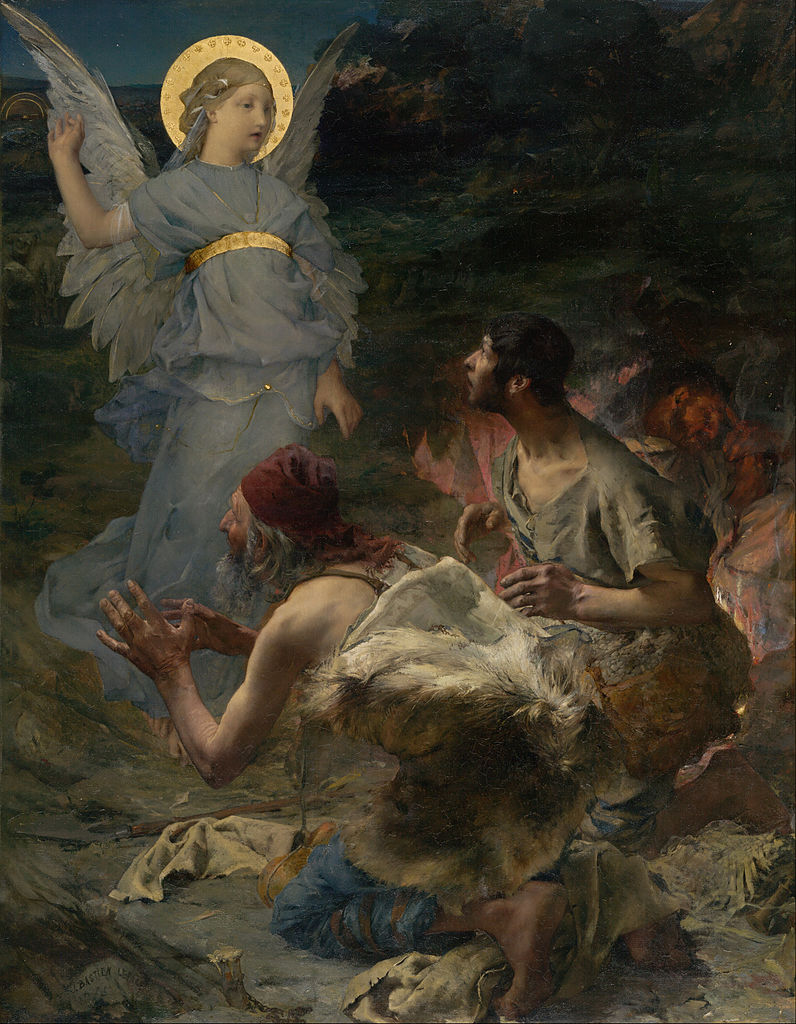
Jules Bastien-LePage The annunciation to the shepherds 1875


Yes, Virginia, There Is A ‘Santa Rally’ (Roberts)
Homelessness In England Rises By 75% Among Vulnerable Groups Since 2010 (G.)
Ten Years In, Nobody Has Come Up With A Use For Blockchain (Hackernoon)
Varoufakis: Bitcoin is The Perfect Bubble, Blockchain A Great Solution (Wired)
Japan Births Plunge To Lowest Level Ever Recorded (ZH)
China Raging Against the Dying of the Light (Hamilton)
US Tax Cut and Rate Hikes Threaten China Currency (Schmid)
Italy’s Ruling PD Slides Further In Polls As Election Nears (R.)
How Sea Shepherd Lost Battle Against Japan’s Whale Hunters In Antarctic (G.)
Climate Change In The Land Of Santa Claus (Ind.)


Santa = faith in the good of mankind. As is Jesus. Still, hard to rhyme with copious dinners while others starve in the dark and cold, and $900 spent on gifts on average per American. That can’t be it.

Yes, Virginia, There Is A ‘Santa Rally’ (Roberts)

Eight-year-old Virginia O’Hanlon wrote a letter to the editor of New York’s Sun, and the quick response was printed as an unsigned editorial Sept. 21, 1897. The work of veteran newsman Francis Pharcellus Church has since become history’s most reprinted newspaper editorial, appearing in part or whole in dozens of languages in books, movies, and other editorials, and on posters and stamps

THE EDITORIAL
DEAR EDITOR:

I am 8 years old.
Some of my little friends say there is no Santa Claus.
Papa says, ‘If you see it in THE SUN it’s so.’
Please tell me the truth; is there a Santa Claus?

VIRGINIA O’HANLON.
115 WEST NINETY-FIFTH STREET.

“VIRGINIA, your little friends are wrong. They have been affected by the skepticism of a skeptical age. They do not believe except they see. They think that nothing can be which is not comprehensible to their little minds. All minds, Virginia, whether they be men’s or children’s, are little. In this great universe of ours, man is a mere insect, an ant, in his intellect, as compared with the boundless world about him, as measured by the intelligence capable of grasping the whole of truth and knowledge.

Yes, VIRGINIA, there is a Santa Claus. He exists as certainly as love and generosity and devotion exist, and you know that they abound and give to your life its highest beauty and joy. Alas! how dreary would be the world if there were no Santa Claus? It would be as dreary as if there were no VIRGINIAS. There would be no childlike faith then, no poetry, no romance to make tolerable this existence. We should have no enjoyment, except in sense and sight. The eternal light with which childhood fills the world would be extinguished.

Not believe in Santa Claus! You might as well not believe in fairies! You might get your papa to hire men to watch in all the chimneys on Christmas Eve to catch Santa Claus, but even if they did not see Santa Claus coming down, what would that prove? Nobody sees Santa Claus, but that is no sign that there is no Santa Claus. The most real things in the world are those that neither children nor men can see. Did you ever see fairies dancing on the lawn? Of course not, but that’s no proof that they are not there. Nobody can conceive or imagine all the wonders there are unseen and unseeable in the world.

You may tear apart the baby’s rattle and see what makes the noise inside, but there is a veil covering the unseen world which not the strongest man, nor even the united strength of all the strongest men that ever lived, could tear apart. Only faith, fancy, poetry, love, romance, can push aside that curtain and view and picture the supernal beauty and glory beyond. Is it all real? Ah, VIRGINIA, in all this world there is nothing else real and abiding.

No Santa Claus! Thank God he lives, and he lives forever. A thousand years from now, Virginia, nay, ten times ten thousand years from now, he will continue to make glad the heart of childhood.”

Read more …

Do they know it’s Christmas time at all?

Homelessness In England Rises By 75% Among Vulnerable Groups Since 2010 (G.)

Homelessness among people with mental and physical health problems has increased by around 75% since the Conservatives came to power in 2010, and there has been a similar rise in the number of families with dependent children who are classed as homeless. According to official figures collated by the Department for Communities and Local Government, the number of homeless households in England identified by councils as priority cases because they contain someone who is classed as vulnerable because of their mental illness, has risen from 3,200 in 2010 to 5,470 this year. Over the same period, the number of families with dependent children – another priority homeless group identified by councils – has increased from 22,950 to 40,130.

The number of homeless households with a family member who has a physical disability has increased from 2,480 to 4,370. After a week in which the prime minister has come under renewed attack over homelessness, housing charities have called on the government to urgently build more affordable housing and reverse a squeeze on benefits which has left vulnerable people unable to pay their rents. “With homelessness soaring, it is no surprise that the number of vulnerable groups – including families with children – who are having to turn to their council for help is on the rise,” said Polly Neate, chief executive of charity Shelter.

“As wages stagnate, rents continue to rise and welfare is cut, many people are struggling to keep a roof over their head. Eviction is now the number one cause of homelessness. “Our services across the country are seeing an increase in the number of people with multiple and complex needs, and we think this may be because other services are failing to provide the help that people need. The solution to our housing crisis must be to urgently build more affordable homes and, in the short term, end the freeze on housing benefit that is increasingly pushing people over the precipice into homelessness.”

Read more …

Shaking the tree.

Ten Years In, Nobody Has Come Up With A Use For Blockchain (Hackernoon)

Everyone says the blockchain, the technology underpinning cryptocurrencies such as bitcoin, is going to change EVERYTHING. And yet, after years of tireless effort and billions of dollars invested, nobody has actually come up with a use for the blockchain – besides currency speculation and illegal transactions. Each purported use case – from payments to legal documents, from escrow to voting systems – amounts to a set of contortions to add a distributed, encrypted, anonymous ledger where none was needed. What if there isn’t actually any use for a distributed ledger at all? What if, ten years after it was invented, the reason nobody has adopted a distributed ledger at scale is because nobody wants it?

The original intended use of the blockchain was to power currencies like bitcoin – a way to store and exchange value much like any other currency. Visa and MasterCard were dinosaurs, everyone proclaimed, because there was now a costless, instant way to exchange value without the middleman taking a cut. A revolution in banking was just the start& governments, unable to issue currency by fiat anymore, would take a back seat as individual citizens transacted freely outside any national system. It didn’t take long for that dream to fall apart. For one thing, there’s already a costless, instant way to exchange value without a middleman: cash. Bitcoins substitute for dollars, but Visa and MasterCard actually sit on top of dollar-based banking transactions, providing a set of value-added services like enabling banks to track fraud disputes, and verifying the identity of the buyer and seller.

It turns out that for the person paying for a product, the key feature of a new payment system – think of PayPal in its early days – is the confidence that if the goods aren’t as described you’ll get your money back. And for the person accepting payment, basically the key feature is that their customer has it, and is willing to use it. Add in points, credit lines, and a free checked bag on any United flight and you have something that consumers choose and merchants accept. Nobody actually wants to pay with bitcoin, which is why it hasn’t taken off.

Read more …

Crypto vs democracy: “To Varoufakis, money is inherently political. The decisions regarding whether money is produced or not, how it is distributed and who receives it, all have significant political consequences, benefiting certain social groups over others.”

Varoufakis: Bitcoin is The Perfect Bubble, Blockchain A Great Solution (Wired)

While acknowledging the limitations of bitcoin and other technical solutions to political problems, Varoufakis does see potential in blockchain technologies. For him, “the algorithm that operates behind bitcoin, caught my attention right from the beginning. I consider this to be a remarkable technology. As early as 2012, Varoufakis was toying with ideas for using blockchain to help solve Europe’s financial woes. By the time he was appointed Finance Minister of Greece in 2015, within days his anti-austerity programme was met with the direct threat from the Troika to close Greece’s banks. With no banking system, the country would grind to a halt. To counter this threat, Varoufakis devised an audacious plan to keep Greece’s financial system operating. Effectively Varoufakis proposed creating an alternative, peer-to-peer payments system based on the blockchain.

This would disintermediate the financing they were receiving from the Troika and from the money markets. But with no money coming from the Troika, Varoufakis would need to create a parallel payments system, that would leverage the tax that all citizens and companies of Greece need to pay, as a new form of money. This is what he would eventually brand, “fiscal money.” To understand how fiscal money works, imagine that a pharmaceutical company in Greece is owed money by the state. Due to the constraints of the crisis, it may take years to pay the company in normal central bank euros. However what if there was an alternative option? What if the Greek State created a reserve account for the company under its tax file number, in which it placed tax credits of one million euros? This IOU could then also be used by the company to pay other organisations and individuals within the country.

One of the most disruptive aspects of this unrealised plan, was to enable the state to borrow directly from citizens and vice versa. In effect, Varoufakis was attempting to use new digital technologies, such as blockchain, to cut out the European lending authorities and build new lending relationships between citizens, companies and the state. The risk this system faced was the threat of corruption and the subsequent decline in public trust of authorities, something that Varoufakis admits is “in very limited supply” in a country like Greece. For example, what if Greek authorities abused these tax credits and began to distribute this new fiscal money to close allies and friends? This is where Varoufakis saw blockchain’s potential. “If the payments system was based on the blockchain, this would allow the combination of anonymity but perfect transparency, regarding the total aggregate size of the transactions of the currency….blockchain would overcome the trust problem as we know it.”

Read more …

Japan and China suffer the same fate: aging populations.

Japan Births Plunge To Lowest Level Ever Recorded (ZH)

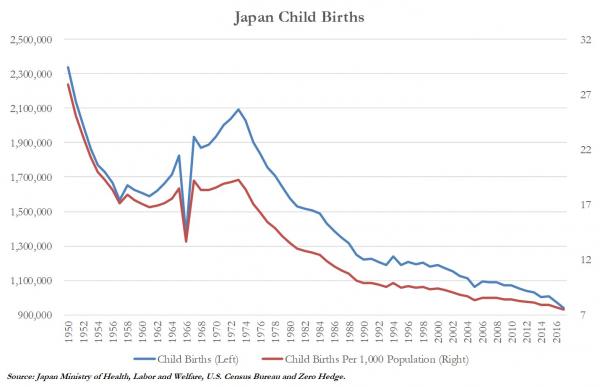
Back in 2013 we asked “Why Have Young People In Japan Stopped Having Sex?” And while that might sound like nothing more than a clever headline intended for The Onion, it was prompted by a very serious survey conducted by the Japan Family Planning Association which found that 45% of Japanese women aged 16-24 and 25% of men were “not interested in or despise sexual contact”…a growing trend that has revealed itself via the nation’s persistently declining birth rates. In fact, “celibacy syndrome” has become of such great concern for the Japanese government that it is considered a bit of a looming national catastrophe….a catastrophe that seems to be getting worse at an accelerating rate. According to data released today by Japan’s Ministry of Health, Labor and Welfare, child births in Japan will drop to just 941,000 in 2017, the lowest since data first started being recorded in 1899, and nearly 65% below the peak birth rate from the late 1940’s.

Read more …

China is building “..a housing bubble for a population that is never coming..”

China Raging Against the Dying of the Light (Hamilton)

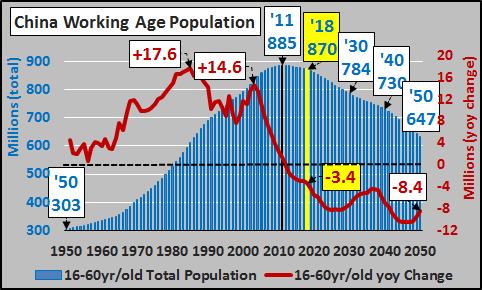
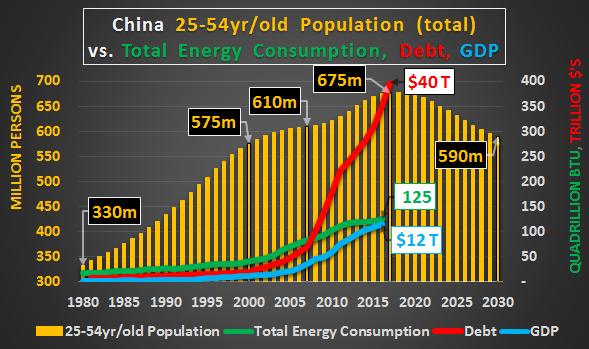
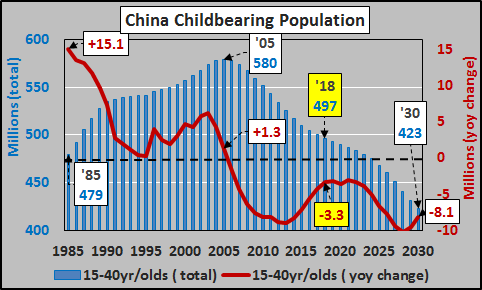
China’s working age population is clearly defined as those aged 16 to 50 years old for females (55 for “white collar” females) and 16 to 60 years old for males. China mandates retirement at these outer age limits. Perhaps of some interest should be that this working age population peaked in 2011 and has been declining since. This decline will continue indefinitely as China has a collapsing childbearing population (detailed HERE), net emigration (outflow), and a still decidedly negative birthrate. There is no evidence to believe the working age declines will abate any decade soon. As the chart below shows, China’s potential workforce will be shrinking indefinitely…and by 2030 China’s potential workforce will be over 100 million fewer than the 2011 peak (an 11% decline)…and only further down from there..

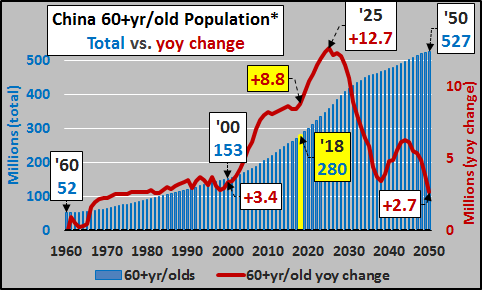
China has one of the youngest average retirement ages in the developed world. On average, according to a recent study (HERE), Chinese leave the work force by age 55 compared to age 63 in the US (Norway has the latest average departure at age 67). So, perhaps China will be raising the retirement age to curb the ballooning 60+yr/old population entering retirement (chart below…chart shows retirement population, 55+ females and 60+ males)? More on that later..

Comparing the working age population versus the 60+yr/old population (chart below…again, showing the 55+ females, 60+ males). A shrinking potential workforce since peaking in 2011 and a rapidly growing elderly population.

[..] While China’s GDP and energy consumption have led the world, they have not responded in kind to China’s debt explosion and exponentially more will be necessary to continue to show “growth”. Over a third and perhaps half of all the debt has been mal-invested in a housing bubble for a population that is never coming. What comes next isn’t going to be good for China nor the rest of the world as China looks to flood a depopulating nation with new debt only creating more housing overcapacity…China will look to beat the Japanese at the debt game.

Read more …

Outflows are by no means over.

US Tax Cut and Rate Hikes Threaten China Currency (Schmid)

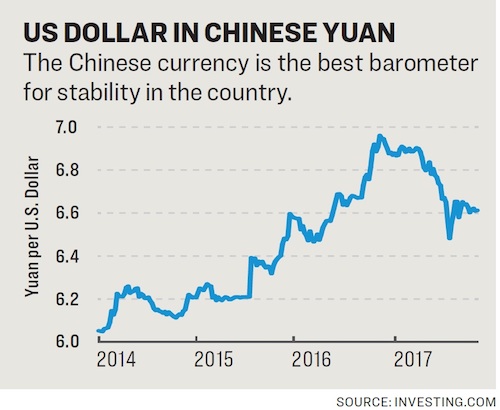
Seven was the line in the sand. But the Chinese yuan never crossed that line vis-à-vis the U.S. dollar. It only crept up to 6.96 yuan per dollar on Dec. 16, 2016, before starting an impressive comeback, down to 6.5 in the middle of this year. Last year was a bad one for the Chinese economy. Growth was slow, and the world was worried China would finally land the hard way, as many have been predicting for years. And more than GDP growth or any other metric, the Chinese currency was the barometer of whether China could keep things stable – stability is the mantra of the ruling communist regime – or suffer a crisis of debt deflation. If it declined in value, it meant citizens and companies were moving money out of the country in droves because they didn’t believe in the Chinese dream anymore. So another measure of how bad things had gotten in the second-largest economy of the world was capital outflows.

According to the Institute of International Finance (IIF), a record $725 billion left China in 2016, putting pressure on the currency and the Chinese interbank market. All these factors have changed in favor of the dollar in the last quarter, and it’s going to be hard for China to compete. Trying to stem the tide, the central bank sold record amounts of foreign currency. Chinese foreign exchange reserves, $4 trillion at the peak in 2014, went down to $3 trillion, and analysts started to question whether this was enough to finance the world’s largest trading economy. Then, miraculously in time for the 2017 National Congress of the Communist Party, all of this stopped. The yuan never went above 7, the exchange reserves never went below 3 trillion, and capital outflows subsided thanks to draconian regulations making it harder for individuals and companies to move money out of the country.

Read more …

Beppe all the way.

Italy’s Ruling PD Slides Further In Polls As Election Nears (R.)

Italy’s ruling Democratic Party (PD), hit by internal divisions and a banking scandal, is continuing to slide in opinion polls, with a new survey on Saturday putting it more than six points behind the anti-establishment 5-Star Movement. The survey by the Ixe agency, commissioned by Huffington Post Italia, comes just days before parliament is expected to be dissolved to make way for elections in March. It gives the center-left PD just 22.8% of voter support, down almost five points in the last two months, compared with 29.0% for 5-Star, which has gained almost two points in the same period. Silvio Berlusconi’s center-right Forza Italia (Go Italy!) is given 16.2%, with its right-wing allies the Northern League and Brothers of Italy on 12.1% and 5.0% respectively.

This bloc is expected to win most seats at the election but not enough for an absolute majority, resulting in a hung parliament. With the PD’s support eroding in virtually all opinion polls, several political commentators have speculated that its leader Matteo Renzi may choose or be forced to announce he will not be the party’s candidate for prime minister at the election. Renzi has given no indication so far he will take this step. The PD has split under his leadership, with critics complaining he has dragged the traditionally center-left party to the right. Breakaway groups united this month to form a new left-wing party called Free and Equal (LeU), which now has 7.3% of support, according to Ixe. The PD’s popularity seems to have also been hurt by a parliamentary commission looking into the collapse of 10 Italian banks in the past two years.

Read more …

What kills faith in mankind.

How Sea Shepherd Lost Battle Against Japan’s Whale Hunters In Antarctic (G.)

A fleet of Japanese ships is currently hunting minke whales in the Southern Ocean. It is a politically incendiary practice: the waters around Antarctica were long ago declared a whale sanctuary, but the designation has not halted Japan’s whalers, who are continuing a tradition of catching whales “for scientific research” in the region. In the past, conservation groups such as Sea Shepherd have mounted campaigns of harassment and successfully blocked Japan’s ships from killing whales. But not this year. Despite previous successes, Sea Shepherd says it can no longer frustrate Japan’s whalers because their boats now carry hardware supplied from military sources, making the fleet highly elusive and almost impossible to track. As a result the whalers are – for the first time – being given a free run to kill minke in the Southern Ocean.

“We have prevented thousands of whales from being killed in the past and we have helped ensure that the quota of minkes that Japan can take now is much lower than in the past,” said Peter Hammarstedt, a Sea Shepherd captain. “But they have put such resources into this year’s whaling that we cannot hope to find their fleet and stop them. It is simply a matter of us not wasting our own resources. We have other battles to fight.” Japan is not the only nation to hunt whales. Norway has a commercial operation in its own waters, for example. But what infuriates conservationists is that Japan is hunting and killing whales in a conservation zone, the Southern Ocean whaling sanctuary, that surrounds Antarctica. Japan claims that it does so only for scientific purposes.

“Essentially, they are exploiting a loophole in the rules – introduced in the 80s – that govern the banning of commercial whaling,” said Paul Watson, the founder of Sea Shepherd. Originally Japan set out to catch more than 900 minkes every year, as well as 50 humpbacks and 50 fin whales. However, its fleet was rarely able to reach these quotas because of actions by groups like Sea Shepherd. “We physically got in between the whalers and the whales and stopped the latter being killed,” said Hammarstedt. “One year we stopped Japan getting all but 10% of its quota. Their ships were nearly empty when they got back home.”

Read more …

The further north the larger the differences.

Climate Change In The Land Of Santa Claus (Ind.)

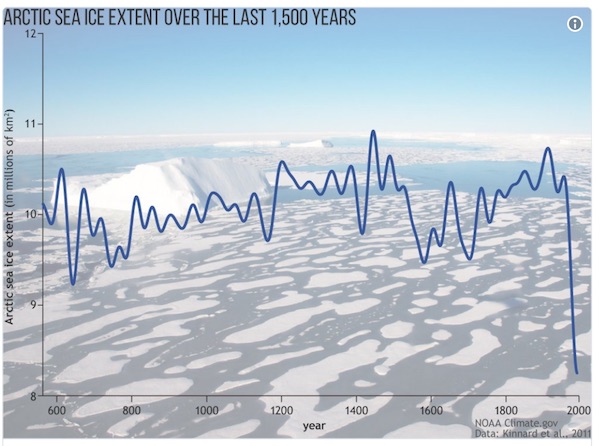
Lapland occupies a happy space in the popular imagination as a winter wonderland, occupied by reindeer, elves and Father Christmas. The real life Lapland, however, is increasingly facing up to the grim reality of global warming. Besides being the name of Swedish and Finnish provinces, Lapland is the English name for a region largely above the Arctic Circle that stretches across the north of Norway, Sweden, Finland and Russia. Research has revealed the disproportionate impact of climate change in the Arctic, where temperatures are currently rising at double the rate of the global average. The far north is bearing the brunt of global warming, and, as much of Lapland’s population relies on its polar climate for their livelihoods, the effects are starting to be felt.

Rovaniemi, the administrative capital of the Finnish province of Lapland, has done a good job of capitalising on the region’s Christmas-themed reputation. It is the self-proclaimed “Official Hometown of Santa Claus”, where the man himself can be visited 365 days a year. However, with his official residence there only constructed in 1950, Santa Claus is a relative newcomer to Lapland. The wider region is the ancient home of the indigenous Sami people, who refer to it as Sapmi. Owing to its remote location and freezing temperatures, much of Lapland remains relatively pristine wilderness, and it is this wilderness that provides the Sami with space to practise their ancient tradition of reindeer herding. As temperatures rise and begin to disrupt the unspoiled environment, the future prosperity of all Lapland’s inhabitants – from the Sami to Santa Claus – is at risk.

Dr Stephanie Lefrere first came to Finnish Lapland 18 years ago to study reindeer behaviour. Since then, she has observed dramatic changes in the region’s weather patterns, and subsequent effects on its wildlife. “In my very first fieldwork, 300km (186 miles) above the Arctic Circle, it was 20°C below zero on 31 October – really the Arctic feeling by the end of October,” she said. “We don’t have that any more. “Recently there have been ‘black Christmases’ with no snow at all in the southern part of Finland.” Decades of work in the region have cemented her view that climate change is having far-reaching effects on Lapland’s environment, affecting animal migratory routes, habitats and behaviour. “I became worried as a scientist, and also as an individual who is fascinated by the Arctic,” said Dr Lefrere.


Sami culture is based around reindeer, but only a fraction still keep their animals due to environmental change (Getty)

Read more …

Dec 232017
 
 December 23, 2017  Posted by at 9:42 am Finance Tagged with: , , , , , , , , ,  11 Responses »


Ansel Adams Boulder Dam 1941


Bitcoin Briefly Plunges As Low As $10,400, Down 47%, In Volatile Trading (CNBC)
2017 Year In Review (David Collum)
2017 Year in Review (Jim Kunstler)
Foreign Cash Driving Top-End House Prices In Vancouver And Toronto (R.)
Canadian Housing Affordability Hits 27 Year Low (Saretsky)
Saudi Government Wants $6 Billion For al-Waleed’s Freedom (ZH)
What’s Going On With Cars? (Gaines)
Greek Pensioners May Face Further Cuts In 2018 (K.)
Make Supermarkets And Drinks Firms Pay For Plastic Recycling, Say UK MPs (G.)


Keep the faith. It’s Christmas time after all.

Bitcoin Briefly Plunges As Low As $10,400, Down 47%, In Volatile Trading (CNBC)

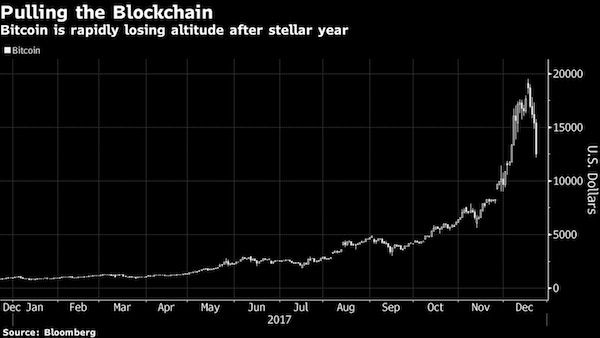
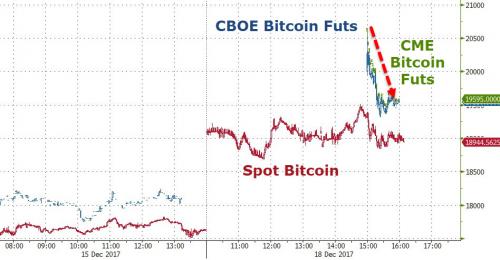
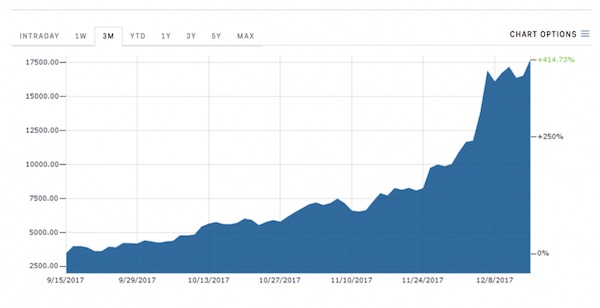
Bitcoin plunged Friday, taking the digital currency briefly below $11,000 and down 47% from a record high hit at the start of the week. Bitcoin had rallied to a record high above $19,800 on Sunday and was trading near $15,500 for much of Thursday New York time, according to Coinbase. But an afternoon selloff accelerated into the night, and bitcoin dropped 30.2% Friday morning to a low of $10,400 on Coinbase. It had recovered above $14,600 by Friday afternoon, off 27% from the all-time high. There were no immediately apparent explanation for the selloff and extreme volatility.

“I would say the drop in bitcoin is a result of the massive new inflows of retail investors who are relatively ‘weak hands’ and more prone to sell at the sight of falling prices than the capital that has been in the system for a while that has a longer term outlook,” Alex Sunnarborg, founding partner at cryptofund Tetras Capital, said in an email. Adding to the confusion, trading on Coinbase was disabled for more than two hours in the middle of the day. The company had more than 13 million users at the end of November. At its lows, bitcoin had fallen 47% in just five days and lost about $9,400. The digital currency erased more than $1,000 in one hour alone Friday morning.

Read more …

You’re on your own with Collum’s as always very very long review:

2017 Year In Review (David Collum)

A poem for Dave’s Year In Review

The bubble in everything grew

This nut from Cornell

Say’s we’re heading for hell

As I look at the data…#MeToo

~@TheLimerickKing

Read more …

We have reviews in all sorts and sizes. But with Christmas still to come, can they be complete?!

2017 Year in Review (Jim Kunstler)

2017 was the kind of year when no amount of showers could wash off the feeling of existential yeccchhhhh that crept over you day after day like jungle rot. You needed to go through the carwash without your car… or maybe an acid bath would get the stink off. Cinematically, if 2016 was like The Eggplant That Ate Chicago, then 2017 was more like Alfred Hitchcock’s Psycho, a gruesome glimpse into the twisted soul of America. And by that I do not mean simply our dear leader, the Golden Golem of Greatness. We’re all in this horror show together. 2017 kicked off with the report by “seventeen intelligence agencies” — did you know there were so many professional snoops and busybodies on the US payroll? — declaring that Russia, and Vladimir Putin personally, tried to influence the 2016 presidential election.

“Meddling” and “collusion” became the watch-words of the year: but what exactly did they mean? Buying $100,000 worth of Google ads in a campaign that the two parties spent billions on? No doubt the “seventeen intelligence agencies” the US pays for were not alert to these shenanigans until the damage was done. Since then it’s been Russia-Russia-Russia 24/7 on the news wires. A few pleas bargains have been made to lever-up the action. When and if the Special Prosecutor, Mr. Mueller, pounces, I expect the GGG to fire him, pardon some of the plea-bargained culprits (if that’s what they were and not just patsies), and incite a constitutional crisis. Won’t that be fun? Anyway, that set the tone for the inauguration of the Golden Golem, a ghastly adversarial spectacle.

Never in my memory, going back to JFK in 1960, was there such a bad vibe at this solemn transfer of power as with the sight of all those Deep State dignitaries gathering gloomily on the Capitol portico to witness the unthinkable. From the sour scowl on her face, I thought Hillary might leap up and attempt to garrote the GGG with a high-C piano wire right there on rostrum. The “greatest crowd ever” at an inauguration, as the new president saw it, looked pathetically sparse to other observers. The deed got done. Five days later, the Dow Jones stock index hit the 20,000 mark and began a year-long run like no other in history: 50 all-time-highs, and a surge of 5000 points by year’s end, with 12 solid “winning” months of uptick.

Read more …

That 15% foreign buyers tax didn’t help much.

Foreign Cash Driving Top-End House Prices In Vancouver And Toronto (R.)

Foreign buyers are driving up the prices of homes in Canada’s two largest housing markets, according to research which will intensify the debate around overseas property ownership in the expensive cities of Vancouver and Toronto. While people living outside Canada own less than 5% of residential properties in the two cities, those homes are worth significantly more than those held by residents, according to a Reuters analysis of data released this week by Statistics Canada. Public debate over the role of foreign investment in Canada has reached a fever pitch, with locals saying price increases of 60% in Vancouver and 40% in Toronto over the past three years are keeping them out of the market. In Toronto, the average value of a detached home built in 2016-2017 and owned by a non-resident is C$1.7m (US$1.3m), a whopping 48.7% higher than C$1.1m for residents.

Those values for Vancouver average a lofty C$2.5m for non-residents and C$1.8m for residents for a difference of 40.6%. Among all detached homes, not just new ones, those owned by non-residents were larger than residents’ houses by 13.1% in Vancouver and 2.2% in Toronto. The new data reinforces anecdotal evidence that foreign buyers tend to focus on the most affluent neighborhoods, said Jane Londerville, a real estate professor at the University of Guelph in Southern Ontario. “If the goal is to get a couple million dollars out of their country and put it in a very safe, calm economy, you might as well buy a C$2m house,” she said. “So they’re buying in Forest Hill in Toronto and Kerrisdale in Vancouver.” The Statscan data does not look at sales, or flow, but rather is a static snapshot of ownership of housing stock at the time of collection.

Foreign capital also targets new condos, with new Vancouver units owned by non-residents valued at 19.7% more than those owned by residents. In Toronto, the difference is 11.2%. “There’s been a huge spike in foreign ownership in newer buildings,” said Diana Petramala, senior researcher at Ryerson University’s urban policy centre in Toronto. [..] A 15% foreign buyers tax was imposed in Vancouver in 2016 and Toronto in 2017 amid a backlash against foreign buyers, particularly from China. This has cooled both markets at least temporarily.

Read more …

Canada doesn’t want to solve the issue anymore than any other country does.

Canadian Housing Affordability Hits 27 Year Low (Saretsky)

“Nothing says Merry Christmas like a 27 year low for Canadian housing affordability. That’s right, real estate across Canada has not been this un affordable since the year 1990 per RBC. Spoiler alert house prices tumbled shortly thereafter. RBC Bank released their updated Q3 numbers for housing affordability. To no surprise, Vancouver leads the nation in the most unaffordable market to buy a home. Followed by Toronto and then Victoria. “The deterioration in the latest two quarters, in fact, put Vancouver buyers in the worst affordability position ever recorded in Canada.“ The area experienced the sharpest affordability drop among Canada’s major markets between the second and third quarters. RBC’s aggregate measure surged by 5.3 percentage points to 87.5%. This represents a new record high for any market in Canada. We see further downside to Vancouver’s home ownership rate in the period ahead. The rate fell from 65.5% in 2011 to 63.7% in 2016.”

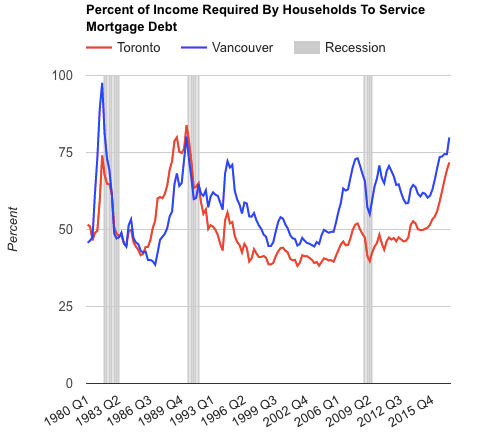
What RBC didn’t mention in their report is the correlation between elevated house prices that cause affordability issues and recessions. When too much household money is spent servicing mortgage payments it eventually becomes a drag on consumer spending and ultimately triggers a recession. This is not to suggest a recession is imminent. But when the percent of income the median family would have to use to service debt pushes above 50% in Toronto and Vancouver, a recession typically follows in Canada. Currently Toronto is at 71.7%, and Vancouver is at 79.87%. With the Bank of Canada expected to follow our US counter parts in 2018, a couple more interest rate increases are sure to erode affordability even further. Across Canada, Household income would need to climb by 8.5% to fully cover the increase in homeownership costs arising from a 75 basis-point hike in mortgage rates. Buckle in.

Read more …

Would you bet on MBS?

Saudi Government Wants $6 Billion For al-Waleed’s Freedom (ZH)

In case you were wondering what the going-rate was for one of the world’s richest men’s freedom… it’s $6 billion… in unencumbered cash (not Bitcoin). That is the price that Saudi authorities are demanding from Saudi Prince al-Waleed bin Talal to free him from detention. The 62-year-old prince was one of the dozens of royals, government officials and businesspeople rounded up early last month in a wave of arrests the Saudi government billed as the first volley in Crown Prince Mohammed bin Salman’s campaign against widespread graft. According to the Mail, al-Waleed, who is (or was, until recently) one of the richest men in the world, has also been hung upside down and beaten.

The Saudi government has disclosed few details of its allegations against the accused, but as The Wall Street Journal reports, people familiar with the matter said the $6 billion Saudi officials are demanding from Prince al-Waleed, a large stakeholder in Western businesses like Twitter, is among the highest figures they have sought from those arrested. While the prince’s fortune is estimated at $18.7 billion by Forbes – which would make him the Middle East’s wealthiest individual – he has indicated that he believes raising and handing over that much cash as an admission of guilt and would require him to dismantle the financial empire he has built over 25 years. Prince al-Waleed is talking with the government about instead accepting as payment for his release a large piece of his conglomerate, Kingdom Holding Co., people familiar with the matter said.

The Riyadh-listed company’s market value is $8.7 billion, down about 14% since the prince’s arrest. Kingdom Holding said in November that it retained the support of the Saudi government and that its strategy “remains intact.” According to a senior Saudi official, Prince al-Waleed faces accusations that include money laundering, bribery and extortion. The official didn’t elaborate, but said the Saudi government is merely “having an amicable exchange to reach a settlement.” The prince has indicated to people close to him that he is determined to prove his innocence and would fight the corruption allegations in court if he had to. “He wants a proper investigation. It is expected that al-Waleed will give MBS a hard time,” said a person close to Prince al-Waleed, referring to the crown prince by his initials, as many do.

Read more …

As I said yesterday, this won’t’ be as big as subprime houseing, but it’ll be much messier: “The problem with high rebate numbers is it absolutely kills the resale value of a car.”

What’s Going On With Cars? (Gaines)

Automotive credit has become easier in the last few years, and manufacturers are still seeking whatever growth they can come up with in our market at any cost. People are buying cars they can’t afford or shouldn’t even have been able to buy. Used car depreciation is at an all time high for many cars and yet everyday more and more people are trading them in. This whole scenario has a bleak end that became evident when I went to my buddy Paris’ repo lot. He called me to check out a 2016 BMW 435i he jacked for BMW Financial Services. It was a beautiful Estoril Blue M-Sport car with just under eight thousand miles on the clock. I could only imagine the circumstances where someone let go of a year old BMW, but as we walked through I noticed all of the cars seemed to be nearly new.

Paris confirmed my fears when he told my about nine-out-of-ten vehicles he’s repossessed in the last few months were model year 2016 or newer. To make matters worse Paris only does work for prime and a few captive lenders, meaning a majority of these cars went out to consumers with good credit. On the other end, every time I look up from my desk there is a customer who is absolutely drowned in their vehicle. Six thousand dollars in negative equity is the norm, but I’ve witnessed numbers as high as twenty thousand in the last year. Customers are always astounded by how their car has lost so much of its value so quickly. What they fail to realise is their car was worthless from the beginning. Rebates and incentives are at an all time high at many manufacturers, J.D. Power quoted an average around four thousand dollars earlier this year, and I’m sure that number has risen since then. The problem with high rebate numbers is it absolutely kills the resale value of a car.

Read more …

Keep squeezing, there’s still some blood left there.

Greek Pensioners May Face Further Cuts In 2018 (K.)

Auxiliary pensions appear headed for a fresh cut in 2018, as the single auxiliary social security fund (ETEAEP) will end 2017 with a deficit, against the small surplus originally forecast. Crucially, while the ETEAEP budget for next year provides for a surplus of €176.01 million, expenditure on pensions will be reduced by 150 million euros. Based on the latest social security laws introduced by former minister Giorgos Katrougalos and current minister Effie Achtsioglou, the new auxiliary pensions – when they are finally issued – will be reduced by 22% on average, with a cut of up to 18% expected to existing pensions in 2019. The provisions of the ETEAEP budget that Kathimerini has seen suggest that existing pensions might be cut as early as next year. The single auxiliary social security fund is now projecting a deficit of €166.6 million for this year, compared to an original forecast for a €10.07 million surplus.

For next year’s surplus of 176.007 million euros to be attained, spending on auxiliary pensions will have to be reduced from €4.30 billion in 2016 and €4.17 billion this year to €4.02 billion in 2018. This means the sum of auxiliary pensions will decline by 3.59% next year. Revenues from next year’s social security contributions are estimated at €2.68 billion, against €2.566 billion this year (compared to a forecast for €2.581 billion). The ETEAEP budget also shows that the fund sold bonds worth €200 million this yea – at a considerable loss – while next year it will need to cash in bonds worth €80 million from the special fund at the Bank of Greece. In total, takings from the fund’s cash and bond handling for this year are estimated at €397.14 million, against an original projection of €200.54 million. Revenues from the utilization or sale of assets will amount to an estimated €311.65 million next year.

Read more …

How typical is this of mankind on the verge of 2018? The idea is environmental problems can be solved by putting monetary values on everything. The idea is as wrong as it is stupid. Cleaning the planet will not be done for monetary reasons.

Make Supermarkets And Drinks Firms Pay For Plastic Recycling, Say UK MPs (G.)

Supermarkets, retailers and drinks companies should be forced to pay significantly more towards the recycling of the plastic packaging they sell, an influential committee of MPs has said. Members of the environmental audit committee called for a societal change in the UK to reduce the 7.7bn plastic water bottles used each year, and embed a culture of carrying reusable containers which are refilled at public water fountains and restaurants, cafes, sports centres and fast food outlets. British consumers use 13bn plastic bottles a year, but only 7.5bn are recyled. MPs said the introduction of a plastic bottle deposit return scheme (DRS) was key to reducing plastic waste in the UK, as part of a series of measures to reduce littering and increase recycling rates.

Michael Gove, the environment secretary, has called for evidence on a plastic bottle deposit scheme, and it is expected to be part of measures he announces in the new year. Major retailers have yet to support such a scheme, but Iceland and the Co-op recently announced their backing for a DRS. The report published on Friday underlines the need for government intervention to tackle plastic waste in the UK and calls for higher charges on companies to contribute to clearing up the waste they create. Mary Creagh, chair of the environmental audit committee, said: “Urgent action is needed to protect our environment from the devastating effects of marine plastic pollution, which if it continues to rise at current rates, will outweigh fish by 2050.

“Plastic bottles make up a third of all plastic pollution in the sea and are a growing litter problem on UK beaches. We need action at individual, council, regional and national levels to turn back the plastic tide.” In the report MPs called for the “polluter pays” principle to be applied to companies to increase their contribution to recycling plastic waste.

Read more …

Dec 222017
 
 December 22, 2017  Posted by at 8:56 am Finance Tagged with: , , , , , , , , , , ,  11 Responses »


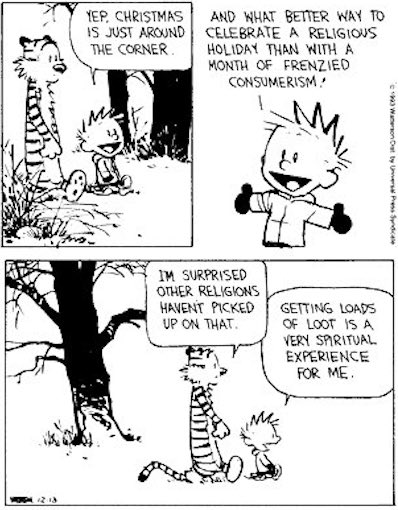
Bill Watterson is God


He Died For Our Debts, Not Our Sins – Michael Hudson (Ren.)
Bitcoin Tumbles Below $13,000, Down Almost 40% From Record Peak (BBG)
Crypto Carnage Continues, Bitcoin Falls Back To $13,000 Handle (ZH)
Gold Only Safe Asset Left – David Stockman (USAW)
What Will the Tax Law Do to Over-Indebted Corporate America? (WS)
Subprime Auto Defaults Are Soaring, and Private Equity Has No Way Out (BBG)
The Ghost of Gann: Another Crash is Coming (Ren.)
Catalan Separatists Win Election In Rebuke To Spain and EU (R.)
China’s Creditor Imperialism (PS)
China Uses Cheap Debt To ‘Bend Other Countries To Its Will’ (CNBC)
Fannie And Freddie Are Here To Stay – There Is No Alternative (ZH)
UK’s Secret Brexit Studies Reveal That Airbus Makes Planes (BBG)
Eco-Terrorists Threaten To Inject Acid In Greek Supermarket Products (WaPo)
New Zealand Gives Mount Taranaki Same Legal Rights As A Person (G.)


Got to love this angle.

He Died For Our Debts, Not Our Sins – Michael Hudson (Ren.)

As many people turn towards their Christian and Jewish faiths this Christmas and Hanukkah in an attempt to make sense of the year that was, at least one economist says we have been reading the bible in an anachronistic way. In fact he has written an entire book on the topic. In ‘…And Forgive them their Debts: Credit and Redemption’ (available this spring on Amazon), Professor Michael Hudson makes the argument that far from being about sex, the bible is actually about economics, and debt in particular. “The Christianity we know today is not the Christianity of Jesus,” says Professor Hudson. Indeed the Judaism that we know today is not the Judaism of Jesus either. The economist told Renegade the Lord’s Prayer, ‘forgive us our sins even as we forgive all who are indebted to us’, refers specifically to debt.

“Most religious leaders say that Christianity is all about sin, not debt,” he says. “But actually, the word for sin and debt is the same in almost every language.” “‘Schuld’, in German, means ‘debt’ as well as ‘offense’ or, ‘sin’. It’s ‘devoir’ in French. It had the same duality in meaning in the Babylonian language of Akkadian.” Professor Michael Hudson has achieved near complete consensus with the assyriologists & biblical scholars that the Bible is preoccupied with debt, not sin. The idea harks back to the concept of ‘wergeld’, which existed in parts of Europe and Babylonia, and set the value of a human life based on their rank, paid as compensation to the family of someone who has been injured or killed. “The payment – the Schuld or obligation – expiates you of the injury caused by the offense,” Dr Hudson said.

People tend to think of the Commandment ‘do not covet your neighbour’s wife’ in purely sexual terms but actually, the economist says it refers specifically to creditors who would force the wives and daughters of debtors into sex slavery as collateral for unpaid debt. “This goes all the way back to Sumer in the third millennium,” he said. Similarly, the Commandment ‘thou shalt not steal’ refers to usury and exploitation by threat for debts owing. The economist says Jesus was crucified for his views on debt. Crucifixion being a punishment reserved especially for political dissidents. “To understand the crucifixion of Jesus is to understand it was his punishment for his economic views,” says Professor Hudson. “He was a threat to the creditors.”

Read more …

That’s still some serious losses.

Bitcoin Tumbles Below $13,000, Down Almost 40% From Record Peak (BBG)

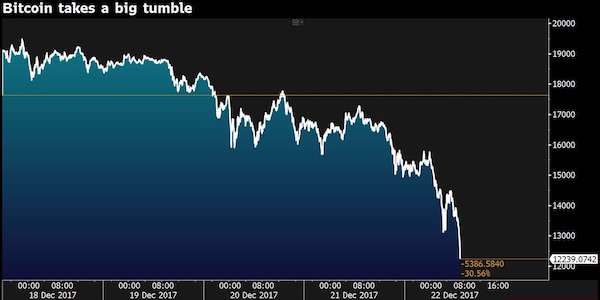
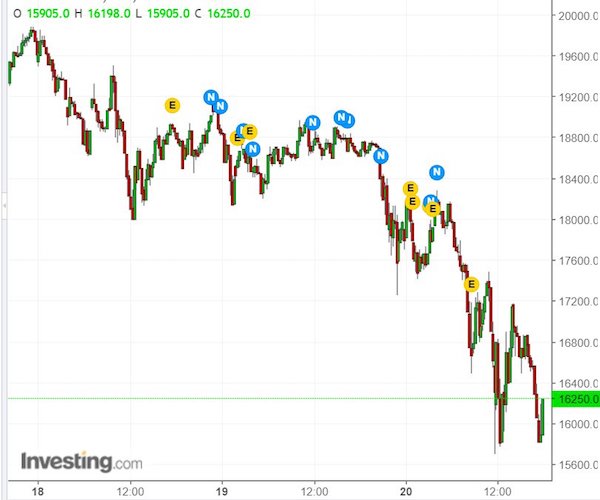
Bitcoin sank as much as 21% on Friday, extending its loss from its intraday high this month toward 40%. The digital currency dropped to as low as $12,191.80 before trading at $12,601.75 as of 3:29 p.m. in Hong Kong. Bitcoin, which is down 38% from its peak of $19,511, is still up more than 1,100% this year. Investors are having a “reality check,” said Stephen Innes, head of trading for Asia Pacific at Oanda. “At the heart of the matter was a frenzied demand for coins with limited supply has now led to unsophisticated investors holding the bag at the top.” Bitcoin’s drop comes amid concern that an offshoot is becoming a stronger rival to the more well-known cryptocurrency. Bitcoin cash, which emerged earlier this year amid a split between factions over proposed software upgrades, was added to Coinbase offerings this week.


Read more …

Zero Hedge overnight. It’s hard to keep up.

Crypto Carnage Continues, Bitcoin Falls Back To $13,000 Handle (ZH)

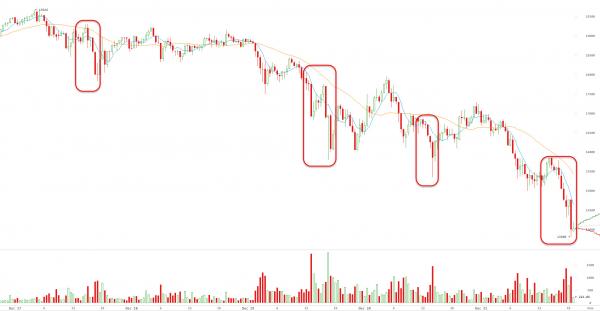
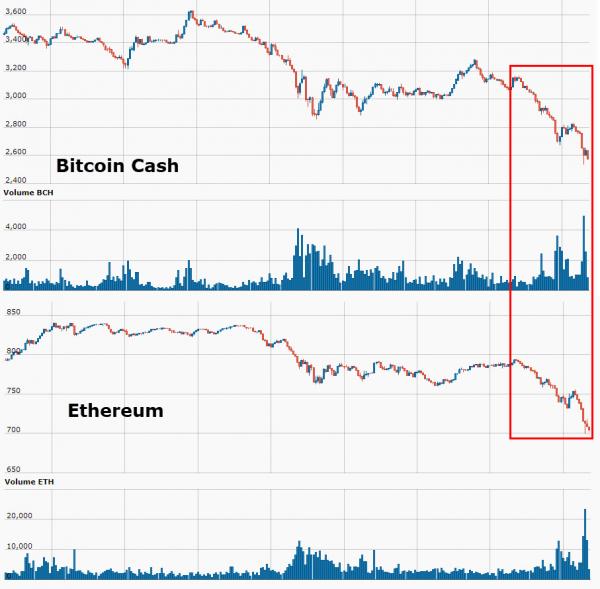
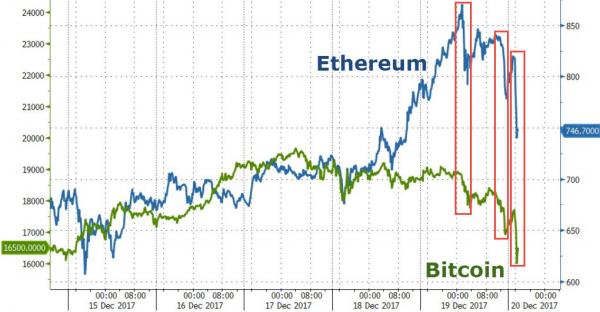
The carnage across cyrptocurrencies has escalated with Bitcoin back to a $13K handle, Ethereum back below $700, and Bitcoin Cash below $2,600… Bitcoin is now almost $6,000 off its record high…

ETH and BCH in trouble too…

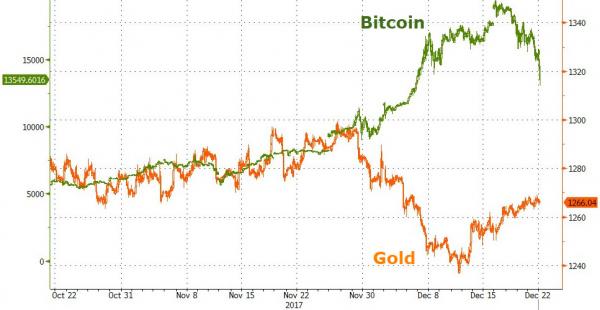
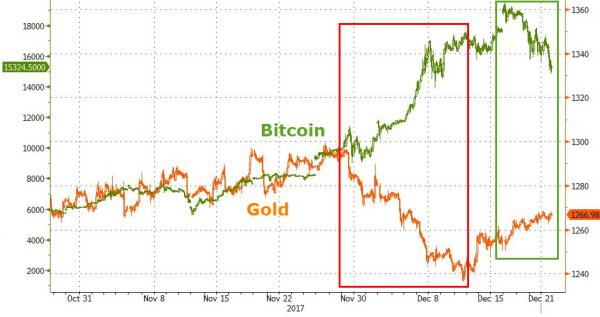
The question is – which happens first – Bitcoin $10,000 or Gold $1,300?

[..] renowned analyst Peter Schiff issued a foreboding warning to investors buying Bitcoin at current prices. Even with a shaky week, Bitcoin is hovering around the $15,000 mark, after a two-month bull run that saw the price rise by more than 200%. Schiff says those trying to ride the bubble are too late: “People who got it years ago, even people who got it at the beginning of the year have the opportunity to cash out and make a lot of money. But people who are buying it at these prices or higher prices are going to lose practically everything.” The old adage, “buy on the rumor and sell on the news,” seems to be the perfect way to sum up Schiff’s sentiments: “These currencies are going to trade to zero or pretty close to it when the bubble pops. Right now, the only reason why people are buying Bitcoin is because the price is going up. When it turns around, they are not going to sell it for the same reason.”

Read more …

Fed flying blind.

Gold Only Safe Asset Left – David Stockman (USAW)

Record high stock and bond prices are flashing danger signs to former Reagan White House Budget Director David Stockman. Stockman contends, “I don’t think we are going to have a liquidity crisis. I think it’s going to be a value reset. I think there is going to be a jarring downward price adjustment both in the stock market and in the bond market. This phantom or phony wealth that has been created since the last crisis is going to basically evaporate.” So, what asset is safe? Stockman says gold and goes onto explain, “I think the time to buy (gold and silver) is ideal. Gold is the ultimate and only real money. Gold is the only safe asset when push comes to shove. They tell you to buy the government bond, that’s a safe asset. It’s not a safe asset at its current price. I am not saying the federal government is going to default in the next two or three years.

I am saying the yield on a 10-year bond of 2.4% is way below of where it’s going to end up. So, the only safe asset left is gold. This crazy Bitcoin mania has drained off what would otherwise be a demand for gold. . . . When Bitcoin collapses, spectacularly, which it will because it’s sheer mania in the markets right now. When it collapses, I think a lot of that demand will come back into gold, as well as people fleeing the standard stock and bond markets for the first time in 9 or 10 years.” What about the so-called Trump tax cuts? Stockman predicts, “I think it’s going to be a fiscal calamity of Biblical proportions. I want to be clear. I am always for tax cuts and shrinking the size of government, but you have to earn it. You have to cut spending and entitlements and this massive defense budget. Obviously, they didn’t do that.

If you look at honest accounting . . this bill will add $2.5 trillion to the public debt which, and this is a key point, is already going to rise by $10 trillion over the next decade based on the current law and taxes that is still in.” “More importantly,” Stockman says, “The central banks realize they cannot keep printing money at these crazy rates, and by that I mean the bond buying. Now, they are going to begin to normalize and shrink their balance sheet . . By the fall (of 2018), they (the Federal Reserve) will be shrinking their balance sheet by $600 billion a year. What that means in plain simple English is that they (the Fed) are dumping $600 billion a year of existing bonds into the market just as Uncle Sam will be attempting to borrow $1.25 trillion more. Now, if you don’t think that is a financial collision waiting to happen, then I am not sure what would be.

Read more …

The tax bill is not one-dimensional.

What Will the Tax Law Do to Over-Indebted Corporate America? (WS)

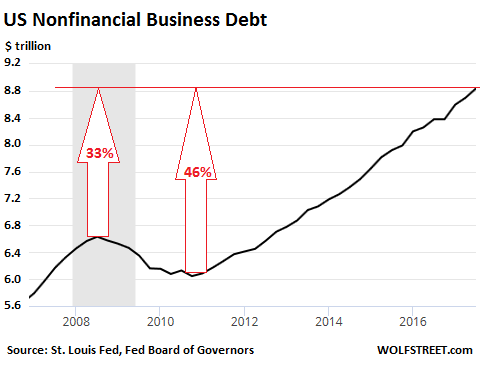
The new tax law is larded with goodies for Corporate America, but there is one shift – a much needed shift – in this debt-obsessed world that will punish over-indebted companies, discourage companies from taking on too much leverage, and perhaps, just maybe, make these companies less risky: The new law sharply limits the deductibility of corporate interest expense. Starting in 2018, a company can only deduct interest expense of up to 30% of its Ebitda (earnings before interest, taxes, depreciation, and amortization). Any amount in interest expense beyond it will no longer be deductible. This will tighten further in 2022, when the deductibility of corporate debt will be capped at 30% of earnings before interest and taxes but after depreciation and amortization expenses.

This is a much smaller number than Ebitda. And interest expense deduction is capped at 30% of that much smaller amount. This will raise the tax bill further. Most impacted will be highly indebted companies, which often have a junk credit rating. And due to this junk credit rating, they also pay higher interest rates. This made the interest expense deduction very valuable. But now it is getting partially gutted. Businesses have long been incentivized to borrow, not only by the extraordinarily low interest rates even for junk-rated companies, but also by the full deductibility of interest expense. And thus encouraged by the tax code, corporate debt has surged. Mergers & acquisitions, share buybacks, leveraged buyouts, and dividends have often been funded at least partially with debt. And over the years, companies have piled on an enormous amount of debt.

According to estimates by the Congressional Joint Committee on Taxation, cited by The Wall Street Journal, the first phase of curtailing interest-expense deductibility – the phase that kicks in next year – would raise $171 billion in tax revenues over 10 years. The second phase that commences in 2022 would raise $307 billion over 10 years. This would be the billions of dollars that highly indebted companies would pay more in taxes because they’re losing the deductible of some of their debts. It will be a significant hit to their after-tax income. It won’t kill them, but it will lower the incentive to borrow.

Read more …

It’ll get messier than subprime housing.

Subprime Auto Defaults Are Soaring, and Private Equity Has No Way Out (BBG)

Private-equity firms that plunged headlong into subprime auto lending are discovering just how hard it might be to get out. A Perella Weinberg Partners fund has been sitting on an IPO of Flagship Credit Acceptance for two years as bad loan write-offs push it into the red. Blackstone has struggled to make Exeter Finance profitable, despite sinking almost a half-billion dollars into the lender since 2011 and shaking up the C-suite multiple times. And Wall Street bankers in private say others would love to cash out too, but there’s currently no market for such exits. In the years after the financial crisis, buyout firms poured billions into auto finance, angling for the big profits that come with offering high-interest loans to buyers with the weakest credit.

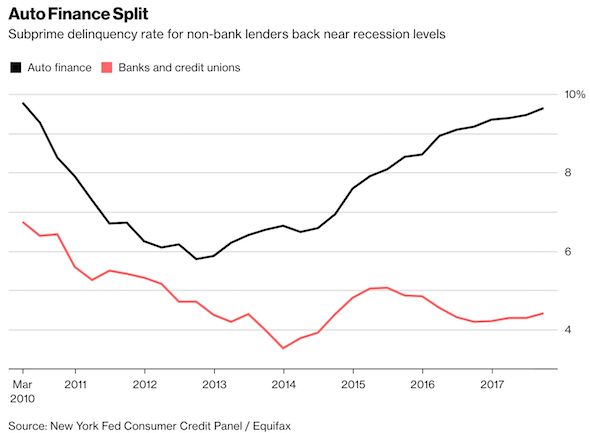
At rates of 11% or more, there was plenty to be made as sales boomed. But now, with new car demand waning, they’ve found the intense competition – and the lax underwriting standards it fostered – are taking a toll on profits. Delinquencies on subprime loans made by non-bank lenders are soaring toward crisis levels. Fresh investment has dried up and some of the big banks, long seen as potential suitors, have pulled back from the auto lending business. To top it off, state regulators are circling the industry, asking whether it preyed on borrowers and put them in cars they couldn’t afford. “The PE guys sailed into this thing with stars in their eyes. Some of the businesses have done fine and some haven’t,” said Chris Gillock at Colonnade Advisors, a boutique investment bank. But right now, “it’s about as out-of-favor a sector as I can think of.”

Read more …

Two more years to go? I don’t know about that. But then, I didn’t predict the ’29 crash either.

The Ghost of Gann: Another Crash is Coming (Ren.)

While the metrics noted above can accurately indicate the peak of an equities bubbles several months in advance, they cannot tell us anything years ahead of time. For this, we must turn to the research of the original wizard of Wall Street, W.D. Gann. He was a finance trader who developed technical analysis tools and forecasting methods based on geometry, astronomy, astrology and ancient mathematics. He was a successful and wealthy speculator, spending decades investigating patterns in equities markets. He concluded that equities exhibited a cyclical trend over decades and thus prices could be predicted long in advance. In 1908, Gann constructed his financial timetable, which tabulated the booms and busts, peaks and troughs of the US equities market.

Just like the Geoist land market cycle, there is a repeating 18-year average between every major cycle. Gann managed to predict the crash of 1929 years in advance. He realised that the timetable would have to be recalibrated on the 25th December 1989. The updated timetable is amazingly accurate from that date onward, predicting the Dot-Com bubble peak in 2000 and its collapse. The GFC peak was off by one year; 2007 instead of one year earlier in 2006. The trough was in 2009, followed by a minor panic in 2015, when the S&P500 dipped but has since boomed. According to the timetable, 2020 will be the peak of the equities bubble, followed by a major crash similar to that of the Dot-Com bubble.

To the economists we’ve spoken to, the peak could range between 2019M09 to 2020M03. Given how large the S&P500 bubble has become, it is worth treading very carefully during this period for those exposed to US equities. Gann is famous for saying: “Every movement in the market is the result of a natural law and of a Cause which exists long before the effect takes place and can be determined years in advance. The future is but a repetition of the past, as the Bible plainly states…”

Read more …

How hard will they come down on Catalunya this time? Neither Rajoy nor Brussels can afford to lose face.

Catalan Separatists Win Election In Rebuke To Spain and EU (R.)

Catalonia’s separatists look set to regain power in the wealthy Spanish region after local elections on Thursday, deepening the nation’s political crisis in a sharp rebuke to Prime Minister Mariano Rajoy and European Union leaders who backed him. With nearly all votes counted, separatist parties won a slim majority in Catalan parliament, a result that promises to prolong political tensions which have damaged Spain’s economy and prompted a business exodus from the region. Rajoy, who called the elections after sacking the previous secessionist government, had hoped Catalonia’s “silent majority” would deal separatism a decisive blow in what was a de facto independence referendum, but his hard line backfired.

The unexpected result sets the stage for the return to power of deposed Catalan president Carles Puigdemont who campaigned from self-exile in Brussels. State prosecutors accuse him of sedition, and he faces arrest if he were to return home. “Either Rajoy changes his recipe or we change the country,” Puigdemont, said in a televised speech. He was flanked by four former cabinet members that fled with him. At jubilant pro-independence rallies around Barcelona, supporters chanted “President Puigdemont” and unfurled giant red-and-yellow Catalan flags as the results came in. Puigdemont’s spokesman told Reuters in a text message: “We are the comeback kids.” The result unnerved global markets, contributing to a softer euro and subdued sentiment in stock markets.

Opinion polls had predicted secessionists to fall short of a majority. More than 3,100 firms have moved their legal headquarters outside Catalonia, concerned that the indebted region, which accounts for a fifth of the national economy, could split from Spain and tumble out of the EU and the euro zone by default. Spain has trimmed its growth forecasts for next year, and official data shows foreign direct investment in Catalonia fell 75% in the third quarter from a year earlier, dragging down national investment. The EU’s major powers, Germany and France, have backed Rajoy’s stance despite some criticism of his methods at times.

Read more …

China exports Ponzi and overcapacity.

China’s Creditor Imperialism (PS)

Just as European imperial powers employed gunboat diplomacy, China is using sovereign debt to bend other states to its will. As Sri Lanka’s handover of the strategic Hambantota port shows, states caught in debt bondage to the new imperial giant risk losing both natural assets and their very sovereignty. This month, Sri Lanka, unable to pay the onerous debt to China it has accumulated, formally handed over its strategically located Hambantota port to the Asian giant. It was a major acquisition for China’s Belt and Road Initiative (BRI) – which President Xi Jinping calls the “project of the century” – and proof of just how effective China’s debt-trap diplomacy can be.

Unlike International Monetary Fund and World Bank lending, Chinese loans are collateralized by strategically important natural assets with high long-term value (even if they lack short-term commercial viability). Hambantota, for example, straddles Indian Ocean trade routes linking Europe, Africa, and the Middle East to Asia. In exchange for financing and building the infrastructure that poorer countries need, China demands favorable access to their natural assets, from mineral resources to ports. Moreover, as Sri Lanka’s experience starkly illustrates, Chinese financing can shackle its “partner” countries. Rather than offering grants or concessionary loans, China provides huge project-related loans at market-based rates, without transparency, much less environmental- or social-impact assessments.

As US Secretary of State Rex Tillerson put it recently, with the BRI, China is aiming to define “its own rules and norms.” To strengthen its position further, China has encouraged its companies to bid for outright purchase of strategic ports, where possible. The Mediterranean port of Piraeus, which a Chinese firm acquired for $436 million from cash-strapped Greece last year, will serve as the BRI’s “dragon head” in Europe. By wielding its financial clout in this manner, China seeks to kill two birds with one stone. First, it wants to address overcapacity at home by boosting exports. And, second, it hopes to advance its strategic interests, including expanding its diplomatic influence, securing natural resources, promoting the international use of its currency, and gaining a relative advantage over other powers.

Read more …

Same story. I’ve said a thousand times that China is buying the world with Monopoly money. It is.

China Uses Cheap Debt To ‘Bend Other Countries To Its Will’ (CNBC)

China’s continents-spanning Belt and Road network threatens to “shackle” partner countries and deprive them of valuable natural assets, according to one critic. Beijing is financing and executing massive infrastructure projects across the 68 nations participating in the ambitious scheme, which snakes along Europe, the Middle East and Asia. These recipient countries, many of them emerging economies in dire need of investment, obtain funding in various forms such as sovereign loans from Chinese President Xi Jinping’s administration and credit from Chinese state-owned banks. But concerns of developing countries taking on unrealistic financial obligations have sparked allegations of what’s being called ‘dept-trap diplomacy.’

Earlier this year, Indian Prime Minister Narendra Modi’s administration released a statement warning of unsustainable debt burdens being created by Belt and Road. “Just as European imperial powers employed gunboat diplomacy, China is using sovereign debt to bend other states to its will,” according to Brahma Chellaney, professor of strategic studies at the New Delhi-based Center for Policy Research, who described Beijing’s policies as “creditor imperialism.” In a stinging editorial published on Project Syndicate, Chellaney — a former adviser to India’s National Security Council — pointed to Sri Lanka as an example. The South Asian state, unable to pay back onerous bills to China, recently handed over its Hambantota port to state owned China Merchants Port Holdings in a $1.1 billion deal that was widely viewed as an erosion of sovereignty.

“As Hambantota shows, China is now establishing its own Hong Kong-style neocolonial arrangements,” Chellaney said. “Like the opium the British exported to China, the easy loans China offers are addictive. And, because China chooses its projects according to their long-term strategic value, they may yield short-term returns that are insufficient for countries to repay their debts,” he explained. As a result, the world’s second-largest economy holds political leverage over governments and can “force borrowers to swap debt for equity, thereby expanding China’s global footprint by trapping a growing number of countries in debt servitude.”

Read more …

The government in charge of the bubble.

Fannie And Freddie Are Here To Stay – There Is No Alternative (ZH)

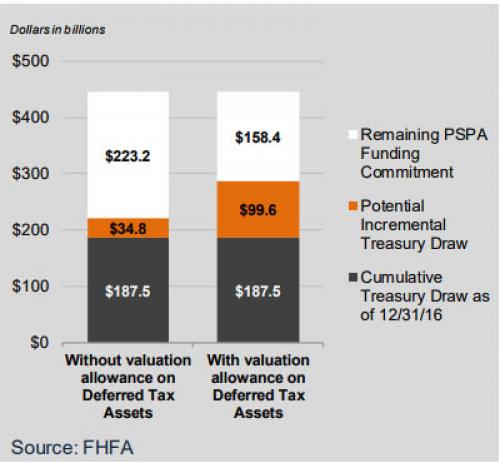
Since the US government nationalized the two GSEs in 2008 in a $187 billion bailout of the mortgage giants, there have been consistent calls for them to be wound down and for the private sector to fill the void. As we discussed, this view is, or was, shared by new Fed Chairman, Jay Powell. Mr. Powell has called on Congress to overhaul the housing finance system, saying he’d like to see the country’s two large mortgage-finance firms, Fannie Mae and Freddie Mac, move out from under government conservatorship. More private capital in those firms would reduce the risk of a taxpayer-funded bailout in the event of a downturn, he said in a speech in July. Although the Fed isn’t responsible for housing finance, it supervises some of the country’s largest lenders who frequently sell their loan to the two agencies. “No single housing finance institution should be too big to fail,” he said.

In August this year, Fannie and Freddie’s regulator, the Federal Housing Finance Agency (FHFA), published the results of its latest annual stress tests on the two GSE’s. The FHFA outlined a “severely adverse” scenario in which US real GDP decline 6.5%, the unemployment rate rises to 10.0%, equity prices decline almost 50%, home prices decline 25% and commercial real estate prices by 35%. Under these conditions, it estimates Fannie and Freddie would need a bailout of up to $100 billion in the form of a draw on the Treasury (depending on how they treat assets to offset tax). Sadly, after almost a decade of federal ownership, the hope that Fannie and Freddie could be wound down has evaporated. Senators on both sides of the political divide have concluded that they are too big and too risky to replace. Proposed legislation in 2018 will see them retained at the centre of the US mortgage industry, rather than replacing them as a previous senate proposal tried and failed four years ago.


Mortgages guaranteed by Fannie and Freddie amount to about $4 trillion and account for about 40% of the total US market.

Read more …

The incompetence is painful.

UK’s Secret Brexit Studies Reveal That Airbus Makes Planes (BBG)

For months, journalists tried to get their hands on government papers setting out how leaving the European Union will affect different parts of the British economy. They contained, according to Brexit Secretary David Davis, “excruciating detail.” But despite boasting about their contents, ministers were reluctant to let anyone else see the documents. In November, after being forced to give way by a vote in Parliament, the government allowed lawmakers to read them under controlled conditions. Their phones were confiscated, and they were only permitted to make notes with pen and paper, lest too much information leak into the public domain. “These documents in aggregate represent the most comprehensive picture of our economy on this issue to date,” Davis wrote this month, explaining why he was being cautious about publication.

On Thursday, the documents were released online. There was detail, as promised. “The parts of an aircraft can be simplistically split into three areas,” began the first, on aerospace. It was explained what the industry makes: “structures which include the nose, fuselage, wings, engine nacelles (which encase the engines) and tail; propulsion system which includes engines and propellers, or fan blades; and systems which include the electronics used in the flight system.” It went on to reveal that there are two companies in the world that make large passenger aircraft. Now that the documents are public, these firms can be named as Boeing and Airbus. The paper covering the insurance and pensions sector, which employs one in every 100 British workers, is 2,732 words long. “Insurance business operates by firms writing insurance policies for clients, intermediated by brokers,” it reveals.

Read more …

You sure that you want to victimize the victims?

Eco-Terrorists Threaten To Inject Acid In Greek Supermarket Products (WaPo)

Greek supermarkets were forced to withdraw several food and beverage products from their shelves this week, after a group threatened to contaminate them with acid as part of an environmentally influenced protest of Christmas consumerism. Authorities urged residents in Athens and the city of Thessaloniki not to buy or consume certain types of Coca-Cola, a Greek milk brand and packages of meat. Thessaloniki and Athens combined have about 1 million residents who were affected by the precautionary measures. The “Blackgreen Arsonists” — whose name suggests an eco-anarchist outlook — threatened to inject the products with hydrochloric acid, a powerful, colorless corrosive used in research and industry.

They said it was because the thousands of people doing their Christmas shopping meant “the sacrifice of millions of living creatures, slaughtered and drained to the last drop to satisfy consumers’ needs.” To protest this need every year for people to fill their empty lives with “consumer garbage with beautiful and glittering wrappings,” the sabotaged products would be placed on supermarket shelves in the run-up to Christmas. Authorities said they have no information on the identities of the group members. Similar threats have emerged in the past and nothing has happened, though in this case the group included photos of its members injecting something into the products as part of their online threat.

Read more …

Real values.

New Zealand Gives Mount Taranaki Same Legal Rights As A Person (G.)

Mount Taranaki in New Zealand is to be granted the same legal rights as a person, becoming the third geographic feature in the country to be granted a “legal personality”. Eight local Maori tribes and the government will share guardianship of the sacred mountain on the east coast of the North Island, in a long-awaited acknowledgement of the indigenous people’s relationship to the mountain, who view it as an ancestor and whanau, or family member. The new status of the mountain means if someone abuses or harms it, it is the same legally as harming the tribe. In the record of understanding signed this week, Mount Taranaki will become “a legal personality, in its own right”, said the minister for treaty negotiations, Andrew Little, gaining similar rights to the Whanganui river, which was granted legal personhood earlier this year.

Little said the agreement offered the best possible protection for the landmark, which is becoming an increasingly popular tourist attraction after Lonely Planet named the Taranaki region the second best place to visit in the world last year. “As a New Plymouth local I grew up under the gaze of the maunga [mountain] so I’m particularly pleased with the respect accorded to local tangata whenua [local people] and the legal protection and personality given to the mountain,” Little said. “Today’s agreements are a major milestone in acknowledging the grievances and hurt from the past as the Taranaki iwi experienced some of the worst examples of Crown behaviour in the 19th century.” As part of the agreement the New Zealand government will apologise to local Maori for historical breaches of the Treaty of Waitangi against the mountain, although local tribes will receive no financial or commercial redress.

Read more …

Dec 212017
 
 December 21, 2017  Posted by at 8:32 am Finance Tagged with: , , , , , , , , , , , ,  3 Responses »


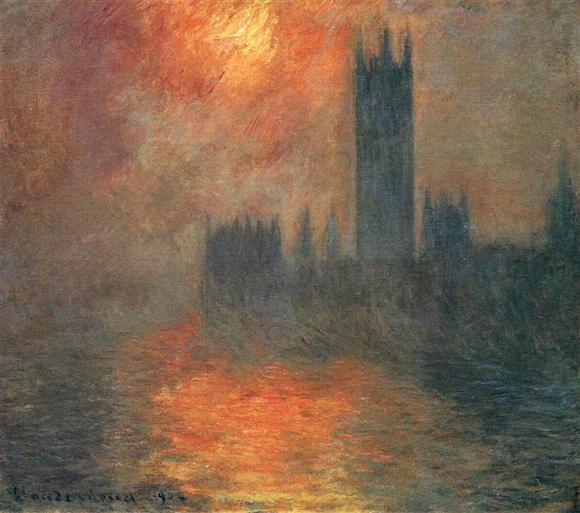
Claude Monet Houses of Parliament (Sun Breaking through the Fog) 1904


Trump Plans Tax Bill Signing on January 3 Due to Technical Issue (BBG)
Why Wall Street Is Furious At The Trump Tax Plan (ZH)
Peak Valuations and Market Corrections (Rosso)
Silicon Valley Homes Going For Nearly $2 Million Over Asking Price (ZH)
Bitcoin Is Biggest Bubble Of Them All, And It’s The Fed’s Fault – Ron Paul (CNBC)
Uber Loses EU Court Fight as Judges Take Aim at Gig Economy (BBG)
Gloomy Brexit Forecasts For UK Are Coming True, Says IMF (G.)
Bank of England To Allow EU Banks To Operate Unchanged After Brexit (G.)
UK PM May Heads to Poland to Seek Brexit Ally After Firing Her Deputy (BBG)
Poland Protests EU ‘Nuclear Option’ Over Judicial Independence (G.)
Catalonia Poised For Hung Parliament In Bitterly Contested Election (G.)
How The US Swindled Russia in The Early 1990s (Zuesse)
Alaska’s Arctic National Wildlife Refuge Now Has A $1 Billion Price Tag (G.)
Russians, Chinese Seek Out Greek Properties for Bargains, Visas (BBG)
Lesvos Mayor Files Suit Over Conditions At Moria Migrant Camp (K.)


Don’t have the impression it’s a great piece of work. But the entire MSM has only one goal: bash anything Trump. A neutral assessment might be appropriate, but where does one get one?

Trump Plans Tax Bill Signing on January 3 Due to Technical Issue (BBG)

President Donald Trump plans to sign the tax bill on Jan. 3 to ensure automatic spending cuts to Medicare and other programs don’t take effect, according to a House Republican aide familiar with the plans. The White House informed House GOP members of the timetable, following the likely decision by House Republicans to leave the so-called PAYGO provision out of a year-end spending deal to avoid a government shut down before Friday, the person said who asked not to be named because the plan hasn’t been publicly announced. Trump and GOP leaders have repeatedly said the president would sign the legislation before Christmas. White House National Economic Council Director Gary Cohn signaled Wednesday morning that the signing date could be pushed back because of the potential for triggering the cuts.

Under the PAYGO law, automatic cuts to Medicare and other spending categories would be triggered by the tax bill in January because the bill is scored as increasing the deficit by $1.5 trillion over 10 years. Waiting until January means that those cuts would be delayed until 2019, according to budget expert Ed Lorenzen of the Committee for a Responsible Federal Budget. White House officials insisted that no firm timetable had been set. Trump could sign the tax legislation earlier if Congress passed a waiver to the PAYGO rules, but that is unlikely to happen before lawmakers leave Washington for a holiday recess. “I think we’re just working out some of the logistics on that,” Treasury Secretary Steven Mnuchin said Wednesday on Fox News. “He’ll sign it as quickly as he can.”

Read more …

But wait, wasn’t Trump making Wall Street that much richer?

Why Wall Street Is Furious At The Trump Tax Plan (ZH)

Back in October 2016, the “millionaire, billionaire, private jet owners” of America’s elitist, liberal mega-cities (A.K.A. New York and San Francisco) celebrated the tax hikes that a Hillary Clinton presidency would have undoubtedly jammed down their throats proclaiming them to be a ‘patriotic duty’. Unfortunately, now that Trump has given them exactly what they apparently wanted…an amazing opportunity to ‘spread their wealth around”…they’re suddenly feeling a lot less patriotic. Of course, as we’ve noted numerous times, while most people across the country and across the income spectrum will benefit from the Republican tax reform package, the folks who stand to lose are those living in high-tax states with expensive real estate as their SALT, mortgage interest and property tax deductions will suddenly be capped. And, as Bloomberg points out today, that has a lot of Wall Street Traders in New York drowning their sorrows in expensive vodka and considering a move to Florida.

“One trader, sipping a Bloody Mary on a morning flight to somewhere more tropical, said he’s going to stop registering as a Republican. En route, he sent more than a dozen text messages ripping the tax bill. A pair of hedge fund managers said the tax bill is too tilted toward corporations, rather than individuals who should get more relief. “My clients are hard-working young professionals on Wall Street. I don’t have a lot of good news for them,” said Douglas Boneparth, a financial adviser in lower Manhattan who counsels people throughout the industry. Most are coming to terms with it. “I don’t think anyone is going to be surprised by the economic reality.” “This provides a clear incentive for financial advisers to go independent,” said Louis Diamond of Diamond Consultants. “We’re hearing from a lot of clients on this; it’s just another reason why it makes a ton of sense, economically, to become self-employed.”

Read more …

All bubbles have limited lifespans.

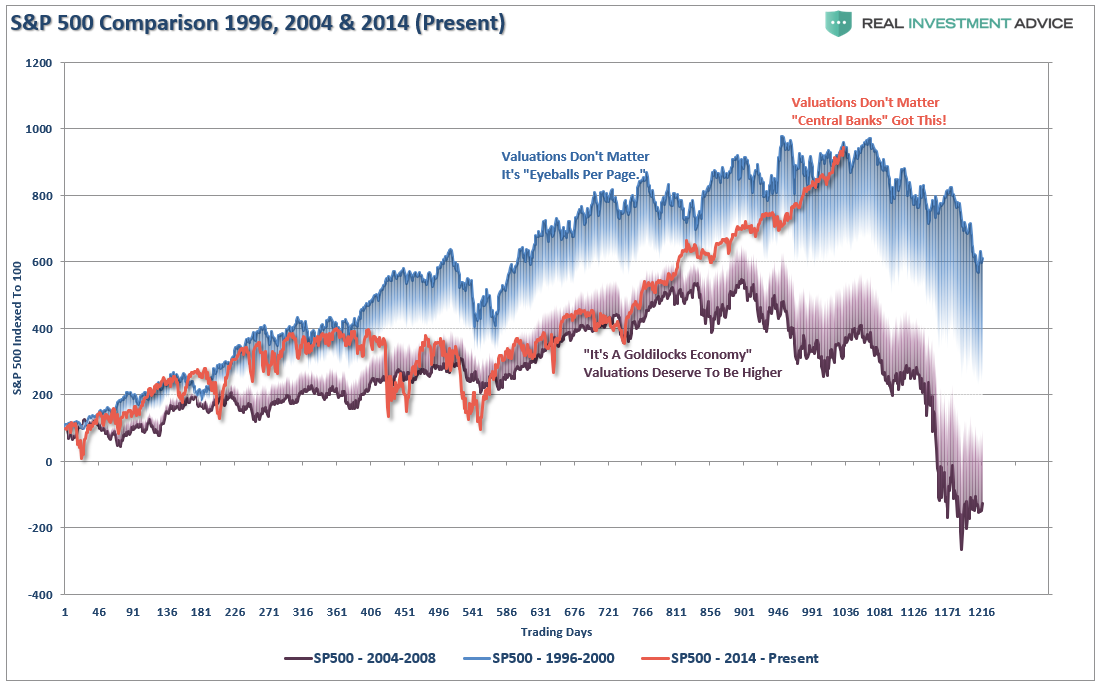
Peak Valuations and Market Corrections (Rosso)

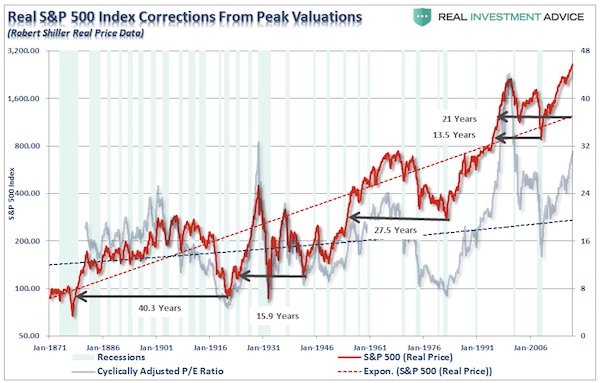
[..] global diversification has enhanced portfolio returns this year. Spreading wealth among different markets and sectors has allowed investors to capture strong equity performance. You see, on the trend higher, investors may seek to employ a series of risk horses to fully participate in the race. Fixed income or bonds, and cash equivalents do a good job of helping investors manage risk through bear markets as they are negatively correlated to stocks. On the way down, stocks across markets connect and head south in sync; some fall faster than others. Unfortunately, when stock diversification is needed the most, it fails. With current valuations and stock prices extended well beyond their long-term trends, investors must be aware of reversions that have the probability of wiping out a decade or longer in gains.

Stock diversification will not protect you if or when this occurs (let me know if you’ve heard this from your broker’s research hub as of late; I bet you haven’t). Strategists for big-box financial retailers are consistently wishy-washy when it comes to the current unsustainable altitude of stock prices. It’s not in their best interest to take a stand. It would be a death knell for their careers. Recently, one of the paunchiest of the brethren shared on CNBC: Stocks are “slightly overvalued;” followed by – “that doesn’t mean you should do anything here.” Perfect. Well done. That’s how seven-figure compensation packages are earned, folks. When it comes to retail investors, time is as or more precious a commodity as money; we at RIA consistently write and research the math of investment losses to make sure you remain emotionally grounded and don’t allow greed to blind your judgment. We are not afraid to outline the risks inherent in extended markets.

Personally, I’m not willing to give up a decade or two to break even. Are you? Don’t worry about your friendly neighborhood talking heads. They’ll continue to collect big paychecks and hefty year-end bonuses as long as they play senior managements’ game. A broker’s research department superstar spokesperson is paid handsomely to point out when markets reach new highs but rarely expound on how long it takes to achieve or in most cases, reclaim them. A big-box financial retail investment strategist’s primary role is to forge and fortify a firm’s presence or brand and help front-line brokers keep investors fully invested through rough market cycles, nothing more.

Read more …

It’s different this time, though….

Silicon Valley Homes Going For Nearly $2 Million Over Asking Price (ZH)

If you’re still holding out hope that the following chart is anything but another massive housing bubble in the making then you should probably ignore the disturbing evidence to the contrary that we’re about to present below… Back in 2005/2006, one of the key signs that housing markets across the country were overheating was the number of houses that, thanks to soaring demand from speculators, were suddenly selling at prices well in excess of their asking price. That said, as a local CBS affiliate in San Francisco points out, the premiums of 2005/2006 pale in comparison to homes in Silicon Valley today that are selling for as much as $1-$2 million over their original asking prices.

But if you thought they area housing market couldn’t get any more outrageous, consider a home on Colorado Avenue in Palo Alto. It listed for $2.9 million, but sold for $3.9 million, $1 million over asking price. Another home on Anacapa Drive in the Los Altos hills listed for $2.8 million, but sold for $4.5 million. That is $1.67 million over asking. Finally, there is this home on University Avenue in Los Altos that listed at $7.9 million, but sold for $1.8 million over asking. In 2017, 10 homes in the mid-Peninsula area sold for $1 million over asking. Six of those listings belonged to Deleon Realty.

Read more …

Where does the money come from that’s used to buy bitcoin?

Bitcoin Is Biggest Bubble Of Them All, And It’s The Fed’s Fault – Ron Paul (CNBC)

He’s taken on President Donald Trump and the Federal Reserve. Now, libertarian former congressman Ron Paul is taking on bitcoin. According to Paul, cryptocurrencies have become an asset that rivals the bubble he sees in stocks. “I think it’s going to continue to do exactly what it’s doing. It’s going higher and it’s going lower,” he said Tuesday on CNBC’s “Futures Now.” “We can look at what’s happening now, which to me is a climactic end of QEs.” Paul, who has done commercials touting currency competition for a company that benefits from bitcoin’s rise, views the crypto craze as a side effect of central banks doing several rounds of quantitative easing to cope with the last financial crisis. “I look at the problems we face. I think they’re gigantic and people are desperate and looking everywhere. Why would they buy bonds that pay negative interest rates? Why would they buy stocks, and say well this time it’s different? ” asked Paul.

“Cryptocurrency is a reflection of the disaster of the monetary dollar system.” Paul, who’s also a medical doctor and former Republican presidential candidate, argues that cryptocurrencies are in an “exponential bubble” where trying to calculate its real value is extremely difficult. Bitcoin, the largest of the cryptocurrencies, has been trading above $17,000. He hasn’t been able to pinpoint when a plunge could happen in cryptocurrencies or the stock market. But Paul says the danger is real. “They’re both big bubbles in the sense that it occurred because there was excessive credit. But if you look at the curves, I think that the cryptocurrency curve looks more threatening,” Paul said.

Read more …

Looks like ‘we are tech’ was always a losing argument.

Uber Loses EU Court Fight as Judges Take Aim at Gig Economy (BBG)

Uber Technologies Inc. will be regulated in European Union countries as a transport company after the bloc’s top court rejected its claim to be a digital service provider, a decision that could increase legal risks for other gig-economy companies including Airbnb. While the EU Court of Justice’s ruling covered UberPop – which used drivers without taxi licenses and has already been shuttered in many countries due to the legal issues – it’s a real blow as the first definitive finding that Uber must be regulated by transport authorities. The decision clarifies for the first time that connecting people via an app to non-professional drivers forms an integral part of a transport service. It rejects Uber’s view that such services are purely digital and could fuel further scrutiny of other gig-economy firms.

Paris regulators are already clamping down on Airbnb, treating the home-rental service more like a hotel, and British food-delivery start-up Deliveroo is in the spotlight for its treatment of workers. In the EU judges’ view, “the most important part of Uber’s business is the supply of transport – connecting passengers to drivers by their smartphones is secondary,” said Rachel Farr at law firm Taylor Wessing. “Without transport services, the business wouldn’t exist.” Uber has argued that it’s a technology platform connecting passengers with independent drivers, not a transportation company subject to the same rules as taxi services. The case has been closely watched by the technology industry because of its precedent for regulating the gig economy, where freelancers make money by plying everything from spare rooms to fast-food deliveries via apps on smartphones and PCs.

“After today’s judgment innovators will increasingly be subject to divergent national and sectoral rules,” said Jakob Kucharczyk, of the Computer & Communications Industry Association, which speaks for companies like Uber, Amazon.com, Google and Facebook. “This is a blow to the EU’s ambition of building an integrated digital single market.” While the ruling is valid EU-wide, it remains limited to Uber’s services and won’t directly affect other disputes Uber is facing over how its drivers are treated. One such case is pending at the U.K. court of appeal.

Read more …

You don’t really need to be a genius to see this.

Gloomy Brexit Forecasts For UK Are Coming True, Says IMF (G.)

The IMF has strongly defended its gloomy forecasts for the UK after Brexit, saying pre-referendum warnings of slower growth were coming true. Christine Lagarde, the fund’s managing director, said the vote to leave the EU in June 2016 was already having an impact and Britain’s weaker growth this year was in contrast to accelerating activity in the rest of the world. Speaking at the Treasury as the IMF announced the results of its annual health check of the UK economy, Lagarde hit back at those who lambasted the fund when predictions of an immediate post-referendum recession failed to come to pass. “We feared that if Britain decided to leave, it would most likely entail a depreciation of sterling, higher inflation leading to a squeeze on disposable income and a reduction in investment,” she said.

“People said ‘Oh those experts’, but we are seeing the narrative we identified as a potential risk being rolled out as we speak. This is not the experts speaking, it’s what the economy is demonstrating.” The IMF trimmed its forecast for UK growth this year from 1.7% in October to 1.6%, and said it expected the economy to grow by 1.5% in 2018. It was one of several economic forecasters to say the UK would suffer a downturn should voters back leaving the EU. Last year, the fund had said growth for 2017 would be 1.1%, before raising the forecast to 2%. Since the turn of the year, Lagarde said activity had slowed notably and the UK’s recent performance was a disappointment in the light of the best showing by the global economy since the financial crash.

Read more …

A deliberate mess?

Bank of England To Allow EU Banks To Operate Unchanged After Brexit (G.)

The Bank of England plans to allow European banks to maintain their UK operations under current rules following Brexit, in a direct challenge to European Union regulators to adopt the same policy towards UK-based banks. The Bank said it wanted to press ahead with assessing the risks posed by the 177 banks and insurance companies based in the European Economic Area that have branches in London, following the agreement between Theresa May and EU officials to move to the second stage of Brexit talks. In a move that pre-empts trade talks between the UK and EU, the Bank said it would assess each foreign bank’s branch operation to decide whether it needed to be converted into a subsidiary, which effectively separates it from its overseas parent with its own capital.

Banks domiciled in the EEA will be keen to maintain UK branches, which are cheaper to run and come under more direct head office control. They also maintain their chief regulator in their home country. Most branches are expected to retain their current status despite needing to satisfy stringent rules. The BoE said it would carry out a broad assessment of the risks posed by branches, though it would rely heavily on cooperation with regulators across the EU. Branches that are considered to pose a systemic risk to London’s financial centre could be forced to convert to being subsidiaries. The Treasury is expected to give the Bank additional powers to supervise foreign bank branches in the UK, a job largely done by regulators based inside the EU.

Some pro-Brexit campaigners are expected to view the move as throwing away a major bargaining chip in trade talks. The UK might have threatened to block EU access to facilities in the City as the price of concessions in other areas, such as manufacturing and fishing rights. However, Mark Carney, the Bank’s governor, told MPs on the Treasury select committee on Wednesday that the decision to allow EU banks to continue operating under existing UK rules had been taken on the assumption that a “high degree of supervisory cooperation with the EU” would continue after Brexit.

Read more …

Desperate?!

UK PM May Heads to Poland to Seek Brexit Ally After Firing Her Deputy (BBG)

Fresh from sacking her trusted deputy, U.K. Prime Minister Theresa May heads to Poland on Thursday to attempt to get close – but not too close – to its new government. May was forced to tell First Secretary of State Damian Green to resign Wednesday afternoon after an inquiry into his behavior found he’d made misleading statements over pornography found on his parliamentary computer by police nearly a decade ago. Green is the third Cabinet minister to quit in two months. A couple of recent Brexit-related successes mean the prime minister is better equipped to handle Green’s departure than she might have been a month ago: The European Union has agreed to move negotiations on to the next phase, and late Wednesday, May’s flagship Brexit Bill completed the detailed scrutiny stage of its journey through the House of Commons.

Still, his departure leaves her without her closest ally in Cabinet. The flight to Warsaw will give May a chance to consider how she manages without him. She’ll be accompanied by her most senior ministers for a summit where she’ll promise cooperation on defense and security as part of a charm offensive to win friends in Europe before negotiations on post-Brexit trade start in March. But Poland’s rift with the EU over judicial reforms – and its government’s fears of a shortfall in EU funding after Britain leaves the bloc – threaten to overshadow the meeting with new Polish Prime Minister Mateusz Morawiecki. “The prime minister will raise her concerns with the prime minister when they meet,” May’s spokesman James Slack told reporters in London.

“We place importance on respect for the rule of law and we expect all our partners to abide by international norms and standards.” Britain’s rush to forge links with Morawiecki’s populist administration reflects a desire both to win friends for the talks ahead and to reassure former eastern European countries that it will continue to support them against Russian expansionism after Brexit. British troops are already stationed in Poland, and May will announce increased cooperation on cyber security.

Read more …

You are not sovereign. All your base are belong to us.

Poland Protests EU ‘Nuclear Option’ Over Judicial Independence (G.)

The Polish government has accused the European commission of a politically motivated attack after the EU’s executive body triggered a process that could see the country stripped of voting rights in Brussels, over legal changes that the bloc claims threaten the independence of the judiciary. In a highly symbolic moment, Poland’s fellow 27 EU member states were advised by the commission on Wednesday that the legislative programme of Poland’s government was putting at risk fundamental values expected of a democratic state by allowing political interference in its courts. The row represents the greatest crisis in the EU since Britain’s decision to leave the EU last year, with the Polish government showing little inclination to back down.

Frans Timmermans, the vice-president of the commission, told reporters in Brussels that in two years 13 laws had been adopted that put at serious risk the independence of Poland’s judiciary and the separation of powers. “Judicial reforms in Poland mean that the country’s judiciary is now under the political control of the ruling majority. In the absence of judicial independence, serious questions are raised about the effective application of EU law,” Timmermans, a former Dutch diplomat, said. “We are doing this for Poland, for Polish citizens.” Poland’s new prime minister, Mateusz Morawiecki, responded on Twitter: “Poland is as devoted to the rule of law as the rest of the EU.” The Polish foreign ministry said in a statement: “Poland deplores the European commission’s launch of the procedure […] which is essentially political, not legal.”

Read more …

‘Election’ today. Can’t even really call this an election. The goal seems to be to divide the independence vote among multiple parties.

Catalonia Poised For Hung Parliament In Bitterly Contested Election (G.)

Catalans head to the polls on Thursday to vote in an extraordinary and bitterly contested election that will pit secessionists against unionists and determine the next phase of the long-running campaign for independence from Spain. The election was called by the Spanish prime minister, Mariano Rajoy, at the end of October when the central government took control of Catalonia and sacked the regional government after it staged an illegal independence referendum and made a unilateral declaration of independence. Polls suggest Catalonia is set for a hung parliament, with the pro-independence Catalan Republican Left party (ERC) vying for first place with the unionist, centre-right Citizens party.

With no clear winner in sight, Thursday’s result is likely to lead to coalition negotiations to form a government that will either maintain the drive for independence in some form or defend the constitutional status quo. Tensions remain high in the region following the referendum and the Spanish police’s heavy-handed efforts to stop it. Secessionists believe that Madrid’s imposition of direct rule and the jailing of senior independence leaders could increase support for their cause. Unionists, however, argue that Catalans are sick of the social unrest and economic uncertainty generated by the unilateral actions of the government of deposed regional president Carles Puigdemont.

The exceptional circumstances surrounding the election are compounded by the fact that Puigdemont has been campaigning from Belgium. He fled to Brussels hours before Spain’s attorney general asked for charges of rebellion, sedition and misuse of public funds to be brought against his cabinet almost two months ago. Puigdemont’s former number two, Oriol Junqueras, has been fighting the election from prison, where he and two prominent independence leaders are being held as part of a judicial investigation into October’s events. “This is not a normal election,” Puigdemont told supporters via video link on Tuesday evening as the campaign drew to a close.

Read more …

A long list of documents. NATO expansion.

How The US Swindled Russia in The Early 1990s (Zuesse)

Due to a historic data-dump on December 10th, the biggest swindle that occurred in the 20th Century (or perhaps ever) is now proven as a historical fact; and this swindle was done by the US Government, against the Government and people of Russia, and it continues today and keeps getting worse under every US President. It was secretly started by US President George Herbert Walker Bush on the night of 24 February 1990; and, unless it becomes publicly recognized and repudiated so that it can stop, a nuclear war between the US and all of NATO on one side, versus Russia on the other, is inevitable unless Russia capitulates before then, which would be vastly less likely than such a world-ending nuclear war now is.

This swindle has finally been displayed beyond question, by this, the first-ever complete release of the evidence. It demonstrates beyond any reasonable doubt (as you’ll verify yourself from the evidence here), that US President G.H.W. Bush (and his team) lied through their teeth to Soviet President Mikhail Gorbachev (and his team) to end the Cold War on Russia’s side, when the US team were secretly determined never to end it on the US-and-NATO side until Russia itself is conquered. And this swindle continues today, and keeps getting worse and worse for Russians.

Until now, apologists for the US-Government side have been able to get away with various lies about these lies, such as that there weren’t any, and that Gorbachev didn’t really think that the NATO issue was terribly important for Russia’s future national security anyway, and that the only limitation upon NATO’s future expansion that was discussed during the negotiations to end the Cold War concerned NATO not expanding itself eastward (i.e., closer to Russia) within Germany, not going beyond the then-existing dividing-line between West and East Germany — that no restriction against other east-bloc (Soviet-allied) nations ever being admitted into NATO was discussed, at all. The now-standard US excuse that the deal concerned only Germany and not all of Europe is now conclusively disproven by the biggest single data-dump ever released about those negotiations.

Read more …

When everything is measured in monetary value, nothing will be left in the end.

Alaska’s Arctic National Wildlife Refuge Now Has A $1 Billion Price Tag (G.)

Years ago, camping in Alaska’s Arctic national wildlife refuge, I watched a herd of caribou – 100,000 bulls, cows and their three-week-old calves – braid over the tundra, moving to a rhythm as old as the wind. “Not many places like this left today,” said my friend Jeff, sitting next to me above an ice-fringed river. And so Alaska senator Lisa Murkowski believes this refuge – 80 miles east of Prudhoe Bay – could generate $1bn over 10 years once it’s opened to oil leasing. She and her Republican colleagues slipped this drilling provision into the Senate Republican tax bill. Murkowski repeatedly says this development would cover just 2,000 acres, “about one ten-thousandth of ANWR”.

The acronym ANWR conveniently deletes the words “wildlife” and “refuge”, with no regard for the polar bears, Arctic fox, musk oxen and migratory ground-nesting birds that come there every summer, some species from as far away as Patagonia. Alaska’s lieutenant governor, Byron Mallott, has said that drilling in ANWR is necessary to deal with climate change. His caddywhompus logic: we need to drill for more oil to raise money to address a problem that’s caused by humanity’s addiction to oil. Why not just say the truth? We want the money. Murkowski adds: “We have waited nearly 40 years for the right technology to come along for a footprint small enough for the environment to be respected.” They have not. Alaskans have been trying to drill here for decades, using one crazy rationale after another.

At one hearing the state’s lone congressman, Don Young, put a blue pen mark on his nose to show how small the industry footprint would be. Clever man. The development would in fact be a spider web of roads, pipelines, well pads and landing strips smack in the middle of the biological heart of the refuge. It would look less like a refuge and more like Prudhoe Bay, where thousands of spills have been reported. Senator Maria Cantwell of Washington says the whole idea is “ludicrous”, noting that the Republican tax plan would add roughly $1.5tn to the national deficit in five years [with the richest 1% of Americans reaping half of the tax cuts]. “I am disturbed,” she says. She should be. Christopher Lewis, a retired BP manager of exploration, has said: “I do not believe that there are any adequate, commercially viable reservoirs in the Arctic refuge.” The reality is “there are other less sensitive and less costly places to explore”.

Read more …

Brutal.

Russians, Chinese Seek Out Greek Properties for Bargains, Visas (BBG)

George Kachmazov, a Russian realtor, is buying up property in Athens. The Moscow-based chief executive officer of real-estate platform Tranio.com has bought a building in the Greek capital and is in the process of acquiring five others with a view to selling apartments to international investors. For Kachmazov, the sales pitch is clear: buying property in Greece can give an investor a so-called golden visa to the country – and with it an entree into much of Europe. What’s more, the country’s real estate market may be poised for a rebound, helping buyers make some money on their purchase. “Greece’s real estate market is one of the remaining few in Europe that hasn’t recovered since the 2008 economic crisis,” Kachmazov said in an interview in Athens.

Prices in Spain, Portugal, Ireland, Poland and Hungary are heading toward pre-crisis levels because of high liquidity in Europe, he said. Kachmazov is among agents making a beeline for Greece to help property hunters from Russia, China, Turkey and elsewhere bet on a market that may be on the cusp of a revival as the country exits its bailout program in August 2018. Property prices in Greece have fallen more than the 25% contraction in the economy since Europe’s sovereign debt crisis began in 2008. Prices of apartments in Athens more than five years old shrank by 45% between 2008 and June 2017, according to Bank of Greece data.

“The belief is that the worst is over and that this is a good time to take advantage of the low prices and to benefit from future capital gains as the market recovers,” said Carrie Law, CEO of Juwai.com, a Chinese international property website. Juwai this year signed an agreement with Warren Buffett’s real estate brokerage firm to advertise homes in the U.S. The average price per square meter in Greece is 2,846 euros ($3,369), according to Germany-based statistics company Statista. That’s almost 1,000 euros cheaper than Portugal, which has a similar golden visa program for property buyers, one and a half times cheaper than in Spain and Germany, and almost three times cheaper than in Italy and Austria. Greece is more expensive than Bulgaria, Croatia, Romania and Estonia.

Read more …

There are reportedly highly superior facilities lying idle on the mainland. But the EU doesn’t want the refugees there.

Lesbos Mayor Files Suit Over Conditions At Moria Migrant Camp (K.)

The mayor of the eastern Aegean island of Lesvos has filed suit against all responsible parties over the conditions at the Moria refugee and migrant processing center. Spyros Galinos filed his suit in Lesvos’s Court of Misdemeanors, claiming that the law is being broken at the government-run facility, which is supervised by the military. His action comes two days after foreign media published videos shot covertly inside the camp and showing the squalor and cramped conditions to which thousands of refugees and migrants are being subjected. The mayor stressed that the facility, a former military base, should not be accommodating more than 1,800 people at a time if decent living standards are to be ensured.

“Unfortunately, though, for the past two years and this year especially there is an extremely large number of third-country citizens and vulnerable groups (men, women – among which pregnant women – and children) indiscriminately trapped and cramped together, coming to more than 6,000 individuals,” Galinos said in his lawsuit. He also stressed poor safety and sanitation standards, saying that an inadequate water and sewerage network is putting the lives of the camp’s residents and workers at risk. People living at the camp “every day experience serious psychological problems and have been led to suicide attempts and self-harm, while others are compelled to serious acts of lawlessness in order to survive,” Galinos said.

His suit came just hours after about a dozen people were injured in a brawl that went on for hours between rival groups at the camp and resulted in extensive destruction. The mayor further stressed the impact of conditions at Moria on the lives of the island’s residents, saying that authorities are failing in their duty to control and monitor such a large number of refugees and migrants. Galinos added that overcrowding at the camp has forced hundreds of migrants to move into the main town of Mytilene in search of some kind of shelter, “taking over public spaces, the city’s parks, sidewalks and courtyards of public and municipal buildings.” In the suit, Galinos asks that “all responsible parties” are taken to task over the situation, as “their actions and omissions are malicious and deliberate, and put at risk the desperate and poor people trapped in [Moria’s] illegal facilities.”

“The disruption of social cohesion and the risk of criminal offenses in defense of life and property by a part of the island’s native population is evident and very likely,” Galinos warned. Since the onset of the refugee crisis at the start of 2015, the residents of Lesvos and its mayor have been distinguished for the support they have given to tens of thousands of migrants that have landed on the island’s shores.

Read more …

Dec 202017
 
 December 20, 2017  Posted by at 9:38 am Finance Tagged with: , , , , , , , , , ,  10 Responses »


Claude Monet Houses of Parliament, Sunset 1904


Bitcoin Plunges Over $2,500, Bounces Back Somewhat, Bitcoin Cash Surges (MW)
Coinbase Enables -Then Disables- Bitcoin Cash Trading: Insider Trading? (BI)
From Bitcoin To Hashgraph: The Crypto Revolution (Mike Maloney)
Is It 1999? 2007? Or Both? (Roberts)
China Is Having Second Thoughts About Cracking Down On Ballooning Debt (CNBC)
EU Commission May Launch Moves To Punish Poland Over Legal Reforms (R.)
Facebook’s New Nemesis Is a Besuited German Antitrust Watchdog (BBG)
Un-Merry Christmas: Perverse Incentives to Over-Consume and Over-Spend (CHS)
Too Late, Theresa – Brexit Offer To EU Citizens Leaves Many Cold (R.)
Centuries-Old Gibraltar Dispute Threatens Brexit Progress (BBG)
UK Government Condemned Over ‘Abject Failure’ To Tackle Homelessness (Ind.)
Salaries Continue To Decline In Greece
Footage Emerges From Lesbos Refugee Camp Showing Shocking Conditions (K.)
10 People Injured In Clashes At Moria Refugee Camp On Lesbos (K.)
Our Selective Blindness Is Lethal To The Living World (G.)


Pretty wild. You sure you want your savings go through that?

Bitcoin Plunges Over $2,500, Bounces Back Somewhat, Bitcoin Cash Surges (MW)

The price of bitcoin plunged about 14% — more than $2,500 — Tuesday night after cryptocurrency trading site Coinbase said it would allow its customers to buy and sell its rival offshoot currency, bitcoin cash. In a matter of hours, the price of bitcoin dropped from $18,125 to as low as $15,578. Bitcoin later rallied somewhat and was trading within a $1,000-range; it was last at $16,875 Tuesday night. Bitcoin futures on the CME Group’s Chicago Mercantile Exchange were last trading at $17,425, off more than $700 from the afternoon. Bitcoin cash, meanwhile, rallied more than 50% to all-time highs above $3,300. It was last trading at $3,303, according to CoinMarketCap. “Sends and receives are available immediately,” Coinbase said in a blog post Tuesday announcing bitcoin-cash trading.

“Buys and sells will be available to all customers once there is sufficient liquidity on GDAX. We anticipate that this will take a few hours.” However, Coinbase and its GDAX exchange late Tuesday suspended bitcoin-cash trading after just four minutes until 9 a.m. Pacific time Wednesday, apparently until traffic settles down and liquidity is established. Bitcoin cash was created by a split from bitcoin on Aug. 1 by a faction of disgruntled developers, and allows virtual miners to process transactions in larger units — 8 megabytes rather than the 1-MB bitcoin blocks. The fledgling cryptocurrency has expanded 10-fold since then, and is now the third-largest by market cap, at $55.6 billion, according to CoinMarketCap.com.

Read more …

Volatility, liquidity, insider trading.

Coinbase Enables -Then Disables- Bitcoin Cash Trading: Insider Trading? (BI)

Coinbase, one of the largest cryptocurrency trading platforms, shocked the crypto-world with its announcement Tuesday evening that it would allow users to buy and sell bitcoin cash. The news sent bitcoin cash, the spin-off cryptocurrency of bitcoin launched in August, to an all-time high above $3,609 per data from Markets Insider. On Coinbase’s GDAX platform, the price of the cryptocurrency reached well above $8,000 per coin. Bitcoin cash’s appreciation began slightly before the announcement on some exchanges, raising concerns about the possibility of insider trading by employees with advanced knowledge of the news. Coinbase CEO Brian Armstrong said in a post early Wednesday morning that the company was looking into the matter.

“Given the price increase in the hours leading up the announcement, we will be conducting an investigation into this matter”, he said. If we find evidence of any employee or contractor violating our policies- directly or indirectly- I will not hesitate to terminate the employee immediately and take appropriate legal action. The price spike appeared to put pressure on Coinbase. Nearly four hours after the San Francisco-based firm announced it was supporting bitcoin cash trading, it said users wouldn’t be able to buy and sell the cryptocurrency until Wednesday. “An update on Bitcoin Cash for our customers: sends and receives are functional,” the company said in a tweet at 11:15 p.m. ET. “Buys and sells on Coinbase.com and in our mobile apps will be available to all customers once there is sufficient liquidity on GDAX. We anticipate that this will happen tomorrow.”

Ouch. The company said in a blog post it disabled trading because of “significant volatility.” In addition to bitcoin cash spiking by almost $1,000, cryptocurrency trading volumes reached an all-time high above $49 billion, according to data from CoinMarketCap. Coinbase has struggled to fully function under such demand in the past.


Bitcoin this week

Read more …

Our friend and gold bug Mike has lofty words.

From Bitcoin To Hashgraph: The Crypto Revolution (Mike Maloney)

Today, mankind stands at a crossroads, and the path that humanity chooses may have a greater impact on our freedom and prosperity than any event in history. In 2008 a new technology was introduced that is so important that its destiny, and the destiny of mankind are inextricably linked. It is so powerful that if captured and controlled, it could enslave all of humanity. But if allowed to remain free and flourish – it could foster unimaginable levels of peace and prosperity. It has the power to replace all financial systems globally, to supplant 90% of Wall St, and to provide some functions of government. It has no agenda. It’s always fair and impartial. It can not be manipulated, subverted, corrupted or cheated.

And – it inverts the power structure and places control of one’s destiny in the hands of the individual. In the future, when we look back at the 2.6 million-year timeline of human development and the major turning points that led to modern civilization – the creation of farming, the domestication of animals, the invention of the wheel, the harnessing of electricity and the splitting of the atom – the sixty year development of computers, the internet and this new technology will be looked upon as a single event…a turning point that will change the course of human history. It’s called Full Consensus Distibuted Ledger Technology, and so far its major use has been for cryptocurrencies such as Bitcoin….but its potential goes far, far beyond that.

Read more …

Of course, as always, Lance has a lot more to say (click the link). I picked out his graph beacuse it is exceptionally strong.

Is It 1999? 2007? Or Both? (Roberts)

I have combined the three periods below, scaled to 100, so you can see just how far we have currently gone. Sure. This time could be different. It just probably isn’t.

Read more …

Beijing has been aware of this for a long time. Don’t watch what they say, watch what they do.

China Is Having Second Thoughts About Cracking Down On Ballooning Debt (CNBC)

China is planning to relax its goal of cutting debt in its economic outline that’s set for release Wednesday, The Wall Street Journal reported Tuesday. The revised plan will instead clamp down on the rise in borrowing, sources told the WSJ. The move would fly in the face of the Chinese government’s mission to bring down the country’s soaring debt, a goal President Xi Jinping has made a cornerstone to his economic platform. The weakened priority may prove to be a concession by top Communist Party leaders that China’s economy may be more reliant on leveraged growth than the government would like. The Journal added that, by cooling its stance on debt, Beijing is hinting that it would rather fuel growth with higher debt than pursue austerity measures.

Chinese debt levels jumped the most in four years in September, according to Reuters. There’s speculation that the size of China’s debt load may be three times its economy. China may be feeling pressure to keep its economy growing as the U.S. is set to pass its biggest tax overhaul in 30 years this week, which will lower the corporate tax rate to theoretically make more companies competitive with China. To be sure, Xi and the Communist Party have been hard at work to curb borrowing between banks, the Journal noted. But since the crackdown on intrabank lending, smaller banks have scaled risky borrowing.

Read more …

Don’t think Poland will react very well to being ‘punished’.

EU Commission May Launch Moves To Punish Poland Over Legal Reforms (R.)

In what would be an unprecedented move, the European Commission could invoke Article 7 of the European Union’s founding Lisbon Treaty to punish Warsaw for breaking its rules on human rights and democratic values. “Unless the Polish government postpones these court reforms, we will have no choice but to trigger Article 7,” said a senior EU official before a Commission meeting on Wednesday, where Poland’s reforms are on the agenda. Poland’s new prime minister Mateusz Morawiecki said in Brussels last week that “the decision has already been made”. The Commission’s deputy head Frans Timmermans warned in July that Poland was “perilously close” to facing sanctions. Such a punishment could still be blocked. Hungary, Poland’s closest ally in the EU, is likely to argue strongly against it.

But the mere threat of it underlines the sharp deterioration in ties between Warsaw and Brussels since the socially conservative Law and Justice (PiS) won power in late 2015. The Commission says Poland’s judicial reforms limit judges’ independence. Polish President Andrzej Duda has until Jan. 5 to sign them into law. If all EU governments agree, Poland could have its voting rights in the EU suspended, and may also see cuts in billions of euros of EU aid. The PiS government rejects accusations of undemocratic behavior and says its reforms are needed because courts are slow, inefficient and steeped in a communist era-mentality.

Read more …

Cartel Office, no less.

Facebook’s New Nemesis Is a Besuited German Antitrust Watchdog (BBG)

Andreas Mundt is Facebook’s new nemesis. Mundt, 57, is the president of the Federal Cartel Office, Germany’s competition regulator. For nearly two years, his agency has been probing whether a key part of the Silicon Valley giant’s business model is an abuse of a market dominance. In a case that caused much surprise outside Germany, Mundt unveiled preliminary findings on Tuesday, saying Facebook may take advantage of its popularity to bully users into agreeing to terms and conditions they often don’t understand. The small print allows using the data to generate the targeted ads that make the company so rich. “Competition law would be poorer without somebody like Andreas Mundt,” said Nelson Jung, a lawyer at Clifford Chance in London. “He’s characterized by his willingness to push boundaries and challenge the status quo.”

Facebook took a dim view, saying the report painted an “inaccurate picture” of how it operates, homing in on the criticism that it’s dominant, an important legal term that might curb future behavior. [..] Facebook didn’t hold back in its attempt to rebut Mundt’s report, saying that it’s wrong to label it as “dominant” in Germany. “A dominant company can save the expense of innovating because it doesn’t have to fear someone else developing better features. We must constantly innovate to attract people. If we fail, people will go elsewhere.” According to Mundt, when data is called the new currency of the digital age, then the relationship to competition law is obvious. That’s also why he’s rejecting criticism that the probe blurs the line between privacy and antitrust enforcement.

“It can only be an antitrust issue if a customer can’t avoid the company because it’s dominating the market. Of course that has a privacy angle but it certainly also has an antitrust angle.” Mundt calls the Facebook investigation a “pioneer case” since “for the first time we’re looking into the relation between market power and big data.” For him, it’s as important as the European Union’s clampdown on Alphabet’s Google, which in July was fined 2.4 billion-euros for skewing shopping search results. “I like the Google decision, it set out some markers for the future,” Mundt said. “That’s what we’re trying with the Facebook case as well, regardless of what the result will now be.”

Read more …

Well, Toys ‘R’ Us is already dying. Our economies run on overspending.

Un-Merry Christmas: Perverse Incentives to Over-Consume and Over-Spend (CHS)

Few topics are off-limits nowadays: the personal and private are now splashed everywhere for all to see. One topic is still taboo: the holiday’s perverse incentives to over-consume and over-spend,lest our economy implode. This topic is taboo because it strikes at the very heart of our socio-economic system, which is fundamentally based on permanent growth, the faster the better, as if unlimited expansion on a finite planet is not just possible, but desirable. In the current Mode of Production, the solution to every social and economic ill is to “grow our way out of it.” The solution to unemployment: jump-start growth by expanding consumption, spending and borrowing. The solution to stagnant wages: jump-start growth. The solution to declining profits: jump-start growth. The solution to government deficit spending: jump-start growth. And so on.

So what happens when most people have not just the basics of life, but a surplus of stuff? Where is the growth going to come from if people already have everything? The answer is three-fold: 1. Replace a perfectly good product with a new product and dump the old one in the landfill. 2. Buy duplicates and put the surplus products in the closet or storage facility. 3. Buy gimmicks (Pet Rocks, etc.) that are tossed in the dump shortly after the holiday gift-giving season ends. But does this Landfill Economy make sense? The cheap oil is about gone, and so does it make any rational sense to burn the last of the cheap fossil fuels on assembling stuff nobody needs in China, shipping it thousands of miles to retailers or Amazon warehouses, adding it to the immense piles of stuff most households already own, and then shipping the old but still functional products to the landfill, just to keep the economy humming?

This is of course insane. Decisions aren’t being made as if scarcity matters; the goals and incentives are set to encourage perverse and destructive overconsumption and overspending: not only are we squandering resources in the sacrifice to the false gods of “growth,” we’re indebting households to do so, stripping income that could have been saved and invested in productive uses. In the lunatic asylum of the current economic model, media anchors sport grins of delirious joy when reporting increases in holiday spending, as if a bump higher from $680 billion to $700 billion is a gargantuan win for the flailing economy.

Read more …

There are no Britons ready to fill the roles at either the high end -academics- or the low end -fruit pickers-.

Too Late, Theresa – Brexit Offer To EU Citizens Leaves Many Cold (R.)

Back from Brussels with a hard-fought Brexit deal, Prime Minister Theresa May wrote an open letter to the three million citizens of other European Union states living in Britain. “I know our country would be poorer if you left and I want you to stay,” she wrote after striking the initial agreement, which promises to secure their British residency rights after Brexit and allows the negotiations to move onto trade relations. But for some EU nationals – who have endured uncertainty over their rights since the Brexit vote in June 2016, not to mention an unpleasant feeling that many Britons do not want them around – May’s Dec. 8 deal is too little, too late. It’s too late to keep German nurse Daniela Jones in the chronically short-staffed National Health Service (NHS), where she worked for 35 years.

It’s too late for French psychotherapist Baya Salmon-Hawk, who after 40 years in Britain has moved to Ireland to remain in the EU. It’s too late for French accountant Nathalie Duran, who is planning early retirement in France because after 31 years as a taxpayer in Britain she objects to being told she has to pay a fee and fill in forms to be granted a new “settled status”. “I will have to regretfully decline your generous offer for settled status and oblige your lovely countrymen’s wishes and go home,” she wrote on Facebook in a response to May laden with irony. Duran told Reuters that the prime minister’s “late outpouring of love” for EU citizens, after years of tough talk on the need to cut immigration, could not mask negative attitudes towards immigrants unleashed by the Brexit vote. “I think it’s turning ugly,” said 56-year-old Duran. “It’s now OK to say ‘go home foreigners’.”

Read more …

It’s whack-a-mole thing. New issues keep popping up.

Centuries-Old Gibraltar Dispute Threatens Brexit Progress (BBG)

A 300-year-old argument between Britain and Spain over a small piece of land is threatening to derail Theresa May’s plans to help businesses navigate Brexit. U.K. officials fear Spain will threaten to veto a Brexit transition phase if the British prime minister refuses to negotiate a separate deal with the government in Madrid that covers the disputed territory of Gibraltar. While the peninsula has been in British hands since 1713, Spain maintains a claim over the 2.6 square miles (6.7 square kilometers) of land. Fears are growing among ministers in London that a new framework for the next phase of Brexit talks, due to be outlined by the European Union on Wednesday, might reignite the centuries-old arguments, a U.K. official said.

May faces pressure to quickly strike a deal on transitional terms to assure U.K.-based businesses that trade rules won’t change suddenly on Brexit day in March 2019. May wants an agreement on the transition – or “implementation” – phase by March 2018 in order to shift talks on to the long-term future trade agreement. She hopes the two-year period of stability immediately after Brexit will help encourage businesses to stay based in the U.K. Last week, Spanish Prime Minister Mariano Rajoy suggested his government would need to give its explicit consent to any transitional deal affecting Gibraltar. The measure would require separate negotiations between London and Madrid, he said. [..] One U.K. official who asked not to be identified said British overseas territories must be included within the EU’s guidelines for negotiating an overall transitional period. To do anything else would be a contradiction in the EU’s own position, the official said.

Read more …

So does Labour stand up for them? really? How do they do that?

UK Government Condemned Over ‘Abject Failure’ To Tackle Homelessness (Ind.)

The Government has been condemned for taking an “unacceptably complacent” attitude towards tackling homelessness, as soaring numbers of people are forced to live on the streets or in temporary accommodation. A damning report by the cross-party Public Accounts Committee (PAC) said ministerial attempts to solve the “national crisis” had ended in “abject failure”. Figures show more than 9,000 people are sleeping rough on the streets of England at any one time – up 134% since 2011. Over 79,000 households, including 120,000 children, are meanwhile homeless and living in temporary accommodation – a rise of 65% since 2010.

Recent research by charity Shelter revealed that child homelessness has reached a 10-year high, with nearly 130,000 children in Britain set to wake up homeless and in temporary accommodation this Christmas. But the Government’s commitment to eliminate rough sleeping by 2027 will only address the “tip of the iceberg”, according to the PAC report, which found there to be an “unacceptable shortage” of realistic housing options for the homeless or those at risk of homelessness.

Read more …

Which cuts consumer spending, which cuts jobs, which cuts consumer spending, rinse and repeat.

Salaries Continue To Decline In Greece

Salaries have declined considerably and the number of workers on low wages has expanded, explaining the increase in jobs recorded by the Labor Ministry’s hirings database Ergani this year. A direct comparison of the first three weeks of October 2017 with the same period last year changes the rosy image of the local labor market that the government is attempting to present. The figures for this year show that more than six in 10 (64.27%) of the total 1,824,437 workers employed at 247,236 enterprises were on salaries of up to 1,000 euros per month gross. Fewer than two-thirds of them, accounting for 759,326 in absolute figures or 41.62% of all workers, were employed full-time, while the rest (22.65%) appeared to have part-time jobs that earned less than 500 euros a month.

Data also show the number of self-employed increased by 121,913 from October 2016, but this was not accompanied by an increase in salaries. The average salary in October 2017 dropped to 1,024.90 euros from 1,060.30 a year earlier. Across the labor market, full-time workers accounted for 68.44% of the total, virtually unchanged from the 68.28% rate in October 2016. However, the number of enterprises rose by 14,085, or 6.04%, from 233,151 in October last year. Over the 12-month period, flexible employment (part-time and shift work) grew by 30,556 jobs or 7.98%.

A growing trend has been recorded toward jobs paying between 500 and 600 euros per month: One in nine workers (11% or 200,759) fall into this revenue category, up by a remarkable 13.9% from October 2016 – a rise that is far greater than the overall increase in jobs. Eurostat data showed on Tuesday that while the hourly cost of labor in Greece rose 0.8% in the third quarter of 2017, salary costs fell 1.8% and non-salary costs (social security contributions etc) increased 8.6%.

Read more …

It’ll be a bitter winter.

Footage Emerges From Lesbos Refugee Camp Showing Shocking Conditions (K.)

US-based internet media company BuzzFeed has published a series of photographs and videos shot by residents inside the government-run Moria refugee and migrant processing center on the eastern Aegean island of Lesvos. The scenes of misery and squalor are also evident in a report on Deutsche Welle on Monday, which was International Migrants Day, showing footage taken by hidden camera inside the same facility. BuzzFeed’s Ryan Broderick said in his report that a 25-year-old man from Iraq named Noor and a 27-year-old man from Syria named Ammar agreed to provide the reporter with videos from inside the fenced-in perimeter of the former army camp, which is run by the Greek military.

The footage, which Broderick also posed on his Twitter account, provides a rare glimpse at conditions inside the camp, which was originally built to accommodate some 2,000 migrants and refugees and is now home to around 6,000 people, including unaccompanied minors, children, pregnant women and disabled or elderly individuals. Images of a shower area show a row of filthy stalls with doors hanging off their hinges, allowing little if any privacy. Many residents collect water in plastic bottles to bathe themselves rather than entering the showers, the witnesses inside the facility are quoted as saying after sending photographs of huge piles of plastic water bottled. The toilets are so unsanitary, they add, that many residents prefer to go to the bathroom in the open air, in a part of an olive tree grove set aside for this purpose.

Streets in the camp flood in the rain and are lined with tents that may accommodate more than one family and have been strengthened to withstand winter conditions with plastic sheets. In another video, two police officers are seen forcibly carrying a man by his arms and leg and shouting abuse at him after breaking up a fight between residents. Several international rights groups have decried conditions at Moria for months, calling on the Greek government to ease overcrowding and improve accommodation and sanitation standards. Squalid and cramped conditions have also led to riots and fights breaking out inside the facility.

Read more …

“300 to 350 unaccompanied minors and hundreds of children, women and elderly and disabled people.”

10 People Injured In Clashes At Moria Refugee Camp On Lesbos (K.)

Around 10 people were rushed to hospital on Lesvos on Tuesday night following violent clashes between rival groups in the Moria refugee and migrant camp. Riot police were called in to quell the unrest, which reportedly broke out between rival groups of Iraqi and Afghan nationals and resulted in several small fires being set. Tension is rife at Moria, where scant resources are being stretched at almost three times the camp’s capacity and conditions are squalid.

Among its 6,000-plus residents there are around 300 to 350 unaccompanied minors and hundreds of children, women and elderly and disabled people. Tuesday night’s clashes came a day after American news outlet BuzzFeed and Germany’s Deutsche Welle published videos of the camp’s interior showing the extent of the filth and squalor to which residents are being subjected. Journalists are not allowed into the military-run camp without the prior agreement of authorities, so the exact extent of Tuesday’s and other similar clashes are not known.

Read more …

Blind to the species that were already gone when you were born.

Our Selective Blindness Is Lethal To The Living World (G.)

What you see is not what others see. We inhabit parallel worlds of perception, bounded by our interests and experience. What is obvious to some is invisible to others. I might find myself standing, transfixed, by the roadside, watching a sparrowhawk hunting among the bushes, astonished that other people could ignore it. But they might just as well be wondering how I could have failed to notice the new V6 Pentastar Sahara that just drove past. As the psychologist Richard Wiseman points out: “At any one moment, your eyes and brain only have the processing power to look at a very small part of your surroundings … your brain quickly identifies what it considers to be the most significant aspects of your surroundings, and focuses almost all of its attention on these elements.” Everything else remains unseen.

Our selective blindness is lethal to the living world. Joni Mitchell’s claim that “you don’t know what you’ve got till it’s gone” is, sadly, untrue: our collective memory is wiped clean by ecological loss. One of the most important concepts defining our relationship to the natural world is shifting baseline syndrome, coined by the fisheries biologist Daniel Pauly. The people of each generation perceive the state of the ecosystems they encountered in their childhood as normal and natural. When wildlife is depleted, we might notice the loss, but we are unaware that the baseline by which we judge the decline is in fact a state of extreme depletion. So we forget that the default state of almost all ecosystems – on land and at sea – is domination by a megafauna.

We are unaware that there is something deeply weird about British waters; they are not thronged with great whales, vast shoals of bluefin tuna, two-metre cod and halibut the size of doors, as they were until a few centuries ago. We are unaware that the absence of elephants, rhinos, lions, scimitar cats, hyenas and hippos, that lived in this country during the last interglacial period (when the climate was almost identical to today’s), is also an artefact of human activity. And the erosion continues. Few people younger than me know that it was once normal to see fields white with mushrooms, or rivers black with eels at the autumn equinox, or that every patch of nettles was once reamed by caterpillars. I can picture a moment at which the birds stop singing, and people wake up and make breakfast and go to work without noticing that anything has changed.

Read more …

Dec 192017
 
 December 19, 2017  Posted by at 9:40 am Finance Tagged with: , , , , , , , , , ,  7 Responses »


Edwin Rosskam Store in alley-dwelling section of Washington, DC 1941


China’s Growth Story… Don’t Look For A Happy Ending! (Hamilton)
One Of The Co-Founders Of Bitcoin.com Has Sold All Of His Bitcoin (BI)
Germany Backs French-Led Push for Global Bitcoin Regulation (BBG)
The EU’s Top Court Will Decide Whether Or Not Uber Is A Taxi Company (BBG)
UK Cannot Have A Special Brexit Deal For The City – EU (G.)
Bad Moon: (Trouble) Rising (Crooke)
The RussiaGate Witch-Hunt -The Deep State’s “Insurance Policy” (Stockman)
The Darkest Hours (Jim Kunstler)
As Catalan Vote Looms, Jailed Leader Offers Olive Branch To Spain (R.)
Germany’s Entire Submarine Fleet Is Paralyzed (ZH)
We’re Buying More Stuff We Don’t Need (BBG)
ECB Sued Over Decision To Freeze Help To Greek Banks (R.)
Let It Go: The Arctic Will Never Be Frozen Again (Grist)


No domestic consumers, no foreign clients. But a truckload of debt going forward.

China’s Growth Story… Don’t Look For A Happy Ending! (Hamilton)

Many economists suggest China is on the cusp of significant growth in domestic consumer demand. That this rising domestic demand coupled with continued growth as the global exporter will push the global economy further. However, I’ll briefly show why neither of these outcomes is remotely likely.

Problem #1- China as Consumer: According to the UN data, China’s 15-40yr/old childbearing population peaked in 2005 and has been rapidly shrinking since. Since ’05, China’s population capable of producing more Chinese has fallen by 83 million persons or a 14.3% decline. By 2030, China’s childbearing population will have declined by 157 million or a 27% reduction of those capable of childbirth (no estimate here…this is simply moving the existing population forward in adulthood). Couple a massive decline in the childbearing population and the ongoing negative birthrate and serious depopulation (particularly among the rural regions) is not only possible but growing more likely. Minor increases in wages will be no match for the massive declines in the consumer base. The chart below shows China’s total 15 to 40 year old population (in blue) and the annual change (in red).

Problem #2- China as Exporter:
Who will China continue to export to? The primary importers of China’s goods are N. America (US/Canada), Europe (including Russia and Eastern Europe), Australia/New Zealand. These nations represent roughly one seventh of the world’s population but consume over half of all the worlds oil production. But here again I have the same problem; combined childbearing population peaked in 1988 and has been declining since. The population capable of childbirth has fallen over 40 million or nearly 10% since the ’88 peak. By 2030, despite many of these nations allowing, promoting, and/or enduring large immigrations of precisely this age of migrants, the population is anticipated to be 60 million fewer than during the peak, or a 15% fall from peak. The basis of present and future demand growth simply is non-existent.

Read more …

Illiquidity.

One Of The Co-Founders Of Bitcoin.com Has Sold All Of His Bitcoin (BI)

Bitcoin.com is one of the world’s largest bitcoin sites, having grown its profile thanks to the insane price surge of the cryptocurrency this year. But its co-founder and CTO, Emil Oldenburg, a Swedish native, is extremely skeptical of bitcoin’s future. “I would say an investment in bitcoin is right now the riskiest investment you can make. There’s an extremely high risk,” he says in an interview with Swedish tech site Breakit. “I have in fact sold all my bitcoins recently and switched to bitcoin cash,” says Oldenburg, referring to the problems with bitcoin’s high transaction costs and lead times. Indeed, by some counts, bitcoin transaction fees are doubling every three months, and it now takes on average 4.5 hours to confirm a bitcoin transaction. Ars Technica reported that fees reached $US26 ($34) per trade recently. Bitcoin.com operates in everything that has to do with bitcoins.

Today, the site – based out of Tokyo but registered on St Kitts – has tens of millions of unique monthly visitors, according to Similarweb, a web analytics site. The company’s biggest single revenue stream is its so called bitcoin “mining pool”, where it forges new units of the cryptocurrency that are released on the market. Oldenburg doesn’t want to disclose any revenue numbers, more than revealing “it’s an awfully lot of money”, he says to Breakit. Even on a personal level. “All my salary in the past three years has come in bitcoin,” just as those of his 60 colleagues in Tokyo, Oldenburg says. But according to the Swedish bitcoin expert, it’s time to change to bitcoin cash. There’s a big reason for that switch, and it’s all about the market liquidity — or lack thereof — of bitcoin.

The reason why people haven’t understood the risks inherent in owning bitcoins, according to Oldenburg, is simply because most have so far only bought the cryptocurrency — but never sold or traded with them. “As soon as people realise that this is how it works, they will start to sell,” he tells Breakit. “The old bitcoin network is as good as unusable.” While buying, selling or trading in bitcoins is not an issue today, according to Oldenburg, the problems surface when bitcoin transactions are recorded on the blockchain, the digital ledger that records each transaction. The problem centres on the limited amount of transactions per second you can make in the bitcoin network, which in turn depends on the formation of the memory “block size” that store the transactions. This, according to Oldenburg, makes for a very illiquid and unusable cryptocurrency.

[..] In what may be considered somewhat ironic, Oldenburg says bitcoin.com is distancing itself from bitcoin and has even stopped developing services for it — to mostly focus on bitcoin cash, the currency that split from bitcoin back in August, and recently overtook Ethereum as the world’s second-largest cryptocurrency. “It only costs $0.012 (10 Swedish “öre”, the centesimal subdivision of krona) to send a [Bitcoin Cash transaction] and there are no lead times. The only drawback is that you need larger hard drives, but that’s not a problem for most people,” Oldenburg says to Breakit.

Read more …

One tiny problem: how can you regulate something you don’t understand: “I don’t like it,” Le Maire said of bitcoin. [..] we need to look at it, study it,” he said.

Germany Backs French-Led Push for Global Bitcoin Regulation (BBG)

Germany joined European governments pushing for global bitcoin regulation amid mounting alarm that the world’s most popular digital currency is being used by money-launderers, drug traffickers and terrorists. Germany’s Finance Ministry said it welcomed a proposal by French Finance Minister Bruno Le Maire to ask his counterparts in the Group of 20 to consider joint regulation of bitcoin. The concerns are shared by the Italian government, which is also open to discussing regulation, while the European Union is bringing in rules backed by the U.K. that would apply to bitcoin. “It makes sense to discuss the speculative risks of virtual currencies and their impact on the financial system at international level,” the Finance Ministry in Berlin said in an email. The next meeting of G-20 finance ministers and central bank governors would be “a good opportunity to do so.”

Signs of growing European concern came as bitcoin took another step toward acceptability with the launch of futures trading Sunday night at CME’s venue. That’s a week after Chicago rival Cboe Global Markets introduced similar derivatives on the volatile cryptocurrency that was created in the wake of the 2008 financial crisis as an alternative to banks and government-issued currencies. Bitcoin was closing in on a fresh record of $20,000 on Monday. The Finance Ministry in Germany, Europe’s biggest economy, “monitors developments in the financial market very closely,” it said. “This also applies to the current development of bitcoin.” While Europe’s concerns have been voiced before in select forums about a currency which is stepping further into the mainstream financial world, Le Maire made those worries public in a weekend interview. “I don’t like it,” Le Maire said of bitcoin. “It can hide activities such as drug trafficking and terrorism,” and he has concerns for savers. “There is an obvious speculative risk, we need to look at it, study it,” he said.

Read more …

You can’t forever hide behind the word ‘tech’. Or every company can do it.

The EU’s Top Court Will Decide Whether Or Not Uber Is A Taxi Company (BBG)

Uber Technologies is set to reach the end of the road in a legal battle over a question that’s reached the European Union’s top court – is the world’s most valuable startup a taxi company or not? Uber has argued that it’s a technology platform connecting passengers with independent drivers, not a transportation company subject to the same rules as taxi services. The decision is being closely watched by the technology industry because it could set a precedent for how other companies in the burgeoning gig economy are regulated across the 28-nation bloc. “The judgment will either promote the digital single market or lead to more market fragmentation for online innovators,” said Jakob Kucharczyk, of the Computer & Communications Industry Association, which speaks for companies like Uber, Amazon.com, Google and Facebook. “The court should make a clear distinction between the online intermediation and the underlying service it facilitates.”

The case centers around UberPop, an inexpensive ride-hailing service Uber launched in several European cities that allowed drivers without a taxi license to use their own cars to pick up passengers. Legal challenges have forced Uber to shutter its UberPop services in most major European companies in favor of UberX, which requires drivers to get a license. A loss for Uber would mean countries in the EU will have to classify Uber as a transportation service. While Uber adheres to many taxi laws in countries where it operates, the case could lead to new regulations and fees. “Any ruling will not change things in most EU countries where we already operate under transportation law,” Uber said in a statement. “However, millions of Europeans are still prevented from using apps like ours. As our new CEO has said, it is appropriate to regulate services such as Uber. We want to partner with cities to ensure everyone can get a reliable ride at the tap of a button.”

The question of whether Uber is a transport service has long vexed regulators and lawmakers across Europe. Uber has faced roadblocks, real and regulatory, across Europe, amid complaints brought by taxi drivers who say the company tries to unfairly avoid regulations that bind established competitors. Without the pressure from regulators, companies in the gig economy will force other businesses to employ similarly aggressive business practices, said Andrew Taylor, who earlier this year was commissioned by U.K. Prime Minister Theresa May to come up with recommendations to regulate the gig economy. “There’s a danger of a race to the bottom,” said Taylor. “Major American companies are treating national norms, culture, regulators and tax systems in a cavalier way.”

Read more …

What’s going to be left of Britain without the City?

UK Cannot Have A Special Brexit Deal For The City – EU (G.)

Britain cannot have a special deal for the City of London, the European Union’s chief Brexit negotiator has told the Guardian, dealing a blow to Theresa May’s hopes of securing a bespoke trade agreement with the bloc. Michel Barnier said it was unavoidable that British banks and financial firms would lose the passports that allow them to trade freely in the EU, as a result of any decision to quit the single market. “There is no place [for financial services]. There is not a single trade agreement that is open to financial services. It doesn’t exist.” He said the outcome was a consequence of “the red lines that the British have chosen themselves. In leaving the single market, they lose the financial services passport.”

The stark declaration quashes the hopes of the Brexit secretary, David Davis, for a unique trade deal that would include financial services. The Brexit secretary has called for a “Canada plus plus plus” deal with the EU, a reference to the free trade agreement struck between Ottawa and Brussels in 2016, but with the crucial addition of financial services. In an exclusive interview with European newspapers, including the Guardian, Barnier gave examples of his own three pluses – judicial cooperation, defence and security and aviation.

The negotiator also said: • A trade deal could be agreed within a two-year transition period, but would have to be ratified by more than 35 national and regional parliaments. • The UK could not stop Brexit unilaterally, arguing that overturning the decision to leave would require the consent of 27 EU member states – a view at odds with one of the authors of article 50, Lord Kerr. • The UK must follow all rules and regulations of the EU during the transition period, including new laws passed after the UK has left. • The UK could negotiate trade agreements with the rest of the world during the transition, but they could not come into force. • He would not confirm British estimates that the final Brexit bill – the UK’s outstanding obligations to the EU – would be no more than €45bn (£39bn).

Read more …

Boy, what a failure Russiagate has been. How do you recover from that?

Bad Moon: (Trouble) Rising (Crooke)

President Obama lay very much in the globalist ‘struggle for a democratic-liberal world’ mould, (though he did try to make the ‘ruling interests’ understand that there were limits: that there had to be boundaries to US commitments). In other words, Obama accepted the globalist premise, though he tried to mitigate some of its military impulses. Notably however, he acquiesced to re-heating the Russia ‘threat’ (after Medvedev gave place to Mr Putin (thus ending Obama’s hope to seduce Russia into the embrace of the global economic order). But then Donald Trump, elected President by his deplorables’ base, made clear that he wished for détente with Russia, and even disdained the claims made on ordinary Americans by the maintenance of America’s unipolar global ‘order’.

For this heresy, he has been punished by the manufactured ‘Russiagate’ non-scandal. “Can a president, concerned that he might be removed from office by a special prosecutor or possibly assassinated, resist the march toward war?” – asks Paul Craig Roberts, who asserts that the President has been effectively caged, by a trifecta of Establishment generals, on the one hand; and by a Goldman Sachs posse, on the other. That the ‘ruling interests’ have managed substantially to contain President Trump is undeniable, but what is new, and perhaps – or perhaps, not – alters the calculus, is that these ‘ruling interests’ have had to come out from the shadows into the open.

The former Acting Director of the CIA, Mike Morrell, an early voice peddling the Russian collusion meme now publicly admits in a surprisingly frank interview with Politico, his leading role in the intelligence community waging political war against President Trump, describing his actions as something he didn’t “fully think through”, adding that maybe it wasn’t such a great idea to leak against, and bash a new president: “There was a significant downside”, Morrell acknowledges. Just to recall: Not only had Morell in an early NY Times op-ed piece asserted that he was committed to doing “everything I can to ensure that she [Hillary Clinton] is elected as our 45th president”, but he went so far as to call then candidate Trump “a threat to our national security”, while making the extraordinary claim that “in the intelligence business, we would say that Mr. Putin had recruited Mr. Trump as an unwitting agent of the Russian Federation.”

Read more …

A list of people who never worked an honest job.

The RussiaGate Witch-Hunt -The Deep State’s “Insurance Policy” (Stockman)

There was a sinister plot to meddle in the 2016 election, after all. But it was not orchestrated from the Kremlin; it was an entirely homegrown affair conducted from the inner sanctums – the White House, DOJ, the Hoover Building and Langley – of the Imperial City. Likewise, the perpetrators didn’t speak Russian or write in the Cyrillic script. In fact, they were lifetime beltway insiders occupying the highest positions of power in the US government. Here are the names and rank of the principal conspirators: John Brennan, CIA director; Susan Rice, National Security Advisor; Samantha Power, UN Ambassador; James Clapper, Director of National Intelligence; James Comey, FBI director; Andrew McCabe, Deputy FBI director; Sally Yates, deputy Attorney General, Bruce Ohr, associate deputy AG; Peter Strzok, deputy assistant director of FBI counterintelligence; Lisa Page, FBI lawyer; and countless other lessor and greater poobahs of Washington power, including President Obama himself.

To a person, the participants in this illicit cabal shared the core trait that made Obama such a blight on the nation’s well-being. To wit, he never held an honest job outside the halls of government in his entire adult life; and as a careerist agent of the state and practitioner of its purported goods works, he exuded a sanctimonious disdain for everyday citizens who make their living along the capitalist highways and by-ways of America. The above cast of election-meddlers, of course, comes from the same mold. If Wikipedia is roughly correct, just these 10 named perpetrators have punched in about 300 years of post-graduate employment – and 260 of those years (87%) were on government payrolls or government contractor jobs.

As to whether they shared Obama’s political class arrogance, Peter Strzok left nothing to the imagination in his now celebrated texts to his gal-pal, Lisa Page: “Just went to a southern Virginia Walmart. I could SMELL the Trump support……I LOATHE congress….And F Trump.” You really didn’t need the ALL CAPS to get the gist. In a word, the anti-Trump cabal is comprised of creatures of the state.

Read more …

“..even hogs busy fattening up don’t have a clue about their imminent slaughter.”

The Darkest Hours (Jim Kunstler)

The Tax “Reform” bill working its way painfully out the digestive system of congress like a sigmoid fistula, ought be re-named the US Asset-stripping Assistance Act of 2017, because that’s what is about to splatter the faces of the waiting public, most of whom won’t have a personal lobbyist / tax lawyer by their sides holding a protective tarpulin during the climactic colonic burst of legislation. Sssshhhh…. The media has not groked this, but the economy is actually collapsing, and the nova-like expansion of the stock markets is exactly the sort of action you might expect in a system getting ready to blow. Meanwhile, the more visible rise of the laughable scam known as crypto-currency, is like the plume of smoke coming out of Vesuvius around 79 AD — an amusing curiosity to the citizens of Pompeii below, going about their normal activities, eating pizza, buying slaves, making love — before hellfire rained down on them.

Whatever the corporate tax rate might be, it won’t be enough to rescue the Ponzi scheme that governing has become, with its implacable costs of empire. So the real aim here is to keep up appearances at all costs just a little while longer while the table scraps of a four-hundred-year-long New World banquet get tossed to the hogs of Wall Street and their accomplices. The catch is that even hogs busy fattening up don’t have a clue about their imminent slaughter. The centerpiece of the swindle, as usual, is control fraud on the grand scale. Control fraud is the mis-use of authority in applying Three-Card-Monte principles to financial accounting practice, so that a credulous, trustful public will be too bamboozled to see the money drain from their bank accounts and the ground shift under their feet until the moment of freefall.

Control fraud is at work in the corporate C-suites, of course, because that is its natural habitat — remember that silver-haired CEO swine from Wells Fargo who got off scot-free with a life-time supply of acorns after scamming his account-holders — but their errand boys and girls in congress have been superbly groomed, pampered, fed, and trained to break trail and cover for them. The country has gotten used to thinking that the game of pretend is exactly the same as what is actually going on in the world. The now-seminal phrase coined by Karl Rove, “we make our own reality,” is as comforting these days to Republicans from Idaho as it is to hairy, “intersectional” professors of post-structural gender studies in the bluest ivory towers of the Ivy League. Nobody in this Republic really wants to get his-hers-zhe’s-they’s reality on.

Read more …

How can you have a fair election with so many people either in jail or in exile?

As Catalan Vote Looms, Jailed Leader Offers Olive Branch To Spain (R.)

The jailed leader of Catalonia’s main pro-independence party has backed away from demands for unilateral secession from Spain, days before a regional election that polls suggest will produce a hung parliament. The independence drive has tipped Spain into its worst political crisis since the return of democracy in the 1970s, dividing opinion in the region, denting an economic rebound and prompting a business exodus to other parts of the country. In reply to written questions from Reuters passed to him in prison where he is being held on allegations of rebellion and sedition, Oriol Junqueras struck a conciliatory tone. He wrote that he would continue to pursue independence if he became Catalonia’s next president, but also “build bridges and shake hands” with representatives of the Spanish state.

“I can assure you that we are democrats before we are separatists and that the aim (of gaining independence) does not always justify the means,” he said in comments that appeared to drop his party’s earlier demand for unilateral secession. Junqueras’ Esquerra Republicana (Republican Left) party is tipped to become the largest separatist force in parliament in Thursday’s ballot, but surveys suggest neither the pro-independence nor the pro-unity camp will win a majority. He was deputy leader of the Catalan government that was sacked in October after the regional assembly unilaterally declared independence following a referendum that central authorities had deemed illegal. Madrid also dissolved the assembly and called fresh elections.

The Spanish justice system’s actions against the region’s leaders has since then hamstrung the pro-independence camp and further muddied the electoral waters before Thursday’s vote. Catalonia’s ex-president Carles Puigdemont is campaigning from self-imposed exile in Brussels and Junqueras doing so from jail along with several other politicians. It is unclear if many of those likely to be elected will be able to attend parliament.

Read more …

The Russians did it.

Germany’s Entire Submarine Fleet Is Paralyzed (ZH)

Throughout 2017, America’s control of NATO policymaking has become more evident than ever, with the sole objective of war-making against Russia. NATO and Russia continue to build up arms, equipment, and troops along the eastern region of Europe, but there is a new development that has NATO worried. Germany’s operational readiness of its entire submarine fleet is dead in the water. Yes, you heard that correctly, Germany’s prized submarines are currently on maintenance calls or in desperate need of repairs. On October 15, Germany lost the last of its submarines when the Type 212a vessel was performing a diving maneuver off the Norweigan coast when it suffered a catastrophic blow to one of its four fins after the submarine struck a boulder. The submarine was quickly rendered not operational and had to be towed back to the German port of Kiel for maintenance work.

In the latest operational summary provided by RT, there are six submarines in the German fleet and all are out of service. Two Type 212a vessels are undergoing scheduled maintenance, and will be redeployed in the second half of 2018, while another two are in a critical state for repairs, with no estimated time of completion. The fifth submarine, as we mentioned above, crashed in October. The sixth submarine was commissioned in October and is currently undergoing rigorous sea trials before it will become operational in May 2018. Germany’s submarine fleet will be paralyzed for the next 4-5 months, which presents an enormous national security risk for the country. The submarines’ most fundamental feature is stealth, coupled with defense capabilities and surveillance, but as mentioned above, there is currently a major gap in Germany’s military defense at the moment, which we hope is not exploited by an adversary.

The German parliament’s Defense Commissioner Hans-Peter Bartels told ARD, “this a real disaster for the navy and it’s the first time in history that none [of the U-boats] would be operational for months.” Bartels blamed the lack of spare parts for the broken submarines with the lack of government funding. Ever since the Cold War, German authorities have decided against stockpiling spare parts due to its high costs.

Read more …

Without waste our economies collapse.

We’re Buying More Stuff We Don’t Need (BBG)

Here’s a Grinchian question for the holidays: How much do Americans spend on stuff they don’t really need? A very rough analysis suggests they’re blowing more money on nonessential items than they have in more than 17 years. Back in the 1950s, the economist John Kenneth Galbraith made a bleak argument about modern capitalism: Advertising can create artificial wants – say, for the latest gadget or skin cream – that spur ever-greater consumption without actually making people better off. As a result, economies can grow without improving the lot of humanity. Whether or not he’s right – it remains a matter of debate – the idea raises an interesting empirical question: How much of what we consume is related to wants rather than needs?

This isn’t easy to answer using even the most detailed data on consumer spending, because many categories could go either way. A car, for example, could be pure transportation or a Ferrari. That said, a number of categories – such as gambling, hairdressers and recreational vehicles – are pretty clearly nonessential. Following them consistently over time can give at least a sense of trend. So how are we doing? In the third quarter of this year, nonessential items (of my own subjective selection 1) accounted for almost 18.5 percent of total U.S. consumer spending. That’s the highest share since June 2000. Here’s a chart:

Read more …

This is about liquidity, not about the refusal to include in the ECB bond purchases. But it’s equally unjustifiable politically as well as economically. The ECB should not be able to do these things under cover of darkness.

ECB Sued Over Decision To Freeze Help To Greek Banks (R.)

Former Greek finance minister Yanis Varoufakis and a German parliamentarian are suing the ECB to gain access to a document underpinning the ECB’s decision to freeze vital funding to Greek banks in 2015. That move left Alexis Tsipras’ government with little choice but to shut down banks and impose capital controls, weakening his negotiating position with the country’s international lenders during bailout negotiations. Eventually, hard-liner Varoufakis resigned and Tsipras made a deal that gave Greece cash in return for austerity measures and reforms. Varoufakis and a German leftist parliamentarian, Fabio De Masi, are asking the EU’s top court to force the ECB to disclose a legal opinion that informed that decision, which they say might be unlawful.

“By restricting liquidity to the Greek banking sector to force cuts in pensions, tax increases and fire-sale privatizations, the ECB overstepped its mandate,” De Masi said. After their request was rejected by the ECB, Varoufakis and De Masi are turning to the General Court of the European Union to obtain the document. An ECB spokesman said the legal opinion preceded the decision to withhold funding by at least two months. The ECB decided not to disclose it to protect its legal advisers and its internal deliberations, he said. The ECB’s Agreement on Emergency Liquidity Assistance (ELA), published earlier this year, prohibits national central banks from providing ELA if it “interferes with the objectives and tasks” of the Eurosystem, such as maintaining price stability and safeguarding payments.

“There is an overriding public interest in knowing how far the ECB … weighed different goals against each other and how they themselves and their legal experts have interpreted the legal framework in this respect,” the complainants’ lawyer, Andreas Fischer-Lescano, said in the appeal.

Read more …

No more Santa. Or reindeer, polar bears.

Let It Go: The Arctic Will Never Be Frozen Again (Grist)

Last week, at a New Orleans conference center that once doubled as a storm shelter for thousands during Hurricane Katrina, a group of polar scientists made a startling declaration: The Arctic as we once knew it is no more. The region is now definitively trending toward an ice-free state, the scientists said, with wide-ranging ramifications for ecosystems, national security, and the stability of the global climate system. It was a fitting venue for an eye-opening reminder that, on its current path, civilization is engaged in an existential gamble with the planet’s life-support system. In an accompanying annual report on the Arctic’s health — titled “Arctic shows no sign of returning to reliably frozen region of recent past decades” — the National Oceanic and Atmospheric Administration, which oversees all official U.S. research in the region, coined a term: “New Arctic.”

Until roughly a decade or so ago, the region was holding up relatively well, despite warming at roughly twice the rate of the planet as a whole. But in recent years, it’s undergone an abrupt change, which now defines it. The Arctic is our glimpse of an Earth in flux, transforming into something that’s radically different from today. At a press conference announcing the new assessment, acting NOAA Administrator Timothy Gallaudet emphasizes the “huge impact” these changes were having on everything from tourism to fisheries to worldwide weather patterns. “What happens in the Arctic doesn’t stay in the Arctic — it affects the rest of the planet,” Gallaudet said.

[..] Take, for instance, the hypothesis of University of Alaska-Fairbanks permafrost scientist Vladimir Romanovsky: So far, 2017 has seen the highest permafrost temperatures in Alaska on record. If that warming continues at the current rate, widespread thawing could begin in as few as 10 years. The impact of such defrosting “will be very very severe,” Romanovsky says, and could include destruction of local infrastructure — like roads and buildings — throughout the Northern Hemisphere and the release of additional greenhouse gases that have been locked for generations in the ice.

Read more …

Dec 182017
 
 December 18, 2017  Posted by at 10:44 am Finance Tagged with: , , , , , , , , , , , ,  11 Responses »


Russell Lee Sign Along the Road Near Capulin New Mexico 1939


Bitcoin Futures Crash Over $2000 From Open (ZH)
Bitcoin’s Illiquidity Is Going To Be A Huge Problem (BI)
Japan Exports Boom, But Inflation Not Following Script (R.)
China Should Let Its Migrant Workers Roam Free (Pettis)
Desperate UK Homeowners Are Cutting Prices – Zoopla (G.)
UK Banks Tell May: A Canada-Style Brexit Deal Is Not Good Enough (G.)
Why Business Could Prosper Under A Corbyn Government (Pettifor)
Heretics Welcome! Economics Needs A New Reformation (G.)
Merkel’s Last Stand – Article 7 For Poland (Luongo)
Cash Still King For The Majority Of Greek Consumers, Employers (K.)
Greece Drafts Law to Accelerate Migrant Asylum Applications And Returns (K.)
If Money Rewarded Hard Work, Moms Would Be The Billionaires (CJ)


Shaky, but give it time before deciding.

Bitcoin Futures Crash Over $2000 From Open (ZH)

Update: Bitcoin and Bitcoin Futures have collapsed since the futures opened…

Dropping over $2200 to converge with spot…

Both CME and CBOE Bitcoin Futures contracts opened above $20,000 this evening (with Bitcoin spot hovering around $19,000). However, as soon as trading started, Bitcoin futures got hammered lower.

Those expecting a surge in futs volumes on the CME vs the CBOE will be disappointed: In fact, spoting actual trades in the first few minutes of trading is not heavy to say the least. Obviously Jan is seeing all the volume… And March not so much… (let alone the $1200 bid-offer spread).

The lack of trading will likely be a surprise to those who were expecting a more “vigorous” futures launch on the CME, such as Brooks Dudley, vice president of risk in New York at ED&F Man Capital Markets who told Bloomberg that “CME’s bitcoin contract may not be first, but they are a larger futures clearinghouse and we are looking forward to our clients trading their product on Sunday evening. Not all market participants have been able to short the Cboe bitcoin futures. We have allowed our clients to go long or short to take advantage of dislocations between the futures and the underlying spot market.” For now, nobody appears to be taking advantage of anything.

Read more …

This seems to be a reasonable fear.

Bitcoin’s Illiquidity Is Going To Be A Huge Problem (BI)

This chart shows a seven-day average of the total number of minutes it takes to confirm a bitcoin transaction, since May 2016. Like the price of bitcoin itself, transaction time has been rising as the months go by. At the time of writing, it took four-and-a-half hours to confirm a bitcoin trade, on average:

If you are holding bitcoin, and you’re worried that the price is a bubble – it cleared $17,000 last week – then bitcoin transaction times should really start to scare you. The price of bitcoin is shifting up and down by hundreds or thousands of dollars each day. No one knows what the price will be one hour from now, except that we know it will be very, very different. The schedule for the world’s largest ICO, the $500 million Dragon casino offering, has been pushed back two weeks, the company says, “due to the extreme congestion on both the Bitcoin and Ethereum Networks, [in which] ICO investors or contributors have faced significant challenges when transferring their Bitcoin and Ethereum to participate in the Dragon Pre-ICO.”

The transaction time is built into the system. Each transaction must be confirmed by six bitcoin miners, and that takes time. There is a finite number of miners, and the more transactions they have to confirm, the longer it takes as their network bandwidth gets filled. Worse, they charge for transactions and prioritise transactions based on price. Those who pay more get processed first. Imagine how bad this is going to get on the day some negative news hits the wires and the really significant holders of bitcoin decide, “I’ve had enough of this. I’ve made my money. I am bailing.” The majority of bitcoins are held by a tiny percentage of the market. 40% are held by 1,000 people. Those few major holders can crash the market whenever they want.

As anyone who remembers the market crashes of 2000 and 2008 knows, these things happen fast. Billions get wiped off the market in minutes. People who need to cash out now, but who are an hour or so behind the news, can lose their shirts. It is brutal. And blockchain just isn’t equipped to deal with it. Part of the increase in transaction time has, no doubt, been caused by the recent arrival of new, less knowledgeable investors who are coming into the market only because they have seen the headlines about the price of bitcoin going up, up, up. That gives us an idea of just how congested it will be on the way down. It will also be expensive. By some counts, transaction fees are doubling every three months. Ars Technica reported that fees reached $26 per trade recently.

Read more …

Abe’s going to have to force his people to spend at gunpoint. And then find out they can’t.

Japan Exports Boom, But Inflation Not Following Script (R.)

Japanese exports accelerated sharply in November, yet again pointing to growing momentum in the world’s third-biggest economy. There was just one catch: inflation remained stubbornly low and well off the central bank’s 2% target. The combination of steady growth and benign consumer prices mean the Bank of Japan will lag other major central banks in exiting crisis-era monetary stimulus, with analysts widely expecting BOJ Governor Haruhiko Kuroda to keep the liquidity tap wide open at a meeting later this week. “Inflation expectation is in a gradual recovery trend, but a gap between firm economic indicators and weak price indexes remains wide open,” said Yuichiro Nagai, economist at Barclays Securities.

Indeed, a BOJ survey on Monday showed companies’ inflation expectations heightened only a touch in December from three months ago, despite a tight labor market and business confidence at over a decade high. The persistently low inflation – with core prices running at an annual pace of 0.8% – was also hard to square off with the robust performance of Japan Inc., which has benefited from booming exports thanks to upbeat global demand. Separate data from the Ministry of Finance showed exports grew 16.2% in the year to November, beating a 14.6% gain expected by economists in a Reuters poll and accelerating from the prior month’s 14.0% increase, led by a stellar sales to China and Asia.

[..] “The BOJ will likely be forced into cutting its price projections once again in its quarterly outlook report in January. That will highlight a distance to an exit from the BOJ’s monetary stimulus,” said Barclays’ Nagai. The BOJ quarterly “tankan” survey on corporate inflation expectations survey showed companies expect consumer prices to rise 0.8% a year from now, slightly ahead of their projection for a 0.7% increase three months ago. The marginal nudge up in expectations underscored why inflation is still well off the BOJ’s target, with firms expecting consumer prices to rise an annual 1.1% three years from now and 1.1% five years ahead, unchanged from three months ago, the survey showed.

Read more …

They’ll all go to the same places though.

China Should Let Its Migrant Workers Roam Free (Pettis)

Over the past few weeks, people here in Beijing have been riveted by the so-called migrant “clean-out” – the government’s attempt to evict tens of thousands of migrant workers from their homes in the poorer parts of the city. What’s not being discussed, however, is how the crackdown could threaten one of the government’s other main priorities: managing debt. In China, mobility is legally restricted according to a household registration system, called the hukou. Chinese citizens receive an urban or rural hukou which officially identifies them as residents of a specific area and which allows them to live and work only in that area. Few if any of the migrant workers affected by the current sweep possess a Beijing hukou. Previously, this didn’t really matter.

For the past three decades, during the period of China’s furious economic growth, the country’s fastest-growing regions were desperate for cheap labor to fill factories and build infrastructure. With local government officials graded in large part on their ability to generate rapid growth, they largely ignored hukou restrictions and made migration into their cities easy. Hundreds of millions of workers traveled from their hukou areas to wherever there were jobs, in particular big cities such as Beijing, Shenzhen and Shanghai. The attitudes of local authorities may be changing now as the economy slows and officials become more concerned about unemployment and tensions over access to schools and other social services. One of the easiest tools the authorities have to manage both problems is to enforce the hukou rules that are already on the books.

In Beijing, the campaign is broadly popular among legal residents, who complain about overcrowding and rising rents. If it spreads, however, the crackdown could carry a significant macroeconomic cost. Enforcing the residency system nationally could severely limit labor mobility in China. This would in turn constrain monetary policy, which is critical to minimizing the cost to China of what’s likely to be a very difficult adjustment after decades of deeply unbalanced growth. How exactly would this happen? It’s important to remember that while China is a huge economy with a great deal of variety across different regions, it can nonetheless operate effectively with a single currency because it has most of the characteristics of an optimum currency area. In the 1960s, Columbia University’s Robert Mundell argued that four conditions were required to establish such an area.

They include high levels of labor mobility, high levels of capital mobility, a system of transfers that shares risks across the region, and coordinated business cycles. If labor mobility in China slows dramatically, growth rates in different parts of the country would diverge even more than they have already, rather than converge. As a result, monetary policies aimed at restraining credit growth overall might end up being too tight for some regions, leading to accelerating bankruptcies, and too loose for others, fueling out-of-control credit growth.

Read more …

Inevitable.

Desperate UK Homeowners Are Cutting Prices – Zoopla (G.)

Price cutting by homeowners desperate to shift their property in a slowing market has reached the highest levels in six years, according to an analysis by website Zoopla. Just over 35% of the homes marketed on the site have marked down their price in the hope of achieving a sale, with the biggest discounts in the London property market. The 35% figure compares with 29% just before the EU referendum in 2016, although it is below the levels recorded in the aftermath of the financial crisis. Sellers in Richmond and Kingston upon Thames in south-west London, both relatively prosperous areas, are among those to have made the deepest reductions in sale prices. Zoopla put the average mark-down by sellers in Kingston at £84,244.

It added that around half of all the properties for sale in Kingston and other nearby locations such as Mitcham and Camberley in Surrey have been reduced since their first listing, indicating that sellers are having to significantly readjust their hopes in the light of the Brexit vote. Lawrence Hall, at Zoopla, said it was good news for first-time buyers trying to get on the property ladder. “A slight rise in levels of discounting is to be expected at this time of year when house-hunters are likely to be delaying their property search until activity picks up in January,” Hall said. “Those on the look-out for a bargain should consider looking in Camberley or Kingston upon Thames in the south, or areas of the north-east – home to some of Britain’s biggest discounts.”

The average asking price reduction across the country currently stands at £25,562, according to Zoopla. The property website said towns in Scotland and northern England have proved more resilient to discounts. About 16% of homes in Edinburgh have been reduced in price, followed by 19% in Salford, 22% in Glasgow, and 25% in Manchester – all below the national average. In London, 39% of property listings have recorded a price reduction, up from 37% in July.

Read more …

Banks want to be no. 1 consideration.

UK Banks Tell May: A Canada-Style Brexit Deal Is Not Good Enough (G.)

Britain’s banks have written to Theresa May and Philip Hammond warning that a Canada-style free trade agreement with the EU post-Brexit is not ambitious enough and that alignment with EU rules on finance is crucial. The open letter from UK Finance, which represents major banks and other financial institutions, said the government must place the City at the centre of Brexit trade talks or risk dealing a major blow to the economy. “Ceta [the Comprehensive and Economic Trade Agreement between the EU and Canada] is an interesting template, but given the UK and the EU 27 start from a position of regulatory convergence that the UK and Canada didn’t have, we should seek to be far more ambitious,” said the letter.

The banks congratulated May on successfully negotiating a move to the second phase of withdrawal negotiations with the EU, which it called the first substantive evidence that a final deal could be agreed. But the trade body called on the government to avoid a cliff-edge Brexit and broker a smooth transition by focusing on alignment with Europe. “Pragmatic decisions to align the two regimes from a regulatory perspective … should be seen not as concessions, but as mechanisms to maximise benefits and choice within a deep regional capital market for the benefit of citizens and our economies,” it said. The alternative is “an unnecessary loss” of GDP, it added.

“A high degree of mutual cross-border market access is fundamental to the continued success of our financial services sector – and to the success of the economies and citizens which our sector serves in the UK and the EU 27,” UK Finance wrote.

Read more …

Stimulus instead of austerity.

Why Business Could Prosper Under A Corbyn Government (Pettifor)

[..] polling shows that the British people are disillusioned with the privatisation of key sectors, and favour nationalisation. They seek protection from the impact of deregulated market forces on their lives and livelihoods and on their children’s prospects. Business leaders have been made aware – by the IMF, the OECD and the Bank for International Settlements – that the Conservatives’ dependence on what David Cameron called his government’s “monetary radicalism and fiscal conservatism” has gone too far. There is now real concern about the long-term impact of quantitative easing which, coupled with austerity, has led to rocketing asset prices, falling wages and rising inequality. Those with access to central bank largesse have been enriched as the prices of assets have risen; while those without assets and dependent on earnings have suffered as incomes have fallen in real terms.

Falling incomes and spare capacity have not been good for business. While the Treasury, the Office for Budget Responsibility, an independent watchdog, and the National Institute of Economic and Social Research, a thinktank, have obsessed over supply-side issues, politicians have been persuaded by economists to sit on their hands, as Britain’s economy falters under huge, unused capacity. Howard Bogod, who runs a business with a turnover of under £20m, wrote recently: “Economic models have failed to explain why wages have not increased as unemployment has fallen so low. These same models are incorrect in their conclusions about productivity growth – indeed these two failures are linked. My conclusion based on observing actual businesses is that if nominal demand were to continue to grow then both productivity and real wages would start to grow more quickly, and economists would again be left scratching their heads.”

There is, nevertheless, anxiety over the scale of Labour’s public investment plans and their impact on the UK’s credit rating. But Labour has a record, in key respects, of being more fiscally conservative than Conservatives. For example, a review by economists at Policy Research in Macroeconomics of current budget deficits or surpluses (that is, excluding public investment) for the whole period before the global financial crisis, from 1956 to 2008, reveals that Conservative governments had an average annual surplus of 0.3% of GDP, while Labour governments had an average annual surplus of 1.1%.

Read more …

“Steve Keen, dressed in a monk’s habit and wielding a blow up hammer, could be found outside the London School of Economics last week. ..”

Heretics Welcome! Economics Needs A New Reformation (G.)

In October 1517, an unknown Augustinian monk by the name of Martin Luther changed the world when he grabbed a hammer and nailed his 95 theses to the door of the Castle Church in Wittenberg. The Reformation started there. The tale of how the 95 theses were posted is almost certainly false. Luther never mentioned the incident and the first account of it didn’t surface until after his death. But it makes a better story than Luther writing a letter (which is what probably happened), and that’s why the economist Steve Keen, dressed in a monk’s habit and wielding a blow up hammer, could be found outside the London School of Economics last week.

Keen and those supporting him (full disclosure: I was one of them) were making a simple point as he used Blu Tack to stick their 33 theses to one of the world’s leading universities: economics needs its own Reformation just as the Catholic church did 500 years ago. Like the mediaeval church, orthodox economics thinks it has all the answers. Complex mathematics is used to mystify economics, just as congregations in Luther’s time were deliberately left in the dark by services conducted in Latin. Neo-classical economics has become an unquestioned belief system and treats anybody who challenges the creed of self-righting markets and rational consumers as dangerous heretics. Keen was one of those heretics. He was one of the economists who knew there was big trouble brewing in the years leading up to the financial crisis of a decade ago but whose warnings were ignored.

The reason Keen was proved right was that he paid no heed to the equilibrium models favoured by mainstream economics. He looked at what was actually happening rather than having a preconceived view of what ought to be happening. Somewhat depressingly, nothing much has happened, even though it was a crisis neo-classical economics said could not happen. There was a brief dalliance with unorthodox remedies when things were really bleak in the winter of 2008-09, but by late 2009 and early 2010, there was a return to business as normal.

Read more …

“.. invoking Article 7 will eventually allow the European Parliament to rescind all economic aid to Poland and its voting rights within the body.”

Merkel’s Last Stand – Article 7 For Poland (Luongo)

As she fights for her political life Soon-to-be-ex-Chancellor of Germany Angela Merkel will go down swinging against her stiffest political opponents in the European Union, the Poles. Merkel and French President Emmanual Macron publicly agreed to back Article 7 proceedings against Poland for refusing to comply with EU immigration quotas and changes to its judicial system. Immigration quotas, I might add, that are becoming harder to defend as the war in Syria is mostly over and the flow of refugees from there has slowed to a trickle. But, those brought in and stranded in camps in Italy and Greece apparently need to go somewhere else. But, no one wants them. And the rest of the EU is trying to bully Poland and the rest of the Visigrad countries – Hungary, Czech Republic and Slovakia – into taking on their ‘fair share.’

The problem with this is that Merkel made this decision unilaterally and foisted it on the rest of the EU. And she is determined not to lose this fight to Poland, not because this is any kind of humanitarian issue at this point. No, this is about the primacy of EU diktats being enforced at the expense of logic and political cohesion. And, as I’ve been warning about all year, Merkel will put the EU before any practical consideration and bring Article 7 proceedings against Poland. Because she has to. Immigration and the destruction of individual European cultures is the guiding principle behind the EU’s biggest benefactors. This policy is part of the long-term strategic goals of the EU. It has created an army which will be used to quell secessionist movements in the name of ‘continental security.’ Because despite the fevered dreams of a few hundred Latvians, the Russians are not invading Europe anytime soon.

And I have to wonder who will staff this Grand Army of the Oligarchy? After impoverishing an entire generation of people thanks to a decade-long banking system bailout, you shouldn’t be expecting the crème de la crème of the vanishing European middle class. You can expect a number of these newly-integrated immigrants that Merkel invited at everyone else’s expense will be in their ranks. And only the most politically-acceptable members of the current armies of each country will be invited to positions of authority in this new EU army. Their loyalty will be to the EU first and their homes second. The very definition of a Vichy gendarme for the 21st century. Poland and the rest of the Visigrad Four – Hungary, Czech Republic and Slovakia – are headed for a collision course with the rest of Western Europe over this issue and many others.

And invoking Article 7 will eventually allow the European Parliament to rescind all economic aid to Poland and its voting rights within the body. While at that same time not allowing Poland free access to international trade because it will not be an independent nation at that point. Any move to extricate itself from the EU politically or practically will be met with the most strident opposition. Look no further than Brexit talks and the brutal put-down of Catalonia’s independence movement to see Poland’s future.

Read more …

They have that in common with Germans.

Cash Still King For The Majority Of Greek Consumers, Employers (K.)

Greeks love cash: Not only do they make most of their payments in cash – more than in any other eurozone country – but they also use it to pay their regular monthly obligations, such as utility bills, rent and even their taxes. The main reason for this proclivity for paper money is not an inherent aversion towards electronic payments, but that the vast majority of Greeks, far more than in other eurozone member states, still get paid in cash. This is evident in the recent European Central Bank survey on cash use in eurozone households, which showed that 57% of Greeks are paid in paper. Cyprus and Slovenia come a distant second, with a rate of 28%, while in the other eurozone countries the share of people getting paid “cash in hand” ranges between 5 and 20%.

Behind this particularly high rate of people paid in cash in Greece lies the large number of small or family owned enterprises and freelancers who work for cash. This also serves to illustrate the extensive tax evasion in this country, which tends to be focused on a series of professional categories, mainly among freelancers. The above figures concern 2016, while banks estimate that this picture has started changing considerably after the compulsory payment of salaried workers via a bank account from early 2017. The ECB figures show that the cash culture is not a strictly Greek phenomenon, as 79% of transactions in the eurozone – with great variations from country to country – are conducted with coins and banknotes.

Yet contrary to European habits, Greeks use cash for a series of transactions that are regular every month: 40% of Greeks pay their taxes in cash against just 9% in the eurozone, 50% use paper to pay for their insurance against 10% in the eurozone, and 70% pay for their medicines in cash against 31% in the eurozone. Similarly, electricity and phone bills are paid by 60% of Greeks in cash, compared to 16% in the eurozone, and 30% of rents are covered by cash against just 6% in the eurozone. ECB data also revealed that Greeks hold an average of 80 euros in cash on them, against the Spaniards’ 50 euros and the Italians’ 69 euros, while the Portuguese like to keep just 29 euros at hand.

Read more …

In a system as overwhelmed as it is, this does not spell a lot of good.

Greece Drafts Law to Accelerate Migrant Asylum Applications And Returns (K.)

In a bid to ease growing pressure on overcrowded refugee camps on Greece’s eastern Aegean islands, the government is drafting a law to accelerate the process of granting asylum to refugees with a bill expected to go to Parliament as early as this week. Arrivals of migrants from Turkey radically dropped after Ankara signed an agreement with the European Union to crack down on human smuggling over the Aegean. But the influx has picked up in recent months. Also the process of returning migrants to Turkey, as foreseen by the pact, is very slow, partly due to the influence of critics of the deal within leftist SYRIZA. “The only way to deal with the problem on the Greek islands is for the EU-Turkey agreement to be effectively enforced and for there to be a significant number of returns to Turkey,” an official at the Citizens’ Protection Ministry told Kathimerini.

Since the deal was signed in March 2016, around 48,600 migrants have arrived on the Greek islands, according to the United Nations refugee agency. During that time only some 1, 500 people have been returned to Turkey. Thousands of asylum applications are pending, chiefly because migrants generally appeal rejected claims. At a summit of EU leaders last week, German Chancellor Angela Merkel and European Commission President Jean-Claude Juncker pledged to bolster Greek efforts to accelerate the asylum process and to help increase the presence of Frontex, the EU’s border monitoring agency, at the country’s frontiers with Turkey and Bulgaria, Greek officials said. Meanwhile, there are concerns that a decision by the government to move migrants from cramped island camps to the mainland could encourage smugglers to bring more migrants to Greece.

Read more …

“There’s something wrong with a valuing system that doesn’t recognize healthy humans, or the redistribution of goods, or the disappearing of problems forever.”

If Money Rewarded Hard Work, Moms Would Be The Billionaires (CJ)

Ask a woman right now how her Christmas is going and she will almost certainly unfurl her to-do list before your eyes, from the turkey to the costumes for the kids’ concerts. They should call it the Season of To-dos. For women, anyway. Christmas is the one time of the year when the gender pay gap is an open festering wound. Most of women’s work goes unvalued, unpaid, unseen by the patriarchal valuing system we call money. It’s invisible to money but it’s also pretty invisible even to ourselves. For a woman, it’s just what you do. For men, it’s stuff that just… happens. Don’t get me wrong, I don’t want to give up being Santa. I love it, I’m good at it, and I still do it for my kids even though they’re way past believing. That doesn’t mean it’s not work and it’s not worth something. People love their work and still get money for it.

(A little aside: isn’t it interesting that the man behind Santa is almost never a man? It’s almost like the patriarchy wants to take the credit for all of women’s work at Christmas time.) But whoever coined the term “holiday season” was clearly a bloke. It ain’t no holiday. For women, it’s the busiest time of the year. There’s something really broken about a valuing system that doesn’t recognize how much important work goes into bringing up children, socially integrating the tribe, bonding with each other and appreciating the beauty of each individual in the family and all the gifts they bring. A valuing system that doesn’t recognize the gains of having good-natured humans brought up in solid, loving environments that are closely networked in the goodwill economy. A family that will look after each other.

There’s something wrong with a valuing system that doesn’t recognize healthy humans, or the redistribution of goods, or the disappearing of problems forever. There’s something deeply sick about a valuing system that only knows how to pay people to make more problems, more sickness, more work for themselves. Invent a problem, and then sell your “solution” to it. That’s pretty much every business model ever. Libertarians will tell you earnestly that all our valuing decisions should be left up to “the markets.” If left to its own devices, the intelligence of money is meant to somehow create a handsome retirement savings package for a hardworking single mom of six. It’s somehow going to pay people to reuse and redistribute goods that they don’t need and fill all the unused houses with house-less people. It’s going to reward leaving minerals in the ground and pay for people to be healthy and live simply and for the environment to flourish and sustain life.

Read more …

Dec 142017
 
 December 14, 2017  Posted by at 10:35 am Finance Tagged with: , , , , , , , , , , ,  21 Responses »


Joseph Mallord William Turner Norham Castle, Sunrise 1845


Fed Boosts Benchmark Rate For Third Time This Year (AP)
PBOC Raises Borrowing Costs In Surprise Move Following Fed Hike (BBG)
European Bond-Buying ‘Tsunami’ Is Set to Fade as ECB Tapers (BBG)
Risk May Be Low But Uncertainty Just Hit Record Highs (ZH)
Canadian Homeowners Take Out HELOCs to Fund Subprime Buyers (WS)
These Guys Want to Lend You Money Against Your Bitcoin (BBG)
Druckenmiller: Central Banks Are Financial World’s ‘Darth Vader’ (CNBC)
Theresa May’s EU Summit Marred By Embarrassing Defeat in Commons (Ind.)
The Virtual Economy Is The End Of Freedom (Smith)
Trey Gowdy: “What The Hell Is Going On?” (YT)
Germany Owes Greece €185billion In WWII Reparations – German Researchers (KTG)
‘A Different Dimension Of Loss’: Inside The Great Insect Die-Off (G.)


2018 will be something to watch.

Fed Boosts Benchmark Rate For Third Time This Year (AP)

The Federal Reserve is raising its benchmark interest rate for the third time this year, signaling its confidence that the U.S. economy remains on solid footing 8Ω years after the end of the Great Recession. The Fed is lifting its short-term rate by a modest quarter-point to a still-low range of 1.25% to 1.5%. It is also continuing to slowly shrink its bond portfolio. Together, the two steps could lead over time to higher loan rates for consumers and businesses and slightly better returns for savers. The central bank says it expects the job market and the economy to strengthen further. Partly as a result, it foresees three additional rate hikes in 2018 under the leadership of Jerome Powell, who succeeds Janet Yellen as Fed chair in February. Investors will look to Yellen’s final scheduled news conference as Fed chair for any clues to what the central bank might have in store for 2018 under Powell.

Powell has been a Yellen ally who backed her cautious stance toward rate hikes in his five years on the Fed’s board. Yet no one can know for sure how his leadership or rate policy might depart from hers. What’s more, Powell will be joined by several new Fed board members who, like him, are being chosen by President Donald Trump. Some analysts say they think that while Powell might not deviate much from Yellen’s rate policy, he and the new board members will adopt a looser approach to their regulation of the banking system. Most analysts have said they think the still-strengthening U.S. economy will lead the Fed to raise rates three more times next year. A few, though, have held out the possibility that a Powell-led Fed will feel compelled to step up the pace of rate hikes as inflation finally picks up and the economy, perhaps sped by the Republican tax cuts, begins accelerating.

Read more …

Two centrally controlled economies.

PBOC Raises Borrowing Costs In Surprise Move Following Fed Hike (BBG)

China’s central bank edged borrowing costs higher in an unexpected move after the Federal Reserve’s decision to tighten monetary policy. Hours after the Fed’s quarter%age-point move, the People’s Bank of China, citing market expectations, increased the rates it charges in open-market operations and on its medium-term lending facility, though making smaller adjustments than the U.S. Markets took the announcement in stride. Analysts said the modest adjustment shows the PBOC wants to balance the need to tighten monetary policy with avoiding jolting its markets. China’s rate adjustments “help markets form reasonable expectations for interest rates,” the PBOC said in a statement on its website on Thursday.

It also prevents financial institutions from adding excessive leverage and expanding broad credit supply, it said. The cost of seven-day and 28-day reverse-repurchase agreements was raised by five basis points. That followed an increase in mid-March. The PBOC skipped the use of 14-day reverse repos Thursday. The cost of funds lent via MLF was also increased by five basis points, with the 1-year rate raised to 3.25%. “This action seems to follow the Fed,” said Raymond Yeung at Australia & New Zealand Bank. “Since it only lifted the rate by just five basis points the central bank does not want to jeopardize the market with an aggressive hike. It does indicate the tightening bias of the policy makers and this stance will continue in 2018.”

Read more …

Why does the ECB hold all that American debt? Is that its mandate?

European Bond-Buying ‘Tsunami’ Is Set to Fade as ECB Tapers (BBG)

European investors have been plowing so much capital abroad they’ve taken up about half the boom in U.S. corporate debt in recent years, but now that liquidity tap is poised to be shut off, according to Oxford Economics. “The global debt issuance boom is likely to lose steam, given the extent to which it has relied on the support of European investors,” Guillermo Tolosa, an economic adviser to Oxford Economics in London who has worked at the IMF, wrote in a forthcoming research note. “Issuers better seize the opportunities while they last.” ECB asset purchases took up so great a supply of bonds that it pushed euro area investors into markets abroad, to the tune of €400 billion ($473 billion) a year over the past three years, Oxford Economics estimates. With the ECB poised to halve its monthly buying pace to 30 billion euros starting in January, next year might see just €200 billion in European investor outflows, the research group calculates.

“This is a large enough fall to risk causing disruption in some markets, including emerging markets, which have come to rely heavily on European flows recently,” Tolosa wrote. “A global tsunami of euros” benefited borrowers during the past three years, and accounted for a “staggering” 50% of net U.S. corporate-debt issuance, he wrote. European funds have slashed the domestic share of their fixed-income securities holdings by more than 7 percentage points, to less than 70%, since the ECB’s program began. As flows head back into the domestic markets, that could temper the impact of the ECB’s policy normalization on the region’s securities. Upward pressure on European debt valuations may last “for a protracted period,” Tolosa wrote.

Read more …

Is VIX as compromised as GDP?

Risk May Be Low But Uncertainty Just Hit Record Highs (ZH)

The decline in the VIX this year has befuddled investors and traders of all stripes, given the host of geopolitical uncertainties in locations like North Korea and political skirmishes in Washington. Not to mention, stocks have been rising relentlessly for years, unnerving some investors who say that stocks are trading too high relative to expected earnings. As The Wall Street Journal reports, two academics are rolling out a new measure of market fear that suggests investors aren’t nearly as complacent as they seem. In separating out ambiguity from common measures of risk, Menachem Brenner of New York University and Yehuda Izhakian of Baruch College are picking up on a concept that traces back nearly a century.

Economist Frank Knight in 1921 wrote about the difference between risk and uncertainty. If volatility measures the uncertainties for which one can determine a probability, or the “known unknowns,” ambiguity measures the “unknown unknowns,” to use a term popularized by former Defense Secretary Donald Rumsfeld, according to Mr. Brenner. In October, the gauge hit 2.42, its highest reading in monthly data that extends back to 1993. That’s above the gauge’s previous peak of 2.41 at the height of the financial crisis in October 2008. While none of the academics is willing to call a ‘top’ or any imminent decline, it is noteworthy that this new measure quantifies what many have noted – that market-based ‘non-normal’ tail risk remains elevated while ‘normal risk’ is repressed.

Read more …

Make your home someone else’s ATM.

Canadian Homeowners Take Out HELOCs to Fund Subprime Buyers (WS)

The HELOC (Home Equity Line of Credit) has been a blessing and a curse for Canadian households. While it has helped spur house prices and simultaneously provided consumers the ability to tap into their new found equity, it has also crippled many Canadian households into a debt trap that seems insurmountable. Between 2000 and 2010, HELOC balances soared from $35 billion to $186 billion, according to the Financial Consumer Agency of Canada, an average annual growth rate of 20%. As of 2016, HELOC balances sit at $211 billion, a 500% increase since the year 2000. While also pushing Canadian household debt to incomes to record highs of 168%. Scott Terrio, a debt consultant, says the situation is a full blown “extend and pretend,” meaning borrowers are just continuously refinancing or taking on more and more debt in order to sustain their lifestyle.

Canadians can extend their debt repayment terms and pretend to live a lifestyle they can’t otherwise obtain. What the HELOC has also been able to do is help spur the private lending space which has ultimately supported rising house prices. Seth Daniels of JKD Capital, one of the most astute Canada-Watchers, says there’s a growing trend where “a homeowner acts as a sub-prime lender by drawing a HELOC at 3% interest only, and lends it to a subprime borrower at 8-12% for one year (interest only).” This is something I’ve been hearing on an ongoing basis from mortgage brokers and lawyers who help facilitate these deals. Especially since mortgage lending conditions tightened, starting with OSFI’s first mortgage stress test back in November, 2016. The financial regulator required “high-ratio” borrowers (those with less than 20% down payment) to qualify for a mortgage at the borrowing rate plus 2%. So basically you’re getting qualified on what you can borrow at 5% even though you’re borrowing at 3%.

Read more …

Probably inevitable, but it doesn’t feel good.

These Guys Want to Lend You Money Against Your Bitcoin (BBG)

The woes of an early bitcoin investor. Until recently, people who paid virtually nothing for the virtual currency and watched it soar had only one way to enjoy their new wealth – sell. And many weren’t ready. Lenders on the fringe of the financial industry are now pitching a solution: loans using a digital hoard as collateral. While banks hang back, startups with names like Salt Lending, Nebeus, CoinLoan and EthLend are diving into the breach. Some lend – or plan to lend – directly, while others help borrowers get financing from third parties. Terms can be onerous compared with traditional loans. But the market is potentially huge. Bitcoin’s price hovered around $17,000 much of this week, giving the cryptocurrency a total market value of almost $300 billion.

Roughly 40% of that is held by something like 1,000 users. That’s a lot of digital millionaires needing houses, yachts and $590 shearling eye masks. “I would be very interested in doing this with my own holdings, but I haven’t found a service to enable this yet,” said Roger Ver, widely known as “Bitcoin Jesus” for his proselytizing on behalf of the cryptocurrency, in which he in one of the largest holders. People controlling about 10% of the digital currency would probably like to use it as collateral, estimates Aaron Brown, a former managing director at AQR Capital Management who invests in bitcoin and writes for Bloomberg Prophets. “So I can see a lending industry in the tens of billions of dollars,” he said.

One problem is that bitcoin’s price swings violently, which can make it dangerous for lenders to hold. That means the terms can be steep. Someone looking to tap $100,000 in cash would probably need to put up $200,000 of bitcoin as collateral, and pay 12% to 20% in interest a year, according to David Lechner, the chief financial officer at Salt, which has arranged dozens of loans.

Read more …

“Every serious deflation I’ve looked at is preceded by an asset bubble and then it bursts..”

Druckenmiller: Central Banks Are Financial World’s ‘Darth Vader’ (CNBC)

Stanley Druckenmiller believes the overly easy monetary policies by global central banks will have disastrous consequences. “The way you create deflation is you create an asset bubble. If I was ‘Darth Vader’ of the financial world and decided I’m going to do this nasty thing and create deflation, I would do exactly what the central banks are doing now,” he told CNBC’s Kelly Evans in an exclusive interview airing Tuesday on “Closing Bell.” “Misallocate resources [with low interest rates], create an asset bubble and then deal with the consequences down the road,” he said. The investor noted how this boom-and-bust cycle has happened time and time again. “Deflation just doesn’t appear out of nowhere and it doesn’t happen because you are near the zero bound. Every serious deflation I’ve looked at is preceded by an asset bubble and then it bursts,” he said.

“Think about the ’20s, a big asset bubble that burst, you have the Depression. Think about Japan. Asset bubble in the ’80s. It burst. You have the consequences follow. Think about 2008, 2009.” Druckenmiller said if the Federal Reserve raised interest rates more quickly, the U.S. would have avoided the worst of the housing bubble and last recession. “If they had moved earlier and more aggressively in the early 2000s, we would have had a recession in ’08 and ’09, but not a financial crisis,” he said. The investor believes the Fed should raise rates and normalize monetary policy as soon as possible. “The longer this goes on, the worse it’s going to be,” he added. “The sooner they can stop what’s going on … the better.”

Read more …

She might as well step down now.

Theresa May’s EU Summit Marred By Embarrassing Defeat in Commons (Ind.)

Theresa May is set to arrive in Brussels for a key EU summit on Thursday having suffered a damaging defeat in Parliament over her central piece of Brexit legislation. The Prime Minister is to use the EU event to try and make the case for moving Brexit talks on to trade negotiations quickly, but European leaders will now be left wondering if she still has the political support in London to deliver any deal. There were cheers from opposition MPs in the House of Commons when it emerged the Government had been forced to accept changes to its EU Withdrawal Bill, which it is now claimed will guarantee Parliament a “meaningful” final vote on any Brexit deal Ms May agrees. he embarrassing defeat – the first inflicted on Ms May as she pushes through her Brexit plans – came after Jeremy Corbyn ordered Labour MPs to back an amendment to her legislation proposed by ex-Conservative attorney general Dominic Grieve.

The result immediately exposed deep divisions on the Conservative benches, with reports of a heavy-handed Government whipping operation creating tension, blue-on-blue clashes in the Commons and one Tory rebel sacked from his senior party position within moments of opposing Ms May. Rebels braced themselves for a wave of abuse from the Brexit-backing media, but insisted they had no choice but to put principle before party and vote against the Government. Ms May was supposed to enjoy something of a victory at the EU council summit on Thursday, expected to rubber-stamp the judgment that “sufficient progress” has been made on divorce issues to move on to the next phase of talks. But with difficult obstacles already arising in Brussels, the defeat in London lays bare the difficulties Ms May will have in delivering anything she agrees on the continent.

Read more …

“..cryptocurrencies are built upon an establishment designed framework, and they are entirely dependent on an establishment created and controlled vehicle (the internet)..”

The Virtual Economy Is The End Of Freedom (Smith)

Millenials and others think that they are going to rebel and “take down the banking oligarchs” with nothing more than digital markers representing “coins” tracked on a digital ledger created by an anonymous genius programmer/programmers. Delusional? Yes. But like I said earlier, it is an appealing notion. Here is the issue, though; true money requires intrinsic value. Cryptocurrencies have no intrinsic value. They are conjured from nothing by programmers, they are “mined” in a virtual mine created from nothing, and they have no unique aspects that make them rare or tangibly useful. They are an easily replicated digital product. Anyone can create a cryptocurrency. And for those that argue that “math gives crypto intrinsic value,” I’m sorry to break it to them, but the math is free.

In fact, for those that are not already aware, Bitcoin uses the SHA-256 hash function, created by none other than the National Security Agency (NSA) and published by the National Institute for Standards and Technology (NIST). Yes, that’s right, Bitcoin would not exist without the foundation built by the NSA. Not only this, but the entire concept for a system remarkably similar to bitcoin was published by the NSA way back in 1996 in a paper called “How To Make A Mint: The Cryptography Of Anonymous Electronic Cash.” The origins of bitcoin and thus the origins of crytpocurrencies and the blockchain ledger suggest anything other than a legitimate rebellion against the establishment framework and international financiers. I often cite this same problem when people come to me with arguments that the internet has set the stage for the collapse of the globalist information filter and the mainstream media.

The truth is, the internet is also an establishment creation developed by DARPA, and as Edward Snowden exposed in his data dumps, the NSA has total information awareness and backdoor control over every aspect of web data. Many people believe the free flow of information on the internet is a weapon in favor of the liberty movement, but it is also a weapon in favor of the establishment. With a macro overview of data flows, entities like Google can even predict future social trends and instabilities, not to mention peek into every personal detail of an individual’s life and past. To summarize, cryptocurrencies are built upon an establishment designed framework, and they are entirely dependent on an establishment created and controlled vehicle (the internet) in order to function and perpetuate trade. How exactly is this “decentralization”, again?

Read more …

How much longer can the Mueller vehicle last?

Trey Gowdy: “What The Hell Is Going On?” (YT)

Tyler Durden: “If there is any remaining doubt in your mind that Special Counsel Mueller’s probe is anything but a farcical, politically-motivated witch hunt, then you’ll be summarily relieved of those doubts after watching the following exchange from earlier this morning between Trey Gowdy (R-SC) and Deputy Attorney General Rod Rosenstein.”

Read more …

There are much higher sums floating around.

Germany Owes Greece €185billion In WWII Reparations – German Researchers (KTG)

Does Germany owe indeed Greeks billions of euros in World War II reparations for the damages and the enforced loan during the occupation of the country by the Nazis? So far, Berlin has vehemently rejected any Greek claims. However, two German researchers dug into the documents of the dispute. have discovered and calculated that the German state owes Greece 185 billion euros. Of this not even a 1% has been paid to Greece. In their book “Reparation debt. Mortgages of German occupation in Greece and Europe” publishers Karl Heinz Roth, a historian, and Hartmut Rübner, a researcher, unfold the documents of the dispute and come to the conclusion that the reparations issue was not solved in 1960, as Berlin has been claiming.

According to the book review published in German conservative daily Sueddeutsche Zeitung, Roth and Rübner have researched German documents only and came to the conclusion that: USA allies and “the power elites of West Germany” have systematically ignored Greece’s demands for WWII reparations. In SZ article “Athens – Berlin: Open Bill, Open Wounds” it is said among others that: At the Paris Reparations Conference in 1946, the Greek government presented a damage record of $7.2 billion – eventually earning a share of $25 million. The leitmotiv of the book is that an alliance between the US and the “West German power elite” has systematically ignored Greek demands for decades.

“Undeniable, however, is the diplomatic arrogance with which the Federal Republic rejected the Greek demands for decades. If you do not believe it, you are welcome to make your own impression in Hartmut Rübner’s carefully edited extensive documentary appendix,” SZ notes. In the first part of the book, Roth analyzes the decades-long efforts of Athens to receive reparations. When the Wehrmacht withdrew from Greece in October 1944 after three and a half years of occupation, it literally left behind “scorched land”: the economy, currency and infrastructure were completely destroyed. The health of the surviving population was catastrophic – by the end of the war about 140,000 people had died as a result of malnutrition.

Read more …

Long read. First step: ban all pesticides.

‘A Different Dimension Of Loss’: Inside The Great Insect Die-Off (G.)

The Earth is ridiculously, burstingly full of life. Four billion years after the appearance of the first microbes, 400m years after the emergence of the first life on land, 200,000 years after humans arrived on this planet, 5,000 years (give or take) after God bid Noah to gather to himself two of every creeping thing, and 200 years after we started to systematically categorise all the world’s living things, still, new species are being discovered by the hundreds and thousands. In the world of the systematic taxonomists – those scientists charged with documenting this ever-growing onrush of biological profligacy – the first week of November 2017 looked like any other. Which is to say, it was extraordinary. It began with 95 new types of beetle from Madagascar. But this was only the beginning. As the week progressed, it brought forth seven new varieties of micromoth from across South America, 10 minuscule spiders from Ecuador, and seven South African recluse spiders, all of them poisonous.

A cave-loving crustacean from Brazil. Seven types of subterranean earwig. Four Chinese cockroaches. A nocturnal jellyfish from Japan. A blue-eyed damselfly from Cambodia. Thirteen bristle worms from the bottom of the ocean – some bulbous, some hairy, all hideous. Eight North American mites pulled from the feathers of Georgia roadkill. Three black corals from Bermuda. One Andean frog, whose bright orange eyes reminded its discoverers of the Incan sun god Inti. About 2m species of plants, animals and fungi are known to science thus far. No one knows how many are left to discover. Some put it at around 2m, others at more than 100m. The true scope of the world’s biodiversity is one of the biggest and most intractable problems in the sciences. There’s no quick fix or calculation that can solve it, just a steady drip of new observations of new beetles and new flies, accumulating towards a fathomless goal.

Read more …

Dec 132017
 
 December 13, 2017  Posted by at 10:22 am Finance Tagged with: , , , , , , , , , ,  7 Responses »


MC Escher Relativity 1953


‘Buy the Dip’ Has Never Been More Popular in US Stocks (BBG)
Bitcoin Bears Soon Able to Short Futures Through Interactive Brokers (BBG)
China’s GDP Growth Set To Plunge To Near 30-Year Low In 2018 – ADB (CNBC)
Free Money From China Comes With Strings (CNBC)
2700 By Christmas? (Roberts)
The Great Globalisation Lie (Rodrik)
Britain Doesn’t Appear To Be Collapsing As A Result Of Brexit (Bilbo)
Abracadabra (Jim Kunstler)
FBI Officials Said Clinton ‘Has To Win’ Race To White House (R.)
Former Facebook Executive: Social Media Is Ripping Society Apart (G.)
Japan Court Bars Restart of Nuclear Reactor Shut After Fukushima (BBG)
Greeks Crushed By Tax Burden (K.)
The Refugee Crisis In Greece Hasn’t Gone Away And Our Leaders Don’t Care (NS)
Arctic Permafrost Thawing Faster Than Ever (AP)


Full blast casino.

‘Buy the Dip’ Has Never Been More Popular in US Stocks (BBG)

“Buy the dip” has never been so popular. The practice of treating any and all pullbacks in risk assets as opportunities to accumulate more has become entrenched in global equity markets, especially in the U.S., according to analysts at Bank of America Merrill Lynch. “Investors no longer fear shocks but love them,” a team led by global equity derivatives researcher Nitin Saksena wrote in a note Tuesday. “Since 2013, central banks have stepped in (or communicated that they may step in) to protect markets, leaving investors confident enough to ‘buy-the-dip.’” Intraday realized volatility for the S&P 500 Index relative to the realized volatility in the open-close ratio for the benchmark gauge has soared to record highs this year, emblematic of an environment in which buying the dip has become gospel for traders, according to the bank’s analysis of price action going back to 2003.

This ratio is also above the 90th%ile for the Euro Stoxx 50 Index and Nikkei 225. In practice, this suggests any early weakness in stocks is being met with an onslaught of buying that propels the index back to where it opened by the time the closing bell sounds. BofA equity derivatives strategist Clovis Couasnon puts it this way: Imagine the S&P 500 Index is down 1% at midday, only to rebound and finish broadly unchanged. The open-to-close return would be close to zero, but under the surface there were two moves of about 1%. “So if the buy-the-dip behavior is strong enough to cause mean reversion, this will cause intraday vol to be more supported than open-to-close vol,” he explained.

Read more …

Buy the dip 2.0. Why does this make me feel nervous?

Bitcoin Bears Soon Able to Short Futures Through Interactive Brokers (BBG)

Interactive Brokers plans to let bitcoin bears bet against the digital currency’s recently debuted futures contracts. Starting this week, the brokerage will allow its users to take short positions on bitcoin futures under certain conditions, according to company spokeswoman Kalen Holliday, who said the decision was made “in response to client demand.” Interactive Brokers has accepted long positions with a margin requirement of at least 50% since the contracts debuted Sunday on Cboe Global Markets Inc. Shorting bitcoin futures, or betting that their price will fall, is potentially an even riskier strategy.

It’s possible to lose an unlimited amount of money on a short position, particularly if the cost of the digital currency and its derivatives continues to climb. Interactive Brokers has a few requirements for shorting bitcoin futures: the spread must be one-to-one, and the short leg must have the earlier expiry date so that once it expires the surviving leg will be long, according to Holliday. Trading won’t be offered in retirement accounts or to Japanese residents.

Read more …

That’s going to hurt.

China’s GDP Growth Set To Plunge To Near 30-Year Low In 2018 – ADB (CNBC)

China’s economy will expand a bit faster than expected this year on resilient consumption but growth will stutter in 2018, the Asian Development Bank said Wednesday. Growth on the mainland is now expected at 6.8% in 2017, up from the previous forecast of 6.7%, the Asian Development Bank (ADB) said in its latest forecasts released on Wednesday. Growth prospects in China for 2017 have been revised upward as spending by households has held up reasonably well. Still, persisting headwinds will weigh on economic impulses next year. The world’s second-largest economy is likely to grow by 6.4% in 2018 due to “controlled moderation” in the economy, Joseph Zveglich, ADB’s macroeconomic research director told CNBC. That would mark the slowest pace of expansion since 1990, according to World Bank data.

The Chinese government is treading a thin line between deleveraging and keeping its debt-fueled economy humming. Growth in the wider region will also be a bit better this year. Stronger-than-expected exports and domestic consumption likely lifted economic growth in developing Asia in 2017, the ADB said. The upgraded outlook saw GDP growth in the region of developing Asia moving up 0.1 percentage point to 6% in 2017. The region includes 45 ADB members including China, Hong Kong, South Korea and Singapore, but excludes Japan. The rosier prediction came after a year of uncertainty due to fears of trade protectionism. There was “stronger-than-expected growth in most of our economies especially in terms of the pickup in trade,” Zveglich said.

Read more …

Said it often before: China is exporting its credit Ponzi and its overcapacity. The countries along the Belt Road will end up paying.

Free Money From China Comes With Strings (CNBC)

China giveth, and China taketh away. Across Asia, the world’s second-largest economy has financed infrastructure projects as part of its massive, so-called Belt and Road program. But it’s entirely up to Beijing to decide which countries get funding and when — and Pakistan offers a cautionary tale. Pakistan is home to one of China’s central infrastructure schemes: a near $60 billion collection of land and sea projects known as the China-Pakistan Economic Corridor (CPEC). But Chinese President Xi Jinping’s administration said it would halt funding for three major roads that are part of the corridor, Pakistani newspaper Dawn reported last week, citing an Islamabad official. Beijing will resume funding after it releases “new guidelines,” the newspaper said.

[..] If true, the news is proof of China’s unilateral management style, analysts said. “What Beijing giveth, Beijing can also taketh away,” Ian Bremmer, president and founder of political consultancy Eurasia Group, wrote in a recent note. Unlike the Asian Infrastructure Investment Bank, another China-led program, Belt and Road projects “aren’t transparent or consensus driven,” he said. “The nature of Chinese economic decision-making has the potential to cause significant downside risks for those countries that become most dependent on the Belt Road initiative,” he said. Nations that suddenly fall out of political favor with Beijing, for whatever reason, could subsequently suffer weighty economic consequences.

Read more …

The Fed hasn’t even started to tighten yet. The feast of liquidity just goes on. But it can’t going forward, or Fed credibility is gone.

2700 By Christmas? (Roberts)

Following the early 2016 correction, the “carry trade” has picked up steam and has continued to force asset prices higher as liquidity seeks opportunity. With the “carry trade” now extremely extended currently, which is also highly leveraged, watch for a triggering of a “sell signal” as a sign to temporarily reduce equity-related risk. But wait, the Fed is reducing their liquidity flows into the financial system, right? Not so much. As shown in the first chart below, the Fed’s balance sheet continues to remain stable even as asset prices surge.

With global Central Banks still flooding the system with liquidity, the Fed has yet to begin rolling off their reinvestments as expected. In fact, the Fed made a timely reinvestment during the “Senate Tax Bill” debacle earlier this month.

Of course, that bump of liquidity sent asset prices rocketing higher. The question becomes just what will happen to the markets when the Fed actually does begin to aggressively decrease their “reinvestments” in the coming year. The projected decline in the balance sheet looks like the following. One can only imagine how a market which has been repeatedly driven higher on a “feast of liquidity,” either from the Fed or other Central Banks, will react to being put on a diet.

Read more …

“The gain to the US from Nafta: just 0.1 per cent of GDP. If the same effort had gone into creating decent jobs, would we have Trump?”

Globalization automatically leads to Misallocation.

The Great Globalisation Lie (Rodrik)

According to the celebrated Stolper-Samuelson theorem of trade theory, in places—like the US and western Europe—where skilled workers are plentiful, unskilled workers will see their wages decline under freer trade. Openness to trade always hurts some people in society, except in the extreme case (not relevant for any large economy) where the only things imported are things that are never produced at home. In theory, countries could always compensate their losers by redistributing from the winners, and in practice they sometimes did. With its extensive safety nets, Europe in the second half of the 20th century was relatively well prepared to deal with disruptive trade flows. In addition, trade negotiators initially carved out special regimes for garments and textiles exporters in the advanced economies, limiting their exposure.

Even in the best of circumstances, however, freeing up trade caused pain as well as gain. After the 1980s, the balance began to look worse and worse. When tariffs (like taxes) are too high they distort economic behaviour more, and do more damage to prosperity. Back in the 1950s and 1960s, tariffs were often very high and so their reduction did much to grow the overall economic pie. But four or five decades later, in a world where typical tariffs were in single figures, the picture was different. If you’re starting off with the tariffs of the post-war era, the standard economic models suggest that to achieve an overall net gain of $1 in national income through liberalising trade, you could expect to see around $4 or $5 of income being reshuffled across different groups within a particular country.

But under the tariffs that applied by the end of the 20th century, achieving that overall dollar of gain would be associated with as much as $20 being redistributed, implying the creation of an awful lot of losers. And what’s more, by the 1990s we were into an era of welfare state retrenchment rather than expansion. So it became less plausible than it used to be to believe that those losses will be compensated.

Read more …

Long read.

Britain Doesn’t Appear To Be Collapsing As A Result Of Brexit (Bilbo)

Do you remember back to May 2016, when the British Treasury, which is clearly full of mainstream macroeconomists who have little understanding of how the system actually operates released their ‘Brexit’ predictions? The ‘study’ (putting the best spin possible on what was a tawdry piece of propaganda) – HM Treasury analysis: the immediate economic impact of leaving the EU – was strategically released to have maximum impact on the vote, which would come just a month later. Fortunately, for Britain and its people, the attempt to provide misinformation failed. As time passes, while the British government and the EU dilly-dally about the ‘divorce’ details, we are getting a better picture of what is happening post-Brexit as the ‘market’ sorts what it can sort out.

Much has been said about the destructive shifts in trade that will follow Brexit. But these scaremongers fail to grasp that Britain has been moving away from trade with the EU for some years now and that process will continue into the future. I come from a nation that was dealt a major trading shock at the other end of Britain’s ill-fated dalliance with Europe. It also made alternative plans and prospered as a result. The outcomes of Brexit will be in the hands of the domestic policies that follow. Stick to neoliberalism and there will be a disaster. But the opportunity is there for British Labour to recast itself and seize the scope for better public infrastructure, better services and stronger domestic demand. Then the nation will see why leaving the corporatist, austerity-biased failure that the EU has become was a stroke of genius.

The only good thing about the Treasury Report was that it was “Printed on paper containing 75% recycled bre content minimum” but even then it was a waste of real resources.

Read more …

“.. the money that the Fed loaned to the US government (in exchange for a bond) was never there in the first place. The Fed prestidigitated it out of an alternate universe.”

Abracadabra (Jim Kunstler)

So, the Fed has this thing called a balance sheet, which is actually a computer file, filled with entries that denote securities that it holds. These securities, mostly US government bonds of various categories and bundles of mortgages wrangled together by the mysterious government-sponsored entity called Freddie Mac, represent about $4.5 trillion in debt. They’re IOUs that supposedly pay interest for a set number of years. When that term of years expires, the Fed gets back the money it loaned, which is called the principal. Ahhhh, here’s the cute part! You see, the money that the Fed loaned to the US government (in exchange for a bond) was never there in the first place. The Fed prestidigitated it out of an alternate universe. They gave this money to a “primary dealer” bank in exchange for the bond, which the bank abracadabraed up for the US Treasury.

Well, not really. In fact, the Fed just made a notation on the bank’s “reserve” account that the money from the alternate universe appeared there. Somehow that money was sent via a virtual pneumatic tube to the US Treasury, where it was used to pay for drones to blow up Yemeni wedding parties, and for the Secret Service to visit pole dancing bars when the president traveled to foreign lands. Here’s the fun part. The Fed announces that it is going to shed this nasty debt, at about $10 billion worth a month starting this past October. Their stated goal is to reach an ultimate wind-down velocity of $50 billion a month (cue laugh track). If they ever get there (cue laugh track) it would take 20 years to complete the wind-down. The chance of that happening is about the same as the chance that Janet Yellen will come down your chimney on December 24 with a sack-full of chocolate Bitcoins.

But never mind the long view for the moment. One way they plan to accomplish this feat is to “roll off” the bonds. That is, when the bonds mature — i.e. come to the end of their term — they will cease to exist. Poof! Wait a minute! When a bond matures, the issuer has to send the principal back to the lender. After all, the Fed lent the US Treasury X-billion dollars, the US Treasury paid interest on the loan for X-years, and now it has to fork over the full value of the loan (hopefully in dollars that have magically inflated over the years and are now worth less than when they were borrowed — another magic trick!). But that doesn’t happen.

Read more …

More calls for more special counsels.

FBI Officials Said Clinton ‘Has To Win’ Race To White House (R.)

Senior FBI officials who helped probe Donald Trump’s 2016 presidential campaign told a colleague that Democratic Presidential candidate Hillary Clinton had to win the race to the White House, the New York Times reported on Tuesday. Peter Strzok, a senior FBI agent, said Clinton “just has to win” in a text sent to FBI lawyer Lisa Page, the Times reported. The messages showed concern from Strzok and Page that a Trump presidency could politicize the FBI, the report said, citing texts turned over to Congress and obtained by the newspaper.

Justice Department Inspector General Michael Horowitz is investigating the texts in a probe into FBI’s handling of its investigation into Clinton’s use of a private email server for official correspondence when she was Secretary of State under former President Barack Obama, the report added. Strzok was removed from working on the Russia probe after media reports earlier this month suggested he had exchanged text messages that disparaged Trump and supported Clinton. Strzok was involved in both the Clinton email and Russia investigations.

Read more …

You don’t say.

Former Facebook Executive: Social Media Is Ripping Society Apart (G.)

A former Facebook executive has said he feels “tremendous guilt” over his work on “tools that are ripping apart the social fabric of how society works”, joining a growing chorus of critics of the social media giant. Chamath Palihapitiya, who was vice-president for user growth at Facebook before he left the company in 2011, said: “The short-term, dopamine-driven feedback loops that we have created are destroying how society works. No civil discourse, no cooperation, misinformation, mistruth.” The remarks, which were made at a Stanford Business School event in November, were just surfaced by tech website the Verge on Monday. “This is not about Russian ads,” he added. “This is a global problem. It is eroding the core foundations of how people behave by and between each other.”

Palihapitiya’s comments last month were made a day after Facebook’s founding president, Sean Parker, criticized the way that the company “exploit[s] a vulnerability in human psychology” by creating a “social-validation feedback loop” during an interview at an Axios event. Parker had said that he was “something of a conscientious objector” to using social media, a stance echoed by Palihapitaya who said that he was now hoping to use the money he made at Facebook to do good in the world. “I can’t control them,” Palihapitaya said of his former employer. “I can control my decision, which is that I don’t use that shit. I can control my kids’ decisions, which is that they’re not allowed to use that shit.” He also called on his audience to “soul-search” about their own relationship to social media. “Your behaviors, you don’t realize it, but you are being programmed,” he said. “It was unintentional, but now you gotta decide how much you’re going to give up, how much of your intellectual independence.

Read more …

It often seems that the only thinking people are in courts.

Japan Court Bars Restart of Nuclear Reactor Shut After Fukushima (BBG)

A Japanese court overturned a ruling that allowed a nuclear reactor in the country’s south to operate, frustrating the government’s push to bring online dozens of plants shut in the wake of the 2011 Fukushima disaster. The decision by the Hiroshima High Court, which cited risks from nearby volcanoes, sides with local citizens and reverses a lower court’s ruling that had cleared the way for Shikoku Electric Power to operate its Ikata No. 3 unit, according to an emailed statement Wednesday from the company. The reactor, which restarted last year under stricter safety regulations, has been shut for maintenance and was scheduled to restart on Jan. 20. Shikoku Electric fell as much as 11% in Tokyo, the biggest decline in more than four years, before paring the drop to 8.3%.

The injunction issued by the court is a blow to Prime Minister Shinzo Abe’s goal of having nuclear power account for as much as 22% of the nation’s electricity mix by 2030. Public opposition through local courts and municipal governments has emerged as one of the biggest obstacles to that plan. Just four of Japan’s 42 operable nuclear reactors are currently online. The ruling was the first time a high court in Japan has overturned a lower court on the issue of nuclear restarts since the Fukushima disaster. A district court in Hiroshima sided with the utility in March in deciding not to issue a temporary injunction. Shikoku called Wednesday’s ruling “unacceptable” and said it will try to get it reversed. The injunction is effective through Sept. 30, 2018, according to court documents.

Read more …

That loud sucking sound.

Greeks Crushed By Tax Burden (K.)

Tax authorities have confiscated the salaries, pensions and assets of more that 180,000 taxpayers since the start of the year, but expired debts to the state have continued to rise, reaching almost €100 billion, as the taxpaying capacity of the Greeks is all but exhausted. In the month of October, authorities made almost 1,000 confiscations a day from people with debts to the state of more than €500. In the first 10 months of the year, the state confiscated some €4 billion, and the plans of the Independent Authority for Public Revenue provide for forced measures to be imposed on 1.7 million state debtors next year. IAPR statistics show that in October alone, the unpaid tax obligations of households and enterprises came to €1.2 billion. Unpaid taxes from January to October amounted to €10.44 billion, which brings the total including unpaid debts from previous years to almost €100 billion, or about 55% of the country’s GDP.

The inability of citizens and businesses to meet their obligations is also confirmed by the course of public revenues, which this year have declined by more than €2.5 billion. The same situation is expected to continue into next year, as the new tax burdens and increased social security contributions look set to send debts to the state soaring. Notably, since 2014, there has been a consolidated trend of a €1 billion increase each month in expired debts to the state. There are now 4.17 million taxpayers who owe the state money. This means that one in every two taxpayers is in arrears to the state, with 1,724,708 taxpayers facing the risk of forced collection measures. Of the €99.8 billion of total debt, just €10-15 billion is still considered to be collectible, as the lion’s share concerns debts from previous years, in many cases of bankrupt enterprises and deceased individuals.

Read more …

“It’s a spot where one can buy and sell drugs, or the bodies of underage boys who are stuck in Greece thanks to a recent law change that dictates they must stay here until they come of age.”

The Refugee Crisis In Greece Hasn’t Gone Away And Our Leaders Don’t Care (NS)

It’s just after nine on an ordinary Thursday night. About 50 people are gathered next to the main entrance of Pedion Tou Areos, the park at the northern limits of central Athens. The weather is now unmistakably cold, but the refugees gathering every night here seem to be increasing in number. It’s a spot where one can buy and sell drugs, or the bodies of underage boys who are stuck in Greece thanks to a recent law change that dictates they must stay here until they come of age. Both the drugs and the boys are cheap. A few euros for a hit of sisa, a synthetic drug called “the cocaine of the poor”, and a tenner for a session in the park’s bushes with kids as young as 14. The faces change, but the situation remains the same, or worse.

A 14-year-old boy from Afghanistan called Mohammed who was working in the park disappeared over the summer without a trace. He most probably made his way towards the border, to be smuggled out. If he’s lucky he will have made it to northern Europe. If not, he will just be one of thousands who have vanished in the Balkan corridor. It’s now December and winter is being felt across the country. Storms in October and November flooded parts of Greece, turning the open air camps that still hold thousands of refugees in more than 50 locations into mudpits. A video shared by refugees currently staying in Moria, the camp on the island of Lesvos that sits at the forefront of the Greek refugee crisis, shows a small child crying while walking through the camp’s grounds. Tents provided by the UNHCR and the Greek state are in bad shape.

Some have caved in. Floors are under mud and water. “They are trying to turn the island into Greece’s Guantanamo,” said the mayor of Mytilene, the capital of Lesvos, at a press conference. If you climb up a little hill on the side of the camp, you can get a good view of the compound. A year ago, the refugees had mostly been staying in prefabs, but fires, accidents and overcrowding brought the tents back. [..] An emergency relief programme is relocating people from Lesvos to camps across Greece, 30 to 50 at a time. But the rest of the camps are in is no better shape. Recently, a nine-year-old boy from Afghanistan tried to commit suicide on Chios, another Greek island. The doctors treating him suspected he had been abused inside the camp. It’s no suprise. Médecins Sans Frontières Greece said that “in our clinic in Lesvos, we have at least ten people per day who have self-harmed or attempted suicide. The situation in the islands is beyond desperate.”

Read more …

“The Arctic has traditionally been the refrigerator to the planet, but the door of the refrigerator has been left open..”

Arctic Permafrost Thawing Faster Than Ever (AP)

Permafrost in the Arctic is thawing faster than ever, according to a new US government report that also found Arctic seawater is warming and sea ice is melting at the fastest pace in 1,500 years. The annual report released on Tuesday by the National Oceanic and Atmospheric Administration showed slightly less warming in many measurements than a record hot 2016. But scientists remain concerned because the far northern region is warming twice as fast as the rest of the globe and has reached a level of warming that’s unprecedented in modern times. “2017 continued to show us we are on this deepening trend where the Arctic is a very different place than it was even a decade ago,” said Jeremy Mathis, head of NOAA’s Arctic research program and co-author of the 93-page report.

Findings were discussed at the American Geophysical Union meeting in New Orleans. “What happens in the Arctic doesn’t stay in the Arctic; it affects the rest of the planet,” said acting NOAA chief Timothy Gallaudet. “The Arctic has huge influence on the world at large.” Permafrost records show the frozen ground that many buildings, roads and pipelines are built on reached record warm temperatures last year nearing and sometimes exceeding the thawing point. That could make them vulnerable when the ground melts and shifts, the report said. Unlike other readings, permafrost data tend to lag a year. Preliminary reports from the US and Canada in 2017 showed permafrost temperatures are “again the warmest for all sites” measured in North America, said study co-author Vladimir Romanovsky, a professor at the University of Alaska in Fairbanks.

Arctic sea ice usually shrinks in September and this year it was only the eighth lowest on record for the melting season. But scientists said they were most concerned about what happens in the winter – especially March – when sea ice is supposed to be building to its highest levels. Arctic winter sea ice maximum levels in 2017 were the smallest they’ve ever been for the season when ice normally grows. It was the third straight year of record low winter sea ice recovery. Records go back to 1979. About 79% of the Arctic sea ice is thin and only a year old. In 1985, 45% of the sea ice in the Arctic was thick, older ice, said NOAA Arctic scientist Emily Osborne

Read more …

Dec 122017
 
 December 12, 2017  Posted by at 3:03 pm Finance Tagged with: , , , , , , , , ,  3 Responses »


Gustave Courbet Seascape 1874



Bitcoin Doesn’t Exist was written exclusively for the Automatic Earth by Dr. D and first published as a five-part series there. The Full Story combines these five parts. Given the length and the amount of information, we suggest you might want to save or bookmark it. And you can of course always express your appreciation of the Automatic Earth through Paypal.


Dr. D: Bitcoin is all the rage today, and as it crosses over $10,000, a 10-bagger for the year, we should look at what it is, what it isn’t, and why it’s become so popular. Note my observations are those of a layman – which may be more useful than those of a programmer – but also those of a skeptic, which I’ll get to at the end.

First, what is Bitcoin? Well, the idea of digital money goes back to the first digits, financial mainframes. In fact, the “money” in use today throughout the financial system have long been no more than virtual 1’s and 0’s on a spinning hard drive somewhere, but the idea of Bitcoin-money, private-money, goes back further still. I mean, what is “money”? At its core, it’s no more than the most-tradable good in a given society, a trading chit we use as a measurement tool, a token recording how much value we created or are owed. Arguably the first money was not gold, not seashells or even barter, but a promise. Let me borrow your net and I’ll give you a couple fish from the work. Why? Because you might break the net or I might use it, so I need to get paid for my risk, reward for my effort in making and storing the net to begin with.

So money at its most austere is simply a promise. But a promise to whom for what? And that’s the problem. No matter what good you use, people place differing values on it, different time-preferences, and most especially ways to cheat, game the system, and renege. This is bad among businesses, banks – who are after all only men – especially bad among governments, but worst of all among government and banks combined. Because, should the banks lie, renege, default, abuse their privilege, who then would hold them to task?

In the past, over and over, groups have created their own “money”. The whole 19th century was marked by general stores extending credit, bank notes issued by thousands of private banks, each with their own strength and solvency and geography and discounted accordingly. In the 20th century, with central banks controlling money, many cities issued local “scrip” – promises to pay – in Detroit in the Depression, or California in the budget crunch of 2009, or “Ithaca Dollars” in NY as a sort of ongoing Ivy League experiment. But the problem with these only highlight the problems with money generally:who can issue them? Everyone? A central authority? Can they deliver goods? And what can they buy, not just in value but in location?

Ithaca Dollars or California Tax Vouchers are not much good to buy oil from Texas or tea from China. People will always prefer a good that is accepted everywhere, with no decay and no discount, because ultimately the money flows away, offshore or to central taxation, which makes local currencies ever-less valuable. But even if successful it leads to a new set of problems: if Detroit or Ithaca Dollars were in high demand, there would be ever-stronger incentive to counterfeit, cheat, and double-spend them. Thus from the Renaissance to now we used reputable banks backed by force of governments, through the Gold standard and the Fiat age until today.

Enter the hackers.

It’s not that these problems are unknown, or haven’t been approached or attempted before. Every generation, when they find the banks + government take a percentage for their costs to insure the system, thinks how can we do away with these guys, who both take too much and end up in an unapproachable seat of power? I mean, aren’t we supposed to be a Democracy? How can we have a fair society if the Iron Bank is both backing all governments at once, on both sides of a war? What good is it to work if compounding interest invariably leads to their winning Boardwalk and Park Place 100% of the time? But despite several digital attempts – some immediately shut down by government – no one had a solution until Satoshi Nakamoto.

We don’t know who Satoshi Nakamoto is, but since several of the well-meaning developers were immediately jailed for even attempting private money on reasons arguably groundless, we can suppose he had good incentive to remain anonymous. And speculation aside, it doesn’t matter: Satoshi’s addition was not “Bitcoin” per se, but simply an idea that made private currency possible. The domain Bitcoin.org was registered in 2008, showing intent, and the open-source code was promoted to a small cryptography group in January 2009. But what was it? What did it solve?

Double-spending. Basically, the problem of money comes down to trust. Trust between individuals, between the system, but also partly trust in non-interference of governments or other powerful groups. Bitcoin is a trust machine.

How does it work? Well, the basic problem of cheating was one of not creating fake, hidden registers of value, as the U.S. Government, J.P. Morgan, and the Comex do every day. If they asked Yellen to type some extra zeros on the U.S. ledger, print a few pallets of $100 bills to send to Ukraine, who would know? Who could stop them? So with Bitcoin, the “value”, the register is created by essentially solving a math problem, akin to discovering prime numbers. Why do something so pointless? Simple: math doesn’t lie. Unlike U.S. Dollars, there are only so many prime numbers. We can be certain you won’t reach 11-digits and discover an unexpected trove of a thousand primes in the row. Can’t happen. However useless, Math is certainty. In this case, math is also limited. It’s also known and provable, unlike the U.S. budget or Federal Reserve accounting.

The second problem of cheating was someone simply claiming chits they did not own. This was solved by having the participants talk back and forth with each other, creating a public record or ledger. In fact, Bitcoin is nothing more than a very, very long accounting ledger of where every coin came from, and how every coin has moved since then, something computers do very well. These accounting lines register amongst all participants using a process of confirmed consensus.

Double-spending is when someone writes a check either against money they don’t have (yet) and round-robin in the money for the one second of clearing, or else write a check against money they DO have, but then cancel the check before it clears, walking away with the goods. In a standard commerce, the bank backfills fraud and loss and the government arrests, tries, and imprisons people, but it’s no small cost to do so. Although there is still a small possibility of double-spending, Satoshi’s plan effectively closed the issue: the ledger is either written, or unwritten. There is no time in the middle to exploit.


Great for him, but if I buy coins by Satoshi and the original cryptogroup, won’t I just be transferring all my value to make them rich? Although Bitcoin supply may be limited by mathematics, this is the issuer problem. It is solved because as a free, open source code, everyone has an equal opportunity to solve the next calculation. Bitcoin starts with the original 50 coins mined in 2009, so yes, early adopters get more: but they took more risk and trouble back when it was a novelty valuable only as proof-of-concept. The original cash transaction was between hackers to buy two pizzas for 10,000 BTC ($98M today). Why shouldn’t they get preference? At the same time, we are not buying all 20 Million eventual coins from Satoshi and his close friends, which is arguably the case with the Federal Reserve and other central banks. Bitcoin is bought and created from equal participants who have been actively mining as the coins appear, that is, from doing electronic work.

This leads to the next challenge: why would anyone bother keeping their computers on to process this increasingly long accounting ledger? Electricity isn’t free. The process of “mining” is the recording of Bitcoin transactions. The discovery of coins therefore effectively pays for the time and trouble of participating in a public accounting experiment. Even should that stop, the act of using Bitcoin itself cannot be accomplished without turning on a node and adding lines to process the ledger. So we can reasonably expect that people will keep Bitcoin software “on” to help us all get Bitcoin work done. That’s why it’s a group project: public domain shareware.

What if they shut it down? What if it’s hacked? This leads to the next problem: resiliency. You have to go back a step and understand what Bitcoin is: a ledger. Anyone can store one, and in fact participants MUST store one. If Bitcoin were “shut off” as it were, it would be stored with each and every miner until they turned their computers back on. If it’s “off” there’s no problem, because no one transferred any Bitcoin. If it’s “on” then people somewhere are recording transactions. Think of it like a bowling group keeping a yearly prize of the ugliest shirt. Is there an actual shirt? No, the shirt is not the prize. Is there a gold trophy? No, “prize” is simply the knowledge of who won it. There is no “there”, no physical object at all. Strangely, that’s why it works.


This is important for the next problem: intervention. Many private monies have been attempted, notably e-gold within Bitcoin’s own origin. But the problem was, if there was anything real, like a gold bar, it could be encumbered, confiscated, and stolen. You’d have to trust the vault, the owner, the auditor and we’re back in the old system. At the same time, if Satoshi were keeping the Bitcoin record and had any human power over it at all, government could imprison him, pass a law, create a cease-and-desist, or demand he tamper with the record, which they did with e-gold. But Satoshi does not have that power, and no one else does either.

Why? Precisely because Bitcoin DOESN’T exist. It’s not a real thing. Or rather, the only “real” thing is the ledger itself which is already public to everyone everywhere. You can’t demand the secret keys to Bitcoin privacy because it’s already completely, entirely public. What would a government demand? Suppose they ordered a miner to alter the record: the other miners would instantly reject it and it would fail. Suppose they confiscated the ledger: they now own what everyone already has. Suppose they unplugged it: they would have to unplug the entire internet, and everything else on it, or every Bitcoin node, one-by-one, worldwide. If any nodes were ever turned on, all Bitcoin would exist again.

Can they track them down? Not really. In theory, Bitcoin can be written on paper without an Internet. In practice, any public or private keys certainly can be. So even chasing down the Internet it would be very difficult to stop it given sufficient motivation, like the Venezuelan hyperinflation where they are chasing down miners, wallets, and participants, and failing despite overwhelming force.

What about privacy? A completely public ledger recording every person and every transaction seems like a police state’s dream of enforcement and taxation. Is it private? Yes and no. The Bitcoin ledger is not written like “Senator Smith spent .0001 BTC on August 21st, 2015 to buy a sex toy from Guangzhou,” but Wallet #Hash2# transferred .00017 BTC to wallet #Hash3# at UTC 13:43:12 21:11:2017 – or not even that: it’s encrypted. Who is #Hash2#? You can go back, but it will only say #Hash2# exists and was created on Time:Date. Who is #Hash3#? The ledger only says #Hash3# was created a minute ago to receive the transaction. In fact, #Hash2# may have been created solely to mask the coin transferred from #Hash1#. So is it anonymous? Not exactly. Given enough nodes, enough access to the world’s routers, enough encryption, you might see #Hash2# was created in Pawtucket, and if #Hash2# is not using active countermeasures, perhaps begin to bring a cloudy metadata of #Hash2# possible transactions into focus, tying it to Amazon, then a home address, but the time and resources required to break through would be astronomical.

What about theft? Yes, like anything else it can be stolen. If you break into my house and tie me up, you can probably get the keys. This is also true online as you must log on, type a password that can be logged on a screen that can be logged over a network that can be logged, but think again about what you’re doing: does it make sense to break into every participant’s computer one by one? Most Bitcoin is held by a few early adopters, and probably those wallets were lost when their hard drives crashed, the users lost their passwords, or died before this computer experiment had any value. We know for a fact that all of Satoshi’s original coins, 2.2 million of them, have NEVER been spent, never moved on the ledger, suggesting either death or the austerity of a saint.

So even today hacking a wallet, is far more likely to net $1.00 than $1M. Take a page from Willie Sutton: when asked why he robbed banks, he said, “that’s where the money is.” So today. Where is the real money stolen, transferred? From the ’08 bailout, the kiting of fake bonds in the market, the MF Globals, the rigging of LIBOR or the fake purchase of EU bonds. You know, where the money is. At $160B market cap, Bitcoin is still one week’s purchase of central bank bond buying, i.e. a rounding error, no money at all. Hack a home wallet? I guess, but hacking Uber or Equifax once is a lot easier than hacking 100,000 wallets on 100,000 different computers. At least you know you’ll get something.

But MT Gox was hacked and 650,000 coins went missing. Surely Coinbase, Gemini, Poloniex are the same. Well…not exactly.



Gustave Courbet The wave 1870


Dr. D: You have to understand what exchanges are and are not. An exchange is a central point where owners post collateral and thereby join and trade on the exchange. The exchange backs the trades with their solvency and reputation, but it’s not a barter system, and it’s not free: the exchange has to make money too. Look at the Comex, which reaches back to the early history of commodities exchange which was founded to match buyers of say, wheat, like General Mills, with producers, the farmers. But why not just have the farmer drive to the local silo and sell there? Two reasons: one, unlike manufacturing, harvests are lumpy. To have everyone buy or sell at one time of the year would cripple the demand for money in that season. This may be why market crashes happen historically at harvest when the demand for money (i.e. Deflation) was highest. Secondly, however, suppose the weather turned bad: all farmers would be ruined simultaneously.

Suppose the weather then recovered: the previous low prices are erased and any who delayed selling would be rich. This sort of random, uncontrolled, uninsurable event is no way to run an economy, so they added a small group of speculators into the middle. You could sell wheat today for delivery in June, and the buyer would lock in a price. This had the effect of moderating prices, insuring both buyers AND sellers, at the small cost of paying the traders and speculators for their time, basically providing insurance. But the exchange is neither buyer, seller, nor speculator. They only keep the doors open to trade and vet the participants. What’s not immediately apparent is these Contracts of Wheat are only wheat promises, not wheat itself. Although amounts vary, almost all commodities trade contracts in excess of what is actually delivered, and what may exist on earth. I mean the wheat they’re selling, millions of tons, haven’t even been planted yet. So they are synthetic wheat, fantasy wheat that the exchange is selling.

A Bitcoin exchange is the same thing. You post your Bitcoin to the exchange, and trade it within the exchange with other customers like you. But none of the Bitcoin you trade on the exchange is yours, just like none of the wheat traded is actual wheat moving on trucks between silos. They are Bitcoin vouchers, Bitcoin PROMISES, not actual Bitcoin. So? So although prices are being set on the exchanges – slightly different prices in each one – none of the transfers are recorded on the actual Bitcoin Ledger. So how do you think exchanges stay open? Like Brokers and Banks, they take in the Bitcoin at say 100 units, but claim within themselves to have 104.


Why? Like any other fractional reserve system, they know that at any given moment 104 users will not demand delivery. This is their “float” and their profit, which they need to have, and this works well as far as it goes. However, it leads to the problem at Mt. Gox, and indeed Bear Sterns, Lehman and DeutscheBank: a sudden lack of confidence will always lead to a collapse, leaving a number of claims unfulfilled. That’s the bank run you know so well from Mary Poppins’ “Fidelity Fiduciary Bank”. It is suspected to be particularly bad in the case of Mt. Gox, which was unregulated. How unregulated? Well, not only were there zero laws concerning Bitcoin, but MTGOX actually stands for “Magic The Gathering Online eXchange”; that is, they were traders of comic books and Pokemon cards, not a brokerage. Prepare accordingly.

The important thing here is that an exchange is not Bitcoin. On an exchange, you own a claim on Bitcoin, through the legal entity of the exchange, subject only to jurisdiction and bankruptcy law. You do not own Bitcoin. But maybe Mt.Gox didn’t inflate their holdings but was indeed hacked? Yes, as an exchange, they can be hacked. Now you only need infiltrate one central point to gain access to millions of coins and although their security is far better, it’s now worth a hacker’s time. Arguably, most coins are held on an exchange, which is one reason for the incredibly skewed numbers regarding Bitcoin concentration. Just remember, if you don’t hold it, you don’t own it. In a hack, your coins are gone.

If the exchange is lying or gets in trouble, your coins are gone. If someone is embezzling, your coins are gone. If the Government stops the exchange, your coins are gone. If the economy cracks, the exchange will be cash-strapped and your coins are frozen and/or gone. None of these are true if YOU own your coins in a true peer-to-peer manner, but few do. But this is also true of paper dollars, gold bars, safe deposit boxes, and everything else of value. This accounts for some of the variety of opinions on the safety of Bitcoin. So if Polinex or Coinbase gets “hacked” it doesn’t mean “Bitcoin” was hacked any more than if the Comex or MF Global fails, that corn or Yen were “hacked”. The exchange is not Bitcoin: it’s the exchange. There are exchange risks and Bitcoin risks. Being a ledger Bitcoin is wide open and public. How would you hack it? You already have it. And so does everybody else.

So we’ve covered the main aspects of Bitcoin and why it is eligible to be money. Classically, money has these things:

1. Durable- the medium of exchange must not weather, rot, fall apart, or become unusable.

2. Portable- relative to its size, it must be easily movable and hold a large amount of value.

3. Divisible- it should be relatively easy to divide with all parts identical.

4. Intrinsically Valuable- should be valuable in itself and its value should be independent of any other object. Essentially, the item must be rare.

5. Money is a “Unit of Account”, that is, people measure other things, time and value, using the units of value to THINK about the world, and thus is an part of psychology. Strangely that makes this both the weakest and strongest aspect of:

6. “The Network Effect”. Its social and monetary inertia. That is, it’s money to you because you believe other people will accept it in exchange.

The Score:

1. Bitcoin is durable and anti-fragile. As long as there is an Internet – or even without one – it can continue to exist without decay, written on a clay tablet with a stylus.

2. Bitcoin is more portable than anything on earth. A single number — which can be memorized – can transport $160B across a border with only your mind, or across the world on the Internet. Its portability is not subject to any inspection or confiscation, unlike silver, gold, or diamonds.

3. Bitcoin is not infinitely divisible, but neither is gold or silver, which have a discrete number of atoms. At the moment the smallest Bitcoin denomination or “Satoshi” is 0.00000001 Bitcoin or about a millionth of a penny. That’s pretty small, but with a software change it can become smaller. In that way, Bitcoin, subject only to math is MORE divisible than silver or gold, and far easier. As numbers all Bitcoin are exactly the same.

4. Bitcoin has intrinsic value. Actually, the problem is NOTHING has “intrinsic” value. Things have value only because they are useful to yourself personally or because someone else wants them. Water is valuable on a desert island and gold is worthless. In fact, gold has few uses and is fundamentally a rock we dig up from one hole to bury in another, yet we say it has “intrinsic” value – which is good as Number 4 said it had to be unrelated to any other object, i.e. useless. Bitcoin and Gold are certainly useless. Like gold, Bitcoin may not have “Intrinsic value” but it DOES have intrinsic cost, that is, the cost in time and energy it took to mine it. Like gold, Bitcoin has a cost to mine measurable in BTU’s. As nothing has value outside of human action, you can’t say the electric cost in dollars is a price-floor, but suggests a floor, and that would be equally true of gold, silver, copper, etc. In fact, Bitcoin is more rare than Rhodium: we mine rare metals at 2%/year while the number of Bitcoins stops at 22 Million. Strangely, due to math, computer digits are made harder to get and have than real things.

5. Bitcoin is a unit of account. As a psychological effect, it’s difficult to quantify. Which comes first, the use of a thing, or its pricing? Neither, they grow together as one replaces another, side-by-side. This happened when gold replaced iron or salt or when bank notes replaced physical gold, or even when the U.S. moved from Pounds and Pence to Dollars and Cents. At first it was adopted by a few, but managed to get a critical mass, accepted, and eventually adopted by the population and entirely forgotten. At the moment Bitcoin enthusiasts do in fact mentally price things in Bitcoins, especially on exchanges where cross-crypto prices are marked vs BTC. Some never use their home currency at all, living entirely according to crypto-prices until home conversion at the moment of sale, or as hundreds or thousands of businesses are now accepting cryptocurrencies, even beyond. For them it is a unit of account the way Fahrenheit is a unit within the United States.

6. Bitcoin has the network effect. That is, it is widely accepted and publicly considered money. It’s in the news, has a wide following worldwide, and exchanges are signing up 40,000 new users a month. It’s accepted by thousands of vendors and can be used for purchases at Microsoft, Tesla, PayPal, Overstock, or with some work, Amazon. It’s translatable through point-of-sale vendor Square, and from many debit card providers such as Shift. At this point it is already very close to being money, i.e. a commonly accepted good. Note that without special arrangements none of these vendors will accept silver coins, nor price products in them. I expect if Mark Dice offered a candy bar, a silver bar, or a Bitcoin barcode, more people would pick the Bitcoin. In that way Bitcoin is more money than gold and silver are. You could say the same thing about Canadian Dollars or Thai Bhat: they’re respected currencies, but not accepted by everyone, everywhere. For that matter, neither are U.S. dollars.


Note what is not on the list: money is not a unit created or regulated by a central authority, although governments would like us to think so. In fact, no central authority is necessary or even desirable. For centuries the lack of monetary authority was historic fact, back with medieval markets through to private banks, until 1913, 1933, 1971, and the modern evolution into today’s near-total digital fiat. Besides the technical challenge, eliminating their overhead, oversight, control and corruption is the point of Bitcoin. And right now the government’s response to Bitcoin is a strange mixture of antipathy, ignorance, oppression, and opportunity. At $160 Billion it hardly merits the interest of a nation with a $500 Billion trade deficit, and that’s spread worldwide.

This leads into one of the spurious claims on Bitcoin: that it’s a refuge for drug smugglers and illegal activities. I assure you mathematically, that is not true. According to the U.N. the world drug trade is $435B, 4 times the total, and strictly theoretical value of Bitcoin, coins locked, lost, and all. Besides if you owned $160B coins, who would you transfer them to? You’re the only user. $435B/year can only be trafficked by major banks like as HSBC, who have paid public fines because money flows that large can’t be hidden. This is so well-known the U.N. suggested the drug-money flows may be one reason global banks were solvent in ‘08. Even $160B misrepresents Bitcoin because it had a 10-fold increase this year alone. So imagine $16B total market cap. That’s half the size of the yearly budget of Los Angeles, one city. Even that overstates it, because through most of its life it’s been around $250, so imagine a $4B market cap, the budget of West Virginia.

So you’re a drug dealer in illicit trades and you sell to your customers because all your buyers have Bitcoin accounts? Your pushers have street terminals? This doesn’t make sense. And remember as much as the price of Bitcoin has risen 40-fold, the number of participants has too. Even now, even with Coinbase, even with Dell and Overstock, even with BTC $10,000 almost no one has Bitcoin, even in N.Y.C. or S.F.. So who are these supposed illegal people with illegal activities that couldn’t fit any significant value?

That’s not to say illegal activities don’t happen, but it’s the other half of the spurious argument to say people don’t do illegal acts using cash, personal influence, offshore havens, international banks like Wells Fargo, or lately, Amazon Gift Cards and Tide Detergent. As long as there is crime, mediums of value will be used to pay for it. But comparing Bitcoin with a $16B market cap to the existing banking system which the U.N. openly declares is being supported by the transfer of illicit drug funds is insanity.

Let’s look at it another way: would you rather: a) transfer drugs using cash or secret bank records that can be erased or altered later or b) an public worldwide record of every transaction, where if one DEA bust could get your codes, they could be tracked backwards some distance through the buy chain? I thought so. Bitcoin is the LEAST best choice for illegal activities, and at the personal level where we’re being accused, it’s even worse than cash.

We showed that Bitcoin can be money, but we already have a monetary and financial system. What you’re talking about is building another system next to the existing one, and doubling the costs and confusions. That’s great as a mental exercise but why would anyone do that?

In a word: 2008.

It’s probably not an accident Bitcoin arrived immediately after the Global Financial Crisis. The technology to make it possible existed even on IRC chat boards, but human attention wasn’t focused on solving a new problem using computer software until the GFC captured the public imagination, and hackers started to say, “This stinks. This system is garbage. How do we fix this?” And with no loyalty to the past, but strictly on a present basis, built the best mousetrap. How do we know it’s a better mousetrap? Easy. If it isn’t noticeably better than the existing system, no one will bother and it will remain an interesting novelty stored in some basements, like Confederate Dollars and Chuck-e-Cheez tokens. To have any chance of succeeding, it has to work better, good enough to overcome the last most critical aspect money has: Inertia.

So given that Bitcoin is unfamiliar, less accepted, harder to use, costs real money to keep online, why does it keep gaining traction, and rising in price with increasing speed? No one would build a Bitcoin. Ever. No one would ever use a Bitcoin. Ever. It’s too much work and too much nuisance. Like any product, they would only use Bitcoin because it solves expensive problems confronting us each day. The only chance Bitcoin would have is if our present system failed us, and fails more every day. They, our present system-keepers, are the ones who are giving Bitcoin exponentially more value. They are the ones who could stop Bitcoin and shut it down by fixing the present, easy, familiar system. But they won’t.


Where has our present system gone wrong? The criticisms of the existing monetary system are short but glaring. First, everyone is disturbed by the constant increase in quantity. And this is more than an offhand accusation. In 2007 the Fed had $750B in assets. In 2017 they have $4.7 Trillion, a 7-fold increase. Where did that money come from? Nowhere. They printed it up, digitally.
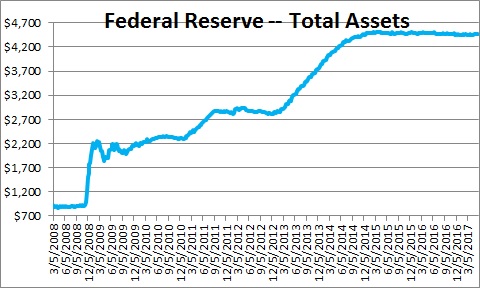


The TARP audit ultimately showed $23 trillion created. Nor was the distribution the same. Who received the money the Fed printed? Bondholders, Large Corporations, Hedge Funds and the like. Pa’s Diner? Not so much. So unlike Bitcoin, there not only was a sudden, secret, unapproved, unexpected, unaccountable increase in quantity, but little to no chance for the population to also “mine” some of these new “coins”. Which leads to this:
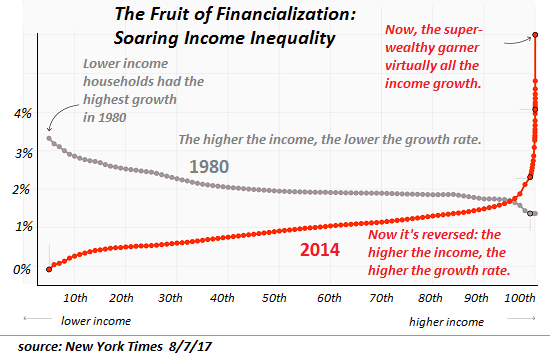


Near-perfect income disparity, with near-perfect distribution of new “coins” to those with access to the “development team”, and zero or even negative returns for those without inside access. Does this seem like a winning model you could sell to the public? Nor is this unique to the U.S.; Japan had long ago put such methods to use, and by 2017 the Bank of Japan owns a mind-bending 75% of Japanese ETFs:
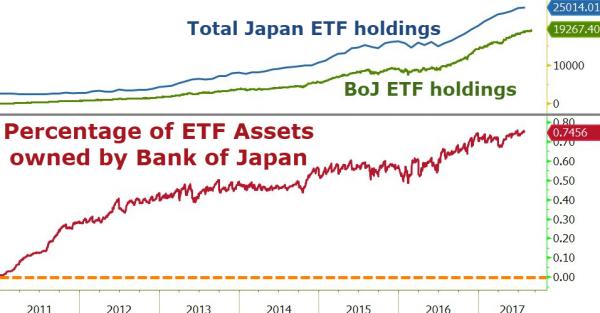


So this unelected, unaccountable bank, which creates its coin from nothing without limit or restraint, now owns 75% of the actual hard labor, assets, indeed, the entire wealth HISTORY of Japan? It took from the Edo Period in 1603 through Japan-takes-the-world 1980s until 2017 to create the wealth of Japan, and Kuroda only 6 years to buy it all? What madness is this?

Nor is Europe better. Mario Draghi has now printed so much money, he has run out of bonds to buy. This is in a Eurozone with a debt measuring Trillions, with $10 Trillion of that yielding negative rates. That’s a direct transfer from all savers to all debtors, and still the economy is sinking fast. Aside from how via these bonds, the ECB came to own all the houses, businesses, and governments of Europe in a few short years, does this sound like a business model you want to participate in?

So the volume of issuance is bad, and unfairness of who the coins are issued to is as bad as humanly possible, giving incredible advantages to issuers to transfer all wealth to themselves, either new or existing.

But if the currency is functional day-to-day, surely the issuance can be overlooked. Is it? Inflation is devilishly hard to measure, but here’s a chart of commodities:
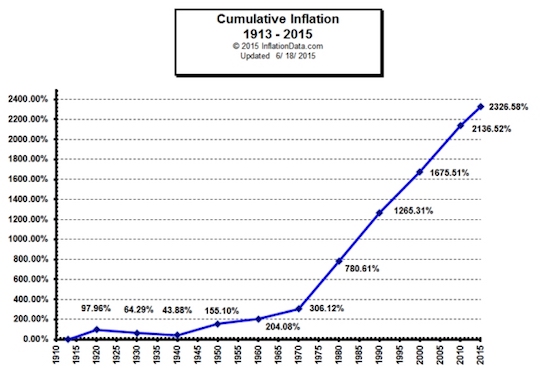


CPI:
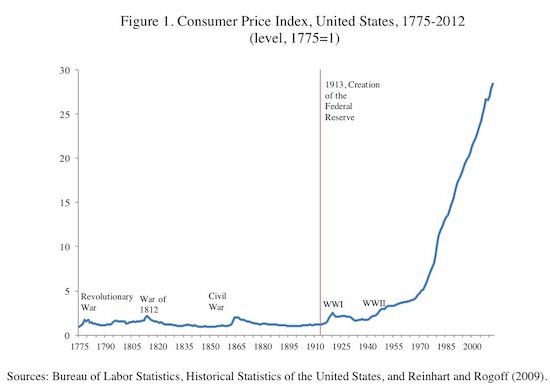


The US Dollar:
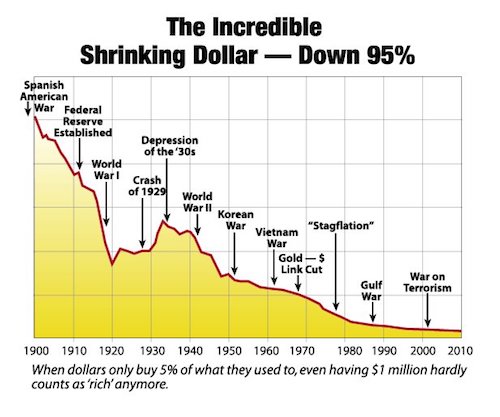


or vs Gold (/silver):
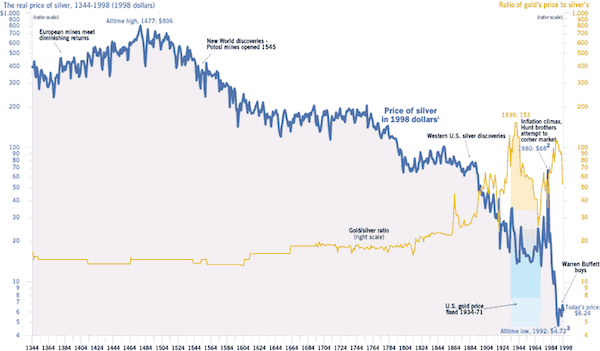


Does that look stable to you? And not that Bitcoin is stable, but at least Bitcoin goes UP at the same rate these charts are going DOWN. One store coupon declines in value at 4% a year, or may even start negative, while the other gives steady gains to loyal customers. Which business model would you prefer?

But that’s not all.



Gustave Courbet The wave 1870


Dr. D: The money, the unaccountable, uninhibited release of tokens can do more than just buy centuries of hard labor in seconds, it‘s also a method of control. Banks, our present issuers of money, can approve or destroy businesses by denying loans. They can do this to individuals, like denying loans to unpopular figures, or to whole sectors, like gun shops. They can also offer money for free to Amazon, Facebook, and Tesla, which have no profitable business model or any hope of getting one, and deny loans to power plants, railroads, farms, and bridges as they fall into the Mississippi.

The result is banks and their attending insiders are a de facto Committee of Central Planners in the great Soviet style. What is fashionable and exciting to them can happen, and what they dislike or disapprove of for any reason can never happen. And once on a completely fiat system, this is how capital is allocated through our entire system: badly. What’s worse has been a 20-year turn toward Disaster Capitalism, whereby loans are extended to a business, sector, person, or nation, and then suddenly cut off, leading to the rapid foreclosure and confiscation of companies, assets, or continents by the “Development Team.”

Imagine a Bitcoin where Satoshi could erase your coins in your wallet for giving him a bad haircut. Or because he likes your wife. Nor is there any help for independent nations like Iran, or even nuclear powers like Russia. Both have been cut off, their funds suspended at a whim with no recourse. Even being a fellow insider is no insurance, as the NY banks cut off Lehman from funds they were owed, driving it into bankruptcy to buy the pieces in receivership. Unpopular Billionaires are treated likewise. This is a system with no justice, no order, no rules, and no predictability. Anyone within it is at grave and total risk. And yet before Bitcoin it was the only system we had, short of returning to the 19th century, it was the only way for modern commerce to deliver food, water, power, or function at all.

This is seen in its abuses, but also by its effects. The present system not only controls whether you are a winner or loser, whether you may go or stay, whether you may live or die, but also tracks every purchase, every location, in effect, every action throughout your entire life. These records will describe what books you read, what movies you watch, what associates you have, in real time Already these daily actions are being approved or denied. Take out a variable-rate jumbo loan? We’ll give you 110% of the value, paying you to be irresponsible (we’ll foreclose later). Want to buy gas when driving through Cheyenne 3:30 at night? Sorry, we disabled your card as a suspicious transaction. Sorry about you dying there of crime or of cold; we didn’t know and didn’t care. All your base are belong to us.


You say you don’t care if JP Morgan has your pay stubs to disturbing porn sites and Uber purchases to see your mistress? Well the future Mayor of Atlanta will, and he hasn’t graduated college yet. With those records it’s child’s play to blackmail policemen, reporters, judges, senators, or generals, even Presidents. And all those future Presidents are making those purchases right now, the ones that can be spun into political hay, real or unreal. So if you don’t worry what everyone knows about you, that’s fine, but imagine reading the open bank records, the life histories of every political opponent from now until doomsday. Then Don’t. Do. It. The people who have those records – not you – then have not just all the assets, not just all the money, but all the power and influence. Forever.

Are you signing up for that? Bitcoin doesn’t. Bitcoin doesn’t care who you are and with some care can make it very difficult to track you. And without tracking you, it makes it impossible to boycott you. And without a central repository, it’s impossible to march in with tanks and make them give you the records, turn money on or off, to make other people live or die and bend to your will by violence.

No one will care about that, because no one cares about it now unless, like Russia or China, it’s directed at them personally and then it’s too late. The real adoption of Bitcoin is far more mundane.

The long-term interest rate is 5%. Historically banks would lend at 8%, pay at 4%, and be on the golf course by 5. No one thought much about it because like a public utility, banking was a slow, boring affair of letting business do business. You know, farming, mining, manufacturing, all that stuff we no longer do. For decades, centuries even, banking was 5%-15% of a nation’s GDP, facilitating borrowers and lenders and timescales, paying for themselves with the business efficiencies they engender.
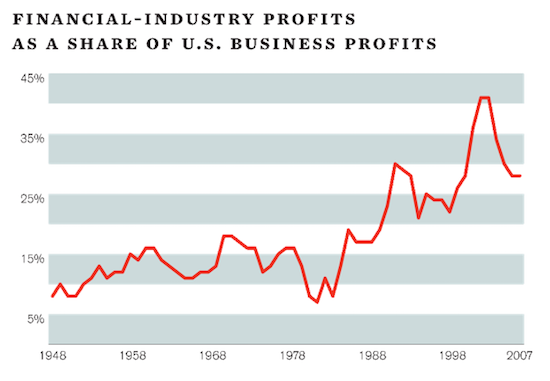
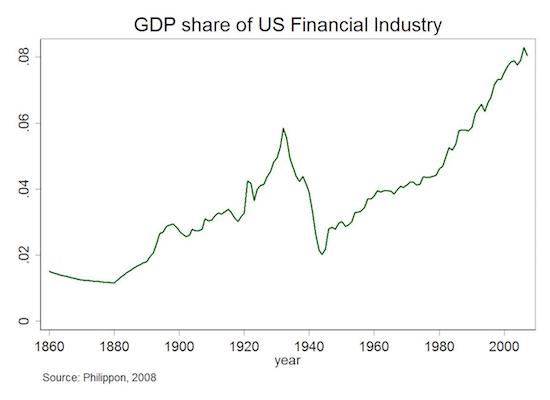


All that changed after WWII. Banks rose in proportion to the rest of the economy, passing the average, then the previous high, then when that level reached “Irrational Exuberance”, Greenspan started the printing presses, free money was created, and Senators and Presidents whose bank records were visible suddenly repealed Glass-Steagall. An economy stretched to breaking with free, centrally-allocated and misallocated money crashed and shrank, yet the banks– now known as the FIRE stocks: Finance, Insurance, and Real Estate – kept growing. How can banks and finance keep growing with a shrinking economy? By selling their only product: debt.

How do you sell it? Reduce the qualifications past zero to NINJA-levels, and use your free money to FORCE people to take it via government deficits and subsidized loans. No normal economy could do this. No normal business model could do this. Only a business now based on nothing, issuing nothing, with no restraint and no oversight. And the FIRE sector kept growing, through 15%, 20%, 25% until today most of U.S. GDP is either Finance selling the same instruments back and forth by borrowing new money or GDP created by governments borrowing and spending.

Remember when we started, banks paid 4% and charged at 8%. Now they openly take savings with negative interest rates, and charge at 30% or higher on a credit card balance averaging $16,000. And still claim they need bailouts comprising trillions a year because they don’t make money. The sector that once facilitated trade by absorbing 5% of GDP is now 5x larger. There’s a word for a body whose one organ has grown 5x larger: Cancer. Unstopped, it kills the host.


What does this have to do with Bitcoin? Simple. They’re charging too much. They’re making too much both personally and as a group. They’re overpriced. And anything that’s overpriced is ripe for competition. And the higher the markup, the more incentive, the more pressure, the more profit there is to join the upstart. Bitcoin can economize banking because what does banking do? It saves money safely, which Bitcoin can do. It transfers money on demand, which Bitcoin can do. It pays you interest, which mining or appreciation can do.

It also can lend, register stocks and ownership, rate credit risks, and allocate capital which other non-Bitcoin Tokens can do. In short, it can replace the 25% overpricing of the financial sector. If it could reduce the overhead of outsized profit, the misuse of expensive brainpower, of Wall Street and London office space, and reduce financial costs to merely 10% GDP, it could free up 20% of GDP for productive purposes. Why did you think Detroit and Baltimore fell in on themselves while N.Y. and D.C. boomed? That’s the 30% they took, $4B a year, from every other state, every year for 40 years.

That money and that brainpower could be much better allocated elsewhere, but so long as the Finance sector can print free money and buy free influence, they will never stop on their own. Only an upstart to their monopoly can cure the cancer and bring them back to a healthy size and purpose. Bitcoin can do this only because they charge too much and do too little. Of course, they could go back to paying 4% and charging 8% with a CEO:employee pay ratio of 20:1 but history says it will never happen. Only a conflict, a collapse, or competition can reform them, and however long it takes, competition is by far the best option.
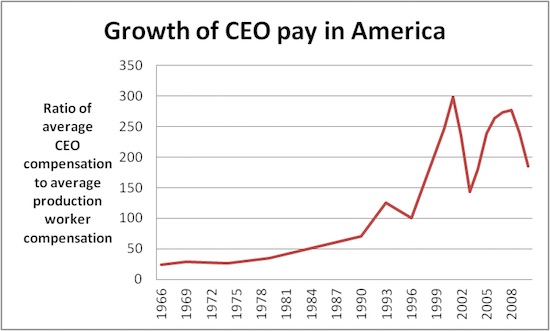


So why would people pick Bitcoin? It costs less and does more. Amongst adopters, it’s simpler and more direct. It pays the right people and not the wrong ones. It rewards good behavior instead of bad, and can help producers instead of parasites. It’s equitable instead of hierarchical. What else? While not Bitcoin proper, as a truth machine Blockchain technology is the prime cure for the present system’s main problem: fraud. There is so much fraud at the moment, libraries of books have been written merely recording the highlights of fraud since 2001. But merely recording the epic, world-wide, multi-trillion dollar frauds clearly does not cure it. Like other human problems, no one cares about your problems, only your solutions, and Blockchain has the solution.

While the details of fraud are complex, the essence of fraud is quite simple: you lie about something in order to steal it. That’s it. It could be small or large, simple or complex, but basically fraud is all about claiming what didn’t happen. However, the Blockchain is all about truth, that is, creating consensus about what happened, and then preserving it. Take the Robosigning scandal: accidental or deliberate, the mortgage brokers, banks, and MBS funds lost the paperwork for millions of houses. A house could be paid off could be foreclosed, as happened, or it could be owned 5 times, as happened. Like the Sneeches, no one knew which one was who, and the only certainty was that the official authority – county courthouses – did not know because to register there would have cost Wall Street and inconvenient millions or billions in shared tax stamps.

The system broke down, and to this day no one has attempted to define ownership, choosing instead to usher all the questionable (and therefore worthless) material into the central bank and hiding it there until the mortgage terms expire, forcing the taxpayers to bail out a multi-trillion dollar bank fraud at full value. And this is just one messy example. The S&L crisis was not dissimilar, nor are we accounting for constant overhead of fees, mortgage transfers, re-surveys, and title searches nationwide.


With Blockchain it’s simple: you take line one, write the information, the owner, title, date, and transfer, and share it with a group. They confirm it and add mortgage #2, then #3 and so on. It’s a public ledger like the courthouse, but the system pays the fees. It also can’t be tampered with, as everyone has a copy and there is no central place to bribe, steal, and subvert as happened in 2006 but also in history like the 1930s or the railroad and mining boom of the 1800s. If there are questions, you refer to the consensus If it’s transferred, it is transferred on the ledger. If it isn’t on the ledger, it isn’t transferred, same as the courthouse. Essentially, that’s what “ownership” is: the consensus that you own something. Therefore you do not have a mortgage due disappear, or 4 different owners clamoring to get paid or take possession of the same property, or the financial terrorism of shattering the system if you even attempt to prosecute fraud.

It’s not just mortgages: stocks have the same problem. Since the digital age began, the problem of clearing stock trades has steadily increased. Eventually, the NYSE trading volume was so large they couldn’t clear at all, and the SEC let trading houses net their internal trades, only rectifying the mismatches between brokerages. Eventually, that was too large, and they created the DTCC as a central holder and clearing house. Yet, in an age of online trading and high-frequency trading mainframes, it became apparent there was no way to clear even residual trades, and they effectively no longer try, and the SEC, instead of forcing them to compliance, lets them. There are 300M failed stock trades a day and $50B a day in bond failures, or $12 Trillion year in bonds alone. And so? If you sell your stocks and bonds, the brokerage makes it come out whole, so what?



Gustave Courbet The wave 1871


Dr. D: Well, all parts of the system rely on accurate record-keeping. Look at voting rights: we had a security company where 20% more people voted than there were shares. Think you could direct corporate, even national power that way? Without records of transfer, how do you know you own it? Morgan transferred a stock to Schwab but forgot to clear it. Doesn’t that mean it’s listed in both Morgan and Schwab? In fact, didn’t you just double-count and double-value that share? Suppose you fail to clear just a few each day. Before long, compounding the double ownership leads to pension funds owning 2% fake shares, then 5%, then 10%, until stock market and the national value itself becomes unreal. And how would you unwind it?

Work backwards to 1999 where the original drop happened? Remove 10% of CALPERs or Chicago’s already devastated pension money? How about the GDP and national assets that 10% represents? Do you tell Sachs they now need to raise $100B more in capital reserves because they didn’t have the assets they thought they have? Think I’m exaggerating? There have been several companies who tired of these games and took themselves back private, buying up every share…only to find their stock trading briskly the next morning. When that can happen without even a comment, you know fraud knows no bounds, a story Financial Sense called “The Crime of the Century.” No one blinked.

But it doesn’t stop there. You don’t only buy stocks, you sell them. And you can sell them by borrowing them from a shareholder. But what if there’s no record of delivery? You can short or sell a stock without owning any. And the more you sell, the more it drives the price down and the more money you make. In fact, profits are infinite if you can sell enough that the company goes bankrupt: you never have to repay the stock at all. And this “naked” short selling can only occur if there’s openly bad recording and enough failures-to-deliver to hide it. You could literally own nothing, borrow nothing, post nothing, and with no more than insider access to an exchange, drive a company out of business. That’s how crucial recording is.

And while for appearance’s sake, they only attack and destroy small plausibly weak stocks, Overstock.com with a $1.45B market cap fought these naked short sellers for years. Publicly, openly, vocally, with the SEC. Besides eroding their capital, besides their legal fees, besides that e.g. Amazon could pay to have their competition run out of business with fraudulent shorting, the unlimited incentive to short instead of long on small companies could suppress the entire stock market, indeed the national wealth and GDP. It may account for some of the small caps underperforming their potential for years, and why an outsized portion of stock value to be in just the 5 protected FAANG or DOW 30 stocks. …We don’t know, because we have no honesty, no accounting, and nothing to compare it to. But no one cares, because it’s been going on for 20 years, and if they cared, they’d do something about it. Again, no one cares about your problems, only your solutions. Even if the nation falls.


Look at it from their point of view: if you’re a business owner, now you can’t rationally list your corporation. Your stock could be manipulated; your business could be bankrupted for no reason at all. We’ve seen the NYSE shrink as businesses start to list in more honest jurisdictions, and even Presidents can’t convince them to come back. Traders and Fund Managers retire in public interviews, telling the world there is no longer any sense or price discovery, and therefore there is market madness.

Yet we just said that to clean up the market would discover 10%, 20%, 40% fake shares, fake business values, fake pension values, therefore fake GDP values, and fake GDP to Debt ratios, and therefore would perhaps lead to an accurate Debt to GDP of 140%, which would crash the U.S. dollar and possibly the nation. Would a complete U.S. financial collapse lead to a nuclear war? And it all goes back to fraud we didn’t stop 20 years ago. How do you solve the problem? The only way out without collapse is to build an honest system parallel to the existing system and slowly transfer assets from the rotten, sinking ship to the new one. The captains of the old ship may not like it, but look at the incentives. No one can tolerate the old ship except the pirate captain; even the crew, the stock traders, don’t want or control it any more.

However, what if you created an honest stock market Blockchain that actually had the stock certificates and actually transferred them, cheaply and reliably without false duplication? This is what is happening in the Jamaican Stock Market. A new company can choose to list on the stock Blockchain and avoid the old system. Other companies or even the whole exchange can clean up the books, slowly, stock by stock, and move it to the new honest system. Because they’re honest? No way! No one cares about truth or honesty, clearly. Because they can sell their stock exchange as superior, solving the existing problems. Stopping fraud, theft, the stealing or crippling of companies, fake voting, depression of Main Street and outsiders in favor of Wall Street and insiders, this is what Blockchain can do. In short, it would work better, cheaper.

What else can Blockchain do?

Blockchain is just software written by programmers so it’s as versatile as any other software. So why not program things into it with a “Smart Contract”? Suppose you make a bet: IF the Packers beat the Lions on November 12, 2017, THEN I will pay you $50. You set up the contract, and the bot itself can look for the headlines and transfer the money when the conditions are met.

That’s pointless but how about this: You run a jewelry business on Etsy and need to buy $500 in beads from Hong Kong. Normally, you would need to pay an importer, a currency exchange, bank account, tire transfer, escrow account, and a lawyer, or their proxies within the system, plus two weeks’ clearing time. That’s a lot of overhead for a small transaction. In contrast, a smart contract such as Ethereum could post the value of the coin (escrow), and when Long Beach or FedEx confirms delivery, releases the Ethereum, a coin of value, to the seller in Hong Kong. Instantly. Why? The existing financial system is charging too much and doing too little. That’s a huge incentive to get around their slow, overpriced monopoly.


Once you cut the costs, have a more direct method, and reduce the time to minutes, not weeks, the choice is obvious, which may explain why Microsoft, Intel, and others are deep in ETH development. Why overpay for bad service, and support the overpriced bonuses of men who will use their power to turn on or shut off your livelihood at will? Blockchain costs less and does more. Being just software, there are many other software products serving hundreds of other business plans. These use-coins are generally called “Tokens”, whereas“Coins” are meant to be pure currencies. There are Tokens for a wide variety of business purposes: online gambling? Yes. Tokens to buy marijuana in certain states? Sure.

But how about a Token like Populous that contains the credit information of small businesses worldwide, so you can make modest income lending against their accounts receivable? You get more income, business worldwide gets better service and lower costs. Why? The existing financial system is charging too much and doing too little. How about a Token like Salt for personal loans and perfecting collateral? They will lend cash against your Cryptocurrencies, because if your loan falls short, they can sell your collateral instantly. No foreclosures, no repossessions, no overhead.

This is what banks do when they hold your savings and checking accounts, yet sell you a personal loan. But the banks are giving you no interest on savings, while charging origination fees and high interest. They’re charging too much and doing too little. Well, you say, this sounds too good to be true: a parallel system to replace our existing corrupt, broken, overpriced one. One that doesn’t have to confront existing power or reform the system, but beyond price appreciation has its own incentives to join? Surely there are problems.

Oh, yes. So many problems. The first is often mentioned: it’s fine that Bitcoin is a finite commodity with only 22M coins, and if Bitcoin were the only coin, that would work. But there are over 1,000 coins now, and more every day. Isn’t that just another avenue to unlimited issuance and inflation by unlimited, unregistered people? Well, yes and no. It’s true that anyone can start their own Bitcoin – Litecoin for example is a faster duplicate of Bitcoin – but it’s also true that anyone can start their own Facebook. MySpace certainly did.


So why don’t they? Basically because of financial inertia, the Network Effect, a coin you start and only you use is worthless. The value is in the belief that other people will use it. Without that, you’re banished to MySpace Siberia. Still, with a 1,000 coins, don’t they all compete? Yes, and that’s a good thing, not bad. This is no different than the competing Bank Notes of the 19th century. If you like this bank and believe in them, you prefer their notes to others. Or you might use one note in Missouri and another in Louisiana. So with Cryptos. You might choose Bitcoin, with slow traffic and high costs to pay for a house. But you would choose Litecoin to pay for coffee.

You already do this, no different than using cash to buy a hot dog, your debit card for groceries, and a bank transfer for a car. It’s overlooked because they’re all called “dollars,” but they’re not. One is currency, one is a short-term credit, and one is a banking ledger. Because of the Network Effect, you can’t have 1,000 equal coins and have them all work. The market will prefer some over others until there are only a few, just as AskJeeves and Infoseek gave way to Google, which may someday give way to someone else. Just as you can’t start a new Google today, there are only a few top coins, easily updated, and little space for new coins.

In addition, the “1,000 coins” are not actually coins. Most of the new coins are Tokens, which are not “currencies” like Bitcoin and a means of exchange, but business models and services. Like Bank Notes, the market is self-limiting, but evolving. But if there are a variety of coins, and like Litecoin they can suddenly appear and change, what reassurance do you have that your Bitcoin “money” is worth anything? Like 19th century Bank Notes or AskJeeves, your responsibility is to be aware of the market and the changing values and react accordingly. And in a mature market, “everyone knows” the histories and reputations, but in a young market, like Dell and Gateway in 1992, no one knows. But that’s also why there is more profit now as well as more risk. But we’re also watching volatility and risk in Pounds, Lira, Gold, or even outright defaults like Argentine Pesos or Rubles. We already carry that risk, but it’s familiar and taken for granted.

If coins can just “change” and “fork” whenever they want, then isn’t it like buying Australian Dollars, then waking up and finding they’re Yen? Yes and no. Like other cryptos, Bitcoin is just software written by men. So a group of developers may think Bitcoin should remain the same while the old team thinks it should be improved so much that they do the work, write the updates, and release it. Well you have a “fork”, but what happens next is the Network Effect. So you’re a miner and a user of Bitcoin. You now have a choice: do you use the new software, the old software, or both? Everyone expected one to be adopted, and the old one to wither into oblivion. Since a Fork gives you one unit of each, the eventual outcome was a wash within the user group. But that doesn’t seem to be happening.

Ethereum forked, and Ethereum Classic still exists, and trades steadily but far less. Bitcoin Cash Forked and although 1/10th the price, both are trading briskly. No one knows what will happen, because it’s never existed before. So yes, you could wake up and find you don’t like what Bitcoin decided to do, just as you could wake up and not like your new bank manager or CFO of Dell, and then you sell that asset and choose another. That’s your responsibility. That’s competition.

Besides unexpectedly finding both forks have value, there is an upside to the downside. If some new advance in speed or encryption appears in Litecoin or Dash, Bitcoin can also adopt it. This not only improves the market, but reduces sudden upsets as new advances shouldn’t unseat popular coins but are adopted by them. Indeed, this was the purpose of Bitcoin Cash fork: to improve speed and cost. Yet now they both exist for different purposes in the market. Another objection is that cryptos depend on electricity and an expensive, functioning Internet. True. But while I’m no fan of technology, which is full of problems, so does everything else. Without electricity, the western world would stop, with no water, no heat, and no light.

Without Internet, our just-in-time inventory halts, food and parts stop moving, banking and commerce fail. You’re talking Mad Max. TEOTWAWKI. That’s a grave problem, but not unique to Bitcoin.



Gustave Courbet Sunset on Lake Geneva 1876


Dr. D: Bitcoin can be stolen. Although “Bitcoin” can’t be hacked, it’s only software and has many vulnerabilities. If held on an exchange, you have legal and financial risk. If held at home, you could have a hard drive fail and lose your passwords. If it’s on a hardware fob like a Trezor, the circuits could fail. For a robust system, computers themselves are pretty fragile. You could write down your passwords on paper, and have a house fire. You could print out several copies, but if any of the copies are found, they have full access to your account and stolen without you knowing. You could have your passwords stolen by your family, or have a trojan take a screen or keystroke capture.

Hackers could find a vulnerability not in Bitcoin, but in Android or AppleOS, slowly load the virus on 10,000 devices, then steal 10,000 passwords and clear 10,000 accounts in an hour. There are so many things that can go wrong, not because of the software, but at the point where you interface with the software. Every vault has a door. The door is what makes a vault useful, but is also the vault’s weakness. This is no different than leaving blank checks around, losing your debit card, or leaving cash on your dashboard, but it’s not true that there are no drawbacks. However the risks are less obvious and more unfamiliar.

Bitcoin isn’t truly anonymous. If someone, the NSA, wanted to track your drug purchases on SilkRoad, they could follow the router traffic, they could steal or work out your keys, they could eventually identify your wallet, and from there have a perfect legal record of all your transactions. Defenders will say that wallets are anonymous, that like Swiss accounts, we have a number, but not a name, and you can create new numbers, new wallets endlessly at will. Fair enough, but if I can see the transfers from the old to the new, it can be tracked. If I can get your account number by any means, I can see the flows. To some extent it’s speculation because we don’t know what technology they have available to crack codes, to see into routers, Internet traffic and servers.

Could there be a hidden exploit not in “Bitcoin” but in AES256 or the Internet itself? Maybe. Are there secret code-breaking mainframes? Possibly. But given enough interest, we can be sure that they could always get a warrant and enter your house, hack your computer, and watch your keyboard. However, this is no different than cash. If necessary, they can already track every serial number of every bill as it leaves an ATM or a drug sting. Then you follow those serial numbers as they are deposited and reappear. I expect Bitcoin is not very different, and like cash, is only casually anonymous. But is this a problem with cash? Or with Bitcoin? Your intent as a citizen is to follow the law, pay your taxes, and not hurt others. If government or other power centers are willing to expend that much effort to track you, perhaps the problem should be addressed with proper oversight on warrants and privacy.

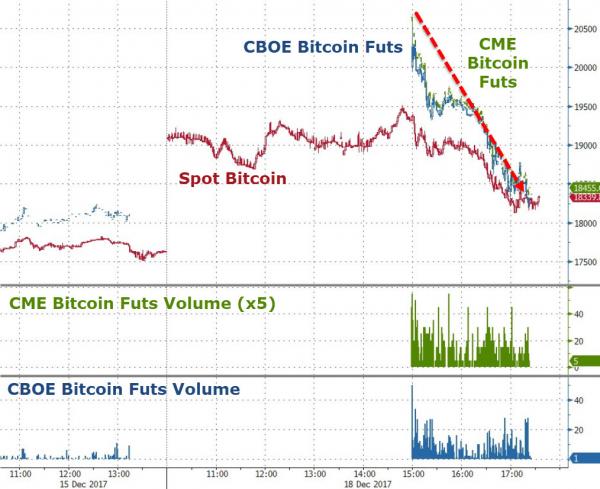
Bitcoin is slow and expensive. Very true. Bitcoin Core has gotten so outsized from its origins that it may soon cost $5 to buy a $1 coffee and 48 hours to confirm the purchase. That’s clearly not cheaper, faster, OR better. It’s worse: far, far worse. Nor can it improve. Since Blockchain writes the ledger, the longer the ledger, the bigger it is. Technically, it can only clear a few transactions per second. This problem may not doom it, but it would relegate it to only huge, slow transactions like moving container ships. That is, a form of digital gold note. We don’t actually ship gold or whatever to pay for transactions; it just sits in the background, an asset. Per Satoshi, Bitcoin is a “Digital Asset.”
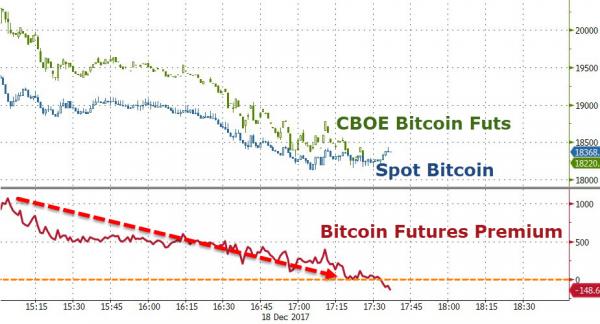
 

And the core team seems to like this more secure, higher value direction, where these obstacles are acceptable. But without a larger, deeper market, it’s the plaything of billionaires and then who sets the price? It becomes another experiment, an antique. Luckily, the story doesn’t stop there. Because it’s only software, you can always change it if you can convince the participants to use the new version. Bitcoin Cash is a fork that it larger, faster, and cheaper, reducing the limitations for now. And it can become Segwit2 or Cash2 later if the community agrees. But by design Bitcoin is not meant to be instant nor free, and probably never will be. Like gold, it is meant to be expensive, vaulted, and rarely moved. If you want fast and cheap, LiteCoin, Dash, and many others are vying to be the digital silver or digital payment card. That’s not very different from the gold standard, or even payments today.

Bitcoin is a huge electric and Internet drain. This is true. However, it’s also misrepresented. What is the electric overhead of every bank, every terminal, every mainframe on the NYSE, every point-of-sale card machine, every cash register and router in retail? Don’t we use an awful lot of electric to keep those running? What about their cost, the repairmen, the creation of new systems every year from mine to market, from idea to update release, to replace them? We also personally have our computers and routers, the whole Internet on and idling. What’s the base cost? Is it fair to compare as if it were a pasture before Bitcoin arrived?

We built the existing system this way because it gained efficiency. Time in the clearing, price in not running typewriters and mail worldwide, and of course taxes. We’re talking about creating a parallel financial system here. If the old one is replaced, is the new one better, or worse? Mining takes a lot of power, but the math in Bitcoin is meant to get increasingly harder to compensate for increasing computer speed. The computers are supposed to be on to confirm transactions. That means that the more people use it, the more power consumed, but that’s true of everything. The more people that drive cars, the more gas is used. So is the car doing something useful and being used well? Is it replacing a less efficient horse, or just wasting energy better used elsewhere? These are complex questions.

At the least, Bitcoin uses far, far too much energy in the design, and because of the speculation, far too many people are mining it without using it. However, all of the subsequent coins were concerned about this, and their power consumption is far, far less. As Bitcoin is near its hardest stage and stops at 22 Million, power consumption is near peak, but should stabilize, or even fork to a low-energy proof-of-stake model. As Bitcoin is not well-suited to worldwide transactions, it should be replaced with less-power intensive alternatives, and because of this, may get smaller. And if it replaces some of the existing system, it can generate an offset. But yes, if it uses too much power, is too inefficient by design, it will be too expensive, abandoned, and fail.


Are Cryptos a scam? Probably not: we pointed out some legitimate uses above for both coins and tokens. But there’s one coin that arguably is a Ponzi, a dozen coins that are scams, scores that are terrible ideas like Pets.com and will fail, and another dozen good, well-meaning tokens that are honest but ultimately won’t succeed. Yet, like the .Com 90’s, there are probably some like Apple that rise far more than it seems they should, and by surviving, effectively give 16% compounded returns for 40 years, front-loaded. That’s the nature of business. But are many coins and tokens open scams that run off with your money? Yes. Are others worthless? Yes. It’s also true of the stock and bond market and can’t be helped. Buyer beware.

Is Bitcoin a Ponzi? It’s not a Ponzi by definition because there is no central thief, nor are new investors paying off old investors. So is it a fraud, misrepresenting a few hours of electricity as worth $10,000? Well, that depends on what you think its value is. Is it providing value, a service? If so, what is that service worth to you? We already said it has the operational elements of money, with the addition of being extremely transmissible and transportable. If that has value to you, fine, if not, perhaps gold or bonds are more appropriate. But that’s the problem of what gives Bitcoin value.

A stock or bond you can look at the underlying asset, the profit or income flows, the book value. But Canadian or New Zealand dollars? What gives them value? They’re also backed by nothing. What gives gold value? It has no income, just popularity. Likewise Bitcoin: what gives it value is that other people want it. If they stop wanting it, it has no value, but that’s psychological and can’t be directly measured. With that in mind, is its fair value $1K or $1B? No one knows. Can its value fall from $10k to $5k? Yes, and it has many times. Only the market, that is, we can decide what it’s worth to us, and the market is small and immature, with no price history and prone to wild swings.

Shouldn’t the exchanges set the price? Yes, and they do, but how is that accomplished? We already said the Exchanges do internal trading off-ledger, outside Bitcoin. So aren’t they setting the price on the exchange instead of the people setting the price peer-to-peer? It would seem so. So aren’t they subject to market manipulation? Although at the moment they have a fairer design, and smaller pipelines to the larger market of money, yes. So if they launch a Bitcoin future, a tracker, a triple-short ETF, internally inflate their holdings, wouldn’t that make it subject to corruption and thus back into the existing system?

No one knows: it’s never been done before. I suspect not, but only because the people want Bitcoin specifically because it is Outside-system, Anti-fraud and watch these things carefully. But it’s run by humans and reflect human nature: that means over time some new form of exchange and corruption can grow up around it as before. While the ability to rig Bitcoin is limited because the quantity of Bitcoin is limited and riggers must first buy Bitcoin fairly, the Exchanges and the price-setting are an issue, and especially into the future.


Central Banks and existing powers can outlaw or replace it. Bitcoin is still small, almost irrelevant, yet it has been driven down or outlawed in several places, for example North Korea, Venezuela, and New York. That’s right New York, you’re in proud company. North Korea outlaws everything and there is little internet access, so that’s no example. New York is simply regulating Bitcoin which creates business obstacles, but is still available via the few companies willing to do extensive paperwork. Venezuela, however, is actively suppressing Bitcoin which competes with the Bolivar, and is in fact seeking out and shutting down miners.

They do this on the premise that Bitcoin is consuming valuable (and free) national electric that could be better used powering a small town. Point taken. However, Bitcoin users are able to defend themselves against a terrible, lingering hyperinflation that is starving the nation to death, cutting off food, medicine, and services. Mining Bitcoin with national electric – or even having any – can be the difference between life or death. With Bitcoin, you can order food and medicine on Amazon. Without it, you can’t. So a ferocious national government has attempted to halt Bitcoin at gunpoint from both the users and the vendors. Like other currency oppressions, the USD in Zimbabwe for example, it hasn’t worked. Bitcoin is suppressed, but when the need for commerce is high enough, people make a way.

So maybe they will replace it with their own coin. Go ahead: this is a free market, freely competing. Banks already made a coin called Ripple, which trades in volume on exchanges, but is not open and public. If people choose it, I can’t stop them. Suppressing Bitcoin may make the incentives to choose the legal option far higher. But ultimately the point of Bitcoin is to be open, fair, and uncontrolled. A coin that is closed, controlled, and operated by some untrustworthy men has no incentive. But it can happen: people have chosen against their better interest before.

And that’s my real reservation. Suppose Bitcoin works. Suppose it replaces currency. Suppose it is adequately private. Suppose it can be made fast enough, cheap enough, and slim enough. Suppose the old system fades and we all get used to having our lives entirely on the Blockchain. Your every post is perfectly recorded and provably yours on Steemit. Your every photograph is saved and stamped to you. Every medical experience is indelibly written. Every purchase, every trade, it’s all on a blockchain somewhere. And even suppose it’s private. What then? I mean, isn’t this the system we had in 1900, under the former society and former gold standard? So what happened?

Being comfortable and familiar with Blockchain ledgers, taking them as for granted as Millennials do Facebook, and someone says, “Hey, rather than waste power on this inefficient, creaking system of writing everywhere for a fraction of the power the Federal Reserve Block can keep it for you. Think of the whales.” Sound silly? That’s exactly what they did in 1913, and again in 1933 – replace a direct, messy, competitive system with a more efficient one run by smarter men. The people didn’t protest then any more than they do now, so why would we expect them to in 2050 or 2070? No one cares about corruption and murder: we’re only moving to this system now because it’s better and cheaper. If the Fed Reserve Block is cheaper, won’t we move then?


I can’t solve the next generation’s problems. We’ll be lucky to survive our own. But I can warn you that even now this generation will never accept a digital mark without which you cannot buy or sell, not voluntarily and not by force. It’s too far to reach and social trust is too compromised. But could they get us halfway there and just make it official later, when everything’s fixed again? I think absolutely.

Once that’s in, you can finish all the plans written in the bank and government white papers: perfect, inescapable taxation. Perfect, indelible records of everyone you talked to, everything you said, everything you bought, everywhere you were, everyone you know. Not today, but in the future. And that is the purgatory or paradise they seek today. The price of Liberty is eternal vigilance. The system we have wasn’t always bad: a small cadre of bad men worked tirelessly while complacent citizens shirked their duty. So when we move to a new system softly, without real purge, real morality, real reform, what makes you think the same thing won’t happen to your new system? Only far, far more dangerous. But I can’t prevent that. Think, and plan accordingly.