
Jan 082019


Pablo Picasso Bather on the beach 1920

 

German Industrial Production Unexpectedly Slumps (WSJ)
China’s Current GDP Growth Likely Less Than 6% (CNBC)
Samsung Warns Of 29% Profit Drop (BBC)
UK Not Looking To Extend Article 50, Brexit Minister Says (R.)
UK MPs Raise Safety Fears With Police (G.)
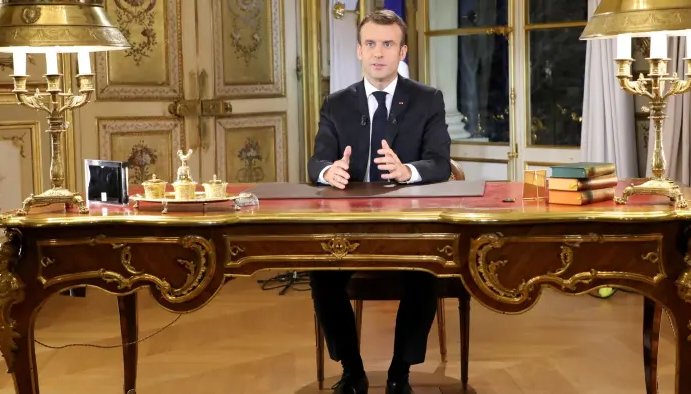
Yanis Varoufakis Says France’s Macron Is a ‘Spent Force’ (BBG)
A Farewell to “Bargain Shopping” (Kunstler)
Rival Fiefdoms Emerge In Scramble Over Trump’s Syria Withdrawal (AlM)
Turkey To Ask US To Hand Over Military Bases In Syria (R.)
China Approves Five GMO Crops For Import (R.)
India’s Top Court Backs Monsanto On GMO Cotton Patents (R.)
Ecuador To Audit Julian Assange’s Asylum & Citizenship (PBR)
WikiLeaks Tells Reporters 140 Things Not To Say About Julian Assange (R.)
140 “False And Defamatory” Statements About Julian Assange (ZH)
Warming Of Oceans Equivalent To An Atomic Bomb Per Second For 150 Years (G.)


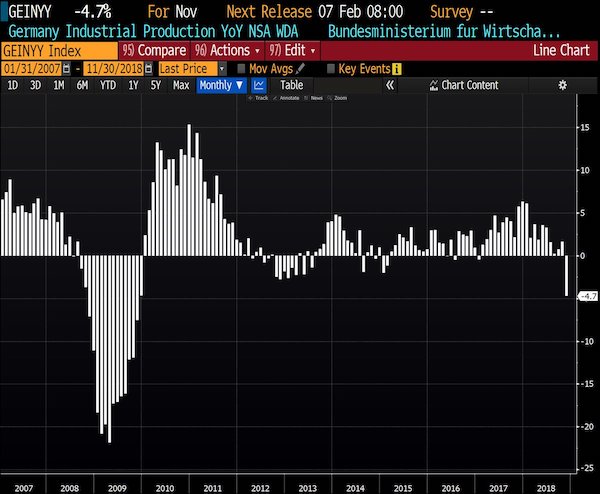
Just what Europe needs: a recession in Germany.

German Industrial Production Unexpectedly Slumps (WSJ)

German industrial production unexpectedly slumped in November, adding to recent evidence that a nine-year recovery in Europe’s largest economy is foundering. The data underscore how trade tensions and weaknesses in emerging markets are putting a brake on Germany’s longrunning economic upswing, and could delay any move by the ECB to lift short-term interest rates. Production in Germany’s key industrial sector, adjusted for inflation and seasonal swings, fell 1.9% in November from the previous month, the country’s statistics agency said Tuesday. Economists polled by The Wall Street Journal had expected a 0.3% gain. It was the second consecutive monthly fall in German industrial output and comes after data Monday showed an ongoing decline in new manufacturing orders.
Read more …

Has been for years.

China’s Current GDP Growth Likely Less Than 6% (CNBC)

China’s current economic growth is likely below the 6 percent level amid faltering domestic demand, an economist said Tuesday. Recent signals about the world’s second-largest economy point to weaker growth, including tech giant Apple recently lowering revenue guidance for the first quarter as it blamed a variety of factors including Chinese demand. And, on Monday, Hong Kong-listed automaker Geely said it missed its sales target in 2018 and was forecasting flat sales in 2019. “It’s intriguing that the domestic demand part is the weak part — the external demand is not that bad,” said Taimur Baig, chief economist at DBS Group Research.

“Particularly weak” domestic demand was possibly signaling structural changes in the Chinese economy, Baig told CNBC’s “Capital Connection.” For its part, DBS forecasts China’s GDP growth to be “sub-6 percent” currently, Baig said. Last year, China reported economic growth of 6.5 percent in the third quarter — marking its weakest pace since the global financial crisis. Still, the country’s official growth target for 2018 was around 6.5 percent.

Read more …

Everyone has a phone who wants one.

Samsung Warns Of 29% Profit Drop (BBC)

Samsung Electronics expects to post a 29% drop in quarterly operating profit as demand for smartphones and memory chips slows. The firm forecasts operating earnings of 10.8 trillion Korean won ($9.7bn; £7.6bn) for the last three months of 2018. It marks the first quarterly profit drop in two years as strong demand for chips had boosted earnings at the firm. Samsung also faces fierce competition from Apple and Chinese rivals. In a statement on Tuesday, the firm cited lacklustre demand and rising competition for its darkening outlook. “We expect earnings to remain subdued in the first quarter of 2019 due to difficult conditions for the memory business,” the South Korean tech giant said in a statement. It forecasts revenue will decline 11% to 59 trillion won.

Read more …

But I betcha they’re talking about it.

UK Not Looking To Extend Article 50, Brexit Minister Says (R.)

The United Kingdom will leave the European Union on March 29 and is not looking to extend the Article 50 exit process, Brexit Secretary Stephen Barclay said on Tuesday. The Daily Telegraph reported that British and European officials are discussing the possibility of extending Britain’s formal notice to withdraw from the EU amid fears a Brexit deal will not be approved by March 29. “The government’s policy is clear on this, the prime minister has said it on many an occasion: We are leaving the European Union on the 29th of March. We are not looking to extend,” Barclay told Sky News. When asked if any lawmakers in the Conservative Party had changed their minds on opposing May’s deal, Barclay said: “Some have said they are much more open to but it is obviously challenging.”

Read more …

The lunatics have long ruled the asylum.

UK MPs Raise Safety Fears With Police (G.)

Dozens of MPs have written to the UK’s most senior police officer to raise concerns about safety outside parliament after the Conservative MP Anna Soubry faced chants from protesters on Monday calling her a “Nazi”. At least 55 parliamentarians signed the letter to the Metropolitan police commissioner, Cressida Dick, after the Commons Speaker, John Bercow, urged officers to do more to protect MPs and Soubry criticised the lack of police response to the abuse. Scotland Yard later confirmed it had opened an investigation into whether any offences had been committed when chants of “Soubry is a Nazi” could clearly be heard while the pro-remain MP was being interviewed by BBC News on Abingdon Green, a grassed area outside parliament used by broadcasters.

It is the second time in recent weeks that Soubry has been targeted by a small group of pro-Brexit protesters wearing yellow vests, some of whom have links to the far right. On the earlier occasion, she was surrounded by shouting men calling her a traitor. The MPs’ letter to Dick reads: “After months of peaceful and calm protests by groups representing a range of political views on Brexit, an ugly element of individuals with strong far-right and extreme-right connections, which your officers are well aware of, have increasingly engaged in intimidatory and potentially criminal acts targeting members of parliament, journalists, activists and members of the public.

Read more …

No doubt there.

Yanis Varoufakis Says France’s Macron Is a ‘Spent Force’ (BBG)

Yanis Varoufakis, former Greek Finance Minister and founder of the Democracy in Europe Movement 2025, discusses political risks in Europe and his view that French President Emmanuel Macron is a “spent force.” He speaks on “Bloomberg Surveillance.”

Read more …

Remember when stores employed half the town? You see much progress since then? First boxstores, then Amazon. Have they made people happier?

A Farewell to “Bargain Shopping” (Kunstler)

What’s up is the international implosion of the bad debt, and the fading illusion that it doesn’t matter. It has any number of ways to express itself, from store closings, to dissolving pensions, to stock market instability, to divorce, homelessness, and war. It’s what you get from a hyper-financialized economy that doesn’t really produce wealth but only steals it from somewhere else. It’s not the fault of “capitalism,” which, in theory just stands for the management of a society’s savings. America doesn’t save, it borrows. Zero interest rates made savings a mug’s game, and zero interest rates were necessary to extend the borrowing far beyond the credible boundaries of repayment.

Debt isn’t capital, it just pretends to be for a period of time. Wall Street made its trillions off the time-value of that pretense and now time is up. Even in the hardship economy we’re sailing into, people will need to buy and sell things and it is very hard to see how that fundamental process of exchange might be reorganized going forward. Back in the 1990s I attended many a town meeting (in many towns) where chain stores applied for permits to set-up operations. It was often contentious. There was always a contingent of locals — organized by the chains themselves — waving placards that said “We Want Bargain Shopping.” And there were the short-sighted town officials drooling over the real estate tax “ratables” that chain stores represented.

Their adversaries feared that their locally-owned Main Street businesses would be killed, and that was exactly what happened, in very short order. You could see it coming from a thousand miles away. Now the Big Boxes are going down. Boo Hoo…. What will emerge out of the current disorder? Perhaps Generations X-Y-and-Z will recognize an opportunity to go into business — as an alternative to purchasing a degree in gender studies for $200,000 (at 6 percent interest). There will be lots of opportunities, even in a world with generally less shopping. But it may require a deeper collapse to sweep away the impediments, both practical and mental, before that awareness turns to action.

Read more …

Trying to frustrate the withdrawal.

Rival Fiefdoms Emerge In Scramble Over Trump’s Syria Withdrawal (AlM)

Even after Secretary of Defense Jim Mattis resigned over the decision, two of President Donald Trump’s top advisers have offered different messages about his intentions for a Syria withdrawal. Secretary of State Mike Pompeo has asserted, in both internal briefings and public interviews, that Trump’s instructions are clear and the troops are coming out, while saying the administration’s overall goals for the region have not changed. Meanwhile, national security adviser John Bolton, currently traveling in Israel and Turkey with a press pool in tow, has said any US withdrawal from Syria will be conditions-based, and won’t occur until the so-called Islamic State in Syria (IS or ISIS) is fully defeated and unless Turkey guarantees protection for Syrian Kurdish fighters that Ankara considers terrorists.

“There are objectives that we want to accomplish that condition the withdrawal,” Bolton told journalists traveling with him in Israel on Sunday. “The timing of the withdrawal occurs as a result of the fulfillment of the conditions and the establishment of the circumstances that we want to see. And once that’s done, then you talk about a timetable.” Pompeo offered a different emphasis in an internal briefing to State Department Syria watchers last week, sources said: We are leaving. Pompeo, in a Jan. 3 briefing to State Department personnel who work on Syria, “made clear we are leaving. Period,” a former US official, speaking not for attribution, told Al-Monitor. “He did not mention Iran. Or [Syrian President Bashar al-]Assad. He said we are leaving. That was it. Then he left.”

Read more …

Trump better watch out that there isn’t an all-out bloody war between Turkey and the Kurds coming.

Turkey To Ask US To Hand Over Military Bases In Syria (R.)

Turkey will ask U.S. officials in talks on Tuesday to hand over its military bases in Syria to Ankara or destroy them, the Hurriyet newspaper reported, a request that could further complicate discussions over the U.S. withdrawal from Syria. U.S. National Security Adviser John Bolton was meeting with his Turkish counterpart Ibrahim Kalin on Tuesday, days after Bolton added a condition to the U.S. withdrawal, saying Turkey must agree to protect the United States’ Kurdish ally, the YPG militia, which Ankara views as a terrorist group. President Donald Trump said last month he was bringing home the some U.S. 2,000 troops in Syria, saying they had succeeded in their mission to defeat Islamic State.

His abrupt move sparked concern among officials in Washington and allies abroad and prompted Defense Secretary Jim Mattis to resign. The YPG has been the key U.S. ally in its fight against Islamic State, support that has long caused tension between Washington and Ankara. Turkey views the YPG as an extension of the outlawed Kurdistan Workers Party (PKK), which has waged a three-decade insurgency in Turkey’s mainly Kurdish south east. “Give them or destroy them,” a Hurriyet newspaper headline said, referring to what it said were 22 U.S. military bases in Syria. It cited unspecified sources as saying Turkey would not accept Washington handing them over to the YPG.

Read more …

Monsanto profits from the trade talks.

China Approves Five GMO Crops For Import (R.)

China approved five genetically modified (GM) crops for import on Tuesday, the first in about 18 months in a move that could boost its overseas grains purchases and ease pressure from the United States to open its markets to more farm goods. The United States is the world’s biggest producer of GM crops, while China is the top importer of GM soybeans and canola. U.S. farmers and global seed companies have long complained about Beijing’s slow and unpredictable process for approving GM crops for import, stoking trade tensions between the world’s two largest economies. The approvals, announced on the agriculture ministry’s website, were granted while a U.S. trade delegation is meeting with its counterparts in the Chinese capital this week.

“It’s a goodwill gesture towards the resolution of the trade issue,” said a China representative of a U.S. agricultural industry association. “It’s been in the system for a long time but they chose today to release this good news,” he added, declining to be identified due to the sensitivity of the matter. Two of the newly approved products – BASF’s RF3 canola and Bayer-owned Monsanto’s glyphosate-tolerant MON 88302 canola – had been waiting six years for permission. The other approved products were DowDuPont’s DP4114 corn and DAS-44406-6 soybean, as well as the SYHT0H2 soybean developed by Bayer CropScience and Syngenta but now held by BASF.

Read more …

Devastating.

India’s Top Court Backs Monsanto On GMO Cotton Patents (R.)

India’s Supreme Court ruled on Tuesday that U.S. seed maker Monsanto can claim patents on its genetically modified (GM) cotton seeds in the world’s biggest producer of the fibre. The decision on appeal overturns an earlier ruling by the Delhi High Court that Monsanto – which has been bought by German drug and crop chemical maker Bayer AG – was unable to claim patents on GM cotton seeds. The outcome is positive for foreign agricultural companies such as Monsanto, Bayer, Dupont Pioneer and Syngenta which have been concerned that they could lose patents on GM crops in India.

“This is a very good move as most international companies have stopped releasing new technology in the Indian market due to the uncertainty over patent rule,” said Ajit Narde, a leader of the Shetkari Sanghatana, a farmers’ body, which has been demanding access to new technologies. Access to advanced technology was important to help Indian farmers to compete with rivals overseas, Narde said.

Read more …

Trying to find a way out, so the IMF loan can come in.

Ecuador To Audit Julian Assange’s Asylum & Citizenship (PBR)

Ecuador has begun a “Special Examination” of Julian Assange’s asylum and citizenship as it looks to the IMF for a bailout, the whistleblowing site reports, with conditions including handing over the WikiLeaks founder. Former Ecuadorian President Rafael Correa tweeted an image of the letter he received from the State Comptroller General on December 19, which outlines the upcoming examination by the Direction National de Auditoria. The audit will “determine whether the procedures for granting asylum and naturalization to Julian Assange were carried out in accordance with national and international law,” and will cover the period between January 1, 2012 and September 20, 2018. Assange has been in the Ecuadorian Embassy in London since he sought asylum there in 2012.

He was granted Ecuadorian citizenship last December in a bid to protect him from being extradited to the US where he fears he faces secret charges for publishing US government cables and documents. “Because of their hatred and persecution, we are the laughing stock of the world,” Correa said of the audit. WikiLeaks tweeted the news on Wednesday, joining the dots between the audit and Ecuador’s consideration of an International Monetary Fund bailout. The country owes China more than $6.5 billion in debt and falling oil prices have affected its repayment abilities. According to WikiLeaks, Ecuador is considering a $10 billion bailout which would allegedly come with conditions such as “the US government demanded handing over Assange and dropping environmental claims against Chevron,” for its role in polluting the Amazon rainforest.

Read more …

Not sure such an extensive format is the way to go. The Guardian gets away with stonewalling its fake Assange news.

WikiLeaks Tells Reporters 140 Things Not To Say About Julian Assange (R.)

WikiLeaks on Sunday advised journalists not to report 140 different “false and defamatory” statements about its founder Julian Assange, who has been holed up in the Ecuadorean embassy in London since June 2012. It was not immediately clear what prompted the advice to media organizations, but WikiLeaks singled out Britain’s Guardian newspaper for publishing what it said was a false report about Assange. The Guardian did not immediately respond late on Sunday to a Reuters request for comment. The Australian set up WikiLeaks as a channel for publishing confidential information from anonymous sources. He is a hero to some for exposing what supporters cast as government abuse of power and for championing free speech, but to others he is a rebel who has undermined the security of the United States.

WikiLeaks angered Washington by publishing hundreds of thousands of secret U.S. diplomatic cables that laid bare often highly critical U.S. appraisals of world leaders from Russian President Vladimir Putin to members of the Saudi royal family. “There is a pervasive climate of inaccurate claims about WikiLeaks and Julian Assange, including purposeful fabrications planted in large and otherwise ‘reputable’ media outlets,” Wikileaks said an email sent to media organizations and marked “Confidential legal communication. Not for publication.” “Consequently journalists and publishers have a clear responsibility to carefully fact-check from primary sources and to consult the following list to ensure they are not spreading, and have not spread, defamatory falsehoods about WikiLeaks or Julian Assange.”

Read more …

Tyler has the entire list.

140 “False And Defamatory” Statements About Julian Assange (ZH)

WikiLeaks is sick and tired of mainstream media outlets publishing inaccurate and at times defamatory claims about its founder, Julian Assange. So in a recent email to journalists who regularly cover the organization, Wikileaks described 140 “false and defamatory” claims about its founder, who has been living inside the Ecuadorian embassy in London since June 2012. According to Reuters, WikiLeaks accused the Guardian of publishing a false report about Assange, though it was not immediately clear what specific report prompted the warning. The Guardian has refused to comment on the allegations.

The 5,000 word email claimed it was defamatory to suggest that Assange had ever been an “agent or officer of any intelligence service,” or that he had ever been employed by the Russian government, or that he is – or has been – closely connected with the Russian state. Some of the claims were more bizarre, like claiming that Assange was a pedophile, rapist, murder or a member of the Muslim Brotherhood. Others pertained to personal hygiene, like that Assange bleaches his hair, or has poor grooming habits. They also said it was defamatory to claim that Assange is a hacker or that he is not an Australian citizen.

Read more …

How many people can understand this?

Warming Of Oceans Equivalent To An Atomic Bomb Per Second For 150 Years (G.)

Global warming has heated the oceans by the equivalent of one atomic bomb explosion per second for the past 150 years, according to analysis of new research. More than 90% of the heat trapped by humanity’s greenhouse gas emissions has been absorbed by the seas, with just a few per cent heating the air, land and ice caps respectively. The vast amount of energy being added to the oceans drives sea-level rise and enables hurricanes and typhoons to become more intense. Much of the heat has been stored in the ocean depths but measurements here only began in recent decades and existing estimates of the total heat the oceans have absorbed stretch back only to about 1950. The new work extends that back to 1871. Scientists have said that understanding past changes in ocean heat was critical for predicting the future impact of climate change.

A Guardian calculation found the average heating across that 150-year period was equivalent to about 1.5 Hiroshima-size atomic bombs per second. But the heating has accelerated over that time as carbon emissions have risen, and was now the equivalent of between three and six atomic bombs per second. “I try not to make this type of calculation, simply because I find it worrisome,” said Prof Laure Zanna, at the University of Oxford, who led the new research. “We usually try to compare the heating to [human] energy use, to make it less scary.” She added: “But obviously, we are putting a lot of excess energy into the climate system and a lot of that ends up in the ocean,. There is no doubt.” The total heat taken up by the oceans over the past 150 years was about 1,000 times the annual energy use of the entire global population.

Read more …

Jan 072019


Berthe Morisot Julie and her boat 1884


China Has a Dangerous Dollar Debt Addiction (Balding)
China Drops Hints Of Trade Pain Ahead (BV)
US and China To Resume Trade Talks With Both Eager For Compromise (G.)
May To Hold Parliamentary Brexit Vote On January 15 (R.)
Theresa May Pleads For EU To Give Ground And Rescue Brexit Deal (G.)
Germany and Ireland Step Up Efforts To Find Brexit Border ‘Fix’ (G.)
Average UK Unsecured Household Debt Hits Record £15,400 (G.)
UK Car Sales Record Biggest Fall Since Financial Crisis (R.)
France’s Macron Reeling As Tough Stance Against ‘Yellow Vests’ Backfires (R.)
The Euro: A Mindless Idea – Ashoka Mody (Spiked)


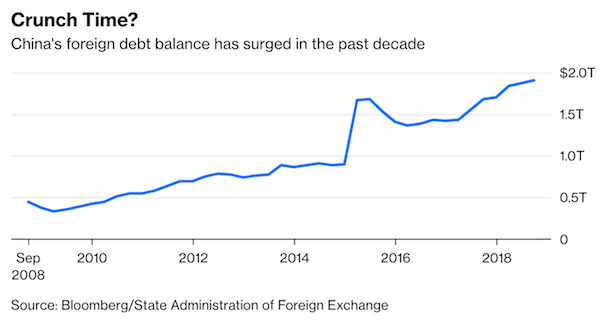
$1.2 trillion will have to be rolled over this year. There are $90 billion of offshore renminbi deposits in Hong Kong available to buy dollars. Good luck.

China Has a Dangerous Dollar Debt Addiction (Balding)

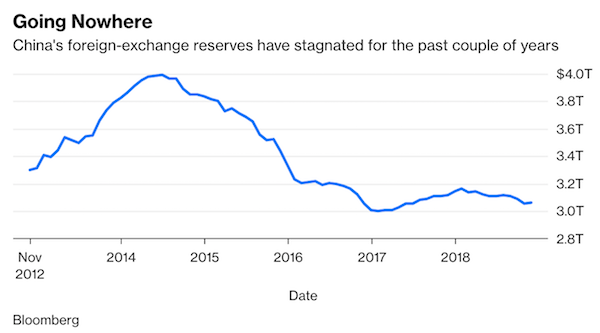
China’s foreign debt has been rising rapidly, and that’s becoming an increasingly big problem — for the country and, potentially, the world. Officially, China lists its outstanding external debt at $1.9 trillion. For a $13 trillion economy, that’s not a major amount. But focusing on the headline number significantly understates the underlying risks. Short-term debt accounted for 62% of the total as of September, according to official data, meaning that $1.2 trillion will have to be rolled over this year. Just as worrying is the speed of increase: Total external debt has increased 14% in the past year and 35% since the beginning of 2017. External debt is no longer a trivial slice of China’s foreign-exchange reserves, which stood at just over $3 trillion at the end of November, little changed from two years earlier. Short-term foreign debt increased to 39% of reserves in September, from 26% in March 2016.

The true picture may be more precarious. China’s external debt was estimated at between $3 trillion and $3.5 trillion by Daiwa Capital Markets in an August report. In other words, total foreign liabilities could be understated by as much as $1.5 trillion after accounting for borrowing in financial centers such as Hong Kong, New York and the Caribbean islands that isn’t included in the official tally. Circumstances aren’t moving in China’s favor. The nation’s companies rushed to borrow in dollars when there was a 3% to 5% spread between Chinese and U.S. interest rates and the yuan was expected to strengthen. Borrowing offshore was cheaper and offered the additional bonus of likely currency gains. Now, the spread in official short-term yields has shrunk to near zero and the yuan has been depreciating for most of the past year. Refinancing debt in dollars has become harder, and more risky.

Beijing’s policies have exacerbated the buildup of foreign debt. To promote Xi Jinping’s Belt and Road Initiative, the president’s landmark foreign policy endeavor, China has been borrowing dollars on international markets and lending around the world for everything from Kenyan railways to Pakistani business parks. With this year and 2020 being the peak years for repayments, China faces dollar funding pressure. To repay their dollar debts, Chinese firms will either have to draw from the central bank’s foreign-exchange reserves (a prospect Beijing is unlikely to allow) or buy dollars on international markets. This creates a new set of problems. There are only 617 billion yuan ($90 billion) of offshore renminbi deposits in Hong Kong available to buy dollars. If China was to push firms to bring debt back onshore, this would necessitate significant outflows that would push down the yuan’s value against the dollar.

Read more …

More trickle down fails.

China Drops Hints Of Trade Pain Ahead (BV)

While a cut in the reserve requirement ratio, China’s fifth in a year, was not surprising, the 100-basis point shift that started off 2019 was larger than anticipated. Of course, demand for cash tends to spike around this time of year, due to both the Chinese New Year holiday and tax deadlines, but the economy is cooling uncomfortably fast. Official figures may show growth slowed to 6.3% in the fourth quarter, Standard Chartered reckons. Friday’s announcement adds to other easing measures: People’s Bank of China officials last month announced a new policy tool to encourage lenders to disburse their cash more widely. The “targeted medium-term lending facility” will make cheaper funding available to banks that the PBOC judges to be doing their part by lending more to small companies.

It’s certainly not full-blown monetary stimulus yet; the central bank has not fired its heavier artillery, such as a benchmark rate cut. The market has also been kept waiting for reductions to cost of borrowing from the PBOC’s more important channel, its regular medium-term lending facility. But the overall direction of travel is clear, and both recent moves point to structural issues that worry pessimists: the extra liquidity pumped into the system does not seem to be translating into more loans for smaller companies, which may signal deeper problems with capital allocation, not to mention the private sector’s nervousness about politics in 2019.

All of this is bad news for Beijing’s trade negotiators, when they hold talks with U.S. counterparts face-to-face this week. As the pain mounts, they may be pushed to yield more in order to gain relief. They could, for example, agree to formally drop the controversial “Made in China 2025” plan, or to announce concrete measures to beef up enforcement of intellectual property rights. Trump said on Sunday that weakness in China’s economy will push officials to negotiate. He may be right.

Read more …

Tariffs rose Jan 1. It’s getting urgent.

US and China To Resume Trade Talks With Both Eager For Compromise (G.)

US officials arrived in China for the first face-to-face negotiations since a 90-day truce was declared in a trade war between Washington and Beijing, in the hope of ending a bruising confrontation between the world’s two largest economies. Hopes that the sixth round of negotiations between the two sides could yield a breakthrough helped Asian shares rise on Monday, combined with optimism about the state of the global economy on the back of strong US jobs figures on Friday. In Tokyo, the Nikkei soared more than 3% and there were also strong positive moves in Shanghai, Hong Kong and Sydney. US and Chinese trade representatives were set to hold talks on Monday and Tuesday.

After failing to reach an agreement in December when Donald Trump and Xi Jinping met, both sides agreed to suspend tariff increases while holding discussions on technology transfers, as well as intellectual property theft and cybersecurity. If no agreement is reached, US tariffs on $200bn of Chinese goods will increase in March to 25% from the current 10%. Trump said on Sunday that China was under pressure to do a deal amid signs of a slowdown in its economy. “I think China wants to get it resolved. Their economy’s not doing well. I think that gives them a great incentive to negotiate,” he said. “China’s slowdown is occurring across the board, affecting almost every industry and region,” said Scott Kennedy, a trade expert focused on China at the Center for Strategic and International Studies. “Resolving the trade war or at least finding some common ground with Washington will be needed to fully restore confidence,” he said.

Read more …

Whatever the outcome, chaos guaranteed. You can jot down next Tuesday night in your agenda for that.

May To Hold Parliamentary Brexit Vote On January 15 (R.)

Prime Minister Theresa May will hold a delayed parliamentary vote on her Brexit deal on Tuesday, January 15, the BBC reported on Monday, citing government sources. May was forced to pull the vote on her deal in December after she said it would be defeated by a large majority. The government had previously said the vote would be held in the week of January 14. May said on Sunday that Britain would be in uncharted territory if her Brexit deal is rejected by parliament, despite little sign that she has won over sceptical lawmakers.

Read more …

In case you were still wondering who will be blamed.

Theresa May Pleads For EU To Give Ground And Rescue Brexit Deal (G.)

Theresa May is preparing to make another desperate plea to EU leaders to offer a concession on the Irish backstop as she attempts to win over Brexiters who have vowed to vote down the government’s deal. The prime minister on Sunday promised to hold the meaningful vote in parliament in the week beginning 14 January despite growing opposition from Conservative backbenchers and the Democratic Unionist party, whose votes are required to push the deal through parliament. As MPs prepare to return to Westminster with the crucial Commons vote looming on the withdrawal agreement, Downing Street insisted that new compromises could still be won from Europe that would ensure the safe passage of May’s plan.

The hope of new developments came as opposition to the prime minister’s deal hardened. The hurdles facing May include: • Brexiters say the government faces a disaster if it fails to ditch the current deal, with DUP deputy leader Nigel Dodds describing the Irish backstop as “toxic”. • EU sources say talks to be held in Dublin on Tuesday between Leo Varadkar and Germany’s foreign minister, Heiko Maas, will not seek to reopen negotiations over the 585-page withdrawal agreement. • Senior MPs including Yvette Cooper and Nicky Morgan are launching a parliamentary campaign to rewrite government legislation to block a no-deal Brexit. • Chris Patten, the former Conservative Party chairman, called for a second referendum on the UK’s decision to leave the EU. • More than 200 MPs have signed a letter calling for Theresa May to rule out a no-deal Brexit. Tory ex-minister Dame Caroline Spelman, who organised the letter with Labour’s Jack Dromey, said the group had been invited to see the prime minister on Tuesday.

In an interview on Sunday, May said the vote, which was due to be held last month and postponed, would go ahead next week, as she sought further clarification from the EU to address MPs’ concerns. She also said she would look at giving parliament a greater say in how the UK’s future relationship would be negotiated, but refused to say exactly what that might be. Asked if there had been any changes she could offer to backbenchers who were expected to vote down her deal, she told BBC1’s Andrew Marr Show: “What we will be setting out over the next few days are assurances in three areas: first are measures specific to Northern Ireland; the second is a greater role for parliament as we take these negotiations forward into the next stage for our future relationship; and third – and we are still working on this – is further assurances from the European Union to address the issues that have been raised.”

Whitehall sources insisted that a compromise could still be found with the EU and that further planned announcements will be made this week that would win over MPs opposed to the deal. “We will be working flat out. There will be further contacts with the EU leaders. The issue of the backstop is not yet over,” the source said.

Read more …

“The EU cannot now give another concession ahead of the vote because if the deal isn’t ratified, it means any new concessions will simply be banked again to no benefit at all. It would be pointless.”

Germany and Ireland Step Up Efforts To Find Brexit Border ‘Fix’ (G.)

Germany’s foreign affairs minister is to fly to Dublin on Tuesday for Brexit talks as relations with Ireland intensify in an attempt to find a “fix” that will help Theresa May get the EU withdrawal agreement ratified. Heiko Maas will address an annual gathering of Ireland’s global diplomatic corps and take part in an unofficial fourth round of talks between Ireland and German leaders since Thursday. He will make the address in English, with a large German media contingent accredited, a reflection of how significant his speech is deemed back in Berlin. Last week the taoiseach, Leo Varadkar, had a lengthy telephone call with Angela Merkel. He then flew to Munich to address a meeting of her coalition partners, the CSU, and on Friday met the Germany chancellor’s successor as CDU leader, Annegret Kramp-Karrenbauer, for discussions on Brexit and the future of Europe.

The emerging Irish-German nexus on the Irish border backstop “fix” is being seen as significant in Irish political circles, where people also point to the fact that Varadkar speaks German and has a good working relationship with Merkel. They point out it was Merkel, not the taoiseach, who requested the phone call with Varadkar last Thursday. The talks lasted 40 minutes and were, according to Varadkar, “an opportunity to kind of brainstorm a bit as to what we could do to assist prime minister Theresa May in securing ratification of the withdrawal agreement”. But informed EU sources say Brexiters should not raise their hopes of a reopening of negotiations. The “fix” will be further details in the political declaration on the future relationship and not the 585-page withdrawal agreement. “That is locked,” said one EU source.

There is deep frustration that the British cannot see how far the EU went to break the impasse on the Irish border talks, yielding to May’s demands for a UK-wide customs arrangement. One EU source said: “The EU was totally opposed to this in 2017 and again in March and June in 2018. It then emerged out of the tunnel in the autumn as the solution, but the Brexiters did not see it for what it was – a major concession. [..] “They are now looking for more concessions, but they just can’t be given. The Brits banked this major concession and just did nothing with it. People can’t understand why it wasn’t sold as a victory for May. “The EU cannot now give another concession ahead of the vote because if the deal isn’t ratified, it means any new concessions will simply be banked again to no benefit at all. It would be pointless.”

Read more …

That’s about $20,000. Not including mortgages and student loans.

Average UK Unsecured Household Debt Hits Record £15,400 (G.)

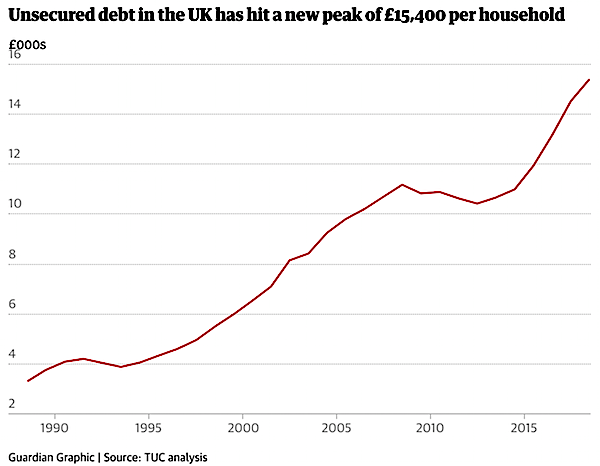
Britain’s household debt mountain has reached a new peak, with UK homes now owing an average of £15,385 to credit card firms, banks and other lenders, according to the TUC. The trade union body said household debt rose sharply in 2018 as years of austerity and wage stagnation forced households to increase their borrowing. The TUC said in its annual report on the nation’s finances that the amounts owed by British households rose to a combined £428bn in the third quarter of 2018. Each household owed £886 more than it did 12 months previously, it said. The figures do not include outstanding mortgage debts but do include student loans.

The level of unsecured debt as a share of household income is now 30.4%, the highest level it has ever been at. It is well above the £286bn peak in 2008 before the financial crisis, the TUC said. That figure also included student loans, but tuition fees then were £3,000 a year compared with up to £9,250 now. [..] The TUC general secretary, Frances O’Grady, said: “Household debt is at crisis level. Years of austerity and wage stagnation has pushed millions of families deep into the red. The government is skating on thin ice by relying on household debt to drive growth. A strong economy needs people spending wages, not credit cards and loans.”

Read more …

They’re going to stay home?!

UK Car Sales Record Biggest Fall Since Financial Crisis (R.)

British new car sales in 2018 fell at their fastest rate since the global financial crisis a decade ago, hit by a slump in demand for diesel, stricter emissions rules and waning consumer confidence due to Brexit, according to an industry body. Demand dropped by nearly 7% last year to 2.37 million vehicles, the largest fall since registrations nosedived 11.3% in 2008, preliminary data from the Society of Motor Manufacturers and Traders (SMMT) showed. A nearly 30% drop in demand for diesel was the most significant factor in the decline. Diesel has been pummelled since the Volkswagen emissions cheating scandal of 2015, prompting a crackdown and higher levies.

But the industry also warned that Britain’s departure from the European Union due at the end of March risks the future of a sector which employs over 850,000 people and has been one of Britain’s few manufacturing success stories since the 1980s. “It’s still hard to see any upside to Brexit,” said SMMT Chief Executive Mike Hawes. “Everyone recognises that Brexit is an existential threat to the UK automotive industry and we hope a practical solution will prevail,” he said, calling for lawmakers to back Prime Minister Theresa May’s deal to guarantee a transition period. [..] After record highs in 2015 and 2016, demand fell in 2017 and some analysts see car demand as a leading indicator which could be a harbinger for future economic performance. Britain’s economy slowed to a crawl at the end of 2018, the housing market is stalling and lending to consumers growing at its slowest pace in nearly four years, according to data released on Friday.

Read more …

Macron is not just a fool himself, he’s surrounded by them as well. His spokesman after fleeing his office out of a back door as protesters invaded the courtyard and smashed up several cars said: “It wasn’t me who was attacked.” “It was the Republic.”.

Because the government is the Republic. The population is not.

France’s Macron Reeling As Tough Stance Against ‘Yellow Vests’ Backfires (R.)

Emmanuel Macron intended to start the new year on the offensive against the ‘yellow vest’ protesters. Instead, the French president is reeling from more violent street demonstrations. What began as a grassroots rebellion against diesel taxes and the high cost of living has morphed into something more perilous for Macron – an assault on his presidency and French institutions. The anti-government protesters on Saturday used a forklift truck to force their way into a government ministry compound, torched cars near the Champs Elysees and in one violent skirmish on a bridge over the Seine punched and kicked riot police officers to the ground.

The French authorities’ struggle to maintain order during the weekend protests raises questions not just over policing tactics but also over how Macron responds, as he prepares to bring in stricter rules for unemployment benefits and cut thousands of public sector jobs. On Sunday evening, Macron wrote on Twitter: “Once again, the Republic was attacked with extreme violence – its guardians, its representatives, its symbols.” His administration had hardened its stance against the yellow vests after the protest movement appeared to have lost momentum over the Christmas holidays.

The government would not relent in its pursuit of reforms to reshape the economy, government spokesman Benjamin Griveaux said on Friday, branding the remaining protesters agitators seeking to overthrow the government. Twenty-four hours later, he was fleeing his office out of a back door as protesters invaded the courtyard and smashed up several cars. “It wasn’t me who was attacked,” he later said. “It was the Republic.”

Read more …

“There is a Euro, which is a single currency in an incomplete monetary union, with a set of fiscal rules that are evidently economically illiterate..”

The Euro: A Mindless Idea – Ashoka Mody (Spiked)

[..] most serious of all is the notion of common economic development as a basis for Europe. It was briefly true after the Treaty of Rome in 1957, which opened up the borders, but the momentum ran out within two decades. You open borders, but once they’re open, there’s not a lot more you can do. Even the gains from the so-called Single Market are very limited beyond a certain point. Every economist understands that. On the Euro, there was never any question that it was a bad idea. Nicholas Kaldor, an economist at Cambridge University, wrote in March 1971 that a single currency was a terrible idea, both as economics and as politics. And Kaldor has been proven right time and again.

But the entire European establishment just ignores every subsequent warning from well-regarded economists, and produces defensive counternarratives. For example, I often hear that Europe needs fixed exchange rates in order to have a Single Market. Why? Germany is trading a lot with Poland, Hungary and the Czech Republic, which are in the Single Market, but have different currencies. These fluctuate, but the trade continues apace. You don’t need a single currency for a Single Market.

spiked: When did your critique of the European project emerge? Was it during your involvement in the Irish bailout? Mody: When I finished at the IMF I planned to write a book on the Euro crisis. And I began writing it as an IMF economist would – what happened before the crash, the bubble, the bubble bursting, the panic, the fact it wasn’t well managed, and so on. But I soon realised that something wasn’t right here. And so I spent two years tracing the history of the Euro, and asking the question: what brought the Euro into existence in its current form? You see, it is not just that there is a Euro. There is a Euro, which is a single currency in an incomplete monetary union, with a set of fiscal rules that are evidently economically illiterate – and nobody questions the fact that they are economically illiterate, that they lack a necessary fiscal backstop and the necessary fiscal union. So why does it exist?

Read more …

Jan 062019


Paul Gauguin Osny, rue de Pontoise, Winter 1883


You Won’t Hear The Ugly Truth From The Fed (Henrich)
Yellow Vests Torch Cars In Chaos Of France’s 8th Weekend Of Clashes (Exp.)
If Corbyn Backs Brexit, He Faces Electoral Catastrophe (O.)
Brexit Deal Critics Risking Democracy – May (BBC)
EU Dashes May’s Hopes Of Landing Better Brexit Deal (Ind.)
Hackers Release 9/11 Papers, Say Future Leaks To Burn Down US Deep State (RT)
Documents Link UK Govt-Funded Integrity Initiative To Anti-Russia Narrative (RT)
Fears Grow In Africa That The Flood Of Funds From China Will Start To Ebb (O.)
It’s Nancy Pelosi’s Smile That Gets Me (Jim Kunstler)
Ex–NY Times Editor Jill Abramson Says Fox Took Her Words Out Of Context (AP)


Because the Fed IS the ugly truth.

It is sad that so many people still look at the Fed to save the “markets”. Sad and blind. Like nobody has any interest in having functioning markets and societies, and it’s all only about a quick buck.

You Won’t Hear The Ugly Truth From The Fed (Henrich)

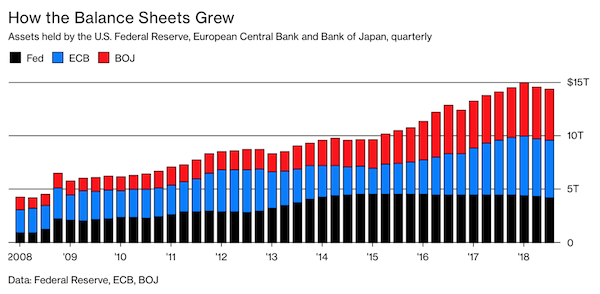
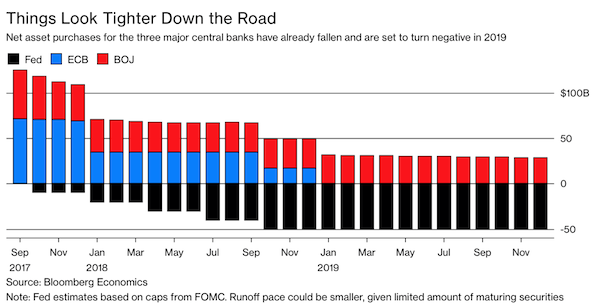
In March 2009 markets bottomed on the expansion of QE1 (quantitative easing, part one), which was introduced following the initial announcement in November 2008. Every major correction since then has been met with major central-bank interventions: QE2, Twist, QE3 and so on. When market tumbled in 2015 and 2016, global central banks embarked on the largest combined intervention effort in history. The sum: More than $5 trillion between 2016 and 2017, giving us a grand total of over $15 trillion, courtesy of the U.S. Federal Reserve, the European Central Bank and the Bank of Japan:

When did global central-bank balance sheets peak? Early 2018. When did global markets peak? January 2018. And don’t think the Fed was not still active in the jawboning business despite QE3 ending. After all, their official language remained “accommodative” and their interest-rate increase schedule was the slowest in history, cautious and tinkering so as not to upset the markets. With tax cuts coming into the U.S. economy in early 2018, along with record buybacks, the markets at first ignored the beginning of QT (quantitative tightening), but then it all changed. And guess what changed? Two things. In September 2018, for the first time in 10 years, the U.S. central bank’s Federal Open Market Committee (FOMC) removed one little word from its policy stance: “accommodative.” And the Fed increased its QT program. When did U.S. markets peak? September 2018.

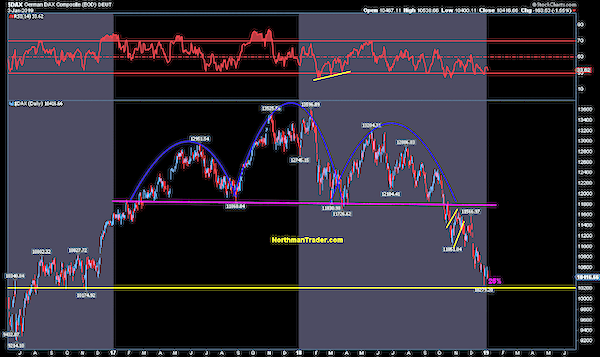
[..] Global central banks did the dirty work for the Fed between 2016 and 2017, adding ever more artificial liquidity. But then the ECB slowed its QE program and finally ended it in late 2018. How did the DAX (German stock index) handle all that removal in artificial liquidity? Not well.

[..] don’t mistake this rally for anything but for what it really is: Central banks again coming to the rescue of stressed markets. Their action and words matter in heavily oversold markets. But the reality remains, artificial liquidity is coming out of these markets. [..] What’s the larger message here? Free-market price discovery would require a full accounting of market bubbles and the realities of structural problems, which remain unresolved. Central banks exist to prevent the consequences of excess to come to fruition and give license to politicians to avoid addressing structural problems.

Read more …

Macron still does everything wrong. Now he chides the protesters for not accepting a debate on his terms.

Yellow Vests Torch Cars In Chaos Of France’s 8th Weekend Of Clashes (Exp.)

The yellow vest protesters who have entered their eighth week of street rallies are trying to topple President Macron and his administration, according to a French government spokesman. The movement made up largely of working and lower middle-class citizens has won widespread public approval as it is seen by many as a means of making the voices of ordinary men and women heard. But after months of unrest in Paris and other French cities, Benjamin Griveaux said the gilets jaunes are not interested in the three-month debate on the reforms promised by Mr Macron, but instead want to overthrow the young president. Speaking at a press conference on Friday after the weekly cabinet meeting, Mr Griveaux said members of the movement “seek insurrection and basically want to overthrow the government”.

He added: “They are henceforth involved in a political struggle to contest the legitimacy of the government and of the president of the republic. “Those who called for a debate don’t want to participate in a big national debate.” Mr Macron said he intends to write a letter to the French people this month outlining how he will deliver his ambitious plans. [..] ‘Angry France’, one of the group which makes up the yellow vests, rejected the president’s offer of a national debate. A statement issued by the group read: “Mr President, this movement that you don’t recognise is nevertheless spreading and strengthening itself even as your fellow citizens are cudgelled, gassed and detained for hours in an unbelievable lack of respect for citizens’ rights.”

Read more …

Corbyn has already built a disaster.

Westminster voting intention:

CON: 40% (-1)
LAB: 34% (-5)
LDEM: 10% (+3)
GRN: 4% (-)
UKIP: 4% (+1)

via @YouGov, 21 Dec – 04 Jan
Chgs. w/ 17 Dec

If Corbyn Backs Brexit, He Faces Electoral Catastrophe (O.)

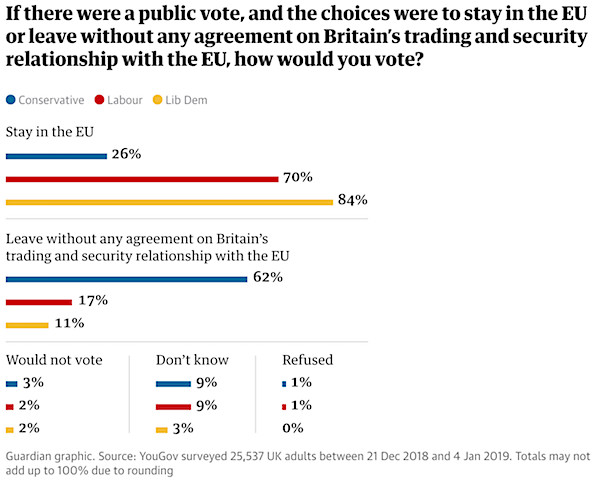
I have seldom seen a poll on a subject dividing the nation for which the lessons are so clear. The biggest survey yet conducted on Brexit shows that Remain would comfortably win a referendum held today – and that Labour would crash to a landslide election defeat if it helped Brexit go ahead. YouGov questioned more than 25,000 people between 21 December and last Friday. It tested two referendum scenarios. If the choice is Remain versus the government’s withdrawal agreement, Remain leads by 26 points: 63% to 37%. If the choice is Remain versus leaving the EU without a deal, Remain wins by 16 points: 58% to 42%. The difference is explained by the views of those who voted Leave in 2016.

Many of them want a clean break with Brussels, but back away from an agreement that fails to redeem the promise in 2016 to “take back control”. Among all voters, only 22% support the government’s deal. Among Leave voters the figure is not much higher: 28%. The larger point is that the nature of the choice has changed since 2016 – 52% voted Leave when it was a general aspiration with little apparent downside. Today support for Brexit is significantly lower when Leave is more clearly defined. This pattern is familiar to referendums in different countries: many people support the broad idea of change, but back away when the details are laid out. They want “change”, but not “this change”. That is clearly the case today: 80% of people who voted Leave two years ago still say they want Brexit to go ahead; but the figure falls to 69% if the choice is a “no deal” Brexit, and only 55% if the referendum offers the withdrawal agreement.

The rest say they don’t know, or switch to Remain. (The respective loyalty rates on the other side – Remain voters in 2016 who would stick with Remain today – are significantly higher.) [..] The conventional voting intention question produces a six-point Conservative lead (40% to 34%). This is bad enough for an opposition that ought to be reaping electoral dividends at a time when the government is in crisis. However, when voters are asked how they would vote if Labour failed to resist Brexit, the Conservatives open up a 17-point lead (43% to 26%). That would be an even worse result than in Margaret Thatcher’s landslide victory in 1983, when Labour slumped to 209 seats, its worst result since the 1930s.

Read more …

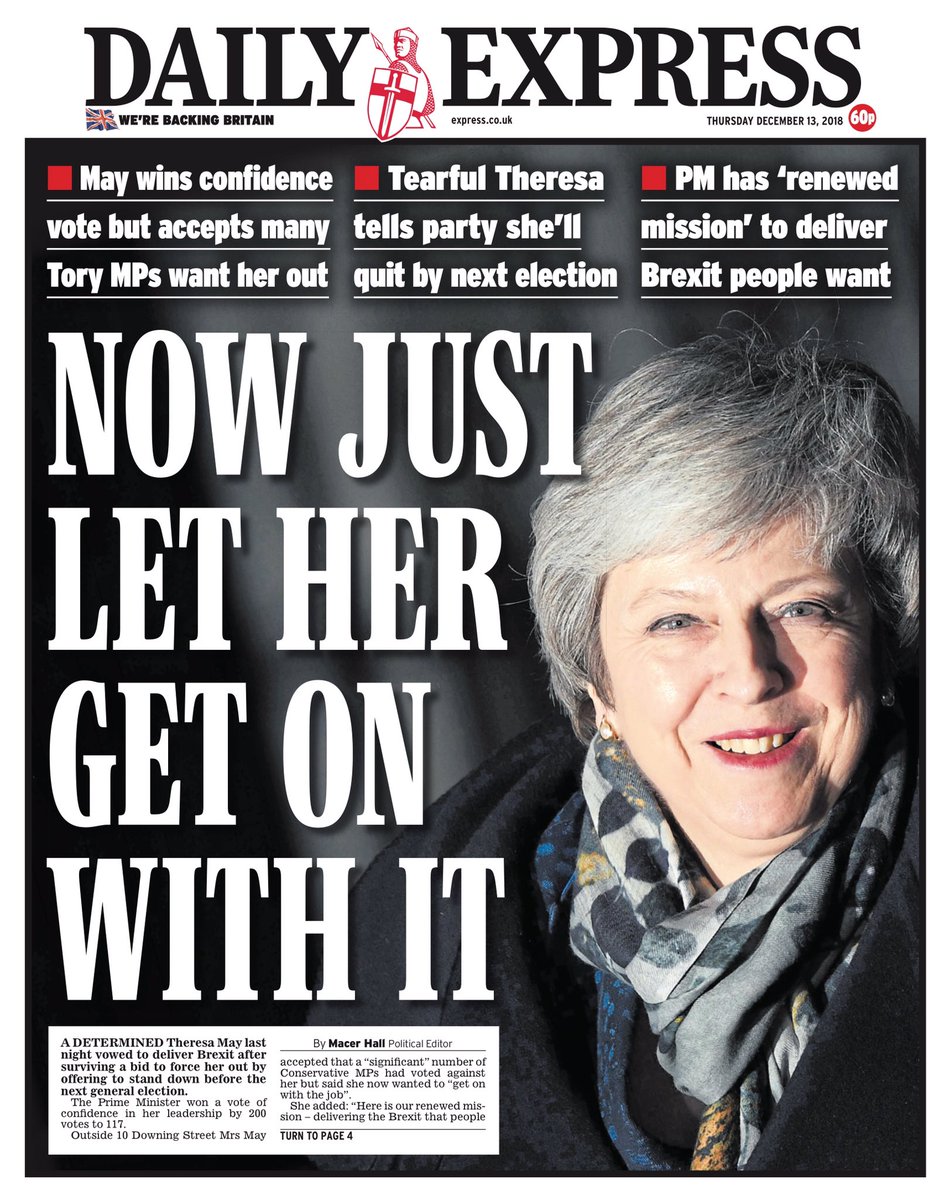
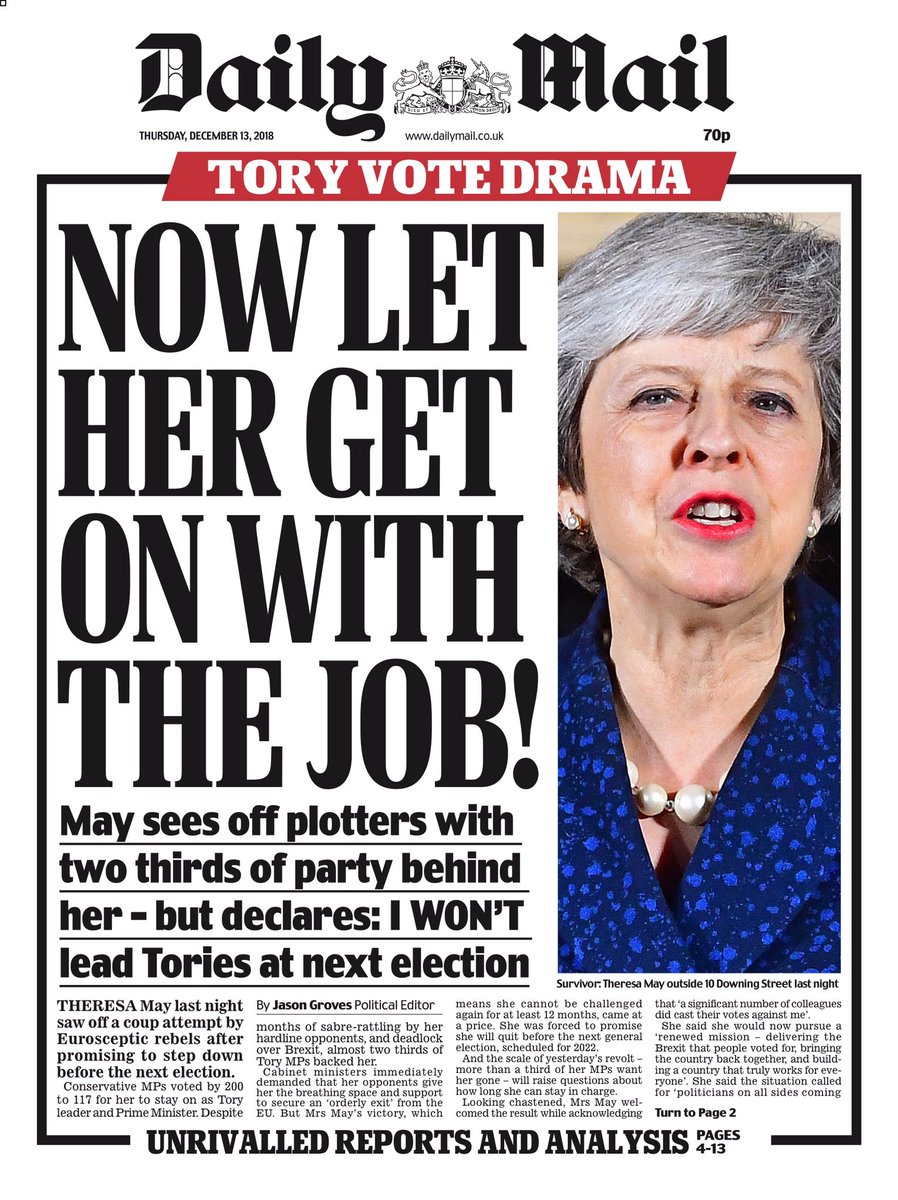
“..fewer than one in four voters..” support May’s deal. But opposing it risks democracy. You tell me.

Brexit Deal Critics Risking Democracy – May (BBC)

The prime minister has urged MPs to back her Brexit deal, saying it is the only way to honour the referendum result and protect the economy. Writing in the Mail on Sunday, Theresa May said her critics – both Remainers and Brexiteers – risk damaging democracy if they oppose her plan. But a poll carried out for the People’s Vote campaign suggests fewer than one in four voters support her Brexit deal. MPs are due to vote on whether to back Mrs May’s Brexit plan next week. The UK is due to leave the EU on 29 March 2019 – regardless of whether there is a deal with the EU or not. A deal on the terms of the UK’s divorce and the framework of future relations has been agreed between the prime minister and the EU – but it needs to pass a vote by MPs in Parliament before it is accepted.

The House of Commons vote had been scheduled to take place in December but Mrs May called it off after it became clear that not enough MPs would vote for her deal. The debate on the deal will restart on Wednesday, with the crucial vote now expected to take place on 15 January. Writing in the Mail, Mrs May said: “The only way to both honour the result of the referendum and protect jobs and security is by backing the deal that is on the table.” She said “no one else has an alternative plan” that delivers on the EU referendum result, protects jobs and provides certainty to businesses.

“There are some in Parliament who, despite voting in favour of holding the referendum, voting in favour of triggering Article 50 and standing on manifestos committed to delivering Brexit, now want to stop us leaving by holding another referendum,” she said. “Others across the House of Commons are so focused on their particular vision of Brexit that they risk making a perfect ideal the enemy of a good deal. “Both groups are motivated by what they think is best for the country, but both must realise the risks they are running with our democracy and the livelihoods of our constituents.”

Read more …

May is now holding the entire country hostage.

She’s going to have to have that vote soon. But today’s Telegraph reports she wants to delay it again. Because she knows she will lose.

EU Dashes May’s Hopes Of Landing Better Brexit Deal (Ind.)

Theresa May’s hopes of securing the legally binding changes needed to win support for her Brexit deal are fading, after EU sources said it was unlikely there would be a new European summit to approve them. An emergency council like the one held in November would be needed to sanction any changes that would have legal force. But diplomats have told The Independent that any concessions offered would be unlikely to require a meeting. It means any alterations or new language secured by the prime minister will probably not satisfy enough rebel Tories or her DUP partners in government to win the Commons vote expected in the coming weeks. Only this week the DUP warned the prime minister that unless Brussels gave significant ground on the hated Irish backstop it would not support her plans.

MPs return to Westminster next week and begin several days of debate on Ms May’s deal before it is put to a vote that most people expect the prime minister to lose. Downing Street has been trying to play down expectations that Ms May will secure a major change before the vote due on 15 or 16 January, but there had been talk that European officials are holding back one concession that they could make to the UK later in the year. But even for those changes to have legal force, a new summit would need to be called as currently there is only one scheduled for the end of March – far too late to do anything meaningful before the UK drops out of the EU on 29 March. European insiders told The Independent that the idea of a summit had been considered, but this was now looking less likely.

Read more …

They want a lot more money.

Hackers Release 9/11 Papers, Say Future Leaks To Burn Down US Deep State (RT)

The Dark Overlord hacker group has released decryption keys for 650 documents it says are related to 9/11. Unless a ransom is paid, it threatened with more leaks that will have devastating consequences for the US ‘deep state’. The document dump is just a fraction of the 18,000 secret documents related to the September 11, 2001 terrorist attacks believed to have been stolen from insurers, law firms, and government agencies. The Dark Overlord initially threatened to release the 10GB of data unless the hacked firms paid an unspecified bitcoin ransom. However, on Wednesday, the group announced a “tiered compensation plan” in which the public could make bitcoin payments to unlock the troves of documents.

A day later, the Dark Overlord said that it had received more than $12,000 in bitcoin – enough to unlock “layer 1” and several “checkpoints,” comprised of 650 documents in total. There are four more layers that remain encrypted and, according to the group, “each layer contains more secrets, more damaging materials… and generally just more truth.” The hackers are asking for $2 million in bitcoin for the public release of its “megaleak,” which it has dubbed “the 9/11 Papers.” [..] By design, the “layer 1” documents – if authentic – do not appear to contain any explosive revelations. The publications focus mostly on testimonies from airport security and details concerning insurance pay-outs to parties affected by the 9/11 attacks. However, the data dump suggests that the group is not bluffing.

Read more …

British smear is second to none.

Documents Link UK Govt-Funded Integrity Initiative To Anti-Russia Narrative (RT)

The Integrity Initiative, a UK-funded group exposed in leaked files as psyop network, played a key role in monitoring and molding media narratives after the poisoning of double agent Sergei Skripal, newly-dumped documents reveal. Created by the NATO-affiliated, UK-funded Institute for Statecraft in 2015, the Integrity Initiative was unmasked in November after hackers released documents detailing a web of politicians, journalists, military personnel, scientists and academics involved in purportedly fighting “Russian disinformation.” The secretive, government-bankrolled “network of networks” has found itself under scrutiny for smearing UK Labour leader Jeremy Corbyn as a Kremlin stooge – ostensibly as part of its noble crusade against anti-Russian disinformation.

Now, new leaks show that the organization played a central role in shaping media narratives after Sergei Skripal and his daughter Yulia were mysteriously poisoned in Salisbury last March. It’s notable that many of the draconian anti-Russia measures that the group advocated as far back as 2015 were swiftly implemented following the Skripal affair – even as London refused to back up its finger-pointing with evidence. Days after the Skripals were poisoned, the Institute solicited its services to the Foreign & Commonwealth Office, offering to “study social media activity in respect of the events that took place, how news spread, and evaluate how the incident is being perceived” in a number of countries. After receiving the government’s blessing, the Integrity Initiative (II) launched ‘Operation Iris,’ enlisting “global investigative solutions” firm Harod Associates to analyze social media activity related to Skripal.

Read more …

China’s taken the place of the IMF.

Fears Grow In Africa That The Flood Of Funds From China Will Start To Ebb (O.)

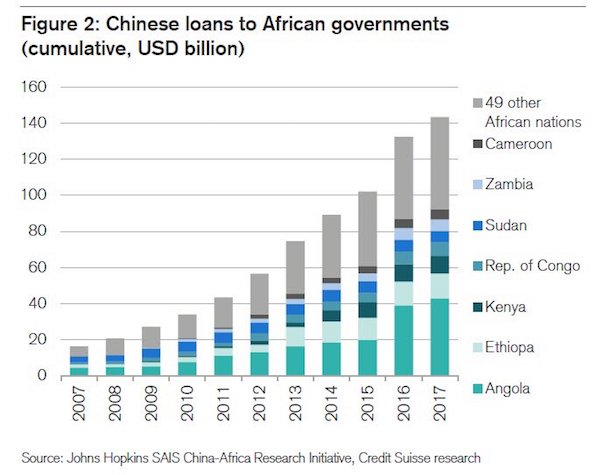
Concerns over Chinese growth could spell problems for Africa and other parts of the developing world. Beijing funded an overseas investment boom in the past few decades as it strove to become the world’s second largest economic superpower, while also buying vast amounts of the natural resources produced by emerging nations. The scale of the expansion forms part of China’s multibillion-dollar “Belt and Road” Initiative, a state-backed campaign to promote its influence around the world, while providing stimulus for its own slowing economy. The transcontinental development project launched by China’s president, Xi Jinping, in 2013 aims to improve infrastructure links between Asia, Europe and Africa, with the aim for China to reap the benefits from increasing levels of global trade.

Mounting tensions between China and the US, however, have acted as a handbrake on rising levels of world trade. The IMF forecasts Chinese growth will slow to 6.2% this year from about 6.6% in 2018, due to escalations in the trade dispute that erupted last year. There are also rising fears over the rapid growth of debt in China used to fuel its expansion over the past decade. With Chinese investment in some African nations worth more than some of those states’ own domestic spending, analysts fear the prospect of weaker investment in future and fading demand for commodity exports. Figures from the United Nations’ development agency, Unctad, show that weakness in global commodity prices in 2014 and 2015 caused foreign direct investment flows into Africa to fall from $55bn in 2015 to $42bn in 2017, showing how Africa might be hit by a Chinese slowdown.

Read more …

“Nancy’s smile is full of malice and bad faith..”

It’s Nancy Pelosi’s Smile That Gets Me (Jim Kunstler)

It’s Nancy Pelosi’s smile that gets me…oh, and not in a good way. It’s a smile that is actually the opposite of what a smile is supposed to do: signal good will and good faith. Nancy’s smile is full of malice and bad faith, like the smiles on representations of Shiva-the-Destroyer and Huitzilopochtli, the Aztec sun god who demanded thousands of human hearts to eat, lest he bring on the end of the world. It’s not exactly the end of the world in Washington D.C., but as the old saying goes: you can see it from there! It’s out on the edge of town like one of those sinister, broken-down circuses from the Ray Bradbury story-bag, with its ragtag cast of motheaten lions, crippled acrobats, a crooked wagon full of heartbroken freaks, and a shadowy ringmaster on a mission from the heart of darkness.

The new Democratic majority congress has convened in the spirit of a religious movement devoted to a single apocalyptic objective: toppling the Golden Golem of Greatness who rules in the House of White Privilege. They’re all revved up for inquisition, looking to apply as many thumbscrews, cattle prods, electrodes, waterboards, and bamboo splinters as necessary in pursuit of rectifying the heresy of the 2016 election. The simpleton California congressman Brad Sherman (D-30th dist.) couldn’t contain his glee, like a seven-year-old boy about to pull the wings off a fly. As soon as the Democratic majority was sworn in, he filed his articles of impeachment to impress his Wokester San Fernando Valley constituents out for deplorable blood.

That was even a bit too much for Madam Speaker who reminded Sherman that some scintilla of a predicate crime was required — but surely would be available when Special Counsel Robert Mueller hurls down his tablets of accusation from on high.

Read more …

But Kurtz simple quoted directly from her book?! Here’s thinking she got a few angry calls. Genre: if you ever want to work in this town again….

Ex–NY Times Editor Jill Abramson Says Fox Took Her Words Out Of Context (AP)

Jill Abramson, the former editor of the New York Times, said Fox News took her criticism of the newspaper’s Trump coverage in her upcoming book “totally out of context” for a story that appeared this week. The Fox News story, headlined “Former NY Times editor rips Trump coverage as biased,” quotes from Abramson’s book, “Merchants of Truth.” She wrote that although current Times executive editor Dean Baquet publicly said he didn’t want the newspaper to be the opposition party, “his news pages were unmistakably anti-Trump.” With an audience perceived to be mostly liberal, “there was an implicit financial reward for the Times in running lots of Trump stories, almost all of them negative,” she wrote in the book.

In a Saturday tweet, Trump commended Abramson as “100% correct” about the paper’s “[h]orrible and totally dishonest reporting on almost everything they write” and suggested it justified his calling the Times “fake news”. [..] Abramson was executive editor of the New York Times Co. flagship from 2011 to 2014 before being fired following a dispute with Baquet, then one of her deputies. She said in an email interview with the Associated Press that the Fox article’s author, “Media Buzz” host Howard Kurtz, had ignored compliments that she had for the Times and the Washington Post. “His article is an attempt to Foxify my book,” she wrote in the email, saying her book was “full of praise” for the New York Times and the Washington Post “and their coverage of Trump.”

Kurtz said in a phone interview with the AP that he was “sorry to see Jill back away from her own words” and that his report was accurate. “I would have written this story the same way if I were working for any news organization,” said Kurtz, a former Washington Post media columnist. “Her sometimes harsh criticism of her former paper’s Trump coverage leaps off the page and is clearly the most newsworthy element in the book because of her standing as a former executive editor.” [..] Abramson wrote that the more anti-Trump the Times was perceived to be, the more it was mistrusted for being biased. The late publisher Adolph Ochs’s promise to cover the news without fear or favor “sounded like an impossible promise in such a polarized environment, where the very definition of ‘fact’ and ‘truth’ was under constant assault,” she wrote in the book.

Read more …

Dec 282018
 
 December 28, 2018  Posted by at 10:33 am Finance Tagged with: , , , , , , , , , , , ,  5 Responses »


Berthe Morisot After luncheon1881


Investors Fear Historic Market Rebound Was Just A ‘Wicked Bear Trap’ (MW)
US Stocks Follow Record-Breaking Rise With Day Of Wild Swings (G.)
VIX Is About To Do Something It Hasn’t Done Since 2011 (MW)
Watch Out When Men Of War Come To The Rescue (Fisk)
Giuliani: Mueller Must Be Investigated For Destruction Of FBI Evidence (Hill)
Donald Trump ‘Worst Perpetrator’ Of Fake News: UN Special Rapporteur (Pol.eu)
Macron ‘Lost Authority’ After Caving To Yellow Jackets, Says Oettinger (Pol.eu)
Corbyn Wants May To Recall MPs Early Over Critical Brexit Vote (Ind.)
Brexit’s Aura Of Inevitability Is Vanishing (Kaletsky)
Turning Brexit Into a Celebration of Democracy (Varoufakis)
Crime and Punishment in an Age of the Jungle (Vallianatos)


Catchy, but A Christmas Carol might be a better example. ‘Investors’ believe the ghosts are real, just like they believe markets are real. Read yesterday’s 2019: Zombie Markets Before The Fall to understand why that is nonsense.

Investors Are Speechless: “It’s Like Watching Pulp Fiction” (ZH)

With market action becoming increasingly surreal and the panicked, vertigo-inducing bear market rallies (spawned by a record $64 billion pension fund reallocation into stocks in a historically illiquid market) reminiscent of the chaos observed at the depths of the financial crisis, it is only appropriate that some of the quotes Bloomberg picked for its daily wrap piece which commemorated the biggest intraday reversal since 2010, be just as surreal. “Investors are becoming desensitized,” Bryce Doty, SVP at Sit Investment Associates, told Bloomberg, then continued the verbal poetry: “It’s like watching ‘Pulp Fiction.’ Halfway through, the violence doesn’t even bother you anymore.”

He’s right, although whereas the market “violence” in past weeks was one directional, this week it has developed a twist to trap both the bulls and bears, and while the latest Dow swing (of nearly 1000 points) was only slightly bigger than the average up-and-down move last week, back then equities were merely tumbling, now it tends to drop early in the day then soar in afternoon trading. So fast forwarding to the post-Christmas chaos – which this website explicitly warned about when last Friday we said to “Brace For Seismic Volatility” – strategists are starting to ask: if days like these are now normal, is there a context in which the whole three-month rout starts to feel routine?

There are the optimists like Jim Kelleher, director of research at Argus Research, who said market turmoil that happens when the economy is holding up reminds him of past stock declines that ended gently. Unless evidence emerges of deep global growth erosion, what’s going on now “will prove to be shorter and more shallow than the declines experienced in ‘classic’ bear markets.” Others are not so sure: “Investors are wondering if this will be a crash,” said Dave Campbell, a principal at San Francisco’s BOS, who nonetheless still managed to put a favorable spin on events.

“The risks are there, but they’re always there. They’re more heightened but it’s not the most likely outcome. The economy continues to grow – maybe a little more slowly – but next year markets will have hit their lows and we’ll be on the rebound.” Then there are those who echo what we asked yesterday, namely if this is only a bear market rally, although granted a very furious one: as Bloomberg writes in its second end of day wrap, “on the surface, the rally is good news for investors searching for a bottom after a three-month sell-off sent the S&P 500 to the brink of a bear market. But days like this are rarely good omens.”

Read more …

What’s happening is much more profound than bear markets.

Investors Fear Historic Market Rebound Was Just A ‘Wicked Bear Trap’ (MW)

It’s been a rough three months, and a particularly difficult December, for stocks, however. The Nasdaq is in a bear market while the Dow and S&P 500 are solidly in correction territory and nursing hefty December losses and year-to-date declines. Some market watchers find big bounces in such an environment less than convincing. Russ Mould, investment director at AJ Bell, offered up the table below in a Thursday note. It takes a look back at the 20 biggest one-day percentage gains for the S&P 500 going back to 1970, a stretch that includes nearly 12,800 trading days.

[..] Bulls can take encouragement from the fact that three of the 17 other days that saw an advance of 5% or more came immediately in the aftermath of the October 1987 crash, “when buying did prove a good plan,” while two more came in March 2009, when the S&P 500 hit bottom and began its current bull run. But here’s the rub: Eight of those gains of 5% or more came during the 2007-09 bear market and three more occurred during the downturn of 2000-03, “to suggest there is still a risk that this year’s Boxing Day bonanza could be no more than a wicked bear trap set to lure investors into more trouble,” Mould wrote ahead of Thursday’s open, saying that traders and investors “will be looking out for a couple of further definitive signals before they decide it really is time to buy on the dips following this year’s Christmas selloff.”

Indeed, market veterans warn that massive, one-day rallies are often more characteristic of downturns, occurring as selloffs lead to significantly oversold technical conditions that leave markets ripe for short covering only to give way to renewed selling once the frenzy of forced buying is exhausted. Investors who short a stock are essentially betting that its price will fall by first borrowing the shares, but those traders can be forced to buy shares back if prices suddenly swing higher, which, in turn, can amplify price swings.

Read more …

When is all this cheap money going to bail out?

US Stocks Follow Record-Breaking Rise With Day Of Wild Swings (G.)

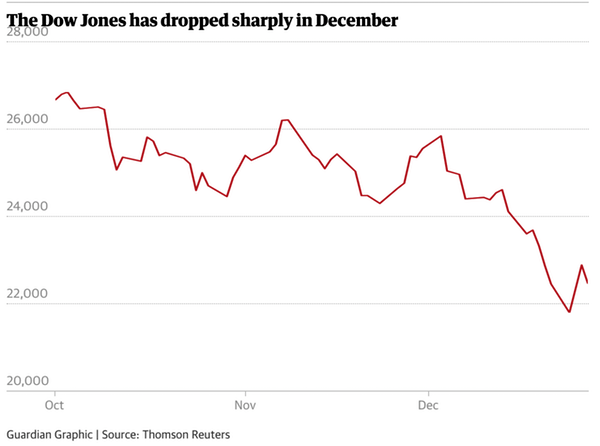
US stock markets seesawed again on Thursday as a record-breaking day of gains gave way to selling once again before rising again in late trading. By lunchtime all the major US markets were in the red, with the Dow Jones Industrial Average down 1.4%, the S&P 500 losing 1.5% and the Nasdaq off 1.9%. But most US markets ended the day in the black with the Dow up 1.13%, the S&P adding 0.85% and the Nasdaq 0.38%. After a series of often wild swings the US stock markets are still on course to end the year in bear market territory – triggered when markets fall 20% from their most recent high. A bear market would be the first in close to a decade.

Michael Antonelli, managing director, institutional sales trading at Robert W Baird in Milwaukee, said he expected more dramatic days aheads. “There’s only two more sessions left before the end of the year. I would expect volatility to reign. It’s dug in like a tick,” he said. Stocks had fallen for four consecutive days through Monday. Wednesday’s rally – with the Dow adding close to 5% and a record 1,080 points – could have signaled a turning point. Markets closed up in Japan and Australia but European markets sank again on Thursday, with the FTSE closing down 1.5% in London, sinking to it’s lowest level since July 2016 (a month after the Brexit vote). Germany’s DAX closed down 2.3% and France’s CAC fell 0.6%

Stock markets have become increasingly volatile in recent months and recorded both record losses and record gains this week. The Dow Jones plummeted 653 points on Monday, capping its worst week in a decade and marking its “worst day of Christmas Eve trading ever”.

Read more …

The low VIX shows you how out of touch the financial world is. There can be only one reason for it: the Fed.

VIX Is About To Do Something It Hasn’t Done Since 2011 (MW)

It shouldn’t come as a surprise to anyone paying attention that stock-market volatility is on the rise. But here’s a statistic that underlines the phenomenon. The Cboe Volatility Index, commonly known as the VIX and often, if not sometimes derisively, referred to as Wall Street’s fear gauge, was on track Thursday to close above 30 for the fourth day in a row. The index, an options-based measure of expected volatility over the coming 30-day period, traded at 32.92 in recent action, up 2.51 points. According to data compiled by Dow Jones Market Data, that would be the longest streak since a 14-day run that ended in November 2011, surpassing a three-day period seen in August 2015. The index has a long-term average near 20.

It’s certainly been a week of whipsaw trading for investors. The S&P 500, Dow Jones Industrial Average and Nasdaq Composite all falling more than 2% in Monday’s holiday-abbreviated session to post the worst Christmas Eve performance in Wall Street history, only to roar back on Wednesday to more than reverse those declines as the S&P and Dow jumped 5% each and the Nasdaq gained 5.8%. On Thursday, stocks were back under pressure, with the Dow giving up more than half of the previous day’s 1,086-point gain.

Read more …

Robert Fisk is done. Comparing Putin to Hitler on the brink of 2019 is all we need to know. BTW, Mattis DID consider running.

Watch Out When Men Of War Come To The Rescue (Fisk)

When a general popularly known as James “Mad Dog” Mattis abandons a really mad American president, you know something has fallen off the edge in Washington. Since the Roman empire, formerly loyal military chiefs have fled crackpot leaders, and Mattis’s retreat from the White House might have the smell of de Gaulle and Petain about it. De Gaulle was confronted by an immensely powerful hero of the people – the Lion of Verdun – who was, in his dotage, about to shrug off the sacred alliance with Britain for Nazi collaboration (for which, I suppose, read Putin’s Russia). The decision was made to have nothing to do with Petain, or what Mattis now refers to as “malign actors”. De Gaulle would lead Free France instead.

Mattis has no such ambitions – not yet, at any rate – although there are plenty of Lavals and Weygands waiting to see if Trump chooses one of them for his next secretary of defence. Besides, history should not grant Trump and Mattis such an epic panorama. After all, no Trump tweet could compare with Petain’s 1916 “We’ll get them!” (“on les aura”) slogan, and the dignified, cold and fastidious de Gaulle would never have lent himself to the rant Mattis embarked upon in San Diego in 2005: “You go into Afghanistan, you got guys who slap women around for five years because they didn’t wear a veil. You know, guys like that ain’t got no manhood left anyway. So it’s a hell of a lot of fun to shoot them. Actually, it’s a lot of fun to fight. You know, it’s a hell of a hoot. It’s fun to shoot some people. I’ll be right upfront with you, I like brawling.”

Read more …

If investigations like this are not held, the US risks becoming a very volatile place.

Giuliani: Mueller Must Be Investigated For Destruction Of FBI Evidence (Hill)

Rudy Giuliani has an unmistakable New Year’s message for special counsel Robert Mueller: It is time for the chief investigator in the Russia case to be investigated in 2019. In wide-ranging interviews with Hill.TV’s Buck Sexton and me on Wednesday and Thursday, President Trump’s defense lawyer pointedly accused Mueller’s office of destroying evidence by allowing text messages from now-fired FBI official Peter Strzok and his FBI lover, Lisa Page, to be erased in the Russia probe. “Mueller should be investigated for destruction of evidence for allowing those text messages from Strzok to be erased, messages that would show the state of mind and tactics of his lead anti-Trump FBI agent at the start of his probe,” Giuliani said.

The Justice Department inspector general (IG) reported this month that it found large gaps in the preservation of official government text messages between Strzok and Page, the two top FBI agents who helped to start the Russia probe in 2016, who were having an affair at the time, and who expressed disdain for Trump. The report said a technical glitch was to blame for the FBI’s failure to save those text messages, but the IG was able to recover more than 19,000 from the early part of the Russia probe before Mueller was named special prosecutor. However, the IG said it was unable to recover messages from the time Strzok and Page worked for Mueller’s office in spring and summer 2017 because the memories of both FBI officials’ government phones were wiped clean by technicians.

That erasure occurred after Strzok and Page left Mueller’s team over revelations they exchanged anti-Trump text messages, including one string in which they talked about stopping Trump from becoming president. “That should be investigated, damn it, that should be investigated fully. You want a special counsel, get one for that,” Giuliani said.

Read more …

Really? The UN is going to pick sides? Against Trump and pro Big Tech?

Donald Trump ‘Worst Perpetrator’ Of Fake News: UN Special Rapporteur (Pol.eu)

The President of the United States is the “worst” perpetrator of misinformation on the internet, the U.N. Special Rapporteur on Freedom of Expression and Opinion David Kaye said in an interview published today. “Governments are real offenders when it comes to disinformation,” said Kaye. “In my own country, the United States, the worst perpetrator of false information is the President of the United States.” The problem of fake news emanating from governments should be covered by journalists, the rapporteur said. Platforms such as Google, Facebook or Twitter can help the broader fight against disinformation — bots, foreign interference… — but should not remove content, Kaye said.

“The platforms, I think, can do things that are more technical as long as they are not evaluating content. There are things they can do. They can’t just zap it and say, “This is fake news, it’s off the platform.” According to Kaye, platforms should focus on reducing spam and bot accounts rather than on policing content. And even bots are “tricky, because there are good bots and bad bots.” Google, Facebook and Twitter are under intense pressure from the European Commission to tackle fake news ahead of the European election in May 2019.

Read more …

When did the Yellow Vests become an insect species?

Macron Lost Authority After Caving To Yellow Jackets – EU’s Oettinger (Pol.eu)

The EU will accept a French budget deficit above the EU’s 3 percent ceiling in 2018 “as a one-time exception,” Budget Commissioner Günther Oettinger said in an interview published Thursday. Oettinger told the Funke media group of German newspapers that French President Emmanuel Macron had “lost authority with his budget for 2019” by upping his spending in response to the Yellow Jackets protests, “but he remains a strong supporter of the European Union.” Brussels reviewed the French budget several weeks ago and won’t be revisiting it, Oettinger added. “It crucial now that Macron continues his reform agenda, especially in the labor market, and that France remains on its growth track.”

“Under this condition, we will tolerate a national debt higher than 3 percent as a one-time exception. However, it must not continue beyond 2019.” Oettinger also told the Funke media group that there’s still a chance Britain’s parliament will vote in favor of Prime Minister Theresa May’s Brexit deal in January and that “there is certainly no majority for a disorderly Brexit or for a new referendum.” If the U.K. leaves the bloc without a Brexit deal, it will become “a third country like Morocco or Azerbaijan,” Oettinger said. He added that if Britain withholds its divorce payment in 2019, Germany would be left footing the bill “in the mid-three-digit range” of hundreds of millions of euros.

Read more …

The sudden urgency is too late.

Corbyn Wants May To Recall MPs Early Over Critical Brexit Vote (Ind.)

Jeremy Corbyn has challenged Theresa May to cut short the Christmas recess and recall parliament early in the new year in order to bring forward a critical vote on the Brexit deal. In an interview with The Independent, the Labour leader said he believed the prime minister and her allies were engaged in a “cynical manoeuvre” to run down the clock and offer MPs the “choice of the devil or the deep blue sea”. His remarks come as the Commons prepares to vote on the UK-EU deal in the week beginning 14 January – in what is being billed as the most significant moment in parliament for a generation.

With just 91 days remaining until Britain formally leaves the European Union, Mr Corbyn also reiterated it is a matter of “when, not if” Labour attempts to force a general election by tabling a motion of no confidence in the government, which he signalled will come in the aftermath of Ms May’s deal failing to receive MPs’ backing. But he refused to be drawn on whether a Labour government would seek to extend Article 50, given that just weeks would remain for any renegotiation of Britain’s exit from the bloc, and claimed: “Lots of things are possible, the EU has longform on reopening and extending negotiations, but let’s not jump too many hoops when we haven’t arrived at them.”

Speaking in his constituency office in Islington, north London, ahead of Christmas Day, he poured scorn on the prime minister’s decision earlier this month to pull a vote on the deal in the face of near-certain defeat and instead begin a last-ditch attempt to seek assurances from the EU to assuage Brexiteers’ concerns over the contentious issue of the Irish backstop. Pressed on whether he believed Ms May should now recall parliament a week early, on 2 January, the Labour leader replied: “Well it is in her hands to recall parliament. I want us to have a vote as soon as possible, that’s what I’ve been saying for the past two weeks, and if that means recalling parliament to have the vote let’s have it.

“But it looks to me the government has once again reneged on that and tried to put it back another week. We need to have that vote so a decision of parliament can be made. What I suspect is that it’s a completely cynical manoeuvre to run down the clock and offer MPs the choice of the devil or the deep blue sea.”

Read more …

For some, perhaps.

Brexit’s Aura Of Inevitability Is Vanishing (Kaletsky)

In times of political turmoil, events can move from impossible to inevitable without even passing through improbable. In early 2016, the idea of Britain leaving the European Union seemed almost as absurd as the next American president being the six-time bankrupt and serial sex pest Donald Trump. A few months later, Brexit and the Trump presidency were universally acknowledged as the inevitable consequence of an anti-elitist, anti-globalization backlash that was predictable decades ago. This sense of inevitability, far more than genuine anti-European conviction, is what has discouraged Britain from changing its mind about a pointless and self-destructive policy that few voters cared about until 2016.

The message from post-Brexit polling and focus groups has been: “We all know that Brexit has to happen, so why don’t the politicians just get on with it?” But with the Brexit process now moving toward its climax, another outcome is moving from impossible to inevitable: Britain could soon change its mind and decide to stay in the EU. This reversal of fortune could begin next month, when Prime Minister Theresa May is expected to lose the decisive parliamentary vote on her Brexit deal. If and when this defeat happens, May will face two unpalatable options. She could preside over a “No Deal” rupture with Europe — tantamount to a declaration of economic war against the EU — and risk a 2008-level economic crisis accompanied by a border upheaval in Ireland that could reignite the “Troubles.”

Or she could break her extravagant promises to honor the “people’s instruction” from the 2016 referendum and allow a new popular vote that might cancel Brexit. To avoid this invidious choice, May could try one last time to push her proposals through Parliament after losing the vote scheduled for the week of January 14. But if this last-ditch effort fails, her choices will be reduced to a No Deal rupture with Europe and a new referendum.

Read more …

Varoufakis is basically right, but I can’t see a three-year People’s Debate tackling 6 issues. Brits will think: we can’t even deal with one issue. And an extension of a transition period until 2022 is hard to see, too.

Turning Brexit Into a Celebration of Democracy (Varoufakis)

With weeks left before the UK leaves the EU by default, none of the three main options on offer – a no-deal Brexit, Prime Minister Theresa May’s withdrawal agreement with the EU, and rescinding Article 50 in order to remain in the EU – commands a majority in Parliament or among the population. Each generates maximum discontent: The no-deal scenario strikes most as a dangerous plunge into the unknown. May’s deal appalls Remainers and is seen by most Leavers as the kind of document only a country defeated at war would sign. Lastly, a Brexit reversal would confirm Leavers’ belief that democracy is allowed only when it yields results favored by the London establishment.

The conventional wisdom in Britain is that this impasse is lamentable, and that it proves the failure of British democracy. I disagree on both counts. If any of the three immediately available options were endorsed, say, in a second referendum, discontent would increase and the larger questions plaguing the UK would remain unanswered. Britons’ reluctance to endorse any Brexit option at present is, from this perspective, a sign of collective wisdom and a rare opportunity to come to terms with the country’s great challenges while re-thinking the UK’s relationship with the EU. But to seize it, the UK must invest in a “People’s Debate,” leading, in time, to a “People’s Decision.”

The People’s Debate must address six issues: the British constitution, including the creation of an English parliament or multiple regional English assemblies; the electoral system and the role of referenda; the Irish question, including the possibility of joint UK-Irish sovereignty over Northern Ireland; migration and freedom of movement; Britain’s economic model, particularly the outsize role of finance and the need to boost green investment across the country; and of course the UK-EU relationship.

Read more …

Proudly poisoning your food for 100 years.

Crime and Punishment in an Age of the Jungle (Vallianatos)

[..] studies funded by EPA and others have been connecting farmers’ sprays to ecocide, disease and death. I traced the catastrophic decline of honeybees to the neurotoxic pesticides of the farmers. This brought me in touch with a caring beekeeper from Colorado named Tom Theobald. He was telling me his days as a beekeeper were coming to an end. In December 2018, he summarized 44 years of living with honeybees and the poisoners of honeybees. “Almost every problem we face,” he said, “can be traced to a Criminal Corporatism and an out of control Capitalism. If there is a profit to be made, there is little regard paid to the consequences. If challenged, we get denial, diversion, excuses and junk science. It simply doesn’t matter how many people are sickened or die, how many species are pushed to extinction or how seriously the planet is compromised.”

[..] We are fortunate we have a reliable history of that irresponsible age by Deborah Blum, director of the Knight Science Journalism Program at MIT. A prolific and outstanding writer, Blum is telling a story that illuminates both early twentieth century, but, perversely, our own times. Her timely book, The Poison Squad: One Chemist’s Single-Minded Crusade for Food Safety at the Turn of the Twentieth Century (Penguin Press, 2018) paints an unforgettable picture of an American table full of “adulterated” food. Milk and meat were routinely treated with formaldehyde, a carcinogen used for embalming of corpses. Wine drinkers drank a liquid that had nothing to do with grapes. Wine was made from “tannin and coal tar.”

The poisonous copper sulphate dressed canned vegetables. The cleaning chemical borax coated butter. Honey had nothing to do with real honey. It was rather a version of “thickened, colored corn syrup.” Coffee was usually “sawdust, or wheat, beans, peas and dandelion seeds, scorched black and ground to resemble the genuine article.” Bread was baked with alum or chalk, or “sawdust chopped up very fine or gypsum in powder… Terra alba just out of the mine.” There was no law against the poisonous adulteration of food and drink. However, the adulteration of food, Blum says, gave sickness and death, potentially to huge number of Americans. Tainted milk alone killed thousands of children in New York City every year.

Read more …

Dec 132018
 
 December 13, 2018  Posted by at 10:36 am Finance Tagged with: , , , , , , , , , , , , , ,  4 Responses »


René Magritte After the water, the clouds 1926


‘Her Goose Is Cooked’ (G.)
Tory Resentment Of Irish Power Within EU (BBC)
Cohen Gets 3 Years, Says He Will Reveal All He Knows About Trump (Ind.)
Yellen, Fed Fear Corporate Debt Bubble, Investors Don’t (CNBC)
US Bank Stocks Spiral Down (WS)
ECB Worries Multiply Even As Money-Printing Presses Stop (R.)
ECB Caught Between Economic Risks And QE Exit (CNBC)
French Government To Face A No-Confidence Vote (CNBC)
Japan Picks The Character For ‘Disaster’ To Define 2018 (Tel.)
Wikileaks’ Assange Undergoes Medical Tests At Ecuador’s Urging (R.)
Assange Complains Of ‘More Subtle’ Silencing Than Khashoggi (RT)
Fentanyl Surpasses Heroin As Deadliest Drug In US (AFP)
Time Magazine Says The US ‘Remains A Free And Fair Press’ (CNBC)


Might as well do it this way. May survives confidence vote and can now prepare to defend the deal whose certain defeat made her delay Tuesday’s Parliament vote, a delay which led to the confidence vote in the first place. She still can’t win that one. It’s not so much May who is cooked, it’s the country.

‘Her Goose Is Cooked’ (G.)

No 10 will not be happy with today’s front pages, which are all about Theresa May’s survival in the no-confidence vote, but paint the win as less of a triumph for May than a pyrrhic victory. Let’s start with the good news for the prime minister. Two papers have come out in support of the her, with the Express featuring a picture of a smiling May and the headline: “Now just let her get on with it”.


Neil Henderson
(@hendopolis)

EXPRESS: Now just let her get on with it #tomorrowspaperstoday pic.twitter.com/jBhPRSqbAc

The Mail is similarly supportive: “Now let her get on with the job!”, saying that “despite two months of sabre-rattling by her hardline opponents, and deadlock over Brexit, almost two-thirds of Tory MPs backed her”.


Neil Henderson
(@hendopolis)

DAILY MAIL: Now let her get on with the job! #tomorrowspaperstoday pic.twitter.com/oaEihTtsOv

Others were less sympathetic. “Time to call it a May”, says the Sun, never one to miss the chance of putting a pun in a headline. The Sun says the prime minister was “left wounded last night after a battering by Tory Brexit rebels”.

The Sun
(@TheSun)

Tomorrow’s front page: Theresa May was left wounded after a battering by Tory Brexit rebels in a make-or-break confidence vote https://t.co/SZTSNZoCZq pic.twitter.com/3OO11Qrm85

The Mirror has: “It’s lame duck for Christmas”, saying May’s “goose is cooked”. The paper describes her as “wounded” and “battered” and says she only managed to survive the no-confidence vote “by promising not to fight the next election”.


Daily Mirror
(@DailyMirror)

Tomorrow’s front page: It’s lame duck for Christmas#tomorrowspaperstoday https://t.co/fFIeHwiekz pic.twitter.com/xL0ijW0Qzv

Read more …

Britain’s -Tory- elites still see Ireland as some backward place way beneath them. “The Irish really should know their place.”

Tory Resentment Of Irish Power Within EU (BBC)

A Tory grandee recently sidled up to me to express grave reservations about the Brexit process. “We simply cannot allow the Irish to treat us like this,” the former minister said about the negotiating tactics of the Taoiseach, Leo Varadkar. The Conservative MP was exasperated that the Republic of Ireland (population: 4.8m) has been able to shape the EU negotiating stance that has put such pressure on the UK (population: 66m). “This simply cannot stand,” the one-time moderniser told me. “The Irish really should know their place.” The remarks explained why Conservatives from both sides of the Brexit divide are so troubled by the negotiations. They also explain why Theresa May might find that any concessions from the EU over the Northern Ireland backstop may fall short of the demands of Tory MPs.

Over the last few months Tory MPs have asked in private how the Irish Republic can believe its relationship with the EU trumps its relationship with the UK. They cite economic reasons (the Irish Republic’s strong trading links with the UK) and the historical relationship. The MPs do of course acknowledge that left a troubled legacy. One minister familiar with Anglo-Irish relations points out that these Tories should bear in mind one date and one word to explain both the Irish and the EU’s approach. The date is 1973: when the Irish Republic joined the EEC at the same time as the UK and Denmark. That was the moment when Ireland took a giant political leap at the same time as the UK.

But it turned out to be arguably the biggest unilateral strategic move since Partition in the 1920s – a move that defined the modern Irish Republic as an independent state within Europe, with a wholly different approach to its larger neighbour.

Read more …

I’m afraid I missed something along the way. If you run for office in the US and someone tries to blackmail you, you can’t get rid of them, you need to have lawsuits, court cases etc., interfere with your campaign. Not doing so is illegal. But, as Candace Owens said today,

“Congress has a slush fund, made up of tax dollars, that is used to pay off & silence their alleged sexual assaults and affairs. To date, over 200 million dollars in 200 settlements have been paid since 1998. But tell us more about Trump’s possible campaign finance violations…”

Moreover, a US judge just sentenced Stormy Daniels to paying Trump’s legal costs. But he was still in the wrong? How is that possible?

Cohen Gets 3 Years, Says He Will Reveal All He Knows About Trump (Ind.)

Michael Cohen has warned that he has more to say about what he called the ”dirty deeds” of Donald Trump as the president’s former lawyer and fixer was sentenced to three years in prison for facilitating payments to two women who have had alleged affairs with Mr Trump. Cohen was sentenced to 36 months for tax fraud and for his role in the payment of hush money to porn star Stormy Daniels and the former Playboy model Karen McDougal. Both say they had affairs with Mr Trump before the 2016 presidential election. The judge in a district court in New York also handed Cohen an extra two months for lying to Congress about a proposed Trump Tower project in Russia.

The payments have implicated Mr Trump directly in criminal conduct according to a court filing from prosecutors last week, which said that Cohen was working in coordination with the president. Cohen’s adviser Lanny Davis, who was his attorney for the case, said after the sentencing that Cohen will disclose more information concerning Mr Trump, once Robert Mueller wraps up his investigation into Russian interference in the 2016 US presidential election and possible collusion with Trump campaign officials. “At the appropriate time, after Mr Mueller completes his investigation and issues his final report, I look forward to assisting Michael to state publicly all he knows about Mr Trump – and that includes any appropriate congressional committee interested in the search for truth and the difference between facts and lies,” Mr Davis said in a statement.

Read more …

Why is anyone still listening to Yellen?

Yellen, Fed Fear Corporate Debt Bubble, Investors Don’t (CNBC)

The corporate debt scaring policy experts like former Fed Chair Janet Yellen isn’t throwing too much of a fright into market participants. In fact, some of them are continuing to load up on lower-grade corporate debt because it’s managed to be a better performer than some of the investments considered to be safer. “Offense is the best defense,” Hans Mikkelsen, credit strategist at Bank of America Merrill Lynch, told clients in a note pointing out that BBB-rated companies are outperforming their A-rated counterparts. BBB is the last rung before junk, and the increasing level of company bonds going to that level is causing concern.

Some investors worry that the companies whose debt is in danger of slipping into high-yield territory will have trouble meeting their obligations during the next economic downturn. But Mikkelsen thinks those concerns are misplaced. The S&P 500 Triple-B investment-grade corporate bond index is down 2.9 percent year to date, which is not good. However, the group is outperforming the broader S&P 500/MarketAxess Investment Grade Corporate Bond Index, which is off 3.5 percent in 2018. The outperformance grows when isolating for risk-adjusted excess returns and runs counter to history when credit spreads are widening. Higher-quality bonds usually outperform in those cases, Mikkelsen noted.

“This outperformance of BBBs is noteworthy as one of [the] key investor concerns this year remains the possibility that large BBB-rated capital structures get downgraded to high yield during the next downturn,” Mikkelsen wrote. “We think this outperformance reflects in part a low recession probability being priced into credit spreads, as well as the fact that most large BBBs are unlikely to get downgraded to [high-yield] anytime soon as they tend to have stable cash flows and significant financial flexibility.”

Read more …

When do we start talking bailouts?

US Bank Stocks Spiral Down (WS)

On Tuesday, the US KBW Bank index, which tracks the largest 24 US banks and serves as a benchmark for the banking sector, dropped 1.2%, the fifth day in a row of declines, to the lowest close since September 7, 2017. The index is now back where it had been on December 1, 2016. Two years of big gains gone up in smoke. [..] But no, the index doesn’t include Goldman Sachs – which is big in other ways but not as a bank, and which has skidded 35% from its all-time peak in February. The index has now dropped 22.5% since the post-financial crisis peak on January 26:

So far in Q4, the index has dropped 14%. Unless a miraculous banking-Santa-Claus rally pulls banks out of their dive by the end of the quarter, a 14% decline would make it the worst quarterly decline since Q3 2011. If tax selling kicks in, given the losses bank-stock investors have taken so far this year, it could get worse in the coming days. Not even in Q3 2015, during the oil bust, when investors were fearing that banks would take steep losses on their loans to the oil industry, did shares drop this much.

The index is now back where it had first been a couple of years before its crazy peak in February 2007. Said peak occurred about a year before Bear Stearns toppled. During the subsequent collapse of banks stocks, it looked like the index would hit zero. After the bottom in March 2009, the Fed’s strategies to benefit the banks and those that owned them took hold, at the expense of depositors and other classes of US stake holders, such as renters or future home buyers. And it worked. But that era is now over. And the tax cut too has been baked in, and banks are left to fend for themselves:

Read more …

Those negative rates will come back to haunt Draghi. But when their damage becomes obvious, he’ll be living quietly in some splendid villa on Lake Como.

ECB Worries Multiply Even As Money-Printing Presses Stop (R.)

The European Central Bank is all but certain to formally end its lavish bond purchase scheme on Thursday but will take an increasingly dim view on growth, raising the odds that its next step in removing stimulus will be delayed. The long-flagged end of bond buys must be irreversible for the sake of credibility, but with France and Italy in political turmoil, a global trade war still looming large and growth slowing, ECB chief Mario Draghi will be keen to emphasize that other forms of support will remain. This leaves Draghi with yet another delicate balancing act: appear confident enough to justify the end of the 2.6 trillion euro ($2.95 trillion), four-year-long bond buying program, but also sound sufficiently concerned to keep investors expectations about further policy tightening relatively cool.

“Ending quantitative easing now looks more like the ammunition is running out rather than (being) based on a convincing economic outlook,” Societe Generale economist Anatoli Annenkov said. The ECB’s problem is that growth is weaker than policymakers thought even just weeks ago while the predicted rise in underlying inflation has failed to materialize, putting in doubt some of the bank’s assumptions about the broader economy. Overall inflation, the ECB’s primary objective, may be near the target now but falling oil prices suggest a dip in the months ahead and a solid rise in wages is not feeding through to prices, leaving the bank with an unexplained disconnect.

Highlighting this complication, the ECB is likely to cut growth and underlying inflation projections and may take a dimmer view on risks, all while Draghi argues that growth is merely falling back to normal after a recent run.

Read more …

What a failure Draghi has been. Same goes for all central bank heads in the past decades. They make sure banks are fine at the expense of citizens.

ECB Caught Between Economic Risks And QE Exit (CNBC)

ECB President Mario Draghi has to tread a fine line once again as he gives his latest update on euro area monetary policy on Thursday. While steering the bank out of its QE program and stressing interest rates and reinvestments going forward, Draghi is faced with an economy that may be slowing and a dreary inflation outlook. “We expect the ECB to announce at its meeting next Thursday an end to net-purchases under the APP programme,” said Natixis’ Dirk Schumacher in a note. “While there has been a clear weakening in the economic environment, the ECB will argue that the reinvestment of the stock of bond holdings will ensure a continuing accommodative policy stance justifying an end of the program,” he added.

On Thursday, the ECB also will publish its newest staff projections for economic growth and inflation for the next three years. While it is expected that the central bank will lower its outlook for growth for the next two years, the numbers are also expected to remain just punchy enough to underline the case to exit their purchase program. Another big topic for Thursday will be the design of the ECB’s reinvestments. “The ECB will likely maintain its guidance that it will fully reinvest the proceeds and thus keep its bond holdings constant ‘for an extended period of time’ and ‘for as long as necessary’ to put inflation on track towards its target,” said Florian Hense, Economist with Berenberg.

Read more …

Might work if Le Pen joins the left.

French Government To Face A No-Confidence Vote (CNBC)

Left-of-center lawmakers in France have tabled a motion of no confidence in the French government following repeated protests and scenes of violence. The “gilets jaunes” (“yellow vests”) crisis started as a demonstration against a carbon tax policy and planned fuel tax increases, but have morphed into wider discontent at the leadership of President Emmanuel Macron. Now representatives from the French Communist Party, the Socialist Party and the far-left populist movement France Unbowed (La France Insoumise) have come together to table the motion against Macron’s government.

The government of Georges Pompidou in 1962 was successfully toppled by such a motion but few believe this one will pass as Macron’s centrist La République En Marche! party enjoys a strong majority in the 577-seat house. “The French political system makes it extremely difficult to remove a President from office,” said the Deputy Director of Research at Teneo Intelligence in a note Wednesday. “The only political tool available to the opposition to expel Macron is the constitution’s impeachment procedure, which no one is currently considering,” he added.

Read more …

Seems appropriate, but what symbols are left for the much worse years to come?

Japan Picks The Character For ‘Disaster’ To Define 2018 (Tel.)

Japan has chosen the character for ‘disaster’ to symbolise 2018. The public chose the symbol following a series of natural disasters. In July, 200 people died in floods and millions were evacuated from their homes, and mere days later 65 people died in a heatwave that hospitalised more than 20,000 people. The country was also hit by an earthquake with a magnitude of 6.7 and was rocked by its strongest typhoon for 25 years. These numerous natural disasters have had an adverse effect on the Japanese economy, and the country’s GDP has gradually shrunk over the last three months, by 1.2 per cent.

The country also experienced societal problems this year, as stories of sexual harassment in the workplace and suicide rates came to light. The master of the ancient temple in Kyoto, Seihan Mori, wrote the symbol for ‘disaster’ in dark ink on traditional white washi paper to mark the vote. The competition has been run by the Kanji Aptitude Testing Foundation since 1995. In the annual poll, 21,000 of the 190,000 people who voted picked the character to summarise the years events, but the symbol for peace was a close runner-up.

Read more …

What kind of headline is this, Reuters? The UK has refused Assange medical care for years, and now you make it look like Ecuador, not Assange himself. makes it happen?

Wikileaks’ Assange Undergoes Medical Tests At Ecuador’s Urging (R.)

Wikileaks founder Julian Assange received a series of medical exams, Ecuador’s top attorney said on Wednesday, in line with a new set of rules for his asylum at the Andean country’s London embassy that prompted him to sue the government. Assange first took asylum in the embassy in 2012, but his relationship with Ecuador has grown increasingly tense, with President Lenin Moreno saying he does not like his presence in the embassy. The government in October imposed new rules requiring him to receive routine medical exams, following concerns he was not getting the medical attention he needed. The rules also ordered Assange to pay his medical and phone bills and clean up after his pet cat.

Inigo Salvador told reporters Ecuador did not have access to results of the tests, which were conducted by doctors Assange trusted, out of respect for his privacy. But he said Assange, who has sued Ecuador arguing that the new rules violate his rights, appeared coherent and lucid to him. On Wednesday, Assange appeared via videoconference in an Ecuadorean court to appeal a previous ruling that had upheld the new rules. Assange is concerned that Ecuador is seeking to end his asylum and extradite him to the United States, but Ecuador has said the United Kingdom told it he would not be extradited.

U.S. officials have acknowledged that federal prosecutors have been conducting a lengthy criminal probe into Assange and Wikileaks. Wikileaks published U.S. diplomatic and military secrets when Assange ran the operation. A lawyer for Assange said he did not know the results of the medical tests, and called on Ecuador to produce documentation proving that the UK would not extradite him to any country where his life was at risk.

Read more …

“..accused his Ecuadorean hosts of spying and feeding information to US authorities..”

Assange Complains Of ‘More Subtle’ Silencing Than Khashoggi (RT)

Julian Assange has accused his Ecuadorean hosts of spying and feeding information to US authorities, and slammed attempts to block his journalistic work as a more subtle way of silencing than the murder of Jamal Khashoggi. Suggesting there were “facts of espionage” inside the embassy, the WikiLeaks co-founder expressed concern during a hearing in Quito on Wednesday that Ecuadorean intelligence is not only spying on him, but sharing the data it has harvested with the FBI. Ecuadorean intelligence clearly spent a sizable amount of money equipping the embassy for surveillance, Assange added.

He accused Ecuadorean authorities of “comments of a threatening nature” relating to his journalistic work and compared attempts to silence him to the murder of Washington Post columnist Jamal Khashoggi, who was tortured and cut up in the Saudi embassy in Istanbul in October, but “more subtle.” The comparison elicited a harsh reaction from Ecuadorean Prosecutor General Inigo Salvador, who accused Assange of biting the hand that feeds him. Assange told the Ecuadorean court that the living conditions in the embassy were so detrimental to his health that they may put him in the hospital – and suggested that may be the point, because once he leaves the building, he’s fair game for UK and US authorities.

[..] Assange was in court appealing a strict set of rules handed down in October governing his conduct, which he has called a violation of human rights. He submitted 15 “facts of evidence” along with letters from individuals and groups barred from visiting him at the embassy. An earlier attempt to sue his hosts over the restrictive measures was ultimately dismissed by a judge last month, while Assange rejected E

Read more …

That stuff is very bad news.

Fentanyl Surpasses Heroin As Deadliest Drug In US (AFP)

The synthetic drug, fentanyl, has surpassed heroin as the deadliest drug in the United States, taking more than 18,000 lives in 2016, federal health officials said Wednesday. In 2016, the latest year for which full data is available, “29 percent of all drug overdose deaths mentioned involvement of fentanyl,” said the report from the National Center for Health Statistics, part of the US Centers for Disease Control and Prevention. Fentanyl is a powerful, synthetic narcotic that has been blamed for the deaths of rock stars including Prince and Tom Petty. It works on the brain like morphine or heroin, but is 50 to 100 times more potent, and can easily lead to overdose.

The rate of drug overdose deaths in the United States has tripled from 1999 through 2016, as the nation grapples with a persistent opioid epidemic. Fentanyl-related drug overdose deaths have doubled each year from 2013 through 2016, “from 0.6 per 100,000 in 2013 to 1.3 in 2014, 2.6 in 2015, and 5.9 in 2016,” said the report. Meanwhile, deaths from heroin and methamphetamine more than tripled from 2011 to 2016. Heroin was the top cause of drug overdose death from 2012 to 2015, said the report. The prescription painkiller Oxycodone ranked highest in 2011.

Read more …

Every word of this is broken. Time defends the MSM against Trump, but he didn’t create fake news. I like the term ‘abuse of truth’, that verges on doublespeak, as does ‘..the willingness to dismiss anything including credible news reporting as fake news”. And c’mon, free and fair press? Who believes that?

Time Magazine Says The US ‘Remains A Free And Fair Press’ (CNBC)

Despite the White House ramping up its rhetoric, the United States remains a free and fair press, Ben Goldberger the assistant managing editor of Time magazine told CNBC on Wednesday. The year 2018 has been marked by manipulation, abuse of truth, along with efforts by governments to instigate mistrust of the facts, the magazine said in an essay when it named killed and imprisoned journalists as Person of the Year for 2018 on Tuesday. “There’s no doubt that the rhetoric from the White House about the demonization of the media as ‘the enemy of the people,’ or the willingness to dismiss anything including credible news reporting as fake news, is incredibly worrisome and chilling,” Goldberger said. “But that said, I return to what I said about the United States — this remains a free and fair press.” “Journalists here enjoy legal protections that are the envy of those in virtually every other country,” he added.

Read more …

Dec 122018


Joseph Mallord William Turner Sunrise over Plain, with Figures 1830


Tory MPs Trigger Vote Of No Confidence In Theresa May Today (G.)
1000s Remain In Custody In France After Preventive Arrests (RT)
Macron’s Multi-Billion Giveaways Could Cost France Dearly (CNBC)
Yellen Warns Of Another Financial Crisis: Gigantic Holes In The System (CNBC)
IMF Warns Storm Clouds Are Gathering For Next Financial Crisis (G.)
Trump Says Fed Shouldn’t Hike Rates, But Calls Powell ‘A Good Man’ (R.)
Greece Scraps Pension Cuts (R.)
‘Forced Tech Transfer’ Must Stop Or Be Regulated – EU Envoy To China (CNBC)
Ocasio-Cortez Already Reveals The Inner Workings Of Congress (CNBC)
Faking Moon Landing More Difficult Than Doing It (RT)


May could well be out by the end of the day.

Listening to May’s speech on this topic this morning was weird. Despite her government having gutted so much of Britain’s social systems, think NHS, think child poverty, she talks about a future in which she will be leaving nobody behind. But she already did just that, in spades. It’s Orwell.

Also worth enjoying: a few hours before the Tories triggered their vote, there was this headline: Labour Keeps Open Possibility Of December No-Confidence Vote. Boy, did they miss the boat there or what? Doesn’t exactly spell having your finger on the pulse, does it? Makes Jeremy Corbyn look like a man fast asleep. Amid all the chaos, they’re still being pre-empted by the people they should have long replaced.

Tory MPs Trigger Vote Of No Confidence In Theresa May Today (G.)

Conservative MPs have triggered a vote of no confidence in Theresa May, plunging the Brexit process into chaos as Tory colleagues indicated they no longer had faith in the prime minister to deliver the deal. Sir Graham Brady, the chair of the 1922 Committee, has received at least 48 letters from Conservative MPs calling for a vote of no confidence in May. Under party rules, a contest is triggered if 15% of Conservative MPs write to the chair of the committee of Tory backbenchers. A ballot will be held on Wednesday evening between 6pm and 8pm, Brady said, with votes counted “immediately afterwards and an announcement will be made as soon as possible”.

In a press release, he said: “The threshold of 15% of the parliamentary party seeking a vote of confidence in the leader of the Conservative party has been exceeded.” The prime minister will now need the backing of at least 158 Tory MPs to see off the Brexiters’ challenge, and her position would then be safe for 12 months. However, the prime minister could decide to resign if votes against her were below the threshold to topple her, but significant enough in number.

Read more …

Orwell reigns supreme. 4,500+ arrested. 4,000+ still behind bars. And here’s what the Macron government has to say about it: “..there were in fact no preventive arrests but only “preventive control” measures.”

1000s Remain In Custody In France After Preventive Arrests (RT)

The number of people arrested since the beginning of the massive popular protests that have gripped France for weeks has surpassed a staggering 4,500, with critics calling the actions of the authorities crackdown on democracy. The French police have detained a total of 4,523 people in connection to the so-called Yellow Vests protests that united tens of thousands of people across the country discontent with taxes polices and fuel prices hikes. Of those almost 4,100 still remain in police custody, the French BFM TV broadcaster reported, citing police sources. Earlier, the French Interior Minister Christophe Castaner confirmed that more than 1,900 people were arrested in connection to the protests in just one day – on Saturday, December 8.

More than 1,700 of them were taken into custody. However, the French media later reported that the number of those arrested on that day might in fact have reached 2,000 people. Part of those arrests seemed to be a preventive measure as they occurred before the protests. And the practice alarmed many. “When we [see] 1,000 people [detained] and 540 of them released two days later, it is obvious that there were at least 540 absolutely unjustified arrests,” a Paris lawyer, Raphael Kempf, told BFM, commenting on the issue. “Being locked up for 48 hours, they were deprived of their right to join a demonstration and this is shocking for a democratic country,” he added. The government, however, justified its approach by saying that there were in fact no preventive arrests but only “preventive control” measures.


Macron declaring his solidarity with the peuple from behind a gold desk.

Read more …

Napoleon is an emperor. He’s bigger than Brussels.

Macron’s Multi-Billion Giveaways Could Cost France Dearly (CNBC)

French President Emmanuel Macron announced tax cuts and wage rises on Monday in a bid to placate anti-government protesters, but the move will increase France’s budget deficit and is likely to create tensions with the European Commission. Macron promised on Monday to raise the minimum wage by 100 euros ($114) a month and that overtime will not be taxed or subject to social welfare charges. He also said the tax hike on pensions will be reversed for anyone with an income of below 2,000 euros a month, and encouraged companies to pay a tax-free end-of-year bonus.

[..] Macron’s promises might be a balm to some protesters, but economists note that they come at a cost. France’s borrowing costs rose on Tuesday with the spread between France and German ten-year bonds – seen as an indicator of risk sentiment – the widest since May 2017. The yield on France’s 10-year bond rose five basis points to 0.756 percent Tuesday before declining to 0.726 percent. Macron’s pledges are likely to get France into trouble with the European Commission for raising its budget deficit, the amount by which its spending exceeds its revenues, above the permitted limit of 2 percent of GDP. Macron’s announcement could also be a gift to Italy, given its own wrangling with the Commission over its spending plans for 2019.

“Macron’s sweeteners are coming at a cost,” Berenberg Economists Kallum Pickering and Florian Hense said in a research note Tuesday. “They add up to 10 billion euros or slightly more, equivalent to 0.4 percent of GDP. On top of the already announced 4 billion to cancel the fuel tax hike, this could push the 2019 deficit from 2.8 percent to 3.4 percent of GDP unless offset by savings, which will be difficult to find,” they noted. France’s debt-to-GDP will likely rise beyond 100 percent as a result of the concessions too.

Read more …

More Orwell: Yellen’s “The tools that are available to deal with emerging problems are not great in the United States.” Should be:“The tools that are available to deal with the problems I caused are not great in the United States.”

Yellen Warns Of Another Financial Crisis: Gigantic Holes In The System (CNBC)

Former Federal Reserve Chair Janet Yellen told a New York audience she fears there could be another financial crisis because banking regulators have seen reductions in their authority to address panics and because of the current push to deregulate. “I think things have improved, but then I think there are gigantic holes in the system,” Yellen said Monday night in a discussion moderated by New York Times columnist Paul Krugman at CUNY. “The tools that are available to deal with emerging problems are not great in the United States.” Yellen cited leverage loans as an area of concern, something also mentioned by the current Fed leadership. She said regulators can only address such problems at individual banks not throughout the financial system.

The former fed chair, now a scholar at the Brookings Institution, said there remains an agenda of unfinished regulation. “I’m not sure we’re working on those things in the way we should, and then there remain holes, and then there’s regulatory pushback. So I do worry that we could have another financial crisis.” In the wake of the financial crisis, some agency regulatory powers were vastly expanded, but others, for example, the ability of the Fed to lend to an individual company in a crisis, were curtailed. Current Fed officials have pushed back against criticism that their reforms are making the system riskier, saying they are making the system more efficient. Speaking in London in June 2017, shortly after leaving office, Yellen had said she did not believe there would be another financial crisis in our lifetimes because of financial reforms.
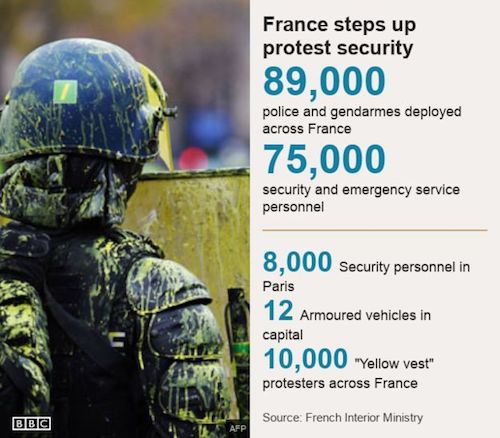
Read more …

What goes for Yellen and the Fed, also applies to the IMF: they apparently remain convinced that crises happen not because of, but despite them.

IMF Warns Storm Clouds Are Gathering For Next Financial Crisis (G.)

The storm clouds of the next global financial crisis are gathering despite the world financial system being unprepared for another downturn, the deputy head of the International Monetary Fund has warned. David Lipton, the first deputy managing director of the IMF, said that “crisis prevention is incomplete” more than a decade on from the last meltdown in the global banking system. “As we have put it, ‘fix the roof while the sun shines’. But, like many of you, I see storm clouds building and fear the work on crisis prevention is incomplete.” Lipton said individual nation states alone would lack the firepower to combat the next recession, while calling on governments to work together to tackle the issues that could spark another crash.

“We ought to be concerned about the potency of monetary policy,” he said of the ability of the US Federal Reserve and other central banks to cut interest rates to boost the economy in the event of another downturn, while also warning that high levels of borrowing by governments constrained their scope for cutting taxes and raising spending. Lipton said the IMF went into the last crash under-resourced before it was handed a war chest worth $1tn from governments around the world, while adding that it was important that national leaders had agreed to complete a review of the fund’s financial firepower next year. “One lesson from that crisis was the IMF went into it under-resourced; we should try to avoid that next time.”

[..] Against a backdrop of Donald Trump engaging in a bitter trade dispute with Beijing, he said China needed to lower trade barriers, while also impose tougher rules to protect intellectual property – a key complaint of the US president. Lipton suggested that Chinese trade policies that were once considered acceptable when it joined the World Trade Organization in 2001 as a $1tn economy may now be inappropriate as it had become a $16tn international superpower. However, he did warn that the US should not take an overly heavy-handed approach to reform, adding: “China has many reforms that it could carry out that would be in its own interest and in the interest of countries around the globe. But China feels they can’t take those steps, as they put it, with a gun to their head, in the midst of trade tensions.”

Read more …

“I think we are a rocket ship going up.”

Trump Says Fed Shouldn’t Hike Rates, But Calls Powell ‘A Good Man’ (R.)

President Donald Trump said on Tuesday it would be a mistake if the Federal Reserve raises interest rates when it meets next week, as it is expected to do, continuing his criticism of the U.S. central bank. “I think that would be foolish, but what can I say?” Trump told Reuters in an interview. Trump said he needed the flexibility of lower interest rates to support the broader U.S. economy as he fights a growing trade battle against China, and potentially other countries. “You have to understand, we’re fighting some trade battles and we’re winning. But I need accommodation too,” he said.

Trump named Jerome Powell as Fed chairman, but has repeatedly railed against him since he took over as head of the U.S. central bank last February. Trump in August told Reuters that he was not “thrilled” with Powell’s raising interest rates. Trump was more conciliatory in his comments about Powell on Tuesday, but still criticized the policies of the man he chose for the top Fed job. “I think he’s a good man. I think he’s trying to do what he thinks is best. I disagree with him,” Trump said. “I think he’s being too aggressive, far too aggressive, actually far too aggressive.” [..] “Are we heading for a recession?” Trump said. “In my opinion, we are doing really well. Our companies are doing really well. If the Fed is going to act reasonably and rationally, I think we’ll go – I think we are a rocket ship going up.”

Read more …

Round 14 of pension cuts is reversed. The rest remains.

Greece Scraps Pension Cuts (R.)

Greece’s Parliament on Tuesday voted to scrap plans to cut state pensions, in a motion led by the left-led governing coalition hoping to shore up its flagging support ahead of a general election next year. Eventually the bailout, worth up to 86 billion euros, expired in August without IMF assistance, and Athens has said better-than-expected public finances enable it to rescind the planned cutbacks. The European Commission has approved the government’s decision. “The time has come for people to be rewarded for their sacrifices,” Prime Minister Alexis Tsipras told lawmakers ahead of the vote, calling the step a “necessary breath for the people of labour … who saw their pensions and their dignity hurt.”

Pensioners, who are in many households the only people with an income due to the highest unemployment rate in the eurozone, have seen earnings shrink by up to 40 percent since Greece toppled into crisis in late 2009. Tsipras’s term ends in 2019. His SYRIZA party is trailing the conservative New Democracy by about 10 points in opinion polls. Since 2010, Greece has signed up to three international bailouts totalling almost 290 billion euros, and will remain heavily indebted for years to come. The country is monitored by its eurozone partners and the IMF to ensure it does not veer off post-bailout targets aimed at maintaining high budget surpluses in coming years.

New Democracy (ND) accused the government of increasing taxes and handing out benefits from budget revenues to win votes. “You are wearing the mask of the philanthropist just to tip people from their own savings,” ND leader Kyriakos Mitsotakis told Tsipras in parliament.

Read more …

“We believe in an open economy, we believe in globalization, but we need to make sure that these investments are conducive to growth.”
-Nicolas Chapuis, EU ambassador to China

Really?! Ask the people if they ‘believe’ in globalization. Ask the yellow vests.

‘Forced Tech Transfer’ Must Stop Or Be Regulated – EU Envoy To China (CNBC)

The European Union has a vested interest in promoting technology exchanges with China, but any transfers should be regulated, said the trade bloc’s ambassador to China on Wednesday. “For the last 40 years, EU companies have provided most of the foreign tech that is in China, about 50 percent of what is today in China,” said Nicolas Chapuis, ambassador of the EU delegation to China. However, the diplomat expressed concerns about China trading market access for technology. Beijing sometimes forces foreign companies to hand over their technological know-how in exchange for access to its massive domestic market.

The administration of U.S. President Donald Trump has demanded that China cease forced tech transfers, which have become a flashpoint in the U.S.-China trade war. “This has to stop or to be regulated,” Chapuis told CNBC at the European Chamber Annual Conference 2018 in Beijing. “Of course if a company wants to open its tech books to a Chinese company — all right, that’s not an issue, but it has to be regulated so that there is no so-called ‘forced tech transfer,'” Chapuis said. Beijing has claimed it will step up protection of intellectual property rights, but experts point out that the country still wields its state-controlled legal system to take whatever trade secrets it wants for its own companies.

Read more …

Anything better than Hillary and Schumer, I guess.

Ocasio-Cortez Already Reveals The Inner Workings Of Congress (CNBC)

Although her first day on the job is still weeks away, Alexandria Ocasio-Cortez is already pulling back the curtain on the inner workings of the Capitol. The New York Democrat, along with other incoming freshman lawmakers, is trying to usher in a culture of openness that is enabled by a vast social media following. With nearly 3 million followers combined on Facebook, Instagram and Twitter, Ocasio-Cortez has used the platforms to involve her supporters during the transition period before she takes office. Her enthusiastic and often pugnacious transparency campaign has earned her praise from inside and outside the Beltway. Yet it has also drawn criticism from several corners, including from President Donald Trump’s eldest son.

In a series of pictures and videos on Instagram dubbed “Congress Camp,” she gave an inside look into new-member orientation, from choosing an office to voting for House leadership, while also showcasing the unique quirks of life on Capitol Hill. “Guys, there are secret underground tunnels between all of these government buildings!” she whispers in one video. In another post, she polls her followers on whether she should choose an office with more space or one “close to our friends.” But Ocasio-Cortez isn’t just focusing on the novelty of her experience. Last week, she tweeted sharp criticism of an orientation for new members of Congress hosted by Harvard. The event featured corporate CEOs but no labor representatives.

Ocasio-Cortez hasn’t given any indication that she will let up, however. “Our ‘bipartisan’ Congressional orientation is cohosted by a corporate lobbyist group. Other members have quietly expressed to me their concern that this wasn’t told to us in advance,” she tweeted. “Lobbyists are here. Goldman Sachs is here. Where’s labor? Activists? Frontline community leaders?” Fellow freshman member Rashida Tlaib, D-Mich., echoed her criticisms. Tlaib said that Gary Cohn, former chief economic advisor to President Donald Trump and former Goldman Sachs executive, told the new members at orientation that they don’t “know how the game is played.” “No Gary, YOU don’t know what’s coming – a revolutionary Congress that puts people over profits,” Tlaib tweeted.

Read more …

Checking it twice.

Faking Moon Landing More Difficult Than Doing It (RT)

The head of the Russian space agency may joke about ‘verifying’ if the Americans landed on the moon, but there are no doubts for one Russian scientist, who weighed in on the decades-long conspiracy debate. The claim that NASA never landed astronauts on the moon and that evidence to the contrary was fabricated is among the most pervasive in popular culture and has been a point of fierce debates. Dmitry Rogozin, Russia’s space chief, even recently joked that Russia’s future lunar missions will give the country an opportunity to check whether Neil Armstrong’s footprints are actually out there.

That aside, people who actually study the moon for a living believe there is no need to launch spaceships just to prove the success of the Apollo program. Fabricating a lunar landing would probably be technologically impossible and anyway economically unnecessary, told RIA Novosti Yury Kostitsyn. The man heads the Institute of Analytical Chemistry, which is directly involved in developing sensors for space and was part of the Soviet robotic study of the moon. “Faking the landing of the American astronauts to the Moon would have been more complex and expensive than actually doing it,” the scientist assured. The key piece of evidence in his own field of knowledge is the moon soil, which the Americans said to have retrieved. It was studied in labs of many countries, including the USSR, and it’s definitely not from this planet.

“Falsifying moon soil is impossible. The Americans brought back to Earth about 300 kilos of it, most of it basalt,” he explained. “We have basalts on Earth too, but they are significantly different from the lunar ones in their chemical composition, properties, and structure. There are no rock formations older than 3.7 billion years, and what the Americans brought is over 4 billion years old, comparable to the age of the solar system.” (NB. There are actually rocks of earth origin dated over 4bn years, but the ones brought from the Moon are still older.) “There is nothing to argue about Americans landing on the moon between 1969 and 1972,” Kostitsyn stressed. “You won’t hear a single cosmonaut say they didn’t.”

Read more …

Dec 112018
 
 December 11, 2018  Posted by at 8:45 pm Primers Tagged with: , , , , , , , , , , ,  4 Responses »


Wilhelm Trübner A Gorgon‘s head 1891


The news still isn’t the news, and I’m getting afraid it never will be again, because not the news just simply sells so much better than plain old real events. Maria Butina suddenly popped back into the public eye, because she was either charged with something or confessed to it. And I’m thinking, excuse me, but that poor girl has been kept in isolation for how long now? And for what reason exactly?

I vividly remember thinking that when she first became ‘news’ for ‘infiltrating’ the NRA, for which there were plenty cute pictures taken, I remember thinking she would have been 22 or 23 years old when as a super- devious Russian redhead she allegedly penetrated the trillion dollar NRA, and the trillion dollar Republican Party, and the Trump campaign, which according to some people is now worth negative $1 trillion.

If any of said organizations allow for a 22-year old to take all of their most secret and damning secrets and send them to her alleged puppet master Vladimir Vladimirovich, I say they deserve everything they’re getting. But it IS the sort of thing that if you want to report it like it’s actual news, you sure need to be convincing, you need proof, that sort of thing, not the anti-Putin innuendo US media rely on as their main standard today. Butina with no proof is just a nice by now 30-year old girl who happens to be Russian.

As for the Trump campaign having a negative $1 trillion value, I derive that from all the people who’ve once again, after a handful Mueller tidbits, started saying the Donald will be impeached any moment now, and many around him will go to jail for decades. You know, I can read too, and that’s not what I see. Much of what I see comes down to the reasoning that Trump has not yet been impeached as President because .. he is the President.

Yes, that is pretty funny, but it’s not humor beyond my abilities, and I’m not a comedian by trade. We’re still, even after those Mueller bits, stuck with Papadopoulos who’s been framed and went to jail for 2 weeks for it (shame on Mueller for that, deep deep shame!), there’s Cohen who lost his tracks in between lying for Trump and lying about Trump, and Manafort, a thirteenth wheel on a wagon of which there are dozens in DC, fixers and handlers.

You tell me why Manafort faces years in jail while Rahm Emanuel became mayor of Chicago. But if you’d actually want to explain, I suggest you prepare well, maybe talk to a few lawyers in the process. Washington attracts shady characters like dung beetles to horse shit and honey bees to Mountain Dew, and only a special counsel would ever think of picking them off one by one if he can’t find any of the actual crimes that he was appointed for to find. Cue: Rahm Emanuel.


Meantime my pal in arms Jim Kunstler thinks Michael Flynn is laying low as Mueller whoops his ass because he can, only to hit back at Mueller as soon as he’s freed from what are at best shaky allegations. Talking to a Russian is not a crime, not even, or even especially, when you’re the security adviser to the next president.

Michael Flynn’s real suspicious job was advising Turkey on security issues, but then that’s not what Mueller targeted him for. So yeah, let Flynn rise. And once again, don’t let’s forget that he said when the whole circus began, that he saw no way he could defend himself against anything Mueller might have thrown at him, that his entire family was on the verge of bankruptcy.

“But you talked to a Russian!” say the news media. Cue mushroom clouds in the remote background. But don’t you see, Trump is a criminal with decades of crimes under his belt, and all of his family are too! Look, I don’t know these people, and I’m fine not knowing them, not my cup of tea, but how much time did any of them spend behind bars so far?

And now they would have to go to jail just because Donald was elected president and the DOJ appointed a friendly ex-FBI head special counsel on the basis of a dossier paid for by his political opponents? To what extent does that spell justice to you? Yes, feel free to cue Rahm Emanuel again.

See, if certain people can be sent to jail because they rise too high in certain circles that don’t want them to disturb the power inherent in their sphere, while other operatives from the exact same mold though perhaps another political affiliation, are nominated to lofty and lucrative careers and positions, isn’t there something awry?

Are any of them perfectly innocent? Hell no, but then if they were, they wouldn’t be in the positions they’re in, the very positions that allow Robert Mueller to target them. From that point of view, it obvious it’s just a little power game played out in front of your eyes, you who have nothing to do with it but think you’re supposed to have an opinion on it.

Is Donald Trump a worse and bigger criminal than George H.W. Bush was? One half of America can answer that in no time flat. The other is thinking they wouldn’t be so sure. How many people has the Donald condemned to death so far? And he’s already about half way through the time Bush41 spent in the White House.

Perhaps it’s not about who’s a criminal, but about who’s the prosecutor. And with Mueller’s role in the sordid Whitey Bulger tale, and his even more sordid testimony in the Iraq WMD fantasies that led to millions of legalized murders celebrated as victory by both Washington and the US media, which kettle is blaming which pot here?


But hey, I’m ready to be corrected. And it’s by no means just the US that feels twisted these days, either. How about French president Emmanuel Macron, who hadn’t addressed his people live for 10-12 days as the Yellow Vests protests just got worse and more violent by the day, and then yesterday decided to make his long awaited response to them through a pre-recorded video? Honestly, how far removed from reality can one be?

The only answer Macron has to the thousands of people who want him out, and who have been willing to express that opinion in 4 consecutive weekends, is money. He thinks if he gives them €100 a month extra, and some tax breaks, they’ll let them continue on his little Napoleon trip. Well, if they do, we’ll know who they are. But are they? I don’t think Macron counts on that.

And then, as Macron increasingly retreats into his little palace(s), cue Marie Antoinette, only to communicate with the unwashed masses who want him gone through pre-scripted and recorded promises of crumbs off his table in exchange for no power at all, British PM Theresa May reacts to her latest and ostensibly worst -though it’s hard to keep track- defeat by … fleeing the country.

That’s how its ‘leaders’ rule Europe these days. Angela Merkel says she’s gone, though she wants to be Chancellor until 2021 (that way no-one can hold her responsible for anything), Theresa May hops on a plane to Europe to grovel some hopelessly more in her already defeated stance.

And Macron has his servants shove crumbs off his table, a gesture that still costs him more than everything Salvini and Di Maio wanted to do in Italy which got them whistled down by Brussels. C’mon, who still believes in the EU? Everyone’s running away from it.

If Macron must hide from his own French people, how can he reform the EU? If May must flee the UK and go to the EU to get a Brexit deal, what’s her authority back home where 50% voted against that same EU?

And if Merkel can only remain in charge by relinquishing her power, who exactly’s going to run Europe? It’s kind of like the same question as for the US. Who’s going to run it? Not Trump, if Mueller and the Democrats have any say although they lost the election. Not Hillary, says about everyone else.


We all tend to think that these things are normal and eternal. Just politics. But all the usual suspects appear to be under siege. In Europe, France, UK, Germany are shaking heavily. Italy’s already overboard. That’s the biggest 4 EU members. That’s the EU. No certainties, no future, though the EU itself will never admit it, and instead just push for more EU.

And what’s certain politically in the US anymore? Trump has eviscerated the entire GOP, and I’m not saying that’s a bad thing. The Democrats killed off Bernie Sanders to allow Hillary to continue her dead before arrival power grab. She came she saw she lost.

My point, I think, is that political strongholds are being defeated everywhere at the same time. And when that happens, there’s always a reason for it. I think that reason can be found in the fact that the global economy is rumbling and crumbling as we speak, with politics and economics acting as precursors for one and other.

Like, Macron can only save his political ass by violating the EU budget terms he just chided Italy for. Merkel can only save her legacy by creating a situation she’s no longer responsible for. And Theresa May would be well advised, now that she’s on the continent, to simply stay there and let Britain figure things out without her.

The US won’t and can’t be so lucky. We’re still up for much more, marathon more, of Trump vs Mueller, and there will be many more courts and judges who have to speak on all of it before there’s anything even remotely resembling a conclusion. Because the whole Mueller circus -reluctantly- threatens to open up a Pandora swamp that’s been DC’s lifeblood forever.

Yeah, you got your Flynn and Manafort, but you also got your Podesta brothers. Yeah, there’s the Trump Foundation, but there’s also the Clinton Foundation, and Uranium One. Who’s worse? Good one!

Both things should be investigated, it shouldn’t just be Trump and Mueller, Hillary and the DNC and Comey etc etc also must be under the microscope. Or America will forever lose its faith in democracy. Not that there’s much of it left, mind you, but hey, at the very least it’s the thought that counts.

Bottom line: it all appears to be about local, domestic, national politics, but don’t be deceived: the global economy is tanking, and all of the political mayhem on all these levels is just a derivative of that. The dinosaurs want to live another day.

None of which is going to make your situation any better, but who knows, you just might feel better about it for a bit. Until you don’t.


Dec 112018
 
 December 11, 2018  Posted by at 10:44 am Finance Tagged with: , , , , , , , , , , , , ,  4 Responses »


Arnold Böcklin The Isle of the Dead III 1883


Jerome Powell Is Between A Rock And A Hard Place (Nomi Prins)
Macron Bows To Protesters’ Demands: “I Know I Have Hurt Some Of You” (G.)
‘Yellow Vests’ Denounce Macron Speech As ‘Charade’ (AFP)
Let’s Call The Whole Thing Off (Ind.)
Sturgeon Offers To Unite With Corbyn To Topple ‘Shambles’ Government (Ind.)
Pound Falls To Lowest In Almost Two Years Amid Brexit Uncertainty (G.)
Hedge Funds Make Big Bets Against Post-Brexit UK Economy (G.)
Mueller’s Investigation is Missing One Thing: A Crime (AC)
Jerome Corsi Sues Robert Mueller, DOJ, FBI, NSA, CIA For $350 Million (CNBC)
Not So Fast (Jim Kunstler)


I don’t know, Nomi. The whole thing just spells out to me how ridiculous things have become because of the powers the Fed has been given. The only sensible thing anyone can do, including Powell, is to retreat and let the market be reborn. Until then, any talk about ‘the market(s)’ has no meaning.

Jerome Powell Is Between A Rock And A Hard Place (Nomi Prins)

One of the major drags on the market, besides trade wars, has been uncertainty about whether the Fed will raise rates this month. Despite the verbal bravado of Federal Reserve Chairman, Jerome Powell, over how strong the U.S. economy is, he doesn’t live in a vacuum. Powell’s borne the brunt of President Trump’s recent accusations that the Fed’s hikes are what’s hurting the stock market and threatening the economy. That lead to a media debate over whether Powell would “cave” to Trump or demonstrate that the Fed is the independent body that it’s legally designed to be, and continue with planned hikes anyway. Powell’s recently indicated again that he planned to go ahead with another 0.25 rate hike when the Fed meets Dec. 19, which would be the fourth increase this year.

But on Nov. 28, he revealed something in his speech at the Economic Club of New York that I’ve been predicting. He dialed back talk about rate hikes. He said that rates were “just below” neutral. That contrasted sharply with his comments from Oct. 3rd when he said “We are a long way from neutral at this point.” In other words, he’s turned dovish. That’s a major shift in less than two months’ time. But why the change? It likely had much less to do with pressure from Trump than deteriorating economic and market conditions. Heavy market volatility was just starting to return when he his Oct. 3 comment. It’s only gotten worse since then. At some point, the wobbling in the financial markets must have gotten to him. As the Daily Reckoning’s, Brian Maher said, single-day losses of 300, 500, 700 — 800 points — seem almost commonplace now. “The stock market is a wreck of nerves these days,” he said, “like a man walking point in a dark enemy jungle.”

Read more …

After long deliberation with his spin doctors, lawyers and PR guys, Macron has decided to gamble on the protests being all about money. If handing out the billions he announced yesterday calms things down, even if it takes France out of the EU budget comfort zone, the protests were never about anything real. But if the yellow vests’ Act V next Saturday is anything like the first 4, he’s in deep doodoo.

Also: he was MIA for 10 days or so. And then his speech yesterday was pre-recorded. He still hasn’t communicated live with the French people.

Macron Bows To Protesters’ Demands: “I Know I Have Hurt Some Of You” (G.)

Emmanuel Macron has bowed to pressure from the street to announce a catalogue of emergency measures aimed at pacifying the gilets jaunes after weeks of civil unrest in France. In a long-awaited address on primetime television, the president tried to talk the protesters out of further action, promising a rise in the minimum wage and tax concessions. In a mea culpa, Macron said he had heard and understood protesters’ anger and indignation, which he said was “deep and in many ways legitimate”. He admitted he had not been able to provide solutions quickly enough since his election. “I may have given you the impression that this was not my concern, that I had other priorities. I take my share of responsibility. I know I have hurt some of you with my words,” he said.

The president began his pre-recorded 13-minute declaration saying the past few weeks of protests had “profoundly troubled the nation”, and that legitimate demands had led to “a series unacceptable violence”. He said the anger went back 40 years, but he added: “No anger justifies attacking a police officer, a gendarme, or damaging a shop or public building. When violence is unleashed, freedom ends.” Macron, elected on a centrist reforming programme 18 months ago, said he understood the anger and “distress” of those struggling to make ends meet at the end of the month who felt ignored and economically squeezed: “It is as if they have been forgotten, erased. This is 40 years of malaise that has risen to the surface. It goes back a long way, but it is here now.”

To help struggling workers, he said the government had been ordered to introduce “concrete measures” from 1 January, including increasing the minimum wage by €100 (£90) a month. Overtime would be exempt from tax and social charges, and a planned tax on pensions under €2,000 a month would be cancelled. All employers “who can” were asked to give workers a tax-free bonus at the end of the year. Macron said there would be greater public consultation on issues, but he would not go back on his wealth tax reforms. However, things would not “go back to normal … as if nothing has changed,” he said.. He concluded: “We are at a historic moment in our country. With dialogue, respect, and engagement, we will succeed. My only concern is you, my only combat is for you – our only battle is for France.”

Read more …

It may just make them madder.

‘Yellow Vests’ Denounce Macron Speech As ‘Charade’ (AFP)

Groups of “yellow vest” protesters across France responded scathingly to the “crumbs” offered by President Emmanuel Macron in a speech intended to defuse their revolt, but others acknowledged his efforts. “Nonsense,” “a charade”, “a bluff” and “a drop in the ocean,” were among the immediate reactions that greeted the head of state’s televised speech Monday evening announcing an increase in the minimum wage and a range of other financial measures. At a roundabout in the southern town of Le Boulou, some 150 “yellow vests” gathered around a loudspeaker listened carefully to the president’s words before starting to shout in chorus. “He is trying to do a pirouette to land back on his feet but we can see that he isn’t sincere, that it’s all smoke and mirrors,” said Jean-Marc, a car mechanic.

“It’s just window dressing, for the media, some trivial measures, it almost seems like a provocation,” said Thierry, 55, a bicycle mechanic who donned the yellow vest a fortnight ago. “All this is cinema, it doesn’t tackle the problems of substance,” he told AFP before taking part in blocking the Boulou turnpike on the French-Spanish border. “We’re really wound up, we’re going back to battle,” he said. Less than an hour after the presidential address, the A9 toll booth from Spain was completely paralysed, an AFP photographer said. “Maybe if Macron had made this speech three weeks ago, it would have calmed the movement, but now it’s too late,” said Gaetan, 34, one of the “Rennes Lapins Jaunes” (Yellow Rabbits of Rennes). “For us, this speech is nonsense.”

Read more …

Theresa May is as out of touch with her people as Macron is.

The main event yesterday in the Commons was a guy picking up the ceremonial mace, a 17th century piece of metal. Just to show how out of touch the politicians, and their entire nation, are.

Well, that and May annoucing she was going to flee the country. But why would the EU change its stance, or the deal May signed, just to save her career?

Let’s Call The Whole Thing Off (Ind.)

Theresa May has sparked anger across the Commons by refusing to say when MPs will vote on her Brexit deal, as she prepared to head to Brussels to plead with EU leaders for further concessions. The showdown was dramatically delayed, almost certainly until the new year, after the prime minister admitted a Tory revolt meant she was heading for a crushing defeat “by a significant margin”. But condemnation of Ms May for pulling back rose when Downing Street failed to set a new timetable for the vote, arguing it depended on when she could “get the assurances” from the EU to pass the deal. Government sources admitted a quick breakthrough was unlikely, suggesting the vote would be shelved until the new year and refusing to say it would even be held next month.

In extraordinary scenes, Labour MP Lloyd Russell-Moyle was ejected from the House of Commons for seizing the ceremonial mace in protest at the formal deferral of the vote by the government whips. Mr Russell-Moyle swung the antique symbol of parliamentary authority from its holder as Tory MPs screamed “expel him”. He was promptly asked to leave the chamber by John Bercow, the speaker. His intervention came moments after Labour leader Jeremy Corbyn secured an emergency debate on the delay on Tuesday.

Read more …

If May had had any actual opposition, this farce would have been long over.

Sturgeon Offers To Unite With Corbyn To Topple ‘Shambles’ Government (Ind.)

Nicola Sturgeon has appealed to Jeremy Corbyn “work together” to topple Theresa May’s government after a crucial vote on the prime minister’s Brexit deal was abandoned, promising the SNP will support a motion of no confidence if it is tabled by Labour. The Scottish first minister said delaying the vote was “pathetic cowardice” and vowed that her party would stand with Labour if it follows through with its plan to bring down the government with a confidence vote on Tuesday. It comes amid chaotic scenes in Westminster, where reports that the meaningful vote was being shelved broke just moments after a Downing Street spokeswoman told reporters it would go ahead.

Ms Sturgeon posted on Twitter: “So @jeremycorbyn – if Labour, as official opposition, lodges motion of no confidence in this incompetent government tomorrow, @theSNP will support & we can then work together to give people the chance to stop Brexit in another vote. “This shambles can’t go on – so how about it?” The Labour leader has not responded to her offer but the first minister’s comments will ramp up the pressure on the beleaguered prime minister, as she faces one of the biggest challenges of her premiership.

Read more …

Parity with the USD in early 2019?!

Pound Falls To Lowest In Almost Two Years Amid Brexit Uncertainty (G.)

The pound has dropped to its lowest level for almost two years amid the growing risks to the British economy from political paralysis over Brexit and on a no-deal scenario. Theresa May’s decision to delay the parliamentary vote on her Brexit plan to avoid an embarrassing defeat for the government sent sterling tumbling by more than 1.3% against the dollar and by almost 1% against the euro on the foreign exchanges. The pound slumped below $1.26 to the lowest level since April 2017 after the prime minister said her Brexit plan would have been rejected by a “significant margin” in a Commons vote pencilled in for Tuesday. Sterling was worth $1.2563 against the dollar late on Monday and €1.1062 against the euro.

Read more …

They now have a solid reason to push for a no-deal Brexit.

Hedge Funds Make Big Bets Against Post-Brexit UK Economy (G.)

A pair of hedge funds owned by prominent Brexit supporters have made significant bets against companies exposed to the British consumer including big high street names. Odey Asset Management, part-owned by Crispin Odey, and Marshall Wace, part-owned by Sir Paul Marshall, have declared short positions against consumer-exposed companies, including retailers, estate agents and banks, equivalent to £149m and £572m respectively – as rising political uncertainty threatens the economy. The retail sector is facing particular scrutiny from short sellers, who in effect wager significant sums on certain shares falling in value. Uncertainty among consumers, with the Brexit process reaching a crunch point, comes at a time when retailers are already struggling to adjust to the move from physical shops to online.

The hedge fund run by Odey, one of the most outspoken of the Brexit-backing hedge fund managers, holds a short position in Intu – the owner of shopping malls including the Trafford Centre in Greater Manchester – that represented £33m worth of shares in the company at the end of last week. He also holds a position against struggling department store Debenhams that is worth £5.3m. The firm also appears to be betting that Britons’ appetite for cars will fall, in line with surveys showing hesitation over big-ticket purchases. The firm has short positions against Lookers, a large dealership chain, and Auto Trader, the online used-car directory.

Read more …

Watergate started with a crime. Russiagate did not. It started with a dodgy dossier.

Mueller’s Investigation is Missing One Thing: A Crime (AC)

The primordial ooze for all things Russiagate is less-than-complete intelligence alleging that hackers, linked to the Russian government, stole emails from the Democratic National Committee (DNC) in 2016. The details have never been released, no U.S. law enforcement agency has ever seen the server or scene of the crime, and Mueller’s dramatic indictments of said hackers, released as Trump met with Putin in Helsinki, will never be heard of again, or challenged in court, as none of his defendants will ever leave Russia. Meanwhile, despite contemporaneous denials of the same, is it somehow now accepted knowledge that the emails (and Facebook ads!) had some unproven major effect on the election.

The origin story for everything else, that Trump is beholden to Putin for favors granted or via blackmail, is opposition research purchased by the Democrats and carried out by an MI6 operative with complex connections into American intelligence, the salacious Steele Dossier. The FBI, under a Democratic-controlled Justice Department, then sought warrants to spy on the nominated GOP candidate for president based on evidence paid for by his opponent. Yet the real spark was the media, inflamed by Democrats, searching for why Trump won (because it can’t be anything to do with Hillary, and “all white people and the Electoral College are racists” just doesn’t hold up).

Their position was and is that Trump must have done something wrong, and Robert Mueller, despite helping squash a Bush-era money-laundering probe, lying about the Iraq War, and flubbing the post-9/11 anthrax investigation, has been resurrected with Jedi superpowers to find it. It might be collusion with Russia or Wikileaks, or a pee tape, or taxes, packaged as hard news but reading like Game of Thrones plot speculation. None of this is journalism to be proud of, and it underlies everything Mueller is supposedly trying to achieve. [..] The core problem—at least that we know of—is that Mueller hasn’t found a crime connected with Russiagate that someone working for Trump might have committed. His investigation to date hasn’t been a search for the guilty party —Colonel Mustard in the library— so much as a search for an actual crime, some crime, any crime.
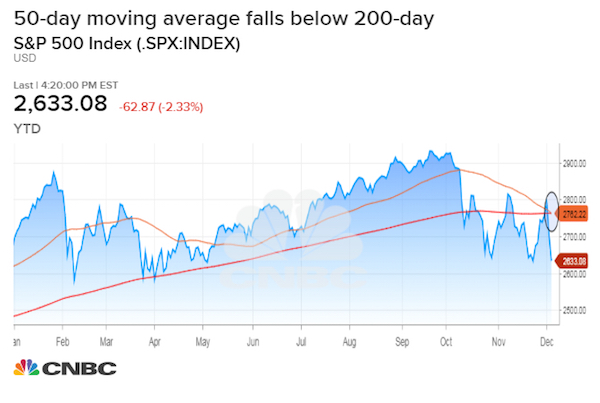
Read more …

Even if he’s legally right, what are his odds of winning?

Jerome Corsi Sues Robert Mueller, DOJ, FBI, NSA, CIA For $350 Million (CNBC)

Jerome Corsi, a conspiracy theorist and Roger Stone associate, has filed a federal lawsuit accusing special counsel Robert Mueller of illegally searching his phone records and leaking grand jury information. Corsi, an avid supporter of President Donald Trump, recently claimed he faces indictment by Mueller. Attorneys for Corsi, 72, filed the lawsuit Sunday night in U.S. District Court in Washington. In addition to Mueller, it targets the Justice Department, the National Security Agency, the FBI and the CIA. The attorneys are demanding $100 million in “general and compensatory damages” and $250 million in “punitive damages” from the agencies.
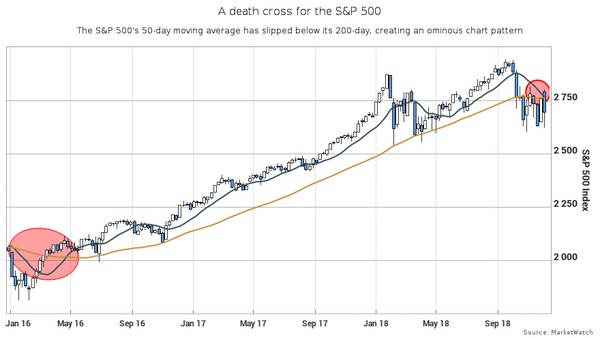
In the complaint, Corsi’s lawyers argue that their client’s Fourth Amendment right against unreasonable or unwarranted government searches and seizures was violated when “each and every one” of the defendants looked through his digital records without a warrant and probable cause. The complaint also accuses Mueller of directing his staff to leak information from his grand jury about Corsi to the media. Special counsel spokesman Peter Carr declined CNBC’s request for comment on the court filing. Mueller’s team has reportedly investigated for months whether Corsi learned in advance that WikiLeaks had received Hillary Clinton campaign chairman John Podesta’s emails, which U.S. intelligence services have concluded were stolen by Russian intelligence officers.

[..] Corsi also accuses the special counsel of trying to make him lie under oath that he was a liaison between Stone and WikiLeaks founder Julian Assange in the publication of stolen Democrats’ emails.

Read more …

Flynn’s revenge on Mueller?

Not So Fast (Jim Kunstler)

Gen. Flynn may actually have the goods on the fraud behind his own prosecution — namely, proof of exactly how he was set up by Mr. Obama, in particular his own tapes of conversations with Russian Ambassador Sergey Kislyak that would show something different than the transcripts Mr. Mueller used to entrap him on Lying-to-Federal-Prosecutors rap. That theory raises the question: why did he not use it in his own defense. The answer may simply be that he didn’t want to rack up $2.5 million in billable hours for defense attorneys and chose instead to tough it out for nearly two years until he could use the information he has. And that means he must wait until final sentencing when his case is complete.

That appears in the offing, perhaps even before Mr. Mueller releases his much panted-over final report. Of course, Mr. Mueller may have absolutely no idea what Gen. Flynn has got on him — hence the speculation about why the charging memo was so lenient. But that line of reasoning suggests that Gen. Flynn will just forget about the disgrace Mr. Mueller put him through and let bygones be bygones. That’s not how warriors roll. More likely, Gen. Flynn has something more severe in mind. For all of his horse-faced gravitas in the photos of his fleeting sightings, Mr. Mueller does not look to me like a man in a comfortable situation.
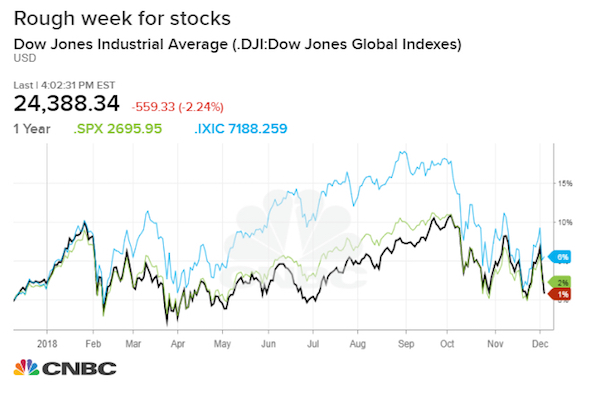
Read more …

Dec 092018
 
 December 9, 2018  Posted by at 10:31 am Finance Tagged with: , , , , , , , , , , , ,  7 Responses »


Edouard Manet Berthe Morisot with a bouquet of violets 1872


Incoming House Judiciary Chair Planning To End Probe Into FBI, DOJ (ZH)
France Is The New Tax Hell In Europe And Beyond (RT)
Paris Under Siege As Gilets Jaunes Open ‘Act IV’ – 4th Weekend Of Protest (O.)
No Hope Of Success And No Plan B – But Theresa May Won’t Blink (O.)
UK Cabinet Splits Over Second Referendum On Brexit Deal (G.)
Majority Of UK Now Wants To Remain In The EU – Poll (Ind.)
Theresa May Warns Of ‘Uncharted Waters’ Ahead Of Key Vote (BBC)
EU Will Negotiate If May Loses Commons Brexit Vote – Prodi (G.)
China Threatens Canada With ‘Grave Consequences’ If Huawei CFO Not Freed (R.)
Putin Doesn’t Rule Out Extending Turkish Stream Pipeline Into Greece (RT)
COP24 Fails To Adopt Key Climated Change Report (BBC)


But of course. Let’s invite more chaos in.

Incoming House Judiciary Chair Planning To End Probe Into FBI, DOJ (ZH)

During a break during former FBI Director James Comey’s heated closed-door testimony on Capitol Hill on Friday, incoming House Judiciary Chairman Jerry Nadler confirmed to reporters what many had already suspected: That Nadler (and probably his fellow Democratic leaders) would put the kibosh on the House’s investigation into alleged political bias at the highest levels of the FBI and DOJ as they launched an investigation into the Trump campaign – an investigation that eventually morphed into the Mueller probe. While Democrats prepare to ramp up investigations into everything from Trump’s “war on the media” to his involvement in his family business, Nadler told a group of reporters that he intends to end the House Judiciary Committee’s involvement in the Congressional probe as soon as he takes the reins next year.

Asked why he intends to end the committee’s involvement in the probe, Nadler responded that “it was a waste of time to begin with” and a “distraction” from the real-wrong doing here – that is, lawbreaking committed by Republicans, according to the Hill. “Yes, because it is a waste of time to start with,” Nadler said in response to a question about whether he would end the probe. Nadler characterized the Republican investigation as a political sideshow that aims to distract from special counsel Robert Mueller’s investigation into possible ties between the Trump campaign and Russia. “The entire purpose of this investigation is to be a diversion of the real investigation, which is Mueller. There is no evidence of bias at the FBI and this other nonsense they are talking about,” he continued.

If the House investigation into suspected FBI malfeasance is just a “sideshow”, as Nadler claims, how would he explain the fact that the FBI knew the allegations contained in the Steele dossier – the linchpin of the FBI’s FISA warrant application that kicked off the Russia probe in earnest – were bogus before applying for surveillance? Or the many conflicts of interest between senior FBI officials involved with the probe (Andrew McCabe, Bruce Ohr, Peter Strzok, and, yes, Comey himself) – or the fact that McCabe was fired following after the DOJ’s inspector general confirmed that McCabe had lied under oath to try and conceal the fact that he told an FBI spokesman to leak a story about the FBI’s investigation into the Clinton Foundation just days before the election. McCabe could still face criminal charges from his lies. But Congress’s attempt to hold the FBI accountable is just a “distraction?”

Read more …

Not unimportant when it comes to the yellow vests.

France Is The New Tax Hell In Europe And Beyond (RT)

While the dust has not yet settled in the streets of Paris, after sweeping protests against fuel tax hikes, it just so happens that France has taken the crown from Denmark as the most taxed country in 2017, the OECD found. Among the 34 developed members of the Organization for Economic Cooperation and Development (OECD), Emmanuel Macron leads the nation with the highest tax-to-GDP ratio, the organization reported. France leads with 46.2% of GDP against the average of 34.2% of other members, thus dropping the long-standing leader in the rating, Denmark.

The Scandinavian country’s numbers, meanwhile, shrank to 46%, down by 0.2 since last year. Sweden, Italy, and Greece round out the top five, while Mexico is the last on the list at 16.2%. Notably, tax revenues for OECD member states, on average, reached historically high levels in 2017, rising to 34.2% of GDP. It is up only slightly from 34%, the previous peak recorded by the organization in 2016.

Read more …

Quite the series of demands. But hard to gauge how much support they have; there are not leaders or anything.

Paris Under Siege As Gilets Jaunes Open ‘Act IV’ – 4th Weekend Of Protest (O.)

A charter of gilets jaunes’ “suggestions to end this crisis” has been circulating on Facebook. While far from “official” – the movement has no agreed representatives – it does illustrate the diverse, and sometimes contradictory, nature of their demands:

Economy/work A full review of taxation, with no citizen to be taxed at more than 25% of income; an immediate 40% increase in the minimum wage, pensions and benefits; “mass hirings” in the state sector to restore quality of services in hospitals, schools, etc; 5m new homes; make banks “smaller”.

Politics France’s constitution to be rewritten “by the people and for the interests of the people”; lobbying to be banned; France should leave the EU; recover €80bn lost to tax evasion each year; halt and/or reverse all privatisations; removal of “useless” speed cameras; reform of education system, removal of all “ideologies”; quadruple budget of judicial system, which must be simplified, free and accessible for all; break up media monopolies and end cosy relationship between media and the political class; open media up to the people.

Health/environment 10-year guarantee on products to end planned obsolescence; ban plastic bottles; limit power of pharmaceutical companies; ban GM foods, carcinogenic pesticides, monoculture; reindustrialise France to reduce imports and therefore pollution.

Geopolitics Pull France out of Nato and foreign wars; end the plunder of French-speaking Africa; prevent migration flows that cannot be welcomed or integrated given current “civilisational crisis”; scrupulous respect for international law and engagements.

Read more …

Tuesday is the big vote in the Commons. May looks certain to lose big. So, chaos in France AND the UK. Where are Britain’s yellow vests anyway?

No Hope Of Success And No Plan B – But Theresa May Won’t Blink (O.)

For several weeks Theresa May has been holding private meetings in Downing Street and the Commons with MPs [..] She has used all her powers of persuasion to try to win them around ahead of Tuesday’s historic “meaningful vote” on her deal. Tory whips have tried to cajole their wavering backbenchers day and night, arguing the case for the May deal and reminding the more ambitious among them where their best career interests lie. Two weeks ago May made the campaign a national one – writing directly to the people of Britain and asking them to put more pressure on their MPs to support her. A special Tory website called Back the Brexit Deal was launched by the party to rally grassroots Tories behind the cause, with limited success.

Constituency chairmen were lobbied heavily, too. Ominously for the prime minister, however, the ultra-hard sell has achieved almost nothing. Some Tories even think it has had the reverse effect to that intended – making people focus in more detail on her deal than they would have done, only for them to conclude they could never back it. One senior Conservative said the party machine had deployed every resource it could muster but had failed totally. “Whether it is our backbenchers, or the party faithful, or the public, it is the same. If anything, I think the whole ‘going to the country thing’ has made things worse.”

[..] By this weekend more than 100 backbench Tory MPs had declared themselves ready to vote against May’s deal. Surveys of Tory members show they are against, too, by a big majority. After a dreadful week in which May’s government was found to be in contempt of parliament for refusing to publish the full legal advice on Brexit, the chief whip, Julian Smith, has been telling No 10 that it is on course for a huge defeat. [..] More junior members of the government are rumoured to be ready to quit before Tuesday because they can’t live with the deal as it is. With two days to go, there is no sign May is ready to delay, change course or blink at all. One senior Tory said: “If she has a plan B, no one knows what it could be. It looks like a crisis with no solution. She seems ready to march on into the gunfire.”

Labour is keen to make out that Tuesday’s vote will be tighter than everyone expects. It is desperate to promote this view in case May limits a defeat to far less than 100. [..] But with all but a handful of the 257 Labour MPs, the entire block of 35 SNP members, all but one of the 11 Liberal Democrats, and the 10 DUP members set to vote against it – and more than 100 Tories on record as being opposed – the arithmetic points to a far worse outcome for the prime minister.

Read more …

Divisions everywhere. And opportunism. If you’re in the Cabinet, and May loses real bad, what’s your political future?

UK Cabinet Splits Over Second Referendum On Brexit Deal (G.)

A deep cabinet split has opened up over whether Theresa May should back a second referendum in a final attempt to end the political deadlock over Brexit, as senior Conservatives predicted on Saturday night that her blueprint for leaving the EU was heading for a crushing House of Commons defeat. Adding to a mounting sense of constitutional crisis ahead of Tuesday’s crucial parliamentary vote, No 10 is braced for more resignations of ministers and aides who want another referendum, or who believe May’s deal fails to deliver on Brexit. Will Quince, the Colchester MP and aide to the defence secretary Gavin Williamson, quit his post on Saturday night in protest at the Brexit deal.

Cabinet ministers have told the Observer that attempts to convince May to delay the vote to avoid one of the largest and most humiliating defeats in recent parliamentary history had not been heeded. This was despite what they saw as a clear danger that such a result could provoke a leadership challenge and split the party irrevocably. Some cabinet ministers now believe that May is so wedded to her Brexit deal that her only method of gaining approval will be through another referendum – and that the arguments for a second vote are emerging as stronger than those for a soft Brexit. The prime minister has so far refused to entertain any idea of a second public vote.

One cabinet source said it might prove to be the only way of saving May’s deal and her reputation. “She is so committed to her deal, and a second referendum could now be the only way of getting it. The polls have been remarkably stable for a while, but there does seem to be some kind of movement [to Remain], and that could well develop in the coming days and weeks.”

Read more …

1,500 people is not a large enough poll.

Majority Of UK Now Wants To Remain In The EU – Poll (Ind.)

A majority of the country now think Britain should remain inside the European Union, according to a new poll released days before the critical Brexit vote in parliament. The exclusive research for The Independent shows that, as of this month, 52% favour staying in the trading bloc. The data from pollsters BMG Research reveals support for remaining has grown month by month since the summer, and broke past 50% in December as the complex realities of Brexit were brought home to the country. The poll also revealed that almost half of people think the withdrawal agreement settled by Theresa May is a “bad deal” for Britain, with around as many saying MPs should reject the deal outright when they take the critical decision on Tuesday.

The BMG Research study lays waste to any hope that a concerted publicity drive, which has seen Ms May and her ministers tour the country to persuade people of its merits, has been a success. Instead it shines a light on the deep divisions that still exist, with none of the immediate alternative paths beyond Ms May’s plan – a second referendum, a Norway-style relationship or no deal – enjoying majority support. [..] In a further development ex-European Commission president Romano Prodi said Brussels could renegotiate the deal if MPs vote against it, creating the opportunity for Ms May to seek further concessions.

[..] When BMG asked some 1,500 respondents, “should the United Kingdom remain a member of the European Union, or leave the European Union”, 52% said “remain”, 40% said “leave”, six% said they did not know and one% refused to say. The remain option has been in the high 40s most of this year, but from September to October it rose one point and then another point to 49% in November, meaning it rose three points in December to its current level. When respondents were asked whether they believed the withdrawal agreement and political declaration on the future relations secured by Ms May are a “good deal” or a “bad deal”, 49% chose the latter. Just over one in ten, 13%, said it was a good deal,

Read more …

As in something to fear. Whereas her party strangling the poorer is not.

Theresa May Warns Of ‘Uncharted Waters’ Ahead Of Key Vote (BBC)

With two days to go until the crucial Brexit vote, the prime minister has warned MPs they face “uncharted waters” if they reject her deal. Speaking to the Mail on Sunday, the PM said a rejection of her proposals would mean “grave uncertainty” for the UK. She warned MPs their actions could lead to a general election, and there was a “very real risk of no Brexit”. Downing Street has also denied newspaper suggestions that Theresa May could postpone Tuesday’s vote. “The vote is going ahead,” a spokesman said. Last month, the UK agreed a Brexit deal with the EU – but it still needs to be approved by Parliament. Labour, the Liberal Democrats, the DUP, and dozens of Conservative MPs have said they cannot support the deal, meaning it is unlikely to pass.

If the deal is rejected, it is unclear what happens next – with Mrs May insisting her deal was best for the country. “When I say if this deal does not pass we would truly be in uncharted waters, I hope people understand this is what I genuinely believe and fear could happen,” Mrs May said. “It would mean grave uncertainty for the nation with a very real risk of no Brexit or leaving the European Union with no deal. “We have a leader of the opposition who thinks of nothing but attempting to bring about a general election, no matter what the cost to the country. “As someone who cares passionately about my country and my party, I believe Jeremy Corbyn getting his hands on power is a risk we cannot afford to take.”

Read more …

Who asked Prodi?

EU Will Negotiate If May Loses Commons Brexit Vote – Prodi (G.)

The EU will come back to the negotiating table if parliament votes down Theresa May’s deal with Brussels, according to Romano Prodi, a former European commission president. Prodi, who twice served as Italian prime minister and had Jean-Claude Juncker’s job until 2004, said that the EU needed to do everything it could to avoid the “economic catastrophe” of a no-deal Brexit. On signing an agreement with the British prime minister last month, Juncker described the draft withdrawal treaty and accompanying political declaration on the future relationship as “the deal – the only deal possible”.

May has also said there is no scope for any further negotiation in Brussels if her deal is rejected when it comes to a vote in the Commons on Tuesday, and that the consequence of it being rejected would be “no deal or no Brexit”. The chancellor, Philip Hammond, described those who believed there could be a renegotiation as “delusional”. But in an interview with the Observer, Prodi suggested it would still be possible to find a negotiated settlement in the increasingly likely event May suffers a heavy defeat in the Commons.

Asked how he expected the commission to respond after the vote, Prodi said: “Negotiate. We must keep free trade between us because it is in the British interests and European interest. The UK has no alternative – the EU is a large part of its trade. Always the problem of Northern Ireland, but it is possible. Common sense helps.” On the EU’s insistence there could be no more negotiations, Prodi added: “Look, when the British parliament has still to vote you are obliged to be in this position. But then of course the day after you start dealing. This is politics.”

Read more …

And Canada will seek to blame the US.

China Threatens Canada With ‘Grave Consequences’ If Huawei CFO Not Freed (R.)

China has warned Canada there would be severe consequences if it did not immediately release Huawei’s chief financial officer, calling the case “extremely nasty”. Meng Wanzhou was arrested in Canada on 1 December and faces extradition to the United States, which alleges that she covered up her company’s links to a firm that tried to sell equipment to Iran despite sanctions. The executive is the daughter of Huawei’s founder. If extradited to the US, Meng would face charges of conspiracy to defraud multiple financial institutions, a Canadian court heard on Friday, with a maximum sentence of 30 years for each charge. No decision was reached at the extradition hearing after nearly six hours of arguments and counter-arguments, and the hearing was adjourned until Monday.

In a statement on Saturday, China’s foreign ministry said the vice-foreign minister, Le Yucheng, had issued the warning to release Meng to Canada’s ambassador in Beijing, summoning him to lodge a “strong protest”. China’s official news agency Xinhua reported Le summoned the Canadian ambassador, John McCallum, in protest and urged Ottawa to release Meng immediately or face “grave consequences that the Canadian side should be held accountable for”. Adam Austen, a spokesman for the Canadian foreign minister, Chrystia Freeland, said on Saturday there was “nothing to add beyond what the minister said yesterday”. Freeland told reporters on Friday the relationship with China was important and valued, and Canada’s ambassador in Beijing has assured the Chinese that Meng would receive consular access.

Read more …

Greece wants to be everyone’s friend.

Putin Doesn’t Rule Out Extending Turkish Stream Pipeline Into Greece (RT)

Russia is ready to cooperate with Athens in the energy sector, President Vladimir Putin has said, not ruling out the prospect of extending the Turkish Stream gas pipeline into Greece. “We are ready to carry out large infrastructural energy projects together with Greece. It includes the possibility to link Southern Europe through Greece to the Turkish Stream,” Putin said on Friday during a joint conference with Greek Prime Minister Alexis Tsipras in Moscow. “A pipeline from Greece to Italy has been nearly completed. The pipe is built, yet there’s no gas there. Yet we’ll think together on how to fill this line with some real product,” Putin added.

“It’s certainly possible, I don’t rule it out, moreover I believe it to be quite realistic.” Such a project increases the significance of Greece as the “regional energy hub,” Tsipras said on his part, complaining, however, over “double standards” the EU bureaucrats have been showing over the Turkish Stream and other projects involving Russia. Greece used to be one of the countries to host a section of the now-deprecated South Stream gas pipeline. The project, however, met stiff resistance in Brussels, which pressed participating countries – namely Bulgaria – to stop working on it. The project was scrapped late in 2014, ultimately giving way to the Turkish Stream

The Turkish Stream was agreed by Russia and Turkey in October 2016. The first branch will deliver gas to Turkish consumers, while the second one will bring it to countries in southern and south-eastern Europe. In November, Putin and his Turkish counterpart, Recep Tayyip Erdogan, unveiled the offshore section of the pipeline, which is expected to be fully completed late in 2019. So far, there are plans to extend it into Bulgaria, Hungary and Serbia.

Read more …

Useless reports anyway. These conferences will not solve a thing. Our political systems don’t allow for that.

COP24 Fails To Adopt Key Climated Change Report (BBC)

Attempts to incorporate a key scientific study into global climate talks in Poland have failed. The IPCC report on the impacts of a temperature rise of 1.5C, had a significant impact when it was launched last October. Scientists and many delegates in Poland were shocked as the US, Saudi Arabia, Russia and Kuwait objected to this meeting “welcoming” the report. It was the 2015 climate conference that had commissioned the landmark study. The report said that the world is now completely off track, heading more towards 3C this century rather than 1.5C. Keeping to the preferred target would need “rapid, far-reaching and unprecedented changes in all aspects of society”. If warming was to be kept to 1.5C this century, then emissions of carbon dioxide would have to be reduced by 45% by 2030.

The report, launched in Incheon in South Korea, had an immediate impact winning praise from politicians all over the world. But negotiators here ran into serious trouble when Saudi Arabia, the US, Russia and Kuwait objected to the conference “welcoming” the document. Instead they wanted to support a much more lukewarm phrase, that the conference would “take note” of the report. Saudi Arabia had fought until the last minute in Korea to limit the conclusions of the document. Eventually they gave in. But it now seems that they have brought their objections to Poland. The dispute dragged on as huddles of negotiators met in corners of the plenary session here, trying to agree a compromise wording. None was forthcoming. With no consensus, under UN rules the passage of text had to be dropped.

Read more …

Dec 082018


Getty Vigil in front of White House on the evening after Pearl Harbor attack Dec. 7 1941


France Braced For ‘Ultra-Violent’ Protests (BBC)
S&P 500 Closes In An Official ‘Death Cross’ (CNBC)
A Death Cross For The S&P 500 Highlights A Stock Market In Tatters (MW)
Dow Down Over 500 Points, Wipes Out 2018 Gains In Wild Week On Wall Street (CNBC)
George H. W. Bush, Wimp (Matt Taibbi)
Five Eyes Against Huawei (Voltaire)
Russia Ready To Switch Off Visa & Mastercard Ahead Of Tougher Sanctions (RT)
UK Ministers Warn No-Deal Brexit Chaos May Last Six Months (Ind.)
EU Support For Austerity Opens Door To Far Right – Corbyn (G.)
Capture the Flag (Kunstler)
Uber Files Confidential IPO Paperwork (R.)
The Column I Didn’t Want To Write About Julian Assange (SMH)
Media Is Giving The US Cover To Extradite Assange (Hrafnsson)
97% Decline In Monarch Butterflies (G.)


The French government goes about this so wrong you’d think they want the violence. Macron hasn’t been seen in many days, he left public displays up to his PM and left his country alone. Now they say there will be only 10,000 protesters, a ridiculously low number, and solemnly proclaim “10,000 is not the people, it’s not France.”

In fact, a large majority of people support the protests. Not the violence, but that’s not the core of this. Moreover, the students, who were not taking part last week, have now joined the yellow vests. And the government’s suggesting they -and the other protesters- are not really French.

Tear gas is being employed already on Saturday morning. Paris is under siege. And not from the protesters.

France Braced For ‘Ultra-Violent’ Protests (BBC)

France is braced for renewed anti-government protests, with nearly 90,000 security personnel on the streets. Some 8,000 officers and 12 armoured vehicles will be deployed in Paris alone, where shops have been boarded up and sites like the Eiffel Tower closed. The “yellow vest” movement began three weeks ago in opposition to a rise in fuel tax but ministers say it has been hijacked by “ultra-violent” protesters. Last week saw hundreds arrested and scores injured in violence in Paris. They were some of the worst street clashes seen in the capital for decades. The authorities are certainly not underestimating the threat. There were 65,000 security officers across the country last weekend and that has been increased to 89,000, even though Interior Minister Christophe Castaner said he expected fewer protesters than last weekend, perhaps about 10,000 nationwide. He said: “10,000 is not the people, it’s not France.”

The security forces will want to prevent a repeat in the capital, where the Arc de Triomphe was vandalised, police were attacked and cars overturned and burned last weekend. Mr Castaner has vowed “zero tolerance” towards violence. He said: “According to the information we have, some radicalised and rebellious people will try to get mobilised. Some ultra-violent people want to take part.” The barricade-smashing armoured vehicles have not been seen in the Paris area since riots erupted in poor suburbs in 2005. Mr Castaner added: “These past three weeks have seen the birth of a monster that has escaped its creators.”

[..] The government has said it is scrapping the unpopular fuel tax increases in its budget and has frozen electricity and gas prices for 2019. The problem is that protests have erupted over other issues. Granting concessions in some areas may not placate all the protesters, some of whom are calling for higher wages, lower taxes, better pensions, easier university requirements and even the resignation of the president. He has been called by some “the president of the rich”.

Read more …

“It’s almost confirming what could be a change in trend to the downside.”

S&P 500 Closes In An Official ‘Death Cross’ (CNBC)

The chart of the S&P 500 Index is flashing a warning of more selling ahead. A pattern, called the ‘death cross,’ appeared on the chart on Friday as stocks plunged. The S&P 500’s average price of the last 50 days, dropped below the 200-day moving average, a sign of negative momentum and possible change in trend, according to technical analysts. “It just means you’re lower for longer, meaning there’s no real bounce, which is a sign of real selling.” said Scott Redler, partner with T3Live.com. “Sometimes you break moving averages and you get some kind of quick fast recovery…but when you stay down longer, all of a sudden it’s showing real selling. That’s why people don’t like the death cross. It’s almost confirming what could be a change in trend to the downside.”

Read more …

It highlights a stock market that doesn’t exist.

A Death Cross For The S&P 500 Highlights A Stock Market In Tatters (MW)

The S&P 500 index on Friday has joined the ranks of market benchmarks forming that dreaded Wall Street chart pattern: the death cross. A death cross has materialized in the S&P 500 with the 50-day moving average at 2,759.28.02, below the 200-day moving average of 2,762.02, according to FactSet data. A death cross is what chart watchers refer to as the point where the 50-day — a short-term trend tracker — crosses below the 200-day, which is used to define the longer-term trend. Many believe the cross marks the point where a shorter-term decline graduates to a longer-term downtrend.

S&P 500’s Thursday action— falling in tandem with the Dow Jones Industrial Average (and briefly with the Nasdaq Composite)— helped deliver a breach for the large-cap index’s short-term trend line beneath the 200-day. The formation marks the first time the 50-day MA was below the 200-day for the S&P 500 since April 22, 2016, according to Dow Jones Market Data. However, the last time that a death cross formed was in January of 2016. The move for the benchmark comes amid a series of bearish patterns that have cropped up in equities and fixed-income markets, highlighting growing concerns about the durability of a bull run in stocks that has lasted about a decade as the economy’s vital signs have also been strong, in a long-running, if measured, rebound from the 2007-09 financial crisis.

[..] the ominous formation also is a sign of how viciously equity markets have unraveled in the past several weeks. More than half of the S&P 500’s 11 sectors have seen death crosses, and a chunk of the index’s constituents are in bear markets, having declined at least 20% from a recent peak. Both the S&P 500 and the Nasdaq are in correction, usually defined as a 10% drop from a peak, while the Russell 2000 is 15% beneath its recent peak.

Read more …

Without functioning markets, wild swings are guaranteed.

Dow Down Over 500 Points, Wipes Out 2018 Gains In Wild Week On Wall Street (CNBC)

Stocks dropped sharply on Friday, concluding what has been a wild week for Wall Street. A weaker-than-expected jobs report and China-U.S. trade tensions sent the Dow Jones Industrial Average lower by 558.72 points to 24,388.95 and erased its gains for the year. At one point, the Dow was up more than 8 percent for 2018. The S&P 500 pulled back 2.3 percent to 2,633.08 and also turned negative for the year. The Nasdaq Composite dropped 3.05 percent to close at 6,969.25. Shares of large-cap tech companies led the way lower. Facebook, Amazon, Netflix and Google-parent Alphabet all traded lower. Apple’s stock also fell 3.6 percent — erasing its gains for the year — after Morgan Stanley cut its price target on the tech giant’s shares, citing weakening iPhone sales.

For the week, the major indexes all dropped more than 4 percent. Thursday’s session included a violent drop of nearly 800 points, followed by a strong rebound from those levels. This week was also the worst for the indexes since March. Indexes fell to their lows of the day after the Wall Street Journal reported federal prosecutors are expected to bring charges against Chinese hackers allegedly trying to break into technology service providers in the U.S., another negative headline amid tense trade talks between the two countries. [..] “You’ve gone from a period of zero sensitivity to headlines to a period of hypersensitivity,” said James Athey, senior investment manager at Aberdeen Standard Investments. “We’re now in a world where no one knows which way is up and which way is down.”

Read more …

Delightful from Taibbi on among other things the years-long feud between HW and Doonesbury’s Garry Trudeau. Do read¡

I’ve left the HW story alone, overkill. But I was thinking all the time: if there’s one thing HW was not, it was a leader. I’m not the only one.

George H. W. Bush, Wimp (Matt Taibbi)

For most of his political life, George Herbert Walker Bush was basically the unimaginative proxy for other powerful interests. He was always the front man for the fellas at the club, be it Skull and Bones or the CIA (he retains the dubious distinction of being the only spy head to become president). He excelled in this brute-behind-the-scenes role. But once fashioning himself as something other than Ronald Reagan’s wingman, politics demanded he offer the national public glimpses of his personality. Sadly, he was president before he found out he didn’t really have one. This would have been fine, if he’d been a more confident person.

But Bush was not satisfied to be remembered as a dull imperial steward, and his flailing efforts to carve out a macho personal myth on par with Reagan or Kennedy marred both his presidency and large swaths of the planet. Unable to let insults stand, he dreamed up stunt after stunt in an attempt to counter Heathers-style media taunts that grew out of inside jokes circulated in Washington during the Reagan years. His presidency turned into an endless cycle: Bush would do something goofy/out of touch, the press would bash his brains in for it and he’d overreact, often by having someone bombed or jailed.

[..] In December 1989, Bush invaded Panama, ostensibly to capture former American client/human rights monster Manuel Noriega. The New York Times cheered Bush for going through the “rite of passage” of the presidency, which involved “a need to demonstrate the willingness to shed blood.” The paper was one of many to describe the invasion as a triumph over both Newsweek and Doonesbury: “For President Bush… a man still portrayed in the Doonesbury comic strip as the invisible President – showing his steel had a particular significance.”

Read more …

Encryption. Wonder how many people will get a Huawei phone now, and be safe from spying.

Five Eyes Against Huawei (Voltaire)

Washington has asked Ottawa to arrest Meng Wanzhou and to extradite her. This young woman is the financial director and daughter of the founder of Huawei, the Chinese Telecom Giant. She was arrested on 6 December in Canada. The motive for the war undertaken by Washington against Huawei is deep-rooted and spurious are the justifications. The heart of the problem is that the Chinese firm uses a system of encryption that prevents the NSA from intercepting its communications. A number of governments and secret services in the non-Western world have begun to equip themselves exclusively with Huawei materials, and are doing so to protect the confidentiality of their communications.

The covers/excuses for this war are theft of intellectual property or in the alternative, trade with Iran and North Korea, and violating rules of competition by benefitting from national subsidies. The Five Eyes is a system of electronic espionage by Australia, Canada, the United States, New Zealand and the United Kingdom. They have begun to exclude Huawei from their auctions.

Read more …

Sure, it’s uncomfortable, but Russia is well prepared.

Russia Ready To Switch Off Visa & Mastercard Ahead Of Tougher Sanctions (RT)

Moscow faces prospects of harsher sanctions this coming January as the US Congress is set to discuss a new package of anti-Russian penalties. The Russian central bank has warned the country’s lenders over potential risks.
The regulator has recommended that Russian financial institutions take the necessary preventive steps in case their partner-banks are forced to stop providing connection to services by the world’s two most used payment systems – Visa and Mastercard, reports Russian business daily Vedomosti. The list of Russia’s banking majors that are currently working as an intermediary include Credit Union “Payment Center,” one of Russia’s largest private lenders Uralsib, Rosbank that operates as a Russian subsidiary of the international financial group Societe Generale, Russia’s second biggest bank VTB and privately owned Promsvyazbank.

VTB and Promsvyazbank have already been included in the Countering America’s Adversaries Through Sanctions Act (CAATSA), approved by US Congress last summer. The legislation allows Washington to introduce penalties against enterprises and individuals that are seen as hostile towards the US or loyal to regimes that are hostile to the US. The Central Bank of Russia advises that Russian banks should look for an alternative sponsor that will be able substitute a current provider of Visa and MasterCard services, seal a maintenance service contract and test an opportunity of integrating.

Read more …

May’s cabinet now warns of chaos unless her Brexit plan is executed. Ignoring that if such chaos erupts, it’s their own fault; the government must prepare. So essentially they’re saying: we haven’t prepared the country, so you must support us.

UK Ministers Warn No-Deal Brexit Chaos May Last Six Months (Ind.)

Emergency plans to fly in medical supplies have been laid to ensure hospitals remain stocked amid six months of expected chaos at Britain’s channel ports after a no-deal Brexit. Critical supplies could also be diverted away from channel routes and some drugs may even be rationed to ensure stocks do not run out. The plans were published as a government assessment suggested a no-deal departure from the EU could mean severe disruption until the end of September 2019 to shipping between Dover and Calais and traffic using the Channel Tunnel.

Ministers continued to put up a defiant front on Friday, saying they were determined to push ahead with the House of Commons vote on Theresa May’s Brexit deal, though Downing Street insiders indicated it could still be pulled if efforts to turn rebels fall flat at the weekend. While MPs secured measures this week that make a no-deal scenario less likely, it is still possible if Ms May’s deal is rejected and parliament fails to opt for any alternative course before 29 March. Ministers had already told drug manufacturers to build six-week stockpiles in anticipation of Brexit customs disruption, but after the new assessment indicated Brexit disorder could last six months, further measures were deemed necessary.

In a letter to pharmaceutical firms, health secretary Matt Hancock said: “The revised cross-government planning assumptions show that there will be significantly reduced access across the short straits, for up to six months. “This is very much a worst-case scenario; however, as a responsible government, we have a duty to plan for all scenarios. “Whilst the six-week medicines stockpiling activities remain a critical part of our UK-wide contingency plan, it is clear that in light of the changed border assumptions described above this will now need to be supplemented with additional action.”

Read more …

True enough, but declaring yourself ‘internationalist’ and ‘socialist’ may not be the smartest meassage at this point.

EU Support For Austerity Opens Door To Far Right – Corbyn (G.)

Jeremy Corbyn has told an audience of European socialists that EU support for austerity has caused hardship for ordinary people, and that unless something changes there is a risk that “the fake populists of the far right will fill the vacuum”. Speaking at the Congress of European Socialists in Lisbon, the Labour leader also said his party respected the result of the Brexit referendum and it was the duty of the left in the UK to “shape what comes next”. Corbyn argued that Labour would be internationalist whether the UK was inside or outside the EU, and promised that the party would “work together to help build a real social Europe” by protecting workers’ and consumers’ rights. He said: “EU support for austerity and failed neoliberal policies have caused serious hardship for working people across Europe.”

It had “damaged the credibility of European social democratic parties and played a significant role in the vote for Brexit”. However, he promised that under his leadership Labour would take a different approach, and he added a stark warning: “If the European political establishment carries on with business as usual, the fake populists of the far right will fill the vacuum. European socialists have to fight for a different kind of Europe.” In a speech on the first day of the two-day event attended by Labour’s sister parties around Europe, Corbyn said of Brexit: “In a country where a million families are using food banks, over 4 million children are living in poverty, and real wages are lower today than they were in 2010, the British people voted to leave the EU. We respect that decision; it’s our job to shape what comes next.”

Read more …

What’s the difference between analysis and propaganda? It’s very unclear in America these days.

Capture the Flag (Kunstler)

It’s obvious that the Obama White House, along with CIA director John Brennan, and Director of National intel James Clapper, used the FBI and the DOJ (with support from the nation’s two leading newspapers), and help from Britain’s MI6 intel shop, to run illegal operations against Mr. Trump during the 2016 election, and then persisted in acts to delegitimize him after Jan 20, 2017. All this, of course, is apart from whether you like Mr. Trump or approve of his policies. It’s well documented elsewhere that Robert Mueller’s mission to detect election “collusion” between Russia and Mr. Trump was a bust, and that all he has to show for it is a roll of contrived convictions for lying to federal prosecutors and the FBI.

The case of General Flynn lies at the center because he served as Mr. Obama’s Director of the Defense Intelligence Agency (DIA) and he knew too much about US shenanigans around the notorious Iran nuclear deal and other shady doings. They were alarmed when he went over to Mr. Trump’s campaign, and determined to disable him. Once Mr. Trump appointed Gen. Flynn Director of National Security, Mr. Obama engineered an “incident” in late December of 2016 (confiscating Russian properties in Maryland over alleged election meddling and laying down new sanctions), that prompted Russian ambassador Sergey Kislyak to phone Gen. Flynn, the incoming DNS. US Intel was prepared for that set-up and recorded the call, which required the illegal “unmasking” of Flynn, a nicety of spycraft.

Thus, the FBI had a transcript of the phone call and were easily able to entrap Flynn in mis-remembering the particulars of the call. Where is that transcript? The predicate for this operation was completely dishonest: that incoming senior government officials are forbidden to speak to foreign ambassadors. In fact it is their duty to consult with foreign officials, especially in Mr. Flynn’s job, and a long-established tradition of every presidential transition. The coup cadres of the Deep State used The New York Times and The Washington Post to persuade the public that Gen. Flynn had done something treasonous, when it was nothing more than routine transition business.

Read more …

The IPO to end all IPO’s?!

Uber Files Confidential IPO Paperwork (R.)

Uber Technologies Inc has filed paperwork for an initial public offering, according to three people with knowledge of the matter, taking a step closer to a key milestone for one of the most closely watched and controversial companies in Silicon Valley. The ride-hailing company filed the confidential paperwork on Thursday, in lock-step with its smaller U.S. rival, Lyft Inc, which also announced on Thursday it had filed for an IPO, setting the stage for one of the biggest technology listings ever. The simultaneous filings extend the protracted battle between Uber and Lyft, which as fierce competitors have often rolled out identical services and matched each other’s prices.

Uber’s most recent valuation was $76 billion, and could be worth $120 billion in an IPO. Its listing next year would be the largest in what is expected to be a string of public debuts by highly valued Silicon Valley companies, including apartment-renting company Airbnb and workplace messaging firm Slack. Uber’s debut will be a test of investor tolerance for legal and workplace controversies, which embroiled Uber for most of last year..

Read more …

For some reason, people think it’s very normal to hate Assange. They don’t explain why, though, it’s presented as a given.

The Column I Didn’t Want To Write About Julian Assange (SMH)

We don’t like Julian Assange. That much is clear. Back in 2010, after the original Iraq leak, he seemed a reasonable imitation of a public-spirited whistleblower. By the time I met him in 2012 he was already obsessed by how the leftist media had abandoned him, blaming a conspiracy among Oxbridge PPE (Politics, Philosophy, Economics) graduates. That struck me as narcissistic paranoia although it is, I suppose, remotely possible that such a cabal existed. Now, the question of why the left “hates” Assange occupies his few remaining supporters almost exclusively. Personally I think hate is too strong. Most people just consider Assange a spoilt-brat egomaniac with murky motives, a limelight habit and some profoundly questionable political affiliations.

As further allegations emerge (from Robert Mueller’s ongoing investigations) as to his working with Russia to destabilise Clinton, perhaps in return for being rescued from London (allegations which Assange denies), many hold Assange responsible for Trump. So yes, the dislike is legit. But if egomania and dumb politics were a crime half the population would be in porridge. You don’t abandon someone to a system of revenge indictments, secret trials and solitary confinement because they’re arrogant, or even arrogant and wrong. So it’s not the emotion we need to analyse but the leap from “I’m no longer sympathetic” to “throw away the key”.

[..] Back in 2011 a grand jury was convened in Virginia to determine whether Assange was indictable. Grand jury proceedings are inherently secret. Involving neither judge nor jury they are prosecutor-led, with no defendant right to a defence, attendance or even knowledge. Their findings too are secret. Thus, despite years of enduring rumours of a “sealed indictment” against Assange we know only that last month, US prosecutors inadvertently revealed that secret charges had been laid against Assange. Put it together. An old arrest warrant for skipping bail on a charge that was always feeble and has since been dropped, a refusal to deny extradition intentions, secret charges emerging from a secret court over an act that may not even be illegal and for which the principal culprit has already been pardoned. Does anyone really think such a system could produce a fair trial?

Read more …

The Guardian piece is way overexposed, but okay, here’s WikiLeaks new editor-in-chief, Kristinn Hrafnsson.

Media Is Giving The US Cover To Extradite Assange (Hrafnsson)

The Guardian’s attack on Assange came only days after it was confirmed that he has been indicted some time ago, under seal, and that the U.S. will seek his extradition from the U.K. The story was published just hours before a hearing brought by media groups trying to stop the U.S. government from keeping its attempts to extradite Assange secret. The story went viral, repeated uncritically by many media outlets around the world, including Newsweek. This falsely cast Assange into the center of a conspiracy between Putin and Trump. The Guardian even had the gall to post a call to its readers to donate to protect “independent journalism when factual, trustworthy reporting is under threat.”

[..] This is part of a series of stories from The Guardian, such as its recent claim of a “Russia escape plot” to enable Assange to flee the embassy, which is not true. What do these stories have in common? They all give the U.K. and Ecuador political cover to arrest Assange and for the U.S. to extradite him. Any journalists worth their salt should be investigating who is involved in these plots.

[..] Numerous commentators have criticized The Guardian for its coverage of Assange. Glenn Greenwald, former columnist for The Guardian, writes that the paper has “…such a pervasive and unprofessionally personal hatred for Julian Assange that it has frequently dispensed with all journalistic standards in order to malign him.” Another former Guardian journalist, Jonathan Cook, writes: “The propaganda function of the piece is patent. It is intended to provide evidence for long-standing allegations that Assange conspired with Trump, and Trump’s supposed backers in the Kremlin, to damage Hillary Clinton during the 2016 presidential race.”

Hours before The Guardian published its article, WikiLeaks received knowledge of the story and “outed” it, with a denial, to its 5.4 million Twitter followers. The story then made the front page, and The Guardian asserted they had not received a denial prior to publication—as they had failed to contact the correct person. A simple retraction and apology will not be enough. This persecution of Assange is one of the most serious attacks on journalism in recent times.

Read more …

Really, guys? Blame it all on climate change? I wouldn’t.

97% Decline In Monarch Butterflies (G.)

In the 1980s, roughly 4.5 million monarchs wintered in California, but at last count, there may be as few as 30,000. The hillside groves of eucalyptus trees that tower over the Santa Cruz shoreline would, not so long ago, be teeming with monarch butterflies at this time of year. Boughs would be bent under the weight of black and orange clusters, as hundreds of thousands of the magical invertebrates nestled into the leaves, waiting out the frost on the California coast before returning north. Now, on a sunny December afternoon the boardwalk that weaves through the monarch preserve, at Natural Bridges State Beach, is filled with school children craning necks and straining eyes to catch a glimpse. The monarchs are there – but they are harder to spot.

Just two years ago, 8,000 overwintered here, but these days, just more than a thousand are fluttering amidst the Santa Cruz trees. It’s part of a troubling trend: over the last two decades monarch numbers in the West have declined by roughly 97%. “It is a sad reality of climate change,” said Anthony Dutierrez, a volunteer guide at the park and biology student at the University of California, Santa Cruz, as he takes a break from guiding school children through a tour. “For every little thing that changes there’s not just one consequence – it’s a whole chain reaction.” According to the Xerces Society, a conservation organization, in the 1980s between 10 million and 4.5 million monarchs spent the winter in California. The last count, conducted annually by volunteers each November, showed that in 2018 there may be as few as 30,000 across the state – a number that’s 87% lower than just the year before.

“We had a lot of reason to suspect that it was going to be a bad year, but we were shocked at just how bad,” said Xerces Society Conservation biologist Emma Pelton. She said that year-to-year fluctuations can be expected, but this kind of continuous drop-off is cause for concern. “It is in the context that the population has already declined 97%. So, it’s OK if you have millions of butterflies and they drop down a little bit – that’s not a huge deal. But if you have 200,000 butterflies to begin with and you have a bad year? Now we only have 30,000 left.”


Photograph: Michael Yang / Rex Features

Read more …