
May 092017
 
 May 9, 2017  Posted by at 8:13 am Finance Tagged with: , , , , , , , , , , ,  4 Responses »


Pablo Picasso Self portrait 1938

 

Macron Is Not The Solution To Europe’s Top Existential Threat (CNBC)
“Europe’s Not Out Of The Woods With Macron Win” (ZH)
Commodities Send Ominous Signal On Global Economy (BBG)
Traders Are Fleeing the Options Market (WSJ)
The Debt-Bubble Landmine Obama Left For Trump (NYP)
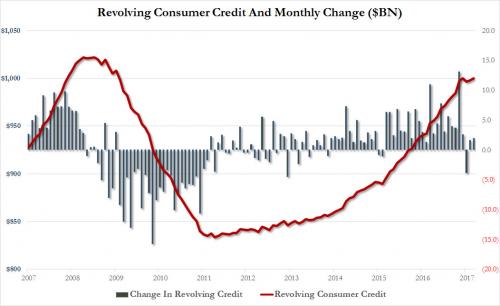
Canadians Buy Record Number of New Cars With Record Amount of Financing (BD)
Majority of Consumers Now See Canadian Home Prices Rising (BBG)
Over 50% of Canadians $200 or Less Away From Not Being Able To Pay Bills (Gl.)
Quebec’s Finance Minister: Don’t Dawdle on NAFTA Overhaul (BBG)
Chinese Stocks Head For Longest Losing Streak In 3 Years (BBG)
How China Keeps Its Financial System From Collapsing (ZH)
Parts of Asia Will Grow Old Before Getting Rich, IMF Warns (BBG)
Italy Adds Bum Note To Macron’s Ode To Euro Zone Joy (R.)
The Rock-Star Appeal of Modern Monetary Theory (Nation)
To Bury Nuclear Waste, Dig Deeper Than Yucca Mountain (BBG)
Dangerous Times in the Aegean and Cyprus (K.)
New Refugee Center Planned On Chios As Tensions Simmer (K.)
Nearly 200 Missing, 11 Dead As Migrant Boats Sink Off Libya (AFP)
Hundreds Of Migrants Feared Dead In Mediterranean Over Weekend (R.)


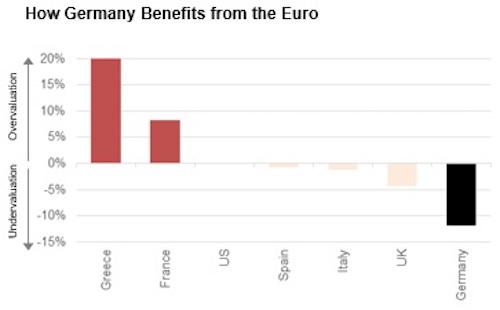
Macron wants Eurobonds, anathema to Germany et al because they would allegedly “sharply reduce each euro zone government’s motivation to pursue sensible fiscal policies..”.

Many in Brussels want a banking union, anathema to quite a few countries. There is no democratic way that leads to such a union. It’s like handing the EU the keys to your country.

Macron Is Not The Solution To Europe’s Top Existential Threat (CNBC)

The future of the euro zone is dependent on a common commitment to solid government finances, says Commerzbank’s chief economist, and France’s new president-elect does not bring the bloc any closer to achieving this reality. The pro-EU and centrist candidate, Emmanuel Macron, stormed to victory against his far-right political rival, Marine Le Pen, on Sunday and is now poised to become France’s youngest ever premier. However, the former economy minister is in favor of joint bond issuance which, according to Jörg Krämer, would sharply reduce each euro zone government’s motivation to pursue sensible fiscal policies. “The EU can’t keep feeling its way from one election to the next. At some point an election might go the wrong way – and if that happens in a large country, the survival of the monetary union would be in jeopardy,” Krämer said in a note.

Commerzbank’s chief economist also warned the repeated near misses of anti-EU political leaders in several European elections in recent years would not last forever and suggested the monetary union’s survival now rests on the bloc’s ability to create a genuine banking union. “To lay these existential risks to rest, the euro zone at long last needs a common commitment to solid government finances. The monetary union’s long-term survival depends on it. But new French President Macron won’t bring this any closer to reality,” he added. Meanwhile, just one day after the pro-business and market-friendly candidate Macron secured his country’s presidential election, EC President Juncker publically lambasted high state spending in the euro zone’s second largest economy. “With France, we have a particular problem … The French spend too much money and they spend too much in the wrong places. This will not work over time,” Reuters reported him as saying in Berlin on Monday.

Read more …

Le Pen would have lost against anyone. But tons of Europeans still don’t like what the EU has become. All it takes is a candidate somewhere who’s not Le Pen or Wilders.

“Europe’s Not Out Of The Woods With Macron Win” (ZH)

It appears the chairmen of UBS have plenty to say on Europe.Following former UBS chairman Peter Kurer’s comments that “to the elites, the EU is a means to get rich quickly and export their problems,” UBS current chairman Axel Weber has warned bankers that Europe is not “out of the woods” from its political risks even after Emmanuel Macron’s reassuring victory in the French presidential election. Peter Kurer recently remarked on the end of the Euro…

“Following an unfortunate combination of wrong decisions at the top and the uncontrolled flourishing of a self-serving bureaucracy, the union has moved in a direction where it has become a prisoner of its own constructed reality. The EU was a great idea but it has been ridden to death. Back in 1992, almost half of Swiss voted to join the European Economic Area, including the traveller. If there was a vote today on joining the union, the latest polls say just 15% would vote yes. The EU had its chances. It squandered them, and maybe it will come to an end in the foreseeable future under the weight of its burdens: La messa e finita, andate in pace.”

And over the weekend speaking in Tokyo, as the FT reports, UBS Chairman Axel Weber said that political risk in Europe remained “actually quite high” even though “we’ve seen the centre hold in France” with Macron’s victory over far-right candidate Marine Le Pen, and even though all the signs were that the centre will also hold in the upcoming German location elections.

“That doesn’t mean Europe is out of the woods,” he told the International Institute of Finance’s spring meeting. “There is still Italy where it is very unclear that the centre will hold. And there is still Greece.” He continued: “Where you find some bright side….there are (also) some downside risks that are not really priced into the market but could derail (Europe).” “Brexit is a time bomb… and the countdown is on. It will be two years from now,” Mr Weber said. He added that “if the British really do leave the customs union and single market there could be a lot of volatility which could impact on the global economy”.

Read more …

How long can bubbles hold?

Commodities Send Ominous Signal On Global Economy (BBG)

By almost any measure last week was a bad one for commodities, as practically every part of the market lost value. West Texas Intermediate crude oil fell under $44 per barrel, Brent crude broke below $50 per barrel and copper tested $5,500 per metric ton. In China, coal and iron ore tumbled. Gold, the supposed ultimate haven, dropped to almost $1,225 per ounce. Last week’s purge capped a steady decline in prices since mid-April and, more broadly, since February based on the Bloomberg Commodities Index. Although much of the blame is being tied to rather high and growing inventory levels, a lack of real demand shouldn’t be discounted. The market is experiencing something greater than a technical correction or speculative positioning. It is signaling something ominous about the state of the global economy.
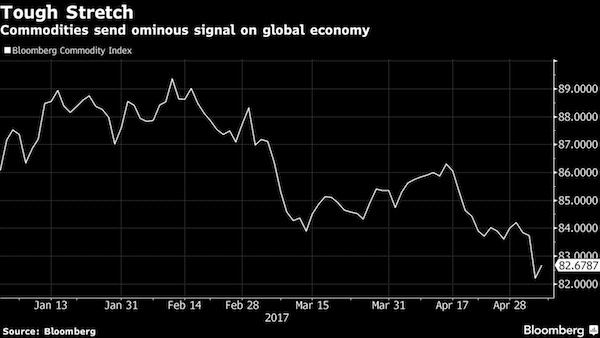
So while Friday saw a small recovery, it appears to be merely a “dead cat bounce” rather than a sign of any market bottom. Traders have reason to question global economic strength. They are concerned about fresh signs of an over-extended Chinese economy and an ongoing slowdown in developed markets faced with aging demographics. In the U.S., they question President Donald Trump’s infrastructure promises along with his administration’s relaxed standards in the mining and drilling sectors, whose commodities we already have too much of. OPEC’s output cuts have failed to do enough to stymie the global oil glut as U.S. drillers add to their rig counts. Such negative sentiment has carried through in the equity markets, particularly among commodity-producing nations such as Australia, Canada and Brazil.

Read more …

A liquidity problem. And a confidence one.

Traders Are Fleeing the Options Market (WSJ)

Falling volumes and spiraling costs are pushing trading firms out of U.S. options, raising concerns about fragility in a market that investors rely on to protect portfolios. Trading has dwindled in most areas of the market, and investors and traders are grappling with increasing fragmentation. Liquidity, the crucial ability to do trades without significantly moving prices, has deteriorated, according to interviews with market participants and data reviewed by The Wall Street Journal. Options on key indexes, exchange-traded funds and high-volume stocks dominate trading. Meanwhile, there is less activity in the rest of the listed U.S. options world. The stresses prompted at least six prominent options market makers to exit from the business since 2012. Market makers are firms willing to both buy and sell using automated programs.

Thomas Peterffy, a pioneer of electronic options trading, said in March that his firm, Interactive Brokers, would pull the plug on options market making. KCG Holdings announced its exit from retail options market making last year, while UBS and Credit Suisse have also left automated options market making. JP Morgan and Bank of America made similar decisions in 2014, according to people familiar with the matter. “Most market makers congregate in the highly traded products,” Mr. Peterffy said in an interview. “It’s difficult for a market maker to maintain hundreds of thousands of bids and offers all the time.” It is hard to pinpoint what triggered the trader exodus, but industry experts say as firms leave, liquidity gets further drained, which spurs more market makers to retrench.
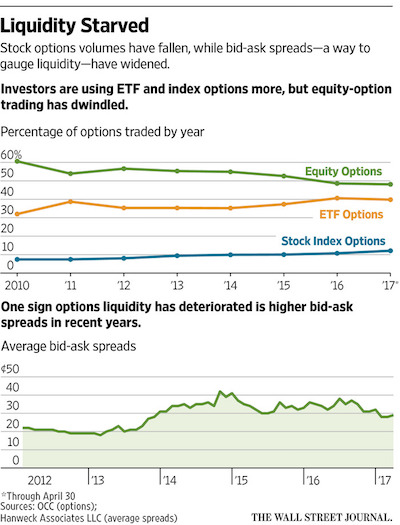
The dangerous feedback loop could sap appetite for options, key derivative securities that investors use to manage risk in their portfolios. “We could ill afford to lose any more market makers at this junction,” said Alan Grigoletto, who previously worked at the Boston Options Exchange, and now runs Grigoletto Consulting while trading options in his retirement account. Data show the liquidity bifurcation. Index and ETF options volume rose in April by 28% and 4%, respectively, data from the Options Clearing Corporation show. Meanwhile, total equity options volume shrank by 10% from the prior year.

Read more …

The car loans issue keeps growing.

The Debt-Bubble Landmine Obama Left For Trump (NYP)

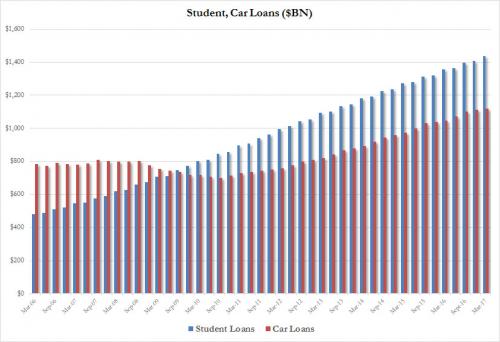
President Trump came in for much jeering when he told reporters he had “inherited a mess” from President Barack Obama. On the economy, though, Obama did indeed leave behind a hidden mess: a seemingly healthy jobs market dependent on cheap debt. When this debt bubble bursts, just as the last one did, the manufacturing jobs Trump wants to save will be in even greater peril. [..] who is borrowing for used cars – and at much higher interest rates – is a huge concern. People with not-great credit scores have always made up about a fifth of the auto-loan market. But the percentage of people borrowing even though they have really bad credit scores has surged, reports Bloomberg. It’s now a third of the subprime auto-bond market, up from just 5% seven years ago. A Standard & Poor’s analysis of just one big subprime auto bond tells the story.

Last week, a company called DriveTime, which sells used cars in 26 states to people with bad credit, was in the market to issue $442 million worth of bonds backed by auto loans. The average credit score of borrowers was 538 — indicating a history of serious default. And, as S&P notes, “today’s subprime customer appears to be . . . weaker . . . than that of several years ago,” because people who defaulted right after the housing crash at least had the excuse that they were caught up in a global bubble. These loans are for people who have no choice but to borrow to buy a car, and no bargaining power on the interest rate they pay: close to 20%. Even though the borrowers pay through the nose, they depend on cheap global credit. With interest rates still near record lows, lenders have to take ever more risk in a low-interest-rate environment to make a little money.

As for that risk: Delinquency rates are rising, with 4.32% of subprime borrowers in general at least 60 days late last year, up from 3.52 two years earlier, says S&P. The bigger risk here isn’t the risk to investors, though. The auto-loan market is still much smaller than the housing market, and the investment world hasn’t created trillions of dollars of derivative securities based on this market (at least not that we know of). And unlike with houses, no one ever expects the value of a car to increase with use. No, this bubble presents a much more direct risk to the economy — and manufacturing jobs. If people with terrible credit can’t borrow an average of nearly $18,000 to buy a used car (what the DriveTime customer pays), the market for used cars collapses. That, in turn, affects the market for new cars. Indeed, the US auto industry has seen sales decline this year, after clocking half a decade of record highs.

Read more …

Canadians do the subprime car thing too.

Canadians Buy Record Number of New Cars With Record Amount of Financing (BD)

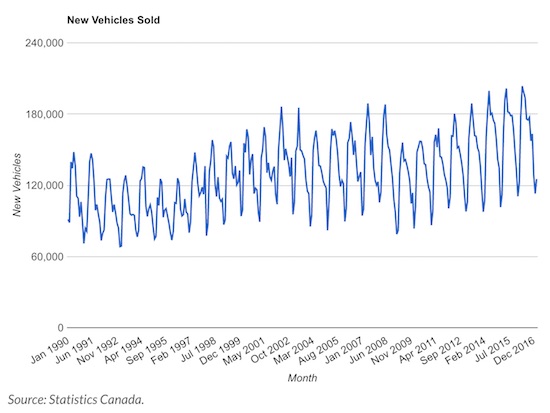
Canadians aren’t just buying real estate, they’re also treating themselves to new cars. According to a new release from Statistics Canada, sales of new cars reached a record high for February. Great for automobile manufacturers, but not so great for the economy. Debt-fuelled financing makes this more of a warning sign than a boom-time trend. Sales of new motor vehicles across Canada rose to an all-time record for February. The month saw 125,284 sales – a 2.74% increase from the same time last year. The largest segment of sales were seen in Ontario, where 41% of them occurred. This is up slightly from 2016, where Ontario accounted for 39% of sales. Booming real estate prices, and massive numbers for car sales… Ontario better be facing the greatest economy its ever experienced, or it’s in trouble.
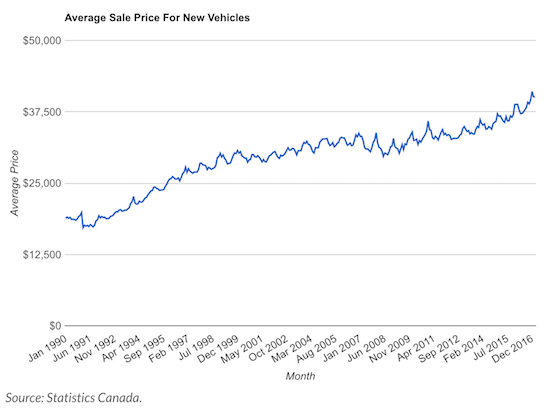
Consumers are purchasing more expensive vehicles too. Over $5 billion was spent on new vehicles for the month, bringing the average to $40,100 – up 3.4% from the same time last year. Ontario was below the average for the country, where the average price was $39,400. While prices are lower in Ontario, they’re not exactly budget vehicles either. The uptick in average sale price is due to longer financing terms for buyers. According to the Financial Consumer Agency of Canada (FCAC), Canadians are “increasingly purchasing more car than they can afford,” due to longer financing becoming fashionable. The agency notes that average leases have crept up 2 months, every year since 2010. According to the Bank of Canada (BoC), the average loan was 74 months as of 2015.
Read more …

The Canadian debt issue is turning into a total craze.

Majority of Consumers Now See Canadian Home Prices Rising (BBG)

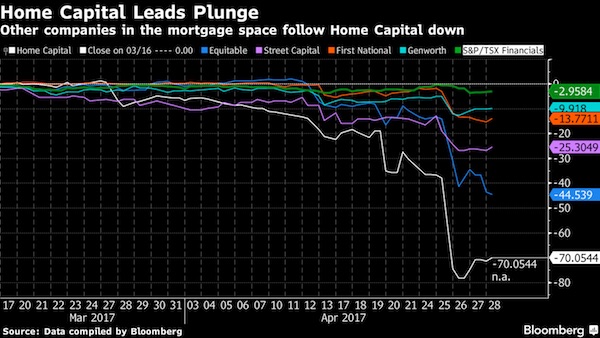
Expectations for Canada’s housing market are heating up, with more than half of respondents in a weekly telephone survey predicting home prices will rise, the first time the measure has topped 50% in records dating back to 2008. The bullishness comes even as a run on deposits at Toronto-based mortgage lender Home Capital leads to heightened scrutiny of a market which policy makers have said is divorced from economic fundamentals. The broad Bloomberg Nanos Canadian Confidence Index fell to 59 in the week ended March 5. Some 50.1% of respondents said they expect local home prices to rise. The figure has climbed for six straight weeks and is higher than the average for the series of 37.1%. Thepercentage of people surveyed in the week ending May 5 who said local home prices will decline in the next six months slid to 10% from 10.7%.

“Consumer sentiment on real estate has gone from hot to hotter,” said Nanos Research Group Chairman Nik Nanos. Housing has led the world’s 10th largest economy over most of this decade as exporters have struggled. The latest burst of housing momentum has led policy makers to question whether it’s being led by supply and demand or by speculation. The Ontario Securities Commission opened hearings into whether Home Capital failed to properly disclose an internal probe into fraudulent mortgage applications, a shakeup in a nation lauded for having the world’s safest banks. The latest Toronto figures also showed prices up 25% in April from a year earlier, still close to the 30% March pace that Ontario Finance Minister Charles Sousa called unsustainable on April 20 when he imposed a foreign buyers tax. Those events haven’t led to more bets on a price decline either, and housing optimists now outnumber pessimists by a factor of five to one.

Read more …

So much in debt they can’t pay their bills. Maybe someone should take a look at Canadian inequality, too.

Over 50% of Canadians $200 or Less Away From Not Being Able To Pay Bills (Gl.)

More than half of Canadians are living within $200 per month of not being able to pay all their bills or meet their debt obligations, according to a recent Ipsos survey conducted on behalf of accounting firm MNP. “With such a small amount of wiggle room, any kind of unanticipated hardship, such as a job loss or even a car repair, could send an already struggling family into financial despair,” said Grant Bazian, president of MNP’s personal insolvency practice, which is one of the largest in Canada. For 10% of Canadians, the margin of error when it comes to household finances is even thinner, at $100 or less. But those with anything at all left at the end of the month were in better shape than many: A whopping 31% of respondents said they already don’t make enough to meet all their financial obligations.

Debt is causing Canadians a fair bit of stress, the polling suggests, but few appear to be on track to buff up their monthly financial cushion. Two-thirds of survey takers said they are “less than very confident” about their ability to create an emergency fund. Another hair-raising finding from the survey: Roughly 60% said they don’t have a firm grasp of how interest rates affect debt repayments. The statistic helps explain why many indebted Canadians end up taking on more debt and high-cost loans, said Bazian. “That’s how so many end up in an endless cycle of debt,” he noted. But the data also raises the question of whether Canadians understand the implications of an interest rate hike by the Bank of Canada (BoC). A decision by the BoC to start lifting its key policy rate from historic lows would raise the cost of carrying debt across the country.

The Bank uses interest rates, among other tools, to influence inflation and economic activity. Many economists believe it could start to raise rates in the first half of 2018, as economic growth picks up pace. Although the BoC will probably lift rates gradually and over time, the impact on Canadian wallets will be substantial. For example, as Global News has reported before, a onepercentage point rise in the BoC’s key interest rate would likely push up variable mortgage rates by a similar amount. A variable mortgage rate that’s currently set at 3%, for example, would go up to 4%, which represents a 33% increase in interest payments for the mortgage holder. That’s an extra $83 a month for every $100,000 in outstanding mortgage debt.

Read more …

Quebec has strong US trade ties.

Quebec’s Finance Minister: Don’t Dawdle on NAFTA Overhaul (BBG)

Quebec Finance Minister Carlos Leitao has a message for government officials considering a renegotiation of NAFTA: Time is of the essence. “If we are going to renegotiate Nafta, then let’s do it,” Leitao said in an interview Friday at Bloomberg headquarters in New York. “The worst case scenario would be if we spend years talking about renegotiating, but don’t actually do it and it just keeps hanging around and doesn’t get addressed. The longer it drags on, the bigger the real impact on investment.” Canadian Prime Minister Justin Trudeau is facing a lengthy trade battle with the U.S., which also includes calls for a new softwood lumber pact and Donald Trump’s complaints about Canada’s system of protectionist dairy quotas.

It’s all set to drag on as the president has yet to trigger a 90-day notice period to Congress to renegotiate Nafta. The last softwood lumber dispute lasted five years. “The problem with the uncertainty is we don’t know what kind of process we will have,” Leitao said. “Is this going to be along the same lines as the last Nafta negotiations? That was very systematic. There were panels on various issues. It’s that kind of certainty that we would like. The actual nuts and bolts will take time.” Leitao has good reason to be wary of protracted trade battles, with his most recent budget already predicting Quebec’s economic growth will lag behind the Canadian average. Output in Quebec will grow 1.7% this year before slowing to 1.6% in 2018, budget forecasts show. That’s less than the 2.2% and 2.3% forecast for all of Canada over the same period.

Read more …

Deleveraging.

Chinese Stocks Head For Longest Losing Streak In 3 Years (BBG)

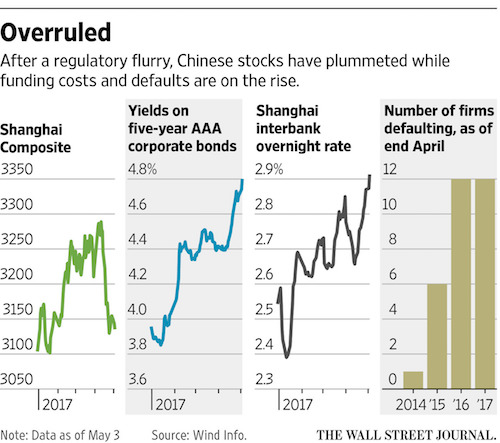
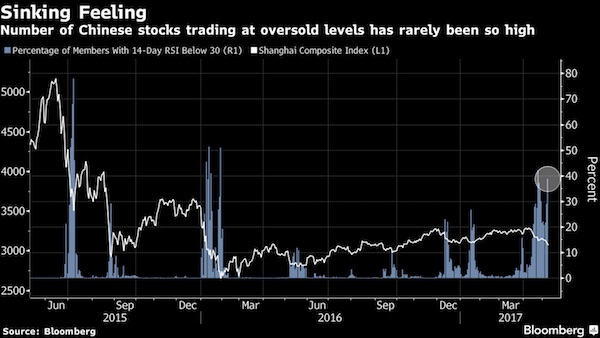
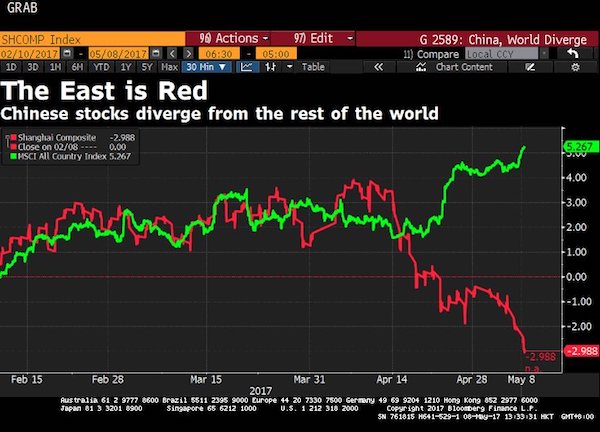
Chinese stocks pared declines, with technical indicators signaling that a five-day slide may have been overdone. The Shanghai Composite Index was little changed at 3,077.78 as of 1:07 p.m. local time, after declining as much as 0.7% earlier in the day. Consumer shares were the worst performers on the CSI 300 gauge, while telecom companies led gains. The Hang Seng Index climbed 0.4%. An intensifying campaign to reduce leverage in the financial system pushed the Shanghai benchmark to a 2.4% loss in the five days through Monday. This drove the gauge’s relative strength index to below 30, a level that suggests to some traders that an asset is oversold.
The nation’s banking regulator said Monday that lenders should carry out collateral pressure tests at least once a year, while the Securities Times reported that some rural banks had suspended interbank businesses temporarily while officials conduct spot checks. “Some stocks appeared to be very cheap at current levels, and this triggered some bargain hunting,” said Banny Lam, head of research at CEB in Hong Kong. State-owned enterprises that dominate old growth industries, such as banks and commodity producers, have been among the hardest-hit by the deleveraging drive, while new-economy shares remain in favor among overseas investors. That’s led to a wide gap between the nation’s two main offshore gauges: the Hang Seng China Enterprises Index and the MSCI China Index.
Read more …

Much collateral doesn’t actually exist. Wealth management products, shadow banks, it’s all not much more than a mirage. It takes faith.

How China Keeps Its Financial System From Collapsing (ZH)

With “risk” in most of the developed world seemingly a long forgotten four-letter word, as seen by today’s plunge in the VIX to a level not seen in 34 years, traders hoping for some “risk event” have been confined to the recent turmoil in China, where overnight not only did trade data disappoint, with both imports and exports missing, but bond yields jumped to the highest level since 2015, dragging stocks lower even as the local commodity crash slammed iron ore and copper to new YTD lows.
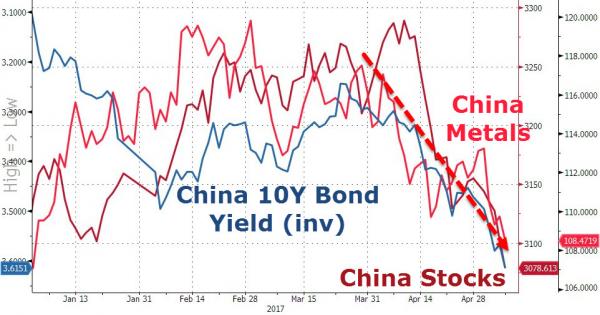
While largely a “controlled” tightening, meant to contain China’s out-of-control shadow banking system, the recent gyrations in Chinese capital markets are starting to have a profound impact on local funding, resulting in a collapse in new bond issuance, and according to FT calculations, in April the number of aborted issues rose to 154, up from 94 in March, 32 in February and 31 in January.
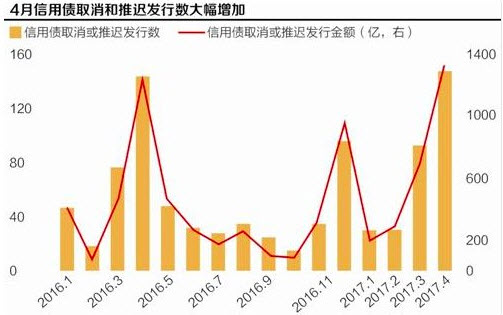
As DB added, “local bond markets are practically shut for corporates. In fact, YTD issuance is down 40%+ yoy and net issuance has been negative in three out of the first four months this year. A number of issuers are being forced to cancel bond issuances (over RMB100 billion YTD) and there were reports (Bloomberg) of even CDB halting issuance (though subsequently denied). Some AA corporates are now issuing at north of 7%.” These signs of mounting stress in China’s $9.3 trillion bond market come less than a month after the country’s banking regulator, Guo Shuqing, was quoted as supporting a campaign to sort out chaotic practices, and threatening to resign if the banking system became “a complete mess”.
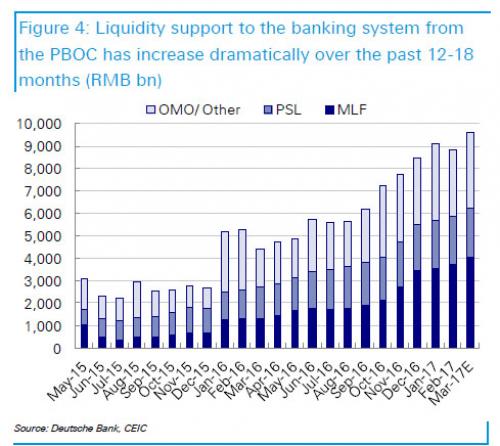
[..] whether or not China keels over and has a hard (or worse) landing, will depend on the PBOC; when (not if) the central bank gets involved, will depend on how soon China’s banks and various CD-funded financial institutions run out of collateral (whether it exists or not) to sell, such as iron ore, copper, precious metals, bonds and even stocks. This will hardly come as a surprise. As we showed last month, the only reason the Chinese banking system hasn’t imploded, is due to nearly CNY 10 trillion in central bank liquidity support for the local banks, just under 100% of China’s GDP.

Read more …

Europe too.

Parts of Asia Will Grow Old Before Getting Rich, IMF Warns (BBG)

Asia’s rapidly aging population means the region is shifting from being the biggest contributor to the global workforce to subtracting hundreds of millions of people from it, according to the International Monetary Fund. The reversal of the so-called “demographic dividend” will drag on global growth and also that in Asia, the world’s fastest growing region, the IMF warned in its annual outlook for the area. The population growth rate will fall to zero for Asia by 2050 – it’s already negative in Japan – and the share of the population who are working-age has already hit its peak, the IMF estimates. That means the ratio of the population aged 65 and older will be almost two and a half times the current level by 2050, and even higher in East Asia.
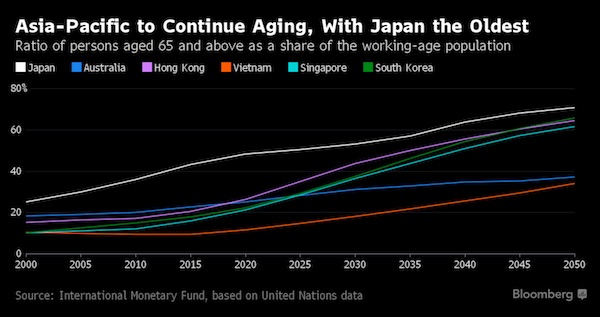
“The speed of aging is especially remarkable compared to the historical experience in Europe and the United States,” the IMF said. Per capita income in Asia relative to the U.S. remains at much lower levels than those achieved by mature advanced economies in the past. “Countries in Asia will have less time to adapt policies to a more aged society than many advanced economies had,” the fund wrote. “As such, parts of Asia risk becoming old before becoming rich.” For economic growth, the aging process could erode up to one percentage point from annual output over the next three decades in Japan, and between 0.5-0.75 percentage point in China, Hong Kong, South Korea and Thailand.
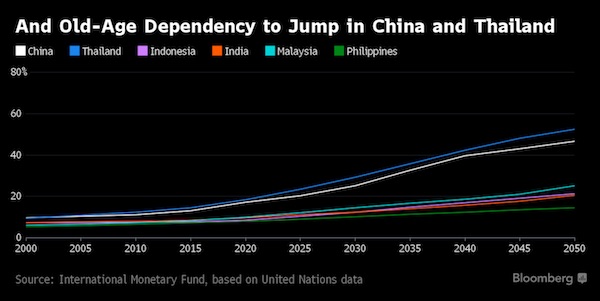
While some bright spots remain, such as India and Indonesia, demographics could subtract 0.1 of a percentage point from annual global growth over the next three decades, the IMF estimates. It also means Asia is at risk of falling into secular stagnation if an older population leads to excessive savings and low investment renders monetary policy ineffective. The demographic shift will also likely keep downward pressure on real interest rates and asset returns for most major countries in Asia, the IMF said. “Adapting to aging could be especially challenging for Asia, as populations living at relatively low per capita income levels in many parts of the region are rapidly becoming old,” the IMF said.

Read more …

It’s time to come clean on how bad Italy is really doing.

Italy Adds Bum Note To Macron’s Ode To Euro Zone Joy (R.)

Italy is adding a bum note to Emmanuel Macron’s ode to joy. While it’s encouraging that a Europhile will take the French presidency after Sunday’s vote, attention can now turn to Europe’s other crisis-in-waiting. Elections are coming in Italy, and there are more of the ingredients for a populist shock than in France. The economy has fared much worse since the creation of the euro zone, with growth averaging zero since 2001, according to the IMF. GDP per capita has fallen in that time. The IMF expects the unemployment rate to reach 11.7% this year, 2 percentage points higher than in France. Anti-EU forces are also spread widely across Italy’s messy political landscape. Stagnation has fuelled support for the 5-Star Movement, which could lead Italy out of the euro zone and currently polls just below 30%.

Mainstream parties are shaky. The left fragmented after former prime minister Matteo Renzi lost his referendum on constitutional reform in December. The right is an awkward alliance between ageing former premier Silvio Berlusconi and more radical anti-EU parties, like the Lega Nord. The risk is that 5-Star forms a coalition with the Lega after elections that must take place by May next year. The economy is picking up, but tighter monetary policy, as the European Central Bank reins in bond buying, could strangle the recovery, as could an overly stern fiscal policy. Italy needs to cut spending or increase taxes by 2percentage points to meet European targets through 2019. Job losses from the restructuring of banks and bankrupt national airline Alitalia could become a lightning rod for anti-EU sentiment.

Europe can help. Italy is likely to miss its fiscal targets anyway, but loosening bloc-wide budget rules to encourage investment and spread out cuts over a long period would cement the recovery. A strong France, aided by Macron’s victory, might persuade Germany to spend more, and give other countries freer rein. However, even if a political shock is avoided, the next election may produce a weak government with no mandate for taking tough decisions to boost growth. Italy could be bringing discord to the region for years.

Read more …

MMT must go mainstream.

The Rock-Star Appeal of Modern Monetary Theory (Nation)

To a layperson, MMT can seem dizzyingly complex, but at its core is the belief that most of us have the economy backward. Conventional wisdom holds that the government taxes individuals and companies in order to fund its own spending. But the government—which is ultimately the source of all dollars, taxed or untaxed—pays or spends first and taxes later. When it funds programs, it literally spends money into existence, injecting cash into the economy. Taxes exist in order to control inflation by reducing the money supply, and to ensure that dollars, as the only currency accepted for tax payments, remain in demand.

It follows that currency-issuing governments could (and, depending on how you lean politically, should) spend as much as they need to in order to guarantee full employment and other social goods. MMT’s adherents like to point out that the federal government never “runs out” of money to fund the military, but routinely invokes budget constraints to justify defunding social programs. Money, in other words, isn’t a scarce commodity like silver or gold. “To people who’ve worked in financial markets, who work at the Fed, this isn’t controversial at all,” says Galbraith, who, while not an adherent, can certainly be described as “MMT-friendly.”

The decisions about how to issue, lend, and spend money come down to politics, values, and convention, whether the goal is reducing inequality or boosting entrepreneurship. Inflation, MMT’s proponents contend, can be controlled through taxation, and only becomes a problem at full employment—and we’re a long way off from that, particularly if we include people who have given up looking for jobs or aren’t working as much as they’d like to among the officially “unemployed.” The point is that, once you shake off notions of artificial scarcity, MMT’s possibilities are endless. The state can guarantee a job to anyone who wants one, lowering unemployment and competing with the private sector for workers, raising standards and wages across the board.

Read more …

No matter how deep you dig, you can’t guarantee safety for a million years. That’s what’s halted Yucca Mountain. The Bloomberg editors don’t understand the issue either.

To Bury Nuclear Waste, Dig Deeper Than Yucca Mountain (BBG)

Energy Secretary Rick Perry is right to say the U.S. needs a long-term solution to its massive nuclear waste problem. It also makes sense for Perry and some members of Congress to see Yucca Mountain as part of that solution – though many Nevadans promise to make sure it won’t be. But even if Yucca can survive the political fight, it can’t be the only option for disposing of America’s spent nuclear fuel. More than 75,000 metric tons of the stuff are cooling in pools and casks at dozens of power-plant sites around the country. That’s already too much to fit in Yucca Mountain, and the total grows by more than 2,000 tons a year. Other strategies are needed, ideally ones that are less politically radioactive. Consider, for instance, the idea of sinking the waste into boreholes that reach three miles below ground – 15 times as deep as the proposed chambers inside Yucca. Such shafts could be drilled in states that, unlike Nevada, benefit from the use of clean, reliable nuclear power.

Boring into the Earth’s deep rock layers could provide the kind of bury-it-and-forget-it underground disposal necessary for material that will remain dangerous for hundreds of millennia. Local opposition can still be expected; in North and South Dakota, residents have shouted down some plans to dig test holes. That’s why a so-called consent-based strategy, identifying locations with both the appropriate geology and an agreeable population, is necessary. If hosting a waste site means more funding for local public works and services, more communities might be willing to accept one. (This proved to be the case in Carlsbad, New Mexico, home to a storage place for low-level waste from nuclear weapons.) A familiarity with nuclear power may also encourage acceptance, perhaps because there is a nuclear plant in the area employing people and providing power.

The same approach could also be used to locate six or seven centers where waste from several nuclear plants could be stored while it awaits burial. Such containment facilities could also include research centers – mini national laboratories where scientists could work out new ways of reprocessing fuel and perhaps conduct demonstration projects for reactors designed to use safer fuels. The one thing the U.S. should not do is continue to neglect the growing quantities of nuclear waste. Over the past few decades, electricity ratepayers have contributed more than $34 billion to a national fund to pay for a geologic disposal site. And because none yet exists, taxpayers are forking over billions more to enable nuclear-plant operators to manage interim storage. The political barriers to solving this problem may be high, but further delay – and an undue fixation on Yucca Mountain – won’t make them any easier to overcome.

Read more …

Turkey will provoke Greece at some point, and US and Europe had better prevent that from happening.

Dangerous Times in the Aegean and Cyprus (K.)

The concept of gray zones (the claim that the sovereignty of a number of islands and islets in the Aegean is undetermined) was a novel idea that Turkey came up with 20 years ago. At some point, Ankara reached the point of including the Greek island of Gavdos in its gray zones list. Whenever Athens made an official request regarding the islands or rocky outcrops that Turkey had on its list, the answer was always very vague: “Anything that is not clearly included the bilateral agreements that set out Greece’s borders with other countries.” At first, many people thought this was a bargaining chip that Ankara would trade as part of a grand bargain. They were wrong. The failure to settle differences between Greece and Turkey gave Ankara the opportunity to add more issues to the agenda.

Over time, these have become permanent and ever-expanding. Currently, Turkey considers significant parts of the Aegean to be gray zones. This includes islands that have been inhabited for decades. It is questioning Greek sovereignty through its actions, not just its words, by the frequent presence of naval vessels in Greek waters and overflights by fighter jets. Over the last few months, it has being doing this more systematically and openly. Greece’s approach has also changed. The doctrine that existed in the wake of the Imia crisis in 1996, when the two countries almost went to war, was based around not building up tension following various incidents and maintaining a low profile.

[..] A dangerous situation is also playing out in Cyprus. The Turks are trying to impose the concept of gray zones there as well. July (when a new round of drilling for hydrocarbons is due to begin off Cyprus) promises to be a difficult month. Ankara will attempt before then to intimidate the companies that plan to start drilling or try to obstruct them if they are not scared off by threats.

Read more …

Prison camps are no solution.

New Refugee Center Planned On Chios As Tensions Simmer (K.)

The exact site for the creation of a new so-called pre-departure camp for migrants and refugees on the island of Chios will be determined by May 20, authorities said on Monday. The new camp will come as tensions at overcrowded reception centers on the eastern Aegean island continue to simmer, with almost daily clashes between stranded migrants of different ethnicities. “The experience of Lesvos and Kos where such centers have been created is positive,” said Lieutenant General Zacharoula Tsirigoti of the Greek Police in a press briefing Monday on Chios. Pre-departure centers are deemed essential as they house refugees and migrants returning to Turkey. Tsirigoti added that building a new center on the island is a “one-way street” as locals – many of whom have campaigned for the immediate removal of all migrants and refugees from Chios – say the situation has reached breaking point and that the large police force on the island has been unable to cope.

Read more …

The season is just starting: “..the trend points to around 250,000 people arriving over the course of 2017”. There is no place for these people in Italy and Greece.

Nearly 200 Missing, 11 Dead As Migrant Boats Sink Off Libya (AFP)

Eleven migrants have died and nearly 200 are missing after two boats sank off the coast of Libya, UN agencies said Monday citing survivors, in the latest such tragedy. The first involved an inflatable craft which left Libya early Friday with 132 people on board, only to start deflating a few hours later, before overturning. Some 50 survivors were picked up by a Danish container ship, the Alexander Maersk, which was alerted to divert by Italian coastguards and dropped them off on Sunday in Pozzallo, southern Sicily. Representatives of the UN High Commissioner for Refugees (UNHCR) and the International Organization for Migration (IOM) were able to meet them on Monday to hear their accounts. Survivors told them that women and children were among those missing.

At the same time, the bodies of 10 women and one child were found Monday on a beach in Zawiya, 50 kilometres (31 miles) west of Tripoli, according to an official for the Libyan Red Crescent. Then on Sunday seven migrants – a woman and six men – were rescued by Libyan fishermen and coastguards off the coast of the Libyan capital. An IOM spokesman who met them said they had set out on a boat with at least 120 people on board, including about 30 women and nine children. In all more than 6,000 migrants were rescued Friday and Saturday in international waters off the coast of Libya and brought to Italy, while several hundred were rescued in Libyan waters and taken back to Libya.

The number of people leaving Libya in the hope of starting a new life in Europe is up nearly 50% this year compared with the opening months of 2016. With most departures coming in the warm summer months, the trend points to around 250,000 people arriving over the course of 2017. Some 500,000 migrants were registered in Italy in the three years spanning 2014-16.

Read more …

Europe’s reputation is tarnished for decades. But everyone thinks they can deflect responsibility. Time for skin in the game.

Hundreds Of Migrants Feared Dead In Mediterranean Over Weekend (R.)

More than 200 migrants are feared to have died in the Mediterranean over the weekend, according to testimony from survivors, and several bodies, including that of an infant, have washed up on a Libyan beach. About 7,500 people have been rescued off the coast of Libya since Thursday, the Italian and Libyan coastguards said. Two groups of survivors told the organizations that hundreds drowned when their rubber boats began to deflate before rescuers arrived. More than 60 are feared dead and three bodies were recovered on Saturday, survivors brought to Sicily on Sunday told Italian coastguards. The boat left Libya carrying about 120, they said. There was some discrepancy in the numbers. Based on its interviews with some of the survivors in Pozzallo, Italy, the U.N. refugee agency estimated the number of dead at more than 80.

Separately, Libya’s coastguard picked up seven survivors over the weekend who said they had been on a boat packed with 170 migrants. Aid agency International Medical Corps, which gave medical care to the survivors, also confirmed their account. “We rescued on Sunday seven illegal migrants – six men and a woman,” said Omar Koko, a coastguard commander in the western city of Zawiya. “According to these survivors, there were 170 on board the boat, which sank because of overloading.” Among those missing were more than 30 women and nine children, Koko said. Eleven bodies washed up on the shore west of Zawiya, said Mohanad Krima, a spokesman for the Red Crescent in Zawiya. “All the bodies are of female victims and there is a girl of less than one year old,” he said.

Read more …

May 082017
 
 May 8, 2017  Posted by at 9:32 am Finance Tagged with: , , , , , , , , , , ,  1 Response »


RCA TV test pattern 1939


Macron Banks On De Gaulle’s ‘Majority Amplifier’ To Govern (R.)
In France, The Run Of Macron’s Life Starts Monday (Pol.)
Euro Gives Up Gains As Investors Look To Post-Election France (G.)
US Economy Can’t Even Match the “Sclerotic Statism” of France (CEPR)
Expect Dramatically Lower Stock Market Returns Over Next Decade (CNBC)
UK Consumer Spending Weakens With Sharp Slowdown in April (BBG)
Brexit Boom Gives Britain More Billionaires, Inequality Than Ever (G.)
China Tycoons Are Setting Up Shop In The US (BBG)
Hedge Funds Bail Just Before OPEC-Driven Oil Rally Vanishes (BBG)
Warning For Boomers: Your Gen X Kids Are Coming Back Home – For Good (MW)
Australia To Hold New Inquiry Into ‘Big Four’ Banks (R.)
How Zombie Companies Stop Productivity Growth (BBG)
German Army To Search All Barracks After Nazi Memorabilia Found (R.)
Greek PM Tsipras Rushes To Get Bailout Deal To Parliament With Eye On QE (K.)
1 Million Child Refugees Flee South Sudan’s Civil War (BBG)
Growing Numbers of Refugees In Northern Syria in Urgent Need of Aid (Kom)


Anyone would have won against Le Pen.

Macron Banks On De Gaulle’s ‘Majority Amplifier’ To Govern (R.)

Unknown just three years ago, and with a party only 12 months old, Emmanuel Macron has seized the presidency against all the odds. His challenge now is to govern. To do that he must build a parliamentary majority that supports his election pledges in June legislative elections, when France’s two established parties will put their huge machines to work. Macron has at least one thing in his favor: the “majority amplifier” effect of an electoral system designed by post-war leader Charles de Gaulle specifically to maximize presidential independence from parliament. Last week, the first opinion survey for the legislative elections showed Macron’s new movement “En Marche!” could win between 249 and 286 mainland France seats in the lower house. Even a figure at the bottom of that range would be a good outcome for him.

He only needs 289 for an absolute majority, and the poll excluded 42 seats in Corsica and overseas. It foresaw centrist and conservative parties winning around 200-210 mainland seats, the far-right National Front 15-25 and the Socialists 28-43. “In the lowest-case scenario, En Marche would still be the largest political grouping, which would be enough to try to constitute a majority. The question would then be how and with whom,” said OpinionWay’s Bruno Jeanbart, who directed the poll. En Marche is only a year old and has never fielded candidates before. Only 14 have been named so far, and at first glance a majority looks unlikely. But that reckons without de Gaulle’s amplifier – known as the “fait majoritaire” by French political scientists. [..] The last legislative vote in 2012 also showed the “fait majoritaire” in action.

Socialist Francois Hollande garnered less than 30% in the first rounds of both the presidentials and the legislatives, yet came away with over 40% of the second-round legislative vote and, with help from 17 Green party MPs, governed with a comfortable majority. “Macron can totally have an extremely solid majority of at least 350 MPs,” said Xavier Chinaud, an electoral expert. He added that to reach that number, the president would have to employ tactics like poaching popular MPs from other parties. The old parties will put up a fight, especially the conservative Republicans [..] Now led by Francois Baroin, they hope for enough seats to force Macron into France’s fourth “cohabitation” since 1958. Cohabitation does not have to mean paralysis, but rather that the prime minister and his camp in parliament have the upper hand over the president.

Read more …

“En Marche doesn’t have the money to finance a full-blown parliamentary run. It must ask its candidates to invest not only their time but also their money in the upcoming blitz campaign.”

In France, The Run Of Macron’s Life Starts Monday (Pol.)

Winning the presidency now looks like the easy bit. If Emmanuel Macron makes his way to the Élysée Palace, as expected, in the second round of France’s presidential election Sunday, another bruising political battle is looming. To be able to govern and not be sidelined by a hostile parliament, Macron’s nascent political movement En Marche will have to cobble together a majority in the National Assembly in an election beginning on June 11. And unlike in the second round of the presidential ballot — in which parties from across the political spectrum have urged their supporters to vote for him over his far-right opponent Marine Le Pen — Macron’s rivals will be devoting all their energies to defeating him.

The 39-year-old former economy minister will be counting on his army of 250,000 En Marche volunteers, and a crew made up mostly of political novices. And while Macron hopes that a victory in the presidential election will draw others to his banner, for a movement that was launched a little over a year ago, winning control of parliament looks like a tall order. The stakes are high. If Macron can’t clinch a majority, he won’t be able to appoint a prime minister of his liking. He’ll spend his term largely as a figurehead, his dreams of reforming France all but sunk. Macron needs 289 deputies to be ensured of an absolute majority in the lower house of parliament. So far, En Marche, the movement he still refuses to call a party, has endorsed 14.

True to form, Macron exudes a sense of confidence that the momentum of his election will carry over to the parliamentary polls, allowing him to clinch a majority just six weeks later. This may not be out of reach. A survey conducted this week by OpinionWay, although preliminary, indicated that En Marche could well obtain more than half the seats in the National Assembly. By weaving in electoral results from past elections with a recent poll, OpinionWay estimates that the next Parliament would be dominated by En Marche and the conservative Républicains party. The ruling Socialist Party would be decimated, and Le Pen’s National Front would obtain 25 MPs at most – due to France’s electoral system.

Sill, obstacles abound. En Marche will be facing an energized right. Both the mainstream center-right Républicains party and Le Pen’s National Front will emerge from the presidential election feeling that Macron has robbed them of a victory they at some point considered theirs. François Fillon’s failed campaign has left deep wounds in the Républicains, but one way to try to heal them could be to make Macron their common target in June. [..] En Marche doesn’t have the money to finance a full-blown parliamentary run. It must ask its candidates to invest not only their time but also their money in the upcoming blitz campaign. Political parties in France are provided with public funding according to their performance in previous elections. En Marche, founded a little over a year ago, has never put up a candidate for office before.

Read more …

Not THAT much trust perhaps.

Euro Gives Up Gains As Investors Look To Post-Election France (G.)

The euro rose to a six-month high in the wake of Emmanuel Macron’s convincing victory in the French election but the upside for the single currency could be short-lived, analysts warned. In Asian trading on Monday, the euro rose as high as $1.1024 , its highest since 9 November, and also jumped to a one-year high of 124.58 yen against its Japanese counterpart. But it had slipped almost 0.3% to $1.096 against the dollar by 5.30am GMT and lost a similar amount to the yen with traders remarking that gains had already been largely priced in thanks to Macron’s strong showing in the first round of voting two weeks ago. “The market already priced in the victory of Macron,” said Masafumi Yamamoto, chief currency strategist for Mizuho Securities in Tokyo.

“We saw some additional rise of the euro this morning, but considering the difficulty for Macron’s party to get a majority in the national assembly election, he may not bring higher growth.” Looking at positioning in the euro, he said, “the market has squared its short positions, but there are no fresh reasons to take long positions, as there will likely be no new positive developments, and limited scope for upside for the euro”. The muted analysis was partly based on an acknowledgment of the problems facing Macron, a 39-year-old former banker who has never held elected office. He was economy minister under outgoing president François Hollande but failed to turn around the fortunes of the beleaguered government. He has pledged to reform the country’s rigid labour laws – long seen by pro-market economists as a hindrance to growth – but such change was beyond the Hollande administration, despite a lengthy struggle.

Read more …

Reality check.

US Economy Can’t Even Match the “Sclerotic Statism” of France (CEPR)

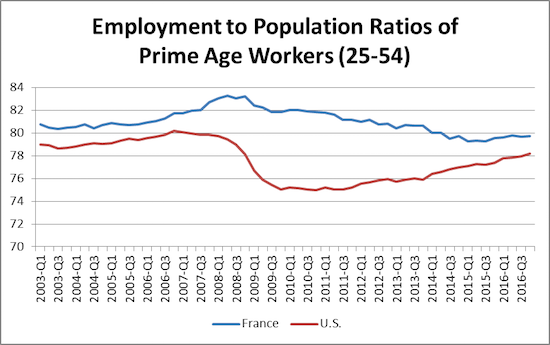
The Washington Post has long pushed the view that a dollar (or euro) that is in the pocket of a middle class person is a dollar that should be in the pockets of the rich. (They are okay with crumbs for the poor.) In keeping with this position, in its lead editorial today the Post complained about the “sclerotic statism” of the French economy. It then called for increasing employment, “through reforms of the labor code, not by protectionism or restriction of immigration.” It is worth bringing a little bit of data to the fact free zone of the Washington Post opinion pages. France actually has consistently had a higher employment rate for its prime age workers (ages 25 to 54) than the United States.

As can be seen, the employment rate for prime age workers in France was roughly 2 percentage points higher in 2003. The gap expanded to almost 7 percentage points following the downturn, but it has in more recent years narrowed again to just under 2 percentage points. France does have much lower employment rates among younger and older workers than the United States, but this is due to policy choices. College is largely free in France and students get stipends from the government. Therefore many fewer young people work. France also makes it much easier for people to retire in their early sixties than in the United States, with largely free health care and earlier pensions. The merits of these policies can be debated, but they are not evidence of a sclerotic economy.

It is also not clear that the Washington Post’s desire to weaken protections for workers (euphemistically described as “reforms of the labor code”) will have a significant effect in reducing unemployment or raising employment. Extensive research has shown there is little relationship between worker protections and employment. It is also worth noting that the Post denounced protectionism in this editorial, but it is fine with protectionism in the form of ever longer and stronger copyright and patent protection, which benefit people it likes.

Read more …

Expect losses.

Expect Dramatically Lower Stock Market Returns Over Next Decade (CNBC)

Enjoy the stock indexes riding at record highs for now, but get ready for much stingier markets in the years to come. That’s the message consistently conveyed these days by investment counselors and finance scholars, who argue that with today’s starting equity valuations and low interest rates, the coming decade should produce dramatically lower returns than the historical average. The leaders of Vanguard Group, overseers of some $4 trillion in client assets, have been advising investors to expect a typical 60% stocks/40% bonds portfolio to deliver two- to- three percentage points less in nominal annual returns than its long-term norm. (Since 1926, such an asset mix has returned better than 8.5% annualized.)

Other forecasts are even less generous. Research Affiliates, a quantitative and “smart beta” fund manager, projects that U.S. stocks might only offer one% a year for the next decade, after inflation. This is based largely on the so-called Shiller P/E, a ratio of the S&P 500 index to its trailing ten-year average earnings, which is now above 29 and higher than any period aside from the run-up to the 1929 and 2000 market peaks. Jeremy Grantham of institutional value manager GMO has, by his admission, been wrong for years in assuming that corporate profit margins and equity valuations would revert to their pre-1990s trend levels. Yet even accounting for some more permanent upward shift in these gauges, he sees real (after inflation) returns of 2-3% a year looking out two decades.

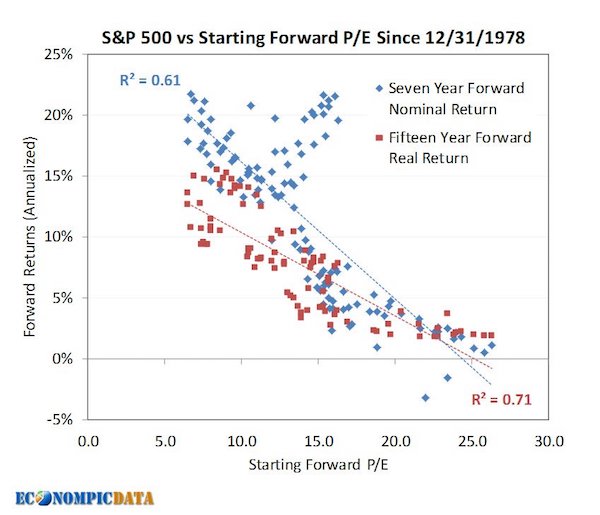
And a simple plot of the market’s forward P/E ratio against subsequent market returns shows that, since 1978, when starting at today’s multiple of around 17.5 forecast earnings, ensuing seven- and 15-year nominal returns (before inflation) have been clustered in the mid- to low-single digits. These forward-return calculations vary in their approach and assumptions, but all are anchored on today’s stock valuations, long-term norms in corporate-profit growth and current interest rates. Stocks, even during the depths of the last bear market, never got dramatically cheap compared to prior cycles and certainly didn’t stay inexpensive for very long. And with risk-free 10-year government debt yielding a skimpy 2.3% in the U.S. and far less elsewhere, all other financial assets have repriced for skimpier future returns as well.

Read more …

The consumer is toast.

UK Consumer Spending Weakens With Sharp Slowdown in April (BBG)

U.K. consumer-spending growth slowed in April and is forecast to remain weak in the coming months, according to a report from Visa. Its index showed spending rose an annual 0.5% in April, down from 1% in March and marking one of the slowest rates of growth in the past three years. Weaker household demand is also taking a toll on retailers. A separate report from the Institute for Chartered Accountants in England and Wales showed while there was a jump in business confidence this quarter, retailing was the laggard among nine sectors covered. “The trend of relatively modest expenditure growth is likely to extend in to the coming months, as consumers are squeezed by both rising living costs and relatively lackluster wage growth,” said Annabel Fiddes, an economist at IHS Markit, which compiles the consumer index.

Inflation was at 2.3% last month and is forecast to keep accelerating through this year, outpacing wage increases and leaving workers facing a drop in real incomes. The Bank of England may raise its forecast for consumer-price growth this week, which could indicate an even bigger squeeze on households. The overall business sentiment gauge by the ICAEW jumped the highest in almost a year this quarter. Yet despite firms being more confident, the report showed they are still reluctant to make long-term commitments. While Brexit is dominating the agenda in the buildup to the U.K. election on June 8, the institute said all parties must spell out how they will “address the problem of business investment head-on.”

Read more …

No wonder consumer spending’s down.

Brexit Boom Gives Britain More Billionaires, Inequality Than Ever (G.)

Britain has more billionaires than ever in what equality campaigners said was a clear sign the UK economy is only working for the few at the top. There are now 134 billionaires based in the UK according to this year’s Sunday Times Rich List, 14 more than the previous highest total, as the super-rich reap the benefits of a “Brexit boom”. Fifteen years ago, there were 21. The annual rich list showed that the wealthiest 1,000 individuals and families in Britain have combined wealth of £658bn, up from £575bn last year, despite fears that the Brexit vote last June would plunge the economy into a fresh turmoil. The Equality Trust said the £83bn increase in wealth among the richest 1,000 people over the past year could pay the energy bills of all UK households for two and a half years and would be enough for the grocery bills for all food bank users for 56 years.

Wanda Wyporska, the executive director of the trust, said that an elite was sitting on mountains of wealth in the fifth largest economy of the world. “The super-rich continue to streak away from the rest of us, while the poorest see their wealth shrink. This is an economy working for the few, not the many,” she said. “Record numbers of people visited food banks last year, millions are locked out of a decent home and two-thirds of children in poverty are in working households. “We know that inequality damages our economy and society, and makes it harder for ordinary people and their children to get on. With the general election fast approaching, our politicians need to decide the sort of country they want to build. One where we can all prosper or one where we’re picking crumbs from the super-rich’s table.”

Read more …

China Shadow Banking Assets Estimated at 64.5t Yuan or 87% of GDP: Moody’s.

China Tycoons Are Setting Up Shop In The US (BBG)

When a new hedge fund opened in Mountainside, New Jersey, a leafy suburb that still holds an annual little-league parade, few would have guessed where much of its funding came from: Chinese billionaire Cai Kui. The credit hedge fund, Westfield Investment, was founded by former Goldman Sachs Managing Director Renyuan Gao and managed $139 million as of January. It’s part of a new crop of asset management firms that are expanding China’s reach on Wall Street as money has poured into the U.S. from the world’s second-biggest economy. China’s marquee names are among those setting up shop in the U.S. Chen Feng, who controls the HNA Group airline and hotel conglomerate, has opened a U.S. money management firm. China Vanke, the mainland’s second-largest residential developer, has indirectly taken a major stake in a manager.

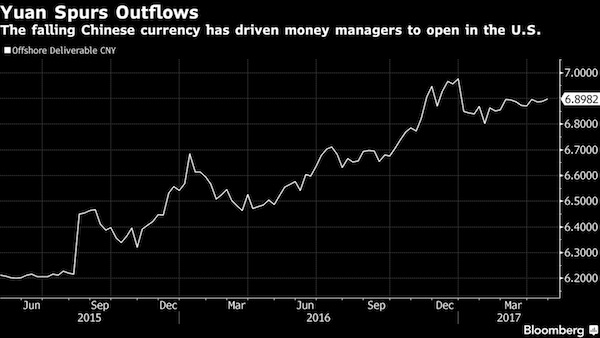
All told, about 324 firms with financial ties to the mainland and Hong Kong had registered with regulators by last year, more than double the number in 2012, filings show. They are riding the wave of capital that left China on concerns about bank debt, a real estate bubble and the yuan, which plummeted about 11% against the dollar in the last two years. The currency flight was reflected in balance of payments data where capital outflows tripled to $220 billion last year from $70 billion in 2014, according to Derek Scissors, a China economist at the American Enterprise Institute. “There is so much Chinese money floating around the U.S. now,” Scissors said. “If you’re a Chinese money manager, why wouldn’t you come here?” The migration comes amid a Chinese shopping spree for an array of U.S. companies, including financial firms like New York’s Cowen Group and the Chicago Stock Exchange.

Chongqing Casin Enterprise led the purchase of the exchange, which was founded in 1882. The deal was reviewed by a U.S. panel on national security grounds and eventually cleared in December. In another deal with political overtones, a subsidiary of Chen’s HNA Group agreed in January to buy a stake in Anthony Scaramucci’s SkyBridge Capital, a New York fund of hedge funds firm. The announcement came after reports that Scaramucci had been tapped for a top job in the White House, stirring speculation that HNA’s motives were partly political. The registration of the China-linked firms with the SEC hasn’t drawn such scrutiny. The SEC began requiring hedge funds and buyout firms to sign up with the agency in 2012 as a result of the Dodd-Frank Act. About 30% of the Chinese firms that registered by 2016 are full-fledged money managers. The rest filed as exempt advisers that operate in the U.S. on a more limited basis.

Read more …

OPEC is fast losing what remained of its credibility.

Hedge Funds Bail Just Before OPEC-Driven Oil Rally Vanishes (BBG)

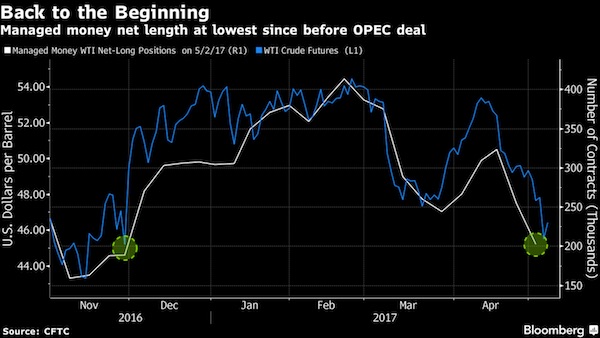
Hedge funds jumped out of the oil market just in time. Before West Texas Intermediate crude nosedived on Thursday, wiping out the rally driven by OPEC’s deal, money managers slashed bets on rising prices by 20%, according to U.S. Commodity Futures Trading Commission data. Now they may soon be well poised to start betting on the next rally. “We are moving toward a positioning where these money managers are no longer over-invested,” Tim Evans at Citi Futures Perspective in New York, said. “This opens up the potential for them to start buying again.” Oil collapsed Thursday amid concerns that OPEC has failed to ease a supply glut as U.S. shale drillers ramp up output. Shares of U.S.-based producers got crushed as investors worry they might be repeating the same pattern that led to the market crash in 2014.

Earlier this year, billionaire wildcatter Harold Hamm urged colleagues to take a “measured” approach to lifting production, or risk a new glut. In a gamble that things could get worse, about $7 million worth of options changed hands Friday that will pay off if WTI falls beneath $39 a barrel by mid-July, according to data compiled by Bloomberg. Hedge funds decreased their net-long position, or the difference between bets on a price increase and wagers on a drop, to 203,104 futures and options in the week ended May 2, the CFTC data show. Longs fell about 7%, while shorts surged 37%, following a 26% jump a week earlier. [..] Oil’s tumble to a five-month low was driven purely by technical trading and supply is still getting tighter, according to Citigroup and Goldman Sachs. The current price plunge began when WTI broke through its 200-day moving average. Once that gave way, another key technical indicator called a Fibonacci retracement was breached, paving the way to the low of the year and then $45 a barrel.

Read more …

Multigenerational households are the model of the past and the future. Come look in Greece.

Warning For Boomers: Your Gen X Kids Are Coming Back Home – For Good (MW)

Remove the door knockers. Pull down the shutters. Pretend no one’s home. Your adult children are coming back – for good. One-in-nine baby boomer parents said their adult children returned home within the last year, according to a new report from financial services firm Fidelity Investments and Stanford Center on Longevity, which surveyed 9,000 employees.The adult children save money on rent and household goods, but their parents are the ones who appear to be suffering: 68% said they were more stressed, 53% said they were less happy and another 53% said they had less leisure time after the return of their “boomerang kids.” More than three-quarters (76%) said they took on higher expenses, too. Even people who are now in their 40s and 50s are considering mom and dad an option.

Older millennials are 2.7 times more likely to live in their parents’ home than people under 55 years old than in 1999, while Generation-Xers, who are now in their mid-30s to early 50s, were 2.2 times as likely to live with their parents, according to separate data released last week by real estate site Trulia. “No parent is going to want to say no to a child who needs help, but certainly being realistic about the financial situation is important,” said Katie Taylor at Fidelity. More American adults are living with their parents and grandparents than ever before — 19% of the U.S. population (or nearly 61 million people) lived in a multigenerational household, up from 17% (42 million) in 2009 and 12% (27.5 million) in 1980, according to the Pew Research Center, nonprofit think tank based in Washington, D.C.

But not all millennials are as “lazy” or “entitled,” as they are often accused of being. About one in four 25- to 34-year-olds who live at home and are not working or going to school do so because of a health-related reason or because they are acting as caregivers to their family members. And more than a third of Americans, including millennials, expect to financially help their parents within the next few years, another survey found. Some are even making efforts to help their parents save for retirement.

Read more …

Wow, great timing! We’re coming to you live from the barn, and there’s not a horse in sight.

Australia To Hold New Inquiry Into ‘Big Four’ Banks (R.)

Australia will hold an inquiry into competition in the country’s financial system, following a series of scandals in the banking sector and public allegations against the “Big Four” banks of abuse of market power. The latest inquiry is part of a number of government measures since last year aimed at alleviating public concerns about the power of the big banks, after revelations of misconduct in the industry. Australia’s four major lenders – Commonwealth Bank of Australia, Westpac, ANZ and National Australia Bank – have come under fire recently following several scams involving misleading financial advice, insurance fraud and interest-rate rigging, as well as for refusing to pass on official interest rate cuts in full. The four together control 80% of Australia’s lending market and have posted record profits for years.

Westpac, NAB and ANZ all reported a rise in half-yearly cash profits this month, taking their total to about A$8.5 billion. CBA will report limited third-quarter figures on Tuesday. “The high concentration and degree of vertical integration in some parts of the Australian financial system has the potential to limit the benefits of competition…and should be proactively monitored over time,” Treasurer Scott Morrison said in a statement on Monday. “The Government is committed to ensuring that Australia’s financial system is competitive and innovative. That is why I have tasked the Productivity Commission to hold an inquiry into competition in Australia’s financial system.” The inquiry will consider the degree of concentration in key segments of the financial system, examine barriers to innovation in the system and look into competition in personal deposits and mortgages for households and small businesses.

Read more …

The benefits of ZIRP.

How Zombie Companies Stop Productivity Growth (BBG)

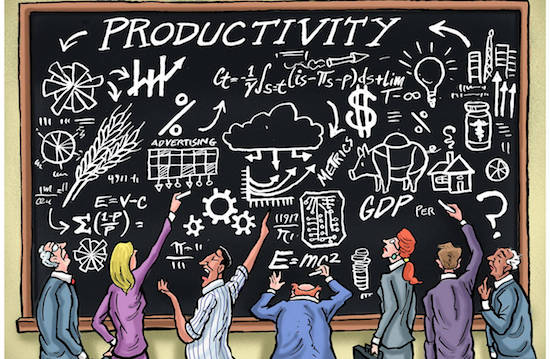
The global economy is picking up steam, but that’s deceptive. The foundations of expansion are soft, marked by weak productivity growth and inequality. The two are related. The productivity problem confronting the world’s advanced economies predates the financial crisis more than a decade ago. When we look beyond the headline statistics, patterns emerge. Advanced economies have become less dynamic and are at risk of becoming sclerotic unless the ambition for reform is revived. It’s essential that we understand three sources of the current productivity slump in particular, and identify the key reforms necessary to address them. First, the productivity slowdown masks a widening performance gap between more productive and less productive firms, as the chart below shows (the picture for service sector firms is even worse).

This divergence is not just driven by firms at the frontiers of their industry, pushing the technological boundaries, but also by stagnating productivity growth at what can be called laggard companies that have failed to adopt the leaders’ best practices. This is also bad news for inclusiveness, since rising wage inequality can be largely traced to the growing differentials in average wages paid across companies, with high-productivity ones paying high wages and low-productivity businesses paying low wages. Second, in well-functioning markets we would expect strong incentives for productive companies to aggressively expand and drive out less productive ones. The opposite has happened. The propensity for high-productivity companies to expand and low-productivity companies to downsize or exit the market has declined over time.

This pattern is evident in the U. S. and is particularly stark in southern Europe, where scarce capital has been increasingly misallocated to low-productivity firms. Third, across the 35 countries in the OECD, we are seeing a drop in the dynamism of the business sector. Not only has the share of recent entrants into the market declined, but marginal companies, which would typically exit or be restructured in a competitive market, are more likely to remain. At the same time, the average productivity of these marginal businesses has fallen. In other words, it has become easier for weak companies that do not adopt the latest technologies to survive. The survival of weak companies drags down average productivity, but the consequences for growth are even worse. Since such firms take up scarce resources, their prolonged survival (or their delayed restructuring) inflates wages relative to productivity, depresses market prices and undermines investment – all of which deters the expansion of productive companies, particularly startups, and amplifies the mismatch of skills.

Read more …

They’ve known about this for decades.

German Army To Search All Barracks After Nazi Memorabilia Found (R.)

The head of Germany’s armed forces has called for an inspection of all army barracks after investigators discovered Nazi-era military memorabilia in a garrison, broadening a scandal about right-wing extremism among soldiers. The discovery at a barracks in Donaueschingen, in southwest Germany, was made in an investigation that began after similar Nazi-era items were found in the garrison of an army officer arrested on suspicion of planning a racially motivated attack. As a result, General Inspector Volker Wieker ordered a wider search of barracks. “The General Inspector has instructed that all properties be inspected to see whether rules on dealing with heritage with regard to the Wehrmacht and National Socialism are being observed,” a Defence Ministry spokesman said. Defence Minister Ursula von der Leyen said the military must root out right-wing extremism.

“We must now investigate with all due rigor and with all candor in the armed forces,” the minister told broadcaster ARD on Sunday evening. “The process is starting now, and more is sure to come out. We are not through the worst of it yet.” Displaying Nazi items such as swastikas is punishable under German law, although possession of regular Wehrmacht items is not. Von der Leyen said last week, however, she would not tolerate the veneration of the Wehrmacht in today’s army, the Bundeswehr. Von der Leyen said the arrested officer – who had falsely registered as a Syrian refugee – had likely worked with others to squirrel away 1,000 rounds of ammunition, but the chief federal prosecutor was still investigating the matter. The suspect’s goal, she said, had likely been to carry out an attack and then pin the blame on migrants.

Read more …

Don’t hold your breath.

Greek PM Tsipras Rushes To Get Bailout Deal To Parliament With Eye On QE (K.)

After rallying his ministers, Prime Minister Alexis Tsipras must now get coalition MPs behind him for a new multi-bill of austerity measures that is set to go to Parliament this coming week. Although some lawmakers have expressed reservations about the deal, which foresees further cuts to pensions and more tax increases, along with changes to the energy and labor markets, it is widely expected that Tsipras will get the support he needs to push the bill into law. A raft of so-called countermeasures – social welfare interventions that will come into effect in 2019 if the government meets budget targets – will be voted on separately and is sure to get the support of coalition MPs. The government has also appealed to the main political opposition New Democracy to back the offsetting measures but ND has refused to oblige.

According to government sources, Tsipras is already looking beyond the vote, expected on May 15 or 16, and beyond a scheduled Eurogroup summit on May 22 where the agreement between Greece and its creditors is expected to be rubber-stumped. Aides to the prime minister said he is considering a cabinet reshuffle to give his government a lift and inspire investors as talks on lightening Greece’s debt and the inclusion of Greek bonds in the ECB’s QE program are next on the agenda. It remains unclear whether Tsipras is considering a “cosmetic” shake-up or a radical overhaul, or whether key cabinet members such as Finance Minister Euclid Tsakalotos would keep their posts. But it appears that the government is keen to send out a message that it is turning a page following the completion of a tough bailout review that dragged on for months.

Read more …

Our times, and our very selves, are defined by refugees and famine more than anything else. But we don’t like to look at what defines us.

1 Million Child Refugees Flee South Sudan’s Civil War (BBG)

More than 1 million children have fled South Sudan’s civil war, two United Nations agencies said Monday, part of the world’s fastest growing refugee crisis. Another 1 million South Sudanese children are displaced within the country, having fled their homes due to the civil war, said the U.N.’s child and refugee agencies in a statement Monday. “The future of a generation is truly on the brink,” said Leila Pakkala, UNICEF’s Regional Director for Eastern and Southern Africa. “The horrifying fact that nearly one in five children in South Sudan has been forced to flee their home illustrates how devastating this conflict has been for the country’s most vulnerable.”

Roughly 62% of refugees from South Sudan are children, according to the U.N. statement, and more than 75,000 children are alone or without their families. Roughly 1.8 million people have fled South Sudan in total. “No refugee crisis today worries me more than South Sudan,” said Valentin Tapsoba, UNHCR’s Africa Bureau Director. “That refugee children are becoming the defining face of this emergency is incredibly troubling.” For children still living in South Sudan, the situation is still grim. Nearly three quarters of children are out of school, according to the U.N. statement, which is the highest out-of-school population in the world. An official famine was declared in two counties of South Sudan in February, and hundreds of thousands of children are at risk of starvation in the absence of food aid, according to the U.N.

Read more …

Why Russia’s safety zones make sense.

Growing Numbers of Refugees In Northern Syria in Urgent Need of Aid (Kom)

The co-chair of the Syrian Democratic Council (SDC), Ilham Ehmed, said that the operations to push out the Islamic State (IS) has resulted in refugee flows into the northern parts of Syria controlled by the Kurdish-led Syrian Democratic Forces (SDF) and that the displaced people are in urgent need of aid. “We have gathered the refugees that came recently in two camps,” Ehmed said to ANF. “In one of the camps, 50 thousand refugees are living. A number of aid organisations are present but there are no serious aid efforts. Many of the organisations receive funding from Europe but they still don’t help,” she said. “One can’t help wondering if they want Syrians to die, if there is a plan to kill them first with war and then with hunger. And if that fails from the heat and the cold. That’s the sad conclusion one draws from the situation.”

The SDC co-chair said they had discussed the urgent needs of food, housing and health with the US-led coalition without any results. “This is not acceptable, they should at least provide support for the refugee camps,” she said, stressing that preparations must be made as the operation to evict IS from Raqqa will give rise to many more refugees. “38 refugees coming from Raqqa have already died, some were children. It’s a tragedy. The European countries and the coalition must take their responsability.” Ehmad stressed the need of mediaction, clinics and doctors in the camps. “This is really urgent. Some will be able to return after the area has been liberated but those who lost their homes will stay, so we must make preparations.”

Ehmad also criticized Europe for giving in to what she called Turkey’s “blackmailing.” “There is an approach to the issue which goes something like this: ‘Let’s give them [Turkey] money so that no refugees will come here’. But everyone knows that the refugees are remaining in our region [Syria] at the moment.” Last year, the United Nations estimated that more than 6 million were internally displaced within Syria, and over 4,8 million were refugees outside of the country.

Read more …

May 072017
 
 May 7, 2017  Posted by at 6:46 pm Finance Tagged with: , , , , , , , , ,  5 Responses »


J.M.W. Turner Old London Bridge 1794


The French election, won just now by Emmanuel Macron, put several segments of the French population opposite one another in a pretty fierce contest. And that contest will continue. Because Macron won’t be able to lift the French economy out of its doldrums any more than Le Pen could have, or than Trump can life the US, and the new president will have the honor of presiding over a further and deepening downturn. The French political dividing line was aptly described by Simon Kuper recently:

The ultra-nationalist writer Charles Maurras believed there were “two Frances”. The one he loved was the “pays réel”, the real country: a rural France of church clocks, traditions and native people fused with their ancestral soil. Maurras loathed the “pays légal”, the legal country: the secular republic, which he thought was run by functionaries conspiring for alien interests.

Maurras was born in 1868 and died in 1952. But if he returned on Sunday to witness the French presidential run-off, he would instantly recognise both candidates. He would cast Emmanuel Macron as the incarnation of the “legal France” and Marine Le Pen as embodying the “real” one.

Maurras may have been a questionable character, but that description is not half bad. Once enough people in the country understand the failure of ‘legal’ France, they will want ‘real’ France back. That will be true in countries all over Europe; to a large extent it already is. Marine Le Pen summed up the key issue really well a few days ago when she said of the country post election: “France will be led by a woman, me or Mrs. Merkel.”

There is only one reason the French people would ever tolerate Germany having an outsized influence in their politics and economics: that they feel they benefit from it financially. And yes, if you put it that way, it’s already quite something that they haven’t revolted more and earlier.

The generous unemployment benefits are undoubtedly part of that. But those can’t last. And since the Germans owe their influence in Paris to the EU, it’s obvious how the French will feel they can stop that influence. And then the EU will turn out to be not a peacemaker, but the opposite.


Still, as much as France is divided, and as serious as that division is, the country is a shining beacon of unity compared to the UK, where the dividing lines are as manifold as they are laced with toxins. The snap election PM Theresa May called, in just over a month, can do nothing to resolve any of it. That means the EU can do what they want in the Brexit negotiations. Which will therefore be an unparalleled disaster for May and the UK.

The EU can and will ‘have its way’ with the UK for one simple reason: the United Kingdom is anything but United. It makes no difference what the EU does to the UK, the British won’t blame them for it. They will blame each other instead. No matter what happens these days, the British always know in advance who’s to blame, and it’s never themselves; it’s always another group of Brits.

The Tories are deeply divided between pro- and anti-Brexit forces. Labour is divided along those same lines, and adds pro- and anti-Corbyn sentiments for good measure. Other parties don’t really matter much, but they have similar dividing lines as well.

Anti-Corbyn Labour MPs have convinced themselves they know better than pro-Corbyn party members. They’ve kept claiming for so long that Corbyn is unelectable it’s become a self-fulfilling prophecy. They’ll be lucky not to face the fate of their former brethren in François Hollande’s Parti Socialiste, who ended up with just 6% of the vote in the 1st round of the French elections.

PM Theresa May called the snap election for June 8 to hide some of the divisions behind, to make them appear less relevant, or even to profit from them and grab more power. But the very fact that Brexit was voted in, already makes the election nigh irrelevant.

Whoever wins, and it looks certain to be May herself. will open themselves to being scapegoated in a big way. Which won’t keep them from seeking victory, because the loser can expect the same fate. The trenches have been dug, and deeply. Governable? Don’t count on it. It feels more like 40 years later we’re back to Johnny Rotten ‘singing’ Anarchy in the UK.


If May threatens to leave the EU ‘cold’ and trigger a ‘Hard Brexit’, she will simultaneously trigger a whole lot more, and much wider, divisions in the country (or is that countries?!), and that’s even without mentioning an entire minefield of legal, and potentially constitutional, issues. The latter especially because Britain doesn’t have an actual -written- constitution.

For Brussels, it’s easy pickings, and pick they will. This week, they casually raised the UK’s cost of leaving the EU to €100 billion, from estimates varying from €40 billion to €60 billion before. Paddy Power and its equally powerful bookie ilk soon won’t be taking any bets below, say, €150 billion. In that regard, and many others, the EU will do to the UK what it is doing to Greece.

The only way to stand up against that is to show a common front. But there will be no such thing in the Divided Kingdom, not for a long time. Everyone has their favorite scapegoat, for some it’s Nigel Farage, for others David Cameron, George Osborne, Tony Blair, Jeremy Corbyn or Theresa May. And nobody is going to leave their blame trenches. They’re the only places they feel somewhat comfortable, less scared, in.


Theresa May, if the polls are to be believed -and given the divisions we might for once-, will have to sit down and negotiate with the multi-headed Hydra that is the EU, ‘strengthened’ by a major election victory, but she will find it the ultimate Pyrrhic victory, because Brussels will have a ball playing her divided ‘nation’.

Scotland can probably easily be seduced with the carrot of EU membership, but more importantly, Juncker and his people can cast doubt on the entire Brexit vote, and they will have many interested takers.

The Brexit negotiations will take at least 2 years. But it could be 3 or 4 years, who knows? May has no power over that duration, unless she walks. She won’t. And as things are drawn out, Juncker et al have all the time and opportunities they want to tell both May and the British public that Brussels has no intention of punishing them, but will have to do so anyway.

After all, Brexit is a threat to the entire European project, and all the leaders of the 27 remaining nations, as well as the vast majority of their domestic opposition parties, are behind that project, no questions asked. And the many thousands of people working their very well-paid jobs in Brussels and Strasbourg are not too critical either.

All in all, the British need to wake up and smell the roses as long as there are any left, and before they have been replaced with less savory odors. Or they will have to seriously wonder whether the Kingdom, united or not, can outlive the Queen, aka the London Bridge.


“London Bridge is Down” was recently revealed as the secret UK government code for the moment the Queen dies.


May 072017


Rembrandt Old Man Sitting 1631


The Great Productivity Slowdown (WSJ)
Take Away Finance, and Britain’s Foreign Investment Figures Collapse (Econ.)
Round 2 Of French Presidential Elections Held Amid State Of Emergency (RT)
Charles Gave Expects “Total Mayhem” In France Even If Macron Is Elected (ZH)
Angry Merkel Slaps Down Juncker For Inflaming Brexit Talks (DM)
Far-Right ‘Terror Plot’ Rocks The German Army (AFP)
World Bank Warns Of China Debt Risk From Backdoor Local Borrowing (AFR)
Spain’s Government Presses Property-Bubble Rewind Button (DQ)
We Are On The Edge Of The Abyss But We Ignore It (G.)
The End of Wild Elephants: Africa To Become One Giant Food Farm (G.)
IMF Wants Greek Opposition To Promise Not To Reverse Agreed Measures (K.)
Greece Can Never Pay Its Debts. So Why Not Admit It? (Worstall)
EU’s Moscovici: Macron Will Be Greece’s Ally (Ana)
Bangladesh Now Single Biggest Country of Origin for EU-Bound Migrants (Ind.)


One thing nobody seems to be able to figure out. And one more thing that everyone thinks should keep on growing.

The Great Productivity Slowdown (WSJ)

Equity markets have hit multiyear highs and consumer sentiment is buoyant. Yet economic productivity remains lackluster. The Labor Department announced Thursday that worker productivity fell 0.6% since January, a much bigger drop than expected. This is neither a statistical illusion nor a hangover from the Great Recession. The productivity slowdown began long before the financial crisis, and it has worsened markedly in the past six years. The drop-off extends to wholesale and retail trade, manufacturing, construction, utilities and a host of private and public services. Industries that consume and produce information technology and communications are not immune to the slowdown. From 1950 to 1970, U.S. productivity grew on average by 2.6% annually. From 1970 to 1990 it fell to 1.5%.

The information technology boom of the ’90s interrupted the slide, but since 2010 U.S. productivity growth has been in free fall. It is now roughly 0.6% a year. No wonder Federal Reserve Chair Janet Yellen recently called low productivity a “significant problem.” Various estimates suggest that had U.S. productivity growth not slowed, GDP would be about $3 trillion higher than it is today. How is this happening during a technological revolution? Some think the data are wrong. Economist Joel Mokyr explained in 2014 that metrics devised for a “steel-and-wheat economy” fail to capture adequately transformative advances in information technology, communications and the biosciences. Technology has reduced the cost of information, expanded consumer choice, and provided customization and better price comparison.

This progress has been mostly missed in current statistics. GDP also does not fully capture metrics like time saved from shopping online. Nor does it include the value of leisure and the well-being that technology provides its users. Many economists contend that properly counting free digital services from companies like Google and Facebook would substantially boost productivity and GDP growth. One of the highest estimates, calculated by economists Austan Goolsbee and Peter Klenow, stands at $800 billion. That’s a big number, but not big enough to fill a $3 trillion hole.

Read more …

Talking about reasons productivity is not growing…

Take Away Finance, and Britain’s Foreign Investment Figures Collapse (Econ.)

Here is a riddle. Britain, for now at least, is loved by foreign investors. The stock of inward foreign direct investment (FDI) in Britain’s assets and shares is larger than anywhere except America and Hong Kong. In the past decade overseas investors have splurged some £600bn ($772bn), equivalent to a third of British GDP, to acquire over 2,000 British firms. The textbooks say that foreign investments make a country more productive. The new arrivals should bring with them cutting-edge capital assets and best-practice management. So why over the past decade has Britain’s productivity barely improved? The question matters for all Britons. If productivity growth is low, then wage growth will be too. Many factors determine Britain’s weak productivity growth, including creaky infrastructure. But new official data suggest that foreign investors are doing a lot less to improve the economy than commonly assumed.

The figures classify FDI flows into around 100 industries. In 2015 financial services accounted for an astonishing 95% of net inflows. This could include, for instance, foreign funding for Britain’s burgeoning financial-technology sector. Finance was unusually dominant in 2015, though even in 2012-14 the industry made up around 60% of the net figure. Remove financial services, and overall in 2015 a tiny amount of net foreign investment flowed into Britain—a few billion pounds at best. Many industries saw “negative inflows”, suggesting that foreigners were actually disinvesting, selling assets they had acquired back to British firms, for instance. In 2015 they pulled around £20bn from the oil-and-gas sector. Perhaps £1.5bn drained from manufacturing. Finance aside, investors seem to see few profitable opportunities in Britain.

What foreign investment does flow into the “real” economy may make surprisingly little difference. Much of it seems to be about one big company horizontally acquiring another, perhaps with the aim of eliminating overlapping marketing costs (such as in the Kraft-Cadbury deal of 2010) or of acquiring a trophy asset (such as the Tata-Corus steelmaker deal of 2007). A chunk of investment in Britain, meanwhile, is a statistical by-product of big firms moving headquarters for tax purposes rather than anything meaningful. As Britain begins the process of leaving the EU, interest from foreign investors is only likely to shrink. If so, the prospects for the kind of foreign investment that lifts productivity will start to look even gloomier.

Read more …

Democracy and emergency. Odd pair.

Round 2 Of French Presidential Elections Held Amid State Of Emergency (RT)

French voters are heading to the polls to choose France’s next president. The presidential runoff between centrist Emmanuel Macron and right-wing Marine le Pen is the first to take place amid an ongoing state of emergency, introduced in the country after 2015 terrorist attacks. French authorities have introduced extra security measures for the poll. This time “more than 50,000 policemen, gendarmes will be deployed [across the country] on Sunday”, French interior ministry spokesman Pierre-Henry Brandet told AFP on Thursday.Soldiers from Operation Sentinel will also “ensure security around polling stations and [will be able] to intervene immediately in case of any incident,” he added. Operation Sentinel was launched by the French Army in the aftermath of the Charlie Hebdo attack in January of 2015 and the subsequent Paris strikes.

Paris police promised that at least 12,000 soldiers and police were to be drafted to Paris and its surrounding suburbs on Sunday, with 5,000 of securing polling stations and guaranteeing public order, as cited by AFP. People on social media have been calling for protests on May 7, regardless of the election result. The hashtags #nimacronnilepen (neither Macron, nor Le Pen) and #SansMoiLe7Mai (May 7 without me) was launched after the first round of the elections on April 23. Macron won the first round by securing 24.01 percent of the votes to le Pen’s 21.3 percent. Demonstrations have rocked France following the 1st round vote with people rallying against both candidates. “Neither fatherland, nor the boss, neither le Pen nor Macron,” banners held by protesters read. The rallies have often resulted in violence with protesters throwing stones and smoke grenades and police and officers responding with tear gas.

Read more …

“..since they knew they were going to lose the election, they created a guy in a hologram that would run for them and prevent them from losing power.”

Charles Gave Expects “Total Mayhem” In France Even If Macron Is Elected (ZH)

Venerable French investor Charles Gave has been managing money and researching markets for over 40 years; as such France’s elder statesman of asset allocation perhaps best captures the mood ahead of the most crucial Presidential election in a generation. In conversation with Dr. Pippa Malmgren, Charles breaks down national politics to understand why voters have rejected the establishment and the market impact of both outcomes, and what to expect from tomorrow’s election. First, Gave, who says “I’m not so sure that Macron will win”, is asked by Malmgren to walk RealVision viewers through what Macron’s agenda would look like in case of a victory. Gave is unable to do so for several simple reasons:

“Well, first, nobody knows. Because during the whole campaign, all these talks were on one hand, on the other. I’m in favor of apple pie, and motherhood, you see. Basically he has, to my knowledge, very little program. So he’s running. That is what Hollande said. That he was going to make some fundamental changes without hurting people. And so Macron is a big, empty suit. That’s what he is. You did the right curriculum vitae, he went to the right schools. And you have the feeling that the guy never had an original idea in his life. He was always a good student.

And moreover, there is a strong suspicion that he’s a kind of golem created by Hollande and all these guys. So since they knew they were going to lose the election, they created a guy in a hologram that would run for them and prevent them from losing power. So to a certain extent, the French political system has been captured by what you can call the Technocratic class. And whether from the left or the right, it didn’t make any difference. And this Technocratic class is presenting Macron as a brand new fellow. He is nothing brand new. These guys have been in power for 50 years for God’s sakes. So this is basically nothing.

If Le Pen wins, it’s pretty simple. The bond market in France, Italy, Spain cannot open on Monday morning. And I suppose the euro is dead in the following week. And then you have to buy Europe like crazy. Southern Europe. Why Southern Europe? Because it is Germany’s markets that would bear the brunt of the selloff, as the dissolution of the euro and European Union would effectively bring about the end of Germany’s economic hegemony (while at the same time benefitting France). The Germans have made a colossal mistake, which is that they have all the production in Germany. So they’re extremely efficient, well-organized, and they have developed massive current account surpluses. Half of that surplus is in cars. The margin on cars is around 4%. Imagine that the euro breaks down.

The deutschmark comes back. The deutschmark goes up 15, 20%. And the whole German industry, all the production base in Germany, becomes bankrupt in no time at all. Compare that to France. France we have magnificent big companies that have been intelligent enough to produce everywhere in the world, to operate from everywhere in the world, and be totally independent from what’s happening in France. What they have in France is their headquarters. And that’s about it. So if Europe breaks, you should be long France on the stock market, and short Germany. Big time.”

Read more …

Good cop bad cop. Or should I say: here’s how you can tell who’s the boss in Europe?!

Angry Merkel Slaps Down Juncker For Inflaming Brexit Talks (DM)

A rift emerged between Angela Merkel and Jean-Claude Juncker last night after she reportedly accused him of ‘inflaming’ Brexit talks by leaking details of his row with Theresa May. The German Chancellor’s relations with the EU Commission president are said to have ‘soured’ after Mr Juncker described Mrs May as living in ‘another galaxy’ following a recent dinner. According to German newspaper Der Spiegel, which has close links with Merkel’s government, she believes the leaking of private conversations – blamed on Juncker – ‘is not helpful in heating up the mood in this way’. The Der Spiegel article, headlined ‘Merkel angered by Juncker at Brexit dinner’, said it had made her mood ‘sour’ towards him. Juncker’s ‘another galaxy’ comment was made in a telephone call with Mrs Merkel after he clashed with Mrs May over dinner in Downing Street 11 days ago.

Juncker reportedly told Mrs Merkel: ‘It went very badly. She is in a different galaxy.’ The leak was blamed on Mr Juncker or his formidable German chief of staff, Martin Selmayr. In remarks clearly aimed at Mr Juncker, a furious Mrs May responded to the leaks last week by accusing ‘the bureaucrats of Brussels’ of trying to influence the General Election. But a defiant Mr Juncker took another swipe at Britain on Friday by claiming at a European Union summit in Italy that the English language was already ‘losing its importance in Europe’. The Der Spiegel article echoed public comments made by Mrs Merkel on Friday in which she struck a markedly more conciliatory tone towards Mrs May than outspoken Mr Juncker. She stressed that she would approach Brexit negotiations ‘fairly and constructively’. Mrs Merkel denied she aimed to cause trouble in the Brexit talks and said she wanted ‘clarity and security as quickly as possible’ for EU residents in Britain, including about 100,000 Germans.

Read more …

Germany’s much less serene than it seems.

Far-Right ‘Terror Plot’ Rocks The German Army (AFP)

The bizarre case of a racist soldier allegedly plotting an attack while posing as a Syrian refugee and several abuse scandals have sparked a war of words between Germany’s defence minister and the military. It is a dangerous political battle for Ursula von der Leyen, the first woman in charge of the armed forces, who is often mentioned as a potential successor to Chancellor Angela Merkel. The mother-of-seven has sternly criticised military “attitude and leadership problems”, highlighted by the case of the soldier and by recent sexual abuse and hazing scandals. This in turn has made her a target of chastened rank-and-file soldiers who charge she is tarring them all while dodging personal responsibility after more than three years on the job.

The escalating conflict started with the arrest a week ago of 28-year-old army lieutenant Franco Albrecht, who was stationed at a Franco-German base near Strasbourg. He came to the notice of the authorities after Austrian police caught him with a loaded handgun at the Vienna airport in February. The subsequent investigation found that, amid Germany’s 2015 mass influx of refugees, he had created a fake identity as a Damascus fruit seller called “David Benjamin”. Incredibly, the German who speaks no Arabic managed to gain political asylum, a spot in a refugee shelter and monthly state benefits for his fictitious alter ego. Prosecutors charge that Albrecht harboured far-right views and, with at least one co-conspirator, plotted an attack with the apparent aim of discrediting foreigners.

Media reports say he kept “death lists” with the names of top politicians, including former president Joachim Gauck, some cabinet ministers and left-leaning, anti-fascist MPs. It has since emerged that the lieutenant had expressed rightwing extremist views in a master’s thesis he submitted in 2014, in which he theorised about the end of Western civilisation through immigration. In the paper seen by AFP, he argued that immigration was causing a “genocide” in western Europe, adding that “this is a mathematical certainty”. However, the paper was buried, without disciplinary action – something the minister attributed to a “misunderstood esprit de corps” and superior officers who “looked the other way”.

Read more …

I’ve mentioned the power of Chinese shadow banking a thousand times. That power is still growing.

World Bank Warns Of China Debt Risk From Backdoor Local Borrowing (AFR)

The World Bank has warned that Chinese local governments remain addicted to off-budget borrowing, despite Beijing’s efforts to impose fiscal discipline on localities and curb ballooning debt. Runaway growth of local government debt is widely seen as a huge risk for China’s economy and financial system. Provinces, cities and counties borrowed heavily to spend on infrastructure to keep economic growth humming after the 2008 financial crisis. But the practice has continued and economists warn that returns on new investment are falling and white elephants are common. Many projects do not produce enough cash flow to service their debt. In 2014 China moved to eliminate borrowing through special-purpose vehicles, which local officials had used to circumvent a legal ban on direct borrowing.

Under the moniker of “close the back door, open the front door”, China’s parliament ended the legal ban, enabling localities to borrow within clear limits set by Beijing. Meanwhile, local government finance vehicles were ordered to cease disguised fiscal borrowing. To deal with legacy debt, Rmb8tn ($US1.2tn) in outstanding local government funding vehicle (LGFV) borrowing was converted into on-budget provincial debt through a bond swap. But growth of LGFV debt has actually accelerated since 2015, the World Bank warned in a confidential March presentation obtained by the Financial Times. Despite the swap programme, “LGFVs continued to borrow and increase their liabilities at a very rapid pace” in 2015-16, the bank’s lead China economist John Litwack and analyst Luan Zhao said.

Local governments and their LGFVs account for “the vast majority of public expenditures and public investment”, they noted, adding that “government and LGFV finances [are] intertwined in complicated ways, making separation difficult in practice”. Growth of LGFV liabilities accelerated from 22% in 2014 to 25% in 2015 and stayed high at 22% in the first half of 2016, the authors found. The presentation noted that Beijing’s effort to stop the use of LGFVs as quasi-fiscal entities may have unintentionally encouraged them to increase borrowing. Local fiscal authorities are now forbidden from officially monitoring LGFV finances, since to do so would imply that the government stands behind their debt. “Instructions to no longer even monitor finances of LGFVs can give a dangerous impression of ‘free money’,” the presentation warned.

Read more …

Especially in euro countries, governments need mortgage loans for money/credit creation. Their governments and central banks lost that ability.

Spain’s Government Presses Property-Bubble Rewind Button (DQ)

After spending the last few years groggily getting back onto its feet following the collapse of one of the most spectacular — and destructive — real estate bubbles of this century, Spain’s economy is once again being primed for another property boom. In the last quarter prices registered a year-on-year rise of 4.5%. Rents are also surging, though the country is still home to over half a million vacant properties. The cost of renting in Madrid and Barcelona, which between them account for 16% of those vacant properties, has reached historic highs, according to a new study by the online real estate market place Idealista. In Madrid, rents have risen on average by 27% since 2013; in Barcelona they’ve surged over 50%.

This trend is being driven by two main factors: the recent explosion in tourist rentals, as well as a general shift in consumer behavior as more and more people choose (or have little choice but) to rent rather than buy property. While rents soar, Spain’s mortgage market, the biggest source of profits for the nation’s banks, is also showing signs of life. In 2016 the number of mortgages issued rose by just over 10% to 281,328. But that’s merely a fraction of the 1,324,522 mortgages signed in 2006, just before the bubble burst. The banks would like nothing better than to issue more and bigger mortgages, but even with interest rates at their lowest point in history, most people either can’t afford the current prices or don’t want to take on more debt. Spain’s fragile coalition government is determined to change that.

In its latest budget announcement it revealed plans to set aside billions of euros in 2018 for publicly funded mortgage subsidies. Young people under the age of 35 who are earning gross incomes of less than €1,600 per month will be eligible for payments of up to €10,800 to help them buy their first home. There will also be rental subsidies for people under the age of 35, for up to half the price of the rent. [..] In Spain today there are roughly two million fewer people under the age of 40 in full-time employment than there were in 2006, due to a variety of factors: demographics (i.e. there are now fewer people under the age of 40), rampant job destruction, and the mass exodus of young Spaniards to greener pastures. Even for many of those that chose to stay behind and actually found work, the reality is still alarmingly bleak.

According to the Spanish daily ABC, of the 1.7 million job contracts signed in December last year, over 92% were for temporary jobs. Since the Financial Crisis, precarity has become the ubiquitous reality for most young Spaniards. Many end up earning so little in jobs that offer scant, if any, financial security that they have little choice but to stay at home with their parents, sometimes well into their thirties. According to data released this week by Eurostat, the average Spaniard does not move out of the family residence until they are 29 years old. If Spain’s new, dwindling generation of “workers” cannot afford to leave home, who will buy or rent the properties sitting idle on the balance sheets of the banks, “bad bank” Sareb, and the global private equity firms that piled into the market a few years ago?

Read more …

We are designed to ignore distant danger, so we can better prepare for what’s near.

We Are On The Edge Of The Abyss But We Ignore It (G.)

[..] the evidence tells us that so powerful have humans become that we have entered this new and dangerous geological epoch, which is defined by the fact that the human imprint on the global environment has now become so large and active that it rivals some of the great forces of nature in its impact on the functioning of the Earth system. This bizarre situation, in which we have become potent enough to change the course of the Earth yet seem unable to regulate ourselves, contradicts every modern belief about the kind of creature the human being is. So for some it is absurd to suggest that humankind could break out of the boundaries of history and inscribe itself as a geological force in deep time. Humans are too puny to change the climate, they insist, so it is outlandish to suggest we could change the geological time scale.

Others assign the Earth and its evolution to the divine realm, so that it is not merely impertinence to suggest that humans can overrule the almighty, but blasphemy. Many intellectuals in the social sciences and humanities do not concede that Earth scientists have anything to say that could impinge on their understanding of the world, because the “world” consists only of humans engaging with humans, with nature no more than a passive backdrop to draw on as we please. The “humans-only” orientation of the social sciences and humanities is reinforced by our total absorption in representations of reality derived from media, encouraging us to view the ecological crisis as a spectacle that takes place outside the bubble of our existence.

It is true that grasping the scale of what is happening requires not only breaking the bubble but also making the cognitive leap to “Earth system thinking” – that is, conceiving of the Earth as a single, complex, dynamic system. It is one thing to accept that human influence has spread across the landscape, the oceans and the atmosphere, but quite another to make the jump to understanding that human activities are disrupting the functioning of the Earth as a complex, dynamic, ever-evolving totality comprised of myriad interlocking processes.

Read more …

China is a major factor in this, as much as growing population is.

The End of Wild Elephants: Africa To Become One Giant Food Farm (G.)

Elephants are in big trouble. Even if we beat poaching and illegal trade, their potential doom has been sealed in projections for population growth, and has already been priced into the commonly accepted solutions to how we humans plan to feed ourselves well into the century – by looking to Africa to be our next big breadbasket. Africa is home to 1.2 billion people, but by 2050 that number is likely to double, and may well double again by the end of the century to reach well over 4 billion. Globally, we may exceed 11 billion souls. This is of course a cause for celebration and a testament to the huge strides we’ve made in public health. We’ve all but beaten polio and yellow fever, mother and child mortality has plummeted, and we’re making headway in the fight against malaria.

Another cause for celebration is the confidence, energy and entrepreneurship in many parts of the African continent – a spirit that is unmatched anywhere in the world. It’s easy to see we’re on the cusp of enormous positive change. The obvious flipside is the environmental disaster waiting to happen. This has been compounded by number crunchers who are leaving the future of our planet’s fragile ecosystems out of the equation as they try to come up with answers about how to fill billions of bellies. Several scenarios for cropland expansion – many of them focusing on Africa’s so-called “spare land” – have already effectively written off its elephants from having a future in the wild. These projections have earmarked a huge swathe of land spanning from Nigeria to South Sudan for farming, or parts of west Africa for conversion to palm oil plantations.

Economies are already being structured for the future, and are locking us into an unsustainable path to the tune of Feed the World – but with Africa providing the food. Some models suggest that 29% of the existing elephant range is affected by infrastructure development, human population growth and rapid urban and agricultural expansion; that may rise to 63% by 2050. If we continue like this, elephants will see more of their migration routes become narrow corridors before being eventually severed. Inevitably, as competitors for space, elephants will fight it out with us. But being the dominant species on this planet, we will win. And Africa will become a giant farm.

Read more …

ROund 2 of democracy and emergency.

IMF Wants Greek Opposition To Promise Not To Reverse Agreed Measures (K.)

The European Commission will bring down its 2017 growth estimate for Greece next week, a eurozone official said on Friday, adding that the IMF wants main opposition New Democracy to make a commitment not to reverse the reforms that the government has agreed to in the context of the bailout review should it come to power. “This is important for them,” the official said of the IMF’s demand, while adding that the eurozone has not asked for such a commitment, although it agrees it is always better to have consensus on the reforms applied. The same official said that the Commission will reduce its estimate for the Greek economic recovery this year from 2.7% “to around 2%” on May 11.

Sources say that a downward revision by the Commission of its forecast to 1.9% would not lead to a shift in its general estimate regarding Greece’s fiscal course, so it does not entail the risk of any new measures. The latest IMF forecast regarding the Greek economy was for a 2.2% expansion. If all goes well, the disbursement of the next bailout tranche will take place just before the July repayment deadline, when Greece must pay €7.4 billion to its creditors. As the European official said, if there is a final agreement at the May 22 Eurogroup, which is the optimum scenario, it will take four to five weeks for the tranche payment to clear the parliaments of eurozone member-states where necessary.

If one also takes into account the time needed for the approval by the IMF council, it will take up to six weeks, which means early July. The amount of the tranche will come to about 7 billion euros, plus the funds needed for the state to pay off its expired debts to suppliers and taxpayers until the next review comes up. The disbursement will be paid in a lump sum, but only after all prior actions have been ratified by Greece. The second review had no fewer than 140 prior actions required, of which 40 have been satisfied. Of the remainder there are about 80 that either require new legislation or presidential decrees.

Read more …

“..what should have happened was the standard IMF programme: a haircut on the debt, devalue the currency and a bit of a loan to tide things over until growth returned.”

Greece Can Never Pay Its Debts. So Why Not Admit It? (Worstall)

Peace, sweetness and light break out in the Balkans as we’re told that the EU, the eurogroup, the IMF, Greece, the ECB and Uncle Tom Cobley agree over a Greek debt deal. Except, of course, that agreement hasn’t been reached, because the major point at issue is still being glossed over. That major point being that Greece simply isn’t going to repay all of that debt. So we still need to work out who is going to lose money, and when. Debts which cannot be repaid will not be repaid. That’s why we have bankruptcy in the first place. Or, when it comes to sovereign nations, we have debt rescheduling and IMF programmes instead of bankruptcy. When the Greek crisis first blew up, what should have happened was the standard IMF programme: a haircut on the debt, devalue the currency and a bit of a loan to tide things over until growth returned.

This is similar to the approach taken by Iceland – which has already recovered while Greece languishes – and is what the IMF has been doing for decades in other places. The one thing standing between Greece and this approach was the euro. In order to protect the integrity of the single currency, debts to the private sector banks were refinanced by public money from varying combinations of the EU itself, the ECB, the eurogroup (the group of eurozone finance ministers), the IMF and so on. This is the crucial point. There are no private sector capitalists left. If there were, we could simply say “you lost your money, better luck next time”. Instead there are only official creditors, run by politicians, who have their voters wondering what has happened or will happen to their money. For it is still true that Greece cannot repay those debts, and therefore Greece will not repay them.

All that can change is who will lose money and when. Unsurprisingly, politicians are keen to delay the inevitable until they have retired and are collecting their pensions. That the Greeks have to see theirs cut in the interim is just bad luck. This may sound terribly cynical but allow me explain the thinking. There are the true federalists happy to sacrifice a country on the altar of the euro and ever closer union, as long as the losses – losses of their own voters’ money – come to light later.

Read more …

But Merkel will not, and that’s what counts.

EU’s Moscovici: Macron Will Be Greece’s Ally (Ana)

French presidential candidate Emmanuel Macron will support Greece and be Athens’ ally if he is elected, European Commissioner for Economic and Financial Affairs, Pierre Moscovici told the Athens-Macedonian News Agency in an exclusive statement, one day before the second round of the elections in France. “I have no doubt that with Emmanuel Macron as President, yes, Greece will continue to have a friend in France, a president friend and a government friend, and this is why these elections are also important for the Greeks,” Moscovici said, adding he has worked with Macron in the past for the Greek program.

“I know Emmanuel Macron very well. We worked together when I was finance minister, when he was deputy secretary-general next to Francois Hollande, to find positive positions concerning Greece, for Greece. France is a country who’s a friend of Greece. It will remain [a friend]” he continued. Moscovici said that being friend of Greece means, on the one hand, to encourage and follow the efforts for reforms until the end but it also means solidarity from its partners.

Read more …

Europe must find an actual response to this, or face a lot of struggle. There are too many people living in all these countries.

Bangladesh Now Single Biggest Country of Origin for EU-Bound Migrants (Ind.)

As the refugee crisis enters its fourth year, the demographics of the men, women and children arriving on Europe’s shores are undergoing an unprecedented shift. Syrians have so far made up the largest group of migrants attempting treacherous journeys across the Mediterranean Sea, followed by Afghans, Iraqis, Eritreans and sub-Saharan Africans. But as smugglers in Libya continue to expand their ruthless human trade, their counterparts in Asia are seeing an opportunity. In the first three months of last year just one Bangladeshi arrived in Italy, but the number for 2017 stands at more than 2,800, making the country the largest single origin of migrants currently arriving on European shores.

Those rescued in the Mediterranean Sea have told aid workers they paid more than $10,000 each to be taken from Dhaka to Dubai or Turkey and onwards to Libya, where the violence and chaos engulfing the fractured country is fuelling powerful smuggling networks. The International Organisation for Migration (IOM) said the emerging route had dramatically changed the demographics of asylum seekers arriving in Italy, who until now have largely hailed from sub-Saharan Africa. “The thing that’s really changing is the main nationality of the migrants, and the number coming from Bangladesh,” IOM’s Flavio di Giacomo told The Independent.

“By the end of March last year only one Bangladeshi had arrived in Italy – and this year the number is more than 2,831 for the same period.” Some migrants taken ashore in Sicily and Apulia said their trip to Libya was organised by an “agency” that provided them with a working visa for between $3,000 and $4,000. “From Bangladesh, they first travelled to Dubai and Turkey, and finally reached Libya by plane,” an IOM spokesperson said. “At the airport, an ‘employer’ met them and took their documents.”

Read more …

May 062017
 
 May 6, 2017  Posted by at 9:24 am Finance Tagged with: , , , , , , , , , ,  3 Responses »


Edouard Boubat Paris 1950


Think Like a Surfer in the Largest Stock Market Bubble Since 1983 (Dent)
US Student, Auto Loans Hit New All Time High Of $2.6 Trillion (ZH)
China’s War on Debt: Stocks Drop, Bond Yields Shoot Up and Defaults Rise (WSJ)
This Is Not a Bill (Jim Kunstler)
Review of Steve Keen’s Can We Avoid Another Financial Crisis? (R.)
France and Greece Heavily Disadvantaged by Euro as Germany Benefits (WE)
How the Eurozone Damaged French Politics – And The Election (Nation)
Macron Team Blasts ‘Massive Hacking Attack’ (R.)
Macron Personifies The Very Europe Whose Failure Feeds Le Pen (Zizek)
The English Language Is Losing Importance In Europe – Juncker (G.)
Germany Says No Debt Relief Being Prepared For Greece (R.)
The Forgotten History of Cinco de Mayo (IC)
Rescuers Pick Up 560 Migrants Off Libyan Coast On Thursday (R.)


Disasters as opportunities.

Think Like a Surfer in the Largest Stock Market Bubble Since 1983 (Dent)

I took up surfing in my early 30s. It didn’t last long. But I learned a tremendous amount from the experience (least of which is that I suck at surfing). Well, it’s time to think like a surfer. Your sole focus is to catch the wave. The best surfers can see the waves building, just like we can in the markets, but they only care about where the biggest, best waves will crash. That’s where you get the ride. And if you catch the biggest wave in the right place, you get the ride of a lifetime. Look at this fourth and largest wave building in the stock market. It’s the wave of a lifetime for investors, and it’s rolling onto our shores right about now… Remember, all the action comes when the wave crashes, not as it’s building. As the swell grows around you, you can go with the flow and harness the energy of the wave with little effort.

That’s when you become one with the universe, sitting there on your board, surrounded by dark water, rolling up and down as the power builds beneath you. That’s why surfers get addicted. Then, at the perfect moment, all the wave’s pent up energy releases in a roaring spray of water and power. That’s where we want YOU to be when the greatest market wave of your lifetime comes crashing to shore! That’s when the greatest profits come. That’s when the greatest innovations spring up. The smartest people (I include surfers in this group) and the greatest innovators understand this. They don’t look at a good economy as the best opportunity for success. Seeds of radical innovation only grow in the most challenging conditions.

Read more …

Private debt is far more dangerous than public debt.

US Student, Auto Loans Hit New All Time High Of $2.6 Trillion (ZH)

One month after we, and every other financial media, reported that US credit card debt had risen back over $1 trillion for the first time since January 2017, the Fed demonstrated just how meaningless such reports are when in its latest consumer credit report it revised the total stock of revolving debt back under $1 trillion for the month of March, while boosting December’s amount to $1,000.1 billion, meaning that all those “$1 trillion in credit card” debt headlines were about 4 months late. Fed screwing around with the financial reporters aside, the latest monthly report showed that total consumer credit rose by $16.4 billion, more than the $14 billion expected, an increase which was offset by a downward revision to the February consumer credit number from $15.2 billion to $13.8 billion. Revolving credit accounted for $2 billion of the increase with the rest, or $14.4 billion, in the form of auto and student loans.

And speaking of student and auto loans, the Fed also released its latest quarterly estimate for the two series as of March 31, and as one would expect, the numbers rose to new all time highs, and as of the end of the first quarter, US consumers owed $1.44 trillion in student loans, an increase of $32 billion for the quarter and $80 billion for the year, as well as $1.12 trillion in auto loans, an increase of $8 billion Q/Q and $73 billion Q/Q. This means that as of March 31, Americans owed two and a half times as much on their auto and student loans, as on their credit cards, a new all time high.

Read more …

“..since these products aren’t logged as loans or other assets on their balance sheets, banks have to set aside little or nothing for potential losses associated with them..”

China’s War on Debt: Stocks Drop, Bond Yields Shoot Up and Defaults Rise (WSJ)

A wave of regulations aimed at cutting risk in China’s financial system is rippling through the country’s markets and sending banks and companies scrambling for funds. During the past month, Chinese shares have fallen nearly 5%, draining almost half a trillion dollars out of the country’s markets. Bond yields have shot up to their highest levels in two years, and bond defaults hover at record levels. The uncertainty has also weighed on metals and commodity prices, already hurt by doubts around China’s growth momentum. The price of iron ore plunged 8% on Thursday, the daily trading limit. Investors blame the volatility on a host of measures Chinese authorities have rolled out to curb runaway debt levels, from raising the cost of short-term funds to measures that are prompting banks to unwind hidden loans and securities.

A particular target is high-risk, high-yielding investment products that banks have used to boost returns, but that regulators say may conceal dangerous amounts of risky lending. Regulators are responding to prodding from Chinese President Xi Jinping, who issued a call for financial stability ahead of a major power reshuffle later this year, and just last week warned finance officials not to miss “a single risk” or “hidden danger.” The market turbulence will test Beijing’s resolve in tackling China’s snowballing debt, especially if it looks like regulators’ crackdown is jeopardizing short-term growth. If they can withstand the short-term squeeze and continue to push it through, the effort will help put China’s economy on a sounder footing longer-term. Banks—especially small and midsize lenders—sell the risky investment products to Chinese savers, then lend the funds to outside asset managers who invest them in bonds, stocks and loans.

The lenders make money from the difference between what they pay their investment clients and what they get from the outside managers. But since these products aren’t logged as loans or other assets on their balance sheets, banks have to set aside little or nothing for potential losses associated with them. That leaves banks more exposed to risk and shows their financial position as stronger than it really is. The maneuvering also encourages leveraged purchases of securities by asset managers and enables banks to continue funding troubled customers, such as property developers with excess inventory and bloated steelmakers. Such grey-area investments reached nearly 20 trillion yuan ($2.8 trillion) at the end of last year, says Fitch Ratings, or about 26% of China’s GDP in 2016, up from less than 10% three years earlier. They now represent an average of 19% of small and midsize banks’ total assets, compared with about 1% for big state banks, according to Fitch.

Read more …

America’s unsolvable problem has been solved in dozens of countries.

This Is Not a Bill (Jim Kunstler)

The way it works now, the so-called “providers” (doctors, hospitals) refuse to post the cost of any service, and then charge whatever they feel they can extract, subject to an abstruse and dishonest ceremonial “negotiation” with the insurance company. The result: hospital and insurance executives get paid multi-million dollar salaries, doctors get to drive fine German cars, and the patient gets financially ass-raped, kicked to the curb, and eventually stuffed into the bankruptcy courts. ObamaCare did nothing to fix this. It just added more victims to the rolls and upped the price of admission for a personal financial ass-raping, so that an insured individual could go to the hospital for an emergency appendectomy and end up getting dunned for thousands of dollars — or even more if one of the hosptial’s favorite cute scams is applied, such as calling in an out-of-network anesthesiologist to knock you unconscious (in which state you are unlikely to inquire whether he/she/zhe is in-network or out).

Under the current system, a hospital can bill you $5,999 to stitch up a cut finger, mitigate a bee-sting, or wind an Ace bandage around a sprained ankle, and you’re sure not to learn the cost-of-treatment until the postman drops off the incomprehensible “explanation of benefits” from the insurance company that states in bold print on top “This Is Not a Bill,” but actually is a report of your own incipient financial ass-raping. But judging from the news reports this day, none of these issues is actually on the table in the congressional debate. I don’t believe the editors of The New York Times are necessarily “in bed” with the overpaid hospital CEOs and the insurance company fraudsters. They are simply putting up a defense of their previous psychological investment in Democratic Party ideology — in the shibboleth that ObamaCare was unquestionably a great thing because it was created under the magically empowered 44th president.

I can believe that both Democratic and Republican law-makers are not only in bed with the medical fraudsters of all categories, but are performing a particularly odious form of sadomasochistic bondage-and-discipline sex in exchange for payoffs. Note, too, that none of the aforementioned major media have reported what the medical and insurance lobbyists have paid to their rent-boys and doxies in the US capitol. Wouldn’t you like to know?

Read more …

“Money is seen as a “veil” placed over the activities of the real economy, a mere contrivance to get around the inconveniences of barter.”

Review of Steve Keen’s Can We Avoid Another Financial Crisis? (R.)

The preference for high theory and abstruse mathematical modeling meant that mainstream economics had come to rest on a number of gloriously improbable assumptions. In their models, millions of households were reduced to a single “representative agent,” a God-like being, omniscient and immortal. This unreal creature inhabited a world where peace – or equilibrium – ruled. Crises were impossible in such an Eden, unless a mischievous serpent entered from abroad. But such an outcome was naturally impossible to predict. Both Romer and Keen agree that the most serious error of modern macroeconomics is that it ignores finance. Money is seen as a “veil” placed over the activities of the real economy, a mere contrivance to get around the inconveniences of barter.

Minsky, by contrast, saw capitalism as a financial system in which millions of balance sheets and cash flows were intertwined in a highly complex fashion. Money and credit are the essence of capitalism: economic transactions can only take place after financing. The trouble is that credit is inherently unstable, prone to expand excessively and to inflate asset price bubbles, which in time collapse, causing a cascade of defaults throughout the economy. In Minsky’s world, the tail of finance wags the real economy dog. Anyone who paid serious attention to credit, as Keen did prior to 2008, could hardly have failed to notice that something was amiss. After all, credit was growing very rapidly in the United States, in Australia and across much of Europe. Keen’s own contribution at the time was to point out that it wouldn’t take a collapse of credit to cause a serious economic downturn – a mere slowdown in the rate of lending would do the job.

This prediction was vindicated in 2008, when credit growth slowed sharply but remained positive, sending the U.S. economy into a tailspin. Keen is now calling for the dominant macroeconomic models to be jettisoned and replaced by ones that take account of credit. In his book, he develops a simple credit-based macro model. The economists at the Bank for International Settlements have constructed a “financial cycle” model along similar lines. In the end, the money-free macro models appear doomed. Yet progress has been painfully slow to date. As Max Planck said, science advances one funeral at a time – failing death, retirement would do the trick.

So what of the next crisis? With his eye on credit growth, Keen sees China as a terminal case. The People’s Republic has expanded credit at an annualized rate of around 25 per cent for years on end. Private-sector debt exceeds 200 per cent of GDP, making China resemble the over-indebted economies of Ireland and Spain prior to 2008, but obviously far more significant to the global economy. “This bubble has to burst,” writes Keen unequivocally.

Read more …

Untenable, but zero movement towards addressing the issue.

France and Greece Heavily Disadvantaged by Euro as Germany Benefits (WE)

It is now incontestable that Germany benefits greatly from the Euro. The weaker members of the Euro drag down the external value of the Euro compared with the US Dollar making German exports far more competitive than they would otherwise be. Despite the relative value of the Euro being lower than would be the case if the Euro was the currency of Germany alone, the Euro’s value relative to the Dollar is still significantly higher than would be the case were the Euro the currency of an independent Greece or France.

In Purchasing Power Parity (PPP) terms the Euro in Germany is some 32% undervalued compared with the Greek Euro, greatly benefiting German exporters, but imposing a burden on Greek exporters that they must find impossible to cope with. Conversely the overvaluation facing French companies is now a clear 20% compared with German companies.


Brazil and Argentina suffer from overvalued currencies against the US Dollar, suggesting one reason for the serious recession suffered by South America’s biggest economies over the past year. In contrast Canada, Russia, China, Mexico, Turkey and India all have currencies between 15% and 44% undervalued against the US Dollar, suggesting that at least some of Mr Trump’s rhetoric is justified. Over time these fundamental disparities have not shrunk, they have in fact widened. The charts to the upper right show the trend of German undervaluation against the French and Greek Euro’s in Purchasing power terms.

Read more …

“Although the major Western media portrays the EU authorities’ policies as the only sensible course, in economic terms, it is anything but.”

How the Eurozone Damaged French Politics – And The Election (Nation)

[..] there is a structural problem in the eurozone, and in the EU. The ECB, the European Commission, and the IMF (which is not an independent entity but generally answers to its European directors for decisions affecting Europe), are the European authorities that have increasingly constrained the economic decision-making of European governments. We can also include the eurogroup of finance ministers, which has tormented poor Greece and helped prolong that country’s interminable economic crisis. These people have shown that they are committed to creating a different kind of Europe. This can be seen in a paper trail of thousands of pages of documents, called Article IV consultations, where the IMF and EU government finance ministries hammer out their views on economic policies. These documents represent an elite consensus which can differ greatly from public opinion within the countries.

A review of 67 of these agreements for the four years 2008 through 2011, for 27 EU countries, showed a clear pattern of policy choices: cutting government spending, including on health care and pensions; increasing labor supply; reducing public sector employment; and changes in labor law that would reduce the scope of collective bargaining. This is the economic program that any politician or political party who does not want to be labeled as “anti-Europe” must adhere to, and it can be seen in the most recent (July 2016) IMF Article IV consultation for France, as well as the Stability Program that France has agreed to with the EU. These documents see France as freezing real spending, and committing to reducing its budget deficit to zero by 2021. These commitments imply that the French government can do nothing to reduce mass unemployment, which has averaged about 10% over the past year.

Although the major Western media portrays the EU authorities’ policies as the only sensible course, in economic terms, it is anything but. With France’s real borrowing costs near zero and inflation well below target, it makes sense for France to implement an economic stimulus, for example by increasing public investment. Fears of increasing the French public debt are unfounded; annual interest payments on that debt are currently at about 1.7% of GDP, a modest burden by any historical or international comparison.

[..] Since the 2008–09 world financial crisis and recession, the project of the eurozone, and to some extent of the EU, has created a destructive feedback loop that leads directly to the kind of dysfunctional politics now unfolding in France. It is one thing to give up some national sovereignty for a common project that can raise common living standards; it is quite another to surrender a country’s most important macroeconomic decision-making (monetary, exchange rate, and increasingly fiscal policy) to unaccountable authorities who have demonstrated their commitment to a regressive agenda. The Center Left’s collaboration with this program, e.g., President Hollande’s in France, has given the Far Right opportunities not seen since the 1930s.

Read more …

Good thing everybody already knows it’s Putin again. No reasoning needed.

Macron Team Blasts ‘Massive Hacking Attack’ (R.)

French presidential candidate Emmanuel Macron’s campaign team says it has been the victim of a massive and coordinated hacking operation. A large trove of emails from the campaign of French presidential candidate Emmanuel Macron was posted online late on Friday, 1-1/2 days before voters go to the polls to choose the country’s next president in a run-off against far-right rival Marine Le Pen. Some nine gigabytes of data were posted by a user called EMLEAKS to Pastebin, a document-sharing site that allows anonymous posting. It was not immediately clear who was responsible for posting the data or whether the emails were genuine. In a statement, Macron’s political movement En Marche! (Onwards!) confirmed that it had been hacked.

“The En Marche! Movement has been the victim of a massive and co-ordinated hack this evening which has given rise to the diffusion on social media of various internal information,” the statement said. An interior ministry official declined to comment, citing French rules which forbid any commentary liable to influence an election, and which took effect at midnight French time on Friday (2200 GMT). Comments about the email dump began to appear on Friday evening just hours before the official ban on campaigning began. The ban is due to stay in place until the last polling stations close on Sunday at 8 p.m. (1800 GMT).

Read more …

Perhaps the failure of the EU is not clear enough yet everywhere.

Macron Personifies The Very Europe Whose Failure Feeds Le Pen (Zizek)

The title of a comment piece which appeared in The Guardian, the UK voice of the anti-Assange-pro-Hillary liberal left, says it all: “Le Pen is a far-right Holocaust revisionist. Macron isn’t. Hard choice?” Predictably, the text proper begins with: “Is being an investment banker analogous with being a Holocaust revisionist? Is neoliberalism on a par with neofascism?” and mockingly dismisses even the conditional leftist support for the second-round Macron vote, the stance of: “I’d now vote Macron – VERY reluctantly.” This is liberal blackmail at its worst: one should support Macron unconditionally; it doesn’t matter that he is a neoliberal centrist, just that he is against Le Pen. It’s the old story of Hillary versus Trump: in the face of the fascist threat, we should all gather around her banner (and conveniently forget how her side brutally outmanoeuvred Sanders and thus contributed to losing the election).

Are we not allowed at least to raise the question: yes, Macron is pro-European – but what kind of Europe does he personify? The very Europe whose failure feeds Le Pen populism, the anonymous Europe in the service of neoliberalism. This is the crux of the affair: yes, Le Pen is a threat, but if we throw all our support behind Macron, do we not get caught into a kind of circle and fight the effect by way of supporting its cause? This brings to mind a chocolate laxative available in the US. It is publicised with the paradoxical injunction: “Do you have constipation? Eat more of this chocolate!” – in other words, eat the very thing that causes constipation in order to be cured of it. In this sense, Macron is the chocolate-laxative candidate, offering us as a cure for the very thing that caused the illness.

[..] In the hopeless situation we are in, facing a false choice, we should gather the courage and simply abstain from voting. Abstain, and begin to think. The commonplace “enough talking, let’s act” is deeply deceiving – now, we should say precisely the opposite: enough of the pressure to do something, let’s begin to talk seriously, ie, to think! And by this I mean we should also leave behind the radical leftist self-complacency of endlessly repeating how the choices we are offered in the political space are false, and how only a renewed radical left can save us – yes, in a way, but why, then, does this left not emerge? What vision has the left to offer that would be strong enough to mobilise people? We should never forget that the ultimate cause of the act that we are caught into – the vicious cycle of Le Pen and Macron – is the disappearance of the viable leftist alternative.

Read more …

Sharp thinking. Make literally everyone incapable of understanding anything that’s said.

The English Language Is Losing Importance In Europe – Juncker (G.)

The English language is losing importance in Europe, the president of the European commission has said amid simmering tensions over the Brexit negotiations. Speaking to an audience of European diplomats and experts in Florence, Jean-Claude Juncker also described the UK’s decision to leave the EU as a tragedy. “Slowly but surely English is losing importance in Europe,” Juncker said, to applause from his audience. “The French will have elections on Sunday and I would like them to understand what I am saying.” After these opening remarks in English, he switched to French for the rest of the speech. Making a stout defence of the EU, Juncker said the UK had voted to leave the project despite historic successes and a recent uptick in economic growth. “Our British friends decided to leave the EU, which is a tragedy,” he said.
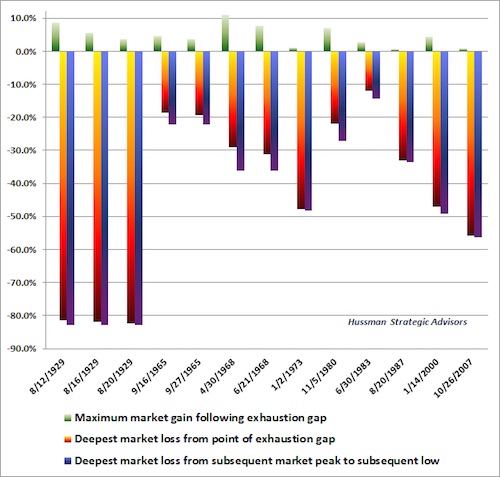
[..] It is not the first time the English language has been caught in the crossfire of the Brexit negotiations. At a recent EU summit May slapped down reports that Brexit negotiations would be conducted in French, and after the June referendum EU officials made it known they planned to downgrade the use of English in the corridors of Brussels. In reality, the Brexit talks are most likely to be conducted in French and English with simultaneous interpretation. Barnier, a former French EU commissioner who clashed with the City of London, speaks English but wants the right to negotiate in his native tongue. English is also highly unlikely to disappear as a dominant language in the EU any time soon. Not only is it an official language for the Irish and Maltese governments, but many diplomats prefer to use English as a common second language rather than French.”

Read more …

2018 at the earliest. Then again, debt relief would make Greece less of a slave, so maybe much longer or not at all.

Germany Says No Debt Relief Being Prepared For Greece (R.)

No debt relief measures are being readied for Greece, Germany’s Finance Ministry said on Thursday after the Handelsblatt business daily reported measures were under consideration. The implementation of reforms that Greece agreed to in return for aid would help ensure the sustainability of the country’s debt, the ministry said in a statement e-mailed to Reuters. “No debt relief is being prepared,” it added. Regarding possible debt measures, a clear agreement was reached in a statement by the Eurogroup of eurozone finance ministers last May. “According to that, after the full implementation of the adjustment program, there will be an assessment of whether debt measures are necessary. That still applies,” it said. Earlier, Handelsblatt reported that Greece’s international lenders were preparing possible debt relief for Athens for discussion by the finance ministers.

The European Commission, the ESM eurozone rescue fund, the ECB and the IMF had prepared various debt measures in a document to be sent to the Eurogroup for further discussion, it said, citing people familiar with the document. One option was for the ESM to take over loans paid out by the IMF. The advantage would be lower interest rates charged by the ESM. Others included extending debt maturities and having the ECB and national central banks send profits made on Greek bonds to Athens through national governments, Handelsblatt reported. An EU source told Reuters the document was originally a paper by the ESM, not all four institutions, and had been modified on the way to the version Handelsblatt saw.

“It lays down several options for the restructuring of Greek debt and specifies possibilities which were given by the Eurogroup last May. One of the options still is that ESM would take debt from IMF,” the source said. “It is not clear yet if the IMF would agree on that.” Separately, German Finance Minister Wolfgang Schaeuble said in Durban, South Africa that the EU needed to “exert pressure on national governments to implement … much-needed reforms.” “Those countries which received help under European assistance programmes, and therefore had to actually implement unpleasant reforms, and those countries which have kept to the agreed rules are among the most successful countries in the EU today,” he said. “The problem is therefore not with the rules, but with the lack of implementation of them.
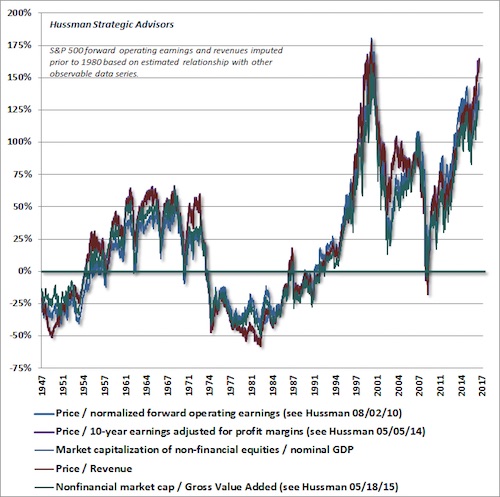
Read more …

Warfare, financial or otherwise.

The Forgotten History of Cinco de Mayo (IC)

Cinco de Mayo celebrates the victory of Mexican troops over the invading French army at the Battle of Puebla southeast of Mexico City on May 5, 1862. Because the Mexican soldiers were badly outnumbered and outgunned, the unexpected triumph was a watershed in forging the country’s national identity. (Militarily it wasn’t that significant — the next year France captured the Mexican capital and installed a member of the Austrian nobility as Maximillian I, “Emperor of Mexico.”) But here’s important part for everyone else to remember today: France was invading Mexico essentially because Mexico owed France money. Mexico had borrowed enormous amounts from Europe during the Mexican-American War from 1846-8 and in a civil war from 1858-61.

By 1862 it was impossible for the government to make timely payments on the loans without starving the country, and Mexican president Benito Juárez declared that all payments on foreign debt would be suspended for two years. Getting into unsustainable debt is not something unique to Mexico; countries have done so over and over throughout history, particularly during wars. The U.S. borrowed more than we could ever repay from France and the Netherlands during the Revolutionary War, and the U.K. borrowed far beyond its means from the U.S. during World War I. When this happens, it’s far better for both the debtors and creditors to organize some kind of default rather than forcing the debtors to pay all the money back on the original terms. The advantage for debtors is obvious.

More intelligent creditors understand it’s also good for them, because they generally don’t have a choice between getting all or just some of their money back. Instead, it’s a choice between getting some of it back or much less. To understand why, imagine loaning too much money to a software engineer. If you demand that the engineer sell all their computers to make interest payments, you’re unlikely to get much more money after that. And indeed both the U.S. and U.K. defaulted to varying degrees after their wars. Likewise, in 1862 the U.K. and Spain agreed to accept less than they were formally owed by Mexico. France, however, invaded Mexico in an attempt to get all its money back, which is why French troops were there for the Battle of Puebla on May 5.

In a sense, the invasion was admirably honest. International relations are often like organized crime on a gigantic scale, but people pretend otherwise. Here there was no pretense: The loanshark’s enforcers beat the crap out of an entire country. By contrast, creditors today have institutions like the IMF, which has often functioned as a creditors’ cartel — squeezing countries until they pay back their debts. This often involves lots of people dying … but in quiet ways, without armies involved.

Read more …

The EU isn’t only giving us Le Pen, it’s presenting us with this too.

Rescuers Pick Up 560 Migrants Off Libyan Coast On Thursday (R.)

Rescuers picked up 560 migrants from unsafe boats off the coast of Libya on Thursday, Italy’s Coast Guard said, including the body of a young man who the migrants said had been shot by smugglers on the beach for his baseball cap. Italian Navy and Coast Guard boats participated in the rescues together with two humanitarian vessels, a spokesman said. The migrants were traveling on board two large rubber boats and five small wooden ones, he added. The Phoenix, a rescue ship operated by the Migrant Offshore Aid Station (MOAS), took 422 on board, plus the body of the allegedly murdered young Gambian. “According to eyewitnesses, the deceased teenager was killed by human traffickers because they wanted his baseball hat. What cruelty,” MOAS co-founder Chris Catrambone said.

“The medical team onboard the Phoenix have confirmed that the deceased teenager died from gunshot wound,” he added. MOAS doctors are also caring for another teenage boy who has a gunshot wound to the stomach, but is stable. German NGO Jugend Rettet also helped with the rescues. Separately, Doctors Without Borders said its rescue ship Prudence would arrive in the Sicilian port of Catania early on Friday with the corpses of six migrants, including five women, who it had picked up in the Mediterranean in recent days. There had been a pause of boat departures from Libya, where smugglers operate with impunity, since Easter, because of bad weather and sea conditions. But boat migrant arrivals in Italy are still up 30 percent so far this year from 2016, when a record 181,000 arrived.

Humanitarian rescue ships have come in for criticism in Italy in recent months, with Catania chief prosecutor Carmelo Zuccaro opening a fact-finding investigation into possible ties between NGOs and people-smugglers. The NGOs have strongly denied the accusations, including representatives from MOAS who testified in Italy’s parliament earlier on Thursday. They say their only mission is to save lives. Zuccaro has yet to present any evidence of illicit activities and has not opened a criminal investigation.

Read more …

May 022017
 
 May 2, 2017  Posted by at 9:00 am Finance Tagged with: , , , , , , , , , ,  3 Responses »


Grand Central Station NY WWII


Trump Weighs Breaking Up Wall Street Banks, Raising Gas Tax (BBG)
Life After Oil Makes Real Estate Canada’s New Economic Crutch (BBG)
How Did Home Capital Get Into Trouble? (BBG)
China Leverage Rising At ‘Alarming Pace’: Central Bank Official (R.)
UBS, BNP, RBS Get Subpoenas in US Treasuries Probe (BBG)
The US Health Care Industry Is Bound To Collapse Soon (NYP)
Exhaustion Gaps and the Fear of Missing Out (John Hussman)
Barack Obama Cashes In, But Harry Truman And Jimmy Carter Refused (IC)
The Sound of One Wing Flapping (Jim Kunstler)
Emmanuel Macron Has Taken French Voters For Granted. Now He Risks Defeat (G.)
How Juncker’s Downing Street Dinner Turned Sour (G.)
Greece Reaches Deal With Creditors To Pave Way For Bailout Talks (G.)
Greece: Any Better Times Or More Pitfalls Ahead? (LSE)


Don’t hold your breath for breaking up banks. Gas tax is more interesting: keep oil prices low and off you go. Could be a huge source of revenue, and Trump needs a few of those.

Trump Weighs Breaking Up Wall Street Banks, Raising Gas Tax (BBG)

President Donald Trump said he’s actively considering a breakup of giant Wall Street banks, giving a push to efforts to revive a Depression-era law separating consumer and investment banking. “I’m looking at that right now,” Trump said of breaking up banks in a 30-minute Oval Office interview with Bloomberg News. “There’s some people that want to go back to the old system, right? So we’re going to look at that.” Trump also said he’s open to increasing the U.S. gas tax to fund infrastructure development, in a further sign that policies unpopular with the Republican establishment are under consideration in the White House. He described higher gas taxes as acceptable to truckers – “I have one friend who’s a big trucker,” he said – as long as the proceeds are dedicated to improving U.S. highways.

During the presidential campaign, Trump called for a “21st century” version of the 1933 Glass-Steagall law that required the separation of consumer and investment banking. The 2016 Republican Party platform also backed restoring the legal barrier, which was repealed in 1999 under a financial deregulation signed by then-President Bill Clinton. A handful of lawmakers blame the repeal for contributing to the 2008 financial crisis, an argument that Wall Street flatly rejects. Trump couldn’t unilaterally restore the law; Congress would have to pass a new version. Trump officials, including Treasury Secretary Steven Mnuchin and National Economic Council Director Gary Cohn, have offered support for bringing back some version of Glass-Steagall, though they’ve offered scant details on an updated approach. Both Mnuchin and Cohn are former bankers who worked for Goldman Sachs.

Read more …

A deeply unstable economy.

Life After Oil Makes Real Estate Canada’s New Economic Crutch (BBG)

Two things happened last week that were a reminder of just how vital real estate has become to Canada’s economy. On Friday, Statistics Canada released GDP data that showed February was a banner month for sectors linked to housing. The real estate industry, residential construction, financial and legal services generated a combined 0.5% increase in output, the biggest one-month gain since 2014. Without those, the overall economy would have contracted slightly in February. A day earlier, the Ontario government released a budget that projects land transfer taxes will surpass C$3 billion ($2 billion) in the current fiscal year, from C$1.8 billion three years ago. For the province, it’s the difference between a balanced budget and a deficit.

Measures of housing’s contribution to the economy are imprecise, but estimates largely put the direct contribution in excess of 20%. It’s much more than that once you add all the indirect effects, with benefits spread widely from lawyer fees to government revenue and increased retail purchases through so-called wealth effects as rising home equity values prompt households to ramp up consumption. The big worry is that Canada has moved from a reliance on oil to a reliance on real estate. The influence of housing on the economy is so pervasive that it won’t take much of a slowdown to act as a major drag on the economy, said Mark Chandler, head of fixed-income research at RBC Capital Markets in Toronto.

“You don’t need a collapse in house prices, you don’t need housing starts to be cut in half for weaker real estate sector to have a significant effect on GDP and incomes,” Chandler said. RBC’s ballpark estimate is that a 10% decline in national home prices would knock a full percentage point off growth. A Toronto Dominion Bank report from 2015 found the housing wealth effect has been responsible for about one-fifth of all growth in consumption since 2001. “A lot of the strength we have seen in consumption is housing related,” said Brian DePratto, the economist who wrote the 2015 report. If you strip out the direct and indirect impact from housing on the economy, “you are talking about a much lower trend pace of growth.”

Read more …

Subprime.

How Did Home Capital Get Into Trouble? (BBG)

The world is suddenly paying attention to Home Capital, the tiny Canadian mortgage lender that’s on the ropes. The stock is plunging, it faces a run on deposits and regulators are probing management’s disclosure of fraudulent mortgages. Its troubles are raising questions: Is this an isolated case of a struggling mortgage company, or early signs of cracks forming in Canada’s red-hot housing market?

1. How did Home Capital get into trouble? It started in 2014 when the company, formed 31 years ago by Gerald Soloway, failed to screen a pile of questionable mortgages brought in by outside brokers. Some 45 brokers falsified income information on borrowers, prompting Home Capital to cut ties with them, leading to a drop in new business. This eventually led to an investigation by the Ontario Securities Commission, which said on April 19 that Home Capital had misled investors by not disclosing the fraud until five months after they became aware of the problem.

2. Will Home Capital fail? There are plenty of signs of stress. The stock has plunged almost 75% this year, cutting its market value to about C$515 million, from C$3.5 billion in 2014. Most pressing is the run on deposits. Customers pulled C$1.5 billion from high-interest savings accounts in four weeks, cutting the balances to C$500 million. The company has another C$13 billion in GICS. As these 30- and 60-day deposits come due, more withdrawals may follow. Without a deposit base, Home Capital can’t fund new mortgages. Home Capital hired investment bankers for a possible sale, though there is likely as much interest in the loan book as the company itself. Commercial banks may be interested, precluding any need for a government bailout. Financial regulators say they are watching closely.

3. Will this fallout spread to other lenders? Possibly. Home Capital competes with other companies in the so-called alternative mortgage space. They cater to small-business owners, new immigrants and other people who can’t get mortgages from the big commercial banks. It’s a niche segment but growing, accounting for almost 13% of the market. Unlike in the U.S. housing crash when loan defaults soared, there is little evidence of faulty loans so far. Home Capital’s delinquency rate, for example, was just 0.20% as of February. Still, shares of rivals First National and Equitable have been dragged lower by the Home Capital woes as investors fear contagion.

Read more …

Beijing sends a lot of signals, but it cannot make good on them without risking the economy, and everybody knows it. It’s all based on the idea that a centralized economy can be forced into a smooth descent, but that’s just a fallacy.

China Leverage Rising At ‘Alarming Pace’: Central Bank Official (R.)

China’s level of leverage is rising at an “alarming pace”, particularly in the finance sector, a senior central bank official said in a commentary, amid growing concern by the country’s senior leaders over financial security. The official Xinhua news agency on Monday cited Xu Zhong, head of the People’s Bank of China’s research bureau, as saying the country needed to deleverage at a “proper pace” to reduce financial sector debt and avoid systemic financial risk. “China’s overall leverage level is reasonable but is rising at an alarming pace, especially in the financial sector,” Xu said. The original commentary was published in business journal Caijing Magazine. Xu said high levels of stimulus spending from government paired with poor corporate management and financial supervision were key factors causing rising levels of leverage, Xinhua said.

He added the government should stick to “prudent and neutral” monetary policy, reduce emphasis on economic growth targets, and improve corporate governance so authorities did not have to step in so frequently to help companies out. “Financial security is achieved via reforms, not bail-outs,” Xinhua reported Xu as saying. Last week President Xi Jinping called for increased efforts to ward off systemic risks and help maintain financial security. Analysts say financial risk and asset bubbles pose a threat to the world’s second-largest economy if not handed well. Former Chinese finance minister Lou Jiwei also said last month that high leverage was the biggest risk facing China’s economy because debt has piled up despite government efforts to deleverage. The Bank for International Settlements warned last year that excessive credit growth in China is signaling an increasing risk of a banking crisis in the next three years.

Read more …

Well, maybe they’ll get serious because it’s about Treasuries this time, and foreign banks. Then again, these are primary dealers in Treasuries.

UBS, BNP, RBS Get Subpoenas in US Treasuries Probe (BBG)

Federal prosecutors have subpoenaed several banks as part of a criminal investigation into possible manipulation of the U.S. Treasuries market, according to people familiar with the matter. The Justice Department issued subpoenas last month to banks including UBS, BNP Paribas and the Royal Bank of Scotland seeking information on the $14 trillion market, said two people, who asked not to be named because the investigation is confidential. U.S. authorities have been examining the U.S. Treasuries market for roughly two years. In November 2015, Goldman Sachs disclosed that U.S. authorities had sought information related to its trading of when-issued securities, which are among the least transparent instruments in the world’s largest debt market. When-issued securities act as placeholders for bills, notes or bonds before they’re auctioned. The instruments change hands over the counter, with lifespans of just days. There’s scant public information on trading volumes or the market’s biggest players.

[..] The Justice Department in late 2015 asked about when-issued securities as part of broader requests for documents it sent to most or all of the roughly two dozen primary dealers in U.S. Treasuries, a person familiar with the matter told Bloomberg News at the time. UBS, BNP Paribas and RBS are primary dealers in U.S. Treasuries. Authorities haven’t accused any of the banks of wrongdoing. Trading of these instruments is also the subject of several lawsuits against primary dealers filed since July 2015. In them investors allege that traders at global banks colluded to artificially inflate the price of the when-issued securities, which allow the banks to sell U.S. debt before they own it. Then they bought the debt at auctions for an artificially suppressed price, unfairly profiting at investors’ expense, the lawsuits contend. The banks are scheduled to file motions to dismiss those lawsuits once the lead counsel for the plaintiffs is chosen.

Read more …

Increased health care spending presumably adds to GDP, so why worry?

The US Health Care Industry Is Bound To Collapse Soon (NYP)

As industry spending and debt servicing rage out of control, health care is ranked as the No. 1 US “systemic recession risk” in a new report. The sums at stake are staggering: Spending in the sector accounted for $3.3 trillion in 2015, and is 18% of the US economy today. The industry generates 16% of private sector jobs nationwide, up from 10% in 1990. US health care spending is forecast to grow by an average 5.6% annually in the coming decade, according to a report by the Center for Medicare and Medicaid Services (CMS), a projection based on no changes out of Washington and in the Affordable Care Care through 2025. Meanwhile, national spending on health care is forecast to outpace US GDP growth by 1.2%. CMS has estimated that spending will comprise 19.9% of GDP by 2025, up from 17.8% in 2015.

“There’s no question that rising health care costs are hurting our overall economy,” said New York-based financial adviser Michael Mondiello. “With consumer spending accounting for some 70% of economic activity, the more we spend on health care, the less we have to purchase other things like a vacation or to save for retirement.” [..] The first murmurs of early trouble may have been detected. “Companies in the health care sector are starting to lay people off,” said John Burns, CEO of John Burns Real Estate Consulting.. [..] “Health care companies borrowed too much money, and have grown their debt faster than their revenue, so you have to have a pullback.”

[..] In a report published by Burns, health care is identified as the largest systemic risk to the economy, of the three sectors Burns examined, which also included technology and automotive. The conventional wisdom points to US demographic trends, and an aging population, as supportive of the long-term strength, but the report shows industry growth has surpassed what is sustainable:
• Health care company debt is up 308% since 2009.
• The number of hospitals in health systems has expanded by 26% since 1999.
• The yearly medical costs for a family of four have jumped 189% since 2002, from $9,000 to $26,000.
“It could be like a Lehman Brothers scenario, where a couple of big health care companies take the economy down,” Burns told The Post.

Read more …

As usual, a long essay from John. A few bites:

Exhaustion Gaps and the Fear of Missing Out (John Hussman)

To offer a sense of the market return/risk profile that has typically been associated with exhaustion gaps at overvalued, overbought, overbullish extremes, the chart below shows the maximum gain and maximum loss in the market as measured from each instance to the subsequent bear market low. Multiple exhaustion gaps in the same market cycle are depicted separately. I recognize that my regular comments about the likelihood of the S&P 500 losing half or more of its value over the completion of this cycle may seem preposterous. A review of market history may help to understand these expectations, which are consistent with both the valuation evidence later in this comment, and with the outcomes that have typically completed prior speculative market cycles.

Two caveats are important here. First, given the simplicity of the conditions that define an exhaustion gap above, and their reliance on daily market behavior, it’s not clear that investors should wait for such gaps in future market cycles if other danger signs are already present. The best way to view these exhaustion gaps, I think, is that they represent points, late in a bull market cycle, where investors become overwhelmed by fear of missing out (FOMO), leaving a lopsided equilibrium where the remaining pool of potential buyers evaporates and the pool of potential sellers becomes saturated. Conversely, it seems likely that simple daily signals like the exhaustion gaps above could be misleading in the future, if more robust measures still indicate persistent risk-seeking among investors.

As a reminder of where market valuations stand, based on what actually works across market cycles, the chart below presents several of the most historically reliable equity valuation measures we track. We can form expectations about the likely range of market losses over the completion of this cycle by asking what amount of retreat would be required to bring these measures to either: a) the highest level of valuation reached at any previous bear market low, or b) the historical norm of each measure. Emphatically, these estimates do not assume that valuations will move below their historical norms at the next bear market low (as they did, in fact, as recently as the 2009 low). The smallest expected loss estimate comes in at -45.6%, while the largest loss estimate (taking each measure to its respective historical norm) is -62.1%. The average range of estimated market losses is -47.7% to -60.1%, while the median range is -45.6% to -62.0%.

Read more …

I think I already know which way Trump will lean.

Barack Obama Cashes In, But Harry Truman And Jimmy Carter Refused (IC)

It used to be the norm for presidents to retire to ordinary life after their stint in the White House — just ask Harry Truman. When the Democratic president was getting ready to leave the White House in 1953, he was approached by many employers. The Los Angeles Times noted that if he was “unemployed after he leaves the White House it won’t be for lack of job offers … but [he] has accepted none of them.” One of those job offers was from a Florida real estate developer, asking him to become a “chairman, officer, or stockholder, at a figure of not less than $100,000” — the sort of position that is commonplace today for ex-politicians. Presumably, had Truman taken the position, it would have been a good deal for both parties: the president’s prestige and connections would also enrich the company.

Truman declined. “I could never lend myself to any transaction, however respectable, that would commercialize on the prestige and dignity of the office of the presidency,” he wrote of his refusal to influence-peddle. Although he had access to a small pension from his military service, Truman had little financial support after leaving office. He moved back into his family home in Independence, Mo., and insisted on being treated like anyone else. He would tell people not to call him “Mr. President,” and settled on a fairly ordinary routine once he was back in Independence. He would take a morning walk through the town square. He kept an office nearby where he would answer mail from Americans. He chose to engage with just about anyone who walked into his office — not only people who wrote him big checks, or invited him onto their private yachts and private islands.

“Many people,” he once said, “feel that a president or an ex-president is partly theirs — they are right to some extent — and that they have a right to call upon him.” Indeed, his office number was even listed in a nearby telephone directory. He eventually agreed to write a memoir for Life magazine, but it was a lengthy project that provided far from luxurious stipends. Truman’s modest life post-presidency moved Congress in 1958 to establish a pension system that provides an annual cash payout as well as expenses for an office and staff. Gerald Ford nevertheless shattered precedent when he joined the boards of corporations such as 20th Century Fox, hit the paid speech circuit, and was made an honorary director by Citigroup.

But his successor, Jimmy Carter, who grew up in a modest home in Plains, Georgia, did not follow Ford’s example. He refused to become a professional paid speaker or join corporate boards. He moved back to Plains, and was welcomed home by a crowd of neighbors and supporters. He quickly made himself busy as a nonprofit founder and a volunteer diplomat. He did make money post-presidency — but by serving ordinary people, not elites. He wrote dozens of best-selling books bought by millions of people across the world — the post-presidency equivalent of small donors. Carter explained his thinking to the Guardian in 2011, telling them that his “favorite president, and the one I admired most, was Harry Truman. When Truman left office he took the same position. He didn’t serve on corporate boards. He didn’t make speeches around the world for a lot of money.”

Read more …

“Rest easy America… oh, and buy every dip.”

The Sound of One Wing Flapping (Jim Kunstler)

And suddenly the storms of early Trumptopia subside, or seem to. The surface of things turns eerily placid as the sweets of May sweep away the toils of an elongated mud season. Somebody stuffed Kim Jong Un back in his bunker with a carton of Kools and the Vin Diesel video library. France appears resigned to Hollandaise Lite in the refreshing form of boy wonder Macron. It’s been weeks since The New York Times complained about the Russians stealing Hillary’s turn as leader of the free world. We’re given to understand that Congress managed overnight to cook up a spending bill that will avert a Government shut-down until September. Rest easy America… oh, and buy every dip.

A calm surface is exactly what Black Swans like to land on, though by definition we will not know they’re out there until our reveries are broken by the sound of wings flapping. Some kind of dirty bird showed up on Canada’s thawing pond last week when that country’s biggest home loan lender suffered a 60 percent pukage of shareholder equity and had to be bailed out — not by the Canadian government directly, but by the Ontario Province’s Health Care Workers Pension Fund, a neat bit of hocus pocus that amounts to a one-year emergency loan at ten percent interest. If that’s a way for insolvent public employee pension plans to find enough “yield” to meet their obligations, then maybe that could be the magic bullet for the USA’s foundering pension funds.

The next time Citibank, Goldman Sachs, JP Morgan, and friends get a case of the Vapors, let them be bailed out by the Detroit School Bus Drivers’ Pension Fund at ten percent interest. That ought to work. And let Calpers take care of Wells Fargo. The situation across Western Civilization is as follows: virtually every major financial institution has become a check-kiting operation or a Ponzi scheme, and we’ve reached the point where they can only pretend to be rescued. Bailout or not, the Toronto-based Home Capital Group is still stuck with shit-loads of non-performing sub-prime mortgage loans — its specialty — and Canada’s spectacular real estate bubble has hardly begun to pop. The collateral is starting to turn, like dead meat in the May sunshine, and the odium will waft across the border.

Read more …

“It is truly astonishing that the man who inspired (as personal secretary) and implemented (as finance minister) the policies of President François Hollande could be branded as something radically new.”

Emmanuel Macron Has Taken French Voters For Granted. Now He Risks Defeat (G.)

The rise of Macron is characteristic of the age of spin doctors: it illustrates both their power and their limits. It is truly astonishing that the man who inspired (as personal secretary) and implemented (as finance minister) the policies of President François Hollande could be branded as something radically new. To achieve this feat, spin doctors resorted to celebrity-building in ways previously unknown in French political life. Macron was new because he was young and handsome, and because he had never been elected before. He appeared repeatedly on the front pages of Paris Match with his wife, whose name is chanted by his supporters at his rallies. In the final weeks of the campaign Macron was so careful not to expose the true nature of his programme (which amounts to little more than the unpopular liberalism-cum-austerity implemented by Hollande) that his speeches degenerated into vacuous exercises in cliche and tautology.

The strategy worked up to a point: he qualified for the second round. Yet its limits are also clear. Last spring, France saw nationwide protests against the labour laws that Macron had largely designed. The opposition was not only to their content, but also to the manner in which they were passed: the government bypassed a parliamentary vote. During these demonstrations police used high levels of violence, yet Macron never uttered a word to calm things down. He has already announced that he would resort to governing by decree if needed, and it is easy to anticipate increased social tensions by the autumn. To those who would oppose him, Macron would answer that he is implementing the programme on which he was elected. Theoretically, Macron should defeat Le Pen hands down. The problem is that the meaning of such a result would be unclear: how many would have voted for him, and how many against her?

Read more …

The EU can do what it wants with the UK, because whatever it is, the Brits will blame each other for anything that goes wrong. No need for divide and conquer, there’s a hopeless divide already; Brussels can focus on conquer.

How Juncker’s Downing Street Dinner Turned Sour (G.)

The meeting last Wednesday started with a kiss on the cheek, gratefully immortalised by the photographers on Downing Street’s pavement. It ended with a withering putdown: “I’m leaving Downing Street 10 times more sceptical than I was before,” Juncker told his host. It is said that the talks started pleasantly enough. During half of an hour of chit-chat in an anteroom, before taking their place at the dinner table, May told Juncker that she didn’t want just to talk Brexit during the evening but there were other matters of world affairs to discuss. “Like what?”, Juncker asked. In fact, little else seemed to be on the prime minister’s mind. Juncker did have a topic to raise though, and the issue at hand may just explain some of the current iciness between the two leaders.

That very morning the EU should have been shuffling around its money to deal with issues such as the migration crisis, which could not have been expected a few years ago when the bloc’s budget had been set. But on Monday morning Juncker had been made aware of an email from the UK’s permanent representative in Brussels explaining that because a general election had been announced, the British government couldn’t give its support to any changes in how the EU was going to spend its cash. Juncker smelled mischief – maybe it was a way to show the EU what trouble Britain could cause if it didn’t get its way? “What on earth is all this supposed to mean?” he is said to have asked May. Perhaps you won’t be able to talk about Brexit then, he queried, when May explained the rules of purdah, under which governments in an election are to avoid binding the hands of the next administration.

[..] it was the substance of the talks that were to cause Juncker the most unease. And it was Juncker’s despair that got to his colleagues. This was the man who through the trickiest of negotiations had always seen a path through. But when presented with May’s insistence that EU citizens in the UK would be treated in the future like any other foreign national, that trade talks needed to start before the issue of Britain’s divorce bill was settled or her claim that technically the UK owed nothing at all to the union, his lack of optimism for the future became clear. “Theresa May started by stating that the UK wanted to discuss first future arrangements, then article 50 stuff,” one source with knowledge of the dinner said.

“It felt to the EU side like she does not live on planet Mars but rather in a galaxy very far away.” She was “deluded” and appeared to be “living in a parallel universe”, Juncker told the German chancellor, Angela Merkel, in a phone call said to have taken place just moments after the delegation left Downing Street.

Read more …

Absolute insanity: “..pensions are to be cut by 9% on average..”

Greece Reaches Deal With Creditors To Pave Way For Bailout Talks (G.)

Greece has reached a preliminary deal with its creditors that should pave the way for long-awaited debt relief talks, the Greek finance minister said on Tuesday. “The negotiations are concluded,” Euclid Tsakalotos told reporters, according to state agency ANA. After overnight talks, Tsakalotos said a “preliminary technical agreement” had been achieved ahead of a 22 May meeting of eurozone finance ministers, which is required to approve the deal. Tsakalotos added he was “certain” that the agreement would enable Greece to secure debt relief measures from its creditors, which he has said is vital to spearhead recovery in the country’s struggling economy. A compromise is required to unblock a tranche of loans Greece needs for debt repayments of €7bn ($7.6bn) in July.

Under pressure from its creditors – the EU, ECB and the IMF – the government agreed earlier this month to adopt another €3.6bn in cuts in 2019 and 2020. Athens conceded fresh pension and tax break cuts in return for permission to spend an equivalent sum on poverty relief measures. A government source on Tuesday said pensions are to be cut by 9% on average, ANA said. The measures are to be approved by parliament by mid-May. However, prime minister Alexis Tsipras has said he will not apply these cuts without a clear pledge later this month on debt-easing measures for Greece. Athens also hopes to be finally allowed access to the ECB’s QE asset purchase programme, to help its return to bond markets.

Read more …

So many numbers it’s easy to forget this is about people.

Greece: Any Better Times Or More Pitfalls Ahead? (LSE)

In 2015, Greece, an EU state member since 1981 with a population of 10,846,979 people, recorded the highest level of GGD (General Government Gross Debt to GDP ratio) in the EU-28, at 176.9%. Concerning the volume index of GDP per capita in PPS (Purchasing Parity Standards) we find Greece’s GDP per capita dropped from 4% lower than the EU-28 average in 2004 to 29% lower in 2015. However, GDP is a measure of a country’s economic activity, and therefore it should not be considered a measure of a country’s well-being. If we take the AIC (Actual Individual Consumption) per capita in PPS (Purchasing Power Standard) as a better indicator to describe the material welfare of households, Greece showed an AIC index per capitalower by some 19% than the EU-28 average in 2015. Labour productivity per hour worked expressed in US $ (which means GDP per hour worked expressed in US $) was estimated among the lowest in the EU-28, at $32 in 2015.

Curiously, Greece has the highest average hours worked per year in the EU-28, at 2,042 hours, its average hourly labour cost is among the lowest in the EU-28, at €14.5, its average annual wages at US $25,211 and unemployment rate of 24.90%. 43% of pensioners live on €660/month on average, and many Greek pensioners are also supporting unemployed children and grandchildren. [..] Unemployment is a tragedy for Greece. The highest jobless rate was recorded in 2014, at 27.8%. The current level of unemployment, the highest in the EU, is about 24%. Unemployed workers between 45 and 64 years of age (currently almost one in three unemployed, around 347,400 people, whereof 280,000 are long-term unemployed, in 2009 they were one in five, or 99,000 people)- , and young unemployed people aged 15-24 (close to 50% of the total) are the most adversely affected demographics.

According to ELSTAT (Hellenic Statistical Authority) – GSEE (General Confederation of Greek Workers), nine out of ten Greeks without job do not receive unemployment benefits and 71.8-73.8% (around 807,000 people) of all unemployed (1,124,000 people) have been out of work for more than twelve months, while only 1.5% of them receive the 700 euro/month applicable to the long-term registered unemployed. In the last quarter report for 2016, ELSTAT shows that the amount of Greeks facing long-term unemployment has risen some 146% (from 327,700 to 807,000 people) over the 6-year period. Additionally, there are 350,000 Greek families without a single member working, and unemployment has led some 300,000 highly skilled professionals and workers to leave the country.

[..] According to a study carry out by the Cologne Institute of Economic Research, poverty rate in Greece increased by 40% from 2008 to 2015, the largest increase among EU countries. A new multidimensional poverty index was used to calculate poverty, which is not based on income alone but on other factors such as the deprivation of material goods, quality of education, underemployment and, access to healthcare. In 2015, according to Eurostat, more than one in three residents of Greece experienced conditions of poverty and/or social exclusion. The percentage of those within this group had risen from 29.1% in 2008 to 35.7% in 2015, or 3.8 million people. 21.4% of the Greek population are living below the national poverty line (with an income less than 60 % of the national average), 22.2 % are severely materially deprived,

Read more …

Apr 262017
 
 April 26, 2017  Posted by at 2:02 pm Finance Tagged with: , , , , , , , , ,  4 Responses »


EdgarDegas A la mer 1863


Something hit me this week. The maps which came out on Monday and detailed the outcome of the French elections, were telling a story, and a familiar one by now. A story of deep division. There are a number of such maps now depicting the Brexit vote in the UK, the US presidential elections, and its French counterpart.

In all three cases they leave me wondering something along the lines of: ‘Are you guys sure you want to remain in the same country with each other?’ Because to me that is not all that obvious, and I think it’ll get less so as time passes. For instance in the case of France, the ‘ideological’ differences between Macron and Le Pen are substantial to say the least, they’re worlds apart.

And if you’re worlds apart, why live in the same country? Here’s that French map:


As you see, the country is sharply divided between west (Macron) and east (Le Pen). So much so that you wonder what these people still have in common, other than their language. There’s no doubt it’s also a dividing line between the richer part of the country, and the poorer.

Thing is, that same dividing line is visible in a similar map of the November 8, 2016 US election results, in a slightly different way.


In the US it’s not east versus west, it’s coast versus interior (flyover land). But the difference is equally clear and sharp. In fact, probably what we’re looking at is that France has only one coastline, while the US has two, and in both countries people living close to the ocean are on average richer than those who live more inland.

And in both cases there is no doubt that wealth is a deciding factor in dividing the nations to the extent that they are. We see that in an ‘urban versus rural area’ comparison as well. Cities like New York, LA and Paris are strongholds for the incumbent and establishment, the parties that represent the rich.

There can be no doubt that we’ll see more of that going forward. It won’t be there in smaller countries, Holland for instance is not nearly large enough for such dynamics. But Italy very well might. It’s always had a strong north-south-divide, and its present crisis has undoubtedly deepened that chasm.

Looking at things that way, it’s also glaringly obvious that Macron is Obama (and is Renzi is Cameron etc.). A well-trained good looking mediagenic puppet with a gift of teleprompter gab, fabricated and cultivated by the ruling financial and industrial world to do their bidding. Macron, to me, looks the most artificial of the crop so far, the Obama, Rutte, Cameron, Renzi crop. There will be more, and they will get more artificial. Edward Bernays is just getting started.

Of course there is also a strong move away from established parties. It is more pronounced in France -where they were eradicated at least in the presidential elections- than in the US or UK, but that may be more of a superficial thing. Trump and Bernie Sanders are simply America’s version of France’s ‘ultra’ right wing Le Pen and ‘ultra’ left wing Melenchon. And Trump is running into problems with the remnants of the established parties as much as Macron will if he’s elected president.

Anglo countries seem to take longer diversifying away from tradition than others, but they too will get there. The various deteriorating economies will make sure of that.


A third map is of the UK Brexit vote. Once again, a sharp division, and once again with a ‘character’ of its own. If you ignore Scotland for a moment, what you see is blue=poor and yellow=rich. Broad strokes, I know, but I’ve been doing that with the first two maps too. There are only a few pockets of yellow=rich=remain. But yeah, fewer people live there. Same thing as in the US and France.

That the whole Brexit thing should now be negotiated by the Tories is a cynical irony the country owes to its adherence to tradition. That is how that backfires, too little flexibility. How the UK will solve its many ignored issues is anyone’s guess. Will Scotland leave the no-longer-very United Kingdom? Will voters wake up in time to not present the Tories with a free hand to make the rich-poor divide even worse?


There’s one more, and more detailed, map of France, which shows even better to what extent ‘Le Pen country’ is eerily similar to America’s flyover land. It’s almost poetic, a poem about how countries fall apart, about centers that cannot hold. It also makes me think of a locust invasion, by the way.


Every French and European body and their pet hamster is presently telling voters in France to please please not vote for Le Pen, in a move that resembles similar calls against Trump and Brexit. And who knows, it might work this time around. The anti-Le Pen frenzy is even stronger than the others, and it has Marine’s crazy father to use as a warning sign.

But as these maps show, it’s not about Le Pen, or Trump, or Nigel Farage. It’s about people being left behind in ever larger numbers, susceptible to voices other than the ones they’ve known for a long time and who never listened to them. And nothing is being done to address these people’s claims; on the contrary, things are only getting worse for them.

I saw a headline today that said ECB president Mario Draghi’s “Stimulus Could Blunt Populism as Unemployment Declines”. There’s only one possible reaction to that: what happens when he stops his stimulus?

The growing divides that all these maps bear witness to will keep growing, unless someone decides that neo-liberalism has gone too far. But the only person who could make such a decision would have to be one who neo-liberalism itself has made rich and powerful. So don’t count on that happening.

Count instead on more Trumps and Le Pens and Sanders’s. And also on more Obama’s and Macrons for the rich to deploy to protect their power and hold on to their riches. Increasingly it would seem they have to limit democracy -even further- to remain in power. So count on that happening too.

But don’t count on all these countries surviving as sovereign nations. The chasms are widening too fast and too much.

Apr 242017


Pablo Picasso Self portrait 1896


Euro and Shares Rally After Macron Wins First Round of French Election (Ind.)
Fight Over Obamacare Could Shut Down The Government (CNN)
Trump Push For Border Wall Threatens To Cause Government Shutdown (G.)
America is Regressing into a Developing Nation for Most People (Parramore)
London Mayor To Subsidise ‘Naked’ Homes Solution To Housing Crisis (G.)
China Stocks Head For Worst Day Of 2017 As Regulators Tighten Grip (R.)
Chinese Billionaires Amass In The Country’s Heartland (CNBC)
Jack Ma Sees Decades of Pain as Internet Upends Old Economy (BBG)
Fear City (Naomi Klein)
IMF Warns Greece That Additional Economic Overhauls Are Needed (WSJ)
Greek Banks Aspire To Begin Online Asset Auctions In June (K.)


Not sure there’s all that much to celebrate. Looks like a torn country.

Euro and Shares Rally After Macron Wins First Round of French Election (Ind.)

The euro briefly surged to a five-month high against a basket of currencies after centrist candidate Emmanuel Macron won the first round of a hotly contested French election vote, an outcome broadly considered the most market-friendly. Immediately after the vote on Sunday, the euro surged to $1.0940, its highest level against the dollar since November last year, before retreating to around $1.0869. It rose against the pound and the Swiss franc too and stocks across Europe and Asia climbed as investors pulled out of assets considered safest to hold during times of economic uncertainty or political turmoil, like gold, Japan’s yen and core government bonds. The FTSE 100 was up 1.5% in early trading while Paris’ CAC 40 added almost 4%. Germany’s DAX rose more than 2%.

Analysts and strategists were quick to point out that the outcome lessens the risk of an anti-establishment shock, like the UK’s vote last year to quit the European Union and Donald Trump’s US presidential election victory in November. “Macron will be reassuring to markets, with his pledge to lower corporate taxes and to lighten the administrative burden on firms. He basically represents continuity,” said Octavio Marenzi, CEO of Opimas, a capital markets management consultancy. “While the markets would have preferred Trump-style deregulation, no candidate, including Macron, would dare touch such an agenda in France,” he added.

Read more …

The media can’t make up their minds on what could cause a shutdown. Obamacare….

Fight Over Obamacare Could Shut Down The Government (CNN)

The fight over Obamacare’s future is now threatening to shut down the federal government. Congress must pass a spending bill by the end of this week or the federal government will run out of money. And Democrats, whose votes are needed to approve a budget, plan to use their leverage to force Republicans to stabilize Obamacare. They want the budget deal to fund a set of Obamacare subsidies that are crucial to keeping insurers in the program. Here’s how Obamacare figures into the government spending battle. Subsidies make health care affordable for those with low-incomes: The House GOP bill to repeal and replace Obamacare may be shelved for now, but Republicans still hold tremendous power over Obamacare’s future.

The most pressing issue is the funding of subsidy payments to insurers known as cost-sharing reductions, or CSRs. These make health care more affordable for lower-income Obamacare enrollees by reducing their deductibles and co-pays. Those with incomes under $29,700 for a single person are eligible. The payments can cut deductibles to as low as $227, on average, instead of nearly $3,500 for the standard silver Obamacare plan. These subsidies are important to insurers, too. A little over 7 million people, or 58%, signed up for policies with cost-sharing subsidies on the Obamacare exchanges for 2017. The payments are made directly to insurers and will cost the federal government an estimated $7 billion this year.

Republicans sued Obama to block the subsidies: The subsides have been at the center of a court battle since 2014, when House Republicans sued the Obama administration to try to stop them. GOP lawmakers have argued that Congress never appropriated funds for the payments. A district court judge agreed last year, ruling the subsidies were illegal. The Obama administration filed an appeal, and the subsidies continue to be paid while GOP lawmakers and Trump officials agree on a settlement.

Read more …

… or the border wall.

Trump Push For Border Wall Threatens To Cause Government Shutdown (G.)

Looming above Washington as Congress and the White House attempt to avert a funding shutdown in only five days’ time, Donald Trump’s central campaign promise to build a wall on the Mexican border threatens to bring the US government to a halt this week in a national display of dysfunction. On Sunday, even White House officials expressed uncertainty about whether the president would sign a funding bill that did not include money for a wall, which Trump has promised since the first day of his presidential campaign. “We don’t know yet,” said the White House budget director, Mick Mulvaney, on Fox News Sunday. “We are asking for our priorities.” The president himself waded into the negotiations on Sunday, holding out two sticks and no carrot. “ObamaCare is in serious trouble,” he tweeted. “The Dems need big money to keep it going – otherwise it dies far sooner than anyone would have thought.”

“The Democrats don’t want money from budget going to border wall despite the fact that it will stop drugs and very bad MS 13 gang members,” he continued, suggesting he would accuse Democrats of being soft on international crime. But Trump also retreated from a related pledge to the American people: that he would “make Mexico pay” for the wall, which is estimated to cost billions. “Eventually, but at a later date so we can get started early, Mexico will be paying, in some form, for the badly needed border wall,” the president tweeted, without offering a plan or timeline. Without a deal, funding for the government will run out at midnight on 28 April, Trump’s 100th day in office. The secretary of homeland security, John Kelly, told CNN’s State of the Union on Sunday he suspected the president would push for the wall. “He’ll do the right thing, for sure, but I suspect he’ll be insistent about the funding,” Kelly said.

Read more …

“..the low-wage sector has little influence over public policy. Check. The high-income sector will keep wages down in the other sector to provide cheap labor for its businesses. Check. Social control is used to keep the low-wage sector from challenging the policies favored by the high-income sector. Mass incarceration – check. The primary goal of the richest members of the high-income sector is to lower taxes. Check. Social and economic mobility is low. Check.”

America is Regressing into a Developing Nation for Most People (Parramore)

You’ve probably heard the news that the celebrated post-WW II beating heart of America known as the middle class has gone from “burdened,” to “squeezed” to “dying.” But you might have heard less about what exactly is emerging in its place. In a new book, The Vanishing Middle Class: Prejudice and Power in a Dual Economy, Peter Temin, Professor Emeritus of Economics at MIT, draws a portrait of the new reality in a way that is frighteningly, indelibly clear: America is not one country anymore. It is becoming two, each with vastly different resources, expectations, and fates. In one of these countries live members of what Temin calls the “FTE sector” (named for finance, technology, and electronics, the industries which largely support its growth).

These are the 20% of Americans who enjoy college educations, have good jobs, and sleep soundly knowing that they have not only enough money to meet life’s challenges, but also social networks to bolster their success. They grow up with parents who read books to them, tutors to help with homework, and plenty of stimulating things to do and places to go. They travel in planes and drive new cars. The citizens of this country see economic growth all around them and exciting possibilities for the future. They make plans, influence policies, and count themselves as lucky to be Americans. The FTE citizens rarely visit the country where the other 80% of Americans live: the low-wage sector. Here, the world of possibility is shrinking, often dramatically. People are burdened with debt and anxious about their insecure jobs if they have a job at all. Many of them are getting sicker and dying younger than they used to.

They get around by crumbling public transport and cars they have trouble paying for. Family life is uncertain here; people often don’t partner for the long-term even when they have children. If they go to college, they finance it by going heavily into debt. They are not thinking about the future; they are focused on surviving the present. The world in which they reside is very different from the one they were taught to believe in. While members of the first country act, these people are acted upon. The two sectors, notes Temin, have entirely distinct financial systems, residential situations, and educational opportunities. Quite different things happen when they get sick, or when they interact with the law. They move independently of each other. Only one path exists by which the citizens of the low-wage country can enter the affluent one, and that path is fraught with obstacles. Most have no way out.

The richest large economy in the world, says Temin, is coming to have an economic and political structure more like a developing nation. We have entered a phase of regression, and one of the easiest ways to see it is in our infrastructure: our roads and bridges look more like those in Thailand or Venezuela than the Netherlands or Japan. But it goes far deeper than that, which is why Temin uses a famous economic model created to understand developing nations to describe how far inequality has progressed in the United States. The model is the work of West Indian economist W. Arthur Lewis, the only person of African descent to win a Nobel Prize in economics. For the first time, this model is applied with systematic precision to the U.S.

The result is profoundly disturbing. In the Lewis model of a dual economy, much of the low-wage sector has little influence over public policy. Check. The high-income sector will keep wages down in the other sector to provide cheap labor for its businesses. Check. Social control is used to keep the low-wage sector from challenging the policies favored by the high-income sector. Mass incarceration – check. The primary goal of the richest members of the high-income sector is to lower taxes. Check. Social and economic mobility is low. Check.

Read more …

Yeah, sure, when things get too expensive you just lower the quality. Could it be an idea to tackle the cause of the problem instead of mere symptoms?

London Mayor To Subsidise ‘Naked’ Homes Solution To Housing Crisis (G.)

Who needs internal walls or a fitted kitchen anyway? As house prices soar ever further out of reach, London’s mayor, Sadiq Khan, is to subsidise a new generation of ultra-basic “naked” homes wthat will sell for up to 40% less than standard new builds. The apartments will have no partition walls, no flooring and wall finishes, only basic plumbing and absolutely no decoration. The only recognisable part of a kitchen will be a sink. The upside of this spartan approach is a price tag of between £150,000 and £340,000, in reach for buyers on average incomes in a city where the average home now costs £580,000.

The no-frills concept is to be be tested with 22 apartments on three sites in Enfield, north London, where the council will allow builders to take over derelict council estate garages and car parks. Khan has awarded a £500,000 grant to what he says will be the largest custom-build development in London. If successful, a further seven sites will be built. “The idea is to strip out all of the stuff that people don’t want in the first place,” said Simon Chouffot, one of the founders of the not-for-profit developer, Naked House. “People want to do some of the custom building. We can make it affordable by people doing some of the work themselves.” The developers are a group of thirtysomethings who found themselves priced out of buying homes in London’s fast-rising property market.

“We are all from generation rent and we have been growing up with this housing crisis,” said Chouffot, 37. “I put down roots in north-east London but it was impossible to buy there. My response has been to live on a boat on the Regent’s canal. The average income in our area is about £40,000 but the average income you need to buy a property is £170,000, so there is a huge affordability gap.” He said the Enfield homes would be about 15% cheaper to build than standard new homes because of their basic design.

Read more …

A power struggle developing? Xi must tackle the debt, or risk losing.

China Stocks Head For Worst Day Of 2017 As Regulators Tighten Grip (R.)

China stocks tumbled more than 1% on Monday and looked set for their biggest loss of the year amid signs that Beijing would tolerate more market volatility as regulators clamp down on shadow banking and speculative trading. Recent signs of stability in China’s economy “have provided a good external environment and a window of opportunity to reduce leverage in the financial system, strengthen supervision and ward off risks,” the official Xinhua News Agency reported on Sunday. “Over the past week, interbank rates trended higher, bond and capital markets suffered from sustained corrections and some institutions faced liquidity pressure. But these have little impact to the stability of the broader environment.”

The Shanghai Composite Index slumped 1.6% to 3,123.80 points by the lunch break, after posting its biggest weekly loss so far this year last week. The blue-chip CSI300 index fell 1.3% to 3,423.11. Barring a rebound, the indexes looked set for their biggest one-day percentage loss since mid-December. Daily declines of more than 1% in the indexes have been rare for notoriously volatile Chinese markets this year. “Even the better-than-expected Q1 data could not boost the market, as investors are concerned about regulatory risks,” wrote Larry Hu, analyst at Macquarie Capital Ltd, referring to stronger-than-expected 6.9% economic growth early in the year.

In the latest of a flurry of regulatory measures, China’s insurance regulator said on Sunday it will ramp up its supervision of insurance companies to make sure they comply with tighter risk controls and threatened to investigate executives who flout rules aimed at rooting out risk-taking. The banking regulator said late on Friday that growth in Chinese wealth management products (WMPs) and interbank liabilities eased in the first quarter, suggesting authorities are making some headway in containing financial risks built up by years of debt-fuelled stimulus.

Read more …

The billionaire bubble. A communist party rules this country. In name.

Chinese Billionaires Amass In The Country’s Heartland (CNBC)

ZHENGZHOU, China — Here in China’s heartland, in the capital of its Henan province, some of the country’s most powerful leaders are meeting. But these are not the political elite that have run the country for decades, this is a new crop of leaders — all from the private sector. This city, near corn and wheat fields, is hosting an annual meeting from the China Entrepreneur Club. That’s an invite-only group composed of 55 Chinese billionaires, at last count. In other words, they’re the richest — and among the most influential — people in a country that’s already minting millionaires monthly. Unlike many of the moneyed elite from other developing countries, who accrued wealth from a privatization land-grab, almost all of China’s entrepreneurs started from scratch. And these entrepreneurs aren’t just titans of industry, but also technology, energy, finance and retail.

In many ways, they are China’s new economy. How they’ve succeeded, mostly despite the Communist government, is a major and under-appreciated part of the story of China’s transformation over the past 35 years. In fact, even before the Chinese government officially acknowledged the benefits of private companies, hundreds of thousands of businesses had already begun. A handful of those have become international giants. Huawei is now one of the largest telecommunications equipment makers in the world, but it started by importing used gear from the telephone exchange in Hong Kong. The company now known as Lenovo, the world’s top PC-maker by market share, started by selling televisions imported into China. Geely, now one of China’s biggest carmakers, started by selling parts for refrigerators.

The people behind those names are China’s first generation of entrepreneurs. The second generation came about in the 1990s, and the country’s third crop of entrepreneurs includes people like Alibaba’s Jack Ma, and Tencent’s Pony Ma (no relation), who are now the focus of most of the Western world’s attention. And China is already churning out a new slew of tech titans in the making. By some measures, China’s private sector now accounts for two thirds of its economy. Entrepreneurs, not politicians, are now the ones driving the long-sought economic rebalancing away from a dependence on manufacturing and exports and more toward services and consumption.

But one of the major questions about China’s future is what the dynamic will be like between entrepreneurs and state-owned enterprises. So far, Beijing has largely treated private success benignly because the biggest stars, like Alibaba, are more valuable to the national cause without official direction or interference. Those companies are flying China’s flag, in an increasingly international capacity, more effectively than any state campaign or directive could ever hope to achieve. But the state and its companies still comprise a full third of China’s economy, and when state-owned enterprises begin to get crowded out, there will likely be tension.

Read more …

Ma has wild fantasies.

Jack Ma Sees Decades of Pain as Internet Upends Old Economy (BBG)

Alibaba Chairman Jack Ma said society should prepare for decades of pain as the internet disrupts the economy. The world must change education systems and establish how to work with robots to help soften the blow caused by automation and the internet economy, Ma said in a speech to an entrepreneurship conference in Zhengzhou, China. “In the next 30 years, the world will see much more pain than happiness,” Ma said of job disruptions caused by the internet. “Social conflicts in the next three decades will have an impact on all sorts of industries and walks of life.” It was an unusual speech for the Alibaba co-founder, who tends to embrace his role as visionary and extol the promise of the future. He explained at the event that he had tried to warn people in the early days of e-commerce it would disrupt traditional retailers and the like, but few listened.

This time, he wants to warn against the impact of new technologies so no one will be surprised. “Fifteen years ago I gave speeches 200 or 300 times reminding everyone the Internet will impact all industries, but people didn’t listen because I was a nobody,” he said. Ma made the comments as Alibaba, China’s largest e-commerce operator, spends billions of dollars to move into new businesses from film production and video streaming to finance and cloud computing. The Hangzhou-based company, considered a barometer of Chinese consumer sentiment, is looking to expand abroad since buying control of Lazada to establish a foothold in Southeast Asia, potentially setting up a clash with the likes of Amazon.com. Ma, 52, was also critical of the traditional banking industry, saying that lending must be available to more members of society. The lack of a robust credit system drives up the costs for everyone, he said.
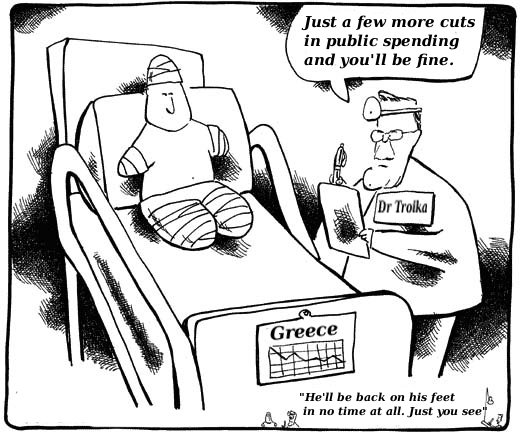

[..] Ma was at times brutal in his criticism of companies that won’t adapt. At one point, he said cloud computing and artificial intelligence are essential for business – and if leaders don’t get that, they should find young people in their companies to explain it to them. Another time, he called for traditional industries to stop complaining about the internet’s effects on the economy. He said Alibaba critics ignore that Taobao, its main online marketplace, has created millions of jobs. [..] He also warned that longer lifespans and better artificial intelligence were likely to lead to both aging labor forces and fewer jobs. “Machines should only do what humans cannot,” he said. “Only in this way can we have the opportunities to keep machines as working partners with humans, rather than as replacements.”
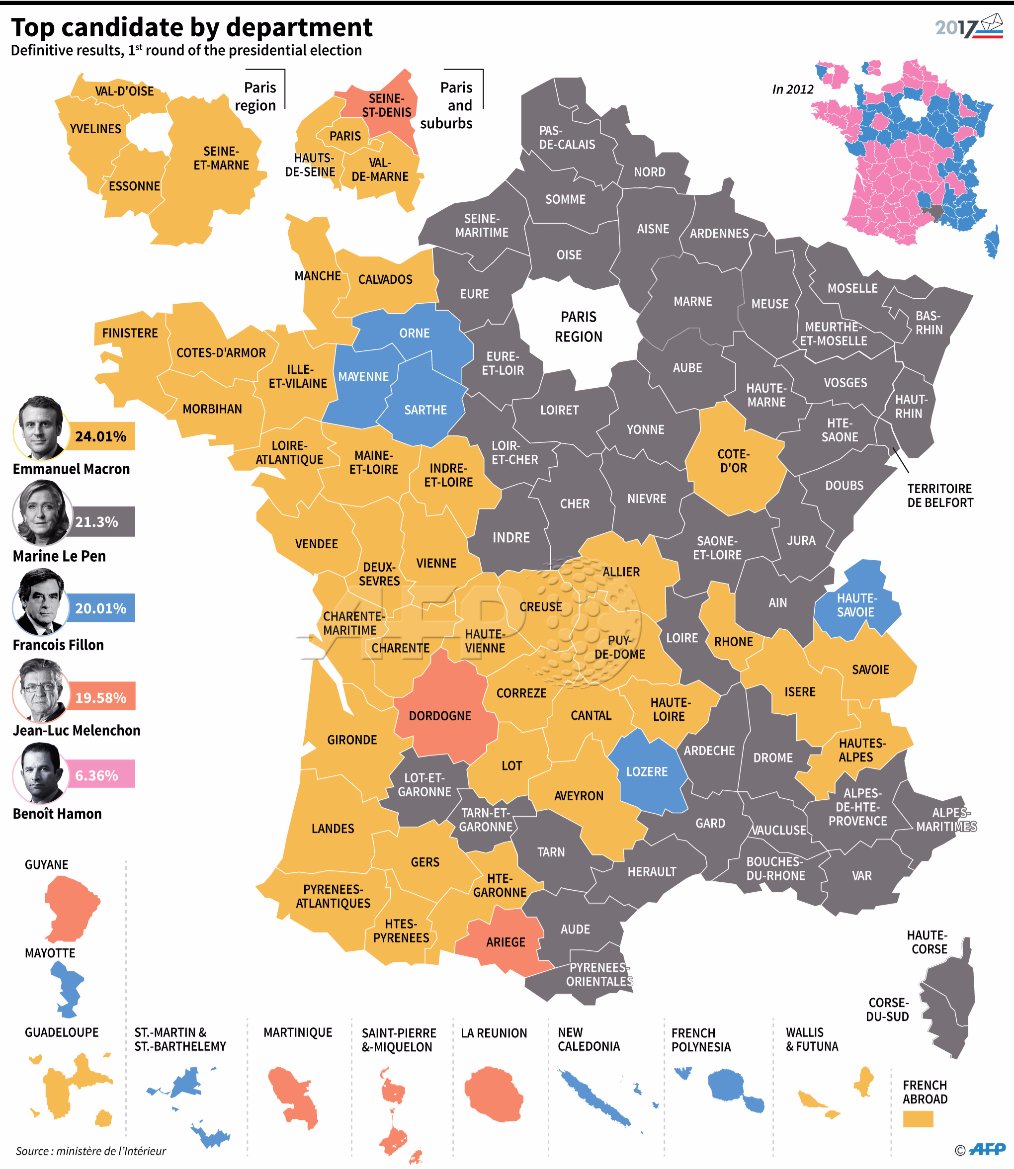
Read more …

Klein interviews Kim Philipps-Fein, author of Fear City, which describes New York in the 1970s, and Trump’s role in it.

Fear City (Naomi Klein)

When i published “The Shock Doctrine” a decade ago, a few people told me that it was missing a key chapter in the evolution of the tactic I was reporting on. That tactic involved using periods of crisis to impose a radical pro-corporate agenda. They said that in the United States that story doesn’t start with Reagan in the 1980s, as I had told it, but rather in New York City in the mid-1970s. That’s when the city’s very near brush with all-out bankruptcy was used to dramatically remake the metropolis. Massive and brutal austerity, sweetheart deals for the rich, privatizations. In classic Shock Doctrine style, under cover of crisis, New York changed from being a place with some of the most generous public services in the country, engaged in some cutting-edge attempts at racial and economic integration, to the temple of nonstop commerce and gentrification that we all know and still love today.

New York’s debt crisis is an incredibly important and little understood chapter in the evolution of what Nobel Prize-winning economist Joseph Stiglitz calls market fundamentalism, a process the Trump administration is in the process of rapidly accelerating, which is why I was so happy to receive Kim Phillips-Fein’s remarkable new book, “Fear City.” In it, she meticulously documents how the remaking of New York City in the ’70s was a prelude to what would become a global ideological tidal wave, one that has left the world brutally divided between the 1% and the rest. She helps us to understand many of the forces that Trump exploited to win the White House, from economic insecurity to crumbling public infrastructure to fearmongering about black crime, all amid previously unimaginable private wealth.

Read more …

Thomsen continues to play an ugly part.

IMF Warns Greece That Additional Economic Overhauls Are Needed (WSJ)

The IMF had a sobering message for Greece this weekend: Even if the country secures debt relief from its European creditors—a question that is by no means assured with bailout talks still deadlocked—the nation still needs even more painful economic overhauls than currently planned. Seven years into an economic crisis and another near-term financial emergency looming, that is a message no Greek wants to hear and a key reason why the IMF is also urging Germany and Athens’ other European creditors to give the country hope in the form of real debt relief. The country’s “fiscal and structural reforms…pension reforms, tax reforms, are only a down payment,” said Poul Thomsen, IMF’s European department chief and Greece’s original bailout architect, on the sidelines of the fund’s semiannual meeting of finance ministers and central bankers.

To bring the country’s unemployment and income levels back to precrisis rates will take “deep structural reforms, many of which are not yet on the books,” he said. The jobless rate is currently at 22% and half of all the youth labor force are without work. “This is a long-term project,” he said. Mr. Thomsen, along with IMF Managing Director Christine Lagarde, met with Finance Minister Euclid Tsakalotos over the weekend ahead of a return of the fund to Athens next week. Although bailout talks continue, the fund hasn’t been involved in emergency financing for the country in three years, and future funding from the IMF is an open question. Fund officials worry the Greece’s existing efforts are stretching the nation’s political and social limits to their breaking point.
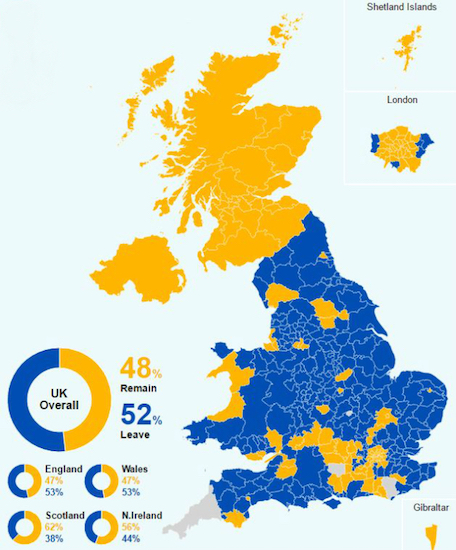
The country has already endured a series of political crises and government changeovers over the bailout years. Another could be coming, analysts say, as the government faces debt due in the coming months that it can’t cover without additional help from outside creditors. Earlier this year, the fund said the deadlock over new bailout terms, financing and debt relief risked pushing the country out of the eurozone. Analysts say Greece’s crisis could be the thread that unravels the currency union, especially amid Britain’s rejection of the European Union and rising anti-euro parties in key upcoming elections.

Read more …

The blessings of foreclosures. The entire country is for sale. It’s a colony.

Greek Banks Aspire To Begin Online Asset Auctions In June (K.)

The country’s four systemic banks have evolved into some of the biggest property owners in Greece, obtaining ownership of assets worth over €40 billion in the past few years. The majority are properties that came under the banks’ full ownership mainly from being the collateral used by borrowers – households and enterprises – who failed to repay their debts. There also are properties used to house bank branches that were shut down, assets belonging to banks’ subsidiaries of banks, etc. According to bank officials, the acquisition of these properties has met all the legal requirements and they do not include assets stemming from nonperforming loans created during the years of crisis, originating, instead, from previous years.

Banks are examining various ways to sell them off – including the use of an online platform for investors – so as to be rid of the heavy maintenance costs, to capitalize on the assets and to obtain liquidity that can then be channeled into the economy through loans. Certain lenders are at an advanced stage in the creation of such a platform, aiming to launch the first auctions some time in June. It is estimated that if banks manage to attract foreign investors this could revitalize the Greek property market, which has contracted dramatically in recent years due to the prolonged recession. From 250,000 transactions in 2007, the market dropped to just 20,000 in 2014. Banks have already engaged in certain transactions, selling some small or large properties (such as hotels) to foreign investors.

However, more extensive activity,requires other procedures, which would also be simple and transparent. Electronic auctions appear as the best way forward, as they are open, do not require the seller’s physical presence and have low costs, while also keeping out the “vultures” that take advantage of the lack of transparency in conventional auctions. The online platforms will include all the main details of each asset, while potential buyers will be allowed to visit the properties on offer and submit their offers online on certain dates. Bank officials tell Kathimerini that one such platform in the US has sold over 200,000 properties worth $34 million to investors from more than 100 countries in the last decade.

Read more …

Apr 012017
 
 April 1, 2017  Posted by at 9:12 am Finance Tagged with: , , , , , , , ,  Comments Off on Debt Rattle April 1 2017


Claude Monet The Pond at Montgeron 1876


Boaty McBoatface, or Don’t Listen To The Public -BoE’s Haldane (Tel.)
UK Households’ Savings Fall To Record Low (G.)
Multiple Bubbles Are Going To Bring America To Its Knees (Lang)
Ports In China Have Enough Iron Ore To Build 13,000 Eiffel Towers (R.)
French Banks Posted ‘Multi-Billion Euro Profits’ In Tax Havens (F24)
European Right Hopes Macron Will Save France (EUO)
Racket of Rackets (Jim Kunstler)
The Big Contraction – An Interview With Jim Kunstler
Julian Assange Waits For Ecuador’s Election To Decide His Future (G.)


Haldane is not the dumbest of central bankers. But this is crazy. See, the question is this: would Brexit have been prevented by not listening to people, or did not listening to them cause Brexit? And what’s wrong with calling a ship Boaty McBoatface? Maybe it’s an idea to listen more to people, not less? What else would you like to decide for people to protect them from their own madness?

Boaty McBoatface, or Don’t Listen To The Public -BoE’s Haldane (Tel)

The public should not have a direct say in setting interest rates because they can show “madness” when making collective decisions – just look at Boaty McBoatface, the Bank of England’s chief economist has warned. Central bankers have come under pressure to be more accountable to the public after the financial crisis and years of ultra-low interest rates, but it could be dangerous to hold a referendum on rates. It would be feasible to canvas the public online, said Andy Haldane, but could be dangerous. He pointed to the example of Boaty McBoatface, the name chosen in a public ballot for a new polar research ship last year, winning 80pc of votes cast. The National Environmental Research Council overruled the public and called the ship “Sir David Attenborough”, instead using the comedy name for a smaller submersible.

“This is an object lesson in the perils of public polling for policy purposes,” Andy Haldane, the chief economist, said in a speech at the Federal Reserve Bank of San Francisco. “Sometimes, there is madness in crowds.” He joked: “For some, it was a shameful example of the perils of populism.” He does propose more regular surveying of the public on the economy so the Bank of England knows what people think and how they are affected by monetary policy, however. Mr Haldane also said that “Marmite-gate” – the public row between Tesco and supplier Unilever over the price of the yeast extract spread – was useful in preparing the public for a bout of price rises. “Arguably, “Marmitegate” raised public awareness of rising inflation much more effectively than any amount of central bank jawboning,” he said. “Stories, like Marmite itself, stick.”

Typically the Bank of England struggles to get its message through to the public, often because officials use long words and technical language rather than using phrases which normal people use. “Simple words can make a dramatic difference to readability. ‘Inflation and employment’ leaves the majority of the public cold. ‘Prices and jobs’ warms them up,” he said. Officials should learn from Facebook and from pop songs to learn how to speak in a way which is more clear for the general public, rather than specialist audiences of financiers, Mr Haldane said. “Facebook posts are more likely to be shared the more frequent nouns and verbs and the less frequent adverbs and adjectives,” he said. “The ratio of nouns and verbs to adverbs and adjectives in an Elvis song is 3.3. In my speeches it is 2.7.”
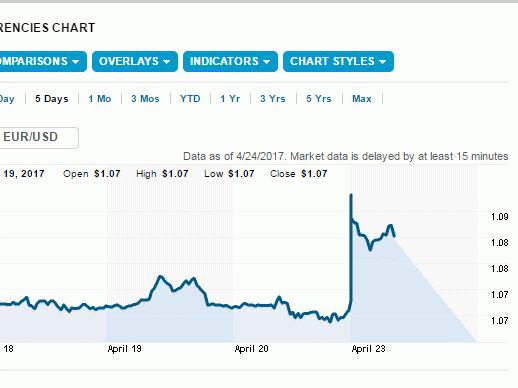
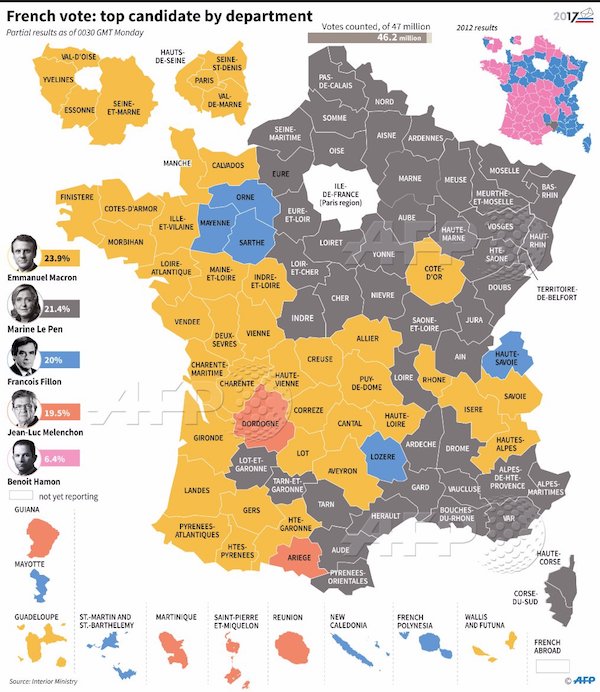
Read more …

Hard to believe, this. Brits are scared, they would hoard. It’s just not in their banks accounts that they do. It’s Go To The Mattresses time.

UK Households’ Savings Fall To Record Low (G.)

British households ran down their savings to a record low at the end of 2016 and disposable incomes fell in a warning sign for the economy that a squeeze in living standards is under way. The savings ratio – which estimates the amount of money households have available to save as a%age of their total disposable income – fell sharply in the fourth quarter to 3.3% from 5.3% in the third. It was the lowest since records began in 1963 according to the Office for National Statistics (ONS), and suggested that people are increasingly dipping into their savings to maintain spending. “Today’s figures should set alarm bells ringing. The last thing our economy needs right now is another consumer debt crisis,” said the TUC general secretary, Frances O’Grady.

“People raiding their piggy banks and borrowing more than they can afford is what helped drive the last financial crash.” In a further sign that household finances are coming under increasing strain from rising inflation and falling wage growth, disposable incomes also fell over the quarter. Real household disposable income – which adjusts for the impact of inflation – shrank by 0.4% compared with the previous three months, the steepest drop in nearly three years. UK growth since the financial crisis has been heavily reliant on consumer spending. The ONS confirmed the wider UK economy grew by 0.7% between October and December, but economists said a weaker consumer backdrop could weigh on growth in the coming months. Growth in 2016 was unrevised at 1.8% as the ONS updated its estimates.

Read more …

And the rest of the world.

Multiple Bubbles Are Going To Bring America To Its Knees (Lang)

If you’ve been paying attention to the ongoing degradation of the American economy since the last financial crisis, you’re probably flabbergasted by the fact that our economy has managed to make it this far without imploding. I know I am. I find myself shocked with every year that passes without incident. The warning signs are there for anyone willing to see, and they are flashing red. Even cursory research into the numbers underlying our system will tell you that we’re on an unsustainable financial path. It’s simple math. And yet the system has proven far more durable than most people thought. The only reasonable explanation I can think of, is that the system is being held up by wishful thinking and willful ignorance.

If every single person knew how unsustainable our economy is, it would self-destruct within hours. People would pull their money out of the banks, the bonds, and the stock market, and buy whatever real assets they could while their money is still worth something. It would be the first of many dominoes to fall before the entire financial system collapses. But most people don’t want to think about that possibility. They want the relative peace and prosperity of the current system to continue, so they ignore the facts or try to avoid them as much as possible. They keep their money right where it is and cross their fingers instead. In other words, the only thing propping up the system is undeserved confidence.

Unfortunately, confidence can’t keep an unsustainable system running forever. Nothing can. And our particular system is brimming with economic bubbles that aren’t going to stay inflated for much longer. Most recessions are associated with the bursting of at least one kind of bubble, but there are multiple sectors of our economy that may crash at roughly the same time in the near future. [..] Our economy is awash in cheap money and financial bubbles that threaten to wipe out tens of trillions of dollars worth of savings, investments, and assets. Everyone can close their eyes and hum while they hope that everything is going to be just fine, but it won’t be.

Read more …

But the economy is fine, of course…

Ports In China Have Enough Iron Ore To Build 13,000 Eiffel Towers (R.)

With enough iron ore to construct Paris’s Eiffel Tower nearly 13,000 times over, China’s ports are bursting with stockpiles of the raw material and some of them are demolishing old buildings to create more storage space, trading sources said. China’s domestic iron ore production jumped 15.3% in January-February as a price rally last year extended into 2017, causing imported ore to pile up at the ports of the world’s top buyer. Stockpiles are at their highest in more than a decade and are affecting prices. Inventory of imported iron ore at 46 Chinese ports reached 132.45 million tonnes on March 24, SteelHome consultancy said, the highest since it began tracking the data in 2004. A third of the stocks belongs to traders and the rest is owned by China’s steel mills, SteelHome said.

That volume would make about 95 million tonnes of steel, enough to build 12,960 replicas of the 324-metre (1,063-foot) high Eiffel Tower in Paris. Global iron ore prices are now at just above $80 a tonne from a 30-month peak of $94.86 reached in February, largely due to the growing port inventory. Prices surged 81% last year, bringing relief to miners after a three-year rout. The rally stretched into 2017, inspiring marginal producers to resume business and lifting supply as China’s steel demand waned. Further falls in the price of iron ore risk shuttering Chinese capacity again. That could boost China’s reliance on top-grade exporters Vale, Rio Tinto and BHP Billiton.

Read more …

Not going to stop as long as we don’t stop it.

French Banks Posted ‘Multi-Billion Euro Profits’ In Tax Havens (F24)

The Eurozone’s 20 biggest banks earned over a quarter of their profits in tax havens in 2015, according to a report released Monday by Oxfam. The report details how, in 2015, top Eurozone banks generated €25 billion in profits in low-tax territories like the Republic of Ireland, Luxembourg, the Cayman Islands and the American state of Delaware. Despite the massive profits, the banks only conducted 12% of their total business and employed 7% of their workers in those countries – a clear sign of the “tricks” that banks are willing use to avoid countries with stricter tax regimes, according to Oxfam’s Manon Aubry, one of the report’s authors. In Europe, banking is now the only sector in which companies must declare country-by-country tax and profit figures, thanks to legislation passed in the wake of the financial crisis.

The anti-poverty NGO Oxfam took advantage of the new data to write its report. Several of France’s biggest banks figure prominently in the report, including BNP Paribas, Crédit Agricole, Société Générale and BPCE (which owns Banque Populaire and Caisse d’Epargne). French banks declared almost €2 billion in profit in Luxembourg, as much as they reported in Germany and Spain combined, despite the fact that Luxembourg’s population is only 1% that of Spain’s. Some of the most telling figures come from discrepancies between profit and other key economic measures. “Société Générale, for instance, reported 22% of its profits in tax havens,” Oxfam’s Aubry told FRANCE 24, “but only 4% of its employee pay was generated there.”

In another example, BNP Paribas declared €134 million of profit in the Cayman Islands in 2015, although it had zero employees there. However, Servane Costrel, Wealth Management Press Officer for BNP Paribas, said that these figures were “obsolete”. “Profits earned in the Cayman Islands were taxed in the United States,” Costrel told FRANCE 24 by email. “But this is a non-issue since that figure [of profits in the Cayman Islands] dropped to zero in 2016.”

Read more …

Save the right from the right. That should work. The French massively hate their own politicial system.

European Right Hopes Macron Will Save France (EUO)

Not long ago, Francois Fillon was considered the most likely winner of the French presidential election in May. But after he was charged for embezzlement over suspicions of fake parliamentary jobs for his wife and children, even his European allies seem to have lost hope. Meanwhile, the fear of seeing far-right candidate Marine Le Pen taking power is growing. “People are worried, they are wondering what is going on in France,” Joseph Daul, president of the European People’s Party (EPP), told EUobserver on the margins of the EPP congress in Malta this week. “And it goes further than that. There are already committees, at the highest level, working on the hypothesis that France leaves the euro and the EU,” he said. He declined to specify whether these working groups were in EU capitals or in the EU institutions.

Officials in Brussels have warned about the consequences for France and the EU if Le Pen were to be elected, but have said so far that that they do not want to envisage a Le Pen scenario. The National Front (FN) leader has said that she wants to “do away with the EU,” and has promised to organise a referendum on the country’s EU membership. Her possible election “has been a risk for some time,” a high level EU source said recently, pointing to the “explosion” of the two main parties, the Socialist Party (PS) of outgoing president Francois Hollande and Fillon’s Republicans. In the most recent poll published on Wednesday (29 March), Socialist Party (PS) candidate Benoit Hamon was credited with only 10% of voting intentions and Fillon with 18%. Both were far behind Le Pen (with 24%) and independent candidate Emmanuel Macron (with 25.5%).

Read more …

Pecora for health care.

Racket of Rackets (Jim Kunstler)

My suggestion for real reform of the medical racket looks to historical precedent: In 1932 (before the election of FDR, by the way), the US Senate formed a commission to look into the causes of the 1929 Wall Street Crash and recommend corrections in banking regulation to obviate future episodes like it. It is known to history as the Pecora Commission, after its chief counsel Ferdinand Pecora, an assistant Manhattan DA, who performed gallantly in his role. The commission ran for two years. Its hearings led to prison terms for many bankers and ultimately to the Glass-Steagall Act of 1932, which kept banking relatively honest and stable until its nefarious repeal in 1999 under President Bill Clinton — which led rapidly to a new age of Wall Street malfeasance, still underway.

The US Senate needs to set up an equivalent of the Pecora Commission to thoroughly expose the cost racketeering in medicine, enable the prosecution of the people driving it, and propose a Single Payer remedy for flushing it away. The Department of Justice can certainly apply the RICO anti-racketeering statutes against the big health care conglomerates and their executives personally. I don’t know why it has not done so already — except for the obvious conclusion that our elected officials have been fully complicit in the medical rackets, which is surely the case of new Secretary of Health and Human Services, Tom Price, a former surgeon and congressman who trafficked in medical stocks during his years representing his suburban Atlanta district. A new commission could bypass this unprincipled clown altogether.

It is getting to the point where we have to ask ourselves if we are even capable of being a serious people anymore. Medicine is now a catastrophe every bit as pernicious as the illnesses it is supposed to treat, and a grave threat to a nation that we’re supposed to care about. What party, extant or waiting to be born, will get behind this cleanup operation?

Read more …

“..it’s unclear whether we will land back in something like the mid-nineteenth century, or go full-bore medieval, or worse.”

The Big Contraction – An Interview With Jim Kunstler

We’ve been sowing the seeds for our predicament since the end of World War II. You might even call this process “The Victory Disease.” In practical terms it represents sets of poor decisions with accelerating bad consequences. For instance, the collective decision to suburbanize the nation. This was not a conspiracy. It was consistent with my new theory of history, which is Things happen because they seem like a good idea at the time. In 1952 we had plenty of oil and the ability to make a lot of cars, which were fun, fun, fun! And we turned our war production expertise into the mass production of single family houses built on cheap land outside the cities. But the result now is that we’re stuck in a living arrangement with no future, the greatest misallocation of resources in the history of the world.

Another bad choice was to offshore most of our industry. Seemed like a good idea at the time; now you have a citizenry broadly impoverished, immiserated, and politically inflamed. Of course, one must also consider the possibility that industrial society was a historic interlude with a beginning, middle, and end, and that we are closer to the end of the story than the middle. It was, after all, a pure product of the fossil fuel bonanza, which is also coming to an end (with no plausible replacement in view.) I don’t view all this as the end of the world, or of civilization, per se, but we’re certainly in for a big re-set of the terms for remaining civilized. I’ve tried to outline where this is all going in my four-book series of the “World Made By Hand” novels, set in the near future.

If we’re lucky, we can fall back to sets of less complex social and economic arrangements, but it’s unclear whether we will land back in something like the mid-nineteenth century, or go full-bore medieval, or worse. One thing we can be sure of: the situation we face is one of comprehensive discontinuity — a lot of things just stop, beginning with financial arrangements and long-distance supply lines of resources and finished goods. Then it depends whether we can respond by reorganizing life locally in this nation at a finer scale — if it even remains a unified nation. Anyway, implicit in this kind of discontinuity is the possibility for disorder. We don’t know how that will go, and how we come through it depends on the degree of disorder.

Read more …

At some point I can see this turning into a Free Mandela kind of movement.

Julian Assange Waits For Ecuador’s Election To Decide His Future (G.)

For Ecuador’s 15 million inhabitants, Sunday’s presidential election runoff will pose a fundamental question: whether to continue with a leftwing government that has reduced poverty but also brought environmental destruction and authoritarian censorship, or to take a chance on a pro-business banker who promises economic growth but is accused of siphoning money to offshore accounts. But they are not the only ones for whom the result will be critically important. Thousands of miles away, in the country’s tiny embassy in central London, Julian Assange will be watching closely to see if his four and a half years of cramped asylum could be coming to an abrupt, enforced end. Guillermo Lasso, the businessman and leading opposition candidate, has vowed that if he wins, the WikiLeaks founder’s time in the embassy will be up.

Lasso has said he would “cordially ask Señor Assange to leave within 30 days of assuming a mandate”, because his presence in the Knightsbridge embassy was a burden on Ecuadorian taxpayers. His government opponent, Lenin Moreno, has said Assange would remain welcome, albeit with conditions. “We will always be alert and ask Mr Assange to show respect in his declarations regarding our brotherly and friendly countries,” Moreno said. The most recent polling showed Moreno at least four percentage points ahead of his rival, though earlier polls had Lasso in the lead, and many analysts caution that the results are within the margin of error. Could this weekend really trigger the beginning of the end for Assange’s extraordinary central London refuge? Neither Lasso’s victory, nor precisely what he would do if he won, are certain (he later softened his position to say Assange’s status would be “reviewed”).

Read more …

Mar 162017
 
 March 16, 2017  Posted by at 2:53 pm Finance Tagged with: , , , , , , ,  9 Responses »


Marc Riboud Sur les Quais de Paris 1953


The Dutch elections on Wednesday have provided a whole bunch of Orwellian narratives. PM Mark Rutte’s right wing VVD party, actually the ‘business’ -or should we say ‘rent-seekers’ in 2017- party, who lost some 20% of the seats they had obtained in the previous parliamentary election in November 2012, down from 41 to 33 seats, is declared the big winner. While Geert Wilders’ very right wing party, PVV, won 25% more seats -it went from 16 to 20- and is the big loser.

Moreover, Rutte’s coalition partner, labor PvdA, gave up 29 out of 38 seats to end up with just 9. That’s a loss of over 75%. Together, the coalition partners went from 79 seats in the 2012 election to 42 in 2017. That’s an almost 50% less. Not that it could prevent Rutte from proudly declaring: “We want to stick to the course we have – safe and stable and prosperous..” Makes you wonder who the ‘we’ are that he’s talking about.

That course he wants to stick to had a finance minister named Dijsselbloem, and his party just lost by over 75%. So he won’t be back. But perhaps the EU can pull another ‘Tusk’, and leave him in place in Brussels as chairman of the Eurogroup no matter what voters in his own country think of him. Still, declaring your intention to ‘stick to the course’ when your coalition has just been sawed in half, it’s quite something.


The only reasons Rutte’s VVD ended up being the biggest party all have to do with Wilders. The anxiety over the election all had to do with polls. Wilders is a one man party and a a one trick pony. If he would leave, his party would dissolve. And his sole ‘message’ is that Islam is bad and should vanish from first Holland and then Europe. He doesn’t really have any other political program points. Ok, there’s Brussels. Doesn’t like that either.

Perhaps that’s why he largely shunned the pre-election debates. Problem with that is, these things attract a lot of TV viewers, crucial free air-time. All in all, since he’s his own worst enemy in many respects, it’s not that much of a surprise that Wilders’ support collapsed, and that’s just if we were to take Dutch pollsters more serious than their counterparts in the US and UK.

Talking of which, according to Rutte, those are the countries where ‘the wrong kind of populism’ has won and delivered Trump and Brexit. And of course there are lots of people who agree with that. What either they, or Rutte himself, would label ‘the right kind of populism’ is unclear. Maybe Rutte himself is the right kind of populist?


The row with Turkey over the weekend must have helped Rutte quite a bit. Not only were his actions in the row met with approval by a large majority of the Dutch population, including just about all other party leaders, the Dutch also got to think about what WIlders would do in such a situation. And there can be no doubt that Rutte is seen as much more of a statesman than Wilders.

Not that the row is over. After Turkey announced yesterday it would return 40 Dutch cows (?!) , today Turkish Foreign Minister Cavusoglu said Europe’s politicians are “taking Europe toward an abyss”, and: “Soon religious wars will break out in Europe. That’s the way it’s going.” There can be no doubt that a shouting war like this with Wilders as one of the participants would take on a whole different shape, and a different choice of words.

What Rutte’s going to do next is form a new coalition, this time not with the left but with the center-right, and no-one will be able to tell the difference. If Dutch, and European, and global, politics have one main problem, it’s that. Left is right and right is left and winners are losers. If a guy like Dijsselbloem can squeeze Greek society dry in his capacity as Eurogroup head, while he runs as a leftist candidate in his own country, and loses hugely, anything goes.


All those who think they can see in the Dutch experience, a sign that Marine Le Pen’s chances in France’s presidential elections in April and May have dropped a lot, would appear to be delusional. Judging from reactions in the financial markets, many seem to be. But Le Pen is much less of a fringe figure than Wilders is, and she certainly wouldn’t shun a debate. It’s true that her Front National is a one-woman operation, bit she has a much clearer political program than Wilders does.

And she doesn’t have an opponent like Rutte, who’s become a formidable presence domestically, as anyone would be who can be PM for many years and not be put out by the curb. The man who should be Le Pen’s main adversary is not; Hollande is out by that curb and doesn’t even dare run again. His Socialist party has become a joke. The next strongest opponent should be François Fillon, but he’s all but gone now he’s been placed under formal investigation.

That leaves only Emmanual Macron, an independent without a party and without a program. In France, you can be elected president in such a situation, but your hand are tied in all sorts of ways, because you need parliament to vote for things.

..the nuances of the French political system put Macron in a spot of bother. The president derives their power from the support of a majority in the lower house of parliament, the National Assembly. Macron was a minister for the Socialist Party government but quit in 2016 to form his own political movement. Now he doesn’t even have a party, let alone a majority. Although the constitution of the French Fifth Republic, created by Charles De Gaulle in 1958, extended presidential powers, it did not enable the president to run the country.

There are only a few presidential powers that do not need the prime minister’s authorisation. The president can appoint a prime minister, dissolve the National Assembly, authorise a referendum and become a “temporary dictator” in exceptional circumstances imperilling the nation. They can also appoint three judges to the Constitutional Council and refer any law to this body. While all important tasks, this does not, by any stretch of the imagination, amount to running a country. The president can’t suggest laws, pass them through parliament and then implement them without the prime minister.

The role of a president is best defined as a “referee”. Presidential powers give the ability to oversee operations and act when the smooth running of institutions is impeded. So a president is able to step in if a grave situation arises or to unlock a standoff between the prime minister and parliament, such as by announcing a referendum on a disputed issue or by dismissing the National Assembly.

So, why does everyone see the president as the key figure? In a nutshell, it’s because the constitution has never been truly applied. There lies the devilish beauty of French politics. A country known since the 1789 revolution for its inability to foster strong majorities in parliament has succeeded, from 1962, in providing solid majorities.

Perhaps those who believe that what happened in Holland is also likely to happen in France are swayed by the notion that both are part of the EU. But they are very different countries and cultures, and different political systems. And Le Pen is no Wilders. She doesn’t say crazy things anymore, she’s cleansed the public image of her party by getting rid of her father, and she keeps any remaining extremists out of view.

There is still plenty suspicion in France about her, and about her party, but there are also a lot of people who agree with a lot of what she says. The perhaps most noteworthy statement she’s made recently is that she would step down if she loses the referendum about membership of the EU she intends to launch if elected president. That should keep Brussels on their toes. Marine means what she says. And a lot of French people may get to like her for that. In a political landscape in which the competition keeps shooting itself in the foot.

Another thing about Le Pen is that her political program contains quite a few bits and bolts that could be labeled leftist; a 35-hour work week, retirement at 60, lower energy prices. It’s just that she wants to reserve these things for the French. Foreigners, especially, Muslims, are not invited. And she is very much opposed to neo-liberalism and globalization:

They’ve made an ideology out of it. An economic globalism which rejects all limits, all regulation of globalization, and which consequently weakens the immune defences of the nation state, dispossessing it of its constituent elements: borders, national currency, the authority of its laws and management of the economy, thus enabling another globalism to be born and to grow: Islamist fundamentalism..

Le Pen’s popularity does not come from an overwhelming innate racism in France -though such a thing certainly exists-. It comes instead from the formidable failure that the country’s immigration policy has been for many decades. At the outskirts of major cities ghetto’s have been allowed to form in which those that come from former French colonies, especially in Africa, feel trapped with no way out. The French tend to feel superior to all other people, and the political system has let the situation slip completely out of hand.

Now France, and Europe is general, will have to deal with this mess. So far, the main European reaction is to turn Greece into a prison camp for a new wave of refugees and migrants. That can of course only make things worse. And it doesn’t solve any of the existing problems. Which makes the rise of Marine Le Pen inevitable.

And Wilders too; he’s the no. 2 party in Holland, because his party won 33% more seats than in 2012 to go from 15 to 20. That 33% gain, versus Rutte’s 20% loss, makes Wilders a loser in the eyes of many ‘relieved’ observers.

Winners are losers, and as is evident in Le Pen’s social policies for the French, in European coalition governments that contain Labor and right wing parties, and in the course of the Democratic party in the US, left is definitely the same as right.

Orwell always wins. Next problem: the actual left are not represented by anyone anymore.


MarcRiboud Sur les Quais de Paris 1953


The Dutch elections on Wednesday have provided a whole bunch of Orwellian narratives. PM Mark Rutte’s right wing VVD party, actually the ‘business’ -or should we say ‘rent-seekers’ in 2017- party, who lost some 20% of the seats they had obtained in the previous parliamentary election in November 2012, down from 41 to 33 seats, is declared the big winner. While Geert Wilders’ very right wing party, PVV, won 25% more seats -it went from 16 to 20- and is the big loser.

Moreover, Rutte’s coalition partner, labor PvdA, gave up 29 out of 38 seats to end up with just 9. That’s a loss of over 75%. Together, the coalition partners went from 79 seats in the 2012 election to 42 in 2017. That’s an almost 50% less. Not that it could prevent Rutte from proudly declaring: “We want to stick to the course we have – safe and stable and prosperous..” Makes you wonder who the ‘we’ are that he’s talking about.

That course he wants to stick to had a finance minister named Dijsselbloem, and his party just lost by over 75%. So he won’t be back. But perhaps the EU can pull another ‘Tusk’, and leave him in place in Brussels as chairman of the Eurogroup no matter what voters in his own country think of him. Still, declaring your intention to ‘stick to the course’ when your coalition has just been sawed in half, it’s quite something.


The only reasons Rutte’s VVD ended up being the biggest party all have to do with Wilders. The anxiety over the election all had to do with polls. Wilders is a one man party and a a one trick pony. If he would leave, his party would dissolve. And his sole ‘message’ is that Islam is bad and should vanish from first Holland and then Europe. He doesn’t really have any other political program points. Ok, there’s Brussels. Doesn’t like that either.

Perhaps that’s why he largely shunned the pre-election debates. Problem with that is, these things attract a lot of TV viewers, crucial free air-time. All in all, since he’s his own worst enemy in many respects, it’s not that much of a surprise that Wilders’ support collapsed, and that’s just if we were to take Dutch pollsters more serious than their counterparts in the US and UK.

Talking of which, according to Rutte, those are the countries where ‘the wrong kind of populism’ has won and delivered Trump and Brexit. And of course there are lots of people who agree with that. What either they, or Rutte himself, would label ‘the right kind of populism’ is unclear. Maybe Rutte himself is the right kind of populist?


The row with Turkey over the weekend must have helped Rutte quite a bit. Not only were his actions in the row met with approval by a large majority of the Dutch population, including just about all other party leaders, the Dutch also got to think about what WIlders would do in such a situation. And there can be no doubt that Rutte is seen as much more of a statesman than Wilders.

Not that the row is over. After Turkey announced yesterday it would return 40 Dutch cows (?!) , today Turkish Foreign Minister Cavusoglu said Europe’s politicians are “taking Europe toward an abyss”, and: “Soon religious wars will break out in Europe. That’s the way it’s going.” There can be no doubt that a shouting war like this with Wilders as one of the participants would take on a whole different shape, and a different choice of words.

What Rutte’s going to do next is form a new coalition, this time not with the left but with the center-right, and no-one will be able to tell the difference. If Dutch, and European, and global, politics have one main problem, it’s that. Left is right and right is left and winners are losers. If a guy like Dijsselbloem can squeeze Greek society dry in his capacity as Eurogroup head, while he runs as a leftist candidate in his own country, and loses hugely, anything goes.


All those who think they can see in the Dutch experience, a sign that Marine Le Pen’s chances in France’s presidential elections in April and May have dropped a lot, would appear to be delusional. Judging from reactions in the financial markets, many seem to be. But Le Pen is much less of a fringe figure than Wilders is, and she certainly wouldn’t shun a debate. It’s true that her Front National is a one-woman operation, bit she has a much clearer political program than Wilders does.

And she doesn’t have an opponent like Rutte, who’s become a formidable presence domestically, as anyone would be who can be PM for many years and not be put out by the curb. The man who should be Le Pen’s main adversary is not; Hollande is out by that curb and doesn’t even dare run again. His Socialist party has become a joke. The next strongest opponent should be François Fillon, but he’s all but gone now he’s been placed under formal investigation.

That leaves only Emmanual Macron, an independent without a party and without a program. In France, you can be elected president in such a situation, but your hand are tied in all sorts of ways, because you need parliament to vote for things.

..the nuances of the French political system put Macron in a spot of bother. The president derives their power from the support of a majority in the lower house of parliament, the National Assembly. Macron was a minister for the Socialist Party government but quit in 2016 to form his own political movement. Now he doesn’t even have a party, let alone a majority. Although the constitution of the French Fifth Republic, created by Charles De Gaulle in 1958, extended presidential powers, it did not enable the president to run the country.

There are only a few presidential powers that do not need the prime minister’s authorisation. The president can appoint a prime minister, dissolve the National Assembly, authorise a referendum and become a “temporary dictator” in exceptional circumstances imperilling the nation. They can also appoint three judges to the Constitutional Council and refer any law to this body. While all important tasks, this does not, by any stretch of the imagination, amount to running a country. The president can’t suggest laws, pass them through parliament and then implement them without the prime minister.

The role of a president is best defined as a “referee”. Presidential powers give the ability to oversee operations and act when the smooth running of institutions is impeded. So a president is able to step in if a grave situation arises or to unlock a standoff between the prime minister and parliament, such as by announcing a referendum on a disputed issue or by dismissing the National Assembly.

So, why does everyone see the president as the key figure? In a nutshell, it’s because the constitution has never been truly applied. There lies the devilish beauty of French politics. A country known since the 1789 revolution for its inability to foster strong majorities in parliament has succeeded, from 1962, in providing solid majorities.

Perhaps those who believe that what happened in Holland is also likely to happen in France are swayed by the notion that both are part of the EU. But they are very different countries and cultures, and different political systems. And Le Pen is no Wilders. She doesn’t say crazy things anymore, she’s cleansed the public image of her party by getting rid of her father, and she keeps any remaining extremists out of view.

There is still plenty suspicion in France about her, and about her party, but there are also a lot of people who agree with a lot of what she says. The perhaps most noteworthy statement she’s made recently is that she would step down if she loses the referendum about membership of the EU she intends to launch if elected president. That should keep Brussels on their toes. Marine means what she says. And a lot of French people may get to like her for that. In a political landscape in which the competition keeps shooting itself in the foot.

Another thing about Le Pen is that her political program contains quite a few bits and bolts that could be labeled leftist; a 35-hour work week, retirement at 60, lower energy prices. It’s just that she wants to reserve these things for the French. Foreigners, especially, Muslims, are not invited. And she is very much opposed to neo-liberalism and globalization:

They’ve made an ideology out of it. An economic globalism which rejects all limits, all regulation of globalization, and which consequently weakens the immune defences of the nation state, dispossessing it of its constituent elements: borders, national currency, the authority of its laws and management of the economy, thus enabling another globalism to be born and to grow: Islamist fundamentalism..

Le Pen’s popularity does not come from an overwhelming innate racism in France -though such a thing certainly exists-. It comes instead from the formidable failure that the country’s immigration policy has been for many decades. At the outskirts of major cities ghetto’s have been allowed to form in which those that come from former French colonies, especially in Africa, feel trapped with no way out. The French tend to feel superior to all other people, and the political system has let the situation slip completely out of hand.

Now France, and Europe is general, will have to deal with this mess. So far, the main European reaction is to turn Greece into a prison camp for a new wave of refugees and migrants. That can of course only make things worse. And it doesn’t solve any of the existing problems. Which makes the rise of Marine Le Pen inevitable.

And Wilders too; he’s the no. 2 party in Holland, because his party won 33% more seats than in 2012 to go from 15 to 20. That 33% gain, versus Rutte’s 20% loss, makes Wilders a loser in the eyes of many ‘relieved’ observers.

Winners are losers, and as is evident in Le Pen’s social policies for the French, in European coalition governments that contain Labor and right wing parties, and in the course of the Democratic party in the US, left is definitely the same as right.

Orwell always wins. Next problem: the actual left are not represented by anyone anymore.