Jan 242018
 
 January 24, 2018  Posted by at 3:59 pm Finance Tagged with: , , , , , , , , , , , ,  11 Responses »


Rembrandt van Rijn The Storm on the Sea of Galilee 1633
On March 18, 1990, the painting was stolen by thieves disguised as police officers. They broke into the Isabella Stewart Gardener Museum in Boston, MA, and stole this painting, along with 12 other works. The paintings have never been recovered, and it is considered the biggest art theft in history. The empty frames still hang in their original location.


This is an article written by Dr. D, who last month wrote a series at the Automatic Earth entitled Bitcoin Doesn’t Exist.

It shouldn’t surprise you that bitcoin plays a cameo in his Modest -but actually quite grand- Plan as well.


Dr. D: With all the talk about the bubble market, people are once again saying Donald Trump is a fool, he should never have taken credit for a Dow that’s about to collapse. In addition, how does he think he can get away with claiming we have a great economy made greater? He said in the election the economy was terrible and the Dow was a bubble, that’s why he won.

But hold on: you have to remember, they’re politicians; they may be dishonest but they’re not stupid. Let’s try a scenario to see what they’re thinking:

We have a situation in the U.S. where 100 million people are out of the workforce, the real economy is on life-support, debt is crushing, and monetary velocity is at an all-time low. The Fed’s every effort at market-rigging, lowering rates and pumping in money, bailing out the banks and giving unearned interest for Fed deposits have run up both the housing market and the stock market, neither of which is their legal mandate. If either one goes higher, they’ll pop as workers, particularly millennials, have no income to buy houses, and stocks are levitating on just 5 insider-paid FAANG stocks.

It’s untenable. However, if either falls, the collateral that upholds the whole system will fail, margins will be called, the housing market will fall, and there will be an instant Depression… You know, more than the 100 million out of work Depression we already have. A Depression that makes Congressmen and government workers lose their profits and 401k’s instead of just turning students to open prostitution, and mass opioid death, and starving people in Oklahoma – you know, a Depression that finally hurts someone who matters.

Since this is self-evident and unsustainable, isn’t Trump just stepping in it by pushing all the same policies as Obama? Not necessarily. Look at what matters to him. A tax plan, and barely, not one he liked, but look at what he settled for: return of foreign profits abroad. Why? Large as it is – and it’s already creating long-withheld bonuses – that’s not enough to turn the dial. But that’s a card he wanted. Tax policy and a high stock market. What else?

Well, we have a crippling high debt, easily 100% even 200% of GDP. With that weight, nothing can move, no way to win. Pensions also are nearly dead, along with insurance companies; the high Dow is all that’s saving them from bankruptcy. What else? Well he was interested in health reform but was willing to let it remain for now. He wrote deferrals but not pardons for 5 banks showing he’d like to keep them functioning for the moment. He wanted to increase the military.

Certainly the only other promise was to create jobs and economies again, in a way saying the few protected industries: Finance, Health Care, and Military would have to become a smaller % of GDP, so those dollars could be returned back to Main Street. But we just said those three aren’t happening.

So. What if instead of pulling money from intractable lobbying groups he got new investment money from abroad? We saw this initially with Carrier and Ford and more recently with Japan. But it’s not enough and he knows all this; they all do. How do you solve the problem? How do you get more?

Calling all 1st year econ students: how do you attract capital to your country? With higher rates. As the US 10-year breaks out above 2.6% you’d have to think that’s attractive. Attractive investing in a bankrupt nation that’s barely moving? It does if you’re a company that must maintain legal investment ratios and you’re getting 0% in Japan, and negative rates in Europe, both with economies as bad or worse.

But aren’t rising rates bad? The Fed model raises rates to clamp down on the economy. Money will leave the stock market and go to bonds. Housing prices will fall as the monthly cost increases. Cats and Dogs living together….except it isn’t true.


Let’s go down the list:


1. Trump starts with plausible seed corn, a billboard sign: a tax cut and a few trillion overseas to start economic motion.

2. If the Fed raises rates, that will draw in trillions of world capital Trump wants, enough to turn the dial and really matter.

3. Enough money flowing into the U.S. will create demand for the US$, and the US$ will rise. This part has to work. Be flashy, attract attention. Go big or go home.

4. The US$ rising will attract foreign buyers into U.S. investment and together the stock market will counterintuitively rise.

5. The Fed will detect overheating and raise rates again and again in a reinforcing cycle, drawing capital to only the U.S. and suffocating the world.

6. The massive investment re-industrializes the U.S. to some extent while the high US$ gives some relief to Main Street.

7. Foreign buying, better jobs, and low exchange rates hold off the housing collapse, while all the mortgage bonds are also sold overseas.

8. Emerging markets are hammered by the high US$ and fail, driving ever-more capital to safe havens like the US.

9. Ultimately, the U.S. does what all reserve currencies do and fails LAST.


See why they think they can get away with this? The U.S. can still ravage the world, and Trump can, in fact, call it his “success.” …Just like all the Presidents since Nixon.

But this is history, and it never ends there.


10. The whole world, strangled by the US and its dollar have no choice but to reject the US system entirely in private contracts and move to an alternative.

11. We now have at least three alternatives: the CIPS/Yuan banking bloc, gold, and cryptocurrencies. They aren’t exclusive: the most likely outcome is a gold-backed trading note priced in Yuan on a blockchain, perhaps in the Shanghai Exchange.

12. Being entirely too high the US$ ultimately cripples the U.S. as well, but the alternative currency the world creates becomes the lifeboat to escape. Let’s be simple and say it’s Bitcoin (it won’t be): Bitcoin hits John McAfee’s $1 million. What do you call it when a currency rapidly becomes worth 1/10th, 1/100th, 1/1,000,000th of the standard? Isn’t that hyperinflation?

13. The U.S., like every nation since Adam Smith, defaults on its $20T in $ debt – and all its internal consumer, corporate, and pension debt – using “hyperinflation” of the dollar. New twist is that, instead of gold, it hyperinflates vs. cryptos or the new world exchange standard as planned in 1971 and publicized in 1988.

14. The reset occurs, no one dies (in the U.S.), supply chains are maintained, oil flows, and the economy stops being a feral, diabolical means of theft and control and returns to being a fair, voluntary exchange. For now.


That’s not to say they’ll succeed, but this is why they think they can go this way and win at it. What does the Trump world look like?


1. Stock market rose, like he said.

2. Manufacturing returns, reindustrializing a hollow nation and allowing the country to catch up to the stock prices, like he said.

3. Unemployment drops, like he said.

4. Crime is reduced and the cities are improved, like he said.

5. This helps win the black vote, snatching the rest of the Democratic base and locking them out for years, like Bannon said.

6. Economic growth normalizes the banking/medical oversize, like he wanted.

7. Free, untracked money for bribes and illegal cover end and law and order returns with fair exchange, like he said.

8. The U.S. is unwelcome overseas, and the breaking of bonds re-sets the multipolar world, where the U.S. is just one trading nation among many, like he said.

9. Without the money of empire the military returns home, like he said.

10. The world is pretty mad at us and that renewed military came in handy. That’s okay, they’ll be consoled that the economy now works and the U.S. can no longer start wars and act terribly.


What does the world look like after? A lot more like it was before 1945. You know, back when we were great and before we got terrible.

Again, not to say this WILL happen, but you can see that it CAN happen, and they are now in control of most of the levers required. From their rhetoric, you can see the glass darkly that this is what they find a priority, a possibility, and therefore a doorway out. In addition, downsizing and re-establishing honesty will not allow their opponents to wiggle out and reverse it.

Why wasn’t this done before? My guess is that a) previous planners thought with a little more effort they could take over the world, as seen in the Arab Spring plan that would culminate in the capture of Iran, the only remaining oilfields on the planet, and b) given the world’s first entirely fiat financial system, it was too complex and disruptive to return to a gold standard.

Without a lighting fast crypto base, banking and trade would fail and millions would die. Only when the one was burned out and the other made available could this move be attempted. Watch and see.


Jan 242018


Horacio Coppola Florida, Buenos Aires 1936


Rising Rates and Decelerating Deficits Spell Doom For US Housing -Again (CH)
Global Pension Ponzi – Carillion Collapse One Of Many To Come (GCore)
South Korea Bans Anonymous Cryptocurrency Trading (BI)
South Korea Is Banning All Foreigners From Trading Cryptocurrency (F.)
Mueller Wants To Question Trump On Comey, Flynn Firings (ZH)
Sessions, Comey Questioned By Mueller In Russia Probe (ZH)
Evidence Suggests A Massive Scandal Is Brewing At The FBI (NYPost)
Behind the Money Curtain: Taxes, Spending and Modern Monetary Theory (CP)
Turkey Lodges Third Extradition Request For Eight Servicemen in Greece (K.)
German Politicians Decry Arms Sales To Turkey Amid Attack On Syrian Kurds (RT)
Nearly Half Of Children In London, Birmingham Live In Poverty (Ind.)
UK Opposes Strong EU Recycling Targets Despite Plastics Pledge (G.)
Monsanto Faces A Fight For Soy Market (R.)
Number Of New Antibiotics Has Fallen Sharply Since 2000 (G.)


Chris Hamilton tends to get stuck in a multitude of data and graphs. Bit of a shame. Sometimes it’s about what you leave out.

But point taken: Demographics, Housing and Debt.

Rising Rates and Decelerating Deficits Spell Doom For US Housing -Again (CH)

I recently wrote an article explaining why a 30% to 50% decline in household net worth is imminent (HERE). No shocker that the primary asset for most in figuring household net worth is real estate, particularly primary residences. This article details why US housing starts and job creation are set to decelerate and a recession will almost surely follow… sending home prices tumbling (and likely equity and bond prices, to boot) severely negatively impacting US households net worth’s. First, the year over year change in housing starts (one unit variety) is highly indicative of the subsequent change (in 12 to 18 months) of full time employees (chart below…year over year change in full time employees blue shaded area) vs. YoY change in housing starts (red line)). As goes housing, so goes subsequent jobs creation.

[..] If you think interest rate changes and housing creation look interdependent…you’re right (chart below).

Again, total annual total population growth, 0-65yr/old population growth, housing starts (1-unit)…but this time including annual change in full time employees.

I believe the interest rate hikes and decelerating deficits will slow housing and jobs creation…but even if I’m wrong, there is still trouble dead ahead as the US is simply running out of employable persons as the percentage of employed 15-64yr/olds is nearing all time highs (also known as potential homebuyers).

Read more …

Pensions problems are literally everywhere. But they come to light only when companies themselves collapse first.

Global Pension Ponzi – Carillion Collapse One Of Many To Come (GCore)

The looming pension crisis has been signalled in the collapse of Carillion. The deficit of latest private sector dead-on-arrival Carillion is officially £580 million. However, private reports suggest it could be as high as £2.6 BILLION. According to a Sky News investigation: ‘the £2.6 billion figure relates to the cost to Carillion of paying an insurance company to guarantee all of its pension liabilities, and is significant because it is likely to be the sum claimed on behalf of the pension schemes as part of the liquidation process.’ Nearly 30,000 UK workers’ pensions are at risk thanks to Carillion management’s total mismanagement of a company that has seen its share price collapse 94% in the last 12 months. Carillion’s 27,500-member pension scheme was placed on an ‘at risk list’ in autumn 2017. Arguably, it like many other pension funds should have been there many months ago.

Sadly, Carillion is just the latest in a very long string of serious company collapses that have highlighted the major pension crisis in the UK and around the Western world. It also likely signals that we may be on the verge of many, many more very large corporate bankruptcies in the UK due to massive debt levels and unfunded liabilities. This is not a situation unique to the private sector. It will be repeated in the years ahead – both in the public and the private sector. In November 2017, the OECD warned that the UK’s defined benefit workplace pension plans (final salary schemes) as ‘persistently underfunded’ and the state pension as seriously lacking. Everyone is exposed by this and it emphasises the importance of saving for retirement and ensuring your pension is both funded and properly diversified. These ongoing disasters in the UK’s pension pots are also a threat to the efforts of prudent individuals who have worked hard to set aside enough for their hard-earned retirements.

Read more …

This will be copied across the world.

South Korea Bans Anonymous Cryptocurrency Trading (BI)

South Korea has made moves to ban anonymous cryptocurrency accounts from being used for financial transactions. Financial authorities have already banned banks from offering virtual accounts that are needed to buy or sell cryptocurrency. New regulations set for next week will further the ban already in place by introducing a system to verify a person’s identity before they can make a transaction. Planned regulation also prevents foreigners and underage investors from opening cryptocurrency accounts in South Korea, Yonhap reported, citing financial officials. South Korea’s senior financial regulator Kim Yong-beom told reporters that six South Korean banks will begin issuing new trading accounts next week after the system is implemented. Those banks include Shinhan Bank, NH Bank and the Industrial Bank of Korea.

Existing crypto bank accounts not linked to verified users will be banned on the same day, Kim said. Officials also announced on Sunday that cryptocurrency traders would be required to share user data with the banks, according to Yonhap. Newly proposed regulations would require banks to check whether cryptocurrency exchanges comply with the new transparency measures. The government will also be able to access users’ transaction data through compliant banks, according to officials, which may point to the government looking to enforce taxes on cryptocurrency transactions. Stricter trading regulations are part of a government system to curb speculative investment into virtual money, as many fear that the cryptocurrency bubble may soon burst. The government also hopes to prevent the use of cryptocurrency in illegal activity.

Read more …

“Kang noted a loophole. In the new system, foreigners and minors can’t possibly make investments as it operates on a bank’s real-name account, but they could potentially use corporate accounts to make additional investments. “There’s no limit to that for now. We haven’t come up with measures to ban that as there is no actual way to do so,” he said.”

South Korea Is Banning All Foreigners From Trading Cryptocurrency (F.)

The system aims to tackle money laundering and related crimes, along with speculation-driven overheating in the market, Kang Young-soo, head of the FSC’s cryptocurrency response team, said by phone on Tuesday after the announcement. “The government is concerned about manipulation of market conditions and injection of illegal funds while market funds are leaked into speculative investments,” he added. “We view that foreigners’ and minors’ investments contribute to our areas of concern.” All foreigners, including residents, nonresidents and “kyopo” ethnic Koreans with foreign citizenship, will be banned from trading cryptocurrencies in Korea, the FSC’s foreign media department said by email. Minors are banned after Prime Minister Lee Nak-yeon earlier claim the cryptocurrency craze could lead the youth toward crime.

The government first suggested last month to ban minors and nonresident foreigners. But the final decision nets all foreigners regardless of resident status. “If they’re not Korean citizens, then they can invest in exchanges provided in their countries. Why do they have to invest in ours?” Kang quipped. [..] “The government is creating boundaries for instances of foreigners injecting in coins into the country and a phenomenon of more Bitcoins and other cryptocurrency circulating within the Korean market,” says Kim Jin-hwa, corepresentative of the Korea Blockchain Association, which has about 30 member companies including several exchanges. “With the current conditions of our market, higher supply would equate to higher speculation.”

The targets of the latest regulation, says blockchain startup BlockchainOS Choi Yong-kwan, are Chinese investors who have flooded the cryptocurrency market since their country banned cryptocurrency trade last year. Digital coins from China enter Korean exchanges, then are illegally changed into foreign currencies, which are sent back to China, he explained. “These cases are surprisingly high, and difficult to track or identify. This measure can be viewed as a response to ban these illegal activities,” he said by phone, but suggested the ban would have little effect on existing investors. “The biggest problem lies on Chinese cryptocurrency investors, so this matter is an important focus.”

Read more …

Trump can simply say NO. But he probably won’t.

Mueller Wants To Question Trump On Comey, Flynn Firings (ZH)

Following the news earlier this month that special counsel Mueller is seeking to question President Trump – and following today’s NYT report that Mueller had interviewed AG Jeff Sessions – moments ago the Washington Post reported that Mueller wants to question Trump over his decision to fire former FBI Director James Comey and the departure of former national security adviser Michael Flynn from the White House. According to two WaPo sources, Trump’s legal team could present conditions for Trump to interview with Mueller’s investigators as soon as next week. The Post also adds that Trump’s lawyers hope to have Trump answer some of Mueller’s questions in an in-person interview and some in writing.

Within the past two weeks, the special counsel’s office has indicated to the White House that the two central subjects that investigators wish to discuss with the president are the departures of Flynn and Comey and the events surrounding their firings. Mueller has also reportedly expressed interest in Trump’s efforts to remove Jeff Sessions as attorney general or pressure him into quitting, “according to a person familiar with the probe who said the special counsel was seeking to determine whether there was a “pattern” of behavior by the president.” Earlier this month, Trump declined to say whether he would grant an interview to Mueller and his team, deflecting questions on the topic by saying there had been “no collusion” between his campaign and Russia during the 2016 presidential election.

“We’ll see what happens,” Trump said when asked directly about meeting with the special counsel. While Trump has told has allegedly told his lawyers that he is not worried about a face to face meeting with the special counsel, some of Trump’s close advisers and friends fear a face-to-face interview with Mueller could put the president in legal jeopardy. A central worry, they say, is Trump’s lack of precision in his speech and his penchant for hyperbole. Roger Stone, a longtime informal adviser to Trump, said he should try to avoid an interview at all costs, saying agreeing to such a session would be a “suicide mission.” “I find it to be a death wish. Why would you walk into a perjury trap?” Stone said. “The president would be very poorly advised to give Mueller an interview”, Stone said.

Read more …

I googled Sessions. All articles on this are from WaPo, NYT, CNN etc. Where is the balance?

Sessions, Comey Questioned By Mueller In Russia Probe (ZH)

The leaks from the special counsel’s office just keep coming. After reporting earlier today that AG Jeff Sessions sat for an interview with Mueller last week, the paper is now reporting that Mueller interviewed former FBI Director James Comey last year. The interview with Comey focused on the infamous memo he wrote where he alleged that Trump had asked him to take it easy on Michael Flynn. Many of the special counsel’s critics have warned that Mueller should recuse himself from all dealings with Comey, who is believed to be a key witness in the probe. Comey and Mueller have a long history of working together, and also share a personal friendship, having vacationed together. A spokeswoman for Sessions confirmed that he had appeared before the committee. Circling back to Sessions, the NYT pointed out that Sessions is perhaps one of the most important witnesses to be interviewed by Mueller.

For Mr. Mueller, Mr. Sessions is a key witness to two of the major issues he is investigating: the campaign’s possible ties to the Russians and whether the president tried to obstruct the Russia investigation. Mr. Mueller can question Mr. Sessions about his role as the head of the campaign’s foreign policy team. Mr. Sessions was involved in developing Mr. Trump’s position toward Russia and met with Russian officials, including the ambassador. Along with Mr. Trump, Mr. Sessions led a March 2016 meeting at the Trump International Hotel in Washington, where one of the campaign’s foreign policy advisers, George Papadopoulos, pitched the idea of a personal meeting between Mr. Trump and Mr. Putin. Mr. Papadopoulos plead guilty in October to lying to federal authorities about the nature of his contacts with the Russians and agreed to cooperate with the special counsel’s office.

Read more …

The FBI is confident it won’t be investigated. There’s no-one to do it.

Evidence Suggests A Massive Scandal Is Brewing At The FBI (NYPost)

During the financial crisis, the federal government bailed out banks it declared “too big to fail.” Fearing their bankruptcy might trigger economic Armageddon, the feds propped them up with taxpayer cash. Something similar is happening now at the FBI, with the Washington wagons circling the agency to protect it from charges of corruption. This time, the appropriate tag line is “too big to believe.” Yet each day brings credible reports suggesting there is a massive scandal involving the top ranks of America’s premier law enforcement agency. The reports, which feature talk among agents of a “secret society” and suddenly missing text messages, point to the existence both of a cabal dedicated to defeating Donald Trump in 2016 and of a plan to let Hillary Clinton skate free in the classified email probe.

If either one is true -and I believe both probably are- it would mean FBI leaders betrayed the nation by abusing their powers in a bid to pick the president. More support for this view involves the FBI’s use of the Russian dossier on Trump that was paid for by the Clinton campaign and the Democratic National Committee. It is almost certain that the FBI used the dossier to get FISA court warrants to spy on Trump associates, meaning it used the opposition research of the party in power to convince a court to let it spy on the candidate of the other party – likely without telling the court of the dossier’s political link. Even worse, there is growing reason to believe someone in President Barack Obama’s administration turned over classified information about Trump to the Clinton campaign. As one former federal prosecutor put it, “It doesn’t get worse than that.” Joseph diGenova, believes Trump was correct when he claimed Obama aides wiretapped his phones at Trump Tower.

Read more …

Quite literally nobody seems to understand that governments are not households.

Behind the Money Curtain: Taxes, Spending and Modern Monetary Theory (CP)

Taxes do not fund government spending. That’s a core insight of Modern Monetary Theory (MMT) whose radical implications have not been understood very well by the left. Indeed, it’s not well understood at all, and most people who have heard or read it somewhere breeze right past it, and fall back to the taxes-for-spending paradigm that is the sticky common wisdom of the left and right. This, despite the fact that the truth of the proposition is obvious if you think through just a few steps about the process of money-creation. What makes it hard to see is the dense knot of conventional theory and discourse in which we are entangled, and which seems impossible to cut as cleanly as MMT suggests.

But the discussion around the newly-enacted Republican tax bill has brought the issue of tax policy to the forefront again, and it’s time for the left to realize how fundamentally wrong that common wisdom is, and how continuing to argue within the phony terms of the taxes-for-revenue paradigm occludes and reproduces a persistent reactionary fiction regarding what taxes are for. The argument of the common-wisdom economic paradigm is that the government must collect taxes (or borrow money—we’ll get to that) to spend on whatever programs it wants to fund. In this paradigm, the government extracts money from an external, economically prior source, and uses it to pay for government programs. For both the left and the right in this paradigm, taxes are for funding government spending: money first flows into the government through taxes collected, and is then spent into economy in various programs and purchases.

The arguments that ensue are over how much money to collect in taxes, from which sources, and which government programs to fund with the money collected. Most leftists take their stance within this paradigm. Bernie Sanders, for instance, says his Medicare-for-all plan would “raise revenue” from various taxes such as income and capital gains, and from limiting “deductions for the rich.” Dean Baker suggests a 4% increase in payroll taxes to “fully fund” Social Security and Medicare. These kinds of analyses, typical of the left, make points that are helpful in immediate political fights, and they’re also grounded in the conventional paradigm about, money, taxes, and government spending. That paradigm not only informs most thinking—whether conservative, liberal, or left-radical—about money in our society, it also informs the legal and institutional policy framework. It’s the paradigm of the household.

We’re comfortable with the household paradigm because it reflects everyday reality. The household has to get money from somewhere to spend it. It’s obvious. But, also obvious, the household (or business or state) does not create money. That teensy little huge fact makes the household-government finance analogy wrong and wildly misleading. Unless we take that fact as of no significance—And how could we?—we need another paradigm. Analyses and critiques—no matter how radical—of government financing as if it worked like household financing are based on false premises, and false premises lead down meandering dead-end paths to wrong conclusions. We have to reject the household analogy whenever it comes up from any source, including our own minds, where it will sneak in. Most leftists, I’m afraid, do end up assuming it, and ignoring the huge little fact that it cannot be right.

Read more …

Governments rejecting Supreme Court decisions. Well, perhaps in Turkey that’s the rule.

Turkey Lodges Third Extradition Request For Eight Servicemen in Greece (K.)

Ankara on Tuesday lodged a third request for the extradition of the eight Turkish servicemen who fled to Greece in July 2016 following a failed coup in the neighboring country, sources said. The request by Ankara was lodged just a few hours after Greek Justice Minister Stavros Kontonis received in Athens a delegation from the Turkish Justice Ministry where, according to sources, the Turkish officials underlined Turkey’s insistence on the return of the eight men who are accused of treason. The same sources indicate that Ankara has included new claims about the servicemen in its third request for their extradition.

Speaking after a meeting with Turkey’s Deputy Justice Minister Bilal Ucar in Athens, Kontonis said that the eight could not be send back given that the country’s Supreme Court has rejected the original extradition request. Kontonis said the ruling was “fully respected by everyone and the Greek government.” However, he said, a proposal to try them in Athens was still on the table, adding that it would be up to Ankara “to take the appropriate legal steps.”

Read more …

German weapons fight US allies.

German Politicians Decry Arms Sales To Turkey Amid Attack On Syrian Kurds (RT)

German politicians have widely opposed plans to provide Turkey with tank modernization upgrades after Leopard 2 combat vehicles were spotted taking part in the military operation against the Kurds in Syria’s Afrin. Amid rumors of potential resumption of arms sales to Turkey, German opposition parties, the Greens and the Left, urged the government to reconsider such deals with Ankara, pointing out that German weapons are now killing innocent people in Syria. “An immediate halt to all arms exports to Turkey is long overdue,” Agnieszka Brugger, a Greens lawmaker told the Heilbronner Stimme newspaper. “This intense situation should be a wake-up call for the German government.”

Since the 1980s Germany has sold Turkey some 751 Leopard tanks, including 354 modern Leopard 2 type, which has been previously used by Turkey an a cross border operation against Islamic State (IS, formerly ISIS/ISIL) terrorists and US-supported Kurdish militias in Syria. Throughout its military campaign in the neighboring country, Turkey lost a number of 60-ton Leopard 2 tanks, built by Bavaria’s Krauss-Maffei, due to mine explosions. Ankara has recently pressed Berlin and German arms companies to retrofit the hardware to offer better protection against enemy mines. The tanks used by Turkey come from decommissioned stocks of the Bundeswehr. The frontal armor on the hull and turret on the Leopard 2 is much thicker than on the sides and rear of the tracked vehicle.

[..] The massive outcry from the German politicians was caused by the publication of pictures which allegedly showed German tanks used against the Kurds in Syria. An expert from the Bundeswehr confirmed to the German Press Agency in Berlin on Monday that pictures, distributed by the state-owned Anadolu Turkish news agency, showed Leopard 2 A4 tanks of German production. [..] “Angela Merkel must explain her Turkey policy,” said Jan Korte, an MP from the Left. He noted that German soldiers are directly involved in the war of aggression against the Kurds by flying Boeing E-3A Airborne Warning & Control System (AWACS) aircraft missions and not doing anything to stop the bloodshed on the ground.

Free Democratic Party (FDP) MP Graf Alexander Lambsdorff also expressed sharp criticism of the Turkish action against the Kurds in Syria. “This invasion is not legitimized by international law. There is no mandate from the United Nations and it is not self-defense. All states should call on Turkey to end the campaign and ask them to work on a political solution instead.”

Read more …

When seeing stats like this, one must fear for what is yet to come in Britain.

Nearly Half Of Children In London, Birmingham Live In Poverty (Ind.)

Almost half of all children in some UK cities are estimated to be living in poverty, new figures reveal, amid warnings that welfare reforms are leading to an “emerging child poverty crisis”. An analysis of data indicates the most deprived areas in the country have experienced the biggest increases in child poverty over the past two years, with parts of London and Birmingham seeing levels rise by 10 percentage points to above half of all children. The “shocking” figures have been attributed to the benefit freeze – which has been in place since 2015 and leaves children’s benefits frozen until the end of the decade – as well as the high cost of credit for low income families, leaving many “spiralling into debt”.

A report by the independent Joseph Rowntree Foundation (JRF) last month found that Britain’s record on tackling poverty had reached a turning point and was at risk of unravelling, with nearly 400,000 more children and 300,000 more pensioners living in poverty than five years ago. The JRF stated that while poverty levels fell in the years to 2011-12, changes to welfare policy – especially since the 2015 Budget – saw the numbers creep up again. Their report showed a total of 14 million people in the UK currently live in poverty – more than one in five of the population.

Now the latest figures, collated by the End Child Poverty coalition through analysis of tax credit data and national trends in worklessness, estimate that child poverty in Manchester and Birmingham stands at 44% and 43% respectively. In the London borough of Tower Hamlets this reaches 53%. [..] A child is said to live in poverty if they are in a family living on less than 60 per cent of median household income. According to the latest official statistics, 60 per cent of median income, after housing costs, was around £248 per week.

Read more …

EU targets are for 2035. Ergo, they are not ‘strong’. They’re just as bad and weak as the UK 2042 targets. Don’t be fooled.

UK Opposes Strong EU Recycling Targets Despite Plastics Pledge (G.)

The UK government is opposing strong new recycling targets across the EU despite its recent pledge to develop “ambitious new future targets and milestones”, confidential documents have revealed. A 25-year environment plan was launched earlier in January by the prime minister, Theresa May, who particularly focused on cutting plastic pollution. The plan, aimed partly at wooing younger voters, says “recycling plastics is critical”. A target to recycle 65% of urban waste by 2035 was agreed by the European council and parliament in December and now awaits a vote of approval by member states. But the UK’s opposition is revealed in a record of a subsequent briefing for EU ambassadors, obtained by Greenpeace’s Unearthed team and seen by the Guardian. “The UK cannot support a binding target of 65% for 2035,” said the record, compiled by officials from one member state and confirmed by others. Furthermore, the UK said its opposition meant it would not support the overall waste agreement.

The recycling target had already been watered down from the 70% by 2030 initially sought by the European parliament. The UK’s own environment officials estimated that meeting ambitious recycling targets would bring benefits totalling billions of pounds, according to a July 2017 internal presentation, also obtained by Greenpeace. It suggested a 65% target by 2030 would save almost £10bn over a decade in waste sector, greenhouse gas and social costs. “This Conservative government must be judged on what they do, not on what they say,” said Sue Hayman, shadow environment secretary. “It comes as no surprise that the government are trying to scupper progress on recycling behind the scenes. “Recycling rates have stagnated on this government’s watch and we are way behind meeting our national targets. [Environment secretary] Michael Gove needs to clarify the government’s position on this matter without delay.”

Read more …

Fighting GMO resistance with more GMO. A road to nowhere but mass starvation.

Monsanto Faces A Fight For Soy Market (R.)

Monsanto is facing major threats to its historic dominance of seed and herbicide technology for the $40 billion U.S. soybean market. Rivals BASF and DowDuPont are preparing to push their own varieties of genetically modified soybeans. At stake is control over seed supply for the next generation of farmers producing the most valuable U.S. agricultural export. The market has opened up as Monsanto’s Roundup Ready line of seeds – engineered to tolerate the weed killer glyphosate – has lost effectiveness as weeds develop their own tolerance to the chemical. Compounding the firm’s troubles is a national scandal over crop damage linked to its new soybean and herbicide pairing – Roundup Ready 2 Xtend seeds, engineered to resist the chemical dicamba.

The newly competitive sector has sown confusion across the U.S. farm belt, particularly among smaller firms that produce and sell seeds with technology licensed from the agrichemical giants. Many of these sellers told Reuters they are amassing a surplus of seeds with engineered traits from multiple developers – at substantial extra cost – because they can only guess which product farmers will buy. “Our job is to meet our customers’ needs, and we don’t know what those are going to be,” said Carl Peterson at Peterson Farms Seed. “I don’t think I’ve ever seen anything quite like this.” Monsanto has much to lose. Soybeans are the key ingredient in feed used to fatten the world’s cattle, pigs, chickens and fish. Net sales of Monsanto’s soybean seeds and traits totaled almost $2.7 billion in fiscal 2017, or about a fifth of its total net sales. Gross profits from soybean products climbed 35% over 2016, beating 15% growth of its bigger corn seed franchise.

Read more …

No, the solution is not more and new antibiotics. The solution is to stop using the present ones the way we do. It can be legislated by tomorrow morning.

Number Of New Antibiotics Has Fallen Sharply Since 2000 (G.)

The number of new antibiotics being developed has fallen sharply since 2000 and drugmakers need to do much more to tackle the rise of superbugs, according to a report. Britain’s biggest pharmaceutical company, GlaxoSmithKline, and its US rival Johnson & Johnson are leading efforts to combat antibiotic resistance, according to the report, which was presented at the World Economic Forum in Davos. The Netherlands-based Access to Medicine Foundation assessed 30 of the world’s biggest drugmakers, including pharma companies, biotech firms and generic drugmakers, and produced the first independent report on the industry’s efforts to address drug-resistant infections.

Overprescription of antibiotics, along with their overuse in animals, has caused growing drug resistance in humans with serious health implications – leading to the rise of superbugs such as MRSA that cannot be treated with existing antibiotics. England’s chief medical officer has repeatedly warned that antibiotic resistance could spell the “end of modern medicine”. Caesarean sections and cancer treatments would become very risky without the drugs used to fight infection. In Europe, an estimated 25,000 people a year die from antibiotic-resistant bacteria. In the US, at least 2m illnesses and 23,000 deaths a year can be attributed to antibiotic resistance, according to the foundation’s report.

New antibiotics are urgently needed but there is little incentive for drugmakers to develop them as they will be tightly controlled once they reach the market to limit the risk of resistance emerging. The number of new antibacterial drugs approved in the US dropped from 33 between 1985 and 1999 to 13 between 2000 and 2014. Jayasree Iyer, the head of the foundation, said: “If we don’t use antibiotics in the right doses or for the right bugs, we risk giving bacteria a chance to adapt and strengthen their defences, which will make it harder to kill them the next time. The threat that once-deadly infections could again become life-threatening is intensifying. “Pharmaceutical companies have a critical contribution to make to the effort to tackle superbugs.”

Read more …

Jan 212018
 
 January 21, 2018  Posted by at 11:09 am Finance Tagged with: , , , , , , , , , , ,  3 Responses »


Francisco Goya The Dog 1819-23


US Senate In Weekend Bid To End Shutdown Impasse (BBC)
Trump’s Trip To Davos Is Up In The Air Because Of The Shutdown (CNBC)
Republicans Have Four Easy Ways to #ReleaseTheMemo – and the Evidence (GG)
China Orders Banks To Stop Financing Cryptocurrencies (SCMP)
China Urges U.S. to Abandon ‘Cold War’ Mindset (BBG)
Britain’s Tired Old Economy Isn’t Strong Enough For Brexit (G.)
Macron: Bespoke Brexit Deal Possible If UK Accepts ‘Preconditions’ (G.)
Athens Hopeful For Eurogroup Decisions Despite Problems (K.)
In New Zealand, 100% Pure Is 100% Propaganda (Stuff)
Ain’t No Sunshine: Winter Is One Of Darkest Ever For Parts Of Europe (G.)
Turkey Threatens Refugee Deal With EU (K.)
15 Syrian Refugees Found Frozen To Death On Lebanon Border (BBC)


Let it go down; why maintain the illusion that the system functions?

US Senate In Weekend Bid To End Shutdown Impasse (BBC)

The US Senate is due back in session to try to end a budget impasse before the start of the working week when the shutdown of many federal services will be felt around the country. Hundreds of thousands of federal staff face the prospect of unpaid leave. On Saturday, recriminations flew around over the Senate’s failure to pass a new budget and prevent the shutdown. A bill to fund the federal government for the coming weeks did not receive the required 60 votes by Friday. The Republican leader of the US Senate, Mitch McConnell, has said there will be a vote at 01:00 in the early hours of Monday (06:00 GMT) on a bill to fund the government until 8 February. The last government shutdown was in 2013, and lasted for 16 days.

This is the first time a government shutdown has happened while one party, the Republicans, controls both Congress and the White House. The vote on Friday was 50-49, falling far short of the 60 needed to advance the bill. With a 51-seat majority in the Senate, the Republicans do not have enough votes to pass the bill without some support from the Democrats. They want funding for border security – including the border wall – and immigration reforms, as well as increased military spending. The Democrats have demanded protection from deportation of more than 700,000 undocumented immigrants who entered the US as children.

Read more …

No gloating.

Trump’s Trip To Davos Is Up In The Air Because Of The Shutdown (CNBC)

Donald Trump was set to be the first U.S. president to attend the World Economic Forum in Davos, Switzerland, in nearly two decades, but the government shutdown might have scrambled those plans. White House budget chief Mick Mulvaney said Saturday that Trump’s plans to travel to Davos next week are up in the air while Congress scrambles to strike a deal to fund the federal government. “We’re taking Davos, from the president’s perspective and the Cabinet’s perspective, on a day-by-day basis,” Mulvaney told reporters during an impromptu briefing. The government shut down at midnight Friday, after congressional negotiators failed to pass a budget.

Earlier in the day, Trump cancelled a planned trip to Florida, where he was scheduled to host a party at his private Mar-a-Lago club to mark the one year anniversary of his inauguration. Tickets for the Mar-a-Lago party begin at $100,000 per couple, and proceeds will benefit the Trump reelection campaign and the Republican National Committee. On Saturday, RNC staffers were busy setting up TV screens in the private club, so Trump could address the guests via satellite, according to CNN. The budget impasse showed no signs of letting up on Saturday, as both Democrats and Republicans dug their heels in, and each party blamed the other. The president is scheduled to depart for Switzerland on Wednesday, along with a delegation of more than a dozen Cabinet members, including Treasury Secretary Steven Mnuchin, and top White House aides.

Read more …

They have to release it, no choice.

Republicans Have Four Easy Ways to #ReleaseTheMemo – and the Evidence (GG)

One of the gravest and most damaging abuses of state power is to misuse surveillance authorities for political purposes. For that reason, The Intercept, from its inception, has focused extensively on these issues. We therefore regard as inherently serious strident warnings from public officials alleging that the FBI and Department of Justice have abused their spying power for political purposes. Social media last night and today have been flooded with inflammatory and quite dramatic claims now being made by congressional Republicans about a four-page memo alleging abuses of Foreign Intelligence Surveillance Act spying processes during the 2016 election.

This memo, which remains secret, was reportedly written under the direction of the chair of the House Permanent Select Committee on Intelligence, GOP Rep. Devin Nunes, and has been read by dozens of members of Congress after the committee voted to make the memo available to all members of the House of Representatives to examine in a room specially designated for reviewing classified material. The rhetoric issuing from GOP members who read the memo is notably extreme. North Carolina Republican Rep. Mark Meadows, chair of the House Freedom Caucus, called the memo “troubling” and “shocking” and said, “Part of me wishes that I didn’t read it because I don’t want to believe that those kinds of things could be happening in this country that I call home and love so much.”

GOP Rep. Scott Perry of Pennsylvania stated: “You think about, ‘Is this happening in America or is this the KGB?’ That’s how alarming it is.” This has led to a ferocious outcry on the right to “release the memo” – and presumably thereby prove that the Obama administration conducted unlawful surveillance on the Trump campaign and transition. On Thursday night, Fox News host and stalwart Trump ally Sean Hannity claimed that the memo described “the systematic abuse of power, the weaponizing of those powerful tools of intelligence and the shredding of our Fourth Amendment constitutional rights.” Given the significance of this issue, it is absolutely true that the memo should be declassified and released to the public — and not just the memo itself.

The House Intelligence Committee generally and Nunes specifically have a history of making unreliable and untrue claims (its report about Edward Snowden was full of falsehoods, and prior claims from Nunes about “unmasking” have been discredited). Thus, mere assertions from Nunes — or anyone else — are largely worthless; Republicans should provide American citizens not merely with the memo they claim reveals pervasive criminality and abuse of power, but also with all of the evidence underlying its conclusions.

Read more …

Don’t worry, the shadow banks will.

China Orders Banks To Stop Financing Cryptocurrencies (SCMP)

The People’s Bank of China has ordered financial institutions to stop providing banking or funding to any activity related to cryptocurrencies, further tightening the noose since its shutdown of crypto exchanges last September sent digital currency enthusiasts fleeing overseas. “Every bank and branch must carry out self-inspection and rectification, starting from today,” according to a document issued by the central bank on Wednesday. “Service for cryptocurrency trading is strictly prohibited. Effective measures should be adopted to prevent payment channels from being used for cryptocurrency settlement.” The Chinese-language document, as seen by the South China Morning Post, was distributed as an internal document among banks, and not published on the central bank’s official website.

“Banks should enhance their daily transaction monitoring, and the timely shut down of the payment channel once they discover any suspected trading of cryptocurrencies,” the document said, adding that the deadline for disclosing the measures is on January 20. The emphasis was on handling any capital settlement to avoid any financial losses by cryptocurrency investors from escalating into public protests – known as “group events” in China – and preserve social stability, the central bank said. [..] Chinese cryptocurrency traders, who once dominated 90 per cent of the world’s trading volume of bitcoin, the most popular and oldest form of cryptocurrency, have moved to the underground market, or overseas to Japan. Bitcoin is considered legal tender in Japan.

“Most of the trading is taking place via US dollar now, as some big accounts active in digital currency trading are already on China’s official watch list and payment channel already blocked,” said Zhao Dong, an individual bitcoin investor who spends most of his time in Japan now. “This move by the PBOC is further pushing capital and innovation out of China.” Still, a person no less than Zhou Xiaochuan, the longest-serving governor in the Chinese central bank, has himself announced that the People’s Bank of China itself is studying the feasibility of developing its own digital currency.

Read more …

As does Russia.

China Urges U.S. to Abandon ‘Cold War’ Mindset (BBG)

China’s National Defense Ministry said the U.S. should abandon a “Cold War” mindset and view Chinese national security and military efforts “rationally and objectively.” The instigators of militarization of the South China Sea are “other countries” that don’t seem to want to see peace in the region and are using the banner of “navigational freedom” to undertake military activities in a tyrannical manner, ministry spokesman Ren Guoqiang said in a statement released late Saturday. The statement was in response to a U.S. Defense Department strategy report, released last week, that singled out China’s military modernization and expansion in the South China Sea as key threats to U.S. power.

China has undertaken massive land reclamation in the contested waterway that hosts $5 trillion in trade a year, to strengthen its claim to more than 80 percent of the area. That has strained ties with other claimant states, such as Vietnam and the Philippines, as well as the U.S. The National Defence ministry’s statement on Saturday came shortly after China’s Foreign Ministry vowed to take “necessary measures” to safeguard its sovereignty after a U.S. warship entered waters surrounding the Huangyan Island in the South China Sea. China’s activities in the South China Sea is “a matter within China’s sovereign rights,” Ren said, adding that the country is committed to a path of peaceful development and a harmonious world order.

Read more …

A good point not particularly well made.

Britain’s Tired Old Economy Isn’t Strong Enough For Brexit (G.)

Brexit, at its heart, is a recognition that Britain has become steadily weaker since it spent much of its empire wealth fighting two world wars – too feeble in the years before the 2016 referendum to sustain an exchange rate of $1.60 and €1.40, just as it was too poor to cope with $4 to the pound in the 1950s and $2 to the pound in 1992. Manufacturers were unable to make things cheaply, reliably or efficiently enough against the headwind of a high-value currency, forcing many to give up. An economy that boasted 20% of its income coming from manufacturing in the 1980s found it was the source of barely 10% at the beginning of this decade.

Surges in GDP growth in the 70 years since the war can be attributed (and this short list makes the point crudely) to periods when there were cheap raw materials and energy costs; or a growing population; or foreign ownership and management of key industries; or the offloading of vast amounts of state and mutually owned assets; or cheap borrowing. Without these in operation to improve the UK’s performance, a lower exchange rate became inevitable. Some Brexit campaigners made a cheaper currency their explicit aim, arguing that while Britain’s wealth and standing in the world would be diminished in the short term, the breathing space given to manufacturers would allow them to sell abroad at cheaper prices, then use the funds to invest and gain the efficiencies needed to cope with a return to a higher exchange rate sometime in the next decade.

There is a good deal of logic to the argument, but it rests, like so many revolutionary aims, on the many and competing forces in the economy doing exactly what its proponents want them to. For instance, manufacturers, with a few honourable exceptions, have refused to invest more than the bare minimum for decades, even when the exchange rate has helped them. There are windfall profits to be made when currencies fall: but these windfalls have been trousered by shareholders, not invested.

Read more …

Little emperor.

Macron: Bespoke Brexit Deal Possible If UK Accepts ‘Preconditions’ (G.)

Emmanuel Macron has said it would be possible for Britain to secure a bespoke trade deal but only if the UK accepts certain “preconditions”. The French president said that while a special solution could be secured, full access to the single market without accepting its rules was “not feasible”. The comments were made during an interview recorded for BBC One’s The Andrew Marr Show on Sunday. Macron has been in the UK for his first visit since taking office. On Thursday, at the end of a joint press conference with Theresa May at Sandhurst military training college, he rejected the idea of a tailored Brexit deal for Britain’s financial services sector. Macron said full access to EU markets would not be possible unless the UK paid into the EU budget and accepted all its rules.

In the interview with Marr, he said there was “a competition between different countries” to attract financial services companies in the future and that France wanted “to attract the maximum activity”. The Brexit secretary, David Davis, has said he is seeking a “Canada plus plus plus” arrangement, based on the EU-Canada trade treaty, but with additional access for services. However, EU negotiators have stressed that Britain would not be allowed to “cherry-pick” sectors. Pressed on whether there would be a bespoke special solution for the UK, Macron said: “Sure, but … this special way should be consistent with the preservation of the single market and our collective interests. “And you should understand that you cannot, by definition, have the full access to the single market if you don’t tick the box.” He added: “So it’s something perhaps between this full access and a trade agreement.”

Read more …

It’s starting to feel like Stockholm Syndrome.

Athens Hopeful For Eurogroup Decisions Despite Problems (K.)

Eurozone finance ministers are to meet in Brussels on Monday to assess Greece’s progress in enforcing economic reforms, decide whether to disburse 6.7 billion euros in bailout loans and, Athens hopes, signal talks on debt relief. It was unclear if the loan tranche would be disbursed in its entirety, as some prior actions are pending. However, Greek officials sounded upbeat following a decision late on Friday by Standard & Poor’s to raise Greece’s sovereign credit rating from B- to B with a positive outlook. “Greece’s growth and fiscal outlooks have improved alongside a labor market recovery and amid a period of relative policy certainty,” S&P said.

“These positive developments boost the sense that the trust of the markets and investors in the Greek economy is being restored with steady steps,” the Finance Ministry said on Saturday. “With the conclusion of the program in August 2018 and the securing of steady access to the markets, the Greek economy is definitely moving away from a long period of crisis.” Despite the upbeat rhetoric, there are divisions within SYRIZA over government policies, particularly in the radical Group of 53 faction. In comments to SYRIZA’s central committee on Saturday, Finance Minister Euclid Tsakalotos conceded that there are “many short-term problems” and underlined two major risks. “One is the banks and the other is the IMF,” he said.

Read more …

Nice. Kiwis believe in fairy tales.

In New Zealand, 100% Pure Is 100% Propaganda (Stuff)

Ask Tourism New Zealand what 100% Pure means and they’ll tell you: it’s not a ‘clean, green’ campaign, but a campaign that delivers a “100% Pure New Zealand experience”. What it is is 100% pure advertising, and a slogan fit to replace the fertiliser used in the country’s intensive farming. But while Kiwis do seem to be realising there’s something murky about our clean-green image, there is one area we are still fooling ourselves about – the state of our native creatures. Stuff has just wrapped up its Forgotten Species series, a five-part series looking at a handful of the estimated 3700 native species which are either approaching extinction or at risk. Despite having one of the highest proportions of threatened or endangered species of anywhere on the planet, 70% of the public feel the state of our country’s natives is adequate or doing well, according to a recent Lincoln University study.

Ask study co-author Ross Cullen and he will tell you – 70% of the public is “totally wrong”. All countries advertise, and everyone accepts it with a pinch of salt. If we didn’t we would all be jetting off to England expecting a village in the Cotswolds and end up at a sleazy pub in Plumstead, east London. Advertising is advertising, and good advertising brings in tourism money. However, when the public believes its own advertising, it’s no longer advertising, it’s propaganda –and that’s a problem. It’s a problem because if the populace think something’s going well, they ignore it, the political hot-potato cools, and the decline continues. Case in point – the National Government’s Minister for Conservation, Maggie Barry, paraded the new Threatened Species Strategy in front of voters just as the 2017 general election was heating up.

It promised to increase the number of at-risk species directly managed by 40%. On the face of it, this seems great, but when the Budget was released a couple of weeks later, almost all of DOC’s extra funding was ring-fenced for upgrading tourism infrastructure and developing new Great Walks. It was a great ad delivered by a great ex-garden show host. Kiwis might have kicked up a fuss – if the majority didn’t think we were doing a bang up job on protecting native species already. I remember a telling moment after ex-Parliamentary Commissioner for the Environment Jan Wright’s launched her report finding 80% of native birds were threatened. I was present to hear why Tourism Industry Aotearoa chief executive Chris Roberts didn’t fancy this was a problem. “The people come here for our scenery, not our wildlife,” he said. Roberts didn’t disagree with any of the report’s findings, he just thought a visitor levy would do more harm to the country than the rapid die-off of our native birds.

Read more …

Depression zone. I went from Athens to Amsterdam 5 weeks ago, lost 2 hours of daylight to begin with, and been dead tired ever since. Vitamin D doesn’t do it either.

Ain’t No Sunshine: Winter Is One Of Darkest Ever For Parts Of Europe (G.)

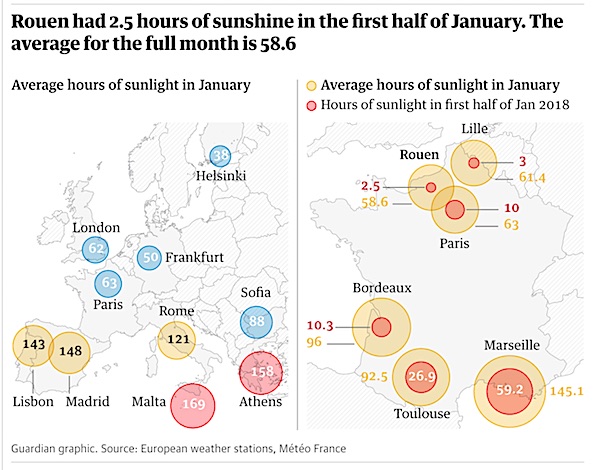
Sunshine is in short supply across a swathe of north-west Europe, shrouded in heavy cloud from a seemingly never-ending series of low pressure systems since late November and suffering one of its darkest winters since records began. If you live in Brussels, 10 hours and 31 minutes was your lot for the entire month of December. The all but benighted inhabitants of Lille in France got just two hours, 42 minutes through the first half of January. “Sound the alarm and announce the disappearance,” read a despairing headline in photon-deprived northern France’s regional paper, La Voix du Nord. “A star has been kidnapped. We still have no sign of life from the sun.”

Belgium’s Royal Meteorological Institute has declared December 2017 “the second darkest month since 1887”, when it began measuring, after the 10.5 hours of sun recorded at its Uccle weather station last month were beaten only by a bare 9.3 hours in 1934. France’s northern Hauts-de-France region did better with 26 hours of sunshine in December, but that was against a norm of 48. But Météo France described the paltry 2.7 hours of sun recorded from 1 to 13 January in Lille, the region’s biggest city, as “exceptional”. The January average stands at 61.4 hours, according to the agency – meaning Lille and its unfortunate residents were deprived of perhaps 30 hours’ worth of rays in the first part of the month.

[..] Even southern French sun-traps such as Bordeaux and Marseille fell a very long way short of their usual ray quota in the first half of the month, basking in just 10.3 and 26.9 hours respectively against monthly averages of 96 and 92.5. Health experts say a shortage of sunshine can lead to seasonal depression, whose symptoms include a lack of energy, a desire to sleep and a perceived need to consume greater quantities of sugar and fat. “Exposure to morning light inhibits the secretion of melatonin that promotes sleep and favours the production of hormones that will stimulate the body,” Matthieu Hein, a psychiatrist at the Erasmus Hospital in Brussels, said. In the absence of light, we are “rather slow, tired, which is characteristic of SAD, or seasonal affective disorder”. Florent Durand, who runs a massage studio in Lille, told France 3 TV that his €39 light therapy sessions were booked out.

Read more …

As Turkey bombs US supported Kurds, Erdogan feels like a god.

Turkey Threatens Refugee Deal With EU (K.)

Turkey’s agreement with the European Union to curb human trafficking across the Aegean appears to be in jeopardy again after a top Turkish official warned that a current impasse with the EU gives Ankara no reason to honor the deal. A collapse of the deal would put more pressure on Greek islands where thousands of migrants are cooped up in overcrowded reception centers. The comments on Friday by Turkey’s minister for EU affairs, Omer Celik, essentially rejected a proposal by French President Emmanuel Macron for a partnership rather than full EU membership for Turkey. “A privileged partnership or similar approaches, we don’t take any of these seriously. Turkey cannot be offered such a thing,” Celik told Reuters.

Celik said the EU was not fully honoring its part of the migration deal, noting that financial aid was “not working well” and that no new chapters have been opened in Turkey’s EU accession bid. “Technically there’s no reason for Turkey to maintain this deal,” he said. The minister’s words echoed those of Turkish President Recep Tayyip Erdogan, who, during a landmark visit to Greece in December, hit out at the EU for giving Turkey just a portion of the aid it had pledged as part of the 2016 migrant deal. During Erdogan’s visit, Prime Minister Alexis Tsipras proposed that Turkey take back migrants from facilities on the Greek mainland to free up space for migrants from overcrowded camps on the islands. Erdogan did not publicly respond to the suggestion.

After Celik’s comments on Friday, a spokesman for the Greek Migration Ministry said the government’s position, that all sides must honor the Turkey-EU deal, remained “fixed and firm.” Migration Minister Yiannis Mouzalas visited Lesvos on Friday, together with Valentin Radev, the interior minister of Bulgaria, which holds the EU’s rotating presidency. Mouzalas reassured local residents, who had gathered at the Moria facility, that measures would be taken to ensure that migrants alleged to have been involved in thefts or other offenses will no longer be allowed to leave the premises. Lesvos Mayor Spyros Galinos said the minister was not doing enough to adequately inform residents and was shifting the blame for the situation on the islands on to local authorities.

Read more …

New year, same old lack of humanity.

15 Syrian Refugees Found Frozen To Death On Lebanon Border (BBC)

Fifteen Syrian refugees – some of them children – have been found frozen to death while trying to cross the mountainous border into Lebanon. Thirteen bodies were found on Friday and two more were discovered on Saturday after the area was hit by a fierce snowstorm. Lebanese civil defence officials found the bodies after being told a group of refugees were in trouble near Masnaa. Local reports say the group had been abandoned by smugglers. Two smugglers have reportedly been arrested.

Several refugees were rescued, including a young boy who was found wandering by himself. The group were taking the same route hundreds of thousands of Syrians have taken before them trying to flee the conflict at home. Lebanon, with a population of four million, has taken in nearly one million Syrians since the war began in 2011. The Lebanese authorities brought in new restrictions in 2015 to try to restrict the number of refugees arriving in the country.

Read more …

Jan 182018
 
 January 18, 2018  Posted by at 10:34 am Finance Tagged with: , , , , , , , , , , , ,  10 Responses »


Henry Matisse Bouquet of flowers for July 14 Oct 7 1919


Japan and Europe Start the Central Bank Reset (BBG)
The Bubble That Could Break the World (Rickards)
South Korea Considers Shutting Down Domestic Cryptocurrency Exchanges (R.)
Trump Reveals Winners Of Controversial ‘Fake News Awards’ (AFP)
Trump Considers Big ‘Fine’ Over China Intellectual Property Theft (R.)
China’s Communists Take More Stakes In Private Companies (BBG)
Apple Expects to Pay $38 Billion Tax on Repatriated Cash (BBG)
Apple May Not Hire 20,000 New Workers, or Bring Back Its Overseas Cash (MW)
Assange Keeps Warning Of AI Censorship (CJ)
Australia’s Household Debt-to-Income Ratio Reaches 200% (AFR)
Mario Draghi Told To Drop Membership Of Secretive Bankers’ Club (G.)
Global Air Traffic At New Record (AFP)
Europe’s Microwave Ovens Emit Nearly As Much CO2 As 7 Million Cars (G.)
1 Million Tonnes A Year: UK Supermarkets Shamed For Plastic Packaging (G.)
The Plastic-Free Stores Showing The Big Brands How To Do It (G.)


Coordinated efforts to crash the conomy. Ignore the recovery narrative.

Japan and Europe Start the Central Bank Reset (BBG)

This is going to be an exciting year for monetary policy. In fact, it already is, thanks to Europe and Japan. Investors were taken aback last week when the Bank of Japan bought fewer bonds and the ECB revealed – shock, horror – its language would have to evolve with the euro region’s economy. Both developments, and the reaction, were welcome. They say a lot about the strength of global growth and how it still surprises many people. First to Japan: Investors were wrong to interpret the reduced purchases as a sign that a policy shift is imminent. They were, however, right about the long-term direction of policy. It isn’t going to get looser. Will it remain accommodative as far as the eye can see? Yes.

With Japan’s economic sunny patch extending and inflation headed in the right direction – if still way too low – it’s not a stretch to see Governor Haruhiko Kuroda or his successor ease up a little on the stimulus. Just not right now. That was Jan. 9. Two days later, the fever struck in Europe. The proximate cause was the release of minutes from the ECB’s December meeting and the implication contained therein that communications would have to reflect a stronger growth terrain and improving, albeit still low, inflation. The euro jumped and German bond yields climbed. It feels like we just got through a big change from the ECB: the taper of bond purchases to 30 billion euros a month until September. (Remember when officials hated the word “taper”?) Now, here were policymakers flagging further revisions.

What’s the thread linking these two happenings? Despite all the data and pronouncements about a robust global economy and a synchronized upswing, people are still taken aback by signs that (a) it’s a reality and (b) policy is bound to react. I’m not saying policy is going to change overnight. But if you start with a global framework – we are in a global marketplace, are we not? – key to that framework really ought to be the direction of policy. Ask yourself: Are monetary chieftains going to make policy more easy or less easy, assuming the upswing in growth is sustainable? The answer has to be “less.”

Read more …

Because it’s by far the biggest, and it’s a debt bubble, not a gossip one.

The Bubble That Could Break the World (Rickards)

The credit-driven bubble has a different dynamic than a narrative-bubble. If professional investors and brokers can borrow money at 3%, invest in stocks earning 5%, and leverage 3-to-1, they can earn 6% returns on equity plus healthy capital gains that can boost the total return to 10% or higher. Even greater returns are possible using off-balance sheet derivatives. Credit bubbles don’t need a narrative or a good story. They just need easy money. A narrative bubble bursts when the story changes. It’s exactly like The Emperor’s New Clothes where loyal subjects go along with the pretense that the emperor is finely dressed until a little boy shouts out that the emperor is actually naked. Psychology and behavior change in an instant.

When investors realized in 2000 that Pets.com was not the next Amazon but just a sock-puppet mascot with negative cash flow, the stock crashed 98% in 9 months from IPO to bankruptcy. The sock-puppet had no clothes. A credit bubble bursts when the credit dries up. The Fed won’t raise interest rates just to pop a bubble — they would rather clean up the mess afterwards that try to guess when a bubble exists in the first place. But the Fed will raise rates for other reasons, including the illusory Phillips Curve that assumes a tradeoff between low unemployment and high inflation, currency wars, inflation or to move away from the zero bound before the next recession. It doesn’t matter. Higher rates are a case of “taking away the punch bowl” and can cause a credit bubble to burst.

The other leading cause of bursting credit bubbles is rising credit losses. Higher credit losses can emerge in junk bonds (1989), emerging markets (1998), or commercial real estate (2008). Credit crack-ups in one sector lead to tightening credit conditions in all sectors and lead in turn to recessions and stock market corrections. What type of bubble are we in now? What signs should investors look for to gauge when this bubble will burst? My starting hypothesis is that we are in a credit bubble, not a narrative bubble. There is no dominant story similar to the Nifty Fifty or dot.com days. Investors do look at traditional valuation metrics rather than invented substitutes contained in corporate press releases and Wall Street research. But even traditional valuation metrics can turn on a dime when the credit spigot is turned off.

Read more …

BTC recovered somewhat overnight.

South Korea Considers Shutting Down Domestic Cryptocurrency Exchanges (R.)

South Korean policymakers joined the global chorus of virtual-coin critics on Thursday, saying Seoul is considering shutting down domestic virtual currency exchanges as the new breed of market exposes users to speculative frenzy and crime. The country’s tough stance comes as policymakers from the United States to Germany struggle to come up with stricter regulation against money laundering and other crimes. Responding to questions in parliament, South Korea’s chief of the Financial Services Commission said: “(The government) is considering both shutting down all local virtual currency exchanges or just the ones who have been violating the law.” Separately, Bank of Korea Governor Lee Ju-yeol told a news conference that “cryptocurrency is not a legal currency and is not being used as such as of now.”

Regulators around the world are still debating how to address risks posed by cryptocurrencies, as bitcoin, the world’s most popular virtual currency, soared more than 1,700% last year. Prices have plummeted since South Korea announced last week it may ban domestic cryptocurrency exchanges. On Wednesday, bitcoin slid 18%. According to Bithumb, South Korea’s second-largest virtual currency exchange, the nation’s bitcoin trading price stood at 15,697,000 won ($14,690.69) as of 0314 GMT on Thursday. On the Luxembourg-based Bitstamp exchange, bitcoin was traded at $11,750. [..] On Thursday, the BOK governor said the central bank had begun looking into the market’s impact on the economy. “We have started looking at virtual currency from a long-term standpoint, as central banks could start issuing digital currencies in the future. This sort of research has begun at the Bank of International Settlements and we are part of that research.”

Read more …

“Studies have shown that over 90% of the media’s coverage of President Trump is negative…”

Trump Reveals Winners Of Controversial ‘Fake News Awards’ (AFP)

Donald Trump unveiled the winners of his much-touted “Fake News Awards” late Wednesday, escalating his already persistent attacks on a number of major US media outlets. The awards dropped hours after a senator from Trump’s own Republican party hurled a stinging rebuke at the president, accusing the US leader of undermining the free press with Stalinist language. The brash Republican president announced the ten “honorees” using his preferred medium of Twitter, linking to a list published on the Republican Party’s website that crashed minutes after his big reveal. The “winners” of the spoof awards included top networks and newspapers CNN, The New York Times and The Washington Post, all of which have been regular targets of Trump’s ire.

Nobel-prize winning economist Paul Krugman, who writes a regular opinion column for The New York Times, nabbed the number one spot. The administration said he merited the award for writing “on the day of President Trump’s historic, landslide victory that the economy would never recover.” Following the former reality star’s stunning rise to power, Krugman had written that Trump’s inexperience on economic policy and unpredictability risked further damaging the weak global economy. The list also pointed to a reporting error from ABC’s veteran reporter Brian Ross, who was suspended for four weeks without pay after he was forced to correct a bombshell report on ex-Trump aide Michael Flynn.

[..] 11. And last, but not least: “RUSSIA COLLUSION!” Russian collusion is perhaps the greatest hoax perpetrated on the American people. THERE IS NO COLLUSION!

Read more …

“We’re talking about big damages. We’re talking about numbers that you haven’t even thought about,” Trump said.”

Trump Considers Big ‘Fine’ Over China Intellectual Property Theft (R.)

President Donald Trump said on Wednesday the United States was considering a big “fine” as part of a probe into China’s alleged theft of intellectual property, the clearest indication yet that his administration will take retaliatory trade action against China. In an interview with Reuters, Trump and his economic adviser Gary Cohn said China had forced U.S. companies to transfer their intellectual property to China as a cost of doing business there. The United States has started a trade investigation into the issue, and Cohn said the United States Trade Representative would be making recommendations about it soon. “We have a very big intellectual property potential fine going, which is going to come out soon,” Trump said in the interview.

While Trump did not specify what he meant by a “fine” against China, the 1974 trade law that authorized an investigation into China’s alleged theft of U.S. intellectual property allows him to impose retaliatory tariffs on Chinese goods or other trade sanctions until China changes its policies. Trump said the damages could be high, without elaborating on how the numbers were reached or how the costs would be imposed. “We’re talking about big damages. We’re talking about numbers that you haven’t even thought about,” Trump said.

U.S. businesses say they lose hundreds of billions of dollars in technology and millions of jobs to Chinese firms which have stolen ideas and software or forced them to turn over intellectual property as part of the price of doing business in China. The president said he wanted the United States to have a good relationship with China, but Beijing needed to treat the United States fairly. Trump said he would be announcing some kind of action against China over trade and said he would discuss the issue during his State of the Union address to the U.S. Congress on Jan. 30. Asked about the potential for a trade war depending on U.S. action over steel, aluminum and solar panels, Trump said he hoped a trade war would not ensue. “I don’t think so, I hope not. But if there is, there is,” he said.

Read more …

This is not going to work. It’s a one way ticket back to Mao.

China’s Communists Take More Stakes In Private Companies (BBG)

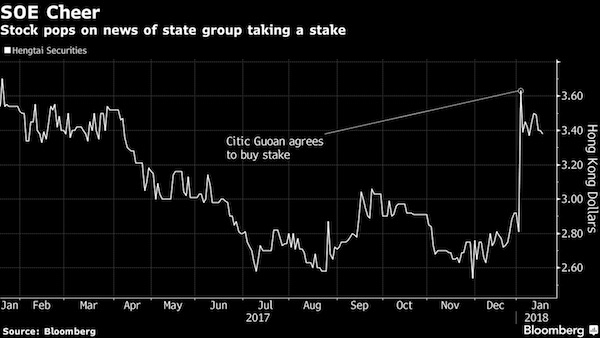
After tightening the Communist Party’s grip on state-owned enterprises, President Xi Jinping’s administration is signaling an increasing presence in private companies. Xi has called state enterprises the “backbone” of China’s socialist economy. But most of the giants were founded before the boom in technology-driven industries over the past two decades. That’s created a large swathe of the economy that’s largely private – think tech and consumer champions like Alibaba, Tencent and Baidu, along with innovators in sectors from finance to automation. Now, SOEs are on track to take stakes in private companies. “China wants to maintain state control over every aspect of the national economy, and it needs to keep up with the changes in the economic structure,” said Chen Li at Credit Suisse.

“How can it overlook the most important industries to the future economy?” Much of the overhaul of state-owned enterprises under Xi has focused on a consolidation in the hundreds of sprawling units across the country, such as those that have reshaped the shipping and train-making industries. But a lesser-noticed part of the broad “mixed ownership” initiative features SOEs being encouraged to take stakes in private companies. This part of the initiative has yet to gather pace, though equity strategists anticipate moves to come. They would showcase how China continues to develop its own path toward developed-nation status – not entirely state dominated, but with more control by political authorities than in countries like France that have nurtured state champions.

The head of the Beijing agency that oversees China’s SOEs, Xiao Yaqing, reiterated the push in a People’s Daily article on state enterprise reforms Dec. 13. The private stakes will be acquired through various means, he and other top officials have said. The mechanism has already been applied in the case of the state’s crackdown on financier Xiao Jianhua’s Tomorrow Holding empire. The government ordered the holding company to divest from many of its financial assets, people with knowledge of the matter said this month. State-owned Citic Guoan Group Co. bought a $1.4 billion stake in Hengtou Securities – known as Hengtai on the mainland – with a large part of the purchase coming from Tomorrow Group. Investors applauded the move, in a sign of what could happen when the state invests elsewhere. Hengtou has jumped more than 20% this year after announcing the stake sale.

Read more …

More Trump success.

Apple Expects to Pay $38 Billion Tax on Repatriated Cash (BBG)

Apple said it will bring hundreds of billions of overseas dollars back to the U.S., pay about $38 billion in taxes on the money and invest tens of billions on domestic jobs, manufacturing and data centers in the coming years. The iPhone maker plans capital expenditures of $30 billion in the U.S. over five years and will create 20,000 new jobs at existing sites and a new campus it intends to open, the Cupertino, California-based company said Wednesday in a statement. “We are focusing our investments in areas where we can have a direct impact on job creation and job preparedness,” Chief Executive Officer Tim Cook said in the statement, which alluded to unspecified plans by the company to accelerate education programs.

In its December approval of the most extensive tax-code revisions since 1986, Congress scrapped the previous international tax system for corporations — an unusual arrangement that allowed companies to defer U.S. income taxes on foreign earnings until they returned the income to the U.S. That “deferral” provision led companies to stockpile an estimated $3.1 trillion offshore. By switching to a new system that’s designed to focus on domestic economic activity, congressional tax writers also imposed a two-tiered levy on that accumulated foreign income: Cash will be taxed at 15.5%, less liquid assets at 8%. Companies can pay over eight years. Apple has the largest offshore cash reserves of any U.S. company, with about $252 billion in at the end of September, the most recently reported fiscal quarter.

The company, which opened a new headquarters in Cupertino last year, said it also plans to open another site in the U.S. focused initially on employees who provide technical support to Apple product users. Apple said it will announce the location of the new campus at a later date. The company already has a sprawling campus in Austin, Texas, for supply chain and technical support employees.

Read more …

Or maybe not.

Apple May Not Hire 20,000 New Workers, or Bring Back Its Overseas Cash (MW)

Apple announced a series of plans Wednesday that were celebrated as promises to hire thousands of workers and bring home billions of dollars in cash. Well, not necessarily. Apple said in its release that the company planned to “create over 20,000 new jobs through hiring at existing campuses and opening a new one.” The key word there is “create,” which Apple really likes to use when discussing jobs: The company even has a portion of its website dedicated to “job creation” that claims it is “responsible for 2 million jobs” in the United States, most of which are jobs “attributable to the App Store ecosystem.” Apple currently employs 84,000 people in the U.S., it said Wednesday, while an October filing with the Securities and Exchange Commission said that it has a total of 132,000 full-time employees worldwide, suggesting that about a third of its employees work abroad.

A quarter of the 2 million jobs Apple claims responsibility for are positions through Apple’s U.S.-based suppliers. “From the people who manufacture components for our products to the people who distribute and deliver them, Apple directly or indirectly supports hundreds of thousands of U.S. jobs,” Apple says on the page. [..] Many also took Apple’s promise to pay $38 billion in repatriation taxes as a promise that Apple would bring home more than a quarter-trillion dollars it currently has overseas. However, Apple does not have to bring home that money, and much of it is tied up in long-term investments that would make it unlikely. The company has to pay taxes on overseas earnings whether it brings the money back to the United States or not, so paying the tax does not mean the money is coming home.

Read more …

What I wrote about last week: “digital super states” like Facebook and Google have been working to “re-establish discourse control”.

Assange Keeps Warning Of AI Censorship (CJ)

In a statement that was recently read during the “Organising Resistance to Internet Censorship” webinar, sponsored by the World Socialist Web Site, Assange warned of how “digital super states” like Facebook and Google have been working to “re-establish discourse control”, giving authority over how ideas and information are shared back to those in power. Assange went on to say that the manipulative attempts of world power structures to regain control of discourse in the information age has been “operating at a scale, speed, and increasingly at a subtlety, that appears likely to eclipse human counter-measures.”

What this means is that using increasingly more advanced forms of artificial intelligence, power structures are becoming more and more capable of controlling the ideas and information that people are able to access and share with one another, hide information which goes against the interests of those power structures and elevate narratives which support those interests, all of course while maintaining the illusion of freedom and lively debate. In an appearance via video link at musician and activist M.I.A.’s Meltdown Festival last June, the WikiLeaks editor-in-chief expounded in far more detail about his thoughts on the potential for artificial intelligence to be used for controlling online information and discourse in a way human intelligence can’t hope to keep up with.

Pointing out how AI can already outmaneuver even the greatest chess players in the world, he describes how programs which can operate with exponentially more tactical intelligence than the human intellect can manipulate the field of available information so effectively and subtly that people won’t even know they are being manipulated. People will be living in a world that they think they understand and know about, but they’ll unknowingly be viewing only establishment-approved information. “When you have AI programs harvesting all the search queries and YouTube videos someone uploads it starts to lay out perceptual influence campaigns, twenty to thirty moves ahead,” Assange said. “This starts to become totally beneath the level of human perception.”

Read more …

Sell sell sell.

Australia’s Household Debt-to-Income Ratio Reaches 200% (AFR)

The closely tracked Australian household debt-to-income ratio has now reached the 200% level, and analysts at UBS are concerned about rising pressures among borrowers. The increase was because of the Australian Bureau of Statistics revision to include self-managed superannuation debt. That resulted in a 3% rise in household debt from “extremely elevated levels”, and pushed the ratio to income to 199.7%, “one of the highest in the world,” according to UBS. “With subdued growth in household income expected to continue, this implies household leverage is likely to rise further in the near term,” it said. “As a result we expect total household debt to disposable income to peak around 205% before the slow deleveraging process begins.”

High household debt levels will constrain further borrowing and weigh on prospects for earnings growth at the big banks, analysts Jonathan Mott and Rachel Bentvelzen said as they downgraded their forecasts for housing credit growth. House prices, which have begun to decline in Sydney, are expected to slide further as a result of tighter lending standards, the retreat of foreign buyers, lending limits imposed by regulators and concerns about proposed changes to negative gearing and capital gains tax that have been tabled by the Opposition. “Sentiment for investment into the housing market is waning, with the ‘fear of missing out’ euphoria fading quickly, especially in Sydney,” the analysts said in a note to clients.

Read more …

The insanity of today.

Mario Draghi Told To Drop Membership Of Secretive Bankers’ Club (G.)

The president of the European Central Bank has been told by the EU’s watchdog he should drop his membership of a secretive club of corporate bankers, after claims the group had been given an inside seat from which it could influence key policies. Following a year-long investigation, Mario Draghi was informed on Wednesday by the European ombudsman, Emily O’Reilly, that his close relationship with the Washington-based G30 group threatened the reputation of the bank, despite his assurances to the contrary. Members of the exclusive club, of which only two of the current 33 are women, are chosen by an anonymous board of trustees, it emerged during the ombudsman’s investigation. Only the identity of the chair of the trustees, Jacob A Frenkel, the chairman of JPMorgan Chase, has been made public.

O’Reilly noted the group’s secrecy and lack of transparency over the content of its meetings. She additionally called for a ban on all future presidents of the ECB taking up membership of the club, previously named the Consultative Group on International Economic and Monetary Affairs. The ruling followed a complaint by the Corporate Europe Observatory (CEO), a Brussels-based NGO, which claimed Draghi’s close relationship to G30 was in contravention of the ECB’s ethical code. During his presidency of the ECB, Draghi, an Italian economist who previously worked at Goldman Sachs, has attended four G30 meetings, in 2012, 2013 and twice in 2015.

O’Reilly said there was a danger that the bank’s independence could be perceived to have been compromised by Draghi’s involvement with the group, whose members include a number of central bank governors, private sector bankers and academics. The governor of the Bank of England, Mark Carney, is a member. But O’Reilly said there was no evidence of sensitive information being shared. The ombudsman said: “The ECB takes decisions that directly affect the lives of millions of citizens. In the aftermath of the financial crisis, and in consideration of the additional powers given to the ECB in recent years to supervise member state banks in the public interest, it is important to demonstrate to that public that there is a clear separation between the ECB as supervisor and the finance industry which is affected by its decisions.”

Read more …

Not one word about emissions. Not one. Oh wait, “continuous improvements to its safety, security, efficiency and environmental footprint “. Pants on fire.

Global Air Traffic At New Record (AFP)

Budget carriers continued to push global air traffic to new record levels last year, the International Civil Aviation Organization (ICAO) said on Wednesday. Scheduled air services carried “a new record” of 4.1 billion passengers in 2017, an increase of 7.1% over the previous year, ICAO said, citing preliminary data. The figure compares with 6% growth in 2016. “The sustainability of the tremendous growth in international civil air traffic is demonstrated by the continuous improvements to its safety, security, efficiency and environmental footprint,” ICAO Council president Olumuyiwa Benard Aliu said in a statement from the Montreal-based agency.

Early this month, two industry studies showed that last year was the safest for civil aviation since plane crash statistics were first compiled in 1946. A total of 10 crashes of civil passenger and cargo planes claimed 44 lives, said the Aviation Safety Network. A separate report from the To70 agency said no major airline crashed a plane in 2017. ICAO, a United Nations agency, said Wednesday that low-cost carriers flew an estimated 1.2 billion passengers or about 30% of the global total last year. The budget airline sector “consistently grew at a faster pace compared to the world average growth, and its market share continued to increase, specifically in emerging economies,” ICAO said.

Read more …

Missed opportunity: including the emissions of electric cars.

Europe’s Microwave Ovens Emit Nearly As Much CO2 As 7 Million Cars (G.)

Popping frozen peas into the microwave for a couple of minutes may seem utterly harmless, but Europe’s stock of these quick-cook ovens emit as much carbon as nearly 7m cars, a new study has found. And the problem is growing: with costs falling and kitchen appliances becoming “status” items, owners are throwing away microwaves after an average of eight years, pushing rising sales. A study by the University of Manchester worked out the emissions of carbon dioxide – the main greenhouse gas responsible for climate change – at every stage of microwaves, from manufacture to waste disposal. “It is electricity consumption by microwaves that has the biggest impact on the environment,” say the authors.

“Efforts to reduce consumption should focus on improving consumer awareness and behaviour to use appliances more efficiently. For example, electricity consumption by microwaves can be reduced by adjusting the time of cooking to the type of food.” Each year more microwaves are sold than any other type of oven in the EU: annual sales are expected to reach 135m by the end of the decade. David Reay, professor of carbon management at the University of Edinburgh, pointed out that the damage done by microwaves is still a fraction of that done by cars. “Yes, there are a lot of microwaves in the EU, and yes they use electricity,” he said.

“But their emissions are dwarfed by those from cars – there are around 30m cars in the UK alone and these emit way more than all the emissions from microwaves in the EU. Latest data show that passenger cars in the UK emitted 69m tonnes of CO2 equivalent in 2015. This is ten times the amount this new microwave oven study estimates for annual emissions for all the microwave ovens in the whole of the EU.” The energy used by microwaves is lower than any other form of cooking. uSwitch, the price comparison website, lists microwaves as the most energy efficient, followed by a hob and finally an oven, advising readers to buy a microwave if they don’t have one. However, they urge owners to switch them off at the wall after use, to avoid powering the clock.

Read more …

The Guardian can try to chest thump as much as it wants, but it too got triggered for real only through David Attenborough’s Blue Planet II, just like Theresa may et al.

1 Million Tonnes A Year: UK Supermarkets Shamed For Plastic Packaging (G.)

Britain’s leading supermarkets create more than 800,000 tonnes of plastic packaging waste every year, according to an investigation by the Guardian which reveals how top chains keep details of their plastic footprint secret. As concern over the scale of unnecessary plastic waste grows, the Guardian asked Britain’s eight leading supermarkets to explain how much plastic packaging they sell to consumers and whether they would commit to a plastic-free aisle in their stores. The chains have to declare the amount of plastic they put on the market annually under an EU directive. But the information is kept secret, and Tesco, Sainsbury’s, Morrisons, Waitrose, Asda and Lidl all refused the Guardian’s request, with most saying the information was “commercially sensitive”. None committed to setting up plastic-free aisles – something the prime minister called for last week.

Only two supermarkets, Aldi and the Co-op, were open about the amount of plastic packaging they put on to the market. Using their data, and other publicly available market share information, environmental consultants Eunomia estimated that the top supermarkets are creating a plastic waste problem of more than 800,000 tonnes each year – well over half of all annual UK household plastic waste of 1.5m tonnes. The 800,000 tonnes of waste from food and beverage products would fill enough large 10-yard skips to extend from London to Sydney, or cover the whole of Greater London to a depth of 2.5cm. The revelations will add to mounting public concern about the damage that plastic does to the natural world. The Guardian has already revealed the vertiginous growth in plastic production, and the heavy environmental toll it exacts.

Dominic Hogg, chairman of Eunomia, said the figures could be higher. “The data reported for plastic packaging put on the market as a whole is an underestimate in our view,” said Hogg. Supermarkets in the UK keep their plastic footprint secret with a confidentiality agreement signed with the agencies involved in the British recycling compliance scheme. It means the amount of plastic packaging created by each supermarket and the money they pay towards its recycling is kept out of the public domain. One leading supermarket manager is calling for the whole system to be made more transparent and targeted to make the irresponsible producers pay more. Iain Ferguson, head of sustainability at the Co-op, said Britain should adopt the French system of “bonus-malus”, where supermarkets are taxed more for using material which is not easily recyclable and less for sustainable and recyclable packaging.

Read more …

And it really is this simple.

The Plastic-Free Stores Showing The Big Brands How To Do It (G.)

In the past few weeks Richard Eckersley has noticed a change in the type of people who come into his shop. The former Manchester United footballer, who turned his back on the game to set up the the UK’s first “zero waste” store on Totnes high street in Devon, says it is no longer only committed environmentalists who pop in, looking for a cleaner way to shop. “We thought January might be a bit quieter but it has been crazy,” says Eckersley, who set up the Earth.Food.Love shop with his wife Nicola in March. “A lot of new people are coming in – people who have not necessarily been involved in green issues before … it really feels like this [concern about plastic waste] is starting to break out of the environmental bubble.”

Last week Theresa May put cutting plastic pollution at the heart of the government’s 25-year environmental plan, and although critics said it was short on detail she did call for supermarkets to introduce plastic-free aisles to offer customers more choice. But Eckersley says many consumers are already way ahead of politicians. He and his wife have helped people who are planning to set up similar stores in Wales, Birmingham and Bristol. “We are getting calls every week from around the country from people wanting to set up something similar in their towns … it feels like this has really tapped into something that is growing all the time.” More than 200 miles away, Ingrid Caldironi shares the enthusiasm. She set up the plastic-free Bulk Market in east London last year. It has proven so popular that it is now moving to bigger, permanent premises at the end of the month.

“We have had an amazing response, especially in the last couple of months,” she says. Eckersley and Caldironi are at the vanguard of a burgeoning anti-plastics movement in the UK that has been fuelled by newspaper investigations including the Guardian’s Bottling It series, the Blue Planet television series and a general alarm at the damage plastic is doing to the natural environment. But their enthusiasm is not shared by big supermarkets, which have thus far shown little inclination to reduce their plastic waste. “For a nation of shopkeepers we are lagging behind in this race,” says Sian Sutherland, founder of the campaign A Plastic Planet which led the calls for plastic-free aisles. “The most exciting thing is that politicians and industry are no longer claiming that we can recycle our way out of the plastic problem,” she added. “Banning the use of indestructible plastic packaging for food and drink products is the only answer.”

Read more …

Jan 162018
 
 January 16, 2018  Posted by at 10:33 am Finance Tagged with: , , , , , , , , ,  4 Responses »


Jean-Francois Millet The flight into Egypt 1864


Crytocurrencies Crashing Fast On South Korea Regulation Plans (Ind.)
PBOC Official Says China’s Centralized Cryptocurrency Trade Must End (R.)
China’s Shutdown Of Bitcoin Miners Isn’t Just About Electricity (F.)
China Is Heaping Debt on Its Least Productive Companies (CFR)
Xi Jinping’s Debt Clampdown Has Left a Trail of Dead Projects (BW)
Here’s What Historically Happens to Stocks When Bull Markets End (GoldSilver)
UK’s Carillion Crisis Deepens Amid Scramble To Save Jobs After Collapse (G.)
Quarter Of UK’s Poorest Households Are Getting Deeper In Debt (G.)
Greek Parliament Votes Through Raft Of Tough Reforms (K.)
Australia Offers Cash For Great Barrier Reef Rescue Ideas (AFP)
UK Supermarket Iceland To Eliminate Plastic On All Own-Label Products (G.)


As I’m writing this, I’m seeing bitcoin being obliterated. Other crypto’s were even worse off earlier. BTC down some 16% today at 5 AM ET, at $11,400. It was over $17,000 10 days ago.

Crytocurrencies Crashing Fast On South Korea Regulation Plans (Ind.)

Cryptocurrencies across the market are in the middle of a huge crash. All cryptocurrencies are falling amid a major selloff. Most have fallen more than 10% over the morning, and the price of bitcoin has dropped below $12,000. Just days ago, bitcoin was marching towards $20,000. But just today it has fallen more than 10% – taking it down almost 40% over the last month, but still having risen more than 1,300% over the year. Bitcoin is the best performing of the various cryptocurrencies over the morning. Ripple, the third largest cryptocurrency, had dropped by as much as 25% amid major volatility. Ethereum fell by more than 15%.

The price of cryptocurrencies tends to fluctuate wildly, and far more quickly than other more traditional assets and currencies. But the plunge on Tuesday morning is extreme even in that market. The drop came amid increasing suggestions in South Korea that officials might look to impose new regulations on the currency. Finance minister Kim Dong-yeon suggested that the country might ban trading in the currencies entirely, pending a government review. The government has said that the plans are only a suggestion and that more talks are needed. But another government minister said that trading could be banned last week, triggering another instant sell-off, and the plans have already led 200,000 people to petition the government asking to keep bitcoin trading legal.

Read more …

Little hope left for crypto in China. Korea shaky at best.

PBOC Official Says China’s Centralized Cryptocurrency Trade Must End (R.)

A senior Chinese central banker says authorities should ban centralized trading of virtual currencies as well as individuals and businesses that provide related services, an internal memo from a government meeting seen by Reuters showed. In the memo outlining details of discussions at a meeting of internet regulators and other policymakers last week, PBOC Vice Governor Pan Gongsheng said the government would continue to apply pressure to the virtual currency trade and prevent the build up of risks in that market. National and local authorities should ban venues that provide centralized trading of virtual currencies, of which bitcoin is the biggest, Pan said. They also need to ban individuals or institutions that provide market-making activities, guarantees, or settlement services for centralized trading of the currencies, such as online “wallet” service providers.

Chinese regulators last year banned initial coin offerings, shut down local cryptocurrency trading exchanges and limited bitcoin mining – but activity in the cryptocurrency and bitcoin space has continued through alternative channels in China despite the crackdown. “The financial work conference clearly called for limiting ‘innovations’ that deviate from the need of the real economy and escape regulation,” Pan said, according to the memo, referring to last week’s meeting. Authorities should also block domestic and foreign websites and close mobile apps that provide centralized virtual currency trading services to Chinese users, and sanction platforms that provide virtual currency payment services, Pan said. He also called for local authorities to investigate services that help people move funds overseas.

Read more …

It’s a power game.

China’s Shutdown Of Bitcoin Miners Isn’t Just About Electricity (F.)

China is planning to limit electricity to Bitcoin miners, and government bodies have expressed concern about energy usage. Bitcoin mining is estimated to use up to 4 gigawatts of electricity, equivalent to three nuclear reactors’ production levels. However, this move isn’t just about the electricity. In fact, it is telling that it was China’s central bank that met on the issue of Bitcoin mining, underscoring the fact that the issue is not only, or even primarily, an energy issue. It’s about clamping down on perceived risks of the cryptocurrency, which regulators have associated with malicious acts like fraud and money laundering. Authorities have already cracked down on thousands of criminal cases associated with alternative cryptocurrencies, including Onecoin and Ticcoin. These cryptocurrencies were viewed as Ponzi schemes used to raise illicit funds.

Later, officials shut down cryptocurrency exchanges and banned fundraising through initial coin offerings (ICOs). On Monday, it was reported that Chinese authorities would block cryptocurrency platforms that permit centralized trading. Cracking down on fraud and money laundering alone does not appear to be the way China is addressing risks associated with Bitcoin, however. Authorities are going after the industry more broadly. This may be because China has enough financial risks to regulate at the moment, and it is at capacity, or it could be that officials really do view Bitcoin as insufficiently transparent to represent an appropriate means of exchange or store of value.

Chinese Bitcoin mining companies may be out of luck doing business in a favorable environment. To combat this, some companies have already moved operations overseas. Most recently, Bitmain Technologies set up a subsidiary in Switzerland, which will extend its branches, currently in Amsterdam, Hong Kong, Tel Aviv, Qingdao, Chengdu, Shanghai and Shenzhen. Bitcoin miners have also been attracted to the Canadian province of Québec for its advertised cheap electricity. However, other companies may be forced to shut down. Moving abroad is likely to result in higher energy costs, which can dramatically reduce profit margins gained from mining.

Read more …

“By some estimates, China’s real growth rate, accounting for bad debt, is roughly half the official one of about 6.9%..”

China Is Heaping Debt on Its Least Productive Companies (CFR)

When Chinese President Xi Jinping failed to mention the word “deleveraging” in his long-awaited new economic blueprint in December it was clear that the political tug of war between the advocates of “reform” and “growth” had been won by the latter. In the short-run, growth, as defined by changes in GDP, can be increased by more lending and investing. In the longer-term, however, lending and investing can’t boost GDP if it results in bad debt that is properly written down. The big question is how much bad debt China currently has, and how much more it will be producing in the years ahead. By some estimates, China’s real growth rate, accounting for bad debt, is roughly half the official one of about 6.9%. To gauge whether China has been creating good debt—debt that will produce positive returns—or bad, we’ve examined who the beneficiaries of corporate lending are.

As shown in the left-hand figure below, profits at private-sector enterprises rose 18% between 2011 and 2016, while profits at state-owned enterprises (SOEs) plunged by 33%. As shown in the right-hand figure, however, the share of corporate liability growth accounted for by SOEs soared from 59% in 2010 to 80% by 2016. This is the opposite of what one would expect in a market economy. As we highlighted last year, China’s non-performing loans (NPLs) have been growing. Given the evidence that Xi has abandoned any pretense of concern with NPLs, and our evidence that China is shoveling new loans to companies with the least ability to pay them back, we think China is heading towards a debt crisis.

Read more …

Xi plays a high stakes game.

Xi Jinping’s Debt Clampdown Has Left a Trail of Dead Projects (BW)

A pile of rusty pipes and materials are all that remain of Lanzhou New Area’s tram project. Only a year ago it was a flagship public-private partnership for the planned city in Central China, before it fell victim to President Xi Jinping’s debt clampdown. “The project is dead,” said a guard at the office, who gave only his surname, Le. Nearby, the tram tracks are paved over, the mismatched lines of asphalt scarring a six-lane road that leads to a dead end on the edge of one of China’s most ambitious urban developments. The size of New York City, the zone is a satellite of Lanzhou, capital of China’s poorest province, Gansu, and a place where Xi’s efforts to wean the country off debt and onto services and consumer spending can be seen in stark relief.

In most of China, the economy is powering through Xi’s borrowing bottleneck, with economists surveyed by Bloomberg projecting the nation’s GDP grew 6.8% last year, the first annual acceleration in seven years. But for less-developed areas like Gansu the story is not so simple. Away from the industrial centers along the coast, Gansu came late to the nation’s debt-fueled investment party. During the nation’s economic ascent in the 1990s and 2000s, it became infamous for having the most polluted air in the country, a cocktail of chemicals from petroleum plants and heavy industry mixed with desert dust storms. Lanzhou New Area was only approved in 2012, just before Xi took office, driven by a central government investment spree designed to spread wealth to western regions.

Now, Xi wants to neutralize the risk of soaring debt derailing growth that accounts for more than a third of the global economic expansion. He reinforced that aim at a twice-a-decade Communist Party Congress in October and at the annual Central Economic Work Conference in December, where elite cadres set goals for 2018. From the yuan and bitcoin to banking and housing, taming potential threats is the new priority. Economists and policy makers see the restraints on borrowing as a necessary step toward choking off some of the nation’s construction and investment excesses and building a more sustainable economy. But there are casualties, including Lanzhou New Area’s tram, a network of tunnels for underground utility lines in the city, and more than 200 other public-private projects — almost half the total in Gansu.

Read more …

Average last year of bull market: +16%. Average first year of bear market: -16%.

Here’s What Historically Happens to Stocks When Bull Markets End (GoldSilver)

You undoubtedly know that 2017 was a record-setting year for the broad stock markets. And while gold was up last year despite numerous headwinds, most mainstream investors aren’t paying much attention to gold since they keep seeing so much green in their stock portfolios. Even I was taken back by some of the data from the bull market in stocks… • The Dow hit a record high 71 times last year. On average, a new high was hit more frequently than once a week. • For the first time ever in its almost 90-year history, the S&P 500 rose every month in 2017. And historically there have only been four years with gains in 11 months of the year. • The S&P’s largest pullback in 2017 was 2.8%, the smallest since 1995. • To start 2018, the S&P 500 has risen in each of the five trading sessions, hitting a new record high every day. The last time the index opened the year with at least five straight record highs was 1964.

And as Mike pointed out in his 2018 predictions, the CAPE (Cyclically Adjusted Price-Earnings) ratio has now matched its 1999 level, the second highest reading in over 100 years of data. The CAPE now has a higher reading only in 1929. This all begs the question: is the bull market about to come to an end? This is exactly the kind of frothy behavior a market sees near its apex, so it’s definitely a prudent question to ask. If last year ends up being the top of this bull market, what does history say could happen to stocks this year? We dug up the data for all bull markets in the S&P since the year 1900, and then examined what happened in the very first year after each of those bull markets ended. In other words, what did the first year of the bear market look like after the last full year of the bull market? This could be useful data, if 2017 ends up being the peak of the bull market. Here’s what history shows.

First Year Performance of Bear Market After Bull Market Ends

While the declines for the first year of the bear market varied greatly, you can see that on average, the S&P lost 16% the year immediately following the last year of the bull market. Also notice that in only four cases was the decline measured in single digits—all others were double digit losses. Mike Maloney believes this is the year overvalued stocks begin their descent. If he’s right, the decline could be higher than the historical average, since this is the second longest bull market in history.

Read more …

The fruits of privatization.

UK’s Carillion Crisis Deepens Amid Scramble To Save Jobs After Collapse (G.)

Thousands of staff who worked for the collapsed construction firm Carillion inside private sector companies will have their wages stopped on Wednesday unless their jobs are rescued by other firms, the government has said. Experts also said up to 30,000 small firms were owed money by Carillion, which crashed into liquidation on Monday morning, with insolvency practitioners reporting an immediate rush of calls from worried business owners. Ministers gathered for an emergency meeting on Monday night in an effort to limit the damage caused by the collapse of the sprawling construction and support services business. As the fallout spread, the Cabinet Office minister, David Lidington, faced mounting pressure over the government’s oversight of the firm’s increasingly precarious finances in the months leading up to its failure.

Lidington told parliament the government would continue to pay those among Carillion’s 19,500 UK staff who work in public sector jobs, such as NHS cleaners and school catering. But he admitted thousands of Carillion’s private sector workers – who perform jobs ranging from cleaning to catering, security and postroom services for organisations such as the Nationwide building society and BT Openreach – would be cut loose after 48 hours. “The position of private sector employees is that they will not be getting the same protection that we’re offering to public sector employees, beyond a 48-hour period of grace,” Lidington said. He added that this would give time for Carillion’s private clients to decide if they wanted to terminate the contracts or step in to cover wages themselves. “I think that is a reasonable gesture towards private sector employees,” he said, adding that a Jobcentre Plus helpline had been set up.

Read more …

Only debt leaves the country standing.

Quarter Of UK’s Poorest Households Are Getting Deeper In Debt (G.)

One in four of Britain’s poorest households are falling behind with debt payments or spending more than a quarter of their monthly income on repayments, according to a study. The latest evidence of mounting debt problems for some of the most vulnerable in society is shown in a report by the Institute for Fiscal Studies, on behalf of the Joseph Rowntree Foundation, at a time when borrowing on credit cards, loans and car finance deals returns to levels unseen since before the 2008 financial crisis. The poorest tenth of households are also more likely to be in net debt, owing more on plastic or on overdrafts and loans than they hold in savings. About a third of the poorest homes are in net debt, compared with only 10% of the highest-income tenth.

For a household of two adults and two children aged between 30 and 44 to be in the poorest tenth, they would have a net annual income of up to £23,200. Young adults are much more likely to be in households in arrears or paying large chunks of their income to banks or credit card providers, the study found. David Sturrock, a research economist at the IFS, said: “Debt looks like a real problem for a significant minority of those on low incomes.” [..] Debt problems for the poorest households can prove persistent, and are of growing concern to the Financial Conduct Authority. Of the poorest fifth of households who were in arrears or spending more than a quarter of their income on debt repayments and charges in 2010, more than 40% were found to be stuck in a similar position two years later.

Read more …

Tsipras has become the oppressor. Credibility of the entire Greek political system is gone for many years to come. That does not bode well.

Greek Parliament Votes Through Raft Of Tough Reforms (K.)

As thousands of protesters rallied in Athens and Thessaloniki on Monday, Parliament approved the prior actions included in an all-inclusive bill which the leftist-led coalition government hopes will be the last significant batch of spending cuts and reforms the country has to implement before its bailout program ends in August. The 1,500-page austerity bill, which includes the demands by Greece’s international creditors to expedite auctions of foreclosed properties and changes to labor law that will make it harder for unions to call strikes, was approved by 154 lawmakers in the 300-seat Parliament. Some 141 lawmakers from main opposition New Democracy, Democratic Alignment, Golden Dawn and the Union of Centrists voted against all the provisions included in the bill. Prime Minister Alexis Tsipras told lawmakers that the approval of the multi-bill brings Greece “just one step from the end of the bailout.”

“In the summer, we will… leave behind a tough, unfair and harmful period,” he said, adding that the conclusion of the third review “gives hope to millions of our fellow citizens” but has caused agitation to others, referring to the parties of the opposition. Tsipras rejected claims by the opposition that the new bill will ban the right to strike. “The right to strike is a sacred conquest of the working class. It is not being scrapped and it is not under threat from this government,” he said. For his part, New Democracy leader Kyriakos Mitsotakis denounced Tsipras for “ransoming the country’s future” and damaging its economy. “You are legislating articles that even you don’t agree with,” Mitsotakis said, addressing Tsipras in Parliament, adding that the leftist leader was pushing through measures he was elected to oppose and that he “turned lying into a profession and cynicism into an art.”

Mitsotakis also accused Tsipras and his SYRIZA party of “threatening” investors while they were in the opposition and refuted the government’s narrative that the country is heading for a clean bailout exit in August. The vote in Parliament took place as around a total of 20,000 people in Athens and Thessaloniki marched in protest. Police used pepper spray to disperse rock-throwing protesters outside Parliament. Some demonstrators also sprayed police with red paint. Meanwhile, Monday’s public transport strike – bus, tram, trolley and metro services – in opposition to the bill caused problems for commuters in the Greek capital. The disruption also impacted state-run schools and public hospitals, with teachers and doctors holding work stoppages, while a three-hour walkout by air traffic controllers led to the rescheduling or cancellation of flights.

Read more …

Obvious suggestion: stop pumping mining sludge into the reef system. Did I just make $1 million? Didn’t think so. Don’t be fooled by this sort of crap.

Australia Offers Cash For Great Barrier Reef Rescue Ideas (AFP)

Australia is calling on the world’s top scientific minds to help save the Great Barrier Reef, offering hundreds of thousands of dollars to fund research into protecting the world’s largest living structure. The UNESCO World Heritage-listed reef is reeling from significant coral bleaching due to warming sea temperatures linked to climate change. The 2,300-kilometre (1,400-mile) site is also under pressure from farming runoff, development and predatory crown-of-thorns starfish, with experts warning it could be suffering irreparable damage. On Tuesday, the Australian government announced a Aus$2.0 million (US$1.6 million) funding pot available to people with bright ideas on how to save the reef.

“The scale of the problem is big and big thinking is needed, but it’s important to remember that solutions can come from anywhere,” said Environment Minister Josh Frydenberg. He said the money would be available to the world’s “greatest scientific minds, industry and business leaders, innovators and entrepreneurs”. “Solutions could focus on anything from reducing the exposure of corals to physical stressors, to boosting coral regeneration rates by cultivating reef-building coral larvae that attract other important marine species,” Frydenberg added. Up to Aus$250,000 is available for an initial feasibility stage, where researchers can test the technical and commercial viability of their proposals for up to six months.

More than one proposal is expected to be accepted at this stage, the government said. A further Aus$1 million will then be made available to the best solutions at the proof of concept stage, where applicants develop and test their prototypes for up to 12 months. Those that are successful will retain intellectual property rights and will be able to try to commercialise their innovation.

Read more …

No force suppliers to do the same.

UK Supermarket Iceland To Eliminate Plastic On All Own-Label Products (G.)

Iceland has become the first major retailer to commit to eliminate plastic packaging for all its own-brand products. The supermarket chain, which specialises in frozen food, said it would go plastic-free within five years to help end the “scourge” of plastic pollution. The current plastic packaging would be replaced with paper and pulp trays and paper bags, which would be recyclable through domestic waste collections or in-store recycling facilities. The supermarket recently carried out a survey in which 80% of 5,000 people polled said they would endorse the move to go plastic-free. Iceland managing director, Richard Walker, said: “The world has woken up to the scourge of plastics. A truckload is entering our oceans every minute, causing untold damage to our marine environment and ultimately humanity – since we all depend on the oceans for our survival.

“The onus is on retailers, as leading contributors to plastic packaging pollution and waste, to take a stand and deliver meaningful change.” He also said Iceland would ensure all packaging was fully recyclable and would be recycled, through support for initiatives such as a bottle deposit return scheme for plastic bottles. As it was technologically and practically possible to create less environmentally harmful alternatives, “there really is no excuse any more for excessive packaging that creates needless waste and damages our environment”, Walker added. Iceland has already removed plastic disposable straws from its own label range and new food ranges in the next few months will use paper-based food trays. The move, which has been welcomed by environmental campaigners, comes amid growing concern over plastic pollution in the world’s oceans, where it can harm and kill wildlife such as turtles and seabirds.

Read more …

Jan 122018


Do these people ever consider this perhaps helps Trump? The Man’s on Fire!


Bitcoin Steadies But Set For Worst Weekly Slide Since 2015 (BBG)
Cryptos Surge As South Korea Backs Away From Trading Ban (ZH)
South Korea Is Talking Down The Idea Of A Cryptocurrency Trading Ban (CNBC)
China’s Trade Surplus With The US Hit A Record High In 2017 (CNBC)
China Sets New Records for Gobbling Up the World’s Commodities (BBG)
Household Debt Boom Sows The Seeds For A Bust (CBR)
Markets Still Blow Off the Fed, Dudley Gets Nervous, Fires Warning Shot (WS)
We’re Going To See A Radically Changing World In 2018 – (Nomi Prins)
Why We Have to Talk About a Bubble (BBG)
Uber’s Secret Tool for Keeping the Cops in the Dark (BBG)
Monsanto Seeks To Cash In On The Organic Food Market (CP)
Electric Car Dreams Run Into Metal Crunch (BBG)
Greece Is Now Worse Off Than When It Defaulted For The First Time (ZH)


It’s a slide! It’s a surge! Depends who you ask, and what time of day. Ask again every half hour, or you may miss the big moves. Translation: bitcoin is far from ready for the big leagues. It’s about stability.

Bitcoin Steadies But Set For Worst Weekly Slide Since 2015 (BBG)

Bitcoin steadied Friday after four days of losses for the largest cryptocurrency amid increasing scrutiny from regulators around the world with concerns ranging from investor losses to strains on power systems. Bitcoin was little changed on the day, at $13,467 as of 1:27 p.m. Hong Kong time, reversing an earlier decline. It was down as much as 23% for the week at one point, on track for the deepest decrease since January 2015, according to Bloomberg composite pricing, and is now down about 20%. The token peaked in mid-December soon after the introduction of futures trading on regulated exchanges in Chicago. Among the blows to cryptocurrencies this week was the South Korean justice minister’s reiteration of a proposal to ban local cryptocurrency exchanges, though the comments were later downplayed by a spokesman for the president.

Meanwhile, bitcoin mining is set to become more expensive as China’s government cracks down on the industry, in part out of concerns about power use. In the U.S., scrutiny is set to increase amid concerns about the potential use of cryptocurrencies for fraudulent purposes such as money laundering. Securities and Exchange Commission Chairman Jay Clayton and Commodity Futures Trading Commission Chairman J. Christopher Giancarlo are set to testify to the Senate Banking Committee on risks tied to bitcoin and its counterparts, according to a person with direct knowledge of the matter. The committee intends to hold a hearing in early February, the person said.

Read more …

The reaction scared the sh*t out of Seoul. But they still have to act, because bitcoin’s wide acceptance in the country means it’s a real danger to the whole economy.

Cryptos Surge As South Korea Backs Away From Trading Ban (ZH)

After what has seemed like a non-stop barrage of bad news for crypto bulls from South Korea, we noted some cracks in the foundation of the anti-cryptocurrency push as the ministry of finance refused to support the ministry of justice’s exchange shutdown bill. Tonight we get further clarification that the end of South Korean crypto trading is not nigh as Yonhap reports the various government ministries need more time and more consultations over the mininstry of justice’s plan to ban crypto-exchanges. “The issue of shutting down (cryptocurrency) exchanges, told by the justice minister yesterday, is a proposal by the justice ministry and it needs consultations among ministries,” Kim said.

Ministers reportedly seek a “soft-landing” considering the shock the measures may have on the market is an issue that can result in huge social, economic damage. Additionally Yonhap notes that even if pursued, shutdown of exchanges would take some time as it needs discussion at parliament (it would take months or even years for a bill to become a law). All of which can be roughly translated as – we have no idea of the impact of banning this stuff and just how much damage to the nation’s wealth could occur if we do… The result is a broad-based rally across the major cryptocurrencies… Tens of thousands of people filed an online petition, asking the presidential office to stop the clampdown against cryptocurrency trading. South Korea is home to one of the world’s biggest private bitcoin exchanges, with more than 2 million people estimated to own some of the best-known digital currency.

Read more …

Stand up comedian minister: “..a balanced perspective is necessary because blockchain technology has high relevance with many industries such as security and logistics.”

South Korea Is Talking Down The Idea Of A Cryptocurrency Trading Ban (CNBC)

South Korea’s finance minister on Friday said that relevant officials need to hold more consultations over the justice ministry’s plan to ban cryptocurrency exchanges in the country. “All government ministries agree on the need for a government response to an overheating in cryptocurrency speculation and for a degree of regulation,” Minister Kim Dong-yeon told reporters, according to news agency Yonhap. “The issue of banning exchanges that the justice minister talked about yesterday is a proposal by the Justice Ministry and it needs more coordination among ministries,” Kim added. He also said that discussion was under way on how the government could reasonably regulate cryptocurrency trading that’s overheating with irrational and speculative behavior, Yonhap reported.

Kim said “a balanced perspective is necessary because blockchain technology has high relevance with many industries such as security and logistics.” Kim’s comments followed news that the country’s justice ministry appeared to have softened its stance after remarks from its chief on Thursday saw billions wiped off the global cryptocurrency market. The justice ministry explained, according to Yonhap, that the ban was not a done deal in a text message to reporters on Thursday. “The ministry has been preparing a special law to shut down all cryptocurrency exchanges, but we will push for it after careful consideration with related government agencies,” the justice ministry said.

[..] “Justice Minister Park Sang-ki’s remarks regarding the shutdown of cryptocurrency exchanges is one of the measures that have been prepared by the Justice Ministry, but it is not a finalized decision and will be finalized through discussion and a coordination process with each government ministry,” the chief press secretary to President Moon Jae-in said in a statement reported by Yonhap. Even if a bill aiming to ban all cryptocurrency trading is drafted, it will require a majority vote in the country’s National Assembly before it can be enacted into law. That process could take months — or even years.

Read more …

This must worry Xi. China sets itself up for a strong reaction. And then? Withdraw back into its own cocoon? Not an option for an export-dependent economy. The shift to domestic consumption has so far failed miserably.

China’s Trade Surplus With The US Hit A Record High In 2017 (CNBC)

China’s 2017 trade surplus with the U.S. was $275.81 billion, the country’s customs data showed Friday, according to Reuters. By that data, last year’s surplus is a record high, the wire service reported. For comparison, the previous record was a surplus of $260.8 billion in 2015. The world’s second-largest economy had a surplus of $25.55 billion in December, data showed, compared to $27.87 billion in November. Trade with China is politically sensitive as the world’s second-largest economy runs surpluses against many of its trading partners. President Donald Trump has repeatedly signaled tougher action on what he calls unfair practices that have lead to a massive trade deficit with China. Overall, China’s trade balance for 2017 was a surplus of $422.5 billion

Read more …

Stocking up on oil and gas instead of Treasuries, just in case Trump launches a trade war.

China Sets New Records for Gobbling Up the World’s Commodities (BBG)

China continues to gobble up the world’s commodities, setting new records for consumption of everything from crude oil to soybeans. In a year of flux marked by industrial capacity cuts, environmental curbs and financial deleveraging, demand for raw materials has continued to grow in the world’s biggest consumer, helping drive a second annual gain in global commodity returns. As President Xi Jinping consolidates power behind an economy that may have posted its first full-year acceleration since 2010, there are few signs of the Chinese commodity juggernaut slowing as it rolls into 2018. “China’s economic expansion has been beating expectations since the second half of last year, boosting demand for all kinds of commodities,” Guo Chaohui at China International Capital, said by phone. “We are expecting continued strength in economic growth in 2018 which will keep up the nation’s import appetite.”

Inbound shipments from across the globe – Russia to Saudi Arabia and Venezuela – jumped about 10% to average 8.43 million barrels a day in 2017, data from China’s General Administration of Customs showed on Friday. The unprecedented purchases may be bettered in 2018, if import quotas granted by the government to China’s independent refiners are a signal. The first batch of allocations was 75% higher than for 2017. The world’s second-biggest economy is also realizing that the key to winning its war on smog may lie overseas. Record amounts of less-polluting grades of iron ore – typically not available within China – are being pulled in to feed the nation’s mammoth steel industry, with imports rising 5% to 1.07 billion metric tons in 2017.

Purchases of less-polluting ore is only one tactic in China’s war against pollution. Another is curbing coal use and encouraging the use of cleaner natural gas instead. Imports of the fuel via both sea and pipeline surged almost 27% to 68.57 million tons in 2017.

Read more …

Coherent.

Household Debt Boom Sows The Seeds For A Bust (CBR)

What causes the ebbs and flows of the business cycle? In the first of two videos, Chicago Booth’s Amir Sufi argues that one key factor is the financial sector and its willingness to lend. As credit becomes more and more available, the economy booms—but when household debt becomes unsustainable, it sows the seeds for a bust.

Read more …

Financial stress at a record low. There’s no stronger stress indicator.

Markets Still Blow Off the Fed, Dudley Gets Nervous, Fires Warning Shot (WS)

“So, what am I worried about?” New York Fed President William Dudley, who is considered a dove, asked rhetorically during a speech on Thursday at the Securities Industry and Financial Markets Association in New York City. “Two macroeconomic concerns warrant mention,” he continued. And they are: One: “The risk of economic overheating.” He went through some of the mixed data points, including “low” inflation, “an economy that is growing at an above-trend pace,” a labor market that is “already quite tight,” and the “extra boost in 2018 and 2019 from the recently enacted tax legislation.” Two: The markets are blowing off the Fed. He didn’t use those words. He used Fed-speak: “Even though the FOMC has raised its target range for the federal funds rate by 125 basis points over the past two years, financial conditions today are easier than when we started to remove monetary policy accommodation.”

When the Fed raises rates, its explicit intention is to tighten “financial conditions,” meaning that borrowing gets a little harder and more costly at all levels, that investors and banks become more risk-averse and circumspect, and that borrowers become more prudent or at least less reckless – in other words, that the credit bonanza cools off and gets back to some sort of normal. To get there, the Fed wants to see declining bond prices and therefor rising yields, cooling equities, rising risk premiums, widening yield spreads, and the like. These together make up the “financial conditions.” There are various methods to measure whether “financial conditions” are getting “easier” or tighter. Among them is the weekly St. Louis Fed Financial Stress Index, whose latest results were published on Thursday.

The Financial Stress Index had dropped to a historic low of -1.6 on November 3, meaning that financial stress in the markets had never been this low in the data series going back to 1994. Things were really loosey-goosey. On Thursday, the index came in at -1.57, barely above the record low, despite another rate hike and the Fed’s “balance-sheet normalization. And this rock-bottom financial stress in the markets is occurring even as short-term interest rates have rocketed higher in response to the Fed’s rate hikes, with the two-year Treasury yield on Thursday closing at 1.96% for the third day in a row, the highest since September 2008.

Read more …

Nomi doesn’t really clarify what is radical about events.

We’re Going To See A Radically Changing World In 2018 – (Nomi Prins)

In last year’s roadmap, I forecast that 2017 would end with gold prices up and the dollar index down, both of which happened. I underestimated the number of Fed hikes by one hike, but globally, average short term rates have remained around zero. That will be a core pattern throughout 2018. Central banks may tweak a few rates here and there, announce some tapering due to “economic growth”, or deflect attention to fiscal policy, but the entire financial and capital markets system rests on the strategies, co-dependencies and cheap money policies of central banks. The bond markets will feel the heat of any tightening shift or fears of one, while the stock market will continue to rush ahead on the reality of cheap money supply until debt problems tug at the equity markets and take them down.

Central bankers are well aware of this. They have no exit plan for their decade of collusion. But a weak hope that it’ll all work out. They have no dedicated agenda to remove themselves from their money supplier role, nor any desire to do so. Truth be told, they couldn’t map out an exit route from cheap money even if they wanted to. The total books of global central banks (that hold the spoils of QE) have ballooned by $2 Trillion in assets (read: debt) over 2017. That brings the amount of global central banks holdings to more than $21.7 trillion in assets. And growing. Teasers about tapering have been released into the atmosphere, but numbers don’t lie.

That’s a hefty cushion for international speculation. Every bond a central bank buys or holds, gets a price-lift. Trillions of dollars of such buys have artificially lifted all bond prices, and stocks because of the secondary-lift effect and rapacious search for self-perpetuating returns. Financial bubbles pervade the world. Central bank leaders may wax hawkish –manifested in strong words but tepid actions. Yet, overall, policies will remain consistent with those of the past decade to combat this looming crisis. US nationalistic trade policies will push other nations to embrace agreements with each other that exclude the US and shun the US dollar.

Read more …

Jean-Michel Paul, founder and Chief Executive of Acheron Capital in London, says: “..one that has received too little attention up to now is the prospect that we are heading toward a growing asset bubble that will result in a pronounced crash.. “. Well, not in my circles, which talk ONLY about that.

Why We Have to Talk About a Bubble (BBG)

Back in November, former Fed chief Janet Yellen described the current low level of inflation as a “mystery.” Despite a small pickup in prices, Europe has the same mystery to solve: Economic confidence in the euro area is at its highest point for a decade, according to the European Commission’s measure, released this week. But there’s no sign of the inflation that you’d normally expect with that kind of economic upsurge. The ECB minutes from December, released Thursday, show some in the ECB are similarly baffled by what they call a “disconnect” between the real economy and prices. With QE having multiplied the amount of fiat money issued by central banks in just a few years, it’s fair to wonder: How come it didn’t trigger much higher levels of inflation than what we now see?

The technical answer is that the money created has ended up full circle – on the books of the central banks. The more fundamental answer is that QE resulted in a wealth increase for the richest, who consume relatively little of their revenue, while the middle class and the neediest largely failed to reap any benefit. Having not gained from QE, their consumption has not risen, leaving prices pretty much flat. There are many problems with this, from growing inequality to pressures on social cohesion. But one that has received too little attention up to now is the prospect that we are heading toward a growing asset bubble that will result in a pronounced crash, as Jeremy Grantham, co-founder of the investment firm GMO, argued in a note last week. He predicts a “melt-up” – where investors pile into assets as prices rise – followed by a significant decline “of some 50%.”

[..] central bankers are still using inflation as a measure to gauge how much more QE they should proceed with. The ECB has repeatedly justified QE expansion because its goal of 2 percent consumer inflation remains unmet. [..] British journalist Ambrose Evans-Pritchard, commenting on the Grantham thesis recently in the Daily Telegraph, put the challenge now in the starkest possible terms, as a threat not simply to the recovery but to democracy: “The central banks themselves entered into a Faustian Pact from the mid-Nineties onwards, falsely thinking it safe to drive real interest rates ever lower with each cycle, until they became ensnared in what the Bank for International Settlements calls a policy “debt trap”. This has gone on so long, and pushed debt ratios so high, that the system is now inherently fragile. The incentive to let bubbles run their course has become ever greater.”

Read more …

Can’t decide if this is hard to believe, or entirely normal by now.

Uber’s Secret Tool for Keeping the Cops in the Dark (BBG)

In May 2015 about 10 investigators for the Quebec tax authority burst into Uber Technologies Inc.’s office in Montreal. The authorities believed Uber had violated tax laws and had a warrant to collect evidence. Managers on-site knew what to do, say people with knowledge of the event. Like managers at Uber’s hundreds of offices abroad, they’d been trained to page a number that alerted specially trained staff at company headquarters in San Francisco. When the call came in, staffers quickly remotely logged off every computer in the Montreal office, making it practically impossible for the authorities to retrieve the company records they’d obtained a warrant to collect. The investigators left without any evidence.

Most tech companies don’t expect police to regularly raid their offices, but Uber isn’t most companies. The ride-hailing startup’s reputation for flouting local labor laws and taxi rules has made it a favorite target for law enforcement agencies around the world. That’s where this remote system, called Ripley, comes in. From spring 2015 until late 2016, Uber routinely used Ripley to thwart police raids in foreign countries, say three people with knowledge of the system. Allusions to its nature can be found in a smattering of court filings, but its details, scope, and origin haven’t been previously reported. The Uber HQ team overseeing Ripley could remotely change passwords and otherwise lock up data on company-owned smartphones, laptops, and desktops as well as shut down the devices.

This routine was initially called the unexpected visitor protocol. Employees aware of its existence eventually took to calling it Ripley, after Sigourney Weaver’s flamethrower-wielding hero in the Alien movies. The nickname was inspired by a Ripley line in Aliens, after the acid-blooded extraterrestrials easily best a squad of ground troops. “Nuke the entire site from orbit. It’s the only way to be sure.” [..] Uber deployed Ripley routinely as recently as late 2016, including during government raids in Amsterdam, Brussels, Hong Kong, and Paris, say the people with knowledge of the matter. The tool was developed in coordination with Uber’s security and legal departments, the people say. The heads of both departments, Joe Sullivan and Salle Yoo, left the company last year.

Read more …

Monsanto wants a monopoly on all the world’s food. If you don’t stop them now, it’ll soon be too late.

Monsanto Seeks To Cash In On The Organic Food Market (CP)

At the recent Codex meeting in Berlin, there was an attempt to define genetically engineered (GE) food ingredients as ‘biofortified’ and therefore mislead consumers. This contravened the original Codex mandate for defining biofortification. That definition is based on improving the nutritional quality of food crops through conventional plant breeding (not genetic engineering) with the aim of making the nutrients bioavailable after digestion. The attempt was thwarted thanks to various interventions, not least by the National Health Federation (NHF), a prominent health-freedom international non-governmental organization and the only health-freedom INGO represented at Codex. But the battle is far from over.

The Codex Alimentarius Commission’s Codex Committee on Nutrition and Foods for Special Dietary Uses (CCNFSDU) convened in Berlin during early December and drafts provisions on nutritional aspects for all foods. It also develops international guidelines and standards for foods for special dietary uses that will be used to facilitate standardized world trade. Based upon previous meetings, the initial intention of the Committee was to craft a definition for biofortification that could then be used uniformly around the World. Biofortification originally referred to increasing certain vitamin and mineral content of basic food crops by way of cross-breeding, not genetic engineering, for example by increasing the vitamin or iron content of sweet potatoes so that malnourished populations would receive better nutrition.

However, according to president of the NHF, Scott Tips, Monsanto wants to redefine the definition to include GE ‘biofortified’ foods and it has seemingly influenced Codex delegates in that direction. Tips says, “I am sure that Monsanto would be thrilled to be able to market its synthetic products under a name that began with the word ‘bio’.” [..] Including GE foods within any definition of biofortification risks consumer confusion as to whether they are purchasing organic products or something else entirely. “Monsanto seeks to cash in on the organic market with the loaded word ‘bio’,” argues Scott Tips. At the Codex meeting in Berlin, Tips addressed the 300 delegates in the room. “Although NHF was an early supporter of biofortification, we have since come to see that the concept is in the process of being hijacked and converted from something good into something bad,” explained Tips.

Read more …

Luckily the CIA is still dividing the people in the Congo. And making money selling all sides weapons.

Electric Car Dreams Run Into Metal Crunch (BBG)

When BMW revealed it was designing electric versions of its X3 SUV and Mini, the going rate for 21 kilograms of cobalt—the amount of the metal needed to power typical car batteries—was under $600. Only 16 months later, the price tag is approaching $1,700 and climbing by the day. For carmakers vying to fill their fleets with electric vehicles, the spike has been a rude awakening as to how much their success is riding on the scarce silvery-blue mineral found predominantly in one of the world’s most corrupt and underdeveloped countries. “It’s gotten more hectic over the past year,” said Markus Duesmann, BMW’s head of procurement, who’s responsible for securing raw materials used in lithium-ion batteries, such as cobalt, manganese and nickel. “We need to keep a close eye, especially on lithium and cobalt, because of the danger of supply scarcity.”

[..] Complicating the process is the fact that the cobalt trail inevitably leads to the Democratic Republic of the Congo, where corruption is entrenched in everyday business practices. The U.S. last month slapped sanctions on Glencore’s long-time partner in Congo, Israeli billionaire Dan Gertler, saying he used his close ties to Congolese President Joseph Kabila to secure mining deals. There’s also another ethical obstacle to negotiate. The African nation produces more than 60 percent of the world’s cobalt, a fifth of which is drawn out by artisanal miners who work with their hands — some of whom are children. The country is also planning to double its tax on the metal.

“There just isn’t enough cobalt to go around,” said George Heppel, a consultant at CRU. “The auto companies that’ll be the most successful in maintaining long-term stability in terms of raw materials will be the ones that purchase the cobalt and then supply that to their battery manufacturer.” To adjust to the new reality, some carmakers are recruiting geologists to learn more about the minerals that may someday be as important to transport as oil is now. Tesla Inc. just hired an engineer who supervised a nickel-cobalt refinery in New Caledonia for Vale to help with procurement. But after decades of dictating terms with suppliers of traditional engine parts, the industry is proving ill-prepared to confront what billionaire mining investor Robert Friedland dubbed “the revenge of the miner.”

Read more …

Never use Greece and Recovery in one sentence together. Because you’d be spouting nonsense.

Greece Is Now Worse Off Than When It Defaulted For The First Time (ZH)

According to the market, the situation in Greece has staged a tremendous recovery. So much so, in fact, that Greek 2Y bonds are now trading inside US 2Y Treasurys. Yes, according to the market, Greece is now a safer credit than the US. And yet, a quick peek inside the actual Greek economy, reveals that nothing has been fixed. In fact, one can argue that things are now worse than they were when Greece defaulted (for the first time), According to statistics from IAPR, unpaid taxes in Greece currently make up more than 55% of the country’s GDP due to – well – the inability of people to pay the rising taxes. Overdue debt to the state has reached nearly €100 billion with only €15 billion possible to be returned to the government’s coffers, as most are due to bankrupt businesses and deceased individuals.

The Greek tax authorities seized pensions, salaries, and assets of more than 180,000 taxpayers in 2017, meanwhile bad debt to the state treasury continue to grow. The Independent Authority for Public Revenue confiscated nearly €4 billion in the first 10 months of this year with forced measures to be reportedly taken against 1.7 million defaulters in 2018. Bad debt owed to the state in Greece has been growing at €1 billion a month since 2014, and nearly 4.17 million taxpayers currently owe money to the country, which means that every second Greek is directly indebted. Demonstrating the full extent of the economic mess, a recent report from Kathimerini revealed that Greek lenders are proposing huge haircuts, as high as 90%, for borrowers with debts from consumer loans, credit cards or small business loans without collateral.

In the context of the sale of a 2.5-billion-euro bad-loan portfolio named Venus, Alpha Bank is using the incentive of major haircuts in letters it has sent to some 156,000 debtors. The fact that this concerns some 240,000 bad loans means that some debtors may have two or three overdue loans. Another major local lender, Eurobank, is employing the same strategy for a set of loans adding up to 350 million euros. Most of them range between 5,000 and 7,000 euros each and have been overdue for over a decade. Yes, most Greek are unable to repay a few thousands euros and would rather default. This means that the banks are expecting to collect a small amount of those debts, coming to 250 million euros for Alpha and 35 million for Eurobank – whopping 90% haircuts – accepting that the rest of the debt is uncollectible.

Read more …

Jan 112018


Gutzon Borglum Repairing the Face of Abraham Lincoln, Mount Rushmore 1962

 

Japan Will Trigger ‘The Great Unwind’ – Albert Edwards (MW)
Central Banks Ready To Pop The ‘Everything’ Bubble (Smith)
The $50 Trillion Question for Bonds (BW)
China Weighs Slowing or Halting Purchases of US Treasuries (BBG)
Is Beijing Bluffing On Treasuries? (BBG)
South Korea’s Largest Cryptocurrency Exchanges Raided For Tax Evasion (R.)
South Korea Preparing Bill That Will Ban All Cryptocurrency Trading (CNBC)
China Moves To Shutter Bitcoin Mines (CNBC)
Buy Off Trump With the Wall (Lowry)
Russian Bid To Influence Brexit Vote Detailed In New US Senate Report (G.)
Assange Gets Ecuador ID; ‘First Step’ To Diplomatic Immunity? (RT)
Greece to Remain Under Lenders’ Supervision Until 2059 – Handelsblatt (GR)
Insect Declines: New Alarm Over Mayfly Is ‘Tip Of Iceberg’ (G.)
Theresa May Vows To Eliminate UK Plastic Waste By 2042 (Ind.)


As Abenomics goes belly-up, so will a large segment of financial markets. Japan is done.

Japan Will Trigger ‘The Great Unwind’ – Albert Edwards (MW)

Japan is the catalyst that could bring the record-setting bull market for stocks across the globe to a screeching halt, according to Société Générale’s uberbear Albert Edwards. The prominent SocGen strategist says surprise monetary tightening in Japan could be the trigger that finally upend what has been an protracted and unrelenting global rally for assets considered risky. While most investors are busy eyeing rate increases in the U.S. and tapering by the ECB in the eurozone, Edwards says they should also watch developments in the world’s third-largest economy, Japan, where corporate profits are surging and inflation has picked up.

“We’ve been looking for surprises and one thing that can catch us out is if the Bank of Japan starts tightening. If it actually follows the Fed and the ECB and announces some sort of tapering,” he said, speaking at SocGen’s annual strategy conference in London on Tuesday. “This could be far more important than the Fed. A lot of major trends start with Japan. People don’t focus on Japan enough in my view,” he added. Investors on Tuesday got a taste of how BOJ tightening can rattle the markets. The central bank said it would buy less of its long-dated bonds, sparking speculation Gov. Haruhiko Kuroda could back away from its ultraloose monetary policy as early as this year. The surprise announcement sent global bond markets into spin on Tuesday. The yield on 10-year U.S. Treasury notes jumped above 2.5% to its highest since March and the 30-year bond yield logged its biggest one-day jump since Dec. 19.

[..] The BOJ has for years been among the most accommodative central banks in the world and as recent as December reaffirmed its commitment to aggressive qualitative and quantitative-easing program, also known as QQE. With inflation stubbornly running below the BOJ’s 2% annual target, the central bank has since early 2016 kept interest rates in negative territory and even introduced a 0%-target for its 10-year government bond yields to avoid deflation. The determined efforts by the BOJ to boost consumer prices have turned investors against the yen with data from the Commodity Futures Trading Commission showing an extreme bearishness toward the Japanese currency. However, downbeat investors on the yen could be caught flat-footed if inflation starts to pick up, prompting the BOJ to halt easing efforts, Edwards warned.
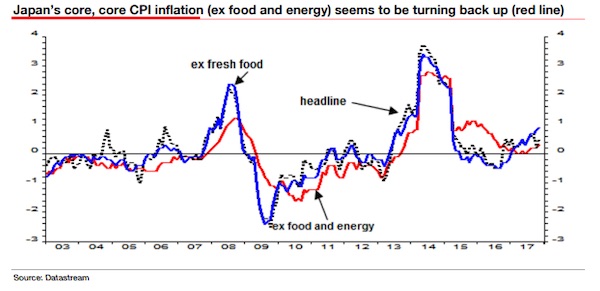
Read more …

A concerted effort to let markets implode. And blame Trump.

Central Banks Ready To Pop The ‘Everything’ Bubble (Smith)

Many people do not realize that America is not only entering a new year, but within the next month we will also be entering a new economic era. In early February, Janet Yellen is set to leave the Federal Reserve and be replaced by the new Fed chair nominee, Jerome Powell. Now, to be clear, the Fed chair along with the bank governors do not set central bank policy. Policy for most central banks around the world is dictated in Switzerland by the Bank for International Settlements. Fed chairmen like Janet Yellen are mere mascots implementing policy initiatives as ordered. This is why we are now seeing supposedly separate central banking institutions around the world acting in unison, first with stimulus, then with fiscal tightening. However, it is important to note that each new Fed chair does tend to signal a new shift in action for the central bank.

For example, Alan Greenspan oversaw the low interest rate easy money phase of the Fed, which created the conditions for the derivatives and credit bubble and subsequent crash in 2008. Ben Bernanke oversaw the stimulus and bailout phase, flooding the markets with massive amounts of fiat and engineering an even larger bubble in stocks, bonds and just about every other asset except perhaps some select commodities. Janet Yellen managed the tapering phase, in which stimulus has been carefully and systematically diminished while still maintaining delusional stock market euphoria. Now comes the era of Jerome Powell, who will oversee the last stages of fiscal tightening, the reduction of the Fed balance sheet, faster rate increases and the final implosion of the ‘everything’ bubble.

As I warned before Trump won the election in 2016, a Trump presidency would inevitably be followed by economic crisis, and this would be facilitated by the Federal Reserve pulling the plug on fiat life support measures which kept the illusion of recovery going for the past several years. It is important to note that the mainstream media is consistently referring to Jerome Powell as “Trump’s candidate” for the Fed, or “Trump’s pick” (as if the president really has much of a choice in the roster of candidates for the Fed chair). The public is being subtly conditioned to view Powell as if he is an extension of the Trump administration. This could not be further from the truth. Powell and the Fed are autonomous from government.

[..] So, why is the media insisting on misrepresenting Powell as some kind of Trump agent? Because Trump, and by extension all the conservatives that support him, are meant to take the blame when the ‘everything’ bubble vaporizes our financial structure. Jerome Powell is “Trump’s guy” at the Fed; so any actions Powell takes to crush the recovery narrative will also be blamed on the Trump administration.

Read more …

Bond markets want their cake and eat it. First, low yields are a good thing; then rising yields show how good everything has become.

The $50 Trillion Question for Bonds (BW)

Government bond yields, exemplified by the benchmark 10-year U.S. Treasury, have enjoyed three decades of decline. Their recent jump is prompting a heated debate over whether that bull market is over. It matters because there’s more riding on the question than ever before.
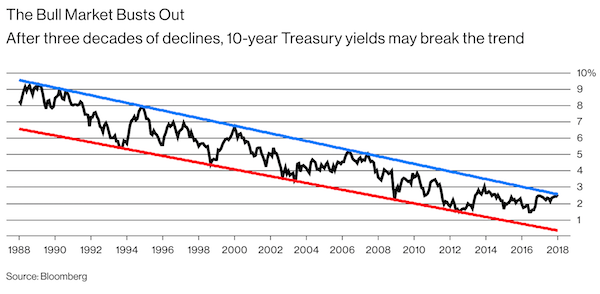
The value of benchmark bonds eligible for inclusion in the Bloomberg Barclays Global Aggregate Bond Index, which includes government, corporate and securitized debt from 24 local currency markets, has doubled in the past decade to almost $50 trillion.
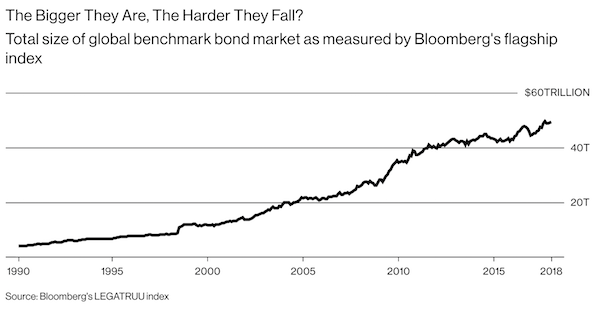
While calling the turn in bonds, especially in Europe, has been a widow-making trade in recent years, recent moves certainly look like the trend is no longer your friend. The yield on the two-year Treasury has about doubled in the past year, and is a whisker away from 2%. Even at its current super-low level of about 0.55%, the 10-year German yield is up from its nadir of about minus 0.2% reached in July 2016.
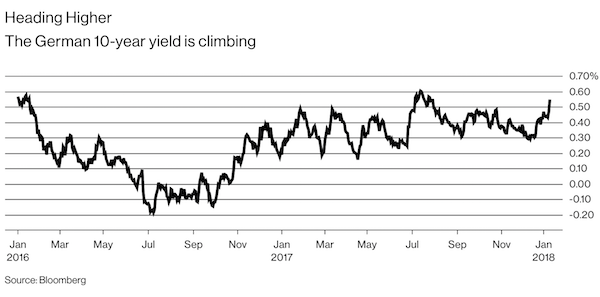
Here’s the thing, though. Even if government bond yields are on a sustained path to higher levels, it’s arguably a positive sign for the global economy. A return to more normal borrowing costs would reinforce hopes that the world is finally free from the debilitating aftershocks from the financial crisis. Moreover, the new normal is still likely to be at lower levels than the old normal. Note that in the past 30 years, the 10-year Treasury yield peaked at about 9.4% in August 1988 and plateaued at 1.36% in July 2016. Its current poke above 2.5% still leaves it at about half of its three-decade average. For central banks seeking to normalize monetary policy, rising government bond yields will come as something for a relief. For investors who bought at the peak of the bull market, however, there could be painful times ahead.

Read more …

Only game in town.

China Weighs Slowing or Halting Purchases of US Treasuries (BBG)

China added to bond investors’ jitters on Wednesday as traders braced for what they feared could be the end of a three-decade bull market. Senior government officials in Beijing reviewing the nation’s foreign-exchange holdings have recommended slowing or halting purchases of U.S. Treasuries, according to people familiar with the matter. The news comes as global debt markets were already selling off amid signs that central banks are starting to step back after years of bond-buying stimulus. Yields on 10-year Treasuries rose for a fifth day, touching the highest since March. China holds the world’s largest foreign-exchange reserves, at $3.1 trillion, and regularly assesses its strategy for investing them. It isn’t clear whether the officials’ recommendations have been adopted.

The market for U.S. government bonds is becoming less attractive relative to other assets, and trade tensions with the U.S. may provide a reason to slow or stop buying American debt, the thinking of these officials goes, according to the people [..] “With markets already dealing with supply indigestion, headlines regarding potentially lower Chinese demand for Treasuries are renewing bearish dynamics,” said Michael Leister at Commerzbank. “Today’s headlines will underscore concerns that the fading global quantitative-easing bid will trigger lasting upside pressure on developed-market yields.” The Chinese officials didn’t specify why trade tensions would spur a cutback in Treasuries purchases, though foreign holdings of U.S. securities have sometimes been a geopolitical football in the past.

[..] Any reduction in Chinese purchases would come just as the U.S. prepares to boost its supply of debt. The Treasury Department said in its most recent quarterly refunding announcement in November that borrowing needs will increase as the Federal Reserve reduces its balance sheet and as fiscal deficits look set to widen. “It’s a complicated chess game as with everything the Chinese do,” said Charles Wyplosz, a professor of international economics at the Graduate Institute of International and Development Studies in Geneva. “For years they have been bothered by the fact that they are so heavily invested in one particular class of U.S. bonds, so it’s just a question of time before they would try to diversify.”
Read more …

The dollar is still king.

Is Beijing Bluffing On Treasuries? (BBG)

The Bloomberg News report that senior government officials in Beijing recommended slowing or halting purchases of U.S. Treasuries is encountering a wall of skepticism, and rightly so. Even China’s State Administration of Foreign Exchange said Thursday that the report “might have cited wrong sources or may be fake news.” There’s a third possibility: that Beijing floated a trial balloon to see how the market would react.To the extent China would have to scoop up incoming dollars to keep the value of the yuan from rising too much too soon, what else can it possibly purchase with those dollars? Treasuries maturing in five years pay 2.32%. If China tries to alter the composition of its $3.1 trillion foreign-exchange war chest by swapping dollars to buy comparable securities denominated in any of the world’s main reserve currencies, it will find German bunds and British gilts paying even less.

Japanese and Swiss bonds offer somewhat higher yields. However, if every central bank in the world had given up on the world’s most liquid security every time it got a half-percent extra yield somewhere else, the dollar’s share in the world’s known reserves wouldn’t have held above 60% for almost a quarter-century. (It’s 63.5% now.) If Beijing wants a bargaining chip in trade tensions with the U.S., it should look elsewhere.In 2009, the Chinese central bank did try to diversify away from the dollar. The euro’s share in known global reserves peaked at 28% a few months after Wen Jiabao, the then Chinese premier, said he was “worried” about the huge amount of money his country had lent to the U.S.Then he – and the world – got something rather more real to worry about as the European debt crisis became an existential threat to that region’s single currency. According to the most recent data from the IMF, the euro’s share in worldwide foreign-exchange reserves is now down to 20%.

Read more …

As 2018 progresses, we’ll see many reports, across the globe, of taxes owed on 2017 crypto gains.

South Korea’s Largest Cryptocurrency Exchanges Raided For Tax Evasion (R.)

South Korea’s largest cryptocurrency exchanges were raided by police and tax agencies this week for alleged tax evasion, people familiar with the investigation said on Thursday. “A few officials from the National Tax Service raided our office this week,” an official at Coinone, a major cryptocurrency exchange in South Korea, told Reuters. “Local police also have been investigating our company since last year, they think what we do is gambling,” said the official, who spoke on condition of anonymity. He said Coinone was cooperating with the investigation. Bithumb, the second largest virtual currency operator in South Korea, was also raided by the tax authorities on Wednesday.

“We were asked by the tax officials to disclose paperwork and things yesterday,” an official at Bithumb said, requesting anonymity due to the sensitivity of the issue. South Korean financial authorities had previously said they are inspecting six local banks that offer virtual currency accounts to institutions, amid concerns the increasing use of such assets could lead to a surge in crime. The crackdown on Seoul-based operators of some of the world’s busiest virtual currency exchanges comes as the government attempts to calm frenzied demand for cryptocurrency trading in Asia’s fourth largest economy. Bitcoin’s 1,500% surge last year has stoked huge demand for cryptocurency in South Korea, drawing college students to housewives and sparking concerns about a gambling addiction.

Read more …

They’re getting serious.

South Korea Preparing Bill That Will Ban All Cryptocurrency Trading (CNBC)

South Korea’s justice minister said on Thursday that a bill is being prepared to ban all cryptocurrency trading in the country. That news is a major development for the cryptocurrency space, as South Korea is one of the biggest markets for major coins like bitcoin and ethereum. According to industry website CryptoCompare, more than 10% of ethereum is traded against the South Korean won — the second largest concentration in terms of fiat currencies behind the dollar. Meanwhile, 5% of all bitcoin are traded against the won. “There are great concerns regarding virtual currencies and justice ministry is basically preparing a bill to ban cryptocurrency trading through exchanges,” Park Sang-ki said at a press conference, according to the ministry’s press office.

Bitcoin tumbled more than 12% following Park’s remarks, according to CoinDesk’s bitcoin price index that tracks prices from four exchanges. At 1:26 p.m. HK/SIN, the cryptocurrency price retraced some of its losses to trade at $13,547.7. Park added that he couldn’t disclose more specific details about proposed shutdown of cryptocurrency trading exchanges in the country, adding that various government agencies would work together to implement several measures. Reuters further reported that a press official said the proposed ban on cryptocurrency trading was announced after “enough discussion” with other government agencies including the nation’s finance ministry and financial regulators.

Cryptocurrency trading in South Korea is very speculative and similar to gambling. Major cryptocurrencies like bitcoin and ethereum are priced significantly higher in the country’s exchanges than elsewhere in the world. For example, bitcoin traded at $17,169.65 per token at local exchange Bithumb, which was a 31% premium to the CoinDesk average price. That difference in price is called a “kimchi premium” by many traders. [..] earlier this week, industry data provider CoinMarketCap tweeted that it would exclude some South Korean exchanges in price calculations due to the “extreme divergence in prices from the rest of the world” and for “limited arbitrage opportunity.”

Read more …

Beijing doesn’t see bitcoin as an asset to its power politics.

China Moves To Shutter Bitcoin Mines (CNBC)

China is moving to eradicate the country’s bitcoin mining industry over concerns about excessive electricity consumption and financial risk, reflecting authorities’ judgment that cryptocurrencies are not a strategic industry. A multi-agency task force has instructed provincial governments to “actively guide” companies in their respective regions to exit the cryptocurrency mining industry, according to a document seen by the Financial Times. The move to pressure miners follows China’s shutdown of local bitcoin exchanges and its ban on initial coin offerings. Miners create new bitcoins by solving complex maths problems whose solutions are used to validate new bitcoin transactions. Though ostensibly a computational task, the reliance on raw computing power makes the process more akin to industrial manufacturing than traditional high-technology businesses.

Many bitcoin miners have established operations in remote areas without even registering a company. Some have also skirted Chinese regulations that forbid end users from purchasing electricity directly from power producers rather than grid operators. China mines about three-quarters of the world’s bitcoins, according to Liao Xiang, chief executive of Lightningasic, a Shenzhen-based mining operation. Chinese miners have taken advantage of cheap electricity in regions rich in coal or hydroelectric power, including Xinjiang, Inner Mongolia, Sichuan and Yunnan. The global industry accounts for 0.17% of global electricity consumption, more than 161 individual countries, according to Digiconomist, a website that tracks the industry.

[..] Bitcoin mining “consumes a large amount of electricity and also encourages a spirit of speculation in ‘virtual currencies'”, according to the document. Mining operations contradict efforts to prevent financial risk and to discourage activities that “deviate from the needs of the real economy”, it added. The internet finance task force, which includes the People’s Bank of China, has previously led regulatory tightening efforts on peer-to-peer lending and online consumer loans. The order does not call on regional authorities to shut mining operations directly, but rather to squeeze them out by strictly enforcing policies on electricity consumption, land use, tax collection and environmental regulation

Read more …

How Democrats sell out Dreamers.

Buy Off Trump With the Wall (Lowry)

There is a very easy way for Democrats to get major concessions from President Donald Trump on immigration: Give him his Wall. This is the key to a deal codifying the Deferred Action for Childhood Arrivals program, the Obama-era de facto amnesty for a segment of so-called Dreamers. All it takes is giving Trump a plausible start to the Wall that the president can then, in his inimitable way, promote as the greatest structure built on a border since Hadrian began his famous handiwork at the northern limit of the Roman Empire in 122. That the Democrats very likely won’t do this speaks to their irrational aversion to a Wall that they can’t view dispassionately any more than Trump can. It used to be that enhanced security on the border, and yes, a physical structure that in places is effectively a wall, had bipartisan support.

The Secure Fence Act of 2006 passed the House by a vote of 283-138 and the Senate 80-19. It called for building roughly 700 miles of double-layer fencing on the border, and no one seemed to believe that the United States had irreparably sullied its reputation. This wasn’t the first time anyone had thought of a fence, of course. There had been barriers in the San Diego area for a very long time, although not particularly robust ones. Beginning in the 1980s, more serious structures were built. According to the San Diego Union-Tribune, there are 46 miles of fencing overall and 13 miles of double fencing in the San Diego-Tijuana corridor, where there used to be a nightly influx of undocumented immigrants. In some sections, the barriers are 10-feet-tall military helicopter pads indistinguishable from a wall.

Again, no one believes San Diego has closed itself off from the world by adopting a common-sensical and — in this urban area — effective prophylactic against illegal immigration. But Democrats now find find physical barriers on the border offensive, especially if they have enough solidity to be called a Wall. One immigration advocate, in a typical sentiment, told The Huffington Post that the Wall is a “tool to instill hate and division.” This lunacy has rapidly become Democratic orthodoxy. Harry Enten of 538 notes that in 2006 almost 40% of Democrats supported building a Wall. By February of last year, Democrats were against it by 89% to 8%.

The hostility toward the Wall is part of a broader Democratic leftward lurch on immigration, but also a simple schoolyard calculus that if Trump supports something, they must oppose it. This forecloses the most basic legislative give-and-take. If Nancy Pelosi and Chuck Schumer gave Trump something significant on the Wall, they would be able to find their way home — as John Jay said after concluding an unpopular treaty with the British in 1795 — by the light of their own burning effigies. Their voters would scorn them as traitors complicit in the alleged horrid bigotry of Donald J. Trump.

Read more …

Well, no. Just another instance of everything being insinuated, in the hope that a sliver is remembered. Fake news.

Russian Bid To Influence Brexit Vote Detailed In New US Senate Report (G.)

Russia’s attempts to influence British democracy and the potential vulnerability of parts of the UK political system to anti-democratic meddling during the EU referendum have been detailed in a report prepared by the US Senate. The report by Democrats on the Senate foreign relations committee, titled Putin’s asymmetric assault on democracy in Russia and Europe: implications for US national security, pinpoints the way in which UK campaign finance laws do not require disclosure of political donations if they are from “the beneficial owners of non-British companies that are incorporated in the EU and carry out business in the UK”. This opacity, the report suggests, “may have enabled Russian-related money to be directed with insufficient scrutiny to various UK political actors”.

“Investigative journalists have also raised questions about the sources of sudden and possibly illicit wealth that may have been directed to support the Brexit ‘Leave’ campaign.” The UK Electoral Commission has already launched an investigation into the issue. The senators point out that Ukip and its then-leader, Nigel Farage, did not just fan anti-EU sentiment but also “criticised European sanctions on Russia, and provided flattering assessments of Russian President Putin”. The report adds that although officially the Russian government asserted its neutrality on Brexit, its English-language media outlets RT and Sputnik covered the referendum campaign extensively and offered ‘’systematically one-sided coverage’’. The senators also challenge the adequacy of the investigations by Facebook and Twitter into the allegations of widespread social media interference by the Russians during the referendum.

They reference University of Edinburgh research showing more than 400 Russian-run Twitter accounts that had been active in the US election had also been actively posting about Brexit. In addition, the senators noted that research conducted by a joint team of experts from the University of California at Berkeley and Swansea University reportedly identified 150,000 Twitter accounts with various Russian ties that disseminated messages about Brexit. The report also points to the vast flow of Russian money into the UK, including the London property market. It records how the Metropolitan police noted that a total value of £180m in properties in the UK had been put under investigation as possibly purchased with corrupt proceeds by secretive offshore companies.

Overall the report breaks little new ground in terms of fresh evidence but says the picture remains incomplete. “The allegations that have emerged of Russian interference prior to the Brexit referendum are all the more stunning given the innate resilience within British society to the Kremlin’s anti-democratic agenda,” the senators wrote. The report, which chronicles Russian disinformation efforts in 19 countries, calls on Donald Trump to assert leadership on Russian meddling in the 2016 presidential election, saying: “Never before in American history has so clear a threat to national security been so clearly ignored by a US president.”

Read more …

Don’t hold your breath. US and UK want revenge.

Assange Gets Ecuador ID; ‘First Step’ To Diplomatic Immunity? (RT)

The Ecuadorian ID reportedly granted to Julian Assange could mark his first step to obtaining diplomatic immunity, as Ecuador wants to resolve Assange’s indefinite embassy stay, human rights activist Peter Tatchell told RT. “Granting an identity card is potentially the first step towards granting citizenship of Ecuador. And there is a possibility that he could be then granted a diplomatic status, which would give him diplomatic immunity,” Tatchell said. He added that diplomatic immunity would mean that the WikiLeaks co-founder would be “free to leave the embassy and travel to Ecuador and the British government would not be able to lay a finger on him.”

Ecuadorian media reports Assange was given an ID card issued on December 21, citing “reliable sources” and providing the civil registry number of the document. The whistleblower also uploaded a photo of himself on Twitter wearing a yellow, blue and red shirt, the colors of the Ecuadorian flag, but made not comments on the issue. nEcuador usually issues such ID cards for people claiming residency status, which are called cedulas. It is, however, unclear whether Assange was granted residency status or full citizenship.

However, Tatchell says “the Ecuadorian government has made it very clear that it wants a resolution [of this whole situation around Assange] and they are prepared to negotiate [to give] a way for Julian Assange [to leave] the embassy.” He added that “granting him [Assange] an identity card is a new development that can open the door for further things in the future.” The Vienna convention on diplomatic relations states that someone who holds a diplomatic passport is immune from prosecution, the activist explained. It is still no guarantee, however. “There is still a possibility that, even if he was granted diplomatic immunity by the Ecuadorians, the British government might still try to snatch him,” Tatchell said, although “many British officials would be glad to see Assange getting a diplomatic passport and leaving [the UK],” he added.

Read more …

Debt. Colony. Forever.

Greece to Remain Under Lenders’ Supervision Until 2059 – Handelsblatt (GR)

In a report about Greece’s new omnibus bill and a potential break from its bailout in August 2018, German newspaper Handelsblatt claims the country will remain under lenders’ supervision for another 40 years. The newspaper says the enormous bill, which was introduced to parliament on Tuesday and is expected to be put to vote next Monday, is highly detailed but lawmakers have not been given enough time to scrutinize it. “The plan is that the multi-bill will pass from the Greek parliament before the next Eurogroup meeting on January 22, so that Greece’s lenders can release the next €5.5 billion bailout tranche, leading the country out of its bailout obligations by August 2018,” the paper notes. It adds that the short time afforded to lawmakers to study the bill and debate it is exactly what Greek PM Alexis Tsipras needs for a smooth vote.

The German paper also notes protests and strikes against the bill scheduled for next Friday and Monday. In spite of the fact the bill will lead to further wage and pension cuts, as well as tax increases, the government majority in parliament — despite vocal unhappiness from some of Tsipras’ own SYRIZA lawmakers — is expected to vote for it, the report says. “Tsipras has pledged to his supporters that the country will break its austerity vicious circle next August and throw out its despised lenders for good,” the report adds. “But with the country committed to more austerity measures until 2022, that is self-delusion.” “A total of 80% of the Greek debt remains in the hands of the country’s lenders,” Handelsblatt concludes. “This means that until Greece pays up its debt, which, with today’s rates it will manage to do by 2059, the country will be under its lenders’ financial supervision.”

Read more …

Same findings as the German report last year. This is the food chain that feeds us.

Insect Declines: New Alarm Over Mayfly Is ‘Tip Of Iceberg’ (G.)

Modest levels of pollution found in many English rivers are having a devastating impact on mayflies, new research suggests, killing about 80% of all eggs. Clouds of emerging mayflies were once a regular sight on English summer evenings and they are a key part of the food chain that supports fish, birds and mammals. The finding that even pollution well below guidelines can cause serious harm adds to concerns about plummeting insect numbers. In October, a study found that the abundance of flying insects has plunged by 75% in 25 years, prompting warnings that the world is “on course for ecological Armageddon”, with profound impacts on human society.

Paul Knight, chief executive of Salmon and Trout Conservation (STC), which is conducting an in-depth three-year survey of rivers, said: “The results of this groundbreaking new study are irrefutable. We believe this is just the tip of the iceberg. Lose your invertebrates and other species will follow.” The new research looked at the blue-winged olive, a common mayfly present across the British Isles and most of continental Europe. Its numbers have fallen significantly in recent decades and it has almost vanished from some English rivers. The prime suspects for this decline are fine sediment and phosphate pollution in rivers, which are washed off farmed fields and also result from untreated sewage. Some research has been done on how the larval and adult stages of mayflies are affected by pollution, but not on their eggs.

“The young life stages are the most vulnerable, just as with human babies,” said Nick Everall, at the Aquascience Consultancy and who led the research published in the journal Environmental Pollution. Blue-winged olive eggs are laid on river beds and then have to survive for up to eight months over winter before hatching into nymphs. However, experiments in the laboratory found that the fine sediment settles on the eggs and suffocates them, by preventing oxygen transferring into the egg. The sediment can also allow fungus to grow and kill the eggs, while phosphate is known to affect the development of eggs.

Read more …

The Cynical Society:

1) The BBC broadcasts David Attenborough’s new Blue Planet 2 series, in which one episode is all about -plastics- pollution
2) All of Britain watches, so the national conversation becomes ‘something must be done’
3) May has to do/say something, but the plastics industry are her friends, and she judges it’s all lip service anyway that will fade (and those who really care are not her voters)
4) She decides to pay only lip service too, and pushes the issue forward by 25 years, i.e. not her problem

Theresa May Vows To Eliminate UK Plastic Waste By 2042 (Ind.)

Theresa May will commit the UK to eliminating all avoidable plastic waste by 2042 as she launches the Government’s environmental plan for the next 25-years. Under the pledge waste such as the carrier bags, food packaging and disposable plastic straws that litter the country and pollute the seas would be abolished. But the target was given a frosty reception from environmental groups with one leading organisation saying it “lacks urgency, detail and bite”, while another said the country “can’t afford to wait” so long. The broader 25-year plan, first promised three years ago, will also urge supermarkets to set up “plastic-free aisles” for goods with no packaging and confirm plans to extend the 5p charge for carrier bags to all English retailers.

It comes as the Government seeks to burnish its environmental credentials with recent pledges on animal protection and plastic microbeads. But with concern growing around plastic waste, Ms May will say: “We look back in horror at some of the damage done to our environment in the past and wonder how anyone could have thought that, for example, dumping toxic chemicals, untreated, into rivers was ever the right thing to do. “In years to come, I think people will be shocked at how today we allow so much plastic to be produced needlessly. [..] Friends of the Earth CEO Craig Bennett said: “A 25 year plan is clearly needed – but with the nation facing an accelerating environmental crisis we can’t afford to wait a quarter of a century for urgent action to tackle the issues that already threaten our lives, health and planet.”

He went on: “If Theresa May wants to champion the environment she must spell out the bold measures her Government will take in the next few weeks and months.” WWF Chief Executive Tanya Steele welcomed “any step” to reduce plastic waste, adding that plastic-free aisles can spur change. But she said: “If we really want to solve this problem, we need to think bigger and ultimately move towards an end to single-use plastics.” Shadow Environment Secretary Sue Hayman said the plan was now “years behind schedule” branding the plan “a cynical attempt at rebranding the Tories image”. She went on: “[It] appears to contain only weak proposals with Britain’s plastic waste crisis kicked into the long grass.” Liberal Democrat leader Vince Cable said “The Conservatives should be eliminating all avoidable plastic waste now – a target of 2042 beggars belief.”

Read more …

Jan 092018


Thomas Abercrombie Beirut 1957


Americans Wait For Tax Refunds Before Seeing A Doctor (BBG)
US Has The Worst Rate of Child Mortality Among 20 Rich Nations (CNBC)
Chapter 11 Bankruptcies Spike 107% from a Year Ago (WS)
The New Gilded Age: First Time Arrogance, the Second Time Vengeance (Rosen)
Retail Investors Are Finally True Believers with Record Exposure (WS)
iPhone Addiction May Be A Virtue, Not A Vice For Investors (R.)
‘It Can’t Be True.’ Inside the Semiconductor Industry’s Meltdown (BBG)
The Decline of Anti-Trumpism (David Brooks)
Cryptocurrencies Are Selling Off (BBG)
Fund Managers Say US Regulator Told Them To Suspend Bitcoin ETF Bids (R.)
US Energy Watchdog Terminates Plan To Subsidize Coal, Nuclear Sectors (AFP)
Fairy Tale (Jim Kunstler)
Theresa May’s Cabinet Reboot Descends Into Chaos (BBG)
Merkel, Coalition Negotiators Agree To Scrap 2020 Climate Target (R.)


A nation of expendables. To think how hard earlier generations fought for health care.

Americans Wait For Tax Refunds Before Seeing A Doctor (BBG)

As tax season approaches, some consumers are waiting for their refund checks to spend on a long-delayed purchase – a visit to the doctor or dentist. U.S. consumers boosted their out-of-pocket health spending by 60% in the week after they got a tax refund, according to new research from JPMorgan Chase, based on data from Chase customer accounts. Spending stayed high for about 2 1/2 months, with about two-thirds of the extra spending money going to in-person payments to doctors and dentists. Much of the rest was used to pay down past bills. Health insurers and employers have raised copays and deductibles for consumers, making them bear a larger portion of the cost of care when they go see a health-care provider.

As a result, patients sometimes lack the cash to get the care they may need, according to the report. “Cash-flow dynamics are a significant driver of out-of-pocket spending for health care,” the study found. “Even when consumers knew with near-certainty the size and source of a major cash infusion, they still waited until the infusion arrived before spending.” The researchers found that availability of cash had far less of an impact on health-spending decisions among those with credit cards, or who had higher bank-account balances.

Read more …

Until about 1970, the US had the lowest child mortality rates. Then something happened.

US Has The Worst Rate of Child Mortality Among 20 Rich Nations (CNBC)

The United States has the worst child mortality rate among a group of 20 wealthy democracies, an analysis released Monday found. And despite overall improvement in the child mortality rate in the U.S. and those 19 other countries, the U.S. has persistently outpaced those nations in that grim metric for decades, the Health Affairs report said. “From 2001 to 2010, the risk of death in the US was 76% greater for infants and 57% greater for children age 1-19,” the report said. And during the same decade, children between the ages of 15 and 19 were 82 times more likely to die from gun-related homicide in the U.S. than in the comparison countries.

The authors of the Health Affairs report said that in the full 50-year period their study looked at, the U.S. had more than “600,000 excess deaths” among kids because of the country’s lagging performance in curbing child mortality. Those excess deaths have occurred even as the U.S. spends more money on health care for kids than the other countries. Among the countries looked at, “there has never been a better time to be born in any of these 20 countries,” the Health Affairs report said. “Despite this generalized trend, children are less likely to survive and transition into adulthood in the US than in other [countries examined],” the report said. “Persistently high poverty rates, poor educational outcomes, and a relatively weak social safety net have made the US the most dangerous of wealthy nations for a child to be born into.”

Read more …
Due to the tax law.

Chapter 11 Bankruptcies Spike 107% from a Year Ago (WS)

New Chapter 11 bankruptcies in the US more than doubled in December 2017 from a year ago to 699 filings. That jump of 362 filings from December 2016 was the largest year-over-year jump since the Financial Crisis. This chart shows Chapter 11 filings back to 2011, based on data from the American Bankruptcy Institute. I marked the prior five Decembers with red dots. Note how they’re near the low point of the seasonal swings. That makes the spike in December 2017 even more spectacular. A spike like this in Chapter 11 filings in a month of December is unheard of in normal times. Normally, bankruptcies jump during tax season, the first four or five months of the year, but not at the end of the year. But these are not normal times.

In December, Chapter 11 filings soared 61% from November. This is also highly unusual, as over the prior five years, presumably the “normal times,” the number of filings from November to December has fallen by an average 8.7%. The chart below shows the year-over-year change in Chapter 11 filings. I marked the prior Decembers in yellow. I circled the oil bust and the brick-and-mortar meltdown. But December 2017 was special.

I think companies and their owners and creditors know one thing: They can write off losses in 2017 under the old corporate tax rates, at 35%, thus getting the government to pick up 35% of the tab of their losses via lower taxes. In 2018, the new tax law applies and all kinds of uncertainties have yet to be ironed out, and these companies – the owners and creditors – are thinking (I assume) that it’s better to try to recognize the loss in 2017, support it with a Chapter 11 filing, and pull the write-off into 2017 against a tax rate of 35%, rather than 21% in 2018. A tax-law change of this drastic nature motivates people jump through all kinds of hoops to save some money – including waiting in line for hours to pay property taxes early, a hitherto unthinkable strategy. And I think this is the likely suspect for the spike.

Read more …

Wonderful history lesson about the robber barons. Go read.

The New Gilded Age: First Time Arrogance, the Second Time Vengeance (Rosen)

The U.S. is now living through a second Gilded Age. Where once the robber barons were millionaires, today they’ve added a few zeros to their wealth and became billionaires. However, they act with no-less impunity, but a greater sense of entitlement. The Trump administration, together with the Republican-controlled Congress, are functional shills for the current generation of robber barons. As evident from the recently-passed tax bill, legislators jump when their big-money donors order them to deliver the goods — and they did. The U.S. economy has rebounded from the 2007-2009 “great recession,” with the stock market hitting new highs, unemployment the lowest in a generation and home prices recovering. But Americans still haven’t regained the wealth they lost, with incomes remaining stagnant and, on the whole, working Americans worse off than since the late-1990s.

The Federal Reserve’s most recent Survey of Consumer Finances finds that median net worth for all families (measured in 2016 dollars) dropped 8% since 1998. Most sobering, the poorer you are, the worst your fate – and this is compounded by race, education level, gender and age factors. America’s poorest, the bottom fifth, saw their net worth fall 22%; the broad working class, the second-lowest income tier, were the hardest hit with their net worth shrinking by more than a third (34%); and those dubbed “middle class,” with incomes from $43,501 to $69,500, were barely treading water, with their worth gaining a whopping 3.5%. Since 1998, the top 10% saw their worth rise 146%. The share of the nation’s wealth held by the top 1% rose to 38.6% while that portion controlled by the bottom 90% fell 22.8% (from 33.2% in ’89).

Looking at the nation’s income for the period of 2013 to 2016, the same phenomenon is evident: income going to the top 1% climbed to 23.8% (from 20.3%) while the share going to the bottom 90% slipped to about 50% (from 54%). And then there is debt, the lubricant of the U.S. post-WW-II “consumer revolution.” During the 2013 to 2016 period, those with the lowest income (below $25,300), saw their debt rise by 57%; for the lower-middle class (incomes between $25,301 and $43,500), debt increased 58%; and for the middle class (incomes from $43,501 to $69,500), debt rose by a modest 12.5%.

Read more …

What beaking points are made of.

Retail Investors Are Finally True Believers with Record Exposure (WS)

As far as the stock market is concerned, it took a while – in fact, it took eight years, but retail investors are finally all in, bristling with enthusiasm. TD Ameritrade’s Investor Movement Index rose to 8.59 in December, a new record. TDA’s clients were net buyers for the 11th month in a row, one of the longest buying streaks and ended up with more exposure to the stock market than ever before in the history of the index. This came after a blistering November, when the index had jumped 15%, “its largest single-month increase ever,” as TDA reported at the time, to 8.53, also a record:

Note how retail investors had been to varying degrees among the naysayers from the end of the Financial Crisis till the end of 2016, before they suddenly became true believers in February 2017. “I don’t think the investors who are engaging regularly are doing so in a dangerous fashion,” said TDA Chief Market Strategist JJ Kinahan in an interview. But he added, clients at the beginning of 2017 were “up to their knees in it and then up to their thighs, and now up to their chests.” The implication is that they could get in a little deeper before they’d drown. “As the year went on, people got more confident,” he said. And despite major geopolitical issues, “the market was never tested at all” last year. There was this “buy-the-dip mentality” every time the market dipped 1% or 2%.

But one of his “bigger fears” this year is this very buy-the-dip mentality, he said. People buy when the market goes down 1% or 2%, and “it goes down 5%, then it goes down 8% — and they turn into sellers, and then they get an exponential move to the downside.” In addition to some of the big names in the US – Amazon, Microsoft, Bank of America, etc. – TDA’s clients were “believers” in Chinese online retail and were big buyers of Alibaba and Tencent. But they were sellers of dividend stocks AT&T and Verizon as the yield of two-year Treasuries rose to nearly 2%, and offered a risk-free alternative at comparable yields. And he added, with an eye out for this year: “It’s hard to believe that the market can go up unchallenged.” This enthusiasm by retail investors confirms the surge in margin debt – a measure of stock market leverage and risk – which has been jumping from record to record, and hit a new high of $581 billion, up 16% from a year earlier.

Read more …

Duh!

iPhone Addiction May Be A Virtue, Not A Vice For Investors (R.)

Apple investors are shrugging off concerns raised by two shareholders about kids getting hooked on iPhones, saying that for now a little addiction might not be a bad thing for profits. Hedge fund JANA Partners and the California State Teachers’ Retirement System (CalSTRS) pension fund said on Saturday that iPhone overuse could be hurting children’s developing brains, an issue that may harm the company’s long-term market value. But some investors said the habit-forming nature of gadgets and social media are one reason why companies like Apple, Google parent Alphabet Inc and Facebook Inc added $630 billion to their market value in 2017. “We invest in things that are addictive,” said Apple shareholder Ross Gerber, chief executive of Gerber Kawasaki Wealth and Investment Management.

He also owns stock in coffee retailer Starbucks Corp, casino operator MGM Resorts International and alcohol maker Constellation Brands Inc. “Addictive things are very profitable,” Gerber said. Still, the investment community is increasingly holding companies to higher social standards, and there is some concern that market-leading tech companies could draw attention from regulators much like alcohol, tobacco and gambling companies have in the past. Alphabet and Facebook could not immediately be reached for comment on Monday. Facebook has said social media can be beneficial if used appropriately. In a statement to Reuters, Apple said it has offered a range of controls on iPhones since 2008 that allow parents to restrict content, including apps, movies, websites, songs and books, as well as cellular data, password settings and other features.

Read more …

This leaves many questions about what the industry knew and what they did not. Hard to believe they were all entirely ignorant for 20 years.

‘It Can’t Be True.’ Inside the Semiconductor Industry’s Meltdown (BBG)

It was late November and former Intel Corp. engineer Thomas Prescher was enjoying beers and burgers with friends in Dresden, Germany, when the conversation turned, ominously, to semiconductors. Months earlier, cybersecurity researcher Anders Fogh had posted a blog suggesting a possible way to hack into chips powering most of the world’s computers, and the friends spent part of the evening trying to make sense of it. The idea nagged at Prescher, so when he got home he fired up his desktop computer and set about putting the theory into practice. At 2 a.m., a breakthrough: he’d strung together code that reinforced Fogh’s idea and suggested there was something seriously wrong. “My immediate reaction was, ‘It can’t be true, it can’t be true,’” Prescher said.

Last week, his worst fears were proved right when Intel, one of the world’s largest chipmakers, said all modern processors can be attacked by techniques dubbed Meltdown and Spectre, exposing crucial data, such as passwords and encryption keys. The biggest technology companies, including Microsoft, Apple, Google and Amazon.com are rushing out fixes for PCs, smartphones and the servers that power the internet, and some have warned that their solutions may dent performance in some cases. Prescher was one of at least 10 researchers and engineers working around the globe – sometimes independently, sometimes together – who uncovered Meltdown and Spectre. Interviews with several of these experts reveal a chip industry that, while talking up efforts to secure computers, failed to spot that a common feature of their products had made machines so vulnerable.

Read more …

David Brooks exposes everything his paper -NYT- has done for well over a year: make it all up. A mea culpa between the lines.

The Decline of Anti-Trumpism (David Brooks)

Let me start with three inconvenient observations, based on dozens of conversations around Washington over the past year: First, people who go into the White House to have a meeting with President Trump usually leave pleasantly surprised. They find that Trump is not the raving madman they expected from his tweetstorms or the media coverage. They generally say that he is affable, if repetitive. He runs a normal, good meeting and seems well-informed enough to get by. Second, people who work in the Trump administration have wildly divergent views about their boss. Some think he is a deranged child, as Michael Wolff reported. But some think he is merely a distraction they can work around. Some think he is strange, but not impossible. Some genuinely admire Trump. Many filter out his crazy stuff and pretend it doesn’t exist.

My impression is that the Trump administration is an unhappy place to work, because there is a lot of infighting and often no direction from the top. But this is not an administration full of people itching to invoke the 25th Amendment. Third, the White House is getting more professional. Imagine if Trump didn’t tweet. The craziness of the past weeks would be out of the way, and we’d see a White House that is briskly pursuing its goals: the shift in our Pakistan policy, the shift in our offshore drilling policy, the fruition of our ISIS policy, the nomination for judgeships and the formation of policies on infrastructure, DACA, North Korea and trade. It’s almost as if there are two White Houses. There’s the Potemkin White House, which we tend to focus on: Trump berserk in front of the TV, the lawyers working the Russian investigation and the press operation.

Then there is the Invisible White House that you never hear about, which is getting more effective at managing around the distracted boss. I sometimes wonder if the Invisible White House has learned to use the Potemkin White House to deke us while it changes the country. I mention these inconvenient observations because the anti-Trump movement, of which I’m a proud member, seems to be getting dumber. It seems to be settling into a smug, fairy tale version of reality that filters out discordant information. More anti-Trumpers seem to be telling themselves a “Madness of King George” narrative: Trump is a semiliterate madman surrounded by sycophants who are morally, intellectually and psychologically inferior to people like us. I’d like to think it’s possible to be fervently anti-Trump while also not reducing everything to a fairy tale.

Read more …

Still up and down, but that will be a big problem at some point, not some quaint feature..

Cryptocurrencies Are Selling Off (BBG)

Bitcoin slumped, dragging down smaller rivals such as ether and litecoin, as concerns that regulators will tighten their grip on the market weigh on the the world’s largest cryptocurrency. Regulators in China and South Korea are increasing oversight on cryptocurrency trading and mining, while the U.S. Securities and Exchange Commission late last year started cracking down on some digital token sales, known as ICOs. Coinmarketcap.com’s decision to exclude Korean pricing data for coins helped create the appearance of a large drop in prices, which some traders attributed as playing a part in the selloff. “News on the regulatory front is dragging down cryptos,” said Gabor Gurbacs at VanEck Associates.

“South Korea and China tightening is weighing on bitcoin and in the ICO market, things started slowing down, with the SEC cracking down on illegal offerings.” Bitcoin slumped as much as 17% to $14,820, the most in more than two weeks. The rout in bitcoin is part of a broader selloff in the cryptocurrency realm, with all of the top 10 by market cap falling, and most tumbling by at least 10%, according to Coinmarketcap.com. Cardano fell 16%, while litecoin slumped as much as 16% to as low as $230. Bitcoin is little changed this year after surging about 1,400% in 2017.

Read more …

Liquidity concerns.

Fund Managers Say US Regulator Told Them To Suspend Bitcoin ETF Bids (R.)

Two U.S. companies shelved proposals to launch bitcoin exchange-traded funds, citing ongoing concerns by the Securities and Exchange Commission (SEC), filings showed on Monday. Staff at the regulatory agency “expressed concerns regarding the liquidity and valuation” of futures contracts based on the digital asset, according to one of the filings. The move adds a new hurdle to the bid by Wall Street firms to capitalize on investor interest in cryptocurrencies, and it opens a rare public divergence between two financial regulatory agencies over how to regulate them. Trusts controlled by Rafferty Asset Management and Exchange Traded Concepts each canceled plans to launch three bitcoin funds that could be traded by retail investors as easily as stocks. Neither firm could be reached for comment.

Fund managers thought the proposals had a chance at winning approval given the launch last month of futures contracts based on bitcoin on both the CME and the CBOE exchanges. Regulators have been scrambling to figure out how to deal with this relatively new asset, and no single one has control. The SEC has dominion over funds, while the Commodity Futures Trading Commission (CFTC) governs futures contracts. The CFTC has been under pressure to address concerns it did not fully assess the potential risks that bitcoin poses to the financial system. [..] The SEC’s decisions also face close scrutiny given its power to clear the way for products that could be among the more volatile traded in U.S. equity markets.

Read more …

It was always nonsense, and they know it.

US Energy Watchdog Terminates Plan To Subsidize Coal, Nuclear Sectors (AFP)

The US energy watchdog terminated Monday a key proposal by President Donald Trump’s administration to subsidize coal and nuclear plants, finding it neither justified nor reasonable. The decision by the Federal Energy Regulatory Commission (FERC) was handed down in a unanimous verdict by its five members, a majority of whom belong to the president’s Republican Party. Energy Secretary Rick Perry had in September proposed providing federal aid to nuclear and coal power plants with at least 90 days’ worth of production capacity, arguing the move was necessary to make the national grid more resilient in case of extreme events.

Both sectors have seen their share of the energy market diminish in recent years, losing out to oil, natural gas and renewables – which had all opposed Perry’s plan. There are currently only two nuclear reactors under construction in the US, in addition to the 99 in service. Coal is also facing a crisis, and Trump made reversing its decline a major campaign pledge. In announcing its decision, FERC cited an existing department study’s findings that “changes in the generation mix, including the retirement of coal and nuclear generators, have not diminished the grid’s reliability or otherwise posed a significant and immediate threat to the resilience of the electric grid.”

Read more …
Of the Oprah kind.

Fairy Tale (Jim Kunstler)

Oprah might be the Democratic Party’s last best hope before it collapses into the mausoleum of US political history, where the Whigs, Free Soilers, and Anti-Federalists lie a’moldering. Politics in this land has failed in its effort to become show business, while show business is succeeding wildly in its attempt to replace politics. All Washington can produce these days is a succession of tedious irresolvable soap operas. Hollywood is enacting a grand moral drama of clear-cut heroines and villains, victims and oppressors, sticking to archetypal story-line of our lifetime: the campaign for freedom, equality, and decency. Show business loves the desert sunshine; politics is mired in the Potomac swamp. Oprah even has better hair than the current occupant of 1600 Pennsylvania Avenue.

Oprah herself is an object lesson in the social and political themes that America dares not talk about: a person of humble origins who succeeded wildly in American life by signing onto a once-sturdy and now-fading common culture. In fact, Oprah probably embodies all that remains of American common culture, and the multitudes adore her for it. They are reassured to know that the binding verities still exist. She moves in a realm where blackness and whiteness are emphatically irrelevant — which is surely a relief to people of good will who are sick of race-hustling from all quarters. Though she has credibly acted plenty of sharecropper roles in the movies, Oprah speaks English beautifully and doesn’t apologize for moving up from the ghetto patois of her rough childhood. She may not write all her own material — such as Sunday’s Golden Globes speech that may live on like MLK’s I Have a Dream oration — but she delivers her message with conviction.

Read more …
Stumbling from failure to failure.

Theresa May’s Cabinet Reboot Descends Into Chaos (BBG)

U.K. Prime Minister Theresa May’s attempt to give her government a 2018 reboot was marred by a chaotic cabinet reshuffle as senior ministers refused to follow her orders. It’s a development that bodes ill for her ability to successfully navigate the next, even trickier stage of Brexit talks. May’s office flagged Monday’s events as “a refresh” of her top team. But instead of the usual parade of lawmakers arriving at her office in quick succession to accept their new roles, things went off script. First Health Secretary Jeremy Hunt, then Education Secretary Justine Greening were locked in discussions with her after rejecting proposed moves. Hunt eventually won his argument to stay on, but Greening, who spent more than two hours in 10 Downing Street, quit rather than accept another job.

May was said to be “disappointed” at losing Greening, who opposed Brexit, and could now vote with pro-European Union rebels in the House of Commons. It was not the restart she wanted. There were echoes of her botched decision to call an election in her announcement of a reshuffle she didn’t have to carry out. In both instances May seemed to dissipate any political goodwill she recouped. She had begun the new year in a position of relative strength, having concluded a problematic first phase of talks over Brexit – still the issue that will define her political legacy and will only get more complicated this year. “She can’t have the government she would choose and has to select from a small group of people,” said Matt Beech, director of the Centre for British Politics at the University of Hull. “Even with a majority she’d be facing tough decisions because her party’s completely divided on Brexit.”

Read more …
Want to know when you’re being had? Look no further. The reasoning here is that the German economy is doing so well that climate targets can’t be met. But that’s an impossible contradiction. Because it tries to make you believe that the investments needed to meet the targets will be made when the economy is not doing so well. But they won’t, because by then the story will be that the money is needed to support the economy.

Merkel, Coalition Negotiators Agree To Scrap 2020 Climate Target (R.)

Germany’s would-be coalition partners have agreed to drop plans to lower carbon dioxide emissions by 40% from 1990 levels by 2020, sources familiar with negotiations said on Monday – a potential embarrassment for Chancellor Angela Merkel. Due to strong economic growth and higher-than-expected immigration, Germany is likely to miss its national emissions target for 2020 without any additional measures. Negotiators for Merkel’s conservative bloc and the centre-left Social Democrats (SPD) told Reuters the parties had agreed in exploratory talks on forming a government that the targeted cut in emissions could no longer be achieved by 2020. Instead, they would aim to hit the 40% target in the early 2020s, the sources said, adding that both parties are still sticking to their goal of achieving a 55% cut in emissions by 2030.

The deal would represent something of a U-turn for Merkel, who has long presented herself as an advocate of climate protection policies on the international stage. Sources said both parties had also agreed that the share of renewable energy in Germany’s electricity consumption should rise to 65% by 2030 from roughly a third last year. Currently, the government plans to raise the renewable energy quota to between 45 and 55% by 2025. Negotiators also agreed to cut the tax on electricity in order to reduce energy costs, according to a document seen by Reuters. They also plan to tender an extra 4 gigawatts of solar energy as well as onshore and offshore wind-generating capacity.

Read more …
Jan 082018


James Karales Selma to Montgomery March Alabama 1965


Beijing’s Yuan Ambitions Look Dashed (BBG)
Two Major Apple Shareholders Push for Study of iPhone Addiction in Children (BBG)
New Jersey Poised To Bar Drunken Droning (R.)
South Korea Inspects Six Banks Over Crypto Currency Services To Clients (R.)
Bitcoin Futures Traders Are Quietly Building A Big Short Position (ZH)
Australia Forecasts 20% Iron Ore Price Drop In 2018 (R.)
Australia Government Can’t Supply Its Way To Housing Affordability (SMH)
Rising Volatility Begets Rising Volatility (Peters)
The Artificial Liquidity Bubble (Henrich)
Wikileaks Publishes Michael Wolff’s Entire Sold Out Trump Book As A PDF (ZH)
US Freezes While Sydney Sizzles: World’s Temperature Extremes Span 85ºC (BBG)


It’s not as if a strong yuan is all that good for China. A stable one might be. But the bottom line remains: nobody wants it.

Beijing’s Yuan Ambitions Look Dashed (BBG)

As 2018 gets underway, China seems to be on top again. The yuan has strengthened 6.8% against the dollar over the past 12 months and foreign-exchange reserves are growing. Not so fast.Remember November 2015, when the IMF- with some fanfare – agreed to add the yuan to its prestigious special drawing rights currency basket. Talk then was of the yuan one day becoming one of the world’s reserve currencies, perhaps even rivaling the dollar.Two years on and central banks aren’t buying the notion. Although China’s currency has a weight of more than 10% in the SDR basket, which gives equal importance to a country’s trade status and balance-sheet metrics, just 1.1% of the world’s forex reserves were held in yuan versus 63% in dollars as of the third quarter.

It’s understandable that central banks have been shying away from the euro. German two-year bunds have been offering a negative yield since mid-2014. But why the yuan? China’s short-dated government notes offer among the best interest rates: Part of the explanation is liquidity. According to the Bank of International Settlements, in 2016, the yuan constituted only 4% of the world’s currency trades. The dollar, through pairs with the euro and the yen, accounted for 88% of transactions.

Then there’s the question of time. It could be decades before any currency, yuan or bitcoin, replaces the greenback.But China itself is also to blame. It seems to have abandoned its great yuan ambitions.What happened to the dim sum bond market? The Chinese government, along with policy banks, sold fewer than $3 billion of offshore yuan notes last year, a sharp pullback from 2016 and 2015. And oddly, last October, China sold its first sovereign dollar debenture since 2004 – a move that was widely interpreted as Beijing wishing to develop a vibrant international bond market for its state-owned enterprises. The panda bond market, where foreign companies raise yuan onshore, is also going nowhere. Hungary had a small, 1 billion yuan ($154 million) issue in July, while the Philippines keeps delaying its plans. China has also hit the pause button on the idea of trading oil in yuan.

Read more …
Curious new problems.

Two Major Apple Shareholders Push for Study of iPhone Addiction in Children (BBG)

Two big shareholders of Apple are concerned that the entrancing qualities of the iPhone have fostered a public health crisis that could hurt children – and the company as well. In a letter to the smartphone maker dated Jan. 6, activist investor Jana Partners and the California State Teachers’ Retirement System urged Apple to create ways for parents to restrict children’s access to their mobile phones. They also want the company to study the effects of heavy usage on mental health. “There is a growing body of evidence that, for at least some of the most frequent young users, this may be having unintentional negative consequences,” according to the letter from the investors, who combined own about $2 billion in Apple shares. The “growing societal unease” is “at some point is likely to impact even Apple.”

“Addressing this issue now will enhance long-term value for all shareholders,” the letter said. It’s a problem most companies would kill to have: Young people liking a product too much. But as smartphones become ubiquitous, government leaders and Silicon Valley alike have wrestled for ways to limit their inherent intrusiveness. France, for instance, has moved to ban the use of smartphones in its primary and middle schools. Meanwhile, Android co-founder Andy Rubin is seeking to apply artificial intelligence to phones so that they perform relatively routine tasks without needing to be physically handled. Apple already offers some parental controls, such as the Ask to Buy feature, which requires parental approval to buy goods and services. Restrictions can also be placed on access to some apps, content and data usage.

Read more …
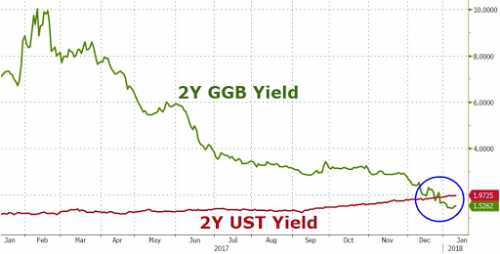
I must admit, another new problem, and one that hadn’t occurred to me yet.

New Jersey Poised To Bar Drunken Droning (R.)

U.S. drone sales in 2017 topped $1 billion for the first time ever, but don’t raise a glass too quickly if you are in New Jersey, where lawmakers are poised to outlaw drunken droning next week. It is one of a wave of U.S. states moving to bring the unmanned aircrafts’ high-flying fun back to earth. New Jersey’s Assembly is slated to vote on a bill approved by the state Senate to ban inebriated or drugged droning, as well as to outlaw flying unmanned aircraft systems over prisons and in pursuit of wildlife. The vote was set for Thursday but postponed until Monday because of a severe snowstorm that triggered a state of emergency in New Jersey. “It’s basically like flying a blender,” said John Sullivan, 41, of New York, a drone buff and aerial cinematographer.

He said he opposed drunk droning but also fretted about regulatory overreach. “If I had like one drink, I’d be hesitant to even fly it.” A 2015 drone crash on the White House lawn fueled debate in the U.S. Congress over the need for drone regulations. It was a drunken, off-duty employee of the National Geospatial-Intelligence Agency who flew the 2-foot-by-2-foot (60 cm by 60 cm) “quadcopter” from a friend’s apartment balcony and lost control of it over the grounds surrounding the White House, the New York Times reported. [..] “Like any technology, drones have the ability to be used for good, but they also provide new opportunities for bad actors,” said Assemblywoman Annette Quijano of Elizabeth, New Jersey. She backed the bill, which would impose a punishment of up to six months prison and a $1,000 fine for drunk droning.

Read more …

A big gap: “..bitcoin’s global price average was trading at $16,294 while in South Korean markets, it stood at 25 million won, or $23,467.35..?

South Korea Inspects Six Banks Over Crypto Currency Services To Clients (R.)

South Korean financial authorities on Monday said they are inspecting six local banks that offer virtual currency accounts to institutions, amid concerns the increasing use of such assets could lead to a surge in crime. The joint inspection by the Financial Services Commission (FSC) and Financial Supervisory Service (FSS) will check if banks are adhering to anti-money laundering rules and using real names for accounts, FSC Chairman Choi Jong-ku told a press conference. [..] Choi said the inspections are intended to provide guidance to banks and are not the result of any suspected wrongdoing. “Virtual currency is currently unable to function as a means of payment and it is being used for illegal purposes like money laundering, scams and fraudulent investor operations,” said Choi. “The side effects have been severe, leading to hacking problems at the institutions that handle cryptocurrency and an unreasonable spike in speculation.”

A Woori Bank spokesperson told Reuters the bank was filling out a checklist for the inspection. The spokesperson said Woori had stopped providing virtual account services last month as the costs of using a real-name transaction system were too prohibitive. [..] Choi said authorities are also looking at ways to reduce risks associated with cryptocurrency trading in the country, which could include shutting down institutions that use such currencies. Last month, the government said it would impose additional measures to regulate speculation in cryptocurrency trading within the country, including a ban on anonymous cryptocurrency accounts and new legislation to allows regulators to close virtual coin exchanges if needed.

Bitcoin and other virtual coins have been extremely popular in South Korea, drawing wide investments from housewives and students. Government officials have expressed concern over frenzied speculation, with South Korea’s central bank chief warning of “irrational exuberance” in trading of virtual currency last month. A South Korean cryptocurrency exchange, Youbit, shut down and filed for bankruptcy in December after it was hacked twice last year, highlighting security and regulatory concerns. South Korea’s virtual currency exchanges have been more vulnerable to hackers as bitcoin trades at higher rates on local exchanges than they do elsewhere. As of 0710 GMT, bitcoin’s global price average was trading at $16,294 while in South Korean markets, it stood at 25 million won, or $23,467.35, according to Coinhills.com.

Read more …

Bitcoin and Ripple are falling, ether rises.

Bitcoin Futures Traders Are Quietly Building A Big Short Position (ZH)

In retrospect, the launch of bitcoin futures one month ago has proven to be a modestly disappointing event: while it helped send the price of bitcoin soaring as traders braced for the institutionalization of bitcoin, the world’s most popular cryptocurrency has stagnated since the beginning of December when first the Cboe then CME started trading bitcoin futures, trading in a range between $12,000 and $17,000. And while bitcoin futures markets volumes have been lower than most had expected, the past 4 weeks have provided enough data to observe how volumes and open interest have evolved.

We discussed previously that Bitcoin futures were off to a slow start in the first week of trading, with volumes of CBOE Bitcoin futures averaging just around $40MM per day, despite intense media hype helping fuel heavy trading when both contracts launched, at least in the first hours of trading. Since then, volumes spike briefly in the following week coinciding with the launch of the CME futures, with volumes of on both exchanges at relatively similar levels. Then, as JPM’s Nikolaos Panagirtzoglou shows, after a spike in volumes to around $200mn on 22 December, which saw sharp swings in underlying Bitcoin prices, volumes have averaged around $50mn and $60mn per day on the CBOE and CME futures, respectively.

One month after their launch, futures trading volumes remain very modest compared to average Bitcoin trading volumes of around $15bn per day since futures contracts were launched according to coinmarketcap.com data. While open interest in both the CBOE and CME contracts has risen steadily, it too remains rather modest at around $60mn and $70mn, respectively. Putting futures volumes in context, on Friday, the combined size of the bitcoin-futures markets at the two exchanges was roughly $150 million, measured in terms of the value of outstanding contracts, while the total value of all bitcoins in existence was around $290 billion.

Read more …
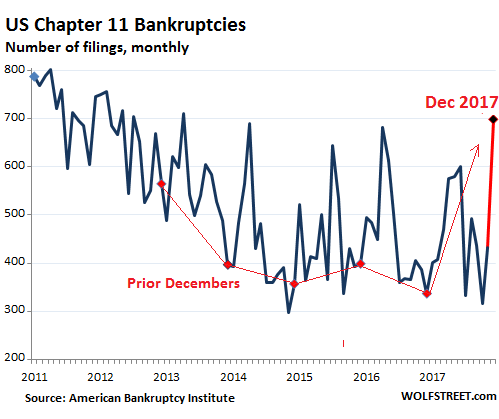
That’s a big drop.

Australia Forecasts 20% Iron Ore Price Drop In 2018 (R.)

Australia on Monday said it expects iron ore prices to average $51.50 a tonne this year, down 20% from 2017, because of rising global supply and moderating demand from top importer China as its steel sector shrinks. The world’s top three mining companies, BHP and Vale rely heavily on iron ore sales for the bulk of their revenue despite efforts to diversify more into other industrial raw materials, such as copper, aluminium and coal. Brazil-based Vale is planning to lift iron ore exports 7% in 2018 to 390 million tonnes. In Australia, Rio Tinto and BHP, along with Fortescue Metals Group aim to add about 170 million tonnes of new capacity over the next several years.

The forecast price decline — from an average of $64.30 a tonne in 2017 — continues into 2019, when the steelmaking raw material will average only $49 a tonne, according to the Department of Industry, Innovation and Science. “The iron ore price is expected to experience some ongoing volatility in early 2018, as the market responds to uncertainty regarding the impact of winter production restrictions on iron ore demand,” the department warned in its latest commodities outlook paper. Iron ore currently sells for about $75 a tonne.

Read more …
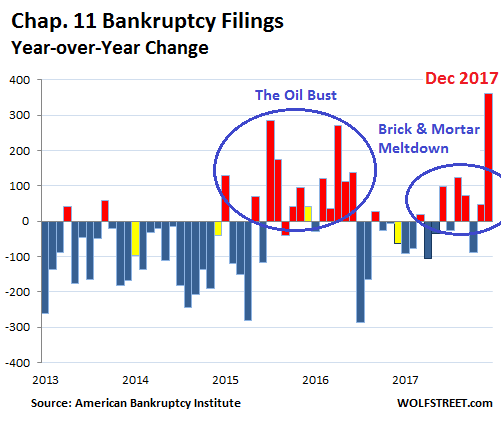
All it needs to do is let prices crash. Does wonders for affordability.

Australia Government Can’t Supply Its Way To Housing Affordability (SMH)

Sydney and Melbourne are entering a housing downturn. While the government has hoped record high levels of property development would have an impact, research shows supply is not behind the price falls. Housing economists say the market slowdown is not due to additional home building but a drop in demand, in part thanks to the banking regulator making it more difficult for some to get a loan. In fact, the effect of new supply on property prices has been very limited despite state governments largely pinning hopes on a surging home building industry to rein in affordability. In a recent Australian National University paper Regional housing supply and demand in Australia academics Ben Phillips and Cukkoo Joseph found supply levels from 2001 to 2017 were larger than necessary to cover demand requirements, with thousands of excess homes in Sydney, but prices boomed over the time period.

This flies in the face of conventional economic wisdom, with the law of supply and demand dictating that the more of something you make, the cheaper it should be. There are many reasons why housing doesn’t respond to increases in supply in the way the market for coal, apples or t-shirts might be expected to react. When economists are making models they usually assume they are calculating the impacts on a “normal” good. One of the assumptions often made when modelling supply and demand for these goods is that what is produced is all homogenous, that is they are more or less the same. Typically, someone will pay the same amount for one item as they will for another that is identical.

Housing is not in this category. Even in the most sterile of apartment blocks, there will be many different design features, flaws, views and aspects that differ in each unit. The impact of new supply on the property market is limited by whether the type of property being built caters to existing demand. For instance, new apartments on the outskirts of greater Sydney or Melbourne may not appeal to the same market bidding up the price of mansions with water views.

Read more …
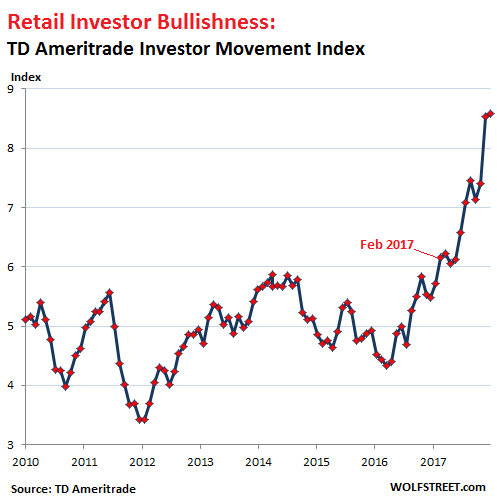
It’s just like Minsky: stability begets instability.

Rising Volatility Begets Rising Volatility (Peters)

To sell implied volatility at current 50yr lows, investors must imagine tomorrow will be virtually identical to today. They must imagine that bond yields won’t rise despite every major central bank eager to hike interest rates and exit QE. They must imagine that economies at or near full employment will not create inflation; that GDP will neither accelerate nor decelerate; that governments will tolerate historic levels of income inequality despite citizens voting for the opposite; that strongly rising global debts will be supported by structurally decelerating global growth. And volatility sellers must imagine that nine years into a bull market, amplified by a proliferation of complex volatility-selling strategies and passive ETFs with liquidity mismatches, that we will dodge a destabilizing shock to market infrastructure.

I can imagine a few of those things happening, but neither sustainably nor simultaneously. It is much easier to imagine a tomorrow that looks different from today. Also consider that investment banks and asset managers have always devised creative strategies to make money once asset valuations exceed reasonable levels. These perpetual prosperity machines typically combine leverage and alchemy, transforming real risk into perceived safety. Examples abound. But in this cycle, a proliferation of cleverly disguised volatility-selling strategies has dominated. Zero interest rates and quantitative easing left yield-starved investors with few ways to achieve their target returns. Wall Street’s engineers developed many wonderful solutions to this problem. Their magnificence is matched only by the amount of negative convexity now lurking in investment portfolios.

As volatility has declined, investors have had to sell even more of it to sustain sufficient profits. This selling reinforces the trend lower, which produces an illusion that legacy volatility shorts are less risky today than yesterday. Lower volatility thus begets lower volatility. And this also ensures that quantitative models reduce overall portfolio risk estimates, which allows (and in many cases forces) investors to buy more assets at prevailing prices. This in turn reduces volatility, reflexively. Naturally, the reverse is also true. Rising volatility begets rising volatility. And given the unprecedented volatility-selling in this cycle, this market is exposed to a historic reversal somewhere along the path to policy normalization. Which has now begun.

Read more …
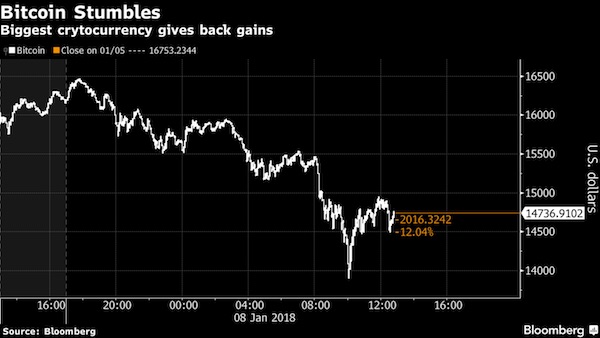
aka the everything bubble.

The Artificial Liquidity Bubble (Henrich)

8 years after the financial crisis we remain in an environment that is entirely dependent on artificial liquidity, be it via central bank liquidity driven low rates and/or QE or now US fiscal stimulus in the form of tax cuts. And while a reduction in central bank stimulus is anticipated for 2018 the $1.5 trillion US tax cut is the next active artificial boost to hit markets. You can view it perhaps this way: When the US ended QE3 Europe and Japan took over the stimulus baton, and now that Europe is reducing stimulus the US again is taking the lead, this time with fiscal stimulus. It is a bizarre dance that excels in one aspect in particular: It never ends. Consider: German unemployment is at all time lows, and European PMIs are at their highest in over 7 years.

Is the ECB raising rates from record lows? Nope. Has QE ended? Nope. QE continues to run at $30B Euro a month and rates remain in full panic mode. Not what one would’ve expected 8 years ago following a return to full employment. Stimulus programs & interventions used to be methods of crisis management now they have become permanent fixtures in global economies. Why? Because this is what it takes. And they will continue. Japanese Prime Minister Shinzo Abe has just instructed central bank chief Kuroda to keep printing as he decides whether to keep him in his job. Wink wink. Normalizing rates? Reducing balance sheets back to pre-crisis levels? Letting markets run on their own without intervention? Call it the big central banking lie. It will never happen. It can’t. Global debt is now exceeding $233 Trillion.

[..] the math of higher rates doesn’t work and will eventual break the camel’s back. Low rates are an absolute must requirement to keep the construct afloat. It is no accident that Morgan Stanley wealth management has decided to pull out of junk bonds. They are warning of US tax cuts accelerating market excesses bringing about a coming recession. And make no mistake, a recession will come as we are very late in the cycle.

Read more …

Count me out.

Wikileaks Publishes Michael Wolff’s Entire Sold Out Trump Book As A PDF (ZH)

Considering that Wikileaks made its name by leaking confidential and/or hard to find documents and information, and also considering the reversal in the Trump administration vis-a-vis Julian Assange, whom it first lauded only to threaten with incarceration in recent months, it is perhaps not surprising that moments ago the official Wikileaks twitter account published Michael Wolff’s controversial – and largely sold out – book, “Fire and Fury” in pdf format.

New Trump book “Fire and Fury” by Michael Wolff. Full PDF: https://t.co/sf7vj4IYAx

— WikiLeaks (@wikileaks) January 7, 2018

Since, somewhat ironically, WikiLeaks picked a google drive to host the leaked pdf, it will unlikely remain available for an extended period, as it would mean substantial lost revenue for book published Henry Holt and Company. So for those who wish to read what all the hoople is about – for free – they are advised to do so sooner rather than later.

Read more …

View from the west only. How do you dress for a flight like that?

US Freezes While Sydney Sizzles: World’s Temperature Extremes Span 85ºC (BBG)

Temperature extremes across the globe spanned more than 85 degrees Celsius at the weekend as Sydney melted and parts of the U.S. froze. Western Sydney touched 47.3 degrees Celsius (117 degrees Fahrenheit) on Sunday afternoon local time, the city’s hottest day since 1939. Weekend temperatures at Mount Washington Observatory in New Hampshire plummeted to minus 36 degrees Fahrenheit (minus 38 degrees Celsius). Roads melted, firefighters battled wildfires across New South Wales state and Sydney residents retreated to air-conditioned shopping malls as temperatures surged. English cricket captain Joe Root was hospitalized with severe dehydration after battling Australia in the cauldron of the Sydney Cricket Ground. At the same time, freezing fog and snow buffeted Mount Washington, tying the observatory for the second-coldest place on Earth.

Read more …

Dec 282017
 
 December 28, 2017  Posted by at 10:23 am Finance Tagged with: , , , , , , , , , ,  6 Responses »


Ansel Adams Church, Taos, Pueblo 1942


The Automatic Earth and its readers have been supporting refugees and homeless in Greece since June 2015. It has been and at times difficult and at all times expensive endeavor. Not at least because the problems do not just not get solved, they actually get worse. Because the people of Greece and the refugees that land on their shores increasingly find themselves pawns in political games.

Therefore, even if the generosity of our readership has been nothing short of miraculous, we must continue to humbly ask you for more support. Because our work is not done. Our latest essay on this is here: The Automatic Earth for Athens Fund – Christmas and 2018 . It contains links to all 14 previous articles on the situation.

Here’s how you can help:


For donations to Konstantinos and O Allos Anthropos, the Automatic Earth has a Paypal widget on our front page, top left hand corner. On our Sales and Donations page, there is an address to send money orders and checks if you don’t like Paypal. Our Bitcoin address is 1HYLLUR2JFs24X1zTS4XbNJidGo2XNHiTT. For other forms of payment, drop us a line at Contact • at • TheAutomaticEarth • com.

To tell donations for Kostantinos apart from those for the Automatic Earth (which badly needs them too!), any amounts that come in ending in either $0.99 or $0.37, will go to O Allos Anthropos.


Please give generously.


S&P 500 Hits Most Overbought Level In 22 Years (MW)
Peak Good Times? Stock Market Risk Spikes to New High (WS)
Russia’s Finance Minister Confirms Upcoming Bitcoin Regulations (CCN)
Bitcoin Tumbles Over Exchange-Closure Fears (BBG)
Bitcoin’s Surging Price Drives Private Investor Demand For Derivatives (BBG)
Trump Tax Reform Blew Up The Treasury Market (ZH)
The Tax Plan Could Change How Wall Street Works (BBG)
“We’ve Centralized All Of Our Data To A Guy Called Mark Zuckerberg” (HN)
The Petro-yuan Bombshell (Escobar)
John McDonnell Warns Over ‘Alarming Increase’ In UK Household Debt (G.)
Another Fukushima? Tepco Plans To Restart World’s Biggest Nuclear Plant (G.)
Children Increasingly Used As Weapons Of War – Unicef (G.)


All the lovely things that debt buys.

S&P 500 Hits Most Overbought Level In 22 Years (MW)

Following a year in which the U.S. stock market hit a record number of records and seen basically nothing in the way of pullbacks or volatility, investors have gone all-in on stocks. Exchange-traded funds, perhaps the most popular way to get exposure to broad parts of the market, have seen record-breaking inflows over the year, with both domestic and foreign-based stock funds seeing heavy interest and no major category seeing outflows. Both retail and institutional investors have gotten in on the action and are positioning in a way that suggests both see further gains ahead. The S&P 500 has rallied about 20% over 2017, on track for its best year since 2013.

According to Torsten Sløk, Deutsche Bank’s chief international economist, “U.S. retail investors say that today is the best time ever to invest in the market,” based on data from the University of Michigan consumer sentiment report, which asks about the probability of an increase in stock prices over the coming year. Younger investors in particular are warming up to equities, according to E*Trade. The latest AAII investor sentiment survey indicates that 50.5% of polled investors are bullish on the market, meaning they expect prices will be higher in six months. That’s the highest level in nearly two years, and significantly above the 38.5% historical average. The number of bullish investors has gone up by 5.5 percentage points in the last week alone, while the percentage of bearish investors has dropped to 25.6%, down 2.5 percentage points over the last week.

Optimism has gotten so high that cash balances for Charles Schwab clients reached their lowest level on record in the third quarter, according to Morgan Stanley, which wrote that retail investors “can’t stay away.” The investment bank noted a similar trend in institutional investors, who it wrote were “loading the boat on risk,” with “long/short net and gross leverage as high as we have ever seen it.”

There have been fundamental reasons for this optimism, including a strong labor market and improving economic data. Furthermore, the recently passed tax bill will cut corporate taxes, which should boost corporate profits — which have already been enjoying their fastest year of growth since 2011. However, the incessant buying has pushed valuations to levels that are not only stretched, but stretched to a historic extent. As was recently noted by LPL Financial, the relative strength index, an indicator of technical momentum, is at its highest level since 1995, which indicates the S&P 500 is at its most overbought level in 22 years.

Read more …

Thank your central banker.

Peak Good Times? Stock Market Risk Spikes to New High (WS)

Margin debt is the embodiment of stock market risk. As reported by the New York Stock Exchange today, it jumped 3.5%, or $19.5 billion, in November from October, to a new record of $580.9 billion. After having jumped from one record to the next, it is now up 16% from a year ago. Even on an inflation-adjusted basis, the surge in margin debt has been breath-taking: The chart by Advisor Perspectives compares margin debt (red line) and the S&P 500 index (blue line), both adjusted for inflation (in today’s dollars). Note how margin debt spiked into March 2000, the month when the dotcom crash began, how it spiked into July 2007, three months before the Financial-Crisis crash began, and how it bottomed out in February 2009, a month before the great stock market rally began:

Margin debt, which forms part of overall stock market leverage, is the great accelerator for stocks, on the way up and on the way down. Rising margin debt – when investors borrow against their portfolios – creates liquidity out of nothing, and much of this new liquidity is used to buy more stocks. But falling margin debt returns this liquidity to where it came from. Leverage supplies liquidity. But it isn’t liquidity that moves from one asset to another. It is liquidity that is being created to be plowed into stocks, and that can evaporate just as quickly: When stocks are dumped to pay down margin debt, the money from those stock sales doesn’t go into other stocks or another asset class, doesn’t become cash “sitting on the sidelines,” as the industry likes to say, and isn’t used to buy gold or cryptocurrencies or whatever. It just evaporates without a trace.

After stirring markets into an eight-year risk-taking frenzy, the Fed is now worried that markets have gone too far. Among the Fed governors fretting out loud over this was Dallas Fed President Robert Kaplan who recently warned about the “record-high levels” of margin debt, along with the US stock market capitalization, which, at 135% of GDP, is “the highest since 1999/2000.” “In the event of a sell-off, high levels of margin debt can encourage additional selling, which could, in turn, lead to a more rapid tightening of financial conditions,” he mused. The growth in margin debt has far outpaced the growth of the S&P 500 index in recent years. The chart below (by Advisor Perspectives) shows the percentage growth of margin debt and the S&P 500 index, both adjusted for inflation:

Read more …

Will Russia set the model for the rest of the world? Don’t be surprised if others follow.

Russia’s Finance Minister Confirms Upcoming Bitcoin Regulations (CCN)

The Russian Ministry of Finance has prepared a sweeping regulatory law that will cover many facets of cryptocurrencies like bitcoin in Russia. In an interview with state-owned television broadcaster Rossiya 24 over Christmas, Russia’s finance minister Anton Siluanov confirmed the ministry’s draft law on a regulatory framework for cryptocurrencies. The regulation, as expected, will cover bitcoin mining rules, taxation laws for adopters and guidelines for exchanges selling cryptocurrencies. As reported by Russian news source TASS, Siluanov stated: The Ministry of Finance has prepared a draft law, currently under consideration, which will determine the procedure for issuing, taxing, buying and circulation of cryptocurrency. In conjunction, the Ministry of Finance is also reportedly preparing amendments to Russian legislation toward the broader regulation of new financial technologies and digital payments.

The developments are a remarkable contrast to legislation proposed by Russia’s Finance Ministry as recently as March 2016. At the time, the ministry proposed a 7-year prison sentence for bitcoin adopters and users. Earlier in September, Siluanov called for the Russian government to accept and understand “that cryptocurrencies are real.” “There is no sense in banning them,” Siluanov said at the time, “there is a need to regulate them.” The new laws, in its draft, is expected to be submitted to the State Duma (the lower house of the Russian Parliament) tomorrow before its anticipated adoption sometime in March 2018. The new laws were fast-tracked by authorities following Russian President Vladimir Putin’s mandate to develop regulations for cryptocurrencies, mining and initial coin offerings (ICOs). The amendments to existing Russian laws to recognize cryptocurrencies will also aid in the prepping for the launch of Russia’s own national cryptocurrency – the CryptoRuble.

Read more …

Korea may be the first to copy Moscow. This is not action, it’s reaction.

Bitcoin Tumbles Over Exchange-Closure Fears (BBG)

Bitcoin resumed its tumble on Thursday after South Korea said it was eyeing options including a potential shutdown of at least some cryptocurrency exchanges to stamp out a frenzy of speculation. South Korea has been ground zero for a global surge in interest in bitcoin and other cryptocurrencies as prices surged this year, prompting the nation’s prime minister to worry over the impact on Korean youth. While there’s no immediate indication Asia’s No. 4 economy will shutter exchanges that have accounted by some measures for more than fifth of global trading, the news poses a warning as regulators the world over express concerns about private digital currencies. Bitcoin fell as much as 9% to as low as $13,828 in Asia trading, erasing modest gains after the South Korean release, composite Bloomberg pricing shows.

It’s now down about 28% from its record high reached last week. South Korea will require real-name cryptocurrency transactions and impose a ban on the offering of virtual accounts by banks to crypto-exchanges, according to a statement from the Office for Government Policy Coordination. Policy makers will review measures including the closure of crypto-exchanges suggested by the Ministry of Justice and take proper measures swiftly and firmly while monitoring the trend of the speculation. Bitcoin was trading at about a 30% premium over prevailing international rates on Thursday in Seoul – a continuing sign of the country’s obsession, and the difficulty in arbitraging between markets. “Cryptocurrency speculation has been irrationally overheated in Korea,” the government said in the statement, which comes little more than a week after the bankruptcy filing of one South Korean exchange. “The government can’t leave the abnormal situation of speculation any longer.”

Read more …

The combination of crypto and derivatives sends shivers.

Bitcoin’s Surging Price Drives Private Investor Demand For Derivatives (BBG)

Bitcoin’s surging price has driven private-investor demand for derivatives tracking the virtual currency. Trading in so-called participation notes has skyrocketed this year on Boerse Stuttgart, Europe’s largest exchange for retail derivatives. The number of executed orders jumped 22-fold from 436 in January to almost 10,000 in December.

Read more …

Beware when stirring up a complex system.

Trump Tax Reform Blew Up The Treasury Market (ZH)

Over the past week we have shown on several occasions that there once again appears to be a sharp, sudden dollar-funding liquidity strain in global markets, manifesting itself in a dramatic widening in FX basis swaps, which – in this particular case – has flowed through in the forward discount for USDJPY spiking from around 0.04 yen to around 0.23 yen overnight. As Bloomberg speculated, this discount for buying yen at future dates widened sharply as non-U.S. banks, which typically buy dollars now with sell-back contracts at a future date, scrambled to procure greenbacks for the year-end. However, as Deutsche Bank’s Masao Muraki explains, this particular dollar funding shortage is more than just the traditional year-end window dressing or some secret bank funding panic.

Instead, the DB strategist observes that the USD funding costs for Japanese insurers and banks to invest in US Treasuries – which have surged reaching a post-financial-crisis high of 2.35% on 15 Dec – are determined by three things, namely (1) the difference in US and Japanese risk-free rates (OIS), (2) the difference in US and Japanese interbank risk premiums (Libor-OIS), and (3) basis swaps, which illustrate the imbalance in currency-hedged US and Japanese investments. In this particular case, widening of (1) as a result of Fed rate hikes and tightening of dollar funding conditions inside the US (2) and outside the US (3) have occurred simultaneously. This is shown in the chart below.

What is causing this? Unlike on previous occasions when dollar funding costs blew out due to concerns over the credit and viability of the Japanese and European banks, this time the Fed’s rate hikes could be spurring outflows from the US, European, and Japanese banks’ deposits inside the US. Absent indicators to the contrary, this appears to be the correct explanation since it’s not just Yen funding costs that are soaring. In fact, at present EUR/USD basis swaps are widening more than USD/JPY basis swaps. [..] According to Deutsche, it is possible that an increase in hedged US investments by Europeans could be indirectly affecting Japan, and that market participants could also be conscious of the risk that the repatriation tax system could spur a massive flow-back into the US, of funds held overseas by US companies In fact, one can draw one particularly troubling conclusion: the sharp basis swap moves appear to have been catalyzed by the recently passed Trump tax reform.

Read more …

More ‘unintended’ consequences?!

The Tax Plan Could Change How Wall Street Works (BBG)

Leon Black recently posed a question whose answer will determine how profitable the new U.S. tax regime could make Wall Street firms like his Apollo Global Management. Publicly traded partnerships, including private equity firms Apollo, Blackstone and Carlyle Group, are taxed differently than corporations. So should they take advantage of the overhauled tax rules to pay less in taxes? Or should they use this chance to change to an Inc. from an LLC or LP, which would increase tax bills but allow them to attract investments from mutual funds that have previously been out of reach? “We’re still analyzing,’’ Black told the Goldman Sachs U.S. Financial Services Conference Dec. 6. “It’s an uncertain outcome.’’

Either way, it’s most likely a money-making outcome. The tax changes are a boon for firms such as Apollo, where Black is chief executive officer. The new lower corporate rate has made it possible for bigger publicly traded partnerships to consider the change. As it is, management fees, which typically account for 30 percent or more of their earnings, are already taxed at the corporate rate. That will drop. The legislation scarcely touched the 23.8 percent rate paid on incentive fees, also called carried interest, which incur no additional levy when paid out to shareholders. If the partnerships converted to corporations, the incentive fees would be hit with a second layer of tax when they’re paid out. That would push the combined tax rate on incentive income paid out as dividends to nearly 40 percent, according to Peter Furci, co-chair of Debevoise & Plimpton’s global tax practice.

Read more …

I’m sure this guy is smart, but he misses the point here by a mile. What has happened is the data have been centralized to the NSA and CIA and their peers. Zuckerberg is just a conduit.

“We’ve Centralized All Of Our Data To A Guy Called Mark Zuckerberg” (HN)

At its inception, the internet was a beautifully idealistic and equal place. But the world sucks and we’ve continuously made it more and more centralized, taking power away from users and handing it over to big companies. And the worst thing is that we can’t fix it – we can only make it slightly less awful. That was pretty much the core of Pirate Bay’s co-founder, Peter Sunde‘s talk at tech festival Brain Bar Budapest. TNW sat down with the pessimistic activist and controversial figure to discuss how screwed we actually are when it comes to decentralizing the internet. In Sunde’s opinion, people focus too much on what might happen, instead of what is happening. He often gets questions about how a digitally bleak future could look like, but the truth is that we’re living it.

“Everything has gone wrong. That’s the thing, it’s not about what will happen in the future it’s about what’s going on right now. We’ve centralized all of our data to a guy called Mark Zuckerberg, who’s basically the biggest dictator in the world as he wasn’t elected by anyone. Trump is basically in control over this data that Zuckerberg has, so I think we’re already there. Everything that could go wrong has gone wrong and I don’t think there’s a way for us to stop it.” One of the most important things to realize is that the problem isn’t a technological one. “The internet was made to be decentralized,” says Sunde, “but we keep centralizing everything on top of the internet.”

To support this, Sunde points out that in the last 10 years, almost every up-and-coming tech company or website has been bought by the big five: Amazon, Google, Apple, Microsoft and Facebook. The ones that manage to escape the reach of the giants, often end up adding to the centralization. We don’t create things anymore, instead we just have virtual things. Uber, Alibaba and Airbnb, for example, do they have products? No. We went from this product-based model, to virtual product, to virtually no product what so ever. This is the centralization process going on. Although we should be aware that the current effects of centralization, we shouldn’t overlook that it’s only going to get worse. There are a lot of upcoming tech-based services that are at risk of becoming centralized, which could have a huge impact on our daily lives.

[..] Feeling a bit optimistic, I asked Sunde whether we could still fight for decentralization and bring the power back to the people. His answer was simple. “No. We lost this fight a long time ago. The only way we can do any difference is by limiting the powers of these companies – by governments stepping in – but unfortunately the EU or the US don’t seem to have any interest in doing this.”

Read more …

Right in theory, but…

The Petro-yuan Bombshell (Escobar)

The website of the China Foreign Exchange Trade System (CFETS) recently announced the establishment of a yuan-ruble payment system, hinting that similar systems regarding other currencies participating in the New Silk Roads, a.k.a. Belt and Road Initiative (BRI) will also be in place in the near future. Crucially, this is not about reducing currency risk; after all Russia and China have increasingly traded bilaterally in their own currencies since the 2014 US-imposed sanctions on Russia. This is about the implementation of a huge, new alternative reserve currency zone, bypassing the US dollar. The decision follows the establishment by Beijing, in October 2015, of the China International Payments System (CIPS). CIPS has a cooperation agreement with the private, Belgium-based SWIFT international bank clearing system, through which virtually every global transaction must transit.

What matters in this case is that Beijing – as well as Moscow – clearly read the writing on the wall when, in 2012, Washington applied pressure on SWIFT; blocked international clearing for every Iranian bank; and froze $100 billion in Iranian assets overseas as well as Tehran’s potential to export oil. In the event Washington might decide to slap sanctions on China, bank clearing though CIPS works as a de facto sanctions-evading mechanism. Last March, Russia’s central bank opened its first office in Beijing. Moscow is launching its first $1 billion yuan-denominated government bond sale. Moscow has made it very clear it is committed to a long term strategy to stop using the US dollar as their primary currency in global trade, moving alongside Beijing towards what could be dubbed a post-Bretton Woods exchange system.

Gold is essential in this strategy. Russia, China, India, Brazil & South Africa are all either large producers or consumers of gold – or both. Following what has been extensively discussed in their summits since the early 2010s, the BRICS are bound to focus on trading physical gold. Markets such as COMEX actually trade derivatives on gold, and are backed by an insignificant amount of physical gold. Major BRICS gold producers – especially the Russia-China partnership – plan to be able to exercise extra influence in setting up global gold prices. [..] The current state of play is still all about the petrodollar system; since last year what used to be a key, “secret” informal deal between the US and the House of Saud is firmly in the public domain.

Even warriors in the Hindu Kush may now be aware of how oil and virtually all commodities must be traded in US dollars, and how these petrodollars are recycled into US Treasuries. Through this mechanism Washington has accumulated an astonishing $20 trillion in debt – and counting. Vast populations all across MENA (Middle East-Northern Africa) also learned what happened when Iraq’s Saddam Hussein decided to sell oil in euros, or when Muammar Gaddafi planned to issue a pan-African gold dinar. But now it’s China who’s entering the fray, following on plans set up way back in 2012. And the name of the game is oil-futures trading priced in yuan, with the yuan fully convertible into gold on the Shanghai and Hong Kong foreign exchange markets.

Read more …

The UK Labour party need to cash in now on the government’s mishandling of Brexit and the country’s economy, or risk being seen as part of that government. Corbyn et al know thay could jump in the polls by denouncing Brexit itself, but they don’t have the courage to do that. So on the no. 1 problem, they’re the same as the Tories.

John McDonnell Warns Over ‘Alarming Increase’ In UK Household Debt (G.)

John McDonnell has said the UK is in the grip of a personal debt crisis with levels of unsecured borrowing predicted to hit a record of £19,000 per household by the end of this parliament. The shadow chancellor said the increase in debt, to more than £14,000 per household this year, was alarming. Analysis from Labour shows unsecured debt is on course to exceed £15,000 per household next year and could go on to exceed £19,000 per household by 2022 if it follows the current trajectory. It is understood Labour plans to focus on the issue in the new year, warning that the continuing squeeze on wages and the high level of inflation are contributing to high levels of personal debt.

On Wednesday the Resolution Foundation, a thinktank, predicted that the stagnation in real wages was set to continue throughout 2018 and may only begin to lift towards the end of the year. McDonnell said: “The alarming increase in average household debt already means many families in our country are struggling over the Christmas period. The Tories have no real answers to tackle the debt crisis gripping our country and have no solutions to offer those struggling to get by as prices run ahead of wages. “The next Labour government will introduce a £10 per hour real living wage, scrap student fees, end the public sector pay cap and cap interest on consumer credit to build an economy for the many, not the few.”

Read more …

Why go this crazy route? Well, money of course.

Another Fukushima? Tepco Plans To Restart World’s Biggest Nuclear Plant (G.)

If a single structure can define a community, for the 90,000 residents of Kashiwazaki town and the neighbouring village of Kariwa, it is the sprawling nuclear power plant that has dominated the coastal landscape for more than 40 years. When all seven of its reactors are in operation, Kashiwazaki-kariwa generates 8.2m kilowatts of electricity – enough to power 16m households. Occupying 4.2 sq km of land along the Japan Sea coast, it is the biggest nuclear power plant in the world. But today, the reactors at Kashiwazaki-kariwa are idle. The plant in Niigata prefecture, about 140 miles (225km) north-west of the capital, is the nuclear industry’s highest-profile casualty of the nationwide atomic shutdown that followed the March 2011 triple meltdown at Fukushima Daiichi.

The company at the centre of the disaster has encountered anger over its failure to prevent the catastrophe, its treatment of tens of thousands of evacuated residents and its haphazard attempts to clean up its atomic mess. Now, the same utility, Tokyo Electric Power [Tepco], is attempting to banish its Fukushima demons with a push to restart two reactors at Kashiwazaki-kariwa, one of its three nuclear plants. Only then, it says, can it generate the profits it needs to fund the decommissioning of Fukushima Daiichi and win back the public trust it lost in the wake of the meltdown. This week, Japan’s nuclear regulation authority gave its formal approval for Tepco to restart the Kashiwazaki-kariwa’s No. 6 and 7 reactors – the same type of boiling-water reactors that suffered meltdowns at Fukushima Daiichi.

After a month of public hearings, the nuclear regulation authority concluded that Tepco was fit to run a nuclear power plant and said the two reactors met the stricter safety standards introduced after the 2011 disaster.

Read more …

What hope is there for us, if there’s none for our children? And yes, all children are our children, not just the ones that live in our homes and communities.

Children Increasingly Used As Weapons Of War – Unicef (G.)

Children caught in war zones are increasingly being used as weapons of war – recruited to fight, forced to act as suicide bombers, and used as human shields – the United Nations children’s agency has warned. In a statement summarising 2017 as a brutal year for children caught in conflict, Unicef said parties to conflicts were blatantly disregarding international humanitarian law and children were routinely coming under attack. Rape, forced marriage, abduction and enslavement had become standard tactics in conflicts across Iraq, Syria and Yemen, as well as in Nigeria, South Sudan and Myanmar. Some children, abducted by extremist groups, are abused again by security forces when they are released.

Others are indirectly harmed by fighting, through malnutrition and disease, as access to food, water and sanitation are denied or restricted. Some 27 million children in conflict zones have been forced out of school. “Children are being targeted and exposed to attacks and brutal violence in their homes, schools and playgrounds,” said Manuel Fontaine, Unicef’s director of emergency programmes. “As these attacks continue year after year, we cannot become numb. Such brutality cannot be the new normal.” Much of the fighting affecting children occurred in long-running conflicts in Africa.

Read more …