
Jan 312016
 
 January 31, 2016  Posted by at 10:07 am Finance Tagged with: , , , , , , , , , ,  2 Responses »


Edwin Rosskam Shoeshine, 47th Street, Chicago’s main Negro business street 1941


• A Chinese Banker Explains Why There Is No Way Out (ZH)
• China GDP Growth 4.3%, Or Lower, Chinese Professor Says (WSJ)
• Yuan Vs. Yen: How China Figures Into Japan’s Negative Rates (WSJ)
• IPO Market Comes to a Standstill (WSJ)
• Greece’s Lenders To Start Bailout Review On Monday (Reuters)
• Milk Collapse Brings a 45% Pay Cut to England’s Dairy Farmers (BBG)
• ‘Peak Stuff’ And The Search For Happiness (Guardian)
• Merkel Says Refugees Must Return Home Once War Is Over (Reuters)
• 10,000 Refugee Children Are Missing, Says Europol (Observer)
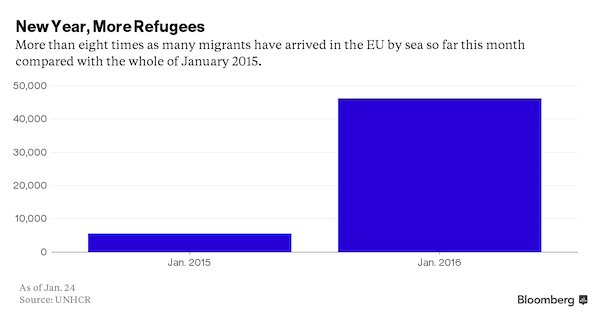
• Aegean Sea Refugee Crossings Rise 35 Fold Year-On-Year In January (Guardian)
• Greeks Worry Threatened Closure Of EU Border ‘Definition Of Dystopia’ (Guar.)
• Europe’s Immigration Bind: Morals vs Votes (Guardian)
• 39 Greece-Bound Refugees Drown Off Turkish Coast (AP)

“It’s not difficult to issue more loans, but let’s say in a years time when the loan is due, if the borrower defaults, then I won’t just see a pay cut, I’ll be fired, and still be responsible for loan recovery.”

• A Chinese Banker Explains Why There Is No Way Out (ZH)

Friday’s adoption of NIRP by Japan, which send the US Dollar soaring, has only made any upcoming future Chinese devaluation even more likely. But whether China devalued or not, one thing is certain: it is next to impossible for China – under the current socio economic and financial regime – to stop the relentless growth in NPLs, which even by conservative estimates at in the trillion(s), accounting for at least 10% of China’s GDP. Sure enough, a cursory skimming of news from China reveals that even Chinese bankers now “admit the NPL situation is dire, but will keep on lending” anyway. As the Chiecon blog notes, NPL “ratios might be closer to 10%… supported by revelations in this article, where Chinese bankers complain of missing performance targets, spiraling bad loans, and end of year pay cuts.”

“Right now, we’ve nowhere to issue new loans” said Mr. Zhang, a general manager in charge of new loans at one of the listed commercial bank branches. Zhang believes NPL ratios have yet to peak, with SME loans the worst hit area. Ironically this has forced Zhang to direct lending back to the LGFVs, property developers and conglomerates, industries which the Chinese government had previously instructed banks to restrict lending to, based on oversupply and credit risk fears.

But the main reason why China is now trapped, and on one hand is desperate to stabilize its economy and stop growing its levereage at nosebleed levels, while on the other hand it is under pressure to issue more loans while at the same time it is unwilling to write off bad loans, can be found in the following very simple explanation offered by Mr. Zhou, a junior banker at a Chinese commercial bank.

“If I don’t issue more loans, then my salary isn’t enough to repay the mortgage, and car loan. It’s not difficult to issue more loans, but let’s say in a years time when the loan is due, if the borrower defaults, then I won’t just see a pay cut, I’ll be fired, and still be responsible for loan recovery.”

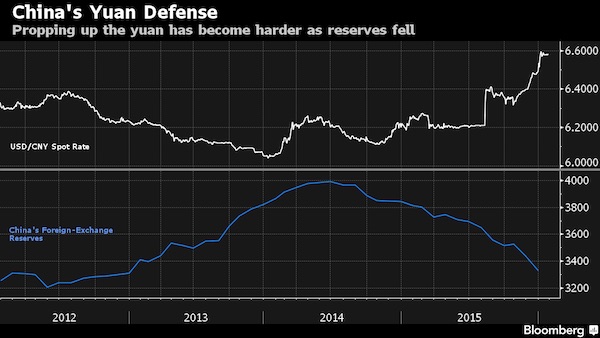
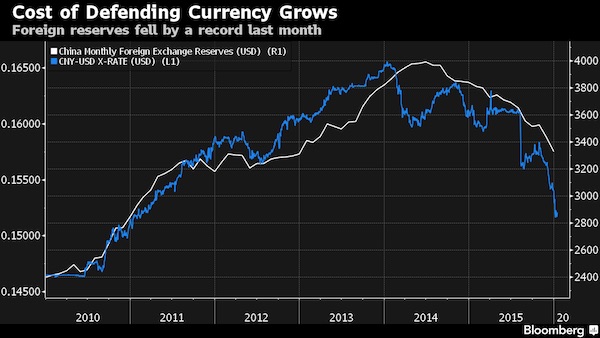
And that, in under 60 words, explains why China finds itself in a no way out situation, and why despite all its recurring posturing, all its promises for reform, all its bluster for deleveraging, China’s ruling elite will never be able to achieve an internal devaluation, and why despite its recurring threats to crush, gut and destroy all the evil Yuan shorts, ultimately it will have no choice but to pursue an external devaluation of its economy by way of devaluing its currency presumably some time before its foreign reserves run out (which at a $185 billion a month burn rate may not last for even one year). However, before it does, it will make sure that it also crushes every Yuan short, doing precisely what the Fed has done with equity shorts in the US over the past 7 years.

Read more …

While still ‘assuming the official agriculture and service sector growth figures are correct’.

• China GDP Growth 4.3%, Or Lower, Chinese Professor Says (WSJ)

As growth in the world’s second-largest economy slows, the spotlight has intensified over the accuracy of China’s growth figures. This week, Xu Dianqing, an economics professor at Beijing Normal University and the University of Western Ontario, joined the debate with an estimate that China’s GDP growth rate might just be between 4.3% and 5.2%. China’s official growth rate in 2015 was 6.9%, the slowest pace in more than two decades, allowing the government to hit its target of around 7%. But longstanding questions over China’s statistical methodology have spurred a cottage industry in alternate growth indicators. Many of these analyze other measures believed to be less subject to political pressure in estimating actual growth, including indices compiled by economists at Capital Economics, Barclays Bank, the Conference Board and Oxford Economics.

Most peg China’s annual growth in the 4% to 6% range. Mr. Xu told reporters at a briefing this week that the focus of his concern is the growth rate for China’s manufacturing sector, which according to official figures grew 6.0% last year and accounts for 40.5% of the economy. A closer look at underlying indicators, however, including thermal power generation, railway freight volume, and output from the iron ore, plate glass, cement and steel industries released monthly by the National Bureau of Statistics paint a different picture, he said. Of some 60 major industrial products, nearly half saw output contract in the January to November period, while railway cargo volume fell 11.9% for all of last year, according to official sources.

Given weaker industrial output in China and more than three years of industrial deflation, a 6% expansion for manufacturing in 2015 is questionable “no matter how the number is counted,” said Mr. Xu, who added that he believes it’s more probable that industry and construction grew at most by 2% last year and perhaps not at all. That translates into economic growth that tops out at 5.2% last year and perhaps something in the 4s, assuming the official agriculture and service sector growth figures are correct, he said. Mr. Xu said it’s unlikely that the service sector– sometimes cited as an explanation for growth rate discrepancies – did better than reported by authorities.

Read more …

Twins.

• Yuan Vs. Yen: How China Figures Into Japan’s Negative Rates (WSJ)

Japan’s move to negative interest rates is the latest step in a dangerous dance between the world’s second and third largest economies. The problem is currencies. China’s moves to bring down the value of the yuan have rattled markets this year, sparking a flight from risky assets that has sent investors into safer havens like the yen. The stronger yen in turn has threatened to tip Japan’s economy back into deflation, which the central bank has struggled to vanquish. The rising yen has also put more pressure on corporate profits and helped push Japanese stocks into bear market territory last week. So when the Bank of Japan announced its plan to lower interest rates below zero for the first time Friday, it makes sense that Governor Haruhiko Kuroda named just one country among the risks facing its economy China.

Now it’s China s turn to sweat. The yen fell as much as 2.1% after the announcement, which will make Chinese exports more expensive relative to Japanese products. The two countries, and most of their neighbors, are struggling against a tide of money outflows and weak trade. While governments in the rest of Asia have far more room to stimulate their economies than Japan does, a decline in the yen could spur them to try to push down their own currencies. Were China to follow and the central bank has already allowed the yuan to fall it would ignite another round of fear, which could push up the yen and force the Bank of Japan to act again. So far, the yen’s ups and downs have left it about where it was a year ago, so the risk of a cycle of competitive devaluation is limited.

In addition, the drop in the yen would have been a bigger problem for China when the yuan was pegged to the dollar. The government’s recent switch to a basket of currencies that includes the yen means the move up won’t be as big. But it still will push the currency in the wrong direction for the slowing economy. There’s another reason China does’ t want the yen to fall. Right now, thousands of Chinese are planning their Lunar New Year’s holidays in Japan early next month, hoping to take advantage of the cheap yen. During the October Golden Week, China’s other big travel week of the year, Chinese tourists descended on Japan, spending more than $830 million on shopping, according to the state-run China Daily.

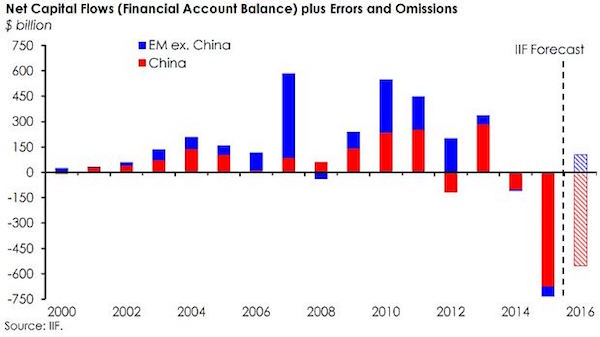
China is suffering an epic capital flight in which hundreds of billions of dollars are leaving the country. A weaker yen will send more Chinese into Tokyo’s department stores and further drain China’s currency reserves. The economic fates of China and Japan are closely connected. Until their economies get on stronger footing, moves to boost growth in one country could hurt the other and risk retaliation. As the world economy stays weak, the interaction between China and Japan could play an increasingly important role both in Asia and globally.

Read more …

Zero.

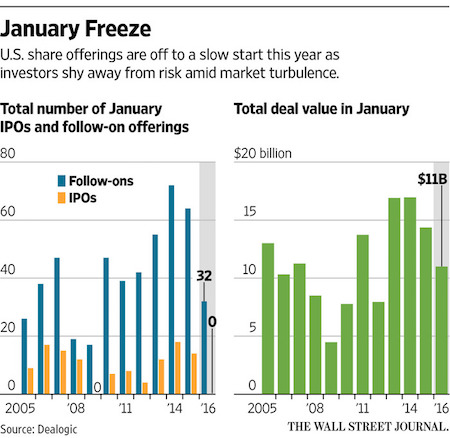
• IPO Market Comes to a Standstill (WSJ)

A frigid January for initial public offerings is pointing to a hard winter for fledgling biotechnology firms and other private companies. There were no U.S. IPOs in January, the first such month since the eurozone crisis in September 2011, according to data provider Dealogic. Investors and analysts attribute the dearth to the global stock-market rout of the first two weeks of the year, which signaled a broad retreat from risk by investors. If sustained, the reversal threatens to send ripples through global financial markets. Many analysts and traders view a healthy IPO sector as a necessary precondition for a sustainable advance in the broad stock indexes, as dozens of private companies have built their plans around raising cash in the public markets.

In recent years, markets were “wide open and companies that wanted to raise capital could,” said Eddie Yoon, portfolio manager of the Fidelity Select Health Care Portfolio, with $9 billion in assets. But now some companies, both public and private, could face being shut out for an extended period, as many investors seek to reduce risk by focusing on firms with histories of steady profitability and revenue growth. Several new share offerings by already-public biotech companies have floundered this year, not only pricing at steep discounts, but also falling even further the session after pricing. So far this year, new-share offerings by biotech companies have dropped 15% from the time of the announcement of the deal to the end of trading after the sale, according to data from Dealogic. “If the market does reopen, it will be for higher quality companies,” said Mr. Yoon.
Read more …

France wants debt relief?!

• Greece’s Lenders To Start Bailout Review On Monday (Reuters)

Greece’s official lenders will start a review on Monday of what progress the country has made in implementing the economic reforms agreed under its third bailout, a necessary step towards debt relief talks, a finance ministry official said on Saturday. Greece’s international lenders are the IMF and the euro zone bailout fund. The reforms that Greece has to implement in exchange for loans are also reviewed by the ECB and the European Commission. “The first phase will last a few days as there will be a break at the end of next week, after which the institutions will return to conclude the negotiations,” the official said, declining to be named. Athens is keen for a speedy completion of the review, which was expected to begin late last year, and hopes a positive outcome will help boost economic confidence and liquidity.

To secure a positive result from the review Athens needs to pass legislation on pension reforms to render its social security system viable, set up a new privatization fund and come up with measures to attain primary budget surpluses for 2016-2018. A successful conclusion of the performance review will open the way for debt relief talks. The head of the bailout fund, the European Stability Mechanism (ESM), has ruled out a haircut for Greece’s debt but extending debt maturities and deferring interest are options that could be used to make it more manageable. French Finance Minister Michel Sapin told Kathimerini debt relief talks must start soon to help restore Greece’s financial stability. “France’s view is that the sooner the first review is completed, the faster we will be able to tackle the issue of debt sustainability and this will be better for everyone – for Greece as well as the entire euro zone,” Sapin told the paper.

Read more …

Stories from NZ have been bad for a while now.

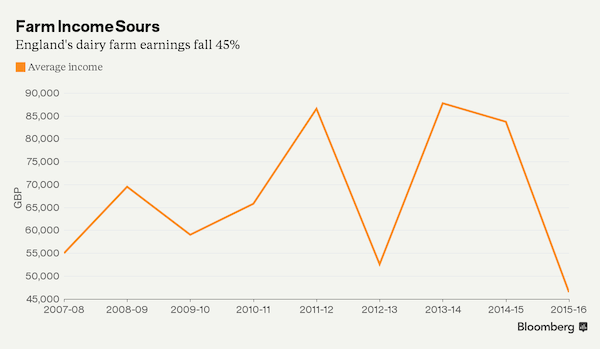
• Milk Collapse Brings a 45% Pay Cut to England’s Dairy Farmers (BBG)

England’s dairy farmers will see income fall by almost half this year, evidence that the global milk crisis is far from over. Earnings will average 46,500 pounds ($66,500) per farm in England for the 2015-16 season that started in March, the Department for Environment, Food & Rural Affairs said in a report Thursday. That figure, which includes European Union aid payments, is 45 percent below the prior season and the lowest in 9 years. Dairy farmers across Europe are struggling with a collapse in prices after a global oversupply of milk was compounded by slowing demand in China and Russia’s ban on EU dairy in retaliation for sanctions.

Protests over low prices broke out in France this week as more than 100 farmers, many of them livestock breeders, blocked roads and used tractors and burning tires to stop access to the port city La Rochelle. “There’s too much milk in the world,” said Robbie Turner, head of European markets at Rice Dairy International, a risk management advisory firm in London. “There are people who are hard for cash,” and prices are likely to remain low for at least the next six months, he said. On Thursday, Fonterra, the world’s largest dairy exporter, cut its milk price forecast to a nine-year low. The Auckland-based company doesn’t expect a sharp recovery in Chinese demand any time soon.
Read more …

Luckily we’re maxed out.

• ‘Peak Stuff’ And The Search For Happiness (Guardian)

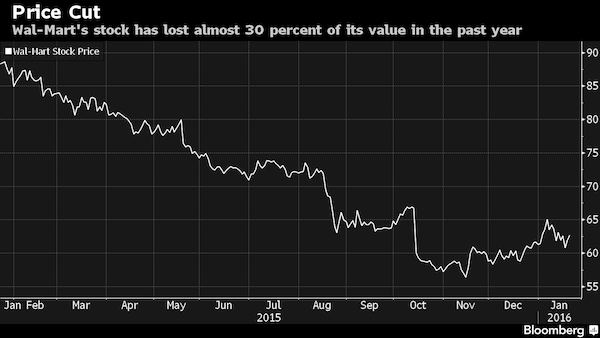
On Monday, Walmart will start paying a minimum of $10 an hour to its 1.4 million skilled staff in America – in conventional economists’ terms, a ludicrous and unnecessary transfer of income from capital to labour. But, facing the same retail environment as Apple and Ikea, Walmart wants to motivate its frontline staff into being more engaged and innovative. Consumers want some help in understanding and interpreting their particularities, help in answering the question of what, in a profound sense, their spending is for. When you have enough, what need is being served by having more?

Economists are not equipped to address such phenomena. Faltering growth in consumer demand in all western countries is understood wholly in traditional economic terms: the story is that consumers are indebted and uncertain, they lack confidence and want to rebuild their savings. Rightwing, anti-state economists, so influential in the Republican and Conservative parties, peddle tax cuts as the universal panacea. Like Pavlov’s dog, consumers will flock back to the shops once they are emboldened by a tax cut. Obviously, there would be some increase in spending, but far less than there used to be. More fundamental forces are holding back spending .

There is a quest for meaning, aided and abetted by the knowledge and information revolutions, that is not answered by traditionally scale-produced goods and services. Economist Tomas Sedlacek, who has won an international following for his book Economics of Good and Evil, insists that contemporary societies have become slaves to a defunct economistic view of the world. When western societies were poorer, it was reasonable for economics to focus on how to produce more stuff – that was what societies wanted. Now, the question is Aristotelian: how to live a happy life – or “humanomics”, as Sedlacek calls it. Aristotle was clear: happiness results from deploying our human intelligence to act creatively on nature. To inquire and successfully to quest for understanding is the root of happiness.

Yet most people today, says Sedlacek, work in jobs they do not much like, to buy goods they do not much value – the opposite of any idea of the good life, Aristotelian or otherwise. What we want is purpose and a sense of continual self-betterment, which is not served by buying another iPhone, wardrobe or a kitchen. Yet purpose and betterment need a social context: purpose is a shared endeavour and self-betterment is to act on the world better with others. An individualistic society such as our own makes it much harder to find others with whom to make common cause.

Read more …

Well, stop the war then.

• Merkel Says Refugees Must Return Home Once War Is Over (Reuters)

German Chancellor Angela Merkel tried on Saturday to placate the increasingly vocal critics of her open-door policy for refugees by insisting that most refugees from Syria and Iraq would go home once the conflicts there had ended. Despite appearing increasingly isolated, Merkel has resisted pressure from some conservatives to cap the influx of refugees, or to close Germany’s borders. Support for her conservative bloc has slipped as concerns mount about how Germany will integrate the 1.1 million migrants who arrived last year, while crime and security are also in the spotlight after a wave of assaults on women in Cologne at New Year by men of north African and Arab appearance.

The influx has played into the hands of the right-wing Alternative for Germany (AfD), whose support is now in the double digits, and whose leader was quoted on Saturday saying that migrants entering illegally should, if necessary, be shot. Merkel said it was important to stress that most refugees had only been allowed to stay for a limited period. “We need … to say to people that this is a temporary residential status and we expect that, once there is peace in Syria again, once IS has been defeated in Iraq, that you go back to your home country with the knowledge that you have gained,” she told a regional meeting of her Christian Democratic Union (CDU) in the state of Mecklenburg-Western Pomerania.

Merkel said 70 percent of the refugees who fled to Germany from former Yugoslavia in the 1990s had returned. Horst Seehofer, leader of the Christian Social Union (CSU), the CDU’s Bavarian sister party, has threatened to take the government to court if the flow of asylum seekers is not cut. Merkel urged other European countries to offer more help “because the numbers need to be reduced even further and must not start to rise again, especially in spring”. Fabrice Leggeri, the head of the European Union’s border agency Frontex, said a U.N. estimate that up to a million migrants could try to come to Europe via the eastern Mediterranean and Western Balkans next year was realistic. “It would be a big achievement if we could keep the number … stable,” he told the magazine Der Spiegel.

Read more …

Europe doesn’t care for kids.

• 10,000 Refugee Children Are Missing, Says Europol (Observer)

At least 10,000 unaccompanied child refugees have disappeared after arriving in Europe, according to the EU’s criminal intelligence agency. Many are feared to have fallen into the hands of organised trafficking syndicates. In the first attempt by law enforcement agencies to quantify one of the most worrying aspects of the migrant crisis, Europol’s chief of staff told the Observer that thousands of vulnerable minors had vanished after registering with state authorities. Brian Donald said 5,000 children had disappeared in Italy alone, while another 1,000 were unaccounted for in Sweden. He warned that a sophisticated pan-European “criminal infrastructure” was now targeting refugees.

“It’s not unreasonable to say that we’re looking at 10,000-plus children. Not all of them will be criminally exploited; some might have been passed on to family members. We just don’t know where they are, what they’re doing or whom they are with.” The plight of unaccompanied child refugees has emerged as one of the most pressing issues in the migrant crisis. Last week it was announced that Britain would accept more unaccompanied minors from Syria and other conflict zones. According to Save the Children, an estimated 26,000 unaccompanied children entered Europe last year. Europol, which has a 900-strong force of intelligence analysts and police liaison officers, believes 27% of the million arrivals in Europe last year were minors.

“Whether they are registered or not, we’re talking about 270,000 children. Not all of those are unaccompanied, but we also have evidence that a large proportion might be,” said Donald, indicating that the 10,000 figure is likely to be a conservative estimate of the actual number of unaccompanied minors who have disappeared since entering Europe. In October, officials in Trelleborg, southern Sweden, revealed that some 1,000 unaccompanied refugee children who had arrived in the port town over the previous month had gone missing. On Tuesday a separate report, again from Sweden, warned that many unaccompanied refugees vanished and that there was “very little information about what happens after the disappearance”.

Read more …

But they think they can stop it.

• Aegean Sea Refugee Crossings Rise 35 Fold Year-On-Year In January (Guardian)

More than 52,000 refugees and migrants crossed the eastern Mediterranean to reach Europe in the first four weeks of January, more than 35 times as many as attempted the crossing in the same period last year. The daily average number of people making the crossing is nearly equivalent to the total number for the whole month of January as recently as two years ago, according to the International Organisation for Migration. More than 250 people have died attempting to make the crossing this month, including at least 39 who drowned in the Aegean Sea on Saturday morning after their boat capsized between Turkey and Greece. Turkish coastguards rescued 75 others from the sea near the resort of Ayvacik on Saturday, according to the Anadolou news agency.

They had been trying to reach the Greek island of Lesbos. The eastern route into Europe, via Greece, has overtaken the previously popular central Mediterranean route from north Africa over the past year. Refugees have continued to use the route all winter, despite rough seas and strong winds. “An estimated 52,055 migrants and refugees have arrived in the Greek islands since the beginning of the year,” the IOM said. “This is close to the total recorded in the relatively safe month of July 2015, when warm weather and calm seas allowed 54,899 to make the journey.” Turkey, which is hosting at least 2.5 million refugees from the civil war in neighbouring Syria, has become the main launchpad for migrants fleeing war, persecution and poverty.

Ankara struck a deal with the EU in November to halt the flow of refugees, in return for €3bn (£2.3bn) in financial assistance to help improve the refugees’ conditions. This week the IOM reported that a survey of migrants and refugees arriving in Greece showed 90% were from Syria, Iraq or Afghanistan. People of those nationalities are allowed to leave Greece and enter Macedonia en route to western Europe as asylum seekers. But on Wednesday the Idomeni border crossing from Greece to Macedonia remained closed from midday to midnight. Macedonian officials blamed congestion at the border with Serbia.

Read more …

“Why is Greece guilty? Because it doesn’t let them drown?”

• Greeks Worry Threatened Closure Of EU Border ‘Definition Of Dystopia’ (Guar.)

With Brussels contemplating drastic measures to stem the flow, calls are mounting to seal the Greek-Macedonian border, raising fears of hundreds of thousands being stranded in Greece, the country now perceived to be the continent’s weakest link. The prospect of migrants being trapped in a member state that financially is also Europe’s most fragile may once have seemed extreme, even absurd. Its economy ravaged by six years of internationally mandated austerity and record levels of unemployment, Greece’s coping strategies are markedly strained. But as EU policymakers seek ever more desperate ways to deal with what has become the largest mass movement of people since the second world war, it is an action plan being actively worked on by mandarins at the highest level.

Like so much else in the great existential crisis facing Europe, a proposed policy that was once seen as bizarre now looks like it could become real. Last week Athens was also given a three-month ultimatum to improve the way it processes arrivals and polices its borders – at nearly 8,700 miles the longest in Europe – or face suspension from the passport-free Schengen zone. Closure of the Greek-Macedonian frontier would effectively cut it out of that fraternity. Those who have watched Greece’s rollercoaster struggle to keep insolvency at bay are united in their conviction that the move would be catastrophic. “It would place a timebomb under the foundations of Greece,” says Aliki Mouriki at the National Centre of Social Research. “Hundreds of thousands of refugees trapped in a country that is bankrupt, that has serious administrative and organisational weaknesses, with a state that is unable to provide for their basic needs?”

The question hangs in the air while she searches for the right word. “What we would witness,” she adds, “would be the definition of dystopia.” Like the mayors who have been forced to deal with the emergency on Greece’s eastern Aegean isles, federal politicians believe Turkey is the root of the problem. “With all due respect for a country that is hosting 2 million refugees, it is Turkey that must do something to stop the organised crime, the smugglers working along its coast,” Yannis Mouzalas, the minister for migration policy, told the Observer. “These flows are not Greece’s fault even if, it is true, we have been slow to set up hotspots and screening was not always what it should have been,” he said. “It is Turkey that turns a blind eye to them coming here. It is Turkey that must stop them. Why is Greece guilty? Because it doesn’t let them drown?”

Read more …

Morals? Europe?

• Europe’s Immigration Bind: Morals vs Votes (Guardian)

The dream of free movement within the EU has also spawned paranoia about the movement of people into the EU. The quid pro quo for Schengen has been the creation of a Fortress Europe, a citadel against immigration, watched over by a hi-tech surveillance system of satellites and drones and protected by fences and warships. When a journalist from Germany’s Der Spiegel magazine visited the control room of Frontex, the EU’s border agency, he observed that the language used was that of “defending Europe against an enemy”. Many of the policies enacted over the past year give a sense of a continent at war. In June, an emergency EU meeting came up with a 10-point plan that included the use of military force “to capture and destroy” the boats used to smuggle migrants.

Soon afterwards, Hungary and other east European countries began erecting razor-wire fences. Germany, Austria, France, Sweden and Denmark suspended Schengen rules and reintroduced border controls. In November, the EU struck a deal with Turkey, promising it up to $3.3bn in return for clamping down on its borders. This month, Denmark passed a law allowing it to seize valuables from asylum seekers to pay for their upkeep. Despite the sense that the crisis is unprecedented, there is nothing new in it or the incoherence of the EU’s response. People have been trying to enter the EU, and dying in the attempt, for a quarter of a century and more.

Until 1991, Spain had an open border with North Africa. Migrant workers would come to Spain for seasonal work and then return home. In 1986, the newly democratic Spain joined the EU. As part of its obligations as a EU member, it had to close its North African borders. Four years after it did, it was admitted into the Schengen group. The closing of the borders did not stop migrant workers trying to enter Spain. Instead, they took to small boats to cross the Mediterranean. On 19 May 1991, the first bodies of clandestine migrants were washed ashore. Since then, it is estimated that more than 20,000 people have perished in the Mediterranean while trying to enter Europe.

Read more …

Every day.

• 39 Greece-Bound Refugees Drown Off Turkish Coast (AP)

Turkey’s state-run news agency says at least 39 people, including five children, have drowned in the Aegean Sea after their Greece-bound boat capsized off the Turkish coast. Anadolu Agency says coast guards rescued 75 others from the sea Saturday near the resort of Ayvacik en route to the Greek island of Lesbos. The agency has identified the survivors as natives of Afghanistan, Syria and Myanmar. The International Organization for Migration says 218 people have died this year while trying to cross by sea from Turkey to Greece. Turkey is hosting an estimated 2.5 million refugees from Syria. In November, Turkey agreed to fight smuggling networks and stem the flow of migrants into Europe. In return, the EU has pledged €3 billion to help improve the refugees’ conditions.
Read more …

Jan 282016
 
 January 28, 2016  Posted by at 8:45 am Finance Tagged with: , , , , , , ,  2 Responses »


DPC The Arcade, Cleveland 1901

• US Crude Inventories Are The Highest Since the 1930s (ZH)
• Chart Going Back To 1861 Shows Oil Isn’t Insanely Cheap Right Now (MW)
• Why the Fed Has the Stock Market Spooked (WSJ)
• China Shares Flounder Again, But ‘Real Economy’ Sound Says State Media (Reuters)
• China’s Central Bank Makes Most Massive Cash Infusion In 3 Years (WSJ)
• China Sharpens Efforts to Halt Money Outflow (WSJ)
• Hysteria Over China Has Become Ridiculous (AEP)
• Yuan Bears Denounced as Delusional, Doomed by China State Media (BBG)
• China’s 2016 Stock Losses Rise To $1.8 Trillion (Reuters)
• China’s Smartphone Slump Bites Apple (WSJ)
• Xi Urges Sound Planning For Supply-Side Structural Reform (Xinhua)
• Pay Attention To Long-Term Debt Cycle (Ray Dalio)
• The EU’s Banking Union: A Recipe For Disaster (Thomas Fazi)
• EU’s Too-Big-to-Fail Bank Bill Won’t Be Withdrawn (BBG)
• Five of Six Brokers in Libor Trial Are Acquitted by London Jury (BBG)
• EU Says Greece ‘Seriously Neglected’ Schengen Border Duties (Kath.)
• Sweden To Expel Up To 80,000 Rejected Asylum Seekers (Guardian)
• European Commission in 2013: Refugee Push-Backs Are Illegal (EURActiv)
• Europe Faces Another Million Refugees This Year: UN (BBG)
• Refugee Boat Sinks Off Greek Island; 7 Bodies Recovered (AP)

Chinese are highest ever, one would think.

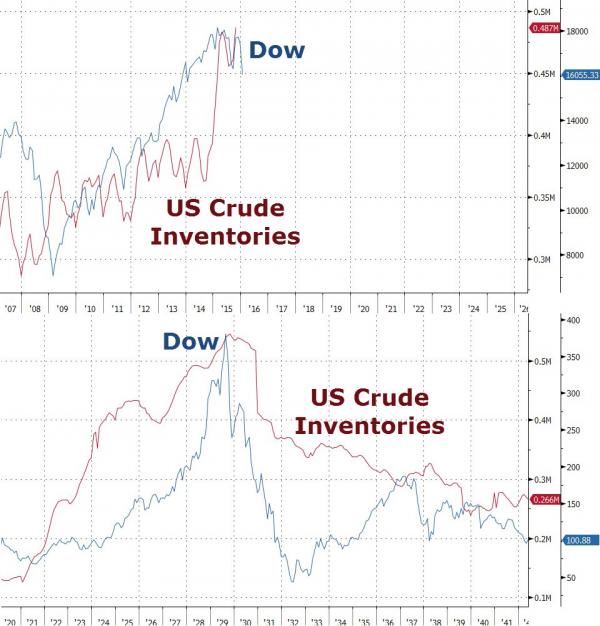
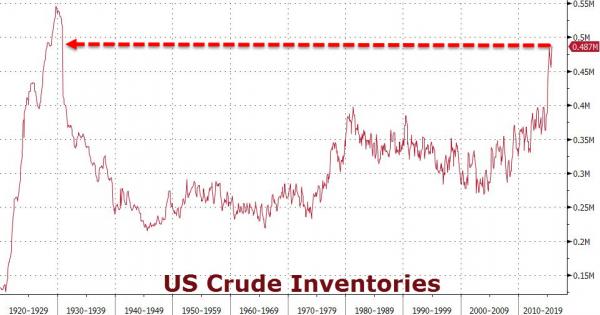
• US Crude Inventories Are The Highest Since the 1930s (ZH)

In case you were under the impression that oil was stabilizing, we thought this chart might help clarify just how “different” it is this time in the energy complex… U.S. crude inventories are at levels last seen when President Herbert Hoover was battling the Great Depression.

After this week’s build – Crude stockpiles climbed 8.38 million barrels to 494.9 million in the week ended Jan. 22, the highest since November 1930, according to weekly and monthly data from the Energy Information Administration. It did not end well last time…

Read more …

It’ll get cheaper though.

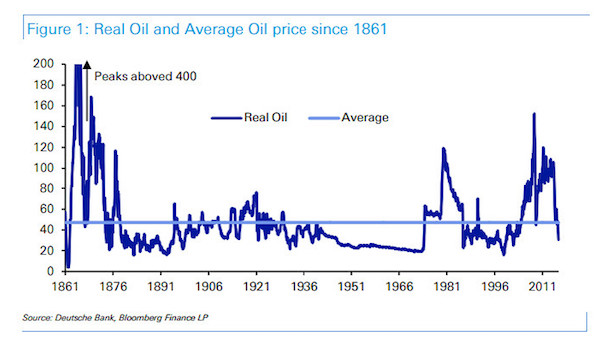
• Chart Going Back To 1861 Shows Oil Isn’t Insanely Cheap Right Now (MW)

Oil futures are hovering around $30 a barrel—not far off 12-year lows—and bears are penciling in a test of $20 or lower. It is a pretty downbeat picture, but is black gold really that cheap on a historical basis? Not really, according to the chart from Deutsche Bank, which tracks inflation-adjusted oil prices—and the average price—all the way back to 1861, just two years after Edwin Drake drilled the first productive U.S. oil well near Titusville, Pa. Over the last 150-plus years, the average oil price is $47 a barrel, according to the data. West Texas Intermediate oil futures for March delivery were down 22 cents, or 0.7%, at $31.23 a barrel in late morning trade. “So current levels are low but not exceptionally low relative to long-term history,” said Jim Reid, macro strategist at Deutsche Bank, in a Wednesday note.

The charts were published as part of an annual study by the investment bank. Interestingly, Reid did note that this was the first year that the firm’s long-term mean reversion exercise shows positive return expectations for oil since the study began more than a decade ago. But don’t get too excited over prospects for an immediate mean-reversion rally. Reid puts the findings in the context of the commodity cycle, which is on the downswing after a sharp run-up that began in the mid-1990s. He notes the “long-held belief” that commodities, such as oil, that are a factor of production can’t outstrip inflation over the long term because “if they do there will be alternatives found.”

That helps to explain oil’s pullback. This process, however, “can take years to resolve, so even if we’re correct, commodity cycles can still last a long time before they eventually mean revert,” he wrote. Meanwhile, the graph “doesn’t suggest that current levels are as extreme as many would suggest even if long term value has returned,” Reid said. “The $140 prices a few years back look especially bubble-like” from a long-term perspective.

Read more …

Fed’s done.

• Why the Fed Has the Stock Market Spooked (WSJ)

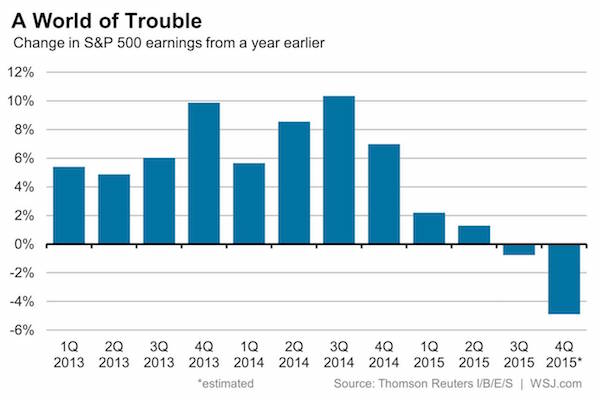
Investors have grown accustomed to getting help from the Federal Reserve. But in a world where American companies are tethered less tightly to the U.S. economy, that help may not be so forthcoming. The Fed on Wednesday said economic data had softened since it decided to raise rates in December, and that policy makers were “closely monitoring global economic and financial developments.” But they didn’t send a clear signal that many investors were hoping for: that they would forgo raising rates at their March meeting. Stocks, which had been higher ahead of the Fed’s postmeeting statement, fell. One reason the prospect of further rate rises is jarring to investors is that they would come at an unusual and unfortunate time. While rate increases usually arrive when profits are growing solidly, they are now shrinking.

That this hasn’t chastened the Fed may reflect the growing role in U.S. companies’ results of operations outside the U.S. So falling profits simply aren’t the clear indication of U.S. economic vulnerability that they once were. As companies continue to report fourth-quarter earnings, the decline in profits is something investors are acutely aware of. With about one-quarter of results from the index’s constituent companies now in, S&P 500 earnings look to have fallen by 4.9% in the fourth quarter from a year earlier, according to Thomson Reuters. This follows a 0.8% decline in the third quarter. That marked the first drop since the deep profits recession that ended in 2009. To be sure, the collapse in energy-sector earnings plays a big role. But excluding them, profits would be up just 1.3%.

Moreover, ignoring a sector because it is doing poorly—energy now, financials during the crisis, technology after the dot-com bust—risks sugarcoating the situation. Even if it weren’t for all the other things unsettling investors now—dollar debt and commodity market woes, emerging market outflows, concerns over the U.S. economy’s ability to grow in a troubled world—the combination of Fed tightening and falling profits would be worrisome. After all, points out Richard Bernstein Advisors portfolio strategist Joe Zidle, the two variables investors care most about when valuing stocks are profits and interest rates. When, as now, they both are headed the wrong way, it is a recipe for trouble. It also is a recipe that is exceedingly rare. The only other time that Mr. Zidle and his colleagues have identified where the Fed raised rates during a profits recession was in the early 1980s. That was when the central bank was moving to snuff exceedingly high inflation.

Read more …

“Margin calls and deleveraging is being talked about more and more..”

• China Shares Flounder Again, But ‘Real Economy’ Sound Says State Media (Reuters)

China’s volatile shares tumbled again on Thursday, taking losses this month to about 25% or 13 trillion yuan ($2 trillion), while state media insisted that the market ructions did not reflect the real economy. The benchmark Shanghai Composite Index ended down 2.9%, and the CSI300 index of the largest listed companies in Shanghai and Shenzhen shed 2.6%, both indexes having tumbled this week to levels not seen since 2014. Trading was very light, as many investors have given up on Chinese stocks, burnt by last summer’s 40% crash and a hair-raising January that has taken indexes back to late 2014 levels.

“The majority of equity investors we met over a four-day marketing trip in ASEAN last week had trimmed exposure to China equities by varying degrees and were waiting for signs of stabilisation for potential re-entry,” said Japanese broker Nomura. January began with sharp falls in Chinese stocks and a depreciation in the yuan currency, and the sell-off hasn’t abated as economic data confirmed slowing growth and deteriorating business conditions. As the markets keep falling, the prospect of investors being forced to sell stocks bought with borrowed money to cover margin calls has hurt sentiment further. “Margin calls and delveraging is being talked about more and more in a market extremely bearish about China’s economy and the yuan’s value,” said Wang Yu, analyst at Pacific Securities.
Read more …

Control P.

• China’s Central Bank Makes Most Massive Cash Infusion In 3 Years (WSJ)

China’s central bank is putting the largest amount of cash into the financial system in nearly three years, using a weekly market operation to pre-empt a holiday-induced funding squeeze and offset rapid capital outflows. The People’s Bank of China offered 340 billion yuan ($51.89 billion) of short-term loans, known as reverse repurchase agreements, to commercial banks in a routine money market operation Thursday. The central bank provided 440 billion yuan via similar tools Tuesday, the first leg of its twice-a-week liquidity-management exercises.

Given the maturity of 190 billion yuan of previously issued loans, the PBOC’s net cash injection this week totals 590 billion yuan, the biggest of its kind since early February 2013, when it reached 662 billion yuan. The move follows an aggressive pump-priming exercise by the PBOC last week, when the central bank offered more than 1.5 trillion yuan in gross short- and medium-term lending to banks. The eye-popping liquidity injection is partly intended to satisfy typically surging demand for cash ahead of the Lunar New Year holiday that starts Feb. 7. It also constitutes an effort to stem accelerating capital flight as investors become more nervous about the health of China’s economy, and as the country’s main stock market has lost nearly 23% since the start of this year.

Read more …

“The last time central bank Gov. Zhou Xiaochuan spoke publicly was in early September..”

• China Sharpens Efforts to Halt Money Outflow (WSJ)

China is ramping up efforts to halt a flood of money leaving the country in response to an economic slowdown, moves that risk undermining Beijing’s ambition to elevate the yuan’s profile on the world stage. Its latest steps involve curbing the ability of foreign companies in China to repatriate earnings, shrinking the pool of Chinese yuan available for banks in Hong Kong to make loans, and banning yuan-based funds for overseas investments, people with direct knowledge of the matter said. The measures, most of which haven’t been publicly disclosed, follow efforts by China’s central bank to discourage investors from betting against the yuan and to crack down on overseas money transfers. “They’re sparing no effort to prevent capital outflows,” said a senior Chinese banking executive close to the central bank.

“All the measures are the most aggressive I’ve seen in recent history.” The people with direct knowledge said the People’s Bank of China, the central bank, also is considering ways to lure money back to the country, including letting foreign residents and companies buy certificates of deposit for fixed periods. Currently they are restricted to ordinary deposit accounts. The unusual moves come as China burns through foreign-exchange reserves to prop up its currency and stem an increasingly vicious cycle of easing credit, a weakening currency and fleeing capital. Too much outflow, Chinese officials say, could threaten the stability of the country’s financial system. Just two months ago, the IMF’s designated the yuan as one of the world’s reserve currencies, a nod to China as a global economic power.

Still, Beijing is now retreating from its pledges to give markets more influence in setting the yuan’s value. Many investors say they are also concerned over what they consider to be inadequate communication by the central bank. The last time central bank Gov. Zhou Xiaochuan spoke publicly was in early September, when he sought to reassure central bankers and finance ministers from the Group of 20 large economies that the rout in China’s stock markets was nearing an end. Investors and analysts have questioned the government’s commitment to market liberalization following Beijing’s attempts to prop up the stock market this past summer and, more recently, sending mixed signals over yuan policy. “China is aggressively reinserting capital controls,” said Scott Kennedy at Center for Strategic & International Studies in Washington. “It appears China has for the foreseeable future given up on the goal of substantial exchange-rate liberalization.”

Read more …

“I’m not expecting it, I’m observing it..” See, Ambrose wants the cake and eat it. All’s fine, but at the same time “It is stimulus as usual. The Politburo is back to its bad old ways.” It’s all fake, that’s the problem: “credit growth continues to expand far more rapidly than GDP growth..”

• Hysteria Over China Has Become Ridiculous (AEP)

Hysteria over China has reached the point of collective madness. Forecaster Nouriel Roubini said in Davos that markets have swung from fawning adulation of the Chinese policy elites to near revulsion within a space of 12 months, and they have done so based on scant knowledge and a string of misunderstandings. The Chinese themselves are being swept up by the swirling emotions. State media has accused hedge fund veteran George Soros in front page editorials of attempting to smash China’s currency regime by “reckless speculation and vicious shorting”. “Soros’s war on the renminbi cannot possibly succeed – about this there can be no doubt,” warned the People’s Daily. Articles are appearing across the world debating whether Mr Soros and his putative wolf pack will succeed in doing to the People’s Bank of China (PBOC) what he did to the Bank of England in 1992 – in the latter case with entirely positive consequences.

In fact, Mr Soros issued no such “declaration of war”, and nor is he so foolish as to take on a foreign exchange superpower and net global creditor with $3.3 trillion in foreign reserves. As it happens, I was at the dinner at the Hotel Seehof in Davos – drinking white Rioja – where Mr Soros supposedly revealed his plot. What he did let slip is that he had been shorting some Asian currencies – the Malaysian Ringitt or the Thai Baht, perhaps, out of nostalgia for the 1998 crisis. Mr Soros made general comments, claiming that credit in China has reached 350pc of GDP and that the hard landing is already happening. “I’m not expecting it, I’m observing it,” he said. The observations were boilerplate, what are called “tourist” insights in hedge fund parlance. He is not a player in China. So let us return to reality. The economic facts are in plain view. China is not slowing. It is picking itself up slowly after a “recession” in early 2015.

Car sales give us a steer. They collapsed early last year and touched bottom at 1.27m in July. Sales have been rising every month since, surging to a record 2.44m in December thanks to lower taxes. New registrations were up by 37pc for GM and 36pc for Ford and Mercedes. House prices have been climbing for three months. The nationwide index was up 1.6pc in December. Shanghai rose 15.5pc and Shenzhen 47pc. Even the “Tier 3 and 4” cities are coming back from an epic glut. The economy did indeed hit a brick wall early last year due to a fiscal shock and ferocious monetary tightening (passive) in late 2014. That was the time to lambast the Chinese authorities for errors of judgment, and some of us did so. Capital Economics estimates that growth slowed to 4pc based on its proxy indicator, and others broadly concur.

These indicators are not derived from the now useless “Li Keqiang index” of rail freight, electricity use and credit growth, which overstate the slowdown. Growth of total freight traffic has risen to 5.4pc from 3.5pc in June. That is a plausible gauge of what is really happening. A short-term economic rebound is already baked into the pie. Fiscal spending jumped 30pc in October and November. New bank loans and local government bond issuance – together, the proper measure of credit – reached a 12-month high of 14.4pc in December. It is stimulus as usual. The Politburo is back to its bad old ways. “Despite talk of deleveraging, credit growth continues to expand far more rapidly than GDP growth because, quite simply, they are not willing to tolerate any slowdown,” said Prof Christopher Balding from Peking University.

Read more …

“They have to reassure local savers and show them a willingness that the government is looking after them and their savings.”

• Yuan Bears Denounced as Delusional, Doomed by China State Media (BBG)

China’s leading state media are becoming more vociferous in their support for the yuan, having been fired up in the past week by George Soros’s observation that the economy is headed for a hard landing. Yuan short sellers “haven’t done their homework,” the state-run Xinhua News Agency said in an English-language article on Wednesday, while a People’s Daily commentary in Chinese declared that such trades will undoubtedly fail. The two editorials, in addition to at least three other articles published by Xinhua since the weekend, all argue the economy is growing at a decent pace. China is resorting to stepped-up rhetoric to help offset depreciation expectations after the yuan started the new year with the biggest weekly plunge since a devaluation in August.

The cost of steadying the exchange rate has shot up as a slowing economy, equity market turmoil, declining foreign-exchange reserves and surging capital outflows add to the pessimism. “They can write as many op-eds as they want, but two plus two doesn’t make five,” said Michael Every at Rabobank Group in Hong Kong, whose year-end 7.53 forecast for the yuan against the dollar is the most bearish in a Bloomberg survey of 41 analysts. “What they’re saying won’t put off speculators. The fundamentals are screaming and sending a clear picture that if economic growth doesn’t start picking up, the exchange rate will weaken.”

Soros said in Davos that he’s been betting against Asian currencies because a hard landing in China is “practically unavoidable.” Xinhua retorted by saying that his observations are the result of “partial blindness.” The billionaire investor rose to fame as the money manager who broke the Bank of England in 1992, netting a profit of $1 billion with a wager that the U.K. would be forced to devalue the pound. Malaysian Prime Minister Mahathir Mohamad called him a “moron” during the 1997 Asian financial crisis, saying he was out to wreck the region’s economies. “Given how people know Soros and what he did in 1992 and during the 1997-1998 Asian crisis, he’s too important to ignore, so China felt that they had to counter any negative comments,” said Tommy Xie at Oversea-Chinese Banking, who was cited by Xinhua as saying that the People’s Bank of China has become more predictable. “They have to reassure local savers and show them a willingness that the government is looking after them and their savings.”

Read more …

“..the prospect of investors having to sell stocks they bought with borrowed money in order to cover margin calls has also hurt sentiment.”

• China’s 2016 Stock Losses Rise To $1.8 Trillion (Reuters)

Chinese highly volatile shares ended lower again on Wednesday after plunging on Tuesday, taking losses in 2016 to about 22% or 12 trillion yuan ($1.8 trillion). The benchmark Shanghai Composite Index ended down 0.5%, having been up in the morning and as much as 4% lower during the day. It tumbled 6.4% on Tuesday to its lowest close since Dec. 1, 2014. The CSI300 index of the largest listed companies in Shanghai and Shenzhen ended down 0.3% after a similar rollercoaster ride. China markets began the year with a series of precipitous falls and a sharp depreciation in the yuan currency, and selling pressure has persisted as economic data confirmed slowing growth and deteriorating business conditions, hammering investors’ confidence in stocks.

Gu Yongtai, analyst at Cinda Securities, said the prospect of investors having to sell stocks they bought with borrowed money in order to cover margin calls has also hurt sentiment. “There’s fear that stock price falls would trigger margin calls, which then adds further pressure on prices, although the actual amount of forced liquidation is not as big as people would imagine,” Gu said. Four listed companies suspended trading in their shares on Wednesday, saying their major shareholders, who have pledged shares as collateral, face margin calls and would seek ways to avoid forced liquidation. “If the market continues to fall, equity pledging-related selling pressure could increase significantly, putting further pressure on the stock market,” said Gao Ting at UBS Securities.

Trading volumes have thinned, making price moves even more volatile, as many investors have given up on Chinese stocks since last summer, when shares crashed 40%. Beijing intervened to stem that rout and orchestrate a recovery of sorts, but anyone who mistook that for a bottom and bought back in will be nursing losses again. China’s woes have damaged risk appetite in global markets, too, along with tumbling oil prices. Investors across the world will hang on whether the market chaos of the last few weeks and concerns over China’s slowing economy might blow the U.S. Federal Reserve off its proposed course of gradual interest rate hikes. The Fed is expected to leave rates unchanged later on Wednesday and acknowledge that turmoil in financial markets threatens its upbeat view of the U.S. economy, leaving the chances of a March hike diminished but alive.

Read more …

Understating: “Most players will have a quiet quarter in China, including Apple..”

• China’s Smartphone Slump Bites Apple (WSJ)

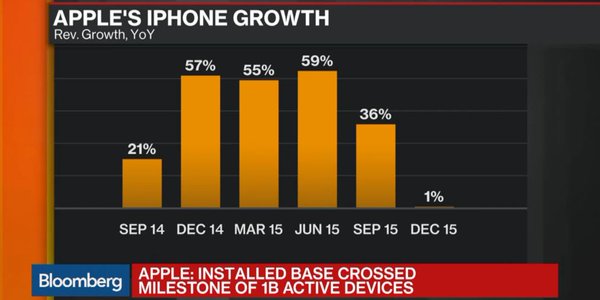
A slump in China’s smartphone market is weighing on Apple Inc.’s growth, even as the country remains a relatively bright spot for the iPhone maker. Chief Executive Tim Cook said on an earnings call Tuesday that Apple has begun to see “signs of economic softness” in the Greater China region, which includes China, Taiwan and Hong Kong. Apple’s sales in the region grew 14% in its fiscal first quarter ended Dec. 26 to $18.4 billion, better than any other region during the period, but far from the 70% growth it saw in the year-earlier period. In the fiscal year that ended Sept. 26, Greater China sales had surged 84%, with profits growing even faster. Keeping up this momentum will be a challenge for Apple this year, with China’s smartphone market slowing and the country’s economy cooling. China’s economic growth in 2015 was the slowest in a quarter century.

Apple’s suppliers in Asia have already warned of lower iPhone demand in the current quarter and have been told to scale back production, according to people familiar with the matter. China’s smartphone market growth will continue to slow this year, as most people in the country who want a smartphone already have one, analysts say. First quarter smartphone purchases will be hit by this market saturation, as well as secondary factors like freezing weather that is keeping shoppers in the north part of the country indoors, said Canalys analyst Nicole Peng. “Most players will have a quiet quarter in China, including Apple,” she said. Apple currently ranks No. 3 in China’s smartphone market after Huawei and Xiaomi. China’s smartphone market has grown crowded in the past year, after the success of smartphone startup Xiaomi encouraged imitators.

After several years of triple-digit percentage growth, Xiaomi missed its sales target for 2015. Samsung, the world’s biggest smartphone maker, has also struggled in China, where it has been hit by stiff competition. Mr. Cook said on the investor call that Apple was still optimistic on China and was “crafting products and services” with the country in mind. “We remain bullish on China and don’t subscribe to the doom and gloom,” he said. Still, Apple forecast Tuesday that its overall revenue will fall for the first time in 13 years in the current quarter and its stock fell in after-hours trade on concerns about growth.

Read more …

Where official news meets Bizarro world.

• Xi Urges Sound Planning For Supply-Side Structural Reform (Xinhua)

President Xi Jinping on Tuesday urged authorities to formulate targeted and specific plans to deliver structural reform on the supply side. Sound planning is the foundation for supply-side structural reform, which aims to improve productivity and realize people-first development, Xi told a meeting of the Central Leading Group for Financial and Economic Affairs. He stressed the importance of extensive research of the current economic conditions and to this end, he said, clear objectives were needed. Reform tasks should be specified and a system to designate and track responsibility should be put in place, he added. To address problems such as overcapacity, the government has pinned its hopes on supply-side structural reform, which focuses on better provision for high-quality goods and services and lower costs for businesses.

China’s economy grew by 6.9% year on year in 2015, its lowest annual expansion in a quarter of a century. During the meeting, Xi stressed the importance of environmental protection while developing the Yangtze River economic belt. “The Yangtze is the nation’s River of Life. No economic activities related to Yangtze should damage its environment. Its ecological system should only get better, not worse,” he said. Xi also emphasized the need to preserve forests. The tradition of voluntary tree planting should continue and a new round of “returning the farmland to forests” will begin, he said. He also urged cities to do more to achieve urban greening and called for more attention to be given to national parks to better protect endangered animals. Premier Li Keqiang, who is also deputy head of the Central Leading Group for Financial and Economic Affairs, also attended the meeting.

Read more …

Dalio argues something similar to what I often say when ‘experts’ talk about economic cycles: Kondratieff is a cycle, too. Don’t agree with him on everything, though.

• Pay Attention To Long-Term Debt Cycle (Ray Dalio)

I have a controversial view that is based on my alternative economic template, and I feel a responsibility to share at this precarious time. In brief, the Federal Reserve’s template, and that of most economists and market participants, reflects the business cycle. Based on it, tightening should occur when a) the rate of growth in demand is greater than the rate of growth in capacity and b) the usage of capacity (as measured by indicators such as the GDP gap and the unemployment rate) is becoming high. As a result, tightening now makes sense. However, as I see it, there are two important cycles to pay attention to — the business cycle, or short-term debt cycle, and the debt supercycle, or long-term debt cycle.

We are seven years into the expansion phase of the business/short-term debt cycle — which typically lasts about eight to 10 years — and near the end of the expansion phase of a long-term debt cycle, which typically lasts about 50 to 75 years. It is because of the long-term debt cycle dynamics that we are seeing global weakness and deflationary pressures that warrant global easing rather than tightening. Since the dollar is the world’s most important currency, the Fed is the most important central bank for the world as well as the central bank for Americans, and as the risks are asymmetric on the downside, it is best for the world and for the US for the Fed not to tighten.

Since the long-term debt cycle issue is the biggest issue that separates my view from others, I’d like to briefly focus on its mechanics. What I am contending is that there are limits to spending growth financed by a combination of debt and money. When these limits are reached, it marks the end of the upward phase of the long-term debt cycle. In 1935, this scenario was dubbed “pushing on a string”. This scenario reflects the reduced ability of the world’s reserve currency central banks to be effective at easing when both interest can’t be lowered and risk premia are too low to have quantitative easing be effective.

Read more …

Solid piece on yet another EU disaster.

• The EU’s Banking Union: A Recipe For Disaster (Thomas Fazi)

[..] the average balance sheets of the European Union’s 30 and 15 largest banks (€800 billion and €1.3 trillion respectively) are 13 and 21 times larger than the proposed recapitalisation limit. Not only are these banks too big to fail – they are too big to bail. The failure of any of them – even assuming that it would take place in isolation, rather than as part of a wider systemic crisis – would require the mobilisation of huge financial resources. This is also proven by the recent crisis, with certain large banks receiving public assistance in excess of €100 billion. With all this in mind, one could still argue that the bail-in mechanism represents a step forwards vis-à-vis the bailouts of recent years, by limiting the burden placed on sovereigns and thus the ‘socialisation’ of banking crises.

The crucial point to understand here is that the bail-in is indeed a great tool to have at one’s disposal, as there are undoubtedly numerous cases where a bail-in might be preferable to a bailout. But this has to be decided on a case-by-case basis. The problems arise when member states are forced to resort to the bail-in as the primary method of bank resolution, regardless of the potential consequences of such a move, of the nature of the bank’s problems, of the wider macroeconomic context, etc. – which is precisely what the banking union prescribes. This is especially true in light of the extreme disequilibrium between banking systems in the EU, itself a reflections of the wider social and macroeconomic imbalances between core and periphery countries.

As the ECB’s recent stress tests have revealed, the banks with the largest capital shortfalls are all located in the countries of the periphery, which have been hit the hardest by the crisis: Italy, Greece, Portugal, Ireland and Cyprus. This is not surprising: various studies have shown that there is a clear pro-cyclical link between a country’s negative macroeconomic performance and the capital adequacy of its banks. This is evident from the dizzying and rapidly-growing volume of non-performing loans (NPLs) in these countries – a direct result of the austerity policies pursued in recent years and, of course, the main reason why periphery banks failed the ECB’s stress tests. Which leads us to the paradoxical situation in which Italy finds itself in today.

The country’s banks fared relatively well during the financial crisis and therefore didn’t require almost any government aid at the time; since then, as a result of the country’s unprecedented socioeconomic collapse, itself a result of EU-sanctioned austerity, the balance sheets of Italian banks have severely deteriorated, and today – after a seven-year-long build-up of non-performing loans – are facing a system-wide crisis. For this reason, the Italian government has been in talks with the Commission for months over its plan to create a ‘bad bank’ to help offload some of the banks’ bad debt; at the time of writing, though, the Commission – the same Commission that by mid-2009 had approved €3 trillion in guarantee umbrellas, risk shields and recapitalisation measures to bail out Europe’s banks – continues to block the government’s plan, on grounds that it would amount to a violation of state aid and banking union rules.

Read more …

Just delayed ad infinitum?!

• EU’s Too-Big-to-Fail Bank Bill Won’t Be Withdrawn (BBG)

Jonathan Hill, the European Union’s financial-services chief said he won’t pull the plug on a bill intended to tackle too-big-to-fail banks that’s bogged down in a divided legislature. Asked in an interview in his Brussels office if he planned to heed calls from some bankers and European Parliament lawmakers to withdraw the legislation, Hill said firmly, “I don’t.” The European Commission, the EU’s executive arm, presented a draft bank-structure plan in early 2014 – before Hill’s tenure as commissioner began – as a way to boost financial stability by separating banks’ retail operations from riskier investment banking. The Council of the EU, which represents national governments and forms one half of the bloc’s legislature, reached a negotiating position on the bill in June 2015. But parliament, the other half, has made no progress on the proposal.

A proposal by Gunnar Hoekmark, the parliament’s lead lawmaker on the bill, was rejected by the Economic and Monetary Affairs Committee last May. A tentative compromise subsequently brokered by Hoekmark collapsed later in the year in the face of strong French-led opposition, leaving the committee fresh out of ideas and momentum on how to bridge the gap between the two main political groups, the center-right European People’s Party and the Progressive Alliance of Socialists and Democrats. Hoekmark has consistently rejected proposals for the mandatory separation of investment and consumer operations, while the Socialists have pushed for a strong separation trigger in the bill “We have told the Socialist group that there shall be no automaticity,” said Hoekmark, a member of the EPP group.

“The only option on the table is reasonable legislation based upon risk criteria, or we will reach a point where there is no common solution.” In fact, Hoekmark said he had rejected a fresh proposal from the Socialists this week. “I prefer no legislation instead of bad legislation,” he said. And Hoekmark appears to be in no hurry to cobble together a new compromise. “There is a broader understanding that we must take stock and look at what we have achieved before proceeding with new legislation,” he said. “Let’s analyse the consequences, let’s see if we are lacking, or if we have some over-regulation. 2016 is a good year for such assessments.”

Read more …

Only bank shareholders get punished.

• Five of Six Brokers in Libor Trial Are Acquitted by London Jury (BBG)

Five ex-brokers accused of helping convicted trader Tom Hayes rig Libor were acquitted Wednesday by a London jury, in a setback to U.K. fraud prosecutors. Noel Cryan, 50, who worked at Tullett Prebon Plc in London, Colin Goodman, 54, and Danny Wilkinson, 49, formerly of ICAP, and RP Martin’s Terry Farr, 44, and James Gilmour, 50, were found not guilty and released. The jury couldn’t reach a unanimous verdict on a sixth man, ICAP’s Darrell Read, 50, and was sent home to come back Thursday to discuss the remaining charge. After a four-month trial, the jury took about a day to find the others not guilty. The verdicts will be seen as a blow to the Serious Fraud Office, which appeared to have turned its fortunes around in the last 12 months.

A dozen banks have been fined about $9 billion by global authorities over the last four years in relation to the manipulation of Libor, the benchmark interest rate used in trillions of dollars of derivatives and loans. More than 30 individuals have been charged, and Hayes was convicted last year. “It’s always been a surprise and disappointment that these people were seen as front and center when they weren’t even bankers,” Matthew Frankland, a lawyer for Wilkinson, said by phone. “If what the SFO says is true, it’s rather shocking that more senior people aren’t being prosecuted.” Hayes, the former UBS and Citigroup trader prosecutors alleged was at the center of a conspiracy, was jailed in August. His sentence was reduced to 11 years from 14 years upon appeal in December.

“The key issue in this trial was whether these defendants were party to a dishonest agreement with Tom Hayes,” SFO Director David Green said in a statement. “By their verdicts the jury have said that they could not be sure that this was the case. Nobody could sensibly suggest that these charges should not have been brought and considered by a jury.” The result comes at the end of a sprawling and complex case that was postponed for several days when one of the defendants, Wilkinson, fell ill. Several of the men cried as the verdicts were read out. Farr burst from the dock and climbed the stairs to embrace his wife and son.

Read more …

Because that’s more important than human lives.

• EU Says Greece ‘Seriously Neglected’ Schengen Border Duties (Kath.)

The EU executive said on Wednesday that Greece has “seriously neglected” its frontier duties to Europe’s free-travel Schengen zone and could be subject to new border controls by other members if it fails to remedy the problems within three months. “The draft report concludes that Greece seriously neglected its obligations and that there are serious deficiencies in the carrying out of external border control that must be overcome … by the Greek authorities,” European Commission Vice President Valdis Dombrovskis told a news briefing. The draft Schengen evaluation report on Greece was based on unannounced site visits to the Greek-Turkish land border as well as to the islands of Chios and Samos carried out from 10 to 13 November 2015. Experts looked at the presence of police and coast guard personnel on the inspected sites, the efficiency of the identification and registration process, sea border surveillance and cooperation with neighbouring countries.

According to the report “there is no effective identification and registration of irregular migrants and… fingerprints are not being systematically entered into the system and travel documents are not being systematically checked for the authenticity or against crucial security databases, such as SIS, Interpol and national databases.” “The report shows that there are serious deficiencies in the management of the external border in Greece,” Migration and Home Affairs Commissioner Dimitris Avramopoulos said. “We know that in the meantime Greece has started undertaking efforts towards rectifying and complying with the Schengen rules. Substantial improvements are needed to ensure the proper reception, registration, relocation or return of migrants in order to bring Schengen functioning back to normal, without internal border controls. This is our ultimate common goal,” Avramopoulos said.

Read more …

Sweden is busy organizing the ‘expulsion’ of 80,000 refugees, while the Dutch government (they chair the EU until July 1) has announced plans to launch a ‘ferry’ line to force refugees back to Turkey from Greece. One day after the parliament in The Hague approved a motion for Dutch jets to start bombing Syria.

And I’m thinking: it’s alright to not be all that smart or competent, but please at least try to maintain a degree of decency, hold on to a shade of moral values. But perhaps those two things are two sides of the same coin. We should seriously wonder what Europe will look like a year from now. There’ll be at least another 1 million refugees trying to make it to Europe in 2016, that’s a given. The heart shudders.

• Sweden To Expel Up To 80,000 Rejected Asylum Seekers (Guardian)

Sweden intends to expel up to 80,000 asylum seekers who arrived in 2015 and whose applications had been rejected, interior minister Anders Ygeman said on Wednesday. “We are talking about 60,000 people but the number could climb to 80,000,” the minister was quoted as saying by Swedish media, adding that the government had asked the police and authorities in charge of migrants to organise their expulsion. Ygeman said the expulsions, normally carried out using commercial flights, would have to be done using specially chartered aircraft, given the large numbers, staggered over several years.

The proposed measure was announced as Europe struggles to deal with a crisis that has seen tens of thousands of refugees arrive on Greek beaches, with the passengers – mostly fleeing conflict in Syria, Iraq and Afghanistan – undeterred by cold, wintry conditions. The United Nations says more than 46,000 people have arrived in Greece so far this year, with more than 170 people killed making the dangerous crossing. Sweden, which is home to 9.8 million people, is one of the European Union countries that has taken in the largest number of refugees in relation to its population. Sweden accepted more than 160,000 asylum seekers in 2015.

Read more …

The difference two years make. From 19 Nov 2013. Paraphrasing Groucho: “These are my principles, and if you don’t like them, I have others.” Zero moral compass.

• European Commission in 2013: Refugee Push-Backs Are Illegal (EURActiv)

The European Commission indirectly warned Greece and Bulgaria today (19 November) to stop turning down Syrian refugees at their borders with Turkey, after the UN issued a similar call just a few days before. The UN High Commissioner for Refugees (UNHCR) António Guterres called last Friday on Greece and Bulgaria to stop turning back Syrians fleeing their war-ravaged homeland. Bulgarian authorities have reportedly bragged of turning down refugees at the border. According to the government website, Interior Minister Tsvetlin Yovchev, who is also deputy prime minister, has said that in just one day more than 100 persons, and previously more than 150, were from entering the country. Hundreds of policemen have been sent to the Bulgarian border with Turkey to push back prospective immigrants.

The impoverished country is struggling to deal with the some 7,000 refugees from Syria already on its soil, with more and more still managing to arrive. Both Greece and Bulgaria have begun the construction of fences on their borders with Turkey. Greece has erected a 12.5km wall at a critical section of the Greece-Turkish border near the town of Orestiada, while Bulgaria has announced plan to build a similar, 30-km fence near the town of Elhovo. Michele Cercone, spokesperson for home affairs commissioner Cecilia Malmström, told EurActiv that pushing back asylum seekers was against EU and international law. “Push-backs are simply not allowed. They are not in line with EU and international obligations. Member states cannot, shall not and should not carry out any push-back,” he said.
Asked how laws against push-backs were consistent with the fact that several member states had erected walls or fences at their borders, Cercone conceded that EU countries were free to decide their own border protection measures. “This is of course their choice. But we have always said that walls do not solve problems. What solves problems is a consistent structural management of migratory and asylum seekers’ flows,” Cercone said. He explained that this was implying that member states should be able to manage these flows in full respect of fundamental rights and international and European obligations. “Nobody coming or arriving to the EU territory and asking for asylum can be pushed back or can be denied this possibility,” he said, adding that this stemmed from the core values on which the EU was built. Asked if the Commission had any particular message for Bulgaria and Greece, Cercone said this was a message to all member states.
Read more …

What happened to the 3 million prediction?

• Europe Faces Another Million Refugees This Year: UN (BBG)

As many as 1 million people from Africa, the Middle East and Asia will seek refuge in Europe this year, according to a report by global migration agencies, a number that nears levels seen last year in the continent’s worst migration crisis since World War II. The war in Syria will continue to be the main source of migrants after triggering a spike in 2015, according to the report from the United Nations High Commissioner for Refugees and the International Organization for Migration. An increasing number of people will also come from southwest Asia and northern and western Africa, and the continued flow will exacerbate tension among European Union governments already deemed incapable of dealing with new entries smoothly, they said.

“The conflict in Syria will continue unabated and will generate high levels of internal and external displacement,” the agencies said in the report published on their websites. Refugees fleeing “Afghanistan may increase amid “deteriorating security situation in the majority of the provinces and the continuing downward spiral of the economy.” The EU is struggling to create a comprehensive plan to deal with its worst refugee crisis since World War II. The crunch has riled politics across the bloc by bolstering support for anti-immigrant parties and has prompted some governments to impose border controls with other European countries. This week, Germany and its neighbors laid the groundwork to extend a reintroduction of checks at internal borders for as long as two years, a move that departs from the EU’s principle of passport-free travel among most of its members.

The situation won’t measurably improve this year, according to the report, which estimated that about 6.5 million Syrians have been driven from their homes inside their country and another 4 million have sought shelter in Egypt, Iraq, Jordan, Lebanon and Turkey. The agencies, which have drawn up a $550 million plan to help refugees, also said Afghanistan’s deteriorating security and the “downward spiral of the economy” will add to migrant numbers.

Read more …

No tears left.

• Refugee Boat Sinks Off Greek Island; 7 Bodies Recovered (AP)

Greek authorities say a total of seven bodies, including those of two children, have been recovered from the sea off the eastern Aegean island of Kos after a boat carrying migrants or refugees sank early Wednesday. Rescue crews recovered the bodies of three men, two women, a boy and a girl. There were two survivors — a man and a woman. A search and rescue operation in the area by vessels from the Greek coast guard and the European border patrol agency Frontex, a helicopter and Greek rescue volunteers was called off after all on board the boat were accounted for.

Read more …

Jan 272016
 
 January 27, 2016  Posted by at 4:40 pm Finance Tagged with: , , , , ,  8 Responses »


Berenice Abbott Broome Street, Nos. 504-506, Manhattan 1935

Though she had no intention of being funny, we laughed out loud, as undoubtedly many did with us, when incumbent and wannabe IMF head Christine Lagarde said last week in Davos that China has a communication issue. Of course, Lagarde knows full well that Beijing has much bigger problems than communication ‘with the market’. Or, to put it differently, if Xi and Li et al would ‘improve’ their communication by telling the truth about their economy, nobody would be talking about communication anymore.

Mixed signals from China, which is attempting to shift its economy away from exports and investment to a consumer-driven model, have deepened concerns about the outlook for world growth, she said. Uncertainty is “something that markets do not like”, Ms Lagarde told a panel of business leaders and economic regulators in the snow-blanketed Swiss ski resort. Investors have struggled with “not knowing exactly what the policy is, not knowing exactly against what the renminbi is going to be valued”, she said, referring to China’s currency. “I think better and more communication will certainly serve that transition better.”

The world’s second-largest economy this week announced its 2015 GDP growth as 6.9%, its slowest in a quarter of a century. The figure cast a shadow over the summit, where IHS chief economist Nariman Behravesh told AFP that Chinese policymakers had “fumbled” and had “added to the uncertainty and the volatility by their behaviour”. Mr Fang Xinghai, the vice-chairman of China’s securities regulator, said at the same panel that “in terms of communication, we should do a better job”. “We have to be patient because our system is not structured in a way that is able to communicate seamlessly with the market,” he added.

The real issue is what people would think if Beijing announced a more realistic 2% or less GDP growth number. The thought alone scares Lagarde as much as anyone, including the Politburo. The sole option seems to be to keep lying as long as you can get away with it. But how and where the yuan will be valued by China itself has become entirely inconsequential compared to how markets value the currency.

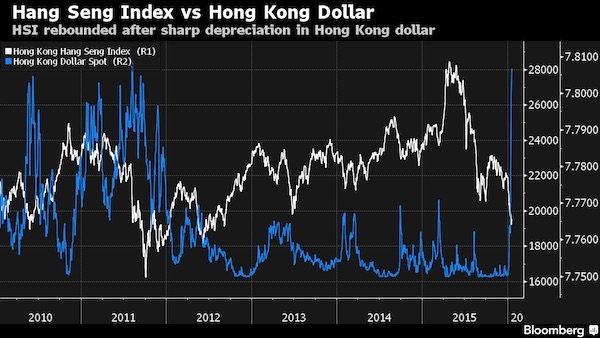
The PBoC spent a fortune trying to straighten the offshore and onshore yuan(s), only to see the two diverge sharply again, as Shanghai stocks posted the biggest loss on Tuesday, at 6.4%, since the ‘unfortunate’ circuit breaker incident. That puts additional pressure on the Hong Kong dollar peg, and ultimately on the mainland China peg to whatever it is they’re trying to peg to.

Beijing might solve some of these problems by devaluing the yuan by 30%, or even 50%, but it would invite a large amount of other problems in the door if it did. Like a full-blown currency war. Still, it’s just a matter of time till Xi and Li either do it voluntarily or are forced to by ‘the market’.

What they are trying very hard NOT to communicate is how much pain their Ponzi debt burden has put them in. It’s not even fully clear to what extent Xi himself is aware of this, but he knows at least enough to keep his mouth shut on the topic. It’s quite possible that some of his top aides dare not reveal the real tally to their boss for fear of their jobs and heads.

In concert with denial and obfuscation, pride and hubris may be clouding the image the Chinese have of themselves and their economy. The rest of the world has followed them in that to a large degree, but it’s got to wake up at some point. If what the WSJ quotes a Beijing-based investor as saying is halfway true, and Xi realizes the opportunity it provides him, a huge devaluation may be imminent after all, if Shanghai shares keep falling the way they are.

Yuan’s Fall Is Just ‘Noise’ Amid Deeper China Woes

The country is already littered with “zombie” factories, empty apartment blocks that form ghostly suburbs, mothballed power stations and other infrastructure that nobody needs. But yet more wasteful projects are in the pipeline, even as the government talks about cutting industrial overcapacity. “That’s the misalignment—everything else is noise,” says Rodney Jones, the Beijing-based principal of Wigram Capital Advisors, who was a partner at Soros Fund Management during the 1990s. If debt keeps piling up at the current rate, China faces an eventual financial crisis, perhaps leading to years of subpar growth, mirroring the fate of Japan after its bubble burst in the early 1990s.

Mr. Jones argues that global equity markets haven’t property adjusted to this risk, even after a 16% decline in U.S. dollar terms from their May peak. “The world will have to learn to live without demand from China,” he says. “It’ll come as a shock.” A sharp devaluation won’t fix these distortions, and might even make matters worse if, as likely, it were to trigger financial mayhem in China’s trading partners. An alternative—further clamping cross-border currency controls—would be a humiliating retreat from Beijing’s policy of making the yuan more international.

If China imports continue to fall the way they have recently, a development that has already relentlessly hammered global commodities markets and exporting emerging nations, the advantages of a large devaluation could become irresistible even for a proud president. With capital flight in 2015 estimated at $1 trillion, and a roughly equal chunk of foreign reserves thrown at attempts to ‘stabilize’ the yuan, that pride is getting costly.

..

But it occureed to me today that perhaps I simply haven’t been cynical enough yet when pondering the matter. The support for a strong yuan, the one thing that is constantly ‘communicated’ to the world, may be just another facade. Beijing may have long decided to go for the jugular. China will have to adjust to the popping of its growth fairy tale and Ponzi economy no matter what it tries to do to prevent it.

Might as well swallow the bitter pill in one go then and get it over with?! It would make exports much more attractive at a time when more expensive imports are much less of an issue. As nice example is the very disappointing sales of iPhones in the country, prompting this comment from Apple CEO Tim Cook today: “We’re seeing extreme conditions unlike anything we’ve experienced before just about everywhere we look.” I think he might want to consider that what happened before was extreme, not what is now.

Beijing did a few things recently that triggered my cynicism radar. First, they targeted George Soros.

China Accuses George Soros Of ‘Declaring War’ On Yuan

Chinese state media has stepped up a salvo of biting commentaries against George Soros and other currency traders as the yuan comes under pressure, with the billionaire investor accused of “declaring war” on the unit. At the annual World Economic Forum in Davos last week, Soros told Bloomberg TV that the world’s second-largest economy was heading for more troubles. “A hard landing is practically unavoidable,” he said. Soros [..] pointed to deflation and excessive debt as reasons for China’s slowdown.

[..] Soros “publicly ‘declared war’ on China”, the paper said, citing the 85-year-old as saying that he had taken positions against Asian currencies. But some readers questioned whether the official rhetoric could fuel Chinese investors’ fears. “They say a lot of loud slogans, but do official media even know that Chinese investors are in hell?” said one poster on social media network Weibo. “I’m afraid that Chinese investors will die in a stampede before Soros even shows his hand.”

And I’m thinking: why should you go after Soros in a very public way when you know the whole world will take note and there’s nothing you can do other than stomp your feet and thump your chest? “Look, everyone, the world’s most notorious and successful short seller is after us, but we’re so much smarter!” Maybe they think Chinese mom and pop investor juggernauts will fall for their ‘whatever it takes’ tale, but they have to deal with the entire planet here.

Could this be simple stupidity? At a certain point that gets hard to believe. An even better example, and one that is really brow-raising, was the announcement of an inquiry into China’s statistics chief:

Head Of China’s Statistics Bureau Investigated For Corruption

The head of China’s statistics bureau is being investigated for corruption, the country’s watchdog said on Tuesday. “Wang Baoan is suspected of severe disciplinary violations, he is currently under investigation,” the Central Commission for Discipline Inspection said in a one-line statement on its website, using a phrase that is usually used to refer to corruption. The announcement came just hours after Wang appeared at a media briefing in Beijing on China’s economy in 2015. Last week the National Bureau of Statistics released data that showed China’s economy grew at the slowest pace in 25 years. Wang reiterated on Tuesday that the country’s GDP calculations were reliable, Chinese media reported, despite widespread criticism of the data.

Here’s a guy seeking to soothe his audience, which in present circumstances includes the whole globe, and you cut him off at the knees just hours after? He says all’s fine, and then you sent a message to the world that he can’t be trusted?

The timing seems crucial here. They could have waited a week, or two, so the connection between the two events (Wang’s statement and the inquiry announcement) would have been much less obvious. They could also, of course, have had the inquiry but kept it hush-hush. Instead, as in the Soros case, there’s a big public declaration.

Wang is head of a statistics bureau that, says the NYT, is tasked with:

Inquiry in China Adds to Doubt Over Reliability of Economic Data

The statistics bureau has a variety of responsibilities that are hard to balance even in the best of times. The bureau is supposed to provide China’s leaders with an unvarnished assessment of the country’s economic strengths and weaknesses, even while reassuring the public about growth and maintaining consumer confidence. It is also supposed to release enough detailed and accurate information for investors and corporate leaders to make sound decisions about economic and financial prospects.

That leads us right back to the start of this article. Wang must provide “enough detailed and accurate information” for investors”, but how can he do that if the real numbers are as bad as I strongly think they are? In that case, accurate information would drive most investors away and drive others towards shorting the yuan.

He must also “provide China’s leaders with an unvarnished assessment of the country’s economic strengths and weaknesses”, and perhaps he screwed up there (too much varnish). Xi may have found out something real bad that Wang didn’t tell him about. But even then, the fact stands that Xi risks triggering exactly what he pretends to want to prevent, by taking this to the press.

To summarize: yes, it’s possible that Beijing has a communication problem. I’ve never had the idea that Xi understands that now his power dream has come true, he finds that power is not absolute, if and when he wishes to have a financial market that allows for China to get richer through trade. That he realizes the price to pay for that is having much less than total control.

Still, after glancing through this stuff, I wouldn’t be at all surprised if the decision for a very substantial devaluation of the yuan has already been taken. It would be a panic move, with largely unpredictable consequences, but then Beijing has plenty to panic about.

And I can’t wait to see what Lagarde has to say when she figures out her new currency basket baby turns around to bite her in the ass.

PS: Something I scribbled last week: Time and again, I see ‘experts’ claim that the fact that the Chinese services sector now makes up half of GDP, is a positive. But, even if we forget for now that much of its growth is due to financial services, the real meaning is the opposite. The services sector has been able to become so important simply because the manufacturing sector is plunging as badly as it is.

Jan 272016
 
 January 27, 2016  Posted by at 10:00 am Finance Tagged with: , , , , , ,  1 Response »


DPC City Market, Kansas City, Missouri 1906

• Nikkei Climbs, But Shanghai Extends Fall (CNBC)
• Why China’s Capital Flight Carnage Will Continue (Telegraph)
• A China Bank Contagion Could Blow Up Global Markets (CNBC)
• China Accuses George Soros Of ‘Declaring War’ On Yuan (AFP)
• Head Of China’s Statistics Bureau Investigated For Corruption (AFP)
• Inquiry in China Adds to Doubt Over Reliability of Economic Data (NY Times)
• Cash Is King as Europe Adapts to Negative Interest Rates (BBG)
• Europe Bank Rout Erases $434 Billion In 6 Months (BBG)
• The Market’s Troubling Message (Ashoka Mody)
• EU Botched Billion Euro Bail-Outs During Financial Crisis (Telegraph)
• World’s Biggest Wealth Fund Speaks Out on Missing Liquidity at Banks (BBG)
• Apple Reaches Peak iPhone, So What Now? (MW)
• Apple: ‘Extreme Conditions Unlike Anything We’ve Experienced Before'(BBG)
• AIG To Return $25 Billion After Activist Siege (FT)
• The Black Hole of Deflation Is Swallowing the Entire World (GWB)
• The Future is Blivets (Dmitry Orlov)
• The Agonies of Sensible People (Jim Kunstler)
• Clock Ticks Down On EU Passport Free Travel Dream (AP)
• Danish Parliament Approves Plan To Seize Assets From Refugees (Guardian)
• Belgium Wants Camp for 300,000 Refugees in Athens (DM)

Europe and oil falling.

• Nikkei Climbs, But Shanghai Extends Fall (CNBC)

Asia markets were mostly higher on Wednesday after Wall Street surged overnight on a bounce in oil prices and positive earnings news, shrugging off the recent global rout, at least temporarily. China shares were volatile, erasing most early losses in late trade. “Swinging from depressive slumps to manic rallies, markets remain volatile,” Vishnu Varathan, an analyst at Mizuho Bank, said in a note Wednesday. China’s market is likely to remain the region’s sticky wicket for hopes the long global rout will end. The Shanghai Composite was down 0.46% after tumbling as much as 4.10% earlier. That followed the index’s worst day on Tuesday since the suspension of the circuit breaker rule in early January, closing down 6.4%, hitting its lowest level since December 2014. The Shenzhen Composite dropped 0.948% after trading down as much as 5.62% earlier in the session.

Amid concerns about slowing economic growth and depreciation of the yuan, shares on the mainland got an additional bit of bad news Wednesday: China’s industrial profits fell 4.7% on-year in December, declining for a seventh month. The Shanghai Composite is down more than 20% since its most recent high of 3,651.76 on December 22, leaving it in a “bear within a bear” market. The index is off more than 47% from its 52-week high of 5,166.35, set June 2015. “Chinese markets look like they will continue to sell off until their last day of trading before Chinese New Year on February 5,” Angus Nicholson at spreadbettor IG said in a note Wednesday. “There is a good chance that Chinese equities may find their cyclical bottom in the next week and half if the current pace of selloff continues.” He expects the Shanghai Composite might eventually bottom around the 2300-2400 level.

Read more …

Self-fulfilling.

• Why China’s Capital Flight Carnage Will Continue (Telegraph)

Money has poured out of emerging market economies as fears that they will disappoint have continued to grow. This capital flight has put extreme pressure on emerging market currencies, driving speculation that more of these economies will have to capitulate, allowing marked devaluations of their currencies, or enforcing capital controls. $735bn was pulled out of emerging markets last year alone, according to the Institute of International Finance (IIF), up from $111bn in the preceding year. “The bulk of these outflows relate to China,” said the IIF, adding that money managers were taking out their money “in the face of concerns about a weakening currency”. Total capital outflows from the People’s Republic were thought to stand at $676bn last year.

The IIF said that it anticipated that capital would continue to leave emerging markets this year, but at a “more moderate pace”. Since Beijing’s botched readjustment of the yuan last August, investors have been anxious that a larger currency depreciation is on the way. As a result, they have taken their money out of the country in anticipation, increasing the demand for other currencies, at the expense of renminbi demand. The People’s Bank of China (PBoC) has had to intervene heavily, burning through reserves to keep the currency strong. “The recent flood of capital leaving China has been driven primarily by increased scepticism that the PBoC will hold to its pledge to keep the renminbi stable,” said Mark Williams at Capital Economics. Capital Economics estimated that outflows stood at $140bn in December alone, as firms may reassessing their expansion plans, and investors worry about the possibility of a further downturn.

“The PBoC has enough reserves to keep selling at December’s rate until mid-2018 but it would presumably throw in the towel before they were all exhausted,” said Mr Williams. “If investors think the PBoC may shift its stance in future, they have an incentive to sell renminbi assets now even if no policy change is currently being considered.” While the movements in Chinese stock markets are far removed from the real economy, and that economy does not seem to be melting down, high levels of capital flight could be toxic for the country. Helene Rey, an economics professor at the London Business School, told The Telegraph that there is a risk that investors overreact to recent moves, and negativity about China “becomes self-fulfilling”. “We know China has a lot of reserves, but when capital flows flow out at a quick rate this might have a lot of psychological consequences.” She suggested that a significant depreciation of China’s yuan would “probably not be good for the stability of a lot of emerging markets”.

Claudio Piron, a Bank of America Merrill Lynch strategist, said that China’s current problems were the result of its struggles with the impossible trinity, or “trilemma”. Policymakers cannot control capital flows, monetary policy and the currency all at the same time. Mr Piron said that the outflows have captured the “conflict between easing monetary conditions on one hand and contradictory attempts at foreign exchange intervention to target the yuan’s strength against the dollar on the other”. The policy uncertainty causing the outflows “may only be resolved once the market has regained confidence in China’s ability to restore a robust recovery and China’s monetary has come to an end”. Mr Piron suggested this would come in the final quarter of 2016 at the earliest.

Read more …

In China, a bank default is a government default.

• A China Bank Contagion Could Blow Up Global Markets (CNBC)

If the dark predictions are going to come true — that the market turmoil out of China will lead to “another 2008” — it will have to be a very different kind of crisis than the original. Six months after sell-offs in Shanghai began to reverberate through markets worldwide, bond-rating agencies continue to rate Chinese banks’ credit as investment grade, suggesting that if China does lead the world into recession, it will be a different affair than the sudden, sharp downturn catalyzed by the collapse of Lehman Bros. A measure of default risk used by Moody’s Investors Service puts the risk of any of the Big Four Chinese banks — Bank of China, the Industrial and Commercial Bank of China, China Construction Bank and Agricultural Bank of China — defaulting in the next year at no more than 1.5%, and for some as little as 0.5%, said Samuel Malone at Moody’s Analytics.

Even with nearly $11 trillion of assets and loans that reach into all sectors of China’s $10.3 trillion economy, for now, experts see little likelihood the banks themselves will be a problem; China’s largest banks are all controlled by a government that has the determination and resources to prop them up if necessary. And their ties to U.S. institutions are narrow enough that bond-rating agencies don’t foresee anything like the financial contagion of 2008, when liquidity problems quickly spread from bank to bank and nation to nation as the extent of the mortgage crisis became clear.

Read more …

“Declaring war on China’s currency? Ha ha”

• China Accuses George Soros Of ‘Declaring War’ On Yuan (AFP)

Chinese state media has stepped up a salvo of biting commentaries against George Soros and other currency traders as the yuan comes under pressure, with the billionaire investor accused of “declaring war” on the unit. At the annual World Economic Forum in Davos last week, Soros told Bloomberg TV that the world’s second-largest economy – where growth has already slowed to a 25-year low according to official figures – was heading for more troubles. “A hard landing is practically unavoidable,” he said. Soros – whose enormous trades are still blamed in some countries for contributing to the Asian financial crisis of 1997 – pointed to deflation and excessive debt as reasons for China’s slowdown.

The normally stable yuan, whose value is closely controlled by Beijing, has come under pressure in recent weeks and months in overseas markets and from capital outflows. Authorities have spent hundreds of billions of dollars to defend it. China’s official Xinhua news agency on Wednesday said that Soros had predicted economic troubles for China “several times in the past”. “Either the short-sellers haven’t done their homework or … they are intentionally trying to create panic to snap profits,” it said. An English-language op-ed in the nationalistic Global Times newspaper blamed “westerners” for not “accepting responsibility for the mess” in the world economy. The comments came after the overseas edition of the People’s Daily, the official mouthpiece of the Communist party, published a front-page article Tuesday titled “Declaring war on China’s currency? Ha ha” that was widely shared on Chinese social media.

Soros “publicly ‘declared war’ on China”, the paper said, citing the 85-year-old as saying that he had taken positions against Asian currencies. But some readers questioned whether the official rhetoric could fuel Chinese investors’ fears. “They say a lot of loud slogans, but do official media even know that Chinese investors are in hell?” said one poster on social media network Weibo. “I’m afraid that Chinese investors will die in a stampede before Soros even shows his hand.” In the 1990s Soros led speculators in bets against the Bank of England, which unsuccessfully sought to defend the pound’s exchange rate peg. “The Chinese left it too long” to change their growth model from dependence on exports to a consumer-led one, Soros said, even though Beijing had “greater latitude” than others to manage such a transition because of its currency reserves, which stand at over US$3tn.

Read more …

Done just hours after he says all’s fine in the economy. Beijing must not want to restore confidence.

• Head Of China’s Statistics Bureau Investigated For Corruption (AFP)

The head of China’s statistics bureau is being investigated for corruption, the country’s watchdog said on Tuesday. “Wang Baoan is suspected of severe disciplinary violations, he is currently under investigation,” the Central Commission for Discipline Inspection said in a one-line statement on its website, using a phrase that is usually used to refer to corruption. The announcement came just hours after Wang appeared at a media briefing in Beijing on China’s economy in 2015. Last week the National Bureau of Statistics released data that showed China’s economy grew at the slowest pace in 25 years. Wang reiterated on Tuesday that the country’s GDP calculations were reliable, Chinese media reported, despite widespread criticism of the data.

Questions have repeatedly been raised about the accuracy of official Chinese economic statistics, which critics say can be subject to political manipulation. Wang was appointed head of the National Bureau of Statistics in April 2015. He previously spent about 17 years in various positions in the finance ministry. Official allegations of corruption against high-level politicians are generally followed by an internal investigation by China’s Communist party, and sometimes lead to criminal proceedings which often end in conviction. Internal investigations into high-level party officials operate without judicial oversight. Once announced, they are likely to lead to a sacking followed by criminal prosecution and a jail sentence.

Read more …

They knew that in advance.

• Inquiry in China Adds to Doubt Over Reliability of Economic Data (NY Times)

The veracity of China’s economic data has been increasingly questioned as the slowing pace of the country’s growth has startled the world. And a new investigation into the official who oversees the numbers is unlikely to inspire confidence. The Communist Party’s anticorruption commission announced late Tuesday that it was looking into the head of the country’s statistics agency over what it called “serious violations.” It is unclear whether the investigation into the agency’s head, Wang Baoan, who became the director of the National Bureau of Statistics of China last April, is related to his current role or to his previous one as vice minister of finance. The commission did not release any further details about the inquiry.

China’s shrinking manufacturing sector and falling stock market have unnerved global investors. Any further doubt about its economic figures could paint an even darker picture of the health of the economy, adding to the pain in the markets. Stocks in Shanghai, which closed before the announcement, were off 6.4% on Tuesday. The statistics bureau has a variety of responsibilities that are hard to balance even in the best of times. The bureau is supposed to provide China’s leaders with an unvarnished assessment of the country’s economic strengths and weaknesses, even while reassuring the public about growth and maintaining consumer confidence. It is also supposed to release enough detailed and accurate information for investors and corporate leaders to make sound decisions about economic and financial prospects.

Few doubt that China has grown enormously over the past three decades. But economists, bankers and analysts who study the numbers believe that the bureau smooths data, underestimating growth during economic booms and overestimating it during downturns. Many economists are worried that China’s economy is not expanding anywhere close to the nearly 7% annual pace that bureau data still show. By some estimates, the pace is half of the official figures. Those skeptical about the data point, in part, to the underlying numbers. For example, electricity consumption, long a barometer of economic health and of the veracity of economic statistics, was nearly unchanged last year instead of rising in line with growth in China’s GDP. Some have cited the lack of correlation as a sign of possible fudging in the country’s economic statistics, while optimists have said that the figures may show how China is shifting away from energy-intensive manufacturing.

State news media reported last month that several officials in northeastern China had admitted to inflating investment figures and other data in previous years. Such moves, the reports indicated, helped explain steep drops in reported data from the region last year. Still, the bureau has consistently and repeatedly defended its statistics, contending that critics do not adequately understand the data or the Chinese economy. And the market impact of the investigation could be limited by the fact that many were already wondering about China’s data. “The international credibility of China’s GDP figures is anyway very low, so this probably is not a severe blow,” said Diana Choyleva at Lombard Street Research

Read more …

What happened to the war on cash?

• Cash Is King as Europe Adapts to Negative Interest Rates (BBG)

Europe’s ATMs worked overtime in 2015. A record €1.08 trillion ($1.17 trillion) of banknotes were in circulation, almost double the value 10 years ago, according to data compiled by the ECB. That’s a counterargument to some bankers who say that electronic forms of cash will replace paper money sooner rather than later. The value of banknotes in circulation rose 6.5% last year, the most since 2008. There are financial reasons – including negative rates on deposits – but part of the increase could be related to the influx of refugees, who don’t have bank accounts.

Read more …

“Deutsche Bank and Standard Chartered are each down more than 40% since July.”

• Europe Bank Rout Erases $434 Billion In 6 Months (BBG)

The plunge in European bank stocks over the past six months has wiped out about €400 billion ($434 billion) in market value, an amount that’s more than twice the annual economic output of Greece at current prices. The STOXX Europe 600 Banks Index, grouping 46 lenders, dropped twice as much as the region’s benchmark share index since late July. Banking stocks have fallen 14% in January alone, heading for their worst monthly performance since the depths of Europe’s sovereign-debt crisis in 2011. Deutsche Bank and Standard Chartered are each down more than 40% since July.

Read more …

“..after long absences, earthquakes come in quick succession. ”

• The Market’s Troubling Message (Ashoka Mody)

Amid one of the worst market routs on record, a chorus of reassuring economic commentators insists that global fundamentals are sound and investors are overreacting, behaving like a panicked herd. Don’t be so sure. Consider how wrong economists have been about the effects of the 2008 financial debacle. In April 2010, the IMF declared the crisis over and projected annualized global growth of 4.6% by 2015. By April 2015, the forecast had declined to 3.4%. When the weak last quarter’s results are released, the reality will probably be 3% or less. Economists are used to linear models, in which changes follow a relatively gradual and predictable path. But thanks in part to the political and economic shocks of recent years, we live in a highly non-linear world. The late Danish physicist Per Bak explained that after long absences, earthquakes come in quick succession.

A breached fault line sends shock waves that weaken other fault lines, spreading the vulnerabilities. The subprime crisis of 2007 breached the initial fault line. It damaged U.S. and European banks that had indulged in its excesses. The Americans responded and controlled the damage. Euro-area authorities did not, making them even more susceptible to the Greek earthquake that hit in late-2009. Europeans kept building temporary shelters as the banking and sovereign debt crisis gathered force, never constructing anything that would hold as new fault lines opened. Enter China, which briefly held the world economy together amidst the worst of the crisis. Just in 2009, the Chinese pumped in credit equal to 30% of gross domestic product, boosting demand for global commodities and equipment.

Germans benefited in particular from the demand for cars, machine tools, and high-speed rails. This activated supply chains throughout Europe. But China is becoming more a source of risk than resilience. The number to look at is not Chinese GDP, which is almost certainly a political statement. The country’s imports have collapsed. This is troubling because it is the epicenter of global trade. Shockwaves from China can test all the global fault lines, making it a potent source of financial turbulence. Only China can undo its excesses. Its vast industrial overcapacity and ghost real estate developments must be wound down. As that happens, large parts of the financial system will be knocked down. The resulting losses will need to be distributed through a fierce political process. Even if the country’s governance structure can adapt, the required deep-rooted change could cause China’s slowdown to persist for years.

Read more …

The last gasps of the EU.

• EU Botched Billion Euro Bail-Outs During Financial Crisis (Telegraph)

The European Commission mishandled government bail-outs in the wake of the financial crisis, imposing harsher conditions on member states as contagion spread across the continent, the EU’s Court of Auditors has found. In the first major assessment of the Commission’s role in “Troika” of international creditors, the ECA said Brussels was unprepared for Europe’s spiralling debt crisis as it failed to spot dangerous deficit levels in member states. The spending watchdog looked at five bail-outs from 2009 to 2011. Auditors found the Commission escalated its austerity demands as the financial crisis spread to the single currency’s periphery. Portugal was required to comply with nearly 400 conditions as part of its €78bn rescue programme in 2011, while Hungary – which was bailed-out in 2008 – was only asked to adhere to a list of only 60 demands.

“Some countries’ deficit targets were relaxed more than the economic situation would appear to justify,” said the auditors. “Countries that needed more reforms in a given field were asked to comply with fewer conditions than better-performing countries.” Greece – the eurozone’s biggest recipient of rescue cash – was not part of the audit and will be subject to its own bail-out review. The findings seem to vindicate initial fears that the EU lacked the expertise to manage a crisis which bought Europe to its knees after 2009. German chancellor Angela Merkel pushed hard for the IMF to be involved in the financial rescues of Ireland, Portugal and Greece, in a bid to enhance the credibility of the rescue programmes. Auditors said the Commission failed to spot dangerous deficit levels building up in member states before the crisis, which meant “it was not prepared for the first requests for financial assistance” when the signs of financial stress emerged.

Other shortcomings included the use of basic and “cumbersome” spreadsheets to forecast economic performance and missing documentation, which have yet to be found by authorities. “It is imperative that we learn from the mistakes which were made” said Baudilio Tomé Muguruza of the European Court of Auditors. Criticism of the Commission comes after the former president of ECB was hauled before Ireland’s parliament to explain his institution’s actions during the country’s 2010 rescue. The ECB, which formed part of the Troika along with the Commission and IMF, has been accused of forcing Dublin to assume the vast liabilities of Ireland’s failing banks – protecting senior bonholders from taking losses.

Read more …

Obvious.

• World’s Biggest Wealth Fund Speaks Out on Missing Liquidity at Banks (BBG)

As some of the world’s best-known investment banks blame tougher capital rules for contributing to the lack of liquidity in financial markets, the world’s biggest sovereign wealth fund has a different take. The argument is “an excuse for something else,” Oeyvind Schanke, chief investment officer of asset strategies at Norway’s $790 billion fund, said in an interview in Oslo on Tuesday. One week after bank executives met in Davos, Switzerland, where they spent some time discussing the fallout of stricter financial requirements, Norway’s wealth fund is questioning a tendency to blame regulators. “New regulations have reduced volume on a normal day because you don’t have that type of market-making activity from the investment banks and other large players,” Schanke said.

“But in times of big movements they wouldn’t be there anyway. 2008 is a perfect example. You didn’t have any tough regulation in 2008, but somehow the fixed-income market froze up – which you would have expected because this type of activity is to facilitate normal trading days.” “Obviously they are used to making money on this activity and now they can’t make money anymore,” he said. “They’re trying to find reasons for what’s going on.” Concerns that markets face a liquidity crunch are growing as the world’s biggest investment banks retreat from capital-intensive fixed income, currency and commodities trading to meet tougher regulatory demands. Liquidity has been affected by banks committing less capital. But the same regulations that are contributing to that have made the world of finance much safer, according to Schanke. “You can’t have it all.”

Read more …

Now bubble to pop.

• Apple Reaches Peak iPhone, So What Now? (MW)

Apple confirmed the worst fears of many investors Tuesday: The company has hit peak iPhone. As many on Wall Street had predicted, Tuesday’s earnings report showed that Apple revenue growth has slowed, with sales increasing less than 2% year-over-year in the all-important holiday quarter. The iPhone grew by only 0.4% year-over year, and Chief Executive Tim Cook admitted smartphone sales are likely to decline for the first time in the current quarter. Apple depends on sales of the iPhone for the bulk of its revenue, including $51.6 billion of its $75.9 billion in holiday-quarter sales. As iPhone sales have continued to grow since its introduction in 2007, Apple has become the most valuable company in the world, but a slowdown likely signals Apple’s transition from a high-growth tech stock to a value stock.

Cook presented an outlook that shows total revenue will fall along with iPhone sales in the current quarter, citing economic ”malaise in virtually every country in the world” as well as currency headwinds. Apple’s outlook for its fiscal second quarter revenue — ranging from $50 billion to $53 billion — represents a potential revenue decline of 8.6% to 13.8% from $58 billion in the fiscal second quarter of 2015. Apple shares dropped more than 2.5% in late trading. Apple’s other businesses have not stepped up to augment the iPhone. In its fiscal first quarter, Apple saw a tiny uptick in iPhone revenue but declines in its other major hardware products, as iPad revenue fell 21% and Mac revenue fell 3%.

Apple introduced its first new hardware product since the iPad in 2015, the Apple Watch, but it still offers a small, unknown sales total for the company. Revenue for other products — which includes the Apple Watch along with the Apple TV, Beats headphones, the iPod and accessories — jumped 62% year-over-year, but still brought in less than $4.4 billion. Those numbers won’t move the needle when total revenues topped $75 billion.

Read more …

Maybe what you experienced before was extreme, and this is normal?!

• Apple: ‘Extreme Conditions Unlike Anything We’ve Experienced Before'(BBG)

What’s keeping the CEO of a company that just reported the most profitable quarter in history up at night? For Apple’s Tim Cook, it’s the “economic challenges all over the world.” “This is a huge accomplishment for our company especially given the turbulent world around us,” said Cook, immediately after running through the company’s quarterly financial highlights on a conference call. Ever since the surprise devaluation of the Chinese yuan in August, the potential for a hard landing in the world’s second-largest economy has been front-of-mind for investors. Cook did nothing to assuage those concerns. While pointing out that Apple had been performing quite well in China last summer—unlike some other firms—he suggested that the forward outlook was not nearly as bright.

“Notwithstanding these record results, we began to see some signs of economic softness in Greater China earlier this month, most notably in Hong Kong,” he said. Meanwhile, other major markets for Apple, including Brazil, Russia, Japan, Canada, southeast Asia, Turkey, and the eurozone have been roiled by slow economic growth, the downturn in commodities prices, and weakening currencies. “Our results are particularly impressive given the challenging global macroeconomic environment,” said Cook. “We’re seeing extreme conditions unlike anything we’ve experienced before just about everywhere we look.”

For Apple, which generates roughly two-thirds of its revenues outside the U.S., this is no small matter. The lofty U.S. greenback crimped revenues received abroad, with Cook specifically citing the adverse effect of weakness in the British pound, euro, Canadian dollar, Aussie dollar, Mexican peso, Turkish lira, Brazilian real, and Russian ruble. According to Cook, these foreign exchange fluctuations shaved 15% off revenues the tech powerhouse earned abroad relative to its fiscal fourth quarter.

Read more …

Yeah, sure, AIG is a going concern, yada yada. Thing is, what’s the bill, and who’s paying?

• AIG To Return $25 Billion After Activist Siege (FT)

American International Group’s chief executive has pledged to return $25bn to shareholders as he defies demands from activist investors Carl Icahn and John Paulson to break up the world’s fourth most valuable insurance company. Peter Hancock on Tuesday unveiled a streamlining plan including a listing of AIG’s mortgage insurance arm, accelerated cost cutting and a separation of legacy assets in an effort to rally support from other shareholders. He said that AIG, which has already scaled back dramatically since the financial crisis and its $185bn government bailout, would be willing to make further disposals if they made financial sense — but argued that there was no case at present to shed core divisions.
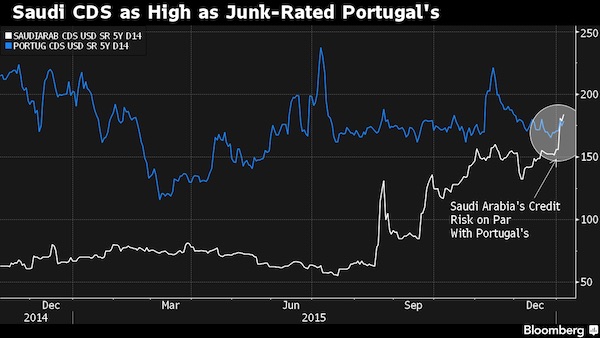
“We’re absolutely open to additional divestitures beyond what we’ve talked about — even of our largest units — but you don’t make a decision of that scale without thinking very hard about the impact,” he said. Management’s refusal to acquiesce to the activists’ break-up call sets the stage for a full-scale proxy war. Mr Icahn has already said that he hopes directors “will take matters into its own hands if management still resists drastic change”. The billionaire, who has received support from Mr Paulson, believes that AIG should split apart its life and general insurance arms, highlighting that Washington plans to subject the group to tougher regulations as a “systemically important” financial institution or Sifi. Mr Hancock rejected the Sifi argument as a “complete red herring”.

“It’s maybe issue number 15 on the list,” he said. “Now is not the time to be short-sighted and simply react to the demands of those who challenge us.” Shares in AIG, whose discount to book value has made it a target for activists, rose 1.3% to $56.08 after it made its long-awaited strategic update. The $25bn of capital to be distributed via dividends and stock buybacks over the next two years is equivalent to more than a third of AIG’s $68bn market capitalisation. The group returned $12bn last year. Mr Hancock’s initiatives include a stock market launch this year of AIG’s mortgage insurance arm, United Guaranty. The group plans to float a 20% stake as a “first step towards a full separation”. The division as a whole is estimated to be worth about $6bn.

Read more …

As I said many times before.

• The Black Hole of Deflation Is Swallowing the Entire World (GWB)

Many high-powered people and institutions say that deflation is threatening much of the world’s economy … China may export deflation to the rest of the world. Japan is mired in deflation. Economists are afraid that deflation will hit Hong Kong. The Telegraph reported last week: RBS has advised clients to brace for a “cataclysmic year” and a global deflationary crisis, warning that major stock markets could fall by a fifth and oil may plummet to $16 a barrel. Andrew Roberts, the bank’s research chief for European economics and rates, said that global trade and loans are contracting, a nasty cocktail for corporate balance sheets and equity earnings.

The Independent notes:”Lower oil prices could push leading economies into deflation. Just look at the latest inflation rates – calculated before oil fell below $30 a barrel. In the UK and France, inflation is running at an almost invisible 0.2% per annum; Germany is at 0.3% and the US at 0.5%. Almost certainly these annual rates will soon fall below zero and so, at the very least, we shall be experiencing ‘technical’ deflation. Technical deflation is a short period of gently falling prices that does no harm. The real thing works like a doomsday machine and engenders a downward spiral that is difficult to stop and brings about a 1930s style slump. Referring to the risk of deflation, two American central bankers indicated their worries last week. James Bullard, the head of the St Louis Federal Reserve, said falling inflation expectations were “worrisome”, while Charles Evans of the Chicago Fed, said the situation was “troubling”.

Deflation will likely nail Europe: “Research Team at TDS suggests that the euro area looks set to endure five consecutive months of deflation, starting in February. “The further collapse in oil prices and what is likely spillover into core prices means the ECB’s 2016 inflation tracking is likely to be almost a full percentage point below their forecast of just six weeks ago.” (Indeed, many say that Europe is stuck in a depression.) The U.S. might seem better, but a top analyst said last year: “Core inflation in the US would be just as low as in the Eurozone if measured on the same basis”.

Read more …

Funny tragedy.

• The Future is Blivets (Dmitry Orlov)

If you have been paying attention, you may have noticed that the global financial markets are currently in meltdown mode. Apparently, the world has hit diminishing returns on making stuff. There is simply too much of everything, be it oil wells, container ships, skyscrapers, cars or houses. Because of this, the world has also hit diminishing returns on borrowing money to build and sell more stuff, because the stuff we build doesn’t sell. And because it doesn’t sell, the price of stuff that’s already been made keeps going down, lowering its value as loan collateral and making the problem worse.

One solution that’s been proposed is to convert from a products economy to a services economy. For instance, instead of making widgets, everybody gives each other backrubs. This works great in theory. The backrub industry doesn’t generate an ever-expanding inventory of backrubs that then have to be unloaded. But there are some problems with this plan. The first problem is that too few people have enough money saved up to spend on backrubs, so they would have to get the backrubs on credit. Another problem is that, unlike a widget, a backrub is not a productive asset, and doesn’t help you pay off the money you had to borrow to pay for the backrub. Lastly, a backrub, once you have received it, isn’t worth very much. You can’t auction it off, and you can’t use it as collateral for a loan.

These are big problems, and one proposed solution is to create good, well-paying jobs that put money in people’s pockets—money that they can then spent on backrubs. This is best done by investing in productivity improvements: send people to school, invest in high tech and so on. It’s an intuitively obvious idea: productive workers are easier to employ than unproductive workers, because the stuff they make ends up cheaper, and people can afford to buy more of it. Whether they do buy more of it is debatable, especially if there is more than enough of it already and nobody has any extra money saved. Still, the theory makes sense.

But this theory doesn’t seem to be working all that well: no matter how much money we put into automation—robotic assembly lines, internet-based virtualization, what have you—the number of unemployed workers isn’t going down at all. And it’s even worse with driverless cars. In theory, they are great: if the driver doesn’t have to do the driving, then she can spend the time giving her passengers backrubs. But no matter how much money we throw at driverless cars, the number of unemplyed drivers, or unemployed massage therapists, isn’t going down.

Read more …

The USA: “..a shameless land where anything goes and nothing matters.”

• The Agonies of Sensible People (Jim Kunstler)

I think it is fair to say that Michael Bloomberg’s success as the three-term mayor of New York City (2002 – 2013) was due almost completely to the financialization of the economy. A Niagara of money flowed into the city as banking ballooned from 5% to 40% of the US economy. As all the formerly skeezy neighborhoods of New York — the Bowery, the Meatpacking District, etc —got buffed up, the desolation in places like Utica, Dayton, Gary, and Memphis got worse. You might say New York City benefited hugely from all the assets stripped out of the flyover states. All of which is to say that that recent revival of New York City was not necessarily due to Michael Bloomberg’s genius. He presided over a very special moment in history when money was flowing in a particular way, and he went with flow.

For all that, it seems likely that he was also an able administrator as this occurred. A lot of out-front elements of city life improved visibly while he was around. Crime went down, the subways ran better, public spaces were improved. What would he be able to do in the compressive deflationary depression that I call the long emergency? Could he restore faith in authority? Could he comfort a battered public on the airwaves? Could he begin the awful task of politically deconstructing the matrix of rackets that has made it impossible for this country to move where history is taking us (smaller, finer, more local)?

Finally, on top of his Wall Street connection, Bloomberg is Jewish. (As I am.) Is the country now crazed enough to see the emergence of a Jewish Wall Streeter as the incarnation of all their hobgoblin-infested nightmares? Very possibly so, since the old left wing Progressives have adopted the Palestinians as their new pet oppressed minority du jour and have been inveighing against Israel incessantly. Well, that would be a darn shame. But that’s what you might get in a shameless land where anything goes and nothing matters. For now, anyway, the real disrupter is turning out to be Michael Bloomberg. Finally a serious man enters the stage.

Read more …

There’s going to be a lot of empty offices in Brussels soon.

• Clock Ticks Down On EU Passport Free Travel Dream (AP)

Passport-free travel and hassle-free business in Europe has never been in more danger. With more than 1 million people streaming into the EU hoping for sanctuary or jobs, nations have erected fences, deployed troops and tightened border controls. “What we have worked for, for so many years, we are seeing it crumbling now in front of us,” Roberta Metsola, a leading EU lawmaker on migration, told AP on Tuesday. As draconian as they might seem, most attempts to stem the migrant flow have been within the letter, if not the spirit, of the rules governing the European travel haven known as the Schengen area, a jewel in the EUs integration crown But as of mid-May, the EU is in uncharted waters. The legal options for countries like Germany, Austria and Sweden to impose ID checks on everyone who enters, including Europeans, begin to run out.

“Our citizens have a right to feel safe,” Metsola said. “If that means that we will need to keep stock of who is crossing our borders for a specific amount of time, then we will have to do it.” The German government has signaled it’s unlikely to ease border controls on May 13, when its temporary border measures legally expire. If no other mechanism is in place by then, the Schengen rule book could effectively be suspended. Most EU nations blame Greece for this. [..] Aid groups estimate that Greece has shelter for barely 10,000 people; a little over one% of those who need it. The Greek coastguard is totally overwhelmed. Managing the country’s vast maritime border would challenge even an experienced government with a fully equipped public service. Greece, at the moment, is also consumed with a crippling economic crisis. But, Metsola said, “there is a lack of knowledge as to who is coming in and who is going out, and that automatically increases fear and increases the security concerns.
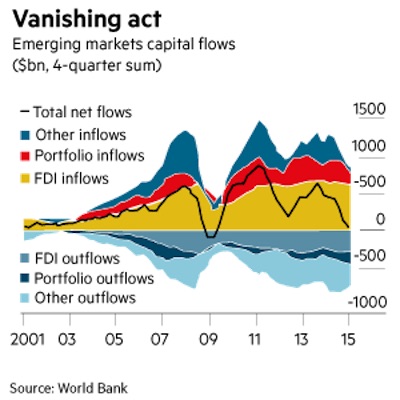
Read more …

It will get much crazier than this yet.

• Danish Parliament Approves Plan To Seize Assets From Refugees (Guardian)

European states have reacted in some of the most drastic ways yet to the continent’s biggest migration crisis since the second world war, with Denmark enacting a law that allows police to seize refugees’ assets. The vote in the Danish parliament on Tuesday, which followed similar moves in Switzerland and southern Germany, came as central European leaders amplified calls to seal the borders of the Balkans, a move that would risk trapping thousands of asylum seekers in Greece. Under the new Danish law, police will be allowed to search asylum seekers on arrival in the country and confiscate any non-essential items worth more than 10,000 kroner (£1,000) that have no sentimental value to their owner.

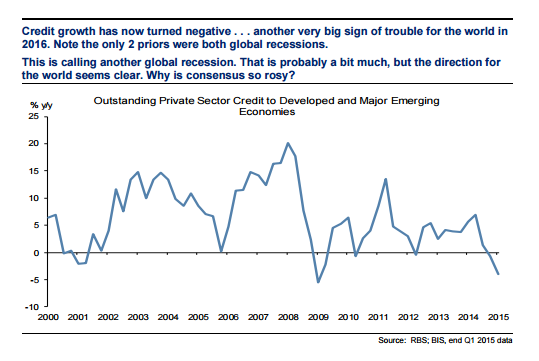
The centre-right government said the procedure is intended to cover the cost of each asylum seeker’s treatment by the state, and mimics the handling of Danish citizens on welfare. Elsewhere in Europe, the Czech and Slovakian prime ministers condemned Greece’s inability to prevent hundreds of thousands of refugees from moving onwards to northern European countries. They jointly called for increased border protection to block the passage of refugees from Greece, a day after EU interior ministers said they were willing to consider the suspension of the Schengen agreement that allows free passage between most EU countries. Robert Fico, the Slovakian prime minister, said: “There must be a backup plan, regardless of whether Greece stays in Schengen. We must find an effective border protection.”

The idea outraged the Greek government, which must now consider the possibility of hundreds of thousands of refugees being unable to leave Greece, which is struggling with high unemployment and economic strife. Nikos Xydakis, Greece’s alternate foreign minister for EU affairs, called the idea “hysterical” and warned that it could lead to the fragmentation of Europe. “If every country raises a fence, we return to the cold war period and the iron curtain. This isn’t EU integration – this is EU fragmentation.” The Greek government faces calls to take tougher action to block the passage of the thousands of refugees arriving in Greece by boat every day, but Xydakis said the only way of stopping them would be to shoot them – an option that Greece was not willing to take, even if it meant being fenced in.

“If Europe is to put Greece in a deep humanitarian crisis, let’s see it [happen],” he said in an interview with the Guardian on Tuesday. “We are in the sixth year of a depression and [have] unemployment of 25% … But if our colleagues and partners in the EU think that we have to let people drown or sink their boats, we can’t do that. Maybe we will suffer, but we will manage.”

Read more …

How about this for crazy?

• Belgium Wants Camp for 300,000 Refugees in Athens (DM)

Belgium has called for vast refugee camps holding up to 300,000 refugees to be built in Greece in a desperate attempt to stem the flow of migrants from Syria and other nations outside Europe. At an emergency summit of European leaders yesterday, Belgian migration minister Theo Francken raised the spectre of setting up ‘closed facilities’ in Greece to be operated by the EU. He said that the Greeks ‘now need to bear the consequences’ of being too weak to guard their own borders and called for Athens to face an EU ‘sanction mechanism’ under which the rising number of refugees entering the country would be forced to stay there.

Read more …

Jan 262016
 
 January 26, 2016  Posted by at 8:12 am Finance Tagged with: , , , , , , , , ,  3 Responses »


Unknown Crack salesmen ‘Going East’ on streamliner City of San Francisco 1936

• China Stocks Plunge to 13-Month Low Amid Capital Outflow Concern (BBG)
• China Shares Drop Sharply, as Region Suffers Rout (WSJ)
• Offshore Yuan Resumes Drop as Oil Reignites Global Risk Aversion (BBG)
• US Stocks Slump as Oil Resumes Rout (BBG)
• Oil And Stocks Dance The Bear Market Tango (WSJ)
• So Yes, the Oil Crash Looks a Lot Like Subprime (Alloway)
• Capital Controls May Be China’s Only Real Option (FT)
• Yuan’s Fall Is Just ‘Noise’ Amid Deeper China Woes (WSJ)
• China Capital Outflows Rise to Estimated $1 Trillion in 2015 (BBG)
• China Business Confidence, Recruitment Hit Record Lows In January (Reuters)
• Americans Are Trapped In A ‘Cycle Of Financial Insecurity’ (MW)
• US National Debt Set To Top $27 Trillion (Tanner)
• Global Real Estate Value Hits $217 Trillion In 2015 (VW)
• First-Time Homebuyers Are Finally Jumping Into The US Property Market (BBG)
• Wal-Mart: It Came, It Conquered, Now It’s Packing Up and Leaving (BBG)
• How the Oil Bust Wiped Out One North Dakota Oil Refiner (BBG)
• Congress is Writing the President a Blank Check for War (Ron Paul)
• Childhood Obesity ‘An Exploding Nightmare’ (Guardian)
• 15 Of The 16 Hottest Years On Record Have Been This Century (UNFCCC)
• ‘Running Out Of Time’, EU Puts Greece, Schengen On Notice (Reuters)
• Athens Hits Back At EU Plan To Ringfence Greece (FT)

47% off 2015 highs.

• China Stocks Plunge to 13-Month Low Amid Capital Outflow Concern (BBG)

China’s stocks tumbled to the lowest levels in 13 months amid concern capital outflows may accelerate as the economy slows and after some of the nation’s most-accurate forecasters predicted further declines for equities. The Shanghai Composite Index plunged 5.2% to 2,784.88 at 2:24 p.m., heading for the lowest close since December 2014, as turnover shrank. Industrial and technology companies led declines. China Shipbuilding Industry and Hundsun Technologies slumped more than 8%. Hong Kong’s Hang Seng China Enterprises Index decreased 3.2%.

Huang Weimin, whose Chinese stock-index futures wagers returned more than 6,200% last year, says the Shanghai gauge could drop another 15% in the first half as slowing economic growth and a weaker yuan fuel capital outflows. Outflows jumped in December, with the estimated 2015 total reaching a record $1 trillion, more than seven times higher than the whole of 2014 based on Bloomberg Intelligence data dating back to 2006. “The pressure for capital outflow and yuan’s devaluation is still quite big,” said Dai Ming, a fund manager at Hengsheng Asset Management in Shanghai, adding that he’s cutting equity holdings. “We haven’t seen signs of a pick-up in the economy and the first and second quarters could be challenging.”

Read more …

Oh darn, and we thought we’d grow happily ever after…

• China Shares Drop Sharply, as Region Suffers Rout (WSJ)

China shares fell sharply Tuesday afternoon, as oil prices sunk lower, pulling down energy shares across the region. The Shanghai Composite Index was last down more than 4%, at 2815.65, on track for a fresh low since Dec. 2014. The benchmark is now off roughly 45% since its June peak. While most of the region started in the red, China shares notably deepened their losses around one hour before the 3 p.m. local market close. Investors have been wary that the government may be stepping back from heavy intervention in the stock market, after state-owned funds had been tasked last summer with buying shares. Late last year, coordinated buying had often come in the afternoon hours, sending shares surging.

Meanwhile, in Hong Kong, the energy sector plunged 5.2%, dragging down the Hang Seng Index by 1.9%. The Hang Seng China Enterprises Index of Chinese firms trading in Hong Kong dropped 2.8% at 7948.28. That benchmark hit a closing low of 7835 last Thursday, and currently trades at its lowest levels since 2009. The Nikkei Stock Average fell 2.4%, with Tokyo-listed oil developer Inpex Corp. down 4.3%, South Korea’s Kospi was down 1.2%. Markets in Australia and India are closed for holidays. The same concerns that have haunted stocks this year remain: Oil prices are trading near multiyear lows, and investors are worried about a slowing China and plans by the U.S.Federal Reserve to raise interest rates. But increasingly, the oil market is driving the action.

“The volatility [in oil] is not helping restore confidence back in the market,” said Robert Levine, head of Asian sales and trading at brokerage CLSA. “It’s not easy to put on new bets.” Brent crude oil gave up gains earlier in Asia to trade down 3.2% at $29.53 a barrel. In the U.S., prices had fallen 5.7% on Monday to $30.34 a barrel. Brent oil has now fallen more than 20% this year.

Read more …

Hong Kong on the verge of a currency peg collapse.

• Offshore Yuan Resumes Drop as Oil Reignites Global Risk Aversion (BBG)

The yuan traded in Hong Kong resumed declines as risk aversion crept back into global markets, spurred by a drop in oil and lingering concern about the health of China’s economy. Brent crude headed lower for a second day, causing Asian currencies and stocks to give up gains that were triggered by optimism central banks in Japan and Europe will add to monetary stimulus. Sentiment on the yuan is still fragile and any major shocks to confidence, along with policy uncertainties could significantly compound outflows, Goldman Sachs Group Inc. economists led by MK Tang wrote in a note Tuesday. “The yuan is pressured as oil slumped, while the outlook for the global and Chinese economy isn’t strong,” said Banny Lam at Agricultural Bank of China International in Hong Kong.

“The yuan will remain relatively stable due to the possible lack of news or major support from policy makers as the Lunar New Year is approaching.” The offshore yuan fell 0.09% to 6.6152 a dollar as of 11:09 a.m. local time, data compiled by Bloomberg show. The onshore exchange rate was steady at 6.5796, according to China Foreign Exchange Trade System prices. The People’s Bank of China set its daily fixing in Shanghai little changed from Monday at 6.5548. Outflows from China increased to $158.7 billion in December, the most since September and were $1 trillion last year, according to estimates from Bloomberg Intelligence. That’s more than seven times the amount of cash that left in 2014.

China is willing and able to withstand temporary fluctuations in the exchange rate to gain independence of its monetary policy, Mei Xinyu, a researcher at China’s Ministry of Commerce, wrote in a commentary on the front page of the overseas edition of the People’s Daily Tuesday. The official Xinhua News Agency published a commentary on Saturday saying speculators entering short positions are expected to “suffer huge losses” as Chinese policy makers will take measures to stabilize the yuan. The PBOC has intervened repeatedly in the currency markets at home and abroad to damp depreciation pressure since it devalued the yuan in August. Meddling in the offshore yuan soaked up liquidity in Hong Kong this month and sent interbank lending rates to record highs, making selling short the currency costlier.

The authorities have also tightened capital controls to stem outflows, with measures including suspending foreign banks from conducting some cross-border business until March and imposing reserve-requirement ratios on yuan deposited onshore by overseas financial institutions since Monday. “Capital outflows will continue” as bets for further yuan depreciation still persist and investor confidence has been hit by policy risks, said Ken Cheung, a Hong Kong-based strategist at Mizuho Bank Ltd. “China won’t tolerate sharper yuan declines because its collapse would reinforce outflows, jeopardize China’s real economy, trigger a currency war and drag on the pace of internationalization.”

Read more …

All together now.

• US Stocks Slump as Oil Resumes Rout (BBG)

U.S. stocks halted a two-day rebound, with losses piling up in the last hour of trading as crude oil resumed a selloff that has rocked financial markets this year. Commodity-linked currencies slid as investors sought refuge in haven assets from gold to Treasuries. Energy and mining shares pushed the Standard & Poor’s 500 Index’s retreat to 1.6% as U.S. crude tumbled back below $31 a barrel, winding back a sizable chunk of Friday’s gains. Sentiment was better in emerging markets, where stocks headed for their steepest two-day advance since September on bets central banks will bolster stimulus to soothe the market turbulence. While the ruble weakened against all but one of its 31 major peers and Canada’s dollar sank, gold jumped. 10-year Treasury yields dropped five basis points.

Even after it staged a recovery late last week, crude is still nearing a 20% decline this year as brimming U.S. stockpiles and the prospect of additional Iranian exports fuel anxiety over a global glut. The slump in energy prices has also amplified concern over world growth and disinflation, as it also points to weaker industrial demand. With energy and commodity companies sliding, a measure of the correlation between global stocks and oil prices over the past 120 days has climbed to 0.5, the highest level since 2013. “Obviously investors are working through some potentially difficult issues in their minds about the state of the world economy,” said John Carey at Pioneer Investment Management. “It might might be a while before we emerge from this period of uncertainty. I’ve noticed that pattern of end-of-day volatility and wonder if there are programs that kick in at the end of the day that contribute to that.”

The S&P 500 fell to 1,877.07 as of 4 p.m. in New York, following a 2% rebound on Friday. Equities are on track for their worst January since 2009 amid concern China’s slowdown will weigh on global growth, with plunging oil prices exacerbating that angst. The U.S. benchmark sank to a 21-month low last week before rallying.

Read more …

Guess stocks can fall as much as oil then?

• Oil And Stocks Dance The Bear Market Tango (WSJ)

Oil and stock markets have moved in lockstep this year, a rare coupling that highlights fears about global economic growth. As oil prices tumbled early in 2016, global equities recorded one of their worst-ever starts for a new year. On Monday, oil and stocks were lower again. The S&P 500 index was down 0.7% in midday New York trading, and Brent crude futures, the global benchmark, were down $1.37 a barrel, or 4.3%, to $30.81. That followed a joint rebound on Friday. The correlation between daily moves in the price of Brent and the S&P 500 stock index is at levels not seen in the past 26 years. January isn’t over yet, but over the past 20 trading days—an average month—the correlation is 0.97, higher than any calendar month since 1990, according to data from both benchmarks examined by The Wall Street Journal.

A correlation of 1 would mean oil and stock prices move by the same proportion in the same direction, while a correlation of minus 1 would mean they move proportionally in opposite directions. The unusually strong link between the two markets partly reflects a common theme driving both: fears that a slowing Chinese economy could tip the global economy into recession. But as traders and investors in each market look at the other for clues as to how bad things are, they have exacerbated the overall bearish mood. The recent pattern marks a shift in the dynamics of oil’s 19-month collapse. Traders who long worried that the oil market was suffering from oversupply are now growing concerned that demand may be weakening as well.

“There is a vicious-cycle mentality among investors,” said François Savary, chief investment officer at Prime Partners, a Swiss investment firm managing $2.6 billion of assets. “It has become self-sustaining.” Even in the oil-rich Middle East, the mood has changed. In Dubai, businessman Ramesh Manglani never used to look at the oil price when investing in equity, despite the influence of energy in the region and its companies. “Everything’s changed since last year,” Mr. Manglani said, after investing in stocks for nearly a decade. “First thing in the morning we now check oil prices and Asian markets.”

Read more …

More tangoing. In reality, it’s all one big thing of course.

• So Yes, the Oil Crash Looks a Lot Like Subprime (Alloway)

One year ago, analysts at Bank of America Merrill Lynch drew a parallel between the subprime mortgage crash and the disorderly fall in the price of oil. Led by Chris Flanagan, a veteran of the securitization space, the team drew attention to Markit’s ABX Index, better known as the mother of all synthetic subprime credit indexes. Created in January 2006 and consisting of a basket of credit default swaps (CDS) tied to the welfare of subprime mortgages, it allowed a bevy of investors to bet on the future direction of riskier home loans and helped inflate the massive amounts of leverage tied to the U.S. housing bubble.

More recently it played a starring role in the film version of Michael Lewis’s The Big Short—when protagonists Christian Bale, Steve Carell, et al. are tracking their bets against the U.S. housing market, they are tracking the ABX. Fast-forward to today and the BofAML analysts provide an update to their previous thesis, which was that the downward spiral in the price of oil was shaping up to look a lot like the negative trend that engulfed the subprime space circa the year 2007. Here’s what they say:

“The pattern of the decline in the price of oil that began in mid-2014 is remarkably similar to the 2007-2009 pattern of the price decline of ABX, the credit derivative index that referenced subprime mortgages and, ultimately, the U.S. housing market (Chart 1). The ABX history suggests that oil will see more declines in the next couple of months and find a floor somewhere in the low 20s in the March-April time frame. Both the duration of the decline (1.5+ years) and the scale of the decline (100 neighborhood starting price down to the sub-30 neighborhood) are similar. Given that both housing and oil prices were fueled to spectacular heights in the two periods by massive credit expansion, it’s probably more than just coincidence that the respective “bubble” bursting patterns are so similar.

Consider how things tend to work. Denial on what constitutes fair value is a big component of bubbles, on the part of both market participants and policymakers. When perceived “bubbles” burst, markets take their time in steadily shredding views of the perception of fundamental value, as prices move lower and lower. Along the way, many will cite “technical factors” as the cause of the decline, which in some way suggests the price decline may not be real when in fact it is all too real. In the end, the technicals drive the fundamentals, as credit flees and borrowers go bust, and a feedback loop lower kicks in. Lower prices beget accelerated selling, as asset owners need to raise cash. It could be margin calls or it could be producer selling needs, it doesn’t really matter: the selling becomes inevitable and turns into forced selling.”

The point here is not that oil is necessarily the new subprime crisis per se but that the recent action in the price of crude resembles nothing if not the bursting of a bubble and the sudden realization that the asset has been overvalued for too long. More worrying for oil investors will be BofAML’s idea of forced selling. As Flanagan notes: “The systemic margin call of 2008 seems to be back for now, albeit to a far lesser degree.”

Read more …

Doesn’t seem feasible inside the IMF basket.

• Capital Controls May Be China’s Only Real Option (FT)

Chinese officials readily admit that communication has not been their strong point when it comes to dealing with international investors. The question of how China manages the renminbi is critical for global trade and commodity prices; the market turmoil following recent changes in the currency regime was exacerbated by Beijing’s failure to explain its intentions. Policymakers have now made it explicit that they have no wish to engineer a big devaluation. However, they are much less forthcoming about how they plan to reconcile a desire for currency stability with the realities of capital flight and a slowing economy. Greater clarity would be a help to investors, who struggle at present to interpret cryptic press releases and gauge the extent of central bank intervention in markets. However, improving communication by the People’s Bank of China is not an easy matter.

In a system where even the central bank governor cannot speak with complete authority — given political constraints and resistance to its reformist policies in other parts of the Chinese state — it would constitute a revolution. Moreover, central bank guidance is most effective when the policy is clear and it is relatively straightforward to work out how it will evolve in response to changes in economic data. At present, the reality in China is that the PBoC has no clear course of action and wants to leave itself flexibility. No amount of clarification wouldhelp to varnish the underlying problem: capital flight. The corruption clampdown and a lack of investment opportunities at home are driving Chinese people to take their money out of the country, just as the prospect of higher US interest rates is prompting companies to pay off dollar debt.

Fear of a devaluation has fuelled the outflows. Far from seeking a weaker renminbi, the central bank has been forced to spend a big chunk of its reserves to prop it up. Given this continuing pressure, Chinese policymakers have few attractive options. Even with a $3.3tn stockpile, they cannot continue to run down foreign exchange reserves indefinitely, nor would the government countenance it. Raising interest rates to make domestic investments more attractive would be unlikely to slow outflows while worsening the already painful slowdown in the real economy. Letting the renminbi find its own level — while intellectually coherent — risks enormous market dislocation in the short term and would be a huge shock to the global economy. Few policymakers either within China or outside are likely to contemplate such a course.

Read more …

“The world will have to learn to live without demand from China,” he says. “It’ll come as a shock.”

• Yuan’s Fall Is Just ‘Noise’ Amid Deeper China Woes (WSJ)

When the financier George Soros attacked the British pound in 1992 and famously “broke the Bank of England” he was trading on a conviction that the currency was misaligned. Britain devalued after squandering its reserves in a vain defense. Mr. Soros walked off with $1 billion or more. To the surprise of many, though, the U.K. economy soon picked up once the pound found its proper level. China’s raging battles with currency speculators are unlikely to end as happily for the country. That’s because turmoil in the currency markets reflects a much more perilous imbalance than an overvalued yuan: China is now lopsidedly dependent on ever larger inputs of local bank credit to keep sputtering growth from declining further.

The country is already littered with “zombie” factories, empty apartment blocks that form ghostly suburbs, mothballed power stations and other infrastructure that nobody needs. But yet more wasteful projects are in the pipeline, even as the government talks about cutting industrial overcapacity. “That’s the misalignment—everything else is noise,” says Rodney Jones, the Beijing-based principal of Wigram Capital Advisors, who was a partner at Soros Fund Management during the 1990s. If debt keeps piling up at the current rate, China faces an eventual financial crisis, perhaps leading to years of subpar growth, mirroring the fate of Japan after its bubble burst in the early 1990s.

Mr. Jones argues that global equity markets haven’t property adjusted to this risk, even after a 16% decline in U.S. dollar terms from their May peak. “The world will have to learn to live without demand from China,” he says. “It’ll come as a shock.” A sharp devaluation won’t fix these distortions, and might even make matters worse if, as likely, it were to trigger financial mayhem in China’s trading partners. An alternative—further clamping cross-border currency controls—would be a humiliating retreat from Beijing’s policy of making the yuan more international.

Read more …

Going to be picking up speed if Beijing lets it.

• China Capital Outflows Rise to Estimated $1 Trillion in 2015 (BBG)

China’s capital outflows jumped in December, with the estimated 2015 total reaching $1 trillion, underscoring the scale of the battle facing policy makers trying to hold up the yuan amid slower economic growth and slumping stocks. Outflows increased to $158.7 billion in December, the second-highest monthly outflow of the year after September’s $194.3 billion, according to estimates compiled by Bloomberg Intelligence. The total for the year soared more than seven times from $134.3 billion in the whole of 2014 to a record for Bloomberg Intelligence data dating back to 2006. December’s outflows increased by almost $50 billion from a month earlier after the central bank unnerved markets by saying it would refocus the yuan’s moves against a wider basket of currencies rather than the dollar.

In addition to capital exiting the economy, exporters are holding funds in dollars instead of converting them to yuan, said Tom Orlik, Bloomberg’s chief Asia economist in Beijing. “The immediate trigger for a pickup in capital outflows toward the end of the year was the People’s Bank of China’s poor communication over its shift in currency policy,” said Mark Williams, chief Asia economist for Capital Economics Ltd. in London, who previously worked on China issues at the U.K. Treasury. “Outflows are likely to remain strong because the People’s Bank still has not been able to generate confidence among investors that it knows what it’s doing or that it’s able to achieve its policy objectives.” China’s cross-border capital flow risks are controllable and the nations’ foreign exchange reserves are ample to help it defend against external shocks, the State Administration of Foreign Exchange said on its website Jan. 21.

China’s foreign exchange reserves are seen tumbling $300 billion this year to the $3 trillion level some analysts say risks undermining confidence in the central bank’s ability to defend the currency, according to a Bloomberg News survey. Policy makers have been burning through reserves to reduce yuan volatility as the currency lost its status as a one-way bet on appreciation amid the slowest economic growth in a quarter century and an unexpected devaluation in August. The stockpile of reserves plunged $513 billion last year to $3.33 trillion, the first annual drop since 1992. Outflows spiked in September and December after currency policy changes caught markets by surprise, said Williams.

Read more …

Ha ha ha: “..China’s economic activity is still growing steadily..”

• China Business Confidence, Recruitment Hit Record Lows In January (Reuters)

China’s business confidence and recruitment activity slipped to record lows in January, a survey showed, adding to signs of weakness in the world’s second-largest economy that could prod policymakers to roll out more support measures. The Sales Managers’ Index, compiled by London-based World Economics, fell to 51.0 in January from 51.7 in December. “The Headline SMI index fell slightly in January, but continues to suggest ongoing, albeit modest growth in economic activity,” World Economics Chief Executive Ed Jones said.

The index has averaged 51.4 since the second half of last year, indicating China’s economic activity is still growing steadily, albeit at a much slower rate than a year ago. The Sales Managers’ Index covers all private sectors of the economy. It is designed to reflect overall economic growth, bringing together the average movement of Confidence, Market Expansion, Product Sales, Prices Charged and Staffing Indices. The staffing index fell to 50.3 in January, near the 50 no-change mark, from 50.8 in December, hitting its lowest since the survey began, as businesses have become more hesitant to recruit as economic activity weakens, the survey showed.

Read more …

And will remain so for the rest of their lives.

• Americans Are Trapped In A ‘Cycle Of Financial Insecurity’ (MW)

Nearly seven years after the Great Recession, millions of Americans are stuck in a financial rut. Home ownership rates are at an historic low, renters are burdened by rising rents and — even though unemployment has fallen considerably in recent years — the percentage of underemployed Americans is twice those who are unemployed, according to the “2016 Assets & Opportunity Scorecard” released Monday by the Corporation for Enterprise Development, a nonprofit group in Washington, D.C. focused on expanding opportunity for low-income households. It assessed the 50 states and the District of Columbia on 61 measurements spanning financial assets and income, businesses and jobs, housing, health care and education. It also ranked these states on 69 policies that promote financial security.

Building up even a small amount of savings is a challenge. In fact, 44% of households are “liquid asset poor,” meaning they have less than three months of savings to live above the poverty level if they suffer a loss of income, the report notes, echoing the findings in several recent surveys on American savings. “Housing expense reduces income to pay for food, doctors and child care, leaving bills that can’t be paid on time and forcing consumers to take on high-cost, short-term loans,” it adds. (Over half of renters spend more than 30% of their gross income on rent, the traditional measure of affordability, according to data released last year by Harvard University’s Joint Center for Housing Studies.) Among the other key highlights, home ownership rates are hovering at just under 64% in the final quarter of 2015, still near the lowest level in three decades.

And while the national unemployment rate has fallen to 5% in December 2015, down from a recent high of 10% in October 2009, the underemployment rate was nearly 9.9% in December 2015, showing that people are still struggling to find full-time employment. “What’s more, one-in-four jobs are in a low-wage occupation,” the report adds. (On a more positive note, the government recently said more than 11 million people had signed up for the Affordable Care Act, including 4 million under the age of 35.)

Americans are still struggling to regain their pre-recession wealth and the scorecard estimates that this is far worse for people of color. Households of color are 2.1 times more likely to live below the federal poverty level and 1.7 times more likely to lack liquid savings, it says. “Those who once enjoyed a modicum of financial stability have settled into a new normal of ongoing financial vulnerability, while the struggles of those who were financially insecure before the recession have only deepened,” the authors write. “The number of households below the poverty line has barely budged and millions of low- and moderate-income people live paycheck to paycheck.”

Read more …

“And none of this includes the more than $69 trillion in unfunded liabilities being run up by Medicare and Social Security.”

• US National Debt Set To Top $27 Trillion (Tanner)

Does anyone remember the national debt? Judging from the presidential campaign so far, perhaps we should put the debt’s image on a milk carton somewhere. In the last Republican debate, there was precisely one question on the debt — and the candidates answered it by talking about their tax plans. That was far too typical. According to the FiveThirtyEight website, “the deficit” was mentioned an average of two times in the first five televised Republican debates (including the “undercard” debates) by all the candidates — and the moderators — combined. And “the national debt” was brought up an average of 6.5 times. This compares to an average of 3.2 “deficit” mentions and 10.9 “debt” mentions in the 20 GOP debates during the 2012 campaign.

But while the candidates have been wrangling over such vital issues as fantasy sports betting or Ted Cruz’s citizenship status, our growing sea of red ink has quietly risen toward $19 trillion. One might think our impending national bankruptcy might be worth a bit more attention. In his State of the Union address, President Obama took a bow for reducing our annual budget deficit by two-thirds during his time in office. He’s correct. Since its high of $1.4 trillion in 2009, the deficit had dropped to just $439 billion last year, although the president failed to mention that his policies, including the 2009 stimulus bill, helped drive the deficit to those record levels, and policies that he opposed, such as sequestration, helped bring it down.

But the respite is just temporary. According to the Congressional Budget Office’s newest estimates, released yesterday, the deficit is already rising again, and will exceed $544 billion this year. By 2022, just six years from now, we will once again be experiencing trillion-dollar deficits every year. And even with lower deficits, the national debt is still rising. By 2025, our debt will top $27 trillion. Yet, Congress is not only kicking the can down the road, it is making the problem worse. Just last year, Congress put in place spending that will raise the debt by $1.2 trillion over the next ten years. The Committee for a Responsible Federal Budget called 2015 “a banner year for fiscal irresponsibility.” And none of this includes the more than $69 trillion in unfunded liabilities being run up by Medicare and Social Security. But out on the campaign trail? Crickets.

Read more …

That’s a mighty long way down ahead.

• Global Real Estate Value Hits $217 Trillion In 2015 (VW)

The total value of all developed real estate on the globe reached US$217 trillion in 2015, according to calculations by international real estate adviser, Savills. The analysis, published today for the first time, measures the entire developed property universe including commercial and residential property as well as forestry and agricultural land. The value of global property in 2015 amounted to 2.7 times the world’s GDP, making up roughly 60% of mainstream global assets and representing an important store of national, corporate and individual wealth. Residential property accounted for 75% of the total value of global property.

Yolande Barnes, head of Savills world research, comments: “To give this figure context, the total value of all the gold ever mined is approximately US$6 trillion, which pales in comparison to the total value of developed property by a factor of 36 to 1. “The value of global real estate exceeds – by almost a third – the total value of all globally traded equities and securitised debt instruments put together and this highlights the important role that real estate plays in economies worldwide. Real estate is the pre-eminent asset class which will be most impacted by global monetary conditions and investment activity and which, in turn, has the power to most impact national and international economies.” In recent years, quantitative easing and resulting low interest rates have suppressed real estate yields and fuelled high levels of asset appreciation globally.

Investment activity and capital growth has swept around the major real estate markets of the world and led to asset price inflation in many instances. Overall, the biggest and most important component of global real estate value is the homes that people live in, totalling US$162 trillion. The sector has the largest spread of ownership with approximately 2.5 billion households and is most closely tied with the fortunes of ordinary people. Residential real estate value is broadly distributed in line with the size of affluent populations: China accounts for nearly a quarter of the total value, containing nearly a fifth of the world’s population. Yet the weight of value lies with the West, over a fifth (21%) of the world’s total residential asset value is in North America despite the fact that only 5% of the population lives there.

Read more …

This is just too crazy. The American Dream is voluntary force-fed peonage. This country deserves a Trump.

• First-Time Homebuyers Are Finally Jumping Into The US Property Market (BBG)

First-time homebuyers are finally jumping into the U.S. property market. Need proof? Look at the mortgage market’s fastest-growing segment: loans with low down payments insured by the Federal Housing Administration. Originations of FHA-backed mortgages, used predominately by first-time buyers, were up 54% in September from a year earlier, according to the most recent data from CoreLogic. By December, the FHA insured 22% of all loan originations, up from 17% a year earlier, according to data compiled by Ellie Mae. “The FHA will be a contributing factor to homeownership rising again in America,” said David Lykken, president and founder of Transformational Mortgage Solutions in Austin, Texas. “We’re seeing the return of first-time buyers.”

President Barack Obama’s administration, in January 2015, reduced mortgage-insurance premiums for FHA loans. That lowered the cost of getting a home loan and brought in at least 75,000 new borrowers with credit scores of less than 680, according to a November report from the U.S. Department of Housing and Urban Development. The rate of FHA lending, which had been in decline through most of 2014, tripled the month after the insurance premium was cut, according to CoreLogic. The FHA estimates that borrowers save $900 a year on average as a result of the lower premium. The move made FHA-backed mortgages more competitive with other loans that have low-down-payment options, said Guy Cecala, publisher of the newsletter Inside Mortgage Finance.

While mortgage giants Fannie Mae and Freddie Mac have an option for borrowers to put down as little as 3%, they require private insurance with risk-adjusted premiums based on credit scores, debt-to-income ratios and other factors. “It still costs more to get a 3%-down loan with Fannie and Freddie if you have a lower FICO score,” Cecala said. The homeownership rate in the third quarter was 63.7%, up from 63.4% in the previous three months and the first quarterly rise in two years, according to the U.S. Census Bureau, which is scheduled to release fourth-quarter data next week. “Last year’s decision to lower premiums was designed to open the door to those previously priced out of homeownership,” HUD Secretary Julian Castro said in an email. “We’ve seen positive results with new buyers entering the market and making the American dream of homeownership a reality.”

Read more …

How Wal-Mart destroys American communities.

• Wal-Mart: It Came, It Conquered, Now It’s Packing Up and Leaving (BBG)

The Town’n Country grocery in Oriental, North Carolina, a local fixture for 44 years, closed its doors in October after a Wal-Mart store opened for business. Now, three months later — and less than two years after Wal-Mart arrived — the retail giant is pulling up stakes, leaving the community with no grocery store and no pharmacy. Though mom-and-pop stores have steadily disappeared across the American landscape over the past three decades as the mega chain methodically expanded, there was at least always a Wal-Mart left behind to replace them. Now the Wal-Marts are disappearing, too. “I was devastated when I found out. We had a pharmacy and a perfectly satisfactory grocery store. Maybe Wal-Mart sold apples for a nickel less,” said Barb Venturi, mayor pro tem for Oriental, with a population of about 900.

“If you take into account what no longer having a grocery store does to property values here, it is a significant impact for us.” Oriental is hardly alone. Wal-Mart said on Jan. 15 it would be closing all 102 of its smaller Express stores, many in isolated towns, to focus on its supercenters and mid-sized Neighborhood Markets. The move, which will begin by the end of the month, was a relatively quick about-face. As recently as 2014, Wal-Mart was touting the solid performance of its smaller stores and announced plans to open an additional 90. That’s a big problem for small towns, often with proportionately large elderly populations. For the older folks of Oriental – a retirement and summer vacation town along the inter-coastal waterway – the next-nearest grocery and pharmacy is a 50-minute round-trip drive.

Wal-Mart says it is sensitive to the dislocations its business decisions are causing. “In towns impacted by store closures, we have had hundreds of conversations with elected officials and community leaders to discuss relevant issues and we are working with communities on how we can be helpful,” said Wal-Mart spokesman Brian Nick. Wal-Mart has been under increasing pressure lately as sales in the U.S. have failed to keep up with rising labor costs. It’s also been spending more on its Web operations. In October, the company announced that profit this year would be down as much as 12%. The outlook contributed to a share decline of 29% during the past 12 months. “It is more important now than ever to review our portfolio and close the stores and clubs that should be closed,” Wal-Mart’s Chief Executive Officer Doug McMillon said in a statement on the company’s website.

Read more …

Timing is everything?!

• How the Oil Bust Wiped Out One North Dakota Oil Refiner (BBG)

For the first new refinery in the U.S. in seven years, the idea was simple: Buy cheap oil from shale producers, then score a quick profit by selling it right back to them as more expensive diesel needed to power their trucks and drilling rigs. Now the shale bust is threatening to ruin a renaissance in small refineries, known as teapots, before it even begins. When Dakota Prairie Refining was building its plant in 2014, it could buy some of the cheapest oil in America and sell among the most expensive diesel in America. But the oil bust obliterated its local diesel market, along with the fat premium the fuel used to fetch, as its potential customers shut down operations.

In the fall of 2014, when tiny Dakota Prairie was getting ready to open its processing plant in Dickinson, North Dakota, diesel fuel near the state’s Bakken oil fields sold for $100 a barrel more than the oil produced there. Now it’s selling for just $16 a barrel more. “The last thing you want to be doing right now is running a refinery that makes a lot of diesel and very little gasoline,” said Robert Campbell at Energy Aspects. It’s a “double whammy,” he said, as the diesel market weakens worldwide and demand in their specific local market plunges. Dakota Prairie lacks the pipelines and storage units a larger refiner uses to sell to customers farther away, and it’s not equipped to make vehicle-ready gasoline instead of diesel. “These guys don’t have alternative markets, and they don’t have a lot of competitiveness to export, so they’re pretty stuck,” Campbell said.

Read more …

“President Obama has already far surpassed even his predecessor, George W. Bush, in taking the country to war without even the fig leaf of an authorization.”

• Congress is Writing the President a Blank Check for War (Ron Paul)

While the Washington snowstorm dominated news coverage this week, Senate Majority Leader Mitch McConnell was operating behind the scenes to rush through the Senate what may be the most massive transfer of power from the Legislative to the Executive branch in our history. The senior Senator from Kentucky is scheming, along with Sen. Lindsey Graham, to bypass normal Senate procedure to fast-track legislation to grant the president the authority to wage unlimited war for as long as he or his successors may wish. The legislation makes the unconstitutional Iraq War authorization of 2002 look like a walk in the park. It will allow this president and future presidents to wage war against ISIS without restrictions on time, geographic scope, or the use of ground troops. It is a completely open-ended authorization for the president to use the military as he wishes for as long as he (or she) wishes.

Even President Obama has expressed concern over how willing Congress is to hand him unlimited power to wage war. President Obama has already far surpassed even his predecessor, George W. Bush, in taking the country to war without even the fig leaf of an authorization. In 2011 the president invaded Libya, overthrew its government, and oversaw the assassination of its leader, without even bothering to ask for Congressional approval. Instead of impeachment, which he deserved for the disastrous Libya invasion, Congress said nothing. House Republicans only managed to bring the subject up when they thought they might gain political points exploiting the killing of US Ambassador Chris Stevens in Benghazi.

It is becoming more clear that Washington plans to expand its war in the Middle East. Last week the media reported that the US military had taken over an air base in eastern Syria, and Defense Secretary Ashton Carter said that the US would send in the 101st Airborne Division to retake Mosul in Iraq and to attack ISIS headquarters in Raqqa, Syria. Then on Saturday, Vice President Joe Biden said that if the upcoming peace talks in Geneva are not successful, the US is prepared for a massive military intervention in Syria. Such an action would likely place the US military face to face with the Russian military, whose assistance was requested by the Syrian government. In contrast, we must remember that the US military is operating in Syria in violation of international law.

Read more …

A quote from years ago: “We’re raising a generation of blind amputees”. PS: What on earth are “lower middle-income countries”?

• Childhood Obesity ‘An Exploding Nightmare’ (Guardian)

The number of children under five who are overweight or obese has risen to 41 million, from 31 million in 1990, according to figures released by a World Health Organisation commission. The statistics, published by the Commission on Ending Childhood Obesity, mean that 6.1% of under-fives were overweight or obese in 2014, compared with 4.8% in 1990. The number of overweight children in lower middle-income countries more than doubled over the same period, from 7.5 million to 15.5 million. In 2014, 48% of all overweight and obese children aged under five lived in Asia, and 25% in Africa. The expert panel, commissioned by the WHO, said progress in tackling the problem had been “slow and inconsistent” and called for increased political commitment, saying there was a “moral responsibility” to act on behalf of children.

Peter Gluckman, a co-chair of the commission, said childhood obesity had become “an exploding nightmare” in the developing world. He added: “It’s not the kids’ fault. You can’t blame a two-year-old child for being fat and lazy and eating too much.” The report’s authors said that addressing the problem must start before the child is conceived and continue into pregnancy, through to infancy, childhood and adolescence. They pointed out that where a mother entering pregnancy is obese or has diabetes, the child is predisposed “to increased fat deposits associated with metabolic disease and obesity”. Many children are growing up in environments encouraging weight gain and obesity, they observed. “The behavioural and biological responses of a child to the obesogenic environment can be shaped by processes even before birth, placing an even greater number of children on the pathway to becoming obese when faced with an unhealthy diet and low physical activity,” they said.

Read more …

Very nice video.

• 15 Of The 16 Hottest Years On Record Have Been This Century (UNFCCC)

The trend for increasingly extreme and frequent weather matching climate change forecasts has been put into stark perspective by the latest data while the economic impact of one of the strongest El Nino’s on record is acting as a red warning light of worse to come, if the world does not act fast enough to cut the concentrations of greenhouse gases in the atmosphere. Drawing on consolidated analysis of the world’s major meteorological agencies, the World Meteorological Organization (WMO) has confirmed that the global average surface temperature in 2015 broke all previous records by a wide margin. For the first time on record, temperatures in 2015 were about 1°C above the pre-industrial era.

The WMO says that the fifteen of the 16 hottest years on record have all been this century, with 2015 being significantly warmer than the record-level temperatures seen in 2014. Underlining the long-term trend, 2011-15 is the warmest five-year period on record. The news comes as Asia is experiencing unusually cold weather and the United States a major blizzard, a sobering reminder that climate change is about extreme impacts from all kinds of weather as the weather systems we have taken for granted for so long shift into more chaotic patterns under the influence of the greenhouse effect.

No single weather event can be attributed to climate change but the frequency and intensity of extreme weather events is increasing as predicted as global average temperatures rise, and this will have severe economic implications. For example, a warmer world means fewer days of snowfall, but heavier snowfall on those days when it does snow. This is because snow requires moist air, and a warmer atmosphere holds more moisture.

Read more …

The EU puts itself on notice but is too blind to see it. No Schengen, no EU.

• ‘Running Out Of Time’, EU Puts Greece, Schengen On Notice (Reuters)

The European Union edged closer on Monday to accepting that its Schengen open-borders area may be suspended for up to two years if it fails in the next few weeks to curb the influx of migrants from the Middle East and Africa. Shorter-term dispensations for border controls end in May. EU migration ministers meeting in Amsterdam decided they may be extended for two years – an unprecedented extension – because the migrant crisis probably will not be brought under control by then, according to the Dutch migration minister, who chaired the meeting. Some ministers made clear such a – theoretically temporary – move would cut off Greece, where more than 40,000 people have arrived by sea from Turkey this year, despite a deal with Ankara two months ago to hold back an exodus of Syrian refugees.

More than 60 have drowned on the crossing since Jan. 1. Greek officials noted that closing routes northward, even if physically possible, would not solve the problem. But electoral pressure on governments, including in the EU’s leading power Germany, to stem the flow and resist efforts to spread asylum seekers across the bloc are making free-travel rules untenable. “We are running out of time,” said EU Migration Commissioner Dimitris Avramopoulos. He urged states to implement agreed measures for managing movements of migrants across the continent — or else face the collapse of the 30-year-old Schengen zone.

But the Dutch minister, Klaas Dijkhoff, said time has effectively already run out to preserve the passport-free regime. The system has allowed hundreds of thousands of people to make chaotic treks from Greece and Italy to Germany and Sweden over the past year. “The ‘or else’ is already happening,” he said. “A year ago, we all warned that if we don’t come up with a solution, then Schengen will be under pressure. It already is.” Under pressure from domestic opinion, several governments have already reintroduced controls at their borders with fellow EU states. Those controls should be better coordinated, said Dijkhoff, whose government last year floated the idea of a “mini-Schengen”, which critics saw as a way for Germany and its northern neighbours to bar the influx from the Mediterranean.

Read more …

“..we do not intend to become a cemetery of souls here..”

• Athens Hits Back At EU Plan To Ringfence Greece (FT)

Greece has hit back at European proposals for tightened security on its northern border with Macedonia, describing the latest plans to staunch the flow of refugees into Europe as a dangerous experiment that would traumatise the country. The proposals to dispatch joint police forces along Macedonia s border with Greece first outlined in a letter sent by Miro Cerar, prime minister of Slovenia, to fellow EU leaders last week have gained political momentum ahead of a meeting of EU interior ministers in Amsterdam on Monday. The plan seeks to shift the frontline of Europe’s refugee control efforts to the northern part of Greece, where the government is already straining to manage the influx with limited resources.

A Slovenian government statement on Friday claimed the proposal would allow an end to internal Schengen border controls and said it had received strong backing from central European countries, including Hungary and Poland, while positive signals had been received from Brussels. EU officials were in Macedonia on Friday to assess conditions on the ground ahead of Monday s talks. A letter from Jean Claude Juncker to Slovenian Prime Minister Miro Cerar, seen by the Financial Times, shows that the European Commission has outlined its backing for the plan.

“I welcome your suggestion that all EU member states should provide assistance to the Former Yugoslav Republic of Macedonia authorities to support controls on the border with Greece through the secondment of police/law enforcement officers, and the provision of equipment”, the commission president wrote. Mr Juncker reiterated that EU countries have the right to block entry to people who do not want to apply for asylum in that country in order to apply elsewhere in Europe. “Member states should indeed refuse entry at the external border to third-country nationals who do not satisfy the entry conditions, including third-country nationals who have not made an asylum application despite having had the opportunity to do so”.

But Ioannis Mouzalas, Greece’s minister for migration, said ringfencing Greece from the Schengen zone would not stop asylum seekers making their way to northern Europe, adding that Athens had not been consulted on the plan in advance. Instead, Mr Mouzalas called for greater assistance for Turkey to help it reduce the numbers crossing the Aegean Sea to Greece. More than 2,000 asylum seekers arrive from Turkey each day before making the journey overland to the EU through the western Balkans. “It’s not easy to trap [asylum seekers] and we do not intend to become a cemetery of souls here. We cannot understand what kind of policy it is that a country would close its borders with Greece,” he said on Sunday evening. “We do not have time to experiment with things that will only worsen the trauma.”

Read more …

Jan 202016
 
 January 20, 2016  Posted by at 9:22 am Finance Tagged with: , , , , , , , , , ,  5 Responses »


DPC Pere Marquette transfer boat 18 passing State Street bridge Chicago River 1901

• Oil Falls 3% On Surplus Worries, As US Drops Toward $27 (Reuters)
• Shell Q4 Profit Plunges as Oil’s Slump Deepens (BBG)
• Chinese Stocks in Hong Kong Fall to Global Financial Crisis Lows (BBG)
• Nikkei, Hang Seng Lead Slump In Asian Markets (CNBC)
• Recent S&P 500 Correction Appears Small in Context of History (BBG)
• World Faces Wave Of Epic Debt Defaults: Central Bank Veteran (AEP)
• Hedge Fund That Called Subprime Crisis Urges China To Devalue Yuan by 50% (BBG)
• China Is Getting Less and Less Bang for Its Credit Buck (BBG)
• China Needs a Great Economic Shift Away From Debt Fueled ‘Growth’ (Wolf)
• China Data Indicate Heavy Deflationary Pressure (Nikkei)
• What Is China’s Actual GDP? (CNBC)
• Mining Giant BHP Billiton Lowers Forecast, Investors Fear Dividend Cut (WSJ)
• Fed’s $216 Billion Treasuries Rollover Recalls Crisis Era Buying (BBG)
• ECB Plans To Order Banks To Tackle Bad Loans (Reuters)
• Varoufakis Speaks About 2015 Greece Parallel Currency Plan (Kath.)
• Greek Immigration Minister Slams Turkish Failure To Curb Refugee Flow (Kath.)
• EU To Scrap ‘First Country’ Asylum Claim Rule (FT)
• Children On Syrian Refugee Route Could Freeze To Death: UN (Reuters)
• Doctors Without Borders Says EU Worsens Refugee Crisis, Aids Smugglers (AP)
• Rate Of Refugee Arrivals In Greece Dwarfs 2015 Pace (AFP)
• More Plastic Than Fish In The Sea By 2050 (Guardian)

On our way to $20 and beyond.

• Oil Falls 3% On Surplus Worries, As US Drops Toward $27 (Reuters)

Crude futures slumped again in Asian trade on Wednesday, with U.S. oil droppping more than 3% toward $27 a barrel and its lowest since 2003, on worries about global oversupply. That came after the International Energy Agency, which advises industrialized countries on energy policy, warned that oil markets could “drown in oversupply” in 2016. The crash hammered Asian stock markets with MSCI’s broadest index of Asia-Pacific equities outside Japan falling 2.8% to a four-year low. “Oil prices are at a level where OPEC countries are all struggling. They are selling oil for cashflow not for profit,” said Jonathan Barratt at Sydney’s Ayers Alliance. “U.S. producers are holding out, but I think they’re bleeding as well,” he said.

U.S. crude futures were trading down 97 cents at $27.49 a barrel, or 3.4%, at 0625 GMT, the lowest since September 2003. The contract settled down 96 cents, or 3.26%, the session before. The expiry of the February contract on Wednesday was “probably” adding further downward pressure on U.S. West Texas Intermediate oil as traders closed positions, said Michael McCarthy at Sydney’s CMC Markets. Brent futures dropped 61 cents to $28.15 a barrel, or 2.1%, not far from the 12-year low hit on Monday. It settled up 21 cents, or 0.7 per cent, in the previous session. McCarthy said the market had already taken into account the 500,000 barrels per day Iran has forecast it will add to global production. “(Iran) is really another strike in the same beating the market has taken,” McCarthy said.

Read more …

Profit? You mean creative accounting.

• Shell Q4 Profit Plunges 50% as Oil’s Slump Deepens (BBG)

Royal Dutch Shell said fourth-quarter profit plunged as the rout in crude prices deepened. The company sees profit adjusted for one-time items and inventory changes of $1.6 billion to $1.9 billion, Shell said Wednesday in a preliminary earnings statement. That compares with the $1.8 billion average estimate of nine analysts surveyed by Bloomberg, and profit of $3.3 billion a year earlier. Shell, which is buying BG Group in the industry’s largest deal in a decade, has cut jobs and reduced spending as CEO Ben Van Beurden prepares for a prolonged downturn. Crude’s slump below $30 a barrel has driven down Shell’s market value to the lowest in almost seven years and prompted concern it may be overpaying for BG’s production and cash flow.

The average price of Brent crude, the international benchmark, fell 42% in the quarter from a year earlier to $44.69 a barrel, the lowest since 2009. Aberdeen Asset Management and Invesco Asset Management, two of Shell’s major shareholders, have said they will support the company’s plan to buy BG even with crude’s collapse. The acquisition allows Shell to accelerate the reshaping of its portfolio toward deepwater assets and natural gas and BG’s production is likely to grow strongly in the next three to five years, Invesco fund manager Martin Walker said. Standard Life Investments is the only Shell holder that has so far publicly said it will vote against the combination because the acquisition is “value destructive.”

Shell has justified the deal by saying it boosts its ability to maintain dividends, makes it the world’s biggest liquefied natural gas company and gives it oil and gas assets from Australia to Brazil. The company’s B shares, the class of stock used in the deal, have dropped 11% this year, extending last year’s 31% decline. Shell’s shareholders are scheduled to vote on the acquisition on Jan. 27 and BG’s the next day. Shell requires the backing of 50% of its holders. In BG’s case, votes in favor must represent at least 75% of the total value of the company’s shares. The merger will probably become effective Feb. 15, Shell said.

Read more …

Hong Kong is fast becoming the eye of the storm.

• Chinese Stocks in Hong Kong Fall to Global Financial Crisis Lows (BBG)

Chinese stocks in Hong Kong tumbled to the lowest level since the depths of the global financial crisis as a slide in the city’s dollar spurred concerns over capital outflows. Oil producers and property developers led declines. The Hang Seng China Enterprises Index plunged as much as 5.5% before paring losses to trade 4% lower at 1:57 p.m. in Hong Kong. PetroChina fell to a 11-year low as oil extended its decline and Cnooc, China’s largest offshore oil company, said it will cut output for the first time in more than a decade. Hong Kong’s dollar traded near its weakest level since 2007 as concern about China’s slowing economy curbs demand for the city’s assets. The Shanghai Composite Index lost 0.8%.

“The local dollar’s slide is igniting concerns that capital outflows are accelerating as funds are selling equities en masse,” said Castor Pang at Core-Pacific Yamaichi Hong Kong. “Overall sentiment is very bad in Hong Kong.” The so-called H-shares gauge slid to 8,043.47, heading for the lowest level since March 2009. The index has slumped 17% this year, joining China’s Shanghai Composite as the world’s worst-performing major global benchmark measure out of the 93 tracked by Bloomberg. Similar to their mainland counterparts, Hong Kong policy makers are fighting to prevent a vicious cycle of capital outflows and a weakening currency with the resulting financial-market volatility heightening concern that China’s deepest economic slowdown since 1990 will worsen. PetroChina and China Petroleum & Chemical tumbled at least 6.2% in Hong Kong.

Oil extended its decline from the lowest close in more than 12 years, while Cnooc’s output cut increased speculation the nation’s producers are succumbing to the global price war. Cnooc’s acknowledgment that spending cuts are hurting production may be a prelude to further reductions by Chinese explorers, according to Nomura. The stock dropped 6%. Hong Kong’s Hang Seng Index tumbled 3.7% to a three-year low as trading volumes surged 77% above the 30-day average for this time of day. Property developers led declines, with Cheung Kong Property Holdings Ltd. sliding 6.1% to a record low. “To protect the Hong Kong dollar peg the government has to raise the interest rate,” said Louis Tse, a Hong Kong-based director at VC Brokerage Ltd. “The property companies are high-beta stocks because you have to borrow during the development phase,” with higher borrowing costs potentially weighing on home owners as well.

Read more …

And Europe follows as we speak.

• Nikkei, Hang Seng Lead Slump In Asian Markets (CNBC)

Asian stocks tumbled Wednesday, with major indexes declining by more than 1% each, as global sentiment remained low on concerns over economic growth, China and low oil prices. “The frailty in the Chinese growth remain the core problem for investors and the spotlights are not moving away from it anytime soon,” Naeem Aslam, chief market analyst at AvaTrade, said in a note Wednesday. Overnight, the IMF cut its global growth forecast for 2016 to 3.4%, from 3.6%. The organization cited slower growth in emerging markets, especially in China, falling commodity prices, and rising interest rates in the U.S. as potential risks to global growth. Markets in China opened in negative territory, following a 3.5% gain in the previous session after Beijing released a slew of data including the full-year growth number for 2015.

The Shanghai composite was down 1.15% and the Shenzhen composite declined by 1.10%. The CSI300 was down 1.64%. Hong Kong’s Hang Seng index was down 3.77%. The Chinese economy grew by 6.9% in 2015, according to official data, down from 2014’s 7.3%, and the slowest pace of economic expansion since 1990. Some analysts believe further intervention and economic stimulus from Beijing are forthcoming as the country juggles a structural re-balancing act. Cynthia Kalasopatan from Mizuho Bank said in a morning note, “Soft growth momentum led to expectations that Chinese authorities will need to implement further policy easing to support the economy. “More policy and RRR cuts may be in the pipeline,” she added, “What’s more, targeted fiscal tools may be used as well to spur growth.”

The People’s Bank of China (PBOC) said late on Tuesday it would inject more than 600 billion yuan ($91.22 billion) into the financial system to help ease a liquidity squeeze expected before the Lunar New Year holiday in early February. [..] bank and property shares were sharply lower. Bank of China’s Hong Kong-listed shares dropped 1.97% and its Shanghai-listed ones fell 1.70%. Hong Kong-listed Shimao Property dropped 6.02%.

Read more …

The shape of things to come.

• Recent S&P 500 Correction Appears Small in Context of History (BBG)

The recent 10% drop in U.S. stocks looks very small when considered in the context of the 220% rally from the 2009 nadir to the 2015 peak. The Standard & Poor’s 500 Index remains more than 5% above its 200-week moving average, and has not spent this long continuously above it since the 1990s dot-com era. When that bull run finished, the market fell to 38% below the 200-week moving average, while the 2009 crash bottomed out 48% below it.

Read more …

“The European banking system may have to be recapitalized on a scale yet unimagined, and new “bail-in” rules mean that any deposit holder above the guarantee of €100,000 will have to help pay for it.”

• World Faces Wave Of Epic Debt Defaults: Central Bank Veteran (AEP)

The global financial system has become dangerously unstable and faces an avalanche of bankruptcies that will test social and political stability, a leading monetary theorist has warned. “The situation is worse than it was in 2007. Our macroeconomic ammunition to fight downturns is essentially all used up,” said William White, the Swiss-based chairman of the OECD’s review committee and former chief economist of the Bank for International Settlements (BIS). “Debts have continued to build up over the last eight years and they have reached such levels in every part of the world that they have become a potent cause for mischief,” he said. “It will become obvious in the next recession that many of these debts will never be serviced or repaid, and this will be uncomfortable for a lot of people who think they own assets that are worth something,” he said in Davos.

“The only question is whether we are able to look reality in the eye and face what is coming in an orderly fashion, or whether it will be disorderly. Debt jubilees have been going on for 5,000 years, as far back as the Sumerians.” The next task awaiting the global authorities is how to manage debt write-offs – and therefore a massive reordering of winners and losers in society – without setting off a political storm. Mr White said Europe’s creditors are likely to face some of the biggest haircuts. European banks have already admitted to $1 trillion of non-performing loans: they are heavily exposed to emerging markets and are almost certainly rolling over further bad debts that have never been disclosed. The European banking system may have to be recapitalized on a scale yet unimagined, and new “bail-in” rules mean that any deposit holder above the guarantee of €100,000 will have to help pay for it.

The warnings have special resonance since Mr White was one of the very few voices in the central banking fraternity who stated loudly and clearly between 2005 and 2008 that Western finance was riding for a fall, and that the global economy was susceptible to a violent crisis. Mr White said stimulus from quantitative easing and zero rates by the big central banks after the Lehman crisis leaked out across east Asia and emerging markets, stoking credit bubbles and a surge in dollar borrowing that was hard to control in a world of free capital flows. The result is that these countries have now been drawn into the morass as well. Combined public and private debt has surged to all-time highs to 185pc of GDP in emerging markets and to 265pc of GDP in the OECD club, both up by 35 %age points since the top of the last credit cycle in 2007. “Emerging markets were part of the solution after the Lehman crisis. Now they are part of the problem too,” Mr White said.

[..] In retrospect, central banks should have let the benign deflation of this (temporary) phase of globalisation run its course. By stoking debt bubbles, they have instead incubated what may prove to be a more malign variant, a classic 1930s-style “Fisherite” debt-deflation. Mr White said the Fed is now in a horrible quandary as it tries to extract itself from QE and right the ship again. “It is a debt trap. Things are so bad that there is no right answer. If they raise rates it’ll be nasty. If they don’t raise rates, it just makes matters worse,” he said. There is no easy way out of this tangle. But Mr White said it would be a good start for governments to stop depending on central banks to do their dirty work. They should return to fiscal primacy – call it Keynesian, if you wish – and launch an investment blitz on infrastructure that pays for itself through higher growth.

Read more …

Don’t think they’d do it in one go. But who knows, it might be the way to go.

• Hedge Fund That Called Subprime Crisis Urges China To Devalue Yuan By 50% (BBG)

Mark Hart, the hedge fund manager whose bets against U.S. subprime mortgages and European sovereign debt proved prescient, said China should weaken its currency by more than 50% this year. A one-off devaluation would allow policy makers to “draw a line in the sand” at a more appropriate level for the yuan, easing pressure on China’s foreign-exchange reserves and removing an incentive for capital outflows, according to Hart, who’s been betting against the currency since at least 2011. China should devalue before its $3.3 trillion hoard of reserves shrinks much further, he said, because the country can still convince markets it’s acting from a position of strength. “There wouldn’t be anything underhanded about a sharp devaluation,” Hart said. “Why should China be forced to suffer deflationary effects of defending its currency when everyone else isn’t?”

Hart, whose prescription clashes with consensus forecasts for the yuan and recent comments from senior government officials, said China would be justified in weakening the currency after central banks in Europe and Japan fueled declines in their exchange rates to stoke economic growth in recent years. Such a move would likely come as a surprise to global investors, who were rattled by a drop of less than 3% in the yuan last August. China’s current approach to managing the currency’s decline has been costly. Foreign-exchange reserves dropped by a record $513 billion last year as the central bank intervened to ease the currency’s slide, while an estimated $843 billion of capital flowed out of China in the 11 months through November as some investors sought to get in front of further yuan weakness.

Aside from intervention, policy makers have moved to curb bearish bets against the yuan and tighten restrictions on the flow of money across the country’s borders. Those measures have fueled doubts among global investors about the ruling Communist Party’s commitment to give markets a central role in the world’s second-largest economy and make the yuan an international currency. “They’re trying to drive a car with one foot on the brake,” said Hart, who estimates the People’s Bank of China spent more than $100 billion supporting the yuan in onshore and offshore markets during the first 12 days of January. “If China were to devalue to a level that wasn’t actually a true equilibrium they will get run over pretty quickly, they will blow through FX reserves, and then they will lose face because they’ll be forced to devalue.”

Read more …

Omen.

• China Is Getting Less and Less Bang for Its Credit Buck (BBG)

Behind the numbers showing China’s continued slowdown at the end of last year lies a warning for Communist Party leaders who have been equally determined to embrace economic change and to ensure a rapid pace of growth. The flashing yellow light: there’s less and less power behind policy makers’ stimulus. For each $1 in credit expansion, China added the equivalent of 27 cents of GDP last year, the least since 2009, according to data compiled by Bloomberg from government figures released Tuesday. As recently as 2011, each $1 generated 59 cents.

The diminishing mileage for credit raises a conundrum for President Xi Jinping and his premier, Li Keqiang, of whether to let China slow further as they shut down surplus smokestack industrial capacity, or keep pumping liquidity. It also highlights the importance of financial-industry reforms – another ball the leadership is juggling. “This will require rolling back preferences that tilt, and trap, the flow of investment in inefficient state enterprises,” said David Loevinger, a former China specialist at the U.S. Treasury and now an analyst at fund manager TCW in Los Angeles. “This is always challenging because the companies that stand to lose are big and powerful and the companies that stand to win are small and may not even yet exist.”

Read more …

Martin Wolf noticed the omen too: “..the “incremental capital output ratio” — the amount of capital needed to generate additional income — has roughly doubled since the early 2000s.”

• China Needs a Great Economic Shift Away From Debt Fueled ‘Growth’ (Wolf)

Chinese policymakers have a stellar reputation for the quality of economic management but the same was true of the Japanese three decades ago. For the Japanese, the difficulty of shifting from their high-savings, high-investment, catch-up economic model proved very large. Indeed, this has still not been completed. While the Chinese economy has far more room to grow than Japan a quarter of a century ago, its disequilibria are even bigger. Moreover, contrary to conventional wisdom, the transition to a new pattern of growth has not really begun. Already, the difficulty of handling this transition is damaging Chinese policymakers reputation. Mistakes in handling the implosion of the bubble economy of the 1980s did the damage in Japan. Now it is the Chinese authorities mishandling of the currency and the stock market.

Similarly, the financial crisis of 2007 and 2008 devastated the reputation of western financiers and policymakers. Everybody seems to be a genius when credit is surging. Understandably and rightly, observers are calling upon the Chinese authorities to be more transparent. Given their political system -‘the bureaucrat knows best’- that is going to be hard to do, but this is a second-order matter. The first-order one is that it is unclear how and whether the transition to a more balanced economy is to be made. Again, some people focus on the transition from manufacturing to services. This does seem to be going quite well: according to Chinese data, industry grew at an annual rate of just 6% in the first three quarters of 2015, while services grew 8.4%. However, a large part of this apparent success is due to growth of income from financial services.

Just as was the case in the west, before the crisis, this is as much a symptom of credit growth as of a transition to a more balanced ‘new normal’. The fundamental indicators of a change in the shape of the economy would be a fall in savings and investment and a rise in consumption. Such a shift is necessary not only because much of the investment is wasted, but because it is associated with an explosive rise in debt. China has today a far higher share of investment in GDP than other high-growth east Asian economies ever had. Furthermore, according to the McKinsey Global Institute, overall indebtedness is extremely high with a concentration in non-financial corporations. It is higher than in the US, for example.

In response to the 2008 financial crisis, China promoted a huge rise in debt-fuelled investment to offset the weakening in external demand. But underlying growth in the economy was slowing. As a result, the “incremental capital output ratio” — the amount of capital needed to generate additional income — has roughly doubled since the early 2000s. China’s overall capital-output ratio is also very high and rising. At the margin, much of this investment is likely to be lossmaking. If so, the debt associated with it will also be unsound. But, if wasteful investment were slashed, the economy would go into recession.

Read more …

From debt to deflation, a natural course.

• China Data Indicate Heavy Deflationary Pressure (Nikkei)

Excess manufacturing capacity, rising real estate inventories and volatile financial markets weigh on China’s economy as the government tries to engineer a soft landing, with data for 2015 suggesting that deflation may loom. China’s real GDP growth slipped to 6.9% last year, the lowest in a quarter century. Real growth had not dropped below 7% since 1990, when international sanctions were imposed in response to the 1989 Tiananmen Square crackdown. Nominal growth, based on official GDP figures, totaled 6.4%, falling below real growth for the first time since 2009. Nominal growth that is slower than real growth indicates heavy deflationary pressure. Severe overcapacity in major manufacturing industries is one cause. China’s steel industry has 400 million tons of excess capacity.

Exports came to 100 million tons in 2015, on par with Japan’s annual output. With supply outstripping demand, wholesale prices sank 5.2% in 2015, 3.3%age points faster than in 2014. Companies are shouldering heavier real debt-repayment burdens despite repeated interest rate cuts by the People’s Bank of China. Production is depressed, with crude steel, cement and sheet glass output dropping in 2015. Electricity use, a more accurate gauge of economic conditions, slid 0.2%. Mounting real estate inventories are another drag on the economy. Inventories soared nearly 50% in two years to 718.53 million sq. meters at the end of 2015. Housing activity has been sluggish for some time in many outlying cities.

Office building vacancy rates have reached about 40% in the inland cities of Chongqing and Chengdu, a developer said. With little new investment coming in, spending on property development edged up 1% in 2015 – just one-tenth the growth seen in 2014. Turmoil in financial markets compounds the country’s problem. The slide in Chinese stocks since the start of the year could dampen brisk consumer spending. Services accounted for half of GDP in 2015, with the finance industry contributing significantly amid a rise in stock trading. If retail investors flee the market, growth could drop accordingly.

Read more …

“It doesn’t take a rocket scientist to figure out the growth in old China for the past year or so has been somewhere around zero — it’s nothing like 6.8%..”

• What Is China’s Actual GDP? (CNBC)

China announced Tuesday that its economy notched 6.9% growth in 2015 — down from the prior year, but perfectly matching expectations. And yet commentary from around the world suggests almost no outside investor or economist believes Beijing’s figures. Although there has never been definitive evidence that Chinese economic data is exaggerated, the widely-held theory says that China’s National Bureau of Statistics will overstate growth in a stability-minded effort to hide the truth about a slowing economy. So instead of relying on government reports, China-watchers analyze other metrics for a more complete picture of the country’s GDP. “Nobody knows for sure, but when we look at things that are harder numbers to fudge…our estimate is growth probably about 3.5% versus roughly 7,” said A. Gary Shilling.

“We watch (the official GDP announcement) as closely as we do in some sense out of a sense of obligation,” said Donald Straszheim, head of China Research at Evercore ISI. “I wasn’t expecting to learn a great deal last night when these numbers came out.” Not only does China’s NBS refuse to respond to inquiries, Straszheim said, but the statistics unit will announce only its total GDP growth figure — not the components of that number. “If you don’t have the components, how can you have a total? And if you have the components, which would add to the total, why are they not publicly available?” Straszheim asked. [..] For his part, Shilling said his firm models China’s possible GDP growth on measures of rail traffic, electricity consumption, coal consumption and debt.

Billionaire distressed asset investor Wilbur Ross, meanwhile, sees China’s actual growth at about 4% on a similar basket of metrics. The “reason is that if you look at physical indicators — rail car loadings, truck loadings, cement consumption, steel consumption, exports, natural gas consumption, electricity consumption — none of those are consistent with 6.8 or 6.9,” he explained. Straszheim said his group uses data from sources it regards as largely independent from government pressure, pointing to commodity consumption among other measures. But most of these indicators seek to measure the share of China’s economy based on exporting, manufacturing, and capital investment — and Beijing has made no secret that it sees the country shifting toward an increasingly service-oriented economy.

That could, in turn, potentially make it even harder for investors to know the truth about China’s GDP. “It doesn’t take a rocket scientist to figure out the growth in old China for the past year or so has been somewhere around zero — it’s nothing like 6.8%,” Straszheim said, explaining that the “new” China of services and consumer spending is tough to measure in the absence of robust data from the private sector. [..] Derek Scissors, a scholar for the American Enterprise Institute, pointed out that China’s own official numbers seem to contradict one another. For example, China’s Xinhua reported that November railways cargo fell 15.6% year on year, but the state statistics office said industrial production through the year was up 6.1%. “What? Did they just produce the goods and leave them on the factory floor and they never went anywhere?” Scissors asked.

Read more …

Putting on the brave face mask.

• Mining Giant BHP Billiton Lowers Forecast, Investors Fear Dividend Cut (WSJ)

BHP Billiton said it is committed to protecting its balance sheet amid a sharp downturn in world commodity markets, as expectations build about the miner preparing to cut its dividend. The Anglo-Australian mining giant has faced growing speculation it may have to cut its payout by as much as half this year as it grapples with plunging resources prices and the fallout from one of its worst mining disasters, a deadly dam burst at a mine operated by Samarco Mineração SA, a 50-50 joint venture with Brazil’s Vale SA. Last week, BHP also announced its largest write-down ever, a roughly US$7.2 billion pretax charge against its U.S. onshore energy assets as oil prices slumped below US$30 a barrel for the first time in more than 10 years.

Only 18 months ago, the market was speculating about the possibility of a major share repurchase by the company to reward investors. Now, even maintaining its dividend, a US$6.6 billion annual burden on its balance sheet, appears a stretch. Cutting investor payouts is a measure big companies are loath to take, for fear of alienating important shareholders. It is particularly difficult when options for growth are limited. “We continue to cut costs and remain focused on safely improving our operational performance to enhance the resilience of our business,” Chief Executive Andrew Mackenzie said Wednesday. “In this environment, we are also committed to protecting our strong balance sheet so we have the financial flexibility to manage further volatility and take advantage of the expected recovery in copper and oil over the medium term,” he added.

In August, BHP recorded its worst annual earnings result since 2003. Slackening demand from China, as miners ramp up production from mines planned when prices were booming, has hit prices of nearly every commodity, including coal, iron ore, oil and copper, which are BHP’s core products. BHP’s share price has since slumped to its lowest level in more than a decade. That’s been exacerbated by uncertainty over the Samarco disaster. [..] the Nov. 5 incident killed at least 17 people and triggered a criminal investigation and roughly US$5 billion civil lawsuit by authorities. On Wednesday, it also led BHP to pare its projection for global iron-ore production in the year through June, to 237 million metric tons from an earlier forecast of 247 million. Investors have urged BHP to clear the air on its plans for future dividends. They say uncertainty over the outlook has been a key driver in sending the miner’s share price sharply lower.

Read more …

Well, to be fair, this IS the crisis era.

• Fed’s $216 Billion Treasuries Rollover Recalls Crisis Era Buying (BBG)

If you were under the impression that the Federal Reserve was done buying Treasuries, think again. While the central bank won’t be expanding its balance sheet, about $216 billion of Treasuries in its portfolio mature in 2016, up from negligible amounts the past few years. Last week, New York Fed President William C. Dudley reiterated policy makers’ plan to keep reinvesting the proceeds for the time being, giving bondholders and Wall Street dealers reason to cheer. The Fed is the biggest holder of the government’s debt. Its $2.5 trillion hoard, amassed in a bid to support the economy after the financial crisis, is more of a focus for some investors than the trajectory of interest rates. From this month through 2019, about $1.1 trillion of Treasuries in the portfolio are set to mature.

For bond bulls, the Fed’s signals that it will roll over the obligations have been another reason to doubt the consensus forecast that yields will rise in 2016. If officials had chosen to stop funneling that money into new debt, the government would likely have to boost borrowing by roughly an equivalent amount this year, potentially pushing up Treasury yields. “The Fed tightening gave us little worry, but the unwind of the balance sheet gives us major worries,” said Mark MacQueen, co-founder of Sage Advisory Services. “The Fed is keenly aware that the balance sheet has a much greater impact on the overall yield levels in the markets going forward than raising rates.”

Officials anticipate keeping the holdings stable until the normalization of interest rates is “well under way,” though there’s no specific level for the Fed’s target at which reinvestment would end, Dudley said in prepared remarks of a speech Jan. 15. That ensures the legacy of the Fed’s quantitative-easing programs, which boosted its Treasuries holdings from less than $500 billion in 2009, will extend even further into the future. As officials roll maturing issues into new debt, that swells the amount coming due later in the decade.

Read more …

As in: bring them out into the open. Problem is, that’s the death knell for many banks.

• ECB Plans To Order Banks To Tackle Bad Loans (Reuters)

The ECB plans to tell euro zone banks how to better manage bad loans, banking officials said on Tuesday, in an effort to resolve an issue that is curbing the region’s economic recovery. Bad loans have more than doubled across the euro zone since 2009 and stood at nearly a €1 trillion at the end of 2014, the IMF said last year. Those loans burden banks and make it harder for them to lend. The ECB has asked a number of banks across the euro zone, including Italy’s Monte dei Paschi di Siena and UniCredit, about their non-performing loans. They were selected to establish a representative sample, not necessarily because they are particularly affected, the sources said. Italian bank shares have tumbled in recent days on fears the ECB had singled out some banks because of their vulnerabilities.

But the banking sources said all types of banks across the continent were included in the sample. The request for information is the first step in a process that will see the ECB define best practices on how to deal with bad loans, encompassing banks with different business models in different jurisdictions. Those guidelines will eventually be used by the ECB’s supervisory teams when formulating recommendations for the banks on their watch. The recommendations might range from hiring more staff to deal with non-performing loans or changing internal practices, to making more provisions, reviewing the value of soured loans or even creating a bad bank. An ECB spokesman said the request for information was “standard supervisory practice”. A bad loan is typically one that is more than 90-days overdue.

Read more …

“I carry a great responsibility,” he said. “I would do a lot of things differently.”

What really happened was Varoukais couldn’t guarantee Plan X would work, and Tsipras then said it would be too great a responsibility to implement it.

• Varoufakis Speaks About 2015 Greece Parallel Currency Plan (Kath.)

Yanis Varoufakis was instructed last year by Prime Minister Alexis Tsipras to put together a small team of people to draw up a plan for introducing a parallel currency if Greece was unable to reach an agreement with its lenders on a new bailout, the ex-finance minister said in a TV interview late Tuesday. Speaking on Skai TV’s “Istories” (Stories) program, Varoufakis outlined what was known as Plan X. He said that a small team of about six people examined the various parameters surrounding a potential standoff that would lead to Greece being unable to meet its obligations. Among the issues examined by Varoufakis and his advisers were how the country would continue to have access to medicines, fuel and food under such circumstances.

Varoufakis said that he advised Tsipras to put the plan, which would see Greece defaulting on 27 billion euros in Greek government bonds held by the European Central Bank, into action as soon as he called a referendum at the end of June. “I thought that if we did what we had decided as a negotiating team… and announced that we would restructure these bonds and implement the parallel payment system, then by the Monday, Tuesday or Wednesday before the referendum the discussion we expected between [ECB president Mario] Draghi and [German Chancellor Angela] Merkel would take place,” he said. Varoufakis said that Tsipras considered adopting Plan X but that he was advised against it by Deputy Prime Minister Yiannis Dragasakis.

“The prime minister thought about it very carefully,” said the ex-minister. “I saw him puzzle over what he should do and in the end he decided to follow Dragasakis’s recommendation and not mine.” Varoufakis added that he was against efforts to secure funding from Russia but that there had been an agreement with China regarding investment in Greece, including in Greek bonds. “This agreement was overturned, though, with a phone call from Berlin,” he claimed. The outspoken economist said that he became frustrated with Tsipras when the prime minister agreed to a primary surplus target of 3.5% of GDP for the coming years, saying that he thought this goal was “macroeconomically impossible.” Tsipras told him that he agreed in return for receiving debt relief. “It’s true I don’t have a lot of hair but when I heard this I started pulling out what little I have left,” he said. Varoufakis admitted that he “failed” during his time in office. “I carry a great responsibility,” he said. “I would do a lot of things differently.”

Read more …

He should chide Brussels, not Ankara.

• Greek Immigration Minister Slams Turkish Failure To Curb Refugee Flow (Kath.)

Immigration Policy Minister Yiannis Mouzalas on Tuesday criticized Turkey for failing to take any serious measures to cut the flow of migrants into Europe as Brussels called on Greece to complete construction of five “hot spots” on its territory. In an interview with Deutsche Welle, Mouzalas said Ankara’s failure to clamp down on human traffickers put an excess burden on the country’s shoulders. “Smuggling networks are still in full operation… The deportation of migrants who have traveled from Turkey is also a big problem,” Mouzalas said. Greek authorities had carried out 130 deportations in the past 15 days, he said, while some 30,000 people had arrived from Turkey over the same period.

The International Organization for Migration (IOM) confirmed Tuesday that 31,244 migrants and refugees had arrived in Greece by sea since the beginning of 2016, compared with just 1,472 recorded arrivals in January last year. Meanwhile the Greek minister rebuffed criticism that his government had turned down EU help to deal with the crisis. He said that although Athens had officially requested 1,800 staff from EU border agency Frontex, only 900 were dispatched to Greece. Mouzalas did acknowledge delays in completing the five hot spots for registering and processing migrants and refugees on the islands of Lesvos, Samos, Leros, Kos and Chios. Speaking to German newspaper Sueddeutsche Zeitung, European Union Migration Commissioner Dimitris Avramopoulos said Greece – and Italy – must set up hot spots within the next four weeks.

Read more …

Big turnaround, big relief for Greece. But big problems elsewhere.

• EU To Scrap ‘First Country’ Asylum Claim Rule (FT)

Brussels is to scrap rules that make the first country a refugee enters responsible for any asylum claim, revolutionising the bloc’s migration policy and shifting the burden from its southern flank to its wealthier northern members. The “first-country” requirement is the linchpin of the EU refugee system. But it has become politically toxic for EU leaders as Germany and other states criticise frontier countries such as Greece and Italy for failing to register and shelter the 1.1m people that have poured into Europe from the Middle East and North Africa. The policy essentially broke down last year, when Germany waived its right to send hundreds of thousands of asylum-seekers back to other EU member states, but exhorted its reluctant partners to shoulder more responsibility.

The European Commission has concluded the rule – which is part of the Dublin regulation – is “outdated” and “unfair”, and will be scrapped in a proposal to be unveiled in March, according to officials briefed on its contents. The move could oblige some EU members such as Britain to take in many more refugees, since it would become harder to send them back to neighbouring countries. It could also increase the pressure on EU members to back a formal quota system and common asylum rights and procedures to spread the burden across the union. European Council president Donald Tusk on Tuesday warned that the EU had “no more than two months to get things under control” or face “grave consequences”.

Changing the rules on who is responsible for refugees when they arrive would mark a victory for Italian prime minister Matteo Renzi, who has repeatedly argued that the law is unfair and that other member states should do more to help with the refugee crisis. Replacing the “first country of entry” principle is likely to prove technically and politically tricky. Countries in northern Europe such as the UK are net beneficiaries from the status quo, able to transfer asylum-seekers back to other EU states quickly. Although the UK has an opt-out on EU migration policy, it has opted into the Dublin rules for this reason. In practice, the current rules have broken down.

Last autumn, German chancellor Angela Merkel controversially waived the country’s right to return Syrian refugees to the first country of entry, generating both praise and opprobrium from her peers – before reversing course and triggering months of chaotic border openings and closures across Europe. Transfers to Greece have been effectively banned since 2011 after the European Court of Human Rights declared that the country’s asylum system was unfit for purpose even before the recent influx.

Read more …

Don’t just talk, call that emergency assembly.

• Children On Syrian Refugee Route Could Freeze To Death: UN (Reuters)

Thousands of refugee children traveling along the migration route through Turkey and southeastern Europe are at risk from a sustained spell of freezing weather in the next two weeks, the United Nations and aid agencies said on Tuesday. The U.N. weather agency said it forecast below-normal temperatures and heavy snowfall in the next two weeks in the eastern Balkan peninsula, Turkey, the eastern Mediterranean and Syria, Lebanon, Israel and Jordan. “Many children on the move do not have adequate clothing or access to the right nutrition,” said Christophe Boulierac, spokesman for the U.N. children’s agency UNICEF. Asked if children could freeze to death, he told a news briefing: “The risk is clearly very, very high.”

Children were coming ashore on the Greek island of Lesbos wearing only T-shirts and soaking wet after traveling on unseaworthy rubber dinghies, the charity Save the Children said in a statement. “Aid workers at the border reception center in Presevo say there is six inches of snow on the ground and children are arriving with blue lips, distressed and shaking from the cold,” it said. It said temperatures were forecast to drop to -20 degrees Celsius (-4°F) in Presevo in Serbia and -13 degrees (9°F) on the Greek border with Macedonia. Last year children accounted for a quarter of the one million migrants and refugees arriving across the Mediterranean in Europe, Boulierac said. The UN refugee agency UNHCR said a daily average of 1,708 people had arrived in Greece so far in January, just under half the December daily average of 3,508.

Read more …

Well, obviously.

• Doctors Without Borders Says EU Worsens Refugee Crisis, Aids Smugglers (AP)

The aid group Doctors Without Borders said Tuesday attempts by various European Union nations to deter migrants have put thousands of people in danger and created more business for smugglers. In a report, it said border closures and tougher policing only encourage people seeking sanctuary or jobs to use other routes to get to Europe. MSF’s head of operations, Brice de le Vingne, said “policies of deterrence, along with their chaotic response to the humanitarian needs of those who flee, actively worsened the conditions of thousands of vulnerable men, women and children.” The group urged the EU to create more legal ways to come to Europe and allow asylum applications at the land border between Turkey and Greece.

More than 1 million migrants arrived in the EU last year, however they have not always been welcomed. Meanwhile, the EU’s top migration official says so-called “hotspots” should be up and running in Greece and Italy within a month in an effort to better control how migrants flow into the bloc and conduct early security checks on them. The hotspots are intended to register new arrivals, take fingerprints and other data, and perform background checks. Those with no chance of asylum would quickly be sent home, while others would be more evenly distributed among EU nations. Migration Commissioner Dimitris Avramopoulos was quoted by Germany’s Sueddeutsche Zeitung on Tuesday as saying he sees no immediate end to the flood of asylum seekers and that it’s critical to get hotspots running quickly.

Read more …

And nobody’s preparing, all they talk about is fewer refugees, even zero.

• Rate Of Refugee Arrivals In Greece Dwarfs 2015 Pace (AFP)

Greece has seen 21 times more migrants arrive on its shores so far this month than in all of January 2015, the International Organization for Migration said Tuesday. Since the beginning of 2016, IOM said 31,244 migrants and refugees had arrived in Greece by sea, compared with just 1,472 recorded arrivals on the Greek islands in January last year. “This is a huge jump,” spokesman Itayi Viriri told reporters in Geneva, warning that it does not bode well for the rest of the year. “If the trend as it is now continues then certainly were looking at another record number,” he cautioned. In 2015, more than one million migrants and refugees made the perilous Mediterranean crossing to Europe – nearly half of them Syrians fleeing a civil war that has been raging for nearly five years.

Although the number of arrivals in Greece last year was initially small, by the end of the year the country alone saw well over 850,000 arrivals. The continued influx will likely add to the EUs dissatisfaction with Turkey, a hub for migrants seeking to reach Europe which has on occasion been criticised by its Western partners for not doing enough to limit the numbers crossing the Aegean Sea. Ankara and Brussels in November agreed a plan to stem the flow by providing Turkey with €3 billion of EU cash as well as political concessions for Turkish cooperation in tackling Europes worst refugee crisis since World War II. IOM said Tuesday that nearly 90% of those who have arrived in Greece so far this year are Syrians, Afghans and Iraqis. Most of them are not staying in Greece. IOM cited numbers from Greek police showing that nearly 31,000 migrants had crossed the border to Macedonia since the beginning of the month.

Read more …

Time for us to leave.

• More Plastic Than Fish In The Sea By 2050 (Guardian)

As a record-breaking sailor, Dame Ellen MacArthur has seen more of the world’s oceans than almost anyone else. Now she is warning that there will be more waste plastic in the sea than fish by 2050, unless the industry cleans up its act. According to a new Ellen MacArthur Foundation report launched at the World Economic Forum on Tuesday, new plastics will consume 20% of all oil production within 35 years, up from an estimated 5% today. Plastics production has increased twentyfold since 1964, reaching 311m tonnes in 2014, the report says. It is expected to double again in the next 20 years and almost quadruple by 2050. Despite the growing demand, just 5% of plastics are recycled effectively, while 40% end up in landfill and a third in fragile ecosystems such as the world’s oceans.

Much of the remainder is burned, generating energy, but causing more fossil fuels to be consumed in order to make new plastic bags, cups, tubs and consumer devices demanded by the economy. Decades of plastic production have already caused environmental problems. The report says that every year “at least 8m tonnes of plastics leak into the ocean – which is equivalent to dumping the contents of one garbage truck into the ocean every minute. If no action is taken, this is expected to increase to two per minute by 2030 and four per minute by 2050 “In a business-as-usual scenario, the ocean is expected to contain one tonne of plastic for every three tonnes of fish by 2025, and by 2050, more plastics than fish [by weight].”

Read more …

Jan 132016
 
 January 13, 2016  Posted by at 9:01 am Finance Tagged with: , , , , , , , , , ,  Comments Off on Debt Rattle January 13 2016


Jimmy King Bowie last photo on last birthday Jan 8 2016

• Beware The Great 2016 Financial Crisis, Warns Albert Edwards (Guardian)
• Chinese Exports Post First Annual Decline Since 2009 (WSJ)
• China’s Hefty Trade Surplus Is Dwarfed by Outflows (WSJ)
• China Predicts Painful Year In 2016 As Trade Slumps (Guardian)
• Behind Chinese Yuan’s Tiny Drop, Indications of True Crisis Lurk (BBG)
• Chinese Shipyards Vanish With Appetite for Consuming Iron Ore (BBG)
• China’s Banks Could Be The Next Big Problem (MarketWatch)
• Yuan Jolt May Prompt Looser Policies in Australia, Singapore (BBG)
• In Rush to Exit Yuan, China Traders Buy Sinking Hong Kong Stocks (BBG)
• OPEC Considering Emergency Meeting On Oil Prices (CNN)
• Saudi Arabia Says It Remains Committed to Dollar Peg (WSJ)
• Saudi Debt Risk on Par With Junk-Rated Portugal as Oil Slides (BBG)
• What Market Turbulence Is Telling Us (Martin Wolf)
• UK Industrial Output Plunges Most in Almost Three Years (BBG)
• California Air Resources Board Rejects VW Engine Fix (BBG)
• First Lady’s Box Should Be Empty At State Of The Union Speech (USA Today)
• Population Growth In Africa: Grasping The Scale Of The Challenge (Guardian)
• 3.7 Million Brazilians Return To Poverty Due To Economic Crisis (Xinhua)
• Smugglers Change Tactics As Refugee Flow To Greece Holds Steady (DW)

“Deflation is upon us and the central banks can’t see it.”

• Beware The Great 2016 Financial Crisis, Warns Albert Edwards (Guardian)

The City of London’s most vocal “bear” has warned that the world is heading for a financial crisis as severe as the crash of 2008-09 that could prompt the collapse of the eurozone. Albert Edwards, strategist at the bank Société Générale, said the west was about to be hit by a wave of deflation from emerging market economies and that central banks were unaware of the disaster about to hit them. His comments came as analysts at RBS urged investors to “sell everything” ahead of an imminent stock market crash. “Developments in the global economy will push the US back into recession,” Edwards told an investment conference in London. “The financial crisis will reawaken. It will be every bit as bad as in 2008-09 and it will turn very ugly indeed.”

Fears of a second serious financial crisis within a decade have been heightened by the turbulence in markets since the start of the year. Share prices have fallen rapidly and a slump in the cost of oil has left Brent crude trading at barely above $30 a barrel. “Can it get any worse? Of course it can,” said Edwards, the most prominent of the stock market bears – the terms for analysts who think shares are overvalued and will fall in price. “Emerging market currencies are still in freefall. The US corporate sector is being crushed by the appreciation of the dollar.” The Soc Gen strategist said the US economy was in far worse shape than the Federal Reserve realised. “We have seen massive credit expansion in the US. This is not for real economic activity; it is borrowing to finance share buybacks.”

Edwards attacked what he said was the “incredible conceit” of central bankers, who had failed to learn the lessons of the housing bubble that led to the financial crisis and slump of 2008-09. “They didn’t understand the system then and they don’t understand how they are screwing up again. Deflation is upon us and the central banks can’t see it.” Edwards said the dollar had risen by as much as the Japanese yen had in the 1990s, an upwards move that pushed Japan into deflation and caused solvency problems for the Asian country’s banks. He added that a sign of the crisis to come was the collapse in demand for credit in China. “That happens when people lose confidence that policymakers know what they are doing. This is what is going to happen in Europe and the US.”

Read more …

Some confusion stems from counting trade in yuan vs dollars. But remember these are all still official Chinese numbers.

• Chinese Exports Post First Annual Decline Since 2009 (WSJ)

Chinese exports declined for the year, marking their worst performance since 2009, as weak demand continued to weigh on the world’s second-largest economy. Exports, however, fell less than expected in December thanks to a favorable comparison with year-earlier figures. The improved monthly results don’t signal a major recovery this year despite a weaker yuan, economists said. “In the next few months, the comparative price effect will fade out and export growth will recover,” ING Group economist Tim Condon said. “But it’s not going to be as strong as in 2013 or 2014.” According to the General Administration of Customs, China’s exports fell 1.4% in December in dollar terms from a year earlier, after a drop of 6.8% in November.

This was a more modest decline than the 8.0% fall forecast by 15 economists surveyed by The WSJ In yuan terms, exports rose last month. Imports last month fell 7.6% from a year earlier, compared with an 8.7% decline in November. The country’s trade surplus widened to $60.1 billion in December from $54.1 billion in November. Last year’s weak Chinese exports and even weaker imports led to a record $594.5 billion annual trade surplus, compared with $382.5 billion in 2014, the agency said, as full-year exports fell 2.8% and imports fell 14.1%. Despite the decline in exports last year, the Asian giant managed to increase its share of global trade. “China’s declining exports in 2015 were mainly due to sluggish external demand on the back of slowing global economic recovery since the financial crisis,” Customs spokesman Huang Songping told reporters Wednesday.

“But China’s export performance is better than other major economies in the world.” Few economists see a huge export turnaround ahead, however, with exports no longer as important for China as they used to be. December’s improved outbound data may reflect a one-time boost as companies rushed to meet year-end orders. While business sentiment in Germany picked up recently, confidence surveys in the U.S. have weakened. And on the import side, domestic demand and global commodity prices remain weak. “Demand may not be a big driver,” said Standard Chartered Bank economist Ding Shuang.

Read more …

“..there was roughly $750 billion of capital outflow in 2015. No wonder the currency is under pressure.”

• China’s Hefty Trade Surplus Is Dwarfed by Outflows (WSJ)

China’s fat trade surplus should be a source of comfort. But juxtaposed against falling reserves, it actually sends an alarming message about the degree of capital flight. The surplus swelled by 55% in 2015, to $595 billion, figures released Wednesday showed. This news isn’t as good as looks. For one, it doesn’t reflect a boom in exports, which for the full year actually fell by 2.8%. The surplus widened because imports fell even more, by 14.1%. Moreover, it raises a question: How did China manage to post a decline of $513 billion in foreign-exchange reserves last year? Since a trade surplus brings foreign currency into the country, and most exporters turn that currency over to the central bank, it should boost reserves by a corresponding amount. That reserves fell suggests fund outflows large enough to overwhelm even that trade surplus.

To get a full picture, more variables must be accounted for. Full-year data isn’t yet available for China’s foreign direct investment, overseas direct investment and services trade deficit. But based on numbers currently available, and adding the trade surplus, a rough estimate of total net inflows from trade and direct investment in 2015 comes to about $379 billion. This must be compared with the fall in reserves. In fairness, this decline was exaggerated by the stronger dollar, which makes China’s holdings in other currencies less valuable when they are reported in dollar terms. Taking these valuation effects into account, and based on estimates of the composition of its mostly secret portfolio, China may have sold a net $375 billion of reserves in 2015. Putting these two figures together, it appears that there was roughly $750 billion of capital outflow in 2015. No wonder the currency is under pressure.

Read more …

“It’s just a shame they had to go to such lengths to achieve this. The question is what asset class will be the next target for the speculators?”

• China Predicts Painful Year In 2016 As Trade Slumps (Guardian)

Weak demand for Chinese goods will continue to hurt the country’s economy in 2016, according to officials, despite better than expected trade figures that helped shore up stock markets in Asia Pacific. China’s trade volume fell 7% in 2015 compared with the previous year, Chinese customs said on Wednesday, as slowing growth in the world’s second-largest economy and plunging commodity prices took their toll. Although imports slumped 13.2% and exports were down 1.8%, the numbers surprised the markets where economists had been forecasting a much weaker reading. Helped by further action from Beijing to stabilise the yuan and dampen fears of a devaluation, equity markets in the region initially bounced back after days of volatile trading.

The Shanghai Composite index was up slightly at 4am GMT while the Australian ASX/S&P200 index looked set to snap eight straight days of losses by surging more than 1%. In Japan, the Nikkei was up 2.4% and Hong Kong’s Hang Seng was also up more than 2%. However, customs spokesman Huang Songping warned at a news conference that China’s trade faced “many challenges” in 2016 due to weak external demand. One of the main reasons for China’s lower exports in 2015 was weak external demand, he added. The 5% fall in the value of the yuan since last August had helped support exports but the impact would begin to fade, he said. Earlier, the People’s Bank of China held the line on the yuan for a fourth straight session on Wednesday while putting the squeeze on offshore sellers of the currency.

The central bank has also used aggressive intervention to engineer a huge leap in yuan borrowing rates in Hong Kong, essentially making it prohibitively expensive to short the currency. The result has been to drag the offshore level of the yuan back toward the official level, closing a gap that had threatened to get out of control just a few days earlier. Confusion about China’s policy had stoked concerns Beijing might be losing its grip on economic policy, just as the country looks set to post its slowest growth in 25 years. Chris Weston at IG Markets in Melbourne welcomed a more stable day of trading but cautioned that Beijing may have delayed another outbreak of volatility by driving up funding costs in Hong Kong and making it impossible to short the yuan.

“What counts is the fact Chinese authorities have achieved their goal of converging the onshore and offshore yuan, with stability in the ‘fix’ and they have even seen a positive session in the equity markets,” he said. “It’s just a shame they had to go to such lengths to achieve this. The question is what asset class will be the next target for the speculators?”

Read more …

Objects in mirror are bigger than they appear.

• Behind Chinese Yuan’s Tiny Drop, Indications of True Crisis Lurk (BBG)

The Chinese yuan’s 6% decline over the past five months is hardly anyone’s idea of a crisis. On average it comes out to a drop of less than 0.04% a day. But behind the scenes, Chinese policy makers are unleashing a torrent of measures to stabilize the currency and prevent it from tumbling. Added up, these efforts rival some of the biggest currency defenses seen in emerging markets over the past two decades. Here’s a quick look at the central bank’s most aggressive steps. Hong Kong has become a key focal part for policy makers. Over the last two days, they bought enough yuan there to push overnight borrowing costs for the currency to a record 67% on Tuesday from just 4% at the end of last week. These rates, designed to discourage speculators, are even higher than those at the peak of Russia’s defense of the ruble in 2014 and Brazil’s intervention in 1999.

In propping up the exchange rate, the People’s Bank of China also burnt through more than half a trillion of dollars in foreign reserves in the past 12 months, cutting them to $3.3 trillion. The draw-down was almost equivalent to the entire stockpile of Switzerland, the world’s fourth largest holder. Regulators also went to great lengths to tighten capital controls, cracking down on illegal money transfers and restricting lenders from conducting some cross-border transactions. Among its emerging-market peers, the yuan remains one of the top-performing currencies over the past year against the dollar, yet Chinese policy makers are acting with an increasing sense of urgency. At stake is the financial stability of the world’s No. 2 economy – disorderly depreciation could fuel more capital outflows, which already approached $1 trillion in the 12 months through November. “They are really trying to stop the panic,” said Lucy Qiu at UBS Wealth Management said.

By intervening in the Hong Kong market, the PBOC is forcing the offshore rate to converge toward the stronger onshore rate in an effort to anchor expectations among overseas investors. Officials also stressed that the aim is to keep the yuan basically stable against a basket of currencies, rather than pegging it against the rising dollar. Deterring speculators and attracting investors with off-the-chart rates can help contain a currency crisis, but it can also send an economy into a tailspin by cutting companies and consumers off from credit. That is unlikely to be the case in China. The yuan loan increase in Hong Kong would have less impact on the mainland’s economy, where the benchmark seven-day interbank rate remains stable at about 2.4%.

Read more …

Job losses will be a major China issue in 2016. Beijing will try and force companies to hire large groups of people, but that’s sure to backfire.

• Chinese Shipyards Vanish With Appetite for Consuming Iron Ore (BBG)

The weakening yuan and China’s waning appetite for raw materials have come around to bite the country’s shipbuilders, raising the odds that more shipyards will soon be shuttered. About 140 yards in the world’s second-biggest shipbuilding nation have gone out of business since 2010, and more are expected to close in the next two years after only 69 won orders for vessels last year, JPMorgan analysts Sokje Lee and Minsung Lee wrote in a Jan. 6 report. That compares with 126 shipyards that fielded orders in 2014 and 147 in 2013. Total orders at Chinese shipyards tumbled 59% in the first 11 months of 2015, according to data released Dec. 15 by the China Association of the National Shipbuilding Industry.

Builders have sought government support as excess vessel capacity drives down shipping rates and prompts customers to cancel contracts. Zhoushan Wuzhou Ship Repairing & Building last month became the first state-owned shipbuilder to go bankrupt in a decade. “The chance of orders being canceled at Chinese yards is becoming greater and greater,” said Park Moo Hyun at Hana Daetoo Securities in Seoul. “While a weaker yuan could mean cheaper ship prices for customers, it still won’t be enough to lure back any buyers. Chinese shipbuilders won’t be able to revive even if you try breathing some life into them.” The Baltic Dry Index, which measures the cost of transporting raw materials, dropped 39% last year and hit a historical low Dec. 16.

Aggravating the situation is Chinese shipyards’ heavy reliance on bulk carriers, which are used to haul commodities from iron ore to coal and grain. Bulk ships accounted for 41.6% of Chinese shipyards’ $26.6 billion orderbook as of Dec. 1, according to Clarkson, the world’s largest shipbroker. That compares with a 3.5% share at South Korean shipyards, which have more exposure to the tankers and gas carriers that are among the few bright spots in a beleaguered shipping industry.

Read more …

How is Xi going to save his banks? Hard to see.

• China’s Banks Could Be The Next Big Problem (MarketWatch)

While China’s equity turbulence appears to have temporarily paused, its main equity indices are now 15% lower since the start of the year, despite Beijing remaining committed to its policy of market intervention. In some ways the government’s hands are tied from last year’s stock buying as it now has a substantial position to protect. Added to this, the original reason the party could not let its bull market die remains due to the potential political fallout from losses after it effectively orchestrated the bubble. But in attempting to solve one problem, are policy makers just sowing the seeds of another? Attention is now turning to the collateral damage from official intervention to support stocks, in particular to the banks. Analysts are questioning the cost to China’s state-owned yet overseas-listed banks, which have once again been called up for national service.

The concern is that by acting as a buyer of last resort to prop up the stock market, this sets up China’s banks to be the next fault line in the economy. In a new report, rating agency Fitch warns of a clear conflict between banks struggling to manage state strategic roles and their profit goals. How much intervention has come this year is still unknown, but last July after the initial stock market rout 17 banks, including the big five, were reported to have lent $200 billion. There is also a pattern here. Last summer state-owned banks had to play another strategic role as they were strong-armed by the central government into a 3.2 trillion yuan debt-for-bond swap to help bail out local authorities. The list of troubled assets needing help is unlikely to end there. The central government has prioritized cleaning up struggling state-owned enterprises, which, according to SocGen, includes some 30% that are bankrupt with 23 trillion yuan in liabilities.

Given this accumulation of questionable assets at the behest of the state, investors might feel somewhat anxious in case there ultimately is a reckoning. While Fitch notes these initiatives will harm profits, it does at least expect the central government rather than non-sovereign shareholders will be the banks’ main source of funds if they do need additional capital. If investors suspected that they would be forced to repeat the scenario from the global financial crisis when Western banks raised fresh capital from shareholders with deeply discounted share issues, stock prices would be vulnerable to steep falls. Fitch’s sanguine assumption of the central government stepping in depends on how much capital China’s banks may need.

Analyst Charlene Chu at Autonomous Economics, estimates this figure could be as high as $7.7 trillion of new capital in the next three years. Such a figure would send the government debt-to-GDP ratio skyrocketing, which at around 22% is usually used to reaffirm China’s robust financial position. Another issue is that in China the overlap between corporates and the state can often make it difficult to get a true financial picture. For instance, hugely profitable state banks in recent years have by some estimates accounted for 50% of the net profits of all listed Chinese companies. This could mean if China’s banks had to recognize a substantial increase in bad debts, another wild card is the impact on the central government’s fiscal position through lost tax revenue.

Read more …

The yuan can shake the entire region.

• Yuan Jolt May Prompt Looser Policies in Australia, Singapore (BBG)

The extreme jolt financial markets received this year from a weakening yuan is spurring speculation that central banks from Singapore to Australia will be forced to loosen policy. The Monetary Authority of Singapore may widen the band within which it guides the local dollar if the currencies of its major trading partners and competitors become “extremely volatile,” said Mirza Baig at BNP Paribas. Central banks in Australia, Taiwan and India are most likely to respond by cutting interest rates, said Mansoor Mohi-uddin at RBS. Weaker-than-estimated yuan fixings last week heightened concerns that China’s economic slowdown is accelerating and triggered a global market rout. About a year ago, foreign-exchange markets were hammered when Switzerland surrendered its three-year-old cap on the franc against the euro and nations from Canada to Singapore unexpectedly eased monetary policy.

“The depreciation of the RMB is clearly creating large financial shocks,” said Baig, who is based in Singapore. “One thing that we are considering – although this doesn’t enter into our forecast – is that the RMB becomes more of a free-floating, more volatile currency. Then local central banks are also likely to adopt a more laissez-faire kind of approach towards currency management.” China stepped up its defense of the yuan, buying the currency in Hong Kong on Tuesday, according to people familiar with the matter. Betting against the yuan will fail and calls for a large depreciation are “ridiculous” as policy makers are determined to ensure the currency’s stability, Han Jun, the deputy director of China’s office of the central leading group for financial and economic affairs, said Monday in New York. The State Bank of Vietnam has already moved this year to a more market-based methodology in setting a daily reference rate versus the dollar.

“They’re now forced to change their currency regime to make it more in tune with day-to-day fluctuations in markets,” Baig said. While BNP Paribas expects Singapore’s central bank to maintain its monetary policy, there is a risk that it may widen its band ”in response to elevated financial market volatility,” Baig said. The Monetary Authority of Singapore guides the local currency against an undisclosed basket and adjusts the pace of appreciation or depreciation by changing the slope, width and center of a band. It refrains from disclosing details of the basket, the band, and the pace of appreciation or depreciation. The yuan probably has the third-highest weighting in the basket, exceeded only by the U.S. dollar and Malaysian ringgit, Baig said. A JPMorgan gauge of currency volatility rose to 10.42% Monday, the most since September. “The more volatile and weaker yuan is set to be more of a risk to regional central banks’ outlooks than higher Fed interest rates this year,” RBS’s Mohi-uddin said.

Read more …

But just how low can the yuan go?

• In Rush to Exit Yuan, China Traders Buy Sinking Hong Kong Stocks (BBG)

Chinese investors are so desperate to shift their money out of yuan-denominated assets that they’re piling into some of the world’s worst-performing stocks. Mainland buyers purchased Hong Kong shares through the Shanghai stock link for a 10th week last week, even as the Hang Seng Index tumbled 6.7%. Chinese traders held 112.5 billion yuan ($17.1 billion) of the city’s equities by Monday, the most since the bourse program started in 2014, and up by 23.7 billion yuan since late October. With the yuan weakening, investors are looking for a way out, according to Reorient. “By buying Hong Kong stocks, it’s like buying the Hong Kong dollar,” said Uwe Parpart, chief strategist at the brokerage. Mainland investors are expecting “further depreciation and when that’s the case it’s a good idea to get out. If you buy at a certain rate and then the yuan goes down, even when the stock market goes down, you may still be getting ahead in the game.”

Hong Kong and mainland markets are at the epicenter of a global stock slump fueled by concern about China’s sliding currency and economic management. The Hang Seng Index was down 9.2% this year through Monday, while a rout in Shanghai and Shenzhen wiped out more than $1.3 trillion in value. With forecasters expecting the yuan to weaken further against the dollar and restrictions on capital outflows whittling down investment options, the exchange link offers a government-sanctioned way for Chinese traders to own assets in a strengthening currency. “Channels for outflows from mainland China are currently limited,” said Cindy Chen at Citigroup. “I expect the flow to continue.”

Read more …

Result will be zero.

• OPEC Considering Emergency Meeting On Oil Prices (CNN)

After watching the price of crude oil collapse by more than 65% to a 12-year low, there are signs that OPEC may have had enough. Nigeria’s top oil official and OPEC President Emmanuel Kachikwu said the cartel is considering an emergency meeting, perhaps as soon as next month. At issue is whether OPEC would agree to cut production, a move that could help stop the crude price freefall. “I expect to see one. … There’s a lot of energy currently around that,” he told CNN. “I think a … majority in terms of [OPEC] membership are beginning to feel that the time has come to … have a meeting and dialogue again once more without the sort of tension that we had in Vienna on this.” When OPEC last met in the Austrian capital in December, it was bitterly divided and refused to cut output.

The next ordinary meeting is scheduled for June 2. Led by Saudi Arabia, OPEC decided in 2014 to wage a price war with low cost producers in the U.S. and elsewhere in a bid to defend market share. Since then, oil companies have sacked hundreds of thousands of workers, and slashed investment budgets. But the global supply glut continues, thanks in part to China’s slowing economy, and prices have continued to tumble. A strong dollar, which makes oil more expensive around the world, has fueled the slump. Oil prices fell toward $30 a barrel early on Tuesday, having plunged by 16% in 2016 alone, but steadied later to trade little changed on the day. Many OPEC countries are still making money at these prices but others are losing – Nigeria’s production costs are estimated at about $31 a barrel, for example.

And all, including Saudi Arabia, are suffering a huge squeeze on government revenues. Kachikwu said most OPEC members were watching their economies “being shattered,” and something had to give. “We need to… see how we can balance the need to protect our market share with the need for the survival of the business itself, and survival of the countries.” An emergency meeting is no guarantee that OPEC will act to restrain supply, however Iran is eager to boost production this year as soon as Western sanctions are lifted – expected imminently – and it’s hard to see Saudi Arabia working with its big Mideast rival to support oil prices. Saudi Arabia broke off diplomatic relations with Iran last week after its embassy in Tehran was attacked. That attack followed Saudi Arabia’s execution of a prominent Shiite cleric.

Still, the OPEC president believes an agreement of some form is possible. “I think ultimately for the interest of everybody some policy change will happen,” Kachikwu said. “Now will the amount of barrels that you can take out because of that policy change necessarily make that much of a dramatic difference? Probably not, but the symbolism of the action is even more important than the volumes that are taken out of the market.”

Read more …

Lots of private debt in foreign currrencies. The confidence starts to look out of place…

• Saudi Arabia Says It Remains Committed to Dollar Peg (WSJ)

Saudi Arabia will maintain the riyal’s peg to the U.S. dollar, the governor of the country’s central bank said Monday, while criticizing bets against the currency. In a statement posted on the website of Saudi Arabian Monetary Agency, as the central bank is known, governor Fahad al-Mubarak said speculation was driving volatility in the forward market for the Saudi riyal, but the country’s financial and economic fundamentals remained stable. “I would like to reiterate our official position that Saudi Arabian Monetary Agency will uphold its mandate of maintaining the peg, “ the governor said.

The riyal is fixed at roughly 3.75 to the dollar, but one-year forward contracts have hit multiyear highs in the past days—reflecting speculation on a weaker riyal—after the kingdom ran a record budget deficit of nearly $98 billion last year, forcing it to announce late last month spending and subsidy cuts for 2016 to cope with a fall in the global price of oil, the kingdom’s main revenue earner. A sharp fall in the price of oil since the middle of 2014 has put immense pressure on Saudi Arabia’s petrodollar-dependent economy, with some investors betting in recent months that the kingdom would let go of the nearly 30-year old peg as foreign-exchange reserves decline. These have fallen to $635.5 billion at the end of November, down 15% from a peak of $746 billion in August last year, according to the latest central bank data.

Analysts say the central bank has spent billions to maintain the currency peg; in the past, the has worked well for Saudi Arabia, giving it stability as it enjoyed a decade of high-price oil. But income from oil sales has slumped, adding strains to Saudi Arabia’s finances. Abandoning the peg would stretch those dollars as the riyal would weaken. Backing away from peg pledges isn’t unprecedented, however. Officials at the Swiss National Bank, for instance, publicly backed the franc’s link to the euro mere days before the bank stunned markets by abandoning it a year ago. Still, most analysts don’t see Saudi Arabia abandoning its peg in the near- to midterm, as repayment costs for households and corporates that have borrowed in foreign currencies will rise in local-currency terms. Consumer price inflation is likely to accelerate due to a rise in import prices, which the government can ill-afford after cutting subsidies.

And even if the peg were adjusted rather than abandoned, this would add uncertainty about future adjustments, and ultimately make it more vulnerable to speculative attacks. “The peg is a key policy anchor,” said Paul Gamble, senior director for sovereigns at Fitch Ratings. “There is a huge capacity to defend it and a strong political commitment to it.”

Read more …

… where confidence really stands.

• Saudi Debt Risk on Par With Junk-Rated Portugal as Oil Slides (BBG)

Investors wanting to take out insurance on Saudi Arabia’s debt have to pay as much as they would for Portugal, a nation still saddled with a junk credit-rating five years after an international bailout. The cost of insuring the kingdom’s debt more than doubled in the past 12 months to a 190 basis points, or $190,000 annually to insure $10 million of the country’s debt for five years, the highest since April 2009. That’s almost identical to contracts linked to debt from Portugal, whose rating is seven levels below Saudi Arabia’s Aa3 investment grade at Moody’s Saudi Arabia’s finances are under pressure as it fights a war in Yemen at a time when crude prices are languishing at the lowest level in almost 12 years.

The country, which counts on energy exports for 70% of government revenue, sold domestic bonds for the first time since 2007 last year to help fund a budget deficit that may have been the widest since 1991. Net foreign assets dropped for 10 straight months through November, the longest streak since at least 2006, to $627 billion. “They have huge reserves and extremely low debt, but the question is, how long are oil prices going to stay at this level?” said Anthony Simond at Aberdeen Asset Management. Brent crude, a pricing benchmark for more than half the world’s oil, sank below $35 a barrel last week. It advanced 0.8% to $31.82 a barrel today, rebounding from the lowest level in almost 12 years. The Saudi government, which doesn’t have any outstanding international bonds, said it will choose from options including selling local and international debt and drawing from its reserves to finance an expected 2016 budget deficit of 326 billion riyals ($87 billion).

Read more …

“Global investors withdrew about $52bn from emerging market equity and bond funds in the third quarter of 2015..” Otherwise, Wolf gets lost in his own growth story.

• What Market Turbulence Is Telling Us (Martin Wolf)

Bull markets, it is said, climb a wall of worry. There are certainly plenty of reasons to worry. But markets are no longer climbing, which indicates the bull market is dead. Since markets are already highly valued, that would not be surprising. Standard & Poor’s composite index of the US market has in effect marked time since June 2014. According to Robert Shiller’s cyclically adjusted price/earnings ratio, the US market has been significantly more highly valued than it is at present only during the disastrous bubbles that burst in 1929 and 2000. Professor Shiller’s well-known measure of value is not perfect. But it is a warning that stock market valuations are already generous and that a continued bull market might be dangerous. Still more important, a portfolio rebalancing is under way.

The most important shift is in the perceived economic and financial prospects for emerging economies. As a result, capital is now flowing out of emerging economies. These outflows are driving the strong dollar. Given that, the US Federal Reserve’s decision to tighten monetary policy looks like an important blunder. In its new Global Economic Prospects report, the World Bank brings out the extent of the disillusionment with (and within) emerging economies. It notes that half of the 20 largest developing country stock markets experienced falls of 20 per cent or more from their 2015 peaks. The currencies of commodity exporters (including Brazil, Indonesia, Malaysia, Russia, South Africa), and of big developing countries subject to rising political risks (including Brazil and Turkey), fell to multiyear lows both against the US dollar and in trade-weighted terms.

Global investors withdrew about $52bn from emerging market equity and bond funds in the third quarter of 2015. This was the largest quarterly outflow on record. Net short-term debt and bank outflows from China, combined with retrenchment in Russia, accounted for the bulk of this; but portfolio and short-term capital inflows dried up elsewhere in the third quarter of 2015. Net capital flows to emerging and frontier economies even fell to zero, the lowest level since the 2008-09 crisis. An important feature is not just the reduction in inflows but also the sheer size of outflows from affected economies.

Read more …

The ‘healthy’ British economy has become a mere narrative.

• UK Industrial Output Plunges Most in Almost Three Years (BBG)

U.K. industrial production fell the most in almost three years in November as warmer-than-usual weather reduced energy demand. Output dropped 0.7% from the previous month, with electricity, gas and steam dropping 2.1%, the Office for National Statistics said in London on Tuesday. Economists had forecast no growth on the month. The data highlight the uncertain nature of U.K. growth, which remains dependent on domestic demand and services. After stagnating in October and falling in November, industrial production will have to rise 0.5% to avoid a contraction in the fourth quarter. The pound fell against the dollar after the data and was trading at $1.4486 as of 9:35 a.m. London time, down 0.4% from Monday. Manufacturing also delivered a lower-than-forecast performance in November, with output dropping 0.4% on the month.

On an annual basis, factory output fell 1.2%, a fifth consecutive decline. The data follow other reports of weakness in the manufacturing sector. A survey published by Markit this month showed growth cooled in December, suggesting it made little contribution to the economy in the fourth quarter. According to manufacturers’ organization EEF, companies are feeling increasingly pressured by issues such as the strength of the pound. It said on Monday that only 56% of manufacturers say the U.K. is a competitive location, compared with 70% a year ago. Bank of England officials will probably keep their key interest rate at a record-low 0.5% this week. Minutes of the meeting released Thursday may reveal their thinking on the fall in oil prices and worries about China’s economy.

Read more …

CARB is one organization you don’t want to do battle with.

• California Air Resources Board Rejects VW Engine Fix (BBG)

Volkswagen’s work to overcome the emissions-cheating scandal was set back after the California Air Resources Board rejected its proposed engine fix, just a day before Chief Executive Officer Matthias Mueller meets regulators to discuss ways out of the crisis. California spurned the automaker’s December recommendation for how to fix 2-liter diesel engines as “incomplete.” VW said it will present a reworked plan to the U.S. Environmental Protection Agency at a meeting in Washington on Wednesday. Europe’s largest automaker is in the midst of complex technical talks with the California board and counterparts at the EPA about possible fixes for 480,000 diesel cars. The EPA said Tuesday it agreed that VW’s plan can’t be approved. Volkswagen set aside $7.3 billion in the third quarter to help pay for the crisis and has acknowledged this won’t be enough.

“The message from the regulators to VW couldn’t be more clear – you need to come up with a better plan,” said Frank O’Donnell, president of Clean Air Watch, a Washington environmental group. “VW has mistakenly thought it could resolve this on the cheap.” On its website, the state said it determined that there was “no easy and expeditious fix for the affected vehicles.” “Volkswagen made a decision to cheat on emissions tests and then tried to cover it up,” Mary Nichols, chairwoman of the state board, said in an e-mailed statement. “They need to make it right.” Volkswagen responded that it had asked California last month for an extension to submit additional information and data about the turbocharged direct injection, or TDI, diesel engines.

“Since then, Volkswagen has had constructive discussions with CARB, including last week when we discussed a framework to remediate the TDI emissions issue,” VW said in an e-mailed statement. The California board said it and the EPA will continue to evaluate VW’s technical proposals. The rejection closely followed a bumble by CEO Mueller on Sunday, the eve of the North American International Auto Show in Detroit. During an interview with National Public Radio, he appeared to dismiss the crisis by saying Europe’s largest automaker “didn’t lie” to regulators about what amounts to a “technical problem.” When the interview aired Monday morning, VW asked NPR for a do-over, where Mueller blamed a noisy atmosphere for his earlier comments. He apologized on behalf of the automaker, hewing more closely to comments he had made in a Detroit speech on Sunday night.

[..] Fixes prescribed for Europe haven’t translated into U.S. approval because of the tougher emissions standards in North America, which is why Volkswagen had begun cheating in the U.S. in the first place. In Europe, the company’s proposed fix on 8.5 million diesel engines was approved a month ago. For most vehicles in Europe, software upgrades will suffice, while others will get a tube with mesh on one end to regulate air flow. VW estimated that repair would take less than an hour to complete. Germany took the lead on signing off on the technical fix, which encompasses a range of engine sizes including the 2-liter variant now contested in the U.S. In the U.S., beyond developing an effective fix for each of the three types of non-compliant 4-cylinder engines, VW must document any adverse impacts on vehicles and consumers.

Read more …

If you have to look at USA TOday for some sanity….

• First Lady’s Box Should Be Empty At State Of The Union Speech (USA Today)

The White House announced that there will be a seat left vacant in the gallery during Obama’s State of the Union Address “for the victims of gun violence who no longer have a voice.” This old stunt is part of Obama’s campaign for new federal restrictions on firearms ownership, but if he really wanted to provide a voice for those who’ve lost theirs, at least in part, due to his own administration’s policies, he’d have to empty all the seats in the gallery reserved for the first lady and her guests. While trumpeting the private death toll from guns, Obama on Tuesday night will likely ignore the 986 people killed by police in the United States last year according to The WaPo’s database. Many police departments are aggressive — if not reckless — in part because the Justice Department always provides cover for them at the Supreme Court.

Obama’s “Justice Department has supported police officers every time an excessive-force case has made its way” to a Supreme Court hearing, The New York Times noted last year. Attorney General Loretta Lynch recently said that federally-funded police agencies should not even be required to report the number of civilians they kill. To add a Euro flair to the evening, Obama could drape tri-color flags on a few empty seats to commemorate the 30 French medical staff, patients, and others slain last Oct. 3 when an American AC-130 gunship blasted their well-known hospital in Kunduz, Afghanistan. The U.S. military revised its story several times but admitted in November that the carnage was the result of “avoidable … human error.” Regrettably, that bureaucratic phrase lacks the power to resurrect victims.

No plans have been announced to designate a seat for Brian Terry, the U.S. Border Patrol agent killed in 2010. Guns found at the scene of Terry’s killing were linked to the Fast and Furious gunwalking operation masterminded by the Alcohol, Tobacco, Firearms and Explosives (ATF) agency. At least 150 Mexicans were also killed by guns illegally sent south of the border with ATF approval. The House of Representatives voted to hold then-attorney general Eric Holder in contempt for refusing to disclose Fast and Furious details, but Obama is not expected to dwell on this topic in his State of the Union address. On a more festive note, why not save some seats for a wedding party? Twelve Yemenis who were celebrating nuptials on Dec. 12, 2013, won’t be able to attend Obama’s speech because they were blown to bits by a U.S. drone strike.

The Yemeni government – which is heavily bankrolled by the U.S. government – paid more than a million dollars compensation to the survivors of innocent civilians killed and wounded in the attack. Four seats could be left vacant for the Americans killed in the 2012 attack in Benghazi, Libya – U.S. Ambassador Christopher Stevens, Foreign Service Officer Sean Smith, and CIA contractors Tyrone Woods and Glen Doherty. But any such recognition would rankle the presidential campaign of Hillary Clinton, who has worked tirelessly to sweep those corpses under the rug. It would also be appropriate to include a hat tip to the hundreds, likely thousands, of Libyans who have been killed in the civil war unleashed after the Obama administration bombed Libya to topple its ruler, Moammar Gadhafi.

Read more …

Welcome to Europe.

• Population Growth In Africa: Grasping The Scale Of The Challenge (Guardian)

The last 100 years have seen an incredible increase in the planet’s population. Some parts of the world are now seeing smaller increments of growth, and some, such as Japan, Germany, and Spain, are actually experiencing population decreases. The continent of Africa, however, is not following this pattern. Now home to 1.2 billion (up from just 477 million in 1980), Africa is projected by the United Nations Population Division to see a slight acceleration of annual population growth in the immediate future. In the past year the population of the African continent grew by 30 million. By the year 2050, annual increases will exceed 42 million people per year and total population will have doubled to 2.4 billion, according to the UN. This comes to 3.5 million more people per month, or 80 additional people per minute.

At that point, African population growth would be able to re-fill an empty London five times a year. From any big-picture perspective, these population dynamics will have an influence on global demography in the 21st century. Of the 2.37 billion increase in population expected worldwide by 2050, Africa alone will contribute 54%. By 2100, Africa will contribute 82% of total growth: 3.2 billion of the overall increase of 3.8 billion people. Under some projections, Nigeria will add more people to the world’s population by 2050 than any other country. The dynamics at play are straightforward. Since the middle of the last century, improvements in public health have led to a inspiring decrease in infant and child mortality rates. Overall life expectancy has also risen.

The 12 million Africans born in 1955 could expect to live only until the age of 37. Encouragingly, the 42 million Africans born this year can expect to live to the age of 60. Meanwhile, another key demographic variable – the number of children the average African woman is likely to have in her lifetime, or total fertility rate – remains elevated compared to global rates. The total fertility rate of Africa is 88% higher than the world standard (2.5 children per woman globally, 4.7 children per woman in Africa). In Niger, where GDP per capita is less than $1 per day, the average number of children a woman is likely to have in her life is more than seven. Accordingly, the country’s current population of 20 million is projected to grow by 800,000 people over the next 12 months.

By mid-century, the population may have expanded to 72 million people and will still be growing by 800,000 people – every 18 weeks. By the year 2100, the country could have more than 209 million people and still be expanding rapidly. This projectionis based on an assumption that Niger’s fertility will gradually fall to 2.5 children over the course of the century. If fertility does not fall at all – and it has not budged in the last 60 years – the country’s population projection for 2100 veers towards 960 million people. As recently as 2004, the United Nations’ expected Africa to grow only to 2.2 billion people by 2100. That number now looks very out of date.

Read more …

Got to keep wondering what the Olympics will look like. An international podium for protests?

• 3.7 Million Brazilians Return To Poverty Due To Economic Crisis (Xinhua)

Around four million Brazilians have returned to poverty as a consequence of the country’s ongoing economic crisis, local media reported on Monday. The news daily Valor Economico cited data from a recent study carried out by Banco Bradesco, one of the largest private banks in Brazil, which found the crisis pushed around 3.7 million Brazilians back to poverty. The middle class dropped by two%age points to 54.6% during the period of January to November, 2015. Meanwhile, the number of those in the lower class increased to 35%, according to the report. The study also indicates a drop in salaries, with the middle class receiving a monthly income of $407 to $1630 US and that of the poorest stands at $233. Brazil is in the depth of a recession as it grapples with rising unemployment, stagnant growth and soaring inflation. Brazil’s Central Bank has changed its previous prediction for the country’s drop in GDP for 2016 from 2.95% to 2.99%.

Read more …

“Boat captains are now forcing refugees to jump out and swim ashore before steering the dinghies back to Turkey.”

“These people will travel around the whole world just to find an open door.”

• Smugglers Change Tactics As Refugee Flow To Greece Holds Steady (DW)

Looking over pitch-black waters, Pothiti Kitromilidi smokes a cigarette with her eyes fixed on distant streetlights along the Turkish coast. Aside from the stars, little else is visible. It is Friday night, and Kitromilidi, a coordinator for the FEOX Rescue Team, is standing on the southeastern shore of Chios, a Greek island where asylum-seekers have been arriving under the cover of darkness ever since the Turkish Coast Guard increased its presence. Only a few refugees made the crossing in recent days, but Kitromilidi credits bad weather over the authorities, who she says “pretend to work during the week and take weekends off.” Now the seas are calm again and Kitromilidi’s expecting a long night out. She radios back and forth with team members spread out over the area on ATVs and Vespa scooters.

Everyone is waiting as Kitromilidi shines a light into the dark water below. “We don’t see them, we have to hear them,” she said. Then the call comes in: “Boat landed! Boat landed!” Kitromilidi jumps in her car and speeds to the arrival site where 45 Afghans are standing, dripping wet and shivering. The rescue team gets to work, providing dry clothes and emergency thermal blankets with help from a Norwegian humanitarian group, Drop in the Ocean, while Spanish doctors from Salvamento Maritimo Humanitario (SMH) attend to the injured. Amidst screaming children and aching bodies, the chaotic process seems almost streamlined: Wet clothes off, dry clothes on, plastic bags replace wet socks and everyone gets filed onto a bus while volunteers pick up any trash left behind in an impressive display of cross-organizational coordination.

Yet after months of refining their procedures, humanitarian workers in Chios continue facing new challenges as smugglers change tactics under new pressures from Turkey and the European Union. Whenever the flow seems to slow down, large backlogs of refugees arrive in short bursts of time, overwhelming humanitarian services. This past weekend, more than 3,000 people arrive in Chios alone. “The numbers have been stable since the fall and now we are thinking they will stay the same until March,” said Edith Chazelle, Camp management coordinator for the Norwegian Refugee Council. “We are all surprised they are still coming with the cold weather and the rough water.”

Rescue workers also noted most dinghies are no longer being abandoned on Greek beaches. Boat captains are now forcing refugees to jump out and swim ashore before steering the dinghies back to Turkey. On Friday night, FEOX volunteer Mihalis Mierousis swam out to save a baby that was tossed overboard. The infant was less than one year old and survived the ordeal, but Mierousis said the practice might be due to a shortage of dinghies. “Unfortunately, this is not unusual,” he said. “Many people get thrown into the water, and we have to save them this way.” Other rescue workers said smugglers are taking families hostage and forcing fathers to steer dinghies to Chios and back as ransom. Rumors abound.

Read more …

Jan 122016
 
 January 12, 2016  Posted by at 9:43 am Finance Tagged with: , , , , , , , , ,  2 Responses »


V&APA Bowie age 16 in the Kon-Rads 1963

• RBS Cries ‘Sell Everything’ As Deflationary Crisis Nears (AEP)
• An ‘Extremely Normal And Realistic’ 26% S&P 500 Drop Is Taking Shape (MW)
• Oil Down 20% Since Start Of Year, $10 Target Looms (Reuters)
• Plunging Prices Could Force A Third Of US Oil Firms Into Bankruptcy (WSJ)
• China Resorts To ‘Nuclear Strength’ Weapons To Defend The Yuan (Guardian)
• Chinese Official: Bets Against Yuan Are ‘Ridiculous and Impossible’ (WSJ)
• China Banks Feel The Heat Of Meltdown (FT)
• China FX Reserve Sell-Off To Soon Move Beyond US Treasuries (Reuters)
• Why China’s Market Illness Has Gotten More Contagious (WSJ)
• China Rout Threatens to Spawn India Crisis (BBG)
• EU Set To Weigh China’s Eligibility For Lower Import Tariffs (BBG)
• South Africa’s Flash Crash Exposes Cracks in Currency Liquidity (BBG)
• Saudi Arabia Plays Down Riyal Peg Fears (FT)
• Banks’ Worst Fears Eased as Basel Soft-Pedals Capital Overhaul (BBG)
• Canadian Stocks Fall in Longest Slump Since 2002 (BBG)
• Discovery (Jim Kunstler)
• It’s Time For Europe To Turn The Tables On Bullying Britain (Luyendijk)
• Migrant Flows ‘Still Way Too High,’ EU Tells Turkey (AFP)
• Mass Migration Into Europe Is Unstoppable (FT)

As things shape up the very way we always said they would, others claim ownership of the story.

“China has set off a major correction and it is going to snowball. Equities and credit have become very dangerous, and we have hardly even begun to retrace the ‘Goldlocks love-in’ of the last two years..”

• RBS Cries ‘Sell Everything’ As Deflationary Crisis Nears (AEP)

RBS has advised clients to brace for a “cataclysmic year” and a global deflationary crisis, warning that major stock markets could fall by a fifth and oil may plummet to $16 a barrel. The bank’s credit team said markets are flashing stress alerts akin to the turbulent months before the Lehman crisis in 2008. “Sell everything except high quality bonds. This is about return of capital, not return on capital. In a crowded hall, exit doors are small,” it said in a client note. Andrew Roberts, the bank’s credit chief, said that global trade and loans are contracting, a nasty cocktail for corporate balance sheets and equity earnings. This is particularly ominous given that global debt ratios have reached record highs. “China has set off a major correction and it is going to snowball. Equities and credit have become very dangerous, and we have hardly even begun to retrace the ‘Goldlocks love-in’ of the last two years,” he said.

Mr Roberts expects Wall Street and European stocks to fall by 10pc to 20pc, with even an deeper slide for the FTSE 100 given its high weighting of energy and commodities companies. “London is vulnerable to a negative shock. All these people who are ‘long’ oil and mining companies thinking that the dividends are safe are going to discover that they’re not at all safe,” he said. Brent oil prices will continue to slide after breaking through a key technical level at $34.40, RBS claimed, with a “bear flag” and “Fibonacci” signals pointing to a floor of $16, a level last seen after the East Asia crisis in 1999. The bank said a paralysed OPEC seems incapable of responding to a deepening slowdown in Asia, now the swing region for global oil demand Morgan Stanley has also slashed its oil forecast, warning that Brent could fall to $20 if the US dollar keeps rising.

It argued that oil is intensely leveraged to any move in the dollar and is now playing second fiddle to currency effects. RBS forecast that yields on 10-year German Bunds would fall time to an all-time low of 0.16pc in a flight to safety, and may break zero as deflationary forces tighten their grip. The European Central Bank’s policy rate will fall to -0.7pc. US Treasuries will fall to rock-bottom levels in sympathy, hammering hedge funds that have shorted US bonds in a very crowded “reflation trade”. RBS first issued its grim warnings for the global economy in November but events have moved even faster than feared. It estimates that the US economy slowed to a growth rate of 0.5pc in the fourth quarter, and accuses the US Federal Reserve of “playing with fire” by raising rates into the teeth of the storm. “There has already been severe monetary tightening in the US from the rising dollar,” it said.

It is unusual for the Fed to tighten when the ISM manufacturing index is below the boom-bust line of 50. It is even more surprising to do so after nominal GDP growth has fallen to 3pc and has been trending down since early 2014. RBS said the epicentre of global stress is China, where debt-driven expansion has reached saturation. The country now faces a surge in capital flight and needs a “dramatically lower” currency. In their view, this next leg of the rolling global drama is likely to play out fast and furiously. “We are deeply sceptical of the consensus that the authorities can ‘buy time’ by their heavy intervention in cutting reserve ratio requirements (RRR), rate cuts and easing in fiscal policy,” it said.

Read more …

How about 50%? Standard & Poor’s 1500 index – a broad basket of large, mid and small company stocks – is already down -26.9% from its 52-week high.

• An ‘Extremely Normal And Realistic’ 26% S&P 500 Drop Is Taking Shape (MW)

It’s been a brutal start to 2016 in the markets. But the way this chart is setting up, there’s a lot more pain on the way, according to J.C. Parets of the All Star Charts blog. “We’re down 9% from the all-time highs in the S&P 500 SPX, +0.09% and I see people acting like two-year-olds that just had their favorite toy taken away from them,” he said. “Why, because the market is down 9% from its highs last year after rallying over 220% over the prior 6 years? Please.” He goes on to explain how this recent spate of selling action isn’t unusual and how “things get absolutely destroyed all the time.” Like the British pound, energy, emerging markets and agricultural commodities, to name just a few.

“And these are real collapses in prices, not this 9% nonsense that people are getting all worked up about because it’s the S&P 500, or Apple or something that they’re too sensitive about,” Parets wrote in his blog post. He used the chart above to support his prediction that the S&P is headed toward the 1,570 level, which would be an “extremely normal and realistic” 26% correction from the top. Or another 20% from where it stands now. “This is a ‘sell rallies’ market, not a ‘buy the dip’ environment,” he added. That’s not to say there won’t be bounces. “Go look at a list of the best days in stock market history, they all come during massive selloffs,” Parets said. “I would expect this decline to be no different and the rallies we do get should be vicious.”

Read more …

And now Lybia comes on line…

• Oil Down 20% Since Start Of Year, $10 Target Looms (Reuters)

Crude oil prices continued a relentless dive early on Tuesday, falling almost 20% since the beginning of the year as analysts scrambled to cut their 2016 oil price forecasts and traders bet on further price falls. U.S. crude West Texas Intermediate was trading at $30.66 per barrel at 0531 GMT on Tuesday, down 75 cents from the last settlement and about 20% lower than at the beginning of the year. Earlier it traded at $30.60, the lowest since December 2003. Brent crude futures fell 83 cents to $30.72 a barrel. Earlier they declined to $30.66, their lowest since April 2004. Brent has fallen nearly 20% in January and, like WTI, has declined on every day of trading so far this year.

Trading data showed that managed short positions in WTI crude contracts, which would profit from a further fall in prices, are at a record high, implying that many traders expect further falls. “It’s going to be a very interesting year in oil,” said Ric Spooner at CMC Markets in Sydney. “The lower the price goes, the faster in time we are likely to form a base and recover.” Analysts also adjusted to the early price rout in the year, with Barclays, Macquarie, Bank of America Merrill Lynch, Standard Chartered and Societe Generale all cutting their 2016 oil price forecasts on Monday. “A marked deterioration in oil market fundamentals in early 2016 has persuaded us to make some large downward adjustments to our oil price forecasts for 2016,” Barclays bank said.

“We now expect Brent and WTI to both average $37/barrel in 2016, down from our previous forecasts of $60 and $56, respectively,” it added. But it was Standard Chartered that took the most bearish view, stating that prices could drop as low as $10 a barrel. “Given that no fundamental relationship is currently driving the oil market toward any equilibrium, prices are being moved almost entirely by financial flows caused by fluctuations in other asset prices, including the USD and equity markets,” the bank said. “We think prices could fall as low as $10/bbl before most of the money managers in the market conceded that matters had gone too far,” it added.

Read more …

It’ll be epic.

• Plunging Prices Could Force A Third Of US Oil Firms Into Bankruptcy (WSJ)

Crude-oil prices plunged more than 5% on Monday to trade near $30 a barrel, making the specter of bankruptcy ever more likely for a significant chunk of the U.S. oil industry. Three major investment banks – Morgan Stanley, Goldman Sachs and Citigroup – now expect the price of oil to crash through the $30 threshold and into $20 territory in short order as a result of China’s slowdown, the U.S. dollar’s appreciation and the fact that drillers from Houston to Riyadh won’t quit pumping despite the oil glut. As many as a third of American oil-and-gas producers could tip toward bankruptcy and restructuring by mid-2017, according to Wolfe Research.

Survival, for some, would be possible if oil rebounded to at least $50, according to analysts. More than 30 small companies that collectively owe in excess of $13 billion have already filed for bankruptcy protection so far during this downturn, according to law firm Haynes & Boone. Morgan Stanley issued a report this week describing an environment “worse than 1986” for energy prices and producers, referring to the last big oil bust that lasted for years. The current downturn is now deeper and longer than each of the five oil price crashes since 1970, said Martijn Rats, an analyst at the bank. Together, North American oil-and-gas producers are losing nearly $2 billion every week at current prices, according to a forthcoming report from AlixPartners, a consulting firm. “Many are going to have huge problems,” said Kim Brady at consultancy Solic Capital.

Read more …

“Its actions are comparable to steps taken by other central banks when they previously fought against international speculators, such as George Soros..”

• China Resorts To ‘Nuclear Strength’ Weapons To Defend The Yuan (Guardian)

The Chinese authorities have resorted to “nuclear strength” weapons to deter an attack on the yuan by short sellers and convince sceptical investors that they are in control of the country’s spluttering financial system. China’s central bank fixed the currency firmer again on Tuesday but traders were not persuaded and the currency slipped in early trade despite what dealers called aggressive intervention to support the currency. The gap between the mainland yuan and its offshore counterpart had grown in recent days but suspected intervention by China’s state-owned banks brought them almost into line on Tuesday. The action sent the rate at which banks charge each other to borrow yuan in Hong Kong to a record high of 67% on Tuesday.

“The market suspects that the People’s Bank of China is possibly using major state banks to directly drain yuan liquidity in offshore markets,” said a dealer at an European bank in Shanghai. The dealer described the strength of the central bank’s actions as being of “nuclear-weapon” level strength. “Its actions are comparable to steps taken by other central banks when they previously fought against international speculators, such as George Soros,” he said. [..] Perceived mis-steps by China’s authorities have stoked concerns in global markets that Beijing might be losing its grip on economic policy, just as the country looks set to post its slowest growth in 25 years. Amid suspicions by some in the market that China wants the yuan to devalue in order to boost its ailing exporters, sources suggested there were moves afoot for China’s cabinet to take a bigger role in overseeing financial markets.

The state council has set up a working group to prepare for upgrading the cabinet’s financial department to bureau level, said a source close to the country’s leadership. Officials were doing their best to talk up the currency [..] The central bank’s chief economist Ma Jun said on Monday that the bank planned to keep the yuan basically stable against a basket of currencies, and fluctuations against the US dollar would increase. Han Jun, deputy director of the office of the Chinese Communist party’s leading group on financial and economic affairs, said a more substantial decline in the yuan was “ridiculous” and “impossible”.

Read more …

The louder their claims, the lower confidence goes.

• Chinese Official: Bets Against Yuan Are ‘Ridiculous and Impossible’ (WSJ)

Wagers that the yuan will slump 10% or more against the dollar are “ridiculous and impossible,” a senior Chinese economic official said Monday, warning that China had a sufficient tool kit to defeat attacks on its currency. “Attempts to sell short the renminbi will not succeed,” said Han Jun, deputy director of the office of the Central Leading Group on Financial and Economic Affairs, at a briefing at the Chinese Consulate in New York. “The expectations of markets can be changed.” The comments are the latest demonstration of Chinese officials’ determination to defeat those betting that yuan declines will intensify. They echo comments such as ECB President Mario Draghi’s 2012 “whatever it takes” speech, made when European government bonds issued by weaker countries were under attack.

Yet analysts said China’s plan carries considerable risks, potentially creating tension with the government’s efforts to integrate itself into the global financial architecture. Currency-market interventions are costly and risk confusing investors by adding to volatility, some said. “These interventions work well only if they’re undertaken in the context of much broader reforms,” said Eswar Prasad, a former top China hand at the International Monetary Fund and now an economics professor at Cornell University. Bets against the yuan, or renminbi, have picked up in 2016, sending the currency to its lowest level in nearly five years against the dollar and widening the gap between the official Chinese yuan fixing and the so-called offshore market in Hong Kong, where the government is less involved.

On Monday, the yuan rose 0.3% against the dollar in China and rose 1.5% in the offshore market, to 6.5863 per dollar. In late New York trading, the yuan was up 0.4% to 6.5666 per dollar. The debate over the direction of the yuan has captivated Wall Street since last August, when China roiled financial markets by reducing the currency’s value against the dollar by 2% on Aug. 11, its largest single-day decline in two decades. Further yuan devaluation would threaten to exacerbate existing problems in the global economy, where sluggish demand for goods and services is tripping up growth. Many nations have sought to bolster flagging domestic growth by increasing exports, but a sharp decline in the yuan would likely undermine such efforts by making Chinese goods cheaper and more competitive abroad.

Read more …

“China’s banks could require up to $7.7 trillion of new capital and funding over the next three years…” But that’s just part of the story; it’s still based on very low amounts of bad loans -“barely 1% at the big lenders, and 1.8% at mid-tier banks this year-, and that doesn’t seem realistic. Fitch puts it at 21%(!).

• China Banks Feel The Heat Of Meltdown (FT)

If the US or Europe had experienced the kind of equity market slump that China has suffered of late, its financial institutions would be quaking and leading the list of biggest fallers in Shanghai and Hong Kong trading. As it is, the big banks have seen their share prices tumble by about 10% over the past two or three weeks, far less than the 15% slump in the Shanghai Composite index. On the face of it, there may be good reason for that. Traditionally China’s large financial institutions are not big stock market players — retail investors make up the bulk of the market. In reality, the banks are the most exposed to China’s ills. They are directly bound up in the stock market turmoil and the government’s efforts to shore up sentiment against the flood of selling. Figures relating to the past week or so are not yet available.

But during a similar rout in early July last year, 17 banks — including the big five listed but partly state-owned groups — lent more than $200bn to facilitate broker purchases of shares and funds. Even without the seizure of their balance sheets to prop up the equity market, China’s banks are pretty troubled. Like banks in the west before the financial crisis, China’s lenders — with government encouragement — have inflated a vast credit bubble, funding the country’s ambitious companies and fast-expanding property market. Chinese banking assets now amount to more than $30tn. Over the past decade, credit growth has consistently topped 10% a year. (It peaked at close to 35% in 2009.) Even this year, it is expected to be double the 6-7% forecast rate of GDP growth.

Last August, JPMorgan estimated China’s non-financial industry private sector debt at 147%, half as much again as in 2007. The downturn in China’s fortunes — particularly across its heartland heavy industry — is already hitting the banks. Annual non-performing loan rates have been doubling annually since 2012. China Merchants Bank, China Everbright and ICBC are seen as among the most troubled. China bulls point to the still low level of NPLs — barely 1% at the big lenders, and 1.8% at mid-tier banks this year, according to analyst forecasts. As a gauge, NPLs in Greece have risen to between 30 and 40% amid that country’s crisis. But China experts at independent research house Autonomous suggest investors are underestimating a spiralling problem. Across the board, loan losses will rise by $845bn this year, Autonomous predicts. That, they think, will be enough to shrink profits by 6% at big banks.

[..] Investors in China’s banks may well recognise that the lenders cannot be compared with institutions that operate along western lines and will expect hazier disclosures and readier state interference. They are also likely to think that China will not allow its banks to fail. But if analysts, like those at Autonomous are to be believed, China’s banks could require up to $7.7tn of new capital and funding over the next three years.

Read more …

Exporting deflation.

• China FX Reserve Sell-Off To Soon Move Beyond US Treasuries (Reuters)

The unwinding of China’s foreign exchange reserves could soon extend beyond U.S. Treasuries, with U.S. corporate and euro zone sovereign bonds among the assets most vulnerable to selling from Beijing, Bank of America Merrill Lynch said on Monday. China sold a record $510 billion of FX reserves last year to counter the damaging impact on an already decelerating economy from the surge of capital fleeing the country. The lion’s share of that came from $292 billion sales of U.S. Treasury debt, followed by $92 billion sales of U.S. stocks, $3 billion of U.S. agency bonds and $170 billion of non-U.S. assets, according to BAML estimates. China increased its U.S. corporate bond investments by $44 billion last year to $415 billion, BAML strategists estimated, adding that it won’t be long before investors turn their attention to other assets Beijing could potentially sell.

“In the next two months I would still say Treasuries. But if the pressure continues beyond that, it’s non-U.S. assets, and in the U.S. space it’s definitely corporates and agencies,” said Shyam Rajan, rates strategist at BAML in New York. Rajan and his colleagues estimate that China’s $3.33 trillion FX reserves comprise $1.15 trillion non-U.S. assets (mostly short-dated euro-denominated bonds), $415 billion U.S. corporate bonds, $212 billion in agencies, $266 billion stocks and $1.29 trillion of Treasuries. Selling across these bonds may not automatically trigger a sharp rise in their yields though, Rajan said, pointing to the experience of Treasuries in the latter part of last year when swap spreads moved below zero.

“The way to trade the reserve flow story is through relative value trades, such as the swap spread tightening in Treasuries. I would imagine it plays out the same way in other markets too,” Rajan said. Last year’s record unwind brought China’s total FX reserves to a three-year low of $3.33 trillion. Most analysts expect that to be depleted further this year. JP Morgan estimates that capital flight from China since the second quarter of 2014 has totaled $930 billion, while credit ratings agency Fitch on Monday put the figure at over $1 trillion. U.S. investment bank Morgan Stanley on Monday joined Goldman Sachs in lowering its forecast for the Chinese yuan, citing the ongoing flow of capital out of the country and need for a weaker currency to support the economy.

Read more …

Nothing much has changed, other than suspicions that Beijing can’t handle the downfall. But global exposure to China is still the same, it’s just been ridiculously downplayed.

• Why China’s Market Illness Has Gotten More Contagious (WSJ)

The Shanghai stock market is undersized and isolated. Its market capitalization is less than one-quarter the size of New York’s. Just 37% of its shares are available to trade, and foreigners own only a tiny fraction. Yet the tide of selling by Chinese investors last week—along with an unexpectedly sharp move to weaken the yuan—rolled through stocks, commodities and currencies across the globe. The chain reaction heralds a new era for China, whose financial-market muscle has long been underdeveloped compared with its economic heft. On Monday, Chinese shares resumed their slide. The Shanghai Composite Index dropped 5.3%, leaving it down 15% in the new year. U.S. shares stumbled but covered their losses in the final hour of trading and closed up slightly.

Oil fell to a new 12-year low in the U.S., and currencies in countries like South Africa and Russia fell sharply. Until last year, few in global markets took their cue from Shanghai, which has a history of roller-coaster trading. In the summer of 2015, a sharp plunge in the Shanghai Composite, after a 60% rise earlier in the year, combined with a surprise yuan devaluation to trigger a global selloff. Attention soon faded, and Shanghai’s market ended the year up 9.4%. But last week’s meltdown again showed China’s market influence. And to many, it suggested an even more ominous possibility: that Beijing may be fumbling its management of China’s economy. That could have disastrous consequences for the prices of goods and commodities, and thus markets, around the world.

Today, China accounts for about 11% of world gross domestic product, 12% of the globe’s oil consumption and about half the demand for steel. It is the No. 1 trading partner for countries from South Korea and Australia to Brazil and soaks up exports worth more than 10% of GDP from Singapore and Taiwan. Despite tight controls over the currency and the banking system that wall off China from much of the global financial system, China’s huge presence in global trade means the country is more tightly tied to the rest of the world than ever. Its roaring growth has been a boon to Western stock markets like Germany’s, whose exchange is filled with manufacturers that sell machines and factory equipment there.

Now, China ties may be a liability. In Europe, whose companies get 10% of their revenue from the Asia-Pacific region, the pan-European Stoxx Europe 600 is down 7% in 2016 through Monday, and Germany’s DAX is down 8.5%. Europe is especially vulnerable to a China slowdown: Its own economic growth has been weak for years, and the Continent has been counting on exports to plug the gap. Nearly 10% of the exports from the 28-member EU go to China. The story isn’t the same everywhere, though. U.S. companies get only 5% of their revenue from Asia-Pacific. They also can rely on a more buoyant domestic economy. The S&P 500 was down 6% this year through Friday.

Read more …

And India is one of the first victims of the popping China Ponzi.

• China Rout Threatens to Spawn India Crisis (BBG)

A deepening slowdown in China threatens to derail India’s economic growth, triggering financial market upheaval and a falling currency, Vishal Kampani, the nation’s top investment banker, said. “If China keeps getting hit like this, the yuan has to devalue, and we will see another crisis in India,” Kampani at JM Financial, the South Asian country’s top M&A adviser last year, said in a Jan. 8 interview. “I refuse to believe that India will stand out and will look very different.” Indian stocks and the rupee fell Monday, tracking declines in other emerging markets as volatility in China sapped risk appetite globally. China’s efforts to stabilize the yuan failed to halt equity losses, reviving concern about the Communist Party’s ability to manage an economy set to grow at its weakest pace since 1990. India’s benchmark S&P BSE Sensex Index fell 0.4% on Monday in Mumbai after dropping as much as 1.4% earlier.

The rupee weakened 0.2% to 66.7725 against the dollar as of 4:11 p.m. local time. A devaluation of the yuan could weaken the rupee, creating “huge problems” for Indian companies that have to pay back dollar loans, Kampani said. China is India’s largest trade partner and third-largest export market, so a slowdown there could prolong a record slump in the South Asian nation’s overseas shipments, which declined 12 straight months through November. A China-led rout in Indian markets also risks damping private investment, already hurt by credit lines choked by bad debt and a legislative gridlock that’s blocked economic bills. That would boost pressure on Prime Minister Narendra Modi to sustain public spending even at the risk of worsening Asia’s widest budget deficit. Modi has seen his economic agenda stall in parliament, disappointing investors who bet that his landslide win in 2014 would speed up reforms.

Read more …

In which the richer nations can once again overpower the poorer.

• EU Set To Weigh China’s Eligibility For Lower Import Tariffs (BBG)

European Union policy makers are poised to kick off deliberations to determine whether EU industries ranging from steel to solar can keep relying on import tariffs to fend off aggressive Chinese competitors, the opening salvo in a political and economic battle due to last all year. The European Commission, the EU’s executive arm, will hold an initial debate Jan. 13 about whether the bloc should recognize China as a market economy starting in December. Such a step would make it more difficult for European manufacturers such as ArcelorMittal and Solarworld AG to win sufficiently high EU duties meant to counter alleged below-cost – or “dumped” – imports from China.

The talks will pit free-trade governments in northern Europe against more protectionist ones in the south, put Europe on a possible track that the U.S. is staying off and produce a political verdict on whether communist China has come of age economically 15 years after it joined the World Trade Organization. In addition to being a political prize for Beijing, market-economy status would be a business boost for China, whose growth has slumped to the weakest since 1990 and which suffered a 10% fall in stocks last week. “This is one of the hottest issues on the agenda,” Jo Leinen, a German MEP who chairs its delegation for relations with China, said by phone from Saarbruecken, Germany, on Jan. 7. “It’s a hot potato. The Chinese are pushing for market-economy status and interests are divided in Europe.”

The matter combines top-level political calculations with tricky economic and legal considerations. With the EU struggling to bolster economic growth and keep Greece in the euro area, leaders across Europe have courted China for investment in infrastructure and orders of goods such as Airbus planes. While it’s the EU’s No. 2 trade partner behind the U.S., China is grouped with the likes of Belarus, Kazakhstan and Mongolia in seeking market-economy designation by Europe and faces more European anti-dumping duties than any other country. The import levies cover billions of euros of Chinese exports such as stainless steel, solar panels, aluminum foil, bicycles, screws, paper, kitchenware and office-file fasteners, curbing competition for producers across the 28-nation EU. Market-economy status for China would signal more European trust in Beijing by ensuring the EU uses Chinese data for trade investigations affecting the country.

Read more …

Emerging markets will start collapsing outright, Brazil, South Africa, China and more.

• South Africa’s Flash Crash Exposes Cracks in Currency Liquidity (BBG)

It took just 15 minutes on Monday morning for South Africa’s rand to plummet 9% in what traders said may be a prelude of the new normal in the global $5.3 trillion-a-day currency market. Such flash crashes will probably become more common in foreign-exchange trading as liquidity shrinks amid tighter regulation and reduced demand for emerging-market assets, according to Insight Investment and Citigroup.The rand slid to record lows versus the dollar and yen in Asian trading before recovering the bulk of the day’s losses almost as swiftly. “The rand isn’t alone in this,” said Paul Lambert at Insight Investment, a Bank of New York Mellon unit, which manages more than $582 billion.

“The rand is another reflection of the change in the liquidity environment in which we’re all operating. We’re learning that unless there are clients on the other side, banks are very unwilling to take risk onto their books.” Volatility in the rand versus the dollar surged toward the highest level in four years, while a measure of global currency price swings climbed to the most since October. The difference between prices at which traders are willing to buy and sell the rand, used as a gauge of liquidity, was about 1.5 times wider on average in the past six months than it was during the first half of 2015, according to data compiled by Bloomberg.

In a phenomenon that’s also hit U.S. stock markets in recent years, regulation is pushing banks to reduce their size and cut down on market making, making it more difficult to trade without prices moving adversely. A reduction in liquidity has contributed to similar price swings in fixed-income securities, including the $13 trillion U.S. government bond market. Bursts of volatility in currency markets and diminishing liquidity are another affliction for emerging economies such as South Africa, which seek to secure overseas investments amid slowing growth, a rout in commodities and domestic political challenges. Boosting international trade and capital inflows is made harder by currency turmoil as investors and banks become less willing to take on additional risk.

Read more …

A rock and an impossible place.

• Saudi Arabia Plays Down Riyal Peg Fears (FT)

Saudi Arabia sought to cool talk about the future of its currency peg, saying movements in the forward market were the result of market “misperception” about the state of the kingdom’s economy. Oil price declines and rising tensions between Saudi Arabia and Iran have pushed up the cost of riyal-dollar forward prices and questioned the validity of the 30-year-old peg. In a statement, the governor of the Saudi Arabian Monetary Agency said it would “uphold its mandate” of maintaining the peg at SR3.75 to the dollar, “backed up by the full range of monetary policy instruments including its foreign exchange reserves”. The statement was prompted by forward market volatility, said governor Fahad al-Mubarak, which he attributed to “mispricing linked to market operators’ misperception about Saudi Arabia’s overall economic backdrop”.

Economic and financial indicators were stable, underpinned by its net creditor position and a sound and resilient banking system, Mr al-Mubarak said. Oil price woes are weighing on several commodity currencies, not least Russia’s rouble, which dropped more than 1% to a 13-month low. Further rouble declines would cut across the Central Bank of Russia’s strategy for resuming its easing cycle, said Rabobank’s Piotr Matys, and increased the risk of a prolonged recession. Oil’s impact on the Saudi kingdom would prompt markets to “worry more” about falling reserves and the exchange rate pegs of Saudi Arabia and other Gulf states, said Kamakshya Trivedi of Goldman Sachs in a note, “especially if attempts at fiscal adjustment are not credible or unsuccessful”.

Simon Quijano-Evans at Commerzbank acknowledged that Saudi Arabia had four years’ worth of reserves to cover budget and current account deficits. But he added that without a sustained upward oil price move, market speculation about the peg would increase. “History has shown us that if a policy peg is not economically viable, there really is little point in holding on as the intrinsic benefits from the set-up eventually become its principal vulnerabilities,” he said. Gulf bankers were unconcerned, saying the peg had survived worse financial backdrops. In the late 1990s, when oil prices were even lower, the finance ministry toiled under domestic debts totalling more than 100% of gross domestic product. Sama still has $627bn in foreign reserves, down 14% on last November, as the kingdom burns through its savings to fund the deficit and an expensive war in Yemen.

“Traders are forgetting about Saudi firepower,” said one senior Gulf banker. “This is a low-cost trade with a huge potential payout,” said another senior financier. “Those bearish oil may want to bet that pressure will become too great for Saudi. Possible, but not my scenario.”

Read more …

Nothing has changed, nothing at all. The bankers still write the rules that are supposed to keep them in check.

• Banks’ Worst Fears Eased as Basel Soft-Pedals Capital Overhaul (BBG)

Global banking regulators pledged to refrain from further tightening capital requirements with new rules to be finalized in 2016, dispelling industry fears that triggered intense lobbying efforts over the past year. The Basel Committee on Banking Supervision doesn’t plan to raise capital requirements across the board in the remaining projects of its post-crisis bank rule overhaul, it said Jan. 11 after a meeting of its oversight body, chaired by ECB President Mario Draghi. The group, which includes the Bank of England and U.S. Federal Reserve, said it will assess the potential costs of any additional action. “The committee will conduct a quantitative impact assessment during the year,” the group said in a statement. “As a result of this assessment, the committee will focus on not significantly increasing overall capital requirements.”

Basel’s slate of rules for this year, including a review of trading risks that the committee endorsed on Jan. 10, have faced heavy criticism from bankers, who say onerous new capital charges would crimp their ability to lend. The overhaul of how banks value risky assets has led industry executives to warn a regulatory onslaught – sometimes referred to as Basel IV – is still ahead, even after the last decade of new rules designed to prevent another market meltdown. Karen Shaw Petrou at Federal Financial Analytics said the Basel’s latest statement is a response to bankers’ warnings. “Global regulators clearly hope to tamp down continuing talk of a ‘Basel IV’ rule, emphasizing in both action and statements that continuing changes are recalibrations, not hikes,” Petrou said in an e-mail.

Draghi said the agreements reached by the Basel committee and the upcoming agenda seek to provide greater clarity about the capital framework and, “a clear path for completing post-crisis reforms.” As part of this process, the regulator will hold a public consultation on removing internal-model approaches for some risks, such as the Advanced Measurement Approach for operational risk, as well as on “setting additional constraints on the use of internal model approaches for credit risk, in particular through the use of floors.” The committee also sounded a soft note on another lingering worry of bankers, the unweighted leverage ratio. It will keep the minimum amount of capital per total assets unchanged at 3%, when it becomes a binding requirement in 2018, it said. For the world’s biggest banks, there may be an add-on, it said, without elaborating.

Read more …

Canada has so much more to go.

• Canadian Stocks Fall in Longest Slump Since 2002 (BBG)

Energy’s drag on Canadian stocks showed no signs of abating as the nation’s benchmark equity gauge slumped a ninth straight day, the longest losing streak since 2002. Canadian equities have lost 7.4% during this period with the Standard & Poor’s/TSX Composite Index failing to post a positive trading day in 2016. Crude futures in New York tumbled to a 12-year low. Analysts at Morgan Stanley projected Brent oil may slump to as low as $20 a barrel on strength in the dollar. Brent dropped 6.7% to $31.32 a barrel in London. Bank of America Corp. cut its average 2016 Brent forecast to $46 a barrel from $50. “Risk appetite will not return until we start to see crude carve out a bottom,” said David Rosenberg at Gluskin Sheff in a note to clients.

The S&P/TSX fell 1% to 12,319.25 at 4 p.m. in Toronto. The gauge capped a 20% plunge from its September 2014 record on Jan. 7, hitting a magnitude in declines commonly defined as a bear market. Canada was the second Group of 7 country to see its benchmark enter a bear market, after Germany’s DAX Index did in August. Energy producers sank 2.7%. The group, which accounts for about 20% of the broader index, was the worst-performing sector in the S&P/TSX last year.

Read more …

The demise of retail.

• Discovery (Jim Kunstler)

It looks like 2016 will be the year that humanfolk learn that the stuff they value was not worth as much as they thought it was. It will be a harrowing process because a great many humans are abandoning ownership of things that are rapidly losing value — e.g. stocks on the Shanghai exchange — and stuffing whatever “money” they can recover into the US dollar, the assets and usufructs of which are also going through a very painful reality value adjustment. Of course this calls into question foremost exactly what money is, and the answer is: basically a narrative construct. In other words, a story explaining why we behave the way we do around certain things. Some parts of the story have a closer relationship with reality than other parts. The part about the US dollar has a rather weak connection.

When various authorities — the BLS, the Federal Reserve, The New York Times — state that the US economy is “strong,” we can translate that to mean giant companies listed on the stock exchanges are able to put up a Potemkin façade of soundness. For instance, Amazon.com. The company continues to seem like a good idea. And it reinforces that idea in the collective imagination by sending a lot of low-priced goods to your door, (all bought on credit cards), which rings your (nearly) instant gratification bell. This has prompted investors to gobble up Amazon stock. It’s well-established by now that the “brick-and-mortar” retail operations are majorly sucking wind. Meaning, fewer people are driving to the Target store and venues like it to buy stuff. Supposedly, they are buying stuff at Amazon instead.

What interests me in that story is the idea that every single object purchased these days has a UPS journey attached to it. Of course, people also drive to the Target store, though I doubt they leave the place with just one thing. That dynamic ought to call into question just how people are living in the USA, and the answer to that is: spread out all over the place in a suburban sprawl living arrangement that has poor prospects for being reformed or mitigated. Either you drive yourself to the Target store for a slow-cooker and a few other things, or Amazon has to send the brown truck to each and every house. Either way includes an insane amount of transport, and sooner or later both the brick-and-mortar chain store model and the Amazon home delivery model will fail.

Read more …

Joris is primarily funny here. But he wants to ‘reform’ the EU, and that’s a dead end. One point is good: EU’s finance center can’t be in a country outside of it. So the UK threat to leave would force banks and multinationals out of London.

• It’s Time For Europe To Turn The Tables On Bullying Britain (Luyendijk)

So let us start talking now, out loud in Brussels as well as in Europe’s opinion pages and in national parliaments, about the offer we are going to make to the Scots, should they prefer Brussels to London in the event of Brexit. Let’s also discuss in which ways we are going to repatriate financial powers from London to the European mainland. It is strange enough that Europe’s financial centre lies outside the eurozone, but to have it outside the EU? That would be like placing Wall Street in Cuba. Clearly multinational corporations from China, Brazil or the US cannot have their European HQs outside the EU. So let’s have an EU summit about which European capitals these headquarters should ideally move to. Make sure the English can hear these discussions, and in the meantime keep an eye on how the value of commercial real estate in London plummets.

Or consider the UK-based Japanese car industry – would Greece, with its excellent port and shipping facilities, not be its ideal new home? Oh yes, and sooner or later, the 1.3 billion Indians will object again to not having a permanent seat on the UN security council when 55 million English do. Let’s work out what favours we want from India in exchange for our support. The best way for the EU to prevent Brexit is to start preparing for it, loudly. But this is not enough. European politicians and pundits must not be shy of cutting England down to size. This is the chief problem for those in England trying to make the EU case: they must acknowledge first how irrelevant and powerless their country has become. Except that is still a huge taboo. Seen from China or India, the difference between the UK and Belgium is a rounding error: 0.87% of world population versus 0.15%.

But this is not at all how Britain sees itself – consider the popular derogatory expression “a country the size of Belgium”. But alas, what a missed opportunity this referendum is. A child can see that the EU needs fundamental reform and just imagine for a moment that England had argued not for a better deal for Britain, but for all of us Europeans. How electrifying it would have been if Cameron had demanded an end to the insanely wasteful practice of moving the European parliament back and forth between Strasbourg and Brussels. If he had insisted on a comprehensive overhaul of the disastrous common agricultural policy, on the long overdue reduction in salaries and tax-free perks for Eurocrats, and on actual prosecution of corrupt officials. Instead he has set his sights on largely symbolic measures aimed at humiliating and excluding European migrants, safeguarding domestic interests versus those of the eurozone and, no surprises here, guarantees for London’s financial sector.

Ultimately, as far as the EU is concerned, the English are only in it for themselves. All the more reason, then, for Europeans to stop imploring them to stay in, and begin using their strength in the negotiations.

Read more …

These clowns actually believe they’re in control.

• Migrant Flows ‘Still Way Too High,’ EU Tells Turkey (AFP)

The number of migrants crossing the Aegean Sea from Turkey to Greece is “still way too high”, a top EU official said Monday, a month and a half after a deal aimed to limit the flow. EU vice president Frans Timmermans said Turkey and Brussels had to speed work up on implementing the action plan, while Ankara reaffirmed it was looking at a measure to tempt more Syrians to stay in Turkey by granting them work permits. “The numbers are still way too high in Greece, between 2,000-3,000 people (arriving) every day. We cannot be satisfied at this stage,” Timmermans told reporters after talks with Turkey’s EU Affairs Minister Volkan Bozkir in Ankara. “The goal of this (action plan) is to stem the flow. 2,000-3.000 (arrivals) a day is not stemming the flow. But we are in this together and we will work on that,” he added.

Under the November 29 deal, EU leaders pledged €3 billion in aid for the more than 2.2 million Syrian refugees sheltering in Turkey, in exchange for Ankara acting to reduce the flow. Under pressure from voters at home, EU leaders want to reduce the numbers coming to the European Union after over one million migrants reached Europe in 2015. Yet there has so far been no sign of a significant reduction in the numbers of migrants from Syria, Afghanistan and other troubled states undertaking the perilous crossing in rubber boats from Turkey’s western coast to EU-member Greece. Turkish authorities on a single day last week found the bodies of at least 36 migrants, including several children, washed up on beaches and floating off its western coast after their boats sank.

In the latest tragedy Monday, two women and a five-year-old girl died when a boat carrying 16 Afghan migrants sank in bad weather off the Aegean coast, reports said. “I believe we need to speed our work to get some of the projects in place,” said Timmermans. “I also said to the minister that we need… to be very explicit on what elements of the action plan have already been implemented and where we still need work.” Bozkir said that Turkey was expending “intense efforts” on halting the migrant flow, saying the Turkish authorities were stopping 500 people every day. “We will try to reduce the pressure on illegal immigration by giving work permits to Syrians in Turkey,” he added.

Read more …

Dead on. Not a bright future. As long as the right wing keeps rising in the face of incompetence.

• Mass Migration Into Europe Is Unstoppable (FT)

In the 18th and 19th centuries, Europeans populated the world. Now the world is populating Europe. Beyond the furore about the impact of the 1m-plus refugees who arrived in Germany in 2015 lie big demographic trends. The current migration crisis is driven by wars in the Middle East. But there are also larger forces at play that will ensure immigration into Europe remains a vexed issue long after the war in Syria is over. Europe is a wealthy, ageing continent whose population is stagnant. By contrast the populations of Africa, the Middle East and South Asia are younger, poorer and rising fast. At the height of the imperial age, in 1900, European countries represented about 25% of the world’s population. Today, the EU’s roughly 500m people account for about 7% of the world’s population. By contrast, there are now more than 1bn people in Africa and, according to the UN, there will be almost 2.5bn by 2050.

The population of Egypt has doubled since 1975 to more than 80m today. Nigeria’s population in 1960 was 50m. It is now more than 180m and likely to be more than 400m by 2050. The migration of Africans, Arabs and Asians to Europe represents the reversal of a historic trend. In the colonial era Europe practised a sort of demographic imperialism, with white Europeans emigrating to the four corners of the world. In North America and Australasia, indigenous populations were subdued and often killed — and whole continents were turned into offshoots of Europe. European countries also established colonies all over the world and settled them with immigrants, while at the same time several millions were forcibly migrated from Africa to the New World as slaves. When Europeans were populating the world, they often did so through “chain migration”.

A family member would settle in a new country like Argentina or the US; news and money would be sent home and, before long, others would follow. Now the chains go in the other direction: from Syria to Germany, from Morocco to the Netherlands, from Pakistan to Britain. But these days it is not a question of a letter home followed by a long sea voyage. In the era of Facebook and the smartphone, Europe feels close even if you are in Karachi or Lagos. Countries such as Britain, France and the Netherlands have become much more multiracial in the past 40 years. Governments that promise to restrict immigration, such as the current British administration, have found it very hard to deliver on their promises.

The EU position is that, while refugees can apply for asylum in Europe, illegal “economic migrants” must return home. But this policy is unlikely to stem the population flows for several reasons. First, the number of countries that are afflicted by war or state failure may actually increase; worries about the stability of Algeria are rising, for example. Second, most of those who are deemed “economic migrants” never actually leave Europe. In Germany only about 30% of rejected asylum seekers leave the country voluntarily or are deported. Third, once large immigrant populations are established, the right of “family reunion” will ensure a continued flow. So Europe is likely to remain an attractive and attainable destination for poor and ambitious people all over the world.

Read more …

Jan 072016
 
 January 7, 2016  Posted by at 2:05 pm Finance Tagged with: , , , , , , , ,  5 Responses »


Berenice Abbott William Goldberg, 771 Broadway, Manhattan 1937

If there’s one thing to take away from this year’s developments in markets and economies so far, it’s that they are all linked, they’re all part of the same thing. If you can’t see that, you’re not going to understand what’s happening.

Looking at falling oil prices as a separate thread is not much use, and neither is doing the same with Chinese stocks, or the yuan, or the millions of Americans who are one paycheck away from poverty, for that matter. It’s all one story.

And the take-away from that, in turn, is that focusing too much on ‘narrow’ conditions in your particular part of the globe has only limited value. We’re very much all in this together. In the UK today, it matters very little what George Osborne says or does, or Mark Carney, because they don’t shape the future of the economy.

The same goes for all finance ministers and central bank governors across the planet, Yellen, Draghi, Koruda, the lot: the influence they exert on their own economies, which was always limited from the start, is running into the boundaries imposed by global developments.

Even if central bankers could ever have ‘lifted’ anything at all (a big question mark), their power to do so is rapidly diminishing. The constraints global developments place on their powers will now be exposed -even more. And of course they’ll try to deny and ignore that, as naked emperors are wont to do.

And with the exposure of the limits to their abilities to make markets and economies do what they want, come the limitations of the mainstream financial press to make their long-promoted recovery narratives appear valid. Before we know it, we might have functioning markets back.

Oil -both Brent and WTI- have breached the $32 handle, and are very openly flirting with the $20s. China’s stock market trading was halted for a second time this year, just 14 minutes after the opening. This came about after the PBoC announced another ‘official’ devaluation of the yuan by 0.5% (stealth devaluation has been a daily occurrence for a while).

$2.5 trillion was lost in global equities in three days this year even before the Thursday China trading stop and ongoing oil price decline. Must be easily over $3 trillion by now. And counting: European markets look awful, and so do futures.

For the first time in years, markets begin to seem to reflect actual economic activity. That is to say, industrial production, factory orders, exports, imports and services sectors are falling both in China and the US. Many of these have been falling for a prolonged period of time.

In fact, Reuters quotes a Sydney trader as saying: The Chinese economy actually contracted in December. Given what I’ve written in the past year and change about China, that can hardly be a surprise anymore.

What we are looking at is debt deflation, in which virtual ‘wealth’ is being wiped out at a fast pace, and it’s taken some real wealth with it for good measure. It’s not going to be one straight line down, for instance because there are a lot of parties out there who need to cover bets they carry from last year, but it’s getting very hard to see what can stop the plunge this time. Volatility will be a popular term again.

The Fed could lose its last remaining shred of credibility through QE4,5,6 and a 180º turn on the rate hike, but it would lose that last shred for sure. Draghi’s ECB could start buying ever more paper, but they would have a hard time finding sufficient amounts of anything to buy that’s worth anywhere near the written value.

The PBoC can’t really do QE after the $25 trillion post-2008 credit pump, and the yuan devaluation today achieved the opposite of what it was intended for. The BoJ is being severely hampered by the rising yen. We’ll see crazy stuff from the global Oracles, for sure, but in reality they never had anything but expensive band-aids to offer, and they have nothing better now.

Ultimately, if China is a Ponzi (and $25 trillion in credit spent on overcapacity strongly suggests so), then the entire world economy is one. I would very much argue so, and have for years. And we all know what inevitably happens with Ponzi’s.

Economists like to think in cycles, in which things will simply bounce back at some point, but a lot of this stuff will not come back, not for a very long time. I’ve said it before: Kondratieff is also a cycle.

We’re watching the initial stages (though a lot has already vanished behind all sorts of curtains) of a massive ‘wealth’ destruction, a very loud POOF!, ‘wealth’ which can so easily be destroyed because most of it was never real, just inflated soap. It’s time to move to cash if you haven’t already, and if you have enough, perhaps a bit of gold, silver or bitcoin, but do remember those are not risk-free.

It’s tempting to see this as a China problem, but first of all there is no China problem that will not of necessity also gravely affect the west , and second of all when you read, just to name an example, that America’s new jobs pay 23% less than the jobs they replaced, it’s just plain silly to believe that the economy is doing well, let alone recovering.

Which is why a majority of Americans are living paycheck to paycheck, and don’t have enough savings even for a $500 car repair bill. All Ponzi’s burst, they can’t be tapered, and this one we have now is going down in epic fashion because there are no major economies left that are not overburdened by debt.

It’s also tempting, certainly for economists, to see money that’s lost in one ‘investment’ to automatically shift to another, but that’s not what’s happening. Much of it simply evaporates. That’s why investment funds where already in a huge high-yield bind last year, and why you should really worry about your pension fund.

Do prepare for rising taxes and services cuts: governments suffer along with everyone, and because they’re slow and lagging, probably even more so. And governments think they deserve to have their hands in your pockets. Prepare for mass lay-offs too. The consumption model is being broken and dismantled as we speak.

Jan 072016
 
 January 7, 2016  Posted by at 9:37 am Finance Tagged with: , , , , , , , , ,  1 Response »


Harris&Ewing Army Day Parade, Memories of the World War, Washington DC 1939

• China Stock Markets Shuttered -Again- After Falling 7% (FT)
• China Jolts Markets With Sharply Lower Yuan Fix (CNBC)
• Offshore Yuan Rises From Five-Year Low as PBOC Puzzles Markets (BBG)
• Global Oil Prices Hit 12-Year Low (Reuters)
• Shanghai Fund Manager Dumps All Holdings in ‘Insane’ Market (BBG)
• It’s All Bad News for Markets Buckling Under China, Fed, Economy (BBG)
• George Soros Sees Crisis in Global Markets That Echoes 2008 (BBG)
• Fears Mount Over Rise Of Sovereign-Backed Corporate Debt (FT)
• A $500 Car Repair Bill Would Send Most Americans Scrambling (WSJ)
• If A Basic Income Works For The Royal Family, It Can Work For Us All (Guardian)
• Macy’s To Cut Jobs, Shut Stores Amid Weak Holiday Sales (Reuters)
• Note To Joe Stiglitz: Banks Originate, Not Intermediate (Steve Keen)
• BIS Says Central Banks’ Stimulus Strategy Is Based On A False Premise (AEP)
• One Map That Explains the Dangerous Saudi-Iranian Conflict (Intercept)
• Massive US Tax Grab Coming in 2016 at All Levels of Government (FRA)
• Deal Paves Way For Thousands Of Cuban Immigrants Heading To US (CNN)
• EU Fails to Defuse Passport-Free Clash in Northern Europe (BBG)
• Drop In Refugees Due to Weather, Not Turkey’s Crackdown, Germany Says (Reuters)

This won’t stop until everyone who wants to sell, has. That’s the difference between markets and central control.

• China Stock Markets Shuttered -Again- After Falling 7% (FT)

China’s entire equity market was shuttered within half an hour of opening after falling 7% on further currency weakness as government rescue efforts failed to deter the tide of sellers. China’s stock market meltdown and currency depreciation have spooked international investors in a replay of last summer’s rout that reverberated around the globe. So far this year — just four days — the bluechip CSI 300 index is down 12%. Newly minted circuit breakers, introduced and first tripped on Monday, kicked in again on Thursday after the CSI 300 fell 7%. Trading was halted for 15 minutes after the index lost 5%, but as stocks continued to fall the full-day closure was triggered. Investors were rattled by further weakening of the renminbi, said Wang Jun at China Securities in Beijing. “It was a panicked response to the forex market,” he said.

“Accelerating exchange-rate depreciation could lead to liquidity problems. Valuations can’t help but take a pounding.” The renminbi fell to its weakest level in nearly five years on Thursday, with capital outflow pressure still heavy even after more than a year of nearly uninterrupted outflows. The renminbi was 0.6% weaker on Thursday morning at 6.5928 per US dollar after falling by roughly the same amount on Wednesday. Policymakers appear uncertain about whether to wade back in to buy stocks with state funds or to stand back. On Tuesday, the “national team” of state-owned financial institutions appeared to re-enter the stock market after remaining on the sidelines since late August. Goldman Sachs estimated in September that the government had spent Rmb1.5tn ($234bn) to support the stock market in July and August, when the main index was down by as much as 45% from its late-June high.

The “national team” owned at least 6% of tradable market capitalisation in the Shanghai and Shenzhen exchanges at the end of the third quarter. On Wednesday, the stock market had clawed back some lost ground after state media said the securities regulator would extend a ban on share sales by large shareholders. After the trading halt on Thursday, the regulator published new permanent rules restricting share purchases by large shareholders, as well as by corporate management and directors. Starting January 9, large shareholders can sell a maximum of 1% of a company’s shares every three months. They also must disclose stake-cutting plans 15 days in advance. The China Securities Regulatory Commission said the new rules should help to stem panic-selling.

Read more …

Christine Lagarde will have to speak out.

• China Jolts Markets With Sharply Lower Yuan Fix (CNBC)

China’s central bank guided the yuan lower on Thursday at the fastest pace since its shock devaluation in August, prompting a shuttering of mainland stocks and roiling markets elsewhere. The People’s Bank of China (PBOC) set the yuan reference rate at 6.5646 against the dollar, down 0.51% from Wednesday’s fix. That represents the largest daily change in the fix since August 13, according to Reuters data. The yuan had finished at 6.5554 on Wednesday. China’s central bank lets the yuan spot rate rise or fall a maximum of 2% against the dollar, relative to the official fixing rate. Thursday’s fix jolted markets, with the more freely-traded offshore yuan plunging to a record low of 6.7511 against the dollar before recovering to 6.6910 on suspected intervention. The onshore yuan rate fell to as much as 6.5932.

Equity markets in the region tumbled, with Chinese stocks closing for the day after the CSI 300 index fell more than 7%, triggering a circuit breaker. “The PBOC said the fix will be based on the previous day’s close and a softer fix is therefore not inconsistent with market forces,” said Vishnu Varathan, head of economics and markets strategy at Mizuho Bank’s Singapore office. “There is a sense in the market that the offshore market is getting carried away though and the PBOC would want to rein in excessively aggressive one-way bets,” he said. The currency moves have revived a litany of concerns in financial markets, from the health of the Chinese economy to the impact of a weaker yuan on capital outflows, which have accelerated in recent months. The more stocks fall on cues from a lower yuan, the more investors may be encouraged to yank funds out of China and park them overseas, in turn exerting further pressure on the yuan.

Read more …

Out of their hands.

• Offshore Yuan Rises From Five-Year Low as PBOC Puzzles Markets (BBG)

The offshore yuan strengthened the most in two months amid speculation the central bank propped up the exchange rate after setting a weaker fixing that sent it into a tumble. The currency swung from a 0.3% gain to a 0.7% loss and back in the space of about 30 minutes, spurring intervention speculation and creating confusion about what the central bank is trying to achieve. The yuan turmoil sent mainland shares into a spiral, forcing an early trading halt for the second day this week. “China isn’t communicating its policy intentions in a clear manner,” said Sue Trinh at Royal Bank of Canada in Hong Kong. “It is sending confusing signals to the market. And it’s disappointing that their communication policy is less than transparent.”

The offshore yuan advanced 0.44% to 6.6837 a dollar as of 12:10 p.m. in Hong Kong, according to data compiled by Bloomberg, after reaching the weakest level since September 2010. The spot rate in Shanghai plunged 0.57% to a five-year low of 6.5923. The People’s Bank of China reduced its fixing, which restricts onshore moves to a maximum 2% on either side, by 0.51% to 6.5646, the lowest since March 2011. “We saw aggressive intervention in the offshore yuan market,” said Zhou Hao at Commerzbank in Singapore. “We don’t really understand the rationale behind the market movements in the past few days. Obviously, these movements have reminded us of the market rout last year.”

Read more …

Article says 11-year low, but reality caught up.

• Global Oil Prices Hit 12-Year Low (Reuters)

Brent crude futures fell to a fresh 11-year low on Thursday as a sliding yuan and an emergency halt in China’s stock trading left Asian markets in a turmoil, while a huge supply overhang and near-record output levels also continued to drag on oil prices. China accelerated the devaluation of the yuan on Thursday, sending currencies across the region reeling and domestic stock markets tumbling, as investors feared the Asian giant was kicking off a virtual trade war against its competitors. Trading on its stock markets was suspended for the rest of the day, the second time this week, and China’s securities regulator intervened heavily by issuing rules to restrict share sales by listed companies’ major shareholders.

Tracking the weakness across financial markets, the global benchmark Brent fell to $33.09 per barrel, the weakest since 2004 and below the previous 11-year low from Wednesday. Prices, however, edged back to $33.42 by 0440 GMT. “With oil markets producing 1 million barrels a day in excess (of demand) and very little sign of any rational response from the supply side, it’s little wonder we’re seeing pressure again,” said Michael McCarthy at CMC Markets in Sydney. Global oil prices have crashed 70% since mid-2014 as near-record output from major producers such as OPEC, Russia and North America has left storage tanks brimming with supplies. Exacerbating the oil market woes is a weakening demand, especially in Asia, home to the world’s No.2 oil consumer, China, that is seeing the slowest economic growth in a generation.

“The Chinese economy actually contracted in December and that’s adding fire to fears of a more rapid slowdown in the world’s second biggest economy,” McCarthy said. Financial markets fear the yuan’s rapid depreciation may accelerate, which would mean China’s economy is even weaker than had been imagined. Offshore yuan fell to a fresh record low on Thursday since trading started in 2010. With the global economy looking shaky due to China’s slowdown, analysts said the outlook for oil remains for cheap prices for much of this year. “We think low $30’s (per barrel) is a floor, but once positioning gets so biased anything can happen,” said Virendra Chauhan at Energy Aspects in Singapore.

Read more …

China already did pre-empt the stock sale ban that was supposed to expire: “The CSRC capped the size of stakes that major investors are allowed to sell at 1% of a company’s shares for three months effective Jan. 9..”

• Shanghai Fund Manager Dumps All Holdings in ‘Insane’ Market (BBG)

A Shanghai fund dumped all its holdings as Chinese shares tumbled and triggered a circuit-breaker that halted trading in the world’s second-biggest stock market. “This is insane,” Chen Gang, CIO at Shanghai Heqi Tongyi Asset Management, said in an interview on Thursday. “We were forced to liquidate all our holdings this morning,” said Chen, whose firm manages about 300 million yuan ($45.5 million). China’s CSI 300 Index plunged 7.2% before trading was halted by automatic circuit-breakers for the second time this week, after a weaker-than-estimated yuan fixing fueled concern that slowing economic growth is prompting authorities to guide the currency lower. Many private funds and hedge funds in China have agreements with investors spelling out mandatory liquidation levels if their holdings drop below a certain value.

Chinese regulators have imposed a limit on the amount of stock major corporate shareholders can sell as authorities move to curb the nation’s market rout. The CSRC capped the size of stakes that major investors are allowed to sell at 1% of a company’s shares for three months effective Jan. 9, the regulator said in a statement on Thursday. The restriction replaces an existing six-month ban on any secondary market stock sales that is due to expire Friday, it said. Chen, who commented before the CSRC announced its new caps, said he “won’t consider getting back into the market until that overhang is gone and CSRC improves its circuit-breaker system, for instance by extending the 15-minute break to half an hour.”

The Shanghai Heqi Tongyi manager, whose fund started mid-year in 2015, regretted the timing of its launch and said it “couldn’t be worse.” Chen isn’t alone in criticizing the circuit-breaker rule introduced Monday, which many say exacerbates a liquidity squeeze as investors rush for the exits before trading halts kick in. Under the new rule, a drop of 5% suspends trading for 15 minutes, while a decline of 7% halts the market for the rest of the day. “A trading break of 15 minutes or even longer wouldn’t ease their nerves or get them a clear picture of the fundamentals,” said Polar Zhang at BOC International. “On the contrary, it’s draining liquidity as everybody tries to get out of the door before the door is closed.”

Read more …

Deflation.

• It’s All Bad News for Markets Buckling Under China, Fed, Economy (BBG)

New year, same fears. Except now they’re hitting all at once. For U.S. stocks it’s meant the worst start since the financial crisis, while volatility in Europe has exploded to levels not seen in a decade. From China’s weakening currency to the rout in oil to the withdrawal of Fed stimulus and gains in the cost of financing business, things that keep investors up at night are climbing out from under the bed again in 2016. While little of it is new, the persistence is troubling, especially when buffers such as valuations and central bank support are turning against bulls. The result has been one of the fastest retreats from risk ever by investors coming back from New Year’s holiday. Just days into 2016, Wall Street firms from Citigroup to Royal Bank of Canada have already scaled back bullish calls for American equities this year, while single-stock analysts forecast fourth-quarter profits will shrink by more than 6% after predicting an expansion in August.

“The market obviously rises on the wall of fear, but right now the fear is looking a little bit more realistic,” said Brad McMillan at Commonwealth Financial Network. Over three days, more than $2 trillion has been wiped from the value of global equities, volatility in the broadest stock gauges has jumped 13% or more, and more than 8% was shorn from the price of oil. China’s Shanghai Composite Index plunged almost 7% to start the year while everything from junk bonds to cocoa and coffee has tumbled. As has been true before, the proximate cause is China. Data showing weakness in manufacturing this week sparked a tumble in the CSI 300 Index. Markets were roiled Wednesday when the nation’s central bank unexpectedly set the yuan’s daily reference rate at the lowest level since April 2011, fueling concern over the strength of the world’s second-largest economy.

Read more …

“Almost $2.5 trillion was wiped from the value of global equities this year through Wednesday, and losses deepened in Asia on Thursday..”

• George Soros Sees Crisis in Global Markets That Echoes 2008 (BBG)

Global markets are facing a crisis and investors need to be very cautious, billionaire George Soros told an economic forum in Sri Lanka on Thursday. China is struggling to find a new growth model and its currency devaluation is transferring problems to the rest of the world, Soros said in Colombo. A return to positive interest rates is a challenge for the developing world, he said, adding that the current environment has similarities to 2008. Global currency, stock and commodity markets are under fire in the first week of the new year, with a sinking yuan adding to concern about the strength of China’s economy as it shifts away from investment and manufacturing toward consumption and services.

Almost $2.5 trillion was wiped from the value of global equities this year through Wednesday, and losses deepened in Asia on Thursday as a plunge in Chinese equities halted trade for the rest of the day. “China has a major adjustment problem,” Soros said. “I would say it amounts to a crisis. When I look at the financial markets there is a serious challenge which reminds me of the crisis we had in 2008.”

Read more …

Emerging markets will keep plummeting.

• Fears Mount Over Rise Of Sovereign-Backed Corporate Debt (FT)

More than $800bn of emerging market sovereign debt is being camouflaged by the growing use of bonds that offer implicit state backing without always appearing on government balance sheets, according to new research. The stock of so-called quasi-sovereign bonds issued in dollars and other hard currencies by emerging markets has risen sharply in the past 12 months to overtake that of all external emerging market sovereign debt by the end of 2015. The growing use of such bonds suggests that developing countries are increasingly transferring debt obligations to third parties that have taken advantage of historically low interest rates to load up with cheap debt. Emerging markets are already under strain as the US dollar strengthens against the renminbi and other emerging market currencies, making the cost of servicing debt denominated in dollars harder to bear.

Although official debt-to-GDP levels of countries such as India, Russia and China remain low by global standards, the growth of less visible debt which they might still have to guarantee in a crisis underlines the potential scale of their liabilities. “This has been a source of worry for some time, in part because it does not always appear on government balance sheets.” said Lee Buchheit, a partner at Cleary Gottlieb and expert on sovereign debt default. “Emerging markets have benefited from interest rates at historic low levels and commodity prices at historic highs,” he said: “In the last year both of these have begun to unwind. If the resulting strains on a country compel a sovereign debt rearrangement of some kind, these contingent liabilities of the sovereign will need to be addressed.”

New figures from JPMorgan and Bond Radar show that issuance of quasi-sovereign bonds outpaced that of sovereign bonds in emerging markets last year, raising the stock of such debt from $710bn in 2014 to a record $839bn by the end of 2015. By comparison, the stock of all external emerging market sovereign debt stood at $750bn at the end of last year, according to JPMorgan. The cost of selling bonds with either an explicit or implicit guarantee of the government is lower than other corporate bonds. Quasi-sovereign borrowers include 100% state-owned entities such as Mexico’s Pemex, local governments in countries such as China, and entities in which the government owns more than 50% of the equity or has more than 50% of the voting rights — a description that encompasses Brazil’s Petrobras.

However, the treatment of such debt is not uniform. Bonds issued by Pemex are included in debt-to-GDP calculations for Mexico, but this is unusual, and only 19 of the 181 quasi-sovereign bonds tracked by JPMorgan carry an explicit sovereign guarantee. [..] Emerging markets’ quasi-sovereign bonds are now suffering from the same diminishing capital flows and rising borrowing costs plaguing the developing world, thanks to the strengthening US dollar, weakening commodity prices and fears of slowing Chinese growth. Poor performance has already hurt the credit ratings of countries that back them. Last year, Standard & Poor’s and Fitch, two of the world’s three big credit rating agencies, cut Brazil’s rating to junk in part because of the growing risks associated with Petrobras. “What can really break the dam is the quasi-sovereign element in EM external debt,” says Gary Kleiman of Kleiman International, an emerging market investment consultant. “People have always assumed there is an implicit backing, but that capacity has not been called into question explicitly.”

Read more …

Paycheck to paycheck.

• A $500 Car Repair Bill Would Send Most Americans Scrambling (WSJ)

An unexpected car repair or medical bill would cause the vast majority of Americans to scramble because they lack the needed funds in their savings accounts. Only 37% of adults have the necessary savings to cover a $500 car repair or a $1,000 emergency room bill, according to a survey Bankrate.com released Wednesday. The finding is little changed from last year, when 38% said they didn’t have the cash on hand, despite a year of steady job creation and the unemployment rate falling to 5%. “Most Americans are ill-prepared for life’s inevitable curveballs,” said Sheyna Steiner, Bankrate.com’s senior investing analyst. She said that’s a concern because more than 40% of families experienced a similar unexpected cost during the past 12 months.

Without the savings, 23% of those surveyed said they would have to cut back on spending elsewhere, and 15% said they would turn to credit cards. The same share said they would have to borrow from friends or family. The data suggests that many households are still on uncertain financial footing more than six years after the recession ended. However, other figures indicate Americans are earning, and saving, more. The personal saving rate was 5.5% in November, the second-highest level since the start of 2013, the Commerce Department said last month. Lower gasoline prices and solid income gains in recent months are supporting savings. Wages increased 2.3% from a year earlier in November, the Labor Department said, even as consumer inflation held near zero.

The Bankrate survey found that preparedness for unexpected expenses varied widely by income level. Just 23% of those earning less than $30,000 annually had the needed savings, while 54% of those earning more than $75,000 annually said they would have the cash on hand.

Read more …

“In Britain we’ve already experimented with a system in which one group of people receive a guaranteed income with no obligation to work for it. But what if this was extended beyond the royal family?”

• If A Basic Income Works For The Royal Family, It Can Work For Us All (Guardian)

My first response to the notion of a universal basic income (UBI) was: “Well, really. That is never going to happen! I mean, it’s completely unaffordable. I mean, it would be political suicide for any progressive party suggesting it.” And then I may have started to froth at the mouth slightly and ask if it would be paid to refugees. Yet this year will see a UBI paid to residents of Utrecht and 19 other Dutch municipalities. Everyone will get about £150 a week, whether working or not. The unemployed won’t find themselves penalised for finding work, and the hope is that the state will spend less money snooping on benefit claimants, moving on the homeless or locking up those driven to crime. Advocates of this radical idea are keen to quash any notion that recipients of free money will just use it to lie around all day getting stoned.

This is why it is being piloted in Holland. The idea is so refreshingly contrary to the petty conditionality that is killing the welfare state that it began to fill me with optimism that there may be a few people lying in this political gutter still looking at the stars. Once upon a time, universality was the underpinning principle of welfare. Every mother got child benefit; every child got free school milk, until that was snatched away by … Oh, I can’t remember – I’m not one to bear grudges. In Britain we’ve already experimented with a system in which one group of people receive a guaranteed income with no obligation to work for it. But what if this was extended beyond the royal family? Imagine now if everyone in the UK started out with a guaranteed minimal amount of money each week.

All other benefits would be done away with, along with the stigma and entrapment that came with the old system of welfare (and the expense of policing and administering it). The idea of the UBI is so contrary to everything that has been drummed into us about preventing the “something for nothing society”, it’s worth advocating it just to see the Daily Mail and Iain Duncan Smith implode with outrage. The predictable argument that will be rolled out is that it will turn the masses from “strivers into skivers”; it will lead to welfare dependency, a lack of initiative and lots of programmes on Channel 5 called Fat Ugly People Spending Your Money on Crisps and Big Tellies.

Read more …

Vanguard for a much bigger trend.

• Macy’s To Cut Jobs, Shut Stores Amid Weak Holiday Sales (Reuters)

Macy’s said it will eliminate more than 2,000 jobs and consolidate operations after reporting weak holiday sales, highlighting a downturn in apparel demand that has likely taken a similar toll on other department stores and clothing chains. Macy’s said comparable sales at stores open for more than a year tumbled by 4.7% in November and December, far worse than what it had estimated in November, and it cut its earnings outlook for the second time in two months. Macy’s, which operates the upscale Bloomingdale’s chain as well as its namesake Macy’s department stores, estimated that 80% of the fall was due to unusually warm weather, which discouraged purchases of sweaters, coats and gloves. It also blamed the strong dollar for keeping tourists from visiting the United States and spending money at its flagship stores.

The company’s shares rose 2.8% to $37.15 in after-hours trading on Wednesday as investors cheered its plan to reduce costs by $400 million by consolidating regions and call-centers. The jobs to be eliminated include 3,000 store workers, though about half of those employees will be put in other positions, as well as hundreds of back-office and senior executive posts, the company said in a press release. “Macy’s is cutting the fat, becoming a leaner organization,” said Lisa Haddock, marketing lecturer at San Diego State University, of why the shares rose. But Haddock said Macy’s, like many other traditional bricks-and mortar retailers, faced an uncertain future as more and more consumer demand shifted online. “Macy’s doesn’t seem to have a unique spot in consumers’ minds,” she said.

Read more …

Essential: “..the banks have very good reasons not to “fulfil their purpose” today, because that purpose is not what Joe thinks it is. Banks don’t “intermediate loans”, they “originate loans”..”

• Note To Joe Stiglitz: Banks Originate, Not Intermediate (Steve Keen)

I like Joe Stiglitz, both professionally and personally. His Globalization and its Discontents was virtually the only work by a Nobel Laureate economist that I cited favourably in my Debunking Economics, because he had the courage to challenge the professional orthodoxy on the “Washington Consensus”. Far more than most in the economics mainstream—like Ken Rogoff for example—Joe is capable of thinking outside its box. But Joe’s latest public contribution—“The Great Malaise Continues” on Project Syndicate—simply echoes the mainstream on a crucial point that explains why the US economy is at stall speed, which the mainstream simply doesn’t get. Joe correctly notes that “the world faces a deficiency of aggregate demand”, and attributes this to both “growing inequality and a mindless wave of fiscal austerity”, neither of which I dispute. But then he adds that part of the problem is that “our banks … are not fit to fulfill their purpose” because “they have failed in their essential function of intermediation”:

Between long-term savers (for example, sovereign wealth funds and those saving for retirement) and long-term investment in infrastructure stands our short-sighted and dysfunctional financial sector… Former US Federal Reserve Board Chairman Ben Bernanke once said that the world is suffering from a “savings glut.” That might have been the case had the best use of the world’s savings been investing in shoddy homes in the Nevada desert. But in the real world, there is a shortage of funds; even projects with high social returns often can’t get financing.

I’m the last one to defend banks, but here Joe is quite wrong: the banks have very good reasons not to “fulfil their purpose” today, because that purpose is not what Joe thinks it is. Banks don’t “intermediate loans”, they “originate loans”, and they have every reason not to originate right now. In effect, Joe is complaining that banks aren’t doing what economics textbooks say they should do. But those textbooks are profoundly wrong about the actual functioning of banks, and until the economics profession gets its head around this and why it matters, then the economy will be stuck in the Great Malaise that Joe is hoping to lift us out of.

The argument that banks merely intermediate between savers and investors leads the mainstream to a manifestly false conclusion: that the level of private debt today is too low, because too little private debt is being created right now. In reality, the level of private debt is way too high, and that’s why so little lending is occurring. I can make the case empirically for non-economists pretty easily, thanks to an aside that Joe makes in his article. He observes that when WWII ended, many economists feared that there would be a period of stagnation:

Others, harking back to the profound pessimism after the end of World War II, fear that the global economy could slip into depression, or at least into prolonged stagnation.

In fact, the period from 1945 till 1965 is now regarded as the “Golden Age of Capitalism”. There was a severe slump initially as the economy changed from a war footing to a private one, but within 3 years, that transition was over and the US economy prospered—growing by as much as 10% in real terms in some years. The average from 1945 till 1965 was growth at 2.8% a year. In contrast, the average rate of economic growth since 2008 to today is precisely zero.

Read more …

“Schumpeterian creative destruction“: “The occurrence of a crisis greatly amplifies the impact of previous misallocations..”

• BIS Says Central Banks’ Stimulus Strategy Is Based On A False Premise (AEP)

The world’s monetary watchdog has thrown down the gauntlet. It has challenged the twin assumptions of secular stagnation and the global savings glut that have possessed – some would say corrupted – the Western economic elites. It has implicity indicted the US Federal Reserve and fellow central banks for perverting the machinery of interest policy to conjure demand that may not, in fact, be needed, and ensnaring us in a self-perpetuating “debt-trap” with a diet of ever looser money. The Bank for International Settlements (BIS) – the temple of monetary orthodoxy in Switzerland – has been waiting for this moment, combing through the archives of economic history to mount an unanswerable assault. The BIS believes it has found the smoking gun in a study of recessions in 22 rich countries dating back to the late 1960s.

The evidence suggests that the long malaise of the post-Lehman era – and the strange episode that preceded it – can be explained almost entirely by the destructive effects of boom and bust on productivity growth. Credit bubbles are corrosive. They gobble up resources on the upswing, diverting workers into low-productivity sectors and building booms. In Spain the construction share of GDP reached 16pc at the height of the “burbuja” in 2007, when teenagers abandoned school en masse to earn instant money erecting ghost towns. Parasitical wastage creeps in. “Financial institutions’ high demand for skilled labour may crowd out more productive sectors,” said the paper, acidly. The bubbles leave a long toxic legacy after the bust hits. This takes eight years or so to clear.

“The occurrence of a crisis greatly amplifies the impact of previous misallocations,” said the paper, racily titled “Labour reallocation and productivity dynamics: financial causes, real consequences”. Crippled economies have to make the switch back to healthier sectors against the headwinds of a credit crunch and a broken financial system, and typically amid austerity cuts in public investment. The BIS has long argued that a key reason why the US recovered more quickly than others is because it tackled the bad debts of the banking system early, forcing lenders to raise capital. This averted a long credit squeeze. It cleared the way for Schumpeterian creative destruction. The Europeans dallied, prisoners of their bank lobbies. They let lenders meet tougher rules by slashing credit rather than raising capital.

Europe’s unemployed have paid a high price for this policy failure. Claudio Borio, the paper’s lead author and the BIS’s chief economist, said the “hysteresis” effect of lost productivity is 0.7pc of GDP each year. The cumulative damage from the boom-bust saga over the past decade is 6pc. This more or less accounts for the phenomenon of “secular stagnation”, the term invented by Alvin Hansen in 1938 and revived by former US Treasury Secretary Larry Summers. Loosely, it describes an inter-war Keynesian world of deficient investment and demand. The theory of the global savings glut propagated by former Fed chief Ben Bernanke falls away, and so does the Fed’s central alibi. It can longer be cited as the canonical justification for negative real rates. The alleged surfeit of capital in the world proves a mirage. So does the output gap. If the BIS hypothesis is correct, there is no lack of global demand. The world faces a supply-side problem, impervious to monetary stimulus. The entire strategy of global central banks is based on a false premise.

Read more …

“..the Saudi royals would just be some broke 80-year-olds with nothing left but a lot of beard dye and Viagra prescriptions.”

• One Map That Explains the Dangerous Saudi-Iranian Conflict (Intercept)

The Kingdom of Saudi Arabia executed Shiite Muslim cleric Nimr al-Nimr on Saturday. Hours later, Iranian protestors set fire to the Saudi embassy in Tehran. On Sunday, the Saudi government, which considers itself the guardian of Sunni Islam, cut diplomatic ties with Iran, which is a Shiite Muslim theocracy. To explain what’s going on, the New York Times provided a primer on the difference between Sunni and Shiite Islam, informing us that “a schism emerged after the death of the Prophet Muhammad in 632” – i.e., 1383 years ago. But to the degree that the current crisis has anything to do with religion, it’s much less about whether Abu Bakr or Ali were Muhammad’s rightful successor and much more about who’s going to control something more concrete right now: oil.

In fact, much of the conflict can be explained by a fascinating map created by M.R. Izady, a cartographer and adjunct master professor at the U.S. Air Force Special Operations School/Joint Special Operations University in Florida. What the map shows is that, due to a peculiar correlation of religious history and anaerobic decomposition of plankton, almost all the Persian Gulf’s fossil fuels are located underneath Shiites. This is true even in Sunni Saudi Arabia, where the major oil fields are in the Eastern Province, which has a majority Shiite population. As a result, one of the Saudi royal family’s deepest fears is that one day Saudi Shiites will secede, with their oil, and ally with Shiite Iran.

This fear has only grown since the 2003 U.S. invasion of Iraq overturned Saddam Hussein’s minority Sunni regime, and empowered the pro-Iranian Shiite majority. Nimr himself said in 2009 that Saudi Shiites would call for secession if the Saudi government didn’t improve its treatment of them. As Izady’s map so strikingly demonstrates, essentially all of the Saudi oil wealth is located in a small sliver of its territory whose occupants are predominantly Shiite. (Nimr, for instance, lived in Awamiyya, in the heart of the Saudi oil region just northwest of Bahrain.) If this section of eastern Saudi Arabia were to break away, the Saudi royals would just be some broke 80-year-olds with nothing left but a lot of beard dye and Viagra prescriptions.


Map shows religious populations in the Middle East and proven developed oil and gas reserves. Click to view the full map of the wider region. The dark green areas are predominantly Shiite; light green predominantly Sunni; and purple predominantly Wahhabi/Salafi, a branch of Sunnis. The black and red areas represent oil and gas deposits, respectively. Source: Dr. Michael Izady at Columbia University, Gulf2000, New York

Read more …

Detailed and instructive article. Recommended reading.

• Massive US Tax Grab Coming in 2016 at All Levels of Government (FRA)

The Financial Repression Authority sees the massive government tax grab already quietly underway accelerating in 2016 in most of the developed economies. This ‘grab’ will be a desperate political act driven by underfunded, and in a significant number of cases, unfunded public pension which will unfold at all three levels of government, Federal, State and City /Local government. It will be disguised by different focal emphasis and appear to evolve in an uncoordinated manner – but it will occur! To spot its telltale fingerprints we should expect the following words to become much more prevalent in the “public narrative” throughout 2016 and to see EACH of these which we explore in this article to increasingly and significantly extract money from taxpayer wallets:

• Capital Gains Tax,
• Property Tax,
• Global Wealth Tax (PFIC, FATCA, GATCA),
• Civil Forfeiture Fines,
• Means Testing,
• Licensing Fees,
• Usage, Tolls & Emergency Services Fees,
• Inspection Fees,
• Processing Fees,
• Fines (Police and Agency)
• Ticketing,
• School Activity, Equipment & Supply Fees,
• Inheritance Tax,
• Social Security Taxation Rate

The Wealth Effect is believed by the government to have pushed up taxpayer US Household Net Worth by $30 Trillion or 55% from the Financial Crisis low. The US government is coming after that money! They see it as a “Honey Pot” that can’t be resisted.

Read more …

Build a wall with Cuba?

• Deal Paves Way For Thousands Of Cuban Immigrants Heading To US (CNN)

It’s a rare deal at a time when daily sparring over immigration is a worldwide reality. Five Central American countries and Mexico inked an agreement last week that will help thousands of stranded Cuban immigrants make their way to the United States. The group of Cubans, about 8,000 at the latest estimate, had been stuck in Costa Rica for weeks after Nicaragua closed its borders to them. Now a group of Central American countries say the Cubans will be flown to El Salvador, then transported on buses to Mexico. Then they’ll have a chance to cross into the United States. Officials have said they’ll start transporting the group of Cubans on flights this month. The first group of 180 will leave on a flight to El Salvador on Tuesday as part of a pilot program, Costa Rica’s foreign minister said Wednesday. It won’t be a free ride; the immigrants will have to pay about $550 to cover travel and visa costs, officials said.

The idea of 8,000 new immigrants showing up at America’s doorstep sounds like a large number. But experts say it’s in keeping with a trend they’ve observed. The number of Cubans coming to the United States has spiked dramatically, particularly after President Barack Obama’s announcement that relations between the United States and the island nation were on the mend. More than 43,000 Cubans entered the United States at ports of entry in the 2015 fiscal year, according to a recent Pew Research Center report, which cited U.S. Customs and Border Protection data. That represents a 78% increase over the previous year, according to Pew. Several factors are fueling the trend, said Marc Rosenblum, deputy director of the U.S. immigration policy program at the Migration Policy Institute.

These include the Obama administration’s 2009 decision to ease restrictions on Americans traveling to Cuba and sending money to families there, Cuba’s move in 2013 to relax exit controls on Cubans seeking to leave the island and – most importantly – the U.S. decision to normalize relations last year. Some fear the immigration policies that have welcomed Cubans into the United States could change now that relations between the countries are warming, Rosenblum said. “There is this concern that Cuba special privileges will be eliminated, so Cubans are trying to get out while the getting’s good,” he said. Not anymore. While the U.S. Coast Guard said last year it was seeing an increase in the number of Cubans trying to reach the United States in rafts, even more are taking a different route.

“Over the last several years, we’ve seen pretty sharp increases in the number of Cubans, especially traveling by land,” Rosenblum said. Until recently, many flew into Ecuador, which didn’t require a visa for Cubans until several months ago. From there, they trekked through Latin America until they reached the United States.

Read more …

Clueless.

• EU Fails to Defuse Passport-Free Clash in Northern Europe (BBG)

German, Danish, Swedish and European officials blamed each other – and political leaders across the continent – for the refugee overruns that have led to the reintroduction of passport checks in northern Europe. A migration crisis session in Brussels on Wednesday ended with Germany identifying Greece’s lightly policed sea border as the cause of the problem, Denmark telling refugees to go elsewhere, Sweden confessing that it’s swamped and the EU’s head office appealing for “solidarity.” “Our problem at the moment in Europe is that we do not have a functioning border-control system, especially at the Greece-Turkey border,” German deputy interior minister, Ole Schroeder, told reporters afterward.

The latest threat to no-passport travel in much of the 28-nation EU started when Sweden began stopping traffic on its border with Denmark, leading to controls on the Danish-German frontier and prompting the bloc’s home affairs commissioner, Dimitris Avramopoulos, to plead for a “return to normal as soon as possible.” The scale of the challenge was dramatized by data showing that EU governments have rehoused only 272 of a pledged 160,000 refugees, leaving Germany, Sweden, Greece and Italy as the main interim hosts of people fleeing wars in the Middle East. Sweden renewed its call for the equitable distribution of refugees, as required by EU laws passed last year, and invoked the rule – widely seen as broken beyond repair – that refugees apply for asylum in the first EU country they reach.

“We cannot do everything, we have to share responsibility among all member states,” Swedish Justice Minister Morgan Johansson said. The largest movement of people since the dislocations after World War II has stirred tensions among commercially and culturally like-minded countries in Scandinavia. “We don’t wish to be the final destination for thousands and thousands of asylum seekers,” said Danish immigration minister, Inger Stoejberg. She said Denmark is ready “at very short notice” to sanction transport operators for bringing in illegal migrants.

Read more …

Still 4,000 a day arriving in Germany every day. Or 1.46 million per year. And that’s in winter.

• Drop In Refugees Due to Weather, Not Turkey’s Crackdown, Germany Says (Reuters)


Migrant arrivals in Germany dropped significantly last month, but the reason was rough seas, not efforts by Turkey to crack down on illegal departures to Greece, German Interior Minister Thomas de Maiziere said on Wednesday. His remarks suggest that German efforts to stem the flow of arrivals with help from Turkey are not effective yet, which increases pressure on Chancellor Angela Merkel, whose popularity has fallen over her decision to welcome refugees. “Our impression is that the drop (in arrivals) is predominantly linked to the weather, namely a stormy sea in the Mediterranean,” de Maiziere, a member of Merkel’s Christian Democratic Union (CDU), told a news conference.

“We are also seeing efforts by Turkey to reduce the number of illegal migration departure from Turkey,” he said. “But we cannot confirm a sustainable, permanent, and visible reduction because of these activities and based on individual steps in December.” From 2,500 to 4,000 migrants entered Germany through Austria each day in December. That is far less than 10,000 daily arrivals recorded at the height of the crisis in autumn but still not low enough to silence Merkel’s critics. Most migrants reach Europe by making the short voyage from Turkey to Greece. Merkel wants Turkey to stem the flow and take back asylum seekers rejected by Europe.

In exchange, Turkey will get support for faster action on its bid to join the European Union and billions of euros in aid for Syrian refugees in border camps. The chancellor has rejected demands from members of her own conservatives to cap the number of refugees Germany is willing to take each year as well as calls to seal the border with Austria. Her multi-front approach to reducing the number of arrivals also includes providing aid to Syrian refugees in Lebanon and Jordan and distributing asylum seekers across the EU.

Read more …